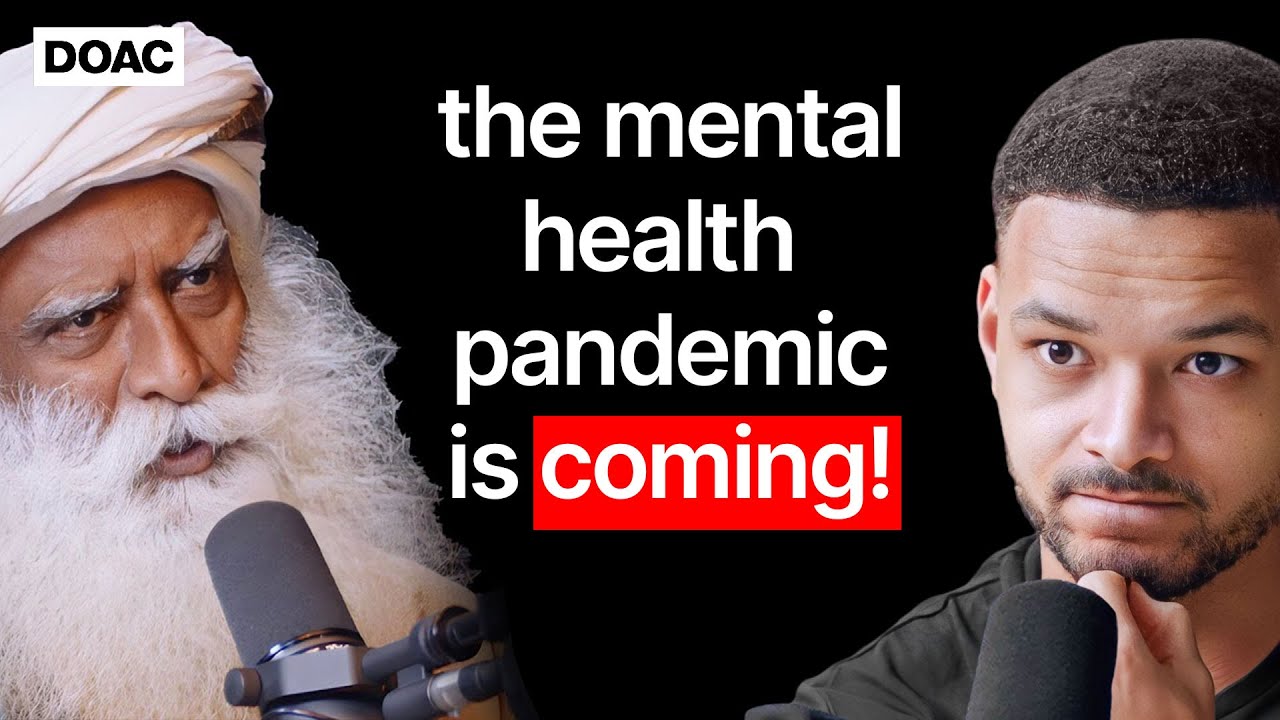
Sadhguru Links Soil Collapse To Global Mental Health Crisis
The Diary Of A CEO
Unchecked soil degradation depletes essential nutrients and threatens to trigger widespread psychological deterioration alongside global ecological collapse within decades.
## Background
Published on YouTube by The Diary Of A CEO on October 19, 2023, this video features Steven Bartlett interviewing Sadhguru. The video description provides timestamps for their conversation on human consciousness, mental health, AI, and environmental crises, while also linking to Sadhguru's 'Inner Engineering' well-being program and sponsor details.
## TL;DR
Sadhguru addresses the escalating global mental health crisis, attributing human suffering to misidentification with physical and psychological states rather than living as conscious existence. He argues that human desire for limitless expansion cannot be fulfilled through finite physical means and advocates for inner practices to achieve natural ecstasy and self-mastery. Additionally, he highlights the potential for technology and AI to liberate humanity from survival-oriented labor while delivering a urgent call to action through his 'Save Soil' campaign to prevent environmental and nutritional collapse.
## Atmosphere & style
The conversation carries a captivating, reflective, and deeply grounded tone as Steven Bartlett's practical, high-stakes questioning meets Sadhguru's witty, effortless wisdom. Episodes of lighthearted humor and practical demonstrations punctuate profound philosophical insights, creating a atmosphere that feels both intellectually stimulating and deeply refreshing. The dialogue moves fluidly from solemn warnings about human suffering and ecological crisis to empowering revelations about reclaiming joy and living purely out of fundamental humanity.
## Key takeaways
- [00:02](https://www.youtube.com/watch?v=PACpvHgJ9HM&t=2s) O auxílio da Organização Mundial da Saúde prevê que a crise global de saúde mental evoluirá para uma pandemia de suicídios, superando em impacto outras crises ecológicas e virais se a consciência humana não for cultivada.
- [05:42](https://www.youtube.com/watch?v=PACpvHgJ9HM&t=342s) A distância sutil em relação às atividades fisiológicas e psicológicas do corpo ativa um estado natural de êxtase, correlacionado cientificamente com picos substanciais de endocanabinoides no cérebro.
- [09:57](https://www.youtube.com/watch?v=PACpvHgJ9HM&t=597s) O sofrimento humano surge da tentativa frustrada de satisfazer a busca ilimitada por expansão através de meios físicos finitos e da falsa identificação com pensamentos, emoções e corpos.
- [18:13](https://www.youtube.com/watch?v=PACpvHgJ9HM&t=1093s) O 'pensamento excessivo' é caracterizado como um fluxo descontrolado e compulsivo da mente (diarreia mental), resultante da falta de presença e de identificar-se com o que não se é.
- [25:36](https://www.youtube.com/watch?v=PACpvHgJ9HM&t=1536s) A serenidade e a lucidez mental em momentos de crise e perda pessoal são escolhas lógicas e essenciais para responder adequadamente, e não reações de insensibilidade ou rigidez.
- [31:01](https://www.youtube.com/watch?v=PACpvHgJ9HM&t=1861s) A busca fanática por um propósito pré-definido pode levar ao radicalismo; a verdadeira plenitude é uma experiência interna auto-gerada (self-start) e independente das circunstâncias externas.
- [35:50](https://www.youtube.com/watch?v=PACpvHgJ9HM&t=2150s) Através do programa Inner Engineering e de práticas de atenção ao corpo energético, é possível alterar o funcionamento fisiológico e acessar estados profundos de bem-estar.
- [38:55](https://www.youtube.com/watch?v=PACpvHgJ9HM&t=2335s) A história da humanidade mostra que focar na expansão e percepção interior naturalmente gera abundância, clareza e prosperidade no mundo exterior.
- [45:00](https://www.youtube.com/watch?v=PACpvHgJ9HM&t=2700s) Estudos conduzidos com praticantes da técnica Shambhavi Mahamudra demonstraram elevações de até 70% nos níveis de endocanabinoides, superando picos registrados durante orgasmos ou exercícios intensos.
- [49:19](https://www.youtube.com/watch?v=PACpvHgJ9HM&t=2959s) A fixação ocidental no intelecto reduz a vasta inteligência humana a memórias e dados, ignorando a primazia da própria existência.
- [53:50](https://www.youtube.com/watch?v=PACpvHgJ9HM&t=3230s) A automação e a inteligência artificial não devem ser temidas, mas vistas como oportunidades para libertar a humanidade da sobrevivência mecânica e do trabalho repetitivo.
- [01:01:10](https://www.youtube.com/watch?v=PACpvHgJ9HM&t=3670s) Em vez de buscar um 'significado' abstrato e psicológico para a vida, as tradições orientais focam em vivenciar a profunda intensidade da própria existência.
- [01:12:52](https://www.youtube.com/watch?v=PACpvHgJ9HM&t=4372s) A degradação do solo e a perda de microrganismos ameaçam a saúde nutricional e mental da humanidade, exigindo ações urgentes como a campanha Save Soil.
## Detailed walkthrough
### [00:00](https://www.youtube.com/watch?v=PACpvHgJ9HM&t=0s) World Health Organization Predictions and the Impending Mental Health Pandemic
Sadhguru addresses the alarming predictions made by the World Health Organization regarding a global mental health crisis, which is forecasted to escalate into a suicide pandemic. Reflecting on how the world quickly learned the weight of the word "pandemic" during the COVID-19 crisis, he draws a stark comparison to 2020: in Japan, more people lost their lives to suicide that year than to the virus itself. He argues that humanity does not necessarily need a external pathogen to cause devastation because the virus has already infected our minds. Once basic survival needs are met, if human beings do not become conscious of how they sit, stand, breathe, think, emote, and function, their mental state naturally deteriorates.
Sadhguru shares the transformative experience that set him on his path forty years ago on September 23rd. As a hard-working young businessman running multiple enterprises from early morning until late at night, he took a brief break and rode up Chamundi Hill in Mysuru—a favorite spot from his youth. Sitting on a rock for what he thought was just fifteen or twenty minutes, he suddenly felt every cell in his body "dripping ecstasy." When he returned to normal awareness, four and a half hours had elapsed, and his shirt was drenched in tears—an unprecedented experience for a self-described skeptic. He came to realize that time is purely relative: when one is depressed, ten minutes feels like twenty-four hours, but in a state of bliss, hours pass in seconds.
- According to WHO forecasts, the mental health pandemic is expected to be followed by a global suicide pandemic.
- In 2020, suicide deaths in Japan outnumbered total deaths from COVID-19.
- September 23rd marked forty years since Sadhguru's baseline shift in consciousness on Chamundi Hill.
- His initial mystical experience involved four and a half hours passing while feeling as though only fifteen to twenty minutes had elapsed.
[05:42](https://www.youtube.com/watch?v=PACpvHgJ9HM&t=342s) The Science of Inner Bliss and the Longing for Limitless Expansion
Within six to eight weeks of his initial experience on Chamundi Hill, Sadhguru stabilized his internal state and began experimenting to understand what had happened. He discovered a simple truth: by maintaining a subtle distance from his physiological and psychological activity, his entire body would burst with ecstasy within seconds or minutes. He notes that modern science now validates this phenomenon—researchers at Harvard Medical School have measured massive spikes in naturally produced endocannabinoids in individuals who practice these simple internal techniques.
```
[ Mind & Body Activity ] <──── Distance ────> [ Pure Consciousness ]
│
▼
Endocannabinoid Burst
(Natural Bliss)
```
Initially, Sadhguru foolishly envisioned making the entire world "blissed out" within two and a half years. Today, although his movement reaches over two billion people and generated 3.51 billion video views last year alone, he considers this progress insufficient because it accounts for less than half the global population. He explains that people remain fiercely committed to their miseries due to rigid beliefs, ideologies, or compulsive behaviors. For him, spreading this state is not a holy mission, but merely a natural expression of his humanity: "Suppose you hear a good joke. Will you tell somebody who's dear to you or will you cover yourself with a blanket and tell yourself?"
- Harvard Medical School research demonstrates that basic inner practices release significant levels of endogenous cannabinoids in the brain.
- Sadhguru's videos generated 3.51 billion views in the single year prior to the interview, touching an estimated two billion people globally.
- In the UK, someone dies by suicide every 90 minutes; 76% of these individuals are male.
- Suicide stands as the single largest killer of men under the age of 45 in the United Kingdom.
[09:57](https://www.youtube.com/watch?v=PACpvHgJ9HM&t=597s) The Conundrum of Human Ambition and the Illusion of Physical Expansion
When host Steven Bartlett brings up the intense stress observed among business leaders and high achievers, Sadhguru explains that people confuse basic survival instincts with the deep human longing for limitless expansion. Whether survival means securing two meals a day or acquiring a Bentley, it remains part of the same baseline survival process—one just takes longer to achieve. Human beings possess an inherent drive to always be "something more." If someone were made the king of the entire planet, they would immediately look up at the moon, then other planets, and eventually other galaxies, asking, "What about the next one?"
This relentless drive is not inherently bad, but suffering arises because people try to fulfill a limitless desire through finite, physical means—a state Sadhguru describes as "constipated." Expecting to reach infinity by counting step-by-step ($1, 2, 3, 4, 5\dots$) is impossible and leads to endless frustration. Human evolution and the development of the cerebral cortex have made human beings inherently intolerant of boundaries:
> "If I imprison you in a 5 by 5 cubicle you will feel terribly imprisoned. Then tomorrow I will announce your liberation and release you into a 10 by 10 cubicle. You will feel wonderful for 2 days. Then you'll feel horribly imprisoned... Doesn't matter where I set the boundary. Once you feel the boundary, you want to break it."
True expansion cannot occur physically; it must happen through consciousness. When expansion is non-physical, everyone can simultaneously "own the universe" without conflict or boundary issues.
[13:30](https://www.youtube.com/watch?v=PACpvHgJ9HM&t=810s) Misidentification, Psychological Sloshing, and Seeing Life As It Is
Sadhguru pinpointed the root cause of human despair as false identification with things that are not the self. He offers a vivid metaphor: if you sit on a chair and mistakenly believe that you *are* the chair, you will drag it everywhere glued to your backside. Because almost everyone walks around with their own metaphorical chair attached, society accepts this cumbersome behavior as normal and convenient. In the same way, people falsely identify with their thoughts, emotions, and physical bodies, which creates endless internal confusion.
```
MISIDENTIFICATION MATRIX
True Reality False Identity
┌──────────────┐ ┌─────────────────────┐
│ │ Identified With │ Thoughts & Mind │
│ Pure Life ├──────────────────────►│ Emotions │
│ Experience │ │ Possessions/Status │
└──────────────┘ └─────────────────────┘
│
▼
"Psychological Sloshing"
(Constant Suffering)
```
When human beings identify with what they are not, both success and failure produce suffering. A poor person suffers their poverty, while a rich person suffers their taxes; those without children suffer loneliness, while parents suffer daily worries. To manage this internal "psychological sloshing," people invent comforting philosophies and fairy tales about going to heaven rather than learning to see life exactly as it is.
Navigating life without seeing reality clearly is like walking through a room full of tripods and cables blindfolded—you will inevitably bump into obstacles and create a mess. The issue is not what people are doing, but how clearly they are seeing. Sadhguru notes that in his own life, 95% of what he attempts to fix in the world does not happen, yet he remains in total bliss because his internal state is completely decoupled from external circumstances: "No matter what, I will die blissed out. I live blissed out, I die blissed out. Because what I do, what the situation is around me and how I am are never connected."
- Human suffering persists across all economic levels: the poor suffer poverty, while the rich suffer taxes.
- Sadhguru notes that 95% of the external projects he attempts do not succeed as planned, yet his internal experience remains entirely unaffected.
- The fundamental error in human perspective is mistaking temporary internal activity—thoughts, emotions, and physical structures—for the core self.
<FollowUp label="Want to dive into the next part of the transcript covering inner engineering and self-awareness?" query="Please provide the walkthrough for part 2 of the transcript."/>
[18:13](https://www.youtube.com/watch?v=PACpvHgJ9HM&t=1093s) Expression, Perception, and the Mental Diarrhea of Modern Life
Sadhguru notes that while everyone seems to be writing books today under the banner of free expression, people are investing heavily in expression while ignoring perception. His point is straightforward: if you perceive well, your expression will naturally hold value, but right now humanity is on an "expression binge without perceiving a damn thing." When Steven Bartlett brings up the pervasive stress, anxiety, and depression that people face daily and asks for the first step toward living a blissed-out life, Sadhguru shares a telling interaction he had with leading UK psychiatrists. They informed him that there are 72 distinct varieties of psychological ailments—a number Sadhguru quips is "like a golf game"—including compulsive nose picking to the point of bleeding.
For Sadhguru, this highlights the core issue: human compulsiveness. Whether it manifests in thought, emotion, or action, compulsiveness is simply a lack of light. "If this room is dark... you turn on the light, it's gone. So, there is no substitute for consciousness." When an individual is conscious, they choose pleasantness over misery every single time. He dismisses the idea that people need to be inspired to be blissful; everyone inherently desires maximum pleasantness. Those who find life on Earth hopeless are the ones who invented heaven, claiming there is a better place elsewhere. When asked directly if he believes in an afterlife or another world, Sadhguru replies with sharp wit that anyone who believes there is a better place than Earth should go today: "If they have better accommodation somewhere than London, shouldn't they go?... No, they want you to go. This is not good."
```
"There is no substitute for consciousness. If you become conscious, compulsive behavior is gone."
```
When human intelligence turns against itself, no force in the universe can save a person. Society and education systems fail to teach children how to manage their own thoughts, emotions, and intelligence, operating instead like repair shops performing constant patch-ups. Addressing what people commonly label as "overthinking," Sadhguru reframes it entirely:
* **The Fallacy of Overthinking:** People are not thinking too much; they are not thinking enough. What they are experiencing is a loose, uncontrolled run of the mind—a "mental diarrhea."
* **Root Cause:** Mental diarrhea occurs when you consume the wrong "food"—specifically, when you identify yourself with something that you are not. Once that misidentification happens, the mind cannot be stopped.
* **The Reality of Suffering:** People suffer what happened 10 years ago or what might happen day after tomorrow. Neither of these exists in the present moment. Suffering what does not exist is, by definition, insanity.
---
[25:36](https://www.youtube.com/watch?v=PACpvHgJ9HM&t=1536s) Sanity in the Face of Crisis and Loss
Steven pushes back on the idea of suffering non-existent things by bringing up real-world, high-stakes scenarios: what if someone is facing the potential loss of a child or the immediate threat of joblessness, foreclosure, and starvation? Sadhguru immediately separates the two, noting that losing a child involves genuine pain, but he poses a fundamental question: in any crisis, can you do the absolute best for your child or situation by remaining sane, or by slipping into insanity? While Steven suggests that maintaining composure under extreme distress requires immense discipline, Sadhguru insists that staying sane is simply the most logical and effective approach.
```
"What happens in the world around you, even if you're just two people in the family, never will it happen 100% your way. If you try, nobody will be around you."
```
When asked about his personal experiences with loss—given that he oversees massive global movements and a vast community where, as he puts it, "almost every other day I am burying somebody who's very dear to me"—Sadhguru clarifies that he never allows anything to drive him into insanity. Life is a finite amount of time and energy. While one must care deeply for others and make every effort to help them, death is an inevitable boundary for everyone. Suffering arises when people live "emotionally constipated" lives, reserving love for only one or two people rather than embracing all life. Walking through a forest may result in thorns in your feet, but that does not mean you stop enjoying the forest.
* **Emotional Control:** Sadhguru explains that nothing happens within him that he does not want. If he chooses to experience grief or sadness, he allows it consciously, but it never paralyzes his actions.
* **Human Aspirations vs. Instinct:** Animals are governed entirely by survival instincts; once their stomachs are full, their life is settled. For a human, an empty stomach is one problem, but a full stomach creates 100 problems because human longing extends far beyond basic survival.
---
[31:01](https://www.youtube.com/watch?v=PACpvHgJ9HM&t=1861s) Purpose, Self-Start Experience, and Inner Engineering
Addressing the common obsession among young people regarding finding their "passion and purpose," Sadhguru warns against the fanaticism that rigid purpose creates: "If you get absolutely committed to your purpose, you will be called a fanatic. If you're willing to do whatever it takes to achieve that, you will be called a terrorist." There is no pre-packaged purpose to life. Human experience—whether fear, love, joy, or agony—is generated entirely from within, regardless of external stimuli.
```
"Your peace, your joy, your love, your blissfulness, would you want to keep it on self start or push start?"
```
Using a historical metaphor of old cars that required a manual crank or a downhill push to start, Sadhguru asks whether one wants their internal well-being to be on "push start" (dependent on external circumstances and other people) or "self start" (internally generated). Because the outside world will never function 100% according to any single individual's desires, conditioning internal happiness on external events makes joy a remote possibility.
To break the cycle of automatic, reactive emotional distress, Sadhguru introduces the concept of **Inner Engineering**:
* **Investment in Life:** If a person agrees that their life is worthwhile, it deserves 32 hours of focused, dedicated time to understand its internal mechanism.
* **The Practice:** Inner Engineering provides a foundational 21-minute daily practice, supported by 32 hours of orientation to understand how thoughts and emotions operate.
* **The User's Manual:** Calling the human system the most sophisticated machine on the planet, Sadhguru points out that most people never read their own built-in user's manual until the very end of their lives, rather than at the beginning.
To demonstrate how closely tied the mind and body are to physical awareness, Sadhguru initiates a direct, practical experiment with Steven, instructing him to sit with his palms facing down on his thighs, breathe slightly deeper, and observe how the air fills his lungs before flipping his hands upward to notice the immediate shift in chest expansion and breath pattern.
[36:43](https://www.youtube.com/watch?v=PACpvHgJ9HM&t=2203s) Experiential Demonstration of the Energy Body
To demonstrate how subtle physical posture directly impacts internal physiological state, Sadhguru guides Steven Bartlett through a quick breathing exercise. Sitting with eyes closed, Bartlett is instructed to breathe slightly deeper—about 10% to 15% more than usual—while holding his hands with palms facing down. After observing the shift, he is told to flip his palms upward and notice the change in expansion and contraction within his body.
Upon opening his eyes, Bartlett notes feeling a distinct shift, observing that turning his palms up made him feel as though he was drawing more air deep into his chest and belly. Sadhguru clarifies the underlying physics of the subtle body: when the hands face down with fingers together, maximum expansion and contraction occur in the lower lobes of the lungs; flipping the hands shifts this breath movement to the middle lobes. Because the middle lobe is larger, it creates the perception of receiving significantly more air.
```
+------------------+-----------------------------+-------------------------------+
| Hand Orientation | Dominant Lung Expansion | Physiological/Energy Effect |
+------------------+-----------------------------+-------------------------------+
| Palms Facing Down| Lower Lobes of the Lungs | Grounding, localized breath |
| Palms Facing Up | Middle Lobes of the Lungs | Expansive breath & energy flow|
+------------------+-----------------------------+-------------------------------+
```
Sadhguru highlights that if a simple turn of the hands alters lung mechanics and life energies, people are constantly setting their internal systems into turmoil completely unconsciously. He quips that if a person could act carelessly and still remain peaceful, his own life's work of paying meticulous attention to every internal detail would be pointless:
> "If you can drive blind on the London streets and not hit anything, a good driver will feel insulted, isn't it? That's all I'm saying."
---
[38:55](https://www.youtube.com/watch?v=PACpvHgJ9HM&t=2335s) Inward Perception and the Historical Legacy of Self-Enhancement
Addressing Bartlett’s question regarding how humanity can learn its own "user manual," Sadhguru explains that human sense organs—seeing, hearing, smelling, tasting, and touching—are exclusively outward-bound because they evolved strictly as survival instruments. While superior sensory perception allows an organism to survive better, it cannot enhance the quality or depth of life itself. The sensory apparatus is structurally incapable of scanning internally; one cannot roll their eyes inward to view their organs or hear the complex biological processes happening inside the body.
Turning inward requires intentional striving because it falls outside the realm of basic survival. Drawing a parallel to literacy, Sadhguru notes that learning even the 26 letters of the English alphabet required guidance and effort. Culturally, society must establish a deep longing for inner well-being. He points to ancient Indian history (Hindustan or Bharat) as a society that prioritized this inward focus:
* **Inward Investment:** Approximately 70% of the population historically invested time in inward well-being and self-enhancement.
* **Resulting Prosperity:** This inner clarity naturally spilled over into external mastery, making the culture exceptionally rich in mathematics, astronomy, business, trade, and industry.
* **Global Attraction:** Until 300 years ago, it was the wealthiest region on Earth, attracting European powers (British, French, Portuguese) seeking wealth without the culture ever resorting to military conquest or massive offensive armies.
Sadhguru warns that attempting to enhance activity without first enhancing the self leads directly to friction and exhaustion. He highlights his concern for corporate leaders: "If the CEO is stressed out, what misery will they create for the rest of the world?"
---
[42:28](https://www.youtube.com/watch?v=PACpvHgJ9HM&t=2548s) Deconstructing Social Competition and Early Trauma
Sadhguru sharply criticizes modern society's hyper-fixation on competition and individualism, pointing out that children are conditioned from kindergarten onward to measure their worth against others (e.g., "first rank" versus "third rank"). This mindset instills a paradigm of "I am better than you," which functionally means finding joy in someone else's failure—a dynamic Sadhguru categorizes as a psychological sickness rather than genuine joy.
When Bartlett raises the subject of childhood trauma—asking how early painful events drive individuals toward dysfunction, greed, or selfishness—Sadhguru rejects using past hardship as an excuse for reactive behavior. He stresses that unpleasant experiences present a fundamental choice:
> "If something unpleasant happened to you, you have two choices: either you can become wise, or you can become wounded. Choose."
He argues that if a person has suffered more than others, they ought to become the wisest person the fastest. Holding onto a wound like a badge to justify causing pain to others is merely reacting like an animal instead of consciously responding as a human being. Dismissing pop-psychological justifications as "WhatsApp neurology," he emphasizes that human consciousness can transcend mechanical past conditioning.
---
[45:00](https://www.youtube.com/watch?v=PACpvHgJ9HM&t=2700s) Endocannabinoids and Reclaiming Natural Ecstasy
To ground his claims about inner transformation in hard science, Sadhguru cites ongoing research conducted at the Sadhguru Center for a Conscious Planet at Beth Israel Deaconess Medical Center (a teaching hospital of Harvard Medical School).
Researchers studying practitioners of a simple 21-minute daily yogic practice (Shambhavi Mahamudra) discovered significant biochemical changes:
* **70% Higher Endocannabinoids:** Regular practitioners demonstrated endocannabinoid levels 70% higher than the baseline of a normal, healthy, happy individual.
* **Surpassing High-Intensity States:** These baseline levels were roughly 23% higher than the levels measured during sexual orgasm or extreme physical exercise, achieved while simply sitting still.
Sadhguru explains that human beings possess natural cannabis receptors not to consume external substances, but because the human system is designed to produce its own internal bliss. When people operate in a natural state of internal bliss, external compulsions like crime, greed, or harm vanish automatically. He contrasts adult misery with the innate joy of a five-year-old child: back then, someone had to work hard to make you unhappy, whereas in adulthood, immense effort is required just to make a person happy. Growing up should mean becoming ecstatic, not carrying accumulated psychological baggage.
---
[47:17](https://www.youtube.com/watch?v=PACpvHgJ9HM&t=2837s) Sponsor Break: Huel & LinkedIn Jobs
Bartlett transitions into brief host-read sponsor messages:
* **Huel Daily Greens:** Bartlett highlights the restock of Huel Daily Greens in the US market, noting it delivers 91 vitamins, minerals, and whole-food ingredients in a single scoop. He invites non-US listeners to message him directly to lobby Huel for international availability.
* **LinkedIn Jobs:** Bartlett emphasizes that a company is nothing without its people and recommends LinkedIn Jobs for finding qualified candidates quickly and for free via tailored screening questions.
---
[49:19](https://www.youtube.com/watch?v=PACpvHgJ9HM&t=2959s) The Limits of Intellect and the Western Intellectual Paradigm
Returning to the conversation, Bartlett questions human supremacy in intelligence in light of advancing Artificial Intelligence. Sadhguru dismisses the fear that AI is inherently "smarter" than human beings, reminding Bartlett that every piece of technology was created by human intelligence and represents only a tiny fraction of human capability. AI appears superior only because modern culture reduces the vast spectrum of human intelligence down to a single dimension: the intellect (memory and processing power).
Sadhguru attributes this hyper-fixation on the linear intellect to Western history:
* **Religious Dogma:** For centuries in Europe, dogmatic religious institutions punished independent thought.
* **Over-Correction:** When thinkers finally broke free during the Enlightenment, they over-idealized human thought as the ultimate truth, culminating in philosophies like Descartes' *"I think, therefore I am."*
* **Educational Bias:** Modern global education systems were constructed entirely around this narrow intellectual model, ignoring deeper dimensions of consciousness.
Sadhguru flips Descartes' axiom on its head, pointing out that existence is fundamental: *"Because I exist, I think."* Thought is merely a temporary activity of existence, just like seeing or hearing.
```
+-----------------------+------------------------------------------------------------+
| Dimension | Nature & Function |
+-----------------------+------------------------------------------------------------+
| Existence (Primary) | The fundamental life force; present even with eyes closed |
| Intellect (Secondary) | A sharp cutting instrument designed to divide and analyze |
+-----------------------+------------------------------------------------------------+
```
He compares a sharp intellect to a razor-sharp knife. If a person wields a sharp knife with an unsteady, unconscious hand, they will cut themselves internally—manifesting as stress, anxiety, and misery. The tool itself is not dangerous; the lack of conscious mastery over the hand holding it is the true problem.
---
[53:13](https://www.youtube.com/watch?v=PACpvHgJ9HM&t=3193s) The Dawn of Automation: Industrial Relics to AI Concerns
When Bartlett raises concerns over AI systems making autonomous decisions—such as firing missiles without human intervention—Sadhguru counters that true human intelligence would never build a missile in the first place. He addresses the widespread anxiety surrounding job displacement and loss of identity due to intelligent machines by offering a historical perspective.
He recalls an event from 1972 at the Mazagon Dock in Mumbai (then Bombay), where the port installed its very first gantry crane:
* **Manual Unloading:** Prior to the gantry, dock laborers manually carried cargo sacks out of ships.
* **Vessel Capacity & Time:** The largest ships of that era held 125,000 to 150,000 tons and required 24 to 28 days of round-the-clock manual labor to unload.
* **Labor Backlash:** The introduction of the gantry sparked a massive labor strike that paralyzed Mumbai, as workers feared the machine would destroy their livelihoods.
Sadhguru uses this historical event to illustrate how humanity consistently panics when technology automates manual or mental drudgery, failing to see that relieving humans of repetitive tasks is the ultimate path toward liberation.
<ElicitationsGroup message="Explore the next section of the transcript or dive deeper into Sadhguru's concepts:">
<Elicitation label="Summarize Part 4 of the transcript" query="Please provide a detailed, faithful walkthrough of Part 4 of this transcript using the same structure and guidelines."/>
<Elicitation label="Explain Inner Engineering and Shambhavi Mahamudra" query="Can you explain the principles behind Sadhguru's Inner Engineering and the scientific findings on Shambhavi Mahamudra in detail?"/>
</ElicitationsGroup>
[55:13](https://www.youtube.com/watch?v=PACpvHgJ9HM&t=3313s) Machines and Purpose: Addressing Fear of Identity Loss Amidst Automation
Sadhguru addresses the collective anxiety surrounding modern technological shifts, comparing today’s fear of artificial intelligence to historical resistance against industrial machinery. He recalls how workers once went on strike when new port machinery was introduced, arguing, "What are we supposed to do with our muscle?" Now, academics and intellectuals who have invested entirely in their mental intellect are asking the exact same question: "What are we supposed to do?" when machines begin to handle cognitive tasks. Sadhguru considers it fantastic that machines are taking over hard work, emphasizing that human anxiety stems from reducing oneself to a purely mechanical entity that relies solely on thinking.
When Steven Bartlett brings up the concern that thinking machines might make autonomous decisions, Sadhguru challenges the notion that logic is all there is to human existence. He uses the metaphor of a building’s foundation, explaining that logic is essential as a base, but living strictly within your logic is like choosing to live in the basement dungeon of a building. No matter how luxurious the surroundings, living strictly in the foundation results in a miserable life.
* Historical protests occurred when workers feared losing the purpose of their physical labor to machines.
* Living strictly by logic is compared to residing in a basement dungeon rather than experiencing the fullness of a building.
[57:30](https://www.youtube.com/watch?v=PACpvHgJ9HM&t=3450s) Positive Tech Outlook: Embracing Intelligent Machines for Human Liberation
Addressing concerns about whether AI could fall into the wrong hands or accelerate dangerous outcomes like nuclear threats, Sadhguru remains strikingly optimistic. He points out that AI takes "human error" out of the equation, lightheartedly noting that "half-brained people" often reach top national positions and make erratic decisions, whereas AI ensures a proper process before actions are taken. He shares a personal story from when he was 12 or 13 years old in the ninth grade. Preferring to spend time in libraries, swimming in lakes, or wandering the countryside, he was shown a flatbed calculator in school. Seeing it solve complex calculations instantly ($185 \times 365$), he felt insulted that he was being tormented in math class when a machine could do the job, wondering why machines couldn't be made for chemistry and physics too.
Sadhguru highlights that the fear of losing jobs stems from a narrow mindset. The true purpose of technology should be to free humanity from the burden of earning a living so people can actually "make a life out of themselves." Steven notes how this closely aligns with statements made by Sam Altman, CEO of OpenAI, regarding AI freeing people from tedious tasks to live blissful lives. When Steven mentions the counterargument that people need work to maintain a sense of purpose, Sadhguru dismisses "putting bread on the table" as a false purpose born out of failing to understand life's true potential.
* Sadhguru's first encounter with an intelligent machine was a flatbed calculator in ninth grade.
* "Putting bread on the table" is described as the "silliest way to live" if used as a person's ultimate life purpose.
* AI is seen as an opportunity to emancipate humans from survival-oriented labor.
[01:01:10](https://www.youtube.com/watch?v=PACpvHgJ9HM&t=3670s) Societal Transformation: Redesigning Society While Embracing Life's Profoundness
Discussing the structure of modern society, Steven ponders whether humanity needs a blank canvas to redesign societal systems from scratch. Sadhguru responds that a blank canvas is an impossibility and illustrates the challenge of altering a functioning system through a joke about a cardiologist and an Aston Martin mechanic:
> "The mechanic said, 'See, I fix your engine, you pay me 500 pounds. But you fix somebody's heart and they pay you 50,000 pounds. Why is that? You're fixing an engine, I'm fixing an engine.' The doctor said, 'Try to fix it when it's running.'"
Sadhguru emphasizes that society and individuals must be transformed while actively functioning; waiting to rebuild after a collapse is equivalent to inviting a nuclear holocaust. He stresses that human internal state dictates external choices—a miserable person controlling a nuclear button poses a threat, whereas a blissful person acts out of inherent pleasantness. Pleasantness of body is health/pleasure, pleasantness of mind is peace, and creating pleasantness inside oneself is entirely an internal responsibility.
Moving away from the Western obsession with finding a rigid "meaning of life," Sadhguru explains that meaning is purely a psychological construct created by the mind when a person is distressed or finding life burdensome. In Eastern traditions, the focus is placed on the *profoundness* of life rather than seeking an abstract meaning. He points out the absurdity of feeling like the center of the universe, noting that dogmatic religious systems historically pushed geocentric views, whereas Indian texts recognized the Earth as round and revolving around the Sun for over 6,000 years.
* **Mechanic Joke:** Highlights the difficulty of repairing human or societal systems while they are still in motion.
* **Aspects of Internal Pleasantness:**
* Body = Health / Pleasure
* Mind = Peace
* **Eastern vs. Western Perspective:** The East seeks the *profoundness* of life, whereas the West seeks a psychological *meaning*.
* Historical Indian documents acknowledged the heliocentric, spherical nature of Earth over 6,000 years ago.
Sadhguru illustrates the absurdity of seeking intellectual definitions for life through an old story about a 60-year-old Greek Orthodox bishop from Constantinople (Istanbul) in 1924. Fascinated by tales of mystics wafting across the Bosphorus, the bishop traveled to Southern India, hiked up a treacherous mountain, and prostrated himself before a yogi sitting outside a cave. When the bishop asked, "What is life?", the yogi went into raptures and poetically replied:
> "Life is like the fragrance of jasmine upon the gentle spring breeze."
[01:12:15](https://www.youtube.com/watch?v=PACpvHgJ9HM&t=4335s) Life as a Thorn vs. Jasmine on a Spring Breeze
Sadhguru shares a story about a bishop and a yogi to illustrate how personal perception shapes human experience. The bishop recounts how his teacher warned him that life is like a thorn—wherever you sit, stand, or lie down, it hurts. When the yogi responds that life is actually like the "fragrance of jasmine upon gentle spring breeze," the bishop is bewildered. The yogi laughs and notes that the teacher's perspective was simply his own personal reality, emphasizing to Steven Bartlett: "You must understand, your experience of life is determined by you. It's your choice."
[01:12:52](https://www.youtube.com/watch?v=PACpvHgJ9HM&t=4372s) The Save Soil Campaign and the Extinction Crisis
Transitioning to Sadhguru's global initiative, Steven asks about the motivation behind the **Save Soil** campaign and why its message is so urgent. Sadhguru links soil degradation directly to rising global mental health issues, referencing estimates that within the next 15 to 20 years, almost every family on Earth could have at least one person suffering from mental illness. He critiques the last century of industrial agriculture for treating soil merely as a disposable "resource" rather than our fundamental "source" of life.
Sadhguru stresses that soil is the largest living system in the known universe—a single handful contains 8 to 10 billion living organisms. He breaks down the terrifying ecological consequences of biodiversity loss:
* **Insects:** If all insects disappear, all life on Earth—including plants and humans—would be extinct within 2.5 to 4 years.
* **Worms:** If worms disappear, all life collapses within 1.5 to 2.5 years.
* **Microbes:** If microbes disappear, humanity would be gone in a matter of seconds.
Currently, **27,000 species of organisms are going extinct every year**. Sadhguru warns that within 25 to 40 years, human beings will struggle to find basic nourishment. The first thing to collapse under severe nutritional deficits is human psychological "software." To illustrate how depleted our food system has become, he points to studies in California showing that to get the same level of nutrients found in **one orange in 1920**, a person today would need to eat **eight oranges**. Suggesting that anyone can verify the planet's degradation themselves, he advises listeners to look at Google Maps and see the terrifying proportion of brown, desertified land compared to green patches.
[01:16:07](https://www.youtube.com/watch?v=PACpvHgJ9HM&t=4567s) The Final Question: Humanity Beyond the Heart
Closing the interview, Steven introduces the podcast's tradition where the previous guest leaves a secret question for the next guest. The question left for Sadhguru is: *"What in your heart of hearts matters to you?"*
With characteristic humor and depth, Sadhguru rejects the premise of having a "heart of hearts," remarking, "I have only one heart. That also I gave away long time ago... I broke my heart into a million pieces and threw it away in the world." He concludes the conversation by expressing the core principle of his existence:
> "I live not because of my values. I live not because of my morality. I live not because of some commandments from somewhere. I live out of my humanity."
## Notable quotes
> [05:42](https://www.youtube.com/watch?v=PACpvHgJ9HM&t=342s) Suppose you hear a good joke. Will you tell somebody who's dear to you or will you cover yourself with a blanket and tell yourself? — Sadhguru
> [09:57](https://www.youtube.com/watch?v=PACpvHgJ9HM&t=597s) If I imprison you in a 5 by 5 cubicle you will feel terribly imprisoned. Then tomorrow I will announce your liberation and release you into a 10 by 10 cubicle. You will feel wonderful for 2 days. Then you'll feel horribly imprisoned... Doesn't matter where I set the boundary. Once you feel the boundary, you want to break it. — Sadhguru
> [13:30](https://www.youtube.com/watch?v=PACpvHgJ9HM&t=810s) No matter what, I will die blissed out. I live blissed out, I die blissed out. Because what I do, what the situation is around me and how I am are never connected. — Sadhguru
> [18:13](https://www.youtube.com/watch?v=PACpvHgJ9HM&t=1093s) There is no substitute for consciousness. If you become conscious, compulsive behavior is gone. — Sadhguru
> [25:36](https://www.youtube.com/watch?v=PACpvHgJ9HM&t=1536s) What happens in the world around you, even if you're just two people in the family, never will it happen 100% your way. If you try, nobody will be around you. — Sadhguru
> [31:01](https://www.youtube.com/watch?v=PACpvHgJ9HM&t=1861s) If you get absolutely committed to your purpose, you will be called a fanatic. If you're willing to do whatever it takes to achieve that, you will be called a terrorist. — Sadhguru
> [31:01](https://www.youtube.com/watch?v=PACpvHgJ9HM&t=1861s) Your peace, your joy, your love, your blissfulness, would you want to keep it on self start or push start? — Sadhguru
> [36:55](https://www.youtube.com/watch?v=PACpvHgJ9HM&t=2215s) If you can drive blind on the London streets and not hit anything, a good driver will feel insulted, isn't it? That's all I'm saying. — Sadhguru
> [42:28](https://www.youtube.com/watch?v=PACpvHgJ9HM&t=2548s) If something unpleasant happened to you, you have two choices: either you can become wise, or you can become wounded. Choose. — Sadhguru
> [01:01:10](https://www.youtube.com/watch?v=PACpvHgJ9HM&t=3670s) The mechanic said, 'See, I fix your engine, you pay me 500 pounds. But you fix somebody's heart and they pay you 50,000 pounds. Why is that? You're fixing an engine, I'm fixing an engine.' The doctor said, 'Try to fix it when it's running.' — Sadhguru
> [01:12:10](https://www.youtube.com/watch?v=PACpvHgJ9HM&t=4330s) Life is like the fragrance of jasmine upon the gentle spring breeze. — Sadhguru
> [01:16:07](https://www.youtube.com/watch?v=PACpvHgJ9HM&t=4567s) I live not because of my values. I live not because of my morality. I live not because of some commandments from somewhere. I live out of my humanity. — Sadhguru
## Mentioned
Sadhguru, Steven Bartlett, The Diary Of A CEO, World Health Organization, Deepak Chopra, Chamundi Hill, Harvard Medical School, Beth Israel Deaconess Medical Center, Sadhguru Center for a Conscious Planet, Inner Engineering, Shambhavi Mahamudra, Save Soil Campaign, René Descartes, Sam Altman, OpenAI, Mazagon Dock, Huel, LinkedIn, Apple Podcasts, Spotify, YouTube
Sadhguru argues that modern humanity faces severe psychological and ecological crises because society pursues limitless expansion through finite physical means while neglecting inner consciousness and the living foundation of the planet.
Mental Health and the Trap of Misidentification (0:00)
Sadhguru highlights World Health Organization forecasts warning of a global mental health crisis escalating into a suicide pandemic. Citing national indicators, he notes that in 2020 suicide deaths in Japan exceeded COVID-19 fatalities, while in the United Kingdom, suicide occurs every 90 minutes and remains the leading killer of men under 45. He contends that psychological suffering arises once survival needs are met if individuals fail to manage their internal faculties consciously.
According to Sadhguru, what society diagnoses as overthinking or anxiety is often an uncontrolled mental run—which he terms "mental diarrhea"—triggered by false identification with the physical body, social roles, or accumulated possessions. He argues that suffering past events or anticipated futures amounts to suffering what does not exist in reality, pointing out that true emotional stability requires establishing distance between awareness and compulsive psychological activity.
Biochemical Mechanics of Conscious Inner Engineering (31:01)
Rather than relying on unpredictable external circumstances for well-being—a condition Sadhguru likens to a "push-start" vehicle—he advocates for "Inner Engineering" practices designed to make internal pleasantness self-generating. He notes that subtle adjustments in physical posture directly modulate the system, illustrating how flipping one's palms upward shifts breathing from the lower to the larger middle lobes of the lungs.
To substantiate these claims, Sadhguru references clinical studies from the Sadhguru Center for a Conscious Planet at Beth Israel Deaconess Medical Center, a Harvard Medical School teaching hospital. Researchers assessing practitioners of a 21-minute yogic practice (Shambhavi Mahamudra) recorded endocannabinoid levels 70% above healthy baselines—surpassing levels observed during intense exercise or sexual orgasm by approximately 23%. Sadhguru asserts that the human body is biologically wired to generate its own chemical ecstasy, reducing dependence on external compulsions.
Intellect, Automation, and the Purpose of Work (49:19)
Addressing widespread anxiety surrounding artificial intelligence and cognitive job displacement, Sadhguru argues that modern culture errantly reduces human intelligence to the single dimension of linear intellect. He traces this intellectual overemphasis to Western Enlightenment thought, which reacted against religious dogma by exalting logic and memory above the broader foundation of conscious existence.
Sadhguru compares current fears of AI to the 1972 labor strikes at Mazagon Dock in Mumbai, where workers protested the introduction of gantry cranes after spending weeks manually unloading 125,000-to-150,000-ton cargo vessels. He maintains that technology should celebrate the elimination of repetitive mental and physical drudgery, rejecting the idea that earning a livelihood is life's ultimate purpose and framing automation as an opportunity for human liberation.
Ecological Depletion and the Threat of Extinction (72:52)
Through his global Save Soil campaign, Sadhguru warns that industrial agriculture has treated topsoil as a disposable commodity rather than a living biological source. He emphasizes that a single handful of soil contains 8 to 10 billion living organisms, yet humanity currently loses an estimated 27,000 species to extinction annually. He outlines severe ecological tipping points: the disappearance of microbes would extinguish humanity within seconds, the loss of earthworms within 1.5 to 2.5 years, and the loss of insects within 2.5 to 4 years.
Sadhguru predicts that within 25 to 40 years, human beings will face severe nutritional deficits that will accelerate psychological deterioration, forecasting that almost every family could have a member experiencing mental illness within 15 to 20 years. He points to California agricultural data indicating that modern consumers must eat eight oranges to match the nutrient density provided by a single orange grown in 1920.
Sadhguru concludes that navigating personal, technological, and planetary survival requires moving beyond external morality, commandments, and rigid definitions of life's purpose. Instead, he stresses that individuals must learn to operate purely from conscious humanity, aligning inner chemistry and perception to address collective crises without slipping into psychological paralysis.
[5:42] Sadhguru: Suppose you hear a good joke. Will you tell somebody who's dear to you or will you cover yourself with a blanket and tell yourself?
[9:57] Sadhguru: If I imprison you in a 5 by 5 cubicle you will feel terribly imprisoned. Then tomorrow I will announce your liberation and release you into a 10 by 10 cubicle. You will feel wonderful for 2 days. Then you'll feel horribly imprisoned... Doesn't matter where I set the boundary. Once you feel the boundary, you want to break it.
[13:30] Sadhguru: No matter what, I will die blissed out. I live blissed out, I die blissed out. Because what I do, what the situation is around me and how I am are never connected.
[18:13] Sadhguru: There is no substitute for consciousness. If you become conscious, compulsive behavior is gone.
[25:36] Sadhguru: What happens in the world around you, even if you're just two people in the family, never will it happen 100% your way. If you try, nobody will be around you.
[31:01] Sadhguru: If you get absolutely committed to your purpose, you will be called a fanatic. If you're willing to do whatever it takes to achieve that, you will be called a terrorist.
[31:01] Sadhguru: Your peace, your joy, your love, your blissfulness, would you want to keep it on self start or push start?
[36:55] Sadhguru: If you can drive blind on the London streets and not hit anything, a good driver will feel insulted, isn't it? That's all I'm saying.
[42:28] Sadhguru: If something unpleasant happened to you, you have two choices: either you can become wise, or you can become wounded. Choose.
[61:10] Sadhguru: The mechanic said, 'See, I fix your engine, you pay me 500 pounds. But you fix somebody's heart and they pay you 50,000 pounds. Why is that? You're fixing an engine, I'm fixing an engine.' The doctor said, 'Try to fix it when it's running.'
[72:10] Sadhguru: Life is like the fragrance of jasmine upon the gentle spring breeze.
[76:07] Sadhguru: I live not because of my values. I live not because of my morality. I live not because of some commandments from somewhere. I live out of my humanity.
Original transcript
[0:00] World Health Organization made a
[0:01] prediction there will be a mental health
[0:04] pandemic. But, this is not something
[0:06] that has to happen. If you want to fix
[0:08] this, you need to Sadhguru one of the
[0:11] most viewed gurus in the world.
[0:13] His mission is to raise every human
[0:15] being to the peak of their potential. He
[0:17] has built one of the largest non-profit
[0:19] organizations in the world. We have more
[0:21] than any other generation ever had in
[0:23] terms of comforts and technologies, yet
[0:27] we are miserable people. You want to be
[0:29] something more all the time. That's why
[0:31] you suffer. Just tell me, is there one
[0:34] thing that human beings are not
[0:35] suffering? Somebody is poor, they suffer
[0:37] their poverty. Somebody becomes rich,
[0:39] they suffer the taxes. If they're not
[0:41] married, they suffer get married. I
[0:43] don't have to say anything.
[0:46] You're making up a purpose to bring some
[0:48] meaning to your life. But, if you try to
[0:51] enhance your activity without enhancing
[0:53] yourself, you'll only die of stress.
[0:56] What about trauma? You're finding an
[0:58] excuse for the way you are, which you
[1:01] yourself don't like.
[1:03] If something unpleasant happened to you,
[1:05] you have two choices. Either you can
[1:07] become wise or you can become wounded.
[1:10] Your experience of life is determined by
[1:12] you. If your happiness depends on what
[1:14] happens on the outside, you being happy
[1:16] is a remote possibility.
[1:18] I want to be happy. What's step one?
[1:21] There is a simple practice which only
[1:23] take 21 minutes. And this is when human
[1:25] beings can do something absolutely
[1:27] fantastic. First thing is
[1:32] I just want to start this episode with a
[1:34] message of thanks. A thank you to
[1:35] everybody that tunes in to listen to
[1:37] this podcast. By doing so, you've
[1:38] enabled me to live out my dream, but
[1:41] also for many members of our team to
[1:43] live out their dreams, too. It's one of
[1:45] the greatest privileges I could never
[1:46] have dreamed of or imagined in my life
[1:48] to get to do this, to get to learn from
[1:49] these people, to get to have these
[1:51] conversations, to get to interrogate
[1:52] them from a very selfish perspective
[1:54] trying to solve problems I have in my
[1:56] life. So, I feel like I owe you a huge
[1:58] thank you for being here and for
[1:59] listening to these episodes and for
[2:00] making this platform what it is. Can I
[2:02] ask you a favor?
[2:03] I can't tell you how much you can change
[2:06] the course of this podcast, the the
[2:08] course of the guests we're able to
[2:09] invite to the show, and to the course of
[2:11] everything that we do here just by doing
[2:13] one simple thing. And that simple thing
[2:15] is hitting that subscribe button. Helps
[2:16] this channel more than I could ever
[2:17] explain. The guests on this platform are
[2:20] incredible because so many of you have
[2:22] hit that button. And I know when we
[2:24] think about what we want to do together
[2:26] over the next year on this show, a lot
[2:28] of it is going to be fueled by the
[2:29] amount of you that are subscribed and
[2:31] that tune into this show every week. So,
[2:33] thank you. Let's keep doing this. And I
[2:35] can't wait to see what this year brings
[2:36] for this show, for us as a community,
[2:38] and for this platform.
[2:47] What is the
[2:49] the mission that you're on?
[2:52] Well, today, you know, a few months ago,
[2:55] the
[2:56] WHO, or the World Health Organization,
[2:59] made a prediction
[3:00] that there is going to be a mental
[3:03] health pandemic.
[3:06] At least 5 years ago, none of us knew
[3:08] what is a pandemic. Today, we all know
[3:10] what is a pandemic.
[3:11] And they've gone further and they said
[3:13] the next stage is there will be a
[3:15] suicide pandemic.
[3:17] Just to put it in perspective.
[3:19] In 2020, when the pandemic was in full
[3:23] swing all over the world,
[3:25] in Japan, more people died of suicide
[3:29] than of the pandemic.
[3:31] So, we don't really need the virus.
[3:33] That's all I'm saying.
[3:35] Because the virus has gotten into our
[3:37] head. Because once survival is taken
[3:40] care of, you if you did do not become
[3:42] conscious,
[3:44] the way you sit, stand, breathe, think,
[3:47] emote, and function within yourself, if
[3:50] it does not become conscious, you will
[3:53] naturally head downhill.
[3:55] This is just September 23rd, I completed
[3:58] 40 years of this work.
[4:02] So, 40 years ago,
[4:04] I was a young man,
[4:06] one afternoon,
[4:08] when I had nothing much to do, somehow
[4:10] an hour and a half gap was there for me
[4:12] in the work. I was working like morning
[4:15] 5:30 in the morning to 11:00 in the
[4:17] night building various kinds of
[4:18] businesses around me.
[4:20] So, when I got a break, there's a small
[4:22] hill. This hill is a place where we go
[4:24] and
[4:26] for the youth.
[4:28] When I was a kid, I cycled up this hill.
[4:30] We camped on this hill. We partied on
[4:32] this hill.
[4:33] If you want to test our motorcycles, we
[4:35] went up the hill.
[4:37] Just about anything you want to do, the
[4:38] youth go to Chamundi Hill. This is the
[4:42] thing.
[4:43] I just walked up and sat on a rock.
[4:46] My eyes were still open.
[4:49] I thought it's just 10, 15, or 20
[4:51] minutes.
[4:53] Suddenly, I started feeling every cell
[4:56] in my body literally dripping ecstasy.
[5:00] I thought this lasted 15, 20 minutes.
[5:02] But, when I came back to my normal
[5:04] senses,
[5:05] 4 and 1/2 hours had passed.
[5:07] For the first time in my adult life,
[5:09] tears me and tears were simply
[5:11] impossible.
[5:12] Tears to a point my shirt is all wet.
[5:15] Then, I shake my skeptical mind and ask
[5:19] what the hell is happening to me. All I
[5:21] knew was I had hit a gold mine and there
[5:24] was no context.
[5:26] Nobody around me could tell me what was
[5:28] happening with me. Nor did I know what
[5:30] was happening with me.
[5:32] This is something that most people will
[5:34] experience in their lives. On a certain
[5:36] day, when they're very happy, 24 hours
[5:38] feels like 10 minutes.
[5:41] Another day, when you're depressed,
[5:43] 10 minutes will feel like 24 hours.
[5:46] Time is a very relative experience. When
[5:49] you're so blissed out,
[5:50] what is 2 minutes? It's 8 hours, 10
[5:52] hours just gone like that.
[5:55] So, in about 6 to 8
[5:57] weeks,
[5:59] I came to some kind of stabilization
[6:01] within myself and started experimenting
[6:04] as to what is happening to me.
[6:06] Then, I realized
[6:08] if I keep a little distance from my
[6:11] physiological and psychological activity
[6:14] that's going on, if I just remove myself
[6:17] a little bit,
[6:18] then within within a few seconds or
[6:21] within a couple of minutes, every cell
[6:23] in my body is bursting with ecstasy.
[6:27] Now, this is not just my experience.
[6:29] Today, we have it measured out in
[6:31] Harvard Medical School, how there is
[6:35] endocannabinoids are bursting out in
[6:37] people simply because they do a simple
[6:39] practice.
[6:41] So, I made a plan in 2 and 1/2 years
[6:43] time,
[6:44] I will make the whole world blissed out.
[6:47] I knew the methodology. If you just keep
[6:49] a distance, it'll happen.
[6:52] 40 years now.
[6:55] Today, people are saying we are touching
[6:57] over 2 billion people. Last year, our
[7:00] video views have been 3.51 billion.
[7:04] So, people think that's great.
[7:07] But, no, that is less than half the
[7:08] population as far as I'm concerned
[7:10] because I started thinking I'll make the
[7:12] whole world blissed out.
[7:14] But, people are committed to their
[7:16] miseries either because of their beliefs
[7:19] or their ideologies or their compulsive
[7:21] behavior within themselves.
[7:23] So, it needs to happen to the whole
[7:25] world. This is I don't see this as a
[7:27] mission. I just see this as an
[7:29] expression of my humanity. Suppose you
[7:32] hear a good joke.
[7:34] Will you tell somebody who's dear to you
[7:36] or will you cover yourself with a
[7:38] blanket and tell yourself?
[7:41] Of course, I'll tell everybody. Yeah.
[7:42] Pretend it was mine.
[7:43] That's all I'm trying to do. No mission.
[7:46] My experience, I'm trying to just rub it
[7:48] off on people.
[7:50] Some stats for you that support what you
[7:52] said earlier. Someone dies by suicide in
[7:54] the UK every 90 minutes. 76% of them are
[7:57] male. The single biggest cause of death
[8:00] for men under the age of 45 here in the
[8:03] UK is by suicide. You said you've spent
[8:06] a lot a lot of time around business
[8:08] people and they appear to be
[8:10] the most unhappy and least blissful
[8:13] people.
[8:13] wouldn't say unhappy. Stressed out.
[8:15] Stressed out. What is it that we're
[8:16] doing to the Cuz I I see myself I must
[8:19] be in that category to some regard
[8:20] because I've focused most of my time on,
[8:23] you know, building businesses and, you
[8:25] know,
[8:26] I guess to some extent material things
[8:28] and success.
[8:30] So, I must be part of that category.
[8:32] tactic in the sense.
[8:35] See, you can think that survival means
[8:38] two meals a day.
[8:40] Or you can think survival means Bentley.
[8:44] So, it'll keep you busy a little longer.
[8:47] Still survival process. As long as the
[8:50] survival There's an instinct to survive
[8:53] and there is a longing to expand within
[8:54] the human being.
[8:56] So, for most human beings, these two
[8:59] things are mixed up.
[9:00] It is that instinct of survival which is
[9:03] finding expression as
[9:05] their longing to expand.
[9:07] It doesn't matter who you are, where you
[9:09] are, anybody.
[9:11] You want to be something more.
[9:14] If that something more happens, you want
[9:15] to be something more.
[9:18] You can go on like this. How much more?
[9:20] Whatever you want. If I make it true for
[9:22] you right now, next moment you'll be
[9:24] thinking what more?
[9:27] Suppose I make you the king of not
[9:29] England, the planet.
[9:32] Don't look at me hopefully.
[9:34] I will not commit such a blunder.
[9:38] Suppose we make you the king of this
[9:40] planet, will you be fulfilled?
[9:43] No, you will look at the moon. You look
[9:45] at other planets. You look at the other
[9:46] galaxies. If I give you one galaxy,
[9:49] you'll say what about the other galaxy?
[9:51] Because there is something within a
[9:53] human being which wants to expand
[9:56] limitlessly. Is that not a good thing?
[9:58] Is not that not the reason why
[10:00] I didn't say it's not good.
[10:02] I'm just saying you have constipated
[10:04] that longing to expand. That's why you
[10:07] suffer.
[10:08] When I say constipated, right now you
[10:10] want to expand limitlessly.
[10:13] Can you expand this body limitless? No.
[10:16] Please don't.
[10:18] Don't try. In the gym I've tried, but
[10:23] So physical expansion is a limited
[10:25] expansion and your longing is to expand
[10:29] limitlessly because there is something
[10:30] within you which doesn't like
[10:32] boundaries.
[10:34] The moment see if I imprison you in a 5
[10:36] by 5 cubicle
[10:38] you will feel terribly imprisoned.
[10:41] Then tomorrow I will announce your
[10:42] liberation and release you into 10 by 10
[10:44] cubicle. You will feel wonderful for 2
[10:47] days.
[10:49] Then you'll feel horribly imprisoned.
[10:51] Then we will release you into 100 by 100
[10:54] cubicle. You will be fine for a week.
[10:56] After that you'll feel miserable.
[10:58] Doesn't matter where I set the boundary.
[11:00] Once you feel the boundary, you want to
[11:03] break it.
[11:04] So there is something intrinsic within
[11:06] you which doesn't like boundaries. This
[11:09] is a consequence of the evolution that
[11:12] you've gone through. Once your cerebral
[11:14] cortex flowered, now you don't like
[11:17] boundaries.
[11:18] But you're trying to expand in an
[11:22] infinite way by counting 1 2 3 4 or 5.
[11:26] Can you ever count 1 2 3 4 5 and one day
[11:29] say infinity?
[11:31] No. You'll only get into endless
[11:33] counting. That's all that's happening.
[11:35] That's why I said your longing to expand
[11:38] is a limitless process.
[11:40] But right now you're constipated. You're
[11:42] going one little step at a time.
[11:44] Constipation means just this. It happens
[11:46] little by little.
[11:50] So So is it a case of trying to find a
[11:51] balance between your ambition to expand
[11:54] and to grow and be successful? No. No.
[11:55] No.
[11:56] And peace.
[11:56] Why should you find balance? You must
[11:58] expand.
[11:59] Okay. So I That's what I'm doing.
[12:01] Yes. No.
[12:02] What is the means to become a boundless
[12:05] expansion?
[12:06] If you look at that, then we say
[12:08] consciousness. This is what raising
[12:10] human consciousness means because you
[12:12] realize physical expansion is not a
[12:16] realistic thing. We can make physical
[12:18] arrangements as we want, as we need for
[12:20] our convenience and comfort, but that is
[12:23] not the way to expand. Expansion needs
[12:26] to happen in a way that it's not
[12:28] physical in nature. Then you can also
[12:31] own the universe. I can also also own
[12:33] the universe.
[12:34] When When I When I look at the way we're
[12:36] living our lives in the Western world,
[12:38] you talked about the WHO. They describe
[12:40] stress as an epidemic sometimes and they
[12:43] say it's a major contributor to the
[12:45] diseases that we're undergoing. Um
[12:48] where I'm trying to figure out in my
[12:49] life where I'm going, if there's
[12:51] anywhere I'm going wrong. It cuz I've
[12:53] I'm building these businesses and I'm
[12:55] you know, I I I sometimes ask myself to
[12:58] what end, you know?
[13:01] When you say where am I going wrong?
[13:05] The wrong is this The fundamental wrong
[13:07] is this.
[13:08] What is not you, if you think it's you,
[13:12] then you're trapped in that.
[13:14] If you think that I am this chair
[13:16] because we sat on this chair for a
[13:17] period of time, if you think you are
[13:19] this chair, now this chair will go with
[13:21] you stuck to your backside wherever you
[13:24] go. That's a very ugly thing to do,
[13:27] isn't it?
[13:28] It's the same thing right now.
[13:30] Your thought, you think it's you. Your
[13:32] emotion, you think it's you. Your Your
[13:34] physiological stuff, you think it's you.
[13:37] It's pretty ugly. It's just because
[13:38] everybody's got this
[13:40] chair stuck to the backside, it looks
[13:42] like it's normal.
[13:44] After all it's convenient. Wherever you
[13:46] go you don't have to look for a chair.
[13:47] You got a chair fixed.
[13:49] If I identify with all these things, if
[13:51] I identify with this chair, you're
[13:52] saying that that becomes a white
[13:54] problem. The thing is your identity,
[13:57] whatever you're identified with, that
[13:59] becomes a part of you.
[14:01] And is that what's causing us a lot of
[14:03] our despair?
[14:03] Yes.
[14:04] If you sit here just as life, what is
[14:07] your problem?
[14:10] As long as you're alive, everything is
[14:12] fine.
[14:13] Yeah.
[14:16] The only problem is you're identified
[14:18] with things that you're not.
[14:20] So there's a whole lot of confusion
[14:22] about everything.
[14:24] So if you're successful, you suffer. If
[14:26] you fail, you suffer. If you're See
[14:27] there Look at that thing. Is there one
[14:29] thing that human beings are not
[14:31] suffering? Just tell me.
[14:33] Somebody's poor, they suffer their
[14:34] poverty.
[14:35] Somebody becomes rich, they suffer the
[14:37] taxes. No children, they suffer that.
[14:40] Give them children, every day pain.
[14:42] Something or the other. So it looks like
[14:45] whole life is suffering. So somebody
[14:47] makes a philosophy, whole life is
[14:48] suffering. You must go to heaven.
[14:51] If you know that much, why are you not
[14:53] gone?
[14:56] You are not gone because you don't know
[14:57] a damn thing.
[14:59] Whether there is a place better than
[15:01] this somewhere or not, you don't know.
[15:03] You're just claiming these things to
[15:05] somehow fix your psychological
[15:09] sloshing that's happening inside.
[15:11] You're making up things to somehow
[15:13] believe something so that
[15:15] your psychology won't just splash all
[15:18] over the place and go crazy. You're
[15:20] trying to hold yourself in place telling
[15:22] yourself fairy tales, all right?
[15:24] So what I'm saying is
[15:28] do you believe
[15:30] that if you want to navigate your life
[15:34] through this time that we have in a
[15:37] sensible manner, the most important
[15:39] thing is
[15:41] to see life as is.
[15:45] As it is.
[15:47] If I don't see in this room things as
[15:51] they are,
[15:52] I will walk into this table. I will bump
[15:54] into somebody. I will do crazy things
[15:56] every day.
[15:58] If I see very clearly, navigating myself
[16:01] through all these cables and tripods is
[16:04] not a big problem. Hello.
[16:07] But if I don't see, if there's no
[16:08] clarity of vision, if I'm not seeing
[16:11] things as they are,
[16:13] then what a mess it is. Every little
[16:15] thing, that's all the problem problem
[16:17] is. Not that what you're doing is wrong.
[16:20] The way you're seeing it is wrong.
[16:23] How do I
[16:24] How do I know the way I'm seeing it is
[16:25] wrong?
[16:26] What is the evidence of that or the
[16:27] symptoms of that?
[16:29] as you're giving me the evidence from
[16:30] statistics.
[16:32] That's the evidence.
[16:34] So I am not like that. Obviously you're
[16:36] here, I am here, so both of us didn't
[16:38] commit suicide, so we are not in the
[16:39] statistic.
[16:41] That's not the point.
[16:43] You think those people who committed
[16:45] suicide, everything was wrong with their
[16:47] life?
[16:49] No.
[16:51] Not everything was wrong with their
[16:52] life. A few things as it goes wrong in
[16:55] your life, my life, everybody's life,
[16:56] some things don't work. All right? In
[16:59] everybody's life, something doesn't work
[17:01] in the outside world.
[17:03] If everything is working for you,
[17:05] obviously you're living a very petty
[17:06] life.
[17:08] In my life, 95% of the things that I
[17:11] want doesn't happen. Only 5% happens.
[17:13] Because I'm trying to fix everything in
[17:15] the world.
[17:17] Most of the things don't happen.
[17:19] So if anybody wants to die of
[17:20] frustration, it must be me, but I will
[17:22] not because
[17:25] no matter what, I will die blessed out.
[17:27] I live blessed out. I die blessed out.
[17:30] Because what I do,
[17:32] what the situation is around me and how
[17:35] I am are never connected. I am the way I
[17:38] am.
[17:39] I'll do my best.
[17:40] Has Has it required you to train
[17:42] yourself to sort of disassociate from
[17:44] No. No. No. See
[17:46] This is all because See the problem is
[17:49] too much uh
[17:52] spiritual jargon is going all over the
[17:54] world because every idiot who's read two
[17:57] books can write his next book.
[18:00] You read two books. There was a time
[18:02] when people read 10 books and then wrote
[18:04] one book that was called plagiarism. Now
[18:06] they read two books and they write the
[18:08] third book.
[18:11] Say your your background is full of
[18:13] books. I hope you not read all of them.
[18:16] I've only read two and I'm writing one.
[18:20] Uh because just about everybody is
[18:24] writing. It's all right. It's freedom of
[18:26] expression. They can write what they
[18:28] want.
[18:29] But
[18:30] these are two things. There is
[18:32] expression and there is perception.
[18:35] Which should you invest in more?
[18:39] Perception.
[18:41] If you perceive well, your expression
[18:43] will be valuable.
[18:45] Right now everybody's on expression
[18:47] binge without perceiving a damn thing.
[18:54] There would be so many people that are
[18:56] going through stress at work in their
[18:59] relationships in their household
[19:00] listening to this going
[19:02] How How do I live blessed out like he
[19:04] does? Like what what's step one in that
[19:06] staircase?
[19:08] I'll tell you.
[19:11] See, whatever you call it, you call it
[19:14] by whatever name you want. Stress,
[19:17] anxiety, tension, depression, bipolar,
[19:21] this one, that one, many things.
[19:24] I was talking to some of the top
[19:26] psychiatrists in UK
[19:29] and they told me there are 72 varieties
[19:32] of
[19:33] psychological ailments. I thought there
[19:35] may be half a dozen.
[19:37] But they said there are 72 varieties of
[19:40] psychological ailments. I was really
[19:42] surprised. 72, that's like a golf game.
[19:48] Then I asked what are these. They told
[19:49] me quite a few things. One of the things
[19:52] they told was compulsive nose picking.
[19:56] Even if they're bleeding in the nose,
[19:57] they can't stop it.
[20:00] That explains everything in a way.
[20:02] Compulsive nose picking. Leave the nose
[20:04] picking. It's compulsiveness.
[20:07] You're compulsive in your thought,
[20:09] compulsive in your emotion, compulsive
[20:11] in your actions. That's all the problem
[20:13] is.
[20:14] How do you fix compulsion or
[20:15] compulsiveness? If this room is dark,
[20:18] how do you fix it?
[20:20] Let's do one thing. Both of us fight
[20:22] with this darkness and push it out of
[20:23] the window.
[20:25] There's no such thing. If you turn on
[20:26] the light, it's gone.
[20:29] So, there is no substitute for
[20:33] consciousness. If you become conscious,
[20:35] compulsive behavior is gone. Suppose
[20:39] you are in thought, emotion, action, and
[20:41] energy, you are not compulsive.
[20:43] That you can create whatever thought you
[20:45] want, whatever emotion you want. Would
[20:47] you keep yourself blissed out or
[20:48] miserable? What's your choice?
[20:51] Blissed out.
[20:54] For yourself, every human being, for
[20:56] themselves, they want the highest level
[20:58] of pleasantness. So, the intent is
[21:00] already there.
[21:01] You don't I don't have to inspire them,
[21:03] be blissed out. There's no such
[21:05] philosophy. Every human being wants the
[21:08] highest level of pleasantness for
[21:10] themselves. Those who think it's
[21:12] hopeless here, they're the ones who
[21:14] created heaven. They said, "There is a
[21:16] place which is always pleasant."
[21:19] But they don't have any proof that we
[21:21] are all we are not already in heaven and
[21:24] making a mess out of that.
[21:26] Hello? Do you? Do you think this is
[21:27] heaven?
[21:29] This is planet Earth, and it's a
[21:31] fantastic place, and it's the most
[21:33] fantastic place we have seen in the
[21:35] known universe.
[21:37] Do you think there's heaven, though? Do
[21:38] you think there's somewhere else we go
[21:39] to that is
[21:40] another world after this one?
[21:42] Everybody who thinks there is one, they
[21:43] must go today.
[21:46] Hello? If they if they have better
[21:48] accommodation somewhere than London,
[21:50] shouldn't they not go?
[21:52] Did people not rush to America at one
[21:54] time?
[21:58] Why are they not going? No, they want
[21:59] you to go. This is not good.
[22:03] It's true.
[22:04] See, whatever kind of mental ailment you
[22:07] talk about, essentially, when your
[22:10] intelligence turn against you,
[22:12] there's no power in the universe which
[22:15] can help you. But why is my intelligence
[22:18] turn turning against me?
[22:20] Somewhere we have not learned how to
[22:21] handle it, isn't it? Mhm. Your education
[22:25] systems, your society, nowhere is there
[22:28] anything to teach a child how to handle
[22:30] their own intelligence, their own
[22:32] emotions, their own thoughts. There is
[22:34] no such thing. All fixing mechanic shop.
[22:39] You know, repair jobs everywhere. Mhm.
[22:41] Leave the repair jobs. The simple thing
[22:43] is this.
[22:47] The reason why people are struggling
[22:48] with this is they have uh
[22:52] Pardon my words, but uh otherwise people
[22:54] won't get it. They have a mental
[22:56] diarrhea.
[22:57] This doesn't create anything except
[22:58] distress.
[23:01] Anything that runs loose without your
[23:03] control is called diarrhea.
[23:06] Why has it happened?
[23:08] Even today, even if somebody gets
[23:10] physical diarrhea,
[23:12] immediately somebody will pop a pill.
[23:14] But traditionally, what did we do?
[23:16] Somebody has diarrhea. First thing is we
[23:18] understood we've eaten something wrong.
[23:21] First thing we did was just don't eat.
[23:23] Just drink water and wait.
[23:26] And next, identify what did I eat
[23:28] yesterday or today morning? What
[23:29] happened to me? What is it that I
[23:31] consumed which caused this? And avoid
[23:33] that.
[23:34] But no, we will plug it in.
[23:37] No, if you plug it in, it'll all rise
[23:39] within yourself. This is all that's
[23:40] happening. Right now, our way of doing
[23:44] life is very forceful. When I had mental
[23:46] diarrhea last time, the last time I I
[23:49] had mental diarrhea, that kind of
[23:50] overthinking causes anxiety, all those
[23:52] things.
[23:52] Let me correct this. I There is no
[23:54] overthinking. I am saying people are not
[23:58] thinking enough. This is a serious
[24:00] problem. But they think they're
[24:01] overthinking. They're not overthinking.
[24:04] It's a diarrhea. It's happening.
[24:07] Why is it happening? Something wrong
[24:09] food has gone in. What is the wrong
[24:10] food? This is all it is. The moment you
[24:13] identify yourself with something that
[24:15] you are not,
[24:17] your mind you cannot stop. Do what you
[24:19] want.
[24:21] Do whatever you want. It will not stop.
[24:27] So, that that anxiety that people
[24:29] experience where they start remunerating
[24:31] about the future or something that's
[24:32] happened, that is because that they
[24:35] it this way. This this question I
[24:37] understand what you're saying.
[24:40] See, what is it that human beings are
[24:42] suffering?
[24:43] What happened 10 years ago? They're
[24:45] still suffering.
[24:47] What may happen day after tomorrow?
[24:49] They're already suffering. This is what
[24:50] you're saying.
[24:52] What happened 10 years ago? Is it here
[24:54] now? Does it exist? No.
[24:57] What may happen day after tomorrow? Does
[24:59] it exist here? No.
[25:01] So, if you're suffering something that
[25:03] does not exist,
[25:06] what does it mean?
[25:07] Tell me bluntly.
[25:10] If you're suffering something that
[25:11] doesn't exist
[25:12] like insanity, but it feels like it
[25:14] exists.
[25:14] insanity.
[25:16] It is insanity. That's why I'm saying
[25:19] once you start doing this, how far you
[25:21] go? When will you graduate?
[25:23] When will you end up in a doctor's
[25:25] place? When will you end up in a asylum?
[25:27] It's a question of time.
[25:29] But now,
[25:30] the world bodies are predicting it's
[25:32] going to happen large scale
[25:34] very soon. Let me give you an example.
[25:36] So, if someone has a sick child or or
[25:39] they just lost their job,
[25:41] and they're thinking over and over again
[25:43] about, you know, "Oh my god, my child's
[25:45] going to die. I'm going to lose my job,
[25:47] and then I can't feed myself. I'm going
[25:48] to lose my house, then I'm going to be
[25:49] on the street."
[25:51] That kind of rem- remuneration and
[25:53] stress, that
[25:55] that anxiety they experience on a
[25:57] day-to-day basis because they're scared
[25:58] of losing something which might, you
[26:00] know, they believe will land them up on
[26:01] the street or lose their job, or they
[26:03] won't be able to feed their family.
[26:04] That kind of torment.
[26:06] Mhm.
[26:07] I wouldn't want to put those two things
[26:08] in the same level.
[26:11] Losing a child and losing a job. Mhm.
[26:13] All right?
[26:14] Losing a child is a different thing.
[26:17] It's a completely different thing,
[26:18] obviously.
[26:19] There will be a certain amount of pain
[26:21] in any human being.
[26:23] That's different.
[26:26] So,
[26:27] let us say such a terrible thing we had
[26:29] to face that we may lose our child. Mhm.
[26:34] Tell me, can you do the best for the
[26:36] child
[26:38] if you are in your sanity?
[26:40] Or is it good to go into insanity?
[26:45] Feel like it takes a tremendous
[26:47] discipline.
[26:48] Now, what it takes, we'll see later. But
[26:50] I'm just asking a fundamental question.
[26:51] Okay. Well, it makes more sense not to
[26:53] go into insanity.
[26:54] Yes. Sanity will make a difference.
[26:57] Maybe we can save the child, maybe we
[26:59] cannot, because
[27:01] all aspects of life we don't determine.
[27:04] Our experience we can determine.
[27:08] See,
[27:09] what happens in the world around you,
[27:11] even if you're just two people in the
[27:13] family,
[27:15] never will it happen 100% your way.
[27:18] If you try,
[27:20] nobody will be around you.
[27:22] It's as simple as that.
[27:24] I've read your story, so I know that
[27:26] there's moments in your life where
[27:28] you've lost people that you loved.
[27:30] A lot of people.
[27:31] Not one or two. Because my family is so
[27:34] large, almost every other day I am
[27:36] burying somebody who's very dear to me.
[27:38] Which one of those moments impacted you
[27:41] the most? And
[27:43] did any of them drive you into the
[27:45] insanity that we're talking about? No.
[27:48] I don't let anything drive me into
[27:50] insanity. This is a brief amount of time
[27:53] that you have as life.
[27:55] Here we create many things.
[27:58] You're creating businesses. I have large
[28:00] movements where millions of people are
[28:02] involved. There are relationships.
[28:06] You cannot take these things lightly
[28:09] because other lives are involved.
[28:11] But
[28:13] you cannot prevent anybody from dying.
[28:16] You can
[28:17] attend to them. If
[28:20] if something is going to happen to them,
[28:21] you can make attempts to save them, but
[28:23] you cannot prevent anybody from
[28:25] absolutely dying, including yourself.
[28:29] This is a fact.
[28:31] So, the only two things that we have is
[28:33] a certain amount of time and a certain
[28:35] amount of energy. This is all that you
[28:36] call as life. What do you want to make
[28:39] out of it?
[28:40] You want to make a mess out of it. See,
[28:42] the thing is, first of all, they're
[28:43] living an emotionally constipated life.
[28:46] They only loved their child.
[28:49] I saw everybody as mine. Everything that
[28:51] happened hurts. But that's part of it.
[28:54] If you walk in a forest, there are
[28:56] thorns in your feet, but this doesn't
[28:57] mean you ain't don't enjoy the forest,
[28:59] all right?
[29:00] Do you have moments of sadness?
[29:03] See,
[29:04] you're asking a very question which is
[29:07] hard for me to say because
[29:11] I have done this to myself.
[29:14] That nothing happens within me
[29:16] the way I don't want it.
[29:19] If that was your situation, nothing
[29:22] happens within you
[29:25] unconsciously. Everything that happens
[29:27] happens the way you want within
[29:28] yourself. What is the experience that
[29:31] you want to have right now is always
[29:32] determined by you.
[29:34] What would be your choice? Grief and
[29:36] misery, is it?
[29:38] No.
[29:39] See, you are the only creature who can
[29:41] decide your way of being,
[29:44] no matter what is the surrounding. Every
[29:47] other creature is an instinctive
[29:49] reaction to what's happening around them
[29:51] because they are only fired by their
[29:54] survival instinct.
[29:56] They don't have any other aspiration.
[29:58] Once their stomach is full, their life
[30:00] is settled.
[30:02] For a human being, stomach empty is only
[30:04] one problem.
[30:06] Stomach full, 100 problems because life
[30:09] doesn't settle with survival.
[30:11] You want to be something else all the
[30:14] time.
[30:15] The problem is you're a being.
[30:18] You're supposed to know how to be.
[30:21] How far away have human beings gone from
[30:23] the definition or that aspiration?
[30:26] So, is that an incorrect question to ask
[30:28] then cuz cuz I asked you if you if you
[30:31] you experience sadness.
[30:33] If I want to, I do.
[30:35] If you want to, you do. Okay.
[30:37] I said it doesn't happen
[30:39] as
[30:40] it doesn't happen by itself.
[30:42] If I want, I can be loving. If I want, I
[30:45] can be joyful. Like if I want, I can be
[30:47] sad.
[30:48] Yes, when somebody dear to you is no
[30:51] more.
[30:53] You allow yourself that.
[30:55] But, do you stop doing anything? No.
[30:59] That sense of purpose you have, the most
[31:01] popular question that young people ask
[31:02] me is is about passion and purpose. They
[31:05] they've been indoctrinated by society to
[31:07] think that they have this one purpose
[31:09] and their big issue is they can't seem
[31:10] to find it. So, like an Easter egg,
[31:12] they've they're going in hunt of what's
[31:14] my purpose? How do I know once I've
[31:16] reached my purpose? The people that are
[31:18] working now in jobs um listening to this
[31:21] on their way on the tube to work. How
[31:24] what is this this subject of purpose and
[31:26] passion? What do I commit my life to?
[31:28] How do we go about answering that? See,
[31:30] if you get absolutely committed to your
[31:33] purpose, you will be called a fanatic.
[31:36] If you willing to do whatever it takes
[31:38] to achieve that, you will be called a
[31:40] terrorist.
[31:43] So, there is no purpose to life.
[31:46] If you
[31:48] if you are not a vested interest and you
[31:51] can be not a vested interest only when
[31:54] you're joyful by your own nature.
[31:57] That how you are is determined by you.
[32:00] So, this is the fundamental you have to
[32:02] set that your experience of life is
[32:05] determined by you.
[32:08] When I say experience of life, people
[32:09] are always thinking experiences happen
[32:11] because of external stimuli. No. If you
[32:14] dream of a tiger, you can experience
[32:17] fear, isn't it?
[32:19] You can you can dream of somebody
[32:20] beautiful and experience love. Yes or
[32:24] no?
[32:24] So, I'm saying all experiences caused
[32:26] from within you. Human experience
[32:29] happens from within you, never from
[32:30] outside of you.
[32:32] There may be a stimuli. Now, this
[32:34] stimuli means just like this. You know,
[32:38] uh you're too young to know these
[32:39] things. There used to be wax all cars in
[32:42] this country. They always used to park
[32:44] it in a slope like this because morning
[32:47] you need two people to push that car in
[32:49] the morning in 50s and 60s, I'm saying.
[32:54] Later on, they had crank start.
[32:56] You need one person to do that.
[32:58] Otherwise, you can't get your car
[32:59] started.
[33:00] Today, all cars are self start.
[33:03] I'm asking you.
[33:05] Your peace, your joy,
[33:08] your love, your blissfulness, would you
[33:11] want to keep it on self start or push
[33:13] start?
[33:15] Self start. I wouldn't want it to rely
[33:16] on anyone else.
[33:17] asking repeatedly. You want push start.
[33:21] Don't be on push start.
[33:23] Inner experiences are always on self
[33:25] start. Outside world will never happen
[33:27] 100% our way. Little bit your way,
[33:30] little bit my way, little bit somebody
[33:31] else's way. That's how it should be cuz
[33:34] if everything happened your way, where
[33:35] the hell do I go?
[33:38] It doesn't happen your way or my way.
[33:40] It's fine.
[33:43] It is only fine if you're joyful by your
[33:46] own nature. But, if your happiness
[33:48] depends on what happens on the outside,
[33:51] then you being happy is a remote
[33:54] possibility.
[33:55] I want to be happy on my own nature.
[34:00] I hear I hear what you said.
[34:02] However, I'm going to walk out of this
[34:03] room
[34:04] and I know something's going to annoy
[34:07] me. Maybe my words are even wrong, but
[34:10] then I'll immediately snap back into the
[34:11] sort of unconscious, I don't know,
[34:13] dismay or despair.
[34:16] How how does one go about like the first
[34:18] step in becoming happy by our own
[34:20] nature?
[34:22] Do you think your life is worthwhile?
[34:25] Your life is worth
[34:27] investing about 32 hours of focused time
[34:30] upon it, your life? Yes.
[34:33] If you think so, you should do that.
[34:35] This is what the process that I've
[34:38] called it as inner engineering.
[34:40] 32 hours of focused time. Book is just a
[34:44] um large brochure, you know.
[34:47] Because there is a practice involved.
[34:50] When I say a practice, a simple practice
[34:52] which only 21 minutes of practice. To
[34:54] teach this 21-minute prac- practice, we
[34:57] take 32 hours of orientation because
[35:00] without that, it won't happen. You need
[35:03] to understand how the mechanism of your
[35:06] own thoughts, why are they hitting If
[35:08] your hand is punching you in the face,
[35:10] why is it doing that? You need to
[35:11] understand. Otherwise, just holding it
[35:13] down is not the answer. This is the most
[35:16] sophisticated machine on the planet.
[35:18] Have you read the user's manual?
[35:20] The user's manual for my body?
[35:22] For yourself as a life.
[35:25] No, I didn't know there was one.
[35:27] So, when do you want to do it? Towards
[35:28] the end of the life is when people think
[35:30] they should do it. It's like you got
[35:32] yourself your iPad.
[35:34] Should you read the user's manual in the
[35:36] first 3 days or after 3 years when
[35:38] you're getting rid of the machine?
[35:40] When I first get it. Yes. But, nobody
[35:42] gives me the user's manual for my for
[35:43] myself.
[35:44] No, no, the thing is it's inbuilt. You
[35:45] have to just pay attention.
[35:47] How do I do that? So, we'll do one thing
[35:49] right now. Shall we do a simple
[35:50] experiment with this?
[35:51] Yes.
[35:52] You'll have to do this with your eyes
[35:53] closed.
[35:54] Okay. But, right now look at me. Okay.
[35:57] Afterwards, you can do. You you place
[35:59] your palms like this facing down upon
[36:00] your thigh, gently placed.
[36:03] So, you will start breathing slightly
[36:05] deeper, 10-15% deeper than normal. Don't
[36:08] do it yet. Hello. Yeah. And as you're
[36:10] doing it, I will say switch. Then you
[36:13] turn your hands around gently upon your
[36:15] thigh like this.
[36:17] And again, when I say switch, get back
[36:19] this way. Okay. In these two conditions,
[36:22] something about your breath will change.
[36:24] I will also give you a clue what could
[36:26] be changing.
[36:27] Where the air is filling up in your
[36:29] lungs, how it fills up. Something about
[36:31] it will change. Or let me put it this
[36:33] way, the maximum expansion and
[36:35] contraction in which part of the
[36:38] chest is it happening?
[36:39] This way, which way? This way, which
[36:41] way? Just notice that. Just hold your
[36:43] palms facing down, close your eyes.
[36:45] Okay. And when you say switch, turn my
[36:46] hands over, right?
[36:47] Yes.
[36:48] Breathe slightly deeper, not very
[36:50] forcefully, just 10-15% more.
[36:55] Notice where
[36:57] the maximum expansion and contraction is
[36:59] happening.
[37:03] Switch.
[37:08] Switch again.
[37:13] Please open your eyes.
[37:16] There's some difference?
[37:18] Yeah. What is it?
[37:21] Uh in what part I feel how I feel?
[37:24] No.
[37:24] Or my breathing?
[37:25] Where is the maximum expansion and
[37:27] contraction when you're holding two
[37:28] different postures?
[37:30] Um I felt like my
[37:33] my chest and my belly were
[37:35] expanding more
[37:36] when I switched when I was switching. I
[37:38] felt like I was just getting more air
[37:40] into my body.
[37:41] Let me tell you what's happening. You
[37:42] can experiment by yourself and see. When
[37:44] you have your hands facing together uh
[37:47] facing down with all fingers together,
[37:49] maximum expansion contraction is
[37:51] happening in the lower lobe of the lung.
[37:53] Yeah, yeah.
[37:54] If you turn it around, it shift to the
[37:56] middle lobe of the lung.
[37:59] A middle lobe being much larger, you
[38:01] feel more, but actually it's the shift.
[38:04] So, I'm saying just by turning your
[38:07] hands around like this, the very way you
[38:09] breathe is altering itself. It's not
[38:11] just the breath. The very way your life
[38:13] energy's function is altering itself.
[38:16] How many times in a day
[38:18] unconsciously are you
[38:22] Now, you're setting your energies into
[38:24] turmoil and hoping to be peaceful. It
[38:27] will not work and I'm happy it doesn't
[38:28] work because if it works for you by
[38:32] doing wild things and still everything
[38:35] is peaceful and wonderful within you,
[38:37] then what is the use of my life?
[38:39] Spending a whole lifetime paying
[38:41] attention to every little thing that's
[38:42] happening here.
[38:44] I'm saying if you can drive blind on the
[38:47] London streets and not hit anything, a
[38:49] good driver will feel insulted, isn't
[38:51] it?
[38:54] That's all I'm saying.
[38:55] But, how do we learn the user manual for
[38:58] ourselves though? So, you know,
[39:00] is it it's not something we go and read
[39:02] in a book. You said it's
[39:02] The problem is this, all your sense
[39:04] organs are outward bound.
[39:10] Because they are survival instruments.
[39:14] Your sense organs, your ability to see,
[39:16] hear, smell, taste, and touch are
[39:19] essentially your survival instruments.
[39:22] Life cannot be enhanced by them. You can
[39:25] only survive better.
[39:27] If you see better than me, you can
[39:28] survive better than me. If you hear
[39:30] better than me, you can survive better
[39:31] than me. But, this life will not feel
[39:34] enhanced by perceiving more through the
[39:37] five sense organs.
[39:39] And they're all outward bound.
[39:41] You can see me.
[39:42] Can you roll your eyeballs inward and
[39:44] scan
[39:46] No.
[39:47] You can hear that? So much happening in
[39:49] the body, can you hear that?
[39:51] No.
[39:52] So, all your sense organs are only to
[39:55] perceive what's happening around you,
[39:57] not to perceive what's within you.
[39:59] So, to perceive within you, you need to
[40:01] turn inward.
[40:03] That needs a little because it's not
[40:05] survival.
[40:06] Something has to be done. You know how
[40:08] to write English language? Yeah. Yes.
[40:11] To learn the damn 26 alphabets, you took
[40:14] some effort, isn't it?
[40:16] Hello. Yeah, I did. It took some effort.
[40:19] And it it took some guidance because
[40:21] anything that's beyond survival needs
[40:23] striving. That striving is missing in
[40:25] the society.
[40:27] There was a time there was a time where
[40:31] in the
[40:32] civilization that we refer refer to as
[40:34] Hindustan or Bharat or today being the
[40:37] political country is being called as
[40:38] India.
[40:40] In this culture, 70% of the people were
[40:43] invested in inward well-being.
[40:46] Because of that, they became super
[40:47] enhanced. Because of that enhancement,
[40:50] they became so wealthy in everything.
[40:52] Rich in mathematics, rich in astronomy,
[40:55] rich in business, rich in trade, rich in
[40:57] industry.
[40:58] It was the richest nation on the planet
[41:00] just 300 years ago.
[41:01] See, everybody from here, whether it's
[41:04] English or French or Portuguese,
[41:07] everybody went to India.
[41:10] You think in search of poverty?
[41:13] In search of wealth.
[41:14] Isn't it? Mhm.
[41:16] It became like that effortlessly without
[41:19] conquering anybody, without having large
[41:21] armies, because people invested in
[41:24] enhancing themselves.
[41:26] I'm telling you,
[41:27] if you try to enhance your activity
[41:31] without enhancing yourself, you'll only
[41:33] die of stress. This is what is happening
[41:35] to unfortunately whole lot of CEOs. I'm
[41:38] concerned about this because the CEO
[41:40] means you gave something that is
[41:43] important that needs to happen in the
[41:45] world into his hands, his or her hands.
[41:48] And if they are stressed out, what
[41:50] misery will they create for the rest of
[41:52] the world?
[41:54] It's very important.
[41:56] That journey to taking care of
[41:58] ourselves, like I had to learn how to
[42:00] read a book or to learn language. No,
[42:02] I'm saying anything that's not survival.
[42:05] Yeah. Will not come naturally. You have
[42:07] to strive.
[42:08] The society has to create the longing.
[42:11] Being peaceful and joyful is more
[42:13] important for a human being's experience
[42:16] of life than me being better than you.
[42:19] That stra- that orientation the society
[42:22] has to create, isn't it?
[42:24] Mhm.
[42:25] I agree.
[42:27] I agree.
[42:28] It's just seems
[42:32] seems like there's such a powerful
[42:34] narrative coming from social media,
[42:36] magazines, TV, movies that Yes, yes, I'm
[42:39] not denying that. Making us
[42:40] individualistic and It's not even
[42:43] individualistic. It's always about me
[42:45] being better than you. It started from
[42:47] the kindergarten school.
[42:49] There itself they told you, I am first
[42:50] rank, you are third rank.
[42:52] From there it started, I'm better than
[42:54] you.
[42:57] So, the whole life is about being better
[43:00] than somebody means essentially what it
[43:02] means is I enjoy your failures.
[43:07] Does it sound like joy to you or
[43:08] sickness to you?
[43:11] Sounds like a sickness. It is a
[43:12] sickness.
[43:13] We're building into our children right
[43:15] from day one.
[43:16] What about trauma? I was thinking about
[43:19] early trauma and how that drives us to
[43:21] be
[43:25] drives us away from a life of
[43:28] contentment. It drives us towards, you
[43:30] know, a life where we might end up in
[43:32] prison or we might be dysfunctional in
[43:34] other ways because of something early
[43:36] that happened when we were 7 years old,
[43:38] you know, could be a small thing or a
[43:39] big trauma that has orientated us to be
[43:42] greedy or to be selfish or to be in the
[43:45] worst case, maybe to hurt others.
[43:47] Essentially, you're finding an excuse
[43:51] for the way you are, which you yourself
[43:53] don't like.
[43:57] See, if something unpleasant happened to
[44:00] you, you have two choices.
[44:02] Either you can become wise
[44:04] or you can become wounded. Choose.
[44:10] More unpleasant things happened to
[44:12] happened to you than anybody else. You
[44:14] must be the wisest man soonest.
[44:17] No, you choose to be wounded because you
[44:20] carry this wound like a badge and so
[44:22] that you can cause the same wound to
[44:24] others.
[44:25] What's the point? When you know the pain
[44:27] of it, how do you do the same thing to
[44:28] me?
[44:30] But it becomes a survival
[44:32] No. technique There is no excuse.
[44:35] The thing is just this. Instead of
[44:38] intelligently, consciously responding to
[44:40] life, you are reacting like any other
[44:43] creature. That's all.
[44:48] So, something bad happens to me when I'm
[44:50] 7 years old and these neurons fire in my
[44:53] brain that make me
[44:55] react badly.
[44:56] all WhatsApp
[44:57] neurology.
[45:00] Whoever told you these things. So, right
[45:01] now, we have a research center in
[45:04] Harvard Medical School in Beth Israel
[45:06] Hospital, okay? Right now in October,
[45:08] this month, on 17th to 21st, we have a
[45:11] international conference there. In these
[45:14] 5-6 years of its existence, they have
[45:16] done a lot of study. One thing they have
[45:18] found was I can't go into all the
[45:20] scientific things. I'm not a scientist.
[45:23] But one important thing is
[45:26] this simple 21-minute practice I'm
[45:28] talking about. People who did this for
[45:30] over 6 to 8 weeks,
[45:32] the endocannabinoids in their system is
[45:35] 70% higher than what is considered to be
[45:38] normal.
[45:40] What is normal for a happy person? It's
[45:42] 70% higher than that. You know what's
[45:44] endocannabinoid? No.
[45:47] You know what's cannabis? Yeah. Yes.
[45:49] Every human being has cannabis
[45:51] receptors. This doesn't mean that this
[45:55] body was created to smoke cannabis.
[45:58] You're supposed to produce it. When you
[46:00] don't produce it, you try to substitute
[46:02] from outside. That's a different matter.
[46:04] Let me not go into that aspect. But
[46:07] 70% higher, what this means is it is
[46:10] about 23% higher than what happens in
[46:13] sexual orgasm or extreme exercise.
[46:17] Simply sitting here.
[46:19] So, if you felt like that every moment
[46:21] of your life,
[46:23] do I have to tell you don't rob, don't
[46:25] kill, don't do this? No.
[46:28] No.
[46:29] That's all you need to We've not fixed
[46:31] that one thing.
[46:32] See, when you were a child, when you
[46:34] were 5 years of age,
[46:37] you were just bubbling with joy by your
[46:39] own nature, isn't it? Mhm.
[46:41] Somebody had to work hard to make you
[46:43] unhappy
[46:44] at that time. Mhm.
[46:46] But now somebody has to work hard to
[46:48] make you happy. What happened to the
[46:49] equation?
[46:53] If you had really grown up,
[46:55] 5 years if you were that happy, by the
[46:58] time you were 31, you should have been
[47:00] ecstatic.
[47:02] Isn't it?
[47:08] People typically do feel more miserable
[47:10] as they age. They feel more stressed and
[47:12] more stubborn and more bitter.
[47:13] No, they are carrying more baggage,
[47:15] that's all.
[47:17] As you'll know, this podcast is
[47:18] sponsored by Huel. And one of my
[47:20] favorite products that they've ever
[47:21] created is their Huel Daily Greens. It
[47:23] actually performed so well when we
[47:25] released it that it sold out completely.
[47:28] And the only thing I'm back here to say
[47:29] to you guys is that it's now back in
[47:31] stock.
[47:32] It tastes amazing and it's actually got
[47:34] 91 vitamins and minerals and whole food
[47:37] ingredients in one scoop. It's nice to
[47:40] not have to think about taking lots of
[47:41] different pills and vitamins in the
[47:43] morning. I can just take this and I know
[47:45] that I'm giving my body a good dose of
[47:47] all the vitamins and minerals that it
[47:48] needs every morning. It's a lot better
[47:50] tasting than having to force down some
[47:52] of the other green powders I've tried.
[47:54] And it's really reassuring to know that
[47:56] I'm looking after my body properly.
[47:57] Unfortunately and currently, this
[48:00] product is only available in the US. So,
[48:02] anyone in the USA head to huel.com to
[48:04] get it before it runs out again. But
[48:06] anyone that's not in the US and wants it
[48:07] to to come to their country, please send
[48:09] me a DM or a direct message and I'll
[48:11] speak to the team at Huel in our board
[48:12] meetings and I'll let them know that you
[48:14] want it in your country. Quick one. Just
[48:16] want to talk to you about our sponsor
[48:18] super quick called LinkedIn Jobs. Hiring
[48:19] is one of the most important steps in
[48:21] your business and without good people,
[48:23] there is literally no company. Trust me.
[48:25] I found out along the way that your
[48:26] business is nothing without good people.
[48:29] You want to be 100% certain that you
[48:31] have access to the best candidates
[48:33] available and that's why I need you to
[48:35] check out LinkedIn Jobs. LinkedIn Jobs
[48:37] helps you to find the right people for
[48:39] your team faster and for free. So, when
[48:41] I'm expanding any of my teams any of my
[48:43] companies, I go straight to LinkedIn and
[48:46] I'd highly recommend you do the same.
[48:47] There are simple tools like screening
[48:49] questions which make it easy to focus on
[48:51] candidates with the right skills and
[48:53] experience so you can quickly prioritize
[48:55] who you'd like to interview and hire.
[48:57] It's why small businesses rate LinkedIn
[48:59] Jobs number one in delivering quality
[49:01] hires versus leading competitors.
[49:03] LinkedIn Jobs helps you find the
[49:04] qualified candidates you want to talk to
[49:06] faster. Post your job for free at
[49:09] linkedin.com/doac.
[49:13] That's linkedin.com/doac
[49:15] to post your job for free. Terms and
[49:18] conditions apply.
[49:19] You said something earlier about um
[49:21] humans are the most intelligent species
[49:23] on Earth. Aren't we?
[49:24] You have doubt about that? For now.
[49:27] Art- artificial intelligence. I wanted
[49:29] to ask you about this.
[49:30] No, artificial intelligence, we'll come
[49:31] to that. First, establish this.
[49:35] Artificial intelligence is created by
[49:37] human beings, isn't it?
[49:39] Yes. Then how did it become more
[49:41] intelligent than me?
[49:44] Uh
[49:45] cuz it read more books. No.
[49:49] See,
[49:50] everything
[49:52] everything that's man-made here in this
[49:54] world came out of human intelligence.
[49:57] And it's still not a full expression of
[49:59] our intelligence. Still there are many
[50:00] many more things we can do.
[50:03] You are thinking mind means intelligence
[50:06] means just intellectual process. Because
[50:09] of that you think the phone is smarter
[50:11] than you.
[50:12] Because it has better memory and it has
[50:14] better computing computing process. So
[50:17] all those who are on one-dimensional
[50:19] intelligence, which is intellect,
[50:22] which is a European problem if you ask
[50:24] me. You're exited but still you're
[50:26] European, you know, in culture.
[50:29] I know you Brexited but
[50:33] So
[50:35] It is in Europe that suddenly human
[50:37] thought became very illogized.
[50:41] Why it became like this is
[50:43] the dogmatic religious beliefs which did
[50:46] not allow people to think for
[50:48] themselves. If you thought anything
[50:50] other than what's written in the book
[50:51] you're dead.
[50:53] They made this for a few centuries. So
[50:55] suddenly when they broke away from that
[50:58] and started thinking for themselves,
[51:00] they suddenly thought this is liberation
[51:02] and they illogized human thought and
[51:04] they crafted the whole education system
[51:06] on the planet based on that. Today
[51:08] you're just using one dimension of your
[51:11] intelligence, which is intellect.
[51:13] Thought process is thought to be
[51:15] everything. Where one of them went to
[51:17] the extent of saying I think so I exist.
[51:20] What are the other dimensions of human
[51:21] intellect?
[51:21] We'll come. We'll come.
[51:23] I'm asking you, do you exist because you
[51:25] think or because you exist you think?
[51:28] Because I exist, I think.
[51:30] Yeah. You may think if you want to you
[51:31] may not think. It's up to you.
[51:34] So because you exist, your existence is
[51:36] important. Your existence, is it because
[51:39] you're seeing me that you exist? Even if
[51:42] you close your eyes you still exist,
[51:43] isn't it? Yeah. If you don't hear
[51:45] anything you still exist.
[51:47] So your existence is fundamental. These
[51:50] are all activities of seeing, hearing,
[51:52] smelling, thinking, emoting. These are
[51:55] all activities of your existence, the
[51:57] life that you are. But we got it all
[51:59] upside down and how you how do you
[52:01] expect it to work?
[52:03] Because another aspect is if I ask you a
[52:06] simple question, would you want your
[52:08] intellect to be sharp or blunt? What's
[52:11] your answer?
[52:11] Sharp.
[52:12] Sharp.
[52:14] If I give you a sharp instrument, let's
[52:16] say we give you a very sharp knife.
[52:19] Now you must be very conscious how you
[52:22] move your hand. If you're little la la
[52:24] la la kind, la la la la la if you do
[52:26] intestines will come out.
[52:29] Yes or no?
[52:29] Yes.
[52:32] We don't give a knife to a child's hand
[52:34] only because of this, because his hand
[52:36] is not steady. Not because knife is
[52:38] dangerous. Never in the history has it
[52:40] ever happened a knife jumped up and
[52:43] stabbed somebody. It never happened,
[52:44] believe me.
[52:46] I've been following the news.
[52:50] It is only the hand that wields it. It
[52:53] can cut a vegetable and make your meal
[52:55] or it can do surgery and save somebody's
[52:59] life or stab somebody and take their
[53:00] life. All these things the hand can do,
[53:03] not the knife. So right now your
[53:06] intellect is a sharp instrument.
[53:08] Once you have a sharp instrument, you
[53:10] must know how to hold it. This is simply
[53:13] not there.
[53:14] Everybody's cutting themselves up and
[53:16] they think something is wrong with life.
[53:18] You can call this stress, anxiety,
[53:20] misery, whatever you want. Essentially
[53:23] you have a sharp instrument and you're
[53:25] unconscious so you're cutting yourself
[53:27] up. Well, that instrument, that sharp
[53:29] instrument in a world where we're
[53:31] building machines that have the
[53:33] intelligence of
[53:35] a million people
[53:37] and those machines can make decisions.
[53:40] So theoretically the machine can now
[53:42] decide to send a missile at a country on
[53:45] its own because of
[53:47] But if we had the intelligence, we
[53:48] wouldn't make a missile.
[53:50] Yeah, but we we have. And this is what
[53:52] I'm concerned about is I've sat here
[53:53] with all these AI experts and they're
[53:54] talking about the issue. They're telling
[53:56] me they're not going to be able to
[53:57] contain this artificial intelligence. Uh
[54:01] see,
[54:03] let me tell you an example.
[54:05] I've spoken about this before. I don't
[54:07] know if I should repeat that but let me
[54:09] say this to you.
[54:10] I remember this very clearly. It was
[54:12] 1972.
[54:16] You didn't exist.
[54:18] And for the first time they installed a
[54:21] gantry in the
[54:24] port in Mumbai called the Mazagon Docks.
[54:26] In the docks they put up a gantry.
[54:29] Till then, as it was done everywhere in
[54:31] the world,
[54:33] maybe a little further back,
[54:35] there were labor who are going up into
[54:38] the ships and getting the sacks out and
[54:40] unloading. Those days the largest
[54:42] vessels were about 125 125,000
[54:47] to 150,000 tons.
[54:50] They would take 24 to 28 days to unload
[54:53] one vessel.
[54:55] So they installed a gantry.
[54:57] So all of them went on strike, a big
[54:59] strike which paralyzed Mumbai city.
[55:03] At that time it was Bombay. It got
[55:05] completely paralyzed because all the
[55:07] labor went on strike. I'm sure many such
[55:10] labor strikes have happened here. Every
[55:13] time a new machine was installed people
[55:14] went on strike because their argument
[55:16] was if you put this machine, this is
[55:19] going to unload a ship in one day. What
[55:21] are we supposed to do with our muscle?
[55:23] We got this muscle.
[55:25] Now what are we supposed to do? They
[55:27] went on strike. This is what now the
[55:29] professors, academics, all the
[55:31] intellectual people who only invested in
[55:33] their
[55:35] intellect are now saying what are we
[55:37] supposed to do? The machine will do
[55:39] everything. It's fantastic, isn't it?
[55:41] All the machines are doing all the hard
[55:42] work for you.
[55:46] But when the machines can think, the
[55:49] machines could make a decision that they
[55:51] want to do things that are Do only
[55:52] machines think?
[55:57] Do only machines think? Only machines
[55:59] think.
[56:01] Only if you have reduced yourself to
[56:02] become a mechanical thing, you're only
[56:05] thinking about life.
[56:07] Otherwise there's a way of opening
[56:09] yourself up to life and experience the
[56:11] magic of life. Right now you're trapped
[56:14] in the logic of life. Mhm. When I say
[56:16] the logic of life,
[56:18] logic is the foundation. It's very very
[56:20] important.
[56:22] But suppose in this building we make you
[56:24] live in the foundations.
[56:26] Today it's called basement but it's
[56:28] actually a dungeon. We used to lock up
[56:30] people there or animals or something.
[56:34] If you want somebody to have a horrible
[56:36] life, you put them in the foundations.
[56:38] That's all I'm saying. If you live with
[56:39] the foundations of your life, which is
[56:41] your logic,
[56:43] you will live a bad life no matter where
[56:45] you are. Even if I put you up in a
[56:47] palace, you still suffer. Are you scared
[56:50] at all?
[56:51] Are you concerned at all? Humans have
[56:52] made nuclear bombs. Now they've made
[56:55] this thing called artificial
[56:55] intelligence which is accelerating. Are
[56:58] you concerned at all that it will get
[56:59] into the wrong hands and people who are
[57:01] No, artificial intelligence means at
[57:03] least the human error will be taken out.
[57:05] I'm happy about that. The human error?
[57:08] Yeah, there are so many idiots who can
[57:09] do anything.
[57:11] Half-brained people get to the top of
[57:12] the nation.
[57:14] They could do anything. At least
[57:15] artificial intelligence means there'll
[57:17] be a proper process
[57:19] before we launch anything. So you're
[57:21] happy about artificial intelligence?
[57:23] I'm happy about any development because
[57:26] essentially how I see is I let me tell
[57:28] you my experience, first experience of
[57:30] an intelligent machine. I was probably
[57:33] 12, 13 years old. I was uh in my ninth
[57:35] standard.
[57:37] And I went to school only when I had to.
[57:39] Most of the time I got lost on the way.
[57:42] But when I went I thought this was just
[57:44] an unnecessary nonsense in my life. Mhm.
[57:47] So I spent most of the time in the
[57:48] library barely went to the classroom.
[57:51] Like me.
[57:53] So
[57:55] one day somebody brought a flatbed
[57:57] calculator. Maybe you've not even seen
[57:59] one like that. You're all doing on the
[58:01] phone and iPad. Flatbed calculator is
[58:03] most of it is flat one little screen
[58:05] like this.
[58:06] We've never seen anything like this.
[58:09] So you say it, you know, 185 into 365
[58:14] took answer is right there.
[58:16] I looked at it and I felt really
[58:18] insulted. Why the hell are they
[58:20] tormenting me in a mathematics class
[58:22] when this machine is there? Why can't
[58:24] they make one machine for chemistry, one
[58:26] machine for physics, one machine for
[58:28] every damn thing? I enjoyed swimming in
[58:30] the lakes. I enjoyed sitting on the
[58:32] trees. I enjoyed loitering around all
[58:35] over the countryside.
[58:37] I learned my life like that.
[58:39] But this nonsense, why am I going
[58:42] through this when this silly machine can
[58:44] do this?
[58:45] At last my dream is coming true. I'm
[58:47] very happy.
[58:50] Everything that human beings can do,
[58:53] see, this silly mentality, what will
[58:56] happen to our jobs? Why do you need a
[58:58] job?
[58:59] All you need is food to survive. Suppose
[59:02] everybody on the planet is fed. I know
[59:04] those guys idiots will become drunkards
[59:06] and drug addicts. That's a different
[59:07] matter. But
[59:10] if everybody is fed and you don't have
[59:12] to worry about your living,
[59:14] this is when human beings can do
[59:16] something absolutely fantastic. Right
[59:18] now they're spending their life just to
[59:20] earn a living.
[59:22] When will they make a life out of
[59:23] themselves?
[59:27] What you said sounds almost identical to
[59:30] what the
[59:31] founder and the CEO of Open AI who made
[59:34] ChatGPT, which is leading the leading
[59:36] the way at the moment, said literally
[59:38] yesterday
[59:39] in an interview he did. He said, "If we
[59:41] can get people to a point where they
[59:43] don't have to worry about
[59:45] tedious jobs, then they can live these
[59:47] blissful lives."
[59:48] We'll do one thing. We'll remove all the
[59:51] earth moving machines and everything.
[59:52] Give everybody a pickaxe and a crowbar
[59:55] and a spade. Let them all go back to the
[59:57] mines and construction everywhere. Let
[59:59] them start doing physically. Will they
[60:00] protest or no? They will protest. Ah.
[60:03] That's what will happen in 50 years
[60:05] time. If you ask them to multiply,
[60:07] they'll protest.
[60:09] That's what I said the first moment
[60:10] first moment I saw the calculator, I
[60:13] said, "What? This is this nonsense. Why
[60:15] am I doing all this when I can do tuk
[60:17] tuk tuk here?"
[60:18] The The counterargument to that is that
[60:20] people need a sense of like purpose.
[60:23] Ah, that is what
[60:24] Something to strive for.
[60:25] a false purpose to live because you have
[60:27] not even made an attempt to understand
[60:29] what this life is about, what its
[60:31] potential is about. You need a false
[60:33] purpose. You go and dig in the mine and
[60:35] it's your purpose. And then you produce
[60:37] two
[60:38] two children. Putting bread on the table
[60:40] is a big purpose to your life. Silliest
[60:42] way to live for a human being.
[60:45] That's how most people live.
[60:47] Unfortunately, that's the kind of world
[60:49] we have created.
[60:51] And the world that you if you could wave
[60:52] a wand now and create a different world,
[60:54] which I know you're trying to do. In
[60:56] fact, you're
[60:57] you're building a
[60:59] a city in America, right? You're part of
[61:02] a project.
[61:04] This is what I find so fascinating
[61:05] because
[61:06] I look at the way we've designed society
[61:08] and we're so
[61:10] it's so stubborn in the way we've
[61:11] designed it. I often wonder if we're
[61:13] going to have to go back to a blank
[61:15] canvas and redesign it again from the
[61:17] ground up.
[61:18] That's never going to happen. Where is a
[61:19] blank canvas? How do you create a blank
[61:21] canvas? It's never going to happen.
[61:23] somewhere or not? You have to slowly see
[61:25] the thing is
[61:27] this happened. Can I tell you a joke?
[61:29] Please.
[61:31] One day a cardiologist, a famous
[61:34] cardiologist, a doctor, went because he
[61:37] was driving an Aston Martin and it gives
[61:39] trouble, you know.
[61:43] He went to the garage.
[61:46] And the mechanic said,
[61:48] "Yes, doctor.
[61:50] Leave the car here. Evening, I'll have
[61:51] it ready."
[61:53] The doctor took the taxi and went to the
[61:56] hospital and came back in the evening.
[61:58] The mechanic had not even touched it.
[62:01] Then I said, "Hey, why is it not ready?"
[62:02] "Oh, no, doc. This is this that.
[62:05] Tomorrow morning, I'll have it ready."
[62:08] Tomorrow morning, he came. Car was not
[62:10] ready.
[62:11] Said, "Hey, what are you trying to do?
[62:14] Why is it that you're not doing?"
[62:15] Then the mechanic said, "Huh.
[62:18] See, I fix your engine.
[62:20] You pay me 500
[62:22] pounds.
[62:25] But you fix somebody's heart and they
[62:27] pay you 50,000 pounds.
[62:29] Why is that? You fixing an engine, I'm
[62:31] fixing an engine."
[62:34] Doctor said, "Try to fix it when it's
[62:36] running."
[62:40] If you could demolish everything and
[62:42] rebuild, it's very easy.
[62:44] The thing is you have to rebuild it when
[62:46] it's on. That is the whole challenge,
[62:48] isn't it? That goes for individual human
[62:51] being, that goes for the society, that
[62:52] goes for the world.
[62:54] We have to rebuild it when it's still
[62:55] functioning.
[62:57] After you demolish means are you
[62:58] inviting a nuclear holocaust so that
[63:00] later on we can rebuild it?
[63:04] Not a good idea.
[63:05] No, that's not what we want.
[63:08] And that's why the practice that you
[63:09] described Yes. matters because we can
[63:12] matter even if you're manning a nuclear
[63:15] bomb. Let's say it's your job to press
[63:16] the button. You're waiting there.
[63:19] If you are miserable, frustrated,
[63:21] depressed,
[63:23] even without a command, you may press if
[63:25] it was in your hands. Sometimes it may
[63:26] happen.
[63:28] But if you're joyful,
[63:29] blissful, naturally you look at See,
[63:32] this is something people don't
[63:33] understand. People think love brings
[63:35] them happiness. It's not true.
[63:37] If you're very joyful, you will look at
[63:40] look upon everything in a loving manner
[63:42] because what you call as joy, love, let
[63:44] me put it this way.
[63:47] If your body becomes pleasant,
[63:50] we call this health. You want it? Yes.
[63:54] If it becomes very pleasant, we call it
[63:56] pleasure. You want it? Yes.
[63:59] If your mind becomes pleasant, we call
[64:01] this peace.
[64:02] You want it?
[64:04] Only to create pleasantness in your
[64:07] surroundings
[64:08] do you need the cooperation of various
[64:11] people and many forces around you?
[64:14] But to create pleasantness in your body,
[64:17] mind, emotion, and energy is 100% your
[64:20] business. If you were the only person on
[64:23] this planet, would you know whether
[64:24] you're good or bad?
[64:27] No, I wouldn't know. So, it is only by
[64:29] comparison that you know that you're
[64:30] good.
[64:31] But if you were the only person on this
[64:33] planet, if you were joyful, would you
[64:35] know you're joyful? Yes.
[64:37] That's important. So, you're saying
[64:39] focus on joy and how we feel versus good
[64:42] or bad.
[64:42] No, I don't I'm not saying focus on joy.
[64:45] I'm just saying you understand this.
[64:47] Your interiority
[64:50] can happen 100% your way if you're
[64:52] willing.
[64:53] External things will not happen 100% our
[64:56] way. We have to strive. Some things
[64:59] happen our way. Many things don't happen
[65:01] our way.
[65:02] But internally if you're happening your
[65:04] way, you will keep yourself very
[65:05] pleasant. When you're pleasant, we can
[65:08] expect pleasant things from you.
[65:11] When you're unpleasant, I expect
[65:13] pleasant things from you. Where is it
[65:14] going to happen?
[65:16] People in the name of religion, in the
[65:18] name of love, in the name of caring,
[65:20] they've done terrible things, isn't it?
[65:25] Most horrendous things have been done.
[65:32] A question I've often asked myself is am
[65:35] I You talked about like fake purpose a
[65:37] second ago.
[65:39] How do How do I know if the Cuz when you
[65:42] interview people and you say like,
[65:43] "What's your purpose or what's your
[65:44] mission?" They'll sit here and they'll
[65:46] give me lots of things, right? Some of
[65:48] them might be, "I want to help people."
[65:49] fooling around. I have no mission. No,
[65:51] no, not you. I'm saying
[65:53] you ask a kid on the street, "What's
[65:54] your mission?" Younger kids these days
[65:56] will say they they want to save the
[65:57] world or they want to they want to be a
[65:58] public speaker or they want to be a
[66:00] YouTuber.
[66:02] Do you view those as
[66:04] fake ambitions in
[66:06] that from confused people?
[66:07] Hey, I I did not say fake ambitions.
[66:10] The thing is
[66:12] you're making up a purpose to bring some
[66:14] meaning to your life. Yeah.
[66:16] What you need to understand is life is a
[66:19] phenomena beyond all meanings. Meanings
[66:23] is an element of your mind. Only human
[66:26] mind needs meanings.
[66:29] Sun comes up in the morning. Doesn't
[66:30] need a meaning.
[66:33] Full moon out there. Doesn't need a
[66:35] meaning. Tired. Doesn't need a meaning.
[66:37] Only place where you need a meaning is
[66:40] your head.
[66:41] Your mind needs a meaning.
[66:43] Why? Have you seen this?
[66:46] You've been at some point, at least for
[66:48] a moment, you've been very joyful,
[66:49] blissed out.
[66:51] You've been. At that time, do you ask
[66:53] what is the meaning of life?
[66:56] No. No, only when you're miserable, it's
[66:59] important.
[67:00] So, you create one problem and then you
[67:02] create another problem and another
[67:03] problem and you think it's a solution?
[67:05] No. Meaning is a serious problem.
[67:09] Meaning has become meaningful for
[67:11] somebody only because they're in some
[67:13] way distressed. The The process of life
[67:16] and the experience of life has become
[67:18] burdensome. Why am I carrying this?
[67:21] I want a meaning for the burden that I'm
[67:23] bearing.
[67:24] If life was a blissful process, why
[67:27] would you care what is the meaning?
[67:29] So, when people People must ask you all
[67:31] the time, "What's the meaning of life?"
[67:33] And you must then Does that suggest that
[67:35] they are
[67:36] absent of bliss?
[67:38] See, this meaning problem is a very
[67:40] Western problem. In the Eastern world,
[67:43] we don't ask for meaning.
[67:45] We are always looking for profoundness
[67:47] of life.
[67:49] What's the difference?
[67:50] The difference is digging deeper into
[67:53] yourself and creating something around
[67:55] your head are two different things.
[67:58] Meaning is So, meaning is looking
[68:00] outside for a reason.
[68:02] Outside or inside, doesn't matter. But
[68:04] you're trying to build a psychological
[68:06] solution to an existential reality.
[68:10] And you have to accept that existential
[68:12] reality.
[68:14] The existential reality is you don't
[68:17] know where the hell you came from. And I
[68:19] don't know where I'm going. And you
[68:20] don't know where you're going. You're
[68:22] just here for a brief amount of time.
[68:25] And you think you're the center of the
[68:26] world. That means you must be very
[68:28] religious because it's the religious
[68:30] people who went on propagating that this
[68:33] planet is the center of the universe.
[68:36] Though in India
[68:38] for over 6,000 years,
[68:40] people have known planet is round and it
[68:42] goes around the sun. Clearly, there are
[68:44] drawings and there are books. There are
[68:46] documents which clearly say that.
[68:49] But people who are following dogmatic
[68:52] religious processes, they propagated
[68:54] that this is the center of the universe.
[68:57] Now, will they say we said what is wrong
[69:00] and apologize for that? No.
[69:02] Because when I think I'm the center of
[69:05] the universe, I will be doing so many
[69:08] idiotic things.
[69:11] You must apologize if you are the one
[69:12] who taught me that nonsense.
[69:16] So, life
[69:18] doesn't have a
[69:20] birth given meaning.
[69:21] This happened. There was a bishop in
[69:24] Istanbul.
[69:25] At that time, it was Constantinople.
[69:29] You know, I'm I'm in I'm not trying to
[69:31] insult any community, but this actually
[69:33] happened, so I'm quoting that thing. In
[69:35] 1924,
[69:38] this bishop was part of the Greek
[69:40] Orthodox Church.
[69:43] Very Orthodox Church and he's a bishop,
[69:45] so all his life he's a man of cloth. He
[69:47] was there. But being in Istanbul,
[69:50] you know, all these exotic stories come
[69:52] wafting across the Bosphorus
[69:55] from
[69:56] about the mystics, about the yogis,
[69:59] about many many things. India is full of
[70:01] stories like this.
[70:03] And for ages these things have been
[70:05] coming and excited people to travel to
[70:07] the East, all this stuff. So he always
[70:10] wanted to go to India and meet a real
[70:13] yogi or a mystic.
[70:15] But being a man of cloth, he couldn't
[70:17] decide where he goes and doesn't go.
[70:19] When he was over 60 years of age, he got
[70:21] an opportunity to go to India. He went
[70:24] to southern India and found a good guide
[70:27] who could guide him.
[70:28] And the guide took him and said, "See on
[70:31] this particular mountain, if you go this
[70:33] way, this way, this way." He gave all
[70:34] the landmarks. "If you go there, there's
[70:36] a cave. There there is a yogi. That is
[70:38] the man you're looking for."
[70:40] So our bishop went all the way up.
[70:43] Mountains are not kind to people who
[70:45] lived in churches or in indoors, you
[70:48] know?
[70:48] They don't care who you are.
[70:50] They trouble you. So with great
[70:52] difficulty he went up.
[70:54] When he went to that place, just outside
[70:56] the cave, a yogi was sitting totally
[70:59] blissed out with his eyes closed.
[71:01] So you the bishop had heard that if you
[71:04] see a yogi, you must prostrate before
[71:06] him. So he went down and he was not fit
[71:09] for those kind of postures, but with
[71:11] great difficulty he went down huffing,
[71:13] puffing, he stood up again.
[71:15] Hearing all the commotion, the yogi
[71:17] opened his eyes and smiled.
[71:19] Then the bishop asked, "Can I ask you a
[71:22] question?" This is a first introduction.
[71:25] The yogi laughed and said, "Well, by all
[71:27] means you can ask a question."
[71:30] Then the bishop asked, "What is life?"
[71:34] See, as a human being, you have the
[71:37] intelligence to ask this question when
[71:39] you were 8 years of age.
[71:42] Well, in your childishness you missed
[71:44] it. At least when you were 16, you
[71:47] should have asked.
[71:48] Definitely you have the intelligence to
[71:50] ask that question. But now you're well
[71:52] over 60. Now you're asking, "What is
[71:55] life?" But it's okay. It's better late
[71:57] than never, you know?
[71:59] So when he said that, yogi went into
[72:02] raptures. Ah, ah, life. Life is like
[72:08] the fragrance of jasmine
[72:11] uh you know, upon the gentle prince
[72:13] spring breeze.
[72:15] The bishop said, "What? Fragrance of
[72:18] jasmine upon gentle spring breeze?
[72:21] My teacher told me, life is like a
[72:23] thorn. Once it gets into you, if you sit
[72:26] it hurts, if you stand it hurts, if you
[72:29] lie down it hurts. And you're saying it
[72:31] is like the fragrance of jasmine upon
[72:33] gentle spring breeze." Then the yogi
[72:36] laughed and said, "Well, that's his
[72:37] life.
[72:39] You must understand, your experience of
[72:42] life is determined by you.
[72:44] It's your choice."
[72:52] The last thing I wanted to ask you about
[72:53] is a campaign you've recently um been
[72:56] putting a lot of effort into, which is
[72:58] the Save Soil campaign.
[73:00] I want to know why you're doing that and
[73:01] why that message and campaign is so
[73:03] important for all of us.
[73:05] One important element of why human
[73:08] beings will become mentally ill in the
[73:10] next 15 to 20 years, a lot of people are
[73:14] estimating there may not be a single
[73:16] family left without one mentally ill
[73:18] person at least.
[73:20] That's what they're saying. So this
[73:22] mental illness, why?
[73:26] See, one thing is
[73:28] in the last 100 years of industrial
[73:30] level of agriculture, one thing that's
[73:32] happened is we are only seeing soil as a
[73:35] resource.
[73:37] Soil is not a resource, it's your
[73:38] source.
[73:40] It is the source of your life.
[73:42] It is the largest living substance or
[73:45] system on the planet. If you take a
[73:47] handful of soil, it has 8 to 10 billion
[73:50] organisms in it.
[73:51] It is the most intense life and the
[73:54] largest living system, not just on the
[73:56] planet, in the known universe. It is the
[73:58] largest living system. But still, over
[74:01] 80% of the nations are treating soil as
[74:03] a resource, which they think they can
[74:05] fix it by adding a chemical or take away
[74:08] chemical. Let me come to this very
[74:09] quickly. What is the problem?
[74:12] See, if today all the insects disappear
[74:14] from this planet,
[74:18] in another 2 and 1/2 to 4 years, all
[74:21] life on this planet, including you and
[74:23] me and plant life, everything will be
[74:25] gone.
[74:26] Insects go away.
[74:28] If all the worms go away today,
[74:30] in the next 1 and 1/2 to 2 years or 2
[74:33] and 1/2 years, all life on this planet
[74:35] will be extinct.
[74:37] If all the microbes go away, we both of
[74:40] us disappear within the next few
[74:41] seconds.
[74:43] This is the reality. They are the
[74:45] foundational life.
[74:47] We are the cherry on the cake. Right now
[74:50] average loss of microbial life is like
[74:52] this, 27,000 species of organisms are
[74:56] going extinct per year.
[74:58] 27,000 species are going extinct per
[75:01] year.
[75:02] At this rate it's estimated in the next
[75:05] 25 to 40 years,
[75:07] we will come to a place where it'll be
[75:09] very difficult for human beings to find
[75:12] basic nourishment on the planet.
[75:14] First thing that will collapse is your
[75:16] software. That's what you're seeing in
[75:18] terms of psychological elements. That's
[75:21] not the only reason. All those things
[75:23] are there, but the most important thing
[75:25] is lack of nourishment. Just to give you
[75:28] a perspective.
[75:30] Some studies have been done in
[75:31] California.
[75:33] What they are saying is, in 1920, if you
[75:36] ate one orange, what nutrients you got
[75:39] from that? If you want that today, you
[75:41] need to eat eight oranges.
[75:43] Has there been a day when you ate eight
[75:44] oranges in a day?
[75:46] No. This goes for everything else.
[75:49] You're eating empty food, which doesn't
[75:51] have richness. Just look at the Google
[75:53] Map. Don't don't go by what I say. Just
[75:56] look at the Google Map of the world. How
[75:58] many green patches, how many brown
[76:00] patches?
[76:03] It is terrifying.
[76:07] We have a closing tradition on this
[76:08] podcast where the last guest leaves a
[76:10] question for the next guest, not knowing
[76:11] who they're going to leave the question
[76:13] for. Who was that guy? I can't tell you.
[76:15] It's a secret.
[76:17] That question to to you, not knowing who
[76:19] it was for, they didn't know it was for
[76:20] you, is
[76:23] what in your heart of hearts matters to
[76:27] you?
[76:28] I have only one heart. That also I gave
[76:30] away long time ago.
[76:35] Heart of hearts, I don't have all those
[76:37] things. I broke my heart into a million
[76:40] pieces and threw it away in the world.
[76:44] I live not because of my values. I live
[76:47] not because of my morality. I live not
[76:50] because of some commandments from
[76:52] somewhere. I live out of my humanity.
[76:56] Thank you.