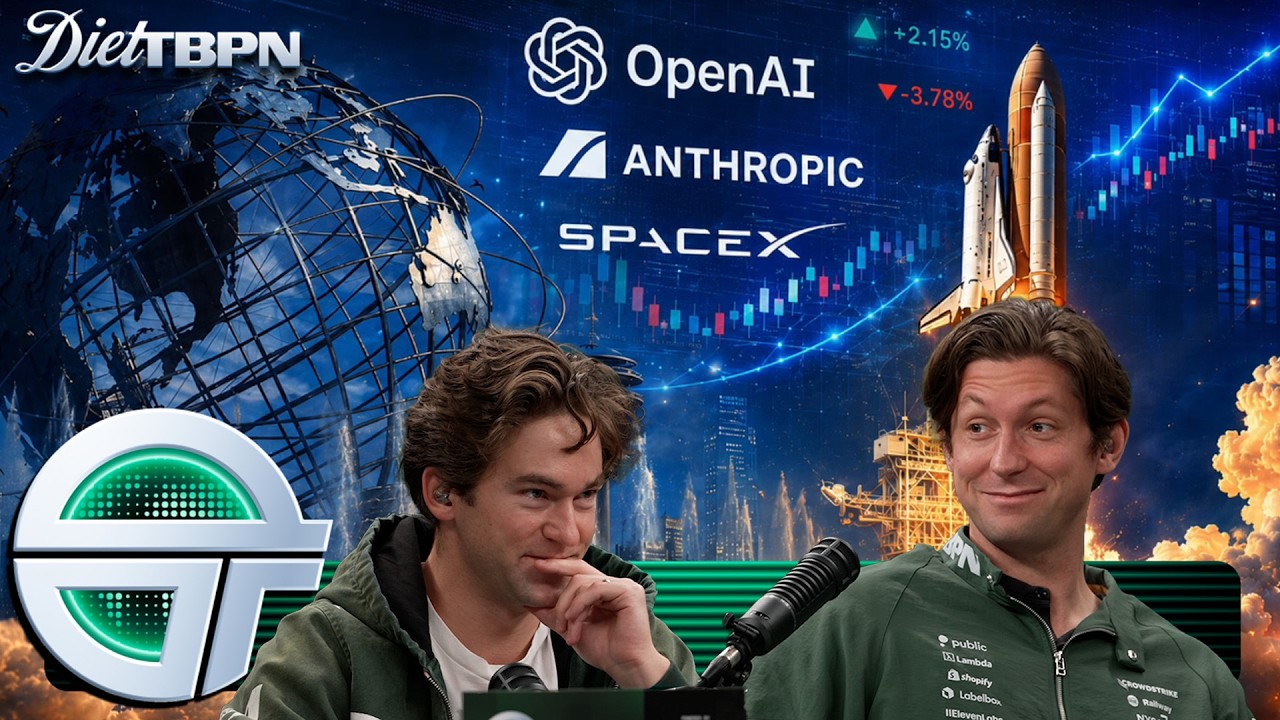
SpaceX Prepares Record IPO as Starship Investment Hits $15 Billion
TBPN
New Nasdaq fast-entry rules will force index funds to immediately allocate billions into upcoming mega-IPOs from SpaceX, OpenAI, and Anthropic despite major operational and engineering risks.
## Background
TBPN published this video on YouTube on May 22, 2026. The page description outlines Diet TBPN as a 30-minute highlight version of TBPN's daily tech talk show hosted by John Coogan and Jordi Hays, which covers major technology headlines and features top industry leaders.
## TL;DR
Hosts John Coogan and Jordi Hays open with news on President Trump scrapping a proposed 90-day AI safety review executive order, followed by updates on Microsoft's internal AI tooling and Micron's surge in memory manufacturing. They cover an unprecedented tech IPO wave led by SpaceX, OpenAI, and Anthropic, detailing SpaceX's prospectus, Starship risk factors, and Goldman Sachs's IPO underwriting bid. The discussion then dives into a historical retrospective on past U.S. World's Fairs and concludes with quick takes on Hypershell exoskeletons, DeepSeek's new funding, and BYD's potential F1 entry.
## Atmosphere & style
The episode is fast-paced, irreverent, and banter-filled, driven by the easy chemistry between Coogan and Hays. They effortlessly blend sharp financial and tech analysis with witty, sarcastic riffs—ranging from futuristic 'intern simulators' to foreign hackers hijacking powered exoskeletons to force Michael Jackson dance moves. The result is a energetic, intellectually playful, and entertaining listening experience that feels like eavesdropping on two knowledgeable tech insiders riffing on the morning news.
## Key takeaways
- [00:00](https://www.youtube.com/watch?v=g8eWf5F2qjI&t=0s) Trump killed a proposed executive order requiring 90-day pre-release reviews for frontier AI models after an appeal from David Sacks.
- [04:20](https://www.youtube.com/watch?v=g8eWf5F2qjI&t=260s) Microsoft reportedly canceled internal enterprise licensing for Claude Code to push developers toward in-house tools like GitHub Copilot CLI.
- [05:10](https://www.youtube.com/watch?v=g8eWf5F2qjI&t=310s) Micron began manufacturing one-alpha DRAM in Virginia to support memory-heavy AI agents, driving its valuation toward ~$850B.
- [06:58](https://www.youtube.com/watch?v=g8eWf5F2qjI&t=418s) SpaceX, OpenAI, and Anthropic are leading an unprecedented tech IPO boom, boosted by new Nasdaq fast-entry rules.
- [10:37](https://www.youtube.com/watch?v=g8eWf5F2qjI&t=637s) SpaceX outlined a $28.5 trillion TAM and listed Starship development as its primary risk factor in its S-1 filing.
- [15:39](https://www.youtube.com/watch?v=g8eWf5F2qjI&t=939s) Goldman Sachs CEO David Solomon personally pitched Elon Musk on X for the lead-left underwriting slot on SpaceX's IPO.
- [19:22](https://www.youtube.com/watch?v=g8eWf5F2qjI&t=1162s) Historically, World's Fairs served as premier technology launchpads, introducing inventions like the telephone, electricity grids, and the Picturephone.
- [31:28](https://www.youtube.com/watch?v=g8eWf5F2qjI&t=1888s) BYD is in talks with Christian Horner regarding a potential Formula 1 entry, while CATL is investing in AI startup DeepSeek.
## Detailed walkthrough
Here is a detailed, faithful walkthrough of the provided transcript:
[00:00](https://www.youtube.com/watch?v=g8eWf5F2qjI&t=0s) Trump AI Executive Order Scrapped, Friday Intro & AI Safety Debate
Hosts John Coogan and Jordi Hays kick off their Friday morning show on May 22nd. They note that their physical copy of the *Wall Street Journal* was stolen, leaving them with only the *Financial Times*—though they make do with their digital subscriptions. Before diving into the main headline, they touch on an 11th-hour intervention reported by *Politico*, where David Sacks successfully appealed to President Trump to kill a proposed executive order. The scrapped order would have created a voluntary framework requiring frontier AI companies to submit new models to the government for review 90 days before release to facilitate red-teaming, benchmarking, and liability assessments.
Trump explained his decision to reporters by stating he didn’t want to erect regulatory hurdles that could stall progress while the U.S. is leading China and the rest of the world. The hosts debate how AI safety advocates (referencing the "LessWrong" crowd) view the news. They sarcastically explore whether critics of government regulation would prefer "nuclear-level" AI safety to be managed by elected officials or mega-corporations. To illustrate corporate trust over government trust, Jordi notes that Disney enjoys surprisingly high public favorability compared to the U.S. government—pointing out the fun historical fact that Disney World technically holds legacy rights to build its own nuclear power plant under Walt Disney's original 1966 utopian vision for EPCOT.
- **EPCOT Acronym:** Experimental Prototype Community of Tomorrow, originally conceived by Walt Disney in 1966 as a fully functioning city.
- **Scrapped Executive Order:** Would have instituted a voluntary 90-day pre-release government review process for frontier AI models.
---
[04:20](https://www.youtube.com/watch?v=g8eWf5F2qjI&t=260s) Microsoft Claude Code, Copilot Dogfooding & Micron Memory Boom
The hosts move on to stories covered by Brandon Gorrell in the *TBP Newsletter*. First, an anonymous post claimed that Microsoft canceled its internal Claude Code enterprise licensing after token-based API costs became unsustainable. Box CEO Aaron Levie weighed in on the discourse, arguing that corporate token optimization will become a massive internal focus for LLM-reliant businesses. However, a proposed Community Note on the platform disputed the cost claim, clarifying that Microsoft is simply forcing its developers to "dogfood" their own tools—specifically shifting them to GitHub Copilot CLI and internal harnesses (built on Codex or proprietary models) rather than paying a rival. The hosts emphasize that building world-class dev tools requires engineers to use their own product every single day.
Second, semiconductor giant Micron announced it has begun manufacturing one-alpha DRAM—the most advanced memory produced on U.S. soil—at its facility in Manassas, Virginia. Driven by the shift toward AI agents that require massive context windows (and far more memory than simple chat interfaces), Micron has benefited from a global memory shortage. Its stock performance has been staggering, soaring 246% over six months and nearly 1,000% over the past year to reach an ~$850 billion market cap.
- **Micron Stock Performance:** Market cap near $850B; stock up ~2% on the day, ~3% over 5 days, 246% over 6 months, and nearly 1,000% over the trailing year.
- **Manufacturing Location:** Micron’s one-alpha DRAM production is centered at its plant in Manassas, Virginia.
The show turns to its main story: an extraordinary wave of tech initial public offerings led by SpaceX, OpenAI, and Anthropic. While the *Wall Street Journal* labeled it a "mini boom," the hosts laugh off the modest wording, calling it a true "giga boom." According to front-page coverage in the *Financial Times*, these listings are set to ignite a Wall Street trading frenzy, supercharged by new Nasdaq "fast entry" rules implemented this month. These rules allow giant newly public companies to be fast-tracked directly into major stock indices, forcing passive index funds to immediately allocate billions of dollars into them while liquidating shares of rival companies.
SpaceX is firing the starting gun with an IPO expected next month that could be the largest on record, cementing Elon Musk’s control over two trillion-dollar-plus mega-companies (Tesla and SpaceX). With OpenAI filing paperwork as early as this week and Anthropic preparing its float soon after, the trio will raise tens of billions of dollars. The hosts joke that financial analysts will need a bigger term than the "Magnificent 7," given that SpaceX’s valuation will likely surpass Tesla’s current market cap of $1.34 trillion.
- **Tesla Market Cap:** Trading at approximately $1.34 trillion at the time of broadcast.
- **Tesla IPO Retrospective:** Tesla originally went public at a market cap of just $1.7 billion—meaning day-one investors saw a ~1,000x return.
- **Symbiotic AI Relationships:** The *WSJ* highlighted that Anthropic recently agreed to pay SpaceX $1.25 billion per month to utilize SpaceX data centers for model training.
---
[10:37](https://www.youtube.com/watch?v=g8eWf5F2qjI&t=637s) Starship Launch, SpaceX Risk Factors & the Mars/TAM Vision
The conversation zeroes in on SpaceX’s SEC filings and its upcoming operational milestones. In its prospectus, SpaceX outlined an eye-popping $28.5 trillion Total Addressable Market (TAM), which includes futuristic verticals like space-based data centers. The hosts chuckle at the narrative shift: even when pioneering interplanetary travel to Mars, the monetization model ultimately boils down to enterprise software and automated workflows.
The S-1 filing also revealed a $4.9 billion net loss for SpaceX last year, partly driven by investments tied to X.com (formerly Twitter) alongside massive spending on Starship development. A notable executive compensation milestone was revealed: Elon Musk was awarded 1 billion performance-based restricted shares in January that will vest if SpaceX successfully establishes a permanent human colony on Mars with at least 1 million inhabitants.
Meanwhile, excitement is high for the flight test of Starship V3—a 400-foot-tall, fully redesigned vehicle standing at the Starbase launch facility outside Brownsville, Texas. A previous launch attempt was scrubbed due to a malfunctioning hydraulic pin on the launch tower's "Mechazilla" catch arms. After engineers worked through the night to replace the hardware, SpaceX targeted a Friday launch window at 5:30 PM Central Time.
- **Starship V3 Specifications:** 400 feet tall, designed to deploy larger satellites, support space data centers, and facilitate deep-space missions.
- **Mars Compensation Milestone:** 1 billion performance shares awarded to Musk, contingent on creating a 1-million-person permanent Mars colony.
- **SpaceX Financial Data:** Reported a $4.9B net loss in the previous year amidst Starship development and corporate consolidation.
Here is the detailed, faithful walkthrough covering this part of the transcript.
---
[15:39](https://www.youtube.com/watch?v=g8eWf5F2qjI&t=939s) SpaceX Starship Risk Factors and Goldman Sachs's Lead-Left Bid
John Coogan and Jordi Hays dive deeper into SpaceX's upcoming IPO filing, unpacking how Starship reusability and execution sit right at the top of the company's financial and operational concerns. Despite three years of intense flight testing, the rocket has yet to deploy any commercial customer satellites into orbit, leading Coogan to joke about the two wildly different internet conspiracy theories floating around: one claiming space is completely fake and no satellites exist, and another alleging that every Starship crash is actually a cover for deploying top-secret military hardware.
The hosts emphasize that SpaceX's official IPO prospectus places Starship as its number one risk factor. Hays admits this gives Coogan's earlier point more credit, reflecting on how public market investors process optics. While building massive xAI data centers like Colossus is a straightforward capital and infrastructure project, Starship represents deep engineering execution risk. A catastrophic launch failure would serve as a major omen for skeptics who are already worried about token price collapses, GPU depreciation, or potential data center bans. SpaceX disclosed in the filing that it has invested an estimated $15 billion into developing Starship alone, which neatly explains its historical net losses.
The conversation then turns to Wall Street jockeying for position on what promises to be one of the largest IPOs in history. Goldman Sachs CEO David Solomon—affectionately dubbed "DJ D-Sol"—personally slid into Elon Musk's DMs on X to pitch Goldman for the coveted lead-left placement on the deal syndicate. Coogan jokes about Solomon turning to his team to ask how to send a direct message on X, calling it a hilarious example of putting in work for the bag. Solomon also recently penned an op-ed in *The New York Times* arguing that the AI job apocalypse is heavily overblown and framing AI as an ultimate job creator. Meanwhile, Citadel's Ken Griffin has softened his stance on AI models evolving from slop to usable tools, expressing excitement that software engineers are becoming vastly more efficient. Coogan reminisces about his own days writing Visual Basic code, joking that if he had access to tools like Codex or Claude Code back then, he would have worked for one minute a day instead of an hour. This leads the hosts to envision a futuristic "intern simulator" VR experience where users time-travel back to the past armed with modern AI coding assistants to become the most ridiculously productive interns of all time.
- SpaceX lists Starship development as its top risk factor in its IPO prospectus.
- The company has spent approximately $15 billion developing the Starship program to date.
- Goldman Sachs CEO David Solomon personally messaged Elon Musk on X to pitch for the lead-left underwriting slot on the SpaceX IPO.
- Solomon published a *New York Times* op-ed asserting that AI will act as a job creator rather than causing a white-collar job apocalypse.
- Ken Griffin highlighted the productivity gains AI brings to software engineers, noting there is effectively no upper cap on software demand.
---
[19:22](https://www.youtube.com/watch?v=g8eWf5F2qjI&t=1162s) World’s Fairs of the Past: Telephones, Ketchup, and the Ferris Wheel
The hosts pivot to a broad reflection on the history of World’s Fairs, sparked by a recent *Wall Street Journal* retrospective celebrating the upcoming United States 250th anniversary. Coogan and Hays discuss whether tech media should spearhead a modern revival of World’s Fairs, though they acknowledge it would likely just end up looking like a hall full of screens and tech conferences. Historically, World's Fairs (or International Expositions) served as the primary stage for nations to display life-changing technological innovations long before Silicon Valley keynotes or the Consumer Electronics Show (CES) existed. British historian Paul Greenhalgh noted that these fairs reshaped entire urban landscapes; for example, Chicago beat out New York for the 1893 exposition, allowing it to transform its image from a gritty "second city" into a world-class cultural and architectural powerhouse.
Reviewing the landmark U.S. exhibitions, the hosts start with the 1876 Centennial International Exhibition in Philadelphia. Sprawling across a massive park like a 19th-century Coachella, the Philly fair introduced the telephone—invented by Alexander Graham Bell—which was initially met with skepticism before its revolutionary impact became obvious. Thomas Edison’s automatic telegraph and early typewriters were also showcased alongside Heinz tomato ketchup. Coogan notes the hilarity of demonstrating an automatic telegraph only for someone else to unveil the telephone right next to you, while Hays riffs on ketchup outlasting the landline telephone over time. Moving on to the 1893 World's Columbian Exposition in Chicago, the hosts mock the drop-off in breakthrough tech, where the two biggest debuts were George Washington Gale Ferris Jr.'s giant Ferris Wheel and commercial popcorn. Coogan jokes that if a founder had a telephone startup in 1893, investors would have told them to pivot immediately to Ferris wheels.
- **Philadelphia (1876):** Debut of Alexander Graham Bell's telephone, Thomas Edison's automatic telegraph, the typewriter, and Heinz tomato ketchup.
- **Chicago (1893):** Debut of the Ferris Wheel—invented by George Washington Gale Ferris Jr.—and commercialized popcorn.
- **Naming Legacy:** George Washington Gale Ferris Jr. successfully baked his own capitalized name into the Ferris wheel, unlike Bell or Edison with their inventions.
---
[25:48](https://www.youtube.com/watch?v=g8eWf5F2qjI&t=1548s) From Electrical Cities to Snack Extravaganzas and the Space Race
Continuing through American history, the hosts analyze the 1901 Pan-American Exposition in Buffalo, New York. Best remembered historically as the tragic site where President William McKinley was assassinated, the fair was meant to showcase American dominance in electrical power. The exposition featured electric streetcars and brilliant night lighting powered directly by hydroelectricity from Niagara Falls, marking the shift of electricity from a novelty into public utility.
Just three years later, the 1904 Louisiana Purchase Exposition in St. Louis nearly bankrupted the city's finances, but it became a pop-culture legend as an absolute "Cambrian explosion of snacking." The St. Louis fair popularized mainstream American staples including ice cream cones, peanut butter, hot dogs, hamburgers, and cotton candy. Hays and Coogan compare this wild contrast—going from harnessing hydroelectric power to eating hot dogs and cotton candy—to the modern tech ecosystem, where ground-breaking AI models like DeepSeek or Cerebras coexist alongside consumer trend products like creatine gummies, Allbirds, and GLP-1 weight-loss drugs.
The narrative shifts to the 1962 Century 21 Exposition in Seattle, which took place at the height of the Cold War and the Space Race following the Soviet Union's launch of Sputnik. With the Soviets declining their invitation, the U.S. federal government stepped in heavily to assert technological dominance, building the iconic Space Needle as the central landmark for the fair. Moving to the 1964 New York World's Fair at Flushing Meadows, visitors were amazed by color television demos, computer punch cards, and AT&T’s "Picturephone"—an early precursor to FaceTime that allowed video calling over standard lines. Hays jokes that early video calling must have just been a series of periscope mirrors, but Coogan points out that a 3-minute Picturephone call cost $16 at the time, which equates to roughly $121 in today's inflation-adjusted dollars. The host duo notes that the final officially sanctioned U.S. World's Fair took place in New Orleans in 1984, which produced no major technological debuts, proving that the medium had ultimately lost out to modern theme parks, specialized museums, television, and tech conferences.
- **Buffalo (1901):** Highlighted hydroelectric power from Niagara Falls, electric streetcars, and widespread lighting; site of President William McKinley's assassination.
- **St. Louis (1904):** Popularized classic American foods including ice cream cones, peanut butter, hot dogs, hamburgers, and cotton candy.
- **Seattle (1962):** Heavily influenced by Cold War competition and the Space Race; saw the construction of the Seattle Space Needle.
- **New York (1964):** Featured AT&T's Picturephone, which cost $16 for a 3-minute call (equivalent to ~$121 today), alongside color TV and punch cards.
- **New Orleans (1984):** The last official U.S. World's Fair, marking the end of the exposition era as corporate marketing shifted toward specialized industry events.
---
<ElicitationsGroup message="Where would you like to go next?">
<Elicitation label="Explore the full history of the 1964 AT&T Picturephone" query="Tell me more about the 1964 AT&T Picturephone from the New York World's Fair, including how it worked and why it failed commercially."/>
<Elicitation label="Break down SpaceX's $15B Starship investment" query="Break down SpaceX's financial metrics and the $15 billion investment in Starship mentioned in their IPO filing."/>
</ElicitationsGroup>
[31:28](https://www.youtube.com/watch?v=g8eWf5F2qjI&t=1888s) Hypershell Exoskeletons, DeepSeek Funding, and BYD’s Potential F1 Entry
The hosts wrap up the episode by reacting to recent tech headlines, starting with a Wall Street Journal demo of the Hypershell X Ultra S, a wearable exoskeleton featuring "thousand-watt hips" designed to assist users with hiking and running uphill. The discussion turns playful yet paranoid as they ponder the risks of powered suits. Drawing on previous conversations with Palmer Luckey regarding the terrifying potential of an Iron Man suit accidentally ripping its host apart, the hosts joke about the risks of a cyberattack. They imagine a scenario where a foreign actor hacks into a suit via a backdoor—similar to past concerns raised about DJI drones—and forces the wearer to perform embarrassing Michael Jackson dance moves in front of their peers.
The rapid-fire news roundup continues with updates from China's technology and EV sectors. Chinese battery giant CATL is investing heavily in DeepSeek as massive funding rounds sweep the AI landscape. Meanwhile, Chinese EV titan BYD is reportedly in talks with Red Bull Racing team principal Christian Horner about entering Formula 1. Recalling predictions made back in 2020 about BYD eventually joining F1, the hosts express excitement over how wild the move would be, playfully questioning whether BYD would even need to build gas-powered internal combustion engines to compete—or if they are just about to start.
- **Hypershell X Ultra S:** Wearable exoskeleton demoed by the Wall Street Journal featuring 1,000-watt hip motors to aid uphill running and hiking.
- **DeepSeek Investment:** Chinese battery giant CATL is participating in a major funding round for AI startup DeepSeek.
- **BYD in Formula 1:** BYD is in active talks with Christian Horner about a potential entry into F1.
- **Sign-off:** The hosts urge listeners to leave five-star reviews on Apple Podcasts and Spotify, subscribe to their newsletter, and wish everyone a great weekend before returning on Tuesday.
Which specific topic from this walkthrough would you like to explore or discuss further?
## Notable quotes
> Silicon Valley’s newest obsession — The New York Times
> [06:58](https://www.youtube.com/watch?v=g8eWf5F2qjI&t=418s) giga boom — John Coogan or Jordi Hays
> [06:58](https://www.youtube.com/watch?v=g8eWf5F2qjI&t=418s) Magnificent 7 — John Coogan or Jordi Hays
> [31:28](https://www.youtube.com/watch?v=g8eWf5F2qjI&t=1888s) thousand-watt hips — Wall Street Journal
## Mentioned
TBPN, John Coogan, Jordi Hays, Mark Zuckerberg, Sam Altman, Mark Cuban, Satya Nadella, Wall Street Journal, Financial Times, Politico, David Sacks, Donald Trump, China, Disney, Walt Disney, EPCOT, Brandon Gorrell, TBP Newsletter, Microsoft, Claude Code, Aaron Levie, Box, GitHub Copilot CLI, Codex, Micron, SpaceX, OpenAI, Anthropic, Nasdaq, Tesla, Elon Musk, Starship, Starbase, Mechazilla, Goldman Sachs, David Solomon, The New York Times, Citadel, Ken Griffin, Paul Greenhalgh, Chicago, New York, Philadelphia, Centennial International Exhibition, Alexander Graham Bell, Thomas Edison, Heinz, World's Columbian Exposition, George Washington Gale Ferris Jr., Pan-American Exposition, Buffalo, William McKinley, Niagara Falls, Louisiana Purchase Exposition, St. Louis, DeepSeek, Cerebras, Allbirds, Century 21 Exposition, Seattle, Space Needle, AT&T, Flushing Meadows, New Orleans, Hypershell, Hypershell X Ultra S, Palmer Luckey, Iron Man, DJI, Michael Jackson, CATL, BYD, Red Bull Racing, Christian Horner, Formula 1, Apple Podcasts, Spotify, X
TBPN hosts John Coogan and Jordi Hays report that an impending public-market wave led by SpaceX, OpenAI, and Anthropic is converging with federal AI deregulation and surging compute demands to reshape capital allocation across frontier technology.
AI Deregulation and Enterprise Compute Bottlenecks (0:00)
Federal oversight of frontier artificial intelligence recently shifted after an eleventh-hour intervention by David Sacks persuaded President Trump to scrap a proposed executive order. The draft order, reported by Politico, would have instituted a voluntary framework requiring frontier AI developers to submit models for 90-day pre-release benchmarking, red-teaming, and liability reviews. Trump stated to reporters that he aimed to avoid regulatory friction that could jeopardize the United States' competitive lead over China.
Meanwhile, operational and hardware pressures continue to dictate enterprise AI strategies. While online speculation alleged Microsoft dropped Claude Code licenses over API expenses, community notes indicated Microsoft instead mandated internal 'dogfooding' on its own GitHub Copilot CLI and proprietary harnesses. Simultaneously, domestic hardware constraints have propelled semiconductor manufacturer Micron, which began producing one-alpha DRAM at its Manassas, Virginia facility. Driven by memory-intensive agentic AI workflows, Micron's market capitalization reached approximately $850 billion, reflecting a stock rise of nearly 1,000% over the trailing year.
Mega-Cap Tech IPOs and Nasdaq Index Rules (6:58)
Public equity markets face an influx of private technology giants as SpaceX, OpenAI, and Anthropic prepare public listings. Financial Times coverage highlighted that newly implemented Nasdaq 'fast entry' rules will permit eligible mega-cap companies to bypass conventional waiting periods and join major stock indices almost immediately. This structural mechanism will force passive index funds to allocate billions of dollars into these newly listed equities on day one, necessitating divestments from incumbent index constituents to balance portfolios.
SpaceX is projected to launch the cycle with an offering that could rank as the largest on record, potentially eclipsing Tesla's $1.34 trillion market valuation. The upcoming floats also spotlight dense commercial cross-dependencies among frontier competitors, such as Anthropic agreeing to pay SpaceX $1.25 billion per month for data center capacity. Wall Street competition for these mandates has grown intense, with Goldman Sachs CEO David Solomon directly messaging Elon Musk on X to pitch for the lead-left underwriting role on SpaceX's syndicate.
SpaceX Disclosures: Starship Risks and Capital Burn (10:37)
SpaceX's preliminary S-1 prospectus combines aggressive monetization targets with substantial execution liabilities. The filing outlines a Total Addressable Market of $28.5 trillion—incorporating long-term concepts such as orbital space data centers—alongside an executive compensation package granting Elon Musk 1 billion performance shares if SpaceX establishes a permanent 1-million-person Martian colony. Financially, the company disclosed a $4.9 billion net loss for the prior year, driven in part by capital tied to X.com alongside an estimated cumulative investment of $15 billion into Starship development.
Despite high expectations, the prospectus designates Starship reusability and execution as the company's foremost risk factor. After three years of flight testing, the 400-foot Starship vehicle has not yet deployed commercial customer payloads into orbit. As engineers address mechanical issues at the Starbase launch site in Texas—such as malfunctioning launch-tower catch pins ahead of Starship V3 flight attempts—public-market investors must weigh heavy capital expenditure and engineering hurdles against projected commercial satellite and data deployments.
From World’s Fairs to Modern Infrastructure Demonstrations (19:22)
Reflecting on historical technological promotion, the hosts compare today's tech conferences to 19th- and 20th-century World's Fairs, which served as the primary venues for introducing transformational infrastructure to the public. Major debuts spanned Alexander Graham Bell's telephone and Thomas Edison's automatic telegraph at the 1876 Philadelphia Centennial Exhibition, hydroelectric streetcars at the 1901 Buffalo Pan-American Exposition, and AT&T's Picturephone at the 1964 New York World's Fair, where a three-minute call cost $16 (roughly $121 adjusted for inflation).
These expositions routinely blended profound technological leaps with consumer novelty, such as the 1893 Chicago fair popularizing the Ferris wheel alongside commercial popcorn, and the 1904 St. Louis fair commercializing peanut butter, hot dogs, and cotton candy. The hosts observe that the eventual disappearance of sanctioned U.S. fairs after the 1984 New Orleans exposition mirrors modern shifts, where broad public expos have been supplanted by private industry demonstrations, specialized conferences, and corporate filings.
As frontier technology companies transition from private capital to public scrutiny, market participants face unresolved questions over whether unprecedented addressable market forecasts and rapid index inclusion can balance the severe capital expenditures and engineering bottlenecks documented in upcoming IPO filings.
The New York Times: Silicon Valley’s newest obsession
[6:58] John Coogan or Jordi Hays: giga boom
[6:58] John Coogan or Jordi Hays: Magnificent 7
[4:20] dogfood
[4:20] Brandon Gorrell: one-alpha DRAM
[6:58] fast entry
[10:37] Mechazilla
[15:39] John Coogan or Jordi Hays: DJ D-Sol
[15:39] intern simulator
[19:22] second city
[25:48] John Coogan or Jordi Hays: Cambrian explosion of snacking
[25:48] Picturephone
[31:28] Wall Street Journal: thousand-watt hips
Original transcript
[0:02] [screaming]
[0:03] >> Good morning to you all from here today,
[0:05] folks. It's Friday, Friday, May 22nd. We
[0:09] had our Wall Street Journal stolen from
[0:11] us. We only have the Financial Times
[0:12] today, but we're making do because we
[0:14] have a digital subscription, as well.
[0:16] And we're going to take you through
[0:17] America's IPO boom. Uh so, three key
[0:20] stories that broke since we last spoke,
[0:23] Amir, 21 hours ago, since we podcast for
[0:28] 3 hours and then we come back 21 hours
[0:30] later. We do it again. We do it again.
[0:32] Yesterday, Politico reported that David
[0:34] Sacks made an 11th-hour appeal to
[0:36] President Trump to spike an executive
[0:38] order that would have created a
[0:40] voluntary program, voluntary program,
[0:44] for frontier AI companies to submit
[0:46] their models to the government for
[0:48] review 90 days before new model
[0:51] releases. I wonder what the benefit of
[0:54] that is. Obviously, it's good to have
[0:55] red teaming going on, good to have
[0:57] benchmarking, good to have other eyes on
[1:00] the project. There's some sort of, you
[1:02] know, liability that happens. What's the
[1:04] round thing on the table? No one in and
[1:06] the TBP audience has never seen this.
[1:08] Can you describe what this is, this
[1:10] round shaped argument?
[1:11] >> sure what we're looking at, but I saw
[1:14] them talking about this on ESPN, and
[1:16] people are always saying you guys are
[1:18] like SportsCenter for business.
[1:20] >> pick one of these up, this object.
[1:23] >> this artifact.
[1:24] >> Brown brown oval object.
[1:26] >> Yes. Cool. Well, it looks fun. Anyways.
[1:30] Uh I was having a little bit of fun
[1:32] earlier throwing this at the gong.
[1:34] >> [laughter]
[1:35] >> Drilling the gong. Uh the production
[1:37] team didn't like it. No. Because there's
[1:39] this, you know, 70 70,000-dollar
[1:43] >> [laughter]
[1:43] >> massive flat screen TV next to the gong,
[1:45] as well as multiple cameras
[1:47] >> Yes. and lights over there, but
[1:50] no accidents. Wow, mandate of heaven
[1:53] over there, right there.
[1:54] >> Yeah. Uh so, for his part, Trump
[1:56] explained the last-minute cancellation
[1:59] by telling reporters, "I didn't like
[2:01] certain aspects of it. I think it gets
[2:03] in the way of {dash} we're leading
[2:06] China. We're leading everybody, and I
[2:08] don't want to do anything that's going
[2:09] to get in the way of that." The presumed
[2:11] text of the EO was leaked today. You can
[2:14] read it through this link.
[2:16] Interesting
[2:17] >> Tyler, have you checked in with Les
[2:18] Wrong?
[2:19] Yeah, how are they feeling about this?
[2:21] >> I assume they're not happy with this.
[2:23] This seems to be like anti-safety.
[2:26] Um
[2:27] Do they want more review from from
[2:30] independent nonprofits, for-profit
[2:33] companies that are run by people with
[2:35] good intentions, or the government like
[2:37] democratically elected? I mean, I I
[2:39] assume at at some level it's it's got to
[2:41] be the government, right? Because if
[2:42] you're super HI pill, these things are
[2:44] nuclear weapons, it it needs to be the
[2:46] government. But I think on the way there
[2:47] people are are definitely like
[2:48] >> Is there anyone who Is there anyone who
[2:50] says like, "No, no, no, actually like
[2:52] nuclear weapons are super important, but
[2:54] they shouldn't be regulated by the
[2:55] government cuz I don't like the
[2:56] government. I would rather my favorite
[2:58] megacorp owns them, controls them." If
[3:00] you look at the If you look at the the
[3:01] the approval rates for different
[3:03] organizations, there are plenty of
[3:05] companies that are polling above the US
[3:06] government. Like people love Disney,
[3:09] Disney adults. They say, "Give Disney a
[3:10] nuclear weapon. They already have the
[3:12] rights to build a nuclear power plant,
[3:14] you know this?" I did not.
[3:15] >> Disney World has
[3:17] like uh
[3:18] you know, legacy rights because when
[3:20] they set up EPCOT, which is an acronym,
[3:22] which I should look up because what does
[3:23] it stand for? It stands for something
[3:25] really cool. Wait, this also bridges
[3:26] into the one of our one of our future
[3:28] segments. Uh stands for What does EPCOT
[3:30] stand for? Experimental Prototype
[3:32] Community of Tomorrow. The idea was to
[3:35] build an entire city. It was uh it was
[3:37] the praxis of the of the of its time.
[3:39] Yeah. And so, in 1966, Walt Disney
[3:42] conceived it as in 1966 as a utopian
[3:46] fully functioning city, and I believe
[3:48] this might just be viral clickbait, but
[3:50] they have the permission to build a
[3:52] nuclear reactor to power the project
[3:56] community of tomorrow, Epcot. Yeah.
[3:58] And so, I don't know, maybe maybe
[3:59] there's some folks out there that say,
[4:01] "We can't trust the government. We can't
[4:02] trust the Democrats. We can't trust the
[4:04] Republicans with the nuclear weapons.
[4:05] Give them to Disney."
[4:07] I don't know. I trust Bob with the new
[4:09] >> Bob, the new guy. We got to meet him. We
[4:11] got to get to know him. That's right.
[4:12] >> Bob, he can he can handle it.
[4:14] >> I I trust him.
[4:15] >> I trust his hand on the button. Second
[4:17] story highlighted by Brandon Gorrell in
[4:19] the TV news newsletter.
[4:21] >> The Gorrellinator
[4:22] >> [laughter]
[4:22] >> in the TV newsletter and a newsletter.
[4:26] An anon account posted yesterday
[4:27] >> sitting here with uh with
[4:29] noise-canceling headphones. He doesn't
[4:31] know that we're talking about him. He's
[4:33] going to find this out later when he
[4:34] watches these clips. Uh anyway,
[4:37] an anon account posted yesterday that
[4:39] Microsoft had canceled its internal
[4:41] Claude Code license
[4:43] after token-based billing made the cost
[4:46] untenable. This catalyzed a ton of
[4:48] commentary and discourse around X Box
[4:50] CEO Aaron Levie, for example, used this
[4:53] post to argue that token price
[4:55] optimization is set to become a
[4:57] prevailing trend inside companies
[4:59] reliant on LLMs. Worth noting, though,
[5:01] that there's a proposed community note
[5:04] on the post right now that denies
[5:05] Microsoft made the move because of a
[5:06] cost issue. They have the money to spend
[5:09] billions on on tokens if they want, but
[5:12] instead they are trying to shift the
[5:14] developers to use their own Copilot CLI,
[5:17] which I imagine they're they're going to
[5:20] build their own harness, their fork of
[5:21] Claude Code, their fork of Codex.
[5:23] >> want to make the engineers eat dog food.
[5:26] Yes. But what's the dog food made of? It
[5:30] could be made
[5:30] >> They're dog fooding.
[5:31] >> GPT-5.5 tokens. It could be made of Opus
[5:33] 4.7 tokens.
[5:34] >> think it uh
[5:35] >> I guess they will be using Yeah, I mean
[5:37] I I think the reason that that Codex and
[5:39] Claude Code and Cursor and these other
[5:41] tools have gotten so good is because the
[5:43] engineers building them are using them
[5:45] all day long. And uh it's one thing to
[5:47] use those tools to build your coding
[5:49] tool, but being forced to constantly use
[5:52] the product that you're shipping is
[5:55] tried and true way to build a great
[5:56] product.
[5:57] >> Yeah. The third story from Brandon Growl
[5:59] in the TBP newsletter. The American
[6:00] semiconductor manufacturer Micron
[6:02] announced that they've begun
[6:03] manufacturing one alpha DRAM, the most
[6:06] advanced memory ever produced in the
[6:08] United States at its at its Manassas,
[6:10] Virginia headquarters or manufacturing
[6:13] plant. This move comes in the middle of
[6:15] the agent boom in AI which requires
[6:17] longer context windows and thus memory
[6:19] than back and forth LLMs, which has led
[6:21] to an industry-wide memory shortage.
[6:24] Micron has been an absolute has been on
[6:27] a tear. Let's see what they're doing.
[6:29] >> 800 almost 850 billion dollar market
[6:33] cap. Remarkable. It's up 2% today, 3%
[6:36] over the last five days, and 246%
[6:39] over the last six months. What an
[6:41] absolute run for Micron. It's up almost
[6:43] 1,000% over the past year. Uh, really
[6:47] really incredible performance for
[6:48] Micron. Just wow. Anyway, America's
[6:50] going through a mini
[6:52] This was such a funny article by the
[6:53] Wall Street Journal. America's IPO mini
[6:56] boom. How is this a mini boom? You got
[6:58] three of the
[7:00] three giga boom. This is a giga boom.
[7:02] So, I I don't know if we have the truth
[7:03] on this, but it also made it to the
[7:05] front page of the walls of the Financial
[7:07] Times. They said SpaceX, OpenAI, and
[7:10] Anthropic IPOs set to ignite Wall Street
[7:13] trading frenzy.
[7:15] Nasdaq loosens rules. Passive investors
[7:17] could dump rival stocks. Trillionaire
[7:20] prospect for Musk. The blockbuster
[7:23] listings of SpaceX, Anthropic, and
[7:25] OpenAI are set to prompt an
[7:26] unprecedented wave of buying
[7:28] >> and selling as new fast entry rules
[7:31] thrust the tech stocks straight into
[7:33] Wall Street indices. The rules
[7:35] implemented this month by Nasdaq mean
[7:37] billions of dollars of passive money
[7:39] will automatically flow to the three
[7:41] companies when they go public, driving
[7:43] their share prices higher and forcing
[7:44] investors to sell rival stocks.
[7:47] Elon Musk's SpaceX initial public
[7:49] offering next month is expected to be
[7:50] the largest on record, firing the
[7:52] starting gun on what US bankers will
[7:54] hope will be a blockbuster year with
[7:56] OpenAI filing its IPO paperwork as soon
[7:59] as this week and Anthropic planning to
[8:01] float its shares, too, as well. The trio
[8:03] is set to raise tens of billions of
[8:04] dollars at a time of relentless investor
[8:07] appetite for companies linked to AI. The
[8:09] SpaceX listing will cement Musk's
[8:10] control of two of America's most
[8:12] valuable companies, SpaceX and Tesla. It
[8:15] is It is crazy. We're going to need a
[8:16] new term for the Mag 7 because Tesla has
[8:19] been in the Mag 7. It's been north of a
[8:21] trillion dollars for a long time, but
[8:22] SpaceX is going to go out at a higher
[8:24] valuation almost certainly. Where is
[8:25] Tesla trading at today in terms of
[8:28] market cap? It's at 1.34. Hard to
[8:31] imagine SpaceX trading below that, so
[8:34] you're going to have his Mag 7 company
[8:36] will be lagging his non-Mag 7 company.
[8:39] We're going to need new terms. We're
[8:41] going to need a bigger boat.
[8:42] >> [clears throat]
[8:42] >> But why did Why did the Wall Street
[8:44] Journal call this a mini boom? I think
[8:46] it's just because it's it's so
[8:48] concentrated on these three companies,
[8:50] but we will dig in and see where it
[8:52] goes. So, too bad SpaceX and others
[8:55] didn't go public sooner. Agree. But they
[8:57] are a tribute to the US capitalist
[8:59] system, says The Wall Street Journal.
[9:01] Today's AI investor euphoria recalls the
[9:04] heady dot-com days of the 1990s, and
[9:07] it's hard to tell how these bets will
[9:08] shake out. SpaceX, OpenAI, and Anthropic
[9:10] are rushing to go public to take
[9:12] advantage of the favorable market
[9:13] conditions, but amid the the eulogies
[9:16] written about American capitalism, the
[9:19] latest mini IPO boom is a welcome
[9:21] tribute to the dynamism of US markets
[9:24] that no other country can match. SpaceX
[9:27] fired the starting gun. They're They're
[9:29] They're using the same language as the
[9:30] Financial Times over there. The starting
[9:32] gun has been fired. It's unanimous
[9:34] across the mainstream media. The rocket
[9:37] company founded in 2002 is a global
[9:39] leader in space exploration.
[9:41] >> Overnight success. Uh it is also
[9:43] spreading to broadband, mobile mobile
[9:45] satellite internet, and data center
[9:47] development. And Tropic recently agreed
[9:49] to pay SpaceX 1.25 billion a month to
[9:51] use its data centers to train models.
[9:53] That shows how competitors can enjoy
[9:55] symbiotic relationships. SpaceX says the
[9:58] company as a whole reported a 4.9
[10:01] billion dollar net loss last year, some
[10:03] of which stemmed from its X.com social
[10:05] media platform. Can that be that much? I
[10:08] have to imagine that the losses were not
[10:11] I mean, I don't know how much Twitter
[10:12] was losing before they
[10:14] uh before the take private. I know that
[10:15] the the revenues uh cratered a bit, but
[10:19] there were also big layoffs and an 80%
[10:21] reduction in cost. That the the sum word
[10:24] there is maybe doing some of the
[10:25] lifting. I imagine that the that the
[10:27] losses were sort of spread over all
[10:28] sorts of investments. You know, you're
[10:29] building a new a new uh Starship rocket,
[10:32] which is set to launch today, 5:30
[10:35] Central Time. Tune in. Uh the last one
[10:37] was scrubbed. What a critical launch. Is
[10:40] it? No, it's just because of the timing
[10:42] with the S1 and the IPO.
[10:44] >> I mean
[10:44] >> All eyes on I think I think the market
[10:47] is valuing the launch capabilities in
[10:50] SpaceX uh in Starship in particular is
[10:52] like one small piece of the of the
[10:55] puzzle. You know, it's important, but
[10:57] you know, they're
[10:57] >> But people are going to be paying way
[10:59] more attention to this.
[11:00] >> Yeah, yeah, yeah.
[11:01] >> Like the obviously people will be
[11:01] excited about it, but I think even just
[11:04] the you know, endless spamming Falcon 9s
[11:07] can get Starlink to what uh 20 billion
[11:10] dollar run rate or something, 10 billion
[11:11] dollar run rate. Um you can you can
[11:13] clearly build a business off of the
[11:14] existing capability. Uh lots of
[11:16] excitement around Starship. There were
[11:18] there was a little bit of uh like spice
[11:20] in the timeline from uh you know,
[11:21] Everyday Astronaut, because he was sort
[11:23] of like rooting for a scrub, and
[11:25] everyone was like, "Oh, he's like
[11:26] against SpaceX." But he was like, "No, I
[11:28] was like I'm such a fan that I wanted to
[11:30] be there in person. I couldn't be there
[11:32] in person, so I was like, I hope that
[11:33] they scrub because I want to be there
[11:35] for this historic moment. So, little bit
[11:38] of like a misconception there. SpaceX
[11:40] said in its filing that it foresees 28.5
[11:44] trillion, yes, trillion in market
[11:46] opportunities, including data centers in
[11:48] space. Is anything
[11:50] more bullish than the future just being
[11:54] enterprise software. Like, you paint
[11:56] this massive picture, we're going to
[11:58] Mars. How are we going to make money?
[12:00] Enterprise software. 22 trillion of
[12:02] enterprise software.
[12:02] >> We're going to be automating workflows
[12:04] for the enterprise.
[12:05] >> I guess forever. Mr. Musk in January was
[12:08] awarded 1 billion performance-based
[12:11] restricted shares that will vest if his
[12:13] company, quote, establishes a permanent
[12:16] human colony on Mars with at least 1
[12:19] million inhabitants. Do robots count as
[12:22] inhabitants? Do agents count as
[12:24] >> Isn't that Isn't that one one of the
[12:26] potential You got to get a a million
[12:28] This is why he's worried about the
[12:29] money. like five or six things and he
[12:31] just has to do like four. Uh I don't
[12:33] know.
[12:34] I I haven't dug into that particular
[12:35] one.
[12:36] I I know for Tesla there were a whole
[12:38] bunch of different milestones.
[12:40] Uh their humanoid robots was was one of
[12:41] the stretch goals, but permanent human
[12:43] colony on Mars with at least 1 million
[12:45] inhabitants, that's exciting. That's a
[12:47] good goal. Like, that feels I don't
[12:49] know. That Like, a whole lot of
[12:51] enterprise software and a million people
[12:53] living on Mars, that's a vision I can
[12:54] get behind. I'm into that. I like it.
[12:56] What was the market cap of Tesla at IPO?
[12:59] >> It was sub 10 billion, right? Was it?
[13:02] Uh Tesla's uh Tesla market
[13:04] >> 1.7. Whoa, 1. 1.7 billion?
[13:08] Yep. Are you Are you sure?
[13:10] >> 1.7. 1.7. Is that a Is that a market cap
[13:12] for
[13:13] >> You got a thousand X if you just were a
[13:15] day one IPO believer.
[13:17] >> I mean, that's how you build a retail
[13:18] army. So, SpaceX, I mean, million people
[13:22] on Mars, we could be looking at 1.7 quad
[13:25] potentially. Anything's possible. I
[13:26] don't know. You get a thousand X from
[13:27] here. If we get to Mars, that's a big
[13:29] big uh big opportunity.
[13:31] >> That is so crazy that you could buy an
[13:33] Elon company in the public markets at
[13:36] less than a two billion dollar market
[13:38] cap.
[13:40] And many people did not.
[13:42] I owned a little bit of Tesla at some
[13:43] point. But there were so many moments
[13:45] when it was like so wildly disconnected
[13:48] from other car companies or other like
[13:50] uh like it was never a uh like a Warren
[13:53] Buffett buy, you know?
[13:54] >> If I had instead of going to high
[13:55] school, I just bought the
[13:57] >> [laughter]
[13:57] >> I just bought the Tesla IPO using the
[14:01] money I made from mowing lawns.
[14:02] >> Yeah. You should have just been a
[14:03] lawnmower who DCA'd into Tesla the whole
[14:05] time. Probably be pretty retired right
[14:08] now. I mean, there's a lot of people
[14:09] that did that. There's a lot of people
[14:11] There's also a lot of people that put
[14:12] money down to buy cars and then they
[14:13] didn't buy the stock and they're like,
[14:14] "Ah, the car depreciated and I should
[14:16] have bought the stock." Anyway, um let's
[14:18] check in with the uh the Starship launch
[14:20] because SpaceX postponed the launch of
[14:23] the newly redesigned Starship. But
[14:25] hardly a headline if it's just a one-day
[14:27] uh postponing because uh these things
[14:29] happen all the time. But it's completely
[14:31] redesigned. It's 400 ft tall and it's
[14:34] stood on the launchpad at the company's
[14:36] Starbase complex outside Brownsville,
[14:38] Texas. But engineers had to troubleshoot
[14:40] problems that kept cropping up to the
[14:44] end of the countdown for the flight
[14:45] according to a SpaceX live stream.
[14:47] SpaceX chief executive Elon Musk later
[14:50] said in a social media post that a
[14:51] hydraulic pin on part of the launch
[14:55] tower didn't function correctly. The
[14:58] company could try the flight Friday if
[15:00] the problem is fixed overnight. So they
[15:02] worked all night and they fixed the
[15:04] hydraulic pin on the launch tower. Wow,
[15:07] talk about complex. Uh
[15:10] the test mission was set to be the first
[15:12] flight for Starship V3. This is the
[15:14] third version redesigned SpaceX vehicle
[15:17] intended to deploy bigger satellites and
[15:19] one day help the company potentially
[15:21] settle Mars and mine asteroids. Starship
[15:23] is bigger and more powerful than any
[15:25] rocket ever built. The company has
[15:27] sketched out a future in which Starship
[15:29] flies thousands of times per year. Of
[15:30] course, the the the the the mechazilla
[15:35] tower that grabs it, the the chopsticks,
[15:37] that's very key to being able to stack
[15:39] these quickly. You can't rebuild all the
[15:42] infrastructure. The reusability is key
[15:45] to flying regularly. The rocket has yet
[15:48] to fly any customer satellites after 3
[15:50] years of intense test that we know of.
[15:52] The real conspiracy theorists There's
[15:54] conspiracy theorists that think space is
[15:56] fake, nothing's happening, they're not
[15:57] actually going, the satellites don't
[15:59] exist. And then there's other conspiracy
[16:01] theorists that think, "Oh yeah, when
[16:02] they crash, they're actually deploying
[16:04] secret satellites and there's more stuff
[16:07] in space than we think." So, pick your
[16:09] tinfoil hat theory. We'll let you be the
[16:11] judge of what's really going on.
[16:12] SpaceX's growth plans depend on
[16:14] Starship, according to its IPO
[16:16] prospectus. The document filed Wednesday
[16:18] listed Starship first among the risk
[16:21] factors facing the company. Interesting.
[16:23] Okay, so so a little bit more credit for
[16:24] you cuz I was like, "Ah, it's not that
[16:26] big of a deal. I care more about the
[16:27] data centers, Colossus."
[16:29] >> the optic the think about like the
[16:30] optics and some investors are super, you
[16:34] know, a little bit uh It is interesting.
[16:35] Like like clearly if if SpaceX is
[16:38] listing Starship as the first risk
[16:40] factor, it means like, "Oh yeah, like
[16:43] Colossus, like we're going to be able to
[16:44] do that. Like that's not that hard. Like
[16:46] we can we we can build a big data
[16:47] center. They have and and and and and
[16:50] there's less of a risk factor of like,
[16:51] "We're not going to be able to monetize
[16:53] that." Or we're not going to you know,
[16:55] because there is there are a group of
[16:56] investors out there that are saying
[16:57] like, "Oh, token prices will collapse,
[16:59] GPU depreciation, it'll get blocked,
[17:01] there'll be a data center ban, like they
[17:03] won't be able to ramp up there The main
[17:04] thing is though if God forbid there's
[17:06] like a you know, catastrophic, you know,
[17:08] explosion Be dramatic. There would that
[17:10] would be, you know, potentially an omen
[17:13] that certain people would be looking
[17:14] into. But I have full faith. Uh they
[17:18] estimated in its IPO filing Wednesday
[17:20] that it has spent $15 billion developing
[17:23] Starship. Well, that makes a lot of
[17:24] sense why there's losses if you've been
[17:26] investing this DJ D-Sol
[17:29] >> Yeah, what's going on with Slid into
[17:31] Elon's DM
[17:33] >> Oh, yeah? in the bid to land lead left
[17:36] the IPO
[17:37] with banks jockeying to get their name
[17:38] first on the deal for SpaceX's IPO.
[17:40] Solomon worked with Staffords to message
[17:42] Musk directly. He's like, "All right,
[17:44] guys, help me out here. How do I send a
[17:47] message on X?" According to people
[17:49] familiar with the matter. So, he's
[17:51] putting in the work. He says, "Wow, this
[17:53] is how you work for the bag at Goldman
[17:55] Sachs."
[17:57] Uh
[17:58] David Solomon also had a piece in the
[18:01] New York Times saying that the AI
[18:04] apocalypse
[18:06] NYT was overrated. AI is a job creator,
[18:11] David Solomon says. He says, "I'm the
[18:12] CEO of Goldman Sachs. The AI job
[18:15] apocalypse is overblown." We'll see what
[18:17] he's saying in a couple months. Ken
[18:19] Griffin sort of flipped, although Ken
[18:21] Griffin hasn't gone as far to say that
[18:23] there's a job apocalypse. He was just
[18:24] saying that the models went from like
[18:26] slop to usable, but he hasn't actually
[18:30] opined on whether or not that will
[18:32] change Citadel's hiring plans or his
[18:35] view of the amazing
[18:36] >> specifically said he was very excited
[18:39] that all of his software engineers were
[18:40] more efficient because he said there's
[18:42] no like cap on how much software
[18:44] >> there. I was writing Visual Basic. It
[18:46] was brutal. I would have loved Codaxin
[18:49] Claude code. I would have
[18:50] I would have been I would have I would
[18:51] have been working for 1 minute a day
[18:53] instead of an hour a day. If you could
[18:54] have had Codax back then, just like a
[18:56] private private
[18:58] instance of it,
[18:59] you would be currently time traveling
[19:01] back in time just to become the most
[19:04] productive intern of all time is elite.
[19:07] That's something that's something you
[19:08] would actually do. Oh, it would be so so
[19:10] much fun. Maybe that's what the the
[19:11] future will hold.
[19:13] Intern simulator. You get to you get to
[19:16] go into VR and simulate being the most
[19:18] elite intern with with time travel
[19:21] technology.
[19:22] Anyway,
[19:22] >> about the world's fair? Yes, we need to
[19:26] talk about the world's fair. Tyler, you
[19:28] gave this a read. World's fairs. Has
[19:30] someone tried to bring these back? This
[19:31] feels like a tech new media. We need a
[19:34] world's fair thing. Like I could see
[19:36] this being something that someone tries
[19:38] to revive. Although it'd probably be a
[19:40] lot of screens these days. [laughter]
[19:43] But at the world's fair of old, there
[19:46] were a lot of cool technologies, a lot
[19:47] of hardware, a lot of interesting
[19:49] exhibits, and we'll go through.
[19:52] I don't know how much you've studied the
[19:53] world's fair in the past, but the Wall
[19:55] Street Journal has been reflecting on
[19:57] the United States of America at 250
[20:00] years with a whole bunch of articles
[20:02] that look back and contextualize
[20:03] American history, and we'll go through
[20:05] this one on the world's fair right now.
[20:07] So, among the groundbreaking innovations
[20:09] unveiled at US-hosted exhibitions were
[20:11] the telephone, the Ferris wheel, and the
[20:15] electric and electric lighting. Ferris
[20:17] really crushed it on naming thing. Where
[20:20] you know, Alexander Graham Bell invented
[20:22] the telephone,
[20:23] Thomas Edison invented lighting mostly.
[20:25] Those guys did not bake their name into
[20:28] the product nearly as well as Ferris cuz
[20:30] it's capital F and I believe Ferris is
[20:32] the one who invented the Ferris wheel.
[20:34] Anyway, before splashy Silicon Valley
[20:37] product launches in the annual Consumer
[20:39] Electronics Show, the world showcased
[20:42] the its latest in innovations at
[20:44] high-profile world's fairs. These
[20:46] exhibits, held every few years beginning
[20:48] in London in 1851, gave countries a
[20:51] public platform to showcase new
[20:52] technologies, products, and ideas that
[20:55] were going to reshape daily life. For
[20:57] host countries and cities, the world's
[20:59] fairs or expositions were an opportunity
[21:01] to own the world's
[21:02] >> Tyler's sharing project
[21:04] >> the person that invented the Ferris
[21:06] wheel's Full name was George Washington
[21:09] Gale Ferris Jr. That's pretty elite.
[21:12] That's pretty elite. George Washington
[21:13] >> There's nothing stopping you from naming
[21:16] your child George Washington and then
[21:18] just slapping your your own last name at
[21:20] the end. Yes. Yes.
[21:21] >> I mean my name is John
[21:22] >> George Washington Cosgrove. My John
[21:25] Tyler was the 10th president. Oh, true.
[21:27] Yeah. There you go.
[21:28] There we go. Okay. So, many of the big
[21:30] expos were commemorative, says Paul
[21:32] Greenhall Greenhall, a British historian
[21:36] and author of two books on world's fairs
[21:37] and expositions. But, all of them ended
[21:40] up doing something else. They changed
[21:41] the shape of cities, much like the
[21:42] Olympics today. World's fairs were
[21:44] large-scale planning efforts and
[21:46] economic investments as much as cultural
[21:48] events. Cities competed for the right to
[21:51] host them. Chicago was able to redefine
[21:52] its image from a gritty second city to a
[21:56] cultural and architectural hub after
[21:57] defeating New York in the bid for the
[22:00] 1893 exposition. Here's a look at the
[22:02] US-hosted world's fairs that left the
[22:05] deepest mark. So, Starting
[22:07] in Philly Philly 1876, you're not going
[22:10] to believe what was what was shown, what
[22:13] was celebrated.
[22:14] >> We had two key technologies, telephones
[22:17] and ketchup. One was disrupted much
[22:20] faster than the other. Yep. I would say
[22:22] that the telephone has basically
[22:24] disappeared. The smartphone, text
[22:26] messaging, telephone's not doing well.
[22:28] It's on its last leg. My iPhone might
[22:30] fade away. My iPhone might fade away.
[22:32] >> gained ground.
[22:33] >> real inroads.
[22:33] >> No. Ketchup is still Even ranch kind of
[22:36] went on a run, but
[22:38] really came up short.
[22:39] >> Mustard, ultimately, it's a complement,
[22:40] not a substitute. There are very few
[22:42] people that say, "Oh, I don't need the
[22:44] ketchup at all." Just the mustard.
[22:46] >> Just the mustard, please. Most people
[22:48] they I don't know. I do think mustard is
[22:50] is better than
[22:52] >> Interesting.
[22:53] >> Yeah. You can believe that.
[22:54] >> Yeah. America's first officially
[22:55] sanctioned world's fair, the Centennial
[22:58] International Exhibition, arrived when
[22:59] the country was still defining its place
[23:02] among industrial nations. Unlike earlier
[23:04] European fairs built around single
[23:06] monumental halls, the Philadelphia event
[23:08] spread across a vast park with hundreds
[23:10] of structures. It was sort of like the
[23:12] Coachella of its time.
[23:14] >> Mhm. Uh among the most notable exhibits
[23:17] were the telephone. It was initially
[23:19] greeted with skepticism, but the
[23:20] potential of the cool contraption
[23:23] quickly drew attention. Once people
[23:25] realized what had been invented, it
[23:26] became clear how important it was.
[23:28] Uh the fair also showcased Thomas
[23:30] Edison's automatic telegraph as well as
[23:32] machinery such as the typewriter.
[23:34] Imagine you just create the automatic
[23:37] telegraph and then you go to launch it
[23:39] and demo it and somebody invents the
[23:41] telephone. You're just like Really?
[23:44] Really, dude? And consumer packaged
[23:46] goods such as Heinz tomato ketchup. It
[23:48] normalized the idea that private
[23:50] companies, innovators, and even
[23:51] governments could present their work
[23:52] side by side. A model that amplified the
[23:55] country's entrepreneurial culture. I
[23:57] love that. Chicago, 1893. You're not
[24:00] going to believe it. [laughter]
[24:02] You're not going to believe the two
[24:03] technologies that emerge.
[24:04] >> to we got to call call balls and strikes
[24:06] here. A little bit more underwhelming.
[24:08] Yeah, but I don't know. I think some
[24:09] people think some people
[24:10] >> people what was shown.
[24:11] >> Two key inventions. Last time, remember,
[24:13] we created telephones and ketchup,
[24:15] right? And so fast following this with
[24:17] the next fair, we create the Ferris
[24:19] >> No, no, no, no, no. It's not fast
[24:21] following. 1876, the telephone
[24:24] >> years later.
[24:25] >> Almost 20 years later, they're like fast
[24:27] take off. It's a we're so early.
[24:29] Telephones cooking. What do we got? The
[24:31] Ferris wheel and popcorn. Popcorn is
[24:35] good.
[24:36] >> Ketchup before popcorn. Pretty good.
[24:39] Pretty good. But yeah, Ferris wheel
[24:41] Ferris wheel
[24:41] >> Imagine the hundreds of people that came
[24:43] there to demo their inventions. If
[24:46] you're in telephones, pivot to Ferris
[24:47] wheels. There's a whole There's a whole
[24:50] industry. Oh, yeah, Ferris wheel,
[24:51] that'll destroy the telephone. You got
[24:52] to get out on the Ferris wheel, it's the
[24:54] new thing. Like
[24:54] >> Well, it It it is it is sort of funny
[24:56] It is sort of funny that like in like if
[24:59] you were to look back if we had a
[25:00] world's fair you'd have like creatine
[25:03] gummies.
[25:03] >> [laughter]
[25:05] >> And like AGI.
[25:07] Exactly.
[25:07] >> 1893 they had the Ferris wheel and
[25:10] popcorn
[25:11] >> [laughter]
[25:11] >> and then you fast forward to today it's
[25:14] like we we found a way to put one of the
[25:17] micronutrients in steak
[25:20] into a candy-shaped
[25:23] supplement. And we need you to eat four
[25:25] or five of these a day forever. 2020
[25:28] world's fair. We have rockets that land.
[25:31] And we also have all birds.
[25:34] >> [laughter]
[25:35] >> What
[25:36] what else came out that was very silly?
[25:38] Uh bored apes. We have we have invented
[25:41] bored apes.
[25:42] >> Skims shapewear. Shapewear and GLP-1s.
[25:46] Uh somewhat related. I don't know. Uh
[25:48] Buffalo, New York 1901.
[25:51] An electric city.
[25:52] >> This seems pretty elite. This is pretty
[25:54] huge. 1901.
[25:55] >> Though remembered mostly as the location
[25:57] where President William McKinley was
[25:58] shot. He died a week later. Buffalo's
[26:00] Pan-American Exposition was meant to
[26:02] showcase He was shot at the world's
[26:05] fair. Tyler.
[26:06] Fact check that. Buffalo's Pan-American
[26:08] Exposition was meant to showcase
[26:11] America's dominance in innovation
[26:12] electrical power and infrastructure. The
[26:14] fair featured electric lighting and
[26:16] electric street cars powered by
[26:17] hydroelectricity
[26:19] generated by Niagara Falls reflecting a
[26:22] moment when electricity was beginning to
[26:24] move from novelty towards widespread
[26:26] utility.
[26:26] >> Okay, so this is 1901. 1901. And
[26:28] remember in 1876 we created the
[26:31] telephone. And you fast forward to the
[26:33] next event in St. Louis in 1904. You're
[26:36] not going to believe [laughter] what we
[26:38] remember the 1904 world's fair. You're
[26:41] not going We created electricity and
[26:43] they're like we got something better.
[26:44] What do we We now know this this world's
[26:46] fair as a snack food extravaganza.
[26:50] It's really [laughter] just AGI and
[26:52] creatine gummies. It was it was sort of
[26:54] a Cambrian explosion of snacking. Yeah,
[26:56] I mean this is the nature of our show.
[26:58] It's like Cerebrus and Groons. Like this
[27:00] is this is this is like this is actually
[27:03] what what happens in America bro.
[27:05] >> The Louisiana Purchase Exposition was
[27:07] among the largest ever staged and nearly
[27:09] obliterated the city's finances. Oh no.
[27:12] Still it's pop culture influence
[27:14] endures. The exposition popularized a
[27:17] host of snack foods that would become
[27:19] staples of American life including ice
[27:22] cream cones, peanut but oh my they went
[27:25] on an insane run right here. Ice cream
[27:27] cones, peanut butter, hot dogs,
[27:29] hamburgers, and cotton candy. Elite.
[27:32] While the foods weren't all invented for
[27:33] the fair their widespread availability
[27:35] there like it's so funny. So so people
[27:37] are coming there again to share their
[27:39] their their their actual innovations
[27:41] >> Yeah. and then like snacks had just come
[27:43] online and so you can imagine like it
[27:45] just turns into a snack conference where
[27:48] everyone's snacking like crazy. They're
[27:49] like wait we have hot you can go to a
[27:51] hot dog stand and then you can go get
[27:54] cotton candy in one place. You got to be
[27:56] kidding me.
[27:57] Fast forward 1962 Seattle. Space race.
[28:01] It's a space race. That's exciting. The
[28:03] world's fair by the mid 20th century the
[28:05] world's fairs had become games of
[28:08] one-upmanship. I like that and
[28:10] geopolitical rivalry.
[28:12] Feels like where we're at today.
[28:14] Seattle's Century 21 Exposition took
[28:17] place in the shadow of the Cold War
[28:19] following the Soviet Union's launch of
[28:21] Sputnik and the world's first artificial
[28:23] Earth satellite. The Soviets turned down
[28:26] an invitation. They turned it down. Turn
[28:29] it down. Turn it down. The federal
[28:31] government became deeply involved. There
[28:33] was a sense that America needed to
[28:35] demonstrate technological leadership.
[28:37] >> Mhm. The Space Needle was constructed
[28:39] for the fair. I recently saw the inside
[28:42] of the Space Needle because wait no
[28:44] that's uh, not the Space Needle. It's
[28:47] the Toronto version of the Space Needle
[28:50] because didn't Drake film a music video
[28:52] inside of it?
[28:53] >> it out.
[28:53] >> Oh, he did? He made it ice blue.
[28:55] >> Because he's Iceman or something? That's
[28:57] the name of the album. Um,
[28:59] and inside you can see all of the
[29:01] broadcasting equipment and there's these
[29:03] huge radio dishes inside. It's very
[29:05] cool.
[29:06] Anyway. Uh, fast forward just a few
[29:09] years, couple years. This one comes to
[29:11] mind.
[29:11] >> going to believe what You're not going
[29:13] to believe what they created. What they
[29:15] What they announced at this World's
[29:16] Fair? 64.
[29:17] >> They invent 1964.
[29:20] More than
[29:22] just under
[29:24] 100 years since the telephone was
[29:27] invented.
[29:28] We invented punch cards.
[29:30] Punch cards. Uh, which which
[29:33] feel like a kind of early version of of
[29:36] enterprise software in some way.
[29:37] >> True. Um,
[29:39] World's Fair at Flushing Meadows, New
[29:40] York City.
[29:41] >> Yes, this is ridiculous.
[29:43] Uh, visitors were dazzled by color
[29:46] television demonstration and the picture
[29:48] phone, an early video calling system.
[29:51] They had FaceTime. Yeah, they had early
[29:53] FaceTime. This is sick. But I can't
[29:55] believe
[29:55] >> When I told Jordy 64 they invented
[29:57] FaceTime, he was like, "Did they use
[29:59] mirrors?"
[30:01] And he thought it was just a periscope.
[30:03] Just a mirror that you look at.
[30:04] >> No, no, no. It's like It's like a series
[30:06] of mirrors that bounce my image across
[30:08] like so you can be in the other room and
[30:10] you can see me and talk.
[30:12] >> [laughter]
[30:12] >> But no. Uh, no, they had full video
[30:14] calling, I guess. AT&T's picture phone,
[30:17] which added video to telephone calls.
[30:18] Yeah, so so it cost uh, $16 to for a
[30:21] 3-minute call. Ooh.
[30:23] >> That's $121 today's in today's money.
[30:25] That's expensive.
[30:26] >> Yeah, $40
[30:27] >> Token maxing. I wonder if I wonder if
[30:29] there were CEOs at the time who were
[30:30] like, "We need We need to be If you're
[30:32] not If you're making $10 a year and
[30:35] you're not spending $20 a year on your
[30:37] picture phone, you're not going to have
[30:39] a business."
[30:39] >> if they were talking about Jevons
[30:40] paradox.
[30:41] >> [laughter]
[30:42] >> Yes. Probably. I don't know. When did
[30:44] >> officially sanctioned World's Fair in
[30:46] the US was hosted in New Orleans in 1984
[30:48] and it produced no truly defining
[30:51] technological debut
[30:53] >> Oh, stagnation theory undefeated.
[30:55] Brutal.
[30:57] By that point, the function of World's
[30:58] Fairs had largely migrated elsewhere to
[31:00] museums, television, theme parks, and
[31:02] technology conference. As a result, the
[31:04] World's Fair concept gradually faded.
[31:06] Putting on an expo is a lost art, the
[31:08] author says, but when American needed
[31:10] it, no one did it better. Yeah, it's
[31:12] hard to You could bring something like
[31:14] this back, but I feel like it would end
[31:15] up being like uh a tech conference, you
[31:19] know? I wanted to talk about
[31:22] the robotic legs, the exoskeletons.
[31:25] Would you rock these? Or would you be
[31:28] sitting it out? The Hypershell X Ultra S
[31:32] is an exoskeleton that the Wall Street
[31:35] Journal demoed. Thousand-watt [snorts]
[31:37] hips.
[31:37] >> Thousand-watt hips. You wear these and
[31:40] they help you hike and run uphill.
[31:44] >> [snorts]
[31:44] >> I
[31:44] >> to too many shows with with Palmer
[31:46] Luckey where he talks about
[31:48] the the capability of an Iron Man suit
[31:50] potentially just ripping you apart, and
[31:51] so I would be a little afraid,
[31:54] but
[31:54] >> also also imagine, you know, a bad
[31:57] actor. Remember all the DJI drones had
[31:59] like a backdoor.
[32:01] >> Ooh, yeah.
[32:01] >> Bad actor takes over your your your your
[32:04] suit
[32:05] and and then it makes you do like
[32:06] Michael Jackson and it badly in front of
[32:09] your peers.
[32:09] >> Potentially. Potentially.
[32:11] >> Could be wildly embarrassing. Also,
[32:13] CATL,
[32:14] the Chinese EV battery giant, is
[32:16] investing in DeepSeek.
[32:18] Some big rounds going on. Also, BYD
[32:21] >> up. Remember? Remember? Oh, yeah. This
[32:23] is what AI 2020 was it? They predicted
[32:25] that BYD would get an F1 team. That's
[32:27] right.
[32:27] >> is what's happening. Which is what's
[32:28] happening. At least they're in talks.
[32:30] BYD is in talks with Christian Horner
[32:32] over entering F1. That would be pretty
[32:34] crazy. Does BYD have any
[32:36] gas-powered ice engines? I don't know.
[32:39] >> to. They're about to.
[32:41] >> [laughter]
[32:41] >> Who knows? What else is going on? Go
[32:43] have fun. We'll see you Tuesday.
[32:45] Have a good rest of your day. Have a
[32:47] great weekend. Leave us five stars on
[32:49] Apple Podcast and Spotify. Sign up for
[32:51] our newsletter at tflcar.com.
[32:52] >> an honor. And we will see you tomorrow.
[32:56] slash Tuesday.
[32:56] >> We love you.
[32:58] Goodbye.