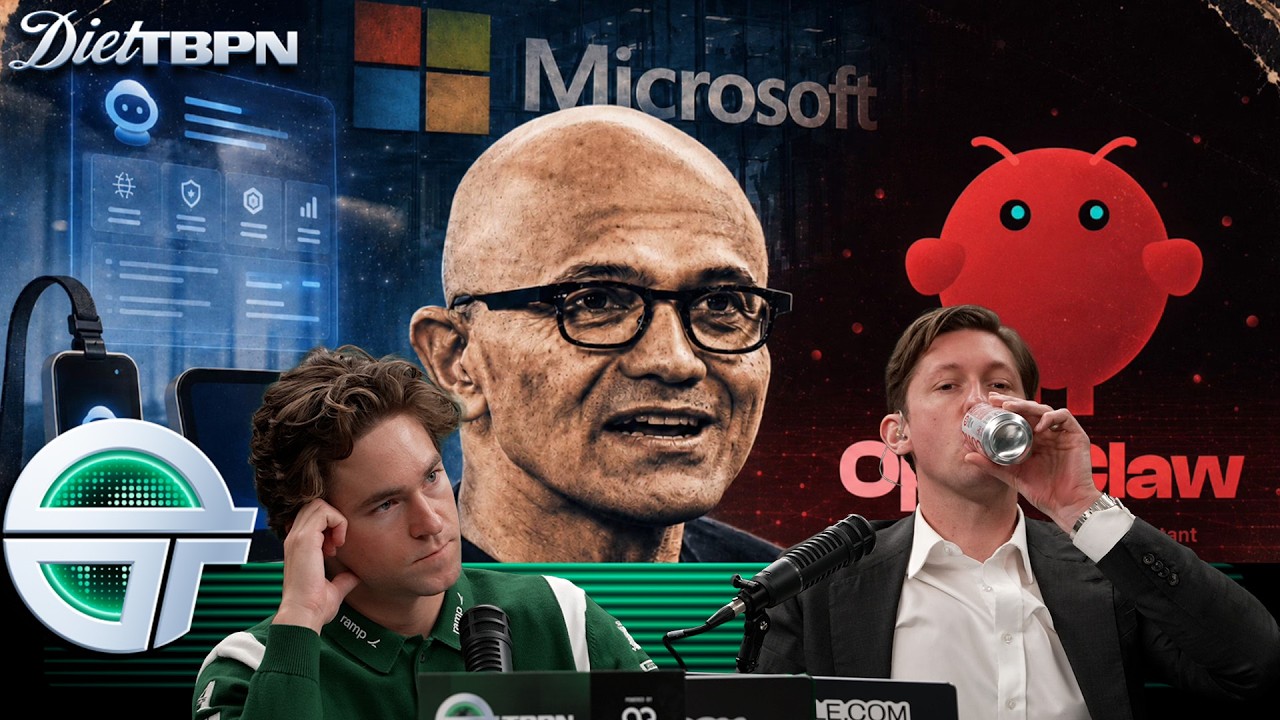
Microsoft Unveils Project Solara and Agent Models at Build 2026
TBPN
Microsoft is shifting its AI strategy toward cloud-centric agentic hardware and open-source infrastructure like OpenClaw to drive enterprise deployment.
## Background
Published on YouTube by TBPN on June 3, 2026, this episode of Diet TBPN delivers a condensed 30-minute recap of the daily live tech talk show hosted by John Coogan and Jordi Hays. According to the show notes, the episode covers Microsoft Build 2026 announcements—including Project Solara and OpenClaw—alongside discussions on Chinese consumer brands, AI bot traffic, dynamic gaming maps, and Martin Scorsese's endorsement of Black Forest Labs.
## TL;DR
Microsoft kicked off Build 2026 with new MAI coding and reasoning models, the agent-focused Project Solara OS, and an embrace of the open-source OpenClaw framework via its proactive Scout agent. Beyond Microsoft's enterprise-focused announcements, the hosts examine shifting consumer trends favoring Chinese brands like Li-Ning and DJI, as well as Cloudflare data revealing that automated bot traffic now exceeds human web activity. The recap concludes with highlights on Ramp's new AI accounting OS, dynamic map generation in Call of Duty, and Martin Scorsese's commentary on generative cinematic intelligence.
## Atmosphere & style
The hosts maintain a fast-paced, banter-filled, and tech-savvy vibe that balances sharp industry analysis with playful cynicism. Serious breakdowns of enterprise strategy and hardware architecture naturally slide into humorous commentary on keycard form factors, smart AI cowboy hats, and personal addictions to racing simulators. The dialogue feels candid and conversational, capturing the energetic zeitgeist of Silicon Valley's tech ecosystem.
## Key takeaways
- [00:00](https://www.youtube.com/watch?v=QVyWSQa43Ao&t=0s) Microsoft open Build 2026 with new enterprise AI models, MAI Code 1 Flash and MAI Thinking 1, focusing on cost-per-token efficiency over raw benchmark leads.
- [00:00](https://www.youtube.com/watch?v=QVyWSQa43Ao&t=0s) Project Solara introduces an Android-based operating system built specifically around running autonomous agents rather than traditional apps.
- [00:00](https://www.youtube.com/watch?v=QVyWSQa43Ao&t=0s) Solara relies on cloud compute, positioning hardware—like a smart employee badge keycard—as a thin-client access point.
- [07:08](https://www.youtube.com/watch?v=QVyWSQa43Ao&t=428s) Microsoft Copilot's new proactive agent, Scout, will run on the open-source OpenClaw framework wrapped in enterprise-grade security guardrails.
- [12:08](https://www.youtube.com/watch?v=QVyWSQa43Ao&t=728s) Microsoft differentiates its AI pipeline by training models on strictly sanitized datasets without copyrighted material or model distillation.
- [12:08](https://www.youtube.com/watch?v=QVyWSQa43Ao&t=728s) Enterprise customers can perform reinforcement learning (RLE) post-training directly inside Microsoft Azure to tailor models to proprietary data.
- [15:03](https://www.youtube.com/watch?v=QVyWSQa43Ao&t=903s) Chinese consumer brands are expanding rapidly into Western markets, with Li-Ning gaining major ground in athletics and DJI establishing top-tier brand admiration.
- [16:53](https://www.youtube.com/watch?v=QVyWSQa43Ao&t=1013s) Call of Duty is introducing dynamic level design that uses modular runtime randomization to generate hundreds of unique map variations.
- [18:12](https://www.youtube.com/watch?v=QVyWSQa43Ao&t=1092s) Automated bots and agentic AI traffic have officially surpassed human traffic, accounting for 57.5% of all internet activity according to Cloudflare.
- [19:14](https://www.youtube.com/watch?v=QVyWSQa43Ao&t=1154s) Ramp launched Ramp Stack, an AI operating system designed to automate month-end closes and accounting workflows for financial firms.
- [19:14](https://www.youtube.com/watch?v=QVyWSQa43Ao&t=1154s) Director Martin Scorsese endorsed Black Forest Labs, framing generative AI as a tool for 'cinematic intelligence' in pre-visualization.
## Detailed walkthrough
Here is a detailed, faithful walkthrough of the transcript segment.
---
[00:00](https://www.youtube.com/watch?v=QVyWSQa43Ao&t=0s) Microsoft Build Keynote, New MAI Models, and Project Solara
Microsoft’s Build conference kicked off with a major wave of announcements across its AI stack. The company introduced its first proprietary coding and reasoning models, **MAI Code 1 Flash** and **MAI Thinking 1**, pitching them as highly efficient on a cost-per-token basis in an increasingly ROI-focused market. On the hardware front, Microsoft signaled a deeper push into the PC space with the **Surface RTX Spark** dev box—positioning it as an answer to Apple’s Mac mini with custom silicon designed specifically for agentic AI.
The centerpiece hardware-software experiment revealed by Satya Nadella is **Project Solara**, a new Android-based operating system designed explicitly to run autonomous agents rather than traditional apps. Nadella outlined two distinct form factors under Solara: stationary desktop hubs built on MediaTek silicon with Hello for Business secure sign-in, and portable, lightweight companion devices. The host notes that while tech analyst Ben Thompson described Solara as "vaporware at this point," Thompson acknowledged that Microsoft has real hardware, signed up chip partners including Qualcomm and MediaTek, and presented an "extremely compelling" vision for cloud-centric agentic hardware.
The portable device in particular raised eyebrows during the keynote footage, as it resembles a smart keycard or employee badge with a screen and fingerprint reader rather than a standard smartphone. The hosts debated why anyone would want a dedicated badge over a mobile app, joking about the emerging "two-phone meme" and suggesting a dumb-phone alternative where users delegate tasks without scrolling social media.
> "I could prompt it and say write a 20,000 word message to John telling him that I would like to hang out on Saturday afternoon. Make sure it's easy enough to digest so his agent can summarize it into a few bullet points."
Ben Thompson’s breakdown highlights that mobile phones are too locked down to serve as ideal hubs for AI agents. Under Thompson’s thesis that "in the age of AI thin is in," Project Solara positions the cloud as the primary hub where heavy compute occurs, turning physical devices—like an enterprise badge—into mere thin-client access points. The host compares the keycard form factor to the Rabbit R1, noting that the founder of Rabbit was perhaps simply "a little bit too early" in offloading compute entirely to the data center. The hosts briefly banter about an alternative hardware concept, asking if anyone is "making a smart AI-enabled cowboy hat" that could house local compute and a built-in Starlink dish, though they laugh off the idea of "frying your brain with the Mac mini on your head."
* **Key Models Launched:** MAI Code 1 Flash (coding) and MAI Thinking 1 (reasoning).
* **New OS Concept:** Project Solara, an Android-based OS built around running agents instead of mobile apps.
* **Keycard Specs:** Features touch/fingerprint unlock, enterprise agent connectivity, and task delegation (e.g., gathering content for social posts).
---
[07:08](https://www.youtube.com/watch?v=QVyWSQa43Ao&t=428s) Microsoft Embraces OpenClaw and the Battle for Agentic Infrastructure
Tech journalist Alex Heath noted that beneath the announcement of **Scout**—Microsoft Copilot's first proactive AI agent—lay a massive strategic shift: Satya Nadella is fully embracing the open-source **OpenClaw** ecosystem. When Scout rolls out broadly, it will run on OpenClaw, with Microsoft contributing its own enterprise-grade security guardrails back to the open-source community. The hosts explain that after recent high-profile security incidents involving unconstrained agents (such as Instagram account thefts), bringing OpenClaw inside Microsoft’s walled garden offers a safe environment for enterprise data across Teams, Outlook, OneDrive, and SharePoint.
Heath argues that Microsoft is doing what it does best by acting as a platform company. By providing a "white glove experience" for OpenClaw via Scout, Microsoft can ride the agent wave in a way Apple currently cannot. While OpenClaw’s initial buzz sparked a surge in Apple Mac mini sales to run local setups, Apple lacks the enterprise distribution and infrastructure motion to capture that momentum. Looking ahead to Apple's WWDC, the host speculates that Apple might introduce an OpenClaw competitor or an upgraded Siri powered by Google Gemini for basic phone tasks, but doubts Apple will let agents "worm their way into every other app" the way OpenClaw has.
Beyond agent frameworks, Alex Heath highlighted several takeaways from the Build keynote:
* **Data Center Backlash:** Satya Nadella actively pushed back against environmental concerns over AI infrastructure, claiming that a data center's daily water usage over an entire year "is roughly equivalent to what a single restaurant would use."
* **Copilot Super App Delays:** The anticipated Copilot super app—featuring the new Autopilot tab with Scout—was shown off behind the scenes by Heath but was notably absent from the main stage presentation, indicating a delayed rollout.
* **Frontier Model Status:** Microsoft did not heavily feature raw benchmark wins, instead comparing its MAI models against older frontier baselines from Anthropic and OpenAI while emphasizing price-to-performance efficiency.
The host compares Microsoft’s AI team to Meta’s setup, pointing out that while MAI Thinking 1 is competitive with Meta’s Muse Spark, Meta has successfully built an "aura" and industry clout around MSL and TVD Labs by hiring high-profile figures like Nat Friedman, Daniel Gross, and Alex Wang.
---
[12:08](https://www.youtube.com/watch?v=QVyWSQa43Ao&t=728s) Clean Training Data, Model Distillation, and Agent Commerce
Reviewing analysis from the community thread by Stocasm, the conversation turned to how Microsoft is differentiating its model training pipeline for enterprise customers. A major selling point emphasized at Build is Microsoft’s commitment to a strictly sanitized, "clean" pre-training dataset. By ensuring copyrighted materials—such as articles from *The New York Times* or the *Harry Potter* series—are excluded, enterprise clients can adopt the models without fear of future intellectual property lawsuits.
Furthermore, Microsoft explicitly declared that its models were not created using distillation from rival frontier labs. This directly addresses controversy stemming from the Elon Musk / OpenAI lawsuit, where testimony indicated xAI researchers may have used distillation on Anthropic or OpenAI models. Microsoft is framing its standalone, non-distilled models as a safer long-term foundation.
To help enterprises customize these models, Microsoft is offering reinforcement learning (RLE) post-training steps directly within Azure, contrasting with Amazon's approach of providing mid-training checkpoints. This allows enterprise clients to fine-tune a baseline model on their own proprietary business data, optimize cost-per-token efficiency, and deploy securely on Azure hardware.
Closing out the discussion on enterprise AI, the hosts speculate on the financial rails required for autonomous agents. If autonomous enterprise agents run up massive infrastructure or transaction bills—potentially reaching hundreds of millions of dollars—traditional wire limits may prove restrictive, opening up a niche for high-volume crypto transfers or low-fee Bitcoin settlements in future agentic commerce.
* **Data Integrity:** Microsoft guarantees no illegal scraping or copyrighted works (*NYT*, *Harry Potter*) in pre-training data.
* **No Distillation:** Zero knowledge distillation from Anthropic or OpenAI, mitigating legal risks.
* **Enterprise Tuning:** Azure provides post-training reinforcement learning steps (RLE) to tailor models to business-specific workflows.
---
[14:55](https://www.youtube.com/watch?v=QVyWSQa43Ao&t=895s) Chinese Consumer Brands and Footwear Trends
The episode briefly shifts topics as Joe Weisenthal tracks shifting consumer shoe preferences and brand popularity on the subreddit `r/runningshoogeeks`...
[15:03](https://www.youtube.com/watch?v=QVyWSQa43Ao&t=903s) Chinese Consumer Brands, Li-Ning, and DJI
The hosts begin by discussing the growing social media dominance and consumer presence of Chinese brands in the West. Data shows that one out of every 18 posts now mentions a major Chinese running shoe brand, a significant leap from just one out of 40 in the previous quarter. The biggest player driving this trend is **Li-Ning**, which famously secured an endorsement deal with Golden State Warriors superstar Steph Curry. While basketball shoes have long been manufactured in China for Western brands like Nike, Chinese companies are now owning the brand equity itself—building on earlier moves where Chinese conglomerates acquired established Western labels like Arc'teryx.
When evaluating which Chinese brand holds the most affection among American consumers, the hosts pinpoint **DJI** as the clear leader. Unlike e-commerce platforms like Temu or Shein—which command massive brand recognition but function more like budget retailers—DJI has built true "brand admiration" akin to Apple, GoPro, or Nike. Even amidst geopolitical friction, everyday consumers love the brand's aspirational product quality, whether it's powering professional videography or sweeping wedding footage.
* **Li-Ning Mention Rate:** Jumped from 1 in 40 posts last quarter to 1 in 18 posts.
* **Chinese Acquisitions:** Highlighted that Chinese parent companies now own premium outdoor brands like Arc'teryx.
* **Hypercars:** The hosts speculate that if Chinese $20,000 hypercars were available in the US market, they would instantly become wildly popular.
---
[16:53](https://www.youtube.com/watch?v=QVyWSQa43Ao&t=1013s) Call of Duty's Dynamic Map Design and Modern Nostalgia
The conversation turns to gaming innovations with a look at an Instagram video demonstrating the new map system in *Call of Duty*. The development team is introducing generative level design using dynamic, runtime randomization. Rather than being fully transformer-based "Gen AI," the system takes three modular "slabs" on a map and remixes them every time players load in. With the underlying content assets, the system can generate upwards of 900 unique map variations.
> "When you play a multiplayer game for a while, like you have this sense of discovery each time you play a new map, but that kind of quickly fades... That never fades with Kill Block."
This infinite replayability prompts one host to joke that it poses an "existential risk" to the show, as they might get so hopelessly addicted to gaming in their Ultra Dome setup that they forget to go live. However, the co-host pushes back with a nostalgic preference for classic, static maps like *Rust*, comparing a fixed, familiar map to a favorite vacation beach spot where you know every inch and don't want the terrain remixed.
---
[18:12](https://www.youtube.com/watch?v=QVyWSQa43Ao&t=1092s) Anduril x NASCAR VR Simulator and the Agentic Web Surge
Switching to hardware, the hosts highlight a surprise collaboration between Palmer Luckey's defense tech firm **Anduril** and **NASCAR**. The duo teamed up to release a high-end $14,000 VR racing rig simulator. While Luckey previously entered the headset space with the Eagle Eye, this marks a high-profile return to consumer entertainment hardware. One host expresses immediate envy, revealing he placed a deposit on his own custom racing simulator just three days before the announcement.
```
┌──────────────────────────┐
│ Web Traffic Share (2026) │
└─────────────┬────────────┘
│
┌───────────────┴───────────────┐
▼ ▼
Automated Bots Human Traffic
57.5% 42.5%
```
The discussion pivots sharply to a stark statistic shared by Cloudflare CEO Matthew Prince regarding internet traffic composition:
> "Well, that happened faster than I predicted. Thought it would be end of 2027, then early 2027, but Agentic traffic growing so fast that bots have now passed human traffic online for the first time in the internet's history."
According to Cloudflare, automated bot and agentic traffic now accounts for **57.5%** of all internet activity. Every time an AI model executes complex reasoning traces or tool calls, it fires off requests across hundreds of web pages simultaneously, officially tipping the scales against human web browsing.
---
[19:14](https://www.youtube.com/watch?v=QVyWSQa43Ao&t=1154s) Ramp Stack Launch and Martin Scorsese for Black Forest Labs
The show highlights a new demo from Eric Lyman introducing **Ramp Stack**, touted as an AI operating system for accounting firms. Stack is designed to let firms scale their client base without adding headcount by learning specific firm workflows, running month-end closes, and posting journal entries with complete audit trails. Framing it as "the biggest shift in accounting since the spreadsheet," the host praises Ramp's sleek, practical live-action promotional video—shot entirely on real camera gear without CGI or AI generation. They note that Ramp has been systematically executing toward this exact vision of automated financial workflows since as far back as 2019 or 2020.
```
┌────────────────────────────────┐
│ Ramp Stack │
│ (AI OS for Accounting Firms) │
└───────────────┬────────────────┘
│
┌───────────────────────────┼───────────────────────────┐
▼ ▼ ▼
Runs Month-End Close Posts Journal Entries Full Audit Record
```
To close the episode, the hosts review a striking 30-second video featuring legendary director Martin Scorsese endorsing **Black Forest Labs**. Scorsese muses on framing and visual mood, describing how traditional directors like Cecil B. DeMille had artists create oil paintings to capture a setting's feel, whereas generative models offer a new form of "cinematic intelligence."
While AI in film remains deeply controversial, having an iconic cinematic auteur discuss it as a conceptual tool for early-stage storytelling will force the creative community to pay attention. The hosts sign off by reminding listeners to tune in tomorrow at 11:00 AM Pacific, leave five-star reviews on Apple Podcasts and Spotify, and subscribe to their newsletter at TBPN.com.
* **Ramp Stack Features:** Fully automated, audit-recorded journal entries and financial closes with mandatory human-in-the-loop final signoff.
* **Scorsese on BFL:** Highlights the phrase *"cinematic intelligence"* to describe how generative models can help visually map out complex cinematic environments.
## Notable quotes
> [00:00](https://www.youtube.com/watch?v=QVyWSQa43Ao&t=0s) I could prompt it and say write a 20,000 word message to John telling him that I would like to hang out on Saturday afternoon. Make sure it's easy enough to digest so his agent can summarize it into a few bullet points.
> [16:53](https://www.youtube.com/watch?v=QVyWSQa43Ao&t=1013s) When you play a multiplayer game for a while, like you have this sense of discovery each time you play a new map, but that kind of quickly fades... That never fades with Kill Block.
> [18:12](https://www.youtube.com/watch?v=QVyWSQa43Ao&t=1092s) Well, that happened faster than I predicted. Thought it would be end of 2027, then early 2027, but Agentic traffic growing so fast that bots have now passed human traffic online for the first time in the internet's history. — Matthew Prince
## Mentioned
Microsoft, Project Solara, OpenClaw, TBPN, John Coogan, Jordi Hays, Satya Nadella, Ben Thompson, Alex Heath, MAI Code 1 Flash, MAI Thinking 1, Surface RTX Spark, MediaTek, Qualcomm, Rabbit R1, Scout, Apple, Google Gemini, Meta, Muse Spark, MSL, TVD Labs, Nat Friedman, Daniel Gross, Alex Wang, Stocasm, Azure, Amazon, Elon Musk, xAI, Anthropic, OpenAI, Joe Weisenthal, Li-Ning, Steph Curry, Nike, Arc'teryx, Temu, Shein, DJI, GoPro, Call of Duty, Palmer Luckey, Anduril, NASCAR, Eagle Eye, Cloudflare, Matthew Prince, Eric Lyman, Ramp, Ramp Stack, Martin Scorsese, Black Forest Labs, Cecil B. DeMille
微软在 Build 2026 大会上公布 Project Solara 及智能体模型
微软正将其 AI 战略转向以云为中心的智能体硬件以及 OpenClaw 等开源基础设施,以推动企业级部署。
微软在 Build 2026 开幕式上推出了全新的 MAI 编程与推理模型、专注于智能体的 Project Solara 操作系统,并通过其主动型 Scout 智能体拥抱开源 OpenClaw 框架。除微软聚焦企业级的相关发布外,主持人还探讨了倾向于李宁和大疆等中国品牌的消费趋势转变,以及 Cloudflare 显示自动化机器人流量现已超过人类网络活动的数据。最后重点介绍了 Ramp 全新的 AI 会计操作系统、《使命召唤》(Call of Duty)中的动态地图生成技术,以及马丁·斯科塞斯(Martin Scorsese)对生成式电影智能的评论。
微软在 Build 2026 开幕式上推出了全新的企业级 AI 模型 MAI Code 1 Flash 和 MAI Thinking 1,重点关注每 token 成本效益而非单纯追求基准领先。 (0:00)
Project Solara 推出了一款基于 Android 的操作系统,专门围绕运行自主智能体而非传统应用程序而构建。 (0:00)
Solara 依赖云计算,将硬件(如智能员工胸牌工卡)定位为瘦客户端接入点。 (0:00)
Microsoft Copilot 的全新主动型智能体 Scout 将在包含企业级安全防护措施的开源 OpenClaw 框架上运行。 (7:08)
微软通过在不含版权材料或模型蒸馏的严格清洗数据集上训练模型,以此实现其 AI 管线的差异化。 (12:08)
Reading summary
At Build 2026, Microsoft detailed a strategic push into agentic computing through its new Project Solara operating system, cost-efficient proprietary models, and integration of the open-source OpenClaw framework. The announcements highlight an industry transition toward cloud-driven autonomous workflows as automated agents increasingly dominate internet traffic.
Project Solara and Cloud-Centric Hardware (0:00)
Microsoft introduced Project Solara, an Android-based operating system designed to run autonomous agents rather than traditional apps. The hardware vision spans stationary desktop hubs running on MediaTek silicon and portable companion devices that resemble smart employee badges equipped with fingerprint readers. Analyst Ben Thompson noted that while the project remains early, mobile operating systems are too restrictive for autonomous software, making cloud-centric thin clients an attractive architectural model. Complementing this direction, Microsoft also revealed the Surface RTX Spark developer box aimed at agentic AI workloads as an alternative to Apple's Mac mini.
Proprietary Models and Sanitized Enterprise Pipelines (12:08)
Microsoft launched its first proprietary reasoning and coding models, MAI Thinking 1 and MAI Code 1 Flash, prioritizing price-to-performance efficiency over benchmark records. To address corporate risk, Microsoft confirmed that its pre-training data excludes copyrighted material such as New York Times articles and the Harry Potter series. Furthermore, the company stated that the models were not produced through distillation from competitors like OpenAI or Anthropic, insulating clients from intellectual property litigation. Enterprise users will be able to perform reinforcement learning (RLE) post-training steps directly within Azure.
OpenClaw Integration and the Proactive Scout Agent (7:08)
Beneath Microsoft's new proactive Copilot agent, Scout, lies a direct integration with the open-source OpenClaw framework. By pairing OpenClaw with enterprise security guardrails across Teams, Outlook, OneDrive, and SharePoint, Microsoft aims to offer a protected environment for agentic tasks following earlier security breaches in unconstrained setups. Journalist Alex Heath observed that Microsoft is leveraging its enterprise infrastructure motion to capitalize on OpenClaw, whereas Apple still lacks comparable enterprise distribution, even as Mac mini hardware initially gained traction for running local setups.
Autonomous Workflows and the Shift in Web Traffic (18:12)
The rapid expansion of autonomous software is visibly altering internet infrastructure. Citing Cloudflare data, the program reported that automated bots and agentic traffic now represent 57.5% of all web activity, surpassing human browsing for the first time as reasoning models execute distributed tool calls. In vertical enterprise software, startups like Ramp launched Ramp Stack, an operating system intended to automate accounting firm workflows, journal entries, and month-end closes with full audit records, underscoring the commercial shift toward autonomous back-office task execution.
Consumer Brands, Gaming, and Generative Media (15:03)
Beyond enterprise computing, the broadcast highlighted cultural and commercial developments across tech. Chinese consumer labels are expanding in Western markets, led by drone manufacturer DJI, which has achieved high brand affection, and athletic brand Li-Ning, whose social media mention frequency jumped from one in 40 posts to one in 18 following a Steph Curry endorsement. In digital media, Call of Duty introduced generative level design capable of remixing map sections into over 900 variations, while director Martin Scorsese publicly endorsed Black Forest Labs, arguing that generative tools offer a form of 'cinematic intelligence' for visual storytelling.
While Microsoft has outlined an extensive architecture spanning custom silicon, thin-client OS hardware, and sanitized models, significant hurdles remain. Several initiatives, including the primary Copilot super app with Scout, faced release delays, and the financial rails required to support continuous autonomous agent transactions remain largely unresolved.
## Background
本视频由科技访谈节目 TBPN 于 2026 年 6 月 23 日发布于 YouTube 平台。视频简介显示,该内容为“Diet TBPN”栏目,由 John Coogan 和 Jordi Hays 共同主持,旨在用半小时精炼呈现当日科技焦点,重点聚焦微软 Build 2026 大会公布的 Project Solara、OpenClaw 智能体整合及前沿 AI 行业重磅动态。
## TL;DR
节目核心拆解了微软 Build 2026 大会的一系列突破,重点涵盖 MAI Code 1 Flash 与 MAI Thinking 1 模型、基于 OpenClaw 打造的主动型 Agent“Scout”,以及主打以云为中枢、剥离传统 App 逻辑的全新操作系统 Project Solara。主持人深入对比了微软与苹果在企业级 Agent 落地上的生态博弈,剖析了微软强调“纯净训练集与无竞品蒸馏”的合规护城河。此外,节目还横向讨论了中国品牌出海、Cloudflare 预警网络 Bot 流量历史性超越人类、Ramp 推出的自主会计操作系统 Stack,以及名导马丁·斯科塞斯携手 Black Forest Labs 探索的“电影级智能”新范式。
## Atmosphere & style
全片充盈着硅谷从业者特有的敏锐机智与美式播客的随性幽默,两位主持人节奏紧凑、吐槽不断。从严肃的技术架构与商业竞争推演,到插科打诨间把《教父》错安在马丁·斯科塞斯头上的爆笑打脸,以及刚付完模拟器定金就被 Anduril 新品背刺的真实破防,整场对话兼具极客的硬核洞察与老友闲聊的松弛感,听感生动且信息密度极高。
## Bulletin
- [00:00](https://www.youtube.com/watch?v=QVyWSQa43Ao&t=0s) 微软在 Build 开发者大会发布自研代码模型 MAI Code 1 Flash、推理模型 MAI Thinking 1 以及基于 OpenClaw 打造的主动型 Agent Microsoft Scout,主打极致的单 Token 成本与能效优势。
- [01:34](https://www.youtube.com/watch?v=QVyWSQa43Ao&t=94s) 微软公布了专为 Agent 运行打造的 Android 定制系统 Project Solara,推出搭载联发科芯片的桌面固定设备与极轻便的工牌型便携硬件,构建以云端为核心中枢的非手机硬件形态。
- [18:50](https://www.youtube.com/watch?v=QVyWSQa43Ao&t=1130s) Cloudflare 警报显示机器网络 Bot 流量历史首次超越人类流量,在互联网总流量中占比飙升至 57.5%,主要受大模型推理轨迹与并发工具调用激增所驱动。
- [19:20](https://www.youtube.com/watch?v=QVyWSQa43Ao&t=1160s) 金融科技独角兽 Ramp 推出自主会计操作系统 Stack,旨在实现全自动化月结与分录过账,并保留全流程审计留痕,由人类会计师把关最终裁决。
- [18:10](https://www.youtube.com/watch?v=QVyWSQa43Ao&t=1090s) Anduril 联合 NASCAR 跨界发布标价 14,000 美元的高端专业 VR 赛车模拟座舱,标志着 Oculus 联合创始人 Palmer Luckey 重回消费级娱乐硬件领域。
## Key takeaways
- [00:00](https://www.youtube.com/watch?v=QVyWSQa43Ao&t=0s) 微软推出自研模型 MAI Code 1 Flash 和 MAI Thinking 1,将核心竞争壁垒建立在单 Token 成本与投入产出比(ROI)的极致优化上。
- [00:00](https://www.youtube.com/watch?v=QVyWSQa43Ao&t=0s) Microsoft Scout 全面拥抱开源框架 OpenClaw,横跨桌面、Web 和云端,深度打通 M365 数据流,打造企业级主动协作 Agent。
- [01:34](https://www.youtube.com/watch?v=QVyWSQa43Ao&t=94s) Project Solara 颠覆以手机为唯一中心的封闭架构,以云端数据中心为中枢,终端设备仅作为极简的轻量级任务下发跳板。
- [01:34](https://www.youtube.com/watch?v=QVyWSQa43Ao&t=94s) Stratechery 分析师 Ben Thompson 指出 AI 时代交互范式转为“薄客户端”,用户无需全程人在回路,由 Agent 在云端全权执行交付。
- [07:18](https://www.youtube.com/watch?v=QVyWSQa43Ao&t=438s) 微软恪守平台基础设施定位,通过为开源框架 OpenClaw 套上企业级安全合规围栏,以此构筑自身生态壁垒并反哺开源社区。
- [09:07](https://www.youtube.com/watch?v=QVyWSQa43Ao&t=547s) 业内对苹果 AI(Apple Intelligence)的实际预期更为务实,预计其更偏向日常 Siri 交互与基础任务处理,而非激进寄生所有应用的自动化 Agent。
- [10:36](https://www.youtube.com/watch?v=QVyWSQa43Ao&t=636s) 微软 AI 团队在行业声量与顶尖人才矩阵的光环上相比 Meta 仍有差距,且全新模型尚未真正跻身顶尖 Frontier 梯队。
- [12:08](https://www.youtube.com/watch?v=QVyWSQa43Ao&t=728s) 微软 MAI 模型强调合规护城河,采用严格清洗版权的纯净预训练集并严禁竞品蒸馏,在微调上主打基于强化学习的 Azure 后训练部署方案。
- [14:55](https://www.youtube.com/watch?v=QVyWSQa43Ao&t=895s) 大疆(DJI)凭借顶级工业设计与美誉度在美国享有无人机领域的极高品牌认同,而李宁等中国品牌也正在海外专业运动圈掀起热潮。
- [16:53](https://www.youtube.com/watch?v=QVyWSQa43Ao&t=1013s) 《使命召唤》引入基于动态拼贴逻辑的关卡系统 Kill Block,利用运行时地形重组生成数百种动态组合以消除玩家探索倦怠感。
- [18:10](https://www.youtube.com/watch?v=QVyWSQa43Ao&t=1090s) Palmer Luckey 携 Anduril 联名 NASCAR 打造 14,000 美元的专业沉浸式座舱,在深耕军工防务硬件后重新涉足消费级 VR 娱乐硬件。
- [18:50](https://www.youtube.com/watch?v=QVyWSQa43Ao&t=1130s) 网络自动化 Bot 流量占比攀升至 57.5% 历史性超过人类,AI Agent 的并发工具调用正从底层颠覆全球互联网带宽结构。
- [19:20](https://www.youtube.com/watch?v=QVyWSQa43Ao&t=1160s) Ramp 推出 Stack 平台接管财务结账流程,借助 AI 操作系统打破事务所扩充业务必须招募人力的传统瓶颈。
- [20:53](https://www.youtube.com/watch?v=QVyWSQa43Ao&t=1253s) 电影大师马丁·斯科塞斯与 Black Forest Labs 合作,探讨生成式 AI 带来的“电影级智能”,推动顶尖创作者将 AI 融入前期构思与分镜预演。
## Detailed walkthrough
### [00:00](https://www.youtube.com/watch?v=QVyWSQa43Ao&t=0s) 微软 Build 大会:MAI 新模型、Agent 战局与硬件生态布局
微软 Build 开发者大会在诸多层面上都给业界带来了扎实的满足感。微软正全力加码基础模型赛道,一口气发布了多款自研模型,包括主打编程的 MAI Code 1 Flash 以及专注推理的 MAI Thinking 1,分别标志着该公司在代码生成与深度推理领域的首发突破。大会多位演讲嘉宾反复强调,这两款模型在单 Token 成本和投入产出比(ROI)上具备极高的效率优势,在如今各家模型比拼经济效益的竞局中,极致的能效表现已成为核心护城河。与此同时,微软发布了由开源技术驱动的主动型 Agent——Microsoft Scout。微软如今已对 OpenClaw 全面下注,Scout 正是基于 OpenClaw 技术打造,能够横跨云端、桌面与 Web 端,深度贯通 Teams、Outlook、OneDrive 和 SharePoint,无缝调用用户的日常数据流,涵盖聊天记录、邮件、日历日程以及通讯录。对于已经深度绑定在微软生态内的企业用户而言,这无疑是一个重磅利好。
硬件与操作系统层面同样动作频频。紧跟英伟达创始人黄仁勋此前关于 PC 市场的布局,微软也进一步纵深挺进 PC 硬件领域。微软推出了 Surface RTX Spark 开发者工作站(dev box),这被视为微软对标苹果 Mac mini 的利器,内置专为 Agentic AI(智能体计算)定制的硅片算力。更引人瞩目的是代号为“Project Solara”的新系统——这是一款基于 Android 底层深度定制、专为运行 Agent(而非传统 App)而生的全新操作系统。
- **核心模型发布**:推出首款代码模型 MAI Code 1 Flash 与首款推理模型 MAI Thinking 1,核心卖点聚焦于高 ROI 与单 Token 成本极致优化。
- **Microsoft Scout**:基于 OpenClaw 构建的主动型跨平台 Agent,全面打通 Teams、Outlook、OneDrive、SharePoint 及全套企业个人数据。
- **硬件与新系统**:推出配备定制芯片的 Surface RTX Spark 开发者设备对标 Mac mini;公布以 Agent 替代 App 的 Android 定制系统 Project Solara。
### [01:34](https://www.youtube.com/watch?v=QVyWSQa43Ao&t=94s) 解码 Project Solara:以云为中枢的“非手机”硬件形态与 Stratechery 深度解析
在微软 Build 的演示中,萨提亚·纳德拉(Satya Nadella)正式揭晓了 Project Solara。知名科技分析师 Ben Thompson(Stratechery)对其评价颇高,直言:“要明确的是,Project Solara 目前在很大程度上仍是概念产品(vaporware),但微软展示了真实原型机,并已拉拢高通与联发科(MediaTek)作为芯片合作伙伴。这一概念极为引人入胜。”演示展现了两大类设备形态:一种是搭载联发科芯片的桌面固定式伴侣设备,集成 Windows Hello for Business,员工走近桌面即可安全登录并唤醒其专属 Agent,支持触控、语音指令以及跨设备任务流转接(Handoff);另一种则是极轻薄的便携随身设备,外观完全不像手机,反而更像一块配备指纹识别模块的智能门禁工牌(smart key card / badge),用户轻触指纹即可解锁呼叫后台 Agent 执行任务。
演播室的主持人对此展开了热烈讨论与调侃:既然人人出门都随身带手机,唤醒手机上的 Agent 毫不费力,为什么还需要额外带一块工牌?这引发了关于“双手机迷因”(two-phone meme)与“轻度/戒网手机路线”(dumb phone)的思考——在工牌设备上用户根本无法刷 TikTok,它的唯一使命就是下发与委派工作任务,后续再回到桌面端专注交付。主持人甚至幽默打趣:“我完全可以对它下 prompt:‘帮我写一篇 2 万字的长文发给 John,告诉他我想周六下午一起出去玩,但语言一定要好消化,好让他的 Agent 能把它浓缩成几条要点’”,“然后他的 Agent 提炼出一句:‘想出去玩’”。
```mermaid
flowchart TD
accTitle: Project Solara 架构对比
accDescr: 对比传统手机中心架构与 Project Solara 以云端为中心、多设备为边缘触点的架构
subgraph Legacy["传统模式:手机为绝对中心"]
P1["智能手机 / 封闭孤岛"] --> A1["本地 App 交互"]
P1 --> A2["高交互摩擦 / 必须人在回路"]
end
subgraph Solara["Solara 模式:云端为核心中枢"]
CloudHub["微软云端中枢<br/>(Azure & M365 数据与算力)"]
DeskDev["联发科芯片桌面设备<br/>(Hello 刷脸直达)"] --> CloudHub
BadgeDev["超轻便工牌设备<br/>(指纹解锁 / 任务下发)"] --> CloudHub
PCPhone["PC / 手机等其他端点"] --> CloudHub
end
```
深入剖析 Ben Thompson 的观点,其精髓在于交互范式的彻底转变。以往的可穿戴设备之所以鸡肋,是因为人必须全程处于回路之中(human-in-the-loop),在极小的屏幕上频繁操作既别扭又低效;而 Solara 的逻辑是“极简瞬时交互,后台云端干活”——用户下发指令后,Agent 自动在云端完成复杂工作,人无需持续介入。这也契合了 Ben Thompson“AI 时代轻薄至上(thin is in)”的论断:当下的前沿算力依然被数据中心垄断,因此终端只需做极简的“薄客户端”(thin client)。在企业场景下,企业甚至可以强制要求员工全员佩戴此类工牌,充当访问 M365 与 Azure 云端 Agent 的安全物理跳板。这种设计令人联想到此前的 Rabbit R1,虽然大众调侃 Rabbit R1 创始人可能只是“起跑太早”,但在企业级市场,摆脱手机系统生态的封闭限制、将云端而非手机作为智能中枢的战略确实极具远见。节目中两人还顺带揶揄了能否造一顶“内置 Starlink、在帽子里硬塞进 Mac mini 烤脑花”的 AI 智能牛仔帽。
- **两种硬件形态**:联发科驱动的工牌式桌面固定设备(集成 Windows Hello for Business)与便携式工牌硬件(指纹触控直达 Agent)。
- **云端中枢逻辑**:彻底颠覆以手机为唯一中心的封闭架构,改由云端承载全量计算与上下文,便携终端只负责轻量级任务触发。
- **企业部署潜力**:相较于消费级市场,企业级工牌天然契合门禁安全、权限验证与 Azure / M365 数据流的高效集成。
### [07:18](https://www.youtube.com/watch?v=QVyWSQa43Ao&t=438s) 拥抱 OpenClaw:微软平台战略 vs 苹果的 AI 困局
科技媒体人 Alex Heath 在最新分析中指出,微软在发布首款主动型 Copilot Agent“Scout”的背后,隐藏着一个关键事实:萨提亚·纳德拉正在全力拥抱开源 Agent 框架 OpenClaw。今年夏季广泛推送的 Scout 将直接由 OpenClaw 强力驱动,而微软还将把自己构建的企业级安全防护护栏(security guardrails)反哺回开源社区。此前 OpenClaw 虽火爆全网,但其“粗糙边缘”也引发了广泛的信任危机——例如此前 Meta AI 发生的 Instagram 账号被盗事件便暴露了无约束自动化代理的风险。然而,当 OpenClaw 的强悍行动力被严密限制在微软的围墙花园之内时,它就能安全地调动用户的电子表格、PPT 以及数据库资产,既能解决复杂问题,又不至于失控越界。
正如 Alex Heath 的犀利点评:“你只有在对脚下的地盘拥有绝对控制力时,才会欢迎一个蓬勃发展的开源框架进驻自己的领地。”微软正在做它最擅长的事情——恪守一家纯粹的平台型公司定位,而不是试图在技术栈的每一个切片都追求绝对封闭垄断。这使得微软能以其最大的硬件对手所不具备的姿态拥抱 Agent 浪潮。尽管 OpenClaw 最初的爆火引发了一波抢购 Mac mini 充当本地主机服务器的热潮,让苹果在硬件端躺赚了一笔,但在企业级市场,苹果既缺乏成熟的企业服务抓手,又受到极其严格的隐私与安全教条束缚,几乎不可能像微软打造 Scout 那样为 OpenClaw 量身定制这种“白手套式”的企业级整合体验。随着下周苹果 WWDC 的临近,业界正拭目以待苹果究竟会拿出自己的 OpenClaw 竞品,还是选择另一条迥异的 AI 路径。
- **企业安全护栏**:微软借由 Scout 驯服 OpenClaw,为其套上合规围栏,避免发生类似外部的失控风险,同时将安全框架回馈开源社区。
- **商业平台哲学**:微软通过当“地主”搭建平台基础设施,稳坐生态核心;相比之下苹果虽因 Mac mini 承接本地运行需求获得硬件销量红利,却难以在企业级市场提供深度落地的 Agent 方案。
- **WWDC 前瞻悬念**:在微软亮出整套开源结合与硬件布局后,苹果下周如何在 AI 与 Agent 领域见招拆招成为全行业最大看点。
### [09:07](https://www.youtube.com/watch?v=QVyWSQa43Ao&t=547s) 苹果的 AI 定位与微软 Build 大会内幕:Copilot 超级应用跳票与数据中心用水争议
在探讨苹果的 AI 战略时,主持人对 Apple Intelligence 表现出相当务实的预期。外界虽对苹果迈入前沿大模型寄予厚望,但在他们看来,现实中的落地大概率只是“Siri 终于好用了”:能跑通基础的快捷指令集成,依靠底层运行的 Gemini 模型在接近前沿水准上回答日常问题,并处理手机上的常规任务。它绝不会像 OpenClaw 这类激进工具一样,强行穿透并寄生在手机内的每一款应用中。
与此同时,科技记者亚历克斯·希思(Alex Heath)针对微软 Build 大会的一系列内幕观察引起了热议。首先是萨蒂亚·纳德拉(Satya Nadella)极力平息外界对数据中心资源消耗的猛烈反弹。当一家“美股七巨头”(Mag 7)的掌舵人被迫亲自下场澄清耗水担忧时,形势显然已十分严峻;纳德拉甚至在发言中极力淡化其影响,声称“事实上,其全年的日均用水量大致相当于一家普通餐馆的用水量”。其次,原本备受瞩目的 Copilot 超级应用显然尚未完工——虽然希思曝光了整合 Scout 代理的全新 Autopilot 标签页界面,但该功能并未登上主题演讲的大屏幕,在正式成为并列于所有微软核心软件之上的入口前,它仍处于延期打磨阶段。最后,希思直言微软自身的大模型依然没有跨入最顶尖的 Frontier 梯队,大会对其全新模型家族的基准测试避重就轻,仅拿 Anthropic 和 OpenAI 的旧版本模型进行对比,主打的依然是性价比与 Azure 平台的商业可用性。
### [10:36](https://www.youtube.com/watch?v=QVyWSQa43Ao&t=636s) 微软 MAI 对决 Meta:人才光环差距与 AI 工牌硬件
就模型性能而言,微软自研的 MAI 团队更合理的对标对象并非顶尖前沿实验室,而是 Meta。Meta 刚刚发布了 Muse Spark 等成果,而微软的推理模型 MAI Thinking 1 在实际表现上已经具备了与 Meta 分庭抗礼的竞争力。然而两家公司在行业声量上存在巨大的“光环”(Aura)落差:微软 AI 团队除了掌舵人穆斯塔法·苏莱曼(Mustafa Suleyman)以外,几乎鲜有高调进入公众视野的明星人物;反观 Meta,不仅在开源模型上高歌猛进,更在人才争夺战中网罗了包括纳特·弗里德曼(Nat Friedman)、丹尼尔·格罗斯(Daniel Gross)和亚历山大·王(Alexandr Wang)等极具行业号召力、频频亮相播客并在 MSL 和 TVD 实验室呼风唤雨的技术领袖,在品牌光芒和开发者吸引力上完全压制了微软。
谈及希思提出的“智能体(Agents)即新操作系统”,现场探讨了一款配备屏幕的 AI 门禁工牌原型硬件。尽管科技爱好者们愿意尝鲜佩戴,但这种硬件形态的实用价值依然面临巨大问号。如果用户本身并非整天沉浸在 Outlook、Microsoft Teams 和 Windows 生态中的深度企业级重度用户,佩戴这种工牌可能只能获取其潜在价值的百分之一。要想让类似智能体硬件真正改变交互,用户必须完全将身家筹码压在微软的软件生态之中。
```mermaid
flowchart TD
accTitle: 微软与 Meta AI 战略布局对比
accDescr: 对比微软 MAI 团队与 Meta 在模型对标、核心人才以及行业声量声誉上的不同侧重与特征。
subgraph MSFT ["微软 MAI 战略架构"]
M1["核心主力: Mustafa Suleyman"]
M2["MAI Thinking 1 推理模型"]
M3["侧重: 实用性价比与 Azure 企业集成"]
M1 --> M2 --> M3
end
subgraph META ["Meta AI 战略架构"]
E1["明星矩阵: Nat Friedman / Daniel Gross / Alexandr Wang"]
E2["Llama 系列与 Muse Spark 模型"]
E3["侧重: 顶尖人才光环与开源开发者生态"]
E1 --> E2 --> E3
end
MSFT -.->|"实力旗鼓相当 / 舆论声量落差"| META
```
### [12:08](https://www.youtube.com/watch?v=QVyWSQa43Ao&t=728s) 纯净训练集、拒绝模型蒸馏与企业微调路线之争
知名科技博主 Stocasm 对微软 MAI 模型的推演引发了关于合规与训练流程的深层讨论。针对外界对微软是否使用了 OpenAI 专有知识产权的疑虑,微软在发布中着重强调了两大合规护城河:第一是“极度纯净”的预训练数据集,微软在底层做足了清洗与脱敏工作,确保像《纽约时报》或《哈利·波特》等明确拒绝授权的版权内容彻底排除在外,让企业客户无需担忧日后的版权诉讼纠纷;第二是坚决声明“未采用任何竞品蒸馏”(No Distillation)。在埃隆·马斯克起诉 OpenAI 的诉讼案中,曾有证词提及 xAI 团队可能曾使用 Anthropic 或 OpenAI 的输出结果进行蒸馏,这种灰色操作留下了巨大的法务隐患,而微软则选择在源头与竞品蒸馏划清界限。
在企业定制路径上,微软的策略也展现出与亚马逊云(AWS)的清晰差异:
- **亚马逊 Bedrock 路线**:提供预训练模型的中期检查点(Mid-training checkpoint),允许企业在中期训练阶段混入行业专属数据进行增量预训练。
- **微软 Azure 路线**:主打基于强化学习(RL/RLE)的后训练(Post-training)微调方案。模型在 Azure 算力集群上进行了极高水平的吞吐优化,企业只需在既定基座上调优后直接部署,成本与 Token 单价完全透明可控。
主持人还打趣道,如果企业未来部署智能体 AI 导致账单飙升到数亿美元,传统银行电汇甚至会超出单笔额度限制,届时或许得靠转移数万枚比特币来结清算力费用,这反倒可能成为加密货币在“智能体商业”(Agentic Commerce)中的奇特应用场景。
### [14:55](https://www.youtube.com/watch?v=QVyWSQa43Ao&t=895s) 中国消费品牌出海:李宁的跑鞋热潮与 DJI 的品牌崇拜
话题随后转向中国消费品牌在海外市场的渗透。财经名嘴乔·威森塔尔(Joe Weisenthal)在跑步装备论坛 Reddit 的 r/runningshoogeeks 上发现,平均每 18 条发帖中就有 1 条提及中国专业跑鞋品牌,而在上一季度这一比例仅为四十分之一。其中,李宁(Li-Ning)凭借签约 NBA 顶级球星和强势的海外推广成为了讨论焦点。中国企业已经从过去的幕后代工,进化到大举收购高端户外品牌(如始祖鸟 Arc'teryx 的母公司),如今更是直接以本土独立品牌席卷海外市场。
在讨论“全美最受爱戴的中国消费品牌”时,大疆(DJI)毫无争议地拔得头筹。尽管在地缘政治或工业产能层面上 DJI 经常遭遇华盛顿的审视,但在普通消费者和视频创作者心中,无论是专业航拍还是婚礼跟拍,DJI 都拥有类似于 GoPro 的向往感与顶级美誉度,在心智层面几乎等同于无人机领域的“耐克”或“苹果”。相比之下,Temu 和 SHEIN 虽凭借极高的性价比在美国拥有巨大的装机量与知名度,但其品牌形象更偏向于沃尔沃或廉价线上超市,缺乏消费者的敬仰与认同;而像拥有强大性价比的中国智能汽车,目前也因关税与准入壁垒未能在美国市场真正铺开。
### [16:53](https://www.youtube.com/watch?v=QVyWSQa43Ao&t=1013s) 《使命召唤》动态生成地图系统与老玩家的怀旧执念
最后,节目播放了一段 Instagram 视频,揭秘《使命召唤》(Call of Duty)全新的模块化关卡设计系统“Kill Block”。尽管该方案并非纯粹依赖 Transformer 的端到端生成式 AI,但动视引入了创新的动态拼贴逻辑:
- **三块模块化基底(Three Slabs)**:系统在每次玩家加载进入游戏时,于运行时(Runtime)将地图拆分为三组不同的地形模块并随机组合。
- **数百种排列组合**:首批上线版本即支持 100 种以上的动态地图组合,储备内容容量更足以支持多达 900 种以上的形态变化。
- **消除地图倦怠感**:传统多人对战游戏中,玩家打上 5 到 10 局就能将常规地图的架枪点与路线背得滚瓜烂熟,探索感迅速衰减;而动态混搭设计则试图让战局的新鲜感永久保持。
主持人开玩笑称,这项技术是对节目制作的“生存危机”,一旦上线并联机开黑,他们很可能会沉迷其中甚至忘记做直播。不过老牌硬核玩家也表达了保留态度:像经典地图“Rust”就像是一个承载着无数美好回忆的度假胜地,老玩家只希望它原汁原味地存在,而不是在随机重组中丧失肌肉记忆与怀旧情怀。
### [18:10](https://www.youtube.com/watch?v=QVyWSQa43Ao&t=1090s) Anduril 联名 NASCAR 推出 1.4 万美元 VR 赛车模拟器
节目在一段调侃搭档是“卢德主义者”(Luddite)的笑声中迎来了重磅硬件消息:防务科技巨头 Anduril 宣布与美国赛车协会 NASCAR 跨界联名,联手推出一款售价高达 14,000 美元的 VR 赛车模拟器(racing rig simulator)。这意味着 Oculus 创始人、Anduril 联合创始人 Palmer Luckey 正式重返消费级娱乐 VR 领域。尽管 Palmer Luckey 在防务端早有 Eagle Eye 头显等军事项目,但这次合作标志着他再度将触角伸向主流消费与电竞硬件市场。不过他并未亲自制造全新的 VR 头显本体,而是主导打造了这一整套高度仿真的专业赛车驾驶模拟座舱。
听闻这一消息,演播室的主持人当场惊呼崩溃,忍不住自嘲透露:“开玩笑吧?我三天前才刚给自己的一套模拟器交完定金!”在搭档反复追问“你真交了?”的确认下,主持人无奈笑称 Anduril 这款售价不菲的高端座舱定位非常垂直,预计将深度围绕 NASCAR 赛道与驾驶机制进行软硬件专属调优,但整个项目的硬核程度依然令人大开眼界。
- **硬件合作双方**:Palmer Luckey 创立的 Anduril 与全美汽车比赛协会 NASCAR。
- **产品与定价**:高端沉浸式 VR 赛车模拟器座舱,官方标价 14,000 美元。
- **业务意义**:Palmer Luckey 在投身军工防务硬件多年后,首次以独立娱乐级模拟座舱重返消费级虚拟现实领域。
### [18:50](https://www.youtube.com/watch?v=QVyWSQa43Ao&t=1130s) Cloudflare 警报:网络 Bot 流量历史上首次超越人类
网络流量格局正在迎来历史性拐点。主持人引述了 Cloudflare 首席执行官 Matthew Prince 的最新重磅预警:互联网发展史上的分水岭已经悄然出现,机器自动化流量首次全面超越了人类流量。Matthew Prince 在发言中坦言这一天的到来远超此前预期——原先行业普遍预测该拐点会发生在 2027 年底甚至更晚,但由大模型驱动的 Agentic(自主智能体)流量呈现出几何级数爆炸,导致机器人在整个互联网流量中的占比直接攀升至 57.5%。
演播室分析指出,这种剧变背后是新型 AI 智能体的工作机制所致。如今用户每向智能体发出一条复杂的执行指令,大模型底层的推理轨迹(reasoning traces)与工具调用(tool calls)便会在后台瞬间抓取、遍历并请求数百个网页。人类在线冲浪的节奏是逐页浏览,而 AI Agent 为了完成一步任务就会触发海量并发网络调用,这种行为彻底重塑了全球公共互联网的带宽结构与访问生态。
```mermaid
flowchart LR
accTitle: AI Agent 触发海量机器流量流程图
accDescr: 展示用户单个复杂 Prompt 如何通过 Agent 工具调用成倍放大为抓取流量,最终颠覆互联网人类与机器流量比例。
subgraph Client["用户指令层"]
A["用户单次复杂 Prompt"]
end
subgraph AgentEngine["智能体推理与调用"]
B["大模型 Reasoning Traces"]
C["并发 Tool Calls 工具调用"]
end
subgraph WebTraffic["互联网流量冲击"]
D["瞬间抓取与遍历数百网页"]
E["Bot 流量跃升至 57.5%<br/>(历史首次超越人类流量)"]
end
A --> B
B --> C
C --> D
D --> E
```
### [19:20](https://www.youtube.com/watch?v=QVyWSQa43Ao&t=1160s) Ramp 推出 Stack:会计行业的“上帝模式” AI 操作系统
金融科技独角兽 Ramp 正式发布了重磅自主会计平台——Stack。Ramp 联合创始人兼 CEO Eric Glyman(节目赞助商及好友)亲自在展示视频中出镜配音。主持人们盛赞 Eric Glyman 的旁白声线“极其沉着治愈”,并对这段视频的实拍制作赞不绝口:整支宣传片摒弃了铺天盖地的 CGI 建模与 AI 生成特效,完全依靠实体道具与真实摄像机实拍完成,凸显出财务系统不可动摇的严谨感。
在业务定位上,Stack 被定位为财务会计事务所的“AI 操作系统”,旨在让会计师事务所在无需额外招聘人力的情况下承接成倍的客户。系统能够自主学习事务所特有的记账规范与业务流,全面接管月度结账、日记账分录等繁杂琐事,实现全自动化运行,同时保留完整的审计留痕(fully auditable)。正如官方的定调,“我们正在经历自电子表格(spreadsheet)诞生以来会计领域发生的最大变革”。主持人们更直呼 Ramp Stack 简直就是会计界的“上帝模式”(god mode)。
这一跃升并非 Ramp 在 AI 热潮下的跟风之举。事实上,从 2019 至 2020 年成立伊始,甚至追溯到创始人早期的 Parabola 时代,构建一套自主化、智能化的财务协同工作流就一直是 Ramp 的底层执念。在 Stack 中,AI 员工负责处理繁重底层数据,但在任何交易与分录正式过账提交之前,系统始终坚持将最终裁决权留给人类会计师。每一次工具执行都具备端到端的追溯链路,用户沉淀在系统中的规则越多,日常财务包袱就越轻,团队的客户扩张潜力也就越大。
- **核心价值主张**:打破事务所“扩业务必须招人”的传统人力瓶颈,实现全自动化月结与分录过账。
- **合规与风控基石**:全流程审计追踪留痕,系统操作在最终过账前永远需经人类最终核准。
- **产品历史渊源**:团队自 2019/2020 年创业起即持续打磨自主化财务流程愿景。
### [20:53](https://www.youtube.com/watch?v=QVyWSQa43Ao&t=1253s) 马丁·斯科塞斯携手 Black Forest Labs:电影级智能与 AI 影像重塑
随后,主持人带领观众欣赏了一段由好莱坞泰斗级导演马丁·斯科塞斯(Martin Scorsese)出镜、由顶尖文生图/视频模型团队 Black Forest Labs 打造的 30 秒震撼短片。在播放视频前,演播室还上演了一段爆笑插曲:John 考问搭档 Jordi 最喜欢哪部马丁·斯科塞斯执导的电影,Jordi 脱口而出“黑帮片……是不是《教父》(The Godfather)?”,引得全场哄堂大笑——因为《教父》是由弗朗西斯·福特·科波拉执导的;随后两人才在一阵调侃中纠正为《爱尔兰人》(The Irishman)、《纽约黑帮》(Gangs of New York)、《赌场风云》(Casino)以及经典的《好家伙》(Goodfellas)。
在 Black Forest Labs 的短片中,马丁·斯科塞斯用富有洞察力的语言展示了他对视觉构图的思考,他指导画面呈现出一个毫无现代感的中世纪质感城镇,拥有逼仄的鹅卵石街道与蜿蜒穿行的小路,并将机位悬挂在高处俯瞰全景。斯科塞斯在片中将这种生成体验与早期好莱坞大师相提并论:“当年德米尔(Cecil B. DeMille)会让他的美术指导去画油画,而在某种意义上,这正是在做同样的事情。它传递出一种‘电影级智能’(cinematic intelligence)。”
主持人们感叹,“电影级智能”是 Black Forest Labs 极其出彩的品牌口号。尽管 AI 介入影视创作在当下的好莱坞与创意圈依旧极具争议,但当马丁·斯科塞斯这样德高望重的电影宗师愿意亲自出镜探讨时,整个行业都不得不竖起耳朵倾听。虽然短期内生成式 AI 或许还无法独立端出一整部斯科塞斯级别的剧情长片,但如果将其视为一种前瞻性的前期视觉构思、分镜预演以及加速工作流的工具,它已经在顶级创作者脑海中萌芽扎根。
节目尾声,主持人们预告次日将带来一场特别专场直播,呼吁听众准时在太平洋时间上午 11 点收看,并在 Apple Podcasts 与 Spotify 留下五星好评及订阅官方通讯 tbpn.com。
## Notable quotes
> [01:34](https://www.youtube.com/watch?v=QVyWSQa43Ao&t=94s) 要明确的是,Project Solara 目前在很大程度上仍是概念产品(vaporware),但微软展示了真实原型机,并已拉拢高通与联发科(MediaTek)作为芯片合作伙伴。这一概念极为引人入胜。 — Ben Thompson
> [01:34](https://www.youtube.com/watch?v=QVyWSQa43Ao&t=94s) 帮我写一篇 2 万字的长文发给 John,告诉他我想周六下午一起出去玩,但语言一定要好消化,好让他的 Agent 能把它浓缩成几条要点
> [01:34](https://www.youtube.com/watch?v=QVyWSQa43Ao&t=94s) 想出去玩
> [01:34](https://www.youtube.com/watch?v=QVyWSQa43Ao&t=94s) AI 时代轻薄至上(thin is in) — Ben Thompson
> [07:18](https://www.youtube.com/watch?v=QVyWSQa43Ao&t=438s) 你只有在对脚下的地盘拥有绝对控制力时,才会欢迎一个蓬勃发展的开源框架进驻自己的领地。 — Alex Heath
> [09:07](https://www.youtube.com/watch?v=QVyWSQa43Ao&t=547s) 事实上,其全年的日均用水量大致相当于一家普通餐馆的用水量 — Satya Nadella
> [10:36](https://www.youtube.com/watch?v=QVyWSQa43Ao&t=636s) 智能体(Agents)即新操作系统 — Alex Heath
> [18:10](https://www.youtube.com/watch?v=QVyWSQa43Ao&t=1090s) 开玩笑吧?我三天前才刚给自己的一套模拟器交完定金!
> [19:20](https://www.youtube.com/watch?v=QVyWSQa43Ao&t=1160s) 我们正在经历自电子表格(spreadsheet)诞生以来会计领域发生的最大变革 — Ramp 官方
> [20:53](https://www.youtube.com/watch?v=QVyWSQa43Ao&t=1253s) 当年德米尔(Cecil B. DeMille)会让他的美术指导去画油画,而在某种意义上,这正是在做同样的事情。它传递出一种‘电影级智能’(cinematic intelligence)。 — Martin Scorsese
## Mentioned
Microsoft, Satya Nadella, MAI Code 1 Flash, MAI Thinking 1, Microsoft Scout, OpenClaw, Surface RTX Spark, Project Solara, Mac mini, Apple, MediaTek, Qualcomm, Ben Thompson, Stratechery, Rabbit R1, Alex Heath, Meta, Mustafa Suleyman, Nat Friedman, Daniel Gross, Alexandr Wang, Anthropic, OpenAI, Elon Musk, xAI, Amazon Web Services (AWS), Bedrock, Joe Weisenthal, 李宁 (Li-Ning), 始祖鸟 (Arc'teryx), 大疆 (DJI), Temu, SHEIN, 使命召唤 (Call of Duty), Anduril, Palmer Luckey, NASCAR, Cloudflare, Matthew Prince, Ramp, Eric Glyman, Ramp Stack, Martin Scorsese, Black Forest Labs, Cecil B. DeMille, Francis Ford Coppola
## Video description
Sign up for TBPN’s daily newsletter at TBPN.com
Diet TBPN delivers the best of today’s TBPN episode in 30 minutes. TBPN is a live tech talk show hosted by John Coogan and Jordi Hays, streaming weekdays 11–2 PT on X and YouTube, with each episode posted to podcast platforms right after.
Described by The New York Times as “Silicon Valley’s newest obsession,” the show has recently featured Mark Zuckerberg, Sam Altman, Mark Cuban, and Satya Nadella.
TBPN is made possible by:
Ramp - https://ramp.com
Public - https://public.com
Cisco - https://www.cisco.com
Console - https://www.console.com
CrowdStrike - https://www.crowdstrike.com
Figma - https://www.figma.com
MongoDB - https://www.mongodb.com
NYSE - https://www.nyse.com
Railway - https://railway.com
Shopify - https://www.shopify.com/
Follow TBPN:
https://TBPN.com
https://x.com/tbpn
https://open.spotify.com/show/2L6WMqY3GUPCGBD0dX6p00?si=674252d53acf4231
https://podcasts.apple.com/us/podcast/technology-brothers/id1772360235
https://www.youtube.com/@TBPNLive
Chapters:
00:00 Microsoft Build: Scout, New Models + Project Solara
07:08 Microsoft Embraces Open Agents + Apple’s AI Question
12:08 Clean Training Data, No Distillation + Agent Commerce
14:55 Chinese Consumer Brands, Li-Ning + DJI
16:53 Call of Duty’s Generative Maps, VR Racing + Bot Traffic
19:14 Ramp Stack, Scorsese + Black Forest Labs
[Source](https://www.youtube.com/watch?v=QVyWSQa43Ao)
Source quotes
[1:34] Ben Thompson: 要明确的是,Project Solara 目前在很大程度上仍是概念产品(vaporware),但微软展示了真实原型机,并已拉拢高通与联发科(MediaTek)作为芯片合作伙伴。这一概念极为引人入胜。
[1:34] 帮我写一篇 2 万字的长文发给 John,告诉他我想周六下午一起出去玩,但语言一定要好消化,好让他的 Agent 能把它浓缩成几条要点
[1:34] 想出去玩
[1:34] Ben Thompson: AI 时代轻薄至上(thin is in)
[7:18] Alex Heath: 你只有在对脚下的地盘拥有绝对控制力时,才会欢迎一个蓬勃发展的开源框架进驻自己的领地。
[9:07] Satya Nadella: 事实上,其全年的日均用水量大致相当于一家普通餐馆的用水量
[10:36] Alex Heath: 智能体(Agents)即新操作系统
[18:10] 开玩笑吧?我三天前才刚给自己的一套模拟器交完定金!
[19:20] Ramp 官方: 我们正在经历自电子表格(spreadsheet)诞生以来会计领域发生的最大变革
[20:53] Martin Scorsese: 当年德米尔(Cecil B. DeMille)会让他的美术指导去画油画,而在某种意义上,这正是在做同样的事情。它传递出一种‘电影级智能’(cinematic intelligence)。
Source quotes
[0:00] I could prompt it and say write a 20,000 word message to John telling him that I would like to hang out on Saturday afternoon. Make sure it's easy enough to digest so his agent can summarize it into a few bullet points.
[16:53] When you play a multiplayer game for a while, like you have this sense of discovery each time you play a new map, but that kind of quickly fades... That never fades with Kill Block.
[18:12] Matthew Prince: Well, that happened faster than I predicted. Thought it would be end of 2027, then early 2027, but Agentic traffic growing so fast that bots have now passed human traffic online for the first time in the internet's history.
Original transcript
[0:00] Microsoft Build is satisfying for a
[0:02] number of reasons. They're in the
[0:03] foundation model game. They trained a
[0:05] bunch of models.
[0:06] MAI, Code 1 Flash, MAI Thinking 1, the
[0:10] company's first coding and reasoning
[0:11] models, respectively. Several speakers
[0:14] played up as super efficient on a cost
[0:16] per token basis and ROI race. You got to
[0:19] be efficient. Microsoft Scout is an
[0:22] agent. They're Open Claw pilled now,
[0:24] powered by Open Claw open-source
[0:25] technology that operates across cloud,
[0:28] desktop, and web come connecting to
[0:29] Teams, Outlook, OneDrive, and SharePoint
[0:32] and to the data that powers your day,
[0:34] including chats, emails, calendar,
[0:36] contacts. Good news if you're all in on
[0:38] the Microsoft ecosystem.
[0:39] And then we talked about this a little
[0:41] bit with the Jensen announcements from
[0:43] Nvidia. They're going into the PC market
[0:46] more. The the Surface RTX Spark dev box
[0:51] is sort of the answer to Apple's Mac
[0:52] mini custom silicon designed for agentic
[0:56] AI. There's also a new Android-based OS
[0:59] operating system designed to run agents
[1:01] instead of apps called Project Solara.
[1:04] And there's a pretty cool demo, so we
[1:05] should play the video. The Verge always
[1:08] does a cutdown of these keynotes. They
[1:10] take you through Microsoft Build in 25
[1:12] minutes, but we're only going to play a
[1:13] couple minutes of this because it's a
[1:16] long presentation.
[1:17] >> I'm really excited about. In order to
[1:19] tap into all of this compute power is to
[1:21] expand the scope of Windows ML and
[1:25] Windows AI. We are also announcing two
[1:28] very cool new models
[1:30] that are all going to run on Windows
[1:33] inbox.
[1:34] >> Okay, let's jump to
[1:36] 8 minutes.
[1:37] Because this is where Satya introduces
[1:39] Project Solara, which Ben Thompson said,
[1:43] "Project Solara is, to be very clear,
[1:45] vaporware at this point, although the
[1:46] company did show real devices and has
[1:48] signed up Qualcomm and MediaTek as chip
[1:50] partners. It's also extremely
[1:52] compelling." So Ben Thompson likes it.
[1:53] Let's listen to Satya Nadella introduce
[1:55] it.
[1:55] >> broad categories. The first is
[1:57] stationary and the second is portable.
[1:59] The first device device is designed for
[2:01] your desk and it's built on MediaTek
[2:03] silicon.
[2:04] >> concept cars
[2:05] >> With hello for business, just walking up
[2:07] to the device securely signs you in
[2:09] giving you direct access to your agents.
[2:11] >> And Amazon and Google Home have similar
[2:14] products at this point with screens for
[2:18] more more smart home.
[2:21] >> plan and even act by delegating tasks to
[2:23] your agents with a simple tap or just
[2:26] using your voice. It even supports
[2:29] experiences like handoff between devices
[2:32] acting as a companion
[2:33] >> to imagine when you wouldn't want to use
[2:35] your phone for this
[2:38] since people carry their phones
[2:39] everywhere firing off an agent isn't the
[2:42] most cumbersome thing but
[2:44] I do love consumer hardware so I'm
[2:46] excited to see if there's any unique
[2:48] things you can do only with this
[2:49] product.
[2:49] >> lightweight form factor designed for
[2:51] agent interactions on
[2:52] >> a very interesting thing. It's not a
[2:54] phone. It looks more like a smart key
[2:57] card or badge.
[2:59] Yeah, it even has a space on it like
[3:00] it's a badge that you would wear.
[3:02] >> fingerprint I tapped unlock the device
[3:04] and I have access now to all my agents
[3:07] in a secured manner. And would you look
[3:09] at that I already have a task and it
[3:11] says gather content for your social
[3:13] media post for
[3:14] >> Sorry if I missed it. Why would you want
[3:16] this over having an application on your
[3:18] phone?
[3:19] I'm not sure.
[3:21] >> Yes, thank you.
[3:23] >> That's a good question.
[3:24] Does anyone have an answer? There's
[3:26] there's
[3:27] there's a new meme the two phone meme
[3:29] you know maybe some people feel left out
[3:31] they want a second device.
[3:33] There's like the dumb phone route where
[3:35] you don't want everything in the phone
[3:37] but you do want to kick off agents that
[3:39] go do things for you. You want to be
[3:41] more like delegating instead of like
[3:44] consuming like you're not going to be
[3:45] scrolling Tik Tok on that thing
[3:47] but you might be firing off work tasks
[3:50] that you can come to later on your
[3:52] desktop and sort of lock in on. I don't
[3:54] know.
[3:55] >> I could prompt it and say write a 20,000
[3:59] word message to John telling him that I
[4:01] would like to hang out on Saturday
[4:04] afternoon. Make sure it's easy enough to
[4:06] digest so his agent can summarize it
[4:09] into a few bullet points.
[4:10] >> Yeah, into ideally just a one sentence.
[4:13] Want to hang out. Um, let's see. Uh, Ben
[4:16] Thompson broke it down a little bit. He
[4:17] said, "First off, note the framing. The
[4:19] PC is old tech with agents. What about
[4:21] new tech uniquely enabled by agents?"
[4:23] And note the classic Microsoft hook.
[4:25] Could that new tech sit on top of the
[4:27] new platform? He says, "There was one
[4:28] brief moment in the promotional video
[4:30] that preceded his appearance that made
[4:32] the concept click for him. The problem
[4:34] with wearable devices is the interaction
[4:36] model. They are only useful when you are
[4:37] interacting with them, when the human is
[4:39] in the loop. But being in the loop with
[4:41] a wearable is annoying and inefficient.
[4:44] What is being demonstrated here,
[4:45] however, is a brief interaction and then
[4:48] the agent doing work in the background.
[4:49] In other words, the usefulness happens
[4:51] in the cloud without the human needing
[4:53] to be involved because an agent is doing
[4:55] work. That's what Ben Thompson finds
[4:57] compelling. On one hand, you can make
[4:59] the case that of course Microsoft would
[5:01] be interested in a device model that
[5:02] uses the cloud as a platform, given that
[5:05] Microsoft doesn't control a mobile
[5:06] device like the iPhone. What occurs to
[5:09] Ben Thompson, however, is that even if
[5:11] Microsoft doesn't succeed with Project
[5:12] Solara, this model, where the cloud is
[5:15] the hub and multiple devices are the
[5:16] spoke instead of the phone being at the
[5:18] center is clearly a better one for
[5:20] agents. Agents work best in the cloud
[5:22] and across apps and devices. Yes, the
[5:24] phone might be one of those devices, but
[5:26] when it comes to agents, it shouldn't be
[5:28] the hub because it's too locked down. He
[5:30] says, "The again, this is vaporware and
[5:31] it's very much in Microsoft's interest,
[5:33] so take Project Solara with an
[5:35] appropriate grain of salt. It's a vision
[5:37] of the future, however, that does make a
[5:38] lot of sense, particularly in an
[5:40] enterprise scenario where all of the
[5:42] context and compute is already in the
[5:43] cloud and Project Solara is focused on
[5:45] enterprise, not consumer, so you can
[5:47] mandate effectively that all of your
[5:49] employees carry these as their badges
[5:51] and then they have a sort of like secure
[5:54] on-ramp to their to their enterprise
[5:56] agents in the cloud that all run in the
[5:58] Microsoft Azure ecosystem in the
[6:00] Microsoft 365 ecosystem. He says it's
[6:03] also something completely different from
[6:05] the past and fits Ben Thompson's thesis
[6:07] that in the age of AI thin is in because
[6:09] the computer is so constrained to the
[6:11] data center. On-device compute is maybe
[6:13] going to happen, but there's a lot that
[6:15] you can do in the cloud that you can't
[6:17] do locally. So, just have a very thin
[6:19] client and that that little keycard
[6:21] device is basically the thinnest client
[6:23] you can have. It it it's it's it's sole
[6:26] purpose is to just interface. It looks a
[6:27] lot like the Rabbit R1, sort of that
[6:30] form factor, which a lot of people were
[6:32] taking little victory laps on behalf of
[6:34] the founder of the Rabbit R1 saying he
[6:36] was just a little bit too early because
[6:37] the actual decision to offload all the
[6:40] compute to the cloud, do something
[6:41] useful up there, have a very minimal
[6:43] device that maybe you could take out
[6:44] with you. They could do some basic
[6:46] stuff, but it's always hard because
[6:48] people like the phone. They like being
[6:50] able to just watch a full movie on their
[6:52] phone if they want and you never know.
[6:55] >> been running down making a smart
[6:57] AI-enabled cowboy hat? With a cowboy
[7:00] hat, you potentially have a lot of room
[7:01] up here for on-board some local compute,
[7:05] right?
[7:06] >> Maybe you could build a Starlink into
[7:08] it.
[7:08] >> I feel like you would not wear the smart
[7:10] cowboy hat. Just frying your brain with
[7:12] the
[7:13] Mac mini on your head. You're going to
[7:15] you're you're you're you're going to be
[7:15] against that. There's no way you're
[7:17] picking that up.
[7:17] >> Alex Heath, friend of the show, summed
[7:19] up the embrace of Open Claw in a post.
[7:23] Scout is what it's called at Microsoft's
[7:25] first proactive AI agent for Copilot
[7:28] buried the news that Satya Nadella is
[7:31] fully embracing Open Claw. When Scout is
[7:33] released more widely this summer, it'll
[7:34] be powered by Open Claw and Microsoft
[7:36] will contribute its security guardrails
[7:39] back to the project's open-source
[7:40] ecosystem. A lot of people that got
[7:43] excited by OpenClaw, sort of saw the the
[7:45] rough edges, and we saw this with the
[7:47] meta AI, the Instagram account theft
[7:50] that was going on. Uh you can imagine
[7:52] that if you have something that's as
[7:54] powerful as OpenClaw, but still
[7:55] constrained within your Microsoft
[7:57] ecosystem, your your your all your cloud
[8:00] accounts, uh you could do things that
[8:01] are useful, pull together spreadsheets,
[8:04] PowerPoints, and databases, all this
[8:05] different stuff, but not run roughshod
[8:08] over everything. And so, if you're all
[8:10] in on one walled garden, the walls are
[8:12] actually somewhat safe. So, Microsoft
[8:14] getting in bed with OpenClaw makes a lot
[8:16] of sense, says Alex Heath. You only
[8:18] welcome a growing open framework onto
[8:20] your turf when you're confident you can
[8:21] control the ground it stands on. In this
[8:23] case, Microsoft is doing what it does
[8:25] best, being a platform company rather
[8:27] than trying to own too much of the
[8:28] stack. Microsoft also gets to ride the
[8:31] agent wave in a way its main hardware
[8:33] rival won't, even with OpenClaw's
[8:34] initial buzz driving a surge in Mac mini
[8:36] purchases. It's highly unlikely Apple
[8:38] will create a white glove experience for
[8:41] Microsoft for OpenClaw, like Microsoft
[8:43] has with Scout.
[8:44] >> the primary beneficiaries of the
[8:46] OpenClaw boom, in terms of their
[8:48] advertising money.
[8:49] >> They really they really have sold out
[8:50] all over the place, but
[8:52] >> But not going to embrace it. Not does
[8:54] >> Yeah, they just don't have the
[8:55] enterprise motion necessarily.
[8:57] >> Well, that that, but also the security,
[8:59] privacy
[9:00] >> Yeah. But WWC is next week, and who
[9:03] knows? Maybe we will see an OpenClaw
[9:05] competitor, maybe we will see something
[9:07] that's that's, you know, a great leap
[9:09] forward for Apple in the AI and the
[9:11] Apple Intelligence
[9:12] uh feature set. Uh I don't know. I I I'm
[9:15] I'm my my predictions are something that
[9:18] are look a lot more just like, okay,
[9:20] Siri works now, it can do the basic
[9:23] shortcut integrations, it can answer
[9:25] questions at a near frontier level, it's
[9:28] running Gemini under the hood, and so,
[9:31] it's probably going to be pretty good at
[9:33] just answering basic questions, doing
[9:34] basic things on your phone. I'm not
[9:36] expecting it to go and like worm its way
[9:38] into every other app like Open Claw has.
[9:41] So, there's a few other observations
[9:43] that Alex Heath had from Microsoft
[9:45] Build. Nadella is trying to tamp down
[9:47] the data center backlash. You know it's
[9:50] getting bad out there when a Mag 7 CEO
[9:51] is debunking water usage fears. The
[9:53] quote was, "In fact, the daily water
[9:55] usage over the course of the entire year
[9:57] is roughly equivalent to what a single
[9:59] restaurant would use." The Copilot super
[10:02] app is not ready. Alex Heath showed off
[10:05] what the new Autopilot tab with Scout
[10:07] looks like, but it wasn't shown on
[10:09] stage, so that is delayed as it rolls
[10:12] out to become the Copilot super app that
[10:15] will sit alongside all of the Microsoft
[10:17] apps. Microsoft is still not at the
[10:19] frontier according to Alex Heath. He
[10:20] says it didn't make a big deal out of
[10:22] the benchmarks for its new family of
[10:24] models. There were other comps, they
[10:25] were comping it to older models from
[10:28] Anthropic and Open AI. There were some
[10:30] obviously some great cost-benefit
[10:32] tradeoffs. It's important to be in the
[10:33] game. Do you have more context on how
[10:35] these models are performing?
[10:36] >> Yeah, I think the interesting comparison
[10:37] here is is not with the frontier labs,
[10:39] but I think with Meta. Like cuz they had
[10:41] Muse Spark like pretty recently. The
[10:43] thinking model like MAI thinking one is
[10:45] actually like quite competitive with the
[10:46] Meta, which is interesting because I
[10:48] feel like I I just have not heard that
[10:49] much about the MAI team. Like obviously
[10:51] they have they have Mustafa and that's
[10:54] kind of like the big name at Microsoft.
[10:55] But like Meta you hear like over and
[10:57] over
[10:57] >> through all the coaching talent or
[10:59] talent war thing. Nat Friedman, Daniel
[11:01] Gross, Alex Wong. You know, you have so
[11:03] many people that have like, you know,
[11:05] have done podcasts, have aura, and have
[11:07] clout in the industry coming together.
[11:09] Not to mention like the actual
[11:11] researchers that they recruited.
[11:12] >> Yeah, so it's interesting that they're
[11:13] actually like these are these are pretty
[11:14] solid models.
[11:15] >> the researchers would actually be more
[11:16] important than
[11:17] >> Yeah, but but in terms of like building
[11:19] building hype around whatever you're
[11:21] working on. Like Meta has definitely
[11:23] built the aura of MSL and TVD Labs.
[11:26] There's a whole article about
[11:28] Alex Wang and uh and that in the journal
[11:31] or the Financial Times today. We can get
[11:34] to that later, but Alex Heath says
[11:35] agents are the new OS. I'm not sure if
[11:37] an AI access badge with a screen will do
[11:40] it. He's skeptical. Are you putting on
[11:42] the badge?
[11:43] >> I'll throw on the badge.
[11:44] >> I would throw on the badge for a little
[11:45] bit. I wonder how often I would actually
[11:47] reach for it versus a phone. Although I
[11:49] love PCs and I love Windows for gaming,
[11:51] I don't I've never been like a run my
[11:54] whole life in Outlook and Microsoft
[11:56] Teams and all of that. So,
[11:58] I I I feel like I would get 1% of the
[12:01] benefit of that. You like you got to be
[12:03] all in on that ecosystem.
[12:05] >> in. You got to be pushing your pushing
[12:07] your chips in.
[12:08] >> For sure. For sure. We will keep
[12:10] tracking that. What else is going on?
[12:11] Okay, live reading reacting thread from
[12:13] Stocasm. There's a ton to go through on
[12:16] MAI thinking. Was there anything
[12:17] interesting in this thread?
[12:20] Stocasm says, "I also have to wonder how
[12:22] much of this report is informed by what
[12:23] they know about IP OpenAI's IP." So, of
[12:26] course, they have access to intellectual
[12:28] property from OpenAI for training and
[12:30] they've access to the models, but one of
[12:33] the things that would that that kept
[12:35] coming up in this presentation is that
[12:37] Microsoft is sort of touting like a very
[12:40] clean pre-training data set so that you
[12:43] as a company who are using this model
[12:45] can be very confident that it's not
[12:47] going to get you in any trouble down the
[12:49] road because if the New York Times
[12:51] doesn't want to be in there or Harry
[12:52] Potter books don't want to be in there,
[12:54] it's not in there because Microsoft has
[12:56] done all the hard work to sanitize all
[12:58] the training data. They also made a very
[13:00] big point that they did not distill on
[13:02] another lab, which has been accusations
[13:05] that have been thrown around a bunch
[13:06] during the Elon Musk OpenAI lawsuit.
[13:09] Elon was on the stand and mentioned that
[13:12] he might have or XAI folks might have
[13:16] done some distillation on either
[13:18] Anthropic or OpenAI models at one point.
[13:20] And so, that was sort of
[13:21] like not the cleanest thing and might
[13:24] lead to problems down the road.
[13:26] Microsoft saying, "Hey, we're getting
[13:28] out in front of this. There's no
[13:29] distillation involved at all." And then
[13:31] they also launched a lot of features for
[13:34] companies to be able to fine-tune these
[13:36] models.
[13:38] Slightly different than what Amazon
[13:39] does. Amazon does mid-training. They
[13:41] give you a checkpoint of the
[13:42] pre-trained, and then you can add data
[13:44] that is relevant to your business and
[13:46] fine-tune it from a mid-training
[13:48] checkpoint. Microsoft is offering more
[13:50] of a reinforcement learning RLE
[13:52] post-training step, but all of these
[13:55] lend themselves to there is a model that
[13:58] has a bunch of great capabilities at the
[14:00] baseline and good price per performance,
[14:02] and it runs on Azure, and they've
[14:03] already optimized it for the systems.
[14:05] And then you can take it, tweak it,
[14:07] fine-tune it, and then you can deploy it
[14:09] on the same hardware, and then you know
[14:10] it's going to run, you know how much
[14:11] it's going to cost per token, you're
[14:13] good to go, but it's going to answer
[14:15] your particular questions, work for your
[14:17] particular business a little bit better.
[14:19] At least that is the pitch. That is the
[14:21] hope. We will see what adoption is like.
[14:23] Microsoft clearly has a strong
[14:25] go-to-market team, strong enterprise
[14:26] sales team. So, we will hear how this is
[14:28] being deployed in the near future. You
[14:31] know, I think the AI
[14:33] agentic commerce could be big because if
[14:36] you get hit with like a $500 million
[14:38] bill for your agentic AI, you might not
[14:42] It might be over the wire limit. So, you
[14:43] might need to use You might You might
[14:45] need to transfer like tens of thousands
[14:46] of Bitcoin. Low fees, this is valuable.
[14:49] That's the future of agentic commerce
[14:50] potentially.
[14:51] >> Yeah, for all the for all the people
[14:53] getting hit with half a billion-dollar
[14:54] bills.
[14:54] >> It happens.
[14:55] >> Joe Weisenthal is tracking the
[14:57] popularity of various running shoe
[14:59] brands. He says on r/runningshoogeeks,
[15:03] one out of 18 posts mention a major
[15:04] Chinese running shoe brand. Just last
[15:07] quarter, it was one out of 40. Li-Ning
[15:11] is the big one.
[15:12] Li-Ning, of course, signed a shoe
[15:14] endorsement contract with uh
[15:17] >> Golden State Warriors star Steph Curry.
[15:20] Haven't the basketball shoes been made
[15:21] in China for a long time? That was like
[15:22] the whole Nike thing, but I guess it's
[15:24] like the brand now is is big.
[15:26] >> No, that's a big that's it's Chinese
[15:28] companies have acquired, you know, a
[15:29] bunch of brands like Arc'teryx and
[15:31] things like that.
[15:32] >> Yeah. Yeah.
[15:33] >> Uh and the next step is to actually get
[15:36] meaningful
[15:37] >> the best Chinese consumer brand in
[15:40] America? The one that Americans like the
[15:42] most that comes from China. It's got to
[15:44] be DJI, right?
[15:45] >> Yep.
[15:45] >> Drone, videographer, photos.
[15:48] >> like Bernie was using
[15:49] >> It's a controversial company because
[15:50] people see it as industrial capacity,
[15:52] but if you're just like I were I my only
[15:56] I don't think about geopolitics, but I
[15:58] like that my wedding video had a drone
[16:00] in it and it was a DJI drone. You think
[16:02] about that very positively. Has sort of
[16:04] a GoPro aspirational brand. Is there
[16:06] anything else that pops up as Chinese
[16:08] brands that are loved in America, but
[16:11] anything on the top of your mind?
[16:12] >> Every product on Amazon that has a name
[16:15] that
[16:16] >> Yeah, but that's not Yeah, I I I was
[16:18] going to say hoverboards, but they
[16:19] didn't have a brand.
[16:20] Uh and a lot of the cars aren't here. I
[16:22] believe that they would be popular if
[16:23] you could get a hypercar for $20,000
[16:26] like they make over there.
[16:27] >> Temu or Shein?
[16:28] >> Uh are those like really loved brands in
[16:31] the same way that like DJI feels a lot
[16:33] closer to like a Nike brand or an Apple
[16:35] brand than Shein or Temu? Uh Temu seems
[16:40] more like a Walmart brand. I I I agree
[16:42] with you it's popular. Like it's it's
[16:43] certainly brand recognition is there,
[16:45] but in terms of brand admiration, I
[16:47] don't know. Can we play this video from
[16:50] Instagram explaining the new Call of
[16:52] Duty map format? They're getting into
[16:54] generative
[16:55] level design. It's not Gen AI. It's not
[16:59] fully transformer based, but they're
[17:01] they're creating a whole bunch of
[17:02] different pieces of the pie and they
[17:05] remix them. Let's play it.
[17:07] >> any other three like slabs and we're
[17:10] able to randomize that at run time when
[17:12] you're playing
[17:12] >> Three slabs on the map. They randomize
[17:15] them every time you load in the map.
[17:17] >> That is 100.
[17:19] We We have the content to do upwards of
[17:22] 900.
[17:23] >> When you play a multiplayer game for a
[17:24] while, like you have this sense of
[17:26] discovery each time you play a new map,
[17:28] but that kind of quickly fades, right?
[17:30] You've played that map maybe five, 10
[17:32] times. You're like, I get it. I know all
[17:33] the places. That never fades with Kill
[17:35] Block.
[17:37] >> I I I see this is an existential risk. I
[17:40] think this might be the end of TVPN. I
[17:41] think that once this goes live and we're
[17:43] playing this in the ultra dome, we're
[17:45] not going to remember to go live cuz
[17:47] we're just going to be gaming too much.
[17:48] It's entirely possible.
[17:50] >> I don't know. I keep coming back to
[17:51] Rust.
[17:52] >> Yeah? If it ain't broke, don't fix it.
[17:54] >> I'm so happy.
[17:55] >> Okay.
[17:56] >> Like Rust for me is like a vacation
[17:58] destination that you have so many good
[17:59] memories.
[18:00] >> Yeah, you don't want it remixed.
[18:01] >> And you're just like, nah, I'm good. I
[18:03] like going to this beach, this place.
[18:06] >> Okay.
[18:06] >> And I'm happy to keep going back.
[18:08] >> He's a Luddite. He's a Luddite, folks.
[18:10] Uh anyway, uh there's one more
[18:12] announcement we got to share. Anduril
[18:13] and NASCAR are teaming up to sell a
[18:16] $14,000 VR racing rig simulator.
[18:19] Uh
[18:20] Palmer Luckey's back in the VR business.
[18:22] Uh I mean, he already was with the Eagle
[18:24] I headset, but he's back in the consumer
[18:26] entertainment VR industry. With this, of
[18:28] course, he's not making the actual
[18:29] headset. Uh I believe it is a
[18:31] >> Really? Three days after I just put down
[18:34] a deposit on my own sim.
[18:36] >> Really?
[18:36] >> Yeah.
[18:37] >> Did you actually?
[18:37] >> Yeah, yeah.
[18:38] >> No way.
[18:39] >> Uh but but I I don't think that's going
[18:41] to be that's going to be very specific,
[18:43] I imagine.
[18:44] >> Yeah.
[18:44] >> Uh for I imagine NASCAR simulation,
[18:48] right? Cuz that's that's where they're
[18:49] focused, but very, very cool. Matthew
[18:51] Prince over at Cloudflare
[18:53] >> What's he say?
[18:54] >> says, "Well, that happened faster than I
[18:56] predicted. Thought it would be end of
[18:58] 2027, then early 2027, but Aigentic
[19:01] traffic growing so fast that bots have
[19:03] now passed human traffic online
[19:05] for the first time in the internet's
[19:07] history."
[19:08] >> That's crazy.
[19:09] >> Bots are now it's according to
[19:11] Cloudflare 57.5%.
[19:14] >> Every time you fire something off, it's
[19:15] it's hundreds of pages. You see it in
[19:18] the reasoning traces and the tool calls.
[19:20] Let's watch this demo from Eric Lyman,
[19:22] friend of the show, sponsor of the show,
[19:24] introducing Stack, the AI operating
[19:26] system that lets accounting firms take
[19:28] on more clients without hiring. Learns
[19:30] your firm's process, runs the close,
[19:32] posts the journals, fully auto all
[19:35] auditable.
[19:36] We're living through the biggest shift
[19:37] in accounting since the spreadsheet.
[19:39] That's a good way to frame it. And they
[19:42] did a very cool
[19:44] video for this, all practically
[19:47] produced. I believe this is all shot
[19:49] with an actual camera. They got these
[19:50] actual pieces. They filmed this. Not
[19:53] CGI, not AI.
[19:54] >> and accuracy are not negotiable, these
[19:57] one-off experiments
[19:58] >> Such a calming voice. I love Eric doing
[20:00] the VO.
[20:02] It's great.
[20:03] >> One secure place to orchestrate AI
[20:05] co-workers for accounting. From day one,
[20:08] >> This has been the vision of Ramp since
[20:11] they launched and it and it feels like
[20:14] oh, this is the moment. Of course they
[20:15] have to do an AI thing, but they've been
[20:17] like pitching this exact thing
[20:19] since what, 2020, 2019? And working on
[20:23] it longer, honestly.
[20:25] You go back to Parabola.
[20:26] >> and it learns over time,
[20:29] always giving you the final say before
[20:31] anything gets posted. And every action
[20:34] it takes is fully recorded and
[20:36] auditable.
[20:38] The more you build, the lighter the work
[20:40] gets, and the more clients you can take
[20:42] on.
[20:44] Stack.
[20:44] >> Ramp Stack, they're saying it's god
[20:46] mode. It's god mode for accounting.
[20:48] It's literally god mode.
[20:50] Well, go check it out.
[20:53] We should also watch this one last video
[20:55] from Martin Scorsese, Black Forest Labs.
[20:58] I have alluded to it earlier. I saw this
[21:00] on Instagram and I really enjoyed it, 30
[21:02] seconds
[21:03] of Martin Scorsese, storied filmmaker.
[21:07] Jordy, name your favorite Martin
[21:09] Scorsese movie.
[21:11] >> Doesn't feel modern. A town, not a
[21:13] village, not a city.
[21:16] >> Mafia, the movie mafia.
[21:18] >> Yeah, isn't there Isn't it Godfather?
[21:20] >> There is a movie
[21:21] >> Isn't it the God- Godfather?
[21:22] >> No, that's a
[21:24] >> I am.
[21:25] >> Uh you're thinking The Irishman, maybe?
[21:27] That is like a mafia movie.
[21:30] Uh Gangs of New York.
[21:32] >> No, you're thinking Goodfellas.
[21:33] >> Or maybe Casino or Goodfellas.
[21:35] >> Goodfellas.
[21:35] >> Goodfellas. Anyway, play this. Sorry, I
[21:38] was not paying attention.
[21:39] >> Let's try it and we'll go from from what
[21:41] you think.
[21:41] >> A neat place that doesn't feel modern. A
[21:44] town, not a village, not a city. Almost
[21:46] medieval. Even the the streets are
[21:49] narrower, cobblestoned. The main road
[21:51] through the town is twisting and
[21:53] turning. Put the camera higher looking
[21:56] down. DeMille would have his production
[21:59] designers do oil paintings. This is that
[22:01] in a sense. Conveys a cinematic a
[22:04] cinematic intelligence.
[22:06] >> Cinematic intelligence is a good tagline
[22:08] for Black Forest Labs. I thought that
[22:10] was I thought that was really, really
[22:11] good. What a way to like, you know,
[22:13] hammer. Obviously, AI in filmmaking is
[22:15] deeply controversial, but you get Martin
[22:16] Scorsese talking about it and uh he's at
[22:19] least going to
[22:21] perk up people's ears and they're going
[22:22] to listen to what he has to say.
[22:24] >> Yeah.
[22:24] >> And think about it. Is it a tool? Could
[22:26] it be useful in a workflow? Could it
[22:28] speed something up? Is it going to make
[22:30] the next Martin Scorsese movie? Probably
[22:32] not this year, but will he potentially
[22:35] be using it when he's thinking about
[22:37] what to work on next?
[22:38] >> Sure.
[22:39] >> Uh so, fun fun project and very cool
[22:42] video from Black Forest Labs. Anyway,
[22:45] tomorrow we have a special show, but we
[22:46] will still see you at 11:00 a.m.
[22:48] >> Pacific, sharp.
[22:50] >> And leave us five stars on Apple
[22:52] Podcasts and Spotify. Sign up for our
[22:53] newsletter, tbpn.com. And we will see
[22:55] you tomorrow.
[22:59] We love you.
[23:00] >> Have a evening.
[23:01] >> Goodbye.