FIFA Pursues $13 Billion Cup Revenue as Cities Risk $200 Million Losses
Why the World Cup Is So Expensive — Bloomberg Originals

Bloomberg Originals

FIFA's record $13 billion revenue surge through dynamic pricing and corporate priority shifts financial deficits onto host cities and risks empty group-stage stadiums.

AI-assisted summary of Why the World Cup Is So Expensive — original source. Check the original for full context.

Source published:

Detailed notes

## Background Published on YouTube by Bloomberg Originals on June 5, 2026, this video examines why the 2026 World Cup has become extraordinarily expensive for fans and host cities. The page description highlights how the expanded 48-team, three-nation tournament is set to make FIFA billions of dollars through dynamic ticket pricing and record revenues, even as mounting costs, geopolitical friction involving Donald Trump, and an energy crisis strain fans and host municipalities alike.

## TL;DR The 2026 World Cup across the US, Mexico, and Canada represents an unprecedented expansion in scale and revenue, projected to net FIFA roughly $13 billion through broadcast rights and dynamic ticket pricing. However, host cities face severe financial risks, bearing immense security, transit, and operational costs while historically losing money on the event. Meanwhile, ordinary international and domestic fans are priced out by massive ticket markups, expensive transit fees, complex US visa policies, and geopolitical tensions, raising fears of boycotts and empty stadium seats during smaller group-stage matches.

## Atmosphere & style The presentation carries a sharp, analytical, and sober journalistic tone typical of a high-end financial investigative documentary. It blends data-driven economic realism with dynamic visuals and fan frustration, creating a tense juxtaposition between FIFA's lucrative corporate juggernaut and the financial strain on host cities and working-class supporters. Listening to the walkthrough feels like watching a pragmatic, cinematic deep-dive into how political ambition and hyper-monetization threaten to erode the accessible soul of the world's most popular sport.

## Key takeaways - [00:02](https://www.youtube.com/watch?v=1QaXlf1-tGY&t=2s) The 2026 World Cup features an expanded format with 48 teams, 3 host nations, 16 host cities, and a total of 104 matches. - [00:02](https://www.youtube.com/watch?v=1QaXlf1-tGY&t=2s) FIFA is implementing dynamic pricing on a global scale for the first time, causing massive primary and secondary market ticket markups. - [01:22](https://www.youtube.com/watch?v=1QaXlf1-tGY&t=82s) Strict US immigration and visa policies are deterring international fans from traveling to the tournament. - [01:22](https://www.youtube.com/watch?v=1QaXlf1-tGY&t=82s) Despite economic impact projections, host cities face potential financial losses between $100 million and $200 million due to heavy required expenditures. - [02:19](https://www.youtube.com/watch?v=1QaXlf1-tGY&t=139s) Historical analysis shows that 13 out of the last 14 World Cup host nations suffered net financial losses, with Russia being the only exception. - [05:28](https://www.youtube.com/watch?v=1QaXlf1-tGY&t=328s) Host municipalities are passing operational costs directly onto fans through steep hikes in stadium transit and parking fees. - [05:28](https://www.youtube.com/watch?v=1QaXlf1-tGY&t=328s) Thousands of long-term international supporters are choosing to boycott the tournament due to US political and travel frictions. - [07:29](https://www.youtube.com/watch?v=1QaXlf1-tGY&t=449s) FIFA President Gianni Infantino has built a close political relationship with US President Donald Trump, even creating a new 'FIFA peace prize' for him. - [08:39](https://www.youtube.com/watch?v=1QaXlf1-tGY&t=519s) FIFA is projected to generate roughly $13 billion in total revenue over the four-year cycle, representing a fivefold increase since 2006. - [08:39](https://www.youtube.com/watch?v=1QaXlf1-tGY&t=519s) Broadcast rights account for $3.9 billion of FIFA's revenue, while FIFA also collects double commission fees on its proprietary secondary ticket resale platform. - [08:39](https://www.youtube.com/watch?v=1QaXlf1-tGY&t=519s) The cheapest $60 'Fan Category' tickets make up less than 2% of total inventory, with most prime seats reserved for corporate hospitality. - [08:39](https://www.youtube.com/watch?v=1QaXlf1-tGY&t=519s) Extremely high ticket prices create a risk of half-empty stadiums during less popular group-stage matches, threatening the tournament's traditional fan culture.

## Detailed walkthrough Here is a detailed, faithful walkthrough based on the transcript provided:

[00:02](https://www.youtube.com/watch?v=1QaXlf1-tGY&t=2s) Unprecedented Scale and Skyrocketing Ticket Prices

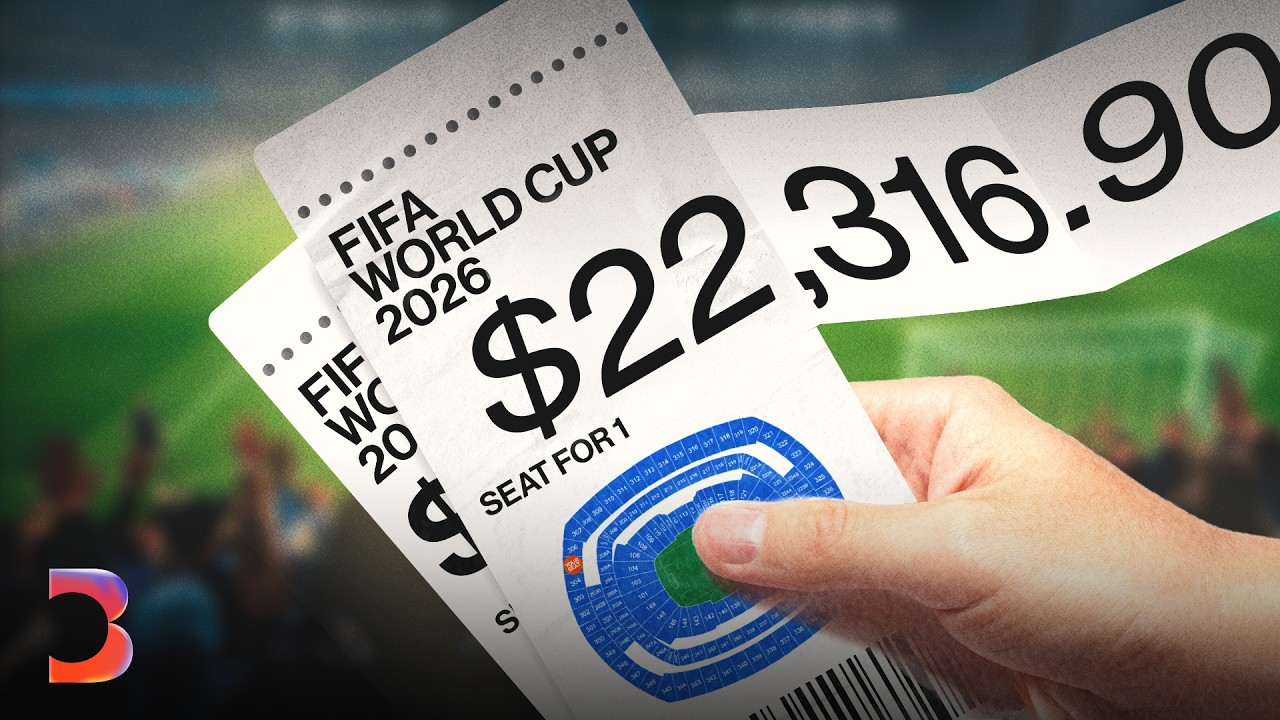
Attending the upcoming World Cup will come at an extraordinary cost for average fans. Potential attendees are experiencing severe sticker shock as ticket prices reach eye-watering amounts; for instance, a ticket with an original purchase price of $446 has soared on the secondary market to a staggering $22,316, prompting fans to declare "I don't think we're going to the World Cup anymore, bro" and labeling the situation as total "insanity." The tournament's return to North America is historic in several ways: it is the first FIFA World Cup hosted across three nations—the US, Mexico, and Canada—utilizing 16 host cities. Furthermore, the format has expanded from 32 to 48 participating countries, expanding the total slate of matches to 104.

Crucially, this marks the first World Cup in history to implement "dynamic pricing," a strategy that adjusts ticket costs on an hourly, daily, or weekly basis depending on real-time supply and demand. While dynamic pricing is a familiar reality in the United States event market, introducing it on a global scale is unprecedented. FIFA is taking full advantage of the lucrative US market, defending the surge by asserting, "We have to apply market rates. This is the World Cup." However, the practice has invited heavy speculative buying, where resellers scoop up seats solely to flip them for massive markups, leaving observers to question whether the apparent sky-high demand is genuine.

- **Match & Scale Expansion:** 48 teams (up from 32), 3 host countries, 16 host cities, and 104 total matches. - **Resale Price Example:** An original $446 face-value ticket marked up to $22,316 on resale platforms. - **Dynamic Pricing:** Prices fluctuate continuously based on demand, marking the first time FIFA has applied this system globally.

---

[01:22](https://www.youtube.com/watch?v=1QaXlf1-tGY&t=82s) Political Barriers, Visa Restrictions, and Host City Strain

Beyond sky-high ticket costs, international fans face significant political and logistical hurdles. Strict US immigration and tourism policies under the Trump administration have made obtaining visas extremely difficult for citizens of specific nations, discouraging many from visiting altogether. US officials have reiterated firm warnings to visitors: "When the time is up, they'll have to go home. Don't overstay your visa." This geopolitical friction threatens to curb attendance, raising concerns that what was promised as a lucrative event for host municipalities could ultimately turn into a "financial black hole."

- Host cities face potential financial losses ranging between **$100 million and $200 million**. - Strict US visa policies and political tensions are actively deterring international supporters from traveling.

---

[02:19](https://www.youtube.com/watch?v=1QaXlf1-tGY&t=139s) Soccer’s US Growth and the Hidden Financial Risks for Host Cities

Over the 30 years since hosting the 1994 World Cup, soccer—or football—has made immense strides in the United States. Major League Soccer (MLS) has expanded into a 30-team league valued at over $20 billion, bolstered by global megastars like Lionel Messi playing for Inter Miami. Despite this growth, soccer still lags behind established American sports leagues in cultural mindshare, making this tournament a pivotal moment to capture both domestic and global audiences.

The US market is highly attractive to FIFA because the fundamental stadium infrastructure already exists, avoiding the need to build facilities from scratch (though FIFA still mandates costly modifications). Cities willingly bid for matches based on promises of huge local economic impacts—New York projects a $3.3 billion boost, Dallas expects $2.1 billion, and Los Angeles estimates $1 billion. However, experts point out that these economic projections are routinely inflated. While FIFA claims virtually all generated revenues, host cities are contractually required to front the bill for massive operational costs including stadium modifications, security, public transportation, and official Fan Fests.

``` Past World Cup Financial Performance (14 Tournaments Analyzed): ------------------------------------------------------------------ Host Nations Losing Money: ███████████████ (13/14) Host Nations Profitable: █ (1/14 - Russia) ------------------------------------------------------------------ ```

- **MLS Enterprise Value:** Currently exceeds **$20 billion** across **30 teams**. - **Projected Economic Impacts:** New York ($3.3 billion), Dallas ($2.1 billion), Los Angeles ($1 billion). - **Historical Host Deficits:** Out of 14 past World Cups analyzed, **Russia was the single exception** to host nations losing money; all others suffered net losses. - **Monetizing Fan Fests:** Traditionally free public viewing areas in parks are now being considered for paid admission by financially strained cities looking to offset costs. - **Security Funding Gap:** The US federal government pledged $625 million toward security across the 11 US host cities, but experts note this falls far short of total requirements, leaving taxpayers and local sponsorships to bridge the gap.

---

[05:28](https://www.youtube.com/watch?v=1QaXlf1-tGY&t=328s) Squeezing the Fan: Transit Costs and International Travel Friction

In a bid to recoup their heavy upfront investments without burdening taxpayers, host municipalities are passing costs directly onto spectators. In the New York/New Jersey area, a round-trip transit ticket to the stadium—normally priced at $13—was initially hiked to $150 before public backlash forced a slight reduction down to roughly $100. Furthermore, FIFA has restricted stadium parking capacity to accommodate tournament infrastructure, driving the remaining parking spots to exorbitant premium prices.

International fans face even steeper financial and logistical friction. Global airfares have spiked, compounded by energy crisis pressures on jet fuel supplies. The political environment has further eroded goodwill; one fan in Senegal noted that complex visa red tape reinforces a perception of the US as a hostile environment. Thousands of dedicated fans who have attended every World Cup over the last two decades have signed petitions explicitly stating they will boycott the US tournament due to opposition to Trump administration immigration policies.

- **Transit Markup Example:** New Jersey stadium transit jumped from a standard $13 round-trip to roughly **$100** (reduced from an initial $150 following severe pushback). - **Fan Boycotts:** Thousands of long-term World Cup attendees have signed petitions pledging to skip the tournament over US immigration policies.

---

[07:29](https://www.youtube.com/watch?v=1QaXlf1-tGY&t=449s) Geopolitics: The Relationship Between Infantino and Donald Trump

The tournament's narrative is deeply intertwined with high-level politics, particularly the close relationship between FIFA President Gianni Infantino and US President Donald Trump. Infantino has actively cultivated Trump's interest in the sport, making frequent visits to the White House. In a notable gesture, Infantino invented a brand-new "FIFA peace prize" specifically to present to Trump after the president publicly complained about not receiving a Nobel Peace Prize.

Observers speculate that such overt diplomatic flattery helped smooth the way for Iran's national team to compete in the tournament despite broader geopolitical conflicts and US-Iran tensions. Reacting to Infantino's announcement that Iran would participate in the 2026 games, Trump remarked: "Did Gianni say it? He did. Gianni Infantino, that's a piece of work. You know what? Let them play well. Gianni's fantastic, he's a friend of mine." For Trump, hosting what Infantino frames as the equivalent of "104 Super Bowls" offers immense global publicity, positioning him front and center in the stands as a key figure responsible for staging the mega-event.

---

[08:39](https://www.youtube.com/watch?v=1QaXlf1-tGY&t=519s) FIFA’s $13 Billion Revenue Engine and the Threat of Empty Stadiums

For FIFA, framing each match as a Super Bowl-tier event translates to unprecedented financial gain. Over the four-year financial cycle culminating in the 2026 World Cup, FIFA is projected to generate roughly $13 billion in total revenue—a massive fivefold increase compared to the cycle ending with the 2006 World Cup in Germany. FIFA operates legally as a non-profit organization, asserting that net profits after operational costs are redistributed back to national soccer federations worldwide to sustain operations and develop youth and adult programs.

Broadcast rights remain FIFA's largest revenue engine, expected to bring in $3.9 billion this year alone—a figure bolstered by the fact that dynamic ticket pricing will force millions of fans to watch from home. Additionally, FIFA established its own secondary ticket resale platform, collecting double commission fees on both the buyer and seller sides.

| FIFA Revenue Stream / Metric | Projected Figure | |:--- |:--- | | **Total 4-Year Cycle Revenue** | ~$13 billion *(5x increase over 2006 cycle)* | | **Broadcast Rights Revenue** | ~$3.9 billion | | **Cheapest Ticket Option ("Fan Category")** | $60 *(less than 2% of total inventory)* |

Despite these massive figures, FIFA faces growing criticism over seat assignment transparency and corporate exclusivity. Following international outcry over prices, FIFA introduced a limited $60 ticket tier reserved for teams' most loyal fans; however, these represent less than 2% of total available tickets. The vast majority of prime seats are reserved for corporate hospitality packages, leading experts to warn that in traditional footballing nations, such extreme pricing would risk "a bloody revolt."

Because high costs threaten to price out ordinary supporters, experts warn that group-stage matches between smaller nations lacking local diaspora communities face a serious risk of playing in half-empty stadiums. To avoid the embarrassing optics of empty seats on global broadcasts, secondary market ticket prices may be forced to plunge drastically as match days approach. Ultimately, pricing out the working-class mass fanbase risks severing the cultural bond that makes the sport so universally popular.

## Notable quotes > [00:02](https://www.youtube.com/watch?v=1QaXlf1-tGY&t=2s) I don't think we're going to the World Cup anymore, bro — Fan

> [00:02](https://www.youtube.com/watch?v=1QaXlf1-tGY&t=2s) insanity — Fan

> [00:02](https://www.youtube.com/watch?v=1QaXlf1-tGY&t=2s) We have to apply market rates. This is the World Cup. — FIFA

> [01:22](https://www.youtube.com/watch?v=1QaXlf1-tGY&t=82s) When the time is up, they'll have to go home. Don't overstay your visa. — US officials

> [01:22](https://www.youtube.com/watch?v=1QaXlf1-tGY&t=82s) financial black hole

> [08:39](https://www.youtube.com/watch?v=1QaXlf1-tGY&t=519s) a bloody revolt — Experts

> [07:29](https://www.youtube.com/watch?v=1QaXlf1-tGY&t=449s) Did Gianni say it? He did. Gianni Infantino, that's a piece of work. You know what? Let them play well. Gianni's fantastic, he's a friend of mine. — Donald Trump

> [07:29](https://www.youtube.com/watch?v=1QaXlf1-tGY&t=449s) 104 Super Bowls — Gianni Infantino

## Mentioned World Cup, FIFA, Bloomberg Originals, Donald Trump, Gianni Infantino, Major League Soccer, MLS, Lionel Messi, Inter Miami, Fan Fests, FIFA peace prize

[Source](https://www.youtube.com/watch?v=1QaXlf1-tGY)

中文简报

FIFA追逐130亿美元收入 主办城市面临2亿美元亏损风险 FIFA通过动态定价与企业优先策略创下130亿美元的创纪录收入,却将财政赤字转嫁给主办城市,并面临小组赛球场空置的风险。 由美国、墨西哥和加拿大联合举办的2026年世界杯在规模和收入上均实现空前扩张,预计通过转播权和动态门票定价将为FIFA带来约130亿美元的净收入。然而,主办城市面临严重的财务风险,不仅要承担巨额的安保、交通和运营成本,且从历史上看举办该赛事通常也是亏损的。与此同时,门票的大幅溢价、昂贵的交通费用、复杂的美国签证政策以及地缘政治紧张局势,将普通国内外球迷拒之门外,引发了人们对抵制活动以及较小规模小组赛阶段球场出现大批空座的担忧。 2026年世界杯采用扩军赛制,涵盖48支球队、3个主办国、16座主办城市以及总计104场比赛。 (0:02) FIFA首次在全球范围内推行动态定价,导致一级和二级市场的门票价格大幅暴涨。 (0:02) 美国严格的移民和签证政策正在阻碍国际球迷前往现场观看比赛。 (1:22) 尽管有经济效益预测,但由于庞大的必要开支,主办城市仍面临1亿至2亿美元的潜在财务亏损。 (1:22) 历史分析表明,过去14届世界杯主办国中有13个遭受了净财政亏损,俄罗斯是唯一的例外。 (2:19)

Reading summary

The expansion of the 2026 World Cup across North America has introduced unprecedented commercialization and dynamic pricing, enabling FIFA to project record revenues while offloading operational costs and financial risks onto host cities and fans. Dynamic Pricing and Skyrocketing Ticket Resales (0:02) The tournament marks the first time FIFA has instituted dynamic pricing globally, adjusting costs based on real-time supply and demand to capitalize on the lucrative US event market. While FIFA defends the practice by asserting it must charge market rates, the policy has catalyzed speculative buying on secondary markets, where a ticket originally priced at $446 has been listed for as much as $22,316. In response to public backlash, FIFA introduced an entry-level $60 ticket tier reserved for loyal supporters, but this category constitutes less than 2% of total inventory. With most prime seats earmarked for corporate hospitality packages, analysts warn that pricing out traditional, working-class supporters risks leaving group-stage matches between smaller nations without major diaspora bases to be played in half-empty stadiums. Host City Deficits and Shifting Operational Costs (2:19) Host cities pursued bids on projections of vast local economic windfalls—including estimates of $3.3 billion for New York, $2.1 billion for Dallas, and $1 billion for Los Angeles. However, historical data across 14 past World Cups indicates that 13 host nations experienced net financial losses, with Russia serving as the sole profitable exception. Current estimates suggest host municipalities could face individual losses between $100 million and $200 million. While FIFA absorbs the majority of revenues, host cities are contractually responsible for operational costs such as security, transit infrastructure, stadium modifications, and public Fan Fests. Even with $625 million pledged by the US federal government for security across 11 US venues, experts evaluate this as insufficient, prompting financially strained cities to consider charging admission for traditionally free public viewing zones. Transit Markups, Visas, and Fan Boycotts (5:28) To recoup high upfront expenditures, local jurisdictions and logistics providers have shifted costs onto spectators. In the New York and New Jersey metropolitan area, standard $13 round-trip stadium transit fares were initially raised to $150 before public pushback lowered them to approximately $100. Simultaneously, stadium parking supply has been constrained to accommodate event infrastructure, driving up parking rates. International attendees face compounded barriers from elevated global airfares and strict US immigration enforcement under the Trump administration. Delays and strict visa vetting have spurred perceptions of a hostile environment abroad, while thousands of long-term international supporters who attended past tournaments have signed petitions pledging to boycott the event in opposition to US border policies. FIFA's Revenue Engine and Geopolitical Alignments (7:29) FIFA is projected to generate roughly $13 billion over the four-year cycle ending in 2026—a fivefold increase compared to the 2006 tournament cycle in Germany. Broadcast rights account for an estimated $3.9 billion of this total, bolstered by secondary revenue mechanisms such as FIFA's proprietary resale platform, which extracts double commissions from both buyers and sellers. This commercial push aligns with close political ties between FIFA President Gianni Infantino and US President Donald Trump. Infantino has actively engaged the White House, even presenting Trump with a newly invented 'FIFA peace prize.' These diplomatic overtures facilitated the clearance for Iran's national team to compete in the US despite heightened geopolitical tensions, positioning the expanded 104-match slate as a high-visibility global platform for both political and sports leaders. FIFA's commercial framework ensures unprecedented organizational revenues, but the approach leaves host municipalities facing steep budget deficits while testing the limits of fan willingness to pay. Whether secondary ticket prices will collapse ahead of match days to avert the broadcast optics of vacant stadiums remains an unresolved issue.

精炼阅读摘要

彭博原创(Bloomberg Originals)指出,2026年美加墨世界杯正在演变为一场史无前例的商业变现实验,国际足联(FIFA)通过扩充赛事规模和推行动态定价追求高达130亿美元的创纪录营收;然而,巨额财务成本被转嫁给主办城市、门票与出行费用暴涨以及严苛的签证政策,正将传统球迷阻隔在外,并使赛事面临主办城市财政亏损与看台空置的风险。 赛事扩容与动态定价引发的票价飞涨 (0:02) 本届世界杯由美国、墨西哥和加拿大联合承办,覆盖16座主办城市,参赛球队从32支扩军至48支,总比赛场次攀升至104场。伴随规模扩张,国际足联首次在全球赛事中全面应用“动态定价”机制,门票价格根据实时供需按小时、天或周动态波动。尽管国际足联辩称这是在成熟的美国市场遵循“市场规律”,但该机制催生了大规模投机倒卖,一张面值446美元的原价门票在二级转售平台上被炒至22,316美元,令普通观众震惊并质疑市场虚高需求的真实性。 在商业收益方面,国际足联预计该四年周期的总营收将达约130亿美元,相当于2006年德国世界杯周期的五倍,其中转播权预计贡献3.9亿美元。国际足联还设立了官方二级转售平台,向买卖双方同时收取双重手续费。虽然面对公众舆论压力,国际足联推出了售价60美元的“球迷类别”最低档球票,但其配额不足总票量的2%,大量优质座席被划归企业款待套餐,引发了关于过度商业化和排挤工薪阶层球迷的批评。 主办城市的虚假繁荣与沉重债务包袱 (2:19) 尽管过去30年间美国职业足球大联盟(MLS)已发展为拥有30支球队、估值超过200亿美元的产业,且美国拥有无需新建的现有球场硬件,但承办世界杯依然使地方财政面临严峻挑战。主办城市竞标时通常参考庞大的经济效益预测,例如纽约预计将获得3.3亿美元收益,达拉斯预计为2.1亿美元,洛杉矶估计为10亿美元;然而专家强调,这类经济预测往往被过度夸大。过往14届世界杯的历史数据显示,除俄罗斯成为唯一实现盈利的特例之外,其余13届的主办国均承受了净亏损。 按照商业规则,国际足联几乎独占了赛事产生的所有直接收入,而主办城市则在合同约束下承担全部运营重担,包括体育场改造成本、公共交通、安保以及官方球迷嘉年华(Fan Fests)的开销。美国联邦政府虽承诺向全美11个主办城市提供6.25亿美元的安保支持,但专家评估这一金额远低于实际开销,资金缺口将由地方纳税人和本地赞助填补,使各主办城市面临1亿至2亿美元的潜在亏损。为了弥补赤字,部分城市甚至考虑打破惯例,对以往免费开放的公园球迷嘉年华收取入场费。 观赛成本转嫁与国际球迷的出行壁垒 (5:28) 为了在纳税人压力下弥补前期的巨额投入,主办城市将财务负担直接转嫁给现场观众。在纽约和新泽西区域,前往比赛场馆的往返公共交通票价最初从常规的13美元骤升至150美元,在公众强烈抗议后才勉强降至约100美元。此外,国际足联为搭建赛事基础设施占用了大量场馆停车位,直接导致剩余车位价格攀升至昂贵的溢价水平。 对于国际观众而言,出行门槛因高通胀和航空燃油供应压力带来的全球机票涨价而进一步加剧。更具决定性的是地缘政治与签证阻碍,在特朗普政府严格的移民政策下,部分国家的球迷面临繁杂的签证手续,美国官员也公开警告访客“签证到期即刻回国,严禁逾期滞留”。这种环境导致塞内加尔等国的海外球迷感到赴美环境充满敌意,数千名在过去20年连续观赛的核心球迷已签署请愿书,明确宣布因抵制相关移民政策而放弃前往本届世界杯。 地缘政治博弈与球场空置危机的隐忧 (7:29) 本届赛事的组织运作深受高层政治互动的深刻影响,尤其是国际足联主席詹尼·因凡蒂诺(Gianni Infantino)与美国总统唐纳德·特朗普之间的私交。因凡蒂诺通过频繁出访白宫建立关系,甚至在特朗普公开抱怨未获诺贝尔和平奖后,专门定制了一枚“国际足联和平奖”颁发给特朗普。分析认为,这类外交奉承为伊朗国家队在美伊局势紧张的背景下顺利参赛扫清了障碍,特朗普也公开称赞因凡蒂诺并对伊朗参赛表态支持。 对特朗普而言,将因凡蒂诺口中等同于“104场超级碗”的赛事引入北美,带来了极高的全球曝光度。然而业内专家警告,极端的票价和旅行成本严重抑制了真实观众需求,在缺乏本地庞大移民社区支撑的小国之间进行的小组赛,面临着看台半空的尴尬局面。为避免全球转播画面出现大面积空座,二级市场的虚高票价在临近赛期时可能被迫出现断崖式下跌,而对大众球迷的挤出也将严重动摇足球长期赖以生存的群众文化根基。 本期节目展现了现代顶级体育盛会中商业化收益与公共利益分配之间的巨大失衡:国际足联通过市场化定价与规模扩张搭建了百亿美元的吸金机器,地方政府和普通球迷却被迫承担了绝大部分债务风险与经济溢价。高昂成本、签证壁垒与投机倒卖不仅可能导致部分赛场出现空置风险,更构成了对传统足球社群文化的长期侵蚀。

Detailed notes — zh

## Background 该视频由彭博社旗下的 Bloomberg Originals 频道于 2026 年 6 月 21 日发布在 YouTube 平台上。页面简介指出,本届世界杯参赛球队扩军至 48 支并由美加墨三国联合主办,规模创历史之最且将为国际足联创造数十亿美元收益;然而动态定价、飙升的承办开销以及围绕特朗普政权的移民政策与地缘冲突等政治并发症,正让普通球迷被高票价拒之门外,并令各主办城市背负沉重的财政风险。 ## TL;DR 视频深度剖析了 2026 年美加墨世界杯沦为吸金机器背后的商业算盘与经济隐患。国际足联(FIFA)首次引入激进的动态定价机制并借助转售抽成,使周期营收预计飙升至 130 亿美元,但极端票价、航油上涨和特朗普严苛的移民签证政策正劝退大量海内外普通球迷。与此同时,尽管借用了北美现成的顶级球场,缺乏转播与票房分成的各大主办城市仍面临安保与交通等巨额硬性开支,极易陷入上亿美元的财政亏空并转嫁给纳税人。整届赛事在政客宣传秀场与商业特权化的裹挟下,不仅令看台面临非热门场次空场的尴尬,更深刻动摇了足球赖以生存的大众文化根基。 ## Atmosphere & style 全片洋溢着典型彭博社式的冷峻调查质感与尖锐批判锋芒,将宏观经济数据拆解与普通球迷的无力吐槽紧密交织。叙事从疯狂的二级市场天价票切入,步步揭开主办城市账目亏空与跨国地缘政治的冰冷现实,情绪基调从早期的荒诞震撼逐渐转向对基层体育文化被资本背叛的深层愤慨。镜头在光鲜亮丽的超级球场、政客与体育巨头的权谋周旋以及球迷无奈签下的抵制请愿书之间穿梭,给观众带来一种目睹狂欢盛宴蜕变为残酷阶层分化与商业泡沫的压抑与警示感。 ## Bulletin - [00:02](https://www.youtube.com/watch?v=1QaXlf1-tGY&t=2s) 本届美加墨世界杯扩军至48支球队并扩展至104场比赛,FIFA首次引入“动态定价”,导致球票二级市场炒至天价,将大批普通球迷挤出门槛。 - [03:34](https://www.youtube.com/watch?v=1QaXlf1-tGY&t=214s) 由于安保与基建成本高度地方化,北美主办城市面临每座1亿至2亿美元的财政赤字风险,历史数据显示过去14届世界杯中仅俄罗斯实现盈利。 - [06:38](https://www.youtube.com/watch?v=1QaXlf1-tGY&t=398s) 地缘冲突引发的航油危机叠加美国严苛的签证与移民政策,致使数千名资深国际球迷联名发起抵制赴美观赛行动。 - [08:39](https://www.youtube.com/watch?v=1QaXlf1-tGY&t=519s) FIFA在此四年周期内预计创下约130亿美元的总营收,但其官方转售双向抽成及不足2%的平价票配置,引发了背离足球平民根基的强烈公愤。 ## Key takeaways - [00:02](https://www.youtube.com/watch?v=1QaXlf1-tGY&t=2s) 美加墨世界杯创下扩军至48支球队、16座承办城市与104场比赛的史无前例规模,但观赛门槛被推至历史最高点。 - [00:02](https://www.youtube.com/watch?v=1QaXlf1-tGY&t=2s) FIFA首次在全球大型足球赛事中推行“动态定价”机制,催生出大量投机性炒作,原价446美元的门票被炒至逾2.2万美元。 - [01:22](https://www.youtube.com/watch?v=1QaXlf1-tGY&t=82s) 特朗普政府严苛的签证壁垒与移民审查令海外球迷望而却步,直接威胁到赛事的国际入场人次与预期消费。 - [01:22](https://www.youtube.com/watch?v=1QaXlf1-tGY&t=82s) 各主办城市因赛事预期可能面临1亿至2亿美元不等的财政亏空,成为这场盛会中承担风险最大的实体。 - [02:19](https://www.youtube.com/watch?v=1QaXlf1-tGY&t=139s) 自1994年以来美国足球产业急速膨胀,MLS估值破200亿美元,现成的高标准球场使北美成为FIFA免去场馆基建投资的理想“摇钱树”。 - [03:34](https://www.youtube.com/watch?v=1QaXlf1-tGY&t=214s) 主办城市动辄数亿至十亿美元的经济效益预期往往严重虚标,历史证明承办世界杯几乎难逃整体亏损宿命。 - [03:34](https://www.youtube.com/watch?v=1QaXlf1-tGY&t=214s) 安保、公共交通改造与球迷嘉年华等硬性成本全由承办地垫付,联邦提供的6.25亿美元补助杯水车薪,亏损最终转嫁给普通纳税人。 - [05:28](https://www.youtube.com/watch?v=1QaXlf1-tGY&t=328s) 地方机构通过大幅上调交通出行票价与压缩公共停车位以图止损,进一步加重了前往现场球迷的经济负担。 - [06:38](https://www.youtube.com/watch?v=1QaXlf1-tGY&t=398s) 国际航油价格高企推高差旅成本,繁杂的入境审查强化了外界对美国排外的负面认知,导致大批多届常客球迷集体签署抗议请愿书拒绝赴美。 - [07:29](https://www.youtube.com/watch?v=1QaXlf1-tGY&t=449s) 因凡蒂诺与特朗普构建了高度互利的私人政治关系,特设“FIFA和平奖”示好,并促成了地缘紧张局势下伊朗队的参赛准入。 - [07:29](https://www.youtube.com/watch?v=1QaXlf1-tGY&t=449s) 特朗普将号称“相当于104场超级碗”的世界杯化作其个人的政治宣传主场,模糊了体育与地缘政治的界限。 - [08:39](https://www.youtube.com/watch?v=1QaXlf1-tGY&t=519s) FIFA本周期总收入预计高达130亿美元(较2006年翻五倍),转播权收入达39亿美元,但大众球迷在票价排挤下被迫回归电视端。 - [08:39](https://www.youtube.com/watch?v=1QaXlf1-tGY&t=519s) FIFA自营二级市场交易平台实施买卖双向抽成,而象征性的60美元惠民球票占比不足2%,看台迅速沦为赞助商和富裕阶层的专享区。 - [08:39](https://www.youtube.com/watch?v=1QaXlf1-tGY&t=519s) 极端商业化操作严重透支足球文化土壤,在缺少移民基本盘的比赛场次可能爆发看台大面积空场与赛前票价跳水危机。 ## Detailed walkthrough ### [00:02](https://www.youtube.com/watch?v=1QaXlf1-tGY&t=2s) 史无前例的扩张与动态定价冲击 对于渴望亲临世界杯现场的球迷而言,这届赛事的门槛被抬到了令人咋舌的高度。网络上充斥着普通球迷的震惊与无奈:“兄弟,我觉得我们去不成世界杯了,最便宜的票要 7,000 美元!”原价仅 446 美元的门票,在转售平台上被炒到了 22,316 美元的天价,被直呼是“彻头彻尾的疯狂”。作为世界杯重返北美的历史性时刻,本届赛事在多个维度刷新了纪录:首次由美国、墨西哥和加拿大三国联合举办,涵盖 16 座主办城市;参赛队伍由 32 支扩军至 48 支,比赛场次激增至 104 场。 然而,更具颠覆性的是国际足联(FIFA)首次在世界杯中引入了“动态定价”(Dynamic Pricing)。这项在美国本土票务和打车服务中司空见惯的规则,在全球大型足球赛事中还是头一次登场。票价根据实时供求关系每小时、每天甚至每周浮动,使美国成为 FIFA 将商业利润最大化的终极试验场。“这可是世界杯,我们必须遵循市场化费率。”随之而来的则是投机买家的大肆涌入与疯狂加价转售,外界也因此产生了强烈质疑:这种狂热的票务需求究竟是真实的,还是充斥着投机泡沫? - 赛事规模激增:从 32 支球队增至 48 支,总计将在 16 座城市举行 104 场比赛。 - 二手票务炒作夸张:原价 446 美元的普通球票在二级市场被挂出 22,316 美元的极端高价。 - 动态定价机制:票价随时根据供求波动,属国际足联历史上首次引入此类系统。 ### [01:22](https://www.youtube.com/watch?v=1QaXlf1-tGY&t=82s) 签证壁垒与主办城市的财政黑洞 高昂的票价仅仅是球迷面临的第一道关卡,政治政策带来的物理阻碍同样棘手。美国总统唐纳德·特朗普对于移民和入境签证的强硬政策,让来自特定国家的球迷获取签证变得异常艰难。官方在言辞中直白警告:“我们欢迎大家来看球、来庆祝,但时间一到就必须回国,绝不要逾期滞留。”这种紧缩与戒备的态势,直接劝退了大量潜在的海外访客。 一旦海外球迷无法或拒绝入境观赛,各大主办城市原本预期的“商业盛宴”极有可能沦为沉重的“财政黑洞”。据估算,每座主办城市可能承受 1 亿至 2 亿美元不等的财政赤字。正如分析所言,赛场上终会有一支国家队捧起大力神杯成为赢家,但赛事最大的输家,可能自始至终都没有踏上过绿茵场一步。 ```mermaid flowchart TD accTitle: 主办城市财政风险传导路径 accDescr: 展示从签证限制到主办城市陷入财政赤字的因果链条 subgraph Policy ["政策与外部环境"] A["严格的移民与签证政策"] --> B["海外球迷遭遇签证壁垒/选择抵制"] end subgraph Demand ["市场反应"] B --> C["国际访客与入场人数下滑"] D["极端票价挤压普通观众"] --> C end subgraph CityImpact ["主办城市困境"] C --> E["本地消费预期落空"] F["巨额安保与基建改造预付款"] --> G["面临 1 亿至 2 亿美元财政缺口"] E --> G end ``` ### [02:19](https://www.youtube.com/watch?v=1QaXlf1-tGY&t=139s) 足球在美扩张与“现成”场馆的利诱 自 1994 年美国世界杯以来的三十年间,足球(在北美被称为 Soccer)在美国经历了爆发式增长。随着足坛超级巨星莱昂内尔·梅西加盟迈阿密国际(Inter Miami),该国职业足球产业呈现指数级扩张。如今美国职业足球大联盟(MLS)已扩军至 30 支球队,联盟整体企业估值突破 200 亿美元。然而,横向对比美式橄榄球(NFL)或篮球(NBA)等北美传统主流体育联盟,足球依然存在明显差距,因此本届本土世界杯被视作彻底撬动美国本土大众乃至全球受众的决定性契机。 对于 FIFA 而言,庞大的美国市场与现成的硬件设施极具吸引力。不同于以往那些需要从零开始耗巨资建造新球场的东道国,美国、墨西哥和加拿大拥有大量现成的顶级现代化体育场。尽管 FIFA 仍要求对场地进行一系列定制化改造,但免去了新建场馆的沉重包袱,这使得北美成了国际足联眼中名副其实的“摇钱树”。 - 足球在美产业积淀:自 1994 年世界杯至今持续发展,MLS 扩至 30 支球队,估值超 200 亿美元。 - 硬件基础设施优势:主要承办场馆皆为现成体育场,无需从零修建,但需按 FIFA 标准进行局部升级。 ### [03:34](https://www.youtube.com/watch?v=1QaXlf1-tGY&t=214s) 虚高的经济效益预估与纳税人买单 尽管承办世界杯被各地政客描绘为巨大的经济机遇——纽约市预计将获得 3.3 亿美元的经济效益,达拉斯预计为 2.1 亿美元,洛杉矶则预估在 10 亿美元左右,但残酷的历史经验表明,这些数字往往高度虚标。纵观过去 14 届世界杯的收支数据,一条清晰的规律展露无遗:几乎每一届东道国都在亏损,唯一的例外只有俄罗斯。 与 FIFA 签订承办协议的各城市必须独自承担安全保障、公共交通以及举办“球迷嘉年华”(Fan Fest)等巨额开销。原定在城市公园树立大屏幕、供市民与球迷免费看球聚会的 Fan Fest,因严重的财政重压,部分城市已被迫考虑开始向入场者收费。即便美国联邦政府承诺拨款 6.25 亿美元用于支持全美 11 座承办城市的安保,这笔钱在庞大的综合维稳需求面前仍是杯水车薪。一旦承办成本持续膨胀而直接票务与转播收益全被 FIFA 抽走,除去有限的本地商业赞助和私人捐款,最终剩余的财政亏空只能转嫁给普通纳税人。 - 经济效益预估与现实落差:纽约预估 3.3 亿美元、达拉斯 2.1 亿美元、洛杉矶 10 亿美元,但历史数据显示往届 14 届中仅俄罗斯盈利。 - 巨额硬性支出:安保、交通、公共 Fan Fest 全部由地方垫资,11 座美国主办城市瓜分 6.25 亿美元联邦安保资金仍显不足。 ### [05:28](https://www.youtube.com/watch?v=1QaXlf1-tGY&t=328s) 交通涨价与对普通球迷的层层盘剥 面对巨大的资金缺口,地方政府与市政系统开始在交通和配套服务上“动脑筋”,试图从球迷身上刮下油水。以纽约前往新泽西大都会人寿体育场的往返火车票为例,非世界杯期间日常票价仅为 13 美元,但官方最初竟一度将世界杯往返票价定为 150 美元,后因遭到舆论的猛烈反弹才下调至约 100 美元,涨幅依然接近七倍。 城市当局试图通过激进加价来挽回投资,竭力避免亏损最终落到纳税人头上,但这种做法无异于对普通球迷进行极限挤压。与此同时,FIFA 为了在球场周边拓展自身的商业及赞助基础设施,大幅压缩了球场周边的公共停车位配额。车位供应的极度紧缺,使得极少数保留下来的停车位瞬间沦为天价特权消费品。 - 纽新交通天价溢价:纽约至新泽西球场的往返火车票平时仅需 13 美元,赛时一度飙升至 150 美元,抗议后回调至 100 美元。 - 停车资源紧缩:FIFA 占用公共车位扩建专属设施,剩余停车位被炒至高额溢价。 ### [06:18](https://www.youtube.com/watch?v=1QaXlf1-tGY&t=378s) 国际球迷的抵触与地缘政治阴影 国际球迷的处境比本土观众更加艰难。地缘政治局势导致全球燃油价格大涨,跨国机票价格飙升。同时,繁琐苛刻的入境审查给来自发展中国家的球迷带来了极大的不确定性与心理壁垒。一位来自塞内加尔的资深球迷直言,严苛的官僚繁文缛节不仅让人感到寸步难行,更进一步强化了外界对于美国“对外来访客充满敌意”的刻板印象。 抵触情绪正演变为实际行动。已经有成千上万名国际球迷联名签署请愿书。这些球迷很多在过去 20 年间场场不落地追随世界杯的脚步,但他们明确表示拒绝前往美国观赛,以此抗议特朗普政府所推行的排外移民政策。 - 差旅门槛大幅抬高:航油危机推升跨国机票价格,签证繁琐程序加深排外感知。 - 球迷发起联合抵制:数千名有着长达 20 年世界杯观赛传统的铁杆球迷集体签署请愿书,因签证与移民政策拒绝赴美。 ### [07:29](https://www.youtube.com/watch?v=1QaXlf1-tGY&t=449s) 因凡蒂诺与特朗普的政治算盘 具有讽刺意味的是,特朗普本人经常公开标榜自己是个足球迷,而国际足联主席詹尼·因凡蒂诺则极力迎合并经营着两人的私人关系。因凡蒂诺曾多次出入白宫,私交甚笃。在特朗普抱怨自己未能获得诺贝尔和平奖后,因凡蒂诺甚至“别出心裁”地专门为他量身打造并颁发了一项全新的“FIFA 和平奖”(FIFA Peace Prize)。 这种政治层面的奉承与周旋,或许也在客观上为地缘局势紧绷的伊朗国家队顺利参赛扫清了障碍。当被问及伊朗队获准参赛时,特朗普在镜头前展现出典型的大包大揽:“詹尼宣布的吗?詹尼·因凡蒂诺,那可是个厉害角色……随他们踢去吧,詹尼太棒了,他是我的好哥们。”在这场盛会中,特朗普将自己置于舞台中央,把这场由因凡蒂诺称作“相当于 104 场超级碗”的超级赛事当成个人的巨大宣传秀场。 - 政治利益交换:因凡蒂诺为安抚特朗普设立“FIFA 和平奖”,两人私交甚密。 - 地缘热点涉险过关:即便美伊关系极度紧张,伊朗国家队依然获准参赛,特朗普公开称赞因凡蒂诺是其“好朋友”。 - 舆论包装定位:赛事被宣传为“相当于 104 场超级碗”的超级吸金盛典。 ### [08:39](https://www.youtube.com/watch?v=1QaXlf1-tGY&t=519s) 130亿美元吸金机器与被背叛的大众根基 所谓“104 场超级碗”的背后,是彻底开足马力的创纪录吸金机器。在本届世界杯所处的四年周期内,FIFA 的总收入预计将飙升至约 130 亿美元,相较于 2006 年德国世界杯周期增长了整整五倍。尽管 FIFA 在法律上属于非营利组织,声称刨除运营成本后的剩余资金全额用于在全球范围内发展青少年和成人足球运动,但其高昂的商业化举措已引发公愤。仅转播权一项,预计本届就将进账约 39 亿美元。而在高票价的逼迫下,绝大多数普通球迷最终只能被迫选择在电视屏幕前观看。 除了利用动态定价推高一级市场,FIFA 还自建官方二级转售平台,同时向买家和卖家双向抽取佣金,大发横财;甚至连座位分配机制也饱受质疑,许多支付高价的观众发现实际座位与承诺严重不符。面对全球范围内的批评浪潮,FIFA 象征性地为部分参赛国的铁杆球迷推出了 60 美元的特惠票,但这部分低价票在总票量中的占比不足 2%。整个世界杯看台正迅速变为企业赞助商与富裕阶层的专属领地。 这种排他性带来了巨大的潜藏危机。在美国这个足球文化根基尚未完全稳固的国家,一旦对阵双方缺乏足够规模的本地移民社区支持,球场很可能出现大面积空场的尴尬局面,逼得主办方不得不赶在开赛前紧急跳水降价。现场评论尖锐地指出:“如果你敢在足球是第一运动的国家这么搞,我敢说这甚至可能引发流血暴动。”当最底层的大众球迷无力承担球票,足球文化赖以生存的群众土壤也将不可逆转地遭受侵蚀。 - 四年周期总营收:预计突破 130 亿美元,较 2006 年德国世界杯翻了五倍;其中转播版权收入高达 3.9 亿美元。 - 利益多重变现:FIFA 设立官方转售平台“买卖双向抽成”,涉嫌借二手市场二次套利。 - 敷衍的平价配额:60 美元的普惠球票数量极少,占总票数不足 2%。 - 潜在空场危机:若缺乏本地对应族群支撑,高票价可能导致部分比赛看台冷清,迫使票价临阵跳水。 ## Notable quotes > [00:02](https://www.youtube.com/watch?v=1QaXlf1-tGY&t=2s) 兄弟,我觉得我们去不成世界杯了,最便宜的票要 7,000 美元! — 球迷 > [00:02](https://www.youtube.com/watch?v=1QaXlf1-tGY&t=2s) 这可是世界杯,我们必须遵循市场化费率。 > [01:22](https://www.youtube.com/watch?v=1QaXlf1-tGY&t=82s) 我们欢迎大家来看球、来庆祝,但时间一到就必须回国,绝不要逾期滞留。 — 官方 > [01:22](https://www.youtube.com/watch?v=1QaXlf1-tGY&t=82s) 赛场上终会有一支国家队捧起大力神杯成为赢家,但赛事最大的输家,可能自始至终都没有踏上过绿茵场一步。 > [07:29](https://www.youtube.com/watch?v=1QaXlf1-tGY&t=449s) 詹尼宣布的吗?詹尼·因凡蒂诺,那可是个厉害角色……随他们踢去吧,詹尼太棒了,他是我的好哥们。 — 唐纳德·特朗普 > [07:29](https://www.youtube.com/watch?v=1QaXlf1-tGY&t=449s) 相当于 104 场超级碗 — 詹尼·因凡蒂诺 > [08:39](https://www.youtube.com/watch?v=1QaXlf1-tGY&t=519s) 如果你敢在足球是第一运动的国家这么搞,我敢说这甚至可能引发流血暴动。 ## Mentioned FIFA (国际足联), Gianni Infantino (詹尼·因凡蒂诺), Donald Trump (唐纳德·特朗普), Lionel Messi (莱昂内尔·梅西), Inter Miami (迈阿密国际), MLS (美国职业足球大联盟), NFL (国家美式橄榄球联盟), NBA (美国职业篮球联赛), MetLife Stadium (大都会人寿体育场), Super Bowl (超级碗), FIFA Peace Prize (FIFA 和平奖), Fan Fest (球迷嘉年华), New York (纽约), Dallas (达拉斯), Los Angeles (洛杉矶), New Jersey (新泽西), United States (美国), Mexico (墨西哥), Canada (加拿大), Iran (伊朗), Senegal (塞内加尔), Russia (俄罗斯) ## Video description This year’s World Cup has more teams (48) and more host nations (3) than any previous World Cup. It’s also going to make FIFA billions of dollars, but complications including dynamic ticket pricing and mounting costs are leaving ordinary fans priced out and host cities under financial strain. The tournament's economics are further complicated by politics. US President Donald Trump has placed himself at the center of the event, even receiving a newly invented “FIFA peace prize” from FIFA President Gianni Infantino. Meanwhile the US-Israel war with Iran has triggered an energy crisis that’s squeezing supplies of jet fuel, leading to higher prices and canceled flights for fans already wary of Trump’s immigration policies. Explore these and other related stories in more depth on Bloomberg.com: A Chaotic and Politicized World Cup Lumbers Toward Kickoff https://www.bloomberg.com/news/articles/2026-05-12/world-cup-2026-faces-trump-drama-ice-fears-ahead-of-fifa-tournament 00:00 Introduction 02:17 US soccer 03:04 Costs of hosting 05:28 Transportation 06:18 International fans 07:29 Infantino & Trump 08:39 FIFA revenue #fifa #worldcup #trump -------- Like this video? Subscribe: http://www.youtube.com/Bloomberg?sub_confirmation=1 Get unlimited access to Bloomberg.com for just $1.99 your first month: https://www.bloomberg.com/subscriptions?in_source=YoutubeOriginals Bloomberg Originals offers bold takes for curious minds on today’s biggest topics. Hosted by experts covering stories you haven’t seen and viewpoints you haven’t heard, you’ll discover cinematic, data-led shows that investigate the intersection of business and culture. Exploring every angle of climate change, technology, finance, sports and beyond, Bloomberg Originals is business as you’ve never seen it. Subscribe for business news, but not as you've known it: exclusive interviews, fascinating profiles, data-driven analysis, and the latest in tech innovation from around the world. Visit our partner channel Bloomberg News for global news and insight in an instant. [Source](https://www.youtube.com/watch?v=1QaXlf1-tGY)

Source quotes

[0:02] 球迷: 兄弟,我觉得我们去不成世界杯了,最便宜的票要 7,000 美元! [0:02] 这可是世界杯,我们必须遵循市场化费率。 [1:22] 官方: 我们欢迎大家来看球、来庆祝,但时间一到就必须回国,绝不要逾期滞留。 [1:22] 赛场上终会有一支国家队捧起大力神杯成为赢家,但赛事最大的输家,可能自始至终都没有踏上过绿茵场一步。 [7:29] 唐纳德·特朗普: 詹尼宣布的吗?詹尼·因凡蒂诺,那可是个厉害角色……随他们踢去吧,詹尼太棒了,他是我的好哥们。 [7:29] 詹尼·因凡蒂诺: 相当于 104 场超级碗 [8:39] 如果你敢在足球是第一运动的国家这么搞,我敢说这甚至可能引发流血暴动。

Source quotes

[0:02] Fan: I don't think we're going to the World Cup anymore, bro [0:02] Fan: insanity [0:02] FIFA: We have to apply market rates. This is the World Cup. [1:22] US officials: When the time is up, they'll have to go home. Don't overstay your visa. [1:22] financial black hole [8:39] Experts: a bloody revolt [7:29] Donald Trump: Did Gianni say it? He did. Gianni Infantino, that's a piece of work. You know what? Let them play well. Gianni's fantastic, he's a friend of mine. [7:29] Gianni Infantino: 104 Super Bowls

Original transcript

[0:02] So you want to go to the World Cup. Well, [0:06] it's going to cost you. [0:08] I don't think we're going to the World Cup anymore, bro. Their cheapest $7,000. [0:12] Original purchase price, $446. Resale price $22,316. [0:17] It's insanity. [0:18] The World Cup's return to North America will be unprecedented in more ways than [0:23] one. [0:24] It's the first FIFA tournament to take place across three nations with 16 host [0:28] cities in the US, Mexico and Canada. [0:32] This is the first tournament where we're going to have 48 countries represented [0:35] instead of 32. That means there's going to be 104 matches play. [0:40] It's also the first World Cup where tickets are subject to dynamic pricing and [0:45] that's changing the game so to speak. [0:47] What dynamic pricing means is that prices change could be on an hourly [0:52] basis, on a daily basis, or weekly basis, depending on supply and demand. [0:56] This is something that we are used to seeing in the US, [0:59] but around the globe this is the first time they've ever introduced something [1:02] like this. [1:03] The US is the ultimate market and FIFA's using that to their full advantage in [1:07] this tournament. [1:08] We have to apply market rates. This is the World Cup. [1:12] You have a lot of resale, [1:13] a lot of speculative buyers going in there to later try to sell for a markup. [1:17] And so the big question I think people have is, is this demand real? [1:22] And ticket prices aren't the only obstacle of the fans. If. [1:25] You're. [1:26] Coming to see some. [1:27] Soccer. We want them to come, we want them to celebrate. When the time is up, [1:31] they'll have to go home. Don't overstay your. [1:33] Visa. [1:34] Trump's policies on immigration and tourism have proved to be very hard [1:38] for some people from specific countries to get visas to attend the tournament. [1:43] It has said to put some people off of wanting to visit here. [1:48] And if people can't or don't attend the games, [1:51] then what seemed like a profitable event for host cities could turn into a [1:56] financial black hole. [1:57] Financial fallout could be anywhere from 100 to 200 million dollars. [2:01] That's the cost for a host city. [2:03] The World Cup will have a winner. One team will take away the trophy, [2:08] but some of its losers may never actually set foot on the playing [2:13] field. [2:19] Football, well, technically soccer, [2:22] since we're in North America this time round, [2:24] has finally come into its own in the US. [2:27] Soccer has seen a massive growth over the last 30 years since the World Cup in [2:33] 1994. Now one of the biggest stars in the world, [2:38] Lionel Messi plays for Inter Miami. [2:40] Their business grew an exponential amount. [2:44] The league is now 30 teams. The value of the enterprise is over $20 billion. [2:48] But at the same time, [2:50] they aren't on the par of other sports leagues in the US. [2:56] So this is really the moment that they have to capture the world [3:01] audience, to capture the US audience. [3:03] The US market, coupled with other advantages, [3:06] makes it an attractive and lucrative location for FIFA. [3:11] FIFA comes over and they visit where people want to have the games, [3:15] they visit the stadiums, [3:16] and that's how they decide where it should be and if they have the right [3:20] facilities and they have the right infrastructure. [3:23] The good news about the United States, Mexico, [3:25] and Canada is we have the facilities already. [3:27] Although FIFA requires there to be some modifications to them, [3:31] we didn't have to build the facilities from scratch. [3:34] But hosting the World Cup is notoriously complicated. [3:38] Host cities want to host the World Cup because of the economic impact that they [3:41] will get back. New York alone expects about $3.3 billion in economic impact. [3:46] Dallas expects about 2.1 billion. LA around $1 billion. [3:50] Expectations aren't always reality and these economic impact numbers that FIFA [3:55] and the cities come up with are typically inflated numbers. [3:59] They end up fronting the bill and FIFA really just takes all of the revenue from [4:04] the games. [4:05] Looking at costs and revenues from 14 past World Cups, [4:09] shown here in blue and orange, a clear pattern emerges. [4:12] Nearly every host nation lost money. [4:16] Russia was the only exception. [4:19] If you're host city, [4:19] you sign a contract with FIFA and that host contract requires the city to take [4:24] care of all of these needs. Security is one of them. [4:29] Transportation is another one. [4:32] Producing fan fests in the city is another major expense. [4:37] They grab a park in the city where they'll pull up some big screens and in [4:41] theory, that's a place where fans can go free of charge, watch games, [4:46] have a good time. [4:47] But what we're already hearing is that some cities under the financial [4:51] constraints they have are considering charging for the Fan Fest. [4:55] The US government agreed to hand out $625 million in federal funding to help [5:00] with security measures across all 11 host cities in the US. [5:03] That's a good chunk of money, [5:05] but it's not nearly enough to deal with the potential security problems. [5:10] If you have that cost on one side and on the other side, [5:13] you have essentially zero revenues. [5:16] Then you have a net loss of that amount of money. Now, [5:19] some of that money will be defrayed by local sponsorship deals, [5:23] private donations, but the balance would be defrayed by the taxpayer. [5:28] And if the crowds do show up, [5:30] this will also strain local transportation and that's another area where [5:35] municipalities are trying to make up the difference. [5:39] To get from New York to the stadium in New Jersey, [5:41] a round trip ticket is going to cost about $100. [5:44] It's been reduced from $150 after backlash. [5:47] This is up from $13 a regular price for this ticket in a non-World Cup [5:52] day. [5:53] Cities are somehow trying to claw back some of the investment that they've made [5:57] in the tournament and it remains to be seen whether they're going to kind of [6:00] squeeze the fan enough to get some of that money back and not have to pass [6:04] anything on to taxpayers. [6:07] FIFA's limiting parking spots so that they can have more infrastructure around [6:11] the stadiums and that means that the few spots that are left are going for [6:15] premium prices. [6:19] For international fans, it's a whole other ballgame. [6:24] Airline prices have soared and politics is not helping. [6:32] For this fan in Senegal, [6:33] the red tape to get into the US has reinforced a perception that it's a hostile [6:38] environment for visitors. [7:13] There are already groups of thousands of people who have signed petitions that [7:18] say they've gone to all of the World Cup games in the last 20 years, [7:21] but they're not going to the United States because they don't like the [7:24] immigration policies that have been set by the Trump government. [7:28] No American president has ever had the chance. [7:31] Ironically, Trump himself professes to be a soccer fan. [7:37] And Gianni Infantino, the president of FIFA, [7:39] has made a point of cultivating this interest. [7:43] Infantino and President Trump have a very, very close relationship. [7:48] Infantino has gone to the White House many times. [7:51] Infantino created a new FIFA peace prize and he [7:56] gave it to Donald Trump after Donald Trump complained about not getting the [8:00] Nobel Peace prized. [8:01] And who knows, [8:02] maybe such flattery helped move the way for the Iranian team to participate in [8:07] the games. [8:08] Iran will be participating at the FIFA World Cup 2026. [8:15] Did Gianni say it? He did. Gianni Infantino, that's a piece of work. [8:19] You know what? Let them play well. Gianni's fantastic. He's a. [8:23] Friend of mine. For Trump, this is more publicity, right? [8:25] He's going to be there in the stands. [8:27] He's going to be seen as someone who's partly responsible for putting on this [8:31] massive tournament, these 104 Super Bowls as Infantino said. [8:37] The equivalent of 104 Super Bowls means turbo charged revenue and for [8:42] FIFA, that appears to be the point. [8:46] FIFA is going to earn over this four year cycle that the current World Cup will [8:50] take place in something like $13 billion. [8:53] That's a fivefold increase compared to the period ending with the 2006 [8:58] World Cup in Germany. To be fair, [9:02] FIFA is a nonprofit. [9:05] It says the money left after operating costs gets reinvested into growing the [9:09] sport around the world. [9:11] They divided up amongst the world's national soccer organizations and they [9:16] spread it out so those organizations can exist and can develop youth soccer and [9:20] adult soccer in their countries. [9:23] A huge chunk of their revenue, like with most sports, [9:26] comes from broadcast rights, [9:28] which are expected to generate about $3.9 billion this year. [9:33] And the fact is a lot of people will be watching the games on TV because of [9:38] those dynamic ticket prices. [9:40] FIFA's also organized its own resale platform and they're going to take [9:44] commissions from both the buyer and the seller and that's just going to add to [9:49] the revenue. [9:50] Even FIFA's process of seat assignment is being questioned over concerns some [9:55] who bought tickets aren't getting what they paid for. [9:58] It's another yellow card for an organization that is no stranger to money [10:03] scandals. FIFA hasn't been totally tone deaf to price concerns. [10:09] Following a global backlash, [10:10] they added a $60 ticket option for some of the World Cup teams, [10:14] most loyal fans. [10:17] But these cheaper tickets will make up less than 2% of the total. [10:22] So attending the World Cup final may mean you have to inhabit a [10:27] certain kind of world, namely a corporate one. [10:32] These World Cup packages, [10:33] it's not something that normal people can really afford. [10:38] Exclusivity threatens to derail the games, especially in the US, [10:43] where soccer isn't necessarily ingrained in the hearts of sports fans. [10:47] If you did this in a country where football is the number one sport, [10:52] I dare say there'd be some kind of potential for a bloody revolt. [11:00] A lot of people I have spoken to said there are risks for some of the stadiums [11:04] to be empty for games where two countries are playing each other that don't have [11:07] a large diaspora of fans in that area. [11:10] The reality is some of these tickets might end up dropping very close to the [11:14] tournament because the last thing that FIFA wants is for the broadcast to show [11:18] empty stadiums. [11:20] Soccer penetrates a culture and if its presence is reduced, [11:25] it becomes less desirable. [11:27] And so how do you have a mass base if the masses can't afford to go to the [11:30] games?