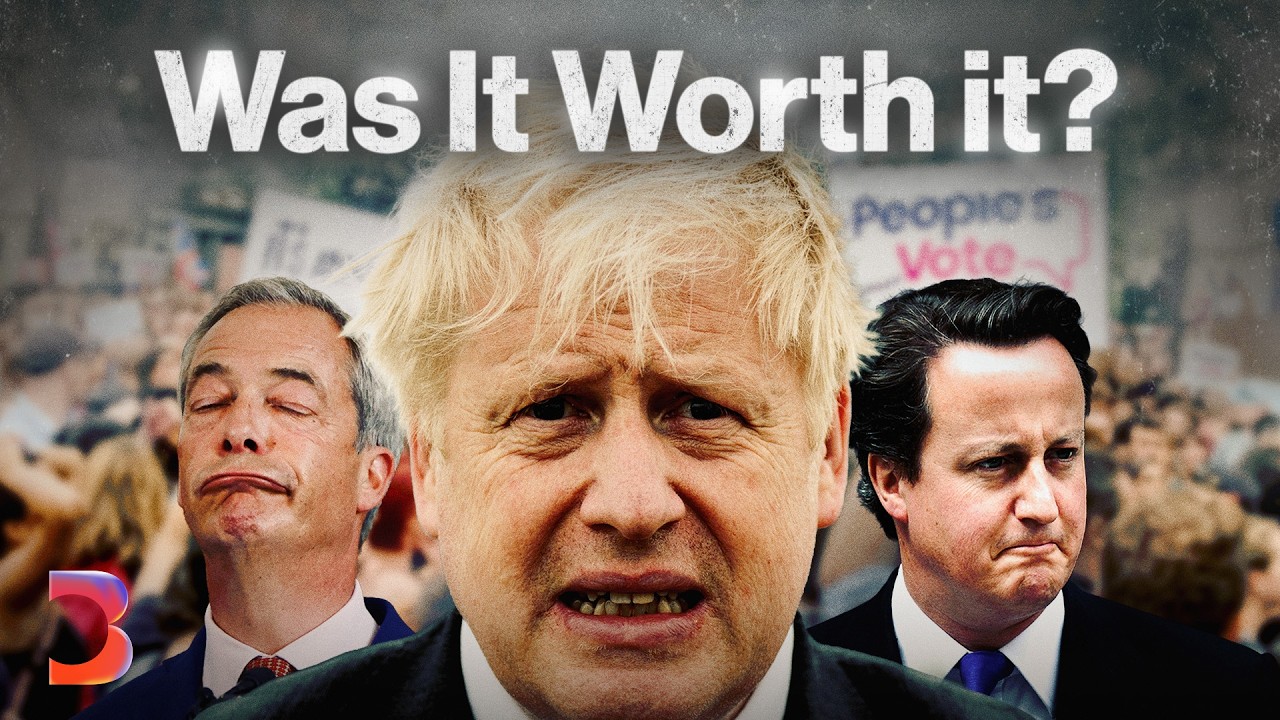
UK-EU Split Shrinks British GDP by Up to 4% a Decade After Vote
Bloomberg Originals
Brexit permanently reduced the UK economy's potential by 2% to 4% of GDP while failing to curb net immigration or resolve domestic political instability.
## Background
Published by Bloomberg Originals on YouTube on June 19, 2026, this video examines the ten-year economic and political fallout of the UK's 2016 vote to leave the European Union. Featuring host-led commentary and Bloomberg Economics modeling, the report analyzes the financial drag of Brexit, the political chaos it triggered, and how it transformed politics globally.
## TL;DR
A decade after the historic 52% to 48% referendum vote, Brexit stands as a pivotal moment that reshaped global politics, catalyzed a wave of populism, and caused severe parliamentary paralysis across five successive UK prime ministers. While initial fears of an immediate financial collapse proved overly apocalyptic, economic modeling shows Brexit created a permanent drag of 2% to 4% on UK GDP, even as specific sectors like AI tech and derivatives trading adapted. Despite public frustration over rising net migration and a growing majority supporting rejoining the EU, deep political divides and friction on both sides render closer European alignment a complex, ongoing dilemma.
## Atmosphere & style
The video carries a sober, analytical, and retrospective atmosphere, balancing high-stakes political drama with cool-headed economic assessment. Cinematic visuals and expert insights create an eerie reflection on a historic crisis, tracing a clear emotional arc from the initial shock of election night through years of chaotic paralysis to a pragmatic, quiet reckoning with long-term consequences. Listening to the piece feels like attending a measured post-mortem on a seismic event, offering a compelling mix of gravitas, political disappointment, and hard financial truth.
## Key takeaways
- [00:00](https://www.youtube.com/watch?v=d6gyCyPwRZo&t=0s) On June 23, 2016, over 33 million UK voters decided to leave the European Union by a 52% to 48% margin, ending nearly half a century of formal UK alignment with European structures.
- [02:43](https://www.youtube.com/watch?v=d6gyCyPwRZo&t=163s) The referendum result triggered an immediate economic and political shock, leading to a sharp drop in the British pound and the prompt resignation of Prime Minister David Cameron.
- [05:06](https://www.youtube.com/watch?v=d6gyCyPwRZo&t=306s) The Leave movement reflected a deep disconnect between the winners and losers of globalization, but lacked a unified vision, resulting in a 'blind Brexit' divided between protectionist 'Little England' and market-driven 'Global Britain' goals.
- [06:43](https://www.youtube.com/watch?v=d6gyCyPwRZo&t=403s) Bloomberg Economics modeling indicates that Brexit resulted in a realistic net GDP drag of 2% to 4% after adjusting for distortionary outliers like Ireland and structural advantages in the US.
- [09:15](https://www.youtube.com/watch?v=d6gyCyPwRZo&t=555s) Despite overall macroeconomic drag, specific UK sectors like artificial intelligence venture capital and London financial services demonstrated resilience and agility post-exit.
- [10:11](https://www.youtube.com/watch?v=d6gyCyPwRZo&t=611s) The vote caused severe domestic political instability, leading to parliamentary paralysis, public disillusionment, and a rapid succession of five prime ministers.
- [12:52](https://www.youtube.com/watch?v=d6gyCyPwRZo&t=772s) Post-Brexit immigration policies failed to satisfy Leave voters; while EU immigration dropped, non-EU migration and small boat cross-Channel arrivals surged, causing widespread voter frustration.
- [15:27](https://www.youtube.com/watch?v=d6gyCyPwRZo&t=927s) Brexit served as an early catalyst for a global wave of populist, nationalist politics and shifted international dynamics toward competing trade blocs.
- [15:27](https://www.youtube.com/watch?v=d6gyCyPwRZo&t=927s) Public sentiment shifted over time toward rejoining the EU, prompting successive prime ministers to pursue incremental realignment with Brussels despite political obstacles.
- [18:26](https://www.youtube.com/watch?v=d6gyCyPwRZo&t=1106s) Efforts toward closer UK-EU alignment face ongoing friction from British resistance to accepting EU rules and European reluctance to compromise.
- [19:26](https://www.youtube.com/watch?v=d6gyCyPwRZo&t=1166s) The ultimate takeaway from Brexit for economists and leaders is that macroeconomic metrics alone cannot satisfy a populace that feels left behind by the establishment.
## Detailed walkthrough
Here is the detailed walkthrough of Part 1 of the transcript.
---
[00:00](https://www.youtube.com/watch?v=d6gyCyPwRZo&t=0s) Introduction and the Global Weight of June 23
There are rare days that alter the trajectory of global history, and June 23, 2016, was undeniably one of them. What began as a promised "in/out referendum" by David Cameron quickly dominated headlines worldwide, triggering intense debate across Britain. People across the political spectrum recognized that history was unfolding before their eyes, reflecting a widespread breakdown of trust in the establishment. "People want to take their country back," a sentiment that transcended British borders and exposed passions felt across the Western world.
Reflecting on the vote ten years later, commentators describe Brexit as both a historic "once-in-a-lifetime moment" and "manifestly an act of economic self-harm." However, voters did not head to the polling stations with economics textbooks in hand. For many Brexiteers, the primary issue was cultural identity. They felt a cosmopolitan elite had spent decades trying to redefine Britain as a multicultural, multiracial society, and their vote was a firm declaration that Britain remained a specific nation with distinct historic roots. When over 33 million ballots were cast, the 52% to 48% outcome in favor of leaving the European Union sent shockwaves around the globe, shifting international dynamics from an era of seamless globalization toward a fragmented world.
- **Voter turnout & margin:** Over 33 million people voted, resulting in a 52% "Leave" vs. 48% "Remain" split.
- **Historical context:** The vote put an end to nearly half a century (almost 50 years) of formal UK alignment with European trade, laws, and political structures.
- **Global sentiment:** The result served as an early warning signal of a broader populist turn across Western democracies, coinciding with political movements led by figures like Donald Trump in the US, Marine Le Pen in France, and Jeremy Corbyn in the UK.
---
[02:43](https://www.youtube.com/watch?v=d6gyCyPwRZo&t=163s) The Vote and Initial Market Shock
The morning of June 24, 2016, caught financial markets, politicians, and the public completely unprepared. Commentators recall the eerie mix of shock and disbelief as early results rolled in. Financial traders sat at their desks watching the British pound plummet in real time as every major industry sector traded heavily in the red. The "smart money" had overwhelmingly bet on a Remain victory, making the sudden reality of Brexit a crushing surprise. Prime Minister David Cameron promptly resigned, stating he could not be "the captain that steers our country to its next destination."
Across the English Channel, European leaders were stunned. Some initially believed the result would have to be re-run given the narrow margin, with European officials calling it a "damn bad day for Europe." Virtually every major economic expert had warned the British electorate that leaving the EU would inflict severe financial pain, yet millions voted to leave anyway. The lead-up to the vote had been bitterly aggressive, marked by immense tension and the tragic murder of MP Jo Cox in her constituency, underscoring the feverish state of British politics.
- **Immediate financial fallout:** The British pound suffered a massive drop on election night, and major stock indexes experienced widespread sell-offs.
- **Political casualties:** Prime Minister David Cameron announced his resignation immediately following the Leave victory.
- **Political violence:** The murder of Labour MP Jo Cox during the campaign highlighted the intense emotional and political friction surrounding the referendum.
---
[05:06](https://www.youtube.com/watch?v=d6gyCyPwRZo&t=306s) Motivations and Competing Visions of Leave
At the heart of the Leave campaign was a profound disconnect between the winners and losers of the modern globalized economy. Advocates for leaving argued that cosmopolitan elites failed to grasp what working-class families lost when stable, long-term manufacturing jobs disappeared. However, while the Leave camp won the vote, there was no unified plan for what exiting the EU actually meant in practice, resulting in what analysts term a "blind Brexit."
The Leave coalition was deeply fractured, united only by their opposition to the status quo. Broadly, two competing visions emerged:
1. **The "Little England" Vision:** A protectionist, isolationist view focused on retreating from global institutions, rebuilding domestic borders, restricting immigration, and redirecting money back into national services like the NHS.
2. **The "Global Britain" Vision:** An outward-looking, free-market view that saw Brexit as an opportunity for the UK to shed European bureaucracy and become an independent trading superpower on the world stage.
Shortly before polling day, during a live BBC debate, Boris Johnson declared that referendum day could be Britain's "Independence Day," causing half the auditorium to erupt in applause and signaling the intense grassroots momentum behind the Leave movement.
---
[06:43](https://www.youtube.com/watch?v=d6gyCyPwRZo&t=403s) Bloomberg Economics Modeling: Calculating the Real Cost
In the immediate aftermath of the vote, the UK economy proved surprisingly resilient, defying initial predictions of an instant housing market collapse or immediate financial catastrophe. British consumers simply continued spending. However, disentangling the long-term economic impact of Brexit from subsequent global shocks—such as the COVID-19 pandemic, the 2022 energy crisis, and domestic policy shifts—requires sophisticated economic modeling.
Bloomberg Economics evaluated the actual cost by comparing the UK's GDP trajectory against a synthetic counterfactual model built from 23 OECD nations with similar historical economic profiles:
```
[Raw Model Hit] ---> ~10% GDP Loss (~£300 Billion)
│
├── Subtract Ireland (distorted by tech/pharma multinationals)
│ └─ Redefines hit to ~6%
│
└── Adjust for US Outperformance (no 2022 energy shock, heavy AI & fiscal stimulus)
└─ Real Brexit Impact: 2% to 4% GDP Loss
```
- **Unadjusted Counterfactual:** Comparing the UK directly to top-performing OECD models initially suggested a staggering 10% hit to GDP, equivalent to **£300 billion** in a £3 trillion economy.
- **Removing Distortionary Outliers:** Stripping out Ireland—whose GDP numbers are heavily skewed by foreign multinational accounting—reduces the calculated impact to **6%**.
- **Adjusting for US Structural Advantages:** Accounting for the US economy's unique strengths (domestic energy independence, massive COVID-19 fiscal stimulus, and booming AI investments) narrows the realistic net impact of Brexit to between **2% and 4% of GDP**.
While far lower than the apocalyptic 10% figure, a 2% to 4% permanent drag on economic output remains a substantial loss to the UK economy.
---
[09:15](https://www.youtube.com/watch?v=d6gyCyPwRZo&t=555s) The Economic Upside and Pockets of Success
Despite the broader GDP drag, experts emphasize that leaving the EU was not a total economic negative. Certain sectors of the UK economy adapted effectively and even capitalized on regulatory independence:
- **Artificial Intelligence & Tech:** Free from the EU's stricter regulatory framework, the UK maintained its position as Europe's premier destination for venture capital funding, creating a more agile environment for AI technology startups.
- **Financial Services & London's City:** Financial services performed significantly better than physical goods exports. London retained its role as a leading global hub for euro-denominated derivative trading and fund management, with a substantial portion of EU-based investment funds continuing to be managed out of London.
- **International Diplomacy:** Outside the EU bloc, the UK exercised greater flexibility in fostering bilateral relationships, such as maintaining strong diplomatic ties with US administrations.
---
[10:11](https://www.youtube.com/watch?v=d6gyCyPwRZo&t=611s) Political Instability and the Fracturing of Westminster
While the economic drag was gradual, the political fallout was immediate and chaotic. Parliament degenerated into years of fierce internal warfare, paralyzing government function and causing public trust in Westminster to collapse. The political landscape shattered, cycling through five prime ministers in quick succession:
1. **David Cameron:** Resigned immediately after losing the 2016 referendum.
2. **Theresa May:** Resigned after failing to pass her negotiated Brexit withdrawal agreement through a fractured Parliament.
3. **Boris Johnson:** Delivered a hard Brexit deal but was ousted following internal party scandals.
4. **Liz Truss:** Resigned after brief market turmoil during her short-lived premiership.
5. **Rishi Sunak:** Led the country through post-Brexit implementation before suffering electoral defeat.
This prolonged turmoil fundamentally redivided British politics along new ideological lines, replacing traditional party loyalties with a multi-party landscape. Public attention was diverted away from core economic priorities like dismal productivity growth, tax structure reform, social care, and high energy costs, leading to widespread voter disillusionment.
---
[12:52](https://www.youtube.com/watch?v=d6gyCyPwRZo&t=772s) The Immigration Debate and the Border Dilemma
A primary driver of the 2016 Leave campaign was the desire to control national borders and reduce net migration, which had reached historic highs in the decade leading up to the vote. Proponents promised that restricting foreign labor would boost domestic wages and open opportunities for local workers in left-behind regions.
However, post-Brexit policy outcomes diverged sharply from those voter expectations:
- **Shift in Origins:** While immigration from EU nations plummeted following the end of free movement, non-EU immigration surged significantly higher as the government issued visas to address acute labor shortages in healthcare, agriculture, and service sectors after the pandemic.
- **Small Boat Crossings:** Cross-Channel arrivals on small boats became a prominent national political issue, symbolizing for many voters that the government had failed to "take back control."
- **Voter Disillusionment:** Rather than resolving the issue, the increase in overall net migration left many Brexit voters feeling betrayed by political leaders who failed to deliver on their central campaign promises.
---
[15:27](https://www.youtube.com/watch?v=d6gyCyPwRZo&t=927s) Global Consequences, Populism, and Future EU Relations
The international legacy of Brexit extends far beyond trade statistics. It served as a global catalyst for a wave of populist and nationalist politics, encouraging a shift away from multilateral alliances toward competing national interests. Instead of a unified Western front, major global powers increasingly operate within distinct, competing trading blocs—the US, the EU, and Asian markets—leaving an independent UK at risk of geopolitical isolation.
In the years following the vote, political dynamics have taken distinct paths:
- **The Rise of Populist Voices:** Figures like Reform UK leader Nigel Farage gained significant momentum by speaking to voter frustration over an "unfinished Brexit," positioning themselves strongly ahead of future elections.
- **Rejoin Sentiment:** Public opinion shifted noticeably over time, with polls indicating that **52% of the British public** would support rejoining the European Union.
- **Incremental Realignment:** Prime ministers Rishi Sunak and Keir Starmer both pursued closer alignment with Brussels through targeted bilateral agreements covering defense, security, cross-border energy, and immigration control.
---
<ElicitationsGroup message="Explore more details from this transcript or related analysis:">
<Elicitation label="Summarize the Bloomberg Economics model methodology" query="Break down the Bloomberg Economics model used to calculate the 2% to 4% GDP hit from Brexit."/>
<Elicitation label="Analyze the impact of Brexit on UK immigration trends" query="Detail the changes in EU vs non-EU migration to the UK following the 2016 Brexit referendum."/>
</ElicitationsGroup>
[18:26](https://www.youtube.com/watch?v=d6gyCyPwRZo&t=1106s) The Reality of Closer EU Alignment and European Hesitation
Attempts to forge a closer yet loose relationship with the European Union may sound attractive on paper, but they run into severe practical roadblocks. Any real push to draw closer to the bloc inevitably collides with two familiar and enduring problems: the UK's fundamental aversion to "being told what to do," and Europe's distinct lack of interest in trying to convince Britain otherwise. While some experts speculate that the UK might eventually settle into a form of "associate membership"—accepting certain rules it might object to in exchange for crucial access to a much larger market—the political appetite on both sides remains fraught.
Furthermore, analysts highlight a tragic irony on the continental side of the equation. Despite losing one of Europe's largest economies over specific, intense grievances regarding the free movement of people, the European Union itself seems to have "not learned anything from it." This mutual rigidity leaves both parties stuck navigating a post-Brexit landscape without having truly addressed the underlying drivers of the schism.
* UK attempts at closer alignment face the double barrier of British resistance to EU rule-taking and European reluctance to compromise.
* Proposed associate membership models would require the UK to accept EU regulations to regain single market access.
* The EU is criticized for failing to internalize or adapt to the core reasons behind Britain's departure, such as free movement.
[19:26](https://www.youtube.com/watch?v=d6gyCyPwRZo&t=1166s) Democracy, Economic Hard Truths, and the Lessons of Brexit
Looking back on the decade since the vote, commentators suggest that the most optimistic interpretation of Brexit is as a testament to the resilience of democracy. The British public voted to execute what was widely understood to be an "act of self-harm," yet the fundamental sanctity of the democratic system remained intact and central to British governance. Over time, this era may be viewed as a painful but necessary period of reshuffled alliances and changing regional relationships.
For economists and policymakers, however, Brexit delivered a profoundly sobering wake-up call. The vote proved that "there's more to life than economics" and exposed the fatal flaw in assuming macro-level prosperity keeps a populace content. When large segments of the population feel left behind by the establishment, they will seize the opportunity to "punish you and they'll punish the system." Ultimately, the overarching lesson is clear: politicians must look beyond old debates and address the root causes of stagnation, because when voters decide to strike back at the status quo, "you won't necessarily get a do-over."
* Brexit served as a stress test for British democracy, proving the political process holds even when executing economic self-harm.
* Economists learned that GDP metrics and macroeconomic performance cannot override widespread feelings of economic abandonment.
* Policy makers are warned that disenfranchised voters will burn down established systems if ignored, leaving behind consequences that cannot easily be undone.
## Notable quotes
> [00:00](https://www.youtube.com/watch?v=d6gyCyPwRZo&t=0s) People want to take their country back
> [00:00](https://www.youtube.com/watch?v=d6gyCyPwRZo&t=0s) once-in-a-lifetime moment
> [00:00](https://www.youtube.com/watch?v=d6gyCyPwRZo&t=0s) manifestly an act of economic self-harm
> [02:43](https://www.youtube.com/watch?v=d6gyCyPwRZo&t=163s) the captain that steers our country to its next destination — David Cameron
> [02:43](https://www.youtube.com/watch?v=d6gyCyPwRZo&t=163s) damn bad day for Europe
> [05:06](https://www.youtube.com/watch?v=d6gyCyPwRZo&t=306s) Independence Day — Boris Johnson
> [12:52](https://www.youtube.com/watch?v=d6gyCyPwRZo&t=772s) take back control — Proponents of Leave
> [18:26](https://www.youtube.com/watch?v=d6gyCyPwRZo&t=1106s) being told what to do
> [18:26](https://www.youtube.com/watch?v=d6gyCyPwRZo&t=1106s) not learned anything from it
> [19:26](https://www.youtube.com/watch?v=d6gyCyPwRZo&t=1166s) there's more to life than economics
> [19:26](https://www.youtube.com/watch?v=d6gyCyPwRZo&t=1166s) punish you and they'll punish the system
> [19:26](https://www.youtube.com/watch?v=d6gyCyPwRZo&t=1166s) you won't necessarily get a do-over
## Mentioned
Brexit, European Union, Bloomberg Originals, Bloomberg Economics, David Cameron, Donald Trump, Marine Le Pen, Jeremy Corbyn, Jo Cox, Boris Johnson, Theresa May, Liz Truss, Rishi Sunak, Keir Starmer, Nigel Farage, Reform UK, Labour Party, NHS, BBC, OECD, Westminster, London, Brussels
The 2016 Brexit referendum was driven less by macroeconomic calculations than by cultural identity and voter backlash against the establishment, ultimately reshaping British governance and global alliances. According to Bloomberg Economics modeling, the decision delivered a permanent drag of 2% to 4% on the UK's gross domestic product while triggering years of political paralysis and unexpected immigration shifts.
Cultural Identity and the Fractured Leave Coalition (5:06)
The 52% to 48% referendum outcome on June 23, 2016, reflected a breakdown of trust in cosmopolitan elites by voters who felt left behind by globalization. Rather than voting on textbook economic theories, many Leave voters sought to assert national identity and take back sovereignty. However, the Leave campaign lacked a unified post-referendum strategy, leading to what analysts describe as a 'blind Brexit.' The movement remained ideologically split between an isolationist, protectionist vision centered on border control and public services, and an outward-looking 'Global Britain' vision seeking deregulation and worldwide free trade.
Quantifying the Net Economic Impact (6:43)
While consumer resilience averted an immediate financial crash, Bloomberg Economics isolated Brexit's structural toll using a synthetic counterfactual of 23 OECD economies. Although a raw comparison indicated a 10% hit—amounting to roughly £300 billion in a £3 trillion economy—adjusting for Ireland's multinational tax distortions reduced the estimate to 6%. Further controlling for distinct US economic advantages, including domestic energy independence, major COVID-19 stimulus, and artificial intelligence capital investment, narrowed the net permanent drag of Brexit to between 2% and 4% of UK GDP.
Despite this aggregate loss, specific sectors adapted successfully. London preserved its role as a global center for euro-denominated derivatives trading and fund management, while the UK's independent regulatory environment helped it retain its status as Europe's primary venture capital hub for artificial intelligence startups.
Westminster Instability and the Migration Paradox (10:11)
Brexit destabilized domestic governance, leading Parliament into years of procedural deadlock and the cycling of five prime ministers—David Cameron, Theresa May, Boris Johnson, Liz Truss, and Rishi Sunak. This prolonged friction diverted state capacity away from structural domestic issues, including sluggish productivity growth, social care, and energy costs, while fracturing conventional party lines.
Border policy also diverged sharply from campaign promises. While ending free movement caused migration from EU countries to plummet, non-EU immigration rose substantially as the government granted visas to alleviate post-pandemic labor shortages in healthcare, agriculture, and services. Together with a rise in cross-Channel small boat arrivals, these trends left many Leave voters disillusioned by what they viewed as a failure to deliver on the core promise of reduced migration.
Geopolitical Isolation and Roadblocks to European Realignment (15:27)
Internationally, Brexit functioned as a catalyst for Western populist movements and accelerated the fragmentation of global commerce into competing regional blocs—primarily the US, the EU, and Asia—leaving an unaligned UK vulnerable to geopolitical isolation. Domestically, public sentiment shifted, with polling showing 52% in favor of rejoining the EU, while figures like Nigel Farage capitalized on frustration over an 'unfinished Brexit.'
Subsequent governments under Sunak and Keir Starmer initiated pragmatic, piecemeal coordination with Brussels across defense, energy, and border security. However, deeper reintegration or associate membership faces structural barriers: the British political resistance to accepting EU rules without representation, and a parallel European reluctance to compromise single market principles or re-evaluate the free movement terms that originally motivated the British exit.
The overarching takeaway of Brexit for policymakers is that macroeconomic growth metrics cannot appease populations that feel economically and culturally abandoned. While the vote demonstrated the resilience of democratic institutions in executing a difficult mandate, it also proved that when voters strike out against the status quo, the political and structural consequences cannot easily be undone.
## Background
该视频由 Bloomberg Originals 于 2026 年 6 月 21 日发布在 YouTube 平台。视频简介指出,在 2016 年 6 月英国公投脱欧十年后,彭博通过经济学建模和政治分析,系统复盘了脱欧对英国经济造成的真实损失,以及它在英国内外引爆的民粹主义浪潮与地缘政治动荡。
## TL;DR
节目回顾了 2016 年英国脱欧公投这一撕裂西方秩序的历史转折点,揭示了全球化落后群体对建制派精英的强烈反抗。彭博经济学通过反事实合成控制模型估算,脱欧导致英国实际 GDP 遭受了 2% 至 4% 的永久性净损失,戳破了所谓“黄金地平线”的政治幻象。同时,脱欧非但未能兑现控制移民的承诺,反而引发了连续五任首相更迭的严重宪政动荡,并使英国沦为各大经贸集团边缘的孤岛。如今英国政坛陷入重新入欧与法拉奇代表的激进民粹之间的二次撕裂,为现代民主治理留下了沉重代价与警示。
## Atmosphere & style
全片充斥着一种冷静严谨却又难掩哀伤与反思的厚重历史质感。彭博专业的数据建模图表与威斯敏斯特议会失控咆哮、英吉利海峡偷渡船只等极具冲击力的真实画面交织在一起,节奏紧凑而直击痛点。叙事基调既有洞察宏观经济钝痛的理性与克制,又深刻传递出底层选民因被背叛而滋生的愤怒与挫败感,令观众深切感受到一种身处历史死结中的荒谬与无奈。
## Bulletin
- [06:43](https://www.youtube.com/watch?v=d6gyCyPwRZo&t=403s) 彭博经济学建模测算显示,在剥离爱尔兰税收失真与美国特殊利好后,脱欧对英国经济造成的真实净损失在 2% 至 4% 的 GDP 之间,构成长期的永久性产出削减。
- [10:51](https://www.youtube.com/watch?v=d6gyCyPwRZo&t=651s) 脱欧引发了空前的宪政危机与治理瘫痪,在数年内导致五任首相相继垮台,彻底打破英国传统政党格局并使威斯敏斯特精英信誉崩塌。
- [12:50](https://www.youtube.com/watch?v=d6gyCyPwRZo&t=770s) 移民承诺陷入严重悖论:虽然欧盟劳工大幅锐减,但填补劳动力短缺使非欧盟移民激增,总移民规模不降反升,激化了脱欧派选民遭背叛的幻灭感。
- [15:27](https://www.youtube.com/watch?v=d6gyCyPwRZo&t=927s) 在全球经济加速向欧盟、美国与亚洲三大超级贸易集团分化的背景下,英国丧失了大西洋战略桥梁地位,国际舞台话语权面临显著边缘化。
- [16:57](https://www.youtube.com/watch?v=d6gyCyPwRZo&t=1017s) 政治反弹并未走向妥协,反而在挫败中倒向更激进的民粹叙事,推动脱欧主推手法拉奇成为首相热门,而主张重新入欧的民调支持率也回升至 52%。
## Key takeaways
- [00:00](https://www.youtube.com/watch?v=d6gyCyPwRZo&t=0s) 2016 年 6 月英国以 52% 对 48% 的公投结果决议脱离欧盟,根本原因在于公众对既得利益建制派与大都会精英的不信任,标志着民众夺回文化认同与国家主权的强烈诉求。
- [02:42](https://www.youtube.com/watch?v=d6gyCyPwRZo&t=162s) 脱欧结果击碎了民调与金融资本对留欧的笃信,英镑暴跌伴随市场全线受挫,卡梅伦引咎辞职,成为全球化系统仪表盘上亮起的一记严峻警报。
- [04:31](https://www.youtube.com/watch?v=d6gyCyPwRZo&t=271s) 公投辩论极度撕裂,工党议员遇害事件印证了政治极化,其实质是全球化“赢家”与制造业凋零地区“输家”之间断层式脱节所引发的深层愤怒。
- [04:31](https://www.youtube.com/watch?v=d6gyCyPwRZo&t=271s) 脱欧是一场未明确替代方案的“盲目脱欧”,主张切断移民的本土孤立派与追求自由贸易的“全球化英国派”在愿景上存在无法调和的内部分裂。
- [06:43](https://www.youtube.com/watch?v=d6gyCyPwRZo&t=403s) 彭博经济学通过合成控制法建模,剔除外部特殊变量后,估算英国经济因脱欧遭受了 2% 至 4% 的实际 GDP 永久性净损失。
- [09:15](https://www.youtube.com/watch?v=d6gyCyPwRZo&t=555s) 宏观受损的同时存在局部韧性,伦敦金融城凭借风投聚集度、资管操盘和欧元衍生品交易守住了核心枢纽地位,英国在 AI 监管上也展现了一定灵活性。
- [10:51](https://www.youtube.com/watch?v=d6gyCyPwRZo&t=651s) 长期政治动荡和首相走马灯式的更迭使议会陷入瘫痪,国家深陷脱欧衍生内耗,无力聚焦极低生产率、能源与社会照护等长期发展顽疾。
- [12:50](https://www.youtube.com/watch?v=d6gyCyPwRZo&t=770s) “夺回边境控制”的承诺遭遇现实反噬,疫情后对非欧盟劳动力的依赖使移民总量反而大幅激增,英吉利海峡偷渡现象加剧了选民的背叛感与挫败情绪。
- [15:27](https://www.youtube.com/watch?v=d6gyCyPwRZo&t=927s) 脱欧在全球推倒了民粹多米诺骨牌,重塑了更碎片化、贸易壁垒化的世界,英国陷入单打独斗的孤岛状态,对美战略价值和多边舞台声量显著衰落。
- [16:57](https://www.youtube.com/watch?v=d6gyCyPwRZo&t=1017s) 民粹治理困局并未促使大众反思理性妥协,反而催生了“愤怒政治学”,促使英国改革党领袖法拉奇崛起为下届首相的热门竞争者。
- [18:20](https://www.youtube.com/watch?v=d6gyCyPwRZo&t=1100s) 虽然 52% 的民众倾向重新入欧,历任首相也在防务与经贸上寻求务实合作,但英国对外部监管的反感与欧盟的固步自封让折中方案阻碍重重。
- [18:20](https://www.youtube.com/watch?v=d6gyCyPwRZo&t=1100s) 脱欧是现代民主制度承受的一场极端压力测试,它沉痛揭示出:经济理性并非一切,一旦体制遗弃了边缘群体,选民必将借由选票对统治秩序施加不可逆的报复惩罚。
## Detailed walkthrough
### [00:00](https://www.youtube.com/watch?v=d6gyCyPwRZo&t=0s) 改变世界的转折点与被撕裂的英国
历史上有某些日子彻底改变了世界格局,2016 年 6 月 23 日的英国脱欧公投便是其中之一。英国民众在去留之间做出了最终抉择,这一事件不仅主导了当时的新闻头条,更演变为现代政治中最具分裂性的议题之一。这不仅是一场令人目瞪口呆的历史现场,更标志着公众对既得利益建制派的深刻不信任。脱欧从根本上重塑了政治运作方式,其影响远远溢出了英伦三岛;选民渴望“夺回国家控制权”的情感不仅存在于英国,更是全球多地共通的心声。
对许多人而言,脱欧是一生仅见的历史性转折,但从纯经济角度来看,这显然带有“经济自残”的意味。然而,并非所有选民(以及被带去投票站的宠物犬)都会手捧经济学教科书走进投票站。对庞大的脱欧支持者群体来说,经济利益从来就不是核心关切。长期以来,大都会精英试图将英国重新定义为一个多元文化、多族裔的现代社会,而脱欧派则坚定地说了“不”。他们坚信英国人拥有独特的历史根基、独特的文化认同,必须将属于自己的国家夺回。
在 2016 年 6 月 23 日这天,超过 3300 万英国民众投下了选票,亲手改写了近半个世纪以来塑造英国法律、贸易与政治形态的英欧关系。计票结果最终定格在 52% 赞成脱离对 48% 赞成留欧,脱欧派欢呼迎来了属于英国的“独立日”。回望过去,这或许令人震惊,却绝非毫无前兆。这场政治地震在全球范围内引发了剧烈余震,将原本走向紧密相连、以全球化为主导的世界,彻底推向了日益碎片化的阵营。脱欧拉开了一个动荡十年的序幕,令英国、欧洲乃至整个西方世界陷入前所未有的困境。
---
### [02:42](https://www.youtube.com/watch?v=d6gyCyPwRZo&t=162s) 投票日的意外冲击与全球化仪表盘上的警示灯
公投当天的氛围至今让人记忆犹新:有人带着家里的狗去投票站,还戏谑地调侃“狗狗们大多支持脱欧,而我投了留欧”;也有人在清晨被伴侣叫醒,被告知“结果完全出乎意料,必须立刻赶去上班”。当时整个世界陷入震惊,因为无论是民意调查还是“自诩聪明”的金融资本,此前都笃信留欧派将轻松获胜。曾有一篇题为《20% 的世界》(The 20% World)的文章指出,特朗普当选、英国脱欧、科尔宾掌权以及勒庞在法国获胜的概率各自都只有约 20%,但令人难以置信的是,其中两只“黑天鹅”竟然在同一年接连发生。脱欧绝非孤立的英国政治内讧,而是全球化系统仪表盘上亮起的一记刺眼警报。
随着最终计票结果揭晓,金融市场遭遇剧烈冲击。驻守在交易席位上的分析师们眼睁睁看着英镑经历断崖式暴跌,金融市场上所有行业板块全线飘红。时任首相戴维·卡梅伦随即宣布辞职,并坦承“自己不再适合担任带领国家驶向下一航向的船长”。在欧洲大陆,布鲁塞尔的决策者们面面相觑,甚至有人因如此微弱的票差而寄希望于重新公投,欧盟内部哀叹这是“欧洲糟糕透顶的一天”,对英国退出这个大家庭表达了深切的遗憾与痛心。
事实证明,迷信金钱与精英理性的判断遭遇了滑铁卢。几乎所有主流经济学家在公投前都反复警告脱欧将伴随极度痛苦的代价,但千百万民众依然义无反顾地选择了脱离。这表明脱欧早已超越了纯粹的损益计算,成为民众向现有秩序投出的抗议票。
- **公投投票人数**:超过 3,300 万人
- **公投最终结果**:52% 脱欧 vs 48% 留欧
- **政治与市场连锁反应**:卡梅伦宣布辞职;英镑汇率暴跌,各行业资产普遍走低
---
### [04:31](https://www.youtube.com/watch?v=d6gyCyPwRZo&t=271s) 选民撕裂、愤怒政治与盲目的脱欧蓝图
公投前的竞选阶段异常激烈甚至充满火药味,工党留欧派议员乔·考克斯(Jo Cox)在选区惨遭杀害的惨剧,成为了当时英国政治陷入狂躁与极化状态的血腥注脚。选民爆发出的愤怒,与当时英欧关系的实际现状显得极不成比例——毕竟英国并未加入欧元区(非财政联盟),也未卷入欧洲共同防卫(非军事联盟)。这场大辩论的核心,本质上是全球化经济中“赢家”与“输家”之间的断层式脱节。身处繁荣大都市的既得利益者,根本无法体会制造业凋零地区的工人承受了多么沉重的失去,也无法理解当一份稳定的工厂工作消失时,普通家庭所面临的安全感崩塌。
在公投前夕 BBC 举办的大型直播辩论中,全场聚集着政治立场各异的普通民众。当鲍里斯·约翰逊高呼“这个星期四将成为我们国家的独立日”时,现场半数观众瞬间爆发出山崩海啸般的狂热欢呼。这一幕让现场的主持人真切感受到,脱欧浪潮在民间蓄积的能量有多么庞大与顽固。
然而,脱欧从一开始就埋下了一个致命缺陷:这是一种“盲目脱欧”(blind Brexit)。人们投票反对欧洲的现状,清楚地表达了“想要离开”,但选票上从未写明“脱欧之后替代方案究竟是什么”。脱欧阵营内部派系林立、各怀鬼胎:
1. **“小英格兰”本土派**:主张退回到霍比特人式的与世隔绝世界,切断移民涌入,将省下的资金注入英国国家医疗服务体系(NHS)。
2. **“全球化英国”派**:主张摆脱布鲁塞尔的繁文缛节,建立外向型的全球自由贸易强国。
这种愿景上的根本撕裂,为后来的政治乱局埋下了祸根。
---
### [06:43](https://www.youtube.com/watch?v=d6gyCyPwRZo&t=403s) 彭博经济学建模:脱欧究竟让英国损失了多少?
公投过去十年后,人们终于能够拉开距离,去严谨评估脱欧带来的真实代价。出人意料的是,公投刚结束时英国经济展现出了远超预期的韧性,此前所谓“房地产市场立刻崩溃、经济末日降临”的灾难预言并未应验,作为支柱的国内消费者依然在消费。但要从之后错综复杂的大环境中剥离出脱欧的独立影响却极其困难,因为英国在此后连续遭遇了新冠疫情大流行、乌克兰危机引发的能源危机,以及被批评为“发达国家中最昂贵”的本土能源政策等一系列外部冲击。
为了厘清事实,彭博经济学(Bloomberg Economics)采用合成控制法进行反向推演:研究团队从 23 个经合组织(OECD)国家中筛选出历史上与英国经济轨迹最为吻合的国家作为对照基准,以此模拟出“如果英国留在欧盟内原本应有的经济表现”,并与实际 GDP 走势进行对比。
```mermaid
flowchart TD
accTitle: 彭博经济学脱欧损失建模推演流程
accDescr: 展示从最初 10% 的推导缺口,经过去除爱尔兰与美国特殊因素调整,最终得出英国 GDP 净损失在 2% 至 4% 的推演过程。
subgraph RAW["初始对比模型"]
A["23个OECD国家基准模型<br/>(模拟英国留欧GDP)"] --> B["初始GDP差距:-10%<br/>(相当于约3000亿英镑)"]
end
subgraph ADJ["外部扭曲因素剥离"]
B --> C["排除爱尔兰跨国公司账面失真<br/>损失缺口降至 -6%"]
C --> D["排除美国特殊因素<br/>(无能源危机/大规模财政刺激/AI浪潮)"]
end
subgraph FINAL["最终脱欧冲击估算"]
D --> E["英国实际GDP净损失:2% 至 4%"]
end
```
初始模型推演显示,英国实际 GDP 与模拟留欧状态存在高达 10% 的落差。以英国约 3 万亿英镑的经济体量计算,这一损失高达 3000 亿英镑。然而,进一步深挖数据可以发现,这一巨大鸿沟主要受到美国和爱尔兰超常增长的拉动:
- **排除爱尔兰**:爱尔兰的 GDP 数据因跨国科技和医药巨头的总部税收运作而严重失真,剔除爱尔兰后,经济差距收窄至 6%。
- **调整美国因素**:美国在差距中占了大约 4 个百分点,但这很大程度上与脱欧无关——美国在 2022 年未遭受直接的能源断供危机,同时享受了巨额财政刺激方案以及由生成式 AI 引发的庞大资本支出热潮。
扣除这些无关变量后,模型最终估算脱欧对英国经济造成的真实净损失在 **2% 至 4% 的 GDP 之间**。尽管这远低于最初夸大的 10%,但在任何宏观经济度量下,2% 到 4% 的永久性产出削减依然是一记极为沉重的经济钝痛,几乎没有人能在此基础上得出脱欧促进了英国整体经济增长的正面结论。
---
### [09:15](https://www.youtube.com/watch?v=d6gyCyPwRZo&t=555s) 局部的经济红利与随之而来的政治混乱
尽管宏观层面遭受拖累,但若武断地将脱欧定性为“百害而无一利”同样有失公允。在某些特定细分领域,英国脱离欧盟后获得了独特优势:在人工智能(AI)监管方面,相比于让美国科技巨头心存顾忌的欧盟严苛法规,英国相对灵活的监管环境释放出一定红利;在外交与双边博弈中,英国在特定时刻展现了与特朗普等政治人物周旋的灵活性。更为显著的是伦敦的金融服务业,其表现远优于饱受海关边境壁垒折磨的实体商品出口:
- 英国依然是欧洲规模庞大的风险投资(VC)聚集中心;
- 相当大比例的欧盟注册投资基金依然由伦敦的资产管理经理实际操盘;
- 伦敦牢牢守住了其作为全球欧元衍生品交易核心枢纽的主导地位。
然而,经济层面的慢性失血与随后英国政治体制爆发的全面癫狂相比,甚至显得像是一场“附带插曲”。脱欧释放出极其惊人的政治内耗,议会内部跨党派攻伐连年不断,会场内充斥着“这个议会简直是国之耻辱”、“看在上帝的份上,首相你辞职吧”等失控的咆哮,反对派议员愤怒指责政府推行极端口径的脱欧方案毫无民意授权。
在脱欧公投后的短短几年内,唐宁街 10 号走马灯般换了五位首相。始作俑者戴维·卡梅伦在公投失利后当即甩手辞职,甚至未曾尝试去收拾残局,将英国推入了一场旷日持久的宪政危机与治理瘫痪之中。
### [10:51](https://www.youtube.com/watch?v=d6gyCyPwRZo&t=651s) 政治动荡与威斯敏斯特的信誉崩塌
脱欧程序启动后,英国政坛陷入了前所未有的剧烈震荡之中。接二连三的首相在脱欧泥潭中折戟沉沙:特蕾莎·梅(Theresa May)竭尽全力试图落实脱欧协议未果,最终饮恨辞职;随后的鲍里斯·约翰逊(Boris Johnson)虽完成了立法脱欧,却同样在混乱与丑闻中被迫辞职;接任的丽兹·特拉斯(Liz Truss)仅执政40余天便匆匆下台;而里希·苏纳克(Rishi Sunak)最终在惨淡的大选中被选民抛弃。脱欧彻底打破了英国传统的政治光谱,沿着全新的阵营断层重塑了权力格局,对两大传统政党——尤其是保守党——造成了难以弥合的重创。
选民格局的碎片化清晰地反映在民调数据中。若将2016年公投时的选民意向与当下的意向图表对比,整个选民结构的饼图变得“明显更加五彩斑斓”——这或许对图表设计师是个好消息,但对下议院的议员们而言却是一场噩梦。一位受访选民感慨自己在这场混乱中仿佛只是“大棋局中的一颗棋子”("a pawn in a big game of chess")。这场阵营裂变直接将英国推入了一个多党竞争更为激烈的政治时代。
脱欧遗留下来的裂痕至今仍在主导英国政治的分野,并直接催生了社会停滞与普遍的民怨。长期坐在威斯敏斯特执掌国家命运的政治精英们,不得不面对自身信誉极度萎缩、政策腾挪空间急剧收窄的严峻现实。整个国家深陷在脱欧衍生事务的泥沼中,丧失了聚焦真正核心议题的能力:英国长期萎靡不振的极低生产率、亟待改革的税收与能源机制、用工与雇佣成本困境,以及摇摇欲坠的社会照护体系。正如观察人士所指出的,过去数年乃至整个脱欧历程带来的最大教训便是——“经济学并不是唯一重要的事情”("economics is not the only thing that matters")。
### [12:50](https://www.youtube.com/watch?v=d6gyCyPwRZo&t=770s) 移民悖论:被打破的承诺与幻灭感
脱欧运动曾经充斥着无边无际的宏大政治承诺,描绘出投票离开欧盟后等待着英国的“黄金地平线”("golden horizons"),声称英国必将达成一份“全新且更优越的协议”("a new deal, a better deal")。然而对于绝大多数民众来说,这些繁荣幻象从未兑现。事实上,脱欧投票在很大程度上是由移民激增的社会现实所催动的——在公投前的十年间,涌入英国的移民人数持续攀升,并在投票前夕达到了历史峰值。当时政客们反复向大众承诺必将控制住边境与移民规模,甚至高喊“受够了就是受够了”("Enough is enough"),却一次又一次在行动上食言。
广大脱欧选民当初满心期待的是移民数量的实质性削减,寄望于移民减少能够改善那些被全球化遗忘的“落后地区”(left-behind areas)的就业前景与工资待遇。然而,脱欧后的现实却极具讽刺意味:英国不仅没有减少移民,反而迎来了移民总量的“大规模激增”(massive increase)。尽管移民来源地的结构发生了剧烈变化——来自欧盟国家的劳工人潮大幅萎缩,但来自非欧盟国家的移民涌入量却急剧飙升。这种局面的出现有着极现实的经济驱动:约翰逊内阁急于填补新冠疫情后英国劳动力市场出现的巨大空缺,只能大开非欧盟劳工的大门。
近年来,乘坐小型船只横渡英吉利海峡偷渡(small boat arrivals)的画面,演变成了脱欧时代最刺眼的标志性符号,让无数选民更加坚信国家根本没有“夺回控制权”。脱欧由此变成了一个恶性自我强化的政治怪圈:随着实际移民人数的进一步攀升,投下脱欧赞成票的民众感到自己遭到了彻底的背叛与欺骗;领导人当初开出宏大空头支票,事后却大多弃船而去未能贯彻到底,最终在整个社会中释放了滔天的幻灭感与挫败情绪。
```mermaid
flowchart TD
accTitle: 脱欧移民悖论循环
accDescr: 展示脱欧承诺控制移民与实际非欧盟劳工激增之间的矛盾循环
subgraph Promise["政治承诺"]
A["诉求夺回边境控制权<br/>减少移民与改善落后地区薪资"]
end
subgraph Reality["现实执行困境"]
B["英国脱离欧盟单一市场"] --> C["欧盟劳工锐减与疫情后劳工短缺"]
C --> D["政策被迫转向开放非欧盟移民"]
D --> E["偷渡小船激增成为失控象征"]
end
subgraph Backlash["政治反噬与循环"]
F["脱欧选民深感背叛与欺骗"] --> G["加剧对建制派愤怒并倒向极端民粹"]
end
A --> B
E --> F
```
### [15:27](https://www.youtube.com/watch?v=d6gyCyPwRZo&t=927s) 民粹海啸与地缘政治孤立
脱欧原本被包装成关于“夺回控制权”、赢得“经济繁荣”以及为国家医疗服务体系(NHS)注入巨额资金的美好承诺——在英国,这些核心理念的地位几乎与红茶、王室和挂在嘴边的道歉文化一样不可撼动。然而,如今冷酷的数据证明,所有这些许诺的结果都令人极其失望。加之新冠大流行、地缘战争以及能源危机的接连冲击,民众内心的怨怼与挫败感被全面放大:每个人都切身感受到,周遭的一切都比过去变得“糟糕得多,也狭隘得多”。
脱欧绝非仅仅是英国自顾自的国内政治事件,它产生了极其深远的外交与地缘政治后果。它宛如在全世界范围内推倒了多米诺骨牌,引爆了一场席卷全球的民粹主义革命。随着脱欧撕裂西方旧秩序,一个更加民族主义化的世界降临:美国开始向孤立与内向的政治方向摇摆,欧洲各国也在各自的利益诉求下拉扯,竞争性的民族主义被猛烈推向前台。曾经西方世界紧密团结以应对重大地缘危机(最典型的莫过于应对乌克兰危机)的联盟模式,如今甚至出现了倒退迹象。欧美若能同心协力,其力量令任何对手不敢轻视;但当双方各奔东西、步调混乱时,整体威慑力便大打折扣。
脱欧释放出的力量重塑了一个更加碎片化、且由超级贸易集团分割的世界。全球经济日益向三大核心集团靠拢:欧盟、美国,以及正在崛起的亚洲经贸圈。英国脱离欧盟后,直接沦为悬浮在三大集团边缘的孤岛。英国在国际舞台上的话语权断崖式下跌:对于美国而言,它不再需要将英国当作切入欧洲、对布鲁塞尔施加影响的战略跳板,华盛顿与英国对话的动力显著减弱;即便在联合国等国际组织内部,各方对英国的重视程度也大不如前。
- **脱欧承诺三大幻灭支柱**:重获主权控制、实现经济繁荣、向国家医疗服务体系(NHS)注入充沛资金,实际成效均极具落差。
- **全球战略格局洗牌**:全球加速重组成由欧盟、美国与亚洲主导的大型贸易壁垒集团,英国陷入单打独斗的孤立境地。
- **大西洋同盟关系弱化**:英国丧失了作为欧美沟通桥梁的特殊地缘价值,在联合国等全球舞台上的外交声量显著边缘化。
### [16:57](https://www.youtube.com/watch?v=d6gyCyPwRZo&t=1017s) 愤怒政治学与法拉奇的崛起
西方各国的政治博弈自公投以来呈现出愈发浓烈的情感化与极端化色彩,充斥着愤怒与对抗,成为纯粹“诉诸于心胸而非大脑”的宣泄。政治叙事不再建立在政策可行性与理性论辩之上,而是彻底被对“愤怒与不公”的呐喊所绑架,大众纷纷起来抗议他们自己往往也无法完全理解的现代世界变局。
这种被激化的怒火遵循着一种奇异而病态的逻辑,正如诗人所言,民众在失落中反而渴求“更疯狂的音乐与更烈的酒”("to demand madder music and stronger wine")。面对民粹主义带来的治理恶果与挫折,选民们并没有反思民粹主义的错误、转而寻求务实妥协,反而更加激进地要求政客用更强硬的手段去实现那些本不可能兑现的幻象。在英国,大肆兜售“遭遇背叛”叙事与宣称“脱欧大业未竟”的政治人物迅速收获了庞大的选民拥趸。一手促成脱欧的关键推手、英国改革党(Reform UK)领袖奈杰尔·法拉奇(Nigel Farage),如今已一跃成为下届英国首相的热门候选人之一,彻底撼动了英国现有的政党格局。
法拉奇势力的逼近,同样刺激了政治光谱另一端的反对力量向反方向猛烈反弹。要求“重新加入欧盟”(Rejoin)的声浪持续高涨,最新民调显示,已有高达52%的英国公众支持重返欧盟大家庭。在过去四年里,历任英国首相(从苏纳克到基尔·斯塔默 Keir Starmer)都在低调而艰难地试图修复与布鲁塞尔的关系,尝试在国防、安全、移民管控以及经贸等至关重要的核心领域与欧盟达成局部务实合作协议。
### [18:20](https://www.youtube.com/watch?v=d6gyCyPwRZo&t=1100s) 妥协困境、历史教训与民主代价
尽管各方都倾向于设想某种“建立更紧密但仍保持适度距离”的英欧折中文案,并将其视为解决脱欧僵局的完美灵药,但这种设想在现实中并不具备真正的可行性。英国任何重新靠拢欧盟的尝试,都会立刻撞上两堵熟悉的制度高墙:英国人在骨子里依然极度反感“被外部势力指手画脚”,而海峡对岸的欧盟也完全没有兴趣或耐心再去说服英国回心转意。
英国最终最可能走向的归宿,或许是某种形式的“欧盟准成员国地位”(associate membership)。这种模式意味着英国必须捏着鼻子接受一系列它内心可能抵触的欧盟法规监管,但作为妥协的报偿,它能重新接入体量庞大的欧洲单一市场,这对英欧双方而言都是务实的止血方案。然而,脱欧的另一重悲剧性在于欧盟自身——尽管目睹了欧洲最大的经济体之一仅仅因为人员自由流动等核心关切便决绝离去,布鲁塞尔的高官与建制派们似乎依然固步自封,未曾从中反思并吸取任何深刻的制度教训。
从最积极乐观的维度审视,脱欧堪称现代民主制度的一场极端“压力测试”:一个主权国家的公民通过投票集体选择了一项世人皆知的“自残行为”(an act of self-harm),但即使面临灾难性后果,国家的核心机器运转中依然没有出现推翻民主投票结果的逆流,民主程序始终是英国政治运转最核心的根基。也许岁月流逝后,历史会将其解读为国家与区域间重塑同盟关系的必要阵痛。
然而,摆在英国眼前的现实要求它必须彻底放下对脱欧问题的无休止争论,转而把精力聚焦在真正阻碍国家发展的核心顽疾上。脱欧给经济学家和决策者们留下了刻骨铭心的沉痛启示:生活绝不仅由经济理性和冰冷数据所决定;哪怕决策者自认为宏观经济运作良好、民众衣食无忧,可一旦在发展中遗弃了相当一部分边缘群体,他们只要一获得机会,就必将用选票狠狠惩罚统治体系和掌权者——而且在这个残酷的历史转折点上,系统“未必能拥有重来一次的机会”("you won't necessarily get a do-over")。
## Notable quotes
> [00:00](https://www.youtube.com/watch?v=d6gyCyPwRZo&t=0s) 夺回国家控制权
> [02:42](https://www.youtube.com/watch?v=d6gyCyPwRZo&t=162s) 自己不再适合担任带领国家驶向下一航向的船长 — 戴维·卡梅伦
> [04:31](https://www.youtube.com/watch?v=d6gyCyPwRZo&t=271s) 这个星期四将成为我们国家的独立日 — 鲍里斯·约翰逊
> [09:15](https://www.youtube.com/watch?v=d6gyCyPwRZo&t=555s) 这个议会简直是国之耻辱
> [09:15](https://www.youtube.com/watch?v=d6gyCyPwRZo&t=555s) 看在上帝的份上,首相你辞职吧
> [10:51](https://www.youtube.com/watch?v=d6gyCyPwRZo&t=651s) a pawn in a big game of chess
> [10:51](https://www.youtube.com/watch?v=d6gyCyPwRZo&t=651s) economics is not the only thing that matters
> [12:50](https://www.youtube.com/watch?v=d6gyCyPwRZo&t=770s) Enough is enough
> [16:57](https://www.youtube.com/watch?v=d6gyCyPwRZo&t=1017s) to demand madder music and stronger wine
> [18:20](https://www.youtube.com/watch?v=d6gyCyPwRZo&t=1100s) you won't necessarily get a do-over
## Mentioned
彭博经济学, 欧盟, 戴维·卡梅伦, 特蕾莎·梅, 鲍里斯·约翰逊, 丽兹·特拉斯, 里希·苏纳克, 基尔·斯塔默, 奈杰尔·法拉奇, 唐纳德·特朗普, 乔·考克斯, 英国国家医疗服务体系(NHS), 英国改革党, 经合组织(OECD), 联合国, BBC
## Video description
In June 2016, the UK voted to leave the European Union. Ten years later, Bloomberg Originals unpacks the economic cost of Brexit and the political forces it unleashed.
The Brexit vote sparked a surge in populism and triggered years of parliamentary deadlock that crippled a series of prime ministers. We examine the factors that drove the Leave vote, and how it changed politics both in the UK and around the world. We also use Bloomberg Economics modeling to analyze its impact on the UK economy. The conventional wisdom has always been that Britain’s exit would be a financial calamity. We do the math to see whether that’s true.
Far from settling the issue for a generation, Brexit continues to loom large over British politics, with the matter of Britain’s relationship with the EU still high on the domestic agenda. Meanwhile, with the US under Donald Trump retreating from old alliances, Britain and its European allies are confronting their most challenging geopolitical moment since the end of the Cold War.
Indeed, in the years since leaving the EU, successive UK prime ministers have sought closer alignment with Brussels. Some recent polling even suggests a growing majority of the British public would now vote to rejoin the bloc. Any attempts to do so would be met by fierce resistance, however, with one of the foremost architects of Brexit, Reform UK leader Nigel Farage, now a favorite to become the country’s next prime minister.
Explore these and other related stories in more depth on Bloomberg.com:
The Day That Changed the World
https://www.bloomberg.com/news/features/2026-05-29/how-britain-europe-and-the-west-were-changed-by-brexit
What Reversing Brexit Would Mean for the UK Economy
https://www.bloomberg.com/news/features/2026-06-09/what-rolling-back-brexit-vote-would-mean-for-the-uk-economy
00:00: Introduction
02:38: Title Card
02:43: The Vote
03:34 Market Reaction and Initial Shock
04:31 Campaign Tensions
05:06 Motivations for Brexit
06:02 Competing Visions of Leave
06:43 Bloomberg Economics Modeling
09:15 The Economic Upside?
10:11 Political Instability
12:52 The Immigration Debate
15:27 Global Consequences and Rise of Populism
16:57 The Politics of Anger
17:34 Future Possibilities and EU Relations
19:13 Conclusion: Lessons and Legacy
#Brexit #UK #Politics
--------
Like this video? Subscribe: http://www.youtube.com/Bloomberg?sub_confirmation=1
Get unlimited access to Bloomberg.com for just $1.99 your first month: https://www.bloomberg.com/subscriptions?in_source=YoutubeOriginals
Bloomberg Originals offers bold takes for curious minds on today’s biggest topics. Hosted by experts covering stories you haven’t seen and viewpoints you haven’t heard, you’ll discover cinematic, data-led shows that investigate the intersection of business and culture. Exploring every angle of climate change, technology, finance, sports and beyond, Bloomberg Originals is business as you’ve never seen it.
Subscribe for business news, but not as you've known it: exclusive interviews, fascinating profiles, data-driven analysis, and the latest in tech innovation from around the world.
Visit our partner channel Bloomberg News for global news and insight in an instant.
[Source](https://www.youtube.com/watch?v=d6gyCyPwRZo)
Source quotes
[0:00] 夺回国家控制权
[2:42] 戴维·卡梅伦: 自己不再适合担任带领国家驶向下一航向的船长
[4:31] 鲍里斯·约翰逊: 这个星期四将成为我们国家的独立日
[9:15] 这个议会简直是国之耻辱
[9:15] 看在上帝的份上,首相你辞职吧
[10:51] a pawn in a big game of chess
[10:51] economics is not the only thing that matters
[12:50] Enough is enough
[16:57] to demand madder music and stronger wine
[18:20] you won't necessarily get a do-over
Source quotes
[0:00] People want to take their country back
[0:00] once-in-a-lifetime moment
[0:00] manifestly an act of economic self-harm
[2:43] David Cameron: the captain that steers our country to its next destination
[2:43] damn bad day for Europe
[5:06] Boris Johnson: Independence Day
[12:52] Proponents of Leave: take back control
[18:26] being told what to do
[18:26] not learned anything from it
[19:26] there's more to life than economics
[19:26] punish you and they'll punish the system
[19:26] you won't necessarily get a do-over
Original transcript
[0:00] There were certain days
that changed the world.
[0:07] Brexit was one of those days.
[0:09] British people will have the final say,
[0:12] in an in/out referendum.
[0:13] Watch out. Here we go.
[0:14] One story dominates the news
today, and it is Brexit.
[0:18] Brexit, Brexit, Brexit, Brexit.
[0:19] What has been one of
the most divisive votes.
[0:22] It was staggering.
History unfolding before our very eyes.
[0:27] The population at large doesn't
trust the establishment.
[0:30] The pasty of independence.
[0:32] Brexit changed the way
that politics is done,
[0:35] not only in the UK but beyond that too.
[0:38] People want to take their country back.
[0:40] Passions that are not unique
to Britain.
[0:44] It was a real once in a lifetime moment.
[0:47] But also sort of manifestly
an act of economic self-harm.
[0:51] Thing is, not everyone
[0:53] and their dog arrived
at the polling station
[0:55] with an economics
textbook in hand or paw.
[0:58] It's not even the main
thing that mattered to a lot
[1:00] of people who voted to leave.
[1:02] A cosmopolitan elite had been
trying to redefine Britain
[1:05] as a multicultural, multiracial,
multi-ethnic society
[1:10] and the Brexiteers said 'no'.
[1:12] We are a particular people, a product
[1:15] of a particular history
with a particular set
[1:18] of roots.
[1:19] We need our country back.
[1:20] And so on the 23rd of June 2016,
[1:23] more than 33 million people
cast ballots on a relationship
[1:26] that had shaped Britain's laws, trade
[1:28] and politics for almost half a century.
[1:31] 'Yes' is now showing 67%.
[1:33] The British people have spoken
and the answer is 'we're out'.
[1:37] By margin of 52 to 48,
[1:39] they said Britain should
exit the European Union
[1:42] This is our Independence Day.
[1:45] It might have felt shocking,
[1:47] but it wasn't quite as
surprising as I think a lot
[1:49] of people look back and say that it was.
[1:52] But it was a political
earthquake whose aftershocks were
[1:55] felt around the globe.
[1:57] It shifted the world
from a world which seemed
[2:00] to be getting ever closer in
which globalization was the
[2:03] dominant theme into a world
[2:05] that was becoming ever
more fragmented.
[2:07] Brexit has ushered in a decade
which has left Britain
[2:11] Europe, the West, in a worse
[2:14] shape than it started it.
[2:15] The issue is, would it have
done much better without it?
[2:20] And it is possible to work that out.
[2:23] To understand what happened,
[2:24] we can compare it with
a model of what didn't.
[2:28] This is that story, why
Brexit emerged, what it cost
[2:33] and what might come next.
[2:42] I remember the day when
we voted on Brexit.
[2:45] I took my dogs for a walk
to the local voting booth.
[2:49] The dogs I think were pro-Brexit.
[2:50] Dogs tend to be pro-
Brexit. I was anti-Brexit.
[2:53] Do you want me to say that I voted leave?
[2:55] Because I did.
[2:56] The main thing I remember from
the actual day was being woken
[2:58] up by my husband very early and him
saying, you've got to go to work
[3:02] because the result isn't
quite what we expected.
[3:04] Phenomenal events taking place here.
[3:06] No one expected this result.
Everyone is stunned.
[3:09] I'd written an essay called The 20% World,
[3:12] which pointed out
[3:13] that if the odds on Trump
being elected on Brexit,
[3:17] on Corbyn being elected
[3:18] and Le Pen being elected
in France, they were all
[3:21] around 20%.
[3:22] What was staggering was that two
[3:24] of them were going to happen in one year.
[3:26] Brexit was not just a British upset,
[3:29] it was an early warning
light on the dashboard
[3:32] of globalization.
[3:33] When the results came in, there was shock.
[3:37] People were not expecting this,
[3:39] the markets weren't expecting this.
[3:40] The smart money thought
that it was Remain.
[3:42] I was sat at my desk,
watching the pound plummet
[3:46] as the results rolled in.
[3:47] The pound has taken a thumping.
[3:49] Every single industry group is
trading in the red.
[3:51] I realized that we were at the beginning
[3:54] of a very profound historical change.
[3:56] I do not think it would
be right for me to try
[3:59] to be the captain that steers our country
[4:02] to its next destination.
[4:03] There were some in the European Union
[4:05] who looked at a result like that
[4:07] and thought, surely this
is gonna have to be rerun.
[4:09] It's such a narrow margin of victory.
[4:11] I quote, 'damn a bad day for Europe'.
[4:14] The UK is no more part of the
club. I regret that very much.
[4:18] People said that the money was smart,
[4:19] the money wasn't smart.
[4:21] Virtually every economic
expert told the British people
[4:26] that this would be a
very painful thing to do,
[4:28] and yet people still voted for that.
[4:31] The campaigns and the run up
[4:32] to the vote were were
unexpectedly aggressive.
[4:34] I really remember when the
MP Jo Cox was murdered in
[4:38] her constituency.
[4:39] It felt symptomatic of the
febrile state of UK politics.
[4:44] May we and the generations of members
[4:46] that follow us in this
house honor Jo's memory.
[4:56] The fury seemed out of all proportion
to what our relationship
[5:00] with the EU actually was.
[5:02] And it was not a fiscal union,
it was not a military union.
[5:06] At the heart of the Brexit
debate was a disconnect
[5:08] between the winners and the
losers of the global economy.
[5:12] The winners didn't understand
how much the losers had lost
[5:16] and they didn't get any sense of
[5:18] what you lose when you lose
a stable manufacturing job.
[5:22] We all come to work to be better
off for your family, don't you?
[5:24] Now, I'm not sure if I've
got that stability anymore.
[5:28] A few days before the vote,
[5:29] there was a big broadcast
audience event on the BBC.
[5:33] I was part of the presenting
team, surrounded by people
[5:36] who I didn't know which way
they were going to vote,
[5:39] and there was a moment
when Boris Johnson said,
[5:42] I believe that this Thursday can be our
[5:45] country's Independence Day.
[5:49] And I saw and felt half of
the room erupt around me,
[5:54] and it was really then that I realised
[5:56] how strong the sentiment
to leave the EU was.
[6:02] But there was a snag.
[6:06] We voted to leave, but we didn't know
[6:08] what voting to leave meant.
[6:09] It was a sort of blind Brexit.
[6:11] People voted saying they didn't like
[6:13] the status quo of the Europe.
[6:14] They wanted to go out, but
they never got a vote on
[6:17] what the alternative was.
[6:18] The leave groups were
disparate, not connected,
[6:22] and in many cases looking
for different things.
[6:25] One vision of the future was a sort
[6:26] of little England vision.
[6:27] We'd retreat to a sort of hobbit world.
[6:30] We had a group of people
who thought this would be a
[6:32] chance to pump more money
into the NHS, put up walls
[6:36] to immigrants and so on and so on.
[6:38] Another view of Brexit was that
we would be a global power.
[6:43] 10 years later, we can begin to assess
[6:46] what actually happened and
compare it to what didn't.
[6:50] Don't worry, that'll
make sense in a minute.
[6:52] The economy immediately
[6:53] after the Brexit vote was much more
[6:55] resilient than people expected.
[6:57] We were told that the housing
market would collapse,
[6:59] that there would be
apocalyptic consequences
[7:01] for the economy,
[7:02] But actually consumers
who are the biggest parts
[7:04] of the UK economy, continue to spend.
[7:07] You can argue about the
economic effects relentlessly.
[7:09] Well, that is a relief
since we're about to.
[7:11] But it's complicated.
[7:14] And the reason for that
is that you've had a lot
[7:16] of economic shocks hit the UK since then.
[7:18] The pandemic, the energy crisis...
[7:21] Various government policies
that have also been very bad
[7:24] for the economy in
particular are energy policy.
[7:27] It's impossible to say
[7:28] that having the most expensive
energy in the developed world
[7:31] hasn't made a significant difference.
[7:33] So disentangling the Brexit
effects from all those other
[7:36] effects is really, really difficult,
[7:38] But perhaps not
impossible. And here's how.
[7:43] What we've done is bring together a sample
[7:44] of 23 OECD countries
[7:46] and pick out the economies
most similar historically
[7:49] to the UK, and use those
countries as a guide for
[7:52] how the UK might have
been expected to perform-
[7:55] Had it remained in the EU
[7:56] that is. And that's
what you're seeing here,
[7:58] the red line being the UK's
actual GDP, the white one,
[8:02] what our model initially
suggests it could have been.
[8:05] And what we see is a
10% hit to the economy.
[8:09] Which for the UK's three
trillion pound economy means
[8:13] 300 billion pounds.
[8:15] So clearly that's pretty massive.
[8:17] But if you look beneath the
hood, it shows that most
[8:19] of it is driven by the
performance of the US
[8:22] and Irish economies.
[8:23] Now the latter's GDP is heavily
impacted by the activity
[8:27] of multinational companies,
[8:28] so there's a case for removing it.
[8:30] So if we exclude Ireland,
we reduce the hit to 6%.
[8:33] And then there's the question
about the US economy.
[8:35] It accounts for about four
percentage points of the total
[8:38] gap, but a lot of that is
nothing to do with Brexit.
[8:41] The US didn't experience
an energy shock in 2022.
[8:44] It also benefited from
significant fiscal stimulus
[8:47] and AI investment.
[8:49] And so if we adjust for all that too?
[8:51] We get down to a number between two
[8:53] and four percent of GDP, which we think
is a reasonable estimate
[8:56] for the hit to the economy.
[8:58] This figure is far away from
the initial 10% calculation,
[9:02] which we've shown to be too great,
[9:04] but even so, two to four
percent is still a hit.
[9:09] No matter which way you cut
it, it's quite hard to come up
[9:11] with a positive number
for the impact of Brexit.
[9:16] It would be very foolish to say
[9:18] that leaving the EU had been
an absolute negative, just
[9:22] as it would be very foolish
to say that being a member
[9:24] of the EU had been an absolute positive.
[9:27] On all the things to do with AI,
[9:30] Britain has probably benefited
a little bit by being
[9:32] outside the European Union, which most
[9:34] of the tech giants in America
are slightly scared of.
[9:38] And of different days of the week,
[9:40] Britain's been quite good at
getting on with Donald Trump.
[9:43] Financial services in particular
have done pretty well in
[9:46] the years since we left the EU.
[9:49] Much better than goods
exports, for example.
[9:52] We're a massive
destination for VC funding.
[9:54] A large number of the investment funds
[9:57] that are based in the EU
are run out of London.
[9:59] We're a massive center for
derivative trading in the Euro.
[10:02] But there's no denying it,
[10:03] Brexit did put us on a
different trajectory.
[10:06] There was some real economic impacts
[10:08] and potentially some much
larger political ones
[10:14] The most surprising thing
that happened is the degree
[10:18] of political chaos
[10:20] it has unleashed.
This Parliament is a disgrace.
[10:26] The political infighting was
extraordinary, cross-party
[10:31] and relentless.
[10:32] For goodness sake Prime Minister,
won't you just go?
[10:35] This government has no mandate
[10:38] for the vicious form of
Brexit it is pursuing.
[10:41] You know, the economic impact,
[10:42] it almost seems like a
sideshow relative to that.
[10:44] We've heard from, I think
it's five prime ministers
[10:47] since Brexit.
[10:48] Cameron didn't try and deliver
Brexit. He simply resigned.
[10:51] Theresa May tried to
deliver it and resigned.
[10:54] Boris Johnson tried to
deliver it and resigned.
[10:57] Liz Truss resigned.
[10:58] And Rishi Sunak was eventually
defeated in the elections.
[11:01] What's interesting about
Brexit is it redivided British
[11:04] politics along completely new lines
[11:07] and it's ended up the two main parties,
[11:10] particularly really the Conservatives
[11:11] being very wounded by it.
[11:13] The fragmentation is
clear when you look at
[11:15] how people said they'd vote in 2016
[11:18] and compare it to how
they said they'd vote
[11:20] this year. The pie has
become notably more colorful.
[11:24] Good news for chart designers, less so
[11:27] for members of Parliament.
[11:33] I feel like a pawn in a big game of chess.
[11:37] Uncover more at bloomberg.com/videos.
[11:43] I think there is a link
between the divisions within
[11:47] and what we see now, an age
[11:50] of greater multi-party politics in the UK.
[11:53] Brexit still governs a lot of the kind
[11:55] of dividing lines in Britain.
[11:57] It has contributed to
the stagnation that leads
[12:01] to popular discontent.
[12:03] Those who had previously been trusted
[12:05] to make decisions sitting in
Westminster, they're learning
[12:09] to live with much reduced credibility
[12:12] and much reduced room for manoeuvre.
[12:14] Is time running out
for you Prime Minister?
[12:17] We lost our ability
[12:18] to focus on the really fundamental
things that matter, how
[12:23] to improve our productivity,
which is dismally low
[12:27] and how to improve the
quality of our government.
[12:30] Our policies around our tax regime
[12:33] and our energy regime,
how we employ people
[12:35] and how we pay to employ
people, our social care.
[12:37] I think one big lesson
of the last few years
[12:40] and indeed the whole Brexit experience is
[12:43] that economics is not the
only thing that matters.
[12:50] Brexit was a big moment
[12:52] for expansive political promises
about the golden horizons
[12:56] that lay beyond the result.
[12:58] We will do a new deal, a better deal,
[13:01] And for many people that
has not been delivered.
[13:05] The Brexit vote was driven to a very,
[13:07] very considerable extent by the fact
[13:09] that immigration was
rising in this country
[13:12] and the fact that the
political elite was constantly
[13:15] promising to control immigration.
[13:17] Enough is enough.
[13:18] And failing to deliver on that promise.
[13:21] In the decade before the
referendum, migration climbed
[13:25] towards record levels reaching a peak
[13:27] just ahead of the vote.
[13:30] What many people thought
when they were voting
[13:32] for Brexit was that there would
be a reduction in numbers.
[13:35] One of the great expectations was
[13:37] that a fall off in immigration
would improve employment
[13:40] prospects and wage prospects in some
[13:42] of the left-behind areas.
[13:43] But of course, what actually
happened there was a massive
[13:46] increase in immigration.
[13:48] That increase is what you are seeing here,
[13:50] but what's important to note is origin.
[13:54] Since 2016, the proportion
[13:56] of those originating from
the EU has decreased,
[13:59] but the number of arrivals from non-EU
[14:02] countries have gone up.
[14:04] They went up for practical reasons
[14:06] because Boris Johnson as
prime minister was desperate
[14:09] to fill a lot of gaps in the labor market
[14:12] that had been left after COVID.
[14:15] In recent years, small boat
arrivals became a defining
[14:18] symbol of the Brexit era,
convincing many voters
[14:21] that the country still
hasn't taken back control.
[14:24] And this is why Brexit has
become this self-reinforcing
[14:28] process because as the number
of immigrants have increased,
[14:31] the people who voted for
Brexit have felt cheated.
[14:35] People were made big promises by leaders
[14:38] who largely did not stay
the course to deliver them,
[14:41] and I think that has had a
widespread impact in unleashing a
[14:46] disillusionment, a frustration.
[14:53] A fuller picture now emerges.
[14:55] Brexit was a promise
of control, prosperity
[14:58] and more money for things like the NHS.
[15:01] Three of Britain's
great pillars after tea,
[15:04] the monarchy and apologizing.
[15:06] I'm so sorry!
[15:07] And so far the data show
the results of that promise
[15:10] to be a bit underwhelming.
[15:12] Meanwhile, pandemics, wars
[15:14] and energy crises exacerbated resentment
[15:16] and frustration that
everything's just a lot worse
[15:20] and a lot smaller than it used to be.
[15:22] And not just in Britain,
[15:24] Brexit was domestic politics
[15:26] with foreign policy consequences.
[15:29] What it did was to set off a
sort of populous revolution
[15:34] that spread around the world.
[15:36] There is a new sheriff in town.
[15:38] We want a piece of ice
for world protection.
[15:41] Because of the world that
Brexit ushered in, a much more
[15:44] nationalistic one
[15:45] and one where America's tried
to go in a different direction
[15:48] and Europe's going in
a different direction,
[15:49] competing nationalisms
are suddenly to the fore.
[15:52] The idea of the West uniting to deal
[15:54] with, most obviously Ukraine,
[15:56] now that has all gone
somewhat into reverse.
[15:59] I've empowered you to be a tough guy
[16:02] and I don't think you'd be a tough guy
[16:04] without the United States.
[16:05] Europe and America together
is a very, very hard thing
[16:09] for anyone to stand up against,
[16:10] but when they're running in different
[16:11] directions, it's not a great look.
[16:14] The forces that Brexit unleashed
created not just a more
[16:17] fragmented world,
[16:18] but a world which is divided
into big trading blocs.
[16:21] The European Union, the United States,
[16:24] and to some extent Asian countries.
[16:27] And that leaves Britain
out isolated on its own.
[16:30] There's less reason to talk
to us if you are the US
[16:32] for example, because we are
not that way into to Europe
[16:36] as a, you know, route
to influencing Europe.
[16:39] There's less reason to pay attention
[16:40] to us in the United Nations.
[16:43] You look at political debate,
it has always been full
[16:46] of emotion, anger,
[16:49] many different things
which really involve the
[16:51] heart more than the brain.
[16:52] I think what's interesting
about politics across much
[16:56] of the West since the vote is
[16:58] that it's become much more
about anger, injustice.
[17:02] People protesting about a world
they often don't understand.
[17:06] And the strange logic of this anger is
[17:09] to demand madder music and stronger wine.
[17:13] So instead of saying, well,
perhaps populism is a mistake,
[17:17] perhaps we ought to be a
little bit more pragmatic.
[17:20] You say, well, let's try harder
[17:23] to deliver these impossible dreams.
[17:26] In Britain, politicians who
speak the language of betrayal
[17:29] and unfinished Brexit business
have found a large audience.
[17:32] A single politician,
Nigel Farage, who had most
[17:36] involvement in making that
Brexit happen is the favourite
[17:40] to win the next election
and be prime minister
[17:42] And that is completely
shaking up British politics.
[17:45] They're an absolute disgrace.
[17:48] The prospect has opponents,
[17:49] therefore pushing ever harder
in the other direction.
[17:52] Some advocate rejoining the EU,
[17:55] something a recent poll suggested 52%
[17:58] of the British public would now support.
[18:01] In the last four years, two
prime ministers, Rishi Sunak
[18:05] and Keir Starmer have sought
to bring the UK closer
[18:09] to the EU with agreements
[18:12] and attempts at agreement
in different areas
[18:14] that really matter.
[18:15] Defence, security, immigration, economics.
[18:20] Many of the easy solutions
to the Brexit problem,
[18:23] which are Britain having a closer
[18:26] but still rather loose relationship
[18:28] with the European Union
seem very attractive,
[18:31] but they're not actually
all that practical.
[18:34] Any move closer to the EU also runs into
[18:37] two familiar problems.
[18:38] Britain still dislikes
being told what to do
[18:45] Careful.
[18:47] And Europe isn't especially keen
[18:48] to start convincing it otherwise.
[18:51] It is time to leave Brexit behind.
[18:53] My guess is that Britain ends
up with some kind of version
[18:56] of an associate membership of the EU
[18:58] and yes, that would involve Britain having
[19:00] to take some rules in a way
that it might object to,
[19:04] but it would give it access
to that much larger market
[19:08] and it would help the
European Union as well.
[19:12] One of the other tragic
consequences of Brexit is
[19:15] the European Union has seen one
[19:18] of the biggest economies in Europe leaving
[19:20] and leaving for very
specific reasons to do
[19:22] with free movement of people
[19:24] and has not learned anything from it.
[19:26] I think the most optimistic version of
[19:28] what you could say is you could say, well,
[19:30] this was a test case for democracy.
[19:32] A country votes to do something
that it knows to be a sort
[19:36] of act of self-harm,
[19:38] and yet still, there is no challenge
[19:41] to the idea of democracy.
[19:42] It's still the core of
everything that Britain does.
[19:46] Perhaps over time we'll be
able to see it as a moment
[19:49] that reshaped alliances and relationships
[19:53] and that that is a necessary
thing for nations and regions
[19:57] over time.
[19:58] The future has to involve
leaving the arguments about
[20:01] Brexit behind
[20:02] and focusing on the things
[20:04] that are really holding the UK back today.
[20:06] I think the big lesson for
economists is that, yeah,
[20:08] there's, there's more
to life than economics.
[20:10] The sort of chastening lesson
for for policy makers was
[20:15] that even when you think
the economy is doing well,
[20:17] you think people are being well served.
[20:19] If you are leaving a
significant chunk behind,
[20:22] given the chance, they will punish you and
[20:24] they'll punish the system
[20:26] and you won't necessarily get a do-over.