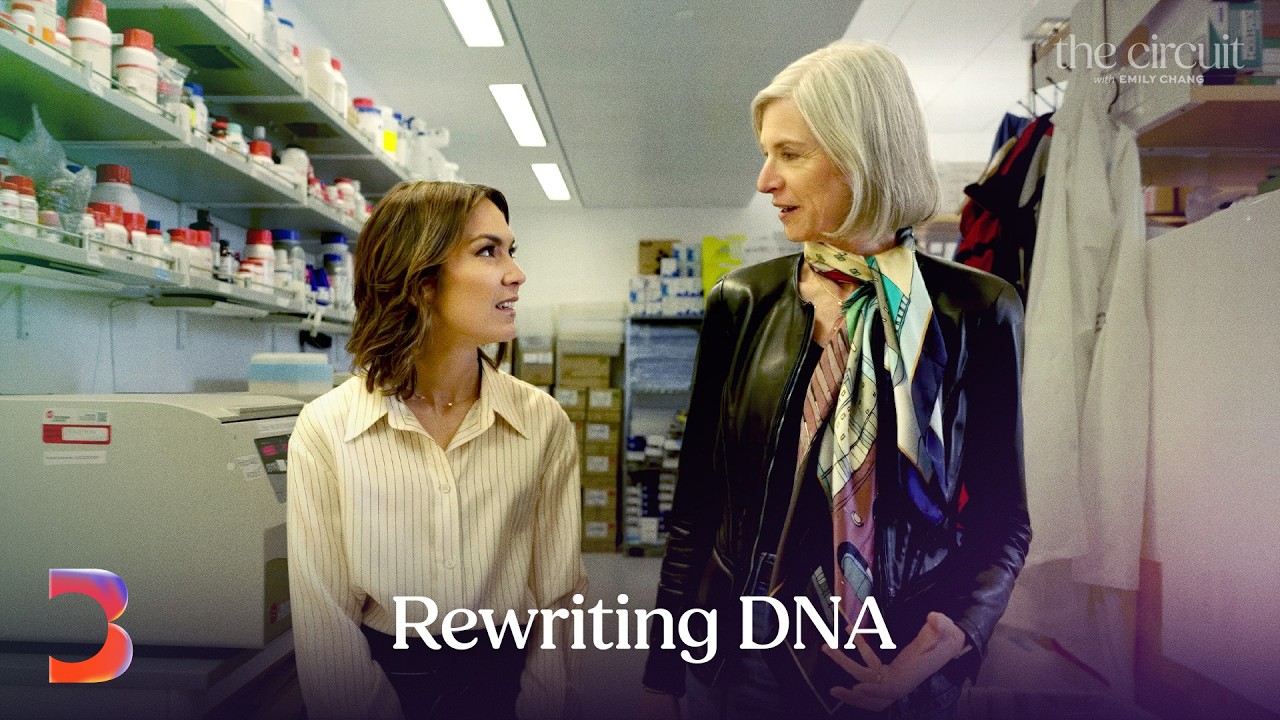
CRISPR Pioneer Doudna Rejects Claims AI Chatbots Will Cure Disease
Bloomberg Originals
Nobel laureate Jennifer Doudna says human biology is too complex for artificial intelligence to model cures without physical lab testing and delivery breakthroughs.
## Background
Published on June 24, 2026, by Bloomberg Originals on YouTube, this episode of *The Circuit* is hosted by high-profile journalist Emily Chang. The video follows Chang as she meets Nobel Prize-winning scientist Jennifer Doudna to discuss the origins of CRISPR, recent gene-editing breakthroughs, and what Silicon Valley misunderstands about the future of AI in biology.
## TL;DR
In this wide-ranging interview, Jennifer Doudna breaks down how CRISPR works and highlights major milestones, including the treatment of sickle cell disease and the first personalized N-of-1 gene therapy for Baby KJ. She firmly pushes back on Silicon Valley AI hype, explaining that biological complexity cannot be solved by chatbots alone and that delivery systems remain the main hurdle for widespread treatments. Doudna also addresses political threats like federal research cuts and anti-vaccine rhetoric while clarifying the biological limits of creating 'designer babies.' Ultimately, she advocates for a balanced approach that prioritizes high-benefit medical therapies over high-risk enhancement.
## Atmosphere & style
The video balances intimate, ground-level intimacy with high-stakes intellectual rigor, opening in the quiet serenity of Doudna’s Berkeley garden before moving into active, high-tech research labs. Chang’s sharp, inquisitive hosting style creates a dynamic rapport with Doudna, who responds with grounded candor, dry wit, and unpretentious humility. The overarching narrative arc shifts from reflective gratitude to urgent warnings about scientific funding and AI overhype, yet concludes on an optimistic, human note about the future of medicine.
## Key takeaways
- [00:02](https://www.youtube.com/watch?v=n-hWHV2ZKOA&t=2s) Jennifer Doudna accepted her Nobel Prize in her Berkeley backyard due to pandemic travel restrictions, an event that shifted her role from a simple researcher to a global ambassador for science.
- [00:53](https://www.youtube.com/watch?v=n-hWHV2ZKOA&t=53s) Science fiction movies and pop culture have fueled public anxiety and hype around genetic editing, contrasting with the real-world scientific process.
- [03:03](https://www.youtube.com/watch?v=n-hWHV2ZKOA&t=183s) Doudna's Innovative Genomics Institute (IGI) acts as both a research hub and startup incubator, spinning out 31 companies valued at $9 billion.
- [03:03](https://www.youtube.com/watch?v=n-hWHV2ZKOA&t=183s) CRISPR was adapted from bacterial immune systems, utilizing guide RNA as a microscopic GPS to direct the Cas9 protein to make precise genetic cuts.
- [06:28](https://www.youtube.com/watch?v=n-hWHV2ZKOA&t=388s) CRISPR treatments have advanced from broad applications like sickle cell disease to Baby KJ, the first patient to receive a fully personalized, N-of-1 gene therapy.
- [09:27](https://www.youtube.com/watch?v=n-hWHV2ZKOA&t=567s) Doudna pushes back on Silicon Valley hype and claims that AI can rapidly cure diseases in 48 hours, emphasizing that human biology is too complex for chatbots to simulate without rigorous physical testing.
- [11:51](https://www.youtube.com/watch?v=n-hWHV2ZKOA&t=711s) The main technical hurdle facing gene editing is moving from expensive ex-vivo cell modifications to efficient in-vivo delivery directly into the patient's body.
- [11:51](https://www.youtube.com/watch?v=n-hWHV2ZKOA&t=711s) Despite genome sequencing milestones, roughly 40% of genes in simple bacterial cells still have unexplained biological functions.
- [14:37](https://www.youtube.com/watch?v=n-hWHV2ZKOA&t=877s) Federal funding cuts and workforce reductions in U.S. research agencies threaten economic growth and risk ceding global biotech leadership to foreign competitors.
- [14:37](https://www.youtube.com/watch?v=n-hWHV2ZKOA&t=877s) Public health policy and medical decisions must be grounded in validated scientific data rather than political ideology or anti-vaccine rhetoric.
- [16:38](https://www.youtube.com/watch?v=n-hWHV2ZKOA&t=998s) China's heavy state investments and streamlined regulatory processes have positioned it to potentially lead the biotech sector, following past controversies like the 2018 gene-edited babies.
- [18:30](https://www.youtube.com/watch?v=n-hWHV2ZKOA&t=1110s) Promises of selecting or editing embryos for complex human traits like intelligence are unrealistic because polygenic traits involve thousands of poorly understood interacting genes.
- [20:41](https://www.youtube.com/watch?v=n-hWHV2ZKOA&t=1241s) Society must categorize CRISPR applications into distinct buckets: high-benefit therapeutic treatments for severe diseases versus high-risk genetic enhancements.
- [21:49](https://www.youtube.com/watch?v=n-hWHV2ZKOA&t=1309s) Despite the heavy weight of acting as biotech's moral compass, Doudna remains optimistic that CRISPR will safely drive major medical breakthroughs.
## Detailed walkthrough
Here is a detailed, faithful walkthrough of Part 1 of the transcript.
---
[00:02](https://www.youtube.com/watch?v=n-hWHV2ZKOA&t=2s) Winning the Nobel Prize in a Garden and the Weight of Responsibility
The walkthrough opens at Nobel Laureate Jennifer Doudna's home in Berkeley, California, right where her scientific journey reached its highest recognition. Standing in her backyard, host Emily Chang notes that this exact spot is where Doudna physically accepted her Nobel Prize. Doudna recalls the extraordinary circumstances of receiving the award at the height of the COVID-19 pandemic. Because travel to the traditional ceremony in Stockholm, Sweden, was impossible, the Nobel Committee arranged to ship the medal and deliver it to her directly in her garden.
When asked whether waking up the next morning felt like the world had opened up or if it brought a crushing weight of responsibility, Doudna candidly admits it was completely overwhelming. She reflects that she entered science with simple, modest goals—hoping merely to land a job one day—never anticipating top international honors. Following the announcement, her husband pointed out that her primary role was now serving as an "ambassador for science," leaving her to figure out how to carry such a massive title.
- **Location of acceptance:** Doudna’s backyard garden in Berkeley, California, substituted for Stockholm, Sweden, due to pandemic restrictions.
- **Personal motivation:** Doudna emphasizes that she entered scientific research aiming for employment rather than accolades.
- **Key quotation:** "My husband said to me, well, now your main job is being an ambassador for science. And I thought, how do I do that?"
---
[00:53](https://www.youtube.com/watch?v=n-hWHV2ZKOA&t=53s) CRISPR’s Promise, Pop Culture Myths, and Hilo Roots
Being the public face of a scientific revolution brings intense pressure, even for a biology icon who helped turn CRISPR into a groundbreaking gene-editing tool. CRISPR technology is currently being applied to solve issues ranging from genetic diseases to climate change, spawning dozens of spin-off companies in the process. However, the technology faces critics who claim it hasn't lived up to its initial hype, alongside lingering ethical concerns and pop-culture depictions in movies like *Blade Runner* and *Gattaca* ("More human than human is our motto," "my real resume was in my cells") that haven't helped public relations.
To separate fact from fiction in both gene editing and the broader AI race, Chang visits Doudna at her garden and lab. Doudna describes her garden as her primary place to refresh her mind. Even routine tasks like pulling weeds reconnect her to nature. She trace her scientific curiosity back to her childhood in rainy Hilo, Hawaii, where her family moved when she was seven. Growing up without any scientists in her family, she found herself captivated by the island's natural environment, constantly wondering how different species of plants and animals adapted and thrived.
- **Cultural context:** Science fiction movies have shaped public anxiety around genetic alteration.
- **Childhood origin:** Raised in Hilo, Hawaii, with no family background in science; sparked by island biodiversity.
- **Daily routine:** Doudna uses gardening as a mental break from running labs and advising startups.
---
[03:03](https://www.youtube.com/watch?v=n-hWHV2ZKOA&t=183s) Inside the Innovative Genomics Institute and the Mechanics of CRISPR
Doudna leads a tour inside the Innovative Genomics Institute (IGI), a research hub she founded that functions as part breakthrough laboratory and part startup incubator. Stepping onto the lab floor still gives her chills, recalling the sense of wonder she felt visiting a lab for the very first time. Chang points out a fun coincidence: Doudna's last name literally spells out "Do u DNA," which Doudna jokes made working on genetics her undeniable fate. Inside IGI, teams conduct fundamental research into the ancestral origins of CRISPR in bacteria while empowering young trainees to pitch novel ideas. For example, a lab researcher recently discovered a method to extend CRISPR's editing efficiency in a mouse model by accelerating the speed at which CRISPR molecules edit target cells.
Doudna and Chang break down how CRISPR actually works in nature. The mechanism was discovered by Doudna and her collaborator Emmanuelle Charpentier through their study of bacterial immune systems:
1. **Viral Attack:** When a virus attacks a bacterium, the bacterium stores a fragment of the viral DNA.
2. **Guide RNA:** The stored snippet is converted into guide RNA, which acts like a microscopic genetic GPS.
3. **Cas9 Scissors:** If the virus attacks again, the Cas9 protein attaches to the guide RNA, tracks down the target viral sequence, and cuts it.
4. **The Breakthrough:** Doudna and Charpentier realized this guide RNA could be reprogrammed to target and cut genomic sequences in non-bacterial organisms, including human cells.
- **IGI Economic Impact:** Spun out 31 companies with a cumulative valuation of $9 billion, creating over 2,500 jobs (primarily in California).
- **Early CRISPR Journey:** Doudna focused heavily on RNA at Harvard and Yale before turning her attention to CRISPR research at UC Berkeley in 2006, describing the early days as feeling like a late-night "detective story."
Doudna discusses what keeps her motivated, pointing to Victoria Gray—the first patient in the United States treated with CRISPR for sickle cell disease. Hearing directly from patients and parents who send photos of their sick children creates a profound sense of urgency. Doudna feels this urgency every single day because of the wide gap that still exists between basic laboratory discoveries and getting real therapies to patients.
While treatments like Victoria Gray's target broad patient populations sharing a single disease, a landmark milestone occurred in 2025 at the Children's Hospital of Philadelphia with an infant known as Baby KJ. Born with a severe urea cycle disorder that prevented his body from breaking down protein—causing toxic ammonia build-up that threatened his brain—Baby KJ became the first human to receive a fully personalized, N-of-1 CRISPR gene therapy. After doctors initially doubted he would survive to his first birthday, Baby KJ is now crawling, walking, and climbing.
- **Baby KJ's Treatment Cost:** Approximately $800,000, funded via public research grants, academic collaborations, and philanthropy.
- **Doudna's Vision:** Transition away from multi-million-dollar custom efforts toward a streamlined, low-cost pipeline that quickly diagnoses rare genetic conditions, manufactures custom CRISPR treatments, tests them safely, and delivers them directly to patients.
---
[09:27](https://www.youtube.com/watch?v=n-hWHV2ZKOA&t=567s) Debunking AI Hype in Biology and Silicon Valley Promises
Silicon Valley leaders have argued that artificial intelligence will rapidly transform medicine, with OpenAI executives noting heavy ChatGPT health queries and tech leaders like Larry Ellison predicting AI could cure cancer within a 48-hour window. Doudna pushes back firmly on these claims, remarking "Biology's hard, that's all." She stresses that human biology is far too complex to simply simulate our way to cures without rigorous physical testing. While AI can improve discovery efficiency when trained on quality data, LLMs and chatbots are not currently innovating.
When Chang asks about an OpenAI executive's suggestion that AI companies should receive a cut of sales for drugs discovered via chatbots, Doudna dryly responds, "Good luck." She highlights that while chatbots excel at summarizing data and writing reports, true scientific innovation remains in the hands of human beings. Even when asked about post-AGI (Artificial General Intelligence) possibilities, Doudna notes she is not holding her breath.
- **Data Limitations:** AI effectiveness in biology is strictly bottlenecked by the need for better, higher-quality training data.
- **On 48-Hour Cancer Cures:** Doudna states she would be overjoyed if true, but sees zero evidence supporting such claims right now.
- **Key quotation:** "I'm not seeing chatbots in our own experience innovating... I'm not seeing chatbots coming up with a brand new idea for something that nobody else ever thought of."
---
[11:51](https://www.youtube.com/watch?v=n-hWHV2ZKOA&t=711s) Overcoming Delivery Hurdles and the Future Horizon for Gene Editing
Addressing why CRISPR hasn't yielded widespread miracle cures yet, Doudna explains that science follows a natural cycle of intense excitement followed by practical implementation challenges. To highlight biology's vast complexity, she points out that despite the Human Genome Project being completed around the year 2000—26 years ago—scientists still do not understand the exact function of roughly 40% of the genes in a basic bacterial cell.
The main technical limitation facing CRISPR today is delivery. Most current treatments are *ex-vivo* (removing cells from the patient, editing them in the laboratory, and transplanting them back), which is incredibly complex, expensive, and taxing on the patient. The future of the field relies on developing *in-vivo* therapeutics—delivering CRISPR molecules directly into the patient's bloodstream or tissues so they target specific cells in the body without off-target effects. Doudna anticipates major technological breakthroughs over the next two to three years that will lower manufacturing costs and expand clinical access.
- **Genome Complexity:** ~40% of genes in simple bacterial cells remain functionally unexplained 26 years after the genome sequencing era began.
- **Delivery Evolution:** Shifting from costly *ex-vivo* cell modification to direct *in-vivo* targeting.
- **3-Year Target:** Drive down drug manufacturing costs, partner with regional medical centers, and create standardized clinical paths for rare disease treatments.
---
[14:37](https://www.youtube.com/watch?v=n-hWHV2ZKOA&t=877s) Federal Funding Cuts, Economic ROI, and the MAHA Movement
The conversation turns to the political and economic landscape surrounding American scientific research. Under the Trump administration, substantial cuts to federal research funding have created deep uncertainty. Doudna warns that pulling back on scientific support directly threatens the long-term economic dominance of the United States. Furthermore, if the U.S. abdicates its leadership role, foreign competitors will step in to fill the vacuum.
Chang asks Doudna about the political influence of the "Make America Healthy Again" (MAHA) movement and figures like RFK Jr. Doudna stresses that healthcare and medical policy must be grounded entirely in rigorous data and validated science rather than ideology. Having dedicated her career to studying RNA—the underlying technology behind COVID-19 vaccines—she warns against anti-vaccine rhetoric and ignoring clinical expertise.
- **Grant Reductions:** New grant awards from the National Science Foundation (NSF) dropped 24% over three years.
- **Workforce Depletion:** Approximately 25,000 scientists and staff (~20% of the federal research agency workforce) have left their positions.
- **Return on Investment:** Every $1.00 invested by the National Institutes of Health (NIH) yields approximately $2.50 in direct economic benefit.
- **Key quotation:** "Health decisions need to be made based on data and based on science. And there's a reason why people train in medical schools... to learn about how to evaluate science."
Here is a detailed, faithful walkthrough of the transcript:
[16:38](https://www.youtube.com/watch?v=n-hWHV2ZKOA&t=998s) Communicating Science and the Risks of Global Funding Shifts
Emily Chang and Nobel laureate Jennifer Doudna reflect on the current cultural moment surrounding science, with Chang describing it as "very dangerous" while citing worrying examples like a recent measles outbreak in South Carolina. Doudna expresses deep concern, admitting that she and her scientific peers feel a heavy responsibility to better articulate the value of publicly funded research and explain why taxpayer dollars belong in science. While she agrees with Chang's sentiment that the public skepticism makes her want to scream, Doudna finds solace and gratitude in her academic environment at UC Berkeley.
The conversation turns to the broader geopolitical landscape of biotech funding. With American researchers contemplating moving abroad due to domestic funding pullbacks, Chang asks whether China might surge ahead in scientific innovation. Doudna acknowledges this as a very real possibility, noting that China has significantly escalated its state-backed investments in science over the past decade. A brief voiceover recap highlights how China’s accelerated biotech sector and streamlined human clinical trial pathways led to international condemnation in 2018 when a Shenzhen-based scientist claimed to have created the world's first genetically edited babies, triggering fears of a "designer baby" era.
- Chinese state-backed investment and streamlined regulatory pathways accelerated its biotech industry over the last decade.
- In 2018, a scientist in Shenzhen conducted a controversial experiment that resulted in the world's first gene-edited babies.
[18:30](https://www.youtube.com/watch?v=n-hWHV2ZKOA&t=1110s) "Designer Babies" and the Realities of Polygenic Traits
When Chang brings up Doudna's past prediction that CRISPR-edited babies will be seen within 25 years, Doudna clarifies that the ultimate decisions will rest with the generation currently entering their reproductive years. Crucial questions regarding safety, efficacy, ethical access, funding, and regulation remain unresolved. Chang points out the current trend in Silicon Valley where companies promise prospective parents they can select embryos for specific traits like height, eye color, hair color, or intelligence.
Doudna pushes back on these promises, explaining that complex human traits like intelligence are governed by thousands of interacting genes. Achieving that level of selection or precise genetic modification in an IVF clinic is a "tall order" and unlikely to be feasible anytime soon. She cautions that gene interactions inside cells are poorly understood; tweaking one gene to achieve a specific trait could trigger unpredictable, undesirable consequences down the line. Current experiments attempting to manipulate complex polygenic traits remain at an early stage in mouse models and lack the biological complexity of a human body.
- Complex physical and cognitive traits are polygenic, meaning they are controlled by thousands of interacting genes.
- Current gene-selection and editing models for complex traits are far from clinical application in humans and are currently tested only in basic animal models like mice.
[20:41](https://www.youtube.com/watch?v=n-hWHV2ZKOA&t=1241s) Medical Interventions vs. Enhancement Buckets
Chang poses a moral dilemma: if technology advances, on what grounds can society stop parents from wanting the healthiest, strongest children possible? Doudna suggests that society will likely have to divide CRISPR applications into distinct conceptual "buckets":
* **Therapeutic Bucket:** High-benefit applications targeting devastating, well-defined genetic diseases (such as editing out the sickle cell trait) where targeted genomic changes offer a clear, safe medical resolution.
* **Enhancement/High-Risk Bucket:** Non-medical cosmetic or physical alterations—such as eye color, height, or muscle structure—which carry immense risks, involve multi-gene alterations, and present dangerous potential for unintended side effects.
[21:49](https://www.youtube.com/watch?v=n-hWHV2ZKOA&t=1309s) The Weight of Being Biotech's Moral Compass
When Chang asks Doudna if being dubbed the "moral compass of biotech" ever feels like a burden and whether she misses the "quiet joy of discovery," Doudna candidly admits, "I'd be lying if I didn't admit that." However, she embraces the cards she has been dealt, using her global platform to ensure CRISPR technology is deployed safely and benefits as many people as possible.
Reflecting on the evolution of CRISPR from a quiet lab discovery into a massive industry composed of startups, pharma giants, and AI-driven biological companies, Doudna remains optimistic. Rather than being consumed by fear of the technology's power, she focuses on its extraordinary potential to treat rare diseases and prevent common conditions in the future. Asked whether humanity is heading toward a utopian paradise or a dystopian *Gattaca* reality, Doudna lightheartedly replies, "Maybe somewhere in the middle, Emily... hopefully closer to Nirvana." To end the interview on a lighter note, Chang asks who should play Doudna in a hypothetical movie about her life. Doudna reveals she is a huge fan of Kate Winslet and quips, "I hope it's Kate Winslet... let me know if you hear otherwise."
## Notable quotes
> [00:12](https://www.youtube.com/watch?v=n-hWHV2ZKOA&t=12s) My husband said to me, well, now your main job is being an ambassador for science. And I thought, how do I do that? — Jennifer Doudna
> [00:53](https://www.youtube.com/watch?v=n-hWHV2ZKOA&t=53s) More human than human is our motto
> [00:53](https://www.youtube.com/watch?v=n-hWHV2ZKOA&t=53s) my real resume was in my cells
> [03:03](https://www.youtube.com/watch?v=n-hWHV2ZKOA&t=183s) Do u DNA
> [09:27](https://www.youtube.com/watch?v=n-hWHV2ZKOA&t=567s) Biology's hard, that's all. — Jennifer Doudna
> [09:27](https://www.youtube.com/watch?v=n-hWHV2ZKOA&t=567s) Good luck. — Jennifer Doudna
> [09:27](https://www.youtube.com/watch?v=n-hWHV2ZKOA&t=567s) I'm not seeing chatbots in our own experience innovating... I'm not seeing chatbots coming up with a brand new idea for something that nobody else ever thought of. — Jennifer Doudna
> [14:37](https://www.youtube.com/watch?v=n-hWHV2ZKOA&t=877s) Health decisions need to be made based on data and based on science. And there's a reason why people train in medical schools... to learn about how to evaluate science. — Jennifer Doudna
> [21:49](https://www.youtube.com/watch?v=n-hWHV2ZKOA&t=1309s) I'd be lying if I didn't admit that. — Jennifer Doudna
> [21:49](https://www.youtube.com/watch?v=n-hWHV2ZKOA&t=1309s) Maybe somewhere in the middle, Emily... hopefully closer to Nirvana. — Jennifer Doudna
> [21:49](https://www.youtube.com/watch?v=n-hWHV2ZKOA&t=1309s) I hope it's Kate Winslet... let me know if you hear otherwise. — Jennifer Doudna
## Mentioned
Jennifer Doudna, Emily Chang, Emmanuelle Charpentier, Victoria Gray, Baby KJ, Larry Ellison, RFK Jr., Kate Winslet, Bloomberg Originals, The Circuit with Emily Chang, University of California, Berkeley, Innovative Genomics Institute, Harvard University, Yale University, Children's Hospital of Philadelphia, OpenAI, National Science Foundation, National Institutes of Health, CRISPR, Cas9, ChatGPT, Blade Runner, Gattaca
Nobel laureate Jennifer Doudna cautions that artificial intelligence cannot bypass the fundamental complexities of human biology, emphasizing that genuine cures require rigorous physical validation and solving critical delivery bottlenecks. While celebrating individualized CRISPR milestones, she warns against tech-driven hype, unscientific enhancement claims, and federal funding cuts that threaten American leadership in biotechnology.
AI Hype Meets Biological Complexity (9:27)
Doudna firmly pushes back against Silicon Valley forecasts—such as claims that artificial intelligence could cure cancer within 48 hours—summarizing the fundamental obstacle: "Biology's hard, that's all." She contends that human biology cannot simply be simulated into cures without laboratory and clinical verification. While AI can optimize discovery workflows when supplied with high-quality data, Doudna notes she has seen no evidence of large language models generating genuinely novel biological ideas. Responding dryly with "Good luck" to suggestions that chatbot makers should receive royalties from AI-discovered drugs, she emphasizes that scientific innovation remains distinctly human.
To illustrate the steep challenge facing computational models, Doudna points out that 26 years after the Human Genome Project began around the year 2000, scientists still do not understand the precise function of roughly 40% of the genes in a basic bacterial cell. Without comprehensive, high-quality biological data, AI systems face strict limits on what they can model or discover.
Clinical Milestones and the In-Vivo Hurdle (6:28)
CRISPR has progressed from bacterial defense research into tangible human treatments, exemplified by Victoria Gray's sickle cell therapy and the landmark 2025 treatment of Baby KJ at the Children's Hospital of Philadelphia. Born with a life-threatening urea cycle disorder, Baby KJ received the first custom, N-of-1 CRISPR therapy at a cost of roughly $800,000, successfully reaching developmental milestones like walking and climbing. At Doudna's Innovative Genomics Institute (IGI), research has spurred 31 spin-off companies valued collectively at $9 billion and created over 2,500 jobs.
Despite these successes, wide clinical accessibility remains blocked by delivery constraints. Most current CRISPR applications are ex-vivo, requiring patient cells to be extracted, modified in a lab, and re-implanted—an extraordinarily expensive and grueling process. Doudna identifies the transition to in-vivo delivery, where gene editors are infused directly into a patient to target affected tissues precisely, as the defining challenge of the next two to three years to dramatically reduce costs and broaden access.
Therapeutic Realities versus Polygenic Enhancement Myths (18:30)
Addressing Silicon Valley startups promoting embryo trait selection for features like height, eye color, or intelligence, Doudna dismisses such capabilities as unrealistic for the foreseeable future. She explains that complex human cognitive and physical traits are polygenic, governed by thousands of interacting genes. Modifying or selecting for these traits in an IVF clinic presents massive biological uncertainty, as altering a single gene can trigger unpredictable cascading side effects. Trait-modification research remains largely restricted to basic mouse models.
To navigate the ethical landscape, Doudna advocates categorizing gene editing into distinct frameworks. The therapeutic bucket encompasses high-benefit applications that correct severe, well-defined single-gene disorders, such as sickle cell disease. Conversely, the enhancement bucket involves non-medical cosmetic or physical interventions, which carry disproportionate biological risks and complex multi-gene dynamics without justifying the safety hazards.
Funding Cuts, Disinformation, and Geopolitical Competition (14:37)
American scientific leadership faces growing domestic headwinds, including substantial federal spending reductions under the Trump administration. New grant awards from the National Science Foundation have fallen 24% over three years, and approximately 25,000 researchers and staff—about 20% of the federal research agency workforce—have departed. Doudna highlights that basic research yields measurable financial dividends, noting that every dollar invested by the National Institutes of Health generates approximately $2.50 in economic return.
Doudna warns that pulling back federal support risks conceding leadership to international competitors like China, which has expanded state-backed investments and maintained accelerated trial pipelines since its controversial 2018 gene-edited baby experiment. She also voices deep concern over rising anti-vaccine sentiment and political movements like "Make America Healthy Again," insisting that public health policy must remain anchored in peer-reviewed medical data rather than ideology.
Doudna acknowledges the heavy responsibility of serving as an ambassador and moral guide for biotechnology, admitting that navigating public skepticism while scaling laboratory breakthroughs is challenging. Looking to the future, she predicts humanity's trajectory with genetic engineering will neither be pure utopia nor a dystopian Gattaca, but an ongoing scientific effort to safely manage biological power and make life-saving interventions broadly accessible.
## Background
该视频由彭博社原创频道(Bloomberg Originals)旗下的科技商业访谈节目《The Circuit》于 2026 年 7 月 21 日发布在 YouTube 平台。节目由知名主持人埃米莉·张(Emily Chang)主持,深入加州伯克利专访诺贝尔化学奖得主、加州大学伯克利分校教授珍妮弗·杜德纳(Jennifer Doudna),探讨 CRISPR 基因编辑的突破、硅谷对人工智能与生物学未来的认知偏差,以及基因技术转化中的现实挑战与伦理边界。
## TL;DR
节目回顾了 CRISPR 从细菌天然免疫机制发展为划时代基因编辑工具的历程,并展现了其在治愈罕见遗传病上的惊人潜力,同时也指出了当前疗法受限于体外编辑高昂成本、亟需向体内靶向递送突破的现实瓶颈。针对硅谷宣称“AI 几天内即可攻克所有疾病”的狂热炒作,杜德纳直言“生物学太难了”,计算机模拟绝无法替代真实活体实验,且当前生物训练数据极度匮乏,聊天机器人并未带来颠覆性科学创新。此外,她对美国联邦基础科研经费大幅削减及反科学思潮表示深切忧虑,并从多基因调控机制角度驳斥了“定制高智商婴儿”的技术虚妄性。作为被寄予厚望的生物科技“道德罗盘”,杜德纳强调必须将挽救生命的医疗干预与外在特征增强严格区分,在审慎与责任中引导生命科学技术走向正轨。
## Atmosphere & style
整场访谈在伯克利绿意盎然的私人后花园与前沿实验室之间自如穿梭,营造出一种兼具田园诗意与严肃思辨的独特张力。埃米莉·张的提问敏锐直接、直击硅谷科技泡沫与公众关切,而杜德纳的应对则温和沉稳、充满科学家的严谨求实与对生命的谦卑敬畏。对话在揭示重大医学突破的振奋、直面伦理重负与经费危机的沉重,以及尾声畅想传记电影人选的轻松幽默中起伏推进,让观众在冷静清醒的理性审视中深切体会到生命科学前沿的真实温度。
## Bulletin
- [04:22](https://www.youtube.com/watch?v=n-hWHV2ZKOA&t=262s) 产学研转化与科研财政紧缩形成反差:珍妮弗·杜德纳创立的 IGI 研究所已孵化 31 家初创公司、估值超 90 亿美元,但美国联邦科研经费紧缩导致 NSF 新资助项目锐减 24%、流失约 20% 的科研人力,可能削弱长远科技竞争力。
- [06:02](https://www.youtube.com/watch?v=n-hWHV2ZKOA&t=362s) 定制化 CRISPR 基因疗法取得重大临床突破:费城儿童医院首次运用个体化编辑工具成功治愈患有致命尿素循环障碍的婴儿 KJ,但高达 80 万美元的单例成本凸显了从昂贵定制转向标准化、敏捷救治流程的迫切性。
- [10:00](https://www.youtube.com/watch?v=n-hWHV2ZKOA&t=600s) 硅谷 AI 治病狂热直面生物学底层现实:杜德纳强调人体生理机制极度复杂,无法单纯依靠计算机模拟来替代活体与临床实验;大模型目前缺乏高质量生物学训练数据,尚未在科研中展现出提出突破性假说的原创能力。
- [17:33](https://www.youtube.com/watch?v=n-hWHV2ZKOA&t=1053s) 驳斥“定制超级婴儿”的科学伪命题:针对硅谷宣称可通过胚胎筛选或基因编辑定制高智商或身高的炒作,杜德纳指出复杂性状受数千个机制不明的基因协同调控,盲目改动在现有分子生物学机制上既不可行且伴随极大未知风险。
## Key takeaways
- [00:02](https://www.youtube.com/watch?v=n-hWHV2ZKOA&t=2s) 杜德纳回忆在自家后花园领取诺贝尔化学奖的经历,坦言获奖后最大的转变是承担起向公众传播与沟通的“科学大使”责任。
- [04:22](https://www.youtube.com/watch?v=n-hWHV2ZKOA&t=262s) 从细菌适应性免疫机制中诞生的 CRISPR-Cas9 技术,已由 IGI 成功转化为包含 31 家初创公司、估值逾 90 亿美元的产业生态。
- [06:02](https://www.youtube.com/watch?v=n-hWHV2ZKOA&t=362s) 首位镰状细胞贫血症治愈者维多利亚·格雷以及首例定制化疗法患儿 KJ 验证了 CRISPR 疗效,但高昂的单次治疗成本(如 KJ 耗资 80 万美元)亟待标准化降本。
- [09:27](https://www.youtube.com/watch?v=n-hWHV2ZKOA&t=567s) 硅谷对于 AI 短期内根除所有疾病的乐观叙事脱离实际,生命的物理复杂性远超数字代码,“生物学太难了”是客观现实。
- [10:00](https://www.youtube.com/watch?v=n-hWHV2ZKOA&t=600s) AI 在生物医药中无法通过纯计算机模拟参透人体运作,必要实验不可替代,且当前极度匮乏高质量、多维度的生物学训练数据。
- [10:00](https://www.youtube.com/watch?v=n-hWHV2ZKOA&t=600s) 聊天机器人虽擅长归纳整理与文书工作,但尚未在科学前沿提出过人类未曾想过的突破性假说,短期攻克癌症等言论缺乏根据。
- [11:51](https://www.youtube.com/watch?v=n-hWHV2ZKOA&t=711s) CRISPR 规模化普及的核心技术瓶颈在于递送机制,必须从繁琐、痛苦且昂贵的体外编辑(Ex-vivo)加速跨越至精准安全的体内靶向递送(In-vivo)。
- [11:51](https://www.youtube.com/watch?v=n-hWHV2ZKOA&t=711s) 人类对生命系统的认知仍处于初级阶段,即使是典型细菌细胞中仍有约 40% 的基因功能未明,更凸显出盲目干预人类基因组的系统性风险。
- [14:37](https://www.youtube.com/watch?v=n-hWHV2ZKOA&t=877s) 美国联邦经费紧缩导致国家科学基金会新资助项目下降 24%、约 25,000 名科研人员离职,盲目削减基础研究将严重损害其长远经济回报与竞争力。
- [14:37](https://www.youtube.com/watch?v=n-hWHV2ZKOA&t=877s) MAHA 运动与反疫苗浪潮加剧了公共卫生危机,杜德纳呼吁科学界必须反思科普沟通方式,向纳税人讲清公共资助基础科学的必要性。
- [17:33](https://www.youtube.com/watch?v=n-hWHV2ZKOA&t=1053s) 在中国持续加大科研注资和加速临床审批的推动下,短期内中国生物科技存在加速超越美国的可能。
- [17:33](https://www.youtube.com/watch?v=n-hWHV2ZKOA&t=1053s) 硅谷热衷的定制“高智商婴儿”在生物学上完全站不住脚,智力、体貌等复杂性状受海量多基因协同调控,人类目前根本无法预测改动后果。
- [19:53](https://www.youtube.com/watch?v=n-hWHV2ZKOA&t=1193s) 针对 CRISPR 伦理治理提出“分类归位”(Buckets)框架:明确支持治疗单基因严重遗传病,坚决审慎对待机制不明的非医疗性增强与外貌特征定制。
- [21:49](https://www.youtube.com/watch?v=n-hWHV2ZKOA&t=1309s) 作为“生物科技的道德罗盘”,杜德纳坦言怀念纯粹科学探索的宁静喜悦,但选择接纳历史赋予的责任,引导基因编辑走向普惠与安全。
- [23:09](https://www.youtube.com/watch?v=n-hWHV2ZKOA&t=1389s) 人类的未来不会走向绝对的医学乐土或《千钧一发》式的基因阶级反乌托邦,最终结果取决于社会每一次具体的理性选择与伦理规约。
## Detailed walkthrough
### [00:02](https://www.youtube.com/watch?v=n-hWHV2ZKOA&t=2s) 花园里的诺贝尔奖与“科学大使”的责任
在加州伯克利自家的后花园里,珍妮弗·杜德纳(Jennifer Doudna)回忆起当年在这里领取诺贝尔化学奖的情景。那正值新冠疫情最严峻的时期,传统的瑞典斯德哥尔摩颁奖典礼无法举行,诺贝尔委员会遂决定将奖项直接送到加州,就在这座绿意盎然的私人花园中为她颁奖。回忆起获奖次日的心境,杜德纳坦言那是一种难以承受的震撼与压力——她投身科学研究的初衷极其纯粹,仅仅是希望能找到一份科研工作,从未奢望赢得任何大奖。获奖后,她的丈夫对她说:“从现在起,你的主要工作是成为一名科学大使了。”杜德纳的第一反应则是深感无措:“我该怎么做呢?”
作为一场深刻改变生命科学的革命性领军人物,杜德纳承担了巨大的公众期望与责任。她所推动的 CRISPR 基因编辑技术不仅为攻克遗传性疾病提供了前所未有的工具,更延伸至应对气候变化、农业育种等诸多领域,并催生了数十家新兴生物科技公司。然而,伴随而来的还有技术炒作、伦理争议,以及好莱坞科幻电影长期以来给基因工程贴上的反乌托邦标签(如《千钧一发》中“细胞即简历”的阶级隐喻)。为了剥离外界的狂热虚饰、探寻 CRISPR 与人工智能交织的真实前沿,主持人埃米莉·张(Emily Chang)专程造访伯克利,直面这位先驱科学家。
- 获奖背景:2020 年因疫情原因取消斯德哥尔摩现场颁奖,杜德纳在自家后花园接过了诺贝尔化学奖奖章。
- 杜德纳对未来三年的展望:她深信在接下来的三年内,基因编辑领域将持续迎来突破性进展。
- 紧迫感:面对能否拯救生命的问题,杜德纳表示自己“每一天”都能深切感受到这种与时间赛跑的紧迫感。
---
### [01:58](https://www.youtube.com/watch?v=n-hWHV2ZKOA&t=118s) 从夏威夷雨城到伯克利 IGI 研究所
花园不仅是杜德纳接受殊荣的地点,更是她逃离科研喧嚣、重整心绪的庇护所。尽管平日事务缠身、在花园逗留的时间总显得不够,但哪怕只是俯身拔除杂草,那种与自然重连的质朴体验也能让她深感放松。杜德纳对自然的敏锐好奇心可以追溯到她的童年——七岁时,全家迁居至夏威夷多雨的小镇希洛(Hilo)。她的家族中此前从未出过任何科学家,但热带岛屿独特的自然风光以及动植物顽强生存繁衍的方式,最早激发了她探索生命奥秘的志向。
如今,杜德纳除了日常教学、指导青年学者和咨询初创企业外,大部分精力都倾注在她创立的创新基因组学研究所(Innovative Genomics Institute, 简称 IGI)。这座位于伯克利的机构兼具顶尖前沿实验室与创业孵化器的双重功能。埃米莉打趣道,杜德纳的名字“Doudna”读音恰似“Do you DNA”,仿佛注定她一生要与基因打交道。在 IGI,研究人员一方面追本溯源,探索 CRISPR 在细菌体内的古老演化起点;另一方面则在开展脑洞大开的应用研究,例如近期一名博士后通过加快 CRISPR 分子对细胞的编辑速度,成功在小鼠疾病模型中成倍提升了机体整体的编辑效率。
---
### [04:22](https://www.youtube.com/watch?v=n-hWHV2ZKOA&t=262s) CRISPR 机制解密与技术转化成果
CRISPR 技术的诞生,源于杜德纳与法国微生物学家埃马纽埃尔·沙尔庞捷(Emmanuelle Charpentier)对细菌适应性免疫系统的深入痴迷。在自然界中,当细菌遭遇病毒入侵时,它会记录并储存入侵病毒的一段 DNA 片段,将其转录为导向 RNA(Guide RNA)——这就像一枚微型的基因 GPS。一旦相同病毒再次来袭,名为 Cas9 的蛋白酶(充当分子剪刀)便会与这枚 RNA 导航结合,精准锁定入侵病毒的基因组并将其剪断切除。杜德纳与沙尔庞捷的关键突破在于,她们意识到人类可以人为重新编程这一导向 RNA,从而指引 Cas9 剪刀精确切割除病毒以外的任意基因序列,其中就包括人类自身的细胞基因组。这一发现让理论上的基因编辑瞬间变成了现实工具。
```mermaid
flowchart TD
accTitle: CRISPR-Cas9 原理与转化流程
accDescr: 展示 CRISPR 从细菌天然免疫机制到人工编程基因编辑,再到科研转化的完整逻辑。
subgraph Nature ["自然界:细菌适应性免疫"]
V["病毒侵入细菌"] --> S["细菌截取并保存病毒 DNA 片段"]
S --> G["转录为导向 RNA(如同微型基因 GPS)"]
G --> C["结合 Cas9 蛋白(分子剪刀)切割入侵病毒"]
end
subgraph Innovation ["突破:杜德纳与沙尔庞捷的技术重构"]
R["人工重新编程导向 RNA 序列"] --> E["指引 Cas9 精准剪切目标 DNA(如人类细胞)"]
end
subgraph Translation ["转化:IGI 产学研孵化生态"]
B["基础前沿科研探索"] --> I["平滑对接初创孵化与产业落地"]
I --> P["开发针对各类疾病的临床治疗方案"]
end
Nature --> Innovation
Innovation --> Translation
```
为了不让这一诺奖级成果止步于学术象牙塔,杜德纳自创立 IGI 之初便确立了“从基础发现平滑过渡至现实产业”的战略目标。从实验室向临床转化的高效管道不仅带来了科学红利,更在湾区乃至全球构建起了蓬勃的商业生态。
- 产业孵化规模:截至当时,从 IGI 成功剥离孵化出的初创公司已达 31 家。
- 整体商业估值:孵化企业整体估值超过 90 亿美元。
- 就业带动:为加州及其他地区累计创造了超过 2,500 个高科技就业岗位。
---
### [06:02](https://www.youtube.com/watch?v=n-hWHV2ZKOA&t=362s) 从维多利亚·格雷到患儿 KJ:基因疗法的临床突破与现实鸿沟
杜德纳早年在哈佛大学和耶鲁大学深耕 RNA 结构生物学研究,直到 2006 年在加州大学伯克利分校任教期间,才将目光转向 CRISPR。她回忆起攻关时期的情景,那就像在读一本扣人心弦的侦探小说,每一项线索都让人夜不能寐、迫不及待想要展开下一次实验。这项研究落地后最令她动容的成果之一,是全美首位接受 CRISPR 疗法的镰状细胞贫血症患者维多利亚·格雷(Victoria Gray)。这位曾经饱受病痛折磨的患者如今已成为社会活动家,并公开宣称要将希望带给更多在黑暗中等待救治的人。杜德纳的收件箱里每天都会收到来自全球患者及家属的求助信,其中绝大多数附有患病儿童的照片,这时刻提醒着科研团队必须尽快将基础研究推向能真正挽救生命的临床药物。
虽然以往的基因治疗往往针对具有相同遗传病理的群体(如镰状细胞贫血症),但在 2025 年,费城儿童医院实现了医学史上的新跨越:一名化名为“KJ 宝宝”的婴儿接受了全球首个完全定制化的个体化 CRISPR 基因疗法。该患儿出生后仅一天就被确诊为严重的尿素循环障碍,身体无法代谢蛋白质导致血液中氨蓄积,极易对大脑造成不可逆毒害。家属曾一度悲观地认为孩子无法活到一周岁,但在接受针对其个体基因突变设计的 CRISPR 治疗后,KJ 成功脱离生命危险,不仅学会了爬行、直立行走,还能健康活泼地在房间里嬉闹探索。
- 治疗成本挑战:KJ 宝宝的定制化疗法耗资约 80 万美元,且依赖于公共科研资金、学术联盟以及慈善赞助的多方拼凑支撑。
- 规模化普及瓶颈:杜德纳强调,未来的基因疗法绝不能维持这种“耗资数百万美元、需要组建一整支专家军队且历时漫长”的不可持续模式。
- 理想愿景路径:建立一套标准化、敏捷的救治通道——在患者确诊罕见病后,迅速完成基因评估并判定是否适用 CRISPR,随后快速完成个体化编辑工具的合成、快速质检并注入患者体内。
---
### [09:27](https://www.youtube.com/watch?v=n-hWHV2ZKOA&t=567s) 硅谷的 AI 狂热与生物学的客观复杂性
随着基因编辑技术的演进,人工智能(AI)正被寄予厚望,理论上模型有望帮助科学家以数十倍的速度设计编辑靶点并精准预测脱靶风险。这一巨大的前景迅速引发了硅谷科技巨头与风险投资圈的高度兴奋。在科技行业的乐观叙事中,由于生成式 AI 对话中很大一部分都涉及医疗健康咨询,未来甚至可能出现由“一名人类导师配备一千名比人类更聪明的 AI 博士生”并最终“消灭一切疾病”的乌托邦景象。
面对来自硅谷的这股狂热情绪,身为生物学家的杜德纳态度显得冷静而克制。当埃米莉提及当前聊天机器人能否掀起科学创新时,杜德纳明确表示自己在实际科研中并未看到聊天机器人带来真正的颠覆性创新。面对科技圈动辄许诺短期根除所有疾病的高调论调,杜德纳一语道破了现实的阻隔:生命的物理底层机制远比数字代码复杂难测,“生物学太难了,归根结底就是这么回事(Biology's hard, that's all)。”
### [10:00](https://www.youtube.com/watch?v=n-hWHV2ZKOA&t=600s) AI 在生物学与药物研发中的局限:无法单纯靠模拟理解人体
作为一名深耕该领域的生物学家,Jennifer Doudna 直言自己学得越多,就越对生命的复杂性感到谦卑。她强调,人类绝不可能仅凭“计算机模拟”就真正参透人体运作的奥秘,现实中必要的实验和临床测试无论如何都无法被完全绕过。不过,她也肯定了人工智能(AI)在提升研发效率方面的潜力,尤其是在帮助科学家理解身体运作机理以及药物与靶点相互作用上。但实现这一前景的关键瓶颈在于训练数据:AI 必须使用高质量、正确类型的数据进行训练,而目前这类优质生物学数据极其匮乏。
```mermaid
flowchart TD
accTitle: AI 在药物研发中的作用与核心限制
accDescr: 展示高质量生物数据如何输入模型以辅助人类科研,并说明 AI 无法替代活体实验与人类创新的逻辑关系。
subgraph Limitations ["现实局限与必要条件"]
D["高质量、多维度的生物学训练数据"]
T["必要的真实实验与临床测试"]
end
subgraph AI_Role ["AI 的当前定位"]
AI["AI / 机器学习模型"]
Eff["提高科研与数据处理效率"]
end
subgraph Human_Domain ["科学创新核心"]
H["人类科学家的直觉与原创思考"]
Disc["提出前所未有的突破性假说"]
end
D -->|"输入支撑"| AI
AI -->|"赋能辅助"| Eff
Eff -->|"辅助支持"| H
H -->|"驱动生成"| Disc
T -.->|"无法被模拟完全取代"| AI
```
当 Emily Chang 提到有 OpenAI 高管曾建议“如果用户通过 ChatGPT 做出了药物发现等科学突破,OpenAI 应该参与销售分成”时,Doudna 报以一句幽默而干脆的“祝他们好运”("Good luck")。在追问下,她指出自己目前根本没看到聊天机器人具备任何实质性的创新能力。在她的实验室经验中,聊天机器人确实非常擅长归纳整理数据、起草报告等文书工作,但从未提出过哪怕一个“其他人从未想过的崭新点子”。她强调当前的创新依然属于人类独有的领域。面对硅谷诸如甲骨文创始人 Larry Ellison 所宣称的“AI 将在 48 小时内攻克癌症”等激进言论,Doudna 坦言如果成真大家都会欣喜若狂,但从严谨的科学现实来看,这种夸大“目前毫无根据”。
- **对 AGI 的态度**:谈及通用人工智能(AGI)实现后是否能具备创新能力,Doudna 保持审慎,表示虽然“从不说绝不”("never say never"),但也绝不会对此抱有不切实际的幻想("not holding my breath")。
---
### [11:51](https://www.youtube.com/watch?v=n-hWHV2ZKOA&t=711s) 从体外编辑到体内递送:CRISPR 的现实瓶颈与商业化路径
CRISPR 曾被公众期待为包治百病的“奇迹疗法”,但科学突破转化为临床常规药物需要克服极高的工程壁垒,核心在于如何安全、可靠、规模化地将基因编辑分子递送到目标细胞。Doudna 解释道,人类常常在某项技术刚出现时被其远景深深吸引并产生过度狂热,但随着研究深入,现实的阻碍便会浮现。例如,人类基因组早在 2000 年左右就完成了测序,但至今已经过了 26 年(节目设定时间为 2026 年),科学家甚至连典型细菌细胞中约 40% 的基因功能都尚未完全搞清楚,而细菌的基因组规模远比人类小得多,这足以证明生物系统维度的极端复杂。
```mermaid
flowchart LR
accTitle: CRISPR 疗法从体外到体内递送的技术演进
accDescr: 对比体外编辑疗法的高成本复杂流程与未来体内直接靶向递送的理想流程。
subgraph ExVivo ["当前主流:体外编辑 (Ex-vivo)"]
A1["从患者体内提取细胞"] --> A2["实验室体外基因编辑"]
A2 --> A3["回输/移植入患者体内"]
A3 -.-> A4["缺点:流程复杂、极其昂贵、患者痛苦"]
end
subgraph InVivo ["未来方向:体内递送 (In-vivo)"]
B1["设计靶向编辑分子"] --> B2["直接注射/递送入患者体内"]
B2 --> B3["精准靶向病变细胞并完成编辑"]
B3 -.-> B4["优势:创伤小、成本低、可规模化普及"]
end
```
针对 CRISPR 目前面临的具体限制,Doudna 指出痛点主要集中在给药与递送方式上。目前大部分疗法依赖体外编辑(Ex-vivo)策略,即将病患的细胞提取出来,在实验室内进行基因编辑与质检,再重新移植回病人体内。这种方案不仅流程漫长繁琐,给患者带来巨大身体负担与痛苦,而且治疗费用极其高昂。科研团队目前正全力攻克体内疗法(In-vivo),旨在开发出能够直接注射进患者体内的递送载体,像制导导弹一样精准找到靶细胞完成编辑,且不引发任何脱靶效应或多余反应。
- **三到五年的时间窗口**:Doudna 预测未来两到三年内会迎来持续的临床突破,希望推动更多医疗中心参与其中,救治更多类似罕见病患儿 KJ 这样的病例。
- **降本与产业协同**:通过与生产制造厂商合作降低编辑分子的合成成本,扩大临床团队覆盖面,为更多罕见病的常规治疗打开大门。
---
### [14:37](https://www.youtube.com/watch?v=n-hWHV2ZKOA&t=877s) 联邦科研经费缩减的冲击、撤资风险与 MAHA 浪潮
大规模的科学探索必须依赖雄厚且稳定的公共资源支持,但特朗普政府时期的联邦科研经费削减给长期基础科学研究带来了剧烈震荡。数据显示,在过去三年间,美国国家科学基金会(NSF)发放的新资助项目数量骤降 24%,约有 25,000 名科学家与科研人员离开联邦研究机构,流失了近 20% 的科研劳动力。Doudna 对此深感忧虑,她指出自二战以来美国一直保持着全球科技领军地位,而美国国立卫生研究院(NIH)在基础科研上每投入 1 美元,就能带动约 2.5 美元的经济回报,这是一笔极高回报率的投资。盲目砍掉经费等于将科技主导权拱手让给其他国家。
| 评估维度 | 具体数据 / 事实细节 | 潜在影响与后果 |
|:--- |:--- |:--- |
| **NSF 资助规模** | 过去 3 年内新资助项目数量下降 **24%** | 大批前沿基础科研课题因断流而停滞 |
| **科研人才队伍** | 约 **25,000** 名科学家与工作人员离职,占联邦机构总人力的 **20%** | 国家级研发梯队断层,顶尖人才流失海外或工业界 |
| **NIH 投资回报率** | 联邦研究每投入 **$1.00**,产生约 **$2.50** 的综合经济效益 | 削减预算直接削弱美国长期经济与生物医药竞争力 |
与此同时,政治浪潮对科学界的影响已从经费削减蔓延至公共卫生领域。针对小罗伯特·肯尼迪(RFK Jr.)推动的“让美国再次健康”(MAHA,Make America Healthy Again)运动及反疫苗风潮,曾为 mRNA 疫苗底层技术做出核心贡献的 Doudna 直言这是一个“极其危险的时刻”("It's a dangerous moment"),南卡罗来纳州爆发的麻疹疫情本可完全避免。在科学家私下交流的场合,大家普遍充满焦虑与挫败感,但她也反思科学界自身在科普传播上的不足,未能向普通纳税人解释清楚为何公共资金投入基础科研具有不可替代的价值。即便面对种种令人想要尖叫的逆境,她依然对自己身处伯克利等顶尖学术平台心怀感激。
---
### [17:33](https://www.youtube.com/watch?v=n-hWHV2ZKOA&t=1053s) 中美生物科技竞争与“定制婴儿”的伦理边界
随着美国科研经费紧缩,已有不少科研人员考虑离开美国,Emily Chang 提出这是否会导致中国在生物科技领域加速反超。Doudna 认为这种可能性极高,至少在短期内中国可能会迅速领先,因为在中国大力注资科研的同时,美国却在被动收缩。在国家战略资金扶持以及更顺畅的人体临床试验审批路径助推下,中国生物医药产业近十年来发展极快。但 Emily Chang 也提到了 2018 年深圳科学家贺建奎主导的基因编辑婴儿事件,那场违背伦理的实验曾引发全球强烈谴责,并将“定制婴儿”(Designer babies)的道德与监管争议推向风口浪尖。
```mermaid
flowchart TD
accTitle: 定制婴儿的技术盲区与多基因性状挑战
accDescr: 解释硅谷热衷的定制超级婴儿在生物学机制上的不可行性,对比单基因疾病与多基因复杂性状。
subgraph ComplexTraits ["复杂性状(智商、身高、外貌)"]
G1["基因 1"]
G2["基因 2"]
G3["基因 3"]
Gn["成千上万个协同未明基因..."]
end
subgraph SiliconValleyHypothesis ["硅谷'超级婴儿'设想"]
IVF["试管婴儿胚胎基因筛选 / 编辑"]
end
subgraph RealityBlock ["生物学客观现实"]
Unknown["协同调控网络未知"]
Pleiotropy["基因多效性(牵一发而动全身)"]
Uncertainty["无法通过编辑保证智商提升"]
end
G1 & G2 & G3 & Gn --> ComplexTraits
ComplexTraits --> Unknown
IVF -.->|"试图锁定与优化"| ComplexTraits
Unknown --> RealityBlock
Pleiotropy --> RealityBlock
RealityBlock -->|"结论"| Uncertainty
```
当被问及此前关于“25 年内可能看到 CRISPR 编辑婴儿”的言论时,Doudna 澄清指出,如果未来技术真的达到绝对安全有效的标准,真正的难点将落在社会伦理与治理层面:究竟该编辑哪些基因?谁有权享受这项技术?谁来为此买单?由谁来监管?这些问题至今没有答案。针对当前硅谷部分初创公司声称可以通过体外受精(IVF)胚胎筛选或基因编辑来培育具备高智商、特定身高等特征的“超级婴儿”(Super babies),Doudna 明确予以驳斥。她表示,智力、身高、甚至肤色发色等性状往往受到成千上万个基因的协同调控,人类目前根本无法理清该编辑哪些基因组合才能精准改变智力,在试管婴儿诊所实现这种多基因性状筛选与改造在科学层面上完全是天方夜谭。
- **复杂多基因性状的现实**:人类对多基因网络相互作用的认知仍极其有限,试图通过基因编辑定制非医疗性质的“优生性状”,不仅面临严峻的伦理鸿沟,在现有分子生物学机制上也根本不可行。
### [19:53](https://www.youtube.com/watch?v=n-hWHV2ZKOA&t=1193s) 基因互作的复杂性与“定制婴儿”的伦理边界
谈及基因编辑可能带来的长远影响时,主持人 Emily Chang 提出了公众普遍的担忧:如果人类试图筛选甚至增强某种特定性状(例如智力),是否极有可能在无意中引入大量难以预料的不良性状?Jennifer Doudna 坦言这正是她长期深入思考的核心问题。人体细胞内的基因网络极其错综复杂,它们之间的相互作用机制绝大多数至今仍未被科学界完全认知与理解。这意味着,哪怕科学家仅仅微调一个或少数几个基因,也根本无法确保未来在生命体长期演化中会产生何种连锁反应与后果。目前相关研究依然处于非常初级的阶段,科学家主要在小鼠及相对简化的生物模型中摸索,尚未触及人体系统那种登峰造极的生物复杂性。
面对未来技术成熟的假设,Emily Chang 追问了一个更为尖锐的伦理困境:如果在技术上完全可行,社会究竟以何种理由阻止父母去追求“尽可能让孩子更健康”的愿望?对此,Doudna 提出了基于应用场景与风险等级进行“分类归位”(Buckets)的治理思路。她认为,为胚胎剔除像镰刀型细胞贫血症这样病因清晰的致命遗传突变,具有非常充分且合乎道德的理由;但如果父母要求定制或修改眼睛颜色、身高或肌肉力量等外貌与体能性状,大多数人就会认为这越界且不合时宜。科学界与监管者必须将不同的 CRISPR 应用清晰地划入不同类别,以明确何种干预属于正当救命,何种尝试则面临不可控的系统性风险。
```mermaid
flowchart TD
accTitle: CRISPR应用分类与伦理评估框架
accDescr: 展示将CRISPR应用划分为两大维度的风险与伦理决策流程
subgraph BucketA["第一类:严重遗传疾病治疗"]
A1["单基因/靶点明确"] --> A2["如镰刀型细胞贫血症"]
A2 --> A3["清晰的基因修复路径"]
A3 --> A4["伦理支持度高 / 医疗收益确定"]
end
subgraph BucketB["第二类:多基因复杂特征与非医疗定制"]
B1["涉及多组基因相互作用"] --> B2["外貌、智力或体能性状"]
B2 --> B3["生物学机制不明 / 连锁风险高"]
B3 --> B4["伦理争议巨大 / 存在意外副作用"]
end
```
- **单基因与多基因编辑的鸿沟**:针对病因明确的罕见重疾,CRISPR 拥有精准靶向干预的能力;而对于智力、身高或体能等复杂性状,通常由成百上千个未知机制的基因协同调控,盲目改动极易引发意料之外的严重生理后果。
- **划定“应用类别”(Buckets)**:Doudna 主张将基因编辑严格分为两大阵营——一类是以消除致命、严重疾病为目标的治疗性干预,另一类是伴随巨大未知风险的外在特征修饰与非医疗性增强。
---
### [21:49](https://www.youtube.com/watch?v=n-hWHV2ZKOA&t=1309s) 成为生物科技的“道德罗盘”:在纯粹科研与行业责任之间
作为 CRISPR 技术的奠基人之一,Doudna 常常被外界冠以“生物科技界的道德罗盘”(moral compass of biotech)这一头衔。当被问及这一角色究竟是一份无上的荣誉还是沉重的负担,以及她是否时常怀念实验室里那份“纯粹发现的宁静喜悦”时,Doudna 毫不迟疑地承认:“是的,我确实很怀念纯粹发现带来的宁静喜悦。如果不承认这点,我就是在撒谎。”然而,她随即淡然表示,这就是自己在职业生涯中所拿到的“一手牌”(the cards I've been dealt),既然历史将她推到了这个位置,她便选择全盘接纳并从中学习,竭尽所能推动 CRISPR 造福尽可能广泛的群体。
如今,当初在伯克利实验室里诞生的原创性科研突破,已经迅猛演变成一个庞大的产业集群——从初创生物技术公司、跨国医药巨头到如今由人工智能驱动的计算生物学先锋企业,各方势力都在加速奔向基因编辑的下一个阶段。Emily Chang 指出,许多人现在最担心的恰恰不是“失败”,而是技术的“彻底成功”——这项改写生命密码的工具潜力巨大,但也令人感到本能的敬畏与恐惧。Doudna 则表示自己更倾向于聚焦技术所带来的实实在在的机遇:目前治疗罕见遗传病的突破已经触手可及,而未来面向广大群体预防常见疾病的前景也正在清晰显现。她将直面并公开讨论潜在风险视为自己不可推卸的责任,既不盲目乐观,也绝不因恐惧而裹足不前。
- **科学发现与公众责任的妥协**:Doudna 坦言尽管渴望回归基础科研中安静专注的状态,但身处核心位置,必须担负起引导技术向善的公共舆论责任。
- **产业聚变驱动**:AI 算法与传统生物化学的结合,正将 CRISPR 研发从单一靶点实验室探索,推向大规模、自动化筛选与设计的全产业链条。
---
### [23:09](https://www.youtube.com/watch?v=n-hWHV2ZKOA&t=1389s) 走向乐土还是《千钧一发》:科学叙事与轻松尾声
在访谈走向高潮之际,Emily Chang 引用反乌托邦科幻经典向 Doudna 抛出了终极设问:人类的未来究竟会走向疾病被彻底战胜的医学“乐土”(Paradise),还是走向那个依据基因评定社会阶级的冷酷现实——《千钧一发》(*Gattaca*)?Doudna 微笑着给出了一个既务实又寄予厚望的回答:“或许介于两者之间吧,Emily,但愿能更靠近涅槃乐土一点(hopefully closer to Nirvana)。”在她看来,科技的演进从来不是二元对立的极端,而是取决于人类每一次具体的选择与规约。
随着谈话气氛转入轻松,Chang 感慨外界常常将科学探索想象成一种缓慢、按部就班且枯燥的方法论流程,但 Doudna 亲历的这一路却充满了跌宕起伏的戏剧性转折与时代交锋。Chang 饶有兴致地打趣问道:“如果这趟旅程被拍成电影,你希望由谁来饰演你?”Doudna 欣然回应:“我希望是凯特·温斯莱特(Kate Winslet)。”在 Chang 赞赏这个绝妙选择后,两人说笑起来:目前虽未听说有相关的传记电影正在立项,但 Doudna 风趣地叮嘱 Chang,“要是你听到了什么风声,记得一定告诉我。”整场对话在严谨的伦理思辨与温暖的风趣互动中画上了句号。
## Notable quotes
> [00:02](https://www.youtube.com/watch?v=n-hWHV2ZKOA&t=2s) 从现在起,你的主要工作是成为一名科学大使了。 — 珍妮弗·杜德纳的丈夫
> [00:02](https://www.youtube.com/watch?v=n-hWHV2ZKOA&t=2s) 我该怎么做呢? — 珍妮弗·杜德纳
> [09:27](https://www.youtube.com/watch?v=n-hWHV2ZKOA&t=567s) Biology's hard, that's all — 珍妮弗·杜德纳
> [10:00](https://www.youtube.com/watch?v=n-hWHV2ZKOA&t=600s) Good luck — 珍妮弗·杜德纳
> [10:00](https://www.youtube.com/watch?v=n-hWHV2ZKOA&t=600s) never say never — 珍妮弗·杜德纳
> [10:00](https://www.youtube.com/watch?v=n-hWHV2ZKOA&t=600s) not holding my breath — 珍妮弗·杜德纳
> [14:37](https://www.youtube.com/watch?v=n-hWHV2ZKOA&t=877s) It's a dangerous moment — 珍妮弗·杜德纳
> [21:49](https://www.youtube.com/watch?v=n-hWHV2ZKOA&t=1309s) 是的,我确实很怀念纯粹发现带来的宁静喜悦。如果不承认这点,我就是在撒谎。 — 珍妮弗·杜德纳
> [21:49](https://www.youtube.com/watch?v=n-hWHV2ZKOA&t=1309s) the cards I've been dealt — 珍妮弗·杜德纳
> [23:09](https://www.youtube.com/watch?v=n-hWHV2ZKOA&t=1389s) 或许介于两者之间吧,Emily,但愿能更靠近涅槃乐土一点 — 珍妮弗·杜德纳
> [23:09](https://www.youtube.com/watch?v=n-hWHV2ZKOA&t=1389s) 我希望是凯特·温斯莱特(Kate Winslet)。 — 珍妮弗·杜德纳
> [23:09](https://www.youtube.com/watch?v=n-hWHV2ZKOA&t=1389s) 要是你听到了什么风声,记得一定告诉我。 — 珍妮弗·杜德纳
## Mentioned
珍妮弗·杜德纳 (Jennifer Doudna), 埃米莉·张 (Emily Chang), 埃马纽埃尔·沙尔庞捷 (Emmanuelle Charpentier), 维多利亚·格雷 (Victoria Gray), KJ 宝宝 (Baby KJ), 拉里·埃里森 (Larry Ellison), 小罗伯特·肯尼迪 (RFK Jr.), 贺建奎, 凯特·温斯莱特 (Kate Winslet), 加州大学伯克利分校 (UC Berkeley), 创新基因组学研究所 (IGI), 哈佛大学 (Harvard University), 耶鲁大学 (Yale University), 费城儿童医院 (CHOP), OpenAI, 甲骨文 (Oracle), 美国国家科学基金会 (NSF), 美国国立卫生研究院 (NIH), CRISPR-Cas9, ChatGPT, 《千钧一发》 (Gattaca), The Circuit
## Video description
Emily Chang meets Nobel Prize-winning scientist and University of California, Berkeley, Professor Jennifer Doudna to discuss the origins of CRISPR, other breakthroughs in gene editing and what Silicon Valley gets wrong about the future of biology.
Watch more of The Circuit with Emily Chang: https://www.youtube.com/show/VLPLqq4LnWs3olV2nw7GgFjXHvxVc3T5hXXT?sbp=QAE%3D
Hosted by high-profile journalist Emily Chang, The Circuit is a fast-paced, dynamic series that lives at the intersection of culture, tech, entertainment, and business. Every week, Chang will go on location to meet the world’s most fascinating founders, influencers, and innovators, conducting intimate interviews and bringing audiences behind the scenes of the most impactful stories, launches, and trends.
#Tech #Science #AI #Biology #CRISPR
--------
Like this video? Subscribe: http://www.youtube.com/Bloomberg?sub_confirmation=1
Get unlimited access to Bloomberg.com for just $1.99 your first month: https://www.bloomberg.com/subscriptions?in_source=YoutubeOriginals
Bloomberg Originals offers bold takes for curious minds on today’s biggest topics. Hosted by experts covering stories you haven’t seen and viewpoints you haven’t heard, you’ll discover cinematic, data-led shows that investigate the intersection of business and culture. Exploring every angle of climate change, technology, finance, sports and beyond, Bloomberg Originals is business as you’ve never seen it.
Subscribe for business news, but not as you've known it: exclusive interviews, fascinating profiles, data-driven analysis, and the latest in tech innovation from around the world.
Visit our partner channel Bloomberg News for global news and insight in an instant.
[Source](https://www.youtube.com/watch?v=n-hWHV2ZKOA)
Source quotes
[0:02] 珍妮弗·杜德纳的丈夫: 从现在起,你的主要工作是成为一名科学大使了。
[0:02] 珍妮弗·杜德纳: 我该怎么做呢?
[9:27] 珍妮弗·杜德纳: Biology's hard, that's all
[10:00] 珍妮弗·杜德纳: Good luck
[10:00] 珍妮弗·杜德纳: never say never
[10:00] 珍妮弗·杜德纳: not holding my breath
[14:37] 珍妮弗·杜德纳: It's a dangerous moment
[21:49] 珍妮弗·杜德纳: 是的,我确实很怀念纯粹发现带来的宁静喜悦。如果不承认这点,我就是在撒谎。
[21:49] 珍妮弗·杜德纳: the cards I've been dealt
[23:09] 珍妮弗·杜德纳: 或许介于两者之间吧,Emily,但愿能更靠近涅槃乐土一点
[23:09] 珍妮弗·杜德纳: 我希望是凯特·温斯莱特(Kate Winslet)。
[23:09] 珍妮弗·杜德纳: 要是你听到了什么风声,记得一定告诉我。
Source quotes
[0:12] Jennifer Doudna: My husband said to me, well, now your main job is being an ambassador for science. And I thought, how do I do that?
[0:53] More human than human is our motto
[0:53] my real resume was in my cells
[3:03] Do u DNA
[9:27] Jennifer Doudna: Biology's hard, that's all.
[9:27] Jennifer Doudna: Good luck.
[9:27] Jennifer Doudna: I'm not seeing chatbots in our own experience innovating... I'm not seeing chatbots coming up with a brand new idea for something that nobody else ever thought of.
[14:37] Jennifer Doudna: Health decisions need to be made based on data and based on science. And there's a reason why people train in medical schools... to learn about how to evaluate science.
[21:49] Jennifer Doudna: I'd be lying if I didn't admit that.
[21:49] Jennifer Doudna: Maybe somewhere in the middle, Emily... hopefully closer to Nirvana.
[21:49] Jennifer Doudna: I hope it's Kate Winslet... let me know if you hear otherwise.
Original transcript
[0:02] This is where you accepted the Nobel?
[0:05] Yes.
Like right here. Right
[0:07] Here.
[0:08] Tell me about that moment.
[0:09] Well, it was in the heart of the pandemic,
[0:11] and normally it's done
in Stockholm, Sweden,
[0:14] and so the Nobel Committee
said, well, we're going
[0:17] to send the Nobel to you,
[0:20] and we're going to give
it to you in your garden.
[0:25] When you wake up the next day,
[0:26] does the world just open up,
[0:29] or do you feel a weight of responsibility?
[0:32] If I'm honest, I mean,
it was so overwhelming.
[0:35] I didn't go into science
[0:36] with any thoughts of winning prizes.
[0:38] Believe me. You know, I just hoped I
[0:40] could get a job someday.
[0:41] My husband said to me, well,
[0:43] now your main job is being
an ambassador for science.
[0:46] And I thought, how do I do that?
[0:49] Being the face of a scientific revolution
[0:51] is a lot of pressure.
[0:53] Even for Jennifer Doudna,
a legend in biology
[0:56] who helped turn CRISPR
into a breakthrough method
[0:58] for altering DNA, tackling
everything from genetic disease
[1:02] to climate change
[1:03] and spawning dozens of
companies in the process.
[1:06] But some critics claim
the tech hasn't lived up
[1:09] to its hype just yet.
[1:10] Not to mention the ethical concerns.
[1:13] At the same time, movie depictions
[1:15] of biotechnology haven't
exactly been great
[1:17] PR for gene editing.
[1:19] More human than human is our motto.
[1:21] It didn't matter how much I lied,
[1:22] my real resume was in my cells.
[1:25] So to get to the real
story, I went to Berkeley,
[1:27] California to meet with
Professor Doudna to talk about
[1:30] where CRISPR is actually headed.
[1:32] I do have a sense that
over the next three years,
[1:35] we're going to see some
continued breakthroughs
[1:37] To parse through fact versus
fiction in the AI race.
[1:40] I'm not seeing chatbots in
our own experience innovating
[1:45] And to gauge how excited
or worried we should be.
[1:48] So do you feel a sense of urgency?
[1:50] Oh, yeah. Every day. Yeah.
[1:58] So this is your famous garden?
[2:00] Well, such as it is, yeah.
[2:02] How much time do you spend back here?
[2:04] Not enough is the answer.
[2:06] But I love being in my garden, Emily,
[2:09] because it's a way I refresh my mind.
[2:11] It's amazing how when I come up here
[2:13] and I'm, even if I'm just
pulling weeds, I feel connected
[2:17] to nature in a way that
I find very relaxing.
[2:20] Doudna's Nobel origin story began
in the rainy town of Hilo,
[2:24] Hawaii where her family
moved when she was seven.
[2:27] What inspired you there
when you were growing up?
[2:30] Well, let's just start with, nobody in my
[2:32] family was a scientist.
[2:34] I haven't found a single
scientist on either side
[2:36] of my family, but I remember
how fascinated I was
[2:39] with just the beauty of the place,
[2:41] and I think that was one of the things
[2:42] that first got me interested in science,
[2:45] was thinking about why,
you know, different plants
[2:48] and animals were able to
survive there and thrive there.
[2:51] When she's not untangling
[2:53] life's biggest questions in her backyard,
[2:55] Doudna is teaching, running a lab,
[2:57] mentoring young scientists
[2:59] and advising startups looking
[3:00] to turn her life's work
into real world cures.
[3:03] Today, she took us inside the
Innovative Genomics Institute,
[3:07] a research hub she founded
[3:09] that's part breakthrough
lab, part startup incubator.
[3:12] It's fun, right? Yeah.
[3:13] I still kind of get chills
when I come in the lab. Yeah.
[3:16] You know, I, I love the feel of it.
[3:17] I mean, I still remember my
first time going into a research
[3:20] lab and feeling this sense
of wonder, you know, kind
[3:23] of the sense of discoveries
are being made here
[3:25] and wanting to be part of it.
[3:28] I can't believe I never realized this,
[3:29] but it was pointed out
to me that your name
[3:32] literally spells do you DNA.
I mean, that has to be fate.
[3:36] It has
to
[3:37] be fate, right?
[3:38] I had to work on this.
[3:39] So what kind of research
is happening right now?
[3:41] Well, we've got all
kinds of work going on.
[3:42] We're doing some very
fundamental science trying
[3:45] to figure out the
original ancestral origins
[3:49] of Crispr in bacteria, which
is where it comes from.
[3:52] I'm really excited about
all the students and
[3:54] and postdoctoral trainees that are here
[3:56] that are doing really
creative, interesting science.
[3:59] I can't tell you how many
times they come up with ideas
[4:02] that I would've never thought of.
[4:03] So recently, a person
in my lab figured out
[4:06] that he could extend the efficiency
[4:08] of Crispr in a whole organism.
[4:10] He's doing experiments in
a mouse model of disease
[4:13] by simply accelerating the
pace at which Crispr molecules
[4:18] are able to edit cells.
[4:19] Wait, let's pause here for a moment.
[4:22] Crispr, we've been talking about it,
[4:24] but we should probably explain exactly
[4:26] what it is and how it works.
[4:27] Right. Okay.
[4:29] The discovery began with Doudna
[4:31] and her collaborator,
Emmanuelle Charpentier
[4:33] and their obsession
[4:34] with the remarkably adaptive
immune system inside bacteria.
[4:39] When a virus attacks a bacterium,
[4:41] the defending cell saves a
fragment of the viral DNA
[4:44] and turns it into guide RNA,
[4:46] which is like a tiny genetic GPS.
[4:49] If the virus returns a
protein called CAS-9, kind
[4:53] of like molecular scissors pairs
[4:55] with the RNA GPS then locates
[4:57] and cuts the invading virus.
[4:59] The breakthrough from Doudna
[5:00] and Charpentier was realizing
this guide, RNA GPS,
[5:04] could be reprogrammed
directing CAS-9 scissors
[5:07] to cut genomic sequences beyond viral DNA,
[5:10] including human cells.
[5:12] Suddenly editing DNA was
no longer theoretical.
[5:15] And over time, Doudna launched a bevy
[5:17] of biotech companies out
[5:19] of IGI, all working in different ways
[5:21] to translate Crispr technology
into treatments for patients.
[5:25] Give us a sense of the scope
of, you know, the number
[5:28] of companies and new ventures
that have come out of IGI.
[5:32] So, from the very beginning
of the institute, one
[5:34] of our goals was to ensure
[5:36] that we had a pretty smooth pipeline
[5:37] between fundamental discoveries
[5:39] and the kind of organizations
like startup companies
[5:44] that would be able to
build real world value
[5:46] around those discoveries.
[5:47] I think we've now spun out
31 companies at last count,
[5:50] $9 billion valuation.
[5:52] If you add it all up, over
2,500 jobs created largely here
[5:56] in California, but elsewhere too.
[5:58] It's, it's really extraordinary.
[6:02] Long before founding IGI,
Doudna spent years studying RNA
[6:06] at Harvard and Yale,
[6:07] but it wasn't until 2006 at UC Berkeley
[6:10] that she turned her attention to Crispr.
[6:13] Were there nights that you couldn't sleep
[6:15] because you felt you
were close to something?
[6:16] Oh, yeah. It had that kind of
detective story feel to it.
[6:20] You know, when you're hot
on the trail of something,
[6:22] you know that it's very
exciting, can't wait
[6:24] to do the next experiment.
[6:26] Crispr was very much that way.
[6:28] What are the current use cases
that inspire you the most?
[6:31] Well, I always think about Victoria Gray,
[6:33] who was the first patient
with sickle cell disease
[6:36] to be treated with Crispr
here in the United States.
[6:39] Her story is so inspiring.
[6:41] Victoria Gray, an activist
[6:43] and lecturer is the first
person with sickle cell disease
[6:45] to receive an experimental
treatment using Crispr.
[6:48] I want to reach others
[6:50] who feel like no help
is coming. We're coming.
[6:54] Do you have patients reaching
out to you all the time?
[6:56] All the time.
So you're getting a lot of calls?
[6:58] We do, yeah. I'll just say
that I, I always thank people
[7:02] for reaching out because
they're often sharing very
[7:04] personal stories.
[7:05] They're taught, a lot of them are about
[7:06] children, you know, their kids.
[7:08] A lot of people will send
pictures of their children.
[7:10] It really brings home the
importance of what we're doing,
[7:14] and frankly, the need to work as fast
[7:16] as possible on real therapies
that can benefit people.
[7:19] So do you feel a sense of urgency?
[7:21] Oh, yeah. Every day? Yeah. Yeah.
[7:23] Because every day that
passes, you could be coming up
[7:25] with a miracle cure
[7:26] or
[7:27] saving someone's child.
Or
[7:28] just
[7:28] realizing
[7:29] that there's still a big divide
[7:31] between the kind of work that
goes on in a lab like this
[7:33] where we're making fundamental discoveries
[7:35] and actually taking that knowledge
[7:38] and having it benefit people.
[7:40] In a real sense, there's a big gap there.
[7:42] So far, Crispr therapies like those
[7:44] for sickle cell have been
built to treat entire groups
[7:47] of patients with the same genetic disease.
[7:49] But in 2025,
[7:51] a new milestone was
achieved at the Children's
[7:53] Hospital of Philadelphia,
[7:54] when an infant known as baby
KJ became the first patient
[7:57] to receive a fully personalized
Crispr based gene therapy.
[8:01] He was born on Thursday. Friday morning,
[8:04] they had said to me, your
son is very sick. In patients
[8:08] who have urea cycle disorders,
[8:10] they can't break down protein.
[8:11] And what happens is ammonia builds up
[8:13] and ammonia can be toxic to the brain.
[8:16] We didn't know that we were gonna reach
[8:17] his first birthday.
[8:19] Now we're seeing him crawl.
[8:21] Now he's walking now he climbs
on everything under the sun
[8:24] and thinks he's the most
funny person in the room.
[8:27] Baby KJ's treatment shows a
glimpse of what's possible.
[8:31] But the therapy came with a
price tag of around $800,000,
[8:35] supported by a patchwork of
public research, funding,
[8:37] academic collaboration and philanthropy.
[8:40] How's baby KJ doing?
[8:42] My understanding is that he's doing great.
[8:44] You know, he's continuing to grow.
[8:46] He's continuing to benefit from the,
[8:49] the Crispr treatment that he received.
[8:51] It's an extraordinary story.
[8:52] So how do we save more baby KJs?
[8:55] Right?
[8:56] That's the question, right?
[8:56] It can't be a path that
costs millions of dollars.
[9:00] It can't be a path that
takes a huge army of,
[9:03] of people and time to achieve.
[9:04] I'd really like to see a world
[9:06] where we can diagnose
people quite quickly,
[9:09] who have rare disease,
[9:11] quickly figure out if they
might be a good candidate
[9:14] for a genetic therapy like Crispr,
[9:16] and if the answer is yes, then
have a very smooth pipeline
[9:21] for making the CRISPR
therapy, testing it quickly,
[9:24] and then getting it into the patient.
[9:27] One way Crispr research may accelerate is
[9:29] with artificial intelligence,
[9:31] which could theoretically
help scientists design edits
[9:34] faster and predict their
risks more accurately.
[9:37] That promise has already piqued the
[9:38] interest of Silicon Valley.
[9:40] A huge fraction of chatGPT
[9:42] queries are health related.
[9:43] So we wanted to get really good at this.
[9:45] One day, maybe we can cure all
[9:47] disease with the help of ai.
[9:49] It'll look like there's a human professor
[9:51] and a thousand AI grad students,
[9:52] and they're smarter than
you are. By the way.
[9:54] Doudna is less gung-ho on the matter.
[9:57] Biology's hard, that's all.
[9:59] I guess it really comes down to that.
[10:00] You know, I've been working in,
in this area for a long time
[10:03] as a biologist,
[10:05] and the more I learn, honestly,
the more I'm really humbled
[10:08] by the fact that, you
know, biology is complex.
[10:11] We're not going to be
able to simulate our way
[10:13] to an understanding of the human body.
[10:15] We're not going to be
able to avoid the need
[10:18] for certain types of testing.
[10:19] I do think there are opportunities
[10:21] to increase the efficiency
in which we make discoveries
[10:25] about the way our bodies work
[10:28] and the way they interact with
drugs that will be effective,
[10:30] and I think AI will be helpful there.
[10:32] But it's gonna come down to
training models on the right
[10:35] kinds of data, and a big need for better
[10:38] and more data for training
models if we wanna achieve that.
[10:42] An OpenAI executive recently suggested
[10:44] that if a discovery happens on chatGPT,
[10:47] let's say a drug discovery,
[10:48] that OpenAI should get a cut of sales.
[10:51] What do you think of that?
[10:52] Good luck.
[10:53] Expand.
[10:55] How are chatbots going
to change drug discovery?
[10:57] I'm not sure the answer
to that yet. I don't know.
[10:59] Lots of people are of
course, very, very hopeful,
[11:02] some very hopeful about it.
[11:04] But I think that innovation
is still really in the domain
[11:08] of human beings right now.
[11:09] I'm not seeing chatbots in our
own experience, innovating.
[11:13] They can be helpful with summarizing data.
[11:15] They can be helpful in writing reports
[11:18] and things of that nature,
[11:19] but I'm not seeing chatbots
coming up with a brand new idea
[11:22] for something that nobody
else ever thought of.
[11:24] So you're saying AI can't innovate?
[11:27] I don't know if it can't innovate.
[11:29] I just don't think it is right now.
[11:30] What about after the AGI moment?
[11:32] Well, I never say never.
[11:34] So maybe that'll happen, but
I'm not holding my breath.
[11:36] Well, there are just so
many big promises out there,
[11:39] like Larry Ellison saying,
[11:41] AI will cure cancer in a 48 hour window.
[11:44] Does that hold any water?
[11:45] Believe me, I'd be
overjoyed if that is true.
[11:48] We all would, but I just,
I don't see it right now.
[11:51] Doudna's mission is to turn
Crispr from a scientific
[11:54] breakthrough into real world medicine,
[11:56] but commercializing gene
editing means delivering those
[11:59] edits to the right cells
safely, reliably, and at scale.
[12:02] So Crispr was supposed
to usher in this era
[12:04] of miracle cures, and we've seen some,
[12:07] but was the promise of
overstated, or are we just early?
[12:10] I think it's a classic
example of, you know,
[12:13] this happens a lot in in human nature.
[12:15] You know, we get very excited
about something, a discovery
[12:18] or a breakthrough of some kind,
[12:20] and you start imagining all
the possibilities with it.
[12:24] And then as you start to to
dig in, you realize that,
[12:27] you know, there's still some challenges.
[12:30] I mean, think about the human
genome being sequenced back
[12:32] around the year 2000.
[12:34] Now we're in 2026, so we're
26 years from that moment,
[12:38] and yet honestly, we still
don't understand the function
[12:42] of about 40% of the genes
in a typical bacterial cell
[12:47] with a much smaller genome
than the human genome.
[12:50] That just gives you a
little bit of a sense
[12:51] of the complexity.
[12:53] We recognize that it's a
very powerful technology,
[12:56] but it has limitations that
have become clear over time.
[12:59] What are the limitations that still exist?
[13:02] A lot of it has to do with the way
[13:04] that we put Crispr
molecules into patients.
[13:07] Right now, it's being done
mostly by therapies that,
[13:10] or strategies that involve
taking cells out of the patient,
[13:14] editing them in the lab,
[13:15] and then transplanting them back in.
[13:17] And you can imagine that's quite involved.
[13:19] It's quite expensive. It's
unpleasant for patients,
[13:21] you know, it's not ideal.
[13:23] So I think going forward,
increasingly there are efforts
[13:27] to turn Crispr into what
we call an in-vivo therapy
[13:30] or a therapeutic, where we can
deliver it directly into the
[13:33] patient's body in a way
[13:35] that will take these editing
molecules to the right cells
[13:39] where they do their job and
then don't do anything else.
[13:42] Is there a time horizon that
you like to look at in terms
[13:46] of when, I don't know, there,
there will be some sort
[13:49] of feeling that the
sky has been the limit.
[13:53] It's always hard to put
a timeline on things.
[13:57] I do have a sense that
over the next three years,
[13:59] we're going to see some
continued breakthroughs.
[14:02] Two, three years isn't,
isn't too far away.
[14:04] Not too far away.
Yeah. So what happens in two, three
[14:06] years?
[14:07] Yeah, for one thing,
I hope that we're able
[14:08] to treat more patients like KJ
[14:10] and provide a path for others.
[14:12] We'd like to get more medical
centers involved in this
[14:16] type of an approach.
[14:17] We'd like to drive down the
cost, of course, partnering
[14:20] with manufacturers
[14:21] that can make the molecules
we need more inexpensively,
[14:25] and really just getting
more clinical teams
[14:28] involved in this effort.
[14:30] I think if that can be done,
then there's really going
[14:32] to be a path to opening the door
[14:34] for many more rare diseases to be treated.
[14:37] But these large scale efforts
require hefty resources.
[14:41] And over the past year,
[14:42] federal funding cuts under
the Trump administration have
[14:44] created significant uncertainty
[14:46] for long-term scientific research.
[14:49] Over the past three years,
[14:50] the number new grants
from the NSF dropped 24%,
[14:54] and roughly 25,000 scientists and staff.
[14:57] About 20% of the workforce
have left federal
[15:00] research agencies.
[15:01] We're a year into the
Trump administration.
[15:04] A number of grants have been cut.
[15:07] How does science fair in
the age of President Trump?
[15:10] We're seeing real,
[15:11] real challenges right now,
as you just mentioned.
[15:13] You know, I think the, the cuts
[15:15] that we've seen really
risk the economic success
[15:18] of the United States in, in science
[15:20] and technology in a way that
is, to me, very unfortunate.
[15:23] We've been a leader in science
since the second World War.
[15:26] On every dollar that's been
invested from the NIH in
[15:30] research leads to about $2.50
of economic benefit.
[15:34] That's a pretty darn good
return on investment.
[15:38] So giving that up, I think
seeding that to other countries
[15:41] because they will, they will
step in, you know, there,
[15:44] there are opportunities there.
[15:45] If we don't continue our investment in
[15:47] science, others will do so.
[15:49] I think that would really be a shame.
[15:52] But the Trump administration's
impact on science goes way
[15:55] beyond these cuts.
[15:56] What do you think of the MAHA movement?
[15:58] Is it gonna really make
Americans healthier
[16:01] or something else?
[16:03] Look, I think, you know,
health decisions need
[16:05] to be made based on data
and based on science.
[16:08] And there's a reason why
people train in medical schools
[16:11] or they go to graduate
school to learn about how
[16:14] to evaluate science or
to evaluate clinical data
[16:17] or to work with patients.
[16:19] And I think we have to lean into
[16:20] that when we make health decisions.
[16:22] Do you know RFK JR?
I don't.
[16:24] If you had an audience with
him, what would you say?
[16:27] I'd say what I just said to you,
[16:28] What are your concerns about
where this leads, you know,
[16:31] there's the MAHA movement,
there's the anti-vax movement
[16:34] coming from somebody who
worked on RNA, which was a key
[16:36] to the COVID vaccine.
[16:38] It's a dangerous moment.
It's very dangerous.
[16:40] I mean, when I see things
like measles outbreak in
[16:42] South Carolina, it's terrible.
[16:44] It doesn't have to be that way.
[16:46] When you're in a room alone
with scientists, you know,
[16:49] what do you privately discuss?
[16:51] Like what are people
saying about this moment?
[16:53] Well, I think there's a lot of concern.
[16:55] I think that many of us feel,
if I'm honest, also a sense
[16:59] of responsibility that we need
[17:01] to be better at communicating
the value of our work.
[17:04] Why it's publicly funded.
[17:05] Why should taxpayer dollars
be used for research?
[17:08] What's the value of what we do?
[17:10] And there's incredible value,
[17:13] but we haven't maybe been very good
[17:14] as a community at
communicating that to people
[17:17] that are not scientists.
[17:19] Does it ever make you wanna scream?
[17:21] Yes, but you know, then
Emily, I look around
[17:24] and I think, you know, I
work at an incredible place
[17:27] and I feel also incredibly grateful.
[17:33] We talked a bit about biotech funding.
[17:35] Researchers say they're
considering leaving
[17:37] the United States.
[17:38] What are the implications of
this? Does China surge ahead?
[17:42] I think it maybe does, at least initially.
[17:45] I think that's a possibility.
[17:46] I think it's a very real possibility
[17:48] because at the same time
[17:49] that the United States is
pulling back on funding,
[17:51] we're seeing a, you know,
[17:53] a big investment in science in China.
[17:56] Over the past decade,
[17:57] China's biotech industry has
rapidly accelerated, propelled
[18:00] by state backed investment
[18:01] and a streamlined path
for human trials in 2018,
[18:05] amid this climb,
[18:06] a scientist based in Shenzhen
conducted a widely condemned
[18:10] gene editing experiment.
[18:11] The Chinese researcher has
created an international
[18:14] controversy after claiming he
helped make the world's first
[18:17] genetically edited babies.
[18:18] The procedure raised fears of
a new era of designer babies
[18:22] with parents selecting
traits for their children,
[18:25] A possibility that remains
largely theoretical,
[18:28] although maybe not for long.
[18:30] You've said, we'll see Crispr
edited babies within 25 years.
[18:34] What kind of edits and
who are these babies?
[18:38] Those decisions are
gonna be made by a, a lot
[18:40] of the people who are coming of age and,
[18:42] and coming into re their
reproductive years.
[18:45] I think because it'll be a
question of assuming that we get
[18:48] to a point where the
technology is actually safe
[18:51] and effective for that kind
of purpose, then asking
[18:55] what kinds of edits should we make?
[18:57] And who should have
access to that technology?
[18:59] Who should be paying for that technology?
[19:02] Who should be regulating that technology?
[19:04] Those questions really haven't
been answered at this stage.
[19:06] I know people of reproductive age now
[19:08] and thinking about some of
these things, the companies
[19:11] that are promising they can select embryos
[19:13] for traits like intelligence
and other things.
[19:16] It's part of what's been
called the Silicon Valley push
[19:19] to breed super babies.
[19:20] We look at something like
height, even eye color,
[19:22] hair color, intelligence, intelligence.
[19:24] What's actually possible
now and what's not possible
[19:28] because aren't these
traits that are controlled
[19:30] by thousands of genes?
[19:31] Yes. So I agree.
[19:34] I think it's, I think it's,
it's a tall order to be able
[19:37] to do that kind of
selection in an in vitro
[19:39] fertilization clinic.
[19:41] It's also, you know,
[19:43] likewise going to be very
hard to know which sets
[19:46] of genes would need to be
edited to give you a, an outcome
[19:50] that affected intelligence, or
something as complex as that.
[19:53] So I just don't see it anytime soon.
[19:56] There's this concern if
you select for one trait,
[19:58] let's say intelligence,
that you might also end up
[20:02] getting a lot of undesirable traits.
[20:04] Well, you know that you're touching on
[20:06] something that I think about a lot.
[20:07] You know, all the genes in
our cells are interacting
[20:10] with each other in ways that
we mostly aren't aware of
[20:13] and don't understand yet.
[20:15] And that means that if we tweak one gene
[20:18] or even a few, we can't always be sure
[20:21] what the outcome is gonna be,
[20:22] especially if we're looking
long into the future.
[20:25] So I think that's gonna continue
to be an area where we need
[20:28] to do research.
[20:30] You know, clearly that work is
still at a very early stage.
[20:33] They're working in mice and
you know, they're working in,
[20:35] in systems that, you
know, they haven't gotten
[20:37] to the complexity of a human body yet.
[20:39] So let's say it becomes
increasingly possible.
[20:42] On what grounds can we tell
parents, you can't do this?
[20:45] Like, why wouldn't you want
to engineer babies to be
[20:48] as healthy as possible?
[20:50] Some people might say, well, I'd like
[20:51] to edit out the sickle cell
trait, which, you know,
[20:55] I think one could make
a very good argument
[20:57] for wanting to do that.
[20:58] On the other hand, if a parent
said, I want to, you know,
[21:02] change something about eye color or height
[21:05] or musculature, you know, that, you know,
[21:09] some people might feel that
it's not appropriate in the end.
[21:12] I think it's gonna come
down to probably putting
[21:17] applications of Crispr
into different buckets.
[21:20] You know, where we could
imagine one bucket would be
[21:24] for diseases that are devastating,
[21:26] where we have a very
well-defined genetic cause
[21:29] and a clear way to make the
targeted change in the genome
[21:33] that would prevent that with
Crispr versus other things
[21:37] that have a lot of risk
associated with them,
[21:39] where you might need to be
changing many sets of genes that,
[21:43] as you said, would potentially lead
[21:45] to unintended consequences.
[21:49] You've been called the
moral compass of biotech.
[21:53] Does it ever feel more like a
burden and less like an honor?
[21:57] And do you ever miss the sort
of quiet joy of discovery?
[22:00] Yes, I miss the quiet joy of discovery.
[22:02] I'd be lying
if I didn't admit that,
[22:05] but these are kind of the
cards I've been dealt in my
[22:07] career, and so I try to embrace it.
[22:10] I try to learn from it.
[22:11] I try to use it as a way to, you know,
[22:14] to ultimately make sure
that CRISPR is gonna benefit
[22:17] as many people as possible.
[22:19] What began with innovation
in a lab has grown into an
[22:22] entire Crispr industry,
startups, pharmaceutical giants,
[22:26] and now AI driven companies,
[22:27] all converging on the next
phase in gene editing.
[22:31] But for many, the biggest concern isn't
[22:33] failure, it's success.
[22:36] Do you ever struggle with
unleashing this power on the
[22:39] world, this potential to do so much good,
[22:40] but also it's really scary.
[22:43] I guess I don't tend to
think about it that way.
[22:45] I, I tend to think about it
in terms of the opportunities
[22:48] that Crispr brings,
[22:49] but I also recognize that
there's a responsibility
[22:52] to speak out about the
potential risk at the moment.
[22:55] Certainly I feel very excited
about where it's headed.
[22:59] The opportunities to treat
people that have rare disease,
[23:02] I think is, is here
potentially opportunities
[23:05] to prevent diseases that affect many
[23:07] of us in the future is coming.
[23:09] So is it paradise ahead or Gattaca?
[23:12] Maybe somewhere in the
middle, Emily, you know,
[23:14] hopefully closer to Nirvana.
[23:31] There's this perception of
science as this sort of slow,
[23:35] methodical process,
[23:36] but your journey has had so
many dramatic twists and turns.
[23:40] Who plays you in the movie?
[23:42] I hope it's Kate Winslet.
[23:43] I like that I'm a fan. Is there a movie?
[23:47] I haven't heard of one,
but let me know if you hear
[23:50] otherwise.