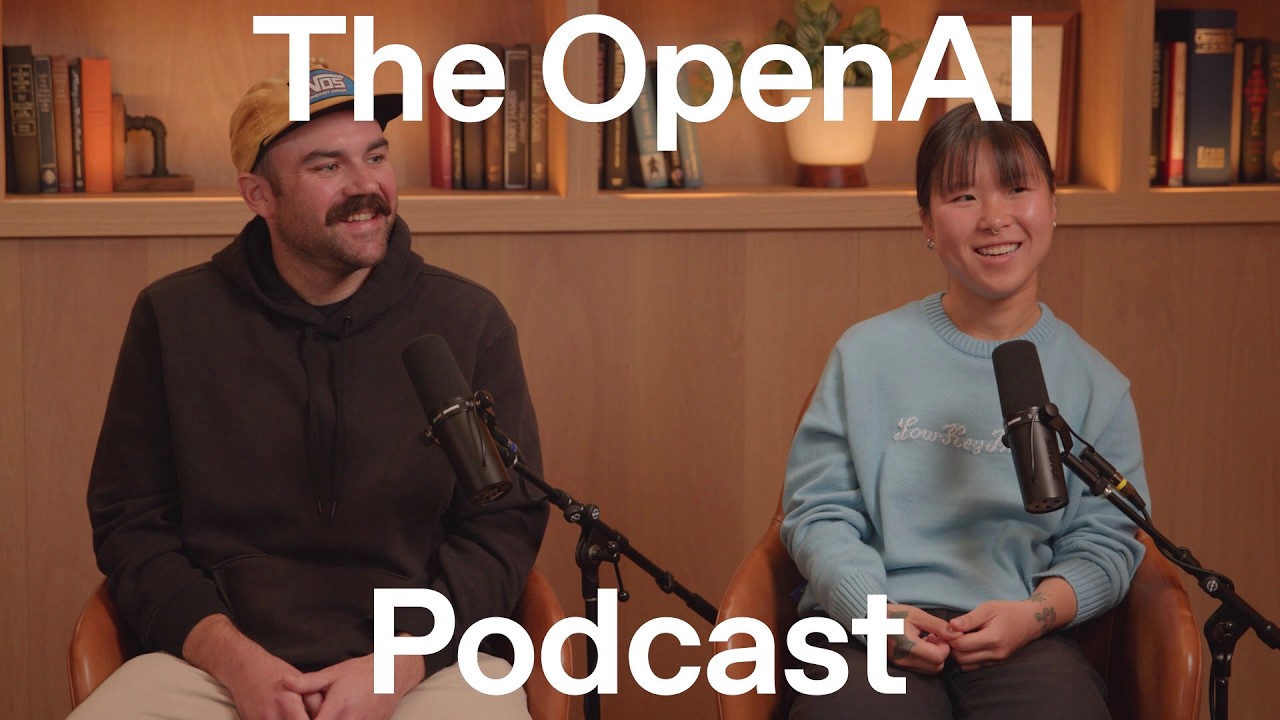
OpenAI, Chip Ganassi Test Track AI as Data Wars Reshape Racing
OpenAI
Universal access to artificial intelligence will strip large racing teams of their technical software advantages, making human driver intuition and rapid prompt engineering the decisive factors in winning races.
## Background
Published on YouTube by OpenAI on July 16, 2026, this episode of the OpenAI Podcast explores how artificial intelligence is transforming motorsports operations, strategy, and performance. Featuring OpenAI researcher Joyce Ruffell and RaceTek Systems co-founder Chase Holden, the discussion focuses on AI applications in racing, including OpenAI's research collaboration with Chip Ganassi Racing and the shift from media hosting to building racing intelligence software.
## TL;DR
The episode delves into how high-bandwidth time-series telemetry, unstructured qualitative driver notes, and legacy Excel spreadsheets are being unified using artificial intelligence and LLMs like Codex. Guests Joyce Ruffell and Chase Holden detail how AI acts as an equalizer for smaller racing teams by augmenting engineering bandwidth, optimizing logistics, and accelerating hypothesis testing. They also address the deep-rooted car culture at OpenAI, the human-centric future of competitive racing over autonomous robotics, and how domain expertise becomes the primary differentiator as AI tools democratize data analytics across NASCAR and IndyCar.
## Atmosphere & style
The conversation carries an energetic, intellectually curious, and grounded tone that bridges the world of high-tech AI research with the grit and speed of the racing paddock. Host Andrew Mayne fosters an open, collaborative dialogue where technical concepts like data pipelines and prompt engineering effortlessly blend with passionate storytelling about car culture and racetrack atmosphere. The dynamic feels authentic and forward-looking, highlighting a shared enthusiasm for human ingenuity, mechanical performance, and practical innovation.
## Key takeaways
- [00:00](https://www.youtube.com/watch?v=KNPjRpNtQ7s&t=0s) Motorsports is currently locked in an intense period of "data wars," where the winning competitive edge belongs to teams that can organize, parse, and act on massive streams of track data fastest.
- [00:43](https://www.youtube.com/watch?v=KNPjRpNtQ7s&t=43s) OpenAI and Chip Ganassi Racing are collaborating to make decades of historical IndyCar telemetry immediately queryable, accelerating the hypothesis and simulation loops for race engineers.
- [02:43](https://www.youtube.com/watch?v=KNPjRpNtQ7s&t=163s) Chase Holden leveraged ChatGPT and OpenAI Codex to transition from hosting a NASCAR podcast to founding RaceTek Systems without a formal computer science background.
- [10:00](https://www.youtube.com/watch?v=KNPjRpNtQ7s&t=600s) AI models bridge the communication gap between drivers and engineers by digesting hours of technical logs into accessible debriefs and helping engineers structure precise prompts.
- [15:31](https://www.youtube.com/watch?v=KNPjRpNtQ7s&t=931s) By ingesting qualitative notes and combining them with quantitative ECU telemetry, AI unifies "soft" human feedback with "hard" data historically trapped in legacy spreadsheets.
- [18:26](https://www.youtube.com/watch?v=KNPjRpNtQ7s&t=1106s) AI serves as an operational equalizer for mid-tier and smaller racing outfits, providing virtual engineering and logistical support to replicate the output of much larger headcount teams.
- [21:43](https://www.youtube.com/watch?v=KNPjRpNtQ7s&t=1303s) Motorsports relies heavily on complex Excel workbooks; converting these multi-tab legacy files into AI-native formats allows teams to clarify telemetry across disparate departments.
- [27:03](https://www.youtube.com/watch?v=KNPjRpNtQ7s&t=1623s) Getting the most out of AI development requires moving past simple prompts into contextually rich, multi-turn conversations and integrating tools like Codex directly into the IDE.
- [30:08](https://www.youtube.com/watch?v=KNPjRpNtQ7s&t=1808s) A strong car culture exists inside OpenAI, where researchers view the iterative tuning of race cars as closely parallel to minimizing test loss during AI model training.
- [33:01](https://www.youtube.com/watch?v=KNPjRpNtQ7s&t=1981s) Racing remains a fundamentally human-centric athletic competition; AI and autonomous experiments serve as analytical tools or separate exhibitions rather than replacements for human drivers.
- [36:17](https://www.youtube.com/watch?v=KNPjRpNtQ7s&t=2177s) As AI analytics tools become universally accessible across all teams, competitive advantage shifts away from technology moats back to human judgment, intuition, and prompt communication speed.
- [37:55](https://www.youtube.com/watch?v=KNPjRpNtQ7s&t=2275s) AI acts as a prototype accelerator, enabling domain experts to workshop and prove concepts independently before committing specialized software resources.
- [39:26](https://www.youtube.com/watch?v=KNPjRpNtQ7s&t=2366s) Beyond track performance, coding agents and AI assistants handle front-office operations like post-race software iterations, sponsor outreach, and team logistics.
## Detailed walkthrough
### [00:00](https://www.youtube.com/watch?v=KNPjRpNtQ7s&t=0s) Introduction to AI in Racing
Host Andrew Mayne introduces the episode's focus: how artificial intelligence is reshaping motorsports operations, strategy, and performance. The conversation centers on two guests who are actively bridging the gap between cutting-edge AI and the high-stakes world of racing:
* **Joyce Ruffell**, a researcher at OpenAI leading a collaborative research project with **Chip Ganassi Racing**.
* **Chase Holden**, co-founder of **RaceTek Systems**, who utilized OpenAI's ChatGPT and Codex to transition from hosting a NASCAR podcast to launching a specialized racing intelligence startup.
The speakers highlight that modern racing is fundamentally driven by data management and human-machine collaboration. As Holden notes, motorsports is currently locked in what he calls the **"data wars"**, where the winning edge belongs to whoever can organize, parse, and act on massive streams of information fastest.
---
[00:43](https://www.youtube.com/watch?v=KNPjRpNtQ7s&t=43s) Joyce Ruffell and the Chip Ganassi Racing Collaboration
Joyce Ruffell outlines her background as a researcher at OpenAI, where her focus over the last few years has centered on core data challenges—spanning data sources, data quality, pipeline architecture, and data efficiency.
Her recent work includes an applied research collaboration with **Chip Ganassi Racing**, an elite organization with a 35-year history in motorsports. While Chip Ganassi Racing has historically competed in NASCAR and sports car racing, Ruffell's collaboration currently focuses on their active programs in **IndyCar** and **INDY NXT**.
* **High-Bandwidth Time-Series Data:** Motorsports telemetry produces vast quantities of high-frequency time-series data. This information must be analyzed both retroactively for long-term trends and in real time at the track to make split-second strategic calls.
* **Accelerating the Hypothesis Loop:** The primary objective is to unlock Chip Ganassi Racing's historical archives across different drivers, tracks, and car specifications. By making decades of race data immediately queryable, engineers can formulate hypotheses, simulate scenarios, and test setups rapidly.
* **Maximizing Track Time:** Streamlining data access allows engineers and strategists to conduct more experiments prior to every practice, qualifying, and race session, ensuring every minute on track yields maximum performance value.
---
[02:43](https://www.youtube.com/watch?v=KNPjRpNtQ7s&t=163s) Chase Holden and the Genesis of RaceTek Systems
Chase Holden explains the core business model of **RaceTek Systems**, which develops bespoke software and racing intelligence platforms designed to help race crews assess performance through a smarter lens and make better trackside decisions.
Holden shares his journey into motorsports, which began as a five-year-old growing up in South Louisiana. Lacking local racetracks, his parents took him to **Talladega Superspeedway** in Alabama. The spectacle of Talladega Boulevard, the Southern traditions, the sheer scale of the track, and the raw speed of stock cars running side-by-side hooked him instantly.
Rather than taking the traditional route into racing through competition or engineering, Holden built a career outside motorsports in finance and insurance before pivoting:
* **Media to Competition:** Around 2017, seeking a more fulfilling path, Holden entered broadcasting and podcasting, eventually cultivating an audience with a popular show focused on **NASCAR and sports betting**.
* **The AI Pivot (2022):** Growing up as a fan of science fiction movies like *Bicentennial Man* and *A.I. Artificial Intelligence*, Holden closely tracked the release of ChatGPT in late 2022.
* **Building with Codex:** Recognizing that large language models and OpenAI Codex provided a way to turn complex software concepts into working code without a formal computer science background, he began prototyping software to solve operational inefficiencies in racing.
---
[07:45](https://www.youtube.com/watch?v=KNPjRpNtQ7s&t=465s) Car Culture at OpenAI and Entering the Paddock
Ruffell reveals that a passion for automotive engineering and car culture runs deep within OpenAI. She manages the internal "social car channel" at OpenAI and fell hard for motorsports during the COVID-19 pandemic after attending live races across NASCAR, IndyCar, and sports car series.
Her transition from car enthusiast to active AI researcher in the paddock stemmed from an industry event in **Indianapolis**—the hub for most IndyCar team headquarters:
* **Behind Closed Doors:** Through an automotive conference in late 2024, Ruffell was invited into the private race shops of several prominent teams. Given how notoriously secretive motorsports teams are regarding their engineering and setups, this rare access sparked her vision for how LLMs could assist race engineers.
* **Early Adoption:** Chip Ganassi Racing was already evaluating ways to leverage AI, making them an ideal partner at a time when AI integration was still rare in the racing world.
---
[10:00](https://www.youtube.com/watch?v=KNPjRpNtQ7s&t=600s) Practical AI Applications: Education, Prompting, and Driver Translation
Holden and Ruffell discuss how AI is applied on a practical, day-to-day level within race teams. Ruffell emphasizes that one of the most immediate impacts has been **education**—demystifying how AI models work so that race engineers can treat them like precise tools rather than "black boxes" or magic.
* **Prompt Engineering for Engineers:** Teaching technical personnel how to structure inputs effectively ensures they extract accurate, actionable outputs for race prep and strategy on the timing stand.
* **Bridging the Driver-Engineer Communication Gap:** A major operational challenge is the language barrier between drivers and race engineers. Drivers feel what the car is doing intuitively but may not speak technical engineering jargon.
* **Digestible Debriefs:** AI models process lengthy engineering logs and technical practice reports, digesting 4 to 5 hours of dense data into clear, easily readable summaries for drivers before they go back out on track.
---
[15:31](https://www.youtube.com/watch?v=KNPjRpNtQ7s&t=931s) Unifying "Hard" Telemetry with "Soft" Human Feedback
Ruffell notes a fundamental reality of motorsports operations: **the racing world runs on Excel**. While traditional software scripts and plotting algorithms easily handle numerical ECU telemetry, they struggle to process qualitative, unstructured "soft data."
* **Integrating Qualitative Notes:** Driver feedback ("the rear end feels loose on entry in Turn 3"), tire engineer observations, and scribbled pit-stand notes represent critical context that historically sat isolated in spreadsheets or notebooks.
* **Coalescing into a Single Dataset:** OpenAI's models are used to ingest, organize, and correlate these unstructured text notes with "hard" telemetry data (speeds, throttle angles, suspension travel), creating a unified, easily searchable dataset.
* **Human-Machine Evolution:** Rather than forcing teams to abandon their existing workflows, AI acts as an adaptable layer that evolves alongside human habits, helping engineers retrieve historical context in seconds.
---
[18:26](https://www.youtube.com/watch?v=KNPjRpNtQ7s&t=1106s) Equalizing the Field for Smaller Teams
Holden addresses how AI acts as an equalizer in competitive racing environments where budget disparities are massive:
* **Leveling the Engineering Headcount:** Top-tier NASCAR and IndyCar teams employ large squads of dedicated engineers monitoring individual sub-systems on the pit box. Smaller or mid-level teams cannot afford such large staffs.
* **Virtual Engineering Support:** By using AI tools to capture, organize, and summarize the secondary details that usually fall through the cracks during a high-stress race weekend, smaller teams can effectively replicate the output of a much larger engineering team with a fraction of the headcount.
[19:17](https://www.youtube.com/watch?v=KNPjRpNtQ7s&t=1157s) Leveling the Playing Field for Smaller Teams
Joyce Ruffell and Chase Holden discuss how AI tools are bridging the gap between mid-tier racing organizations and premier powerhouse teams. In motorsports, specialized engineers typically work in isolated silos, analyzing individual datasets focused purely on their specific responsibilities. When team members convene to make high-stakes operational decisions, communication gaps inevitably emerge. AI systems act as integrative connective tissue across these departments. While AI will not replace full engineering staffs, it equips smaller and medium-sized outfits with capabilities that bring them significantly closer to the analytical muscle of industry juggernauts.
Time functions as the primary unit of measurement across every domain of racing operations. Organizations like Chip Ganassi Racing operate as lean enterprises—frequently under 200 employees—where personnel must juggle multiple distinct roles under rigid schedules. Accelerating routine workflows with AI frees up mental bandwidth for personnel to investigate lower-priority edge cases that often get shelved. In a sport decided by tiny margins, exploring those deprioritized questions can unlock the crucial competitive breakthrough for the next race weekend.
Beyond pure track telemetry, the logistical machinery required to ship equipment and parts globally demands immense coordination. AI tools streamline complex logistics and inventory tracking, systematically logging components that degrade, break, or fall off during high-stress race weekends. By delegating repetitive, error-prone tasks to automated systems, smaller teams optimize every tier of their operation.
- **Team size:** Chip Ganassi Racing operates with under 200 total staff members, requiring employees to wear multiple hats.
- **Logistical scope:** AI optimizes nationwide and global logistics, including parts replacement, tracking, and trackside equipment transport.
---
[21:43](https://www.youtube.com/watch?v=KNPjRpNtQ7s&t=1303s) Breaking Down the "Spreadsheet Culture" and Data Wars
Motorsports organizations rely heavily on giant, legacy Excel spreadsheets to store and track operational metrics. Joyce describes the sheer density of these files, where engineers endlessly scroll horizontally and vertically through intricate webwork formulas, custom macros, and color-coded conditional formatting. Standardizing this data for AI processing requires fundamental format conversions, as complex raw spreadsheets do not natively map well to modern machine learning models. OpenAI routinely benchmarks model capabilities every three months to determine whether modern state-of-the-art LLMs can ingest upstream data with less manual pre-processing.
Chase highlights that while individual engineers build custom Excel setups for specific tasks, these isolated systems create communication barriers across the team. A custom spreadsheet built by a single race engineer is often unintelligible to crew chiefs or mechanics. AI tools synthesize these bloated files into simplified, accessible interfaces that align every department around a shared understanding of track telemetry.
Chase emphasizes that racing has entered an intense period of "data wars" across both NASCAR and IndyCar. Every track session serves as an active experiment, requiring precise tracking of fine details like tire weights before and after runs, handwritten notes, and real-time strategic ideas. Succeeding in this data-dense environment requires transforming sprawling telemetry streams into fast, actionable clarity.
- **Data format challenge:** Raw multi-tab Excel workbooks require restructuring into AI-native formats to enable downstream analytical extraction.
- **Evaluation cadence:** OpenAI tests model state-of-the-art capabilities every three months to reduce data preparation friction for clients.
- **Tracking detail:** Engineers meticulously track granular parameters, such as exact tire weight loss pre- and post-run, to evaluate setup adjustments.
---
[27:03](https://www.youtube.com/watch?v=KNPjRpNtQ7s&t=1623s) Mindset, Communication, and Practical AI Tooling
Transitioning into AI-driven development requires abandoning rigid assumptions and cultivating active curiosity. Chase advises newcomers to avoid superficial queries, such as checking the weather or testing simple one-liners, and instead engage in multi-turn conversations for at least five minutes to see contextually rich insights surface. Effective AI utilization depends directly on clear human communication, deliberate intent, and high-quality input prompts.
Modern development workflows have evolved rapidly from manually dragging and dropping code blocks into ChatGPT-4o to employing integrated environments powered by OpenAI Codex directly inside the IDE. Having code-generation assistants right on the desktop automates heavy lifting, saves development time, and allows builders to focus on higher-level system architecture—provided they monitor API rate limits.
> "Output's going to be there, but what's the input? How are you communicating to the model? What is your intent? How are you speaking?"
- **Learning communities:** Chase recommends exploring dedicated developer spaces, including Reddit forums and the official OpenAI Discord channel.
- **URL update:** Users can access the main conversational interface at `chatgpt.com` or `chat.com`.
- **Workflow evolution:** Transitioning from manual code pasting in ChatGPT-4o to native IDE integration using OpenAI Codex.
---
[30:08](https://www.youtube.com/watch?v=KNPjRpNtQ7s&t=1808s) Winning the First Customer and the Culture of Motors at OpenAI
Chase describes how he secured RaceTek Systems' first client after relocating to North Carolina with an "all-in, Plan A" mindset. In November, Chase initiated discussions with driver Garrett Smithley, who was competing with SS-GreenLight Racing / BRK Racing. Smithley already held an organic interest in artificial intelligence, providing a receptive environment to establish a partnership. Combining his media background with AI workflows allowed Chase to integrate RaceTek directly into the garage during the NASCAR O'Reilly Auto Parts Series.
The conversation turns to the surprisingly deep car culture within OpenAI itself. Despite working at the forefront of digital artificial intelligence, a large number of researchers and software engineers maintain an intense passion for internal combustion engines (ICE) and traditional mechanical systems. Joyce notes that racing mirrors AI research: both involve months of setup, experimentation, and tweaking, all distilled down to a single objective metric—reducing test loss in research or shaving fractions of a second off a lap time on the track.
- **First client partnership:** SS-GreenLight Racing / BRK Racing with driver Garrett Smithley.
- **Series involvement:** Operating within the NASCAR O'Reilly Auto Parts Series.
- **Research parallelism:** Shaving off lap times on the racetrack mirrors lowering test loss in AI model training.
---
[33:01](https://www.youtube.com/watch?v=KNPjRpNtQ7s&t=1981s) Human-Centric Racing vs. Autonomous Robots
Addressing the future of competition, Joyce and Chase push back against the notion that AI or robotics will render human drivers obsolete. Racing remains a fundamentally human-centric pursuit, celebrated for human skill, grit, and high-stakes performance. While autonomous open-wheel racing experiments exist—such as events held in Abu Dhabi where engineers program self-driving cars that still occasionally crash into walls—they serve as separate engineering exhibitions rather than replacements for established series like NASCAR or IndyCar.
When high-performing motorsports teams deploy AI, they demand extreme accuracy and real-time speed. Engineers do not ask the AI for open-ended guidance; they demand specific, high-precision outputs under rigorous time constraints. This intense pressure forces OpenAI to build faster, more efficient models capable of delivering instant, reliable insights in competitive team environments.
> "When they start working with AI, it's not like, 'Hey, AI, lead me in this direction.' It's like, 'No, I need AI to deliver me this.' And they have a very clear idea of what it needs to be."
- **Human-centric baseline:** High-level athletics and motorsports draw viewership because of human performance, making the displacement of drivers by autonomous systems unlikely.
- **Autonomous racing benchmark:** Reference to autonomous open-wheel racing showcases in Abu Dhabi, highlighting the contrast between automated experiments and driver-led competition.
---
[36:17](https://www.youtube.com/watch?v=KNPjRpNtQ7s&t=2177s) Competitive Advantages in an AGI World
As artificial intelligence capabilities advance toward Artificial General Intelligence (AGI) and tools like Codex become universally accessible, the competitive landscape will shift. When every racing outfit possesses access to high-tier AI analytics, traditional technology moats disappear. This structural shift places mounting pressure on legacy powerhouse teams, as mid-tier competitors leverage AI workflows to eliminate historical operational advantages.
In this environment, ultimate victory returns to human judgment. Advantage will belong to the teams with the best instincts, refined domain taste, and superior prompt communication. In pit-wall strategy, where a delayed decision can lose a race in ten seconds, the winning edge will come down to who can prompt their tools most effectively and construct the fastest end-to-end workflows.
- **Strategic execution threshold:** A 10-second delay in analyzing data on the pit wall can jeopardize an entire race result.
- **The human differentiator:** Universal access to AI shifts the competitive edge back to human intuition, operational taste, and communication speed.
[37:55](https://www.youtube.com/watch?v=KNPjRpNtQ7s&t=2275s) AI, Domain Expertise, and the Democratization of Motorsport Innovation
The conversation reflects on how competitive advantage in motorsport is fundamentally shifting from sheer financial power to domain expertise and creative vision. Historically, motorsport went through distinct cycles where finding an edge was purely a function of capital investment—if a team had the resources to engineer a specific system or hire a large squad of software engineers and specialists, they won. However, AI is drastically lowering the cost of iteration. OpenAI researcher Joyce Ruffell notes that AI allows individuals to push much further into the exploration process of a new idea before needing to pull in expensive specialists to double-check and fine-tune the work. This shifts the key differentiator back to creativity: if someone can conceive a strategy or concept, they can prove it out themselves almost immediately.
Ruffell highlights how rewarding it is to collaborate with racing experts at Chip Ganassi Racing, empowering them with the realization that they can build solutions independently. Rather than convening a room full of people just to test whether an idea is feasible, engineers and strategists can workshop their concepts with AI first. Only after proving the concept do they assess what specialized human resources are actually required to finalize it.
- AI serves as a powerful prototype accelerator, enabling rapid proof-of-concept testing without requiring immediate specialized software teams.
- Domain experts can now directly build and workshop their own tools, drastically reducing time-to-market for strategy and setup tweaks.
- Motorsport cycles are transitioning from "investment-dominated" to "creativity-dominated," where domain knowledge combined with AI agility yields the biggest edge.
---
[39:26](https://www.youtube.com/watch?v=KNPjRpNtQ7s&t=2366s) Managing Business Logistics and Coding Agents Beyond the Racetrack
Chase Holden expands on how AI touches virtually every facet of his day-to-day work at RaceTek Systems, operating as both a technical co-developer and an executive assistant. On the technical side, Holden leverages coding agents to pressure-test ideas in real time. Upon returning from a race weekend with practical feedback, he immediately uses these agents to spin up prototype solutions for the following week's competition, though he emphasizes that human oversight remains crucial to iron out remaining kinks and refine the software.
Beyond software development, Holden relies heavily on AI to manage the multifaceted operational logistics of running a racing business. From drafting outreach for corporate sponsorships and scouting content opportunities for drivers to organizing complex weekly schedules, AI keeps him on task while juggling multiple roles. It acts as an organizational engine that streamlines administrative overhead, allowing smaller operations to handle operations that historically required an entire front-office staff.
- Coding agents allow rapid turnaround from post-race analysis to deployed software iterations within a single week.
- Administrative workflows—such as driver content planning, sponsor outreach, and logistics scheduling—are organized directly through AI assistants.
- Human review and iteration remain essential final steps to resolve software bugs and ensure execution accuracy.
---
[41:08](https://www.youtube.com/watch?v=KNPjRpNtQ7s&t=2468s) Favorite Racing Movies and Final Thoughts
The episode concludes on a lighter note with a classic question regarding personal cinematic inspirations in car culture. Joyce Ruffell highlights the acclaimed historical drama *"Ford v Ferrari"* as her top pick, celebrating its depiction of racing engineering, grit, and passion. Chase Holden reveals his favorite to be *"The Fast and the Furious: Tokyo Drift"*, calling it the specific movie that originally hooked him on car culture and motorsport early on.
- Joyce Ruffell's favorite racing movie: *"Ford v Ferrari"*
- Chase Holden's favorite racing movie: *"The Fast and the Furious: Tokyo Drift"*
## Notable quotes
> [27:03](https://www.youtube.com/watch?v=KNPjRpNtQ7s&t=1623s) Output's going to be there, but what's the input? How are you communicating to the model? What is your intent? How are you speaking? — Chase Holden
> [33:01](https://www.youtube.com/watch?v=KNPjRpNtQ7s&t=1981s) When they start working with AI, it's not like, 'Hey, AI, lead me in this direction.' It's like, 'No, I need AI to deliver me this.' And they have a very clear idea of what it needs to be. — Joyce Ruffell
## Mentioned
Joyce Ruffell, Chase Holden, Andrew Mayne, OpenAI, Chip Ganassi Racing, RaceTek Systems, ChatGPT, ChatGPT-4o, OpenAI Codex, NASCAR, IndyCar, INDY NXT, NASCAR O'Reilly Auto Parts Series, SS-GreenLight Racing / BRK Racing, Garrett Smithley, Talladega Superspeedway, Bicentennial Man, A.I. Artificial Intelligence, Ford v Ferrari, The Fast and the Furious: Tokyo Drift, Excel, Reddit, Discord
OpenAI researcher Joyce Ruffell and RaceTek Systems co-founder Chase Holden argue that modern motorsport has become a data war where artificial intelligence provides a competitive edge by synthesizing dense telemetry with qualitative driver feedback and accelerating strategic decisions for lean engineering teams.
Integrating Telemetry with Legacy Spreadsheets (15:31)
Motorsports organizations routinely generate vast streams of high-frequency time-series telemetry alongside qualitative, unstructured notes from drivers, tire specialists, and pit crews. Ruffell observes that race shops historically run on massive, multi-tab Excel workbooks filled with custom macros and intricate formulas, creating isolated data silos between individual engineers and mechanics. Standardizing this information requires format conversions because complex raw spreadsheets do not natively map into modern machine learning architectures.
By using language models to ingest and unify quantitative chassis metrics with unstructured subjective notes—such as a driver reporting that the rear end feels loose on corner entry—teams can query decades of historical race archives. According to Ruffell, this unified searchability accelerates the hypothesis loop for active programs like Chip Ganassi Racing's IndyCar and INDY NXT teams, allowing engineers to simulate setup scenarios and maximize the value of limited on-track practice sessions.
Virtual Engineering Support for Lean Teams (19:17)
Significant budget and personnel disparities exist across NASCAR and IndyCar, where premier outfits deploy specialized engineering squads to monitor individual sub-systems while lean organizations operate with smaller staffs. Ruffell notes that Chip Ganassi Racing employs fewer than 200 total personnel, requiring team members to handle multiple roles under tight schedules. Holden and Ruffell explain that AI tools act as integrative connective tissue across departmental silos, enabling smaller outfits to replicate the analytical output of larger competitors without adding headcount.
Beyond track telemetry, race organizations apply AI to manage equipment logistics, supply chains, and component wear across global travel schedules. Automating repetitive data consolidation frees technical personnel to explore deprioritized edge cases that can unlock critical lap-time advantages. For software development, Holden reports that utilizing coding agents allows solo builders and small teams to turn garage feedback into working prototypes within a single week.
Translating Driver Feedback and Prompting Precision (10:00)
A recurring operational friction in motorsport is the language gap between drivers, who experience car behavior through sensory intuition, and race engineers, who require quantifiable technical data. Language models help reconcile this divide by processing technical logs and practice reports to generate concise debriefs for drivers, while simultaneously translating driver commentary into structured inputs for the timing stand.
Ruffell emphasizes that effective adoption requires demystifying artificial intelligence so engineers treat models as exact tools rather than black boxes. Holden highlights that extracting reliable strategic recommendations depends on prompt structure, deliberate intent, and sustained multi-turn context. Development workflows have similarly shifted from manually copying code snippets into web interfaces to utilizing embedded assistants powered by OpenAI Codex directly within developer environments.
Preserving Human Judgment in High-Speed Decisions (36:17)
Holden and Ruffell dismiss the idea that autonomous vehicles or robotics will replace human racing drivers, distinguishing experimental self-driving exhibitions like those in Abu Dhabi from traditional series. Spectators follow motorsports primarily to watch human skill, physical grit, and competitive execution under pressure, ensuring drivers remain central to the sport.
As advanced AI models and coding agents become universally accessible, traditional analytical software moats will erode across the paddock. The speakers argue that when technological access equalizes, competitive advantage shifts back to human intuition, operational taste, and prompt efficiency. On the pit wall, where an analytical delay of ten seconds can alter a race result, execution speed and human judgment remain the decisive performance factors.
While AI lowers the barrier to software development and streamlines data synthesis for racing teams, its strategic value is constrained by the need for real-time precision and human oversight. Ruffell and Holden conclude that universal access to AI will eliminate traditional technological advantages, leaving domain expertise, prompt communication, and human intuition as the primary competitive differentiators.
精炼阅读摘要
OpenAI 研究员 Joyce Ruffell 与 RaceTek Systems 联合创始人 Chase Holden 指出,现代赛车运动已进入高密度信息对抗的“数据战”阶段,人工智能正通过统一多源数据、降低研发门槛以及优化运营协作重塑车队生态;但随着技术工具逐步普惠,决定赛道胜负的终极优势仍将取决于人类专家的领域直觉、沟通效率与即时决策能力。
整合遥测数据与非结构化人类反馈 (15:31)
Joyce Ruffell 表示,传统赛车团队高度依赖庞大且复杂的 Excel 电子表格记录数据,工程师经常需要在多层嵌套公式、自定义宏与条件格式中繁琐检索。尽管既有计算程序能高效处理来自电子控制单元(ECU)的高频数值遥测数据(如车速、油门开度及悬挂行程),但车手的定性主观反馈(例如“在3号弯入弯时车尾发飘”)、轮胎工程师的现场观察以及维修站的手写记录等“软数据”长期处于孤立分散状态。
OpenAI 与拥有35年历史的 Chip Ganassi Racing 展开合作,利用大语言模型将这些非结构化文本与硬件遥测数据融合为统一的查询系统。这一整合旨在打通历史档案,加快工程师的假设验证与模拟测试循环,确保在练习赛、排位赛和正赛中的每一分钟赛道时间都能发挥最大效益。此外,OpenAI 约每三个月对其前沿模型的能力进行一次基准评估,以探寻如何减少人工预处理负担并直接摄取未经格式化的复杂原始表格。
弥合车手与工程团队的沟通壁垒 (10:00)
在车队的日常运转中,赛车手与技术工程师之间普遍存在专业语言障碍。车手通常依据身体直觉感知车辆的机械动态,但往往难以使用严密的工程术语进行表述;而工程师则专注于传感器指标,容易忽视驾驶员的感官细节。Ruffell 与 Holden 指出,AI 工具能够有效充当两者的转译中介,将长达 4 至 5 小时的密集练习赛技术报告与工程日志快速浓缩为清晰简要的总结,帮助车手在重新驶入赛道前迅速把握核心调校信息。
与此同时,车队正在加强针对技术人员的提示词工程(Prompt Engineering)培训。Ruffell 强调,向工程师阐明模型底层逻辑有助于消除对 AI 系统的“黑箱”或“魔法”误解,使技术人员能将其视作精密仪器,通过构建高质量、目标明确的提示词,在计时台上快速提取高度精确且具备可操作性的调校方案与战略决策指令。
消除预算劣势与加速策略创新迭代 (18:26)
Holden 与 Ruffell 观察到,传统赛车竞赛的优势往往与资金规模直接挂钩,顶级 NASCAR 或 IndyCar 车队能在维修区配备庞大的专属工程团队分别监控各个子系统,而中小型车队受限于预算无法维持同等编制。例如 Chip Ganassi Racing 作为一个精简机构,总员工通常不足 200 人,成员必须在高压赛程下同时承担多重职责。AI 充当了“虚拟工程支持”的角色,使小团队能够自动化捕捉与整理次要细节及边缘案例,从而以极少的人力达到接近行业巨头的分析产出。
更深层次的影响在于研发成本的骤降。以往提出一项新设想需要召集整个专家团队进行可行性论证,而现在领域专家能够先借助 AI 工具独立完成概念验证与方案推演。Ruffell 认为,这种模式使得赛车竞技由单纯依赖资本投入的研发周期,逐步转向由创意与领域专长驱动的创新周期,大幅缩短了战术调整从构想到落地的时间跨度。
全流程工程代理与赛道外运营自动化 (39:26)
Holden 介绍了 RaceTek Systems 如何将 AI 深度融入软件开发与赛车商业运营的各个环节。在研发流程上,团队已从早期在网页端向 ChatGPT-4o 手动复制粘贴代码,演进为在集成开发环境(IDE)中直接调用基于 OpenAI Codex 的代码生成代理。在结束比赛周末并收集实地反馈后,Holden 能在一周内利用代码代理快速搭建并测试下一站赛事的原型软件,但他也强调人工审查仍是修复软件缺陷与确保执行精度的必要最后防线。
在赛道之外,AI 承担了广泛的行政与物流管理工作。从为车手规划赞助外联公文、设计媒体内容方案,到跨区域统筹运输日程与追踪比赛中损耗、折断的零部件库存,自动化工具显著降低了运营间接成本。Holden 曾凭借该工作流在北卡罗来纳州成功签约首个商业客户——征战 NASCAR O'Reilly Auto Parts 系列赛的 SS-GreenLight Racing / BRK Racing 车队及其车手 Garrett Smithley。
技术普惠背景下人类判断的核心地位 (36:17)
针对自动化系统是否会取代人类车手的讨论,Joyce 与 Chase 一致认为赛车本质上是一项以人类竞技、胆识和高压表现为核心的运动;尽管阿布扎比等地已开展无人驾驶开轮赛车测试,但这些项目目前属于工程展览性质,无法取代主流的人类职业赛事。赛车团队在应用 AI 时并不寻求宽泛的指引,而是要求在极短时间内提供确定、高精度的具体输出,这也倒逼模型开发朝着更高响应速度的方向演进。
两位受访者预测,随着技术向通用人工智能(AGI)演进且高级分析工具全面普及,各车队之间的传统技术壁垒将被逐步抹平。届时竞争重心将重新回归人类特质,由车队的直觉判断、专业审美以及提示词沟通效率决定优劣。Holden 强调,在维修区战术执行中,仅 10 秒钟的数据分析延迟就可能导致整场比赛失利,最终的胜负分水岭仍将取决于人类决策者构建端到端快速响应工作流的能力。
该节目表明,AI 在高水平赛车领域的价值在于辅助人类专家快速推演与整合杂乱数据,而非替代车手或工程师的主观能动性。不过,对话也反映出当前技术落地的现实局限:传统密集的复杂电子表格仍需针对 AI 进行格式转换与适配,代码代理生成的方案必须依赖严格的人工调试,且在争分夺秒的维修站极端高压场景下,算法输出的延迟与准确度仍面临严苛检验。
Detailed notes — zh
## Background
本期内容由 OpenAI 官方频道于 2026 年 8 月 3 日发布在 YouTube 平台,为播客节目《The OpenAI Podcast》第 22 期。根据官方简介,赛车是一项由微小差距与海量数据构筑的运动,OpenAI 研究员 Joyce Ruffell 与 RaceTek Systems 联合创始人 Chase Holden 在节目中深入探讨了如何利用 ChatGPT 与 Codex 激活赛道、车间及车手背后的数据潜能,并介绍了 OpenAI 与 Chip Ganassi Racing 的科研合作、AI 对中小车队的赋能以及 OpenAI 内部深厚的汽车文化。
## TL;DR
节目围绕赛车运动正在打响的“数据之战”展开,探讨了 AI 如何替代繁重庞杂的电子表格工作流,成为连接赛车硬核遥测与车手主观感受的智能纽带。Joyce Ruffell 详述了 OpenAI 与传奇车队 Chip Ganassi Racing 合作处理高带宽时间序列数据的实战经验,而 Chase Holden 则分享了自己借助 Codex 从播客主播跨界创立赛车智能系统、帮助中小车队抹平技术资源壁垒的创业故事。讨论进一步揭示了赛车调校与 AI 研究在追求边际收益上的精神同构,并明确指出无论自动驾驶如何演进,赛车运动的核心始终是“以人为本”,在 AGI 时代人类的直觉、品味与即时决断力仍将是制胜的终极壁垒。
## Atmosphere & style
整场对话洋溢着硬核工程理性与赛道竞速激情的奇妙碰撞,主持人与嘉宾之间配合默契,叙事既有前沿技术探讨的深度,又不乏生动接地气的幽默感。从吐槽无限滚动的巨型 Excel 迷宫,到回忆五岁时在塔拉迪加看台被引擎轰鸣震撼的童年瞬间,对话的情绪弧线真挚而炽热。聆听过程仿佛带领观众在代码闪烁的 IDE 界面与油压轰鸣的维修区指挥台之间穿梭,极富现场沉浸感与感染力。
## Bulletin
- [00:43](https://www.youtube.com/watch?v=KNPjRpNtQ7s&t=43s) OpenAI 与 35 年传奇车队 Chip Ganassi Racing 展开深度科研合作,利用前沿大模型处理车载传感器产生的严苛高带宽时间序列数据,为维修区指挥台提供深度赛前决策推演。
- [02:43](https://www.youtube.com/watch?v=KNPjRpNtQ7s&t=163s) RaceTek 联合创始人 Chase Holden 凭借 ChatGPT 与 Codex 等工具,从 NASCAR 播客主播成功跨界创立赛车智能公司,为中小车队搭建等效于“虚拟工程师天团”的辅助系统以抹平资源劣势。
- [15:31](https://www.youtube.com/watch?v=KNPjRpNtQ7s&t=931s) 赛车界正深陷“数据之战”,AI 不仅用于打通孤立繁杂的 Excel 工作流,还将车手的主观体感、工程师手写笔记与客观遥测数据融合,帮助车手将数小时的练习赛报告提炼为即时洞见。
- [33:01](https://www.youtube.com/watch?v=KNPjRpNtQ7s&t=1981s) AI 在赛车领域的真正价值并非打造无人驾驶替代人类,而是重塑成本结构并赋予一线工程专家自主构建工具的能力,在 AGI 时代将竞技胜负手重新交还给人类直觉与临场决断力。
## Key takeaways
- [00:00](https://www.youtube.com/watch?v=KNPjRpNtQ7s&t=0s) 现代赛车运动已进入“数据之争”(data wars)时代,毫秒级的胜负取决于团队能否高效梳理整合数据,实现人、机器与工程团队的高度同频共振。
- [00:43](https://www.youtube.com/watch?v=KNPjRpNtQ7s&t=43s) 车载传感器产生的高带宽时间序列数据极度严苛,OpenAI 针对 Chip Ganassi Racing 拥有的数十年历史数据,聚焦解决底层数据清洗、检索效率与实时战术推演闭环。
- [02:43](https://www.youtube.com/watch?v=KNPjRpNtQ7s&t=163s) RaceTek 定位于赛车智能技术,通过聚合比赛周末维修区与车间内零散隐蔽的上下文数据,为技师和策略组提供统一的全景决策视图。
- [03:32](https://www.youtube.com/watch?v=KNPjRpNtQ7s&t=212s) 生成式 AI 和 Codex 工具降低了软件开发与系统构建的门槛,使得非传统计算机科班的从业者也能快速将创新赛车设想转化为可交付的实战软件。
- [11:32](https://www.youtube.com/watch?v=KNPjRpNtQ7s&t=692s) 赛车工程引入 AI 的关键在于“通识教育”与“去魅化”,帮助硬核工程师理解输入决定输出的 Prompt 工程机制,将应用重心放在赛前的严密战备推演。
- [13:20](https://www.youtube.com/watch?v=KNPjRpNtQ7s&t=800s) AI 能够打破工程团队与车手之间的沟通壁垒,将过去耗时四到五个小时的晦涩工程报告瞬间重构为直观、易懂的高价值操控摘要。
- [15:31](https://www.youtube.com/watch?v=KNPjRpNtQ7s&t=931s) 赛车行业对 Excel 依赖极深,AI 正在扮演粘合桥梁,将车手无线电反馈等主观非结构化“软性数据”与 ECU 遥测硬核数字深度融合。
- [18:08](https://www.youtube.com/watch?v=KNPjRpNtQ7s&t=1088s) AI 相当于为预算有限的中小型车队配备了“虚拟工程师天团”,大幅降低边际成本,使其能够拾起常被遗漏的细节数据并挑战传统行业巨无霸。
- [22:50](https://www.youtube.com/watch?v=KNPjRpNtQ7s&t=1370s) 将赛车数据重构为“AI 原生格式”(AI-native format)虽需前期投入,但能打破车队内部各工程师专属表格形成的壁垒,让全员步入同一战术认知频道。
- [31:36](https://www.youtube.com/watch?v=KNPjRpNtQ7s&t=1896s) OpenAI 内部盛行赛车文化的本质原因在于:赛车与大模型科研本质同构,都是将极其复杂的系统工程极致浓缩为单一指标(圈速对比测试损失)的微小边际收益追求。
- [33:01](https://www.youtube.com/watch?v=KNPjRpNtQ7s&t=1981s) 赛车运动具有不可替代的“以人为本”属性,顶尖车队使用 AI 时保持着极其严苛的精准度标准,AI 的角色是超级协同辅助而非无人化取代人类车手。
- [36:14](https://www.youtube.com/watch?v=KNPjRpNtQ7s&t=2174s) 当未来 AGI 和 AI 工具全面普及平民化后,赛道核心竞争力将回归人类本源——即更敏锐的直觉、审美底蕴以及稍纵即逝的临场沟通决策力。
- [38:02](https://www.youtube.com/watch?v=KNPjRpNtQ7s&t=2282s) AI 改变了赛车研发的投资与成本结构,使得一线专家无需经过冗长的评估流程,即可自主低成本验证创意原型,极大提升了创意的边际溢价。
- [39:26](https://www.youtube.com/watch?v=KNPjRpNtQ7s&t=2366s) AI 技术不仅赋能赛道分析,还深入延伸到车队的赛后代码快速迭代、零部件物流追踪、赞助商商务联络等全局运营流程。
## Detailed walkthrough
### [00:00](https://www.youtube.com/watch?v=KNPjRpNtQ7s&t=0s) 赛车运动进入“数据之争”时代
主持人 Andrew Mayne 开启了本期播客,引出这一期探讨赛车与人工智能交汇的核心主题。赛车本质上是一项由毫米级差距和海量数据构筑的极致运动,每一次过弯、换挡和策略博弈都依赖背后庞大的信息支撑。在开篇中,嘉宾们直言不讳地指出,当前的赛车运动已经全面迈入所谓的“数据之争”(data wars)。在这场较量中,决定胜负的不仅是引擎的马力,更是人与机器之间如何实现天衣无缝的协同——谁能以最高效的方式梳理和整合资源,让工程团队、车手与赛车同频共振,谁就能在格网起点占据绝对优势。
- 本期对话围绕 OpenAI 研究员 Joyce Ruffell 与 RaceTek Systems 联合创始人 Chase Holden 展开。
- 讨论聚焦于如何运用 ChatGPT 和 Codex 等 AI 工具,推动赛车运动从赛道物流、赛车调校到车手表现的全方位进化。
### [00:43](https://www.youtube.com/watch?v=KNPjRpNtQ7s&t=43s) 打造赛道数据引擎:OpenAI 与 Chip Ganassi Racing 的合作
Joyce Ruffell 详细介绍了自己在 OpenAI 负责的研究工作,过去几年她一直专注于解决最底层、最核心的数据难题,涵盖数据来源、数据清洗质量、数据流水线以及数据处理效率等领域。正是基于这种对数据基础设施的深耕,她牵头推进了 OpenAI 与传奇车队 Chip Ganassi Racing(简称 CGR)的前沿研究合作。该车队目前的核心重心在 IndyCar(印第赛车)和 INDY NXT 赛事上,历史上也曾征战 NASCAR 和各类跑车耐力赛,在长达 35 年的建队史中积攒了难以估量的深厚底蕴。
Joyce 指出,赛车数据具有极度罕见且苛刻的特性:它是由密密麻麻的车载传感器产生的“高带宽时间序列数据”(high-bandwidth time-series data)。车队不仅需要在赛后进行详尽的回溯分析,更需要在比赛周末现场实时处理这些数据流,争分夺秒地做出战术判定。虽然 Chip Ganassi 拥有跨越数十年、涉及多名车手、覆盖全美各大赛道与不同赛车规格的海量专属知识,但真正的瓶颈在于“可访问性与检索效率”。工程团队需要能够闪电般地提出假设、在历史数据中验证假设,并据此在每次练习赛、排位赛乃至正赛前快速微调赛车设置。数据反馈的闭环越短,车队能进行的实验就越多,从而把每一次出站练习都转化为通往正赛胜利的有效积累。
```mermaid
flowchart LR
accTitle: 赛车数据处理与迭代闭环
accDescr: 展示从赛道传感器高带宽数据采集,到 AI 检索分析,再到策略假设验证与赛车微调的闭环流程。
subgraph S1["数据采集与沉淀"]
A["车载高带宽时间序列数据"]
B["35年历史数据库<br/>车手/赛道/赛车规格"]
end
subgraph S2["AI 智能分析引擎"]
C["实时数据清洗与流处理"]
D["快速假设验证与模式对比"]
end
subgraph S3["赛道实战输出"]
E["排位/练习赛参数微调"]
F["正赛战术策略决策"]
end
A --> C
B --> D
C --> D
D --> E
E --> F
F -.反馈积累.-> B
```
### [02:43](https://www.youtube.com/watch?v=KNPjRpNtQ7s&t=163s) RaceTek Systems:为车队打造赛车智能系统
随后,Chase Holden 分享了自己创立 RaceTek Systems 的业务愿景。RaceTek 的定位是一家“赛车智能”(racing intelligence)技术公司,目前主要为各级车队定制专门的软件工具与智能系统。很多时候在紧张繁忙的比赛周里,车间与维修区会有大量细碎、隐蔽的信息被忽略或遗漏,而 RaceTek 当前正在研发的一站式智能平台,就是为了将这些零散的数据与线索汇聚一处,确保整个团队能在统一的视图下工作。
Chase 强调,这套智能工具并不是要凭空替人类做决定,而是给车队技师、工程师和策略组提供一副“更聪明的透镜”。通过实时整合与深度提炼赛道上下文,帮助车队在分秒必争的比赛周末看清全局,做出更高质量、更具确定性的临场决断。
### [03:32](https://www.youtube.com/watch?v=KNPjRpNtQ7s&t=212s) 从塔拉迪加看台到播客主持,再到 AI 驱动的创业
回顾自己走进赛车世界的奇特历程,Chase 坦言自己的经历完全不同于传统圈内人。他在路易斯安那州南部长大,当地其实并没有什么现成的赛车场环境,但他父母的一群好友是铁杆车迷,热衷于结伴前往阿拉巴马州的塔拉迪加超级赛道(Talladega Superspeedway)。在那座以狂野奔放、传统民风著称的赛道圣地,年仅 5 岁的 Chase 站在著名的塔拉迪加大道旁,亲眼见证轰鸣呼啸的重型房车(stock cars)从眼前掠过。那份结合了家庭温情、极致速度与舍身拼搏的震撼感,瞬间在他幼小的心灵中埋下了对赛车的终身痴迷。
然而,长大后的 Chase 最初并没有直接投身赛车行业,而是在金融和保险界从事一份朝九晚五的普通工作。直到 2017 年左右,他内心深处的一股渴望被唤醒,发觉按部就班的生活无法实现人生抱负,于是毅然转向自己从小钟爱的电台与播客领域。他白手起家创办了一档专注探讨 NASCAR 比赛与体育博彩的播客节目,逐步积累了极高的专业度和忠实社群。到了 2022 年前后,播客办得风生水起,而以 ChatGPT 为代表的新一代 AI 技术横空出世,彻底击中了他从小的另一个狂热爱好——科幻与人工智能。儿时的 Chase 曾一遍又一遍地循环观看电影《机器管家》(Bicentennial Man)和《人工智能》(A.I.),对未来充满遐想。
面对大语言模型和 Codex 等代码工具的爆发,Chase 敏锐地意识到人生的质变点来了。过去,作为没有传统计算机工程背景或机械制造资本的局外人,他纵使对改进赛车系统有无数宏大构想,在向别人倾诉时也往往只换来“这太异想天开、太不切实际”的冷水。但现在,借助大模型的多轮交互与代码生成能力,他能够独立把头脑中的蓝图亲手构建出来,直接交付给赛车团队验证。
- 传统赛车从业路径往往是从竞技一线退役走向媒体解说,而 Chase 走通了一条罕见的“从媒体发声切回一线竞技研发”的逆向路径。
- 他特别关注那些资金与技术资源相对匮乏的中小型车队,希望利用轻量、智能的 AI 软件抹平技术鸿沟,为赛车这项给予他无数热爱的运动带来全新血液。
### [07:45](https://www.youtube.com/watch?v=KNPjRpNtQ7s&t=465s) 破圈连接:从车迷日常到深入印第安纳波利斯车队车间
话题转回到 Joyce 身上。Andrew 提到自己认识 Joyce 已经很久,却直到一年前才惊讶地发现她竟然是个狂热的车迷。Joyce 笑着回应,自己其实从未刻意隐瞒过这一爱好——她甚至在 OpenAI 内部创办并主持了公司的汽车兴趣社群。她坦言,在加入 OpenAI 之前自己就曾在汽车产业工作,始终对汽车身上那种机械工程精密性、工业美学与大众情感纽带的融合深深着迷。
真正让她彻底“深陷赛车泥潭”的契机是新冠疫情期间。由于突然多出了时间,加上伴侣也极有兴致一起下赛道,Joyce 开始高频次地奔赴各大赛车场,广泛关注从跑车耐力赛、印第赛车到 NASCAR 的各类组别,深度爱上了围场社区与底层硬核工程学。作为一名在赛车与科技领域同时深耕的女性,她后来前往大部分 IndyCar 车队的大本营——印第安纳波利斯参加行业会议。
令她意想不到的是,会议主办方与当地车队渊源深厚,竟然直接安排他们参访了包括 Chip Ganassi Racing 在内的多家顶级车队车间。Joyce 感慨,赛车围场一向以极度封闭、戒备森严和商业保密著称,哪怕是业内人士也很难获准走入核心厂房,这次经历被她视为“极具启发性的殊荣”。在车间里她惊讶地发现,早在 2024 年底大多数人还在观望时,Chip Ganassi 的工程师们就已经在严肃探索如何将前沿 AI 技术融入赛道工作流。这种对先进生产力的渴求瞬间点燃了 Joyce,促使她积极推动 OpenAI 与 CGR 达成前沿科研合作。
### [10:00](https://www.youtube.com/watch?v=KNPjRpNtQ7s&t=600s) 速度不仅在赛道上:信息组织与决策效率的革命
当 Andrew 询问究竟是在哪一个瞬间让大家真切意识到“引入 AI 会带来实质性竞技优势”时,Chase 从赛队运营深处给出了深刻的见解。他指出,很多车队数十年如一日地遵循固定习惯来管理数据,而真正决定冠军归属的底牌,往往落脚在“谁能将复杂的赛车信息以最高效率组织并提取出来”。
Chase 分析道,赛车比赛涉及极为庞杂的变量网络:特定赛道的沥青抓地力、特定弯角的路肩特性、不同车手的驾驶微习惯以及车队自身软硬件的极限短板。这些碎片化信息如果依靠人工翻找或传统流程整合,往往耗时过长甚至错失良机。谁能够最快、最准确地将所有这些维度拼凑在一起,并在赛道窗口期迅速交付精准洞见,谁就能在漫长艰苦的赛季中看到比赛成绩的爆发式增长。紧接着,Chase 向 Joyce 抛出了一个直击要害的问题:在与车队的深度对接中,AI 究竟在哪些极度精细、看似微不足道的具体环节,做到了人类原本渴望却难以企及的高精度交付?
### [11:32](https://www.youtube.com/watch?v=KNPjRpNtQ7s&t=692s) 揭开模型面纱:赛车工程中的 AI 通识与 Prompt 工程
当被问及有哪些交付给车队的成果看似微不足道、却在赛道实际运作中产生决定性影响时,Joyce Ruffell 直言,最具冲击力的工作其实是“通识教育(Education)”。这种教育的核心是向车队工程师拆解底层模型的工作原理,揭开 AI 的神秘面纱,向他们证明“引擎盖下运转的只是一台机器,根本不是什么玄学魔术”。由于赛车团队本身全由硬核工程师组成,一旦他们理解了机器的底层构造,就更容易构思该如何高效利用它们。这种认知转变最直接的落地形态便是 Prompt 工程(提示词工程)。
Joyce 调侃同场的 Andrew 是“初代资深提示词专家”,并指出模型交互的关键就在于输入:只要给出恰当的输入,就能得到预期的输出,因此责任其实落在使用者的提炼能力上。OpenAI 与 Chip Ganassi Racing 的合作重点放在了比赛日之前的深度整备上。作为赛车界的顶尖车队,Ganassi 的团队一旦走上赛场,对战术调度的把握就极其敏锐。目前双方仍在探索能在策略决策关头提供哪些辅助,但现阶段的大量工作是提前做足功课,确保坐在计时台(Timing Stand)上的策略人员在面对每条赛道时,都能拥有最充分的技术与信息储备。
- **去魅化认知**:将大语言模型拆解为可理解、确定性的计算机械,帮助工程师卸下心智负担。
- **输入决定输出**:指导车队掌握精准的 Prompt 构造技巧,把领域问题转化为模型最擅长处理的输入格式。
- **赛前战备重于赛时干预**:当前的落地重心在于赛前针对特定赛道建立深度的信息推演,为维修区指挥台(Timing Stand)赋能。
---
### [13:20](https://www.youtube.com/watch?v=KNPjRpNtQ7s&t=800s) 打破车手沟通壁垒:将数小时的数据转化为即时洞见
Chase Holden 对教育的重要性深表认同,但他将视角延伸到了座舱内的车手身上。他指出,工程师团队在车辆调校上深耕多年,外人很难去教他们怎么做事;然而在车手端,AI 却能成为打破沟通壁垒的绝佳杠杆。现实中并非每位车手都是工程科班出身,往往难以完全消化技术团队传递的高深参数,有时他们为了不耽误进度只能频频点头说“好,我明白了”,但实际上并未真正吸收。
针对这种痛点,AI 能够将过去车手需要耗费四到五个小时反复钻研的练习赛报告,瞬间压缩并重构为直观、易读且符合直觉的摘要。车手在练习赛结束、准备正式重返赛道去争夺更好名次的关键窗口期,可以立刻抓住核心操控要领。Chase 表示,在 NASCAR 赛场上,一旦工程端的工作步入正轨,他的重心就会立刻转向车手服务。Joyce 也补充道,赛车比赛归根结底是一场信息的竞速:工程师能更快提炼数据,就能更快地将洞见同步给车手,从而在电光石火间做出胜算更高的决策。
```mermaid
flowchart LR
accTitle: 车手端数据消化与决策流程
accDescr: 展示原始练习赛数据如何通过 AI 提炼,并在极短时间内赋能车手决策
subgraph DataPrep ["数据收集与提炼"]
A["复杂练习赛报告与工程遥测"] --> B["AI 语义提炼与格式重构"]
end
subgraph DriverAction ["车手吸收与实战"]
B --> C["高可读性洞见<br/>(由4-5小时缩短至即时)"]
C --> D["赛前快速理解与策略微调"]
D --> E["赛道精准操控与完赛圈速提升"]
end
```
---
### [15:31](https://www.youtube.com/watch?v=KNPjRpNtQ7s&t=931s) 软硬件数据的融合:连接主观体感与硬核遥测
赛车运动中存在大量的赛道特质与隐性知识,许多宝贵经验常年锁在老车手或技师长的脑海中。针对如何将这些非结构化认知转化为 Codex 或 ChatGPT 可读取的格式,Joyce 指出赛车世界的一个残酷现实:“全世界大部分行业都运行在 Excel 上,而赛车界更是彻底活在 Excel 里。”尽管模型可以解析表格,但电子表格并非 AI 的理想输入。赛车运动有着悠久的“人车合一(Man and Machine)”传统,这种软硬件协同不仅要求 AI 去迁就人类现有的工作习惯,更要求人与模型共同进化。
在实际研发中,最棘手也最具价值的挑战在于处理所谓的“软性界面(Soft Interface)”。传统的数字、遥测数据向来有专属脚本、绘图算法和经典软件工具去清洗与呈现;但诸如车手在无线电中随口描述的“车辆抓地力体感”,或是工程师在各测试轮次(Session)中随手记下的手写笔记,属于极其难以检索与归纳的软性资产。AI 正在发挥桥梁作用,将这些难以结构化的主观文字与 ECU(发动机控制单元)等传感器吐出的绝对硬核数字强力粘合,融合成统一的数据集,供下游的策略推演模型使用。
- **人机共生进化**:超越传统棒垒球(Stick-and-ball Sports)纯靠肉身竞技的逻辑,赛车从诞生起就是人与机器的协同进化,如今 AI 正在成为机器阵营的新变量。
- **软硬数据弥合**:打破传统单一依靠 ECU 遥测数字的局限,将车手主观感受、试车笔记与客观物理量全面对齐。
---
### [18:08](https://www.youtube.com/watch?v=KNPjRpNtQ7s&t=1088s) 抹平资源鸿沟:AI 如何为中小车队赋能与降本增效
在探讨 RaceTek 如何与历史悠久的大型赛车分析机构竞争时,Chase 坦言头部 NASCAR 豪门在指挥台上配备了极其庞大的工程师天团,每位工程师分工极细,各盯一类遥测数据。中小型车队根本无力承担这种人力开销。而 AI 系统的介入,实质上相当于为中小车队配备了一组“虚拟工程师队伍”,将那些平时因人手不足而被遗漏的细节边缘数据捡起来并拼成完整图景,极大地拉近了独立车队与行业巨无霸(Juggernauts)之间的差距。
Joyce 对此高度赞同,并以 Chip Ganassi Racing 为例:尽管战绩辉煌,但 Ganassi 整体规模不足 200 人,每个人都身兼数职,时间是他们唯一的衡量基准。AI 的核心价值在于解放高负荷运转的关键人员:
- **释放探索潜能**:通过为工程师单项任务省下时间,让他们能去深入钻研此前因优先级不够而被搁置的技术疑问,而赛道上千分之几秒的微弱优势往往就藏在这些被忽略的细节里。
- **全链路后勤支持**:赛车涉及极为繁重的跨国与全美巡回物流,AI 被用于赛车零部件追踪,统筹每场比赛撞损、掉落或需要周期性更换的昂贵部件。
- **容错率提升**:在 Ganassi 的各个业务部门中,AI 正在承接最具重复性且最容易出现人为差错的环节,帮助身兼数职的个人筑牢防错底线。
---
### [21:43](https://www.youtube.com/watch?v=KNPjRpNtQ7s&t=1303s) 赛车界的“电子表格迷宫”:无穷滚动与图灵完备的 Excel
谈及赛车界对电子表格的依赖程度,Joyce 分享了一个有趣的幕后插曲:OpenAI 内部全员配发 MacBook,而苹果系统在打开巨型 Excel 表格时的表现并不尽如人意,因此她在与车队合作时,往往要求对方提前将数据清洗转码为更友好的格式。但在日常远程屏幕共享时,工程师们调出的表格依然令人叹为观止。
这些工作表不仅数据量极大,常常需要“向左向下一路无休止地滚动”,更充斥着极其复杂的视觉高亮体系、嵌套公式以及单元格之间错综复杂的钩稽关联。Joyce 引用了极客圈里的老梗笑称,“有人开玩笑说电子表格其实是图灵完备的,你在里面能搭出任何东西”,而赛车工程团队几乎真的把整座赛车帝国的计算逻辑,全塞进了这套令人眼花缭乱的电子表格系统之中。
### [22:50](https://www.youtube.com/watch?v=KNPjRpNtQ7s&t=1370s) 数据格式的演进与“数据之战”
Joyce Ruffell 高度评价了 Chase Holden 以及 RaceTek Systems 在赛车数据原生处理方面的探索,称赞他们向车队展示了一种全新的数据运作方式。OpenAI 在与 Chip Ganassi Racing 的合作中也经历了极其相似的过程:车队最初往往习惯于传统数据形态,OpenAI 必须向他们证明,前期投入资源将数据重构为更适合 AI 处理的原生格式(AI-native format)是绝对值得的。如果直接把杂乱、模型难以理解的格式扔给 AI,模型只会无可奈何地报错;而一旦数据规整到位,后续就能源源不断地产出巨大的下游价值。与此相对,OpenAI 团队每三个月就会对最前沿技术(SOTA)进行基准评估,测试最新模型能否更直接地解析偏上游的原生数据,从而尽可能减少人工清洗转换的繁重工作量。Joyce 指出,所谓“人机协同”,实际上是 AI 正在不断向人类靠拢,而 AI 能够做到这一点,完全依赖于开发者在交互逻辑与流程适配上付出的探索——AI 研发者的核心使命正是找出人机之间的鸿沟并将其抹平。
主持人和 Chase 随后深入讨论了赛车现场精细到令人窒息的数据记录,例如每场比赛都是一次严谨的科学实验,甚至需要精准测量轮胎在赛前与赛后的重量变化。Chase 进一步剖析了车队内部的协作痛点:在一支车队中,不同岗位的工程师各自负责孤立的专业模块,往往会基于庞杂的 Excel 表格搭建出仅供自己使用的分析流程。这就造成了严重的沟通壁垒——负责特定模块的工程师写出的表格工具,车队主管(Crew Chief)、机械师或其他工程师往往根本看不懂。AI 最强大的特质恰恰在于“拆除部门墙”与消除沟通障碍。通过简化这些繁重的电子表格,AI 让车队全体成员都能无门槛地理解整体工作流并共同参与决策。无论在 NASCAR 还是 IndyCar,赛车运动如今都处于极度“数据密集”(data-dense)的环境中,谁能率先化繁为简、让全员处于同一认知频道,谁就能在赛道上兑现成绩。
```mermaid
flowchart TD
accTitle: 赛车数据协作与AI赋能流程
accDescr: 展示从繁杂异构的赛车数据如何通过格式规范化与AI消除部门壁垒,最终转化为全员协同战术输出的流程。
subgraph Input["孤立与异构数据"]
T["遥测数据 (Telemetry)"]
W["轮胎前后重量等实验数据"]
N["手写笔记与策略灵感"]
E["工程师个人专属 Excel 工作流"]
end
subgraph Transformation["格式重构与 AI 赋能"]
F["AI 原生数据格式 (AI-Native)"]
AI["大语言模型与分析工具"]
end
subgraph Output["跨部门协同与赛道决策"]
B["打破车队内部壁垒"]
D["统一认知:主管 / 机械师 / 工程师"]
R["转化为下游战术与微小优势 (Marginal Gains)"]
end
T --> F
W --> F
N --> F
E --> F
F --> AI
AI --> B
B --> D
D --> R
```
- **赛车即科学实验**:每一圈、每次出场都需要追踪极度微小的物理变量,甚至包含轮胎磨损前后的精细称重。
- **数据之战(Data Wars)**:Chase 在与 Joyce 共进晚餐时提出,当前赛车界正深陷一场“数据之战”,不仅是车辆遥测数据(Telemetry),甚至连手写笔记、脑海中闪现的策略灵感,都需要全部被捕获并转化为竞争优势。
---
### [27:03](https://www.youtube.com/watch?v=KNPjRpNtQ7s&t=1623s) 打破偏见:从 ChatGPT 到 Codex 的实践心法
针对非传统技术背景人士如何切入 AI 浪潮,Chase 结合自身从 NASCAR 播客主播转型为赛车智能公司创始人的经历给出了务实建议。他强调,第一步必须彻底摒弃对 AI 的刻板印象,以开放的好奇心去探索现存的工具。使用 AI 的精髓不在于单纯看它输出了什么,而在于人类的“输入”(Input)——你如何向模型清晰表达意图、使用何种沟通方式。他建议新手不要把 ChatGPT 当成查天气或做一问一答的玩具,而是应该去 Reddit 社区阅读模型讨论,或者加入官方的 OpenAI Discord 社区与全球开发者交流。真正的转变发生于深入的提示工程与多轮交互:在网页端(无论是 chatgpt.com 还是如今的 chat.com)提出具有深度的问题,让对话持续运转至少五分钟,思维的火花就会全面迸发。
在工程落地层面,Chase 盛赞了 Codex 等代码辅助工具在 IDE(集成开发环境)中的颠覆性体验。他回忆起自己最初摸索 AI 时,只能笨拙地将一段段代码拖拽到 ChatGPT-4o 的网页窗口中来回调试;而如今 Codex 能直接嵌在本地桌面开发环境中自主完成编码任务,这种效率飞跃极大地节省了开发时间,甚至让他能在夜晚抽出更多时间陪伴家人。他开玩笑地提醒道,在这类高效工具面前,唯一需要担心的就是“调用速率限制(Rate limits)无情降临在每个人头上”。尽管外界对 AI 仍存在不少负面杂音,但只要是那十分之一或五分之一抱有好奇心的人,就能穿透噪音发现 AI 的本质——它绝不是冷冰冰的替代品,而是人类思维的直接延伸,让那些在脑海里搁置了五到十年的宏大构想终于能够立刻落地,不再沦为“我五年前就想过这个”的空谈。
---
### [30:08](https://www.youtube.com/watch?v=KNPjRpNtQ7s&t=1808s) 赢得首位客户:RaceTek 的破局之路
当主持人问及如何拿下 RaceTek 的第一个商业客户时,Chase 坦言自己是一个“一旦认定目标就会全力以赴(All-in)”的人,甚至常常把潜在风险抛在脑后,直接执行“方案 A”。为了将赛车智能的想法变为现实,他毅然搬到了赛车重镇北卡罗来纳州。他能顺利敲开行业大门,关键契机是在正式合作前(去年 11 月)与车手加勒特·史密斯利(Garrett Smithley,效力于 SS-GreenLight Racing / BRK Racing)进行的一次深入交流。
Chase 强调,自己其实非常幸运,因为史密斯利本人此前就对人工智能抱有浓厚的个人兴趣。正如 Chase 所言,“对技术的好奇心是无法凭空灌输给别人的,对方必须自己渴望去探索”,客户内部天然存在的浓厚兴趣直接解决了最困难的说服工作。再加上 Chase 过去深厚的赛车媒体与播客制作经验,使他能够在团队中一人分饰多角,从多维度创造价值。最终,这些积累成功帮助 RaceTek 敲开了 SS-GreenLight Racing 的大门,并开始深入挖掘 NASCAR O'Reilly Auto Parts 系列赛中所能获取的全部赛车数据,验证 AI 在现实赛事场景中的商业落地可能。
---
### [31:36](https://www.youtube.com/watch?v=KNPjRpNtQ7s&t=1896s) OpenAI 的汽车文化与“测试损失”的执念
主持人提到一个有趣的现象:在 OpenAI 这样汇聚顶级人工智能和计算机科学专家的机构内部,居然盛行着极其浓厚的燃油车(ICE,内燃机)与赛车文化,车迷比例之高往往令局外人大吃一惊。Joyce 对此深有同感,并从底层逻辑阐释了科研人员沉迷赛车的本质原因:赛车是人类所有复杂系统工程的一种“极致浓缩(distillation)”。在赛车场上,车队需要调校赛车底盘机械设定、为车手制定严格的体能训练计划、在多变的气象条件下进行瞬时天气预测;然而在漫长的准备工作之后,这一切最终都被浓缩为一个冷酷而明确的绝对数字——单圈用时(Lap time)或者完赛名次。
| 领域 | 研发与探索过程 | 最终归宿与量化指标 | 心理反馈机制 |
|:--- |:--- |:--- |:--- |
| **赛车竞技 (Motorsports)** | 车辆几何设定、天气持续预测、车手体能管理、轮胎损耗监控 | 单圈时间、排位名次 | 赛道轰鸣中肾上腺素飙升的直接震撼 |
| **AI 模型科研 (AI Research)** | 数月筛选清洗数据集、设计训练超参数、实验全新模型架构 | 验证集测试损失 (Test Loss) 下降 | 数字跳动背后的内在智力成就感 |
Joyce 坦言,这与她在 OpenAI 进行大模型算法研究的心路历程如出一辙。科研人员花费数月时间审视不同数据集、运行不同实验、尝试全新架构,最终的目标也只是为了看到验证集上的“测试损失”(Test Loss)稳步下降。尽管在电脑屏幕前,测试损失仅仅是一个冰冷的统计学数字,但当同样的追逐被投射到赛道轰鸣的现实场景中时,那种对“微小边际收益”(Marginal gains)的疯狂执念便能带来极其震撼且真实的物理反馈。因为在全行业最顶尖的高手对决中,任何微秒级的微小提升,都是极度非凡的壮举。
---
### [33:01](https://www.youtube.com/watch?v=KNPjRpNtQ7s&t=1981s) 人本主义竞技:超越“机器赛车”的未来
针对人们对“未来 AI 与无人驾驶机器人接管赛车比赛”的推测,Joyce 表达了极其坚定的反对观点。她认为,很多人在探讨未来人工智能与机器人技术时,常常忽视了一个关键事实:人类之所以热爱许多活动,恰恰因为它们具有不可替代的“以人为本”(Human-centric)特质,赛车运动正是其中的典型代表。即便未来真的出现纯机器人的自动驾驶赛车比赛并吸引一部分观众,像 NASCAR 或 IndyCar 这样由人类车手主导的巅峰竞技也绝不可能消亡。
相反,Joyce 观察到 AI 在目前顶级赛车运动中的应用呈现出前所未有的“人本主义”色彩。赛车从业者是她所遇见过目标感最强、执行力最狠的一群人。当顶尖赛车工程师和车手使用 AI 时,他们绝不会被动地请求“AI,请为我指明方向”,而是带着极度清晰的战略诉求下达指令:“不,我需要 AI 精准为我交付这一项结果。”他们对模型输出的精准度设定了极严苛的质量门槛,绝不容忍任何时间浪费与信息幻觉。Joyce 指出,在与 Chip Ganassi Racing 这样殿堂级车队的合作中,OpenAI 深刻体会到前沿模型要跨越何其高耸的性能标杆才能满足实战需求。这种极其严苛的现实压力反过来不断逼迫 OpenAI 迭代技术边界,让科研人员在探索新可能的道路上将技术标准推向新高,这与普通用户单纯把玩 AI 的心态有着天壤之别。
### [34:16](https://www.youtube.com/watch?v=KNPjRpNtQ7s&t=2056s) 高压竞技环境与自动驾驶赛车的本质区别
在赛车领域应用 AI 模型面临着极其严苛的性能要求:模型不仅必须足够高效,更要确保在毫秒必争的实时环境中输出最高精度的信息。赛车运动本质上与高水平团队竞技无异,是一个极度强调目标导向、充满高压与激烈对抗的环境。有些人在这种高压氛围下如鱼得水,有些人则难以承受;而 AI 模型由于其核心使命就是对全局各个环节进行极致优化,因而被认为是这种极端环境下的天然搭档。但这并不意味着人类退场,双方实际上构建的是一种深度协同的人机共事(co-working)机制,人类永远在其中扮演不可或缺的核心角色。
谈到外界经常联想到的无人驾驶赛车(autonomous car racing),Chase Holden 直言,如果 NASCAR 或 IndyCar 未来真演变成纯无人车比赛,他会感到非常失望,不过他相信这种转变短期内不会发生,甚至调侃称“那恐怕得等 NBA 决定换上机器人打球之后才会出现”。虽然阿布扎比等地如今已经举办由工程团队打造的自动驾驶开轮式(open-wheel)方程式赛事,赛车在赛道上偶尔仍会撞墙失控,但其从 2022 年起步至今的技术演进速度确实惊人。然而,许多人一听说“赛车中的 AI”就会误以为是要取代人类车手,这就像在问“我们会用机器人代替篮球运动员吗?”哪怕未来真有观看机器人投篮比赛的市场,也绝不会取代人类对真实人类竞技的渴望。正如太空探索一样,虽然人类早已向月球发射过无人探测器,但当宇航员亲自绕月飞行时,那种震撼感依然是无可替代的。
---
### [36:14](https://www.youtube.com/watch?v=KNPjRpNtQ7s&t=2174s) 当 AI 普及至 AGI 阶段:赛车竞争优势的重新洗牌
当技术迎来拐点、每个人都掌握了 AI 的使用方式,甚至在通用人工智能(AGI)普及后,任何一支车队都能轻松调用 Codex 等强大工具发出指令时,赛车运动的真正优势究竟会来源于何处?面对这个终极追问,讨论指出,决定胜负的天平最终将重新交还到人类手中。竞争的核心将蜕化为最原始的人类素养:谁涉足得最久、谁拥有最敏锐的直觉、谁具备最高的审美与品味,以及在千钧一发的时刻,谁能以最高效精准的方式沟通并下达真正该执行的决策。
```mermaid
flowchart TD
accTitle: AGI 时代赛车竞争力的演进路径
accDescr: 展示当 AI 技术与工具彻底普及平民化后,赛车车队的核心竞争力如何从以往的资金与算力资源壁垒,重新转移回人类本身的直觉、品味与即时决策能力。
subgraph Baseline["技术平民化 (Level Playing Field)"]
A["AGI 与专业模型普及\n(Codex / 赛车智能代理)"] --> B["中小型车队抹平技术劣势\n打破大车队资源垄断"]
end
subgraph Edge["人类核心竞争力 (Human Edge)"]
B --> C["工作流与 Prompting 熟练度\n(构建即时调用系统)"]
B --> D["直觉、品味与领域经验\n(关键时刻的定性判断)"]
B --> E["10秒决断力与高效沟通\n(取代多方扯皮消耗战)"]
end
C & D & E --> F["终极赛场胜负手\n(将AI能力转化为赛道圈速)"]
```
AI 抹平技术门槛后,以往按资金梯队严格划分的大中小车队壁垒将被彻底打破,进而对传统豪门车队施加巨大压力。当技术武器人人可用,胜负手就看谁能像当年精通 Excel 表格的工程师那样,日复一日地构建出最优的 Prompt 与自动化工作流:
- **瞬时决策效率**:赛道上的机会稍纵即逝,与其召集四五位工程师层层权衡讨论耗掉宝贵的十秒钟(往往这十秒就足以毁掉整场比赛),胜者必须依赖自己构建的高效系统,打个响指就能即时调出所需洞察。
- **环境认知与模型协同**:个人对自身所处赛车环境的理解深度,以及对 AI 模型能力边界的把握,将成为车队表现的最大分水岭。
---
### [38:02](https://www.youtube.com/watch?v=KNPjRpNtQ7s&t=2282s) 创意溢价:打破资源壁垒的自主探索
赛车历史在过去漫长的时间里遵循着一种“投资换性能”的资本循环:只要车队砸下巨额资金、堆砌顶级工程团队来研发某项专属部件,就能稳稳跑赢对手。然而,AI 彻底重塑了这种研发成本结构。在过去,验证一个概念可能需要雇佣软件工程师或多位专业技术顾问;而如今,AI 虽然不会完全消灭顶尖专家的价值,却能让车队人员在真正需要专家介入复核和微调之前,自主将新想法向前推进一大步。
这种变革使得“创意”在寻找赛道边缘优势(the edge)时变得空前重要。在与 Chip Ganassi Racing 专家的合作中,OpenAI 研究员 Joyce Ruffell 发现最激动人心的一点,正是赋予一线赛车专家“自主构建工具”的能力。工程师们不再需要大费周章地把所有人拉进会议室去评估某个点子是否具备可行性,而是能够借助 AI 自行在短时间内快速试错、推演原型(workshop the idea),随后再冷静审视:“在过去实现这个概念所需的庞大资源中,现在我究竟还剩下什么是非要不可的?”
---
### [39:26](https://www.youtube.com/watch?v=KNPjRpNtQ7s&t=2366s) 赛场之外的全局赋能与赛车电影彩蛋
AI 的赋能范围早已延伸到了赛道围场与数据分析之外,渗透进车队与创业公司的全方位运营流程中。Chase Holden 兼顾多项业务职责,AI 几乎贯穿了他日常运作的每一个毛孔:
- **快速工程试错**:每当结束周末的比赛回到家中,只要闪现出“这套方案下周可能管用”的新点子,他便会立即通过各类 Coding Agents(编程智能体)快速编写代码,并在实时环境中对想法进行压力测试。尽管后续仍需大量繁琐步骤排除隐患,但概念落地的周期被极度压缩。
- **商业与后勤运营支撑**:除技术研发外,AI 还广泛承担起日程推进、赞助商商务联络邮件撰写、为旗下车手发掘商业内容曝光机会、梳理差旅和物流排期等繁重任务,充当全天候统筹各方事务的高效助理。
在节目的尾声,双方以轻松的赛车流行文化话题收尾。当被问及各自最爱的赛车电影时,两位嘉宾分别给出了经典答案:一部是讲述工程突破与传奇对抗的经典力作《极速车王》(*Ford v Ferrari*),另一部则是点燃无数车迷早期赛车热情的《速度与激情3:东京漂移》(*The Fast and the Furious: Tokyo Drift*)。
## Notable quotes
> [11:32](https://www.youtube.com/watch?v=KNPjRpNtQ7s&t=692s) 引擎盖下运转的只是一台机器,根本不是什么玄学魔术 — Joyce Ruffell
> [15:31](https://www.youtube.com/watch?v=KNPjRpNtQ7s&t=931s) 全世界大部分行业都运行在 Excel 上,而赛车界更是彻底活在 Excel 里。 — Joyce Ruffell
> [21:43](https://www.youtube.com/watch?v=KNPjRpNtQ7s&t=1303s) 有人开玩笑说电子表格其实是图灵完备的,你在里面能搭出任何东西 — Joyce Ruffell
> [30:08](https://www.youtube.com/watch?v=KNPjRpNtQ7s&t=1808s) 对技术的好奇心是无法凭空灌输给别人的,对方必须自己渴望去探索 — Chase Holden
> [33:01](https://www.youtube.com/watch?v=KNPjRpNtQ7s&t=1981s) 不,我需要 AI 精准为我交付这一项结果。 — Joyce Ruffell
> [34:16](https://www.youtube.com/watch?v=KNPjRpNtQ7s&t=2056s) 那恐怕得等 NBA 决定换上机器人打球之后才会出现 — Chase Holden
> [34:16](https://www.youtube.com/watch?v=KNPjRpNtQ7s&t=2056s) 我们会用机器人代替篮球运动员吗? — Chase Holden
> [38:02](https://www.youtube.com/watch?v=KNPjRpNtQ7s&t=2282s) 在过去实现这个概念所需的庞大资源中,现在我究竟还剩下什么是非要不可的? — Joyce Ruffell
## Mentioned
Andrew Mayne, Joyce Ruffell, Chase Holden, OpenAI, RaceTek Systems, Chip Ganassi Racing, NASCAR, IndyCar, INDY NXT, Codex, ChatGPT, GPT-4o, Talladega Superspeedway, Garrett Smithley, SS-GreenLight Racing, BRK Racing, O'Reilly Auto Parts, Excel, 机器管家, 人工智能, 极速车王, 速度与激情3:东京漂移
## Video description
Racing is a sport of tiny margins and mountains of data. OpenAI researcher Joyce Ruffell and RaceTek Systems co-founder Chase Holden are each using AI to help teams make better use of information from the track, the garage, and the people behind the wheel. They discuss OpenAI’s research collaboration with Chip Ganassi Racing and how Chase used ChatGPT and Codex to go from hosting a NASCAR podcast to building a racing intelligence company. They also examine how AI could give smaller teams an edge without replacing the human expertise at the heart of racing, and why car culture runs so deep at OpenAI.
Chapters
00:43 Intro to OpenAI researcher Joyce Ruffell and Chip Ganassi Racing
02:43 Intro to Chase Holden and RaceTek Systems
07:45 Joyce’s path into racing
10:00 Helping racing teams work with AI
15:31 Combining human feedback with racing data
18:26 How AI helps smaller teams compete
21:43 Spreadsheets and the “data wars” in racing
27:03 Getting started with AI and Codex
30:08 How RaceTek won its first customer
33:01 Humans, robot racing, and the future of competition
39:26 Using AI beyond the racetrack
[Source](https://www.youtube.com/watch?v=KNPjRpNtQ7s)
[27:03] Chase Holden: Output's going to be there, but what's the input? How are you communicating to the model? What is your intent? How are you speaking?
[33:01] Joyce Ruffell: When they start working with AI, it's not like, 'Hey, AI, lead me in this direction.' It's like, 'No, I need AI to deliver me this.' And they have a very clear idea of what it needs to be.
Original transcript
[0:00] Hello, I'm Andrew Mayne,
and this is the OpenAI Podcast.
[0:03] In this episode, I spoke
with OpenAI researcher Joyce Ruffell
[0:06] about her experience helping
the Chip Ganassi Racing team use
[0:10] AI to improve everything
from logistics to driver performance.
[0:14] I also spoke with Chase Holden,
co-founder of RaceTek Systems,
[0:18] about his experience using ChatGPT
and Codex to build a racing company.
[0:23] It's always going
to be about who can organize the best.
[0:26] The man and the machine—how do you get
[0:28] those to work together
as seamlessly as possible?
[0:31] It's when everybody's kind of on the same
page that results come from.
[0:35] Data is everything
with racing at this point.
[0:37] I believe we are in what's
called the data wars right now.
[0:43] Joyce, tell us about your role at OpenAI.
[0:45] So I am a researcher here at OpenAI.
[0:48] I have been looking at mostly data
[0:51] problems for the last few years here.
[0:56] Everything from data sources, data
quality, data pipelines, data efficiency.
[1:02] And one of these data-oriented
projects I've been working on recently
[1:07] has been this research collaboration
with Chip Ganassi Racing.
[1:10] They currently run in IndyCar.
[1:11] That is our primary focus
with them right now.
[1:13] So in the IndyCar and INDY NXT series,
[1:16] they have also previously run in NASCAR
as well as in sports-car racing.
[1:21] So this is a very interesting
intersection, both as a researcher
[1:24] looking at data and I imagine
there's a lot of data in motorsports.
[1:30] Yes, there really is.
[1:32] And it's a very unique kind of data.
[1:34] It's a lot of high-bandwidth
time-series data that we can both look
[1:40] at retroactively, but we also want to be
able to process in real time at the track,
[1:44] make calls and draw conclusions
as quickly as possible.
[1:49] You know, Chip Ganassi's storied team,
they've been around 35 years.
[1:54] They have tons and tons of data
from a variety of different drivers
[1:59] on a number of different tracks
in different series, different specs.
[2:03] So they have all the know-how,
but it's about making it accessible
[2:08] so that they can compare
and they can build hypotheses and test
[2:13] those hypotheses and either draw
results or go back to the drawing board.
[2:19] But the faster you can pull from that data
and get the answers you need,
[2:24] the more experiments you can try, the more
fine-tuning you can do before every race,
[2:30] but also before every
qualifying and every practice.
[2:34] You make those sessions more
valuable in terms of a data-gathering
[2:38] exercise toward the race,
which is the only goal that matters.
[2:43] How would you describe what RaceTek does?
[2:45] So RaceTek Systems is our business.
[2:47] We are currently building just
racing intelligence systems kind
[2:52] of at will for customers like bespoke
software, things of that nature.
[2:57] We do have one project
that we're currently working on right
[2:59] now that's essentially just
the all-in-one racing intelligence,
[3:04] kind of how Joyce was talking
about some of those little
[3:07] things that you might
miss during the week.
[3:09] This is a system
where you can kind of catch all
[3:13] of it and everything can kind
of live in one place.
[3:16] So that's one of the projects
we're working on.
[3:19] But really, mainly just
racing intelligence tools
[3:23] that allow the crew to assess
things through a smarter lens
[3:27] and to make better decisions
at the track every weekend.
[3:32] What got you involved in motorsports?
[3:34] So growing up in South Louisiana, we
didn't have a lot of racetracks around us.
[3:39] But my dad and my mom had a lot of friends
who would go to Talladega Superspeedway.
[3:44] So that's kind of the wild,
rough-and-rowdy style of race
[3:48] where all your fans from the South
have, like, these traditions.
[3:53] Right.
[3:54] At Talladega,
you have Talladega Boulevard.
[3:56] So there is a lot more to offer than just
the race itself when you go there.
[4:00] So that was like a very big event
that my mom and dad's friends got
[4:03] involved in, pulled me into it when
I was only about five years old.
[4:07] And the moment that I saw the stock
cars come down the street,
[4:10] I just knew I was hooked.
[4:12] It was one of those things for me where
you get to combine family and friends,
[4:16] and then you have something that's super
high-speed that you've never seen before,
[4:20] and the sheer size of that track,
[4:23] and just seeing all these cars going
so fast—these guys who are, you know,
[4:27] just putting it all out on the line
just for competition's sake.
[4:31] Nothing is really more thrilling than
that, so that captured me pretty early on.
[4:36] And now you find yourself
running a racing company.
[4:39] How does that happen?
[4:40] It's not like you, you know,
saw your first NASCAR race and were like,
[4:43] "Okay, I know what I'm going to do now."
[4:45] Yeah, no, it was a very,
very strange journey.
[4:48] Honestly, a lot of people
come into NASCAR through
[4:51] the competition side and end
up usually going into media.
[4:54] I came in through media and am now
kind of moving into the competition.
[4:58] And I started out before
I got into racing.
[5:03] You know, I had just kind of a normal job,
[5:05] worked in finance,
and did insurance and things like that.
[5:09] And then just kind of had this awakening,
probably around 2017.
[5:13] I was like, I need
to do something more with my time.
[5:17] I feel like I'm not fulfilling
myself as a person.
[5:21] And I wanted to get into radio.
[5:22] I've always loved radio, right?
[5:24] So I got into that, got into podcasting,
did that for a while and then
[5:28] really was able to just build a community
around a show that I was doing
[5:32] that was centered around NASCAR
and sports betting, actually.
[5:36] And then, probably around 2022,
that was going strong.
[5:41] You know, ChatGPT comes out.
[5:43] I'm a big follower of AI.
[5:45] I've always been interested in like
science fiction, artificial intelligence.
[5:48] When I was a kid, I would watch
Bicentennial Man and A.I.
[5:52] on loop.
[5:53] So the future always really fascinated me.
[5:56] And the moment that a tool like
this existed, I knew like, okay,
[5:59] I'm about to spend so much time just
researching and seeing what's possible.
[6:04] And what can this do?
[6:05] You know, the more I dove
into that, the more
[6:09] I started to learn about what
the model was capable of.
[6:14] And so I've worked with multiple
versions of ChatGPT now,
[6:18] and I'm also working with Codex.
[6:21] But it was the moment for me,
understanding that I can now take
[6:27] my ideas and the things that I want
to see become real in racing.
[6:34] And I have a way to construct that now.
[6:36] And that was something
that I never had before.
[6:38] I remember trying to explain the vision
of what I wanted to build to somebody.
[6:43] You know, sometimes
you might hear, like, "Oh,
[6:45] that's a little far-fetched,"
or, "That's a little this."
[6:47] So I don't have to worry about that now.
[6:49] I can just kind of put that together.
[6:51] I kind of always knew that racing
has given so much to me
[6:55] that I want to give back
to racing in the way I best can.
[6:59] And for me, that's nothing
sweeter than trying
[7:02] to bring something
completely new to the sport,
[7:05] something that maybe these guys and girls
have never really gotten to experience.
[7:11] And especially just the thought
process of, you know,
[7:14] looking at the smaller
teams or the mid-level teams
[7:16] that don't have as much
of that support on the top level.
[7:20] So, putting all of that together,
I think it's a big mixture of things—like
[7:25] the reason I loved AI so much growing up,
without really understanding it.
[7:31] Then, being able to build a career
for myself in the racing world,
[7:35] merge those two things, and see that it
actually works—I think that was the moment
[7:40] when I was like, "Okay, this is what
can allow us to get where we want to go."
[7:45] Joyce, I've known you for a while,
[7:47] but I didn't know that you were that much
into racing until about a year ago.
[7:51] How did that happen?
[7:52] I don't think I tried to keep it a secret.
[7:55] I run the social car
channel here at OpenAI.
[7:58] I've been into cars for a long time,
[8:01] always fascinated by the combination
of engineering, aesthetics,
[8:05] and just kind of the emotional
appeal that they have to people.
[8:09] I would say I got into racing—just
fell hard for racing during COVID,
[8:15] not because of Drive to Survive,
but just because I found myself with time
[8:21] and with a partner who was interested
in going to the track with me.
[8:25] And so started going to the track,
followed a bunch of different series,
[8:30] everything from sports
cars to IndyCar and NASCAR,
[8:34] and just loved the community, loved
the engineering, and went from there.
[8:42] And then you somehow got OpenAI
to get involved with racing.
[8:47] So I worked in automotive
before coming to OpenAI.
[8:51] And being a woman working in this space,
[8:53] I went to this conference just out of
curiosity to meet more of the community.
[8:59] And this was out
in Indianapolis where most
[9:02] of the IndyCar teams are headquartered.
[9:06] On this trip, the conference
organizers had connections
[9:09] to several of the teams
who invited us to their shops,
[9:13] which—I don't know, maybe Chase,
you can speak to this.
[9:16] You work with teams as well.
[9:17] But this is like an honor.
[9:19] This is like a gift.
[9:20] These teams are usually very secretive.
[9:23] And to be invited in was pretty
unusual and really eye-opening for me.
[9:28] It really got me thinking
about how the work I do in this AI
[9:33] industry that we are part
of can help this sport that I love.
[9:38] We were also really lucky
that Chip Ganassi Racing was one
[9:42] of the shops that was part
of this conference and they were already
[9:48] looking at how to make AI
work for their sport as well.
[9:53] I think this was late 2024.
[9:55] No one was really talking about it
at the time, except maybe you, Chase.
[10:01] Was there a point where you realized
[10:04] that there was going
to be an advantage to this?
[10:07] There were a lot of things that people
had done for years the same sort of way,
[10:10] but then all of a sudden
you're bringing AI into this.
[10:12] Has there been some point where you said,
[10:13] "Oh, wow, I can clearly
see the difference"?
[10:15] You know, starting out,
there was a lot that I knew I had to learn
[10:19] about what was happening behind
the scenes and with the teams.
[10:23] Being on the inside of it now,
[10:25] I guess I have always held on to the
notion that anyone has the ability now
[10:31] to organize things in a way where you
can kind of get what you need faster.
[10:38] And I think that that, for me, is probably
still the thing that still rings true.
[10:43] It's always going
to be about who can organize the best.
[10:46] It's always going to be about who is,
you know, who is knowledgeable
[10:50] on a certain track or certain corners
or, you know, understanding, you know,
[10:55] a driver the best way or understanding the
limitations that you have on your team.
[11:02] And for me, it was always
about whoever can put
[11:05] that together the best
and the quickest is probably
[11:09] going to see a huge uptick
in their results over a season.
[11:13] I think a big thing that I want
to know from you is: What
[11:17] are some of the things
that you found where you're
[11:21] able to deliver exactly what
you're being asked to deliver?
[11:26] And what is, I guess, the smallest,
most detailed thing that you've been able
[11:32] to deliver to the team that may not seem
like anything to anyone else, but makes
[11:37] all the difference to everything that
you're doing operationally on the track?
[11:43] One of the most impactful
things that we've
[11:47] delivered to the team
is, frankly, education.
[11:51] It's education about how our models work.
[11:56] I think it helps to pull
back the veil and show
[11:59] that these are just machines under
the hood, and it's not magic.
[12:06] And these guys are engineers
and they understand that.
[12:09] And once you understand
how the machine is built,
[12:12] it's easier to conceptualize
how to work with them better.
[12:15] So that's taken the form
of prompt engineering.
[12:20] Andrew, you are the original
expert prompt engineer.
[12:26] But yeah, just showing them, for example,
that it's all about the input.
[12:32] If you give it the right input,
you'll get the output you're looking for.
[12:37] And so there's some
onus on you as the user
[12:39] to figure out what that right input is.
[12:42] And, you know, frankly,
what we do with Chip Ganassi,
[12:47] we do a lot of prep work
ahead of the race day.
[12:51] I mean, these guys are just
so good at what they do.
[12:53] They know exactly what
they need once race day comes.
[12:56] I think we're still exploring what
more we could be putting in front
[13:02] of them that would help them
with those strategic calls they're making.
[13:09] But a lot of the work
we do is ahead of time
[13:12] just to make sure the guys
on the timing stand feel
[13:15] as prepped as they possibly
can for each and every track.
[13:20] Yeah, I think the driver's
side of it is a huge thing.
[13:23] But education is everything, right?
[13:26] It's like, if you don't know what you're
working with and you're just approaching
[13:30] it from your own perception, you don't
know what that looks like for that user.
[13:35] So that's super important.
[13:37] And I know that's something
we've had a little
[13:40] bit of time to work with and talk through.
[13:42] But driver-wise, I find
that, like you say,
[13:45] the teams are able to put things together.
[13:48] Sometimes you just think these guys,
they've been doing this for a long time.
[13:51] They know what they're doing.
[13:52] You're not going to tell them
how to do it differently.
[13:54] And they're going to go in there
and get that car set up.
[13:56] So it's like you find these other
areas where you're like,
[13:59] "Okay, well, when you need me,
I'm here for these parts."
[14:03] But you look at other facets.
[14:04] The driver, I feel like,
is a place right now where AI can really
[14:09] help to work more on breaking
that communication barrier.
[14:14] Not every driver is an engineer
and not every driver understands
[14:18] what is being communicated
to them all the time.
[14:21] Sometimes I feel like
some drivers will just nod
[14:23] their heads and they might be like, "Sure.
[14:26] Yeah, I understand."
[14:27] And that's not to say
they're not trying to.
[14:29] But I feel like when you're using
artificial intelligence now,
[14:33] you're able to hand over
something to a driver that may
[14:36] have taken them four to five
hours to study and look at.
[14:39] And now you're able
to give it to them in a way
[14:41] where it's nice
and readable and digestible.
[14:44] And they can figure out exactly
what they need to do at the track
[14:47] from a practice report
when they're ready to go back out,
[14:50] you know, for the actual race
and try to get a better finish.
[14:53] So I think on my end, personally,
what I've seen is that when the team
[14:57] seems like they've got all the t's
crossed and the i's dotted,
[15:01] I'm automatically moving
over to the driver.
[15:04] And we have a lot of back-and-forth
with that as well on the NASCAR side.
[15:08] Yeah, I mean, it's about providing
information to the driver, too.
[15:11] You know, it's like if you can get
information to the engineers,
[15:15] they can get it to that driver.
[15:17] And then, you know, at that point,
it's just a more informed call.
[15:22] You know, they're always
trying to make the best
[15:24] call they can with the information
that they have.
[15:26] So just doing that faster
is the name of the game.
[15:31] Would you say that some of it is just
an information advantage?
[15:34] Like you mentioned, there are a lot
of little things that go into it.
[15:37] Every track has a different shape.
[15:38] Everything has its own quirks.
[15:39] And sometimes there's a lot
of knowledge out there
[15:42] that is stuck in drivers'
heads or crew members' heads.
[15:46] And is getting that data out
there into a format that a tool
[15:49] like Codex or ChatGPT
can sort of look at helpful?
[15:52] Absolutely.
[15:53] I mean, I think part of the learning
[15:56] is that a lot of the world lives in Excel.
[16:01] The motorsports world
definitely lives in Excel.
[16:03] And, you know, our models can work with
Excel, but it's not their favorite format.
[16:07] So part of it is figuring
out—you know, racing,
[16:11] I will say, has a history
of the man and the machine.
[16:17] How do you get those to work
together as seamlessly as possible?
[16:21] And I think that's one very unique aspect
[16:25] of motorsports in contrast
to stick-and-ball sports.
[16:30] And I think AI is, you know,
part of the machine side of this.
[16:34] It's not just that we need to make
[16:37] AI work with how people work today.
[16:41] It's about having them evolve together
and having people learn how to work
[16:46] with and communicate with our models
in the most seamless way possible.
[16:51] What have been some interesting
challenges or problems you've
[16:55] been able to throw at it where you're
seeing a meaningful difference?
[16:59] I think the most
interesting problems we've
[17:03] been looking at are kind
of that soft interface.
[17:07] You know, you have a lot
of motorsports data.
[17:11] When we think of data,
we think of numbers.
[17:13] We think of telemetry.
[17:14] Well, we've always had scripts.
[17:16] We've had plotting algorithms.
[17:18] We've had all sorts of, I'll
call it, traditional
[17:21] software tools to deal
with large amounts of data.
[17:24] But then there's all the softer stuff.
[17:27] A driver describes how the car felt.
[17:29] Or how an engineer jots down some
notes over the course of a session.
[17:35] That's data too, but that data
is harder to organize traditionally.
[17:40] And it's harder to fetch and retrieve,
and correlate with these hard-data
[17:46] numbers that we are getting off
of the ECUs and other systems.
[17:51] And so one place where AI
is really coming in here is to help
[17:57] bridge that gap and coalesce
that into a single dataset
[18:02] that people can work with on all
sorts of downstream goals.
[18:08] Running a company
and being involved in something like
[18:11] this, you're competing with some
more established brands.
[18:16] Have you found that this has been a good
edge or how has it been?
[18:19] I would say so.
[18:20] I mean, it's tough to say
exactly like what's going
[18:23] on behind the doors at these different
teams that we're at.
[18:26] I mean, I've definitely heard rumblings.
[18:28] You know, you kind
of know a little bit more.
[18:31] I would say a lot of things on the ML
side are probably happening right now.
[18:36] But for what we're doing,
this is essentially allowing
[18:42] any team to put together a group
of engineers, in a sense,
[18:48] by allowing you to take
in, like Joyce was saying,
[18:54] all the little things that fall by the
wayside that go along with the harder
[18:59] data and put that together
to give you the clearest picture.
[19:02] So that would be the same
as, you know, saying,
[19:04] "You've got eight engineers
working for your team."
[19:07] Some of these large teams
in NASCAR specifically
[19:10] have multiple engineers
who'll be on the box.
[19:13] Not every team can afford
that, so you have all those people
[19:17] focusing on individual tasks
that they're doing for the team
[19:20] and the individual datasets
that they're looking at.
[19:23] And that all comes together
when they meet, right?
[19:26] So, you know, a system
like the one we're building
[19:29] and the different tools
that we're able to build, you know,
[19:31] these are going to be those things
that kind of help to fill those gaps.
[19:34] I don't think they'll ever fill
like an entire team of engineers,
[19:38] but it's something that can get
smaller teams and medium-sized
[19:42] teams closer to what some of these
juggernauts on the track are doing.
[19:46] Yeah, I want to second that because
the thing about AI speeding up
[19:49] what an individual can do, many
of these teams are constrained.
[19:54] The amount of time
that they have is limited.
[19:56] And Chip Ganassi is a pretty small
outfit in the grand scheme of things.
[20:02] I mean, they're like under 200 people
and everyone wears lots of hats there.
[20:08] And so if any sort of AI tooling
or ML tooling that we can build
[20:12] out helps that person do one thing
faster or a set of things faster,
[20:17] it frees up their time, it frees up
their mind to pursue these questions
[20:22] that they might have been interested
in doing, but they got deprioritized.
[20:26] And you never really know.
[20:28] Sometimes those questions
that you thought about, but you didn't
[20:32] really have time to look at could be
the next big step or the next most
[20:36] revealing thing and the edge
that they find in the next race.
[20:39] For a racing team, time is the unit
of measure they use for everything.
[20:44] So they're looking at all
of their processes.
[20:47] They're looking at, you know,
if you think about what an operation
[20:51] it is to get all the stuff
that needs to be at the track,
[20:55] to the track, all over the country
and sometimes all over the globe
[20:59] for the teams to be able to show
up and deliver those results.
[21:02] Like that's a huge amount
of logistics right there.
[21:05] And AI can help with that.
[21:07] It can help with parts tracking.
[21:10] All the parts that fall off the cars,
get broken during a race weekend,
[21:14] or need to be replaced—AI
can help with that.
[21:17] And so for Chip Ganassi Racing,
it's all the way down.
[21:21] They've been looking in every
one of their departments
[21:24] for applications where AI can help.
[21:28] Often it's just one individual
who needs to be responsible
[21:30] for a ton of different roles
and a ton of different projects.
[21:34] They're looking for ways
to make AI reduce the most
[21:38] repetitive and most human-error-prone
parts of their jobs.
[21:43] You mentioned something
I'd never heard before,
[21:45] which everybody
in motorsports probably knows:
[21:48] just how much of this exists
in spreadsheets.
[21:51] Can you give us an idea of what you mean,
like how granular that gets?
[21:55] When I'm working with a team,
[21:57] I usually request data in formats
other than spreadsheets.
[22:00] You know, they issue us MacBooks here,
[22:02] and MacBooks and Excel sheets
don't really play super nicely.
[22:05] So by the time I get the data,
[22:07] the team has already done the legwork of
converting it into other formats for me.
[22:13] That being said, when we've
been on calls and they pull
[22:16] up these sheets of just
tons and tons of data,
[22:19] it feels like they can infinitely
scroll to the left or down.
[22:23] And, you know, it's a really
interesting evolution.
[22:27] You know, there's some joke somewhere
[22:29] that spreadsheets
are Turing-complete or something.
[22:32] So you could build anything
you want in a spreadsheet.
[22:35] But it really feels like
that when you look at some of these.
[22:38] It's the level of complexity
of not just the data
[22:42] entry in it, but it's like
the highlighting.
[22:45] It's the connections.
[22:46] It's the formulas.
[22:47] It just keeps going.
[22:50] And so credit to Chase
and RaceTek for trying
[22:53] to figure out how to work
natively with that.
[22:57] And to show teams that there is another
way to operate with this data.
[23:04] I mean, we've gone through
what sounds like a similar
[23:08] process with Chip Ganassi
to show them, you know, hey,
[23:12] the investment to convert
this into a more AI-native format
[23:15] is worth it because these are all
the downstream results you can derive
[23:19] from it if you give the models
a format that they can actually work
[23:23] with rather than a format where the model
is like, well, you know, sorry.
[23:27] But our models evolve too,
so I think it's really important
[23:31] that we test every three months:
What is state of the art?
[23:34] Can our models work with something
a little bit upstream
[23:38] of this process so you don't
have to do so much legwork
[23:41] to get it into a format
that AI can understand?
[23:44] And kind of going back to this idea
of man and machine, AI gets closer to man.
[23:50] But AI learns how to do that because
[23:53] of the affordances
and the processes we attempt.
[23:59] We, as the people building AI,
[24:04] need to figure out where that gap
is so we can close it.
[24:07] Yeah, I've seen how some
of it gets into a lot of this.
[24:11] Every race, every attempt,
is like an experiment,
[24:14] and measuring things like the weight
of the tires before and after,
[24:17] and other kinds of things
I would never think about.
[24:19] That's the thing I think is fascinating.
[24:22] Yeah, those are things
that have to be tracked.
[24:25] Those are very meticulous things.
[24:27] I would say that, with the level of data
[24:31] Joyce was talking
about in these Excel sheets,
[24:36] you have multiple engineers
with multiple different jobs,
[24:40] and they're focusing specifically
on one engineering task.
[24:44] So they might have that one
engineering workflow built out.
[24:48] And we're just in a time now
where, as software evolves,
[24:52] the walls start to get broken
down a little bit, right?
[24:57] And I feel like that's what AI
is so good at: busting down some
[25:01] of those brick walls and communication
barriers within teams.
[25:05] Sometimes, you know, you may have like
[25:07] an engineer that understands
something one way.
[25:09] He's got an Excel program
that he's built out and is using.
[25:12] That doesn't necessarily mean that someone
else on that team—the crew chief,
[25:17] a mechanic, or another engineer—really
understands what that workflow is.
[25:22] And we now have this opportunity
to be able to build a simpler
[25:28] version of those Excel sheets
and allow for these teams to be able
[25:33] to all kind of pitch in and understand
it a little bit better.
[25:38] So I think that, right now—
and I know this is true in NASCAR,
[25:43] and definitely in IndyCar— we're in a very
data-dense, or data-rich, environment.
[25:48] It's just really at a point
where we have to figure
[25:52] out how to simplify these things.
[25:53] And I feel like that's where results
come from: when everybody's
[25:57] kind of on the same page,
you can move forward.
[26:00] And I think the data streams
are only going to get
[26:03] tougher and tougher
as we continue to move forward.
[26:06] So that's just the ultimate
thing right now.
[26:09] I was telling Joyce at dinner,
[26:11] I believe we are in what's called
the "data wars" right now in racing,
[26:15] maybe on the IndyCar
side and the NASCAR side.
[26:18] So I can't stress enough how
important every little piece
[26:22] of telemetry is, every little
handwritten note, every idea,
[26:28] or every moment of strategy
that's coming from a thought.
[26:32] You know, you can catch that now
and have it to implement.
[26:36] So data is everything
with racing at this point.
[26:39] It's interesting, too, because
you've talked about being somebody
[26:43] who had been interested
in this world for a long time.
[26:46] And then, post-ChatGPT,
you saw an entry point.
[26:49] And you saw how somebody like
you—interested in a lot of different
[26:52] things, but understanding
how this technology applied
[26:54] to something you'd followed
for a long time—could use it.
[26:57] And there are probably a lot
of other people that might
[27:00] have opportunities in front
of them if they think that way.
[27:03] Can you condense
that in any kind of advice?
[27:05] Yeah.
[27:06] I mean, it's just, it starts with shaking
the stereotype of AI off and having
[27:11] an open mind to become curious
and to figure out like, what is out there?
[27:16] Like, what are these tools?
[27:18] How can I use them?
[27:19] Because I tell everybody all the time,
like when it comes to AI,
[27:24] it's, you know, output's going
to be there, but what's the input?
[27:28] How are you communicating to the model?
[27:31] What is your intent?
[27:32] How are you speaking?
[27:34] So I always try to go above
and beyond when talking to people
[27:38] to really understand people
and kind of see where their mind's
[27:42] at to help them communicate
best to get the best result.
[27:46] And I would say, just start
by going to a Reddit forum,
[27:51] read up on some of the models,
and go to Discord.
[27:56] There's legitimately
an OpenAI Discord out there.
[27:59] I mean, you can learn so much
in there from all the other
[28:02] developers around the country
who are working with these products.
[28:06] But, you know, start by just
going to chatgpt.com.
[28:12] Or chat.com, as it's called now.
[28:15] Start going there and just get curious.
[28:17] Don't ask about the weather.
[28:20] Don't just try one-,
two-, or three-liners.
[28:23] Really open your mind, put something
in there, and watch what starts
[28:28] to happen after a conversation
churns for about a good five minutes.
[28:33] You're going to start seeing that things
start sparking in different ways for you.
[28:39] And then there are all
the other tools like Codex
[28:42] that now exist—these
coding tools that we have.
[28:45] Having it in the IDE has been insane.
[28:48] It's a great product.
[28:49] And, you know, for somebody
who came from dragging and dropping
[28:54] code into ChatGPT-4o at the time,
now we have something like Codex
[29:00] where you're putting it right there
on your desktop and it's taking
[29:03] care of some business for you and allowing
you to save that time,
[29:06] spend a little more time with your family
in the evening or, you know,
[29:09] oh, okay, I set a goal and I know
this thing's going to run here.
[29:13] You just have to watch
out for the rate limits.
[29:14] The rate limits— they come for us all.
[29:19] But I think there's still
[29:24] a lot of noise about AI in a negative way.
[29:30] And we're probably going
to have that for a while.
[29:32] And I think that it's healthy
to accept that.
[29:37] But there are always going to be maybe
one or two out of ten who are curious.
[29:42] And they're going to see that.
[29:43] And they're going to see
that other side of it.
[29:45] They're going to see the side that I saw,
[29:47] the side pretty much anyone
I've talked to has seen.
[29:49] And it's that, oh, this is something
[29:52] that can become an extension
of, you know, my ideas.
[29:56] Or this can be the thing
that allows me to finally get
[29:59] that thing done that I've
been thinking about for 10 years.
[30:03] Nobody wants to be the guy where, oh,
I had that idea five years ago.
[30:06] It's like you don't have to be anymore.
[30:08] How did you win over your first customer?
[30:10] Really, I just got fortunate.
[30:13] I moved up to North Carolina.
[30:15] For one, I'm kind of an all-in guy.
[30:16] So, like, when I know
I'm going for something,
[30:19] I may not always,
you know, look at the risk.
[30:23] I'm just kind of like plan A, let's go.
[30:26] You know, really just having
conversations with the driver
[30:31] on our team—Garrett Smithley,
with SS-GreenLight Racing / BRK Racing.
[30:37] I had a great conversation
with him back in November
[30:40] before we officially
started working together.
[30:43] And he was just interested
in artificial intelligence himself.
[30:46] So that was most of the work, I would say.
[30:48] The interest was already there,
[30:50] because that's something you can't
create and instill in people.
[30:53] They have to want to see it.
[30:55] So with that interest being there,
that helped me to be able to do that.
[30:59] Plus, my media and podcasting
experience from the past.
[31:03] You know, we had some other angles
that we wanted to work as well.
[31:06] So that's why I say I'm kind of wearing
multiple hats in the role that I'm in.
[31:11] But, you know, definitely knew
that this could exist and I wanted
[31:15] to be able to get in the building
and make that happen.
[31:19] Using that, along with some other
skills I've developed over the years,
[31:24] got RaceTek in the door
with SS-GreenLight Racing
[31:27] and allowed us to start seeing
what was possible with the data
[31:31] we have access to in the NASCAR
O'Reilly Auto Parts Series.
[31:36] Car culture at OpenAI is a real thing.
[31:38] You touched upon that earlier.
[31:39] Seriously, for people who work
on AI and computer systems,
[31:44] the number who really like
combustion engines—ICE—and
[31:49] are really into it would surprise
a lot of people.
[31:54] You know, one thing that's really
attractive to me about racing
[31:57] is that it's such a distillation
of all the things you do.
[32:00] You're looking at the setup,
[32:03] figuring out the exercise
regimen for your driver.
[32:09] You're trying to make weather
predictions constantly.
[32:12] It's all these things
that you're looking at.
[32:14] And at the end of the day,
it comes down to a number.
[32:17] And that number is your time
or your position and whatnot.
[32:20] It's a really distinct
distillation of all your efforts.
[32:24] And I feel that way about a lot
of my research, too.
[32:27] You know, you spend months looking
at these different datasets,
[32:30] running these different experiments,
trying different architectures.
[32:34] And at the end of the day, you're just
trying to make the test loss go down.
[32:39] And it's very rewarding to see—well,
okay, this test loss is just a number.
[32:44] But when you're doing it at a racetrack,
like you feel that.
[32:47] Is that how you walk out after a race
and go, "Oh, my number went down here"?
[32:51] How do you handle that?
[32:52] It's about finding those marginal gains.
[32:54] I mean, we're talking
about the best in the industry.
[32:58] And so finding any gain
is a remarkable feat.
[33:01] When people talk about the future
of AI and robotics,
[33:05] I think sometimes they forget
how many of the things
[33:09] we enjoy are enjoyable
because they're human-centric.
[33:12] And I think racing
is a prime example of that.
[33:16] Maybe there are going to be robot-car
races that some people will want to watch.
[33:21] But I don't see IndyCar or NASCAR
going away anytime soon.
[33:26] I actually think the application
of AI we're seeing in motorsports
[33:29] is extremely human-centric,
because these are some of the most
[33:33] goal-oriented people I've
ever met and worked with.
[33:36] And when they start working with AI,
it's not like, "Lead me."
[33:41] "Hey, AI, lead me in this direction."
[33:43] It's like, "No, I need
AI to deliver me this."
[33:46] And they have a very clear
idea of what it needs to be.
[33:48] They have an extremely high-quality
bar that needs to be met,
[33:51] and they don't want to waste
any time doing that.
[33:54] And so what we have learned working
with Chip Ganassi is just how high
[34:00] the performance of our models needs
to be to meet that expectation.
[34:05] And it's pushing our models
forward and it's allowing
[34:08] them to set goals higher
and higher every time.
[34:12] It's very different
than just asking the fun
[34:14] questions and exploring
what's possible, right?
[34:16] It is very demanding and you have to make
sure that your models are efficient.
[34:20] You have to make sure
that whatever you're using delivers
[34:25] the most accurate information
possible in real time.
[34:29] So that's something I know we've worked on
really hard, but it is very goal-oriented.
[34:35] And it's like team sports:
it's a very competitive,
[34:40] high-intensity environment.
[34:43] And some people thrive
in those environments.
[34:45] Others don't.
[34:46] I feel like it's a perfect area
for an AI model to be able to thrive
[34:51] because its one job is to optimize
all parts of everything.
[34:57] So I feel like it's a good pairing.
[35:00] Definitely more of a co-working
type of environment where humans
[35:06] are always going to be a huge part
of working with these systems.
[35:12] And with the autonomous car
racing that you were speaking
[35:16] of, I would be very upset if NASCAR
or IndyCar ever went that direction.
[35:21] I don't think they are.
[35:22] I think it'll happen sometime after
the NBA decides to do that, too.
[35:26] Well, they do it now.
[35:27] They actually have it.
[35:28] So they'll come around.
[35:29] Like, I know they do it at, like,
Abu Dhabi.
[35:31] They have open-wheel cars
where they have a group
[35:34] of engineers that will build
an autonomous race car.
[35:37] And they'll try to send them
out on these autonomous races.
[35:40] And they're still hitting walls
and doing all of those things.
[35:43] But watching where it started in 2022 and
where it is now, that's what I feel like
[35:48] a lot of people in racing are thinking
when you talk about AI in motorsport.
[35:53] It's like asking, "Are we going to replace
basketball players with robots?"
[35:55] No.
[35:56] There will probably be a world
for watching a bunch
[35:59] of robots throw a ball around,
but I don't think it displaces
[36:03] the one we're in where we want
to watch humans perform.
[36:06] We just watched astronauts
fly around the moon.
[36:08] We've had probes do that.
[36:10] But it's really cool when people do it.
[36:13] Yes, absolutely.
[36:14] What does it mean when everybody
comes around to it?
[36:17] Everybody understands how to use AI.
[36:19] When we're at AGI and you're
able to ask Codex, "Hey,
[36:22] help my race team do this," everybody
kind of levels up to that.
[36:25] Where does the advantage come from?
[36:27] Man, that's when it all comes
down to who has been doing
[36:32] it the longest by the time that arrives.
[36:35] Who has the best instinct?
[36:37] Who has the best taste?
[36:39] Who can communicate what
really needs to be done
[36:43] in that moment in the most effective way?
[36:46] That's when it gets passed back
into the hands of the human.
[36:49] Whether people want to realize it or not,
we're definitely heading to that place.
[36:53] And once any advantage
is available to pretty much
[36:56] everyone—which is something
we're definitely trying to help
[37:01] make possible—it puts pressure
on some of the bigger teams.
[37:05] Because if these medium-sized and smaller
teams start to kind of catch up and eat
[37:09] into that competition, it's like,
okay, well, what is our racing series?
[37:13] It's been in these little
silos for so long,
[37:15] these different teams in these different
brackets in these different areas.
[37:19] When that starts to fade away, that's when
it really comes down to who is prompting,
[37:24] who is putting together the best
workflows week in and week out,
[37:28] just like these engineers
use Excel sheets now.
[37:32] Who's able to build the best system,
[37:34] with easy access to what they need
in the snap of a finger, instead of having
[37:39] to sit there and weigh it out among four
or five other people before making a call?
[37:44] Because within those 10 seconds, you could
have already pretty much blown your race.
[37:48] So it really just is going to come
down to the person, I believe.
[37:52] It's going to come down to how
well they can work with the models,
[37:55] how well they understand, you know,
what's possible and what's
[37:58] out there and then how well
they understand their own environment.
[38:02] I would second this and perhaps
add that it's going to make
[38:07] creativity so much more
important in finding that edge.
[38:14] You know, I think
motorsport has gone through
[38:16] cycles where it was just investment.
[38:18] If you invested the resources,
the engineering,
[38:22] the effort to build X,
then you would find that edge.
[38:27] And now, when the cost of building
that is no longer what it was—if you used
[38:32] to need to hire a software engineer
and you no longer have to, or you needed
[38:38] to hire any number of specialists—I won't
say AI will displace that specialist,
[38:44] but it can get you further
in that exploration process
[38:47] of a new idea before you need
to pull that specialist
[38:50] in to double-check the work
and really fine-tune it.
[38:54] But if you can come up with the idea,
[38:56] you can prove it out yourself much
more quickly with the help of AI.
[39:00] And so I'm fascinated to work with the
racing experts at Chip Ganassi Racing,
[39:05] see what ideas they're coming
up with, and show them,
[39:09] "Hey, you can just build
this yourself now."
[39:13] You know, you don't need
to pull all these people
[39:15] in the room just to see
if your idea makes sense.
[39:18] You can figure it out,
workshop your idea, and then ask,
[39:22] "Of the resources I used to need
for this, what do I still need?"
[39:26] Outside of the track,
how has AI assisted your company?
[39:30] In a lot of different ways.
[39:32] So, again, I'm working in a role
where I'm managing multiple things.
[39:38] I mean, I'm using AI pretty much
in every facet of what I do.
[39:42] Sometimes it's like an assistant to keep
things on schedule, to keep things moving.
[39:49] And then also building, for sure,
using different coding agents,
[39:54] being able to pressure-test
ideas in real time.
[39:57] Anything I might pick up from a race—when
I get home and I'm like, "Okay,
[40:02] this can work for next week," or,
"This needs to work"—I'm quickly getting
[40:06] onto the coding agents and putting
together an idea of what I want to see.
[40:13] And then there's still a ton of steps
that you're going to have to complete
[40:16] once that's done to make sure you get
all the kinks out and everything right.
[40:20] But I use it not just for racing
and continuing to build our business,
[40:27] but really for the organizational
and management side of the other
[40:32] tasks I do, which is reaching
out to companies for sponsorship,
[40:38] looking for content
opportunities for a driver,
[40:44] putting together those schedules
and those different things,
[40:47] I feel like that's where AI
really comes in handy: keeping
[40:52] me on task with everything
that I'm juggling at all times.
[40:58] So it definitely makes its way
beyond racing and a little bit
[41:04] more into the logistics of what
we're doing on a week-to-week basis.
[41:08] All right, important question.
[41:09] You have to answer this.
[41:11] Favorite racing movie?
[41:12] Ford v Ferrari.
[41:13] That's a good one.
[41:15] The Fast and the Furious: Tokyo Drift.
[41:17] Nice, nice.
[41:19] That's the one that hooked me early on.
[41:21] Well, thank you very much.
[41:22] Thanks, Andrew.