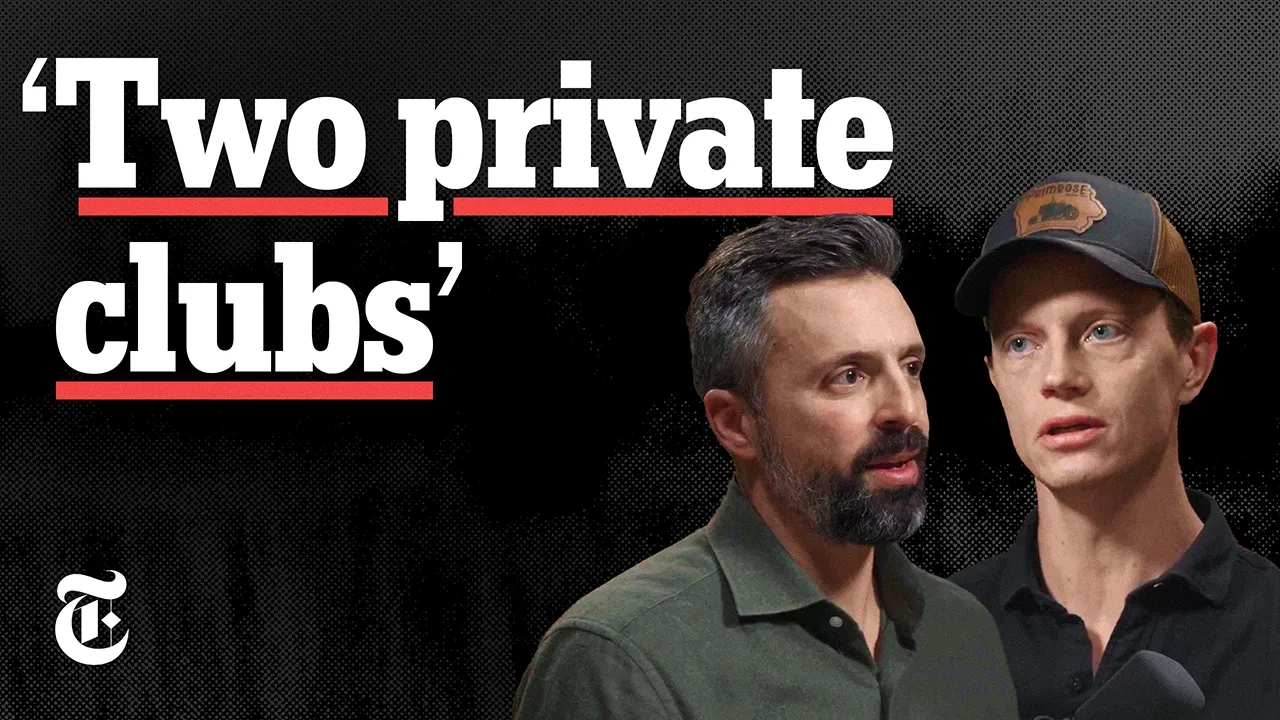
Democrat Rob Sand won the Iowa governorship by 11 percentage points—a 24-point swing from Kamala Harris's 2024 showing—by campaigning aggressively against the two-party duopoly. (0:00)
Sand raised a record $58 million with an average donation of roughly $150, drawing financial support from more than 3,000 registered Iowa Republicans. (15:23)
Rather than ranked-choice voting, Sand advocates an open 'people's primary' paired with general-election approval voting to force candidates to seek broad crossover support. (28:53)
Facing a Republican-controlled legislature with no citizen ballot initiative process, Sand plans to conduct 100 town halls annually and leverage his wins in 11 sitting Republican state senate districts. (57:22)
Detailed notes
## Background
Published on YouTube by The Ezra Klein Show on November 17, 2026, this episode features an interview with Iowa Governor-elect Rob Sand following his decisive 11-point victory. The show explores how Sand achieved an unexpected 24-point swing over recent Democratic performances by campaigning against the two-party duopoly, examining both his critique of American political corruption and his roadmap for governing.
## TL;DR
Rob Sand details how his background as a financial crimes prosecutor and state auditor shaped his view of the two-party system as a market duopoly that breeds political laziness and shields corruption. To fix incentives that force citizens to pick between the lesser of two evils, Sand advocates for fundamental structural changes, including open 'people's primaries' and approval voting over ranked-choice models. He explains how his grassroots campaign de-escalated polarization across Iowa's 99 counties by singing 'America the Beautiful' and giving the first question at town halls to Republicans. Facing a Republican-controlled state legislature, Sand outlines a governing philosophy rooted in appointing political opponents to cabinet roles and using constituent pressure in GOP districts to pass common-sense reforms.
## Atmosphere & style
The conversation carries an earnest, reflective, and pragmatic tone, blending Ezra Klein's trademark wonky analysis with Sand's folksy, Midwestern prosecutorial style. Sand speaks with grounded moral conviction, effortlessly weaving references to Christian scripture and Abraham Lincoln alongside vivid metaphors about off-course taxi rides and fractious marriages. It feels less like a partisan victory lap and more like a deliberate, hopeful blueprint for institutional renewal, marked by thoughtful back-and-forth over the practical tensions between electoral mechanics and polarizing national media.
## Bulletin
- [00:00](https://www.youtube.com/watch?v=79z5LZTuC_o&t=0s) Democrat Rob Sand won the Iowa governorship by 11 percentage points—a 24-point swing from Kamala Harris's 2024 showing—by campaigning aggressively against the two-party duopoly.
- [15:23](https://www.youtube.com/watch?v=79z5LZTuC_o&t=923s) Sand raised a record $58 million with an average donation of roughly $150, drawing financial support from more than 3,000 registered Iowa Republicans.
- [28:53](https://www.youtube.com/watch?v=79z5LZTuC_o&t=1733s) Rather than ranked-choice voting, Sand advocates an open 'people's primary' paired with general-election approval voting to force candidates to seek broad crossover support.
- [57:22](https://www.youtube.com/watch?v=79z5LZTuC_o&t=3442s) Facing a Republican-controlled legislature with no citizen ballot initiative process, Sand plans to conduct 100 town halls annually and leverage his wins in 11 sitting Republican state senate districts.
## Key takeaways
- [15:23](https://www.youtube.com/watch?v=79z5LZTuC_o&t=923s) Sand frames the American political structure as an anti-competitive commercial duopoly where two major parties hold captive consumers and face zero market pressure to deliver results.
- [05:50](https://www.youtube.com/watch?v=79z5LZTuC_o&t=350s) A two-party system allows officeholders to win by merely posing as the lesser of two evils, systematically disincentivizing them from tackling difficult structural problems.
- [10:45](https://www.youtube.com/watch?v=79z5LZTuC_o&t=645s) The public perceives persistent partisan gridlock not as principled debate, but as institutional corruption and self-interested political gamesmanship.
- [21:03](https://www.youtube.com/watch?v=79z5LZTuC_o&t=1263s) Sand views systemic political reform as 'sharpening the ax'—arguing that fixing electoral incentives must precede solving acute challenges like Iowa's radon and water quality crises.
- [28:53](https://www.youtube.com/watch?v=79z5LZTuC_o&t=1733s) Sand advocates for open primaries advancing three to five candidates, followed by approval voting where citizens can cast votes for every candidate they find acceptable.
- [28:53](https://www.youtube.com/watch?v=79z5LZTuC_o&t=1733s) Ranked-choice voting is criticized by Sand as overly convoluted and slow to tabulate, whereas approval voting offers a simpler ballot and stronger incentives for cross-factional civility.
- [31:56](https://www.youtube.com/watch?v=79z5LZTuC_o&t=1916s) Ezra Klein observes that structural voting reforms risk being overwhelmed by nationalized political media and polarized digital environments that overshadow local governance.
- [36:11](https://www.youtube.com/watch?v=79z5LZTuC_o&t=2171s) Sand utilized town hall de-escalation rituals across all 99 counties—such as group singing of 'America the Beautiful' and granting Republicans the first question—to disrupt partisan defensiveness.
- [41:58](https://www.youtube.com/watch?v=79z5LZTuC_o&t=2518s) Voter shifts in places like Winneshiek County—moving from Obama to Trump—reflect an enduring anti-establishment demand for disruption rather than ideological swings.
- [47:32](https://www.youtube.com/watch?v=79z5LZTuC_o&t=2852s) Because Iowa lacks a citizen referendum process, all statutory election reforms must pass through a Republican-held legislature, necessitating outside public pressure.
- [49:47](https://www.youtube.com/watch?v=79z5LZTuC_o&t=2987s) Sand defends bipartisan staffing—such as appointing Republicans who opposed him to senior roles—as essential for building policy that survives subsequent administration changes.
- [01:00:19](https://www.youtube.com/watch?v=79z5LZTuC_o&t=3619s) Rooting his political philosophy in Matthew 25 and the Sermon on the Mount, Sand exemplifies a resurgence of the religious left focused on character, humility, and public accountability.
## Detailed walkthrough
### [00:00](https://www.youtube.com/watch?v=79z5LZTuC_o&t=0s) Running Against the Two-Party Duopoly
Ezra Klein opens the conversation by reflecting on one of the most surprising and closely watched contests of the election cycle: Rob Sand’s race for governor of Iowa. The Iowa governor’s mansion had not been won by a Democrat since Chet Culver in 2006, part of a broader trend in which Democrats lost ground across states where they were once competitive. Yet Sand ran a campaign fundamentally unlike anything else happening nationally. Although he ran on the Democratic ticket, his central pitch was a direct assault on the traditional two-party system, aiming to dismantle the two-party “duopoly” that he routinely referred to on the trail as “special clubs.” Campaigning on slogans like making Iowa “not redder or bluer, just better and truer,” Sand openly leaned into his record as an equal-opportunity antagonist. As he put it during the campaign, “I've been pissing off powerful people in both parties as your state auditor, and I really want to keep pissing him off as your governor.”
The strategy resulted in an overwhelming victory. Sand carried the Iowa governorship by roughly 11 percentage points. That victory represented a 24-point swing from Kamala Harris’s 2024 performance in the state and placed him nearly 30 points ahead of the Democratic gubernatorial margin from 2022. Klein notes that while political commentary has heavily fixated on anti-corporate and anti-billionaire populism, anti-party populism carries a storied American pedigree that taps into widespread voter exhaustion with partisan political machines. With the campaign won, however, the central challenge shifts from campaigning against the system to governing as an anti-party populist.
- The last Democrat to win the Iowa governorship before Rob Sand was Chet Culver in 2006.
- Sand won the gubernatorial race by approximately 11 points.
- Sand outran Kamala Harris's 2024 state performance by 24 points.
- Sand ran nearly 30 points ahead of the 2022 Democratic nominee for governor in Iowa.
---
[01:43](https://www.youtube.com/watch?v=79z5LZTuC_o&t=103s) Why Rob Sand Is Focused on Corruption
Welcoming Governor-elect Rob Sand to the program, Klein traces the unifying throughline of Sand’s career: rooting out public corruption and financial theft. Sand served as an assistant attorney general in the Iowa Attorney General’s Office specializing in white-collar crime, and later became the state’s first Democratic state auditor since the 1960s. When asked what originally drew him into investigating public corruption, Sand explains that his perspective is deeply anchored in his Christian faith. As a child, the biblical narrative that resonated most powerfully with him was Jesus overturning the tables of the money changers in the temple. While the Gospel calls for feeding the hungry and loving one's enemies, Christ’s anger was specifically provoked by leaders who abused positions of trust and authority to enrich themselves rather than serving ordinary people.
Entering law school, Sand wanted to prosecute financial crimes and public corruption specifically because the perpetrators were not driven by poverty or addiction. Because they occupied jobs with authority over public resources, they were already financially secure. Sand terms these offenses “crimes against gratitude,” remarking on how offensive it is for individuals who already enjoy good salaries and societal trust to seek even more for themselves. In the public sector, he argues, such greed directly assaults the foundational premise of democratic self-governance. Sand entered the Iowa Attorney General's Office right out of law school when more experienced attorneys balked at the sheer volume of paperwork involved in financial investigations. Early on, he was assigned to the Iowa Film Office tax credit scandal and became the office's default public corruption prosecutor. A major frustration of that work was Iowa's criminal sentencing framework: regardless of how much public money an official stole—even sums exceeding $400,000—there was no mandatory prison time. Defense lawyers routinely persuaded judges that a defendant could only pay back restitution on a suspended sentence, saddling working-class taxpayers with illusory restitution plans that would take centuries to repay. As Sand dryly puts it, “And by the way, the payment plan that they get put on, it's like they'll get it paid back when they're 867 years old.”
- Sand was the first Democrat elected as Iowa State Auditor since the 1960s.
- Sand characterizes white-collar public corruption as “crimes against gratitude,” distinct from crimes driven by desperation or substance abuse.
- Under Iowa law at the time, even individuals convicted of stealing hundreds of thousands of taxpayer dollars faced no mandatory prison sentences.
---
[05:50](https://www.youtube.com/watch?v=79z5LZTuC_o&t=350s) How the Duopoly Breeds Corruption and Laziness
Klein presses Sand on the underlying conditions that allow corruption to thrive, asking what kind of systemic soil nurtures it. Sand directly connects public corruption to America's rigid two-choice political structure. In his view, immense amounts of capital, energy, and media attention are poured into Democrats and Republicans trading partisan attacks rather than cooperating to address everyday problems. This dynamic cultivates institutional laziness and systemic corruption, because an elected official does not need to govern well to retain power; they only need to convince voters that they represent the lesser of two evils. As Sand explains, “I think a huge piece of it is a two- choice political system where vast amounts of attention and time and money and resources get put into Democrats and Republicans just beating up on each other as opposed to actually working together to solve problems.”
Klein questions whether Sand is conflating two distinct concepts: literal corruption (such as a public figure accepting a foreign jet) versus routine policy failure or poor governance. Sand responds that he intentionally adopts a broader definition. While he has handled classical theft—such as prosecuting a small-town clerk who embezzled tens of thousands of dollars from the tiny community of Menlo, Iowa—he insists that ordinary citizens view corruption as any scenario where someone granted public trust fails to use their authority for the public good. In that broader sense, a system that incentivizes elected leaders to prioritize partisan warfare over public service is fundamentally corrupt.
---
[07:46](https://www.youtube.com/watch?v=79z5LZTuC_o&t=466s) The Iowa Film Office Tax Credit Scandal
Sand illustrates this systemic rot through his experience prosecuting the Iowa Film Office tax credit scandal in the late 2000s alongside his mentor, Republican Deputy Attorney General Tom H. Miller (not to be confused with longtime Iowa Attorney General Tom J. Miller). At the time, states across the country were swept up in a speculative craze, attempting to lure Hollywood film productions by offering lavish financial incentives. Sand characterizes the policy trend as a destructive race to the bottom: a state might attract a production crew for a single month, only for another state to pass more aggressive subsidies and lure the next project away.
In Iowa, lawmakers enacted a statute that Sand describes as completely compromised by special interests. The legislature created an open-ended incentive giving recipients unlimited, fully refundable tax credits equal to 50 percent of their qualified production expenditures. Furthermore, the credits were designed to be transferable. Film producers without any Iowa tax liability could take these credits and sell them for cash to local corporations or wealthy individuals who did owe state taxes. As Sand summarizes, “They literally wrote a statute that gives people an unlimited amount of refundable tax credits and all you had to do is spend money basically for the movie and that and if you spent money for the movie then you could get 50% of whatever you spent back in refundable tax credits.” The statutory loopholes set the stage for widespread fraud and eventual criminal prosecutions.
```mermaid
flowchart TD
accTitle: Mechanics of the Iowa Film Office Tax Credit Scandal
accDescr: Flowchart illustrating how the Iowa film tax credit program permitted movie productions to claim refundable, transferable credits and cash out through third-party sales.
subgraph Production ["1. Production Spending"]
A["Filmmaker incurs production costs in Iowa"]
end
subgraph StateCredits ["2. State Credit Award"]
B["Iowa issues 50% refund in tax credits"]
A --> B
C["Statute sets no dollar cap on awards"]
C -.-> B
end
subgraph Monetization ["3. Monetization & Transfer"]
D["Out-of-state filmmaker lacks Iowa tax liability"]
E["Filmmaker sells credits to local Iowa taxpayers"]
B --> D
D --> E
F["Iowa taxpayers offset state tax obligations"]
E --> F
end
```
[09:16](https://www.youtube.com/watch?v=79z5LZTuC_o&t=556s) The Film Tax Credit Scandal and Legal Corruption
Rob Sand illustrates the sheer absurdity of Iowa’s film tax credit program by laying out an extreme yet entirely plausible hypothetical: an entity could buy a Boeing 747, place it in the background of a single shot, resell it for 95 cents on the dollar, and then receive another 50 percent of the original purchase price in refundable, transferable tax credits. Because out-of-state production companies rarely owed substantial Iowa income taxes, they would flip these credits on the secondary market, typically at roughly 88 cents on the dollar. Sand explains that when his office prosecuted the scandal, the criminal fraud cases centered on people actively inflating their invoices rather than exploiting the structural statutory giveaways.
To capture the surreal nature of the law, Sand kept a tangible courtroom exhibit in the state auditor’s office: a completely ordinary shovel taxpayers had paid $250 to rent for just six weeks. Ezra Klein points out that this touches on a classic political dynamic: while prosecutors must hunt down what is outright illegal, the genuine scandal is often what lawmakers have made entirely legal. Sand agrees, noting that if elected officials operated with genuine accountability and faced real consequences for waste, they would deliberate far more carefully before signing off on such reckless legislation.
- Under the credit rules, productions could recoup 50 percent of qualified expenditures in transferable tax credits, which were routinely brokered to third parties for roughly 88 cents on the dollar.
- The auditor's office kept a standard hardware store shovel as a trial exhibit after uncovering that taxpayers were billed $250 to rent it for a six-week shoot.
- As Rob Sand put it: “It was such a great illustration of how far again from reality and common sense law making can be where again if people really had a sense of accountability who were in elected office and a sense of like true public service where making mistakes like that could really cost them.”
---
[10:45](https://www.youtube.com/watch?v=79z5LZTuC_o&t=645s) ‘Stealth Democracy’ and the Perception of Conflict
Ezra Klein connects Sand’s political instincts to *Stealth Democracy*, an influential political science book from the early 2000s by John Hibbing and Elizabeth Theiss-Morse. Sand smiles, recounting a vivid memory from his college years when he randomly pulled the book off a library shelf while researching his honors thesis, drawn in by the title alone. Klein observes that the book's core empirical finding resonates across Sand's speeches: ordinary voters tend to believe that an enormous baseline of "common sense" solutions already exists. Consequently, when citizens see the two parties engaged in relentless partisan conflict, they interpret the fighting not as principled democratic debate, but as clear evidence of public corruption and self-interest.
Sand embraces the comparison, likening the public’s frustration to taking a taxi or an Uber: a passenger might not know the exact street coordinates, but they immediately recognize when the driver takes an odd turn and something feels off. Whether the corruption involves direct financial grift or purely the hoarding of institutional power, Sand argues that the electorate correctly senses that politicians are treating government like a private country club rather than an instrument of service.
```mermaid
flowchart TD
accTitle: Public Perception of Two-Party Conflict
accDescr: Flowchart illustrating how ordinary citizens perceive partisan deadlock as systemic corruption rather than principled debate.
subgraph Reality["Political Theater"]
A["Partisan Deadlock & Constant Arguing"] --> B["Self-Serving Private Club"]
end
subgraph Public["Voter Perception"]
C["Assumption of a 'Common Sense' Consensus"] --> D["Belief that Conflict = Corruption"]
D --> E["Public Alienation & Distrust"]
end
B -.-> D
```
- Klein notes that under the *Stealth Democracy* framework, voters view bipartisan cooperation as proof that government is clean and functional, whereas partisan conflict signals that politicians are serving their own interests.
- Sand compares the public mood to being trapped in an off-course taxi: “You're not exactly sure what the problem is. You know, did the driver take a wrong turn? Was there traffic? Maybe they're taking but they're but you know that something isn't right.”
---
[13:15](https://www.youtube.com/watch?v=79z5LZTuC_o&t=795s) Anti-Party Populism and the Lesser of Two Evils
Klein observes that while modern Democrats lean into anti-corporate, anti-billionaire populism and Republicans push anti-elite, anti-immigrant populism, Sand’s platform belongs to the early 20th-century tradition of anti-party populism. Sand explains his philosophy by drawing on the Lord’s Prayer and the plea to “lead us not into temptation.” In his view, a rigid two-party duopoly creates an overwhelming institutional temptation for politicians, campaigns, and political consultants to take the lazy way out. Rather than doing the grueling work of resolving complex policy crises, incumbents only need to make themselves look marginally better than the alternative.
On the campaign trail, Sand hosted 200 public town halls across Iowa, opening every single gathering with this exact systemic critique. He argues that millions of Americans feel trapped in voting booths across the country, casting ballots for figures they actively dislike simply because the duopoly leaves them with no viable alternative. While recognizing that economic inequality remains an essential debate, Sand insists that the distortion within the two-party structure is the foundational problem that degrades every policy decision that follows.
> “They don't have to solve problems to get reelected. They just have to be the lesser of two evils.” — Rob Sand
---
[15:23](https://www.youtube.com/watch?v=79z5LZTuC_o&t=923s) Campaign Finance and the Duopoly Trap
Klein pushes back, asking whether money, rather than party structure, remains the true wellspring of political corruption. He notes that Sand’s campaign raised an Iowa record of roughly $58 million, pointing out that even if many contributions are small-dollar grassroots donations, substantial donors usually expect something in return—whether transaction-oriented policies like targeted tax carveouts or broader ideological compliance.
Sand agrees that *Citizens United v. FEC* was a disaster, branding it an “embarrassing failure of the Roberts court” and advocating for state-level corporate charter reforms modeled on Montana and Hawaii. Yet Sand maintains that campaign cash is only a symptom of a much deeper institutional flaw: the lack of electoral competition. Pointing to *The Politics Industry* by Katherine Gehl and Michael Porter, Sand frames the political system through market economics. In standard commerce, a duopoly between two entrenched players creates stagnation, poor customer service, and captive consumers. When voters are restricted to a mandatory choice between only two dominant suppliers, both brands stop innovating and spend all their resources convincing the public that the other choice is toxic.
> “Citizens United was one of the worst Supreme Court decisions in our lifetimes.” — Rob Sand
- Sand’s gubernatorial campaign raised roughly $58 million, setting a state fundraising record, with an average donation around $150.
- Sand backs state-level initiatives to redefine corporate powers to legally restrict corporate election spending despite *Citizens United*.
- Drawing on Katherine Gehl and Michael Porter’s duopoly critique, Sand notes that having only two political parties is as absurd and restrictive as being forced to buy fast-food hamburgers exclusively from McDonald’s or Burger King.
[18:22](https://www.youtube.com/watch?v=79z5LZTuC_o&t=1102s) Moving Beyond the Two-Party Model Without Copying Multi-Party Systems
Ezra Klein presses Rob Sand on his critique of the American duopoly, noting that many countries across Europe, Brazil, and Israel have multi-party systems, and asks whether their governance looks noticeably superior. Sand immediately clarifies that he has no interest in simply copying foreign multi-party models:
> “I just think it's about having more options on the ballot.”
For Sand, reform is not strictly about multiplying political parties, but about giving voters genuine choices between candidates of different character and ethics. Under the current structure, a party insider can be deeply corrupt, yet voters who share that party’s ideology have virtually no viable way to replace them with an honest candidate from the same political camp. Sand argues that in a healthier system, replacing a corrupt politician with an honest one from the same party wouldn't require a miraculous political feat.
He points directly to Iowa’s primary election laws as an example of institutionalized voter disenfranchisement:
- Independent voters make up approximately one-third of the Iowa electorate.
- Despite paying taxes to fund the primary elections, an independent voter who arrives at the polls on primary day is told they cannot cast a ballot unless they sign a piece of paper officially joining a private political party.
- Sand condemns this setup as un-American, arguing it produces candidates who cater exclusively to their private clubs rather than the public as a whole.
Sand reflects on the founding ideal of *E pluribus unum*—out of many, one—noting that the phrase "the people" was originally understood as a collective body rather than isolated partisan factions. He emphasizes that public service must return to representing everyone. As Iowa State Auditor and throughout his gubernatorial campaign, Sand held 100 public town halls across the state each year. His core approach has been total transparency rather than making unrealistic campaign promises: when a constituent asks for something he cannot legally or practically deliver, he tells them so directly. He finds that voters find it deeply refreshing when a politician simply refuses to "BS" them.
---
[21:03](https://www.youtube.com/watch?v=79z5LZTuC_o&t=1263s) Sharpening the Ax: Structural Reform as a Prerequisite for Policy Results
Klein shifts the conversation from political theory to tangible governance. Acknowledging that Sand ran on this anti-duopoly platform to become governor-elect in a non-heavily Democratic state, Klein asks how abstract electoral reforms directly translate into fixing bread-and-butter Iowa issues like cancer rates, water quality, and education.
```mermaid
flowchart TD
accTitle: Sharpening the Ax Logic Flow
accDescr: How structural political reforms directly impact public problem solving
subgraph Problem ["Current Failure"]
A["Dysfunctional Tool / Partisan Duopoly"] --> B["System Designed to Reelect Politicians"]
B --> C["Incremental Half-Measures & Massive Omnibuses"]
end
subgraph Reform ["Lincoln's Metaphor"]
D["Spend Time Sharpening the Ax"] --> E["Structural Electoral Reforms"]
end
subgraph Results ["Direct Policy Impact"]
E --> F["Radon Disclosure Mandates"]
E --> G["Massive Wetlands Restoration"]
end
Problem -.->|"Replace With"| Reform
```
Sand turns to an adage famously attributed to Abraham Lincoln—even if its historical attribution is dubious:
> “Allegedly he said that if you give me six hours to chop down a tree, I'll spend four sharpening the axe.”
Sand argues that the political system itself is the ax, and right now that ax is completely dull. Both Sand and Klein critique the state of federal lawmaking:
- While Klein notes that Congress occasionally passes major packages like the Inflation Reduction Act, the Bipartisan Infrastructure Law, and the CHIPS and Science Act, both agree the current system forces hundreds of distinct policies into giant, incomprehensible omnibus bills because filibuster rules and partisan polarization leave almost no opportunities to vote on standalone measures.
- Sand recalls a viral exchange on Twitter between Alexandria Ocasio-Cortez and Ted Cruz, where both lawmakers publicly agreed on passing a clean, single-issue ethics bill to ban congressional stock trading, yet the broken legislative machinery failed to advance it.
---
[24:03](https://www.youtube.com/watch?v=79z5LZTuC_o&t=1443s) Translating Reform into Tangible Health, Water, and Land Policies
Sand details how an unresponsive political establishment fails to tackle Iowa’s public health crises. Iowa suffers from the highest radon levels in the United States—six times the national average. Radon is the leading cause of lung cancer among nonsmokers (and second overall behind smoking), while lung cancer remains the state's deadliest cancer killer. Although the Iowa legislature passed a bill requiring radon mitigation systems in new home construction, Sand points out at his town halls that very few everyday citizens will ever move into brand-new construction before they die.
Instead of costly government programs, Sand proposes a zero-taxpayer-dollar solution:
- Mandate that real estate agents and home inspectors require prospective buyers to initial a specific disclosure form.
- The form forces buyers to explicitly confirm: they understand radon levels are extremely high in Iowa; they understand radon causes lung cancer; they choose "yes" or "no" on getting a radon test; and they choose "yes" or "no" on spending roughly $2,000 for a mitigation system.
- Sand argues that faced with this explicit choice, almost every buyer would opt for the $2,000 system over the long-term risk of lung cancer.
Turning to Iowa’s water quality, Sand targets the high nitrate levels that contribute to elevated cancer rates. His plan calls for the largest wetlands restoration project the state has ever seen. Wetlands act as natural water filters while expanding outdoor recreation—an urgent need given that Iowa ranks 49th in the nation for public land ownership, which drives young people to leave the state. Sand jokes that wetlands provide activities he calls the "four and a half Fs":
1. Field trips (for kids)
2. Fowl hunting
3. Floating
4. Photographing (the "half F")
Klein challenges Sand, noting that many Democrats would argue these problems stem from standard Republican donor interests and corporate influence rather than a neutral systemic defect. Sand rejects the idea that these are merely partisan policy disagreements, arguing that both parties remain trapped by an underlying structural incentive:
> “The one thing that unites every single one of the problems that we face is that our political system is designed to reelect politicians rather than to solve our problems.”
[27:08](https://www.youtube.com/watch?v=79z5LZTuC_o&t=1628s) Iowa’s Reform Legacy and Sharpening the Ax
Rob Sand points out that Iowa boasts a proud history of systemic political reform, having been the first state in the nation to establish an independent redistricting commission, which remains the recognized "gold standard." Drawing on his seven years as a prosecutor, Sand recalls that out-of-state attorneys would consistently "geek out" when hearing about Iowa’s judicial selection process. Under that merit-selection framework, even an attorney who imagines themselves the most brilliant legal mind in the state cannot simply be appointed to the Iowa Supreme Court by personal or political favor. Instead, applicants must submit their resume and references, and undergo public interviews before a commission made up equally of lawyers and everyday Iowans—meaning an applicant literally has to "interview with Joe Sixpack" before getting a shot at the bench. The commission then passes a curated slate of vetted candidates to the governor, who is constitutionally restricted to choosing only from that list.
```mermaid
flowchart TD
accTitle: Iowa Judicial Selection Process
accDescr: Flowchart illustrating the steps an attorney takes to get appointed to the Iowa Supreme Court.
subgraph Application["Applicant Stage"]
A["Candidate submits resume and references"]
end
subgraph Vetting["Merit Commission Review"]
B["Public interviews before panel<br/>(Half lawyers, half everyday Iowans)"]
C["Commission selects small slate<br/>of qualified names"]
end
subgraph Appointment["Executive Action"]
D["Governor must pick from<br/>the submitted list"]
end
A --> B
B --> C
C --> D
```
Sand connects this structural legacy back to the metaphor of "sharpening the ax." He argues that proactively overhauling institutional machinery prepares a state for unexpected future emergencies—whether a sudden cancer spike or another unanticipated public crisis. When electoral rules compel officeholders to genuinely serve constituents to win reelection rather than relying on the easy shortcut of demonizing their solitary general-election rival, government becomes agile and issues can be resolved rapidly:
> “So we have this great tradition of doing this in Iowa. And the thing is right now if we reform our system then the next time we have a cancer crisis or another crisis comes up and we don't know what it is today. We're not thinking about it. We're not talking about it. But if we have a system, if we have an axe that's sharp, a system that is more ready to actually address issues because politicians actually have to serve us to get reelected instead of just demonizing their only opponent, then those problems that future generations face will fade more quickly.”
[28:53](https://www.youtube.com/watch?v=79z5LZTuC_o&t=1733s) Single Open Primaries and Approval Voting
Ezra Klein notices Sand’s face light up the moment he is asked to specify his exact reform package. Sand confirms his enthusiasm and calls for stripping the Democratic and Republican parties of their special legal privileges. Under his preferred model, party primaries would be replaced by a single, publicly administered "people’s primary" open to all registered candidates and voters, including independents. Voters would cast a single ballot containing everyone who qualified, circling their top pick, and the top three to five finishers would advance directly to the general election.
```mermaid
flowchart LR
accTitle: Rob Sand Electoral Reform Model
accDescr: Flowchart showing the progression from an open primary to approval voting in the general election.
subgraph Stage1["The People's Primary"]
A["Single open ballot for all candidates<br/>(D, R, and Independents)"] --> B["All eligible voters participate"]
B --> C["Top 3 to 5 vote-getters advance"]
end
subgraph Stage2["General Election"]
C --> D["Approval Voting Ballot<br/>(Vote for as many as you approve of)"]
D --> E["Candidate with the most total votes wins"]
end
```
For the general election, Sand rejects traditional plurality voting in favor of approval voting, citing Fargo, North Dakota, as a pioneer of the approach. Rather than picking only one person, citizens can vote for as many of the final candidates as they approve of. On the campaign trail, Sand demonstrates the dynamic to voters by staging a hypothetical race among himself, Klein, and an audience member named Susan:
- Voters can support both major-party contenders, vote for an independent alongside a preferred partisan, or vote for four out of five candidates simply to exclude the one they dislike (such as an ex-spouse).
- Because a competitor's supporters can also cast an approval vote for you, candidates are incentivized to treat rivals with respect and honesty rather than launching scorched-earth attacks.
- Audience members immediately recognize the social dynamic, shouting out that candidates will be "nice," "respectful," and "honest" to win crossover approval.
While California uses a top-two jungle primary, Sand notes that restricting the general election to just two candidates still leaves voters trapped in a "lesser of two evils" dynamic. He also dismisses ranked-choice voting as overly complicated and prone to tabulation delays, highlighting approval voting as universally intuitive:
> “Hey, here's here's four candidates. Vote for as many of them as you like. Whoever has the most people that likes them wins the race.”
[31:56](https://www.youtube.com/watch?v=79z5LZTuC_o&t=1916s) Debating Rule Changes vs. Media Incentives
Klein pushes back with skepticism drawn from his experience following election-reform debates. While acknowledging that alternative mechanisms can soften personal rivalries—citing how New York City’s ranked-choice mayoral primary incentivized candidates Brad Lander and Zohran Mamdani to form alliances rather than feud—Klein observes that systemic reforms rarely translate into obvious leaps in governing competence. Whenever reformers assess a real-world jurisdiction where a change failed to transform governance, the standard reply is often that the local architects simply botched the specific technical tweaks.
Klein suggests that electoral rules may matter far less than broader cultural and structural realities, particularly the collapse of local news and the nationalization of political media. When voters know everything about national partisan brawls on X (formerly Twitter) but cannot identify what their local state representative or state senator is doing at the state capital, candidates naturally organize their behavior around national polarization rather than constituent problem-solving, blunting the impact of marginal ballot tweaks.
[34:08](https://www.youtube.com/watch?v=79z5LZTuC_o&t=2048s) Changing Political Behavior and Resisting Temptation
Sand firmly counters Klein’s skepticism, arguing that institutional design matters profoundly for two key reasons:
1. **Top-two runoffs sustain negative partisanship:** Merely shifting to a California-style top-two primary preserves the structural flaw where candidates must only convince voters that their sole opponent is worse, leading voters into a cycle of lesser-of-two-evils.
2. **Behavioral norms require time to adjust:** In Alaska, for instance, Sarah Palin campaigned very differently between her first and second elections under their top-four ranked system once she realized that being rude and insulting other candidates alienated voters whose secondary support she needed.
Sand uses a social analogy: in ordinary life, human beings are allowed to have multiple friends. If individuals were forced to have only one friend, rivals would spend their time bad-mouthing each other to secure exclusivity. Extending that standard social flexibility to voting forces politicians to behave like regular, well-adjusted people.
Invoking a moral and faith-based perspective, Sand argues that the current two-party system systematically "leads candidates into temptation" to lie and demonize because that remains the single most cost-effective path to victory:
> “We we lead candidates into the temptation to lie, to cheat, to demonize because that's the effective path for them to get elected. But if we have a system like the kind that I'm proposing that's used in a few different jurisdictions, that incentive isn't there.”
Under approval voting, bad behavior will not vanish entirely, but the structural reward for smear tactics will disappear, ensuring that when politicians fail, it will be due to individual human weakness rather than a system actively penalizing decency.
[36:11](https://www.youtube.com/watch?v=79z5LZTuC_o&t=2171s) Singing “America the Beautiful” on the Campaign Trail
Ezra Klein connects Rob Sand's political approach back to the concept of "stealth democracy," observing that everyday voters simply do not want politics to feel as polarized and confrontational as it currently does. Sand details a deliberate campaign ritual: singing the first verse of “America the Beautiful” at 200 public town halls across Iowa. The root of this impulse dates back to 2018 when Sand first ran for state auditor. Launching his campaign at the VFW hall in his hometown of Decorah, he made a point of personally inviting the chair of the Winneshiek County Republicans. He was not expecting the chair's vote, but wanted to signal that escalating political division is shredding the social fabric of the country, and that every individual has a responsibility to repair it. Throughout his tenure as auditor, Sand made a habit of criticizing his own party and defending the other party when warranted.
```mermaid
flowchart TD
accTitle: Town Hall De-escalation Sequence
accDescr: The four sequential steps used at Rob Sand's town halls to bridge partisan divides.
subgraph Ritual["Town Hall Structure"]
A["1. Ask audience to identify party affiliation"]
B["2. Applaud Republicans, Independents, and Democrats equally"]
C["3. Community sings 'America the Beautiful' together"]
D["4. Hand the very first Q&A microphone to a Republican"]
A --> B --> C --> D
end
```
During his gubernatorial run, Sand formalized this into an intentional gathering ritual at town halls across all 99 counties in Iowa, visiting each county twice. He would open by critiquing the two-party system as two private clubs obsessed with fighting each other rather than solving problems. He would then ask attendees to raise their hands if they were registered Republicans, reassuring the room that it was completely safe to do so. Sand would lead the Democrats and independents in applauding their Republican neighbors, before repeating the exercise for independents and Democrats. Immediately after that visible show of goodwill, Sand would challenge the audience to prove they could work together by singing the first verse of "America the Beautiful" without him starting it off: “And people would cry, Ezra, because it was like it was the first time that they had been invited not to pretend that they agree, not to pretend that we are one, but to acknowledge that we are different and then unite, which is in a very different framework, a very different feeling than just sort of saying skipping over the differences.”
- Klein notes extensive psychological and anthropological research demonstrating that synchronous singing or dancing binds human beings together faster and more warmly than almost anything else.
- Sand shares an anecdote about his friend Katie, who explained to him midway through the campaign that communal singing synchronizes participants' brain waves on a delta wave pattern, resembling deep sleep.
- Sand admits that even after 200 town halls, the experience still leaves him visibly choked up because it taps into the foundational, long-forgotten American ethos of retaining deep mutual respect despite fierce political disagreements.
---
[40:40](https://www.youtube.com/watch?v=79z5LZTuC_o&t=2440s) The First Question: Handing the Mic to Republicans
Sand carried this bridge-building strategy directly into the town hall question-and-answer periods. At a typical event, 30% to 40% of the audience members were not registered Democrats. Rather than opening the floor to friendly supporters, Sand would recall an audience member who had raised their hand as a Republican during the initial icebreaker and hand them the microphone for the very first question. Sand told attendees that lecturing about political unity is cheap, and that real listening requires yielding the floor to someone from the opposing party.
The questions posed by Republican attendees ran the gamut from short stump speeches and softball community concerns to pointed, aggressive hardballs. When a reporter later asked Sand whether handing an open microphone to political opponents had ever backfired, Sand reflected on the deeper psychology of the moment: “It can't because the action of me handing that microphone to a Republican, it doesn't matter what the question is or what I say, people seeing me doing that means a lot more than whatever words might come out of their mouth or my mouth.”
---
[41:58](https://www.youtube.com/watch?v=79z5LZTuC_o&t=2518s) Why Rural Iowa Shifted: Winneshiek County and the Hunger for an Outsider
Klein points out that Sand grew up in Winneshiek County, an archetypal bellwether in northeastern Iowa’s Driftless Area that underwent an extraordinary partisan transformation. In 2008, Barack Obama carried the county by 23 points; by 2024, Donald Trump carried it by 9 points. Klein asks Sand to diagnose why the community lost faith in the Democratic Party in such a profound, systemic way.
Sand challenges the conventional media narrative that the voters themselves flipped their core values. He argues that the electorate has remained remarkably consistent in wanting anti-establishment figures who promise to upend business-as-usual in Washington: “What if it was always that that county wants people who are going to shake up politics and that county's actually been consistent and the parties have been inconsistent in who they've nominated.” Sand recalls entering his first year of college right around September 11, and watching Obama arrive in 2008 as an outsider willing to brand the second Iraq War a "dumb war." Obama represented a joyful disruptor willing to challenge the capital's status quo with a smile. In 2016, Donald Trump appealed to the exact same anti-establishment instinct. For Winneshiek voters, authenticity and a willingness to confront powerful leaders within one's own party matter vastly more than institutional party labels.
- Winneshiek County swung from Obama +23 in 2008 to Trump +9 in 2024.
- Sand views voters prioritizing personal authenticity over party loyalty as a genuinely healthy, positive civic trait.
---
[43:28](https://www.youtube.com/watch?v=79z5LZTuC_o&t=2608s) From Obama's “One America” to Clinton's “Deplorables”
Klein draws a generational comparison between Sand and himself, recalling how Sand served as an Obama campaign canvasser in Iowa during the 2008 election. Obama first burst onto the national landscape at the 2004 Democratic National Convention by declaring that there is no "red America" or "blue America," but only the United States of America. That transcendent message carried his 2008 campaign, telling voters that cable news caricatures do not reflect how ordinary Americans interact at work, on youth soccer fields, or during PTA meetings.
Klein reflects on how quickly that unifying vision evaporated once Obama took office. Confronted by absolute obstruction from Senate Minority Leader Mitch McConnell and the subsequent rise of Donald Trump, the Democratic establishment largely concluded that post-partisan reconciliation was hopelessly naive. Klein contrasts two infamous campaign controversies to illustrate the party's ideological drift: Obama’s 2008 comment about frustrated small-town voters clinging to "guns or religion" was clumsy, but still represented an honest attempt to empathize with working-class communities hollowed out by deindustrialization; by contrast, Hillary Clinton’s 2016 "basket of deplorables" remark implied that a huge swath of the country was permanently irredeemable. Klein suggests that Sand’s victory marks a potential revival of the forgotten post-partisan approach that Democrats abandoned for over a decade.
[45:24](https://www.youtube.com/watch?v=79z5LZTuC_o&t=2724s) The McConnell Dilemma and the Need for Electoral Competition
Ezra Klein challenges Rob Sand on whether his optimistic critique of the two-party duopoly is merely another uplifting rhetorical surge destined to collapse against partisan gridlock, particularly once he must govern alongside a Republican-controlled legislature whose primary objective is simply winning the next election. Sand acknowledges the steep challenge, recalling the profound shock he felt as an ordinary citizen when Mitch McConnell publicly declared that his number-one legislative priority was making Barack Obama a one-term president. To Sand, it was bewildering that a Senate leader’s foremost objective was not systematically tackling the nation's problems alongside whoever the voters chose to send to Washington.
Sand contends that while Obama’s unifying rhetoric was fundamentally correct, rhetoric alone inevitably crumbles against structural realities where party leaders like McConnell face zero electoral penalty for obstructing progress. Under the current closed two-party setup, entrenched incumbents who secure a six-year Senate term face no real threat of a general-election challenge if they fail to deliver. Sand insists that changing this behavior requires overhauling the architecture of democracy itself, so that candidates from any faction can challenge an ineffective incumbent directly in November. As Sand explains: “I believe that Americans are more united by what we share than we are divided. I think that is inescapably true. But you have to create a system that allows that to rise to the top as opposed to one that pushes our leaders to divide us and focus on the places where we are different.”
- Mitch McConnell's explicit goal during the Obama administration was preventing Obama's reelection rather than negotiating legislative compromises.
- Without electoral competition from outside or within their party in a general election, incumbents can hold six-year terms without feeling pressured to produce legislative accomplishments.
---
[47:32](https://www.youtube.com/watch?v=79z5LZTuC_o&t=2852s) Passing Reform Without Referenda and Navigating Value Clashes
Klein presses Sand on his practical roadmap for remaking Iowa’s electoral framework, pointing out that Iowa lacks a citizen ballot initiative or referendum process, meaning any voting reform must originate as a bill passed by two Republican-controlled legislative chambers. Sand remains pragmatic, noting that just ten days out from the election, his administration is still building out its operation, but he expresses confidence that there are genuine public servants across the aisle willing to consider systemic reforms. He stresses that electoral reform is not an exclusively Democratic or proprietary concept, pointing to conservative-leaning Alaska and moderate Maine as clear precedents where structural changes gained bipartisan traction.
The conversation turns to morally charged, zero-sum issues such as Iowa’s strict six-week abortion ban, where people hold fundamentally irreconcilable ethical convictions that cannot be smoothed over by technocratic, positive-sum compromises. Sand argues that even on deeply divisive topics, an electoral system that rewards problem-solving over bomb-throwing would uncover broader consensus points than the primary-driven duopoly currently allows. Alternatively, he suggests, an altered incentive structure would compel lawmakers to dedicate their limited legislative bandwidth to the practical kitchen-table issues where supermajorities already agree, ensuring they generate tangible results to justify their reelection.
```mermaid
flowchart TD
accTitle: Sand's Theory of Structural Reform versus Gridlock
accDescr: Flowchart contrasting the existing two-party duopoly with a reformed system that incentivizes consensus and competition.
subgraph Duopoly["Current Two-Party Duopoly"]
A["Closed Primaries & Partisan Safe Seats"] --> B["Performative Grandstanding & Obstruction"]
B --> C["Zero-Sum Gridlock on Divisive Issues"]
end
subgraph Reform["Reformed Electoral Architecture"]
D["Open Competition & Reform Models (e.g., AK, ME)"] --> E["Incentive to Earn Broad General Support"]
E --> F["Durable Policy Focused on Shared Agreement"]
end
```
- Iowa law does not permit citizen-led ballot referenda; all electoral and structural overhauls must pass both chambers of the state legislature.
- Alaska and Maine serve as Sand's primary state-level models showing that electoral redesign can take root in red and purple states.
- Iowa enforces a six-week abortion ban, serving as Klein's benchmark for issues resistant to technocratic middle ground.
---
[49:47](https://www.youtube.com/watch?v=79z5LZTuC_o&t=2987s) Bipartisan Governance and Restoring the Muscle Memory of Compromise
Turning to executive governance, Klein brings up Sand’s pledge to appoint Republicans and independents to his gubernatorial cabinet—a practice Sand previously instituted as Iowa State Auditor when he placed political opponents who had funded his rival into senior leadership roles. Sand views ideological diversity within his inner circle as an indispensable defense against groupthink and executive blind spots. Likening the dynamic to two wings on a single bird, Sand remarks that the most fruitful conversations happen when a colleague pushes back to explain why an idea falls short. As Sand puts it: “Leftwing, right-wing, one bird, right? We all benefit from listening to each other.”
Klein reflects on his two decades of political journalism, observing that the routine muscle memory of cross-aisle consultation has severely atrophied. In past decades, lawmakers constantly negotiated across party lines and understood how their proposals would be perceived by their opponents. Today, Klein observes, Democrats often engage in internal "red-teaming" only with their own progressive wing while dismissing conservative views on the assumption that Republicans will oppose them regardless. Sand agrees that having good-faith skeptics in the room sharpens legislation and prevents policy from becoming a fragile partisan pendulum that swings and unravels every time power shifts:
> “We should want to build solutions that people can look at from different positions in life who have different values and they can all agree, okay, that would actually be good because if we do that, that is likely to be a solution that actually meets reality and it isn't just something that becomes another tug-of-war when the other party takes power.”
- In the Iowa State Auditor’s office, Sand staffed senior leadership with a registered independent and a Republican who had actively donated to his campaign opponent.
- Klein likens the modern legislative environment to his scarring experience covering the passage of the Affordable Care Act (Obamacare), where cross-partisan dealmaking completely broke down.
- Both men argue that durable public policy requires advance vetting from political adversaries so that legislation can withstand future changes in governing majorities.
[54:34](https://www.youtube.com/watch?v=79z5LZTuC_o&t=3274s) Agreement, Trust Building, and the Marriage Analogy
Ezra Klein brings up Rob Sand’s core governing philosophy: prioritizing areas of agreement rather than obsessing over disagreements, which runs directly counter to modern political practice. Klein presses Sand on the common critique of this strategy—namely, that shelving controversial issues allows harmful or unjust policies to remain entrenched. Sand concedes that it might temporarily, but he insists that incremental collaboration is essential for establishing basic interpersonal trust. Whether inside an office, on a campaign, or within a legislative body, collaborating on small tasks is what equips individuals to take on harder ones together.
Sand illustrates this dynamic using a marriage metaphor. In any long-term relationship, every person knows three or four sensitive topics that will instantly spark a row. If someone intentionally wakes up and chooses to ignite that argument first thing in the morning, the relational atmosphere is poisoned for the rest of the day. By dinner time, when deciding where to eat, a spouse might privately recognize a restaurant they would love, but they will stubbornly reject it purely out of spite:
> “And they will choose their own misery over doing something that will make you happy because you started a fight with them.”
According to Sand, contemporary partisan politics functions in precisely this dysfunctional way, where parties refuse common-sense wins simply to deny their opponents a victory. To counter this pattern, Sand announced during his victory speech that he will invite Republican lawmakers to bill-signing ceremonies for any legislation they pass that he signs. He emphasizes that while he cannot sign bills the Republican legislature never sends him, establishing a baseline of shared success makes it far easier to gradually tackle more contentious issues and locate common middle ground that the majority of voters can support.
---
[57:22](https://www.youtube.com/watch?v=79z5LZTuC_o&t=3442s) Governing with a Hostile Legislature
Klein pushes back on Sand's optimism, highlighting the harsh realities of power politics. He notes that when Sand served as state auditor, the Republican-led legislature actively stripped power from his office, and rumors swirled that they might curtail gubernatorial powers before Sand even took office—a structural resistance reminiscent of what Barack Obama encountered. Sand acknowledges this history but gives credit where due: despite quiet conversations among Republicans about holding a lame-duck special session to weaken the governor's office before his inauguration, leadership publicly ruled it out.
```mermaid
flowchart TD
accTitle: Sand's Legislative Pressure Strategy
accDescr: Flowchart illustrating how Rob Sand leverages town halls and electoral pressure on Republican state senators.
subgraph Strategy["Public Accountability"]
A["Host 100 town halls across Iowa"] --> B["Communicate directly with voters in GOP districts"]
B --> C["Explain vetoes or stalled popular bills"]
end
subgraph Leverage["Electoral Pressure"]
D["11 GOP State Senators in Sand-won districts"] --> E["9 up for re-election in 2028"]
C --> F{"Choice for GOP Legislature"}
E --> F
F -->|"Pass popular bipartisan agenda"| G["Take issues off the table; compete on new ground in 2028"]
F -->|"Block bipartisan agenda"| H["Sand campaigns against obstruction in 2028"]
end
```
When asked how he plans to achieve results without a statewide referendum mechanism if legislators stonewall his agenda, Sand outlines a direct public-pressure campaign. He plans to conduct 100 town halls across Iowa every year, showing up directly in Republican districts to hold lawmakers accountable to their own constituents. He points out that he won the districts of 11 sitting Republican state senators—nine of whom face re-election in 2028. Pointing to his historic win, Sand urges Republicans to pass his broadly supported platform so they can fight on new ground four years later, warning:
> “I got more votes for governor than any other candidate since World War II in Iowa with a single exception, 1964.”
- Sand defeated his opponent by 11 points in the gubernatorial race.
- Over 3,000 registered Iowa Republicans donated directly to Sand’s campaign.
- 9 of the 11 Republican state senators whose districts Sand carried are up for re-election in 2028.
---
[01:00:19](https://www.youtube.com/watch?v=79z5LZTuC_o&t=3619s) Faith and the Resurgence of the Religious Left
Klein pivots to the underlying moral and spiritual tone that has surfaced within parts of the Democratic Party, pointing to figures like James Talarico, Adam Hamilton, and Jon Ossoff, who utilize biblical or transcendent framing. Klein notes that Sand's own politics are deeply rooted in personal faith rather than purely technocratic liberalism, and asks how he views this broader shift toward a religious left.
Sand responds with genuine enthusiasm, declaring, “I just love it. Fills me with joy.” He argues that voters are far sharper than consultants assume; they understand that an administration will face thousands of unexpected decisions that never arose during the campaign, making a candidate's core character and driving motivations paramount. Sand recounts attending a Sikh wedding and later discussing it with an ardent MAGA supporter named Tim from Jackson County, who openly admired the Sikh faith, illustrating that religious openness fosters connection rather than alienation. For Sand, authentic Christianity is defined not by partisan weaponization, but by the Sermon on the Mount and Matthew 25:
> “I loved seeing um Adam Hamilton doing what he's doing in Kansas. just to have a voice for uh you know the sermon on the mount, a voice for Matthew 25 where I think the heart of Christianity really at the end of the day is about seeing God and everyone else around you and treating them the way that you would want to be treated as opposed to tearing people apart from each other.”
Sand contends that a major, compassionate strand of faith has long been absent from public representation, and both politics and the church have suffered for it. Klein agrees that this is an apt place to conclude the conversation and transitions to asking the show’s traditional final question: three book recommendations.
[01:03:48](https://www.youtube.com/watch?v=79z5LZTuC_o&t=3828s) Book Recommendations: Literature, Lincoln, and the Gospels
Closing out the conversation with the show’s traditional book recommendations, Rob Sand defers the first two selections to his wife, Christine, whom he describes as both one of the smartest and best-read people he knows. Her first pick is the Pulitzer Prize–winning novel *Tinkers* by Paul Harding, which Sand notes is a personal favorite fiction work of hers. For the second recommendation, in keeping with the episode’s focus on governance and cross-partisan collaboration, she chose Doris Kearns Goodwin’s classic *Team of Rivals: The Political Genius of Abraham Lincoln*. Sand shares that Christine picked it up recently and could not stop talking about it, which inspired one of their young sons to tackle the massive history book at home as well.
For his own selection, Sand offers a qualified recommendation tied back to their earlier discussion on faith and political service. Rather than asking listeners to wade through an entire massive religious text, he suggests dipping into just a focused portion that motivated him and several other candidates: the four Gospels of Matthew, Mark, Luke, and John. Sand argues that encountering the primary texts directly reveals a stark contrast to how religion is frequently framed in contemporary culture: “I think people who pick those up, given what so often defines Christianity in the media these days and in politics, would be surprised to see what it was that Jesus actually said about what he wanted from us.” Following this reflection, Ezra Klein closes the interview and thanks Sand for coming on the show.
- *Tinkers* by Paul Harding (fiction recommendation from Christine Sand).
- *Team of Rivals: The Political Genius of Abraham Lincoln* by Doris Kearns Goodwin (historical non-fiction recommendation from Christine Sand).
- The Four Gospels (*Matthew*, *Mark*, *Luke*, and *John*) (recommended by Rob Sand as an essential look into Jesus’s direct words and teachings).
## Notable quotes
> [24:03](https://www.youtube.com/watch?v=79z5LZTuC_o&t=1443s) The one thing that unites every single one of the problems that we face is that our political system is designed to reelect politicians rather than to solve our problems. — Rob Sand
> [15:23](https://www.youtube.com/watch?v=79z5LZTuC_o&t=923s) Citizens United was one of the worst Supreme Court decisions in our lifetimes. — Rob Sand
## Mentioned
Abraham Lincoln, Adam Hamilton, Affordable Care Act, Alexandria Ocasio-Cortez, America the Beautiful, Barack Obama, Bipartisan Infrastructure Law, Brad Lander, CHIPS and Science Act, Chet Culver, Christine Sand, Citizens United v. FEC, Donald Trump, Doris Kearns Goodwin, Elizabeth Theiss-Morse, Ezra Klein, Fargo, North Dakota, Gospel of John, Gospel of Luke, Gospel of Mark, Gospel of Matthew, Hillary Clinton, Inflation Reduction Act, Iowa Attorney General's Office, Iowa Film Office, Iowa State Auditor, Iowa Supreme Court, James Talarico, Jesus, John Hibbing, John Roberts, Jon Ossoff, Josh Turek, Kamala Harris, Katherine Gehl, Katie, Michael Porter, Mitch McConnell, Paul Harding, Rob Sand, Sarah Palin, Stealth Democracy, Team of Rivals: The Political Genius of Abraham Lincoln, Ted Cruz, The Politics Industry, Tim from Jackson County, Tinkers, Tom H. Miller, Tom J. Miller, X, Zohran Mamdani
## Video description
Rob Sand will soon be Iowa’s first Democratic governor in more than 15 years. And he won the race in a walk – trouncing his opponent by 11 points, a 24-point swing from how Kamala Harris performed in the state in 2024. And he ran several points ahead of Iowa’s Democratic senator-elect, Josh Turek.
Sand achieved this political feat by running against the two-party system itself. He campaigned relentlessly on the idea that our electoral system is broken, that the two-party “duopoly” breeds corruption and has corroded our politics. So I wanted to have Sand on the show to dig deeper into his critique of our political system, and ask him how he’ll translate his winning campaign message into actual governance.
00:00 Intro
01:43 Why Rob Sand Is Focused on Corruption
05:50 How Duopoly Breeds Corruption
07:46 Film Tax Credit Scandal
10:45 ‘Stealth Democracy’
13:15 Sand’s Critique of the Two-Party System
19:11 The Case for Open Primaries
21:35 Why Sand Is ‘Sharpening the Ax’
28:59 Approval Voting
31:22 Reform Tradeoffs
32:10 The Limits of a Ranked-Choice System
36:31 ‘America the Beautiful’
41:58 Why Iowa Flipped
43:28 From Obama to Now
47:32 Making Reform Happen
48:37 Working Across Values
49:47 Why Sand Prefers Bipartisan Staffing
01:00:19 The Return of the Religious Left
01:03:39 Book Recommendations
Read the full transcript here: https://www.nytimes.com/2026/11/17/opinion/ezra-klein-podcast-rob-sand.html
Watch more on @EzraKleinShow
Thoughts? Guest suggestions? Email us at ezrakleinshow@nytimes.com.
You can find transcripts (posted midday) and more episodes of “The Ezra Klein Show” at nytimes.com/ezra-klein-podcast. Book recommendations from all our guests are listed at https://www.nytimes.com/article/ezra-klein-show-book-recs.html
Iowa Governor-elect Rob Sand argues that America's two-party duopoly creates an institutional trap that rewards partisan demonization over competence, contending that meaningful governance requires dismantling closed party privileges through open primaries and approval voting.
The Duopoly as an Engine of Institutional Rot (5:50)
Sand’s political rise culminated in an 11-point victory in the Iowa gubernatorial race—outrunning Kamala Harris’s 2024 state margin by 24 points and Chet Culver's 2006 benchmark as the state's last Democratic governor. Rather than adopting standard anti-corporate or anti-elite rhetoric, Sand anchored his campaign in anti-party populism, attacking both political parties as self-serving "private clubs." Drawing on economic duopoly theory from Katherine Gehl and Michael Porter’s The Politics Industry, Sand asserts that a two-choice political market eliminates competitive incentives: incumbents need not solve complex problems to win reelection, but merely convince voters they are the lesser of two evils.
Sand broadens the definition of public corruption beyond literal theft, such as the white-collar cases he handled as a prosecutor and state auditor, to encompass any abuse of public trust that prioritizes partisan warfare over the common welfare. Evoking John Hibbing and Elizabeth Theiss-Morse’s Stealth Democracy, Ezra Klein notes that voters interpret constant partisan warfare not as principled debate, but as clear evidence of self-interest. In Sand’s view, this structure creates institutional laziness, leading lawmakers to pass structurally compromised legislation—such as Iowa's defunct film tax credit program—where legally sanctioned waste proved far more damaging than outright criminal fraud.
Overhauling Elections with Open Primaries and Approval Voting (28:53)
To break this dynamic, Sand proposes replacing closed, taxpayer-funded party primaries with a single open "people's primary" where all candidates appear on one ballot and all voters participate. Under current Iowa law, independent voters—who constitute roughly one-third of the electorate—cannot vote in primaries without officially joining a private political party, an arrangement Sand calls fundamentally un-American. Under his model, the top three to five finishers advance to a general election governed by approval voting, similar to the system used in Fargo, North Dakota, allowing citizens to vote for as many candidates as they find acceptable.
Sand rejects California’s top-two runoff format, arguing it preserves the binary trap where candidates win by tearing down a solitary opponent, and dismisses ranked-choice voting as overly complicated. Under approval voting, candidates must court crossover support from rivals’ bases, which Sand argues mechanically removes the incentive for scorched-earth smear campaigns. While Klein expresses skepticism that mechanical ballot changes can overcome the nationalization of political media and the decline of local news, Sand maintains that institutional design dictates behavioral norms, just as Alaska's top-four system altered candidate conduct between election cycles.
Sharpening the Ax to Address Everyday Crises (21:03)
Invoking Abraham Lincoln's adage about spending four hours sharpening an ax before chopping down a tree, Sand argues that democratic process reform is the essential prerequisite for solving material policy crises. In Iowa, an unresponsive legislature has struggled with pressing public health issues, including radon levels six times the national average that drive high lung cancer rates, alongside nitrate pollution in water and a scarcity of public land (Iowa ranks 49th nationally). Rather than introducing expensive bureaucratic programs, Sand advocates targeted, pragmatic solutions, such as mandatory radon disclosure forms for prospective homebuyers and large-scale wetland restoration to naturally filter runoff while expanding outdoor recreation.
Both Sand and Klein observe that the dullness of the legislative apparatus forces national and state policy into cumbersome omnibus bills or deadlocks popular standalone proposals, such as federal bans on congressional stock trading. Sand rejects the progressive assumption that policy failure is solely the product of corporate lobbying or Republican obstruction, insisting that the electoral architecture itself discourages elected officials from resolving shared problems when partisan conflict remains more electorally advantageous.
Governing Hostile Territory Through Deliberate De-escalation (36:11)
Without access to a citizen-led ballot referendum in Iowa, Sand must govern through a Republican-controlled legislature that previously curtailed his powers as state auditor. To counter obstruction, Sand plans to conduct 100 annual town halls across Iowa's 99 counties, directly targeting the districts of 11 Republican state senators he carried in the gubernatorial election—nine of whom face reelection in 2028. This mirrors his campaign strategy of intentional de-escalation, where he regularly invited audience members to identify as Republicans, led bipartisan applause, sang "America the Beautiful" communally, and handed the first Q&A microphone to an ideological opponent.
To build legislative trust, Sand adopts what he terms a "marriage analogy": picking early, explosive fights poisons cooperation on basic decisions, whereas passing mutually agreeable bills establishes the interpersonal trust needed to tackle difficult issues. Sand pledges to appoint Republicans and independents to his cabinet—reiterating his practice as auditor—and to invite Republican lawmakers to public bill signings. Anchoring his approach in the Gospel teachings of the Sermon on the Mount and Matthew 25, Sand argues that authentic, post-partisan reconciliation offers a durable civic model that rebuilds the lost muscle memory of legislative compromise.
Sand’s strategy tests whether anti-party populism and aggressive cross-partisan engagement can translate into legislative success within a deeply polarized state. While his 11-point victory confirms widespread voter appetite for de-escalation, his agenda ultimately depends on whether a hostile Republican legislature will cooperate on systemic reforms or whether institutional incentives will continue to reward obstruction.
Source quotes
[24:03] Rob Sand: The one thing that unites every single one of the problems that we face is that our political system is designed to reelect politicians rather than to solve our problems.
[15:23] Rob Sand: Citizens United was one of the worst Supreme Court decisions in our lifetimes.
Original transcript
[0:00] One of the races I was following most
[0:02] closely across the election was Rob
[0:04] Sans's race for governor in Iowa. Last
[0:06] time a Democrat won the Iowa Governor's
[0:08] Mansion was 2006 when Chad Culver took
[0:11] it. It's one of [music] those states
[0:12] Democrats used to be very, very
[0:13] competitive in and seemed to have lost
[0:16] almost entirely. And Sand was running a
[0:19] race that was distinctive to really
[0:21] anything else I saw across the country
[0:23] this year. He's a Democrat running as a
[0:25] Democrat. But his big pitch [music]
[0:28] was that he wanted to destroy the
[0:29] two-party system.
[0:30] >> That is what we mean on the yard signs
[0:32] and the t-shirts [music] when we say
[0:33] it's time to make Iowa not redder or
[0:35] bluer, just better and truer.
[0:37] >> He wanted to end the two-party duopoly,
[0:39] [music] what he liked to call these
[0:41] special clubs in Iowa.
[0:43] >> I've been pissing off powerful people in
[0:45] both parties as your state auditor, and
[0:46] I really want to keep pissing him off as
[0:48] your governor.
[0:50] >> And man, did it work. Sand won the
[0:53] governor's mansion in Iowa. Not by a
[0:54] little, he won it by a lot. He won it by
[0:56] about 11 points. He ran 24 points ahead
[1:00] of Kla Harris in 2024. [music] He ran
[1:02] almost 30 points ahead of the Democrat
[1:04] for governor in 2022. And so I want to
[1:07] have Sand on to talk about how he did
[1:09] it. Both because I think it's an
[1:10] interesting model for [music] possibly a
[1:12] lot of candidates across the country.
[1:14] We've been talking a lot about
[1:15] anti-corporate, anti-billionaire
[1:16] populism, but anti-party populism has a
[1:19] very long history. [music] And one thing
[1:21] Americans really hate is political
[1:23] parties, but also because now he's
[1:25] actually got to do something with it.
[1:27] And [music] the question of how you
[1:28] actually govern as an anti-arty populist
[1:31] is not an easy [music] one. Rob Sand
[1:34] joins me now.
[1:40] >> Governor elect Rob Sand, welcome to the
[1:42] show.
[1:43] >> Thanks for having me.
[1:44] >> So I want to talk about what got you
[1:46] here. you had a 30-point swing towards
[1:48] you from the last gubernatorial election
[1:49] in Iowa.
[1:51] >> I was going through your career and the
[1:53] throughine to me was public corruption.
[1:56] You worked in the Iowa attorney
[1:58] general's office. You were assistant
[2:00] attorney general. You focused and
[2:02] specialized in white collar crime and
[2:03] public corruption. You became state
[2:05] auditor. I think the first Democratic
[2:07] state auditor in Iowa.
[2:08] >> Uh first since like the 60s. So
[2:11] >> So for a long time.
[2:12] >> Yeah. Yeah.
[2:12] >> Uh again a lot of work there on theft of
[2:14] public money. what motivated you into
[2:17] public corruption and what have you
[2:18] learned about how it works?
[2:20] >> So, a lot of what I do is animated by my
[2:22] faith and
[2:25] um one of the stories that stuck up to
[2:27] me as a Bible story when I was a kid was
[2:30] Jesus flipping over the chain the money
[2:32] changers tables at the temple. You pay
[2:34] attention to the gospel and it's like
[2:36] love your neighbor uh love your enemy
[2:38] even, right? Feed the hungry, clothe the
[2:41] naked, heal the sick. Uh
[2:45] but he got angry too. And what he got
[2:47] angry at was people in positions of
[2:49] trust and power who were abusing their
[2:51] trust and power to enrich and serve
[2:53] themselves instead of recognizing, wow,
[2:57] what a what a gift I have been given to
[2:58] be here and putting that gift, that
[3:01] placement in society to good use for
[3:03] ordinary people. Um, and I remember
[3:05] going into law school, uh, thinking, I'd
[3:08] love it if I could do public corruption
[3:11] prosecution, financial crime
[3:12] prosecution, prosecution of people who
[3:14] by definition have access to other
[3:16] people's money, so they have a good
[3:19] position in life. They're not committing
[3:20] crimes of desperation. They're not
[3:22] committing crimes of inebriation.
[3:24] They're just literally greedy. Um, I've
[3:27] called it before, crimes against
[3:28] gratitude.
[3:30] >> Crimes against gratitude.
[3:31] >> Crimes against gratitude. It's like,
[3:32] look at you. you have a job, you you you
[3:34] must get paid a decent salary because
[3:36] you have access to other people's money.
[3:38] And here you are instead of looking
[3:40] around the world and thinking of all the
[3:41] things that you have, you're thinking, I
[3:44] want more. I need more. And that kind of
[3:46] stuff to me is just it it's it's it's
[3:50] more offensive in a way, particularly on
[3:52] the public sector side, because those
[3:54] crimes are also crimes against public
[3:56] trust. They're crimes against our idea
[3:58] of self-governance. their crimes against
[4:01] the idea that we actually could have a
[4:02] government that would actually serve us
[4:04] in seven certing uh insiders and special
[4:06] interest groups. And I got lucky in that
[4:09] sense that when I graduated, they wanted
[4:13] to hire someone at the attorney
[4:15] general's office to focus on financial
[4:16] crimes cuz no one else wanted to do it.
[4:18] [laughter]
[4:19] And I was the guy that was kind of like
[4:21] the rube, you know? Everyone else is
[4:23] like, man, these these cases are
[4:25] complicated. There's a ton of paperwork.
[4:27] you could read document 10,000 and it
[4:29] totally changes the meaning of document
[4:31] 7. You know, I raised my hand as the guy
[4:34] just kind of fresh out of law school.
[4:36] And so they put me into this uh Iowa
[4:38] film office tax credit scandal that we
[4:39] had at the time and they just kept
[4:41] handing me all the public corruption
[4:43] cases. The other piece of it that was
[4:44] really frustrating, at least in Iowa,
[4:46] was you do all this work, all this
[4:48] paperwork, you got your witnesses to, of
[4:50] course, and at the end, no matter how
[4:51] much money somebody steals in Iowa,
[4:53] there's no point at which they are
[4:55] required to go to prison.
[4:57] >> So, you could prove that somebody stole
[4:58] $400,000 from taxpayers, but they would
[5:01] go to sentencing after a trial and be
[5:04] saying, "Boy, judge, you know, my
[5:05] client's not going to be able to pay it
[5:06] back if you uh if you put him in prison,
[5:09] so, you know, you should put him on a
[5:10] payment plan and give him give him a
[5:11] suspended sentence." which to me is like
[5:14] you explain that to an ordinary person.
[5:16] Explain that to somebody who gets up
[5:18] every day, goes to work, works hard,
[5:20] makes, you know, a middle income or
[5:23] working class. And here's someone who
[5:26] was in charge of a piece of their taxes,
[5:29] their money, their time away from their
[5:30] family, their blood, their sweat, their
[5:32] tears. And you're going to tell them
[5:34] like, "Okay, they stole $400,000, but
[5:36] you know, uh, we're just going to let
[5:37] them back out and make sure they pay it
[5:39] back." And by the way, the payment plan
[5:42] that they get put on, it's like they'll
[5:44] get it paid back when they're 867 years
[5:46] old. Yeah. Yeah. Yeah. Yeah. Yeah. Yeah.
[5:48] It's never It's never very realistic.
[5:50] >> So, I hear the way that that kind of
[5:52] corruption offends you.
[5:54] >> Mhm.
[5:55] >> What did you learn about the conditions
[5:56] that are conducive to it? What is the
[5:59] soil in which corruption thrives? Uh, I
[6:02] mean, you want to ask me right now
[6:04] sitting here today, and I think a huge
[6:06] piece of it is a two- choice political
[6:08] system where vast amounts of attention
[6:12] and time and money and resources get put
[6:15] into Democrats and Republicans just
[6:18] beating up on each other as opposed to
[6:19] actually working together to solve
[6:21] problems. There's all kinds of problems
[6:23] that people experience in their
[6:24] day-to-day life. And people in elected
[6:28] office are just out there, you know,
[6:31] trying to win the next election
[6:33] immediately after they win this one and
[6:35] then trying to beat up on the other side
[6:37] because it's this broken two- choice
[6:38] political system that functionally it
[6:40] allows corruption. It allows laziness
[6:43] because the only thing you have to do to
[6:45] have what many people would consider a
[6:47] successful political career, if you
[6:48] define success by getting reelected over
[6:50] and over and over again, is just
[6:52] convince people that you're the lesser
[6:53] of two evils.
[6:54] >> When you say it like that, it's hard for
[6:55] me to tell if you're making a
[6:57] distinction between
[6:58] >> what one might think of as corruption.
[7:00] Right. I would put in that category
[7:02] something like Donald Trump taking the
[7:04] jet from cutter
[7:05] >> and what you might just think of as
[7:06] failure.
[7:06] >> Yes. a failure to address priorities, a
[7:09] failure to govern well, a failure to
[7:10] spend your time on what the public wants
[7:12] you to spend it on. Are you making a
[7:14] distinction there?
[7:15] >> I don't think that I am. I think I'm
[7:17] using a broader definition of corruption
[7:19] because there can be the corruption
[7:20] where, you know, I prosecuted the town
[7:22] clerk that stole 60 or $80,000 from
[7:25] Menllo, Iowa. Teeny little town. I had a
[7:28] couple of town meetings talking to
[7:29] people about what had happened. Um, and
[7:32] that's corruption in the most specific
[7:34] sense. But there is this broader sense
[7:36] where I think a lot of people, a lot of
[7:37] ordinary people see corruption as
[7:39] anytime you sort of have that position
[7:41] of trust and power, not doing what
[7:44] you're supposed to do with it. You know,
[7:48] I kind of cut my teeth at the attorney
[7:50] general's office prosecuting the Iowa
[7:53] film office tax credit scandal. Uh my
[7:56] mentor was a Republican in the office,
[7:58] uh the deputy attorney general, um Tom
[8:02] H. Miller, not to be confused with the
[8:05] attorney general himself, Tom J. Miller.
[8:08] Um, but it's Iowa. And, uh, Tom and I
[8:11] prosecuted the most of these cases
[8:13] together. If you remember back in the
[8:16] late as uh, film tax credits were like a
[8:20] big deal cuz everybody thought like, oh,
[8:22] we can get filmmakers to come into our
[8:24] state if we just give them money. And of
[8:26] course, you could get them there for a
[8:29] month to film one movie, but then
[8:30] someone else would pass another set of
[8:31] incentives that would lower the floor
[8:33] and they would go somewhere else to film
[8:34] their next movie. So, it's always kind
[8:36] of just a silly wild goose chase. But
[8:39] they passed a program in Iowa riddled,
[8:41] absolutely riddled with loopholes. They
[8:44] literally wrote a statute that gives
[8:47] people an unlimited amount of refundable
[8:50] tax credits
[8:52] and all you had to do is spend money
[8:54] basically for the movie and that and if
[8:57] you spent money for the movie then you
[8:59] could get 50% of whatever you spent back
[9:02] in refundable tax credits. So you could
[9:03] then sell them if you didn't have tax
[9:05] liability in Iowa to somebody that did.
[9:07] So you could you could have under this
[9:08] under this Oh yeah. Oh yeah. Oh yeah.
[9:11] You could you can't sell a refundable
[9:13] tax like that. That's not
[9:14] >> Yeah. Yeah. Also transferable. So you
[9:16] could you could you could buy a 747, use
[9:19] it in the background of a single shot,
[9:22] sell it for 95 cents on the dollar of
[9:25] what you got it for and then get another
[9:27] 50% on top of that of your purchase
[9:30] price in refundable transferable tax
[9:32] credits
[9:32] >> that you could then sell to somebody
[9:33] else cuz you actually don't have that
[9:34] much.
[9:36] >> Wow.
[9:36] >> And the transfer is usually 88 cents on
[9:38] the dollar.
[9:39] It was insane, right? And so here we
[9:41] [laughter] were trying to prosecute
[9:43] fraud and it basically had to be around
[9:45] people inflating their invoices. So in
[9:48] in my in the auditor's office, I had uh
[9:51] an exhibit from one of our trials, a
[9:53] shovel, just a really very regular
[9:56] shovel that you would probably have in
[9:58] your garage uh that taxpayers paid $250
[10:01] to rent for six weeks. Just one of those
[10:05] things where you're like, where were the
[10:06] breaks here? Right. But so this is a
[10:08] real you're looking to prosecute what's
[10:11] illegal, but the scandal is what's
[10:12] legal.
[10:13] >> Yeah.
[10:13] >> Quality.
[10:14] >> Yes. It was unbelievable. It was such a
[10:17] great illustration of how far again from
[10:21] reality and common sense law making can
[10:24] be where again if people really had a
[10:28] sense of accountability who were in
[10:31] elected office and a sense of like true
[10:35] public service where making mistakes
[10:37] like that could really cost them. They
[10:40] probably would think a little bit more
[10:41] clearly about passing a law like that
[10:43] before they do it.
[10:45] You know, there's this book from the
[10:47] early 2000s. It's a political science
[10:50] book that has a tendency to lodge in
[10:51] people's head when they've read it. And
[10:54] when I was looking at the things you
[10:57] say, it felt to me like you've read it.
[10:58] It's called Stealth Democracy.
[11:01] You've read it. I actually I have a
[11:03] specific memory a specific memory of
[11:06] walking around in the uh library while I
[11:10] was in college looking pulling books for
[11:13] my honors thesis and actually pulling it
[11:15] off the shelf. I'm not even kidding you.
[11:17] [laughter]
[11:17] And thinking, "Oh, stealth democracy.
[11:19] What's that about?" Cuz it's a great
[11:20] [clears throat] name. It's a great name.
[11:22] >> Man, as a shot in the dark in my
[11:24] political science knowledge, this one
[11:25] paid off. For me, it's been a very
[11:27] mimemetic book for years. sat
[11:33] based on like a lot of survey data is
[11:34] that when people see the two parties
[11:36] arguing a lot
[11:38] >> to them that is evidence of a kind of
[11:40] corruption.
[11:40] >> Yeah.
[11:41] >> They take that as [clears throat]
[11:42] evidence that the the public believes
[11:44] rightly or wrongly there is like this
[11:46] large zone of common sense.
[11:48] >> Yes.
[11:48] >> And if the parties are not agreeing in a
[11:50] common sensical way
[11:52] >> Yes.
[11:52] >> that what that is revealing is that they
[11:55] are out for their own interests and not
[11:57] for yours. Cooperation is a signal of
[12:00] things working in a kind of clean, good
[12:01] government way and conflict is a signal
[12:04] of at least a certain form of public
[12:06] corruption. And a lot of the things you
[12:08] say on the trail
[12:09] >> just sound like that to me.
[12:10] >> I I I I think that that is accurate. Um
[12:14] if that's a piece of stealth democracy,
[12:16] that makes sense to me. But in a large
[12:18] part, my bigger point is in responding
[12:20] to that is yes, I do think that people
[12:22] look at it that way. And and I think
[12:25] some of that goes back to like you can
[12:27] you know that there's a problem, right?
[12:29] >> Mhm.
[12:30] >> And like imagine like you get in a you
[12:32] get in a taxi or an Uber and you kind of
[12:34] know where you're going, but then you
[12:35] look around and you're like this isn't
[12:37] quite the right thing. You just have
[12:39] this sense of like this isn't right.
[12:40] You're not exactly sure what the problem
[12:42] is. You know, did the driver take a
[12:44] wrong turn? Was there traffic? Maybe
[12:45] they're taking but they're but you know
[12:47] that something isn't right. And I think
[12:49] people have that sense. And the easiest
[12:52] way to understand that I think is
[12:53] describing it. It's it is it's some form
[12:55] of corruption. Could it be financial? It
[12:57] could be. But it could just be power.
[12:59] Power distorting people's sense of
[13:01] public service. Because at the end of
[13:02] the day, even if maybe they're not uh
[13:06] always
[13:07] trying to serve somebody financially,
[13:09] they're still trying to just grab that
[13:11] power and use it for their little
[13:12] private club rather than actually using
[13:14] it to serve the public.
[13:15] >> You're in a an interesting political
[13:17] tradition here. I think this year people
[13:19] got used to on the Democratic side uh
[13:21] sort of anti-corporate, anti-billionaire
[13:22] populism. On the Republican side,
[13:25] there's anti-immigrant, anti- elite
[13:26] populism.
[13:27] >> Yeah.
[13:28] >> You're in a tradition of anti-party
[13:30] populism. Yes.
[13:31] >> Uh like sort of old school progressive
[13:34] reformer tradition
[13:35] >> like 1920s.
[13:36] >> Like 1920s. So So [laughter] tell me a
[13:38] bit about this theory. So if you're if
[13:40] you're sitting here and somebody says,
[13:41] "No, the problem is simply the
[13:42] billionaires of the corporations." or
[13:43] maybe a Republican is sitting here and
[13:45] saying it's the academics and the and
[13:46] you're saying no, it's the political
[13:48] parties. Why?
[13:50] >> Because at the end of the day, I think
[13:52] about it this way. Um there's this line
[13:54] in the Lord's Prayer, lead us not into
[13:55] temptation. And it's a it's it's a
[13:58] really wonderful thing uh to try to
[13:59] recite every day. Uh because the idea is
[14:02] that if we can stay on the straight and
[14:04] narrow and avoid the things that might
[14:06] pull us off, it's easier for us to do
[14:09] what we know we should be doing. And
[14:11] when I look at the two-choice political
[14:13] system, all I see is temptation.
[14:16] >> Temptation for elected officials and
[14:17] candidates and consultants to get people
[14:20] to take the easy way. You know, we we I
[14:22] did 200 public town halls in this
[14:23] campaign for governor. At every one of
[14:25] them, we started by talking about how uh
[14:28] politicians and candidates have come to
[14:30] understand that getting reelected can be
[14:32] easy even though solving problems is
[14:34] hard because they don't have to solve
[14:35] problems to get reelected. They just
[14:37] have to be the lesser of two evils.
[14:39] That's not complicated. just lie about
[14:40] and demonize your opponent and then you
[14:42] can get people to be like, "Well, I
[14:43] guess I got to vote for this guy." And
[14:45] so across America, millions of people
[14:47] feel trapped into voting for a candidate
[14:50] that they don't like because they think,
[14:52] "Well, the other one I can't vote for."
[14:54] That is a tremendously corrupting
[14:56] influence on where we're supposed to go.
[14:59] And to me, it's one of the issues I
[15:02] think it's like the baseline underlying
[15:04] issue behind everything else. The
[15:07] economic inequality question is a good
[15:09] one that has always been debated. Um,
[15:12] and I'm not I'm not saying that it isn't
[15:14] important. Economic equality and
[15:16] inequality are important, but at the end
[15:20] of the day, we're talking about the
[15:21] decisions made by elected officials,
[15:23] >> but elected officials who need money.
[15:25] You said $56 million.
[15:26] >> We raised, I think, 58.
[15:28] >> 58.
[15:28] >> It's a record. [laughter]
[15:30] >> I mean, don't those people I mean, some
[15:32] of those are small donors. We we average
[15:35] donor out of that I think 150 bucks for
[15:37] us.
[15:38] >> But to get to that number, some of them
[15:39] are not small donors.
[15:40] >> Yeah. Yeah.
[15:41] >> And I think an intuition people have not
[15:43] wrongly is that
[15:45] >> actually everybody wants something. So
[15:46] some of the small donors just want you
[15:47] to beat the Republicans. Um
[15:49] >> correct.
[15:50] >> Some of the big donors too big. This has
[15:53] been a fascinating experience.
[15:54] >> I have a whole in my book on
[15:55] polarization. I I'd like to hear Let's
[15:57] talk about money for a few minutes
[15:58] because
[15:59] >> the way we think about money I've always
[16:01] broke it into two groups, right? There's
[16:03] transactional money and ideological
[16:04] money. The transactional money and it's
[16:06] all transactional away, right? Some of
[16:07] the money wants you to do something
[16:09] >> that is political or values aligned.
[16:12] Some of the money just wants a favor in
[16:14] government, a tax break to be created or
[16:16] extended or reversed.
[16:19] >> But all that money wants something. And
[16:22] the people who say like the core
[16:24] generator of corruption in government is
[16:26] the need for this money. What have you
[16:29] learned about political money? Why is it
[16:31] not the core of what you're saying?
[16:32] >> Well, it is a problem, right? I mean,
[16:34] I've said repeatedly and I'll say it
[16:35] again right now. Citizens United was one
[16:37] of the worst Supreme Court decisions in
[16:39] our lifetimes.
[16:40] >> Uh just absolute embarrassing failure of
[16:43] the Roberts court. Um we do need to do
[16:46] something about it. I would love to do
[16:48] in Iowa what they're doing in Montana
[16:50] and Hawaii, uh to redefine the powers of
[16:52] a corporation to say, "No, okay,
[16:54] Citizens United might be there, but
[16:56] we're not going to give you the power to
[16:57] do that." Uh I think that we should do
[16:59] that everywhere. It's a wonderful way at
[17:01] the state level to get around it. So
[17:03] money is a problem in politics. But the
[17:06] bigger piece that I'm more focused on is
[17:07] this party piece because again to me
[17:12] it enables a whole separate level of
[17:16] that same corruption and different kinds
[17:18] of corruption as well as just the
[17:19] laziness where you don't have to solve
[17:21] problems. Right? This like a lot of this
[17:22] comes down by that why why do
[17:24] >> there's a lack of competition? Okay. So,
[17:26] a a great book that I have recommended
[17:27] to people for years is uh the politics
[17:30] industry. Um, and and it's a pretty
[17:33] simple idea. It's written by uh a
[17:36] business school professor and a
[17:37] businesswoman um from Wisconsin, which
[17:40] always makes me want to say that she was
[17:42] running a cheese company. I'm not sure
[17:43] if that's true. Um but it's Kathern Gall
[17:47] and Michael Porter. Yeah. Yeah. Um and
[17:50] it was this and it was a simple point.
[17:52] They were saying, "Hey, we live in a
[17:54] society where we say we like markets
[17:56] where people have the freedom to choose
[17:57] from multiple options. We know that a
[18:00] duopoly, which you know, a shared
[18:02] monopoly between two people or two
[18:05] companies isn't productive. So why do we
[18:07] allow that in our political system? It
[18:10] doesn't serve customers. If you only
[18:12] have two options for what to get a thing
[18:14] that you must get, they're both just
[18:16] going to end up trying to tell you that
[18:17] the other one is the worst choice. If
[18:20] you had to eat hamburgers and you could
[18:21] only get them at Burger King and Mc in
[18:22] McDonald's, they would be telling you
[18:24] the other one is feeding you rat meat.
[18:26] >> When you look at Europe or Israel or
[18:28] Brazil or I mean there are a lot of
[18:30] countries in this world with multi-party
[18:32] systems.
[18:34] >> Do they look so much better to you in
[18:35] their governance?
[18:36] >> No. But I'd also don't want to emulate
[18:39] them. I don't think that that's the
[18:40] path.
[18:41] >> I just think it's about having more
[18:43] options on the ballot. It doesn't have
[18:44] to be more parties. For example, you can
[18:47] have two people whose views are largely
[18:49] similar, but one of whom is corrupt and
[18:51] the other of whom has high integrity.
[18:54] And in the system in the kind of system
[18:56] that I want us to step into, to advance
[18:58] to, you could replace someone in in a
[19:01] party [clears throat] who's highly
[19:02] corrupt with someone in the same party
[19:04] who isn't. And it wouldn't be a
[19:06] miraculous effort to do it. I mean,
[19:08] that's part of the problem right now is
[19:10] the way we divide it. I mean, in Iowa,
[19:11] for example, independents don't have an
[19:14] equal right to participate in our
[19:15] democracy. Literally don't have it. So,
[19:17] you've got your constitutional right to
[19:20] vote. You've got an election that your
[19:23] tax dollars are paying for. But if
[19:25] you're an independent voter in Iowa,
[19:26] which about a third of Ians are, if you
[19:28] walk in on primary day, they're going to
[19:30] tell you, "Sorry, you've got to sign
[19:31] this sheet of paper joining a private
[19:33] club before you can exercise your right
[19:35] to vote in this election that your tax
[19:36] dollars are paying for." That to me is
[19:38] unamerican. It's wrong and it's
[19:41] corrupting because then what you get is
[19:43] people that are only listening to their
[19:45] private club in order to get through the
[19:46] primary or people who only cared about
[19:50] their private club coming into the
[19:51] primary in the first place who decide to
[19:53] run because the whole system is not
[19:55] about serving the public. Right? You
[19:58] know when this country was founded we
[20:00] they used to use the phrase the people
[20:02] and it didn't mean each individual
[20:04] person. It meant the people as a as a
[20:06] group out of many one. plurbassoon and
[20:10] we we don't think about that anymore.
[20:12] But I really think it's important for us
[20:13] to reconsider the idea that public
[20:16] service can be about trying to represent
[20:18] everybody. I've tried to do that really
[20:20] intensively both in my time as state
[20:22] auditor and in the campaign for
[20:23] governor. I'm planning to do it continue
[20:25] to 100 public town halls every year
[20:28] telling people what I think is
[20:29] realistic. People come to me asking me
[20:31] if I can do a thing rather than making a
[20:33] promise that I know that realistically
[20:34] in the situation I'm getting into I
[20:36] can't keep or that there's some legal
[20:37] reason that I won't be able to do it. I
[20:38] just tell them that and as a tremendous
[20:41] number of people just appreciate me not
[20:44] BSing them. You know, they're like, "Oh,
[20:46] I didn't know that. Thank you. That's
[20:48] refreshing." I hear that so much from
[20:50] people just for saying you, "Hey, look,
[20:52] I know you care about that. Here's the
[20:54] reality of the situation. This is why I
[20:55] couldn't do that. If you want somebody
[20:57] who's going to tell you they can do
[20:58] things they can't do, you'll have to
[20:59] look elsewhere." I am going to try to
[21:01] just tell you what the truth is. I can
[21:03] imagine having this conversation about
[21:04] parties. In fact, I have had this
[21:06] conversation about parties where it's a
[21:07] fun abstract
[21:08] >> political science discussion. Yeah.
[21:11] >> You are the governor- elect of Iowa.
[21:13] This has been at the core of your pitch
[21:15] to Ians. Iowa obviously not being a
[21:18] highly partisan Democratic state
[21:20] >> and and for you it's a
[21:24] >> set of structural reforms that if
[21:25] enacted over time will make solutions
[21:29] and possibilities possible that are
[21:32] currently off the table. So, so walk me
[21:35] through this. Walk me through this not
[21:36] just as a uh a kind of conceptual
[21:38] argument about politics, but when you
[21:40] are thinking about questions like Iowa
[21:42] cancer rates, which were a huge part of
[21:44] your campaign, or you know, what's
[21:46] happening with the water or the
[21:47] education system,
[21:49] >> how you imagine this going, how you
[21:51] begin with structural forms to the party
[21:54] duopoly
[21:55] >> and it actually gets you to things where
[21:57] people's lives are different.
[21:58] >> Yeah. So, so this is one of my favorite
[22:00] things to talk about because I always go
[22:03] back to I I learned in the course of
[22:05] this campaign, apparently we don't think
[22:07] that this is truly an Abraham Lincoln
[22:09] quote. [laughter]
[22:10] >> So many are not. It turns out
[22:12] >> no, but allegedly he said that if you
[22:14] give me six hours to chop down a tree,
[22:16] I'll spend four sharpening the axe. What
[22:19] that means is that when you have a tool
[22:21] to accomplish a job, having that tool be
[22:24] ready and able to do that job
[22:27] effectively is incredibly important. You
[22:31] look at our system of governance right
[22:33] now, it's a joke. It's a mess. Look at
[22:36] what you know, every time that out in
[22:38] DC, one party gets a trifecta, what do
[22:40] they do? They pass one bill in two
[22:42] years, like one big thing.
[22:43] >> That's not quite fair.
[22:44] >> Two.
[22:45] >> They did. Well, I'd say two I'd
[22:47] [laughter] say two things about this.
[22:48] One, there's a lot of secret Congress
[22:49] going on to use Madagasc's term. But
[22:51] two, and I actually think this
[22:52] [laughter] is a problem with how DC
[22:54] works now, but you look at the inflation
[22:56] reduction act, you look at the
[22:57] bipartisan infrastructure bill, you look
[22:59] at the chips and science act,
[23:01] >> those should pro no, those [laughter]
[23:02] should probably be like 400 bills.
[23:05] >> Oh,
[23:05] >> because what has happened now is
[23:07] everything has become a giant omnibus
[23:08] because you get so few shots on goal
[23:11] because you're using weird procedural
[23:12] workarounds in the filibuster. So, it's
[23:14] not that they're not passing anything.
[23:15] It's that what they're passing are giant
[23:18] completely incomprehensible
[23:20] under so
[23:21] >> that everybody then can look at and be
[23:22] like, I can't believe you voted for
[23:23] that. I can't believe you opposed it.
[23:25] Well, you're looking at different pieces
[23:26] of it. Do you remember this moment? I
[23:28] think it was back when it was called
[23:29] Twitter where uh Ted Cruz
[23:32] >> in this house. [laughter]
[23:33] >> Fair enough.
[23:33] >> In this house, we believe
[23:36] >> uh Ted Cruz and AOC on Twitter were
[23:40] like, "Let's pass a clean bill." And I
[23:42] think it was a it was an ethics reform
[23:43] bill, which is why it stuck out to me
[23:45] cuz I'm a big good government guy. They
[23:47] were just like, "Let's do a clean bill."
[23:49] And I think it was like banning stock
[23:50] trading. Never happened. But there they
[23:53] were on on Twitter X like having an
[23:56] exchange in the public being like,
[23:58] "Let's do it." Didn't happen. And you're
[24:00] right that they just do these huge
[24:02] things instead. But here's my bigger
[24:03] point. I want to go back to your point
[24:04] about okay, we got high cancer rates in
[24:06] Iowa. Okay. So couple of things in Iowa
[24:09] that the state can be doing. We have the
[24:11] highest radon levels in the country. Uh
[24:14] 6x average. Radon is the second leading
[24:17] cause of lung cancer behind smoking and
[24:19] lung cancer is the leading killer. They
[24:22] passed a bill last year that said,
[24:23] "Okay, new construction in Iowa has to
[24:25] be built with a radon mitigation
[24:27] system." Good. And then I'll ask at a
[24:30] town hall, "Anyone here think they're
[24:31] going to live in new construction before
[24:32] they die?" People laugh. I say, "Great.
[24:36] So that's not enough. If we want to
[24:38] address this, we need to do more. here's
[24:39] something we can do that doesn't cost
[24:40] taxpayers a dollar every time a home
[24:43] inspector does an inspection. Every time
[24:44] a realtor sells a house documented they
[24:48] need to show that their client initials
[24:51] every every one of these. I know that
[24:53] radon is incredibly high in Iowa. I know
[24:55] that radon causes lung cancer. I yes or
[24:57] no want a radon test performed as a part
[25:00] of this. And then yes or no, I know that
[25:03] getting a radon mitigation system is
[25:05] going to cost me 2 grand and I yes or no
[25:08] want one of those installed. Just that
[25:10] little bit of forcing people to think
[25:12] through this as they do it. I know the
[25:13] vast majority of Ians are going to say
[25:15] better safe than sorry. And if you're
[25:16] making a house, if you're purchasing a
[25:18] house per uh uh you're you're putting a
[25:20] lot of resources into something, you're
[25:22] also going to say, "Hey, long-term that
[25:24] $2,000 on a radon mitigation system is a
[25:26] lot cheaper than lung cancer in 20
[25:28] years." So that would be a much more
[25:30] effective way to address that. Water
[25:32] quality, real issue in Iowa. Nitrates
[25:34] cause cancer. We have incredibly high
[25:35] nitrate levels. I want to do the single
[25:37] biggest wetlands restoration uh that
[25:39] anyone has ever seen. Uh everyone can
[25:42] get behind that. Uh nothing filters
[25:45] water better. And no matter who you are,
[25:47] uh you can find something that you want
[25:49] to do in wetlands. I like to say there's
[25:50] four and a half Fs. If you're kids, you
[25:52] can take a field trip, you can foul
[25:53] hunt, you can photograph, you can float.
[25:56] Photographs the half F.
[25:58] >> [laughter]
[25:59] >> I did it out of order. I try I try to
[26:01] save that one for last. Um, but the idea
[26:04] is at the same time we're 49th for
[26:06] public land in America. We are losing
[26:09] young folks. Many of them move to places
[26:12] that have more outdoor opportunities.
[26:14] So, let's clean up our water, reduce our
[26:15] cancer rates, improve our ability to uh
[26:18] have fun outside, and retain our young
[26:21] people all with that one solution. And
[26:22] so I think uh to bring this back to the
[26:24] party question, I think one way a
[26:25] Democrat might hear this is to say,
[26:28] >> yeah, you've had a bunch of Republicans
[26:29] in charge who, you know, traditionally
[26:32] Republicans, I'm not as familiar with
[26:33] the the Iowa variant, but are not as
[26:36] excited about public lands, tend to give
[26:38] corporations a lot more leeway, tend to
[26:40] not put as many impositions on
[26:42] homebuilders and home sellers and and so
[26:44] on. And what you have here is a
[26:46] corporate power problem and a Republican
[26:48] party problem probably uh generated by
[26:51] by big donors. connect this back to the
[26:53] core thing you're saying. You you want
[26:54] to sharpen the axe. You sharpen the axe.
[26:56] And how does that lead you to cut down
[26:57] rate on
[26:58] >> levels? And that's the thing. The one
[26:59] thing that unites every single one of
[27:01] the problems that we face
[27:02] >> is that our political system is designed
[27:04] to reelect politicians rather than to
[27:06] solve our problems.
[27:08] Here's one of the wonderful things about
[27:09] this, Ezra. Iowa actually has a great
[27:12] tradition. We have been one of the
[27:13] foremost reformer states in the country.
[27:16] First state to create an independent
[27:17] redistricting commission. Iowa. Ours is
[27:20] still the gold standard. Seven years as
[27:22] a prosecutor, if I talked to lawyers
[27:24] from other states, when they learned I
[27:26] was from Iowa, they would get excited
[27:27] about how we pick judges. Just they
[27:29] would geek out on it. Um, and this is
[27:31] the cool thing about that. If you are
[27:33] the if you think you are the smartest
[27:36] attorney in the state of Iowa, that
[27:37] everyone would be so lucky to have you
[27:40] ruling from the Iowa Supreme Court and,
[27:41] you know, all your wisdom and your
[27:44] brilliance for us to see to guide our
[27:46] lives. Cool. Good for you. You have to
[27:48] interview with Joe Sixpack before you
[27:50] can get on the Iowa Supreme Court.
[27:51] That's literally how our system works.
[27:53] We have a it's a you have to submit your
[27:56] resume, letters of reference. You have
[27:58] to sit down for public interviews and
[28:00] the committee that you're in front of is
[28:01] half lawyers, half non- lawyers, just
[28:03] Ians. They can ask you whatever question
[28:05] they want. Then they will send to the
[28:07] governor a small list of names that they
[28:11] the people of the state of Iowa think
[28:13] are qualified and the governor can only
[28:14] pick from those names. So we have this
[28:16] great tradition of doing this in Iowa.
[28:19] And the thing is right now if we reform
[28:21] our system then the next time we have a
[28:23] cancer crisis or another crisis comes up
[28:26] and we don't know what it is today.
[28:27] We're not thinking about it. We're not
[28:28] talking about it. But if we have a
[28:30] system, if we have an axe that's sharp,
[28:32] a system that is more ready to actually
[28:34] address issues because politicians
[28:35] actually have to serve us to get
[28:36] reelected instead of just demonizing
[28:38] their only opponent, then those problems
[28:40] that future generations face will fade
[28:42] more quickly.
[28:53] So, talk to me about how you actually do
[28:54] that. What What changes do you make to
[28:56] your system?
[28:57] >> Changes. Yes. Uh single open primary.
[29:02] >> Your your eyes brighten when I ask
[29:04] [laughter] about
[29:05] >> I love this stuff. I love this stuff.
[29:08] Yes. Let's end the special legal
[29:10] privileges of the Democratic and
[29:12] Republican parties. one single primary.
[29:14] It's the people's primary because this
[29:16] is our democracy. You want to be a
[29:18] member of a private club, congrats. Good
[29:20] for you. Go right ahead. You can have
[29:21] the D behind your name, but the public
[29:24] runs this primary. Uh, every candidate
[29:27] that qualifies to get on the ballot is
[29:29] on the same ballot. We all as voters
[29:31] walk in, including independent voters,
[29:33] all eligible voters, and circle whoever
[29:36] we like the most for each race. So then
[29:38] send the top three to five to the
[29:40] general election. In the general
[29:42] election, I like what far Fargo, North
[29:44] Dakota uh first started doing, approval
[29:46] voting. Here are five candidates, vote
[29:48] for as many of them as you approve of.
[29:51] If there's two in your party and you're
[29:53] a super partisan person, great. Vote for
[29:55] those two. There's two in your party,
[29:57] but there's one that actually impresses
[29:59] you with their character and you just
[30:02] you love the idea of your kids listening
[30:05] to this person talk and watching what
[30:07] they're going to do. Even though you
[30:08] know you're going to have disagreements
[30:08] with them, you trust them to do what
[30:10] they think is right. then you can
[30:11] actually vote for them too. Maybe it's a
[30:14] situation where you're just kind of a
[30:15] middle of road person and you can just
[30:17] vote for the independent and then maybe
[30:19] you vote for the other one because you
[30:20] really don't want this one over here.
[30:21] But it gives you two options. Fine.
[30:24] Maybe out of five, one is your ex. You
[30:25] can vote for the other four, right? It
[30:26] doesn't. It's just like your conscience
[30:28] dictates what you do and how each person
[30:32] stands, each candidate stands is up or
[30:34] down based on their own merits. And then
[30:38] one of my favorite things to do on the
[30:40] campaign trail is walk this walk people
[30:42] through this with two of the people
[30:44] sitting in the audience and just say
[30:46] like okay so you know me Susan and Ezra
[30:49] here are all running for office against
[30:50] each other and we're doing it this
[30:52] system. So I know that a bunch of people
[30:54] are going to like Ezra they like his
[30:56] ideas they like his experience but his
[31:00] voters can vote for me too some of them
[31:03] if they like me too. So, how am I going
[31:04] to treat Ezra in order to get his voters
[31:07] to also support me? And people will
[31:10] shout out. You'll be nice. You'll be
[31:12] respectful. You'll be honest. People get
[31:14] super excited about it because when you
[31:16] just think about this, it doesn't take a
[31:18] lot of thought. But no one's been
[31:20] talking about this in our democracy.
[31:21] Almost nobody. We've had a fair amount
[31:23] of primary reform. I mean, California
[31:24] now has jungle primaries where it is
[31:26] kind of everybody's primary. You can end
[31:28] up and you often do end up with two
[31:29] Democrats in the
[31:30] >> But it's top two, which is top two.
[31:31] Again, it's Alaska has a top I think
[31:34] it's a top four system.
[31:35] >> So, you like that better.
[31:37] >> Well, but for the primary piece, but
[31:40] then rank choice is confusing and it
[31:43] delays results as we're seeing right
[31:44] now. And approval voting, I think, is a
[31:46] great way to do that. That everyone
[31:48] automatically understands what that
[31:49] means. Hey, here's here's four
[31:51] candidates. Vote for as many of them as
[31:52] you like. Whoever has the most people
[31:53] that likes them wins the race. Oh, okay.
[31:55] Cool.
[31:56] >> I always worry a little bit. Uh, I I
[31:59] know a lot of election rule nerds.
[32:02] [laughter] That's that's the bill I come
[32:04] out of. And whenever I have these
[32:06] conversations, it isn't that these
[32:08] systems don't sound better to me.
[32:10] >> Um, and we have rank choice here in in
[32:12] New York. And I actually think you saw
[32:13] it made the mayoral primary nicer in
[32:16] certain ways. Certainly like Brad Lander
[32:18] and Zoran Mdani were uh incentivized to
[32:21] become friends as opposed to become
[32:22] enemies.
[32:24] On the other hand, whenever I'm like,
[32:25] well, you look at this place, it doesn't
[32:26] really seem to have solved governance
[32:27] there. You look at that place. I always
[32:29] get a
[32:30] >> Yeah. Well, they didn't quite make the
[32:32] exact [laughter] set of tweaks.
[32:34] >> Yeah. Yeah.
[32:34] >> And and it has always made me wonder a
[32:37] bit.
[32:37] >> Yeah.
[32:37] >> Whether two things, I guess. One is if
[32:40] it is so sensitive
[32:42] >> to getting the technical details exactly
[32:45] right. Yeah.
[32:46] >> Such that it's very hard to point to a
[32:48] place that is large,
[32:50] >> say, well, they really nailed it. and
[32:52] you can see this radical um vertical
[32:54] movement in positive governance.
[32:56] >> That makes me worried.
[32:58] >> But the other is that the electorate has
[33:00] a say too, right? Uh and the conditions
[33:03] in which the electorate is operating
[33:04] have a say. And so for instance, the
[33:07] media conditions have a very big say in
[33:09] this. You know, what kinds of
[33:10] information people are getting. We were
[33:11] talking about Twitter X and how many
[33:13] people are there. You know, decline of
[33:15] local news is a big part of this. One of
[33:16] the things that I think has made a lot
[33:18] of governance in this country harder and
[33:21] goes a little bit more towards your lazy
[33:24] and do not actually have to solve
[33:25] problems dimensions is so much of
[33:29] political information is nationalized.
[33:31] >> People know a lot more about what is
[33:32] happening nationally. They know a lot
[33:34] more about the big fights.
[33:35] >> It's hard to find out what's happening
[33:36] in your state capital.
[33:37] >> Yeah. is your representative doing in
[33:40] your state to say nothing of your state
[33:42] senator and state um uh you know
[33:45] legislator
[33:46] >> that you know when you're dealing with
[33:49] these systems that are meant to have a
[33:52] lot of incentives to work you know for
[33:54] your people but in fact have a lot of
[33:56] incentives now to be part of the the
[33:58] kind of big national structuring fight
[34:00] >> that you know tweaking and twisting
[34:03] >> the electoral rules can help on the
[34:05] margin but I think
[34:08] I think it can actually help a ton. So
[34:10] there's there's two answers to that
[34:11] question and I see the the heart of your
[34:13] question. The heart of your point is
[34:16] >> how much of a difference does it really
[34:17] make? And I have two answers to that.
[34:19] Number one, I do think that some pieces
[34:21] of the structure are important because
[34:23] again, if you just end up with the top
[34:26] two, you still just have the lesser of
[34:27] two evils for the entire general
[34:29] election, which is not a great set of
[34:31] incentives, right? It's leading people
[34:32] into temptation. Um, so yes, that part
[34:35] does matter. Um, but the other piece is
[34:38] that it takes time. It takes time for
[34:40] people, both voters and candidates, to
[34:42] like sort of re understand how the new
[34:44] system works. If you look at Alaska,
[34:46] it's like the way that Sarah Palin ran
[34:47] under their new system the first time
[34:49] and the second time are very different.
[34:50] Cuz all of a sudden, she understood
[34:51] like, oh, when I insult other people and
[34:55] I'm rude, it actually just makes people
[34:56] like me less. Maybe I shouldn't do that.
[34:58] I like to say it make politicians act
[35:00] like normal people. You get to have more
[35:03] than one friend, Ezra. So do I. If we
[35:06] only were in a world where we only got
[35:08] one friend, someone else that wanted to
[35:09] be our friend would come in and start
[35:11] talking smack about our one friend in
[35:13] order to try to replace them. The world
[35:15] doesn't work like that. When people do
[35:17] that kind of thing, we go, I I don't I
[35:18] don't like these people. And so, if you
[35:20] give elected officials and candidates
[35:22] the same set of structures that regular
[35:24] people have, they will behave better.
[35:26] But part of this, too, keep in mind, is
[35:30] the culture that we create. I think
[35:32] everyone can appreciate this, but part
[35:35] of it to me is faith-based.
[35:37] We we lead candidates into the
[35:40] temptation to lie, to cheat, to demonize
[35:44] because that's the effective path for
[35:47] them to get elected. But if we have a
[35:49] system like the kind that I'm proposing
[35:52] that's used in a few different
[35:53] jurisdictions, that incentive isn't
[35:56] there. That does that mean that they
[35:58] won't lie or demonize? No, it doesn't.
[35:59] But it means they won't have a reason to
[36:01] do it. that actually boosts them. People
[36:04] will still fall short. They'll still
[36:06] behave in bad ways, but it won't be
[36:08] necessarily because the system is
[36:09] pushing them to do it. It'll be because
[36:11] that's more just their nature.
[36:13] >> Well, one thing I also see you both
[36:14] saying and doing here, and this maybe
[36:16] goes back in some ways to stealth
[36:17] democracy, is people don't want politics
[36:20] to feel this way.
[36:22] >> They might be part of it. They might
[36:23] participate in it.
[36:24] >> Can we talk about America the Beautiful?
[36:25] >> Uh, we're we're [laughter] going to talk
[36:26] about America the Beautiful. Why don't
[36:28] you describe America the Beautiful? I
[36:30] have a question I want to ask you about
[36:31] it. All right. We sang America the
[36:32] Beautiful at 200 public town halls this
[36:35] campaign. We sang it at other events,
[36:37] too. But let me go back to before we
[36:39] were doing that in 2018 when I ran the
[36:41] first time. I launched my campaign in my
[36:43] little hometown in in Dora.
[36:44] >> This for auditor.
[36:45] >> For auditor. Yep. Uh at the VFW.
[36:48] And I remember before I did it, I
[36:49] reached out to the guy who was the chair
[36:51] of the Winnick County Republicans and
[36:53] said, "Hey, hey, I'm I'm going to run
[36:55] for state auditor. I really think our
[36:57] politics is moving in a bad direction
[36:59] and I want you to know that we're having
[37:01] the event. It's here. It's this time and
[37:03] you're invited. I specifically want you
[37:06] to be there. I'm not doing this because
[37:08] I think that he's going to vote for me.
[37:11] I'm doing it because I think this is
[37:12] important.
[37:13] We we we are we are tearing ourselves
[37:16] apart. This system, this create, this
[37:19] incentive that are furthering division
[37:22] is weakening the social fabric of this
[37:26] entire country. And every one of us has
[37:28] something that we can do to make it
[37:30] better. So
[37:32] throughout uh my time at the state
[37:34] auditor's office, I was more willing to
[37:36] criticize my own party, more willing to
[37:38] defend the other party. Um, and in this
[37:42] campaign for governor, as we did these
[37:44] town halls, we would start them by
[37:47] talking about a lot of stuff that we've
[37:48] been saying right now. Our political
[37:49] system is broken. It's two private clubs
[37:52] who are more interested in beating up on
[37:53] each other than solving our problems.
[37:55] The only way to fix that is by rejecting
[37:57] those private clubs and working
[37:58] together. So to do that, we have to love
[38:01] our neighbor. And I'd ask people, I'd
[38:03] tell them because this is such a foreign
[38:06] feeling. I'm going to ask you a couple
[38:08] questions. if you if you should raise
[38:09] your hand in order to be honest, don't
[38:10] be scared. We're just going to clap for
[38:11] you, okay? It's okay to raise your hand.
[38:12] It's going to be safe. Then I'd ask,
[38:14] "Raise your hand if you're a registered
[38:15] Republican." And we and the and the
[38:17] Democrats and the independents in the
[38:19] room, I'd say, "Okay, let's applaud our
[38:20] Republican friends and neighbors." And
[38:22] then we do the same thing for the
[38:23] independents and the Democrats. So
[38:24] people, I'm actually asking them to
[38:26] literally love their neighbor, right?
[38:28] Applaud for the people that they
[38:29] disagree with. And then now that we know
[38:32] that we disagree, let's go ahead and
[38:35] prove that Democrats and Republicans
[38:36] along with independents can work
[38:38] together. Let's sing the first verse of
[38:39] America the Beautiful. And I just say it
[38:42] starts so beautiful for spacious skies.
[38:43] I will not kick us off. Somebody else
[38:45] start it. And we did this in every
[38:48] single county in Iowa twice in this
[38:49] campaign. And people would cry, Ezra,
[38:52] because it was like it was the first
[38:53] time that they had been invited not to
[38:55] pretend that they agree, not to pretend
[38:58] that we are one, but to acknowledge that
[39:00] we are different and then unite, which
[39:03] is in a very different framework, a very
[39:05] different feeling than just sort of
[39:07] saying
[39:09] skipping over the differences. I suspect
[39:11] you know this research, but there's a
[39:13] lot of research on how there is nothing
[39:14] that human beings can do that makes them
[39:17] feel more connected to and warmly
[39:20] towards each other than to sing or dance
[39:22] together.
[39:22] >> I a friend of mine told me about this
[39:24] like halfway through the campaign.
[39:26] >> Really? [laughter]
[39:27] >> I mean, this is why people go to raves.
[39:29] It's why they join church chorus, right?
[39:31] >> She she pointed out that this is my
[39:33] friend uh Katie. She pointed out that uh
[39:37] when you sing with other people, your
[39:39] brain waves sync up on a Dwave and it's
[39:42] the closest thing that there is to deep
[39:43] sleep.
[39:44] >> Yeah, this I don't know, but but but
[39:46] this research is very very I had always
[39:47] assumed you had this in the back of your
[39:48] head.
[39:49] >> Not at the No, not when I started, but I
[39:51] I I love this.
[39:52] >> How did you notice the way that it would
[39:54] um shift the tenor of the room?
[39:56] >> It was unmistakable. I mean, I even 200
[39:59] times in there are still times when I do
[40:01] this where I have to stop singing
[40:02] because I'm because I get emotional.
[40:05] I'm feeling it right now just thinking
[40:07] about it. We don't do this often enough.
[40:10] We have all of these things. We had such
[40:12] a great start with this country. This
[40:14] idea that we are going to do this
[40:15] together even though we disagree. And
[40:17] then these passionate disagreements,
[40:19] plenty of anger, but at the same time,
[40:21] so much mutual respect, too. And that's
[40:23] the piece of it that I think we've
[40:24] forgotten about. and to invite people
[40:26] into a room to say, "Hey, these people,
[40:29] you all disagree with each other today,
[40:32] right now, doesn't matter. Let's let's
[40:35] be one. Let's sing." It's just a
[40:38] completely different feeling. There was
[40:40] another piece of this that we did to try
[40:42] to just break down the walls of
[40:44] partisanship, and that was um
[40:47] when we got to the Q&A,
[40:50] uh I would remember one of the people
[40:52] who would raise their hand to say that
[40:53] they were Republican. Typically 30 to
[40:54] 40% of the people at my town halls were
[40:57] not Democrats. And I would start the Q&A
[41:00] by saying I just talked a lot about how
[41:02] partisanship is destroying us and we
[41:04] need to create a better system. Talk is
[41:07] cheap. So I can tell you that we should
[41:08] listen to each other or I can hand the
[41:10] microphone to a Republican. And I
[41:12] [snorts] would just hand the microphone
[41:13] to somebody in the audience who is a
[41:14] Republican. And sometimes they would
[41:17] give a little speech. Um sometimes they
[41:19] would ask me a question that was just a
[41:21] totally ordinary question. Sometimes
[41:23] they would throw me a hard ball, you
[41:25] know. Um, but a guy asked me once, a
[41:28] reporter asked me, "Has that ever
[41:29] backfired?" And I don't remember what my
[41:31] answer was at the time, but I remember
[41:32] thinking about it later and thinking it
[41:34] can't because the action of me handing
[41:37] that microphone to a Republican, it
[41:40] doesn't matter what the question is or
[41:41] what I say, people seeing me doing that
[41:43] means a lot more than whatever words
[41:45] might come out of their mouth or my
[41:47] mouth.
[41:49] >> [music]
[41:58] >> So you grew up in a county wiki county
[42:00] that is one of these archetypal like
[42:05] shifted from the Democrats to the
[42:07] Republicans spots. So it was
[42:10] >> Obama plus 23 2008 became Trump plus 9
[42:14] by 2024.
[42:16] So, you really come from somewhere that
[42:18] lost faith in the Democratic party in a
[42:20] in a pretty profound way. What did you
[42:22] see happen?
[42:25] >> Well, I I'll reframe this a little bit.
[42:28] What if it was always that that county
[42:31] wants people who are going to shake up
[42:33] politics and that county's actually been
[42:35] consistent and the parties have been
[42:36] inconsistent in who they've nominated.
[42:39] Obama came in in 2008.
[42:42] Here we were, you know, 9/11 happened.
[42:44] It was my first year of college. He was
[42:46] willing to call it a dumb war, the war
[42:48] in Iraq, the second one. And there were
[42:51] so many people who were hungry for
[42:52] someone that just wasn't a part of
[42:54] everything that had been happening in
[42:55] DC. And he was the outsider who was
[42:57] going to shake it up. And he was going
[42:58] to do it with a smile on his face, which
[43:00] is great. I tend to have one myself. And
[43:02] so Wishy County, Northeast Iowa, the
[43:04] driftless area. We liked that. And then
[43:06] in 16 along came Donald Trump, who also
[43:10] was going to shake it up. And they like
[43:12] that. and they're more interested in
[43:14] someone who's willing to be who they
[43:16] are, be true to themselves, um, and and
[43:19] challenge their own party, even if that
[43:22] makes powerful people in their party
[43:23] upset, than they are in what that
[43:25] person's party affiliation is, which I
[43:27] actually think is lovely.
[43:28] >> You know, something I found myself
[43:30] thinking about as we talk about this,
[43:31] you and I are about the same age, and I
[43:33] think you were an Obama canvaser in
[43:35] Iowa.
[43:35] >> I think I Yeah, I was. Yeah. Yeah. 08.
[43:38] >> 08. So Obama kind of bursts on the
[43:41] biblical scene in '04 with this very
[43:43] famous DNC speech about how we're not a
[43:45] red and blue America. That's right. You
[43:46] know, we're we're one America.
[43:48] >> Yeah.
[43:49] >> And he runs for president in 2008. And
[43:52] that that that's still a big part of his
[43:54] pitch.
[43:55] >> Yeah.
[43:55] >> That we're being divided by special
[43:57] interests that they're but but when you
[44:00] look at us when you look at the way we
[44:01] live.
[44:02] >> Yeah.
[44:02] >> When you look at us on a soccer field or
[44:04] at a PTA meeting or at work, we're not
[44:06] we don't look like we do on cable news.
[44:08] That's right.
[44:09] >> And then Obama becomes president.
[44:12] And the lesson a lot of I think
[44:14] particularly Democrats so not only take
[44:16] from his presidency is no, we really are
[44:19] red and blue America that you know you
[44:21] have Mitch McConnell blocking
[44:22] everything. You then have Donald Trump,
[44:25] right? And and that kind of politics,
[44:28] that sense that our divisions
[44:31] are not what they seem to be, I think
[44:33] became
[44:35] seen as naive.
[44:37] >> And that approach to politics was
[44:40] functionally dead in the Democratic
[44:41] party for a long time. Hillary Clinton
[44:43] kind of I always think about the
[44:44] difference between Obama's kind of gaff
[44:47] when he got recorded saying you know
[44:49] people cling to guns and religion
[44:51] because there you know towns been hauled
[44:53] out by you know factories sent abroad
[44:54] and globalization which was not a great
[44:57] comment but was an effort at
[44:59] understanding at the very least versus
[45:01] the Clinton Hillary Clinton deplorables
[45:03] comment which is like some of these
[45:04] people are just in they cannot be
[45:07] reasoned with anymore.
[45:10] >> [snorts]
[45:10] >> this idea that you could transcend these
[45:11] divides was, you know, I think fell out
[45:14] of fashion. And one thing I saw in this
[45:16] election, I saw you doing it, I saw it
[45:18] happening in other places, uh, in
[45:20] different ways, but is maybe a bit of a
[45:22] return to it.
[45:24] >> But I think the question it it it raises
[45:26] is whether or not it's just another sort
[45:28] of rhetorical rise before the
[45:31] partisanship fall, before you face a
[45:33] Republican legislature that just says,
[45:35] "Nah, we want to win the next [laughter]
[45:37] election."
[45:39] We'll find out, won't we? I will never
[45:42] forget Mitch McConnell saying that his
[45:44] top goal was to make Barack Obama a
[45:46] one-term president. That was so shocking
[45:48] to me, just as a as an American. I was
[45:51] like, how can you're not how can your
[45:53] top goal not be to address, you know,
[45:55] these this one issue and then this other
[45:57] issue and then this other issue? How can
[45:59] not your top 10 goals be working with
[46:02] whoever it is that is sent by the people
[46:05] to make problems go away in this
[46:08] country? Sometimes that's adding
[46:10] legislation. Sometimes it's subtracting
[46:12] it. But how can that be or not? It just
[46:14] was so mind-blowing to me that he would
[46:15] say that that's my number one thing to
[46:18] do. Everything that he was saying that
[46:20] Obama was saying was right, but we have
[46:23] to make policy changes, structural
[46:25] changes to our democracy to make it
[46:28] real.
[46:30] because his rhetoric met that reality
[46:33] of Mitch McConnell just being like,
[46:36] "Well, I don't have to do anything in
[46:40] order to get reelected."
[46:43] That's so messed up. We need to have
[46:44] competition. It should be that if you
[46:47] give someone a six-year Senate term and
[46:49] they don't do jack, that someone else,
[46:51] even in their own party, can just run
[46:53] and get into the general election and be
[46:55] like, "Okay, they say they like this
[46:57] stuff, but they haven't done anything.
[46:59] I'll do it if it's only two options.
[47:01] They don't really have to compete in
[47:03] order to win. But if we want to get rid
[47:06] of that, make them compete, make them
[47:08] work hard for us, cut down corruption,
[47:11] then it can't just be that rhetoric.
[47:13] That's undeniably true. I believe that
[47:16] Americans are more united by what we
[47:18] share than we are divided. I think that
[47:20] is inescapably true. But you have to
[47:22] create a system that allows that to rise
[47:26] to the top as opposed to one that pushes
[47:28] our leaders to divide us and focus on
[47:30] the places where we are different.
[47:32] >> So is the path to what you want to do
[47:35] that you send or ask for a bill from a
[47:39] Republican legislature remaking Iowa's
[47:41] electoral system.
[47:42] >> Mhm.
[47:43] >> Like what is your theory of from here to
[47:47] there?
[47:47] >> That's I mean that's the way you do it
[47:48] in Iowa. We don't have referenda. Um,
[47:52] so yeah, it's Hey,
[47:54] >> do you think minutes to that?
[47:55] >> Yeah, I mean we'll we will find out. Um,
[47:58] we are what 10 days out
[48:01] >> as you build your startup.
[48:02] >> Uh, we we're Yeah, that's right. That's
[48:04] right. Uh, but yeah, I mean, look, uh,
[48:07] we've got two Republican chambers. I
[48:10] think there's plenty of public servants
[48:11] in there and it's just a question of
[48:13] finding the right people and maybe it's
[48:15] the leaders who who are going to say
[48:17] like you know what Sans's right to be
[48:19] clear there's plenty of Republicans who
[48:21] support this too it's not like they have
[48:22] to call it my idea that it's not mine
[48:25] I'm seeing it happen in other places
[48:27] including Alaska pretty republican state
[48:29] right including Maine pretty middle road
[48:31] state they can just say yeah this set of
[48:34] ideas I agree with them we should change
[48:36] the way the system works
[48:37] >> what do you do about issues where there
[48:39] is genuine division on values. So Iowa
[48:43] has one of the strictest abortion bans
[48:45] now in the country,
[48:46] >> six weeks.
[48:48] >> And that's an issue where, you know, the
[48:52] people who believe different things,
[48:54] they really do just believe different
[48:56] things. There's not always a
[48:57] technocratic positive some compromise
[48:59] where everybody can get a little bit
[49:00] more of what they want and go home
[49:02] happy. So on these issues that are
[49:05] divisive because people are divided,
[49:09] >> you know, like say here abortion,
[49:11] >> how do you approach that?
[49:14] If you have a system where people are
[49:18] actually incentivized to work together
[49:20] to find practical solutions in places of
[49:22] agreement instead of grandstanding and
[49:25] bomb throwing in places of disagreement,
[49:27] then all of those issues I actually
[49:29] think will find those places where the
[49:31] vast majority of people agree and we'll
[49:33] see progress on them. or Ezra,
[49:37] we just will see elected officials put
[49:40] their time and attention into places
[49:41] where we do agree in order to actually
[49:43] produce results for ordinary people in
[49:45] order to earn a reelection.
[49:47] >> Something I've seen you say is you want
[49:48] to make sure that your administration
[49:50] will have
[49:52] >> [snorts]
[49:52] >> uh Republicans in it.
[49:53] >> Um I know you did that as state auditor.
[49:56] >> Something I used to hear politicians
[49:58] promise and and and try to do. I think
[50:00] it became a little fell a little bit out
[50:01] of favor over time.
[50:02] >> Yeah. What has both been your experience
[50:04] of it and what is what are you trying to
[50:06] achieve
[50:08] partisansship inside the administration?
[50:10] >> Leftwing, right-wing, one bird, right?
[50:14] We all benefit from listening to each
[50:16] other.
[50:17] >> I think we all probably I talk about
[50:20] this a lot on the campaign trail.
[50:22] Balancing out your own thinking with
[50:24] people that you often disagree with ends
[50:26] up being very effective. Um I think most
[50:29] people know this. The most interesting
[50:31] conversations that most of us ever have
[50:33] isn't when someone says something and
[50:35] everyone else says, "Yep," because
[50:37] they'll agree. It's when you say
[50:39] something and someone goes, "Well, I
[50:40] think I know where you're coming from on
[50:41] that and I disagree and here's why." Oo.
[50:44] Now, all of a sudden, you're going to
[50:45] learn something. Maybe you'll teach them
[50:46] something, but this is such a more
[50:48] interesting exchange, right? And you
[50:49] usually walk away from those
[50:50] conversations feeling like you have a
[50:52] better understanding of the world and
[50:54] feeling also like the other people that
[50:56] are in it with you are also looking for
[50:58] answers.
[51:00] I wanted to have an independent and a
[51:01] Republican in the auditor's office and
[51:03] senior leadership and I had them there.
[51:05] They had made campaign contributions to
[51:06] my opponent, but I want somebody to tell
[51:09] me when my ideas are slightly less than
[51:11] perfect. It does rarely happen, right?
[51:14] But if they're not there, then I'm going
[51:16] to do things that are bad and I don't
[51:18] want to do that. I want to do good. But
[51:20] if I don't have someone who's already
[51:21] inclined to think that my ideas aren't
[51:23] so great, it'll be harder for the people
[51:25] that I put there who are just on my team
[51:27] to begin with to be the ones to, you
[51:29] know, pump the brakes on something.
[51:31] Something that strikes me about that is
[51:33] in my I've been covering politics for a
[51:35] bit over 20 years now. And when I got
[51:38] into it, it was
[51:40] much more baked into the legislative
[51:42] process that you were trying to get
[51:43] bipartisan support because bipartisan
[51:45] support was more common. And that meant
[51:47] you were having a lot more constant
[51:48] conversations across the aisle. Yep.
[51:50] >> And people were better at knowing how a
[51:53] piece of legislation would look to the
[51:55] other side.
[51:55] >> Oh, that's interesting.
[51:56] >> And they've gotten worse at it over
[51:57] time. Both both sides on this. And
[52:00] >> I've always thought this is an
[52:01] interesting thing about having kind of
[52:04] bipartisan conversations in a space
[52:06] where you can listen to them openly
[52:08] >> that whether or not you actually got the
[52:09] support.
[52:10] >> When people couldn't get the support
[52:11] anymore, they sort of stopped having the
[52:13] conversation. Correct.
[52:14] >> But the conversation was often valuable.
[52:16] >> Yes.
[52:16] >> Because it allowed you to think through.
[52:19] how this was going to be received in
[52:21] places that you didn't
[52:23] look to. So now what I see is Democrats
[52:25] are very very sensitive to what the left
[52:27] wing might not like about a legislative
[52:29] proposal because they are having those
[52:31] conversations internally. That's
[52:32] interesting.
[52:33] >> Even if they're not left and they're not
[52:34] paying attention Yeah. But they're not
[52:36] paying attention to what the other party
[52:37] will think cuz they don't really know
[52:38] how to judge that
[52:40] >> and they're thinking, "Oh, they're just
[52:41] going to hate it anyways."
[52:42] >> Yes.
[52:43] >> And what's the point? I'm not going to
[52:44] get the votes.
[52:45] >> Yeah. So why try?
[52:47] >> Yeah. But of course, you still have the
[52:48] question of the voters.
[52:50] >> Right. Right.
[52:51] >> And you know, things sometimes do matter
[52:54] in the way they land for them. It can be
[52:56] addressed at the outset. I I've always
[52:58] felt like I've had this joke about red
[53:00] teaming. You should actually have red
[53:01] teaming if you're a Democrat. [laughter]
[53:02] Not because you're going to get the the
[53:04] Republican votes, but because
[53:07] >> sometimes if you could predict a little
[53:10] bit better where the opposition was
[53:11] coming from, you could strengthen the
[53:13] >> Well, and and I think you're I think
[53:15] you're right. You can strengthen the
[53:17] bill. You can earn that bipartisan
[53:19] support if you have good faith actors
[53:20] who are just trying to get to good
[53:21] solutions and you're willing to
[53:22] compromise. Lot of,
[53:23] >> right? Lot of ifs. Uh we need to make
[53:26] them more common, not less common.
[53:28] >> I covered Obamacare, man. It's
[53:30] [laughter] a scarring experience.
[53:31] >> But here's here's another piece of that
[53:33] alto together. What if we're in the
[53:35] search of truth? What if what we're
[53:37] looking for is policy that will actually
[53:39] be effective and do good in the world
[53:41] and won't be something that the other
[53:42] side when they get power is just looking
[53:43] to unravel?
[53:45] We should want to build solutions that
[53:48] people can look at from different
[53:49] positions in life who have different
[53:50] values and they can all agree, okay,
[53:52] that would actually be good because if
[53:54] we do that, that is likely to be a
[53:56] solution that actually meets reality and
[53:59] it isn't just something that becomes
[54:00] another tug-of-war when the other party
[54:02] takes power. That's the place where I
[54:05] think we make actual where we can really
[54:06] improve people's lives is doing the
[54:08] things where we can all agree on them.
[54:11] And they might not be everything that
[54:14] these people want over here, but we know
[54:17] that it will last and it'll have an
[54:19] impact. It'll make things better for
[54:20] people. Now again, this is in a world
[54:24] where we're assuming that people are
[54:25] good faith actors, but that's part of
[54:28] why we need to get rid of the incentives
[54:29] in our current system that pull them
[54:31] away and into temptation.
[54:34] This is something I've heard you say and
[54:35] I like to hear you describe the theory
[54:37] of it more, which is that it might be
[54:41] worth focusing on where there's
[54:42] agreement as opposed to disagreement,
[54:44] whereas politics often focuses on where
[54:46] there's disagreement as opposed to
[54:48] agreement. Mhm.
[54:49] >> I think the critique of something like
[54:51] this would be that it allows the
[54:54] entrenchment
[54:55] of things that might be wrong because
[54:57] they're controversial. Well, for a
[55:00] limited amount of time,
[55:02] >> it might. But some of this is trust
[55:06] building, too, where
[55:09] I think people have to know who they're
[55:10] working with. And the more things you
[55:12] can accomplish with someone else,
[55:14] whether that's working in your office or
[55:16] a campaign or an elected office, the
[55:20] more you trust them to do other things.
[55:22] I oftenimes think about this as, you
[55:23] know, I talk about it as, hey, this is a
[55:26] marriage. And who here who's in a
[55:30] long-term relationship, wakes up in the
[55:31] morning and decides to pick one of the
[55:33] four things, you know, is going to start
[55:34] an argument to have the first thing you
[55:36] you say to your spouse, right?
[55:38] Everybody's got those. You can start a
[55:41] fight if you want to, but if you start
[55:43] that fight by the time you get to dinner
[55:45] and the qu and the question is, "What
[55:46] are we gonna do for dinner?" There's
[55:47] probably lots of things that you agree
[55:49] on that you would both enjoy, but your
[55:50] spouse might be sitting there thinking,
[55:52] you know, I would love to do that, but
[55:53] so would you, and I don't want to do it
[55:55] because it would make you happy. And
[55:56] they will choose their own misery over
[55:58] doing something that will make you happy
[56:00] because you started a fight with them.
[56:02] This is exactly what politics is right
[56:04] now, right? I We don't want to give the
[56:06] other side a win. Hold on a second.
[56:09] If you do this with them, you will be
[56:11] also winning yourself. Right? I said in
[56:14] my victory speech on Tuesday night,
[56:16] every single bill that the the
[56:19] legislators vote for, the Republican
[56:20] majorities, where I sign is a bill
[56:23] signing ceremony you are invited to.
[56:25] That would be a change in Iowa. But that
[56:27] to me is common sense and it's exactly
[56:29] the kind of stuff that most people want
[56:30] to see happen. Well, why wouldn't you
[56:32] invite someone that supported a bill to
[56:34] a bill signing ceremony? Great question.
[56:36] You should. So, we're either going to
[56:39] succeed together or fail together. But I
[56:42] can't sign bills that you don't send me.
[56:45] So, when I campaign on popular stuff
[56:47] that the vast majority of Ians want, if
[56:49] the Republican legislature doesn't send
[56:51] me that bill, not a lot I can do about
[56:54] it. That's on them. But if they do and I
[56:57] sign it, hey, look at us. We did this.
[56:59] Good for us. Now, you asked about these
[57:01] divisive issues. I think the more we
[57:04] work together on the places we agree,
[57:06] the easier it becomes to look at the
[57:08] places where we disagree and actually
[57:10] start to find the more reasonable
[57:12] permutations of it, the more reasonable
[57:14] common middle ground stuff that the vast
[57:16] majority of voters too can look at and
[57:18] say, "Yeah, okay, that actually works."
[57:19] As opposed to just yelling at each other
[57:22] all the time.
[57:22] >> And yet there is a jealousy around both
[57:25] power and outcome. So, one of the things
[57:27] I was thinking about as you were saying
[57:28] some of this was you're a state auditor.
[57:31] Republicans gutted your office to take
[57:33] away your power.
[57:34] >> They did.
[57:35] >> Um, they've been moving to make the
[57:37] governor less powerful in Iowa in
[57:39] advance of you winning power because
[57:42] they again fear that you can act with
[57:45] it. This is something I think Obama
[57:47] often ran into. Uh, not to overly
[57:50] compare you to Barack Obama.
[57:51] >> Don't worry about it.
[57:53] >> Not taking it not taking it that way.
[57:54] There's a
[57:55] >> What do you do when you actually do have
[57:58] good intentions? when you do want to
[58:00] find a different political path forward.
[58:02] >> Yeah.
[58:02] >> And then the people that you actually
[58:05] have to work with to find it, the people
[58:07] who have to send you the bill cuz you
[58:09] don't have a referendum process,
[58:12] >> they don't want to do it. Like,
[58:14] >> sure. Um, number one, credit given where
[58:17] credit is due. There were conversations
[58:19] about a special session, whether or not
[58:20] the legislature and the governor would
[58:22] come back to town um after the election
[58:24] before I become the governor and do
[58:26] something to weaken the power of the
[58:28] governor's office. But they've said,
[58:29] "No, that's not on our agenda. We don't
[58:32] plan to do that." There's still a
[58:34] question, you know, what do you do when
[58:35] people they just say, "Well, I know you
[58:36] campaign on that, but we're not going to
[58:37] send you that bill." I'm going to be
[58:39] doing a 100 public town halls as a
[58:40] governor, same way I did as state
[58:42] auditor. I'll be in their districts
[58:45] talking to their voters saying, "Hey, I
[58:47] said I want to do this. I do." They
[58:49] didn't send me the bill. I can't do it
[58:51] unless they send me the bill. There are,
[58:53] I think, 11 Republican state senators
[58:57] who were in districts that I won 10 days
[59:01] ago. Nine of them are up for re-election
[59:04] in 2028.
[59:06] I think it's smart for them. And I
[59:08] invited them, Ezra. Hey guys, I just ran
[59:11] an entire campaign acknowledging the
[59:13] reality at every event that I will work
[59:16] with a Republican legislature. That
[59:18] means that the things that we do have to
[59:20] be the things that we can agree on. The
[59:22] stuff that I campaigned on, the issues
[59:24] that we rolled out were things that the
[59:25] vast majority of Ians can agree on. I've
[59:27] been saying, guys, I just won. Didn't
[59:31] just win 11 points. I got more votes for
[59:35] governor than any other candidate since
[59:38] World War II in Iowa with a single
[59:40] exception, 1964. I just ran this
[59:43] campaign. A massive number of Ians
[59:45] supported it from across the political
[59:47] spectrum. We literally had over 3,000
[59:50] Iowa Republicans who were donors to the
[59:52] campaign.
[59:54] Take all these issues off the table.
[59:56] pass everything that I just campaigned
[59:58] on so that four years from now when I'm
[60:01] running for reelection, you can make it
[60:02] a different campaign. But if you don't
[60:04] do these things, I'm just going to be
[60:06] standing here again in four years
[60:07] saying, "Well, I want these things that
[60:09] you want. They won't do it." I think
[60:11] your better path here is to adopt this
[60:13] entire message, make it yours, and then
[60:16] find some different ground to fight on
[60:18] four years from now.
[60:19] >> I want to circle then into something
[60:20] that has been kind of weaving in and out
[60:22] of the conversation. And and I think
[60:24] it's actually important to
[60:27] the broad way that a more hopeful less
[60:31] partisan politics seems to have
[60:33] reemerged in parts of this election in
[60:35] the Democratic party which is the return
[60:37] of a religious left.
[60:38] >> Yes.
[60:38] >> So I've really followed your work on and
[60:41] and and the way you treat parties. I
[60:42] don't think I quite realized what a
[60:43] central faith was to your politics. You
[60:46] look at Telerico Adam Hamilton, you hear
[60:49] there are others as well. Of has a very
[60:52] kind of I mean he's Jewish American but
[60:55] you know very biblically inflected way
[60:57] of doing his rhetoric that there is
[60:59] something about the return of a highly
[61:02] moralized
[61:04] >> and more transcendent sometimes rooted
[61:06] in faith sometimes rooted in traditions
[61:08] of faith
[61:09] >> language it is suddenly everywhere in
[61:12] the Democratic party when it wasn't a
[61:13] couple of years ago. Mhm.
[61:15] >> I recognize that you can speak to your
[61:18] faith, not uh a nationwide trend, but
[61:20] but as somebody who does seem to have a
[61:21] faith-based but more um you know,
[61:25] traditionally liberal or however you
[61:27] would want to I know you shy away from
[61:29] the labels politics and then is seeing
[61:32] something happen in religious politics.
[61:34] Yeah.
[61:34] >> Across the country, how you've
[61:35] understood it.
[61:36] >> Um I just love it. Fills me with joy.
[61:40] Life is bigger than politics. People
[61:42] want to know who they vote for. I think
[61:43] the vast majority of voters are actually
[61:45] a lot smarter than they're given credit
[61:46] for by your average politician or
[61:49] consultant. They know that the stuff
[61:51] that we're going to deal with over the
[61:53] next four years with me as governor
[61:55] going to be a lot of stuff that didn't
[61:57] necessarily come up in the campaign.
[61:58] They want to know who you are. Who am I
[62:00] voting for? Yeah, I know you said that
[62:02] that's what you're going to do. Who are
[62:03] you? You're going to be there. That's
[62:04] one issue. There's going to be a
[62:06] thousand issues. Who are you? And a
[62:08] piece of this is talking about your
[62:10] central motivating factors. For many
[62:12] people that is their faith, but I think
[62:14] there's a lot of it that has to has to
[62:16] do with openness. I remember going to a
[62:18] seek wedding at one point and in that
[62:21] process learning more about the seek
[62:22] faith and coming to appreciate it. And I
[62:25] remember saying to someone a while back,
[62:27] I think it matters a lot more that
[62:28] you're open about where your faith is
[62:30] and what it means. And then sure enough,
[62:32] uh Tim in Jackson County, who's a MAGA
[62:35] supporter of mine, um at one point said
[62:38] to me, "Oh yeah, the Seikks are
[62:40] wonderful people." Like here's a guy
[62:42] who's MAGA who uh also appreciates uh a
[62:47] lot of aspects of that religion. But
[62:48] it's the openness uh I think is is
[62:51] important. Now
[62:53] vast majority of uh people of faith in
[62:56] this country are Christian and it means
[62:58] a lot to me. I uh loved seeing um Adam
[63:02] Hamilton doing what he's doing in
[63:04] Kansas. just to have a voice for uh you
[63:09] know the sermon on the mount, a voice
[63:11] for Matthew 25 where I think the heart
[63:14] of Christianity really at the end of the
[63:16] day is about seeing God and everyone
[63:19] else around you and treating them the
[63:22] way that you would want to be treated as
[63:24] opposed to tearing people apart from
[63:26] each other. I think the vast majority of
[63:28] people see that and they want that. And
[63:31] there's a big piece of Christianity that
[63:34] hasn't been represented. And I think
[63:35] that we have lost out in part because of
[63:38] that.
[63:39] >> I think that is a good place to end.
[63:40] Always our final question. What are
[63:41] three books you recommend to the
[63:42] audience?
[63:43] >> All right. Um, well, [laughter]
[63:48] one of the smartest people I know is
[63:51] also one of the best read people that I
[63:54] know, and that is my wife Christine. And
[63:56] so I told her she could have two of
[63:58] these um because she deserves them. So
[64:02] um one my wife recommends is Tinkers by
[64:04] Paul Harding. Uh that is a favorite uh
[64:07] book of hers fiction. Um another one
[64:10] that and this is in keeping with our
[64:11] theme here is Team Arrivals. Right. Uh
[64:13] really a classic but uh she picked it up
[64:16] recently and couldn't stop talking about
[64:18] it. And so now our one of our boys is
[64:20] reading this massive book at home.
[64:21] >> This is Doris Karns Goodwin.
[64:22] >> That's right. Doris Karns Goodwin. And
[64:24] then I'm going to add one that I'm going
[64:27] to qualify. Uh, and it's in keeping with
[64:29] what we've been talking about. I'm not
[64:30] going to ask people to read the whole
[64:31] book cuz that's a little cheesy and it's
[64:33] a big one. And I'm not going to ask them
[64:34] to read half the book cuz that's still a
[64:35] lot and it's too much. But I just a
[64:37] little taste of uh some of the stuff
[64:39] that is so motivating for so many of us
[64:41] that ran this year. The four gospels,
[64:44] Matthew, Mark, Luke, and John. Um, I
[64:47] think people who pick those up, given
[64:50] what so often defines Christianity in
[64:53] the media these days and in politics,
[64:55] would be surprised to see what it was
[64:56] that Jesus actually said about what he
[64:59] wanted from us. And those gospels are
[65:01] the best place to find it.
[65:02] >> Rob Sand, thank you very much.
[65:04] >> Thanks for having me. [music]
[65:11] [music]
[65:16] >> [music]