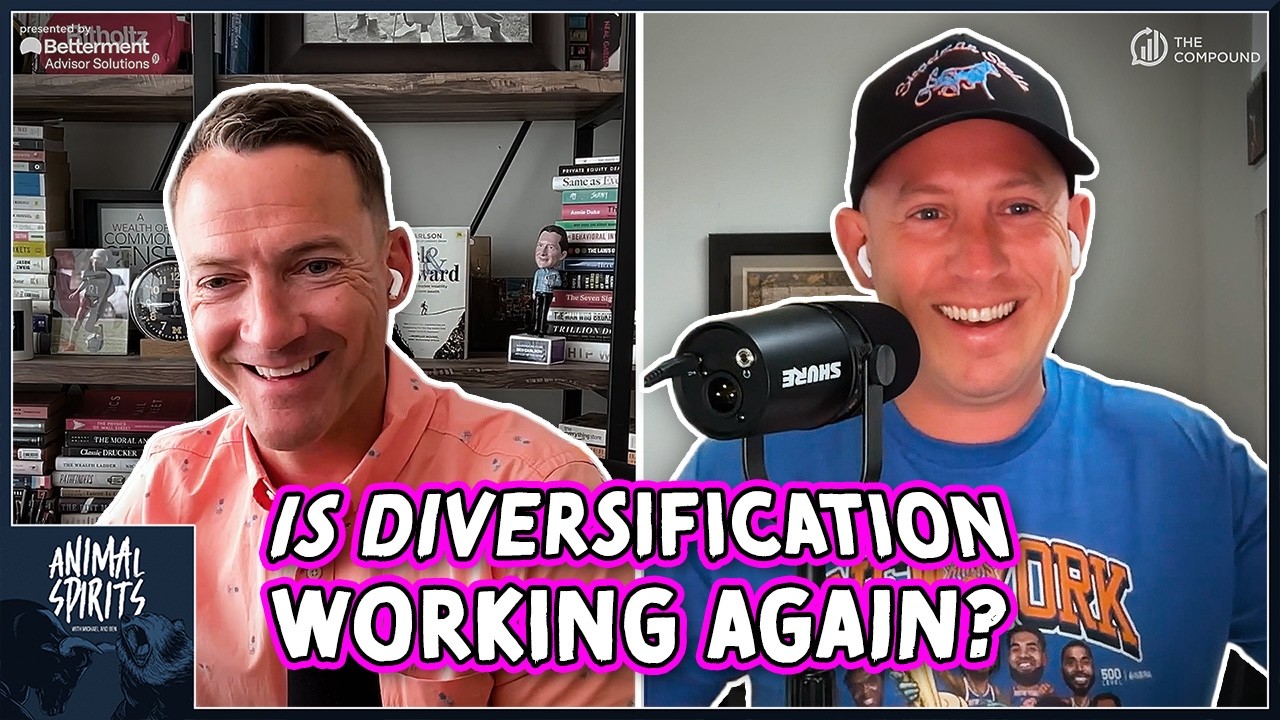
Non-S&P 500 Equities Outperform as Tech Heavyweights Stumble
The Compound
A massive surge in physical hardware CapEx is weighing on mega-cap tech cash flows, driving a historic market broadening where value, small-caps, and non-S&P assets double broader market returns.
## Background
This episode of Animal Spirits (Episode 470) was published on June 24, 2026, by The Compound on YouTube. Hosted by Michael Batnick and Ben Carlson, the episode discusses why market diversification is succeeding, how AI affects stock winners and losers, the underperformance of the Magnificent Seven, rising investor cash levels, shifts in consumer behavior, real estate trends, and pop culture recommendations.
## TL;DR
Michael Batnick and Ben Carlson examine a major market regime shift as broad market assets, value stocks, and small caps outperform the Magnificent Seven and the S&P 500 despite high overall index levels. They analyze how physical infrastructure bottlenecks are driving semiconductor profit margins higher while mega-cap tech companies face heavy CapEx burdens. The hosts also discuss contradictory economic signals, such as high retail trading activity alongside record cash holdings, upper-income anxiety, AI's impact on business formation and content, housing market dynamics, and prediction markets.
## Atmosphere & style
The episode features a fast-paced, candid, and conversational dynamic between co-hosts Michael Batnick and Ben Carlson, blending deep market analysis with playful banter. The tone is pragmatic and intellectually curious, moving seamlessly from serious macroeconomic breakdowns to humorous reflections on office interactions, pop culture, and social trends. Listening feels like sitting in on an informal yet highly informed discussion between two finance insiders who candidly admit to being just as puzzled by current market contradictions as their audience.
## Key takeaways
- [00:52](https://www.youtube.com/watch?v=ZF_HWTX1EsE&t=52s) In 2026, broad market diversification is delivering exceptional returns, with almost every non-mega-cap tech asset class outperforming the S&P 500 while the benchmark itself is up roughly 10%.
- [02:27](https://www.youtube.com/watch?v=ZF_HWTX1EsE&t=147s) The Magnificent Seven and major tech hyperscalers are suffering severe drawdowns from their highs as massive CapEx spending on AI infrastructure compresses margins and turns them into asset-heavy businesses.
- [06:34](https://www.youtube.com/watch?v=ZF_HWTX1EsE&t=394s) Despite localized volatility, the AI infrastructure boom has led to a surge in individual stock performance, with double the average number of mid-to-large-cap stocks doubling over the past 12 months.
- [10:45](https://www.youtube.com/watch?v=ZF_HWTX1EsE&t=645s) Physical bottlenecks in high-tech manufacturing like TSMC make rapid supply expansion impossible, allowing semiconductor profit margins to soar toward a projected 49% by 2027.
- [15:06](https://www.youtube.com/watch?v=ZF_HWTX1EsE&t=906s) Investor sentiment exhibits a stark dichotomy: retail trading and semiconductor speculative exposure sit near all-time highs, even as institutional positioning remains muted and household cash holdings peak at 8%.
- [24:36](https://www.youtube.com/watch?v=ZF_HWTX1EsE&t=1476s) Consumer spending remains resilient with 5.1% YoY card growth, while a growing majority of upper-middle-class Americans express deep economic anxiety about systemic fairness and their children's future.
- [30:00](https://www.youtube.com/watch?v=ZF_HWTX1EsE&t=1800s) Generative AI is removing friction and operational barriers for new founders, helping fuel a post-pandemic surge in new business applications that are now double pre-2018 levels.
- [31:35](https://www.youtube.com/watch?v=ZF_HWTX1EsE&t=1895s) Interactive AI models like Claude are directly displacing traditional self-help books and static advisory content by offering personalized, real-time guidance.
- [35:12](https://www.youtube.com/watch?v=ZF_HWTX1EsE&t=2112s) Startups are pursuing radical engineering solutions—such as wave-powered, ocean-cooled floating platforms—to bypass land-based power and municipal grid bottlenecks for AI data centers.
- [42:21](https://www.youtube.com/watch?v=ZF_HWTX1EsE&t=2541s) Prediction market platforms like Kalshi and Polymarket face increasing regulatory scrutiny and disclosure mandates due to high-profile insider trading cases and deceptive influencer marketing.
- [47:35](https://www.youtube.com/watch?v=ZF_HWTX1EsE&t=2855s) While individual crypto token prices like Ethereum remain depressed compared to past euphoric cycles, traditional finance is increasingly adopting stablecoins and blockchain asset tokenization.
- [51:55](https://www.youtube.com/watch?v=ZF_HWTX1EsE&t=3115s) Housing market affordability matches historical averages due to rising incomes, but structural inventory shortages mean real estate activity may not normalize until the 2030s.
The episode opens with a sponsor message highlighting the operational tension Registered Investment Advisors (RIAs) experience when balancing client minimums. Advisors often want to help clients who are just starting out to build long-term relationships, but managing simple accounts requires substantial administrative work—including account opening, trading, and rebalancing—which can easily overwhelm back-office staff. Betterment Advisor Solutions offers a platform designed to segment books of business, automate paperless onboarding, streamline portfolio management, and provide tax-efficient client experiences to keep service standards high while reducing operational overhead.
---
[00:52](https://www.youtube.com/watch?v=ZF_HWTX1EsE&t=52s) Market Breadth and the Diversification Comeback
Hosts Michael Batnick and Ben Carlson kick off the show with an energetic exchange about a major shift in the stock market: broad market diversification is delivering exceptional results in 2026. Ben highlights that through Monday's close, virtually every asset class outside the mega-cap tech realm is outperforming the S&P 500. The Russell 2000 small-cap index is roughly doubling the performance of the S&P 500, alongside massive outperformance from small-cap value, large-cap value, real estate investment trusts (REITs), mid-caps, emerging markets, and dividend-paying equities.
Unlike the dot-com bubble collapse of the early 2000s, when non-S&P assets outperformed primarily because the S&P 500 was falling, this broadened rally is occurring while the S&P 500 itself is up roughly 10% year-to-date. Ben notes that prior to the last 12 to 18 months, few market participants believed this level of market dispersion and broadening out was achievable.
---
[02:27](https://www.youtube.com/watch?v=ZF_HWTX1EsE&t=147s) The Magnificent Seven Drawdown and Tech Hyperscalers
Michael points out that the Magnificent Seven tech giants are largely abstaining from the current rally, which has naturally kept a lid on the market-cap weighted S&P 500. Key software and mega-cap leaders are experiencing severe drawdowns from their recent highs:
* **Microsoft:** Down 33% from its highs, trading sluggishly as AI disrupts traditional software business models.
* **Meta:** Down nearly 30% from peak levels.
* **Oracle:** Off by almost 50% from its high.
* **Netflix:** Down roughly 45% (with Michael disclosing he owns a small position down 30%, viewing its transition from a growth stock to a value stock as a messy process).
* **Alphabet (Google):** Off by 13%.
* **Amazon:** Down 15%.
* **Tesla:** Down 17%.
* **SpaceX:** Down 25% from its highs.
Michael and Ben discuss how hyperscalers are being punished for their massive capital expenditures (CapEx) on data centers and AI infrastructure. Historically praised for being asset-light cash generators, these giants have transitioned into asset-heavy operations, causing free cash flow to shrink and profit margins to face scrutiny. Referencing a discussion with Tim O'Reilly on Kai-Fu Lee's podcast *The Intangible Economy*, Ben explains that entering the physical hardware world represents an existential risk that could compress margins and unintentionally disrupt the very tech giants that drove the previous bull run.
---
[06:34](https://www.youtube.com/watch?v=ZF_HWTX1EsE&t=394s) Market Volatility, "Triple-Digit" Winners, and Middle East Hedging
The S&P 493 continues to widen its performance lead over the market-cap weighted index and the Magnificent Seven. However, this shift comes with heightened short-term volatility. The Nasdaq 100 opened down 3% in pre-market trading, and South Korean equities experienced a sharp 10% single-day flush—their second major drop in three weeks. The hosts emphasize that pullback episodes are the price of admission when dealing with hyper-growth cycles.
Despite localized pullbacks, Morningstar research shows a massive surge in individual stock performance:
* **42 stocks** in the Morningstar Large-Midcap Index doubled (gained 100%+) over the past 12 months—more than twice the 10-year average.
* **12 stocks** doubled in the first six months of 2026 alone, driven largely by the AI infrastructure boom (including SanDisk, Micron, Western Digital, Dell, and Intel).
* **SK Hynix** surged over 300% on the year prior to recent minor pullbacks.
Ben contrasts market behavior with macroeconomic events, citing a *Wall Street Journal* chart analyzing asset performance from the start of the Middle East conflict through the present. Traditional hedges failed to react as expected: gold dropped 20%, crude oil round-tripped back to just a 10% gain, while the semiconductor index surged 70%.
- "The best hedge is a diversified portfolio." — Ben Carlson
---
[10:45](https://www.youtube.com/watch?v=ZF_HWTX1EsE&t=645s) Structurally Higher Valuations and Semiconductor Bottlenecks
Examining long-form research from Goldman Sachs (highlighted in Meb Faber’s *Idea Farm* newsletter), Ben and Michael evaluate the relationship between Cyclically Adjusted Price-to-Earnings (CAPE) ratios and Return on Equity (ROE). While Warren Buffett famously observed in the 1970s that corporate ROE remained statically anchored between 12% and 14%, modern technology monopolies rewrote corporate physics over the last two decades, driving ROE structurally higher alongside equity valuations.
The shift toward physical AI hardware is generating extraordinary metrics across the semiconductor supply chain:
* Semiconductor 12-month trailing net profit margins dropped to a low of 25% as recently as 2024.
* Margins are projected to reach an unprecedented **49% by 2027**.
Reflecting on a *Talk Your Book* interview with Dr. Ankur Crawford, Michael explains why soaring valuations in the chip sector differ from typical speculative bubbles. High-tech manufacturing plants (fabs) operated by companies like Taiwan Semiconductor Manufacturing Company (TSMC) require incredible precision and billions in capital, making it impossible for new competitors to quickly enter the market and erode these 49% profit margins.
- "You can't just bring supply to the market... That is why there is a bottleneck at almost every area of the chain." — Michael Batnick
[15:06](https://www.youtube.com/watch?v=ZF_HWTX1EsE&t=906s) Retail Euphoria, AI Doubters, and the Cash Paradox
Michael Batnick and Ben Carlson open this segment by observing that despite living in an era of technological abundance, physical and structural bottlenecks—much like the Strait of Hormuz for global energy—continue to constrain market supply and expansion. Shifting to investor behavior, Michael notes how effortless it is to find conflicting data to support virtually any narrative. On one hand, retail trading activity is experiencing an undeniable boom. Citadel Securities reported that the day of SpaceX’s blockbuster IPO marked the single largest day of net retail buying ever recorded on its platform, which handles about 35% of U.S. retail volume. Furthermore, 9 of the 10 highest-volume retail trading days in Citadel’s history occurred in just the past month, with 7 taking place in the first half of June alone. Whether buying the underlying stock or gambling on leveraged inverse ETFs (like a 2x short SpaceX ETF that cratered 43% in two days), retail and institutional traders alike are trading frantically.
Yet, counter-indicators paint a completely different picture. Deutsche Bank data reveals that consolidated equity positioning sits at just the 42nd percentile—far from crowded—with discretionary positioning at the 41st percentile and systematic positioning at the 40th percentile. Bloomberg data shows futures speculators growing increasingly net short, while VandaTrack data highlighted by Kevin Gordon shows retail net buying in single stocks actually dropping to its lowest level since the COVID pandemic. The notable exception to this subdued positioning is semiconductor stocks, where institutional and retail sentiment is wildly bullish. Prime brokerage data shows hedge fund exposure to semiconductors launched parabolically from 8% at the start of the year to 22%. Meanwhile, retail ETF flows into semiconductor funds—including a DRAM ETF that ballooned from $10 billion to $20 billion in a week—reflect an all-in consensus. Michael cautions that while these charts are fun, they are extremely noisy and often curated to push specific narratives, invoking Charlie Munger’s famous line: "If you're not confused, you're not paying attention."
The hosts then grapple with a startling paradox reported by Citadel: household cash holdings as a percentage of total financial assets have reached 8%, the highest level since 1990. Ben offers two primary theories for why record cash levels coexist with speculative manias: first, after a decade of financial repression and zero interest rates, investors are happy to hold cash now that short-term yields offer 3% to 4%; second, aging Baby Boomers are transitioning into retirement and de-risking after getting bruised by bond market losses during recent rate-hiking cycles. Regarding SpaceX, which debuted around $150 before round-tripping back to its initial opening price in pre-market trading, Michael ponders who is left holding the bag, concluding that given the immense trading volume, many quick-fingered traders simply took profits or losses along the way. Finally, addressing an AAII Sentiment Survey where only 8% of respondents claimed there is no bubble in AI-related stocks (with 51% believing some, but not all, are overvalued), Michael finds comfort in the pervasive skepticism, arguing that market tops typically occur when every last skeptic has converted into a buyer.
- Citadel Securities handles roughly 35% of all U.S. retail trading volume.
- SpaceX IPO day was Citadel's largest retail net-buying day in firm history; 7 of the top 10 retail trading days ever occurred in the first half of June.
- Consolidated equity positioning sits at the 42nd percentile according to Deutsche Bank (Discretionary: 41st, Systematic: 40th).
- Hedge fund net/gross exposure to semiconductor stocks escalated from 8% at the beginning of the year to 22%.
- A featured DRAM ETF doubled its assets under management from $10 billion to $20 billion in just one week.
- Household cash as a percentage of total financial assets reached 8%, its highest peak since 1990.
- 51% of AAII survey respondents view *some* AI stocks as overvalued, while only 8% believe no AI bubble exists at all.
[24:36](https://www.youtube.com/watch?v=ZF_HWTX1EsE&t=1476s) Consumer Resilience, Credit Card Arbitrage, and the Complaining Upper Class
Turning to economic fundamentals, Michael cites Bank of America data showing that consumer spending remains remarkably robust. Total card spending rose 5.1% year-over-year in May, marking the strongest growth rate in nearly four years. While some of the nominal increase is driven by higher gasoline prices, Bespoke data demonstrates broad-based strength across the economy: only two sectors registered negative retail growth in the latest report, pushing Bespoke's six-month retail sales diffusion index to the high end of its historical range. Ben expresses absolute bewilderment over how credit card issuers manage to operate in a market where average interest rates sit at 20% to 25%, yet consumers are routinely bombarded with 0% APR balance transfer offers lasting up to 21 months. Ben shares that after taking advantage of an 18-month 0% financing offer for new home flooring, he intends to roll the remaining balance onto a new 21-month 0% APR card rather than paying it off early. Michael humorously labels this arrangement "reverse Robin Hood," pointing out that high rates extracted from subprime and risky borrowers effectively subsidize zero-interest loans and rich credit card rewards for prime borrowers with high credit scores.
Mid-discussion, Michael glances at live market action during the opening bell and notes sharp volatility in tech leaders. Nvidia opened down over 3%, Micron plummeted 11%, and SanDisk-parent Western Digital / Sandisk peers dropped similarly ahead of earnings. Michael stresses that semiconductor stocks can easily drop 30% in a single week—as Micron did earlier in March—without breaking their longer-term secular uptrends, reminding listeners that extreme volatility is the tuition required for market-outperforming gains.
The conversation turns sharp as the hosts review a Wall Street Journal report detailing rising "economic anxiety" among upper-income Americans. According to the survey, 65% of upper-middle-class respondents in 2026 believe the U.S. economic and political systems are "stacked against people like me" (up from 29% in 2017), while an astounding 86% lack confidence that their children will enjoy a better standard of living than their own (up from 64% in 2019). Michael and Ben vent their frustration with wealthy individuals who feign middle-class struggles. While acknowledging high costs in expensive areas like Long Island, Ben calls out the absurdity of affluent households claiming the system is rigged against them, noting that such whining undermines the genuine struggles faced by truly disadvantaged socioeconomic groups.
- Total credit card spending grew 5.1% year-over-year in May (Bank of America data), representing a 4-year high in growth momentum.
- Bespoke's retail sales diffusion index reached near-range highs, with only 2 sectors showing negative monthly growth.
- Average credit card interest rates currently hover between 20% and 25%, paired alongside 0% APR promotional offers lasting 18 to 21 months.
- Semiconductor pulled back sharply at market open (Nvidia -3.4%, Micron -11%), illustrating high single-day volatility.
- 65% of upper-middle-class Americans in 2026 feel the system is "stacked against" them (up from 29% in 2017).
- 86% of upper-middle-class respondents in 2026 doubt their children will live better lives than they do (up from 64% in 2019).
[29:38](https://www.youtube.com/watch?v=ZF_HWTX1EsE&t=1778s) American Entrepreneurship and Post-COVID Business Formation
To close this portion of the episode, Ben highlights data from Strategas Economics tracking new business applications across the United States. He points to this metric as a primary engine of American economic dynamism and resilience. Reflecting on the initial outbreak of COVID-19, Ben notes that while analysts made countless incorrect forecasts about the long-term structural shifts the pandemic would cause, almost no one predicted the massive, sustained surge in small business creation and entrepreneurial activity that followed.
- Strategas Economics data reveals sustained, above-trend growth in U.S. new business applications relative to pre-2020 baselines.
[30:00](https://www.youtube.com/watch?v=ZF_HWTX1EsE&t=1800s) The Surge in New Business Formation and the Role of AI
Michael Batnick and Ben Carlson discuss a report written by Ernie Tedeschi and his team at Stripe regarding the post-pandemic surge in new business formation. During the COVID-19 pandemic, the Paycheck Protection Program (PPP) made obtaining a small business loan extremely simple—requiring little more than an Employer Identification Number (EIN). While that initial policy spark triggered a wave of new business creation, business applications have since accelerated even further without any government stimulus program driving it. The Stripe team attributes this ongoing boom to artificial intelligence, which has radically lowered the friction and barrier to entry for launching a new enterprise.
Comparing current trends to historical data, business application numbers remained largely flat from 2005 through 2018. Today, those application figures have essentially more than doubled. Michael notes how easy it is to lose sight of these structural economic bright spots amidst the sea of negative headlines, even while acknowledging that genuine hardships persist for many people. Ben points out that starting a business requires an inherent level of psychological optimism—or even a bit of "psychotic" delusion—because nobody takes the leap to launch a venture unless they believe it will succeed.
- Business applications have more than doubled compared to their static range from 2005 to 2018.
- Stripe's research team highlights AI as the primary driver removing operational barriers for new founders.
---
[31:35](https://www.youtube.com/watch?v=ZF_HWTX1EsE&t=1895s) AI's Impact on Self-Help Books and Content Consumption
Ben pivots the conversation to what he calls "AI doomerism," though Michael immediately argues it might actually be a net positive. Author Tim Ferriss—whom Ben describes as the modern-day king of the self-help "hacker" genre with titles like *The 4-Hour Workweek* and *The 4-Hour Body*—published a post detailing a dramatic crash in his book sales. Ferriss's catalog is projected to sell roughly 80% fewer print copies in 2026 compared to 2022. Ben attributes much of this decline to readers displacing traditional self-help books with AI models like Claude, where users can instantly ask customized questions and receive personalized advice.
Michael expresses heavy skepticism about the entire self-help industry, arguing that it is useless for 95% of readers because it delivers a temporary psychological rush without leading to actual behavior change. Ben offers a more balanced perspective, drawing an analogy to religion: while critics may dismiss self-help as nonsense or accuse its authors of being charlatans, many people derive genuine hope, comfort, and reinforcement from it. Ben shares a quote he heard years ago: "No one goes to church on Sunday expecting to hear an 11th commandment"—meaning people often just need existing truths reinforced. Additionally, both hosts agree that the massive rise of podcasts has cannibalized book reading for a huge segment of the population.
- Tim Ferriss's print book sales are down roughly 80% in 2026 compared to 2022 levels.
- AI LLMs like Claude are actively displacing static self-help and advice books by providing dynamic, interactive guidance.
- Podcasts have effectively replaced non-fiction books for a significant portion of the audience.
---
[35:12](https://www.youtube.com/watch?v=ZF_HWTX1EsE&t=2112s) Floating Sea-Based Data Centers and Market Disconnects
Michael brings up a viral update from tech commentator Suresh regarding extreme engineering solutions for AI infrastructure. A Portland-based startup named Panthalassa, backed by Peter Thiel and valued at nearly $1 billion, raised $140 million to build floating offshore data center platforms. These ocean-based platforms use wave motion via large submerged or bobbing spheres to generate their own electricity while utilizing surrounding seawater for direct cooling, completely bypassing traditional land-based power grids and municipal approval hurdles.
This wild concept sparks a broader reflection on the current market environment. With semiconductor valuations soaring and private space ventures like SpaceX reaching staggering prices, the current tech climate carries distinct echoes of 1999. However, Michael counters this bubble anxiety by recalling insights from tech investor Gavin Baker: despite the extreme shortage of compute power, fewer than 3% of the global population currently uses AI on a daily basis. Ben emphasizes the importance of reading perspectives from both the finance world (which leans cautious and bearish) and the tech sector (which leans aggressively bullish) to maintain an objective outlook.
- **Panthalassa:** Raised $140 million at a valuation near $1 billion to deploy wave-powered, ocean-cooled floating data centers.
- **Global Adoption:** Less than 3% of the world's population currently uses AI tools directly, highlighting the massive runway versus potential overbuild risks.
---
[37:10](https://www.youtube.com/watch?v=ZF_HWTX1EsE&t=2230s) Practical AI Applications in Financial Services and Health
Shifting to real-world productivity gains, Michael highlights an interview from their advisor-focused show, *Talking Wealth*, featuring Jason Wenk of Altruist discussing their new advisor AI assistant, Hazel. Michael criticizes OpenAI's naming convention, calling "ChatGPT" one of the biggest branding fumbles in tech history because it lacks the catchy, humanized single-name branding (like Hazel or Claude) that consumers naturally adopt.
Michael also previews an upcoming episode featuring David Law from the insurance industry, who detailed how AI is unlocking workflows that were previously impossible. For an advisory firm managing hundreds of clients holding over 300 unique annuity contracts—each filled with complex legal terms, guarantees, and surrender schedules—firms historically had to rely on blanket assumptions. Today, advisors can feed all 300 prospectus documents into AI models to receive perfect, granular policy analyses in seconds. Ben contrasts this efficiency gain with his own early career days in insurance, where dedicated staff spent entire days manually crunching numbers. Furthermore, Michael notes how AI-driven tools and full-body diagnostic workups (like Midjourney's visual concepts or AI bloodwork analysis) represent a massive shift in personal health management.
- Altruist launched an AI platform for financial advisors named Hazel.
- AI tools can ingest hundreds of complex annuity prospectuses simultaneously to perform instant, policy-level contract analyses.
---
[40:33](https://www.youtube.com/watch?v=ZF_HWTX1EsE&t=2433s) The World Cup, American Life, and Foreign Tourism
Ben brings up the World Cup, noting that his kids have become deeply absorbed in soccer and basketball culture, largely absorbing their sports takes from YouTube content creators. He jokes about having to correct his son's hot takes—such as claims that Cristiano Ronaldo or James Harden are superior to Lionel Messi or Jalen Brunson—by explaining the historical context of Messi's dominance.
This leads into a discussion about an ABC News report covering the influx of international tourists visiting the U.S. for major sporting events. European visitors have been going viral on social media by expressing awe over ordinary American conveniences that locals take completely for granted—such as free ice, automatic water refill stations, 24-hour retail operations, and warm customer service. As travel researchers note, tourists do not simply consume static landmarks; they consume the rhythm of daily life. Both hosts celebrate this cross-cultural positivity as a refreshing departure from online cynicism.
- Viral social media trends highlight European tourists marveling at basic U.S. infrastructure: free ice, 24-hour stores, and accessible refill stations.
---
[42:19](https://www.youtube.com/watch?v=ZF_HWTX1EsE&t=2539s) Prediction Markets and Mainstream Brokerages
The hosts turn to the rapid expansion of prediction markets, highlighting news that Charles Schwab is moving to integrate binary event trading into its platform. While prediction markets are poised to grow substantially over the coming years, Ben questions whether retail investors at traditional brokerages like Schwab or Vanguard actually have an appetite for trading macroeconomic or policy events—such as betting on whether the S&P 500 will close up on a Federal Reserve decision day.
Ben argues that the "degenerate economy" thrives primarily on specialized platforms where sports betting and multi-leg parlays make up over 90% of total volume. Mainstream brokerages entering the space are unlikely to capture that specific crowd, as they will not offer sports parlays. However, Michael counters that there is little downside for a brokerage to enable basic event contracts for interested clients, even if it remains a niche product relative to their core asset-management businesses.
- Charles Schwab is preparing to offer binary prediction market contracts to its retail client base.
- Sports wagering continues to drive over 90% of activity across major prediction market platforms.
<ElicitationsGroup message="Where would you like to go next with this transcript?">
<Elicitation label="Summarize Part 4 of this Animal Spirits episode" query="Please provide the detailed walkthrough for Part 4 of Animal Spirits episode 470."/>
<Elicitation label="Analyze the key investment takeaways from this section" query="What are the key investment and market takeaways from this portion of Animal Spirits 470?"/>
</ElicitationsGroup>
[43:21](https://www.youtube.com/watch?v=ZF_HWTX1EsE&t=2601s) Kalshi's Disclosure Mandate and Insider Trading Scandals
Michael Batnick and Ben Carlson kick off the prediction markets discussion by reviewing a Wall Street Journal report on Kalshi. The platform plans to require users to disclose their employers for certain trades after an advisory committee recommended tighter security to curb market manipulation and insider trading.
Michael considers this a no-brainer, calling out crazy examples like accounts belonging to military spouses on Kalshi making precise, accurate bets on when former Venezuelan President Nicolás Maduro would be ousted—placed just days before he was seized by U.S. officials in January. Michael exclaims, "Straight to jail. You can't do this," while Ben compares it to someone in the 1940s betting on when D-Day would happen.
They also highlight a case where a Google employee was charged with insider trading on Polymarket, making over $1 million using non-public information to bet on who would be the most searched people of 2025.
```
• Venezuelan President Ouster Bet: Placed by military spouse accounts on Kalshi days before he was seized in January; at least one account was referred to federal investigators.
• Google Employee Polymarket Case: Generated over $1 million in profits betting on the top-searched people of 2025 using insider data.
• Prediction Market Volume Shift: Quoting a tweet by Ryan Chern, prediction market volume shifted from over 90% politics and economics two years ago to under 6% today, with sports and parlays now dominating.
```
---
[44:59](https://www.youtube.com/watch?v=ZF_HWTX1EsE&t=2699s) Polymarket's Influencer Scandal and Market Moats
The conversation shifts to a Wall Street Journal investigative report exposing Polymarket's use of paid influencers to post fake trades and wins. Michael cites the case of college student creator George Makihara, who posted videos showing him winning $100,000 on a wager that President Trump would say the word "McDonald's" in January.
Between December 2025 and mid-May, Makihara appeared to place 145 bets totaling nearly $410,000. However, the Journal reviewed 1,105 videos across 10 Polymarket-endorsed creators and found that 118 videos showed creators "winning" almost $900,000 on $1.9 million in fake bets—when in reality, those exact bets would have lost over $166,000.
Ben questions what competitive moat prediction markets have if they are primarily being used as alternative sports betting platforms, taking market share from DraftKings and FanDuel. Michael argues that their moat is purely regulatory, built on spending tens of millions of dollars on legal teams and lobbyists.
---
[47:35](https://www.youtube.com/watch?v=ZF_HWTX1EsE&t=2855s) Ethereum’s Decline and Speculative Manias
Ben brings up crypto, specifically criticizing Ethereum's price performance as it hovers near its 2017 high of around $1,400. He references Packy McCormick’s famous 2021 piece ("Own the Internet: The Bull Case for Ethereum") and past coverage from Patrick O'Shaughnessy, James Wang, and Joe Weisenthal, questioning why the smart contract narrative failed to deliver on its massive hype.
Michael counters that while individual tokens are struggling, blockchain infrastructure and stablecoins are having a legitimate impact on traditional finance. He points out how credit card giants Visa and MasterCard are seeing their multiples come down due to stablecoin adoption, and notes that former New York Governor Andrew Cuomo is set to co-chair a joint venture between Intercontinental Exchange (owner of the NYSE) and crypto exchange OKX to tokenize NYSE-listed assets.
Reflecting on past bubbles, Ben recalls Jude Dixon's 2021 comparison between a digital "Ethereum Rock" selling for $2.2 million and a waterfront Florida home listed at the same price. They both agree that 2021 was the "drunkest experience of investor euphoria" and a far pure speculative mania compared to today's market, which is driven by real earnings and profit margins.
---
[51:55](https://www.youtube.com/watch?v=ZF_HWTX1EsE&t=3115s) Housing Market Realities: Affordability vs. Zillow’s Collapse
Ben introduces a Morgan Stanley chart tracking housing affordability back to 1991. The data shows that monthly mortgage payments as a percentage of income are currently at similar levels to 1994, 2004, and 2007 because average incomes have risen over time. However, Ben notes that most people find this hard to believe because housing activity and available inventory remain severely suppressed.
Citing real estate analyst Mike Simonson, Ben discusses how long it will take to return to a "normal" housing market. Depending on whether mortgage rates stay between 5.5% and 6.5%, normal activity levels might not return until the early 2030s—though Ben argues there hasn't been a truly "normal" housing market this entire century given the 2000s bubble, the subsequent decade-long builder shell-shock, and the 2020 pandemic distortions.
To illustrate the pain in real estate-adjacent equities, Michael highlights Zillow's stock trajectory:
```
• Peak Market Cap (2021): $48 billion during the height of the housing mania.
• Current Market Cap: Under $7 billion (an 85% drop from its all-time high).
• Recent Pullback: Down 66% from its peak over the last 3 years alone.
```
---
[54:43](https://www.youtube.com/watch?v=ZF_HWTX1EsE&t=3283s) Social Security Projections and Pop Culture Catch-Up
Closing out the show under a 5-minute timer as Verizon arrives at Michael's house, the hosts briefly look at the annual Social Security report. The report projects that full (100%) benefits can be paid out through 2032 or 2033 using current tax inflows and trust fund reserves. By 2034, payouts will drop to 83%, and by 2100, incoming revenue will still cover 65% of scheduled benefits. Both agree that instead of cutting benefits by 17% in 2034, Congress will simply issue more debt to pay out full amounts.
They wrap up with movie and TV recommendations:
```
• Toy Story 5: Opened with a massive $160 million weekend, making it the biggest box office opening of 2026, the biggest opening in Toy Story franchise history, the 2nd largest animated opening ever, and 2nd for Pixar behind Incredibles 2.
• Widows Bay: Michael felt the show fell flat due to over-hyped expectations around its supernatural premise, while Ben avoided the hype, enjoyed season 1, and is eager for season 2.
• The Hand That Rocks the Cradle: Michael rewatched this 1990s thriller classic via The Rewatchables podcast on Netflix, noting it's a great '90s slow-burn thriller (even if not strictly rewatchable) and comparing its vibe to Apple TV's Cape Fear reboot.
```
[58:27](https://www.youtube.com/watch?v=ZF_HWTX1EsE&t=3507s) Office Encounters and Wrapping Up
With a couple of minutes remaining in the show, the hosts dive into a humorous story about a recurring "good morning" interaction at the office. One of the hosts recalls walking out of his office a couple of weeks prior and crossing paths with a woman wearing sunglasses, carrying coffee, and holding three purses. When she greeted him with a "Good morning," he offered a brief "Hey," prompting her to push back with, "That's all I get?" and teasingly ask if he was a man of few words. Feeling caught off guard, he didn't even know who she was at the time.
The situation repeated itself that very morning when he was walking down the hallway to the bathroom. The same woman, walking about ten feet behind him, called out another "Good morning." Thinking she was speaking on the phone, he kept walking until she said "Excuse me" and insisted, "Yes, I said good morning to you. You could say it back." He apologized and explained he had not realized she was addressing him from ten feet behind, but she still responded with annoyance. The hosts joke lightheartedly about the awkward exchange, suggesting that maybe she just wants a hug or expects a bit more energy next time, though the storyteller remains bewildered by the high-demand hallway greetings.
Closing out the episode, the hosts sign off from Animal Spirits, part of The Compound media network. They admit that they are just as confused as anyone else about the current stock market and where it might head next during these interesting financial times, before thanking listeners and wrapping up the show.
- The co-host jokingly advises him to "just give her a hug next time" to satisfy her expectation for enthusiastic office greetings.
- "We're as confused as you are about the stock market and where it goes from here."
## Notable quotes
> [06:34](https://www.youtube.com/watch?v=ZF_HWTX1EsE&t=394s) The best hedge is a diversified portfolio. — Ben Carlson
> [10:45](https://www.youtube.com/watch?v=ZF_HWTX1EsE&t=645s) You can't just bring supply to the market... That is why there is a bottleneck at almost every area of the chain. — Michael Batnick
> [15:06](https://www.youtube.com/watch?v=ZF_HWTX1EsE&t=906s) If you're not confused, you're not paying attention. — Charlie Munger
> [43:13](https://www.youtube.com/watch?v=ZF_HWTX1EsE&t=2593s) Straight to jail. You can't do this — Michael Batnick
> [31:35](https://www.youtube.com/watch?v=ZF_HWTX1EsE&t=1895s) No one goes to church on Sunday expecting to hear an 11th commandment — Ben Carlson
> [58:27](https://www.youtube.com/watch?v=ZF_HWTX1EsE&t=3507s) That's all I get?
> [58:27](https://www.youtube.com/watch?v=ZF_HWTX1EsE&t=3507s) Yes, I said good morning to you. You could say it back.
> [58:27](https://www.youtube.com/watch?v=ZF_HWTX1EsE&t=3507s) just give her a hug next time — Michael Batnick
> [58:27](https://www.youtube.com/watch?v=ZF_HWTX1EsE&t=3507s) We're as confused as you are about the stock market and where it goes from here. — Michael Batnick
## Mentioned
Michael Batnick, Ben Carlson, Betterment Advisor Solutions, S&P 500, Russell 2000, Microsoft, Meta, Oracle, Netflix, Alphabet, Amazon, Tesla, SpaceX, Tim O'Reilly, Kai-Fu Lee, The Intangible Economy, Morningstar, SanDisk, Micron, Western Digital, Dell, Intel, SK Hynix, Wall Street Journal, Goldman Sachs, Meb Faber, Idea Farm, Warren Buffett, Ankur Crawford, TSMC, Citadel Securities, Deutsche Bank, Bloomberg, VandaTrack, Kevin Gordon, AAII Sentiment Survey, Bank of America, Bespoke, Nvidia, Strategas Economics, Ernie Tedeschi, Stripe, Tim Ferriss, The 4-Hour Workweek, The 4-Hour Body, Claude, Suresh, Panthalassa, Peter Thiel, Gavin Baker, Jason Wenk, Altruist, Hazel, OpenAI, ChatGPT, David Law, Midjourney, ABC News, Cristiano Ronaldo, James Harden, Lionel Messi, Jalen Brunson, Charles Schwab, Vanguard, Kalshi, Nicolás Maduro, Polymarket, Ryan Chern, George Makihara, DraftKings, FanDuel, Ethereum, Packy McCormick, Patrick O'Shaughnessy, James Wang, Joe Weisenthal, Visa, MasterCard, Andrew Cuomo, Intercontinental Exchange, NYSE, OKX, Jude Dixon, Morgan Stanley, Mike Simonson, Zillow, Social Security, Verizon, Toy Story 5, Pixar, Widows Bay, The Hand That Rocks the Cradle, The Rewatchables, Apple TV, Cape Fear, The Compound
科技巨头承压,非标普500股票表现跑赢大盘
实体硬件资本支出的激增正在拖累巨型科技公司的现金流,并推动了历史性的市场广度拓展,价值股、小型股和非标普资产的回报率达到大盘的两倍。
Michael Batnick 和 Ben Carlson 探讨了一场重大的市场格局转变:尽管整体指数水平处于高位,但广泛市场资产、价值股和小型股的表现超越了“七巨头”(Magnificent Seven)与标普500指数。他们分析了实体基础设施瓶颈如何推高半导体利润率,而巨型科技公司则面临沉重的资本支出负担。两位主持人还讨论了相互矛盾的经济信号,例如散户交易高度活跃的同时现金持有量创下纪录、高收入群体的焦虑、AI 对企业创立和内容生态的影响、房地产市场动态以及预测市场。
2026年,广泛的市场多元化配置带来了非凡的回报,几乎所有非巨型科技股资产类别的表现均跑赢标普500指数,而该基准指数本身也上涨了约10%。 (0:52)
“七巨头”和主要科技超大规模企业从高点大幅回撤,原因是AI基础设施领域的巨额资本支出挤压了利润空间,并使它们转变为重资产型企业。 (2:27)
尽管存在局部波动,AI基础设施的繁荣仍推动了个股表现激增,过去12个月中股价翻倍的大中型股数量是平均水平的两倍。 (6:34)
台积电(TSMC)等高科技制造业面临的实体瓶颈使产能难以快速扩张,这推动半导体利润率持续攀升,预计到2027年将达到49%。 (10:45)
投资者情绪呈现出鲜明的两极分化:散户交易和半导体投机敞口接近历史高位,但机构配置依然低迷,家庭现金持有比例更触及8%的峰值。 (15:06)
Reading summary
Hosts Ben Carlson and Michael Batnick report that broad market diversification is significantly outperforming the market-cap weighted S&P 500 in 2026, as mega-cap tech companies face drawdowns driven by massive capital expenditures on physical artificial intelligence infrastructure.
Market Breadth and Mega-Cap Tech CapEx Pressures (0:52)
In 2026, virtually every major equity category outside mega-cap technology is outpacing the S&P 500, with the Russell 2000 roughly doubling its return while value stocks, mid-caps, emerging markets, and REITs show substantial strength. This broadened rally is occurring even as the S&P 500 itself trades up roughly 10% year-to-date. Ben Carlson notes that this dispersion contrasts sharply with the dot-com unwind, when non-tech assets outperformed primarily because the headline index was falling.
Simultaneously, the Magnificent Seven tech leaders are struggling under the weight of aggressive capital investments in AI data centers. Software and platform leaders have experienced significant drawdowns from peak levels, including Microsoft (-33%), Meta (-30%), Oracle (nearly -50%), and Netflix (-45%). Carlson and Batnick explain that these tech giants are transitioning from high-margin, asset-light models to capital-heavy operations, which compresses free cash flow and exposes them to the risks of managing physical infrastructure.
Semiconductor Bottlenecks, Margin Expansion, and Extreme Volatility (10:45)
Unlike previous speculative bubbles, current chip valuations are supported by physical bottlenecks and extraordinary profit margins. Trailing 12-month net margins across the semiconductor supply chain are projected to climb from a 2024 low of 25% to an unprecedented 49% by 2027. Advanced manufacturing plants, such as those operated by TSMC, require immense capital and precision, creating supply barriers that prevent new entrants from easily eroding returns. Over the past 12 months, 42 stocks in the Morningstar Large-Midcap Index doubled—led by infrastructure names like SK Hynix, Micron, and Western Digital.
However, hyper-growth cycles in hardware are delivering severe short-term volatility, with Micron dropping 11% at market open and previously seeing 30% weekly pullbacks without disrupting its secular trend. Ben Carlson highlights that during recent Middle East geopolitical tensions, traditional hedges underperformed—gold dropped 20% and crude oil gained only 10%—while the semiconductor index advanced 70%. Infrastructure constraints have even prompted extreme engineering concepts, such as Panthalassa raising $140 million at a valuation near $1 billion to develop ocean-cooled, wave-powered floating data centers.
The Investor Cash Paradox and Resilient Consumer Fundamentals (15:06)
Investor positioning reveals contradictory behavioral patterns. Citadel Securities reported that SpaceX's IPO triggered the largest single day of retail net buying in firm history, and hedge fund exposure to semiconductor equities surged from 8% to 22% year-to-date. Yet broader equity positioning tracked by Deutsche Bank sits near the 42nd percentile, single-stock retail buying outside of tech remains subdued, and household cash holdings as a share of financial assets reached 8%—the highest level recorded since 1990. Carlson attributes this cash buffer to attractive 3% to 4% short-term yields and aging retirees de-risking after bond market declines.
Broader macroeconomic indicators continue to contradict pessimistic sentiment. Bank of America data shows total card spending increased 5.1% year-over-year in May, while business applications have more than doubled relative to their 2005–2018 baselines. Stripe research links this formation boom directly to generative AI reducing the operational frictions of launching new companies. Nonetheless, subjective anxiety remains elevated: 65% of upper-middle-class survey respondents believe the economic system is stacked against them, and 86% doubt their children will attain a higher standard of living.
Speculative Fatigue Across Prediction Markets, Crypto, and Housing (43:21)
Speculative activity outside of core equity earnings is encountering regulatory friction and structural exhaustion. Prediction markets like Kalshi are instituting employer disclosure rules following suspicious bets on geopolitical events, including trades by military spouse accounts placed days before the Venezuelan president was seized by U.S. officials. Concurrently, a Wall Street Journal investigation revealed that Polymarket-backed influencers posted videos promoting hundreds of thousands of dollars in fake wins on losing wagers. Carlson notes that prediction market volume has shifted from politics and economics to over 90% sports wagering, leaving regulatory moats as their primary defense.
In crypto, Ethereum continues to linger near its 2017 peak around $1,400, falling far short of early adoption projections, though blockchain infrastructure and stablecoins continue to compress processing fee multiples for payments firms like Visa and MasterCard. In real estate, the hangover from past speculative cycles persists: while mortgage payments as a percentage of income match levels seen in 1994, 2004, and 2007, housing volume remains frozen, and speculative real estate platform Zillow has seen its market valuation collapse 85% from its $48 billion peak in 2021.
Carlson and Batnick conclude that while isolated speculative manias and elevated daily volatility persist, the current expansion remains fundamentally anchored by robust earnings, real corporate margins, and entrepreneurial formation, distinguishing it from the euphoric, narrative-driven peak of 2021.
## Background
本期节目是 YouTube 频道 The Compound 于 2026 年 7 月 13 日发布的播客《Animal Spirits》第 470 期。节目由 Michael Batnick 与 Ben Carlson 共同主持,官方简介指出本期深入探讨了分散化投资的回归、AI 造成的赢家与输家分化、美股七巨头走弱与‘三位数俱乐部’崛起、投资者坐拥高额现金的心理,以及预测市场乱象、房地产与文化观察等广泛话题。
## TL;DR
节目核心剖析了当前美股的罕见异象:标普 500 指数保持健康上涨,但小盘股、价值股、REITs 和新兴市场等各类资产却呈现全面跑赢之势,其背后是科技巨头因巨额 AI 资本开支陷入重资产泥潭而估值杀跌,推动‘标普 493’与硬件供应链牛股实现逆袭。主持人梳理了散户交易狂热与机构谨慎做空对立、家庭现金占比创历史新高与半导体狂热并存等矛盾信号,指出如今极度反常的波动正演变为市场新常态。此外,对谈还延伸至 AI 落地在金融与医疗领域的真实生产力边界、预测市场的内幕交易与虚假营销风波,以及美国住房可负担性与社保基金未来的现实困境。
## Atmosphere & style
整场节目充溢着老友围炉漫谈的松弛感与幽默火花,两位主持人不断互相插科打诨、自嘲投资踩坑的经历,有效冲淡了硬核宏观数据的枯燥感。对谈在敏锐的专业洞察与戏谑的市井吐槽之间自如切换——上一秒还在严肃解构台积电的产能瓶颈与科技巨头重塑商业逻辑,下一秒便痛快嘲讽富人无病呻吟的受害者心态及办公室偶遇的奇葩搭讪。整期播客节奏明快、观点真实不设防,让听众在会心一笑的同时,深切体会到身处这个光怪陆离、矛盾重重的市场周期时既困惑又兴奋的复杂心境。
## Bulletin
- [00:52](https://www.youtube.com/watch?v=ZF_HWTX1EsE&t=52s) 市场行情广度显著扩散,标普500年内上涨近10%,但罗素2000小盘股、价值股、REITs及新兴市场等非科技核心资产以更猛烈的势头跑赢大盘。
- [02:27](https://www.youtube.com/watch?v=ZF_HWTX1EsE&t=147s) 科技七巨头(Mag 7)因商业模式向重资产转型及巨额AI资本开支承压,市盈率跌至五年低位,微软与Meta等自高点回撤约30%。
- [15:30](https://www.youtube.com/watch?v=ZF_HWTX1EsE&t=930s) 散户与机构行为出现罕见背离:城堡证券录得创纪录的散户单日买入与交易量,而德意志银行综合股票仓位指标仅处第42百分位数,投机客仍在加码做空。
- [20:03](https://www.youtube.com/watch?v=ZF_HWTX1EsE&t=1203s) 美国家庭现金占金融资产比重升至8%,创1990年以来新高,反映出无风险高利率吸引力与婴儿潮一代退休避险需求。
- [43:21](https://www.youtube.com/watch?v=ZF_HWTX1EsE&t=2601s) 预测市场生态发生异化,Kalshi等因涉嫌内幕交易面临雇主披露等更严监管,Polymarket被曝雇佣网红虚构近90万美元盈利视频,且90%以上交易量已沦为体育博彩。
## Key takeaways
- [00:52](https://www.youtube.com/watch?v=ZF_HWTX1EsE&t=52s) 不同于典型的熊市分散化红利,当前标普500处于健康上涨通道,但“标普493”对七巨头的相对收益优势正急剧拉大。
- [02:27](https://www.youtube.com/watch?v=ZF_HWTX1EsE&t=147s) 科技巨头从轻资产向重资产AI基础设施转型,侵蚀了充沛的自由现金流与估值溢价,CEO们面临不投资即被颠覆的生死存亡困境。
- [06:34](https://www.youtube.com/watch?v=ZF_HWTX1EsE&t=394s) AI硬件基建红利推动晨星大中盘指数中翻倍个股(“三位数俱乐部”)激增至42只,达过去10年平均水平的两倍以上。
- [13:13](https://www.youtube.com/watch?v=ZF_HWTX1EsE&t=793s) 半导体产业具备极端技术壁垒与物理瓶颈,无法短期复制扩产,支撑了预估高达49%的暴利净利润率,但也加剧了板块急涨急跌的波动性。
- [18:16](https://www.youtube.com/watch?v=ZF_HWTX1EsE&t=1096s) 对冲基金对半导体股票的敞口激增至22%,但散户在个股层面的净买入额却逆向滑落至疫情以来新低,市场信号充满割裂。
- [22:17](https://www.youtube.com/watch?v=ZF_HWTX1EsE&t=1337s) AAII情绪调查显示过半投资者认为AI局部存在泡沫,但缺乏“全员做多且满仓”的极端共识,说明行情顶部或尚未形成。
- [24:34](https://www.youtube.com/watch?v=ZF_HWTX1EsE&t=1474s) 美国5月信用卡总支出同比增长5.1%,高信用人群利用长达21个月的0%年利率借贷滚存,形成次级借款人高罚息补贴优质客群的反向罗宾汉现象。
- [28:16](https://www.youtube.com/watch?v=ZF_HWTX1EsE&t=1696s) 中上阶层经济焦虑加剧,65%受访者认为体制对自己不利;与此同时,无补贴下AI工具降低创业门槛,推动全美新商业申请量翻倍。
- [31:32](https://www.youtube.com/watch?v=ZF_HWTX1EsE&t=1892s) 蒂姆·费里斯等自助类图书销量断崖式下滑80%,其价值正迅速被定制化AI对话助手与长音频播客生态所挤占和解构。
- [35:00](https://www.youtube.com/watch?v=ZF_HWTX1EsE&t=2100s) 受制于陆地电网负荷与市政阻力,初创公司开始探索海洋波浪发电浮动算力中心,全球AI渗透率不足3%与算力短缺的矛盾并存。
- [37:10](https://www.youtube.com/watch?v=ZF_HWTX1EsE&t=2230s) AI的核心突破在于解锁以往因人力成本过高而无法实现的新能力,例如秒级横向比对数百份极其繁琐的历史年金保单与精算优化。
- [42:22](https://www.youtube.com/watch?v=ZF_HWTX1EsE&t=2542s) 嘉信理财等主流券商试水预测市场,但因其90%以上交易集中于体育赛事,传统合规财富管理渠道或难以吸纳核心赌客流动性。
- [47:34](https://www.youtube.com/watch?v=ZF_HWTX1EsE&t=2854s) 以太坊币价重回2017年水平,2021年智能底层协议愿景落空,但稳定币对传统支付网络及现实资产代币化的整合仍在稳步推进。
- [52:34](https://www.youtube.com/watch?v=ZF_HWTX1EsE&t=3154s) 房地产市场不存在所谓的“常态”,高利率与低供应并存导致流动性冻结,房产龙头Zillow市值自历史高点大幅蒸发85%。
- [54:43](https://www.youtube.com/watch?v=ZF_HWTX1EsE&t=3283s) 美国社保信托基金预计至2034年面临17%兑付缺口,但由于削减福利面临极高政治代价,政府最终大概率将通过举债弥补资金漏洞。
## Detailed walkthrough
### [00:04](https://www.youtube.com/watch?v=ZF_HWTX1EsE&t=4s) 赞助商播客广告:Betterment Advisor Solutions
节目开篇由赞助商 Betterment Advisor Solutions 带来推介。每一位注册投资顾问(RIA)都深知业务扩张过程中的两难困境:既不想把潜在客户拒之门外,不愿设置过高的资金门槛,希望陪伴刚刚起步的年轻客户共同成长,因为这正是长期信任关系的起点;但现实往往非常骨感——管理这些资产规模偏小、结构简单的账户需要耗费巨大的后台精力。从开户、交易执行到定期再平衡,很快就会让后台运营团队疲于奔命、陷入事务泥潭。
针对这一痛点,越来越多成熟的 RIA 机构开始采用 Betterment Advisor Solutions。该平台专为客户分层管理设计,能够有效简化小额与轻量级账户的维护流程:
- **无纸化入驻体验**:全流程自动化开户与客户信息对接。
- **高效低成本运维**:投资组合管理流程高度流线化,兼顾税收优化(tax efficient)。
- **专业服务标准**:在降低公司运营负荷的同时,保障每位客户享受到稳定、优质的服务标准。
---
### [00:52](https://www.youtube.com/watch?v=ZF_HWTX1EsE&t=52s) 市场异象:除美股“七巨头”外,几乎所有资产都在跑赢标普500
节目正式开始,Ben Carlson 抛出了一个在过去 12 到 18 个月里几乎没人敢想象的市场现象:**今年以来,标普 500 指数几乎被各类资产全面跑赢**。开场时 Ben 还打趣调侃 Michael Batnick 录节目时心不在焉,两人甚至需要去上一堂“夫妻情感咨询课”。玩笑过后,Ben 拿出了截至周一收盘的详细数据:
```mermaid
flowchart TD
accTitle: 市场领跑资产分布图
accDescr: 展示相比于标普500,哪些大类资产与因子在今年展现出显著超额收益
subgraph Core["基准表现"]
SP500["标普 500 指数 (年内涨幅近 10%)"]
end
subgraph Outperformers["显著跑赢标普 500 的资产类别"]
direction TB
R2000["罗素 2000 小盘股 (涨幅几乎是标普的两倍)"]
SCV["小盘价值股 (大幅跑赢)"]
LCV["大盘价值股 & 中盘股"]
REITs["房地产投资信托 (REITs)"]
EM["新兴市场股票 (Emerging Markets)"]
DIV["高股息股票 (Dividend Stocks)"]
end
Outperformers -->|"全线超额收益"| SP500
```
通常情况下,非美资产、小盘股和价值股相对标普 500 取得超额收益,往往发生在标普指数自身大幅下挫或熊市周期中(正如 2000 年代初互联网泡沫破裂后的分散化红利)。但眼下的反常之处在于:**标普 500 本身并没有下跌,年内涨幅甚至接近 10%,依然处于健康上涨的牛市轨道,而其他资产却以更猛烈的势头向上反弹。**
- **罗素 2000(Russell 2000)**:涨幅接近翻倍于标普 500 指数的表现。
- **全线开花的板块**:小盘价值股、大盘价值股、中盘股、房地产投资信托基金(REITs)、新兴市场以及高股息股票均大幅跑赢。
- **行情广度(Market Breadth)的扩散**:摆脱了过往高度依赖极少数超大盘科技股单边拉升的格局,分散化投资策略在沉寂多年后重新大放异彩。
---
### [02:27](https://www.youtube.com/watch?v=ZF_HWTX1EsE&t=147s) 科技巨头走下神坛:超大规模资本开支与估值杀跌
Michael 指出,标普 500 涨幅受到相对压制的根本原因在于**美股“七巨头”(Mag 7)没有跟上这轮反弹狂欢**。过去无懈可击的科技巨头们如今平均市盈率(P/E)已滑落至近五年来的低点(包括 Microsoft、Amazon、Google 等)。
以微软(Microsoft)为例,股价走势极其低迷,被市场当作纯粹的传统软件股狠狠抛售,因为市场担忧 AI 正在颠覆软件行业的盈利逻辑;Meta 表现同样糟糕。Ben 补充展示了当前部分知名科技股自高点回撤的数据:
- **Microsoft**:高点回撤 33%
- **Meta**:高点回撤近 30%
- **Oracle**:自高点大跌近 50%
- **Netflix**:再度闪崩,回撤达 45%(Michael 透露自己持有 Netflix 且浮亏约 30%,但他强调这只是极小仓位,甚至直言"希望它跌得更深,这样就能大笔加仓",因为该股正经历由高成长股蜕变为价值股的痛苦阵痛期)
- **Google**:回撤 13%
- **Amazon**:回撤 15%
- **Tesla**:回撤 17%
- **SpaceX**(公开交易标的):自高位下跌 25%
这一剧烈分化的核心原因在于巨头们**商业模式的“重资产化”转变**。过去,市场给予科技巨头无上溢价的光环(Halo),是因为它们拥有源源不断的充沛自由现金流(Free Cash Flow)和轻资产(Asset-light)属性。然而现在,云巨头们几乎将所有自由现金流全砸进了数据中心建设和硬件采购等巨额资本开支(Capex)中。正如 Tim O'Reilly 近期在播客中指出的那样:巨头们为了押注 AI 走向实体世界、兴建重资产数据中心,面临着利润率大幅受挤压的巨大风险;它们可能“亲自颠覆了自己”,反而让经济体中的其他传统部门成为了资本开支外溢的受益者。
面对这一困局,巨头 CEO 们也是身不由己——不参与 AI 竞赛是生死攸关的“灭顶之灾”(existential threat),他们别无选择。即便像 Mark Zuckerberg 面对 30% 的回撤也毫不在意,毕竟作为拥有绝对控制权的创始人,他依然坐拥数千亿美元身家,能跳过短期波动着眼更长远的布局。
---
### [06:34](https://www.youtube.com/watch?v=ZF_HWTX1EsE&t=394s) 标普493的逆袭与“三位数俱乐部”涌现
市场格局发生了深刻重塑:标普 500 成分股中剔除七巨头后的**“标普 493”对七巨头的相对收益优势正在快速扩大**。在过去三个月里,493 只非科技核心股大幅跑赢 Mag 7 的幅度,为近年来所罕见。
尽管节目录制前夕纳斯达克 100 指数盘前下跌 3%、韩国股市隔夜重挫近 10%(三周内第二次出现这种剧烈洗盘),但两位主持人一致认为,这种“进两步、退一步”的回调反而对整体市场非常健康。那些涨幅过猛的高估值龙头股被“敲打警醒”,让追捧高空飞人的投资者重新认清风险的代价。
与此同时,晨星(Morningstar)最新发布的研究报告也印证了市场广度的爆发——即**“三位数俱乐部”(Triple-Digit Club,过去 12 个月内股价翻倍或涨超 100% 的个股)**的繁荣:
- 在晨星大中盘指数中,过去 12 个月内有多达 **42 只股票成功翻倍**,这一数量超过了过去 10 年平均水平的两倍以上。
- 仅在最近 6 个月内,就有 **12 只股票实现了 100% 以上的涨幅**。
- 领涨标的绝大多数受惠于 AI 基础设施浪潮的实体硬件与零部件厂商,例如闪迪(SanDisk 原业务相关概念)、美光(Micron)、西部数据(Western Digital)、戴尔(Dell)及英特尔(Intel)等。
- 纵观历史滚动数据,除了 2020 年疫情崩盘后出现过这种极大规模的翻倍牛股潮之外,当前由基础设施扩张推动的个股扩散行情同样处于历史极高分位。
### [08:50](https://www.youtube.com/watch?v=ZF_HWTX1EsE&t=530s) 极端暴涨后的回调与“反常即正常”的新常态
迈克尔·巴特尼克(Michael Batnick)与本·卡尔森(Ben Carlson)从近期芯片股的夸张表现切入讨论。SK海力士(SK Hynix)在昨天的微幅回调前,短短半年内(过去12个月/今年迄今)涨幅超过300%。面对如此庞大的涨幅,纳斯达克100指数出现3%甚至个股10%的剧烈洗盘(flush),完全在情理之中。本指出,获利回吐本就应当发生得更快;但令人啼笑皆非的是,整个市场似乎整整十年都在重复“这种暴涨暴跌不正常”,结果这种极其反常的短期巨幅波动反而成了“新常态”(new normal)。
两人感叹市场上根本不存在所谓的“正常时期”。回看历史,哪一年算正常?2015年吗?本提到本世纪根本就没有一个标准的环境。《华尔街日报》(Wall Street Journal)近日发表了一张对比图表,追踪从中东战争爆发至上周五各项资产的表现:黄金、原油与半导体指数。如果战争刚打响时问投资者该买什么来对冲战争引发的油价暴涨风险,传统直觉绝不会选择黄金——因为战争爆发以来黄金反而下跌了20%;原油价格几乎坐了一轮过山车,现在仅比战前上涨10%;而半导体指数却逆势飙升了70%。本开玩笑说:“你怎么对冲中东战争?买半导体啊!”迈克尔随即便借用本的口吻打趣补刀:“最好的对冲手段是一个由半导体、原油和黄金组成的多元化投资组合。”这充分证明了市场上根本不存在能应对任何情况的“完美对冲工具”。
### [10:45](https://www.youtube.com/watch?v=ZF_HWTX1EsE&t=645s) 估值、净资产收益率(ROE)与科技巨头重塑商业法则
随后讨论转向高盛(Goldman Sachs)近期关于估值的一组图表,该内容此前被梅布·法伯(Meb Faber)收录在其高质量的“Idea Farm”周报中。高盛将标普500的席勒市盈率(CAPE ratio)与净资产收益率(ROE)进行了对比。迈克尔和本表示,早在十年前他们就提出过“美股估值理应更高”的观点,其核心依据就在于估值抬升完全是跟着ROE的持续走高而动的。市场单纯看市盈率(PE)数字往往流于表面,必须结合驱动底层数据的基本面背景。
本提到沃伦·巴菲特(Warren Buffett)在1970年代关于通胀对股票影响的论述中曾指出,企业的ROE长期保持相对稳定,大约在12%到14%之间,很难随时间发生根本性改变。然而,现代科技彻底打破了这一旧规律,推动滚动4个季度的ROE跃升至一个全新的历史台阶。迈克尔激动地打断并强调这一点的划时代意义:在过去长达45年的时间里,ROE曾是整个金融界最具周期性的数据序列之一,起起落落反复波动;直到当今这批被反复讨论的科技巨头横空出世,彻底改写了商业物理学法则(physics laws of business),重新定义了每投入一美元边际资本所能带来的产出回报。不过,迈克尔也提示,随着各大超大规模云服务商(hyperscalers)资本开支的急剧膨胀,这个规律当下可能正在掉头逆转,这解释了近期相关巨头股价的波动。
高盛图表中半导体行业过去12个月的净利润率走势同样令人瞠目:
- 半导体行业净利润率在2024年近期低点时约为25%。
- 该指标预计将在2027年飙升至惊人的49%。
### [13:13](https://www.youtube.com/watch?v=ZF_HWTX1EsE&t=793s) 半导体产业极高的准入壁垒与不可复制的台积电
针对半导体行业预估达49%的暴利净利润率,本提出疑问:如此高的利润率为何不会吸引大量竞争对手涌入并压低利润?迈克尔用此前在《Talk Your Book》节目中访谈行业顶尖专家安库尔·克劳福德博士(Dr. Ankur Crawford)的见解作答。虽然外界很容易看着高耸的股价直呼“泡沫”,但必须理解利润率和收益暴增的底层现实:像台积电(TSMC)这样的晶圆代工巨头根本不可能被凭空复制或短期内拔地而起。
```mermaid
flowchart TD
accTitle: 半导体制造极度严苛的进入壁垒
accDescr: 展示从芯片制造的极端高科技环境,导致极难扩充产能并产生全产业链瓶颈的逻辑结构
subgraph TechBarrier["极限制造壁垒"]
A["高精尖无尘晶圆厂<br/>(类比防化服极端环境)"] --> B["不可替代的技术与工艺累积<br/>(全球仅有一家台积电)"]
end
subgraph BottleneckFlow["产能瓶颈传导"]
B --> C["无法像普通商品一样迅速扩产"]
C --> D["全产业链各环节均出现供应短缺"]
end
subgraph MarketResult["市场结果"]
D --> E["49% 预期净利润率<br/>与持续高景气"]
end
```
迈克尔甚至用电影《侏罗纪世界》(Jurassic World)开场的滑稽情节打比方:主角们穿着防化服走进关押人造暴虐霸王龙的绝密设施,一根掉落的士力架包装纸都能彻底破坏整个设施的无菌与密封性——半导体晶圆厂的生产环境严苛度正是如此极端。正因技术壁垒高到近乎不可思议,市场上才只有一家台积电。新增供应根本不可能招之即来,也无法打个响指就解决芯片荒。本总结道,在如今这个科技产品看似极度充裕的时代,现实中依然存在着类似霍尔木兹海峡之于能源那样的绝对物理瓶颈,限制了产能的无限扩张。
### [15:30](https://www.youtube.com/watch?v=ZF_HWTX1EsE&t=930s) 投资者行为的认知裂痕:零售狂热 vs. 机构谨慎
进入节目经典的“投资者行为”(investor behavior)板块,迈克尔指出当前市场数据充满了割裂感,任何人都可以根据自己预设的叙事找到对应的行为数据来支撑观点:
一方面,根据处理全美约35%散户股票交易量的城堡证券(Citadel Securities)数据(由 Frank Chaparro 报道转述),散户狂热情绪达到了顶峰:
- 某重量级科技IPO(如 SpaceX 挂牌日)创下了该平台有史以来单日散户净买入股票的最大纪录。
- 该平台历史上排名前10的单日巨额交易量中,有9天发生在最近一个月内,仅6月上半月就占了7天。
- 散户无论看多看空都在疯狂交易,连做空该标的的2倍杠杆反向ETF在两天内暴跌43%,依然交易火爆。
另一方面,机构和宏观维度的仓位数据却展现出完全相反的冷清局面。迈克尔翻阅《Daily Chartbook》以及德意志银行(Deutsche Bank)资产配置团队的综合股票仓位指标(由各项仓位指标的Z分数加权计算而成):
- 综合股票仓位仅处于历史第42百分位数,远未达到拥挤水平,理论上仍有巨大的上涨加仓空间。
- 德意志银行细分的主观多头投资者(discretionary investors)仓位处于第41百分位数,系统化量化策略(systematic investors)仓位处于第40百分位数,整体股票风险敞口十分平淡。
- 彭博社(Bloomberg)的数据进一步显示,标普、纳斯达克、道琼斯及中盘股期货净持仓占未平仓合约的比例越来越负,投机客反而正在变本加厉地做空股票市场。
这种一边是散户交易量创下历史级狂欢、另一边是机构与投机资金持续低配甚至加码做空的鲜明对立,构成了当前市场最令人困惑的巨大谜题。
### [18:16](https://www.youtube.com/watch?v=ZF_HWTX1EsE&t=1096s) 半导体狂潮与相互矛盾的市场信号
Michael Batnick 和 Ben Carlson 讨论了当前令人咋舌的半导体行业仓位数据。从券商的主经纪商业务(Prime Book)数据来看,对冲基金对半导体股票的敞口(包括总敞口与净敞口)呈现出“抛物线式”的暴增,从今年年初的 8% 一路飙升至当下的 22%。与此同时,散户投资者也毫无保留地涌入这一领域,彭博上挂牌的所有美国半导体 ETF 的资金流入量都达到了极度疯狂的水平。Ben 补充提到,某款 DRAM 相关的 ETF 资产规模仅仅在一周之内就从 100 亿美元翻倍至 200 亿美元。两人感叹,市场上几乎“所有人都在超配半导体股票”,这种狂热可能在未来带来 30% 到 40% 的暴跌,也可能让股价再度翻倍,但无可否认的是,散户与专业机构在此刻均表现出了超越常态的极致乐观。
然而,令人费解的是,其他市场指标却给出了截然相反的图景。Ben 引用了来自 Kevin Gordon 与 VandaTrack 的数据指出,散户在个股上的净买入量已经降至疫情暴发以来的最低点。这让 Michael 直呼“怎么解释得通?(Make it make sense)”,两人调侃散户是不是把所有选股资金全都一股脑倒进了行业 ETF 里面。Michael 进一步总结道,虽然各类图表极具吸引力,但数据本身充满了噪音。看图表时不仅要关注底层数据,更要警惕是谁在提供数据、背后想构建怎样的叙事,因为“在当下,你可以用任意一张图表来论证你想表达的任何观点”。Ben 借用了查理·芒格的名言讽刺道:“如果你现在不感到困惑,说明你根本没有集中注意力。”
- 对冲基金对半导体的配置敞口在年内由 8% 攀升至 22%。
- 散户在个股层面的净买入额却逆向滑落至疫情以来的历史低位。
---
### [20:03](https://www.youtube.com/watch?v=ZF_HWTX1EsE&t=1203s) 现金高企与投机狂热并存的悖论
讨论随后转向了城堡投资(Citadel)发布的月度报告,其中提到美国家庭持有的现金占其总金融资产的比例已升至 8%,创下自 1990 年以来的最高水平。Ben 询问 Michael 对这一数据的看法,顺便开玩笑说在自己潜意识里“1990 年永远像是 20 年前”,Michael 则打趣称“那其实是 13 年前”。Michael 最初猜测人们可能是在为买房存首付,但 Ben 并不认同,并给出了自己在 Twitter 上与网友探讨后总结的两点核心假说:
```mermaid
flowchart TD
accTitle: Household Cash Holdings Factors
accDescr: Analysis of why household cash is at historic highs during a speculative market
subgraph Macro["利率与宏观环境"]
A["长达十数年的金融抑制与零利率"] --> B["现金/短债收益率重回 3% 到 4%"]
B --> C["资金持有现金意愿大增"]
end
subgraph Demographics["投资者行为与代际转换"]
D["遭遇加息周期惨痛的债券亏损"] --> E["从固定收益资产切换至现金"]
F["婴儿潮一代(Baby Boomers)步入退休"] --> G["被动增加流动性与现金储备需求"]
end
C --> H["家庭现金占金融资产比达 8%(1990 年来新高)"]
E --> H
G --> H
```
Ben 认为,一方面,长期经历零利率金融抑制的投资者在看到 3% 至 4% 的安全无风险收益后感到十分满意;另一方面,这是婴儿潮一代的代际特征——他们在过去两年的加息过程中因持有债券而遭受重创,伴随退休阶段的到来,他们选择降级配置,将更多资金锁定在现金端。这构成了一个极为奇特的周期反差:市场一边处于资产投机狂热之中,另一边普通家庭却坐拥数十年来最高比例的现金。
两人随后简短提到了 SpaceX 相关标的在二级市场上的过山车走势。该股票在上市首日开盘价约为 150 美元,经历暴涨暴跌后又重新跌落至 150 美元附近的起跑线。针对“谁在接盘站岗”的疑问,两人认为由于其成交量极其惊人,市场内部完成了剧烈的筹码换手,有人暴赚有人惨赔,很难单一界定某类特定的长期接盘侠。
---
### [22:17](https://www.youtube.com/watch?v=ZF_HWTX1EsE&t=1337s) AI 泡沫之争:当市场上缺乏“最后一名买家”
关于人工智能领域的狂热,两人探讨了美国个人投资者协会(AAII)的一项情绪调查。调查结果显示,仅有 8% 的受访投资者坚定认为当前的 AI 相关概念股“不存在泡沫”,而 51% 的人认为“部分而非全部的 AI 概念股估值过高”。Michael 表示自己也倾向于后一种观点,即 AI 产业链的某些局部确实存在泡沫,但他同时非常庆幸市场依然充斥着怀疑的声音。
Michael 指出,市场见顶的先决条件往往是“全员看多且所有潜在买家均已满仓”,当“再也没有人可以进场买入”时,真正的顶部才会形成。如今仍有大量非信徒认为这轮上涨难以为继,这种分歧反倒证明行情未必走到终点。虽然 Ben 反驳称“过去 12 年里一直有人在喊泡沫,空头持续喊泡沫并不代表泡沫永远不会破裂”,但两人达成共识:如今的投资者群体极度多元化,那种全市场同乘一条船、意见完全一致的极端场景几乎已经不复存在。
---
### [24:34](https://www.youtube.com/watch?v=ZF_HWTX1EsE&t=1474s) 韧性十足的消费与零利率借贷游戏
谈及实体经济层面的消费状况,Michael 引述了美国银行(Bank of America)分析师 Mike Skordeles 发布的数据:美国消费者支出动能依旧强劲,5 月份信用卡总支出同比增长 5.1%,录得近 4 年来的最强劲增速。尽管部分增长受到了汽油价格等通胀因素的推高,但底层需求依然显示出惊人韧性。
Ben 借此提出了自己长期以来的困惑:目前信用卡平均借贷利率高达 20% 至 25%,可各大机构却依然频繁向优质客户寄送“长达 21 个月 0% 年利率(APR)”的促销支票。Ben 分享了自己的真实经历:他去年翻修家里地板时办理了 18 个月 0% 利率的分期,在免息期即将到期之际,他又找到了一张提供 21 个月 0% 利率的新卡,打算直接将欠款结转(Rollover)过去,继续享受免费借贷。Michael 一针见血地评价这是“向富人倾斜的反向罗宾汉现象(Reverse Robinhood)”——银行正是靠着向次级借款人收取高达 25% 的高昂罚息,来补贴高信用分人群所享受的 0% 免息特权。
随后,Michael 引用了 Bespoke 投资集团的最新统计,进一步证明经济数据的向好不仅局限于汽油等少数行业:
- 在最新的零售销售报告中,各细分行业的广度(Breadth)十分健康,仅有两个板块出现负增长。
- 衡量过去 6 个月净扩张行业数量的“扩散指数(Diffusion Index)”回升至近期区间的高位。面对复杂的宏观术语,Michael 笑着打趣 Ben 说:“别去纠结它了,这太专业,你听不懂的。”
### [27:06](https://www.youtube.com/watch?v=ZF_HWTX1EsE&t=1626s) 零售消费趋势与半导体市场的剧烈震荡
迈克尔·巴特尼克(Michael Batnick)和本·卡尔森(Ben Carlson)首先回顾了一张零售销售额走势图。从新冠疫情暴发以来,消费数据直接弹射起步、跨入了一个完全不同的高度。尽管部分增幅不可避免地受到通胀驱动,但整个长期趋势已被永久打破——大众没有回归旧常态,反而维持着更高水平的支出。紧接着,两人将目光转向刚刚开盘的市场:英伟达(NVIDIA)盘初下跌约 3.4%,收盘时可能在下跌 2.5% 左右,整体预计以平盘震荡收尾。
由此他们引申出半导体板块的剧烈波动性。眼下几乎所有投资者都涌入了半导体领域,这也意味着下行时的“空气口袋”(急速下坠)会更为惊人。美光科技(Micron)盘中大跌 11%,并且即将在盘后发布财报。迈克尔指出,美光就算在短短一周内重挫 30%,整体依然处于极其强劲的上升通道之中,正如它在 3 月份的表现一样。洗盘的速度注定会与上涨的速度一样迅猛,正所谓“吃得苦中苦,方为人上人”(No pain, no gain)。
- **零售销售**:疫情后跃升至全新台阶,消费水准未见回落。
- **英伟达(NVIDIA)**:盘初下跌 3.4%,收盘预期跌幅收窄至 2.5% 上下。
- **美光科技(Micron)**:财报前盘中大跌 11%,迈克尔强调其即便短期暴跌 30% 仍不改强劲的长期上升趋势。
---
### [28:16](https://www.youtube.com/watch?v=ZF_HWTX1EsE&t=1696s) 高收入群体的“受害者心理”与经济焦虑
正当本准备切入新商业申请的数据时,迈克尔打断了他,坚持要讨论《华尔街日报》关于“富人最爱抱怨”的报道。这项调查揭示出美国的经济焦虑情绪正在向收入金字塔顶端蔓延。当被问及“你是否认为美国的政治与经济体系对像我这样的人不利(stacked against people like me)”时,中上阶层在 2017 年只有 29% 给出肯定答复,而到了 2026 年,这一比例骤增至 65%;当被问及“你是否对自己孩子的生活会优于自己缺乏信心”时,持悲观态度的比例也从 2019 年的 64% 飙升至 2026 年的 86%。
迈克尔对此类抱怨表现出极度反感。他坦言自己深知在纽约长岛等生活成本极高的地区压力确实不小,他也对此抱有同情,但声称整个体制在针对自己完全是无稽之谈。社会上确实有体制性受害者,但绝不是这些处于中上阶层的体面人。本也直言,自己最厌恶的事情之一就是有钱人装作自己属于中产阶级,或者在真正身陷困境的人面前大肆呻吟抱怨生活有多艰难。
- **体系不公感知**:2017 年仅有 29% 的中上阶层认为体制对自己不利,2026 年该数字跳升至 65%。
- **对后代未来的信心缺失**:认为孩子生活无法超越自己这一代的中上阶层比例从 2019 年的 64% 升至 86%。
---
### [29:38](https://www.youtube.com/watch?v=ZF_HWTX1EsE&t=1778s) 创业狂潮:从 PPP 贷款到 AI 降低门槛
谈及真正让美国充满活力的内核,本引述了 Stripe 团队(由厄尼·泰德斯基 Ernie Tedeschi 领衔)关于新企业申请量(new business applications)的研究。在疫情初期,没人能预见到商业注册量会发生如此狂飙式的增长。当时的起因是政府推出了“薪酬保障计划”(PPP),企业申请贷款几乎只需要一个雇主身份识别号(EIN),政策大幅降低了注册门槛,进而催生了企业成立潮。令人惊讶的是,即便救济政策早已退出,如今新商业申请量再度加速,从 2005 年到 2018 年几乎停滞不前的数值,如今已经彻底翻倍。
Stripe 团队指出,当前并没有任何补贴项目,新的催化剂正是人工智能(AI)。AI 极大地简化了个人独立创办和经营企业的流程。迈克尔感叹,在当下普遍充斥着悲观论调的大环境中,人们往往忽视了这种生机勃勃的正面变化;一个人必须具备某种近乎“妄想症”或“疯狂”的精神才敢在这个时代去创业,而全美依旧有无数人前赴后继,这本身就证明了对未来的内在乐观主义依然强大。
```mermaid
flowchart LR
accTitle: 商业申请增长驱动力演变
accDescr: 展示美国新企业申请量从历史停滞到疫情补贴再到AI驱动的演变阶段。
subgraph S1["2005 - 2018: 停滞期"]
A["申请数量基本持平"]
end
subgraph S2["2020 - 2021: 疫情刺激期"]
B["PPP 贷款与低门槛 EIN"]
C["首波商业注册爆发"]
B --> C
end
subgraph S3["当前阶段: AI 驱动期"]
D["AI 工具降低创业门槛"]
E["商业申请量翻倍再提速"]
D --> E
end
A --> S2
S2 --> S3
```
---
### [31:32](https://www.youtube.com/watch?v=ZF_HWTX1EsE&t=1892s) 自助类畅销书的陨落:AI 问答与播客的双重挤压
本随后将话题转向所谓“黑暗面”——知名畅销书作家蒂姆·费里斯(Tim Ferriss,著有《每周工作4小时》《身体调优指南》等)近日发帖透露,自己的图书销量正在发生断崖式下跌。其在售作品在 2026 年的纸质印量预计比 2022 年暴跌约 80%。本指出,这类自我提升与黑客式生活指南(self-help / life hacks)正在迅速被 Claude 等 AI 助手取代,因为读者只需向大模型提出针对性问题,就能立刻获得定制化方案。
围绕自助类书籍的价值,两人展开了一番探讨。迈克尔认为自助类书籍对 95% 的读者而言其实没有实用价值,人们往往在阅读时产生一种“我马上就要改变人生”的虚假冲动,但随后什么行动都不会发生;不过他也承认,这有点像宗教信仰——哪怕很多人指责自助书作者是忽悠大众敛财的骗子,但确实有人从中获得了真正的慰藉与力量。本则借用以前听过的一句名言自嘲:“没人周日去教堂是为了听第十一诫的(no one goes to church on Sunday expecting to hear an 11th commandment)”,很多时候人们只是需要某种已知信念的不断强化。此外,两人一致认为播客的普及也是重创图书销量的元凶之一,既然能免费听蒂姆·费里斯的播客,大众自然不再热衷于翻阅厚重的纸质书。
- **蒂姆·费里斯图书销量**:其全部作品目录在 2026 年的实体书销量预估将比 2022 年下降约 80%。
- **替代力量**:以 Claude 为代表的对话式 AI 提供了更精准高效的问题解答;同时播客生态大幅蚕食了传统图书的受众时间。
---
### [35:00](https://www.youtube.com/watch?v=ZF_HWTX1EsE&t=2100s) 海上浮动算力中心:Panthalassa 的离岸 AI 设想
在畅想未来可能被视作理所当然、而当下却令人惊叹的技术突破时,迈克尔引用了推特(Twitter)用户 Shuresh 分享的一则前沿资讯:俄勒冈州波特兰的一家名为 Panthalassa 的初创公司刚刚完成了 1.4 亿美元融资。该公司的核心业务是在海洋上建造浮动平台,专门用于在公海部署并运行 AI 数据中心。这一架构完全不需要陆地电网的支持——平台依靠海洋波浪发电供应所有电力,并直接利用海水进行芯片循环冷却,展现了解决 AI 算力高能耗与散热瓶颈的新构想。
- **融资金额**:初创企业 Panthalassa 筹集了 1.4 亿美元。
- **技术构架**:建立离岸浮动数据中心,利用海洋波浪发电实现离网供电,直接汲取海水解决 AI 高密度计算的散热问题。
### [35:30](https://www.youtube.com/watch?v=ZF_HWTX1EsE&t=2130s) 海上浮动算力与 1999 年泡沫幻视:AI 估值与算力短缺的博弈
随着超大规模云服务商(Hyperscalers)拼命扩张算力基础设施,地面数据中心在许多地方遭遇到严峻阻力——越来越多的市政当局和城市开始明确拒绝批准数据中心入驻。面对土地与电力瓶颈,科技巨头与创业公司开始把目光投向极端环境,甚至讨论将服务器送入太空或沉入海底。节目中提到一个获得彼得·蒂尔(Peter Thiel)投资的创新项目:利用海面上浮沉晃动的大型浮球收集波浪能发电,直接为内部运行的 AI 芯片供电。这家公司估值已逼近 10 亿美元。这番景象让主持人直呼其画面“仿佛直接取自《星球大战》(Star Wars)电影”,荒诞却又合乎逻辑。
这种疯狂的扩张让投资者在情绪上产生拉扯。一方面,半导体板块的飙升价格与 SpaceX 等前沿公司的天文数字估值,让人忍不住泛起 1999 年互联网泡沫破裂前夕的既视感,“我们所有人心里多少都有这种感觉,这太像 1999 年了”;但另一方面,投资人 Gavin Baker 提出的观点同样振聋发聩:虽然市场上天天在喊“算力短缺”,但事实上全世界目前真正使用 AI 的人口占比甚至不足 3%。如果普及率尚在个位数就已经算力告急,那么未来的天花板究竟有多高?
面对这两种截然相反的视角,Ben 和 Michael 强调,当下管理投资预期最好的办法就是兼听:金融圈从业者往往倾向于悲观防守,紧盯高企的估值和资本开支回报;而科技圈人士则高度乐观,聚焦于生产力革命的前景。如果只深陷其中一方的信息茧房,就很容易失去客观平衡的视野。
```mermaid
flowchart TD
accTitle: AI Infrastructure Dilemma
accDescr: The contrast between infrastructure constraints and market valuation versus low global adoption.
subgraph Land_Bottleneck ["陆地基建瓶颈"]
A["市政当局阻力 / 拒绝审批"] --> B["电网负荷紧张"]
end
subgraph Unconventional_Solutions ["极端场景探索"]
B --> C["海洋浮球波浪发电算力"]
B --> D["太空轨道数据中心"]
end
subgraph Market_Perspectives ["投资视角碰撞"]
E["金融视角: 估值对标 1999 年泡沫"] <--> F["科技视角: 全球实际渗透率 < 3%"]
end
```
### [37:10](https://www.youtube.com/watch?v=ZF_HWTX1EsE&t=2230s) 从 Hazel 到年金分析:AI 不是取代工作,而是解锁新能力
Ben 借此机会推介了他们面向财务顾问群体的播客频道《Talking Wealth》。上周节目邀请到了 Altruist 平台的 Jason Wenk,深入探讨了其推出的全新 AI 工具 Hazel。聊到产品命名时,两人忍不住吐槽 ChatGPT 的命名是“历史上最大的营销失误之一”:它不仅拗口难记,而且完全没有像其他主流 AI 助手那样起一个亲切拟人化的名词或动词。“它需要一次彻底的品牌重塑,哪怕像电影《社交网络》里贾斯汀·汀布莱克(Justin Timberlake)对扎克伯格说的那样,直接把 'GPT' 砍掉只叫 'Chat' 都好得多。”
在与保险行业专家 David Lau 的交流中,AI 对重度依赖精算与繁复条款的传统金融行业展现出颠覆性潜力。典型的财务顾问机构往往管理着数千名客户,手中涉及两三百份不同历史时期的年金(Annuity)保单,每份保单的法律条款、费用结构和分红细则都厚如砖头。在过去,顾问团队因为人力有限,只能给出泛泛的笼统建议;而现在,只需将两三百份保单扫描上传,AI 便能在眨眼间完成毫秒级深度精算,准确指出哪些旧保单应当置换为新产品。
这引发了对 AI 本质价值的更深层思考:大众通常把焦点放在“AI 会取代人类的什么岗位”,但真正关键的突破在于“AI 能让我们做到哪些过去根本不可能完成的事”。以往哪怕雇佣满屋子的专业精算员,也不可能逐一翻阅海量复杂的保单招股书;而借助大模型,前所未有的全量数据分析得以瞬间落地,大幅提升了生产力边界。
- **产品命名痛点**:缺乏易传播的名字,业内呼吁像 Alexa、Hazel 一样赋予拟人化或简短称谓,甚至调侃应“Drop the GPT, just Chat”。
- **年金分析突破**:AI 可以在极短时间内完成数百份复杂年金合同的横向条款比对与优化建议,让财务顾问提供过去因人工成本过高而无法实现的服务。
### [39:31](https://www.youtube.com/watch?v=ZF_HWTX1EsE&t=2371s) 从图片生成到全身体检:疯狂进化的 AI 前景
谈到生成式 AI 的演进,Ben 回忆起自己最初使用 Midjourney 时,还只是用来输入天马行空的 Prompt,比如让它画一张“毒液单挑达斯·维达”(Venom fighting Darth Vader)的创意插图,当时各家大语言模型尚未内置便捷的原生图像生成功能。然而近期 Midjourney 等技术团队的探索方向却令人大开眼界,甚至开始涉足全身医学影像与健康扫描(Full Medical Body Scan)等深水区。
Michael 提到自己之前做过全套深度血液筛查,当时就有医疗领域的听众来信提醒,指出单一的深度血液化验并不能完全覆盖所有健康风险盲点。虽然目前 AI 介入全身体检尚处于探索期、绝非百分之百无懈可击,但底层技术的渗透速度已足够惊人。这种跨界延展再次印证了科技发展的失控加速度:“无论如何,未来绝对会变得无比疯狂,那些我们曾以为遥不可及的事物正在加速变成现实。”
### [40:32](https://www.youtube.com/watch?v=ZF_HWTX1EsE&t=2432s) 世界杯、YouTube 滤镜与欧洲游客眼中的“普通美国日常”
话题轻松地转向了正在进行的世界杯以及家庭体育趣事。Michael 承认自己对世界杯毫无兴趣,Ben 则陪着孩子沉浸其中。Ben 吐槽现在的孩子们看球的认知完全被 YouTube 算法和少儿博主塑造,得出的结论经常让人哭笑不得:儿子看了某些网红视频后,坚信罗纳尔多(C罗)才是足坛独一无二的“历史最佳”(GOAT),甚至在篮球上也坚持一些极其古怪的观点,逼得 Ben 不得不反复纠偏:“不不不,梅西刚刚独进五球,他才是历史最伟大的球员,你关注的那个博主根本是在瞎扯!”
不仅是体育赛事,世界杯期间蜂拥而至的外国游客也在社交媒体上掀起了文化碰撞的波澜。ABC 新闻报道显示,大批欧洲游客游览美国后的感悟视频在网络上意外爆火。许多令美国人习以为常的日常琐事,在外国游客眼中却惊艳不已:
- **免费冰块与自助续杯**:在餐厅可以随意索取满杯冰块与软饮畅饮(Refill stations);
- **24 小时全天候营业**:随时随地能够买到物资的便利零售网络;
- **发自内心的服务热情**:普通店员与市民无处不在的友善问候。
旅行研究学者指出,现代游客消费的早已不仅是冷冰冰的著名地标,更是当地普通人真实运转的市井生活。报道援引受访者的话说:“美国人视作寻常之物,对外国游客而言往往非比寻常。”在社交媒体算法充斥着跨大西洋互黑(“欧洲人的大脑无法理解这个”、“我们彼此厌恶”)的对立叙事下,看到普通人跨越国界后真诚体验彼此的生活、展现出真实的乐观与友好,这无疑是一股清新的正面力量。
### [42:22](https://www.youtube.com/watch?v=ZF_HWTX1EsE&t=2542s) 嘉信理财试水预测市场:正规军能否撼动“赌客经济”?
在尾声部分,两人探讨了金融零售巨头嘉信理财(Charles Schwab)高调进军“预测市场”(Prediction Markets)的动向。预测市场正在从小众边缘地带加速走向主流视野,未来其体量注定会比今天庞大得多。不过,对于嘉信的传统客户是否会买账,两位主持人展开了分歧与交锋。
Ben 认为预测市场完全可以融入主流券商的生态,例如提供一些针对宏观事件的二元期权交易(Binary Bets)——比如“美联储决议日当天标普 500 指数是涨是跌”。这对于平台来说不仅没有坏处,而且顺应了一部分投资者的轻度投机胃口,“给平台开辟一个新入口又有何妨?反正他们也不会开放高风险的体育串关(Parlay)”。
Michael 则对此表示怀疑。他指出,所谓的“赌徒经济”(Degenerate Economy)具有极强的黏性和排他性,核心玩家往往聚集在特定的博彩或加密平台,不太可能跑到嘉信理财或先锋领航(Vanguard)这种严肃传统的理财账户里去下注。现实数据更是直接给出了佐证:目前整个预测市场中超过 90% 的交易量实际上仍然围绕着体育赛事投注运转。正规金融机构若想仅凭严肃的宏观财经预测撬动规模,恐怕很难掀起预期的风浪。
### [43:21](https://www.youtube.com/watch?v=ZF_HWTX1EsE&t=2601s) 预测市场的内幕交易与监管审查
《华尔街日报》报道指出,预测市场平台 Kalshi 计划在顾问委员会建议加强安全措施以打击内幕交易与市场操纵后,要求部分市场的参与者披露其雇主身份。Michael 对此表示坚决支持,直呼“早该如此,谁会反对这个呢?”在现实中,内幕交易已屡见不鲜:委内瑞拉前总统尼古拉斯·马杜罗(Nicolás Maduro)被美方控制前几天,Kalshi 上就出现了军人家属账户下注他何时倒台且精准命中,其中至少一个账户已被移交联邦调查人员。Ben 吐槽这种行为极其恶劣,直言“应该直接送进监狱”,简直就像在 20 世纪 40 年代有人拿诺曼底登陆(D-Day)的确切日期来开盘下注一样荒唐。
类似丑闻不仅出现在地缘政治领域。此前一名谷歌(Google)员工因涉嫌在 Polymarket 上利用非公开数据进行内幕交易遭到指控,该员工通过内部数据押注 2025 年搜索量最高的人物,非法获利超过 100 万美元。与此同时,预测市场的生态也发生了戏剧性的异化。Ryan Chern 的统计数据显示,预测市场正陷入虚无主义:两年前该平台超过 90% 的交易量来自政治与宏观经济;而如今,政治与经济类的份额已萎缩至不足 6%,整个平台几乎彻底沦为了体育博彩与混合串关(parlays)的天堂。Ben 讽刺道,预测市场原本的愿景是帮助人们剥离市场对数据的过度或不足反应,纯粹押注真实结果,然而现实中根本没有人在乎这个初心。
### [44:59](https://www.youtube.com/watch?v=ZF_HWTX1EsE&t=2699s) Polymarket 虚假营销丑闻与护城河之争
《华尔街日报》的一项调查报道进一步揭开了 Polymarket 繁荣背后的虚假面纱。报道以《他们看起来在 Polymarket 上暴富,但没有一笔是真的》为题,揭露了平台利用网红造假的内幕。例如,大学生博主 George Makihara 发布视频展示自己在押注“特朗普当月是否会公开说出‘麦当劳’(McDonald's)一词”中赢了 10 万美元,其视频中看似下了 145 笔注、总额近 41 万美元;但调查发现,这些交易全都是虚构的。Polymarket 的承包商在 2025 年 12 月至 2026 年 5 月期间签约并推广了 10 位网红制作的 1,105 条视频,其中展示的 190 万美元下注金额无一属实;在声称赢取近 90 万美元的 118 条视频背后,若按真实交易计算,实际上会亏损超过 16.6 万美元。
```mermaid
flowchart TD
accTitle: Polymarket 网红虚假宣传流程
accDescr: 展现 Polymarket 承包商雇佣网红发布伪造交易获利视频的虚假宣传模式
subgraph 营销包装
A["Polymarket 承包商"] --> B["签约 10 位社交媒体网红"]
B --> C["发布 1,105 条宣传视频"]
end
subgraph 虚假表象
C --> D["视频展示:下注 190 万美元"]
D --> E["宣称获利:近 90 万美元"]
end
subgraph 调查真相
E -. 调查戳破.-> F["真实下注金额:0(全为虚拟演示)"]
F --> G["按真实走势结算:净亏损超 16.6 万美元"]
end
```
这种营销造假让 Ben 和 Michael 唏嘘不已。Ben 进而质疑这些平台的商业逻辑:既然它们的核心业务已经沦为普通的体育博彩,直接与 DraftKings 和 FanDuel 争抢客源,那么它们究竟有何独特护城河?Michael 认为其壁垒在于“监管套利”以及花费数千万美元建立的政商游说和法务网络。但 Ben 针锋相对地反驳,依靠监管甚至靠裙带关系在董事会安插政客亲属的护城河并不稳固,一旦华盛顿政权更迭,整套合规特权就可能瞬间土崩瓦解。
### [47:34](https://www.youtube.com/watch?v=ZF_HWTX1EsE&t=2854s) 以太坊的叙事破灭与 2021 年的投机狂欢反思
谈到加密货币,Ben 翻出了以太坊(Ethereum)令人尴尬的价格走势——其币价几乎重新跌回了 2017 年的高点(约 1,400 美元附近)。Ben 回顾了 2021 年市场对以太坊的狂热吹捧:当时 Packy McCormick 发表了《只有互联网:以太坊的做多逻辑》(Only Internet, The Bull Case for Ethereum),播客节目纷纷畅想它将成为整个互联网的智能底层协议(类似当年的 HTML),连彭博社的 Joe Weisenthal 都在写传统金融人士是如何“彻底接受以太坊信仰”(ETH-pilled)的。然而时至今日,所谓的智能合约愿景并未兑现,价格也停滞不前。面对 Ben“为什么当年大家全都错得如此离谱”的追问,Michael 简洁直白地回应:“因为他们就是判断错了,你还需要什么别的解释?”
Michael 指出,眼下加密领域虽然代币表现平平,但底层技术和现实金融的整合确实在发生。例如,Visa 和万事达卡(MasterCard)的估值倍数出现下滑,市场很大程度上在定价稳定币对传统支付网络的长期蚕食威胁;纽交所母公司与加密交易所 OKX 成立了合资企业,由纽约州前州长安德鲁·库莫(Andrew Cuomo)共同主持,致力于推动传统资产的代币化(tokenization)。不过,Ben 对此泼冷水称,Visa 距离历史高点不过才回调了 12%,根本谈不上伤筋动骨。
- **2021 年狂热记忆**:当年有人花 6,900 万美元购买 NFT;一块虚拟的以太坊石头(EtherRock)售价高达 220 万美元,与佛罗里达州一线海景豪宅等价。
- **泡沫对比**:Michael 评价 2021 年是自己见证过的“最醉生梦死的一场投资者狂欢”;当前由 AI 引领的行情虽然带有投机色彩,但背后有扎扎实实的实际企业盈利和利润率在支撑,两者根本不在一个量级。
### [51:55](https://www.youtube.com/watch?v=ZF_HWTX1EsE&t=3115s) 摩根士丹利眼中的美国住房可负担性
在房地产板块,Ben 拿出了摩根士丹利(Morgan Stanley)追踪自 1991 年以来的美国住房可负担性图表。该模型以家庭月供占收入的比例为衡量标准,数据显示,由于近期居民收入的实质增长,当前的实际住房负担比例已经从峰值回落,大体持平于 2007 年、2004 年前后甚至 1994 年的水平。
Ben 感叹,如果你把这张图拿给普通老百姓看,恐怕根本没有人会相信这一结论。尽管在冷冰冰的数学模型中,名义收入的增长消化了一部分房贷月供的飙升,但在高房价与高利率双重挤压的现实生活里,普通人感受到的买房难度与数据之间存在着巨大的认知鸿沟。
### [52:34](https://www.youtube.com/watch?v=ZF_HWTX1EsE&t=3154s) 房地产市场不存在“正常”状态与 Zillow 的市值暴跌
两人继续深入探讨房地产市场的交易低迷现状。由于大部分地区房屋供应严重匮乏,即便买家具备购房能力,实际操作起来也极其困难。Ben 提到房产市场分析师迈克·西蒙森(Mike Simonson)最近的一项测算:当房贷利率维持在 5.5% 到 6.5% 的区间时,美国房产交易活动究竟需要多久才能重回“正常”水平?西蒙森的模型预测,可能要等到 2030 年代初。
对此,Ben 犀利指出所谓的“恢复正常”本身就是个伪命题,因为整个 21 世纪以来,美国房地产市场压根就没存在过哪怕一段“正常”的时期:2000 年代初是惊天大泡沫,随后是惨烈的次贷危机与崩溃;2010 年代大众仍处于极度创伤的休克状态,开发商几乎停止建房,同样称不上健康;到了 2020 年疫情暴发更是极度失常。因此,试图为“常态化”规划一条回归路线完全不切实际。
Michael 则聊到房产股的诡异分化。他此前多次在节目中推测房地产可能迎来转机,成屋销售数据有所反弹,部分建筑商股票也表现不错,但一看到 Zillow 的走势就让人大失所望:
- Zillow 的股价在过去三年里回撤了 66%,若从历史最高点算起,跌幅更是惊人地达到了 85%。
- 2021 年市场疯狂时期,Zillow 的市值一度高达 480 亿美元;而如今已缩水跌破 70 亿美元大关。
- Michael 自嘲当年犯了抄底的大错:在股价下跌 40% 时买入,结果接盘后又狂跌了 30%,最后只能割肉离场。
- 两人感叹,以 Zillow 家喻户晓的品牌统治力,单单品牌价值听上去就值个 150 亿美元,现在的市值惨状实在令人咋舌。
---
### [54:43](https://www.youtube.com/watch?v=ZF_HWTX1EsE&t=3283s) 美国社保信托基金报告与“2034 悬崖”
话题转向最新出炉的美国社会保障(Social Security)年度精算报告。政府每年都会基于人口结构演变以及资金兑付速度更新模型测算:
- 按照目前的税收流入与现有社保基金储备,至 2032 或 2033 年前,社保体系仍可 100% 支撑全额发放。
- 到了 2034 年,资金缺口将显现,届时预计只能兑付 83% 的应发福利(相当于直降 17%)。
- 长期推演显示,即便一路走到 2100 年,系统依靠常规税入依然能覆盖 65% 的福利支出。
面对 2034 年逼近的所谓“资金枯竭危机”,Ben 抛出问题:政府到时真的会坐视不理削减老年人的社保支票吗?两人的共识显而易见——根本不可能。政客们绝不敢承担削减社保的政治代价,届时政府必然会选择直接举债印钱来填补窟窿,继续全额发放。
---
### [55:28](https://www.youtube.com/watch?v=ZF_HWTX1EsE&t=3328s) 影视推荐:《玩具总动员 5》、《Widow's Bay》与 90 年代惊悚片
由于 Verizon 维修人员马上要上门,Michael 提示必须在几分钟内快速结束录制,两人迅速切入近期影视推荐:
- **《玩具总动员 5》(Toy Story 5)**:根据 Eric Davis 的数据,影片首周末斩获 1.6 亿美元票房,成为 2026 年开画票房冠军,不仅创下该系列最高首映纪录,同时也是影史第二大动画电影开画,在皮克斯影史仅次于《超人总动员 2》。Michael 带着孩子去影院观影,虽自嘲在放映途中睡着了两次,但依然夸赞品质上乘、孩子们极度喜爱。Ben 则搬出导演昆汀·塔伦蒂诺(Quentin Tarantino)的观点表示赞同:第三部里玩具告别长大离家的主人安迪,堪称近乎完美的谢幕,其实本不该再狗尾续貂拍续集,但当然理解迪士尼为了商业利益必须把它继续拍下去。
- **美剧《Widow's Bay》**:Michael 感觉全网铺天盖地的营销宣发反而拉高了预期,闹鬼大宅的剧情设定略显荒谬,虽然制作认真严肃,但他感觉“算不上真正热爱,只能说还可以”。Ben 则因为完全没理会宣发噪音而大为惊艳,直呼非常精彩,甚至迫不及待想要第二季,唯一的遗憾是季终集稍微有点缺乏爆发力。
- **《推动摇篮的手》(The Hand That Rocks the Cradle)与惊悚片怀旧**:两人近期都在 Netflix 上重温了这部播客节目《The Rewatchables》聊过的 1990 年代经典惊悚片。Michael 感慨这部片子虽然名字起得极好,但其实绝不属于会让人反复多刷的类型,属于“看一次就够”的典型。不过它唤起了对 90 年代老派“慢热心理惊悚片”的怀念,这类题材如今极其少见,只有像 Apple TV 重启的《恐怖角》(Cape Fear)剧集还在延续这种现代质感。
---
### [58:25](https://www.youtube.com/watch?v=ZF_HWTX1EsE&t=3505s) 办公室“早安女士”插曲与节目收尾
在节目结束前的最后两分钟,Ben 分享了一段在办公室遇到的啼笑皆非的真实奇遇:
几周前的一天早晨,一位戴着墨镜、提着三个手提包、手拿咖啡的女士路过他身旁并说了声“早上好”。Ben 并不认识对方,便礼貌回了一句“嘿,早上好”。结果对方居然停下来质问:“就这?你平时也是个惜字如金的男人吧?”弄得 Ben 一头雾水。
更绝的是录制节目的当天清晨,Ben 正走去洗手间,那位女士走在他身后约十英尺远,又喊了一句“早上好”。Ben 以为她在打蓝牙电话就没理睬,女士随即大声喊“打扰一下!”,Ben 回头困惑地问:“你是在跟我说话吗?”对方立刻抱怨:“对啊,我跟你说了早上好,你好歹回一句吧!”Ben 无奈解释自己离她十步远、根本不知道在跟谁说。Michael 听后笑得前仰后合,调侃这世界多点热情没坏处,并建议 Ben 下次再遇到干脆直接上去给她一个拥抱算了。
最后,Michael 在笑声中为第 470 期《Animal Spirits》收尾:“面对捉摸不透的股市走向,我们和大家一样困惑”,感谢观众收听并期待下期再会。
## Notable quotes
> [08:50](https://www.youtube.com/watch?v=ZF_HWTX1EsE&t=530s) 你怎么对冲中东战争?买半导体啊! — Ben Carlson
> [08:50](https://www.youtube.com/watch?v=ZF_HWTX1EsE&t=530s) 最好的对冲手段是一个由半导体、原油和黄金组成的多元化投资组合。 — Michael Batnick
> [18:16](https://www.youtube.com/watch?v=ZF_HWTX1EsE&t=1096s) 在当下,你可以用任意一张图表来论证你想表达的任何观点。 — Michael Batnick
> [18:16](https://www.youtube.com/watch?v=ZF_HWTX1EsE&t=1096s) 如果你现在不感到困惑,说明你根本没有集中注意力。 — Ben Carlson
> [24:34](https://www.youtube.com/watch?v=ZF_HWTX1EsE&t=1474s) 向富人倾斜的反向罗宾汉现象(Reverse Robinhood) — Michael Batnick
> [24:34](https://www.youtube.com/watch?v=ZF_HWTX1EsE&t=1474s) 别去纠结它了,这太专业,你听不懂的。 — Michael Batnick
> [27:06](https://www.youtube.com/watch?v=ZF_HWTX1EsE&t=1626s) 吃得苦中苦,方为人上人(No pain, no gain)。 — Michael Batnick
> [31:32](https://www.youtube.com/watch?v=ZF_HWTX1EsE&t=1892s) 没人周日去教堂是为了听第十一诫的(no one goes to church on Sunday expecting to hear an 11th commandment) — Ben Carlson
> [37:10](https://www.youtube.com/watch?v=ZF_HWTX1EsE&t=2230s) Drop the GPT, just Chat — Ben Carlson
> [40:32](https://www.youtube.com/watch?v=ZF_HWTX1EsE&t=2432s) 美国人视作寻常之物,对外国游客而言往往非比寻常。 — Ben Carlson
> [47:34](https://www.youtube.com/watch?v=ZF_HWTX1EsE&t=2854s) 因为他们就是判断错了,你还需要什么别的解释? — Michael Batnick
> [58:25](https://www.youtube.com/watch?v=ZF_HWTX1EsE&t=3505s) 面对捉摸不透的股市走向,我们和大家一样困惑 — Michael Batnick
## Mentioned
Betterment Advisor Solutions, Michael Batnick, Ben Carlson, 标普 500 (S&P 500), 罗素 2000 (Russell 2000), 美股七巨头 (Mag 7), Microsoft, Meta, Oracle, Netflix, Google, Amazon, Tesla, SpaceX, Tim O'Reilly, Mark Zuckerberg, 晨星 (Morningstar), SK海力士 (SK Hynix), 华尔街日报 (Wall Street Journal), 高盛 (Goldman Sachs), Meb Faber, Warren Buffett, Dr. Ankur Crawford, 台积电 (TSMC), Citadel Securities, Frank Chaparro, 德意志银行 (Deutsche Bank), Bloomberg, Kevin Gordon, VandaTrack, Charlie Munger, AAII, Bank of America, Mike Skordeles, Bespoke Investment Group, NVIDIA, Micron, Stripe, Ernie Tedeschi, Tim Ferriss, Claude, Panthalassa, Peter Thiel, Gavin Baker, Altruist, Jason Wenk, Hazel, ChatGPT, David Lau, Midjourney, C罗 (Cristiano Ronaldo), 梅西 (Lionel Messi), Charles Schwab, Kalshi, Nicolás Maduro, Polymarket, Ryan Chern, George Makihara, DraftKings, FanDuel, Ethereum, Packy McCormick, Joe Weisenthal, Visa, MasterCard, OKX, Andrew Cuomo, Morgan Stanley, Mike Simonson, Zillow, 玩具总动员 5 (Toy Story 5), Eric Davis, Quentin Tarantino, Widow's Bay, 推动摇篮的手 (The Hand That Rocks the Cradle), The Rewatchables, 恐怖角 (Cape Fear)
## Video description
On episode 470 of Animal Spirits, Michael Batnick and Ben Carlson discuss: why diversification is working again, how AI is creating more winners and losers in the stock market, why the Mag 7 is underperforming, the triple-digit club, why investors are holding more cash, rich people who complain too much, what makes America great, AI is disrupting self help books, the World Cup and more.
This episode is sponsored by Betterment Advisor Solutions. Learn more at https://betterment.com/advisors
► 00:00 - Betterment Advisor Solutions Ad
► 00:52 - Stock Market
► 15:29 - Investor Behavior
► 24:34 - The Economy
► 31:35 - AI
► 42:19 - Prediction Markets
► 47:33 - Crypto
► 51:51 - Real Estate
► 54:39 - Retirement
► 55:28 - Recommendations
👕 Check out The Compound shop: https://idontshop.com
🎙️Listen to our podcasts:
TCAF: https://podcasts.thecompoundnews.com/show/TCAF/
Animal Spirits: https://podcasts.thecompoundnews.com/show/animalspirits/
Ask The Compound: https://podcasts.thecompoundnews.com/show/ATC/
The Compound Newsletter: https://www.thecompoundnews.com/subscribe
Linkedin: https://www.linkedin.com/company/the-compound-media/
Instagram: https://instagram.com/thecompoundnews
Twitter: https://twitter.com/thecompoundnews
Tik Tok: https://www.tiktok.com/@thecompoundnews
Investing involves the risk of loss. This podcast is for informational purposes only and should not be or regarded as personalized investment advice or relied upon for investment decisions. Michael Batnick and Ben Carlson are employees of Ritholtz Wealth Management and may maintain positions in the securities discussed in this video. All opinions expressed by them are solely their own opinion and do not reflect the opinion of Ritholtz Wealth Management. See our disclosures here:
https://ritholtzwealth.com/podcast-youtube-disclosures/
The Compound Media, Incorporated, an affiliate of Ritholtz Wealth Management, receives payment from various entities for advertisements in affiliated podcasts, blogs and emails. Inclusion of such advertisements does not constitute or imply endorsement, sponsorship or recommendation thereof, or any affiliation therewith, by the Content Creator or by Ritholtz Wealth Management or any of its employees. For additional advertisement disclaimers see here https://ritholtzwealth.com/advertising-disclaimers.
#thecompound #investing #stockmarket
[Source](https://www.youtube.com/watch?v=ZF_HWTX1EsE)
Source quotes
[8:50] Ben Carlson: 你怎么对冲中东战争?买半导体啊!
[8:50] Michael Batnick: 最好的对冲手段是一个由半导体、原油和黄金组成的多元化投资组合。
[18:16] Michael Batnick: 在当下,你可以用任意一张图表来论证你想表达的任何观点。
[18:16] Ben Carlson: 如果你现在不感到困惑,说明你根本没有集中注意力。
[24:34] Michael Batnick: 向富人倾斜的反向罗宾汉现象(Reverse Robinhood)
[24:34] Michael Batnick: 别去纠结它了,这太专业,你听不懂的。
[27:06] Michael Batnick: 吃得苦中苦,方为人上人(No pain, no gain)。
[31:32] Ben Carlson: 没人周日去教堂是为了听第十一诫的(no one goes to church on Sunday expecting to hear an 11th commandment)
[37:10] Ben Carlson: Drop the GPT, just Chat
[40:32] Ben Carlson: 美国人视作寻常之物,对外国游客而言往往非比寻常。
[47:34] Michael Batnick: 因为他们就是判断错了,你还需要什么别的解释?
[58:25] Michael Batnick: 面对捉摸不透的股市走向,我们和大家一样困惑
Source quotes
[6:34] Ben Carlson: The best hedge is a diversified portfolio.
[10:45] Michael Batnick: You can't just bring supply to the market... That is why there is a bottleneck at almost every area of the chain.
[15:06] Charlie Munger: If you're not confused, you're not paying attention.
[43:13] Michael Batnick: Straight to jail. You can't do this
[31:35] Ben Carlson: No one goes to church on Sunday expecting to hear an 11th commandment
[58:27] That's all I get?
[58:27] Yes, I said good morning to you. You could say it back.
[58:27] Michael Batnick: just give her a hug next time
[58:27] Michael Batnick: We're as confused as you are about the stock market and where it goes from here.
Original transcript
[0:04] Every RIA knows the tension. You don't
[0:06] want to turn people away, you don't want
[0:08] to require high minimums, and you want
[0:10] to help clients who are just getting
[0:11] started because that's where the
[0:12] long-term relationships begin. But
[0:14] here's the truth.
[0:16] Those simple accounts, they take a lot
[0:17] of work. Account opening, trading,
[0:19] rebalancing, and before long your staff
[0:20] and back office are underwater and
[0:22] trying to stay afloat. That's why
[0:23] established RIAs are turning to
[0:25] Betterment Advisor Solutions. It's the
[0:27] platform built for segmenting your book
[0:28] and streamlining those smaller and
[0:30] simpler accounts. The onboarding
[0:31] experience is automated and paperless.
[0:33] The portfolio management is streamlined
[0:35] and tax efficient. The client experience
[0:37] is consistent and exceptional. Explore
[0:39] what segmentation could do it for your
[0:40] firm today. Lower your operational lift,
[0:42] but keep your standard of service high,
[0:44] all with Betterment Advisor Solutions.
[0:46] Your biggest regret will be not doing it
[0:47] sooner. Learn more at
[0:49] betterment.com/advisors.
[0:53] >> Welcome to Animal Spirits with Michael
[0:55] [music] and Ben. Michael, something is
[0:56] happening in the market that I don't
[0:57] think people really thought was possible
[0:59] [music]
[1:00] as recently as 12, 18 months ago.
[1:03] Everything is outperforming the S&P 500
[1:05] this year.
[1:06] >> [music]
[1:07] >> And I'm going to start with the This is
[1:09] through the close on Monday. You know
[1:10] what? I got a bone to pick with you.
[1:13] >> God.
[1:14] >> Your attention is not there.
[1:16] I feel like we need to go to couples
[1:17] counseling.
[1:19] >> There's a lot. I'm sorry. I apologize.
[1:21] >> All right. I want to write here.
[1:23] What's going on in your life? You got
[1:24] problems?
[1:25] >> Yes.
[1:26] >> All right.
[1:27] Figure it out.
[1:28] I'm kidding. All right. Everything is
[1:30] outperforming the S&P 500 this year.
[1:32] And so I got Russell 2000. This is
[1:35] through the close on Monday. The numbers
[1:36] don't matter cuz things are changing
[1:38] today, but the Russell 2000 is
[1:40] outperforming by It's like doubling the
[1:41] S&P. Uh
[1:44] small cap value outperforming by a lot.
[1:46] Large cap value, REITs, mid caps,
[1:49] emerging markets,
[1:51] dividend stocks, all outperforming the
[1:53] S&P 500. Some by a very large margin.
[1:57] I don't think that anyone thought this
[1:58] was possible before. And I think the
[1:59] only way people thought this could
[2:01] happen is if the S&P 500 had been
[2:03] falling. And it's up through the close
[2:05] on Monday up close to 10% per year.
[2:08] And so I I I I think that the idea would
[2:10] be
[2:11] we talked about the dispersion thing
[2:12] last year last week, remember?
[2:14] That happened in the tech bubble and
[2:16] then you had this other diversification
[2:17] stuff work because the S&P didn't in the
[2:19] early 2000s. Now it's working when the
[2:21] S&P actually is having a pretty decent
[2:22] year.
[2:23] This is surprising.
[2:25] >> Yeah.
[2:27] Um
[2:28] because the Mac 7 are not participating
[2:31] in the rally.
[2:32] And that is keeping a lid on the S&P 500
[2:36] returns. It is weird. I I don't think
[2:38] that anybody could have predicted that
[2:40] they would take a backseat and the rally
[2:42] would broaden out. It makes a lot of
[2:43] sense
[2:45] why this is happening. I saw
[2:46] >> not even really keeping a lid on it
[2:47] though. It's up 10% six months through
[2:48] the year.
[2:49] >> True, true, true. Um
[2:52] I saw a chart this morning that the
[2:53] average PE for Microsoft, Amazon,
[2:55] Google, and one other name are at their
[2:57] lowest level in the last 5 years. Um
[2:59] Microsoft is trading like death. It
[3:01] looks terrible. Not surprising it is the
[3:02] largest software stock
[3:04] in the entire world. So, AI is
[3:07] disrupting software. Okay, makes sense.
[3:09] Obviously, Microsoft does many things.
[3:11] It's not just a software stock, but
[3:12] that's what it's trading like. Meta is
[3:15] trading terribly as well. Um
[3:17] >> Well, look at this next chart I have
[3:18] with all the drawdowns.
[3:20] Microsoft is down 33%, Meta is down
[3:23] almost 30, Oracle is almost 50% off the
[3:25] highs, and Netflix is still Netflix is
[3:27] crashing again. Are you still holding it
[3:29] there? So, I'm 45%.
[3:31] >> I own Netflix. I'm down 30%. I don't
[3:33] think I've
[3:34] I'm I can't say ever in the last 10
[3:37] years I've never been down 30% on a
[3:39] stock. It's just not my style. I I cut
[3:41] my losers fast. The I Netflix is my
[3:43] smallest position and I'm very
[3:45] comfortable owning it here. In fact, I
[3:47] hope it goes a lot lower cuz I would be
[3:48] very comfortable um buying a decent
[3:51] amount. Uh
[3:52] yeah, the
[3:53] not to get on Netflix specifically, but
[3:55] the transition from a growth stock to a
[3:57] value stock is very messy. And I think
[3:59] that's what's happening right now with
[4:00] Netflix. All right, whatever. We don't
[4:01] want to talk about that.
[4:02] >> So, we also have Google down a quick
[4:03] 13%. Amazon down 15%. Tesla's down 17%.
[4:07] Like this is, to me, SpaceX is down 25%
[4:10] from the
[4:11] from the highs. It
[4:13] the stock's been trading for a week,
[4:14] whatever. Uh
[4:17] I think this is good news. The market is
[4:19] doing okay, and all these companies that
[4:21] people have been relying on forever are
[4:23] getting dinged. I think this is great
[4:24] news for the market.
[4:25] >> it's not great news if these are your
[4:26] biggest stocks. So, I don't want to be
[4:27] insensitive. It sucks when people I
[4:29] don't like when anybody's losing money.
[4:30] Um but if you zoom out to the macro
[4:33] level, assuming that these hyperscalers
[4:35] don't completely fall apart, cuz right
[4:37] like yeah, it feels good now, but it's
[4:38] not Microsoft's down 60, that wouldn't
[4:40] be so great for the overall overall
[4:41] market. Um I think I think the story
[4:43] makes sense. You're seeing the erosion
[4:45] of um
[4:47] the halo that these stocks had, and I
[4:50] can't believe I just used Josh's word to
[4:51] describe that, but like the
[4:52] invincibility um
[4:56] cape that these stocks had with all of
[4:58] their their gushing free cash flow, and
[5:00] finally the market is saying, "Hey, wait
[5:02] a minute. Like you're spending pretty
[5:04] much all of your free cash flow on
[5:05] capex.
[5:06] Asset-light was good. Asset-heavy, not
[5:09] so good.
[5:09] >> Yeah, what if these companies disrupted
[5:11] them? They literally disrupted
[5:12] themselves by doing this. Um Tim
[5:14] O'Reilly was on Kai-Fu's podcast last
[5:15] week, uh the intangible economy, and he
[5:18] was talking about the fact that these
[5:19] companies This is a huge, huge risk that
[5:21] they're taking. And he's he kind of
[5:23] said, "Listen,
[5:24] I don't know that they really understand
[5:25] the risk they took by doing this, by
[5:27] getting into the more physical world, by
[5:28] building the data centers, and becoming
[5:30] less asset-light, and maybe their
[5:32] margins go down by a lot, and that the
[5:35] fact that they're not as intangible as
[5:36] they once were. This is a huge risk, and
[5:38] is it possible that these companies
[5:39] disrupted themselves, and all these
[5:41] other parts of the economy in the world
[5:43] are the beneficiaries of that?"
[5:45] >> Yeah, I don't think I don't think they
[5:47] don't that they didn't think about the
[5:49] downside of it. Like I think that
[5:51] they're probably spending a lot of time
[5:53] thinking about that.
[5:54] But they all said the same thing. This
[5:56] is we view view view we view not
[5:58] participating
[6:00] as an existential threat. We have no
[6:02] choice. So
[6:04] um
[6:04] >> Except for Apple basically.
[6:06] >> Yeah, true. But is Mark Zuckerberg like,
[6:07] "Oh no, my stock's in a 30% drawdown. I
[6:09] made a giant mistake." I really don't
[6:10] think so.
[6:12] >> No, cuz he's a he's a he's a psychopath.
[6:14] He doesn't like think about this stuff.
[6:15] He doesn't doesn't
[6:17] doesn't impact him at all, right?
[6:19] >> I mean, well that's the benefit of ha-
[6:20] of having a
[6:21] uh
[6:22] founder CEO with biggest shareholder. He
[6:24] has the ability to look past rightly or
[6:26] wrongly, you know, we'll just time will
[6:28] tell.
[6:29] But a 30% drawdown uh whatever, he's
[6:31] down to his last
[6:32] $300 billion.
[6:34] >> So I think a couple weeks ago we showed
[6:35] the Exhibit A chart about the S&P 500
[6:37] versus the 493 versus the Mag 7. And
[6:40] this is this lead by the 493 is widening
[6:43] over both the S&P
[6:45] and the Mag 7. This this is honestly
[6:47] this is very surprising. It is.
[6:49] >> Yeah.
[6:52] We don't have a chart showing the
[6:53] difference between the two. Like
[6:55] over over a 3-month period
[6:57] I'm going to guess that the 493 has not
[6:59] outperformed the Mag 7 by this margin in
[7:01] a long long time. And I'm here for it. I
[7:03] think it's wonderful.
[7:04] >> So we also got the the net we're
[7:06] recording this 9:10 a.m. Tuesday before
[7:09] the market open
[7:11] which is usually when we record.
[7:13] The Nasdaq 100 is down 3% opening uh
[7:15] pre-market. The South Korean stocks got
[7:18] wild last night. They're down 10% or
[7:20] something. This is the second time in
[7:21] what, 3 weeks this has happened where
[7:23] we've had this like really big flush.
[7:26] South Korea falls a lot. The Nasdaq
[7:28] falls.
[7:29] I get I think this is good news that
[7:31] they're having they're having this this
[7:32] pullback, these two steps forward, one
[7:34] step back. And people keep getting
[7:36] slapped on the wrist in these stocks to
[7:38] go, "Hey, listen. If you want these high
[7:39] flyers
[7:40] these stocks that have gone absolutely
[7:42] bananas, you're going to have to deal
[7:43] with
[7:44] some give and take and some pullbacks.
[7:47] This is the market the market like the
[7:48] biting the hand that feeds you
[7:49] essentially.
[7:52] It's good I I continue to think this is
[7:54] good news until it isn't and this
[7:55] happens more than more often than that,
[7:56] but
[7:57] >> Yeah, I I've more I've more more on this
[7:59] later in the doc, but let's keep it
[8:00] moving.
[8:01] >> Okay, Morningstar had this piece last
[8:03] week
[8:04] about the number of stocks that are in
[8:05] the triple digit club and they looked at
[8:08] stocks this year that have that are up
[8:09] 100% or more. So they said sorry in the
[8:11] past 12 months.
[8:13] So they looked at the Morningstar large
[8:15] mid-market index. So they said in the
[8:17] past year 42 stocks have more than
[8:18] doubled.
[8:19] That's more than twice the 10-year
[8:21] average.
[8:22] Or in the past 6 months alone 12 stocks
[8:24] are up 100% each. Obviously a lot of
[8:26] them are dealing with AI infrastructure
[8:28] boom. And so they they chart these out
[8:30] and it's the stocks that we've been
[8:31] talking about SanDisk and Micron and
[8:33] Western Digital and Dell and Intel and
[8:35] all these these companies. Um
[8:38] But then they this is kind of cool. They
[8:39] looked at like how the the rolling
[8:41] months stocks up at least 100%.
[8:44] Uh and the biggest one here is the
[8:46] rebound from COVID when there was a huge
[8:47] crash then they came back. Um
[8:50] This is crazy. SK Hynix this is before
[8:52] the little
[8:53] uh fall yesterday was up over 300% on
[8:56] the year.
[8:57] Uh the last 12 months just this year 6
[8:59] months into the year. So the fact that
[9:00] you have these 10% flushes or these 3%
[9:02] flushes the Nasdaq 100 that should be
[9:04] expected when you have gains this big.
[9:07] This is the the thing that you talk
[9:08] about like the profit can happen faster.
[9:11] It should happen faster when you have
[9:12] when you have
[9:13] gains this big.
[9:15] >> Mhm.
[9:15] >> But obviously
[9:16] it's funny because we keep
[9:18] I feel like we've been saying all decade
[9:20] this kind of thing isn't normal.
[9:22] But we just keep seeing stuff that's
[9:23] abnormal becoming normal.
[9:26] These like these huge moves in in short
[9:28] periods of time.
[9:31] What if that is just the new normal?
[9:33] >> That's such a good point. There is
[9:34] there's no such thing as is
[9:35] Everything is every market environment
[9:37] is a little bit different. I mean,
[9:38] what's normal?
[9:39] Like when we when you say this isn't
[9:40] normal,
[9:42] where do people's heads go to a normal
[9:43] time in the market?
[9:45] 2015? I I mean, what are they What
[9:47] seriously?
[9:48] >> This This This century there hasn't been
[9:49] one like normal environment, if you want
[9:51] to call it that. It So, the Wall Street
[9:53] Journal had this chart the other day
[9:55] showing change from the start of the war
[9:57] through last Friday. And it's gold, oil,
[10:00] and the semiconductor index. And if you
[10:01] had to say, "Hey, we're going to go to
[10:02] war in the Middle East, oil prices are
[10:04] going to spike 60% a year or something,
[10:07] what do you want to own?"
[10:08] And it's not gold, cuz gold is down
[10:10] since the start of the war. Gold's down
[10:11] 20% since the start of the war, which is
[10:12] kind of crazy.
[10:13] Uh oil has essentially round tripped
[10:15] almost. It's now only up 10% from the
[10:18] start of the war, and semiconductors are
[10:20] up 70%.
[10:22] So, you'd say, "Well, how do you How do
[10:23] you hedge a war in the Middle East?" By
[10:25] semiconductors.
[10:25] >> Yeah, duh.
[10:28] >> Uh but the This is I guess the point
[10:30] here is that there there really are no
[10:31] true perfect hedges for every situation.
[10:35] >> Can I
[10:36] Can I be you for a second?
[10:38] >> Yeah.
[10:38] >> The best hedge is a diversified
[10:39] portfolio.
[10:41] >> Uh of semiconductors, oil, and gold, I
[10:42] guess.
[10:45] Yeah. Uh Goldman Goldman Sachs I think
[10:47] Meb Faber had this one in his Idea Farm
[10:49] email. And if people don't have that,
[10:50] it's pretty good. He He He puts He
[10:53] pulls together all the best like
[10:54] long-form research pieces
[10:56] and sends them out once a week, Meb and
[10:57] his team.
[10:58] And Goldman Sachs had this had some
[11:00] really interesting charts on valuation
[11:01] that I thought were worth talking about.
[11:03] So, they compare the CAPE ratio to the
[11:06] ROE on stocks, which ROE is always
[11:08] Buffett's favorite indicator, right? And
[11:11] this is something that you and I I I I
[11:13] feel like we've we were really ahead of
[11:14] the game on this, I don't know, 10 years
[11:15] ago.
[11:16] Saying that valuations should be higher.
[11:18] And this is just showing that valuations
[11:20] have followed ROE higher.
[11:22] Which which makes sense. Like
[11:24] >> I think I think what what we did a good
[11:25] job of was
[11:27] putting a little bit of context around
[11:29] the PE.
[11:31] Because I think a lot of the context it
[11:32] was just a number with no with no look
[11:36] through to the fundamentals of what was
[11:37] actually driving the number.
[11:39] >> The funny thing is so if you look at
[11:41] this next one it's um
[11:42] the trailing four quarter ROE and it's
[11:44] just shot higher this decade especially.
[11:47] And
[11:48] in my book I wrote a piece about Buffett
[11:50] talked about um how inflation impacts
[11:53] stock because the ROE is relatively
[11:54] stable over time. He said it's like 12
[11:56] to 14%. That's like the ROE and he wrote
[11:58] this in the '70s.
[11:59] And he's like that ROE really doesn't
[12:01] change over time which is kind of funny
[12:02] to think about now cuz actually
[12:03] technology did change it. It's in this
[12:06] it's in like this new
[12:08] level. And then finally this last one is
[12:10] just kind of hilarious.
[12:11] >> Wait hold hold on. I don't want to leave
[12:12] this. This is so important.
[12:14] The return on equity was one of the most
[12:17] cyclical
[12:19] data series in all of finance.
[12:22] It was down then up then up then down
[12:24] and back and forth
[12:26] for
[12:27] 45 years
[12:30] until these companies that we've
[12:32] discussed ad nauseam
[12:34] rewrote the
[12:36] physics laws of business of what we
[12:38] thought was possible.
[12:40] What an an incremental dollar
[12:42] invested can generate. And by the way
[12:45] that is changing right now. It's going
[12:47] the other direction
[12:49] for the hyperscalers and you know so
[12:51] what's happening with their stock price
[12:53] makes sense and it's really really
[12:54] interesting.
[12:55] >> Yeah you're right. This is like a new
[12:57] level. But look at look at the next one.
[12:58] This is kind of hilarious. It shows a
[13:00] semiconductor trailing 12 month net
[13:02] profit margin. And this
[13:05] it was at I don't know a low of 25% as
[13:07] recently as 2024. It's projected to be
[13:09] 49% in 2027.
[13:13] >> We spoke to Dr. Ankur Crawford for a
[13:16] Talk Your Book episode that came out on
[13:17] Monday.
[13:18] And um she's one of the best voices in
[13:22] my opinion on what's happening in the
[13:24] semi space across all areas of the
[13:26] supply chain.
[13:28] Um
[13:29] and it's really easy to look at the
[13:31] price
[13:32] and say bubble. And I'm guilty of that
[13:34] too sometimes where I say, "Oh boy,
[13:36] don't like this." Um
[13:38] and you can have that opinion,
[13:40] but you really need to have an
[13:41] understanding a little bit of an
[13:42] understanding of what is causing
[13:45] the margins and the earnings to
[13:47] skyrocket and of course the stocks
[13:50] following suit.
[13:51] >> Well, the question is what does this
[13:52] incentivize if if other competitors see
[13:55] a 49% net profit margin? What does that
[13:58] do? I don't understand this this
[13:59] industry enough obviously.
[14:00] >> Nothing.
[14:01] My limited understanding is Taiwan Semi
[14:04] is not the type of company that you
[14:06] could just spin up. This is the most
[14:08] high-tech
[14:10] you know like um
[14:11] you know the scene or you probably
[14:12] didn't see the new Jurassic World where
[14:14] they walk into the
[14:17] >> It was awful.
[14:17] >> Okay. It was terrible. Where they in the
[14:19] in the opening scene where they walk
[14:20] into the T-Rex the the What do they call
[14:22] that thing? The Dominguez? The Dominus?
[14:24] I don't know. Whatever it was, the fake
[14:26] >> Yeah.
[14:26] >> the alien T-Rex where they walk in with
[14:28] those hazmat suits
[14:30] and everything is like like a a Snickers
[14:32] wrapper got in there and destroyed the
[14:35] the integrity of the unit.
[14:36] That's what these fabs are like where
[14:39] they manufacturer these semiconductors.
[14:43] The amount of technology in these places
[14:45] is to an extreme level that
[14:47] there's a reason why there's only one
[14:49] Taiwan Semi. You can't just
[14:52] bring supply to the market.
[14:54] And that is why there is a bottleneck at
[14:57] almost every area
[15:00] of the chain. There is just a shortage
[15:03] and this is not I'm not saying anything
[15:05] that's not very obvious and and
[15:06] potentially in the price of
[15:08] the stocks, but you can't just bring
[15:10] supply to the market. You can't just
[15:12] snap your fingers and fix the issue.
[15:13] >> It is interesting when what feels like
[15:15] we live in a world of abundance now when
[15:16] it comes to technology that there still
[15:17] are bottlenecks.
[15:19] >> Great point.
[15:19] >> You'd think that you'd think they it
[15:20] exist anymore. It's got of kind of like
[15:22] how is the straight of for me still a
[15:24] bottleneck for energy? But it is.
[15:25] There's still these these points that
[15:27] make things difficult to
[15:28] expand as much as we want to.
[15:30] >> Ben, one of my favorite um
[15:32] categories in our doc is the investor
[15:34] behavior section.
[15:36] And I know we're on this beat a lot, but
[15:38] I'm going to keep doing it cuz I think
[15:39] it's important.
[15:41] There's so many different sources of
[15:43] investor behavior and different pieces
[15:45] of data that you could point to and say,
[15:47] "See,
[15:49] XYZ."
[15:50] >> Yeah, back to your shoe shine thing from
[15:51] last week.
[15:52] >> Whatever narrative you want to spin
[15:55] about the market, you could find it
[15:57] in various sources of investor behavior
[16:00] data. So, for example,
[16:03] according to Citadel Securities, Frank
[16:04] Chaparro tweeted this,
[16:06] "The day of SpaceX's blockbuster IPO
[16:08] marked the largest single day of net
[16:09] retail stock buying ever recorded by the
[16:11] firm, which handles roughly 35% of US
[16:13] retail trading volume." And in fact,
[16:16] um
[16:17] uh nine of the 10 largest trading days
[16:20] ever observed on our platform have
[16:21] occurred in just the last month,
[16:22] including seven during the first half of
[16:24] June alone. Okay, so factually
[16:26] factually,
[16:27] there is um a mania
[16:30] around
[16:32] the SpaceX IPO.
[16:34] Retail traders are
[16:37] having a moment of euphoria.
[16:40] They are trading a lot.
[16:43] A lot a lot a lot. Now, is it all
[16:45] bullish trades? I don't know. I don't
[16:47] know how much money went into the 2X
[16:49] SpaceX negative uh leveraged ETF uh the
[16:52] inverse, which by the way was down 43%
[16:54] in 2 days, I think.
[16:56] It does So, bullish bears, they're
[16:57] trading their asses off.
[16:59] And then, I'm on the uh Daily Chartbook
[17:01] this morning, and I see equity
[17:03] positioning. Now,
[17:05] this says consolidated equity
[17:07] positioning. It's a weighted average of
[17:08] Z-scores for positioning indicators.
[17:11] Uh and they're looking at This is from
[17:13] Deutsche Bank asset allocation, okay?
[17:15] So, I think they have like a pretty good
[17:16] view on whatever pool of investors
[17:18] they're looking at. And if you're
[17:20] looking at this, you see
[17:22] nothing.
[17:23] Equity positioning sits in the 42nd
[17:25] percentile. Still far from crowded,
[17:27] leaving plenty of room for further
[17:28] upside. So you see this, you go, "Huh,
[17:30] how do I how do you square this with
[17:32] what I just said?" And then I see
[17:33] another one. Discretionary, so again,
[17:36] from Deutsche Bank, they break down
[17:38] discretionary
[17:40] versus systematic stock equity
[17:42] positioning.
[17:43] And again, nothing there. Discretionary
[17:45] investor is 41st percentile. Systematic
[17:48] is 40th percentile.
[17:50] Um exposure to equities in terms of like
[17:53] how how allocated you are. And you say
[17:55] you scratch your head, you're like,
[17:56] "Wait, I don't I don't get this. Make it
[17:58] make sense." All right, well, there's
[18:00] another chart from Bloomberg that shows
[18:02] speculators are getting shorter in
[18:04] equities. This shows the net positioning
[18:07] of the S&P, the Nasdaq, the Dow, the
[18:09] mid-cap futures as a percent of open
[18:11] interest, and it's getting more
[18:12] negative. Huh? They're getting more
[18:15] short in the market?
[18:16] And then you say, "Okay, okay. Well,
[18:18] this makes sense."
[18:20] We're looking at the prime book, so
[18:21] hedge fund exposure, gross and net, to
[18:24] semiconductors.
[18:26] And it is
[18:28] parabolic. It has gone from 8% at the
[18:31] beginning of the year to 22% today. So,
[18:34] hedge funds are all in on
[18:36] semiconductors. And then you see retail
[18:38] piling to semi stocks. Flows for all US
[18:41] semi ETFs listed on Bloomberg.
[18:43] Completely completely insane. All right.
[18:44] So like, there's just so many different
[18:46] sources here, [ __ ] Yeah.
[18:48] Everybody everybody is overweight semis.
[18:52] There is a
[18:52] >> the DRAM ETF is it went from we said 10
[18:54] billion last week, now it's 20 billion.
[18:56] >> Okay. So clearly clearly clearly
[18:59] everyone and their mother is all in on
[19:01] semis.
[19:03] Rightly or wrongly, is it going to fall
[19:05] 30% 40%? Is it going to double from
[19:06] here? Who knows?
[19:08] But there's a lot of there is a lot of
[19:10] optimism,
[19:11] perhaps
[19:13] beyond optimism,
[19:15] with retail behavior and professional
[19:16] behavior in semiconductor stocks.
[19:19] But everything else, at least according
[19:21] to the charts that I just shared, and
[19:22] I'm sure there's others
[19:23] >> Well, Kevin Gordon had one from
[19:24] VandaTrack. He said retail single stock
[19:26] net buying is falling to the lowest
[19:27] since COVID.
[19:29] >> Make it make sense.
[19:31] >> [laughter]
[19:32] >> I don't know if they just moved all to
[19:33] the
[19:34] the ETFs or what.
[19:36] >> So anyway, I guess my my point is
[19:39] I love I love these charts as much as
[19:41] the next guy,
[19:42] but I think they're really noisy.
[19:44] And I think you should just consider the
[19:45] source, not in terms of like the
[19:47] underlying data, but who is showing you
[19:49] the data and what narrative are they
[19:51] trying to spin because it's very easy to
[19:54] make any case based on any of these
[19:55] charts.
[19:56] >> Yeah, what was the the Munger the Munger
[19:57] quote from a few years ago? If you're
[19:59] not confused, you're not paying
[20:00] attention. Something like that. How
[20:02] about this one? I I've got a I've got a
[20:03] theory on this. So Citadel had this
[20:04] really good report that they put out
[20:06] monthly and they said household cash as
[20:08] a percentage of total financial assets
[20:10] is now 8%. That's higher than it's been
[20:12] at any time since 1990.
[20:15] Okay?
[20:16] What What are your What's your theory
[20:18] for why household cash as a percentage
[20:20] of total assets is so much higher than
[20:22] it's been in the last
[20:24] since 1990 is 20 years ago, right?
[20:27] >> Yeah. Okay, the
[20:28] >> In my mind, 1990 is always 20 years ago.
[20:29] >> No, 1990 that was we were I was that was
[20:31] 13 years ago. Um
[20:33] Okay, the the only thing that I can
[20:35] think of without having thought about
[20:36] this prior to the last 10 seconds is
[20:39] people are putting money aside to save
[20:41] for a house.
[20:44] >> I didn't think of that one. I'm going to
[20:45] say no. Here's my thought.
[20:47] >> [laughter]
[20:48] >> Okay.
[20:48] >> Here's my I've two theories. I put this
[20:50] out on Twitter and I asked cuz this is
[20:52] another one of those you go, how could
[20:54] you how could you have a speculative
[20:55] mania when people have more cash than
[20:56] ever?
[20:57] And I think there's two things going on
[20:58] here. One is just we lived through a
[21:00] period that was so long with like
[21:01] financial repression and no rates. And
[21:03] now finally you can get 3 to 4% cash,
[21:04] people are okay with that. I think this
[21:06] is just baby boomers deciding and people
[21:09] trading down from fixed income going, "I
[21:11] got nailed in bonds when when the
[21:13] interest rates rose. I'm going to keep
[21:14] more money in cash and I'm retiring so I
[21:17] need some money in cash." So, I think I
[21:18] think this is mostly a baby boomer
[21:19] phenomenon. That'd be my theory.
[21:22] >> to that theory. That's good. That's
[21:23] better than mine.
[21:23] >> It's a It's surpri- Another surprising
[21:25] thing though, right? You go, "Wait, this
[21:27] is a speculative mania and people are
[21:28] holding more cash than ever?"
[21:31] An- Another sur- This is the the episode
[21:34] of surprises, I guess. But, anyway,
[21:35] SpaceX, I believe
[21:37] it debuted at 150 when it first opened,
[21:41] is that correct? Ish?
[21:43] >> I think it opened Yeah, something like
[21:44] that. Yep.
[21:45] >> It's back down there at pre-market
[21:46] today. So, it it round tripped.
[21:49] So, who who is the bag holder in that
[21:51] scenario then? No, cuz the index funds
[21:53] it didn't really
[21:54] it's still getting there, right? So, who
[21:56] who counts as the bag holder now?
[21:59] >> I guess people that bought at the top
[22:00] and are still holding on. I don't know.
[22:01] >> All right.
[22:03] Anyway, it That was the
[22:05] >> But, you But, But, But, the amount of
[22:06] trading happening that happened in
[22:07] SpaceX
[22:08] >> Yeah, the volume was crazy.
[22:10] >> There's just so much volume. So, I I
[22:11] mean, is it a Is anybody holding the
[22:13] bag? I don't know. Everybody's trading
[22:14] their ass off. Some people made money,
[22:16] some people lost money.
[22:17] >> Okay, did you put this survey in here?
[22:20] 8% of investors believe there isn't a
[22:21] bubble in AI-related stocks?
[22:24] >> Oh, okay, this is interesting. So, I'm
[22:26] sort of getting back to what we spoke
[22:28] with Dr. Crawford about and something
[22:30] that I take
[22:32] and I want to be careful saying this, a
[22:34] little bit
[22:36] of
[22:37] we're still we're they're still
[22:38] early does early might be the wrong word
[22:41] here. Um
[22:42] I
[22:43] I think what I'm trying to say, Ben, is
[22:44] I love that there is still so much
[22:46] doubt.
[22:49] Now, just because just because everybody
[22:51] thinks that this is a bubble, it that
[22:52] doesn't mean it's not, okay? So, I'm
[22:54] going to be very careful. It doesn't
[22:55] mean just because everybody thinks that
[22:57] doesn't mean everybody's wrong.
[22:58] But, it does mean that there was a lot
[23:00] of doubt. There are still a lot of
[23:02] people that are non-believers that these
[23:05] things aren't going to come crashing
[23:06] down. So, the AAII Sentiment Survey,
[23:08] they asked um
[23:11] uh is there a bubble in air-related
[23:13] stocks?
[23:14] And
[23:16] no, there isn't a bubble, only 8%. Now,
[23:19] to be fair, I don't I don't think that I
[23:21] would say that because I think that you
[23:23] could credibly make the case that
[23:25] there is a bubble
[23:27] in some areas of the of the AI
[23:29] industrial complex.
[23:32] >> This is also the way that this survey is
[23:33] worded. It says 51% of people said some
[23:35] but not all air-related stocks are too
[23:37] expensively valued.
[23:38] >> Yeah, that's that's probably what I
[23:39] would That's where I would fall.
[23:42] Anyway, whatever.
[23:43] >> but the fact that there there has been
[23:44] people who have been calling for a
[23:45] bubble for 12 years in a row, just
[23:47] because those people continue to call a
[23:49] bubble doesn't mean there's not going to
[23:50] be a bubble at some point, right?
[23:52] >> So, you can't use that as as a like
[23:54] disqualifier. Like, hey, this person
[23:55] still calling a bubble, that means it
[23:56] can't be. You can't use that as a
[23:58] disqualifier.
[23:59] >> Correct. Um I've I've somebody worded
[24:00] this better than I'm going to be,
[24:02] but they said
[24:03] usually
[24:05] and again, not disqualifying what we
[24:07] just spoke about, usually tops happen
[24:10] because everybody's looking to buy.
[24:13] Right? Like, there's when the when there
[24:14] is nobody left to buy,
[24:17] there will be a top.
[24:20] >> Yeah.
[24:21] >> But, there's still there's still so many
[24:22] people that are just saying like
[24:25] this can't continue.
[24:26] >> But, to your point about there being so
[24:27] many different investors, there is no
[24:29] like everyone in the boat anymore. It's
[24:31] not going to happen. That's not going to
[24:32] happen. There's too many diverse set of
[24:33] investors today.
[24:34] >> There is no everyone. Um all right,
[24:36] let's talk about spending. Um Mike
[24:37] Scardy tweeted this from Bank of
[24:38] America. Consumer spending momentum is
[24:41] remarkably robust with total card
[24:42] spending rising 5.1% year-over-year in
[24:45] May, the strongest growth in nearly 4
[24:47] years. Now, of course,
[24:49] there are
[24:50] some reasons for this, gasoline being
[24:52] one of them,
[24:53] but
[24:54] up five strongest growth in nearly 4
[24:56] years.
[24:57] >> I got a question whatever you want to
[24:59] say, people are spending.
[25:00] >> We we've talked about this before. I
[25:01] need someone to explain this to me. So,
[25:03] the average credit card rate is
[25:04] somewhere in the range of 20 to 25%
[25:06] depending on who you ask, right? It's
[25:07] really really high. They pay out the
[25:09] rewards. I know you spend the 2 to 3% at
[25:11] the vendors.
[25:12] But, I keep getting these I think I sent
[25:14] you a picture of one. I keep getting
[25:15] these things for hey, 0% rate for 21
[25:18] months or something. How do we live in a
[25:20] world where the credit cards can charge
[25:22] 25% but also 0% for 21 months?
[25:26] >> Well, cuz the 25 pay for the zero.
[25:28] >> That is insane to me that that
[25:31] So, we had we did like a 0% financing
[25:33] for our flooring we did last year.
[25:35] Course, I'm going to take it. They gave
[25:36] me 0% for 18 months.
[25:38] When that runs up,
[25:39] I found a 0% for 21. I'm going to roll
[25:41] some of it over to that and just keep
[25:43] having the 0% go. Like, why would I
[25:44] slowly pay it off? Why wouldn't I do
[25:46] that?
[25:47] I can't I just can't believe that that's
[25:48] actually an option. That they give you
[25:49] 0%
[25:50] >> This is like the reverse Robinhood.
[25:52] Stealing from the poor to give to the
[25:53] rich.
[25:54] >> It kind of is. And obviously, your your
[25:56] when you apply, they don't give you a
[25:58] huge
[25:59] limit. And it also your limit, I'm sure,
[26:01] is determined by your credit score. Not
[26:03] to brag, got a good credit score, of
[26:05] course. But, I just I can't believe that
[26:06] these things exist in today's day and
[26:08] age. That's all I'm saying.
[26:10] >> Now, you could say that like
[26:12] and I'm obvi- I'm sensitive to this
[26:14] argument that these rates are punitive.
[26:17] There is a reason
[26:19] why subprime borrowers have to be
[26:21] charged a high rate.
[26:23] It's because they're risky to loan money
[26:25] to. I know it sounds cold, but like it's
[26:26] quite risky.
[26:27] >> it's completely unsecured debt.
[26:28] >> Right.
[26:29] >> There's no recourse.
[26:30] >> Right.
[26:31] Um all right. Uh
[26:33] More decent economic news.
[26:35] From Bespoke, retail sales breadth in
[26:37] this month's report was remarkably
[26:39] strong with just two sectors showing
[26:41] negative growth. So, it's not just
[26:42] gasoline.
[26:43] Following these results, our diffusion
[26:44] index, which measures the six-month
[26:46] average net number of sectors expanding,
[26:48] ticked up to the high end of its recent
[26:50] range. Good news.
[26:53] >> All right.
[26:56] Wait.
[26:57] The diffusion thing got me. I don't
[26:59] know. That's just a lot of terminology.
[27:01] >> it. Don't worry about it.
[27:03] It's very technical. You won't
[27:04] understand.
[27:04] >> if you look at one if you look at that
[27:06] chart of retail sales, that just had the
[27:08] one it sprung up from COVID. And
[27:10] obviously part of that is inflation.
[27:11] It's not all everything. But that that
[27:13] was another thing that is on a
[27:14] completely new level.
[27:16] Like the trend was broken forever.
[27:19] And we just spend more. And and everyone
[27:21] has just moved on. It didn't come back.
[27:22] >> All right. Hold on. The market is open.
[27:24] Um
[27:30] Let's see. Nvidia Oh, Nvidia is down
[27:32] 3.4%. Let's take a look at the official
[27:35] close.
[27:35] >> 2 and 1/2%.
[27:36] >> Um
[27:37] >> Yeah. Probably finish pretty flat at the
[27:38] end of the day.
[27:39] >> To the point that we were making earlier
[27:41] about
[27:42] uh
[27:43] everyone in semis.
[27:45] I mean everyone in semis.
[27:48] Yeah, there's going to be bigger air
[27:49] pockets. So, Micron is down 11%. Sentis
[27:51] is down 11%. I think Micron reports
[27:53] after the bell. Guess what? Micron could
[27:55] fall Micron can and probably probably
[27:57] What what I know. Micron could fall 30%.
[28:00] Matter of fact, I keep I know I said
[28:01] this every episode.
[28:02] It just did in March. Micron could fall
[28:04] 30% in a week and still be in an
[28:06] incredibly strong uptrend.
[28:08] Like the shakeouts are probably going to
[28:09] be just as fast as the rise.
[28:11] So.
[28:12] No pain, no gain.
[28:14] As they say.
[28:14] >> Yeah. Exactly. All right. Cool one from
[28:16] Strate- Strate Economics here.
[28:18] Uh they look at new business
[28:20] applications. I think this is one of the
[28:21] things I think that makes
[28:22] >> we Why we Why do you skip that?
[28:24] Rich people complain the worst. I think
[28:25] it's a good topic.
[28:26] >> You want to do that? Okay.
[28:28] >> Yeah. I'm I am These these are the
[28:30] absolute worst.
[28:31] >> So, this is from the Wall Street
[28:32] Journal. Okay.
[28:34] Uh America's economic anxiety is rising
[28:36] up the income ladder. And they asked
[28:37] people a set of questions. Do you think
[28:38] America's political and economic systems
[28:40] are stacked against people like me? And
[28:42] the upper middle class people in 2017
[28:44] said 29% said yes. In 2026, 65% of
[28:47] people said yes.
[28:49] And also, do you lack confidence that
[28:51] their life will be better for your
[28:52] children than it is for your theirs?
[28:53] 2019, it was 64% said yes.
[28:56] 2026, 86%. So, they lack confidence that
[28:59] their children will have a better life
[29:00] than theirs.
[29:01] Uh
[29:02] >> Stacked against us? Give me a break.
[29:05] >> Yes.
[29:05] >> Now, I I know I know that it's hard to
[29:07] live in It's hard to live in expensive
[29:09] areas.
[29:10] Long Island being one of them. I am
[29:12] sympathetic to that.
[29:14] Uh but stacked against you?
[29:17] Come on.
[29:17] >> There are people who actually have
[29:20] The system is stacked against some
[29:21] certain people.
[29:22] >> Yes, we are not one of them.
[29:23] >> You're in the upper middle class, yes.
[29:24] Just that rich people This is such a big
[29:27] pet peeve of mine. Rich people who
[29:28] pretend or say they're middle class or
[29:30] complain about their lives when there's
[29:32] other people who have actual complaints
[29:34] that are worth telling.
[29:36] I hate it.
[29:38] All right. This is what makes America
[29:39] great. New business applications. This
[29:42] is something we never could have
[29:43] possibly foreseen when we Remember all
[29:44] the conversations we had? Like, what is
[29:46] COVID going to do? Like, what is the
[29:48] thing that it's going to change forever?
[29:50] We had all the And there was a lot of
[29:51] wrong predictions. There was some right.
[29:53] This is something no one ever would have
[29:54] predicted. That you'd see this huge
[29:56] increase in business applications.
[29:58] There's a reason for it back then.
[30:00] So, Ernie Tedeschi and team at Stripe
[30:01] wrote about this. They said
[30:03] um
[30:04] the PPP program There was a small
[30:06] business loan program
[30:07] that required an EIN and little else for
[30:09] eligibility. So, you got like these
[30:11] these loans and it it it it was like,
[30:12] "Hey, guess what? If we make it easier
[30:14] for people to start businesses to start
[30:15] businesses to start businesses." And you
[30:15] saw this huge rise in business
[30:17] formation.
[30:18] But then it stuck and now you're seeing
[30:20] another acceleration. And the team at
[30:22] Stripe is saying, "There is no program
[30:24] now that's causing this. What's causing
[30:25] it? AI." And so, they they break it down
[30:27] by saying, "It's easier for people to
[30:29] start businesses now because of AI." And
[30:32] I think this is This is actually a very
[30:33] good This is a great thing that
[30:35] happening. And look Look at the numbers.
[30:36] From 2005 to 2018 or so, these numbers
[30:40] were stuck. They they didn't move much
[30:42] at all. And now we've essentially seen
[30:43] more than a doubling of business
[30:45] applications, of people starting their
[30:46] own businesses because it's easier.
[30:50] >> Yeah, there's there is a lot to
[30:52] celebrate about what's happening in the
[30:54] country. It's very very easy
[30:59] to uh lose sight of that given all the
[31:01] negativity.
[31:03] And a lot of the negativity is genuine.
[31:05] I'm not trying to sweep the negativity
[31:06] under the rug. There's a lot of a lot of
[31:08] shitty terrible things happening to a
[31:09] lot of people. But there's so much good
[31:11] stuff happening, too.
[31:12] >> Just think about how delusional you have
[31:13] to be to start your own business,
[31:14] though. It's really really hard.
[31:17] >> It's pretty psychotic.
[31:18] >> It but so many people do it in this
[31:20] country because like there there's this
[31:22] idea that yes,
[31:24] these surveys talk about things getting
[31:25] worse, but you don't start a business if
[31:27] you don't think that it's going to work
[31:29] or that you're not somehow optimistic. I
[31:31] think that's why
[31:32] >> let's let's pivot. Let's pivot to the
[31:33] dark. It's enough positivity for one
[31:35] day, am I right?
[31:36] >> [laughter]
[31:36] >> Okay.
[31:37] >> So Tim Ferriss wrote a uh a post
[31:41] describing that his book's sales are
[31:44] crashing. Now, Tim Ferriss is probably
[31:46] the modern-day king of the self the
[31:48] self-help like the the the
[31:51] >> Wait, this is not dark. I think I'm
[31:53] going to go on record and say this is a
[31:54] good thing.
[31:54] >> Yeah, no. I'm I'm just saying like the
[31:56] No, I totally agree. I'm just saying the
[31:57] transition to AI doomerism. I think this
[32:00] is a great thing. But he's all like the
[32:02] the the the self-help hacker book,
[32:04] right? Like the 4-Hour Workweek, the
[32:05] 4-Hour Body, the 4-Hour this, the that.
[32:07] He basically said that
[32:08] >> There's there's still a stuff that he
[32:09] talked about in the 4-Hour Body that I
[32:11] do today still. Like there's there's
[32:13] some workout stuff in there that he laid
[32:15] out
[32:15] uh that it's it's like it's a really big
[32:18] book, and most of it was useless to me,
[32:20] but there was some stuff that I still
[32:21] use to this day from his book, from that
[32:22] 4-Hour Body book.
[32:23] >> So his catalog will sell roughly 80%
[32:25] fewer print copies in 2026 than it did
[32:27] in 2022. Um and of course, the self-help
[32:31] books are being displaced by Claude
[32:33] because you could ask it anything, and I
[32:34] think that's great. Um
[32:35] but then what's your take on this?
[32:37] >> No, I that the self-help genre, I think
[32:41] it's useless to 95% of people.
[32:44] I think you read one of these self-help
[32:46] books and you go, yes, I'm going to
[32:47] change my life, and then you don't do
[32:49] anything. It just it gives you this
[32:50] initial pop and So
[32:53] >> I have very mixed thoughts on this.
[32:55] >> Are we sure though that this is all AI
[32:57] related? Is it Is this too much of a
[32:59] causation thing?
[33:01] Or is this too What if this is just What
[33:02] if this is just a Tim Ferriss thing? I I
[33:04] I don't I
[33:04] >> No, let's just say it's Let's just say
[33:06] it's 80% AI. Maybe Tim Ferriss has run
[33:08] his course. He's His book's been out for
[33:09] a long, long time.
[33:10] >> Yeah, that's the thing.
[33:11] >> This is pretty This is pretty
[33:13] >> I I wouldn't have I wouldn't have
[33:14] thought this, but it does make sense.
[33:17] >> I think self-help is sort of like
[33:19] um, how some people feel about religion.
[33:22] Some people like say religion is is is
[33:25] bad for reasons X, Y, and Z. And it's
[33:28] it's it's nonsense and blah blah. Okay,
[33:29] fine, you might feel that way.
[33:31] But there are genuinely people that get
[33:33] a lot out of it.
[33:35] >> Anyway, it gives people hope.
[33:36] >> Right. Okay, so I think self-help is the
[33:38] same.
[33:38] >> That's true. But you But you But when
[33:39] you read your first self-help book, you
[33:42] you are sort of energized and charged
[33:44] and like, I'm going to change the world
[33:45] or my change myself at least. Most of
[33:47] the time it doesn't happen. I think the
[33:49] number I read it
[33:49] >> are mad People are mad at the self-help
[33:51] creators. Not mad, but it's like, oh,
[33:52] that person is a charlatan, right?
[33:54] They're getting rich by telling people
[33:55] how to live what to do. I think that's
[33:56] generally the complaint.
[33:58] >> There There shouldn't need to There
[33:59] shouldn't need be more self-help books,
[34:00] but it's true that sometimes the way the
[34:02] message is crafted just needs to be
[34:03] changed.
[34:04] >> And some Sometimes people people find
[34:06] comfort in that stuff. So, I don't want
[34:07] to be too big of a hater.
[34:09] >> No, no. Listen, so there was someone who
[34:11] said like, hey Ben, there's nothing new
[34:12] in your new book.
[34:14] And I I felt like, well, yeah, my
[34:16] Someone told me a long time ago
[34:18] [laughter]
[34:18] Someone told me a long time ago, hey
[34:20] listen, no one goes to church on Sunday
[34:23] expecting to hear an 11th commandment.
[34:25] Sometimes you just need
[34:26] >> Boom. Love it.
[34:27] >> Sometimes you just need to be reinforced
[34:30] and that that you're So, that's why
[34:31] self-help books will always But I I got
[34:33] to say this is this is not one of those
[34:35] outcomes I would have predicted. It's
[34:36] it's it's pretty interesting that this
[34:38] is happening.
[34:39] >> Yeah. So add this to the mile-long list
[34:42] >> you think sorry, one more thing. Don't
[34:43] you think podcasts are also part of it,
[34:45] too? I think podcasts have replaced
[34:46] books for People always say like, "Oh my
[34:49] gosh, no one's reading anymore." I think
[34:50] podcasts have replaced books for a wide
[34:52] for a big segment of the population.
[34:54] >> Of course.
[34:56] >> Why would I want to read Tim Ferriss's
[34:57] books when I could listen to his
[34:58] podcast? I'm sure that's part of it,
[34:59] too.
[35:00] >> Yeah, it's easier.
[35:01] Um all right, so add this to the
[35:02] mile-long list of things that we might
[35:04] look back on and say, "What
[35:06] in the world?
[35:08] How was this not more clear that X was
[35:11] going to happen?"
[35:12] Uh here's a tweet from Shuresh.
[35:15] They are putting data centers in the
[35:16] ocean now. Panthalassa, a startup from
[35:18] Portland, just raised $140 million. They
[35:21] They build floating platforms that sit
[35:23] out at sea and run AI. No power grid
[35:25] needed. The ocean's waves make all the
[35:27] electricity. The seawater keeps the
[35:28] chips cool.
[35:30] Um big floating balls bob up and down
[35:32] the waves that much that much makes
[35:33] power. The power runs the AI chips
[35:34] inside. Backed by Peter Thiel. Company
[35:37] now worth almost a billion dollars. All
[35:38] right, why not? I mean, what do I know?
[35:40] Sure.
[35:40] >> It looks like a scene The picture looks
[35:41] like a scene from a Star Wars movie.
[35:43] >> Sure, why not?
[35:45] >> It is funny because the there's
[35:47] obviously roadblocks to data centers and
[35:48] now that that's a lot of
[35:51] municipalities and cities are saying,
[35:52] "No, we don't want them here."
[35:54] Obviously, it's so important for these
[35:55] hyperscalers to get this stuff out that
[35:57] they're going to put them wherever they
[35:57] can. They keep talking about putting
[35:58] them in space and in the ocean. And it
[36:00] is kind of insane.
[36:02] >> So I guess part of the push and pull
[36:04] that we keep talking about is
[36:06] we're looking at the prices of
[36:07] semiconductors. We're looking at the
[36:09] valuation of SpaceX.
[36:11] And it feels how it feels. Let's be
[36:12] honest. We're all feeling a certain way,
[36:14] right? Like this feels this feels like
[36:16] '99. What time is it? Who knows?
[36:19] Um
[36:20] and I'm reminding myself
[36:23] of what Gavin Baker said.
[36:26] Where he's like, "Look at Think about
[36:28] all of the the shortage of compute that
[36:29] we keep talking about.
[36:31] And just think about the fact that
[36:33] literally less than 3% of the world,
[36:36] maybe even less than that, is actually
[36:38] even using AI."
[36:41] And so, like, all right, well, that's
[36:42] one end of the spectrum versus the
[36:43] other.
[36:45] And how do you think about like
[36:46] investing through those two prisms? And
[36:47] it's hard
[36:47] >> I do think I do think it's helpful to
[36:49] read both finance people and tech people
[36:51] right now to keep yourself balanced. I
[36:53] feel like if you just focus on one and
[36:55] not you're not seeing both sides of this
[36:57] and you're not having a more balanced
[36:58] view. Right? Cuz the fact again, we've
[37:00] talked about the finance people tend to
[37:01] be lean more bearish on this stuff, the
[37:03] tech people more bullish. This is a, you
[37:04] know, generalization, but I think it's
[37:06] it's important to read both accounts.
[37:10] Uh all right, I want to keep it positive
[37:11] here. I'm going to give a Talking Wealth
[37:13] plug again. So, Talking Wealth is our
[37:14] YouTube channel and podcast for
[37:16] financial advisors. We talk about
[37:17] everything all things wealth management.
[37:18] Last week you had Jason Wenk on the show
[37:20] from Altruist talking about their new
[37:22] AI platform called Hazel.
[37:24] >> We're putting out putting out good
[37:25] stuff.
[37:26] >> Yeah, it's it's it's really I was
[37:28] thinking though like
[37:30] ChatGPT, calling it ChatGPT was like one
[37:33] of the big one of the biggest fumbles in
[37:34] history. The fact that they didn't call
[37:35] it a name, like a verb or a noun or a
[37:37] name.
[37:38] That that there there there has to be a
[37:40] rebrand at some point to call it
[37:41] something. Because every new AI
[37:43] assistant now is a name, right? It's
[37:44] kind of a cutesy name, right? You have
[37:46] to make it something people will latch
[37:48] onto.
[37:49] >> Just drop the GPT.
[37:51] >> Just chat? Yeah, you're right.
[37:52] >> Right. Where Where's Justin Timberlake
[37:54] when you need him?
[37:55] >> So, I I talked to David Law this week
[37:56] and that's going to come out on
[37:58] Thursday, I believe. And he he is in the
[38:00] insurance industry. And I asked him
[38:01] like, "Hey, AI has to somehow have an
[38:03] impact on the insurance agency industry,
[38:05] right? Like because it's it's
[38:06] quantitatively based, numbers-based,
[38:07] actuaries, these types of things."
[38:09] And what he told me is that, "Okay, so
[38:11] we have we have a financial advisor
[38:13] group come to us and they have thousands
[38:15] of clients. And within those clients,
[38:16] there might be two to 300 um different
[38:20] insurance policies. And the And in the
[38:22] you know, and they could be um um what
[38:25] are they called?
[38:26] Why am I blanking on the the term? When
[38:28] you receive monthly income annuities.
[38:30] Thank you. My brain So, you have 300
[38:32] annuities and there's all these
[38:33] different legalities terms and he said
[38:34] now we can just he said in the past we
[38:36] would have kind of given a blanket
[38:37] statement on these things. Now we just
[38:39] upload statements for two or 300 of
[38:41] these annuities and we can give perfect
[38:43] analysis like, hey, you should probably
[38:44] trade that one in for a new one and he's
[38:46] like we're we're doing work we couldn't
[38:47] do in the past.
[38:48] >> So sick. You know, this reminds me of my
[38:51] annuity days or my insurance days where
[38:53] in which I never sold a single policy to
[38:54] anybody outside of my family. But there
[38:56] was there was like people whose literal
[38:58] job it was to run the numbers. I mean
[39:01] obviously but of course it was a job.
[39:04] See you.
[39:05] >> But he but he's saying he's saying that
[39:07] the thing is we keep talking about AI
[39:09] like what task is AI going to replace
[39:10] and and you know, that's fine. But what
[39:12] task is AI going to allow you to do that
[39:14] you couldn't do before? He's like,
[39:15] listen, we never could have done this
[39:16] before. We couldn't have looked at that
[39:18] many policies and that much data and
[39:20] that many prospectuses. He's like, AI
[39:23] can do it for us now
[39:25] in the blink of an eye. And that that's
[39:26] cool thing I think that we're not
[39:28] thinking enough of like what are the
[39:29] what are the things we can do that we
[39:30] didn't do before? Speaking of which,
[39:32] Midjourney. I knew Midjourney as this
[39:35] company where I think you you did start
[39:38] doing this first where you could type in
[39:39] a prompt and it would give you a picture
[39:41] and this is before it was easier to do
[39:42] on all the LLMs, right?
[39:43] >> love this. Make a picture of a Venom
[39:46] fighting Darth Vader.
[39:47] >> Yeah, so I had a Midjourney account. I
[39:48] think I paid for it at first. Now I
[39:49] don't need to anymore cuz I'm paying for
[39:51] all the other stuff. Uh last week
[39:53] Midjourney decided that they came out
[39:55] with this full medical body scan
[39:57] that you could do a full and remember
[39:59] you you didn't you just do this or
[40:01] something? You did a full body workup of
[40:02] something.
[40:02] >> I did blood work.
[40:04] >> No, I remember we got a few people who
[40:06] said, hey Michael, you might not be a
[40:07] few medical people reached out and said,
[40:08] hey Michael, you might not be covering
[40:09] everything by doing this full blood
[40:11] work. Blah blah blah blah blah. And I
[40:12] think a bunch of people said this too.
[40:14] Uh I just think it's kind of cool that
[40:16] we can have something like this that
[40:20] the future is going to be crazy is all
[40:22] I'm saying.
[40:24] Like stuff is coming and I think it's
[40:25] really cool to see this even if it's
[40:27] even if this is not a foolproof there
[40:29] cuz there's a lot of medical people who
[40:30] know wait wait wait. All right, one more
[40:32] piece of good news.
[40:33] Are you I can't imagine you're into the
[40:35] World Cup at all. Are you a World Cup
[40:36] guy?
[40:36] >> Not at all.
[40:37] >> Okay, you were into the NBA. I kind of
[40:39] got into it. My kids are enjoying it. Uh
[40:42] it's funny because my kids get a lot of
[40:44] their sports takes from YouTube, right?
[40:47] Like they watch YouTube kids and my So
[40:49] my my son, his NBA takes are are just
[40:51] all kind of broke because whoever
[40:52] YouTube he follows on YouTube,
[40:54] uh you know, he's telling me like this
[40:56] this person is the goat.
[40:57] >> James Harden is so much better than
[40:58] Jalen Brunson.
[40:59] >> Yeah, so I have to like So he's like,
[41:01] "Oh, Ronaldo is the goat, not Messi."
[41:03] And I'm like, "No, no, no, you don't
[41:04] realize Messi's like he's the best
[41:05] player ever. You You don't get it.
[41:07] You're you're listening to the wrong
[41:08] YouTube person." So Messi had like five
[41:09] goals. Anyway, there there's all these
[41:11] stories going in ABC News had this story
[41:13] about how
[41:14] people from Europe are coming in and
[41:16] they're going viral cuz they're talking
[41:17] about I'm sure you've seen some of this
[41:18] stuff on Twitter. The people in Europe
[41:19] going viral talking about the normal
[41:21] things we have in America. And so here's
[41:23] something from ABC News. Many many
[41:25] visitors have expressed surprise at
[41:26] conveniences Americans often take for
[41:27] granted, including free ice, refill
[41:29] stations, 24-hour retail operations, and
[41:31] the overall friendliness of the
[41:33] consumer. And they they interviewed this
[41:34] person. He said, "What Americans
[41:35] consider ordinary is often extraordinary
[41:37] to visitors." And obviously there's some
[41:39] of this when Americans go to Europe,
[41:41] too, right? There's things that they
[41:42] have that we don't. Um but I think I
[41:45] think it's just a great thing that it's
[41:47] funny they said travel researchers have
[41:49] long found that tourists do not simply
[41:50] consume landmarks. They consume daily
[41:52] life. And it's like the people, not the
[41:54] not the places that matter anymore. And
[41:57] I just think that there's this this
[41:58] thing on social media that we should all
[41:59] hate each other, right? And uh
[42:02] it's so cool to see people have like
[42:04] positive experiences,
[42:07] right? And it's like we hate the
[42:09] Europeans and they hate us. And the
[42:10] European mind can't comprehend it's like
[42:11] no, no, no. And they come here like
[42:12] they're they're optimistic and positive.
[42:14] Kind of the way we are when we go over
[42:15] there. I think it's just it's really
[42:16] cool to see.
[42:18] >> I agree. Very cool. Love it.
[42:20] >> Yeah. All right.
[42:22] >> Um all right, let's do some stuff on
[42:23] prediction markets. So, Schwab is
[42:24] getting in the game.
[42:26] Um prediction markets are are uh they're
[42:29] not going away.
[42:30] They are going to be a lot bigger in the
[42:32] future than they are today. I don't know
[42:33] how big you want
[42:34] >> see Schwab customers using them?
[42:36] >> Um
[42:37] yeah.
[42:39] Just for some binary bets. Like is it
[42:42] going to be a big part of their
[42:43] business? No, I don't think so. But,
[42:45] will the S&P 500 be up on Fed day? What
[42:48] I think there was there was an appetite
[42:49] for this.
[42:51] >> I just feel like the degenerate economy
[42:52] stays to the
[42:53] original degenerate places and not I I
[42:55] feel like if like Vanguard and Schwab
[42:57] try to get into this stuff, it's not
[42:58] going to work.
[42:58] >> You know what?
[42:59] >> What's the harm what what's the harm in
[43:00] turn in turning it on?
[43:02] >> Fair.
[43:03] >> Right? It's like it's not they're not
[43:04] going all in. Like whatever, they're
[43:05] going to offer it um where appropriate.
[43:07] They're not going to like let you do
[43:09] sports parlays or anything like that.
[43:10] >> But, that's the thing. As we've seen,
[43:12] that's what it's used mostly for is
[43:13] sports parlays.
[43:14] >> It's like 90 it's still like 90 plus
[43:15] percent sports.
[43:17] >> Right?
[43:17] >> Um all right, I did like this. I've been
[43:19] I've been critical of of some of the
[43:21] stuff that's happening, but I do like
[43:22] this. So, credit where credit is due.
[43:25] Kalshi plans to require users disclose
[43:27] where they work to make uh certain
[43:29] trades. This is from the Wall Street
[43:30] Journal.
[43:31] Um
[43:33] Kalshi is planning to require that
[43:34] participants in some prediction markets
[43:35] disclose the identity of their employers
[43:37] after an advisory committee recommended
[43:38] tighter security measures to combat
[43:40] potential insider trading and market
[43:41] manipulation.
[43:42] Duh.
[43:43] I mean, who says no? Who says no to
[43:45] this?
[43:45] >> It's pretty easy.
[43:47] >> This is this happened. Accounts
[43:49] belonging to military spouses on Kalshi
[43:51] made accurate bets on whether on when
[43:53] former Venezuela President Nicolas
[43:55] Maduro would be ousted just days before
[43:57] he was seized by US officials in
[43:58] January.
[44:00] At least one of those accounts was
[44:01] referred to federal investigators with
[44:03] this I mean, what the
[44:04] No. Straight to jail. You can't do this.
[44:08] >> That's almost like traders. Can you
[44:09] imagine someone in like betting on when
[44:12] D-Day is going to happen? Back in the
[44:13] '40s or something?
[44:14] >> Gross.
[44:15] >> It is very gross.
[44:16] >> Um I did miss this one. A Google
[44:17] employee was charged with insider
[44:19] trading on Polymarket.
[44:21] He made more than This person made more
[44:22] than a million dollars using non-public
[44:23] information to bet on who would be the
[44:24] most searched people of 2025.
[44:27] >> Gosh.
[44:29] >> Um oh, here's a tweet from from Ryan
[44:30] Chern speaking about what people are
[44:32] actually using it for.
[44:33] This is the primary source of prediction
[44:35] market nihilism. Two years ago,
[44:37] prediction market volume was over 90%
[44:38] politics and economics.
[44:40] Today, these same categories are under
[44:42] 6% of total volume.
[44:44] So, it's basically it's all sports and
[44:45] parlays and sports parlays.
[44:47] >> the idea was yeah, you're going to be if
[44:49] cuz sometimes the market doesn't react
[44:51] to the headlines very well, the data.
[44:52] But it's like no, you don't have to
[44:53] worry about that over or under reaction
[44:55] by the market. You can actually bet on
[44:56] the actual outcomes. But no one wants to
[44:59] use it for that.
[44:59] >> Um Polymarket got busted.
[45:02] There was
[45:04] an investigative report
[45:07] done by the Wall Street Journal.
[45:10] Um they looked like they were getting
[45:11] rich on Polymarket, but none of it was
[45:13] real.
[45:14] That's a headline. Basically,
[45:17] they
[45:18] Here, let me not Let me just read it.
[45:20] Uh
[45:22] In his videos, George Makihara appears
[45:24] to have a lucrative side hustle making
[45:25] bets on Polymarket. In January, the
[45:27] college student posted a video that
[45:28] showed him winning $100,000 on a wager
[45:30] that President Trump would publically
[45:31] say the word McDonald's that month. The
[45:32] bet was one of four 145 that Makihara
[45:35] appeared to place on Polymarket's
[45:36] website between and mid-May. Based on
[45:38] his videos, bets adding up to almost
[45:40] $410,000.
[45:42] But none of those bets were real,
[45:44] according to a Wall Street Journal
[45:45] investigation.
[45:46] So, um
[45:49] apparently, they paid a lot of
[45:50] influencers to post fake trades and fake
[45:53] wins and
[45:54] not awesome.
[45:55] >> Oh, I thought this guy was faking, but
[45:57] Polymarket was trying to show
[46:00] >> They paid a bunch of influencers to uh
[46:03] >> Okay.
[46:03] >> to post fake [ __ ]
[46:07] The journal reviewed 1,105 videos posted
[46:10] by 10 creators endorsed by Polymarket's
[46:11] contractor between December 2025 and
[46:13] mid-May.
[46:15] 70% of the videos are creators place a
[46:16] bet.
[46:18] Uh clues in the videos showed that none
[46:20] of the bets
[46:21] $1.9 million in total were real.
[46:24] Oof.
[46:26] These 118 videos depicted creators
[46:28] winning almost $900,000. In reality,
[46:30] those bets would have lost more than
[46:31] $166,000.
[46:33] Not awesome.
[46:35] Um not awesome.
[46:39] >> Yeah, that's oof.
[46:40] Not good.
[46:42] >> Yeah, that sort of stuff is frowned
[46:43] upon.
[46:43] >> So
[46:45] the fact that this is all sports betting
[46:47] what if what if just another better
[46:49] platform for sports betting comes along?
[46:51] That's what How are these company What
[46:52] moat do these companies have at all?
[46:57] Cuz they they just stole from DraftKings
[46:58] and FanDuel. If you're not going to use
[47:00] it for politics and economics and
[47:02] obviously when the when the presidential
[47:04] election comes around it'll be more
[47:05] politics based, but I I don't see what
[47:07] kind of moat these firms have.
[47:08] >> It's regulatory.
[47:11] >> But that that's not a moat if
[47:12] regulations can
[47:14] >> Oh, yes, it is. Yes, it is. These
[47:16] companies spend tens of millions of
[47:18] dollars on legal and lobbyists and all
[47:20] that sort of stuff. It's definitely a
[47:21] moat.
[47:23] >> All right. Well, yes, obviously it helps
[47:25] when the president's son is on the board
[47:27] or something. But what happens if
[47:28] there's a change in office?
[47:30] At that point, these companies are
[47:32] hugely under pressure.
[47:34] >> I don't know.
[47:34] >> All right. Let's talk about crypto. I'm
[47:36] going to talk about Ethereum.
[47:38] Because
[47:39] look at the price of this thing. It's
[47:40] essentially back to almost the 2017
[47:43] highs, which was like 1,400
[47:46] ish.
[47:47] Okay? I remember this piece Packy
[47:49] McCormick wrote this in 2021. He called
[47:51] Only Internet, The Bull Case for
[47:52] Ethereum. He talked about Patrick
[47:54] O'Shaughnessy had Justin Drake on
[47:55] Business Breakdowns to discuss Ethereum.
[47:57] James Wang James Wang wrote a great post
[47:59] on Ethereum's Q1 up results. Bloomberg's
[48:02] Joe Weisenthal wrote about a post about
[48:03] finance normies getting ETH-pilled.
[48:05] Generally, a lot of the smartest people
[48:06] I know are getting very excited about
[48:07] Ethereum. And the idea was, remember,
[48:09] it's like, "Hey, if you could invest in
[48:10] the HTML
[48:12] or whatever, that's like what Ethereum
[48:14] is, right? It's smart contracts, it's
[48:17] you're it's like the smart way to
[48:19] instead of Bitcoin." What happened?
[48:22] And what what happened to this thing? It
[48:23] it seems to be nothing happening with
[48:25] it.
[48:28] Why was everyone so wrong about this?
[48:29] >> If you're asking me what happened to the
[48:31] Ethereum network and the prices, I don't
[48:32] know that I could give you a great
[48:33] answer.
[48:35] >> What happened to this thing being like,
[48:36] "I'm going to own the internet. Ethereum
[48:38] is owning the internet, smart
[48:39] contracts."
[48:41] A lot of people were saying this. I I
[48:42] want to know what happened.
[48:44] Cuz I feel like a lot of this stuff we
[48:45] we have the hype and then there's no
[48:47] explanation afterwards when the hype
[48:48] doesn't come true.
[48:50] >> Well, what's what's really interesting
[48:52] is that crypto is having a moment.
[48:56] It's just the blockchain and not the
[48:58] tokens. And I know that sounds like
[48:59] punch yourself in the face, [ __ ]
[49:02] >> But that was the funny meme, like, "I'm
[49:04] bullish on the blockchain, not Bitcoin."
[49:05] >> But I'm serious. Look at what's
[49:07] happening to all of the exchanges are
[49:10] getting destroyed. That's more of That's
[49:11] more of actually a a Cal-Chi listing
[49:13] their perpetuals issue than than a
[49:16] crypto thing. Um
[49:18] but look at Visa and MasterCard.
[49:21] These stocks are getting hurt pretty
[49:23] bad.
[49:24] Their their multiples are coming down
[49:27] and a lot of the chatter is
[49:28] >> that's a stablecoin thing?
[49:29] >> is because of stablecoin and the future
[49:31] of crypto and what's going to happen
[49:33] there.
[49:34] Um and just this week
[49:36] uh one uh
[49:38] Andrew Cuomo, the former governor of New
[49:40] York, um
[49:42] will co-chair a joint venture between
[49:43] the owner of the New York Stock Exchange
[49:46] and the crypto exchange OKX. The two
[49:48] companies Uh
[49:49] the project will focus on taking New
[49:51] York Stock Exchange listed assets and
[49:53] tokenizing them or putting them into
[49:55] blockchain wrappers.
[49:58] So, there is stuff happening.
[49:59] >> Yeah, Visa's 12% off the highs. Come on.
[50:04] >> Visa is 12% off the highs?
[50:06] >> Yeah.
[50:07] >> That's it?
[50:08] >> Yeah.
[50:11] I'm just saying.
[50:13] I want an explanation for what happened.
[50:15] Because I There's a lot of people saying
[50:17] like this is it. These smart contracts
[50:18] These are the things. Nothing happened
[50:20] with this stuff.
[50:20] >> Um all right, well, here's an
[50:22] explanation. They were wrong. I mean,
[50:23] what more do you need?
[50:25] >> All right.
[50:26] Fine.
[50:27] I I just think it's good to remember
[50:28] that I think I think people lost their
[50:29] minds in 2021. Remember this thing?
[50:31] People sold an NFT for $69 million.
[50:34] You remember this?
[50:35] This is one of my favorite posts from
[50:37] Jude Dixon. He posted this Ethereum rock
[50:39] was selling for $2.2 million, and he put
[50:41] it against a a house in Florida on the
[50:43] water.
[50:44] That was also selling for $2.2 million.
[50:45] And he said, "Which one would you
[50:46] choose?"
[50:48] I think people forget people lost their
[50:50] goddamn minds in 2021 for
[50:51] >> 2021 was the drunkest
[50:55] uh experience of investor euphoria that
[50:57] I've ever witnessed.
[51:00] >> It's kind of I mean, I know that we had
[51:01] a lot of stocks that fell 50, 60, 70%
[51:04] back then. And obviously, Bitcoin had a
[51:06] crash. It is kind of a crazy that it
[51:08] didn't really spill over to the rest of
[51:09] the market.
[51:10] Which obviously wouldn't happen these
[51:12] days if if AI really blew up. You
[51:14] wouldn't have that scenario where the
[51:15] market only fall 20% or something.
[51:18] >> Yeah.
[51:20] >> Anyway, I I just think it's a good
[51:21] reminder that people really lost their
[51:23] minds back then.
[51:24] >> Mhm.
[51:26] >> I I think that that period was way more
[51:29] of a speculative mania than the current
[51:30] one.
[51:31] And I don't I don't even think it's
[51:32] close.
[51:34] >> Oh, I agree. I totally agree.
[51:36] That was a speculative mania.
[51:39] This current environment
[51:42] is different. I'm not saying that it's
[51:44] not speculative. Of course, there was an
[51:45] element of that, no doubt, but it's
[51:47] being driven by real [ __ ]
[51:48] >> Yeah, there's way more real stuff
[51:50] >> Like I don't know.
[51:51] Earnings and margins.
[51:53] >> Right.
[51:55] All right, this is a chart from Morgan
[51:56] Stanley.
[51:58] I don't know how many people would
[51:58] actually believe this. They They look at
[52:00] affordability going back to 1991.
[52:03] Uh
[52:04] and they break down affordability,
[52:05] basically showing the current levels
[52:07] it's it's fallen because I think incomes
[52:09] have risen. So, this is monthly payment
[52:11] as a percentage of income. Now it's the
[52:12] same as it was in 2007, 2004-ish,
[52:16] and then like 1994.
[52:19] How many people do you think would
[52:20] believe this if you show them this?
[52:21] That affordability that
[52:24] Not that many, right?
[52:25] I I think one of the the hard parts for
[52:28] this, like the affordability thing might
[52:30] be the same is it in terms of income cuz
[52:32] incomes have risen, but it's just the
[52:34] activity is so much lower, and that's
[52:35] what makes it harder.
[52:38] Yeah, because yes, you can you can't
[52:39] There's not enough houses to buy in most
[52:41] places.
[52:43] So, even if you can have the ability to
[52:44] buy, it's hard. Uh Mike Simonson looked
[52:46] at Go ahead.
[52:48] >> No, you go.
[52:49] >> Mike Simonson looked at this thing like
[52:51] how is it going to How is the speaking
[52:53] of normal that there being no such thing
[52:54] as normal?
[52:55] Um how long will it take to get back to
[52:57] a normal level of activity?
[52:59] And he's showing if rates are at 5.5% or
[53:02] 6.5% and he's looking at these different
[53:04] ranges. And he's saying it's probably
[53:06] somewhere like the early 2030s.
[53:09] And it's funny because
[53:11] >> early 2030s
[53:12] >> there being no such thing as normal.
[53:15] There hasn't been a normal housing
[53:16] market this entire century, right? We
[53:18] went from a housing bubble in the early
[53:19] 2000s to a housing bust.
[53:22] I don't think you could even call the
[53:22] 2010s normal because people were still
[53:25] in such shell shock.
[53:26] >> No.
[53:26] >> And they weren't building, and then 2020
[53:28] of course is not normal. So, I
[53:30] I don't think you could put you could
[53:32] plot a path out saying what's going to
[53:33] happen in a more normal environment
[53:35] because there's no such thing as normal
[53:36] in the housing market.
[53:38] >> I mentioned a couple I mentioned a few
[53:39] times on the show that um I think
[53:41] housing might be might be turning a
[53:42] corner. We saw
[53:44] a jump in it in um
[53:46] existing home sales
[53:48] and I I pointed to some of the stocks
[53:49] that are you know working a little bit
[53:51] and then I look at Zillow
[53:53] and I say, "Well, maybe not."
[53:55] So, Zillow stock is 66% off its highs in
[53:57] the last 3 years.
[53:59] But, it made a new it made an all-time
[54:00] high earlier, so it's 85% off the
[54:02] all-time highs.
[54:03] It it in 2021 during the mania it had a
[54:07] $48 billion market cap.
[54:09] It is now under seven.
[54:14] >> I made the mistake of buying this
[54:15] company it was down 40%
[54:18] and then I think it dropped another 30
[54:19] from there. I'm like, "All right, fine.
[54:20] I'm out."
[54:21] I This is shocking to me with how
[54:23] how strong of a brand that they have.
[54:25] >> Yeah.
[54:26] You would think the Zillow brand alone
[54:28] is worth I don't know, make up a number.
[54:30] $15 billion.
[54:31] >> Right.
[54:33] It's shocking. I
[54:35] So, 48 to 7 billion. Holy cow.
[54:38] And still just getting hammered all the
[54:40] time.
[54:43] All right. The latest Social Security
[54:45] report came out.
[54:46] They do this annual report every year
[54:47] and they look at they run the numbers
[54:49] based on the demographics and how much
[54:50] payouts have happened.
[54:52] And they look and they said between now
[54:54] and 2032 or 33, they can handle 100% of
[54:58] the payouts from all the taxes coming in
[55:00] in the in the current
[55:01] Social Security fund. By 2034, it'll
[55:03] drop to 83%. That's a projection.
[55:06] By 2021 the year 2100
[55:10] still be 65% based on
[55:12] So, in 2034 when it drops 17%, what
[55:15] happens?
[55:18] Do they cut Social Security benefits or
[55:20] does the government actually just
[55:21] decide, "Uh we're going to we're going
[55:22] to pay more."?
[55:23] >> pay more.
[55:25] >> Right. They'll just go into debt to pay
[55:26] it. I
[55:27] >> All right. We have 5 minutes to wrap
[55:29] this up cuz Verizon is on their way to
[55:30] my house. Um all right. Toy Story 5.
[55:34] Monster open with $160 million according
[55:37] to Eric Davis. That is the biggest
[55:38] opening of 2026, the biggest opening for
[55:40] a Toy Story movie, the second biggest
[55:42] opening ever for an animated movie, and
[55:43] the second biggest opening ever for
[55:45] Pixar behind The Incredibles 2. Um
[55:48] I
[55:50] I I thought this is great. I mean,
[55:51] obviously it's Toy Story. Like they
[55:52] don't they don't mess. It was wonderful.
[55:54] It's a great movie.
[55:56] >> You watched it already?
[55:57] >> Did I did I did I fall asleep twice?
[55:59] Yes, I did. But my kids loved it and it
[56:01] was good.
[56:02] >> I I agree with Tarantino. This should
[56:03] have ended up after the third one.
[56:05] I know why they keep making these.
[56:08] But I thought the like the the way that
[56:10] they wrapped the third one up, I thought
[56:11] it was perfect. The kids left and they
[56:13] didn't need to make more of these. But I
[56:14] get why they're doing it.
[56:15] >> Um all right. Widows Bay.
[56:18] Uh
[56:18] this show had a lot of hype. And I think
[56:22] like everybody else, when there's a lot
[56:23] of hype, you under react. I think that
[56:26] probably is what happened to me. I like
[56:28] the show just fine. When you describe
[56:30] the premise of the show and the way that
[56:31] the show came out, it's a ridiculous
[56:33] premise.
[56:34] The house is is haunted and blah blah
[56:36] blah. I mean, it's nonsense. And it was
[56:37] a serious show. Like they they did a
[56:39] really good job with it. Um I just don't
[56:41] know that I loved watching it. And
[56:42] again, maybe it was because
[56:45] I thought like maybe I was just infected
[56:46] by the hype machine. But what what are
[56:48] your thoughts? Did you love it? Cuz I
[56:49] didn't love it. I liked it.
[56:50] >> See, I never got into the hype machine
[56:51] at all on this for some reason. I didn't
[56:53] listen to anything on it. I just I heard
[56:54] about it. So I'm taking the other side
[56:55] of this. I liked it. I You said You said
[56:58] this is a one season show. I thought
[56:59] they left They they probably left way
[57:01] too much on the table in terms of like
[57:03] too open-ended at the end to want a
[57:05] season 2, but I can't wait for season 2.
[57:07] I like I really really like this show. I
[57:09] thought it was very good.
[57:10] >> He was good.
[57:10] >> And it just it made me kind of want
[57:13] more. I wish they would have done a
[57:14] little more with the finale. My wife was
[57:16] like, "Oh, that's it? That's the
[57:17] payoff?" It wasn't much of a payoff at
[57:18] the end. Uh I enjoyed it. And yes, and
[57:22] I'm I'm excited for season 2 now. But uh
[57:24] so I I stayed away from the hype
[57:26] machine, so maybe my expectations didn't
[57:27] get too um too inflated.
[57:29] >> Okay. Um I watched The Hand That Rocks
[57:32] the Cradle, they did on the
[57:33] rewatchables. It's on Netflix.
[57:35] >> I watched it, too.
[57:36] >> I'm pretty sure I saw this movie
[57:38] in the '90s, but I can't quite remember.
[57:39] It is
[57:40] >> one time in the '90s on TNT or
[57:41] something.
[57:42] >> Okay. It It It's such a It's such a '90s
[57:45] movie. First of all, great title. Are
[57:47] you kidding me? The Hand That Rocks the
[57:48] Cradle?
[57:48] >> Yes.
[57:49] >> Uh
[57:50] Uh and it's just It's just a classic
[57:52] '90s thriller. Like By the way, it's not
[57:55] rewatchable. Like it is It is not I
[57:57] guess it's only just like they did it
[57:59] for the rewatchables cuz it's like it's
[58:00] hilarious. It's like it's not funny.
[58:02] >> once and don't need to revisit.
[58:03] >> Yeah, ever ever ever. Um
[58:05] but it did remind me It's like they
[58:07] don't make thrillers like that anymore.
[58:09] Just like the slow burn thriller, which
[58:12] was a staple of the '90s. As a matter of
[58:13] fact, they
[58:15] Apple did revive it. Cape Fear
[58:17] Cape Fear feels feels like a modern-day
[58:20] thriller, the Apple TV show.
[58:21] >> a remake of a '90s movie.
[58:23] >> Yeah, they they're they're doing doing a
[58:24] good job there.
[58:25] >> All right. I got to I know you got to
[58:26] learn. I got I got a quick story here
[58:27] for you I got to tell.
[58:29] >> Um 2 minutes. Let's go.
[58:30] >> I I have a good morning lady at my
[58:31] office. So, I walk out of my office a
[58:33] couple weeks ago and this lady, you
[58:34] know, walking in with like three purses
[58:36] and sunglasses on and coffee and she
[58:38] goes, "Good morning." And I said,
[58:40] >> [laughter]
[58:40] >> "Hey." And I don't know who this is. I
[58:42] said, "Hey, good morning." And she said,
[58:43] "That's all I get?"
[58:44] >> And I said, "Oh, come on."
[58:46] >> She's like, "You're a man of few words,
[58:47] huh?" I'm like, "Okay." I'm like, "I
[58:49] don't know you." Anyway, I walk out of
[58:50] my office this morning. I'm going to the
[58:51] bathroom. This woman is 10 ft behind me.
[58:54] She says, "Good morning." And I thought
[58:56] she's on the phone or something. And she
[58:57] said, "Excuse me." to me. And I'm
[58:59] walking to the bathroom. I said, I said,
[59:01] "Are you talking Are you talking to me?"
[59:03] She said, "Yes, I said good morning to
[59:05] you.
[59:05] >> [laughter]
[59:05] >> You could say it back." And I said,
[59:08] "I'm sorry, I didn't realize you were
[59:09] talking to me. I'm 10 ft ahead of you."
[59:11] And And she said, "Jeez, you could have
[59:13] said I'm like I wanted to be like, "Hey,
[59:15] what what's going on here? Sorry, I'm
[59:17] >> I I I like I like it. We You know,
[59:19] positivity in the world. I love it. That
[59:21] is funny.
[59:21] >> I guess. Yeah, she she wants more than a
[59:23] good morning. And um
[59:24] Okay.
[59:25] >> Next give Just give her a hug next time.
[59:26] >> I guess so. What do you What do you want
[59:28] from me, lady? Gosh.
[59:29] >> All right, Animal Spirits part of the
[59:30] compoundnews.com.
[59:32] Um we're as confused as you are
[59:34] about the stock market and where it goes
[59:35] from here. Interesting times. Uh all
[59:37] right, we'll see you next time. Thank
[59:38] you for listening.
[59:40] >> [music]
[59:50] [music]