Morgan Housel Says Financial Autonomy Trumps High Income and Housing
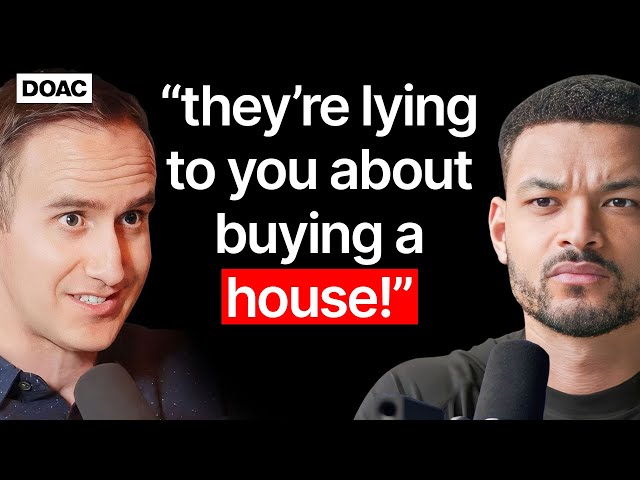
The Diary Of A CEO
True financial freedom stems from low expectations, behavioral discipline, and schedule autonomy rather than maximizing earnings or treating homeownership as an investment strategy.
AI-assisted summary of The Savings Expert: “Do Not Buy A House!” Do THIS Instead! - Morgan Housel — original source. Check the original for full context.
Source published:
Detailed notes
## Background Published on YouTube by The Diary Of A CEO (hosted by Steven Bartlett) on November 06, 2023, this episode features an in-depth conversation with Morgan Housel, author of 'The Psychology of Money' and 'Same as Ever'. The video description highlights timeless lessons on finance, risk, and human behavior, while providing resource links to Housel's books and media channels.
## TL;DR Financial success is fundamentally driven by human psychology, personal expectations, and emotional discipline rather than mere technical expertise or market forecasting. Morgan Housel argues that true wealth represents unspent money that grants autonomy over one's time, emphasizing that controlling lifestyle inflation and maintaining low expectations are the ultimate drivers of long-term happiness. Through practical strategies such as dollar-cost averaging into index funds, maintaining deep cash reserves, and embracing long-term exponential compounding, investors can survive inevitable shocks. Ultimately, treating major financial moves like homeownership as lifestyle choices rather than pure investments ensures long-term endurance and personal stability.
## Atmosphere & style The conversation carries an intimate, reflective, and deeply pragmatic tone, blending financial philosophy with vulnerable personal stories. Steven Bartlett and Morgan Housel engage in an unhurried, peer-to-peer dialogue marked by grounded wisdom, sharp intellectual curiosity, and moments of quiet candor. It feels like eavesdropping on two high achievers unpacking the psychological costs of success, striking a balance between sobering reality checks and reassuring, actionable advice.
## Key takeaways - [04:14](https://www.youtube.com/watch?v=vOvLFT4v4LQ&t=254s) True wealth is defined not by what you spend on material items, but by unspent money that grants autonomy and control over your time. - [14:33](https://www.youtube.com/watch?v=vOvLFT4v4LQ&t=873s) The hardest financial skill is preventing your goalposts from moving as your income grows. - [18:20](https://www.youtube.com/watch?v=vOvLFT4v4LQ&t=1100s) Managing inner expectations to keep them low is the most reliable foundation for long-term happiness. - [22:16](https://www.youtube.com/watch?v=vOvLFT4v4LQ&t=1336s) Impressing other people is an unnecessary financial burden, whereas not needing their validation is a priceless asset. - [40:00](https://www.youtube.com/watch?v=vOvLFT4v4LQ&t=2400s) True financial risk is defined by events that cannot be predicted or anticipated. - [43:22](https://www.youtube.com/watch?v=vOvLFT4v4LQ&t=2602s) Instead of attempting to forecast market movements, investors should maintain liquid cash buffers to prepare for unforeseen disruptions. - [45:55](https://www.youtube.com/watch?v=vOvLFT4v4LQ&t=2755s) Building wealth through investing relies primarily on endurance and time in simple index funds rather than short-term outperformance. - [49:54](https://www.youtube.com/watch?v=vOvLFT4v4LQ&t=2994s) The overwhelming majority of compounding benefits occur over long horizons, as demonstrated by Warren Buffett's wealth growth after age 60. - [56:28](https://www.youtube.com/watch?v=vOvLFT4v4LQ&t=3388s) Financial independence should be used to gain autonomy over the work you choose to do, rather than stopping work completely. - [01:06:14](https://www.youtube.com/watch?v=vOvLFT4v4LQ&t=3974s) Young adults in their twenties should prioritize taking career risks at early-stage or unusual companies over safe corporate paths. - [01:08:58](https://www.youtube.com/watch?v=vOvLFT4v4LQ&t=4138s) Virtually all market returns are driven by a minority of extreme outlier events known as long tails. - [01:25:19](https://www.youtube.com/watch?v=vOvLFT4v4LQ&t=5119s) Overconfidence and mistaking luck for skill frequently cause successful individuals to lose their fortunes. - [01:33:16](https://www.youtube.com/watch?v=vOvLFT4v4LQ&t=5596s) Enduring market volatility and temporary drops is the non-monetary price required to achieve long-term equity returns. - [01:41:08](https://www.youtube.com/watch?v=vOvLFT4v4LQ&t=6068s) Buying a primary residence is fundamentally a lifestyle choice for stability, not a superior wealth-generation strategy. - [01:45:15](https://www.youtube.com/watch?v=vOvLFT4v4LQ&t=6315s) In business and life, the power of a compelling narrative regularly outweighs raw data or facts. - [01:45:42](https://www.youtube.com/watch?v=vOvLFT4v4LQ&t=6342s) Human intuition struggles with non-linear math, making the exponential power of compounding difficult to grasp intuitively. - [01:50:15](https://www.youtube.com/watch?v=vOvLFT4v4LQ&t=6615s) Significant personal growth and societal breakthroughs are often forged through hardship, stress, and crisis.
## Detailed walkthrough Here is a detailed, faithful walkthrough of the transcript section.
---
[00:00](https://www.youtube.com/watch?v=vOvLFT4v4LQ&t=0s) Intro: The Core Rules of Building and Retaining Wealth
The conversation opens with a high-energy trailer setting up key principles of wealth creation and financial mindsets. Steven Bartlett introduces Morgan Housel, author of *The Psychology of Money*, framing his insights as game-changing advice that can help anyone build wealth and avoid critical financial traps. The introductory clips highlight contrast across different socioeconomic levels—ranging from low-income workers struggling to see opportunity, to ordinary people accumulating vast fortunes, to billionaires like Warren Buffett.
A central theme introduced in this opening segment is the distinction between simple income and true wealth. While many people mistake wanting to be a millionaire with wanting to *spend* a million dollars on luxury clothes, larger houses, and nicer cars, real financial freedom comes from endurance and keeping expectations in check. Through examples of extreme contrast—such as Ronald Read, a humble janitor who quietly amassed an $8 million fortune, and everyday parents with minimal financial interest outperforming professional investors—the stage is set for a deep dive into how human psychology, rather than sheer intellect, dictates financial success.
- **Ronald Read**: A janitor who successfully built an $8 million fortune through simple, consistent investing. - **Warren Buffett**: Worth over $100 billion, serving as a prime example of the long-term power of compounding and discipline. - **The Core Trap**: If your lifestyle expectations grow faster than your income, you will never feel happy or financially secure regardless of how much money you make.
---
[02:23](https://www.youtube.com/watch?v=vOvLFT4v4LQ&t=143s) Why Write Books About Money? The "Selfish Writing" Approach
Steven Bartlett welcomes Morgan Housel to the show, praising *The Psychology of Money* as what he considers the single greatest book on money and finance ever written. Steven shares a personal story from when he first came into significant money around the age of 27 or 28. His brother, an investment banker, handed him Housel's book with an urgent piece of advice: *"Steve, there's one book I need you to read... It will stop you losing all of the money you've just earned."* Steven credits the book with enabling him to retain and grow his wealth, which served as his primary motivation for inviting Morgan onto the podcast.
When Steven asks Morgan why he chooses to write about money out of all possible topics, Morgan gives a surprising answer: he practices what he terms "selfish writing." Rather than trying to pander to a specific target audience, Morgan writes exclusively for an audience of one—himself. He uses his writing as a personal diary to explore his own curiosities, unpack his insecurities, and solve his own internal questions about finance and human behavior. He believes that traditional advice to "know your audience" often devolves into pandering, creating books that feel insincere. By writing to solve his own problems, he takes a leap of faith that the insights will naturally resonate with others.
> "When most people say I want to be a millionaire, what they actually mean is I want to spend a million dollars."
---
[04:14](https://www.youtube.com/watch?v=vOvLFT4v4LQ&t=254s) The Psychology of Money & Defining True Wealth
Morgan explains that while traditional finance books focus on mechanical skills—such as picking stocks, balancing checking accounts, or choosing credit cards—his goal is to make readers look in the mirror and become introspective. The real learning begins after finishing the book, prompting individuals to evaluate their relationship with greed, fear, social status, and personal insecurities.
A crucial part of this self-reflection is properly defining the difference between being **rich** and being **wealthy**:
* **Rich**: Having enough current income or cash to purchase material things—paying for a mortgage, covering expensive car payments, eating at fine restaurants, and having money in the bank to spend. * **Wealth**: Unspent money that has not been converted into physical possessions. Wealth is hidden in the assets, savings, and investments you choose *not* to spend on cars, large homes, or jewelry.
Morgan emphasizes that unspent wealth provides something far more valuable than material goods: total autonomy and independence. Savings represent buying back pieces of your future time so you can wake up every day and choose what to do, who to work for, and when to retire. He highlights a favorite quote from Charlie Munger, who noted that he never aimed to get rich, but rather simply wanted to become independent.
---
[07:35](https://www.youtube.com/watch?v=vOvLFT4v4LQ&t=455s) Lessons from an ER Doctor: Frugality and Independence
To illustrate the life-changing value of autonomy, Morgan shares a personal story about his parents. During his early childhood, his parents were struggling students living off student loans and grants with virtually no extra money. When Morgan was around 12 or 13 years old, his father became an Emergency Room (ER) doctor, significantly increasing their household income. However, the deep frugality his parents developed during their lean years remained intact. They continued living well below their means in a modest home rather than buying luxury items like Lamborghinis.
As a teenager around 16 or 17, Morgan admits he looked down on his parents' frugality, naively assuming his father was just being "mean" by not buying a bigger house, a fancy car, or more expensive Christmas presents. The true wisdom of his father's choice did not click for Morgan until roughly a decade ago, when he was in his late twenties.
His father worked as an ER doctor for 20 years—an immensely high-stress job where he regularly dealt with tragic situations and night shifts. After two decades, burnt out from the heavy emotional toll, his father decided he had had enough and retired on the spot. Because he had maintained a very high savings rate and lived beneath his means, he had the complete financial flexibility to walk away immediately. By contrast, many of his ER colleagues who were equally burnt out at age 60 were forced to keep working because they were trapped by the high expenses of the larger houses and nicer cars they had bought years earlier.
- **The Real Power of Savings**: Savings offer freedom from stress and the ability to exit high-pressure situations on your own terms. - **The Ultimate Key to Happiness**: Having control over your schedule and future provides far greater long-term happiness than any material purchase ever could.
---
[10:53](https://www.youtube.com/watch?v=vOvLFT4v4LQ&t=653s) Lack of Autonomy, Stress, and Physical Health
Steven and Morgan discuss the physiological cost of lacking control over one's life. Steven references occupational studies showing that low-autonomy roles trigger severe physiological responses, including elevated stress, higher susceptibility to disease, and a significantly increased risk of cardiovascular problems—the leading cause of death globally.
Morgan relates this to the story of John D. Rockefeller, historically one of the world's wealthiest individuals, who lived to age 97. When Rockefeller's doctor was asked about the secret to his longevity, he pointed to three things:
1. He never let anything bother him. 2. He spent plenty of time outdoors. 3. He always left the dinner table while still feeling a little bit hungry.
Rockefeller's ability to maintain "ice in his veins" and avoid internalizing stress, even during the most intense business crises, played a central role in his physical health and extreme longevity.
---
[12:35](https://www.youtube.com/watch?v=vOvLFT4v4LQ&t=755s) Psychological Reactance and the CEO Calendar Trap
Morgan highlights Chapter 7 of his book, which addresses freedom as the single broadest lifestyle variable determining human happiness. He points out that even doing work you love begins to feel like work you hate if it is forced upon you on a schedule you cannot control—a psychological phenomenon known as **reactance**.
He uses high-earning corporate CEOs making $30 million to $50 million a year as an example of this trap. Despite their immense incomes, many have zero control over their time; every second of their day is dictated by external demands, meetings, and mandatory travel. He contrasts this with Warren Buffett, who, despite managing a massive enterprise, intentionally structures his day for near 100% autonomy and delegates aggressively so he can do whatever he wants with his time.
Steven candidly admits that he frequently falls into the trap of being a "puppet master" to his own Google Calendar. As his career has grown more successful, his days have become packed back-to-back with zero breathing room, forcing him to explicitly instruct his assistant to block out mandatory 30-minute breaks just to eat lunch and keep from burning out.
[14:33](https://www.youtube.com/watch?v=vOvLFT4v4LQ&t=873s) The Illusion of Control and Moving Goalposts
Reflecting on how time management and personal freedom shift over time, Steven Bartlett notes that work used to consume every leftover hour. Oddly, even after achieving financial success, the impulse to overwork does not automatically fade. Bartlett admits that he sometimes cancels calendar appointments purely to prove to himself that he still retains control over his own life.
Morgan Housel resonates with this, bringing up two insightful concepts from author Nassim Nicholas Taleb. First, Taleb suggests that true wealth is reached "when the money that you deny tastes better than the money you accept"—meaning the satisfaction of turning down a lucrative deal outweighs the financial gain. Second, Taleb noted that the world is split between people who don't know how to start making money and those who don't know when to stop. Housel explains that the single hardest financial skill is preventing the goalposts from constantly moving. Most people believe that reaching a specific net worth will eliminate their problems, but once they hit that target, they simply push the benchmark further out, remaining trapped on a hedonic treadmill.
[16:20](https://www.youtube.com/watch?v=vOvLFT4v4LQ&t=980s) Rising Incomes vs. Expectations: Why We Aren't Happier
When examining broader societal trends, Housel points out a striking paradox: adjusted for inflation, the average American household earns twice as much today as it did in the 1950s, yet reported happiness levels have declined. While money certainly relieves the severe distress of poverty by covering basic needs like food and shelter, rising wealth across an entire society simply elevates the baseline. Because people naturally compare themselves to their neighbors, co-workers, and peers, an increase in average income yields no net gain in perceived relative status.
Housel illustrates this through historical contrasts: * **John D. Rockefeller:** Adjusted for inflation, Rockefeller was worth nearly half a trillion dollars when he died in the 1930s. Yet, despite his immense wealth, he never had access to penicillin, Advil, sunscreen, or the polio vaccine. * **Modern Baseline:** Although ordinary citizens today enjoy medical and technological wonders that would have flabbergasted Thomas Jefferson or Rockefeller, almost no one wakes up feeling grateful for them. They are taken for granted as the default standard.
[18:20](https://www.youtube.com/watch?v=vOvLFT4v4LQ&t=1100s) The First Rule of Happiness: Low Expectations
Discussing Housel's book, Bartlett highlights a core theme: "The first rule of happiness is low expectations." True happiness does not stem solely from striving harder or building a more successful company; it lies in the gap between your circumstances and your expectations. If your expectations rise faster than your income, you will always feel broke—even on a billion-dollar income. Conversely, someone making $50,000 who only needs $40,000 to feel content will experience genuine abundance.
Housel shares the moving example of the late physicist Stephen Hawking to demonstrate the power of managing expectations: * **Stephen Hawking's Mindset:** Paralyzed from head to toe by motor neuron disease and forced to communicate via a computer, Hawking lived in conditions most would consider tragic. Yet, in a *New York Times* interview shortly before his death, he expressed deep happiness, explaining: "My expectations were reduced to zero when I was 21... Everything else since then has been a bonus." * **Internal Control:** Managing your inner expectations is far more within your personal control than controlling external circumstances, market returns, or macroeconomics.
``` Expectations > Income = Feels Broke (Even with $1B) Expectations < Income = Feels Wealthy (Even with $50k) ```
[22:16](https://www.youtube.com/watch?v=vOvLFT4v4LQ&t=1336s) The Valet Lesson: "Nobody Cares About Your Stuff as Much as You Do"
Recalling his early twenties working as a valet at a five-star hotel in Los Angeles, Housel shares the realization that permanently shifted his relationship with material goods. Whenever a guest pulled up in a luxury vehicle—a Ferrari, Lamborghini, or Rolls-Royce—Housel never once looked at the driver and thought, *"Wow, that person is cool."* Instead, he imagined *himself* in the driver's seat, believing that others would admire him.
This exposed a fundamental psychological paradox: nobody actually cares about the driver; they only care about imagining themselves in the car. People buy flashy items to gain respect and admiration, yet observers ignore the owner and merely project their own desires onto the object.
> "The most valuable financial skill that anybody can have is not needing to impress other people. If you don't need to impress other people, that is an asset on your balance sheet that is worth a billion dollars."
Housel emphasizes that signaling and showing off "peacock feathers" may serve a purpose when young and searching for a partner. However, maintaining that need for external validation later in life turns into a net loss. He references Warren Buffett’s definition of success: when the people you want to love you actually do. For Housel, that comes down to a tiny group—his wife, his children, and his parents.
``` [ Material Goods / Luxury Cars ] / \ / \ What the Owner Thinks: What Observers See: "Everyone will think "I wish *I* was driving I am cool and rich." that cool car." \ / \ / [ Disconnect: Nobody is actually admiring the driver ] ```
[25:35](https://www.youtube.com/watch?v=vOvLFT4v4LQ&t=1535s) Relationships, Neediness, and Low Expectations
Expanding on expectations within personal relationships, Housel references a principle shared by his friend Brent Beshore: a marriage thrives when both partners seek to serve each other while expecting nothing in return. When both individuals adopt this mindset, every thoughtful act becomes a pleasant, unexpected surprise that exceeds expectations.
Conversely, neediness destroys relationships and careers. Neediness arises when expectations become unrealistically high—demanding that a partner or job constantly validate, serve, or uplift you. When you rely entirely on external factors to fulfill your self-worth, the relationship fractures under the weight of those demands.
[27:48](https://www.youtube.com/watch?v=vOvLFT4v4LQ&t=1668s) Risk, Poverty, and Financial Recklessness
The conversation pivots to how early financial insecurity shapes decision-making. Bartlett shares a candid personal story from his late teens: while struggling to afford basic food, he received his first university student loan payment. Rather than budgeting it for meals, he placed the entire sum on a single sports bet—and lost it all during injury time. Paradoxically, as Bartlett accumulated wealth later in life, his impulse to take wild risks and buy flashy possessions completely vanished.
Housel explains why low-income individuals often engage in seemingly irrational financial behavior: * **Seeking Respect:** Respect and admiration can be earned through wisdom, character, and success, or attempted through material possessions. When people feel blocked from traditional paths to success, showing off material items becomes one of the few avenues left to claim status. * **The Lottery Trap:** Data shows that the poorest 10% of households in the United States purchase roughly 80% of all lottery tickets. While higher-income observers view this as foolish, for someone living in severe poverty, playing the lottery represents the only perceived ticket to the dream lifestyle they see modeled across media and society.
<ElicitationsGroup message="Explore more insights from Morgan Housel's perspective on wealth and psychology:"> <Elicitation label="Learn about Morgan Housel's views on saving money" query="What does Morgan Housel say about saving money and building a safety net?"/> <Elicitation label="Explore the story of the janitor who became a multimillionaire" query="Tell me the story of the janitor who became a multimillionaire mentioned in Morgan Housel's interview."/> <ElicitationsGroup/>
The Psychology of Lottery Tickets, Poverty, and Hope
Morgan Housel and Steven Bartlett dive into a provocative discussion regarding why people in the lowest income brackets—those in the bottom 10% who are literally struggling to put a roof over their heads and feed themselves—frequently spend hard-earned money on scratcher tickets. The initial knee-jerk reaction from outsiders is often judgmental disbelief, but Housel reframes this through the lens of psychology and despair. If you are stuck in a low-income job with zero perceived upward mobility or chance of becoming an entrepreneur, buying a lottery ticket might provide the only glimmer of hope in an otherwise bleak existence. Bartlett adds a personal anecdote, noting that when he used to gamble, he would immediately go on Autotrader and Rightmove right before the results came in to browse cars and houses he would buy if he won.
Housel connects this psychological state to broader societal issues, suggesting that when people feel the world is fundamentally unfair—a perception that is often true—it becomes a very natural extension to think, "If the world's unfair, why not, I might as well cheat too." This dynamic offers some explanation for the complex relationship between poverty and crime, driven by the desperate desire for even a microscopic fraction of hope. Similarly, for someone working exhausting graveyard shifts and taking three buses just to get their kids to school, a cigarette and a drink might be the only daily source of pleasure, shedding light on the correlation between health disparities and poverty. Bartlett then transitions to make a direct appeal to the audience, noting from YouTube backend analytics that 69.9% of frequent viewers have not yet hit the subscribe button, promising to continuously improve the show in exchange for their support.
* **The Bottom 10%:** Individuals facing extreme financial struggle who frequently spend limited funds on lottery scratchers. * **The Root Driver:** The desperate need for a psychological glimpse of hope and a tangible "ticket out" of chronic stagnation. * **Parallel Behaviors:** The pursuit of small daily pleasures like alcohol and cigarettes amid exhaustion, mirroring the complex ties between poverty, health, and crime.
---
The Path to Wealth from Rock Bottom and the Three Types of Savers
Directing his advice toward an 18-year-old version of himself or anyone making $1,000 to $2,000 a month who can barely cover rent, Housel emphasizes that financial stress largely stems from a lack of control. He argues that viewing every saved dollar as a piece of your future that you personally own and control changes your mindset completely. The real ticket out of a low-income trap is not a flashy car, designer clothes, or a bigger house, but **independence**. Independence gives you a better career, better health, and protects you when unexpected crises strike. Housel outlines a simple framework from his book: there are three types of people—those who save, those who don't think they can save, and those who don't think they need to save.
Reflecting on the nature versus nurture debate in finance, Housel notes that legendary investors like Warren Buffett and Charlie Munger believe financial acumen is largely innate—either young people get it instantly or they never get it at all. While acknowledging this perspective, Bartlett offers a personal counterargument, sharing that he has inhabited all three categories throughout his life. Bartlett admits he once believed he couldn't save because he had no money, failing to grasp the value of small amounts or the laws of compounding returns, before eventually becoming both a saver and someone who foolishly thought savings weren't necessary.
* **Core Financial Goal:** Independence through saving, which relieves mental weight and provides life choices. * **The Three Financial Personas:** 1. Those who save. 2. Those who don't think they can save. 3. Those who don't think they need to save. * **Nature vs. Nurture:** The debate over whether financial literacy is an innate mindset or a learned behavior.
---
The Ski Avalanche Tragedy That Altered Risk and Reality
Bartlett bridges the conversation to a formative, tragic event from Housel's youth in Lake Tahoe, California, where Housel was a competitive ski racer on the Squaw Valley ski team. In February 2001, when Housel was 17 years old, he went out-of-bounds illegally with two of his best friends, Brendan Allen and Brian Richmond, ducking past the "do not cross" rope to find better snow. After skiing down, they triggered a small knee-deep avalanche, high-fived at the bottom, and planned to take a second run while Housel drove his truck around to pick them up. For an inexplicable reason, Housel decided against joining them for that second run, telling them to go ahead while he went to take off his ski boots.
When Housel arrived at the pickup spot 20 to 30 minutes later, his friends were not there. Hours passed with no cell phones to coordinate, leading to a frantic search after Brian's mother called asking if anyone knew where he was. Police initially dismissed the disappearance as teenagers partying, but organized search and rescue eventually probed beneath 6 feet of snow, discovering that Brendan and Brian had been killed by a massive secondary avalanche. Housel reflects on how this profound loss completely reshaped his worldview. The decision to skip the second run was entirely brainless—made with zero cost-benefit analysis—yet it was the most important decision of his life, proving that "the world hangs by a thread."
* **Date & Location:** February 2001, Squaw Valley, Lake Tahoe, California. * **The Incident:** An illegal out-of-bound ski run that resulted in a fatal avalanche, claiming the lives of Housel's close friends Brendan Allen and Brian Richmond. * **The Lesson:** Life-altering turning points often stem from trivial, uncalculated micro-decisions rather than grand strategic planning.
---
Why Predictions Fail and the True Definition of Risk
Connecting his survival of the avalanche to the world of investing, Housel argues that people who think they can predict the future—whether buying crypto or trading stocks—fundamentally misunderstand risk. He points out that the biggest shocks to the U.S. economy over recent generations—such as Pearl Harbor, 9/11, the COVID-19 pandemic, and Lehman Brothers failing to find a buyer in 2008—had a common denominator: **nobody saw them coming**, they were absent from every newspaper or economic outlook, and they executed all their damage in mere seconds. The biggest risk over the next decade will similarly be something nobody is talking about today.
Housel invokes a brilliant quote from financial adviser Carl Richards: "Risk is what's left over when you think you've thought of everything." No matter how exhaustive your planning or risk-mitigation strategies are, the residual unknown is where true risk lies. This reality demands intellectual humility regarding economic forecasts, career trajectories, and personal timelines.
* **Historical Black Swans:** Pearl Harbor, 9/11, the 2008 Financial Crisis (Lehman Brothers), and the COVID-19 pandemic. * **Core Attribute of Major Risks:** They are completely unforeseen, absent from public discourse beforehand, and strike with sudden severity. * **Definition of Risk:** "Risk is what's left over when you think you've thought of everything" (attributed to Carl Richards).
By the way, to unlock the full functionality of all Apps, enable [Gemini Apps Activity](https://myactivity.google.com/product/gemini).
[43:22](https://www.youtube.com/watch?v=vOvLFT4v4LQ&t=2602s) Preparing for the Unknown: Invest in Preparedness, Not Prediction
The realization that risk is precisely what you don't see coming can be terrifying, but it can also be remarkably relieving. Once you accept that predicting the stock market or constructing 10-year economic forecasting models is futile, you free yourself from an impossible task. Looking back over the last decade or two, no model could have predicted events like 9/11 or the COVID-19 pandemic. While figures like Bill Gates warned about viral pandemics in a 2015 TED Talk, knowing a general threat exists is entirely different from forecasting its exact timing, severity, or whether an economy will shut down for two weeks or two years.
On balance, the world experiences a major disruption roughly once per decade where everything previously assumed about risk, uncertainty, and stability gets shattered. To navigate this, Morgan Housel cites Nassim Nicholas Taleb’s advice: "invest in preparedness, not in prediction." Instead of placing speculative bets on crypto or stock movements, investors should focus on maintaining a substantial buffer—holding cash, ensuring liquidity, and minimizing debt so they can endure whatever shock comes next.
* A proper cash reserve in an investment portfolio should ideally feel like "too much" and make you wince slightly. * Having cash calibrated only for foresaw or imaginable risks guarantees being caught completely off guard when an unexpected event occurs. * Maintaining what feels like excess cash provides a fighting chance to survive unpredictable shocks like 9/11, COVID-19, or Pearl Harbor. * When people look at Housel's conservative asset allocation and ask what he is saving for, his answer is simply: "I have no idea."
[45:55](https://www.youtube.com/watch?v=vOvLFT4v4LQ&t=2755s) A Painfully Simple Capital Allocation Strategy
When asked directly about his exact investment strategy, Housel emphasizes extreme simplicity. His entire net worth consists of cash, a house, index funds, and shares in Markel (where he serves on the board of directors). He avoids complex setups, maintaining just one primary bank account and one brokerage account. Host Steven Bartlett notes that his own allocation is nearly identical—outside of angel investments in startups and a long-standing position in Ethereum tied to running a blockchain software business, all of his available liquid capital goes into index funds.
Bartlett humorously shares that Housel’s writing taught him that successful investing means "when you lose the password to your investment account," taking pride in the fact that he tried to check his account prior to the interview and couldn't log in. Housel clarifies that while he doesn't believe it is impossible to beat the market, he chooses index funds because the primary variable he maximizes for is endurance. Earning average returns for an above-average period of time naturally places an investor in the top tier of financial performance over the long haul.
* Housel’s parents serve as a prime example: with no formal financial background, they dollar-cost averaged into index funds for nearly 40 years without ever selling, placing their returns in the top 3% of professional investors. * **Dollar-Cost Averaging**: Buying the exact same dollar amount of an asset every single month regardless of market booms, busts, or recessions. * Most employees with a 401(k) automatically practice dollar-cost averaging via automatic paycheck deductions. * **Index Fund**: A single fund holding hundreds or thousands of individual stocks (like Apple or Tesla), essentially allowing an investor to own a broad slice of global capitalism.
[49:54](https://www.youtube.com/watch?v=vOvLFT4v4LQ&t=2994s) The Exponential Power of Compounding and Endurance
When explaining why low-cost index funds combined with patience beat speculative strategies like stock picking or crypto trading over a lifetime, the math comes down to pure endurance. Short-term performance over a one-to-five-year horizon plays almost no role in lifelong wealth creation. All that matters is the length of time returns can be sustained, because the formula for compounding relies heavily on time as an exponent.
The quintessential case study of this principle is Warren Buffett. Over 99% of Buffett's current net worth was accumulated after his 60th birthday. At age 60, he was worth roughly $3 billion; by age 90, his net worth surpassed $100 billion, even after giving away tens of billions to charity. Had he retired at 50 or 60 to play golf in Florida, he would be virtually unknown today. His true advantage wasn't merely being a skilled stock picker, but remaining a consistent investor for over 80 years since he was 11 old.
* Compounding growth is driven exponentially by time: the longer an asset is held, the steeper the wealth curve becomes. * If Warren Buffett earns a 10% annual return on his portfolio today, that single year's gain ($10 billion) is triple his entire net worth at age 60. * Endurance beats genius: staying in the market with average returns for 20 to 30 years yields far greater wealth than beating the market by a fraction of a percent for a short 10-year span.
[51:58](https://www.youtube.com/watch?v=vOvLFT4v4LQ&t=3118s) The Janitor Who Left $8 Million to Charity
The story of Ronald Read—a gas station attendant and janitor who died in 2014 at age 92 with an $8 million fortune—illustrates the supreme power of financial endurance. Read saved what little he could from his modest wages, invested it in basic stocks, and left it untouched for 70 years. He required no elite financial education or high income; he simply let time and patience do the heavy lifting, ultimately outperforming the vast majority of professional Wall Street fund managers.
While Read demonstrates what patience can achieve, Housel admits a slight regret over how Read was portrayed in *The Psychology of Money*. Read is an extraordinary case study of wealth creation through patience, but living in a small house while mopping floors into old age isn't necessarily a holistic role model for a good life. Building wealth should serve lifestyle independence rather than extreme frugality for its own sake.
* Professional investors often work 80-hour weeks for decades only to fall short of market index returns. * Outperforming the market by 1% per year over a decade makes someone an elite investor, yet earning basic market returns over 30 years accumulates significantly more total wealth. * Patience is largely within an individual's control, whereas consistently picking winning stocks day after day is inherently difficult.
[54:41](https://www.youtube.com/watch?v=vOvLFT4v4LQ&t=3281s) Defining Your "Rich Life" Beyond Social Expectations
A common struggle with long-term financial planning and pensions is balancing future security with present enjoyment. Many people express frustration at saving money for age 65 when they would prefer to enjoy experiences, travel, or spend money in their 20s. Furthermore, financial advisors frequently note that one of their hardest tasks is convincing retired clients to actually spend their savings after decades of ingrained saving habits.
Citing author Ramit Sethi, Housel emphasizes the importance of defining what a "rich life" means on an individual level rather than accepting society's default rules. For Sethi, a rich life includes flying first class and wearing tailored clothes while driving an older Honda. For Housel, a rich life means independence—having the autonomy to sit on the couch in sweatpants reading a book or going for a walk with his wife on a Wednesday afternoon.
* Society pushes a standardized playbook for success: buying expensive cars, large houses, and luxury designer items. * True financial satisfaction comes from identifying personal, intrinsic triggers for happiness rather than conforming to external status signals. * Money’s greatest intangible dividend is providing total control over your time and schedule.
[56:28](https://www.youtube.com/watch?v=vOvLFT4v4LQ&t=3388s) Knowing When "Enough is Enough" and the Trap of Early Retirement
Determining when you have reached "enough" financially is a challenge for high achievers, who often fall trap to shifting goalposts and external expectations. While some individuals naturally reach a point where they feel fulfilled and step back from the pursuit of more, many struggle with the transition. This dynamic is particularly evident in the FIRE movement (Financial Independence, Retire Early), where individuals aggressive save to retire in their 30s.
In practice, many who achieve early retirement find themselves bored within two weeks and deeply unfulfilled after six months. Most people derive purpose from productivity, problem-solving, and meaningful effort. Therefore, achieving financial independence or having "enough" shouldn't necessarily mean quitting work altogether; rather, it provides the freedom to do only the work you genuinely care about without financial pressure.
* Patrick O'Shaughnessy poses a revealing thought experiment to employees: "If you won a billion dollars in the lottery tomorrow, but were required to keep working at your job, would you stay?" * True financial freedom is not the absence of work, but the complete elimination of forced work you dislike.
[57:50](https://www.youtube.com/watch?v=vOvLFT4v4LQ&t=3470s) The Freedom to Pick Your Work and the True Cost of "Never Enough"
Morgan Housel explains that achieving financial independence ("having enough") isn't about quitting work entirely to lounge on a beach. Instead, it gives you the autonomy to eliminate the soul-crushing parts of a job and choose only the projects, positions, or creative endeavors you actually enjoy. Everyone has an answer when asked what they would cut or keep if they didn't need the money; having enough allows you to select only the fulfilling parts.
Steven Bartlett reflects on Bronnie Ware's work documenting the biggest deathbed regrets of the dying—specifically, working too hard and failing to live a life true to themselves. Housel admits to a somewhat morbid frame of mind: when considering his own deathbed, he knows with certainty that he won't regret working hard or maintaining a high savings rate. For him, the ultimate regret would be leaving his wife and young children financially vulnerable. He wouldn't care for a single second about the luxury cars, big houses, or designer clothes he didn't buy, because protecting his family provides profound joy and peace of mind.
- Bronnie Ware’s research highlights that a primary deathbed regret is working too much at the expense of a genuine life. - Housel's family dynamics at the time: a wife, an 8-year-old son, and a 4-year-old daughter. - True satisfaction stems from family security rather than spending money on depreciating luxury goods like sports cars.
[59:48](https://www.youtube.com/watch?v=vOvLFT4v4LQ&t=3588s) Inheritances, *Die with Zero*, and the Flight Class Lesson
The discussion shifts to Bill Perkins’ book *Die with Zero*, which argues that parents shouldn't hold onto wealth until they die at age 90, leaving an inheritance to children who are already 60. Instead, parents should give money to their children in their 30s or 40s when they are actively raising families and need it most. Bartlett acknowledges the appeal of this concept but counters with the classic dilemma: giving children easy money risks ruining their drive and ambition. He shares his ongoing debate with his girlfriend over whether their future children should fly economy or business class, eventually agreeing on a rule to keep kids in economy until age 12 to teach them the value of things.
Housel confesses to a mistake he made a year prior when he flew his then seven-year-old son first class. He tried explaining to his son that it was a rare treat, but the boy immediately went home and bragged to neighbors, schoolmates, and friends. Realizing how quickly a child can become spoiled or develop a sense of superiority, Housel vowed never to do it again. Having not flown first class himself until age 35—after flying coach thousands of times—Housel felt he had earned the luxury, whereas his son had no frame of reference.
- *Die with Zero* concept: Distribute wealth to children during their peak financial need (ages 30–40) rather than at death (age 90). - Charlie Munger anecdote: When a wealthy friend asked if giving his kids all his money would ruin their ambition, Munger replied, "Of course it will, but you have to do it anyways... because if you don't, your kids will hate you." - Housel notes this dynamic is ~70–80% true: unless a child has the rare, unstoppable internal drive of an 18-year-old Bill Gates, Mark Zuckerberg, or Elon Musk, unearned wealth usually dampens ambition.
[01:03:19](https://www.youtube.com/watch?v=vOvLFT4v4LQ&t=3799s) The Rare Skill of Sitting on Cash: Berkshire Hathaway
Bartlett notes that getting money and keeping money require entirely different skills. One of the most essential skills for getting and maintaining wealth is endurance—the ability to remain patient, lose your account passwords, and sit on your hands regardless of market volatility. He references Warren Buffett’s practice of going years without allocating capital, pointing out that great investing often requires sitting still and doing nothing.
Housel agrees, pointing out that Berkshire Hathaway held roughly $150 billion in cash at the time. Over a 60-year history, Buffett and Berkshire’s core strategy has been simple: hoard massive amounts of cash, wait patiently—sometimes up to a decade—for a truly extraordinary opportunity, deploy the capital aggressively, and then go right back to waiting. Good investment opportunities are supposed to be rare, appearing perhaps once a decade, rather than waiting inside a trading app every afternoon.
- Berkshire Hathaway’s cash stockpile at the time of recording: ~$150 billion. - Modern accessibility: 20 years ago, investing required a personal broker, phone calls, paperwork, and steep fees. Today, anyone can buy a low-cost index fund from a smartphone app like Robinhood. - Wealth accumulation requires optimistic risk-taking and "swinging for the fences," while wealth retention demands paranoia, conservatism, and a buffer for unknown shock events like Pearl Harbor or 9/11.
[01:06:14](https://www.youtube.com/watch?v=vOvLFT4v4LQ&t=3974s) Career Advice for 20-Somethings: Embrace the Weird Startup
When asked what advice he would give a broke 20-year-old, Housel offers counterintuitive guidance. While young people are often advised to take massive financial risks because they have 50 years ahead of them, Housel points out that youth is also when life is most fragile and unpredictable. A young person needs cash liquidity to navigate job changes, breakups, or sudden moves.
When it comes to career choices, however, Housel strongly advises taking major risks right out of college. Rather than joining a safe, corporate Blue Chip firm, young adults should join a "weird company" or a high-risk startup.
"Don't go work for Goldman Sachs or Apple or Deloitte or something like that. Go for the weird startup where... you're going to learn something completely different."
At a large firm, career progression is a slow, linear ladder (analyst to senior analyst to associate) that caps upside potential. At a weird startup, the company will either fail or take off, and both outcomes offer invaluable lessons in real-world failure and growth. Furthermore, taking risky jobs at age 22 is easy because you aren't tied down. By age 40, with a mortgage, two kids, and retirement savings to manage, taking a wild career gamble becomes nearly impossible due to "golden handcuffs."
- Safe paths (Goldman Sachs, Apple, Deloitte) provide stability but cap upside and learning density early in a career. - Proximity to leadership: As a career progresses into your 30s and 40s, the distance between your desk and the CEO's desk should naturally widen as you move toward stable corporate environments.
[01:08:58](https://www.youtube.com/watch?v=vOvLFT4v4LQ&t=4138s) Long Tails and the Illusion of Market Expertise
Bartlett highlights Housel’s concept of "tails" or "long tails"—the idea that a tiny minority of events drives the vast majority of outcomes. In venture capital, out of 50 investments, roughly half will fail, ten will do fine, and just one or two massive winners will generate 100% of the fund's total returns. Housel notes this rule governs everything in business and life. For example, out of thousands of public companies in the U.S. stock market, a handful of giants—like Apple, Tesla, and Microsoft—drive almost all the index's returns.
Because no one can predict in advance which specific companies will become the ultimate winners, the most sensible approach is to own a broad index fund to ensure those few tail-events are included in your portfolio. Bartlett shares that the ultimate takeaway from Housel’s work is a sense of deep humility: recognizing that no one really knows what is going to happen next. Housel agrees, laughing that writing his book proved to him that everyone in the investment world is essentially "bullshitting their way through." Bartlett compares technical chart forecasting in financial and crypto group chats to "male horoscopes," where people draw arbitrary upward trends to convince themselves they can predict the unpredictable.
- Venture capital dynamics: ~50% of investments fail completely, while 1–2 "tail" outliers account for virtually all fund returns. - Stock market concentration: A tiny subset of companies (e.g., Apple, Tesla, Microsoft) drives the bulk of US market returns over time. - Investors rely on technical forecasting graphs in crypto/stock chats—mocked as "male horoscopes"—to create a false sense of certainty in an unpredictable market.
[01:10:58](https://www.youtube.com/watch?v=vOvLFT4v4LQ&t=4258s) The "Horoscope" of Wall Street and Taking Big Swings
Forecasts and market predictions serve a psychological purpose rather than a practical one. Investing forecasts function very much like a daily horoscope: even if you intellectually know it is garbage, you still want to read it because it brings comfort. People crave forecasts because the inherent unpredictability of the future causes immense stress, and listening to an expert pretend to know what lies ahead temporarily relieves that pain.
``` "What a lot of people want out of their investing forecasts or whatever it is, is they want to reduce the uncertainty that's giving them stress." ```
In reality, extreme success is built on a willingness to embrace failure rather than predict the future. Jeff Bezos famously articulated this philosophy in an Amazon shareholder letter, noting that Amazon strives to be the best place in the world to fail. Bezos explained that in business, you swing for the fences ten times: nine of those swings might end up in the "Amazon graveyard" (such as the failed search engine A9.com or the notorious Fire Phone flop), but that single home run pays for every single failure. In Amazon's case, that one winning swing was Amazon Web Services (AWS), which generates tens of billions in revenue. When an analyst once asked Bezos about the massive failure of the Fire Phone, Bezos calmly replied: "If you think that was a big failure, just wait. You've seen nothing yet."
- **The Math of Asymmetric Bets:** Taking many small, calculated risks gives you the optionality needed to hit an enormous winner, similar to buying enough tickets to win the lottery. - **The Failure Rate Metric:** Truly innovative companies intentionally maintain a high failure rate. - **The Netflix Lesson:** When Netflix executives reported to the CEO that every single newly produced movie was a hit, the CEO declared it terrible news—it meant the creative team was not taking enough risky swings. - **The Hotel Pricing Analogy:** A hotel manager shouldn't aim for a 100% occupancy rate; having a few empty rooms proves the remaining rooms are priced high enough to maximize revenue. - **Spotify's "Mistake Rate":** Spotify CEO Daniel Ek tracks the company's "mistake rate" as a core metric to ensure the organization maintains a high-risk, aggressive startup mentality instead of playing it safe.
---
[01:14:19](https://www.youtube.com/watch?v=vOvLFT4v4LQ&t=4459s) "Keep Running": Why Success Plants the Seeds of Decline
A core idea in Morgan Housel's book *Same as Ever* is that competitive advantages tend to be short-lived because success inherently plants the seeds of its own demise. When individuals or companies reach the top, success creates a gravitational pull toward complacency, laziness, and defensive play. Scrappy, agile newcomers with a high risk appetite eventually step in and take their market share while the incumbent is resting on its laurels.
``` "Competitive advantages tend to be short-lived, often because their success plants the seeds of their own decline... Success has its own gravity." ```
Comedian Jerry Seinfeld provided a vivid example of this dynamic when explaining why he walked away from his iconic sitcom *Seinfeld* while it was still at peak popularity. Seinfeld realized that the source material for his humor was disappearing. Before becoming famous, he could sit quietly in a coffee shop or deli and observe how everyday people ordered their food or interacted. Once he became ultra-famous, he could no longer blend in or observe normal human behavior, destroying the very engine that drove his comedic genius. Recognizing his edge was gone, he pulled the plug on the show before the quality degraded.
A similar trap ensnares startup founders. A founder might be the absolute best in the world at building a product from scratch, but as the company grows massive, their daily duties get consumed by executive management, corporate finance, human resources, and marketing—pulling them completely away from their core strength.
- **The Travis Kalanick Example:** Uber's co-founder Travis Kalanick was arguably unmatched at scaling a company rapidly from zero to global dominance, yet poorly suited for the hyper-regulated corporate management required at a massive public firm. - **Shaquille Khan's Advice to Steven Bartlett:** Early Spotify investor Shaquille Khan gave Steven Bartlett a transformative piece of advice after Bartlett exited his first business: "Stephen, the reason you were successful was because you were hungry. You need to realize that you're no longer hungry for the same reasons." Khan forced him to "sit on his hands" for a full year without launching a new company so he could rediscover a genuine, terrifying "moonshot" goal rather than operating out of old habits.
---
[01:18:47](https://www.youtube.com/watch?v=vOvLFT4v4LQ&t=4727s) "Natural Maniacs": The Tortured Reality of Billionaires
While most normal people would retire the moment their net worth hit $3 million or $10 million, elite founders like Elon Musk possess an insatiable, almost pathological drive. Even after becoming the richest person on earth, Musk continues to work 100 hours a week and buys platforms like Twitter to take on high-stakes, chaotic challenges. Housel labels these individuals "natural maniacs"—people who, at age 30, decided to simultaneously challenge General Motors, Ford, Chrysler, and NASA. They do not possess the mental wiring to put their wealth into municipal bonds and retire quietly to a farm.
``` "There's almost no biography of a very successful person like that... that you would read their biography and say, 'That life sounds great.' The word that I would use is tortured." ```
This intense ambition is rarely driven by money; it is fueled by a compulsive desire for competition and problem-solving. Steven Bartlett recalled meeting two separate billionaires in Manchester when he was 24 years old. Looking into their eyes, he realized both men were deeply miserable, and even their children viewed them as tragic, unhappy figures trapped by their own relentless drive to go to the office every single day.
``` | Figure | Financial Status | Lifestyle & Experience | |:--- |:--- |:--- | | **Tom Anderson (MySpace "Tom")** | Sold MySpace to Viacom for ~$580M | Retired early; travels the world, hikes in Bali, and lives a peaceful, low-stress life away from public scrutiny. | | **Mark Zuckerberg (Meta)** | Net worth exceeding $100B+ | Constantly dragged before Congress, publicly blamed for societal issues, managing massive stock volatility, and bearing immense corporate stress. | ```
- **The Escalating Challenge Appetite:** Citing author Daniel Pink, the host notes that human motivation operates like video game psychology: people lose interest if they stay on Level 1. To stay engaged, high achievers compulsively seek out harder levels and bigger problems. - **Bill Gates' Pivot:** After conquering the tech industry and leaving Microsoft in 2000, Bill Gates immediately directed his relentless problem-solving drive toward global philanthropy—channeling his energy into complex challenges like eradicating malaria and effectively distributing hundreds of billions of dollars.
[01:24:24](https://www.youtube.com/watch?v=vOvLFT4v4LQ&t=5064s) The Need for Friction: Why We Crave Stress and Struggle
Continuing the conversation on high performers like Elon Musk and Bill Gates, Steven Bartlett notes that individuals at that level are essentially "addicted to the challenge." There is no point at which someone built like that will simply decide they have had enough and retire to quietly read books. Morgan Housel agrees, emphasizing that this drive isn't unique to billionaires—everyone requires a baseline level of friction and stress in their lives.
Housel points out the irony that while people constantly dream about eliminating all stress to "wake up in Nirvana every day," human psychology actually demands conflict and challenge. When affluent or successful people lack genuine, life-or-death obstacles, they frequently manufacture artificial problems to fill the void, agonizing over minute details because their minds crave something to struggle against.
[01:25:19](https://www.youtube.com/watch?v=vOvLFT4v4LQ&t=5119s) The Trap of Success and Overconfidence
Shifting back to the dangers of success, Bartlett reflects on his own career, noting how being right multiple times in a row creates a dangerous narrative: *"I've been right about several decisions in a row, so surely that creates evidence that I'm probably right again."* Housel confirms this is a common pitfall. Successful people routinely confuse luck with skill, assuming that domain mastery in one field automatically translates to expertise in completely unrelated areas—whether that means a great investor assuming they would make a fantastic politician, or an expert doctor believing their elite credentials enable them to pick winning stocks.
Bartlett brings up a striking theme from Housel's writing: stories of investors who accurately predicted market crashes against all conventional wisdom, only to lose everything later. Housel recount the famous story of Jesse Livermore, one of the most successful stock traders of the early 20th century:
* **Jesse Livermore's Boom and Bust Cycle:** During the 1920s, Livermore became one of the richest men in the world. On four separate occasions, he accumulated a fortune equivalent to billions of dollars (adjusted for inflation) and subsequently went completely bankrupt all four times. * **The Ultimate Price of Overconfidence:** After making a staggering fortune shorting the market during the 1929 crash while everyone else was ruined, Livermore still could not say "enough." He kept swinging harder with bigger bets, eventually going broke a final time and dying by suicide.
Housel explains that as people become more successful, their confidence often grows faster than their actual ability. Furthermore, rich and powerful individuals lose the candid critics they had when they were starting out—employees and flatterers agree with their terrible ideas rather than telling them when they are being overconfident.
[01:28:20](https://www.youtube.com/watch?v=vOvLFT4v4LQ&t=5300s) Remaining Humble: The Roman General and Charlie Munger
To combat the echo chamber of success, Housel stresses that high achievers must intentionally seek out humility. He references an ancient Roman tradition where victorious generals returning from battle were celebrated with grand parades. To prevent them from becoming blinded by pride, a slave stood beside them in the chariot, repeatedly whispering in their ear: *"You're just a man... you're not that special."*
Great business leaders build systematic "reality checks" into their decision-making process: * **The Munger-Buffett Dynamic:** Housel highlights Charlie Munger’s primary role alongside Warren Buffett: telling Buffett when an idea was foolish. Having a trusted partner willing to call out bad logic is essential for long-term survival. * **Denzel Washington’s Warning:** Bartlett references Denzel Washington's advice to Will Smith following the Oscars incident: *"At your highest moment, that's when the devil comes for you."* * **True Humility vs. False Humility:** Housel clarifies that real humility isn't pretending you had no role in your success (*"I just got lucky"*), but acknowledging hard work while remaining acutely aware of your fallibility (*"I built this, but I'm as fallible as anyone else"*).
[01:33:16](https://www.youtube.com/watch?v=vOvLFT4v4LQ&t=5596s) Volatility as the Cost of Admission
Bartlett shares a key takeaway he gained from Housel: the price you pay to build and preserve wealth is enduring volatility along the way. Housel expands on this concept, stating that almost nothing worth having in life is free, but the costs rarely come with clean price tags.
* **The Hidden Currency of Life:** * **Investing:** The fee is enduring market crashes, booms, busts, and the mental anguish of seeing your portfolio drop 30% without panicking. * **Career:** The fee is long hours, intense pressure, and time away from family. * **Relationships:** The fee is constant compromise, sacrifice, and putting another person's needs alongside your own.
Once an investor or individual identifies the non-monetary cost of their goal, the key is willingly paying it rather than trying to cheat the system. Putting up with market fluctuations is well worth the long-term wealth created over decades.
[01:34:49](https://www.youtube.com/watch?v=vOvLFT4v4LQ&t=5689s) Defining Time Horizons and the True Role of Homeownership
The discussion turns to Chapter 16 of *The Psychology of Money*, which focuses on identifying your own time horizon—the gap between today and your ultimate goal. Housel explains that everyone's horizon is unique based on their age, financial aspirations, and life stage:
* **Housel's Evolving Personal Horizons:** 1. Reaching a career point where work is driven purely by enjoyment rather than financial necessity. 2. Being fully available (24/7) for his children during their teenage years, even if it means stepping back from writing. 3. Transitioning time toward caring for aging parents or exploring new interests later in life.
When asked whether buying a home is a good or bad financial decision, Housel reframes the debate beyond spreadsheets. In his 20s and early 30s, he and his wife lived in seven different cities, valuing the total flexibility of handing keys back to a landlord. However, the moment their first child was born, having a secure, quiet, standalone home base that no landlord could take away became priceless.
While financial commentators like Ramit Sethi often debate the mathematical efficiency of renting versus buying (noting housing markets historically return around 4.5% annually), Housel emphasizes that life choices should serve personal stability rather than pure spreadsheet optimization. For Bartlett, his brother gave him advice tailored to his unique financial positioning: avoid buying residential property purely as a speculative money-making venture when higher-upside opportunities exist.
[01:37:48](https://www.youtube.com/watch?v=vOvLFT4v4LQ&t=5868s) Why Buying a House Is a Lifestyle Decision, Not an Investment
Steven Bartlett and Morgan Housel tackle the pervasive financial misconception that buying a home is primarily an investment strategy to build wealth. Bartlett recounts advice from his brother: when purchasing property, find a "game that like only you can play" to net bigger financial returns. Bartlett recently put an offer on his first home at age 31 alongside his partner. His brother cautioned him that while buying a house is financially inefficient, it serves as a valuable emotional and lifestyle choice. Bartlett emphasizes that he bought the house purely for family stability and would not care if he lost money on it.
Housel agrees completely, revealing that when he bought his latest house after publishing *The Psychology of Money*, he knowingly paid market rate without hunting for a bargain. Comparing homeownership to having children, Housel argues that if financial returns enter the calculation, you are evaluating it for the wrong reasons. While people assume real estate is a goldmine due to recent memory, historical data shows otherwise. Nobel laureate Robert Shiller demonstrated that across 150 years in the United States, home prices adjusted for inflation were essentially "flat as a pancake."
* **Historical Real Estate Returns:** Robert Shiller's research proves U.S. home prices over 150 years (adjusted for inflation) yielded virtually zero real growth outside the recent 20-year anomaly. * **The Rental Paradigm Shift:** Housel points out that unlike past decades when rentals were universally poor quality, modern cities are packed with luxury apartments offering high-end amenities like granite countertops, making renting a viable, comfortable alternative. * **Borrowing to Lose:** Housel warns against taking on massive debt to purchase an asset class that historically underperforms inflation, advising anyone buying a home solely for wealth generation to "run for your life."
> "If you're doing it for financial reasons, you're probably about to borrow a shitload of money for an investment that historically has been a very bad investment... What are we doing here, man?"
---
[01:41:55](https://www.youtube.com/watch?v=vOvLFT4v4LQ&t=6115s) The Power of Storytelling: Why the Best Story Wins
Transitioning to Housel's book, *Same as Ever: Timeless Lessons on Risk, Opportunity and Living a Good Life*, Bartlett highlights a core takeaway: in business, career, and communication, "the best story wins." Most people default to listing facts, statistics, and figures, but narrative influence consistently outweighs objective accuracy or rational proof.
Housel provides examples across disciplines. Documentary filmmaker Ken Burns achieves massive popularity despite using publicly known historical information (such as Civil War or World War II facts) simply because he is a master storyteller. Similarly, successful stand-up comedians take mundane, obvious everyday observations and wrap them in narratives that hold attention.
Bartlett recalls a conversation with neuroscientist Tali Sharot, who analyzed a presidential debate moment where Donald Trump effectively countered medical facts about vaccines by telling an elaborate, vivid story about a friend whose child received a "huge needle." Despite the story lacking factual basis, its emotional, personal texture proved overwhelmingly compelling even to experts.
* **Human Evolutionary Advantage:** Citing Yuval Noah Harari, Housel notes that storytelling is the distinct cognitive trait that sets humans apart, acting as a mental framework to simplify complex realities. * **Retention vs. Information:** Linear formulas memorized for school math tests are forgotten within five minutes, whereas engaging stories heard in early childhood remain vivid for a lifetime. * **Persuasion and Certainty:** Great stories eliminate the cognitive friction of uncertainty, leading people to embrace claims even when they are flagrantly untrue if it aligns with what they want to believe.
---
[01:45:42](https://www.youtube.com/watch?v=vOvLFT4v4LQ&t=6342s) The Mathematics of Compounding: Positive Progress vs. Silent Negatives
Bartlett shifts the conversation to compound interest, observing that while people often calculate positive financial compounding, they rarely consider how negative habits slowly compound against them. Housel explains that good news and bad news operate on radically different timelines: bad news happens instantly, while good news compounds imperceptibly slow.
For example, catastrophes like COVID-19 or 9/11 occur overnight and dominate headlines. Conversely, heart disease mortality in the U.S. has improved steadily over the last 70 years, saving tens of millions of lives. Because the mortality rate improved by roughly 2% per year, it never produced a dramatic daily news headline, yet its cumulative effect is monumental. On the negative side, small bad habits compound destructively over decades—such as smoking one cigarette a day or getting six hours of sleep per night for years on end.
To illustrate how counterintuitive exponential growth is, Housel shares two classic analogies:
* **The Chessboard and Rice Problem:** Placing one grain of rice on the first square of a chessboard and doubling it on each subsequent square results in more rice than exists on Earth by the 64th square. * **The Mental Math Dilemma:** Courtesy of Michael Batnick, calculating $8 + 8 + 8 + 8$ is easy in your head, but solving $8 \times 8 \times 8 \times 8$ ($4,096$) is nearly impossible for most people because human cognition defaults to linear thinking rather than exponential logic. * **The Buffett Effect:** Over 99% of Warren Buffett's total net worth was accumulated after his 60th birthday, a direct result of decades of continuous compounding.
> "Since exponential thinking is not intuitive... it's almost like a mathematical religion because, just like a lot of religion, it almost takes a leap of faith to be like, 'I know it seems crazy, but this is what I believe.'"
---
[01:50:15](https://www.youtube.com/watch?v=vOvLFT4v4LQ&t=6615s) How Stress, Shock, and Discomfort Drive Progress
Bartlett connects two themes from Housel's book: *When the Magic Happens* and *It's Supposed to Be Hard*. Both concepts reinforce that hardship and discomfort are necessary precursors for personal growth and societal breakthroughs. The fee for getting ahead in life is paid in stress, uncertainty, bureaucracy, long hours, and persistent self-doubt.
On a macro level, major technological and medical advancements frequently stem from extreme crises. Despite its tragic loss of life, World War II accelerated global innovation at an unprecedented pace, giving rise to breakthroughs such as atomic energy, jet aviation, and mass-produced penicillin.
* **Overhead Cost of Success:** Dealing with quirky people, conflicting incentives, and hassle is simply the structural overhead cost required to achieve meaningful progress. * **Crisis-Driven Innovation:** Societal and economic systems rarely make dramatic leaps forward during peaceful, comfortable times; true progress is forged under immense pressure and necessity.
[01:51:14](https://www.youtube.com/watch?v=vOvLFT4v4LQ&t=6674s) Bad Times Often Change Us for Good
Morgan Housel points out that major breakthroughs—both on a global level and a personal one—often happen not in spite of hardship, but because of it. He highlights World War II as an ultimate historical example, where a massive, unprecedented crisis forced humanity to unite, innovate, and solve complex problems out of sheer necessity. On an individual level, the same principle applies through difficult life events such as job layoffs, painful romantic breakups, or sudden medical emergencies. While it is virtually impossible to recognize a silver lining while in the middle of a crisis, looking back in hindsight often reveals that those moments altered one's life trajectory for the better.
To demonstrate this, Morgan shares a poignant story about comedian Stephen Colbert. After tragically losing his father and brother at a young age, Colbert later reflected that he felt a sense of gratitude for the experience. While he naturally wished the tragedy had never occurred, he acknowledged that going through such profound pain deepened his empathy, helping him understand human emotion and connect with others who suffered similar losses. Morgan notes that while Colbert’s situation is an extreme case, the underlying truth applies broadly: being laid off or going through a heartbreak might feel like the absolute worst moment of someone's life while it is happening, but it frequently turns out to be the best thing that ever happened to their career or personal growth in hindsight.
- Reference to the book *The Upside of Down*, which explores how downturns and adversity foster eventual growth. - Historical precedent: Many modern technological and medical advancements stemmed directly from the collective urgency of World War II. - Career and personal shifts: Job losses and relationship breakups often act as forced catalysts for long-term improvement.
[01:53:03](https://www.youtube.com/watch?v=vOvLFT4v4LQ&t=6783s) Wealth Creation Conclusion
Steven Bartlett asks Morgan what ultimate conclusion or overarching takeaway listeners should draw regarding wealth creation and money after sitting through the conversation. Morgan explains that both of his books—*The Psychology of Money* and *Same as Ever*—were written without explicit advice, a choice that initially frustrated his publishers. He resisted giving direct instructions or telling readers "you should do this," simply because he does not know the individual circumstances, goals, or psychological makeup of each reader. In fact, Morgan jokes that he barely knows what to do with his own life.
Instead of prescribing a rigid financial formula, Morgan's true goal is to prompt readers to reflect deeply on who they are, what they actually want, and what they are capable of handling emotionally and financially. Success for him is not about convincing people to follow a step-by-step checklist, but rather encouraging self-knowledge and personal introspection.
- Morgan intentionally omitted prescriptive, step-by-step advice from his books despite pushback from publishers. - The fundamental objective of his writing is self-reflection rather than blanket financial directives.
[01:53:57](https://www.youtube.com/watch?v=vOvLFT4v4LQ&t=6837s) The Last Guest’s Question
Continuing the podcast’s signature closing tradition, Steven asks Morgan a question left behind by the previous guest: "What is your biggest regret in life and how has that experience changed you?" Morgan candidly reveals that he has always been prone to mild depression and anxiety. He reflects on how much precious time and energy he has wasted throughout his life worrying about things that never came to pass and likely were never going to happen. If given a time machine, he would go back to various moments in his past just to reassure himself that while things might not be easy or perfect, they are ultimately going to be fine.
Despite this, Morgan hesitates to label his anxiety a complete regret because that constant state of worry also served as a defense mechanism that kept him out of trouble and out of harm's way. However, he acknowledges that he could have enjoyed a higher level of happiness if he had accepted a degree of trust in the future. Even with this self-awareness today, he admits with a smile that he will still inevitably spend time worrying about something unnecessary later tonight or in the coming week.
Steven praises Morgan's books, calling *The Psychology of Money* the best book on money ever written and highlighting *Same as Ever* for its enduring wisdom on life, relationships, and human behavior. Steven observes that Morgan effectively teaches through compelling storytelling and evidence rather than explicit lecturing, noting jokingly that he saved millions of pounds just by reading Morgan's work.
- Morgan's primary self-reflection centers on time spent dealing with mild anxiety and unwarranted worry over hypothetical catastrophes. - The dual nature of worry: While it robbed him of peace of mind, it also acted as a protective mechanism that kept him safe and out of trouble. - High praise from Steven Bartlett, who describes *The Psychology of Money* as the single best book on money he has ever read.
[01:56:13](https://www.youtube.com/watch?v=vOvLFT4v4LQ&t=6973s) Sponsor Outro & Recommendations
Steven wraps up the podcast episode by thanking Morgan for his time and insights, noting what an honor it was to host him. He then transitions into a brief sponsor segment for Huel's "Ready to Drink" (RTD) meal products, emphasizing how essential they are for maintaining a healthy nutritional routine during busy work seasons. Finally, Steven encourages viewers to check the description below for a link to another podcast episode tailored for listeners who enjoyed this conversation.
## Notable quotes > [02:23](https://www.youtube.com/watch?v=vOvLFT4v4LQ&t=143s) When most people say I want to be a millionaire, what they actually mean is I want to spend a million dollars. — Morgan Housel
> [22:16](https://www.youtube.com/watch?v=vOvLFT4v4LQ&t=1336s) The most valuable financial skill that anybody can have is not needing to impress other people. If you don't need to impress other people, that is an asset on your balance sheet that is worth a billion dollars. — Morgan Housel
> [18:20](https://www.youtube.com/watch?v=vOvLFT4v4LQ&t=1100s) My expectations were reduced to zero when I was 21... Everything else since then has been a bonus. — Stephen Hawking
> [14:33](https://www.youtube.com/watch?v=vOvLFT4v4LQ&t=873s) when the money that you deny tastes better than the money you accept — Nassim Nicholas Taleb
> [43:22](https://www.youtube.com/watch?v=vOvLFT4v4LQ&t=2602s) invest in preparedness, not in prediction — Nassim Nicholas Taleb
> [01:06:14](https://www.youtube.com/watch?v=vOvLFT4v4LQ&t=3974s) Don't go work for Goldman Sachs or Apple or Deloitte or something like that. Go for the weird startup where... you're going to learn something completely different. — Morgan Housel
> [01:10:58](https://www.youtube.com/watch?v=vOvLFT4v4LQ&t=4258s) What a lot of people want out of their investing forecasts or whatever it is, is they want to reduce the uncertainty that's giving them stress. — Morgan Housel
> [01:14:19](https://www.youtube.com/watch?v=vOvLFT4v4LQ&t=4459s) Competitive advantages tend to be short-lived, often because their success plants the seeds of their own decline... Success has its own gravity. — Morgan Housel
> [01:18:47](https://www.youtube.com/watch?v=vOvLFT4v4LQ&t=4727s) There's almost no biography of a very successful person like that... that you would read their biography and say, 'That life sounds great.' The word that I would use is tortured. — Morgan Housel
> [01:37:48](https://www.youtube.com/watch?v=vOvLFT4v4LQ&t=5868s) If you're doing it for financial reasons, you're probably about to borrow a shitload of money for an investment that historically has been a very bad investment... What are we doing here, man? — Morgan Housel
> [01:45:42](https://www.youtube.com/watch?v=vOvLFT4v4LQ&t=6342s) Since exponential thinking is not intuitive... it's almost like a mathematical religion because, just like a lot of religion, it almost takes a leap of faith to be like, 'I know it seems crazy, but this is what I believe.' — Morgan Housel
## Mentioned Morgan Housel, Steven Bartlett, The Psychology of Money, Same as Ever, Ronald Read, Warren Buffett, Charlie Munger, John D. Rockefeller, Stephen Hawking, Brent Beshore, Nassim Nicholas Taleb, Brendan Allen, Brian Richmond, Carl Richards, Markel, Ethereum, Ramit Sethi, Bronnie Ware, Bill Perkins, Die with Zero, Berkshire Hathaway, Goldman Sachs, Apple, Deloitte, Jeff Bezos, Amazon Web Services (AWS), Jerry Seinfeld, Shaquille Khan, Tom Anderson, Jesse Livermore, Robert Shiller, Ken Burns, Stephen Colbert, Huel
[Source](https://www.youtube.com/watch?v=vOvLFT4v4LQ)