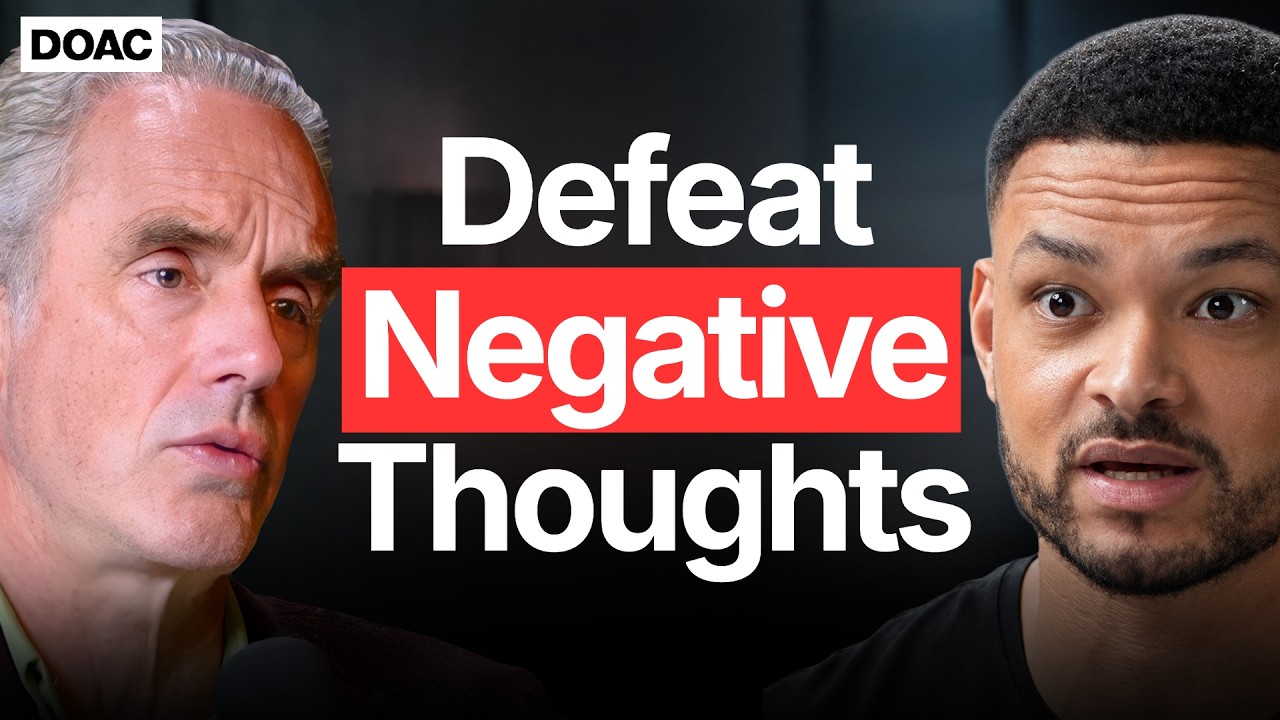
Jordan Peterson Launches Online Academy to Disrupt Higher Education
The Diary Of A CEO
The psychologist argues that individuals overcome severe trauma and existential aimlessness by adopting voluntary responsibility and pursuing incremental micro-step action.
## Background
This video was published on YouTube by The Diary Of A CEO (hosted by Steven Bartlett) on November 23, 2023. The page description outlines a wide-ranging conversation with Dr. Jordan Peterson covering personal transformation, overcoming dark thoughts, relationship dynamics, trauma, and the launch of Peterson Academy.
## TL;DR
Dr. Jordan Peterson breaks down how individuals can rebuild their lives by taking humble micro-steps, practicing voluntary exposure to fear, and taking on deep personal responsibility. He explores how active listening and immediate conflict resolution can heal relationships, while warning against the dangers of self-deception and unaddressed trauma. Peterson also discusses the psychological roots of historical atrocities, the crisis of identity among young adults, and his ongoing mission to revolutionize higher education through Peterson Academy.
## Atmosphere & style
The conversation carries an intense, deeply earnest, and intellectually rigorous atmosphere as both host and guest engage in open, honest dialogue. Bartlett asks vulnerable, thoughtful questions, allowing Peterson to alternate seamlessly between clinical psychological analysis and passionate existential philosophy. It feels like an intimate, high-stakes therapy session and masterclass combined, marked by moments of raw emotional breakthrough, quiet reflection, and sharp moral urgency.
## Key takeaways
- [04:56](https://www.youtube.com/watch?v=IRCZ1Mt2a8M&t=296s) When individuals are severely struggling or paralyzed by trauma, progress requires radical humility to break down overwhelming goals into micro-steps.
- [12:59](https://www.youtube.com/watch?v=IRCZ1Mt2a8M&t=779s) Human transformation and competence build exponentially rather than linearly once the first tiny step is taken.
- [15:03](https://www.youtube.com/watch?v=IRCZ1Mt2a8M&t=903s) Graduated exposure therapy disarms paralyzing fears by confronting triggers in small, controllable increments rather than avoiding them.
- [22:38](https://www.youtube.com/watch?v=IRCZ1Mt2a8M&t=1358s) Active listening and specifying the exact nature of a problem accounts for 95% of its solution.
- [33:03](https://www.youtube.com/watch?v=IRCZ1Mt2a8M&t=1983s) Unresolved childhood traumas act as developmental fixations that distort adult behavior and explosive emotional reactions.
- [33:03](https://www.youtube.com/watch?v=IRCZ1Mt2a8M&t=1983s) Crying during deep communication signals the neurological death of an outdated mental framework and prepares the brain for learning.
- [35:24](https://www.youtube.com/watch?v=IRCZ1Mt2a8M&t=2124s) Delayed interpersonal conflict creates compounded resentment, making immediate and specific negotiation essential for healthy relationships.
- [40:48](https://www.youtube.com/watch?v=IRCZ1Mt2a8M&t=2448s) Long-term relationships require a sacrificial commitment and dedicated Weekly logistical communication to prevent domestic issues from ruining intimacy.
- [45:33](https://www.youtube.com/watch?v=IRCZ1Mt2a8M&t=2733s) Childhood bullying creates long-term psychological templates that cause individuals to act as lifelong bullies or hyper-reactive victims.
- [58:09](https://www.youtube.com/watch?v=IRCZ1Mt2a8M&t=3489s) Atrocities are predominantly committed by ordinary people succumbing to peer pressure, systemic propaganda, and incremental self-deception.
- [01:01:43](https://www.youtube.com/watch?v=IRCZ1Mt2a8M&t=3703s) Living truthfully and eliminating deceit is the fundamental antidote to both personal suffering and systemic totalitarianism.
- [01:08:14](https://www.youtube.com/watch?v=IRCZ1Mt2a8M&t=4094s) Modern identity crises stem from hyper-narrow self-preoccupation, whereas genuine identity is built through expanding tiers of voluntary responsibility.
- [01:19:46](https://www.youtube.com/watch?v=IRCZ1Mt2a8M&t=4786s) Peterson Academy aims to disrupt traditional higher education by offering global, low-cost courses while granting professors complete intellectual and financial freedom.
## Detailed walkthrough
### [00:00](https://www.youtube.com/watch?v=IRCZ1Mt2a8M&t=0s) Changing Lives Through Actionable Truths
Host Steven Bartlett reflects on the immense impact of his previous conversation with Dr. Jordan Peterson, reading a touching comment from a viewer who was on the brink of giving up. The viewer shared how Peterson’s "unfiltered words" pulled him out of his darkest moment, allowing him to rebuild his life, career, and family.
Peterson responds with characteristic modesty, explaining that his role is merely acting as a conduit for a century’s worth of clinical research and humanistic wisdom. He emphasizes that when addressing individuals who are deeply struggling, the clinician's goal is to **"make the simple even simpler"** so they can gain a initial toehold on recovery.
> "I've been successful because I've been a conduit of good ideas and I have the ability to synthesize a lot of information and to communicate that to people in a way that's understandable."
* **Client Example:** Peterson recalls an 85-year-old client who had broken his neck in a ladder fall, leaving his spine fused, his body in chronic pain, and his spirit crushed by severe depression.
* **The Initial Goal:** The man could not even get out of bed; the single micro-step Peterson assigned him was simply sitting up for 30 seconds at a time.
* **The Result:** Within two weeks, the client was walking down the hospital hallway, sitting up to read for five to six minutes, and preparing to return home.
---
[04:56](https://www.youtube.com/watch?v=IRCZ1Mt2a8M&t=296s) The Humility of Small Steps and Confronting Family Dynamics
Bartlett points out that people who feel down and out are often overwhelmed when presented with a metaphorical "Mount Everest"—like going to the gym daily—and end up feeling contempt toward tiny commitments. Peterson notes that one of the hardest obstacles to overcome when you take a major blow in life is the *humiliation* of how far down you have fallen. Returning from illness or trauma often requires learning basic mechanics again—such as buttoning a shirt or placing fingers on a keyboard—which demands radical humility.
Peterson explains his famous advice to "clean your room." For many people, even cleaning a single room carries immense weight because it forces them to confront underlying dynamics and generational patterns of dysfunction.
* **The Hidden Complexities:** Attempting to improve one's environment often provokes sabotage from family members accustomed to the status quo. In these cases, tidying up isn't just housework; it is stepping out to confront the metaphorical "dragon" in the household.
* **Micro-Steps:** If cleaning a full room is overwhelming, Peterson scales it down to looking inside a single drawer for one minute to conceptualize how it might be reorganized.
* **The Overgrown Infant:** Peterson recounts a story of a 30-year-old client living in his messy childhood bedroom under his mother's thumb. Having impregnated a girl, the man wanted to change so he wouldn't destroy his future son's life.
* **The Vacuum Cleaner Anecdote:** They agreed his first micro-task would be vacuuming his room. However, the client only managed to drag the vacuum cleaner to the doorway, leaving it at a 45-degree angle and stepping over it for an entire week.
* **Reframing Failure:** Although the client felt immense shame, Peterson validated that he had still managed to pull the vacuum out of the closet—a real, non-zero step forward.
---
[12:59](https://www.youtube.com/watch?v=IRCZ1Mt2a8M&t=779s) The Science of Collaborative Empiricism and Exponential Progress
Peterson introduces the clinical framework known as **collaborative empiricism**—a behavioral approach where the therapist and client work together as equal partners to solve a problem.
```
1. Identify Problem ──> 2. Imagine Better Future ──> 3. Break Down Strategy ──> 4. Test Micro-Step
```
1. **Define the Problem:** The client lays all their cards on the table, airing every complaint until they strip away 90% of the surface symptoms to expose the core issue.
2. **Define the Target:** The client identifies what a "better" scenario looks like.
3. **Formulate Strategy:** The therapist and client collaboratively design steps connecting the problem to the target. Crucially, every step must be completely voluntary.
4. **Experimental Testing:** The client tests the smallest viable step over a week and reports back to adjust as needed.
Peterson highlights that human progress does not move linearly; it moves **exponentially**. Once a person lowers themselves enough to take the first tiny step, their competence and velocity double rapidly. By undertaking small, challenging tasks, an individual achieves two distinct biological and psychological outcomes:
* **Skill Acquisition:** They build actual cognitive structures and real-world mastery to handle the problem.
* **Identity Shift:** They alter their self-concept, moving from a passive victim to an active agent capable of altering their life's trajectory.
---
[15:03](https://www.youtube.com/watch?v=IRCZ1Mt2a8M&t=903s) Exposure Therapy and Deconstructing Fear
To illustrate how voluntary exposure builds capability, Peterson uses the clinical treatment of **agoraphobia**—a condition where severe anxiety and panic attacks trap individuals inside their homes.
Peterson notes that agoraphobia often disproportionately affects women due to higher baseline trait neuroticism (anxiety sensitivity) combined with interpersonal dependencies. When protective structures—such as overly protective parents or partners—suddenly collapse due to death or divorce, existential panic rushes in, shrinking the person's world down to their home.
To treat this, clinicians utilize **exposure therapy**, breaking down overwhelming fears into manageable micro-steps. For example, if an agoraphobic patient fears public spaces, they might start by targeting elevators:
* **Step 1:** Sit next to the therapist and look at photographs of elevators.
* **Step 2:** Express fears out loud (e.g., fear of heart attacks, spatial entrapment, or social judgment).
* **Step 3:** Systematically move closer to a real elevator in measured, controllable increments until the nervous system habituates.
Through this incremental process, patients systematically disarm their fear, reclaiming control over their environment one small exposure at a time.
<ElicitationsGroup message="Where would you like to go next?">
<Elicitation label="Explore the psychological mechanics of exposure therapy" query="Explain the detailed psychological and physiological mechanisms behind exposure therapy and habituation."/>
<Elicitation label="Break down Peterson's framework for breaking bad habits" query="How does Jordan Peterson apply micro-steps and collaborative empiricism to breaking bad habits and addiction?"/>
</ElicitationsGroup>
[01:16:59](https://www.youtube.com/watch?v=IRCZ1Mt2a8M&t=4619s) The Mechanics of Fear and Systematic Desensitization
When people experience severe phobias—such as fear of elevators—the underlying fear is rarely the object itself. Instead, elevators act as a portal to two fundamental primal fears: a painful death and public humiliation. An anxiety fantasy often merges these into the terrifying image of suffering a painful death while being publicly humiliated and watched by others.
To treat this, a clinician uses systematic desensitization by finding the exact threshold where the patient's confidence matches the size of their fear—the "apparent dragon."
* **Finding the Edge:** If a person cannot step into an elevator, the clinician tests if they can stand 100 or 125 yards away. Once the boundary is found, they "dance on the edge" by moving forward just one foot at a time.
* **Preventing Avoidance:** Patients are instructed to keep their eyes on the trigger rather than looking away. Humans naturally avert their gaze from uncomfortable sights, ranging from daily stresses to horrific atrocities—and ultimately from the "Heart of Darkness" within themselves (the realization that they could actively take glee in committing atrocities).
* **Universal Application:** Breaking down fears into small, incremental exposures works for public speaking, going to the gym, or encouraging a young child.
> "There's a place where their fear will... say 'that's close enough.' It's like, okay, now you're on the edge. So now we'll dance on the edge; we'll move you a foot forward."
---
[01:19:43](https://www.youtube.com/watch?v=IRCZ1Mt2a8M&t=4783s) The Role of a Clinician and Why Advice-Giving Fails
Clinicians can tolerate listening to heavy problems because they maintain a clear boundary: the client's problems are not the clinician's to steal. When an experienced clinician simply gives direct advice, the client acts it out without truly owning it, preventing genuine personal growth.
This dynamic mirrors everyday relationships, where people often jump straight into problem-solving instead of listening.
* **Threat Sensitivity and Predation:** Women are often more sensitive to potential threats and use intuition (anxiety) as an early warning detector. When a threat feels hidden or camouflaged, a woman needs to lay out every possible scenario to figure out what is wrong.
* **The Male Tendency to Fix:** Men often jump straight to solutions to clear the anxiety or avoid uncomfortable revelations (some of which may be about them). However, premature solutions usually fail because the real underlying problem has not yet been identified.
* **Triangulating the Problem:** When someone lays out all their concerns in good faith, they usually realize they aren't actually worried about most of them. Laying the cards on the table allows both parties to locate the hidden threats, triangulate the core issue, and negotiate an effective response.
---
[01:22:38](https://www.youtube.com/watch?v=IRCZ1Mt2a8M&t=4958s) Active Listening as the Highest Form of Help
Specifying a problem correctly constitutes roughly 95% of its solution. Active listening requires humility, patience, and setting aside self-defensiveness or the urge to play the "white knight."
* **Technologies of Listening:** Effective listeners track conversations over long spans. When a contradiction appears, they point it out without accusation: *"You said this now, but five minutes ago you said that."* This prompts the speaker to clarify their thoughts without feeling attacked.
* **The Joe Rogan Model:** Joe Rogan excels as a interviewer because he constantly "consults with his own ignorance in humility." By asking simple questions when he doesn't understand, he bravely exposes his ignorance and unites himself with his audience.
* **Testing for Vulnerability:** People rarely state their deepest problem right away. They offer surface-level concerns first to test if the listener can be trusted with their true vulnerabilities. Calm, attentive listening models the fact that the underlying issue is not too terrifying to face.
---
[01:25:15](https://www.youtube.com/watch?v=IRCZ1Mt2a8M&t=5115s) Real-World Application: The Case of "Canada Jenny"
Steven Bartlett shares an example of active listening from his own business experience. A female employee from one of his marketing teams expressed deep unhappiness in her role and listed several operational grievances.
* **The Breakthrough:** Rather than arguing or offering quick fixes, Bartlett spent 30 minutes asking clarifying questions, eventually asking when she had felt happiest in the business.
* **The True Root Cause:** She revealed her happiest period was at the company's inception, working alongside Bartlett in Canada on high-stakes, difficult challenges. Her distress was not about her current daily tasks, but about feeling removed from core strategic impact and proximity to leadership.
* **The Outcome:** The employee realized her initial complaints were irrelevant. After adjusting her role back toward high-level challenges, she texted Bartlett saying she finally felt like "Canada Jenny" again.
---
[01:29:46](https://www.youtube.com/watch?v=IRCZ1Mt2a8M&t=5386s) Psychoanalysis, Free Association, and Unresolved Trauma
Sigmund Freud developed psychotherapy and the technique of free association to help patients articulate hidden thoughts. He placed patients on a couch facing away from him so that his subtle facial expressions—a raised eyebrow or micro-expression of disgust—would not cause them to alter their narrative out of fear of moral judgment.
* **Attention as Love:** While Freud hid behind the couch, open receptive listening acts as a powerful signal. For children and adults alike, there is virtually no difference between receiving undivided attention and receiving love.
* **Free Association and "Circumambulation":** Carl Jung referred to the process of spiraling around a problem as *circumambulation*. When individuals talk freely, their mind links seemingly unrelated ideas. Following these threads often leads back to unresolved childhood trauma.
* **Trauma as an Unmapped Pit:** Trauma is an unresolved life problem—a metaphorical hole in the floor of one's room. If an individual experiences a trauma at age four and fails to resolve it, their emotional development regarding that specific issue remains frozen at age four. Later in life, similar triggers (such as conflicts with a boss) cause them to fall back into that unmapped pit using only the rudimentary coping tools they possessed as a child.
[33:03](https://www.youtube.com/watch?v=IRCZ1Mt2a8M&t=1983s) Projection, Traumatic Fixations, and the Neurobiology of Tears
When a person reacts with unexplainable, explosive intensity toward a boss or a partner, they are frequently viewing that person through a conceptual framework formed during childhood. A sudden outburst toward an authority figure at work often traces back to how an individual processed their father's behavior at age four. Similarly, recurring, intractable arguments in a marriage typically stem from a developmental fixation, where one partner's behavior triggers the other's internal 13-year-old self.
When a couple sits down to genuinely listen and untangle these deep-seated patterns, the conversation almost inevitably leads to tears. Crying is not merely a sign of distress; it serves a profound evolutionary and neurological purpose:
* **Neurological Plasticity:** Children cry when they hit an insurmountable impediment. Tears act as an agent that dissolves rigid mental structures, returning the adult brain to a state of early-childhood plasticity so that new learning can occur.
* **Structural Collapse:** Crying marks the death of an immature or outdated conceptual sub-structure that is no longer sufficient for handling reality.
* **Fragile Reconstruction:** The newly formed mental framework that replaces the old one is initially fragile, similar to a butterfly emerging from a cocoon.
> "The crying is an indication that the current conceptual sub-structure is insufficient. It has to die. And then the tears come... now you're prepared neurologically to learn something new."
Because these new behaviors are so delicate, partners must handle each other with extreme care during negotiations. If a partner attempts a newly agreed-upon strategy and receives immediate punishment or criticism within the first 30 attempts, the fledgling behavior will be instantly destroyed.
Reflecting on his own relationship, the host shares how growing up in a home filled with parental conflict taught him to view commitment as a "prison" and to run from emotional intimacy. Conversely, his partner possesses an anxious attachment style; when tension arises, she instinctively latches on and fights for attention. This dynamic created a toxic cycle: a single word indicating he was focused on work would trigger her to chase, causing him to run, which subsequently made her retreat into a seven-hour silent treatment. To break this, they established a system where she immediately voices her triggers rather than sulking.
Peterson notes that sulking is essentially a non-verbal threat response that must be replaced with a differentiated, immediate strategy. Over time, through continuous attention, the window between feeling upset and articulating the solution can shrink dramatically. However, doing so requires setting aside ego:
* **Convenient Scapegoating:** In any conflict, it is emotionally convenient to blame the other person, preserving one's own sense of moral superiority while forcing the other person to undergo the painful process of conceptual collapse and tears.
* **The Payoff of Self-Blame:** Admitting that *you* might be the core problem is a cataclysmic revelation, but it carries the ultimate payoff: you gain the ability to stop being the problem.
* **Conflict Multiplied:** Avoiding a fight might seem easier in the short term, but "conflict delayed is conflict multiplied."
Addressing a problem immediately requires intense emotional restructuring, but it prevents the "snake" from growing larger. To manage overwhelming life crises—such as the severe, deteriorating illness experienced by Peterson's daughter, Michaela—partners must set strict negotiation rules. For Peterson and his wife Tammy, this meant prohibiting any discussion about Michaela's illness after 8:00 PM so they could preserve their strength for the long journey ahead.
---
[40:48](https://www.youtube.com/watch?v=IRCZ1Mt2a8M&t=2448s) The 90-Minute Rule and the Sacrificial Marriage Vow
Men often resist listening to their partners because doing so exposes their own personal inadequacies. However, listening is an unavoidable requirement of a long-term relationship. A husband must dedicate at least 90 minutes a week to genuinely listening to his wife. Neglecting this duty does not erase it; the unaddressed emotional backlog will simply compound until it is aired in divorce court at a devastating financial and personal price.
Women generally possess higher threat sensitivity, which offers both distinct advantages and drawbacks:
* **The Advantage:** Women tend to detect emerging domestic or developmental problems before men are perceptive enough to notice them.
* **The Disadvantage:** Higher neuroticism can produce false positives, causing alarms over issues that do not exist.
* **Filtering the Signal:** A husband must listen patiently to help filter out the noise and find the underlying signal. Over time, this practice collapses the delay between problem emergence and resolution down to near zero.
To sustain this process, both partners must enter into a contract of absolute truth and total commitment. The fundamental architecture of a marriage vow is not a naive promise of perfection, but a realistic, mutual pact:
> "This is the vow: No matter what you tell me, I won't run away. And that's a hell of a vow, man. Because when someone unveils their whole heart, they unveil themselves all the way down to hell."
Every individual is "full of snakes," and if those dark corners were exposed without context, the logical impulse would be to flee. However, running from relationship to relationship solves nothing, as everyone carries internal flaws. The marriage vow accepts this bad bet, operating on the faith that mutual truthfulness allows two flawed people to continually resolve their issues.
---
[45:33](https://www.youtube.com/watch?v=IRCZ1Mt2a8M&t=2733s) The Bully-Victim Trajectory and Deep Soul-Searching
Early childhood traumas—metaphorically described as holes in the bedroom floor—cannot simply be covered with planks of wood; they must be fully confronted and filled. For instance, being a victim of bullying in childhood often becomes a stable, lifelong personality trait if left unaddressed.
Drawing on the classic research by Swedish psychologist Dan Olweus, Peterson breaks down the structural mechanics of bullying:
| Category | Definition & Behavioral Pattern | Long-Term Trajectory |
|:--- |:--- |:--- |
| **Bully** | Uses disproportionate force/power against vulnerable targets (e.g., a 12-year-old targeting an 8-year-old, or two against one). | High rate of criminality, legal trouble, and social alienation in high school/adulthood. |
| **Bully-Victim** | Reacts to initial minor aggression with disproportionate emotional distress, causing bullies to zero in on them. | Tendency toward chronic depression, anxiety, and extreme dependence. |
When a former bully-victim enters a marriage, they routinely view their partner through the "bully template." During routine disagreements, they will accuse their partner of being a tyrant, bringing up list after list of past offenses.
When faced with a long list of accusations, an articulate partner must listen patiently rather than defensively. If a wife accuses her husband of being too hard on their child or acting like a tyrant, the husband must take that claim seriously, step back, and engage in deep soul-searching to determine whether he truly is acting out of overconfidence or tyranny.
[48:49](https://www.youtube.com/watch?v=IRCZ1Mt2a8M&t=2929s) Negotiating Relationship Conflict and the Rule of Specific Demands
In dealing with interpersonal conflict, especially within a marriage or close relationship, Jordan Peterson emphasizes the critical need to examine one's own heart before projecting blame onto a partner. People must honestly evaluate whether they are mimicking toxic behaviors—such as acting like a bullying parent or reproducing the traits of a corrupt friend they once admired. Real change requires identifying these abusive tendencies, stopping them, and then actively constructing a healthier way to behave.
When a partner comes forward expressing dissatisfaction, the most constructive response is to ask for explicit clarity by posing a simple question: "If I could give you what you wanted, what would it be?" Peterson notes that people often fail to specify their target, making resolution impossible. "I cannot hit a target you won't specify," he points out, stressing that couples must actively define what success looks like. This rule applies equally to workplace dynamics: an employee who presents a supervisor with a clear solution alongside a problem will rapidly ascend the corporate hierarchy in any halfway decent business, earning a reputation as a dependable problem solver.
- **Constructive Conflict Resolution:** Asking a partner to explicitly state what wording or behavior would have resolved an issue, then practicing that response (even if it initially feels awkward or staged) to build a rubric over 50 repetitions.
- **Exceptions for Conscience:** If an agreed-upon response violates a person's core moral conscience, it signals a deeper, foundational conflict that requires further open dialogue.
[51:29](https://www.youtube.com/watch?v=IRCZ1Mt2a8M&t=3089s) Treating the Household Like a Business: Schedules, Hunger, and Dedicated Time
Navigating everyday life after a exhausting day of work requires tactical negotiation between partners. Meeting each other at the door with a wall of daily grievances is a recipe for long-term relational decay; doing this repeatedly causes a spouse to perceive their partner as a approaching nest of vipers, regardless of how valid the individual complaints are. Peterson advises establishing clear, negotiated routines for returning home—taking ten minutes to decompress, shedding work clothes, or getting something to eat before tackling heavy subjects.
A core practical rule is to never discuss complex or contentious issues while hungry. Homes function much like small businesses, and they demand structural management to survive. Peterson insists that couples must set aside at least 90 minutes a week solely to manage the logistics of the household. If this dedicated administrative time isn't maintained, unresolved domestic problems will inevitably bleed into romantic dates, causing frustration and killing intimacy.
- **The 90-Minute Rule:** Couples must schedule a minimum of 1 hour and 30 minutes every week purely for running the household "business" to prevent logistics from ruining leisure and romantic time.
- **Why Spouses Bring Up Problems:** Partners interrupt romantic moments with logistical stressors not out of malice, but because unresolved issues naturally float to the surface when they finally sit together without a dedicated venue to resolve them.
[54:05](https://www.youtube.com/watch?v=IRCZ1Mt2a8M&t=3245s) Facing the Abyss: Trauma, Betrayal, and Dante’s *Inferno*
Reflecting on his clinical practice, Peterson acknowledges that certain patient traumas reveal a bottomless abyss—a structural tear in the psyche that feels almost impossible to fix. To explain the architecture of deep psychological trauma, he points to Dante's *Inferno*, which outlines a detailed topography of hell. In Dante's vision, the absolute lowest circle of hell is reserved not for simple violence, but for betrayal.
Betrayal destroys the fundamental trust upon which all human relationships are built. Peterson explains that childhood sexual abuse represents the ultimate form of betrayal because a child predator transforms the sacred role of a protective guardian into that of a preying wolf. Experiencing malevolence at a tender age shatters a child's worldview, forcing them to confront the bottom of hell before they have built any psychological armor.
- **Reconstructing a Philosophy of Evil:** Healing from severe trauma requires building an explicit philosophy of good and evil to combat malevolence through truth, love, and beauty.
- **PTSD and Self-Directed Atrocity:** Post-traumatic stress disorder frequently strikes individuals who carried out brutal acts themselves—and realized to their horror that they enjoyed it, creating a massive psychological rift.
- **Lessons from *Apocalypse Now*:** Highlighting the psychological danger of staring into malevolence, Peterson references Joseph Conrad's *Heart of Darkness* and the documentary detailing the chaotic production of Francis Ford Coppola's *Apocalypse Now*, where cast and crew members suffered heart attacks and financial ruin after falling into the story's archetypal clutches.
[58:09](https://www.youtube.com/watch?v=IRCZ1Mt2a8M&t=3489s) The "Ordinary Men" Fallacy: How Normal People Drive Atrocities
Reflecting on his own lifelong obsession with historical atrocities—particularly the actions of Nazi guards at Auschwitz—Peterson cautions against the comforting myth that perpetrators of mass evil are inhuman monsters. Dismissing guards as "demons from another planet" allows people to ignore their own potential for evil. Historical evidence demonstrates that the vast majority of perpetrators were ordinary individuals who simply went along with the dominant social currents.
To illustrate this, Peterson cites Christopher Browning's book *Ordinary Men*, which details a Reserve Police Battalion of middle-aged, working-class Germans sent to occupied Poland. These men were not lifelong Nazi-indoctrinated youth, and their commander explicitly offered to let anyone step down from execution details without punishment or career backlash. Yet, only a tiny fraction chose to step aside. Most participated out of a misguided sense of peer loyalty, unwilling to leave the "dirty work" to their comrades. Over several months, these average citizens transformed into killers executing naked pregnant women in fields, destroying their own health and internal morals in the process.
- **The Path to Atrocity:** Most members of the police battalion participated in mass murder not out of fanatical hatred, but out of peer pressure, twisted loyalty to their comrades, and systemic propaganda.
- **Self-Deception:** Anyone who assumes they would have been a heroic resistor in 1940s Germany is statistically likely to be wrong, failing to realize what they are truly capable of under pressure.
[01:01:43](https://www.youtube.com/watch?v=IRCZ1Mt2a8M&t=3703s) Truth as the Ultimate Antidote to Totalitarian Hell
Peterson traces the origin of his own foundational life philosophy back to 1985, when his studies of totalitarian regimes led him to conclude that the road to systemic atrocity and personal hell is paved entirely with lies. Deception corrupts the individual at both a practical level and a metaphysical level, eventually dissolving the moral fabric of an entire society.
To combat this, Peterson made a conscious decision to stop lying, striving to align his speech with truth across all levels of analysis. While people frequently default to "white lies" to smooth over awkward social situations, Peterson argues that even minor dishonesties indicate hidden corruption or unaddressed problems. He shares how he handles telling his wife his honest opinion when shopping for her clothes: by avoiding false flatteries, his genuine compliments carry real weight and trust, preventing deception from muddying the waters of their relationship.
- **Definition of a White Lie:** A statement that appears convenient or protective on the surface, but remains false at a deeper structural level, signaling unaddressed problems ("snakes") within a relationship or individual.
- **Leonard Cohen Quote:** Citing poet Leonard Cohen's observation that "there's no decent place to stand in a massacre," Peterson notes that when people compromise their integrity step-by-step, they eventually find themselves in situations where every available option feels compromised.
---
<ElicitationsGroup message="Where would you like to explore next?">
<Elicitation label="Explore Jordan Peterson's practical advice on household management and relationship scheduling" query="Tell me more about Jordan Peterson's advice on running a household like a business and managing relationship conflict."/>
<Elicitation label="Examine the psychological analysis of Christopher Browning's 'Ordinary Men'" query="Break down the psychological mechanisms explained in 'Ordinary Men' and how normal people participate in atrocities."/>
</ElicitationsGroup>
[01:04:21](https://www.youtube.com/watch?v=IRCZ1Mt2a8M&t=3861s) Undoing Past Mistakes to Heal Trauma
Fixing deep-seated issues or relational trauma requires tracing life's mistakes back to their source. Peterson emphasizes that people often find themselves in situations where all remaining options are bad because of an unaddressed lie or poor choice made "upstream." In both clinical therapy and personal relationships, the path forward involves acknowledging where you originally veered off course. By recognizing where a bad decision was made, one can repent, adjust course, and map out a constructive way forward, which effectively neutralizes the traumatic power of the past.
- **The Angel and Devil Metaphor:** At life's crossroads, choosing the wrong path tangles a person in negative consequences that eventually lead to suffering.
- **The Function of Memory:** The brain continues to surface past painful memories specifically because the proper road forward has not yet been clearly mapped and specified.
- **Relational Reconciliation:** Resolving conflicts with a spouse involves admitting past errors, negotiating a mutually agreed-upon future plan, and rendering past grievances irrelevant through positive action.
---
[01:08:14](https://www.youtube.com/watch?v=IRCZ1Mt2a8M&t=4094s) The Crisis of Identity in Young Adults
Addressing the 18-to-40 demographic—the primary audience of *The Diary Of A CEO*—Peterson identifies the transition into a mature adult identity as the central struggle facing young people today. Modern culture promotes hyper-narrow, whim-based, and self-serving definitions of identity based on sex, race, or immediate sexual desires. Treating oneself as merely a "short-term sex machine" or a bundle of fleeting impulses inevitably leads to anxiety, hopelessness, and misery.
- **Subordinate Drives:** Citing Friedrich Nietzsche, Peterson notes that every internal drive (anger, sexual desire, appetite) tries to "philosophize in its spirit" and dominate the individual if left unchecked.
- **Subsidiarity and Integration:** Maturity requires integrating internal conflicting drives—fear, hunger, jealousy, hatred, and lust—into a unified self that functions harmoniously over time.
---
[01:11:18](https://www.youtube.com/watch?v=IRCZ1Mt2a8M&t=4278s) Building Meaning Through Responsibility and Hierarchy
True identity is constructed through expanding circles of responsibility rather than isolated self-gratification. Once individuals integrate themselves, they can move up the hierarchy: establishing a stable marriage, raising children, contributing to a local community, and ultimately serving a higher moral order. Peterson argues that self-preoccupation is directly correlated with unhappiness, pointing out that psychologists recognize self-consciousness and negative emotion as statistically indistinguishable.
| Level of Identity | Core Focus & Responsibilities |
|:--- |:--- |
| **Individual** | Harmonizing internal drives, managing immediate impulses, and achieving self-mastery. |
| **Spouse / Marriage** | Creating a shared vision, loving another person, and sacrificing short-term whims for a partnership. |
| **Parent / Family** | Raising children, providing stability, and offering unconditional support. |
| **Community / Society** | Serving local businesses, participating in civic life, and scaling contribution to state and nation. |
| **The Highest Good (God)** | Serving the ultimate moral ideal under which all lower tiers are unified. |
- **Self-Absorption and Misery:** "There's no difference between thinking about yourself and what you want and being miserable."
- **Definition of God:** Peterson defines God functionally as "that which should be served most fundamentally" or the sum of all that is good.
- **Mental Health Stats:** Citing Simon Gunning (CEO of Campaign Against Living Miserably), Bartlett notes that 19-to-35-year-olds are twice as likely to report being in a mental health crisis compared to any other demographic group.
Peterson critiques both consumerist capitalism and postmodern Protestant liberalism for encouraging individuals to prioritize their basest appetites and demand that society accommodate their subjective self-definitions. True moral worth cannot be inferred from power or material status, nor can a stable society function when governed by two-year-old-level impulsivity. Voluntary adoption of heavy responsibility remains the only antidote to existential aimlessness.
- **The Danger of Short-Term Whims:** Consumer culture erroneously tells people that their identity equals whatever their most basic appetite wants right now.
- **Protestant Liberalism and Radical Subjectivity:** Replacing a higher transcendent framework with absolute personal subjectivity creates a fragile and immature social dynamic.
- **Definition of Progress ("Up"):** A genuinely better solution is one that "unites more situations and people across broader spans of time."
---
[01:19:15](https://www.youtube.com/watch?v=IRCZ1Mt2a8M&t=4755s) The Vision Behind Peterson Academy
When asked by Bartlett about the motivations driving the creation of Peterson Academy—an online, interactive higher education platform designed to rival traditional university structures—Peterson attributes the venture to his lifelong intellectual curiosity. Just as placing his university lectures on YouTube years ago was an experiment in open distribution, Peterson Academy represents an effort to innovate higher education and make structured learning accessible worldwide.
- **Platform Structure:** Designed as an accessible, interactive online learning ecosystem challenging standard university models.
- **Core Motivation:** Driven by Peterson's baseline intellectual curiosity to test what happens when higher education is reimagined.
Here is the detailed walkthrough of the transcript section provided.
---
[01:19:46](https://www.youtube.com/watch?v=IRCZ1Mt2a8M&t=4786s) Peterson Academy and Reimagining Higher Education
Jordan Peterson reflects on his unique status as a professor emeritus and public intellectual, explaining his motivation behind founding Peterson Academy. He recognizes his fortunate position: he can meet virtually anyone he wants, particularly brilliant, charismatic thinkers who have accomplished interesting things repeatedly. By providing them a platform, he can deliver high-quality educational content globally at extremely low cost. Beyond the positive mission of democratizing higher education on a mass scale, Peterson admits with a touch of dry humor that there is a renegade element to it. When traditional university administrative structures made it impossible for him to continue working within them, his initial reaction was a defiant "we'll see who needs who," leading him to go out and build his own university from the ground up.
Peterson details the experience of bringing elite professors—especially those from Oxford and Cambridge—down to Miami to record courses. He notes with frustration how horribly these stellar, wise scholars are treated by their home institutions: paid abysmally, given no respect, and treated as mere pawns of university administration. Peterson Academy flips this paradigm on its head by treating professors with immense respect, offering them a strong financial offer with a book-style advance, and granting them absolute intellectual freedom. Rather than imposing a political agenda, the academy gives them a live, enthusiastic audience and asks them how to get out of their way so they can teach the course they have always dreamed of teaching.
* **Mass-Scale Education Goal:** Deliver top-tier university-level education globally at high quality and near-zero cost.
* **Faculty Treatment:** Provides sizable advances and financial independence to professors, freeing them from institutional bureaucracy and underpayment.
* **Academic Freedom:** Instructors are guaranteed zero censorship and given complete autonomy over their subject matter.
* **Launch Timeline & Scale:** Set to launch in early 2024, with roughly 30 courses already fully recorded at the time of the interview.
* **Ultimate Vision:** Peterson envisions bringing the world's best 1,000 lecturers onto the platform to offer them financial security while sharing their knowledge worldwide.
---
[01:24:01](https://www.youtube.com/watch?v=IRCZ1Mt2a8M&t=5041s) Personal Health, Living in Truth, and the "Action Movie" Life
Steven Bartlett breaks from the podcast's usual tradition of asking a question left by the previous guest to ask Peterson directly how he is doing. Peterson reveals that while he still experiences persistent pain—feeling almost constantly like he has a relatively serious, achy flu due to an undiagnosed neurological issue—it is nowhere near the severe agony he endured during his acute illness. Crucially, his mind is clear, his anxiety is gone, and the sheer richness of his current life makes the lingering physical trouble essentially irrelevant.
Peterson describes his daily reality as an almost "unbearable" adventure, comparing it to being in a non-stop action-adventure movie. He travels across countries, meets hyper-interesting political and cultural figures at dinner meetings, gets recognized warmly by people on the street who feel they know him, and conducts multiple weekly conversations with absolute geniuses who teach him new things for 90 minutes at a time. He advises listeners that to unlock a similar realm of miraculous opportunity, one must commit entirely to non-falsehood. Opposing reality through lies is a losing battle, whereas living in alignment with the truth puts the momentum of the world on your side.
* **Physical Health Status:** Struggles with chronic neurological pain that feels like a constant flu, but maintains a clear mind and zero anxiety.
* **International Footprint:** Recently traveled through nine different countries, meeting dozens of influential figures in politics and culture every few days.
* **Philosophical Advice:** "Stop saying things you believe to be untrue. Stop doing things you know to be wrong." Peterson emphasizes that truth is the ultimate adventure of life because lying means directly opposing reality.
* **Podcast & Writing Output:** Conducts three deep-dive conversations per week with world-class experts while working on a new book and maintaining massive book sales.
---
[01:27:44](https://www.youtube.com/watch?v=IRCZ1Mt2a8M&t=5264s) mutual Gratitude and Podcast Triage
Bartlett expresses deep gratitude to Peterson for choosing to come onto the podcast, emphasizing how much Peterson's insights and raw honesty during their previous conversation impacted his life. Peterson responds by reassuring Bartlett that his presence is no mere favor or random choice. With a massive volume of interview requests, Peterson's team maintains a strict triage process, filtering specifically for hosts whose shows have real reach, who conduct straightforward, honest interviews, and who are genuinely "aiming up" rather than playing games. Peterson congratulates Bartlett, confirming he is there because Bartlett has earned it through the quality and integrity of his work.
* **Guest Selection Criteria:** Peterson's team evaluates interview requests based on audience reach, track record of success, straightforwardness, and an absence of manipulative media games.
* **Mutual Respect:** Peterson emphasizes that being on the show is the "right place to be right now," recognizing Bartlett's dedication to high-integrity interviewing.
---
[01:28:54](https://www.youtube.com/watch?v=IRCZ1Mt2a8M&t=5334s) Sponsor Note: Huel Complete Nutrition Bar
The episode concludes with Steven Bartlett introducing a new product release from podcast sponsor Huel, a company in which he is also an investor. He highlights the launch of a nutritionally complete snack bar that took three years of development to perfect. Bartlett notes that high-protein snack bars typically taste like "Play-Doh or cardboard," making it difficult to create one that balances health metrics with great taste.
* **Product Specs:** High-protein snack bar containing 27 essential vitamins and minerals.
* **Sugar Content:** Contains only 2 grams of sugar.
* **Development Time:** Took 3 years of product development to achieve a nutritionally complete profile without sacrificing taste.
## Notable quotes
> [00:00](https://www.youtube.com/watch?v=IRCZ1Mt2a8M&t=0s) I've been successful because I've been a conduit of good ideas and I have the ability to synthesize a lot of information and to communicate that to people in a way that's understandable. — Jordan Peterson
> [01:16:59](https://www.youtube.com/watch?v=IRCZ1Mt2a8M&t=4619s) There's a place where their fear will... say 'that's close enough.' It's like, okay, now you're on the edge. So now we'll dance on the edge; we'll move you a foot forward. — Jordan Peterson
> [33:03](https://www.youtube.com/watch?v=IRCZ1Mt2a8M&t=1983s) The crying is an indication that the current conceptual sub-structure is insufficient. It has to die. And then the tears come... now you're prepared neurologically to learn something new. — Jordan Peterson
> [40:48](https://www.youtube.com/watch?v=IRCZ1Mt2a8M&t=2448s) This is the vow: No matter what you tell me, I won't run away. And that's a hell of a vow, man. Because when someone unveils their whole heart, they unveil themselves all the way down to hell. — Jordan Peterson
> [48:49](https://www.youtube.com/watch?v=IRCZ1Mt2a8M&t=2929s) I cannot hit a target you won't specify — Jordan Peterson
> [01:01:43](https://www.youtube.com/watch?v=IRCZ1Mt2a8M&t=3703s) there's no decent place to stand in a massacre — Leonard Cohen
> [01:11:18](https://www.youtube.com/watch?v=IRCZ1Mt2a8M&t=4278s) There's no difference between thinking about yourself and what you want and being miserable. — Jordan Peterson
> [01:24:11](https://www.youtube.com/watch?v=IRCZ1Mt2a8M&t=5051s) Stop saying things you believe to be untrue. Stop doing things you know to be wrong. — Jordan Peterson
## Mentioned
Jordan Peterson, Steven Bartlett, The Diary Of A CEO, Beyond Order: 12 More Rules for Life, Peterson Academy, Sigmund Freud, Carl Jung, Michaela Peterson, Tammy Peterson, Dan Olweus, Dante Alighieri, Christopher Browning, Ordinary Men, Joseph Conrad, Heart of Darkness, Francis Ford Coppola, Apocalypse Now, Friedrich Nietzsche, God, Simon Gunning, Campaign Against Living Miserably, University of Oxford, University of Cambridge, Joe Rogan, Huel, Whoop
Clinical psychologist Jordan Peterson argues that psychological recovery and maturity require confronting reality through voluntary micro-steps, strict adherence to truth, and the adoption of expanding responsibilities. He contends that avoiding small challenges, indulging in radical subjectivity, and delaying conflict compound suffering into personal paralysis and systemic pathology.
Incremental Exposure and Collaborative Empiricism (12:59)
Peterson outlines 'collaborative empiricism' as a therapeutic model where clinician and patient partner to define core problems, imagine a viable future, and test voluntary micro-steps. Progress in this framework is non-linear and exponential: lowering oneself to take a seemingly humiliating first step—such as an injured patient sitting up for 30 seconds or an agoraphobic patient looking at photographs of elevators—triggers skill acquisition and shifts identity from passive victim to active agent.
Overcoming severe phobias and inertia relies on systematic desensitization. Rather than facing an insurmountable hurdle, individuals must identify the boundary of their confidence and 'dance on the edge' by taking controllable, incremental actions without averting their gaze. Peterson maintains that tackling small, voluntary tasks prevents avoidance behavior from shrinking a person's living environment.
Active Listening and Structural Relationship Management (35:24)
According to Peterson, defining an issue accurately represents roughly 95% of its solution, which makes non-defensive active listening essential in therapy and marriage. Rushing to offer solutions often fails because individuals test listeners with minor complaints before disclosing deeper vulnerabilities. In intimate partnerships, unaddressed friction multiplies over time; addressing disputes immediately prevents resentment from compounding, even though confronting core faults often triggers tears—a neurological reaction Peterson describes as the dissolution of obsolete mental models to facilitate cognitive plasticity.
To prevent daily domestic friction from eroding intimacy, Peterson advises couples to treat household logistics like a business. Partners should establish specific protocols, such as scheduling at least 90 minutes each week exclusively for administrative duties, avoiding contentious discussions while hungry, and requiring each other to articulate clear, actionable targets instead of vague criticisms.
Confronting Malevolence and Ordinary Men Fallacy (58:09)
Peterson cautions against viewing perpetrators of atrocities as incomprehensible monsters, arguing that historical atrocities are largely driven by ordinary people succumbing to social pressure and deceit. Citing Christopher Browning’s study of Reserve Police Battalion 101 in Poland, Peterson highlights that middle-aged working-class recruits participated in mass executions primarily out of peer loyalty and fear of isolating themselves, despite being explicitly permitted to opt out without penalty.
Believing oneself incapable of malevolence is a dangerous form of self-deception that leaves individuals vulnerable to complicity. Unresolved personal traumas and moral compromises function like unmapped pitfalls, trapping individuals in developmental fixations until they formulate an explicit framework distinguishing good from evil and consciously renounce upstream lies.
Constructing Identity Through Truth and Responsibility (71:18)
Critiquing consumerism and postmodern philosophies that prioritize transient impulses, Peterson asserts that defining identity through base appetites fosters anxiety and despair. Referencing Friedrich Nietzsche, he argues that psychological integration requires subordinating disparate internal drives under a unified hierarchy. Meaning is generated by accepting expanding tiers of responsibility: moving from personal discipline to marriage, family care, civic community, and service to a transcendent moral good.
Peterson identifies absolute truthfulness as the fundamental antidote to personal misery and totalitarian control, noting that minor 'white lies' erode trust and corrupt character over time. Extending his educational mission beyond traditional academia, he details Peterson Academy, an initiative designed to provide university-level instruction globally at low cost while granting professors intellectual freedom and advances unconstrained by institutional bureaucracy.
Peterson's framework integrates behavioral therapy, psychodynamic principles, and existential philosophy to argue that personal and social order depend on personal accountability. A potential limitation remains whether micro-incremental exposure and voluntary responsibility can fully counteract severe structural trauma or severe physiological constraints without ongoing institutional and psychiatric intervention.
## Background
本期内容由主持人 Steven Bartlett 于 2023 年 11 月 23 日发布在其 YouTube 频道《The Diary Of A CEO》上。视频简介指出,这是 Steven 与知名临床心理学家 Jordan Peterson 的又一次深度对谈,内容涵盖如何停止虚度光阴、消除自我怀疑与负面阴暗思维、改善亲密关系以及 Peterson 筹办 Peterson Academy 的愿景。
## TL;DR
对谈中,Jordan Peterson 深入阐述了帮助陷入绝境者走出泥沼的行动哲学:践行绝对的谦逊,将任务切碎至微小且愿意执行的尺度,通过暴露疗法逐步直面内心的恶龙并实现指数级复利成长。在亲密关系层面,他剖析了男女在威胁敏感度上的演化差异,提出男性必须每周留出时间耐心倾听以提取真实信号,并通过透明协商与坦诚面对人性阴暗面来避免冲突升级。最后,针对当代年轻人的身份危机与心理困境,Peterson 痛批自恋享乐主义,呼吁通过建立家庭、投身社区与追求至善等层层递进的责任结构重塑人生价值,并以绝对真实的态度顺应现实生活。
## Atmosphere & style
整场对话沉稳、厚重且直击心灵,既有临床案例的严谨剖析,又洋溢着强烈的存在主义关怀与哲学思辨。Steven Bartlett 的提问谦逊且极具共情力,常以个人在亲密关系与团队管理中的困惑切入,而 Peterson 则以充满戏剧张力的隐喻与毫无保留的坦诚给予深刻回应。听众能清晰感受到一种从绝望泥潭中艰难跋涉、最终穿透深渊获得救赎的坚毅力量,既带来当头棒喝的警醒,又传递出向现实与真理奋力前行的热忱与希望。
## Bulletin
- [02:44](https://www.youtube.com/watch?v=IRCZ1Mt2a8M&t=164s) 摆脱人生绝境的第一法则是践行绝对谦逊,将任务切分得足够微小,直至当事人完全愿意执行;一旦启动,心理机能与行动力将呈现几何级数的指数级倍增,而非线性累加。
- [39:32](https://www.youtube.com/watch?v=IRCZ1Mt2a8M&t=2372s) 婚姻冲突应视作小型企业运营来管理,建议夫妻每周固定抽出90分钟作为事务例会,并实行“晚八点后封存无法解决危机”等边界契约,防止日常生活被无休止的矛盾拖垮。
- [58:02](https://www.youtube.com/watch?v=IRCZ1Mt2a8M&t=3482s) 历史与临床证据残酷表明,反人类暴行主要由同侪压力与伪善忠诚绑架下的普通人犯下,通往极权深渊的道路全由谎言铺就,唯一解药是在生命的最上游保持绝对诚实。
- [01:07:18](https://www.youtube.com/watch?v=IRCZ1Mt2a8M&t=4038s) 当代年轻人心理危机爆发的核心诱因在于向成年人身份过渡受阻;自私狭隘的主观主义放纵原始冲动,唯有向上承担伴侣、育儿与社会责任,才能建立起坚韧且有意义的自我。
- [01:19:18](https://www.youtube.com/watch?v=IRCZ1Mt2a8M&t=4758s) Jordan Peterson 正式筹建 Peterson Academy 在线大学平台,旨在打破传统高校意识形态审查与体制枷锁,直接汇聚全球顶尖学者并重塑高等教育分发模式。
## Key takeaways
- [02:44](https://www.youtube.com/watch?v=IRCZ1Mt2a8M&t=164s) 心理干预的起点在于践行彻底的谦逊:克服微小任务所带来的羞辱感,从自己当下现实允许的极低门槛开始迈步。
- [06:01](https://www.youtube.com/watch?v=IRCZ1Mt2a8M&t=361s) “收拾房间”从来不是表面家务,它往往代表当事人正在正面挑衅家族长达数代人的创伤互动模式与恶龙。
- [10:14](https://www.youtube.com/watch?v=IRCZ1Mt2a8M&t=614s) 协作经验主义是行为转变的核心:不强加指令,由当事人主动探索并自愿界定第一步,任务受阻时则继续向下拆解颗粒度。
- [12:50](https://www.youtube.com/watch?v=IRCZ1Mt2a8M&t=770s) 成长具有指数级复利效应:只要敢于直面未知的巨兽之尾并迈出微小一步,信心的滚雪球效应推进速度将远超预料。
- [16:35](https://www.youtube.com/watch?v=IRCZ1Mt2a8M&t=995s) 战胜广场恐惧等深层心魔的唯一方法是系统暴露:在自信与恐惧恰好对齐的悬崖边缘直视恶龙,逐步建立现实掌控力。
- [19:09](https://www.youtube.com/watch?v=IRCZ1Mt2a8M&t=1149s) 倾听者绝不能偷走求助者的难题:居高临下替对方扫除阻碍会剥夺其建立能动性的权利,唯有自主挣扎才能沉淀出长久力量。
- [20:28](https://www.youtube.com/watch?v=IRCZ1Mt2a8M&t=1228s) 男性总急于提供解决方案,但这往往只是在解决假问题;女性的高威胁敏感度需要通过充分倾听和“绕行”将所有疑虑铺开,才能精准定位核心信号。
- [22:35](https://www.youtube.com/watch?v=IRCZ1Mt2a8M&t=1355s) 定义核心问题即解决了95%的挑战,真正的倾听需要放下道德优越感并勇于暴露出自身的无知与愚蠢。
- [31:58](https://www.youtube.com/watch?v=IRCZ1Mt2a8M&t=1918s) 未解决的童年创伤会冻结认知结构,成年冲突中的情绪崩溃与落泪是旧结构破产的信号,也是神经可塑性重新启动学习的契机。
- [37:34](https://www.youtube.com/watch?v=IRCZ1Mt2a8M&t=2254s) 拖延的冲突就是成倍放大的冲突:必须敢于审视“自己可能才是那个问题所在”,以此换取问题不再复发的长久解脱。
- [40:48](https://www.youtube.com/watch?v=IRCZ1Mt2a8M&t=2448s) 每周至少90分钟的专注倾听是婚姻和平的底线,婚姻誓言的真谛不是浪漫话术,而是面对彼此人性阴暗面时绝不弃船逃跑的契约。
- [48:51](https://www.youtube.com/watch?v=IRCZ1Mt2a8M&t=2931s) 解决伴侣抱怨的黄金准则是要求对方明确具体诉求与言语范式;家庭需遵循企业化治理逻辑,通过预设议程避免疲惫时的情绪对撞。
- [54:05](https://www.youtube.com/watch?v=IRCZ1Mt2a8M&t=3245s) 背叛处于但丁地狱的最底层,彻底瓦解了信任基石;唯有在生命中以肉身切实践行真理、爱与美,才能抗衡恶意的深渊。
- [58:02](https://www.youtube.com/watch?v=IRCZ1Mt2a8M&t=3482s) 极权暴行往往不是出于变态心理,而是普通人在群体压力与道德绑架下的步步退让;逃避痛苦的善意谎言最终必将引爆更大的系统灾难。
- [01:04:40](https://www.youtube.com/watch?v=IRCZ1Mt2a8M&t=3880s) 修复创伤不是靠遗忘,而是回溯到当初走错的“上游”十字路口,通过认罪、重构路线与落实正确行动来化解失效的旧地图。
- [01:09:09](https://www.youtube.com/watch?v=IRCZ1Mt2a8M&t=4149s) 对自我的过度聚焦在统计学上等同于心理痛苦,将当下肉体冲动奉为最高身份认同必然导致精神虚无与社会对抗。
- [01:11:21](https://www.youtube.com/watch?v=IRCZ1Mt2a8M&t=4281s) 建立健全身份认同必须攀登自愿承担责任的阶梯:从整合内在本能出发,跨入婚姻与育儿,服务社区并追求跨越时间的至善价值。
- [01:25:52](https://www.youtube.com/watch?v=IRCZ1Mt2a8M&t=5152s) 顺应现实与真理生活不仅能带来心灵宁静,更会调动整个世界成为后盾,将日常生活转化为一场波澜壮阔的探险史诗。
## Detailed walkthrough
### [00:00](https://www.youtube.com/watch?v=IRCZ1Mt2a8M&t=0s) 开场白:为何男女难以沟通,以及深陷绝境时的攀登法则
节目主持人 Steven Bartlett 在开场时指出,男女在亲密关系中往往感觉彼此的需求截然相反,难以在同一层次、针对同一优先级进行有效沟通与连接。Jordan Peterson 将在此次对话中剖析这一现象的根源。不仅如此,在亲密关系之外,每个人也常因各种各样的原因陷入人生的泥沼。Peterson 最擅长的正是为那些当前深陷挣扎、难以脱身的人提供一套循序渐进的“攀登指南”,教人如何将人生最绝望的低谷逆转为最辉煌的成就。在正片开始前,Steven 还向听众提出了一个举手之劳的请求:后台数据显示,该播客约有 62% 的听众尚未点击订阅,如果大家能随手点个订阅,将是对制作团队持续打磨高品质内容的巨大支持。
### [01:19](https://www.youtube.com/watch?v=IRCZ1Mt2a8M&t=79s) 一封拯救生命的留言:从“仅剩数日意志”到重掌人生
Steven 提起两人此前的第一次对谈,那期节目获得了数以千万计的播放量。在海量评论中,有一则长留言令 Steven 印象极为深刻。那位听众写道,自己在最绝望时“体内仅剩下几天的生存意志”,觉得自己是个彻头彻尾的失败者,尽管拼尽全力,却始终未能成为渴望成为的那个人;就在陷入人生最黑暗的低谷时,他听到了 Peterson 那些毫无掩饰、直击灵魂的言论,正是这些话语在千钧一发之际将他拽出了深渊。如今,这位听众重掌了生活的主动权,打拼出让自己深感自豪的事业与人生,他由衷地感谢 Peterson:“我们或许永远不会相见,但你救了我的命,我的孩子们也因此没有失去他们的父亲。”面对这样震撼人心的反馈,Steven 询问 Peterson,听到一个素未谋面的陌生人把拯救生命的功劳归于自己时,内心究竟是何种感受。
### [02:34](https://www.youtube.com/watch?v=IRCZ1Mt2a8M&t=154s) 临床智慧的管道:把复杂的问题简单化
Peterson 坦言,听到这样的反馈固然令人欣慰,但他脑海中立刻浮现的是“这一切为何会奏效”。他认为自己并非什么救世主,只是极其幸运地站在了巨人的肩膀上:他将过去一个世纪以来无数极具智慧、严谨细致的学者所积累的临床研究与经验,结合自己在人文学科与自然科学领域的广泛涉猎,进行了高浓度的梳理、提炼并传播出去。他将自己定义为一个“优质思想的传导管道”(conduit of good ideas),其核心能力在于将海量复杂的信息融会贯通,以通俗易懂的语言传达给大众。Peterson 指出,对于那些陷入深重挣扎的人,心理干预的第一原则就是“把简单的事情变得更加简单”(make the simple even simpler),只有把门槛降到极低,当事人才能找到重新立足的着力点(toehold)。
为了说明这一点,Peterson 分享了他在医院工作时接诊过的一位 85 岁老人的案例:
- 该病患一生坎坷,不幸从梯子上跌落摔断了颈椎,不得不接受颈椎永久融合手术,导致颈部僵直、几乎无法动弹。
- 伴随着身体的剧烈慢性疼痛,老人陷入了极度重度抑郁,整日瘫在床上无法起身。
- Peterson 介入后为他制定的第一个任务,仅仅是“在床边坐起来维持 30 秒”。
- 正是从这微不足道的 30 秒开始,经过两周的循序渐进,老人已经能够在走廊里独自行走,并能坐着阅读五六分钟,最终顺利出院回家。
- Peterson 强调,这就是“谦逊”(humility)的真正定义:放下一文不值的傲慢,从自己当前现实允许的起点开始迈步。
### [04:44](https://www.youtube.com/watch?v=IRCZ1Mt2a8M&t=284s) 面对深渊的谦逊:克服微小任务带来的屈辱感
Steven 补充道,许多人在客观或主观上觉得自己彻底完蛋了,如果此时要求他们立刻去攀登一座象征性的“珠穆朗玛峰”——比如直接命令他们“振作起来去健身房锻炼”——往往会适得其反,因为目标过于庞大且令人畏惧;但与此同时,人们又常常因为微小的承诺看起来微不足道而对其报以不屑。Peterson 深表认同,并指出这种轻蔑的态度往往源于内心的屈辱感。当一个人真正跌落谷底时,最难接受的恰恰是“认清自己究竟跌得有多深”。
Peterson 以自己近期的重病康复经历现身说法:在他开始康复时,身体功能受损严重,甚至连给衬衫扣纽扣都做不到,必须重新学习;他的双手放在键盘上完全不知所措,不得不重新学习打字。他坦言,很多遭受重大打击的人之所以无法重整旗鼓,最大的阻碍正是因为眼前的生活崩塌得太彻底,以至于他们不得不开始的那个真正起点,光是想想都会让人感到无地自容。
```mermaid
flowchart TD
accTitle: 从绝望低谷中重建行动力的心理机制
accDescr: 展示当事人面对微小起点时的心理抗拒,以及如何通过极度拆解任务实现正向突破。
subgraph Trap["低谷者的常见心理陷阱"]
A["跌入人生谷底 / 功能严重受损"] --> B["试图一步登天<br/>(如‘去征服珠峰’)"]
B --> C["感到无力畏惧而放弃"]
A --> D["面对微小起点感到屈辱<br/>(‘难道我只能做这个?’)"]
D --> C
end
subgraph Solution["循序渐进的干预法则"]
E["践行绝对谦逊:承认现状"] --> F["将任务无限拆小<br/>直到小到自己愿意执行"]
F --> G["直面‘巨兽之尾’<br/>迈出极其微小的一步"]
G --> H["神经系统重建正向反馈<br/>逐步恢复控制力与机能"]
end
A --> E
```
### [06:01](https://www.youtube.com/watch?v=IRCZ1Mt2a8M&t=361s) 房间里的恶龙:为何“收拾房间”从来都不简单
Peterson 提出了绝地反弹的刚性法则:“你必须把任务拆解得足够小,小到你无论如何都愿意去执行为止。”虽然他因“清理你的房间”这一建议而闻名,但在实际临床中,很多来访者甚至连回家打扫房间都做不到。有些人整整 20 年未曾整理过房间,背后有着极其复杂的家庭创伤:在病态的家庭系统中,只要当事人尝试做任何积极正向的改变,都会立即招致家人的打击、嘲弄与惩罚。当他们试图清理房间时,他们不仅要面对过去上万次被打击积累下的习得性无助,更是在公然挑衅家庭内部维系了几代人的疯狂互动模式。
表面上看只是收拾屋子,实际上当事人是在“单挑盘踞在家族中长达五代人的恶龙”。在这种极度压抑的境况下,任务必须进一步压缩。例如,最初的目标可能仅仅是拉开一个抽屉,看着里面的杂物发呆一分钟,思考一下“如果我要整理,会怎样重新分类”。Peterson 打了个生动的比方:当一个身处绝境的人迈出第一步时,就像在巨大的壁橱外看到了“巨蜥露出的一截尾巴”;虽然看起来只是一小截尾巴,但它背后连接着整头庞然大物。面对整头巨兽固然可怕,但只要你敢于迈出那卑微的第一步,哪怕不得不跪着承认自己的无能,你也是在迎面击退所有阻碍你的黑暗力量。
### [08:27](https://www.youtube.com/watch?v=IRCZ1Mt2a8M&t=507s) 30岁巨婴的救赎:临床咨询中的问题拆解艺术
Peterson 讲述了一个带有一丝黑色幽默的真实案例。曾有一位 30 岁的年轻男子前来求助,此人在生活上是个彻头彻尾的“超龄巨婴”(overgrown infant),依然住在母亲家里那个凌乱不堪的高中卧室中,完全受母亲掌控——但这种受制对他来说也相当便利,因为这意味着他什么都不必承担。然而,他在外让一个女孩怀了孕,即将成为一名父亲。所幸该男子良知未泯,他找到 Peterson 坦白:“我知道自己是个游手好闲的无赖,把人生搞得一团糟,但我不想毁了这个孩子。我能做些什么让自己重新走上正轨吗?”
Peterson 借此拆解了理性的临床心理学与通用问题解决策略(general problem solving strategy):
- **第一步:充分倾听与全盘摊牌。** 治疗师必须保持极度耐心的倾听,让当事人将脑海中所有可能存在的问题像纸牌一样全盘摊在桌面上(lay all their cards on the table)。
- **第二步:剥离杂音,锁定核心。** 经过深入梳理,当事人和咨询师会发现桌上 90% 的问题其实只是表象或衍生症状,在经过倾诉后便不再关键,从而能够从复杂的乱麻中精准挑出核心症结。
- **第三步:构建愿景,确立诊断。** 在明确问题后,下一步则是询问当事人:“在你看来,如果情况能够变好,‘变好’具体会是什么模样?”当事人随之把对未来的构想也全盘摆出。至此,咨询不仅确立了对现状的精准问题陈述(problem statement),更构建出了一套清晰的假设性解决方案。
### [10:14](https://www.youtube.com/watch?v=IRCZ1Mt2a8M&t=614s) 门槛上的吸尘器与“协作经验主义”
在明确了人生困境与理想目标之后,接下来必须构建连接两者的行动策略。临床心理学的方法是将长远目标拆解为细小的台阶,直到找到来访者眼下真正愿意迈出的那一步,而这个过程必须通过实验性的尝试来确认。彼得森分享了一位患有严重心理阻滞的来访者的案例:当事人面临着生死攸关的家庭危机,与儿子的前途都悬于一线。两人共同商定的第一步极其微小——把房间的地毯吸干净。结果,这位男士推着立式吸尘器走出储藏室,却只推到了卧室门口,随后将吸尘器以45度角斜靠在门框上。整整一个星期,他每天进出卧室都只能硬生生从吸尘器上跨过去。
再次来到咨询室时,当事人羞愧难当,痛斥自己是个“毫无用处的混蛋”,连把吸尘器拉进房间都做不到,反而亲手在自己的路上设下一道障碍并跨越了一整周。面对这种极具羞辱感的自我挫败,彼得森给出了完全不同的临床解读:“但你至少把那个该死的东西从壁橱里拽出来了,不是吗?”在行为治疗中,这套工作方法被称为“协作经验主义”(collaborative empiricism)。咨询师不能居高临下地把诊断和方案强加于人,问题出在哪里、最终愿景是什么、第一步该怎么走,必须由当事人主动探索并由衷认可。只有在完全自愿的前提下,策略才能真正推行;哪怕任务失败,也只需将其视作一次客观反馈,继而重新协商、将难度进一步削减。
```mermaid
flowchart TD
accTitle: 协作经验主义行为治疗循环
accDescr: 展示从识别问题、自愿制定微步行动,到根据执行反馈进行指数级迭代的完整循环。
subgraph S1["目标对齐"]
A["界定核心问题与远景"] --> B["自愿协商微小策略"]
end
subgraph S2["实验与反馈"]
B --> C["付诸现实行动"]
C --> D{"是否顺利完成?"}
D -- "阻滞 / 挫败" --> E["进一步拆解至可承受尺度"]
E --> B
D -- "成功破局" --> F["激发指数级正向动力"]
end
```
### [12:50](https://www.youtube.com/watch?v=IRCZ1Mt2a8M&t=770s) 任务足够小,成长便呈指数级复利
当来访者连既定的第一步都无法跨越时,唯一的解决之道就是继续把任务切碎,直到碎到当事人无论如何都能迈出去为止。彼得森断言,在几十年的临床实践中,他从未见过任何人在任务被拆解得足够微小后依然无法前行。虽然接受这种近乎滑稽的微小起点往往伴随着自尊心的刺痛,但其背后的回报却极其惊人:一旦人们迈出哪怕最微不足道的一步,就意味着他们已经正面直视了心中的巨兽;而随后的成长速度绝非线性递增,而是呈指数级爆发。
任何能够翻倍的事物都会以令人难以置信的速度膨胀。当人开始学习新事物或重塑自我时,内心不可避免地会感到自己像个愚蠢的冒牌货(impostor),目标也显得遥不可及。然而,只要微小的第一步让滚雪球的效应启动,后续行动的推进速度往往远超当事人最初的预料。
- **行动态度**:任务失败不代表彻底无能,它仅表明当前切分的颗粒度依然超出心理承受阈值。
- **成长模型**:心理能力的提升并非等差数列累加,微小突破所建立的信心与掌控感会带来几何级数的倍增效应。
- **心理常态**:初涉未知领域时感到笨拙、虚浮是完全客观的现实,接纳这种“小丑”状态是破局的前提。
### [14:02](https://www.youtube.com/watch?v=IRCZ1Mt2a8M&t=842s) 暴露疗法与广场恐惧症:驯服心魔的双重机制
面对微小但具挑战性的任务,人的心理系统会同时发生两重深刻的转变。其一是认知与技能维度的拓宽:直面问题迫使大脑建立起全新的感知模式与应对行为,让人在现实层面获得驾驭问题的掌控力(mastery);其二是自我认同的重塑:个体开始在行动中亲眼见证自己是能够改变生命轨迹的真正主体,而非被动受害的客体。这种机制在针对广场恐惧症(agoraphobia)的系统暴露疗法中体现得尤为彻底。
广场恐惧症患者往往深陷在对日常生活的极端恐惧之中,很多人甚至完全无法跨出家门。一旦踏入开阔或无法轻易逃脱的公共场所,他们的交感神经会彻底失去抑制,爆发如同生死搏杀一般的惊恐发作(panic attack)。为了规避这种灭顶之灾,患者会主动避开上一次发作的场所;但恐惧会迅速泛化,最终导致他们画地为牢,彻底被困在家中。
- **典型发病人群**:该病症在女性群体中更为常见,女性天生在负面情绪和焦虑敏感度上略高,且患者多有长期的依附性成长经历。
- **安全结界的崩塌**:许多患者早年过度依附强势或过度保护的父亲,成年后又无缝过渡到类似的伴侣怀抱中,习惯于躲在他人的庇护高墙后解决问题。
- **存在主义恐慌爆发**:一旦外部庇护由于伴侣离世、离婚等变故骤然坍塌,未曾学会独立生存的个体便会被汹涌而来的存在主义恐惧彻底吞没,并陷入“全世界只有我如此软弱”的孤立与绝望之中。
### [16:35](https://www.youtube.com/watch?v=IRCZ1Mt2a8M&t=995s) 电梯与恶龙:在恐惧边界上起舞
要瓦解深不见底的恐惧,临床医生必须与患者一同做深度归因。许多广场恐惧症患者对电梯怀有极度恐惧,但这并非源于电梯机械本身。人类深层恐惧的本质无外乎两件事:一是痛苦的死亡(painful death),二是公开的羞辱(public humiliation);而极致的焦虑幻想,正是以极度屈辱的方式走向痛苦的死灭。电梯在患者眼中,无异于通往死亡与公众羞辱维度的传送门——他们害怕自己被困、心脏病发作,在众目睽睽之下失控抽搐并尊严扫地。
治疗的关键在于寻找力量与恐惧恰好对齐的临界点。如果患者不敢接近电梯,就从坐在咨询室里看电梯照片开始;随后想象自己站在20英尺外;再接下来,移步到现实长廊中,找到患者能够忍受的距离——哪怕是距离电梯100码甚至125码。在这个“自信心恰好与恶龙体量相匹配”的边缘上,治疗师带领患者在此起舞:
> “好,现在你站在了悬崖边上。我们就站在这儿,往前迈出一步。保持直视电梯,不要移开视线。”
回避问题最隐蔽的方式就是移开目光。巨龙越大,人类越倾向于转过头去假装它不存在。人们不敢直视世间的暴行,更不敢直视自身内心深处可能参与甚至享受暴行的“黑暗之心”(heart of darkness)。然而,无论是直面深渊中的至暗冲动,还是克服公众演讲、走进健身房等现实阻碍,战胜恶龙的唯一法门都是将其切成极小的剂量,以坚定的目光一步一步去穿透它。
### [19:09](https://www.youtube.com/watch?v=IRCZ1Mt2a8M&t=1149s) 不要偷走求助者的难题:临床医生的边界与赋能
将人置于恐惧的边缘并给予坚定的鼓励,不仅能让人重获新生,也是人类最原始、最深刻的心理满足感来源之一,正如父母鼓励幼童迈出探索世界的第一步。许多人常好奇临床医生何以长期承受倾听他人沉重苦难的负荷,彼得森给出的核心答案是:**必须时刻牢记,那些并不是你自己的问题**。
一旦助人者把对方的困境据为己有,本质上就是在“偷走属于那个人的难题与成长机会”。资深临床医生的阅历与认知储备往往远超缺乏经验的来访者,直接给出居高临下的建议固然轻而易举,但如果来访者只是机械地执行外部指令,那些行动与蜕变就根本不属于他们自己。助人者绝不能剥夺对方通过自主挣扎来建立能动性的权利;唯有当事人自己摸索、自主决定并自愿践行的改变,才能真正转化为支撑其一生的力量。
### [20:28](https://www.youtube.com/watch?v=IRCZ1Mt2a8M&t=1228s) 为什么男性总急于解决问题,以及威胁感知的本质
当身边有人陷入困境时,人们往往有一种本能反应——立刻冲上去提供解决方案。彼得森指出,这在男女相处时尤为普遍:男性极容易直接跳到“解决问题”这一步。这种冲动在某种程度上是为了逃避更复杂的对话,而这恰恰最让女性感到恼火。女性在进化层面对威胁要敏感得多,时刻警惕潜伏的掠食者。这种捕食警觉或焦虑本质上是一种直觉:“有些事情不对劲。”然而,就像伪装在草丛中的毒蛇一样,这种威胁隐蔽而模糊,威胁感知系统在第一时间并不能拼凑出完整的画面。
因此,女性真正需要的是把所有可能不对劲的事情统统摆到台面上。但对伴侣来说,这往往极难承受:如果妻子因为孩子的某些状况心烦意乱,由于她尚未明确具体原因,她就不得不将脑海中所有可能的疑虑全盘倒出——而其中很多抱怨难免会牵扯到丈夫头上。彼得森强调,只要对方是以诚相待而非趁机指责攻击,男士此时最需要做的就是闭上嘴巴,耐心地听她把所有的底牌掀开。
把潜在威胁全部暴露在阳光下的好处是巨大的。只要允许这种表达充分发生,双方很快就会发现,她原本担忧的大多数事情其实根本算不上问题;只有把它们完全铺陈出来,她自己才能看清这一点。随后,双方才能通过三角定位精准锁定理所应当解决的核心症结,进而协商方案。如果一开始就急于施以援手,绝大多数时候只是在试图解决一个根本搞错了的假问题。
```mermaid
flowchart TD
accTitle: 问题澄清与解决流程图
accDescr: 展示从原始的威胁直觉出发,通过倾听与罗列疑虑,最终螺旋逼近核心症结的过程。
subgraph Phase1["直觉与表达阶段"]
A["捕食警觉与焦虑<br/>(模糊感知:有地方不对劲)"] --> B["铺开所有可能的问题<br/>(找出潜伏的毒蛇)"]
end
subgraph Phase2["倾听与澄清阶段(绕行)"]
B --> C["摒弃90%的表层担忧<br/>(发现多数疑虑并非核心)"]
C --> D["三角定位核心问题<br/>(诊断率达95%)"]
end
subgraph Phase3["解决阶段"]
D --> E["针对真实问题<br/>协商解决策略并给予帮助"]
end
```
---
### [22:35](https://www.youtube.com/watch?v=IRCZ1Mt2a8M&t=1355s) 倾听的技术:诊断问题才是攻坚的关键
在帮助受苦之人时,最有效的方法莫过于倾听。彼得森提出了倾听的“技术规范”:首要原则是切勿假定你或者倾听对象已知晓问题的本质。一旦问题被精准定义,95%的挑战就已经迎刃而解了。诊断极其困难,这就像瞄准镜上的十字准星一样,必须毫无偏差地死死对准靶心。只要明白“单纯倾听本身就是最有力的救助”,人自然就能培养出足够的耐心。
真正的倾听绝不是盲目附和,而是保持高度专注的追踪。彼得森提到,倾听者需要学习在很长时间跨度内跟踪谈话的脉络:
> “你现在这么说,但在五分钟前你说的却是另一回事。”
这并非指控对方撒谎,而是点出其表述中的内在矛盾。当倾听者不带道德优越感、仅仅出于真诚求知指出不一致时,对方不仅不会防卫,反而会重新审视并修正自己的逻辑。彼得森以著名播客主持人乔·罗根(Joe Rogan)为例:罗根最擅长的就是以谦逊的姿态去请教“愚蠢的问题”。罗根会直面内心的无知,承认自己像个笨拙的门外汉,坦率发问:“你到底是什么意思?”这种坦诚不仅需要勇气,更能瞬间拉近与听众的距离,因为如果连罗根都不明白谈话的核心,台下绝大多数观众往往也一头雾水。
- **问题定义的权重**:厘清核心问题即解决了95%的麻烦;
- **倾听中的追踪技巧**:捕捉前后对话里的自相矛盾,帮助对方建立连贯认知;
- **发问的谦逊**:勇于暴露自身的不解与无知,避免居高临下的优越感。
---
### [25:12](https://www.youtube.com/watch?v=IRCZ1Mt2a8M&t=1512s) 荣格的“绕行”概念与斯蒂芬·巴特利特的员工案例
斯蒂芬·巴特利特对彼得森的论断深有感触。他分享了一年前发生在自己办公室里的真实经历:旗下公司的一位女员工声称对自己的职位感到不满并打算离职。在长达30分钟的密集提问与追问中,该员工最初给出的种种抱怨逐一被推翻,她最终意识到那些表面原因根本不是真正的症结。
彼得森指出,卡尔·荣格(Carl Jung)曾将这种心理演进过程称为“绕行”(Circumambulation)。当原始的掠食警报在潜意识中鸣响时,大脑根本无法立即形成高分辨率的概念定义,只能机械地报怨“不舒服”。人类心理会抛出一圈又一圈的“也许是这样、也许是那样”,像漩涡一样向内盘旋,最终逼近核心。在这个过程中,倾听者常因各种杂念失去耐心:因对方涉及对公司的抱怨而心生防卫、为了显示自身能耐急于出手摆平、渴望扮演救美的“白马骑士”,或者仅仅是为了维持上级的威严。此外,倾诉者往往会预先抛出一批“掩护性问题”(Screen Concerns)作为试探,看看你是否值得信赖,以便决定要不要吐露最核心的脆弱。倾听者若能沉着镇定,就是在向对方示范:无论深层问题多么可怕,它都绝非不可承受。
巴特利特透露,当他最后问那位员工“你在公司最快乐的时刻是什么时候”时,对方终于承认,那是在创业初期随他远赴海外、贴身解决最艰巨挑战的时光。随着公司规模扩大,她远离了核心决策圈,开始处理琐碎的日常事务,丧失了工作的根本意义。问题的解法完全不是她最初设想的那样;就在前一天晚上,这位员工还给巴特利特发来信息感慨道:“我又感觉自己变回‘加拿大时期的珍妮’了。”真正的解药,只是让她重新回到重大挑战的核心身旁。
### [29:42](https://www.youtube.com/watch?v=IRCZ1Mt2a8M&t=1782s) 弗洛伊德的自由联想与倾听的艺术
乔丹·皮特森(Jordan Peterson)回顾了心理治疗早期的开创性技术——西格蒙德·弗洛伊德(Sigmund Freud)发明的“自由联想”(free association)。弗洛伊德之所以让来访者躺在躺椅上,而自己坐在来访者身后视线不及之处,是有着深刻直觉的。当两个人面对面交流、探讨复杂的内心问题时,倾听者脸上的细微表情——哪怕只是挑一下眉毛、闪过一丝轻蔑或厌恶的微表情,或是挪开视线——都可能被对方捕捉到。来访者会本能地审视对方对自己透露内容的道德评判,从而不敢彻底袒露真相。皮特森认为,虽然隐藏自己并非严格必要,但这种直觉极为深刻。
相对的解决方式是在交流中向对方传递全然接纳与专注的信号。皮特森特别提到,小孩子在这一点上表现得尤为明显:他们时刻在测试大人是否在关注自己,甚至会为了博取关注而不择手段改变行为。皮特森直言:“关注与爱之间没有任何区别(There's no difference between attention and love)。”在自由联想中,精神分析学家发现人们所引出的一个个话题绝非胡乱发声,而是一环扣一环相互串联的(“这让我想到那个……”)。人们不断吐露看似分散的事物,背后其实都奔向某个潜在的相似核心,通常层层抽丝剥茧后,都会指向生命早期未解决的创伤经历。
### [31:58](https://www.youtube.com/watch?v=IRCZ1Mt2a8M&t=1918s) 创伤的本质:卧室里的陷阱与停滞的认知结构
皮特森为“创伤”(trauma)给出了一个极为生动的隐喻:创伤就像你卧室地板上那些没有被填补的深坑,你随时可能掉下去陷入危险。为了在房间里安全行走,你必须绘制一张地图标出所有坑洞的位置,虽然最好的办法是把坑填平,但至少有一张地图能让你免于跌落。若你在四岁时遭遇了一次重大挫折且未能解决,你的认知在面对该问题时便停留在了四岁的水平,你手中拥有的应对工具也永远只有四岁时的那一套。
```mermaid
flowchart TD
accTitle: 创伤重演与认知结构重塑机制
accDescr: 展示从未解决的童年创伤到情绪崩溃、泪水引发神经可塑性、最终重建新认知结构的过程
subgraph TraumaTrigger["创伤触发与重现"]
A["童年未解决的创伤<br/>(停留在童年认知结构)"] --> B["成年关系中出现相似情境<br/>(如伴侣冲突/老板矛盾)"]
B --> C["投射童年应对模式<br/>(唤醒幼稚自我,陷入僵局)"]
end
subgraph Breakdown["旧结构的解构"]
C --> D["认知结构彻底不足以应对现实"]
D --> E["情绪崩溃与落泪<br/>(泪水激活早期神经可塑性)"]
end
subgraph Reconstruction["脆弱的新生阶段"]
E --> F["对新认知与行为策略保持开放"]
F --> G["破茧而出的脆弱新行为<br/>(前30次笨拙尝试极易夭折)"]
G --> H["耐心呵护与实践巩固"]
end
```
这种停滞会在成年生活和亲密关系中不断重演。比如一个人总和老板发生摩擦,倾听其倾诉后会发现,老板的行为完全对应了他童年时父亲的举动,他只是在用四岁时看待父亲的认知框架来投射现实中的上级。在婚姻中同样如此,夫妻间反复爆发且无法理解的争吵,往往是因为一方的行为唤醒了对方“13岁的自己”,或者双方都在以青春期的心智模式相互碰撞。
当夫妻坐下来真诚沟通、层层剥开这些故事时,往往几乎总会以眼泪收场。皮特森解释说,孩子在遇到无法逾越的阻碍时会哭泣,而眼泪在神经生物学上的意义,是让人融化瓦解并回归到童年早期那种高度的“神经可塑性”(neurological plasticity),以便重新学习。崩溃哭泣代表着现有的认知结构已经破产并走向死亡。从废墟中诞生的新认知结构就像刚破茧而出的幼虫一样极其脆弱。伴侣双方在协商出新的相处策略后,前三十次尝试必然极其笨拙,此时只要一方施加冷嘲热讽或惩罚,这个稚嫩的新习惯就会被彻底扼杀。
### [35:24](https://www.youtube.com/watch?v=IRCZ1Mt2a8M&t=2124s) 依恋风格的碰撞与从生闷气到即时沟通
主持人史蒂文·巴特利特(Steven Bartlett)对此感同身受,并分享了自己亲密关系中的真实挣扎。他在父母争吵不休的家庭环境中长大,很早就得出了“亲密关系就是牢笼”的结论,终其一生都在逃避承诺(回避型倾向)。而他的伴侣恰恰具有相反的依恋风格——一旦关系出现颠簸就极度渴望抓住对方,拼命确认自己是否拥有对方的注意力。当巴特利特下班回家随口说了一句话表露出对工作的专注时,伴侣便会本能地争夺关注,这让他想逃跑,而他的逃离又促使对方更紧迫地追逐。触发防御机制后,伴侣就会陷入长达七小时的“生闷气”(sulking)与冷战。
为了打破这种恶性循环,他们建立了一套机制:巴特利特请求伴侣在感到被忽视、情绪即将失控滑坡时,尽早用言语直接表达,而不是陷入漫长的沉默冷战;而当伴侣第一次勇敢尝试直接开口时,巴特利特也极度克制自己,确保自己不被激惹或做出糟糕反应。皮特森指出,所谓的“生闷气”本质上是一种非言语的威胁反应(nonverbal threat response),必须用更明确、可操作且更及时的言语策略来替代它。皮特森以自己的妻子为例,随着长期坚持不懈的觉察与练习,妻子生闷气的时间不断缩短,能够迅速将模糊的情绪提炼成清晰的问题陈述与解决方案。
### [37:34](https://www.youtube.com/watch?v=IRCZ1Mt2a8M&t=2254s) 承认自己才是问题所在:拖延冲突即放大冲突
在亲密关系触礁时,人们最天然的本能是把责任推给对方:“我更希望这全是你的错。”皮特森剖析道,把过错推给别人非常便利——这样需要承受认知崩溃、痛哭流涕、承认自身不足并重构心智结构的人就不是自己,自己还能保持道德上的优越感,仿佛自己一切尽在掌握。然而,真正解决问题的唯一途径,是鼓起勇气审视“自己可能才是那个问题所在”。承受这一毁灭性的心理冲击,其最大回报在于——你终于有机会不再成为问题的根源。
面对“为什么非要直面伴侣、为什么非要去争吵”的疑问,皮特森给出了斩钉截铁的答案:“为了以后不必再吵。”
- **冲突的本质法则**:皮特森自认是一个极度宜人、讨厌冲突的人,但他绝不掩盖矛盾,因为他深知一条铁律:“拖延的冲突,就是成倍放大的冲突(Conflict delayed is conflict multiplied)。”
- **直面代价与重构**:一旦出现问题,必须把事情摊在桌面上彻底解决,哪怕争论得血流成河也要一探到底,完成繁复痛苦的情绪重构,然后彻底翻篇。
### [39:32](https://www.youtube.com/watch?v=IRCZ1Mt2a8M&t=2372s) 设立协商规则:如何应对无法解决的压倒性危机
面对生活中冷不防钻出来的棘手难题——就像刚下班回家、脑子里还塞满琐事时,一条“毒蛇”突然从地板下探出头来——人们的第一反应往往是逃避,心里犯嘀咕:“我们真的必须现在处理这破事吗?” Peterson 指出,如果不立刻解决,那到底该何时解决?这其实是一个可以通过沟通来谈判的议题。他以自己的亲身经历为例:曾有很长一段时间,他的女儿米凯拉(Mikhailia Peterson)饱受罕见重病的残酷折磨,身体状况急剧恶化。面对这种由定义上就“无法解决”因而注定令人崩溃的绝境,为了防止情况进一步恶化,他和妻子塔米(Tammy Peterson)制定了极其严格的界限规则。
他们约定:每天晚上八点之后,绝不再讨论关于米凯拉病情的任何话题,这件事在夜间彻底被移出桌面。因为他们清醒地意识到,夫妻俩今晚必须睡觉休息;如果这场家庭战役注定要持续数年甚至数十年,就绝不能过早将彼此消耗殆尽。面对压倒性的苦难,避免被彻底击垮的唯一方式,就是通过协商制定出理性的规则与保护机制。
- **无法解决的难题(Overwhelming Problem)**:其本质就在于人无法凭一己之力消除它,若不加以边界限制,它会迅速吞噬所有生活空间。
- **“晚八点规则”**:在漫长的危机处理中,必须通过契约保护基本生理与心理机能(如睡眠),防止因长期疲惫而导致整个支持系统崩塌。
---
### [40:48](https://www.youtube.com/watch?v=IRCZ1Mt2a8M&t=2448s) 为什么男人必须倾听:威胁敏感度与信号提取
谈到婚姻中的沟通建议,Peterson 直截了当地告诫所有丈夫:“你最好把你那顽固的脑袋彻底敲醒:你每周至少得花 90 分钟认真听你妻子倾诉。”如果倾听足够充分,夫妻就能达成和平并享受彼此的陪伴与玩乐;如果拒绝倾听,这些忽视就会不断堆积,直到最终在离婚法庭上面对律师时“被迫倾听”,并且还要为此付出惨痛的经济代价。针对“男人为什么讨厌倾听”这一问题,Peterson 解释道,最核心的原因在于女方指出的问题通常直指男人的无能与短板。
从演化心理学和刻板印象的合理性来看,女性的神经质(Neuroticism)与威胁敏感度通常更高,这使她们更容易率先察觉危机。虽然高敏感度有时会带来“假阳性”——即为实际上不存在的问题焦虑,但其巨大的生存优势在于,母亲往往比父亲更靠近婴儿,她们能在男人反应过来之前,敏锐嗅出孩子身上不对劲的端倪。男人倾听的目标正是为了从杂音中“提取出真正的信号”(get to the signal)。伴侣倾听的时间越长,女性梳理问题的效率就会越高,甚至能将问题爆发到解决之间的时间跨度缩短至瞬间;反之,男人如果自以为是地摆出“我都懂、我能马上解决”的傲慢姿态,通常只是在自欺欺人。
```mermaid
flowchart TD
accTitle: 夫妻沟通中的威胁敏感度与信号提取模型
accDescr: 展示女性高威胁敏感度发现问题、男性耐心倾听提取信号并缩短解决周期的良性闭环。
subgraph Detection["问题感知阶段"]
A["潜在家庭/育儿危机出现"] --> B["女性高威胁敏感度触发"]
B --> C{"问题性质判定"}
C -- "假阳性 (False Positive)" --> D["情绪化杂音 / 虚惊一场"]
C -- "真信号 (True Signal)" --> E["潜在危机早期警报"]
end
subgraph Processing["沟通与转化阶段"]
D --> F["丈夫耐心倾听 (每周 90 分钟)"]
E --> F
F --> G["共同梳理:剥离情绪杂音,提炼核心事实"]
end
subgraph Outcome["长效循环"]
G --> H["磨合度提升:问题到解决的时间急剧缩短"]
G --> I["达成家庭和平与深度连接"]
end
```
---
### [43:03](https://www.youtube.com/watch?v=IRCZ1Mt2a8M&t=2583s) 被拖入泥潭的勇气:婚姻誓言与人性中的“毒蛇”
在倾听的过程中,男人往往不得不做好“被拖入泥潭”的心理准备。妻子可能会指出:“孩子情绪失控是因为你在像暴君一样横行霸道。”而事实往往证明,男人在日常生活中确实带着傲慢与自大,表现得像个独裁者。面对妻子列出的一长串“你有多蠢”的清单,男人必须忍受这种尊严扫地的痛苦。但前提是,双方都必须本着诚意行动。Peterson 回忆他在婚前就与妻子达成的核心协议:“如果你要跟我走下去,无论是什么事,你必须对我说实话。我不在乎真相有多丑陋,我也对你说实话,但它必须是真实的。”
这种绝对的诚实之所以可能,完全依赖于婚姻誓言的终极约束力。婚姻誓言的本质是庄严宣告:“无论你向我坦白什么,我都绝不会逃跑(No matter what you tell me, I won't run away)。”当一个人把内心最深处的阴暗角落彻底展现给伴侣时,那往往是直通地狱的黑暗深渊。每个人潜意识里都在担忧:“如果你真正了解我是什么样的人,你绝不会爱我,也绝不会留在我身边。”Peterson 坦言,这种恐惧完全合理,因为每个人心中都潜藏着无数条充满罪恶与缺陷的“毒蛇”。如果单从逻辑上看,看到全貌后的唯一理性选择或许是逃跑;但如果你逃避了眼前的伴侣,你就得对整个人生逃跑,放弃长期关系所能带来的一切救赎。婚姻就是一场基于双方都“满身毒蛇”的豪赌,但只要秉持诚实与忠诚,这些难题完全能够被逐一化解。
- **婚姻誓言的底色**:不是花前月下的浪漫承诺,而是面对彼此人性阴暗面时“绝不弃船而逃”的契约安全感。
- **诚实的不可替代性**:没有绝对的坦诚,双方就不可能建立真正的信任,也不可能在关系中直面深渊。
---
### [45:33](https://www.youtube.com/watch?v=IRCZ1Mt2a8M&t=2733s) 童年创伤不是木板覆盖的洞:霸凌机制与婚内投射
主持人询问,那些童年早期创伤是否就像卧室地板上的破洞,人们能否真正填补它们,还是只能在上面铺上几块木板草草掩盖?Peterson 坚决否定了“盖上木板”的做法,强调这些裂痕必须彻底填平。他以童年遭受霸凌的经历为例指出:童年受霸凌者若未在心智上得到修复,成年后往往仍会处于被霸凌的状态,因为“成为霸凌受害者”(bully victim)本身是一种极为稳定的心理特质。
Peterson 援引瑞典著名心理学家里安·奥尔维尤斯(Dan Olweus)对霸凌行为的经典学术定义:霸凌的本质是“不成比例的权力滥用”(disproportionate use of power)。同龄人之间旗鼓相当的打架冲突只是攻击性与竞争,哪怕演变成肢体暴力,只要风险对等就不是霸凌;真正的霸凌发生在一个 12 岁少年欺负 8 岁幼童、以多欺少,或是将他人置于毫无还手之力的绝境。霸凌者进入群体时会试探所有孩子,一旦发现某个孩子表现出极度不成比例的情绪失控反应(通常是由于神经质偏高或天生脆弱),霸凌者便会死死锁定该目标。从长远发展轨迹来看,童年霸凌者极易滑向反社会与犯罪深渊,而霸凌受害者成年后则普遍陷入抑郁、焦虑和病态依赖。
这种创伤如果被带入婚姻,会造成严重的破坏:每当夫妻之间发生争执、试图通过思辨解决实际分歧时,受创的一方会不自觉地套用“霸凌者模板”,将伴侣视为迫害者,厉声指责对方在霸凌自己,并翻出过去所有的旧账作为证供。面对铺天盖地的指控,被指责的一方往往因缺乏敏锐的口才而不知所措,甚至需要两周时间才能理清思路进行辩护,心中充满自我怀疑。Peterson 指出,化解这一死结的方法依然是倾听。唯有通过深度的倾听,倾诉者才能自行筛除一部分不合理的指控;而针对那些无法被轻易推翻的核心指控——例如妻子指出“你对待孩子太苛刻了”——男人则必须独自退避反思一整周,进行直抵灵魂深处的扪心自问(soul searching)。
### [48:51](https://www.youtube.com/watch?v=IRCZ1Mt2a8M&t=2931s) 明确诉求与带着方案沟通:从职场晋升到伴侣对话
在伴侣发生摩擦时,一个至关重要的自我审视是搞清楚自己是否在扮演霸凌者的角色——是像自己父亲那样霸凌他人,还是在无意识中模仿了年少时崇拜过的某个恶劣伙伴。承认自己可能是个霸凌者只是第一步,更关键的是要想清楚“如果我不当霸凌者,我应该呈现出什么状态”,而妻子可以在这个过程中提供帮助。处理夫妻冲突有一条黄金准则:当一方表达不满时,另一方应当直接询问:“你究竟想要什么?如果我能给你你想要的,那具体会是什么样子?”如果抱怨者回答“我不知道”,沟通就会陷入死胡同,因为“没有人能击中一个未被明确设定的目标”。双方必须共同把靶心界定清楚。
这种沟通逻辑与职场规则如出一辙。一名员工若只带着一堆问题去找老板,价值极其有限;但若每次提出问题时都附带深思熟虑的解决方案,只要身处一家还算体面的企业,这个人就会以惊人的速度在组织层级中飞速晋升,迅速建立起“能解决棘手问题之人”的卓越声誉。
在婚姻生活中同样可以践行这种“目标导向”的练习。当丈夫说的话激怒了妻子,与其争执不休——毕竟究竟是妻子过于敏感还是丈夫说话太混账往往很难说清——不如直接问她:“如果在那一刻我说了你想听的话,那句话具体应该是什么?”这对妻子而言是个需要深思的难题。一旦她给出了一个具体范句,丈夫就可以提议:“好,那我试着照你说一遍。”尽管第一次说出来可能显得很假、很生硬,像是在被动照本宣科,但可以将其视为解决问题的第一版粗糙逼近。只要不违背良知与原则,抱着“练习50次后就能真正掌握”的心态先尝试说出口,妻子就能直观感受到这种表达是否能平复情绪,双方也由此建立起一套未来互动的具体范式。
---
### [51:29](https://www.youtube.com/watch?v=IRCZ1Mt2a8M&t=3089s) 将家庭视作小型企业:仪式感谈判与每周90分钟的“例会”
日常互动需要高度具体的规则与协商,最典型的场景就是一天工作结束后的“进门时刻”。如果伴侣在推开门的一瞬间,迎面撞上的就是对方倾倒过来的一整天积压的所有烦恼与难题,这种策略极具破坏性。双方在忙碌一天后都已筋疲力尽,如果日复一日、连续几十次都以一团乱麻式的危机作为开场白,大脑就会逐渐把伴侣潜意识地等同于“一群扑面而来的毒蛇”,哪怕对方所指出的问题完全真实客观。
化解这种困境的办法在于精细化谈判归家流程:
- **生理状态缓冲**:绝对不要在伴侣饥肠辘辘时讨论复杂且容易引发矛盾的议题;人在低血糖与疲惫状态下无法进行理智沟通。
- **阶段性过渡**:明确进门后的步骤——例如先脱鞋、吃点东西垫饥、进门拥抱、甚至冲个热水澡,给自己留出10分钟平复情绪的私人空间。
- **预先商定对话时机**:双方提前约定好具体在何时坐下来讨论严肃议题,从而让彼此在心理和情绪上都做好充分准备。
一个运转良好的企业绝不会在走廊里随机胡乱讨论重大业务危机,而是会设定明确的议程并在正式会议中推进。家庭在本质上也是一家微型企业,必须遵循同样的经营逻辑。夫妻双方每周至少需要抽出90分钟的时间,完全专注于“打理这个该死的企业业务”。如果跳过这种制度化的沟通,浪漫与玩乐就永远不可能真正发生。许多夫妻在试图享受二人世界、培养亲密感时,妻子往往会突然被脑海中盘旋的未决现实琐事打断并当场提出来,导致丈夫大为恼火;而这背后的真相在于双方从未拨出专门的时间去清理那些现实隐患。认真倾听妻子的根本价值在于:“只要你倾听得足够深入,她就会告诉你究竟哪里出了问题以及她想要什么;随后你就能去修补那些破损,并给她真正渴望的东西。”
```mermaid
flowchart TD
accTitle: 伴侣冲突与日常沟通的结构化管理
accDescr: 展示从日常疲惫状态过渡到有效解决问题,进而保护情感与亲密关系的循环路径。
subgraph Baseline ["日常缓冲机制"]
A["下班归家与疲惫状态"] --> B["生理与情绪调节<br/>(进食/独处10分钟/拥抱)"]
end
subgraph Operation ["家庭企业化运作"]
B --> C["每周固定90分钟事务会议"]
C --> D["清晰列出问题与明确诉求"]
D --> E["制定解决方案并反复演练"]
end
subgraph Outcome ["核心收益"]
E --> F["解除潜意识焦虑与抵触"]
F --> G["营造安全、无干扰的浪漫与玩乐空间"]
end
```
---
### [54:05](https://www.youtube.com/watch?v=IRCZ1Mt2a8M&t=3245s) 但丁地狱与终极背叛:凝视恶之深渊与童年创伤的疗愈
当谈及临床治疗中那些深不见底的童年创伤时,这种痛苦往往如同无底深渊,无论如何挖掘,其下永远潜藏着更深的泥潭。这恰如但丁在《神曲·地狱篇》(Dante's Inferno)中所描绘的地狱拓扑结构——每一个问题下方都盘踞着层层叠叠的更深重苦难。在但丁的地狱构想中,最底层惩罚的不是普通的罪恶,而是“背叛”。背叛之所以位于万恶之渊,是因为人与人之间的一切关系都建立在信任的基石之上,而背叛彻底炸毁了这一前提,让整个世界瞬间分崩离析。
儿童遭受性侵便是这种终极背叛的极端体现:施害者本应承担守护者的神圣职责,却主动化身为了撕咬猎物的恶狼。这种行径对幼小心灵的摧毁是毁灭性的,因为一个年仅四岁的孩子被迫在极度脆弱的年纪直面纯粹的恶意与地狱的最底层。
面对这种创伤,心理治疗的本质就是带领来访者完整走过一遍地狱的拓扑图:
- **直面恶之核心**:受害者不仅承受身体伤害,其认知世界也被彻底粉碎——“人类怎么可能做出这种事?那可是我的父亲/叔叔,他怎么能这样对待我?”
- **建立宗教层面的善恶哲学**:受害者必须直视恶意的真面目,构建出一套足够深刻的善恶哲学体系(任何关于终极善恶的哲学体系在本质上都是宗教性的)。
- **以崇高力量反击恶行**:唯有通过真理(Truth)、爱(Love)与美(Beauty),并在生命中切实肉身践行这些品质,才能抗衡那股深渊中的恶意。
---
### [56:30](https://www.youtube.com/watch?v=IRCZ1Mt2a8M&t=3390s) 穿透黑暗之心:PTSD的本质与从地狱深处寻找出路
另一种更为致命且常见的创伤后应激障碍(PTSD)诱因,源于个体亲手犯下了极其残暴的行为,甚至在施暴过程中体验到了快感。当人性中未被修剪、未被妥善整合的黑暗裂开一个巨大的空洞,足以吞噬现实中的一切时,PTSD便随之爆发。
走出这种绝境的唯一途径,是在地狱中找到穿越它的道路。正如在《神曲》中,但丁需要由古罗马诗人维吉尔(Virgil)这一象征崇高智慧的灵魂引路,才能穿透层层炼狱。现实生活中伴侣之间反复爆发的争吵,其底层往往也潜藏着未被正视的背叛感或地狱碎片的倒影;只有鼓起勇气下潜到最深处将核心症结彻底拔除,浮于表面的一整套连锁问题才会迎刃而解。
探索人性的深渊具有极大的毁灭性。无论是约瑟夫·康拉德(Joseph Conrad)的原著小说《黑暗之心》(*Heart of Darkness*),还是以此为蓝本改编的电影《现代启示录》(*Apocalypse Now*),都深刻揭示了这一历程的凶险。记录该片拍摄过程的纪录片清晰展现了那场精神浩劫:参与创作的导演、演员与制片人在艺术创作中被迫同步潜入自己内心的黑暗深处,导致剧组陷入彻底的灾难——有人突发严重心脏病,有人濒临破产,几乎所有核心创作者都险些被这趟深渊之旅彻底摧毁。
### [58:02](https://www.youtube.com/watch?v=IRCZ1Mt2a8M&t=3482s) 平凡之恶:普通人如何成为暴行的参与者
当主持人询问乔丹·皮特森(Jordan Peterson)是否曾深入探寻人性的阴暗面时,皮特森肯定地表示,在某种程度上他一直沉浸其中。大约从 20 岁起,他就开始系统地研究人类历史上的暴行,尤其是犹太人大屠杀和奥斯威辛集中营。但他关注的角度非常具体且极具挑战性:那些在纳粹集中营里以此为乐的守卫,究竟是如何形成的?人们往往习惯性地给出一个极其轻松却虚假的解释——“他们是从外星来的恶魔,与我截然不同,所以我根本不必担心自己会变成那样”。然而历史证据残酷地证明,参与这些残忍暴行的人,绝大多数都是和平常人一模一样的普通人。如果你坚信自己绝不会做出那种事,这恰恰说明你最有可能沦陷,因为你对自身所具备的破坏力与恶念一无所知。
皮特森引用了克里斯托弗·布朗宁(Christopher Browning)的震撼著作《普通人》(*Ordinary Men*)来阐释这一现象。书中记录了一支来自德国的警察营,在德军入侵波兰后被派往当地。这群人并非从四岁起就接受洗脑教育的狂热纳粹分子,而是成长于纳粹宣传机器启动之前的中年体制内警察,属于地道的普通中产阶层。到达波兰后,他们的指挥官明确表示他们可以退出这项军事任务直接回国,而且不会面临任何处罚。最初确实有极少数人拒绝并回了家,但绝大多数人却选择留下来执行任务。
他们被灌输了一套战争叙事:犹太人密谋反叛、联合了西方世界、是潜伏在国内的第五纵队,而警察的任务是保卫祖国。指挥官抛出的核心心理陷阱在于:“这确实是份脏活,但你真的打算把它全丢给你的战友同胞吗?”在群体压力与“忠诚于同伴”的同侪束缚下,拒绝执行任务被内化为对朋友的背叛。几个月后,这批曾经的普通警官已经沦落到把赤身裸体的孕妇押解到田野中央、对准后脑勺开枪处决的境地。尽管他们在生理上剧烈呕吐、内心承受着撕心裂肺的痛苦与折磨,但他们依然将暴行持续了下去。
- **核心案例**:布朗宁的《普通人》(*Ordinary Men*)记录了预备警察营在波兰的真实转化历程。
- **作恶的温床**:暴行往往不是出于天生变态,而是建立在错误的群体忠诚、逃避背叛同伴的内疚感以及步步退让之中。
```mermaid
flowchart TD
accTitle: 普通人滑向极权暴行的心理演变路径
accDescr: 展示从最初的道德退让、群体压力到最终犯下反人类暴行的演化过程。
subgraph Phase1 ["初始诱导与合理化"]
A["接受集体叙事与外部威胁论"] --> B["面临道德分岔点:选择留下或离开"]
end
subgraph Phase2 ["同侪纽带与道德绑架"]
B --> C["不愿让同伴单独承担脏活<br/>(伪善的忠诚)"]
C --> D["逐步突破底线与良知麻木"]
end
subgraph Phase3 ["彻底深渊化"]
D --> E["参与反人类暴行与内部分裂痛苦"]
end
```
### [01:01:43](https://www.youtube.com/watch?v=IRCZ1Mt2a8M&t=3703s) 谎言通往地狱:善意的谎言与“上游”原则
皮特森指出,自己在研究了 40 年极权地狱与暴行之后,得出了一个核心结论:通往极权地狱和暴行的道路,完全是由谎言铺就的。谎言不仅在现实层面具有破坏性,在形而上学层面上更是毁灭生活的根源。因此,他在 1985 年做出了一个决定——彻底停止说谎。面对主持人关于是否连“善意的谎言”(white lie)都不能说的追问,皮特森阐述了他严密的真理观。
真正的真理必须在分析的所有层面上同时成立:如果一段话真正站得住脚,它不仅在当下有效,在明天、下周、下个月同样有效,并且对言者和听者双方都有益。而善意的谎言只在表面某一个层面上看似好受,在更深或更广的层面上却是虚假的。许多人之所以被迫说谎,是因为缺乏当场给出多维真理答案的能力。例如,当妻子询问“我穿这件衣服好看吗/显胖吗”,而你其实不喜欢时,最省事的做法是附和说“好看极了”,但这绝不是最佳方案。更坦诚、更具建设性的回答甚至可以是“别问我这种测试性的问题”,进而开启真正的沟通。皮特森提到自己经常帮妻子买衣服,妻子审美极佳,正因为他在评价时不掺杂任何虚伪,妻子才能确信当他说“好看”时是绝对真诚的。
皮特森借用诗人莱昂纳德·科恩(Leonard Cohen)的名言“在大屠杀中没有任何体面的容身之地”("There's no decent place to stand in a massacre")强调:如果你身处一个只能靠善意谎言来解围的境地,说明你在这件事的“上游”早就留下了尚未处理的“毒蛇”(隐患)。你陷入全盘皆输的境地,根本原因在于你在更早的源头做出了妥协。解决虚伪与痛苦的唯一出路,是在自我与人际交往的最上游就保持诚实。
- **真理的多维性**:真正的实话必须能够经受时间考验,并在个人、关系及长远层面上同时兼顾效益。
- **善意谎言的代价**:破坏根本的信任水质,让伴侣无法确定你未来的赞美是否真实。
- **上游归因**:陷入只能靠撒谎脱身的困局,本质上是早前决策缺乏诚实所引发的报应。
### [01:04:40](https://www.youtube.com/watch?v=IRCZ1Mt2a8M&t=3880s) 心理创伤的本质与修复机制
在临床心理治疗中,咨询师的核心工作就是陪同患者回溯“上游”,找出最初是在哪一步走错了路。无论是在婚姻争吵还是个人精神危机中,只要持续深入复盘,人们最终总能惊觉:“就是这里,我在当年那一刻做出了那个明知不对的决定。”人生的现实,正是由过去一系列错误选择所累积的后果交织而成的。
皮特森将人生的十字路口比喻为卡通中肩膀上的天使与魔鬼:在关键节点上,如果你受诱惑选择了错误的方向,后续人生就会被错误选择的恶果所缠绕并遭受痛苦。修复创伤的核心逻辑并非单纯遗忘,而是精准定位那个十字路口:
1. **识别痛苦与偏差**:理清当下的苦难由何而来,回溯到当初做出错误选择的具体时间点。
2. **重构路线**:明确当时本该选择的正确道路,用“本该走的道路”去替换“实际走错的道路”。
3. **忏悔与赎罪**:通过认罪、悔改与重设航向,为未来制定一套明确的行动地图。
大脑之所以会反复在闪回和焦虑中调出过去的创伤记忆,原因正是你尚未明确未来该如何正确前行;创伤记忆是大脑发出的警报,提醒你过去的地图是失效的。一旦你指明了正确的方向并在行为上落实(例如夫妻双方坦承过往过失、制定未来应对方案并切实奏效),旧有的创伤就会在神经认知层面上失去警示意义,从而被彻底化解。
*(注:音频在 处切入节目赞助与对话卡片 products 的过渡插播。)*
### [01:07:18](https://www.youtube.com/watch?v=IRCZ1Mt2a8M&t=4038s) 赞助商插播与年轻一代面临的核心困境
主持人 Steven Bartlett 分享了自己使用智能穿戴设备 Whoop 的个人体验。他谈到,在接触这类健康监测工具之前,自己对身体内部的真实状况知之甚少。尽管身边的大多数朋友、家人与团队成员都已开始佩戴,但仍有一些朋友因害怕看到糟糕的身体指标、担心面对真相带来的不适感而犹豫不决。Steven 强调,“知识就是力量”,唯有正视睡眠剥夺与不良生活方式对长远健康的切实伤害,改变才会真正发生。
```mermaid
flowchart TD
accTitle: 阶梯式身份建构层级图
accDescr: 展示从整合内心本能到社会角色再到最高善的递进过程
subgraph Individual ["个体整合层"]
A["内在冲突欲望整合<br/>(恐惧、愤怒、欲望)"]
end
subgraph Social ["社会关系与责任层"]
B["亲密伴侣关系<br/>(自我超越与协商)"]
C["家庭抚育责任<br/>(为人父母)"]
D["社区与公民责任<br/>(商业、城市、国家)"]
end
subgraph Ultimate ["终极价值层"]
E["至善 / 上帝<br/>(行动动机与道德根基)"]
end
A --> B
B --> C
C --> D
D --> E
```
话题随后转入严肃的代际心理探讨。Steven 回顾了播客的受众画像,指出核心听众集中在 18 至 40 岁之间(主要是 20 到 40 岁)。鉴于 Jordan Peterson 自己的子女 Julian 和 Mikhaila 也处于这一年龄段,Steven 提出疑问:当今年轻一代所面临的最大挑战究竟是什么?Peterson 回应称,在其自身成长的年代,人生最艰难的坎多在 13 到 15 岁期间;然而对如今的年轻群体而言,最艰巨的挑战是**向成年人身份的过渡**(negotiating the transition into adulthood identity)。这一关卡的受阻,正是当今文化圈层爆发激烈“身份认同战争”的根本诱因。
### [01:09:09](https://www.youtube.com/watch?v=IRCZ1Mt2a8M&t=4149s) 狭隘的身份政治与多重内在冲动的统合
Peterson 直言,当代文化对“身份”的定义已经退化到了极度“浅薄、狭隘、享乐主义且自私自利”的地步。当前大行其道的群体认同,本质上是基于一时冲动与任性(whim-based)的产物,往往将种族、族裔乃至性取向等武断或表层的特征奉为核心。他尤其剖析了将性行为放在核心位置的荒谬性:这种观念暗示一个人的本质无外乎是当下肉体冲动的即时展现,但“人类绝不是一台短期的交配机器”。退化为由原始冲动定义的机器,其必然结果只有焦虑、绝望与无尽的痛苦。
真正的解决之道在于建立多层级的整合机制(subsidiary solution):
- **内在本能的调和**:个体内心充斥着焦虑、仇恨、痛苦、嫉妒、恐惧、饥饿与情欲等互相征伐的“精神力量”。如哲学家尼采所言,每一个驱动力都试图以自身为中心建立哲学体系。愤怒的个体沦为街头抗议者,食欲主导的个体沦为纯粹的消费工具。
- **成熟的本质**:所谓心智成熟,就是构建一个宏观秩序,在漫长的时间跨度中,使这些相互冲突的精神冲动能够同时、和谐地得到服务与安顿。
### [01:11:21](https://www.youtube.com/watch?v=IRCZ1Mt2a8M&t=4281s) 从婚姻纽带到终极价值阶梯
个人的自我整肃仅仅是起点。当一个人能够把自己收拾妥当、让人愿意与之相处时,他便迈入了更高的层级——建立长久关系乃至步入婚姻。Peterson 辩驳了“婚姻是束缚自由的牢笼”这一流行论调。他指出,若感到婚姻像监狱,原因只有两点:要么是个体心智极端幼稚,仍妄想即时满足一切短暂任性;要么是根本不懂如何与伴侣深入协商。婚姻创造了一个超越单一个体的联合愿景,“丈夫”的角色赋予了人责任与机会。更关键的是,走向婚姻迫使人学会去爱他人:心理学早在二十年前就证实,“过度关注自我、执着于个人索求”与“痛苦不安”在统计学上几乎无法区分,唯有走出狭隘的自我,焦虑才会消退。
在此基础上,责任阶梯进一步攀升:
1. **为人父母**:孕育子女,拓展爱与支持的承载力。
2. **社区与公民责任**:投身地方商业组织、服务市镇、州乃至国家。
3. **终极价值认同(上帝/至善)**:正如美国宪政传统中所述的“上帝之下一统的国家”(one nation under God)。Peterson 给出功能性定义:“上帝”即是最根本应当去服务的最高存在。中世纪哲学将上帝定义为“一切善的总和与本质”。只要人还在判断“方案 B 比方案 A 更好”,潜意识里就承认了某种通向“至善”的阶梯。否定至善便等于瘫痪了行动力,因为一切行动的动机都源于对更好状态的追求。
### [01:15:00](https://www.youtube.com/watch?v=IRCZ1Mt2a8M&t=4500s) 自恋文化的恶果与自责的边界
Steven Bartlett 引用英国知名心理健康慈善机构 CALM(Campaign Against Living Miserably)首席执行官 Simon Gunning 提供的最新数据指出:在 19 至 35 岁的年轻人中,报告自己正处于心理危机状态的概率是其他所有年龄段的两倍。Peterson 犀利地点破其根本症结:**你对自我越是全神贯注,你的生活就越发悲惨**。
- **多重文化力量的合流**:这种病态的自我中心不仅源于后现代主义主导下变质的新自由主义思潮,也深深植根于消费主义资本主义。商业社会不断向人灌输:“一切全关乎你自己、全关乎你此刻想要什么,甚至全关乎你不惜代价也要满足的最低级本能。”
- **巨婴化的危险**:放纵当下最卑微、最自私的冲动,本质上就是退化为两岁孩童的行径。Peterson 质问:“为什么有人会把自己最愚蠢、最不管他人死活的局部冲动,等同于‘真实的自我’?”
- **责任与个人主义的混淆**:Steven 随后指出其中的张力所在——虽然承担责任是走向成熟的良药,但当代人往往将责任扭曲为极端的“我我我”思维,认为一切成败得失全系于个人一身,从而背负起不可承受的心理重压。Peterson 对此点头认可,并准备进一步剖析责任与盲目自我聚焦之间的界限。
### [01:16:39](https://www.youtube.com/watch?v=IRCZ1Mt2a8M&t=4599s) 道德价值的错觉与激进主观主义的代价
在古典基督教哲学中,一个核心原则是:绝不能凭借一个人的世俗成就来推断其道德价值。乔丹·彼得森(Jordan Peterson)以古罗马贵族与奴隶的对话作为对照:在古代奴隶制社会中,贵族会傲慢地宣称,自己能够随意掌掴奴隶而对方无法反抗,自己拥有所有的财富、资源、权力与决策权,因此自己显然在道德上更加优越。史蒂文·巴特利特(Steven Bartlett)补充道,当时的人们还笃信这是命运或神明赐予的特权。彼得森赞同这种看法,指出古罗马人将自己掌控权势视作宇宙秩序站在自己一方的铁证。然而随着宗教权威的衰落,现代人倾向于认为结果完全是由个人行动决定的,但这背后其实暗藏着另一个被神化的对象——激进的主观主义。
彼得森将《圣经·出埃及记》中上帝在燃烧的荆棘中对摩西所说的“我是自有永有的”("I am what I am")与当下某些极端自由主义者的口吻作对比。现代许多激进主观主义者同样宣称“我就是我”,并且强制要求他人顺从这种由瞬间冲动塑造的身份:“使用我的代词、接受我的身份认同、陪我玩这场由我最恶劣的部分所坚持的把戏,否则你将面临极度凄惨的后果”。彼得森直言,脱离了神性与普遍道德约束后,社会滑向了一种极度不成熟的激进主观性,其荒唐程度不亚于“把一屋子两岁幼儿关在一起自行运转”。真正的解决路径在于建立辅助性结构(subsidiary structure),自愿承担责任,构建深层而复杂的身份认同——建立稳固的长久关系、养育子女、在社会各层级提供服务并向上奋进。所谓“向上”,就是找到一种“能在更广阔的时间跨度内将更多处境与人群联合起来”的更优解。
```mermaid
flowchart TD
accTitle: 身份建构模式对比
accDescr: 激进主观主义与自愿承担责任两种模式的结构与后果对比
subgraph ModeA ["激进主观主义 (Radical Subjectivity)"]
A1["放弃超越性神圣秩序"] --> A2["以瞬间冲动定义自我<br/>('I am what I am')"]
A2 --> A3["强制他人顺从自身规则与代词"]
A3 --> A4["心智极度不成熟与社会对抗"]
end
subgraph ModeB ["自愿承担责任 (Voluntary Responsibility)"]
B1["接纳辅助性社会结构"] --> B2["承担现实负荷:固定伴侣、抚养子女、社会奉献"]
B2 --> B3["构建多层次、复杂的坚韧身份"]
B3 --> B4["向上追求:跨越时间尺度整合更多人与境遇"]
end
```
### [01:19:18](https://www.youtube.com/watch?v=IRCZ1Mt2a8M&t=4758s) 创办 Peterson Academy:颠覆传统大学体制
史蒂文将话题引向彼得森正在筹建的在线互动学习平台 Peterson Academy。被问及创办初衷时,彼得森表示,这一方面源于他几乎对所有事物都抱有的强烈好奇心——就像他最初将大学授课录像上传到 YouTube 一样;另一方面则源于他所处的一个极为优越的位置:他能够接触到世界上绝大多数顶尖学者与思想家。大学几个世纪以来积累的精英教育精华,完全应该且能够以极高的品质、极低的成本在全球范围内进行大规模分发。
除教育理想外,彼得森坦言其中也带有一种幽默的叛逆与反击心态。当他所在的传统大学体制对他步步紧逼、使其无法继续在体制内教学时,他内心的回应是:“你们以为我需要你们?不,是你们需要我。既然你们不想要我,那我们就来看看究竟谁更离不开谁。”他决定亲自打造一所全新的大学。在落地筹备过程中,彼得森将剑桥大学、牛津大学等顶尖学府的教授邀请至迈阿密录制课程。彼得森感慨,这些教授才智过人、历经长期深思,是其领域无可替代的泰斗,却在原大学里遭受了极其糟糕的对待:缺乏尊重、被学生肆意冒犯、薪酬微薄,甚至沦为行政机构的棋子。
- **给教授梦寐以求的教学体验**:Peterson Academy 承诺不设任何意识形态或政治审查,让教授全权决定如何讲授梦想中的课程;同时精心挑选真正渴望学习的现场学员,为教授匹配最完美的听众。
- **财务独立与商业模式**:像传统出版版税一样,平台在签约时为教授提供丰厚的预付款(根据受众规模进行经济校准),远期目标是汇聚全球前 1000 位顶尖学者的精彩讲座,赋予他们摆脱体制束缚的财务自由。
- **发布计划**:平台采取第一性原理重新构建大学,预计于 2024 年初正式上线,目前已录制完成约 30 门高规格课程。
### [01:24:01](https://www.youtube.com/watch?v=IRCZ1Mt2a8M&t=5041s) 真实的力量:彼得森的身体近况与人生箴言
节目录制尾声,史蒂文打破了以往由上一位嘉宾在日记本中留下提问的惯例,转而向彼得森提出了一个直接且关切的问题:“你最近过得怎么样?”彼得森诚实地描述了自己的健康与心理状态。在经历过此前的重病折磨后,尽管身体依然残留着很多疼痛,感觉就像患了一场严重的重感冒一样浑身酸痛,但相比病危时期已大有好转。尽管由于某种未明的神经系统问题导致身体不适,他的头脑却异常清醒,焦虑感也已荡然无存。
彼得森感慨,如今他每天所面临的机遇与生活体验丰富到甚至“近乎难以承受”,与这种充满奇迹与探险的日常相比,身体的遗留病痛已退居次要。面对所有听众,他分享了让生活走上正轨的最关键法则:彻底戒绝谎言。不要再说自己心知肚明并非真话的言论,不要再做自己明知错误的事情。只要停止说谎并逐步向真实靠拢,生命的本质便会彻底展开——因为“真实(truth)本身就是生命中最波澜壮阔的冒险”。
### [01:25:52](https://www.youtube.com/watch?v=IRCZ1Mt2a8M&t=5152s) 顺应现实的生活:如同永不停歇的动作冒险大片
乔丹·彼得森(Jordan Peterson)谈到了与真理同行所带来的震撼体验。他指出,如果你在生活中选择撒谎,本质上就是在与现实本身为敌,而人根本没有资格去对抗现实——“你算什么人,凭什么对抗现实?祝你好运吧(Who are you to oppose reality? Good luck)。”相反,当一个人站在现实与真理这一边时,整个世界都会成为你的后盾。彼得森形容这种状态所释放的能量甚至“令人难以承受(almost unbearable)”,生活会变得无比刺激、充满无限机遇,宛如一场永不停歇的动作冒险大片。
彼得森分享了他当下的生活切片:无论走到世界哪个国家,街上的行人都如同老友一般热情地上前打招呼。由于观众曾花数小时乃至数十小时聆听他的思想,他们真切地了解他,即使他并不认识对方,彼此之间也天然建立起友善与信任。在刚刚走访的9个国家中,团队为他安排了密集的晚宴,他每隔两天就能与约30位政界与文化领域的杰出人物深入交谈;在自己的播客中,他几乎能联系任何想交流的人,每周能有三次机会与顶尖天才面对面长谈90分钟,吸收海量全新知识。伴随着著作的热销和下一部新书的创作,彼得森感慨这种生活“极其不可思议”,并向听众强调,这种充满意义与可能性的状态并非遥不可及,“它就在你的手边,随时等待着你去触碰”。
- **全球巡访与交流规模**:刚结束9国行程,每隔两天与约30位来自政界和文化界的核心精英共进晚宴。
- **播客高频深度对话**:每周进行约3次深度访谈,每次与顶尖智者进行90分钟的求知交流。
- **与现实为伍的信念**:真诚面对生活会调动世界的支持,人人皆可触及这种充满冒险与成就感的存在方式。
### [01:27:44](https://www.youtube.com/watch?v=IRCZ1Mt2a8M&t=5264s) 坦诚对话的价值:为何选择做客《CEO日记》
史蒂文·巴特利特(Steven Bartlett)由衷向彼得森致谢,表示彼得森在全球范围内受邀无数,能够特意拨冗来到录音室录制节目,这份信任与决定让他深感荣幸与感动。彼得森则坦白回应,直言自己来这里绝非单纯“卖人情(it's no favor)”,而是因为巴特利特用扎实的成果证明了自己的价值。
彼得森解释道,当面临的海量邀请远超个人负荷时,筛选本身是一件令人痛苦的事,因为绝大多数邀约都具备相当的质量。他的团队建立了一套严格的筛选标准(Triage):播客必须具备足够的影响力与受众触达(reach)、主持人必须过往记录优良、能够进行直截了当且坦诚求真的对话,并且拥有“向上追求(aiming up)”的姿态而不是在采访中耍弄心机或玩弄话术。彼得森郑重对巴特利特表示:“我来到这里,是因为你所做出的工作与成就。这里就是我现在最该在的地方。”
```mermaid
flowchart TD
accTitle: 播客邀约筛选机制
accDescr: 展示彼得森团队筛选媒体邀请的核心标准与决策路径
subgraph Evaluation ["团队筛选标准 (Triage Criteria)"]
A["庞大的受众触达与影响力"]
B["坦诚直率的访谈风格"]
C["向上追求且不玩弄话术心机"]
end
subgraph Outcome ["决策结果"]
D["受邀做客《CEO日记》"]
E["绝非卖人情,而是实至名归的正确选择"]
end
Evaluation --> D
D --> E
```
### [01:28:54](https://www.youtube.com/watch?v=IRCZ1Mt2a8M&t=5334s) 赞助商插播:历时三年的全营养能量棒
在访谈尾声,史蒂文·巴特利特插播了节目赞助商兼其投资品牌 Huel 的最新产品动态。巴特利特透露,Huel 团队历经整整3年的研发攻坚,终于打造出一款兼具全面营养与美味的能量代餐棒。他直言市面上许多高蛋白能量棒口感糟糕,吃起来像在“嚼橡皮泥或硬纸板”,想要兼顾营养成分与口感极其困难。
- **营养配方指标**:富含高蛋白质、包含27种维生素与矿物质,且仅含2克糖。
- **研发历程与突破**:耗时3年解决高蛋白代餐口感发柴发硬的行业通病,实现兼具口感与全营养素配比的突破。
## Notable quotes
> [01:19](https://www.youtube.com/watch?v=IRCZ1Mt2a8M&t=79s) 我们或许永远不会相见,但你救了我的命,我的孩子们也因此没有失去他们的父亲。 — 听众留言
> [06:01](https://www.youtube.com/watch?v=IRCZ1Mt2a8M&t=361s) 你必须把任务拆解得足够小,小到你无论如何都愿意去执行为止。 — Jordan Peterson
> [16:35](https://www.youtube.com/watch?v=IRCZ1Mt2a8M&t=995s) 好,现在你站在了悬崖边上。我们就站在这儿,往前迈出一步。保持直视电梯,不要移开视线。 — Jordan Peterson
> [22:35](https://www.youtube.com/watch?v=IRCZ1Mt2a8M&t=1355s) 你现在这么说,但在五分钟前你说的却是另一回事。 — Jordan Peterson
> [29:42](https://www.youtube.com/watch?v=IRCZ1Mt2a8M&t=1782s) 关注与爱之间没有任何区别(There's no difference between attention and love)。 — Jordan Peterson
> [37:34](https://www.youtube.com/watch?v=IRCZ1Mt2a8M&t=2254s) 拖延的冲突,就是成倍放大的冲突(Conflict delayed is conflict multiplied)。 — Jordan Peterson
> [40:48](https://www.youtube.com/watch?v=IRCZ1Mt2a8M&t=2448s) 你最好把你那顽固的脑袋彻底敲醒:你每周至少得花 90 分钟认真听你妻子倾诉。 — Jordan Peterson
> [43:03](https://www.youtube.com/watch?v=IRCZ1Mt2a8M&t=2583s) 如果你要跟我走下去,无论是什么事,你必须对我说实话。我不在乎真相有多丑陋,我也对你说实话,但它必须是真实的。 — Jordan Peterson
> [43:03](https://www.youtube.com/watch?v=IRCZ1Mt2a8M&t=2583s) 无论你向我坦白什么,我都绝不会逃跑(No matter what you tell me, I won't run away)。 — Jordan Peterson
> [01:15:00](https://www.youtube.com/watch?v=IRCZ1Mt2a8M&t=4500s) 你对自我越是全神贯注,你的生活就越发悲惨。 — Jordan Peterson
> [01:24:01](https://www.youtube.com/watch?v=IRCZ1Mt2a8M&t=5041s) 真实(truth)本身就是生命中最波澜壮阔的冒险。 — Jordan Peterson
> [01:25:52](https://www.youtube.com/watch?v=IRCZ1Mt2a8M&t=5152s) 你算什么人,凭什么对抗现实?祝你好运吧(Who are you to oppose reality? Good luck)。 — Jordan Peterson
## Mentioned
Jordan Peterson, Steven Bartlett, Beyond Order: 12 More Rules for Life, The 33 Laws Of Business & Life, Peterson Academy, The Diary Of A CEO, Joe Rogan, Carl Jung, Sigmund Freud, Tammy Peterson, Mikhailia Peterson, Dan Olweus, 但丁, 神曲·地狱篇 (Dante's Inferno), 约瑟夫·康拉德 (Joseph Conrad), 黑暗之心 (Heart of Darkness), 现代启示录 (Apocalypse Now), 克里斯托弗·布朗宁 (Christopher Browning), 普通人 (Ordinary Men), 莱昂纳德·科恩 (Leonard Cohen), 尼采 (Friedrich Nietzsche), Simon Gunning, CALM (Campaign Against Living Miserably), Whoop, Huel, 牛津大学, 剑桥大学
## Video description
If you enjoyed this episode, I recommend you check out my first conversation with Jordan Peterson, which you can find here: https://www.youtube.com/watch?v=3uLDin9A9pc
00:00 Intro
01:31 Changing People’s Lives
04:56 How Can People Change & Have Successful Lives
12:59 The Science of Why the Small Task Method Is So Revolutionary
20:35 The Most Effective Way To Help People Who Are Suffering
35:36 The Key To Having A Healthy & Strong Relationship
42:08 Why Men Don’t Like to Listen & How to Prevent Fights in a Relationship
54:49 How to Overcome the Toughest Traumas
58:51 Ordinary People Can Become the Most Dangerous
01:02:51 Lies Ruin Your Life
01:08:25 The Greatest Challenge Young People Face
01:15:13 The Link Between Responsibilities & Your Worth
01:19:27 Peterson’s Academy
01:24:11 Last Guest’s Question
You can purchase Jordan’s most recent book, ‘Beyond Order: 12 More Rules for Life’, here: https://amzn.to/3R2plsv
You can join Peterson Academy here: https://bit.ly/3MXf4ge
Follow Jordan:
Instagram: https://bit.ly/40RRPK3
Twitter: https://bit.ly/3QT9YTc
Join the waitlist for The Conversation Cards:
http://theconversationcards.com/
My new book! 'The 33 Laws Of Business & Life' is out now:
https://smarturl.it/DOACbook
Listen on:
Apple podcast - https://podcasts.apple.com/gb/podcast/the-diary-of-a-ceo-by-steven-bartlett/id1291423644
Spotify - https://open.spotify.com/show/7iQXmUT7XGuZSzAMjoNWlX
Join this channel to get access to perks:
https://www.youtube.com/channel/UCGq-a57w-aPwyi3pW7XLiHw/join
FOLLOW ►
Instagram: https://www.instagram.com/steven/
Twitter: https://x.com/StevenBartlett?s=20
Linkedin: https://www.linkedin.com/in/steven-bartlett-56986834/
Sponsors:
Huel: https://g2ul0.app.link/G4RjcdKNKsb
Whoop: https://join.whoop.com/en-uk/CEO
[Source](https://www.youtube.com/watch?v=IRCZ1Mt2a8M)
Source quotes
[1:19] 听众留言: 我们或许永远不会相见,但你救了我的命,我的孩子们也因此没有失去他们的父亲。
[6:01] Jordan Peterson: 你必须把任务拆解得足够小,小到你无论如何都愿意去执行为止。
[16:35] Jordan Peterson: 好,现在你站在了悬崖边上。我们就站在这儿,往前迈出一步。保持直视电梯,不要移开视线。
[22:35] Jordan Peterson: 你现在这么说,但在五分钟前你说的却是另一回事。
[29:42] Jordan Peterson: 关注与爱之间没有任何区别(There's no difference between attention and love)。
[37:34] Jordan Peterson: 拖延的冲突,就是成倍放大的冲突(Conflict delayed is conflict multiplied)。
[40:48] Jordan Peterson: 你最好把你那顽固的脑袋彻底敲醒:你每周至少得花 90 分钟认真听你妻子倾诉。
[43:03] Jordan Peterson: 如果你要跟我走下去,无论是什么事,你必须对我说实话。我不在乎真相有多丑陋,我也对你说实话,但它必须是真实的。
[43:03] Jordan Peterson: 无论你向我坦白什么,我都绝不会逃跑(No matter what you tell me, I won't run away)。
[75:00] Jordan Peterson: 你对自我越是全神贯注,你的生活就越发悲惨。
[84:01] Jordan Peterson: 真实(truth)本身就是生命中最波澜壮阔的冒险。
[85:52] Jordan Peterson: 你算什么人,凭什么对抗现实?祝你好运吧(Who are you to oppose reality? Good luck)。
Source quotes
[0:00] Jordan Peterson: I've been successful because I've been a conduit of good ideas and I have the ability to synthesize a lot of information and to communicate that to people in a way that's understandable.
[76:59] Jordan Peterson: There's a place where their fear will... say 'that's close enough.' It's like, okay, now you're on the edge. So now we'll dance on the edge; we'll move you a foot forward.
[33:03] Jordan Peterson: The crying is an indication that the current conceptual sub-structure is insufficient. It has to die. And then the tears come... now you're prepared neurologically to learn something new.
[40:48] Jordan Peterson: This is the vow: No matter what you tell me, I won't run away. And that's a hell of a vow, man. Because when someone unveils their whole heart, they unveil themselves all the way down to hell.
[48:49] Jordan Peterson: I cannot hit a target you won't specify
[61:43] Leonard Cohen: there's no decent place to stand in a massacre
[71:18] Jordan Peterson: There's no difference between thinking about yourself and what you want and being miserable.
[84:11] Jordan Peterson: Stop saying things you believe to be untrue. Stop doing things you know to be wrong.
Original transcript
[0:00] Sometimes it can feel like men and women
[0:02] in relationships want entirely different
[0:04] things. Like they're struggling to
[0:06] communicate and connect on the same
[0:08] level about the same set of priorities.
[0:11] Jordan will now explain exactly why that
[0:15] is. But outside of the context of a
[0:17] relationship, all of us struggle in our
[0:20] lives for a variety of different
[0:21] reasons. And what Jordan's particularly
[0:23] good at is telling anybody who's right
[0:26] now listening to this that is struggling
[0:27] in some way or finds themselves in a
[0:30] situation where they're struggling to
[0:31] get out and climb out of that situation
[0:34] step by step how to do that. How to turn
[0:38] that situation into the greatest success
[0:41] of your life. And that's why I loved
[0:44] this conversation and why I think you're
[0:46] going to love it, too. And before this
[0:47] episode starts, I've got a 10-second
[0:49] favor to ask you that are listening to
[0:51] this right now. 62% roughly of people
[0:54] that listen to this podcast haven't yet
[0:56] hit the subscribe button. If you could
[0:57] do me any favor at all, it would be just
[1:00] to hit that subscribe button. Helps this
[1:01] channel immensely. And if you do that
[1:03] for me, I promise with my team to do
[1:06] everything we can to make this show
[1:08] better and better and better for you. Do
[1:09] we have a deal?
[1:11] Enjoy the episode.
[1:19] Jordan.
[1:22] We had a conversation before and it
[1:24] reached tens of millions of people. And
[1:26] as I went through the feedback and the
[1:29] comments of that conversation, I found
[1:32] one that really stood out to me.
[1:35] Someone said,
[1:37] "I had just days of will left in my
[1:41] body.
[1:42] I felt like a failure.
[1:45] I hadn't reached the potential I knew I
[1:47] had in me.
[1:49] Despite effort, I couldn't become the
[1:51] person I was so desperate to become.
[1:54] And then
[1:55] I found Jordan.
[1:57] And his unfiltered words pulled me from
[2:00] my darkest moment just in time.
[2:03] Now my life is in my hands once again.
[2:06] And I've built a career and a life I'm
[2:08] proud of.
[2:10] So thank you, Jordan.
[2:12] We may never meet,
[2:13] but you've saved my life and my children
[2:16] still have their father because of you."
[2:21] It is one hell of an impact
[2:24] that you've had on just that single
[2:26] person's life. How do you receive such
[2:28] incredible
[2:30] feedback from a stranger you've never
[2:32] met?
[2:34] Well, when when you were reading that,
[2:35] you know, I mean, it it's obviously a
[2:38] very positive thing to hear,
[2:40] but
[2:41] my mind immediately went to why that's
[2:45] the case.
[2:46] See, I've been
[2:48] in the fortunate position of being able
[2:49] to synthesize
[2:51] and then communicate a century's worth
[2:54] of clinical
[2:56] research and experience gathered by very
[2:59] many extremely intelligent and careful
[3:01] people. And then on top of that,
[3:04] whatever I've managed to gather being
[3:06] reasonably educated in the broader
[3:08] sphere of the humanities and sciences,
[3:10] let's say. And the effect that
[3:14] this individual is attributing to me is
[3:17] a consequence of that, right?
[3:20] I've been successful because I've been a
[3:23] conduit of good ideas and I have the
[3:26] ability to synthesize a lot of
[3:27] information and to communicate that to
[3:31] people in a way that's understandable.
[3:33] The
[3:34] the person who made that comment, you
[3:35] know, they were struggling for one
[3:37] reason or another. And one of the things
[3:38] you do with people who are struggling is
[3:40] you make the simple even simpler.
[3:42] Because then they can get a toehold.
[3:45] You know, like if if they're really
[3:47] barely able to move. I had one client,
[3:49] you know, he was uh he had a hard life,
[3:52] man. He was like 85. He'd fallen off a
[3:55] ladder and broken his neck and they had
[3:57] permanently fuse it, so he was basically
[3:59] like this. He could hardly move. He was
[4:01] so depressed. He literally couldn't get
[4:03] out of bed. You know, it was awful. And
[4:05] he was in chronic pain because of his
[4:07] broken neck.
[4:08] And so, you know, the first thing I did
[4:11] with him was get him to sit up for like
[4:13] 30 seconds.
[4:14] That was it. That's where he had to
[4:16] start, you know? And after
[4:18] I I worked with him when he was in the
[4:19] hospital. After 2 weeks, he was walking
[4:22] down the hall and able to sit up and
[4:24] read for, you know, 5 or 6 minutes. And
[4:27] he got out of the hospital. He went home
[4:28] and
[4:29] but he had to start
[4:32] with the simplest possible steps. And
[4:35] Hey, man, you start this is the
[4:38] definition of humility in some ways is
[4:40] that you start progressing where you can
[4:43] start.
[4:44] I think about this a lot because there's
[4:46] a lot of people that are objectively or
[4:48] subjectively down and out in their
[4:50] lives. That's how they feel. And it's
[4:52] often too intimidating to present them
[4:54] with the idea of climbing Mount Everest
[4:56] today, a proverbial Mount Everest. Like,
[4:58] "Just pick yourself up and go to the gym
[5:00] and work out
[5:01] Right. And that Yeah, I know that's not
[5:04] going to happen.
[5:04] It's like putting them at the foot of
[5:05] Mount Everest, but the small commitments
[5:07] we keep to ourselves are often really
[5:10] undervalued because they seem so
[5:11] trivial. Like you saying to
[5:13] the casual contempt. That's another
[5:15] aspect of that. Well, one of the really
[5:18] difficult things to learn when you're
[5:21] down and out is how far you're down.
[5:24] Because it's humiliating. You know, I
[5:27] was ill recently and when I started to
[5:29] recover, I couldn't really I I couldn't
[5:31] really button my shirts. I had to learn
[5:34] to do that again. I did I had forgotten
[5:36] how to put my hands on keyboard. I
[5:38] didn't know where to put my hands. I had
[5:40] to learn to type again. Now,
[5:42] I hadn't lost all the knowledge and it
[5:43] came back quite quickly, but and the
[5:45] reason I'm saying that is because
[5:48] one of the impediments to people who've
[5:50] really taken a blow in their life is
[5:52] that
[5:53] things have fallen apart around them so
[5:55] badly that where they have to start is
[5:58] humiliating even to consider.
[6:01] The rule, it's pretty straightforward
[6:02] rule when you want to get back on your
[6:04] feet. And the rule is
[6:06] you have to make the task small enough
[6:10] so that you'll do it.
[6:12] No matter how small that is.
[6:14] You know, and that can
[6:15] I've worked with people. I mean, one of
[6:17] the things I've become well-known for is
[6:19] my advice to start by cleaning up your
[6:21] room. But I had plenty of clients who
[6:24] couldn't
[6:25] they couldn't go home and clean up their
[6:26] room. They hadn't cleaned up their room
[6:28] for like 20 years for all sorts of
[6:30] reasons. Maybe because every time they
[6:32] did try to do anything positive in their
[6:35] family, no matter what it was, they were
[6:38] immediately punished and undermined.
[6:41] And so, if they even went home and dared
[6:44] to start cleaning up their room, they'd
[6:45] face resistance within the family that
[6:47] was just a manifestation of the 50,000
[6:50] times they'd been discouraged in the
[6:52] past, but also a move that would upset
[6:55] the insanity that characterized the
[6:58] pattern of familiar interactions. So
[7:00] actually, when if they even made a move
[7:02] to clean up their room, what they were
[7:04] doing simultaneously was confronting the
[7:06] dragon in the family that had made every
[7:09] single person in that household insane
[7:11] for like five generations. Right? So, it
[7:14] looks simple. It's not bloody simple.
[7:16] And so, in a situation like that, you
[7:18] cut it down so that maybe the first
[7:20] thing they do is clean up like maybe
[7:22] they look inside one drawer and see the
[7:26] mess that's there and just look at it
[7:27] for a minute and think about how they
[7:29] might reorganize it if they were going
[7:31] to. When people are very down and out
[7:34] and they decide to make a move forward,
[7:37] in some ways they're facing the whole
[7:40] panoply of problems that confront them
[7:42] in in the guise of that single problem.
[7:46] Right? It's all lurking behind it,
[7:48] right? It's like
[7:50] you know,
[7:51] they see the tip of a reptile's tail
[7:54] outside a gigantic closet, let's say.
[7:57] And they look and they think, "Well,
[7:59] that's just the tip of a tail. What harm
[8:02] can it do me?" But it's connected to the
[8:03] whole damn beast. And the advantage to
[8:06] that is that if you make that first step
[8:08] forward, you're actually advancing in
[8:10] the form of in the face of all that
[8:12] opposition. The disadvantage is that
[8:15] the first task seems so small that you
[8:17] literally have to be on your knees to be
[8:19] humble enough to lower yourself to take
[8:21] that first step. You know, "God, is that
[8:24] all I can do? I'm so useless."
[8:27] You might even be more useless than that
[8:29] because you might fail at it. I had lots
[8:30] of clients who would come back, you
[8:31] know, we'd make a deal that they would
[8:33] do something simple. I remember one
[8:35] client, it's such a comical story in a
[8:37] terrible dark way.
[8:39] You know, he was an overgrown infant
[8:43] and he was 30. He was still living at
[8:45] home in his messy, you know, high school
[8:48] room under the thumb of his mother,
[8:50] conveniently for him cuz then he never
[8:52] had to do anything. And he had
[8:54] managed to entice some girl into
[8:56] sleeping with him and she got pregnant.
[8:58] Now he's going to have a son. And he had
[8:59] enough sense to come to me and say, "You
[9:02] know, I'm kind of a wastrel and I've
[9:03] mucked up my life, but maybe I'd like
[9:06] not to destroy this kid. So, is there
[9:08] something I could do to put myself
[9:10] together?" So, you know, we talked that
[9:12] through. We negotiated, which is what
[9:15] you do with a client if you're sensible,
[9:17] you know, you lay out the problem first.
[9:18] Okay, what the hell's wrong with you, do
[9:19] you think? You have to listen and listen
[9:22] and listen. While the person unfolds
[9:24] everything that might be wrong. They put
[9:26] all their cards on the table. And then
[9:28] you sort through them and you think,
[9:30] "Well, some of that if they'll figure
[9:32] this out themselves. Some of that's not
[9:33] really the central issue." And so, you
[9:36] imagine they lay all the cards on the
[9:38] table and then you kind of get rid of
[9:39] 90% of them. It's a symptom. It's a
[9:41] symptom. Yeah, yeah, it's it's it's it's
[9:43] it doesn't really bother me now that
[9:45] I've talked about it. That doesn't seem
[9:46] key. I think I'm really done with that.
[9:48] That isn't interesting to me. But
[9:50] they'll still have to lay it all out.
[9:52] And then you focus on the problem. And
[9:53] then the next thing you think is ask
[9:55] them is something This is great general
[9:57] problem solving strategy is okay if this
[10:00] could be better as far as you're
[10:02] concerned what would better look like
[10:04] and then they have to lay their cards on
[10:05] the table about that so you do the same
[10:07] thing and now you have the diagnosis
[10:10] that's the problem statement and now you
[10:12] have a hypothetical
[10:14] uh cure let's say and now you need a
[10:17] strategy right and that would be the
[10:19] steps in between the problem and the
[10:22] final destination then you break down
[10:24] the steps until you find the step that
[10:26] they that the person will take and you
[10:29] have to do that experimentally so the
[10:31] first step for him was
[10:33] to vacuum the carpet in his in his room
[10:36] and so this is literally what he did he
[10:38] brought the vacuum it was a stand up
[10:40] vacuum he brought that into his room but
[10:42] he only got it to the threshold and then
[10:44] he left it 45° across the door le
[10:48] leaning and he walked over it for a
[10:50] whole week
[10:52] and so then he had to come back and tell
[10:53] me you know and he was embarrassed he
[10:55] said you know
[10:56] I got the vacuum cleaner
[11:00] just to the doorway and I left it there
[11:01] and then instead of bringing it into my
[11:04] bedroom I just you know I put that an
[11:06] obstacle in my own path and stepped over
[11:09] it for a whole week it's a very
[11:10] humiliating thing cuz he knew that his
[11:13] life was on the line and he knew that
[11:15] his son's life was on the line and he
[11:18] knew that he was one useless bastard for
[11:20] not being able to bring that vacuum
[11:21] cleaner into the room you know but the
[11:24] proper interpretation of that in part is
[11:27] well you got the bloody thing out of the
[11:29] closet didn't you
[11:32] you know so what we did was renegotiate
[11:34] this is called technically this is
[11:36] called collaborative empiricism it's a
[11:38] behavioral approach for clinicians and
[11:41] the collaboration is
[11:43] well as I said what's the problem
[11:46] diagnosis what's the potential solution
[11:49] you the person has to be on board with
[11:50] all this right I mean they have to be
[11:53] the people who decide that's the problem
[11:55] you can't enforce that on them they have
[11:58] to discover it for themselves and the
[12:00] same with the solution and the same with
[12:02] the strategies it's like I don't know
[12:04] what's right for you I'll listen we can
[12:08] jointly explore what might be the right
[12:11] vision for you and then we can break
[12:14] that down into a strategy but you you
[12:16] have to be on board with the strategy
[12:18] you have to feel that this is right for
[12:19] you it's absolutely 100% crucial that
[12:23] it's voluntary and then we'll say okay
[12:25] well maybe this is a solution why don't
[12:28] you go implement it come back next week
[12:30] after having attempted this let's see
[12:33] how it went you know and sometimes
[12:35] people come back and say well you know
[12:37] that went great and it started me and I
[12:39] did three other things and you know what
[12:41] we seem to be on the right track and
[12:42] sometimes they come back and say nope
[12:45] that didn't work at all like with the
[12:47] vacuum cleaner
[12:48] and so then you have to think what you
[12:50] do in that situation is make the task
[12:53] smaller if you make the task small
[12:56] enough
[12:58] I've never seen anyone
[13:02] not be able to progress if they made the
[13:05] task small enough but you know that can
[13:08] be pretty humiliating now the upside is
[13:11] that once you've take that first step
[13:14] you've looked the beast in the face and
[13:17] you'll start progressing not linearly
[13:19] but exponentially in speed so what's
[13:22] cool is that doesn't really matter how
[13:24] small that first step is because it'll
[13:26] start doubling and anything that doubles
[13:29] grows unbelievably quickly and so that's
[13:32] a very useful thing to know too and that
[13:34] that's true when you're learning
[13:35] anything new it's like you you'll feel
[13:37] like an impostor you'll feel like a fool
[13:39] cuz you are and you'll think I'll never
[13:42] get there and and it might be the
[13:44] destination might look very distant but
[13:46] if you take
[13:47] a sufficiently small first step and get
[13:50] the ball rolling
[13:51] you can be cruising along at a pretty
[13:53] good rate
[13:54] generally faster than you'll think
[13:56] what's going on in one psychology there
[13:58] is it building evidence of your own
[14:00] capabilities and capacity
[14:02] definitely what seems to happen when you
[14:04] expose people to small but challenging
[14:07] tasks it does two things it makes them
[14:10] more skilled because now they're
[14:11] actually dealing with the problem and so
[14:13] they're acquiring the new perceptions
[14:17] and the new behaviors that are mastery
[14:20] so they're actually expanding their
[14:22] domain of conceptual structures and
[14:25] actions that's that's both conception
[14:28] and skill but at the same time they're
[14:30] seeing themselves as the actors that can
[14:32] change the direction of their life for
[14:35] example when you do exposure therapy
[14:38] with people who have phobias agoraphobia
[14:41] is probably the best example so
[14:43] agoraphobia is a condition where people
[14:45] will become so terrified generally of
[14:49] life that they they often literally
[14:51] can't go outside their house if they go
[14:53] outside their house their anxiety levels
[14:54] climb to the point where they have a
[14:56] panic attack which is like the complete
[14:57] disinhibition of the fight or flight
[14:59] system very overwhelming experience
[15:03] people will go out and they'll have a
[15:04] panic attack and then they'll avoid
[15:05] where they had the panic attack but then
[15:08] the probability of the panic attack
[15:10] starts to spread so that wherever they
[15:12] go they have a panic attack and then
[15:13] they end up stuck at home and it's quite
[15:15] a common condition now the people who
[15:18] develop that are generally women and
[15:20] that's because women are more sensitive
[15:22] to anxiety than men they're generally
[15:24] women who had an over dependent
[15:26] relationship with their parents maybe
[15:28] particularly their father
[15:30] they're generally women who went from
[15:32] their father to an to a boyfriend who
[15:35] was either overbearing and
[15:36] overprotective or who was enticed into
[15:39] becoming that by the dependency of the
[15:41] person of the sufferer and then so
[15:44] imagine you're dependent young woman you
[15:47] haven't learned to stand on your two
[15:48] feet every time you had a problem you
[15:50] were taught to seek authority you
[15:51] sheltered behind the protective walls
[15:54] that someone else had established for
[15:55] you you married someone like that now
[15:58] he's he died or you're getting a divorce
[16:01] or or so that wall is starting to come
[16:04] down okay so all that existential panic
[16:06] starts to rise you start panicking when
[16:09] you go out and you end up at home unable
[16:11] to move also thinking you're the only
[16:14] person in the world who's suffering that
[16:16] way and so what you do is you find out
[16:19] you you you do a problem analysis and
[16:22] you find out their core fears and what
[16:25] agoraphobics are often afraid of
[16:26] elevators and that's quite convenient
[16:28] because
[16:29] you know there are elevators everywhere
[16:31] so you can start having them confront
[16:33] their fear of elevators so how do you do
[16:35] that
[16:36] well if they're really terrified
[16:38] you say well let's look why don't you
[16:40] come sit by me and and let's look at
[16:42] some pictures of some elevators
[16:44] and you say look at the elevator okay
[16:46] now imagine being 20 ft from it how are
[16:50] you feeling they'll tell you they're
[16:51] nervous you know they're afraid they're
[16:52] going to get trapped in the elevator
[16:54] they're afraid they'll have a heart
[16:55] attack they'll they're afraid that
[16:57] they'll be in there with other people
[16:59] who are watching them panic and have a
[17:01] heart attack and being humiliated so the
[17:04] the two big categories of fears for
[17:06] people are
[17:08] like painful death
[17:09] and then public humiliation and if you
[17:12] have a really good anxiety fantasy it's
[17:15] that you're going to undergo a painful
[17:17] death in a very humiliating way and so
[17:19] that's what they imagine happening in
[17:21] the elevator so it's not exactly that
[17:23] they're afraid of the elevator right
[17:25] they're afraid of death and the
[17:26] humiliation and the elevator is a portal
[17:29] to the realm of death and humiliation
[17:32] it's like I'm afraid of an elevator okay
[17:35] how afraid can you could you look at an
[17:39] elevator from a 100 yd down the hall
[17:42] well like
[17:43] if it isn't 100 yd then 125 yd like
[17:46] you'll find some threshold that the
[17:49] person can tolerate okay so now you're
[17:51] at the threshold where
[17:53] their the magnitude of their confidence
[17:56] is precisely matched with the size of
[17:58] the apparent dragon right so and you
[18:01] they feel that it's like there's a place
[18:03] where their fear will
[18:05] they'll say that's close enough it's
[18:07] like okay now you're on the edge you're
[18:09] on the edge so now we'll dance on the
[18:11] edge we'll move you a foot forward
[18:14] okay so let's move a foot forward okay
[18:17] anything that negative happening well
[18:19] I'm feeling a little nervous okay well
[18:20] let's just stand here for a bit keep
[18:23] your eye on the elevator don't don't
[18:25] hide cuz you can avoid by just not
[18:28] looking we do this all the time we look
[18:31] away
[18:32] and the bigger the dragon the more we're
[18:34] likely to look away you know people
[18:36] don't people don't like to look at
[18:40] and you can understand why
[18:42] people will avert their eyes from
[18:43] atrocity
[18:45] right and they'll certainly avert their
[18:47] eyes from the thought that they could
[18:48] participate in the atrocity
[18:50] and you could think of that as the heart
[18:51] of darkness it's it isn't because you
[18:54] could look at the fact that you could
[18:55] take glee in the commission of atrocity
[18:58] and and no one wants to look at that
[19:00] well you start and you have to look at
[19:03] that you have to look at that in the
[19:05] final analysis
[19:07] but one step at a time
[19:09] you know and and you can do that with
[19:11] any problem literally any problem break
[19:13] it down break it down break it down
[19:15] public speaking
[19:16] anything
[19:17] going to the gym anything anything a
[19:19] small dose
[19:20] you know a small dose and it's it's it's
[19:23] so fun to do this with people it's the
[19:26] same thing you do when you're when
[19:28] you're
[19:29] when you're encouraging your your young
[19:32] child and that's a primary source of
[19:35] gratification for human beings is
[19:37] putting someone on the edge and
[19:38] encouraging them and so you do that as a
[19:40] clinician so I loved being a clinician
[19:43] because
[19:44] it you know people say well how can you
[19:47] you know how how do you tolerate
[19:48] listening to people's problems well
[19:51] first of all they're not your problems.
[19:54] You have to understand that.
[19:56] Because if they're your problems, you're
[19:58] stealing that person's problems from
[20:00] them. You know, because you could come
[20:01] to me, especially people who are
[20:04] you know, very unsophisticated, they can
[20:05] come and talk to somebody like a
[20:08] well
[20:09] experienced clinician, someone whose
[20:11] breadth of knowledge exceeds theirs by a
[20:13] substantial margin, and that person can
[20:15] just give them advice.
[20:17] But then they go act out that advice,
[20:19] and then that's not them.
[20:21] They have to come to it themselves. This
[20:23] brings me to a point about trying to
[20:26] help people in your life.
[20:28] Because we all have people in our lives
[20:30] that are struggling in some way, and our
[20:31] knee-jerk response is to get in there
[20:34] and fix
[20:34] Solve the problem. Yeah, this is a
[20:35] problem that men often have when they're
[20:37] dealing with women. Yeah, yeah. They
[20:39] They leap to the problem solution phase.
[20:42] And they also do that in some ways to
[20:44] avoid, and this is what annoys women,
[20:46] because what the women want, and they
[20:47] don't even know this, but this is what
[20:49] the women want. Women are more sensitive
[20:52] to threat than men.
[20:54] Okay. So, they're looking for predators.
[20:56] Now, predation detection is a It's an
[21:00] intuition. Anxiety is an intuition.
[21:02] Something's wrong.
[21:04] Okay. What?
[21:06] Well, then you guess, right? So, imagine
[21:08] the threat system has sort of got
[21:11] something in its sights, but it's a a
[21:13] sense that something's not right, but
[21:16] it's not fully fleshed out the picture,
[21:19] because serpents are camouflaged, right?
[21:22] So, the threat is hidden. Well, what the
[21:24] woman wants is to lay out all the things
[21:27] that might be wrong. Okay, well, the guy
[21:30] doesn't want that, cuz first of all, you
[21:32] know, maybe your wife is upset about
[21:33] something in relationship to your
[21:35] children, and she doesn't know what it
[21:36] is. So, now she has to go through
[21:38] everything she thinks that might be
[21:40] wrong. Well,
[21:42] even for you to listen, that's going to
[21:44] be rough, because some of those things
[21:45] are going to be about you.
[21:47] And so, you just have to shut up, and
[21:48] you have to let her put her cards on the
[21:50] table, understanding. Now, she has to do
[21:53] it in good faith.
[21:55] Right? She can't be using that
[21:56] opportunity to skewer you. And so, these
[21:58] things are tricky to manage, but you
[22:00] want to listen to her lay all the cards
[22:03] on the table. Now, the advantage to that
[22:06] is now you know where all the hidden
[22:07] snakes are.
[22:09] Now, if you do that, what you'll find
[22:10] out, and so will she, is that most of
[22:13] the things that she's worried about,
[22:15] she's not actually worried about. She
[22:17] won't know that until she lays them out
[22:18] on the table and can see them. And then
[22:20] both of you can triangulate to the
[22:22] actual problem, and then you can
[22:25] negotiate a solution and offer help. But
[22:28] if you jump right to help, the reason
[22:31] you can't do that is because you you
[22:32] probably have the problem wrong. Mhm.
[22:35] So, so then back to your question about
[22:37] helping.
[22:38] One of the most effective things you can
[22:40] do to help people is to listen. And
[22:43] there are technologies of listening. And
[22:46] so, the first one is
[22:48] don't assume that either you or the
[22:50] person who's talking knows what the
[22:53] problem is.
[22:54] It's so hard.
[22:56] Once you have the problem specified,
[22:58] you've solved like 95% of the problem.
[23:01] It's re That diagnostic move is really
[23:04] hard. Are we sure we're addressing the
[23:06] most crucial issue? You have to have
[23:09] your sights focused right on the center
[23:11] point of the cross, right? Like in a in
[23:14] a gun sight. It's like, are we aiming at
[23:16] the right target? And then you can start
[23:19] negotiating problem solution. And so, so
[23:22] it's but
[23:24] you can develop the patience to do that
[23:26] once you understand that that initial
[23:27] act of listening is in itself the most
[23:31] helpful thing you can do.
[23:32] Just listen. And then
[23:34] how do you listen? Okay, so if I'm
[23:36] listening to you,
[23:38] there'll be times when what you're
[23:39] saying doesn't make sense.
[23:41] And so, then I'll just say, well,
[23:43] you're saying this now,
[23:45] but you said this 5 minutes ago, and if
[23:48] you listen a lot, you can learn to track
[23:50] conversations across a very long span of
[23:52] time, and that's quite fun. You said
[23:54] this, but then you said this, and they
[23:56] don't like they seem contradictory to
[23:58] me. You're not accusing the person,
[24:00] you're saying, I see an inconsistency in
[24:02] the way you're formulating the problem.
[24:04] And they'll sort of startle a little
[24:06] bit, and then try to rectify that.
[24:08] They'll check you out to see if you're
[24:09] insulting them or trying to play a game
[24:11] of moral superiority first, but if it's
[24:13] just an honest question, then you're
[24:15] actually helping them lay out a
[24:17] description of the situation that's not
[24:20] internally contradictory. Okay, so, and
[24:22] the great podcasters do this. You see
[24:24] this with Rogan, you know, all Rogan
[24:26] does is ask stupid questions. Mhm. And
[24:28] the way he does that is by consulting
[24:30] with his own ignorance in humility.
[24:32] Rogan is listening, he's thinking, I'm a
[24:34] stupid lunkhead, and I don't understand
[24:37] this.
[24:38] What do you mean? And they What's That's
[24:41] brave, because he's exposing his own
[24:43] ignorance, but it's it's honest, because
[24:45] he doesn't understand, but it also
[24:47] unites him with his audience, because
[24:49] especially with someone like Rogan, the
[24:51] probability at this time that if Rogan
[24:52] doesn't understand
[24:54] the gist of the conversation that 95% of
[24:58] his audience doesn't understand is it's
[25:00] like 100%. The importance of listening
[25:02] can't possibly be overstated. Listen,
[25:05] ask questions until you understand. And
[25:08] by doing that, you also help the other
[25:10] person clarify the situation. It is so
[25:12] hard to do. And I think we have to just
[25:13] pause at that step, because
[25:15] it is as you said, you said like, that's
[25:17] 95% of the challenge. It is so hard to
[25:20] do in relationships, in work. I've sat
[25:22] literally at this table with a colleague
[25:24] of mine about a year ago, and she was
[25:27] telling me, she works in one of my
[25:28] companies, she was telling me that she's
[25:30] unhappy in her role. Mhm. And I remember
[25:33] sitting here, and she gave me a bunch of
[25:34] reasons why, and I kept asking and
[25:36] asking questions. And after just 30
[25:38] minutes of asking the questions, she had
[25:39] decided that in fact everything she just
[25:41] said was not the issue, and then it
[25:43] related back to a much more fundamental
[25:45] issue of just meaning
[25:46] Right. Right. She Well, she she Okay,
[25:48] well, that's very important. That's very
[25:50] important. Jung called that a
[25:52] circumambulation.
[25:54] Okay, so, now imagine the threat system
[25:55] is going off, right? Saying, something's
[25:57] wrong, something's wrong. But it it's
[25:59] just it's an it's a primordial predator
[26:03] predator detection instinct. That's
[26:05] what's being triggered. It isn't
[26:08] high resolute It isn't capable of high
[26:10] resolution conceptual formulation, not
[26:13] to begin with. Something's wrong,
[26:15] something's wrong, something's wrong.
[26:16] Okay, what?
[26:18] Maybe this, maybe this, maybe this,
[26:20] maybe this, maybe this, maybe Okay, now
[26:21] what happens is the the maybes circle
[26:25] and spiral, right? And as you lay them
[26:28] out, you spiral inward to the gist of
[26:31] the matter. But you have to See, because
[26:33] you could imagine, well, this woman is
[26:35] explaining her problems to you. She's
[26:37] talking about things about the company
[26:39] and her relationship with the company
[26:41] that might be unsettling to you. So,
[26:43] you're sitting there thinking, well,
[26:44] she's laying out her problems,
[26:46] maybe you're getting defensive. Well,
[26:47] that's not true, the company's better
[26:48] than that, that's an unfair accusation.
[26:50] So, you're feeling on the spot. Plus,
[26:52] you want to jump in with your, you know,
[26:54] with your solution, because you want to
[26:56] show that you're bigger than the problem
[26:57] that she's showing, or maybe you're
[26:59] secretly attracted to her, and you want
[27:01] to be a white knight. I mean, there can
[27:02] be 50 things. You're sitting there
[27:04] thinking about what you're going to say
[27:05] next, cuz you want to play dominance, or
[27:07] maybe you think that's what you should
[27:08] do, cuz you're a boss, and it's like
[27:10] there's a lot of things that'll
[27:11] interfere with listening.
[27:13] But But so, you learn, you say, just
[27:16] shut up, ask stupid questions until
[27:19] really until the person that you're
[27:21] listening to has specified the problem.
[27:24] Now, if you're very fortunate, both of
[27:26] you will converge on that, and it'll
[27:28] just become clear. Think, oh,
[27:31] you And you pointed this out. This is
[27:33] what that's really all about. Now, the
[27:35] person may be discovering, too, that
[27:37] they were resistant to that conclusion.
[27:39] They, you know, because the fundamental
[27:41] threat is more key to their self-esteem
[27:44] that they
[27:45] to their conception of themself
[27:47] than allowed them to be comfortable
[27:49] before they get to the actual point,
[27:51] which is where they're going to be most
[27:53] vulnerable. They're going to throw out a
[27:54] bunch of screen
[27:56] concerns just to see if you can be
[27:58] trusted with something that will reveal
[28:01] their vulnerability. And they're even
[28:03] doing that to themselves. It's like,
[28:05] dare I tell the truth about this
[28:06] situation, because I betrayed myself
[28:08] before, so maybe not. You say right.
[28:11] They They test you to the on the way to
[28:13] the truth to see if how you'll respond.
[28:15] Yes, or they're testing themselves, too.
[28:17] And you know, and you can facilitate
[28:19] that. See, if you facilitate that by
[28:21] calm listening, then you're modeling the
[28:24] fact that whatever the hell they have as
[28:26] a problem isn't so terrifying that you
[28:29] have to avoid it and run away. Yeah.
[28:31] Right. Right. It's so interesting what
[28:33] what was actually revealed, because this
[28:35] person that works in one of my marketing
[28:36] teams in a different company where
[28:38] there's a CEO said to me, um,
[28:40] it's the work she they were doing that
[28:42] was causing them the the unease, and
[28:44] that's the reason they wanted to leave,
[28:46] etc. And I asked them the question after
[28:48] about 30 minutes, when was the time you
[28:49] were most happy in in the business? They
[28:51] revealed to me that the time they were
[28:53] most happy was when they were with me
[28:56] overseas at the very beginning. And what
[28:59] that really revealed at at its essence
[29:01] was there'd been a change in the
[29:03] proximity to me and the real meaning of
[29:06] the work. And they now felt like they
[29:08] were doing trivial things. Their
[29:09] happiest time was when they were right
[29:11] next to me doing the most important
[29:12] stuff.
[29:13] Right. The most So, the most difficult
[29:15] problems. Yeah, you're solving the most
[29:16] difficult problems.
[29:17] When they were most challenged, and they
[29:18] were they were So, really, the fix
[29:20] wasn't what they thought it was. The
[29:22] fix, and then now they actually text me.
[29:24] I sent a message to one of my team
[29:25] members last night saying,
[29:27] I don't I just don't want to know. I
[29:28] want to keep keep their identity safe.
[29:29] So, let's say they were with me in
[29:31] Canada, they text me like when they were
[29:33] most happy, they text me last night
[29:34] saying, I feel like Canada Jenny again.
[29:38] Right. The adjustment that had to be
[29:40] made was getting them back close to
[29:41] bigger challenges.
[29:42] Right. So, they wanted to be closer to
[29:44] the front line, as it turned out. When
[29:46] Freud first developed psychotherapy,
[29:49] he developed this technique of free
[29:51] association.
[29:53] Okay, so all free association is and
[29:55] this is what Freud This is why people
[29:57] put Freud put people on the couch and
[29:59] sat be- behind them.
[30:01] See, if I'm face-to-face with you
[30:05] and I'm laying out the problem space,
[30:08] just what you're signaling to me by your
[30:11] face might stop me from fully revealing
[30:13] the truth because maybe you'll raise an
[30:15] eyebrow or you there'll be a micro um
[30:18] expression of disgust or contempt or
[30:20] you'll look away or cuz I'm going to be
[30:21] evaluating you to see how you're
[30:24] reacting morally to my revelations. So,
[30:27] Freud just hid himself. He said and I I
[30:30] don't think that's strictly necessary,
[30:32] but
[30:34] but but it's a very wise intuition and
[30:37] you can imagine how it would be helpful.
[30:40] So, now I think the counter to that is
[30:43] you can signal to someone who you're
[30:46] talking to like open
[30:49] reception of the message they're
[30:51] receiving, right? It's just that and
[30:53] kids love this, right? One of the things
[30:55] kids are doing all the time is testing
[30:57] you to see if you're paying attention
[30:58] and they will modify their behavior in
[31:00] any way imaginable to get attention.
[31:03] There's no It's cuz there's no
[31:05] difference between attention and love,
[31:06] by the way. Like there's no difference.
[31:08] And so,
[31:10] I don't think you have to hide yourself
[31:11] from your client, but that's why Freud
[31:13] did it. Now, what Freud noticed and the
[31:15] psychoanalysts is that is that if you
[31:17] let people free associate,
[31:21] the the topics that they picked would be
[31:23] linked to one another. That reminds me
[31:25] of this. That reminds me of this. That
[31:28] reminds me of this. Now, obviously
[31:30] because people aren't just emitting
[31:31] random noises, there's a reason the
[31:35] things they're revealing are linked.
[31:37] There's some implicit similarity that
[31:39] they're striving toward. Now,
[31:41] often what will happen if you listen to
[31:43] your wife, for example, she's laying out
[31:45] a bunch of problems and it'll spiral.
[31:47] It'll remind her of something this off
[31:49] This happened with Freud. If you got to
[31:51] the gist of it, it would remind people
[31:52] of something that happened to them much
[31:54] earlier in their life and often
[31:56] something that was traumatic.
[31:58] That So,
[32:00] a trauma is a problem you encounter in
[32:02] your life that's quite deep so that it
[32:05] unsettles you that you do not resolve.
[32:07] So, it's like it Imagine that in your
[32:10] bedroom,
[32:11] there were holes that you could fall
[32:13] through into, you know, into trouble.
[32:16] And so, you want to make a map of where
[32:18] all the holes are
[32:20] so that you can walk through the
[32:22] landscape without falling into the pit.
[32:24] Now, it would be better if you just
[32:25] fixed the holes, but but at least you
[32:27] have the landscape mapped out. Well, a
[32:30] trauma is a a trauma is a hole that
[32:32] hasn't been filled in.
[32:34] And so, maybe you were if you had a
[32:35] trauma when you were four, you hit a
[32:37] wall and be- you couldn't resolve the
[32:40] trauma, that's no different than not
[32:42] maturing in relationship to that
[32:44] problem. So, what you have at hand there
[32:47] are that only the tools that you
[32:48] developed by the time you were four.
[32:51] Now, then you might encounter a
[32:52] situation where
[32:54] that's reminiscent of that. So, for
[32:56] example,
[32:58] someone might say, "I had a problem with
[33:00] my boss. I have a recurring problem with
[33:02] my boss." And so, you listen to him he
[33:03] says, "That That reminds me exactly of
[33:05] what my father did when I, you know, in
[33:07] this situation when I was a kid." And
[33:09] so, the reason the person is reacting to
[33:11] their boss in a negative way is because
[33:13] they're using the same conceptual
[33:15] structure that they used to construe
[33:17] their father when they were four. You'll
[33:19] see this in marriages all the time. Like
[33:22] if you have a recurring problem with
[33:23] your partner that's that that that you
[33:26] really can't understand. Now, it might
[33:28] be your
[33:30] fixation at some developmental stage
[33:33] that's the problem. Like she's
[33:35] interacting with you in a way that
[33:38] elicits your 13-year-old self
[33:40] consistently. But she also might be
[33:43] reacting to you in a way that elicits
[33:45] her 13-year-old self. And so then but if
[33:48] you listen to her, she'll get to that.
[33:51] And then she'll tell you the story and
[33:54] then
[33:56] sometimes she'll be able to figure out
[33:57] what to do about that herself or
[33:59] sometimes you'll have to discuss it, but
[34:01] it almost always
[34:03] results in tears.
[34:05] Almost always. And I think the reason
[34:06] for that is think that what happens is
[34:08] when people break down in tears. So,
[34:10] children cry quite often.
[34:12] And they cry when they encounter an
[34:14] impediment that they can't surmount. And
[34:17] I think what tears do is dissolve you to
[34:20] the state of neurological plasticity
[34:23] that characterizes early childhood so
[34:25] that you can learn.
[34:27] Now, people don't like that, right? That
[34:29] reversion. It's humiliating, but
[34:31] you know, you have to break. That's the
[34:33] crying. The The crying is an indication
[34:35] that the current conceptual sub-
[34:38] structure is insufficient. It has to
[34:41] die.
[34:42] And then the tears come, right? And then
[34:44] now you're prepared neurologically to
[34:45] learn something new and that'll be
[34:47] whatever comes out of the discussion and
[34:49] that'll replace that old conceptual
[34:51] structure that's outdated and immature
[34:54] with a new
[34:55] somewhat fragile conceptual structure,
[34:57] right? And then the person will try that
[34:59] out a couple of times. Like maybe you
[35:01] would This is something where you have
[35:03] to It's like something that's just come
[35:04] out of a cocoon. You have to be very
[35:06] careful when you negotiate with your
[35:07] partner because
[35:08] you know, maybe they'll decide that
[35:10] they'll try a new tactic that you you
[35:12] have both agreed on, but the first
[35:14] 30 times they implement that new tactic,
[35:18] first of all, they won't do it very well
[35:20] cuz it's new and second, if you punish
[35:21] it,
[35:23] it'll kill it right away.
[35:24] Yes, so you were describing my
[35:26] relationship very accurately.
[35:27] Because I am someone who in the mid-
[35:31] So, what's my my sort of attachment
[35:33] style? I
[35:35] grew up in a household where my parents
[35:38] were very were at each other a lot. It
[35:40] was fighting, arguing. So, I learned
[35:42] very early on that relationships are
[35:43] like prison. Right. Right.
[35:45] I wanted to commitment I I ran from
[35:47] commitment my whole life. I met someone
[35:49] who had an opposite attachment style
[35:51] where whenever things get a little bit
[35:53] rocky, she wants to like latch on in a
[35:56] sense. Like she really wants to make
[35:57] sure that she's got my attention. Yeah.
[36:00] For example, I could come home and say
[36:01] one word that shows that I'm focused on
[36:03] my work and then suddenly she's like
[36:05] fighting for my attention. That makes me
[36:07] want to run and that makes her want to
[36:08] chase.
[36:09] Right. Right.
[36:10] And so, and then she'll, you know,
[36:12] she'll get triggered and then she'll
[36:13] kind of retreat and be it's quite
[36:15] unquote like the word sulking is often
[36:16] used.
[36:17] So, we came up with a system where I
[36:19] said to her,
[36:21] "When you feel triggered by me not
[36:23] giving you the attention you want and
[36:24] when you end up spiraling,
[36:26] can you just try and tell me as soon as
[36:28] possible instead of like the 7-hour
[36:30] silence?" Yeah. Um so, that was the
[36:33] mechanism we came up for with and then
[36:35] the first time she did that, I was, as
[36:37] you said, very conscious of making sure
[36:39] I didn't react badly to it or get
[36:41] triggered by it.
[36:42] Right. So, you're you're describing the
[36:44] process I've been through entirely.
[36:46] Yeah, well, this happens. This happens
[36:47] to everyone. And those those sulks,
[36:49] let's say, that's that's a nonverbal
[36:52] threat response. Right. Right. And And
[36:54] you want to replace that with a more
[36:56] differentiated, practical, and more
[36:59] immediate strategy.
[37:01] You know, and so, you know, one of the
[37:03] things
[37:04] that I've seen, for example, with my
[37:05] wife is that
[37:07] um
[37:08] the periods of time where she gets upset
[37:10] shrink and shrink and shrink and shrink
[37:12] because she can get from the problem to
[37:15] the verbalizable statement of the
[37:17] problem and the solution way, way
[37:19] faster. How How long does that take?
[37:21] Just from continual practice. Cuz
[37:23] continual attention. It's like, "Oh, I'm
[37:24] upset. Okay, well, what am I upset
[37:27] about? Here's a bunch of things that I
[37:28] might be upset about. Okay, which of
[37:30] those are focal?" Like this is something
[37:31] you can learn, you know? But you have to
[37:34] You have to admit you're upset and you
[37:36] also have to understand that you don't
[37:39] know why. Cuz one of the things that'll
[37:41] happen in a marriage with any close
[37:42] relationship with any relationship is
[37:44] like well, if you and I talk and we hit
[37:47] a pit,
[37:49] it's I would rather that it's your
[37:50] fault.
[37:52] Right? Cuz then you have to
[37:54] take the conceptual structure and you
[37:56] have to allow it to die and you have to
[37:57] cry and you have something to learn and
[37:59] it's you and it's an indication that
[38:01] you're insufficient. It's way more
[38:03] convenient for me if it's you.
[38:05] Plus I get to feel moral superior and
[38:07] like I have myself under control and
[38:09] that I've, you know, I've mastered the
[38:10] universe. And also,
[38:12] women also in some ways want that from
[38:15] men because they want the men to be
[38:17] competent and so men will pretend to be
[38:20] more competent than they are. It's like
[38:23] you want to find out what the problem is
[38:24] because then you can solve it. And one
[38:27] of the things you have to consider is
[38:28] that you're you're the problem. Maybe
[38:31] you're not, but maybe you are. Now, you
[38:34] might say, "Well, why should you undergo
[38:36] the cataclysmic revelation that you're
[38:38] the problem?" And the answer is cuz you
[38:40] could stop being the problem. Like
[38:42] that's the payoff. Cuz you might say,
[38:44] "Well, why Why attend to your wife? Why
[38:46] fight?"
[38:47] And the answer is so you don't have to
[38:49] fight again.
[38:50] See, and I know this. So, I'm a very
[38:52] agreeable person. I don't like conflict.
[38:54] Like I'll do almost anything to
[38:58] not to paper it over though, that's the
[38:59] thing. To to fix it.
[39:02] But the reason that I'll engage in
[39:04] conflict is because I know, it isn't a
[39:06] theory,
[39:07] I know
[39:08] that conflict delayed is conflict
[39:11] multiplied. And so, if I do have a
[39:13] problem with someone, I want to note it,
[39:17] get it on the table,
[39:19] fight it through to the bloody bottom,
[39:22] fix it, and move on. And there's a, you
[39:24] know, that's that's a lot of emotional
[39:28] stress and complex reconceptualization
[39:32] and retooling. And people would rather
[39:34] avoid that, you know, cuz you know, you
[39:35] come home from work and your mind is on
[39:38] something, whatever the hell it is, and
[39:40] then this like snake pops up and you
[39:43] think
[39:44] do we really have to deal with this now?
[39:47] It's like well
[39:48] maybe.
[39:50] And if not now when? And that's
[39:52] something you can also negotiate, you
[39:54] know, like I can give you an example of
[39:55] that. So
[39:57] there was a time, a very long time where
[39:59] my daughter was insanely ill and
[40:02] suffering brutally and deteriorating at
[40:04] the same time and that's overwhelming by
[40:07] definition cuz a problem you can't solve
[40:09] is overwhelming. And then so the
[40:11] question arises well how do you deal
[40:12] with a problem that's overwhelming that
[40:14] you can't solve
[40:16] without making it worse. So one of the
[40:18] things that Tammy and I did was we made
[40:19] rules. It's like we didn't talk about
[40:21] Michaela after 8:00 at night. It was
[40:23] just off the table.
[40:25] Because we knew well are are you going
[40:28] to
[40:29] are you going to go to sleep? Are you
[40:30] going to need some sleep tonight?
[40:31] Like if we're going to battle this for
[40:33] like decades
[40:35] we better not wear ourselves out. Okay,
[40:37] how not to? Well, let's make some rules.
[40:41] Like negotiating rules. And you can do
[40:43] this.
[40:44] This is good advice to the degree you
[40:46] can give people advice about a
[40:48] relationship. Here's something to
[40:49] understand about your marriage. Okay.
[40:51] You are going to have to listen to your
[40:52] wife 90 minutes a week.
[40:55] Okay, and you might as well just get
[40:57] that through your thick skull. Now why?
[41:00] If you listen to her enough you can make
[41:01] peace and you can play.
[41:03] So there's a huge benefit. If you don't
[41:06] listen to her
[41:07] that will accumulate
[41:10] and you'll listen to her in divorce
[41:11] court.
[41:12] Like you will eventually listen.
[41:14] And at some point you'll pay for the
[41:16] privilege of doing so.
[41:17] Right? Cuz there'll be other people
[41:19] involved and then the backlog will be so
[41:21] high that you might never escape from
[41:23] it. Why don't men like to listen?
[41:27] Well
[41:28] often because the insufficiencies are
[41:30] pointed at them. Mhm.
[41:32] You know, and and and sometimes
[41:33] especially if the woman, let's say, and
[41:35] this can go both ways. Let's be sure
[41:37] about this, but we'll we might as well
[41:39] re- revoke re- re- revoke to the
[41:41] stereotypes and I think it's fair
[41:42] because women are more threat sensitive.
[41:44] So they're more likely to bring up
[41:46] problems. Now that's the disadvantage is
[41:49] they bring up problems that don't exist
[41:51] because that's a false positive. But the
[41:53] advantage is they bring up problems
[41:55] before you're sensitive enough to see
[41:57] them. And so this is very important if
[41:59] you think about the role of women is
[42:01] the woman is closer to the infant than
[42:03] you.
[42:05] Okay, so you're you know, doing whatever
[42:06] the hell you're doing. You're
[42:08] concentrating on your career. You know,
[42:10] you're not especially when the infant's
[42:11] under a year old. You're a step removed
[42:14] now and good. You can be dealing with
[42:16] the external world, but she's
[42:17] concentrating on the little kids and one
[42:20] of the things you want to hear from her
[42:21] is what the hell's wrong with the kids
[42:23] before you're wise enough to see it. Now
[42:25] the price you pay for that is she might
[42:26] be shorting out about things that don't
[42:28] exist. So you know, and this is
[42:30] especially true if your wife is high in
[42:31] neuroticism and it could be true if the
[42:33] husband is too, but as I said that's the
[42:35] more stereotypical situation. So why
[42:37] listen? To get to the signal.
[42:40] Now will she get to the signal? Yes,
[42:42] although she might not be very good at
[42:44] that and it might take a lot of
[42:45] listening. But if you listen long enough
[42:47] she'll get better and better at it until
[42:49] she'll get like really good at it. And
[42:51] then the time between the emergence of
[42:54] the problem and the solution will just
[42:56] it'll collapse to the point where it's
[42:57] virtually immediate. Now that can take
[43:00] that's a very high level of mastery.
[43:02] That can take a very long time. But then
[43:04] you know, you also want to put forward
[43:06] to your wife and yourself the
[43:07] proposition that you're better than you
[43:09] are which is well I can okay, I get the
[43:11] problem. I can solve it. It's like no,
[43:14] you probably don't get the problem and
[43:15] even if you did it isn't necessarily the
[43:17] case that you could solve it. And so you
[43:19] have to put up with the fact that you're
[43:21] going to have to be dragged through the
[43:22] mud
[43:23] uh cuz she's going to point to you know,
[43:25] maybe her kid's upset because you're a
[43:27] tyrant.
[43:28] And you probably are a tyrant to some
[43:30] degree, you know, clomping around
[43:32] overconfident and all that. And so she's
[43:34] going to poke you. Well maybe you're
[43:36] this is how you're stupid and maybe this
[43:37] is how you're stupid and maybe this is
[43:39] how you're
[43:40] long list of potential ways and actual
[43:43] ways you could be stupid. So you have to
[43:46] listen to that.
[43:47] Now
[43:49] your wife has to act in good faith. You
[43:51] know, one of the things that Tammy and I
[43:53] did when we first got married cuz I I
[43:55] thought a lot of this through before we
[43:57] got married. I said look, you know, if
[43:59] we're going to do this you have to tell
[44:01] me the truth.
[44:02] I don't care what it is. You
[44:04] I'll tell you the truth. But you have to
[44:06] tell me the truth. I don't care what the
[44:08] truth is.
[44:09] But it has to be true.
[44:12] Right? And so that's without that you
[44:14] get nowhere. And you can't trust your
[44:16] partner either. And so
[44:18] your partner has to be all in. That's
[44:20] why you have a marriage vow.
[44:22] Cuz the marriage vow is basically this.
[44:24] This is the vow.
[44:26] No matter what you tell me I won't run
[44:27] away.
[44:29] And that's a of a vow, man.
[44:31] Because
[44:33] when when someone unveils their whole
[44:35] heart, they unveil themselves all the
[44:36] way down to hell. It's not
[44:39] pleasant. It's awful.
[44:41] And so they need to know that you will
[44:44] not run away. And that's a vow because
[44:46] what do you know? Look
[44:48] the person's always going to be thinking
[44:50] always, if you really knew who I was you
[44:53] wouldn't love me. You wouldn't be with
[44:54] me. And you know
[44:56] hey, fair enough cuz people are full of
[44:59] snakes.
[45:00] And if all those snakes were revealed
[45:03] perhaps the logical thing to do would
[45:05] run would be to run. And so then you
[45:07] might not you might say well why not
[45:09] run? It's like well you want to run from
[45:10] everyone for the rest of your life? You
[45:12] want to forego the advantages of a
[45:13] permanent relationship? And you're full
[45:15] of snakes, too.
[45:17] So you're both making a bad bet.
[45:20] And so
[45:21] you make the bad bet based on based on
[45:24] the idea that if you are faithful and
[45:26] you are truthful that you can resolve
[45:27] the issues and you can. It it's a good
[45:30] deal. Resolving issues.
[45:33] Much of what you've talked about stems
[45:35] back to childhood trauma and things that
[45:36] happen in our our formative years. I
[45:39] often wonder those holes in the bedroom
[45:41] floor you describe, the the early
[45:43] traumas. Can we ever
[45:44] They're often in the bedroom floor by
[45:45] the way. Yeah, mhm. You bet. Can we ever
[45:48] fill those or can we just put planks of
[45:50] wood over
[45:51] Oh no, no, no. You you can't put planks
[45:53] of wood over them. You have to fill
[45:54] them. And what you do oh and and you can
[45:56] do this. You know, let's say you were
[45:58] bullied repeatedly when you were a kid.
[46:01] Okay, you're probably still being
[46:02] bullied because if you didn't
[46:05] being a bully victim
[46:08] is a stable trait.
[46:10] So the great analysis of bullies that
[46:12] have been done, Dan Olweus in Sweden did
[46:14] this. He was a great psychologist. He
[46:17] analyzed bullying behavior and bully
[46:19] victim behavior. So he defined bullying
[46:21] very carefully. You're a bully if you
[46:23] use power
[46:25] disproportionately.
[46:26] So like if I'm 12 and I'm picking on
[46:29] someone my own size, I'm not a bully.
[46:32] Right? Cuz there's a the risk to me is
[46:34] commensurate to the risk to them. That's
[46:36] just aggression. That's just
[46:38] competition. And even if it's violent,
[46:40] it's not bullying. A bully is when I'm
[46:42] 12 and you're eight or when there's two
[46:45] of us and one of you or when I get you
[46:47] in a position where you're completely
[46:49] vulnerable and can't defend yourself.
[46:51] Disproportionate use of force, right?
[46:53] Bully victim is someone the bullies will
[46:56] check out. Imagine a bully comes into a
[46:58] room full of kids. He'll poke at all the
[46:59] kids and one of the kids will manifest a
[47:02] disproportionate emotional response.
[47:04] Well then it's like he just zeros in on
[47:06] that. And those are often kids who are
[47:08] higher in neuroticism or who are fragile
[47:10] for other reasons. And then that can
[47:13] become permanent and both the bullies
[47:15] and the bully victims have a negative
[47:17] long-term developmental trajectory. The
[47:19] bullies tend to become criminal
[47:22] and alienated on that front especially
[47:24] as they move into high school and the
[47:26] bully victims tend to become depressed,
[47:28] anxious and dependent. If you have a
[47:31] partner who's been a bully victim for
[47:32] example, that's going to be brought into
[47:34] your marriage and then one of the things
[47:35] that's going to happen is every time you
[47:37] try to have a dispute which is to
[47:39] actually think and solve a problem,
[47:41] they're going to see you through the
[47:42] bully template. They're going to treat
[47:44] you like you're a bully. They're going
[47:45] to accuse you of being a bully. They're
[47:47] going to bring up all the times before
[47:49] when you acted like a bully and then
[47:51] you're going to have to defend yourself.
[47:53] And part of the reason that people can't
[47:55] listen is cuz they also don't know how
[47:56] to defend themselves. It's like
[47:58] especially if you're here's 15 pieces of
[48:00] evidence that you're a bully. It's like
[48:02] can you
[48:03] counter those?
[48:04] Maybe. What if you're not very
[48:06] articulate? You know, it might take you
[48:09] two weeks to think up how to argue
[48:11] yourself out of that plus you're going
[48:12] to be doubtful about it.
[48:14] You know, so those are very complicated
[48:15] things to work through, but
[48:18] you can listen.
[48:19] If you listen, the person will dispense
[48:21] with some of their accusations by
[48:23] themselves.
[48:24] The accusations that can't be dispensed
[48:26] with though now those are
[48:28] questions. You know, maybe your kid's
[48:30] upset it when they he or she's
[48:31] interacting with you and your wife says,
[48:33] well you're too hard on him.
[48:36] It's like well
[48:37] are you? Well, it's time for you to go
[48:39] away for like a week and meditate on
[48:43] that.
[48:44] Right? And that's
[48:45] that's soul searching, right?
[48:48] You're going to go down to the bottom of
[48:49] your hearts. Like
[48:51] well are you a bully? Are you a bully
[48:52] like your father was a bully?
[48:55] You know, are you a bully like a friend
[48:56] who was a reprobate that you admired and
[48:58] tried to copy was a bully? You know?
[49:01] You have to see because maybe you are.
[49:04] Maybe you should stop. But then you also
[49:06] have to figure out how you would be if
[49:07] you weren't being a bully. Then your
[49:09] wife can help you. You know, and this is
[49:11] another good rule for couple conflict.
[49:13] Like let's say I'm unhappy with you. Say
[49:15] so I come and tell you that. You can ask
[49:17] me, okay what do you want?
[49:21] If I could give you what you wanted
[49:24] what would it be? Well, I don't know.
[49:26] It's like no, sorry.
[49:28] I cannot hit a target you won't specify.
[49:30] Let's discuss it at least. We ought to
[49:33] have a target here. And so this is also
[49:35] if you're an employee, you got to know
[49:37] this if you're an employee. You're going
[49:38] to your boss with a problem.
[49:41] Why don't you go with a solution, too?
[49:43] You know, and if you're the sort of
[49:45] employee who goes to your boss with a
[49:46] solution,
[49:47] you'll rocket yourself up the hierarchy
[49:50] if you're in a halfway decent business.
[49:52] You'll ratchet yourself up the hierarchy
[49:54] so fast you can't believe it cuz you'll
[49:56] get a reputation as the person who can
[49:58] solve the problem. So, and you know, you
[50:01] can actually play with this in in in
[50:04] your marriage because one of the things
[50:06] that you can do for example is
[50:08] Well, let's say you say something that
[50:09] irritated your wife. Okay, and then you
[50:11] can say, "Okay." She'll say, "Well, you
[50:13] That really bothered me." It's like,
[50:14] "Okay." It's an open question. Why?
[50:16] Maybe she's too goddamn sensitive and
[50:18] maybe you're too much of a son of a
[50:19] It's like, who knows, right? But
[50:22] you can ask her, "Okay,
[50:24] if I had said what you wanted me to say
[50:26] in that situation, what would have I
[50:28] said?"
[50:30] Now, that's a hard question, she asked.
[50:31] Think about that. It's like, "Well, what
[50:33] would What would have worked?" And then
[50:35] she'll say, "You know, well, maybe you
[50:36] could have said this." And And then you
[50:38] can say, "Okay, let me say it."
[50:40] Now, then she asked and but it's sort of
[50:43] like, "Let me say it. It'll be sort of
[50:45] fake.
[50:47] It'll be a first-pass approximation.
[50:49] You're putting words in my mouth, but
[50:51] let's assume that I'm trying to do
[50:53] something better stupidly and badly to
[50:56] begin with. You know, with an eye to
[50:57] mastering it over 50 repetitions. So,
[51:00] but I'll start by just saying it. So,
[51:02] she'll tell you what to say and you can
[51:04] say it. Now,
[51:05] if you're absolutely 100% unwilling to
[51:08] say it because you think it violates
[51:10] your conscience, that's a whole
[51:11] different issue. That means there's a
[51:13] deeper discussion to be had. But maybe
[51:14] you could try it.
[51:16] You know, you could try it out for size.
[51:18] And maybe she could see if that sort of
[51:20] satisfied her. And now you've got a
[51:22] rubric for
[51:24] for how that interaction might go in the
[51:26] future. Let's make it concrete.
[51:29] You come home at the end of a work day.
[51:31] Okay.
[51:33] There should be
[51:34] there's a right way of doing that that
[51:36] you have to negotiate with your wife.
[51:38] You know, maybe she rushes to the door
[51:39] and meets you with all the problems of
[51:41] the day.
[51:42] Okay, that's probably not a great
[51:43] strategy. You know, cuz you're already
[51:46] up to here, you're tired. So is she
[51:48] likely from whatever she was doing.
[51:49] Maybe Maybe she was at work, too.
[51:52] You can't meet each other when you're
[51:54] both tired every single day for the rest
[51:56] of your life with nothing but a ball of
[51:58] problems. Partly because
[52:01] if you do that 50 times, you're going to
[52:03] view the person as just a a bunch of
[52:05] snakes that are coming at you. That's
[52:07] not good. Even if the problems that are
[52:10] being pointed to are real. You know, you
[52:12] might think, "Okay, so you come home
[52:14] after work.
[52:16] What would be the best way for that to
[52:18] unfold?" And you have to negotiate that.
[52:20] And I would say, "We You know, let's
[52:21] parameterize that a bit. You're probably
[52:23] hungry."
[52:25] Well, you don't want to talk to someone.
[52:26] This is another great rule. Don't talk
[52:28] to your partner about something
[52:29] complicated when they're hungry.
[52:31] It's not going to work. So, maybe you
[52:33] come home, you have something to eat,
[52:35] you kick off your shoes, maybe you take
[52:37] 10 minutes for yourself, and then you
[52:39] can talk. But you you want to get that
[52:41] right. Or maybe she You come home, you
[52:44] meet each other at the door, she gives
[52:45] you a hug, you have something to eat,
[52:47] you relax for a minute, maybe you have a
[52:48] shower, but then you've already
[52:50] negotiated about when you're going to
[52:52] have a conversation. And you're going to
[52:53] be prepared for it. Now, people do this
[52:55] in the business. You don't just randomly
[52:58] discuss a bunch of problems
[52:59] at your business if it's running
[53:01] reasonably well. You have a meeting,
[53:02] it's parameterized. You kind of have an
[53:04] agenda. You have to do that at home.
[53:08] You have Your Your home is also a small
[53:10] business and it has to be run like that.
[53:13] And you have to spend 90 minutes at
[53:15] least 90 minutes a week with your wife
[53:18] just running the damn business. And I
[53:20] can tell you if you don't do that,
[53:22] you'll never get to the play, ever. Cuz
[53:24] maybe you'll You know, you'll be
[53:26] romantically interested in each other
[53:28] and you you want to spend some time
[53:29] together, but there's a bunch of
[53:30] problems brewing, and your wife will
[53:32] definitely do this. It will absolutely
[53:34] happen is that when you're trying to be
[53:36] interested in each other, these things
[53:37] will come into her mind and distract her
[53:39] and she'll bring them up. And then
[53:40] you'll get pissed off because it's like,
[53:42] "Well, we're supposed to be having fun
[53:44] at the We're supposed to be attending to
[53:45] each other. Why are you bringing that
[53:46] up?" And the answer is,
[53:49] "Well, we're together and these are
[53:51] problems. We haven't set aside time to
[53:53] deal with them."
[53:54] The reason you should listen to your
[53:56] wife is because if you listen to her
[53:57] enough, she'll tell you what's wrong and
[53:58] what she wants.
[54:00] And then you can fix what's wrong and
[54:01] you can give her what she wants.
[54:05] In your practice, have you ever
[54:06] encountered those holes in the bedroom,
[54:08] those childhood traumas that you
[54:09] realized at some point when you stared
[54:11] into the patient's eyes,
[54:13] they could never solve? Yes.
[54:16] Yes.
[54:18] Yeah.
[54:19] A bottomless abyss.
[54:21] Yeah.
[54:22] It's awful.
[54:24] Yeah, I was in situations where, you
[54:25] know, I I'd get to the bottom of it, I
[54:27] thought, and then
[54:30] It was like Dante's So, Dante's Inferno
[54:33] for everyone who is reading listening,
[54:35] you should read that book. Dante's
[54:37] Inferno is a topography of hell.
[54:41] So, underneath every problem is layers
[54:43] of problems, right? Right to the bottom.
[54:46] For Dante, the worst problem was
[54:48] betrayal.
[54:50] Right? And the reason betrayal is the
[54:52] worst problem is like if you and I want
[54:53] to have a relationship, we have to trust
[54:55] each other.
[54:56] And betrayal is the violation of the
[54:58] trust upon which
[55:00] relationships are predicated. So, it
[55:02] blows apart everything. So, the lowest
[55:04] level of hell for Dante, the bottom of
[55:06] hell was filled with betrayers. And
[55:09] that's right. That's childhood sexual
[55:10] abuse. Like it's the ultimate betrayal,
[55:12] right? It's the It's the A child sexual
[55:16] predator is someone who takes the role
[55:18] of guardian
[55:20] to be the wolf.
[55:21] Right? It's the worst form of betrayal.
[55:24] And so it just devastates children. And
[55:26] because they're actually faced with the
[55:28] problem of malevolence at a very early
[55:30] age. And they What the hell?
[55:32] It's like you're four and now you see
[55:34] the bottom of hell. Well, that's trauma.
[55:38] And the only The way you treat that, by
[55:39] the way, is you walk people through a
[55:41] topography of hell. That's what you do.
[55:44] And And you can do that. Well, let's say
[55:47] you were abused when you were a kid.
[55:48] Okay, so what's your problem? Well, your
[55:50] problem is you've seen into the heart of
[55:52] darkness. That's your problem. And just
[55:54] blew you into pieces.
[55:56] Could people really be like that? Is
[55:58] that my father?
[56:01] Right? Is that my uncle? How could he do
[56:03] that? Well, that's You're gazing into
[56:05] the face of malevolence itself.
[56:08] You have to develop a philosophy of good
[56:09] and evil. It's a religious philosophy
[56:11] essentially because a philosophy of good
[56:13] and evil is a religious philosophy.
[56:15] Those are the same thing.
[56:17] You have to You have to develop a
[56:18] philosophy of evil and then you have to
[56:20] understand how you combat that.
[56:22] And that's very complicated. How do you
[56:24] combat evil? With truth, with love, with
[56:27] beauty. You have to start to embody
[56:29] that.
[56:30] You know, or maybe it's even worse.
[56:32] You're traumatized because you did
[56:33] something like brutal, seriously brutal,
[56:36] and maybe you enjoyed it. That's a very
[56:38] common pathway to post-traumatic stress
[56:40] disorder for people. And then
[56:41] post-traumatic stress disorder occurs
[56:43] when you have a very large hole that,
[56:46] you know, gapes large enough to swallow
[56:48] virtually everything that hasn't been
[56:51] fixed or papered over.
[56:53] You do that by finding your way out of
[56:55] hell, and that's what happens in the
[56:56] Inferno, too. Dante is guided through
[56:58] hell by Virgil, who's the spirit that
[57:00] guides you through hell. That's a good
[57:01] way of thinking about it.
[57:03] So, and every problem, even the problems
[57:06] your wife brings to you, especially if
[57:07] they repeat, there are levels underneath
[57:09] that, and at the bottom there's a
[57:11] betrayal, something like that. There's
[57:13] some bit of hell in there somewhere.
[57:15] And so And sometimes, you know, if you
[57:17] go all the way to the bottom
[57:19] and you solve that bottom problem, you
[57:21] solve a whole bunch of peripheral
[57:22] problems.
[57:24] So, and there's a movie, Apocalypse Now,
[57:26] that's about a journey to the heart of
[57:28] darkness, and that's what the book is
[57:30] about, Conrad Joseph Conrad's book. And
[57:32] there's a documentary called Heart of
[57:34] Darkness that
[57:36] describes the making of Apocalypse Now.
[57:38] And the people who made Apocalypse Now,
[57:40] which was a movie about a journey to the
[57:41] heart of darkness, it had an effect on
[57:43] them while they were making the movie.
[57:45] And all of the people that were acting
[57:47] in the movie and directing and producing
[57:48] and financing all went on a journey to
[57:51] the heart of darkness inside. And it
[57:54] virtually killed them. One of them had a
[57:55] heart attack. One of them went
[57:57] completely broke.
[57:58] Like they just had a catastrophe when
[58:00] they were making this movie. They fell
[58:02] into its archetypal clutches. Heart of
[58:04] Darkness is the name of the documentary.
[58:06] It's fascinating. Have you been on that
[58:07] journey yourself?
[58:09] Yeah. Yeah.
[58:10] Yeah. Yeah.
[58:13] Sort of I would say in some ways
[58:14] permanently. When I went back when I was
[58:18] 20 something like that, 20, I started
[58:21] studying atrocity, right? And so I was
[58:24] I've always been interested in
[58:27] the Holocaust, Auschwitz in particular.
[58:29] But It's a very particular interest.
[58:32] Like evil,
[58:35] Nazi Germany,
[58:37] Auschwitz,
[58:39] prison guard,
[58:41] prison guard who enjoyed his work,
[58:43] right? Cuz my my question was,
[58:46] "How could you be an Auschwitz prison
[58:47] guard who enjoyed his work?" Now, one
[58:49] answer is, "Well, you're just like a
[58:51] demon from another planet who's so
[58:53] unlike me that I don't even have to
[58:55] worry about it."
[58:56] And that's a very convenient answer, but
[58:58] it's not true.
[59:00] Many many many many of the people, not
[59:03] all, many of the people who were
[59:04] involved in the Nazi atrocities were
[59:07] perfectly ordinary people. They were
[59:09] just like you.
[59:11] And you think, "No, I wouldn't do that."
[59:12] It's like,
[59:13] that's not what the evidence suggests.
[59:17] The evidence suggests that the vast
[59:19] majority of people in Nazi Germany went
[59:21] along with it. Now, not all of them were
[59:23] dragged into the abyss itself, but
[59:26] plenty were. And if you think you
[59:28] wouldn't have been one of them, that
[59:30] just means it's highly likely that you
[59:32] would have cuz you have no idea what
[59:34] you're capable of. There's a great book
[59:36] about that, it's terrifying book called
[59:37] Ordinary Men. And it's about the
[59:40] initiation of a police battalion from
[59:42] Germany who went to Poland after the
[59:46] Germans marched into Poland. Now, these
[59:48] were ordinary men. They were policemen,
[59:50] middle-aged, who had grown up before the
[59:53] Nazi propaganda mill got going. Okay, so
[59:56] they weren't indoctrinated Nazis from
[59:58] like the time they were four. They're
[60:00] just ordinary middle-class guys. Plus,
[60:03] their commander told them in Poland when
[60:06] they were starting to do military work
[60:08] even though they were civilian policemen
[60:10] that they could go home, that they
[60:11] didn't have to do this job, and that
[60:13] there would be no repercussions. And in
[60:15] fact, out of the battalion, a number of
[60:18] men right at the beginning said, "I'm
[60:20] not doing this." And they went home. The
[60:23] vast majority went along. Now, why?
[60:26] Okay.
[60:27] So, now these policemen are in Poland
[60:29] and they've been told the story, which
[60:30] is that, you know, Germany's at war and
[60:32] the reason for that is that evil Jews
[60:34] have conspired up a, you know, a
[60:36] conspiracy and they've united the
[60:38] Western world against us and they're a
[60:39] fifth column within the country and your
[60:41] patriotic duty is to root them out now
[60:43] that we're in Poland and you're saving
[60:45] the fatherland and there's going to be
[60:47] dirty work associated with it and do you
[60:49] really want to leave all that to your
[60:51] compatriots, you know, your companions,
[60:53] your your guys? Cuz like if you and I
[60:56] are together and someone that we're
[60:59] working for presents us with a dirty job
[61:01] and I say, "Well, I'm not doing that."
[61:03] Well, then I leave it to you. So,
[61:05] there's a kind of betrayal that's built
[61:07] into that. Now, the guys that left
[61:09] thought, "I don't care. I'm not doing
[61:10] this." But most people didn't. And part
[61:12] of the reason they didn't do it is cuz
[61:14] they were loyal to their to their peers.
[61:17] By the end of this, which took months,
[61:19] these guys were taking na- naked
[61:21] pregnant women out into the middle of
[61:23] fields and shooting them in the back of
[61:24] the head. Like and bec- becoming
[61:26] violently ill because of doing so and
[61:28] tearing themselves into shreds
[61:29] internally, like sick sick at heart,
[61:33] but doing it. And that's it. It's a
[61:35] terrible thing to look at. And I started
[61:37] looking at that like
[61:39] 40 years ago now. You know, it's
[61:41] shocking.
[61:43] And so, what did I discover? Well, I
[61:45] discovered a lot of things. I discovered
[61:46] that the root road to totalitarian hell
[61:50] and atrocity is paved with lies.
[61:53] Like lies are the pathway to hell.
[61:55] Really.
[61:57] Like practically and metaphysically. And
[62:00] so, one of the things I decided, this
[62:02] was in 1985, was that I was not I was
[62:05] going to stop lying.
[62:06] What does that mean practically?
[62:09] Lies ruin your life.
[62:11] Doesn't So, you will not accept a white
[62:13] lie. You won't
[62:14] Well, look, a white lie is worse than
[62:16] better than a black lie, but look,
[62:20] if you're really telling the truth,
[62:22] you're serving truth at every level of
[62:24] analysis simultaneously. It's right. So,
[62:27] if if my words are landing properly,
[62:30] they're going to be the words that work
[62:31] right now and tomorrow and a week from
[62:34] now and a month from now and they're
[62:36] going to work for me and they're going
[62:37] to work for you. So, a true statement
[62:40] has levels of application and a white
[62:43] lie is a statement that's true at one
[62:45] level and false at another. Now, you
[62:47] might not be able to Maybe you don't
[62:49] have the wherewithal at that moment to
[62:51] come up with the statement that
[62:52] satisfies all the truth conditions at
[62:54] every level. And so, you default to the
[62:56] best you can manage. You know, your wife
[62:58] says, "Do I look fat in this dress?" You
[63:01] know, or or maybe she says, "How do I
[63:04] look in this dress?" And you think you
[63:05] don't like that dress. And you know, the
[63:07] easy thing to do is to say, "I love it,
[63:09] dear. Whatever you want." Or, you know,
[63:11] "Of course not." But
[63:13] that's and that's a white lie. But
[63:16] that's not the optimal answer. Like a
[63:18] better answer that is, um, "Don't ask me
[63:21] questions like that."
[63:24] And then you can have a discussion about
[63:25] it. See, the thing is, I've done I
[63:27] bought a lot of clothes for my wife. I
[63:28] like clothes shopping for my wife. And I
[63:32] tell her how I think she looks.
[63:34] And the advantage to that is that if I
[63:37] tell her that she looks good, she knows
[63:39] I mean it. Mhm. Right? I'm not muddying
[63:42] up the water. And
[63:45] if I have to say something, I mean, I
[63:47] It's not like I the number of times that
[63:49] I've told her that I'm not happy with
[63:51] the way she's presenting it. Like it's
[63:53] it's virtually That virtually never
[63:55] happens. She actually has extremely good
[63:57] taste. And so, it's just an example, but
[64:01] if you're forced into a situation where
[64:03] you have to tell a white lie, there's
[64:04] snakes somewhere that you haven't dealt
[64:07] with.
[64:08] And maybe the best you can do and that's
[64:10] Leonard Cohen, the poet, said, "There's
[64:11] no decent place to stand in a massacre."
[64:14] You may have already compromised
[64:15] yourself to the point where in that
[64:18] situation, the best you can do is a lie.
[64:20] But that means that you shouldn't have
[64:21] bloody well been there to begin with.
[64:23] And the answer to it in many respects is
[64:26] honesty further upstream, honesty with
[64:28] yourself and others further upstream.
[64:30] You can get yourself in positions where
[64:32] all of your options are bad.
[64:34] And what that means is exactly as you
[64:36] pointed out, you did something upstream,
[64:38] man. Now, one of the things you do in
[64:40] therapy is you find out what people did
[64:42] upstream. Mhm. You know, and you'll find
[64:44] this in your discussions with your wife.
[64:47] There'll be a problem. And as you circle
[64:49] towards it, you'll see, "Oh,
[64:52] this is where I made a mistake." Mhm.
[64:54] Right? This is what's wrong with me. And
[64:57] then you can even you can even find out
[64:58] if you look, you can you can go back
[65:00] into your past and you can think, "Oh,
[65:02] yeah.
[65:03] That's when I made that decision. I knew
[65:06] when I made it, it was bad decision, you
[65:08] know?"
[65:09] Mhm. And your life is full of
[65:11] the consequences of decisions you took
[65:13] in the past that put you on the wrong
[65:14] path.
[65:16] And you said we were talking about
[65:17] repairing things. What you do is you go
[65:19] back to where you made the mistake, you
[65:21] figure out what the mistake was.
[65:24] You know, there's this cartoon trope
[65:25] that there's an angel on one shoulder
[65:27] and a devil on the other. Well, you come
[65:29] to a crossroad. That's also where you
[65:31] meet the devil. You go this way or that
[65:33] way. If you go the wrong direction, your
[65:36] life will be then the consequences of
[65:37] that bad choice. And then that will
[65:40] tangle you up and then you'll suffer for
[65:43] it. Then you have to figure out, "Okay,
[65:44] what's the suffering? What's the
[65:46] problem? When did I make the bad choice?
[65:48] Which road should have I taken?" That's
[65:50] how you fix a trauma.
[65:52] You you replace the road you did take
[65:55] with the road you should have taken. And
[65:56] now you have a road forward. And once
[65:58] you have a road forward, the trauma is
[66:00] no longer traumatic cuz you have a road
[66:03] Your brain brings up the past
[66:06] because you have not specified the
[66:09] proper road forward.
[66:11] You go back into the road you took that
[66:13] was the wrong road, you find out what
[66:14] the right road was. Now you've you've
[66:17] atoned, you've
[66:19] confessed,
[66:22] you've repented, and you have specified
[66:25] the proper pathway forward. And that's
[66:26] what you do when you negotiate a
[66:28] solution to a problem with your wife,
[66:29] too. Here's what we're do- Here's the
[66:31] problem, here's what we did wrong.
[66:33] Here's what we'll try to do in the
[66:34] future. And if that new future map
[66:37] works, that past trauma will be rendered
[66:42] irrelevant.
[66:43] As you know, because I've been sent
[66:45] thousands of messages, these
[66:46] conversation cards sell out
[66:48] exceptionally quick. So, here's the deal
[66:50] I'm going to make with you. If you join
[66:51] the waiting list, which is in the
[66:52] description below, you will get sent
[66:55] access to buy these conversation cards 1
[66:57] hour before anybody else. They're in
[67:01] limited supply, so if you really do want
[67:03] to get your hands on them, please do add
[67:05] your name to the waiting list in the
[67:06] description below. And you can find that
[67:08] waiting list at
[67:09] theconversationcards.com,
[67:11] but I'll also include it in the
[67:12] description below wherever you're
[67:14] listening to this episode. How much do
[67:16] you really know about your health? For
[67:18] me, that answer was simple. The answer
[67:20] was very little until Whoop came along.
[67:24] As you guys know, they sponsor this
[67:25] podcast, but even before then, Whoop was
[67:27] integral for me to know what's going on
[67:29] inside my body. Most of my friends, my
[67:31] family, and my team now use Whoop, but I
[67:33] still have a few friends that are on the
[67:35] fence about getting on board. And what I
[67:37] hear from some of those friends is that
[67:38] they're a little bit worried about what
[67:39] they might see in the data and they
[67:41] might to feel uncomfortable about
[67:42] knowing what's going on inside their
[67:44] body. If I've learned anything, it is
[67:46] that knowledge is power. And once I
[67:48] finally started to look at the data and
[67:50] understand how getting less sleep was
[67:52] affecting my body and how my old
[67:54] lifestyle was actually hurting my
[67:55] long-term health, everything changed for
[67:57] the better. So, if this is something
[67:59] that you'd like to try out, head over to
[68:01] join.whoop.com/ceo
[68:05] and you'll get to try Whoop for 30 days
[68:08] risk-free with zero commitment. Try it
[68:12] and let me know how you get on. I was
[68:14] looking at our past conversation and I
[68:16] thought it would be interesting to see
[68:17] who the audience were, that that
[68:19] demographic. And the the age group were
[68:22] 20 to 40-year-olds.
[68:25] Really 18 to 40-year-olds.
[68:28] My question to you is, in their lives,
[68:30] in that demographic's lives, what do you
[68:32] think the biggest challenge is? Cuz your
[68:34] both your kids, Julian and Michaela,
[68:35] both fit into that that category as
[68:37] well.
[68:38] What is the greatest challenge that that
[68:40] demographic face?
[68:42] Well, the biggest challenges we had with
[68:44] our kids was See, I think the big
[68:46] biggest challenge I had in my generation
[68:49] was negotiating the years between 13 and
[68:52] 15, something like that. But my sense is
[68:54] now the biggest challenge to young
[68:56] people is negotiating the transition
[68:58] into adulthood, into adulthood identity.
[69:01] And I think that's partly why we have
[69:04] this terrible war in our culture of what
[69:06] what constitutes identity. And I think
[69:09] the reason that
[69:10] identity has become such a problem is
[69:12] that our concepts of identity are
[69:15] unbelievably unsophisticated,
[69:17] narrow, hedonistic, and self-serving.
[69:21] So, the identity groups that have popped
[69:24] up are all, you could say whim-based
[69:28] identity groups. They're sexual
[69:31] identity, say, or something arbitrary
[69:32] like sex like sex or race or ethnicity,
[69:36] something arbitrary.
[69:38] But the sexual identity groups are
[69:40] particularly interesting because
[69:42] the idea that that's your identity is
[69:44] predicated on the notion that there
[69:46] isn't anything more vital to you than
[69:48] your than the immediacy of your sexual
[69:51] behavior. Well,
[69:53] you're not a sex machine. You're not a
[69:55] short-term sex machine. That's not what
[69:57] a human being is. So, if you
[70:00] revert to that,
[70:02] all you're going to do is produce like
[70:04] anxiety, hopelessness, and misery. It's
[70:07] not a good solution.
[70:08] So, then you might say, "Well, what's
[70:10] the solution?" And the solution is
[70:11] something called a subsidiary solution.
[70:13] It's like, "So, what's your identity?"
[70:15] Well,
[70:16] you should get your act together and
[70:18] take care of yourself. So, you have to
[70:20] integrate yourself. You have to
[70:22] integrate across
[70:23] anxiety and hatred and pain and jealousy
[70:27] and fear and hunger and lust and all the
[70:31] that that plethora of spirits that wage
[70:34] war within you. It's a lot. It's a lot.
[70:36] You have to bring that into a unity,
[70:38] okay? And one of the things Nietzsche
[70:40] said, the famous German philosopher, was
[70:42] that every drive attempts to
[70:44] philosophize in its spirit. So, all
[70:47] those subsidiary sub subordinate spirits
[70:50] that war inside you will try to
[70:52] dominate. "I'm only my anger I'm or
[70:54] rage." That's the protester type, you
[70:56] know. "I'm only my sexuality. I'm only
[70:59] my my app my appetite." That's the
[71:01] consumer model.
[71:03] But all that has to be integrated. And
[71:05] then you might say, "Well, integrate it
[71:06] into what?" Well, integrate it into a
[71:08] structure that serves all of those
[71:11] spirits
[71:12] simultaneously and harmoniously across a
[71:15] long time. That's maturity. Okay, but
[71:18] that doesn't happen in isolation.
[71:21] So, then the next there's stages above
[71:23] that. Okay, so the next thing is maybe
[71:26] you've got your act together enough so
[71:27] that someone can tolerate being around
[71:29] you.
[71:30] So, that So, there's enough left over
[71:32] from you so you can play with someone
[71:34] else. So, you establish
[71:36] a relationship, marriage, let's say.
[71:38] You invite someone else to join forces
[71:41] with you. You produce a united vision.
[71:43] Okay, so now there's you and there's you
[71:46] as husband. And it's the joint
[71:49] interplay of those that's now your
[71:51] identity, okay? And so, now you have a
[71:54] role and you have obligations and
[71:55] responsibilities and opportunities.
[71:58] You know, you say, "Well, I'm
[71:59] constrained by my marriage, you know.
[72:01] There's all sorts of things I can't do."
[72:03] Which really means I can no longer
[72:06] in the most primitive way, it means I
[72:08] can no longer immediately gratify my
[72:10] short-term whims.
[72:11] Although it could also be more complex
[72:13] in that I don't get to pursue the things
[72:15] that I need to pursue, which means you
[72:16] haven't negotiated with your wife very
[72:18] well. Like if your marriage is a prison,
[72:20] you have you're either very immature in
[72:22] what you want or you haven't negotiated
[72:24] properly. If you've done it well, you've
[72:26] got your individual
[72:28] unity established and then there's a
[72:31] unity within the marriage that's better.
[72:33] And why would it be better? Well, you
[72:34] could learn to love someone. Mhm. And
[72:36] that would be better because
[72:39] getting outside yourself decreases your
[72:42] anxiety. So, we know as psychologists,
[72:44] one of the things that was learned 20
[72:45] years ago is that
[72:47] there's no difference between
[72:50] thinking about yourself
[72:52] and what you want and being miserable.
[72:55] Those are self-consciousness
[72:57] and negative emotion
[72:59] are so tightly tied together that
[73:01] they're statistically indistinguishable.
[73:03] Does that not raise the question about
[73:05] the decline of religion? Ab- Absolutely.
[73:07] Well, that's the next level. It's like,
[73:09] "Okay, so there's you. Now you're a
[73:10] husband, right?" And so, your identity
[73:12] is those two things in lockstep. But
[73:15] that's not enough.
[73:16] Now maybe you're a father. Now you have
[73:18] kids. Now you have a whole 'nother level
[73:20] of responsibility and opportunity to
[73:23] flesh yourself out and support and love,
[73:27] right? So, now and then well,
[73:29] you So, you've got your family together.
[73:31] That's not enough. You've got the
[73:33] community to serve. So, you want to
[73:35] serve the community. And then community
[73:37] scale. You know, maybe you're good in
[73:39] your local business and you have a local
[73:41] business organization and you're good in
[73:43] that. And then well, then there's the
[73:45] town level and the city level and the
[73:47] state level and the country level. And
[73:49] then, you know, America is one nation
[73:51] under God. That's the ultimate level of
[73:54] this hierarchy of identity. And that's
[73:57] what should be served most
[73:58] fundamentally. That's a definition.
[74:01] Okay?
[74:03] God is that which should be served most
[74:05] fundamentally. It's a definition. So,
[74:07] when you're thinking that B is better
[74:10] than A,
[74:11] what you're saying, even if you don't
[74:13] know it, is that B is a step from A on
[74:16] the road to God. That's what you're
[74:17] saying.
[74:19] The medieval definition a medieval
[74:21] definition of God was something like the
[74:23] sum of all that is good or the essence
[74:26] of what is good. And so, if you believe
[74:29] that there is a good,
[74:32] then lurking behind that is the spirit
[74:34] of all that we all which all of that
[74:37] which is good.
[74:38] That's God by definition. Now, you can
[74:41] debate forever about what that is.
[74:44] But it is something you live in
[74:45] relationship to. Like that's inescapable
[74:47] that's absolutely inescapable. And you
[74:49] might say, "Well, I don't believe in
[74:50] God." And then I would say, "Well, do
[74:52] you believe in good?" And you'll say,
[74:54] "No." I say, "Well, then you can't act."
[74:56] Cuz you act towards a good or you're not
[74:59] motivated.
[75:00] I called a Simon Gunning who's the CEO
[75:03] of Campaign Against Living Miserably.
[75:04] It's a big mental health charity here.
[75:05] And I said, "Give me the updated stats."
[75:07] He said to me, "19 to 35-year-olds,
[75:09] which is that demographic that are
[75:10] listening to this predominantly, um are
[75:13] twice as likely to report being in
[75:15] crisis than any other group." Right. And
[75:18] there's there's a reason for It's a very
[75:19] straightforward reason. It's It's
[75:21] literally this. The more you are focused
[75:24] on yourself,
[75:26] the more miserable you are.
[75:28] It's It's as simple as that. But that's
[75:30] society now these days. We're very
[75:32] Well, I'm wearing cur Well, and you
[75:33] There are terrible forces pushing us in
[75:35] that direction, you know. Like I could
[75:37] attribute this to the idiocies of a
[75:39] degenerate Protestant liberalism driven
[75:41] by postmodernism. But you could also
[75:44] just as easily point to consumerist
[75:46] capitalism. It's like, "It's all about
[75:48] you. It's all about what you want."
[75:49] Worse, "It's all about what you want
[75:52] right now." Worse, "It's all about what
[75:55] your basest appetites want regardless of
[75:58] cost right now." Well, that that's the
[76:01] same as being 2 years old.
[76:03] It's There's nothing about that that's
[76:05] And why do you think that's you anyways?
[76:07] It's like, "Since when did what you are
[76:09] become what the most idiotic part of you
[76:12] who cares nothing about anything else
[76:14] and any other people wants right now?
[76:16] Why is that you?" How about this though?
[76:18] So, this is where I'm trying to make a
[76:20] distinction is
[76:22] responsibility is a good thing. But with
[76:25] responsibility sometimes comes this idea
[76:28] that it's about me my outcomes are about
[76:30] me. It's all about me. My success and
[76:34] failure are a consequence of me me me
[76:37] me. Yeah, well, that Right. Right.
[76:39] Absolutely. Absolutely. Well, that's why
[76:41] the classical Christian philosophy has
[76:44] always been that you cannot
[76:46] infer someone's moral worth by the level
[76:49] of accomplishment.
[76:51] So, the aristocrats would have said the
[76:52] Roman aristocrats would have said,
[76:53] "Well, look at me.
[76:55] Like it's pretty obvious." Speaking to a
[76:57] slave, say, "It's pretty obvious that
[76:59] I'm better than you.
[77:00] First of all, I can slap you and there's
[77:02] not a goddamn thing you can do about it.
[77:04] And you have to do what I tell you to
[77:05] do. And I've got all the money and all
[77:07] the stuff. And I can make all the
[77:10] decisions. And I have all the power.
[77:12] Clearly,
[77:13] that's evidence that I'm morally
[77:15] superior to you." But didn't they
[77:16] believe that a god had granted them that
[77:18] superiority to some degree? So, didn't
[77:20] they often believe in fortune as the
[77:23] Sure. Sure. Sure. Sure. Of of course
[77:25] they did. That just made it even better.
[77:27] It's like It's a The fact that I've got
[77:30] the power is a reflection of the fact
[77:32] that the cosmic order is clearly on my
[77:34] side. And we believe that less now
[77:36] because of the decline of religion. So,
[77:38] we now think that our outcomes are more
[77:39] determined by our own actions. Yes, but
[77:42] lurking underneath that is is there's a
[77:44] hidden god lurking underneath all that,
[77:45] too. It's just that the god has become
[77:47] subjectivity. It's something like that.
[77:49] When God talks to Moses out of the
[77:51] depths of the burning bush, he says, "I
[77:53] am what I am." And that's what every
[77:56] degenerate Protestant liberal says now.
[77:59] "I am what I am." And they also say,
[78:01] "And if you don't go along with it, the
[78:02] consequences for you are going to be
[78:03] pretty damn dismal.
[78:05] Use my pronouns. Adopt my identity. Play
[78:08] the game that the worst part of me
[78:10] insists on or else." And it is a
[78:13] consequence I I said Protestant
[78:15] liberalism for a reason. Like as we've
[78:18] moved away from God,
[78:21] we've moved into a radical subjectivity.
[78:24] Now, the problem with that is that a
[78:26] radical subjectivity, especially one of
[78:29] impulse, is unbelievably immature and
[78:31] counterproductive. It just doesn't work
[78:34] any more than a roomful of 2-year-olds
[78:36] works.
[78:37] What's the better idea? This subsidiary
[78:39] structure. It's the adoption of
[78:41] voluntary responsibility.
[78:43] May way more complex identity. It's
[78:45] like, you know,
[78:47] take on the load.
[78:50] Pick Take someone in your life. Make a
[78:51] permanent relationship. Work it out.
[78:53] Have some kids. Serve your
[78:56] society at all these different levels.
[78:59] Strive upward. What's up? Okay, here's a
[79:03] definition of up.
[79:06] A better solution
[79:08] unites more situations and people across
[79:12] broader spans of time.
[79:15] Is this why this brings me to you're
[79:17] doing
[79:18] Peterson's Academy, which is an online
[79:20] sort of interactive learning platform
[79:22] you've designed, which is kind of seems
[79:23] like it's taking on this typical
[79:25] university structure. I've I was on
[79:27] there. I see people can sign up right
[79:29] now, but why are you doing Peterson's
[79:30] Academy?
[79:31] Well,
[79:33] um curiosity.
[79:36] Um
[79:38] I'm curious about virtually everything.
[79:40] I started putting my lectures on YouTube
[79:42] because I was curious, what will happen
[79:43] if I use this, you know, so curiosity.
[79:46] But then the more deliberative answer is
[79:50] I'm in a very fortunate position because
[79:52] I can meet pretty much anyone I want to
[79:53] meet. And the people I want to meet are
[79:55] almost always interesting thinkers,
[79:57] let's say, or people who have done
[79:59] interesting things repeatedly in their
[80:01] lives. And so I can find those people,
[80:03] and some of them are very charismatic,
[80:05] and they have lots to say, and
[80:07] they
[80:08] I I'm providing them with a platform to
[80:11] say those things, and we can do it at
[80:12] extremely high quality
[80:15] and very, very low cost, and we can
[80:16] distribute that to everyone. And I am an
[80:18] educator. I'm a professor, or at least I
[80:20] was. I'm still a professor emeritus. And
[80:24] I It's time for the for what we've been
[80:27] doing in universities for all these
[80:28] centuries to be made available on a mass
[80:32] scale because it can be done very well,
[80:35] and it can be done, and it's
[80:38] entertaining to do, and there's no
[80:40] reason not to do it. Okay, so that's all
[80:42] on the positive side. And then there's a
[80:44] sense of humor aspect to it, too,
[80:46] because it became impossible for me to
[80:49] work in the university. And so I
[80:50] thought, fine, I'll go build my own
[80:53] university cuz I thought maybe there's
[80:55] something arrogant about this. When the
[80:57] university came after me, there was part
[80:58] of me that thought, you think I need
[81:01] you.
[81:02] It's like, I don't think so.
[81:05] I think you need me. And if you don't
[81:07] want me around anymore, we'll see who
[81:10] needs who. Now, like I said, you know, I
[81:12] was irritated and peeved, and maybe
[81:14] there's something arrogant about that,
[81:15] but let's
[81:17] reconfigure it. So here's one of the
[81:19] experiences I've had bringing these
[81:21] professors down to Miami. This is
[81:23] especially true with the professors from
[81:25] Cambridge and Oxford. Like some of these
[81:27] people, man, they're deadly.
[81:29] You're lucky to have a conversation with
[81:31] them. They've been thinking a long time.
[81:33] They're super smart. They're wise. They
[81:35] know their field. They're great
[81:37] communicators. These are stellar people,
[81:39] and their universities treat them
[81:41] terribly. No respect. They let their
[81:43] students walk all over them. They pay
[81:45] them abysmally. They treat them as if
[81:47] they're pawns of the administration.
[81:49] It's sickening.
[81:51] And so I invite them down to Miami, and
[81:53] we we make them a good financial offer,
[81:55] and we treat them like people we're very
[81:58] pleased to have there and that we hope
[82:00] they'll come back, and they have a
[82:02] really good time, and they deliver and
[82:04] we say, look, they say, well, what what
[82:07] what function do you want this course to
[82:09] serve, you know, because maybe they're
[82:10] worried that there's a political agenda
[82:12] or something like that. And our rule is,
[82:14] we picked you for a reason. You know
[82:16] what we're doing. You tell us how to get
[82:18] the hell out of your way so that we can
[82:21] enable you to teach the course you've
[82:23] always dreamed of teaching. We will
[82:25] provide you with the audience you've
[82:27] always wanted, which will be people cuz
[82:29] they have a live audience, and the live
[82:31] audience members we select are selected
[82:33] because they want to come and listen,
[82:35] which is what you want for students. And
[82:37] so we want to have the dream experience
[82:39] for the professor. Come, talk about what
[82:42] you love to people who want to listen,
[82:44] plus we'll provide you with maybe enough
[82:47] financial security so you don't have to
[82:49] be concerned about your damn university
[82:51] anymore, which is also something I'm
[82:53] quite pleased about. Now, I don't know
[82:55] if we can deliver on that, but even the
[82:57] initial
[82:58] we give them an advance like like with a
[83:00] book deal, and even the initial advance
[83:02] generally is a sizable sum. It depends
[83:06] to some degree on their following,
[83:07] right? Because we do some economic
[83:09] calibration, but
[83:11] I would love to be in a position where I
[83:13] could take like the best thousand
[83:15] lectures in the world, bring them onto
[83:17] Peterson Academy, give them financial
[83:20] independence cuz that would be really
[83:22] amusing, and then to bring what they
[83:24] have to say to to everyone for like for
[83:27] almost no cost. You first put you've
[83:29] taken a first principle approach to
[83:31] trying to build a university, um
[83:33] bringing the best professors together,
[83:35] giving them the freedom, making sure
[83:36] they're not they're not censored in any
[83:38] way, giving them the audience and the
[83:40] remuneration and appreciation they
[83:41] deserve. When does this university,
[83:43] Peterson Academy, launch?
[83:46] Early 2024. We already have 30 courses
[83:50] uh recorded, something like that. I'll
[83:52] put the link to the university in the
[83:54] description below on on this episode,
[83:56] but also you can just search Peterson's
[83:57] University online, and it comes up the
[83:59] first thing.
[84:01] We usually have a closing tradition on
[84:02] this podcast where the last guest leaves
[84:04] a question for the next guest in the
[84:05] diary.
[84:06] But um I wanted to ask you my own
[84:08] question because it was quite pivotal to
[84:10] our It was really informative, and the
[84:11] honesty you brought with it in our last
[84:13] conversation really changed my life in a
[84:15] number of ways. How?
[84:17] I'll tell you after I ask you a
[84:18] question.
[84:19] Okay. The question is
[84:23] how are you doing?
[84:25] Good.
[84:26] Good.
[84:27] You know, I I still have a lot of pain.
[84:30] So that's annoying, but
[84:32] not anywhere near as much as I did have
[84:34] when I was really sick.
[84:36] So like I almost always feel like I have
[84:38] a relatively serious flu.
[84:41] Achy.
[84:42] It's some neurological problem, and I
[84:44] have no idea what it is, and neither
[84:45] does anyone else. But
[84:48] but I'm not anxious at all, and my head
[84:51] is very clear, and
[84:53] I have such a ridiculously interesting
[84:55] life that
[84:59] the the the leftover trouble is
[85:01] basically irrelevant. You know, I wish
[85:03] it would go away, but whatever, it's not
[85:05] that big a problem.
[85:06] So and I I mean, I just have an
[85:09] absolutely
[85:12] miraculous realm of opportunity in front
[85:15] of me. It's crazy. Every day I have is
[85:17] so interesting that it's almost
[85:19] unbearable. And I would tell people who
[85:20] are listening, you know,
[85:22] you might want that for yourself, let's
[85:24] say. You might want to have that, and I
[85:26] can tell you
[85:27] you can One way to increase the
[85:29] probability that things will unfold for
[85:31] you properly is to is to not lie.
[85:35] Just stop lying.
[85:36] Period.
[85:38] Stop saying things you believe to be
[85:40] untrue. Talk Stop doing things you know
[85:42] to be wrong. Just start with that.
[85:44] You'll get closer and closer to the
[85:46] truth, and the truth is the truth is the
[85:48] adventure of life.
[85:50] That's the advantage to the truth.
[85:52] You have the world on your side.
[85:54] But obviously, cuz if you're lying about
[85:56] things,
[85:58] you're opposing reality. Who are you?
[86:02] Who are you to oppose reality? Good
[86:04] luck.
[86:05] Unbearable. It's almost unbearable.
[86:09] Your life is so
[86:12] exciting and so full of opportunities
[86:13] that it's almost unbearable.
[86:16] Yeah, yeah, it's like an action
[86:17] adventure movie all the time. It's
[86:19] crazy.
[86:20] It's crazy.
[86:22] You know, wherever I go, I can talk to
[86:23] whoever I want, essentially.
[86:26] You know, I'm going from country to
[86:27] country. People stop me on the streets.
[86:29] They're happy to see me. It's like I
[86:30] have friends wherever I go.
[86:32] Really, it's crazy. And people, you
[86:34] know, they feel they know me cuz they've
[86:36] been watching hours often, and they do
[86:38] know me. You know, I don't know them,
[86:40] but they certainly approach me on good
[86:42] terms.
[86:43] You know, and so and I go I just was in
[86:46] nine different countries, and I have a
[86:48] team of people who set up meetings for
[86:49] me, like dinner meetings and so on in
[86:51] these countries, and they're always
[86:53] people. They're well-placed people in
[86:55] the political realm and the culture
[86:56] realm. They're hyper-interesting people,
[86:58] and you know, so I meet 30 people like
[87:00] that every second day in in different
[87:03] countries all over the world. And so and
[87:05] then I have these podcasts, and I can
[87:07] basically phone anyone I want
[87:09] who I would like to talk to, and they'll
[87:10] talk to me. And so, you know, three
[87:12] times a week I get to sit down with
[87:14] someone who's like a bloody genius, and
[87:17] for 90 minutes they'll tell me a whole
[87:18] bunch of things I don't know. So that's
[87:22] superbly interesting.
[87:24] And so and you know, my books are
[87:26] selling like mad, and I am writing
[87:28] another one which I'm really interested
[87:30] in, and yeah, it's great. It's
[87:31] ridiculously interesting. And you can
[87:35] I truly believe that people have that at
[87:38] hand. They have You have that at hand.
[87:40] That's there for you.
[87:44] Jordan, thank you.
[87:45] My pleasure. It's always good to talk
[87:47] with you. It's always good to talk with
[87:48] you, too, and it's You've given me a a
[87:50] gift as you did last time in so many
[87:51] ways. So thank you so much for making
[87:53] the decision cuz I know you could be
[87:54] anywhere. So for you to come here, I
[87:56] that that that honor and that that
[87:58] decision is not lost on me. So means a
[88:00] lot to me. Thank you so much for the
[88:01] work that you do. Yeah, well, I'll tell
[88:03] you just so you know, too. It's like
[88:04] there's a reason I'm here, you know, I
[88:06] have a team that cuz I do have a lot of
[88:08] requests, and
[88:10] when you have more requests than you can
[88:11] possibly
[88:13] fulfill,
[88:14] there's a certain pain in that because
[88:16] there's the requests are almost always
[88:19] of some quality. You know, so we triage,
[88:22] and we're looking for people whose
[88:23] podcasts have reach and who have been
[88:26] successful and who will conduct a
[88:27] straightforward and honest interview and
[88:29] that will, you know, that are aiming up
[88:32] and that won't play games, and there's a
[88:33] reason I'm here, and the reason I'm here
[88:35] is because of the work that you've done.
[88:37] So
[88:39] right, it's no favor.
[88:41] I'm glad to be here, but I'm I'm here
[88:43] because
[88:44] this is the right place to be right now.
[88:46] So congratulations on that.
[88:49] Thank you so much.
[88:54] A quick word on Huel. As you know, they
[88:56] were a sponsor of this podcast, and I'm
[88:57] an investor in the company. It is
[88:58] finally here, 3 years of work from Huel
[89:01] to try and make a bar, a snack bar that
[89:03] is nutritionally complete. As of the
[89:05] recording of this episode, they finally
[89:07] released these bars that are high in
[89:09] protein, 27 vitamins and minerals, and
[89:13] just 2 g of sugar. The The
[89:15] has been done, and it tastes so god damn
[89:18] good. Often these snack bars, these like
[89:20] high protein snack bars taste like
[89:21] you're eating Play-Doh or cardboard or
[89:24] something. It's so hard to make one that
[89:26] is nutritionally complete and that
[89:28] tastes good. And ladies and gentlemen,
[89:30] here we have it. I'm going to put the
[89:32] link in the description to get your bar
[89:33] below. Try it out and tag me and let me
[89:36] know exactly how you get on because it's
[89:38] so nice to finally have a bar that is
[89:40] nutritionally complete and that actually
[89:41] doesn't taste like cardboard and that
[89:43] tastes delicious.
[89:45] The impossible has been accomplished.