Busta Rhymes Reclaims Health After Airway Blockage and Loss
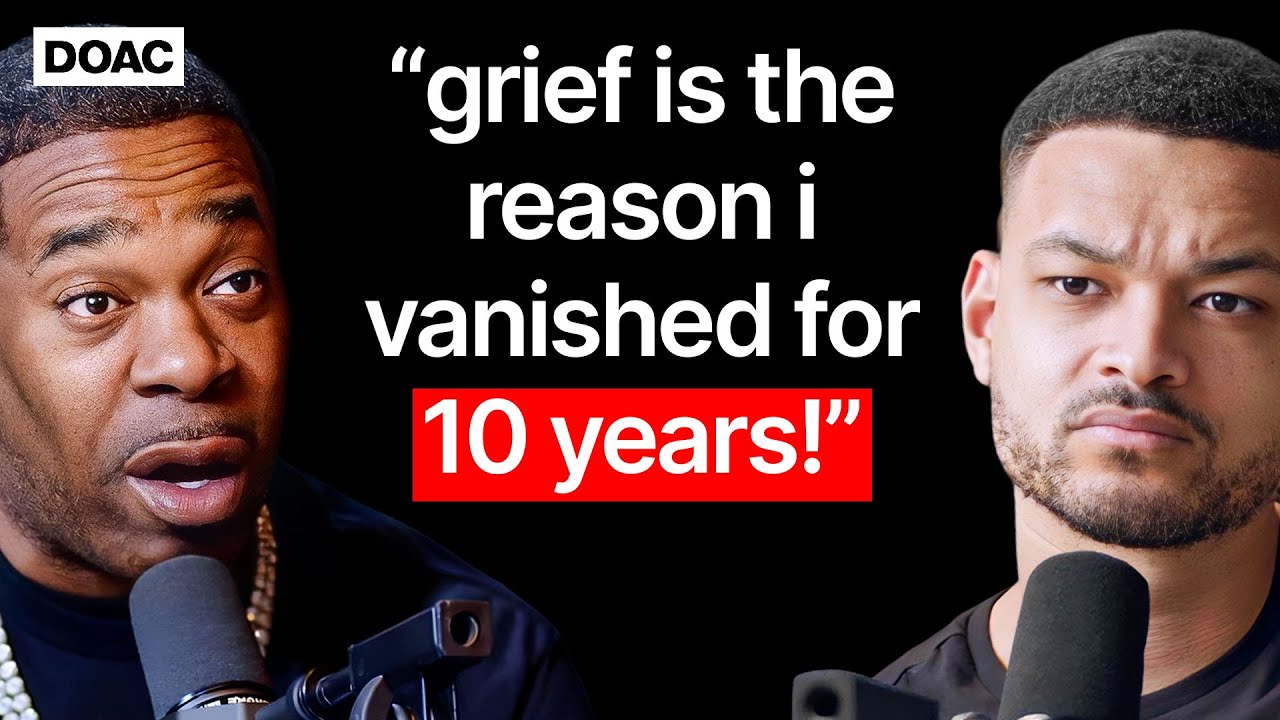
The Diary Of A CEO
The veteran rapper reversed a near-fatal health decline caused by grief and addiction after a emergency intervention inspired a complete physical transformation.
AI-assisted summary of Busta Rhymes Finally Opens Up About His Grief, Depression & Recovery! — original source. Check the original for full context.
Source published:
Detailed notes
## Background This interview was published on YouTube by Steven Bartlett on his channel The Diary Of A CEO on November 27, 2023. The video description highlights Busta Rhymes opening up about his experience inside the music industry, as well as his struggles with grief, depression, and recovery.
## TL;DR In this candid interview, hip-hop icon Busta Rhymes traces his journey from a structured childhood in Brooklyn and early days in breakdancing to becoming an influential MC. He opens up about the complex relationship with his father, his addiction to audience validation, and the sacrifices made regarding his family to pursue music. Busta also details the profound grief following the losses of his manager Chris Lighty and his father, a period of physical decline that led to a life-threatening health diagnosis, and the transformative boot camp that helped him reclaim his health and launch his album Blockbusta.
## Atmosphere & style The conversation carries a deeply reflective, vulnerable, and emotionally grounded tone that steps far beyond typical music promotion. Steven Bartlett acts as an empathetic facilitator, allowing Busta to oscillate naturally between hilarious childhood stories, energetic performance anecdotes, and raw, tearful recollections of family trauma and loss. The dynamic feels intimate and introspective, moving from tension and grief toward a triumphant, grateful realization of redemption and health.
## Key takeaways - [01:43](https://www.youtube.com/watch?v=cRjzQuzX-tg&t=103s) Busta Rhymes grew up in East Flatbush, Brooklyn, where strong parental discipline and a tight-knit community culture balanced the surrounding temptations of street crime and drugs. - [09:49](https://www.youtube.com/watch?v=cRjzQuzX-tg&t=589s) At age 11, his parents' divorce severely impacted Busta, instilling deep anger and behavioral problems as visitation disputes fractured his connection to his father. - [17:02](https://www.youtube.com/watch?v=cRjzQuzX-tg&t=1022s) Working as an electrical apprentice under his strict father fueled Busta's intense drive to succeed in Hip-Hop just to prove his father wrong. - [22:04](https://www.youtube.com/watch?v=cRjzQuzX-tg&t=1324s) After moving to Long Island to escape drug charges in Brooklyn, Busta lost a playground rap battle to Charlie Brown, inspiring his first written verse and leading to the formation of Leaders of the New School. - [45:14](https://www.youtube.com/watch?v=cRjzQuzX-tg&t=2714s) Busta's unique flow and high-energy stage performance were directly inspired by Jamaican Dancehall sound system culture and kung fu films. - [57:50](https://www.youtube.com/watch?v=cRjzQuzX-tg&t=3470s) True long-term success requires an uncompromising focus, a willingness to be 'delusional' about your vision before it succeeds, and an unconditional passion for the craft rather than money. - [01:03:56](https://www.youtube.com/watch?v=cRjzQuzX-tg&t=3836s) The relentless demands of his music career led Busta to sacrifice major family milestones, missing key events like his children's graduations. - [01:10:00](https://www.youtube.com/watch?v=cRjzQuzX-tg&t=4200s) The tragic loss of his manager Chris Lighty in 2012, followed by his father's death in 2014, plunged Busta into deep grief and caused a 9-year hiatus from releasing solo albums. - [01:19:10](https://www.youtube.com/watch?v=cRjzQuzX-tg&t=4750s) Unresolved grief led to severe self-neglect, pushing his weight to 340 pounds and causing life-threatening throat polyps that blocked 90% of his airway. - [01:23:38](https://www.youtube.com/watch?v=cRjzQuzX-tg&t=5018s) An emotional plea from his son and a 30-day intensive training regimen in Florida with bodybuilder Dexter Jackson saved Busta's life and sparked a complete physical transformation. - [01:27:58](https://www.youtube.com/watch?v=cRjzQuzX-tg&t=5278s) In executive producing his album Blockbusta alongside Pharrell Williams, Swizz Beatz, and Timbaland, Busta prioritizes sharing the flame with new artists, continuing the mentorship he received early in his career.
## Detailed walkthrough ### [00:00](https://www.youtube.com/watch?v=cRjzQuzX-tg&t=0s) Introduction to Busta Rhymes' Journey
Steven Bartlett opens the conversation by framing it as a look into a version of Busta Rhymes that the public has never seen before. Over a career spanning 33 years, Busta has maintained an incredible level of discipline, consistency, and dedication—what he refers to as an "addiction" to entertaining. However, Bartlett emphasizes that the discussion goes beyond his peak powers to examine the forces that pulled him into profound personal darkness and how he ultimately rose back up.
Bartlett describes the interview as a deeply human story about grief, depression, and recovery. Before moving into Busta's early life, he asks frequent listeners to subscribe to the podcast to support bringing on world-class guests.
---
[01:43](https://www.youtube.com/watch?v=cRjzQuzX-tg&t=103s) Early Context and Community Balance in Brooklyn
Reflecting back on his formative years, Busta Rhymes attributes the foundation of who he is today to his mother and father. Raised in East Flatbush, Brooklyn, Busta clarifies that while he grew up in the hood alongside street figures and troublemakers, his upbringing was rooted in structure, strict discipline, and care. He explains that his parents ensured he never lacked basic necessities and could truly enjoy childhood.
Busta emphasizes the sharp contrast between his era and modern culture, explaining that the community functioned under a true "takes a village" philosophy. Neighbors held full authority to discipline any child misbehaving on the block. Respect was a core value that even local gangsters and elders upheld, creating an environment where young people learned integrity and manners.
``` ┌────────────────────────────────────────┐ │ Strict Household Discipline │ │ • Mutual respect & proper manners │ └───────────────────┬────────────────────┘ │ ▼ ┌────────────────────────────────────────┐ │ Community "Village" Safety │ │ • Neighbors disciplined misbehavior │ │ • Street elders respected home rules │ └───────────────────┬────────────────────┘ │ ▼ ┌────────────────────────────────────────┐ │ Solid Foundation for the Future │ │ • Countered negative neighborhood │ │ influences (drugs/crime) │ └────────────────────────────────────────┘ ```
* **Environment:** Grew up in East Flatbush, Brooklyn, surrounded by both hardworking families and active street crime (drug dealing, robberies, and shootings). * **Community Dynamics:** Neighbors had explicit permission to discipline misbehaving kids on the street. Getting caught misbehaving meant receiving "two ass-beatings"—one from the neighbor and another at home for misrepresenting the family. * **Mutual Respect:** Even street figures and gangsters respected elders and maintained boundaries regarding how younger kids were treated, creating a balancing presence against negative influences.
---
[06:36](https://www.youtube.com/watch?v=cRjzQuzX-tg&t=396s) How Hip-Hop Provided an Alternative to the Streets
When asked why he didn't succumb entirely to the negative elements of his environment, Busta candidly admits that he *did* get drawn into the street lifestyle for a period, selling weed and crack. However, discovering Hip-Hop served as a life-saving alternative, allowing him to channel his talents into performing, writing rhymes, and entertaining people.
Busta details how the older figures in his neighborhood reacted when they saw his musical potential. While they initially tolerated his involvement in street activities because they lacked better options to offer him, they quickly pivoted to protect and encourage him once he started breakdancing, graffiti writing, DJing, and rapping.
* **Street Involvement:** Busta started selling weed and crack as a teenager, disappointing his mother. * **Guidance from Street Elders:** Local street figures actively tried to minimize the risks Busta faced, shielding him from violence and incarceration. * **Transition to Hip-Hop:** As Busta's passion for music grew alongside his early group, Leaders of the New School, his community pushed him to focus entirely on creative pursuits rather than street crime.
---
[09:49](https://www.youtube.com/watch?v=cRjzQuzX-tg&t=589s) The Emotional Impact of His Parents' Divorce
At 11 years old, Busta experienced a devastating turning point when his parents divorced. He explains how difficult it was to process the separation of the two primary forces in his life, noting that his mother provided nurturing and care while his father represented structure and authority.
The fallout from the divorce introduced intense anger, misbehavior, and disrespect into Busta's life. He recalls how the ongoing friction between his parents frequently interfered with visitation schedules, leading to painful moments where he could see his father waiting outside in a car, only to be kept inside due to a fresh argument between his parents.
* **Emotional Shift:** The separation triggered heightened anger and behavioral problems as Busta struggled to navigate the rift between his mother and father. * **Fractured Routines:** Arguments often led to canceled visitation weekends, cutting Busta and his younger brother off from their father's side of the family across Brooklyn and Queens.
---
[13:38](https://www.youtube.com/watch?v=cRjzQuzX-tg&t=818s) Contrasting Relationships with His Mother and Father
Busta describes the stark differences between his relationships with his parents. He maintained a close, open line of communication with his mother, sharing everything from teenage milestones to his early musical creations with Leaders of the New School. His mother created a supportive environment at home, encouraging his music as long as he handled his responsibilities and stayed out of trouble.
In contrast, his relationship with his father was filled with friction. His father held a pragmatic, serious view of the future and dismissed Hip-Hop, telling Busta, "I don't want to hear that shit... you're wasting your time." While Busta found this deeply hurtful at the time, his father's skepticism ultimately fueled an intense drive within him to prove his father wrong.
* **Supportive Dynamics:** His mother allowed Busta to blast his studio recordings at home and provided a safe space to discuss personal matters. * **Father's Skepticism:** Busta's father prioritized traditional career paths and openly criticized rap music as an unviable pursuit.
---
[17:02](https://www.youtube.com/watch?v=cRjzQuzX-tg&t=1022s) Working as an Electrical Apprentice and Driven to Excel
To keep him off the streets, Busta's father—who was a licensed electrical contractor—forced him to work for his company starting around age 10 to 12. Busta recalls hating the work, which involved laboring in dirty buildings infested with rats and roaches, cutting into the time he wanted to spend playing outside or making music.
Despite his frustration with the manual labor, Busta explains that his father's strictness and resistance to his musical ambitions forced him to excel. Driven by a determination to prove he could make something of himself through Hip-Hop, Busta poured his energy into perfecting his craft alongside his group members, who shared a collective passion for the culture.
* **Trade Work:** Busta worked under his father as an electrical apprentice, laboring in harsh conditions across New York. * **Exploration:** During summers, his mother sent Busta and his brother to spend time with family in Jamaica and England, broadening their perspective outside of Brooklyn.
<FollowUp label="Want to continue to Part 2 covering Busta's path to becoming an MC and building his career?" query="Please provide the detailed walkthrough for Part 2 of the transcript, continuing directly from 00:18:28."/>
[18:32](https://www.youtube.com/watch?v=cRjzQuzX-tg&t=1112s) Breakdancing in Morecambe, Preston, and Blackpool
When Busta Rhymes was around 12 or 13 years old, he and his younger brother—who was seven at the time—spent time living in England, specifically in the Morecambe and Preston areas. Guided by their older cousins, Samantha and Michaela, the brothers would venture out to local hot spots across Morecambe, Preston, and Blackpool. In these towns, Busta and his brother brought their raw New York breaking style directly to the local English kids, quickly gaining a reputation as "dangerous little motherf***ers" on the street.
Their dynamic floor moves, twisting, and popping quickly integrated them into the local breakdancing scene. Organizers and promoters began noticing their talent, booking the underage brothers to perform short 10-to-15-minute showcase sets inside night clubs before rushing them out the door. These early gigs gave Busta his first taste of earning money through live performance—making roughly £10 or £20 per show—and further fueled his passion for entertainment.
* Busta Rhymes and his seven-year-old brother attended primary school and karate classes while staying in the Morecambe and Preston regions. * His cousins Samantha and Michaela introduced them to local gathering spots and club scenes across Lancashire. * Local club promoters paid the young brothers £10 to £20 per performance for brief 10-to-15-minute breakdancing routines.
[20:04](https://www.youtube.com/watch?v=cRjzQuzX-tg&t=1204s) Electrical Work and the Pull of Hip-Hop Culture
When the summer dance opportunities began to wind down, Busta's father stepped in with a dose of traditional discipline, declaring that the boys would not be relaxing that summer and would instead come to work with him. Busta found himself dragged into physical labor as an electrician's assistant, a job he utterly despised. Forced to haul heavy BX cable through sheetrock, hammer nails, and avoid hitting his fingers, he worked in grueling environments where he would literally watch rats and cockroaches crawl over his Timberland boots.
While stuck doing manual labor, Busta would look out the window and watch other kids riding bikes, popping wheelies, and listening to music outside in the sun. This contrast generated intense daily anger toward his father, but it also crystallized his true ambition. Busta didn't just want an escape from hard labor; he wanted to dive headfirst into every single pillar of hip-hop—from dancing and DJing to writing rhymes. Hip-hop became the defining passion of his youth and his ultimate justification for avoiding a conventional trade.
> "Do I want to be an electrician? No... Do I want to see rats and roaches crawling over my shoes and my Timberland boots? I don't want to do none of that."
[21:04](https://www.youtube.com/watch?v=cRjzQuzX-tg&t=1264s) The DJ Craze and Being Relocated to Long Island
When Busta first sought his entry point into hip-hop, his goal wasn't actually to be an MC—he originally wanted to be the group's DJ. During the early era of hip-hop, the DJ held top billing and ultimate prestige in iconic acts, from Grandmaster Flash and the Furious Five to Jam Master Jay in Run-D.M.C. However, Busta quickly realized he lacked the technical aptitude to master complex turntable equipment and couldn't achieve "superstar DJ" status.
Concurrently, Busta's personal life in Brooklyn was spiraling out of control. By the age of 12, he had already been arrested twice for selling crack cocaine. While his minor status saved him from severe legal penalties, he was on a dangerous trajectory toward heavy prison time or worse. Recognizing the impending danger, his mother made the decisive choice to pull him out of Brooklyn and relocate the family to the suburbs of Long Island.
* **Early DJ Influences:** Busta revered pioneer DJs like Grandmaster Flash and Jam Master Jay, who carried solo name recognition and top billing over MCs. * **Legal Trouble:** Caught two drug charges for selling crack cocaine by the age of 12 while living in Brooklyn. * **Suburban Migration:** Joined a widespread wave of families moving out of Brooklyn, Queens, and the Bronx to give their children a fresh start in Long Island.
[23:56](https://www.youtube.com/watch?v=cRjzQuzX-tg&t=1436s) Suburban Hoods and the Long Island Cypher
Moving to Long Island did not immediately sanitize Busta's lifestyle. Many other families from Brooklyn, Queens, the Bronx, and Staten Island were simultaneously making the same move, effectively importing inner-city culture and street dynamics into quiet suburban neighborhoods. Upon settling in Uniondale, Busta linked up with local youths, including his future bandmates Charlie Brown and Dinco D (from Leaders of the New School), alongside his first cousin Milo and a street-affiliated friend named Mystery.
Transitioning into junior high school exposed Busta to a whole new world of social dynamics, class period bell-swaps, hallway banter, and teenage flirting. Being known as "the new kid from Brooklyn" carried a distinct rep. Local high schools held lip-sync contests and outdoor rap ciphers where students gathered after class. One afternoon, Busta walked into a massive schoolyard cipher centered around Charlie Brown—who was widely recognized as the top rapper in the school—and decided to jump in to provide beatboxing backing for the performers.
* **Leaders of the New School Lineup:** The early foundation of the group formed in Long Island, featuring Busta Rhymes, Charlie Brown, Dinco D, and Busta's blood cousin, Milo (Cut Monitor Milo). * **Suburban Dynamics:** Kids relocated from the five boroughs recreated the urban street culture and intensity within suburban Long Island neighborhoods.
[26:47](https://www.youtube.com/watch?v=cRjzQuzX-tg&t=1607s) The Playground Battle That Born a Rapper
As Busta kept the beat going for Charlie Brown in the middle of the schoolyard, the performance took an unexpected turn. About 30 to 40 seconds into his freestyle, Charlie Brown began directly insulting and dissing Busta in his lyrics. The 13-year-old Busta was caught in a tense inner conflict: should he throw a punch and end the party energy, or keep beatboxing and avoid looking like a sore loser? Coming from Brooklyn, Busta held a deep chip on his shoulder regarding kids from the Long Island suburbs, viewing them as soft compared to kids raised in the concrete jungle.
> "I'm looking at this dude and I'm just looking at him like I'm a f*** you up in two seconds because you a b**** to me, but you disrespecting me in front of all these people... if I don't do something then they going to look at me like I'm a b**** too."
When Charlie Brown finished his verse to crowd applause, Busta silently vowed revenge. He went home that night, studied aggressive battle rap records from LL Cool J—who was actively targeting rivals like Kool Moe Dee and Ice-T—and wrote his very first full rap verse aimed directly at Charlie Brown. Returning to school the next day, Busta waited patiently until the afternoon cipher formed, stepped up to beatbox for Charlie Brown again, and then seamlessly convinced Charlie Brown to drop a beat for him. Busta launched into his verse, shifting from calm delivery into blistering personal disses that completely flipped the crowd's energy. The electrifying reaction from the schoolyard onlookers instantly ignited Busta's confidence, charisma, and passion for rhyming. Devastated by the battle, Charlie Brown walked up to Busta immediately afterward and suggested they form a group together.
* **Inspirational Catalog:** Busta studied LL Cool J's aggressive battle-rap tracks to craft his first disses against Charlie Brown. * **The Origin Story:** Defeating Charlie Brown in the schoolyard battle served as the direct catalyst for Busta becoming an MC and the creation of Leaders of the New School.
[30:56](https://www.youtube.com/watch?v=cRjzQuzX-tg&t=1856s) The Embarrassing Early Rap Names
Before adopting his iconic moniker, Busta Rhymes navigated a few early stage names that reflected his changing identity. Initially, as a member of the Five-Percent Nation (The Nation of Gods and Earths), he went by the handle **Lord Tahim**. However, eager to match the naming trends of his hip-hop idols who favored stylized three-part names—such as LL Cool J, Jam Master Jay, Prince Markie Dee, and Cool Rock-Ski—he decided to drop his original title for something he thought sounded cutting-edge at the time.
With a laugh, Busta reveals that he re-baptized himself **Chill O Ski**. He held onto the name proudly for a considerable duration, genuinely believing it was the ultimate three-part rapper name, before eventually realizing how terrible it actually was.
``` Evolution of Busta Rhymes' Early Monikers: Lord Tahim (Five-Percent Nation) ➔ Chill O Ski (Early Rap Era) ➔ Busta Rhymes ```
[33:45](https://www.youtube.com/watch?v=cRjzQuzX-tg&t=2025s) Addiction to the Crowd's Energy
Reflecting on his journey from a 12-year-old on the playground to signing a major record deal at age 17, Busta identifies an overwhelming "addiction to the reaction of the people" as the primary driver of his success. The feeling of taking a thought written privately in his bedroom—fueled by the raw need to defend himself—and using it to control the energy of an entire room created a psychological high unlike anything else. He admits that without that specific playground confrontation with Charlie Brown, he might never have pursued life as a serious MC.
However, Busta's deep-seated need for audience validation started long before hip-hop entered the picture. As a young child around six to eight years old, his parents would enforce strict 9:00 PM bedtimes on school nights. But whenever his mother and father hosted adult house parties with music and drinks, Busta would scheme ways to stay up past his bedtime. He began staging elaborate dance reenactments of Michael Jackson, The Jackson 5, and James Brown routines right in the middle of the living room.
Busta would dance, spin, and perform full splits for hours until he was drenched in sweat. His parents and their guests were so captivated that they would cheer him on, delaying his bedtime and praising his mother for having such a talented son. That early living room applause sparked a lifelong obsession with performance that later transformed him into a classroom clown, a breakdancer, and ultimately one of hip-hop's most charismatic icons.
* **Bedtime Reenactments:** Performed energetic James Brown and Michael Jackson routines at ages 6-8 to avoid being sent to bed during his parents' weekend parties. * **Classroom Clown:** Translated his love for attention into classroom humor, constantly seeking the spotlight from peers. * **Cultural Status:** Observed early on how hip-hop transformed everyday dancers, DJs, and graffiti artists into local celebrities, driving his urge to master every element of the movement.
[39:30](https://www.youtube.com/watch?v=cRjzQuzX-tg&t=2370s) Finding the Calling: From Street Elements to Hip-Hop Showmanship
Busta Rhymes reflects on trying out the foundational elements of hip-hop before finding his true calling. He dabbled in DJing, but found it overly complex. He tried breakdancing, but hated the constant cuts and bruises. He appreciated graffiti, but it wasn't until he partnered up with Charlie Brown that everything clicked. Performing gave him the exact same rush he felt as a little boy dancing for his parents and their guests at home, combined with the electric thrill of being "the rapper guy" commanding the spotlight. Over time, that early appreciation morphed into an intense, unrelenting addiction to performing and receiving the audience's reaction.
``` ┌─────────────────────────┐ │ Early Hip-Hop Elements │ └────────────┬────────────┘ │ ┌───────────────────────────┼───────────────────────────┐ ▼ ▼ ▼ ┌─────────┐ ┌──────────┐ ┌──────────────┐ │ DJing │ │ Breaking │ │ Graffiti │ │ (Too │ │ (Too │ │ (Cool, but │ │ Complex)│ │ Bruised) │ │ Not "The" One│ └─────────┘ └──────────┘ └──────────────┘ │ ▼ ┌─────────────────────────┐ │ Linking with C. Brown │ │ & Reclaiming the Stage │ └─────────────────────────┘ ```
Steven Bartlett draws a parallel from his own background, sharing how many of his childhood friends tried rapping—most eventually fell off, but one or two stuck with it as if it were their ultimate medication. Busta explains that his absolute biggest driver was the desperate desire to prove his father wrong and experience the moment when he could finally say, "I told you so."
* "I used to write the shit on my wall and just on a piece of paper and I would stick it on the wall and it would say: *One day I'm going to get a deal, I'm gonna sign a contract, I'm gonna come home with so much fucking money that I'm going to be able to tell my father 'I told you so.'*" * "I would look at that sign and then I would see him outside in the truck and I'd walk out that fucking house and I would be mad as hell, angry."
---
[41:54](https://www.youtube.com/watch?v=cRjzQuzX-tg&t=2514s) Understanding Parental Tough Love and the Apollo Humiliation
With maturity, Busta came to understand that his father wasn't acting out of malice; he simply loved his son and wanted to ensure he wasn't wasting his time. His father had built a business that he hoped to hand down, viewings failure as non-viable. Steven Bartlett deeply relates, recalling how his mother—who emigrated from Nigeria after leaving school at age seven and never learned to read or write—was heartbroken and refused to speak to him for years when he chose not to attend university at 18. Both agree that immigrant parents push so hard because they survived severe poverty and hardship that their children never had to endure, wanting only the best for their offspring.
Busta shares a vivid story of the night his father came to see his group, Leaders of the New School, perform at the famous Apollo Theater's amateur night. Before the show, their original third member, a guy named Mystery, grew impatient with waiting for a record deal and returned to selling drugs on the street. That opened up a slot for Bryan "Dinco D" Higgins to join Busta and Charlie Brown, along with Busta's cousin, Milo (DJ Milo), on the turntables.
When they took the stage at the Apollo, the crowd mercilessly booed them off. To make matters worse, his father was in the audience and relentlessly taunted him inside the venue right after the show.
* "He was hitting me with the 'I told you so' that night. 'See, I tell you, yo, you waste your time with this little idiot rapper boy shit. Come and work, that's why I'm going tell you for come to work so you can learn some stability and stop waste your time with this rapper shit.'" * "He just beating me in the head with this total disrespect. But again, at that time I hated him for it. As we got older and that day came for me, I got my record deal when I was 17."
---
[45:14](https://www.youtube.com/watch?v=cRjzQuzX-tg&t=2714s) Jamaican Dancehall Influence: The Blueprint for Busta's Flow and Energy
When Bartlett asks what specifically made Busta stand out from every other rapper, Busta points directly to the profound influence of Jamaican Dancehall culture and sound system clashes, such as the iconic annual *Sting* festival. Watching dancehall legends perform in front of massive crowds of 100,000 people, he noticed an explosive, total-package Showmanship that was completely absent in American hip-hop at the time. Where hip-hop artists often acted "too cool," standing still and holding their crotch, dancehall artists commanded the stage with wild physical energy, striking outfits, kicking, hand-flinging, and complex flow patterns.
``` Dancehall Sound Clashes (Sting, Jammys, Killamanjaro) ├── High-Energy Stage Movement & Kicking ├── Complex Flow Patterns & Breath Control └── Kung Fu Movie Physicality & Visual Flair │ ▼ Busta Rhymes' Signature Performance Style ```
Combining his love for dancehall with a childhood obsession with martial arts and kung fu movies, Busta methodically engineered a high-intensity style designed to overwhelm competitors. He spent his youth as a dedicated student of the culture, analyzing legendary selectors and deejays to build an unmatched stage presence.
* "In hip-hop you seeing dudes just walking around... act like they too cool to be that animated. Me, I love that shit. I love kung fu movies, I love karate movies... I just took all of that shit and I said, 'I'm gonna turn this into what I'm gonna do on these stages.'" * "I think that if I master this shit and I could master my breathing and I don't exhaust myself too soon try to jump around all over the fucking stage going crazy, I think I might become a dangerous motherfucker that's hard to compete with." * "Looking at those Sting clashes, and Jammys and Killamanjaro... Saxon... Tipper I and all of them man. Them dudes raised me."
---
[48:11](https://www.youtube.com/watch?v=cRjzQuzX-tg&t=2891s) The Core Fundamentals: Passion, Purpose, and Unconditional Love for the Craft
Bartlett asks Busta what core advice or fundamentals he passes on to his six children (now in their 20s and 30s) to maximize their chances of success in any industry. Busta explains that the primary requirement is identifying what you truly love and mastering it until your passion is unquestionable. True success cannot stem from chasing revenue; it must come from an inner need to fulfill something in your soul that money alone can never buy.
Busta details how this deep connection to music gives him a sense of absolute purpose and security. Even if he were lying sick in a hospital bed, he could write a song, hand it to another artist, and create a piece of art that financially protects his family for generations while profoundly shaping the lives of millions of listeners worldwide.
* "Identify with what you love, and once you love it, hone in on that thing until you can master it to the point where people can identify that there's no questioning your love for it." * "You're not doing it from a place of trying to generate the revenue—you're going to do this shit regardless. So it's not about the money for you. You're fulfilling something in your soul, in your body." * "Think a new way that allowed me to pursue something that I found that I love, and now I'm a fucking $200 million CEO in Google... 'I'm a fan of your shit, you're still doing what I love, and I want to sit down with you and figure out something magical that we could do together.' That's the most addictive shit in the world to me."
`-` **Key Philosophy:** Success originates from an internal calling rather than financial ambition; the revenue follows the devotion. `-` **Long-term Impact:** Great art transcends time, creating lifelong bonds with fans who go on to achieve their own monumental success.
---
[54:53](https://www.youtube.com/watch?v=cRjzQuzX-tg&t=3293s) Divine Inspiration and Balancing Humor with Gravitas
Continuing on the spiritual nature of creativity, Busta explains that everyone possesses an inner gift or instinct. Listening to that quiet internal voice changes a person's entire life trajectory, allowing them to walk in their purpose and achieve a form of immortality through their work. He addresses the Five-Percent Nation concept of "Gods and Earths," arguing that recognizing the divine spark within oneself is simply operating in the natural, high-level state in which humans were created to function.
He illustrates this creative spark with a humorous example: sitting at home in a relaxed state, smoking a spliff, eating a bowl of cereal, and casually coming up with the iconic hook *"When I step up in the place, option step your steps correct / Woo-hah! Got you all in check!"* He notes that this spontaneous moment in his kitchen ended up being chanted by fans across the globe, from local hoods to packed arenas in Sweden. He emphasizes the importance of balancing comedic absurdity with serious artistry, citing screen icons like Al Pacino in *Scarface* and Joe Pesci in *Goodfellas*.
* "It's weird to me when people find it strange when we call ourselves Gods and Earths... Anything other than its original form is the worst state of its own existence because you're not even functioning within the nature that you was created to function in." * "I refuse to think that there is nothing that I can't do beyond man... If I could sit down here and smoke a spliff and eat a bowl of cereal and go: 'When I step up in the place... Woo-hah! Got you all in check!' and the whole fucking planet is doing it... I just was vibing and bugging out." * "Al Pacino and *Scarface*—he was a serious motherfucker, but he was funny. Joe Pesci and *Goodfellas*—serious, but funny, right? We in the hood, we love the balance between serious and funny. I try to incorporate serious and funny in all of my shit."
---
[57:50](https://www.youtube.com/watch?v=cRjzQuzX-tg&t=3470s) The Essential Character Traits: Selfishness, Maniacal Focus, and Pure Delusion
When asked what specific character traits a person must cultivate to achieve top-tier success, Busta lists qualities that sound harsh on the surface but are vital for reaching greatness: being intensely selfish, maniacal, uncompromising, and completely delusional. Great rewards require massive personal sacrifices and risks that standard logic cannot account for.
Busta defines "delusion" as an unwavering faith in a vision that no one else can see yet. Until the dream manifests into reality, society will mock it as crazy; the moment it succeeds, that exact same delusion is praised as genius.
``` ┌──────────────────────────────────┐ │ Visionary Pursues Their Dream │ └────────────────┬─────────────────┘ │ ┌─────────────┴─────────────┐ ▼ ▼ ┌──────────────┐ ┌──────────────┐ │ BEFORE │ │ AFTER │ │ SUCCESS │ │ SUCCESS │ ├──────────────┤ ├──────────────┤ │ Labeled: │ │ Labeled: │ │ "Delusional" │ │ "Genius" │ │ & "Crazy" │ │ & "Visionary"│ └──────────────┘ └──────────────┘ ```
* "First thing is, you got to be selfish as hell. You gotta be selfish... Without great sacrifice and without great risk, there is no such thing as a great reward." * "You have to be a little maniacal with the shit... When you're pursuing your destiny, when you identify with your destiny, you have to be selfish, you have to be maniacal, you have to be uncompromising." * "Complete delusion. You got to believe the delusion, because it's only delusional until it works... A motherfucker only going to call it delusion until it work... and then once the world see it, there's nothing delusional about it now. Your delusion becomes: 'Oh, he was a fucking genius.'"
[01:00:19](https://www.youtube.com/watch?v=cRjzQuzX-tg&t=3619s) The Price of the Craft and Missing Key Life Events
Addressing the notion of being "selfish" to chase his hip-hop dreams over his father's desire for him to become an electrical contractor, Busta clarifies the distinction between having a difference of opinion and true self-absorption. While standing up to his father was simply about pursuing his own path, Busta admits that his career demands led to a deeper, more painful form of selfishness—missing irreplaceable moments in his children's lives. He candidly recounts missing his oldest son's high school graduation, one of his daughter's college graduations, and foundational childhood milestones like teaching his kids how to drive or ride a bicycle.
Busta takes full responsibility for the choices and circumstances he created. He describes the heavy dilemma between being present for every moment while struggling financially, or stepping away to fulfill his purpose in the studio. For Busta, the recording studio was not merely a workspace; it was a sanctuary where he could shut out life's heavy distractions, relationship arguments, and unnecessary debates. Within those four walls, he felt aligned with his destiny, finding the emotional and spiritual grounding needed to return home as a better man.
- **Sacrificed Milestones:** Missed his oldest son's high school graduation and a daughter's college graduation. - **Missed Life Skills:** Was absent for key childhood moments, including teaching his kids to ride a bike and drive a car. - **Studio as a Haven:** Used the studio environment to escape personal disputes, decompress, and process his emotions into art.
---
[01:03:56](https://www.youtube.com/watch?v=cRjzQuzX-tg&t=3836s) The Pressure of Child Support and the Survival Mindset
Host Steven Bartlett shares his own fears as a self-described workaholic, questioning whether Busta feels guilt for using his craft as an emotional escape. Busta responds that while he lives with genuine guilt, he recognizes that his past actions were driven by a survival mindset necessary at the time. Managing complex family dynamics with four mothers involved in court proceedings required constant financial vigilance.
Regardless of whether business was booming or slow, monthly child support obligations were non-negotiable. Raised with the mindset that children never ask to be brought into difficult situations, Busta knew he could offer no excuses. He views the immense pressure he faced as an integral part of his gift, believing that higher powers do not bestow burdens heavier than one can bear. Ultimately, he hopes his children understand that prioritizing one's primary passion is essential for fulfillment.
> "Your kid didn't ask to be put in a situation that you cannot do what you're supposed to do for them... You have to find a solution."
---
[01:10:00](https://www.youtube.com/watch?v=cRjzQuzX-tg&t=4200s) The Tragic Loss of Chris Lighty
In 2012, at age 40, Busta suffered a devastating personal and professional blow with the sudden death of his long-time manager and close friend, Chris Lighty. Busta credits Lighty as the architect of his financial and career transformation following his early days with Chuck D and Hank Shocklee. Under Lighty's guidance at Violator Management, Busta's income soared, enabling him to tell his mother in 1995 that she could quit her job permanently.
Busta solemnly recounts the tragic day of Lighty's death. Just the day before, Busta had given Lighty a ride to Grand Central Terminal in Manhattan so he could meet his daughter returning from college. The following morning, Busta received frantic three-way phone calls from Lighty's assistant and a weeping staff member screaming that "Chris hurt himself." Driving straight to Lighty's home, the grim reality set in only when the coroner's van backed down the driveway and officials emerged carrying body bags from the basement.
- **Career Impact:** Chris Lighty revamped Busta's entire operational team, including lawyers, booking agents, and touring operations. - **Family Landmark:** The success achieved alongside Lighty allowed Busta to support his mother fully starting in 1995. - **The Incident:** Busta gave Lighty his last ride to Grand Central Terminal before receiving news of his death the following morning.
---
[01:16:41](https://www.youtube.com/watch?v=cRjzQuzX-tg&t=4601s) A Nine-Year Recording Hiatus and Compounding Grief
The immediate aftermath of Chris Lighty's death was chaotic, marked by confusion, grief, and legal tension. Having never navigated the music industry without his manager and "brother," Busta felt completely unmoored. The loss paralyzed his creative output, resulting in a nine-year pause between solo studio albums. During this hiatus, Busta redirected his focus toward executive production and talent development under his Conglomerate label, successfully signing and launching artists such as O.T. Genasis, Stove God Cooks, and Murda Mook.
However, executive success could not fill the void or ease his psychological grief. The emotional toll deepened significantly in 2014 when Busta lost his father—just two years after Lighty's passing. Losing the two most influential male figures in his life back-to-back left Busta struggling with profound regret. Although he had reconciled with his father prior to his passing, he felt robbed of the opportunity to enjoy a peaceful, post-reconciliation relationship with him.
- **Nine-Year Album Gap:** Did not drop a full solo album for nine years while searching for the right support team. - **Executive Roster:** Focused on developing talent, bringing on artists like O.T. Genasis, Stove God Cooks, and Murda Mook. - **Double Bereavement:** Suffered the loss of manager Chris Lighty in 2012, followed by his father in 2014.
---
[01:19:10](https://www.youtube.com/watch?v=cRjzQuzX-tg&t=4750s) Spiral into Unhealthiness and the Wake-Up Call
To numb the pain of his losses, Busta engaged in severe physical self-neglect, overworking and heavily abusing alcohol, marijuana, and cigarettes. His weight surged to an unprecedented 340 pounds, causing noticeable physical transformations and severe health issues, including sleep apnea. Reflecting on photographs from that era, Busta recalls seeing dark skin discolorations and a visible sense of internal torment.
The turning point came following a heavy night out at the Los Angeles nightclub Poppy, where Busta drank to the point of complete unresponsiveness. It took nearly 45 minutes for his son and security team to wake him. The next morning, his son sat him down to express his deep concern. Intimidated to confront his father directly, the son asked the security team to speak on his behalf to protect Busta's feelings. Realizing the emotional anguish he was causing his son served as the painful wake-up call Busta needed to confront his destructive path.
- **Peak Weight:** Ballooned to 340 pounds due to unhealthy coping mechanisms. - **Health Complications:** Developed severe sleep apnea and extreme physical exhaustion. - **The Intervention:** Following a night at Poppy in L.A., his son and security team spent 45 minutes trying to revive him, leading to an emotional confrontation.
<FollowUp label="Want me to break down Part 5 of the transcript?" query="Write a detailed, faithful walkthrough of Part 5 of this Busta Rhymes transcript."/>
[01:21:44](https://www.youtube.com/watch?v=cRjzQuzX-tg&t=4904s) A Life-Threatening Diagnosis
The full severity of Busta Rhymes' health crisis became brutally clear during a doctor's visit following a night of severe breathing difficulties. Before even stepping into the exam room, the doctor could hear Busta breathing heavily from outside the door. Busta had been living with the labored breathing for three years, to the point where it had become normalized in his mind. However, upon examining his throat, the physician discovered massive polyps that were blocking 90% of his airway. The doctor warned that if Busta went home and caught even a minor draft from central air conditioning, a swollen gland or sore throat could obstruct the remaining 10% of his breathing passage, causing him to die in his sleep.
The physician insisted on calling an ambulance to transport Busta immediately to the UCLA Medical Center emergency room for emergency surgery the following day. When Busta refused to ride in an ambulance, the doctor required him to sign a liability waiver releasing the medical practice from responsibility if Busta died before reaching the hospital. Busta admits he had never been spoken to like that in his life, and the sobering reality of the situation hit him hard as he called his son to meet him at the medical facility.
- Polyps blocked **90%** of Busta Rhymes' breathing passage for nearly three years prior to the medical emergency. - The physician warned that a common cold or draft could swell the throat and block the remaining **10%** airway, resulting in death during sleep. - The doctor required a signed liability release waiver when Busta refused ambulance transport to **UCLA Medical Center**.
[01:23:44](https://www.youtube.com/watch?v=cRjzQuzX-tg&t=5024s) His Son's Plea and the Turning Point
While sitting in the emergency room awaiting admission and undergoing preliminary tests, Busta had an emotional breakdown during a conversation with his son. His son broke down and admitted, "I thought you was going to die last night... I lost Grandpa already, I can't lose you too. Can you please stop drinking, can you please stop smoking, can you please get back to the daddy that I know you to be?" That vulnerable plea completely shattered Busta, serving as the ultimate wake-up call he needed to change his lifestyle.
Overwhelmed by fear and love for his family, Busta resolved in that exact moment to undergo the necessary surgery and commit entirely to getting back into physical shape. Hearing his child's fear made him realize that his physical decline was no longer just affecting himself, but deeply hurting those who depended on him.
> "I lost Grandpa already, I can't lose you too. Can you please stop drinking, can you please stop smoking, can you please get back to the daddy that I know you to be?"
[01:24:34](https://www.youtube.com/watch?v=cRjzQuzX-tg&t=5074s) The 30-Day Transformation in Jacksonville
On his way home following the hospital visit, Busta saw an Instagram story of professional bodybuilder and Mr. Olympia champion Dexter Jackson driving in Jacksonville, Florida, while rapping along to Busta's classic hit "Put Your Hands Where My Eyes Could See." Taking it as a sign, Busta reached out via direct message, introduced himself as a fan, and asked if they could speak. When they connected on the phone, Jackson gave him a strict ultimatum: Busta had to leave his girlfriend and children behind and report to Jacksonville for an intense 30-day boot camp to prove his dedication before Jackson would agree to train him long-term.
Busta fully committed to the challenge by renting a seven-bedroom mansion in Jacksonville. To set himself up for success without ever needing to leave the house, he assembled a support team consisting of a cameraman to document the journey, a meal-prep chef, a masseuse to recover from grueling daily workouts, a recording engineer, and an assistant. Under the guidance of his trainers—first Victor Munoz and then Dexter Jackson—Busta lost approximately 27 pounds in 30 days. Reclaiming his health, mind, and spirit brought back a sense of pride that was reinforced when his children expressed their relief and respect for his transformation.
- Busta rented a **7-bedroom mansion** in Jacksonville, Florida, to execute his strict 30-day boot camp. - He brought a dedicated crew including a cameraman, meal-prep chef, masseuse, recording engineer, and assistant. - Trained alongside **Victor Munoz** and Mr. Olympia champion **Dexter Jackson**. - Shed approximately **27 pounds** during the initial 30-day isolation period.
[01:27:58](https://www.youtube.com/watch?v=cRjzQuzX-tg&t=5278s) Executive Producing *Blockbusta* and Mentoring the New Generation
Navigating the emotional and mental challenges of the COVID-19 pandemic eventually led Busta back to creating music, culminating in his album *Blockbusta*. The project was executive produced alongside three legendary industry peers: Pharrell Williams, Swizz Beatz, and Timbaland. Addressing why he chose to feature so many younger, emerging artists on the project despite having already worked with virtually everyone in hip-hop, Busta strongly rejected the popular narrative that elder statesmen in hip-hop do not respect or support the younger generation.
Busta explained that when he was coming up, legendary figures like Chuck D (who gave him the name Busta Rhymes), Big Daddy Kane, and De La Soul brought him into their homes, put him on their albums, and took him to shows to teach him the craft. He feels a deep responsibility to pass that same guidance, love, and protection to the new generation. Rather than framing this mentorship as "passing the torch," Bartlett noted—and Busta enthusiastically agreed—that collaborating with younger artists is about "sharing the flame," keeping his own creative edge razor-sharp while honoring the upcoming talent who draw inspiration from his style and legacy.
- *Blockbusta* was executive produced by **Pharrell Williams**, **Swizz Beatz**, **Timbaland**, and **Busta Rhymes**. - Chuck D gave Busta his stage name, while Big Daddy Kane and De La Soul mentored him early in his career. - Busta emphasizes "sharing the flame" with younger artists rather than passing the torch, keeping himself razor-sharp 33 years into his career.
[01:31:46](https://www.youtube.com/watch?v=cRjzQuzX-tg&t=5506s) Reflecting on the Journey and Final Remarks
As the interview came to a close, Busta expressed immense gratitude for the depth and vulnerability of the conversation. He admitted that in his 33-year career, he had never done an interview so deep or spent this much time doing a sit-down interview in Europe. He praised host Steven Bartlett for his preparation, evolution as a businessman, and ability to ask questions that pushed him out of his comfort zone. Bartlett expressed his deep honor in hosting Busta, noting how Busta's personal journey adds profound meaning to his music and legacy.
- Busta noted this was the longest and most in-depth interview he had given in his **33-year career**. - The episode concludes with host announcements regarding podcast sponsors, including Huel's nutritionally complete protein bars and the availability of The Conversation Cards.
## Notable quotes > [20:04](https://www.youtube.com/watch?v=cRjzQuzX-tg&t=1204s) Do I want to be an electrician? No... Do I want to see rats and roaches crawling over my shoes and my Timberland boots? I don't want to do none of that. — Busta Rhymes
> [26:47](https://www.youtube.com/watch?v=cRjzQuzX-tg&t=1607s) I'm looking at this dude and I'm just looking at him like I'm a f*** you up in two seconds because you a b**** to me, but you disrespecting me in front of all these people... if I don't do something then they going to look at me like I'm a b**** too. — Busta Rhymes
> [39:30](https://www.youtube.com/watch?v=cRjzQuzX-tg&t=2370s) I used to write the shit on my wall and just on a piece of paper and I would stick it on the wall and it would say: One day I'm going to get a deal, I'm gonna sign a contract, I'm gonna come home with so much fucking money that I'm going to be able to tell my father 'I told you so.' — Busta Rhymes
> [41:54](https://www.youtube.com/watch?v=cRjzQuzX-tg&t=2514s) He was hitting me with the 'I told you so' that night. 'See, I tell you, yo, you waste your time with this little idiot rapper boy shit. Come and work, that's why I'm going tell you for come to work so you can learn some stability and stop waste your time with this rapper shit.' — Busta Rhymes
> [45:14](https://www.youtube.com/watch?v=cRjzQuzX-tg&t=2714s) In hip-hop you seeing dudes just walking around... act like they too cool to be that animated. Me, I love that shit. I love kung fu movies, I love karate movies... I just took all of that shit and I said, 'I'm gonna turn this into what I'm gonna do on these stages.' — Busta Rhymes
> [48:11](https://www.youtube.com/watch?v=cRjzQuzX-tg&t=2891s) Identify with what you love, and once you love it, hone in on that thing until you can master it to the point where people can identify that there's no questioning your love for it. — Busta Rhymes
> [54:53](https://www.youtube.com/watch?v=cRjzQuzX-tg&t=3293s) When I step up in the place, option step your steps correct / Woo-hah! Got you all in check! — Busta Rhymes
> [57:50](https://www.youtube.com/watch?v=cRjzQuzX-tg&t=3470s) Complete delusion. You got to believe the delusion, because it's only delusional until it works... A motherfucker only going to call it delusion until it work... and then once the world see it, there's nothing delusional about it now. Your delusion becomes: 'Oh, he was a fucking genius.' — Busta Rhymes
> [01:03:56](https://www.youtube.com/watch?v=cRjzQuzX-tg&t=3836s) Your kid didn't ask to be put in a situation that you cannot do what you're supposed to do for them... You have to find a solution. — Busta Rhymes
> [01:23:44](https://www.youtube.com/watch?v=cRjzQuzX-tg&t=5024s) I lost Grandpa already, I can't lose you too. Can you please stop drinking, can you please stop smoking, can you please get back to the daddy that I know you to be? — Busta Rhymes' Son
## Mentioned Busta Rhymes, Steven Bartlett, The Diary Of A CEO, will.i.am, Leaders of the New School, Samantha, Michaela, Grandmaster Flash, Grandmaster Flash and the Furious Five, Jam Master Jay, Run-D.M.C., Charlie Brown, Dinco D, Milo, Cut Monitor Milo, Mystery, LL Cool J, Kool Moe Dee, Ice-T, Five-Percent Nation, Prince Markie Dee, Cool Rock-Ski, Michael Jackson, The Jackson 5, James Brown, Google, Apollo Theater, Bryan "Dinco D" Higgins, DJ Milo, Sting, Jammys, Killamanjaro, Saxon, Tipper I, Al Pacino, Scarface, Joe Pesci, Goodfellas, Chris Lighty, Chuck D, Hank Shocklee, Violator Management, Grand Central Terminal, Conglomerate, O.T. Genasis, Stove God Cooks, Murda Mook, Poppy, UCLA Medical Center, Dexter Jackson, Put Your Hands Where My Eyes Could See, Victor Munoz, Blockbusta, Pharrell Williams, Swizz Beatz, Timbaland, Big Daddy Kane, De La Soul, Zoe, LinkedIn, Huel, The Conversation Cards, Apple Podcast, Spotify, YouTube, Instagram, Twitter
[Source](https://www.youtube.com/watch?v=cRjzQuzX-tg)