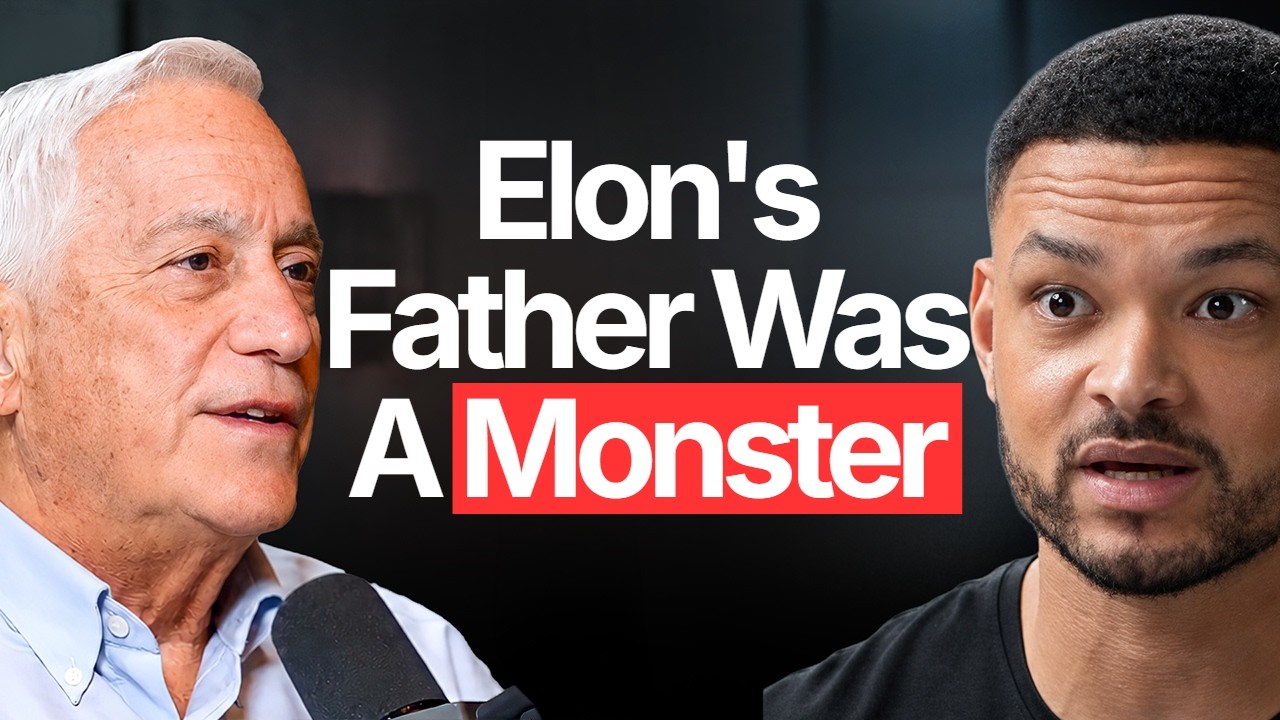
Isaacson Details How Musk's Traumatic Upbringing Drives SpaceX, Tesla Success
The Diary Of A CEO
Elon Musk's childhood emotional trauma and severe relationship with his father created an addiction to crisis that fuels his extraordinary engineering achievements while destroying his personal stability.
## Background
This episode was published by The Diary Of A CEO with Steven Bartlett on YouTube on November 30, 2023. According to the page description, it features a conversation with biographer Walter Isaacson discussing the life, childhood trauma, and psychological drivers of Elon Musk following the release of Isaacson's biography on him.
## TL;DR
In this wide-ranging discussion, biographer Walter Isaacson reflects on his two years spent shadowing Elon Musk, examining how Musk's traumatic childhood and abusive relationship with his father shaped his intense, drama-addicted leadership style. The conversation explores Musk's first-principles thinking, his high-stakes management tactics during the Twitter acquisition, and his deeply personal motivations behind SpaceX and Tesla. Isaacson contrasts Musk's mercurial, risk-seeking nature with Steve Jobs, highlighting how personal pain, an obsession with detail, and an existential urgency drive Musk's mission to make humanity multi-planetary.
## Atmosphere & style
The conversation carries an intimate, analytical, and deeply reflective tone, striking a balance between psychological diagnosis and corporate biography. Walter Isaacson speaks with the thoughtful, steady authority of a seasoned biographer, bringing nuance and quiet humor to stark stories of chaos, factory-floor surges, and emotional tailspins. The dynamic between Bartlett and Isaacson feels like an engrossing fireside chat that oscillates between dark, sobering revelations about trauma and fascinating breakdowns of high-stakes disruption.
## Key takeaways
- [00:00](https://www.youtube.com/watch?v=9BDmC5u_MLE&t=0s) Walter Isaacson spent two years side-by-side with Elon Musk, noting that while every great disruptor is driven by personal demons, Musk's hardwiring and childhood trauma were particularly brutal.
- [03:22](https://www.youtube.com/watch?v=9BDmC5u_MLE&t=202s) Musk devotes about 80% of his mental energy to execution and designing the manufacturing systems ('the machines that make the machines') rather than mere high-level conceptual ideas.
- [07:50](https://www.youtube.com/watch?v=9BDmC5u_MLE&t=470s) Severe physical bullying at school and relentless psychological abuse from his father Errol Musk instilled in Elon a lifelong drive to seek out drama and associate pain with progress.
- [25:44](https://www.youtube.com/watch?v=9BDmC5u_MLE&t=1544s) Musk relies on 'first-principles thinking'—stripping problems down to fundamental physical truths and viewing all rules and regulations as mere recommendations.
- [29:43](https://www.youtube.com/watch?v=9BDmC5u_MLE&t=1783s) High-pressure tactics and severe deadlines, such as personally cutting server cables in Sacramento or demanding weekend launches, reflect Musk's belief that you must risk breakages to innovate.
- [34:46](https://www.youtube.com/watch?v=9BDmC5u_MLE&t=2086s) Musk's political shift toward fighting the 'woke mind virus' was heavily catalyzed by personal grief over his daughter's transition and complete ideological rejection of him.
- [38:00](https://www.youtube.com/watch?v=9BDmC5u_MLE&t=2280s) Musk bought Twitter viewing it as an engineering challenge, while explicitly rejecting the concept of 'psychological safety' in favor of urgent intensity and a smaller, hardcore team.
- [55:39](https://www.youtube.com/watch?v=9BDmC5u_MLE&t=3339s) Musk's mission to make humanity multi-planetary stems from an existential fear regarding the rarity and survival of human consciousness, driving an intense urgency due to his own mortality.
- [01:00:49](https://www.youtube.com/watch?v=9BDmC5u_MLE&t=3649s) Musk operates in mercurial psychological states, cycling into destructive 'demon mode' episodes where he admits to periodically self-sabotaging.
- [01:03:21](https://www.youtube.com/watch?v=9BDmC5u_MLE&t=3801s) When hiring, Musk prioritizes an 'all-in hardcore attitude' over experience, believing technical skills can be taught but fundamental mindset cannot.
- [01:06:18](https://www.youtube.com/watch?v=9BDmC5u_MLE&t=3978s) Both Steve Jobs and Elon Musk built their success on extreme iteration, obsession with hidden details, a 20% tolerance for failure, and forcing deadlines through a 'reality distortion field'.
- [01:13:49](https://www.youtube.com/watch?v=9BDmC5u_MLE&t=4429s) Musk actively places zero value on personal happiness or relaxation, viewing his life's work akin to a video game addict immediately moving to the next level.
- [01:20:10](https://www.youtube.com/watch?v=9BDmC5u_MLE&t=4810s) Musk's engineering methodology, 'The Algorithm,' requires questioning every rule, deleting unnecessary parts, accelerating cycle times, and forcing engineers onto the factory floor.
- [01:23:43](https://www.youtube.com/watch?v=9BDmC5u_MLE&t=5023s) Underneath Musk's relentless drive and turbulent romantic relationships lies a profound childhood fear of being alone.
## Detailed walkthrough
Here is a detailed, faithful walkthrough of the provided transcript segment.
---
[00:00](https://www.youtube.com/watch?v=9BDmC5u_MLE&t=0s) Introduction: Unprecedented Access to Disruptive Geniuses
The episode begins with an introduction highlighting Walter Isaacson's unique position as a biographer who gained years of direct, intimate access to two of the most transformative figures of the modern era: Steve Jobs and Elon Musk. Isaacson observes that while every world-shifting disruptor he has ever chronicled is driven by deep-seated personal demons, Elon Musk’s psychological drivers were unusually brutal. Born as a scrawny kid on the autism spectrum with no friends, Musk suffered physical beatings at school and psychological torture at home from his abusive father.
Isaacson spent two years shadowing Musk "morning, noon, and night" to uncover how his psychological hardwiring and chaotic upbringing created an executive who is explicitly addicted to drama. In one illustrative anecdote from Twitter (now X) headquarters, Musk demanded the removal of a specific server farm. When engineers told him it was impossible to do quickly, he fired them, showed up at the facility on Christmas Eve with wire cutters, and cut the server cables himself. While his erratic methods drove his teams crazy, they consistently pushed people to accomplish feats they previously thought impossible.
The host, Steven Bartlett, makes a quick appeal to the audience, noting that 58% of regular listeners are not yet subscribed. He promises that subscribing will support the show's transition into a more documentary-style format featuring rich archival footage and deeper context.
* **Key Detail:** Walter Isaacson spent roughly two years following Steve Jobs and another two years side-by-side with Elon Musk.
* **Key Detail:** Musk spent 80% of his "hardcore mental energy" on manufacturing and engineering systems rather than high-level conceptual ideas.
* **Verbatim Quote:** "All the people I've written about who are disruptors, they tend to have had demons driving them. But for Elon Musk, it was particularly brutal."
---
[03:22](https://www.youtube.com/watch?v=9BDmC5u_MLE&t=202s) Working Closely with the Greatest Minds of the 21st Century
Isaacson details the specific scope and access he had with three major subjects of his recent work: Steve Jobs, Dr. Jennifer Doudna, and Elon Musk. Jobs ushered in the digital revolution through personal computing and the iPod ("a thousand songs in our pocket"). Isaacson then shadowed Nobel laureate Jennifer Doudna in her UC Berkeley lab to understand CRISPR gene-editing technology, which launched the life sciences revolution. Musk represented the next natural frontier: space travel, electric vehicles, and artificial intelligence.
When Isaacson initially approached Musk, he set strict conditions: he would not write the book based on a few formal interviews, but rather by embedding himself alongside Musk for two years with no pre-publication review or editorial control granted to Musk. Musk immediately agreed. Isaacson notes that Musk possesses a distinct "superhero complex" and views his own trajectory alongside historical figures like Steve Jobs.
Isaacson contrasts the operational focus of Steve Jobs and Elon Musk based on his time with both:
* **Steve Jobs's Focus:** Jobs was obsessed with product conceptualization and beautiful design. Isaacson frequently stayed in Jobs's guest house and spent long stretches in Jony Ive's design studio at Apple headquarters, where Jobs would spend hours obsessing over minute physical details, such as the exact curvature and design of a European power plug compared to an American one.
* **Elon Musk's Focus:** Musk is focused heavily on execution, assembly lines, and factory design. Rather than product aesthetics, Musk devotes most of his mental energy to "designing the machines that make the machines"—optimizing the production pipelines for Raptor rocket engines, Tesla battery cells, and vehicle assembly lines.
* **Key Detail:** Isaacson spent about three to four weeks per month traveling with Musk, whereas his time with Jobs was structured in one-week blocks every couple of months.
* **Key Detail:** NASA and Boeing lost the immediate capability to launch American astronauts into orbit independently, leaving SpaceX as the sole U.S. entity executing crewed orbital launches for a time.
* **Verbatim Quote:** "Musk spends about 80% of his hardcore mental energy designing the machines that make the machines."
---
[07:50](https://www.youtube.com/watch?v=9BDmC5u_MLE&t=470s) Misfits, Childhood Trauma, and the Legacy of Errol Musk
Isaacson explains that great disruptors throughout history almost universally begin as societal misfits. Leonardo da Vinci was an illegitimate, left-handed, gay, easily distracted youth in a small village who ran away to Florence; Albert Einstein was a Jewish youth in Germany; Steve Jobs was adopted and felt out of place. Musk’s childhood in South Africa, however, was exceptionally severe. As a lonely kid on the autism spectrum, he lacked social communication skills and was frequently targeted by bullies, once suffering a beating so severe it required four days in the hospital.
The psychological damage from school paled in comparison to his home life. When Musk returned from the hospital, his father, Errol Musk, made him stand in front of him for two hours, berating him as a loser and taking the side of the bully who had attacked him. Isaacson draws a parallel to classical mythology, describing Musk as an aspiring superhero fighting the dark side of the force, only to discover his father is Darth Vader.
Isaacson shares that it took a full year of continuous travel before Musk would open up about his father. The breakthrough occurred during a quiet flight on Musk's private jet from Texas to California. After Isaacson asked about his father for the twentieth time, Musk sat in absolute silence for two to three minutes before finally recounting the painful stories of his upbringing. Isaacson also interviewed Errol Musk at length and notes that Errol—a brilliant engineer himself—suffers from a severe "Dr. Jekyll and Mr. Hyde" personality, shifting unpredictably into abusive, demon-like states that he later barely remembers.
* **Key Detail:** Errol Musk caused deep psychological trauma within the family by fathering two children with a young woman he had originally raised as his stepdaughter.
* **Key Detail:** Isaacson cites Barack Obama’s memoir observation that every successful man is either trying to live up to the expectations of his father or live down his father's sins; in Musk's case, it is both.
* **Verbatim Quote:** "Shakespeare, as usual, said it best: 'Even the best are molded out of faults.' And indeed, that's what you're talking about, whether it's Michael Jordan or Kobe or Elon Musk."
---
[14:43](https://www.youtube.com/watch?v=9BDmC5u_MLE&t=883s) Raising Resilient Children, Risk-Taking, and Pain as Love
The conversation shifts to parenting and how resilience is formed. Isaacson notes that modern parents tend to overprotect and coddle their children, whereas Musk’s upbringing in South Africa was largely "free-range" and un-hovered. Errol Musk gave Elon a motorcycle when he was around 11 or 12 years old, allowing him to roam freely and take immense risks.
Isaacson contrasts this with how Musk parented his son, X (X Æ A-12). Isaacson recalls watching 3-year-old X playing dangerously close to heavy electrical cables during a midnight solar roof installation, and later playing inside an active fire pit after the first SpaceX Starship launch test in South Texas. When Isaacson felt the impulse to pull the child to safety, Musk recounted how his own parents allowed him to play with matches behind a tree as a child, and Maye Musk remarked, "I think it's one generation of risk-takers training the next."
Following his parents' divorce, Musk's mother, Maye, worked up to three jobs to support the family, leaving young Elon largely unsupervised. Despite his father's abusive nature, a young teenage Elon made the perplexing decision to move back in with Errol. Musk's brother, Kimbal Musk, explained this choice by stating that Elon deeply "associates pain with love." Musk himself acknowledged to Isaacson that severe adversity shaped his identity, instilling in him a lifelong psychological drive to seek out drama and rush directly into metaphorical fires.
* **Key Detail:** Musk has 10 surviving children and frequently brings his young son X to high-stress work environments, including factory floors, F1 races, and rocket launch pads.
* **Key Detail:** The first integrated test flight of SpaceX's Starship rocket in South Texas flew successfully for approximately three minutes before ending in an explosion.
* **Verbatim Quote:** "Kimbal, his brother, says he associates pain with love. And Elon Musk says to me, 'Adversity shaped me. It made me who I am.'"
[18:37](https://www.youtube.com/watch?v=9BDmC5u_MLE&t=1117s) Recreating Childhood Drama and the Driven Observer
Elon Musk constantly seeks to recreate the chaos and turmoil of his youth in apartheid-era South Africa, where he witnessed extreme violence and endured severe psychological abuse from his father. By contrast, Walter Isaacson reflects on his own upbringing in New Orleans, living near his childhood roots amidst supportive parents and lifelong friends. This comfortable background left Isaacson without the destructive inner drive of a classic disruptor. While Isaacson operates primarily as an observer—aside from intense periods like running CNN during the Gulf War—he acknowledges that figures like Steve Jobs and Musk possess a rare willingness to run straight into metaphorical fires.
* Isaacson still lives about eight blocks from where he was born in New Orleans.
* Isaacson previously ran CNN during the intense period of the Gulf War.
---
[20:14](https://www.youtube.com/watch?v=9BDmC5u_MLE&t=1214s) Trauma as a Catalyst for Drive
While a traumatic childhood does not guarantee success—as many individuals with difficult backgrounds become "ne'er-do-wells"—there is a distinct, non-zero correlation between early adversity and an intense drive to succeed. Possessing demons to harness and something to prove out of childhood frequently pushes disruptors beyond normal limits.
---
[21:00](https://www.youtube.com/watch?v=9BDmC5u_MLE&t=1260s) Elon's Academic Focus and Early Coding
Musk was a decent student in South Africa, but he was far from a flawless academic performer. His SAT scores were fine, but he did not achieve perfect 800s across the board. Because he struggled to apply himself to subjects that did not spark his interest—even flunking Afrikaans in school—his talent only emerged when he could focus intensely on subjects he cared about, particularly materials science and engineering.
When home computers first emerged during his youth, Musk immediately threw himself into learning programming. He taught himself languages like C++, Pascal, and Python in just a few days. By age 12 or 13, he coded and published his own original video game, *Blastar*, sparking a lifelong obsession with both programming and video games.
```
"He had an intense focus. So when he focused on something... he would be awesomely smart. Problem is he doesn't like things that don't interest him."
```
* Musk's early self-taught languages included C++ and Pascal.
* He created and published the video game *Blastar* around age 12 or 13.
---
[22:48](https://www.youtube.com/watch?v=9BDmC5u_MLE&t=1368s) Innate Intensity and the Autism Spectrum
Musk's mother, Maye Musk, recognized his potential early on. When schools complained that a five- or six-year-old Elon was unfocused or staring blankly out the window, she defended him fiercely, telling educators that he was simply a genius who was not being sufficiently challenged.
Isaacson asserts that one cannot simply choose or force oneself to become Elon Musk. While figures like Benjamin Franklin achieved greatness through deliberate curiosity and keen observation, Musk's level of intensity cannot be replicated through willpower or stimulants. His drive stems from a combination of childhood trauma, mood swings, an addiction to turmoil, and being on the autism spectrum (Asperger's). This hardwiring leaves him with weak emotional receptors for human interaction, but grants him a "maniacal intensity of focus" on complex engineering and coding challenges.
* Maye Musk identified Elon as a genius by age five or six.
* Musk's intense focus is shaped by childhood trauma and being on the autism spectrum.
---
[25:44](https://www.youtube.com/watch?v=9BDmC5u_MLE&t=1544s) First-Principles Thinking and the Physics of Risk
When Musk left South Africa, he pursued dual degrees in physics and business. His motivation for studying business was pragmatic: he refused to work for business executives who did not understand the underlying science of their products. This decision was an early demonstration of his "first-principles thinking"—a core philosophy where every problem is stripped down to its fundamental physical truths, ignoring conventional rules, regulations, and industry norms as mere recommendations.
Isaacson illustrates this mindset through SpaceX's founding. After attempting to buy second-hand rockets in Russia and getting jerked around, Musk calculated the raw material costs of a rocket—including fuel, carbon fiber, and Inconel—on his flight home. Realizing the physical materials were only a fraction of a finished rocket's commercial price, he reasoned that manufacturing costs could be reduced tenfold. Musk constantly challenges his engineers to justify design choices using pure physics rather than administrative rules, driven by a belief that modern society has accumulated too many regulators and lawyers relative to true risk-takers.
```
"There are no rules, there's no regulations, there's no protocols except for the laws of physics. Everything else is just a recommendation."
```
```
"The people who are crazy enough to think they can change the world are the ones who do."
```
* Musk studied physics and business concurrently so he wouldn't have to work for non-technical managers.
* Key rocket materials evaluated using first principles include Inconel, carbon fiber, and rocket fuel.
* Steve Jobs popularized the "think different" ethos at Apple through a famous ad campaign featuring disruptive thinkers.
---
[29:43](https://www.youtube.com/watch?v=9BDmC5u_MLE&t=1783s) Extreme Measures: The Sacramento Server Farm and Starbase Surge
Musk’s ruthless application of first principles often manifests in chaotic, high-pressure confrontations with his employees. Around Christmas, Musk reviewed Twitter's infrastructure and determined that maintaining three redundant server farms (Portland, Sacramento, and Atlanta) was unnecessary. When Twitter engineers insisted that decommissioning the Sacramento location would take six months to ensure proper backup caching, Musk grew dark, cutting the deadline from six weeks down to six days.
Unsatisfied with the delay, Musk took matters into his own hands on Christmas Eve while flying from San Francisco to Austin with two engineer cousins. He ordered the pilot to make a U-turn over Nevada and land in Sacramento. Armed with a pocket knife to pry up floor tiles and wire cutters purchased at Home Depot, Musk and his team personally severed server cables and hauled equipment out in a rented U-Haul truck. While the sudden removal temporarily degraded system stability, the facility was successfully shut down. Musk operates on the philosophy that if you aren't causing problems 20% of the time, you aren't taking enough risks.
```
"Do you have got a pocket knife?"
```
```
"I'd rather be burned out than bored."
```
A similar episode occurred late on a Friday night after 10:00 p.m. at SpaceX's Starbase facility in southern Texas. Seeing only a handful of workers on the launchpad, Musk confronted engineer Andy Crab. When Crab explained that no launch was scheduled for the weekend, Musk ordered an immediate "surge," demanding 100 workers be flown in overnight from California and Florida to stack the rocket immediately. Employees slept on the floor to meet the mandate. Although Crab eventually resigned due to burnout when he had a child, he later asked Musk to rejoin SpaceX, choosing the intensity of space exploration over a comfortable career.
* Twitter's primary server farms were located in Sacramento, Portland, and Atlanta.
* Musk personally cut server wires using wire cutters bought from Home Depot.
* SpaceX engineer Andy Crab was forced to organize an emergency weekend "surge" at Starbase.
* Roughly 20% to 30% of Musk's employees thrive under his intense demands, while nearly 80% of Twitter's original staff departed following his takeover.
---
[34:46](https://www.youtube.com/watch?v=9BDmC5u_MLE&t=2086s) Political Evolution and Family Trauma
Over three to four years, Musk shifted from a center-left political stance—having previously donated to Barack Obama and voted for Joe Biden—to a bitter crusade against what he terms the "woke mind virus." While this ideological evolution was driven by several factors, the primary personal catalyst was a deep rift with his child.
Musk's eldest surviving child, named Xavier after the X-Men character, transitioned three years prior, taking the name Jenna and asking that her father not be informed. Though Musk accepted her gender identity, Jenna adopted radical anti-capitalist, progressive views, declaring capitalism to be theft and disowning her billionaire father by changing her last name. Musk experienced deep grief over the rejection, placing much of the blame on the progressive environment of Crossroads, the high school she attended in Los Angeles.
* Musk previously supported Barack Obama and Joe Biden before shifting politically.
* His child Xavier transitioned, adopted the name Jenna, and disowned Musk.
* Musk attributes part of her anti-capitalist ideology to Crossroads, a progressive school in Los Angeles.
Elon Musk’s Political Shift and the Pain of Family Estrangement
Walter Isaacson notes that Elon Musk’s ideological shift during the COVID-19 pandemic—where he felt the progressive left was overdoing lockdowns and gender ideology—echoed his father Errol's somewhat conspiratorial thinking regarding vaccines and Dr. Anthony Fauci, creating a weird evolution still felt in the waters of Twitter today. When Steven Bartlett asks about how Isaacson knows that his daughter Xavier transitioning and legally changing her name to a woman caused Musk a tremendous amount of pain, Isaacson explains that Musk is surprisingly easy to read. Musk states outright that "nothing cause has caused me more pain" than his daughter totally rejecting him, second only to the death of his first child in infancy. Isaacson observes that Musk gets very dark when discussing this, and members of his inner family confirm that this is the source of his deepest personal anguish.
---
The Acquisition of Twitter at Giga Texas
Shifting to the acquisition of Twitter, Isaacson recounts being present in April 2022 on the mezzanine of the newly opened Giga Texas in Austin before the factory was even officially running. Musk had just become the world's richest person, Financial Times and Time person of the year, and successfully landed and reused 33 rockets that year, yet he announced, "Okay, I'm buying Twitter." His brother Kimbal, his son Griffin, and three or four friends tried to talk him out of it, questioning the wisdom of such a massive distraction. Isaacson, acting as the quiet observer taking notes, also thought it was a terrible idea because Musk completely lacked human emotional awareness. When Isaacson asked Musk why he was doing it, Musk replied, "Well, it's a product problem. They need better engineering. They haven't put any new features in. They don't have emotion video. So, it's an engineering challenge." Isaacson thought to himself that Twitter wasn't an engineering product at all, but rather an advertising medium meant to gather eyeballs in a friendly environment—neither of which played to Musk's strengths.
* **Key Context:** The acquisition took place while opening Giga Texas in April 2022.
* **Inner Circle Reaction:** Kimbal Musk, Griffin Musk, and close friends all tried to talk him out of the deal.
* **Musk's Rationale:** Framed purely as an engineering and product problem lacking new features.
---
The Fallout of the Twitter Buyout and SpaceX Resilience
Reflecting on the aftermath, Isaacson believes the Twitter acquisition heavily damaged Musk's reputation among progressive demographics, which in turn hurt Tesla sales. However, SpaceX remained largely unaffected because Musk maintained intense focus. On the very day of recording, Musk was managing the 40th Falcon 9 launch of the year to send up 20 more Starlink satellites, alongside launching Starship with all 33 Raptor engines successfully firing. While Tesla would be better off without the Twitter distraction and the tenfold increase in controversy that harmed mass-market car sales, SpaceX continued thriving through sheer operational momentum.
---
Rebuilding Twitter Culture: Urgency Over Psychological Safety
Recalling the day before Musk took over Twitter, Isaacson describes the rapid and jarring shift in corporate culture. The existing Twitter environment was nurturing and sweet, complete with yoga rooms, artisanal coffee bars, quiet mental energy spaces, and a strong emphasis on "psychological safety." When these features were proudly shown to Musk, he let out a raspy laugh and declared, "Psychological safety $\dots$ screw that. An urgent intensity is our operating principle. Psychological safety is our enemy." He transformed the company into a hardcore, all-in environment requiring 24/7 dedication, aiming for a team reduced to 20% of its original size but operating with an order of magnitude more intensity.
---
The Trade-Offs of Disruptive Leadership
Bartlett and Isaacson debate whether letting a "grenade off in the building" is a valid strategy for stagnant, bloated corporations facing fast-moving market disruptions. Isaacson acknowledges that while this aggressive approach yields amazing innovations, it also leaves a wake of rubble, damage, and heavy personal trauma. Former Tesla President John McNeill and others admitted this might simply be the unavoidable price of high disruption, though Isaacson questions whether the human toll is too high. Contrasting corporate environments, Isaacson recalls running Time magazine in the 1990s as a golden era filled with daily cocktail carts, roast beef carvery carts, and town cars for weekend houses—an idyllic culture that ultimately needed disruption when the internet arrived. Moving to CNN afterward, Isaacson found himself less suited to being a disruptive leader who could fire 80% of the workforce like Musk. He emphasizes that while AI, robotics, and broader market shifts demand corporate agility, a grueling hackathon-style culture is not the only path forward. Drawing on the Oracle of Delphi's ancient maxim, Isaacson stresses that leaders must "know thyself" and understand where their personal comfort zones lie.
---
Leadership Styles: Velvet Gloves Versus the Iron Fist
Recalling conversations with Steve Jobs, Isaacson shares that Jobs once told him his leadership style used "velvet gloves" designed to make people comfortable, whereas Jobs believed he had to make people uncomfortable and challenged because he could not afford to tolerate or coddle B players. Isaacson argues that while a leader can foster creativity through a comfortable environment, they must occasionally adopt a hardcore stance. Furthermore, a strong leadership team requires a balance of traits. Pointing to Intel's founding team, Isaacson contrasts the incredibly friendly and people-oriented CEO Bob Noyce and visionary Gordon Moore with the tough, microchip-delivering co-founder Andy Grove. Every successful leadership team needs both an inspiring figure and a hammer.
---
The Quest to Be Liked and Burnout Culture
Both Steve Jobs and Elon Musk viewed trying too hard to be liked as a major professional weakness. Musk told Isaacson that empathy and collegiality can be corporate enemies, while Jobs accused Isaacson of practicing empathy partly out of vanity—caring too much about whether subordinates loved him rather than focusing purely on building a disruptive organization. Isaacson admits that while this philosophy worked at Time, his desire to be liked by problematic anchors at CNN proved to be a leadership limitation. Conversely, Musk's employees either display fierce, walk-through-walls loyalty—such as SpaceX President Gwynne Shotwell, Drew Baglino, and Franz von Holzhausen—or burn out quickly and leave. Much like Jobs telling Pepsi executive John Sculley whether he wanted to sell sugar water or change the world, Musk motivates late-night teams at SpaceX launchpads by convincing them they hold the most exciting and important job on Earth: getting humanity to Mars.
---
Musk's Core Missions and Fear of Mortality
When Isaacson first heard Musk articulate his three ultimate missions—getting humanity to Mars, securing sustainable energy on Earth, and making robotics safe—he initially dismissed them as standard podcast pontification or pep talks. However, after hearing Musk repeat them constantly, even muttering them to himself while walking around factories and staring into the distance with genuine anxiety that humanity might fail, Isaacson became fully convinced that Musk deeply believes in his mission of spacefaring.
By the way, to unlock the full functionality of all Apps, enable [Gemini Apps Activity](https://myactivity.google.com/product/gemini).
[55:39](https://www.youtube.com/watch?v=9BDmC5u_MLE&t=3339s) The Mission to Mars and the Obsession with Time
Walter Isaacson explains that Elon Musk's obsession with space travel is driven by two fundamental beliefs rather than a desire to make money—noting dryly that starting a rocket company is hardly step one if you just want to be the richest person on Earth. First, Musk genuinely believes human consciousness is extraordinarily rare—and perhaps unique in the universe—because if it existed elsewhere, it likely failed to become multi-planetary before its host planet was destroyed. While ordinary people do not wake up worrying about the extinction of human consciousness, Musk has carried that existential anxiety since he was 15 years old. Second, he views space exploration as the ultimate human adventure, arguing that while humanity is constantly consumed by immediate geopolitical problems, people need a grand, inspiring vision set on new frontiers to give life meaning.
Because of this grand mission, Musk lives with a constant, nervous inner calculation about his own mortality. Now in his fifties, he estimates he might have roughly 30 years left, creating immense urgency to get a mission to Mars underway within a decade. Isaacson notes that while Musk's timelines are notoriously off by a factor of two or three—whether regarding Full Self-Driving, the Cybertruck, or Mars—he believes human missions to Mars are realistic within 30 years even if a 10-year timeline is unlikely. Surprisingly, despite this race against time, Musk shows little interest in optimizing his physical health to prolong his lifespan, often mocking his fellow tech executives who obsess over longevity protocols.
Isaacson recalls being with Musk one morning when the billionaire was attempting an intermittent fasting regimen paired with weight-loss medication. They went to the Palo Alto Creamery along with Musk's young son, X Æ A-XII (Lil X). Because it was his single allowed meal of the day, Musk ordered a double bacon cheeseburger, sweet potato fries, and an Oreo chocolate chip milkshake, announcing, "Okay, it's my one meal of the day." Isaacson chuckled at the memory, reflecting that while he isn't a diet expert, it hardly seemed like an optimal longevity strategy.
* Musk believes human consciousness is rare and vulnerable to planetary extinction events.
* He views space exploration as an essential source of inspiration to balance everyday human struggles.
* Unlike tech figures like Sam Altman who maintain disciplined diets and workouts, Musk ignores traditional longevity practices.
* Musk sold all five of his luxury homes in an attempt to live frugally and appease his transitioning daughter, residing instead in a small two-bedroom house near Starbase in South Texas.
* The South Texas house contains a cross-trainer exercise machine in a small room, though Musk rarely uses it and eschews exercise, yoga, meditation, or swimming.
---
[01:00:49](https://www.youtube.com/watch?v=9BDmC5u_MLE&t=3649s) Musk's Mercurial Mental Health and Dark Cycles
Describing Musk's inner psyche, Isaacson characterizes his mental health as "incredibly mercurial." Musk cycles through distinct operational modes: he can be immensely cheerful, inspiring, witty, and laser-focused on engineering, only to suddenly plummet into what his former partner Grimes dubbed "demon mode." Musk himself acknowledges that he is likely bipolar—though never formally diagnosed—and occasionally uses prescribed medications. Isaacson recounts witnessing times when Musk entered terrifying emotional tailspins, including a complete breakdown in 2018 where he was almost catatonic on the floor of the Fremont factory, sending destructive tweets like calling a British cave diver a pedophile or impulsively declaring he was taking Tesla private at $420 a share.
These dark, volatile periods recur regularly, often manifesting late at night as self-destructive or conspiratorial posts on social media. Isaacson highlights a poignant moment from Christmas—the day after Musk personally led a chaotic midnight server-hauling operation at a Twitter data center—when Musk sat with his brother Kimbal and family members. When asked what he regretted most about the year, Musk admitted that he periodically starts "shooting myself in the foot or stabbing myself in the thigh." Isaacson notes that the central paradox of Musk's life is whether this emotional turmoil and dark volatility can be separated from the intense drive that makes him so extraordinarily successful.
> "I regret the fact that every now and then I start shooting myself in the foot or stabbing myself in the thigh." — Elon Musk
---
[01:03:21](https://www.youtube.com/watch?v=9BDmC5u_MLE&t=3801s) How Musk and Steve Jobs Built Teams and Managed People
When asked how extraordinary leaders build teams, Isaacson contrasts the management philosophies of Steve Jobs and Elon Musk. Musk insists on hiring for attitude over existing skills or knowledge, operating on the belief that technical skills can be taught, whereas a fundamental shift in attitude "requires a brain transplant." In the early days of Tesla and SpaceX, Musk personally interviewed virtually every applicant to ensure they possessed an "all-in hardcore attitude." While Musk's high-pressure environment leads to higher turnover, he has maintained key long-term lieutenants, such as Gwynne Shotwell running SpaceX for over 20 years alongside Mark Juncosa, and stable core teams at Tesla.
By contrast, Steve Jobs viewed building a long-term team as his single greatest achievement. Isaacson recalls walking in Jobs's backyard short before his death and asking him what his finest product was. Expecting Jobs to say the Mac or the iPhone, Jobs replied that making products is hard, but building an enduring team that keeps making great products—referencing leaders like Jony Ive, Phil Schiller, Eddy Cue, and Tim Cook—was his true masterpiece. Isaacson notes that while Musk is much more of a singular, autocratic boss who struggles to delegate authority compared to Jobs, his obsessive, maniacal focus on technical details is precisely why SpaceX succeeds where legacy aerospace companies like Boeing struggle.
* Musk prioritizes "hardcore" attitude over technical experience when hiring.
* Key long-term leaders at SpaceX include President Gwynne Shotwell and VP of VP of Vehicle Engineering Mark Juncosa.
* Steve Jobs considered his executive team at Apple to be his greatest product creation.
* Musk rarely delegates total authority, preferring to dive maniacally into specific engineering bottlenecks himself.
---
[01:06:18](https://www.youtube.com/watch?v=9BDmC5u_MLE&t=3978s) Shared Principles: Obsession with Detail, Risk, and Delusion
Steve Jobs and Elon Musk shared a maniacal passion for perfection that extended to the hidden, unseen details of their creations. Jobs often recalled a lesson from his father, who insisted that the back of a wooden fence facing scrubland had to be built as beautifully as the front; when young Steve asked why since no one would see it, his father replied, "Yes, but you will know." This ethos translated directly into Apple products, where Jobs demanded that circuit boards inside the original Macintosh look beautiful despite being sealed inside the case. Similarly, on the exact night Twitter's board accepted Musk's acquisition offer, Musk spent two hours in South Texas obsessing over a tiny leaking valve in the Raptor engines on Starship.
Both leaders relied on extreme iteration, rapid experimentation, and a high tolerance for public failure. When SpaceX's massive Starship rockets exploded during early test flights, critics declared them failures, but Musk viewed them as victories because he believes that if you aren't failing at least 20% of the time, you aren't taking enough risk. Isaacson contrasts this aggressive, experimental culture with risk-averse institutions like NASA or Boeing. Additionally, both leaders famously deployed a "reality distortion field"—willing impossible things into existence through sheer intensity. While this occasionally failed (such as Jobs trying to wile away his cancer or Musk repeatedly missing Full Self-Driving deadlines), it enabled both men to bend reality and accomplish feats others deemed impossible.
When pushed on their unrealistic deadlines, Musk openly acknowledged his habit to Isaacson, quipping: "I'm a specialist at turning the impossible into the merely very late." To enforce this, Musk frequently manufactures high-stress "surges"—such as demanding a rocket be fully stacked by Friday when engineers estimated months, or spending midnight on a roof personally demanding a Tesla solar roof installation be finished in 24 hours—using extreme pressure as an essential operating principle.
* Steve Jobs demanded hidden internal components of the Macintosh be aesthetically pleasing.
* Elon Musk spent the night of his Twitter takeover fixated on a leaking Raptor engine methane valve.
* Musk embraces a minimum 20% failure rate as proof of sufficient risk-taking and rapid experimentation.
* Both leaders used unrealistic deadlines and forced "surges" to push teams far past their perceived physical limits.
> "I'm a specialist at turning the impossible into the merely very late." — Elon Musk
[01:13:49](https://www.youtube.com/watch?v=9BDmC5u_MLE&t=4429s) Is Elon Musk Happy?
When asked whether Elon Musk is happy, Walter Isaacson gives a direct "No." Musk is not only rarely happy, but he actively places zero value on happiness, pleasure, calmness, or sweetness. If forced to list his top ten desires in life, simple contentment or relaxing at the beach wouldn't even make the list. Isaacson quotes Musk’s ex-wife, English actress Talulah Riley, who noted that Musk is simply incapable of stopping to savor or smell the flowers. When Isaacson asked Musk directly if he ever took joy in his monumental achievements, Musk compared himself to a video game addict: the moment he completes one level, his mind instantly fixates on grinding through the next level, whether playing *Elden Ring*, *Polytopia*, or building companies.
Isaacson contrasts Musk’s mindset with other prominent figures he has studied. While Steve Jobs shared that relentless obsession—immediately pivoting from the success of the iPod to worrying that cell phone makers would eat their lunch, thus forcing Apple to cannibalize its own product to build the iPhone—Jeff Bezos represents a starkly different model. Bezos embraces the fruits of his success, relaxing on massive yachts and enjoying vacation homes. Isaacson cheekily notes a potential trade-off: Bezos's space company, Blue Origin, has yet to put a payload into orbit. Musk, for his part, openly rejects the yacht lifestyle, insisting that relaxing in luxury is simply not what drives him.
- Talulah Riley observed that Musk lacks the desire to sit back, be content, or savor his successes.
- Musk compares his internal drive to a video game addiction, continually seeking the next challenge after beating a level in games like *Elden Ring* or *Polytopia*.
- Steve Jobs famously operated under the philosophy that "we have to be able to cannibalize ourselves or other people will eat us for lunch."
- Musk and Bezos fought bitterly over NASA Launch Complex 39A at Cape Canaveral and filed lawsuits over satellite deployments.
- Musk expressed respect for Bezos, stating he wished Bezos would spend less time in hot tubs or on yachts so Blue Origin could drive space exploration faster.
- Musk went ballistic when Bezos attempted to patent the concept of self-landing, reusable booster rockets that SpaceX was already developing.
---
[01:17:37](https://www.youtube.com/watch?v=9BDmC5u_MLE&t=4657s) How Writing Biographies Changed Walter Isaacson
Spending years studying figures like Steve Jobs and Elon Musk deeply altered Isaacson’s personal perspective on work and life. Studying Jobs taught him to care deeply about the details nobody sees—much like the aesthetic layout of the hidden circuit board inside the original Mac. Jobs and Musk were never primarily motivated by money or building the most valuable companies; their financial success was a byproduct of an unyielding passion for the product itself.
However, observing Musk’s extreme lifestyle reinforced Isaacson’s commitment to his own personal boundaries. The price Musk pays for his extraordinary output—being brutal to the people around him and destroying any semblance of work-life balance—is a price Isaacson considers far too high for himself. Having been married for nearly forty years, Isaacson recognizes that Musk's toxic traits and brilliant traits are inextricably woven into the exact same fabric, making it impossible to separate his genius from his destructive nature.
- Jobs’s obsession with invisible quality (e.g., painting the inside of the Mac chassis or circuit boards) taught Isaacson never to cut corners in his own research and writing.
- Apple and Tesla became world-dominant companies because their founders pursued product excellence rather than raw profit margins.
- Isaacson stresses that an individual's bad traits and visionary traits are often completely interwoven and impossible to disentangle.
---
[01:20:10](https://www.youtube.com/watch?v=9BDmC5u_MLE&t=4810s) "The Algorithm": Musk’s Five-Step Engineering Method
Isaacson breaks down Musk's strict engineering methodology, known simply as "The Algorithm." Born out of first-principles thinking, the framework is designed to strip away bureaucracy, speed up manufacturing, and eliminate costly bottlenecks on factory floors.
1. **Question every rule and requirement:** Every requirement must come with the name of the actual person who made it, not a department or regulation. If there isn't a fundamental law of physics enforcing it, the requirement must be challenged and likely discarded.
2. **Simplify and delete:** Inspired by Steve Jobs’s approach to the iPod—demanding that any song be accessible within three clicks with no instruction manual needed—simplify the product down to its absolute essence.
3. **Speed up cycle time:** Accelerate processes aggressively to push teams past perceived limitations.
4. **Automate:** Only automate after steps 1 through 3 are complete. Musk learned the hard way that automating unnecessary or flawed steps leads to catastrophic delays.
To execute this algorithm, Musk places his engineers' and designers' desks directly on the assembly line. Rather than outsourcing manufacturing, engineers are forced to watch the production line every hour so they can immediately fix part failures—whether a strip of trim on a Tesla headlight or wiring on a SpaceX Raptor engine. Musk even forces employees to write their signatures directly onto the rocket parts they are responsible for; if an engineer cannot reduce a component's cost by 80%, they are replaced.
---
[01:23:43](https://www.youtube.com/watch?v=9BDmC5u_MLE&t=5023s) Musk’s Relationships and Fear of Being Alone
Turning to Musk's turbulent personal life, Isaacson notes that Musk carries a deep childhood association between love, pain, and drama. Whether at Twitter, SpaceX, or Tesla, Musk actively craves chaos, and this emotional blueprint spills directly into his romantic relationships. Most of his romantic partners have possessed a fiery intensity, ranging from his first wife, Justine Musk, to Amber Heard and Grimes. The clear exception was Talulah Riley, whom Isaacson calls a loving, calming influence. Ultimately, Riley realized that Musk's chaotic environment was not for her and returned to England.
Underneath this drive for drama lies a profound, lifelong fear of isolation. Musk was so intensely lonely as a child in South Africa that being alone remains his single greatest terror. To counter this, he constantly keeps companions and his children nearby. During rocket launches, he is routinely surrounded by his kids, including his son Griffin and his young son X. Isaacson shares a sweet anecdote about one of Musk's teenage sons who is on the autism spectrum; the boy once asked his father, "Why doesn't the future look like the future, Dad?"—a simple line that directly inspired Musk to design the ultra-futuristic Cybertruck.
- Musk craves intensity and drama in romantic partners, seen in relationships with Justine Musk, Amber Heard, and Grimes.
- Talulah Riley provided a peaceful retreat, but ultimately stepped away because she preferred a calm environment over Musk's non-stop intensity.
- Musk’s deepest psychological fear is being alone, stemming from acute childhood isolation.
- The futuristic design of the Tesla Cybertruck was directly prompted by a question from Musk’s autistic teenage son.
---
[01:26:36](https://www.youtube.com/watch?v=9BDmC5u_MLE&t=5196s) The Secret to Happiness and the Role of the Storyteller
Answering the traditional podcast closing question left by the previous guest—asking for the single most important characteristic to live a happy and successful life—Isaacson answers: "Knowing your mission and knowing yourself." True happiness follows when an individual stops chasing personal ego and aligns their skills with something larger than themselves. When addressing college graduates, Isaacson routinely rejects the cliché advice to "follow your passion," telling students instead that their "stupid little passion" only gains value when tied to a higher purpose.
For Isaacson, his own mission is historical storytelling. While he acknowledges that writing biographies isn't as grand as building rockets to conquer Mars or manufacturing electric vehicles, storytelling remains humanity’s oldest, most sacred tool for transmitting core values—from early campfires and Homer's *Odyssey* to the book of Genesis. Host Steven Bartlett closes by thanking Isaacson for his extraordinary work, praising the *Elon Musk* biography as an unmissable masterclass in human nature, trauma, and elite performance.
- Isaacson defines a successful life as combining self-awareness ("know thyself") with a mission that serves something larger than oneself.
- He advises graduates against blindly following their "stupid little passion" unless it connects to a broader, meaningful contribution.
- Storytelling is highlighted as society's most enduring vehicle for passing down human values across generations.
- Host Steven Bartlett praises the biography as an unmatched, deeply intimate breakdown of human trauma and exceptional drive.
Here is the walkthrough for the final section of the transcript:
[01:31:28](https://www.youtube.com/watch?v=9BDmC5u_MLE&t=5488s) The Importance of Sleep and Eight Sleep Sponsorship
Steven Bartlett reflects on the critical role that sleep plays in maintaining overall health and fitness. He shares that out of all the factors contributing to well-being, sleep has become the one he prioritizes and reflects on most frequently throughout his day. Every morning, the very first action he takes is checking his sleep metrics. He uses this data as a guiding blueprint to structure his schedule—determining the intensity of his workouts, deciding how many meetings to take, identifying commitments that ought to be canceled, and setting an exact bedtime for the evening.
To wrap up the episode, Steven highlights Eight Sleep as a sponsor of the podcast. He expresses his desire to offer value to his audience by securing a discount for them. He directs listeners to visit their landing page to claim a $150 discount on the Eight Sleep Pod Cover—the exact temperature-regulating cover he uses on his own bed. He encourages listeners to buy the cover, reach out via direct message, and share their feedback on how it improves their sleep experience. Lastly, Steven points viewers toward another podcast episode linked in the description, noting that audiences who enjoyed this conversation with Walter Isaacson tend to love that episode as well.
- Steven considers sleep to be the single most important factor in health and daily performance management.
- Daily routine adjustment depends on morning sleep data: workout intensity, meeting schedule, and bedtime are all dictated by the previous night's metrics.
- Sponsorship deal: Listeners can visit `[eightsleep.com/steven](https://eightsleep.com/steven)` to save $150 on the Eight Sleep Pod Cover.
## Notable quotes
> [00:00](https://www.youtube.com/watch?v=9BDmC5u_MLE&t=0s) All the people I've written about who are disruptors, they tend to have had demons driving them. But for Elon Musk, it was particularly brutal. — Walter Isaacson
> [03:22](https://www.youtube.com/watch?v=9BDmC5u_MLE&t=202s) Musk spends about 80% of his hardcore mental energy designing the machines that make the machines. — Walter Isaacson
> [07:50](https://www.youtube.com/watch?v=9BDmC5u_MLE&t=470s) Even the best are molded out of faults. — Walter Isaacson
> [14:43](https://www.youtube.com/watch?v=9BDmC5u_MLE&t=883s) Kimbal, his brother, says he associates pain with love. And Elon Musk says to me, 'Adversity shaped me. It made me who I am.' — Walter Isaacson
> [21:00](https://www.youtube.com/watch?v=9BDmC5u_MLE&t=1260s) He had an intense focus. So when he focused on something... he would be awesomely smart. Problem is he doesn't like things that don't interest him. — Walter Isaacson
> [25:44](https://www.youtube.com/watch?v=9BDmC5u_MLE&t=1544s) There are no rules, there's no regulations, there's no protocols except for the laws of physics. Everything else is just a recommendation. — Walter Isaacson
> [25:44](https://www.youtube.com/watch?v=9BDmC5u_MLE&t=1544s) The people who are crazy enough to think they can change the world are the ones who do. — Walter Isaacson
> [29:43](https://www.youtube.com/watch?v=9BDmC5u_MLE&t=1783s) Do you have got a pocket knife? — Elon Musk
> [29:43](https://www.youtube.com/watch?v=9BDmC5u_MLE&t=1783s) I'd rather be burned out than bored. — Walter Isaacson
> [43:16](https://www.youtube.com/watch?v=9BDmC5u_MLE&t=2596s) Psychological safety... screw that. An urgent intensity is our operating principle. Psychological safety is our enemy. — Elon Musk
> [01:00:49](https://www.youtube.com/watch?v=9BDmC5u_MLE&t=3649s) I regret the fact that every now and then I start shooting myself in the foot or stabbing myself in the thigh. — Elon Musk
> [01:06:18](https://www.youtube.com/watch?v=9BDmC5u_MLE&t=3978s) I'm a specialist at turning the impossible into the merely very late. — Elon Musk
## Mentioned
Walter Isaacson, Elon Musk, Steven Bartlett, Steve Jobs, Jennifer Doudna, Brian Chesky, Errol Musk, Maye Musk, Kimbal Musk, X Æ A-12, Jenna Musk, Andy Crab, Gwynne Shotwell, Drew Baglino, Franz von Holzhausen, Mark Juncosa, John McNeill, Jony Ive, Phil Schiller, Eddy Cue, Tim Cook, Bob Noyce, Gordon Moore, Andy Grove, John Sculley, Jeff Bezos, Talulah Riley, Justine Musk, Amber Heard, Grimes, Barack Obama, Joe Biden, Anthony Fauci, Leonardo da Vinci, Albert Einstein, Benjamin Franklin, The Diary Of A CEO, Apple, Tesla, SpaceX, Twitter, X, CNN, Time Magazine, Intel, NASA, Boeing, Blue Origin, Crossroads School, UC Berkeley, Home Depot, Eight Sleep, Uber One, Huel, CRISPR, Raptor Engine, Falcon 9, Starship, Starlink, Cybertruck, Full Self-Driving, Blastar, Elden Ring, Polytopia
Biographer Walter Isaacson argues that Elon Musk's world-altering drive stems from severe childhood trauma, an addiction to drama, and an uncompromising engineering ethos that deliberately discards empathy, comfort, and standard corporate guardrails to force radical innovation.
Childhood Trauma and the 'Demon Mode' Engine (7:50)
Musk grew up as an isolated, autistic child in South Africa who suffered violent school bullying—once requiring four days in the hospital—and severe psychological torment at home. Following that hospital stay, his father, Errol Musk, forced him to stand for two hours while berating him and defending the attacker. Errol's unpredictable, volatile behavior and deep family disruptions (including fathering two children with his former stepdaughter) left enduring scars. Musk's brother, Kimbal Musk, observed that Elon fundamentally associates pain with love, prompting him to repeatedly recreate turmoil throughout his adult life.
Isaacson describes Musk's mental health as highly mercurial and marked by cyclical tailspins. Former partner Grimes termed his darkest, cold operational state 'demon mode.' Musk has acknowledged likely having undiagnosed bipolar disorder and openly admitted that he periodically self-sabotages, stating that he finds himself 'shooting myself in the foot or stabbing myself in the thigh' through destructive, late-night public posts and impulsive declarations during periods of high stress.
First Principles and the Production Line 'Algorithm' (25:44)
In contrast to Steve Jobs's obsession with consumer aesthetics and design studio details, Isaacson reports that Musk spends roughly 80% of his mental energy directly on manufacturing systems—'designing the machines that make the machines.' Guided by dual degrees in physics and business, Musk applies first-principles thinking, reducing every production bottleneck to the basic laws of physics while treating regulatory, institutional, and administrative rules as mere recommendations.
This mindset is codified in Musk's five-step engineering method, known as 'The Algorithm': question every requirement by demanding the name of the specific individual who created it; simplify and delete parts or processes; accelerate cycle times; and automate only after previous steps are finished. To enforce accountability, Musk places engineers' desks directly on factory assembly lines, requires engineers to physically sign the rocket components they design, and replaces staff who fail to reduce part costs by substantial margins.
Manufactured Surges and Discarding Psychological Safety (29:43)
Musk operates on the conviction that an organization failing less than 20% of the time is insufficiently taking risks. He flatly rejects modern management concepts like psychological safety, branding them corporate enemies that induce complacency. Instead, Musk routinely manufactures high-pressure 'surges' to test human limits, such as ordering 100 engineers to fly overnight to Starbase on a Friday to stack a Starship rocket, or personally flying to Sacramento on Christmas Eve to sever server cables with wire cutters after staff warned an orderly shutdown would take months.
This grueling operating environment produces acute burnout alongside rapid technical breakthroughs. When acquiring Twitter, Musk ridiculed its nurturing corporate culture, eliminated yoga spaces and wellness amenities, and cut roughly 80% of the workforce. Isaacson notes that while Musk's iron-fisted demands repel many employees and trigger high turnover, they also inspire an all-in cohort of loyal lieutenants who accomplish engineering feats previously considered impossible.
Family Estrangement, Ideological Drift, and Mars Urgency (34:46)
Musk's transition from a center-left donor into an aggressive combatant against what he terms the 'woke mind virus' was heavily catalyzed by family heartbreak. His eldest surviving child, Jenna, transitioned and cut all ties with him, declaring capitalism evil. Musk stated to Isaacson that this total rejection caused him more anguish than anything else in his life besides the infant death of his firstborn child, leading him to place blame on progressive education and culture.
Simultaneously, Musk's lifestyle is dictated by existential anxiety regarding human consciousness, which he views as fragile and rare. Estimating that he may have 30 years of life remaining, he imposes unrealistic deadlines to make humanity multiplanetary within a decade. Musk openly dismisses personal happiness, work-life balance, and luxury longevity routines, comparing his psyche to that of a video game addict who feels no contentment upon completing a level, only an immediate compulsion to grind through the next crisis.
Isaacson concludes that Musk's visionary achievements and destructive, toxic behaviors are inextricably intertwined. While his uncompromising intensity enables commercial space dominance and electric vehicle scaling where bureaucratic institutions falter, it exacts a severe toll in human collateral, severed relationships, and persistent psychological instability.
[0:00] Walter Isaacson: All the people I've written about who are disruptors, they tend to have had demons driving them. But for Elon Musk, it was particularly brutal.
[3:22] Walter Isaacson: Musk spends about 80% of his hardcore mental energy designing the machines that make the machines.
[7:50] Walter Isaacson: Even the best are molded out of faults.
[14:43] Walter Isaacson: Kimbal, his brother, says he associates pain with love. And Elon Musk says to me, 'Adversity shaped me. It made me who I am.'
[21:00] Walter Isaacson: He had an intense focus. So when he focused on something... he would be awesomely smart. Problem is he doesn't like things that don't interest him.
[25:44] Walter Isaacson: There are no rules, there's no regulations, there's no protocols except for the laws of physics. Everything else is just a recommendation.
[25:44] Walter Isaacson: The people who are crazy enough to think they can change the world are the ones who do.
[29:43] Elon Musk: Do you have got a pocket knife?
[29:43] Walter Isaacson: I'd rather be burned out than bored.
[43:16] Elon Musk: Psychological safety... screw that. An urgent intensity is our operating principle. Psychological safety is our enemy.
[60:49] Elon Musk: I regret the fact that every now and then I start shooting myself in the foot or stabbing myself in the thigh.
[66:18] Elon Musk: I'm a specialist at turning the impossible into the merely very late.
Original transcript
[0:00] You're the only person on earth that
[0:01] followed Steve Jobs and Elon Musk for
[0:04] years and years. So,
[0:06] what did you learn?
[0:08] This is going to be a fun ride.
[0:10] Walter Isaacson.
[0:11] One of the greatest biography writers
[0:13] ever.
[0:13] Whose work allows all of us to learn
[0:15] from some of the greatest minds in
[0:16] history.
[0:17] And all the people I've written about
[0:19] who are disruptors, they tend to have
[0:21] had demons driving them. But for Elon
[0:24] Musk, it was particularly brutal. They
[0:26] scrawny kid on the autism spectrum, no
[0:30] friends, beaten up quite often. But the
[0:32] scars from that were minor compared to
[0:34] what happened when he went home. It took
[0:36] traveling around with Elon for 2 years,
[0:39] morning, noon, and night before I could
[0:40] get him to open up about his father. And
[0:43] then it started coming out. Everything
[0:45] from his hardwiring to his
[0:47] psychologically abusive father helped
[0:49] make somebody who's addicted to drama.
[0:52] He was at Twitter headquarters. He
[0:54] decides they should get rid of one of
[0:56] the server farms. And the engineers say,
[0:58] "We can't do it." He fires them. And
[1:00] then Christmas Eve, Elon forces his way
[1:02] into the server facility with a set of
[1:05] wire cutters and cuts the cable to the
[1:08] server. It drove the teams crazy, but it
[1:10] drove them to do things they didn't
[1:12] think they could do it because Musk
[1:13] spends 80% of his hardcore mental energy
[1:17] on
[1:18] But is he happy?
[1:22] How did Steve Jobs change you?
[1:24] When he was dying, I was in his backyard
[1:27] with him and he says, "I regret
[1:30] Imagine that you could follow Steve Jobs
[1:34] and Elon Musk for years and years and
[1:37] years and years.
[1:39] Imagine what you would learn.
[1:42] Imagine what you would see.
[1:44] Imagine the value that you would take
[1:47] from that experience of following two of
[1:49] the greatest world-shifting
[1:50] entrepreneurs that have ever lived.
[1:53] Well, the man that sits in front of me
[1:55] today was given that privilege. He got
[1:58] to follow Steve Jobs until the day that
[2:01] he died and he got to follow Elon Musk
[2:03] for years and years and years in order
[2:08] to write down what he saw and share that
[2:11] information with you. If you've ever
[2:13] wondered what it takes to be a genius,
[2:16] what it takes to change the world, what
[2:18] the cost is, the sacrifice, how to make
[2:22] decisions, how to think, and how and
[2:25] what motivates these world-changing
[2:28] entrepreneurs.
[2:30] In the next hour and a half,
[2:32] you find out.
[2:34] And before this episode starts, I want
[2:36] to make a deal with you. About 58% of
[2:39] you that watch this podcast frequently
[2:40] haven't yet hit the subscribe button. If
[2:42] you enjoy what we do here, here's the
[2:43] deal that I want to make with you. If
[2:45] you hit that subscribe button, I promise
[2:48] you that we will keep making this show
[2:51] better in every single way and we have
[2:53] huge plans to turn this into more of a
[2:55] documentary-style
[2:57] conversation where we work incredibly
[2:58] hard to bring in footage of the things
[3:01] we're talking about to give you greater
[3:03] context and greater meaning. So, if you
[3:05] hit the subscribe button, I promise you
[3:07] that we will deliver an even greater
[3:10] version of this show.
[3:12] I hope you choose to come along on this
[3:13] journey. Enjoy this episode.
[3:22] Walter, you have a tremendous amount of
[3:24] insight from following and studying some
[3:27] of the world's greatest minds, but also
[3:29] from a tremendously successful career of
[3:31] your own as a CEO and as a business
[3:33] person. For anybody that doesn't know,
[3:36] who are the individuals that you've been
[3:38] able to follow and study and had unique
[3:41] exclusive access to?
[3:43] It was mainly Steve Jobs who brought us
[3:45] into the digital revolution with
[3:47] everything from friendly computers to a
[3:49] thousand songs in our pocket and I spent
[3:52] about two years at his side doing a
[3:54] biography of him and then Jennifer
[3:57] Doudna who I think brought us into the
[3:59] life sciences revolution because she and
[4:01] her colleagues helped invent CRISPR this
[4:04] tool that can edit our own DNA which is
[4:07] like whoa that's transformative and so I
[4:10] spent a lot of time at her Berkeley lab
[4:12] and learning how to edit human genes and
[4:15] then after that the next logical choice
[4:17] seemed to be Elon Musk bringing us into
[4:20] the era of space travel electric
[4:22] vehicles artificial intelligence and
[4:25] surprisingly when I talked to him
[4:28] he had read a couple of my books he said
[4:30] I said I just want to do this not based
[4:33] on five or 10 interviews but based on
[4:36] staying by your side for two years
[4:38] watching you morning noon and night
[4:40] whenever I want he went okay and then I
[4:43] said but by the way I'm not going to
[4:45] show you the book in advance you get no
[4:47] control over it he went okay and I
[4:50] thought all right this is going to be a
[4:51] fun ride
[4:52] Were you surprised?
[4:54] I I was a little bit surprised but if
[4:56] you know Musk he has sort of a little
[4:59] superhero complex and he thinks of
[5:01] himself playing big roles on the world
[5:03] stage and he loves to be transparent
[5:06] and I kind of suspected he would want to
[5:08] have this
[5:10] there was a mutual friend who helped
[5:12] broker the deal and the friend said you
[5:14] know he he wants a biography I think he
[5:17] sees himself in the same trajectory as a
[5:20] Steve Jobs or a Jennifer Doudna
[5:22] And why did you want to do it?
[5:24] I wanted to do somebody who's taking us
[5:26] back into the era of space travel
[5:28] because I'm old enough to be one of
[5:30] those geeks who remember the countdown
[5:33] of 10 9 8 and you hold your breath and
[5:35] they'd launch from Cape Canaveral also I
[5:39] believe very much sustainable energy is
[5:42] important to the planet which means not
[5:44] just electric vehicles but solar roofs
[5:46] and power walls and the things he's
[5:48] doing. I also tend to think that he's a
[5:51] great engineer. He understands
[5:54] uh physical engineering. He doesn't
[5:56] understand human emotions very well,
[5:58] which is why he was better off with
[6:00] Tesla and SpaceX and not uh buying
[6:03] Twitter.
[6:04] Uh but I wanted to understand the uh
[6:07] pioneering work that was being done.
[6:09] He's the only person who can get
[6:11] astronauts from the US into orbit, you
[6:14] know, NASA can no longer do it. Boeing
[6:16] can't do it. So, how come? How did he
[6:18] make those rockets work?
[6:21] And with Steve Jobs, what was the um
[6:22] access that you were given to him?
[6:24] Oh, I stayed almost I stayed in his
[6:27] guesthouse, right,
[6:29] uh in his backyard for off and on for a
[6:33] couple of years. It wasn't quite the
[6:35] access I got to Elon Musk. With Steve
[6:38] Jobs, it might be 1 week every couple of
[6:41] months I'd spend uh with him. With Musk,
[6:44] it was
[6:46] three or four weeks per month sometimes.
[6:49] Steve Jobs was
[6:51] interesting, but he was mainly
[6:54] interested in the beautiful design and
[6:56] conceptualizing of products. And so,
[6:59] we'd spend a lot of time in Jony Ive's
[7:01] uh wonderful design studio at Apple
[7:04] headquarters, where Steve would spend
[7:06] the afternoon
[7:08] hour after hour walking around even
[7:10] looking at things like
[7:12] the European plug for a uh a charger and
[7:16] how it was going to be different from
[7:17] the American plug, but how curved, you
[7:19] know, he just cared about God being in
[7:22] the details of each design.
[7:24] Musk cares a lot more about executing
[7:28] the design through manufacturing and
[7:31] assembly line. Musk spends about 80% of
[7:35] his hardcore mental energy designing the
[7:38] machines that make the machines. In
[7:40] other words, the Raptor engines or the
[7:42] battery cells, or the Teslas. And so, a
[7:45] lot of the time I spent with him was
[7:48] on assembly lines.
[7:50] When I sit here with CEOs or successful
[7:52] people, um I always start with their
[7:55] childhood because I think it provides an
[7:56] important context as to the people that
[7:59] they are. It's almost like their
[8:00] childhood
[8:00] a biographer. You know it begins in
[8:02] childhood.
[8:04] Well, I mean, you're the the king of
[8:05] biography, so I had no idea that that's
[8:07] where it's meant to start. It just seems
[8:09] like the most obvious place because it's
[8:11] the foundation of people, and those
[8:12] fingerprints seem to remain on them as
[8:14] adults. When you look at Elon's
[8:17] childhood, do you spot things that are
[8:20] the reason he is the man he is today?
[8:22] Absolutely. But, let me step back and
[8:24] talk about almost all the people I've
[8:26] written about who are disruptors.
[8:30] They tend to have had uh
[8:32] childhoods in which they were misfits.
[8:34] Uh starting with Leonardo da Vinci, who
[8:36] I wrote about. He grew up in a small
[8:39] village. Uh he was left-handed,
[8:42] illegitimate. His father didn't
[8:43] legitimate him. He was gay. He was
[8:46] distracted. And so, he has demons
[8:49] driving him as he runs away from the
[8:50] village of Vinci to go to Florence. Uh
[8:54] and you can go all the way through.
[8:55] Albert Einstein, growing up Jewish in
[8:57] Germany. Steve Jobs, having been adopted
[9:00] and adoptive family didn't take to him,
[9:02] and he moves on to another one.
[9:06] For Elon Musk, it was particularly
[9:08] brutal. He grew up in South Africa as a
[9:11] scrawny kid on the autism spectrum. So,
[9:14] he had no social input-output skills. He
[9:18] was uh no friends.
[9:20] And he was beaten up quite often. But,
[9:22] the scars from that were minor compared
[9:26] to uh what happened when he went home.
[9:28] After being beaten up once, he was in
[9:30] the hospital for 4 days.
[9:32] But, he gets home, and his father makes
[9:34] him stand in front of him
[9:36] uh for 2 hours while the father tells
[9:38] him he's a loser and that it was his
[9:40] fault and takes the side of the kid who
[9:42] beat up Elon. And so, it's one of the
[9:45] oldest tropes in mythology, which is the
[9:49] aspiring young superhero fighting the
[9:52] dark side of the force and finding out
[9:54] Darth Vader is his father, having to
[9:57] overcome those demons. I think most of
[9:59] us, I mean, you have a very interesting
[10:01] background yourself from Botswana to
[10:03] Manchester to here in London. I think
[10:06] most of us have things that drive us and
[10:08] sometimes there's some demons from
[10:09] childhood. But the question is whether
[10:12] you harness those demons or those demons
[10:14] harness you. And in Elon Musk's case,
[10:17] the answer is both.
[10:19] Do you find that that's nearly always
[10:20] the case? That that those demons create
[10:22] both your
[10:24] As Tim Grover said to me, Tim Grover was
[10:26] the coach for Michael Jordan, Kobe, and
[10:28] he speaks to everybody having a dark
[10:30] side and a light side and they have a
[10:32] two-way relationship with each other.
[10:33] They typically come from the same place.
[10:35] So, he'd speak to Michael Jordan's
[10:37] greatness coming from the same place
[10:38] that his
[10:40] dark side came from.
[10:42] And you've just described the entire
[10:43] theme of the Elon Musk book, which is
[10:46] darkness and lightness woven together,
[10:49] each coming from the same place,
[10:51] sometimes driving people crazy,
[10:54] sometimes driving them to do things they
[10:55] didn't think they'd be able to do.
[10:58] And you want to take out the dark
[11:00] strands of Elon Musk, see, demon mode as
[11:03] his girlfriend Grimes calls it, where he
[11:06] just
[11:07] truly gets cold and in a very bad place.
[11:12] But if you take out those strands, maybe
[11:14] you don't have Elon Musk at the end
[11:16] because the dark and the light all come
[11:19] from the same roots.
[11:23] Shakespeare, as usual, said it best.
[11:26] Even the best are molded out of faults.
[11:29] And indeed, that's what you're talking
[11:32] about, whether it's Michael Jordan or
[11:34] Kobe or Elon Musk.
[11:37] What does Elon think of his father?
[11:40] Did you speak to him directly about him?
[11:42] Yes. Uh he doesn't speak to his father
[11:45] anymore, of course. And uh it's very
[11:47] brutal relationship.
[11:49] Yeah, but I spoke to his father and
[11:52] yeah, for quite a long time.
[11:55] And still he's in contact with me.
[11:58] It took a year of traveling around with
[12:01] Elon Musk before I could get him to open
[12:03] up about his father. And that's why a
[12:06] biography done the way Boswell did with
[12:09] Dr. Johnson and in a much smaller way I
[12:12] tried to do with Elon Musk or Steve Jobs
[12:15] is important because you're not just
[12:17] doing a few interviews. You're just with
[12:19] them day in day out. And after a year,
[12:22] every now and then they'd say, "Tell me
[12:23] about your childhood. Tell me about your
[12:25] dad." And he'd just stare blankly and be
[12:29] not wanting to speak.
[12:30] And then one day, we're actually on his
[12:32] plane flying to California from Texas.
[12:36] And once again, I just it was very
[12:39] quiet. Finally I said, "Tell me about
[12:41] your dad." It was about the 20th time
[12:42] I'd asked him.
[12:44] He must have been silent for 2 minutes,
[12:46] 3 minutes. I didn't say a word. And then
[12:49] it started coming out, the stories of
[12:51] childhood.
[12:53] And so
[12:54] yeah, he's still rattled by the memory
[12:56] of his father
[12:58] has had two children by
[13:03] uh young woman that he had raised as a
[13:05] stepdaughter.
[13:07] And so that really messed up Elon's
[13:09] mind.
[13:11] Elon's father raised a stepdaughter and
[13:13] then had two kids with
[13:15] The stepdaughter, yes. And so
[13:18] there's
[13:19] uh and he's talked about it. Errol Musk
[13:23] also is an astonishingly good engineer
[13:27] who gave many uh good things in
[13:29] childhood. He was at times successful,
[13:32] at times less so.
[13:33] Errol is his father?
[13:34] Errol is the father.
[13:36] But he also instilled some of these
[13:38] demons. So it's the most complex
[13:42] relationship. Now Barack Obama begins
[13:45] one of his memoirs by saying, "I think
[13:47] every successful man is either trying to
[13:49] live up to the expectations of his
[13:51] father or live down the sins of his
[13:53] father." And
[13:55] Obama says, "In my case it's both."
[13:58] Well, in Elon's case it's both.
[14:01] And what did you learn if anything from
[14:02] speaking to Elon's father?
[14:04] I learned that he was
[14:08] like a Dr. Jekyll and Mr. Hyde in the
[14:11] Stevenson thing and
[14:13] novel.
[14:14] In other words,
[14:15] he could be a brilliant doctor, but then
[14:17] he'd snap into these demon-like modes
[14:21] and Mr. Hyde and hardly remember when he
[14:24] would snap back out and became Dr.
[14:26] Jekyll, hardly remember what happened.
[14:29] And that multiple personality was very
[14:33] much what Errol Musk himself says, "Yes,
[14:37] I go through these things." Well, guess
[14:40] what? You see that in Elon Musk.
[14:43] Based on what you saw in some of the
[14:45] resilient leaders that you've followed,
[14:47] if your job was to create a really
[14:49] resilient child,
[14:51] what would you do to the child?
[14:53] You know, that's such an interesting
[14:54] question and those of us who have
[14:56] children in this day and age,
[14:58] I think we can't help but coddling them
[15:01] too much.
[15:02] I watched the way Elon was raised in
[15:06] South Africa where they, you know, his
[15:09] father gave him a motorcycle when he was
[15:12] 11 or 12 years old and driving, you
[15:14] know, going around. He would
[15:17] almost free range be that way. Elon
[15:21] would, he could walk or go everywhere he
[15:24] wanted, get beaten up. Uh
[15:26] And his parents weren't hovering.
[15:29] Well, likewise, I watch Elon, who has 10
[15:32] surviving children,
[15:34] and Elon is deeply committed to those
[15:36] children. He's almost obsessed by them.
[15:39] And yet, especially with little X, I
[15:41] don't know if you've seen the 3-year-old
[15:43] kid who is always in the pictures with
[15:44] Elon. Like you'll see a picture of Elon
[15:47] at the F1.
[15:48] He's always holding his
[15:50] I I'd be there at night. They'd be doing
[15:53] a solar roof installation at midnight.
[15:56] And Musk would be in, you know,
[15:58] hyperdrive,
[16:00] getting all the equipment and telling
[16:02] people what to do, cuz Musk loved to be
[16:04] hands-on. And I'd watch little X playing
[16:07] amid the cables and heavy equipment. And
[16:11] my instincts are like, go grab this kid
[16:13] and make sure he's safe.
[16:15] But,
[16:17] I think that Musk, I remember when they
[16:19] shot off Starship, this largest rocket
[16:22] ever, for the first test, which went
[16:25] well for about 3 minutes. And
[16:27] afterwards,
[16:28] we're sitting in down in South Texas at
[16:31] the launch pad behind it, and having
[16:34] drinks in their fire pit. And Elon is
[16:37] there with his mother, May, his
[16:39] girlfriend, Grimes, and little X. And X
[16:42] is playing in a fire pit, just putting
[16:45] things in and putting
[16:46] And my instincts are, go grab the kid.
[16:49] And Musk says to me, "When I was a kid,
[16:52] they used to say, 'Don't play with
[16:53] matches.' So, I got a box of matches,
[16:56] and I played with them behind a tree."
[16:58] And it was his wife saying, "I'm going
[16:59] to let X continue to do that." And May
[17:02] Musk said, "I think it's one generation
[17:04] of risk-takers training the next." So,
[17:08] maybe we should allow our kids to be a
[17:10] little bit more risk-taking as opposed
[17:13] to hovering the way my wife and I do.
[17:16] And I I was reading in your book about
[17:17] how when Elon's parents got a divorce
[17:20] when he was young, that meant that
[17:21] Elon's mother, who was taking care of
[17:23] him, had to then go and get a job, which
[17:25] left Elon at home alone.
[17:26] Right, right. That's what I'm saying. He
[17:27] was pretty much home alone cuz his
[17:29] mother had three jobs at times.
[17:32] And she's a great person.
[17:34] But she wasn't somebody who doted and
[17:36] worried every moment of the day. And so
[17:40] she was often not around and divorced
[17:43] from his father. At one point he lost
[17:45] as a very young teenager decides to move
[17:47] back in with his father. Which is
[17:50] psychologically
[17:52] uh even now Maye Musk says I
[17:55] why did he do that? And
[17:58] Kimbal, his brother, says he associates
[18:01] pain with love.
[18:02] And
[18:05] Elon Musk says to me,
[18:07] adversity
[18:09] shaped me. It made me who I am.
[18:11] So there's a part of Elon Musk that
[18:13] loves drama and
[18:15] rushing into the fire.
[18:17] He associates pain with love. From your
[18:19] observations, do you believe that
[18:21] regardless of whether it's healthy or
[18:23] not, we tend to seek out the
[18:26] environment of our childhood when we're
[18:29] older because familiarity is almost
[18:33] sometimes seems to be more important to
[18:34] us than
[18:36] whether it's healthy.
[18:37] You know, that's a brilliant
[18:38] observation, which is
[18:41] cuz certainly with Elon Musk
[18:43] he's almost always trying to recreate
[18:45] the drama, the turmoil of his childhood
[18:47] in apartheid South Africa, seeing people
[18:50] killed and
[18:52] uh having an abusive, psychologically
[18:54] abusive father.
[18:56] And I think we're all different. I'm
[18:59] personally somebody who had a pretty
[19:01] nice childhood. My parents are the
[19:03] sweetest, nicest, smartest people I've
[19:05] ever known.
[19:06] And I grew up in New Orleans and still
[19:09] go back there, still live with about
[19:10] eight blocks from where I was born and
[19:13] see the kids I went to kindergarten with
[19:15] and I love going back to that magical,
[19:18] we call it the green trees of our
[19:20] childhood.
[19:21] Uh but it's also why I'm not driven
[19:25] I'm not as
[19:27] a disruptor the way Jobs and Musk are.
[19:30] I'm a little bit more suited to being
[19:32] amused and watching disruptors. So,
[19:36] my role is a little bit more as an
[19:38] observer. You've been both. You've been
[19:41] an observer on this podcast or on TV,
[19:44] but you're also a person in the arena by
[19:46] starting companies. I was in the arena
[19:49] quite a while. I ran CNN during the Gulf
[19:52] War and it was a pretty intense thing to
[19:55] do.
[19:56] But in some ways I'm not as suited to
[20:00] running into fire and turmoil as Elon
[20:03] Musk is and when the time came and the
[20:05] Gulf War was over, I decided I'd rather
[20:08] write books and
[20:10] uh
[20:11] have a
[20:12] go back to New Orleans.
[20:14] So, do you you did touch on this
[20:16] earlier, but I just it just came back to
[20:17] mind again. Do you think that these
[20:19] individuals who are most able to deal
[20:21] with running into the fire are those
[20:23] that were raised in the fire?
[20:25] It's not a one-to-one correlation
[20:29] as people sometimes when they're
[20:31] arguing with me, they'll say, "Oh look,
[20:33] there are people with really bad
[20:34] childhoods who become totally
[20:36] ne'er-do-wells and you know, never
[20:38] amount to anything." And there are
[20:39] people with really wonderful childhoods
[20:42] who are very, very driven.
[20:44] I think though it's a it may not be a
[20:46] one-to-one correlation, but it's
[20:48] certainly a non-zero correlation that
[20:52] having something to prove coming out of
[20:54] childhood and having demons to harness
[20:57] tends to drive you a bit more.
[21:01] One of the things that surprised me in
[21:02] your book was that you said
[21:04] Elon was a good student, but not
[21:06] fantastic.
[21:07] Yeah, even in South Africa and at boy's
[21:10] school
[21:11] and then when he goes to college his
[21:13] SATs are fine, but you know, they're not
[21:16] all 800s which is the scale we use in
[21:19] the US
[21:20] uh
[21:21] for
[21:21] uh college admissions test.
[21:23] But he had an intense focus. So when he
[21:27] focused on something
[21:29] you know, he would be awesomely smart.
[21:32] Problem is he doesn't like things that
[21:34] don't interest him. So when he had to
[21:36] learn Afrikaans in school and you know,
[21:39] he flunks it or when he has to learn
[21:41] certain things
[21:42] uh
[21:43] but when it came to engineering,
[21:45] especially material science, he could
[21:48] focus like a laser on and I mean that
[21:53] figuratively, but on the properties of
[21:56] materials that are engineering problems.
[22:00] And I I heard that when he discovered
[22:03] the computer that was another example of
[22:05] that.
[22:06] That insane focus. He taught himself to
[22:07] code in a couple of days.
[22:08] Sure. I mean he
[22:10] he grew up at that time that I can
[22:12] remember and you can't
[22:14] where computer suddenly pop up. You can
[22:17] have your own computer. And that's one
[22:19] of the things Steve Jobs and Bill Gates
[22:22] and
[22:23] uh brought us to which is oh, a computer
[22:25] you can actually plug in and have at
[22:26] home and code on.
[22:28] Well, he got one and taught himself C++
[22:31] and I think uh
[22:33] maybe uh Python uh Pascal
[22:36] and
[22:37] at age 12 or 13 coded his own video game
[22:40] called Blastar which he published. And
[22:42] he becomes addicted to two things. One
[22:45] is computers and two is video games.
[22:48] Did did did um you you spoke to his
[22:50] mother quite a lot.
[22:51] Yeah, I still do. She's uh very much
[22:54] around.
[22:55] What did she think of him at that age
[22:56] when he's 11, 12? Did they did she think
[22:58] he was a genius?
[22:58] Yes. She uh for better or worse
[23:02] uh
[23:03] was not a doting mother, was not
[23:04] somebody hovering all the time, but was
[23:06] a when Elon was five or six years old,
[23:09] she decided he was a genius and used to
[23:12] fight with the schools when the schools
[23:15] would sometimes say, "He's not doing
[23:18] well in school and he'd be distracted.
[23:20] He's always looking out of the window
[23:22] and staring blankly." And she would say,
[23:24] "Because he's a genius and you're not
[23:26] challenging him enough." And I think she
[23:28] still feels he's a genius.
[23:30] Do you think if someone wanted to be
[23:32] like Elon Musk, they could choose to be?
[23:35] No. Um
[23:37] there's certain
[23:39] types of curiosity and drive that we can
[23:44] will ourselves to being. I've written
[23:46] about Benjamin Franklin, for example.
[23:48] Benjamin Franklin was very wise, but
[23:51] he's probably not the smartest of the
[23:52] founders and I don't mean that in a
[23:54] disparaging way, but you have Hamilton
[23:56] and Jefferson and people who are really
[23:58] brilliant. What you have in Franklin is
[24:00] somebody who's purely curious, always
[24:03] open to new ideas and unbelievably
[24:06] observant. Well, we can all push
[24:08] ourselves to be that way more. But can
[24:11] we push ourselves to be Einstein? And
[24:14] no, we can't. And for Musk, he has a
[24:17] certain intensity
[24:20] that I think that even if you drank 50
[24:22] cups of coffee and you know, you put an
[24:25] electric volt
[24:28] prod in the back of your head,
[24:31] that focus and maniacal intensity and
[24:34] sense of urgency is something that's not
[24:37] instilled in most of us.
[24:40] Do you think it's a trauma response of
[24:42] sorts?
[24:43] It's a trauma response. It's also and
[24:46] the book is
[24:48] got a lot, you know, of pa- you know,
[24:49] it's
[24:50] you can't have a one-sentence, here's
[24:53] why, but you start in childhood with the
[24:55] trauma.
[24:57] You also start with a guy who's on the
[24:59] autism spectrum. Talks about having
[25:01] Asperger's as he calls it.
[25:04] And that means he doesn't have good
[25:05] input-output signals for emotional You
[25:08] don't have good emotional human
[25:10] receptors.
[25:12] But he does have
[25:14] this
[25:16] intense
[25:17] focus, almost in a geek-like way,
[25:21] on certain engineering or mathematical
[25:24] or coding issues. I think everything
[25:27] from his hard wiring to his childhood
[25:30] and upbringing
[25:32] help make somebody who's addicted to
[25:35] turmoil,
[25:36] who has a maniacal intensity of focus,
[25:40] and also has multiple personality mood
[25:43] swings.
[25:44] He ends up leaving South Africa and
[25:46] studies uh physics and business at the
[25:47] same time. And I was I thought it was so
[25:49] fascinating that the reason why he took
[25:51] up business, which is quite rare for
[25:53] someone to do physics and business, I
[25:54] think.
[25:55] He said he didn't want to
[25:57] end up working for somebody who studied
[25:59] business
[26:00] uh and didn't understand the science.
[26:02] And he felt that if he didn't understand
[26:05] the business side, he'd end up having to
[26:07] work for somebody else.
[26:09] It's almost the first evidence of like,
[26:11] well, not the first evidence, but it's
[26:13] again evidence of his first principle
[26:14] thinking. In play?
[26:16] Yes. You know, first principle thinking
[26:18] is key to who he is.
[26:19] someone that doesn't know?
[26:20] And first principles thinking is
[26:23] whenever you're faced with a problem,
[26:26] you just go back to the very basic
[26:28] physics of it. Not all the rules and
[26:31] regulations and not all the metaphors
[26:34] you may have saying here's the way to do
[26:36] things.
[26:37] But you you first off say there no
[26:40] rules,
[26:41] there's no regulations,
[26:43] there's no protocols except for the laws
[26:45] of physics. Everything else is just a
[26:47] recommendation. And to give you a
[26:49] concrete example, when he decides that
[26:51] he wants to send people into space as a
[26:55] young guy, at first he goes to Russia to
[26:58] see if he can buy used rockets.
[27:01] And they jack him around. It doesn't
[27:04] work. And on the plane flight home, he
[27:06] says, "Let me go to first principles
[27:08] thinking. Exactly how much is the cost
[27:11] of each material in a rocket? How much
[27:14] is the uh Inconel? How much is the
[27:16] carbon fiber? How much is the fuel?"
[27:19] And then
[27:21] "How much is the total cost of a rocket
[27:23] compared to the cost of each of the
[27:24] components?" And that's first principles
[27:27] thinking, which is I get it. If I can I
[27:30] know the material cost, but if I can
[27:33] reduce by a factor of 10 the
[27:35] manufacturing cost, then I can make a
[27:38] rocket. And so somebody will tell him,
[27:40] "Hey, we need to have this patch or this
[27:43] piece of felt in the bottom of a Tesla."
[27:45] And he'd say, "Tell me what the physics
[27:47] of of the principles of physics that
[27:49] make that true are."
[27:51] When he's pursuing first principles,
[27:53] what is he trying to get around and past
[27:57] that frustrates him?
[27:59] Regulations, rules, people who won't
[28:01] take risks.
[28:03] He says that, you know, the US was a
[28:06] nation of risk takers. Whether you came
[28:08] on the Mayflower, you came across the
[28:10] Rio Grande, or you came from Eastern
[28:12] Europe fleeing oppression.
[28:14] Your family took risks. But now we've
[28:16] got more regulators than we have risk
[28:18] takers. We have more regu- forees and
[28:20] people building guardrails and lawyers
[28:22] telling you that's probably not a good
[28:24] idea than we have people willing to
[28:26] shoot up a rocket.
[28:28] And
[28:29] I think by going back to first
[28:31] principles,
[28:33] he wants to be able to
[28:36] not only calculate risk, but take risk
[28:39] more than most people would.
[28:41] Was Steve Jobs the same in that regard?
[28:44] Steve Jobs was not focused on hardware
[28:47] engineering in the same way Wozniak was,
[28:50] his partner.
[28:51] Uh but yes, Jobs
[28:55] had a particular phrase, very famous
[28:58] now, which was think different. And when
[29:00] Steve Jobs went back to Apple after his
[29:04] So I sort of like Sam Altman, you know,
[29:06] come and go, come and go. It took Steve
[29:09] Jobs a decade, not a weekend, to do it.
[29:12] Um he wrote an ad uh
[29:15] for Apple.
[29:16] And it had pictures of Einstein and
[29:19] other disruptive intellectuals. And it
[29:22] said, "Here's to the Here's to the crazy
[29:25] ones, the misfits, the rebels, the round
[29:27] pegs in the square hole, the ones who
[29:29] think different." And then it ends by
[29:31] saying, "Because the people who are
[29:33] crazy enough to think they can change
[29:35] the world
[29:36] are the ones who do."
[29:38] And that was Steve Jobs's way of
[29:40] thinking, and it also describes Elon
[29:42] Musk.
[29:43] Have you seen moments yourself when you
[29:45] were following him where he was
[29:46] confronted by someone who had a default
[29:49] to telling him why things couldn't
[29:51] happen and why they couldn't be done?
[29:52] Oh, absolutely. I mean, there's like 20,
[29:54] 30 times in the book. It's just And he
[29:56] goes, "Well, I said I'll tell you a fun
[29:58] one,
[29:59] which is just last Christmas, you know,
[30:00] not too long ago.
[30:02] He was at Twitter headquarters,
[30:05] and he looks at all the engineering
[30:08] things, and they have three server farms
[30:11] uh for for uh one in Portland, one in
[30:13] Sacramento, and one I think in Atlanta.
[30:16] And he does the calculus in his head,
[30:18] and he said, "We don't really need three
[30:19] different redundant server farms." And
[30:22] the engineers say, "Well, yes, we do,
[30:24] because we need backups, and we need
[30:25] caching, or whatever." And he says, "No,
[30:27] you're not going back to first
[30:29] principles thinking. If you look at
[30:31] this,
[30:32] anyway, he decides they should get rid
[30:34] of the servers in Sacramento. Well, they
[30:36] say, "Fine, but that'll take 6 months,
[30:38] because
[30:40] and he said, "No, you can do it in 6
[30:42] weeks." And the engineers and I'm
[30:44] sitting there in the meeting and he's
[30:46] getting really dark and they don't know
[30:47] how to deal with him cuz this is like a
[30:49] month after he took over Twitter. So,
[30:51] they don't know this dude. They're
[30:52] saying, "Well, no, I'm sorry, Elon, we
[30:54] can't do it in that." And he said, "You
[30:56] can do it in 6 weeks." And by the end of
[30:58] the meeting said, "You can do it in 6
[30:59] days." He gets really dark.
[31:02] And he decides he's going to fire them,
[31:04] but it's December 23rd.
[31:07] So, it's like 2 days before Christmas.
[31:10] He does fire them, but the next day,
[31:12] Christmas Eve, he's flying from San
[31:14] Francisco to Austin, Texas to go home
[31:16] for Christmas. He's with two young
[31:18] cousins on the plane who are engineers.
[31:20] And one of them says, "Why don't we just
[31:23] take those servers out ourselves?" Elon
[31:25] Musk makes a U-turn in his airplane,
[31:27] tells the pilot to go to Sacramento.
[31:30] They were already over Nevada. They
[31:32] land. He rents They're like four of them
[31:36] on the plane. They rent a truck, a sort
[31:38] of what we call a U-Haul truck, a rental
[31:41] truck. And they go to the server
[31:43] facility and they
[31:45] the guard there is like flummoxed. It's
[31:47] Christmas Eve and they're forcing their
[31:49] way in. And they're looking at the
[31:51] servers and one of the engineers says,
[31:54] "Well, you know, we can't take them out
[31:56] cuz we need engineers to take off these
[31:59] elevated floors, you know, those floor
[32:01] tiles where people sit."
[32:02] And Musk turns to his bodyguard and
[32:06] says, "Do you have got a pocket knife?"
[32:08] The guy goes, "Yeah." And he takes a
[32:09] pocket knife and pulls up one of the
[32:11] vents, rips up the floor thing, goes
[32:13] underneath the floor panel with a set of
[32:16] wire cutters that he got from Home Depot
[32:19] and cuts the cable to the servers. And
[32:21] they start moving them out and put them
[32:23] in the U-Haul truck. And this is Musk
[32:25] just And by the way, it's typical of
[32:27] Musk cuz it works fine for a few days.
[32:30] Then you can see the servers getting a
[32:32] bit degraded, but then eventually it
[32:34] comes back. And he says, "You got to
[32:36] take rest, if if you're not sort of
[32:39] causing 20% of the problems in the rest
[32:41] you take, you're not taking enough
[32:42] rest."
[32:43] But there it is, and they got rid of
[32:45] that server farm in Sacramento.
[32:48] What happens to the people that Musk
[32:50] works with when they see that case study
[32:53] that in that moment he when he presented
[32:56] that he they could do it in 6 weeks and
[32:58] it turns out he was right that it could
[32:59] be done quicker. Is that what sort of
[33:01] galvanizes the team?
[33:02] Totally. And about 20 to 30% of the
[33:06] people who work with him can go march
[33:09] through fire with him that way and
[33:11] realize what he can do. But it's why 80%
[33:14] of the people who worked at Twitter when
[33:16] he took it over are gone.
[33:19] But
[33:20] it's tough to work with him. There's
[33:22] another scene in the book where
[33:24] on a late Friday night he's down in the
[33:26] southern tip of Texas where they have
[33:28] the launchpad for Starbase.
[33:30] And it's a Friday night after 10:00 p.m.
[33:34] and he looks at the launchpad area says,
[33:36] "Why are there only three or four people
[33:38] working?"
[33:39] And this poor guy Andy Crab, nice, tall,
[33:42] you know, southern young engineer says,
[33:44] "Well, it's a Friday night and we don't
[33:46] have any launches scheduled." And Musk
[33:48] goes dark on him and says,
[33:50] "I want tomorrow 100 people working. I
[33:54] want them to come from California,
[33:56] Florida, get them in here and we're
[33:58] going to stack this rocket even though
[34:00] we're not planning to launch anytime
[34:01] soon, but we're going to have what's
[34:02] called a surge." And they fly people in
[34:05] and people are sleeping on the ground on
[34:06] the floors
[34:08] to do this surge.
[34:09] And Andy Crab survives it and does
[34:13] pretty well, but eventually
[34:15] he quits. He says, "Man, I'm having a
[34:17] kid. I just can't keep going through
[34:19] these things with Elon." And so that's
[34:21] in the book. About 3 weeks ago I was in
[34:23] Los Angeles and
[34:26] talking about the book and I see this
[34:28] tall guy I recognize coming up after the
[34:30] speech. It's Andy Crab. I said, "What's
[34:32] happened?" He said, "Well, as you know,
[34:34] I quit and I came back to Los Angeles
[34:36] and I got a much easier job, but I
[34:38] decided I'd rather be burned out than
[34:41] bored, and I've asked Elon if I could
[34:43] come back cuz I don't want to miss
[34:44] working for SpaceX."
[34:46] It's very interesting. The um
[34:48] you know, the the acquisition of Twitter
[34:50] Twitter was a very from
[34:53] you know, you think about where it's
[34:53] based and how it was run and all the
[34:56] things you've come to learn about the
[34:57] company and its sort of political
[34:58] leanings. It was very much the
[35:00] antithesis of the Musk approach.
[35:02] Totally. And he had become
[35:04] over the past three or four years, he's
[35:07] edged from being what I would call a
[35:10] center-left
[35:11] uh somebody who donated to Obama and
[35:14] voted for Biden
[35:17] uh to somebody who has become, I think,
[35:20] far too
[35:23] worked up about what he calls the woke
[35:25] mind virus, you know, the progressive
[35:29] uh
[35:30] mindset that he sees in colleges and in
[35:33] schools. Multiple reasons which I go
[35:35] through in the book.
[35:37] What's the most important reason?
[35:38] Well, the most personal reason
[35:41] is he had uh
[35:44] uh five older children, teenagers, uh
[35:48] surviving. One died in infancy. And the
[35:51] oldest of them was named Xavier after
[35:53] his favorite
[35:55] uh character in the X-Men comics.
[35:58] And Xavier transitions the and sends a
[36:01] note about 3 years ago saying,
[36:03] "I'm transitioning. My name is now
[36:05] Jenna, and don't tell my father."
[36:08] Now, he gets his head around the fact
[36:09] that she transitioned, and he loves her,
[36:13] but she becomes very anti-capitalist,
[36:16] very woke, hates all billionaires,
[36:18] thinks capitalism is theft, and rejects
[36:22] him, and changes her last name. And this
[36:25] causes him an enormous amount of pain
[36:27] and he partly blames it on Los Angeles
[36:30] where you live sometimes. There's this
[36:32] very progressive school she went to
[36:34] called Crossroads.
[36:36] And that was one of about seven or eight
[36:39] factors that led to this political
[36:42] evolution
[36:44] where he felt the progressive left was
[36:48] overdoing COVID lockdowns, was overdoing
[36:52] gender ideology questions. In some ways
[36:56] it echoed his father who was also
[36:58] somewhat conspiratorial in his thinking
[37:01] and didn't believe in vaccines or Dr.
[37:04] Fauci or and it's a weird evolution that
[37:08] we still see reverberating in the waters
[37:11] of Twitter today.
[37:12] You say that it caused him a tremendous
[37:14] amount of pain that Xavier transitioned
[37:17] and is now a woman.
[37:19] How do you know that it caused him pain?
[37:21] Well, he's said so and he
[37:24] he's easy to read even though he doesn't
[37:26] read people's emotions well.
[37:28] I mean he will say nothing cause has
[37:30] caused me more pain. He says this
[37:32] outright than uh his daughter rejecting
[37:36] him. Not transitioning but just totally
[37:38] rejecting him other than the death of
[37:41] his first child through
[37:43] an infancy. His first child died.
[37:46] And he gets very dark and
[37:49] you know, you talk to his sister, you
[37:50] talk to his brother, his brother's wife.
[37:53] They say that's the thing that's caused
[37:56] him enormous personal pain and he says
[37:59] so.
[38:00] Going back to when he acquired Twitter,
[38:03] um
[38:04] I as a
[38:06] great fan of what Elon has achieved and
[38:07] the service that he's sort of served to
[38:10] humanity with some of these companies
[38:12] like Tesla and SpaceX, I
[38:14] was really hoping he didn't buy the
[38:16] company because I thought it would just
[38:17] be a great distraction from
[38:18] Bingo.
[38:19] really important other things.
[38:20] 100%.
[38:22] You were you were there, right? At the
[38:24] time.
[38:24] I was there. So, I'm sitting here just
[38:26] opened Giga Texas, which is the largest
[38:29] factory manufacturing things. It's a
[38:32] Tesla factory in Austin, Texas. We're on
[38:35] the mezzanine. The factory's not even
[38:37] open yet.
[38:39] I guess this is April 2022.
[38:41] And he tells me that he still needs more
[38:43] drama in his life. He can't accept the
[38:45] fact that he's now become the richest
[38:47] person on Earth. He's person of the year
[38:50] for Financial Times and Time. He's sent
[38:53] up 33 rockets that year that landed
[38:55] safely and were reused.
[38:57] And yet, he says, "Okay, I'm buying
[38:59] Twitter."
[39:00] And his brother, his son Griffin, his
[39:04] uh we're all less his friends, three or
[39:06] four friends, is like,
[39:08] "Is this a good idea? Aren't you going
[39:09] to be distracted?"
[39:11] And everybody is sort of trying to talk
[39:15] him out of it. I'm not cuz I'm just
[39:17] taking notes. I'm just the observer.
[39:19] But I'm thinking, "Boy, this is a bad
[39:21] idea." Not simply cuz it'll be a
[39:23] distraction, but because
[39:26] you don't have uh I'm thinking of Musk,
[39:29] he doesn't have
[39:31] emotional human emotional awareness.
[39:35] And so, I asked him,
[39:36] "Why are you doing it?" And he said,
[39:38] "Well, it's a product problem. They need
[39:41] better engineering. They haven't
[39:43] put any new features in. They don't have
[39:44] emotion video. So, it's an engineering
[39:47] challenge." I'm thinking, "No, Twitter's
[39:49] not an engineering product. You've been
[39:51] through all these before.
[39:53] It's an advertising medium. It's
[39:55] supposed to gather eyeballs for
[39:57] advertisers
[39:59] in a friendly environment. And that's
[40:01] not
[40:02] Elon's specialty.
[40:04] So, I think it was
[40:06] was then and is now both a distraction
[40:10] and does not play to his strengths.
[40:12] Did you see it at any point
[40:15] and do you believe it will hurt
[40:17] the trajectory of Tesla and SpaceX in
[40:19] any way?
[40:20] That acquisition.
[40:21] I think that it probably hurt his
[40:25] reputation, especially among more
[40:28] progressive people. It obviously has
[40:30] hurt,
[40:31] which means it probably has hurt Tesla's
[40:34] sales.
[40:36] As for SpaceX, I don't think it matters
[40:39] too much. He
[40:40] has been able to be intensely focused,
[40:43] including I mean, just today, while
[40:45] we're taping this, I think he's
[40:48] doing the
[40:50] 40th launch this year of the Falcon 9,
[40:53] sending up 20 more Starlink satellites.
[40:57] He launched Starship and got it all the
[41:00] way into space, the all 33 Raptor
[41:03] engines working. And he's down there
[41:05] intensely focused. So, I think SpaceX is
[41:08] okay. I think Tesla will be okay, but
[41:11] it'd be better off if he won't
[41:14] if A, he won't distracted by Twitter,
[41:16] and B, if his reputation hadn't become
[41:19] 10 times more controversial, which is
[41:22] not great if you're just trying to do a
[41:23] mass market car sales.
[41:25] When he went into Twitter, one of the
[41:28] the very alarming things that he did was
[41:31] there was rumors that he called everyone
[41:32] up to the top floor and said, "This is
[41:34] going to be the new company culture. If
[41:35] you don't like it,
[41:36] Absolutely. I mean, I was there. I
[41:38] walked in with I was I was there that
[41:40] the day before he took over. He marches
[41:43] in.
[41:44] And I think there's a whole chapter in
[41:46] the book almost in the
[41:48] rapid change in corporate culture that
[41:51] happened, something you're very familiar
[41:52] with from companies you've dealt with,
[41:55] which is a two way two extremes of doing
[41:57] a company. One was the way Twitter was,
[42:01] which is nurturing and sweet and having
[42:04] yoga rooms and artisanal coffee bars.
[42:08] And when Musk walks in, they're showing
[42:11] him how we have quiet spaces for people
[42:14] who need, you know, to get their mental
[42:17] energy restored. And they said, "We
[42:20] value psychological safety." And Musk
[42:23] looked at me and kind of did his raspy
[42:27] laugh. He says, "Psychological safety
[42:31] blank, they know, screw that."
[42:34] "An urgent intensity
[42:37] is our operating principle.
[42:39] Psychological safety is our enemy." And
[42:42] so he turns it into a hardcore all-in
[42:45] environment where you have to say, "I'm
[42:47] all in. You're going to work 24/7, some
[42:49] weekends, cuz you're all in."
[42:52] And he said, "I want a team that's 20%
[42:54] of the size, but that's
[42:57] an order of magnitude more intense and
[42:59] more all in." And you've probably seen
[43:03] companies with your own eyes who are
[43:04] very nurturing, and you've seen
[43:06] companies in which everybody's doing a
[43:08] hardcore all-in hackathon on a Saturday
[43:11] night,
[43:12] and he's in the latter camp.
[43:16] Do you believe often speak to large
[43:18] organizations that have cultural
[43:19] problems? They they're not innovative,
[43:21] they're being eroded away by
[43:24] new market entrants, etc. And the
[43:26] problem they have is they can't turn the
[43:28] ship around quickly enough
[43:31] before the innovation takes them out.
[43:33] Big companies that have 50,000 people
[43:35] big out
[43:36] I I've often want cuz then I saw this
[43:38] Elon Musk approach to turn in culture
[43:40] around where you basically let off a
[43:42] grenade in the building.
[43:43] Totally.
[43:45] Do you believe there's merit in that?
[43:47] That approach?
[43:48] Yes, but I also believe there's a big
[43:51] old downside and like everything with
[43:53] Elon Musk, including the shooting off of
[43:55] the rockets, you get amazing things
[43:57] happen, but also
[43:59] rubble in the wake and damage in the
[44:02] wake and personal damage. Uh
[44:05] At Tesla, he did that once as a guy,
[44:07] John McNeill in the book who was
[44:08] president of Tesla, another couple of
[44:10] people today. They all say it, which is
[44:13] maybe that's the price you have to pay
[44:15] if you want to be this disruptive.
[44:17] But is it a price that I want to pay?
[44:20] The answer is no. And maybe it's too
[44:23] high of a price causing so much
[44:25] emotional
[44:27] turmoil. But there are people, including
[44:29] the guy Andy Krebs I told you about who
[44:31] wants to go back to work at SpaceX
[44:35] who like the challenge, who like the
[44:38] emotional turmoil.
[44:40] I ran Time magazine.
[44:42] It was the good old days. And it was
[44:45] about as wonderful of an environment,
[44:47] even you would be in the clouds thinking
[44:49] about in the 1990s. We were rolling in
[44:53] money before the disruption of the
[44:55] internet takes away the idea of a
[44:57] general interest paper magazine.
[45:01] And we had there was a drinks cart that
[45:04] would come around every day at 5:00 and
[45:06] make cocktails for all the writers.
[45:08] There was a roast beef carvery cart in
[45:10] the evening. There were
[45:13] town cars that would take you out to
[45:15] your weekend houses. It was totally
[45:18] great. And that environment needed to be
[45:20] disrupted,
[45:22] but it was a glorious when it happened.
[45:25] Then I went to CNN.
[45:27] And for a while the Gulf War were you
[45:29] know exactly what we're doing. But once
[45:31] the Gulf War was over, CNN needed deep
[45:35] disruption and I was not very good at
[45:38] being a disruptive leader at firing like
[45:41] Elon Musk could 80% of the people.
[45:44] So sometimes, CNN was one of those big
[45:46] old battleships with as you said, lots
[45:49] of people working there.
[45:52] It probably needed a more disruptive
[45:54] leader than I was.
[45:56] So interesting. So do you think that
[45:57] there's a certain type of cultural
[45:59] approach that suits suits a certain type
[46:01] of company, Especially as we look at the
[46:04] world of AI and robotics and how things
[46:05] are going to be accelerating so quickly
[46:07] in technology, it seems to be the case
[46:09] that companies are going to need to
[46:10] disrupt themselves faster than ever if
[46:11] you believe some of the forecasts about
[46:13] the future that people like Ray Kurzweil
[46:15] posit.
[46:16] Yeah. And not only you it used to be
[46:18] tech companies would have to be
[46:19] disruptive. But now if you're an
[46:21] insurance company, if you're a law firm,
[46:23] you know, if you're a bank,
[46:25] the disruption is going to happen.
[46:28] Uh if you're a healthcare company, so
[46:30] yeah, we're going to have to be
[46:31] disruptive.
[46:33] That doesn't necessarily mean an all-in
[46:36] intense hackathon work all weekend
[46:39] culture is necessary. I think it's great
[46:42] to have corporate cultures
[46:45] in both sides. It's like return to work
[46:49] after COVID. I'm not sure there's
[46:51] exactly one answer. There's some
[46:52] companies that say, "You know what?
[46:54] Remote working gets us really good
[46:56] people who uh can do better things."
[47:00] And there are other people who say, "No,
[47:02] I got to have my people back in the
[47:03] office."
[47:04] I think it's good to experiment or not
[47:07] just experiment, but to have
[47:08] alternatives. Some people work better in
[47:11] some environments, some in others.
[47:13] And you could also ask the question not
[47:15] just about corporate environments, but
[47:16] about corporate leaders, which is what
[47:18] you discussed most of the time.
[47:21] Some corporate leaders have got to be,
[47:24] uh you know, Steve Jobs-like or Bill
[47:26] Gates in the early days of Microsoft or
[47:28] Bezos in the early days of Amazon or
[47:30] Musk,
[47:31] you know,
[47:32] basically at times. And uh
[47:35] but then some corporate leaders, like
[47:37] Jennifer Doudna or even a Ben Franklin,
[47:41] lead by being collaborative and
[47:43] inspiring and nice. And I think the
[47:46] advice any CEO needs is the oldest piece
[47:49] of advice on this planet maybe for
[47:51] humans, which is on the Oracle of Delphi
[47:55] arch, which is just know thyself. And
[47:57] you got to know, here's my approach and
[48:00] here's where I feel most comfortable.
[48:02] Interesting, cuz I was just about to ask
[48:04] you which approach you think is
[48:05] generally more effective, but
[48:07] But you know, for me
[48:09] I couldn't do the all-in
[48:12] jerk
[48:13] or you know, the
[48:15] asshole-like approach.
[48:17] And there were times I needed to do
[48:18] that. And Jobs, Steve Jobs would say to
[48:20] me it's why you were never quite as
[48:23] good. But I also think that
[48:26] that to you?
[48:26] Yeah, he would say, you all he called it
[48:29] velvet gloves. I don't know I guess he
[48:31] meant it when he said people like
[48:34] yourself, when you ran companies, you
[48:36] had velvet gloves on and you always
[48:38] trying to make people feel comfortable.
[48:40] He said for me, I got to make them feel
[48:42] uncomfortable. I have to make them feel
[48:44] challenged. Yeah, I don't have the
[48:46] luxury. I don't have the luxury of uh
[48:49] uh I tolerating B players and coddling
[48:52] them.
[48:53] So,
[48:55] I you know, I know what type I am, but
[48:58] I think at times you can create a very
[49:01] creative place where people feel very
[49:04] comfortable
[49:05] and it allows great creativity to
[49:07] flourish. But I think you have to
[49:09] sometimes say
[49:11] we got to be hardcore here. We're being
[49:13] challenged.
[49:14] I would also say it's not just about the
[49:17] leader. It's about the leadership team.
[49:20] If you're going to make a good company,
[49:22] you have to make the right team. And
[49:23] when I ran CNN and Time, I realized
[49:27] maybe I was a little bit too velvet
[49:29] gloved as Steve Jobs would say. But I
[49:31] made sure in my leadership team, there
[49:33] were people who had iron fists and could
[49:37] take
[49:38] Intel, a great company when it was
[49:41] founded and leadership team. You had to
[49:43] have Andy Grove you had to have Bob
[49:46] Noyce, who was the nicest
[49:49] friendliest CEO ever. He
[49:52] put his desk in the middle of the room
[49:54] and just loved, you know, people. You
[49:57] had to have somebody like Gordon Moore
[49:59] of Moore's law, who was a visionary. But
[50:01] you also they have to bring in Andy
[50:03] Grove
[50:04] who is really tough and gets the
[50:06] microchips out the door. And so every
[50:09] leadership team needs to have
[50:12] the hammer as well as the inspiring nice
[50:15] guy.
[50:18] Both Steve Jobs and Elon Musk today,
[50:20] what was their view on being liked as a
[50:22] leader?
[50:24] Both of them told me
[50:26] that that could be
[50:29] a failing. That that could be a
[50:32] weakness.
[50:33] Which is if you try too hard to be
[50:36] liked,
[50:37] you're not going to be disruptive
[50:39] enough.
[50:40] And
[50:42] Musk even said empathy and collegiality
[50:46] can be your enemy.
[50:48] And
[50:49] Jobs told me, "You think you're very
[50:52] empathetic and you care about other
[50:54] people's feelings. But sometimes you
[50:56] take it too far
[50:58] and you do it out of vanity.
[51:01] You want people to like you. You care
[51:03] too much about whether the people
[51:05] working with you love you."
[51:08] And he said, "That's not the way to
[51:10] create a disruptive organization."
[51:14] Did you agree with him?
[51:15] Yeah. I agree. I think I ran Time
[51:18] magazine just fine. You can ask other
[51:21] people, but uh
[51:23] uh but with CNN,
[51:26] I sat there worrying about I won't name
[51:28] names, but these anchors on CNN who
[51:32] truly
[51:33] uh were problematic, and yet I wanted
[51:36] them all to like me, and I was probably
[51:38] not tough enough.
[51:40] But I also finally got to the know
[51:42] thyself, which is, "All right, this is
[51:45] not the job for me
[51:47] because
[51:49] I'm better off
[51:51] trying to inspire teams that are
[51:53] friendly and collegial. The way Jennifer
[51:56] Doudna, the heroine of my book The Code
[51:59] Breaker, the one who helped invent
[52:01] CRISPR technology,
[52:03] in her lab and in her companies, if
[52:06] they're going to hire somebody new, even
[52:07] a graduate student to be in, you know,
[52:11] working with the pipettes and the test
[52:13] tubes,
[52:14] they make sure the whole team meets that
[52:16] person. And then they all discuss, will
[52:18] this person fit in well?
[52:20] Whereas, and that's a culture that I can
[52:23] relate to.
[52:24] But in Elon Musk says, no.
[52:27] I remember him yelling at some of his
[52:29] finance people who were friendly with
[52:31] some of the engineers
[52:33] and said, no, collegiality is your
[52:34] enemy. You do not want them to like you.
[52:37] You're there to challenge them. If they
[52:39] like you too much, you're not doing your
[52:41] job.
[52:43] But do Elon's employees like him?
[52:46] Elon's employees generally
[52:49] uh will walk through a wall for him,
[52:52] those who have survived, whether be
[52:53] Gwynne Shotwell or
[52:55] uh who is a president of SpaceX or
[52:58] people uh at Mark Junge Toussaint, the
[53:01] people at Tesla like Drew Baglino or
[53:04] Franz von Holzhausen. But he burns out
[53:08] people pretty fast. So, if
[53:11] he's in an organization, after a few
[53:13] years, maybe 20%
[53:16] are totally loyal and survive,
[53:19] but he's not afraid of burning people
[53:21] out and having them leave.
[53:23] Sounds like they either love him or
[53:25] leave.
[53:26] Yeah, and as I say, sometimes with Andy
[53:29] Krebs,
[53:30] they love him, but then they leave, but
[53:33] then they come back. Some people
[53:36] truly want the challenge. As Steve Jobs
[53:39] said to
[53:40] Sculley, the guy he uh hired to run
[53:44] uh
[53:45] Apple for a while, who It was at Pepsi.
[53:48] He said, "Do you want to make sugar
[53:49] water the rest of your life, or do you
[53:51] want to change the world?"
[53:53] And I've seen Musk talk to the people at
[53:55] SpaceX
[53:57] late at night, maybe midnight, where
[53:59] they're all still working uh at the
[54:01] launchpad of the factory.
[54:04] And he'll say, "I know how hard you're
[54:05] working,
[54:06] but this is the most exciting job you
[54:09] could possibly have. It's the most
[54:11] exciting, important job on Earth, which
[54:13] is getting people to Mars. Whatever is
[54:16] the second most exciting, you can't even
[54:18] think of it what it is, because this is
[54:21] by far the most exciting thing you could
[54:22] be doing." And there are people who buy
[54:25] into that. And I could sit there
[54:28] watching the moon rise over the Gulf of
[54:30] Mexico and him saying that,
[54:33] and I could see why people buy into
[54:34] that. I could also see why some people
[54:36] say, "I'd rather have a wife and kids
[54:38] and get off Friday night at 5:00 p.m."
[54:41] Does he believe it when he says that?
[54:43] And And do typically people believe it
[54:44] when they hear it?
[54:46] When he first say said to me that he had
[54:50] three missions, to get humanity to Mars,
[54:53] to have sustainable energy on this
[54:54] planet, and to make robots safe, I
[54:57] thought it was a type of pontification
[54:59] you do on podcasts like this one, or pep
[55:02] talks for your team.
[55:04] But then I'd hear him say it over and
[55:05] over again. And I'd hear him say it
[55:07] almost to himself as he walked around
[55:10] and saw something bad. He said, "We'll
[55:11] never get to Mars. We'll never get And
[55:14] almost staring into the distance
[55:16] sometimes, he said, "We've got to get to
[55:18] Mars. You know, we've got to If we don't
[55:21] do this, we'll never get humanity to
[55:23] Mars. We'll never
[55:24] get the world to electric vehicles."
[55:27] I totally think he believes it.
[55:31] Why does he care so much about Mars?
[55:34] He believes
[55:36] in spacefaring. In other words, we have
[55:39] to be space adventures for two or three
[55:41] reasons.
[55:42] One is he believes that human
[55:44] consciousness
[55:46] is rare and maybe unique. There's
[55:47] nowhere else in the universe do we know
[55:49] that there's consciousness. And why?
[55:52] Because if consciousness existed
[55:53] somewhere else
[55:54] it probably never became multi-planetary
[55:57] before the planet it was on got
[56:00] destroyed. It's not something you and I
[56:01] wake up worrying about, but it's a kid.
[56:04] As a 15-year-old, he's worried about the
[56:07] extinguishing of human consciousness if
[56:09] something happens to our planet.
[56:12] Secondly, he says it's the great
[56:14] adventure.
[56:16] We wake up every morning, we got all
[56:17] sorts of problems to worry about. There
[56:19] are more problems in
[56:21] Ukraine to the Middle East to Congress
[56:23] to, you know, whatever it may be in
[56:26] Whitehall at the moment.
[56:28] But we have to have our vision set on
[56:31] some things that inspire us. That are
[56:34] truly make humans what they are. And
[56:37] there's nothing more inspiring than the
[56:39] notion of being an adventure, of going
[56:42] to new frontiers. And the greatest new
[56:45] frontier
[56:46] is space.
[56:48] So, I think those are the reasons. It's
[56:51] not because he wants to make money.
[56:53] If you If you decide you want to be the
[56:54] richest person on Earth,
[56:56] you know, step one isn't start a rocket
[56:59] company.
[57:00] So, I think he believes in the mission.
[57:03] And do you think that he's
[57:05] at all scared that he might not get
[57:08] there in his lifetime?
[57:10] Yeah, I think that he wakes up all the
[57:12] time calculating that he's 50, whatever,
[57:15] two or three years old.
[57:17] That maybe he's got 30 years.
[57:20] Not that he necessarily wants to go to
[57:22] Mars.
[57:23] But he wants a mission to Mars. And he
[57:25] believes it'll be within 10 years.
[57:27] But he's always wrong
[57:29] by
[57:30] you know, two or three times I How fast
[57:33] self-driving will come to be. How fast
[57:35] the Cybertruck will be made. How fast
[57:37] we'll get to Mars.
[57:38] I think in 30 years, there will be
[57:40] missions to Mars. I think in 10 years,
[57:44] it's unlikely. And I think that's the
[57:46] spread that he's worried about.
[57:49] As someone like Elon that thinks in
[57:50] terms of first principles, when he's
[57:52] trying to doing those calculations about
[57:54] how long he's got left to live and the
[57:56] development of SpaceX and rockets and
[57:58] trying to correlate whether trying to
[58:00] figure out if he'll get there in his
[58:01] lifetime, does he not then look at his
[58:04] health and go, "Well, one way to extend
[58:06] the amount of time I have on Earth is to
[58:08] really obsess about my health." From
[58:09] everything I've read, he doesn't seem
[58:10] particularly interested in his health.
[58:12] No, he makes fun of his tech bros who
[58:15] are sitting there with longevity uh
[58:17] plans of how they're going to live to be
[58:20] much longer.
[58:21] Uh and no, he does not care enough about
[58:24] his health.
[58:26] For a He's very He's overweight now. For
[58:29] a while, a year ago, he decided
[58:32] to go on an intermittent fasting diet
[58:35] and also was using whatever those drugs
[58:37] are called, you know, the
[58:39] The diet
[58:40] weight loss drugs.
[58:40] Yeah, those weight loss drugs.
[58:42] And I remember being with him one
[58:44] morning. He I could only have one meal a
[58:46] day cuz of this. And we went to
[58:49] something called the Palo Alto Creamery,
[58:50] I think it's called, some diner and Lil
[58:53] X was with us.
[58:54] And Musk ordered a double bacon
[58:57] cheeseburger with sweet potato fries and
[59:00] an Oreo chocolate chip milkshake
[59:04] and said, "Okay, it's my one meal of the
[59:06] day." And I'm thinking,
[59:08] I'm not a
[59:09] diet uh expert, but this does not seem
[59:13] like the healthiest way to either lose
[59:16] weight or remain healthy.
[59:18] Does that seem like a bit of a
[59:19] contradiction to you in some respects
[59:21] that he's
[59:21] He's not He's crazy. I mean, then, yeah.
[59:24] But he's not I mean, I look at say Sam
[59:27] Altman. Sam Altman is very disciplined
[59:31] in both exercise and diet. Uh Jeff Bezos
[59:35] is not that way. Elon's not that way.
[59:38] You know, you're probably pretty good at
[59:40] diet and exercise, you know, me?
[59:42] I tried pretty hard, but I'm not quite
[59:44] as good. Elon's
[59:46] at the side where he's
[59:49] he's fanatic on many many things, but
[59:52] uh getting on the treadmill and taking
[59:54] care of himself is not one of them.
[59:56] Did you ever see him exercise while you
[59:57] were with him?
[59:58] He has only one home now because when
[60:01] his daughter transitioned, it became
[60:02] very anti-capitalist.
[60:04] He thought that if selling all five of
[60:07] his pretty nice homes, he would just
[60:10] live very frugally and that would please
[60:13] her, which didn't work. But he's got
[60:15] this two-bedroom house in
[60:17] a town in South Texas where Starbase is.
[60:22] And there's a little room that has one
[60:24] of those cross-trainers.
[60:26] And every now and then, I'd be just
[60:27] sitting in that house day in and day
[60:29] out. He'd say, "Maybe I should use that
[60:31] more. I don't use it that much."
[60:34] I've never seen him say, "Well, I've got
[60:38] to go to the gym." He doesn't
[60:41] meditate, do yoga, swim, or do things
[60:45] that would both clear your mind and
[60:47] relax your body.
[60:49] How would you characterize his mental
[60:50] health?
[60:52] Incredibly mercurial.
[60:54] What does that mean?
[60:55] Means that
[60:57] he goes through multiple phases,
[61:00] personalities. And there will be times
[61:04] when he's perfectly cheerful, inspiring,
[61:06] sometimes funny,
[61:08] sometimes focused on engineering.
[61:10] There'll be times when he gets into a
[61:12] very
[61:13] what Grimes calls demon mode and
[61:17] he says he's probably bipolar.
[61:22] He's never been diagnosed, but he uses
[61:24] some medication that's been prescribed.
[61:26] And so,
[61:28] he will get into these mood swings where
[61:32] he can be manic and depressive and
[61:34] bipolar.
[61:36] And so, his mental health is not great.
[61:39] The difficult question in the book
[61:42] wrestles with him
[61:44] with this
[61:46] and you said at the beginning, smart
[61:47] thing you said at the beginning of this
[61:49] show,
[61:50] was to what extent is that woven into
[61:53] who he is, and do those strands also
[61:56] cause him
[61:58] to have the drives?
[62:00] In the time that you observed him in the
[62:02] the years that you were with him,
[62:04] were you ever concerned about him?
[62:05] Yeah.
[62:07] I mean, there are times when he would go
[62:08] into what I would almost
[62:11] feel was a tailspin. And even times
[62:13] before I knew him,
[62:15] like 2018, he goes into total meltdown.
[62:18] He's
[62:20] almost catatonic, lying on the floor of
[62:22] the factory in Fremont, Texas, and the
[62:25] people who work with him can't rouse him
[62:27] cuz he's in a, you know, catatonic
[62:29] state. He's sending off horrible tweets
[62:32] back then, calling some cave diver a
[62:35] pedophile, or saying he's going to take
[62:37] Tesla private. And you see that recur
[62:41] every now and then, even this past
[62:43] month.
[62:44] He hasn't been, as far as I know, in any
[62:47] bad catatonic state, but he'll get into
[62:50] a dark mood late at night and do tweets
[62:52] that are conspiratorial and dark and
[62:54] self-destructive.
[62:57] At Christmas,
[62:58] he was with his brother and some other
[63:00] relatives, and they all sit around
[63:02] talking. This is the day after the
[63:03] server
[63:04] uh farm anecdote I told you about.
[63:07] And they ask, "What do you regret most
[63:09] this year?"
[63:10] And he says, "I regret the fact that
[63:13] every now and then I start shooting
[63:15] myself in the foot or stabbing myself in
[63:17] the thigh that he gets into these
[63:19] periods.
[63:21] With all these um great leaders that
[63:23] that there's a word you use throughout
[63:25] which is the word team. I'm the
[63:27] definition of the word company is group
[63:29] of people. How do they go about hiring
[63:32] great people?
[63:34] With Musk,
[63:36] he says that you always look first for
[63:40] the right attitude.
[63:42] Skills,
[63:44] knowledge,
[63:46] they can all be acquired. But a change
[63:49] in attitude requires a brain transplant.
[63:51] So, you make sure they have an all-in
[63:53] hardcore
[63:55] attitude.
[63:56] Early on, first few years of SpaceX and
[63:58] Tesla, he interviewed everybody
[64:01] uh that they were hiring.
[64:03] He's built a good team, but an unstable
[64:06] one. People come and go more often. But
[64:09] there are people like Gwynne Shotwell
[64:10] who for more than 20 years has helped
[64:12] run SpaceX
[64:14] and Mark Junge who's been probably the
[64:16] chief technology officer there.
[64:19] Likewise, you have a pretty stable team
[64:21] at Tesla.
[64:23] Steve Jobs was
[64:25] a specialist at building teams.
[64:28] When he was dying,
[64:30] uh I was in his backyard with him
[64:33] and I asked him, "What's the best
[64:34] product you ever made?" And I thought
[64:36] he'd say
[64:37] the iPhone or maybe the Mac.
[64:39] He said, "Well, building those products
[64:41] is hard, but what's really important is
[64:43] building a team that will continue to
[64:45] build products. So, the best thing I did
[64:47] was the team at App."
[64:50] And that's the Jony Ive, Phil Schiller,
[64:52] Eddy Cue,
[64:54] uh Tim Cook team. Musk is not
[64:59] as much of a superstar building teams,
[65:02] but he does get hardcore dedicated
[65:05] leaders to work for him.
[65:07] And do they both think that the team is
[65:09] the most important thing, hiring great
[65:11] people.
[65:13] I would say that
[65:16] Jobs definitely thought that. I think
[65:18] Musk, if you ask him, would say he
[65:19] thinks that. But, one of the things he
[65:23] hasn't done perfectly is
[65:26] if he left Tesla, you know, there's Tom
[65:29] Zhu, there's uh Drew Baglino, there's
[65:31] some people,
[65:33] but it's not as if
[65:36] he has a big team in place as easily.
[65:41] Uh so,
[65:43] it's he's a little bit more
[65:47] the total boss. And uh
[65:50] he'll not try to run everything, but
[65:53] he'll focus maniacally on specific
[65:55] things.
[65:56] And he does not dele- I guess the best
[65:58] way to say it is he doesn't delegate
[66:01] authority as easily as
[66:03] I think other leaders do.
[66:06] On the flip side of that,
[66:09] his maniacal intensity to detail
[66:13] uh means that, unlike Boeing, he knows
[66:15] how to get rockets into orbit.
[66:18] What are the um principles of successful
[66:20] leadership that both Steve and Elon
[66:23] share?
[66:24] First of all, a passion. Musk had a
[66:27] passion for beauty and even the beauty
[66:29] of the parts unseen. I remember when I
[66:31] was first working
[66:32] with Steve Jobs, he had the same Steve
[66:35] would take me around the backyard of his
[66:37] house where he grew up in a small tract
[66:39] home in California.
[66:41] And there was a fence, and he made me
[66:43] look at the back of the fence which
[66:44] faced scrubland. He said, "My dad said
[66:46] we had to make the back of the fence
[66:48] just as beautiful as the front of the
[66:50] fence." And Steve said to his father,
[66:52] "Why? Nobody'll see it. Nobody will
[66:54] know."
[66:55] And he said, "Yes, but you will know. If
[66:57] you have a passion for perfection,
[66:59] you'll care even about the beauty of the
[67:01] parts unseen." And so, both Steve Jobs
[67:05] and Elon Musk cared more about details
[67:08] than your average CEO. They cared in
[67:12] Jobs' case
[67:14] how the chips on the circuit board in
[67:16] the original Macintosh looked and
[67:19] whether the circuit board itself was
[67:21] beautiful even though nobody would ever
[67:23] see it. It was in a sealed case.
[67:25] And Musk the night he
[67:28] the Twitter board accepted his offer he
[67:30] spends 2 hours in
[67:32] the tiny town in South Texas going over
[67:35] a valve in the Raptor engines on the
[67:37] Starship and why it was leaking and
[67:39] there was a methane leak.
[67:41] And just became involved in the details.
[67:44] And both of them felt
[67:46] that if you have a passion and intensity
[67:49] on the details
[67:51] the rest will follow more easily.
[67:55] What what was their approach to kind of
[67:57] link to that? Their approach to
[67:58] experimentation. It's something that I'm
[68:00] actually obsessed with
[68:01] conducting as many experiments we
[68:03] possibly can in the shortest amount of
[68:04] time we can to get information back.
[68:07] Yeah, one of the things that Musk is
[68:09] successful
[68:11] because of is his ability to iterate, to
[68:15] take risks, to conduct experiments.
[68:19] Twice now he's launched Starship, which
[68:22] as I say is by far the biggest rocket
[68:24] ever made. And both times you saw
[68:27] stories the next day saying Musk
[68:29] launches rocket and explodes. Well, he
[68:31] thinks both those were a success because
[68:33] he says if you're not failing 20% of the
[68:36] time, you're not risking enough. And so
[68:39] each of those are
[68:41] attempts to figure out, to take a risk,
[68:44] shoot something off and see what goes
[68:46] wrong and then to fix it. If you have a
[68:49] risk-averse culture like NASA or Boeing
[68:52] or Lockheed or
[68:54] others
[68:56] you're not experimenting enough.
[68:59] And
[69:01] the experiment and by definition an
[69:04] experiment involves the unknown and
[69:07] taking a risk.
[69:09] How do they keep their cultures to be
[69:11] pro-risk and
[69:14] um to stop them getting complacent with
[69:15] their success?
[69:17] Well, I don't think Musk has a problem
[69:18] with complacency because he's so intense
[69:20] and hardcore
[69:22] that the minute
[69:25] uh you know, I've watched so many
[69:26] meetings where
[69:29] even at Twitter where somebody says, "We
[69:30] can't do this. We can't take away the
[69:32] blue checks. We can't uh change from uh
[69:37] carbon fiber to stainless steel on a
[69:39] particular compound. Or we can't do
[69:42] Cybertruck cuz Cybertruck is too edgy
[69:44] and it's made of stainless steel and it
[69:48] is frightening to look at and it'll
[69:50] scare people."
[69:52] And he'll just
[69:54] either run roughshod over them or fire
[69:56] them
[69:57] or push them to realize, "Yeah, let's
[70:00] make Cybertruck look very futuristic and
[70:03] let's make it totally out of stainless
[70:06] steel. And let's have the stainless
[70:08] steel be an exoskeleton so you don't
[70:11] have to have internal chassis as much."
[70:14] These are wild out-of-the-box things.
[70:17] And they resisted him on Cybertruck.
[70:19] They resisted him on Starship. They
[70:22] resisted him
[70:23] on
[70:24] even some of the battery changes he's
[70:26] made or things.
[70:29] But or resist him on the amount of
[70:31] servers you need at uh Twitter or the
[70:35] rules for engagement on Twitter.
[70:38] I think sometimes it doesn't work. I
[70:39] think Twitter
[70:41] is
[70:42] kind of toxic in places cuz he thought
[70:44] you could get rid of the moderation
[70:46] teams and do it through an algorithm.
[70:50] But he pushes things
[70:53] 80% of which succeed. It means there's a
[70:56] lot of rubble in the wake, though.
[70:59] Do you Do you think that someone
[71:00] delusional, these people?
[71:02] I think they're crazy and
[71:04] as Jobs would say, crazy enough to think
[71:06] they can change the world and thus they
[71:07] become the ones who do.
[71:11] Delusional, the phrase they used for
[71:14] Steve
[71:16] was reality distortion field, which is
[71:18] just a
[71:20] geek geek's way of saying delusional.
[71:22] Meaning uh
[71:24] you can wish something and think hard
[71:26] enough on something
[71:28] and try to make it happen. And often it
[71:31] worked. With Jobs, he'd say
[71:34] you got to shave 10 seconds off the boot
[71:35] up time. And they'd say, that's reality,
[71:37] can't be done. And he'd say, he'd stare
[71:39] without blinking, something his guru had
[71:41] taught him in India. He'd say, don't be
[71:43] afraid, you can do it. And they would
[71:45] bend reality and 80% of the time he'd
[71:48] get it done. Sometimes it didn't work.
[71:50] He tried it on his cancer.
[71:53] It didn't work.
[71:54] Uh he made he just tried to will it
[71:56] away.
[71:57] Likewise with Musk.
[72:00] Full self-driving. I mean, for the past
[72:03] 10 8 years he's always said it's only a
[72:05] year away. We're going to get there.
[72:07] Well, that's reality distortion.
[72:10] He's driven his team to go further with
[72:12] machine learning on full self-driving
[72:14] than most companies.
[72:16] But it's also a reality distortion that
[72:19] hasn't yet paid off.
[72:22] Deadlines. You talked kind of about it
[72:23] there.
[72:24] That's the same thing, which is
[72:27] being delusional about deadlines, but
[72:29] they're forcing functions.
[72:32] As
[72:33] Musk himself said when I was talking to
[72:36] him once, I said, deadlines, man, you
[72:37] always He says, yes, but I'm a
[72:40] specialist at turning the impossible
[72:43] into the merely very late. So, he misses
[72:46] deadlines, but he tends to eventually
[72:49] deliver.
[72:50] The The reason he's setting deadlines,
[72:51] even though he knows sometimes they
[72:53] might not be hit is because it speeds up
[72:55] the team.
[72:57] Yeah, he says you a all in intensity,
[73:02] a hardcore intensity is our operating
[73:05] principle.
[73:07] And you're not going to have that
[73:08] without deadlines. I remember so many
[73:09] times they were what he his team calls
[73:12] surges.
[73:14] I'd see it happen almost every month in
[73:16] a different field. He'd say, "All right,
[73:19] we have to stack this rocket by Friday."
[73:23] And they'd say, "You know, no, it's
[73:25] going to take months." No, it needs to
[73:26] be stacked by Friday. And they'd work
[73:28] around the clock and do it. And then a
[73:30] few weeks later he'd be on a
[73:32] house where they were putting a Tesla
[73:35] solar
[73:36] uh pan- solar roof tiles.
[73:40] And he'd say, "You have 24 hours to redo
[73:43] this house." They'd say, "Well, that's
[73:45] nuts."
[73:46] But he'd be there at midnight on top of
[73:48] the roof.
[73:49] Himself.
[73:49] Himself. With a little ax playing on the
[73:51] cables down below. And he would use it
[73:55] as a forcing function.
[73:59] It drove the teams crazy, but it drove
[74:01] them to do things they didn't think they
[74:02] could do.
[74:03] Is he happy?
[74:04] No. He's somebody who not only is not
[74:07] usually happy,
[74:09] but he doesn't value happiness. If you
[74:11] said, "What are the top 10 things you
[74:13] want in life?"
[74:15] I don't think happiness,
[74:17] pleasure,
[74:19] calmness, sweetness,
[74:21] going to the beach, none of those would
[74:23] be in the top 10.
[74:25] He
[74:27] uh Talulah Riley who lives here, who was
[74:30] married to him, the English actress,
[74:32] great English actress,
[74:35] she said,
[74:36] "He's not the type who can stop and
[74:38] savor
[74:39] or smell the flowers. He doesn't want to
[74:42] sit back and be content and be happy."
[74:45] And I asked him about I said, "Okay,
[74:47] were you ever happy of what you've
[74:48] achieved?" He said, "No, I'm like a
[74:50] video game addict.
[74:52] When I get to one level of the game and
[74:54] I've succeeded, all I can think about is
[74:57] moving to the next level of the game, be
[74:59] it Elden Ring or Polytopia."
[75:01] Is that common amongst the great leaders
[75:03] that you've studied?
[75:04] No, it um
[75:07] was It was definitely true of Steve
[75:09] Jobs, who
[75:11] having built the great computers,
[75:13] suddenly says, "I want a thousand songs
[75:15] in my pocket." And then, when he has the
[75:17] iPod, it's so successful and all he does
[75:20] is worry about the fact
[75:22] that something bad could happen. He
[75:23] says, and then he says, "Well, what if
[75:25] people, the brain-dead people who make
[75:27] cell phones, realize they could put
[75:29] music on cell phones? Then we'd be out
[75:31] of business." So, he starts working on
[75:33] the iPhone and the iPod team says,
[75:35] "Well, that's going to cannibalize us.
[75:36] That's going to hurt our business." He
[75:37] said, "We have to be able to cannibalize
[75:39] ourselves or other people will eat us
[75:41] for lunch."
[75:42] And likewise, Musk is always pushing for
[75:47] the next thing
[75:49] as opposed to happiness. Is that true of
[75:51] everybody? No, I mean, Jeff Bezos has
[75:54] the biggest yacht you can imagine and
[75:56] more vacation homes.
[75:58] Uh and he's happier, I think. I mean, he
[76:03] likes to savor his success.
[76:06] It's also true that his space company,
[76:09] Blue Origin, hasn't yet gotten anybody
[76:11] into orbit. I don't know
[76:14] if there's a particular trade-off there,
[76:16] but I know Musk would say,
[76:19] "Yeah, I could be on a yacht somewhere,
[76:22] but that's not what I want."
[76:24] Do you think Jeff and uh Steve
[76:26] Do you think Elon likes Jeff?
[76:29] I think they're competitors and there's
[76:31] two chapters in the book called Bezos
[76:33] and Musk, where they compete compete for
[76:37] a pad at Cape Canaveral, the storied pad
[76:39] 39A, where they get into big disputes
[76:42] and lawsuits over satellite levels.
[76:45] Musk says if but I want Bezos to
[76:49] succeed. I want him to be driving us
[76:51] into space cuz the more do it the
[76:53] better. I wish he would get out of his
[76:56] hot tub and off his yacht more often so
[76:58] that Blue Origin could be more
[77:00] successful. So that's not exactly a
[77:02] compliment.
[77:04] Uh they don't hang out together, but I
[77:07] know that Musk respects Bezos. Bezos
[77:11] once tried
[77:13] to
[77:14] patent
[77:16] the concept of a self-landing
[77:19] a booster rocket that could land upright
[77:21] and be reused.
[77:23] Which Musk was already working on. And
[77:26] the idea that Bezos would try to patent
[77:28] the idea
[77:29] went caused Musk to go ballistic. But
[77:32] since then he hasn't gone ballistic on
[77:34] Bezos and that got resolved.
[77:37] How did Steve Jobs change you?
[77:40] I think that Steve and all the people
[77:43] I've written about caused me to think
[77:46] more about what's the larger mission.
[77:51] And
[77:53] to care about
[77:55] even things people couldn't see. As I
[77:58] said, like the circuit board inside the
[78:00] Mac.
[78:01] And you always know whether you're
[78:03] cutting corners. When you're writing a
[78:05] book, doing a podcast, starting a
[78:07] company.
[78:09] And
[78:11] being honest with yourself about that
[78:15] is you know, I admire deeply Steve
[78:18] Jobs's passion for beauty.
[78:21] His passion for the product.
[78:24] And all of them felt
[78:26] they weren't trying to make the most
[78:28] money or build the most valuable
[78:30] company. Although they did. Apple
[78:32] becomes that, you know. Tesla becomes
[78:35] that. They become the richest people.
[78:38] But they're doing it not for a passion
[78:40] for profits, but a passion for the
[78:42] product.
[78:44] And specifically Elon, spending that
[78:46] time with him.
[78:49] Yeah.
[78:49] You know, I go I go back to the know
[78:52] thyself.
[78:53] I can admire Musk. I can respect what he
[78:56] does.
[78:58] I also know it's
[79:00] the price he pays for his success
[79:04] is a price that I think is too high for
[79:06] me, meaning I'm not going to be that
[79:09] rough on the people around me. I've been
[79:11] married more than four almost 40 years
[79:14] and you know, I
[79:15] care
[79:17] about this balance of work and life and
[79:20] other thing. Musk doesn't care about
[79:22] that. So,
[79:24] I know
[79:26] that each of us has to decide how do we
[79:30] do the balances
[79:32] that make us feel the most comfortable.
[79:36] And I watch Elon and can admire
[79:39] his intensity,
[79:42] but also
[79:44] know the downsides
[79:46] of it. And then in a more complex way,
[79:49] which is what the book is about,
[79:52] understand how the downsides,
[79:55] and you said this at the very beginning
[79:56] of the show,
[79:58] the downsides
[80:00] and bad traits are so interwoven
[80:04] with the good traits
[80:06] that you can't disentangle the fabric.
[80:10] The algorithm you write about in the
[80:11] book.
[80:14] This five-step approach that Elon takes
[80:16] towards what a product development. When
[80:17] I read about it, it kind of just seems
[80:19] like more of the same Elon, which is
[80:20] like this sense of urgency, speeding
[80:22] things up and caring a lot about the
[80:23] small stuff. Is that your
[80:24] characterization of the algorithm? And
[80:26] what is the algorithm?
[80:27] Well, the algorithm goes back to what
[80:29] you called first principles, which is
[80:31] step one of the algorithm, is question
[80:34] every rule. Question every requirement.
[80:36] If somebody says we need to have a felt
[80:38] pad between the battery and the chassis,
[80:40] and you you you say, "Why?" And they
[80:42] say, "Well, it's a regulation or it's a
[80:44] rule." And you say, "Who made that rule?
[80:46] Who made that? Who does it really work?
[80:48] Bring me the person, the name of the
[80:50] person who actually made it, and let me
[80:52] grill that person to see if there's a
[80:54] physics reason that has to happen."
[80:57] And so, that's step one in the
[80:59] algorithm. And step two is a Steve Jobs
[81:02] step, which is simplify. Even on the
[81:05] iPod, when Steve made it, it's like,
[81:08] "I want to be able to get to any song
[81:10] with only three clicks. I don't want a
[81:11] whole lot of buttons. I don't want a
[81:13] manual." And they eventually make the
[81:15] most beautiful, simple thing that it
[81:17] becomes the iPhone after a while.
[81:19] Intuitive. Nobody has to read the manual
[81:21] for how to use an iPhone. So, step two
[81:24] is simplify. Then you speed up the
[81:25] processes, and final step is automate.
[81:29] And the
[81:30] problem Musk said is when you try to
[81:32] automate processes that you should have
[81:34] deleted, you're not going to do it. But
[81:36] it's
[81:38] it's not just the algorithm. It's the
[81:40] algorithmic way of thinking, which is
[81:43] the manufacturing matters as much as the
[81:46] design of the product. So, he puts his
[81:48] engineers and designers
[81:50] with their desks facing the assembly
[81:52] line. So, every hour they can watch if
[81:56] there's a hold-up, if there's something
[81:57] that's
[81:58] uh a piece of, you know, strip around
[82:01] the headlight, or uh wiring in the
[82:04] Raptor engine that's causing a hold-up
[82:07] in the manufacturing process, the
[82:09] engineers and designers can see it every
[82:11] hour, which is why he doesn't do what
[82:13] most automakers now do, which is send
[82:16] something off and outsource all the
[82:18] manufacturing. He's got to watch it
[82:20] happen.
[82:20] And people write He makes people write
[82:22] their name on the parts of the rocket
[82:23] that they're responsible for.
[82:24] Yeah, and you got a
[82:27] it's like,
[82:28] who's in charge of it? Who's in charge
[82:29] of this valve? And who's in charge of
[82:31] the cost of this valve? And who's going
[82:33] to get this valve to be
[82:35] uh cost
[82:37] down by 80%? And if you don't think you
[82:40] can do it, your name is on that mission,
[82:43] then step aside.
[82:45] You know,
[82:46] we're not going to tolerate people who
[82:48] can't be on the mission.
[82:50] A quick word on Huel. As you know, they
[82:52] were sponsor of this podcast and I'm an
[82:53] investor in the company.
[82:54] It is finally here. Three years of work
[82:56] from Huel to try and make a bar, a snack
[82:59] bar that is nutritionally complete. As
[83:01] of the recording of this episode, they
[83:03] finally released these bars that are
[83:05] high in protein, 27 vitamins and
[83:08] minerals, and just 2 g of sugar. The
[83:11] impossible has been done. And it tastes
[83:13] so god damn good. Often these snack
[83:15] bars, these like high protein snack
[83:16] bars, taste like you're eating Play-Doh
[83:19] or cardboard or something. It's so hard
[83:22] to make one that is nutritionally
[83:23] complete and that tastes good. And
[83:26] ladies and gentlemen, here we have it.
[83:27] I'm going to put the link in the
[83:28] description to get your bar below. Try
[83:30] it out and tag me and let me know
[83:32] exactly how you get on because it's so
[83:34] nice to finally have a bar that is
[83:36] nutritionally complete and that actually
[83:37] doesn't taste like cardboard and that
[83:39] tastes delicious.
[83:41] The impossible has been accomplished.
[83:43] You mentioned your own family and your
[83:45] own relationships.
[83:47] Last question is about Elon's love life.
[83:52] You know, Elon loves drama and turmoil,
[83:55] right? That's from childhood. He
[83:58] associates it with childhood and love.
[84:01] And whether it's at Twitter or at SpaceX
[84:04] or
[84:05] Tesla, he's always surging and wants
[84:07] drama.
[84:09] Well, for better or worse, I would say
[84:11] for worse,
[84:12] his
[84:13] emotional, personal love life tends to
[84:16] be
[84:18] that way.
[84:19] He likes drama and fighting and
[84:22] intensity
[84:24] in his relationships.
[84:26] Of the people he's been with, most have
[84:29] had this fiery intensity to them. From
[84:32] his first wife, Justine,
[84:35] all the way through Amber Heard, who
[84:38] I think's legendary in the intensity,
[84:41] shall we say, of the relationships.
[84:43] And to some extent, Grimes, now.
[84:46] There've been a couple of exceptions,
[84:47] one of whom I mentioned is Talulah
[84:49] Riley, whom he was married to,
[84:52] uh English actress, and she's great and
[84:56] loving and calm and was a calming
[84:59] influence and was the best thing to
[85:00] happen to him, in my opinion, when it
[85:02] came
[85:03] to romance.
[85:05] But he always valued the intensity
[85:10] and she,
[85:12] rightly, knew herself and said, "This is
[85:16] amazing and I really
[85:20] love everything happening, but this is
[85:22] not who I am. I'm
[85:23] want to be back in a
[85:26] more calm environment." And eventually,
[85:28] she leaves and comes back to England.
[85:31] So, with his own children, his lovers,
[85:33] his wives, there is the same intensity
[85:37] that's baked into everything he does.
[85:39] But he seems to have a longing to be
[85:41] with somebody. He seems to be
[85:42] He's always afraid of being alone. He
[85:44] said that he was so lonely as a child
[85:48] that his biggest fear is being alone. He
[85:50] always loves having one of his children.
[85:54] I mean, down at the rocket launch,
[85:55] there's Griffin, there's X, he was uh
[85:58] someone He has a child
[86:01] uh who's very autistic and, you know,
[86:04] needs a minder, generally. I mean,
[86:07] enough so
[86:09] uh that he's still a very wise
[86:13] uh teenager and even asks things like,
[86:16] "Why doesn't the future look like the
[86:17] future, Dad? Which is one of the things
[86:20] that spurs Elon into making Cybertruck
[86:23] so futuristic.
[86:24] So, he always likes having some of his
[86:26] children around him. He always likes
[86:29] having a companion.
[86:31] But, that doesn't mean he likes
[86:33] calmness.
[86:34] It's very interesting.
[86:36] We have a closing tradition on this
[86:37] podcast where the last guest leaves a
[86:38] question for the next guest not knowing
[86:40] who they're going to be leaving the
[86:41] question for.
[86:41] Uh-huh.
[86:42] And the question that's been left for
[86:44] you,
[86:46] with all you know about the nature of
[86:49] what it is to live a happy, successful
[86:51] life,
[86:53] what do you think is the single most
[86:56] important characteristic to be happy and
[86:59] or to be successful?
[87:02] Knowing your mission and knowing
[87:04] yourself. I mean, maybe that's two
[87:06] things, but it took me a while to know
[87:08] myself, meaning what I was good at as a
[87:12] leader and what I didn't want to be good
[87:14] at.
[87:15] But, also I know the mission that I'm
[87:17] trying to do
[87:19] in life.
[87:20] And it's not getting humanity to Mars.
[87:23] It's not the grandest of all missions.
[87:26] But,
[87:27] uh I think
[87:31] if you know yourself and what you value,
[87:36] then the happiness follows.
[87:38] And what is your mission?
[87:40] My mission is that
[87:43] there's certain
[87:44] things that inspire us.
[87:47] That make us aim higher and make us
[87:49] better.
[87:51] And as a journalist, as a writer,
[87:55] and now as a biographer and historian, I
[87:58] like to tell the stories
[88:01] about people who moved us, who rippled
[88:05] the surface of history. And from those
[88:08] lessons, we all, in a smaller way,
[88:12] can
[88:13] be on a journey
[88:15] that's not just about ourselves.
[88:18] When I speak to my college students
[88:21] there's always good graduation speakers
[88:23] that say, "Follow your passion." And I
[88:25] say, "No, it's not about your stupid
[88:27] little passion. It's about connecting
[88:29] your passion to something higher than
[88:31] yourself. So, figure out what that
[88:33] mission is for you. And I do it through
[88:35] storytelling.
[88:37] Now, storytelling isn't as elevated as
[88:40] rocket building or auto making.
[88:43] But, it is the oldest, most venerable,
[88:48] valuable way we have of passing on
[88:53] values. is telling stories. Whether it's
[88:58] around first campfire ever built, or
[89:01] whether it's Homer doing it in the
[89:03] Odyssey, or the Bible with a great
[89:05] opening sentence, "In the beginning,"
[89:08] {comma} telling us these stories.
[89:11] I think there's a role in society for
[89:14] storytellers that try to make us better.
[89:20] Well, you have
[89:22] very much taken on that role in a
[89:24] remarkable way. I very rarely
[89:27] pre-order or pre-save books ever. But,
[89:30] based on the books you've written
[89:31] previously, this was one of the books
[89:33] that I bought on both audiobook and both
[89:35] physically, and it
[89:37] far exceeded my expectations because of
[89:39] the depth and detail you go into these
[89:41] people. This is not a surface level from
[89:43] a distance audit or analysis or
[89:46] deconstruction of these individuals. It
[89:48] is as if you are living in their mind
[89:50] and writing from the place of their
[89:51] mind. And for someone like me who I
[89:53] think of myself at the start of my
[89:55] career that wants to do great things
[89:57] Yeah.
[89:58] knowing everything about these
[89:59] individuals that you've covered allows
[90:01] me to pick and choose elements that will
[90:05] get me closer towards my own
[90:09] version of happiness and success. And I
[90:11] think know thyself is such an important
[90:13] thing when you read these books because
[90:15] you have to assemble the parts of an
[90:17] Elon or a Steve Jobs or
[90:19] a Jennifer and take from them um to
[90:22] complete your own little jigsaw piece.
[90:24] And we're all our own individual shapes.
[90:26] There'll probably never be a a book
[90:29] ever that comes close to the detail and
[90:31] depth of insight and understanding and
[90:33] storytelling which is so unbelievably
[90:36] as this one that's written on Elon Musk.
[90:37] So it's it's a must-read for everybody
[90:40] regardless of what discipline or pursuit
[90:41] you're in. I think it's just an absolute
[90:43] fascinating read about trauma, about
[90:45] humanity, about humans, and about what
[90:47] it takes to reach the very top. So
[90:49] Walter, thank you for the service to
[90:51] humanity that you've done by the work
[90:53] that you do. It's an a huge honor to get
[90:54] to meet you today.
[90:55] Well, it's a huge honor to get to meet
[90:57] you and an actual pleasure, too.
[90:59] Thank you.
[91:02] Quick one, I discovered a product which
[91:04] has changed my life called Eight Sleep.
[91:06] This product, Eight Sleep, which are a
[91:08] sponsor of this podcast, has been a
[91:09] revelation in my life because the Eight
[91:11] Sleep Pod Cover, which is basically a
[91:13] fitted sheet that goes over your
[91:14] mattress, controls the temperature of
[91:17] your bed throughout the night. And it
[91:19] follows nature's natural rhythm. It
[91:21] starts cool, gets colder while you go
[91:23] into different phases of sleep, and then
[91:24] heats up slightly as you wake up in the
[91:26] morning, which is effectively guiding
[91:28] you to have a deeper, more restorative
[91:31] sleep. I genuinely think of all the
[91:32] things that we would include in health
[91:34] and fitness, I think sleep now is the
[91:37] the most important factor, the thing
[91:39] that I'm thinking about most often every
[91:42] single day. When I wake up in the
[91:43] morning, the first thing I do is I check
[91:45] my sleep, and I use that information to
[91:46] determine how to proceed in that day,
[91:49] how hard to work out, how many meetings
[91:51] to have, what I need to cancel, what
[91:53] time I need to get to bed. So to
[91:54] celebrate them being a new podcast
[91:56] sponsor, I always want to get a discount
[91:57] for you guys, and I've got one. Go to
[91:59] eightsleep.com, which is
[92:01] eightsleep.com/steven.
[92:06] And if you do that, you'll save $150
[92:09] on the pod cover that I have on my bed,
[92:11] the one I'm talking about. Grab your pod
[92:13] cover, send me a DM, and let me know how
[92:16] you get on.
[92:18] Do you need a podcast to listen to next?
[92:20] We've discovered that people who liked
[92:22] this episode also tend to absolutely
[92:25] love another recent episode we've done.
[92:27] So, I've linked that episode in the
[92:29] description below. I know you'll enjoy
[92:31] it.