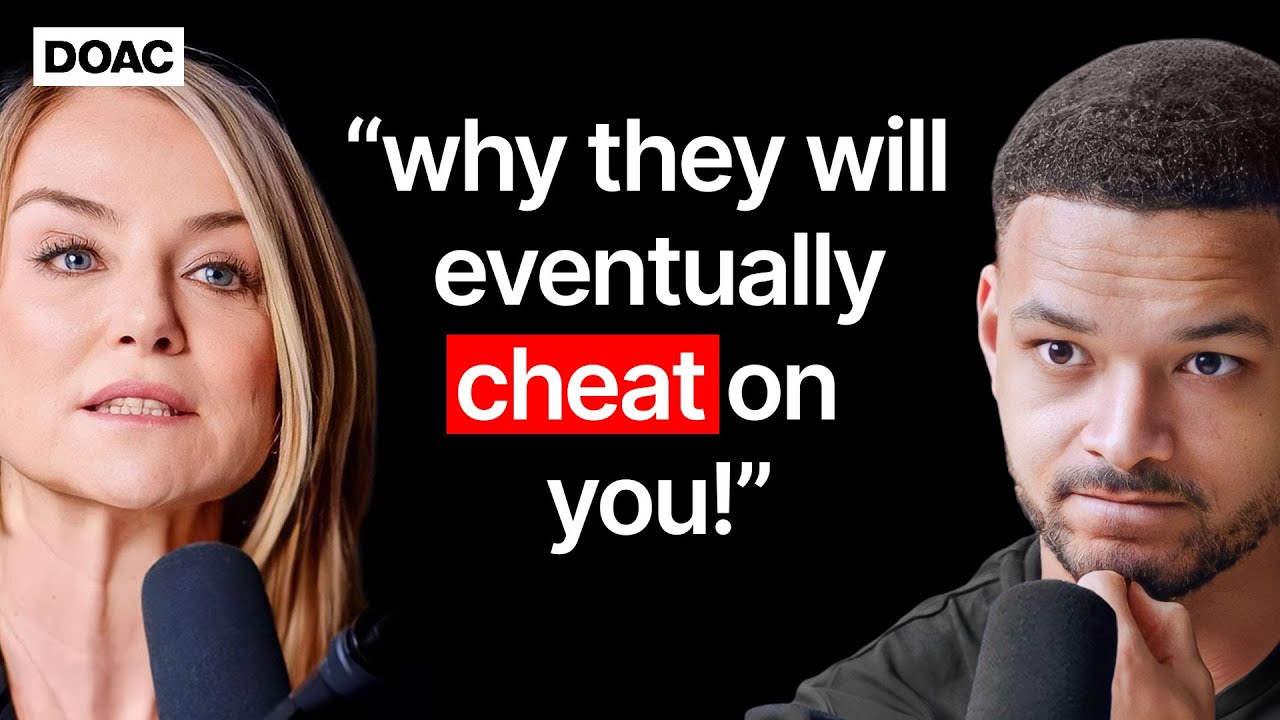
Esther Perel Links Relationship Breakdown to Modern Domestic Isolation
The Diary Of A CEO
Long-term relational desire fails because modern couples demand an entire community's worth of emotional fulfillment from a single partner while withdrawing from physical intimacy.
## Background
Published by Steven Bartlett on his YouTube channel The Diary Of A CEO on December 07, 2023, this video presents an extended conversation with relational expert Esther Perel. According to the page description, the episode explores the three attachment styles, reasons people struggle in love, strategies for reviving romantic sparks, and the dynamics of modern intimacy.
## TL;DR
Psychotherapist Esther Perel joins Steven Bartlett to examine how childhood experiences, communication loops, and modern societal pressures shape romantic relationships. The discussion covers the distinction between security and adventure, the underlying drivers of sexlessness and infidelity, and how to navigate power dynamics in the bedroom. Steven shares personal reflections on his own past relationship struggles, while Perel provides actionable framework for transforming conflict into deep emotional connection. Ultimately, the conversation highlights that love is a continuous practice requiring active vulnerability, maintenance, and mutual curiosity.
## Atmosphere & style
The conversation carries an intimate, deeply reflective, and intellectually rich tone, balancing expert therapeutic insight with raw personal disclosure. Esther Perel offers a compassionate yet sharp analytical presence, while host Steven Bartlett engages as an open, vulnerable sounding board sharing his own past relationship missteps. The emotional arc transitions from analytical breakdowns of relationship patterns into candid discussions about intimacy, sexual rejection, and human decency, creating an atmosphere that feels like a private, illuminating masterclass in love and human connection.
## Key takeaways
- [00:00](https://www.youtube.com/watch?v=nTWXfo7narw&t=0s) Relationships require continuous, intentional effort; neglecting them with laziness leads to relational bankruptcy and emotional decay.
- [03:02](https://www.youtube.com/watch?v=nTWXfo7narw&t=182s) Modern freedom removed traditional social structures, requiring individuals to actively cultivate relational skills to sustain connection.
- [06:17](https://www.youtube.com/watch?v=nTWXfo7narw&t=377s) Human relationships constantly negotiate the balance between two core needs: security (protection) and adventure (freedom).
- [09:27](https://www.youtube.com/watch?v=nTWXfo7narw&t=567s) Couples often fall into repetitive pursuer-distancer loops, where one partner's defensive coping strategy directly triggers the other's vulnerability.
- [24:41](https://www.youtube.com/watch?v=nTWXfo7narw&t=1481s) Micro-interactions, bids for connection, and intentional physical touch are crucial to interrupting systemic relational decay.
- [40:06](https://www.youtube.com/watch?v=nTWXfo7narw&t=2406s) Conflict in relationships rarely centers on surface topics; it almost always stems from underlying core needs for trust, recognition, or control.
- [47:49](https://www.youtube.com/watch?v=nTWXfo7narw&t=2869s) Modern romantic expectations put immense pressure on relationships by demanding that a single partner fulfill needs once provided by an entire community.
- [01:02:17](https://www.youtube.com/watch?v=nTWXfo7narw&t=3737s) Men and women are socialized differently regarding intimacy: boys are often conditioned away from emotional vocabulary, causing them to channel emotional needs primarily through sex.
- [01:09:09](https://www.youtube.com/watch?v=nTWXfo7narw&t=4149s) To desire sex, women require 'sex that is worth wanting,' shifting the focus away from performance to mutual pleasure and emotional connection.
- [01:16:14](https://www.youtube.com/watch?v=nTWXfo7narw&t=4574s) Pornography and AI companions appeal to men primarily because they eliminate three main vulnerabilities: fear of rejection, performance anxiety, and doubt about a partner's pleasure.
- [01:19:16](https://www.youtube.com/watch?v=nTWXfo7narw&t=4756s) Overcoming sexlessness requires moving away from linear performance models and addressing non-sexual touch, body shame, health issues, and underlying resentments.
- [01:35:33](https://www.youtube.com/watch?v=nTWXfo7narw&t=5733s) Infidelity often stems from profound loneliness or a desire to reconnect with a lost part of oneself, serving as a psychological attempt to feel alive rather than just a rejection of a partner.
- [01:43:47](https://www.youtube.com/watch?v=nTWXfo7narw&t=6227s) Sustaining long-term desire requires seeing one's partner as a separate, passionate individual in their own element rather than an extension of oneself.
- [01:52:00](https://www.youtube.com/watch?v=nTWXfo7narw&t=6720s) Couples must view their relationship as a distinct 'third entity' that requires care, open communication, and active appreciation to thrive.
## Detailed walkthrough
### [00:00](https://www.youtube.com/watch?v=nTWXfo7narw&t=0s) Intro: The Magic and Science of Relationships
The episode opens with a high-stakes provocation comparing how people treat their businesses to how they treat their personal relationships: if a business were treated with the same neglect, complacency, and laziness that many bring home, it would quickly go bankrupt. Love is not a permanent state of enthusiasm that just exists on autopilot. Relationships deteriorate when people offer the best of themselves at work and bring home only the tired leftovers, glued to their phones and emotionally absent. This creates a destructive figure-eight loop: the less present one partner is, the more alone the other feels—and the more alone they feel, the more they test their partner to see if they are truly supported. Whether the fight is about money, children, or sex, the quality of your life is ultimately determined by the quality of your relationships.
Podcast host Steven Bartlett introduces Esther Perel—world-renowned relationship therapist, bestselling author, podcaster, and iconic TED speaker—as a "wizard" whose profound insights completely shatter and rebuild how we understand human connection. Bartlett notes that after a decade of viewing relationships as a confusing black box, Perel provides the answers to why partners chase, retreat, feel needy, or grow anxious.
* **Key Insight:** Relationships require active investment; bringing work leftovers home degrades connection.
* **The Figure-Eight Loop:** Emotional absence triggers partner testing, which further drives withdrawal.
Esther Perel frames her core life mission around a foundational principle: the quality of your life is determined by the quality of your relationships. Despite this, relational dynamics are rarely treated as a serious subject of inquiry. In the business world, relationship skills are often dismissed as "soft skills," "fluff," or "feminine concerns"—valued in theory, but disregarded in practice. Historically, relationships didn't require as much conscious navigation because they were strictly codified by religious, social, and communal structures.
In the modern Western world, these traditional scaffolding structures have been dismantled. Relationships are undergoing a massive cultural transformation, yet most people lack the tools and skills to navigate this shifting landscape. Perel’s mission is to guide people across all relational spheres—workplace friendships, family ties, and romantic partnerships—helping them build the insight needed to sustain human connection. As machines enter the workforce and daily life, preserving our relational capacity is a matter of psychological survival.
> "The quality of your life is determined by the quality of your relationships... Without it, we die."
* **Historical Context:** Relationships used to be strictly codified by community and religion; today's freedom requires new relational skills.
* **Core Philosophy:** We discover who we are only in the presence of the other; without connection, the human soul starves.
---
[06:17](https://www.youtube.com/watch?v=nTWXfo7narw&t=377s) The Impact of Childhood on Relationship Patterns
Exploring the origins of relational behavior, Bartlett asks how childhood experiences dictate adult dynamics. Perel cautions against rigid determinism: we are not merely what happened to us, but who we choose to become. Many of our greatest inner strengths and coping mechanisms are forged directly out of childhood miseries and deprivations. A childhood lack can awaken an acute awareness that leads someone to build the exact opposite environment as an adult.
Drawing from her book *Mating in Captivity*, Perel outlines two fundamental human needs: the need for **security** (safety, protection, grounding) and the need for **adventure** (freedom, space, individuality). Childhood experiences shape which of these needs a person prioritizes, but these tendencies remain dynamic. While we cannot rewrite the facts of our past, we can completely transform its legacy and meaning in our adult lives.
* **Two Core Needs:** Security/Protection vs. Adventure/Freedom.
* **Non-Linear Healing:** Childhood adversity doesn't automatically dictate failure; it often develops vital adult resilience.
---
[09:27](https://www.youtube.com/watch?v=nTWXfo7narw&t=567s) Navigating Couple Dynamics: The Figure-Eight Dance
When couples sit on her couch, Perel looks beyond individual histories to analyze the interlocking patterns two people create together. She describes these as "dances"—interactive loops where one partner's survival strategy triggers the other partner's core vulnerability. For instance, if a person grew up feeling forced to fend for themselves, a partner's minor unresponsiveness isn't viewed as a simple oversight; it triggers a deep fear of total abandonment ("I'm always alone; I carry all the burden").
This interaction forms a classic figure-eight loop. Once established, the specific topic of a fight—whether money, sex, chores, or in-laws—is irrelevant; the underlying filter remains identical. Bartlett recognizes his own relationship in this description, identifying himself as the partner who guards his independence against perceived intrusions ("nobody tells me what to do"), while his partner acts as the pursuer seeking presence.
* **Pattern Recognition:** It's not about the argument's topic (money, chores, sex); it's about the underlying structural loop.
* **Survival Strategies:** A partner's distance triggers the other's pursuit, which in turn reinforces the distance.
---
[13:16](https://www.youtube.com/watch?v=nTWXfo7narw&t=796s) Interrupting the Cycle of Pursuit and Distance
Bartlett shares a concrete example from his own life: returning home at 9:00 p.m., opening his laptop to finish work, and giving half-hearted acknowledgments to his partner. Sensing his emotional distance, his partner begins asking seemingly random questions or offering drinks to capture his focus. In response, Bartlett grows more blunt, interpreting the interaction as an invasion of his boundaries.
Perel highlights the core dynamic: the couple is co-creating each other's behavior. His half-attention turns her into a "knocker," and her constant knocking turns him into a "withholder." Perel points out that Bartlett's partner is actually holding the emotional flame for the relationship—if she disappeared for six days, he would quickly feel the void. To break this dynamic immediately, Bartlett doesn't need to change his partner; he can shift his own response. Spending just 30 seconds for a genuine embrace and clear communication ("I'm excited to spend time together in 20 minutes") calms her nervous system and protects his boundaries.
> "We make the other... You are creating a knocker, and she's creating a withholder."
* **Co-Creation:** Partners actively train each other into the very behaviors they complain about.
* **The 30-Second Shift:** A brief moment of intentional eye contact, a hug, and clear expectations can soothe a partner's anxiety.
Continuing the discussion on pursuer-distancer roles, Perel reframes why partners pick each other. People don't simply attract opposites; they choose partners who express the disavowed parts of themselves. Bartlett, by focusing heavily on his need for autonomy and independence, outsources his need for intimacy and connection to his partner. She carries the emotional quota for both of them, allowing him to stay in the comfort of his independence without facing his own potential loneliness.
This insight represents a major turning point in couples therapy. When partners realize they are outsourcing their suppressed needs onto each other, the illusion of being "incompatible" breaks down. Realizing how deeply interconnected their reactions are allows couples to stop blaming one another and start restructuring the dynamic together.
* **Relational Outsourcing:** Partners delegate disavowed needs (like intimacy or independence) to each other.
* **Therapeutic Turning Point:** Recognizing that you are part of the dynamic empowers you to single-handedly alter the relationship's direction.
[18:28](https://www.youtube.com/watch?v=nTWXfo7narw&t=1108s) Balancing Independence and Interdependence
Relationships require navigating the dual human needs for security and autonomy—balancing the comfort of home with the excitement of exploration, and predictability with freedom. Conflicts arise when partners outsource their conflicted needs onto each other. One partner may embrace their independence while downplaying their dependence, while the other takes on the pursuer role.
The dynamics transform when partners integrate both sides of this equation. Recognizing that you would deeply miss a partner if they stopped pursuing you is the giveaway that independence is bound up with interdependence.
```
+-----------------------------------------------------------------------+
| THE DYNAMIC OF DESIRE |
| |
| [ Independence / Autonomy ] <-----> [ Dependence / Connection ] |
| (Focus on work, space) (Focus on shared time) |
| |
| * Interdependence occurs when both partners integrate both sides. |
+-----------------------------------------------------------------------+
```
* **Complementary roles:** Opposite tendencies can serve as an essential counterbalance, pulling an over-focused partner away from unsustainable work habits toward shared rest and experiences.
* **Acknowledging contributions:** Directly acknowledging how a partner balances your life—rather than reserving communication solely for asserting space and boundaries—fosters a deeper relational connection.
---
[21:37](https://www.youtube.com/watch?v=nTWXfo7narw&t=1297s) The Shift from Apology to Gratitude
A pivotal shift in couple dynamics happens when partners move from apologizing for what they missed to expressing gratitude for what the other made possible. Apologizing for working late or missing events can inadvertently signal, *"I'm so important that my absence is a tragedy."*
Reframing this into direct gratitude alters the entire dynamic. Saying, *"Thank you for taking care of things so I could focus on this,"* humbles the individual and explicitly validates the partner’s role in their shared life.
> "When you apologize about your absence... you're basically still saying, 'I'm super important.' But if you actually said, 'I'm so thankful that you're here because I could not have stayed at the office late... if you were not here,' then you are actually saying, 'I couldn't do this without you.'"
* **Building relational meaning:** Demonstrating interdependence reassures the other person that they are essential and valued rather than intrusive or demanding.
* **Acknowledging backend support:** Expressing gratitude acknowledges that professional success or external freedom is actively bolstered by the partner's contributions.
---
[24:41](https://www.youtube.com/watch?v=nTWXfo7narw&t=1481s) Preventing "Ambiguous Loss" and Modern Distraction
Relationships degrade when partners give the best of their energy, creativity, and focus to work or external projects while bringing home only the leftovers. Treating a romantic relationship as a passive, self-sustaining element leads to complacency and emotional erosion.
Distraction—specifically through screens and constant device use—creates a state of **ambiguous loss**. A partner can be physically present in the room but psychologically and emotionally absent, fostering a distinct form of modern loneliness.
| Relational State | Physical Presence | Emotional/Psychological Presence | Example / Impact |
|:--- |:--- |:--- |:--- |
| **Active Connection** | Present | Present | Engaged conversation, shared walks, full attention |
| **Ambiguous Loss (Type A)** | Present | **Absent** | Scrolling on phones, watching TV while ignoring partner |
| **Ambiguous Loss (Type B)** | **Absent** | Present | Partner deployed, held hostage, or absent after a loss |
* **The "Cactus" Fallacy:** Assuming a relationship can survive without active care—like a cactus in the desert—inevitably leads to decay.
* **Simple Interventions:** Small changes, such as going for a 30-minute side-by-side walk without screens, eliminate digital friction and allow natural, low-pressure conversations to flow.
* **Cybernetic Feedback Loops:** In any relational system, changing your own behavior alters the entire dynamic: *"If you want to change the other, change yourself."*
---
[32:01](https://www.youtube.com/watch?v=nTWXfo7narw&t=1921s) Small "Bids for Connection" and Maintenance
Relational decay rarely happens through sudden, dramatic events; it accumulates through hundreds of ignored micro-interactions. These micro-interactions are known as **bids for connection**—small gestures, shared links, or comments aimed at maintaining emotional contact.
Failing to acknowledge these bids—such as leaving a shared article or message without a response—signals that the connection is unimportant. Over time, failing to validate these small bids leads partners to feel taken for granted, eroding relational intimacy.
* **Definition of Bids:** A bid for connection is any small attempt to engage or share an experience, such as saying, *"Hey, look at this article."*
* **The Power of Acknowledgement:** Acknowledging a bid is not about the content itself (the video, link, or item); it signals, *"We are part of a shared thread, and I notice you."*
* **The Impact of Modern Divorces:** Historical shifts mean family survival now depends directly on the quality and happiness of the adult couple. Because partners are no longer bound solely by financial or social necessity, maintaining active relational health is essential to keeping the unit together.
> "Love is a verb and you conjugate it actively in many tenses. It's a practice."
```json
{
"widgetSpec": {
"height": "600px",
"prompt": "**Objective:** Create an interactive simulator demonstrating the compounding impact of micro-interactions ('Bids for Connection') vs. ignored bids on relational connection over time.\n\n**Data State:** Initialize with daily connection score = 50, days = 30, bid frequency = 3 per day, turn-towards rate = 50%.\n\n**Strategy:** Form Layout with dynamic visual feedback.\n\n**Inputs:**\n1. Daily Bids Made (slider, range 1-10, default 4)\n2. Rate of Turning Towards / Acknowledging (slider, range 0%-100%, default 50%)\n3. Presence Level / Screen-Free Time (slider, range 0-100%, default 40%)\n\n**Visuals/Behavior:**\n- Show a dynamic line chart tracking 'Emotional Connection Index' over a simulated 90-day period based on inputs.\n- Display qualitative outcome readouts based on current parameters (e.g., 'Relational Drift & Ambiguous Loss Risk', 'Stable Coexistence', or 'High Intimacy & Trust').\n- Provide a interactive toggle list of common daily bids (e.g., 'Shared a video/meme', 'Asked about day', 'Side-by-side walk') showing how small changes yield big long-term shifts."
}
}
```
</GenerateWidget>
<ElicitationsGroup message="Explore related concepts from Esther Perel's work on dynamics and connection:">
{/* Reason: Offers relevant, specific next steps based on the core themes of relational maintenance and communication patterns discussed in this section. */}
<Elicitation label="Explore strategies to revive eroticism and spark" query="What does Esther Perel advise for reviving eroticism and maintaining sexual desire in long-term relationships?"/>
<Elicitation label="Break down communication patterns in conflict" query="How can couples transform conflict into connection according to Esther Perel's framework?"/>
<Elicitation label="Examine the impact of attachment styles" query="How do the 3 primary attachment styles shape modern romantic relationships and conflict dynamics?"/>
</ElicitationsGroup>
[36:45](https://www.youtube.com/watch?v=nTWXfo7narw&t=2205s) Active Conjugation: Love is a Verb, Not a Permanent State
Esther Perel challenges the idea that love is merely a passive emotion or a permanent state of enthusiasm that sustains itself automatically. She points out that when simple relationship "cushioning"—such as saying hello, expressing gratitude, acknowledging one another, and sharing small daily moments—begins to thin out, it is because partners have stopped actively conjugating the verb "to love."
To highlight this neglect, Perel asks Steven Bartlett if he knows anyone who would treat their business with the same lazy attitude that people often bring to their romantic relationships. Such a business would be dead almost instantly. A relationship does not simply break down out of nowhere; it deteriorates because partners stop actively engaging in the fundamental verbs of connection: expressing, showing, giving, receiving, sharing, wanting, imagining, playing, and exploring.
[38:03](https://www.youtube.com/watch?v=nTWXfo7narw&t=2283s) Re-evaluating Modern Demands on Love and Family
Steven Bartlett brings up a personal query, asking whether the historical shift—where relationship health now dictates family stability rather than external pressures like the church—might explain why younger generations are having fewer children. Sharing a reflection from his own relationship, Bartlett notes that his partner feels she will be ready to have children when she feels completely secure in their connection, whereas historically, couples remained together regardless of marital satisfaction.
Perel offers a nuanced counter-perspective, noting that historically, high birth rates were linked to economic necessity, limited choices, and the view that children represent a family's abundance and labor supply. Today's declining birth rates are often driven by a reluctance to give up personal freedoms and comforts, as well as the modern availability of reproductive choice. However, this conversation leads back to a fundamental question regarding how couples navigate internal instability and relationship strife.
- **Verbs of Connection:** Loving requires active engagement in verbs like *expressing, giving, receiving, sharing, imagining, playing,* and *exploring*.
- **Historical Sex Roles:** For most of history, sexual intimacy within marriage was viewed primarily as a procreative duty rather than an ongoing pursuit of personal connection and pleasure.
[40:06](https://www.youtube.com/watch?v=nTWXfo7narw&t=2406s) Transforming Conflict into Connection: What Are You Fighting For?
Focusing on her course, *Turning Conflict into Connection*, Perel observes that couples often become consumed by surface-level bickering and arguments. Instead of dwelling on the strife itself, partners need to recognize that conflict usually signals a tear in the underlying fabric of connection. Just as no leader would tolerate continuous, unresolved bickering within a business, couples should not normalize chronic friction in their home life.
Perel gives Bartlett a practical exercise: identify three actionable things to change that will improve the relationship, commit to them unconditionally, and give them time without waiting for the other partner to act first. Furthermore, when couples enter into friction, Perel advises them to pivot from asking "What are we fighting *about*?" to asking "What are we fighting *for*?" Across all demographics, most couples are essentially fighting for one of three core needs:
1. **Trust:** Reassurance that the other person genuinely has their back.
2. **Recognition:** Feeling valued, seen, and appreciated.
3. **Control:** Ensuring their own needs, beliefs, and expectations hold equal priority.
[43:29](https://www.youtube.com/watch?v=nTWXfo7narw&t=2609s) Aliveness vs. Survival: Cultivating Eroticism and Social Resilience
Relationships generally fall into two categories: those that merely survive by going through the motions, and those that are genuinely alive—radiant, vibrant, vital, and curious. Perel defines eroticism not merely as a physical or sexual act, but as an essential life force that fuels overall vitality. Cultivating this sense of aliveness within a partnership provides energy that spills over into every other aspect of life.
Perel then links adult conflict resolution skills to childhood experiences, asking Bartlett if he played freely on the streets as a child. Unchoreographed, unscripted street play taught previous generations essential social skills—how to handle friction, compete, collaborate, resolve disagreements, navigate jealousy, and form alliances. Modern children, by contrast, often lack these unstructured social experiences, leaving them less equipped to navigate interpersonal conflict.
- **The Role of Unstructured Play:** Street play allowed children to practice conflict resolution, negotiation, and emotional recovery organically.
- **Societal Atrophy:** The shift away from free play, combined with screen time and pandemic isolation, has created a generation that is increasingly conflict-avoidant, socially fragile, and prone to polarization.
[47:49](https://www.youtube.com/watch?v=nTWXfo7narw&t=2869s) Uncertainty, Anxiety, and Manufactured Insecurity
The modern drive to create a friction-free, fully predictable world through technology has degraded humanity's tolerance for uncertainty. When people cannot tolerate uncertainty, their anxiety levels surge, contributing directly to the current mental health crisis. Perel emphasizes that letting children experience serendipity, risk, and social connection outside the isolated nuclear family unit is vital for building emotional resilience.
While stopping short of labeling younger generations outright as "less resilient"—noting that many young people demonstrate immense strength in tough conditions—Perel acknowledges that today's youth face unique struggles. Manufactured insecurity, perfectionism, high anxiety, and fear of failure make it difficult for young people to experiment or take risks. Yet, as Perel notes, "You can't innovate without uncertainty," making an appetite for risk indispensable for personal and creative growth.
[50:53](https://www.youtube.com/watch?v=nTWXfo7narw&t=3053s) *Mating in Captivity*: Reconciling Security and Freedom
Discussing her seminal book, *Mating in Captivity* (published 17 years prior), Perel explains why its themes remain timeless. The book addresses the central paradox of modern romantic relationships: the attempt to reconcile two fundamentally opposing sets of human needs within a single partner. Humans crave safety, predictability, and dependability on one hand, while desiring freedom, novelty, exploration, and risk on the other.
Historically, these needs were fulfilled across an entire community—religion provided identity and belonging, family offered economic safety, and social structures managed continuity. Today, society expects a single partner to be a best friend, financial co-pilot, passionate lover, and inspiring soulmate who helps us become the best version of ourselves. Furthermore, as sexuality shifted from a procreative obligation to an ongoing search for pleasure and emotional connection, couples were left trying to sustain desire over long periods without a clear blueprint.
- **The Modern Relationship Paradox:** Balancing the need for stability (*security, safety, dependability*) with the need for passion (*novelty, risk, exploration*).
- **Paradoxes vs. Problems:** Relationship challenges are rarely binary problems to be solved with quick fixes; they are paradoxes that must be continuously managed.
- **Resource Distribution:** Sustaining both career ambition and romantic passion requires a conscious allocation of emotional energy, ensuring that creative and erotic vitality are not completely drained before reaching one's partner.
[55:58](https://www.youtube.com/watch?v=nTWXfo7narw&t=3358s) Living with Relational Contradictions
The conversation opens with lighthearted banter between Steven Bartlett and Esther Perel. Steven quips that everything Esther says must be true simply because she is the one saying it. Esther laughs off the praise, noting that while she may sound authoritative, she rarely thinks she is definitively right. Steven shifts to a core philosophical dilemma surrounding modern relationships: if we expect everything from a single partner—demanding safety, security, and familiarity while simultaneously craving mystery, spontaneity, and erotic thrill—do we simply have to accept this inherent contradiction? He questions whether humans are naturally meant to be polygamous or adopt more fluid, multi-partner arrangements similar to historical or cultural practices across the world.
Esther clarifies that navigating this contradiction is less about changing relationship structures and more about how couples manage internal dynamics. Maintaining passion isn't about eliminating or neutralizing the tension between stability and novelty; rather, it requires "constantly moving the weight from one side to another." Drawing a comparison to organizational leadership, she notes that every living system—whether a relationship or a company—must continuously balance continuity with innovation.
- **The Fossilization Trap:** If a system refuses to change, it fossilizes and dies.
- **The Chaos Trap:** If a system changes continuously without grounding, it becomes dysregulated, chaotic, and exhausted.
- **Dynamic Equilibrium:** Healthy couples alternate between periods of "bundling" (seeking comfort and safety) and phases of exploration, curiosity, and creative play.
[58:38](https://www.youtube.com/watch?v=nTWXfo7narw&t=3518s) Monogamy, Polyamory, and Evolving Relationship Models
Moving from internal relationship dynamics to structural choices, Esther distinguishes the challenge of keeping desire alive from the question of monogamy itself. She observes that the contemporary landscape has opened a broad vista of alternative models, ranging from consensual non-monogamy to polyamory. These arrangements serve very different psychological functions depending on the individuals involved.
Esther points out that for some people, non-monogamy represents "an expression of liberation," whereas for others, the exact same dynamic proves "rather torturous." She stresses that there is no one-size-fits-all model for human connection. While family structures and societal norms around parenting have evolved dramatically over the past century, the fundamental model of the couple has historically been one of the least innovative institutions in human society.
[59:29](https://www.youtube.com/watch?v=nTWXfo7narw&t=3569s) Romantics vs. Realists
Steven turns to Chapter 1 of Esther's book, asking her to unpack the contrast between "romantics" and "realists." Esther explains that romantics are inherently aspirational figures who live in the realm of imagination, seeking to transcend boundaries, bodily limits, and narrow everyday realities. They engage actively with the unknown through a lens of longing, yearning, discovery, and reverence for deep connection.
Realists, on the other hand, are pragmatists. When a romantic looks at a relationship and insists "there must be more," a realist responds by saying "this is fine as is. Why should there be more?" Where the romantic envisions infinite possibilities, the realist cautions against hidden "minefields or landmines."
- **Beyond Gender Stereotypes:** Esther firmly rejects the notion that this division falls neatly along gender lines. While traditional heterosexual tropes depict the man saying "everything's fine, and if she was fine, everything would be fine," she sees the romantic-realist dynamic across all couples regardless of gender.
- **Childhood Origins:** The pull toward romanticism or realism is driven far more by an individual's childhood narrative, attachment history, and relational upbringing than by biological sex.
[01:02:17](https://www.youtube.com/watch?v=nTWXfo7narw&t=3737s) Male Socialization and the Gendered Vocabulary of Desire
Steven asks whether emotional communication is a natural strength for women over men, but Esther rejects the premise that men simply talk less or lack emotional depth. Instead, she highlights a systemic flaw in how boys are socialized: by around age seven, boys are essentially "emptied out from the vocabulary of emotions." Society conditions them to value stoicism, fearlessness, and competitiveness over interiority and emotional reflection.
Drawing on her decades of experience as a couple's therapist, Esther shares a profound distinction between male and female vulnerability in therapy. When a woman articulates an emotion, she has usually spoken about it with friends before; but when a man finally opens up, "you know that he's hearing himself for the first time."
- **The Gendered Permissibility of Language:** Every gender is given social license to express human needs only through specific, designated vocabularies.
- **Men's Channel for Intimacy:** Men are socialized to express longings for tenderness, care, holding, and physical comfort through the single permitted outlet of sex.
- **Women's Channel for Desire:** Women are socialized to express their sexual desire, seduction, and pleasure through the language of relational connection and emotional closeness.
- **Core Similarity:** Beneath these socialized scripts, research consistently shows that men and women desire the same underlying emotional and physical experiences.
[01:06:25](https://www.youtube.com/watch?v=nTWXfo7narw&t=3985s) Feminism, Gender Roles, and the Erotic Realm of "As If"
Steven quotes a line from Esther's writing noting that democratic virtues—equality, consensus-building, compromise, fairness, and mutual tolerance—can, when applied too "punctiliously" in the bedroom, result in remarkably boring sex. Esther agrees, emphasizing that erotic desire does not always follow political correctness. In a voluntary, consensual, and playful context, individuals frequently enjoy stepping out of daily egalitarian roles to explore dynamics of power, surrender, and boundary-crossing.
Esther compares adult erotic play to children playing games like "prisoners," "firemen," or "doctors and patients." Children intuitively understand that play exists in a separate universe of "as if," where temporary restriction is thrilling precisely because it is make-believe. Nobody wants to be held captive or controlled non-consensually in real life, but within a trusted sexual container, eroticizing power creates energy and depth.
> "If you play hide and seek, the most amazing thing when you're hiding is to know that somebody's looking for you. But the minute you begin to wonder, are they still looking for you? The thrill turns into terror. This is what happens in sex too."
[01:09:09](https://www.youtube.com/watch?v=nTWXfo7narw&t=4149s) Gender Bias in Research and the Redefinition of Desire
Esther highlights a striking statistic from a course she recently taught: roughly 97% of scientific research on sexual desire focuses exclusively on women. This imbalance reveals a pervasive cultural assumption that men never struggle with desire and are always ready for sex, leaving men's sexual difficulties largely unstudied while medicalizing female desire under diagnoses like hyposexual desire disorder.
She contextualizes modern intimacy within three massive historical revolutions:
1. **Contraception:** Separated sex from reproduction.
2. **Assisted Reproductive Technologies:** Separated reproduction from sex.
3. **Gender Fluidity:** Separated physical anatomy from gender identity.
These cultural shifts have transformed sex from a woman's marital obligation into a mutual pursuit of connection and pleasure that can extend throughout an individual's entire life into old age. Addressing common concerns about low female libido, Esther argues that women rarely suffer from a biological lack of desire; rather, "in order to want sex, it needs to be sex that is worth wanting."
[01:12:09](https://www.youtube.com/watch?v=nTWXfo7narw&t=4329s) Overcoming Sexlessness: Steven Bartlett's Personal Story
Steven candidly shares a personal story from early in his relationship when his partner told him outright, "I don't like having sex with you." Emasculated and confused, Steven initially assumed she must have a medical defect or require medication. The conflict led to a year-long breakup, during which both partners did significant individual growth work before reuniting.
Upon reconnecting, Steven realized that his partner actually enjoyed sex immensely, but they had been operating with completely different expectations. He compares his initial mindset to speaking "Spanish," while his partner was speaking "French." Once he recognized that sex involves multiple distinct "languages" and took the time to learn hers, their physical intimacy and overall relationship flourished. Esther validates his experience, noting that when couples successfully resolve sexual misunderstandings, it fundamentally transforms the entire quality of their union.
[01:14:24](https://www.youtube.com/watch?v=nTWXfo7narw&t=4464s) The Anxiety of Rejection and the Traps of Talking About Sex
Esther Perel reiterates a core philosophy about intimate relationships: while updating a domestic space like a kitchen won't transform what happens in the bedroom, changing the dynamic in the bedroom fundamentally transforms how two people interact throughout their home. She emphasizes that couples often fall into the trap of trying to fix a lacking sex life by endlessly discussing their lack of desire. It is nearly impossible to cultivate desire through conversations about not wanting sex. Instead, partners must actively experiment, take emotional risks, and explore together—accepting that when something fails, they simply pivot and try something else. Unfortunately, people frequently interpret a partner's hesitancy or a failed attempt as personal criticism, retreating into defensive counterattacks.
Steven Bartlett opens up about a deeply vulnerable experience in his own relationship that illustrates this cycle. He describes how, after initiating sex and being rejected early on, he developed an intense, ongoing anxiety surrounding intimacy. This fear persisted through a six-month period of repeated rejections, ultimately turning him off from initiating altogether. Even after they resolved the underlying issue and his partner began initiating regularly, Steven realized he had developed a deep-seated mental block: he now expected her to always make the first move. He shares how damaging this internal monologue is for men, noting that when trying to get an erection, the absolute last thing a man needs is to be trapped in his own head, endlessly overthinking whether he is about to be rejected.
```
┌──────────────────────────────┐
│ Attempt to Initiate Sex │
└──────────────┬───────────────┘
│
▼
┌──────────────────────────────┐
│ Partner Rejection │
└──────────────┬───────────────┘
│
▼
┌──────────────────────────────┐
│ Performance Anxiety & │
│ Fear of Rejection │
└──────────────┬───────────────┘
│
▼
┌──────────────────────────────┐
│ Withdrawal / Cessation of │
│ Initiating Intimacy │
└──────────────────────────────┘
```
- **Bedroom vs. Kitchen Dynamics:** Changing the emotional and sexual dynamic in the bedroom changes how partners show up in daily household life.
- **Action Over Endless Talk:** Desire cannot be generated by endlessly debating a lack of sex; it requires trying new activities and accepting experimentation.
- **The Cycle of Rejection:** Repeated rejection over a 6-month period conditioned Steven to stop initiating sex out of performance anxiety and fear of further rejection.
[01:16:14](https://www.youtube.com/watch?v=nTWXfo7narw&t=4574s) The Three Emotional Vulnerabilities Resolved by Pornography and AI
Perel explains that the fear of rejection represents one of the most significant emotional and sexual vulnerabilities for men. She highlights how pornography directly neutralizes this fear, serving as a powerful buffer for these deep-seated insecurities. In porn, a man is never turned down; the performer never says "not now," but instead demands more. Beyond eliminating rejection, pornography resolves two other major male vulnerabilities: performance anxiety and the doubt surrounding a partner's pleasure. In the digital environment, a man is never perceived as incompetent, and he never has to question whether his partner is satisfied because the performers explicitly dramatize extreme pleasure.
Steven shifts the conversation toward the emerging frontier of artificial intelligence, virtual reality, and augmented reality. He questions whether AI companions, synthetic bots, and VR headsets will become the ultimate extension of this dynamic. By putting on a headset, a user enters an idealized world where a digital partner knows exact preferences, never rejects them, and eliminates all risk of feeling inadequate or overbearing. Perel acknowledges that while this technology offers an understandable escape for an increasingly lonely society, she views it with deep caution. While some modern advancements excite her, the rise of synthetic substitutes for genuine human intimacy leaves her unsettled about where society is headed.
- **Vulnerability #1 (Rejection):** Pornography completely removes the possibility of being turned down or told "not now."
- **Vulnerability #2 (Incompetence):** The viewer never experiences performance anxiety or worries about doing something wrong.
- **Vulnerability #3 (Validation):** Perceived pleasure is guaranteed and exaggerated, eliminating doubts about a partner's satisfaction.
- **The Threat of AI & VR:** AI bots and AR headsets threaten to replace human connection by providing an idealized, zero-risk sexual partner, exacerbating societal isolation.
[01:19:16](https://www.youtube.com/watch?v=nTWXfo7narw&t=4756s) Redefining Sexlessness Beyond Frequency
When couples seek therapy for sexlessness, Steven asks how to recover when a relationship has been devoid of sex for six months. Perel responds with a reality check, noting that true clinical impasses and shutdowns often last not just months, but 5, 10, or even 16 years. She emphasizes that sexual shutdowns are incredibly common and affect everyday people, which is why her podcast, *Where Should We Begin?*, resonates so broadly. Perel explains that sexlessness should not be defined strictly by numerical frequency; instead, therapists evaluate the entire spectrum of physical intimacy, asking whether partners still kiss, hold each other, rub skin, or offer non-sexual affectionate touch.
Rebuilding an intimate life after years of touchlessness requires abandoning the performance-driven model of sex. Perel critiques the traditional linear model—viewing sex as five minutes of foreplay serving merely as a prelude to penetration and orgasm. She insists that true sexual connection focuses on the quality of the experience, emotional presence, and exploring different modes of touch (giving vs. receiving). Couples must learn to translate their internal desires into a constructive, non-critical sexual vocabulary—learning how to say "I enjoy this, and I would enjoy that even more" without resorting to shame or castrating critiques.
- **Duration of Sexlessness:** Severe intimacy blocks in long-term relationships often last for years or decades, rather than just a few months.
- **Broader Definition of Intimacy:** Assessment begins with non-sexual physical contact, such as holding hands, hugging, and affectionate skin-to-skin touch.
- **Rejecting the Performance Model:** Moving away from treating sex as a linear path to penetration/orgasm, refocusing instead on presence, fantasy, and mutual pleasure.
- **Constructive Communication:** Replacing critical language ("Why don't you like this?") with positive guidance ("I enjoy this, and I'd love to try that").
[01:23:22](https://www.youtube.com/watch?v=nTWXfo7narw&t=5002s) Uncovering Underlying Blocks: Health, Shame, and Age
Perel explains that identifying what blocks sexual intimacy requires deep exploratory work. When one partner refuses to engage in conversations about sex, she meets with them individually to uncover hidden issues. These blocks often stem from unaddressed body shame, historical trauma, lingering resentments, or fundamental relationship power imbalances. In heterosexual couples over the age of 55 who stop having sex, the primary driver is frequently medical rather than emotional. Prescriptions for blood pressure, diabetes, prostate issues, and depression severely impact male sexual function. When a man anchors his entire sexual identity to spontaneous erections, experiencing erectile dysfunction often leads him to give up entirely out of shame, rather than learning to engage his entire body in making love.
Steven candidly admits his own past reluctance to share his full sexual menu or explicit fantasies with partners, out of fear that they would judge him as a "weirdo" or run away. He recalls a pivotal moment from a year prior when his girlfriend directly asked him about his fantasies, leaving him frozen between offering a safe "vanilla menu" or being completely honest. Perel highlights that this widespread fear of judgment is precisely why she created her card game, *Where Should We Begin?*. By framing discussions around intimacy, desires, and guilty pleasures within a playful, structured game, couples can explore 60 dedicated cards on sexuality without feeling confronted or cornered.
- **Individual Therapy Sessions:** Used to explore private barriers like body odor concerns, historical trauma, or deep-seated resentment.
- **Medical Factors in Aging Couples:** For heterosexual couples over 55, sexlessness is overwhelmingly driven by male medications (antidepressants, blood pressure, prostate, and diabetes drugs).
- **Over-Reliance on Erections:** Men often abandon intimacy entirely when facing dysfunction, failing to realize that pleasure and lovemaking extend beyond penetration.
- **The Fear of Judgement:** Partners often hide their authentic desires and fantasies behind a safe "vanilla" facade to avoid being perceived as unusual or off-putting.
[01:28:35](https://www.youtube.com/watch?v=nTWXfo7narw&t=5315s) Mid-Sponsor Break: Eight Sleep and Huel
> "One of the controllables to have better sleep is temperature... It needs that temperature to kind of fluctuate through the night—starting cool, getting colder, and then heating up again, which is a reflection of nature." — **Steven Bartlett**
During a brief break, Steven highlights two sponsors supporting the show:
- **Eight Sleep:** Steven shares his obsession with health optimization and sleep quality, introducing Eight Sleep's temperature-regulating mattress technology. He explains how natural sleep requires fluctuating core temperatures throughout the night—cooling down during deep sleep and warming up before waking—and recommends the product for improving daily focus and mood.
- **Huel:** Steven outlines his chaotic travel schedule across the US and UK while filming TV shows and podcasts, emphasizing that Huel serves as an essential tool to maintain complete daily nutrition despite demanding professional commitments.
[01:30:13](https://www.youtube.com/watch?v=nTWXfo7narw&t=5413s) The Sex Game: Vulnerability, Sensuality, and Childhood Imprints
Returning to the episode, Esther Perel and Steven Bartlett pull cards from her *Where Should We Begin?* game to demonstrate how playfulness unlocks deep emotional honesty. Steven draws a card asking for *"the most sensual sexual experience I've had without having sex."* After a brief pause, he shares that taking a warm shower with his partner stands out as his most profoundly sensual experience. He explains that standing in the shower together creates a rare atmosphere of complete vulnerability—especially given that a man is completely flaccid, unposed, and unable to rely on physical performance or appearance.
Perel offers a psychological insight into Steven's experience, explaining why communal washing feels so deeply comforting and sensual. She notes that one of humanity's earliest foundational memories of non-sexual physical pleasure comes from being bathed as a child by parents or caregivers. The sensation of warm water pouring over the head, having soap washed off the back, and being gently cared for leaves a lasting psychological imprint of safety and physical nurture. By engaging with simple prompt cards—covering themes like guilty pleasures, lies told about sex lives, or conflicted fantasies—partners can safely lower their defenses and build a shared language around intimacy.
- **Showering as Sensual Touch:** Steven identifies showering with his partner as a peak non-sexual, sensual experience rooted in complete physical and emotional vulnerability.
- **The Caregiver Imprint:** Perel notes that being washed in warm water mirrors early childhood experiences of being cared for by parents, creating a baseline for non-sexual physical pleasure.
- **Gamifying Intimate Conversations:** Prompts regarding fantasies, past secrets, and guilty pleasures allow partners to communicate authentically without triggering defensiveness.
<ElicitationsGroup message="Explore related relationship dynamics and communication strategies:">
<Elicitation label="Learn how to rebuild intimacy after long-term sexlessness" query="How do couples rebuild physical and emotional intimacy after years of sexlessness according to Esther Perel?"/>
<Elicitation label="Examine the psychology behind male sexual vulnerabilities" query="What are the main psychological vulnerabilities men face regarding sexual performance and rejection?"/>
<Elicitation label="Explore strategies for discussing secret fantasies with a partner" query="How can partners safely communicate their sexual fantasies and desires without triggering judgment?"/>
</ElicitationsGroup>
[01:31:10](https://www.youtube.com/watch?v=nTWXfo7narw&t=5470s) Shame, Trauma, and the Unspoken Centrality of Sex
A massive pillar of relationship struggle revolves around the deep-seated shame, anxiety, and fear of judgment that people carry regarding their sexual fantasies and desires. This distress often stems from a stark reality: approximately one in four women and one in six men have experienced unwanted sex, violation, or sexual abuse. These traumatic events leave individuals carrying significant guilt and negative associations around an fundamental dimension of their being. Compounding the issue, society structurally trains people to remain silent about sex throughout their youth, yet suddenly expects them to seamlessly communicate about it as adults.
To illustrate how deeply sex is embedded in our upbringings, a powerful question is posed to live audiences: "Was sexuality central in your family growing up?" Initially, the vast majority answer no, citing that their parents never talked about it or showed outward affection. However, when the premise is reframed, the dynamic completely flips. If sex in a household was hidden, obfuscated, minimized, or only hinted at through dirty jokes, it didn't become absent—it became central through its taboo. If there was infidelity, misuse, or trauma, sex similarly dominated the emotional landscape. When looked at through this lens, 90% of people realize that sex was actually highly central to their formative years, while only 10% maintain it was peripheral.
- **Abuse Statistics:** 1 in 4 women and 1 in 6 men have history with sexual assault or violation.
- **The Centrality Flip:** While most people initially claim sex was absent in their childhood homes, 90% recognize its intense centrality once they account for silence, taboo, infidelity, and trauma.
[01:33:33](https://www.youtube.com/watch?v=nTWXfo7narw&t=5613s) The Dance of Avoidance and the Illusion of Connection
When addressing couples facing intimacy issues, the therapeutic approach does not simply plunge directly into the mechanics of their sexlessness. Instead, it begins by examining the structural "dance of avoidance" they have co-created. Couples develop elaborate systems to evade intimacy, such as one partner intentionally going to bed two hours before the other or pretending to be asleep to bypass any physical expectations.
In a recent case study, a husband desired sexual intimacy every day, leaving his wife feeling completely overwhelmed and outside of herself. It became clear that the husband was using sex as a sleep aid to unwind, treatable independently rather than relying on his wife as a tool for physical alleviation. The couple had fallen into a rigid transaction: the wife tracked the calendar, knowing that two days without sex was manageable, but by the third day, she had to brace herself just to get through it. Despite having four children and maintaining a fantastic relationship in every other area, this underlying pressure eroded their physical bond. The husband had waited patiently for years, naively assuming sex would naturally resume once the children grew up, completely unaware of the immense pressure he was exerting. Meanwhile, the wife remained disconnected from the idea that her partner deeply desired for her to genuinely share in the pleasure he experienced. Ultimately, simply "having sex" to check a box does not mean a couple is not effectively sexless.
[01:35:33](https://www.youtube.com/watch?v=nTWXfo7narw&t=5733s) The Real Reason People Cheat: Loneliness and Seeking a New Self
Data compiled from heavily replayed interview clips highlights a profound human truth: even individuals in open relationships cheat because humans possess a fundamental, irresistible draw toward the forbidden. While society stereotypically assumes men cheat simply because their physical needs are unfulfilled, or that infidelity is strictly the work of a "bad person," the reality is far more complex. Loneliness stands as the absolute biggest driver of infidelity.
People cheat for a host of reasons rooted in relationship discontent, including sexual frustration, lingering resentment, vengeance, and a constant need for external affirmation. However, ten years of dedicated research across 22 countries yielded a groundbreaking realization: affairs happen in happy couples, too. Often, an affair is not driven by a desire to leave the current partner, but rather a desire to leave the person the cheater has themselves become. It is less about meeting a new person and more about meeting an entirely different, long-lost version of oneself. While affairs inherently contain betrayal, duplicity, and lying, their core is built on longing, loss, and yearning. All over the world, the word people use most to describe their meaningful, non-transactional affairs is that it made them feel "alive." An affair acts as an erotic plot and a psychological antidote to emotional deadness.
- **Primary Driver:** Loneliness is the single most common catalyst for infidelity.
- **Global Scope:** The research spans extensive fieldwork across 22 different countries.
- **The Core Motivation:** Meaningful affairs are rarely just about sex; they function as a vehicle to feel alive and reconnect with vanished parts of the self.
[01:39:38](https://www.youtube.com/watch?v=nTWXfo7narw&t=5978s) Historical Consequences and Re-engineering the Erotic
For the vast majority of human history, men held a practical license to cheat. Society rationalized their infidelity by painting men as nomadic conquers who easily succumb to boredom and require constant novelty. Conversely, female infidelity was heavily pathologized as a pure deficit of intimacy and loneliness. In reality, women historically refrained from cheating not due to a lack of desire or fantasy, but because the biological and societal consequences were catastrophic. Up until the 1970s, women could not even open their own bank accounts; a cheating woman faced destitution, the loss of her children, and a permanent social scarlet letter. Women historically prioritized physical and financial safety over personal pleasure.
To prevent the emotional deadness that breeds affairs, couples must take the creative imagination, intentional planning, and effervescent energy typically poured into illicit text messages, flowers, and secret rendezvous, and actively invest that "full self" back into their primary relationship. Maintaining novelty over a marriage spanning 20 or 40 years requires a deliberate shift in habits. Familiar routines, like visiting the same beloved cafe or beach, cultivate deep warmth and friendship, but desire requires a different spark. Erotic desire is the pursuit of something you do not yet have or fully know. Cultivating it requires stepping out of predictability and trying new things together that carry a structural element of risk—whether that means exploring unfamiliar environments, checking into a hotel away from domestic life, or engaging in vulnerable conversations that have never been breached before.
[01:43:47](https://www.youtube.com/watch?v=nTWXfo7narw&t=6227s) The Three Keys to Attractiveness: The Power of the Separate Other
When a relationship experiences infidelity, it occasionally triggers a counterintuitive response where the betrayed partner suddenly values the unfaithful partner more. This happens because the affair shatters the mundane domestic image of their spouse—transforming them from a highly predictable roommate who just lays horizontally on the couch into a desirable, separate individual coveted by someone else.
Decades of global relationship data reveal three universal conditions under which people feel most drawn to their partners. The number one, bar-none most critical answer is seeing a partner in their element—radiant, competent, and deeply passionate about a personal pursuit, whether they are running a breathwork studio, riding a horse, or playing the piano. In that exact moment, the partner appears as a separate, slightly mysterious, and elusive individual who does not actively need them. That distinct space between two people is precisely where erotic energy thrives. The second condition is the joy of reunion after intentional time spent apart. The third is seeing a partner through the eyes of a third party, which instantly strips away taking them for granted and forces an appreciation of their unique value. While friendship often strengthens when couples spend all day together working from home, true erotic energy demands the preservation of distance, independence, and recognizing the partner as a beautiful, separate "other."
- **Condition 1 (The Absolute Top Answer):** Seeing the partner completely in their element, exhibiting passion and competence independently of the relationship.
- **Condition 2:** The experience of physical reunion after spending time apart.
- **Condition 3:** Viewing the partner through the appreciative eyes of an outside observer.
- **Gender-Specific Outlier:** The only highly gender-specific response recorded globally is when women report feeling drawn to their male partners specifically when watching them play affectionately with their children.
To explore how these dynamics manifest practically within long-term relationships, let's look at how couples can intentionally inject novelty into their day-to-day lives.
<ElicitationsGroup message="To explore these concepts further:">
{/* Reason: Provides actionable, structured pathways for the user to explore the deep psychological themes of long-term desire and affair prevention discussed in the text. */}
<Elicitation label="Methods for cultivating healthy relationship distance" query="What are practical strategies for long-term couples to create healthy emotional and physical distance to revive erotic desire?"/>
<Elicitation label="Analyze Eli Finkel's relationship research" query="Explain Eli Finkel's research on the 'all or nothing marriage' and how novelty versus routine affects long-term relationship satisfaction."/>
</ElicitationsGroup>
[01:48:39](https://www.youtube.com/watch?v=nTWXfo7narw&t=6519s) Maintaining Mystery, Long-Term Sex, and the Erotic Interiority
Steven Bartlett opens this section by reflecting on an experience watching his partner lead a breathwork session with 25 clients. Standing in the corner feeling completely irrelevant, like a spy among hypnotized participants, he found himself wondering who she was and who all these people were. It felt like meeting her for the first time. Esther Perel explains that this captures the power of seeing a partner in their own element through a "triangular gaze." Seeing how others interact with a partner breaks through the routine ways couples become "encrusted" in their habits, generating new perspectives and fresh energy.
Steven reads through a list of the show's most replayed relationship topics—including foreplay, maintaining erotic spaces, balancing love with desire, and avoiding giving a partner only the leftovers after giving friends and colleagues the best of oneself. He mentions insights from other podcast guests like Paul Brunson on long engagements, Marisa Peer on sexless relationships, and Sexologist Tracey Cox on why high-intensity "hot sex" fades after two years. Esther agrees that expecting continuous, intense passion over decades is unrealistic. While couples can occasionally experience out-of-the-blue hot sex, erotic couples rely heavily on "maintenance sex." They accept that each partner possesses an independent "erotic interiority"—a private world of thoughts and fantasies—which they view as natural rather than threatening.
- **The Triangular Gaze**: Watching a partner interact with others or excel in their professional domain creates necessary distance and renews mystery.
- **Maintenance Sex**: Long-term desire relies on consistent, routine connection rather than expecting constant, intense passion.
- **Erotic Interiority**: Healthy couples allow each other private thoughts and fantasies outside the relationship without feeling threatened.
[01:52:00](https://www.youtube.com/watch?v=nTWXfo7narw&t=6720s) Actionable Relationship Advice: Enlightened Self-Interest and the Written Word
When Steven asks for a practical, overarching takeaway for couples looking to improve their bond, Esther emphasizes that "love is a verb." It demands active engagement, risk, vulnerability, and personal accountability. Rather than waiting for a partner to change, individuals should practice enlightened self-interest by asking what they can change about themselves to make the relationship better. She frames the relationship as a third entity that both people must nurture. Every action, word, or choice to stay silent should be weighed against its effect on this third entity. She contrasts lazy, complacent attitudes toward love with the art of cooking, where one actively seeks out fine ingredients to craft something special.
To break through relationship stagnation, Esther suggests a simple exercise: writing a thoughtful, reflective letter to one's partner instead of sending quick digital messages. She walks through a hypothetical letter Steven could write to his partner about his day, reflecting on early memories, acknowledging how she has evolved, and expressing a desire to seek out new experiences together. Writing down appreciation, vulnerability, and fondness acts as "a tank of gasoline" and a vital lubricant that dissolves emotional calcification and revitalizes the bond.
- **The Third Entity**: A relationship is a distinct presence that requires actions served in its favor rather than solely out of immediate self-interest.
- **The Letter Exercise**: Sitting down to write a handwritten letter about shared history and present appreciation breaks through daily routine and emotional stagnation.
[01:56:22](https://www.youtube.com/watch?v=nTWXfo7narw&t=6982s) Turning Conflict into Connection and Esther's Core Life Advice
Esther highlights her short, eight-video online course titled *Turning Conflict into Connection*, accompanied by a detailed workbook. Designed for couples trapped in repetitive arguments who want to improve their dynamics without necessarily going into therapy, the course teaches couples to distinguish between what they are fighting *about* versus what they are fighting *for*. It helps partners identify the underlying wish behind every criticism and reverse "negative sentiment override"—the state where a relationship becomes dominated by constant criticism, judgment, and defensiveness.
Transitioning to the show's traditional closing question left by the previous guest—asking for the single piece of advice received in the last decade that she thinks about most frequently—Esther shares a lesson originally passed down by her father. Though he was illiterate and had only three years of schooling, he told her: "My little one, do not get impressed by the money, by the fame, by the education. Look at the decency." Esther recalls how this wisdom guided her during her younger years hitchhiking across various countries, where she was taken in by kind strangers who shared what little they had despite political differences or lack of basic electricity. That focus on human decency over status symbols remains her guiding light, keeping her grounded and serving as a lesson she passes down to her own children. Steven warmly thanks Esther for her brilliance, noting that his audience and team had requested this interview for years and that she exceeded all expectations.
- **Turning Conflict into Connection**: A one-hour, eight-video course with a workbook focused on uncovering unmet needs behind arguments and rebuilding fondness.
- **Negative Sentiment Override**: A cycle of pervasive criticism and judgment in relationships that requires deliberate skill-building to dismantle.
- **Father's Core Advice**: Focus on a person's fundamental decency and kindness rather than status, money, education, or fame.
## Notable quotes
> [03:02](https://www.youtube.com/watch?v=nTWXfo7narw&t=182s) The quality of your life is determined by the quality of your relationships... Without it, we die. — Esther Perel
> [13:16](https://www.youtube.com/watch?v=nTWXfo7narw&t=796s) We make the other... You are creating a knocker, and she's creating a withholder. — Esther Perel
> [21:37](https://www.youtube.com/watch?v=nTWXfo7narw&t=1297s) When you apologize about your absence... you're basically still saying, 'I'm super important.' But if you actually said, 'I'm so thankful that you're here because I could not have stayed at the office late... if you were not here,' then you are actually saying, 'I couldn't do this without you.' — Esther Perel
> [32:01](https://www.youtube.com/watch?v=nTWXfo7narw&t=1921s) Love is a verb and you conjugate it actively in many tenses. It's a practice. — Esther Perel
> [01:02:17](https://www.youtube.com/watch?v=nTWXfo7narw&t=3737s) you know that he's hearing himself for the first time. — Esther Perel
> [01:09:09](https://www.youtube.com/watch?v=nTWXfo7narw&t=4149s) in order to want sex, it needs to be sex that is worth wanting. — Esther Perel
> [01:12:09](https://www.youtube.com/watch?v=nTWXfo7narw&t=4329s) I don't like having sex with you. — Partner of Steven Bartlett
> [01:19:16](https://www.youtube.com/watch?v=nTWXfo7narw&t=4756s) I enjoy this, and I would enjoy that even more — Esther Perel
> [01:28:35](https://www.youtube.com/watch?v=nTWXfo7narw&t=5315s) One of the controllables to have better sleep is temperature... It needs that temperature to kind of fluctuate through the night—starting cool, getting colder, and then heating up again, which is a reflection of nature. — Steven Bartlett
> [01:30:13](https://www.youtube.com/watch?v=nTWXfo7narw&t=5413s) the most sensual sexual experience I've had without having sex. — Steven Bartlett
> If you play hide and seek, the most amazing thing when you're hiding is to know that somebody's looking for you. But the minute you begin to wonder, are they still looking for you? The thrill turns into terror. This is what happens in sex too. — Esther Perel
## Mentioned
Esther Perel, Steven Bartlett, The Diary Of A CEO, Mating in Captivity, Turning Conflict into Connection, Where Should We Begin?, Eight Sleep, Huel, Paul Brunson, Marisa Peer, Tracey Cox, Eli Finkel
Relationship therapist Esther Perel argues that modern partnerships degrade when treated passively with emotional leftovers, requiring couples to consciously navigate the competing human needs for security and novelty.
The Paradox of Security and Freedom (50:53)
Modern relationships carry unprecedented expectations. Perel notes that historically, community, religion, and extended family fulfilled distinct roles for identity, economic safety, and belonging. Contemporary couples expect a single partner to provide both deep security—grounding, predictability, and emotional safety—and sustained erotic vitality, which thrives on risk, novelty, and autonomy. Perel emphasizes that this tension cannot be permanently resolved; instead, it is a paradox that couples must continually balance, moving weight between stability and exploration just as living organizations manage continuity and innovation.
Co-Creating the Figure-Eight Dance (9:27)
When couples enter chronic conflict, they frequently get caught in an interactive feedback loop where one partner's defense triggers the other's vulnerability. For example, when one partner responds with emotional absence or guarded independence, the other partner feels isolated and pursues connection more aggressively, which in turn causes the first partner to withdraw further. Perel observes that partners often outsource disavowed needs onto each other: one person carries the demand for intimacy while the other guards autonomy. Breaking this cycle does not require both parties to change simultaneously; altering one's own behavioral response—such as offering a 30-second embrace and setting clear expectations rather than shutting down—disrupts the systemic loop.
Micro-Interactions and Modern Ambiguous Loss (24:41)
Relational decay rarely stems from sudden catastrophes; it accumulates through small neglected moments. Perel warns against the 'cactus fallacy'—assuming a relationship can thrive without active nourishment while partners give their best energy to work and bring home only exhausted leftovers. Digital distraction causes a modern form of ambiguous loss, where a partner is physically in the room but psychologically absent on screens. Conversely, consistently turning toward small 'bids for connection,' expressing explicit gratitude rather than self-centered apologies for absence, and engaging in simple shared rituals like screen-free walks maintain the relational fabric.
Re-Engineering Desire and the Separate Other (103:47)
Sustaining long-term eroticism requires moving beyond the domestic familiarity that fosters companionship. Drawing on decades of cross-cultural research, Perel identifies that people are most drawn to their partners when viewing them as distinct, capable individuals in their own element—such as pursuing a passionate skill—and during reunions after intentional time apart. Furthermore, infidelity often stems not merely from sexual deficit, but from loneliness and a longing to reconnect with an elusive, vital version of oneself. To cultivate desire without crisis, couples must deliberately bring imagination, playfulness, and structured vulnerability into the relationship rather than relying on routine.
Perel views a relationship as a third distinct entity requiring active investment, vulnerability, and personal accountability. Ultimately, conflict reflects underlying fights for trust, recognition, or control rather than surface bickering, and sustaining connection depends on looking beyond external status to practice basic human decency.
## Background
本期视频由知名播客频道《The Diary Of A CEO》于2023年12月7日在YouTube平台发布,由主持人史蒂芬·巴特利特(Steven Bartlett)对话世界级知名心理治疗师与亲密关系专家埃斯特·佩瑞尔(Esther Perel)。视频简介指出,两人围绕依恋风格、长期关系维护、无性婚姻的破解、出轨真相及两性情欲动力学等核心议题展开了深度探讨。
## TL;DR
埃斯特·佩瑞尔深入拆解了现代亲密关系的脆弱本质,指出爱是一个需要持续实践的动词,而非自动存续的情感状态。访谈揭示了伴侣间常见的“8字形恶性循环”、过度追求独立对相互依存的忽视,以及人们将最好精力留给工作却把“残羹冷炙”留给伴侣的现实困境。此外,她从系统论与深层心理学角度剖析了性欲望减退背后的沟通鸿沟、色情制品抚平的男性三大脆弱点,并阐明出轨往往是寻找重获新生的自我而非仅仅寻找新欢。最终,她呼吁伴侣主动承担责任,通过拥抱不确定性、重拾玩乐心态与真诚致谢来打破麻木僵局,重燃关系的活力。
## Atmosphere & style
整场对话充满极高的心理洞察力与穿透力,既有严谨犀利的临床分析,又不乏温情脉脉的人文关怀。主持人史蒂芬坦诚剖析自身在亲密关系中的防卫与盲区,而佩瑞尔则如智者般以直击要害的比喻拆解迷思,两人问答间张力拉满且充满共鸣。现场氛围在直面创伤时的沉重、拆解性羞耻时的幽默坦率,以及谈及父辈教诲时的动情肃穆之间自然流转,给观众带来一场醍醐灌顶且极富疗愈感的心灵震撼。
## Bulletin
- [03:02](https://www.youtube.com/watch?v=nTWXfo7narw&t=182s) 现代亲密关系的质量决定了整个人生的品质,但伴侣常将最佳状态留给职场,只把疲惫与冷淡的“残羹冷炙”留给家庭,导致关系陷入恶性循环。
- [09:01](https://www.youtube.com/watch?v=nTWXfo7narw&t=541s) 伴侣间的冲突通常不在于具体的琐事,而是双方童年创伤与防御机制碰撞构成的“8字形回路”,本质是在争夺信任、认可与控制权。
- [50:53](https://www.youtube.com/watch?v=nTWXfo7narw&t=3053s) 现代社会将过去整个村落与宗教所承担的寄托全面压在单一伴侣身上,要求对方同时兼顾安全感与冒险感,这种结构性过度期待极易让关系脆断。
- [01:35:28](https://www.youtube.com/watch?v=nTWXfo7narw&t=5728s) 出轨的核心动机往往不是寻找新欢或源于关系破裂,而是当事人极度渴望逃离被日常角色规训的自我,重新寻回“活着的感觉”。
- [01:15:15](https://www.youtube.com/watch?v=nTWXfo7narw&t=4515s) 网络色情与未来的 AI 虚拟伴侣之所以极具诱惑,在于它们在心理机制上完美抹平了男性的三大现实脆弱点:零拒绝风险、无表现焦虑、以及无需猜测对方是否满意。
## Key takeaways
- [03:02](https://www.youtube.com/watch?v=nTWXfo7narw&t=182s) 人生的质量取决于关系的质量,但在传统制度脚手架瓦解后,现代人普遍缺乏维系深层亲密关系的心理技能。
- [06:17](https://www.youtube.com/watch?v=nTWXfo7narw&t=377s) 童年并非决定人生的机械剧本,但成年人潜意识里总在“渴望安全感”与“追求自由冒险”这两股原始冲动之间摇摆拉扯。
- [09:01](https://www.youtube.com/watch?v=nTWXfo7narw&t=541s) 伴侣争吵的核心形式是互为因果的“8字形死循环”:一方越因孤独而施压敲门,另一方就越因窒息而冷漠退缩。
- [15:52](https://www.youtube.com/watch?v=nTWXfo7narw&t=952s) 人们常将自己内心排斥的情感需求“外包”给伴侣代持,例如过度追求独立的人往往依赖伴侣来维系彼此的亲密依恋。
- [22:13](https://www.youtube.com/watch?v=nTWXfo7narw&t=1333s) 用真诚的“致谢”取代习惯性的“道歉”,能够承认彼此深刻的相互依存,让伴侣感知到自身存在的真正价值。
- [26:07](https://www.youtube.com/watch?v=nTWXfo7narw&t=1567s) 现代孤独感源于“肉体在场但心理缺席”的模糊性丧失,手机屏幕传递的潜台词是数字世界远比身边的伴侣重要。
- [34:51](https://www.youtube.com/watch?v=nTWXfo7narw&t=2091s) 爱是一个需要主动实践的动词,关系并非会自动运转的永动机,停止回应日常联结的微小邀请会导致关系逐渐钙化。
- [41:47](https://www.youtube.com/watch?v=nTWXfo7narw&t=2507s) 解构冲突的关键在于停止纠结“我们在为什么琐事吵”,转而探寻“我们到底在为了哪种深层需求而争”。
- [45:50](https://www.youtube.com/watch?v=nTWXfo7narw&t=2750s) 儿童街头自由玩耍的消失让年轻一代缺乏应对摩擦的实战体验,催生了现代社会严重的社交萎缩与冲突回避症。
- [01:06:25](https://www.youtube.com/watch?v=nTWXfo7narw&t=3985s) 亲密感与性欲是平行运行的心智系统,床笫之间的情欲张力往往依赖于安全的权力游戏与冒险,而非一板一眼的政治正确。
- [01:11:42](https://www.youtube.com/watch?v=nTWXfo7narw&t=4302s) 面对伴侣性冷淡,关键定律在于“想要性,前提是这种性必须值得被渴望”,而非将无性单纯归咎为女性的生理缺陷。
- [01:44:04](https://www.youtube.com/watch?v=nTWXfo7narw&t=6244s) 点燃对长期伴侣心动的核心瞬间在于:目睹伴侣处于发光的主场、小别重逢之际,以及透过第三者的仰慕目光重新审视对方。
- [01:48:34](https://www.youtube.com/watch?v=nTWXfo7narw&t=6514s) 健康长久的亲密关系并不排斥日常的“维持性性爱”,关键在于尊重彼此内在的情色独立空间,并敢于引入打破常规的全新探索。
- [01:58:36](https://www.youtube.com/watch?v=nTWXfo7narw&t=7116s) 评价一个人切忌被名利与地位等光环所迷惑,最核心的衡量尺度永远是其骨子里的体面与良善(decency)。
## Detailed walkthrough
### [00:00](https://www.youtube.com/watch?v=nTWXfo7narw&t=0s) 序幕:亲密关系不是无本之木
访谈在一段极具冲击力的快剪中拉开帷幕。埃斯特·佩瑞尔(Esther Perel)开门见山地指出,现代人对待亲密关系的方式往往荒谬至极:“你认识有哪个人会像对待自己的感情那样去对待自己的公司吗?如果真那么干,那家公司早就破产倒闭了。”爱绝非一种恒常存在、永不熄灭的热情状态,但人们却普遍懒惰而自满:在职场上竭尽所能倾注最好的自己,回到家却只把残羹冷炙留给伴侣,一边心不在焉地刷着手机,一边任由亲密关系逐渐腐烂变质。伴侣之间由此陷入无休止的“8字形恶性循环”——男人越是逃避在场,女人就越感到孤独;女人越是感到被遗弃,就越是用各种要求去试探对方是否还在乎;无论是金钱、孩子还是性,生活中的任何小事都会被卷入这个互为因果的情感黑洞中。
在这段高密度的对话切片里,埃斯特还一针见血地解构了亲密关系中的诸多核心命题。谈及两性欲望的差异时,她反问道:“想要性,前提是这种性必须值得被渴望。当女人拒绝同房时,究竟是她们的性欲本身变低了,还是她们对眼前这种质量的性生活毫无欲望?”谈及男性的心理防御时,她直言“害怕被拒绝”是绝大多数男性最深沉的情感软肋,而色情网络之所以极具诱惑,正是因为它轻而易举地解决了关于性的三大现实困境,甚至成为谎言与出轨的催化剂。
随后,主持人史蒂芬·巴特利特(Steven Bartlett)向观众真诚分享了他对埃斯特的崇敬之情。他坦言自己偶尔会在播客中遇到极少数被他称为“巫师或女巫”的对谈者,他们看透本质的智慧足以彻底颠覆人们过往的认知基石,而从业数十年的埃斯特正是这样一位充满魔力的人。过去十年里,亲密关系对史蒂芬而言始终像一个令人困惑的“黑盒”:为什么有的人在感情里极度黏人焦虑,有的人却习惯冷漠逃避?为什么一段关系中总是一个人在狂奔逃离、另一个人在拼命追赶?史蒂芬笃定地表示,埃斯特掌握着解开这些爱情、性与人性谜团的钥匙,本期对话将给无数正在关系困境中挣扎的人带来醍醐灌顶的答案。
### [03:02](https://www.youtube.com/watch?v=nTWXfo7narw&t=182s) 人生质量的锚点:在剧变时代重新审视关系
史蒂芬正式切入访谈,询问埃斯特一生致力于探究无数议题背后,究竟贯穿着怎样的核心使命。埃斯特用了一句掷地有声的话作为回应:“你人生的质量,取决于你关系的质量。”("The quality of your life is determined by the quality of your relationships.")然而长期以来,人际关系在主流话语体系中从未被当成一门严肃的学问来探讨。在商业职场中,关系能力往往被贬低为软技能(soft skills)、不切实际的“花哨点缀(fluff)”或是单纯的“女性关切(feminine concerns)”——而对于所谓的女性议题,世人习惯于口头上表示崇高的敬意,在实际操作中却弃如敝履。
埃斯特从社会变迁的宏大视角梳理了现代人关系焦虑的根源。在漫长的传统历史中,婚姻与人际联结受到社会阶层、宗教戒律和宗族社区等强有力外部结构的严密约束与规训,每个人都被嵌入现成的轨道中,甚至不需要去过多思考该如何经营。然而在当今的西方社会以及急剧现代化的世界中,所有曾经界定关系的外部脚手架都被彻底拆除,亲密关系正在经历一场史无前例的重构与颠覆。
然而令人担忧的是,面对脚下骤变的地貌,现代人根本没有习得应对这一剧变的心理技能。特别是在21世纪机器与人工智能加速替代人类劳动的当下,埃斯特的使命便是带领人们理清自己的关系网——无论是职场合作、浪漫情愫还是家庭羁绊,并帮助那些因破碎关系而深受创伤的人重建疗愈。埃斯特强调,除了极少数隐士,绝大多数人类在生物学上都是高度“社会化联结”的生物。我们只能在与他者的照耀中看清自己究竟是谁;失去深度的关系滋养,即便肉身尚存,“灵魂也早已死亡”。
### [06:17](https://www.youtube.com/watch?v=nTWXfo7narw&t=377s) 挣脱童年宿命论:安全与自由的双重张力
史蒂芬随即把话题引向人生的起点——童年。作为拥有超过40年丰富经验的资深心理治疗师,史蒂芬好奇埃斯特在接诊过的大量个案中,是否可以通过童年经历直接推导出成年后的情感功能失调。对此,埃斯特给出了极其审慎且富有辩证色彩的回答:“我们不仅是被经历塑造的产物,我们更是我们主动选择成为的人(We are not just what happened to us. We are also who we become)。”
埃斯特强调,童年创伤与成年困境之间绝非一条简单的直线因果逻辑,不是“糟糕的童年必然推导至糟糕的人生”。在许多来访者身上,童年时期的匮乏、忽视或痛苦经历,反而催生出极度敏锐的情感触觉与强大的内在心理韧性,促使他们主动朝着父母或原生家庭的反面去蜕变生长。这是一种与童年记忆持续进行的“动态对话”,而不是听凭宿命摆布的机械决定论。
她在其代表作《囚徒爱欲》(*Mating in Captivity*)中曾提出过一个核心认知框架:所有人性深处都交织着两股永恒撕扯的渴望——对“安全感(安全、保护、陪伴与归属)”的依恋,以及对“冒险感(未知、改变、个人自由与自我表达)”的向往。童年的境遇往往会打破这二者的平衡:
- 一部分人在成长中感到动荡不安,成年后会极度渴求安全感、紧密连接与情绪落地;
- 另一部分人则在控制与压抑中成长,成年后极度渴望个人边界、独立空间与自我主权。
- 埃斯特强调,这种心理状态并非一成不变,虽然既往发生的事实不可更改,但个体完全有能力重新改写这段记忆投射在当下的意义与影响力。
### [09:01](https://www.youtube.com/watch?v=nTWXfo7narw&t=541s) 8 字形死结:伴侣之间的触发与生存策略之舞
面对咨询室里坐过的数以千计的伴侣,史蒂芬追问是否存在某种典型的“童年创伤模板”能够解释当下的失调。埃斯特明确纠正道,关系的本质不在于单个人从各自童年带了什么包袱,而在于“两个人的防御机制碰撞在一起时共同编织出的行为模式”。所谓的死结,恰恰是一场两性之间的致命共舞:一个人无意识的言行,瞬间诱发了另一个人的本能防御,进而反向加剧最初那个人的心理创伤。
为了生动拆解这种动态,埃斯特援引了她在播客《Where Should We Begin?》中的一个真实案例:一位女性在童年时期被迫独立更生,过早承担起照料年幼弟妹的家庭重任,内心深处埋藏着“永远孤立无援”的巨大委屈;而她的伴侣在成长环境中形成的生存法则是“绝不容许任何人对我指手画脚”。当妻子随口提出一个家务请求而丈夫迟疑或未予响应时,妻子瞬间被创伤激活,她感受到的根本不是“他不想做这件事”,而是绝望地跌入深渊:“我又是一个人了,永远没有人在乎我,为什么所有重担都落在我一个人肩上?”
伴侣间的互动随即锁死在一个不断升级的“8字形回环(Figure-8 loop)”中:
```mermaid
flowchart TD
accTitle: 伴侣冲突的8字形死结机制
accDescr: 展示伴侣双方创伤与防御机制如何互为因果并陷入恶性循环的流程图
subgraph WifeSide ["女方的创伤与应对"]
W1["唤醒核心创伤:'我永远是一个人、孤立无援'"]
W2["采取生存策略:施加压力、敲门追问与情感测试"]
end
subgraph HusbandSide ["男方的创伤与应对"]
H1["唤醒核心创伤:'被他人命令与控制的窒息感'"]
H2["采取生存策略:回避反应、退缩沉默与拒绝服从"]
end
W1 --> W2
W2 -- "施压与测试激活男方防线" --> H1
H1 --> H2
H2 -- "退缩与冷漠加剧女方孤独" --> W1
```
在这场双人舞中,一方为了应对孤独脆弱,其“生存策略”就是不断上前敲门、反复测试“你到底在不在乎我”;而这种追逼式的测试恰恰踩中了另一方的雷区,另一方的“生存策略”便是关上心门、拒绝服从以维持自我界限。男方的回避进一步印证了女方“果然没人靠得住”的恐惧,女方的紧逼也坐实了男方“对方试图控制我”的抗拒。双方都在本能地使用童年时期保护过自己的防御武器,却在当下将彼此刺得遍体鳞伤。
### [11:14](https://www.youtube.com/watch?v=nTWXfo7narw&t=674s) 关系的“8字循环”与模式识别
在亲密关系中,生存策略往往会固化为最常见的互动模式。埃丝特·佩瑞尔指出,伴侣之间争吵的核心往往不在于具体的琐事,而在于互动的“形式”(form)。一旦识别出彼此之间那个如同“8字形”(figure-eight)一般的死循环回路,讨论的具体议题就不再重要了——无论是金钱、孩子、性生活、双方父母还是旅行安排,最终都会陷入完全相同的剧本。如果一方内心深处的预设过滤器是“我永远是孤独的,我无法指望你,我总是被抛弃和辜负”,那么每一次对话都会带上这种被抛弃的底色;而如果另一方的过滤器是“谁也别想对我发号施令,谁也别想把意志强加于我”,就像他多年来一直在向严苛的父亲反抗一样,任何日常交流都会被视作权力的争夺。这种互动模式就像音乐乐句:当你真正倾听前四个音符时,你就已经能够准确预判接下来的四个音符。
### [13:16](https://www.youtube.com/watch?v=nTWXfo7narw&t=796s) “敲门者”与“扣留者”:以史蒂文的亲身经历为例
主持人史蒂文深有感触地承认,他与伴侣当下正深陷完全相同的“8字循环”。在他们的关系中,他正是那个将一切视作对独立性威胁的“怪物”,任何邀请或日常询问都会被他下意识地解读为命令、侵入与空间压迫;而他的伴侣则会因此更加紧追不舍。史蒂文举了一个具体的生活场景:晚上9点,他结束漫长的工作刚回到家,迅速掏出笔记本电脑准备处理公务。伴侣上前和他搭话,因为忙于屏幕上的工作,他只是心不在焉地给了一个半吊子的敷衍回应。由于他没有把视线从电脑移开、没有给予全然的关注,伴侣便开始拿着屋里随手抓到的东西问一些莫名其妙的问题:“你觉得这个怎么样?”或者在桌上明明放着一杯水的情况下问他:“你想喝点什么?”
面对这种局面,史蒂文越感到被侵入,回应就越发冰冷生硬;而他的冷淡又进一步刺激了伴侣的试探。埃丝特一针见血地指出,这就是典型的“愈演愈烈”(the more, the more)动态:“你亲手制造了一个‘敲门者’(knocker),而她亲手制造了一个‘扣留者’(withholder)。”伴侣敲门越凶,他就越退缩、扣留关注;而他越是敷衍和回避,伴侣就越感到他的缺席与情感失联,进而以更大的力道四处“搜寻”他。埃丝特强调,人们往往在关系中把伴侣塑造成了自己最讨厌的模样,但打破这一僵局其实只需一瞬间:
```mermaid
flowchart LR
accTitle: 伴侣互动的8字循环机制
accDescr: 展示扣留者与敲门者之间如何形成相互激化的恶性循环
subgraph S1["退缩者 / 扣留者(史蒂文)"]
A["感到独立性受到侵犯"] --> B["心不在焉 / 给出冰冷敷衍的回应"]
end
subgraph S2["追逐者 / 敲门者(伴侣)"]
C["体验到伴侣的缺席与冷漠"] --> D["提出琐碎问题 / 加大敲门力度"]
end
B --> C
D --> A
```
- **30秒破局法则**:在进门或坐下工作前,史蒂文完全可以主动停下片刻,走上前花30秒给予伴侣一个深情的拥抱、亲吻和凝视,并真诚地说明:“我大概还需要20分钟处理完,之后我很期待和你待在一起。”
- **平复神经系统**:这短短30秒的连结仪式能立刻抚平伴侣处于警觉状态的神经系统,让她不再穷追不舍;而史蒂文的个人边界也因此得到了真正的尊重与保护。
### [15:52](https://www.youtube.com/watch?v=nTWXfo7narw&t=952s) 我们塑造了彼此:将内心冲突的需求“外包”给伴侣
人们在亲密关系中总陷入一种思维盲区,认为“必须对方先改变,我的生活才会变好”——“她难道看不出我很忙吗?为什么就不能等一等?”然而在伴侣治疗中,真正带来顿悟的核心常识是:**人不是孤立不变的本质实体,我们是在与另一个人的互动动力中才成为某种样子的**。这一动力机制具有完全的对称性:敲门者如果改变接近方式,退缩者就不会退后;退缩者如果主动给予连结,敲门者也不会持续砸门。
史蒂文领悟到,伴侣其实是在替整段关系守护情感连结的“火种”;作为“追逐者”(pursuer),伴侣承担了维系亲密的配额,才使得作为“疏离者”(distancer)的他无需面对内心的渴望与孤独。史蒂文随即提问,人们是否天然会被性格截然相反的人所吸引?埃丝特给出了深刻的否定:
> “你并不是在寻找相反的人,而是在寻找那个替你表达出你内心深处不愿面对的那部分自我的人。”
埃丝特解释,每个人内心同时存在对“独立与空间”以及“连结与依赖”的双重需要。但史蒂文在成长中将健康的依赖需求视为威胁,于是将这种渴望“外包”(outsource)给了伴侣;伴侣替他背负了被他自己否认的情感需求,而他则单方面扮演起全然追求独立的角色。
### [18:14](https://www.youtube.com/watch?v=nTWXfo7narw&t=1094s) 自由与归属的拉锯:失去平衡与被外包的渴望
人类的生活永远在两极之间摇摆:我们需要归宿,也需要远行;需要稳定可预测,也需要探索创新;需要承诺,也需要自由。在关系中,人们倾向于把自己内心深处感到矛盾、无法安放的那部分需求丢给伴侣代持。史蒂文坦承自己极具独立倾向的人格面具背后确实隐藏着这一机制:每当他独自在纽约工作、而伴侣在伦敦带领呼吸疗愈静修营(breathwork retreats)时,伴侣不在身边,他反而能“更好地思念她”。
但史蒂文也发现,当完全脱离了伴侣时,他会迅速陷入严重的生活失衡,将所有精力投入工作与极端独立中,把日子过得难以为继。伴侣在他的生命中扮演着无可替代的“平衡配重”(counterbalance)——只有她会强行拉着他去海滩坐上两个小时,这是他全凭自己意志绝不可能去做的事情。直到此时,他才深切意识到对方的存在对于维持自己健康生命状态的不可或缺。
### [20:23](https://www.youtube.com/watch?v=nTWXfo7narw&t=1223s) 你是否亲口向她表达过感激?
听到史蒂文的剖白,埃丝特随即提出了一个极为尖锐且直接的问题:“顺便问一句,你把这些话亲口告诉过她吗?”她追问史蒂文,是否曾明确向伴侣表达过她为他带来了多少平衡、他有多么感激她、他在生活中其实多么依赖她、以及如果没有她自己会多么失衡失序?还是说,他在日常交流中90%的言语依然充斥着“我需要我的时间、我的独立、我的空间”?
史蒂文被这一问题问得颇为尴尬。他坦言自己直接对伴侣表达得远远不够,虽然自己有时会表达感激,而且在播客节目中公开谈论过许多次(伴侣也是节目的忠实听众并非常喜欢埃丝特),但在冲突发生的当下、在情绪激化的“剑拔弩张之时”(heat of the moment),他的本能依然全是指责与防卫。埃丝特对此深表理解,并由此引出了她常向来访者提出的一个核心问题:在过往的相处与咨询中,究竟哪一句话真正留在了对方心底并带来了改变——随后她讲述起一个习惯在迟到或失约时只顾道歉的人的故事……
### [22:13](https://www.youtube.com/watch?v=nTWXfo7narw&t=1333s) 从道歉到致谢:化解独立与相互依存的张力
当一个人加班到晚上十点还坐在电脑前,嘴里不停地向伴侣道歉,往往会自以为这是一种“体贴”——“我已经意识到问题了,我也认错了”。然而,埃丝特·佩瑞尔(Esther Perel)一针见血地指出,当你为自己的缺席、错过的时光、没做到的事情道歉时,潜台词其实依然是:“我太重要了,我是如此举足轻重,以至于我没法抽身陪伴你。”这种道歉本质上仍是在强调自我为中心。
相反,如果换一种表达方式:“我由衷感激你在这里。如果没有你,我根本不可能在办公室安心加班,不可能毫无顾虑地临时赴约聚餐,不可能抽身去见其他人。”佩瑞尔强调,用“感谢”取代“道歉”,意味着你在坦白:“没有你,我一个人根本做不到。”这表明你虽然是一个独立自主的个体,但你与伴侣之间存在着深刻的“相互依存”(interdependence)。而这种依存感,恰恰是许多过度崇尚独立的人最难以启齿和消化的部分。
伴侣为你做的一切——哪怕只是提醒你该休息了、去海滩走走,或者在背后默默操持好日常生活的琐碎细节——都是在为你当下的成就保驾护航。正如史蒂芬·巴特利特(Steven Bartlett)所感叹的,当他在录音间与佩瑞尔等重磅嘉宾全神贯注对谈时,正是因为伴侣在身后料理好了一切,他才能免受杂务干扰、全情投入。致谢不仅仅是讲礼貌,它是一种让人心生谦卑的确认:“没有你,我就办不成这事。”这能让伴侣切实体会到自己的存在是有意义的,自己不是多余的累赘或不合时宜的打扰者,而是彼此生命中不可或缺的支柱。
```mermaid
flowchart TD
accTitle: 道歉模式与致谢模式的心理互动对比
accDescr: 对比道歉与致谢在伴侣互动中引发的不同心理反馈与关系动态
subgraph ModeA["负向循环:道歉模式"]
A1["加班缺席 / 投入工作"] --> A2["口头道歉:'抱歉我没能陪你'"]
A2 --> A3["隐性传达自我中心:'我很重要,而你被动等待'"]
A3 --> A4["伴侣感受:多余、受冷落、被边缘化"]
end
subgraph ModeB["正向循环:致谢模式"]
B1["专注事业 / 外部事务"] --> B2["真诚致谢:'多亏你在,我才能全力以赴'"]
B2 --> B3["承认相互依存:'没有你,我做不到这一切'"]
B3 --> B4["伴侣感受:被重视、有价值、彼此紧密相连"]
end
```
---
### [24:41](https://www.youtube.com/watch?v=nTWXfo7narw&t=1481s) 把残羹剩饭带回家:被当成“事后诸葛”的关系
巴特利特反思了自己在过去十到十五年里的行为模式:人们在工作中倾注全力,对播客、业务的每一个微小细节都绞尽脑汁、发挥无尽的创意与专注;然而对待亲密关系,却总是将其视作顺理成章、会自动运转的附属品。很多人潜意识里觉得感情应当自然发生,一旦出现摩擦或不完美,就草率地判定为“关系破裂”,进而想着换一个人。
佩瑞尔直言这是一种极其糟糕的思维方式。如果在职场中你展现出最好的一面,下班回家却只把精疲力竭后的“残羹剩饭”留给伴侣,往沙发上一瘫宣称:“我今天已经付出了所有,现在只想把脚翘在茶几上放空,我什么精力都不想再花了。”那么毫无疑问,这段关系必然会走向不可逆转的衰退与退化。
倘若人们能将对待重要客户或受邀嘉宾时所投入的创意、关怀与注意力的哪怕一小部分挪到伴侣身上,亲密关系的质量就会发生天翻地覆的改变,心理咨询室里也不会挤满伤心欲绝的伴侣。佩瑞尔反问:为什么人们在家庭中会变得如此懒惰、自满且缺乏想象力?对待外人时能够全神贯注,而在家里却只顾着低头看手机,这正是许多现代情感悲剧的根源。
---
### [26:07](https://www.youtube.com/watch?v=nTWXfo7narw&t=1567s) “人在心不在”与现代孤独感
佩瑞尔指出,在职场面对面交谈时,人们通常不会掏出手机,而是会眼神注视、倾听对方;但在家中,当伴侣在诉说一件非常重要的事情时,另一方往往只是盯着手机屏幕,漫不经心地应付几句“嗯哼”、“对啊”。
这种“在场却又不在场”(half-thereness)的状态,正是现代孤独感滋生的土壤。现在的年轻一代所面临的孤独,并非物理意义上的形单影只,而是一种心理上的虚无感——“我重要吗?有人在听我说话吗?有人在乎吗?有人注意到我的存在吗?”当你向身边的人倾诉心声,对方的心思却漂浮在数字世界里,这种冷漠会深深侵蚀信任。
很多人会为自己开脱说“但我实在太忙了”。佩瑞尔一针见血地回应道:“你尽可以继续忙下去,但迟早有一天,你的伴侣关系将不复存在。”这并不是因为看手机本身有多么罪不可赦,而是手机屏幕所传递的潜台词是:“这上面的一切都比你重要;我们这段关系就像沙漠里的仙人掌,根本不需要浇水,怎样都能苟活。”
---
### [28:10](https://www.youtube.com/watch?v=nTWXfo7narw&t=1690s) 模糊性丧失:身边坐着伴侣,还是坐着一张沙发?
为了更精准地刻画这种被数字设备隔离的家庭状态,佩瑞尔借用了心理学家保琳·博斯(Pauline Boss)提出的概念——“模糊性丧失”(ambiguous loss)。这个术语最初用来描述两类极端的心理困境:
- **生理在场,心理缺席**:例如父母患上了阿尔茨海默病,肉体依然在身边,但情感和精神连接已经荡然无存;家属无法真正完成悼念,因为那个人明明还坐着。
- **心理在场,生理缺席**:例如亲人被外派前线、成为人质,或是母亲经历流产;情感上的牵绊无比强烈,但实体却不在身边。
佩瑞尔认为,现代人在家中的生活状态本质上也是一种“模糊性丧失”。在电脑前忙碌了一整天后回到家,嘴上说着“终于可以脱离电脑了”,转头却同时打开电视和手机,眼睛在两块屏幕之间来回切换;身旁的伴侣往往也以同样的姿态各自刷手机。久而久之,日常交谈、情感连接、快乐、性爱与亲密感的主线彻底断裂。
伴侣在这种处境下会产生一种荒谬的自我怀疑:“我和眼前这张沙发究竟有什么区别?”沙发很舒服、很日常,你每天都会坐在上面,但舒适与墨守成规永远无法带来激情、意义、被重视感与灵魂层面的连接。
---
### [30:19](https://www.youtube.com/watch?v=nTWXfo7narw&t=1819s) 侧身并肩:打破系统死局的小微干预
佩瑞尔提出,打破这种冷漠僵局的方法其实非常朴素。几个世纪以来,人类最有效的沟通方式就是“一起散步”。散步是少数让人无法频繁低头点击屏幕的场景之一。更重要的是,散步改变了身体的相对位置:两个人不是四目相对、剑拔弩张地对坐(face to face),而是并肩前行(side by side)。
如果不再是一味地互相抱怨、喊停争吵,而是换成一句:“走,我们去街角散步半小时,哪怕在伦敦的天气里也无妨。”这种充满游玩心性、富有创意的微小干预,能迅速重塑彼此的互动场域。在系统论与控制论(cybernetics)中,这种动态被称为“反馈回路”或“8字形循环”(figure-eight):
- 追逐者的步步紧逼,在很大程度上是由逃避者的退缩所激发的;
- 逃避者越是冷淡抽离,追逐者就越是焦虑抗议。
“如果你想改变对方,唯一有效的方法就是改变你自己。”一旦你打破原有的行为模式做出新的尝试,对方早晚也会产生不同的反馈。这种系统规律不仅适用于浪漫爱情,更是所有人际系统与组织运作的核心基石。
---
### [31:57](https://www.youtube.com/watch?v=nTWXfo7narw&t=1917s) 联结的微小邀请:火花从何处消逝
巴特利特询问,许多工作繁忙的伴侣都能感受到爱情的火花在慢慢熄灭,但很少有人会第一时间反思吃饭时刷手机这样看似微不足道的小动作,他们往往倾向于归咎于某些宏大的矛盾。火花的熄灭难道真的始于那些微小的疏离时刻吗?
佩瑞尔给予了肯定,并引用了著名心理学家约翰·戈特曼(John Gottman)提出的“联结的邀请”(bids for connection)。戈特曼的研究表明,关系的死活往往取决于日常琐事中你是“朝向伴侣”(turning towards)还是“背离伴侣”(turning away):
- 当你读到一篇有趣的新闻或文章,随口说一句:“嘿,你看这个了吗?我发给你看看。”这就是一次联结的邀请。
- 这一举动并不需要多么惊天动地的誓言,它只是在传递一个信号:“我们是在一起的。我看到了好玩的事情,心里立刻想到了你;即使你不在我眼前,我也知道你的存在。”
听到这里,巴特利特深有感触地提起了一年前伴侣在一次争吵中对他说的某句话,那句特别的话至今依然深刻地印在他的脑海中。
### [33:14](https://www.youtube.com/watch?v=nTWXfo7narw&t=1994s) 小细节中的确认与“理所当然”的危机
Steven Bartlett 分享了他与伴侣相处中的一件具体小事。他的伴侣向他抱怨:“你现在都不确认(acknowledge)我发给你的 Instagram 私信了。”过去,当伴侣在 Instagram 上看到有趣的视频并转发给他时,他总会随手双击点赞或回复一句;但最近他却停下了这种回应。Steven 坦言自己当时心想:“这有什么大不了的?你发我东西,我看了搞笑视频,笑完继续忙我的一天,为什么非要回复不可?”而且 Instagram 本身就会显示“已读(Seen)”,对方明明知道他看过了。
Esther Perel 随即用生动的生活比喻点破要害:这就如同收到生日礼物——如果送礼的人得不到接收者的任何反馈,怎么能确认这份心意被珍视?她强调,“已读”仅仅说明眼睛看到了视频,而“主动确认”的潜台词则是“我们之间有交集,我们正在同一条情感链条(thread)上保持联结”。很多伴侣失去激情的开端,恰恰是在日常中逐渐舍弃了这些看似微不足道但初期频繁存在的正面小互动。伴侣关系的死亡往往始于将彼此视为“理所当然”(taken for granted),而停止回应正是这种疏离机制的典型表现。
```mermaid
flowchart LR
accTitle: 互动回应与情感联结的关系
accDescr: 对比单纯已读与主动确认带来的不同心理反馈
subgraph Passive["消极/断联模式"]
A["伴侣发送内容/尝试联结"] --> B["仅显示系统'已读'"]
B --> C["缺乏情绪交互"]
C --> D["走向'理所当然'与关系冷却"]
end
subgraph Active["积极/联结模式"]
E["伴侣发送内容/尝试联结"] --> F["双击点赞/打字回应"]
F --> G["传递'我们在一起、彼此关照'"]
G --> H["维持情感缓冲垫与生命力"]
end
```
---
### [34:51](https://www.youtube.com/watch?v=nTWXfo7narw&t=2091s) 爱是一个动词:现代婚姻的脆弱与“被剩下的爱”
Steven 谈到一位 CEO 朋友的离婚经历。夫妻双方都是忙碌的企业高管,育有一个孩子。在谈及婚姻为何破裂时,这位朋友无奈地说:“他很忙,我也很忙,还有个孩子要照顾,我甚至不知道中途究竟发生了什么,似乎我们只是自然而然地不爱了(fell out of love)。”双方精力被事业与育儿瓜分殆尽,亲密关系沦为只能捡拾残余注意力的“附属品”,最终只能走向分道扬镳。
Esther 对此提出了两个深刻的见解:
- **家庭存续史上首次完全取决于夫妻的幸福感**:在过去,婚姻依靠宗教规约、经济依附或严苛的社会制度绑定;而今女性享有充分的经济独立,法律赋予了离婚自由,伴侣不再因为“必须在一起”而勉强维持。这意味着,如果没有高质量的情感纽带作为养分,家庭架构便会不复存在。
- **爱是一个需要主动变位(conjugate)的动词**:那种“不知不觉就不爱了”的说辞完全是对亲密关系的误解。爱不是一种自然永存的热情状态,而是包含问候、道谢、给予、接收、分享、想象与玩耍的一整套日常实践。Esther 尖锐地指出:没有任何一个企业家会用对待伴侣那样怠惰、敷衍的态度去经营公司,如果用这种方式对待自己的店铺或企业,业务早就倒闭了。正是因为停止了“动词”层面的付出与表达,关系才会枯萎死亡。
---
### [38:00](https://www.youtube.com/watch?v=nTWXfo7narw&t=2280s) 生育意愿的变迁与冲突背后的本质
对于现代人由于关系安全感不足而减少生育的讨论,Esther 提出了不同的历史与现实观察。以往人们生育并非因为环境安全,相反,在经济匮乏或动荡的年代,多子多福代表着劳动力、关爱与家庭的繁衍。现代人推迟或放弃生育,更多是因为避孕技术的成熟让性与生育脱钩,人们有了自主选择权;同时,不少人也不愿轻易放弃现有的个人自由、生活舒适度与自主节奏。
随后,Esther 将焦点引向她开设的课程主题——“将冲突转化为联结(Turning Conflict into Connection)”。她指出,伴侣之间喋喋不休的琐碎争吵往往掩盖了真相:冲突的根源不是争吵内容本身,而是双方的情感联结出现了裂痕(a tear in the fabric of connection)。如果一家公司的内部管理充斥着如此低效的内耗与争执,任何人都会立刻着手整治,但人们却在亲密关系中将这种内耗常态化。改变这种局面并不需要高深的大道理,关键在于承诺并坚持做好几件具体的小改变,并且“不以对方的回应为前提”。
---
### [41:47](https://www.youtube.com/watch?v=nTWXfo7narw&t=2507s) 关系是活着还是仅仅存活?争吵背后的三大核心诉求
当 Steven 询问男女在冲突解决上是否存在性别差异(例如刻板印象中男人抗拒沟通、女人喜欢沟通)时,Esther 澄清道,性别、文化和语言确实会产生影响,但在同性伴侣中同样能看到一方想谈、另一方退缩的现象,这更多关乎彼此在关系中扮演的“角色”而非生理性别。
针对冲突,Esther 提出了一个至关重要的思维转变法则:
> “不要问‘我们在为什么事情争吵’(What are we fighting about),而要问‘我们到底在为什么而争(What are we fighting for)’。”
例如,当一方抱怨“你明明看到我这么忙,为什么还要拿这些无聊问题烦我”时,另一方争取的并不是那些问题本身的答案,而是在争取注意力、时间以及与对方的联结,不希望这段关系在日复一日的麻木中枯萎。Esther 将关系区分为“仅仅存活(survive)”和“充满生机(alive)”两种状态:真正鲜活的关系拥有创造力、好奇心与情欲活力(eroticism 作为生命力)。她总结指出,伴侣之间看似千奇百怪的争吵,深层动机无外乎以下三点:
- **信任(Trust)**:想要确认对方是否真正值得托付,是否能够在背后支持自己。
- **认可(Recognition)**:渴望被看见、被重视与被肯定。
- **控制权(Control)**:希望自己的需求、信念和期望在关系中同样拥有优先权与话语权。
### [44:47](https://www.youtube.com/watch?v=nTWXfo7narw&t=2687s) 冲突的本质与现代社会的“冲突回避症”
伴侣之间频繁爆发的争吵,其表象往往是金钱琐事、陪伴时间的多寡或是性生活的频率,但这些日常摩擦只是底层深层诉求的外在伪装。人们在争吵中真正渴望争取的是更核心的要素:公平、正义、被对方看见与听见。埃丝特·佩瑞尔(Esther Perel)指出,冲突本身是所有人际关系的固有组成部分,具有建设性意义;然而人们往往对破坏性的冲突记忆犹新——那种在童年目睹家庭破裂、带来持久创伤且毫无建设性的争吵,会成为跟随一生的阴影。
令人担忧的是,当代社会正在变得越来越回避冲突。人们面对面相处与互动的机会大幅缩水,逐渐失去了在现实中化解分歧与处理张力的基本能力。
```mermaid
flowchart TD
accTitle: 亲密关系冲突的表象与内核
accDescr: 展示争吵的表象琐事与底层深层心理诉求之间的映射关系
subgraph 表象层["争吵的表面借口"]
A1["金钱支配"]
A2["陪伴时间"]
A3["性生活频率"]
end
subgraph 底层诉求["真正争取的内核"]
B1["公平感与对等"]
B2["正义与原则认可"]
B3["被看见与被倾听"]
end
A1 --> B1
A2 --> B3
A3 --> B2
```
---
### [45:50](https://www.youtube.com/watch?v=nTWXfo7narw&t=2750s) 消失的街头自由玩耍与社交能力萎缩
埃丝特向史蒂文·巴特利特(Steven Bartlett)抛出了一个耐人寻味的问题:“你小时候会在街头自由玩耍吗?”史蒂文给出了肯定的回答。但当被问及同辈人的孩子时,史蒂文坦言,仅比自己大一岁的哥哥育有三个孩子,但这些孩子完全不会在街头上自由乱跑。埃丝特强调,这一细微的变化背后隐藏着巨大的社会代价。
过去的街头玩耍是“未编排、无人监控、无剧本自由玩耍”(unchoreographed, unmonitored, unscripted free play)。孩子们在街头摸爬滚打,自主学会了摩擦、争吵、和解、竞争、协作、嫉妒、结盟、背叛以及重新修复同盟。这套丰富的儿童社交实验场,在数字时代彻底消失了,屏幕上的虚拟游戏根本无法传授这些复杂的现实社交本领。伴随着智能设备普及、社交虚拟化以及疫情冲击,现代人出现了明显的“社交萎缩”(socially atrophied),既极度回避冲突,又极容易陷入非黑即白的极端极化。
- **街头自由玩耍的核心价值**:在无成人干预的环境中自然掌握冲突管理、挫折耐受与破裂重修。
- **虚拟化代偿的失效**:电子屏幕只能提供设定好的程序化反馈,彻底剥夺了处理人际摩擦的真实肌肉记忆。
- **现代人的社交困境**:因缺乏现实社交韧性而回避冲突,进而失去与政见、观念不同者共处的能力,导致社会观点严重极化。
---
### [47:49](https://www.youtube.com/watch?v=nTWXfo7narw&t=2869s) 不确定性的丧失与年轻一代的心理健康危机
针对日益严重的社交萎缩,埃丝特开出的解药看似质朴却切中要害:关掉屏幕,走出家门,投入到真实的人际交往中,让孩子参加过夜派对,走出封闭的微型核心家庭。这种相聚的核心不在于参加多少由大人精心安排的结构化课程,而在于重拾生活中的“机缘巧合”(serendipity, chance)。
现代科技试图为每一个问题提供经过打磨、毫无摩擦的现成答案,剥夺了人们承受不确定性的机会。缺乏耐受不确定性的能力,直接催生了蔓延全球的心理健康危机与焦虑浪潮。年轻人表现出更早发作的进食障碍、严重的完美主义,以及一种被社会文化制造出来的“我不够好”的虚妄不安全感(manufactured insecurity)。
埃丝特特别指出,虽然不能简单武断地判定年轻一代“完全失去心理韧性”(许多年轻人在极端严苛的境遇下仍展现出惊人的韧劲),但他们确实在应对分歧、容忍失败上步履维艰。如果在尝试之前必须预知一切结果、害怕犯错,创新就无从谈起——因为“没有对不确定性的渴望,就绝不可能有创新”("You can't innovate without uncertainty")。
---
### [50:53](https://www.youtube.com/watch?v=nTWXfo7narw&t=3053s) 《锁链中的爱》:安全与自由的永恒博弈
史蒂文询问埃丝特,为何在十七年前选择撰写《锁链中的爱》(*Mating in Captivity: Unlocking Erotic Intelligence*),并将核心聚焦于情色智慧。埃丝特表示,这本书之所以至今仍像昨天刚写成一样充满生命力,是因为它触碰到了人性中永恒的核心矛盾:人类有两组根本需求——一方是安全、稳固、可预测与可靠;另一方则是自由、探索、变化与冒险。
在传统社会中,这两组需求来自不同的生活领域,由不同的机制承载:
- **安全与延续**:曾由宗教提供归属感与身份认同,由宗族家庭提供经济支持、子嗣繁衍与社会地位。
- **当代的过度寄托**:现代浪漫主义神话许诺,伴侣一人即可包揽所有功能——不仅要是密友、知己、激情的爱人,还要成为“帮助自己成为最好版本自己的灵魂伴侣”。
埃丝特深刻指出,“灵魂伴侣”原本是属于神明与神圣领域的词汇,如今却被硬套在一个人身上。人类历史上从未对单一关系寄予过如此沉重的期望,这种“要求一个人提供过去整个村落才能提供的一切”的诉求,从一开始就埋下了巨大的结构性脆弱。
```mermaid
flowchart TD
accTitle: 现代伴侣承载的期望对比图
accDescr: 展现传统社会由集体分担的功能如何全面压在现代伴侣一人身上
subgraph 传统社会分工["传统社会:多元支柱支撑"]
R["宗教制度"] -->|提供| R1["归属感、永恒性与身份认同"]
F["宗族与大家庭"] -->|提供| F1["经济支持、育儿合作与社会地位"]
O["社区与村落"] -->|提供| O1["友谊、互助与多元情感依托"]
end
subgraph 现代亲密关系["现代社会:过度寄托于单一伴侣"]
P["单一伴侣"] --> P1["最好的知心挚友"]
P --> P2["热烈激情的性爱伴侣"]
P --> P3["自我实现的导师"]
P --> P4["神圣化的『灵魂伴侣』"]
end
```
---
### [53:02](https://www.youtube.com/watch?v=nTWXfo7narw&t=3182s) 性与亲密关系的平行演变:从问题解决到悖论管理
除了角色期待的膨胀,性的社会功能也经历了从“繁衍职责”向“欲望愉悦”的历史性巨变。当代人一辈子可能只生育一到两个孩子,这意味着其余漫长岁月里的性,纯粹是为了欢愉与深度连接。然而大众文化与传统咨询常陷入误区,认为性问题仅仅是情感问题的投射或副产品,似乎只要修复了沟通,性就会水到渠成。
埃丝特打破了这一迷思:亲密情感与性欲是“平行进程”(parallel process),并非彼此的简单隐喻。许多伴侣即便改善了相处关系,性生活依旧冰冷;反之,某些伴侣性维度的唤醒,却能奇迹般带动整段关系的蜕变。现代文化习惯用量化指标去度量性——做爱的次数、频率、动作的达标度,却极少探寻性背后深层的心理意涵:在与对方交融时,你内在体验到了什么?
亲密关系的真正困局不是非黑即白的对错题,它们“不是用来解决的问题,而是需要终身管理的悖论”("They're not problems that you solve. There are paradoxes that you manage")。面对渴望“60秒两步搞定无性婚姻”的急躁听众,埃丝特转向史蒂文做出了生动的剖析:史蒂文既渴望自由、旅行、全身心投入自己的播客与事业,又深爱女友渴望温存;这并非简单的非此即彼,而是必须学会合理分配自身的资源与激情,不让工作吸干所有的创造力与生命力,而让情感世界干涸枯竭。
### [55:56](https://www.youtube.com/watch?v=nTWXfo7narw&t=3356s) 亲密关系中的核心矛盾:安全感与激情的两极博弈
对话由史蒂芬·巴特利特(Steven Bartlett)对埃丝特·佩瑞尔(Esther Perel)观点的半开玩笑式赞同开始。佩瑞尔谦逊地表示,自己虽然说话语气听起来非常笃定,但内心从不认为自己是绝对正确的。史蒂芬随即切入一个核心困惑:现代人在亲密关系中期待一个人满足自己所有的需求——既渴望自发性、刺激与色情幻想,又追求安全感、归属感与熟悉度,这两者在本质上看似完全冲突。史蒂芬提问,我们是否只能无奈地接受这种矛盾,抑或是人类天生就该走向多边恋(polygamy)、更自由放荡地拥有多位伴侣,如同某些历史时期或特定宗教文化那样?
佩瑞尔指出,这里其实包含两个截然不同的议题:一是关于一夫一妻制(monogamy)的制度演变,二是关于如何在长期亲密关系中保持生机。维持关系的活力并不是要去消弭这两种看似对立的需求,而是学会在两极之间自如穿梭。就像一个人要想站稳,身体的重心必须在两脚之间不断微调转移,而不是死板地僵在中心。人生、季节甚至一天当中的不同时刻,我们有时渴望依偎与安稳,有时则渴望探索、玩乐、好奇心与打破常规。
佩瑞尔强调,世间所有的关系系统以及企业组织,都在同时跨越“稳定性与变革”、“延续性与创新”这两大极性:
```mermaid
flowchart TD
accTitle: 关系系统与企业的两极动态平衡
accDescr: 展示稳定与变革两个极性若走向极端的后果,以及健康系统如何在两极间动态调适。
subgraph Polarities["两极张力 (The Polarities)"]
A["稳定性与连续性<br/>(Safety & Continuity)"]
B["变革与创新探索<br/>(Innovation & Change)"]
end
subgraph Failures["失衡后果 (Extreme Failures)"]
FA["过度求稳<br/>➔ 僵化、石化、关系死亡"]
FB["过度求变<br/>➔ 失控、混沌、精疲力竭"]
end
A -->|"缺乏变革"| FA
B -->|"缺乏稳定"| FB
A <-->|"动态重心转移<br/>(Dynamic Play)"| B
```
- **一夫一妻制的现代探索**:协商性非一夫一妻制(consensual non-monogamy)或多边恋(polyamory)为一部分人带来了彻底的解放,但对另一部分人而言却犹如酷刑,亲密关系绝无“一种模式适合所有人”(one-size-fits-all)的可能。
- **家庭模型与伴侣模型的脱节**:过去数十年间,家庭结构与模式发生了翻天覆地的剧变,但核心的伴侣关系模式(couple models)却长期缺乏足够的制度性创新。
---
### [59:28](https://www.youtube.com/watch?v=nTWXfo7narw&t=3568s) 浪漫主义者 vs 现实主义者:关系中的两种底色
史蒂芬提到佩瑞尔著作第一章中对“浪漫主义者”(romantics)与“现实主义者”(realists)的分类。佩瑞尔阐释道,浪漫主义者生活在想象与渴望的领域,他们具有强烈的向往精神(aspirational),渴望超越日常现实的狭隘限制、身体边界与既定认知;他们敬畏深层连接,积极拥抱未知的探索。相比之下,现实主义者则更加务实,面对现状时,浪漫主义者会觉得“这里肯定还有更多可能、必须追求更多”,而现实主义者则倾向于认为“现在这样就挺好,为什么非得追求更多?”
佩瑞尔澄清,这两个标签只是便于观察关系互动的一种工具。在绝大多数伴侣中,经常呈现出“一人追问为什么总是不满足,另一人坚称世界上充满更多可能性,而前者立刻反驳外面到处都是地雷与雷区”的拉扯。当史蒂芬追问这是否存在性别差异时,佩瑞尔明确否定了纯粹的性别决定论。
- **动态超越性别**:佩瑞尔拒绝把这种分歧简单归咎于男女之别,因为在同性伴侣及各种性别的组合中,这种两极动态同样频繁上演。
- **成因追溯**:伴侣在浪漫与现实之间的站位,更多取决于个体的童年成长经历、情感创伤与性格特质,而非生理性别。
- **异性恋刻板印象**:传统异性恋中常见的俗套桥段往往是丈夫声称“我一切都很好,只要她没意见,家里就万事大吉”,但这种表象掩盖了更深层的系统性互动模式。
---
### [01:02:17](https://www.youtube.com/watch?v=nTWXfo7narw&t=3737s) 情感词汇的规训:男性与女性的表达困境
史蒂芬进而探讨男性是否在言语沟通和情感表达上天生偏弱。佩瑞尔坚决反对“男人不爱倾诉”的陈词滥调。她指出,男孩子通常在七岁左右,其情感词汇就仿佛被社会化机制彻底抽干和剥夺。主流文化的规训要求男孩展现出坚毅不拔(stoic)、无所畏惧和竞争性,极少鼓励他们探索内心情感世界。然而,数十年来作为大量男性来访者的心理治疗师,佩瑞尔证实:只要给予充分的安全感、时间与耐心的倾听,男性的内心世界同样会汹涌而出。
男女倾诉时存在一个极富洞察力的差异:当一位女性向你倾诉深层感受时,这些话她很可能此前已经跟闺蜜或他人倾诉过多次;而当一个男性向你敞开心扉时,他往往是**有生以来第一次听到自己亲口说出这些感受**。这并非男性的生理本质使然,而是社会化教化一手造就的结果。
佩瑞尔进一步拆解了性与亲密感背后的语言分配机制:
| 维度 | 男性被许可的社会表达 | 女性被许可的社会表达 |
|:--- |:--- |:--- |
| **官方许可的诉求** | 允许公开谈论性欲、生理渴望与发泄 | 允许公开谈论情感连接、关系安全感与关爱 |
| **压抑与隐匿的诉求** | 渴望温柔、抚慰、依偎、深度连接与被拥抱 | 渴望性欲释放、情欲刺激、诱惑与纯粹的身体愉悦 |
| **实际表达通道** | 将所有深层的情感与亲密渴望,打包进“性”的语言中表达 | 将对情欲与快感的追求,包裹在“关系需要”的语言中提出 |
佩瑞尔指出,科学研究证实,男性和女性的核心需求高度一致,根本不存在所谓“男人是自然动物、随时随地无需情绪铺垫就能发情,而女性是意义动物、必须依靠完美的关系氛围才能唤醒欲望”的绝对鸿沟,男性的性体验深刻地受到其复杂情感的左右。
---
### [01:06:25](https://www.youtube.com/watch?v=nTWXfo7narw&t=3985s) 政治正确与卧室暗流:平等理念对性动态的冲击
史蒂芬援引佩瑞尔十七年前书中的深刻论断提问:现代社会中女权主义的兴起、对性别平等的追求,以及对民主、协商一致、妥协、公平和相互宽容的推崇,如果“一板一眼、过分拘泥”(punctiliously)地带入卧室,是否反而会导致极为无聊乏味的性生活?
佩瑞尔对此给予了斩钉截铁的肯定。她直言指出:“性并不总是政治正确的(Sex is not always politically correct)。”在现代生活中,许多人在白天走上街头抗议强权、不公或控制,但在夜晚安全、知情同意且充满游戏性质(playful & consensual)的私密空间里,却可能从权力支配、顺从等戏剧化的扮演中获得极大的快感。
这种现象看似自相矛盾,实则与人类的天性深度契合。佩瑞尔用儿童的游戏作类比:小孩子在玩游戏时,会扮演囚犯与看守、消防员与受害者、医生与病人。这种在可控、安全的假想世界里对权力、控制和危险的自发探索,正是人类性心理中深层情欲游戏(erotic play)的核心机制。过度追求在床笫之间事事讲求绝对的民主和平等对称,往往会扼杀那种源自张力、戏剧性与冒险感的性能量。
### [01:07:28](https://www.youtube.com/watch?v=nTWXfo7narw&t=4048s) 性作为一种“假装”的游戏境界与界限
Esther Perel 深入探讨了性实践中的“假装”(as if / make-believe)概念。在性爱与情欲游戏中,人们进入的是一个象征性的虚拟维度——没有人真的想在违背自己意愿的前提下被捆绑或压制。性爱中的捆绑、支配或臣服之所以能带来愉悦与深层联结,是因为它发生在一个双方共识(consensual)且充满仪式感的语境中。她用儿童玩抓俘虏的游戏打比方:孩子们之所以乐在其中、甚至被绑起来也不抗拒,正是因为他们明确知道自己身处一个假装的世界。
然而,这种扮演一旦失去清晰的界限或被当作现实,性质就会彻底扭转。Esther 用“捉迷藏”做了一个生动的比喻:躲藏最美妙刺激的瞬间,在于你确切地知道有人正在找你;可一旦你开始怀疑“对方是不是不找我了、是不是把我忘了?”,原本的兴奋就会瞬间转变成恐惧。性也是如此,参与者必须能够分清这究竟是一场共同探索的情欲游戏、一种特定的嗜好,还是真实的失控。
```mermaid
flowchart TD
accTitle: 捉迷藏与情欲游戏的心理机制
accDescr: 展示在明确共识下与失去确定性时,情欲与游戏心理的转变过程。
subgraph SECURE["安全的游戏场(共识与确定性)"]
A["假装情境 / 仪式化扮演"] --> B["确信被寻找、被渴望"]
B --> C["释放控制、体验臣服与愉悦"]
end
subgraph CRISIS["失真与恐慌(边界模糊)"]
C -.-> D["疑虑产生:'对方还在找我吗?'"]
D --> E["兴奋骤变为失控的恐惧与抗拒"]
end
```
---
### [01:08:55](https://www.youtube.com/watch?v=nTWXfo7narw&t=4135s) 欲望研究的偏见与现代性观念的革命
Steven 提问,随着女权主义推进和性别角色平等化,伴侣们在性生活中是否遇到了新的挑战。Esther 指出,必须将“性权利”(sexual rights)与“性愉悦及体验”(sexual pleasure and experience)区分开来。她提到前一天授课时引用的数据:关于性欲(desire)的科学研究中,高达 97% 都是以女性为研究对象。这一悬殊比例反映出社会根深蒂固的偏见——学界与大众默认女性在欲望上有问题、需要被“修复”(例如诊断为性欲减退障碍 Hyposexual Desire Disorder),而默认男性只要一有机会就时刻想要性,根本不需要被研究。
Esther 直言这种假设完全脱离事实,它不仅忽视了大量在性欲上经历困扰的男性,还给女性施加了不公平的心理负担。与此同时,西方社会的性观念经历了三场翻天覆地的历史性变革:
- **避孕措施的普及**:首次将“性”从“生育”中剥离。
- **人工受孕等辅助生殖技术**:将“生育”从“性行为”中剥离。
- **身体构造与性别认同的解绑**:将“解剖学结构”与“社会性别”彻底分开。
伴随这些变革,性不再是女性的“婚姻义务”,而是关乎她自身的欲望、快感与两人的联结;人们也不再认为老年人拥有性生活是不可思议的怪事,而是认识到身体与感官的亲密可以持续至生命终点。
---
### [01:11:42](https://www.youtube.com/watch?v=nTWXfo7narw&t=4302s) 伴侣无性背后的“糟糕性爱”与语言不通
在谈到咨询室中越来越多的“无性伴侣”时,Esther 一针见血地指出:在一个不在意女性感受的文化里,也许伴侣之间有性,但那是极其糟糕、痛苦的性(miserable sex)。当女性缺乏性欲时,并不是她天生欲望低下,而是“她对摆在眼前的那种性没有欲望”。Esther 强调了关键定律:“为了让人想要性,那必须是值得去想要的性(sex that is worth wanting)。”
Steven 由此分享了自己年轻时的亲身经历:在恋爱早期,伴侣突然对他说“我不喜欢和你做爱”。当时 Steven 备感挫败与屈辱(emasculated),第一反应是觉得对方生理或心理出了毛病、需要看医生吃药。两人随后分手一年,各自成长与探索后重新复合,才终于意识到问题所在——彼此并不是不喜欢性,而是存在严重的“沟通阻碍”。Steven 将其比喻为语言障碍:“我以为性只有一种语言,就是西班牙语;而她其实在讲法语。我仅仅因为她不说西班牙语,就认定我们无法做爱。”当他明白性可能存在五种甚至十种不同的语言、自己的任务是去学习伴侣的语言时,两人最终重建了非常美满的性生活。
Esther 对此高度认同,并重申了她的经典名言:
> “你可以改变厨房,但这不会改变卧室;但一旦你改变了卧室,走进厨房的人就彻底改变了。”
她提醒大家,伴侣之间无法仅仅通过“不停讨论为什么我们不做爱”来重燃欲望,必须在行动中承担风险、尝试新鲜事物;若一次尝试失败,就换另一种方式,而不是陷入指责与防御性反击。
---
### [01:15:15](https://www.youtube.com/watch?v=nTWXfo7narw&t=4515s) 被拒恐惧与色情内容抚平的男性三大脆弱点
Steven 回忆起关系中最艰难的阶段:当初他在求欢遭遇第一次拒绝后,内心便种下了深深的焦虑。在长达半年的时间里,每一次求欢都伴随着被拒的可能,这让他彻底丧失了性欲。即便后来问题得到解决、伴侣开始主动发起性行为,他依然花了很长时间做心理建设去打破创伤记忆——因为当一个男性需要勃起时,脑子里最忌讳的就是被“我会不会被拒绝?她到底想不想要?”等过度反刍的杂念所填满。
Esther 指出,“对拒绝的恐惧”(fear of rejection)是大多数男性最核心的性与情感脆弱点,而这正是色情内容(pornography)对男性产生巨大吸引力的深层心理根源。色情内容之所以流行,绝不仅仅是提供生理刺激,而是它在心理层面完美抚平了男性的三大情感困境:
- **零拒绝风险(No Rejection)**:在色情片的世界里,女演员永远不会说“我现在不行”,她永远在表达“我也想要,还要更多”。
- **无表现焦虑(No Performance Anxiety)**:观看者永远不必担心自己是否笨拙、不称职,不存在表现压力,无论做什么都是为了取悦自己。
- **无需揣测对方是否满意(Guaranteed Pleasure)**:女演员会通过尖叫和热烈反馈来极力宣称男演员多么非凡,男性无需在不确定中猜测伴侣是否享受,彻底消除了伴侣体验不佳的内疚感与不安全感。
### [01:17:35](https://www.youtube.com/watch?v=nTWXfo7narw&t=4655s) 人工智能与虚拟现实:完美无风险的亲密关系替代品?
随着讨论从色情内容转向前沿科技,Steven 提出了一个深刻的担忧:如果色情片已经在填补许多男性在现实交往中的脆弱感与阻碍,那么即将普及的 AI 和 VR 技术是否会更进一步,让聊天机器人彻底取代真实伴侣?Esther 对此深表赞同,并描绘出一幅令人既着迷又心惊的图景:戴上头显、从网络上购买一台机器,它就能随叫随到地对话,在增强现实中陪伴左右。最关键的是,机器“永远不会说不”,它们精准掌握你的喜好,让你永远不用担心自己要得太多或太少,也绝不会批评你做错了什么。Esther 形容这是一个让人能够轻易陷进去的“理想化世界”,既让人感到可怕,但在情感逻辑上又完全可以理解。
Steven 补充道,在现代人越来越孤独的背景下,大众很可能会将这种虚拟陪伴视为现实亲密关系的替代品,在某些人心中,它甚至比真实的互动更加优越。Esther 回应称,那些主动追求这种替代品的人,必然会努力说服自己相信这就是极好的替代方案。面对技术变革,Esther 的态度既非盲目乐观也非全然否定:有些变化让她感到兴奋不已,但诸如虚拟伴侣这种走向,却让她深感警惕与谨慎,忍不住发问:“这项技术究竟要把我们带向何方?”
```mermaid
flowchart TD
accTitle: 虚拟替代品对真实亲密关系的侵蚀
accDescr: 展示了从现实人际脆弱走向完全顺从的虚拟AI替代品的心理驱动与技术闭环
subgraph Vulnerability["现实亲密关系挑战"]
A["拒绝与指责风险"]
B["脆弱感与自我怀疑"]
C["孤独感蔓延"]
end
subgraph Solution["AI与VR虚拟系统"]
D["永不说不的伴侣"]
E["精准迎合个人偏好"]
F["零人际冲突与免责环境"]
end
subgraph Consequence["心理后果"]
G["自愿退缩至理想化幻象"]
H["现实关系能力进一步退化"]
end
A & B & C --> D & E & F
D & E & F --> G --> H
```
---
### [01:19:13](https://www.youtube.com/watch?v=nTWXfo7narw&t=4753s) 重新定义“无性伴侣”与狭隘的性观念
谈到伴侣咨询中常见的“无性”困境,Steven 假设的场景是“六个月没有性生活”,Esther 听后立刻反问道:“六个月?为什么不是16年?”她指出在临床实践中,亲密关系的停滞、隔阂与彻底关停往往长达数年甚至十几年,而且这绝非少数边缘人群的特例,极可能就发生在你身边最好的朋友身上。正因如此,她的播客节目《Where Should We Begin?》才会引发如此广泛的共鸣,让人们意识到自己并不孤单。Esther 强调,无性关系不能仅凭频率来界定;更为关键的是,即便没有实质的性交,双方是否还拥有“身体层面的接触与温情”——比如亲吻、拥抱、抚摸皮肤与肢体依偎。
对于如何走出长达16年的无性泥潭,Esther 指出首要任务是打破数百年来对性的狭隘范式。在传统的异性恋叙事中,性被简化为一种“以结果为导向的表现模式(performance model)”:五分钟机械的前戏,只是为了引向实质的插入和高潮,一旦完成就算大功告成。Esther 尖锐地指出,这种模式下人们即使在发生性关系,内心也可能毫无波澜与联结。她真正关注的不是做爱的次数,而是体验的质量,以及伴侣对自己和对方的深度连结:
- **身体触碰的维度**:区分“给予触碰(giving touch)”与“索取/享受触碰(taking touch)”,重新建立对彼此肌肤的感知。
- **沟通的翻译系统**:性沟通需要像“从西班牙语翻译到法语”一样细腻,学会清晰表达“我喜欢这个、那样做我会更享受”,而不是用挑剔、贬低或让人感到被阉割的负面语言沟通。
- **超越机械行为的心灵探索**:关注彼此的幻想与巅峰体验,探讨性对个人的精神意义——是神圣的精神融合、渴望被支配与交出控制权的解脱,还是想从日常繁重责任中抽离出的顽皮与淘气。
---
### [01:23:22](https://www.youtube.com/watch?v=nTWXfo7narw&t=5002s) 阻碍性欲望的深层病因与身体老化的挑战
当伴侣中只有一方愿意沟通而另一方回避时,Esther 通常会选择先单独面谈。因为性冲动的冻结往往像侦探破案(sleuth work),背后缠绕着错综复杂的病因:身体的气味感知、未解决的创伤经历、经年累月积攒的怨恨,或是关系中深层的不平等。有时伴侣会坦白“自己对另一半不再有吸引力”,甚至因为患病、体重变化、成瘾问题而陷入深度的自我厌弃,坚信自己毫无魅力可言。
Esther 特别强调了一个常被大众忽视的生理真相:在55岁以上的异性伴侣中,性生活停止的主要原因往往出在男性身上。这一年龄段的男性普遍在服用降压药、糖尿病药、前列腺药物或抗抑郁药,而这些药物几乎都伴有性功能方面的副作用。如果一个男人一辈子都将自己的男性气概与性能力全然绑定在阴茎的自主勃起与持久度上,一旦遭遇功能障碍,便会陷入“我算什么男人”的羞耻崩溃,从而彻底放弃性生活。Esther 指出,必须帮助他们重塑认知:
- **身体作为整体**:抚爱与体验快感的是整副身体,而非单独的阴茎。
- **主体决定权**:“不是阴茎替人做决定,而是由人来替阴茎做决定。”
- **拓宽欲望的定义**:理解“欲望(desire)”与“生理唤起(arousal)”的差异,认识到即使最开始没有自发冲动,只要心怀“尝试的意愿(willingness)”,快感依然可以在过程中被激发。
---
### [01:26:32](https://www.youtube.com/watch?v=nTWXfo7narw&t=5192s) 用游戏打破耻感:卡牌游戏与性幻想的表达
Steven 深有共鸣地分享了自己的亲身经历:他曾担心如果向伴侣全盘托出自己的快感偏好与幻想清单,对方会觉得自己是个怪胎,甚至被吓跑(尽管他笑着澄清自己绝没有任何极端的癖好)。直到一年前伴侣主动询问他的性幻想时,他内心仍在激烈纠结究竟是该报一份安全的“香草菜单(vanilla menu)”,还是坦白内心真实的渴望。
```
“在玩乐的状态下,提问会变得远没有那么针对性,也不会那么沉重和具有对抗性。”
—— Esther Perel
```
看到 Steven 的迟疑,Esther 指向了她摆在地上的卡牌游戏(《Where Should We Begin - A Game of Stories》),特别是其中带有粉色三角形标记的性主题卡牌。她解释道,这套游戏中单是关于性和欲望的卡牌就有60多张。将这些私密、敏感、容易引发羞耻感的话题置于“游戏化与玩乐(playfulness)”的情境中,能巧妙卸下伴侣之间的防备心,消除直接质问带来的审判感与对峙感,从而自然地催生出更深层次的坦白与真诚对话。两人随即俯身拿起卡牌,准备在现场直接抽卡体验这种全新的互动方式。
### [01:28:09](https://www.youtube.com/watch?v=nTWXfo7narw&t=5289s) 赞助插播:睡眠温控与忙碌生活中的营养补给
史蒂文·巴特利特(Steven Bartlett)首先分享了两个改变他日常生活的赞助品牌。其一是智能睡眠品牌 Eight Sleep,史蒂文直言自己近乎痴迷于优化个人健康与睡眠质量。他发现睡眠直接决定了次日的情绪状态、精力水平与创造力,而影响深睡最核心的变量之一正是温度。人体入睡需要合适的温度梯度——入睡初期偏凉、夜间进一步降低、清晨逐渐回温,这种动态波动正是对人类祖先自然节律的还原。随后,他又提到了代餐品牌 Huel,坦言在英美两地频繁出差、高强度录制电视节目的奔波节奏中,Huel 成了他维持全面均衡营养的刚需补给。
### [01:29:46](https://www.youtube.com/watch?v=nTWXfo7narw&t=5386s) 感官卡牌游戏:未曾发生性行为的极致感官体验
史蒂文与埃丝特·佩瑞尔(Esther Perel)抽取了情感对话卡牌进行互动。抽到的第一道题目是:“你经历过最具有感官张力(sensual)却未发生实质性行为的体验是什么?”史蒂文稍作思索后给出了一个非常私人且脆弱的答案:与伴侣一起淋浴。他解释道,在那样的情境下,身体完全放松甚至处于疲软状态,整个人毫无防备,也谈不上展现自己“最完美的外表”,但那种肌肤相亲与水流冲刷的氛围却充满了细腻的感官温存。
埃丝特对此深表认同,并从发展心理学角度给出了极其深刻的解读。她指出,人类生命中最原始的感官愉悦印记,恰恰来源于幼年时期父母或照护者为我们洗澡的场景——温水淋过头顶、轻柔擦拭后背、泡沫被细细冲净。在健康的抚养环境下,这种被清洗、被包裹的体验,构成了个体最早感知到的纯粹快乐与感官舒适,它天然具备强烈的亲密感,却完全不含任何性欲成分。卡牌中还闪现出其他耐人寻味的话题,例如“关于性生活我说过的一个谎言”以及“一个让我内心充满冲突的幻想”。
### [01:31:06](https://www.youtube.com/watch?v=nTWXfo7narw&t=5466s) 隐秘的创伤与“性存在感”的反转实验
话题顺势深入到性羞耻与焦虑的心理机制。史蒂文提到许多人在伴侣面前退缩,是因为恐惧自己的性幻想会遭受审判或排斥。埃丝特进一步指出,性羞耻的根源远比幻想更为沉重:据统计,每四位女性中就有一位、每六位男性中就有一位曾遭遇过非自愿的性经历、侵犯或虐待。庞大的人群背负着未愈的创伤与负罪感,加之社会文化对性话题的长期禁声,导致成年人在试图坦诚沟通时常常陷入失语与无措。
为了打破这种集体盲区,埃丝特分享了她在伦敦巡演时与现场观众做过的一个震撼实验。当她最初提问“性在你的成长家庭中是否占据核心地位”时,绝大多数观众都举手表示“完全没有”,理由是父母从不谈性,甚至彼此间鲜少展现身体亲昵。然而,埃丝特随后抛出了一连串直击本质的诘问:
- 如果性在一个家庭中被刻意遮蔽、回避、最小化,或者只能以黄色笑话的形式隐晦表达,它真的缺席了吗?还是说它反而以一种扭曲的方式成为了注意力的绝对中心?
- 如果一个家庭中存在性侵害、性越界,或是充斥着婚外情的秘密与裂痕,这会让性变得边缘化,还是让它彻底主导了整个家庭的氛围?
当这些隐藏的维度被层层剖开后,现场竟有超过 90% 的人恍然大悟并承认:性在自己的成长过程中其实处于绝对核心的地位。埃丝特强调,唯有先正视这些深埋的心理印记,伴侣之间才能展开真正有建设性的对话,而不是直接坠入对无性状态的苍白抱怨中。
```mermaid
flowchart TD
accTitle: 家庭性观念认知的逆转逻辑
accDescr: 展示从表面的家庭无性印象到深层性核心地位的认知转变过程
subgraph Surface["表面认知(初始直觉)"]
A["家庭从未公开谈论性"] --> B["从未见父母公开亲昵"]
B --> C["结论:性在家庭中完全不重要(绝大多数人)"]
end
subgraph DeepImpact["深层潜意识机制(现实解构)"]
D["刻意回避与黄色笑话隐射"]
E["性创伤、边界侵犯与虐待经历"]
F["婚外情与背叛带来的家庭动荡"]
end
subgraph Realization["核心反转(最终洞察)"]
D & E & F --> G["压抑与创伤强化了性的存在感"]
G --> H["真相:性实际上占据了绝对核心地位(90% 认同)"]
end
C -.->|"经过本质提问解构"| DeepImpact
```
### [01:33:33](https://www.youtube.com/watch?v=nTWXfo7narw&t=5613s) 性回避之舞与“义务性爱”背后的错位
探讨伴侣间的性疏离时,埃丝特指出很多夫妻其实演变出了一整套默契的“回避之舞”:有人故意比对方提早或推迟两小时上床,有人在上床后刻意装睡,彼此心照不宣地拆解可能发生亲密的契机。她分享了一个即将在播客中上线的典型案例:丈夫渴望每天都有性生活,部分原因是他习惯将性作为睡前助眠的放松手段;而妻子则在巨大的压迫感下不堪重负。
妻子在无形中建立了一套耐受机制:她默默计算日子,两天不发生关系是安全的,到了第三天她知道躲不过去了,便“咬紧牙关熬过去”。表面上看,这对抚育了四个孩子的夫妻感情极佳,坚称除了性之外没有任何矛盾。丈夫原本耐心等待孩子长大,以为生活会重回正轨,却发现妻子毫无重燃热情的意愿。丈夫因不断被拒而感到深受打击,却从未意识到自己将伴侣当成了生理宣泄与助眠的工具;妻子则完全感受不到性爱的乐趣,只将其视作必须履行的苦役。埃丝特深刻地总结道:“即便依然保持着性行为,也并不代表你们就没有陷入‘无性’的本质困境(Having sex doesn't make you not sexless)。”
### [01:35:56](https://www.youtube.com/watch?v=nTWXfo7narw&t=5756s) 出轨的真实诱因:当背叛发生在幸福的亲密关系中
史蒂文指出,在分析埃丝特过往的访谈切片时,重播率最高的话题正是“出轨”,尤其是“即便在开放式关系中人们依然会出轨,因为人类无法抗拒禁忌之果”。在大众刻板印象中,出轨通常被归咎于伴侣需求得不到满足,或者出轨方道德败坏。史蒂文随即提问:究竟是什么驱使人们出轨?男性与女性在不忠行为上是否存在本质差异?
埃丝特基于其历时十年潜心研究婚外情并撰写《危险关系》(*The State of Affairs*)的积淀展开了剖析。她坦言,出轨对关系的摧毁性极强,正因其背后承载了太多痛苦,才必须撕开标签深入本质:
- **源于关系内部裂痕的背叛**:最常见的主因是深不见底的孤独感(loneliness);此外还包括常年得不到满足的性挫败感、积压已久的怨恨、出于报复与惩罚心理的恶意出轨,以及极度匮乏自信、急需外部任何崇拜目光来确认自我价值的补偿心理。
- **与当前关系无关的背叛**:埃丝特在调研中获得的最颠覆性的发现是——出轨同样会频繁发生在原本幸福、美满的伴侣之间。在这类出轨中,当事人往往深爱着伴侣且毫无离开家庭的打算;他们追逐婚外情,并非想要离开身边的伴侣,而是极度渴望逃离那个在长久角色中被规训、被消耗、已然变得陌生的“自己”。
### [01:38:28](https://www.youtube.com/watch?v=nTWXfo7narw&t=5908s) 出轨的核心并非寻找新欢,而是寻找“重获新生的自我”
Esther Perel 深入剖析了出轨背后的深层心理机制:背叛的核心往往不是想要离开伴侣,而是想要离开“自己已经变成的那个人”。很多时候,人们跨越界限并不是为了去寻找另一个伴侣,而是为了去遇见“另一个自我”——去寻回那些在日复一日的现实生活中逐渐消磨、死去的自我切面。出轨的表面固然充斥着背叛、谎言、欺骗与虚伪,但在其核心深处,同样弥漫着深切的渴望、失落与向往。在走访了 22 个国家研究这一现象后,Esther 发现出轨者无论国籍,描述这段经历时使用最高频的词汇就是“我感到自己还活着”("I felt alive")。因此,出轨不仅关乎性,它更像是一种情色情节(erotic plot),是人们试图与生命的本真重新连接的途径。
谈及出轨的性别差异与历史演变,Esther 指出,历史上男性几乎拥有合法的出轨许可。社会习惯用各种理论来合理化男性的不忠——宣称男性天生具有游牧基因、是征服者和探索者、容易厌倦、需要新鲜感;而女性出轨则被描绘为因为孤单或缺乏温情。但实际上,女性过去较少出轨并非因为欲望不同,而是因为面临的后果极其惨烈。直到 1970 年代,许多女性甚至没有独立的银行账户,一旦出轨被发现,可能面临怀孕、被剥夺抚养权、陷入赤贫、社会性死亡并佩戴“红字”。女性一直以来只能优先选择“安全”,而非追求“愉悦”。如今,这些叙事已经被重新书写:女性与男性的幻想与渴望并没有本质差异。
- **出轨的核心动机**:寻找在现实角色中失落的自我切面,追寻“活着的感觉”(Aliveness)。
- **历史的双重标准**:男性的出轨被赋予生物学与冒险主义的合理化借口;女性出轨在过去面临毁灭性的生存危机(失去子女、无经济来源、社会放逐)。
- **现代重构**:女性的欲望与幻想并不比男性少,过去行为的克制本质上是对人身与经济安全保障的妥协。
---
### [01:41:25](https://www.youtube.com/watch?v=nTWXfo7narw&t=6085s) 关系中的死寂与出轨的解药:将创造力注入长期关系
Steven 敏锐地指出,既然出轨者常说“我感觉自己重新活过来了”,这是否意味着关系的死寂(relationship deadness)正是导致出轨的元凶?Esther 给予了肯定的答复:出轨往往被当事人体验为对抗内在麻木与死亡的“解药”。但她随即给出了一个强有力的假设:“如果人们能把投入到出轨中的创造力与想象力拿出哪怕 10%,用在自己的婚姻或核心伴侣关系中,这些关系绝不至于走向窒息与痛苦。”出轨往往伴随着极高强度的投入——精心策划的约会、频繁且充满张力的信息、突如其来的鲜花与惊喜,以及一整套如同戏剧制作般投入的心力。人们在情人面前展现出富有魅力、神采飞扬的完整自我,却往往只在伴侣面前展示疲惫与冷淡。
谈到如何在长达数十年的长期关系中保持活力(Esther 结婚已近四十年),她引用了心理学家 Eli Finkel 在《全有或全无的婚姻》(*The All-or-Nothing Marriage*)中的研究:
- **习惯性的美好**:经常一起去熟悉的咖啡馆、常走的徒步路线、常吃的餐厅,这能滋养深厚的友谊、温暖与满足感;
- **情欲与渴望的激发**:欲望的本质是“渴望你尚未拥有的东西,探索你未知的领域”。这需要伴侣共同尝试具有不确定性和冒险感的新事物。
所谓的新事物,并不一定是危险刺激的极端活动,它可以是一次前所未有的深度对话、去从未涉足的酒店度过一晚,或者将彼此置于一种“打破可预测性”的情境中。当两个人脱离固有的剧本,惊讶地看着彼此并好奇“这对你来说是什么感觉”时,关系的细胞才能得以再生。
```mermaid
flowchart TD
accTitle: 长期关系中的双轨体验模型
accDescr: 对比习惯性活动与冒险探索在长期关系中分别激发的心理体验与情感联结。
subgraph Habitual["习惯性活动(熟悉感与安全)"]
A["固定路线 / 熟悉餐厅 / 日常习惯"] --> B["建立深厚友谊"]
B --> C["带来温暖、舒适与关系满意度"]
end
subgraph Novelty["冒险与探索(未知感与情欲)"]
D["新体验 / 深度未知对话 / 打破常规环境"] --> E["打破可预测性与既定剧本"]
E --> F["激发好奇、未知与情欲渴望(Aliveness)"]
end
```
---
### [01:44:04](https://www.youtube.com/watch?v=nTWXfo7narw&t=6244s) 什么时候对伴侣最心动?点燃情欲吸引的三大核心时刻
当 Steven 询问“被出轨是否有时会反而让人重新认识伴侣的价值”,因为这让人意识到伴侣在别人眼中依然充满吸引力,而不再只是那个“下班回家直接横躺在沙发上的 Dave”。Esther 借此抛出了一个她在全球各地反复调研数十年的经典问题:“在什么时候,你觉得自己对伴侣最着迷、最被其吸引(drawn to)?”
Steven 分享了自己的两个真实时刻:一是在伴侣的工作状态中看她在呼吸工坊(breathwork studio)授课,仿佛在看着一个全新的、独立的个体;二是看到其他人被她的美丽所吸引时。Esther 惊叹 Steven 瞬间讲出了全球普适的三大核心答案中的前两项:
1. **当看见伴侣处于“属于他们的主场/高光时刻”(in their element)**:
无论是在舞台上演讲、骑马、滑雪还是弹钢琴,当伴侣展现出专业自信、充满热情与光芒时,这种吸引力达到顶峰。在这一刻,伴侣并不是黏附在关系里的附属品,也不在追逐你或需要你,而是一个独立且充满谜团的个体。两人之间重新出现的物理与心理空间(space),正是情欲张力重新流淌的土壤。
2. **在小别重逢之际(Reunited after absence)**:
分开一段时间后再见面,彼此之间的距离唤醒了追逐与靠近的动力。
3. **透过第三者的视角注视伴侣时(Through the eyes of a third)**:
透过别人的眼睛,伴侣不再只是那个日夜相对、生活习惯平淡的“熟人”,而重新展现出那些在日常琐碎中被自己忽视的魅力与闪光点。
Esther 指出,在所有调研答案中,唯一存在性别差异的回答是很多女性会提到“当他全心全意陪孩子们玩耍时”;而当男性看到女性陪孩子玩时,通常只会归为“母亲的天性”,很难由此唤醒性吸引力。
对于 Steven 戏谑提出的“是不是穿情趣内衣(lingerie)就能解决”,Esther 直言极少有人给出这个答案,因为“性吸引(attracted)”与被深深“吸引/奔向(drawn to)”在心理层面截然不同。“心动与奔赴”(drawn to)是一种主动靠近对方的心理位移,而这种位移的前提是“承认对方是独立的另一个个体”,需要跨越一座桥梁去追寻。然而在当下,现代人的人均寿命大幅延长,居家办公(work-from-home)又将伴侣整日暴露在彼此眼前,全天候看着对方穿着睡衣忙碌,虽然加深了如室友般坚固的友谊,却极大消解了情欲所需的距离与神秘感。长期关系要保持火花,必须主动为彼此创造属于各自独立发光的空间。
### [01:48:34](https://www.youtube.com/watch?v=nTWXfo7narw&t=6514s) 三角凝视与长期亲密关系中的性爱真相
Steven Bartlett 分享了一段深刻的个人体验:当他第一次去参加伴侣主持的呼吸疗愈课程(breathwork session)时,他独自悄悄躲在角落里,完全像个无关紧要的“间谍”。现场有 25 位学员,大家全都沉浸在深度的引导催眠状态中,根本无人注意到他的存在。看着伴侣在人群前施展才华、引领全场,Steven 脑海中不由自主地冒出惊叹:“这人到底是谁?这群人又是谁?这里究竟是什么地方?”这种抽离的视角让他感觉仿佛是在“重新初次认识她”。Esther Perel 赞同并指出,这就是“三角凝视”(triangular gaze)的魔力——在日常亲密关系中,两个人极易僵化固步于习惯性的互动模式;而借由他人的眼睛重新审视伴侣,能让人跳脱出固有认知,重新看见伴侣作为一个独立、神秘个体的魅力,这种体验能够催生全新的心理活力。
随后 Steven 翻阅了频道后台关于两性与爱的主题中观众重复播放次数最高的片段(most replayed moments),其中包括具有情色活力的伴侣必须拥有“性隐私”、前戏的不可或缺、如何在情色空间抛下日常责任与社会角色、爱与欲望的平衡,以及人们往往把最好的状态留给同事和朋友,却只把“残羹冷炙”(leftovers)留给伴侣的残酷现实。此外,其他嘉宾(如 Marissa Peer、Tracey Cox 等)引发热议的话题还包括依恋理论、无性婚姻,以及“激情性爱是否在两年后必然消退”。Tracey Cox 曾提出激进观点:长期关系中保持火爆性爱是神话,想维持就得不断换伴侣。对此 Esther Perel 给出清醒的回应:
```mermaid
flowchart TD
accTitle: 长期关系中的性爱结构模型
accDescr: 展示激情性爱与日常维持性性爱的分布及内心独立性
subgraph SexualDynamics ["长期关系中的性爱生态"]
direction TB
A["高热度激情性爱<br/>(Hot Sex / 偶尔发生)"]
B["日常维持性性爱<br/>(Maintenance Sex / 常态基础)"]
C["情色内在空间<br/>(Erotic Interiority)"]
end
A -.->|"偶发火花:出乎意料的激情"| B
B -->|"维系身体与情感联结"| A
C -->|"不被彼此的私密幻想所威胁"| B
```
- **激情并非所有人的首要目标**:对某些人而言,高度刺激的性爱是打开其他重要体验的门户;但对另一些人来说,性爱不需要时刻滚烫,他们更享受所谓的“维持性性爱”(maintenance sex)。
- **富有情趣的伴侣懂得平衡**:具有情色张力的伴侣平时有大量的维持性性爱,偶有出其不意、令人惊叹的激情迸发;他们彼此接纳并尊重对方拥有专属的“情色内在空间”(erotic interiority),绝不会因为伴侣拥有独立于关系之外的幻想而感到遭受威胁。
---
### [01:52:17](https://www.youtube.com/watch?v=nTWXfo7narw&t=6737s) 爱的动词属性:给伴侣写一封“加满油箱”的长信
当 Steven 询问在探讨了这么多关于连接与关系的话题后,是否有具有实操性的结论和行动指南时,Esther Perel 强调:“关系是一种主动的投入(active engagement),它需要冒险、脆弱与问责。”大多数人在遇到情感危机时,第一反应总是指责对方、逼迫对方做出改变;但 Esther 提出,若想改变对方,首先改变自己——带着“开明的利己主义”(enlightened self-interest),主动去做能让关系变好的事。关系本质上是两个人之间的“第三者”(the relationship is the third),做决定或开口说话前,应该先自问:“我这么说或这么做,会对这段关系带来什么影响?”
Esther 再次强调“爱是一个动词”(Love is a verb)。就像对待食物一样,有人只会吃冰箱里仅剩的残羹,而有人会用心跑遍市场挑选优质食材,把做饭当成一门艺术。很多人在生活中对外部世界充满奇思妙想,却在伴侣面前懒惰、自满、毫无想象力,陷入僵局后反倒抱怨“我无聊了”。Esther 为伴侣们开出了一个非常具体且深情的行动建议:
- **放下冷冰冰的私信,手写一封长信**:今晚回到住处,不妨坐下来给伴侣写一封信,记录下内心的触动:“今天我和一位女士长谈,我想起了我们第一次相遇的情景,想起我躲在角落看你做呼吸疗愈的时刻。我意识到我已经很久没看你做这些了,你一直在改变成长,而我却很久没有主动去探寻这些新鲜感。我想起了我们的日常维持性性爱,想起了我们一起淋浴的细节……”
- **给情感油箱注入燃油**:这封信的本质是在郑重声明:“我珍视这段关系,我珍视你,我珍惜我们所创造的一切。有时我将一切视为理所当然,把感情放在架子上任其腐烂,现在我想打破这种钙化(calcification)。”这种深情表达是破除关系僵局与麻木的真正“润滑剂”。
---
### [01:56:22](https://www.youtube.com/watch?v=nTWXfo7narw&t=6982s) 从冲突走向连接:破除关系的“负面情绪压倒”
话题转向保持关系的新鲜感与解决矛盾,Steven 提到 Esther Perel 推出的线上课程《将冲突转化为连接》(Turning Conflict into Connection)。Esther 介绍,这是一门由 8 段视频和一个实用练习手册(workbook)组成的精简课程,时长仅约 1 小时,专为那些总是陷入相同争吵、身处情感死循环、渴望改善现状却不一定想去寻求心理咨询的伴侣而设计。
这门课程的核心在于帮助人们拆解争吵背后的底层逻辑:
- **“吵什么”与“为了什么而吵”的区别**:厘清表面争执的琐事(fighting about)与深层未被满足的情感需求(fighting for)之间的差异。
- **批评背后的心愿**:理解“每一句批评背后都藏着一个未被满足的心愿”,学会越过刺人的指责去听懂伴侣真实的渴望。
- **逆转“负面情绪压倒”(negative sentiment override)**:当一段关系充满苛刻挑剔、居高临下的评判并陷入恶性循环时,提供切实有效的方法去转变说话语气,重新找回对伴侣的喜爱与最初的温存。
Esther 指出,许多人在面对冲突时往往采取逃避态度,现代人普遍缺乏应对冲突的“自由玩耍与演练”(free play practice)技巧,因此通过结构化的技能学习来修复沟通至关重要。
### [01:57:54](https://www.youtube.com/watch?v=nTWXfo7narw&t=7074s) 从理论到行动:关系的自我反省与实践课程
在探讨了亲密关系中的诸多困境之后,埃丝特·佩瑞尔(Esther Perel)直言,现实中有太多人一遇到摩擦就轻易放弃,或是彻底与朋友断绝往来,抱怨着“这太难了,我们本就不合适”。佩瑞尔提醒道,在决定彻底抛弃一段关系之前,双方必须明白很多问题其实是可以通过努力改变的。然而,改变的前提是敢于承担自我责任;如果一个人在关系中始终将自己标榜为“圣人”,而将伴侣全盘描绘为“恶人”,那么任何沟通和修复都将寸步难行。
正是基于这一现实观察,佩瑞尔决定将自己的理念进一步落地。除了撰写专著和录制播客(如《Where Should We Begin?》)以外,她开始打造一系列结构化的实践课程。她已经推出了关于“化解冲突”的专项课程,紧接着还将上线聚焦“性与亲密”的课程内容。她希望听众和读者不仅停留在被动倾听或理论认同的层面,而是能够真正拿到可操作的工具,在日常生活中去反复练习,从而切切实实地改善自己的亲密关系。
```mermaid
flowchart TD
accTitle: 关系修复路径图
accDescr: 展现从打破受害者思维到日常刻意练习的关系修复全过程
subgraph MindsetShift["第一步:心态转变"]
A["摒弃对立思维<br/>(拒绝‘我是圣人,对方是恶人’)"] --> B["建立个人问责机制<br/>(检视自我行为与责任)"]
end
subgraph PracticalAction["第二步:刻意练习"]
B --> C["打破‘太难了/不合适’的逃避冲动"]
C --> D["落地实战训练<br/>(冲突化解与性亲密修复课程)"]
end
D --> E["亲密关系的可持续改善"]
```
---
### [01:58:36](https://www.youtube.com/watch?v=nTWXfo7narw&t=7116s) 最后一问:看透光环,审视一个人的体面与良善
节目进入了《CEO日记》(The Diary Of A CEO)的经典压轴环节:由上一位作客的匿名嘉宾在笔记本上留下一个问题,交由本期嘉宾作答。史蒂文·巴特利特(Steven Bartlett)翻开手账读出问题:“在过去十年中,你收到的哪一条建议让你最常回想起来?”佩瑞尔沉思片刻后坦言,每当思考这类问题时,她脑海中最先浮现的永远是自己的父亲。她的父亲几乎不识字,一生只上过三年学,但他常常对佩瑞尔说:“我的小家伙,不要被金钱、名声或受教育程度所打动,去看看一个人骨子里的体面与良善(Look at the decency)。”
佩瑞尔回忆起自己年轻时做背包客、常年在各地搭便车旅行的岁月。这段经历深刻印证了父亲的教诲:在旅途中,接纳她、向她施以援手的常常是全然陌生的普通人。这些人对她的背景一无所知,有的甚至一辈子都没听说过比利时在地图上的哪个位置,他们的政治观念或许与佩瑞尔截然相反,家中甚至没有通电。但在摇曳的烛光旁,他们会毫不犹豫地拿出仅有的一点口粮,为她做上一顿热气腾腾的完整饭菜。这种超越一切外在标签的纯粹善意与体面,成为佩瑞尔一生中最核心的精神信条。她强调,不被身份象征、奢华外物或虚名所迷惑,能让人保持清醒与脚踏实地。如今,她也将这份珍贵的处世准则完整地传递给了自己的孩子们。
在这段动人的分享后,史蒂文深情致谢。他坦言团队成员和社交媒体上的观众多年来一直在极力推荐邀请佩瑞尔,而这场对话的表现超越了所有期待。他由衷赞叹佩瑞尔的过人智慧与不可复制的个人魅力,并以“倾尽身体每一个细胞的真诚”向她的到来表达由衷感激。
- **父亲的人生教诲**:埃丝特的父亲虽只接受过三年教育,却教会她看人要看“内心的体面与良善”(decency),切忌被财富、名利和学历这些光鲜外表所蒙蔽。
- **年轻时搭便车的启示**:在异国乡村贫寒家庭中烛光晚餐的经历,让埃丝特坚信人性的善意超越了政治分歧与社会阶层,这种价值观至今仍是她为人处世与教育子女的基石。
---
### [02:01:18](https://www.youtube.com/watch?v=nTWXfo7narw&t=7278s) 赞助支持与个性化健康:ZOE与年末寄语
在节目的收尾阶段,主持人史蒂文·巴特利特分享了个人投资项目兼播客赞助商 ZOE 的健康理念。适逢十二月岁末节庆季,家庭聚会、社交派对与送礼狂欢接踵而至,人们往往容易在此刻忽视身体健康,打乱生活节奏。史蒂文表示,自己选择在此时加倍关注健康,而个性化营养正是关键所在。
史蒂文反思道,过去很多人误以为所有人对食物的身体反应都是一致的,但现代科学表明,每个人与每种特定食物之间的生理反应都大相径庭。唯有找到那些真正“适合自己、滋养身体”(the food that loves you back)的饮食结构,才能从根本上改善生活品质与身体机能。他幽默地以押韵打趣,呼吁听众不必等到新年立誓才开始行动,可在当下使用专属折扣码 `CEO10` 获取 ZOE 测试套件的九折优惠。最后,史蒂文向观众推荐了主页简介中链接的相关对话节目(如约会专家 Logan Ury 的专访),为本期内容画上了圆满句号。
## Notable quotes
> [00:00](https://www.youtube.com/watch?v=nTWXfo7narw&t=0s) 你认识有哪个人会像对待自己的感情那样去对待自己的公司吗?如果真那么干,那家公司早就破产倒闭了。 — Esther Perel
> [03:02](https://www.youtube.com/watch?v=nTWXfo7narw&t=182s) The quality of your life is determined by the quality of your relationships. — Esther Perel
> [06:17](https://www.youtube.com/watch?v=nTWXfo7narw&t=377s) We are not just what happened to us. We are also who we become — Esther Perel
> [15:52](https://www.youtube.com/watch?v=nTWXfo7narw&t=952s) 你并不是在寻找相反的人,而是在寻找那个替你表达出你内心深处不愿面对的那部分自我的人。 — Esther Perel
> [41:47](https://www.youtube.com/watch?v=nTWXfo7narw&t=2507s) 不要问‘我们在为什么事情争吵’,而要问‘我们到底在为什么而争’。 — Esther Perel
> [47:49](https://www.youtube.com/watch?v=nTWXfo7narw&t=2869s) You can't innovate without uncertainty — Esther Perel
> [53:02](https://www.youtube.com/watch?v=nTWXfo7narw&t=3182s) They're not problems that you solve. There are paradoxes that you manage — Esther Perel
> [01:06:25](https://www.youtube.com/watch?v=nTWXfo7narw&t=3985s) Sex is not always politically correct — Esther Perel
> [01:11:42](https://www.youtube.com/watch?v=nTWXfo7narw&t=4302s) 为了让人想要性,那必须是值得去想要的性 — Esther Perel
> [01:11:42](https://www.youtube.com/watch?v=nTWXfo7narw&t=4302s) 你可以改变厨房,但这不会改变卧室;但一旦你改变了卧室,走进厨房的人就彻底改变了。 — Esther Perel
> [01:26:32](https://www.youtube.com/watch?v=nTWXfo7narw&t=5192s) 在玩乐的状态下,提问会变得远没有那么针对性,也不会那么沉重和具有对抗性。 — Esther Perel
> [01:38:28](https://www.youtube.com/watch?v=nTWXfo7narw&t=5908s) I felt alive — Esther Perel
> [01:58:36](https://www.youtube.com/watch?v=nTWXfo7narw&t=7116s) 我的小家伙,不要被金钱、名声或受教育程度所打动,去看看一个人骨子里的体面与良善。 — Esther Perel
## Mentioned
Esther Perel, Steven Bartlett, Logan Ury, Where Should We Begin?, Where Should We Begin - A Game of Stories, Mating in Captivity: Unlocking Erotic Intelligence, The State of Affairs, Turning Conflict into Connection, Pauline Boss, John Gottman, Eli Finkel, The All-or-Nothing Marriage, Marissa Peer, Tracey Cox, Eight Sleep, Huel, ZOE
## Video description
If you enjoyed this video, I recommend you check out my conversation with dating expert Logan Ury, which you can find here: https://www.youtube.com/watch?v=ow3ao6YsCgQ
00:00 Intro
03:02 Improving & Reviving People’s Relationships
06:17 The Impact of Childhood on Relationship Patterns
13:16 Navigating Couple Dynamics
24:41 Invest in Your Relationship
31:57 Reviving the Spark
34:51 The Words You Need To Use In Your Relationship
38:03 Transforming Conflict into Connection
46:36 Challenges of Connection in the Next Generations
49:27 Are Younger Generations Less Resilient?
51:19 Eroticism
56:44 Managing Expectations on Your Relationship
59:55 Romanticism in Relationships
01:02:17 The Power of Communication
01:06:25 Feminism, Gender Roles, and Sexual Dynamics
01:12:09 Are Couples Having Less Sex?
01:17:40 The Impact of Pornography on Relationships
01:19:42 Why Relationships Can Go Sexless For Years and How To Fix It
01:28:35 Ads
01:30:13 The Sex Game
01:35:56 The Real Reason People Cheat
01:42:41 Introducing New Things into Your Relationship
01:52:24 Actionable Advice for Couples
01:59:02 Last Guest Question
Follow Esther:
Instagram: https://bit.ly/3Gx63qy
Twitter: https://bit.ly/3T7vN4k
Esther’s book: https://amzn.to/48wdA4X
My new book! 'The 33 Laws Of Business & Life' is out now:
https://smarturl.it/DOACbook
Listen on:
Apple podcast - https://podcasts.apple.com/gb/podcast/the-diary-of-a-ceo-by-steven-bartlett/id1291423644
Spotify - https://open.spotify.com/show/7iQXmUT7XGuZSzAMjoNWlX
Join this channel to get access to perks:
https://www.youtube.com/channel/UCGq-a57w-aPwyi3pW7XLiHw/join
FOLLOW ►
Instagram: https://www.instagram.com/steven/
Twitter: https://x.com/StevenBartlett?s=20
Linkedin: https://www.linkedin.com/in/steven-bartlett-56986834/
Sponsors:
Huel: https://g2ul0.app.link/G4RjcdKNKsb
Eight Sleep: https://www.eightsleep.com/uk/steven/
CODE: STEVEN (save $150 on the Pod Cover)
ZOE: http://joinzoe.com with an exclusive code CEO50
[Source](https://www.youtube.com/watch?v=nTWXfo7narw)
Source quotes
[0:00] Esther Perel: 你认识有哪个人会像对待自己的感情那样去对待自己的公司吗?如果真那么干,那家公司早就破产倒闭了。
[3:02] Esther Perel: The quality of your life is determined by the quality of your relationships.
[6:17] Esther Perel: We are not just what happened to us. We are also who we become
[15:52] Esther Perel: 你并不是在寻找相反的人,而是在寻找那个替你表达出你内心深处不愿面对的那部分自我的人。
[41:47] Esther Perel: 不要问‘我们在为什么事情争吵’,而要问‘我们到底在为什么而争’。
[47:49] Esther Perel: You can't innovate without uncertainty
[53:02] Esther Perel: They're not problems that you solve. There are paradoxes that you manage
[66:25] Esther Perel: Sex is not always politically correct
[71:42] Esther Perel: 为了让人想要性,那必须是值得去想要的性
[71:42] Esther Perel: 你可以改变厨房,但这不会改变卧室;但一旦你改变了卧室,走进厨房的人就彻底改变了。
[86:32] Esther Perel: 在玩乐的状态下,提问会变得远没有那么针对性,也不会那么沉重和具有对抗性。
[98:28] Esther Perel: I felt alive
[118:36] Esther Perel: 我的小家伙,不要被金钱、名声或受教育程度所打动,去看看一个人骨子里的体面与良善。
Source quotes
[3:02] Esther Perel: The quality of your life is determined by the quality of your relationships... Without it, we die.
[13:16] Esther Perel: We make the other... You are creating a knocker, and she's creating a withholder.
[21:37] Esther Perel: When you apologize about your absence... you're basically still saying, 'I'm super important.' But if you actually said, 'I'm so thankful that you're here because I could not have stayed at the office late... if you were not here,' then you are actually saying, 'I couldn't do this without you.'
[32:01] Esther Perel: Love is a verb and you conjugate it actively in many tenses. It's a practice.
[62:17] Esther Perel: you know that he's hearing himself for the first time.
[69:09] Esther Perel: in order to want sex, it needs to be sex that is worth wanting.
[72:09] Partner of Steven Bartlett: I don't like having sex with you.
[79:16] Esther Perel: I enjoy this, and I would enjoy that even more
[88:35] Steven Bartlett: One of the controllables to have better sleep is temperature... It needs that temperature to kind of fluctuate through the night—starting cool, getting colder, and then heating up again, which is a reflection of nature.
[90:13] Steven Bartlett: the most sensual sexual experience I've had without having sex.
Esther Perel: If you play hide and seek, the most amazing thing when you're hiding is to know that somebody's looking for you. But the minute you begin to wonder, are they still looking for you? The thrill turns into terror. This is what happens in sex too.
Original transcript
[0:00] Do you know a single person who would
[0:02] treat their business the way that people
[0:04] treat their relationships? The business
[0:06] would be dead. Love is not a permanent
[0:08] state of enthusiasm that just exists.
[0:10] Why you shouting at me?
[0:13] A stare pel, the most famous
[0:15] relationship therapist on the planet,
[0:17] podcaster,
[0:18] bestselling author, and he had one of
[0:19] the most head talks of all time.
[0:22] In order to want sex, it needs to be
[0:24] worth wanting. So when women don't want
[0:26] sex, is it really that they have less
[0:28] desire or is it that they don't have
[0:30] desire for the sex they have? And this
[0:31] fear of rejection is one of the most
[0:34] important emotional vulnerabilities for
[0:36] many men. It's part of what is so
[0:38] alluring in porn, which takes care of
[0:40] three major dilemmas around sex. The
[0:43] first one is, and this leads to lying
[0:45] and cheating.
[0:46] Want to know how I avoid getting to that
[0:48] place?
[0:48] People end up in a rut because they're
[0:50] so lazy, so complacent. If you give the
[0:53] best of yourself at work and then you
[0:55] bring the leftovers home, taking out
[0:57] your phone and not present, slowly your
[1:00] relationship degrades because the more
[1:02] he refuses to be present, the more alone
[1:05] she feels. And the more alone she feels,
[1:07] the more she tests him to see if you're
[1:09] really not there for me. It's a figure
[1:11] eight loop. And whether it's money,
[1:13] kids, sex, every topic could become part
[1:16] of the loop. But the quality of your
[1:18] life is determined by the quality of
[1:20] your relationships. Without it, we die.
[1:23] What do we do about it, though?
[1:24] Well, this is one of the best things I
[1:27] can offer to people is that
[1:31] every now and then I meet someone on
[1:32] this podcast that I classify as a wizard
[1:35] or witch. And I say that because the
[1:38] impact they have on me is so profound,
[1:41] so life-changing, so pivoting in terms
[1:44] of what I thought I knew
[1:46] that I look at them like a witch or a
[1:48] wizard. I just think, how does this
[1:49] person seem to just know everything?
[1:51] Esther Pel is one of those people. She's
[1:53] magic. What she knows about
[1:55] relationships, love, sex, and everything
[1:59] in between will both blow your mind,
[2:02] inspire you, and unlock a bunch of
[2:05] answers that I think the vast majority
[2:08] of us are currently looking for. I've
[2:10] spent 10 years thinking that
[2:12] relationships are slightly confusing.
[2:14] They're a bit of a black box. I've
[2:15] wondered why some people are needy and
[2:17] others are anxious in relationships. Why
[2:19] does some people in relationships run
[2:21] away and others chase them? All of these
[2:24] answers, these black boxes as it relates
[2:27] to relationships, love, and sex, Esther
[2:30] has the answer to. And I can't wait for
[2:32] you to listen to this episode. It might
[2:34] just change your life. And before this
[2:36] episode begins, one favor to ask you.
[2:38] You probably know what this favor is if
[2:39] you listen to this podcast frequently.
[2:40] If you hit the subscribe button on this
[2:42] podcast, which roughly 58% of you have,
[2:46] then I promise you we will do everything
[2:48] in our power to make this show better
[2:50] and better for you. That's the only
[2:51] favor I'll ever ask you. Do we have a
[2:53] deal? Thank you,
[2:58] [Music]
[3:02] Esther.
[3:04] What is the mission you're on? You know,
[3:06] we spoke before we started recording
[3:08] about a plethora of different subjects
[3:10] that you're innately curious about. If
[3:13] you were to summarize all of those
[3:14] subjects, what is Esther Pel's mission?
[3:18] The quality of your life is determined
[3:22] by the quality of your relationships.
[3:27] And relationships are often not taken
[3:30] very seriously as a subject of inquiry.
[3:34] Why?
[3:36] Because um in various worlds it has a
[3:39] certain attitude, right? So in the
[3:42] easiest one would be in the business
[3:44] world, relationships have usually been
[3:47] seen as soft skills, fluff, feminine
[3:51] skills or feminine concerns. Feminine
[3:54] concerns you can always hold in high
[3:56] regard but then disregard in reality.
[4:00] I think that for so long relationships
[4:03] were structured,
[4:06] organized through social order,
[4:08] religion, communal structures and so
[4:10] people didn't really have to think about
[4:12] them so much. They were very very
[4:14] codified. They still are codified in
[4:16] most parts of the world. But in our
[4:18] western world where we have dismantled
[4:21] all the structures that used to define
[4:23] relationships,
[4:24] relationships are going through a
[4:26] massive transformation, a massive
[4:29] makeover and um and we don't necessarily
[4:32] have the skills of how to deal with all
[4:35] these changes that are literally
[4:37] happening under our feet. So my mission
[4:39] is to guide people to help people make
[4:42] sense of what their relational lives are
[4:45] about. friendship at work, romantic
[4:48] relationships, family ties, and to
[4:51] develop understandings, insights, skills
[4:55] to be able to handle what is probably in
[4:59] my mind one of the most important
[5:00] dimensions of our life. Without it, we
[5:02] die.
[5:04] Without it, we die.
[5:05] Mhm. Oh, we don't die a natural death
[5:08] necessarily, but you it's a death to the
[5:10] soul.
[5:11] You a life without relationships.
[5:14] I mean there are a few hermits but the
[5:16] vast majority of us are socially wired.
[5:19] We exist in relationships. We define
[5:22] ourselves in relationships. I know who I
[5:24] am by being with you. I mean who am I
[5:28] outside of that? It's like you know it's
[5:30] in the presence of the other that we
[5:31] discover who we are alone. There's no
[5:34] there's nothing to bounce off of. And so
[5:39] I am passionate about the relational
[5:41] lives of people, the challenges of
[5:44] relationships in the modern world and as
[5:46] we enter the 21st century and as
[5:49] machines are entering to replace people.
[5:53] I'm interested in how people heal from
[5:55] broken relationships or from
[5:57] relationships that broke them.
[6:00] Um that's the mission. And you've spent
[6:03] a long time working with people that
[6:06] want better relationships in a
[6:08] therapeutic sort of environment as a
[6:10] therapist, right?
[6:11] Yes. I I have been a psychotherapist
[6:15] for more than 40 years.
[6:17] I'm so compelled. I want to start where
[6:18] we all start, which is with our
[6:20] childhood and the role that plays in the
[6:22] relationships we then go on to have or
[6:23] not to have. I imagine most of the
[6:26] couples and people you see you can
[6:30] understand the way they are today as
[6:32] adults based on what they experienced
[6:34] when they were younger or what they
[6:35] learned
[6:36] a lot a lot.
[6:39] But we are not just what happened to us.
[6:42] We are also who we become.
[6:45] And sometimes we become on the basis of
[6:48] what happened to us. And when you ask
[6:50] people sometimes, what are some of your
[6:52] most important inner resources?
[6:55] Those very resources come from some of
[6:58] the miseries of their childhood too.
[7:02] So it's not linear. It's not bad leads
[7:05] to bad.
[7:06] It's that some absence, some deprivation
[7:10] can lead to an an acute awareness of
[7:13] something that makes you become the
[7:15] exact opposite. It's it's a dynamic
[7:19] dialogue with your childhood. It's not
[7:21] just the determinism
[7:24] the the determinism that your childhood
[7:26] will determine what's going to happen to
[7:28] you later. I think that all of us, you
[7:33] know, I mean this is one of there are
[7:35] many many frameworks around childhood,
[7:37] but the one that I wrote about in mating
[7:39] in captivity was to say that we all need
[7:42] security and we all also need adventure
[7:45] or change or freedom. And that some of
[7:49] us will come out of our childhood
[7:52] wanting more safety, more protection,
[7:54] more connection, more grounding. And
[7:58] some of us will come out of our
[7:59] childhood wanting more space, more
[8:01] freedom, more individuality, more
[8:04] personal expression.
[8:06] And that doesn't mean it's static. I
[8:08] mean, the beauty of us is that we are
[8:10] forever changing creatures and we can
[8:13] rewrite the story. We can't change the
[8:16] story as it occurred to us, but we can
[8:19] change its legacy, its meaning, its
[8:22] influence in in the most extraordinary
[8:26] ways.
[8:27] I mean, how many people have you how
[8:29] many couples have you sat with?
[8:30] Thousands.
[8:31] You must start to see patterns emerging
[8:34] when you're when you know your two
[8:36] couple a couple is sat there,
[8:39] they've got some dysfunction in their
[8:40] relationships.
[8:42] The guy or the woman starts saying
[8:45] describing their childhood and saying
[8:46] their their parents were never around.
[8:49] You must start to see some patterns in
[8:52] how that caused dysfunction and causes
[8:54] dysfunction later in life. Is there any
[8:56] patterns that we can use as stereotypes
[8:58] or hold on to with childhood separation
[9:00] about
[9:01] but I wouldn't even call them as
[9:02] stereotypes. I think there are a lot of
[9:03] patterns but the pattern is not just
[9:07] what you bring from your childhood and
[9:09] how it manifests now. The pattern is
[9:12] what two people create. That's the
[9:14] pattern. So a pattern could be okay
[9:18] let's say I grew up and I felt that I
[9:21] was left to fend for myself that all of
[9:24] it was on me that I was taking care of
[9:27] my younger siblings. I'm thinking of a
[9:29] recent episode of the of Where Should We
[9:31] Begin? And you know, when he's absent,
[9:34] when he doesn't respond to a request,
[9:37] she doesn't just think, "Oh, he doesn't
[9:39] want to do what I just asked him to do."
[9:41] She instantly goes into the, "I'm always
[9:44] alone. There's never been anybody there
[9:46] for me. I've always been alone. My life
[9:49] is never going to change. Why is it
[9:51] always me who has to do all of this? I
[9:54] carry the burden." And the pattern is
[9:59] what she asks that makes him react that
[10:02] makes her amplify. And it's what I do
[10:07] that makes you be and do what you do
[10:09] that makes me be what I do. It's a
[10:11] figure eight. That's the pattern. And
[10:14] the more he refuses or to just do it,
[10:18] let's say, and the more alone she feels
[10:21] and the more alone she feels and the
[10:23] more she tests him every time to see if
[10:25] the next time she asks for something,
[10:28] he's going to actually respond in kind.
[10:31] And since he feels the pressure and the
[10:33] test and he comes from a story that
[10:35] says, "Nobody's going to tell me what to
[10:37] do."
[10:39] That's a dance. So couples have dances
[10:42] and the dance is how you see one person
[10:46] trigger or evoke in the other a survival
[10:50] strategy. His survival strategy is
[10:52] nobody tells me what to do. And that
[10:55] survival strategy is going to then
[10:57] trigger in her the vulnerability of well
[10:59] if no if you won't do anything I asked
[11:01] then I'm again alone. And then when that
[11:04] person feels that alone, her survival
[11:06] strategy is to go and knock at the door
[11:08] and see, are you really not there for
[11:10] me?
[11:11] The dance between the vulnerability and
[11:14] the survival strategy is one of the most
[11:17] common patterns in a relationship. And
[11:20] what's really essential to understand is
[11:23] that
[11:25] what makes the difference is the form.
[11:28] It is figuring out what is this figure
[11:31] eight look like in this couple. Not the
[11:33] specific detail because once you've
[11:36] noticed the loop,
[11:39] it doesn't matter what they're talking
[11:41] about. Every topic could become a part
[11:44] of the loop. Whether it's money, kids,
[11:47] sex, in-laws, trips,
[11:51] it will look alike. If I always think
[11:53] I'm alone and I can't count on you and I
[11:56] feel le abandoned and let down, then
[11:59] that becomes the filter with which I
[12:01] enter most of these conversations. And
[12:03] if your thing is nobody pushes me and
[12:07] nobody imposes their will on me because
[12:10] I, you know, have been telling my dad
[12:12] for a long time that he's done being the
[12:15] boss of me. This is the the filter. So
[12:18] you look for those filters and then you
[12:21] begin to see, you know, it's like music.
[12:25] If you really listen to a sentence from
[12:27] a music to a phrase, after the first
[12:29] four notes, you have a good idea of what
[12:31] are the next four notes.
[12:33] Mhm.
[12:33] That's how you do pattern recognition in
[12:35] couples.
[12:36] Me and my partner are going through
[12:38] this. I think at the moment we've
[12:39] figured out what our figure of eight,
[12:40] our pattern is,
[12:41] right? Tell me.
[12:42] It's exactly what you just said.
[12:43] Which one?
[12:44] I'm the guy. She's the woman in the
[12:46] scenario. So you're the nobody tells me
[12:49] I'm the monster feels like everything's
[12:51] threatening my independence,
[12:53] you know, and my and I don't like to be
[12:55] told what to do as in
[12:58] and so you also interpret any request or
[13:00] invitation as a command
[13:03] as a threat on my independence.
[13:05] It's a command which you have to push
[13:06] back as an intrusion.
[13:08] Yeah. Like the walls are closing in,
[13:10] right? as a violation of your
[13:13] and so you do this.
[13:14] Yeah.
[13:15] And when you do that, then
[13:17] she
[13:17] she goes comes she uh it's almost like
[13:21] I'll give you an example. I'll be sat at
[13:23] home after work. I've come home. It's
[13:25] maybe 9:00 p.m. I'll quickly throw out
[13:27] my laptop and I'm doing some work. Um
[13:30] whatever. She says something to me and
[13:32] because I'm kind of busy here, I give
[13:34] like a half acknowledgement and because
[13:36] I've like not turned away from the
[13:38] laptop or because I've not given my full
[13:39] attention, she'll then start like asking
[13:41] me seemingly completely random questions
[13:43] that she wouldn't or ordinarily ask me.
[13:45] What do you think of this? Picking up
[13:47] something random in the house. Um, what
[13:50] what do you want to drink? There's
[13:52] literally a cup of water already in
[13:53] front of me.
[13:54] And you know what that does, right? The
[13:57] more the more.
[13:58] So the more she starts doing it to me,
[14:00] the more I can start giving the blunt
[14:01] responses.
[14:02] But what it means when you say the more
[14:04] the more is that we make the other.
[14:09] You are creating a knocker.
[14:12] Yeah. Yeah.
[14:14] And she's creating a withholder.
[14:17] The more she knocks, the more you
[14:20] withdraw or withhold. The more you
[14:22] withdraw half attention. Uhhuh. you
[14:26] know, artificial intimacy and the more
[14:29] she experiences you as absent and she
[14:32] comes looking for you in full force. And
[14:35] what that says is that we create the
[14:38] other person. We contribute to making
[14:42] them the very thing we don't want.
[14:46] If you wanted her to not do this, you
[14:48] could change this in a minute.
[14:50] How?
[14:52] By basically stopping for a moment
[14:54] saying this ritual of acknowledging each
[14:57] other at the end of a long day means a
[15:00] lot and actually doesn't just mean a lot
[15:02] to her because you don't have to deal
[15:05] with it because she makes sure that you
[15:07] don't get forgotten.
[15:09] If she would was not coming and she
[15:11] didn't and she disappeared for six days
[15:13] in a row and never came to check in with
[15:15] you, you would begin to wonder what's
[15:17] going on. So she holds the flame for
[15:20] you.
[15:20] Yeah. If you if you stopped actually and
[15:23] it's 9:00, you've had your long deeds,
[15:25] but you've been on your own, you've done
[15:27] all your stuff, and you actually said,
[15:29] "Come here." And you took literally 30
[15:31] seconds for a beautiful kiss, a hug, a
[15:34] gaze, a moment, and then you said, "I'll
[15:37] be done in probably 20 minutes. I'm
[15:40] excited to spend some time together."
[15:42] You would relax her nervous system. She
[15:45] would not be, you know, after you. and
[15:48] you would actually feel like your
[15:49] boundaries have been respected.
[15:52] But what happens in a couple is that you
[15:54] want her to change. You want her to stop
[15:56] annoying you and do what you do. Doesn't
[15:58] she see that I'm busy? I'm almost done.
[15:59] You know, why doesn't she wait? And so,
[16:01] we always think the other will change
[16:03] and then my life will improve. But if
[16:06] you actually want your life to change or
[16:08] your relationship dynamic to change, you
[16:10] could do it like this because you're the
[16:12] one who is you and her, right? It's the
[16:15] same. I would say the exact same thing
[16:16] to her. By the way, this is so
[16:18] symmetric. So I would say to her, if you
[16:20] actually want him to not push you away,
[16:24] here is what you can do. If you want her
[16:26] to not keep knocking, then here is what
[16:28] you can do. Because when you do what you
[16:31] do, you are increasing her knocking.
[16:33] I've noticed that
[16:34] this is fundamental to couples thinking.
[16:37] It says we are not essential creatures.
[16:40] We become someone as part of the dynamic
[16:44] that we are in with another someone.
[16:48] This is when people begin to understand
[16:51] that in couples therapy, things begin to
[16:53] change. It's like a light bulb goes on.
[16:58] I also really resonate with the sub
[17:00] point you made that if she stopped
[17:02] knocking, I'd be like, "What the hell's
[17:03] going on?" And I' and I'd eventually end
[17:06] up lonely and unhappy. And you're right,
[17:08] she is carrying the um as you called it
[17:10] like the flame for the relationship.
[17:11] She's the pursuer. Yeah.
[17:13] You're the distancer. Yeah.
[17:14] And the distancer doesn't have to deal
[17:16] with his feelings of longing or desire
[17:19] for closeness because the other one is
[17:21] holding up the quota.
[17:22] Then why do we go do we go for people
[17:24] that are are opposites in this regard?
[17:26] No, you go for people who express the
[17:28] part of you that you don't want to deal
[17:30] with.
[17:32] Okay. meaning you're telling me I'm the
[17:34] person who who's from whom being
[17:37] intruded upon violated my independence
[17:40] my independence but we all have needs
[17:42] for independence and we all have needs
[17:44] for connection and dependence but those
[17:46] you have outsourced on her
[17:49] ah so we is
[17:52] taking care of the feelings that you are
[17:55] disavowing or the needs that you are
[17:57] disavowing inside of you
[17:58] as to why you felt vice versa
[18:02] even my finger on top of it.
[18:08] Was I?
[18:09] No, I'm joking. I'm joking. No, it's But
[18:11] it's so true.
[18:11] Do do you understand 100%.
[18:14] We outsource. It's not that we find
[18:16] someone who's the opposite. is we find
[18:18] it looks like it's the opposite but what
[18:20] it really is is
[18:23] we all have needs for that's what I was
[18:26] saying for for the connection and for
[18:28] the space of the independence we all
[18:30] need both
[18:32] we need home and we need journey we need
[18:35] predictability and we need innovation we
[18:37] need commitment and we need freedom we
[18:39] we need both different degrees but we
[18:42] need both what happens in a relationship
[18:44] sometimes is that I assign to you. I
[18:48] outsource to you the parts of my needs
[18:51] that I am conflicted about and you are
[18:55] more conflicted about your dependency
[18:57] needs which are actually totally normal.
[19:00] You're much more aware of your
[19:02] independence needs. That's kind of your
[19:04] persona and she may be exactly on the
[19:07] opposite of that. It changes when people
[19:11] begin to actually integrate the part
[19:14] that the other one is playing. And this
[19:15] realization that if she wasn't coming
[19:17] after you, at some point you would
[19:19] suddenly say, "Wow,
[19:23] where is she?" That is basically the
[19:26] giveaway.
[19:27] And I know I know this in our
[19:29] relationship. I think, God, is she cuz
[19:30] when I'm over here, I'm over here in New
[19:32] York at the moment and she's in London
[19:33] doing her retreats and stuff. She's got
[19:35] like a breath work.com. A breath work
[19:38] retreat she does. And when she's not
[19:42] here, not around me, I fall into
[19:46] I can miss her better.
[19:48] Yeah. Yeah. 100%.
[19:50] And also, I fall into really like
[19:52] I'd say bad
[19:56] balance habits. I'm out of balance in my
[19:59] life. I'm I go all in on independence
[20:01] and work. Right. But when she I've
[20:04] always referred to her, she's like a
[20:04] counterbalance in my life because she's
[20:06] the one that says, "No, we need to go to
[20:08] the beach for 2 hours.
[20:10] I would never do that on my own in
[20:11] valition."
[20:12] And and I appreciate it so deeply
[20:14] because I go, "I know what my life looks
[20:16] like when you're not around." And it is
[20:18] a unsustainable life. And they often say
[20:21] opposites attract. I think she's she's
[20:23] Do you tell her so by the way?
[20:25] Which part? of how much she balances
[20:28] you, how appreciative you are of it, how
[20:31] much you rely on her for that, how out
[20:35] of kilter you would be when if she
[20:37] wasn't doing so. Do you actually
[20:40] acknowledge that
[20:43] and show her the appreciation for it? Or
[20:46] is 90% of your speech to her the the
[20:49] part of the I need my time, my
[20:51] independence, my this, my that?
[20:53] It's a very good question. Um,
[20:57] I would say I don't tell her enough. And
[21:00] at the same time, if it's possible,
[21:02] maybe this is a mistake, that she knows.
[21:06] And I say she knows for two reasons.
[21:09] Reason one is because there are moments
[21:10] where I express that gratitude to her.
[21:13] And number two is because I'm so open
[21:16] about it in terms of like publicly,
[21:19] which isn't always the best way to
[21:20] communicate with someone. Don't tell me
[21:21] off, but I'm so open about it on this
[21:23] podcast. talk about and she listens to
[21:25] it and she listens to it and she she's a
[21:26] big fan of yours as well and but you're
[21:29] right in the moment in the heat of the
[21:30] moment I'm all about defense so I'm like
[21:33] I can descend into blame a little bit
[21:36] too much you know
[21:37] you know I once I I often like to ask
[21:42] people you know what's the one thing I
[21:43] said that that stayed with you that made
[21:46] a difference and um it was a situation
[21:50] where a person basically was talking
[21:52] about how um
[21:58] when they are late, when they miss an
[22:00] appointment, when they miss an activity
[22:02] that the couple had agreed upon or a
[22:04] game of the children or whatever it was,
[22:06] you know that they make a point of
[22:07] apologizing.
[22:09] And I said to them, you know,
[22:13] if you're still at the computer at 10:00
[22:15] and you know, and you're apologizing,
[22:17] that's you consider that being
[22:18] considerate. I'm aware and I'm
[22:19] apologizing. But when you apologize
[22:22] about your absence, what you missed,
[22:25] what you didn't do, you're basically
[22:27] still saying, "I'm super important. I'm
[22:30] that important, but I couldn't be
[22:31] there." But if you actually said, "I'm
[22:35] so thankful
[22:37] that you're here because I could not
[22:39] have stayed at the office late. I could
[22:41] not have gone to that last minute
[22:43] dinner. I could not have gone and so
[22:45] seen so and so if you were not here."
[22:48] And instead of apologizing you thank
[22:52] then you are actually saying I couldn't
[22:54] do this without you which means I am an
[22:57] independent person who is completely
[22:59] interdependent with you
[23:02] and that interdependence
[23:05] is the part that the independent person
[23:07] is struggling with
[23:10] it's whatever you are doing and this is
[23:13] when you said she balances me she tells
[23:15] me let's go to the be whatever you are
[23:17] doing is bolstered by someone who is
[23:21] making this possible for you. And that
[23:24] acknowledgement, it's not just to be
[23:26] nice and to say thank you. It humbles
[23:28] you. It says, "I could not do this
[23:31] without you."
[23:34] That gives the other person not a sense
[23:37] that they are superfluous or intrusive
[23:39] or annoying or choosing the wrong
[23:42] moment, but that they matter,
[23:46] that they have a presence and a meaning
[23:48] in your life. And that is a secret to a
[23:52] connection.
[23:57] Making the other person know that they
[23:58] matter and have meaning in my life.
[24:00] Yeah. I couldn't do it without you.
[24:04] I'm having a huge day at business or a
[24:07] huge day at work and I can do this and I
[24:10] can stay late and because whatever
[24:12] you've taken care of 10 different things
[24:14] that would make it possible for me to
[24:16] have my mind completely focused. I'm
[24:18] here I'm with a stair pel you know I'm
[24:21] talking or whoever all the other guests
[24:23] are and I can do that because there's
[24:25] someone there that has taken care of all
[24:28] of the stuff I don't have to worry
[24:30] about. And when you acknowledge that and
[24:32] you thank a person for that, you're
[24:34] basically saying, "I couldn't do this if
[24:37] you didn't do that." That's the
[24:39] interdependence.
[24:41] Our relationships, you know, I think we
[24:44] all certainly I think I have for much of
[24:46] my life. And I say that because I look
[24:49] at my actions. So what I might say is
[24:51] different to how I think I've behaved
[24:52] over the last I don't know 10 10 15
[24:54] years. We see them as kind of an
[24:56] afterthought to everything else in many
[24:58] regards. So, the amount of effort I put
[25:00] into my businesses and to the podcast
[25:03] and to every little detail, the
[25:05] creativity, the thought, the
[25:06] brainstorming, all of that
[25:08] relationships, we kind of all just think
[25:10] they're just they just happen. And if it
[25:12] doesn't happen perfectly, then it's
[25:13] broken and I need to find a new one.
[25:16] Yeah, that's a terrible way to think. I
[25:20] mean, and everybody knows it. If you
[25:23] give the best of yourself at work, if
[25:26] you bring the leftovers home, if when
[25:28] you come home you say, "I've given
[25:29] everything I had. Now I'm just putting
[25:31] my feet on the table. I just need to
[25:33] chill. I don't want to make any effort."
[25:35] You know, slowly your relationship
[25:38] degrades. Period. And then there's all
[25:41] kinds of ways it ends. None of them are
[25:43] particularly joyful. And um basically if
[25:48] people were able to put a little bit of
[25:50] creativity, attention, attention
[25:54] into their relationships as they do with
[25:57] their customers or their guests,
[26:00] relationships would be doing a lot
[26:02] better and my profession would be seeing
[26:04] a lot less people. I mean there's no
[26:06] doubt.
[26:07] And why are people so lazy, so
[26:10] complacent, so unimaginative
[26:14] with their relationships at home? I
[26:15] mean, I see so many people when you like
[26:18] here, you know, you're not taking out
[26:20] your phone. You're not you're looking at
[26:23] me, you're paying attention on occasion,
[26:24] you look for your questions and where we
[26:26] go, but basically you're you're with me.
[26:30] But at home, you're if you do this or
[26:34] this,
[26:34] looking at my phone,
[26:35] you know, um and and then when the
[26:39] person tells you something really
[26:40] important, you go, "Uh-huh."
[26:42] Uh-huh. You know, and you're kind of
[26:44] there but not present. And that's the
[26:48] beginning of a kind of modern loneliness
[26:50] actually is that this idea that you can
[26:52] share something really important to
[26:53] someone who is half there. Half there.
[26:57] And I think that that's what's happening
[26:59] with a lot of younger people these days
[27:01] is that they experience a lot of half
[27:03] dareness.
[27:05] And that begins to cultivate a real
[27:08] sense of loneliness that has to do not
[27:11] with I'm physically alone. That has to
[27:13] do with do I matter? Who hears me? Who
[27:16] cares? Who pays attention? Who notices?
[27:20] You know
[27:22] I I
[27:24] sometimes the advice is very banal, you
[27:26] know. It's to tell people, "Put your
[27:28] freaking phone down. Take an hour and
[27:31] put your phone down and
[27:33] but I'm busy."
[27:34] Huh?
[27:34] But I'm busy.
[27:35] Well,
[27:37] that you will be busy and there won't be
[27:39] a relationship. Sooner or later, there
[27:41] won't be a relationship. It's not
[27:42] difficult. You can wait. You can wait
[27:45] for the kids to grow up if there are
[27:46] kids involved things. But in the end, it
[27:50] it there isn't
[27:51] just because someone was on their phone.
[27:54] Well, it's not just the on the phone.
[27:56] It's on the phone means I am
[27:58] continuously saying something is more
[28:00] important than you. We come last. We're
[28:04] a cactus. We don't need to be watered.
[28:07] We can survive in a desert.
[28:10] It's called There's a term I've been
[28:13] using for this that is I borrow from
[28:15] something else. It's called ambiguous
[28:17] loss. Have you ever heard of this term?
[28:19] Ambiguous loss.
[28:20] Yeah.
[28:21] No.
[28:22] Ambiguous loss is a term that was
[28:23] developed by a colleague Pauline Boss.
[28:26] wonderful psychologist when she talked
[28:28] about what happens when you have some a
[28:31] parent for example that has Alzheimer
[28:34] they are physically present but they are
[28:37] psychologically gone they're emotionally
[28:40] absent and you can't really mourn them
[28:43] because they're still physically there
[28:45] but you're caught in this in between in
[28:47] this ambiguous loss on the other side
[28:50] you can have somebody who is deployed
[28:54] hostage
[28:55] miscarriage. They are emotionally very
[28:59] present, but they are physically absent.
[29:02] In both cases, it's an ambiguous loss.
[29:05] You can't Are they still there or are
[29:08] they gone? Who knows? When we live with
[29:11] this phone thing when we are because
[29:14] you've been at work, you've been at the
[29:16] computer, you come home, you think, "Ah,
[29:18] I'm so happy to finally let go of the
[29:20] computer." Do you turn on the TV? You
[29:22] turn on the TV and then you turn on the
[29:23] phone at the same time. You're watching
[29:25] here, you're watching there, and there's
[29:26] a person next to you. And most likely
[29:28] they often do the same thing in the end,
[29:30] too. And gradually, you know, there is
[29:35] less and less of a thread of
[29:37] conversation, of connection, of joy, of
[29:40] sex, of intimacy, all of what you know,
[29:43] that becomes ambiguous loss. Somebody is
[29:46] there, but they're not really present.
[29:49] I'm I'm a I'm you know do I is there any
[29:52] difference between me and the sofa?
[29:56] It's comfy. It's routine. You sit on me.
[29:59] But comfy and routine does do not give
[30:02] us joy or meaning
[30:05] or relevance
[30:07] or connection. And that's what we still
[30:11] seem to want. So it means saying to
[30:15] people, you know, it's actually not very
[30:17] very complicated.
[30:19] What did people do for so centuries?
[30:21] They took walks.
[30:24] That's one of the few times you can't
[30:25] click.
[30:27] So take a walk. Don't sit. Don't try to
[30:30] do, you know, take a walk around the
[30:32] block and just be in motion. Then you're
[30:35] parallel. You know, it's not face to
[30:37] face. It's side by side. And you be then
[30:40] you can talk about the day if you
[30:42] instead of just saying stop stop stop
[30:44] stop stop stop stop stop stop stop stop
[30:44] stop stop stop stop stop stop stop stop
[30:44] stop stop stop you just said you know
[30:46] let's go for a walk it's London but
[30:48] still you can you can you know and let
[30:50] you do half an hour walk it will
[30:54] you'll come back to me and you tell me
[30:56] what it will do but it it's amazing how
[30:58] these small interventions that are
[31:02] playful creative not digging
[31:06] change the dynamic of the relationship
[31:08] ship because she is only pursuing you
[31:13] in part because of how much you are
[31:16] withdrawing.
[31:20] You change, she change. If you want to
[31:22] change the other, change yourself.
[31:27] Once you understood the figure eight and
[31:29] how we create the other, you understand
[31:31] that if you do something else, sooner or
[31:33] later they do something else, too. So,
[31:35] if you want to change the other, change
[31:36] you.
[31:38] This is part of the question you asked
[31:40] me right what are some of the essentials
[31:42] understandings of working with
[31:43] relational systems. This is true at work
[31:46] in companies. This is true in intimate
[31:48] relationship. This is not just for
[31:50] romantic love. This is foundations of
[31:52] relational systems
[31:55] feedback loop it's called in
[31:56] cybernetics.
[31:57] So many busy couples can feel the
[32:01] spark in their relationship waning away
[32:03] slowly. But
[32:06] work isn't necessarily the first place
[32:08] you look. Like pulling out the phone at
[32:10] dinner isn't necessarily the place
[32:12] people look because that seems so small.
[32:14] So they aim at bigger things. They'll
[32:16] say, I don't know, something bigger. But
[32:19] do you believe are you saying that you
[32:21] believe a lot of it much of it often
[32:23] starts with those small moments of
[32:24] disconnection where the person basically
[32:26] ends up becoming the sofa?
[32:28] The governments call them bids for
[32:29] connection.
[32:30] Bids for connection.
[32:31] Bids.
[32:32] You know, it's the little things. It's
[32:34] the the difference between turning
[32:36] towards someone or turning away. You
[32:38] know, when you read something, there's a
[32:41] classic example they give. Do you read
[32:43] something? Do you actually say, "Hey,
[32:45] did you read this? Let me send you this
[32:47] article."
[32:48] That's a bid for connection. It's not a
[32:50] big declaration, but it says, "We're in
[32:53] this together." When I see something
[32:55] that's interesting that I think you
[32:56] would like to read as well, I share it
[32:59] with I'm thinking of you. I know you
[33:02] exist even if I'm not with you.
[33:04] Do you know what my partner said to me
[33:05] something about a year ago and I it
[33:07] always stayed with me because I thought
[33:08] that's such a strange thing to say. She
[33:10] said to me when we were in conflict
[33:14] resolution, so we were talking about
[33:15] things. Um she said, "Do you know when I
[33:17] send you things on Instagram in
[33:19] Instagram DMs? Like I'll be out here now
[33:21] in New York." So she'll she'll if she
[33:23] sees something interesting on Instagram,
[33:24] she sends it to me.
[33:26] She goes, "You've stopped acknowledging
[33:27] it." I used to just like double tap on
[33:29] it or make a comment back. She goes,
[33:31] "You've stopped. You stopped
[33:32] acknowledging it."
[33:33] And I thought, "Why does that matter?
[33:35] Why does it like you send me something,
[33:37] I watch the funny video, I crack on with
[33:40] my day?"
[33:41] Because it's like when you receive a
[33:43] birthday gift, do you think?
[33:46] Yeah.
[33:47] When you buy a birthday gift, is it
[33:48] important to give it?
[33:49] Yeah.
[33:50] Okay, that's reason.
[33:52] I mean,
[33:55] how would she know that you watched it
[33:57] if there is no acknowledgement? And the
[34:00] acknowledgement is not about the video
[34:01] or the DM. The acknowledgement is we
[34:04] share something.
[34:05] Well, it's even worse because it says
[34:07] seen on Instagram. So, it says that I've
[34:09] seen it.
[34:09] Yes. But I but the but the scene that
[34:12] means that I have seen the video. The
[34:14] acknowledgment is we are in we are part
[34:17] of a thread. We're connected. She's
[34:20] absolutely right. So in that sense when
[34:22] you people lose the spark it is a lot of
[34:24] these small details that people say so
[34:27] much in the beginning you know all the
[34:30] positive stuff that people lose and it
[34:33] it's it's actually only more important
[34:37] with time rather than less important
[34:39] with time. The the death of a
[34:41] relationship is when people take each
[34:43] other for granted. And when you stop
[34:45] acknowledging those things, it is part
[34:48] of the mechanisms of taking for granted.
[34:51] I had a really good friend of mine um
[34:53] sit with me a couple of weeks ago and
[34:57] she has been married to a CEO. She's
[35:00] also a CEO herself and she's just going
[35:03] through a divorce now. And I sat with
[35:06] her in America and she said to me, you
[35:10] know, he was very busy. I was very busy.
[35:12] We had this kid and I just think I don't
[35:15] I don't really know what happened along
[35:16] the way. It just seems like we fell out
[35:20] of love. And ever since she said that to
[35:23] me, it made me think that it is often
[35:25] quite a gradual process, this drifting
[35:27] apart. And this kid coming into the
[35:29] picture as well complicates that. What
[35:32] she said to me was, you know, we we were
[35:34] both had our businesses to take care of
[35:36] and then we had the kid as well. So, the
[35:38] relationship was, I guess, the residual
[35:40] beneficiary. It got whatever was left
[35:43] and that's caused this divorce now and
[35:45] the child is, I guess, going to have to
[35:47] live in two different homes.
[35:49] So, I have two two thoughts about this.
[35:51] You know, the first thing is um this is
[35:54] the first time in history that the
[35:57] survival of the family depends on the
[36:00] happiness of the couple.
[36:02] If the couple doesn't nurture itself,
[36:04] there is no family. You don't stay
[36:06] married because you have to. Women have
[36:09] an economic independence like in her
[36:11] case at least to be able to leave. You
[36:14] have divorce laws. You can go. So the
[36:16] only thing that holds the couple
[36:18] together, you don't get excommunicated.
[36:20] None of it is the relationship quality.
[36:24] If you don't have that, there is no
[36:26] family. Here's your child. And the
[36:28] second thing is when she says we just
[36:30] fell out of love, that's not the way it
[36:32] goes. Love is a verb and you conjugate
[36:35] it actively in many tenses.
[36:39] It's a practice. If you stop doing all
[36:43] those things that you're telling me, the
[36:45] acknowledgements, the the the hellos,
[36:48] the thank yous, the um the sharing of
[36:52] the of the of the the videos, etc. All
[36:55] of that cushioning when that thins out
[37:00] it means that you have not been
[37:01] conjugating the verb. Love is not a
[37:03] permanent state of enthusiasm that just
[37:05] exists. Do you know a single person who
[37:07] would treat their business the way that
[37:09] some people treat their relationships?
[37:13] The business would be dead.
[37:16] This is the and every and and you know I
[37:19] say it with kind of emphatically but I'm
[37:21] thinking I'm not saying anything
[37:23] somebody doesn't know. You have you to
[37:26] take that kind of lazy attitude towards
[37:29] your shop.
[37:30] End of story
[37:33] and therefore end of relationship. But
[37:36] it's not that it just happened. It's
[37:38] that they stopped doing, saying,
[37:41] expressing, showing, feeling, giving,
[37:45] receiving, sharing. Those are the verbs.
[37:49] Wanting, imagining, playing,
[37:51] experiencing, exploring. Those are verbs
[37:54] that have to do with relationships and
[37:57] love.
[37:59] On that first point about this is being
[38:01] the first time in history where the
[38:03] health and happiness of the relationship
[38:05] determined whether the family stayed
[38:06] together, not the church or some some
[38:08] other external pressure.
[38:10] Could this go to explain why people are
[38:12] having less and less kids as well
[38:14] because they don't feel as secure as
[38:16] they once did? I think this a little bit
[38:18] about my rel because with my partner I
[38:21] feel like she's said or indirectly said
[38:26] that she will be she'll feel happy and
[38:28] safe to have a child when she feels like
[38:32] more secure in the relationship
[38:35] and you know imagine once upon a time
[38:37] the sec you just knew that you were
[38:39] going to stay with them regardless
[38:41] and you also knew that if you had sex
[38:43] you had a good chance of being pregnant.
[38:46] True. Yeah. That's the first and
[38:48] foremost big change that took place. So,
[38:51] and sex was mostly a woman's marital
[38:53] duty not that long ago. So you know um I
[38:59] think that
[39:01] many people the lesser they have the
[39:05] more children they have because children
[39:08] becomes an expression of abundance of
[39:11] care of more hands to help of the riches
[39:15] of a family. Um people who have less
[39:18] food have more children.
[39:21] It's not people who are more insecure or
[39:23] live in more precarious situations. I
[39:26] don't think that that is the reason. I
[39:28] think that there is a certain kind of um
[39:32] attitude towards not wanting to give up
[39:34] the comforts of one's life,
[39:37] the freedom, the comingings and goings
[39:40] that makes some people not want to have
[39:43] children. And then there's also the fact
[39:45] that for a long time you didn't have a
[39:46] choice. And some people today want to
[39:49] exercise that choice, you know, but
[39:52] you're talking about
[39:54] the love that goes and you asked me
[39:57] before, you know, one of the subjects
[39:59] that I'm very interested in in light of
[40:02] that is conflict. And I called the
[40:06] course that I just created turning
[40:08] conflict into connection
[40:11] because it's easy
[40:14] to look at your situation and then begin
[40:16] to see the strife and the arguments and
[40:18] the bickering and the conflict and to
[40:21] focus on the conflict. But this conflict
[40:23] is occurring because there is a fraught
[40:28] connection. There's a tear in the fabric
[40:30] of connection.
[40:32] And that too, if you say to people,
[40:36] would you run a business that allowed
[40:37] for that kind of conflict and bickering
[40:39] to take place? Nobody.
[40:43] And and yet you normalize it in your
[40:45] relationship. You think that that's
[40:47] that's an okay thing. It's like I mean
[40:50] if I gave you an assignment at the end
[40:52] of our convers I would say of all the
[40:54] things we talked about I I would love
[40:56] for you to choose three things that
[40:58] you're going to do differently change
[41:00] and that you know would improve the
[41:02] relationship. You don't have to go look
[41:04] very far. You've already listed the half
[41:06] a dozen and and then you stay with it.
[41:10] You you you commit yourself to it. You
[41:12] don't do it contingent on what she does.
[41:14] You don't say I didn't and she still did
[41:16] the same. Give it a time and hold
[41:19] yourself to it. You will see
[41:22] relationship is not something that
[41:23] happens out there. It's actually
[41:25] something that we are very much in
[41:29] charge of creatively like a business.
[41:32] And by the way, a business is made up of
[41:34] relationships as well. Products but
[41:37] relationships. Leadership is
[41:38] relationships. It's vision. It's
[41:40] efficiencies etc. It's operations but it
[41:43] is also relationships. If those don't
[41:45] work, you can have the best product.
[41:47] If I want to be a master in conflict
[41:49] resolution in my romantic relationships,
[41:52] man and woman, let's just use that.
[41:55] Two men, two women, two men, everybody.
[41:57] Is there any differences between between
[41:59] the way that genders typically approach
[42:03] conflict resolution?
[42:05] Because there's stereotypes, right, that
[42:07] men don't want to talk and that women
[42:09] want to talk.
[42:11] Yes. But when you have two women,
[42:12] there's often one that doesn't want to
[42:13] talk as well. Okay.
[42:14] I think there is gender, there is
[42:17] culture, there is linguistics, there's a
[42:21] lot of different things that play
[42:23] themselves out, but it's not in straight
[42:26] couples you will attribute certain
[42:28] things to gender that in other couples
[42:31] you will attribute to roles.
[42:34] Okay?
[42:35] Because the behaviors are not that
[42:36] different. So we there's a whole um I
[42:40] think one of the most important thing is
[42:42] that
[42:44] instead of asking what are we fighting
[42:46] about
[42:50] ask yourself what are we fighting for
[42:56] like when you go into the bickering
[42:59] around you know you see I'm busy why are
[43:01] you bringing up all these stupid
[43:03] questions now that you what are you
[43:05] fighting for What she's fighting for is
[43:08] to connect, to have some time with you,
[43:10] to have attention, to to not just kind
[43:13] of go through the day, do everything,
[43:15] and let this thing kind of die on the
[43:18] vine.
[43:20] You know, there are relationships that
[43:23] are not dead, and there are
[43:25] relationships that are alive.
[43:29] Tell me the distinction.
[43:30] Same as a business. Well, you can be,
[43:33] you can survive, or you can thrive. You
[43:36] can survive and go through the motions
[43:38] or you can be alive, erotic, radiant,
[43:42] vibrant, vital, creative, curious.
[43:46] It's those experiences, you know, now we
[43:50] use eroticism in as a life force, not
[43:52] just in the sexual sense of the word.
[43:54] That aliveness
[43:57] gives you energy for a lot of things
[43:59] that you do elsewhere.
[44:02] You would not be here the same way if
[44:04] she wasn't there.
[44:07] And
[44:09] how do you cultivate aliveness? How do
[44:11] you cultivate the erotic is essential.
[44:15] So when I say to people, what are you
[44:18] fighting for? Usually people fight for
[44:21] about three things. They fight for
[44:23] trust.
[44:25] They fight to feel like the the other
[44:28] person has their back. They fight for
[44:31] recognition to be valued and they fight
[44:35] for control. They want to feel that
[44:37] their needs, their beliefs, their
[44:40] expectations have priority, too.
[44:44] Control, trust, recognition. Those are
[44:47] probably three of the main things people
[44:49] fight for. But it doesn't look like
[44:51] that. it looks like they're fighting
[44:53] over, you know, money or time together
[44:56] or how often they have sex or, you know,
[44:58] that kind of stuff. So, that's a big one
[45:01] about how you deal with conflict. What
[45:03] is productive conflict and what is
[45:06] destructive conflict? Because conflict
[45:08] in itself is intrinsic to all
[45:09] relationships. People fight. People want
[45:12] to have equity. They want to have
[45:13] justice. They want to be heard. They
[45:15] want to, you know, so it's a useful
[45:18] thing.
[45:19] But we all know what fighting looks like
[45:21] that is not useful
[45:24] and that is destructive and that harms
[45:26] you and that you've seen when you are a
[45:27] kid and that troubles with you for the
[45:29] rest of your life. So we we know all of
[45:31] those versions too.
[45:33] Um and I think that these days we live
[45:38] in a society that is also more and more
[45:40] conflict avoidant. We really don't know
[45:43] how to we have so less much less face to
[45:46] face with other people.
[45:50] There's a question that I have loved
[45:52] asking recently that has to do with
[45:54] conflict. When you grew up, did you play
[45:57] freely on the street?
[45:59] Yeah.
[46:00] Okay.
[46:02] Do you know do you don't have kids,
[46:05] right?
[46:05] No.
[46:06] But you have friends with little ones.
[46:08] Yeah. My my brother has three kids. He's
[46:10] under the He's only one year older than
[46:12] me as well.
[46:13] All right. How much do his kids pay free
[46:15] play freely on the street?
[46:18] Um, they don't play freely on the
[46:20] street.
[46:21] So, to me, this little piece of
[46:24] information
[46:26] is so important because what happens
[46:28] when you played freely on the street?
[46:31] You had uncchoreographed, unmonitored,
[46:35] unscripted free play with other kids
[46:39] with whom you learned friction, rubbing,
[46:42] fighting, making up, competing,
[46:45] collaborating, being jealous, making
[46:47] alliances, breaking alliances,
[46:49] recreating. You learned a ton of social
[46:53] skills and dealing with conflict and
[46:55] disagreement and reuniting and all of
[46:58] that. this entire universe of
[47:01] experimentation that children had gone
[47:06] and you really don't learn it by playing
[47:08] games on a screen.
[47:12] So we find ourselves a little bit
[47:15] socially atrophied. Then comes a
[47:17] pandemic and comes the virtualization of
[47:20] our lives. There's a lot of things come
[47:22] come coming together here and we are
[47:25] more and more unable to deal with
[47:28] conflict and we polarize. People keep
[47:31] telling you how do you stay connected
[47:32] with people who disagree with you who
[47:34] have different points of view, different
[47:35] politics, different belief systems etc.
[47:39] So we are conflict avoidant, we lack the
[47:42] social skills, we are socially atrophied
[47:46] and we polarize.
[47:47] And what's the cure?
[47:49] I mean, I think that a major piece of it
[47:53] is um and I hope Alpha Generation is
[47:55] actually showing us a little more of
[47:57] that is, you know, close the screen and
[48:00] go outside and play and meet people in
[48:03] real
[48:05] in whatever version two groups, sports,
[48:08] no sports, but it's about it's not about
[48:12] structure activities. It's about the
[48:14] happen stance, serendipity, chance.
[48:17] Chance is an essential piece of our
[48:20] life. Why is this so important? Because
[48:22] if everything is controlled, everything
[48:24] is predictable, every technology is
[48:26] trying to give you a polished,
[48:27] friction-free
[48:29] answer to every problem that you have,
[48:31] you learn to not tolerate uncertainty.
[48:35] And if you can't tolerate uncertainty,
[48:37] you become increasingly more anxious.
[48:40] And if you become increasingly more
[48:41] anxious, we're going to talk about the
[48:42] mental health crisis. And this mental
[48:45] health crisis doesn't come from nowhere.
[48:48] It's connected to a whole bunch of
[48:49] things that are happening in the world
[48:51] around us. Let your kids go and have
[48:53] sleepovers.
[48:55] Connect with other people. Don't just
[48:57] stay in your little nuclear system.
[48:59] Are younger generations less resilient
[49:02] in your view because they didn't get to
[49:04] play on the street? They are definitely
[49:07] less able to deal with um
[49:12] with disagreement, divergences of
[49:15] opinions, conflict. They polarize, but
[49:17] so do other pe older people too. There
[49:20] is definitely more polarization because
[49:22] it but what they do show is
[49:26] a lot increased levels of anxiety
[49:30] um increased levels of all kinds of
[49:32] other symptomatologies of around mental
[49:35] health from eating disorders you you
[49:38] name it that start earlier and earlier
[49:40] difficulty experimenting making mistakes
[49:44] not being so perfectionistic not
[49:46] attributing everything to themselves as
[49:48] I'm not enough I'm not enough there's
[49:50] the whole manufactured insecurity going
[49:52] on. So those things, yes, I think that
[49:56] you notice it. We notice it, parents
[49:59] notice it, teachers notice it. You know,
[50:02] do I I think we could say that there is
[50:06] less resilience, but I I think that
[50:08] that's a dangerous statement because
[50:09] there are plenty of kids who are
[50:11] extraordinary resilient in very very
[50:13] challenging circumstances.
[50:15] I would not want to say younger kids
[50:17] these days, you know.
[50:19] But I do think that they struggle with
[50:21] certain things.
[50:23] Uncertainty is essential.
[50:27] You can't innovate without uncertainty.
[50:30] Without an appetite for it.
[50:31] Yes.
[50:32] Yeah.
[50:32] You need to be able to take risks. You
[50:34] need to be able to take chances. You
[50:35] need to be able to try out certain
[50:38] things. If it instantly becomes, you
[50:40] know, I'm afraid to fail. I cannot. I
[50:44] have to know before I even try. I have
[50:46] to know in advance, etc., etc. We it it
[50:49] doesn't just affect one individual.
[50:53] Why did you write this book mating in
[50:55] captivity? You could have written about
[50:56] anything but for some reason you felt
[50:58] compelled enough to take on this subject
[51:00] of unlocking erotic intelligence. Why?
[51:04] Why did you write about this
[51:06] at the time? This book is 17 years ago.
[51:10] It still lives as if it was yesterday.
[51:15] Um, I guess that that means it touched
[51:19] something that had a timelessness to it,
[51:21] which was really how do we reconcile
[51:26] the two sets of fundamental human needs
[51:29] that we have never wanted to reconcile
[51:31] in one relationship? Our need for
[51:33] security, safety, predictability,
[51:36] dependability, and our need for freedom,
[51:39] exploration, change, risk. They have
[51:43] traditionally they come from different
[51:44] sources. They pull us in different
[51:46] directions and we've rarely really
[51:48] wanted them to be in one relationship.
[51:50] Today we want a passionate marriage
[51:53] or a passionate you know relationship
[51:55] and those two things have never had to
[51:58] because they they demand different
[51:59] ingredients.
[52:01] So I was very interested in that. What
[52:03] does it mean that romantic love has
[52:05] promised us that there is one
[52:07] relationship in which we can have all of
[52:09] that?
[52:10] That was one really reason I was
[52:12] interested in writing this book because
[52:14] I thought this is, you know, we used to
[52:17] have religion to experience belonging
[52:19] and continuity and identity. And then we
[52:22] had family for security and economic
[52:24] support and children and social status.
[52:26] But now we want the partner to be a best
[52:28] friend and a trusted confidant and a
[52:30] passionate lover. And on top of it, I
[52:32] want you to help me become the best
[52:34] version of myself. And I'm going to
[52:36] start calling you a soulmate. Soulmate
[52:38] used to be the realm of the divine, not
[52:40] a person. So this is an incredible thing
[52:43] if we've never expected more from one
[52:46] relationship and asked one person to
[52:47] give us what usually an entire village
[52:50] used to provide. That interested me.
[52:52] So something must be broken there.
[52:54] I mean it's just an incredible shift.
[52:57] It's a unique thing. It's an it's a
[53:00] grand experiment in our in our life. And
[53:02] then the third part was sexual. You
[53:04] know, sexuality went through major
[53:07] transformations. It went from duty to
[53:09] desire. It went from, you know, being
[53:13] inexcraably linked to children to being
[53:16] now, I mean, if you only have two kids,
[53:17] you have sex for the long haul for
[53:19] pleasure and connection. There's no
[53:20] other reason. So, what does that look
[53:23] like? And why do people always say that
[53:25] sexual problems are the consequence of
[53:27] relationship problems, which is
[53:29] sometimes true, but in many instances,
[53:33] sex and intimacy, they are they are a
[53:36] parallel process. They're not just a
[53:37] metaphor of each other. And so I thought
[53:40] I've seen many couples improve their
[53:42] relationship and it did nothing for the
[53:44] sex. But I've seen couples who when the
[53:47] sexuality changes between them, it
[53:49] transforms the relationship. And so that
[53:52] demands a deeper understanding of what
[53:54] is sexuality not what do you do you know
[53:57] and how often do you do it and how hard
[54:00] and how often and how how many I mean
[54:02] the measurable stuff that is you know
[54:04] sex has had become this thing that you
[54:06] measure rather than you know where do
[54:08] you go
[54:10] inside of you with another what is the
[54:12] experience like you know what is the
[54:15] meaning of sex not what is the frequency
[54:17] of sex and all these questions had not
[54:20] been discussed much, certainly not in
[54:23] the field of couples therapy and not in
[54:25] in the general culture at large. And to
[54:28] explain that dilemma seemed to have been
[54:32] something that till today people found
[54:35] really
[54:37] there's no an answer by the way. There's
[54:39] a there's no answer.
[54:40] No, the book tells you that because
[54:42] relationship issues are not binaries.
[54:46] They're not black and white. They're not
[54:47] problems that you solve. There are
[54:49] paradoxes that you manage.
[54:53] The strength of the book is that it
[54:54] didn't have an answer. The strength of
[54:56] the book is that it told you you have to
[54:58] learn to live with some of these
[55:00] contradictions.
[55:03] People don't want to hear that. People
[55:04] want people want to know the two steps
[55:07] to fix their sexless relationship in 60
[55:11] seconds.
[55:12] Yeah. Well, they can they won't find
[55:13] that with me, but they keep finding
[55:16] something else with me. See, you want
[55:18] your freedom. You want your travels. You
[55:20] want to be here. You want to do your
[55:21] podcast. You want to do the stuff that
[55:23] is interesting to you. But you also want
[55:25] your girlfriend.
[55:26] You do want both. And you're looking for
[55:30] how how do I not bring all my passion,
[55:34] all my energy, my creativity, my erotic
[55:36] charge, my imagination, my curiosity,
[55:38] everything to this part of my life. And
[55:41] I let that other thing dry up. And once
[55:45] you will find that not it's not so much
[55:48] a balance it's really you know um a
[55:51] distribution of your resources you will
[55:54] experience a very different level of
[55:56] satisfaction in your life because you
[55:58] won't half the time be guilty
[56:00] when you look back through different
[56:02] cultures then is that true?
[56:03] Yeah of course it's true because you
[56:04] said it. So of course it's true.
[56:06] Not because I said it.
[56:06] No it's true because everything you say
[56:07] is true.
[56:08] Oh no no absolutely not. I'm sound very
[56:12] confident, but I actually never think
[56:13] I'm right.
[56:14] No, but I think you're right. That's
[56:15] what I'm saying. Um, on this
[56:18] contradiction point about us expecting
[56:20] everything from one person,
[56:23] are you telling me that we just kind of
[56:24] have to live with the contradiction that
[56:26] that creates? Because you're right, we
[56:28] want spontaneity and excitement and you
[56:32] know all of these kind of erotic
[56:33] fantasies, but at the same time we want
[56:35] safety and belonging and familiarity
[56:38] which seem like a contradiction. Is it
[56:41] is is it that we just have to live with
[56:43] the contradiction or are we meant to be
[56:46] polygamous
[56:48] and
[56:50] a bit more I don't know reckless and
[56:52] have lots of different partners and you
[56:54] know like some of the people used to
[56:57] have throughout history and some people
[56:58] have in different religions
[57:02] I think it's two separate questions what
[57:04] yeah one of them is about monogamy and
[57:05] the other one's about
[57:07] yeah well
[57:08] the other one is about how you keep a
[57:10] relationship ship alive and um that's
[57:14] that I think we have somewhat addressed
[57:17] right um it involves doing more things
[57:21] you the contradiction is
[57:25] when you stand you know if you really
[57:27] want to stand it's actually about
[57:30] constantly moving the weight from one
[57:32] side to another it's not about
[57:35] neutralizing the two polarities it's
[57:38] about playing with these polarities so
[57:40] there are times of the day or times of
[57:42] the year or times in your life when you
[57:45] know you want to bundle and then there
[57:47] are times when you want to explore and
[57:50] play and be be creative and curious and
[57:53] do unusual things so I don't think that
[57:55] it is inherently impossible to do it in
[57:57] relation but it demands activity look
[58:00] every system every relational system
[58:02] every company straddles stability and
[58:05] change continuity and innovation if you
[58:09] don't change, you fossilize and you die.
[58:12] So will your relationship, so will your
[58:14] company. If you change all the time and
[58:17] you're running, spinning, spinning,
[58:18] spinning, spinning, you will disregulate
[58:20] and you will be chaotic and you will be
[58:23] exhausted and you will forget what
[58:25] you're even running towards. So nature
[58:29] knows that we continuously straddle
[58:31] these two polarities. That's what I call
[58:34] the contradiction, you know. But
[58:38] monogamy is a different question about
[58:40] that. It's it has to do with what do we
[58:42] think are the viable relational
[58:44] arrangements at this moment?
[58:47] For whom is this a model that appeals
[58:50] and um and it has opened up a whole
[58:53] vista about what does consensual non-
[58:56] monogamy look like or what does
[58:58] polyamory look like? for whom is this,
[59:02] you know, an expression of liberation
[59:04] and and for whom is this actually rather
[59:08] torturous? And it's and I think the what
[59:11] it says to us is that you can't have a
[59:13] one-sizefits-all. And when it comes to
[59:16] love relationships, we have usually not
[59:19] been the most innovative. You know,
[59:23] family models have changed, but couple
[59:25] models haven't changed that much.
[59:28] Romantic. Romantics and realists.
[59:31] Yes.
[59:32] You discussed this in chapter one of
[59:34] your book.
[59:35] How do you define a romantic?
[59:39] Romantics are aspirational.
[59:43] Romantics are live in the realm of the
[59:46] imagination. They live in the realm of
[59:49] how do you transcend the limits?
[59:52] How do you project yourself outside of
[59:55] the narrowness of your own reality,
[59:58] boundaries, consciousness, body, etc.
[60:02] When I say aspirational, idealistic,
[60:06] um, longing, yearning,
[60:10] discovery, exploration, unknown, a kind
[60:13] of an active engagement with the unknown
[60:16] and and a and a reverence for the
[60:18] connection. Realists
[60:20] are more pragmatic. Realists un you know
[60:24] are basically you know instead of this
[60:26] is not possible
[60:28] there must be more they say this is fine
[60:32] as is. Why should there be more
[60:35] and um this is a conversation I just
[60:38] used these two terms because they were
[60:40] handy. It's not because I had entire
[60:43] definitions of them but I understood
[60:45] that in relationship you often have one
[60:48] person who says why you always want more
[60:52] and then one person who says but there
[60:54] is so many possibilities and then the
[60:57] other person says yes but so many
[60:59] minefields or landmines.
[61:01] Do you see a gender difference between
[61:02] those two? No. typically at all.
[61:04] No, no,
[61:06] I think that what makes the gender
[61:08] difference is the dynamic
[61:11] as well. I mean um no I I I I refuse to
[61:15] just
[61:17] make it a a man women because I see the
[61:20] dynamic in all couples and there it's
[61:24] less defined around gender and more
[61:26] defined around childhood story or or or
[61:30] gender identification in the broad sense
[61:32] of the I no
[61:36] I I mean yes in the you know the classic
[61:39] old line that you could see in in a
[61:41] heterocoup is when mister says but it's
[61:44] like so that is cliche you know
[61:46] everything's fine and if she was fine
[61:48] everything would be fine
[61:50] is speaking a man's strength though
[61:52] is what
[61:53] speaking
[61:54] communicating
[61:55] about how they feel
[61:57] is that a strength that
[61:59] depends how it's said
[62:01] you know because people think of um
[62:03] intimacy as verbal communication often
[62:07] it's one of the things I saw in chapter
[62:08] three of your book that we
[62:09] So here's the
[62:12] I don't buy the thing that men talk
[62:14] less.
[62:16] I do think that yes, men are often
[62:19] uh emptied out from the vocabulary of
[62:23] emotions by age seven. It's like
[62:26] siphoned out of them. The socialization
[62:28] of boys does not really prioritize
[62:31] an an active engagement with one's
[62:34] emotional life and one's interiority.
[62:36] Okay? It's much better to be stoic, to
[62:39] be fearless, to be competitive, to be,
[62:41] you know, those kind of values are more.
[62:43] But when I sit alone with men, it's not
[62:47] because they don't have a vocabulary
[62:48] that they don't have the feelings.
[62:51] And I've been a therapist of many men
[62:54] for decades for it was actually
[62:56] something I actively sought. And when
[62:59] you take your time and you listen and
[63:01] you support the the expression, things
[63:05] will come out. and they when they come
[63:07] out. Here's the thing. When a woman
[63:09] talks to you many times, you know that
[63:13] she's already said that to somebody else
[63:16] that which doesn't diminish it. But when
[63:18] a man talks to you, you know that he's
[63:20] hearing himself for the first time
[63:23] himself. But that's not because that's
[63:26] what men are. That's because that's what
[63:28] we make men to be. That's how we
[63:32] socialize men.
[63:34] Um, I think that this notion that women
[63:38] want more connection. Look, you were
[63:40] asking me about sex before. I think
[63:42] every gender has been given license to
[63:45] what needs they're allowed to have
[63:48] publicly and officially and in what
[63:50] language they're entitled to talk about
[63:52] them. So men will not necessarily talk
[63:56] about the need for tenderness,
[63:58] connection, care, uh intimacy,
[64:02] um holding
[64:05] um be because that is not the vocabulary
[64:08] that has been assigned to them. So they
[64:10] will talk about it in the language of
[64:12] sex.
[64:14] Women have basically not been given the
[64:17] license to say what they want sexually.
[64:20] That is really not what they have been
[64:23] educated to develop. So they have
[64:27] learned that they are allowed to speak
[64:28] about relational needs and wrapped in
[64:31] their relational needs are all kinds of
[64:33] other longings for sexual intimacy, for
[64:37] seduction, for pleasure, for connection.
[64:42] Every gender is allowed to ask for the
[64:45] same things but in a different
[64:47] vocabulary. Men are allowed to talk
[64:50] about sex. Women are allowed to talk
[64:53] about intimacy.
[64:55] But that's not the fact that is not the
[64:58] same as saying men and women want other
[65:00] things. Actually, they are more similar
[65:02] than we think they are. And all research
[65:05] supports that.
[65:06] But it's just the socialization is
[65:09] causing
[65:10] a different a different uh effect.
[65:16] Like we like to think that, you know,
[65:19] men's sexuality, it's autonomous, it's
[65:23] unprompted, it's spontaneous, they don't
[65:26] need anything. They're always ready.
[65:28] They're always looking for an outlet,
[65:30] you know, as and that, you know, men are
[65:33] creatures of nature and women are
[65:34] creatures of meaning. Whereas for her,
[65:37] it's the context, it's the quality of
[65:39] the relationship, it's the that elicits
[65:42] the desire, etc., etc. I mean seriously
[65:47] on what basis are we saying things like
[65:49] this? I mean you want to know men have
[65:52] an a range of very deep emotions that
[65:55] completely affect how they experience
[65:57] sex.
[65:58] You know the rise in um feminism and
[66:04] equality of the genders in every regard.
[66:08] Do do you think that has had
[66:10] implications for
[66:13] relationships and specifically sex in a
[66:17] way that you've seen over the last
[66:18] decade?
[66:20] Cuz you've been working with thousands
[66:21] of couples over the last couple of
[66:23] decades. So, is there any way that
[66:26] feminism or gender equality has
[66:29] influenced
[66:31] sexual dynamics?
[66:33] I'll tell you why I asked it because one
[66:34] of the chap chapters in your book from
[66:36] you know was it 17 years ago or
[66:37] something talks about how some of
[66:40] America's best features the belief of
[66:41] democracy, equality, consensus building,
[66:44] um compromise, fairness and mutual
[66:46] tolerance can when carried too
[66:49] bunctiliously.
[66:51] I'm so glad you knew what word you'd
[66:52] written because I had no idea how to say
[66:53] that word into the bedroom result in
[66:55] very boring sex. Yes,
[67:00] sex is not always politically correct.
[67:04] Sometimes we demonstrate during the day
[67:08] against the very same things that we
[67:10] delight at night. If it's playful, if
[67:14] it's consensual, if it's voluntary,
[67:17] that feels like a contradiction.
[67:18] Do you understand? But so do children.
[67:20] Children play prisoners and children
[67:23] play firemen and victims and doctors and
[67:26] patients. Would they understand that
[67:28] when they play they enter a universe of
[67:31] as if
[67:34] nobody wants to be pinned down
[67:37] and tied up
[67:39] you know for real
[67:42] as against their will.
[67:44] Yeah.
[67:44] As in a situ, you know,
[67:46] non-conensually.
[67:47] Non-consensually and with the mean and
[67:49] without the meaning that says this is
[67:51] for pleasure, this is for connection.
[67:53] This is for surrender. This is for this
[67:55] very powerful ritual.
[67:58] You know when kids are tying each other
[68:00] up because they are the prisoners. They
[68:02] are not tolerating it because they know
[68:04] that they are in the realm of play as if
[68:08] make belief and it gives it the fun and
[68:12] different meaning. Nobody wants to be
[68:16] trapped
[68:18] when it becomes real. You know, if you
[68:20] play hide and seek, the most amazing
[68:24] thing is when you're hiding is to know
[68:26] that somebody's looking for you. But the
[68:29] minute you begin to wonder, are they
[68:31] still looking for you? The thrill turns
[68:33] into terror. This is what happens in sex
[68:36] too.
[68:38] You know, you have to it's extremely
[68:40] important to differentiate when it is
[68:43] sexual, when it's a form of play, when
[68:45] it's a particular practice you enjoy and
[68:49] everything around it is con is coming
[68:52] together to clarify that. But
[68:55] are you seeing couples struggling though
[68:57] with these sort of newly defined gender
[69:01] roles as it relates to their sex lives
[69:04] and as we said like feminism and the
[69:06] equality of the sexes and all? Is it is
[69:07] it changed anything?
[69:09] I mean I think that one thing is to talk
[69:11] about sexual rights
[69:13] and one thing is to talk about sexual
[69:15] pleasure and experience. I think you
[69:19] know I was I was teaching this course
[69:22] yesterday. I think it's about 97% of
[69:26] research on desire is about women. What
[69:29] does that say to you? That says that we
[69:32] think women have challenges around
[69:34] desire. Men don't have to be researched
[69:38] because the assumption is they're always
[69:40] interested
[69:42] just if give them an opportunity which
[69:44] is so not true.
[69:47] Yeah.
[69:48] But the science is completely bored into
[69:51] the bias.
[69:53] What's the difference though? Why does
[69:54] it matter whether if if all the
[69:56] researchers are you getting different
[69:57] results from men and women?
[69:58] No, because because yes the the the the
[70:01] experiences are different. But what it
[70:03] says is that the science has decided
[70:06] that women need to be helped around
[70:08] desire.
[70:09] Yeah. Yeah.
[70:10] That that they have hyposexual desire
[70:12] disorder. You know, today it's that in
[70:15] the past it was the opposite that we
[70:17] were researching and that men don't need
[70:19] to be researched because because men
[70:21] don't have challenges around desire and
[70:25] be that is that first of all it leaves
[70:27] many men unattended to. It puts an
[70:30] unfair burden onto the women. That is
[70:33] not about feminism. That is about but
[70:35] science and political changes and social
[70:38] changes they are in they intersect with
[70:41] each other. Have women, you know,
[70:44] changed fundamentally around the fact
[70:46] that at least in the west in most
[70:49] situations hopefully sex is no longer
[70:53] just a woman's marital duty, but that it
[70:56] is also about her desire, her pleasure,
[71:00] their connection together. That is huge.
[71:04] Yeah. I mean, we first separated sex
[71:07] from reproduction when we got
[71:08] contraception. Then we separated
[71:11] reproduction from sex when we got
[71:13] artificial ways to conceive. And now we
[71:16] are separated anatomy from gender. And
[71:20] those are huge revolutions that change
[71:24] the way we conceive of the relationship.
[71:27] You know we used to think sex elderly
[71:29] people that is the weirdest thing
[71:30] possible. But when is elderly people
[71:32] start these days? I mean, we understand
[71:34] that there is a way to stay intimately,
[71:38] physically, sensually connected till
[71:40] till the end of your life.
[71:42] Are you having more and more couples
[71:43] come to you? And this is difficult, I
[71:45] guess, because maybe it's just more
[71:47] people talking about it now, but are you
[71:48] having more couples come to you that are
[71:51] experiencing problems in the bedroom,
[71:55] sexlessness in their relationships?
[71:57] Of course. But what does that mean,
[71:58] sexlessness?
[72:00] Because you know in a in in a in a
[72:03] relationship or in a culture where the
[72:05] woman's experience doesn't really
[72:07] matter.
[72:10] There may be sex, but that may be
[72:12] miserable sex.
[72:14] Do you think there's a lot of miserable
[72:15] sex?
[72:16] Of course. You know, and when women
[72:18] don't have desire, is it really that
[72:19] they have less desire or is it that they
[72:21] don't have desire for the sex they can
[72:23] have?
[72:25] In order to want sex, it needs to be sex
[72:27] that is worth wanting.
[72:29] Well, my I've said this before, but it's
[72:31] worth saying now again. My partner
[72:33] turned around to me one day and said, "I
[72:35] don't like having sex with you." And I
[72:38] was shocked. I was like, "This was super
[72:40] early into our relationship." And as a
[72:42] very young man, I didn't understand what
[72:43] that meant. Very emasculated by it. I
[72:46] thought there some must she must be
[72:47] broken in some way. There must be some
[72:49] kind of medical defect. Maybe she needs
[72:50] some pills or a doctor or something. We
[72:53] ended up breaking up. We spent a year
[72:55] apart. She ended up doing some work on
[72:58] herself. I did a little bit of work on
[72:59] myself. We got back together
[73:02] uh and went on a bit of a journey
[73:03] together to find out what the actual
[73:05] answer was. And it turns out it wasn't
[73:07] that she didn't like having sex or
[73:09] having sex with me. She very much enjoys
[73:12] sex, but there was a series of
[73:15] blockages. And I almost describe it like
[73:18] I thought sex was one language, Spanish.
[73:23] And it turns out she thought she was
[73:25] speaking French. And I just assumed
[73:27] because she wasn't speaking Spanish that
[73:29] we couldn't have sex basically.
[73:32] Mhm.
[73:32] And at some point I started to view it
[73:34] as maybe there's 10 different languages
[73:36] or five different languages of sex. And
[73:38] maybe my job is to learn the language
[73:39] that she is speaking. And I have to say
[73:41] and I say this I give this conclusion
[73:43] because there's a lot of people that are
[73:44] in that situation right now. I know that
[73:46] because I'd say at one point about 20%
[73:48] 20 to 40% of my friendship group were.
[73:51] We have a great sex life. now. Um,
[73:58] and I say that because I think couples
[73:59] often think they just can't turn it
[74:00] around. They think that when one partner
[74:03] turns and says, "I'm not enjoying this,"
[74:05] they think it's the other person's
[74:06] broken.
[74:08] We managed to turn it around. Um,
[74:10] it's wonderful.
[74:12] It's a It's a It It's wonderful. And
[74:16] what is not said often enough is that
[74:18] when people are able to change this, it
[74:21] changes the whole relationship.
[74:23] Mhm.
[74:24] That's what I said before. I said you
[74:26] can change the kitchen, but it won't
[74:27] change the bedroom. But when you change
[74:29] the bedroom, it changes the people who
[74:31] walk into the kitchen.
[74:35] And it's very very important and and but
[74:39] it's you need to do things. You you
[74:41] can't talk about not having sex.
[74:44] everybody differently. You you it's
[74:46] difficult to want to have more sex by
[74:48] talking about not wanting to have sex.
[74:50] Yeah.
[74:51] You have to try new things.
[74:53] Yeah.
[74:53] And that means you take chances, you
[74:56] risk, you explore together and when it
[74:59] doesn't work, you try something else.
[75:01] And that is what people often find
[75:03] really challenging. They'd rather take
[75:06] it as a criticism and then they
[75:08] defensive and then they counterattack
[75:10] and then you say to her there's
[75:12] something wrong with you etc etc. Do you
[75:15] know what really struggle I struggled
[75:16] with was that first day when I tried to
[75:19] initiate sex and then I basically got
[75:22] rejected
[75:24] that created this almost anxiety every
[75:28] going forward. And then there was maybe
[75:30] about a year not even a year maybe less
[75:32] than that 6 months where if I if id like
[75:34] tried to initiate sex I'd be like
[75:36] rejected and that kind of just totally
[75:38] turned me off. And it it was even when
[75:41] we fix the situation, I almost had to do
[75:43] a lot of work on myself just to cuz then
[75:46] she starts initiating all the time when
[75:47] we when we get out of the other end of
[75:49] the situation when we resolve it. And
[75:51] then that's basically a problem because
[75:52] I've learned this habit that she has to
[75:54] initiate sex now because there was this
[75:55] periods for 6 months where I was just
[75:57] rejected all the time. And uh yeah, that
[76:00] was difficult cuz I tell you I tell you
[76:03] what, when you've got to get an
[76:04] erection, the last thing you want to be
[76:06] doing is thinking and thinking and
[76:08] thinking, am I going to be rejected? Is
[76:09] it D does she want to have it to you
[76:11] know it's the last thing you want to be
[76:12] thinking.
[76:14] So this fear of rejection is probably
[76:17] one of the most important emotional or
[76:22] sexual vulnerabilities
[76:24] for many men.
[76:27] Um it's part of what is so alluring in
[76:30] porn by the way. You're never rejected
[76:33] in porn. Shio never says not now. She
[76:37] always says me too more. more more
[76:40] and that takes care of one of the very
[76:43] important sexual vulnerabilities that
[76:45] many men grapple with. By the way, the
[76:48] next one would be um you're also never
[76:50] incompetent.
[76:52] You never have performance anxiety. It
[76:54] doesn't matter. Whatever you do, you do
[76:57] it's for you. So that takes care of the
[77:00] second vulnerability. And the third one
[77:02] is that you never have to wonder is she
[77:03] enjoying it because she only screams and
[77:06] makes sure that she she lets whoever the
[77:09] actor is know how phenomenal he is. So
[77:13] and also you've searched out the fantasy
[77:14] that you want. So you're getting
[77:16] absolutely there's no rejection in the
[77:18] fantasy.
[77:18] So it's very interesting thing when you
[77:20] look at what does porn do for many men
[77:22] is it takes care of three major
[77:24] emotional dilemmas around sex. It's it's
[77:28] not that it just takes care of the sex.
[77:30] It takes care of the vulnerabilities,
[77:33] the emotional vulnerabilities around
[77:35] sex. That's a real different way of
[77:38] understanding when you say to people,
[77:39] what are you looking at?
[77:42] Are you not concerned that with
[77:43] artificial artificial intelligence on
[77:45] the way in virtual reality that we're
[77:47] literally if if porn is taking care of
[77:49] those vulnerabilities that are standing
[77:51] in the way of many men,
[77:53] so will bots.
[77:55] Yeah, exactly.
[77:55] So will machines ever more so.
[77:57] A machine I put a headset on. I buy the
[77:59] machine on the internet, you know,
[78:02] and then it can talk to me
[78:03] and I have an augmented reality and they
[78:05] never say no and they know exactly what
[78:07] I like and they accompany me everywhere
[78:09] and I don't have to feel like I want too
[78:12] much or too little or I'm doing it wrong
[78:14] or anything. Yeah, absolutely. It's a
[78:16] fantastic idealistic world in which one
[78:19] can enter. scary
[78:23] and understandable.
[78:26] Especially as people are getting lonier,
[78:28] they they'll p they'll see that as a
[78:31] substitute for the real thing. Maybe a
[78:34] better substitute for the real thing in
[78:36] some people's minds.
[78:37] Yes. Those who will seek it out will
[78:40] want you to will want to believe that it
[78:42] is
[78:44] um a good substitute.
[78:46] You look concerned. I I
[78:49] it's a world that I don't know yet that
[78:52] I'm watching. When I say I don't know
[78:54] yet, I know I know plenty. But I I I
[79:00] there are things that are changing where
[79:02] I say I'm excited. This is phenomenal.
[79:06] And then there are things that are
[79:07] changing and I'm saying where is this
[79:09] taking us?
[79:11] And I'm a lot more cautious.
[79:13] And this is one of them. When couples do
[79:16] come to you with sexlessness in their
[79:18] relationship, I can we have to define
[79:19] what sexlessness is, but that they
[79:21] stopped having sex. It's been six months
[79:22] since they've had sex.
[79:23] Oh, six months. Why not 16 years?
[79:26] You've had that.
[79:28] Six months.
[79:30] Yes. I mean, when we talk about a block,
[79:33] some, you know, a a a breach, an impass,
[79:39] a shutdown, we're not talking months.
[79:42] And by the way, this is not people. This
[79:46] is you your best friends and you don't
[79:48] know.
[79:49] I asked them and I was shocked.
[79:50] You know, that's why where should we
[79:52] begin became so people began to see that
[79:56] this is not just some others or just
[79:59] them that it actually is very common.
[80:04] Um and so sexlessness is not about
[80:07] frequency though at some point for some
[80:10] people it means nothing nothing for
[80:12] years. And then you ask do you still
[80:14] kiss? Do you hold? Do you touch? Do you
[80:16] rub skin? Do you is there any
[80:18] physicality still? Is there affection?
[80:20] That may not be sexual touch but that is
[80:22] affectionate touch. So you you you you
[80:25] really look at a broad you know
[80:27] definition. And then you ask what what
[80:31] you know what is it that you would want?
[80:33] Do you do you are you prepared to take
[80:36] the chance?
[80:37] I don't want that.
[80:39] I don't I want to know how how I get
[80:41] back from that place, but also I want to
[80:43] know how I avoid getting to that place.
[80:47] It's two separate answers. I guess
[80:49] there's 16 years in no sex. How do we
[80:51] get back?
[80:53] So, first and foremost, maybe this is a
[80:55] place to start. When I think about the
[80:58] conversations I have about sex with the
[81:01] people I work with, individuals or
[81:03] couples, and and I think probably the
[81:06] best way for you is is to to listen to
[81:08] it in in the podcast episodes, because
[81:11] you you you you can hear how how one
[81:15] begins to have this conversation. It's
[81:17] that sex is not about a five minute
[81:20] foreplay that is just in preparation for
[81:24] the real thing. And the real thing in a
[81:26] straight couple is penetration and
[81:29] orgasm and then you know it worked.
[81:33] That model that in the performance model
[81:36] of you know with an outcome is so not
[81:39] what I'm talking about. This is what
[81:41] couples have had for centuries. People
[81:43] have had sex. I mean you can do it and
[81:45] feel nothing. That's not the goal. So I
[81:48] don't care how often. I'm care about the
[81:50] quality of the experience that the
[81:52] connection you have with yourself and
[81:53] with another. And so it has we talk
[81:56] about touch. We talk about giving touch
[81:59] and taking touch. We talk about fantasy
[82:01] imagination. We talk about how do you
[82:04] ask for the things that you like. But
[82:07] that doesn't mean just touch me here,
[82:08] touch me there. It's how do you
[82:10] communicate sexually? What is that
[82:13] translation from Spanish to French? You
[82:16] know, how do you say to somebody, I
[82:18] enjoy this, I would enjoy that more? How
[82:21] do you create a vocabulary that isn't
[82:23] negative and critical and castrating?
[82:26] How do you pay attention to how the
[82:28] other person is responding and not just
[82:30] say, "Why don't you like this? Everybody
[82:32] else likes this." That kind of stuff.
[82:34] So, it's it's very very rich, you know,
[82:38] and the definition of sex is really way
[82:41] beyond this. And so you start to ask
[82:44] people about their their imaginative
[82:47] life around what excites them around
[82:50] peak experiences that they have had
[82:53] around the kind of touch that they enjoy
[82:55] around what what do you look for in sex?
[82:58] Is it a communion? Is it a spiritual
[83:00] union? Is it an a free experience of
[83:03] being dominated? of being of giving
[83:05] yourself over to someone, of being
[83:07] naughty, of not having to be responsible
[83:09] and take care of other people which you
[83:11] do the whole day. What do you look for
[83:13] in sex? Where do you go? What you seek
[83:16] to express there? These are
[83:18] conversations the a lot of people, most
[83:20] people have never had.
[83:22] Sometimes one person in the relationship
[83:23] doesn't want to have that conversation,
[83:25] right? And the other person does.
[83:26] Then I meet with them alone.
[83:28] Okay. I'm and because some things need
[83:31] to be sometimes articulated separately
[83:34] first. You know what is it? Sometimes it
[83:37] has to do with smell and body and and
[83:40] sometimes it has to do with trauma.
[83:42] Sometimes it has to do with lingering
[83:45] resentments.
[83:46] Sometimes it has to do with a
[83:48] fundamental inequality in the
[83:50] relationship in which one person expects
[83:53] and assumes. It it what blocks the sex
[83:58] can it's a sleuth work. It's you know
[84:01] it's it's not just it's stopped.
[84:05] Do sometimes couples say to you in
[84:06] private that I'm just not attracted to
[84:07] them anymore.
[84:08] Of course. And sometimes they say it
[84:10] flat out to each other too. People say
[84:12] hurtful things. Yes. And sometimes it's
[84:15] I I can't believe somebody would be
[84:17] attracted to me. I don't find myself
[84:19] attractive. I have been ill or I have
[84:23] struggled with weight or I have had
[84:25] addiction issues or I lots the sex
[84:29] intersects with a lot of things. It
[84:31] intersects with your health. The vast
[84:34] majority of couples 55 up
[84:38] that stop being sexual is actually
[84:41] because of the men in heterero couples
[84:45] because the men are often on medication
[84:48] for diabetes, for blood pressure, for
[84:51] prostate, for depression and others. And
[84:55] all these medications have sexual side
[84:57] effects. If you are a man who basically
[85:00] has focused your entire sexuality around
[85:03] your penis and your erections and your
[85:06] ability to get hard and last and have
[85:10] autonomous spontaneous erections and
[85:12] suddenly it doesn't happen and you
[85:15] suddenly think now I have to ask for
[85:17] help
[85:19] you know what kind of a man this is I'm
[85:22] no longer you know then you give up and
[85:25] the notion that actually you have an
[85:27] entire body to make love with and that
[85:29] his penis doesn't make the decisions.
[85:31] It's a person who makes decisions for
[85:33] the penis, that's a very different
[85:35] story. And that you actually can
[85:37] experience pleasure in all kinds of
[85:39] other ways or that you have had all
[85:42] illnesses with which you have grappled
[85:44] with. So sex human sexuality is a very
[85:47] broad topic that evolves in the course
[85:50] of your life that changes with your
[85:53] successes with your illnesses with your
[85:55] children's lives etc. etc. And that is
[86:00] one of the best things I can offer to
[86:02] people is that suddenly the conversation
[86:04] when you say the person doesn't want to
[86:06] talk about it is because what they've
[86:07] talked about is that narrow. Why don't
[86:10] you want to have sex? You never want to
[86:12] have sex. All you can think about is
[86:13] sex. That kind of thing. And once you've
[86:16] actually invited them into a whole other
[86:19] conversation about what is pleasure for
[86:23] you, what is connection, what is the
[86:25] difference between desire and arousal,
[86:28] what does it mean to start because
[86:29] you're in the mood versus to start cuz
[86:31] you're willing.
[86:32] I've had partners before where I
[86:33] thought, you know what, if I laid out
[86:35] the full menu of what I find
[86:38] pleasurable, they would think I was a
[86:40] weirdo. Listen, I'm not into anything
[86:42] extreme. like I'm not into, you know, I
[86:44] have a very Look at me apologizing. Um
[86:48] I'd think, oh, they they wouldn't be
[86:49] into that, so I just won't tell them. Or
[86:51] it might make them run off, so I won't
[86:52] tell them. And I think dawned on me a
[86:55] couple of um maybe about a year ago and
[86:57] my girlfriend turned around to me and
[86:58] actually asked me the question for the
[87:00] first time about like what my fantasies
[87:02] were and I was like, do I give her the
[87:04] vanilla menu or do I tell her about the
[87:06] That's where the card game comes in.
[87:09] This card game?
[87:10] Mine? Yes.
[87:10] This one I have on the floor. It has a
[87:12] have a whole bunch of sexuality related
[87:15] questions. And because you're playing,
[87:20] you know,
[87:21] it's the pink triangles are the sex
[87:23] ones.
[87:25] But in play mode, you can ask this
[87:28] question about fantasy in a way that is
[87:31] much less directed.
[87:33] Yeah. Or loaded.
[87:34] Loaded, you know, confrontational.
[87:36] Yeah. it you you and and you know
[87:39] there's 60 cards on that subject alone
[87:42] and that creates a very different kind
[87:45] of conversation and I I really think
[87:47] that to put it in the context of play
[87:50] and playfulness
[87:53] invites a very different kind of
[87:55] revelation and honesty.
[87:58] Are you looking?
[87:59] Yeah. I mean this one says
[88:02] my guilty pleasure is
[88:03] Mhm. Give me the stack. They'll they'll
[88:06] get you.
[88:09] Quick one. I discovered a product which
[88:10] has changed my life called 8 Sleep. And
[88:13] they are now a podcast sponsor. You guys
[88:15] have probably figured out by now that
[88:16] I'm pretty obsessed with optimizing my
[88:18] health and specifically my sleep. And I
[88:20] think my sleep has been a bit of a
[88:21] personal revelation for me, the
[88:23] importance of it and how much it
[88:24] correlates to how I feel every day, how
[88:26] creative I am, my mood, and everything
[88:28] that seems to matter to me. One of the
[88:30] controllables to have better sleep is
[88:32] temperature. If the room's too hot, you
[88:34] won't sleep. Your body needs a certain
[88:36] temperature to sleep. But not only that,
[88:38] it needs that temperature to kind of
[88:40] fluctuate through the night. Starting
[88:42] cool, getting colder, and then heating
[88:43] up again, which is a reflection of
[88:45] nature and how our ancestors would have
[88:47] lived before central heating and duvys
[88:49] and air conditioning and all this stuff.
[88:51] Highly recommend sleep. I've spoken to
[88:53] the founder. I understand their mission.
[88:54] I believe in it. They're good people.
[88:56] This is one of those products where once
[88:57] you've tried it, you never go back. Go
[89:00] to eightleep.com/stephven
[89:02] for exclusive holiday savings and ring
[89:04] in the most wonderful time of night.
[89:06] Eightleep currently ships within the UK,
[89:08] USA, Canada, and select countries in the
[89:10] EU and Australia. As you'll know, this
[89:13] podcast is sponsored by Hu.
[89:16] [Music]
[89:17] And I have to say, it's moments like
[89:19] this in my life where I'm extremely busy
[89:20] and I'm flying all over the place and
[89:22] I'm recording TV shows and I'm recording
[89:24] shows in America and here in the UK that
[89:27] Hule is a necessity in my life. I'm
[89:31] someone that regardless of external
[89:33] circumstances or professional demands
[89:35] wants to stay healthy and nutritionally
[89:37] complete. And that's exactly where he
[89:38] fits in my life. So if you're looking to
[89:40] try Hel for the first time and to get
[89:42] into it and to join the Hooligan family,
[89:44] I'd highly recommend you try this out.
[89:46] The most sensual sexual experience I've
[89:50] had without having sex.
[89:52] Oh, that's a good one.
[89:53] That's a beautiful one.
[89:57] It'd probably be being in
[90:01] the shower with my partner,
[90:04] which is a very vulnerable experience,
[90:06] but it's there's something quite sensual
[90:08] about that experience.
[90:09] Absolutely.
[90:11] That's the first thing that came to
[90:12] mind.
[90:13] And just read a few and then you can
[90:15] decide. you're flaccid at that point. So
[90:17] you're not, you know, you're not looking
[90:18] your best. You're a little bit, you
[90:19] know,
[90:20] and because one of the early sensual
[90:22] experiences that we have is when our
[90:24] parents or our caregivers wash us.
[90:27] Oh, okay.
[90:29] Interesting.
[90:30] When they wash our head, when they wash
[90:32] our back, when they rinse off the soap.
[90:35] I mean there are a lot of imprints in
[90:37] the best of circumstances
[90:40] of being washed as one of the most
[90:43] initial pleasurable sensual without it
[90:46] being sexual at all.
[90:48] Mhm.
[90:48] Little kids you sit in the tub and
[90:51] somebody puts the water over you and
[90:53] rinses you. A lie I've told about my sex
[90:57] life. A fantasy of mine I'm conflicted
[91:00] about.
[91:01] I've got a couple. I never forget the
[91:02] time I was seduced by.
[91:06] You say that in chapter six. You say as
[91:08] um
[91:10] a a lot of your work is to do with
[91:12] people who have shame and anxiety around
[91:15] sex as people withdraw from a lover as
[91:19] they fear being judged or rejected by
[91:21] what their sort of sexual fantasies are.
[91:22] That's a piece. But shame and anxiety is
[91:25] because a lot of people look if it's one
[91:30] in four women and one in six men have
[91:35] experiences of unwanted sex or abuse or
[91:39] violation
[91:41] or assault as a lot of people carrying a
[91:44] lot of very negative
[91:47] experiences,
[91:48] traumatic experiences around sex. Let's
[91:51] let's start with that for a minute. So
[91:53] we don't go in La La Land.
[91:55] Mhm.
[91:56] So people carry a lot of shame, a lot of
[92:00] guilt around this whole dimension of
[92:03] their being. And then it's a subject
[92:07] that we often are trained to be silent
[92:10] about.
[92:12] And that means that suddenly now as an
[92:15] adult we have to be able to communicate
[92:16] about this out of where I did a thing
[92:20] when I was in London recently and I'm
[92:22] doing this I'm going to ask this
[92:24] question again when I go back on tour.
[92:26] It's extremely powerful. I ask people to
[92:30] please
[92:31] let me know if sexuality was central in
[92:35] their family
[92:36] growing up. And of course, the vast
[92:39] majority of people say, "No, it wasn't."
[92:42] Why? Because we never talked about it. I
[92:44] never saw my parents being close with
[92:46] each other or affectionate with each
[92:48] other. And then you begin and you say,
[92:51] "But if sex was hidden or obfiscated or
[92:55] minimized or only hinted at with dirty
[92:58] jokes, does that make it absent or does
[93:01] that make it more central?"
[93:03] And if sex was violated or misused or
[93:06] abused, does that make it more
[93:09] peripheral or does that make it more
[93:10] central? And if there was infidelity in
[93:14] your family, does that make sex absent
[93:17] or does that make it more in the end you
[93:20] have 90% of people telling you sex was
[93:23] central in my life growing up
[93:27] and 10% saying no, it wasn't. It flips
[93:31] the whole thing. Mhm.
[93:33] And from there you begin to have
[93:35] conversations about sexuality. You don't
[93:37] plunge into the sexlessness.
[93:39] You know, you ask people, "How do you
[93:41] avoid each other? What's the dance here?
[93:44] One of you goes to sleep two hours
[93:46] before the other. You make sure you
[93:47] pretend you're asleep. You know what?
[93:50] What is how have you developed this
[93:52] whole avoidance thing?" Or one person
[93:55] wants, one person doesn't want, one
[93:57] person counts the days. just read an
[93:59] episode recently and literally he would
[94:01] have wanted sex every day and she is
[94:03] just out besides herself and and then it
[94:08] becomes clear that a part of it is
[94:09] because he needs help to go to sleep but
[94:12] he doesn't need her necessarily. He can
[94:14] also take care of himself if he wants
[94:17] and that he would have a much more
[94:18] willing partner if she wasn't just you
[94:22] know an alleviation for him. And
[94:25] basically they have a system. She
[94:27] counts. She knows two days is okay. By
[94:29] the third day it's not. And so she
[94:31] braces herself. And so she just gets
[94:33] through it. And you think this is really
[94:38] not a good situation. Uh and they have a
[94:41] fantastic relationships and they tell me
[94:43] this is the only thing that's been an
[94:45] issue between us. Now they have had four
[94:47] children. So he waited patiently and he
[94:49] thought once the kids are a little older
[94:51] they're going to resume and and they
[94:54] have not and she is not at all
[94:55] interested in resuming to that
[94:58] and he is so rejected but he has no
[95:02] concept of how much pressure he puts on
[95:04] you and she does not necessarily
[95:07] understand how much he would love for
[95:09] her to enjoy it and to to experience
[95:12] some of what he loves to experience and
[95:14] she has no connection that it's a very
[95:17] powerful episode coming up. It it it
[95:20] gives you you know they are not sexless
[95:23] but in some way I could see you know
[95:26] having sex doesn't make you sex not
[95:28] sexless.
[95:30] I took all the most replayed moments
[95:31] from some of the interviews you'd done
[95:33] and I looked at those moments. So I went
[95:35] through all the YouTube interviews
[95:36] you've done and there's basically the
[95:39] spikes in conversation are the parts
[95:40] that people replayed over and over again
[95:42] and I've got them all written here.
[95:44] Wow. Like what? I can give them to you
[95:46] after. People are so compelled when I
[95:47] tell them that we do that.
[95:48] The first one was about
[95:53] cheating, but specifically this idea
[95:55] that even people in open relationships
[95:56] cheat as we can't resist what is
[95:59] forbidden. The situation you were
[96:00] describing there seems stereotypically
[96:02] like a situation where the the man would
[96:04] then go on to cheat because his needs
[96:07] aren't being met. Why do people cheat?
[96:12] I mean, I
[96:13] because we we tend to think it's because
[96:15] one person isn't getting what they want
[96:16] or because one person's a bad person or
[96:19] Look, people cheat for a host of
[96:21] reasons. Some of them have to do with
[96:24] the relationship.
[96:28] A loneliness is probably the biggest
[96:30] one.
[96:37] And
[96:38] I was going to say, oh, the variance
[96:39] between men and women when they cheat.
[96:43] Ah, all right. So, the first one is why
[96:46] do people cheat? The second one is, is
[96:48] there a difference between infidelity in
[96:51] men and in women? So, um, let's go.
[96:54] Let's start with the first thing. Okay.
[96:57] Um
[96:58] I mean I put much of this in the state
[97:02] of affairs in the book because I had
[97:04] spent 10 years studying affairs and
[97:08] infidelity.
[97:10] So when you ask me how many couples,
[97:12] it's a lot of couples. And um and I
[97:16] really thought this experience is so
[97:19] shattering in so many relationships.
[97:23] There must be another way to understand
[97:26] it.
[97:26] It is more complicated than and there's
[97:30] so much suffering around it. I want to
[97:32] really delve into this deeper. So people
[97:37] cheat because they're lonely. They cheat
[97:40] because they have been sexually
[97:42] frustrated for so many years. They cheat
[97:44] because they are resentful. They cheat
[97:47] for vengeance and vindictiveness. They
[97:49] cheat because they um need to constantly
[97:53] be affirmed by anybody that can make
[97:56] them feel better about themselves. They
[97:58] cheat for a host of reasons that have to
[98:01] do with conflict and discontent and
[98:04] disconnection in their relationship, but
[98:06] they also sometimes have affairs that
[98:10] have nothing to do with the
[98:12] relationship.
[98:13] And that's what was one of the big
[98:15] discoveries for me in the book. It was
[98:18] that sometimes that affairs happen in
[98:20] happy couples too. And that sometimes
[98:23] it's not that you want to leave the
[98:26] person that you are with as much as you
[98:28] want to leave the person that you have
[98:30] yourself become.
[98:33] And it's not that you want to meet
[98:35] another person as much as you want to
[98:37] meet another self or other parts of
[98:39] yourself that have disappeared in your
[98:41] life.
[98:43] And that at the heart of affairs you
[98:45] find betrayal and duplicity and lying
[98:48] and cheating. But at the heart of
[98:51] affairs you also find longing
[98:54] and loss and yearning. And the word that
[98:59] I heard the most and this brings us
[99:01] right back to the beginning of our
[99:03] conversation all over the world. I've
[99:06] gone to 22 countries on this one.
[99:09] is that when people would describe their
[99:11] affairs, they would say how they they
[99:13] talked I'm not talking about paid sex,
[99:16] every night sex. I'm talking about
[99:18] affairs and you know in a more
[99:20] meaningful sense, but people really
[99:22] talked about the fact that they felt
[99:23] alive.
[99:25] So affairs are erotic plots. They're
[99:28] they're not just about sex. Actually,
[99:30] they're about feeling alive
[99:33] and reconnecting with some with an
[99:36] essence of something for many people.
[99:38] But there many different stories around
[99:40] affairs. For most of history, men have
[99:43] basically had a practically had a
[99:44] license to cheat. And it was explained
[99:47] that they are more nomadic and rors and
[99:50] concistadors and that they are more
[99:52] quickly bored and they are in need of
[99:54] novelty. I mean basically we gave them
[99:56] all kinds of justifications to explain
[99:59] you know and to rationalize why it
[100:01] happens to them and not to women when in
[100:03] fact it didn't happen to women because
[100:05] the consequences were far more dire on
[100:07] women than on men. So we said that when
[100:10] women cheat it's because they are lonely
[100:12] and they are in need for intimacy and
[100:15] you know we de all of these stories have
[100:18] been kind of rewritten from by now.
[100:20] The biological consequences of a woman
[100:22] cheating were she would get pregnant
[100:24] back in the
[100:24] that's why she'd get destitute.
[100:26] Yeah.
[100:27] She'd lose her children.
[100:29] She had I mean come on we're talking
[100:31] till the 70s women didn't have access to
[100:33] their own bank accounts. On what was she
[100:36] going to survive? She would be working
[100:38] with the scarlet letter. She I mean
[100:40] everything you want. So the consequences
[100:43] on women women have not necessarily had
[100:46] different aspirations or fantasies than
[100:50] men but the women have done what makes
[100:53] them safe more than what they would
[100:54] actually what makes them feel good.
[100:57] I felt like I was alive.
[100:59] Yeah.
[100:59] You hear that from people who have
[101:00] cheated on their partner. Does that then
[101:03] infer that one of the causes of cheating
[101:06] is that it felt like the relationship or
[101:08] us as a three, me, her, or me, him, and
[101:12] the relationship we're dead
[101:14] or
[101:16] Yes. dead. Yes. An affair is often
[101:20] experienced as an antidote to that kind
[101:22] of deadness. Yes.
[101:25] But of course my next sentence would be
[101:27] if people were to put 10% of the
[101:30] creative imagination that they put into
[101:32] their affairs into their marriages or
[101:35] primary relationships.
[101:38] those relationships would be doing so
[101:40] much better
[101:41] if they put the planning in the
[101:43] the planning, the attention, the
[101:44] creativity, the messages, the the hund
[101:47] texts, the flowers, the the the I mean
[101:50] the whole thing, the production, you
[101:53] know, if people were bringing that full
[101:55] self, so to speak, that creative,
[101:58] imaginative, effervescent self that they
[102:00] bring to their lovers, to their
[102:02] relationship, their relationships would
[102:04] not be agonizing.
[102:05] Do we need novelty? Of course we do.
[102:08] And how do we get 40 years into a
[102:09] relation? You're almost 40 years into
[102:11] your relationship, into your marriage.
[102:15] You give me think once if you're
[102:17] trapped. You give me
[102:19] You look like you're trapped.
[102:20] No, by far not.
[102:23] How do you keep the novelty 40 years in
[102:25] doing new things together?
[102:29] If you do, this is the research of Eli
[102:30] Finkel in the all or nothing marriage is
[102:33] that if you do the things that you enjoy
[102:35] but habitually we like to go to this
[102:39] cafe, to this mountain, this hike, this
[102:41] restaurant, this beach, you know that
[102:44] that breeds a lot of friendship and
[102:47] warmth and satisfaction. But if you want
[102:50] to experience desire, it is
[102:54] wanting something that you don't yet
[102:56] have. It's exploring something that you
[102:59] don't yet know. And that means that
[103:01] couples who do new things together that
[103:03] involve an element of risk, not because
[103:05] it's dangerous. New things together
[103:07] could be a conversation that they've
[103:10] never had. New things could be
[103:12] going to a hotel,
[103:15] something outside of the ordinary, you
[103:17] know, that you don't do anymore when you
[103:20] are together for 40 years or 20 years,
[103:22] whatever it is. It's that that the the
[103:25] regeneration of new cells, putting
[103:28] yourself into situations where you are
[103:30] not predictable to each other. And so
[103:32] you look suddenly at each other and it's
[103:34] like what was that like for you and what
[103:37] was that like for you? And this we know
[103:40] is one of the elements that creates
[103:42] aliveness in relationships. I mean that
[103:45] that is the distinction. Now not
[103:47] everybody wants that and that's okay
[103:50] too. Is there a part of when you've been
[103:52] cheated on that you suddenly value your
[103:54] partner more? I say that because it it
[103:56] highlights that someone else was
[103:57] attracted to them and then presumably
[103:58] you're kind of seeing them through not
[104:00] as like Dave who just comes home and
[104:02] just lays like horizontal.
[104:04] Yes, that is one of the responses. There
[104:06] are many different responses but when
[104:08] you ask people when do you find most
[104:11] drawn when I can ask you when do you
[104:14] find yourself most drawn to your
[104:15] partner? Not just sexually attracted but
[104:18] most drawn. What would you say
[104:20] when I one of the one of the times was
[104:23] when I went and saw her doing her thing
[104:26] at work? So when I go and see her doing
[104:29] her thing in the breath work studio,
[104:31] it's like looking at a completely I
[104:33] guess a new person in a in some way.
[104:35] That's right. That's right. And what
[104:38] would be another one?
[104:41] When
[104:44] other people know how be notice how
[104:46] beautiful she is.
[104:47] Right. Right. Right. So you've just
[104:51] basically named two out of the three
[104:53] most important answers I have heard for
[104:57] decades now about this one worldwide. By
[105:00] the way, there's only, you know, I am
[105:02] most drawn to my partner when I see my
[105:05] partner in their element.
[105:07] Oh, interesting.
[105:08] Passionate about something competent.
[105:10] And it could be on stage, on a horse, on
[105:12] a slope, whatever it is, on a piano.
[105:15] It's when I see my partner as a separate
[105:18] other person that is already so familiar
[105:21] but that is yet again somewhat
[105:23] mysterious, somewhat unknown, somewhat
[105:25] elusive. And in that moment when they
[105:27] are radiant and in their element, they
[105:31] don't need me. She's not pursuing you.
[105:34] She's doing her thing. And that space
[105:37] between me and the other is where lies
[105:39] the erotic elo.
[105:42] This is the bar none the most important
[105:44] one. The second one is when people talk
[105:47] about I'm drawn to my partner when we
[105:48] reunite, when we've been away from each
[105:50] other. God,
[105:51] which is the second one you told me
[105:52] before when you talked about the other
[105:54] one.
[105:54] And the third one is when I see my
[105:56] partner through the eyes of a third.
[105:59] And that allows me to see my partner not
[106:02] just as my partner as Bob, but as a
[106:07] separate person who other people see
[106:09] things that I no longer pay so much
[106:11] attention to.
[106:12] So, can we create that in our
[106:13] relationships?
[106:14] Yeah,
[106:14] I can go watch her do her thing in her
[106:16] element. I can create some distance. We
[106:18] spend time apart. I travel. I do my own
[106:20] thing. Whatever. And also, I don't know.
[106:21] I go and ask guys if my girlfriend's
[106:23] hot.
[106:24] I mean, you can do it that way, but um,
[106:28] of course, she needs to have her breath
[106:30] work.
[106:30] Yeah. Yeah. Yeah.
[106:31] There needs to be something that, you
[106:32] know, it can be breath work. It can be
[106:34] what she's done with the house, what she
[106:36] does with with with other careers or or
[106:38] or with her parents or with her
[106:40] children. It doesn't have to just be,
[106:43] you know,
[106:43] can't it just be lingerie?
[106:45] Can't it just be like a new
[106:46] I have rarely heard somebody say that.
[106:48] And because also I wasn't talking about
[106:50] I'm attracted to. I asked you what I'm
[106:52] drawn to.
[106:53] Okay.
[106:54] And that drawn to is a very particular
[106:56] but this answer when I went and I saw
[106:59] her do her thing
[107:01] is bar none the number one.
[107:04] So interesting
[107:05] and I I mean and the only one by the way
[107:08] that is gender specific is when women
[107:11] say when he plays with the kids because
[107:14] it is not
[107:16] you know when a woman plays with the
[107:18] kids it's called motherly. it's not
[107:20] drawn to and that's the only one that is
[107:23] gender that is gender different or
[107:26] specific all the others I I mean I can't
[107:28] tell you the the breath of different
[107:30] countries where the same answer there's
[107:33] something about this thing you know I'm
[107:37] drawn to is an it's a movement towards
[107:39] and that movement towards is because
[107:41] there is an other and that other means
[107:44] there's a bridge to cross and that
[107:45] bridge to cross is that erotic energy
[107:48] and that's what cheating is.
[107:50] Yes. So, can people experience that in
[107:53] their own relationship? Yes. But of
[107:55] course, it demands recreating it. I
[107:58] mean, you know, we are living twice as
[108:00] long. Not everybody's going to be
[108:01] married for 60 years
[108:02] and we're working from home.
[108:04] That is recent, but yes, that
[108:06] Dave sat over there all day and is
[108:07] Yeah, that was a pillar for a lot of
[108:10] people
[108:11] is to see you the whole day doing the
[108:13] doing your thing. It's uh it it
[108:16] strengthened the friendship for many
[108:18] people and it lessened the erotic for
[108:20] many people,
[108:23] you know. But I I think that seeing her
[108:27] do her thing or her saying that to you
[108:29] or I I I find it a very beautiful answer
[108:34] because it really says when I see the
[108:36] other as an other,
[108:38] it was like meeting her for the first
[108:39] time. That's what it felt like the first
[108:41] time I went to one of her breath work
[108:42] sessions and I I was just kind of hiding
[108:45] in the corner. I was completely
[108:47] irrelevant. It was like spying and she's
[108:49] got all of her, you know, her clients
[108:51] there. There's 25 of them. They're all
[108:53] hypnotized so none of them even know I'm
[108:55] there. She's doing her thing. I'm like,
[108:57] who is this person? And who are all
[108:59] these people and what's this place?
[109:00] Mhm.
[109:01] And it felt like I was I guess meeting
[109:03] her for the first time in a in a way.
[109:06] Um
[109:06] it's beautiful. And also they have a
[109:08] different relationship with her. And me
[109:10] as a partner, we become kind of
[109:12] encrusted in a certain way of being with
[109:14] each other. That's why the opening up in
[109:17] the triangular gaze is so important. How
[109:19] others see her allow you to see her
[109:22] differently again. And that is all
[109:25] generative. Those are all new cells.
[109:28] I'll read you these most replayed
[109:29] moments anyway, just so you know them.
[109:31] And there's I mean, we've got a bigger
[109:32] list of them, but I just pulled off the
[109:33] ones that I thought were pertinent. The
[109:35] things that all erotic couples do have
[109:37] sexual privacy foreplay is crucial. Have
[109:39] an erotic space where they abandon their
[109:41] usual roles, responsibilities, and
[109:43] desire don't go together. The difference
[109:45] between men and women cheating um is how
[109:47] to balance love and desire. And erotic
[109:50] is being engaged and giving the best of
[109:53] yourself to your partner. Whereas most
[109:54] people give their best of their self to
[109:55] their friends, their colleagues, and
[109:56] give their partners the leftovers. And
[109:58] then in our other guest that we had on
[109:59] that speak about relationships and love,
[110:01] the five most replayed moments from
[110:03] those conversations were the best
[110:05] techniques for dating apps and different
[110:06] attachment theories. So attachment
[110:08] theories is very popular.
[110:09] Um Paul talked about the importance of
[110:12] longer engagement periods in being
[110:14] physically but not sexually attracted to
[110:16] someone. Marissa Pier is about sexless
[110:19] relationships again and Tracy Cox who
[110:21] again is been talking about sex
[110:22] relationships for about 20 years. juicy
[110:24] [ __ ]
[110:25] Oh, is what her most replayed moment was
[110:28] why hot sex stops after 2 years in a
[110:30] relationship and the only way to keep
[110:32] going is by swapping in partners
[110:34] constantly and never finding long-term
[110:36] happiness. It's a myth that you can keep
[110:39] hot sex in a long-term relationship
[110:41] easily.
[110:42] That's true. You can have it on occasion
[110:45] here and there if you think about it as
[110:49] hot like that. That's true. Um, and
[110:53] that's not necessarily the goal of many
[110:55] people either. I think, you know, there
[110:58] are people for whom this is essential in
[111:00] their life and it it it's the gate that
[111:03] opens them up to a lot of other
[111:05] important experiences in their life. And
[111:07] then there are people for whom this is
[111:09] not nearly as central. They enjoy it,
[111:13] but they they don't need it to be hot.
[111:15] They enjoy the
[111:18] what is often called maintenance sex.
[111:20] Erotic couples have a lot of maintenance
[111:22] sex and on occasion they get suddenly
[111:25] this really you unusual hot you know
[111:29] different wow it's been a while out of
[111:32] nowhere but they have actually a lot of
[111:34] of maintenance and and they do have an
[111:38] understanding of not just I'm drawn to
[111:40] this person who is different from me but
[111:42] also a person who has their own erotic
[111:45] interiority of them of their own and
[111:47] they don't and they are okay with that
[111:50] they're not threatened by it because
[111:51] because each of them have thoughts and
[111:53] fantasies that are not necessarily just
[111:55] about the relationship. Of course,
[111:57] how do we conclude
[111:59] our conversation?
[112:00] Yeah. Like how do we conclude? We've
[112:02] talked about relationships, love,
[112:04] connection, all of these things in
[112:05] between. Is there a throughine of
[112:07] advice, a conclusion that would help
[112:10] people? Maybe something with a that is
[112:12] actionable, maybe something that feels
[112:14] somewhat easy or simple, maybe not easy.
[112:17] We can go back to the things that we
[112:19] talked about together and about you as
[112:21] well. I said to you relationships is an
[112:25] active engagement.
[112:27] It demands uh risk.
[112:30] It demands vulnerability and it demands
[112:33] accountability which we didn't talk
[112:35] about them as much. Typically when
[112:37] people are in trouble they want the
[112:40] other person to change and to do the
[112:41] work. And I said if you want to change
[112:44] the other change yourself. Ask yourself,
[112:47] what can I do that would make it better?
[112:50] And do it. And don't begin to say, but
[112:52] why me? And but but you know, just do
[112:55] your thing because it's ultimately what
[112:57] you want. Because there is such a thing
[112:59] called enlightened self-interest.
[113:02] Do it because it's the relationship you
[113:04] want. The relationship is the third.
[113:06] It's exactly the way you said it. So
[113:08] when you are about to say or do
[113:09] something, ask yourself what will this
[113:11] do to the relationship if I do this now
[113:14] or if I say this now or if I don't say
[113:16] this now and do things not because they
[113:19] suit you but because they suit the
[113:21] relationship because ultimately the
[113:23] relationship is there to serve you but
[113:25] it's a back and forth. Love is a verb. I
[113:28] think it's a very important thing and
[113:30] that means you you actively do a bunch
[113:33] of things. I mean it's the same with
[113:35] food. You know, some people just are
[113:37] okay eating whatever is in their fridge
[113:39] and most of the time there's nothing on
[113:40] the shelf. It's a but some people are
[113:43] actively searching the right
[113:44] ingredients. They go to this market, to
[113:47] this store, they put it together.
[113:49] There's an art to that. It's an art a
[113:52] relationship. And that art you can bring
[113:54] to your love relationship as well. I
[113:56] think a lot of people end up in a rut
[113:59] because they're complacent, they're
[114:01] lazy, they're unimaginative, and they
[114:03] have a lot of imagination for a lot of
[114:05] stuff outside but not with their
[114:07] partner. And then they say, "I'm bored."
[114:09] Well, then that it didn't, you know, do
[114:12] something. Um, and and it's amazing how
[114:16] hard it is for some people to do it. One
[114:18] of the things I think is really
[114:20] interesting, imagine instead of the DMs
[114:23] and stuff, you know, we just had a long
[114:24] conversation and this evening when you
[114:28] go and wherever you stay and you just
[114:30] basically write a letter and you write a
[114:33] letter to your partner and just say, you
[114:35] know, I had this woman there today and
[114:36] we talked about all this stuff and and
[114:39] it made me think, it made me think about
[114:40] the first time when we met and I told
[114:42] her about being there in the background
[114:44] watching you do this work and and I
[114:47] realized that it's been a long time
[114:48] since I watched you do this work and I
[114:50] probably should show up again because I
[114:52] don't even know what you've been doing
[114:54] since I don't do the same thing as five
[114:55] years ago or however long you are
[114:57] together can't imagine that you are and
[114:59] I realize that you know I expect a
[115:02] certain kind of coziness but then I'm
[115:05] thinking oh where is the novelty and I
[115:07] don't pursue the novelty but there is
[115:09] novelty I have been doing new things you
[115:11] must have been doing new things why am I
[115:13] asking you know is novelty important it
[115:15] is and it's there but I need to go look
[115:18] for it. And I was talking about the
[115:20] maintenance sex and I was talking about
[115:22] the shower and I was talking about so
[115:24] many moments between us and I just
[115:27] thought I should share this with you.
[115:29] When people sit down with themselves and
[115:31] they start to write, you know, I've been
[115:33] thinking about us and it's been a long
[115:35] time since I even said any of these
[115:37] things. I mean, man, this is like
[115:40] filling up a tank of gasoline.
[115:44] Why?
[115:47] because you say, "I value this and I
[115:49] value you and I value what we've created
[115:52] and we matter and it's important and I
[115:55] cherish it and I adore it and I and I
[115:58] sometimes don't pay enough attention to
[116:00] it and I just take it for granted and
[116:03] and that is not a good thing to do. It's
[116:05] like food that stays on a shelf for
[116:07] months on end. Well, it rots
[116:10] and there's something about something
[116:12] fresh and it's it bec it it breaks
[116:16] through the calcification.
[116:18] It is a lubricant in the full sense of
[116:21] the word.
[116:22] Speaking of something fresh, you have an
[116:24] online course called turning conflict
[116:26] into connection. We've talked about
[116:27] connection. We've talked about conflict.
[116:30] Why did you make this course and who is
[116:31] this for? This turning conflict into
[116:34] connection course.
[116:36] It's a one-hour course. It's very short.
[116:39] It's eight videos and a fantastic
[116:41] workbook. And it's for people who kind
[116:43] of say, I could we keep getting into the
[116:46] same arguments. It's for people who say,
[116:49] you know, how do we turn this thing
[116:51] around? It's for people who say, you
[116:53] know, we're in a rut and and who are
[116:56] willing to try things without having to
[116:59] go to therapy necessarily. So it gives
[117:02] you a very clear understanding of what's
[117:04] the difference between what is it
[117:06] they're fighting about versus what are
[117:08] you fighting for in terms of what are
[117:11] the underlying unmet needs. What is the
[117:13] you know behind every criticism there's
[117:15] a wish. What is it that you're wishing
[117:17] for rather than how do you turn what is
[117:20] called negative sentiment override when
[117:22] a relationship becomes overly critical
[117:25] judgmental you know
[117:27] spiraling
[117:28] you know how do you turn the tone
[117:30] around? How do you remember the
[117:32] foundness for another person etc.
[117:34] Well, everyone needs that
[117:36] and that's why I created it because I
[117:38] think people are lacking the skills.
[117:41] Therapy is not the only place to do it.
[117:44] Um I think that we are avoidant in
[117:47] conflict. We don't have enough of that
[117:49] free play practice. And I thought God
[117:52] the thing that I hear so much is people
[117:54] who are not talking to their friend,
[117:56] people who are saying this is too
[117:58] difficult. We shouldn't have. And I
[117:59] thought before you throw the whole
[118:02] thing, let's see if you can, you know,
[118:05] the some of these things are changeable.
[118:08] Of course, you have to be accountable.
[118:09] If all you want to tell me is how you
[118:11] are as a saint and the other is the
[118:12] villain, we're not going anywhere. So I
[118:15] thought, let me create a few courses
[118:16] like this. I've done the conflict. I've
[118:18] gone one coming out on sex. the things
[118:21] that I've been talking about that I've
[118:23] written about and I thought after that
[118:25] or even the thing you listen to on the
[118:27] podcast but now I want you to have
[118:29] something where you can actually do and
[118:31] practice some some things that I think
[118:34] will help you.
[118:36] We have a closing tradition as you know
[118:38] which is the last guest leaves a
[118:39] question in this book not knowing who
[118:41] they're going to be leaving it for.
[118:42] Okay.
[118:43] And I don't get to see it until I open
[118:44] the book. Here we go.
[118:46] Oh. What is the one piece of advice you
[118:49] received in the last decade that you
[118:54] think about most frequently?
[118:57] I think whenever I'm thinking this way,
[119:02] the first person that comes up for me is
[119:04] my father
[119:06] who was illiterate,
[119:10] had gone to school for three years, and
[119:13] who
[119:15] basically would say to me, "My little
[119:17] one, do not get impressed by the money,
[119:21] by the fame, by the education. Look at
[119:25] the decency.
[119:28] And I was a hitchhiker for many years as
[119:32] a young person. I traveled a ton. And
[119:36] that became the thing I took with me. I
[119:39] was taken in by the kindness of
[119:41] strangers in various circumstances who
[119:44] knew nothing about who I was, who
[119:47] probably had the most different
[119:49] political opinions from me you could
[119:50] imagine, who had never heard about where
[119:52] Belgian could be, anything. They just
[119:55] were kind,
[119:58] decent, caring human beings who shared
[120:01] whatever little they had, you know, and
[120:05] sometimes they had no electricity, no
[120:07] nothing. They just cooked me an entire
[120:09] meal with a candle next to them. And I
[120:12] think that that has really stayed with
[120:14] me. It's it it's look at the decency of
[120:17] the person and don't get impressed by
[120:21] the accutraance and the status symbols
[120:24] and all of that. Um and I really thank
[120:28] him for that. It it gives you clarity.
[120:32] It keeps you very grounded.
[120:34] Um I love the message and I've actually
[120:38] passed the message on to my own kids as
[120:40] well.
[120:41] Esther, thank you so much. It's a
[120:42] pleasure. Thank you for your brilliance
[120:43] and um everyone has been hammering me
[120:46] for many a year on all of my social
[120:48] media channels in my team in London,
[120:50] here all over to have this conversation
[120:53] with you and you exceed all expectations
[120:54] every single time. You're just a you're
[120:57] such an incredible human being that um
[121:00] that I'm so I'm so glad exists because
[121:03] there's something so special about you
[121:04] that as I said it's like you can't
[121:05] replicate that. It's brilliant.
[121:07] Thank you.
[121:07] So thank you so much. It's been a
[121:08] pleasure to meet you. I mean it with
[121:10] every word of every fiber in my body.
[121:12] Thank you, Esa.
[121:12] Thank you very much.
[121:17] [Music]
[121:18] As you guys know, I'm an investor in a
[121:20] company called Zoe and also they sponsor
[121:22] this podcast and they're one of my
[121:23] favorite businesses literally of all
[121:25] time. We're in December now, which is
[121:26] the season of gifting, the season of
[121:28] family gatherings and parties. But what
[121:31] I'll be doing this December is making
[121:32] sure I double down on my health because
[121:35] it's this time of year where I think
[121:36] it's easiest to get distracted and
[121:38] derailed. And that is where Zoe comes
[121:40] in. For many years, I thought we all had
[121:42] the same relationship with food. And now
[121:44] I know that every single person has a
[121:47] different relationship with every single
[121:49] type of food. And knowing the type of
[121:51] food that you have the best relationship
[121:52] with, the food that loves you back, can
[121:55] quite literally change your life. And
[121:56] that's where a Zoey membership comes in.
[121:58] So if there was ever a time to become a
[122:00] Zoey member, it is right now in
[122:02] December. That rhymes. H should have
[122:05] been a rapper. So do not wait till the
[122:07] new year to invest in your health. Use
[122:09] my discount code CEO10 to get 10% off
[122:12] your Zoey kit right now. And make sure
[122:14] you keep that code to yourself. Okay, go
[122:16] and use it right now.
[122:18] Do you need a podcast to listen to next?
[122:21] We've discovered that people who liked
[122:22] this episode also tend to absolutely
[122:25] love another recent episode we've done.
[122:27] So, I've linked that episode in the
[122:29] description below. I know you'll enjoy
[122:31] it.
[122:35] [Music]