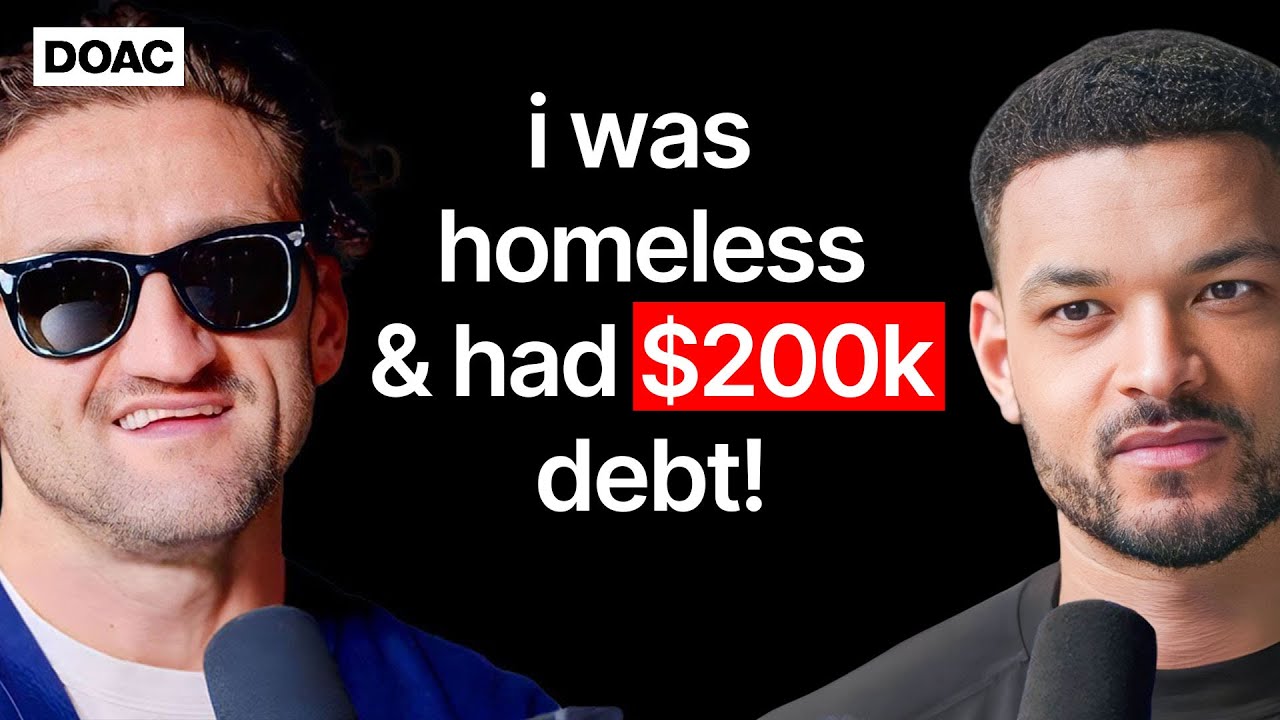
Casey Neistat Takes Blame for $36 Million CNN Startup Failure
The Diary Of A CEO
The YouTube creator credits his early poverty and lack of a safety net for forcing long-term persistence, while attributing the collapse of his tech company Beme to his own corporate hubris.
## Background
This content was published on YouTube by the channel The Diary Of A CEO on December 11, 2023. The page description outlines an in-depth conversation with creator Casey Neistat covering the challenges of being a creator, his upbringing, career milestones, failure, and what lies ahead, while recommending another episode featuring Alex Cooper.
## TL;DR
In this candid interview, filmmaker and YouTube pioneer Casey Neistat reflects on his journey from a chaotic, unsupervised childhood and teenage fatherhood to achieving massive viral success and accumulating millions of subscribers. He breaks down his core philosophies on patience, high agency, and the gift of failure, including his early grinds, the launch and $36 million acquisition of Beme, and his ultimate burnout with CNN. Neistat also addresses the darker side of sudden fame, explaining why he relocated his family to Los Angeles to escape public overwhelm and step back into a more intentional, creatively fulfilling life.
## Atmosphere & style
The interview carries an grounded, reflective, and deeply authentic tone, driven by Neistat's intense energy and self-aware candor. The dynamic between Neistat and Steven Bartlett feels like an intimate, unstructured dialogue where raw vulnerability meets battle-tested wisdom. Watching or listening feels like receiving a masterclass in resilience, taking the audience through an emotional arc from gritty early hardships to hyper-paced viral stardom, ultimately settling into a quiet, introspective clarity about what truly matters.
## Key takeaways
- [00:00](https://www.youtube.com/watch?v=vFuyiCnROzs&t=0s) Fame and rapid viral success bring unexpected personal chaos, security risks, and an overwhelming loss of privacy.
- [03:23](https://www.youtube.com/watch?v=vFuyiCnROzs&t=203s) Chaotic, unsupervised childhood hardships and early manual labor forged Casey's resilience, independence, and high agency.
- [14:09](https://www.youtube.com/watch?v=vFuyiCnROzs&t=849s) Becoming a parent at age 16 forced Casey to rely on government assistance and adopt an intense, survival-driven work ethic.
- [18:10](https://www.youtube.com/watch?v=vFuyiCnROzs&t=1090s) Motivational quotes and social media inspiration ('inspo porn') are meaningless without lived experience and real sacrifice.
- [25:02](https://www.youtube.com/watch?v=vFuyiCnROzs&t=1502s) Fear of failure is fundamentally an anxiety about public judgment and what other people will think.
- [28:42](https://www.youtube.com/watch?v=vFuyiCnROzs&t=1722s) Patience and long-term commitment are far more crucial to achieving success than short-term passion or romanticized persistence.
- [30:57](https://www.youtube.com/watch?v=vFuyiCnROzs&t=1857s) Not having a fallback option or 'Plan B' forces single-minded focus and increases the likelihood of survival and success.
- [40:48](https://www.youtube.com/watch?v=vFuyiCnROzs&t=2448s) Creative video editing serves as a medium for refined self-expression, contrasting with algorithm-driven growth strategies.
- [45:58](https://www.youtube.com/watch?v=vFuyiCnROzs&t=2758s) Chasing metrics and views purely for growth leads to a soul-crushing 'race to the bottom' rather than lasting artistic value.
- [56:04](https://www.youtube.com/watch?v=vFuyiCnROzs&t=3364s) Fifteen years of foundational filmmaking, commercial work, and high debt prepared Casey for his viral daily vlogging breakthrough.
- [01:07:53](https://www.youtube.com/watch?v=vFuyiCnROzs&t=4073s) High agency and a willingness to engage in tasks without formal qualifications enable individuals to solve complex real-world problems.
- [01:18:15](https://www.youtube.com/watch?v=vFuyiCnROzs&t=4695s) Casey takes full personal accountability for Beme's failure following its acquisition by CNN, attributing it to ego and execution missteps.
- [01:22:26](https://www.youtube.com/watch?v=vFuyiCnROzs&t=4946s) True fulfillment stems from loving the daily creative process and journey rather than achieving an arbitrary destination or finish line.
- [01:34:57](https://www.youtube.com/watch?v=vFuyiCnROzs&t=5697s) Understanding that 'nobody cares about you' is liberating, freeing creators from fear of judgment and allowing authentic work.
## Detailed walkthrough
### [00:00](https://www.youtube.com/watch?v=vFuyiCnROzs&t=0s) Introduction: Success, Patience, and the Reality of Fame
The episode opens with a candid exchange between host Steven Bartlett and YouTube legend Casey Neistat, framing the complex reality of ultimate success and public visibility. Despite building massive channels, selling a company, and reaching iconic status as a pioneer of vlogging, Casey challenges the romanticized depiction of winning. Success on paper did not bring immediate peace; rather, it ushered in extreme scrutiny and chaos, eventually requiring him to move into a high-security building and relocate to Los Angeles.
Casey reflects on his journey—from laboring through eight years of obscurity while accruing $200,000 in debt, to exploding from zero to 10 million subscribers in just 18 months once he committed to daily vlogging. He stresses that true success is about loving the process itself rather than sprinting toward an arbitrary finish line. Bartlett introduces Casey not merely as an acclaimed content creator, but as a relatable underdog whose career serves as an authentic blueprint for converting an obsessive passion into a world-class career.
- Daily vlogging streak: 800 days in a row of publishing a video every single day.
- Growth trajectory: Took 8 years to reach a few hundred thousand subscribers while accumulating $200,000 in debt, followed by a surge to 10 million subscribers in approximately 18 months.
- Core philosophy on happiness: Winning does not equate to fulfillment; loving the daily process is what matters.
> "Patience will smash into opportunity... In life you can get whatever you want, but are you willing to do that for 20 years? If you're not, don't bother, man."
---
[03:23](https://www.youtube.com/watch?v=vFuyiCnROzs&t=203s) The Early Years: An Unsupervised Childhood
Reflecting on his childhood in Connecticut, Casey describes an upbringing defined by an almost total absence of parental supervision. There were no set meal times or routine check-ins about homework—only vague directives to return home before dark. This extreme independence fostered a chaotic environment of exploration and early self-reliance.
To illustrate the raw nature of his youth, Casey shares an anecdote about playing near the railroad tracks behind his house at around ten years old. He and his friends would place pennies and nickels on the rails to watch the passing freight trains flatten them. Because the vibration of an approaching train would shake the coins off the steel, Casey would wait until the massive train was terrifyingly close before running up to set the coins down.
- Environment: Middle-class setting with no rigid household rules, schedules, or direct parental monitoring.
- Early risk-taking: Placing coins on active train tracks at age 10 right as freight trains approached.
- Perspective on adversity: While Casey strives to shelter his own children by sending them to cozy private schools, he recognizes that the hardships and necessity of his youth forged his independence and entrepreneurial edge.
---
[06:31](https://www.youtube.com/watch?v=vFuyiCnROzs&t=391s) Early Hustles and the Economics of Survival
Left to figure things out on his own, Casey developed an early drive to earn money. He started as a paperboy delivering newspapers around age 12, earning approximately $30 a week. By eighth grade, before even hitting puberty, he recognized an economic opportunity in selling marijuana and calculated the profit margins of breaking down bulk purchases into smaller street sales.
Casey breaks down his teenage business logic: buying quarter-ounces to break down into dime bags yielded a 4x return, but scaling up to buy a quarter-pound ($250) and dividing it into eighths generated a 1,600% return. Recognizing his small physical size relative to older street buyers, he strategically befriended local figures who could offer protection. Every decision was born out of raw necessity to navigate his immediate environment.
- Paperboy earnings: Made around $30 per week at a young age.
- Wholesale marijuana math: Quarter-pound cost $250; breaking it down into eighths yielded up to a 1,600% return compared to a 4x (400%) return on quarter-ounce breakdowns.
- Key takeaway: Lacking traditional support forced an early understanding of risk management, strategic alliances, and unit economics.
---
[07:29](https://www.youtube.com/watch?v=vFuyiCnROzs&t=449s) Family Dynamics and Parental Struggles
Casey provides a nuanced view of his parents, describing them as well-meaning individuals who were simply overwhelmed by their own struggles. His father worked relentless hours to keep the middle-class family afloat, living paycheck to paycheck and driving five-year-old Volvos. Family vacations meant packing into the back of a station wagon for a two-hour drive to a modest motel.
His mother's background was starkly different; Casey describes her side of the family as the tail end of an aristocracy—possessing all the privilege and entitlement of high society, but none of the actual wealth. He views her as an enigma who was frequently absent emotionally, leading to an unstable family environment where the children were often left to wander.
- Family structure: Second of four children (older brother Van, older sister, Casey, and younger brother Dean).
- Socioeconomic standing: Middle-class, paycheck-to-paycheck living supported by a hardworking father.
- Squeaky wheel dynamic: Casey frequently acted out and was the loudest among his siblings to secure attention in a chaotic home.
---
[08:51](https://www.youtube.com/watch?v=vFuyiCnROzs&t=531s) Parental Divorce and the Point of No Return
The tension inside the Neistat household eventually boiled over into a painful parental divorce. Casey recalls the pivotal, painful moment as a 14-year-old when he directly confronted his father at the kitchen table to inform him that his mother was being unfaithful. He vividly remembers his father's slouched posture and the heavy atmosphere in the room.
Looking back with adult empathy, Casey acknowledges that his mother's destructive actions were likely a cry for help or attention under immense personal stress, and that his father had been keeping his head in the sand just to survive working long hours. However, at 14, fueled by teenage anger over school troubles and home friction, Casey confronted his father directly, forever altering the family dynamic.
- Age during confrontation: 14 years old.
- Context: Intense household friction leading up to his parents' ultimate separation.
- Retrospective insight: Realizing that adult mistakes often stem from unaddressed personal distress rather than pure malice.
---
[12:03](https://www.youtube.com/watch?v=vFuyiCnROzs&t=723s) The Childhood Blueprint: A Single-Minded Focus on New York City
Despite the turmoil at home, Casey possessed an unusually vivid vision for his future. His ultimate goal was anchored to a specific two-page spread of the New York City skyline on page 41 of his social studies textbook. The image elicited such a powerful emotional reaction that he often avoided looking at it directly.
Similarly, watching Tom Hanks in the movie *Big* served as a personal roadmap and cultural touchstone for Casey. He watched the film on repeat, internalizing its message of a kid navigating New York City on his own terms. From an early age, Casey made a vow that his singular life mission would be to fulfill every promise he made to his younger self—whether that meant having a refrigerator full of food, working without a boss, or building a life in Manhattan.
- Social studies textbook: Page 41 featured a two-page spread of New York City that fueled his ambition.
- Cultural influence: The movie *Big* served as a foundational roadmap for his dream of living in New York.
- Core life philosophy: Fulfilling childhood promises and achieving absolute independence.
> "The sole mission of my life is to realize all the promises I made to myself as a kid... The how was always gray, but the 'to do it' was always vivid."
---
[14:09](https://www.youtube.com/watch?v=vFuyiCnROzs&t=849s) Running Away from Home and Becoming a Teen Father
At age 15, after a heated argument with his mother on a Monday school night during her ongoing separation from his father, Casey was given an ultimatum: fall in line or leave. Choosing independence, he packed a single backpack and walked out of the house. He spent the next several nights couch-surfing at friends' houses before moving into an apartment with two older teenage girls aged 17 and 18.
Shortly after moving in, Casey got into a relationship with one of the girls. At 15, he learned she was pregnant, and by age 16, he became a father to his son, Owen. The sudden weight of parenthood drastically accelerated his adult responsibilities, forcing him to adapt quickly while holding onto his broader ambitions.
- Age leaving home: 15 years old.
- Age becoming a parent: 16 years old (father to son Owen).
- Transition: Moving from extreme personal freedom directly into teen fatherhood, setting the stage for his subsequent struggles and drive to succeed.
[15:45](https://www.youtube.com/watch?v=vFuyiCnROzs&t=945s) The Naivety and Fearlessness of Youth
When Casey Neistat learned he was going to be a father at just 16 years old, his girlfriend was in tears asking, "What are we going to do? We don't have any money... you don't even have a job." Casey, on the other hand, was unfazed and reassuring: "It's going to be fine. We're going to have a kid. It's going to be great." Looking back, he attributes his complete lack of fear to a profound youthful naivety. Having absolutely no money, no connections, and no reputation to protect—especially since his friends' parents viewed him as a degenerate and a bad influence—he felt like a cornered rat who simply had to chew his way out.
By contrast, Casey admits that at age 42, he is much more fearful because his life is so good that he constantly wants to protect what he has built. After splitting up with his son Owen's mother, Casey devised a naive five-year plan to move to New York City and make something of himself. At the time, his entire employment history consisted of bottom-of-the-totem-pole restaurant work—washing dishes, prepping food, taking out trash, and mopping floors—jobs his father, a used restaurant equipment salesman, was able to secure for him. His primary goal in moving to New York was simply never to work in a restaurant kitchen again. Ultimately, he didn't even wait out his five-year plan: just six months later, he quit his job and moved to the city.
- **Starting Wage:** Casey's starting pay doing kitchen dishwashing and prep work was $7.25 to $8.00 an hour, working 60 hours a week.
- **Relocation Timeline:** Casey abandoned his original 5-year timeline and quit his job to move to New York City after just 6 months.
---
[18:10](https://www.youtube.com/watch?v=vFuyiCnROzs&t=1090s) The Delusion of "Inspo Porn" vs. Mindset Privilege
Reflecting on his 19-year-old self taking that chaotic leap, Casey refuses to call his past actions genius, labeling them instead as raw stupidity and fearlessness. He expresses deep disdain for the generic "inspo porn" quotes posted across Instagram ("You only live once," "Follow your dreams"), calling them useless self-gratification for people who learn nothing real from them. Yet, he acknowledges the underlying truth: at 42, he could never make the decision he made at 19—moving to the most expensive city in the world with a 10th-grade education, no high school diploma, no real experience, and a two-year-old child.
```
"If you have to be told that... if you're going to learn that from an Instagram post, it means nothing to you. It's just masturbation... doing nothing for anyone."
```
Casey argues that anyone raised in the West possesses a massive, objective privilege—what Steven Bartlett frames as a "privilege of mindset." Having relied on state welfare, free diapers, and milk to feed his toddler while scrubbing pots, Casey still felt like "the luckiest person in the world." He points out that compared to a child in South Sudan or humans living 100 or 200 years ago—when 60% of Londoners were dying from tooth infections—modern Westerners have won the lottery of life. With that foundational privilege, having a child young or moving to New York are just small hurdles to push through.
---
[22:12](https://www.youtube.com/watch?v=vFuyiCnROzs&t=1332s) Why Most People Don't Make the Leap
When asked why other people working $7-an-hour dishwashing jobs don't take the same high-stakes bets when they have nothing to lose, Casey offers a pragmatic response. Quoting the classic line "the world needs ditch diggers too," he notes that not everyone actually wants that trajectory, and that is entirely okay. He emphasizes a core philosophy: "In life you can get whatever you want, but you can't *want* whatever you want." If someone truly wanted to make a drastic change, they wouldn't need an inspirational podcast to nudge them—they would already be doing it.
```
"You can get whatever you want, but you can't want whatever you want. If you don't want it, there's no creating that."
```
The sole purpose of life, according to Casey, is happiness and fulfillment, not external "winning." He references high-profile celebrities and rock stars who reach the apex of success only to struggle with addiction or suicide, proving that fame and wealth do not guarantee happiness. He contrasts this with his childhood best friend who took over his dishwashing job 25 years ago, stayed in their hometown, and built a classic middle-class life with a loving wife, three kids, and a dog. Casey views his friend's life as the absolute embodiment of success because it aligns with what genuinely brings him fulfillment.
- **Palliative Care Study:** Steven references Bronnie Ware's interviews with dying patients, noting that the single biggest regret of the dying was "not living a life true to myself."
---
[25:02](https://www.youtube.com/watch?v=vFuyiCnROzs&t=1502s) The Gift of Failure and the Story of Anvil
For those held back by fear from taking their first leap, Casey argues that failure is actually "the greatest gift." He believes people fear failure not because of the setback itself, but because of an overwhelming anxiety over what others will think of them. To illustrate the necessity of embracing relentless failure, Casey shares the story of the 1980s Canadian heavy metal band **Anvil**, which he once made a YouTube video about.
```
"Failure hurts so bad, but failure is a part of life... I think people are so scared of failure, and the fear of failure is the fear of what other people are going to think about you."
```
Anvil had opened for giant acts like Def Leppard in front of 50,000 screaming fans, but they never broke through to headline status. Decades later, a documentary filmed the lead singer driving a delivery van in Canada, delivering food to senior citizens for minimum wage, borrowing money from his sister that he couldn't pay back, and playing his heart out in leather gear to six people drinking beer in a bar. Yet he refused to give up his dream for 30 to 40 years. Because he endured decades of brutal failure and humiliation, a filmmaker captured his story, the documentary blew up, and Anvil ended up selling out arenas in Japan. Had he quit earlier, his story would have just been another forgotten compromise.
---
[28:42](https://www.youtube.com/watch?v=vFuyiCnROzs&t=1722s) The Unsexy Power of Patience and Persistence
While Steven frames Casey's trajectory around "delusional persistence," Casey prefers to use a far less glamorous word: **patience**. He notes that persistence gets featured on inspirational posters of kittens hanging from branches, whereas patience is fundamentally unsexy and unattractive. When aspiring creators ask him for a single piece of advice, his answer is always patience above all else—because if you refuse to give up, you will either find success or die trying.
```
"Patience above everything... If you're willing to stick with it, you will find success or you'll die trying, in which case, fuck it."
```
Casey insists that people must strip away the romanticized, sensationalized view of ambition. Enduring years of failure is embarrassing and painful—whether you are a musician performing in an empty mall or a YouTuber releasing videos to zero views while everyone rolls their eyes at you. He recalls talking to Jimmy Donaldson (**MrBeast**) about his early "war stories" on YouTube, when Jimmy made videos using his mother's broken Compaq computer and built-in webcam. The videos got no views, were terrible, and his school friends mocked him for them, yet enduring that unglamorous grind was the only bridge to ultimate success.
- **Subscriber Growth:** It took Casey approximately 5 years of posting on YouTube to reach 400,000 subscribers before his channel exploded.
[030:57] The Brutal Nature of Failure and Delusional Patience
Casey Neistat dissects the raw, unvarnished reality of failure, emphasizing how deeply it hurts when your lack of success is quantified in real time—whether it's empty seats at a concert, silence after a joke, a restaurant with no diners, or an online store where nobody buys your t-shirts. He argues that if someone isn't prepared to endure that constant, crushing feedback loop for twenty years, they shouldn't even bother attempting the creative path. Expanding on the word *patience*, Neistat compares persistence to powering through mile 22 of a marathon, whereas true patience is a far grittier, unglamorous long game.
When host Steven Bartlett asks where this extreme level of patience comes from—noting that any sane person facing constant rejection and pressure to "get a real job" would naturally quit—Neistat attributes it to having zero alternative. Reflecting on discussions he has had with MrBeast (Jimmy Donaldson), Neistat explains that neither of them had a safety net or a college degree to pivot to. For Neistat, there was no potential $80k-a-year ad agency job waiting; failing meant returning to a kitchen making $7.25 an hour and relying on state assistance like WIC (Women, Infants, and Children) vouchers just to afford basic necessities like milk and diapers.
- **WIC Assistance:** Neistat vividly remembers using a government benefit card that strictly purchased basic groceries like diapers and milk, noting it wouldn't even work if you tried to buy a Nintendo console.
- **The $1,800 Sublet:** Moving to New York City, his first three months were financed by an $1,800 loan ($600/month) put on his brother’s ex-girlfriend’s parents' credit card.
---
[033:25] Slept on a Couch Until 9/11: Living Without a Plan B
After his initial sublet ended, Neistat scrambled for shelter and agreed to pay $300 a month under the table to sleep on a friend's couch whose father paid the rent. That arrangement lasted exactly eleven nights—from September 1st to September 11th, 2001. On the morning of 9/11, the World Trade Center attacks devastated the area surrounding the apartment. Standing amidst the chaos with the towers still burning, Neistat spoke with his father on the phone. His father urged him to come home, pointing out: "Terrorists blew up your apartment. You have no job. You have no prospects. You have no money and now you have nowhere to sleep." Neistat simply replied, "I'll figure that out. I'll be fine. Later, Dad," brushing off any thought of retreat.
Bartlett links Neistat's mindset to psychological research on "Plan A thinking." He cites a study where two groups were asked to solve a puzzle for a snack; when the second group was informed they could easily grab the same snack from a vending machine down the hall, their motivation and puzzle-solving performance dropped significantly. The mere presence of a Plan B compromised their effort. Neistat agrees wholeheartedly with the study's findings, describing his early career as feeling like "running from a pack of starving wolves"—a high-stakes mentality where slowing down meant being eaten alive.
- **11 Days on a Couch:** Slept on a friend's floor from Sept 1 to Sept 11, 2001, before the catastrophe wiped out his living situation.
- **The Wolf Metaphor:** Neistat viewed his survival as a constant sprint away from ruin: "If I slow down at all, I will be eaten alive."
---
[036:13] SROs, Halfway Houses, and Bribing for Shelter
Reflecting on his first summer in New York, Neistat recalls hanging out with a clique of wealthy 19- and 20-year-olds. While they casually picked up hundreds of dollars in bar tabs, rode in taxis, and lived alone in spacious 26th-floor two-bedroom apartments, Neistat was squeezed into a 300-square-foot studio shared with Craigslist strangers. At the time, he felt intense shame over his inability to contribute, often hiding in the bathroom when the bill arrived or inventing excuses when dates asked to see his apartment. Looking back, however, he realizes that lacking those luxuries was actually a gift that gave him an unmistakable, singular direction in life.
When asked how he handles this dynamic with his own children, Neistat calls it the "million-dollar question," as he never wants them to experience the humiliation and extreme poverty he endured. He reveals just how desperate his living conditions were: at one point, he lived in an SRO (Single Room Occupancy) and even bribed his way into a halfway house. After being turned away by the guard behind the glass window, Neistat returned with a carton of cigarettes stuffed with a $100 bill. The guard handed him room 531 for around $450 a month in cash. Despite sharing a building with former convicts, undocumented immigrants, and homeless individuals—with no private bathroom or kitchen—Neistat was thrilled just to have a roof over his head.
- **Halfway House Bribe:** Secured room 531 by offering a guard a carton of cigarettes containing a $100 bill, paying roughly $450/month in cash.
- **Perspective Shift:** While outsiders might pity someone living in a halfway house with no kitchen or bathroom, Neistat was genuinely "psyched" because it kept him in New York City.
---
[039:40] Discovering Video on a Blue iMac
Neistat recounts how video entered his life just before his move to New York City. After his baby mama left him, he went to stay in Brooklyn with his older brother, Van, whom he idolized. Van was doing temp work and had just purchased an early Apple iMac—the iconic model shaped like a bulky, translucent blue CRT television. The computer came pre-loaded with sample editing software and stock footage of a dog getting a bath in a plastic kiddie pool.
Fascinated by the editing process, the brothers edited the dog footage repeatedly. Wanting to shoot their own material, Neistat bought a camera, maxed out a credit card, and began creating crude home movies. This newfound passion immediately became his primary focus, inspiring his decision to move to Manhattan with only three possessions: the massive iMac, a backpack of clothes, and a BMX bike (which was stolen the very next day).
- **The Sample Footage:** Neistat learned the basics of video editing by manipulating stock footage of a dog taking a bath in a kids' plastic pool on an Apple iMac.
- **Three Belongings:** When Neistat moved to New York City at age 19, he brought only his giant iMac, a backpack of clothes, and his BMX bike.
---
[040:48] Finding a Voice and the "MrBeastification" of YouTube
When asked about the psychological drivers behind his attraction to filmmaking, Neistat explains that growing up as the third of four kids—failing in school, getting into fights, and constantly being disliked by authority figures and parents—left him feeling like he never had a voice. Making videos allowed him to articulate his thoughts in a way that commanded attention. Though he wasn't a traditional film buff, he fondly recalls a 7th-grade career day program where, while classmates visited Pfizer or local naval bases, he asked to work at a video rental store just so he could sit and watch movies all day.
Neistat argues that his distinct visual language stems entirely from his lack of formal film education. Because he started out in the early 2000s with limited equipment—including a computer hard drive so small (10 GB) it could only store 12 to 16 minutes of footage at a time—he was forced to invent a raw, fast-paced, cut-down style of short-form storytelling. Addressing the topic of originality, Neistat expresses frustration with what he calls the "MrBeastification" of YouTube. While clarifying that he considers Jimmy Donaldson a genius whose individual success is brilliant and well-deserved, Neistat laments how millions of creators now mindlessly mimic Donaldson's formula for fame rather than cultivating their own personal, authentic voices.
> "Video for me has always been a way of a refined self-expression for me to take my thoughts and force them into this sort of articulate six, eight-minute compartmentalized little video... Jimmy's from day one has just been find success."
- **7th Grade Job Shadow:** Chose to shadow an employee at a local video rental store because he thought he'd get paid to watch movies all day.
- **10 GB Hard Drive:** Hardware limitations restricted his early video edits to a maximum of 12–16 minutes of raw footage, directly shaping his concise editing style.
Here is a detailed, faithful walkthrough covering this part of the conversation:
[45:58](https://www.youtube.com/watch?v=vFuyiCnROzs&t=2758s) Views vs. Truth: The Creative Philosophy of Casey Neistat and MrBeast
Casey addresses the stark contrast between his creative philosophy and that of Jimmy Donaldson (MrBeast). While Jimmy is deeply passionate about every aspect of his empire—from his chocolate company, Feastables, and his philanthropy, to his video enterprise MrBeast Enterprise—his driving passion revolves around winning and scaling. However, Casey critiques the reductive perspective adopted by many aspiring creators who look at Jimmy's astronomical numbers and conclude that "all that matters is views." To Casey, chasing view counts for the sake of numbers is a soul-crushing "race to the bottom" that he passionately despises. He argues that copying successful creators never works because true creative longevity requires deep introspection to discover what is genuinely authentic to oneself.
```
TRADITIONAL CREATIVE APPROACH MRBEAST / EMPIRE APPROACH
┌────────────────────────────────┐ ┌────────────────────────────────┐
│ • Focus on artistic truth │ │ • Focus on winning & scale │
│ • Work that resonates long-term│ vs │ • Data-driven optimizations │
│ • Emotion & personal expression│ │ • Massive reach & enterprise │
└────────────────────────────────┘ └────────────────────────────────┘
```
When asked why "truth" should matter more than guaranteed views, Casey points to the historical disconnect in cinema: over the last 80 years of the Academy Awards, the films awarded Best Picture have aligned with the highest-grossing movies of the year only three or four times (such as *Gone with the Wind*). While massive blockbusters like *Transformers 9* fade from memory despite their box-office success, deeply personal and truthful works stay with the viewer forever. He contrasts transient "junk food" content and pop music trends with transformative art, citing documentaries like Werner Herzog's *Little Dieter Needs to Fly* and *Anvil! The Story of Anvil*—a film Casey notes he still thinks about every single day despite not having watched it in five years.
* **Key Takeaway on Art:** Great art is meant to affect people profoundly rather than deliver quick visual dopamine.
* **Impact of Spike Jonze:** Casey recalls being inspired as a kid by Spike Jonze’s low-budget, raw music video for the hip-hop artist Fat Lip. Shot on a simple VHS camera with Fat Lip in a clown costume because there was no budget, it demonstrated to Casey that anyone could become a filmmaker through pure creative resourcefulness.
* **Respect for MrBeast:** Casey clarifies that he holds immense respect for MrBeast because Jimmy has never falsely claimed to be an artist; he is an empire builder who uses video creation as his medium. Casey regards Jimmy as the most important YouTuber in the platform's history and one of the most significant figures in entertainment history, predicting his business model will be studied at Harvard.
---
[51:31](https://www.youtube.com/watch?v=vFuyiCnROzs&t=3091s) Protecting Children from Social Media and the Trap of External Validation
Reflecting on his own life, Casey admits that while views once mattered to him, his current financial security allows him to focus strictly on the quality of his work without worrying about paying rent or checking menu prices at restaurants. The conversation shifts to how he handles his own children wanting to enter the social media world, specifically his eight-year-old daughter, Francine. Francine is already an avid content creator, making clever stop-motion animations with her stuffed animals. While Casey and his wife, Candice, fully support her creativity by buying equipment and watching her videos in a private family group chat, they strictly forbid her from posting them publicly or pursuing subscriber counts.
```
FRANCINE'S CREATIVE BOUNDARIES
┌─────────────────────────────────────────────────────────────┐
│ ALLOWED / ENCOURAGED RESTRICTED / BANNED │
├──────────────────────────────┬──────────────────────────────┤
│ • Stop-motion filmmaking │ • Showing her face or hands │
│ • Private family sharing │ • Identifying the apartment │
│ • Using quality equipment │ • Chasing likes & followers │
└──────────────────────────────┴──────────────────────────────┘
```
Casey explains his deep anxiety regarding young children seeking validation through online likes and metrics, framing fame as a toxic pursuit if it is the end goal rather than a byproduct of meaningful work. He warns that pursuing fame for its own sake leads to pure narcissism, comparing it to reality TV stars who undergo endless cosmetic surgeries without contributing anything of value to the world.
* **Private Instagram Account:** Francine has an Instagram account with zero followers; even Casey and Candice do not follow it or hit "like" because they do not want her to associate creative output with digital validation.
* **Family Protection:** When Casey's sister asked for Francine's account handle after seeing a screen capture, Casey flatly refused to give it out to protect his daughter from public exposure.
* **The Social Media Crisis:** Casey emphasizes that social media is fueling a massive youth mental health crisis, including eating disorders and self-esteem issues, making it critical for parents to insulate their children from online metrics for as long as possible.
---
[56:04](https://www.youtube.com/watch?v=vFuyiCnROzs&t=3364s) The 15-Year Horizon: The Journey to the Daily Vlog Explosion
Casey reflects on his path to success, noting that unlike kids growing up today, he achieved stability in traditional media before transitioning to social media. In 2008, Casey and his brother, Van Neistat, created and sold an eight-episode series to HBO. The show had the exact stylistic aesthetic and narrative structure as his later YouTube vlogs, but it aired at midnight on Friday nights to a niche audience. After Van moved to California, Casey tried pitching the concept to top executives at MTV; while they praised the concept as utterly unique, they ultimately turned it down because they did not know how to make it work on television.
Before launching his daily vlog in March 2015, Casey had spent nearly a decade on YouTube (having started around 2007) and built a respectable audience of 280,000 subscribers. Though he had several viral hits with millions of views and created content for *The New York Times*, his growth skyrocketed when he committed to a daily upload cadence. Over the course of just 18 months, his channel surged from 280,000 to 10 million subscribers. He compares his prior 15 years in media to trying to force a square peg into thousands of round holes until the planets finally aligned in 2015, when YouTube matured into a mainstream platform and viewers connected with his high-production, episodic storytelling.
* **The Compounding Power of Daily Vlogging:** Publishing daily created a unique relationship with the audience. Watching one video introduced a subject; watching 300 consecutive videos made the creator an irreplaceable part of the viewer's daily life.
* **Monetization and Reach:** The exponential growth transformed his career financially and operationally. While YouTube's payout of roughly a fraction of a cent per view yields little for small channels, reaching hundreds of millions of views transformed ad revenue and brought incoming requests from major global brands.
Here is a detailed walkthrough of this portion of the transcript, capturing the key details, anecdotes, quotes, and themes discussed:
### [01:01:45](https://www.youtube.com/watch?v=vFuyiCnROzs&t=3705s) Preparation Meets Opportunity & The MIT Fellowship
Casey reflects on the explosive turning point of his career after 15 years of hard work. Responding to Steven’s suggestion that his sudden surge in popularity was an "anvil moment" of luck, Casey points out that luck is simply where preparation meets opportunity. Most opportunities fly past people because they aren't ready, but he had spent a decade and a half preparing for that moment.
His friend Max recently reminded him of where he was when he launched his daily vlog in 2015. On paper, Casey had achieved immense traditional success:
* He had sold a show to HBO for **$2 million**.
* He had produced **two movies** that screened at the Cannes Film Festival.
* He won the Cassavetes Award at the Independent Spirit Awards (the "Academy Awards for indie films").
* He had worked for *The New York Times*, directed commercials for Nike, and run his own studio for **12 years**.
Despite those credentials, Casey reveals that when he launched his YouTube vlog, he was **$200,000 in debt**—making him functionally more broke than when he was a teenage father receiving welfare checks.
---
### [01:03:50](https://www.youtube.com/watch?v=vFuyiCnROzs&t=3830s) The Catalyst: "Hatching Twitter" and Pivoting to Tech
The turning point that led to his debt began a year prior when Casey was invited to MIT as a fellow—a massive honor for a high school dropout. He worked out of the MIT Media Lab inside the *Social Computing Group*, surrounded by 8 to 10 technologists and an artist. Admitting he still doesn't fully understand why he was selected, he spent his time observing without a formal assignment while living in Boston, leaving his pregnant wife back in New York.
During his fellowship, Casey read Nick Bilton’s book *Hatching Twitter*. The book demystified Silicon Valley tech founders, showing him that start-ups are chaotic and that the founders are just persistent, smart people—not unfathomable geniuses.
> "I think I live somewhere between regular and close to smart, but not fully smart... I was like, 'I can do what they did. I can do that.'"
Motivated by the movie *The Social Network* and a desire to build real wealth, Casey decided to start a tech company despite having never written a single line of code. He maxed out his credit cards and his studio's revolving line of credit at Chase Bank. Six months later, he was deep in debt, unable to pay his half of the rent, leading him to simultaneously launch his software company (Beme) and his daily vlog.
* **Key Financial Breakdown:** Casey notes that his $2M HBO deal didn't make him rich: after 50% in taxes ($1M), paying back investors ($400k remaining), and splitting the rest with his brother Van, he was left with $200,000, which diluted into average middle-class income over three years.
---
### [01:07:53](https://www.youtube.com/watch?v=vFuyiCnROzs&t=4073s) Unqualified Action & The Value of Working with Your Hands
Steven observes a reoccurring pattern in Casey’s life: he continuously qualifies himself for pursuits where he is objectively unqualified. Casey shares a conversation he had with his wife, Candice, about how to raise their young daughters to feel capable of doing anything.
He reflects on his 25-year-old son, Mason, expressing a slight regret: while proud of Mason's academic passion, Casey wishes he had pushed him to work with his hands. Referencing a recent *South Park* special where handymen become billionaires while biologists beg for work outside Home Depot, Casey explains that manual work teaches universal truths about life and problem-solving.
> "My rule of mine is: if you don't know what you want to do in life, do something you hate. Through that process, you'll figure out what it is that you love."
Casey recalls discovering his passion for filmmaking while spending 40 to 50 hours a week scrubbing out seafood chowder pots in a 90° Connecticut restaurant, dreaming of what he'd rather be doing. He credits his early experiences of fixing his own broken bicycle with limited tools as the origin of his belief that he can solve any problem himself.
---
### [01:12:03](https://www.youtube.com/watch?v=vFuyiCnROzs&t=4323s) High Agency: "It Won't Fail Because of Me"
Casey illustrates the concept of "high agency"—a term highlighted in a viral thread by his friend George Mack—by sharing an intense personal story. A close friend called him in a total panic thousands of miles away, believing his wife had been kidnapped.
While the friend wanted to go straight to the police station, Casey took control, instructing him to track bank transactions and log into her iCloud account. Casey immediately took ownership of the situation, embodying a mindset he compares to NASA or Lockheed Martin's motto: *"It won't fail because of me."* With the help of his younger brother Dean (a jet pilot in the Air Force), Casey tracked her down in 11 minutes—she was simply asleep on a couch at a local tennis club.
He contrasts his mindset with the average person's instinct to look for a "higher authority" to handle crisis situations:
* **The Volvo Repair:** When someone smashed his 1986 Volvo 240, the insurance company gave him $2,200 for repairs. Rather than hiring a mechanic, he bought $150 replacement halogen headlights, took the front end of the car apart, fixed it himself, and pocketed the rest.
* **Building Studio Forts:** When he decided to put a tree fort in his studio for his daughters, he built it himself rather than hiring a carpenter.
> "Give me a big enough pile of balsa wood and enough time, and I will build you a spaceship."
However, Casey admits that this "how hard can it be?" attitude relies on a healthy degree of naivety. Now that he understands the brutal reality of running a software development company, he emphasizes that he would never start one again.
[01:15:54](https://www.youtube.com/watch?v=vFuyiCnROzs&t=4554s) The Bittersweet $36 Million Exit and Guilt of Letting Employees Down
Reflecting on the acquisition of his tech company Beme for $36 million, Casey Neistat acknowledges that while it was objectively a financial success, the road to that payout was littered with a million smaller failures. He candidly shares that these failures keep him awake at night far more than the ultimate payday helps him sleep. Leading up to the sale, Beme was completely out of money; Casey and his co-founder Matt Hackett had cut their own salaries to zero during the final year, and Casey was paying the final paychecks out of his own pocket to keep the company afloat.
When the acquisition was finalized, a key term ensured that every employee holding equity received an immediate cash payout and job security. Casey anticipated that his team would be thrilled, but their actual reaction caught him completely off guard. Many felt disappointed, explaining that they had chosen to build a novel startup alongside Casey—turning down offers for double the salary at tech giants like Facebook—only to end up working for a massive corporation anyway. Casey was haunted by the realization that while the deal made him a millionaire, he felt he had let down the very people who had lifted him to the top.
- **Acquisition price:** $36 million for Beme.
- **Financial strain:** Casey and co-founder Matt cut their salaries in the final year, with Casey funding final paychecks out of pocket.
- **Employee sentiment:** Team members turned down double salary offers at Facebook to build Beme and felt disappointed by being absorbed into a corporate structure.
[01:17:29](https://www.youtube.com/watch?v=vFuyiCnROzs&t=4649s) Post-Traumatic Stress, Management Failures, and Mopping His Own Floors
The weight of managing a team during the Beme era left lasting psychological scars on Casey. Today, he operates entirely without a staff, an assistant, or even a set calendar schedule. Steven Bartlett notes that his own producer had to contact a mutual friend the night before the recording just to verify if Casey would show up, as Casey hadn't checked his email in three weeks.
Casey describes his current self-reliant setup as a form of "post-traumatic stress" from managing 35 employees at Beme and feeling like he failed them as a leader. He explains that he would rather handle every mundane chore himself—literally mopping his own floors and running the risk of missing scheduled appointments—than ever take on the responsibility of managing people again.
- **Current team size:** 0 employees or assistants.
- **Beme team size:** 35 employees at its peak.
- **Personal routine:** Manages his own schedule, checks email irregularly, and mops his own floors to avoid managerial burnout.
[01:18:15](https://www.youtube.com/watch?v=vFuyiCnROzs&t=4695s) The CNN Acquisition, Ego, and Taking Ownership of the Failure
When CNN and Turner acquired Beme, Casey and Matt signed a three-year contract to build a new venture within the media giant. However, the partnership unraveled quickly, and CNN fired them just 11 months into the deal. In hindsight, Casey realizes he was at "peak hubris" a month after the sale, operating under the naive belief that he knew everything. He mistook CNN's internal direction for ambiguity, failing to grasp that executives were waiting for him to step up and lead.
While CNN was drawn to Casey's massive reach and technical talent, corporate misalignment surfaced quickly. Network executives attempted to leverage his brand for commercial ventures, including proposing a $1 million deal for him to star in commercials for a watch brand—an offer Casey flatly refused. Despite the friction between a nimble startup culture and a massive news corporation, Casey refuses to blame CNN, taking total personal accountability: "The reason why we didn't succeed under CNN is because of me and only because of me." He attributes the downfall to his own ego and naivety at the time.
- **Buyer:** CNN / Turner Broadcasting System.
- **Contract terms:** Initial 3-year agreement; terminated after 11 months.
- **Rejected deals:** Turned down a $1 million commercial deal to endorse a watch company.
- **Root cause:** Casey cites his own ego, hubris, and failure to take charge as the sole reason Beme failed under CNN.
[01:21:37](https://www.youtube.com/watch?v=vFuyiCnROzs&t=4897s) The HR Shutdown Meeting and the Relief of Getting Fired
The final collapse of Beme at CNN unfolded quietly around the end of the year. While on vacation with his family in South Africa, Casey called his supervisor on December 31st to ask whether CNN intended to shut the venture down or keep going. He was told they would talk when he returned to New York.
Upon his return, CNN executives requested a meeting at a neutral location rather than their offices, accompanied by a representative from HR. They formally announced that the company was being shut down and both co-founders were being released from their contracts. Rather than feeling devastated, Casey felt a massive weight lifted off his shoulders, viewing the termination as a "sigh of relief" after months of mounting friction and exhaustion.
- **Location:** South Africa vacation during initial calls; neutral off-site location with HR in New York for the final termination meeting.
- **Date of call:** December 31st.
- **Outcome:** Beme was officially shut down, releasing Casey and Matt from their remaining contract obligations.
[01:22:26](https://www.youtube.com/watch?v=vFuyiCnROzs&t=4946s) Overwhelming Fame, the Dark Period, and Moving Away from New York
Following his departure from CNN, Casey entered one of the darkest periods of his life. Despite achieving complete financial security—a stark contrast to his youth when he couldn't afford diapers—he found himself deeply disoriented. His daily vlog had accumulated roughly 3 billion views in two years, bringing a level of intense, suffocating fame. Unlike an actor playing a fictional role, like "Tyler Durden, Brad Pitt's character in Fight Club," Casey's audience felt a direct personal connection to him, leading to overwhelming public encounters that forced his family to relocate to a higher-security building in New York.
With the daily vlog ended and the CNN deal defunct, Casey lost the feeling of active momentum. He compares his relationship with work to long-distance running: "I wasn't running the marathon because I wanted to get across the finish line... I was running it because I loved the running." Deprived of the daily chase, he attempted side ventures like launching the creative space 368 with his partner Paul and starting a new vlog series with his friend Dan, but ultimately spent seven months hiding at home with his young children before deciding to relocate to Los Angeles.
- **View count:** Approximately 3 billion views generated in 2 years of daily vlogging.
- **Marathon analogy:** Has run 24 marathons; focuses on the process of running rather than collecting medals.
- **Interim projects:** Launched 368 with business partner Paul and a temporary show with friend Dan.
- **Family life:** Spent months at home with his newborn baby and three-year-old child prior to moving west.
[01:26:43](https://www.youtube.com/watch?v=vFuyiCnROzs&t=5203s) The Impact of Public Life on His Wife Candice and Ongoing Projects
The extreme visibility of daily vlogging naturally dragged Casey's wife, Candice Pool, into the center of public attention. Because Casey's content was built around pulling narrative arcs directly from his day-to-day life, Candice was constantly drawn into the vlog's orbit.
While Candice was generally supportive and the massive exposure helped highlight her talent as a jewelry designer and entrepreneur, the lack of privacy created significant friction. Casey acknowledges that turning their real relationship into content placed a heavy emotional burden on her and introduced real strain into their marriage.
- **Impact on business:** Exposed Candice's jewelry design and entrepreneurial work to a global audience.
- **Personal cost:** Created privacy invasion and relationship strain due to constant daily camera documentation.
[01:28:08](https://www.youtube.com/watch?v=vFuyiCnROzs&t=5288s) Sponsor Break: Whoop and Huel
Host Steven Bartlett takes a pause in the conversation to share endorsements for podcast sponsors Whoop and Huel. He highlights how the Whoop wearable device tracks 24/7 health, sleep, and recovery metrics, offering a special community discount code (`[join.whoop.com/ceo](https://join.whoop.com/ceo)`). He also discusses his personal investment in Huel, explaining how their nutritionally complete meals sustain his health during heavy travel schedules across the US and UK.
- **Whoop:** Wearable health and sleep tracker; discount link offered for listeners.
- **Huel:** Complete nutrition products used by Steven during intense travel and filming schedules.
[01:29:35](https://www.youtube.com/watch?v=vFuyiCnROzs&t=5375s) Life as Koyaanisqatsi: Gratitude and "Doing Nothing"
When asked to describe the narrative arc of the next ten years of his life as if it were a film, Casey references the experimental 1982 film *Koyaanisqatsi*. He notes that the movie features no traditional storyline, relying instead on "beautiful establishing shots of cities with weird music" where effectively nothing happens.
Casey explains that this unstructured state reflects his current phase of life. He feels deeply content and grateful for his current position, though he admits to feeling occasional guilt when taking on paid commercial gigs while spending the majority of his time doing "nothing."
- **Film reference:** *Koyaanisqatsi* (1982 experimental film directed by Godfrey Reggio).
- **Current mindset:** Content with a slower pace, balancing occasional paid projects with a relaxed, unstructured lifestyle.
Here is the detailed, step-by-step walkthrough covering this section of the interview:
[01:30:09](https://www.youtube.com/watch?v=vFuyiCnROzs&t=5409s) Living a Coasting Life and the Creative Work Pie Chart
Casey opens up about his current lifestyle, admitting that while he takes on paid jobs and does them as best he can, he feels "a little bit like I'm selling out" because he is mostly coasting on the momentum built years ago. His daily routine now centers heavily around his family: he races home from work at 4:30 PM to be there when his kids arrive, turning down high-profile invitations—including the Met Gala—just to hang out with them. After putting the kids to bed between 7:30 and 8:00 PM, he works out at the gym for an hour, comes home to "bother Candice for an hour," watches TV, and goes to sleep. During the day, his studio functions like a fun clubhouse where he builds items out of wood or reorganizes tools.
When Steven questions if this represents a permanent "new Casey" who has abandoned his childhood bucket list, Casey clarifies that while he is at peace right now, he is hyper-cognizant that this lifestyle is not sustainable. Part of this is practical—acknowledging he would "just be broke in like three years"—but the primary driver is internal: the only thing that brings him true professional fulfillment is creating something he genuinely believes is great. He breaks down his life into a pie chart: he views himself as a good dad, a good husband, and a fitness-focused individual, but the majority of his pie chart is his creative work. He shares a personal story about making a video for his mother-in-law's 70th birthday; instead of a simple automated slide deck, he put together a great video played for her friends that satisfied his creative drive, even though no public audience saw it. Right now, he feels like he's eating junk food and sitting on the couch rather than going to the gym when he putzes around his studio.
- **Daily Routine Details:** Home by 4:30 PM; kids in bed by 7:30–8:00 PM; 1 hour at the gym; 1 hour hanging out with Candice; TV; bed.
- **Studio Activities:** Building items out of wood and reorganizing tools.
- **Private Creative Project:** Produced a custom 70th birthday video for his mother-in-law to show her friends rather than using a basic Windows slideshow maker.
[01:33:08](https://www.youtube.com/watch?v=vFuyiCnROzs&t=5588s) The "Boredom" Debate and Refusing Self-Justification
Steven references a conversation they had before recording regarding "boredom," suggesting that creative people often need periods or seasons of "chilling" to recharge, gain perspective, and gather inspiration. Casey acknowledges the metaphor of the pendulum: during his daily vlog era, he produced a video a day for 800 days straight while running a 38-employee company, raising a newborn, and barely sleeping for three years. However, Casey flatly rejects using that past intensity to justify his present lifestyle.
Calling his current state "pure indulgence," Casey refuses to hide behind soft explanations. He emphasizes that he isn't resting because he needs to, but simply because he *can*. If he were broke or his kids were hungry, he would be working relentlessly; currently, he isn't solving the creative puzzle because "right down the hallway are all the snacks I could ever want." Steven notes that almost no guests speak with such blunt honesty about their own laziness without manufacturing a noble justification.
- **Daily Vlogging Era Stats:** 1 video per day for 800 consecutive days, running a company with 38 employees, raising a newborn, and surviving on minimal sleep for 3 years.
- **Financial Reality:** Acknowledges he is taking advantage of built-up financial runway rather than a necessary creative rest cycle.
[01:34:57](https://www.youtube.com/watch?v=vFuyiCnROzs&t=5697s) Unmade Movies, Privilege, and the Advice 19-Year-Old Casey Needed
Looking toward the future, Casey reveals that he has roughly 25 fully written "movies" (his term for deeply conceived YouTube videos) stored in his notes app—ranging from one-day shoots to concepts requiring three weeks of scriptwriting. He wants to execute these projects in total isolation without caring about metrics; to distance himself from the noise, he has deleted the YouTube Studio app from his phone, stopped checking views or AdSense, and simply hits "upload" before going back to work. He acknowledges that having the freedom to create purely for the joy of it without needing commercial validation is "the ultimate privilege," yet admits he struggles to execute simply because he doesn't *have* to right now.
Steven brings up podcast producer Jack Sylvester, sharing that Casey was the exact reason Jack got into video and that interviewing Casey was his dream. Visibly moved, Casey brings up filmmaker Spike Jonze and his iconic Fat Lip music video, noting that if Spike had decided to build shelves instead of making that video, Casey himself might never have gotten off his couch years ago. Offering advice to 19-year-old Casey and all aspiring creatives, Casey delivers his core philosophy: "nobody cares about you." He explains that young artists often freeze because they assume everyone is watching and judging, when in reality, everyone is self-absorbed. Accepting that nobody cares brings complete creative freedom to avoid being a photocopy and to build authentic originality.
- **Unreleased Script Backlog:** 25 written video concepts saved in his phone's notes app.
- **Digital Detox:** Removed YouTube Studio app; ignores view counts, comments, and AdSense revenue.
- **Key Creative Reference:** Spike Jonze's music video for Fat Lip (Pharcyde) as an inspiration that originally sparked Casey's drive.
- **Core Advice for Creatives:** Realize "nobody cares about you" to unlock total creative freedom and avoid copying others.
[01:39:34](https://www.youtube.com/watch?v=vFuyiCnROzs&t=5974s) The Evolution of Vlogging and the Quentin Tarantino Ideal
Steven asks Casey—as the undisputed "king of vlogging"—to evaluate the evolution and current state of the medium. Casey explains that during his peak, he viewed daily vlogging as the ultimate evolution of reality television: stripping away the producers, directors, and scripted fabrication seen in shows like *Keeping Up with the Kardashians* to show unvarnished life. However, he feels the genre crashed and burned because it became corrupted by clickbait, sensationalism, and chasing view counts. Out of those ashes, Casey is thrilled to see ultra-niche micro-creators thriving—highlighting friends who run successful channels dedicated entirely to custom fish tanks or retro handheld gaming devices (Retro Dodo).
When asked if he would ever return to daily vlogging, Casey states he would only do it if he could remain completely anonymous. He fantasizes about operating like Quentin Tarantino: disappearing completely for six years, emerging only to drop a masterpiece film where nobody knows anything about his personal life, car, or family, and then vanishing back into a cave. For Casey, the public notoriety and real-world interactions stemming from daily vlogging blurred the line between selling his personal life and creating art, creating an unsettling dynamic he no longer wants to navigate.
- **Vlogging Evolution:** Shifted from authentic raw reality to view-chasing sensationalism, and finally into specialized niche channels.
- **Niche Channel Examples Cited:** Fish tank creators and Retro Dodo (focused on retro video gaming handhelds).
- **The Tarantino Ideal:** Total personal anonymity combined with high-impact, periodic artistic releases.
[01:44:04](https://www.youtube.com/watch?v=vFuyiCnROzs&t=6244s) The Final Guest Question: A Critique on Brooklyn
Steven transitions to the show's closing tradition, where the previous guest leaves a question for the next guest without knowing their identity. The question asks: "What is one piece of feedback you want to give to me... that you might be nervous to tell me?"
Without missing a beat, Casey gives his candid critique about the interview location: "When you set up a studio in New York City, don't do it 40 minutes out into Brooklyn." He advises Steven to place his studio in downtown Manhattan so high-profile guests are only five minutes away. When Steven jokingly asks if Casey was busy, Casey quips that he was busy "putting up shelves and watching TV—doing nothing." Steven accepts the feedback, admitting it was their very first shoot at that location and promising not to host there again.
- **Final Feedback Given:** Build future NYC podcast studios in downtown Manhattan rather than 40 minutes out in Brooklyn to minimize guest travel time.
Here is the detailed walkthrough covering the final part of the interview:
[01:44:53](https://www.youtube.com/watch?v=vFuyiCnROzs&t=6293s) Closing Reflections and Words of Gratitude
Steven Bartlett closes the conversation by expressing deep personal gratitude to Casey Neistat, sharing how Casey's creative philosophy and approach to life have profoundly influenced him over the years. Bartlett highlights how hearing Casey speak so clearly on the importance of "truth and authenticity" forces him to rethink his own work in a meaningful way. Viewing Casey as someone further up the ladder that younger creators are climbing, Bartlett explains that receiving these insights allows the next generation to navigate their own creative journeys without having to endure the same darkness, confusion, and mistakes.
Casey promises to pursue the video ideas currently sitting in the notes app of his phone, agreeing warmly to make them. Bartlett emphasizes that creators who build things for their own authentic reasons inevitably produce the most compelling work, leaving both host and audience eager to see what Casey tackles next as a pioneer in the space.
- Steven Bartlett credits Casey Neistat as a foundational inspiration for both his artistic production and life principles.
- Casey jokes about using a skateboard for travel before acknowledging its limited range, keeping the mood light as the interview wraps up.
- Bartlett underscores the ultimate takeaway of the conversation: authenticity remains the single most important ingredient for creating truly interesting work.
## Notable quotes
> [00:00](https://www.youtube.com/watch?v=vFuyiCnROzs&t=0s) Patience will smash into opportunity... In life you can get whatever you want, but are you willing to do that for 20 years? If you're not, don't bother, man. — Casey Neistat
> [12:03](https://www.youtube.com/watch?v=vFuyiCnROzs&t=723s) The sole mission of my life is to realize all the promises I made to myself as a kid... The how was always gray, but the 'to do it' was always vivid. — Casey Neistat
> [18:10](https://www.youtube.com/watch?v=vFuyiCnROzs&t=1090s) If you have to be told that... if you're going to learn that from an Instagram post, it means nothing to you. It's just masturbation... doing nothing for anyone. — Casey Neistat
> [22:12](https://www.youtube.com/watch?v=vFuyiCnROzs&t=1332s) You can get whatever you want, but you can't want whatever you want. If you don't want it, there's no creating that. — Casey Neistat
> [25:02](https://www.youtube.com/watch?v=vFuyiCnROzs&t=1502s) Failure hurts so bad, but failure is a part of life... I think people are so scared of failure, and the fear of failure is the fear of what other people are going to think about you. — Casey Neistat
> [28:42](https://www.youtube.com/watch?v=vFuyiCnROzs&t=1722s) Patience above everything... If you're willing to stick with it, you will find success or you'll die trying, in which case, fuck it. — Casey Neistat
> [40:48](https://www.youtube.com/watch?v=vFuyiCnROzs&t=2448s) Video for me has always been a way of a refined self-expression for me to take my thoughts and force them into this sort of articulate six, eight-minute compartmentalized little video... Jimmy's from day one has just been find success. — Casey Neistat
> [01:03:50](https://www.youtube.com/watch?v=vFuyiCnROzs&t=3830s) I think I live somewhere between regular and close to smart, but not fully smart... I was like, 'I can do what they did. I can do that.' — Casey Neistat
> [01:07:53](https://www.youtube.com/watch?v=vFuyiCnROzs&t=4073s) My rule of mine is: if you don't know what you want to do in life, do something you hate. Through that process, you'll figure out what it is that you love. — Casey Neistat
> [01:12:03](https://www.youtube.com/watch?v=vFuyiCnROzs&t=4323s) It won't fail because of me. — Casey Neistat
> [01:12:03](https://www.youtube.com/watch?v=vFuyiCnROzs&t=4323s) Give me a big enough pile of balsa wood and enough time, and I will build you a spaceship. — Casey Neistat
> [01:18:15](https://www.youtube.com/watch?v=vFuyiCnROzs&t=4695s) The reason why we didn't succeed under CNN is because of me and only because of me. — Casey Neistat
> [01:22:26](https://www.youtube.com/watch?v=vFuyiCnROzs&t=4946s) I wasn't running the marathon because I wanted to get across the finish line... I was running it because I loved the running. — Casey Neistat
> [01:34:57](https://www.youtube.com/watch?v=vFuyiCnROzs&t=5697s) nobody cares about you — Casey Neistat
> [01:44:04](https://www.youtube.com/watch?v=vFuyiCnROzs&t=6244s) When you set up a studio in New York City, don't do it 40 minutes out into Brooklyn. — Casey Neistat
## Mentioned
Casey Neistat, Steven Bartlett, Owen Neistat, Van Neistat, Dean Neistat, Candice Pool, Francine Neistat, Mason, MrBeast, Jimmy Donaldson, Alex Cooper, Anvil, Def Leppard, Spike Jonze, Pharcyde, Werner Herzog, Tom Hanks, Bronnie Ware, Quentin Tarantino, Godfrey Reggio, Matt Hackett, Nick Bilton, Jack Sylvester, George Mack, The Diary Of A CEO, YouTube, HBO, MTV, CNN, Turner Broadcasting System, The New York Times, Facebook, Apple iMac, Compaq, WIC, Beme, 368, Whoop, Huel, Pfizer, Chase Bank, Home Depot, NASA, Lockheed Martin, Nike, MIT Media Lab, Social Computing Group, Harvard, Retro Dodo, Big, Little Dieter Needs to Fly, Anvil! The Story of Anvil, Gone with the Wind, Transformers 9, Feastables, MrBeast Enterprise, Hatching Twitter, Fight Club, Koyaanisqatsi, Keeping Up with the Kardashians, Met Gala, Cassavetes Award, Independent Spirit Awards, Cannes Film Festival
Casey Neistat argues that enduring creative accomplishment and fulfillment stem from an obsessive commitment to the daily process and authenticity, rather than chasing algorithmic metrics, external validation, or corporate scale. Reflecting on his trajectory from an impoverished teen father to a YouTube pioneer, Neistat contends that operating without a safety net enforced an extreme personal agency that corporate structures and view-chasing platforms actively dilute.
High Agency and Survival Without Plan B
Neistat attributes his persistence not to romanticized inspiration, but to an absolute absence of alternatives. Becoming a father at 16 while scrubbing kitchen pots for $7.25 to $8.00 an hour, he approached life with youthful naivety and what host Steven Bartlett describes as a "Plan A mindset." Moving to New York City at 19 with only an iMac, clothes, and a bicycle, Neistat financed his start with an $1,800 borrowed sublet, slept on a friend's couch until 9/11 displaced him, and bribed a halfway-house guard with $100 and cigarettes to secure a $450-a-month room.
Rather than looking to external authorities, Neistat developed a high-agency ethos—fixing his own crashed Volvo with $150 replacement parts rather than hiring a mechanic. He compares his survival drive to sprinting from starving wolves, arguing that unglamorous patience—enduring public indifference and zero views for up to 20 years—is the only bridge to real creative longevity.
The 15-Year Runway to Daily Vlogging (61:45)
Before his channel exploded from 280,000 to 10 million subscribers in 18 months, Neistat had labored through 15 years in traditional media and video. He sold an eight-episode series to HBO for $2 million in 2008, screened two indie films at Cannes, directed Nike commercials, and won an Independent Spirit Award.
Yet these achievements did not guarantee solvency: after taxes, repaying investors, and splitting proceeds with his brother Van, the HBO payout dwindled to $200,000. Following an MIT fellowship that inspired him to launch a tech startup, Neistat accumulated $200,000 in debt. Committing to an 800-day daily vlogging streak in 2015 was where preparation finally met opportunity. For Neistat, publishing hundreds of consecutive videos forged an authentic bond with audiences that traditional television could never replicate.
Corporate Friction and Managerial Burnout at Beme (75:54)
Neistat’s tech venture Beme culminated in a $36 million acquisition by CNN, but he views it as an operational failure. Leading up to the sale, Beme was out of capital; Neistat and co-founder Matt Hackett cut their salaries to zero, and Neistat funded paychecks out of pocket. The exit brought unexpected guilt when employees who had declined lucrative offers at Facebook felt trapped in corporate bureaucracy.
The venture unraveled quickly when CNN terminated the co-founders' contracts after 11 months of a three-year deal. Neistat takes full accountability, citing his own hubris and failure to lead corporate initiatives. The psychological toll of managing 35 employees prompted him to abandon staff entirely; today, he employs zero assistants, ignores schedules, and mops his own studio floors to maintain absolute operational control.
Authenticity Versus the MrBeastification of Content (45:58)
While Neistat respects Jimmy Donaldson (MrBeast) as an empire builder whose business model will be studied at universities, he strongly critiques the "MrBeastification" of YouTube. He rejects view count as a proxy for artistic value, describing algorithmic optimization and copying top creators as a soul-crushing "race to the bottom." Citing cinema history, where Best Picture winners rarely match top-grossing blockbusters, Neistat maintains that enduring art requires personal truth rather than viral junk food.
This philosophy guides his household rules: he shields his eight-year-old daughter Francine from digital metrics, encouraging private stop-motion animation while banning public accounts, subscriber chasing, and identifiable imagery. In his own career, Neistat deleted the YouTube Studio app and aspires to a Quentin Tarantino-like model—releasing high-impact, standalone work while preserving total personal anonymity.
Financial Comfort and the Guilt of Inaction (90:09)
Generating 3 billion views brought intrusive public scrutiny and domestic strain, eventually prompting Neistat's relocation to Los Angeles. Comparing his current phase to the unstructured experimental film Koyaanisqatsi, Neistat describes a relaxed lifestyle of family dinners, gym workouts, and studio woodworking.
Neistat candidly rejects framing this lull as necessary creative recharging, calling it "pure indulgence" enabled by accumulated financial runway. With 25 unproduced video concepts in his phone, he admits that financial comfort has temporarily blunted the urgency that once compelled him to produce. To overcome creative paralysis, he advises emerging artists to realize "nobody cares about you," explaining that shedding the fear of external judgment is what unlocks genuine originality.
Neistat acknowledges that coasting on past momentum is economically and artistically unsustainable, leaving open the central question of whether a creator whose signature style was forged by raw poverty and existential desperation can rediscover peak creative urgency without the pressure of having to survive.
[0:00] Casey Neistat: Patience will smash into opportunity... In life you can get whatever you want, but are you willing to do that for 20 years? If you're not, don't bother, man.
[12:03] Casey Neistat: The sole mission of my life is to realize all the promises I made to myself as a kid... The how was always gray, but the 'to do it' was always vivid.
[18:10] Casey Neistat: If you have to be told that... if you're going to learn that from an Instagram post, it means nothing to you. It's just masturbation... doing nothing for anyone.
[22:12] Casey Neistat: You can get whatever you want, but you can't want whatever you want. If you don't want it, there's no creating that.
[25:02] Casey Neistat: Failure hurts so bad, but failure is a part of life... I think people are so scared of failure, and the fear of failure is the fear of what other people are going to think about you.
[28:42] Casey Neistat: Patience above everything... If you're willing to stick with it, you will find success or you'll die trying, in which case, fuck it.
[40:48] Casey Neistat: Video for me has always been a way of a refined self-expression for me to take my thoughts and force them into this sort of articulate six, eight-minute compartmentalized little video... Jimmy's from day one has just been find success.
[63:50] Casey Neistat: I think I live somewhere between regular and close to smart, but not fully smart... I was like, 'I can do what they did. I can do that.'
[67:53] Casey Neistat: My rule of mine is: if you don't know what you want to do in life, do something you hate. Through that process, you'll figure out what it is that you love.
[72:03] Casey Neistat: It won't fail because of me.
[72:03] Casey Neistat: Give me a big enough pile of balsa wood and enough time, and I will build you a spaceship.
[78:15] Casey Neistat: The reason why we didn't succeed under CNN is because of me and only because of me.
[82:26] Casey Neistat: I wasn't running the marathon because I wanted to get across the finish line... I was running it because I loved the running.
[94:57] Casey Neistat: nobody cares about you
[104:04] Casey Neistat: When you set up a studio in New York City, don't do it 40 minutes out into Brooklyn.
Original transcript
[0:00] It got scary. We had to move into a high
[0:03] security building and I didn't know what
[0:05] to do.
[0:06] That's when it got dark. Casey Neistat
[0:10] of YouTube, the king of vlogging.
[0:11] One of the most prolific creators in
[0:14] history.
[0:16] Throughout your story there's this
[0:18] objectively delusional persistence
[0:19] towards a goal.
[0:20] The word I've been using is patience
[0:22] because patience is so unattractive and
[0:24] I think you need to remove this idea of
[0:26] success being this romantic, beautiful
[0:28] thing. It's not. When I started my daily
[0:30] vlog, making a video a day 800 days in a
[0:32] row, it took eight years to go from zero
[0:34] to a couple hundred thousand
[0:36] subscribers, failing year in and year
[0:38] out, and I was $200,000
[0:40] in debt. Awful. You're a loser. But
[0:44] patience will smash into opportunity and
[0:46] then it went to 10 million subscribers
[0:48] in like 18 months. So in life you can
[0:51] get whatever you want, but are you
[0:52] willing to do that for 20 years? If
[0:54] you're not, don't bother, man. You've
[0:56] sold the company, you've built the
[0:57] channels, you've made a huge name for
[0:59] yourself. At that point
[1:01] That's when it got hard because the only
[1:03] goal that anyone should have in life is
[1:05] one of happiness and fulfillment. And
[1:06] like this idea that you have to win to
[1:07] be happy could not be further from the
[1:09] truth. I had by every definition
[1:11] achieved success, but I wasn't running
[1:13] the marathon because I wanted to get
[1:15] across the finish line. I was running it
[1:16] because I loved the running and the fame
[1:19] was insane. Like we had to move to LA
[1:22] and I didn't know what to do. Until now.
[1:25] Is this a new Casey? What can we expect?
[1:30] Casey is a legend. He's a legend to so
[1:33] many people. He's one of the originals
[1:35] as it relates to creativity, content,
[1:38] video, and YouTube. And although most of
[1:41] us know Casey, what most of us don't
[1:43] know is the underdog story, the true,
[1:47] deep, uncovered motivations that drove
[1:50] him to become arguably one of the
[1:53] world's most famous, most acclaimed,
[1:55] most celebrated online creators ever.
[2:00] And it's a story that you'll relate to.
[2:03] It's a story of a completely normal dude
[2:06] that was down and out, that had a very
[2:08] big, indistinguishable passion.
[2:11] And more interesting, maybe for me as
[2:13] someone that's watched Casey's journey
[2:14] from afar, is what he's doing now.
[2:19] For the first time ever, he talks about
[2:21] what his life is right now. Now that
[2:25] he's not uploading videos every day.
[2:27] Now that he's a little bit further out
[2:29] of the spotlight.
[2:30] And Casey gives us this blueprint for
[2:32] how we can take that thing that we enjoy
[2:35] doing, that thing we consider a passion
[2:36] or a hobby, and drag it up the mountain
[2:39] and make it an incredibly lucrative job.
[2:42] How do we turn our passion
[2:45] into a career? And how do we become
[2:47] number one at the thing we do when
[2:50] everything everything seems to be
[2:53] against us? That is the story of Casey
[2:56] Neistat and that's the story you're
[2:57] going to enjoy today. Before this
[2:59] episode starts, the one favor I'll ask,
[3:01] if you enjoy what we do here and you
[3:03] enjoy the guests that we bring, please
[3:05] join the Diary of a CEO journey by
[3:06] hitting the subscribe button. And if you
[3:08] do, I'll make you a deal. I'll do
[3:10] everything in my power to make this show
[3:12] bigger and better for you. Do we have a
[3:14] deal?
[3:15] Enjoy this episode.
[3:23] Casey,
[3:25] what do I need to know about your
[3:27] earliest years to understand the man
[3:30] that sits before me today? I I almost
[3:32] think of people's lives, like a set of
[3:33] dominoes that have fallen.
[3:35] What are those first dominoes that fell
[3:37] to create the man that sits here today?
[3:39] Oh, man. How much time you got?
[3:42] Plenty. So my whole childhood was just
[3:44] completely unsupervised.
[3:47] Like there was no did you do your
[3:49] homework tonight? There was no like
[3:50] dinner at 6:00. It was like be home
[3:52] before dark or you're going to be in
[3:54] trouble. Trouble never being defined and
[3:56] like dark never being defined. And it
[3:58] was just kind of like a very loose,
[4:01] kind of [ __ ] up, wandering childhood
[4:03] of exploration.
[4:05] You know, like I was telling this story
[4:07] recently, but we there were railroad
[4:09] tracks behind our house. And one of the
[4:11] things we used to do for fun when we
[4:13] were little kids is we collect pennies
[4:15] and change and we'd lay them on the
[4:17] railroad tracks and the train would go
[4:18] over them and flatten them. Very cool.
[4:21] But the train would vibrate the tracks
[4:23] as it approached and the coins would
[4:25] fall off of it. So what the only way to
[4:27] to to address that is you'd put the
[4:29] coins on the train tracks when the train
[4:31] was really close.
[4:34] So I you know, I don't know. I was in
[4:36] grammar school, which is sixth grade.
[4:37] Like how old are you then? I was like 10
[4:39] years old. It's a little kid.
[4:42] And like, you know, train tracks, huge
[4:44] freight train coming and me putting
[4:45] nickels on the train tracks to try to
[4:47] get a flattened coin. That's kind of
[4:49] what my childhood was like.
[4:52] As you look back, what is the power and
[4:54] the
[4:55] the gift that that unsupervised gives
[4:57] you cuz I resonate with that so much. I
[4:59] think the reason I became an
[5:00] entrepreneur was because I I've always
[5:02] said this, when I was 10 years old my
[5:03] parents weren't there when I went to bed
[5:04] and they weren't there when I woke up.
[5:06] And being the youngest of four, it was
[5:08] like they'd assumed I'd also been
[5:09] parented already. So they just
[5:11] they like gave up or something. They
[5:12] just got busy. So in that void of
[5:15] independence I conducted a lot of
[5:17] experiments and I almost hear that in
[5:19] what you're saying as well. That
[5:20] unsupervised allowed for exploration
[5:23] that allowed for something. Yeah, I
[5:25] think it's um
[5:27] or like necessity is the mother of
[5:29] invention and I think, you know, if
[5:32] you're 10 and your parents all of a
[5:33] sudden are absent, you're just forced to
[5:36] figure [ __ ] out. It's funny because like
[5:40] all I want to do as a parent now is
[5:41] protect my children from the hardships I
[5:43] had when I was little. But it is those
[5:46] hardships I had that made me who I am.
[5:48] And it is like this impossible dichotomy
[5:51] to address. It's impossible as a parent.
[5:53] Like I constantly think I'm [ __ ] up
[5:55] my kids. Like we send them to a private
[5:57] school because we can. Like if you can
[5:59] afford it, which we can,
[6:01] we're fortunate. Like why would I not
[6:03] send my kids to the best school?
[6:05] But in the back of my brain, I think
[6:06] what's best for them is to be in some
[6:09] New York City public school figuring it
[6:10] out.
[6:11] Like I think that's what's best, but I
[6:12] don't do that.
[6:14] Um because I had a terrible time at
[6:16] public school. I hated it. So I want to
[6:18] protect them from that. So I send them
[6:19] to a really fancy school that's lovely
[6:21] and warm and cozy. And like am I helping
[6:23] them? I don't know.
[6:24] But no, I think that exactly what you
[6:26] were saying, like
[6:27] I had no choice but to figure it out
[6:29] when I was little.
[6:31] Like I worked from like when I was super
[6:33] young I figured out how to make a
[6:34] dollar. Like I was a
[6:35] paper boy when I was really, really
[6:38] young delivering newspapers and I'd make
[6:40] like 30 bucks a week and then, you know,
[6:42] when I got to
[6:43] um eighth grade and I started smoking
[6:46] pot and I realized like the math behind
[6:49] weed sales.
[6:50] I was like, okay, there's like a there's
[6:52] a 400% a 4x return if you buy quarter
[6:57] ounces and you break them down and you
[6:59] sell them as dime bags, but if you buy a
[7:02] quarter pound and you sell them as
[7:04] eighths, you're looking at a 1600%
[7:06] return.
[7:07] I was like, okay, so how do I come up
[7:09] with 250 bucks to buy the to buy the QP
[7:13] and then let me break that down and then
[7:15] like I haven't hit puberty yet. I'm a
[7:17] little kid. Like these guys are going to
[7:18] beat the [ __ ] out of me if I mess with
[7:20] the wrong people. So I need to befriend
[7:22] the guys that can protect me and like
[7:23] figure out that business.
[7:25] Um all of that was because I had like I
[7:27] had no choice.
[7:29] Why were you unsupervised? Where were
[7:31] your parents?
[7:32] Um and this is what I mean when I say my
[7:34] parents were accidentally um great and I
[7:37] do think they tried their best. You
[7:38] know, like my dad worked a zillion hours
[7:41] a week. He had no choice. Um I think we
[7:44] lived like a very middle class
[7:47] livelihood. You know, like my parents
[7:48] had like nice cars. They had Volvos, but
[7:51] they always bought like five-year-old
[7:52] Volvos, not never new cars. And like we
[7:54] lived in a house that was like
[7:56] comfortable, but like, you know, there's
[7:58] never any food in our house. It was like
[8:00] it was fine. We always made it by. Like
[8:02] we'd go on vacation, but it was always
[8:04] like in the back of the station wagon
[8:05] and we'd go to like a town two hours
[8:07] away and stay in a shitty motel for two
[8:09] or three nights. But my dad worked all
[8:12] the time and I only understood later
[8:14] that it was very like hand to mouth. You
[8:16] know, he's paycheck to paycheck kind of
[8:18] guy.
[8:19] And my mother, you know, I don't I still
[8:21] don't understand my mom. I think she she
[8:22] was one of eight kids. My mother is the
[8:25] tail end of an aristocracy. So it's like
[8:29] I would describe her side of the family
[8:30] as like all the privilege and
[8:32] entitlement of an aristocrat with none
[8:36] of the money.
[8:37] So I you know, I don't my mother was
[8:40] just always kind of an enigma, always
[8:41] kind of absent. Um
[8:44] and I think that they were just they
[8:46] tried the best they could and we were
[8:48] just kind of left wandering as kids.
[8:50] They divorced at some point. Yeah,
[8:52] that's when things got really hard.
[8:54] In what way? I think that childhood
[8:57] always felt like you were sort of
[8:58] hanging on by a thread. It was like one
[9:00] of four.
[9:01] My older brother Van was the firstborn
[9:04] and he's such a Van is such an
[9:05] incredible guy and he's so magnetic. And
[9:07] then there's my sister who's the only
[9:09] girl.
[9:10] And then there's my little baby brother
[9:12] Dean who was the baby. And then I was
[9:14] just kind of this like accident that
[9:16] happened 13 months after my sister and
[9:18] two years before my brother. Like it was
[9:19] this
[9:20] So it was like I I was always the
[9:22] loudest and the squeakiest to get the
[9:24] most attention.
[9:25] And
[9:28] you know, that was
[9:31] I kind of think that like characterized
[9:33] what my
[9:34] the challenges was were for me as a kid
[9:36] growing up. And then it just got, you
[9:40] know, the the the
[9:42] the tumult of living in that house just
[9:45] kind of precipitated until my parents
[9:46] split up, which happened under very like
[9:49] auspicious, shitty, [ __ ] up
[9:51] circumstances and
[9:52] kids being blamed when the kids
[9:54] shouldn't have been blamed and um I say
[9:56] all that without faulting my parents.
[9:58] again I think they were trying their
[9:59] best but looking back at it it's like
[10:01] what the [ __ ] guys.
[10:03] I I had you say previously that you you
[10:06] had to tell your father that your mother
[10:07] had been had cheated on him. Yeah I
[10:09] remember that vividly and I can picture
[10:11] the table we were sitting at I can
[10:13] remember his posture I can remember his
[10:14] response to it but yeah you know my
[10:17] mother you know she's a
[10:19] she's a you know she's a good woman she
[10:21] has faults like all of us humans have
[10:23] faults but I think she let those
[10:25] manifest in a way
[10:27] that were really dark at that time in
[10:29] her life and it was apparent to me as a
[10:32] 14 year old exactly what was going on.
[10:35] Exactly what was going on it was so
[10:37] [ __ ] crystal clear. As a 14 year old?
[10:39] Yeah like abundantly clear.
[10:42] And I never really understood my own
[10:43] father's perspective on that.
[10:46] But I understand that his perspective
[10:48] now it's like you know he's working a
[10:49] million hours a week to keep his head
[10:50] above water
[10:52] and also like you don't want to see that
[10:54] you don't like the truth sucks so just
[10:56] like put your head in the sand and
[10:58] ignore it is a very natural response to
[11:00] it but I was like fighting with my
[11:02] mother at the time
[11:04] about you know all kinds of [ __ ] that a
[11:06] teenager fights with their parents about
[11:08] getting in trouble at school and
[11:10] all of that so I I was mad at her
[11:12] and I think I you know part of part of
[11:15] me addressing that was just sort of
[11:16] confronting my dad like what are you
[11:18] going to do about this woman?
[11:20] At 14 years old you knew your mother was
[11:21] cheating on your father and and you told
[11:23] him? Yeah.
[11:24] How does one know that?
[11:28] I mean it's it it was
[11:31] it was super apparent I mean there were
[11:32] very there was a handful of very
[11:34] specific
[11:35] situations that just made it abundantly
[11:39] clear um
[11:41] and you know I think that's why I like
[11:42] you know at the time obviously I fault
[11:43] my mom through and through but looking
[11:45] back at it it was you know it was
[11:46] probably something closer to like a cry
[11:48] for help or a cry for attention or oh
[11:51] but just a way of her
[11:53] you know her letting the struggles she
[11:55] was facing in their totality of her life
[11:57] manifest like this is the only way I can
[11:59] express it is by doing this kind of
[12:01] [ __ ] up awful thing. As you step out
[12:03] of that chapter of your your childhood
[12:05] what are the
[12:07] fingerprints the character fingerprints
[12:09] that are left on you that still are with
[12:12] you today? What did that chapter of your
[12:13] life those first sort of 15 years
[12:15] do you think
[12:16] think anything has changed I don't think
[12:18] it's even fingerprints there was so like
[12:20] acute the way that I had that I saw my
[12:23] future when I was that young.
[12:25] Like I knew exactly my plan. Really? And
[12:28] exactly my plan and then look the
[12:30] specifics of how that plan was going to
[12:31] come together were
[12:33] ambiguous at best but like I had I knew
[12:35] exactly my plan.
[12:37] Like New York City was always the plan
[12:39] and I remember it was like page 41 in my
[12:41] social studies book was a two page
[12:43] spread of the New York City skyline and
[12:45] I wouldn't let myself look at that page
[12:47] cuz it would I would have such an
[12:48] emotional response to it like Tom Hanks
[12:51] in the movie Big I would play that movie
[12:53] on repeat cuz I was like that's me like
[12:55] that's me I'm going to move to New York
[12:56] City and get to be the kid that I wish I
[12:57] could be like that's me to this day like
[13:00] I know every word of that movie that
[13:02] movie is like a bible for me it is a
[13:04] road map for me but you know like I've
[13:07] I've
[13:07] made 500 YouTube videos about this
[13:09] single idea but like the mission of my
[13:11] life and this was defined then when I
[13:13] was a little kid the sole mission of my
[13:15] life is to realize all the promises I
[13:17] made to myself as a kid. Like when
[13:19] you're a little kid and you're like
[13:20] someday I'm going to be an astronaut and
[13:21] like your mom yells at you and it's like
[13:23] well someday I'm going to have kids and
[13:24] I'm not going to yell at them or like
[13:26] you're [ __ ] hungry and you're all out
[13:27] of mac and cheese and you're like
[13:28] someday I'm going to have a refrigerator
[13:29] that's always filled up with food like
[13:31] whatever it is.
[13:32] You know you have a boss that's an
[13:33] [ __ ] and it's like someday I'm not
[13:35] going to have any boss and like all of
[13:37] those promises like my promises could
[13:40] you know they could fill up a phone book
[13:42] and my sole mission was always like you
[13:43] know I have to check every single one of
[13:45] these off.
[13:47] Um the how was always gray but the the
[13:51] to do it was always vivid and there was
[13:53] never even a doubt that it was going to
[13:56] happen like there was never an if never
[13:59] there's nothing even close to that. But
[14:01] life throws at you at that age things
[14:03] that you could never have predicted and
[14:05] those things don't seem to have deterred
[14:07] your pursuit of that mission. You have a
[14:10] child that's what 16 17 years old?
[14:12] Yeah that was it yeah so I moved out
[14:15] moved out is such a funny way of
[14:16] characterizing I say moved out and I
[14:17] picture like a moving truck pull up I
[14:19] got in a fight with my mom at age 15 on
[14:22] a Monday night
[14:24] um school night
[14:25] and she gave me this ultimatum this is
[14:27] when she and my father were like you
[14:28] know really
[14:29] they they were splitting up and getting
[14:31] back together it was like a really
[14:32] gnarly time in the family but we got
[14:34] into this fight and I just remember
[14:35] thinking like I was so mad at her at the
[14:37] time I was like you can't tell me what
[14:38] to do
[14:40] and she was like you need to do this
[14:41] this and this or get out of this house
[14:42] and I was like all right I'm going to
[14:43] go.
[14:44] And I just like left. Where where did
[14:46] you go? I like that I just stayed at a
[14:48] friend's house down the street cuz his
[14:50] parents were like
[14:51] weirdly religious but also kind of
[14:53] absent they were always like really warm
[14:55] to me so I was like can I sleep here and
[14:56] he's like yeah sure.
[14:58] And I slept in another friend's house
[14:59] and then So you ran away from home?
[15:01] Yeah so I say moved out it wasn't like
[15:04] you know put the couch over there and it
[15:06] was like I just took a backpack and it
[15:07] was as close to like a stick with a red
[15:09] handkerchief on the back
[15:11] um but I eventually moved in with these
[15:13] two girls they were great they were
[15:14] super fun um
[15:17] and you know they were like let's see I
[15:19] was 15 I think they were 17 or 18
[15:22] and then yeah I started you know one of
[15:23] them
[15:24] she and I kind of got close and then
[15:26] like immediately she was pregnant and a
[15:28] year later we had yeah we had a kid.
[15:30] And that was challenging but even so
[15:33] like I never
[15:34] I remember one moment where like she
[15:35] started freaking out in the car
[15:38] cuz she was like you know eight months
[15:39] pregnant and she's like crying and just
[15:42] like you know
[15:44] dealing with it and I pulled over and I
[15:45] was like what are you upset about and
[15:47] she was like
[15:49] what are we going to do? We don't have
[15:51] any money like you don't even have a job
[15:52] like what are we going to do?
[15:54] And I was like it's going to be fine
[15:55] what do you mean what are we going to do
[15:56] it's going to be fine we're going to
[15:57] have a kid it's going to be great it's
[15:59] going to be fine.
[16:01] Were you not scared?
[16:02] Then no it just everything made sense I
[16:05] was like oh this is great.
[16:07] There's a naivety to there's beautiful
[16:10] Now I'm scared I always say that like I
[16:13] had nothing to lose then I had nothing
[16:16] and nothing like I had I had no
[16:18] reputation
[16:20] you know like my friends parents all
[16:22] thought I was a [ __ ] degenerate they
[16:23] wouldn't let me hang out with their
[16:24] friends cuz I was such a bad influence
[16:26] so it wasn't like I had like a
[16:27] reputation nobody knew me I had nothing
[16:30] I had no money I had no resources I knew
[16:32] no one
[16:34] and when you have nothing to lose you're
[16:35] just like a
[16:36] you're like a rat that's cornered and it
[16:38] was like all right I'm going to chew my
[16:39] way out of this one
[16:41] um and now I'm like so scared of
[16:44] everything I do in life cuz I'm like
[16:45] it's so good right now I don't want to
[16:47] [ __ ] anything up take it really easy
[16:51] like I'm really happy right now like
[16:53] this is I want to protect what I've got.
[16:55] But no there was a naivety then that was
[16:57] just uh
[16:59] that was it's hard for me to empathize
[17:01] with how
[17:02] like bright eyed bushy tailed naive I
[17:04] was I remember like my son Owen when his
[17:07] mother when she and I split up
[17:10] um
[17:11] you know she dumped me cuz I was just
[17:13] such a pain in the ass and God bless her
[17:15] for doing so but I remember it was like
[17:18] then I was like okay I've got a plan in
[17:20] five years I'm going to move to New York
[17:22] City and I'm going to figure this out
[17:23] and I'm going to do this and I'm going
[17:24] to do that. What were you going to do in
[17:25] New York?
[17:26] know I had some cockamamie plan there's
[17:28] always a plan. Um
[17:31] I don't know what this is but I knew
[17:32] that like up until that point in my life
[17:34] I'd only ever worked in the back of
[17:36] restaurants
[17:37] washing dishes or like being like a prep
[17:39] cook or just being like the low man in
[17:42] the totem pole takes out the trash and
[17:43] scrubs out the garbage cans and like
[17:45] does all the [ __ ] work mop um is the
[17:47] only job I'd ever done.
[17:49] My my father sold used restaurant
[17:51] supplies so like if you needed a new
[17:52] oven or walk in fridge so he could
[17:54] always get me jobs in restaurants
[17:57] and I remember like moving to New York
[17:58] City my only plan was like I'm just not
[18:00] going to work in a restaurant that's my
[18:02] plan I'm going to do anything that's not
[18:03] work but I had this five year plan to
[18:05] move to New York City and like six
[18:08] months later I quit my job and moved to
[18:09] New York. When you look back at that
[18:11] sort of like 19 year old kid that quits
[18:13] his job and moves to New York so up
[18:15] until that point what do you now know as
[18:17] a guy that's in their 40s about the
[18:21] brilliant accidental decisions you were
[18:23] making at the time?
[18:25] Like what are the brilliant you know
[18:26] like the accidental brilliance that is
[18:27] probably objectively stupidity like
[18:30] that's a stupid decision but in
[18:31] hindsight you go I was a genius. You
[18:34] know it's I never would say in hindsight
[18:36] I was a genius it's just be it was raw
[18:38] stupidity and fearlessness but
[18:41] it's like all those stupid [ __ ]
[18:43] quotes that everybody posts on Instagram
[18:45] that like I hate about like you know you
[18:49] only live once follow your dreams pursue
[18:51] this like [ __ ] you [ __ ] every one of you
[18:55] I hate that [ __ ] I hate inspo porn even
[18:57] though I'm very guilty of
[19:00] fanning the flames of inspo porn but
[19:02] like there's so much truth to all of
[19:04] that
[19:05] and the reason why I hate that [ __ ] is
[19:07] like if you have to be told that too
[19:09] late if you're going to learn that from
[19:11] an Instagram post it means nothing
[19:12] nothing to you it's just masturbation
[19:15] like it's it's doing nothing for anyone
[19:17] people just put it up there to feel good
[19:18] about themselves
[19:20] but
[19:21] all of it is true
[19:23] and what I mean by that is like I could
[19:26] never do at age 42 what I could do at
[19:29] age 19 which is just say [ __ ] it I've
[19:32] got a 10th grade education
[19:34] no high school diploma no work
[19:36] experience no life experience and a two
[19:38] year old
[19:39] what's the best thing I can do right now
[19:41] I know let me move to the most expensive
[19:42] challenging city in the world with no
[19:45] plan.
[19:46] If I hadn't done it then I don't I don't
[19:47] know if you could ever do that and I
[19:49] think that like when I say those cheesy
[19:51] quotes are true, it's like
[19:53] you kind of have an obligation in in
[19:56] life that if you feel something that is
[19:57] so powerful to you, like follow through
[19:59] with that.
[20:00] And I'm not naive to that
[20:02] now. I wasn't naive to it then, but I
[20:05] think now I can articulate it, which is
[20:06] like
[20:07] this idea of privilege.
[20:09] Like if you're like born in the United
[20:11] States of America, if you like get to
[20:13] sit at a table and do this, like no, I
[20:15] wasn't a rich kid and like yeah, I was
[20:16] like on welfare and got free diapers and
[20:18] milk from the state, otherwise I
[20:19] wouldn't be able to
[20:21] feed my child and like I work 60 hours a
[20:23] week in a kitchen making eight bucks an
[20:25] hour. I think I got 7.25 an hour was my
[20:27] starting
[20:29] um salary. And like I that was like I'm
[20:32] like the luckiest person in the world to
[20:33] get to do that. Are you crazy?
[20:35] Like do you know what some kid in South
[20:37] Sudan would do for that opportunity? And
[20:41] I just walked into it. I'm like a
[20:43] healthy guy. I've got two legs that work
[20:45] and like like I got a brain like I'm
[20:47] like I'm the lucky the lotto on life.
[20:50] So like if you start life with this
[20:52] winning lotto ticket and it's like a
[20:54] little hiccup. Accidentally had a baby
[20:56] when I was [ __ ] teenager. It's like
[20:58] oh, no big deal. Like they'll just push
[20:59] through this. This is going to be great.
[21:01] And it's like I want to live in New York
[21:02] City. It's like let's go for it. Let's
[21:04] do it. The privilege that sounds like a
[21:06] privilege of mindset.
[21:08] Not this objective privilege I guess
[21:09] from being a Yeah, like I push back and
[21:11] when people say that, my response is
[21:12] like [ __ ] you. Privilege of mindset. No,
[21:14] that's an objective privilege. Name one
[21:17] time in the history of humanity Like
[21:20] where the Sumerians invented the written
[21:21] word 5,000 years ago. Name one time when
[21:25] people had the kind of opportunity that
[21:26] like people like us born in the West
[21:28] have. Like there's never existed before.
[21:32] Never. Ever. Maybe it was a little bit
[21:34] easier for our parents.
[21:36] You know what I mean? Like maybe like
[21:37] post-war
[21:39] USA was like a little bit easier than it
[21:41] is now. Maybe now is a little bit harder
[21:43] than it was for me 20 years ago, but
[21:44] like still, give me a [ __ ] break.
[21:48] Like this life is like it's it's the
[21:50] hardships we face now are so menial
[21:52] compared to what they were 100 years
[21:54] ago. Objectively, 200 years ago. You
[21:57] ever see that thing that went viral and
[21:58] it was like the reasons why people died
[22:01] in London in the year 1892 and like the
[22:04] fourth most popular cause of death was
[22:06] teeth.
[22:08] Like it was like if 60% of the
[22:09] population are dying cuz their teeth are
[22:10] [ __ ] up. Like we have it pretty easy.
[22:13] What Why don't people So there's going
[22:16] to be another guy right now that's like
[22:17] washing pots in the back room at the
[22:18] seafood restaurant on the $7 an hour.
[22:22] And he might be listening to this right
[22:23] now and he hears you say that, but why
[22:26] why don't people take action beyond that
[22:28] point and take the big bet when they
[22:30] have objectively potentially nothing to
[22:32] lose? Oh, what's that line from
[22:35] is it Caddyshack or Fletch when he's
[22:36] like the world needs ditch diggers, too?
[22:39] That's a very cynical take on it, but I
[22:41] think a very practical take is like not
[22:43] everybody wants it and I think that's
[22:45] okay. I think it's a wonderful thing. I
[22:47] never understood that.
[22:49] I think like in life you can get
[22:50] whatever you want, but you can't want
[22:52] whatever you want. If you don't want it,
[22:54] there's no creating that. But do you
[22:56] think think sometimes people want to
[22:57] want it, but they don't really want it?
[22:59] course. Of course.
[23:01] And I think that's okay. Like if you
[23:03] really [ __ ] wanted it,
[23:05] you wouldn't need this like
[23:06] inspirational podcast to make you make
[23:08] that decision. You'd already be [ __ ]
[23:10] doing it.
[23:11] Um and that's not it to be defeatist. It
[23:13] just means that like
[23:15] the only goal that anyone should have in
[23:16] life is one of happiness and
[23:18] fulfillment.
[23:19] And like this idea that you have to win
[23:20] to be happy could not be further from
[23:22] the truth. Like why do we hear about
[23:24] rock stars and famous actors and these
[23:27] people that we see as sort of like the
[23:28] the absolute apex of success in the
[23:30] industry, why are they all [ __ ]
[23:31] killing themselves and dying of
[23:32] alcoholism and like all that darkness
[23:34] happening at the highest level? It's
[23:37] like cuz that doesn't equal happiness.
[23:38] Like what is happiness for you?
[23:41] And the example I like to point to is
[23:42] like my best friend in the whole world,
[23:44] we grew up together like
[23:46] um I like ran away from home. I stayed
[23:48] with them for a little while. Like we've
[23:49] been together since we were kids. You
[23:51] know, like when I moved to New York, he
[23:53] stayed in the hometown. And like when I
[23:56] quit my job washing dishes, I gave him
[23:57] that job. He literally took over that
[23:59] job. And now, you know, here we are 25
[24:03] years later. He still lives in that
[24:04] town.
[24:05] Um you know, he still has a a job very
[24:07] similar to what he had 25 years ago.
[24:09] He's got three amazing kids. He lives
[24:11] like a very what I would say is like
[24:13] very classic archetypal middle class
[24:17] American life. And like I look at him
[24:19] and I'm like that is the embodiment
[24:21] of like happiness and fulfillment. He
[24:23] has this amazing relationship with his
[24:25] amazing wife. He has these three
[24:26] brilliant little kids that he gets to,
[24:28] you know, make sure you get they get to
[24:30] school every single day. He's got like a
[24:31] cute dog that he goes on runs with. He
[24:33] has this amazing life and no part of
[24:36] that life was being like [ __ ] this. I
[24:39] want to like live on the moon someday. I
[24:41] need to run away from all this. Like his
[24:43] his focus in life was something
[24:45] completely different.
[24:46] And I think that I didn't understand I I
[24:49] struggled to appreciate that when I was
[24:50] younger, but now I see like so much to
[24:53] that and that's why I think like
[24:55] adjusting the pie in the sky is just one
[24:58] of happiness and fulfillment and
[24:59] defining those
[25:01] it is up to you. Bronnie Ware meant was
[25:03] talking about the other day. She's a I
[25:05] think it's called palliative care nurse
[25:07] in Australia who interviewed people with
[25:09] one day left to live and she asked them
[25:11] what their biggest regret in their life
[25:12] was. The number one regret of the dying
[25:14] was not living a life true to myself.
[25:16] Mhm.
[25:17] And for those people,
[25:19] those that do have this aspiration to
[25:21] start that business or I don't know,
[25:23] become a ballet dancer in Europe or
[25:25] whatever that are
[25:26] held back by potentially some form of
[25:29] fear,
[25:30] you know, is there is there anything
[25:32] that one can offer them to get them just
[25:34] to take
[25:36] that that first initial step, which
[25:37] seems to be the hardest, like getting
[25:39] off the couch or getting out of quitting
[25:40] the job
[25:41] that you you you might offer to your
[25:43] children if they came to you.
[25:44] Yeah, yeah. I just think that failure is
[25:47] um
[25:48] I think failure is like the greatest
[25:49] gift. I think failure is like it hurts
[25:52] so bad, but failure is like is a part of
[25:55] life and if you're not willing to accept
[25:56] that, like failure is part of it. You've
[25:58] got to keep failing.
[26:00] Um
[26:01] Anvil. The story of Anvil. You know,
[26:04] this I made a whole video about this. I
[26:05] made a YouTube video about this.
[26:08] Um
[26:09] and then the leads the there's a movie
[26:11] called Anvil.
[26:12] I think it's called The Story of Anvil
[26:13] or something like that. Anvil was this
[26:15] like big hair rock band in the '80s.
[26:19] And they opened for like Def Leppard.
[26:21] You know, like 50,000 people kind of
[26:23] thing, but they never headlined. They
[26:25] never broke through.
[26:27] They were the always the opening act.
[26:29] They were always like the bridesmaid,
[26:30] never the bride.
[26:31] And the movie opens showing these huge
[26:33] concerts in the '80s and Anvil just
[26:35] rocking out and then it cuts and it
[26:37] shows the lead singer.
[26:39] And he lives in Canada and he drives a
[26:40] little van. He delivers food to old
[26:43] people making minimum wage, like barely
[26:45] able to keep his head above water. And
[26:47] he performs still in his leather outfits
[26:49] as like this middle-aged 50-year-old guy
[26:52] to like six people and they'll be just
[26:53] drinking beer and he's there giving it
[26:55] his all. And the movie is about how
[26:57] relentless this guy like he's just not
[26:59] willing borrows money from his sister to
[27:01] record an album. Nobody buys it. Can't
[27:02] pay her back. She had kids and [ __ ]
[27:04] Like it is the most devastating story
[27:07] you've ever seen because he's unwilling
[27:10] to give up that dream. Like he just
[27:11] wouldn't let it go. It was his whole
[27:13] life.
[27:14] And then this documentary comes out and
[27:15] it's [ __ ] fantastic. And because of
[27:18] the documentary,
[27:19] Anvil blows up.
[27:21] And all of a sudden he is that
[27:23] superstar. Like on tour selling out
[27:25] arenas in Japan and [ __ ] Like he did
[27:27] it.
[27:28] Had he given up at any point in time,
[27:31] the the documentary wouldn't have been
[27:33] interesting. It would have just been
[27:34] another person who threw in the towel.
[27:35] But they made the like a filmmaker saw
[27:37] this story and was like that's crazy. I
[27:40] need to tell that story and it yielded
[27:42] that success. Had he not been willing to
[27:44] take on 40 years of failure, 30 years of
[27:46] failure,
[27:47] um he would have never found success.
[27:50] And I think that's the most extreme
[27:52] version of that. The reason why I was
[27:54] interrupting myself is because I made
[27:56] that YouTube video about that's
[27:58] basically the story I just told you. And
[28:00] like the director reached out and was
[28:02] like whatever the little guy's name, the
[28:03] lead singer of Anvil. He's like, "Dude,
[28:05] he loved your YouTube video." And I was
[28:06] like, "Yes!" I was like starstruck. You
[28:09] know what I mean?"
[28:10] Um but I think failure is overrated. I
[28:12] think failure people are so scared of
[28:14] failure and I think the fear of failure
[28:16] is that it's the fear of what other
[28:18] people are going to think about you.
[28:20] Persistence.
[28:22] That's what I heard through that story
[28:23] as well. Just this almost
[28:26] objectively delusional persistence
[28:28] towards a goal. And I don't know if
[28:29] those words are correct because in that
[28:31] situation I
[28:33] I question whether Anvil's success was
[28:34] ever really making it or the journey
[28:36] itself was the success. But in your
[28:38] story I see the same level of like
[28:41] persistence that a bystander would go
[28:43] that guy's crazy. Because there was
[28:46] various stats I saw about how long it
[28:48] took you to get to various success
[28:49] milestones. Even when you started daily
[28:51] vlogging, I think it took you five years
[28:53] to get to like 400,000 subscribers.
[28:55] Yeah. Throughout your story there's this
[28:58] there's this persistence where I go
[29:00] this guy would have carried on doing
[29:02] this because he wasn't doing this for
[29:04] any particular milestone.
[29:06] What role does persistence play?
[29:08] It's funny cuz persistence is such a
[29:10] it's a more accurate word, but the word
[29:13] I've been using lately is patience
[29:15] because I think it's so much less sexy.
[29:17] Mhm. I think persistence is like
[29:19] like under the picture of the like
[29:21] little kitten hanging off the branch,
[29:22] it's like persistence.
[29:24] You know what I mean? But they'll never
[29:25] say patience. Patience is so
[29:26] unattractive.
[29:28] And when people say to me like what's
[29:29] the one piece of advice you give to an
[29:31] aspiring creator and you know,
[29:34] patience. Like patience above every
[29:36] because like if you're not willing to
[29:38] give up, if you're willing to stick with
[29:39] it for you will find success or you'll
[29:41] die trying, which case [ __ ] it. Like
[29:43] whatever. You know, you're not going to
[29:45] be that
[29:46] person in the palliative care saying, I
[29:49] wish I had hadn't given up cuz you
[29:51] didn't give up. You just kept going.
[29:53] You're going to be that person that's
[29:53] like, I've got one day left. I can still
[29:56] pull this [ __ ] off.
[29:57] But patience is a really unsexy way
[30:01] of saying it and I think you need to
[30:02] remove the sexiness. You need to remove
[30:04] the sensationalism that has that has
[30:07] that inspiration has
[30:10] been perverted with.
[30:12] Is this idea of like it's this romantic
[30:14] beautiful thing. It's not. It's [ __ ]
[30:16] awful.
[30:18] Like failing year in and year out and
[30:20] having everybody roll their eyes at you
[30:22] and like
[30:23] you know, whether you're a musician
[30:24] who's performing at the mall and no
[30:26] one's paying attention to you or you're
[30:28] that YouTuber uploads and you get zero
[30:29] views. Like it's [ __ ] awful. It's
[30:31] embarrassing. You're a loser.
[30:34] Like I talked to to Mr. Beast Jimmy and
[30:37] it's like his war stories
[30:40] from when he started YouTube and he was
[30:41] using his like mom's busted compact
[30:43] computer with the built-in webcam making
[30:46] these videos that no one watched.
[30:48] They're all deleted scrubbed from the
[30:49] internet now. They're terrible. And just
[30:51] like him going to school the next day
[30:53] and it's like two of his friends from
[30:54] school saw him
[30:56] and both acknowledge how terrible they
[30:57] were. Like that kind of like
[31:01] being told you're that's that's failure.
[31:02] Being told you suck over and over and
[31:05] over and over and then seeing how much
[31:08] you suck be quantified
[31:11] by a lack of views or no one showing up
[31:13] to your concert or no one laughing at
[31:15] your jokes cuz you're a stand-up
[31:16] comedian or no one showing up to your
[31:18] restaurant cuz you're a chef. Like that
[31:21] sucks. Starting an online store no one
[31:23] buys your [ __ ] t-shirts. That sucks.
[31:26] Failure sucks.
[31:28] So like combine that with patience. Like
[31:31] that suck? Are you willing to do that
[31:32] for 20 years? If you're not, don't
[31:34] [ __ ] bother, man.
[31:36] Don't bother.
[31:37] And that's why I like the
[31:39] the plainness of the word patience is
[31:43] cuz it's it that is what it is.
[31:46] Persistence. Persistence is like, oh,
[31:48] you're at mile 22. Persist, man. You'll
[31:50] get across the finish line in four short
[31:52] miles. That's beautiful and fun and
[31:53] hardcore. That patience that you and Mr.
[31:57] Beast have both shown and many others,
[32:00] where does it come from? Because
[32:01] objectively any any sane person, if
[32:03] everyone's telling them they're a loser
[32:04] and they suck and their parents are
[32:05] saying you better go get a real job.
[32:07] Anyone
[32:08] who's acting in line with their
[32:10] their apparent incentives in that moment
[32:12] would quit.
[32:13] I think very simply it comes for for me
[32:17] and I think probably for Jimmy, too.
[32:18] We've talked about it. He and I have
[32:19] talked about it, but there was no
[32:22] plan B. There was no other option. You
[32:24] know, like I
[32:25] I had no backup plan. There was nothing
[32:27] else I could do. It wasn't like I had a
[32:30] college education and there was like a
[32:31] job in
[32:32] an ad agency waiting for me where I
[32:34] could just say [ __ ] you'll make 80k a
[32:36] year and get a nicer apartment and relax
[32:38] and have a nice go of it. It was like if
[32:40] this doesn't work, I'm back in the
[32:41] kitchen making 725 an hour. Like you
[32:44] know getting money from the state so I
[32:46] can pay for
[32:48] like groceries on a [ __ ] wick. I was
[32:51] on wick. Women, infants, and children.
[32:52] It was a card. You'd swipe it and you
[32:54] would pay for your diapers and milk and
[32:55] that's it. If you tried to buy like a
[32:57] Nintendo with it, it wouldn't work. Like
[32:58] that I remember that. That's was the
[33:01] fallback. That was the alternative.
[33:03] Um every single turn that was the
[33:05] alternative. Like I moved to New York
[33:07] City
[33:08] and I was here for 3 months. I had a
[33:09] 3-month sublet that my brother's
[33:11] ex-girlfriend paid for.
[33:14] She was like, I'll loan you the money. I
[33:15] was like, cool.
[33:17] It was her parents' credit card that
[33:18] paid for it. And it was like 1,800
[33:20] bucks. 600 bucks a month. 400 bucks a
[33:22] month for 3 months. I shared a In any
[33:24] event.
[33:25] That lease was up. I had nowhere to live
[33:27] in New York. I was like, [ __ ] what do I
[33:28] do now? I moved in with some This this
[33:31] guy was like, hey man, I need extra
[33:32] money. If you want to sleep on my couch,
[33:34] my dad pays my rent so you can sleep on
[33:36] my couch and just give me like 300 bucks
[33:38] a month and that way the money goes to
[33:40] me. I was like, deal.
[33:42] And I slept on his couch for exactly 11
[33:44] nights from September 1st to September
[33:47] 11th, 2001. And then the morning of
[33:50] September 11th, the entire apartment
[33:52] blew up
[33:54] with me in it and him in it. And I
[33:56] remember like later that day like
[33:58] getting on the phone with my dad
[34:00] and like the towers are still on fire
[34:02] and my dad being like
[34:04] I think it's time for you to come come
[34:06] home now. Come back. And I was like,
[34:08] what are you talking about? Like what
[34:11] what are you talking? What do you mean?
[34:12] Why would I come back?
[34:13] And he was like, terrorists blew up your
[34:15] apartment. You have no job. You have no
[34:17] prospects. You have no money and now you
[34:19] have nowhere to sleep. I'm I'll figure
[34:23] that out. I'll be fine.
[34:24] Later, Dad.
[34:26] Um like that's that that's patience.
[34:29] That's delusional patience.
[34:31] But you asked why. Like what fuels that
[34:33] patience? The plan B was literally
[34:35] moving back to southeastern Connecticut
[34:37] and getting a job in a restaurant.
[34:39] I read a study once about this whole
[34:41] idea of plan A thinking and they take a
[34:43] group of people and they tell them to do
[34:45] a puzzle and it and in exchange for
[34:47] doing the puzzle um correctly, they'll
[34:49] get a a snack.
[34:50] So they take two groups and they say,
[34:52] okay, do this puzzle. If you do it
[34:53] correctly, you'll get a snack. Then they
[34:54] take another group and they say, do the
[34:55] same puzzle. If you do it correctly,
[34:57] you'll get a snack. But then they say to
[34:58] the group, you can also get the same
[35:00] snack just down the hall in the vending
[35:02] machine.
[35:04] And in the second group where they're
[35:05] given a plan B to get the snack,
[35:08] motivation level levels drop. They spend
[35:10] less time trying to do the puzzle um and
[35:12] their performance towards doing the
[35:14] puzzle comments as well. Just by being
[35:16] aware that they can get the same reward
[35:18] down this down the hall,
[35:21] performance drops. And if there was ever
[35:22] a case for this psychology and they've
[35:24] done this multiple times in multiple
[35:26] studies, but it is pretty solid evidence
[35:28] that even the presence of a plan B can
[35:30] reduce motivation towards your plan A.
[35:32] Completely.
[35:34] Completely. I mean I wish I knew that
[35:36] study cuz that's such a beautiful
[35:39] beautiful illustration of what it is and
[35:41] also what it means to have a a knife at
[35:43] your back. Mhm. Do you remember the
[35:45] thing I used to say back then when I
[35:47] first started to find success
[35:49] and I would always be like
[35:52] my life is like I'm running from a pack
[35:54] of starving wolves. If I slow down at
[35:58] all, I will be eaten alive. Like I have
[36:01] one choice and it's to keep going as
[36:03] fast as I can or I'll be torn to pieces.
[36:06] And that's what it felt like and I love
[36:08] that. Like that sounds so like negative
[36:10] and dark, but like I love that. It was
[36:11] such like a motivation.
[36:13] And I pitied the friends. Like I
[36:15] remember I first moved to New York City,
[36:16] my first summer here.
[36:19] I don't know how, but I like fell in
[36:20] with this like
[36:21] clique of because I thought the girls
[36:23] were pretty, but like these rich kids.
[36:25] And I'd go out with them. And I just
[36:26] remember like the way they would pick up
[36:27] the tab. And they're my age. We're all
[36:30] like 19, 20 years old and they're
[36:31] picking up like, you know, hundreds of
[36:33] dollar bar tabs and like always had
[36:35] taxis. Like a taxi to me was like
[36:38] you know, it's like a private jet. Like
[36:39] you They were like I had all this money
[36:41] and I would always kind of look at them
[36:43] with this kind of like
[36:44] jealously and like it was less of a
[36:46] jealousy and more just fantasizing. Like
[36:48] imagine
[36:50] if I was the same age I am now, but I
[36:52] had a credit card with an unlimited
[36:53] amount of money. Like I went to her
[36:55] apartment. She lives on like the 26th
[36:57] floor. She has a two-bedroom apartment
[36:59] and she lives alone.
[37:00] I'm sharing a 300 square foot studio
[37:02] with strangers I met on Craigslist. We
[37:05] have to wait in line to use the bathroom
[37:07] in the morning.
[37:08] And I fantasized about what that would
[37:10] be like. And then
[37:12] seeing as they got older and as I got
[37:14] older and them sort of them sort of
[37:16] wandering and not sure where they want
[37:18] to go in life and all of that whereas
[37:20] for me it was such a you know, there was
[37:22] such a defined path.
[37:24] Cuz I didn't have any of those luxuries
[37:26] or any of those benefits that I now look
[37:29] at back at that as like being virtuous.
[37:31] So how do you do that for your kids?
[37:33] Well, that's the million-dollar question
[37:34] cuz it's like I never want my kids to
[37:36] feel the
[37:38] that [ __ ] that I had to feel. Like
[37:39] the shame of like always hiding in the
[37:42] bathroom when the bill came.
[37:45] I was like I would always you know, like
[37:46] I would always do something. I wasn't
[37:48] just like a total take, but like
[37:51] I just you know, like I always kind of
[37:53] felt like a scumbag cuz I was never able
[37:54] to contribute the way that other people
[37:56] were and like that's a really shameful
[37:57] thing and
[37:58] like I can remember so many times like
[38:01] when I would meet a young lady
[38:03] and she'd be like, can we go back to
[38:04] your place? And the excuses that I would
[38:06] come up with
[38:07] cuz I like lived in an SRO for a while.
[38:09] I lived in a halfway house that I bribed
[38:11] my way into. A halfway house for anyone
[38:13] that doesn't know in Europe is a It's
[38:15] where you get out of jail and you're not
[38:17] allowed to live normally yet in in the
[38:20] public. That's right. So they put you
[38:22] into a building where they can monitor
[38:24] you.
[38:25] How did you get in there?
[38:26] I bribed the guy at the door.
[38:29] Um there was like a guy behind glass
[38:31] with like a little slot.
[38:33] And you'd have to check in and check
[38:34] out. And I went there and I was like,
[38:36] hey,
[38:37] do you have any open rooms? And he was
[38:38] like, no, get out of here. And I came
[38:39] back with a carton of cigarettes with a
[38:41] hundred-dollar bill in it and I was
[38:42] like, I need a room.
[38:44] And he was like, all right. He was like,
[38:45] 531 is yours, right? Your name there.
[38:47] And he was like, it's $450 a month cash
[38:49] or whatever it was. Interestingly, when
[38:51] you tell that story of being in a
[38:53] halfway house and having no money and
[38:54] all these things, uh objectively someone
[38:56] who looks at that situation and goes, oh
[38:57] man, I feel so sorry for you. Like I was
[38:59] so psyched. But this speaks to how
[39:01] perspect like
[39:03] a mindset and a perspective can turn
[39:05] hell into heaven or heaven into hell.
[39:07] Yeah, I mean like I I've That's some The
[39:09] reason why I learned about that is it
[39:11] was my I had a friend her cousin lived
[39:15] there. And he was like, here's how I got
[39:17] in. I bribed the door guy. And he's
[39:19] like, it's cool. It's like, don't talk
[39:20] to anybody in the building. And he's
[39:22] like, you know, some of the people in
[39:23] here are undocumented immigrants and a
[39:25] lot of them are like they just got out
[39:27] of jail.
[39:28] I was like, all right. That's cool. And
[39:30] he's like, some of them are homeless
[39:31] people that were given these rooms. I'm
[39:32] like, okay. I can handle all that. And
[39:34] they like told me the whole thing of how
[39:35] to get in there. And you had no bathroom
[39:38] and no kitchen.
[39:40] How did this change, Casey? I know video
[39:43] had come into your life around
[39:45] Video came into my life before I moved
[39:46] to New York City. That was the catalyst
[39:48] is
[39:49] um
[39:50] my baby mama dumped me. I came into New
[39:53] York to hang around my brother Van, who
[39:55] I like worshipped, and he had just
[39:58] bought He was doing like temp work.
[39:59] Right. He lived in Brooklyn. He had
[40:01] bought the first iMac, like that the one
[40:03] that was like shaped like a big
[40:05] blue TV,
[40:07] and it came with like footage of like a
[40:09] dog in a um plastic like kitty pool, a
[40:14] pool for children to play in, and the
[40:15] dog was getting a bath. So, you could
[40:17] play edit with the footage that came
[40:19] with it.
[40:20] And he and I would just kind of edit
[40:21] that footage over and over. So, we
[40:22] didn't have a camera. So, I bought a
[40:24] camera, and he had a computer, and I
[40:26] came in and we'd like film stuff and
[40:27] edit videos of it.
[40:29] And I was like, I can figure this out.
[40:30] And I like maxed out a credit card and
[40:31] started making terrible videos. Then I
[40:33] was like, that's it. I'll become a
[40:34] filmmaker. And then I moved to New York.
[40:36] Like it was one of the three things I
[40:37] brought to New York when I moved here
[40:39] was this huge iMac and like a backpack
[40:42] full of clothes and then like my BMX
[40:43] bike, which was stolen the next day. And
[40:45] you're like 19 at this time.
[40:48] Yeah. What was it Do you ever think
[40:49] about the psychological reasons why you
[40:51] were so drawn to video and storytelling
[40:54] generally?
[40:55] I don't know I I have an answer to that,
[40:57] but I don't know if this is the why I
[40:58] was drawn to it or maybe I've just said
[41:00] this so many times it's become
[41:02] my default response, but I definitely
[41:05] felt like I never had a voice. You know,
[41:07] I think it's because I was like
[41:09] a third out of four kids or like I never
[41:12] did well in school. I was always in
[41:13] trouble, so the teachers never listened
[41:15] to me. I was always in trouble and
[41:17] getting in fights and stuff, so my
[41:18] friends' parents never liked me.
[41:20] Um
[41:21] and I just felt like I I was never
[41:23] heard.
[41:24] And then I started to make videos, I was
[41:26] able to kind of articulate my thoughts
[41:28] or an idea in the form of a video, and
[41:30] people would respond to that. So, I
[41:32] think that was part of it, but
[41:35] I don't know. I think I also just
[41:36] liked it. Like there was something about
[41:38] it that felt so fun.
[41:40] And there was something in the end that
[41:41] you would have that was like this
[41:42] finished fun thing. Did you like movies?
[41:46] Yeah, but I was never like a cinephile
[41:48] as a kid. You know, like I had my
[41:49] favorites. You know, like I loved the
[41:51] movie Big. And I do remember in seventh
[41:54] grade we got to do um this program where
[41:57] you could like choose a profession and
[41:59] then you got to go do that job.
[42:02] And like there's a Pfizer pharmaceutical
[42:05] had like its headquarters in nearby
[42:07] town. So, like a lot of the kids went
[42:09] there to be chemists or scientists and
[42:11] like they got to go spend like two hours
[42:12] at Pfizer. There's a submarine military
[42:15] base, a lot of kids got to go onto the
[42:16] base and see what it's like to be in the
[42:17] Navy.
[42:19] Um and mine was, I want to work at a
[42:21] video rental store
[42:23] because I want to get paid just sit and
[42:25] watch movies all day.
[42:26] And they're like, all right, I guess we
[42:27] can organize that for you. And I
[42:29] remember going there and it was like
[42:30] this kid and he was like, yeah, I work
[42:32] the day shift, nobody ever comes by. And
[42:33] I was like, what are we doing? And he's
[42:34] like, you have to put away those movies.
[42:36] It took like three minutes. And I was
[42:37] like, now what are we doing? And he's
[42:38] like, just wait for customers. So, we
[42:40] just sat there and watched TV for like
[42:42] eight hours. I was like, this is a job I
[42:43] could get into.
[42:45] But I don't think it was like the you
[42:47] know, like the Quentin Tarantino where
[42:48] he worked in a video store and studied
[42:50] film. I never had that.
[42:52] Do you think that's part of the reason
[42:53] you were successful at it though?
[42:54] Because your style has always been so
[42:58] clearly original in so many ways. That's
[43:00] how it feels. It feels like you are in
[43:02] fact someone that didn't go to movie
[43:04] school, and that's why people resonate
[43:05] with it. Yeah, and I I
[43:08] I always say that like my filmmaking
[43:09] style is because I was never taught the
[43:11] right way to do it. So, I was forced to
[43:13] find my own way to do it. And I think
[43:15] that kind of thinking is at the same
[43:18] time as
[43:20] sort of like consumer grade video
[43:22] creation became this ubiquitous thing
[43:24] with computers and editing software and
[43:26] cameras for the first time ever in the
[43:28] history of humanity,
[43:30] you could like the early 2000s, you
[43:31] could buy like a DV digital video camera
[43:34] and you could buy a computer and plug it
[43:35] in and you could edit your own videos.
[43:36] So, my aspiration to make videos and
[43:40] this machine that let you do it, those
[43:43] happened at the exact same time. And
[43:44] because of that I was forced to create
[43:47] my own style. Like my hard drive was 10
[43:50] GB, so I could edit like
[43:52] it was like 12 or 16 minutes of video
[43:53] before the hard drive was full. So, no,
[43:55] I made really short videos, and that's
[43:57] why. Cuz like I didn't have a choice. It
[43:58] had to be a short video.
[44:00] Um but I do think, yeah, like the lack
[44:02] of formal education in that capacity
[44:05] forced me to be
[44:07] uh a different kind of filmmaker or
[44:09] approach it differently anyway.
[44:10] Do you look back at
[44:11] I'm so compelled by
[44:13] originality
[44:15] as like a subject and the power of
[44:17] originality because when you when a
[44:20] couple of people in society or the world
[44:22] or business or creativity or movies
[44:24] take the risk of being original,
[44:27] the issue is
[44:29] they draw in a and that originality is
[44:31] resonant, they draw in a big audience
[44:33] who then look up to them and almost
[44:34] confuse that admiration for that person
[44:36] with their aspirations for themselves
[44:38] and go, I will create like Casey.
[44:40] And that is the way to be successful.
[44:43] It's a very logical deduction, but it
[44:44] seem but it's clearly flawed.
[44:46] Because there can be no other Casey.
[44:47] It is tremendously flawed. It's what I
[44:50] [ __ ] hate about YouTube. Um I call
[44:54] this like the the Mr. Beastification of
[44:57] YouTube.
[44:58] And I have to be very careful here.
[45:00] Jimmy's a genius. What Mr. Beast has
[45:02] done on YouTube is brilliant, and it's
[45:04] because of his brilliance.
[45:07] So,
[45:08] if this is not to take away from him at
[45:10] all, I think he has incredible what he's
[45:12] done.
[45:13] And he has no control over the fact that
[45:16] millions of people are trying to copy
[45:17] him. But the fact that millions of
[45:19] people are trying to emulate what he's
[45:21] doing, that is the Mr. Beastification of
[45:23] the platform that I hate. Because
[45:25] Jimmy's always been very honest. His
[45:27] goal has never been like Ask me my goal
[45:29] and now, in the most sort of
[45:32] intellectual of terms, I'll look back at
[45:34] it and I'll be like, video for me has
[45:35] always been a way of
[45:36] um a refined self-expression for me to
[45:39] take my thoughts and force them into
[45:41] this sort of articulate six,
[45:43] eight-minute compartmentalized little
[45:44] video and share it with the world. Like
[45:46] that's been my motivation.
[45:48] Jimmy's from day one has just been find
[45:50] success. He was a kid who had no money,
[45:52] had no resources, had no friends, he had
[45:54] nothing. And he's like, this is a tool I
[45:56] can use to take me to the highest planes
[45:58] of of business and all of that. Jimmy is
[46:00] just as passionate about his chocolate
[46:02] company, Feastables, as he is about his
[46:04] his video creation company, you know,
[46:06] Mr. Beast Enterprise. He's just as
[46:08] passionate about his philanthropy
[46:10] um being successful and helping as many
[46:12] people as possible as he is about making
[46:14] a video about what it means to live in a
[46:16] million-dollar house. Like his passion
[46:18] is about that winning. So, for him it's
[46:21] beautiful. But in the most reductive
[46:23] sense, when people look at that, they're
[46:24] like, okay, that's what it means to be a
[46:26] YouTuber. All that matters is views.
[46:29] And I put next to no value on that.
[46:31] None.
[46:32] Again, this isn't to take away from
[46:34] Jimmy cuz what he's done is incredible,
[46:35] but when people aspire
[46:37] just to get that view count up, to me
[46:40] it's a race to the bottom. I [ __ ]
[46:42] hate it. I hate it. And I do think it's
[46:44] because of
[46:46] people not knowing what to do, so they
[46:49] look to see, well, who's successful?
[46:50] That's how I'm successful, let me be
[46:52] that. And it will never work. It will
[46:54] never work. Um it requires
[46:57] sort of an introspection of like, no,
[46:59] why do I want to do this? What is true
[47:01] to me? And then you go and do that. And
[47:03] maybe you'll find success, and maybe you
[47:04] won't, but at least it'll be true.
[47:06] Why does truth end up mattering more in
[47:08] that case than
[47:10] views? So, if there's one path here and
[47:11] I can get a million subscribers by just
[47:13] doing a Jimmy uh or Casey knockoff
[47:16] channel, or there's this other path
[47:18] which I go, oh, there's no blueprint
[47:19] here and
[47:20] it's never been done before, and I don't
[47:22] think anyone's going to like this stuff,
[47:23] and it's probably not going to pay my
[47:24] bills.
[47:25] Why what's the case for pursuing the
[47:28] latter, the true path? I I think that
[47:30] truth lasts. Truth matters. Like there's
[47:34] a direct There's uh no correlation
[47:37] rather between the movies that have won
[47:39] Best Picture the Academy Award for Best
[47:41] Picture over the last 80 years and the
[47:43] highest-grossing movies. Those two
[47:45] things have been the same like three
[47:47] times, four times. Like
[47:49] one of them I think was Gone with the
[47:51] Wind.
[47:52] Meaning that the movies that that
[47:55] the movies that the world determines are
[47:56] the most quality, most important,
[47:59] greatest films, the greatest
[48:01] contribution to culture and humanity are
[48:04] almost never the same movies that make
[48:05] the most money.
[48:07] Transformers 9 was a really cool movie.
[48:09] I don't [ __ ] remember what happened.
[48:11] I think there was a dinosaur in it.
[48:13] But like
[48:14] you see a movie that affects you. You
[48:16] see a movie that that matters to you.
[48:19] You see it, Little Dieter Needs to Fly,
[48:20] this documentary by Werner Herzog. You
[48:22] see The Anvil Story.
[48:24] And you're thinking about it. I haven't
[48:26] seen The Anvil Story in five years. I
[48:27] think about that movie every day. That
[48:30] lasts. So, that matters.
[48:32] And me as a 42-year-old grown adult,
[48:35] like I know in life that's what matters.
[48:38] There's always There was always going to
[48:40] be junk food, there'll always
[48:41] for it. There'll always be an appetite
[48:43] for [ __ ] reality TV and [ __ ] and
[48:47] you know, like whatever pop stars are
[48:49] popular this week and will disappear
[48:50] next week. But the musicians that like
[48:52] change you,
[48:54] the ones that write that song that like
[48:56] uh makes you cry, like you'll never
[48:58] forget that. So, for me, like if if you
[49:02] if you want to be an artist or you say
[49:04] you want to be an artist,
[49:06] how could there be any other goal but
[49:08] that?
[49:09] And just to bring this full circle, I
[49:10] think the magic of Mr. Beast or Jimmy in
[49:12] particular, I don't think he's ever
[49:13] wanted to be an artist. And that honesty
[49:16] is why I have so much respect for him.
[49:18] He's a He's a He's an empire builder,
[49:20] and that's what he's wanted to do, and
[49:21] he's done that through video creation.
[49:24] But um again, not neither here nor
[49:25] there, not to digress. For me, it's like
[49:28] great work matters. And it does. It
[49:31] changes people. Changes me.
[49:34] Look at the work that like Spike Jonze
[49:35] did. Not his Oscar award-winning movies,
[49:38] but like I look at his little weirdo
[49:40] music videos that I used to watch when I
[49:42] was a kid. And I watched those music
[49:44] videos over and over. What's up Fat Lip?
[49:47] The music video that he made with Fat
[49:49] Lip who was like a kind of a popular
[49:51] hip-hop artist who didn't have any money
[49:53] and he was like I got this new song
[49:54] Spike, but I don't have any money to
[49:55] make the video. So they went out and
[49:57] they like put Fat Lip in a clown costume
[49:59] and they filmed it on a VHS camera.
[50:01] It's like one of the my favorite music
[50:03] videos ever.
[50:04] But I saw that and I was like I can be a
[50:06] filmmaker.
[50:08] Now if you had made a video just trying
[50:09] to get the most views or whatever it was
[50:11] instead of just him and his friend Fat
[50:12] Lip trying to make something great, it
[50:14] might not have done that for me. And
[50:16] that changed my world.
[50:18] So like if you're going to share your
[50:20] [ __ ] inspirational quotes on
[50:22] Instagram, then step up. Like make the
[50:25] thing that could change the world. Make
[50:26] the thing that could affect someone.
[50:28] Don't just give me Mickey Mouse [ __ ]
[50:30] that's going to get views.
[50:32] I I look at both you and Jimmy as
[50:34] pioneers, but for very different reasons
[50:35] and seemingly for with very different
[50:37] motivations. You strike me as someone
[50:40] that was really inspired by the art form
[50:42] and the storytelling side of like the
[50:45] the creative production process. And
[50:47] Jimmy took this seems like he took this
[50:49] other approach where it was much more
[50:51] about what the data was telling him to
[50:53] make. Yeah. Both of them created
[50:55] originality though. Completely. You
[50:57] know? Completely. I think Jimmy is
[51:00] in the history of I think Jimmy is the
[51:03] most important YouTuber in the history
[51:05] of YouTube. And I think that arguably I
[51:08] think he's one of the most important
[51:10] people in the history of entertainment.
[51:12] Full stop.
[51:14] I don't know that anyone has built an
[51:16] empire that reaches as many people as
[51:17] what he's doing. I think like there will
[51:20] be case studies taught about him at
[51:21] Harvard.
[51:23] Um
[51:23] I think what he he is a true pioneer in
[51:26] every sense of the word.
[51:29] Do you care about the views?
[51:31] No, but that's easy to say. I'm like you
[51:34] know, I don't worry about paying rent
[51:36] anymore and like I don't usually don't
[51:38] check the prices at restaurants before I
[51:40] order dinner. So
[51:42] it's easy for me to say. Um
[51:44] Obviously like it's it's there was a
[51:47] time when that really mattered to me and
[51:49] was super super important to me.
[51:51] But I've grown up and I've you know, a
[51:54] level of financial security which is
[51:55] super real. So it's it's less about that
[51:58] and more about doing good work. If one
[52:00] of your kids came to you and they said
[52:02] dad I want to be a YouTuber.
[52:05] And what would be the what would be your
[52:07] response to just that first surface
[52:08] level I mean it's happened. Little
[52:10] Francine is like she's so good, too.
[52:14] But
[52:15] Candace always gets not mad, but she's
[52:17] always like take it easy Casey cuz I
[52:18] have a tendency to over intellectualize
[52:20] it, but I'm like
[52:22] Frannie, you can make whatever you want,
[52:24] um but you're not allowed to share it.
[52:26] And she's like why? I want to get
[52:27] subscribers and views.
[52:29] And I'm like well if you make it, like I
[52:31] want I just want to make sure you're
[52:32] making it for you cuz you want to make
[52:34] something not because you're looking for
[52:36] that
[52:37] I don't know words I use with her, but
[52:39] like that validation. I don't know if
[52:41] she would know that word, but
[52:43] And that's when Candace is like take it
[52:45] easy Casey. She's eight. And I'm like
[52:47] okay. All right, just do your thing
[52:49] kiddo. But um
[52:52] Yeah, I think like the concern What is
[52:54] the concern? Is why? Like if she wants
[52:57] to do it cuz she wants to be an artist,
[52:59] [ __ ] yes. I will drop everything to help
[53:02] you on this mission. If you want to do
[53:04] it cuz your little girlfriend at school
[53:06] did it and she got 35 likes and you want
[53:08] to get more likes than her, then like
[53:10] pump the brakes kid. Like that's you
[53:13] know, like that's What if she says I
[53:14] want to be bigger than Mr. Beast?
[53:16] The same thing.
[53:18] Then you know, it's like why? Like why?
[53:20] Why do you want to do that?
[53:22] You know, and also like
[53:24] I have fame is a very weird
[53:28] very strange thing. Um
[53:30] And I think the what the most strange
[53:32] thing about fame is
[53:34] it's not
[53:36] what you think like
[53:39] There are people who have achieved and
[53:40] felt some degree of fame and there are
[53:42] people who haven't. And if you're in the
[53:44] haven't camp, there's no way to
[53:46] understand the have camp. There's no
[53:49] way.
[53:50] There's no way.
[53:52] And um
[53:54] having been over here
[53:56] you know, like to see someone aspire for
[53:59] that is like you know, I like no way.
[54:01] What's the warning?
[54:04] The warning is just like if if
[54:06] if fame is a byproduct of what you're
[54:08] doing, then it is what it is. But if
[54:10] fame is the
[54:12] end game
[54:14] then you're just like one of those
[54:15] [ __ ] reality stars with the [ __ ] up
[54:16] faces cuz you've had so much plastic
[54:18] surgery and like what are you doing?
[54:20] What are you offering the world? Like
[54:22] why are you here?
[54:24] Like you're give you're you're
[54:25] benefiting the world in no way
[54:27] whatsoever. You're elevating the world
[54:29] zero.
[54:30] This is pure like narcissism.
[54:33] This is just just just for some weird
[54:35] ego journey that you're on.
[54:38] Um again, this is one of those moments
[54:40] where my wife would be like
[54:42] back off Casey. She's eight. Let her
[54:45] finish her mac and cheese. I wouldn't
[54:47] say that to the kid, but like yeah, if
[54:48] she says I want to be bigger than Mr.
[54:49] Beast, like then yeah, I get nervous.
[54:52] What if she I say she says okay, I want
[54:53] to do I want to make YouTube videos cuz
[54:54] I love creating videos, but I would like
[54:56] some advice dad on how to be a
[54:58] successful YouTuber. Yeah, you should
[55:00] see her. She has a whole channel that is
[55:02] stop frame animations of her stuffed
[55:04] animals. You're not allowed to have her
[55:05] voice in it or her hands in it. You're
[55:07] not allowed to identify that it's in our
[55:08] apartment. But she makes those and
[55:10] they're [ __ ] great and they're funny
[55:12] and they're really good. So that like
[55:15] yeah, we support we support her so much.
[55:17] We buy her the equipment. We help her
[55:18] make it. We're part of the audience. We
[55:20] have like a family I message thread that
[55:23] we distribute the videos on.
[55:25] Um she even has her own
[55:27] Instagram handle that has zero
[55:30] followers. Candace and I don't follow
[55:32] it. We pass the phone around to watch
[55:34] her Instagram because we don't want her
[55:35] to even
[55:37] associate one like with why she's doing
[55:40] it.
[55:40] Even if that like is from us. My sister
[55:43] texted me and was like hey,
[55:44] you you sent me a screen capture of
[55:47] Francine's Tik Tok or whatever. Can you
[55:50] send me her account? We're like no.
[55:52] This is clearly coming from your
[55:54] experience, right?
[55:55] Protect them as long as you can, man.
[55:58] Keep the kids so far away from that.
[56:00] Keep them far away from views and likes.
[56:02] Yeah, for from seeking validation. Did
[56:04] you ever fall prey to that?
[56:07] Uh
[56:10] Did I ever fall prey to that?
[56:11] Uh
[56:12] yeah, but I'm I'm different because I'm
[56:14] I was old.
[56:16] Like I was literally your age that you
[56:18] are right now sitting across from me
[56:20] before I had an Instagram account.
[56:23] Think about how much more you know than
[56:24] an eight-year-old. Yeah. Like for an
[56:27] eight-year-old to that's the world that
[56:28] she's growing up in, it's a really scary
[56:29] place. Like social media we're seeing
[56:31] social [ __ ] kids up. We're seeing the
[56:34] mental health crisis. We're seeing how
[56:35] it's manifesting. We're seeing eating
[56:37] disorders because of Instagram. We're
[56:39] seeing like all of these social issues
[56:41] because of social media.
[56:43] And I think wanting to protect your kids
[56:45] from that is sort of a universal thing,
[56:47] not just someone who has lived in that
[56:49] space.
[56:50] Um you know, I think about I've had a
[56:52] unique experience with it because I was
[56:55] I had achieved some level of success
[56:57] outside of social media in the world of
[57:00] regular old media. Um and then it was on
[57:02] social media that I found real success.
[57:05] Uh but I was able to do that with that
[57:06] kind of hindsight and with that kind of
[57:08] clarity of being an adult, being
[57:10] pursuing this career for 15 years
[57:12] before.
[57:14] On social media you found real success.
[57:16] Yeah. Was that due to your daily vlog
[57:19] predominantly? Is that the was that the
[57:21] real catalyst moment to the growth?
[57:23] yeah, 100%. You know, like I I
[57:26] Van and I my brother Van and I had a
[57:27] television show on HBO that we sold to
[57:30] HBO in 2008. And that television show
[57:33] was exactly my daily vlog. Full stop.
[57:36] Only eight episodes or something, wasn't
[57:37] Eight episodes. 22 minutes 22 to 24
[57:39] minute episodes. But if you watch that
[57:41] daily show, it looks like an early
[57:42] version of my vlog. It's identical. It's
[57:45] the same exact [ __ ] But that was before
[57:47] YouTube was really a thing. YouTube was
[57:49] invented in 2000 or launched in 2006 and
[57:52] it was really just a place for watching
[57:53] like basketball highlight reels and like
[57:55] Charlie bit my finger. So you know, we
[57:58] put that show on HBO.
[58:01] Very highly reviewed, but nobody watched
[58:03] it. It was on at midnight on Friday
[58:04] nights. Like it wasn't a breakout
[58:05] success.
[58:07] Um and then Van moved to California. So
[58:10] I was kind of on my own and I was like I
[58:11] just want to do that.
[58:13] So I I tried to sell it to
[58:16] MTV.
[58:17] And they didn't get it. They're like we
[58:18] know this is great. Like I showed it to
[58:21] someone there and they brought me in and
[58:22] I met with the heads of MTV. Like met
[58:24] with some really powerful people.
[58:26] They're like this is unlike anything
[58:27] we've ever seen. This is fantastic, but
[58:29] we're not sure this works on TV.
[58:31] I was like okay, cool.
[58:33] And then yeah, and then I put it on
[58:35] YouTube. And how did that go?
[58:38] Well you you know, you talked about the
[58:39] numbers before. Like so before my daily
[58:40] vlog I was considered like a successful
[58:42] YouTuber. Like a celebrated YouTuber. I
[58:44] had
[58:45] I think it was 280,000 subscribers. And
[58:48] it had taken me almost a decade to get
[58:50] there. I started in my YouTube channel
[58:51] in 2007 maybe and by 2014,
[58:54] 2015
[58:56] I had 280,000 subscribers. I had a
[58:59] couple movies that went truly viral that
[59:00] had like
[59:01] 5 10 million views.
[59:04] Um
[59:04] all of my movies did more than like 50
[59:06] 60,000 views which is amazing.
[59:09] Uh and people liked my videos. Like the
[59:12] New York Times saw my YouTube videos and
[59:14] like make videos for us.
[59:16] I was doing that back then. So I by all
[59:18] definition very successful on YouTube.
[59:21] But then I started my daily vlog.
[59:23] And it took whatever that was eight
[59:25] years to go from zero to
[59:28] couple hundred thousand subscribers and
[59:29] my daily vlog went from couple hundred
[59:31] thousand subscribers to 10 million
[59:33] subscribers in like 18 months.
[59:35] It was a kind of like explosion that I
[59:37] had never felt in any other capacity in
[59:40] my my
[59:41] career, my life. What's the lesson that
[59:43] you take away from that about
[59:45] consistency or compounding or
[59:47] you know? Yeah, yeah, that's that thing,
[59:49] patience. I wasn't really doing anything
[59:51] different. I mean, certainly I was
[59:52] working much harder to create a video
[59:54] every day.
[59:55] Um it was hard work. But really it was
[59:58] just like
[60:00] I had this square peg
[60:02] and I tried to knock it through
[60:04] thousands of
[60:06] uh
[60:07] round holes for
[60:09] 15 years. And like sometimes I was able
[60:11] to jam it through and sometimes it would
[60:12] kind of fall through and I wasn't able
[60:14] to duplicate it. And then all of a
[60:15] sudden, like the moons aligned.
[60:18] Like the [ __ ] planets aligned, Pluto
[60:20] was lined up, the sun the sun shined
[60:22] through like right as the locked ark,
[60:24] the light came through, the city
[60:25] illuminated. And like 2015,
[60:29] YouTube was just becoming something
[60:31] more. It's the first generation that
[60:33] grew up on YouTube. Like it'd been
[60:35] around for, you know, nine years and
[60:37] people had a relationship with this
[60:38] platform.
[60:40] And no one was doing anything of any
[60:42] significant production quality.
[60:44] And I had 15 years of experience in
[60:46] making short videos. I brought all of
[60:48] that to YouTube.
[60:50] And then just the episodic aspect of it.
[60:52] So it was like, you know,
[60:54] make one video of me running around New
[60:55] York City, hanging out with my wife,
[60:57] having lunch, doing something else and
[60:59] then the video is over and it's like,
[61:00] oh, who's this
[61:01] funny looking guy in New York? Whatever.
[61:04] Do that seven days in a row and you're
[61:06] like, oh, this is kind of fun. I get to
[61:07] hang out with this guy.
[61:09] Do it 300 days in a row and it's like
[61:11] I've become part of your life.
[61:13] And that just snowballs. Like it
[61:15] snowballs in every way. It snowballs
[61:17] algorithmically. And that's what those
[61:19] that quantitative explosion was. It
[61:21] snowballs financially. Cuz you get paid
[61:23] whatever, call it a tenth of a cent per
[61:25] view and that doesn't mean much if
[61:27] you're getting 10 views. But if you're
[61:29] getting a hundred million views, the
[61:31] money starts to become substantive.
[61:33] Um brands, the kinds of companies you
[61:36] always wanted to work with. Maybe one
[61:38] out of every hundred creative directors
[61:39] at an agency has seen your videos, but
[61:42] all of a sudden you go from getting a
[61:44] hundred thousand a month to a hundred
[61:45] million a month. And now every creative
[61:47] director has seen your videos and like,
[61:49] we want to work with that guy.
[61:51] And it just it just was, you know, just
[61:53] it happened so quick and was so
[61:55] explosive and so exciting and so fun.
[61:58] Sounds like that was your anvil moment
[62:00] in some respects. Like the you'd put in
[62:02] 15 years of work and then your
[62:05] craft and patience had met opportunity
[62:07] in a way. And people might look at those
[62:09] moments and go, oh, that was, you know,
[62:10] that's luck because, you know, you just
[62:12] But what is the rebuttal to that? What's
[62:14] the like
[62:14] right. It was luck.
[62:16] But like luck is What is it? Luck is
[62:18] where
[62:19] preparation meets opportunity.
[62:21] I'd just been preparing myself for that
[62:23] moment for 15 years, you know? And then
[62:26] the opportunity opened up and I was
[62:27] right there.
[62:28] And the truth is like most of us, yeah,
[62:29] opportunity just flies by us all day
[62:31] every day when we're not ready for it.
[62:33] Um I was seeking it for that long.
[62:36] And you know, there's some other
[62:37] circumstances too. My friend Max pointed
[62:39] this out to me when he and I were having
[62:40] a meeting last week, which was like
[62:42] when I launched that YouTube channel
[62:45] um the the daily vlog rather, when I
[62:47] launched that in 2015
[62:49] I had had a show on HBO that they bought
[62:52] for $2 million. I had had movies that I
[62:55] produced, two of them, in the Cannes
[62:57] Film Festival. I won the Cassavetes
[63:00] Award at the Independent Spirit Awards,
[63:02] which was like the Academy Awards for
[63:04] indie films. Like
[63:06] I had a I worked at the New York Times.
[63:08] I made movies for Nike. I had by every I
[63:11] had worked for myself at that point in
[63:13] time for 12 years in my own studio.
[63:16] I had by every definition achieved
[63:18] success.
[63:19] But at the exact time I launched that
[63:21] YouTube channel I was $200,000
[63:24] in debt.
[63:26] Meaning I was more broke than than when
[63:28] I was on welfare getting checks for my
[63:30] kid because I was so deep in debt
[63:34] because, you know, the the year
[63:35] preceding that I was invited to MIT um
[63:39] as a fellow. And as a high school
[63:42] dropout, it was like no greater honor
[63:44] than to get to go to one of the most
[63:46] prestigious academic institutions on the
[63:48] planet and be invited there.
[63:50] Um and I remember going there and being
[63:52] like, whatever I do on the other side of
[63:53] this is going to be different from what
[63:54] I'm doing now.
[63:55] And what I was doing then was making TV
[63:57] commercials and doing fun stuff like
[63:59] that at a good career. Around that time
[64:01] you read
[64:02] this book. Yeah.
[64:04] What was um
[64:05] what was so
[64:07] inspiring or perspective shifting about
[64:09] that book, Hatching Twitter?
[64:11] It wasn't around that time. So I went to
[64:13] MIT as a fellow. Mhm. I worked out of
[64:16] the MIT Media Lab.
[64:18] And my lab group was called the Social
[64:20] Computing group.
[64:21] Mhm. And it was, you know, eight or 10
[64:23] technologists, one artist who was a
[64:25] painter, and then me.
[64:27] And I never and still to this day I
[64:30] don't know what I was doing there.
[64:31] I'm incredibly close to the professor. I
[64:33] talk to him all the time. He's since
[64:35] left there and he is a mentor of mine,
[64:37] somebody I speak to regularly. I still
[64:39] don't know what I was doing there.
[64:41] So mostly I just observed. Like I was
[64:43] given no assignment. I just observed.
[64:46] And I didn't have any friends. I was
[64:48] living in Boston. My pregnant wife was
[64:50] alone in New York City hating me cuz I
[64:51] abandoned her.
[64:53] And I read this book.
[64:55] And all I knew is that when I was there
[64:57] I wanted to figure out what to do next.
[65:00] And the magic of Hatching Twitter
[65:02] By the way, Nick Bilton has since become
[65:04] a good friend. But the magic of this
[65:06] amazing book is it reveals
[65:09] the madness that was a technology
[65:11] startup. Like the chaos. Like, you know,
[65:15] these guys are all very smart, all the
[65:17] guys that started Twitter. But like I
[65:20] don't think they're smarter than me.
[65:22] Like I think that like there's like you
[65:24] have like regular people and like smart
[65:27] people and then like these geniuses that
[65:29] you just can't relate to. And I think
[65:31] that like I live somewhere between like
[65:34] regular and close to smart but not fully
[65:36] smart. And I think these guys were like
[65:39] they're just smart, persistent people
[65:40] that wanted to do something. I was like,
[65:41] I can do what they did. I can do that.
[65:44] And when I left MIT I was like, I'm
[65:47] going to start a technology company.
[65:50] And I didn't know what that meant, but
[65:51] it just sounded like a great idea.
[65:53] Um but the whole time I was at MIT I
[65:55] wasn't making any money. So I was living
[65:57] off my credit cards and off my debt. My
[65:59] business had a revolving line of credit
[66:01] at Chase Bank that was maxed out.
[66:04] And then I started this company, which
[66:05] was basically just meeting with people
[66:07] and telling them I wanted to start a
[66:08] company.
[66:09] And yeah, and so six months later I was
[66:12] $200,000 in debt. I couldn't afford my
[66:13] half of rent that I owed to my wife
[66:16] who was pregnant. Um and that's when I
[66:19] started a daily vlog and started a
[66:21] technology company.
[66:23] And it made sense.
[66:26] But the reason why I give that long
[66:27] preface about like I had found all this
[66:28] success is it was like I found all that
[66:30] success. I knew there was snack down the
[66:32] hall if I didn't want to do the puzzle.
[66:34] And I was like, [ __ ] that. Let me burn
[66:36] it to the ground.
[66:37] Like let me go $200,000 in debt and do
[66:40] something that I have no idea I've never
[66:42] written a line of code in my life. Let
[66:43] me start a technology Let me start a
[66:45] software development company.
[66:47] I've still never written a line of code
[66:48] in my life, but let me do that. That's a
[66:49] good pursuit for me.
[66:51] Um and that's what I did.
[66:53] I don't know what I'm not sure what I
[66:54] was thinking.
[66:56] What were you thinking?
[66:57] I don't know.
[66:58] It felt like a great idea.
[67:01] It also like How old are you at this
[67:02] point? You're what, 30? 35? Yeah, and I
[67:05] also like those guys were such
[67:06] superstars to me. Like Mark Zuckerberg,
[67:08] like that in The Social Network, the
[67:10] movie The Social Network, that scene
[67:12] that juxtaposes him just sitting in his
[67:14] dorm room writing code with all the cool
[67:16] kids getting on that bus, going to the
[67:17] party with all the hot girls and he's
[67:19] just
[67:20] I was like, I want to be that guy.
[67:22] And also like I didn't think of anything
[67:23] more explosive. It was like I was still,
[67:26] you know, I'd had financial success, but
[67:28] like the $2 million from the HBO thing
[67:30] didn't make me a millionaire. It's like
[67:32] cut in half from taxes, you're at a
[67:34] million, pay back our investor, you're
[67:35] 400,000 left over, there's two of us,
[67:37] give half that to Van, it's $200,000.
[67:39] And then three years goes by and it's
[67:41] like you're making like middle class
[67:43] income for three years. You know, we're
[67:44] not rich.
[67:46] And I was like, I want to be rich. Like
[67:47] I want to be a billionaire.
[67:49] Let me start a tech company. That's how
[67:51] I'll get there. Unqualified.
[67:53] I mean, when I look through your story I
[67:55] see someone who was seemingly
[67:56] unqualified to pursue the things that he
[67:59] pursued over and over again. You weren't
[68:01] qualified to get into movies. There was
[68:02] no formal education by any objective
[68:05] standards. You weren't qualified to be
[68:06] starting a tech company.
[68:08] Um What was I thinking? What is
[68:10] unqualified and like cuz I think most
[68:12] people would say, well, I I'm not a tech
[68:14] entrepreneur. They would like self-label
[68:16] and then disqualify themselves from
[68:19] doing that. And I think in most people's
[68:20] lives they're actually spending more
[68:21] time disqualifying themselves
[68:23] psychologically, but you seem to be
[68:25] taking the opposite approach, which is
[68:26] you seem to be qualifying yourself for
[68:28] things that you're objectively
[68:30] unqualified to be pursuing. I I had this
[68:32] conversation with Candace, my wife, last
[68:33] night because it was like
[68:35] what do we do with these little girls,
[68:37] our daughters, to show them they can do
[68:39] anything?
[68:41] And if they were boys, I knew what to
[68:44] do. If they were boys, force them to
[68:46] work with their hands.
[68:47] Like it's one of my regrets with my son.
[68:49] My son is 25 now and he's a superstar.
[68:52] He's fantastic. But, you know, he is he
[68:54] loved academia and I I indulged him in
[68:57] that.
[68:58] And I wish I'd been more forceful in
[69:02] encouraging him to learn to work with
[69:04] his hands.
[69:05] Why?
[69:05] Because I think you learn something
[69:08] about life
[69:09] by learning how to build and do things.
[69:11] There's this great South Park special
[69:13] that's on TV right now and like
[69:17] the handymen who like fix your broken
[69:19] toilet become the billionaires and all
[69:21] the intellects are standing outside of
[69:23] Home Depot like holding up signs that
[69:25] are like, I'm a I'm a biologist. Please
[69:28] hire me." Like we'll trade for the
[69:29] because it's like and they're sitting
[69:31] around like, "I wish I just learned to
[69:33] work with my hands. Why didn't anybody
[69:34] tell me?"
[69:35] And I think what they're saying with
[69:37] that or what I feel what I was able to
[69:39] deduce from that is it's just like there
[69:41] are universal
[69:43] aspects of life and humanity and the
[69:45] world that you learn from working with
[69:48] your hands.
[69:50] And like this rule of mine which is that
[69:52] if you don't know what you want to do in
[69:53] life, do something you hate.
[69:56] And through that process you'll figure
[69:58] out what it is that you love. Like I
[70:00] learned that I wanted to be a filmmaker
[70:01] by scrubbing out chowder pots in that
[70:03] [ __ ] seafood restaurant in
[70:04] Connecticut.
[70:06] 40 50 hours a week just hating it. 90°
[70:08] back there in the summer. Stinks.
[70:11] Scrubbing that pot. Hated it. It's a lot
[70:14] of time thinking about what do I wish I
[70:16] was doing. So for like kids,
[70:19] it's like, "Yeah, no no no. You know,
[70:20] you don't get to go to college. Instead
[70:22] I'm sending you to this school where
[70:23] you're going to learn how to rebuild
[70:24] diesel engines.
[70:26] Enjoy it."
[70:28] I don't know that I can do that to my
[70:29] little blonde-haired, blue-eyed
[70:31] daughters.
[70:32] Um
[70:33] so you asked me about what it means to
[70:34] be unqualified.
[70:36] I don't know. But I think like,
[70:39] you know, when my bicycle was broken at
[70:41] home when I was a little kid like I
[70:43] didn't have the tool to fix it. I first
[70:45] had to build the tool that I could then
[70:46] fix my bike with. Like I wasn't
[70:48] qualified. I had to find that
[70:50] qualification. And everything that I did
[70:52] it was the same kind of thing. So why
[70:54] wouldn't I think that I'm qualified to
[70:56] do anything? Is part of that I say you
[70:58] say that and thinking about this idea of
[71:00] doing stuff with your hands. Is part of
[71:01] that because like the what it teaches
[71:02] you and I'm thinking about your bike
[71:03] example there is that when something is
[71:06] broken or when there is a challenge,
[71:08] you're learning you learn at that very
[71:10] young age that Casey can solve that
[71:13] problem himself. And that lesson of I
[71:15] can close the gap between what I want
[71:18] and where I am is like an overarching
[71:20] superpower for the rest of your life
[71:22] where
[71:23] it's you know, the gap. The gap between
[71:25] where you are and where you want to be.
[71:27] The gap between Casey being a guy that's
[71:29] you know, making videos to the tech
[71:31] entrepreneur. You learned very early on
[71:33] in your life that Casey can close the
[71:35] gap.
[71:36] And a lot of people never learn that.
[71:37] They think, "Oh, I'm unqualified to
[71:39] close the gap or I don't have the skills
[71:40] to close the gap or the money or I'm
[71:42] scrubbing pots in the back room. I can't
[71:44] close the gap." But that's evidence and
[71:46] evidence comes from
[71:48] you know,
[71:49] closing the gap a couple of times with a
[71:51] bike and I had a friend DM me uh
[71:56] this week and it was something like I
[71:58] don't know what it was but it was this
[71:59] thing that was like how to figure out
[72:01] who high agency individuals are or
[72:03] something like that. And like there was
[72:04] like five bullet points and number five
[72:05] was like the goals in question.
[72:07] Who would you call? George Mack, friend
[72:09] of mine, former Is that what it was or
[72:10] it was like who would you call if you're
[72:11] stuck in a Thai prison to break you out?
[72:14] Yeah, so that's George Mack who's a
[72:15] former employee of one of my former
[72:17] companies. He's a superstar. He's an
[72:18] incredible guy. He does tweet threads
[72:20] and he did one like last week which is
[72:21] how to
[72:22] how to spot a high agency individual.
[72:24] I think about that a lot because someone
[72:26] very close to me
[72:28] uh couldn't couldn't find his partner.
[72:30] He couldn't find his wife.
[72:32] And
[72:34] in a moment of panic he thought she had
[72:37] been kidnapped.
[72:38] Um
[72:40] and he's thousands of miles away from me
[72:43] and he didn't know what to do. And he
[72:45] called me in that moment. He was like,
[72:47] "What do I do?" And I was like, "Give me
[72:48] all of the information."
[72:50] And he gave me all the information and
[72:51] he said I was like, "I need more." And
[72:52] I'm like asking him all these questions
[72:54] and I'm writing it all down.
[72:56] And then I'm like, "What are you doing
[72:57] right now?" He's like, "I'm going to the
[72:58] police station." I was like, "Do not go
[73:00] to the police station. Here's what
[73:01] they're going to do." And I was like,
[73:02] "This is why you don't do that. Here are
[73:03] the things you can do to be effective.
[73:05] Call the Call the bank. Find out when
[73:06] her last transaction was. Figure out
[73:07] what her password is on her iCloud
[73:09] account." And like going through all
[73:11] these facts. I was like, "Do all that
[73:12] and call me back."
[73:14] And then I hung up with him and I'm
[73:15] like, "How do I solve this problem?"
[73:17] And it wasn't
[73:19] there was never a moment of is there
[73:21] someone that can solve this problem
[73:23] that's not me.
[73:25] It was that thing that's like says
[73:27] either in Lockheed Martin or at NASA
[73:29] where it says in like 100 ft letters,
[73:31] "It won't fail because of me."
[73:33] Like that's what that moment was. I was
[73:35] like, "No, I'm the only person who can
[73:37] solve this right now."
[73:39] And like sure enough the next phone call
[73:41] that I called him it was very Jason
[73:42] Bourne. I called him like
[73:44] 11 minutes later. I was like, "She's at
[73:46] the tennis club. She's asleep on the
[73:47] couch."
[73:50] And like it was much credit to my
[73:51] younger brother Dean who is a um
[73:55] who is an actual like jet pilot in the
[73:58] Air Force for helping me figure that
[73:59] out. But like
[74:01] it it was interesting like I was there
[74:02] was something about the fact that he
[74:04] called me. There's something about the
[74:05] fact that I could hear in his voice a
[74:07] total uncertainty. And his instinct was
[74:11] there has to be a higher authority that
[74:12] can solve this problem. And how
[74:14] antithetical that was to my own thinking
[74:16] which is there's no higher authority.
[74:17] There's no one that can solve this
[74:20] better than I can solve this right now.
[74:22] And I think I applied that to most of
[74:24] what I've done throughout my whole life.
[74:26] Um
[74:27] I remember like when I was really broke
[74:29] way back in the day I had a 1986
[74:33] I think Volvo 240.
[74:35] Whatever the one that had the dual
[74:36] halogen headlight was great year.
[74:39] And somebody crashed into the front of
[74:41] the car.
[74:42] And the estimate to fix it was like 2200
[74:45] bucks.
[74:46] And the insurance company just gave me
[74:48] that money.
[74:49] And I was like,
[74:51] "Fuck this." I was like, "I can fix this
[74:52] car myself." I remember like but my baby
[74:56] mama being like, "What do you know about
[74:57] fixing cars?" I'm like, "How hard could
[74:58] it possibly be?" And like in that moment
[75:01] I took the whole front of the car apart.
[75:02] I did not do a good job. I did a good
[75:04] enough job. And I pocketed like all of
[75:06] it like 150 bucks to replace those
[75:08] halogen headlights. Like screwed all
[75:10] back together. Um I mean before we
[75:12] started this podcast you're like,
[75:13] "Casey, what are you doing with your
[75:14] time?" I'm like, "Just building out my
[75:15] studio. I wanted to build my girls a
[75:17] tree fort in there." There was never of
[75:18] like who what carpenter do I hire to
[75:20] build a tree fort. I was like, "No no
[75:22] no. I'm going to do this." How hard can
[75:25] it be?
[75:26] How hard can Yeah, how hard can any of
[75:28] it be? Like give me a big enough pile of
[75:30] balsa wood and enough time I will build
[75:32] you a spaceship. As a mantra for life,
[75:35] how hard can it be? It There's an air of
[75:37] naivety which And once you realize how
[75:39] hard it can be it's like
[75:41] Like I will never do a software
[75:43] development company again. If I knew now
[75:47] if I knew then what I know now about
[75:49] building that company, no [ __ ] way.
[75:51] No chance. There's no chance. It sold
[75:54] for what? 36 million dollars though
[75:56] which is a a success. It was a success.
[76:00] A million failures though for that one
[76:02] success.
[76:03] And the failures keep me up way more
[76:05] than the
[76:06] success puts me to sleep. What are those
[76:09] failures?
[76:10] Um
[76:12] You know, like some of the really
[76:13] key failures were like
[76:16] the naivety that an exit is the holy
[76:19] grail. Like for me like we were all out
[76:21] of money. Like my partner Matt and I cut
[76:23] our salaries and the last year and I
[76:25] think the last couple paychecks was
[76:27] paying out of my pocket. Um so when we
[76:29] sold the company and everybody got to
[76:30] have a job and everybody got paid out.
[76:32] One of the
[76:33] one of the aspects of the sale was that
[76:36] every employee that had equity would get
[76:37] a full cash payout immediately upon the
[76:40] sale.
[76:41] Um I thought everybody would be psyched.
[76:43] But when I told everybody
[76:45] they weren't.
[76:47] Because for them it was like, "No no, we
[76:48] signed up to
[76:50] build this company with you. This is
[76:52] fun. This is a startup. This is why we
[76:53] didn't take twice the salary from
[76:54] Facebook. We wanted to do something
[76:56] novel with you.
[76:57] And now we just get to go work for a big
[76:59] company."
[77:00] In that moment I feel like I was letting
[77:02] down all of these people that helped me
[77:05] get there.
[77:06] It was like, "Yeah, I got to get this
[77:07] fat check. It made me a millionaire." It
[77:09] was like, "I got to be a millionaire but
[77:10] I I feel like
[77:12] I disappointed the people
[77:14] who got me there. Like the people who
[77:16] like held me up so I could reach the
[77:18] top. I let all of them down." And maybe
[77:21] that's unfair but that's how it felt.
[77:25] That's how it still feels.
[77:27] Um feels weird.
[77:29] I have zero employees right now. I don't
[77:30] have an assistant.
[77:32] Your producer had to call a friend of
[77:34] ours last night to be like, "I haven't
[77:36] heard from Casey in 3 weeks. Is he going
[77:38] to show up tomorrow?" Because I don't
[77:39] check my email. I don't have an
[77:41] assistant. I don't have a schedule. I
[77:42] have no one. I mop my own floors.
[77:45] And I think a lot of that is like the
[77:47] the post-traumatic stress of having 35
[77:50] employees at my tech company and feeling
[77:52] like I let a lot of them down and never
[77:54] want to feel that way again.
[77:56] So I'll just like, "Fuck it. I'll just
[77:57] mop my own floors. I might make I might
[77:59] miss an appointment. But
[78:02] there's a million failures that fall
[78:04] underneath that umbrella
[78:06] of being a manager, being a terrible
[78:08] manager that um I think about way more
[78:11] than the moments of elation that were
[78:14] you know, selling that company. What was
[78:15] that moment like then? If I zoom in on
[78:17] your psychology throughout that period,
[78:19] you you go on this incredible journey to
[78:20] build this business, twists, turns. And
[78:22] I mean that's the story of most tech
[78:24] startups. Most of them fail. Most of
[78:25] them run out of cash. And then you get
[78:28] this exit. Um
[78:30] objectively people look at that and go,
[78:32] "Oh, congratulations. Amazing. You you
[78:34] know, smashed it. You're rich. You know,
[78:35] you got money now."
[78:37] What's going on in your psychology? The
[78:38] day you get the call, you call your
[78:39] investors. One of your investors I think
[78:41] is a good friend of mine and an investor
[78:42] in one of my companies, Gary Vaynerchuk.
[78:44] Um and then it's done.
[78:47] How are you feeling?
[78:49] If I was a fly inside your head.
[78:51] Eh.
[78:53] I mean good. It was like super thrilling
[78:55] to get across that finish line. A month
[78:57] after then?
[78:58] So a month after that, you know, like to
[79:00] get specific like the company CNN Turner
[79:03] bought our company and
[79:06] you know, Matt, my business partner and
[79:07] I signed a three-year deal with them to
[79:09] stay on and work with them for 3 years.
[79:11] And
[79:13] Just to
[79:14] tell the finish line, they fired us 11
[79:15] months later. 11 months later. So for
[79:18] the a month into that it was about how
[79:20] How we build this business into a
[79:21] success underneath
[79:23] this bigger company?
[79:26] And it was exciting, but I also think
[79:27] there was a huge amount of naivety on my
[79:29] part about what the realities of that
[79:32] looked like.
[79:33] The what I interpreted as ambiguity from
[79:36] CNN about what to do wasn't at all
[79:38] ambiguity. It was them looking to me to
[79:41] lead. And my lack of awareness of that
[79:46] um is something I look back at now and
[79:48] just sort of shake my head like this is
[79:50] what I mean by like a thousand failures.
[79:51] Like
[79:53] I can tell you and I don't think this is
[79:54] an unfair characterization that like
[79:57] I think they bought my company because
[79:59] they're like this kid is a star and we
[80:01] want to we want his reach alone is worth
[80:04] this amount of money and as a bonus
[80:06] we're getting all of this technical
[80:08] know-how and skill and we're getting the
[80:09] brilliance of his partner and like this
[80:11] is a great deal for us, but we want that
[80:13] influence and then he'll use all of
[80:15] these brilliant people that he has
[80:16] around him to help promote that
[80:17] influence. Like that's what they wanted.
[80:19] Um I can say that. Uh they also wanted
[80:22] to exploit my reach doing stupid Mickey
[80:24] Mouse [ __ ] like they had some
[80:26] million-dollar deal for me like do
[80:27] commercials for a watch company and I
[80:29] was like guys this isn't why
[80:31] I want to work with you. And I said no
[80:33] to that and it was a huge
[80:34] Um I can point to all these things like
[80:36] them being a big corporation and us
[80:38] being a small nimble startup and them
[80:40] wrecking that culture. But the reality
[80:42] is the reason why we didn't succeed
[80:44] under CNN is because of me and only
[80:46] because of me.
[80:47] It was my failure
[80:50] to recognize the opportunity and build
[80:51] within that.
[80:53] Um and I attribute that to ego. I
[80:55] attribute that to naivety. Someone like
[80:57] you doesn't belong at CNN, mate. Sure,
[80:59] easy to say now, but like [ __ ] you, man.
[81:03] I can build a spaceship. I can do
[81:04] whatever I want. I'll fix that Volvo. I
[81:06] can build a [ __ ] company for CNN. You
[81:08] know how incentivized I was? Like if I
[81:10] built that company it'd be a success.
[81:11] Like the incentives that they gave me
[81:13] were out of this world. The people I was
[81:15] working with at CNN
[81:17] were incredible. They're brilliant
[81:19] people. But the only reason it didn't
[81:22] succeed was because of me.
[81:24] And um I don't know. You asked how I
[81:26] felt a month later.
[81:27] When I look back at it it's like a month
[81:29] later is when I was probably at like
[81:30] peak hubris.
[81:32] Like I know it all.
[81:33] Look what I did.
[81:35] I know everything. What about 11 months
[81:37] later? 11 months later I was just
[81:38] exhaustion. I wanted to get out.
[81:41] Just let me let me like when they said
[81:42] we're shutting down the company
[81:44] I remember it was like super weird. Like
[81:46] I was in South Africa with my family and
[81:48] they're like we're going to let you know
[81:49] before the end of the year and like
[81:51] December 31st I like called my kind of
[81:53] boss at CNN. I'm like what's going on
[81:55] with the company? Are you guys shutting
[81:56] us down or are we going to keep going?
[81:58] They're like we're going to talk when
[81:59] you get back. And we got back and we're
[82:00] like we're going to meet here and I'm
[82:01] like why don't we just meet at our
[82:02] offices or your offices? They wanted to
[82:04] meet in like a neutral location. And
[82:06] there was like a head of HR or something
[82:07] in the meeting. And they're like we want
[82:09] to let you both know we've decided to
[82:12] shut down the company and release you
[82:15] from your or whatever they said. And I
[82:17] was kind of like okay, cool.
[82:18] Like it like it it was not a big thing.
[82:21] It was kind of what I expected. Um but
[82:23] it was like a sigh of relief weirdly.
[82:26] What what what's your what's your plan
[82:27] become for your life? After that?
[82:29] Yeah. You know you're this you're this
[82:31] guy that's checking off your bucket
[82:32] list, the bucket list you had as a
[82:33] child.
[82:34] You've sold the company, you've built
[82:35] the channels, you've you know you've
[82:37] made a huge name for yourself in movie
[82:39] making.
[82:41] At that point 11 months later after
[82:43] leaving the HR meeting with the at the
[82:45] neutral location
[82:47] what is what's the what's the future?
[82:48] That's when it got hard.
[82:50] Um
[82:51] dark.
[82:53] That was like a moment of real darkness
[82:54] in my life because
[82:56] not because of those external factors,
[82:58] but just internally. Like the fame that
[83:01] was something that I just did not
[83:03] understand. Like the only way to
[83:04] quantify it was
[83:05] I had done like 3 billion views
[83:09] in 2 years. Something like that.
[83:12] And the content was all me. It was the
[83:15] real version of me. I wasn't playing a
[83:16] character. I wasn't acting. I didn't
[83:18] have on a Superman costume. I wasn't
[83:21] like I always say like I love Tyler
[83:23] Durden, Brad Pitt's character in Fight
[83:25] Club, but if I met Brad Pitt, he's not
[83:28] that person.
[83:29] You meet me, I am the person you think
[83:31] you know.
[83:33] And the fame was [ __ ] insane. Like we
[83:36] had to move into a higher security
[83:38] building in New York City. Like it was
[83:39] it got scary.
[83:41] That kind of fame.
[83:43] And
[83:44] when I was winning like putting a video
[83:46] out every day and I had this company I
[83:47] was cool [ __ ] to talk about. It was it
[83:49] was like you know you're like coasting
[83:52] on that. But I felt like I wasn't
[83:54] winning. Like I didn't want to do my
[83:55] daily show anymore. I was exhausted from
[83:57] it. CNN had just kind of fired me so I
[83:59] wasn't building anything with them. I
[84:01] wasn't sure what to do, but I still
[84:03] couldn't step outside without like
[84:05] being like like Justin Bieber kind of
[84:07] swarmed.
[84:09] And I didn't know what to do and I kind
[84:11] of like started the solar company called
[84:13] 368 with my partner at the time Paul.
[84:15] That was a cool project. I started up a
[84:17] new daily show with my other friend Dan.
[84:20] That was kind of exciting.
[84:22] Um but basically it just felt like a
[84:23] bunch of sort of slow Why'd you say
[84:25] dark?
[84:27] It's a very interesting Because because
[84:28] it was the first time like it was that
[84:30] thing that I
[84:31] I I I referred to before which is like
[84:33] you attribute happiness and fulfillment
[84:35] with winning.
[84:37] And I had won. Like this was the first
[84:39] time in my life where I achieved like a
[84:40] level of financial security that
[84:44] you know like if I played my cards right
[84:46] could have meant financial security for
[84:48] the rest of my life. Like for guy who
[84:49] couldn't afford diapers, that's a
[84:52] [ __ ] journey. That is a big box on
[84:54] the list to check off.
[84:56] Um you know like for a guy who like made
[84:59] would drive around in my car giving
[85:00] people VHS copies of my videos. I had 3
[85:03] billion views in 2 years. Like
[85:05] that's a big box to check off. Like I'd
[85:06] done those things. And instead of
[85:08] feeling like I was like
[85:11] you know I I had done it and I'd earned
[85:13] it. Instead of feeling like I was
[85:14] standing on the top of the mountain I
[85:15] just kind of was like what what
[85:17] what now? Like this isn't
[85:20] this isn't it. It wasn't like
[85:22] I wasn't running the marathon because I
[85:24] wanted to get across the finish line.
[85:26] Like I don't know where I've run 24
[85:27] marathons. I don't know where any of my
[85:28] medals are.
[85:30] I was running it because I loved the
[85:31] running. Like I loved it and it kind of
[85:33] felt like that was over and I didn't
[85:34] know what to do.
[85:36] And it kind of yeah got weird.
[85:38] Got dark for a little bit. That's when
[85:39] we decided like leave New York and move
[85:40] to LA and
[85:43] If I was a fly on the wall then in that
[85:44] moment in your life where it's dark and
[85:45] weird, what what do I see in in the
[85:48] walls of your home?
[85:50] Well, first of all the house is really
[85:52] nice cuz CNN had just bought my company.
[85:55] So it was a really nice house. Candace
[85:57] bought the fancy wallpaper.
[85:59] Um but no, it was mostly like I had a
[86:01] little baby at the time and then uh um
[86:05] like a three-year-old.
[86:07] So I was kind of at home chilling
[86:10] hiding. I didn't want to go to my
[86:11] studio. There'd be too many people
[86:12] outside.
[86:14] Uh
[86:15] and yeah, I'm just unsure, uncertain.
[86:18] Like I think so much of our decision to
[86:20] move We moved to LA for like 3 years. It
[86:21] was a disaster. We moved back to New
[86:23] York, but so much of my enthusiasm to
[86:25] leave New York was it was just like I
[86:26] need to get away from all of this.
[86:28] And I pictured like LA like I was moving
[86:30] to the moon. Like nobody would know me
[86:31] there and I could just go to the beach
[86:33] every day and chill out.
[86:35] Couldn't have been further from the
[86:35] truth, but that's
[86:37] so there was like we decided to move to
[86:39] LA and we didn't move for another 7
[86:40] months or whatever and those 7 months
[86:42] were just kind of me hiding and waiting.
[86:44] And Candace, she you've kind of
[86:46] indirectly made her famous as well
[86:48] because of that whole you know
[86:49] everything that happened in that chapter
[86:50] of your life, which means that both of
[86:53] you can't just like leave live a normal
[86:55] life, can't just walk down the street
[86:56] together.
[86:57] Um how is she feeling in that moment and
[86:59] does that
[87:00] add strain to the relationship?
[87:02] Yeah. I mean it was always the the whole
[87:06] that's a whole 'nother podcast, but like
[87:08] you know my daily show was effectively
[87:11] uh uh
[87:12] I was just pulling stories from my life,
[87:14] my own real life experiences. Let me
[87:16] figure out how to make turn that into a
[87:17] narrative. I'm coming on your podcast
[87:19] and let me film my journey here and then
[87:21] talk about what this is about and then
[87:22] my journey home and let me make that
[87:25] today's video. And so it was just this
[87:28] vacuum. And whatever was closest would
[87:30] get sucked in. So she's my wife. She's
[87:32] my partner.
[87:33] She's my best friend. So she would get
[87:34] sucked into the content all the time.
[87:37] Mostly she's willing and supportive, but
[87:39] not all the time. But I still had to
[87:41] make my videos.
[87:42] So it had this you know this burden on
[87:44] her, this stress on her. Some of it was
[87:46] positive, you know she's building her
[87:47] own company then and it brought enough
[87:49] exposure to her that people were like oh
[87:51] I love what she's doing and it yielded a
[87:55] a kind of it shined a light on her
[87:57] brilliance as a designer and a jewelry
[88:00] designer and an entrepreneur herself and
[88:03] she embraced all that, but ultimately
[88:05] yeah, it was it was a big stress on our
[88:07] relationship.
[88:08] As you know, Whoop are a sponsor of this
[88:10] podcast, which came about from me being
[88:12] the biggest fan of their product. It's
[88:14] been an absolute game-changer for my
[88:15] sleep, for my recovery and for my
[88:16] overall well-being. Whoop is a wearable
[88:19] device, this thing on my wrist right
[88:20] here if you're watching me, that not
[88:21] only tracks your health 24/7, but also
[88:24] guides you to improve it. It's probably
[88:26] the perfect gift for the person who has
[88:29] everything or is impossible to buy for,
[88:31] which is what my friends say to me,
[88:33] because it's the kind of gift that keeps
[88:35] on giving offering real-time benefits
[88:37] for their health and their wellness
[88:39] forever. So if you're on the hunt for
[88:41] the perfect present for a loved one or a
[88:43] team member or even for you this festive
[88:45] season, I would highly highly recommend
[88:47] checking out Whoop and they've very
[88:49] kindly offered our community here on The
[88:51] Diary Of A CEO a special discount just
[88:53] for you, but keep this to yourself. If
[88:55] you head over to join.whoop.com/ceo,
[88:58] you can get that discount. Let me know
[89:00] who you get one for and how they get on.
[89:03] A quick word on Huel. As you know,
[89:05] they're a sponsor of this podcast and
[89:06] I'm an investor in the company. It's
[89:07] moments like this in my life where I'm
[89:09] extremely busy and I'm flying all over
[89:11] the place and I'm recording TV shows and
[89:13] I'm recording shows in America and here
[89:15] in the UK that Huel is a necessity in my
[89:19] life. I'm someone that regardless of
[89:21] external circumstances or professional
[89:23] demands wants to stay healthy and
[89:26] nutritionally complete, and that's
[89:27] exactly where Huel fits in my life. So,
[89:29] if you're looking to try Huel for the
[89:30] first time and to get into it and to
[89:32] join the Hooligan family, I'd highly
[89:33] recommend you try this out. If this next
[89:35] 10 years of your life is a movie,
[89:38] what is the narrative of this
[89:40] this movie?
[89:41] I don't know. You ever seen
[89:42] Koyaanisqatsi? No.
[89:45] It's this amazing movie. There's no
[89:47] story at all. It's just beautiful
[89:50] establishing shots of cities with weird
[89:52] music and nothing happens.
[89:54] I was like, that's it. That's what I
[89:56] feel like my life is right now. It's
[89:58] just like
[89:59] it's so beautiful and wonderful. I'm
[90:02] doing [ __ ] all right now. I'm doing
[90:05] nothing. And I feel guilty cuz I still
[90:07] like I get paid jobs and I take those
[90:09] paid jobs. I do them as best as I can
[90:10] and I think I do a good job with them.
[90:12] But I feel a little bit like a um
[90:15] a little bit like I'm I'm selling out or
[90:17] something cuz I you know I still need to
[90:18] make a living and I still can. But I'm
[90:20] mostly just riding the momentum that I
[90:22] created years ago. And then just like
[90:25] like I race home from work every day
[90:27] like 4:30 in the afternoon so I can be
[90:29] home when my kids get home. And I just
[90:31] like sit around like you can ask me out
[90:33] to dinner, you can invite me to go to
[90:34] the Met Gala. I'm like, ah I can't, man.
[90:37] I just go home and play with my kids
[90:39] every day. It's my favorite thing. Like
[90:41] kids go to bed at 7:30, 8, whatever. Go
[90:43] to the gym for an hour. Come home like
[90:46] bother Candace for an hour. Watch TV, go
[90:48] to bed. Like that's my life and it's fan
[90:51] And then during the day like go hang out
[90:53] in my studio. It's just this clubhouse.
[90:55] Like fun [ __ ] in it. Like build stuff.
[90:58] Make things out of wood. Go home. Tell
[91:01] Candace I worked a lot today. Play with
[91:03] the kids. I just do that over and over
[91:05] and over.
[91:07] And then it's like Christmas and we go
[91:08] visit our family or it's like summertime
[91:10] and we like go to the beach. I'm just
[91:12] coasting through life right now and it's
[91:14] fantastic. Is this a new Casey?
[91:18] Because the other Casey seemed to really
[91:19] like
[91:20] as if they were striving towards some
[91:22] bucket list thing that they'd written
[91:23] when they were a kid. This Casey seems
[91:25] to be Yeah, I mean look, I'm at peace
[91:27] right now, but this is not a sustainable
[91:30] I'm at peace right now, but I'm hyper
[91:32] cognizant that this is not sustainable.
[91:34] Why?
[91:35] I mean cuz I'll just be broke in like 3
[91:37] years, but um
[91:39] moreover like the only thing that brings
[91:42] me a sense of true like fulfillment in
[91:46] what is a big part of my life is when I
[91:48] make something that I think is good.
[91:51] Um
[91:52] creatively.
[91:54] So, like I think I'm a good dad, that's
[91:56] that part of my life and I think I'm a
[91:57] good husband, that's that part of the
[91:58] life and
[92:00] I'm super fitness focused and I care a
[92:02] lot about my my physical
[92:04] um
[92:05] existence of it's a part of my life, but
[92:07] then there's
[92:09] the majority of the pie chart is like my
[92:11] professional life.
[92:13] And if I'm not making something even if
[92:15] I make something that's good and I don't
[92:17] share or post it, that checks that that
[92:20] does that. I made something great.
[92:22] Um
[92:23] What did I do recently? Like I made my
[92:24] mother-in-law's for 70th birthday.
[92:27] And she was like, will you make me one
[92:28] of those slideshows? And I know she was
[92:30] picturing like, you know, you drop all
[92:31] the photos into like Windows slideshow
[92:33] maker and push a button. But I made it
[92:35] like this great video. We like played it
[92:36] at her 70th birthday to all of her old
[92:38] lady friends. Nobody saw that video.
[92:40] Like that did it for me.
[92:42] And I don't feel like I'm like cashing
[92:44] that check right now. I don't feel like
[92:46] I'm
[92:47] if if if I'm looking at that as like a
[92:49] staying healthy, it's like instead of
[92:51] going to the gym, I'm like eating junk
[92:53] food. Instead of going for a jog, I'm
[92:55] like sitting on the couch. Like when I
[92:57] get to the office, instead of like
[92:58] putting my head down and just making
[92:59] something great, which I can do,
[93:02] I just kind of
[93:03] putz around and
[93:05] like reorganize my tools every day. Do
[93:08] you know what I said earlier this before
[93:09] we started recording about this word
[93:10] boredom?
[93:11] I I used the word boredom not because
[93:13] I'm implying that nothing is happening,
[93:14] but so many of the creatives I've spoken
[93:16] to tell me that you need to have
[93:18] chapters and seasons in your life of
[93:20] like basically where you're just
[93:22] chilling.
[93:23] Because those they kind of cultivate an
[93:26] energy towards the new thing. Maybe
[93:28] maybe it gives you enough time and space
[93:29] to stand back from the picture to see
[93:31] the whole painting or to I don't know,
[93:33] get some inspiration from something your
[93:34] kid says to you one day or Yeah, you
[93:36] yes. Look, absolutely. Like there's a
[93:38] pendulum and my pendulum swung so far
[93:41] when I'm making a video a day 800 days
[93:43] in a row while running a company with 38
[93:45] employees, while having a wife and a
[93:47] brand new baby at home. Like
[93:49] you know, I didn't sleep for 3 years.
[93:51] Like I was running at full speed and
[93:53] millions of people with their eyes on me
[93:55] every day.
[93:56] And like you could definitely justify as
[93:58] like the pendulum swinging in the other
[93:59] direction now like I just need this time
[94:01] to decompress.
[94:02] But I don't accept that cuz to accept
[94:05] that is to sort of justify my current
[94:07] laziness and general sort of
[94:09] laissez-faire attitude towards life.
[94:11] Like I recognize how indulgent it is
[94:14] right now and I'm not doing this cuz I
[94:16] need it. I'm doing this cuz I can. If I
[94:19] was broke right now, I'd be [ __ ]
[94:20] busting my ass every day. If my kids
[94:23] were hungry right now, I'd be busting my
[94:24] ass. I'm doing this cuz I can. I'm not
[94:27] solving the puzzle cuz right down the
[94:30] hallway are all the snacks I could ever
[94:32] want and I'm very aware of that. So, I
[94:35] hear you, but I do not accept that
[94:37] justification. This is just pure
[94:39] indulgence.
[94:41] And that's all it is.
[94:43] It's great.
[94:45] Go do what have some snacks and build a
[94:46] shelf this afternoon. It's very honest
[94:48] of you. I don't think anyone's ever said
[94:50] that to me because people do justify
[94:52] justify
[94:54] their indulgence. It's very interesting.
[94:57] What can we expect from you?
[95:00] Like can we expect anything? Do you know
[95:02] the answer to that? Cuz so many people
[95:04] are like ultra fans of you. I think
[95:06] there's a anticipation of what's Casey
[95:08] what's the next big thing Casey's going
[95:09] to do.
[95:11] I you know, I don't
[95:13] the the short answer like what I've been
[95:14] saying this for a while and I haven't
[95:15] done it is like
[95:16] this version of my life right now that I
[95:18] do love, I really just I have all these
[95:21] movies written. When I say movies, I
[95:23] mean YouTube videos. Written, they're
[95:24] like really meaningful and awesome and
[95:26] some are deep and some are shallow and
[95:29] some are one-day shoots and some are 3
[95:31] weeks of of writing.
[95:33] I just want to make those. I just want
[95:35] to go to my office every day alone and
[95:37] make these videos and put them out on
[95:39] YouTube.
[95:40] And like I deleted the YouTube Studio
[95:42] app from my phone. I don't look at
[95:43] comments or views anymore. I don't check
[95:46] AdSense. I don't do it. I just click
[95:47] upload and then go back to work.
[95:50] That's what I want to do right now.
[95:52] And when I'm beating myself up about my
[95:53] laziness, it's cuz there's no there's
[95:55] nothing stopping me from doing that.
[95:58] I just I keep kicking the can. But like
[96:01] that's what I want to do right now. Like
[96:03] that's it. I just want to
[96:05] put my head down and make the things
[96:07] that I think are great. Give a [ __ ] if
[96:09] anybody watches them. You talked about
[96:11] privilege earlier and acting on your
[96:12] privilege. Yeah, that is the that to do
[96:15] that is the ultimate privilege. Like
[96:17] there is nothing more.
[96:19] And there there's nothing more. That's
[96:21] like the most privileged existence. So,
[96:24] why aren't you acting on your privilege?
[96:25] You've got the lottery ticket. Uh you
[96:27] know, I I I think if like just to go
[96:30] back and be as
[96:32] honest as I is because I don't I don't I
[96:35] don't have to.
[96:36] And I'm embarrassed to say that, but
[96:38] that's the truth. Jack over there, Jack
[96:40] Sylvester, he's a produced this podcast
[96:42] and directed it with me since the very
[96:44] beginning. And you're the reason why he
[96:46] got into video.
[96:47] He told me many years ago, I think he
[96:48] told me 2 years ago when we first
[96:49] started this, he says he said Casey is
[96:52] his dream guest. Um Jack, I'm glad I uh
[96:55] didn't cancel today.
[96:57] Thought about it. It's like, you know,
[96:59] instead of doing that podcast, sure it'd
[97:01] be cool just to sit in my office and do
[97:02] nothing again.
[97:04] I'm glad I'm here.
[97:08] But my my question really is about
[97:10] 19-year-old Casey when he first arrived
[97:12] into New York City.
[97:13] What is the advice that Casey needed to
[97:16] hear at that point that he did he just
[97:17] didn't get? And I'm speaking to all the
[97:19] Jacks out there that are 19.
[97:20] [ __ ] that's tough.
[97:22] Um a quick digression.
[97:25] Like
[97:26] hearing that and then knowing that I'm
[97:28] like my notes app I have 25 great movies
[97:32] that I wrote that I really care about.
[97:34] It makes me feel like
[97:37] Spike Jonze has this great idea for a
[97:39] music video to make with Fat Lip.
[97:41] And if he just decided to go make
[97:43] shelves and have lunch and not make that
[97:45] video, it might not have
[97:46] made me get off my Like that's a [ __ ]
[97:48] motivator. Like that makes me want to
[97:50] create stuff.
[97:51] But what's the one piece of advice?
[97:56] I think that like nobody cares about you
[97:59] is something that was never made clear
[98:01] to me. And I mean that in the most
[98:02] positive, optimistic, inspiring,
[98:05] motivating way.
[98:06] Like I think that especially if you see
[98:08] yourself as a creative or you want to
[98:09] exist on YouTube or as a filmmaker or as
[98:11] a musician or as an artist or a painter
[98:13] any of those things like
[98:15] you think that everybody's paying
[98:16] attention. And because of that, it kind
[98:18] of controls how you think. And even when
[98:20] I was young and fearless and nothing to
[98:22] lose, I was still so cognizant of like
[98:24] how are people going to react to this
[98:25] and what's the best way to do like
[98:28] I was so aware. And the reality is
[98:30] nobody gives a [ __ ] Everybody is so
[98:33] focused on themselves in this world.
[98:35] Nobody has time for you.
[98:37] And the sooner you accept that as a
[98:39] creative person, the sooner you're free.
[98:42] Like you're totally free. Like do
[98:44] exactly what feels right to you.
[98:46] And if you can get yourself on that
[98:48] trajectory, then it goes back to what we
[98:50] were talking about before about being
[98:51] novel, about being an original, about
[98:53] not being a photocopy of somebody who
[98:55] did something. If you're that photocopy,
[98:57] you will never be the original. But the
[98:59] moment you accept the fact that
[99:01] you know, nobody cares. Do your thing.
[99:03] Nobody cares.
[99:04] And then you start to go down that path,
[99:06] you will just get better and better and
[99:07] better. Then you sprinkle on that
[99:09] patience I I talking about, you just
[99:10] keep going. You keep going. And
[99:13] eventually, like that persistence will
[99:16] just smash into like opportunity with
[99:19] the
[99:20] preparation will smash into opportunity,
[99:22] persistence will smash into opportunity,
[99:24] and like your moment of explosion
[99:27] your your detonation will happen.
[99:31] I was verbose,
[99:32] but you asked a big question. Thank you
[99:34] so much, Casey. We have
[99:37] We have a closing tradition on this
[99:38] podcast, where the last guest leaves a
[99:39] question for the next guest, not knowing
[99:40] who they're going to be leaving it for.
[99:43] But I I did have a question, because you
[99:44] are I mean, many people consider you to
[99:46] be the very king of vlogging.
[99:49] And we've started a a weekly vlog, where
[99:51] which is going really well. We've
[99:53] uploaded I don't know eight eight or so
[99:54] videos, and we've got got a engaged
[99:57] audience. I Cuz you are the king of
[99:59] vlogging in my eyes,
[100:01] I The question I want to ask you
[100:03] selfishly is
[100:05] what do you make of that whole medium?
[100:08] It It's got It's been on a journey.
[100:10] There was a lot of daily vloggers back
[100:11] in the day. I used to watch the
[100:13] Shaytards, and I used to watch you, and
[100:15] and then, you know, doing these daily
[100:16] vlogs. And as you said, I felt like I
[100:18] was your friend, living your life with
[100:19] you.
[100:20] The algorithms changed, things changed.
[100:22] It doesn't seem to be the case that
[100:23] there's daily vloggers anymore. Even
[100:24] like vlogging on the platform seems to
[100:25] have kind of fallen down a little bit.
[100:28] What do you think of
[100:30] I mean, I Well, at the time, like when I
[100:31] was doing my daily vlog, I really
[100:33] thought that it was like the ultimate
[100:37] like um
[100:38] maturation, if that's a word, like
[100:41] of reality television. Because you've
[100:43] got Kim Kardashian, and then you have
[100:46] her TV show,
[100:47] and in between those two things are all
[100:49] these producers and directors and
[100:51] writers and all of this fabrication. So,
[100:54] what happens if you remove the middle
[100:55] part,
[100:56] and it's just the sharing your world?
[100:58] Like that was the That was the most sort
[101:01] of optimistic,
[101:03] whimsical trajectory that I saw the
[101:06] genre taking.
[101:08] And I think it just never happened. It
[101:09] never manifested Instead, it was a
[101:11] pursuit of sensationalism and views. I
[101:14] think it was corrupted by the view
[101:15] count. I don't fault anyone. I was
[101:18] susceptible to that, too. It was
[101:19] corrupted by the view count. So, what
[101:21] could have been something virtuous
[101:22] turned into something
[101:24] I think much less interesting.
[101:28] And that crashed and burned. And now, in
[101:30] the ashes of that, I think we're seeing
[101:31] really, really interesting things. I
[101:33] think we're seeing niche succeed, which
[101:36] is so [ __ ] wonderful to see. You had
[101:39] to be a YouTuber to succeed back in the
[101:41] day. Like one of those.
[101:43] You had to fit in. So, you had to be one
[101:44] of those. And now, it's like, we have
[101:46] these micro creators that are finding
[101:49] their audiences. Like friend of mine,
[101:51] all he's into is like fish tanks. It's
[101:55] all he does
[101:57] is fish tanks. His channel's huge. He's
[102:00] so good.
[102:01] Like
[102:02] these guys, Retro Dodo, they're friends
[102:04] of mine. Like I was on They came to New
[102:06] York to film with me. Their whole
[102:07] channel is just retro video gaming
[102:11] devices. They're so wildly successful.
[102:13] They've released books.
[102:15] And that is so amazing. Like you have
[102:17] eight episodes of your vlog out now.
[102:20] I haven't seen any, but like I'm sure
[102:23] they're much more about this than they
[102:24] are the intimacies of your life and how
[102:26] you got You know, like you're able to
[102:28] lean into that niche. So, I think like
[102:30] this thing had all this potential, and
[102:32] it crashed and burned. And now, out of
[102:33] those ashes, we're seeing these sort of
[102:35] beautiful little things sprout up. And I
[102:38] I hope that that's the trajectory it
[102:39] continues. And you're not tempted to
[102:41] vlog again
[102:43] on a daily basis?
[102:44] If I could do it without having any
[102:46] notoriety or attention from it, I would
[102:48] do it. That's the only reason you don't
[102:49] do it? Um it's a big part of the reason.
[102:52] So interesting.
[102:54] But like the thing that I fantasize is
[102:56] about is like
[102:58] um
[102:59] Quentin Tarantino just disappears off
[103:01] the face of the earth for like six
[103:03] years.
[103:04] And then it's like, "Hey guys, I have a
[103:06] new movie coming out in six months." And
[103:07] he is the only thing
[103:10] anyone talks about is that movie.
[103:12] And then he goes and disappears, crawls
[103:13] back into his cave.
[103:15] And it's like, that is the ultimate. I
[103:17] don't [ __ ] know anything about that
[103:18] guy. Is he married? I don't know. Does
[103:19] he have kids?
[103:20] Like where does he live? I don't know.
[103:22] What is he doing right now? I have no
[103:23] idea. Kind of car does he drive? Don't
[103:24] know. What are his hobbies? No idea. I
[103:26] know nothing about him.
[103:28] But his work, I know every word to every
[103:31] movie he has ever made. I appreciate
[103:34] that man for one reason, and that is his
[103:36] artistic contribution to the world. Like
[103:39] that is the ultimate. So, for me, with
[103:41] like daily vlogging, it's like
[103:43] I don't know how to separate the like
[103:45] selling of me and my personality with
[103:47] the art, and that
[103:50] uh conflation starts to [ __ ] with my
[103:52] head. And then, when people in the
[103:53] street come up to me and
[103:56] engage me, yeah, it it's it's that
[103:58] turning into something in the real world
[103:59] that just freaks me out.
[104:03] How long have we been talking? We're
[104:05] we're done.
[104:07] A while.
[104:09] The question that he asked is, "What is
[104:10] one piece of feedback you want to give
[104:13] to me?" Oh gosh, [ __ ]
[104:15] "What is one piece of feedback you want
[104:16] to give to me? Yes, me, Steven,
[104:20] but might be nervous to tell me."
[104:23] When you set up a studio in New York
[104:26] City,
[104:27] don't do it 40 minutes out into [ __ ]
[104:30] Brooklyn.
[104:32] You figure out how to build this studio
[104:34] in downtown Manhattan, so all of your
[104:36] guests are 5 minutes away, instead of 40
[104:39] minutes away.
[104:40] You were really busy today?
[104:42] No, putting up shelves and watching TV.
[104:44] Doing nothing. Our Our studio was in low
[104:47] low Manhattan until
[104:49] This is the first time we've ever done
[104:50] it here, but that is great feedback.
[104:51] Don't do it again.
[104:53] Did you get come here on your
[104:53] skateboard? I thought about it, but it
[104:55] doesn't have the range. Oh, [ __ ] I
[104:57] appreciate that. Casey, thank you so
[104:58] much for the inspiration.
[104:59] is fantastic. I've talked about you for
[105:01] many, many years, and it's really about
[105:02] the principles of towards life, but also
[105:04] creation and the artistic side of your
[105:07] work that have inspired me so
[105:09] profoundly. And even hearing the import
[105:11] You speak so
[105:12] clearly on the importance of truth and
[105:13] authenticity in what you produce
[105:16] has
[105:17] has made me rethink a lot of things that
[105:18] I do, and I think in a really important
[105:20] way. And you're someone that is further
[105:23] further up the ladder that I think
[105:25] creators like myself are climbing. So,
[105:27] if you to shout down these messages
[105:29] mean that I don't have to go through the
[105:32] darkness or the confusion or all of
[105:34] those things that you've been through.
[105:35] So, I thank you for that.
[105:37] And I'm very excited to see what you do,
[105:38] because you're a pioneer. And people
[105:40] that are creating for their own
[105:41] authentic reasons always make the most
[105:43] interesting [ __ ] And so, that's going
[105:46] to be a source of inspiration for me, if
[105:48] you do make those 25 videos in your in
[105:49] the notes of your phone. So, please do.
[105:51] I appreciate that. I will.
[105:54] I'll do it for you.
[105:56] Thank you, Casey. Yeah, thanks for
[105:57] having me.
[105:59] Do you need a podcast to listen to next?
[106:01] We've discovered that people who liked
[106:03] this episode also tend absolutely love
[106:06] another recent episode we've done. So,
[106:08] I've linked that episode in the
[106:09] description below. I know you'll enjoy
[106:11] it.