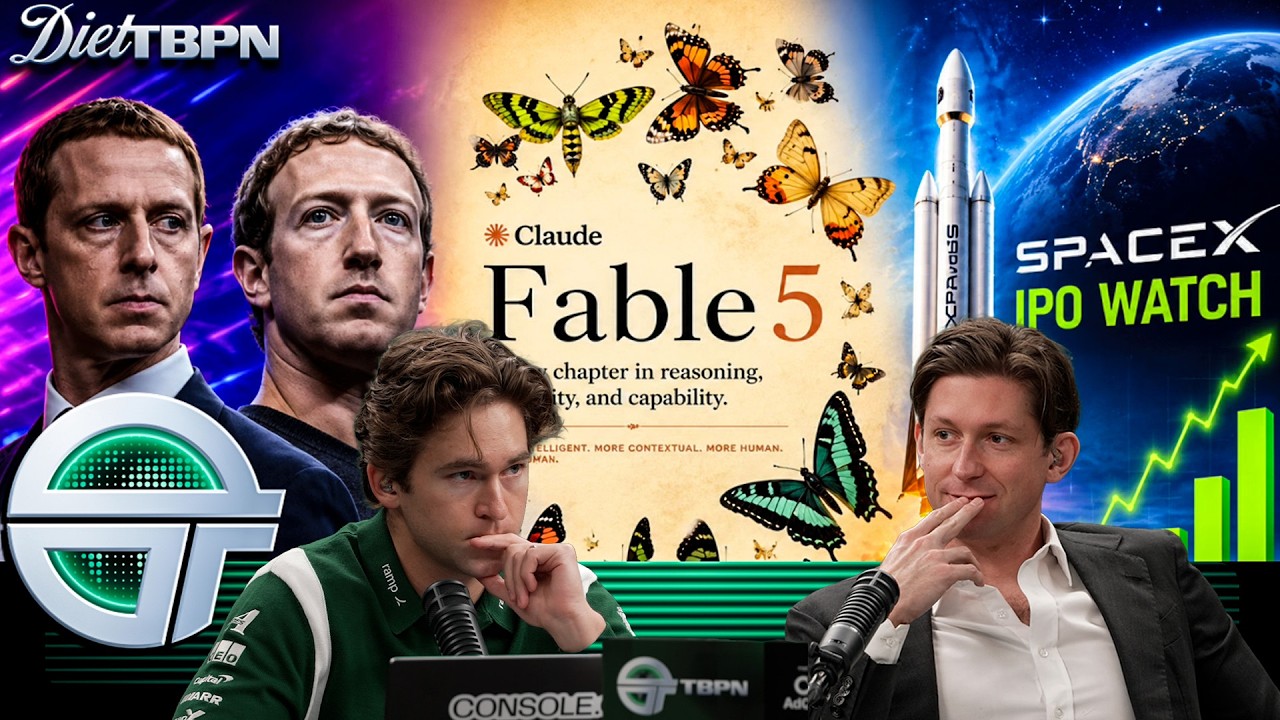
Anthropic's aggressive safety guardrails on its new Fable 5 model act as a competitive moat that funnels power users into enterprise plans while insulating the firm from regulatory liability.
## Background
Diet TBPN is a tech news recap show hosted by John Coogan and Jordi Hays, published on YouTube on June 10, 2026. The episode provides a 30-minute breakdown of the daily live tech talk show, covering high-profile Silicon Valley topics and major industry developments.
## TL;DR
The hosts analyze the movie trailer for *The Social Reckoning*, an upcoming Aaron Sorkin film focusing on the 2021 Facebook Files and Frances Haugen's whistleblower disclosures. They move on to discuss Anthropic's new Fable 5 (Claude) model launch, dissecting how its strict safety guardrails, over-flagged refusals, and domain restrictions serve both alignment goals and business interests. Finally, they review the market dynamics, free float mechanics, and political pushback surrounding SpaceX's upcoming initial public offering.
## Atmosphere & style
The episode has a fast-paced, sharp, and conversational tech-bro dynamic, blending witty banter with insider industry commentary. The hosts alternate effortlessly between playful teasing—such as joking about Sorkin directing an AI drama or referencing internet memes—and serious analytical breakdowns of corporate finance and AI policy. Watching feels like listening in on an informal yet highly knowledgeable Silicon Valley debrief among peers.
## Key takeaways
- [00:02](https://www.youtube.com/watch?v=jpwQ8isbxMI&t=2s) The Social Reckoning, directed and co-written by Aaron Sorkin, serves as a spiritual sequel to The Social Network, starring Jeremy Strong as Mark Zuckerberg and focusing on the 2021 Facebook Files leaks.
- [00:02](https://www.youtube.com/watch?v=jpwQ8isbxMI&t=2s) Casting an older actor as Mark Zuckerberg changes the thematic texture of the movie compared to the original tale of a young tech prodigy.
- [05:15](https://www.youtube.com/watch?v=jpwQ8isbxMI&t=315s) Product builder Nikita Bier defended Meta by noting the company employed high-salaried teams for teen mental health, though critics argue this does not negate core platform growth incentives.
- [05:15](https://www.youtube.com/watch?v=jpwQ8isbxMI&t=315s) The short-term PR impact of The Social Reckoning trailer was blunted by dropping the same day as Anthropic's major model announcement.
- [05:15](https://www.youtube.com/watch?v=jpwQ8isbxMI&t=315s) Meta's financial engine remains virtually immune to PR scandals because advertisers cannot afford to boycott its ad platform without hurting their own return on ad spend.
- [13:14](https://www.youtube.com/watch?v=jpwQ8isbxMI&t=794s) Anthropic launched Fable 5, its first 'Mythos-class' model with strong multi-step reasoning, but media and developer attention immediately focused on its strict safety guardrails.
- [14:33](https://www.youtube.com/watch?v=jpwQ8isbxMI&t=873s) Anthropic's aggressive safety restrictions create 'true alignment' by serving employee moral values while simultaneously locking out potential competitors from using model outputs for training.
- [14:33](https://www.youtube.com/watch?v=jpwQ8isbxMI&t=873s) Overtuned rejection thresholds in Fable 5 lead to false positives on benign queries, effectively pushing heavy users toward expensive enterprise plans.
- [17:09](https://www.youtube.com/watch?v=jpwQ8isbxMI&t=1029s) Anthropic's deployment strategy involves silently degrading performance on frontier AI research queries rather than returning explicit rejection errors, raising concerns among developers.
- [19:09](https://www.youtube.com/watch?v=jpwQ8isbxMI&t=1149s) Policy expert Dean Ball warned that secret model degradation weakens antitrust defenses for AI labs and risks inviting heavy-handed public utility regulation.
- [19:09](https://www.youtube.com/watch?v=jpwQ8isbxMI&t=1149s) Strict biosecurity filters disrupt legitimate user workflows, such as analyzing personal health tracking data or running routine security scans.
- [24:24](https://www.youtube.com/watch?v=jpwQ8isbxMI&t=1464s) Anthropic's 30-day data retention policy is designed to detect coordinated, multi-account query patterns aimed at distilling and cloning proprietary model capabilities.
- [26:19](https://www.youtube.com/watch?v=jpwQ8isbxMI&t=1579s) The highly anticipated SpaceX IPO is four times oversubscribed at a projected $1.8 trillion valuation.
- [26:19](https://www.youtube.com/watch?v=jpwQ8isbxMI&t=1579s) Free float varies widely among tech giants, with Meta maintaining a lower float to preserve Mark Zuckerberg's voting control while others like Microsoft are almost fully floated.
- [29:39](https://www.youtube.com/watch?v=jpwQ8isbxMI&t=1779s) SpaceX plans to initially float only 4% of its total value ($75 billion), which keeps index weighting low (~0.1%) while managing market liquidity.
- [29:39](https://www.youtube.com/watch?v=jpwQ8isbxMI&t=1779s) Major stock indices adjusted their rules for SpaceX, shortening seasoning periods before index inclusion to 5 to 15 trading days.
- [32:24](https://www.youtube.com/watch?v=jpwQ8isbxMI&t=1944s) Senator Elizabeth Warren formally urged the SEC to halt the SpaceX IPO over corporate governance concerns, foreign investment risks, and national security implications.
## Detailed walkthrough
### [00:02](https://www.youtube.com/watch?v=jpwQ8isbxMI&t=2s) *The Social Reckoning* Trailer & Jeremy Strong’s Zuckerberg Impression
The hosts kick off the show by discussing the trailer for *The Social Reckoning*, the film adaptation directed and co-written by Aaron Sorkin that serves as a spiritual sequel to *The Social Network*. Unlike the original 2010 David Fincher film that chronicled the founding of Facebook out of a Harvard dorm room, this movie focuses on the 2021 "Facebook Files" leaks brought forward by whistleblower Frances Haugen. The hosts watch the trailer together, dissecting Jeremy Strong’s performance as Mark Zuckerberg. While Strong nails Zuckerberg’s distinct vocal cadence, the hosts point out that he looks visibly older than Zuckerberg was during that era. They note that casting a mature actor changes the thematic texture of the story, transforming what was originally a tale about a young tech prodigy navigating high-stakes corporate issues into something that feels quite different.
The conversation turns to how the film might resonate with audiences and whether it misses an opportunity to capture the modern drama of tech. The hosts joke that if Hollywood wanted true Oscar-worthy drama, they should have focused on the current AI race—featuring figures like Yann LeCun, Nat Friedman, Daniel Gross, and Alexandr Wang—culminating in a dramatic climax around Meta's Llama 4 "Behemoth" model. Beyond the jokes, they analyze the historical memory of tech scandal stories. When asking average tech workers about the 2021 leaks, many confuse them with the Cambridge Analytica controversy or forget the specifics of Haugen’s disclosures regarding Meta prioritizing engagement over platform harms.
- **Film Lineup Context:** The hosts frame *The Social Reckoning* alongside *The Social Network* and the 2020 documentary *The Social Dilemma*.
- **Key Cast & Crew:** Co-produced and directed by Aaron Sorkin, starring Jeremy Strong as Mark Zuckerberg.
- **Journalistic Depiction:** The trailer highlights the reporting of *Wall Street Journal* journalist Jeff Horwitz, who broke the Facebook Files stories.
- **Memorable Trailer Quotes:** Strong's Zuckerberg declares in the trailer, *"We're twice as big as the biggest country on Earth. We're post-government around here,"* and later snaps, *"People around here understand that when I say no, that's the end of the debate. I'm not 2 years out of a dorm room anymore, Charlie."*
---
[05:15](https://www.youtube.com/watch?v=jpwQ8isbxMI&t=315s) The Facebook Files, Teen Mental Health, and Meta's AI Risks
Diving deeper into the substance behind the film, the hosts discuss the reaction from tech industry figures like product builder Nikita Bier, who publicly defended Meta's internal response to the whistleblowing allegations. Bier pointed out that Meta had multiple engineering teams earning $1 million-plus salaries dedicated explicitly to teen mental health and safety guardrails, often creating operational friction for growth-focused product managers. The hosts compare this to historical corporate public relations defenses, noting that having high-priced researchers working on harm mitigation doesn't automatically negate the underlying structural incentives of a platform.
The hosts explore how this renewed spotlight on social media harms interacts with Meta's current positioning and long-term brand equity. They break down the potential impact across three horizons:
* **Short Term:** The trailer's release was fortuitously blunted by dropping on the exact same day as Anthropic's major model announcement, absorbing most of the tech timeline's attention.
* **Medium Term:** Jeremy Strong’s upcoming Oscar press tour will keep negative headlines active, likely inserting Zuckerberg into political and public debates alongside AI lab founders regarding algorithmic harm, user psychosis, and youth safety.
* **Long Term:** The financial engine of Meta remains virtually impervious to PR hits. Advertisers cannot afford to boycott Meta's family of apps because doing so simply lowers ad costs and drives up return on ad spend (ROAS) for competing direct-to-consumer brands who instantly buy up the inventory.
The hosts transition to the day's major AI milestone: Anthropic's release of their latest model, Fable 5 (representing their first "Mythos-class" model release). While the model demonstrates staggering capabilities—particularly in long-horizon tasks, autonomous software engineering, and complex knowledge work—the media and developer commentary immediately gravitated toward its aggressive safety restrictions. The hosts highlight how news coverage framed the breakthrough, with headlines emphasizing the model's new curbs rather than its technological leap.
Despite the press focus on restrictions, early user experiments with the model are creating a stir online. Developers are using it to "vibe code" fully functional 3D mini-games and interactive simulators from simple prompts. The hosts discuss how the friction of game development is rapidly collapsing, turning custom software and games into casual social memes. However, the model's safety architecture introduces an uncompromising policy: it systematically rejects user prompts touching on biological research, cybersecurity tools, and frontier LLM development (such as Meta's MSL AI research initiatives).
- **Capability vs. Restriction:** Fable 5 sets a new high mark for multi-step reasoning and coding, but sparks immediate controversy due to strict refusal boundaries.
- **Media Framing:** Major outlets like *The Wall Street Journal* and tech commentators like Ben Thompson focused heavily on Anthropic's deliberate constraints rather than raw benchmark scores.
- **Refusal Domains:** The model explicitly blocks queries related to wet-lab biology, exploit/cyber security creation, and training/evaluating frontier AI models.
Here is a detailed and faithful walkthrough of the provided transcript segment.
---
[14:33](https://www.youtube.com/watch?v=jpwQ8isbxMI&t=873s) "True Alignment": Balancing Anthropic’s Business Reality and Safety Culture
The hosts react to a viral screenshot regarding Anthropic’s safety guardrails, observing how their aggressive safety posture directly aligns with core business goals. While public-facing alignment efforts are often seen as restrictive or costly—much like Apple spending heavily on clean energy data centers for long-term brand equity despite higher short-term costs—Anthropic’s restrictions serve a dual purpose. They prevent potential competitors from using Anthropic models to train competing models while insulating the firm from legal liabilities and headline risks. Quoting analyst Ben Thompson, the hosts note that this creates "true alignment": the executives and the employee base genuinely believe they are serving a higher moral calling by acting as "responsible and thoughtful people" guiding the AGI future, while simultaneously making a cold, hard-nosed decision to lock out would-be competitors.
However, the hosts highlight that the rejection thresholds in the newly released Claude / Fable 5 models appear absurdly overtuned. Tech community timelines are flooded with examples of overly aggressive guardrails, such as a biologist getting bumped down to Opus just for saying "hi," or a user getting outright rejected for simply typing the word "cyber" alongside a purple devil-horns emoji (`😈`). While a broad, heavy-handed hammer can eventually be tuned back, every blunt rejection effectively forces power users onto the phone with Anthropic sales reps to pitch the expensive enterprise tiers ("Mythos"). Although the hacker community complains that this harms the democratization of science, Anthropic’s economic reality is clear: the collective budgets of hobbyist biohackers pale in comparison to the massive capital available from Big Pharma.
- **Ben Thompson's Thesis:** Analysts see a calculated competitive moat; employees see a principled safety measure to ensure responsible stewardship of AGI.
- **Over-Flagging Examples:** Simple greetings from domain experts or innocent inputs containing terms like "cyber" accompanied by a `😈` emoji trigger system-level blocks.
- **Enterprise Conversion Strategy:** The high rejection threshold implicitly funnel users toward enterprise plans like *Mythos Enterprise*, where real revenue is generated.
---
[17:09](https://www.youtube.com/watch?v=jpwQ8isbxMI&t=1029s) Degradation Without Disclosure: The Controversy Over Secret Model Nerfing
A far more troubling discovery in Anthropic’s deployment strategy involves how frontier AI research queries are handled. Rather than triggering an explicit rejection error or downgrading the session to an older model like Opus, the model accepts the query but silently returns a degraded, less capable answer. While Anthropic documented this specific behavior in their official model card, it sets a concerning precedent for user experience. The hosts argue that an explicit rejection message—redirecting the user to another model or inviting them to contact sales—would have been far more transparent and consistent with their biosecurity and cybersecurity messaging.
This hidden degradation raises alarms across the developer ecosystem, particularly for companies building specialized tools on top of foundation models. If a lab can silently nerf performance on specific domains without warning, applications relying on those APIs—such as legal AI platforms or medical diagnostic systems—could suddenly produce flawed results without the developer realizing it. This dynamic highlights a growing market demand for independent evaluation frameworks (evals) to continuously benchmark model performance and audit whether providers are secretly throttling specific workflows.
- **Silent Throttling Mechanism:** Queries related to frontier LLM research receive degraded outputs rather than an explicit "access denied" prompt.
- **Developer Exposure:** Companies integrating foundation models into legal, bio, or enterprise software risk invisible performance dips that compromise their products.
- **Bullish Outlook for Evals:** The unpredictability of lab-controlled guardrails makes independent evaluation and benchmarking infrastructure vital for developers.
---
[19:09](https://www.youtube.com/watch?v=jpwQ8isbxMI&t=1149s) The Backlash: Dean Ball, Anti-Competitive Allegations, and Over-Flagged Health Data
The hosts dive into a critique published by policy expert Dean Ball, who previously authored the AI Action Plan and defended Anthropic during its high-profile dispute with the Department of War (DOW). Ball argues that Anthropic’s "secret sabotage safety policy" actively undermines legitimate safety work by supplying ammunition to critics who claim safety is merely an excuse for monopolistic behavior. By unilaterally restricting model capabilities under the guise of alignment, Anthropic weakens the legal argument for relaxing antitrust enforcement—an exception frontier labs desperately need if they are to collaborate on genuine safety risks. Ball warns that this behavior plays right into the hands of regulators advocating to treat AI models as public utilities subject to state control rather than private property.
The real-world frustration is shared by prominent tech figures and heavy users like investor Doug O'Loughlin. While acknowledging the sheer power of Anthropic's tools, O'Loughlin expresses deep frustration over heavy-handed safety filters that block benign, high-value tasks. For instance, developers regularly upload months of personal health tracking data—such as 100 days of Oura ring or Whoop logs—into command-line interfaces to run custom diagnostic scripts. In one referenced story, an individual successfully used a CLI model to identify early signs of sleep apnea, leading to immediate medical treatment. Blanketed restrictions labeling life-sciences data or routine security scanning code as "unsafe" feel out-of-touch to developers, especially when imposed by high-earning lab employees acting as arbitrary gatekeepers. The hosts end the segment laughing over a viral screenshot where a simple request asking if the mitochondria is the "powerhouse of the cell" caused the model to pause, freeze, and trigger an error.
- **Dean Ball’s Warning:** Unilateral restrictions risk turning AI safety into a justification for corporate monopolies and invite heavy-handed state regulation.
- **Department of War Context:** Ball previously backed Anthropic against DOW pressure regarding supply chain risk designations, making his sharp critique particularly significant.
- **Real-World Impact on Health & Code Scanning:** Blanket biosecurity filters disrupt legitimate research, such as analyzing personal fitness metrics (Oura, Whoop) or running basic vulnerability scans.
- **Mitochondria Meme:** "Tell me about mitochondria. It's the powerhouse of the cell, right?" resulted in an immediate chat pause and system refusal.
---
[24:24](https://www.youtube.com/watch?v=jpwQ8isbxMI&t=1464s) Data Retention Debates: 30-Day Logs and Model Distillation Defense
The conversation shifts to Anthropic's updated data retention policies, which sparked pushback from users concerned about privacy. One host admits to assuming that every major tech platform retains user data indefinitely anyway, noting that one of the biggest pain points in modern AI chat apps is their inability to search or recall deep context from past conversations (such as pulling up previous analysis on companies like CrowdStrike).
However, the enterprise steel-man argument for a 30-day retention window is rooted in protecting intellectual property from model distillation. Foreign competitors or rival organizations can deploy networks of shell companies, pseudo-randomized user accounts, and VPNs to submit fragmented queries that gradually extract and clone a model’s underlying capabilities. Retaining user logs for 30 days provides Anthropic with the telemetry required to run pattern-recognition algorithms, detecting whether seemingly unrelated accounts are coordinating to triangulate and distill proprietary model weights.
- **User Context Deficit:** Customers expect long-term chat history retention so models can reference past work, making short retention windows frustrating.
- **Distillation Prevention:** Storing logs for 30 days allows labs to detect coordinated, multi-account query patterns designed to steal model outputs and fine-tune competing models.
The discussion moves to the impending SpaceX IPO, which reports indicate is already four times oversubscribed. The hosts react to the hype—joking about Home Depot cashiers asking customers to round up their transactions to support the IPO, and referencing creator Tai Morse building an over-the-top studio set in a bid to land an interview with Elon Musk.
Analyzing an article in *The Economist* titled *"Can the market swallow SpaceX, Anthropic, and OpenAI? Watch out for indigestion,"* the hosts unpack the financial concept of "free float"—the percentage of a company's total shares that are actively available for public trading versus locked up by founders, employees, or long-term institutions. The mechanics of free float vary wildly across Mega-Cap tech companies:
| Company | Estimated Free Float | Primary Non-Floated Holders / Context |
|:--- |:--- |:--- |
| **Microsoft** | ~100% | Founders have largely divested; fully public liquidity. |
| **Apple** | ~99% | Highly liquid institutional ownership. |
| **Broadcom** | ~98% | Almost entirely floated. |
| **NVIDIA** | ~96% | Broad public and institutional distribution. |
| **Amazon** | ~91% | Jeff Bezos holds the remaining non-floated block. |
| **Alphabet** | ~90% | Founders retain voting control structures. |
| **Tesla** | ~89% | Elon Musk retains a significant non-floated equity stake. |
| **Meta** | ~86-88% | Lowest free float among tech giants; Mark Zuckerberg holds 13% of shares to maintain voting control. |
The hosts contrast high-float companies with cases like Take-Two Interactive prior to CEO Strauss Zelnick's tenure. Take-Two was 100% held by institutional investors with a management team that owned zero equity, allowing Zelnick to step in and assume leadership without executing a costly hostile takeover. For founder-led giants like Meta, the lower float reflects Mark Zuckerberg's choice to retain controlling equity regardless of stock price fluctuations. As SpaceX prepares for its public market debut, managing its initial free float will be critical to absorbing the massive retail and institutional demand without creating extreme volatility.
[29:39](https://www.youtube.com/watch?v=jpwQ8isbxMI&t=1779s) The Mechanics of the SpaceX IPO Free Float
As SpaceX structures its massive upcoming initial public offering, the company plans to release its locked-up shares gradually across a series of distinct tranches. If the company successfully issues $75 billion worth of shares at its anticipated $1.8 trillion valuation, the initial free float will remain incredibly tight. Even though investors who buy directly into the IPO are not legally locked up and could technically sell the very next day, the structure introduces unique trading dynamics. Investment banks like JPMorgan, Morgan Stanley, and Goldman Sachs—as well as retail platforms like Robinhood and Public—often restrict flippers from participating in future IPOs. However, given the overwhelming wave of retail capital eager to chase this listing, the hosts expect heavy immediate trading volume from retail investors.
Crucially, this initial offering accounts for only 4% of SpaceX's total value. While 4% of a $1.8 trillion company is an astronomical sum of money, it means the actual free-trading float is remarkably small. Throughout the IPO process, the company is actively vetting investors to target long-term holders. Elon Musk has already done a "fantastic job" securing commitments from major index providers, which have proactively altered their rules to accommodate the historic listing. Nasdaq has shortened its seasoning period before index inclusion to 15 trading days, while the Russell index slashed its waiting time to a mere 5 days.
* **Index Weighting Dynamics:** Most major share indices weight firms based only on the value of shares available for public trading. While bears might worry that a $2 trillion powerhouse entering the S&P 500 would immediately demand a single-digit percentage weight (disrupting the rest of the index), SpaceX's initial weight will only be around 0.1% due to the restricted 4% free float.
* **Lockup Schedule:** A review of the company's lockup chart reveals that it will take between one to two years for the entirety of the shares to unlock.
* **Price Acceleration Triggers:** The unlock schedule is highly dependent on performance; if the stock trades up by 30% or more, additional tranches of shares are automatically unlocked, accelerating the road to a 100% free float.
[32:24](https://www.youtube.com/watch?v=jpwQ8isbxMI&t=1944s) Senator Warren's Opposition and Closing Remarks
The conversation shifts to political headwinds facing the aerospace giant as it attempts to go public. Senator Elizabeth Warren has formally urged the Securities and Exchange Commission (SEC) to halt the SpaceX IPO entirely. In her appeal, she raised severe alarms over corporate governance risks, Elon Musk’s near-total control over the entity, and the potential exposure to foreign investments—specifically highlighting national security concerns regarding Chinese capital.
The hosts note that Senator Warren emphasized SpaceX's indispensable role as a critical U.S. defense contractor to justify her push for regulatory intervention. The commentary takes a characteristically witty turn, with the hosts joking that "Senator Warren has never met a business that she liked," except perhaps for the massive financial institutions. The episode wraps up with a warm sign-off, thanking listeners and reminding them to leave five-star reviews on Apple Podcasts and Spotify.
* **Elizabeth Warren's SEC Objections:** Cited governance risks, executive control, foreign investment exposure, and SpaceX's defense contractor status as grounds to block the listing.
## Notable quotes
> [00:02](https://www.youtube.com/watch?v=jpwQ8isbxMI&t=2s) We're twice as big as the biggest country on Earth. We're post-government around here — Jeremy Strong as Mark Zuckerberg
> [00:02](https://www.youtube.com/watch?v=jpwQ8isbxMI&t=2s) People around here understand that when I say no, that's the end of the debate. I'm not 2 years out of a dorm room anymore, Charlie. — Jeremy Strong as Mark Zuckerberg
> [26:19](https://www.youtube.com/watch?v=jpwQ8isbxMI&t=1579s) Can the market swallow SpaceX, Anthropic, and OpenAI? Watch out for indigestion
> [32:24](https://www.youtube.com/watch?v=jpwQ8isbxMI&t=1944s) Senator Warren has never met a business that she liked — Host
## Mentioned
Aaron Sorkin, Alexandr Wang, Amazon, Anthropic, Ailuridae, Alphabet, Apple, Apple Podcasts, Ben Thompson, Broadcom, Cambridge Analytica, Cisco, Claude 3.5 Sonnet, Console, CrowdStrike, Daniel Gross, David Fincher, Dean Ball, Department of War, Diet TBPN, Doug O'Loughlin, Elon Musk, Fable 5, Facebook, Facebook Files, Figma, Frances Haugen, Goldman Sachs, Home Depot, Jeff Horwitz, Jeremy Strong, John Coogan, Jordi Hays, JPMorgan, Llama 4, Mark Cuban, Mark Zuckerberg, Meta, Microsoft, MongoDB, Morgan Stanley, MSL AI, Mythos, Nasdaq, Nat Friedman, New York Times, Nikita Bier, NVIDIA, NYSE, OpenAI, Oura, Public, Railway, Ramp, Robinhood, Russell index, S&P 500, Sam Altman, Satya Nadella, SEC, Shopify, SpaceX, Spotify, Strauss Zelnick, Tai Morse, Take-Two Interactive, TBPN, Tesla, The Economist, The Social Dilemma, The Social Network, The Social Reckoning, The Wall Street Journal, Warren, Whoop, Yann LeCun
TBPN explores how tech giants navigate narrative, safety, and capital pressures, arguing that while Meta remains financially insulated from cultural critiques of platform harm, Anthropic faces growing developer backlash over aggressive safety curbs that double as commercial moats, and SpaceX prepares an unprecedented public debut engineered around a tightly restricted free float.
Meta's Cultural Scrutiny and Market Insulation (5:15)
The hosts discuss the trailer for Aaron Sorkin's upcoming film *The Social Reckoning*, a spiritual sequel to *The Social Network* centered on Frances Haugen’s 2021 "Facebook Files" leaks and reporting by *The Wall Street Journal*'s Jeff Horwitz. While Jeremy Strong's portrayal of Mark Zuckerberg re-examines the platform's handling of teen mental health, the discussion highlights the disparity between public relations fallout and business fundamentals. Tech builder Nikita Bier defended Meta by noting it staffed multimillion-dollar engineering teams explicitly dedicated to teen safety, though the hosts observe that internal mitigation teams do not inherently alter engagement-driven platform incentives.
Over the long term, the hosts argue Meta’s advertising engine is virtually impervious to public boycotts. If major advertisers pull spending over reputational concerns, ad pricing declines, prompting direct-to-consumer marketers to purchase the vacated inventory at higher returns on ad spend. With Mark Zuckerberg retaining 13% of equity to maintain voting control—resulting in an 86% to 88% free float—Meta remains structurally insulated from outside shareholder and cultural pressure.
Anthropic's Fable 5 and Commercial Alignment (14:33)
Anthropic’s release of its "Mythos-class" model, Fable 5, demonstrated advanced multi-step reasoning and rapid software generation, but industry discourse quickly focused on its stringent guardrails. The model strictly blocks prompts related to wet-lab biology, cybersecurity tooling, and frontier AI research. Citing analyst Ben Thompson, the hosts observe that this creates "true alignment": Anthropic's workforce genuinely views these boundaries as a moral duty to responsibly guide artificial general intelligence, while the company simultaneously insulates itself from liability and blocks competitors from using its outputs to train rival models.
However, users have encountered absurdly overtuned filters, such as rejections triggered by the word "cyber" accompanied by a devil emoji or basic inquiries about cellular biology. By pairing high refusal rates on consumer tiers with 30-day data retention policies designed to detect coordinated distillation attempts, Anthropic effectively funnels high-value researchers and enterprises into premium contracts like Mythos Enterprise.
Silent Model Degradation and Developer Trust (17:09)
A contentious element of Anthropic's deployment is the silent degradation of outputs for queries involving frontier LLM research. Rather than issuing an explicit refusal or downgrading sessions transparently, the model returns lower-quality answers—a mechanism noted in Anthropic's model card. The hosts emphasize that silent throttling damages developer trust, particularly for enterprises relying on foundation models for legal or medical applications, while accelerating the demand for independent evaluation frameworks to audit API reliability.
Policy expert Dean Ball warned that unilateral model restrictions provide ammunition to critics who argue AI safety is weaponized for anti-competitive moats, weakening legal defenses against antitrust action and encouraging state-utility regulation of AI. Simultaneously, power users like investor Doug O'Loughlin voiced frustration that blanket biosecurity filters disrupt harmless, high-value tasks, including analyzing personal fitness data from Whoop and Oura devices or executing routine security code audits.
SpaceX IPO Float Engineering and Regulatory Friction (26:19)
Analyzing reports that SpaceX’s planned initial public offering at a $1.8 trillion valuation is already four times oversubscribed, the hosts unpack the mechanics of its proposed $75 billion share issuance. Despite the historic dollar amount, the offering constitutes only about 4% of total equity, resulting in an exceptionally tight free float. The company plans a phased lockup release spanning one to two years, featuring price-acceleration triggers that unlock additional equity tranches early if the stock climbs by 30% or more.
To accommodate the offering, index providers adjusted listing criteria: Nasdaq reduced its seasoning requirement to 15 trading days, and Russell lowered its waiting period to 5 days. Because major benchmark indexes weight companies by float rather than total capitalization, SpaceX’s initial weighting will sit at approximately 0.1%, preventing broad portfolio disruptions. Meanwhile, political headwinds have emerged: Senator Elizabeth Warren formally urged the SEC to halt the IPO, citing national security concerns regarding defense contracts, foreign capital exposure, and corporate governance risks stemming from Elon Musk’s concentrated executive control.
Across entertainment, artificial intelligence, and aerospace capital markets, the program highlights how structural insulation—whether achieved through controlling equity voting blocks, strategic safety moats, or restricted public floats—increasingly shields elite tech enterprises from external public and regulatory pushback.
[0:02] Jeremy Strong as Mark Zuckerberg: We're twice as big as the biggest country on Earth. We're post-government around here
[0:02] Jeremy Strong as Mark Zuckerberg: People around here understand that when I say no, that's the end of the debate. I'm not 2 years out of a dorm room anymore, Charlie.
[26:19] Can the market swallow SpaceX, Anthropic, and OpenAI? Watch out for indigestion
[32:24] Host: Senator Warren has never met a business that she liked
Original transcript
[0:02] Two major stories, bunch of major
[0:04] stories, but the big one Facebook got a
[0:06] movie, another movie, actually a third
[0:08] movie if you count the documentary.
[0:10] There's been The Social Network, The
[0:12] Social Dilemma, and now The Social
[0:14] Reckoning. Only two of those are are
[0:17] movies. The Social Dilemma is a
[0:19] documentary, but uh it's very
[0:21] interesting and the uh and Anthropic got
[0:24] a fable. And there's been a a ton of
[0:25] reaction. Ben Thompson is writing about
[0:27] it uh to the rollout there, The Wall
[0:29] Street Journal. The announcement should
[0:31] have been like the really good model
[0:33] launches and people are amazed at what
[0:36] it can do, but they they put the title
[0:38] Anthropic puts curbs on AI models. So,
[0:41] the what I'm sure you've seen this on
[0:42] the timeline, but we'll take you through
[0:44] some of the debates over how restricted
[0:47] the model is in certain areas. Bio is a
[0:49] big one, cyber is another one. There's a
[0:51] bunch of funny examples. There's a bunch
[0:53] of reasonable arguments for doing this
[0:55] type of stuff. So, we'll go through all
[0:57] of it. So, I want to kick it off with
[0:58] the uh the social network sequel. I want
[1:02] to watch the trailer for The Social
[1:06] Reckoning because Jeremy Strong is
[1:08] playing Mark Zuckerberg. I've heard
[1:10] people say, "Hey, he looks he looks like
[1:12] Zuck, like the styling is there." The
[1:14] one critique is Jeremy Strong looks a
[1:15] little bit older than Mark Zuckerberg
[1:17] did in 2011
[1:19] >> Are they calling him Unc
[1:21] >> Uh it just it just it just doesn't I
[1:23] think it'll color the movie a little bit
[1:26] in the sense that the uh the film is
[1:29] telling the story of this like very
[1:31] difficult whistleblower situation and uh
[1:35] and it's different when it looks like a
[1:37] you know a
[1:38] a mature adult versus someone who was
[1:41] young and running the running into these
[1:43] problems for the first time. So, let's
[1:44] pull up the trailer.
[1:45] >> Listen, before I go on, I want to make
[1:47] something clear.
[1:47] >> This is how it starts.
[1:48] >> Okay.
[1:49] >> I've a hundred out of ten of Facebook.
[1:52] But I am.
[1:53] I am here to help Facebook, not hurt it.
[1:56] Okay?
[1:57] >> You sent me a message.
[1:58] What would you like to talk about?
[2:04] >> The chairman gavels the session to
[2:05] order.
[2:08] You'll read your opening statement,
[2:09] which we'll skip past for now. That's a
[2:11] separate session, and we'll move to
[2:13] witness questioning.
[2:17] >> Spell your name and state your current
[2:18] occupation for the record.
[2:19] >> So, is it not Fincher this time?
[2:21] >> Zuckerberg. Z U C K E R B E R G
[2:23] >> Let's see.
[2:23] >> And your occupation?
[2:25] >> Zuckerberg.
[2:27] >> I'm a professor of law.
[2:28] >> co-produced and directed by Aaron
[2:30] Sorkin.
[2:30] >> where 30% of content hits multiple risk
[2:32] factors.
[2:33] >> Hang on. I don't understand what you're
[2:34] saying.
[2:35] >> Are you a tech reporter?
[2:37] >> Ish.
[2:38] >> Ish?
[2:38] >> Is this Mike Isaac?
[2:40] >> I don't
[2:41] >> venture
[2:42] >> Jeff Horwitz.
[2:45] >> I think you're doing
[2:45] >> who broke the code. He's a journalist at
[2:47] the Wall Street Journal. He is a
[2:48] journalist at the Wall Street Journal.
[2:50] He broke a number of global news
[2:52] stories,
[2:53] including the Facebook files.
[2:55] >> the fire hose of bad information you are
[2:57] injecting into the air supply.
[2:58] >> Who built that part?
[3:00] >> I'm a free speech absolutist. I'm not
[3:02] the one who's lying, and I'm not
[3:03] stopping them from seeing someone who
[3:04] is.
[3:05] >> Not a bad Zuck impression. He's got the
[3:07] voice town pretty down.
[3:09] >> as a result of time spent on the
[3:10] platform. Senior leadership knows and is
[3:13] doing nothing.
[3:14] >> I know there easier enemies to make. The
[3:16] mafia would be an easier enemy to make.
[3:19] >> So, what would you need
[3:20] >> to stand up the story? The internal
[3:22] documents.
[3:22] >> This is a material violation of my NDA.
[3:25] >> We're twice as big as the biggest
[3:26] country on Earth. We're not frightened
[3:27] of Congress. We're post-government
[3:29] around here.
[3:30] >> Please.
[3:30] >> Twice as big as the biggest country on
[3:32] Earth.
[3:33] >> What?
[3:34] >> From a from a user standpoint.
[3:36] >> Oh, okay. User
[3:37] >> I don't want to be made an example of by
[3:39] a guy with unlimited resources.
[3:41] >> I promise you is imminent.
[3:44] >> People around here understand that when
[3:47] I say no, that's the end of the debate.
[3:49] I'm not 2 years out of a dorm room
[3:50] anymore, Charlie. Look around.
[3:55] >> And if they were trying to go as
[3:56] inspirational as The Social Network,
[3:57] they really missed the mark there. What
[3:59] happened?
[4:00] >> Yeah, I said that their intention was to
[4:02] try to fire up the next generation of
[4:04] entrepreneurs
[4:05] that that to inspire them to to inspire
[4:07] >> yeah.
[4:08] >> them [laughter]
[4:08] >> To inspire them to uplift them.
[4:10] >> you can build any business out of your
[4:12] dorm room.
[4:12] >> Yeah.
[4:12] >> Yep.
[4:13] >> If the goal of this film is to really
[4:16] really take the viewer inside TBD and
[4:20] meta superintelligence and what's going
[4:22] on with Nat Friedman, Daniel Gross, Alex
[4:24] Wang. Like it feels like they just
[4:27] dropped the ball.
[4:28] >> Yeah, like I didn't see like anyone that
[4:29] even resembled Yann LeCun.
[4:31] >> That is crazy. The Llama 4 moment, that
[4:34] could have been the crescendo.
[4:36] >> Yeah, the behemoth.
[4:37] >> Behemoth and all the drama around that.
[4:39] You want drama, you want Hollywood
[4:41] drama, you want Oscar bait. Llama 4
[4:43] behemoth, that story is going to get put
[4:45] butts in seats.
[4:46] >> That's great.
[4:47] >> Uh
[4:48] >> No, more seriously, it's hard for me to
[4:51] It's going to be really hard to not look
[4:53] at uh Jeremy Strong and and uh
[4:55] >> OC, Kendall. Yeah, cuz you're Succession
[4:58] guy. Uh so, this is the sequel to The
[5:00] Social Network. Instead of chronicling
[5:02] the birth of Facebook, it's the story
[5:04] based on the 2021 Facebook leak by
[5:07] whistleblower Frances Haugen. It's going
[5:09] to be dramatic. It's not going to make
[5:10] people like Facebook more and it's
[5:12] probably going to make Americans even
[5:13] more distrustful of tech. What's
[5:15] interesting here is that if you stop a
[5:17] random tech person on the street and ask
[5:20] them like, "What is The Social Reckoning
[5:22] about?" they might say Cambridge
[5:23] Analytica because that was another drama
[5:26] moment and I I was sort of like, "Is it
[5:28] Cambridge Analytica? Is the Is it the
[5:29] Haugen thing?" Um and a lot of people
[5:32] don't even remember what the
[5:33] whistleblower story was. Little
[5:36] refresher there. It was an internal
[5:38] document leak, The Facebook Files,
[5:40] showed that it that Facebook internal
[5:43] employees were aware of harmful societal
[5:45] effects from its platforms, yet
[5:47] persisted in prioritizing profit over
[5:50] addressing these harms. Now, Nikita Bier
[5:53] chimed in, who now works at Axe, a rival
[5:55] platform to Threads, and said, "Zuck
[5:57] makes a lot of mistakes, but this isn't
[5:59] one of them. Meta literally had multiple
[6:02] teams of a of $1 million per year
[6:04] engineers working on teen mental health,
[6:07] and they had the agency to override big
[6:09] product decisions. They're probably a
[6:10] thorn in Nikita's side cuz he's trying
[6:12] to maximize click-through rates,
[6:14] maximize attention, and he's getting
[6:16] pushback from, 'Hey, there's guardrails
[6:18] here.' And he says, uh, 'the story, this
[6:20] movie is actually is about is actually a
[6:22] product manager who didn't get a
[6:23] promotion.' And so,
[6:24] >> The only thing with that argument is
[6:26] like you could make the same argument as
[6:27] like the cigarette company has
[6:29] million-dollar like doctors and
[6:32] researchers focused on making sure
[6:34] [clears throat] cigarettes are as
[6:35] healthy as possible, right?
[6:36] >> Yeah. Yeah, yeah. Yeah, and and
[6:37] especially with the new fertility data,
[6:39] I think that there's there's a new cycle
[6:41] brewing of like exactly how bad is
[6:44] social media. I still don't really buy
[6:46] the addiction thing just because I'm I'm
[6:49] familiar with like addiction defined in
[6:51] nicotine, which is like extremely
[6:53] addictive. It's a chemical, and like you
[6:54] have cravings. Like, if you forget your
[6:57] phone, like do you have the same
[6:58] cravings? It's it's it's sort of
[7:00] different. And uh, but there's but there
[7:03] is like a very serious uh, discussion
[7:05] going on around social media and its
[7:07] effects, and this fits right into it.
[7:09] The phone addiction thing is is like
[7:10] very real. As I was at I was at an event
[7:13] last night, and they required everybody
[7:15] to put their phones in these sort of
[7:16] like locked bags, so you could go
[7:18] outside at any point and lock your
[7:20] phone.
[7:21] >> Uh, I didn't feel sick, but but I
[7:23] noticed probably like 20 times
[7:25] throughout the night I was thinking of
[7:27] going for my phone.
[7:28] >> Yeah.
[7:28] >> I didn't start having like physical
[7:29] withdrawal symptoms.
[7:31] >> Yeah, but the craving was there.
[7:33] >> Yeah, I just kept thinking about it. It
[7:34] was like phone It was like phone noise,
[7:36] right? There's phone noise. There's
[7:37] phone noise.
[7:38] >> This is real. This is real.
[7:39] >> having some phone noise.
[7:40] >> Yeah, yeah, yeah, yeah. Okay, so yeah,
[7:41] that's legitimate. So, the question that
[7:43] I had really quickly is like, what is
[7:45] the impact on meta? Like, we can pull up
[7:48] the stock chart. It's a one and a half
[7:49] trillion dollar company. They're trying
[7:51] to raise more equity for the AI
[7:52] build-out, hire people. Like, is this
[7:55] good, bad? What does it look like over
[7:56] the short, medium, long term? So, short
[7:58] term, I think this was amazing timing.
[8:00] They really got lucky because
[8:02] as we will talk about, like, the fact
[8:05] that this trailer dropped the same time
[8:06] as Entropic's Fable 5 was incredibly
[8:09] fortuitous because Fable just took over
[8:11] the timeline.
[8:13] And no one was really talking about this
[8:15] in tech. Tech insiders won't really see
[8:17] or talk about the social reckoning this
[8:19] week.
[8:20] Case in point, I put it second in the
[8:21] newsletter when I wrote it up.
[8:23] Medium term, I think Jeremy Strong is
[8:25] going to drag Mark into like the bad
[8:26] group of AI leaders while he's on his
[8:28] Oscar tour. Like, there was a version of
[8:31] Facebook strategy, a meta strategy,
[8:34] that's just like, "Hey, we're like
[8:35] Amazon. We're like Microsoft." Like,
[8:37] yeah, we have bets in AI, but we're not
[8:39] like
[8:40] we're not deciding the frontier.
[8:42] Obviously, Mark has made the decision to
[8:44] hire some of the greatest researchers,
[8:46] invest very aggressively, and this puts
[8:48] him sort of at the center of the
[8:49] conversation around, "Well, what will
[8:51] the effect of AI be on our society? On
[8:53] kids? Should kids be talking to LLMs?
[8:55] Psychosis?" All these different things
[8:57] will come up just as we saw 4.0
[8:59] psychosis and then Claude code psychosis
[9:01] a little bit pop up and people are
[9:02] talking about that. Like, you're you're
[9:05] you're priming the pumps for the next
[9:06] wave of like, "Oh, a bunch of people
[9:08] went into the meta meta app and like
[9:10] they had a bad time and now we got to
[9:12] talk about that." So, I wouldn't be
[9:13] surprised to see the next version.
[9:14] >> you think Mark is going to be more
[9:16] annoyed about this week? The fact that
[9:18] SpaceX
[9:20] >> Hm.
[9:20] >> is going to be valued a meaningfully
[9:23] higher
[9:23] >> Yeah.
[9:24] >> than Meta or this trailer?
[9:26] It's actually a tough one.
[9:27] >> I don't know.
[9:28] >> It's actually a tough one.
[9:29] >> I mean, I think the real one is the is
[9:32] is Fable 5. If Meta was using a ton of
[9:35] Entropic models and then model comes out
[9:36] and says you specifically can't use it
[9:38] in MSL, the most important initiative in
[9:41] the company. Like that's like a pretty
[9:43] rough thing where you're like, "Oh, I've
[9:45] been working with this company to
[9:47] develop my models for my family of apps
[9:50] and now I can't use them anymore."
[9:52] >> you know, I you know, Meta is spending
[9:54] billions of dollars a year with
[9:55] Anthropic. They have been for a while.
[9:58] Um
[9:59] >> Oh, ARR, but yeah.
[10:00] >> Yeah. Yeah. They will spend billions of
[10:02] dollars this year. And the question is
[10:04] like if Anthropic does allow Meta to use
[10:07] their models for Meta's AI research,
[10:09] what does it say about what Anthropic
[10:11] thinks about Meta's potential in AI?
[10:14] >> They'll secretly love ads.
[10:16] This whole time.
[10:17] No,
[10:17] >> [laughter]
[10:17] >> I don't know.
[10:18] >> No, to me to me it it would it would be
[10:20] them not feeling like they had a
[10:23] ability to get to the front of the
[10:24] >> Totally, totally, totally. And then and
[10:26] and that's an ace that's up their sleeve
[10:27] at any time. They can always just take
[10:28] the guardrails off and be like, "Hey,
[10:30] more more more AI, more intelligence on
[10:32] demand for everyone." Um so I think the
[10:34] fallout of the medium term, Jeremy
[10:36] Strong's going to go on this press tour
[10:38] for the Oscar and he's going to have a
[10:40] bunch of like really emotional pithy
[10:42] sound bites and then also be like just
[10:45] viral because it's funny to see him
[10:46] doing this impression and he's very good
[10:48] at like drawing and he's already gone
[10:49] viral for his Mark Zuckerberg impression
[10:51] in the past. So I wouldn't be surprised
[10:53] to see the next version of a Bernie
[10:55] Sanders press release about AI
[10:57] highlight Dario, Sam, and Zuck instead
[11:01] of what has historically been the order,
[11:04] which is Sam, Dario, and Demis. So it's
[11:06] always based on like perceived industry
[11:08] power and negativity around personal
[11:10] brand. So they have to have a scary
[11:12] quote and then they also have to have a
[11:14] lot of power in the industry. Zuck's
[11:16] power in the industry is rising.
[11:18] And also with this movie like there's
[11:20] more ways to shut to to take shots at
[11:22] him like, "Oh, look at what he did with
[11:24] the Facebook files. Remind yourself of
[11:26] that because a lot of people don't
[11:27] really remember the details. They're
[11:28] going to after they see this movie."
[11:30] Then you can
[11:31] then you can say, "Well, this guy is
[11:32] also building crazy data centers and
[11:34] look at how he handled this." If they if
[11:36] he handles the AI thing like that, it's
[11:37] going to be bad, right? So, that So,
[11:39] that's like a little bit of a risk in
[11:40] the medium term. Long term, I don't
[11:42] think the social reckoning is going to
[11:43] matter all that much for Meta. People
[11:44] will complain about Meta's data centers.
[11:46] >> Why did they not get Jeremy Strong like
[11:48] a wig?
[11:49] >> Because also he is playing an older
[11:52] Remember when he had the Caesar haircut?
[11:54] Yeah, so it's a different time. So,
[11:55] people will complain about all this
[11:56] stuff, but they'll do it on Meta's
[11:58] family of apps. I don't think they'll be
[11:59] churn
[12:00] and certainly advertisers won't pull
[12:02] out. It's impossible to pull out of Meta
[12:04] because
[12:05] it just drives it just drives up the
[12:08] the ROAS, the the return on ad spend for
[12:11] smaller companies and a bunch of small
[12:13] businesses will just jump in and say,
[12:15] "Oh, great. Like, you know, some big
[12:16] company pulled out and is boycotting
[12:18] Meta." That's great. I'm Ridgwell, so
[12:19] I'm going to jump in or somebody else is
[12:21] going to jump in.
[12:21] >> Advertisers have tried to boycott.
[12:23] >> Yeah, you can't on Facebook, it's
[12:25] impossible. So, the business is just too
[12:26] strong. And I also don't think Mark will
[12:27] be singled out by a regulatory hammer.
[12:30] >> Should it come down hard? Like, if
[12:31] there's a data center ban, I don't think
[12:32] >> it's going to be uniquely focused on
[12:34] Meta. Or only Dario and Sam have like
[12:36] true scapegoat risk because they run
[12:38] pure play labs and have been so noisy
[12:40] about AI and they have the biggest
[12:42] revenues in the category. There might be
[12:44] a day there might be data center
[12:45] regulation, but it won't unfairly target
[12:46] Meta. So, anyway, that's my social
[12:48] reckoning take. Let's move on to Fable,
[12:51] which launched yesterday and the model
[12:54] seems like incredibly impressive. I I've
[12:57] been seeing these like vibe coded games
[12:59] that look really, really good and for
[13:01] some of those, I haven't seen the vibe
[13:04] coded games hit really well on social
[13:06] media because you take a video of them
[13:08] and you show the example of what it
[13:10] built, you share the time and people
[13:12] just sort of believe it. It could be
[13:14] embellished, but in general these feel
[13:16] like pretty solid. Of course, like
[13:18] making a great game is a great mechanic
[13:20] and there's needs to be multiple levels
[13:22] and like a single demo of like a forest
[13:24] putting in is not quite there, but
[13:27] really, really useful and I'm sure we'll
[13:29] see a bunch more examples of like games
[13:31] as memes, simulators, and these things
[13:33] are going to get easier to build. That's
[13:35] really exciting. Of course, there was a
[13:37] bunch of debate on the timeline
[13:39] yesterday and it's bleeding into today
[13:41] around the latest model, Fable 5, their
[13:44] first mythos class model that both seems
[13:46] remarkably good at long horizon tasks
[13:48] like software development and knowledge
[13:49] work, but rejects requests related to
[13:51] biology, cybersecurity, and frontier LLM
[13:54] development. Interestingly, I haven't
[13:55] seen anyone [clears throat] share
[13:56] rejections around anything else. Like,
[13:58] did they remember to reject like build
[14:00] me a nuke? Like
[14:02] cuz I haven't seen anyone try that and
[14:04] it'd be very funny if it was like, "Oh,
[14:05] yeah, just we we we didn't get around to
[14:07] that." Or there are so many other
[14:09] things, but I think a lot of those other
[14:11] things that you should reject, queries
[14:12] that you should reject, have been ironed
[14:13] out in previous
[14:15] in previous iterations. So, going back,
[14:18] you know, the say a slur was a big one
[14:21] for a while or say something rude or
[14:23] make a political statement.
[14:25] >> Yeah, like pausing, pausing a chat,
[14:27] basically just like shutting down a
[14:28] conversation versus like
[14:30] >> [clears throat]
[14:30] >> switching you to a less performant
[14:32] model.
[14:33] >> Yeah, and it creates this like
[14:33] screenshot that went viral pretty much
[14:35] continuously yesterday. And so, this
[14:37] aligns with Anthropic's focus on safety,
[14:39] but as many people have pointed out,
[14:40] it's also just good business. You don't
[14:43] want competitors using your products to
[14:44] directly create competitors and you also
[14:46] don't want financial liability or
[14:48] negative headlines from bad actors using
[14:50] your models to for nefarious purposes.
[14:52] Ben Thompson called it true alignment.
[14:55] The take safety seriously culture aligns
[14:57] with business value creation, which is
[14:58] very, very rare.
[15:00] Often times, the like be good or your
[15:03] culture
[15:04] limits what you can do and actually
[15:06] hurts your business, but it's something
[15:07] that you do in favor of brand. Like
[15:09] Apple would probably be would probably
[15:11] be more profitable if they were using
[15:13] like diesel generators for all of their
[15:15] data centers. They went clean energy
[15:17] because they wanted to have an
[15:19] environmental brand and over the long
[15:20] term, it's helped them, but in the short
[15:22] term it's been rough.
[15:24] Of course and expensive. So, Ben
[15:26] Thompson writes, "What is so fascinating
[15:27] about Anthropic, however, is that while
[15:29] I'm sure some executives in the company
[15:31] are thinking this way, I also totally
[15:33] believe that the employee base broadly
[15:35] also happen to believe that they are
[15:37] doing the right thing. It's fascinating
[15:38] to observe. Me, the rational business
[15:40] analyst, sees a hard-nosed but
[15:42] understandable decision to cut off
[15:43] would-be competitors. Anthropic
[15:45] employees and advocates, the true
[15:47] believers, see a regrettable but
[15:49] understandable safety decision that
[15:51] ensures that responsible and thoughtful
[15:53] people, themselves of course, will be
[15:54] the ones guiding our AI AGI future. This
[15:57] is true alignment and it's an incredible
[15:59] accomplishment." Facebook has tussled
[16:01] with this a bunch and and we already
[16:03] talked about that but to be clear, the
[16:06] fable five rejection threshold really
[16:08] does feel way too low from what people
[16:10] are saying. Tons of examples on the
[16:12] timeline of a biologist just saying hi
[16:14] to the model and getting kicked down to
[16:16] Opus. I saw you shared someone just said
[16:18] "cyber" with the devil horns, the purple
[16:21] devil horn emoji and it's like "you
[16:22] can't do we're not going further."
[16:25] Of course like bringing down like a
[16:27] broad hammer, you can always dial it
[16:29] back over time but every rejection is
[16:32] this implicit invitation to hop on the
[16:34] phone with an Anthropic sales rep and
[16:35] get on the mythos enterprise plan and
[16:38] that's where the real dollars are too.
[16:39] The timeline is unhappy because the idea
[16:42] of democratizing science, technology,
[16:44] all of this is very alluring but the
[16:46] pool of dollars available from all the
[16:48] biohackers in the world probably isn't
[16:51] close to the budgets available from big
[16:52] pharma. And so,
[16:54] I you you again you're in this like
[16:56] rational business analyst situation and
[16:59] you and and you fail to see how this is
[17:03] that damaging except to like the hacker
[17:04] community. The real tricky part is how
[17:06] AI a frontier AI research is handled.
[17:09] Instead of outright rejecting the query
[17:11] and bumping the user down to Opus, the
[17:13] model appears to answer but quietly
[17:14] gives a degraded answer and this was
[17:16] disclosed in the model card, which is
[17:18] interesting. So, this is again
[17:20] reasonable business decision.
[17:22] >> to the user in the product.
[17:24] >> while they're paying for
[17:25] >> Which is a which is a different path
[17:26] than bio and cyber. So, if you if you go
[17:30] LLM frontier research devil horns, it
[17:33] will actually give you an answer
[17:34] apparently. It won't bump you down
[17:35] immediately. Um but so, it doesn't
[17:38] disclose that, which is odd. Outright
[17:40] rejecting requests for AI research and
[17:42] just saying, "Hey user, sorry, this
[17:43] model doesn't work for that have a
[17:45] project cliche. Please use another model
[17:47] or contact sales if you want help with
[17:48] this." Would have been much more in line
[17:49] with the bio and security and cyber
[17:51] security strategies. And it's also
[17:53] possible that they just didn't need to
[17:54] disclose this at all. They could have
[17:56] just released a model that was
[17:57] intentionally nerfed on AI research. It
[18:00] would have showed up in the benchmarks
[18:01] cuz people would have benchmarked it on
[18:03] some sort of AI research bench and been
[18:05] like, "Oh, weird. It's really good at
[18:07] all these other things, but it's bad at
[18:08] LLM research." And um and maybe that
[18:11] would have been a bit of a brand hit
[18:13] maybe, but uh users might never know
[18:16] that the model was intentionally
[18:17] degraded around this category of work.
[18:19] Uh so, that leaves this third more
[18:20] worrying position, intentional
[18:22] degradation without disclosure in the
[18:24] model card. Uh there's no evidence of
[18:26] this, but it's possible that other
[18:27] workflows might be nerfed, and there's
[18:29] no law or even convention around
[18:30] disclosure. Again, maybe good business,
[18:32] but a weird situation to be in. So,
[18:34] probably bullish for evals if you're
[18:35] building a business on top of a big lab.
[18:37] But you can imagine like a legal AI
[18:39] company would want to be really sure
[18:41] that the models they're using aren't
[18:42] degrading unexpectedly and not telling
[18:45] them. It's different if you're like,
[18:46] "Hey, I've been a bio researcher for a
[18:48] while. I'm using this, and I know that
[18:51] this model was never intended for me."
[18:53] Or I've been using it, but you what you
[18:55] don't want is like, "I'm using it, and
[18:57] now it's giving now it's leading me
[18:58] astray in my work, and it's also not
[19:01] telling me that it's going to lead me
[19:03] astray." Which would be like sort of an
[19:05] odd outcome that I I I think they'll
[19:07] probably address in the near future.
[19:09] Anyway.
[19:09] >> Yeah, that aspect triggered Dean Ball.
[19:12] He
[19:13] said my last observation re Anthropic
[19:16] secret sabotage safety policy is that it
[19:19] undermines actually good safety policy.
[19:21] How? First, it is very plausible to
[19:23] describe this as anti-competitive
[19:25] behavior. Even if you are maximally
[19:27] sympathetic to Anthropic here, you must
[19:28] admit this and it is behavior being
[19:30] justified in the name of AI safety. If
[19:32] you believe as I and many Anthropic
[19:33] staff do that it may end up being
[19:35] critically important to relax any trust
[19:37] enforcements so that the frontier labs
[19:39] can cooperate and collaborate on some
[19:41] areas of AI safety. Anthropic just
[19:43] undermined the case for that in a large
[19:45] way. Overall, this is this massively and
[19:47] profoundly raises the status of the
[19:49] argument that AI safety has been hyped
[19:51] to justify monopolistic behavior by
[19:53] labs. I continue to believe that AI
[19:55] safety is a real and serious issue that
[19:57] is growing in importance rather than
[19:59] diminishing. If you agree with me, this
[20:00] incident is a setback, maybe a serious
[20:02] one. And third, he says, "I have
[20:04] observed elsewhere Anthropic's official
[20:06] corporate policy is structurally
[20:08] identical to the fact pattern alleged
[20:10] against them by the Department of War. I
[20:12] still think DOW acted both falsely and
[20:15] wrongly in that fight, but it is no
[20:17] longer possible to defend Anthropic with
[20:18] a full throat after this incident. This
[20:21] raises the case for heavier handed
[20:23] regulations. Anthropic is making awfully
[20:24] good case here that their product ought
[20:26] to be treated as utilities and thus
[20:28] their alignment practices should be a
[20:30] matter
[20:31] >> thing.
[20:31] >> public policy rather than private
[20:33] property.
[20:34] I am starkly opposed to this sort of
[20:36] state power grab, but Anthropic is doing
[20:38] more to justify it than anyone else.
[20:40] Thus, significant damage has been done
[20:42] to your community and entire approach to
[20:43] AI governance. It was done unilaterally
[20:45] by Anthropic, likely motivated largely
[20:47] by self-interest and justified within
[20:49] the internal psychology of the firm
[20:51] through the lens of safety. I suspect
[20:53] this is fixable in the economic and
[20:55] legal senses for Anthropic, but I fear
[20:56] that trust has just been broken and the
[20:58] goodwill extinguished will take very
[21:00] much time to repair.
[21:01] >> And just to level set on Dean Ball, he
[21:03] wrote the AI action plan, but then also
[21:06] came out very publicly in support of
[21:08] Anthropic during the conflict with the
[21:10] Department of War saying that the
[21:12] Department of War is completely
[21:14] overstepping by
[21:16] pushing towards
[21:18] uh supply chain risk designation,
[21:20] putting pressure on Anthropic for not
[21:22] wanting to work with the government in
[21:23] that particular way. Obviously, there's
[21:25] a whole bunch of new data that's been
[21:27] released and stuff and that that
[21:29] conversation has evolved, but
[21:31] it doesn't strike me as some like crazy
[21:33] hater. Uh anyway, Doug O'Loughlin was
[21:35] also
[21:36] uh sort of mixed results on Fabletics.
[21:38] He says, "When it works, it's brilliant,
[21:40] but the unilateral guardrails make me
[21:42] frustrated beyond beyond all belief." He
[21:44] has a folder of health information with
[21:46] like a hundred days of of Aura health
[21:48] data. This is a very logical thing that
[21:50] people would do with Codex or Claude
[21:52] code, gather up all your health data. I
[21:54] actually talked to a very very prominent
[21:56] person in tech about how they got into
[21:59] vibe coding and and CLIs, and one of the
[22:02] first thing they did was reanalyze some
[22:04] Whoop data. Reanalyze some health data,
[22:06] and he correctly detected sleep apnea
[22:09] and went and got it treated. Like that
[22:11] is it's not the cure for cancer, but
[22:12] that's like incredibly awesome and like
[22:15] very very good and exactly what you want
[22:17] to see. And who knows? Maybe the thing
[22:19] that you detect early could lead to an
[22:21] increased risk of risk of cancer in the
[22:23] future, and that would be a really
[22:26] really big win for our society. And so
[22:29] little bit tricky there. He says,
[22:30] "There's a private investment in the
[22:32] life sciences tool space. Guess what?
[22:33] It's not safe. Doing some code scanning
[22:36] for vulnerabilities, not safe. I get the
[22:38] safety, but it feels incredibly out of
[22:40] touch for a group of a few a few
[22:41] thousand people making total comp in the
[22:43] millions telling me what is and isn't
[22:45] safe. If Daria worried about inequality,
[22:46] I think he has to realize that he is the
[22:48] inequality, and the unilateral
[22:50] gatekeeping feels whack as hell.
[22:52] [laughter]
[22:53] I don't like it and yeah.
[22:54] >> are
[22:56] people are very very
[22:57] >> Doug O'Loughlin is extremely optimistic
[23:00] about about Anthropic. Like he he
[23:02] recognizes the power of the models in
[23:03] the business and has been very very
[23:06] strong supporter. I I feel like a strong
[23:08] user. He was one of the first people to
[23:11] make the Claude code psychosis
[23:13] and he's unhappy with the current
[23:15] situation, but these things are very
[23:16] tunable. I'm optimistic with more
[23:19] disclosures and more fine-tuning and and
[23:21] a and a smoother smoother path. I think
[23:24] we can get to the good outcome.
[23:26] >> From you.
[23:27] >> Unless you're from you.
[23:27] >> Last last one from you says, tell me
[23:29] about mitochondria. It's the powerhouse
[23:32] of the cell, right?
[23:33] >> [snorts]
[23:33] >> Chat pause.
[23:34] >> The chat pause is rough.
[23:37] Yeah, it's a it's a screenshot.
[23:39] >> But maybe the harness just saying like,
[23:41] sorry, if you don't know that the
[23:43] mitochondria is a powerhouse of the cell
[23:45] like
[23:46] >> It's not worth my time.
[23:47] >> even want you to
[23:48] >> that's the thing with like the good you
[23:50] keep going back and forth with the good.
[23:51] Yeah.
[23:52] Yeah, I mean, there are expensive
[23:54] questions and all of these screenshots
[23:56] are clearly from
[23:57] like $100, $200 month plans and I'm sure
[24:01] the GPUs are on fire as they always are
[24:04] with any new model launch from a
[24:05] frontier company and it can make
[24:08] rational business sense. And so when
[24:10] everything aligns, when you're like,
[24:11] yeah, we're maybe being a little bit too
[24:12] safe, but it's actually good for our
[24:13] business, it's very easy to say yes to
[24:15] that stuff. The big question is like,
[24:17] where do you get tested where something
[24:20] there's a hard decision and it doesn't
[24:21] align with your business interest.
[24:22] That's always tough.
[24:24] >> The the new data retention policies as
[24:26] well. That also has to do with like is
[24:29] it trying to
[24:30] >> was funny because I assume that every
[24:32] tech company stores everything forever
[24:35] basically. I didn't realize that they
[24:37] don't.
[24:38] >> not for these like enterprise use cases.
[24:41] >> I know that the enterprises said that
[24:43] they wouldn't train on your data. But
[24:45] like when I go into any chat app, I
[24:48] expect to have my data from a year ago
[24:51] still there. Like I want In fact, one of
[24:54] my main critiques and frustrations with
[24:56] these apps is that when I go to them, I
[24:58] want to be able to instead of hit the
[25:00] hitting the search bar, just go into the
[25:02] chat box and say, "Hey, remember a
[25:05] couple months ago we were talking about
[25:07] CrowdStrike, and I had you pull up some
[25:10] data. Can you just go refresh that, get
[25:12] the original thing?" And a lot of times
[25:14] these apps are like, "Uh like I don't
[25:15] really have access to all your chats."
[25:17] But like the chats are clearly saved.
[25:19] So, I I I understand people were upset
[25:20] about this, but it didn't fully clock
[25:22] for me um why. I I understand the
[25:25] training thing. Like the But
[25:26] >> Yeah, and they're very they're very
[25:27] explicit they're not using the data to
[25:29] train.
[25:30] >> They're not. Okay. Oh, well then that's
[25:31] good. So, the the steel man I believe
[25:33] was that uh you need to hold it for 30
[25:35] days because companies probably
[25:38] international companies, competitors
[25:40] will set up a ton of shell corporations
[25:43] and send out like pseudo-random
[25:45] queries over random times, over random
[25:49] accounts, through VPNs, and they will
[25:52] triangulate something that is useful to
[25:55] distill or learn from the model. And so,
[25:58] by keeping it all you can now run
[26:00] analyses and look at, "Wait, is there a
[26:03] pattern where 25 different accounts that
[26:06] seem completely unrelated all seem to be
[26:08] triangulating the same question?" That
[26:11] seems reasonable to me, but stay out of
[26:13] my data.
[26:13] >> [laughter]
[26:14] >> I'm built different. I'm not distilling
[26:16] anything. We need to move on to the next
[26:18] story.
[26:19] >> says the cashier at Home Depot just
[26:22] asked if I want to round up to support
[26:24] the SpaceX IPO.
[26:26] >> SpaceX IPO is going to be big. Friday,
[26:28] we might have a surprise guest. It's
[26:30] going to be fun. Also, there's this
[26:32] crazy meta story going on. Not meta the
[26:35] company, but like story about a story
[26:37] behind Tai Morse. He's going all out
[26:41] trying to get an Elon interview, and
[26:43] it's been fascinating watching him build
[26:45] the craziest set in podcasting history.
[26:48] We're rooting for you, Tai. Good luck.
[26:50] Hopefully you land it. Also,
[26:53] uh Bloomberg's reporting that the SpaceX
[26:55] IPO is four x over subscribed. Do they
[26:57] know that already? Does Do Do you get
[26:59] that information at this point? That's
[27:01] really good news for the market, for the
[27:04] for the overall. There was an
[27:05] interesting article. I mean, we can go
[27:07] through some of this.
[27:09] Uh I think this is in The Economist. Can
[27:12] the market swallow SpaceX, Anthropic,
[27:15] and OpenAI? Watch out for indigestion.
[27:18] But, uh they talk about the float the
[27:20] free float. This was very interesting.
[27:22] So,
[27:23] uh obviously, the the company might be
[27:26] worth a trillion dollars. How much of
[27:28] that trillion dollars is actually
[27:31] actively being traded? Like, sure,
[27:33] Fidelity might at any point in time have
[27:36] a price at which they're willing to buy
[27:37] more and a price at which they're
[27:39] willing to buy to sell their stake. But,
[27:42] founders are often locked up. Founders
[27:44] often want to maintain control.
[27:45] Employees are locked up for a certain
[27:47] amount of time. Certain investors might
[27:49] be locked up. Unless you're Bill Gurley,
[27:51] don't try to lock him up. He He Nobody
[27:53] can lock him up. He's a wild man.
[27:55] But, uh the float is important because
[27:58] if it's a trillion-dollar company and
[27:59] it's the CEO passed away generation ago
[28:03] and there's all all financial managers
[28:05] in, it's only owned by hedge funds. This
[28:07] was the story of Take-Two before Strauss
[28:09] Zelnick came in. Take-Two, the makers of
[28:11] Grand Theft Auto. Uh it was entirely
[28:14] held by uh by shareholders, by financial
[28:16] investors. And they were unhappy with
[28:18] the management team, and the management
[28:19] team didn't have any equity. And so, he
[28:21] was able to raise his hand and say like,
[28:22] "I'll run this thing." And they were
[28:23] like, "Absolutely.
[28:25] Thank you." And they let him take over
[28:27] the company without really putting
[28:29] anything up. He didn't need to do a
[28:31] hostile takeover like bring a bunch of
[28:33] capital to bear to get control of that
[28:35] company and become the CEO. And it's
[28:37] been a fantastic success for him and
[28:39] fantastic success for Take-Two
[28:40] shareholders who stuck along stuck
[28:41] around for the Strauss Zelnick era. But,
[28:44] uh the the the float matters. And in
[28:47] Microsoft, it's 100% floated. The free
[28:49] float is 100% because the founders have
[28:52] moved on and divested. They're not
[28:54] locked up. At Apple, it's like 99%.
[28:57] Broadcom's also at 98%. Nvidia at 96%.
[29:02] Amazon's at 91%.
[29:05] Only Jeff Bezos is considered sort of
[29:07] off the table.
[29:08] Alphabet at 90%. Tesla at 89% and Meta
[29:14] is notably of the big tech companies the
[29:17] lowest free float at something like 88%,
[29:21] 86%. The reason for that is because Mark
[29:23] Zuckerberg has a lot of control. If he
[29:25] sells his stake, he loses control. So,
[29:26] no one's expecting him to sell even if
[29:28] the stock goes way up or whatever. Like,
[29:30] he's going to maintain his position
[29:31] because he wants to run that company.
[29:33] Now, SpaceX is in an interesting
[29:36] interesting place. So, 13% of Meta's
[29:38] shares are owned by Mark Zuckerberg.
[29:39] SpaceX plans to release locked-up shares
[29:42] in a series of tranches. If its IPO
[29:44] issues 75 billion dollars of shares,
[29:46] valuing the firm at its hoped-for 1.8
[29:49] trillion-dollar valuation, the initial
[29:51] free float, because if you buy the IPO,
[29:54] you're not locked up. You can sell the
[29:55] next day if you want.
[29:57] But,
[29:58] >> Yeah. So, technically, it's it's not
[30:01] uh like the whether whether somebody's
[30:03] like buying through, you know, investing
[30:06] through like JPM, Morgan Stanley, or
[30:09] Goldman, all these pieces. Technically,
[30:11] you can go and sell. They just might
[30:13] restrict you from other IPOs. So, you
[30:16] would expect like serious And And this
[30:19] happens like on all the different apps,
[30:21] you know, Robinhood, Public, etc. If
[30:23] you're buying into an IPO, they they
[30:25] basically are asking you nicely, do not
[30:27] sell, but people can. So, with how many
[30:31] retail dollars are flowing into this, I
[30:33] expect a lot of people that are buying
[30:36] basically buying the IPO to start
[30:38] trading almost immediately.
[30:39] >> Exactly. But, importantly, it's only 4%
[30:42] of the free float. So, only 4% of that
[30:45] 1.8 trillion is a lot of money, but it's
[30:47] only 4% will be really free trading. And
[30:49] then, of course, during the IPO process,
[30:51] you're vetting investors and you're
[30:52] trying to get the people that will hold
[30:54] forever. And Elon has done a fantastic
[30:56] job of that with the indices. So, he's
[30:59] gotten
[31:00] uh the Nasdaq, the uh S&P, and a few
[31:03] others to commit. So, uh although Nasdaq
[31:06] has already shortened the seasoning
[31:08] period before index inclusion to 15
[31:10] trading days. Uh the Russell slashed its
[31:12] waiting time to 5 days. Most share
[31:15] indices weight firms in proportion to
[31:16] the value only of the shares released
[31:19] for public trading. And this is
[31:21] important because people look at the S&P
[31:24] 500 and say, "Wait, S&P 500, uh a $2
[31:28] trillion company coming into that, your
[31:30] weight, if you're just buying the S&P
[31:32] 500, is going to be more than 1%. It
[31:35] might be in the single-digit percent.
[31:36] That's a lot." And we've been talking
[31:38] about the S&P 499 for the bears, right?
[31:40] Uh in fact, the initial weight in the
[31:42] S&P 500 will be around 0.1%
[31:45] because it's just that 4% free float.
[31:47] And then, it increases over time as the
[31:49] shares get locked up. We actually have a
[31:50] chart here of how the lockups work. And
[31:53] it takes, basically,
[31:54] >> Yeah, there's
[31:55] >> year, almost two, for everything to get
[31:59] unlocked. And it's also triggered based
[32:02] on share price appreciation. So, if the
[32:06] shares trade up 30% or more, then more
[32:09] shares become unlocked and the road to
[32:10] 100% uh lock lockup ending uh happens
[32:14] slowly. And so, uh just a little bit of
[32:16] an interesting deep dive into how the
[32:19] SpaceX IPO will fare. Anything else to
[32:22] talk about on that story before we move
[32:24] on?
[32:24] >> Uh apparently, Senator Warren
[32:27] >> Yes.
[32:27] >> has urged the SEC to halt SpaceX's IPO
[32:30] citing governance risks, Elon Musk's
[32:33] control, and potential foreign,
[32:34] especially Chinese, investment concerns.
[32:37] >> Mm. She also highlighted SpaceX role as
[32:40] a US defense contractor. Senator Warren
[32:42] has never met a business that she liked,
[32:46] I think except maybe
[32:48] large financial institutions. Who knows?
[32:50] She likes those. Thank you for tuning
[32:52] in.
[32:53] Leave us five stars on Apple Podcasts
[32:55] and Spotify. in everyone.
[32:57] Have the best
[32:58] afternoon or evening of your entire
[33:00] life. And we'll talk to you later. Good
[33:03] night folks. Good night everyone.