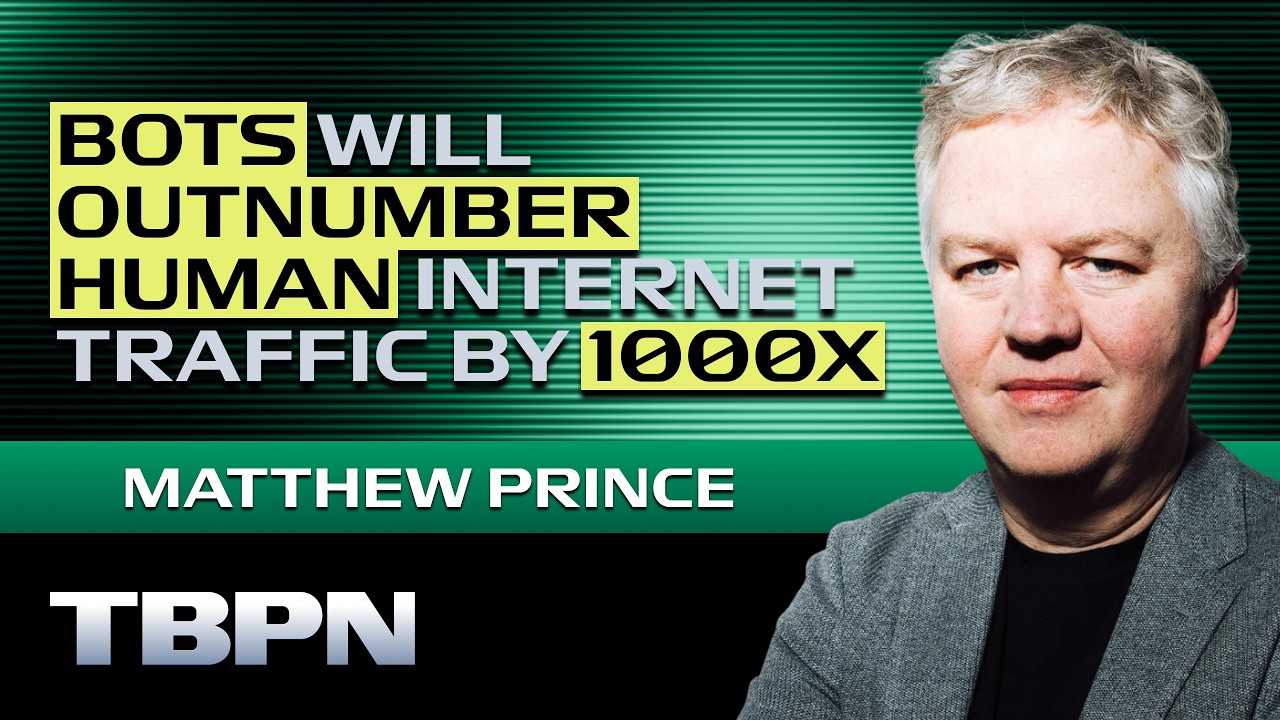
Cloudflare CEO Prince Sees AI Agents Driving 1,000-to-1 Web Traffic Shift
TBPN
Cloudflare CEO Matthew Prince argues traditional cloud containers cannot handle autonomous AI agent traffic and predicts automated bots will outnumber human users 1,000-to-1 within five years.
## Background
This interview was published by TBPN on YouTube on June 10, 2026. The video features a conversation with Cloudflare CEO Matthew Prince discussing why AI agents are driving a surge in internet traffic, how web infrastructure must adapt, Cloudflare's acquisition strategy, and its operational bets on young talent.
## TL;DR
Cloudflare CEO Matthew Prince explains how autonomous AI agents have rapidly surpassed human internet traffic, creating an unprecedented demand for lightweight runtime environments like V8 Isolates over traditional heavy containers. He highlights Cloudflare's acquisition of Void Zero and Vite, the shift toward converting web content to Markdown for LLMs, and the evolution toward long-running edge inference across 350+ cities. Additionally, Prince discusses public market dynamics, internal operational efficiency via Cloudflare OS, and why the company is aggressively hiring thousands of young interns to drive AI adoption.
## Atmosphere & style
The conversation is candid, fast-paced, and intellectually playful, blending high-level technical insights with sharp industry humor. Prince engages in fluid, peer-to-peer banter with the hosts, chuckling over legal spats with European football leagues and joking about John Gruber's 'total victory' with Markdown. The dynamic feels like an informal insider fireside chat that balances serious architectural strategy with lighthearted anecdotes about IPOs and overflowing Austin office spaces.
## Key takeaways
- [00:00](https://www.youtube.com/watch?v=HWheP8hYsKk&t=0s) Cloudflare acquired Void Zero, the company behind Vite, to tightly integrate Vite's open-source developer platform with Cloudflare Workers to power next-generation autonomous AI agents.
- [01:47](https://www.youtube.com/watch?v=HWheP8hYsKk&t=107s) Traditional cloud infrastructure and heavy OS containers are fundamentally ill-suited for AI agents; hosting just one agent per U.S. knowledge worker in standard containers would consume half the world's CPU manufacturing capacity.
- [01:47](https://www.youtube.com/watch?v=HWheP8hYsKk&t=107s) Cloudflare Workers uses lightweight V8 Isolates instead of virtualized containers, allowing far higher density and efficiency to support long-running AI agents and multi-agent coordination.
- [04:08](https://www.youtube.com/watch?v=HWheP8hYsKk&t=248s) To reduce token consumption and latency for agentic web scraping, Cloudflare offers automatic conversion of HTML web content into Markdown.
- [07:36](https://www.youtube.com/watch?v=HWheP8hYsKk&t=456s) Bot and AI agent traffic crossed the 50% threshold in early 2026, officially surpassing human web traffic far earlier than initial industry expectations.
- [07:36](https://www.youtube.com/watch?v=HWheP8hYsKk&t=456s) Prince predicts that within five years, autonomous AI agent web traffic will outnumber human traffic by a ratio of 1,000 to 1.
- [10:55](https://www.youtube.com/watch?v=HWheP8hYsKk&t=655s) User queries are shifting from simple real-time lookups to asynchronous, long-running background workflows that execute across Cloudflare's edge GPU network spanning over 350 cities.
- [15:18](https://www.youtube.com/watch?v=HWheP8hYsKk&t=918s) Developers choose Cloudflare for edge inference due to low latency for real-time models, strict local data sovereignty compliance, and near-zero bandwidth costs.
- [17:01](https://www.youtube.com/watch?v=HWheP8hYsKk&t=1021s) Cloudflare's highly distributed edge model embeds small compute footprints into existing data centers and ISP partner facilities, avoiding the massive energy and water grid demands of centralized hyperscale facilities.
- [21:13](https://www.youtube.com/watch?v=HWheP8hYsKk&t=1273s) Reflecting on Cloudflare's IPO performance, Prince highlights that public markets provide greater operational clarity than private VC dynamics and that targeting a modest first-day pop builds strong long-term institutional relationships.
- [28:23](https://www.youtube.com/watch?v=HWheP8hYsKk&t=1703s) Cloudflare is aggressively betting on early-career talent, hiring over 1,000 summer interns to drive reverse mentorship and accelerate AI tool integration across the company.
- [30:15](https://www.youtube.com/watch?v=HWheP8hYsKk&t=1815s) Cloudflare built its internal automation suite, Cloudflare OS, by initially using a human-operated 'magic AI' inbox to document organizational workflows before fully automating them.
- [31:44](https://www.youtube.com/watch?v=HWheP8hYsKk&t=1904s) Prince rejects the industry trend of reducing entry-level hiring, arguing that young digital natives are best positioned to leverage AI and shape the future leadership of the company.
## Detailed walkthrough
### [00:00](https://www.youtube.com/watch?v=HWheP8hYsKk&t=0s) Cloudflare's Acquisition of Void Zero and the Power of Vite
Matthew Prince opens the conversation by discussing Cloudflare's acquisition of Void Zero, the company behind Vite—one of the most popular open-source developer platforms in the ecosystem. Prince praises Void Zero founder Evan You as a "first-class human being" and highlights the exceptional team he assembled. He notes that Vite has increasingly become the foundational platform developers use to build and power autonomous AI agents across the internet. Because so many of these agents are already running on Cloudflare's infrastructure, combining forces felt like a completely natural alignment.
The host questions the exact nature of the synergy, asking whether the primary goal is simply funneling Vite's massive user base—which sees roughly 130 million weekly downloads—directly into Cloudflare as a default backend, or if there is deeper technical integration under the hood. Prince clarifies that Cloudflare intends to keep Vite fully open-source and continue investing heavily in its community. While Vite will remain platform-agnostic and work anywhere, Cloudflare aims to tightly integrate it with its developer platform to ensure Cloudflare is unequivocally the best environment for running Vite projects, ultimately driving more developers to Cloudflare Workers.
- **Key Figure**: Vite sees approximately 130 million weekly downloads.
- **Strategic Goal**: Deeply integrate Vite with Cloudflare Workers while maintaining its open-source neutrality.
- **Target Audience**: Developers building next-generation web applications and autonomous AI agents.
[01:47](https://www.youtube.com/watch?v=HWheP8hYsKk&t=107s) Redefining Infrastructure: Why AI Agents Break Traditional Containers
Transitioning to the operational challenges developers face today, the discussion touches on rising token budgets and the growing frequency of red and yellow outages on public status pages. Prince argues that the current generation of cloud architecture is fundamentally ill-suited for the incoming wave of autonomous agents. To illustrate the scale of the bottleneck, he presents a stark hypothetical: if each of the ~100 million knowledge workers in the United States had just *one* AI agent running in a traditional container (such as those provided by AWS or Google Cloud), hosting those agents alone would consume 50% of the entire world's current CPU manufacturing output.
Extrapolating that scenario globally reveals a demand that is 30 to 40 times the world's existing GPU and CPU capacity. Because agents inherently generate and execute code on the fly, relying on traditional heavy containers—which bundle full operating systems and extensive tooling—creates severe CPU, GPU, and memory bottlenecks. Cloudflare Workers, by contrast, was engineered around lightweight V8 Isolates rather than traditional virtualized containers. This architectural difference allows far higher density and efficiency on the same physical hardware, which is why major AI labs like OpenAI are increasingly designating Cloudflare as their preferred execution environment.
- **U.S. Knowledge Worker Metric**: ~100 million workers running 1 containerized agent each = 50% of global CPU manufacturing capacity.
- **Global Scaling Metric**: Global adoption would require 30x to 40x the world's current CPU and GPU capacity under traditional container architecture.
- **Core Technology**: Cloudflare Workers uses V8 Isolates instead of standard containers to achieve extreme compute density.
[04:08](https://www.youtube.com/watch?v=HWheP8hYsKk&t=248s) Protocol Optimizations and Markdown as the Agentic Web Standard
The host raises the topic of optimization strategies for handling agentic traffic, asking whether the web will shift toward lightweight protocols—such as delivering JSON packages or Model Context Protocol (MCP) servers—when AI crawlers or user agents make requests. Prince confirms that multi-agent coordination requires systems to execute code seamlessly behind the scenes. When an agent plans a complex multi-step workflow, heavy operating system containers create massive overhead, making lightweight isolate runtime environments essential.
Beyond compute efficiency, Prince highlights content consumption bottlenecks. When agents scrape standard web pages built for human eyes, they waste substantial processing power parsing visual layouts and unnecessary HTML "cruft." To solve this, Cloudflare offers automatic conversion of web content into clean Markdown for participating sites. This transformation significantly reduces token consumption, cuts down processing latency, and allows developers to fit far more high-value information directly into an LLM's context window.
- **Content Formatting**: Converting HTML to Markdown dramatically lowers token usage and conserves context window capacity.
- **Analogy & Humor**: The host jokes about John Gruber's "total victory" as the inventor of Markdown, calling it "the format for God" and marveling at how a text format created decades ago became the foundational language for artificial intelligence.
[07:36](https://www.youtube.com/watch?v=HWheP8hYsKk&t=456s) The Tipping Point: Bot Traffic Surpasses Human Traffic on the Internet
Prince shares a dramatic milestone that Cloudflare recently observed across its global network: autonomous agent and bot traffic officially surpassed human web traffic far earlier than expected. At the end of 2025, Prince predicted that total bot traffic (including search crawlers and AI agents) would cross the 50% threshold by the end of 2027. By early 2026, seeing rapid acceleration, he moved his estimate up to the first half of 2027. In reality, the crossover occurred in the first half of 2026.
Prince explains the driver behind this surge: human attention is limited, whereas AI agents possess "boundless attention." Where a human buying a digital camera might visit 5 websites to compare prices, an AI agent will seamlessly visit 5,000 sites in seconds to locate the absolute best price, delivery window, and warranty. Furthermore, after a decade-long plateau where more websites were shut down than created, the web is experiencing exponential growth for the first time since the early 2000s. Looking ahead, Prince predicts that within 5 years, bot traffic will outnumber human traffic on the internet by 1,000 to 1.
> "If you or I as humans were researching to go buy a digital camera... we might visit 5 websites... these agents have boundless attention to be able to just go to maybe 5,000 websites to find exactly what you're looking for."
- **Historical Baseline**: From 2010 to around 2024, automated bot traffic held steady at approximately 20% of total internet traffic.
- **Web Growth Shift**: Web creation plateaued around 2015, but has re-entered an exponential growth phase over the last 18 months driven by AI generation.
- **5-Year Horizon Prediction**: AI agent traffic will exceed human traffic by a ratio of 1,000:1.
[10:55](https://www.youtube.com/watch?v=HWheP8hYsKk&t=655s) Edge Inference Architecture and Long-Running AI Workflows
The discussion shifts to the evolving hardware and inference stack, contrasting on-device models (like Apple's announcements at WWDC) with ultra-fast specialized chips (such as Cerebras) and massive cloud clusters (Nvidia NVL72). Prince reflects on Cloudflare's early bet in 2022 when they announced a partnership with Nvidia to deploy GPUs across the edge of Cloudflare's network. At the time, the announcement was met with complete indifference from the market. Two years later, as demand exploded, Cloudflare re-issued the same announcement to massive industry interest. Today, Cloudflare runs edge inference across more than 350 cities worldwide, placing GPU compute within milliseconds of most of the global population.
While Prince originally assumed a 50/50 split between on-device processing and cloud handoffs, he now believes an even larger share will shift to edge and cloud infrastructure. The reason is that user queries are shifting from instantaneous lookup questions ("What's the temperature in New York?") to long-running, multi-variable workflows ("Plan a complex multi-city vacation under specific constraints"). These complex tasks take minutes, hours, or days to execute continuously in the background. The hosts joke that skiers will soon have dedicated, long-running agents continually analyzing satellite imagery from Planet Labs, weather models, and live drone feeds just to track snow conditions in Park City.
- **Global Edge Footprint**: Cloudflare operates inference-ready GPU nodes across more than 350 cities globally.
- **Strategic Handoff Model**: Local devices perform initial lightweight processing before offloading complex or long-running agent workflows to nearest-edge nodes and centralized data centers.
- **Evolving Task Profile**: Shift from low-latency, real-time single requests to asynchronous, long-running background tasks.
Here is a detailed, faithful walkthrough of the transcript segment:
[15:18](https://www.youtube.com/watch?v=HWheP8hYsKk&t=918s) Why Developers Choose Cloudflare for AI Inference
Matthew Prince breaks down the primary drivers behind why companies and developers choose Cloudflare for running AI inference tasks into three main categories:
* **Latency and Performance:** For applications involving real-time human-and-computer interactions—such as voice models—any delay immediately hurts user experience, making low-latency local execution essential.
* **Privacy, Regulation, and Sovereignty:** European organizations and regulators feel that internet 1.0 and 2.0 relied too heavily on routing global traffic back through centralized hubs like Ashburn, Virginia in the United States. Keeping inference physically local addresses regulatory requirements and a strong desire for digital sovereignty.
* **Cost-Effectiveness:** Because Cloudflare operates its own global interconnected network, its bandwidth costs are effectively zero. Furthermore, by deploying hardware directly inside partner facilities where space and power costs are often waived or minimal, Cloudflare passes substantial infrastructure savings onto customers.
[17:01](https://www.youtube.com/watch?v=HWheP8hYsKk&t=1021s) Data Center Footprint and Environmental Realities
Addressing the public debate and regulatory scrutiny surrounding data center expansion, Prince dismisses common environmental criticisms—such as heavy water consumption—as mostly exaggerated "silliness." He notes that data center cooling operates on closed-loop systems, pointing out that a single golf course consumes more water annually than all data centers in the United States combined. While acknowledging legitimate challenges around local grid capacities and power efficiency, he explains that Cloudflare’s architecture operates under a completely different paradigm compared to hyperscalers:
* **Hyperscale Model (AWS, Google, SpaceX):** Concentrates massive clusters of hardware into a small number of giant, central mega-facilities.
* **Cloudflare's Distributed Model:** Spreads hundreds of thousands of machines across thousands of existing facilities globally where networks converge.
* **Space & Power Constraints:** Instead of building massive new structures, Cloudflare embeds small deployments (often just a few hundred machines) directly into existing edge data centers and ISP partner facilities, operating within strict power envelopes.
[19:23](https://www.youtube.com/watch?v=HWheP8hYsKk&t=1163s) Legal Friction with European Soccer Leagues
The conversation lightheartedly shifts to Prince's recent legal battles in Europe, specifically with football (soccer) leagues in Italy and Spain (La Liga). Prince jokes that being targeted personally by these organizations has hampered his summer vacation plans to the Amalfi Coast or Ibiza.
He explains the irony of the situation: Cloudflare actively dislikes piracy on its network because illegitimate streams burn expensive bandwidth without generating revenue. While Cloudflare maintains dedicated teams to shut down unauthorized streams and collaborates closely with global sports organizations—including the NBA, NFL, MLB, and the UK Premier League—leagues in Spain and Italy have chosen aggressive litigation over cooperation. Because a massive portion of global internet traffic routes through Cloudflare, pirate networks continually attempt to abuse the platform despite ongoing enforcement.
[21:13](https://www.youtube.com/watch?v=HWheP8hYsKk&t=1273s) Lessons from the IPO and Public Market Dynamics
Reflecting on Cloudflare’s successful initial public offering, Prince highlights that the company's stock has surged over 1,000% (or over 100,000 basis points, as joked during the interview) since going public. Comparing private VC funding to public market investing, Prince uses a striking legal analogy: in jurisdictions without no-fault divorce laws, spousal homicide rates are significantly higher because getting out of a bad situation is nearly impossible. Similarly, breaking up with private VC investors is difficult and often leads to dysfunctional dynamics, whereas public market interactions are straightforward and transparent—investors can simply sell the stock if they disagree with management.
Prince shares key strategies from Cloudflare's IPO process:
* **The S-1 as a Blueprint:** Writing the registration statement served as an invaluable opportunity to re-articulate Cloudflare's core narrative and operating principles.
* **Strategic Friends & Family Allocations:** Following advice from Ryan Smith (founder of Qualtrics), Cloudflare bypassed traditional family allocations and instead offered directed shares to key strategic contacts who could meaningfully help the company long-term. Around 75% accepted, resulting in lucrative returns and strong key relationships.
* **Targeting First-Day Pop:** Countering venture capitalist Bill Gurley’s views on direct listings, Prince argues that pricing an IPO to achieve a modest ~20% opening day gain builds crucial long-term relationships with institutional public investors. Cloudflare targeted a 20% pop by pricing at $15 per share, successfully closing its first trading day at $18.
[28:23](https://www.youtube.com/watch?v=HWheP8hYsKk&t=1703s) Adapting to Exponential Growth and Bets on Young Talent
When asked how a CEO plans for the future when technological adoption moves exponentially fast, Prince emphasizes two core strategies: staying dynamic and maintaining operational flexibility. Despite a tight hardware supply chain and soaring memory prices, Cloudflare maintains agility by leaning heavily into AI adoption across all business units.
Crucially, while many tech firms cut back on early-career hires during uncertain times, Cloudflare takes the opposite approach by aggressively recruiting young talent:
* **Massive Internship Program:** Out of a total workforce of nearly 5,000 employees, Cloudflare brought on 1,111 college interns in a single summer.
* **Reverse Mentorship:** Rather than senior staff simply training interns, these young recruits—who are digital natives to modern AI tools—are actively teaching existing teams how to integrate AI effectively into daily workflows.
[30:15](https://www.youtube.com/watch?v=HWheP8hYsKk&t=1815s) Internal AI Innovation: Cloudflare OS and the "Magic AI" Experiment
Matthew Prince breaks down how Cloudflare drives operational efficiency internally through a platform called Cloudflare OS. Designed to give employees across all non-technical and business functions—such as finance, legal, and accounting—direct access to custom workflow tools, the platform helps staff reinvent how their day-to-day work gets done. However, the initial seeding strategy for the tool relied on a clever bit of human-powered misdirection. Cloudflare created a internal support email address and quietly told the team it was powered by a "magic AI model." Employees were encouraged to email their daily operational headaches and ask how to automate specific tasks.
Unbeknownst to the employees, a team of humans was actually monitoring the inbox behind the scenes. While these human operators leveraged existing AI tools to flesh out responses and answer questions, their primary mission was to map out and document all the core "jobs to be done" across the entire organization. Prince stresses that before AI systems can automate company workflows, you must first capture every procedural step involved. Today, that dataset powers Cloudflare OS natively. For instance, a salesperson can simply type `/account plan` alongside a quick description, and the system automatically generates a complete plan. This operational agility not only boosts employee productivity but gives Cloudflare the flexibility to adapt to whatever technological shifts come next.
- Cloudflare OS serves non-engineering departments including finance, accounting, and legal.
- The company originally disguised a human workflow mapping team as a "magic AI" email endpoint to collect real-world "jobs to be done" usage data.
- Slash commands like `/account plan` now allow employees to instantly generate complex business documents.
[31:44](https://www.youtube.com/watch?v=HWheP8hYsKk&t=1904s) Betting on Young Talent and the Future Leadership of AI
When asked if Cloudflare plans to exponentially scale its summer internship program to 10,000 interns, Prince jokes that their main bottleneck is physical space, noting that their massive Austin, Texas office is already completely overflowing. He strongly rejects the prevailing industry trend where tech companies scale back entry-level hiring under the assumption that AI will simply replace junior workers. On the contrary, Prince argues that younger employees and recent graduates understand how to leverage AI tools more fluently than anyone else, making them an essential asset.
Cloudflare is doubling down on this philosophy, betting heavily on young talent as a core growth driver. Prince admits that the person who eventually succeeds him as CEO might well be sitting among their current pool of interns today. The host compares this potential trajectory to Microsoft CEO Satya Nadella, recalling famous early footage of Nadella as a product manager demoing Excel. Prince reminisces about sitting on conference calls with Nadella back when he was still an emerging PM at Microsoft, agreeing that investing in super smart people early on always yields long-term dividends. The interview concludes on a high note, with the hosts praising Prince for Cloudflare's massive public market run and thanking him for joining the show.
- Cloudflare's Austin office has already run out of physical desk space due to the sheer volume of interns hired.
- Prince believes tech companies choosing not to hire recent grads due to AI automation are making a fundamental mistake.
- "I think the person who eventually replaces me might literally be one of the interns today because they're just so smart," notes Prince.
- The hosts point out Cloudflare's stock performance, referencing a massive run-up in market value over recent years.
## Notable quotes
> [07:36](https://www.youtube.com/watch?v=HWheP8hYsKk&t=456s) If you or I as humans were researching to go buy a digital camera... we might visit 5 websites... these agents have boundless attention to be able to just go to maybe 5,000 websites to find exactly what you're looking for. — Matthew Prince
> [31:44](https://www.youtube.com/watch?v=HWheP8hYsKk&t=1904s) I think the person who eventually replaces me might literally be one of the interns today because they're just so smart — Matthew Prince
## Mentioned
Cloudflare, Void Zero, Vite, Evan You, Cloudflare Workers, AWS, Google Cloud, OpenAI, John Gruber, Cerebras, Nvidia, Apple, Planet Labs, La Liga, NBA, NFL, MLB, UK Premier League, Qualtrics, Ryan Smith, Bill Gurley, Satya Nadella, Microsoft, Matthew Prince, TBPN
Cloudflare CEO预计AI智能体将推动网络流量比达1000比1
Cloudflare首席执行官Matthew Prince指出,传统云容器无法承载自主AI智能体的流量,并预测在五年内自动化Bot的数量将以1000比1超过人类用户。
Cloudflare首席执行官Matthew Prince阐述了自主AI智能体如何迅速超越人类互联网流量,从而相比传统重型容器对V8 Isolates等轻量级运行时环境催生了前所未有的需求。他重点提及了Cloudflare对Void Zero及Vite的收购、网页内容向面向LLM的Markdown格式转换的趋势,以及在350多个城市拓展长期边缘推理的演进方向。此外,Prince还探讨了公开市场动态、通过Cloudflare OS实现的内部运营效率,以及该公司大举招聘数千名年轻实习生以推动AI普及的原因。
Cloudflare 宣布收购 Vite 幕后公司 Void Zero,计划将这一每周下载量达 1.3 亿次的开源平台与 Cloudflare Workers 深度集成,为下一代自主 AI Agent 构建底层运行环境。 (0:00)
Matthew Prince 指出传统容器架构无法承载未来的 Agent 浪潮,若仅为全美知识工作者各运行一个标准容器 Agent 就将耗费全球 50% 的 CPU 产能,而 Workers 采用的 V8 Isolates 能提供更高的计算密度与能效。 (1:47)
网络流量在 2026 年初迎来拐点,Bot 与 AI Agent 流量占比正式超过 50% 并超越人类流量,Prince 预测未来 5 年内自主 Agent 流量与人类流量的比例将达到 1000 比 1。 (7:36)
随着 AI 任务从简单即时查询转向长时间运行的复杂后台工作流,开发者正加速将推理迁移至 Cloudflare 覆盖全球 350 多个城市的边缘 GPU 网络,以享受低延迟、近乎零带宽成本和本地数据主权优势。 (10:55)
Reading summary
Cloudflare CEO Matthew Prince argues that the rise of autonomous AI agents is fundamentally breaking legacy cloud infrastructure, forecasting that machine-generated traffic will outnumber human traffic 1,000-to-1 within five years and accelerating a shift toward lightweight edge computing.
Infrastructure Bottlenecks and Lightweight Runtimes (1:47)
Prince asserts that traditional cloud container architecture cannot scale to meet agentic demand. According to his calculations, running a single containerized agent for each of the roughly 100 million U.S. knowledge workers would consume 50% of global CPU manufacturing capacity, with worldwide adoption requiring 30 to 40 times existing CPU and GPU capacity. Because agents continuously generate and execute code, Cloudflare positions its V8 Isolate architecture as a dense, lightweight alternative to resource-heavy operating system containers, driving partnerships with AI labs such as OpenAI.
Beyond compute bottlenecks, Prince highlights that agentic workflows waste significant resources parsing raw web pages built for human browsing. To reduce token consumption, Cloudflare automatically converts web content into Markdown for participating sites, lowering latency and conserving limited context window capacity for language models.
Bot Traffic Growth and Autonomous Attention (7:36)
Prince reports that automated agent and crawler traffic crossed the 50% threshold on Cloudflare's global network in the first half of 2026, outpacing his earlier forecast of late 2027. While automated bot traffic remained steady at approximately 20% of internet volume between 2010 and 2024, Prince predicts agent traffic will outnumber human traffic 1,000-to-1 within five years.
Prince attributes this surge to agents possessing "boundless attention"—visiting thousands of endpoints in seconds where a human would visit five—and an AI-driven resurgence in web page creation after a decade-long plateau. To capture these developer workflows, Cloudflare acquired Void Zero, committing to maintain the Vite framework's open-source neutrality and 130 million weekly downloads while optimizing integration with Cloudflare Workers.
Edge Inference Architecture Versus Hyperscale Data Centers (10:55)
Prince challenges the dominance of centralized hyperscale campuses, advocating for a distributed edge architecture across more than 350 cities. Rather than routing global traffic back to centralized facilities in locations like Ashburn, Virginia, localized inference satisfies regulatory demands for data sovereignty in Europe, cuts latency for voice models, and reduces transit expenses through Cloudflare's existing interconnected network.
Workloads are also evolving from single real-time lookups into asynchronous, long-running agent workflows that run for hours or days, favoring hybrid models where local devices offload tasks to nearest-edge nodes. Addressing environmental scrutiny, Prince dismisses data center water consumption concerns as exaggerated, pointing out that data centers use closed-loop cooling and arguing that a single golf course consumes more water annually than all U.S. data centers combined.
Internal Automation and Junior Talent Acquisition (28:23)
Rejecting the tech industry trend of cutting early-career roles amid AI adoption, Cloudflare hired 1,111 college interns across its workforce of nearly 5,000 employees. Prince contends that junior staff operate as AI natives who actively teach senior employees how to integrate AI tools through reverse mentorship, noting that future corporate leadership is likely to emerge from this cohort.
Operationally, the company built "Cloudflare OS" to automate routine administrative tasks across legal, finance, and accounting departments. To seed the platform, Cloudflare initially routed internal employee automation requests to an email address marketed as a "magic AI" that was secretly monitored by humans to map out organizational workflows before converting those procedures into automated slash commands.
While Prince presents distributed edge isolates as the essential foundation for agentic scale, Cloudflare faces external friction, including aggressive piracy litigation from European soccer leagues and ongoing hardware supply constraints in memory and compute capacity.
精炼阅读摘要
Cloudflare 首席执行官 Matthew Prince 表示,自主 AI 智能体与自动化 Bot 流量已在 2026 年上半年正式超过人类网络流量,并预测未来五年内智能体流量与人类流量之比将达到 1000:1。他认为现有基于传统操作系统的容器架构无法承受这一爆炸性需求,互联网基础设施必须转向轻量化的代码隔离运行时与分布式边缘推理。
流量结构拐点与智能体流量千倍增长预测 (7:36)
Prince 指出,网络流量正经历历史性转变。在 2010 年至 2024 年的大部分时间里,自动化 Bot 流量仅稳定占全球互联网总流量的 20% 左右。此前他曾预测 Bot 流量将在 2027 年突破 50% 门槛,但 Cloudflare 全球网络监测显示,这一交叉拐点已在 2026 年上半年提前发生。推动该激增的核心机制在于人类注意力与 AI 智能体“无尽注意力”的根本差异:普通人类在比价或调研时通常仅浏览 5 个网页,而具备自主决策能力的智能体可在数秒内并发访问 5,000 个站点以获取最优价格、配送期与质保条款。基于此,Prince 预测在未来五年内,AI 智能体生成的网络流量将达到人类流量的 1,000 倍。与此同时,互联网内容在经历了自 2015 年以来关闭站点多于新建站点的十年平台期后,由于 AI 生成能力的普及,在过去 18 个月内重新进入了指数级增长阶段。
传统容器算力瓶颈与轻量化运行时的必然性 (1:47)
Prince 强调,当前云计算架构无法支撑智能体的大规模落地。他给出一个测算假设:若全美约 1 亿知识工作者每人仅在传统虚拟机容器(如 AWS 或 Google Cloud 提供的环境)中运行一个 AI 智能体,仅托管这些智能体就将消耗全球 50% 的 CPU 制造产能;若推及全球规模,传统容器架构对 CPU 与 GPU 的需求将是全球现有产能的 30 至 40 倍。其根本技术瓶颈在于,传统容器打包了完整的操作系统与繁杂工具链,而智能体本质上需要高频、动态地即时生成并执行代码,这会导致严峻的内存与计算开销。相比之下,Cloudflare Workers 采用 V8 Isolates(隔离区)技术实现轻量化运行时,能够在相同物理硬件上达成极高的计算密度,OpenAI 等头部模型实验室亦因此将其选为首选执行环境。为了承接这一开发者生态,Cloudflare 收购了周下载量约 1.3 亿次的开源平台 Vite 背后公司 Void Zero,在保持其开源中立性的同时深化整合。此外,针对智能体解析网页时消耗大量算力与 Token 的现状,Cloudflare 推出网页自动转 Markdown 功能,剥离冗余的 HTML 视觉布局代码,降低解析延迟并节省大模型的上下文窗口空间。
分布式边缘推理与超大规模数据中心的分野 (10:55)
在硬件与推理架构方面,Prince 观察到用户请求模式正从瞬时单次查询(如询问特定天气)转向需耗时数分钟、数小时甚至数天的长期多变量工作流(如自主规划多目的地旅行)。这种任务特性决定了本地设备难以完全承载,更多复杂任务必须卸载至云端与边缘端。Cloudflare 目前在全球 350 多个城市部署了支持 GPU 推理的边缘节点,将算力推向距大部分人口仅数毫秒延迟的位置。Prince 将开发者选择 Cloudflare 推理归结为三点:实时人机交互所需的极低延迟、规避集中回传美国并符合欧洲等地区数据主权要求的本地化合规性,以及依托自建网络近乎为零的带宽成本与合作伙伴机房低能耗开销带来的性价比优势。针对数据中心能耗的外部争议,Prince 认为有关巨额耗水的批评多属夸大,指出其主要采用闭环冷却系统,单座高尔夫球场的年耗水量便超过全美所有数据中心总和。他进一步将 Cloudflare 的分布式边缘模式与 AWS、Google 等超大规模厂商(Hyperscalers)进行对比:后者在少数枢纽集中建设超大园区,而 Cloudflare 则将数十万台设备分散在数千个现有网络交汇设施中,每处通常仅部署数百台机器,严格在现有供电预算内运行。
内部业务流程逆向测绘与反常规青年人才战略 (30:15)
在企业内部运营管理上,Cloudflare 推出名为 Cloudflare OS 的内部平台,专供财务、法务与核算等非技术职能部门使用。该系统在初期启动时采用了一项特殊的实验:公司设立了一个据称由“魔法 AI 模型”驱动的支持邮箱,鼓励员工发送日常流程痛点与自动化诉求;后台实则由人工团队借助现有 AI 工具进行交互处理,其核心目的在于对全公司所有业务流程中的“待办任务”(Jobs to be done)进行详尽梳理与步骤测绘。目前,这些沉淀的真实流程数据已完全内化至系统中,员工仅需输入类似“/account plan”等指令即可自动生成对应业务文件。在人才策略上,Prince 明确反对科技行业因 AI 自动化而削减初级岗位的普遍做法。在公司近 5,000 名员工规模下,Cloudflare 单个夏季招收了 1,111 名大学实习生,导致其奥斯汀办公室工位饱和。Prince 认为年轻一代是原生掌握现代 AI 工具的数字原住民,在企业内部形成了年轻实习生向老员工传授 AI 工作流的“反向导师”机制,甚至认为其未来的继任者很可能就出自当前的实习生群体。
Matthew Prince 勾勒出了 AI 智能体爆发下互联网在流量特征、算力形态与组织协同层面的全面重构,主张以高密度隔离运行时和分布式边缘替代传统重型容器。不过,该技术路线与业务扩张仍面临硬件供应链吃紧、物理空间限制,以及在欧洲面临体育版权盗播诉讼等外部合规摩擦与现实制约。
Detailed notes — zh
## Background
该内容由科技播客频道 TBPN 于 2026 年 6 月 23 日发布在 YouTube 平台上。视频简介指出,本期访谈由主持人对话 Cloudflare 首席执行官 Matthew Prince,深入探讨了为何 AI 智能体产生的网络流量已反超人类、互联网底层架构如何重构以承载数十亿自主智能体、公司在 AI 时代大力押注年轻人才的原因,以及长周期智能体与边缘推理的未来格局。
## TL;DR
Matthew Prince 宣布收购 Evan You 创办的 VoidZero 并深度整合 Vite 生态,同时指出传统容器在 AI 时代面临算力瓶颈,而 Cloudflare 基于 V8 Isolates 的架构为轻量化代码执行与网页 Markdown 化提供了高效宿主。他揭示互联网 Bot 流量已在 2026 年上半年正式超越人类流量,并预测五年内将达到人类流量的千倍,促使推理算力向全球分布式的边缘网络转移。此外,Prince 分享了应对欧洲足球版权诉讼的插曲、健康的公开市场股东关系策略,以及通过“Cloudflare OS”真实捕获业务 SOP 和逆势扩招 1,111 名实习生的组织进化之道。
## Atmosphere & style
整场对话节奏轻快敏锐且信息密度极高,Matthew Prince 展现出顶尖技术掌舵人独有的洞察力、松弛感与幽默感。主持人的提问直击行业痛点并不时穿插滑雪、度假与经典科技轶事的风趣调侃,而 Prince 则用“无过错离婚”类比资本关系、自嘲“当年重发与英伟达合作通稿”等生动比喻化解严肃命题。访谈在技术前瞻的宏大推演与组织管理的务实智慧之间自如切换,营造出兼具深度干货与谈笑风生的愉悦收听氛围。
## Bulletin
- [07:36](https://www.youtube.com/watch?v=HWheP8hYsKk&t=456s) Cloudflare 宣布互联网流量迎来历史性拐点,AI 智能体与 Bot 流量已在 2026 年上半年正式超越人类真实流量,且预计未来五年内机器流量将达到人类流量的 1,000 倍。
- [00:00](https://www.youtube.com/watch?v=HWheP8hYsKk&t=0s) Cloudflare 收购前端核心工具 Vite 母公司 VoidZero,承诺将保持 Vite 开源与跨平台特性,同时与 Workers 深度结合以打造 AI 智能体开发运行的首选底座。
- [02:12](https://www.youtube.com/watch?v=HWheP8hYsKk&t=132s) 传统容器架构难以承受智能体爆发,若全美知识工作者各配一个容器化 Agent 将耗费全球 50% CPU 年产能,轻量级 V8 Isolates 与 HTML 转 Markdown 成为解决算力与 Token 瓶颈的关键技术路径。
- [28:23](https://www.youtube.com/watch?v=HWheP8hYsKk&t=1703s) 在行业普遍缩减校招之际,Cloudflare 逆向招募 1,111 名实习生利用 AI 原生能力反哺组织,并通过真人模拟 AI 冷启动收集全业务流程 SOP,最终沉淀出全公司级自动化平台 Cloudflare OS。
## Key takeaways
- [00:00](https://www.youtube.com/watch?v=HWheP8hYsKk&t=0s) 收购 VoidZero 深度整合 Vite 生态:Vite 坐拥每周 1.3 亿次下载并成为构建智能体的主流前端,Cloudflare 收购后将保持其开源中立,同时深度优化 Workers 运行环境。
- [02:12](https://www.youtube.com/watch?v=HWheP8hYsKk&t=132s) 传统容器面临算力死局:为上一代应用设计的 Docker 与虚拟机因整套 OS 开销过于沉重,若全美知识工作者各运行一个 Agent 就将吞噬全球半数 CPU 年产能。
- [02:12](https://www.youtube.com/watch?v=HWheP8hYsKk&t=132s) 轻量 V8 Isolates 成为智能体原生架构:利用极低启动成本与共享引擎特性,Isolates 让单台服务器可并发承载海量 Agent 代码执行,成为 OpenAI 等头部 AI 机构的首选运行时。
- [04:08](https://www.youtube.com/watch?v=HWheP8hYsKk&t=248s) HTML 转 Markdown 拯救上下文窗口:传统网页充斥着人类视觉冗余标签,自动转为精简 Markdown 可成倍节省网络带宽与 Token 消耗,显著扩容有效推理上下文。
- [07:36](https://www.youtube.com/watch?v=HWheP8hYsKk&t=456s) AI 流量反超人类流量提前兑现:智能体具备不知疲倦遍历数千站点的“无限专注力”,使得 Bot 流量占比从常年稳定的 20% 发生垂直级井喷,在 2026 年上半年正式超越人类流量。
- [09:06](https://www.youtube.com/watch?v=HWheP8hYsKk&t=546s) 互联网进入千倍机器流量新纪元:Web 生态结束自 2015 年以来的平滞期,未来五年机器流量预计达到人类流量的 1,000 倍,倒逼全网底层基础设施彻底重构。
- [10:55](https://www.youtube.com/watch?v=HWheP8hYsKk&t=655s) 边缘推理前瞻布局英伟达 GPU:早在 2022 年 AI 爆发前 Cloudflare 便与英伟达展开全网部署合作,如今依托遍布全球 350 多个城市的节点将推理延迟压低至数毫秒。
- [12:52](https://www.youtube.com/watch?v=HWheP8hYsKk&t=772s) 长周期自主任务削弱端侧推理占比:AI 正从瞬时问答演变为持续数小时至数天的复杂 Agent 工作流,本地设备的电量与计算限制促使大部分推理向常驻边缘网络迁移。
- [14:38](https://www.youtube.com/watch?v=HWheP8hYsKk&t=878s) 边缘推理的三大核心优势:消除语音对话等实时人机交互卡顿、满足欧洲等非美地区数据本地留存合规要求,以及依托对等互联骨干网实现近乎零边际成本的带宽定价。
- [17:01](https://www.youtube.com/watch?v=HWheP8hYsKk&t=1021s) 辟谣机房水耗,电网负荷才是真正瓶颈:现代机房普遍采用闭循环冷却系统,真正制约算力扩张的核心矛盾在于高密度供电效率与周边民用产业电网的承受极限。
- [18:17](https://www.youtube.com/watch?v=HWheP8hYsKk&t=1097s) 微节点分布式架构避开超算中心短缺:与云巨头单点集中堆叠不同,Cloudflare 将数以百计的机器分散部署于全球老旧数据中心,受新建大规模数据中心建设周期的影响较小。
- [19:23](https://www.youtube.com/watch?v=HWheP8hYsKk&t=1163s) 欧洲版权诉讼与体育联盟合作反差:美英顶级体育联盟通常选择合作即时下架无收益盗版流,而西甲与意甲则倾向于直接起诉网络平台,引发法律与利益冲突。
- [21:13](https://www.youtube.com/watch?v=HWheP8hYsKk&t=1273s) 二级公开市场比风险投资关系更健康:公开市场投资者拥有进退自由,避免了私募股权阶段因利益捆绑导致的功能失调,促成管理层与股东之间纯粹理性的沟通。
- [24:15](https://www.youtube.com/watch?v=HWheP8hYsKk&t=1455s) 克制的 IPO 定价与人情资产布局:将亲友股额度定向配售给未来能产生深远影响的商业伙伴,并在定价上追求首日温和上涨 20%,致力于构建长期稳定的股东结构。
- [28:23](https://www.youtube.com/watch?v=HWheP8hYsKk&t=1703s) 逆势重注 AI 原生代人才:反驳初级岗位将被 AI 取代的观点,逆向招录 1,111 名大学实习生以掌握最新工具的生产力反哺团队,并作为未来管理层储备。
- [29:49](https://www.youtube.com/watch?v=HWheP8hYsKk&t=1789s) Cloudflare OS 的“机械土耳其”冷启动:前期利用真人团队伪装成内部 AI 收集企业真实业务 SOP,随后固化为指令驱动的自动化工具,重塑全公司跨部门效率。
## Detailed walkthrough
### [00:00](https://www.youtube.com/watch?v=HWheP8hYsKk&t=0s) 收购 VoidZero 与整合 Vite 生态
访谈开门见山,主持人询问 Cloudflare 首席执行官 Matthew Prince 最近的动态,特别是关于公司的重大收购。Matthew Prince 透露,Cloudflare 已经收购了由 Evan You(尤雨溪)创立的 VoidZero。该公司打造了全球最受欢迎的开发者平台之一 Vite。Prince 对 Evan You 赞不绝口,称赞他是一位“一流的人物(first-class human being)”,并表示整个团队都为能与他及其组建的出色团队共事感到无比兴奋。在当前的技术背景下,Vite 正逐渐成为构建与驱动全网各种 AI 智能体(agents)的核心前端与开发平台,而大量此类智能体本身就部署运行在 Cloudflare 之上,因此两者的结合在逻辑上非常自然。
主持人探讨了具体的业务协同效应:是简单地将 Vite 每周高达 1.3 亿次的下载量引流给 Cloudflare,让用户默认偏好 Cloudflare,还是有更深层次的技术与产品整合?Prince 明确表示,Vite 将继续保持开源项目的状态,Cloudflare 会持续对其进行投资与技术支持。虽然 Cloudflare 会把 Vite 与自身的开发者平台(Cloudflare Workers)进行深度集成,力求让 Cloudflare 成为运行 Vite 项目的最佳平台,但它仍将完美兼容并运行在任何其他平台之上。Cloudflare 的核心目标是为 Evan 团队提供充足资源,持续加码这个出色的生态,并借此吸引更多开发者自然转向 Cloudflare Workers 平台。
- VoidZero 旗下核心开源工具 Vite 拥有高达每周 1.3 亿次的下载量。
- 收购后 Vite 将继续保持完全开源与跨平台兼容,而非锁定为 Cloudflare 专有。
---
### [02:12](https://www.youtube.com/watch?v=HWheP8hYsKk&t=132s) 算力瓶颈与基于 Isolate 的智能体原生架构
主持人指出当前开发者的痛点:大家都在讨论 token 成本与预算,但这往往是 CEO 的焦虑,而开发者面临更严峻的系统可用性(uptime)挑战,各大状态监控页面上满眼都是告警的黄色与红色。对此,Prince 分析称,为上一代应用程序构建的计算架构无法支撑即将到来的 AI 智能体时代。以美国为例,全美约有 1 亿知识工作者。假设每位知识工作者仅拥有一个代表其工作的智能体,并且每个智能体都运行在传统的容器(如 AWS 或 Google Cloud 提供的虚拟机或 Docker 容器)中,光是维持这些智能体运行所需的 CPU 资源,就相当于当今全球所有 CPU 制造商年产能总和的 50% 左右。如果将范围放大到全球所有知识工作者,所需的 GPU 和 CPU 算力将达到目前全球总产能的 30 到 40 倍。
面对这种巨大的算力鸿沟,Prince 指出必须采用全新的底层基础设施。传统的容器架构过于厚重,启动一个容器意味着要打包整套操作系统、运行时工具和依赖链,带来极其昂贵的 CPU 和 GPU 资源开销。而 Cloudflare Workers 从底层就没有选择传统容器,而是基于轻量级的 V8 Isolates 架构构建。LLM 和智能体最擅长的事情就是自动编写代码,而这些被频繁生成、轻量编排的代码急需一个低开销的运行宿主。Isolates 的极简轻量化特性,使得同一套 CPU 基础设施可以承载成倍数量的智能体协同运行。这也解释了为什么顶级 AI 研究院和模型厂商纷纷选择 Cloudflare 作为代码运行的首选目标环境,例如 OpenAI 此前为其企业用户推出的项目就是以 Cloudflare 为目标运行时。
```mermaid
flowchart TD
accTitle: 传统容器与 Isolate 架构在运行智能体时的资源对比
accDescr: 对比传统容器打包整套操作系统的高开销,与 Cloudflare Isolates 基于轻量隔离的高并发能力。
subgraph ContainerArch["传统容器架构 (AWS / GCP)"]
A1["操作系统 (OS)"] --> B1["开发工具链与运行时环境"]
B1 --> C1["单个智能体代码"]
style ContainerArch fill:#f9f9f9,stroke:#999,stroke-width:1px
end
subgraph IsolateArch["Cloudflare Workers (Isolates 架构)"]
A2["共享 V8 引擎底层"] --> B2["轻量隔离区 Isolate 1"]
A2 --> C2["轻量隔离区 Isolate 2"]
A2 --> D2["轻量隔离区 Isolate N..."]
style IsolateArch fill:#eef6ff,stroke:#0066cc,stroke-width:1px
end
```
---
### [04:08](https://www.youtube.com/watch?v=HWheP8hYsKk&t=248s) 网页结构优化:将 HTML 转化为 Markdown 拯救 Context Window
主持人进一步探究了解决 CPU 瓶颈与网络带宽优化的落地路径,提出未来是否会出现类似针对 MCP 服务器或智能体专用的精简轻量数据格式(如直接返回 JSON)。Prince 赞同这种优化方向,并从两个关键维度剖析了背后的实现逻辑:一是复杂任务执行时的多智能体协同,二是智能体与开放网络交互时的数据瘦身。例如当用户给出一个复杂指令(如“帮我规划一次度假”),幕后需要多重智能体相互协作,而这些模型之间通过生成并执行代码来传递指令是最有效率的,Isolates 架构恰好为其提供了最经济的代码运行环境。
在智能体检索并消费外部网页数据方面,Prince 指出现有的网页结构充斥着专为人类视觉交互设计的 HTML 标签、样式及冗余杂质(cruft)。如果智能体每次抓取都原封不动地拉取海量 HTML 代码,不仅严重浪费网络带宽,更会无谓吞噬巨额的模型 token,极快挤爆上下文窗口(context window)。为了解决这一问题,Cloudflare 正在为希望内容被 AI 消费的客户提供自动将网页转换为 Markdown 格式的服务。相比繁复的 HTML,简洁的 Markdown 能够大幅削减字符体积,节省大量算力与 token,从而在有限的上下文窗口中容纳更多实质性有效信息。主持人随即幽默地调侃称这是 Markdown 发明者 John Gruber(“Gruber-nator”)的“全面胜利”,甚至感叹 Gruber 当年发明的东西如今竟然成了“给 AI 神明享用的神圣格式”,引发两人会心大笑。
- 传统网页的 HTML 结构含有大量针对人类展示的非实质噪点。
- 自动转为 Markdown 显著节省 token 消耗,有效扩充了单次推理的有效上下文容量。
---
### [07:36](https://www.youtube.com/watch?v=HWheP8hYsKk&t=456s) 历史拐点:AI 流量反超人类流量提前来临
对话随后转向 Cloudflare 刚刚宣布的一项重磅里程碑:互联网上的智能体与机器人流量已经正式超越了人类产生的流量。主持人追问这一拐点究竟是提前还是推迟到来。Prince 坦言:“来得比预期快得多。”他回顾了自己的预测轨迹:在 2025 年底时,他曾公开预测包括 Google 爬虫与新兴 AI 智能体在内的 Bot 流量,将在 2027 年底超越人类流量;到了大约三个月前,随着监测到的流量增速陡增,他将这一预测修正为 2027 年上半年;然而现实的发展令人震惊,这一历史性交替在 2026 年上半年就已经彻底成为现实。
Prince 阐述了造成这一井喷现象的核心动因:人类与 AI 智能体在获取信息时的“注意力与耐力机制”截然不同。如果一个普通人类打算购买数码相机,通常只会浏览大约 5 个网站,做一些基础的性能比对和价格筛选,随后便会因认知疲劳而停止搜索。然而,AI 智能体拥有“无限的专注力(boundless attention)”,为了找到最优价格、最快配送方案和最佳售后服务,它可以在几秒钟内不知疲倦地连续检索并扫描 5,000 个网站。这种行为模式彻底改写了网络请求的数量级,直接导致互联网数据消费量出现爆炸式增长。
- 预测修正历程:2025 年底预测拐点在 2027 年底 -> 3 个月前提前至 2027 年上半年 -> 实际在 2026 年上半年正式越过拐点。
- 人类单次决策通常只浏览约 5 个页面,而 AI 智能体可瞬间遍历多达 5,000 个站点以达成全局最优。
### [09:06](https://www.youtube.com/watch?v=HWheP8hYsKk&t=546s) 网络规模的爆发式重启与千倍于人类的 Bot 流量
互联网的发展节奏正在经历一次深刻的范式转换。自 2015 年前后的近十年时间里,整个 Web 生态其实一直处于相对平滞的平台期,在很长一段时间内,关停注销的网站数量甚至超过了新创建的网站。然而在过去 18 个月里,网络规模以惊人的指数级速度重拾增长势头,其繁荣与扩张的态势几乎重现了 2000 年代初期的黄金时代。这种爆炸性增长不仅体现在人们对在线内容消费的激增,更体现在网络上新诞生事物维度的急剧丰富。Matthew Prince 预计,照目前的轨迹推演,在未来的五年内,网络上的机器(Bot / AI Agent)流量规模将达到人类真实访问流量的 1000 倍,互联网底座必须彻底重构以迎接这一全新现实。
针对主持人关于“AI 时代之前 Bot 流量基线是否仅有 1%”的疑问,Matthew Prince 澄清了行业长久以来的数据认知。实际上,从 Cloudflare 自 2010 年有数据监测能力开始,Bot 流量在全网总流量中的占比一直相当稳定地维持在 20% 左右。这其中最大的合法流量来源是以谷歌为代表的搜索引擎爬虫,此外还充斥着各种在公网上游荡的恶意扫描器与脚本。这一维持了十余年的 20% 基线在最近几年开始平稳抬升,随后在 2026 年上半年迎来了真正意义上的垂直级爆发式攀升。
- 自 2015 年起,全球网站数量增长一度陷入停滞甚至负增长,直到最近 18 个月才重回类似 2000 年代初的指数级狂飙。
- 历史基准数据表明,自 2010 年以来网络机器流量常年稳定在 20% 左右,主要由 Google 爬虫与恶意网络流量构成。
- Matthew Prince 预测,在未来五年内,AI Agent 等机器人产生的网络流量将达到人类流量的 1000 倍。
---
### [10:55](https://www.youtube.com/watch?v=HWheP8hYsKk&t=655s) 从无人问津到重发通稿:Cloudflare 的边缘推理与英伟达合作
随着大模型生态从云端训练向端侧与云侧推理裂变,硬件基础架构也出现了明显的分野:从苹果在 WWDC 上推出的端侧轻量模型与私有云计算,到英伟达最新的 NVL72 机架,再到 Cerebras 这种高速但造价高昂的晶圆级专用芯片,整个市场正在寻找推理算力的最佳安放位置。主持人询问 Cloudflare Workers 是否会作为逻辑上的延伸,承担边缘推理的核心职能。
Matthew Prince 分享了一则颇具戏剧色彩的商业往事。早在 2022 年,Cloudflare 就曾发布过一份官方新闻通稿,宣布与一家“图形芯片制造公司”达成合作,在该公司的全球边缘网络节点中全面部署 GPU——而这家当时被一笔带过的图形芯片公司正是英伟达(Nvidia)。滑稽的是,当时整个科技圈对此毫无反应,用 Prince 的话来说就是“现场一片死寂,根本没人在意(it was just crickets. Like, nobody cared)”。直到两年后生成式 AI 大潮彻底爆发,全行业开始为推理算力发狂,Cloudflare 索性把当年那篇通稿原封不动地重新发了一遍,瞬间引发了行业轰动。如今,依托遍布全球 350 多个城市的节点网络,Cloudflare 使得全球绝大多数人口与 GPU 推理算力之间的物理延迟缩短到了数毫秒以内,边缘推理也顺理成章地成长为公司最核心的支柱业务之一。
```mermaid
flowchart TD
accTitle: 三层推理分流架构
accDescr: 展示用户设备、Cloudflare边缘网络以及中心化数据中心之间的推理任务分流路径
subgraph ClientLayer["设备端 (On-Device)"]
A["手机 / 笔记本电脑"]
end
subgraph EdgeLayer["网络边缘层 (Cloudflare Edge)"]
B["全球 350+ 城市 GPU 边缘节点"]
end
subgraph CloudLayer["集中式云端 (Centralized DC)"]
C["超大规模数据中心 (AWS / GCP / NVL72)"]
end
A -->|"轻量交互 / 低延迟指令"| A
A -->|"交接长周期任务 / 区域合规 / 语音交互"| B
B -->|"超大规模超算需求 / 极限模型计算"| C
```
---
### [12:52](https://www.youtube.com/watch?v=HWheP8hYsKk&t=772s) 设备端与边缘分工演化:长周期智能体的崛起
在推理架构的层级划分上,业界的假设正在经历重构。Matthew Prince 曾一度认为未来约 50% 的推理任务会自然留存在手机或笔记本等本地设备上,本地无法处理的任务则通过标准化协议依次向外抛给边缘网络(如 Cloudflare),若仍需更大算力支撑,再进一步上抛给中心化的超级数据中心。但现在的趋势表明,本地设备所占的推理份额很可能远低于预期的 50%。核心原因在于,AI 正在迅速从瞬时单轮问答(如“今天纽约气温多少”)转变为复杂、自主的“长周期智能体任务(Long-running tasks)”。
这类新型任务往往涉及海量多步骤调用与动态决策,例如要求 Agent“规划一场完整的度假行程”,需要综合考量多重偏好、对比多个目的地酒店、梳理多段城际交通换乘。整个执行闭环不再是几秒钟内完成,而是往往需要持续运行数分钟、数小时甚至数天。面对长周期的持续执行,本地终端在续航、算力和常驻网络连接上都显得捉襟见肘,边缘网络成为了长周期 Agent 最天然的宿主。主持人随之打趣道,未来 Matthew 甚至可以部署一整套长周期 Agent,专门调用商业卫星与巡航无人机网络监测犹他州帕克城(Park City)雪场的每一条滑雪雪道,实时规划下山最佳路径。Prince 会心一笑并调侃道:“希望今年能多下点雪,可别再像去年那样了。”
- 过去的单次查询模式(如简单天气问答)可在本地瞬时响应,但新型 Agent 任务具有持续耗时(几分钟到数天不等)的特征。
- 设备端本地推理的比例预计将显著缩水,大部分多步骤自动化流将外包至常驻云网边缘。
---
### [14:38](https://www.youtube.com/watch?v=HWheP8hYsKk&t=878s) 边缘推理的三大支柱:延迟、数据主权与成本结构
当面对耗时十几分钟乃至更长的宏观工作流时,边缘计算传统上主打的“节省 300 至 600 毫秒”优势在整体耗时中所占比例看似被稀释到了仅有百分之几。针对这种价值质疑,Matthew Prince 详细拆解了客户选择在 Cloudflare 边缘运行推理的三大核心逻辑:
第一是交互延迟敏感度。尽管长流程耗时较长,但只要涉及人机高频互动(Human-computer interaction),任何微小的顿挫都会带来极其糟糕的体验,其中最典型的即是语音模型交互,此类场景下模型响应必须无限贴近用户本地。第二是数据主权与隐私合规(Data Sovereignty)。许多非美地区(尤其是欧洲)的政府与企业普遍认为,在互联网 1.0 和 2.0 时代将所有流量与数据全部回传至美国弗吉尼亚州阿什本(Ashburn)的数据中心是一个历史性失误,因此在地缘战略与监管合规上具有强烈的“数据本地留存”诉求。第三则是反直觉的极致性价比。作为全球核心网络互联基础设施,Cloudflare 的骨干网带宽边际成本几乎为零;加之其设备通常部署在互联交换中心等特殊空间,许多节点无需额外支付高昂的空间与电力溢价,使得 Cloudflare 能将巨大的网络套利收益转化为远低于传统公有云的推理价格。
- **极致延迟体验**:为人机实时交互(尤其是实时语音对话系统)消除感知层面的卡顿。
- **主权与合规性**:打破流量无脑回流美国阿什本(Ashburn)的旧惯性,满足欧洲等地的本地数据落地要求。
- **不对称成本优势**:借助全球对等互联(Peering)实现近乎免费的内网传输,同时利用边缘网点低廉的机房与电力成本提供击穿市场的服务定价。
---
### [17:01](https://www.youtube.com/watch?v=HWheP8hYsKk&t=1021s) 破除炒作迷思:算力中心扩张与电网基建的真实瓶颈
围绕数据中心的建设扩张、环保审查与监管阻力,舆论场上充斥着激烈的辩论。在 Matthew Prince 看来,整个社会对数据中心新增算力的需求是绝对且不可逆的,而舆论中相当一部分担忧纯属“无稽之谈(somewhat silliness)”。
他特别以广受诟病的数据中心水资源消耗为例进行了辟谣:现代大型机房散热普遍采用先进的闭式循环冷却系统(Closed-loop systems),水体在系统内循环往复并不会凭空流失;现实中“一座高尔夫球场一整年消耗的水资源,可能比全美所有数据中心加起来消耗的水还要多”。Prince 强调,真正值得严肃对待的核心矛盾不在于水资源伪命题,而在于真实的电力供应与电网承受能力:如何以高能效的方式为高密度机柜供电,如何确保超级集群的接入不冲击周边民用与产业电网的负荷极限。与 AWS、谷歌等倾向于重金投建单一超大规模集中式园区的巨头不同,Cloudflare 走向了高度去中心化的分布式微节点路线,这一差异化布局使其在应对能源与建设监管风暴时拥有完全不同的产业灵活性。
### [18:17](https://www.youtube.com/watch?v=HWheP8hYsKk&t=1097s) 分布式边缘网络:为何 Cloudflare 不受传统超大数据中心建设浪潮的约束
不同于很多云厂商在单个或少数几个超大规模设施中堆叠成千上万台服务器的模式,Cloudflare 选择了截然不同的物理架构路径。Matthew Prince 解释道,虽然 Cloudflare 旗下拥有的机器总数同样庞大,但它们被高度分散并部署在全球各地的网络交汇节点上。这些地方往往是世界上最古老的数据中心之一,在单个设施内可能仅部署几百台机器;然而,全球数以千计的节点聚合在一起后,其实际网络覆盖能力远超任何单一的数据中心。
这种架构特性使得 Cloudflare 相对不受新型大型数据中心短缺或建设周期的影响。团队面临的真正挑战在于如何入驻全球现有的老旧数据中心,以及如何确保部署的硬件具备极致的能效表现。因为在成千上万座建筑物中,Cloudflare 往往只是当地网络服务提供商(ISP)或合作伙伴的“客人”,必须在对方严格限定的电力容量与物理空间限制(Power Envelope)内完成设备布局。
```mermaid
flowchart TD
accTitle: 超大集中式数据中心与 Cloudflare 全球分布式边缘架构对比
accDescr: 集中式超大数据中心在单点集中部署海量算力,而 Cloudflare 将数以百计的机器分散部署于全球数千个本地 ISP 和网络交织点中。
subgraph Hyperscale["传统超大规模数据中心模式"]
A["集中式单一超大数据中心"] --> B["数万至数十万台机器集中运行"]
B --> C["极度依赖新建大型设施与集中式超大电力供应"]
end
subgraph Distributed["Cloudflare 分布式边缘架构"]
D["全球数千个网络汇聚点 / 老旧数据中心"] --> E["单点部署数百台高能效机器"]
E --> F["作为本地 ISP 客人受限于严格功耗空间"]
F --> G["全球汇聚成规模远超单一数据中心的高速网络"]
end
```
---
### [19:23](https://www.youtube.com/watch?v=HWheP8hYsKk&t=1163s) 意大利与西班牙足球联赛的版权诉讼风波
话题转向欧洲时,主持人打趣问起意大利的近况,引来现场一阵笑声。Prince 坦言西班牙和意大利方面近期针对 Cloudflare 甚至他个人发起了非常激进的法律攻势。这一风波的核心在于当地的足球联赛(如西甲联赛 La Liga 等)打击盗版赛事转播的狂热行动。Prince 颇为无奈地指出其中的讽刺之处:Cloudflare 本身极度厌恶盗版流量,盗版不仅不给公司带来任何商业收益,还会盗取宝贵的网络带宽和基础设施资源,为此公司甚至设有专门团队全天候打击和阻断盗版内容。
由于全球很大一部分的互联网流量都在 Cloudflare 的网络之后运行,偶有漏网的盗版流在所难免。Prince 提到,包括美国 NBA、NFL、MLB 以及英国英超联赛(Premier League)在内的世界各大顶级体育联盟,通常都会与 Cloudflare 保持紧密的合作机制:只要联盟标记并通报侵权直播源,Cloudflare 便会迅速将其下线,因为这完全符合双方共同的商业利益。然而,西班牙和意大利的联赛管理层却反其道而行之,拒绝通过合作排查,而是直接诉诸法庭,甚至追究个人责任。Prince 幽默地自嘲道,这下他去阿马尔菲海岸(Amalfi Coast)或伊维萨岛(Ibiza)的度假计划怕是要彻底泡汤了。
- **反盗版合作反差**:NBA、NFL、MLB 及英超选择与 Cloudflare 紧密合作即时下架盗版流,而西甲(La Liga)与意甲管理方则选择对平台发起直接法律诉讼。
- **平台立场与成本**:盗版流白白吞噬带宽与网络算力,平台无法从中获益,下架盗版与联赛利益完全一致。
---
### [21:13](https://www.youtube.com/watch?v=HWheP8hYsKk&t=1273s) 上市心态与投资人关系:为什么公共市场比风投关系更健康
谈及 IPO 和上市公司运营经验,主持人提到 Cloudflare 自挂牌以来股价涨幅已超过 100,000 个基点(即上涨超过 1,000%),堪称经典的上市典范。回顾这一历程,Prince 直言自己“极其热爱成为一家上市公司”。他打了一个生动甚至略带惊悚的比方:“在那些不允许无过错离婚(No-fault Divorce)的地区,配偶间的谋杀率往往高得多”,而这恰好映射了风险投资(VC)与公开市场投资者之间的本质差异。在私募股权阶段,创始人很难开除 VC,VC 也很难开除创始人,双方一旦产生分歧容易演变成一种相互绑架的功能失调关系。
相反,公开市场的买卖机制反而促成了一种健康、真实的互动。如果 Prince 做了蠢事,公开市场的投资人会直接打电话过来说:“这决定太蠢了,我刚把你们的股票卖了。”如果 Prince 解释清楚了背后的逻辑,对方可能当场表示“原来如此,我再把它买回来”。这种透明且毫无怨怼的来去自由,让管理层与股东之间的交流建立在纯粹的理性之上。主持人深有共鸣地补充道,做天使投资时最怕遇到对项目彻底失去信心却不得不假装客气的尴尬状态,而在二级市场,大家不合适就能立刻解绑抽身,对双方都更加健康。
Prince 还特别强调,撰写招股说明书(S-1 文件)并非单纯的法务流程,而是企业重新审视并确立叙事逻辑的黄金契机。创业公司很少有机会能系统性地重塑自我,而精心推敲的 S-1 文件至今仍被 Cloudflare 内部视作阐述“我们是谁、我们如何运作”的底层纲领。
---
### [24:15](https://www.youtube.com/watch?v=HWheP8hYsKk&t=1455s) 亲友股额度妙用与 IPO 定价博弈
在 IPO 的实操策略上,Prince 分享了来自 Qualtrics 创始人 Ryan Smith 的关键建议。通常上市公司会预留约 5% 的 IPO 股票额度作为“亲友股(Directed Share Program / Friends and Family)”。Prince 起初非常抗拒,担心如果股票破发,感恩节家庭聚餐上面对亏钱的亲戚会尴尬无比。但 Ryan Smith 纠正了他的思路:“你完全想偏了。不要把它给家人,而要去思考——未来有哪些人如果欠你一个人情,能对 Cloudflare 的发展产生重大且深远的影响?把这个认购机会给他们。”
尽管律师和合规团队对这种人情交换是否合规、受邀者是否存在利益冲突心存顾虑,但确认合法可行后,Cloudflare 拟定了一份涵盖重要商业伙伴的豪华名单。Prince 透露,最终名单中约 75% 的人都接受了认购邀请,并随公司股价飙升赚得盆满钵满。这段经历成为极其成功的人脉资产布局(虽然 Prince 开玩笑说他的亲姨妈可能因为错过了这 100,000 个基点的暴涨而不再理他)。
在发行定价与“首日涨幅(IPO Pop)”问题上,Prince 坦承自己与知名投资人 Bill Gurley 存在长期争论。Bill Gurley 倾向于通过直接挂牌等竞价机制挤干所有溢价、让公司募走每一分钱;但 Prince 坚持认为公司对上市首日涨幅必须拥有掌控力,且应当追求长期共赢。当时 Cloudflare 主动与承销投行商定,希望首日股价温和上涨约 20%:
> “我们坐下来对投行说:‘听着,我们希望上市第一天涨 20% 左右。’他们说:‘如果你们想要 20%,就把价格定在这里。’于是我们定在 15 美元,第一天收盘报 18 美元,正好涨了 20%。”
Prince 指出,如果把定价压得过低(比如 13 美元),虽然首日暴涨好看,但这并不是长期建设企业的方式;反之,若完全按照最高上限压榨定价,导致投资者首日套牢,同样会对长期股东关系造成不可挽回的伤害。
### [27:13](https://www.youtube.com/watch?v=HWheP8hYsKk&t=1633s) IPO 不是终点:挑选能陪伴长跑的稳定股东
在谈到上市策略时,马修·普林斯(Matthew Prince)对比了其他一些知名公司(例如 Airbnb 等)的做法。他指出,许多公司上市主要是为了私募股权投资者和风险投资机构(VC)变现套现,或者是为了让创始人部分套现离场,这种做法对 VC 来说或许是个圆满的终点,但对于真正留在牌桌上的公司运营者而言,“IPO 根本不是终点”。作为企业管理者,上市后仍然日复一日地运营公司,因此必须放长线建立能经得起时间考验的投资者关系。
正因如此,Cloudflare 在上市时极为挑剔,甚至逐一审查了配售名单上的每一个机构名字。普林斯透露,这一坚持带来了显著回报:上市至今,Cloudflare 的前十大股东阵容异常稳固,这些长期股东不仅持续提供极具价值的商业建议,而且合作关系非常融洽。普林斯还坦承,自己原本对投行心存疑虑,但实际经历后却感到惊喜——投行对市场定价后的走势有极其精准的判断,“在我们这次发行中,投行的预测几乎精确到了每一分钱(to the penny)”。
- **长期主义导向**:明确区分风险投资人的退场节点与企业管理者的经营长跑,拒绝单纯追求首日暴涨的投机性分配。
- **精心挑选持股人**:逐一审查认购分配名单,造就了 Cloudflare 极其稳定的前十大核心股东结构。
---
### [28:23](https://www.youtube.com/watch?v=HWheP8hYsKk&t=1703s) 面对 AI 指数级狂潮:押注年轻人与敏捷组织
主持人提出最后一个重磅话题:面对各种技术与流量的“指数级增长”(例如 AI 智能体流量以远超预期的速度压倒人类流量,普林斯最初的预测甚至都提前了 18 到 24 个月),作为 CEO 究竟该如何制定长期战略规划?尤其是在大模型能力以指数级飞速迭代、四处充满不确定性的当下,传统长周期商业规划是否已经失效?
普林斯的回答集中在两点:第一是**对能够适应动态环境的人才下重注**;第二是**保持业务与供应链的灵活性与选择权(Optionality)**。当硅谷与科技界普遍为了削减成本而冻结或裁减初级员工(Early career hiring)时,Cloudflare 却采取了截然相反的逆向策略。Cloudflare 当时整体员工数略少于 5,000 人,但仅在刚过去的那个夏天,就一口气招收了多达 1,111 名刚迈出大学校门的实习生。普林斯惊叹于这群年轻人的战斗力:“他们简直杀疯了(they're just killing it),因为他们是伴随这些 AI 工具长大的‘AI 原生代’。”过去企业总以为招实习生是老员工去培训新人,但在 AI 时代,局面彻底反转——实习生反过来教会了老员工如何真正高效地使用新工具。此外,面对硬件采购难度激增、内存价格飞涨等供应链瓶颈,团队也始终保持高度动态调整,绝不把规划焊死在固定路线上。
---
### [29:49](https://www.youtube.com/watch?v=HWheP8hYsKk&t=1789s) “欺骗”全公司的 Cloudflare OS:用真人跑出 AI 工作流
为了在整个公司(而非仅仅是研发部门)彻底拥抱 AI,Cloudflare 构建了一套名为“Cloudflare OS”的内部系统,覆盖财务、法务、会计等各个职能部门,让全员都能借助 AI 完成工作。普林斯揭秘了一个极为巧妙(甚至有些狡黠)的早期启动策略:
最初,管理层在公司内部设立了一个专门的神秘邮箱地址,对员工宣称这是“最新上线的神奇内部 AI 模型”。员工如果不知道某项具体工作该如何推进,只需向该邮箱发邮件描述任务,这个“模型”就会追问细节并给出分步骤的执行方案。但员工们不知道的是,邮箱背后实际上坐着一个由真人组成的精锐团队!这群人收到邮件后,借助外部 AI 工具快速组织答案并回复,而他们最核心的目的,是悄悄记录下全公司各个岗位真实发生的“核心待办任务”(Jobs to be Done)以及人类执行这些任务的具体操作步骤。
```mermaid
flowchart TD
accTitle: Cloudflare OS 工作流数据积累架构
accDescr: 展现 Cloudflare 早期如何通过伪装成 AI 的人工团队记录全流程,进而训练为标准化命令的流程图。
subgraph Phase1["第一阶段:真人扮演 AI(收集真实 SOP)"]
A["员工发送工作需求邮件<br/>(误以为是神奇 AI 模型)"] --> B["后台真人团队接收"]
B --> C["真人利用 AI 整理并回复方案"]
B --> D["暗中记录组织内真实工作步骤与需求细节"]
end
subgraph Phase2["第二阶段:原生自动化落地(Cloudflare OS)"]
D --> E["提炼成标准化 Prompt 与自动化工具流"]
E --> F["集成进 Cloudflare OS"]
F --> G["例如:销售输入 '/account plan'<br/>即可全自动生成完整客户方案"]
end
```
正是通过这种类似“绿野仙踪 / 机械土耳其”的冷启动方式,Cloudflare 真实捕获了组织运行的底层工作流。现在,Cloudflare OS 已经全面原生化,销售人员如果需要做一份大客户拓展方案,只需在系统里输入快捷指令 `/account plan` 并简要描述目标,系统就能自动生成极其高质量的完整方案,全公司的生产效率由此被彻底重构。
- **隐秘冷启动**:利用伪装成 AI 的人工支持团队,在不打扰业务的前提下采集最真实的企业日常 SOP 数据。
- **全员渗透**:AI 应用跳出工程圈,深入法律、财务、销售与会计,显著压缩通用管理成本。
---
### [31:44](https://www.youtube.com/watch?v=HWheP8hYsKk&t=1904s) 实习生里藏着下一任 CEO:逆流而上的天才赌注
主持人打趣地追问:“那我们今年夏天会不会看到实习生数量也来个指数级暴涨?会不会直接招 10,000 名实习生?”
普林斯大笑着回应,唯一的限制恐怕是“实在没地方放他们了”。他提到,Cloudflare 在奥斯汀拥有非常庞大的办公园区,但现在连那里的工位都已经彻底被挤爆。普林斯直言不讳地批评了许多同行的短视:“我认为很多公司在这个问题上搞错了。他们说‘我们不打算再招刚毕业的年轻人了,因为 AI 会取代他们’。这是完全错误的——这些年轻孩子比世界上任何人都懂怎么使用 AI!”
普林斯坚信重注这群 AI 原生青年正在为公司带来不可估量的超额回报。他甚至毫不掩饰地断言:“未来最终取代我成为 Cloudflare CEO 的那个人,很可能就是今天坐在这群实习生里的某一位,因为他们实在太聪明了。”
- **空间告急**:仅仅因为 1,111 名实习生的涌入,Cloudflare 在奥斯汀的大型办公室已经面临空间见顶。
- **认知分歧**:反驳“AI 导致初级岗位消亡”的流行论调,认为掌握 AI 工具的年轻毕业生具有最高维度的生产力潜力。
---
### [32:36](https://www.youtube.com/watch?v=HWheP8hYsKk&t=1956s) 传奇起于微末:从演示 Excel 的产品经理到微软掌舵人
这一观点引起了主持人的共鸣。主持人提到微软 CEO 萨提亚·纳德拉(Satya Nadella)的名场面——即便纳德拉当年可能不是从实习生做起,但网上至今流传着一段极为著名的早期归档视频:当年的纳德拉作为一名青涩的产品经理,正在镜头前一本正经地向客户演示 Excel 的新功能。“没有什么比一个一步步在企业内部成长起来的‘老员工(Company man)’更具杀伤力了。”
普林斯对此感触颇深。他回忆起自己在多年前、纳德拉还未出任微软 CEO 时,就曾因为业务往来与他开过很多次电话会议,当时的纳德拉在微软内部确实“仅仅是一名产品经理”。普林斯感慨,只要一个组织能够源源不断地把最顶尖的天才吸纳进来,并为他们搭建发挥潜力的跑道,奇迹就会自然发生。
对话最后,主持人极力赞誉普林斯为科技界的“GOAT”(历史最佳之一),称“只要谁能在短短几年内带领公司股票走出超过 100,000 个基点的惊人涨幅,谁就绝对有资格进入 GOAT 的讨论名单”。普林斯笑着致谢,双方在愉快轻松的氛围中结束了这场跨越 AI 智能体激增、网络底层重构与组织进化的深度对谈。
## Notable quotes
> [07:36](https://www.youtube.com/watch?v=HWheP8hYsKk&t=456s) 来得比预期快得多。 — Matthew Prince
> [10:55](https://www.youtube.com/watch?v=HWheP8hYsKk&t=655s) 现场一片死寂,根本没人在意(it was just crickets. Like, nobody cared) — Matthew Prince
> [12:52](https://www.youtube.com/watch?v=HWheP8hYsKk&t=772s) 希望今年能多下点雪,可别再像去年那样了。 — Matthew Prince
> [17:01](https://www.youtube.com/watch?v=HWheP8hYsKk&t=1021s) 一座高尔夫球场一整年消耗的水资源,可能比全美所有数据中心加起来消耗的水还要多 — Matthew Prince
> [21:13](https://www.youtube.com/watch?v=HWheP8hYsKk&t=1273s) 在那些不允许无过错离婚(No-fault Divorce)的地区,配偶间的谋杀率往往高得多 — Matthew Prince
> [21:13](https://www.youtube.com/watch?v=HWheP8hYsKk&t=1273s) 这决定太蠢了,我刚把你们的股票卖了。 — Matthew Prince
> [24:15](https://www.youtube.com/watch?v=HWheP8hYsKk&t=1455s) 你完全想偏了。不要把它给家人,而要去思考——未来有哪些人如果欠你一个人情,能对 Cloudflare 的发展产生重大且深远的影响?把这个认购机会给他们。 — Ryan Smith
> [24:15](https://www.youtube.com/watch?v=HWheP8hYsKk&t=1455s) 我们坐下来对投行说:‘听着,我们希望上市第一天涨 20% 左右。’他们说:‘如果你们想要 20%,就把价格定在这里。’于是我们定在 15 美元,第一天收盘报 18 美元,正好涨了 20%。 — Matthew Prince
> [27:13](https://www.youtube.com/watch?v=HWheP8hYsKk&t=1633s) IPO 根本不是终点 — Matthew Prince
> [27:13](https://www.youtube.com/watch?v=HWheP8hYsKk&t=1633s) 在我们这次发行中,投行的预测几乎精确到了每一分钱(to the penny) — Matthew Prince
> [28:23](https://www.youtube.com/watch?v=HWheP8hYsKk&t=1703s) 他们简直杀疯了(they're just killing it),因为他们是伴随这些 AI 工具长大的‘AI 原生代’。 — Matthew Prince
> [31:44](https://www.youtube.com/watch?v=HWheP8hYsKk&t=1904s) 我认为很多公司在这个问题上搞错了。他们说‘我们不打算再招刚毕业的年轻人了,因为 AI 会取代他们’。这是完全错误的——这些年轻孩子比世界上任何人都懂怎么使用 AI! — Matthew Prince
> [31:44](https://www.youtube.com/watch?v=HWheP8hYsKk&t=1904s) 未来最终取代我成为 Cloudflare CEO 的那个人,很可能就是今天坐在这群实习生里的某一位,因为他们实在太聪明了。 — Matthew Prince
> [32:36](https://www.youtube.com/watch?v=HWheP8hYsKk&t=1956s) 没有什么比一个一步步在企业内部成长起来的‘老员工(Company man)’更具杀伤力了。 — 主持人
## Mentioned
Matthew Prince, Evan You(尤雨溪), John Gruber, Ryan Smith, Bill Gurley, Satya Nadella(萨提亚·纳德拉), Cloudflare, VoidZero, Vite, Cloudflare Workers, AWS, Google Cloud, OpenAI, Nvidia(英伟达), Apple, Cerebras, Qualtrics, Airbnb, Microsoft, V8 Isolates, NVL72, Markdown, Cloudflare OS, NBA, NFL, MLB, 英超联赛(Premier League), 西甲联赛(La Liga), 意甲联赛, 阿马尔菲海岸(Amalfi Coast), 伊维萨岛(Ibiza), 奥斯汀(Austin)
## Video description
This is our full conversation with Cloudflare CEO Matthew Prince.
We discuss why AI agents are already generating more web traffic than humans, how the internet must be rebuilt to support billions of autonomous agents, why Cloudflare is betting heavily on young talent in the age of AI, and what the future of inference, infrastructure, and long-running AI agents will look like.
Sign up for TBPN’s daily newsletter at TBPN.com
Follow TBPN:
https://TBPN.com
https://x.com/tbpn
https://open.spotify.com/show/2L6WMqY3GUPCGBD0dX6p00?si=674252d53acf4231
https://podcasts.apple.com/us/podcast/technology-brothers/id1772360235
https://www.youtube.com/@TBPNLive
[Source](https://www.youtube.com/watch?v=HWheP8hYsKk)
Source quotes
[7:36] Matthew Prince: 来得比预期快得多。
[10:55] Matthew Prince: 现场一片死寂,根本没人在意(it was just crickets. Like, nobody cared)
[12:52] Matthew Prince: 希望今年能多下点雪,可别再像去年那样了。
[17:01] Matthew Prince: 一座高尔夫球场一整年消耗的水资源,可能比全美所有数据中心加起来消耗的水还要多
[21:13] Matthew Prince: 在那些不允许无过错离婚(No-fault Divorce)的地区,配偶间的谋杀率往往高得多
[21:13] Matthew Prince: 这决定太蠢了,我刚把你们的股票卖了。
[24:15] Ryan Smith: 你完全想偏了。不要把它给家人,而要去思考——未来有哪些人如果欠你一个人情,能对 Cloudflare 的发展产生重大且深远的影响?把这个认购机会给他们。
[24:15] Matthew Prince: 我们坐下来对投行说:‘听着,我们希望上市第一天涨 20% 左右。’他们说:‘如果你们想要 20%,就把价格定在这里。’于是我们定在 15 美元,第一天收盘报 18 美元,正好涨了 20%。
[27:13] Matthew Prince: IPO 根本不是终点
[27:13] Matthew Prince: 在我们这次发行中,投行的预测几乎精确到了每一分钱(to the penny)
[28:23] Matthew Prince: 他们简直杀疯了(they're just killing it),因为他们是伴随这些 AI 工具长大的‘AI 原生代’。
[31:44] Matthew Prince: 我认为很多公司在这个问题上搞错了。他们说‘我们不打算再招刚毕业的年轻人了,因为 AI 会取代他们’。这是完全错误的——这些年轻孩子比世界上任何人都懂怎么使用 AI!
[31:44] Matthew Prince: 未来最终取代我成为 Cloudflare CEO 的那个人,很可能就是今天坐在这群实习生里的某一位,因为他们实在太聪明了。
[32:36] 主持人: 没有什么比一个一步步在企业内部成长起来的‘老员工(Company man)’更具杀伤力了。
Source quotes
[7:36] Matthew Prince: If you or I as humans were researching to go buy a digital camera... we might visit 5 websites... these agents have boundless attention to be able to just go to maybe 5,000 websites to find exactly what you're looking for.
[31:44] Matthew Prince: I think the person who eventually replaces me might literally be one of the interns today because they're just so smart
Original transcript
[0:00] How are you doing?
[0:01] >> Matthew, good to see you. I'm doing
[0:02] well.
[0:03] >> Great to see you.
[0:03] >> see you.
[0:04] >> What's new in your world? You made some
[0:06] acquisitions. You made an acquisition.
[0:07] Take us through it.
[0:08] >> Yeah. So, we we bought a a company
[0:11] called Void Zero, which
[0:13] makes Veet, which is one of the most
[0:14] popular developer platforms that's
[0:16] there. It's just an incredible team.
[0:19] Evan You, who's the founder, is just a
[0:22] just a first-class human being. Someone
[0:24] who
[0:25] our team is super excited to work with.
[0:27] The team that he's assembled is is just
[0:29] great. And I think that this is
[0:31] increasingly becoming the platform that
[0:33] is being used to power a lot of the
[0:35] agents that are running around around
[0:37] the internet. And and a lot of those
[0:39] agents are running on Cloudflare. And
[0:40] so, we think it's just a really natural
[0:42] combination.
[0:43] >> How simple is the synergy? Is it
[0:46] you'll funnel those 130 million users
[0:50] who download Veet every month? I think
[0:52] it's 130 million weekly downloads.
[0:55] Weekly, wow, yeah. That's a lot. Into,
[0:58] you know, preferring Cloudflare,
[0:59] defaulting to Cloudflare. Or is there
[1:02] more
[1:03] synergy under the hood around developer
[1:06] integration, company integration? Like,
[1:08] how are you thinking about this playing
[1:09] out?
[1:10] >> Yeah, we continue to we we plan to
[1:11] continue to
[1:13] leave it as an open-source project and
[1:15] support it and invest in it that way. We
[1:18] want to integrate it closely with
[1:19] Cloudflare's developer platform and make
[1:21] sure that Cloudflare is the best place
[1:23] to run any sort of Veet project that
[1:26] that you that you have. But, it'll work
[1:29] in any any of the different platforms
[1:31] well. And so, we just really wanted to
[1:33] make sure that Evan and his team have
[1:35] the support to make sure they could
[1:36] continue to to really invest in in what
[1:39] was
[1:40] in what was just an incredible platform.
[1:42] And and we think that that is going to
[1:43] drive more developers to Cloudflare
[1:46] Cloudflare's Workers platform as well.
[1:47] >> What are the headaches for developers
[1:49] these days? I I know everyone's
[1:51] concerned about token costs and token
[1:53] budgets. Sometimes that doesn't show up
[1:54] for the developer. It's more like the
[1:56] CEO that's worried about it, but is
[1:58] uptime more difficult to maintain? We've
[2:01] been seeing screenshots of different
[2:04] uptime tracker status pages that have
[2:06] more and more red and yellow on them.
[2:08] Like, what's at the top of the stack and
[2:10] and how are you helping?
[2:12] >> Yeah, you know, I think that
[2:13] the
[2:14] you need a different architecture than
[2:17] than we've that we've had to build sort
[2:19] of the last generation of applications
[2:22] for what's coming with with agents. If
[2:23] you imagine, you know, there are about
[2:25] 100 million knowledge workers in the
[2:27] United States.
[2:28] If all of those knowledge workers
[2:31] had one agent which was which was
[2:33] working on their behalf, that would that
[2:35] would and and each of those was each of
[2:37] those agents was running in a container,
[2:39] a traditional container like something
[2:40] you get at a AWS or a Google Cloud,
[2:44] the amount of just CPU resources
[2:47] that would be needed to to run just
[2:49] those those agents,
[2:51] assuming they just had one agent per
[2:53] person, is about 50% of the total CPU
[2:56] capacity that's generated
[2:58] you know, by all the different CPU
[3:00] manufacturers that are out there today.
[3:02] And that's just the United States
[3:03] knowledge workers. If you take that to
[3:04] the world, then it's several times
[3:07] 30 to 40 times the capacity
[3:10] of GPUs and and CPUs that that are
[3:13] existing today. And so, what we really
[3:15] think is that as these agents are
[3:18] creating code, you need a different
[3:20] platform for it. And and Cloudflare was
[3:21] built Cloudflare Workers was built not
[3:24] on on containers as much, but on
[3:25] something called Isolates, which is a
[3:27] much more efficient technology. And so,
[3:30] what we're saying is that as people are
[3:31] building these agents, as they're using
[3:33] them, it's just a much more natural
[3:35] place
[3:36] to be running them. And it's I think why
[3:38] you're seeing more and more of the big
[3:40] AI labs have Cloudflare as the preferred
[3:42] target for where where their code gets
[3:44] run. You know, OpenAI released a project
[3:48] for their enterprise users a little
[3:49] while ago that again is is targeting us.
[3:51] And and and and we want make sure that
[3:52] with with things like V
[3:54] uh as as first class citizens on
[3:56] Cloudflare that we can help power that
[3:58] future because again, it's not going to
[4:00] be kind of the same system that we that
[4:02] we built with the hyperscalers. It's
[4:04] going to be something different and and
[4:05] again, I think that we have a really
[4:06] good shot of of building that different
[4:08] thing.
[4:08] >> So, can you help me understand more
[4:11] about the problems with like CPU
[4:13] bottlenecks and then maybe some of the
[4:14] solutions? I'm just thinking about like
[4:16] I I I would think bandwidth would be an
[4:19] issue, obviously CPU load, but is there
[4:21] a world where we get to some sort of
[4:23] convention around maybe it's the
[4:25] robots.txt or just the user agent and
[4:29] when Googlebot shows up or any other AI
[4:32] system AI agent shows up, you're just
[4:34] delivering a it's almost an MCP server,
[4:38] but you're just delivering something
[4:39] that looks more like a JSON package,
[4:40] something that's a little lighter,
[4:42] little less CPU intensive. Is there a
[4:44] path there to optimization? It feels
[4:46] like we're in the era of like squeeze
[4:48] every ounce of performance out of
[4:51] everything.
[4:52] Um but what's actually going to happen
[4:54] here? Where where like are we just
[4:57] screwed or is there an opportunity?
[4:59] >> No, I you know, I think so. I I think
[5:00] two two different different problems.
[5:02] So, the first is if you if you're
[5:05] as as as you ask
[5:07] these these these different AI systems
[5:11] to perform tasks on your behalf, what
[5:13] what has to happen behind the scenes,
[5:14] especially those tasks get complicated,
[5:16] is that they need to be coordinated in
[5:18] in some way. So, if you say plan a
[5:19] vacation for me or something like that,
[5:21] what what goes on behind the scenes is
[5:23] that there there's coordination there.
[5:25] And the best way to be make that as
[5:26] efficient as possible what what agents
[5:28] are really good and and and and these
[5:31] various LLMs are really good at is
[5:33] actually writing code. And so, that code
[5:35] needs somewhere to live. And the problem
[5:36] is that if that lives in a container,
[5:38] then you've got to bring in an operating
[5:40] system, you've got to bring in all the
[5:41] tooling and everything else. And that's
[5:43] actually extremely heavy weight. And so,
[5:45] that's the first place that you've got
[5:47] both the CPU and a GPU bottleneck that's
[5:49] there. And so with with something like
[5:51] um Cloudflare Workers and Isolates, you
[5:53] it's just a much lighter weight uh
[5:55] system. And so that means that you can
[5:56] have more agents running on the same CPU
[5:59] infrastructure and and be able to
[6:00] provide that. And again, I think that's
[6:02] why a lot of these next generation uh
[6:04] uh tools are actually built using our
[6:07] our platform. You mentioned something
[6:09] else, which is, you know, as as these
[6:11] agents go out and interact with the rest
[6:12] of the web,
[6:13] um they they you want to make sure that
[6:15] that is done in the most most efficient
[6:18] way. And so if they're pulling down, you
[6:20] know, all of the HTML uh from a from a
[6:23] web page, if if and it and it's and
[6:24] those web pages are designed kind of to
[6:26] be consumed by by humans, there's just a
[6:28] lot of cruft on that that isn't isn't
[6:30] necessarily uh it it isn't important.
[6:32] And so some of the things that we're
[6:33] doing are, you know, for those those
[6:36] customers of ours that want to make sure
[6:37] their content is consumed by by agents,
[6:40] want to make sure it's as as accessible
[6:41] as possible, we are automatically
[6:43] converting things into markdown, which
[6:45] is a much simpler uh a system. That that
[6:48] saves you a ton of tokens. It saves you
[6:50] a ton of processing. It means that your
[6:52] context window uh can be can you can fit
[6:55] more useful information into it into a
[6:57] context window. So I think there's a ton
[6:59] of optimizations, and we're helping both
[7:01] on the developer side as well as on the
[7:04] content side, making sure that we can uh
[7:07] have have these agents be as powerful as
[7:09] possible and and get as much done as
[7:11] possible.
[7:11] >> John Gruber, total victory. You know he
[7:13] invented markdown?
[7:15] >> I did not.
[7:15] >> Gruber-nator. Yeah.
[7:16] >> No way.
[7:17] >> Yeah. Isn't that amazing?
[7:18] >> Yeah. And it's And I mean it's one of
[7:19] these things that just, you know, it it
[7:21] it turned out it was it was ahead of its
[7:23] time, but it's uh it it's such a key for
[7:26] making sure that we can take information
[7:27] and make it, you know, as compact as
[7:29] possible.
[7:29] >> John Gruber created the the the the
[7:32] format for God.
[7:34] >> [laughter]
[7:35] >> It's a funny funny world we live in.
[7:36] >> Talk about
[7:37] uh it was last week you guys announced
[7:39] that the threshold had been passed
[7:42] around agent versus human traffic. Talk
[7:44] about that moment. Did it happen sooner
[7:46] or later than you expected?
[7:49] Feel
[7:50] >> Much.
[7:50] >> Much sooner.
[7:51] >> Yeah.
[7:52] >> I mean, it was I um
[7:54] the end of last year, so the end of of
[7:57] 2025, I said that I I thought that we
[7:59] would pass
[8:01] um
[8:03] bot traffic and that's that's you know,
[8:06] across the board. So, that's like
[8:07] Google's crawler, but also you know, the
[8:09] new agents which are which are coming
[8:10] out. I thought we'd would pass human
[8:12] traffic by the end of 2027.
[8:14] About 3 months ago, I revised that based
[8:17] on the traffic that we were seeing to
[8:19] say that it would actually be in the
[8:20] first half of 2027. And so, the fact
[8:22] that it actually happened in the first
[8:23] half of 2026
[8:25] is just is just is just been
[8:27] extraordinary and it just shows how
[8:29] quickly this this is is growing. And and
[8:32] the and the real key here is that I
[8:34] think that if you know, you or I as
[8:36] humans were researching to go buy an a
[8:38] digital camera or something, we might
[8:40] visit five websites and do you know, a
[8:42] little bit of research and some price
[8:43] comparison. You know, you just watch as
[8:45] you use these agents,
[8:46] they have boundless
[8:48] attention to be able to just go to maybe
[8:51] 5,000 websites to find exactly what
[8:54] you're you're looking for.
[8:56] The best price, the best delivery, the
[8:57] best service and everything that's
[8:59] that's there. And so, that's just
[9:00] driving an enormous amount of
[9:02] consumption
[9:04] of of of the internet. At the same time,
[9:06] the other thing that's happening is that
[9:08] for a long time, since about 2015, um
[9:10] the the web is kind of plateaued. There
[9:12] were not there were there were more
[9:14] websites that were
[9:16] being shut down than were being created
[9:18] during that time. In the last 18 months
[9:20] though, we're we're back to the web
[9:23] growing at a rate which is is
[9:25] exponential. Um and and what and and it
[9:28] looks sort of similar to what what was
[9:30] happening back in the early 2000s in
[9:31] terms of in terms of growth of the web.
[9:33] And so, I think you're seeing both more
[9:36] sort of consumption of what's online,
[9:39] but you're also seeing more things
[9:41] online as it as it goes forward. And so
[9:43] in both of those directions, you know,
[9:45] that's that's that's going to continue
[9:47] to just drive, you know, more and more
[9:49] use of of the of the internet. And I
[9:51] wouldn't be surprised if, you know,
[9:53] going going, you know, forward say 5
[9:55] years that that bot traffic will be a
[9:57] thousand times human traffic online. And
[10:00] we've and we've got to make sure that we
[10:01] make the internet work for for that new
[10:04] future.
[10:04] >> Yeah, like every year we're just going
[10:06] to add another nine to the nine nine
[10:09] 99.999%
[10:11] of internet traffic is bots.
[10:13] Do you do you know what the baseline
[10:15] was? Like pre-AI were we at like 1% bot
[10:18] traffic? I mean, I've said
[10:19] >> No, it was it was more it was more than
[10:21] that. It was about 20% for for a for a
[10:24] long time. So it yes, and it's you know,
[10:26] Google was the was the largest and then
[10:28] and then obviously there's a lot of of
[10:30] malicious things that that run around
[10:32] online. But that was that was around
[10:34] what what it was and it was pretty
[10:36] stable
[10:37] over, you know, the history of
[10:38] Cloudflare at least so where where we
[10:39] could measure it. So since 2010,
[10:42] you know, it was always kind of around
[10:43] that 20% range. And then and then it's
[10:46] and then it's grown, you know, it's it's
[10:48] in the last few years it's started
[10:49] growing steadily and then it really
[10:51] accelerated in the first half of
[10:54] 2026.
[10:55] >> I want to talk about the inference
[10:58] stack, I guess. Like we're seeing two
[11:01] things play out or sort of a bifurcation
[11:03] like at WWDC,
[11:05] Apple's launching on-device inference
[11:08] that's
[11:09] it's not going to be frontier, but it's
[11:11] going to be usable for sure on your
[11:13] phone, on a computer. They can obviously
[11:15] go to the private cloud as well. And
[11:17] then you have like the new NVL72 models,
[11:21] there's stuff in between on Cerebrus
[11:22] chip, fast but expensive. Then there's
[11:25] everything from oh, it runs on commodity
[11:28] hardware, but it's still pretty big. You
[11:29] need a real desktop for it. And I'm
[11:31] wondering about uh how you see
[11:34] Cloudflare fitting into that. It would
[11:37] be a logical extension to Cloudflare
[11:39] Workers to have inference on the edge,
[11:42] inference in different places. Like,
[11:44] where do you see yourself offering
[11:47] inference if at all?
[11:49] >> Yeah, well, we we we it's it's actually
[11:51] kind of funny. Um back in
[11:54] uh 2022,
[11:55] uh we we issued a a press release that
[11:58] there was a um
[11:59] graphics chips company that we were
[12:01] going to partner with uh in order to put
[12:04] um GPUs at the edge edge of our network.
[12:06] >> Yeah.
[12:07] >> Um and that graphics chip company turned
[12:09] out to be Nvidia.
[12:10] >> yeah.
[12:10] >> And uh and um and and and what was what
[12:13] was amazing was at the time it was just
[12:14] crickets. Like, nobody cared.
[12:16] >> Sure.
[12:16] >> And uh but but we we had we had and and
[12:19] so we we sort of did a little of it, but
[12:21] we hadn't really um rolled it out uh
[12:23] broadly. Uh and and what was funny was
[12:25] and then you fast forward 2 years later
[12:27] and all of a sudden everyone cared. And
[12:29] so we we basically just reissued the
[12:30] exact same press release. And um and and
[12:33] and now, you know, that's become that's
[12:35] become a pretty pretty important part of
[12:36] our our our business. Um and so today
[12:39] you can run inference at the edge of
[12:40] Cloudflare. Um and because of the fact
[12:43] that we're, you know, in over 350 cities
[12:45] worldwide, you know, we're within within
[12:46] milliseconds of the vast majority of the
[12:48] world's population. We've become a very
[12:50] natural place for inference to happen. I
[12:52] I my my working assumption has always
[12:55] been that about 50% of the inference
[12:57] that happens will be on device, whether
[12:58] that's your your phone or your or your
[13:00] um laptop or or whatever. Um but then
[13:03] there needs to be some standard protocol
[13:06] where your phone or your laptop or
[13:07] whatever that local thing is can hand
[13:10] those either long-running tasks or
[13:11] larger tasks off next to the network.
[13:14] And so that would be to us. And then if
[13:16] if for some reason you need something
[13:17] that's more than that that you can hand
[13:18] it back to, you know, some centralized
[13:20] data center with um you know, with with
[13:22] more more capacity than than we may
[13:24] have. And And that that that's what um
[13:26] that's what we're increasingly seeing.
[13:28] Um I think my my assumption was a little
[13:31] bit um probably off. Um I think actually
[13:34] think less is going to happen on device
[13:36] today because I think more and more of
[13:38] the tasks are going to be these
[13:39] long-running uh tasks where it's not
[13:42] going to be just you know what's you
[13:44] know what's the you know what's the
[13:46] temperature in in New York today. Uh
[13:48] instead it's going to be something like
[13:49] help me plan a vacation go you know take
[13:52] into account all of these different
[13:54] things shop for uh you know different
[13:56] hotels in different places plan all the
[13:58] um plan all the uh the the travel
[14:00] between between the different locations.
[14:02] Here are the criteria that I have and
[14:04] that might be something that takes you
[14:05] know maybe you know it's certainly not
[14:07] not going to be seconds it might be you
[14:09] know minutes or hours or days in some
[14:11] cases uh to run and that's fine.
[14:13] >> I feel like you're going to have
[14:14] long-running agents just for Park City
[14:17] snow [laughter] forecasting and
[14:19] reporting tracking like individual
[14:21] >> do.
[14:22] >> individual individual runs you know
[14:25] maybe a network of maybe a network of
[14:26] drones that are identifying what's
[14:28] tracked out what's tracked out.
[14:29] >> planet labs and stuff
[14:31] >> optimizing your routes on the mountain
[14:32] >> all this stuff
[14:33] >> That's exactly that's that's that's
[14:34] exactly [laughter] right. Hopefully
[14:35] hopefully it snows this year unlike last
[14:37] year.
[14:37] >> Yeah.
[14:38] >> So uh what are the decisions when you're
[14:40] doing inference on the edge because it's
[14:43] sort of a hard pitch to say I'm going to
[14:46] shave off 300 milliseconds 600
[14:50] milliseconds when you're talking about a
[14:53] 20-minute workflow or even a even a
[14:55] 10-second workflow you're getting me a
[14:57] 3% boost is that going to make the
[15:00] difference but are you optimistic that
[15:03] there will be sort of like a in-between
[15:05] state where there will be inference that
[15:07] happens and it needs to happen within
[15:09] the request loop under a second and then
[15:12] the the latency matters?
[15:15] >> Yeah well I think I think there are
[15:16] there are sort of three different um
[15:18] buckets why why people are choosing to
[15:20] run inference tasks on Cloudflare. I
[15:23] think I think the first bucket is
[15:24] exactly what you said. It's just it's
[15:26] latency. And so, especially for those
[15:28] things that have human and computer
[15:30] interaction where where, you know, any
[15:32] delay feels like it's it's it it hurts
[15:34] you. That people are trying to make sure
[15:36] that they can get the best best
[15:37] performance possible.
[15:39] >> voice models, I mean, it feels like that
[15:41] has to Yeah, voice models have got to be
[15:43] local. Yeah, I love that.
[15:44] >> Yeah, and so and so that's and so you
[15:46] know, again, there there's a case for
[15:47] that. I think the second case is that a
[15:49] lot of times for either privacy or
[15:51] regulatory reasons, people want to keep
[15:53] things as close to where they physically
[15:55] are as possible. And so, you know, I
[15:57] think that a lot of especially in Europe
[15:59] and otherwise
[16:01] of places think that, you know, they
[16:02] made a mistake with the internet kind of
[16:04] 1.0 and 2.0 of having everything go back
[16:07] to Ashburn, Virginia, everything go back
[16:09] to the United States. And so, I think
[16:11] that there's there's a real kind of
[16:12] sovereign
[16:14] desire to keep things local. And that's
[16:16] important. And then I think the third
[16:17] thing is we we actually can be often
[16:19] times much more cost-effective
[16:22] because of the fact that, you know, we
[16:24] we are this we are a network and and
[16:26] because of how we're interconnected with
[16:28] networks around the world, bandwidth for
[16:29] us is effectively free. And so, it's
[16:31] very easy for us to get things onto our
[16:33] network. And because of where we deploy
[16:36] systems, we often are in places where we
[16:38] don't have to pay for the space or the
[16:39] power, which allows us to then pass
[16:42] those savings on to customers. So, it
[16:43] can be significantly more cost-effective
[16:46] to use inference with us than it can be
[16:48] in some other other places. That's
[16:50] somewhat counterintuitive, but but but
[16:52] it's sort of the nature of what we've
[16:54] what we've built and kind of the secret
[16:55] to what's allowed Cloudflare to to to to
[16:59] to deliver as much as we have over time.
[17:01] >> There's a ton of
[17:03] ton of debate over data centers, how
[17:06] they get built, how big they should be,
[17:08] what we need, the pushback, regulation,
[17:11] etc.
[17:12] How are you Is any of this affecting
[17:14] your business? Are you thinking about
[17:16] how you position your footprint in the
[17:19] real world? How are you processing the
[17:23] the evolving discussion around data
[17:26] center construction?
[17:27] >> Yeah, I mean so so first of all, I mean
[17:29] we're we're going to need more data
[17:30] centers. I think a lot of a lot of the
[17:32] discussion is is somewhat silliness. I
[17:34] mean the the water consumption, I mean
[17:36] these are closed loop systems. I mean a
[17:39] golf course uses more water than than
[17:42] probably all the data centers in the
[17:43] United States over over the course of a
[17:44] year. So
[17:46] I I I think that I think you know there
[17:47] there's there's a lot of kind of silly
[17:50] concerns that are there.
[17:51] And but but there are but there are real
[17:53] concerns as well. We've got to make sure
[17:54] that there are efficient ways to get
[17:56] power things, that it's not taking power
[17:58] from from other other systems, that the
[18:00] grid can support support that. And so I
[18:03] think those are all all all good
[18:04] considerations. For Cloudflare
[18:06] ourselves, you know, we're we're
[18:08] we're a little bit [clears throat]
[18:09] different where in in the case of you
[18:11] know, if you're a AWS or a Google or
[18:14] you know,
[18:15] a SpaceX, you're building one big
[18:17] facility or a handful of very big
[18:19] facilities and putting a ton of machines
[18:21] in that that one facility. Cloudflare is
[18:24] different. We have a ton of machines,
[18:26] but we spread them massively all around
[18:28] the world. And often times, we we want
[18:30] to go into the places where networks
[18:32] come together. And so those those can
[18:34] be, you know, some of the oldest data
[18:36] centers in the world.
[18:38] And in any of those facilities, we may
[18:39] not have you mean we may have only
[18:41] hundreds of machines. But over over
[18:44] collectively around the world, we've got
[18:46] you know, what is you know, effectively
[18:48] much larger than any individual data
[18:50] center which is which is out there. So I
[18:51] think we're less less impacted from you
[18:54] know, the new builds of data centers. I
[18:56] think we're much more impacted by how do
[18:58] we find our way into the existing data
[19:00] centers? And then how do we make sure
[19:02] that the equipment that we're deploying
[19:04] is as power efficient as possible
[19:05] because we're often given sort of here's
[19:07] the envelope that you have to fit your
[19:09] fit your uh your equipment in. And we're
[19:11] often guests of you know whoever the
[19:13] local ISP is or or um or or or whoever
[19:16] you know partner is that we're working
[19:18] with in in the uh you know the the
[19:20] thousands of buildings that we're in all
[19:21] around the world.
[19:23] >> What's new with Italy?
[19:25] >> [laughter]
[19:26] >> Oh, yeah. Um yeah, Italy and Spain you
[19:29] like it's it's uh it's it's
[19:31] >> So you're
[19:32] So you're fighting Italy you're fighting
[19:33] your friends
[19:34] >> We need world peace here.
[19:36] >> Come on. Our our
[19:37] limited duty
[19:38] >> Our limited I I got it. No would be no
[19:40] Ibiza for me or
[19:42] the Amalfi Coast.
[19:44] No, it's
[19:45] uh it's you know I think it's it's
[19:46] interesting. Um it's been actually kind
[19:48] of puzzling um for us. So all of this
[19:50] stems back so so for those who are who
[19:53] don't know in in both Italy and in Spain
[19:56] um there there've been pretty aggressive
[19:58] uh tactics to come after either me
[20:00] personally or or Cloudflare uh and it's
[20:03] all been driven largely by um the
[20:05] football leagues uh the the soccer
[20:07] league in those in those places. And
[20:08] what they're concerned about is is
[20:10] piracy. Um the the thing that's been
[20:12] ironic about it is like we don't like
[20:15] piracy on our network either. Uh we
[20:16] don't make any money off of it. It's it
[20:18] takes bandwidth. It steals resources.
[20:21] And so we have a whole team that's
[20:22] working all the time to shut shut the
[20:24] pirates down.
[20:25] And uh and yet you know the pirates are
[20:28] clever. They find ways to to use our our
[20:30] system because you know a huge
[20:31] percentage of the internet uh sits
[20:33] behind Cloudflare you know there's going
[20:34] to be stuff from time to time that we
[20:36] don't we don't capture. It takes us some
[20:37] time to catch. With leagues everywhere
[20:39] else in the world some of the NBA and
[20:41] NFL and and MLB and and the Premier
[20:45] League in the in the UK and and others
[20:47] we work really closely with them to if
[20:49] they identify a pirate stream for us
[20:51] that you know pull that down cuz again
[20:53] it costs us money. We don't like it. But
[20:55] for whatever reason uh La Liga in in uh
[20:58] in in Spain and uh and the and the and
[21:01] the league in Italy uh have have decided
[21:04] that instead of instead of partnering
[21:06] with us to take this down they they
[21:07] would sue us instead. Uh and so so
[21:09] again, yes, it it it does cramp some of
[21:11] my summer plans.
[21:13] >> Uh
[21:13] I want to talk about IPOs, life as a
[21:15] public company. There's a few
[21:17] entrepreneurs that are trying to go
[21:19] public this year. Uh you had a very
[21:21] successful IPO. The stock is up more
[21:24] than 100,000 basis points since you went
[21:27] public. Fantastic run.
[21:30] Um but advice for
[21:32] >> That's We're putting everything in basis
[21:34] points now.
[21:35] >> Sounds even better. I mean, the stock's
[21:37] up 1,000%. It's fantastic, but 100,000
[21:39] basis points sounds even better.
[21:40] >> basis points a lot.
[21:41] >> I do more
[21:43] >> [laughter]
[21:43] >> 110,000 basis points. Who's counting? Uh
[21:46] but anyway, uh what was the what was
[21:48] your process like? We were talking about
[21:50] the level of float, lockups. Like, what
[21:53] were the hard decisions? Uh were there
[21:55] things that we're talking about now with
[21:57] these big IPOs that weren't even on the
[22:00] top 10 of your to-do list? Um what is
[22:03] important to a successful
[22:06] uh IPO and then running a public
[22:07] company?
[22:08] >> Yeah, I think you know, there are a
[22:09] handful of things that um
[22:11] that that that that are you know,
[22:14] interesting lessons for us. So, first of
[22:16] all, like I love being a public company.
[22:18] It's um you know, I I I think that um
[22:21] it it's interesting, you know, um the
[22:24] the the the
[22:25] the in in jurisdictions where
[22:28] yeah, you don't have no-fault divorce,
[22:31] um spousal homicides are much higher.
[22:34] >> Mhm.
[22:34] >> Uh which which is I think kind of an
[22:36] analogy to the difference between um
[22:38] private market investors and public
[22:40] market investors.
[22:41] It's really hard to fire your VCs. It's
[22:44] hard for your VCs to fire you. And so as
[22:46] a result, like actually it's kind of
[22:48] dysfunctional. Whereas public market,
[22:50] like I love our investors because if I
[22:51] do something stupid, they call me up and
[22:53] they say, "That was stupid. I sold your
[22:54] stock." And then we And we have a
[22:56] conversation and sometimes they say,
[22:57] "Oh, actually that makes sense now." And
[22:58] I bought it back, right? But I I you can
[23:00] have actually a much more honest, much
[23:02] more real conversation and um and and
[23:05] that's and that that's felt actually
[23:06] just a lot healthier
[23:08] uh than than what you see in in in the
[23:10] private
[23:10] >> Yeah, that's it's so yeah, it's so true.
[23:12] I mean uh
[23:14] there's
[23:16] every every everybody that's angel
[23:17] invested in any number of meaningful
[23:19] companies is going to have portfolio
[23:21] companies where you fully given up on
[23:23] the company and you just try to be try
[23:25] to be nice and yeah, help if you can but
[23:27] at some point you're just totally
[23:29] disassociated with the investment and
[23:30] you're just like uh and and that's
[23:33] that's that's the reality but um yeah,
[23:35] so it's it's very healthy to be like,
[23:36] yep, I'm disassociated like moving on.
[23:39] >> Moving on.
[23:40] >> I'll put my energy
[23:41] >> And and both and in both directions,
[23:42] right? I mean it's just a better it's a
[23:44] it's a better relationship and and so I
[23:46] I like I loved the process of going
[23:48] public. Um I think the thing that we did
[23:51] um like it was an it was an opportunity
[23:53] for us to really kind of retell our
[23:55] story. Like you don't get to reinvent
[23:56] yourself very often but the process of
[23:58] writing the S-1 was incredibly um just
[24:01] an an opportunity to sit down and and
[24:03] really do it and and and we, you know,
[24:04] really dug in and and told the story in
[24:06] a way in a way that to this day we still
[24:08] refer to parts of that uh that that
[24:11] document to sort of explain what is
[24:13] Cloudflare and and how do we work. I
[24:15] think that the most clever thing uh that
[24:17] we that we did um and this was advice
[24:20] that I got from uh from Ryan Smith uh
[24:22] from Qualtrics was he said um you know,
[24:24] he's like, "What are you doing about
[24:26] friends and family?" And I'm like,
[24:27] "We're not going to do it like you you
[24:28] can take 5% of a
[24:30] IPO and allocate it to friends and
[24:32] family and I didn't want to
[24:34] like get my aunt like over if it if it
[24:36] if the stock went down or something, I
[24:37] didn't want to explain that over
[24:38] Thanksgiving Thanksgiving dinner. He
[24:40] said, "No, no, no, you're thinking about
[24:41] it wrong.
[24:42] Think about the people who if they, you
[24:46] know, if you they owed you a favor
[24:48] um that they could make a meaningful
[24:50] difference in the future of of
[24:52] Cloudflare and then offer them to the
[24:55] ability to in the IPO."
[24:57] >> Yeah.
[24:58] >> And I was like, is that like is that
[24:59] legal? He's like, check with your
[25:01] lawyers, check with the bankers, but the
[25:02] answer is yes.
[25:03] And I was like, some people are going to
[25:04] have like conflicts. He said, it doesn't
[25:05] matter. Like, even if just the fact you
[25:07] offered it, even if they can't do it,
[25:10] will will mean that, you know, um, that
[25:13] that that that they'll they'll always
[25:15] remember that super fondly. And it was
[25:17] incredibly good advice. And we made this
[25:19] crazy list of all of these, you know,
[25:22] people who, you know, who were like, you
[25:24] know, at some point that might be an
[25:26] important relationship uh, for us. And
[25:29] like, 75% of them said yes, and and they
[25:32] all made, you know, a ton of money as a
[25:34] as a result of it. And it was, um,
[25:36] it was it was one of those kind of like
[25:38] Now your
[25:38] >> aunt doesn't talk to you anymore.
[25:40] >> Yeah, my well, yeah, my aunt doesn't
[25:41] talk to me.
[25:42] >> [laughter]
[25:42] >> She's like, I missed out on a 100,000
[25:44] basis basis point move. How could you?
[25:47] >> Yeah. I I my I am always comforted that
[25:49] we actually So, we we priced it
[25:51] >> Yeah.
[25:52] >> uh, 15 dollars a share and it went up to
[25:54] and and it That's actually the other
[25:55] thing that's interesting. Everyone like
[25:56] Bill I Bill Gurley and I have fights
[25:58] about this, um, from from time to time
[26:00] about IPOs. Like, you have a lot of
[26:02] control over how much the pop is going
[26:04] to be. And we we sat with bankers and we
[26:06] were like, "Listen, we want it to go up
[26:08] about 20%."
[26:09] >> Yeah.
[26:10] >> And and and they were like, "Okay, if
[26:12] you want it to go 20%, you price it
[26:13] right here." So, we priced it right at
[26:15] that point and it closed the first day
[26:17] at 18, which is exactly up 20%.
[26:20] >> but just to steelman a little bit, is
[26:21] that is that a function of of your
[26:23] business, not to like be rude or
[26:25] anything, but there are some businesses
[26:26] that are just like meme stocks out of
[26:28] the gate and like they're in some weird
[26:30] thing and there's some fraud and like
[26:32] they have less control or is it always
[26:34] controllable?
[26:35] >> Well, and and part of that was like, did
[26:37] you think the fair value of your
[26:39] business was 18% or 20% higher than
[26:42] where you priced it and so you wanted,
[26:45] like, you basically wanted the market to
[26:47] to sort of reprice and you didn't care
[26:49] about not
[26:49] >> Yeah, I mean, and and and and they if we
[26:51] had priced it at like 13, it would have
[26:53] gone up more.
[26:54] >> Yeah.
[26:54] >> But but the problem again, you like you
[26:57] you want to you want to play for the
[26:59] long term here. And so my my again my
[27:01] fight with Bill is you know he says you
[27:04] know that you should you should do
[27:06] um
[27:07] you know some sort of system where
[27:08] you're where you actually you know price
[27:09] it at whatever the top price is. The
[27:11] problem with that is if you look at all
[27:13] the companies that that have done that
[27:15] so the Airbnbs and and and others that
[27:18] they basically you know that's that's
[27:20] great for your private market investors.
[27:22] That's great for the VCs. That's great
[27:24] for any of the the the founders that are
[27:26] taking money off the table. But you got
[27:28] to keep running the company. Like the
[27:29] IPO isn't the end. It might be the end
[27:31] for the the VCs, but it's not the end
[27:33] for the operators of the company. And
[27:35] you want to be able to kind of build
[27:36] that relationship and build that over
[27:38] time. And so I think you know we worked
[27:39] incredibly hard to be very sort of
[27:42] choosy on who are kind of who we gave
[27:45] allocations to. And we we we went
[27:47] through every single name on the
[27:49] allocation list.
[27:51] And and and and I think as a result of
[27:53] doing that um you know if you look at
[27:55] like who our top 10 shareholders are,
[27:57] it's been incredibly stable over over
[27:59] time.
[28:01] And they're and they're they're folks
[28:02] who give us again great advice and and
[28:05] and have been really just really really
[28:07] great to work with. So
[28:08] I I I'm sure that there are times you
[28:10] don't have it, but I was I was I was
[28:11] surprised at how the banks have a really
[28:14] good sense of if you price it here,
[28:16] here's what's going to happen. And and
[28:18] in our case it was it was you know to
[28:20] the to the penny.
[28:22] >> Uh
[28:23] last question. How are you thinking
[28:25] about long-term planning as a CEO when
[28:29] we're on these exponentials, you know,
[28:31] the the example of like agent versus
[28:33] human web traffic? Like you have you had
[28:36] like more data than almost anyone on the
[28:38] planet and your prediction was still off
[28:40] your original prediction was still off
[28:41] by you know, 20 18 months, 24 months,
[28:44] something in that
[28:46] range. So how are you thinking about
[28:47] overall business uh planning when, you
[28:50] know, model capabilities increasing and
[28:53] and you're just seeing sort of
[28:54] exponentials everywhere?
[28:56] >> Yeah, I mean, I think um
[28:58] a couple of different things. So, one, I
[28:59] think we're we're trying to make bets on
[29:03] on people who who can who can really
[29:06] function in in really dynamic
[29:08] environments. And and that for us has
[29:10] been um so so much different than I I
[29:13] think a lot of other people. A lot of
[29:14] other people would cut back, for
[29:15] example, on kind of early career hiring.
[29:19] Um we we, you know, Cloudflare is about
[29:21] what 5,000 employees, um a little bit
[29:23] less than that now. Um
[29:24] uh but we hired 1,111 interns uh this
[29:28] this summer. So, straight out of
[29:29] straight out of college. And they're
[29:31] unbelievable. Like, they're just they're
[29:33] just killing it because they they are so
[29:35] native to to these tools. And and again,
[29:38] I think we've always thought of our job
[29:40] is training the interns, but this year,
[29:42] like, the interns are helping train a
[29:43] lot of us in how to how to how to do
[29:45] these things um you know, really well.
[29:47] So, I think staying super dynamic. And
[29:49] then, you know, from our perspective,
[29:51] just making sure that we've got
[29:52] optionality uh going forward. So, you
[29:54] know, it's it's it has gotten tougher uh
[29:56] to get equipment uh today. Um memory
[29:58] prices are are through the roof. Um you
[30:00] know, things are harder, but we've we we
[30:02] just have a team that's always
[30:03] constantly trying to figure out how how
[30:05] to to refine that. Um and then
[30:07] generally, I think we're we're trying to
[30:08] be a you know, big adopters of AI not
[30:10] just in developer land, but also across
[30:13] the entire the entire business. So, we
[30:15] built something called Cloudflare OS, uh
[30:17] which allows, you know, anyone on our
[30:18] finance team, legal team, you know,
[30:20] accounting team, finance uh
[30:22] anyone that's out there at the company
[30:24] [clears throat]
[30:25] to be able to have access to to tools
[30:27] and and and and really um figure out how
[30:31] how their job uh gets done. The clever
[30:33] thing that we did to seed it is we
[30:35] actually set up this email address. Uh
[30:37] and initially, we told the team that it
[30:39] was this magic AI model. And if they
[30:41] just wrote to the email address and and
[30:43] ask it, you know, I I have this part of
[30:45] my job that I need to get done, how do I
[30:47] get that that done? It would you know,
[30:50] sometimes it would ask some more
[30:51] questions, but it would it would
[30:52] actually give you kind of a response
[30:54] back. What what we didn't tell people
[30:57] was actually it was a team of team of
[30:59] humans behind the scenes that was
[31:00] initially receiving these these emails
[31:02] and then they were using AI systems to
[31:03] kind of flush things out, but what they
[31:05] were really doing was recording all of
[31:07] the kind of key jobs to be done within
[31:10] the organization cuz you need you have
[31:12] to if you're going to have AI systems
[31:13] that can help facilitate this, you have
[31:15] to record what are the steps that people
[31:17] are doing as as as a part of that. And
[31:20] so as a result of that, we've been able
[31:21] to seed this this Cloudflare OS now with
[31:24] the ability to do things like if you're
[31:25] on the sales team and you have to do
[31:27] like an account plan, you know, you can
[31:29] literally just type {slash} account plan
[31:31] and then describe what it is that you
[31:33] want to do and it will output that. And
[31:35] that's made that's made our team so much
[31:37] more productive
[31:38] and again, I think it's giving us the
[31:40] flexibility to be able to respond to you
[31:42] know, whatever comes next.
[31:44] >> Very cool. Final final question.
[31:47] Are we going to are we going to see an
[31:48] exponential increase in the number of
[31:50] interns this summer?
[31:51] >> Yeah. [laughter]
[31:52] >> Are we going to see 10 10,000 interns?
[31:55] >> I don't know. I mean it's
[31:57] >> [laughter]
[31:57] >> we've got to find a place to put them
[31:58] all.
[31:59] And so it's I mean our office in Austin
[32:02] like we've it's a big space in Austin.
[32:04] We've run out of space there cuz we have
[32:06] so many interns there. It's
[32:08] I just I just think that there it's I
[32:10] think a lot of companies are doing this
[32:11] wrong where they're saying like we're
[32:13] we're not going to bet on on on the new
[32:16] people coming out of school because you
[32:17] know, AI is going to replace them. I
[32:19] mean these these kids know how to use AI
[32:22] better than anyone else. So we're going
[32:23] to bet incredibly heavily on that and
[32:26] it's and it's so far it's paying off. I
[32:28] mean these like I think the person who
[32:30] eventually replaces me might might
[32:31] literally be one of the interns today
[32:33] cuz they're just so so so smart.
[32:36] >> It's happened it's happened before. I
[32:37] mean I don't if Satya Nadella was an
[32:38] intern, but he has that famous video of
[32:40] him as a product manager demoing Excel
[32:42] and yeah, nothing like a company man.
[32:45] >> I remember I mean, I I was on a bunch of
[32:47] of calls with Satya um before he was
[32:49] before he was CEO um and he was he was
[32:52] just a product manager, you know, at at
[32:54] at that. So, I think just if you you can
[32:56] find really great people and uh and be
[32:59] able to
[33:04] >> You're the goat as well.
[33:06] Uh
[33:07] yeah, you know, whenever you put up a
[33:09] 100,000 basis point move in your stock
[33:11] over just a couple years, you're in
[33:13] you're in contention for goat, I I say.
[33:15] >> Uh always always always a pleasure
[33:17] Matthew. Always a fantastic talk.
[33:19] >> Thanks for jumping on. Good to see you
[33:20] again.