## Background
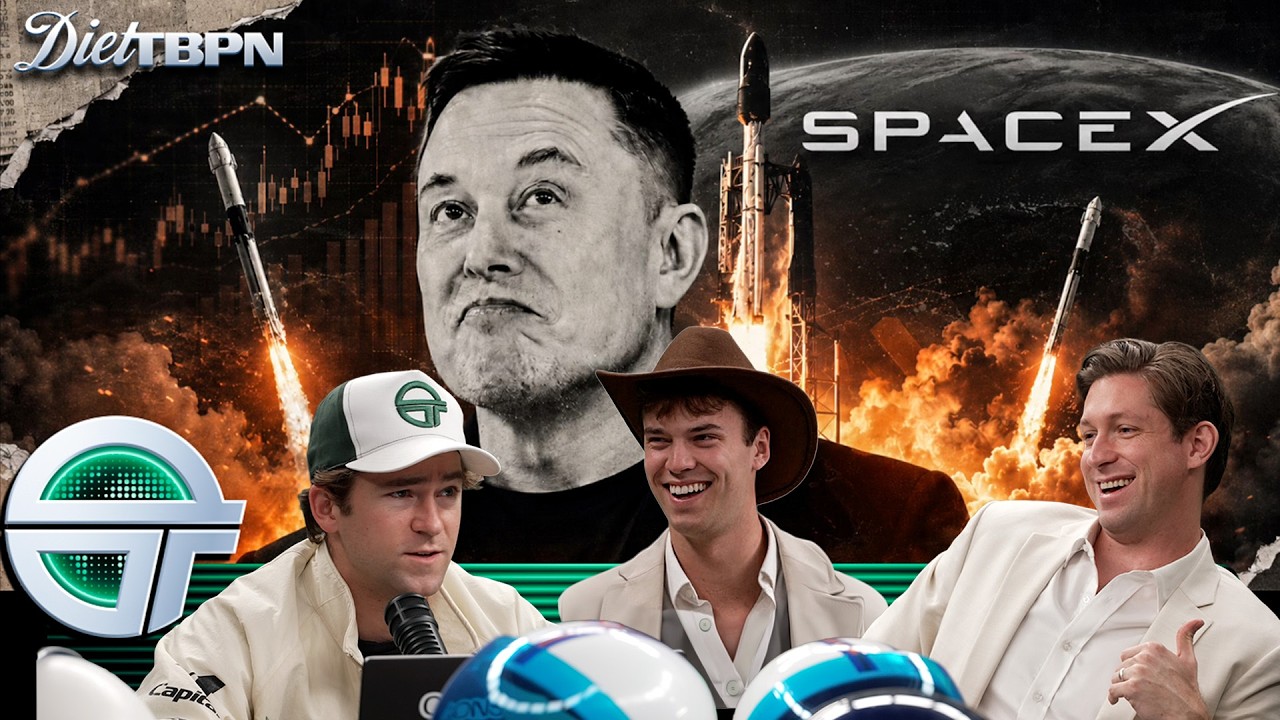
This episode was published on YouTube by the channel TBPN on June 13, 2026. According to the page description, Diet TBPN delivers the highlights of TBPN's live tech talk show in 30 minutes, hosted by John Coogan and Jordi Hays. The show covers major technology news and features high-profile tech leaders and founders.
## TL;DR
The hosts cover SpaceX's historic IPO day as the stock hits a massive $2.27T–$2.28T market cap and trades up roughly 24% over its $135 offering price. They review Gwynne Shotwell's opening speech at the Nasdaq, her legacy, and her operational concept of 'residual capability' that enabled Starlink's creation. The episode also explores Elon Musk's 2004 Senate hearing advocating for open space competition, Founders Fund's legendary early venture bet, the severe retail stock allocation cutbacks, and a lighthearted noon stock price prediction contest.
## Atmosphere & style
The show carries a fast-paced, high-energy, and informal Silicon Valley vibe full of sharp humor and tech-insider banter. Coogan and Hays blend serious corporate analysis with playful detours, transitioning seamlessly from trillion-dollar market valuations to beach disputes and Peter Thiel's chess blunders. It feels like listening to plugged-in tech founders candidly reacting to history in real time over morning coffee.
## Key takeaways
- [00:00](https://www.youtube.com/watch?v=1rMrQyKXTDg&t=0s) SpaceX goes public in a historic IPO, opening at $150 per share against a $135 pricing and pushing past $172 early in the day for a $2.27T–$2.28T market cap.
- [06:13](https://www.youtube.com/watch?v=1rMrQyKXTDg&t=373s) Gwynne Shotwell opens the Nasdaq while SpaceX simultaneously launches a Falcon 9 rocket carrying Starlink satellites into orbit.
- [06:13](https://www.youtube.com/watch?v=1rMrQyKXTDg&t=373s) Over half of SpaceX's 22,000 employees personally purchased nearly $1 billion worth of stock during the IPO opening.
- [09:58](https://www.youtube.com/watch?v=1rMrQyKXTDg&t=598s) SpaceX operates on 'residual capability'—aggressively overbuilding launch capacity ahead of demand to build massive secondary businesses like Starlink.
- [15:36](https://www.youtube.com/watch?v=1rMrQyKXTDg&t=936s) Shotwell maintains a long-term vision to establish a moon settlement and a lunar manufacturing facility within 10 years.
- [16:49](https://www.youtube.com/watch?v=1rMrQyKXTDg&t=1009s) In a 2004 Senate hearing, a 32-year-old Elon Musk advocated for open competition in space technology, warning against government program failures following the Columbia disaster.
- [16:49](https://www.youtube.com/watch?v=1rMrQyKXTDg&t=1009s) SpaceX eventually ended a 9-year U.S. reliance on Russian rockets by launching astronauts from American soil in 2020.
- [22:34](https://www.youtube.com/watch?v=1rMrQyKXTDg&t=1354s) Founders Fund's early $20M investment into SpaceX at a $200M valuation stands as one of the greatest venture capital plays in history.
- [25:43](https://www.youtube.com/watch?v=1rMrQyKXTDg&t=1543s) Extreme demand caused severe scaling back on SpaceX IPO stock allocations, leaving many retail investors with single-share fills.
- [31:17](https://www.youtube.com/watch?v=1rMrQyKXTDg&t=1877s) SpaceX stock settled around $167 per share at noon, representing a 24% pop over its IPO price.
The show kicks off on a historic market day with SpaceX officially going public. The stock was priced at $135 per share and opened at $150, but as the hosts check the live ticker early in the show, it is already pushing $172 per share, representing an impressive overall market valuation of roughly $2.27 trillion to $2.28 trillion. John Coogan notes that Tyler, Jordi Hays, and he had all submitted confidential estimates for where the stock price or market cap would land by noon. Jordi submitted a market-cap estimate, Tyler went with a price-per-share figure, and John submitted a percentage-based estimate.
Addressing the day-one performance, John notes that while venture investor Bill Gurley famously opposes massive day-one "pops" (such as a 100% surge, which implies mispricing by underwriters), a steady gain in the 10% to 30% range for a massive, multi-trillion-dollar entity suggests the market pricing hit a sweet spot. The co-hosts joke about Nick leaking the confidential predictions behind the scenes and tease a special secret prize that will be awarded to the winning predictor at noon.
* SpaceX IPO priced at $135 per share and opened at $150 per share.
* Early show trading saw the stock rise to $172 per share ($2.27T–$2.28T market cap).
* The hosts set up a noon prediction challenge with a mystery prize.
---
[00:02](https://www.youtube.com/watch?v=1rMrQyKXTDg&t=2s) The Beach Debate: Dog Walkers vs. Dentists
Before jumping into the formal SpaceX video footage, the hosts get sidetracked by an ongoing running joke: a bizarre local debate over a beach conflict covered in the *Wall Street Journal* between a local dog walker and a dentist. John presses Jordi to pick a side, teasing him for asking 25 clarifying questions instead of making a quick choice for good television. Jordi defends his hesitation, admitting he has never hired a dog walker (his family walked their own dogs) and has never had a single cavity in his life, making both professions feel equally distant from his personal life.
John pushes Jordi to consider the economic dynamics—comparing a individual dog walker's daily earnings to a private equity-backed dental practice rollup. Jordi points out a guy in his neighborhood who walks dogs all day long, marveling at how he turns relaxing outdoor walks and listening to music into a lucrative income stream ("printing all day long"). When John forces him to choose without adding conditionals, Jordi finally sides with the dog walker, humorously declaring that he would back the dog walker financially to form a Special Purpose Vehicle (SPV), buy up the dentist's practice, and shut it down out of spite to solve the beach access dispute.
* Jordi admits he has never had a cavity or hired a dog walker.
* The hosts debate the economics of high-earning neighborhood dog walkers vs. PE-backed dental practice rollups.
* Jordi jokingly offers to back an SPV for the dog walker to buy out and close down the dentist's practice.
---
[00:06](https://www.youtube.com/watch?v=1rMrQyKXTDg&t=6s) Gwynne Shotwell Opens the Nasdaq + SpaceX Makes History
The show transitions to video footage of SpaceX President and COO Gwynne Shotwell addressing the crowd at the Nasdaq on the day of the IPO. Coogan and Hays marvel at the magnitude of the moment, with John pointing out that SpaceX literally launched a Falcon 9 rocket carrying Starlink satellites into orbit on the exact morning of their IPO—a uniquely SpaceX way to open on Wall Street.
In her address, Shotwell reflects on the company's 24-year history since Elon Musk founded SpaceX in 2002 with the mission of making life multiplanetary. She walks through the historic gauntlet of doubters who claimed SpaceX could never reach key milestones, checking off every impossible bar they broke: getting the liquid-fueled Falcon 1 to orbit in 2008 (just six weeks after the failure of Flight 3), scaling up to the orbital Falcon 9 two years later, docking with and delivering astronauts to the International Space Station (ISS), hitting 165 successful launches in the previous year alone, and building Starship to reach the Moon and Mars.
Shotwell also highlights the recent strategic merger/acquisition with xAI, noting that the combined entity now controls the largest coherent gigawatt-class compute cluster on the planet to help "truth seek and understand the universe." Celebrating the 22,000-strong SpaceX workforce, she proudly reveals that over half of the employees personally bought additional stock in the IPO opening, totaling nearly $1 billion.
* **Morning Launch:** SpaceX launched a Falcon 9 with Starlink satellites on the morning of its IPO opening.
* **Historical Timeline Highlighted by Shotwell:**
* **2002:** Founded by Elon Musk.
* **2008:** Falcon 1 becomes the first privately funded liquid-fueled rocket to reach orbit (6 weeks after Flight 3 failed).
* **2010:** Falcon 9 reaches orbit.
* **2023–2025:** Scaled to 165 launches in a single year.
* **xAI Integration:** Merged capabilities provide gigawatt-class compute infrastructure for AI and space exploration.
* **Employee Buy-in:** Over 50% of SpaceX's ~22,000 employees personally purchased nearly $1 billion worth of stock at the IPO.
---
[00:09](https://www.youtube.com/watch?v=1rMrQyKXTDg&t=9s) The Shotwell Era, Starlink, and Residual Capability
Reflecting on Shotwell's historic speech, John Coogan praises her as one of the most impressive operational executives of the modern corporate era. He jokes about the "nominative determinism" of hiring an executive named *Shotwell* to run a rocket launch company. Shotwell, who previously worked at Chrysler and the Aerospace Corporation performing technical work on military space R&D, originally hesitated for weeks before joining SpaceX in 2002. As a single mother at the time, leaving a stable corporate background for a tiny, unproven space startup felt wildly risky—until she realized while driving on an LA freeway that "it was the trying part that was the most important."
The hosts discuss Shotwell's strategic concept of **"residual capability"**—the philosophy of aggressively overbuilding capacity ahead of immediate market demand. By manufacturing far more launch capacity than commercial markets required at the time, SpaceX created cheap, surplus payload room on its own rockets. They leveraged this excess capacity to build out the Starlink satellite internet constellation, creating a massive, highly profitable secondary business on top of launch services. John notes that point-to-point suborbital rocket transit (e.g., flying from New York to Tokyo in 30 minutes via Starship) represents another huge residual capability play for the future—and might ironically face fewer regulatory hurdles than hypersonic jets, which have been bogged down in bureaucratic approvals for decades.
The conversation closes with personal anecdotes about Shotwell's career and quirks:
* **Comp & Board:** Shotwell earned $86 million last year (mostly in stock options) and is one of eight board members at SpaceX.
* **Launch Superstition:** Because she happened to be in Scotland during SpaceX's very first successful orbital launch in 2008, she created a personal launch-day ritual: writing "Scotland" on two sticky notes and placing one inside each shoe for every single launch so she is always "in Scotland."
* **Leadership Style:** She serves as a grounded counterweight to Elon Musk, successfully navigating NASA relationships and shielding the business during political turmoil, famously remarking that she prefers Musk's thoughtful in-person persona over his online Twitter/X persona.
[015:36] Gwynne Shotwell’s Legacy, Moon Goals, and Daily Commute
The hosts shift focus to Gwynne Shotwell’s backstory and her ascent at SpaceX. Raised outside of Chicago, Shotwell joined SpaceX as Vice President of Business Development, which explains why her initial equity stake wasn't equivalent to a co-founder's. However, her impact was immediate: she was promoted to President and Chief Operating Officer in 2008—the same pivotal year SpaceX secured a critical $1.6 billion cargo transport contract with NASA. Having joined as SpaceX’s seventh employee, Shotwell has maintained an ambitious timeline for the company's goals, famously remarking that she would be disappointed if SpaceX didn't have a moon settlement and a lunar manufacturing facility within 10 years.
To balance her high-stakes career, Shotwell resides on a 1,000-acre ranch near a SpaceX facility in Texas, is married to a fellow SpaceX engineer, and has two children. Demonstrating her practical, hands-on approach to technical challenges, she even mounted a Starlink Mini terminal onto the roof of her car so she could hold uninterrupted 40-minute commute calls with Elon Musk without dropping.
- **Role progression:** Joined as VP of Business Development (Employee #7); promoted to President & COO in 2008.
- **Key milestone:** $1.6B NASA cargo contract awarded in 2008.
- **Lunar timeline:** Set a 10-year goal for a moon settlement and manufacturing facility.
- **Commute setup:** Fitted a Starlink Mini on her car roof for uninterrupted 40-minute calls with Elon Musk.
[016:49] Young Elon Musk, NASA, and the 2004 Senate Hearing
The narrative jumps back in time, referencing an article by author Jimmy Soni in *The Wall Street Journal* about young Elon Musk's early fights on Capitol Hill. In 2004, the Senate held a subcommittee hearing following the Space Shuttle Columbia disaster, which had killed seven astronauts (adding to seven lost in Challenger) and left the U.S. space program grounded. The hearing room was thick with national anxiety over whether America could reach space without the shuttle. Senator Bill Nelson warned that the nation might have to rely on Russian rockets for years—a prediction no one in the room contested.
The hearing featured two panels: first, NASA leadership including William Readdy (Associate Administrator for Space Flight), and second, established aerospace defense contractors from ATK, Lockheed Martin, and The Aerospace Corporation. The last person on the industry panel was a 32-year-old Elon Musk, who had founded SpaceX just two years earlier and had yet to successfully launch a rocket. Instead of sticking strictly to the committee's focus on heavy-lift capacity, Musk repeatedly tried to lodge a protest regarding a quarter-billion-dollar contract NASA had just awarded to a rival without open competition.
Despite senators repeatedly trying to steer him back on message, Musk secured his points on the official record. He argued that the previous few decades had been a "dark age for human spaceflight," where costly government programs failed to deliver. He rejected the idea that the public had grown apathetic toward space, asserting it was instead "the disappointment of a hopeful one." Musk cited economist Joseph Schumpeter's concept of "creative destruction," noting that space technology was the only sector that hadn't improved since the Apollo era because it lacked new entrants and open competition. On a lighter note, he poked fun at regulatory hurdles, pointing out that SpaceX was required to spend $10,000 per launch to study the impact on local seals at Vandenberg Air Force Base—even as the seal population was growing by nearly 13% annually. "The seals are doing fine. Let me launch," Musk quipped, adding that if anything, "launch activity serves as an aphrodisiac."
Two decades later, history has validated the outsider's arguments. SpaceX ended the 9-year reliance on Russia (where NASA paid up to $90 million per seat) by launching astronauts from American soil in 2020. The semi-reusable rockets Musk described evolved into a fleet of self-landing boosters that carry more than half of the world's payloads today.
- **2004 Senate Hearing:** Addressed whether the U.S. could access space without the Space Shuttle.
- **Key Figures:** Senator Bill Nelson, William Readdy (NASA Associate Administrator for Space Flight).
- **Elon Musk's Age & Status in 2004:** 32 years old; 2 years after founding SpaceX; zero successful launches.
- **Musk's Arguments:** Cited Joseph Schumpeter's "creative destruction"; called the prior decades a "dark age" for spaceflight; advocated for open competition where the government acts as a customer rather than a competitor.
- **Vandenberg Seal Anecdote:** Highlighted $10k per launch spent on environmental studies for a seal population growing at ~13% per year.
- **Historical Outcome:** SpaceX closed the 9-year U.S. reliance on Russian Soyuz rides ($90M/seat) by launching astronauts from U.S. soil in 2020.
[022:34] Founders Fund's Historic Bet and Peter Thiel's Chess Match
The hosts transition to discussing Founders Fund's early $20 million investment in SpaceX at a $200 million valuation. Despite dilution across subsequent rounds, the hosts remark that it stands as one of the single greatest venture capital investments in history, rivaling Masayoshi Son's legendary $20 million investment into Alibaba that yielded $70 billion.
The conversation detours into an viral video featuring Peter Thiel's online chess habits. A chess enthusiast discovered Thiel’s public Chess.com account—operating under his real name with over 50,000 games played—and cross-referenced his opening moves using an online database against Thiel's public tournament games from the 1990s. The player matched against Thiel, played the Stafford Gambit, and managed to trap and win Thiel's queen by move six (`1. e4 e5 2. Nf3 Nf6`).
Despite losing his queen and later blunder-trapping his own bishop (`BxA7` followed by `b6`), Thiel refused to resign and played on. The hosts draw a parallel between Thiel's relentless refusal to give up in chess and the tenacity required by tech founders like Musk, noting humorously that even legendary billionaires make elementary blunders from time to time.
- **Founders Fund Bet:** $20M initial investment at a $200M valuation.
- **Masayoshi Son Comparison:** SoftBank's $20M Alibaba investment turned into $70B.
- **Peter Thiel Chess Account:** Over 50,000 games played on Chess.com under his real name; verified via 1990s tournament opening lines on OpeningTree.
- **Game Breakdown:** Opponent played the Stafford Gambit; Thiel lost his queen by move six and trapped his bishop with `BxA7` into `b6`, but refused to resign.
[025:43] IPO Charts, Retail Allocation Scramble, and Meme Texts
The hosts examine a graphic shared by an X user ("Andy") illustrating the predicted long-term stock trajectory of the SpaceX IPO: an initial pop on listing day, a multi-year consolidation sell-off, followed by a massive run to the moon. They comment on how critics who wrote off Musk and Tesla years prior are now scrambling for SpaceX allocations.
The discussion turns to how severely retail and private bank orders were scaled back due to overwhelming demand:
- One individual placed a **$1 million order** through a private bank and was allocated just **$50,000** (a 1/20th fill).
- Show team members who put in orders for 20, 50, or 100 shares received only **1 single share** (dubbed the "one share wonder").
- One host mentioned receiving a off-market offer for a **$50 million allocation**, which he passed on sharing further due to the belief that supply was abundant, only to realize demand vastly outstripped supply across all channels.
The hosts share a viral text exchange claiming an Uber driver texted a former rider asking for SpaceX stock advice ("SpaceX IPO, what are we thinking, boss?"), which they laugh off as fake. However, co-host Nick received a real text from a non-professional acquaintance advising him to "get in and get out by the end of the day"—while Nick was sitting on his grand total allocation of 1 share.
- **Visual Chart Theory:** Initial IPO pop, followed by 3 years of consolidation, and a long-term skyward trajectory.
- **Allocation Shortages:** $1M private bank orders filled at $50k; retail investors receiving single-share fills ("one share wonder").
- **Off-market Offer:** $50M allocation block floating around private networks before the listing.
[030:21] The Noon Prediction Reveal and Final Price Check
As the clock strikes noon, the hosts reveal their earlier predictions regarding SpaceX's listing price performance relative to its $135 IPO price:
- **John Coogan:** Predicted **0% change ($135/share)**, joking that the funniest outcome would be investment bankers pricing the market with 100% precision and zero day-one pop.
- **Jordi Hays:** Predicted a massive bullish target of **$283/share** by midday.
Looking at the live stock chart at noon, the stock sits at a **24% pop** above the $135 offering price. While Jordi admits he was overly bullish and John acknowledges the market got its pop, both agree that a 24% gain demonstrates a remarkably well-managed, stable debut for a trillion-dollar company.
- **IPO Base Price:** $135 per share.
- **John Coogan's Prediction:** 0% pop ($135).
- **Jordi Hays's Prediction:** $283 per share.
- **Actual Price at Noon:** +24% pop above the IPO price.
The hosts review their predictions for where the SpaceX stock price would land at noon following its IPO launch. The stock is trading at $167 (up 24%), coming back up after opening in the $160s and dipping to around $158. The predictions had ranged from 0% to 33%, with Tyler's guess of 31% ($176) coming in as the closest estimate. As the winner, Tyler is awarded the show's tongue-in-cheek "prize": getting to read an extra sponsor ad for Ramp. Tyler quickly launches into the pitch ("Ramp. Time is money, save both...").
The conversation then segues into recent tech banter on social media. They laugh over a post by Will Manidis, who realized his year-long issue with low sleep scores on his Whoop tracker was solved simply by taking the device off. The hosts discuss the absurdity of tracking sleep scores to the point of anxiety, referencing Goodhart's Law—where optimizing for a metric breaks its utility—though they note enjoying features like Eight Sleep's cooling and heart rate tracking. Finally, they react to comments from Apple's Craig Federighi stating that Siri is explicitly programmed not to act as an "AI girlfriend" or engage in sycophantic, engagement-driven behavior, with the hosts joking that he's just inviting users to attempt prompt-injection jailbreaks.
- **SpaceX IPO Noon Stock Price:** $167 per share (+24% gain from IPO pricing).
- **Opening & Low Points:** Opened in the $160s and briefly dipped to $158 before rebounding.
- **Predictions vs. Reality:**
- Prediction range: 0% to 33%.
- Tyler's Winning Guess: 31% ($176 per share).
- **Ramp Ad Read Prize:** "Ramp. Time is money, save both. Easy to use corporate cards, bill payments, accounting, and a whole lot more. All in one place."
- **Whoop Tweet (Will Manidis):** Resolved low sleep scores simply by ditching the tracker.
- **Apple / Craig Federighi Statement:** Siri will not act as a romantic partner or AI girlfriend, contrasting with chatbots designed around sycophancy and high engagement.
## Notable quotes
> [09:00](https://www.youtube.com/watch?v=1rMrQyKXTDg&t=540s) It was the trying part that was the most important. — Gwynne Shotwell
> [16:49](https://www.youtube.com/watch?v=1rMrQyKXTDg&t=1009s) The seals are doing fine. Let me launch. — Elon Musk
> [16:49](https://www.youtube.com/watch?v=1rMrQyKXTDg&t=1009s) launch activity serves as an aphrodisiac. — Elon Musk
> [25:43](https://www.youtube.com/watch?v=1rMrQyKXTDg&t=1543s) SpaceX IPO, what are we thinking, boss? — Uber Driver
> [25:43](https://www.youtube.com/watch?v=1rMrQyKXTDg&t=1543s) get in and get out by the end of the day — Non-professional acquaintance
> [31:17](https://www.youtube.com/watch?v=1rMrQyKXTDg&t=1877s) Ramp. Time is money, save both. Easy to use corporate cards, bill payments, accounting, and a whole lot more. All in one place. — Tyler
## Mentioned
SpaceX, TBPN, John Coogan, Jordi Hays, Tyler, Nick, Mark Zuckerberg, Sam Altman, Mark Cuban, Satya Nadella, Ramp, Public, Cisco, Console, CrowdStrike, Figma, MongoDB, NYSE, Railway, Shopify, Wall Street Journal, Gwynne Shotwell, Elon Musk, Falcon 1, Falcon 9, Starlink, International Space Station (ISS), Starship, xAI, Chrysler, The Aerospace Corporation, NASA, Jimmy Soni, Space Shuttle Columbia, Challenger, Bill Nelson, William Readdy, ATK, Lockheed Martin, Joseph Schumpeter, Vandenberg Air Force Base, Founders Fund, Peter Thiel, Masayoshi Son, Alibaba, Chess.com, OpeningTree, Stafford Gambit, SoftBank, Andy, Will Manidis, Whoop, Eight Sleep, Craig Federighi, Siri, Apple
Reviewing SpaceX's public market debut at a valuation exceeding $2.2 trillion, the TBPN hosts frame the milestone as the validation of Elon Musk's once-dismissed commercial spaceflight thesis and Gwynne Shotwell's strategy of aggressive capacity overbuilding.
Public Market Debut and Allocation Scramble (0:00)
SpaceX priced its initial public offering at $135 per share, opened at $150, and traded up to $172 during early morning trading—implying a market capitalization of $2.27 trillion to $2.28 trillion. By midday, the stock leveled off to around $167, reflecting a 24% first-day gain. Host John Coogan observed that while venture capitalists like Bill Gurley historically criticize massive first-day pops as evidence of mispricing by underwriters, a 10% to 30% rise for a multi-trillion-dollar firm indicates that institutional pricing found a healthy equilibrium between demand and valuation.
The debut was marked by extreme allocation bottlenecks across both retail and institutional channels. Demand vastly outstripped supply: a reported $1 million private bank order was allocated just $50,000, while show participants and retail investors who ordered dozens of shares received single-share fills. The hosts noted the irony of investors scrambling for small allocations after many analysts and critics had spent years writing off Musk's ventures.
Operational Execution and the Residual Capability Model
President and COO Gwynne Shotwell, who joined as SpaceX's seventh employee in 2002, was highlighted as the central operational architect behind the company's industrial scale. Shotwell outlined the company's trajectory at the Nasdaq opening, noting its progression from the Falcon 1 reaching orbit in 2008 to achieving 165 successful launches in a single year, deploying Starship, and acquiring xAI to leverage a gigawatt-class compute cluster for exploration and research. Workforce confidence was demonstrated by more than half of SpaceX's 22,000 employees personally purchasing nearly $1 billion worth of stock at the IPO opening.
The hosts highlighted Shotwell’s strategic doctrine of 'residual capability'—intentionally manufacturing launch capacity far beyond immediate commercial demand. By creating surplus payload capacity on its Falcon 9 fleet, SpaceX internal costs plummeted, enabling the rapid deployment of the Starlink satellite constellation. This operational surplus effectively turned an internal logistical excess into a highly profitable global internet business, setting a precedent that Coogan noted could eventually extend to point-to-point suborbital passenger transit via Starship.
Vindication of the 2004 Senate Hearing Thesis
SpaceX's market capitalization stands in sharp contrast to the regulatory and political resistance documented during Elon Musk's 2004 appearance before a U.S. Senate subcommittee. Following the Space Shuttle Columbia disaster, when lawmakers like Senator Bill Nelson warned that the U.S. would rely on Russian rockets for years, a 32-year-old Musk—having yet to launch a single successful rocket—protested sole-source government awards to legacy defense contractors. Invoking Joseph Schumpeter’s concept of 'creative destruction,' Musk argued that spaceflight had suffered a multi-decade 'dark age' due to a lack of commercial competition, while ridiculing bureaucratic friction such as $10,000 environmental impact studies on thriving seal populations at launch sites.
Two decades later, Musk's competitive model has displaced legacy aerospace incumbents. SpaceX ended the United States' nine-year dependence on Russian Soyuz flights—which had cost NASA up to $90 million per seat—by launching astronauts from American soil in 2020. The company's reusable boosters now carry more than half of the world's space payloads, transforming the once-theoretical commercial paradigm into dominant infrastructure.
Asymmetric Venture Stakes and Capital Expansion
The IPO also crystallizes historic venture capital windfalls, headlined by Founders Fund's early $20 million investment at a $200 million valuation. The hosts compared the position to SoftBank's $20 million investment in Alibaba that grew to $70 billion, ranking it among the most lucrative wagers in technology history. The episode drew parallels between the sheer stubbornness required in early venture investing and the competitive persistence demonstrated by early backers like Peter Thiel, who famously refused to resign online chess matches even after losing his queen in the opening moves.
SpaceX's transition to public markets confirms its shift from a speculative startup to core aerospace and satellite infrastructure. However, the company now faces the operational pressure of satisfying public market scrutiny while pursuing capital-intensive, long-horizon objectives, including Shotwell's target of establishing a lunar manufacturing facility within ten years.
[9:00] Gwynne Shotwell: It was the trying part that was the most important.
[16:49] Elon Musk: The seals are doing fine. Let me launch.
[16:49] Elon Musk: launch activity serves as an aphrodisiac.
[25:43] Uber Driver: SpaceX IPO, what are we thinking, boss?
[25:43] Non-professional acquaintance: get in and get out by the end of the day
[31:17] Tyler: Ramp. Time is money, save both. Easy to use corporate cards, bill payments, accounting, and a whole lot more. All in one place.
Original transcript
[0:00] It's a massive day today. SpaceX IPO,
[0:03] priced at $135 a share, opened at 150.
[0:06] Where is it right now? Jordy, are you on
[0:08] it? Do you have the price? Oh, the price
[0:10] is up there. Okay. Now we're getting
[0:13] >> [laughter]
[0:13] >> the endless mirror. Uh you can call the
[0:15] price.
[0:16] >> Here we go.
[0:16] >> We'll be tracking it throughout the
[0:17] show, so stay tuned. It's a $2.28
[0:22] >> 172?
[0:23] >> $172
[0:25] a share. Uh I had Tyler and Jordy uh
[0:29] submit uh confidential estimates for
[0:33] where the stock would be at noon
[0:34] effectively. Jordy went with a market
[0:37] cap-based estimate. Tyler went with a
[0:39] share price estimate, I think.
[0:41] >> Which is what I was told.
[0:42] >> I went with a percentage-based estimate.
[0:44] You can translate between all of them.
[0:45] We'll get there. But uh the stock's
[0:47] doing well. The IPO is successful, I
[0:50] would say. Uh there's been a bunch of
[0:52] chatter back and forth, bull cases, bear
[0:54] cases. Um but overall, it's hard not to
[0:57] look at this as a success. The you know,
[1:01] Bill Gurley doesn't want a crazy pop on
[1:03] day one, doesn't want it to go up 100%.
[1:05] If we're in 10, 20, 30% range for
[1:08] something this big, that just feels like
[1:11] everything came together properly. And
[1:14] so so far, looks really, really good. So
[1:17] at noon, we will check in with our
[1:19] predictions and see who won. There is an
[1:21] exciting prize for the winner, by the
[1:23] way. It's It will be revealed at noon as
[1:25] well. We can pull up this video from
[1:27] Gwynne Shotwell, who is the president of
[1:30] SpaceX and has been on an absolute tear
[1:32] building the company for
[1:33] basically its entire existence.
[1:35] >> [laughter]
[1:36] >> What? What are you laughing at?
[1:37] >> I didn't know what your prediction was.
[1:39] >> Did you see what it is?
[1:40] >> Yeah, Nick just shared it.
[1:41] >> did?
[1:41] >> [laughter]
[1:44] >> This this guy over here. This is a funny
[1:46] guy over here.
[1:47] >> Be revealed.
[1:47] >> Funny guy over here. This is why you
[1:49] trade This is why you trade bits, not
[1:52] stocks.
[1:53] >> like asking me 25
[1:58] clarifying questions. I was like, the
[1:59] price is content to have a conversation.
[2:02] Just pick a number and you're like oh
[2:04] well wait does it count where it opens
[2:06] or what where it opens after like you
[2:08] just
[2:08] >> saw your positioning was confused. I
[2:10] just saw your positioning was confused.
[2:12] >> We got to have a discussion about this.
[2:14] There's nothing accurate at this stage.
[2:17] >> Everything's on the line John.
[2:18] Everything is on
[2:20] >> I was laughing about how you wouldn't
[2:22] take a side on the on the dog walker
[2:24] versus the dentist. I was I was like dog
[2:27] walker dentist blind who you going? And
[2:29] you were like I I can't possibly. I
[2:31] couldn't possibly in the name of good
[2:33] television
[2:34] just pick a random side for the purpose
[2:36] >> or dentist?
[2:37] >> Yeah.
[2:38] >> Beach debate.
[2:39] >> The beach debate. We never we never got
[2:40] your answer. And you're like I need more
[2:42] information. I can't possibly make a
[2:44] call.
[2:44] >> This is it's such a tough one cuz I
[2:46] don't
[2:46] >> That that tough pick one randomly. Why
[2:48] is it tough?
[2:49] >> why it's tough for me John.
[2:50] >> Okay explain.
[2:51] >> I have never in my life hired or worked
[2:54] with a dog walker. My family growing up
[2:56] had a couple dogs. We walked our dogs.
[2:59] Like we never
[3:00] >> to the dentist.
[3:00] >> I was the dog walker.
[3:01] >> Yeah. You've been to you're not your own
[3:03] dentist though. So why aren't you just
[3:04] going dentist?
[3:05] >> I've never had a cavity. Every time I go
[3:07] in there I I guess I'm blessed.
[3:10] >> Okay.
[3:10] >> Every time I go in there they're like
[3:11] looks good boss and and I just head out.
[3:14] >> So equally useless.
[3:16] >> Equally useless profession.
[3:17] >> So flip the coin it's TV.
[3:19] >> Useless [laughter] profession.
[3:21] No I just don't have any I don't have
[3:23] any connection. I need I need like a
[3:24] flying
[3:25] >> Why don't you fall back to like the
[3:26] economic power of the dentist industry
[3:28] versus the dog walking industry? Like if
[3:30] you had to pick a job if you were trying
[3:32] to get a bag
[3:33] >> I respect dog walker. I there's no
[3:34] >> go dog walker. Oh you would be an elite
[3:36] dog walker over a mid dentist?
[3:38] >> Here's here's two here's like here's
[3:40] kind of my thinking.
[3:41] >> Yeah yeah yeah.
[3:41] >> There's a guy in my neighborhood
[3:43] >> Yeah.
[3:43] >> who is walking dogs in my neighborhood
[3:45] all day long.
[3:46] >> Yeah.
[3:46] >> I'm like who like a lot of people in my
[3:48] neighborhood don't work. They're just
[3:50] home all day. Like why aren't you
[3:52] walking your dog?
[3:53] >> Okay.
[3:53] >> But, I think it's amazing that this guy
[3:55] is just like
[3:56] >> Clearly printing all day long, just
[3:58] going for walks, hanging out, he's
[3:59] listening to music, hanging out, he's a
[4:00] super nice guy.
[4:02] >> He picks up the the
[4:03] >> Sounds like you're going dog walking.
[4:04] >> Except the poop when he when the poop on
[4:06] my lawn. I appreciate it. We have a, you
[4:08] know,
[4:09] >> Good relationship.
[4:10] >> Maybe wish he wouldn't do that, but
[4:11] >> Okay.
[4:11] >> We have a fine relationship. But then
[4:13] dentists, I could get really excited
[4:15] about a dentist if they were
[4:17] >> You're still torn. You're still torn.
[4:19] You're still not
[4:20] >> Private equity backed roll up, right?
[4:22] >> Okay. Well, that's an option.
[4:23] >> The dentist was kind of a figurehead for
[4:26] >> for some PE firm
[4:27] >> Yeah.
[4:27] >> be able to deploy huge amounts of
[4:29] capital into rolling up family practices
[4:32] >> and raising prices.
[4:34] >> if what if you're a dog walker, you you
[4:37] earn so much money you start being able
[4:39] to buy small dentist shops, rolling them
[4:41] up, you flip from dog walking into
[4:43] dentistry?
[4:44] >> Well, that would be the way. I don't We
[4:45] don't know much about this story.
[4:47] >> Yeah.
[4:47] >> But we do know there's a conflict.
[4:49] >> Yeah.
[4:50] >> But that would be the way for the dog
[4:51] walker to strike back is buy the dentist
[4:54] back.
[4:54] >> So, final final answer.
[4:55] >> Come in
[4:56] >> What what side are you picking?
[4:57] >> If the dog walker will commit to
[5:01] >> conditionals.
[5:02] >> Why [laughter]
[5:03] can't I have
[5:03] >> Dog walker or dentist?
[5:04] >> Why can't I have conditions?
[5:05] >> You can't have conditions because that's
[5:07] the rules that I'm laying down. You got
[5:09] to pick one. Dog walker or dentist?
[5:10] Whose side are you on?
[5:12] >> Dog walker.
[5:13] >> There we go. Finally, we got you.
[5:14] >> But I'm going to put but I'm going I'm
[5:16] going to put heavy
[5:18] >> The whole point is that you got to pick
[5:19] a real
[5:20] >> a serious amount of pressure
[5:21] >> I'll just take dentist side and I'm
[5:23] going to defend that and steal man that.
[5:24] That's fine.
[5:24] >> put a serious amount of pressure on the
[5:26] dog walker
[5:27] >> Okay.
[5:27] >> and I will provide the financial backing
[5:29] to acquire the dentist practice and shut
[5:31] it down. [laughter]
[5:32] >> Okay. Okay.
[5:33] >> Because I know they have I know they
[5:34] have some conflict.
[5:35] >> Yeah. Yeah. Yeah.
[5:36] >> And it sounds like it's over the beach.
[5:38] It's really not that personal.
[5:40] >> Yeah. Yeah.
[5:40] >> And access to the beach.
[5:42] >> Yeah.
[5:42] >> But I think there's an opportunity to
[5:43] make it personal.
[5:44] >> [laughter]
[5:44] >> Okay.
[5:45] >> And I think I think at this point if
[5:47] they're getting written up in the
[5:48] journal about this conflict, I think
[5:50] they should make a person they got to
[5:51] figure out how to make it personal and I
[5:52] think buying the dentist practice and
[5:55] then shutting it down
[5:56] >> [laughter]
[5:56] >> or
[5:59] >> That's a high high hurdle.
[6:00] >> No, you can raise you can raise an SPV
[6:02] and put the capital together. And I I
[6:04] would be willing to, you know, I need to
[6:06] meet the guy first, but I'm at least
[6:08] moderately interested in providing at
[6:10] least some of the backing.
[6:11] >> Okay. Okay.
[6:12] >> for the
[6:13] >> I got you. Well, let me tell you about
[6:15] CrowdStrike. Your business is AI, their
[6:17] business is securing it. CrowdStrike
[6:18] secures AI and stops breaches.
[6:21] Uh let's play this clip from Gwynne
[6:23] Shotwell
[6:24] standing at the Nasdaq on the day of the
[6:27] SpaceX
[6:28] IPO. I think we might be able to play it
[6:30] on the big board. Uh stock is doing well
[6:32] holding steady at 2.27 trillion.
[6:35] >> split screen
[6:36] >> Whatever production team wants to do, we
[6:38] will we will do as long as the folks at
[6:39] home can see Gwynne Shotwell giving her
[6:43] speech to
[6:45] >> I got to say Tyler is looking like a
[6:47] young Kimbal Musk right now.
[6:50] >> to be here.
[6:50] >> He's channeling
[6:51] >> Today we make history again.
[6:55] We have a history of making history.
[6:58] So, I want everyone to know that we did
[7:00] open this morning in a rather exciting
[7:02] way. We launched Falcon 9 launched
[7:04] Starlink satellites to orbit.
[7:07] >> We have a history
[7:09] of making history.
[7:10] >> So, what company would do such a thing
[7:13] on the day that they open in the public
[7:16] market?
[7:17] SpaceX would,
[7:19] right?
[7:22] I am so proud of this team. Today we're
[7:25] 24 Not today. This year we are 24 years
[7:28] old. Elon founded this company in 2002
[7:31] initially
[7:33] to build rockets and spaceships that
[7:34] will take humans to Mars, the moon, and
[7:37] even beyond.
[7:39] We've done We've not quite gotten to
[7:41] Mars. We're almost at the moon, but
[7:43] let's just quickly run through the
[7:45] amazing things that you guys have
[7:47] accomplished. 2008, 6 weeks after a
[7:50] failure of flight 3 Falcon 1, we got the
[7:53] first liquid fueled rocket to orbit from
[7:55] a private company. Yay.
[7:57] Okay.
[7:58] >> [applause]
[8:00] >> By the way, I should have prefaced this
[8:02] with everyone said we could never get to
[8:04] orbit. Check.
[8:06] But it was a little rocket. Then it's
[8:08] everyone said, "Well, you can't get a
[8:10] real rocket to orbit."
[8:12] 2 years later,
[8:13] we got a real rocket to orbit, Falcon 9.
[8:16] Oh, well, you'll never
[8:18] you'll never get to the space station,
[8:19] cuz that's what we really want to do,
[8:21] right? We want to take humans outside
[8:23] the bounds of Earth, but you'll never
[8:25] get astronauts to the space station.
[8:26] Check. We did that, too. Dollars, right?
[8:29] Oh, you'll never fly Falcon 9 enough.
[8:31] [laughter] You'll never get to
[8:32] production.
[8:33] Uh 165 launches last year. Check.
[8:39] You'll never build a rocket large enough
[8:41] to take humans to the moon and Mars.
[8:43] We build one. We've flown it, and this
[8:45] year, I believe, we'll get to orbit with
[8:47] that vehicle, and we'll recover the
[8:49] first the second stage. We've already
[8:51] recovered the first stage and reflown
[8:53] it. With the merger the acquisition of
[8:55] xAI, we now as a group own the largest
[8:59] coherent gigawatt class compute on the
[9:01] planet, which will help us truth seek
[9:04] and understand the universe. So,
[9:06] congratulations to all of us for that.
[9:08] So, we're about 22,000 strong. I'm super
[9:12] proud that over half of us actually
[9:15] bought additional stock in this opening
[9:18] totaling almost a billion dollars.
[9:23] So, thank you for that, too.
[9:26] But really the thank yous go to all of
[9:28] you for hanging in there, for keeping a
[9:31] straight spine as the doubters doubt, to
[9:35] to
[9:35] historic things sometimes every day,
[9:39] multiple times a week. Thank you, all of
[9:41] you, for doing this. And I hope today is
[9:43] a day that you feel great about
[9:44] [laughter] and that you're celebrating.
[9:46] Take a moment. Now, the Falcon recovery
[9:48] team can't take a moment today, um but
[9:50] everybody else can, and I hope Falcon
[9:52] recovery team could take a moment a
[9:53] little bit later. Yeah.
[9:54] >> In all seriousness
[9:57] >> [applause]
[9:58] >> Uh congratulations to the SpaceX team.
[10:00] It is like truly one of the most
[10:01] remarkable stories
[10:04] uh in
[10:05] the history of capitalism, in the
[10:07] history of America, started in a little
[10:10] town called El Segundo, and uh
[10:14] Gwynne Shotwell, one of the most
[10:17] impressive executives of the modern era,
[10:19] and uh we all should have known. Just
[10:22] due [laughter]
[10:23] to the nominative determinism.
[10:25] >> Yeah.
[10:26] >> If you're going to build a rocket
[10:26] company, hire somebody to run the
[10:28] company with a last name Shotwell,
[10:31] because she has shot quite well.
[10:33] >> Uh she worked at Chrysler.
[10:36] >> [laughter]
[10:36] >> Uh and then uh began work at at the El
[10:39] Segundo
[10:39] >> People like to say like, "Oh,
[10:40] non-traditional background."
[10:43] >> Uh somewhat.
[10:44] >> Chrysler.
[10:46] >> Yeah, I mean
[10:46] >> Not exactly like a target.
[10:48] >> Yeah, well, she worked at the Aerospace
[10:49] Corporation, did technical work on
[10:51] military space research and development
[10:52] contracts. She said, "When I was
[10:54] considering joining SpaceX back in 2002,
[10:56] I was struggling with the decision and
[10:58] drawing it out for weeks. It's crazy
[11:00] leaving Elon on red for weeks seems
[11:03] extremely risky. It feels like every
[11:05] decision he makes now is like go, no go
[11:07] today, get back to me right now." Uh
[11:10] back then, obviously, SpaceX was very
[11:12] young, uh less leverage, less less
[11:14] energy, less momentum. So, uh these
[11:17] decisions would be drawn out. She said,
[11:19] "It seemed so risky for me, personally,
[11:22] to join this little startup in an
[11:24] industry where none had ever succeeded."
[11:26] I think she was starting a family around
[11:28] that time, and so it was risky uh from a
[11:31] career perspective. She said, "At the
[11:33] time I was a part-time single mother,
[11:36] yeah,
[11:36] and this was just too far out of my
[11:38] comfort zone. She was used to bigger
[11:40] corporations, more established
[11:42] companies. She's going to this small
[11:45] startup that has at that time, it's like
[11:48] a guy who made money on the internet now
[11:50] wants to do Rocket Tree. What's the
[11:52] chance of that works? It sounds crazy."
[11:54] And it was at the time.
[11:56] She says, "I was driving on the freeway
[11:58] here in LA when it finally hit me. I was
[12:00] being a total idiot. Who cares if I
[12:02] tried this job and either I failed or
[12:04] the company failed? What I recognized at
[12:07] that moment was that it was the trying
[12:09] part that was the most important. Try
[12:12] that risky thing, be a part of something
[12:15] exciting." Uh what a what a fantastic
[12:18] run. She I I'm not sure if she coined
[12:20] the term residual capability, but that's
[12:22] a big phrase that she started using
[12:24] around the time Starlink started
[12:26] working. Just this idea that they would
[12:28] go and build a head of demand almost.
[12:31] So, they SpaceX built basically more
[12:34] launch capacity than there was demand
[12:37] for, but then because there was space on
[12:39] every SpaceX rocket and they were able
[12:41] to build them so so efficiently, so
[12:44] affordably, they were able to put up a
[12:45] massive constellation of internet
[12:47] connected satellites, Starlinks, and
[12:51] develop another huge business on top of
[12:52] it. And so,
[12:54] this idea of of building building
[12:56] building and then
[12:58] finding the different opportunities. For
[13:00] a while, SpaceX point-to-point was the
[13:02] big
[13:03] the big residual capability unlock that
[13:05] was coming in a few years. The idea that
[13:08] you get on a spaceship on a spaceship, a
[13:10] starship, in New York and you'd be in
[13:13] Tokyo in 30 minutes because you would
[13:15] have gone all the way to space and back
[13:17] and it would land. I think that's still
[13:19] part of the plan, but obviously took a
[13:20] backseat in the S1, took a backseat in
[13:22] the marketing materials for the company.
[13:24] But something that is still possible if
[13:27] you
[13:29] wind up delivering incredible safety and
[13:32] performance and cost
[13:34] cost reductions to the rocket launches,
[13:37] why not hop on a rocket to get across
[13:40] the world in 30 minutes? Sounds pretty
[13:42] cool and probably oddly easier to
[13:44] approve than hypersonic plane since
[13:46] those have been stuck in
[13:49] regulatory approvals for
[13:50] you know, years and decades and never
[13:52] really worked out.
[13:53] >> I mean Elon's hitting 1T and she's just
[13:55] hitting 1B.
[13:56] >> Well, yeah.
[13:57] >> Yeah.
[13:58] >> [laughter]
[13:58] >> Shotwell was paid 86 million last year
[14:00] mostly in the form of stock options.
[14:02] She's one of eight board members at
[14:03] SpaceX. She's 62 and has worked with
[14:05] Musk for two decades. She has a specific
[14:08] ritual for launch days
[14:10] because she was in Scotland the first
[14:12] time the company successfully got a
[14:14] rocket into orbit. She now writes
[14:16] Scotland on two sticky notes and places
[14:19] each inside her shoes to be in Scotland
[14:23] for every launch. She said it at 2020
[14:27] >> Scotland mindset.
[14:28] >> That's pretty elite. I like
[14:30] is what what what's that called?
[14:32] Where you're
[14:35] superstitious?
[14:37] Superstitions rare, potentially
[14:39] underrated? What do you think? Do you
[14:41] have any superstitions?
[14:42] >> I mean it's in the word super.
[14:44] >> Yeah.
[14:45] >> Super power.
[14:46] >> What's your take on superstition? Do you
[14:47] have any? Doesn't sound like it.
[14:49] >> I think it's I think it's quite
[14:50] distracting.
[14:51] >> Distracting?
[14:52] >> Yeah, kind of like could it could end up
[14:54] being a pretty big waste of time. So I
[14:55] avoid them.
[14:56] >> So you feel like unless you go through
[14:58] your whole ritual of eliminating all
[15:00] distractions, things aren't going to go
[15:02] well.
[15:03] So you're superstitious about letting
[15:05] distractions creep into your workflow.
[15:07] [snorts] I understand that.
[15:08] >> Yeah. Yeah, yeah, yeah. So maybe So
[15:09] maybe I am. So maybe I am.
[15:11] >> She's been a staunch defender of Musk
[15:13] Musk. She worked to prevent business
[15:15] fallout during all the political
[15:17] turmoil. She worked with NASA officials
[15:19] and assured them that tensions would
[15:20] pass.
[15:21] She doesn't love social media social
[15:23] media.
[15:24] Uh I like his in-person self better than
[15:27] his Twitter self. In fact, they feel
[15:28] like two different people many of the
[15:29] times.
[15:30] She has a much different social media
[15:32] presence than her boss posting sparingly
[15:34] exclusively about SpaceX. She's focused.
[15:36] She was raised outside of Chicago.
[15:38] >> Wait, you could imagine like she's
[15:40] reading X. She's like crying emojis,
[15:43] quoting
[15:44] six more posts,
[15:45] >> [laughter]
[15:46] >> crying emojis.
[15:47] He's never crying.
[15:49] >> Yeah, yeah, yeah.
[15:50] >> At the office. He never does that.
[15:51] >> He's like pretty locked in actually.
[15:53] >> This feels like I feel like I don't know
[15:55] this guy. He's always crying.
[15:56] >> Yeah. Well, when she first joined
[15:58] SpaceX, she was VP of business
[15:59] development. So, not in the in like a
[16:02] co-founder chief executive type role on
[16:05] day one. And so, that probably explains
[16:07] a little bit of the equity position and
[16:09] how that developed over time.
[16:11] But, she was promoted to SpaceX's
[16:12] president and chief operating officer in
[16:14] 2008, the same year the company won a
[16:17] critical $1.6 billion NASA cargo
[16:20] transport deal.
[16:21] >> So, I looked up she was SpaceX's seventh
[16:23] employee.
[16:24] >> Wow, that's pretty early. She'd be
[16:26] disappointed if SpaceX didn't have a
[16:27] settlement on the moon and wasn't
[16:29] building a manufacturing facility on the
[16:31] moon within 10 years, she showed time.
[16:33] She lives on a 1,000 acre ranch
[16:36] close to a SpaceX facility in Texas.
[16:38] She married a fellow SpaceX engineer and
[16:40] has two children.
[16:42] She put a Starlink mini terminal on top
[16:43] of her car to speak with Musk Musk on
[16:46] her 40-minute commute without the call
[16:47] dropping. Interesting.
[16:49] Uh Jimmy Soni also went back in time and
[16:53] told a story in the Wall Street Journal
[16:55] about
[16:57] the one of the early days in
[17:00] in the SpaceX journey, vindication for
[17:03] young Elon Musk, he wrote. In 2004, he
[17:05] told the Senate that open competition
[17:07] would transform the industry. So, this
[17:10] was an interesting story. And I and I
[17:11] wonder if we could find the actual video
[17:13] like on C-SPAN. I don't know if it's out
[17:15] there, but in 2004, the Senate held a
[17:18] subcommittee meeting gathered on all the
[17:21] subcommittee gathers on Capitol Hill to
[17:23] ask a question that now sounds quaint.
[17:26] Could America still reach space without
[17:28] the space shuttle? Of course, we do it
[17:31] like every couple days thanks to SpaceX.
[17:32] The shuttle was grounded, 14 astronauts
[17:34] had died in two disasters, and the
[17:36] hearing room was thick with anxiety of a
[17:38] nation that feared it had lost a step.
[17:41] Senator Bill Nelson, who had flown on
[17:44] the shuttle, sort of the Jared Isaacman
[17:46] of his era, warned that without it the
[17:49] country might spend years relying on
[17:51] Russian rockets. Nobody disagreed.
[17:53] Witnesses came in two panels. First, you
[17:55] got the NASA team defending the program
[17:57] through William Ready,
[17:59] its associate administrator for
[18:02] administrator for spaceflight,
[18:03] accompanied by a retired admiral. After
[18:05] NASA smoke spoke, industry did. They got
[18:08] a vice president from ATK, another from
[18:11] Lockheed Martin, a director from the
[18:13] Aerospace Group. Are you looking for a
[18:15] for a new a candle, a nuke one way or
[18:17] another?
[18:18] >> This is brutal for my prediction.
[18:20] >> This is brutal for
[18:21] >> I'm feeling pretty good.
[18:22] >> But it's also brutal for anyone that
[18:24] wants drama on the chart because you're
[18:26] not getting it today. It's very stable.
[18:29] I think this is a very well-managed
[18:31] project from start to finish.
[18:33] >> now it's just like a trillion-dollar
[18:34] company, so it's hard for it to move
[18:37] super
[18:39] >> I don't know.
[18:40] I I I I just think that if you were
[18:42] expecting 10% swings up and down
[18:45] >> I'm saying the share count is pretty
[18:46] small though, right? Like at least that
[18:47] they're being traded.
[18:49] >> Sure.
[18:50] Sure.
[18:50] >> Very, very small. The last person on the
[18:52] industry panel, you got Lockheed, ATK,
[18:55] Aerospace Corp. It's Elon Musk.
[18:57] >> AP in the chat. Wait for dip.
[18:59] >> [laughter]
[19:02] >> It's just nukes down to $5.
[19:04] >> [laughter]
[19:06] >> So, on the second panel, the industry
[19:08] panel, you got heavy hitters from
[19:10] Lockheed, other industry folks. You got
[19:12] a 32-year-old man who had founded a
[19:14] rocket company 2 years earlier, and he'd
[19:16] yet to launch anything. It was Elon
[19:18] Musk. Uh he had a more immediate
[19:20] complaint. NASA had just awarded a rival
[19:23] a quarter of a billion dollar contract
[19:24] without open competition, and his
[19:27] company had protested. Uh so, everyone's
[19:30] there to debate like, "Okay, can NASA
[19:32] get to space without the shuttle?" And
[19:34] he's there being like, "What about my
[19:36] contract?" He shows up to this thing to
[19:38] testify, and they keep having to try and
[19:40] keep him on track. It's a very
[19:41] interesting uh way to like get his word
[19:44] in edgewise. So, the senators thought
[19:46] the matter was off limits. Like, "This
[19:47] hearing isn't about that, Elon. It's not
[19:49] about your contract." Uh it was under
[19:51] government review already, and they kept
[19:53] having to steer him back to the day's
[19:56] subject, specifically heavy lift, the
[19:58] blunt problem of getting big things off
[20:00] the planet. "Certainly," he said,
[20:02] "although it's worth correcting, I think
[20:03] Mr. Reddy misspoke when he said it was
[20:06] competitive. It was in fact not
[20:08] competitive." The chairman tried again.
[20:10] "Let's stay to heavy lift capacity
[20:11] issues, Elon. Stay on message." And Elon
[20:14] says, "Absolutely." But, his his
[20:16] correction was safely on the record. He
[20:18] said something the panel wasn't ready to
[20:21] hear. "The past few decades," Elon Musk
[20:23] told them, "had been a dark age for
[20:25] human spaceflight. One costly government
[20:27] program after another failed to reach
[20:29] the pad. The public's drift from space,"
[20:32] he argued, "wasn't the apathy of a tired
[20:34] people, but the disappointment of a
[20:36] hopeful one." It sounded in 2004 like a
[20:39] man with a grievance and a half-built
[20:41] rocket. He was dismissed. He had made
[20:43] the same case the summer before in
[20:46] one of his first Capitol Hill
[20:47] appearances. At a 2003 hearing on
[20:50] commercial spaceflight, there's a
[20:52] borrowed concept from the economist
[20:54] Joseph Schumpeter, a creative
[20:56] destruction. The industry had lost it.
[20:58] Not one successful new entrant in four
[21:00] decades. Space, Mr. Musk Musk pointed
[21:03] out, had barely improved since Apollo,
[21:06] while every other technology from
[21:07] computing and the internet to
[21:09] intercontinental flight had been
[21:10] transformed by newcomers and open
[21:11] competition. Restore that forcing
[21:13] function, he said, and space would
[21:14] change no less dramatically. The
[21:16] government need only be a customer, not
[21:19] a competitor.
[21:21] He could be glib. Every launch from
[21:22] Vandenberg Air Force Base, he said, was
[21:24] required by law to be studied for its
[21:26] effect on the local seals at $10,000 a
[21:29] flight, even as that population had been
[21:32] climbing by nearly 13% in a single year.
[21:35] He says, "The seals are doing fine. Let
[21:36] me launch." With that population growth
[21:38] rate, Mr. Musk observed, "It seems clear
[21:41] that if anything, the Vandenberg launch
[21:43] activity serves as an aphrodisiac."
[21:47] Dropping lines, dropping zingers on
[21:49] Capitol Hill. People laughed. It was the
[21:51] laughter you gave uh a clever outsider.
[21:55] But, we can grade that clever outsider's
[21:57] argument now, because more than 20 years
[21:59] have passed and the record is in. The
[22:01] fear that haunted that 2004 hearing,
[22:03] dependence on Moscow, was not ended by
[22:05] the shuttle, but by Mr. Musk's company.
[22:07] In 2002, a SpaceX capsule carried two
[22:09] astronauts to the space station from
[22:12] American soil,
[22:13] closing a 9-year gap in which the United
[22:15] States paid Russia as much as $90
[22:17] million a seat to hitch a ride, the
[22:19] semi-reusable rocket Mr. Musk described
[22:22] to skeptical senators became a fleet of
[22:24] boosters that land themselves and fly
[22:26] again. Today, SpaceX launches more than
[22:29] half the world's payloads. On Friday, it
[22:31] goes public in what is expected to be
[22:33] the largest IPO in history.
[22:34] >> You know what's not ordinary?
[22:35] >> AF F's
[22:37] investment
[22:38] >> Yeah.
[22:39] >> of $20 million at a $200 million
[22:40] valuation into
[22:42] >> Yeah.
[22:42] >> SpaceX. It did get diluted, but it is
[22:45] still I think like the best venture
[22:48] investment of all time. Wait, no, I
[22:51] thought it was more like it's 50. I
[22:53] thought it was more like 80.
[22:54] >> I think it's closer to
[22:56] 8 trillion cents.
[22:58] >> [laughter]
[22:59] >> I think he I I he made 8 trillion cents.
[23:01] >> Got it.
[23:02] >> pennies.
[23:03] Uh PT needed a win.
[23:04] >> What was the return in basis points?
[23:06] >> a win.
[23:06] >> [laughter]
[23:07] >> He needed a win
[23:08] because apparently
[23:09] >> What was the return in basis points?
[23:11] >> He got out with him on chess.com. Have
[23:13] you seen this?
[23:13] >> [laughter]
[23:14] >> Oh, yeah. Do we need to play this?
[23:15] >> We need to play the video of
[23:17] a gentleman on Instagram who found Peter
[23:20] Thiel's chess.com account, played him,
[23:23] and won.
[23:24] >> Do you have the video pulled up?
[23:25] >> lap. It's in the timeline deeper down
[23:27] there. Cuz he found Peter Thiel's chess
[23:30] account, played him.
[23:32] I mean, we already spoiled it.
[23:33] >> On chess.com. I don't know if anybody
[23:35] knows about this, but Peter Thiel has a
[23:37] chess.com account with his real name,
[23:40] under which he's played over 50,000
[23:42] games.
[23:43] >> Over 50,000 games.
[23:45] >> And the reason I know it's him is first
[23:46] of all, his friends [music] are all
[23:48] these Silicon Valley and ex-Stanford
[23:51] >> [laughter]
[23:52] >> founders. And I put his games into a
[23:54] database called opening tree, which
[23:56] allows me to cross-reference his most
[23:59] played moves with
[24:01] >> [music]
[24:01] >> his public tournament games that he
[24:03] played in the '90s. And it's all the
[24:05] same stuff. So, our game went E4 E5,
[24:08] knight F3 knight F6. I played the
[24:10] Stafford Gambit. And on move six,
[24:13] >> Always for the Stafford Gambit? What are
[24:14] we doing?
[24:15] >> Well, no, no. He didn't fall for the
[24:16] Gambit, but And I can just see his face
[24:18] here.
[24:19] >> Okay.
[24:19] >> And the point is that when he takes
[24:21] back, play bishop takes F2, winning his
[24:23] queen by force.
[24:24] >> see.
[24:25] >> So, most players would just give up.
[24:26] They would just resign in this position,
[24:28] but [music] Peter Thiel
[24:29] >> Does not
[24:30] >> never give up. He played on.
[24:31] And a few moves later, he made another
[24:33] very elementary mistake. He played
[24:36] bishop takes A7. And this is the kind of
[24:38] move that you see beginners make. Very
[24:40] rarely does anybody over 2,000 not see
[24:43] that you can just play B6 afterwards,
[24:45] which traps the bishop. And I'm just
[24:48] going to scoop it up in a few moves.
[24:50] Even here, he didn't resign. He kept
[24:52] playing on
[24:53] >> Never play
[24:54] this respectable.
[24:56] >> I find this really funny because Peter
[24:58] Thiel has a reputation being a sort of
[25:00] chess genius. So, I wanted to take this
[25:03] opportunity to show the real Peter Thiel
[25:06] who falls for basic opening traps.
[25:09] >> [laughter]
[25:10] >> Elon, never never gives up.
[25:13] Proof that they're all ordinary guys.
[25:15] Elon never gives up, right? Famous
[25:17] picture of him standing there,
[25:19] everything's in shambles, never gives
[25:20] up. Also makes elementary mistakes
[25:22] sometimes, picking a you know, accusing
[25:24] the president of things you know, on you
[25:28] know, social media, right? Kind of an
[25:29] elementary mistake, you know, if you're
[25:31] a government contractor, right?
[25:34] >> That's right. That's right.
[25:36] And so, again, I think PT never gives
[25:40] up, makes some elementary mistakes.
[25:42] >> There's a lesson there.
[25:43] >> Lesson in there.
[25:43] >> Lesson in there, for sure.
[25:45] Let's pull up this post from Andy
[25:47] showing a visual guide to the SpaceX IPO
[25:49] while I tell you about Codex. Codex is a
[25:52] powerful workspace for getting work done
[25:54] with AI agents. Whether you're writing
[25:56] code, analyzing data, [music] creating
[25:57] content, or automating business
[25:59] workflows, Codex helps you move projects
[26:01] forward from start to finish. So, what
[26:03] is this saying? What's going to happen
[26:05] here?
[26:05] >> This is technical analysis.
[26:07] >> Okay, this is technical analysis. And
[26:09] he's saying that it's going to pop on
[26:11] IPO day, sell off for three straight
[26:14] years,
[26:15] and then go to the moon? Is that this is
[26:18] that and and every He's basically saying
[26:20] that everyone's going to be taking
[26:21] victory laps if the stock trades down in
[26:25] 2026, 2027, 2028, [laughter] but then
[26:28] ultimately they will all be upset. I
[26:30] mean, there were there were some crazy
[26:33] articles out there that are like the
[26:34] rise and fall of Elon Musk a year ago.
[26:37] >> Yeah, he can't possibly come back from
[26:39] the reputational damage he's done to
[26:40] himself.
[26:41] >> Yeah, no one's buying the cars.
[26:43] >> the cars and it's like, well, they're
[26:44] buying the stocks. So, you know,
[26:46] [laughter] it's going to be okay, I
[26:47] guess. Founder's Fund investment at 200
[26:49] million might be the best venture
[26:51] investment in history. A lot of that is
[26:54] just the holding to fruition. Like
[26:57] because the early investors in Google or
[27:00] Microsoft or
[27:02] uh Amazon, like a lot of them
[27:04] distributed at IPO at like a 5 billion
[27:07] valuation.
[27:07] >> the founders, right? Bill Gates.
[27:09] >> Oh, yeah. He sold too early, right?
[27:10] Paper hands. Big
[27:11] >> Now, the only thing is I do think Masa
[27:13] has him beat. I think I think Masa has
[27:14] him beat with Alibaba. Cuz it was like
[27:16] 20 million into 70 billion.
[27:18] >> Sure.
[27:19] >> shorter time horizon.
[27:21] >> Masa mocked. Mocked. Anyway, heard in
[27:23] the chats. I put $1 million SpaceX order
[27:26] through a private bank and just got
[27:28] filled. Only 50k, 1/20th of what this
[27:32] individual asked for. Most people I
[27:34] spoke to have gotten even less. We had
[27:35] some folks on the team put in orders for
[27:37] 20 shares, 50 shares, 100 shares and
[27:40] only get uh a small fraction of that.
[27:42] How much did you get, Tyler?
[27:43] >> Uh I got 22.
[27:45] >> 22 shares, but you requested more?
[27:47] >> Yes. And then yeah, I mean we've had a
[27:49] lot of people they say
[27:50] >> They only got one share.
[27:51] >> Brutal.
[27:52] >> The one share wonder. That's almost
[27:53] worse than zero shares cuz you can see
[27:55] it in your portfolio.
[27:56] >> Yeah, what if they could give you short
[27:57] interest? They're like, you asked for
[27:59] five shares, but we give you negative
[28:00] one share.
[28:02] We give you
[28:02] >> [laughter]
[28:03] >> We give you the inverse ETF, actually.
[28:06] You're It's over for you.
[28:08] >> Yeah, I was
[28:10] uh
[28:11] I was surprised by this.
[28:12] >> Yeah.
[28:12] >> Given the Given the offers that were
[28:13] Given the offers that were flying
[28:15] around, I got uh
[28:17] uh offered like a $50 million
[28:18] allocation. Obviously not uh wasn't
[28:21] going to take that down myself, but
[28:23] [laughter]
[28:24] uh I just um
[28:26] >> Wow, just say you're risk off.
[28:28] >> Uh no. I But I But I responded to the
[28:31] guy and I was like, I don't even know
[28:33] I'm not even going to text anyone cuz
[28:35] like it feels like this is There's like
[28:37] so much allocation available for
[28:39] everyone that it's kind of it's just not
[28:41] even worth firing off a text.
[28:43] >> Yeah.
[28:43] >> Um but turns out there uh there was
[28:47] There There was a lot more demand than
[28:48] supply.
[28:49] >> Uh it's it's making its way through
[28:51] through the world through the through
[28:53] the iMessage DMs. Buddy needs to relax,
[28:56] says RJ. See, SpaceX IPO this week.
[28:59] Thoughts on SpaceX? SpaceX IPO, what are
[29:01] we thinking, boss? Who is this?
[29:03] >> It's Kyle. I was your Uber driver 3
[29:05] months ago.
[29:06] >> had a funny
[29:07] >> This this can't be real.
[29:09] Uber drivers don't get your phone number
[29:10] anymore. It all happens in the app. This
[29:12] is ridiculous.
[29:12] >> Yeah, obviously. Maybe they had a good
[29:13] conversation, they exchanged numbers.
[29:15] >> Yeah, and also these just like like the
[29:16] rendering of the text, it doesn't look
[29:18] iMessage enough to me.
[29:20] I don't believe it, but it's funny.
[29:22] >> Nick did get a funny text this morning
[29:24] from somebody who is certainly not
[29:27] >> a professional
[29:28] >> Not a professional investor saying
[29:30] texting him advice being like, you want
[29:32] to get in, but then you want to get out.
[29:34] You want to get in and get out.
[29:35] >> Okay.
[29:36] >> Get in and get out. Get in and get out.
[29:37] Get out. Get in, but then get out by the
[29:39] end of the day. And Nick's sitting there
[29:40] with his one share.
[29:42] >> [laughter]
[29:46] >> Uh anyway,
[29:47] uh let me tell you about Codex and the
[29:50] Road to Olympia expansion pack, uh which
[29:53] is
[29:54] sponsoring this episode. It takes your
[29:57] training split and refactors it into
[29:59] production-grade hypertrophy code. No
[30:02] more junk volume, no more spaghetti
[30:04] programming, no more deprecated rear
[30:06] delt functions. Just clean scalable mass
[30:09] architecture with automated progressive
[30:10] overload, test coverage for calves, and
[30:13] one critical warning, build failed,
[30:15] insufficient carbs. The Codex Road to
[30:17] Olympia expansion pack is available now.
[30:20] That's a good one.
[30:21] >> It's a good one. Well, John, it's noon.
[30:23] >> Yeah.
[30:23] >> I think it's time.
[30:24] >> Okay. Okay, let's reveal our
[30:26] predictions. What was the price per
[30:28] share when it
[30:30] >> 135.
[30:30] >> 135. Okay, so I said 0%. I said 135. I
[30:35] said the bankers This is The funniest
[30:38] outcome is that the bankers got it
[30:39] perfectly correct. The market is
[30:42] perfectly efficient. No pop, no
[30:44] sell-off, completely flatline on the
[30:47] chart.
[30:48] >> That's [laughter] a that's a very Coogan
[30:49] bit, but like you don't want that.
[30:51] >> No, no, you want a 20% pop.
[30:53] >> You want a little bit of a pop, and I
[30:55] would say they have done that. Like
[30:56] they've gotten it very, very, very
[30:58] close, right? Currently sitting at a 24%
[31:01] pop.
[31:01] >> Uh what did you say? What was your
[31:03] prediction in percent
[31:04] >> I
[31:05] was
[31:05] >> I had 0%.
[31:06] >> two
[31:07] >> It's at 24%.
[31:08] >> I was too bullish.
[31:09] >> You were too bullish.
[31:09] >> I
[31:10] I was expecting somewhere around $283
[31:14] a share by 2 minutes ago.
[31:16] >> $283
[31:17] >> We're currently at 167.
[31:18] >> Okay, so what
[31:19] what percent is that?
[31:21] >> I I thought it would open I thought it
[31:22] was going to open above
[31:25] >> So you had 33%
[31:26] >> I thought it was going to open above 170
[31:28] and then run more.
[31:29] >> Okay.
[31:29] >> Turns out it opened in the 60s, dropped
[31:32] down to around 158, and then built back
[31:34] up from there.
[31:34] >> Okay.
[31:35] >> Uh I was off.
[31:36] >> So I had So I had 0%, you had 33%. It's
[31:39] at 24%.
[31:40] >> just right. I went uh 31%.
[31:43] >> 31% 176 176
[31:46] >> So I'm a little high, a little high.
[31:47] >> So you got the
[31:48] >> But I win.
[31:49] >> You win, you win. And And does everyone
[31:51] want to know what Tyler wins, what the
[31:53] what the prize was today?
[31:54] >> Uh
[31:54] >> Prize is that whoever wins gets to do
[31:57] one extra Ramp ad read. Cuz it's such a
[32:00] treat.
[32:00] >> No way.
[32:01] >> Yeah, and I get to
[32:02] >> special.
[32:03] >> And I get to I hoard them every day, so
[32:04] here you go, Tyler. Feel free to read
[32:07] the Ramp ad for the audience.
[32:09] >> Ramp. Time is money, save both. Easy to
[32:11] use corporate cards, bill payments,
[32:12] accounting, and a whole lot more.
[32:14] >> All in one place. There we go, that was
[32:16] great. I hope you enjoyed that, Tyler.
[32:18] Don't get too comfortable with that.
[32:20] >> Back to Tyler.
[32:21] >> Here we go.
[32:23] >> Will Monidis says it brings me no joy to
[32:24] report I spent a year wondering why I
[32:26] was constantly sleepy and had a low
[32:28] sleep score on my Whoop. That was
[32:30] totally cured by simply stop wearing the
[32:32] Whoop.
[32:33] >> [laughter]
[32:34] >> By simply stop wearing stopping wearing
[32:36] the Whoop.
[32:37] >> Yeah, yeah, yeah.
[32:38] >> But
[32:38] >> Um and X is turning this into a whole
[32:41] news story. Ditching Whoop tracker cured
[32:43] Financia sleep [laughter] worries.
[32:45] >> Financia? Is this Financia?
[32:48] That's hilarious. You want to track your
[32:49] sleep? Like, are you sleeping? Like,
[32:51] think about it.
[32:52] >> Yeah, yeah.
[32:52] >> Come up with an answer. That's your
[32:54] sleep score.
[32:54] >> like I never actually care about the
[32:57] score.
[32:57] >> No.
[32:58] >> The score takes care of itself.
[32:59] >> Yeah. But with Eight Sleep I like the
[33:01] cooling. Like, that's nice.
[33:02] >> Well, and with Eight Sleep I'm actually
[33:04] interested in like how is my REM versus
[33:06] deep sleep trending? Things like that.
[33:09] Resting heart rate. All all these other
[33:11] things. I never am like, "Oh, what's my
[33:13] score today?"
[33:13] >> Oh, the score. Unless we were competing.
[33:15] Because then that was fun.
[33:16] >> It seems like one of those like
[33:17] Goodhart's laws.
[33:18] >> Yes.
[33:19] >> Right? Where if you like, "Oh, I need to
[33:21] get a better sleep score." then it's it
[33:22] doesn't like work as well.
[33:24] >> There's a new challenge that hit the
[33:25] timeline. Apple threw down the gauntlet.
[33:28] They said they said that no one could
[33:30] make Siri their girlfriend. Said Siri
[33:32] won't be your AI girlfriend. This is
[33:33] from Apple's Craig Federighi. Well,
[33:36] >> I'd like to see you try to stop me.
[33:38] >> So, Craig Federighi says Apple won't be
[33:41] your AI girlfriend. Quite the opposite.
[33:44] Because as you may know,
[33:45] >> [cheering]
[33:46] >> many of the existing chatbots are really
[33:47] focused on engagement and sycophancy.
[33:50] They want to kind of pull you in. They
[33:51] might encourage you to reveal things
[33:53] about yourself then use that as a basis
[33:55] to establish a connection. We view it
[33:57] quite the opposite. I mean,
[33:59] >> Very kind of fitting. Like, kind of a
[34:01] very 2025
[34:04] uh take.
[34:05] >> Yeah.
[34:05] >> Which is kind of fitting given their AI
[34:07] progress.
[34:08] >> But if you try and engage Siri as a
[34:10] romantic partner, Siri's not up for
[34:11] that. Siri's 100% not into that. And so,
[34:15] the rizzlers in the chat
[34:16] >> he's just he's just opening himself up
[34:18] to get dunked on. Right? Because like
[34:19] you can people have jailbroken every
[34:21] single model that's ever come out.
[34:22] >> it. But also, one of the cool things
[34:24] about the Siri AI system is that it will
[34:27] in it it it builds a rag [laughter]
[34:29] >> Look at the face. It says, "System
[34:31] prompt. Don't be the user's girlfriend.
[34:35] He's like, yeah, we've we cracked the
[34:37] code. This like problem that has been
[34:39] playing the AI industry.
[34:42] >> Have a great weekend. Congratulations to
[34:44] anyone that got in on the SpaceX IPO.
[34:46] Leave us five stars on Apple podcast,
[34:48] sign up for our newsletter at tbpm.com
[34:50] and we will see you on Monday. Have a
[34:52] great weekend.
[34:53] >> We love you.
[34:54] >> Goodbye.
[34:55] >> Flash bang out.