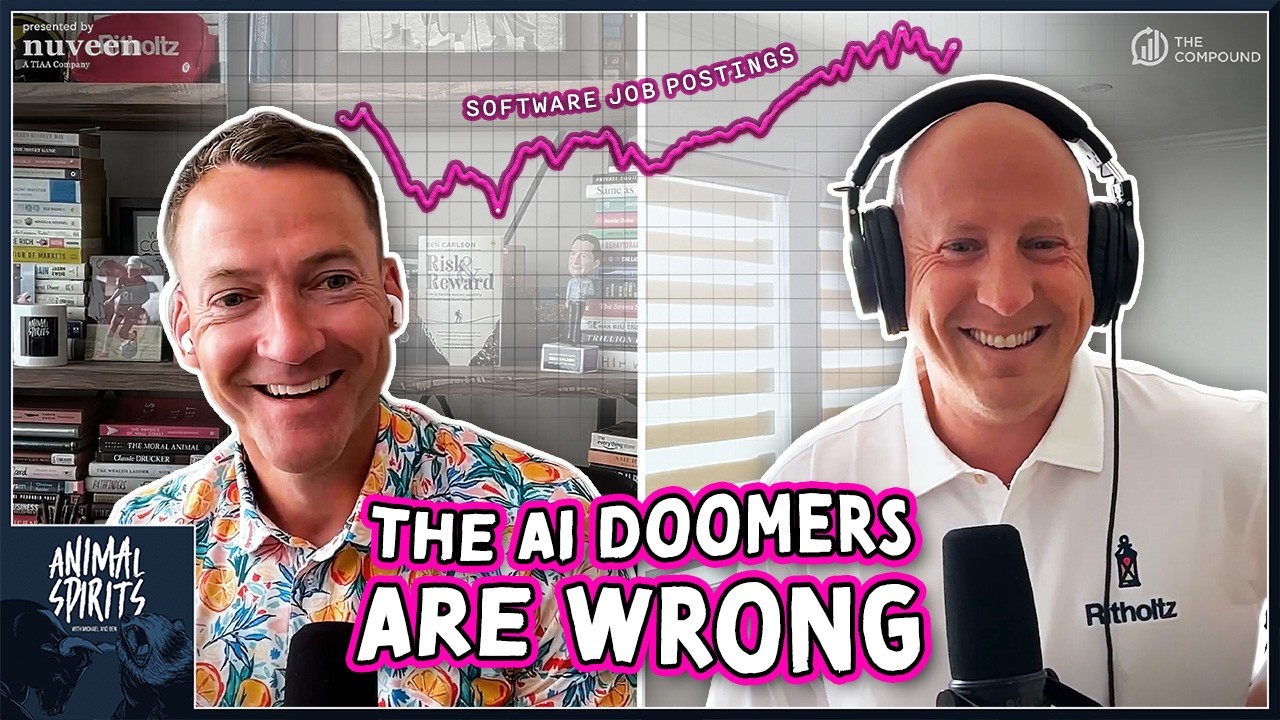
Tech Multiple Compression Leaves Nvidia at Lowest Forward P/E Since 2019
The Compound
Surging earnings and cash flow have driven down valuation multiples for major chipmakers and tech companies even as broader stock indices touch new all-time highs.
## Background
This episode of Animal Spirits (Episode 473) was published on YouTube by The Compound on July 15, 2026. Hosted by Michael Batnick and Ben Carlson, the video breaks down market trends, tech sector earnings, changing economic dynamics, AI's impact on employment, and personal finance strategies, before closing with pop culture commentary and movie recommendations.
## TL;DR
Hosts Michael Batnick and Ben Carlson examine key market developments, including IBM's sharp earnings drop, the massive capex spending of AI hyperscalers relative to semiconductor cash flows, and Nvidia's surprisingly low forward P/E ratio. They debate whether the Fed might ever buy equities, challenge narratives around a K-shaped economy and white-collar AI job loss, and discuss shifting fixed-income opportunities. The episode concludes with lighthearted reflections on public sector pensions, status symbols, GLP-1 drug adoption, Dave Matthews Band super-fans, and recent film recommendations.
## Atmosphere & style
The podcast features a relaxed, conversational, and energetic dynamic between two close colleagues who blend sharp financial analysis with playful banter. The tone shifts seamlessly from macro-market debates to personal anecdotes and cultural commentary, complete with gentle teasing about polo shirts, Zoom etiquette, and concert setlists. Listening feels like sitting in on an candid, fast-paced conversation between two knowledgeable market observers who take finance seriously without taking themselves too seriously.
## Key takeaways
- [01:06](https://www.youtube.com/watch?v=d8OTR-O1Rlo&t=66s) IBM's 23% pre-market drop triggered debate over its market relevance, with Michael noting its $270B market cap impacts software while Ben dismissed it as summer noise.
- [02:24](https://www.youtube.com/watch?v=d8OTR-O1Rlo&t=144s) The debate over rising Treasury yields highlighted Ben's view that 5% rates are historically normal, while Michael warned of technical risk for a higher breakout.
- [06:25](https://www.youtube.com/watch?v=d8OTR-O1Rlo&t=385s) A stark divergence in free cash flow shows hyperscalers pouring capital into AI infrastructure while semiconductor companies reap surging cash flows.
- [09:25](https://www.youtube.com/watch?v=d8OTR-O1Rlo&t=565s) Spikes in semiconductor stock volatility have reached historical crisis levels, though the current AI cycle remains less manic than the 2000 Dot-Com bubble.
- [11:24](https://www.youtube.com/watch?v=d8OTR-O1Rlo&t=684s) Comparing 10 bullish vs. 10 bearish market arguments via Claude AI concluded that the bearish case relies primarily on unrealized future risks.
- [14:08](https://www.youtube.com/watch?v=d8OTR-O1Rlo&t=848s) Nvidia's rapid earnings growth has compressed its forward P/E ratio to its lowest level since early 2019 despite massive stock price gains.
- [15:23](https://www.youtube.com/watch?v=d8OTR-O1Rlo&t=923s) Mega-cap tech forward P/E ratios have compressed below historical averages while broader market advance-decline lines reach new all-time highs.
- [20:00](https://www.youtube.com/watch?v=d8OTR-O1Rlo&t=1200s) Wall Street analysts accurately forecast earnings within 5% nearly two-thirds of the time, failing primarily during unpredicted economic recessions.
- [20:00](https://www.youtube.com/watch?v=d8OTR-O1Rlo&t=1200s) Small-cap stocks in the Russell 2000 are serving as a secondary AI trade due to significant industrial and tech supply chain weightings.
- [24:54](https://www.youtube.com/watch?v=d8OTR-O1Rlo&t=1494s) Performance chasing remains a major source of investor underperformance, as seen in negative average dollar-weighted returns for spot Bitcoin ETFs.
- [24:54](https://www.youtube.com/watch?v=d8OTR-O1Rlo&t=1494s) Equities now make up a larger portion of US household net worth than real estate, driven by automated 401(k) and retirement plan inflows.
- [29:53](https://www.youtube.com/watch?v=d8OTR-O1Rlo&t=1793s) Because retirement security is tightly bound to equities, the Federal Reserve could theoretically intervene in stock ETFs during extreme market panics.
- [32:03](https://www.youtube.com/watch?v=d8OTR-O1Rlo&t=1923s) Modern financial markets experience sharp flash crashes and policy interventions rather than multi-year bear markets because macro risks are priced in rapidly.
- [36:51](https://www.youtube.com/watch?v=d8OTR-O1Rlo&t=2211s) Job growth in software development expanded following the release of AI coding tools, contradicting fears of immediate white-collar worker displacement.
- [40:35](https://www.youtube.com/watch?v=d8OTR-O1Rlo&t=2435s) Current bond market yields between 5% and 9% offer fixed income investors a significantly larger margin of safety than during the zero-interest rate era.
- [50:10](https://www.youtube.com/watch?v=d8OTR-O1Rlo&t=3010s) Full-season binge releases lead to steeper audience drop-offs in subsequent seasons compared to weekly episodic release strategies like HBO's.
- [53:18](https://www.youtube.com/watch?v=d8OTR-O1Rlo&t=3198s) Daily reading for pleasure among American adults has dropped significantly since 2004 as smartphone entertainment replaces finite media options.
- [01:01:00](https://www.youtube.com/watch?v=d8OTR-O1Rlo&t=3660s) GLP-1 adoption is accelerating across the US, contributing to a notable decline in sweet snack and consumer packaged goods sales.
## Detailed walkthrough
Here is a detailed, faithful walkthrough of the provided transcript segment.
### [00:04](https://www.youtube.com/watch?v=d8OTR-O1Rlo&t=4s) Sponsor Disclaimer & Show Intro
The episode opens with a sponsor message from Nuveen, highlighting their decades of experience in private market investments across real estate, credit, infrastructure, and natural capital. They frame their deep scale and foresight as key to building resilient, diversified portfolios across the risk-return spectrum.
At, hosts Michael Batnick and Ben Carlson kick off the show on Tuesday, July 14th at 9:04 AM. Michael notes that it is a packed morning with a flood of bank earnings rolling in—including Wells Fargo, Bank of America, JPMorgan Chase, and Goldman Sachs—alongside major corporate and economic news.
### [01:06](https://www.youtube.com/watch?v=d8OTR-O1Rlo&t=66s) The IBM Debate & Market Impact
Michael highlights that IBM announced disappointing earnings results, sending its stock tumbling 23% in pre-market trading. Ben immediately pushes back, openly questioning why anyone is pretending IBM still matters to the broader market, joking that the last time IBM was a market-moving event was 1993.
Michael defends the topic, pointing out that IBM is a $270 billion market-cap company and ranks among the top 50 largest companies in the world. He refuses to gloss over a stock of that size dropping by nearly a quarter in a single session, adding that IBM's sharp decline is dragging down the broader software sector with it. Ben dismisses the move as standard summer doldrums banter, but Michael insists that analyzing major single-stock moves is exactly what the podcast is for.
### [02:24](https://www.youtube.com/watch?v=d8OTR-O1Rlo&t=144s) Inflation Cooling and the Interest Rate Clash
Turning to macro data, Michael mentions that the latest inflation print showed a welcome cooling. However, before that morning's report, interest rates across the board had been creeping upward toward the top of their multi-year ranges.
This sparks a lively debate:
* **Ben's Take:** Ben argues that people panic every single time interest rates bump up, only for them to pull back. He notes that whenever the 30-year Treasury yield hits 5.00% or the 10-year hits 4.75%, market participants freak out before yields fall back down (pointing out inflation previously spiked to 4.2% and has since cooled back to 3.5%). He views current yields as perfectly normal, historically sound levels reflecting a solid economy.
* **Michael's Take:** Michael counters that looking at technicals on the 20-year yield suggests rates are threatening a massive breakout higher after testing resistance levels repeatedly. He references Louis-Vincent Gave's market wisdom ("the longer the base, the higher in space"). Michael pushes Ben on whether he would still consider rates "normal" if the 10-year Treasury yield climbs to 5.00%.
The debate briefly pauses for lighthearted banter when Ben pokes fun at Michael's three-button polo shirt, teasing him for leaving the collar unbuttoned like a "slob" before Michael begrudgingly buttons it up. Returning to the market, Ben reiterates that a 5% 10-year yield is historically normal and questions how yields could break out much higher while inflation is actively trending down.
* **Historical Stat:** Ben notes that the average 10-year Treasury yield historically sits around 4.96% (transcribed as "196" contextually representing ~4.96%/5%), reinforcing his point that current rates are not an anomaly.
### [06:25](https://www.youtube.com/watch?v=d8OTR-O1Rlo&t=385s) Hyperscaler Capex vs. Semiconductor Cash Flows
The hosts shift to what Ben calls "the chart of the year"—a Bank of America chart tracking the divergent free cash flows of tech hyperscalers versus semiconductor companies. The data reveals a dramatic inverse relationship: hyperscaler free cash flow is plummeting as they pour massive amounts of capital expenditure into AI hardware, while semiconductor cash flows are surging right up to meet them. Ben jokes that it looks like the chipmakers are extorting the hyperscalers ("Give us all your money or we're going to tell everyone about what you did").
The discussion turns to how hyperscalers are responding:
* Mark Zuckerberg broke a long Twitter silence to announce Meta's release of "Llama 3 / Llama-based" open models (referred to playfully alongside an *Anchorman* meme referencing "Arturo Mendes" and rival news teams). Meta's release of low-cost agentic coding models through their API signals an aggressive push by hyperscalers to build their own chip capabilities and software stacks.
* **The Second-Order Question:** Ben asks what happens when the hyperscalers inevitably turn on each other in a price-war race to the bottom. If they undercut each other's AI models while burning through free cash flow, profitability will suffer.
* **Industry Friction:** Michael notes signs of growing tension across Big Tech, such as Apple's strained dynamics and Microsoft CEO Satya Nadella speaking out regarding the immense power hardware and model providers hold.
### [09:25](https://www.youtube.com/watch?v=d8OTR-O1Rlo&t=565s) Semiconductor Volatility & The Toping Process
Ben references data showing the sheer volatility in chip stocks, pointing to the 50-day average absolute one-day percentage change in the PHLX Semiconductor Index (SOX):
* The average daily absolute move in the SOX index reached **3.36%** over the past 50 days.
* Historically, volatility spikes of this magnitude have only been seen during major market crises: the 2008 Financial Crisis, the COVID-19 crash, and the Dot-Com bubble unwind.
Michael notes that despite huge single-day swings (down 5% one day, up 5% in pre-market the next), the current AI cycle still looks relatively tame compared to the extreme mania of the 1999–2000 Dot-Com unwind. Mentioning a recent signal from Samsung's earnings, Michael recalls a key market lesson: "Stocks top on good news"—specifically when news is great, but simply not as astonishing as elevated expectations demanded.
### [11:24](https://www.youtube.com/watch?v=d8OTR-O1Rlo&t=684s) 10 Reasons to Be Bearish (and the Claude AI Test)
Following up on a previous episode's "10 Reasons to Be Bullish," Ben outlines his list of **10 Reasons to Be Bearish**:
1. **Circular Capex:** Most hyperscaler capex is circular spending feeding into the same tight ecosystem.
2. **Magnificent Seven Underperformance:** The Mag 7 stocks are starting to lag; sustained underperformance will eventually restrict their free cash flow usage.
3. **AI Macro Spillover:** AI capex is now driving a significant portion of GDP growth (as discussed with Michael Spike on *TCAF*). A slowdown in AI spending would trigger a broader economic slowdown.
4. **Retail All-In:** Retail investors are leveraged and heavily positioned in the market.
5. **Sticky Inflation:** Inflation remains elevated at 3.5%–4.2%, well above the comfortable 2010s baseline.
6. **High Mortgage Rates:** Mortgage rates are pushing back toward 7%, putting pressure on the housing market.
7. **Complacency / Minsky Moment:** Following gains of 26% in 2023, strong returns in 2024, and a 10% gain in the first half of the year, stability risks breeding instability.
8. **AI Bubble Characteristics:** AI checks all the classic historical bubble boxes.
9. **Recession Overdue:** The economy has not experienced a deep, prolonged recession in 17 years.
10. **Unsustainable Long-Term Returns:** Stock market annualized returns (24% over recent stretches) are far above historical averages.
Ben reveals he fed both the 10 Bullish and 10 Bearish points into the AI model Claude to see which case was stronger. Claude concluded that the **bearish argument was much flimsier** because the bullish catalysts are actively happening today, whereas the bearish points rely on potential future risks that have not yet materialized.
### [14:08](https://www.youtube.com/watch?v=d8OTR-O1Rlo&t=848s) Valuation Realities & Nvidia's Forward P/E
Michael notes that Ben left traditional valuation metrics off his bearish list for good reason: forward price-to-earnings ratios have actually been improving as earnings growth outpaces price appreciation.
To illustrate this, Ben points to a Bloomberg chart highlighting Nvidia's valuation:
* On a forward P/E basis, **Nvidia is trading at its cheapest valuation level since early 2019**.
* Because Nvidia's earnings and cash flow surged so rapidly, its price multiple contracted even as the stock price soared.
This leads Michael and Ben to question whether the market is offering a rare buying opportunity or correctly pricing in "peak Nvidia." Michael suspects the market is accurately discounting the sustainability of these hyper-growth cash flows, realizing that growth cannot continue pulling forward indefinitely. Ben concludes by reminding listeners that back in 2020, Nvidia was not even inside the top 10 largest companies in the S&P 500 or Nasdaq 100.
[15:23](https://www.youtube.com/watch?v=d8OTR-O1Rlo&t=923s) Tech Valuations, Retail Sentiment, and Market Breadth
Ben Carlson and Michael Batnick open by debating whether Nvidia and the broader semiconductor sector are pulling forward an entire cycle of growth—much like Apple did over a 15-year stretch—or whether valuations are simply far more reasonable than the "tech bubble" narrative suggests. Michael highlights a chart from Vanda Research showing that retail investors' net single-stock buying has fallen to a new post-COVID low. While some of this shift can be attributed to retail traders flocking to leveraged single-stock ETFs, it remains a striking counter-point to the idea that retail is fully "all-in."
Ben adds data from Duality Research showing that the forward price-to-earnings (P/E) ratio for mega-cap tech stocks has dropped below its 10-year and 5-year averages, sitting near its lowest level since early 2025. This expanding earnings power alongside compressing multiples directly challenges the idea that tech is in an unsustainable valuation bubble. When reviewing reasons to be bearish, the hosts dismiss the threat of AI causing immediate white-collar mass unemployment, noting that it simply isn't showing up in the data.
```
Tech Forward P/E vs. Historical Averages
+---------------------------------------+
| 5-Year Average: [========] High |
| 10-Year Average: [======] Med |
| Current Tech P/E: [====] Low |
+---------------------------------------+
```
Beyond mega-cap tech, market breadth across the broader stock market looks surprisingly robust:
- The S&P 500 Equal Weight ETF (RSP) and the S&P 500 Ex-Technology Index (SPXT) have both pushed to fresh all-time highs.
- Cumulative Advance-Decline (A/D) lines for the S&P 500, MidCap 400, and SmallCap 600 have all broken out to new highs simultaneously.
- While enterprise tech names remain bruised—Oracle down nearly 60% and Microsoft down 35% from their highs—the average stock across other sectors continues to trend upward.
[20:00](https://www.youtube.com/watch?v=d8OTR-O1Rlo&t=1200s) Earnings Accuracy and Small-Cap AI Exposure
Addressing whether earnings forecasts can be trusted, Michael cites research showing that Wall Street analysts are surprisingly accurate outside of economic contractions. Historical data back to 1995 reveals that 67% of the time, actual S&P 500 earnings end up within 5% of 12-month forward consensus estimates. The only time analyst projections derail significantly is during recessions, which Wall Street famously fails to forecast. Ben notes that while analysts are decent at projecting the "E" (earnings) during normal times, predicting the "P/E" multiple—what investors are willing to pay for those earnings—is virtually impossible.
The duo also tackle the recent rally in small-cap stocks. Citing analysis by Sonu Varghese of the Carson Group, Michael explains that the Russell 2000 has unexpectedly become a secondary AI trade:
- Industrials make up roughly 17% of the Russell 2000, and many of these firms provide hardware, power, and physical infrastructure for AI data centers.
- Combined with tech (18%), approximately 24% of the Russell 2000 index is directly or indirectly tied to the AI supply chain.
- Companies with AI exposure accounted for 52% of the total first-half returns for the small-cap index.
[24:54](https://www.youtube.com/watch?v=d8OTR-O1Rlo&t=1494s) Investor Behavior and the Dominance of Equities
Turning to investor behavior, Michael quotes financial writer Jason Zweig: "Investors keep chasing performance, but they never seem to catch it." Despite systemic improvements in long-term investor discipline, behavioral gaps persist. Highlighting work by Morningstar's Jeffrey Ptak, Ben notes that while Bitcoin traded around $46,000 when spot ETFs launched in January 2024 and subsequently rose to $60,000+, the average investor in those funds actually lost 5.8% annually on a dollar-weighted basis due to poor market timing and performance-chasing.
During the conversation, Michael jokes about a live market drop ("IBM is down 23%... a 1987 crash for IBM!"), marveling at how cold and unforgiving the stock market can be to individual companies.
```
US Household Asset Distribution (Historical Shift)
1950s: [==] 4% Stock Ownership
1983: [====] 19% Stock Ownership
Today: [==================] Equities > Real Estate (Record High)
```
Discussing a chart shared by Joe Weisenthal, Ben highlights a monumental structural shift in American wealth: stock market holdings now represent a significantly larger portion of total US household net worth than residential real estate.
- In the 1950s, only 4% of Americans owned stocks; by 1983, that figure reached just 19%.
- The rise of defined-contribution plans (401ks, IRAs, Roth IRAs, HSAs, 529s) created an automated, systematic "relentless bid" for equities that replaced traditional pension funds, which historically held predominantly fixed income.
- Ben argues that equities outstripping real estate as the primary driver of household wealth is "the new normal," making the stock market more central to the overall US economy than ever before.
[29:53](https://www.youtube.com/watch?v=d8OTR-O1Rlo&t=1793s) Could the Fed Buy Stocks?
Expanding on the market's systemic importance, Ben references a note by Bloomberg ETF analyst Eric Balchunas asking whether the US stock market is now "too big to fail." Balchunas outlines several reasons why the Federal Reserve might resort to buying equity ETFs during a severe future financial panic—a playbook already utilized by the Bank of Japan and the People's Bank of China.
Michael and Ben discuss the political fallout and economic debates surrounding crisis interventions:
- Direct central bank intervention in equities would provoke intense public anger, yet given that 55% to 60% of households depend on stock portfolios for retirement, severe crashes directly threaten broader economic stability.
- Michael controversially argues that direct stimulus checks ("sending people checks") remain the most efficient tool for fighting recessions when supply chains are operating normally, despite the painful post-COVID inflationary hangover that "destroyed the fabric of our society."
[32:03](https://www.youtube.com/watch?v=d8OTR-O1Rlo&t=1923s) Stock Market "Too Big to Fail" and Macroeconomic Realities
Michael Batnick jokingly welcomes himself to "the socialist side of things" as he and Ben Carlson debate government intervention during economic downturns. While Ben acknowledges the classical economic view that recessions act as a necessary "medicine" to clear out inefficiency, Michael counters that systemic relief eases the severe human toll—especially for lower-income individuals who lack the financial cushion of Wall Street investors.
They explore the structural implications of a stock market that has become effectively "too big to fail." Ben posits a core thesis: removing the deep downside "left tail" of events like the Great Depression causes markets to punish bad policy or corporate missteps far faster. Instead of multi-year bear markets, downturns are increasingly taking the form of rapid flash crashes that force immediate policy action from Washington.
* **TARP Crisis (2008):** Congress initially rejected the TARP bill, sending the stock market tumbling nearly 10% in a single day, which swiftly forced politicians to pass the bailout.
* **COVID-19 Pandemic (2020):** A sudden, historic market plunge forced rapid fiscal stimulus and direct checks to citizens.
* **Tariff Policies:** Sharp market reactions ("Liberation Day" drops) held political leaders' feet to the fire, prompting pauses and policy shifts.
* **Corporate Earnings & Federal Deficit:** The hosts note that this market floor relies heavily on sustained corporate earnings, backed by a 6% federal budget deficit.
---
[35:00](https://www.youtube.com/watch?v=d8OTR-O1Rlo&t=2100s) Debunking the K-Shaped Economy Narrative
The conversation shifts to the broader economy and the popular narrative of a "K-shaped recovery," where high-income earners thrive while lower-income households struggle. Citing commentary from Mike Zaccardi, Ben points out that June data showed after-tax wage growth easing for high earners while lower-income cohorts caught up to similar levels.
Ben argues that the K-shaped framing was largely a media "flash in the pan," misinterpreting normal cyclical fluctuations. While lower-income groups face real pressures—such as elevated credit card usage mentioned in recent PNC reports—the belief that the top 10% account for 50% of all consumer spending has been widely exaggerated. Ben concludes that the defining anomaly of modern American history was not today's inequality, but rather the massive, unprecedented post-WWII middle-class expansion of the 1950s and 1960s, which was a unique historical event unlikely to repeat.
---
[36:51](https://www.youtube.com/watch?v=d8OTR-O1Rlo&t=2211s) AI Doomers vs. White-Collar Job Reality
Addressing the popular narrative that Artificial Intelligence is set to decimate white-collar employment, Michael and Ben evaluate recent statements from tech leaders alongside real-world labor data. OpenAI's Sam Altman recently conceded that AI has been net job-creating so far, contrasting sharply with prior dire warnings from figures like Anthropic's Dario Amodei, who previously predicted sweeping white-collar displacement within months.
Michael questions whether software engineers and tech executives simply misunderstand the complex nuances of non-coding white-collar work. Data from Indeed's Chief Economist demonstrates that U.S. software development job postings actually rose 15% following the launch of Claude Code in late February 2025, even as overall job postings fell 7%.
* **Software Job Trends:** Senior role postings drove 71% of the gains in software development listings, with 37% explicitly specifying AI skills in the job title.
* **Youth Unemployment:** Unemployment for 20- to 24-year-olds has remained essentially flat since early 2022, dispelling claims that entry-level roles have been wiped out by ChatGPT.
* **Business Services Normalization:** Market strategist Connor Sen notes that trends in professional and business services reflect a post-pandemic "bullwhip normalization" rather than AI-driven layoffs.
---
[40:35](https://www.youtube.com/watch?v=d8OTR-O1Rlo&t=2435s) High Bond Yields and the Cash Dilemma
In a segment sponsored by Pimco ETFs, Michael highlights their *Ahead of the Curve* market report, which details attractive yields across fixed income sectors compared to recent history. Reflecting on the 2010s through the early 2020s—when bonds offered "rewardless risk" with paltry returns—Michael notes that the fixed income landscape has fundamentally shifted.
With overnight rates coming down alongside broader economic adjustments, traditional fixed income now presents a compelling value proposition relative to private credit. For instance, high-yield municipal bonds currently offer a taxable-equivalent yield of approximately 9%, matching private credit returns without the liquidity restrictions. Despite this, Ben notes that retail investors—still scarred by the severe bond bear market of the early 2020s—frequently ask on *Ask the Compound* whether they should hold cash instead of bonds. The hosts emphasize that with yields spanning 5% to 9%, bond investors possess a significantly wider margin of safety than at any point in the past 15 years.
---
[43:34](https://www.youtube.com/watch?v=d8OTR-O1Rlo&t=2614s) Public Sector Pensions and Rethinking "Wealth"
The hosts pivot to listener feedback regarding public sector compensation, following up on a prior discussion about municipal workers in high-cost cities like San Francisco. A listener email highlighted that San Francisco firefighters start around $100,000 annually and can collect up to 95% of their highest average salary after 20 to 30 years of service, leading to pensions exceeding $200,000.
Michael defends public safety compensation, noting that Bureau of Labor Statistics (BLS) data puts the national median firefighter pay at $59,000 (and $83,000 in California), adding that individuals risking their lives in burning buildings deserve solid wages and pension security.
This leads into a broader discussion on personal finance and status symbols. Michael shares an anecdote about an acquaintance who drives a $250,000 luxury convertible, prompting observers to assume he was "rolling in it." However, in a private conversation, the driver admitted he was stressed about how to pay for a $50,000 roof replacement on his house. The story illustrates a core financial tension: personal finance culture preaches that "true wealth is what you don't see," yet spending money on a high-quality lifestyle—rather than hoarding cash—is the ultimate purpose of building wealth in the first place.
* **BLS Firefighter Pay Data (2024):** National median of $59,000/year; California median of $83,000/year; top 10% earning roughly $140,000/year.
* **Wealth vs. Income:** Displaying expensive status symbols (like a $250k car) often masks liquidity pinches when unexpected capital expenses arise.
<FollowUp label="Want to continue with Part 4 of the Animal Spirits 473 transcript?" query="Please generate the walkthrough for Part 4 of the Animal Spirits 473 transcript."/>
[47:04](https://www.youtube.com/watch?v=d8OTR-O1Rlo&t=2824s) Status Symbols and Financial Priorities
The hosts wrap up a brief story about someone asking whether they should borrow against their 401(k) to buy a luxury car, prompting hearty laughter. Michael quips that while he wanted to suggest selling the car instead, the scenario highlights how status symbols often trump financial logic. Ben dryly notes, "There's a word for that person and it's [expletive]... That person's not rich." They debate how hard it is to distinguish between high earners and people genuinely building wealth, though Michael acknowledges that as long as the person is enjoying themselves, there is no harm done.
[47:50](https://www.youtube.com/watch?v=d8OTR-O1Rlo&t=2870s) Media Breakups, Comcast, and the Value of Fandango
Transitioning into media industry news, the hosts discuss Comcast splitting off its legacy cable channels from its broadband business. Michael shares how thrilled he was to ditch Comcast as his cable provider in favor of YouTube TV. The discussion turns to scrolling on YouTube versus targeted searching, with both hosts agreeing they rarely browse the main feed passively, chalking it up to being too old for the algorithm.
Michael brings up an unexpected discovery from researching the Comcast split: Comcast owns Fandango through Versent (a newly created corporate entity housing assets like CNBC, MSNBC, and Golf Channel). Prompted by curiosity, he used Claude to examine Fandango's financials, finding that its platform segment generated $826 million in 2025 (up 3.9% year-over-year) and accelerated to 9.5% growth in Q1 2026. Michael calls Fandango the "E-ZPass of movies," using it regularly to buy tickets and early video-on-demand releases.
* Versent platform revenue (led by Fandango movie ticketing): $826 million in 2025, up 3.9%.
* Q1 2026 platform revenue growth: 9.5% year-over-year.
[50:10](https://www.youtube.com/watch?v=d8OTR-O1Rlo&t=3010s) The Binge Model vs. Weekly Drops: Why Netflix Season 2s Flop
Michael addresses why Netflix original series frequently experience a steep audience drop-off between Season 1 and Season 2. Citing commentary by Anish Ma, he pushes back on the common excuse that long multi-year gaps between seasons kill momentum. To disprove the gap theory, he highlights HBO successes like *The White Lotus*—which grew its audience 63% from Season 1 to Season 2, and another 57% into Season 3—and *House of the Dragon*, which dropped only 8% between seasons despite lengthy gaps.
The key difference lies in release strategy. Netflix releases entire seasons at once; viewers binge them in four to six days, and the show quickly disappears from cultural conversation. In contrast, HBO releases episodes weekly, sustaining months of recaps, fan theories, and community discussion. Michael admits he follows weekly shows like *House of the Dragon* and *Cape Fear*, immediately tuning into *The Ringer* recaps right after each episode. While Ben argues that Netflix's issue might simply be lower show quality, Michael maintains that the binge format is inherently ephemeral.
* *The White Lotus* viewership growth: +63% from Season 1 to Season 2; +57% from Season 2 to Season 3.
* *House of the Dragon* viewership retention: Only an 8% drop between Season 1 and Season 2.
[53:18](https://www.youtube.com/watch?v=d8OTR-O1Rlo&t=3198s) "The End of Reading" and the Evolution of Learning
The conversation shifts to an article in *The Atlantic* titled "The End of Reading," which details the decline of reading for pleasure in America. According to data from the American Time Use Survey, the percentage of Americans reading for pleasure on any given day fell from 28% in 2004 to 16% in 2023. Additionally, while roughly half of 20-somethings read a newspaper daily in 1975, fewer than 10% do today.
Ben and Michael analyze the cause: screen entertainment used to be finite and schedule-bound, whereas modern smartphones and streaming services offer endless content with no natural stopping points. Michael observes that reading physical non-fiction books is no longer the most time-efficient way to absorb information. He recounts listening to Jerry Weintraub’s memoir, *When I Stop Talking, You'll Know I'm Dead*, as an audiobook via Spotify, finishing it in just three days during daily walks and drives. Ben points out that while reading takes significant time, books remain unparalleled for distilling years of deep expertise into a single source.
* Proportion of US adults reading for pleasure daily: 28% in 2004 vs. 16% in 2023.
* 20-somethings reading daily newspapers: ~50% in 1975 vs. <10% today.
* Michael's audiobook complaint: Audible adjusts remaining time based on playback speed (e.g., 1.5x or 1.75x), whereas Spotify's interface does not update the time remaining.
[59:18](https://www.youtube.com/watch?v=d8OTR-O1Rlo&t=3558s) Awkward Social Waves: Car Misunderstandings and Neighborhood Rules
Wrapping up with random observations, Michael shares a funny incident where a woman pulled up five feet away in a parking lot and raised her hand; assuming she was waving, Michael waved back, only to realize she was reaching for her seatbelt. Ben shares his own dilemma regarding neighborhood etiquette: living in a 20-house subdivision, he wonders if he is obligated to wave at the same five or six cars every day for the rest of his life, noting that he and a few neighbors have reached an unspoken agreement to stop waving.
* **Zoom Etiquette:** Michael firmly states he will never participate in the standard hands-raised wave at the end of a Zoom call, calling it "silly."
* **Office Greetings:** They poke fun at their colleague Duncan's distinct, fast "vibrating wave" greeting in the office.
[01:01:00](https://www.youtube.com/watch?v=d8OTR-O1Rlo&t=3660s) GLP-1 Usage and the Decline of Junk Food Sales
Michael highlights a striking stat tweeted by Kevin Gordon: 11% of US adults report currently taking a GLP-1 medication according to a recent Gallup survey, a figure Michael believes is likely underreported. They examine the ripple effects on consumer packaged goods, specifically J.M. Smucker's sweet snack division, which includes Hostess. Over the past four years, overall US snack sales have dropped 4%, while sweet snack sales specifically have plummeted 17%. Ben notes that while healthier alternative snacks play a role, the shift away from sugary treats like Twinkies is undeniable.
* **Gallup Survey:** 11% of US adults currently take GLP-1 weight-loss/diabetes drugs.
* **US Snack Industry Sales (4-year trend):** Overall snack sales down 4%; sweet snack sales down 17%.
[01:02:30](https://www.youtube.com/watch?v=d8OTR-O1Rlo&t=3750s) Dave Matthews Band and Modern Spending Habits
Ben shares a personal story about growing up during the peak of the Dave Matthews Band's popularity. While he considered himself a middle-of-the-road fan who only attended two shows in college as an "excuse to go party with my friends" and shotgun beers in an Indiana cornfield, he recently attended another concert at a brand-new 12,000-seat outdoor amphitheater in downtown Grand Rapids. Attending with a friend who is a huge fan, Ben had not been to a Dave Matthews Band show since around 2002 or 2003. He was stunned to see how many diehard fans—wearing jerseys and tour shirts—still treat the band like a modern version of the Grateful Dead, despite the group not having a major hit single in nearly twenty years.
The experience turned out to be tailored specifically for those devoted followers rather than causal nostalgiacs. Ben estimates that 30% to 40% of the audience were hardcore fans vibing to a setlist where 75% of the songs were tracks he had never heard before. Expecting a high school nostalgia tour full of hits like "Satellite", Ben was initially peeved when the band split their classic hits across two separate weeknight shows under the assumption that true diehards would attend both. Reflecting on the crowd swaying and enjoying themselves, Ben connects the experience to broader economic trends, noting how recreational spending has transformed over the past century. 100 years ago, options to spend money on personal niche passions were extremely limited beyond going to the opera, whereas modern consumers have endless avenues to direct their disposable income toward things they love.
* Ben attended two Dave Matthews Band concerts during college in Indiana, including shotgunning beers in a cornfield.
* The venue was a new 12,000-capacity outdoor amphitheater in downtown Grand Rapids featuring grab-and-go concession setups.
* An estimated 30% to 40% of the crowd were diehard fans wearing team-style band jerseys and tour merchandise.
* About 75% of the setlist consisted of lesser-known songs rather than classic mainstreams hits.
[01:05:48](https://www.youtube.com/watch?v=d8OTR-O1Rlo&t=3948s) Movie Recommendations and "The Invite"
Michael shifts the conversation to entertainment recommendations, detailing a few recent movies he watched. He describes *How to Make a Killing* starring Glen Powell as a solid, watchable "airplane movie," while panning the horror film *The Mummy* for being styled more like *The Exorcist* than a traditional mummy feature. Michael then highlights his experience going to see *The Invite* alone on a Sunday night, calling it his "favorite movie of the year" and expressing regret for not bringing his wife because it is the ultimate date movie written for middle-aged couples.
Written by Rashida Jones and Will McCormack—who previously wrote *Celeste and Jesse Forever*—*The Invite* centers on a marriage that has lost its spark. The main characters, played by Seth Rogen and Olivia Wilde, invite their neighbors (played by Penélope Cruz and Edward Norton) over for a dinner party that unfolds entirely across a single night. Michael praises the film's comedic timing, admitting he cannot remember the last time he "belly laughed to the point where like I couldn't stop laughing at a movie."
* *How to Make a Killing* featuring Glen Powell is categorized as a watchable, skippable "airplane movie."
* *The Invite* was written by Rashida Jones and Will McCormack (*Celeste and Jesse Forever*).
* Main cast of *The Invite*: Seth Rogen, Olivia Wilde, Penélope Cruz, and Edward Norton.
* The entire narrative of *The Invite* takes place during a single night over a dinner party.
[01:08:16](https://www.youtube.com/watch?v=d8OTR-O1Rlo&t=4096s) "Alien Earth" and Adam Sandler Rom-Coms
Ben reports back on movie and TV recommendations from listeners who noticed his nine-year-old son George's obsession with the *Alien* universe. Following audience suggestions, they tuned into *Alien Earth*, a Hulu series showrun by Noah Hawley (known for *Fargo*). Although Ben notes the adult themes and complex sci-fi elements involving human-cyborg dynamics, flashbacks, and flashforwards, his son completely binged half the season in a single weekend. Meanwhile, Ben's daughters have distinct favorite films: his eldest daughter Libby loves *A League of Their Own*, while his younger daughter Kate is obsessed with *The Goonies*.
Ben also describes watching classic Adam Sandler romantic comedies with his daughter as part of their nightly viewing routine, specifically *Just Go with It* and *50 First Dates*. His daughter pointed out Sandler's recurring formula across both movies: playing a womanizer who lies to women, having a comedic sidekick (like Rob Schneider or Nick Swardson), setting the plot in Hawaii, and featuring cameos like Dave Matthews playing opposite Nicole Kidman. Ben particularly praised the ending of *50 First Dates*, where Drew Barrymore's character wakes up on a boat in Alaska every day meeting her husband and daughter due to her memory loss.
* *Alien Earth* on Hulu was created by Noah Hawley and serves as a prequel to the original *Alien* film franchise.
* Ben's kids' favorite movies: Libby loves *A League of Their Own*, Kate loves *The Goonies*, and George loves the *Alien* franchise.
* *Just Go with It* features Brooklyn Decker, Nicole Kidman, and a cameo by Dave Matthews.
* *50 First Dates* stars Adam Sandler and Drew Barrymore, ending on a research boat in Alaska.
[01:11:10](https://www.youtube.com/watch?v=d8OTR-O1Rlo&t=4270s) Show Wrap-Up and Inbox Dynamics
As the episode draws to a close, Michael jokes that he is going to log off and monitor IBM's stock price chart for the remainder of the day, promising never to raise the subject again on the podcast. The hosts adjust their polo collars and wrap up the show by reminding listeners to send questions and feedback to `animalspirits@thecompoundnews.com`.
The show ends with good-natured bickering over who actually handles the incoming emails from listeners. Ben claims that both hosts occasionally respond to the same message simultaneously, while Michael insists that he handles "95% of the responding" to keep the inbox from piling up. Ben counters that the division of labor is closer to an 80/20 split before thanking the production crew and signing off.
* Official show contact email: `animalspirits@thecompoundnews.com`.
* Michael claims he handles 95% of incoming email responses, while Ben argues the split is actually 80/20.
## Notable quotes
> [02:24](https://www.youtube.com/watch?v=d8OTR-O1Rlo&t=144s) the longer the base, the higher in space — Michael Batnick
> [06:25](https://www.youtube.com/watch?v=d8OTR-O1Rlo&t=385s) Give us all your money or we're going to tell everyone about what you did — Ben Carlson
> [09:25](https://www.youtube.com/watch?v=d8OTR-O1Rlo&t=565s) Stocks top on good news — Michael Batnick
> [24:54](https://www.youtube.com/watch?v=d8OTR-O1Rlo&t=1494s) Investors keep chasing performance, but they never seem to catch it — Jason Zweig
> [24:54](https://www.youtube.com/watch?v=d8OTR-O1Rlo&t=1494s) IBM is down 23%... a 1987 crash for IBM! — Michael Batnick
> [47:50](https://www.youtube.com/watch?v=d8OTR-O1Rlo&t=2870s) E-ZPass of movies — Michael Batnick
> [47:04](https://www.youtube.com/watch?v=d8OTR-O1Rlo&t=2824s) There's a word for that person and it's [expletive]... That person's not rich. — Ben Carlson
> [01:08:06](https://www.youtube.com/watch?v=d8OTR-O1Rlo&t=4086s) belly laughed to the point where like I couldn't stop laughing at a movie — Michael Batnick
## Mentioned
Michael Batnick, Ben Carlson, The Compound, Nuveen, Pimco ETFs, Wells Fargo, Bank of America, JPMorgan Chase, Goldman Sachs, IBM, Louis-Vincent Gave, Meta, Llama 3, Satya Nadella, Microsoft, Apple, PHLX Semiconductor Index, Samsung, Claude, Nvidia, Vanda Research, Duality Research, Oracle, Sonu Varghese, Carson Group, Russell 2000, Jason Zweig, Jeffrey Ptak, Morningstar, Bitcoin, Joe Weisenthal, Eric Balchunas, Federal Reserve, Bank of Japan, People's Bank of China, Mike Zaccardi, PNC, Sam Altman, OpenAI, Dario Amodei, Anthropic, Indeed, Connor Sen, Bureau of Labor Statistics, Comcast, YouTube TV, Fandango, Versent, Anish Ma, HBO, The White Lotus, House of the Dragon, Cape Fear, The Ringer, Netflix, The Atlantic, American Time Use Survey, Jerry Weintraub, Spotify, Audible, Zoom, Kevin Gordon, Gallup, J.M. Smucker, Hostess, Twinkies, Dave Matthews Band, Grateful Dead, Glen Powell, How to Make a Killing, The Mummy, The Invite, Rashida Jones, Will McCormack, Celeste and Jesse Forever, Seth Rogen, Olivia Wilde, Penélope Cruz, Edward Norton, Alien Earth, Hulu, Noah Hawley, Fargo, A League of Their Own, The Goonies, Alien, Adam Sandler, Just Go with It, 50 First Dates, Rob Schneider, Nick Swardson, Nicole Kidman, Drew Barrymore
科技股估值倍数压缩,英伟达远期市盈率降至2019年以来最低
尽管大盘指数再创历史新高,但盈利与现金流的激增拉低了主要芯片制造商和科技公司的估值倍数。
主持人 Michael Batnick 和 Ben Carlson 探讨了多项关键市场动态,包括 IBM 财报后的大幅下挫、AI 超大规模计算企业相对于半导体现金流的巨额资本支出,以及英伟达出人意料的低远期市盈率。他们还探讨了美联储未来是否可能购买股票,对有关 K 型经济和 AI 导致白领失业的叙事提出质疑,并讨论了固定收益领域正在变化的投资机会。节目最后以轻松的话题收尾,谈及公共部门养老金、身份象征、GLP-1 药物的普及、Dave Matthews Band 的狂热粉丝以及近期的电影推荐。
IBM 财报后盘前暴跌 23%,引发了关于其市场影响力的争论:Michael 强调其 2700 亿美元市值拖累了整个软件板块,而 Ben 则认为它早已不是撼动大盘的关键力量。 (1:06)
美银数据显示超大规模云厂商(Hyperscaler)与半导体企业出现显著的自由现金流分化:云巨头大举加码 AI 硬件资本支出导致现金流承压,而芯片厂商现金流则逆势激增。 (6:25)
通过 Claude AI 对比 10 个看涨与看跌论点,模型评估认为看跌论据更为脆弱,因为当前的看涨催化剂正在实质发生,而看跌观点主要依赖尚未兑现的潜在未来风险。 (11:24)
得益于利润和现金流的爆发式增长速度超过股价涨幅,英伟达(Nvidia)的远期市盈率(Forward P/E)已压缩至 2019 年初以来的最低水平。 (14:08)
美国家庭股票资产占比历史性地超越住宅房地产,随着美股日益具备“大到不能倒”的系统性重要性,节目探讨了极端恐慌中美联储可能直接购买股票 ETF 的潜在情形。 (29:53)
Reading summary
Hosts Ben Carlson and Michael Batnick argue that expanding corporate earnings, broadening market participation, and the primacy of equities in household wealth challenge prevailing bearish narratives around artificial intelligence, interest rates, and tech valuations.
Mega-Cap Capex and Semiconductor Valuation Dynamics (6:25)
Addressing concerns over an artificial intelligence bubble, the hosts evaluate a Bank of America chart showing divergent cash flows: hyperscaler free cash flows have dropped as capital expenditures surge into AI hardware, while semiconductor cash flows have climbed sharply. Ben Carlson notes this dynamic pressures hyperscalers toward eventual model price wars, while Michael Batnick highlights extreme near-term volatility, citing a 3.36% 50-day average absolute daily move in the PHLX Semiconductor Index—a level historically observed only during the 2008 crash, the COVID-19 shock, and the dot-com unwind.
Despite this volatility, valuation multiples have compressed rather than expanded. Nvidia's forward price-to-earnings ratio recently touched its lowest level since early 2019 because earnings growth outpaced its stock price surge, and Duality Research data shows mega-cap tech forward P/E multiples sitting below their 5- and 10-year historical averages. Furthermore, analysis from Carson Group's Sonu Varghese shows that AI exposure is not confined to tech giants: industrials (17%) and technology (18%) combine to give the Russell 2000 a 24% exposure to the AI supply chain, which accounted for 52% of the small-cap index's first-half returns.
Equities as Essential Infrastructure and Fed Support (29:53)
The hosts examine Bloomberg analyst Eric Balchunas's thesis on whether the U.S. stock market has become effectively "too big to fail." Ben points to a structural shift highlighted by Joe Weisenthal: equities now represent a significantly larger portion of U.S. household net worth than residential real estate, rising from 4% ownership in the 1950s and 19% in 1983 to broad modern participation fueled by automated retirement contributions (401ks, IRAs, and HSAs).
Because 55% to 60% of households depend on equities for retirement, Carlson posits that the market functions as systemic infrastructure. While severe downturns once lingered for years, modern markets tend to experience rapid drops that prompt swift policy responses, such as TARP in 2008 and fiscal stimulus in 2020. This systemic role raises the prospect that the Federal Reserve could eventually adopt tools used by the Bank of Japan and People's Bank of China—including purchasing equity ETFs during severe crises—despite the inevitable political backlash.
Labor Trends Counter AI Displacement Fears (36:51)
Contrary to warnings that generative AI would trigger widespread white-collar unemployment, Batnick and Carlson point out that displacement is not showing up in aggregate labor data. OpenAI's Sam Altman recently noted that AI has remained net job-creating, diverging from earlier predictions of rapid job obsolescence.
Data from Indeed's Chief Economist indicates that U.S. software development job postings rose 15% following the late-February 2025 launch of Claude Code, even while total job postings fell 7%. Senior roles drove 71% of these software gains, with 37% explicitly requesting AI skills. Additionally, unemployment among 20- to 24-year-olds has remained flat since early 2022, and strategist Connor Sen characterizes professional service slowdowns as a post-pandemic bullwhip normalization rather than AI-induced layoffs.
Market Breadth and Normalized Fixed-Income Yields (15:23)
Beneath high-profile single-stock volatility—such as IBM dropping 23% following earnings—the hosts emphasize that underlying market breadth remains healthy. Both the S&P 500 Equal Weight ETF (RSP) and the S&P 500 Ex-Technology Index (SPXT) reached new all-time highs, while cumulative advance-decline lines for the S&P 500, MidCap 400, and SmallCap 600 broke out simultaneously.
On the macroeconomic front, Carlson downplays alarm over interest rate spikes, noting that the 10-year Treasury yield's historical average sits around 4.96%, making yields near 5% a normal reflection of a growing economy rather than an anomaly. With fixed-income yields spanning 5% to 9%—such as high-yield municipal bonds offering roughly 9% taxable-equivalent returns—the hosts argue that bonds now offer a durable margin of safety, presenting an attractive alternative to cash and illiquid private credit.
While risks such as circular AI capex, elevated mortgage rates, and consumer spending shifts remain, the hosts conclude that current market conditions are supported by tangible earnings and broad participation. They argue that bearish scenarios currently rely on unmaterialized risks, while the structural centrality of equities continues to anchor the modern economy.
## Background
本期内容由 YouTube 频道 The Compound(创作者为 Ritholtz Wealth Management 的 Michael Batnick 与 Ben Carlson)于 2026 年 7 月 16 日发布。节目简介指出,本期《Animal Spirits》第 473 期重点探讨了超大规模云厂商与半导体板块的现金流博弈、看空市场的十大理由、英伟达估值现状、分析师盈利预测可靠性、美股大而不能倒假说,以及个人理财、流媒体排播与流行文化等丰富议题。
## TL;DR
Michael Batnick 与 Ben Carlson 围绕大行财报季与 IBM 暴跌展开辩论,深入剖析了超大规模云厂商与半导体芯片巨头之间失衡的自由现金流及 AI 价格内卷。两人结合 Claude 的裁决推演了看跌市场的论据,指出英伟达与广泛科技股的远期市盈率已被显著压缩,且美股家庭持仓超越房产正构成“新常态”与政策救市底线。此外,节目还反驳了 AI 毁灭白领岗位的悲观论调,分析了高收益市政债等固定收益窗口,并结合排播机制、有声书习惯与个人消费观分享了轻松的生活洞察。
## Atmosphere & style
整期播客充满老友间机智幽默的斗嘴与高频互怼,从纠结衬衫纽扣扣法到争抢听众回信工作量,气氛松弛而生动。专业严肃的宏观金融图表拆解与接地气的流行文化吐槽(如恶搞电影梗图、评判爆米花电影与演唱会经历)无缝穿插,既有敏锐尖锐的投研碰撞,又洋溢着美式财经脱口秀特有的市井烟火气与生活温度。
## Bulletin
- [06:25](https://www.youtube.com/watch?v=d8OTR-O1Rlo&t=385s) 超大规模云厂商(Hyperscalers)自由现金流因巨额算力投入出现断崖式下跌,资金对称流向英伟达等半导体硬件供应商,引发云巨头自研芯片并打响开源模型自杀式价格战。
- [27:21](https://www.youtube.com/watch?v=d8OTR-O1Rlo&t=1641s) 美国家庭资产结构迎来历史性拐点:股票资产在家庭净资产中的比重已全面超越房地产,美股演变为全民“超级养老金”,左尾极端崩塌风险或被频繁的“闪崩逼宫”所取代。
- [37:57](https://www.youtube.com/watch?v=d8OTR-O1Rlo&t=2277s) AI“消灭白领”预言暂告破灭:自 Claude Code 发布以来,全美软件开发招聘逆势增长15%(高级岗位占比超七成),而整体劳动力市场需求同期下滑7%。
- [40:36](https://www.youtube.com/watch?v=d8OTR-O1Rlo&t=2436s) 固定收益资产安全边际大幅凸显:高收益市政债券的应税等值收益率已达约9%,在流动性显著占优的前提下抹平了与私募信贷的收益差距。
## Key takeaways
- [06:25](https://www.youtube.com/watch?v=d8OTR-O1Rlo&t=385s) 美银现金流对比图显示算力资本开支不可持续,云厂商正通过低价开源模型与法律诉讼相互内卷,科技巨头蜜月期正式终结。
- [09:10](https://www.youtube.com/watch?v=d8OTR-O1Rlo&t=550s) 半导体板块单日绝对波动均值达3.36%,追平历史危机水平;动量因子在三周内跑输大盘8%,印证“股票往往见顶于好消息”。
- [11:24](https://www.youtube.com/watch?v=d8OTR-O1Rlo&t=684s) 大模型 Claude 评估看跌美股论调显著偏弱,因看多逻辑依托于当前的充沛盈利与资本开支事实,而看空逻辑多为未兑现的假设。
- [14:04](https://www.youtube.com/watch?v=d8OTR-O1Rlo&t=844s) 英伟达预期市盈率降至2019年以来低位,散户单票净买入降至疫情后新低,主流科技股估值并不能简单定性为非理性泡沫。
- [18:42](https://www.youtube.com/watch?v=d8OTR-O1Rlo&t=1122s) 标普500剔除科技股指数及多项市场腾落线创历史新高,显示市场广度依然健康,非科技板块承接力充足。
- [18:42](https://www.youtube.com/watch?v=d8OTR-O1Rlo&t=1122s) 历史数据显示分析师在非衰退期的盈利预测准确率高达67%,除非经济正式迈入衰退,否则陡峭的盈利斜率将有力支撑大盘。
- [23:41](https://www.youtube.com/watch?v=d8OTR-O1Rlo&t=1421s) 罗素2000反弹背后仍是隐蔽的 AI 交易:成分股中24%具备 AI 业务关联,贡献了上半年小盘股涨幅的52%。
- [24:51](https://www.youtube.com/watch?v=d8OTR-O1Rlo&t=1491s) 现货比特币 ETF 早期资金加权亏损达5.8%,直观反映散户追逐发烫热点(hot dot)及追涨杀跌的行为差距痼疾。
- [29:00](https://www.youtube.com/watch?v=d8OTR-O1Rlo&t=1740s) 由于超六成居民持有股票且退休金深度绑定,美股呈现“大而不能倒”特征,极端危机下美联储直接入市买股具备现实可行性。
- [33:15](https://www.youtube.com/watch?v=d8OTR-O1Rlo&t=1995s) 市场自救演化为倒逼政策出台的利器,未来美股极端漫长的阴跌熊市或被更频繁、剧烈的自残式闪崩所替代。
- [36:52](https://www.youtube.com/watch?v=d8OTR-O1Rlo&t=2212s) 硅谷高管对白领岗位失业的过度悲观预测被证伪,主要盲区在于程序员容易将复杂现实职场流程过度线性化和代码化。
- [40:36](https://www.youtube.com/watch?v=d8OTR-O1Rlo&t=2436s) 现金陷阱依然阻碍散户配置:经历2022年债券熊市创伤后,许多投资者忽视了当前高评级债券5%-9%的丰厚安全边际。
- [45:09](https://www.youtube.com/watch?v=d8OTR-O1Rlo&t=2709s) 豪车等高调消费符号往往掩盖脆弱现金流,财务自由的核心在于净资产与抗风险流动性,而非牺牲退休账户换取的外在排场。
- [50:10](https://www.youtube.com/watch?v=d8OTR-O1Rlo&t=3010s) Netflix 全季一次性放出模式导致讨论热度迅速蒸发,在续订留存与长尾讨论效应上显著逊于 HBO 的单周播映机制。
- [53:18](https://www.youtube.com/watch?v=d8OTR-O1Rlo&t=3198s) 无限屏幕娱乐打破了注意力的稀缺平衡,全美日常阅读书籍人口比例腰斩至16%,有声书与播客成为信息获取的替代途径。
- [01:01:00](https://www.youtube.com/watch?v=d8OTR-O1Rlo&t=3660s) GLP-1 减肥药物普及率已超11%,推动全美甜味零食销量大跌17%,叠加年轻人饮酒量崩塌,深度重塑了快消品产业基本面。
## Detailed walkthrough
### [00:04](https://www.youtube.com/watch?v=d8OTR-O1Rlo&t=4s) 节目赞助与开场:大行财报季与 IBM 暴跌 23% 引发的争执
节目开篇由 Nuveen 赞助播报,强调其在房地产、信贷、基础设施和自然资本等另类投资与私募市场领域的深厚专长,帮助投资者在通胀与波动环境中构建更具韧性的多元化投资组合。随后,主持人迈克尔·巴特尼克(Michael Batnick)与本·卡尔森(Ben Carlson)正式开启《Animal Spirits》第 473 期录制。时间是 7 月 14 日周二上午 9:04,早间市场消息极为密集,富国银行(Wells Fargo)、美国银行(Bank of America)、摩根大通(JPMorgan Chase)和高盛(Goldman Sachs)等华尔街大行集中披露财报。与此同时,IBM 公布了令人失望的业绩,盘前股价重挫 23%。
然而,本立刻打断了迈克尔,质疑道:“等一下,我们真的还要假装 IBM 仍然举足轻重吗?”本讽刺称人们把 IBM 当作能撼动市场的大事件,可上一次 IBM 真正算得上一家重要的公司或许还是在 1993 年;现在如果大家还在为 IBM 焦虑,说明市场已经进入了沉闷无聊的“夏日倦怠期”。迈克尔对本的轻视态度十分不满,反驳指出 IBM 的市值高达 2700 亿美元左右,是全球排名前 50 的巨头之一,并直接拖累了整个软件板块。迈克尔坚称,自己不会在一家市值几千亿的巨头暴跌 23% 时当成无事发生,并吐槽本:“这是做给听众看的播客,我喜欢聊股票和股市;如果你不想参与,本,你可以不说话。”
- 盘前集中发布财报的大行:富国银行(Wells Fargo)、美国银行(Bank of America)、摩根大通(JPMorgan Chase)、高盛(Goldman Sachs)。
- IBM 盘前暴跌约 23%,引发软件板块连带下挫,市值约为 2700 亿美元。
---
### [02:24](https://www.youtube.com/watch?v=d8OTR-O1Rlo&t=144s) 通胀降温与美债收益率的“区间震荡”大辩论
见两人一开场就拌嘴,迈克尔赌气提议“干脆收工回家算了”,但随后转向了宏观数据——早间公布的最新通胀数据有所降温。迈克尔指出,在这次令人欣慰的通胀放缓之前,各期限的美债收益率一直在上冲,试图突破过去两年的震荡区间上限,来到令人担忧的位置。本则毫不留情地反驳迈克尔在事实上站不住脚:市场每次利率稍微上升一点,大家就陷入恐慌,随后利率又掉头回落。每当 30 年期国债收益率触及 5%、10 年期收益率触及 4.75% 时,市场情绪都会炸锅,但最终都回落了;通胀此前一度跳升到 4.2%,而当天已经降至约 3.5% 水平,市场不那么担心完全合情合理。
迈克尔认为从技术形态看,以 20 年期国债收益率为代表的利率图形犹如一只反复冲击阻力位、蓄势向上突破的股票,并搬出技术分析大师路易丝·山田(Louise Yamada)的名言:“筑底时间越长,向上突破空间越高”("The longer the base, the higher in space")。对此,本嘲弄迈克尔对利率做技术分析“简直该挨一记脑瓜崩”。本强调过去一年的收益率曲线根本没有任何单边趋势,纯粹是在区间内来回震荡,当前的利率水平放在历史上看完全是正常的健康利率。
```mermaid
flowchart TD
accTitle: 美债收益率周期性恐慌与回落逻辑
accDescr: 展示市场在收益率冲高时的恐慌反应与随后通胀降温带来的回落循环
subgraph YieldSpike["利率冲高阶段"]
A["10年期触及 4.75% / 30年期触及 5.0%"] --> B["市场恐慌情绪蔓延"]
B --> C["技术派观点:蓄势向上破位(Michael)"]
end
subgraph MacroReality["基本面平复阶段"]
D["通胀数据出现回落降温(降至约 3.5%)"] --> E["收益率回落至震荡区间(Ben)"]
E --> F["历史常态:经济增长驱动正常利率"]
end
C -.-> D
```
---
### [04:55](https://www.youtube.com/watch?v=d8OTR-O1Rlo&t=295s) 衬衫纽扣插曲与 10 年期国债 5% 的假设
正当迈克尔试图强调 10 年期国债收益率处于 4.5% 这一锚定全市场(尤其是房贷利率)的关键基准时,本突然岔开话题,调侃起迈克尔的着装。本嫌弃迈克尔的三扣 Polo 衫领口敞得太开,看起来像个流浪汉,要求他赶紧把扣子扣好。迈克尔无奈照做,系上两颗扣子,并追问本:如果 10 年期美债收益率真的冲上 5%,本是否还会轻描淡写地宣称“这很正常”?
本肯定地回答,从历史长周期来看,10 年期国债 5% 的收益率确实非常普通。本质疑道,在通胀持续降温的大背景下,根本没有逻辑基础能让 10 年期利率飙到 5%;而即便利率真的走高,众人也不必惊慌失措,因为这很可能意味着底层经济增速更为强劲,而通胀温和下的高增长是好兆头。迈克尔则反驳道,市场在意的从来不是绝对水平,而是利率变动的方向和速度。
---
### [06:25](https://www.youtube.com/watch?v=d8OTR-O1Rlo&t=385s) 年度图表:超大规模云厂商的现金流失血与 AI 内卷之战
两人将焦点转向当周引起市场轰动的一张图表——美国银行(Bank of America)绘制的“超大规模云厂商(Hyperscalers)与半导体公司自由现金流对比图”。本将其评为“迄今为止的年度图表”:图中显示超大规模云巨头的自由现金流呈现断崖式暴跌,而半导体公司的现金流则呈对称式垂直飙升。本形容这几乎像是一场敲诈勒索:“半导体公司就像掌握了云巨头不可告人的把柄,逼他们把所有赚来的钱乖乖双手奉上,否则就把黑料公之于众。”
```mermaid
flowchart LR
accTitle: 超大规模云厂商与半导体公司现金流博弈
accDescr: 展示超大规模云厂商在资本开支重压下向半导体公司输送现金流及内卷竞争
subgraph CapexFlow["资本流向"]
H["超大规模云厂商<br>(Microsoft, Meta, Google 等)"] -- "巨额算力资本开支 (自由现金流暴跌)" --> S["半导体巨头<br>(Nvidia 等硬件供应商, 现金流暴涨)"]
end
subgraph Escalation["竞争内卷与二阶效应"]
H --> M["开发自研芯片与开源/低价模型"]
M --> C["价格战:自杀式降价侵蚀软件利润"]
C --> B["巨头反目:各奔东西、诉讼与互相指责"]
end
```
这种不可持续的资本开支迫使巨头们展开激烈的自卫反击与内卷。本提到了马克·扎克伯格(Mark Zuckerberg)最新发布的低成本端侧/代理编码模型(如 Meta 旗下最新的开源 AI 编码模型),巨头们正试图通过超低定价抢占市场。本特意制作了一张致敬电影《王牌播音员》(Anchorman)各路新闻团队大混战的恶搞梗图,抛出了核心疑问:当这些云巨头开始自相残杀、在 AI 模型上打自杀式价格战时,这怎么可能让这些公司变得更赚钱?巨头们消耗了全部现金流去采购芯片,转头却在终端应用上大幅降价卷死彼此。迈克尔承认这种情况确实不可持续,并提到这种分裂迹象已经显现——例如苹果(Apple)针对 OpenAI 的诉讼纠纷,以及微软首席执行官萨提亚·纳德拉(Satya Nadella)公开对外部模型巨头的过度垄断与权力表达警惕,科技巨头们表面携手的蜜月期正在彻底终结。
- 美银图表核心特征:超大规模云厂商自由现金流急剧缩水,半导体厂商自由现金流爆发式增长,形成鲜明的资金大对流。
- 巨头博弈二阶效应:从联合投资买卡走向各谋出路的恶性内卷,包括低价模型倾销、自研芯片替代以及相互间的商业与法律诉讼。
### [09:10](https://www.youtube.com/watch?v=d8OTR-O1Rlo&t=550s) 芯片股的剧烈波动与动量崩塌
Michael Batnick 和 Ben Carlson 探讨了近期半导体板块与超大规模云厂商(hyperscalers)之间此消彼长的极端行情。半导体板块在市场预期可能转向前就已经开始下挫。Ben 引用了来自 Daily Chartbook 的数据图表:费城半导体指数(SOX)过去 50 天的单日绝对涨跌幅平均值高达 3.36%。Ben 解释所谓“绝对值”就是将负收益率翻转为正数,只看日内波动的剧烈程度;而 Michael 则打趣自己小学六年级就学过什么是绝对值,Ben 随即回击“台下还有听众呢,Ben”。
```mermaid
flowchart TD
accTitle: 半导体剧烈波动与历史极值对比
accDescr: 过去50天费城半导体指数平均绝对日波动达到3.36%,仅在重大金融危机时重现。
subgraph Current ["当前市场现象"]
A["SOX 50天平均绝对日波动<br/>达到 3.36%"]
B["高杠杆与动量因子崩塌<br/>3周内相对大盘跑输约8%"]
end
subgraph Historical ["历史极值对比"]
C["2020 疫情崩盘 (COVID Crash)"]
D["2008 全球金融危机 (GFC)"]
E["2000 互联网泡沫破裂 (Dot-Com)"]
end
A -.->|波动级别堪比| Historical
```
在历史上,半导体板块出现如此极端的单日波动,只在 2020 年疫情暴跌、2008 年金融危机以及互联网泡沫破灭(dot-com unwind)期间出现过。令人惊讶的是,即使当前半导体股的振幅如此之大,2000 年前后的极端行情相比之下依然更为夸张。两人提到前一天板块还暴跌 5%,隔天盘前就跳涨 5%,这种现象在很大程度上是由杠杆资金驱动的。引用 Mike Zaccardi 转述的高盛数据,市场动量因子(Momentum factor)刚刚经历了有记录以来最惨烈的单周抛售潮之一,在过去三周内相对于整体大盘跑输了大约 8%。Michael 引用他上周对 Josh Brown 说过的一句话:“股票往往见顶于好消息(Stocks top on good news)”——哪怕业绩依然出色,只要不及市场极度亢奋的预期,就足以触发顶部反转。
- 费城半导体指数过去 50 天单日绝对变化均值:3.36%。
- 高盛动量因子在三周内跑输大盘约 8%,创下历史级别的抛售纪录。
---
### [11:24](https://www.youtube.com/watch?v=d8OTR-O1Rlo&t=684s) 看跌市场的十大理由 vs. Claude 的裁决
在上期节目讨论了 Chart Kid Matt 的“十大看多理由”后,Ben 撰写了一篇反向文章《看跌市场的十大理由》(10 Reasons to Be Bearish)。Michael 承认自己还没看这篇文章,Ben 逐一列出了这十个看跌逻辑并让 Michael 现场品评。
```mermaid
flowchart LR
accTitle: 看跌市场的十大论据
accDescr: 展示Ben提出的十个宏观与微观层面的看空理由。
subgraph Macro ["宏观与周期"]
M1["通胀黏性 (3.5%)"]
M2["房贷利率逼近 7%"]
M3["17年未见实质性衰退"]
end
subgraph Market ["市场与情绪"]
K1["散户情绪 All-in"]
K2["市场极度自满 (明斯基时刻)"]
K3["年化回报率过高 (24%)"]
K4["AI符合全部泡沫特征"]
end
subgraph Structure ["产业与基本面"]
S1["超大规模资本支出循环自嗨"]
S2["七巨头(Mag 7)跑输大盘"]
S3["AI渗透并拖累实际经济"]
end
```
- **超大规模资本支出循环自嗨**:绝大部分云巨头对 AI 的资本开支(capex)属于相互接盘的“循环交易”(circular)。
- **科技七巨头(Mag 7)走势分化跑输**:核心巨头表现乏力,长期走弱将直接侵蚀自由现金流的使用与分配。
- **AI 投资深度绑定宏观经济**:Michael Slas 曾指出当前 GDP 变动在极高程度上由 AI 开支驱动,一旦 AI 支出放缓,冲击将迅速从股市溢出至实体经济。
- **散户全面 All-in**:Citadel Securities 等多方图表显示散户做多与杠杆运用均处于极端高位。
- **通胀依旧顽固处于高位**:虽然从 4.2% 回落,但仍停留在 3.5% 左右,远高于 2010 年代常态。
- **高房贷利率压顶**:30 年期房贷利率再度逼近 7% 的年内高点,地产业作为经济支柱迟早显现滞后冲击。
- **市场自满与明斯基时刻(Minsky Moment)**:标普 500 指数在过去几年接连录得 26%、25% 和 18% 的年收益后,今年前六个月再度攀升 10%,“稳定孕育着不稳定”。
- **AI 具备泡沫的一切特征**:与 Derek Thompson 探讨时已逐一验证,AI 叙事精准符合历史上所有经典投机泡沫的标准。
- **经济周期严重超期**:自 2008 年危机以来,美国已经长达 17 年未曾经历一场真正的完整经济衰退周期。
- **股市长期回报率不可持续**:自低点以来的年化复合回报率高达 24%,远超历史均值。
Ben 透露自己将这十条看空理由与之前的十条看多理由输入给大模型 Claude 评估。Claude 明确裁定看跌论调显得非常“站不住脚(flimsier)”:因为看多的论据是“当下正在发生的事实”(如充沛的盈利与强劲的资本支出),而看空的论据全都是“未来可能会发生、但眼下并未成真”的假设。
---
### [14:04](https://www.youtube.com/watch?v=d8OTR-O1Rlo&t=844s) 英伟达真的贵吗?科技股估值之谜与散户买盘现状
Ben 解释自己之所以在看空清单中剔除“估值过高”这一经典指标,是因为无论德意志银行对席勒市盈率(CAPE Ratio)如何警示,以当下更有参考价值的未来 12 个月预期市盈率(Forward P/E)来看,科技巨头的估值实际上在持续改善。彭博数据显示,英伟达的市盈率甚至跌至了 2019 年初以来的最低水平。随着业绩爆炸式兑现,英伟达的估值倍数反而不断被压缩。Michael 质疑究竟是市场出现了严重定价错误、带来了绝佳的做多机会,还是市场提前洞察到了“2024 年即英伟达顶峰”,认为其天量现金流不具备长期持续性而拒绝给予更高溢价?Ben 补充道,在 2020 年英伟达甚至未进入标普 500 或纳斯达克 100 指数的前十名,苹果耗费 15 年经历的估值周期,英伟达在短短数年内就被彻底“透支与压缩”。
```mermaid
flowchart TD
accTitle: 科技股基本面与散户单票买盘背离
accDescr: 科技板块预期市盈率走低的同时,散户个股买盘滑向疫情后新低。
subgraph TechValuation ["科技股估值走势"]
V1["英伟达预期市盈率<br/>降至2019年初以来最低"]
V2["整体科技股预期市盈率<br/>远低于5年/10年均值"]
end
subgraph RetailFlow ["散户资金流向异动"]
R1["散户个股周度净买入<br/>创疫情以来新低"]
R2["散户可能转向单票杠杆ETF<br/>(Single-Stock Leveraged ETFs)"]
end
TechValuation --- RetailFlow
```
为了反驳“散户狂热无度”的单向叙事,Michael 向 Ben 展示了一组颠覆直觉的最新图表:
- 迷因股指数(如 DJ Dow ETF 等)技术形态全线走坏破位。
- 来自 Vanda Research(经 Kevin Gordon 和 Daily Chartbook 转引)的数据揭示:散户投资者的**单周滚动单票净买入额(rolling net single-stock buying)已跌破前期低点,创下疫情以来的最低纪录**。
两人探讨这是否是因为投资者全面转向了单票杠杆 ETF(Single-Stock Leveraged ETFs),但即便考虑到工具迁移,单票直投的大幅退潮依旧是不容忽视的客观信号。与此同时,Duality Research 跟踪的科技股预期市盈率也已经跌穿了 5 年和 10 年均值线,落至 2025 年初以来的最低区间。所谓的“科技股估值泡沫”在冷酷的财报与预期数据面前,并不能简单地下定论。
- 英伟达当前预期 P/E 处于 2019 年初以来的最低估值分位。
- 散户单股票净买入规模跌至 2020 年疫情暴发以来的全新低谷。
- 科技行业 Forward P/E 当前低于该板块过去 5 年及 10 年的历史平均水平。
---
### [17:21](https://www.youtube.com/watch?v=d8OTR-O1Rlo&t=1041s) 泡沫到底在哪里?甲骨文暴跌与并购疑云
讨论尾声,Michael 提出唯一的潜在泡沫可能仅存在于存储芯片(Memory)领域,或者更准确地说是超大规模云厂商盲目堆砌的资本开支(Capex)本身,而非体现在科技巨头已被压低的股价上。
两人列举了多只远离历史高点的科技标的来证明市场并未失去理智:美光科技(Micron)尚存争议,但甲骨文(Oracle)从高点已重挫近 60%,而微软(Microsoft)自高点也出现了 35% 左右的深度回撤。看到甲骨文暴跌 60%,Michael 顺势调侃起正在推进的好莱坞并购案:“既然甲骨文跌了 60%,大卫·埃里森(David Ellison)的‘储蓄罐’缩水了,网飞(Netflix)现在是不是能杀回来重新收购派拉蒙(Paramount)了?”随后两人的话题短暂跳跃到了近期落幕的康纳·麦格雷戈(Conor McGregor)UFC 格斗赛,Ben 则坦言自己早就不怎么关注格斗比赛了。
### [18:42](https://www.youtube.com/watch?v=d8OTR-O1Rlo&t=1122s) 广谱市场新高与分析师盈利预期的可靠性
Michael 和 Ben 转向讨论除热门科技股之外的广泛美股市场表现。Alfonso Depablos(社交平台账号 @AlfCharts)发布的数据显示,标普500剔除科技股指数(S&P 500 ex-Technology Index,代码 SPXT)刚刚创下历史新高。与此同时,标普500、标普中盘400(S&P 400)以及标普小盘600(S&P 600)的腾落线(Advance-Decline Lines)也全面刷出新高。等权重标普500 ETF(RSP)同样在构筑长期底部后向上突破创出历史新高。市场经常出现类似技术派的口诀:“底部盘整越久,太空冲得越高”(longer in base, higher in space)。即使科技板块内部有相当比例的股票陷入熊市调整,整体市场的广度依然极其健康。
关于市场泡沫是否存在的讨论,两人提到了存储芯片巨头美光科技(Micron Technology)令人瞠目的业绩表现:其每股收益(EPS)从低谷直接飙升至高位,带来了十余倍的巨大爆发。这引出了市场分析师预测准确性的核心话题:人们常看分析师给出的未来12个月(NTM)远期 EPS 预测,这种预测究竟可信吗?
```mermaid
flowchart TD
accTitle: 分析师盈利预测与经济衰退关系流程图
accDescr: 展示了在常态经济下盈利预测高准确率与衰退期预测失效的对比逻辑
subgraph Normal["常态经济环境 (占绝大多数时间)"]
A["分析师预测未来12个月 EPS"] --> B{"是否处于非衰退期?"}
B -- 是 --> C["高准确度: 67% 的实际盈利在预测的 ±5% 以内"]
C --> D["盈利本身具备高可预测性 (E 可预测)"]
D --> E["主要难点在于市场情绪与估值倍数 (PE 无法预测)"]
end
subgraph Recession["衰退环境 (罕见但破坏力大)"]
B -- 否: 衰退突发 --> F["预测大幅脱轨,实际盈利断崖式暴跌"]
F --> G["空头逻辑成立: 必须依赖衰退发生才能拉垮盈利"]
end
```
根据 Matt 制作并分享的标普500历史盈利分析图表,分析师的业绩预测其实相当扎实:
- 在 67% 的时间里,实际业绩与预估值的偏差均在 5% 以内。
- 实际业绩与预测线出现大幅度脱节的唯一时期,就是经济衰退(Recession)真正发生的阶段。
- 市场研究中最具讽刺意味的地方在于:“E”(Earnings,盈利)相对容易估算且在非衰退期很准,但根本没人能准确预测“PE”(市盈率倍数),即无法预知市场情绪会在特定时期愿意为每一块钱利润支付多少估值。
- 当前图表上显示的远期盈利斜率极其陡峭,在1995年以来的历史上,除了疫情后的大反弹外几乎前所未见。这意味着,若要维持真正的绝对看空立场,其核心假设必须建立在“即将发生经济衰退”之上。
- 潜在的衰退诱因之一可能是人工智能(AI)资本开支的骤然放缓。不过大型云服务商(Hyperscalers)甚至尚未真正开启大规模发债加杠杆的周期,其资产负债表仍有充足的借贷空间来继续推动基础设施投入。
---
### [23:41](https://www.youtube.com/watch?v=d8OTR-O1Rlo&t=1421s) 罗素2000反弹背后的 AI 影子
针对上周节目中悬而未决的问题——为何近期小盘股(罗素2000)走势如此凌厉,Carson Group 的 Sonu Varghese(播客 *Facts vs. Feelings* 的主播)给出了数据归因:小盘股的走强在本质上仍然是一场隐蔽的 AI 交易。
常规认知中,罗素2000指数中科技板块权重偏低(约 18%),紧随其后的是工业板块(约 17%)。但细分拆解会发现大量工业企业深度参与了 AI 产业链的配套建设:
- 罗素2000成分股中,有 24% 的公司以某种形式与 AI 产生业务关联。
- 在上半年小盘股的全部涨幅中,高达 52% 的收益直接由这些具备 AI 敞口的公司贡献。
- 尽管小盘股中剩余的非 AI 敞口部分表现同样不俗,但工业与硬件类小盘标的搭乘 AI 基建快车,确实是引爆小盘股行情的核心催化剂。
---
### [24:51](https://www.youtube.com/watch?v=d8OTR-O1Rlo&t=1491s) 追涨杀跌的永恒行为陷阱
资深财经作家 Jason Zweig 写过一句经典的论断:“投资者总是在追逐收益表现,但似乎永远也追不上”(Investors keep chasing performance, but they never seem to catch it)。
虽然现代被动投资普及让整体投资者的纪律性有所改善,但“投资者回报与基金本身回报之间的行为差距”(Behavior Gap)依然顽固存在。Morningstar 的 Jeffrey Ptak 针对现货比特币 ETF 资金流向做出的测算便是绝佳案例:
- 2024年1月首批现货比特币 ETF 发行时,比特币价格约为 46,000 美元;随后一路攀升至 60,000 美元左右。
- 表面上看买入这些工具的持有人理应获得丰厚利润,但按资金加权(Dollar-weighted)计算,由于频繁在波峰高潮杀入、在回调恐慌割肉跳车,这批早期参与者的年化亏损平均达到了 5.8%。
- Michael 承认这属于极端极端案例,但它依然赤裸裸地展现了散户追逐所谓“发烫热点”(the hot dot)的恶习——大部分人往往是在某个标的彻底兑现并大涨特涨之后才冲进去接盘。
随着纽约证券交易所开盘钟声响起,Michael 开玩笑称 IBM 盘初暴跌 23%(如同1987年的闪崩惨状),随后澄清只是打个比方,但两人不禁感叹:股市的残酷与冷血(cold and heartless)就在于,一旦不及预期,它随时能让千亿美元巨头单日暴跌超 20%,给投资者带来毫不留情的惩罚。
---
### [27:21](https://www.youtube.com/watch?v=d8OTR-O1Rlo&t=1641s) 美国家庭资产新常态:股市全面超越房地产
Bloomberg 的 Joe Weisenthal 在播客中分享了一张震撼性的图表:美国家庭对股票的敞口不仅创下了历史新高,而且**股票资产在美国家庭总净资产中的比重,已经显著超过了房地产**。“股票市场就是实体经济”(The stock market is the economy)。
这一现象引发了市场的分歧:
- 悲观派观点认为,历史上每一次股票在家庭财富中的占比登顶并大幅抛离房产时,随后往往紧接着一轮破坏性的崩盘和漫长的周期均值回归。
- Ben 和 Michael 则一致坚信这代表了一种“新常态”(The new normal)。虽然在熊市期间两条线可能会再度交汇缠绕,但整体社会很难再退回到1980年代初股票仅占美国家庭财富 10% 的边缘化时代。
- 尤其耐人寻味的是,股市资产在家庭财富占比上的超越,恰恰发生在过去十年美国房地产迎来历史最强单边牛市的大背景之下。即便房价涨幅惊人,股市依然实现了全面反超。两人预计在排除未知黑天鹅或利率长期飙至 10% 的前提下,未来20年绝大部分时间内,股票作为美国家庭核心资产的统治地位将长期高于房地产。
### [29:00](https://www.youtube.com/watch?v=d8OTR-O1Rlo&t=1740s) 散户持股演变与“美股大而不能倒”假说
Ben Carlson 指出,Josh Brown 曾多次撰文分析美股中持续存在的“无情买盘”(relentless bid),而 401(k) 和个人退休账户(IRA)的普及彻底颠覆了资金流入格局。Ben 在其著作中回顾了美国股票持有的历史:
- 20 世纪 50 年代,全美仅约 4% 的人口持有股票;
- 到 1983 年,这一比例仅上升至 19%;
- 过去普遍认为养老金(Pensions)占据了家庭财富的主体,但本质上养老金更接近债券而非股票。在六七十年代,部分州的法律甚至限制养老金在股票中的配置比例不得超过 30% 至 50%,绝大多数养老金资产都躺在固定收益类标的中。
当今全美已有 55% 到 65% 的人群直接或间接持有股票,美股俨然成为整个国家的“超级养老基金”,再也无法回到过去去股票化的时代。
彭博社(Bloomberg)分析师 Eric Balchunas 近期发布报告探讨“美股是否已经大而不能倒(Too Big to Fail)”,并列举了美联储在未来危机中可能直接干预买入股票(类似日本央行与中国市场曾采取的操作)的六大理由。Ben 赞同在极端金融危机下美联储可能会采取这一激进手段,尽管公众舆论必然会因此炸锅。对于 Balchunas 提到的诸如“特朗普账户”等可能带来新生儿投资者浪潮的观点,Ben 态度相对审慎,认为目前市场已经塞满了 401(k)、传统 IRA、Roth IRA、HSA 以及 529 大学储蓄计划,增设新账户类型边际效应微弱。
```mermaid
flowchart TD
accTitle: 美股大而不能倒与市场反向逼宫传导机制
accDescr: 展示从居民资产高度权益化到闪崩逼迫政策救市的完整循环逻辑
subgraph FundBase ["资金与制度基石"]
A["401(k) / IRA 普及"] --> B["超60%居民持有股票"]
B --> C["股市成为全民养老金底仓"]
end
subgraph FeedbackLoop ["市场自救与政策绑架"]
C --> D["市场大跌伤及全社会财富"]
D --> E["闪崩 (Flash Crash) 加剧"]
E --> F["逼迫政客与美联储紧急干预救市"]
F --> G["消除左尾极端衰退风险"]
end
G -.-> C
```
---
### [31:01](https://www.youtube.com/watch?v=d8OTR-O1Rlo&t=1861s) 经济衰退应对辩论:“发钱抗衰”还是“清算疗法”
Michael Batnick 抛出一个极具争议性的观点:“在经济衰退期间直接向民众发放支票,是遏制衰退最有效的手段。” Ben 随即调侃 Michael 简直是化身为“约翰·梅纳德·凯恩斯(John Maynard Keynes)”,并打趣地称其为“Batnick 同志(Comrade Batnick)”,欢迎他加入“社会主义阵营”。
Michael 承认上一轮大发支票引发了严重后遗症——高通胀不仅重创了社会信任体系,而且如同好莱坞《复仇者联盟》里的反派般令人生畏,甚至比反派更恶劣。但 Michael 剖析认为,当年的通胀是“供应链彻底停摆”叠加“天量流动性刺激导致需求暴增”的供需失衡产物;若未来面临的是供给端正常的常规衰退,直接发放现金虽然仍具通胀性,却能立竿见影地抚平阵痛。
两人进而展开深层价值探讨:
- **奥地利学派/清算主义视角**:信奉“经济需要吃药”,认为衰退是出清不良企业、实现死后重生的健康机制;
- **人道与现实视角**:主张经济政策应减轻民生痛苦。主张“忍受经济阵痛”的人往往坐在华尔街办公室或拥有充足资产抄底,永远不会是排队领取失业救济金、生计被彻底粉碎的一群人。
---
### [33:15](https://www.youtube.com/watch?v=d8OTR-O1Rlo&t=1995s) 左尾风险消失后的市场异化:闪崩成为新常态?
如果美股在制度层面上“大而不能倒”,未来的极端风险会如何演化?Ben 提出了一个前瞻性论点:**大萧条式的长期左尾极端崩塌可能被制度性切除,取而代之的是更加频繁、剧烈的“闪崩(Flash Crashes)”**。
未来的熊市不再是漫长阴跌,而是快速下坠以逼迫决策层出手:
- **2008 年**:国会初次否决不良资产救助计划(TARP)后,美股单日崩跌近 10%,倒逼政客不得不重新联合投票放行;
- **2020 年**:新冠疫情初期股市快速崩盘,迫使政府迅速推出万亿美元财政刺激并向全美发钱;
- **解放日(Tariff pauses)**:关税政策导致市场巨震,直接逼迫特朗普政府宣布对关税推迟 90 天;
- 股市已经演变成为一把“逼宫利器”,每当政策僵持或走向歧路,市场会毫不犹豫地自残砸盘,将决策者逼入绝境。
Michael 补充强调,这种博弈能维系的前提永远是**底层企业盈利持续增长**。企业界创造利润的能力极其出色,尤其是在美国联邦政府维持约 6% 财政赤字的大背景下;如果企业基本面彻底熄火,任何政客政策也无能为力。
---
### [35:00](https://www.youtube.com/watch?v=d8OTR-O1Rlo&t=2100s) K 型复苏叙事降温与二战后中产阶级奇迹
针对市场上甚嚣尘上的“K 型经济(K-shaped Economy)”论调,两位主持人展开了反思。根据 Mike Zaccardi 追踪的数据,6 月份高收入家庭的税后薪资增长有所放缓,而低收入阶层的工资增速反弹并追平了前者。
关于收入与消费差距的讨论要点:
- 所谓“高收入群体与低收入群体永久分化”很多时候被过度叙事化,经济周期具有自我调节与轮动的属性;
- 此前流传的“前 10% 富人承担了全社会 50% 消费开支”的数据已被证伪,虽然财富集中度依然严重(前 10% 人群持有 87% 的股票),但贫富结构在本质上并未脱离长期以来的既有轨道;
- **美国经济百年的真正特例**:二战后的 20 世纪 50 至 60 年代才是人类经济史上的罕见“异常值”。当时战后红利爆发、郊区大兴土木、中产阶级呈井喷式扩张。很多现代人误将那段不可复制的特殊黄金时代视为理所当然的基准,但它注定不会重演。
---
### [36:52](https://www.youtube.com/watch?v=d8OTR-O1Rlo&t=2212s) AI 颠覆论落空?科技大佬对白领职场的傲慢与误判
谈到技术对劳动力市场的冲击,Ben 援引 Sam Altman(OpenAI CEO)近期的最新表态——AI 迄今为止似乎实际上净创造了就业,这与 Altman 自己原本的预估并不相符。
这一转折引发了主持人的猛烈调侃:
- **公关话术与社会反弹**:Michael 讽刺道,这大概率是 OpenAI 的公关团队终于受够了外界的恐慌情绪,出面制止其末日言论;毕竟像 Anthropic 的 Dario Amodei 去年曾公开宣称白领工作将在 6 个月内面临毁灭性打击,结果激化了大众矛盾,甚至有人朝其住所投掷燃烧瓶。
- **预测破产与模型现实**:大语言模型的能力与迭代速度明显超越了两三年前大众的想象,但预言中的失业狂潮却并未发生。
- **程序员视角带来的致命盲区**:Ben 抛出一个犀利观点——那些整天坐在电脑显示器前敲代码的硅谷工程师与科技领袖,可能根本不懂代码之外的真实世界白领工作究竟是如何运转的;他们习惯性地将白领流程线性化、代码化,进而作出了严重脱离实际的失业预测。
### [37:57](https://www.youtube.com/watch?v=d8OTR-O1Rlo&t=2277s) AI 毁灭论者的落空与白领就业的韧性
两人探讨了生成式 AI 对就业市场的实际冲击,特别反驳了那些声称“AI 即将消灭程序员”的悲观论调。根据 Indeed 首席经济学家及 LinkedIn 数据的统计,自 2025 年 2 月底 Anthropic 发布 Claude Code 以来,美国软件开发岗位的招聘需求不仅没有崩溃,反而逆势增长了 15%;与此同时,全美整体招聘需求在同期反而下降了 7%。更重要的是,这并非初级岗位的回暖,新增招聘需求中有 71% 来自高级岗位(Senior roles),37% 的职位标题中直接包含“AI”字样。
针对这一现象,迈克尔提出了质疑,询问招聘启事(Job postings)是否真的是衡量就业的合理指标,毕竟此前也有图表显示软件工程师的总在职人数在经历大幅回落。本则引用彭博专栏作家康纳·森(Conor Sen)的观点进一步解释:专业与商业服务类岗位的同比增幅曲线,目前看起来更像是在消化疫情期间疯狂过度扩招所带来的“牛鞭效应”后走向正常化,而非源于 AI 造成的结构性替代。每个月新模型都在变强、Token 消耗量不断飙升、从业者对工具的使用也愈发娴熟,但白领就业市场的表现反而比一年前更加健康。两人调侃道,如果 AI 悲观派被彻底打脸,那将是一件极好的事情。虽然支持“替代论”的人总是在说“再等等看,大公司还没完全部署好”,但企业的本性永远是追求利润与效率最大化,“如果企业现在就能用模型把人替换掉,他们早就动手了”,持续不断的“再等半年”预言至今并未兑现。
- **软件开发招聘反弹**:自 Claude Code 发布以来,软件开发职位空缺上升 15%,同期全美总招聘需求下滑 7%。
- **高级职位主导**:新增软件岗位中 71% 为高级职位,37% 的招聘头衔明确带有“AI”。
- **青年失业率稳定**:美国 20 至 24 岁年轻群体的失业率,与 2022 年底 ChatGPT 刚问世时相比基本持平,仅在 2023 至 2025 年间出现过短暂微幅波动。
---
### [40:36](https://www.youtube.com/watch?v=d8OTR-O1Rlo&t=2436s) 债券投资的黄金窗口:高收益免税债与现金陷阱
节目进入由 Pimco ETFs 赞助的固定收益板块。Pimco 在近期的市场研报《Ahead of the Curve》中指出,当前各类债券正在为投资者提供极具吸引力的配置机会。回顾 2010 年代乃至 2020 年初,债券市场长期徘徊在极低的微薄收益中,一度被华尔街嘲讽为“没有回报的风险”(Rewardless risk),这也直接促成了资金疯狂涌向私募信贷(Private credit)。
然而眼下局势发生了逆转:随着基准隔夜利率回落,私募信贷的收益率随之下行,而传统债券的吸引力显著增强。以高收益市政债券(High yield munis)为例,其应税等值收益率(Taxable equivalent yield)已达到约 9%,与流动性极差的私募信贷收益率持平。迈克尔直言,在收益率相同的情况下,投资者显然更应该选择具备更强流动性包装(Liquid wrapper)的优质债券产品。目前全市场固定收益利率根据信用资质不同,普遍落在 5% 到 9% 的区间。
本提到,他在播客问答栏目《Ask The Compound》中依然频繁收到听众提问:“我能不能干脆一直持有现金,彻底不碰债券?”许多散户在 2022 年的债券熊市中被伤得太深,至今对久期风险和通胀心存余悸。但两人强调,当前的收益率曲线已恢复正常,债券提供了过去 15 年来最丰厚的安全边际。在 2019 年,很多原本激进配置 80/20(股票/债券)组合的投资人表示,一旦高评级优质债券能给出 5% 的回报,他们愿意立刻转向 50/50 的平衡配置,而现在这一时刻已经真切到来。
```mermaid
flowchart TD
accTitle: 债券与现金配置决策逻辑
accDescr: 对比投资者持有现金的心理创伤与当前债券收益率优势
subgraph Trap["投资者的心理误区"]
A["经历2022年债券大跌创伤"] --> B["对久期与通胀心存恐惧"]
B --> C["沉迷持有现金 / 货币基金"]
end
subgraph Reality["当前的固定收益现实"]
D["收益率曲线回归常态"] --> E["优质投资级债券收益达 5% 左右"]
F["高收益市政债应税等值达 9%"] --> G["与私募信贷持平但流动性更优"]
E --> H["享有过去15年未见的深厚安全边际"]
G --> H
end
C -.->|"应转向配置"| H
```
---
### [43:35](https://www.youtube.com/watch?v=d8OTR-O1Rlo&t=2615s) 消防员高薪之争与公共服务群体的真实处境
迈克尔和本随后读起了一封关于公共部门薪酬的激烈听众来信。在上一期节目中,他们曾感慨旧金山高昂的生活成本让教师、警察和消防员等群体举步维艰,远远落后于科技新贵。这引发了大量观众的邮件反驳。有听众写道,旧金山消防员的起薪就高达 10 万美元,只要工作满 20 年,退休金就能拿到职业生涯最高三年平均工资的 95%;甚至有听众举例称,身边有位 58 岁的朋友在消防局工作 30 年后光荣退休,每年领取的退休金轻松突破 20 万美元。
迈克尔对此进行了数据核实与澄清。尽管网络上甚至流传着“旧金山消防员中位数年薪达 30 万美元”的夸张说法,但美国劳工统计局(BLS)的官方数据显示,2024 年全美消防员年薪中位数其实只有 5.9 万美元;即便是加利福尼亚州全州,中位数也仅为 8.3 万美元,排名前 10% 的高收入群体在 14 万美元左右。旧金山当地因高物价和大量加班费,收入确实高于平均线,但两人一致认为这种高薪和优渥养老金完全合情合理:“他们是在冒着生命危险冲进着火的大楼救人,这是拿命换来的钱,他们理应得到优厚的报酬与保障。”
- **全美消防员收入中位数(2024 年 BLS)**:约 59,000 美元/年。
- **加州消防员收入水平**:全州年薪中位数约 83,000 美元,前 10% 高收入者约 140,000 美元。
- **听众来信案例**:旧金山消防员入职起薪约 10 万美元,工作 20 年可获最高三年平均薪资 95% 的养老金,有任职 30 年者退休金超过 20 万美元。
---
### [45:09](https://www.youtube.com/watch?v=d8OTR-O1Rlo&t=2709s) 财富的表象与内核:豪车、面子与修屋顶的现金流危机
本分享了他最近关于“富人身份象征”(Status symbols)的思考。在传统个人理财领域,专家们总喜欢宣传“真正的财富是你看不见的东西”——即银行账户里的数字以及你没有挥霍掉的资产。然而迈克尔反驳道,人生的终极目标难道就是为了无止境地囤积现金吗?如果一个人拥有 800 万美元却过得紧紧巴巴,而另一个人拥有 600 万美元,同时住着漂亮的大房子、开着豪车、出海开游艇,在外人眼里后者显然更富有;甚至从拉米特·塞提(Ramit Sethi)倡导的“富足生活”(Rich life)理念来看,后者懂得用财富换取人生体验,才是真正意义上的富有。
紧接着,本讲述了一个极具讽刺意味的真实生活片段。他身边有一位熟人开着一辆价值高达 25 万美元的极其奢华的敞篷跑车,所有朋友看到后都惊呼“这家伙绝对发大财了,看看他的座驾”。然而几周前,这位开着 25 万豪车的朋友主动找到身为理财专家的本请教财务问题。对方一脸愁容地表示:“我家的屋顶坏了必须得换个新的,这笔开销太昂贵了,大概要花整整 5 万美元……我到底该怎么筹这笔钱来付款?”这种外在光鲜亮丽的身份象征与脆弱的实际流动性形成了鲜明反差,生动撕开了消费主义包装下的“伪富足”现状。
### [47:02](https://www.youtube.com/watch?v=d8OTR-O1Rlo&t=2822s) 借401(k)充门面:假装富有与身份象征的代价
播客开篇延续了上一段关于个人财务的讨论,有人甚至提问能否借用自己的 401(k) 养老金去买豪车。迈克尔·巴特尼克(Michael Batnick)打趣说自己第一反应是想劝对方“赶紧把车卖了”,并笑称对于这种为了虚荣不惜透支未来的人,只有一个词可以形容,那就是“蠢货”。本·卡尔森(Ben Carlson)则指出,这正是现实中极具迷惑性的地方——大众很难一眼看穿谁是真的腰缠万贯,谁又仅仅是靠高负债在“假装富有”。哪怕这个人实际收入很高,但如果所有开销都被虚荣的身份象征牵着鼻子走,也根本算不上真正的财务自由。
- 讨论揭示了现代消费主义中的典型陷阱:高收入并不等同于高净值,豪车等奢侈符号往往掩盖了脆弱的现金流。
- 两人调侃只要当事人自己开心就好,但牺牲退休账户去支撑外在排场的做法极其荒谬。
### [47:50](https://www.youtube.com/watch?v=d8OTR-O1Rlo&t=2870s) Comcast拆分业务与被低估的Fandango票务帝国
随后话题转向媒体行业动态,迈克尔聊到了康卡斯特(Comcast)的拆分计划。传统媒体巨头往往像家族企业一样运作,例如雷石东家族掌控的派拉蒙(Paramount),而如今 Comcast 正试图将不断失血的有线电视业务与相对稳健的宽带业务剥离开来。本庆幸自己早就退订了 Comcast 有线电视并彻底换成了 YouTube TV,直言“用得很爽,绝不走回头路”。迈克尔对此感到诧异,坦言自己从来不在 YouTube 上随意刷视频,对平台的推荐算法完全无感,两人自嘲或许是上了年纪,无法融入纯算法推荐的消费习惯。
在深入研究拆分案时,迈克尔意外发现知名在线购票平台 Fandango 竟也属于该体系(包括其旗下的烂番茄网站 Rotten Tomatoes)。通过 Claude 进行数据挖掘后,迈克尔发现 Fandango 隶属于分拆公司平台业务板块的核心,该板块在2025年创收8.26亿美元,同比增长3.9%,并且是该分拆板块中唯一实现正增长的业务;到了2026年第一季度,在院线电影票务的强劲驱动下,平台收入增速进一步跃升至9.5%。迈克尔将 Fandango 形容为“看电影的电子通行卡(EasyPass)”,几乎每次去影院都会用它购票。
```mermaid
flowchart TD
accTitle: Comcast 分拆业务与资产分布
accDescr: 展示 Comcast 将传统业务与新兴资产剥离的逻辑关系
subgraph Comcast["Comcast 集团架构拆分"]
A["宽带业务 (核心留存)"]
B["有线电视网络与衍生资产 (分拆独立)"]
end
subgraph Spinoff["独立分拆平台 (Versant)"]
B --> C["电视频道 (CNBC, MSNBC, Golf Channel)"]
B --> D["数字化消费平台 (Platform Segment)"]
D --> E["Fandango (电影票务主力)"]
D --> F["Rotten Tomatoes (影评平台)"]
end
```
### [50:10](https://www.youtube.com/watch?v=d8OTR-O1Rlo&t=3010s) 流媒体模式之争:Netflix的“一口气暴饮”为何拼不过HBO的周播长尾
迈克尔和本回顾了上周探讨的现象——Netflix 的自制剧在进入第二季时往往遭遇收视率悬崖式下跌。业内人士阿尼什(Aneesh)提出了一个极具说服力的观察:许多人认为第二季失利是因为制作周期过长、相隔数年导致观众热情冷却;但如果看 HBO 的数据,这种“时间间隔理论”便不攻自破。《白莲花度假村》(The White Lotus)第二季观众规模相比第一季大涨63%,第三季更是继续飙升57%;即使制作间隔同样长达数年的《龙之家族》(House of the Dragon),两季之间的观众流失率也仅仅只有8%。
问题的核心在于排播方式。Netflix 坚持全季一次性放出(Binge-watching),绝大多数观众在四到六天内刷完全剧,热度随之迅速蒸发;而 HBO 坚持每周更新一集,整季剧集可以在长达数月的时间里持续发酵剧情猜测、剧情复盘(Recap)和社交讨论。当下一季归来时,前作的余温仍在。随后两人顺势聊起了正在热播的《龙之家族》第二季:本抱怨剧中经常凭空冒出让人摸不着头脑的新角色和反派,剧情略显散乱;迈克尔则极力为前三集打出满分,即便第四集伊冈国王(Aegon)与巨龙负伤的复杂战局让人有些混乱,他依然对这种每周追剧并收听 The Ringer 复盘播客的仪式感乐此不疲。
- **排播机制对比**:一次性放出导致讨论周期极度短暂(4-6天),而单周更新则维持了长达数周的高频社交媒体互动。
- **制作与续订风险**:内容本身的质量稳定性也是关键,《龙之家族》尽管叙事人物众多导致部分观众犯迷糊,但顶级的单集质感依然锁定了铁杆受众。
### [53:18](https://www.youtube.com/watch?v=d8OTR-O1Rlo&t=3198s) 《大西洋月刊》的忧思:“阅读的终结”与注意力的瓦解
对话延伸到《大西洋月刊》(The Atlantic)一篇名为《阅读的终结》(The End of Reading)的长文。美国人时间利用调查(ATUS)分析了23.6万份样本,发现出于兴趣在任意一天阅读书籍的美国人比例,从2004年的28%骤降到了2023年的16%;1975年有约一半的二十多岁年轻人每天读报,如今这一比例甚至不足10%。本指出,这并不意味着人们不再认字,实际上大家每天都在海量阅读短讯、社媒动态和新闻头条;但长篇严肃阅读确实在消亡。
迈克尔引述了文章中最击中要害的洞见:过去即便有电视存在,家庭屏幕娱乐的内容依然是有限的(节目有固定播出时段,想看老电影必须出门租光盘),书籍在那种环境下尚能争夺人们睡前的静谧时光;然而在宽带网络、智能手机和流媒体无限供给的当下,娱乐毫无边界,人们一边看电视一边低头刷手机。甚至有报道称 Netflix 会提醒编剧和导演:必须默认观众在看剧时分心走神,因此剧情中要不断重复前情提醒。面对书籍这种“低效率”的单向输入媒介,迈克尔表示自己也更依赖有声书,最近听完了好莱坞传奇制作人杰里·温特劳布(Jerry Weintraub,曾合作猫王、约翰·丹佛、弗兰克·辛纳屈并制作《十一罗汉》)的自传《当我停止说话,你就知道我死了》(*When I Stop Talking, You'll Know I'm Dead*),但坦言到了夏天,就连自己的有声书消费也进入了“熊市”。
- **数据断崖**:日常出于兴趣阅读的美国人口比例近二十年间几乎腰斩(28%降至16%),年轻一代纸媒读者跌破一成。
- **注意力碎片化**:屏幕娱乐从“有限供给”变为“无限填补”,逼迫内容创作者主动降低剧情门槛以迎合一心多用的观众。
- **媒介形式变迁**:传统纸质书与现代快节奏信息获取方式的冲突日益加剧,有声书成为许多人保留阅读习惯的折中替代。
### [56:18](https://www.youtube.com/watch?v=d8OTR-O1Rlo&t=3378s) 有声书与阅读方式的变迁:Audible 与 Spotify 的体验对比
Michael 聊到自己刚刚听完了 Jerry Weintraub 的自传,仅仅花了三天时间。他感叹听有声书实在比硬啃大部头纸质书容易太多,同时也忍不住吐槽了 Spotify 的一个产品细节缺陷。在 Audible 上听书时,如果将播放速度提升至 1.25 倍、1.5 倍乃至 1.75 倍,系统会自动根据倍速重新计算并显示精确的剩余时间;比如一本长达 15 小时的有声书在 1.7 倍速下会显示剩余大约 9 小时,这种清晰的进度反馈能够极大地激发人把它听完的动力。然而 Spotify 却不会根据倍速调整剩余时长显示,体验相当糟糕。Michael 每天步行往返星巴克需要 35 分钟,再加上开车去海滩等琐碎路程,很快就能刷完一本书。接着他又迅速听完了 Ben 推荐的另一本书,直呼“读实体书太费劲、太难了”。
对此,两位坐拥满墙藏书的博主坦诚相对。Ben 指着身后密密麻麻的书架表示,虽然自己读完了其中的每一本,包括厚重的富兰克林·罗斯福(FDR)传记,但到了现在的年龄、有了家庭和工作后,想要挤出大块时间读大部头几乎是不可能的任务。阅读切实改变了两人的职业生涯,但 Ben 坦言自己在大学毕业之前甚至读完不到五本书;直到走出校园,他才惊觉自己落后太多,于是在刚毕业独居且与妻子处于异地恋的前两三年里,如饥似渴地阅读所有能接触到的书籍。
Ben 总结道,非虚构类书籍通常是作者将沉淀数年甚至数十年的思想精华浓缩提炼而成的产物,只要愿意投入时间,它依然是绝佳的学习形式。只是对当下大多数人来说,传统阅读在时间分配上早已不再是最高效的选择。如今人们可以借助播客、YouTube 视频,甚至是 LLM(大语言模型)以十倍百倍的速度快速获取认知。不过 Ben 依旧保持着阅读虚构类小说的习惯,每天睡前在 Kindle 上看 20 分钟小说用来助眠。
### [59:18](https://www.youtube.com/watch?v=d8OTR-O1Rlo&t=3558s) 挥手社交礼仪:尴尬的误会、社区默契与 Zoom 告别
话题转到生活随想,Ben 分享了自己记在备忘录里的“海滩俱乐部式挥手”。他今年经历了好几次尴尬的社交误会——热情地回应了别人的挥手,结果发现对方根本不是在冲自己打招呼。有一次他坐在车里,隔壁车位一位女士停在离他仅五英尺的地方,突然把手高高抬起做出挥舞的姿势;Ben 见状立刻微笑着向对方挥手致意,结果定睛一看,那位女士只是伸手去拉头顶上方的安全带搭扣插进卡槽,场面一度极为滑稽。
这种日常礼仪引发了关于“社区车主挥手”的辩论。Ben 居住在一个仅有约 20 户人家的封闭式小社区,一住就是 10 年,每天出门总会在同一条路上迎面遇上五六辆邻居的车。他困惑地发问:难道余生每天开车经过邻居,自己都必须挥手吗?在 Ben 看来,自己与某些邻居之间已经达成了心照不宣的默契——“我看见你了,你也看见我了,大家谁也别挥了”;但另一些邻居却坚持每一次碰面都要挥手致意。Michael 则表示自己是个坚定不移的“挥手派”("I'm a wave guy"),认为随手打个招呼属于基本礼貌,完全没有成本。
至于远程办公视频会议中的礼仪,Ben 展现了不可动摇的底线:他这辈子从未在 Zoom 会议结束说再见时冲着屏幕挥过手,未来也绝不可能做这种事,直斥对着屏幕摆手道别显得滑稽且愚蠢。Michael 则笑称办公室的伙伴 Duncan 是个挥手狂魔,每次走进办公室都会伴随着一种高频颤动式的独特挥手礼。
### [01:01:00](https://www.youtube.com/watch?v=d8OTR-O1Rlo&t=3660s) GLP-1 药物风潮与零食与酒精消费的下滑
Michael 援引了 Kevin Gordon 转发的盖洛普(Gallup)最新民意调查数据:目前有 11% 的美国成年人正在服用 GLP-1 类的减肥降糖药物。两人一致认为,考虑到许多使用者不会如实坦白,实际服用比例很可能比这个数字还要高。
这一趋势直接反映在食品巨头的财报与整个消费市场的走向中。以生产果酱闻名的 J.M. Smucker 收购了旗下拥有 Twinkies(丁奇奶油蛋糕)的 Hostess 零食业务,但如今面临着严峻的销售瓶颈:
- 过去四年间,美国整体零食销量下滑了 4%。
- 甜味零食(Sweet snacks)的销量更是剧烈下滑了 17%。
Michael 和 Ben 回忆起童年时期吃着表面带有白色糖霜波浪纹的 Hostess 纸杯蛋糕、Yodels 巧克力卷长大的经历,感叹现在几乎没人再买这类高糖高热量的垃圾食品。这除了归因于消费者转向更为健康的替代零食外,GLP-1 药物对食欲的抑制也是不容忽视的驱动力。
聊完吃,两人又将目光投向了年轻人饮酒量的崩塌。他们提到了《大西洋月刊》(The Atlantic)关于全美年轻人饮酒量断崖式下跌的深度报道。Michael 坚定地开玩笑称,自己要继续推行“号召大家重新开始喝酒”的行动,并宣称在这个立场上绝不妥协。
### [01:02:32](https://www.youtube.com/watch?v=d8OTR-O1Rlo&t=3752s) 大卫·马修斯乐队音乐会:情怀回忆杀变身铁粉专场
Ben 讲述了自己刚刚去看大卫·马修斯乐队(Dave Matthews Band, DMB)现场演出的趣事。在 Ben 的高中和大学时代,DMB 红极一时,是无数学生派对狂欢的标志性乐队。Ben 并非狂热死忠,当年他去印第安纳州玉米地里的露天音乐节看 DMB,纯粹是拿音乐会当借口,与大学同窗们在开场前站在玉米地里痛快地大口灌啤酒。
时隔二十余年(Ben 上一次看他们的演出还是 2002 或 2003 年),Ben 和几位夫妻好友相约前往大急流城(Grand Rapids)市中心新建的露天圆形剧场观演。该剧场可容纳 1.2 万人,酒水即拿即走、动线极其顺畅,硬件体验挑不出毛病。但现场观众的构成却彻底超出了 Ben 的预期:台下有 30% 到 40% 的观众是极度狂热的死忠粉丝,他们穿着 DMB 巡演球衣和各年份的周边 T 恤,性质堪比追随死之华乐队(Grateful Dead)的狂热死飞(Deadheads)。
Ben 本以为会迎来一场重温高中岁月的金曲回忆杀,翘首以盼诸如《Ants Marching》和《Satellite》等千禧年前后的经典名曲。虽然乐队在演到《Ants Marching》时让他会心一笑,但整场演出 75% 的歌他竟然连听都没听过。原来 DMB 一周内在大急流城连演周二和周三两场,主唱大卫·马修斯认定台下观众绝大多数都会两场连看,于是任性地把耳熟能详的热门金曲平分在两天演出中,塞入了大量偏门新歌。这让只想去怀旧听老歌的普通观众 Ben 哭笑不得,直言这场演唱会显然是专门伺候死忠粉的,普通歌迷难免感到被冷落。
### [01:04:50](https://www.youtube.com/watch?v=d8OTR-O1Rlo&t=3890s) 娱乐消费的变迁:从 Dave Matthews Band 演唱会看现代经济
本·卡尔森(Ben Carlson)顺着去听 Dave Matthews Band 演唱会的经历,将话题引申到了宏观经济与大众消费习惯上。他观察到,如今人们有极多途径把钱花在自己真正热爱的事物上。演唱会现场那些铁杆歌迷陶醉其中、随音乐摇摆,整个人沉浸在无比幸福的状态里。许多人一年要奔赴好几场这样的巡演,而且这种习惯已经坚持了数十年——当年大学时期一起看演出的年轻人群体,如今已步入中年,却依然保持着同样的消费热情。
两人感慨道,这种大规模的“娱乐性支出”(recreational spending)在人类历史上其实是一个相当现代的现象。倒退一百年,普通大众根本没有这样的条件和渠道为自己的个人爱好砸钱,至多也只能去听听歌剧。现代消费经济催生了无数细分体验,让这群早已不再年轻的歌迷在几十年的时光胶囊里,依然乐此不疲地为青春情怀与现场体验买单。
### [01:05:48](https://www.youtube.com/watch?v=d8OTR-O1Rlo&t=3948s) 飞机消遣片与迈克尔的年度黑马之作《The Invite》
迈克尔·巴特尼克(Michael Batnick)分享了自己最近两周看过的几部电影。他先是提到了两部属于“在流媒体上打发时间尚可,但不看也完全不亏”的片子:一部是由格伦·鲍威尔(Glenn Powell)主演、适合在长途飞机上看的爆米花电影;另一部则是挂着《木乃伊》(The Mummy)名头却拍得像《驱魔人》(The Exorcist)的恐怖惊悚片,引得本吐槽说电影公司实在不该滥用经典大片的名字去误导观众。
随后,迈克尔隆重推荐了周日晚上自己一个人去影院“盲看”(Raw Dogging movies,不看任何预告和前瞻)的一部电影——《The Invite》。迈克尔每个月花 10 美元左右加入影院会员支持艺术,这次毫无预设地走入影厅,看完后却后悔没把妻子一起带来,直呼这是一部“为我们这个年纪的夫妻量身定制的绝佳约会电影”。该片由拉希达·琼斯(Rashida Jones)与威尔·麦克马克(Will McCormack)编剧(两人此前合作过备受本好评的婚姻爱情片《赛勒斯特和杰西复合记》/ *Celeste and Jesse Forever*),主演包括塞斯·罗根(Seth Rogen)与奥利维亚·王尔德(Olivia Wilde),故事围绕一对感情丧失火花的夫妻邀请邻居——佩内洛普·克鲁兹(Penélope Cruz)与爱德华·诺顿(Edward Norton)——来家里共进晚餐展开,整部影片的剧情完全在短短的一夜之间推进。迈克尔赞叹这是他今年最喜欢的电影,在影院里笑到前仰后合、根本停不下来,给整晚带来了纯粹的快乐。
### [01:08:13](https://www.youtube.com/watch?v=d8OTR-O1Rlo&t=4093s) 异形宇宙与亚当·桑德勒的“夏威夷套路爱情片”
本接着分享了自己与孩子们最近的观影趣事。在聊到各自的最爱电影时,本的大女儿 Libby 最喜欢经典棒球片《红粉联盟》(*A League of Their Own*),小女儿 Kate 对 80 年代冒险片《七宝奇谋》(*The Goonies*)情有独钟,而九岁的小儿子乔治则语出惊人,表示自己最爱的是整个“《异形》宇宙”(Alien Universe)。许多热心听众在得知乔治的偏好后,纷纷向本推荐了 Hulu 推出、由《冰血暴》(*Fargo*)主创诺亚·霍利(Noah Hawley)打造的剧集《异形:地球》(*Alien: Earth*)。本带着儿子看了一集后,乔治直接在一个周末刷完了半季。虽然剧集中充斥着生化人、改造人与时空跳跃的成人化叙事,本自己觉得有些过于烧脑迷幻,但酷爱外星异形的乔治完全沉迷其中。
与女儿共处的夜晚,本则开启了亚当·桑德勒(Adam Sandler)经典爱情喜剧马拉松,先后重温了《随波逐流》(*Just Go with It*,本片中正巧也有 Dave Matthews 客串,与妮可·基德曼搭戏)以及《初恋50次》(*50 First Dates*)。
- 本盛赞《初恋50次》拥有影史最浪漫动人的结局之一:女主角虽然每天醒来依旧失去短期记忆,但在阿拉斯加的游艇上,她每天通过录像带重新认识自己深爱的丈夫,推开门向自己的女儿打招呼。
- 本的女儿在连看两部后敏锐地发现了亚当·桑德勒爱情片的固定公式:男主角都是通过撒谎泡妞、最后幡然悔悟的花花公子;故事发生地全都在阳光灿烂的夏威夷;身边总围绕着熟悉的死党演员(如尼克·斯旺森 Nick Swardson、罗伯·施奈德 Rob Schneider 等)。本打趣说,桑德勒大概就是想公费找个借口带上一帮哥们儿去夏威夷度假狂欢。父女俩接下来打算转战马修·麦康纳(Matthew McConaughey)早期的爱情轻喜剧。
### [01:11:13](https://www.youtube.com/watch?v=d8OTR-O1Rlo&t=4273s) 节目收尾与争抢听众回信的日常互怼
在节目的尾声,两人以标志性的轻松互怼作结。迈克尔开玩笑说下线后要一整天盯着 IBM 的股价走势图看个不停,本则打趣自己录完节目终于可以把 Polo 衫的扣子规规矩矩地扣好。
针对听众互动邮箱(`animalspirits@thecompoundnews.com`),本向听众保证他们都会亲自查阅并回复每一封个人邮件,但有时两人会因为争着给同一位听众回信而撞车。
- 迈克尔理直气壮地宣称收件箱里 95% 的信件都是自己在处理,如果不靠他顶着,邮箱早就彻底堆积如山,因此完全没必要特意等本去回复。
- 本则坚决不服软,反驳称实际工作量分摊明明是“二八开”(80/20),绝非迈克尔所说的“九五开”(95/5)。
- 两人在轻松的争吵中向制作团队致谢,并与听众约定下期节目再见。
## Notable quotes
> [00:04](https://www.youtube.com/watch?v=d8OTR-O1Rlo&t=4s) 等一下,我们真的还要假装 IBM 仍然举足轻重吗? — Ben Carlson
> [00:04](https://www.youtube.com/watch?v=d8OTR-O1Rlo&t=4s) 这是做给听众看的播客,我喜欢聊股票和股市;如果你不想参与,本,你可以不说话。 — Michael Batnick
> [02:24](https://www.youtube.com/watch?v=d8OTR-O1Rlo&t=144s) 筑底时间越长,向上突破空间越高 — Michael Batnick
> [06:25](https://www.youtube.com/watch?v=d8OTR-O1Rlo&t=385s) 半导体公司就像掌握了云巨头不可告人的把柄,逼他们把所有赚来的钱乖乖双手奉上,否则就把黑料公之于众。 — Ben Carlson
> [09:10](https://www.youtube.com/watch?v=d8OTR-O1Rlo&t=550s) 股票往往见顶于好消息 — Michael Batnick
> [24:51](https://www.youtube.com/watch?v=d8OTR-O1Rlo&t=1491s) 投资者总是在追逐收益表现,但似乎永远也追不上 — Jason Zweig
> [27:21](https://www.youtube.com/watch?v=d8OTR-O1Rlo&t=1641s) 股票市场就是实体经济 — Ben Carlson
> [31:01](https://www.youtube.com/watch?v=d8OTR-O1Rlo&t=1861s) 在经济衰退期间直接向民众发放支票,是遏制衰退最有效的手段。 — Michael Batnick
> [37:57](https://www.youtube.com/watch?v=d8OTR-O1Rlo&t=2277s) 如果企业现在就能用模型把人替换掉,他们早就动手了 — Michael Batnick
> [45:09](https://www.youtube.com/watch?v=d8OTR-O1Rlo&t=2709s) 我家的屋顶坏了必须得换个新的,这笔开销太昂贵了,大概要花整整 5 万美元……我到底该怎么筹这笔钱来付款? — Ben Carlson
## Mentioned
Michael Batnick, Ben Carlson, Nuveen, Pimco, IBM, Wells Fargo, Bank of America, JPMorgan Chase, Goldman Sachs, Louise Yamada, Mark Zuckerberg, Meta, Microsoft, Satya Nadella, Apple, OpenAI, Daily Chartbook, Mike Zaccardi, Josh Brown, Claude, Nvidia, Citadel Securities, Derek Thompson, Vanda Research, Kevin Gordon, Micron Technology, Oracle, David Ellison, Netflix, Paramount, Conor McGregor, Alfonso Depablos, Carson Group, Sonu Varghese, Jason Zweig, Jeffrey Ptak, Joe Weisenthal, Eric Balchunas, Sam Altman, Dario Amodei, Anthropic, Conor Sen, Indeed, LinkedIn, Ramit Sethi, Comcast, Fandango, Rotten Tomatoes, The White Lotus, House of the Dragon, The Atlantic, Jerry Weintraub, Audible, Spotify, Kindle, J.M. Smucker, Hostess, Gallup, Dave Matthews Band, The Invite, Rashida Jones, Will McCormack, Seth Rogen, Olivia Wilde, Penélope Cruz, Edward Norton, Alien: Earth, Noah Hawley, Adam Sandler, Just Go with It, 50 First Dates
## Video description
On episode 473 of Animal Spirits, Michael Batnick and Ben Carlson discuss: hyperscalers vs. semiconductors, 10 reasons to be bearish, Nvidia is cheap, analysts are good at forecasting earnings, why small caps are booming, investors still chase performance, why the stock market is more important now, the AI doomers are wrong (for now), bond yields are higher, what makes you rich, Dave Matthews Band and more.
This episode is sponsored by Nuveen. Start your alternative investments journey with Nuveen by visiting http://nuveen.com/alternatives
Content sponsorship by Pimco ETFs.
► 00:00 - Nuveen Ad
► 00:47 - Intro
► 06:25 - Stock Market
► 24:49 - Investor Behavior
► 34:58 - The Economy
► 36:51 - AI
► 40:35 - Bond Yields
► 43:34 - Personal Finance
► 47:48 - Entertainment
► 59:14 - Random
► 1:02:28 - Storytime
► 1:05:46 - Recommendations
👕 Check out The Compound shop: https://idontshop.com
🎙️Listen to our podcasts:
TCAF: https://podcasts.thecompoundnews.com/show/TCAF/
Animal Spirits: https://podcasts.thecompoundnews.com/show/animalspirits/
Ask The Compound: https://podcasts.thecompoundnews.com/show/ATC/
The Compound Newsletter: https://www.thecompoundnews.com/subscribe
Linkedin: https://www.linkedin.com/company/the-compound-media/
Instagram: https://instagram.com/thecompoundnews
Twitter: https://twitter.com/thecompoundnews
Tik Tok: https://www.tiktok.com/@thecompoundnews
Investing involves the risk of loss. This podcast is for informational purposes only and should not be or regarded as personalized investment advice or relied upon for investment decisions. Michael Batnick and Ben Carlson are employees of Ritholtz Wealth Management and may maintain positions in the securities discussed in this video. All opinions expressed by them are solely their own opinion and do not reflect the opinion of Ritholtz Wealth Management. See our disclosures here:
https://ritholtzwealth.com/podcast-youtube-disclosures/
The Compound Media, Incorporated, an affiliate of Ritholtz Wealth Management, receives payment from various entities for advertisements in affiliated podcasts, blogs and emails. Inclusion of such advertisements does not constitute or imply endorsement, sponsorship or recommendation thereof, or any affiliation therewith, by the Content Creator or by Ritholtz Wealth Management or any of its employees. For additional advertisement disclaimers see here https://ritholtzwealth.com/advertising-disclaimers.
#thecompound #investing #stockmarket
[Source](https://www.youtube.com/watch?v=d8OTR-O1Rlo)
Source quotes
[0:04] Ben Carlson: 等一下,我们真的还要假装 IBM 仍然举足轻重吗?
[0:04] Michael Batnick: 这是做给听众看的播客,我喜欢聊股票和股市;如果你不想参与,本,你可以不说话。
[2:24] Michael Batnick: 筑底时间越长,向上突破空间越高
[6:25] Ben Carlson: 半导体公司就像掌握了云巨头不可告人的把柄,逼他们把所有赚来的钱乖乖双手奉上,否则就把黑料公之于众。
[9:10] Michael Batnick: 股票往往见顶于好消息
[24:51] Jason Zweig: 投资者总是在追逐收益表现,但似乎永远也追不上
[27:21] Ben Carlson: 股票市场就是实体经济
[31:01] Michael Batnick: 在经济衰退期间直接向民众发放支票,是遏制衰退最有效的手段。
[37:57] Michael Batnick: 如果企业现在就能用模型把人替换掉,他们早就动手了
[45:09] Ben Carlson: 我家的屋顶坏了必须得换个新的,这笔开销太昂贵了,大概要花整整 5 万美元……我到底该怎么筹这笔钱来付款?
Source quotes
[2:24] Michael Batnick: the longer the base, the higher in space
[6:25] Ben Carlson: Give us all your money or we're going to tell everyone about what you did
[9:25] Michael Batnick: Stocks top on good news
[24:54] Jason Zweig: Investors keep chasing performance, but they never seem to catch it
[24:54] Michael Batnick: IBM is down 23%... a 1987 crash for IBM!
[47:50] Michael Batnick: E-ZPass of movies
[47:04] Ben Carlson: There's a word for that person and it's [expletive]... That person's not rich.
[68:06] Michael Batnick: belly laughed to the point where like I couldn't stop laughing at a movie
Original transcript
[0:04] This message is brought to you by New.
[0:06] When it comes to private market
[0:08] investing, experience matters. And for
[0:10] decades, New has been at the forefront
[0:12] building deep expertise across real
[0:14] estate, credit, infrastructure, and
[0:16] natural capital. As a highly experienced
[0:19] private market manager, Novine leverages
[0:21] its deep foresight and scale to offer
[0:23] forward-thinking approaches across a
[0:25] full risk return spectrum. From
[0:27] navigating inflation and volatility to
[0:29] identifying new sources of return, New
[0:32] strategies are designed to complement
[0:34] traditional investments while aiming to
[0:35] build more resilient diversified
[0:38] portfolios. New unlocking opportunity in
[0:40] private markets. Visit
[0:41] newine.com/alternives
[0:43] to learn more. Investing involves risk.
[0:45] Loss of principle is possible. Welcome
[0:48] to Animal Spirits [music] with Michael
[0:49] and Ben. It is Tuesday, July 14th at
[0:54] 9:04 in the morning, and it is a busy
[0:56] morning. We have the bank supporting
[0:58] this morning. We got Wells Fargo, Bank
[1:00] of America, [music] JP Morgan, Goldman
[1:02] Sachs. We had IBM announcing uh
[1:06] disappointing results. The stock is down
[1:07] 23% pre-market, taking
[1:09] >> Wait, do we really have to pretend that
[1:10] IBM still matters? [music]
[1:13] >> You You don't know anything about IBM?
[1:14] >> I nor I know. I know it's coming back,
[1:16] but come on. Let's This is Maybe this is
[1:18] the go- go years then.
[1:20] >> How so?
[1:21] >> I don't know. People are pretending like
[1:23] IBM's a market moving event today. It's
[1:24] like when is the last time IBM mattered
[1:26] as a company? 1993.
[1:28] >> Um
[1:28] >> I know this that came back and
[1:30] >> come on dude. IBM
[1:32] >> is a what? It's got to be a $200 billion
[1:34] market cap, right? Or more.
[1:37] >> Uh $270 billion. That kind of matters.
[1:40] >> If we're worried about IBM, this is this
[1:41] is the doldrums of the summer market.
[1:43] >> You're being too dismissive, dude.
[1:44] >> Billion dollar stock.
[1:47] >> It's one of the 50 biggest companies in
[1:49] the entire world.
[1:50] >> I'm not sorry. I'm not I'm not a move on
[1:52] sort of guy when a stock of that size
[1:54] falls 23%.
[1:56] >> Yeah, it happens all the time though.
[1:58] All right, keep going.
[2:00] >> And when and when it happens, we talk
[2:02] about it. You know, this is a podcast,
[2:03] right, for an audience.
[2:05] >> Yeah, I'm moving I'm moving past IBM.
[2:08] >> IBM is dragging software down with it.
[2:10] You might move past it, but listen, I
[2:12] happen to like talking about stocks in
[2:13] the stock market, so that's what I'm
[2:14] going to do. If you don't want to
[2:15] participate, Ben, you don't have to.
[2:18] >> Okay. Then we also have uh inflation.
[2:24] Inflation cooled. Do you care? You know,
[2:25] you want to talk about inflation? You
[2:27] know, let's just go home, Duncan. Sorry.
[2:28] We're done. We're done here. B doesn't
[2:30] feel like talking about things.
[2:32] >> Okay. Inflation cooled. Keep going.
[2:34] >> Okay. Um, keep going. Uh, no, that's
[2:37] about it. Well, lot to talk about. The
[2:39] doc is busy. The doc is full. Oh, let me
[2:41] talk about another thing that you hate
[2:42] to talk about.
[2:44] So, so prior to this morning's uh
[2:48] welcome cooling of inflation, interest
[2:51] rates of all sorts were moving up and
[2:53] out of the range that they've been in
[2:55] for the last couple of years to levels
[2:58] that would potentially
[2:59] >> they were not. Every time they move up a
[3:02] little bit, people worry and then they
[3:03] come back down. That's
[3:04] >> you have to like look at the market a
[3:05] little bit more. You can't just you
[3:07] can't just say this when you're
[3:08] factually wrong. Yesterday, the 2-year
[3:12] was at the highest level that it's been
[3:13] at in a long Well, maybe not two year.
[3:15] All right, fine. I stand corrected. Um,
[3:18] it's pushing up against the levels that
[3:20] you always I guess rightfully you
[3:21] deserve some credit. Every time interest
[3:23] rates get to these levels of people
[3:24] talking about it. You're right. They
[3:26] have have come back down.
[3:28] >> Yes. Every time the 30-year hits 5%,
[3:30] people freak out. Every time the 10ear
[3:31] hits 4.75%, people freak out and then
[3:34] they go back down because I think the
[3:36] market rightfully so, inflation jumped
[3:38] to 4.2%. 2%.
[3:40] And and people are wondering why the
[3:42] market isn't more worried. Now it's back
[3:43] down to what is it? Three and a half%
[3:45] today.
[3:46] >> Okay, you you've been right. Um
[3:49] >> I'm giving the market credit, not
[3:50] myself. But yeah, you're right. But
[3:51] people these are normal interest rates.
[3:54] These are this is normal. This is not
[3:56] I'm seeing these are normal rates.
[3:58] Normal.
[3:59] >> If interest rates were a stock, I'm
[4:01] looking at the 20-year yield. you would
[4:04] say this thing is about about to break
[4:05] out higher like meaningfully higher
[4:07] because it's been up against these
[4:09] levels one two three I don't know six
[4:11] times.
[4:12] >> Yeah, but you need to smack upside the
[4:13] head if you're doing technical analysis
[4:14] on interest rates.
[4:16] >> But okay, fine. Well, you know what? I
[4:18] am a I am a I am a believer of buyers
[4:21] and sellers determining prices and the
[4:23] the buyers of interest rates.
[4:25] >> If you look at rates for the past year,
[4:27] I'm looking at the yield curve right
[4:28] now. There's no way you would say that
[4:29] there's a trend involved. It's up and
[4:31] it's down and they're really not going
[4:33] anywhere. The trend is range rangebound
[4:36] >> and the longer the base the higher in
[4:39] space. Have you no respect for Louis
[4:41] Mada?
[4:42] >> Fine. Let me just answer this. So right
[4:44] now we're at 45 on the 10-year. Uh which
[4:48] is a pretty important benchmark rate.
[4:51] That's the rate that everything
[4:52] basically is set off of. At least
[4:53] mortgages I should say. Not everything.
[4:55] >> Listen, the only level I care about
[4:56] right now is the height of your buttons
[4:58] on your polo. Let's talk about this for
[4:59] a second. Wait, whoa, whoa, whoa, whoa.
[5:01] Well, you can talk about the buttons on
[5:01] my poll for one in one second, but if
[5:03] but if the 10ear goes to 5%, are you
[5:05] still going to like say, "Oh, rates are
[5:07] normal."
[5:10] >> 5% Treasury yield on the 10ear is pretty
[5:12] normal historically.
[5:14] >> Okay. All right. So, there's your
[5:16] >> It really is.
[5:16] >> So, I I'm wearing
[5:18] >> How can we How can we see this? How can
[5:20] we see a 5% tenure rate when inflation
[5:22] is coming back down?
[5:25] >> How can It's not impossible.
[5:28] >> Yeah. I I I don't think we'll see it.
[5:30] That's what I'm saying.
[5:31] >> Well, I hope you're right.
[5:32] >> Okay.
[5:33] >> And what's wrong with my button? So,
[5:34] this is a three button polo.
[5:37] Uh certainly, you don't button to the
[5:39] top, right? What am I uh
[5:40] >> No, you go halfway, but you don't want
[5:41] your shirt color hanging open like this.
[5:43] You look a slob.
[5:45] >> Do two buttons. Come on. Button it up
[5:48] >> there. Two buttons as the better.
[5:51] >> That's way better. You look much
[5:52] cleaner.
[5:53] >> Looks It's a nice looking polo. Do you
[5:55] know the average 10-year Treasury yield
[5:56] is 196? It doesn't matter. It's the
[5:59] direction. It's the direction. It's not
[6:02] the level,
[6:04] >> right? But everyone always worries when
[6:06] rates go higher. Oh my gosh, what does
[6:07] this mean? Maybe it means we're having
[6:09] higher economic growth. What about that?
[6:12] Maybe it means inflation means growth is
[6:14] going to be higher.
[6:15] >> Listen, I just want to talk about these
[6:16] things. This is a podcast where we talk
[6:17] about these things. You're trying to
[6:18] just move past everything. You want to
[6:20] get recommendations
[6:21] >> every time. Every time about rates. All
[6:24] right. No. Okay. Let's talk about
[6:27] something that matters. The this chart.
[6:30] I feel like every single week now, we
[6:31] have a new chart with the cash flows of
[6:33] the hyperscalers.
[6:35] And every week it gets a little bit
[6:36] better. We've seen this a lot like with
[6:38] the the cash flows are crashing. Now,
[6:40] Bank of America put the for free cash
[6:43] flow for semiconductor companies on
[6:44] here. And it looks like a perfect
[6:46] trade-off. This this is to me so far the
[6:49] chart of the year. But this also this
[6:52] can't continue with hyperscaler free
[6:54] cash flow crashing and just handing it
[6:56] over to semiconductors. It's like
[6:57] they're being extorted like they have
[7:00] bad information on them. Like give us
[7:02] all your money or we're going to tell
[7:04] everyone about what you did.
[7:06] >> Well, this is why a lot of the
[7:07] hyperscalers are getting in the game.
[7:10] >> So
[7:11] yes. So meta scroll down a little bit.
[7:14] >> By the way, that's You have a great
[7:15] shirt. Is this new?
[7:17] >> It's Tropical Bros.
[7:18] >> Is that a new one?
[7:20] last year maybe.
[7:21] >> Looks great.
[7:22] >> So Mark Zuckerberg tweeted for the first
[7:25] time in I don't know two years or
[7:27] something. He said, "Today we're
[7:28] releasing Muse Spark 11, a strong
[7:30] agentic encoding model at a very low
[7:32] price. It's available through our new
[7:33] meta model API and in Meta AI." And I I
[7:35] made a I made a meme here. I don't know
[7:37] if you can see this. It's all the
[7:39] different um Anchor Man teams from
[7:40] Anchor Man.
[7:41] >> What's Ben Stiller's I Oh,
[7:44] >> he's for the part of the Spanish. What's
[7:47] his name? I can't remember. But so I
[7:51] guess my question is what happens when
[7:53] this turns into an allout brawl by the
[7:55] hyperscalers and they go and they turn
[7:57] on each other at what point does because
[7:59] it seems to me like if Meta is going to
[8:01] release this lowpric version
[8:04] >> there was Arturo Mendes. I never would
[8:05] have remembered that. So if they all
[8:08] turn on each other eventually and it
[8:09] seems like so I don't know how Meta
[8:11] releasing a new lowerriced agentic
[8:15] coding model to me I don't know how that
[8:17] makes these any of these companies more
[8:19] profitable if they all just start
[8:20] undercutting each other and it's like
[8:22] wait we're spending all this cash flow
[8:23] and we're not going to be as profitable
[8:25] like when do these firms that have
[8:27] seemingly gone in hand when do they
[8:28] start turning on each other because this
[8:30] chart cannot continue it just can't
[8:33] a reasonable person would think this
[8:35] this cannot continue.
[8:37] >> Yeah. Um I don't know. I don't know. But
[8:40] you're right. This is this is this is
[8:42] the chart of the earth for sure.
[8:44] >> Yeah.
[8:47] >> When I say I don't know, I mean I feel
[8:48] very unqualified to have an opinion on
[8:50] how long this can continue.
[8:52] >> I I guess I'm trying to think of what
[8:54] are the second order effects of these
[8:56] companies do decide to turn on each
[8:57] other and say, "All right, fine. Every
[8:59] man for himself now. That's it."
[9:02] Well, Apple Apple is suing suing OpenAI.
[9:06] Microsoft uh Satia Nadella has has
[9:09] spoken out against the power that these
[9:10] companies are now uh yielding yielding
[9:12] or wielding wielding.
[9:14] >> I I obviously the simple answer is that
[9:17] these semiconductors
[9:19] they're they've already started to fall
[9:20] maybe in anticipation of this that they
[9:22] would be the ones that get hit the
[9:23] worst.
[9:24] >> Well, the hyperscalers have already
[9:25] gotten hurt. This book has a chart
[9:27] showing the
[9:29] average absolute one-day change in the
[9:31] in the socks index and the absolute just
[9:35] takes the negative numbers and flips it
[9:36] positive. So, we're just looking at how
[9:37] much these stocks are moving
[9:39] >> on a daily bas.
[9:41] >> What's that?
[9:41] >> Yeah, I went to sixth grade math and
[9:43] what absolutes are. [laughter]
[9:44] >> There's an audience Ben.
[9:46] >> Okay.
[9:47] Um, so
[9:50] 3.36%.
[9:52] Has been the average daily change,
[9:56] the average absolute daily change over
[9:58] the last 50 days. And you only see
[10:01] spikes like that.
[10:04] You saw that in during the COVID crash,
[10:05] during the financial crisis, and uh
[10:09] during the the dot bubble unwind. So,
[10:12] it's it's kind of crazy that I'm
[10:14] surprised that these numbers aren't
[10:15] closer to the dot. With as much as these
[10:17] stocks have been moving, I'm surprised
[10:19] that the dot bubble still makes this
[10:22] current iteration look kind of tame.
[10:24] >> Yeah. Well,
[10:25] >> that surprises me.
[10:26] >> Who knows how high this goes? I think
[10:27] they were down 5% yesterday, looking up
[10:30] 5% in pre-market. Uh, and a lot of this
[10:32] is a result of the leverage that we keep
[10:34] talking about. So Mike Zucardi tweeted,
[10:36] "The uh Goldman Sachs shared the
[10:38] momentum factor had one of the largest
[10:40] 3-week sell-offs on record
[10:43] comparing it to the uh to the rest of
[10:44] the market was down I guess 8% or so
[10:47] over the last three weeks,
[10:48] >> which is good. Those stocks can't go
[10:50] forever."
[10:51] >> Um last week or two weeks, no, it was
[10:54] last week, right, when Samsung Yeah, we
[10:55] talking about this last week.
[10:58] Uh and I said to Josh,
[11:00] "Stocks
[11:02] top on good news.
[11:05] Right. Good news. That's just not as
[11:06] good as people were expecting.
[11:08] >> So would be fair to to um say that this
[11:13] is like a top,
[11:15] right? Like maybe the semiconductors got
[11:17] ahead of themselves and are going to but
[11:20] the question is like is this the top,
[11:22] >> right? Which is obviously hard to know.
[11:24] All right. Last week on the show, we
[11:26] talked about Chart Kid Matt had a great
[11:28] piece on 10 reasons to be bullish. So, I
[11:30] decided to write a a follow-up piece
[11:32] called 10 reasons to be bearish. I'm
[11:34] guessing you didn't read it. So, I'm
[11:35] going to go through the 10, and I want
[11:37] you to let me know what you think.
[11:38] >> Okay.
[11:38] >> Okay. And honestly, it was harder than I
[11:40] thought. So, the the the first chart is
[11:43] a good one to the hyperscaler. So, point
[11:45] one would be most of the hyperscaler
[11:47] capex is just circular. That's reason to
[11:49] be bearish.
[11:51] Two is the mag seven are
[11:52] underperforming. They can't
[11:54] >> hold on. I just have a qu. You know,
[11:56] just keep going. Who cares?
[11:57] >> The mag seven are underperforming. If
[11:58] they keep underperforming like this,
[12:00] eventually that's going to impact their
[12:01] free cash flow usage, I'm guessing. Uh,
[12:05] three, AI is bleeding into the economy.
[12:06] You guys had Michael Slas on TCAF last
[12:08] week. He talked about how the change in
[12:11] GDP is being more driven by AI and the
[12:13] spending on AI. So, if we actually do
[12:16] see a slowdown in spending on AI, it's
[12:18] not just a stock market thing. It's
[12:19] bleeding into the economy. It could lead
[12:21] to an economic slowdown. Number four,
[12:23] retail is all in. We've been talking
[12:24] about a lot of these charts for Citadel
[12:26] Securities, leverage, all this stuff.
[12:28] Retail is in, right? Five, inflation
[12:30] still remains relatively high. It was
[12:32] 4.2%. It's still 3.5%. Way above where
[12:35] people think should be reasonable,
[12:37] right? This is way higher than it was
[12:38] for much of the 2010s. Six, mortgage
[12:40] rates are still high. We're back to the
[12:42] highest mortgage rates of the year
[12:43] again, and we're closing in on 7% yet
[12:46] again. I know this hasn't this hasn't
[12:49] mattered yet, but people probably say
[12:50] housing is the economy. Uh, at what
[12:52] point does this start? Uh, okay. Seven,
[12:55] complacency.
[12:57] The S&P 500 was up 10% for the first six
[12:59] months of the year. That was following
[13:01] gains of 18% last year, 25% the year
[13:03] before, 26% in 2023.
[13:06] We could have a Minsky moment. Stability
[13:09] breeds instability. Okay. Eight, AI
[13:12] checks all the bubble boxes. We talked
[13:14] about this with Derek Thompson. It just
[13:15] does. Nine, we're due for a recession.
[13:18] We haven't had a real one in 17 years.
[13:20] It's been way too long since we've had a
[13:22] slowdown. And finally 10, the returns
[13:24] have been too good. 24% annualized since
[13:27] uh number eight2.
[13:30] >> Huh? That was 10.
[13:31] >> No. Well, what did you say for number
[13:32] eight? I feel like you just talked about
[13:33] returns being too good.
[13:34] >> Number eight was uh complacency. That's
[13:37] part of returns being too good.
[13:39] >> So, sorry.
[13:40] >> I mean, it's all part of the same pie.
[13:42] >> It is. So, it's funny because I took
[13:44] both of these pieces and I put it to
[13:46] Claude and I said, "Here's 10 reasons to
[13:48] be bullish. Here's 10 reasons to be
[13:49] bearish. What do you think? what's the
[13:50] better argument? And Claude said, "The
[13:52] bearish arguments are way flimsier
[13:54] because the bullish reasons are
[13:56] happening now. The bearish reasons are
[13:58] things that could happen, but it's
[14:00] they're not happening." So, it was like
[14:02] actually the bullish argument makes way
[14:03] more sense.
[14:04] >> Yeah.
[14:04] >> And you'll know you you'll notice I
[14:06] didn't I mean, I don't know what else I
[14:08] missed, but I didn't include valuations,
[14:10] right? Deutsche Bank has this thing on
[14:12] the cape ratio. I couldn't bring myself
[14:13] to do this in that you didn't include
[14:15] that
[14:16] >> because the valuations the valuations
[14:18] that matter not the cape ratio the
[14:20] valuations actually matter have been
[14:21] improving for Ford forward earnings
[14:25] right um you've talked about this is
[14:27] your one reason we're not in a bubble
[14:29] but Bloomberg had a had a chart that
[14:30] shows Nvidia's valuation is the cheapest
[14:32] since early 2019 for on a PE ratio which
[14:36] is kind of nuts to think about
[14:38] the valuation just keeps falling as this
[14:40] becomes I I guess we we supercharged the
[14:43] cycle for Nvidia and it got so big so
[14:45] fast that it's now turning into
[14:47] >> I I wonder if I I'm I'm very curious. Is
[14:50] the market wrong on this? Like is Nvidia
[14:52] uh an opportunity? Is there an
[14:53] opportunity on the long side of Nvidia
[14:55] here? Or is the market getting this
[14:57] absolutely right and saying no no no
[14:59] like peak Nvidia happened in 2024.
[15:03] It's not going to continue to spread to
[15:04] the upside. We know it's printing
[15:06] gazillions in cash, but we doubt the
[15:09] sustainability of this and we're going
[15:10] to put a lower premium. Like I think I
[15:13] think the market is probably right.
[15:14] >> So per my thesis of everything getting
[15:16] pulled forward faster again, Nvidia was
[15:18] not in the top 10 for the S&P or the
[15:20] NASDAQ 100 as of 2020.
[15:22] >> Wow.
[15:23] >> So it it I think we what if we pulled
[15:25] forward a cycle of Nvidia that took
[15:27] Apple 15 years to live through and
[15:30] Nvidia I don't remember Apple had the
[15:32] cheap period now. Maybe that is what's
[15:33] happening. Um
[15:35] Wait, can I blow your face off for a
[15:36] sec?
[15:37] >> Do it.
[15:38] >> I'm throwing this in the dock. Where
[15:39] should I put this so you could see it?
[15:42] I'll put it after the Invidia thing.
[15:46] You spoke about retail being allin.
[15:48] >> Yep.
[15:49] >> Have you taken a look at So, we have a a
[15:51] DJ Dow index or it's a fake index. It's
[15:54] like the meme ETF,
[15:56] >> right?
[15:57] >> Looks terrible.
[15:58] >> Oh, rolling over.
[16:00] >> So, it looks terrible. So look at this
[16:02] chart from Vanda Research via Kevin
[16:04] Gordon via the daily chart book. How's
[16:06] that? A threfer. Retail investors net
[16:09] single stock buying has fallen to a new
[16:11] postcoid low.
[16:14] We're looking at the oneweek rolling net
[16:17] retail buying of single stocks.
[16:20] >> Do you think that's partly because you
[16:22] can buy single stocks in ETFs now?
[16:24] That's happening more.
[16:25] >> That's what I was going to say. Okay. um
[16:28] >> still somewhat surprising,
[16:29] >> but it's still it's not it's still like
[16:31] I don't think every single person that's
[16:33] buying this is now buying the lever
[16:35] ETFs. I still think this is an
[16:37] interesting data point.
[16:40] >> So, here's another one on the why I
[16:41] didn't include valuations in my thesis
[16:42] on being bearish. This is from Duality
[16:44] Research. They have the forward PE ratio
[16:45] for the tech stocks and it's down. It's
[16:49] below the 10-year average. It's well
[16:51] below the 5-year average and it's been
[16:52] falling
[16:54] and it's basically near the lowest
[16:56] levels it's been since the start of
[16:59] 2025. So tech stock valuations are
[17:01] improving during what many think is a
[17:04] technology bubble. That's surprising.
[17:07] Now you can say well Nvidia is a lot of
[17:09] that and but I don't think that the
[17:12] valuation thing that the market is
[17:14] obviously overvalued is such a slam dunk
[17:16] like people think it is.
[17:17] >> No, I don't think so either.
[17:19] >> That's why I didn't Nobody.
[17:21] >> Wait, what else did I miss on my on my
[17:22] bearish reasons? Is there anything else
[17:24] that I missed?
[17:25] >> Um,
[17:26] >> reasons to be bearish.
[17:33] >> Uh, I don't think you said the AI white
[17:36] collar potential recession.
[17:39] >> Yeah. Okay. Well, we're going to talk
[17:40] about that later. How that that one is
[17:43] way down on my list of worries because
[17:44] it's not happening.
[17:45] >> Yeah. All right. This this is not a
[17:48] bubble.
[17:50] The only thing that you could say is in
[17:52] a bubble that I think is is potentially
[17:54] credible to at least argue is the memory
[17:59] stuff.
[18:00] >> Well, it's the capex. You'd say that the
[18:02] bubble is the the spending by these
[18:03] hyperscalers. You'd say that is the
[18:05] bubble.
[18:05] >> Fine. Correct. Because it's not in the
[18:07] prices of the stocks.
[18:09] Again, memory uh micron aside maybe. And
[18:12] I don't know that micron's a bubble. Who
[18:13] am I to say? But Oracle is down almost
[18:17] 60% still. That's pretty nuts.
[18:19] >> Microsoft is down 35%.
[18:21] >> Wait, can Netflix come back in and buy
[18:23] Paramount now since Oracle's down 60%.
[18:25] Can Can David Ellison still afford it?
[18:29] >> That so piggy bank.
[18:30] >> That deal's not done. Did you watch the
[18:31] fight, by the way?
[18:33] >> What fight?
[18:34] >> Conor McGregor.
[18:36] >> Oh, no. I don't really watch UFC
[18:37] anymore.
[18:38] >> Okay.
[18:38] >> Not for I I just It's been a while since
[18:41] I watch UFC.
[18:42] >> Um
[18:42] >> Well, didn't it last 10 seconds? It
[18:44] >> uh It did. Yeah, it was fast. Um,
[18:49] all right. Aside from technology stocks,
[18:53] there's a lot to be optimistic about in
[18:56] the stock market. I'm talking about the
[18:57] stock market right now. Alfonso de Pablo
[19:01] tweeted,
[19:02] >> "Great game."
[19:03] >> Yeah, it really is. The S&P 500 X
[19:06] Technology Index closed the week at a
[19:09] new all-time high. I didn't know that
[19:11] this existed. The thicker is SPXT.
[19:14] Here's another one.
[19:16] from
[19:18] him. His handle is uh he's got great
[19:21] charts. It's alpharts, alf charts. Um
[19:24] the advanced decline lines for the S&P
[19:26] 500, 400, and 600 have all pushed to
[19:30] fresh all-time highs. And this is with
[19:33] what percent of the technology indexes
[19:35] in a bare market? Is it
[19:39] >> I don't have that number.
[19:40] >> Is it 20% or 50%? Josh and I were just
[19:42] talking about this last week. I can't
[19:43] quite remember. Um
[19:44] >> equal equal weight also at all time
[19:46] highs RSP.
[19:47] >> Yeah.
[19:48] >> Break if I'm a do my what did you
[19:51] looking for the base and the the uptrend
[19:53] and the
[19:54] >> longer and base higher in space. All
[19:55] right. Here's another one. So speaking
[19:57] about where the bubble is. If it's in
[19:58] the memory names then it's in the
[20:00] earnings per share,
[20:01] >> right? Because Micron's earnings went
[20:03] from $9 in January 2025 to $135
[20:09] today.
[20:10] a
[20:13] 15x
[20:15] something like that
[20:16] >> huge number.
[20:18] >> So chart can matt
[20:20] showed the S&P 500. So often times when
[20:24] analysts are talking about earnings,
[20:27] they're talking about forward estimates.
[20:29] Okay. So when you're looking at like uh
[20:33] when all these analysts are posting
[20:34] charts, it's always the the estimated
[20:36] EPS over the next 12 months. So the
[20:39] question is
[20:39] >> who cares about what already happened?
[20:40] >> So the question is all right well are
[20:43] these estimates any good? Like are they
[20:45] just completely
[20:48] how accurate are how accurate are they?
[20:49] Should we take them to the bank?
[20:51] >> The other thing is like these earnings
[20:52] are a not a mirage. They're happening
[20:56] but can they last? That's like that's
[20:59] the idea.
[21:00] >> So uh the answer is yes. They are quite
[21:04] accurate 67% of the time.
[21:08] actual earnings are within 5% of
[21:10] estimates.
[21:12] Furthermore,
[21:14] the only time that you see a d a uh uh
[21:18] these lines divert is in any meaningful
[21:21] way is when recessions happen.
[21:24] And when recessions happen,
[21:27] the gap is very large.
[21:29] >> This is this is a very good chart. So,
[21:30] yeah, you're right. So, if you want to
[21:32] say that earnings are way overdone, you
[21:34] basically have to if if you really want
[21:36] to be bearish, you have to say, "Okay,
[21:37] we're going to have a recession." That's
[21:38] going to do it. That's what everyone is
[21:40] wrong because we're going to have a
[21:41] recession and that's going to cause
[21:42] earnings to crash. Based on this data,
[21:45] it's also funny. Matt said that he
[21:46] showed me this chart yesterday and he
[21:47] said it's interesting that the the E is
[21:49] easy to estimate. Not easy, but analysts
[21:52] are pretty good at estimating the E
[21:53] outside of recessions, right? Take
[21:55] recessions off the table. No analysts
[21:57] are good at predicting recessions.
[21:58] They're good outside of it, but no one
[22:00] can predict the PE. That's what's
[22:03] interesting. Like the earnings, it's
[22:04] kind of forecastable most of the time,
[22:07] but no one knows what people are going
[22:08] to be willing to pay for those earnings.
[22:12] >> But but look at look at how high those
[22:15] forward earnings are going on this
[22:17] chart.
[22:19] This this goes back till 1995.
[22:22] We've not seen something like this
[22:25] outside of like the jump after co
[22:27] >> Well, also we I I don't know if that's
[22:28] true or not. We did a live chart.
[22:31] >> Yeah, fair.
[22:32] >> Because right now, you're right. The the
[22:33] looking at this, it looks it looks
[22:35] scary,
[22:37] >> right? But again, if if you really want
[22:39] to be bearish, I think you're banking on
[22:41] a recession. That's that's what you have
[22:43] to bank on right now. If you really want
[22:44] things to be really bearish and this to
[22:46] get kind of ugly, even a mild recession,
[22:48] that's what you need. So the trillion
[22:49] dollar question is recessions are caused
[22:52] by something. They don't just happen.
[22:56] >> Yeah. But there there's a perfect reason
[22:58] for a recession to happen though. AI I
[23:00] think a slowdown in AI spending can
[23:02] absolutely cause a minor recession.
[23:04] >> Yeah.
[23:05] >> So there there it's it's a legitimate I
[23:07] think it's a legitimate fear. It depends
[23:10] how we're all waiting for that to
[23:11] happen. Feels like
[23:13] >> Yeah. How long are we waiting for? How
[23:15] long are we going to wait for it though?
[23:16] Probably a while.
[23:19] I mean they the they haven't the
[23:21] hyperscalers if they really want to take
[23:23] this to the next level they haven't
[23:24] really even started borrowing that much
[23:25] money yet. I know they're they're just
[23:26] dipping their toe in the water to
[23:27] borrowing money. They still have so much
[23:30] capacity to borrow if they want to keep
[23:31] putting their foot on the gas pedal.
[23:34] >> Correct.
[23:35] >> Yeah.
[23:35] >> If they want to.
[23:36] >> There's so many other areas of the
[23:38] market that look so good like like we
[23:40] just discussed. It makes me optimistic.
[23:41] >> Small caps. Um, last week we talked
[23:45] about we we couldn't figure out why
[23:47] small caps are doing so well. Uh, Sonu
[23:50] from the Carson Group and Facts and
[23:52] Feelings podcast has our back. Why is
[23:54] it? Drum roll please. AI. [laughter] He
[23:58] said that even small caps are kind of an
[24:00] AI trade
[24:01] >> really.
[24:01] >> Uh, which is surprising, right? I I
[24:04] didn't really know that either. Okay. Uh
[24:07] he broke these down into because tech
[24:09] makes up a much smaller percentage of
[24:10] the Russell 2000. It's like 18%,
[24:14] industrials is the next biggest one at
[24:15] 17. He's saying a lot of the industrials
[24:17] are also AI.
[24:19] >> Mhm.
[24:19] >> So he said um 24% of the Russell 2000
[24:22] index is tied to AI in some form.
[24:26] 52% of the total first half return comes
[24:28] from companies tied to AI. So it's not
[24:30] everything, but it's it's a big part of
[24:33] it. So he's saying it's it's basically
[24:35] industrials and tech stocks and it's a
[24:37] lot of them AI exposed stock like
[24:38] they're they're somehow exposed to the
[24:40] AI trade. But yes, but the other half
[24:43] >> is not AI and that's you know the index
[24:45] is up quite a lot
[24:47] >> right
[24:49] but that's yeah so anyway
[24:51] >> uh good line from from so uh Jason Zwig
[24:54] one of the greatest financial writers of
[24:56] all time uh wrote a simple sentence but
[25:00] a good one
[25:02] investors keep chasing performance but
[25:04] they never seem to catch it.
[25:07] >> Yes. So, we've been talking about the
[25:09] fact that I think investors are becoming
[25:11] much better behaved. That doesn't mean
[25:12] to say that all like poor investor
[25:15] behavior has been rooted out of the
[25:16] system obviously. So, Jason looked at a
[25:19] bunch of different funds and asset
[25:22] classes and basically showed that the
[25:25] behavior gap is still real, right? The
[25:28] the performance of the fund versus the
[25:31] performance of the investors in the
[25:32] fund, there's still a gap there. He he
[25:35] used some work from uh Jeffrey Patac who
[25:37] we've who we've highlighted before and
[25:40] he talked about how so Bitcoin was
[25:42] trading at 46,000
[25:44] when all the ETFs were launched. It's
[25:46] now what is it around 60ish.
[25:50] So you'd think people in those funds did
[25:52] okay. But in aggregate people who
[25:55] started out in the Bitcoin funds lost an
[25:57] average of 5.8% annually jumping in and
[26:00] out of these funds. So the people who
[26:02] started out in those bitcoin funds when
[26:03] they were launched in January of 2024
[26:06] >> on a dollar weighted basis I don't I not
[26:08] to pick nets because directionally I I
[26:10] definitely believe and I think it's
[26:11] right. This is like an extreme example
[26:13] to prove the point.
[26:15] >> Yes it is. But I think the the point
[26:18] still remains
[26:22] >> people chase the hot dot.
[26:26] That's I think that that's still
[26:27] obviously a thing.
[26:29] >> Some people some people do it. Okay.
[26:30] Some people some people are momentum
[26:33] traders and they've done okay trying to
[26:35] find the next thing, but a lot of people
[26:37] are finding the next thing after it
[26:39] already became a thing and that is still
[26:41] happening.
[26:44] Ben, we got the opening bell
[26:50] and IBM is down 23%. Your thoughts?
[26:54] I'm just kidding.
[26:55] >> 1987 crash for IBM.
[26:57] >> Um, okay. Uh,
[27:00] >> I I love that the stock market can still
[27:02] do that. How's that? I love that the
[27:03] stock market can still say, you know
[27:05] what, you're going to get punished
[27:07] bigly. You're going you're just see you
[27:09] later, right? 20% plus for a single day.
[27:13] >> Yeah. Not for, you know, not for
[27:14] investors in IBM, but the the general
[27:16] idea of the stock market is just it's
[27:19] cold, Ben. It is cold.
[27:21] >> It's heartless. All right. Really good
[27:23] chart from Joe Weisenthal. He shared
[27:25] they had a podcast last week and he
[27:27] shared an episode a chart from that
[27:29] episode. He said it's not just that US
[27:31] household exposure to equities is at a
[27:33] record high but that the stock market is
[27:35] significantly greater component of total
[27:37] household net worth than real estate now
[27:39] which blows my mind. The stock market is
[27:41] the economy. So, a lot of people look at
[27:43] this data and they go, "This is reason
[27:46] to worry because every almost every
[27:48] other time when stocks kind of peaked
[27:49] and took the lead, they crashed and and
[27:52] these these things are cyclical." And I
[27:54] understand that sentiment. My takeaway
[27:57] from this is that this is the new
[27:59] normal.
[28:01] This this we're never going back to a
[28:04] period before where stocks aren't the
[28:06] biggest asset as a percentage of US
[28:08] household net worth. And obviously this
[28:09] this differs among different stratas of
[28:12] wealth. Obviously this is aggregate. But
[28:16] I don't think we're ever going back to a
[28:18] point where in the early 1980s stocks
[28:21] made up 10% of aggregate household
[28:23] wealth.
[28:24] >> That's never happening.
[28:25] >> I could I could I mean these lines will
[28:27] cross if there is a bare market.
[28:29] >> But think about how this this happened
[28:31] to equities in the same decade that
[28:33] housing went on its best run ever.
[28:36] >> Yeah, I agree with that. housing kept up
[28:38] a little bit.
[28:38] >> I think that if you fast forward,
[28:39] >> this is the new normal.
[28:40] >> I totally agree. Fast forward 20 fast
[28:42] forward 20 years and borrowing something
[28:46] entirely unforeseen,
[28:49] stocks will be above above real estate
[28:50] for the majority of the next 20 years.
[28:53] >> I believe that
[28:54] >> unless we have like 10% interest rates
[28:55] or something. But the thing is, so I'm
[28:58] fascinated by how people own stocks and
[29:00] how it can change. And Josh has written
[29:02] about this with a relentless bid. 401ks
[29:04] and IAS absolutely change this. No. and
[29:06] and I wrote a whole chapter in risk and
[29:08] reward about the history of equity
[29:10] ownership in this country. So in the
[29:11] 1950s it was like 4% of people own
[29:13] stocks. By 1983 it was 19%.
[29:17] So people were way underinvested in
[29:20] equities before. Now you would say what
[29:21] about pensions? Pensions made up a
[29:23] bigger piece of it. But here's the
[29:25] thing, a pension really is like a bond.
[29:27] It's not like an equity. And the
[29:29] pensions back in the day in like the 60s
[29:30] and 70s, they didn't really invest in
[29:33] stocks very much. They were they were
[29:34] heavily invested in fixed income. there
[29:36] way there were like rules that said you
[29:38] couldn't have more of than like 50% or
[29:40] 30% of your money in certain states in
[29:42] invested in stocks in a pension like
[29:44] most of the pensions invested in bonds
[29:45] too. So this is this is the new normal
[29:48] and the stock market is just more
[29:49] important than ever and that's we're
[29:51] never going back to where that isn't the
[29:53] case. Okay. So Eric Belchunis kind of on
[29:57] a similar note he published this note in
[29:59] Bloomberg that basically said is the
[30:01] stock market too big to fail and he said
[30:04] you know 55 to 60% of people own stocks
[30:06] and he gave all these rules or all these
[30:09] reasons why he thinks that the Fed could
[30:11] step in and buy stocks during the next
[30:12] downturn and I think he's absolutely
[30:14] right. I think it could happen. It would
[30:16] not shock me. People would be so angry.
[30:18] Japan already done this.
[30:20] >> Japan did that for years.
[30:21] >> China has done this. So here's his six
[30:23] reasons why the stock market is so
[30:24] important that we would maybe stop in
[30:26] and step in and buy. And in a financial
[30:28] crisis that would not shock me at all.
[30:30] People would be so angry and it wouldn't
[30:32] I wouldn't surprise me if it happened.
[30:34] So he says the stock market is our
[30:35] retirement fund. Totally agree. We have
[30:37] the biggest stock market in the world.
[30:39] It's outsiz 60% 65% however. He says the
[30:42] Trump accounts are going to add a bunch
[30:43] of new investors. I don't think that's
[30:46] as big of a deal as he does. Like all
[30:48] the new babies are going to get account.
[30:49] I I we'll see. I think there's so many
[30:51] accounts out there. I think adding one
[30:53] more account is not really going to move
[30:54] the needle. We already have 401ks and
[30:57] IAS and Roth IAS and HSAs and 529s.
[31:00] >> Can I say something? So many accounts.
[31:01] >> Speaking of making people mad, that
[31:02] might make people really mad.
[31:04] >> Do it.
[31:05] >> I think that sending people checks
[31:10] during an economic downturn is a is the
[31:13] most effective way to fight a recession.
[31:16] Now I
[31:18] >> you and old Johnny Maynard canes think
[31:19] that
[31:20] >> I know what happened last time. It
[31:22] caused all of the [ __ ] that we're living
[31:24] through right now. Inflation destroyed
[31:27] the fabric of our society. Hugely
[31:30] unpopular. Obviously it was terrible.
[31:32] >> The way that you described inflation
[31:34] there, it sounds like it's like a bad
[31:35] guy in Avengers.
[31:37] >> Worse.
[31:39] But part of the reason why we got the
[31:42] inflation was not just the the checks.
[31:45] it was that the supply chain was turned
[31:47] off,
[31:48] >> right?
[31:48] >> And there was a huge imbalance of way
[31:50] too much demand and not enough of
[31:51] supply. Assuming that is not the case in
[31:54] the next recession, assuming things are
[31:55] functioning normally, I don't I think
[31:57] that like obviously will be inflationary
[31:59] to some degree, it's never going to
[32:02] happen because the political impulse
[32:03] will be so
[32:04] >> yeah.
[32:04] >> Tomrad Badnick, welcome to the socialist
[32:06] side of things.
[32:07] >> I love it. Let's do it.
[32:10] >> All right. He also says rich people just
[32:13] own so many stocks. The top 10% owns
[32:14] 87%.
[32:15] >> Wait, hold on, comrade Batnik. This is a
[32:17] very important this is a very important
[32:19] thing.
[32:20] >> I agree with you. If you want to slow a
[32:21] recession, giving people money, like
[32:22] you're right. It it it totally
[32:24] >> But there is there is a huge school of
[32:27] thought that thinks that the economy
[32:32] that recessions are healthy, that people
[32:35] just need to take their medicine
[32:38] >> and things need to die in order in order
[32:41] to be reborn. And I totally get it. I'm
[32:45] not saying that I disagree with that
[32:46] sentiment entirely, but I am saying what
[32:49] if you could ease the pain a little bit
[32:53] and make people's lives a little bit
[32:55] less horrific.
[32:56] >> Especially for the especially for those
[32:58] who need it the most
[32:58] >> because the people that say that the
[33:00] economy needs to take its medicine are
[33:02] never the ones that are going to be
[33:04] collecting unemployment checks, whose
[33:06] lives are going to be turned upside down
[33:07] in a recession. It's it's think people,
[33:10] right? It's people whatever on Wall
[33:12] Street
[33:12] >> people who will have the means to buy
[33:13] stocks when they're down. All right. So
[33:15] the question is let's say the stock
[33:17] market is too big to fail. What is what
[33:19] is the second and third order effects
[33:20] here and what are the and I don't know
[33:22] exactly what the risks are like we lop
[33:24] off the left tail. It's gone. The left
[33:26] tail of Great Depression. See you later.
[33:28] What does that mean? Now here's my
[33:29] thesis of what this means. It means that
[33:33] markets will punish bad behavior way
[33:35] faster. And I think flash crashes now
[33:37] are not just going to be daily events.
[33:39] They're going to be bare markets. Like
[33:40] bare markets in the future are going to
[33:41] be flash crashes. We've already had them
[33:43] this decade essentially.
[33:45] >> Look at IBM. Look at IBM today.
[33:47] >> IBM liberation day was essentially a
[33:49] flash crash where the stock market for
[33:51] so this started in 2008 when they when
[33:53] they did not pass the TARP bill and the
[33:55] stock market went down like 10% in a day
[33:57] and they essentially forced the
[33:59] politicians to come together and pass
[34:00] that bill. The stock market said no no
[34:01] no you're going to do this or we're
[34:03] going to cause more pain.
[34:04] >> Yeah. The same thing happened in COVID,
[34:07] right? The stock market went down so
[34:08] fast and forced the hand the government
[34:09] had to send out money.
[34:11] >> SV liberation day. They forced Trump's
[34:14] hand into saying, "You know what? I
[34:15] think I'm going to do a 90-day pause on
[34:16] these tariffs." This is what's going to
[34:18] happen. The stock market is going to
[34:19] hold everyone's feet to the fire and
[34:22] say, "If you don't do this, we're see
[34:23] you later." That's what's that the
[34:24] market is going to be that it's going to
[34:26] you're going to get more way faster
[34:28] downturn. So, the market hold like makes
[34:31] people make decisions to do so.
[34:32] >> Yes, I agree. And it all works as long
[34:36] as earnings are going up
[34:40] because if the if if if corporate
[34:42] America slows, there's nothing
[34:44] politicians can do to make the stock
[34:45] market go up. It's just true. It's just
[34:48] earnings growth. It really is.
[34:51] >> And guess what? Corporations are really
[34:53] good at producing earnings.
[34:54] >> Yeah.
[34:55] >> Especially when we have a 6% deficit
[34:56] from the federal government.
[34:58] >> Yes.
[35:00] >> All right. Uh the K-shaped economy
[35:02] narrative seems to be dying. Mike
[35:05] Zakardi in June higher income higher
[35:08] income households after tax wage growth
[35:09] eased while that of lower income cohort
[35:12] improved to a similar level. So you had
[35:13] this thing for a while where uh oh
[35:15] higher incomes are are having faster
[35:17] wage growth. Now it's caught up. Maybe,
[35:20] just maybe, all of this stuff is
[35:21] cyclical and it changes and you can't
[35:24] subscribe. You can't make a narrative to
[35:27] everything about like the K-shaped
[35:28] economy thing I think has been kind of
[35:30] it was kind of a flash in the pan just
[35:32] like lower income households doing so
[35:34] much better was a flash in the pan.
[35:35] These things change.
[35:38] I think the cake shaped economy has been
[35:40] kind of debunked in a lot of ways.
[35:42] >> No,
[35:43] >> we talked about last week with the guy a
[35:45] couple weeks ago with PNC how lower
[35:47] income households are spending more on
[35:48] their credit cards.
[35:49] >> All right. So, okay. So to be clear,
[35:51] >> and the whole the whole idea that the
[35:52] top 10% are spending 50% of the money,
[35:54] that number was debunked. It's not as
[35:56] bad as people think it is.
[35:58] >> It's it's a lot of the money.
[35:59] >> I I but it's always been that. I I just
[36:02] think the Kap stuff, we took it too far.
[36:04] >> The Okay. So the economy is absolutely
[36:05] K-shaped. Always has been.
[36:07] >> Yes, it is. And it always will be.
[36:09] >> So I think you're saying just the
[36:10] narrative has gotten too far.
[36:11] >> We we took it too far. It's the same as
[36:13] it's always been essentially.
[36:14] >> Yeah. thing is if we really want to do a
[36:16] deep deeper dive on this, the biggest
[36:19] anomaly in US economic history the past
[36:21] hundred years was the middle class being
[36:23] formed after World War II. We had a huge
[36:26] surging middle class. We built a bunch
[36:28] of homes. Everyone moved to the suburbs.
[36:31] That whole period in the 1950s and 1960s
[36:34] is never happening again. That was a
[36:36] one-time economic anomaly. And I don't
[36:39] think people have wrapped their heads
[36:40] around that yet. And it was because of
[36:42] the aftermath of World War II.
[36:44] Yeah, good point. Sorry,
[36:46] >> I've got I've got all my yarn on the
[36:48] wall like the guy and All right.
[36:52] All right. Something else that's wrong
[36:54] for now at least, the AI doomers are
[36:57] wrong.
[36:58] >> Well, if Sam Alman says it, sure.
[37:00] >> So far, at least, I'm pretty sure AI has
[37:02] been net job creating. This was not what
[37:04] I expected. Although I was much less
[37:05] pessimistic than others, I thought by
[37:07] this level of capability, we we'd have
[37:09] seen some impact. It's possible this
[37:10] direction keeps going. Oh, I think you
[37:12] could say
[37:13] >> I think I think he's just doing some I
[37:15] think finally the PR people got to him.
[37:17] >> Of course,
[37:17] >> I said, "Hey, asshole."
[37:19] >> But Daario from Anthropic last year was
[37:21] saying in 6 months white collar
[37:23] employment like he they were making
[37:25] >> and then people started throwing Molotov
[37:27] cocktails at their house.
[37:29] >> But yeah, but we're not seeing any of
[37:31] the predictions. So I I think you could
[37:33] say that the models are now performing
[37:35] probably better than anyone would have
[37:36] assumed two to three years ago. Okay. Is
[37:40] it is it possible I'm throwing a theory
[37:41] out. Is it possible that people who sit
[37:43] in front of their desk and do computer
[37:45] coding their whole life don't understand
[37:47] how other white collar work actually
[37:49] happens? Is it possible these guys made
[37:51] a wrong assumption about how this stuff
[37:54] actually works
[37:57] >> and they don't really understand people
[37:59] that's on okay this is from LinkedIn
[38:01] head of chief economist at Indeed. US
[38:03] software development job postings are up
[38:05] 15% since the launch of Claude Code in
[38:07] late February 2025, while overall job
[38:09] postings fell by 7% over the same
[38:11] period. And it's not a junior rebound.
[38:13] 71% of the gains came from senior roles,
[38:16] 37% from postings with the AI in the
[38:18] titles.
[38:19] Okay,
[38:21] software job postings are rising while
[38:24] we have the biggest software defeater
[38:26] ever that's been created that was made.
[38:29] the the this is what AI was best made
[38:32] for is doing software roles and there's
[38:34] more jobs available for that. Look at
[38:36] the unemployment rate for ages 20 to 24
[38:38] in the US. It had that little uptick
[38:41] from 2023 to 2025 and people go see this
[38:44] is it. It's essentially unchanged since
[38:48] the start of 2022 when chat GPT was
[38:51] launched ages 20 to 204. the biggest
[38:55] worry that people have.
[38:58] So all the AI doomers, Connor Sen.
[39:00] >> Wait, question question. Are job
[39:02] postings the right metric here?
[39:06] >> Why would there still be software job
[39:08] postings?
[39:09] >> But isn't there a chart that shows the
[39:10] number of people the number of software
[39:13] engineers has gone way way way down? Or
[39:16] am I think of a different chart?
[39:20] >> I don't know. I got another one for you,
[39:21] Connor. If you look at the chart of
[39:22] year-over-year growth in professional
[39:24] and business service jobs, it looks more
[39:26] like pandemic overhiring bullwhip
[39:27] normalization than anything related to
[39:29] AI. So you had all these all this hiring
[39:32] and then you had this decrease and now
[39:33] it's coming back. It's he said the thing
[39:35] I find interesting about these charts
[39:37] now is every month that passes we get
[39:39] more powerful models, more token
[39:41] consumption, more familiarity with how
[39:43] to use these models and yet white collar
[39:44] employment trends look better now than
[39:46] they did a year ago.
[39:48] >> It would be AI doomers are wrong. It
[39:50] would be so wrong.
[39:52] >> It would be so awesome if if they've if
[39:55] they proved to just be totally wrong.
[39:58] >> As of right now, they are. Now, everyone
[40:00] keeps saying just wait. These models are
[40:01] going to get better. People are going to
[40:02] use them more. Companies haven't even
[40:04] started to
[40:05] >> That's But that's true. That's true.
[40:07] >> But how long can we keep saying that?
[40:09] >> It I don't know. I don't know if I don't
[40:11] know. I don't know if it's a year or two
[40:13] years. I don't know what the answer.
[40:13] >> We know that corporations prize profits
[40:16] and efficiency over everything. If they
[40:19] could use these models to replace
[40:21] people, they would.
[40:22] >> If they can, they will.
[40:25] >> I I just think it's surprising that we
[40:28] haven't seen these all the AI people
[40:30] that have making predictions. 6 months
[40:31] from now, just wait. 6 months from now,
[40:33] just wait. Those predictions have not
[40:35] been coming true.
[40:36] >> Okay. Uh, true. All right. I've got some
[40:37] good news for you. All right. This
[40:39] segment is brought to you by Pimco ETFs.
[40:42] They publish um a market commentary
[40:45] piece called ahead of the curve. Uh and
[40:48] right now they say bonds are offering
[40:49] investors attractive opportunities right
[40:50] now. Now they are a bond shot but
[40:52] doesn't mean it's not true. So they have
[40:54] a chart showing yields across most fixed
[40:58] income sectors are high versus recent
[41:00] history. Ben, we've spoken a million
[41:01] times about how allocated to bonds in
[41:03] 2019. It was just it wasn't easy. Part
[41:07] of the reason
[41:08] >> most of the most of the 2010s through
[41:09] the early 2020s
[41:10] >> it was rewarding poultry yield.
[41:12] >> People call them rewardless risk, right?
[41:15] That's that's how people refer to bonds.
[41:17] Part of and that's part of the well
[41:20] that's not true. I was about to say
[41:21] that's part of the reason why people
[41:22] flock to private credit. Part of the
[41:24] reason people flock to credit it's it's
[41:25] well trotten. We've spoken about this a
[41:26] million different times. Um
[41:29] now because yields have come down,
[41:33] overnight rates have come down, rates
[41:35] and private credit have come down. Uh
[41:38] and because interest rates are going up,
[41:40] look at the taxable equivalent yield on
[41:43] high yield munis.
[41:45] 9%.
[41:48] Compared to private credit,
[41:51] also around 9%.
[41:53] What would you rather own? And I know it
[41:55] doesn't have to be an all or nothing
[41:56] decision. High yield munis
[41:59] or private credit,
[42:01] >> right? One in a more liquid rapper, one
[42:03] of not in a liquid rapper.
[42:06] that so they compare rates in Q4 of 2021
[42:09] to today. And so the range of rates
[42:11] today is probably somewhere in the 5% to
[42:14] eight or nine% range depending on your
[42:16] level of credit quality and risk. And uh
[42:20] the funny thing is that I'm getting
[42:21] constant questions for Ask the Compound
[42:23] about can I just own cash instead of
[42:26] bonds. People are still so traumatized
[42:28] from the bond bare market in the early
[42:30] 2020s that no one wants to own bonds
[42:32] anymore.
[42:34] Uh inflation is scaring me and cash has
[42:37] been a better place to park my money
[42:38] anyway because there's no interest rate
[42:39] risk. Can I just own cash instead of
[42:41] bonds?
[42:41] >> Well, you can you can there there is a
[42:44] place I think for cash in a portfolio. I
[42:45] think people have learned in a rising
[42:47] rate environment with high inflation
[42:48] cash is a really good hedge.
[42:50] >> But the yield curve yes the yield curve
[42:52] finally looks normal.
[42:53] >> You're actually getting paid.
[42:55] >> That's the thing.
[42:56] >> This is like this is like a bomb
[42:57] investors. Nirvana might be too strong
[42:59] of a word, but
[43:00] >> people would have killed for these
[43:02] yields. Yeah. 5 years ago.
[43:03] >> Yeah.
[43:04] >> And you you have a you just people still
[43:07] worry about what if inflation and rates.
[43:08] You have a way bigger margin of safety
[43:10] in bonds than you've had for any time in
[43:12] the last 15 years.
[43:13] >> You know, that's so funny. You're 100%
[43:15] right. 8020 was a was a was a new 6040.
[43:18] >> Yeah. For a while. If you told investors
[43:19] in 2019 who were 8020, what would your
[43:22] what would your uh asset allocation look
[43:24] like if you could get uh 5% on
[43:28] investment grade?
[43:28] >> Yeah. 5% high quality bonds.
[43:30] >> You said sign me up 5050. Yeah.
[43:34] >> Yes.
[43:35] >> Anyway, um all right. We got an email on
[43:38] this week's episode. You discussed how
[43:39] firefighters and police officers
[43:41] >> I got a million emails about this. Keep
[43:42] going. A lot of people emailed about
[43:44] this.
[43:44] >> All right. So, why don't you take the
[43:45] lead on this? Will you read this email
[43:47] and then I'll I rebuttal.
[43:48] >> On this week's episode, you discussed
[43:49] how firefighters and police officers in
[43:51] San Francisco are struggling compared to
[43:53] tech workers. The average starting
[43:54] salary for a San Francisco firefighter
[43:55] is 100K. If they work 20 years, they get
[43:58] 95% of their highest salary average,
[44:00] their highest average through your
[44:01] salary. I have a family friend who is
[44:03] 58, retired from the fire department
[44:04] after 30 years, and collects well over
[44:06] 200k in pension.
[44:07] >> Okay, a lot of people sent this to me.
[44:08] Okay, someone even said like, "Hey, the
[44:10] median salary for a firefighter in San
[44:12] Francisco is $300,000." Which obviously
[44:14] isn't true. Um, according to the BLS,
[44:16] the median pay for firefighters is
[44:18] $59,000 per year. That was in 2024. In
[44:21] California, it's $83,000 and the n the
[44:25] top 10% is like 140. Now, a lot of
[44:27] people say, "Listen, I've heard these
[44:28] stories of people getting overtime and
[44:29] firefighters."
[44:30] >> What about in San Francisco?
[44:32] >> Yeah, I I think it was likeundred
[44:34] something.
[44:35] >> Okay.
[44:35] >> Um, but guess what? Good. Good for them.
[44:40] They They're literally running into
[44:41] burning buildings. They should be paid a
[44:43] decent amount. What what was the what
[44:44] was the tenor of the emails? Like what
[44:46] were the point that people were making
[44:47] to you?
[44:47] >> Well, I I said how do I said we should
[44:51] feel sorry for people like teachers and
[44:53] firefighters and police officers with
[44:55] having a higher cost of living in places
[44:57] like San Francisco.
[44:58] >> You know, firefighters make way more
[45:00] than you think,
[45:01] >> okay?
[45:01] >> And they do make a decent, but guess
[45:03] what? They should make a good wage. They
[45:04] should get a good pension.
[45:06] >> They're putting out burning buildings
[45:08] for God's sake. Uh, oh, I got a I got a
[45:11] I just got a reminder in recent weeks
[45:13] about status symbols for rich people and
[45:15] why the the whole idea of a status
[45:16] symbol will just never go away. Like
[45:18] personal finance people love to point
[45:19] out that like um true wealth is what you
[45:22] don't see, right? Like the it's the
[45:24] stuff you don't spend money on, which is
[45:26] obviously true. If you want to build a
[45:27] big portfolio and have a big bank
[45:28] account, you're it's the lack of
[45:30] spending money. It's very obvious. But I
[45:33] I have a guy I know who drives a very
[45:36] nice car. But why should true wealth be
[45:38] the goal?
[45:40] >> Well, that's fair. So my point
[45:42] >> No, seriously, like is is the goal in
[45:44] life to hoard as much cash as you
[45:46] possibly can?
[45:48] >> Well, for certain personal finance
[45:49] people, it is, right? I I
[45:51] >> Now, I know I know I know there's levels
[45:54] to that, right? Like the the hoarding
[45:56] cash at a million dollars versus
[45:58] somebody with five versus somebody 10
[46:00] with 20. You know, it's changing all the
[46:02] time. But,
[46:02] >> right, if you say the person with $8
[46:04] million is richer than the person with
[46:06] $6 million, you're not wrong. But if the
[46:08] person with $6 million has a really nice
[46:10] house and a fancy car and a boat, who's
[46:12] who are people going to think is richer?
[46:15] >> The person with $6 million.
[46:16] >> Yeah, but I would say the person with $6
[46:17] million is richer because they're living
[46:19] their rich life as Reit says.
[46:21] >> Yes.
[46:21] >> That's the whole point is to use the
[46:24] money to enjoy yourself.
[46:25] >> But I got a good personal finance
[46:26] reminder of this recently. Right. I know
[46:28] a guy who drives a very very nice car,
[46:31] convertible,
[46:32] like luxury luxury. Um, and a a friend
[46:36] told me, "Man, that guy is rolling in
[46:38] it. Just rolling in it. Like, look at
[46:40] the car he drives. He's rolling in it."
[46:42] And I said, "I can't argue with it.
[46:44] That's a great he drives like a $250,000
[46:46] car."
[46:48] Anyway, um, couple weeks ago, I'm
[46:50] talking to the guy who drives a nice
[46:51] car. He's in I'm the finance guy, so
[46:53] people talk to me about finance stuff.
[46:55] and he says, "Hey, I got to get like a
[46:57] new roof on my house. It's going to be
[46:58] really expensive. It's going to cost me
[46:59] like 50 grand. How how should I pay for
[47:02] it? I I you know, I'm a little late on
[47:04] cash these days. Can I borrow against my
[47:05] 401k to do it?"
[47:08] >> I wanted to say I wanted to say uh sell
[47:11] your car. Uh but anyway, it but this is
[47:15] just funny.
[47:15] >> Okay. Yeah. Wow.
[47:17] >> That's one of those things where like
[47:18] the status symbol will trump everything
[47:20] in the way that you
[47:21] >> There's a word for that person
[47:24] and it's [ __ ] [laughter]
[47:27] That person's not rich. That person's a
[47:29] [ __ ]
[47:30] >> Oh, yeah. But but you Yeah, but that
[47:33] that's the hard part about understanding
[47:34] who actually is rich and who is just
[47:36] pretending to be rich.
[47:37] >> I'm sure that person has a very high
[47:38] income,
[47:39] >> but of course you you'd have to have to
[47:41] have a really nice car anyway.
[47:42] >> I just I I thought it was just it was
[47:44] funny.
[47:44] >> Hey, you know what? As long as he's
[47:46] having fun. Okay. Exactly. He's he's
[47:48] enjoying it.
[47:50] So
[47:52] Comcast is splitting up.
[47:55] Comcast is, you know, a lot of these
[47:57] media companies are basically like
[47:59] family businesses that are publicly
[48:00] traded. Obviously, Paramount was like
[48:02] the famous one, right? So I'm the
[48:03] Redstone. Like
[48:04] >> I am so happy to have Comcast out of my
[48:05] life. I had them as my cable provider
[48:07] for years and years and years with their
[48:08] cable box.
[48:09] >> What did you switch to?
[48:11] >> YouTube TV.
[48:12] >> Oh. Oh. Oh.
[48:13] >> And I'm happy. Never going back.
[48:15] >> All right. We'll talk about this in a
[48:16] sec. I don't watch YouTube. Do you? Am I
[48:19] like the only person that doesn't watch
[48:20] regular YouTube? I don't mean YouTube
[48:22] TV. I just mean YouTube the service.
[48:24] >> Do I watch YouTube?
[48:25] >> I never scroll on YouTube. I know that's
[48:27] like the thing that
[48:28] >> Oh, scrolling on. No, I look videos up.
[48:30] I don't scroll. You're right.
[48:31] >> I don't use their their algorithm means
[48:33] nothing to me.
[48:33] >> Correct. I'm I guess we're too old for
[48:35] that. Um Yeah.
[48:36] >> So, anyway, I was reading about it and
[48:38] uh I I learned So, Comcast is going to
[48:40] split the the cable business and the
[48:43] broadband uh apart because the broadband
[48:45] is just whatever. One is an anchor on
[48:48] the other.
[48:49] >> All right.
[48:51] So, I learned that they own Fandango.
[48:54] Did you know that?
[48:55] >> Didn't know that.
[48:56] >> I think the way that I discovered was
[48:57] Rotten Tomatoes is owned by Fandango. I
[48:58] had no idea. So, I said, "Is Fandango a
[49:00] good business?" Uh,
[49:03] and Fandango was spun out. So, Versent
[49:06] owns Fandango. Versent was spun out of
[49:08] Comcast that owns uh CNBC and the Golf
[49:12] Channel.
[49:14] I don't know. It's weird. Oh, CNBC and
[49:16] MS and MSBC and the golf channel kind of
[49:18] makes sense actually and MSNBC which is
[49:20] now MS now. Anyway, uh Fandango, this is
[49:23] what Claude said. Uh Fandango doesn't
[49:25] get broken out separately, but it's the
[49:26] biggest piece of Vers's platform segment
[49:29] and that segment did $826 million in
[49:32] 2025,
[49:34] up 3.9%. The only Vers segment that grew
[49:37] year-over-year and it's accelerating. Q1
[49:40] 2026 platforms revenue rose 9.5% driven
[49:44] by Fandango movie ticketing. So anytime
[49:46] I go to the movies which as you know Ben
[49:48] is
[49:49] >> pretty frequently
[49:49] >> pretty frequently I go through Fandango.
[49:52] It's the it's the easy pass of movies.
[49:55] >> Okay. I I don't think I ever really use
[49:57] it.
[49:58] >> Yeah. Now I don't use Fandango.
[50:00] >> Okay. Anyway, um
[50:02] >> but people also buy use them to buy like
[50:04] the video on demand and stuff, right?
[50:05] When movies come out early. pay 25 bucks
[50:08] to buy a movie that just got out of the
[50:09] theaters or whatever.
[50:10] >> So, LA, correct? Last week we spoke
[50:12] about
[50:14] Get in here. My dog is doing that thing
[50:16] where the do the doors half open and she
[50:18] keeps poking her head in and out in and
[50:19] out like she's going to get hurt.
[50:21] Um,
[50:23] so last week we spoke about the fact
[50:26] that season two shows for Netflix are
[50:28] crashing,
[50:29] >> right?
[50:31] And this guy
[50:34] Anish Ma had a good take.
[50:37] Not earthshattering, but it's obvious.
[50:39] So people were saying that like part of
[50:41] the reason why these shows fail from
[50:44] season one to season two is because
[50:46] they're years apart.
[50:48] So obviously you lose the interest of
[50:51] the audience. But guess what?
[50:54] >> Uh he said look at HBO and the gaff
[50:56] theory falls apart. White Lotus grew its
[50:58] audience 63% from season 1 to season 2
[51:02] and then another 57% from season 3.
[51:05] House of the Dragon only dropped 8%
[51:08] between seasons and House of the Dragon
[51:10] I think the first whatever I think also
[51:11] that's years in between. Here's the
[51:13] reason why Netflix fails with season 2.
[51:16] He says the difference is the drop.
[51:19] Netflix gives you the whole season at
[51:20] once and most people finish it in four
[51:23] to six days. After that, the show falls
[51:26] out of the conversation. HBO puts out
[51:28] one episode a week, so a season stays
[51:30] alive for weeks of theories, recaps, and
[51:32] arguments before the finale airs. By the
[51:33] time it returns, people have been
[51:34] talking about it the whole time. So, um,
[51:36] House of the Dragon, Cape Fear, two
[51:39] shows that I am watching on a weekly
[51:40] basis. Guess what I'm
[51:42] >> guessing after the show?
[51:43] >> That's a really great theory. The other
[51:45] part of it is Netflix shows kind of
[51:47] stink.
[51:47] >> Well, there's that, too.
[51:48] >> It's quality. There's that, too, because
[51:50] I'm watching The Agency and I bet you
[51:51] that didn't have a gigantic drop off
[51:53] from seasons one to season two, but
[51:55] after but HBO,
[51:58] Apple TV, I watch House of the Dragon, I
[52:01] watch Cape Fear, and I put on the Ringer
[52:04] and I listen to the recaps.
[52:06] >> And with the binge method, it just
[52:09] doesn't
[52:11] >> it doesn't it's very ephemeral. It
[52:13] doesn't
[52:13] >> change. So, they should experiment
[52:18] with
[52:19] >> Yeah, they did a little seems like a
[52:20] radical change. Um, all right. There was
[52:22] a long article
[52:23] >> House of the Dragon.
[52:25] >> It's just I feel like they just pull
[52:27] these random characters that I've never
[52:28] heard of out of midair like, "Oh, this
[52:30] is the new bad guy and this is the new
[52:31] like they just bring people out of like
[52:33] I'm already confused enough.
[52:34] >> It's but it's so good." So, episode four
[52:39] like you
[52:39] >> this season it's getting a little shaky
[52:40] to me.
[52:41] >> No, no, no, no, no. Hard disagree. The
[52:43] first three episodes were 10 out of
[52:45] tens.
[52:45] >> They were good and then it kind of has
[52:46] fallen off a little because they're
[52:47] like, "Hey, by the way, this is a bad
[52:49] guy now."
[52:49] >> Maybe I'm I'm defending a show which I
[52:52] random person
[52:53] >> episode four. Yeah, it's cooled off a
[52:55] little bit, but it's
[52:57] >> there's only four episodes and the first
[52:59] three were 10 out of 10. And by all
[53:00] right, but I agree with you. I have no
[53:01] idea what's going on. I still love the
[53:03] show.
[53:03] >> All right. I'm still watching. It's just
[53:05] I there's
[53:05] >> my recap of episode four. My recap of
[53:08] episode four.
[53:09] >> I I don't know. Aegon got hurt. He went
[53:12] to he saw his dragon and
[53:15] >> who knows?
[53:15] >> You're not the bad guy anymore. You're
[53:16] the bad guy.
[53:17] >> Yeah, whatever. It's a great show. Um,
[53:18] all right. There was a long article in
[53:19] the Atlantic, the end of reading.
[53:23] So, uh, this is not a new story. Rudy
[53:27] has been dying for a long time. A study
[53:29] analyzing 236,000 responses to the
[53:32] American Time Use survey found that the
[53:34] proportion of Americans who read for
[53:35] pleasure on any given day fell from 28%
[53:37] to in 2004 to 16% to 2023. In 1975 about
[53:42] half of 20 something said they read the
[53:44] newspaper every day. Today less than 10%
[53:47] do. Um
[53:50] this is not a mystery.
[53:52] That was the only way to get information
[53:54] back in the day.
[53:55] >> Right?
[53:56] >> Books were the way that you learned
[53:58] anything. It was the way that you
[53:59] entertained yourself. And similar with
[54:03] the newspaper. So I totally understand
[54:05] >> there's nothing else to do. I totally
[54:07] understand the fears of, oh no, the
[54:11] medium of this is the message and the
[54:13] medium is bing bing bing bing bing bing.
[54:15] >> The idea is people are probably reading
[54:17] stuff more than ever these days. It's
[54:18] just they're reading headlines and short
[54:20] snippets and social media.
[54:22] >> Well, so so she said that in the article
[54:24] um but then she says, I think this is
[54:25] the key point. If TV crowded out the
[54:28] silent time necessary for reading,
[54:30] broadband, internet, and the smartphone
[54:32] make it nearly impossible. Not too long
[54:34] ago at home screen entertainment was
[54:35] finite. shores aired on a certain day at
[54:37] a certain time. If you wanted to watch
[54:38] an old movie, you had to put your shoes
[54:40] on and go to a VD store. Books could
[54:42] compete in that environment. Some people
[54:44] at least would turn off the TV and read
[54:45] a book before falling asleep. Wow, what
[54:47] a concept. Now entertainment is
[54:49] limitless. There's no hard stop. One
[54:50] show bleeds into the next. People watch
[54:51] TV with their phone in hand, monitoring,
[54:53] social media, or texting with friends.
[54:55] Netflix has reportedly told directors
[54:56] and screenwriters to assume that the
[54:58] audience isn't paying attention and to
[55:00] constantly remind viewers of what's
[55:01] going on. In this environment, people
[55:02] have to really be determined to read,
[55:04] and most aren't. So, I understand the
[55:06] hysteria like especially like oh my god
[55:08] society is becoming so dumb. Nobody's
[55:10] reading books. Idiocracy is around the
[55:12] corner and it's not entirely wrong but
[55:17] books are just not an efficient way to
[55:20] digest information. Certainly not
[55:22] reading a book. So, for example, um last
[55:26] week we had a reader email me two book
[55:29] recommendations. Um, one was a book
[55:34] about Jerry Winrab, who I knew the name,
[55:36] but I wasn't really familiar with. It's
[55:37] called When I Stop Talking, You'll Know
[55:39] I'm Dead. Useful stories from a
[55:40] persuasive man by Rich Cohen. So Jerry
[55:42] Winrab was a producer. He started in
[55:45] music. He was Elvis's producer, manager,
[55:47] whatever. And then he worked with John
[55:49] Denver and Frank Sinatra in his later
[55:51] career. And then he produced uh Oceans
[55:53] 11 and and that whole movie, that whole
[55:56] uh whatever saga. So had a very
[56:00] fascinating life and I listened to the
[56:02] book and he he recommended that in the
[56:04] port book. Um cancel me if you can and I
[56:06] said uh yeah you know what I actually
[56:08] haven't listened to an audio book in a
[56:10] month or so. Um I'll listen to the wine
[56:13] tribe book. I'm not I'm not going to
[56:14] listen to the point
[56:14] >> the audio books go to a bare market
[56:15] during the summer. Don't they?
[56:16] >> Yes. I'm not. So I said I'm not going to
[56:17] listen to the point when I'll do the
[56:18] wine tribe book. And guess what?
[56:21] I listen to the wine tribe book in 3
[56:24] days because it's so much easier. By the
[56:28] way, B mild mild bone to pick with
[56:30] Spotify. What I love about listening to
[56:33] audiobooks with Audible is when you dial
[56:36] it up from one to 1.25 to5 to 175, it
[56:40] tells you exactly how much time you have
[56:41] left in the book. It adjusts,
[56:43] >> right? So, if a book if a book is 15
[56:45] hours and you're at 1.7, you know you're
[56:48] at nine hours or whatever the math is
[56:49] and it motivates you to to to keep
[56:51] going. Spotify doesn't do that, which is
[56:53] kind of annoying. So anyway, I read I
[56:55] listened to the Jerry Wine Tro book and
[56:56] I enjoyed the [ __ ] out of it because I I
[56:59] walk to Starbucks. That's 35 minutes a
[57:01] day back and forth. I'm driving to the
[57:04] beach, whatever I'm doing like that, you
[57:06] know, like you just you fly through
[57:07] these books and then you said, "Hey, uh
[57:09] the Port book is actually actually
[57:10] pretty interesting." So I said, "Ah, you
[57:12] know what? I'll fire that one up, too. I
[57:14] already so and I guess what? Finish with
[57:17] that book." Knock that one off.
[57:21] Reading sucks. It's hard.
[57:24] >> Takes a lot longer.
[57:24] >> And this is coming from people Ben and I
[57:26] love to read.
[57:27] >> Look at all these books behind me. I've
[57:29] literally read all these books.
[57:30] >> This is a Franklin Roosevelt book.
[57:34] Are you kidding me? That I would It's
[57:36] impossible. It's impossible
[57:39] >> at our age to have time. You I think you
[57:41] and I have both benefited from reading.
[57:43] Our careers were benefited because we
[57:45] read so many books. And I I'm
[57:46] embarrassed to say I probably finished
[57:50] less than five books in my entire
[57:52] college and below career of academics. I
[57:55] and it wasn't until after college I
[57:57] realized like oh my gosh I am so far
[57:59] behind. I need to read and I read
[58:02] everything I could. The first two or
[58:03] three years I got out of school I was I
[58:05] read I lived in an apartment by myself.
[58:07] My wife and I were uh we were dating at
[58:09] the time. We had a long-distance
[58:10] relationship. I read all the time. I
[58:13] still read a lot. I have a Kindle. I
[58:15] listen to books, but for most people,
[58:18] you're right, it's just not an efficient
[58:19] form of learning. However, having said
[58:21] that, a book, especially a a non-fiction
[58:24] book, is typically like ideas and
[58:27] thoughts from someone that's that have
[58:29] been percolating for years and years and
[58:30] years, and they distill them down into
[58:32] one thing. That that's why books are
[58:35] still such a great if form of learning
[58:38] if you will put the time in to do it.
[58:41] Most people won't. Yeah, but it's anyway
[58:44] reading a book too much for time
[58:46] commitment. I I'm I love listening to
[58:48] audio books. I can't believe it.
[58:49] >> Sorry. I I still read fiction. I I am
[58:52] the person who every single night reads
[58:54] for 20 minutes before I go to bed and it
[58:56] helps me sleep.
[58:56] >> Good for you.
[58:57] >> I read for 20 minutes on my Kindle.
[58:59] >> Anyway, I I guess my take is I I I don't
[59:01] I don't think it's dire.
[59:03] >> I agree. There's people can now consume
[59:06] stuff on podcast and on YouTube if they
[59:08] want to learn and now LLM's that will
[59:11] help them learn so much faster than
[59:14] there's better ways to learn.
[59:16] >> Um,
[59:18] all right, real quick as we as we wrap
[59:20] up. Oh, what's a beach club wave bud?
[59:23] >> Oh, that's me.
[59:24] >> I thought [laughter] of you. I was going
[59:25] to say I don't know.
[59:26] >> You know what's funny? I thought that I
[59:28] thought that you were like, "Oh, there's
[59:29] like a wave of beach clubs. I don't know
[59:31] what this is." All right, I put that in
[59:32] here.
[59:34] So, this has happened to me a couple of
[59:37] times this year, and every time it's
[59:38] very embarrassing when you wave to
[59:40] somebody and they're not waving at you.
[59:42] >> Ah, okay.
[59:43] >> This is a good one. So, I get in my car,
[59:48] lady pulls up next to me, and I mean
[59:50] like 5t away from me, in her car, goes
[59:52] like this. So, I reciprocate, I give her
[59:55] a wave, and then she grabs her belt
[59:57] buckle and buckles [laughter] her belt.
[60:02] >> Okay. Yeah.
[60:03] >> How about this for waves? I live in a in
[60:06] a neighborhood of probably 20 houses. We
[60:08] live there for 10 years. Am I supposed
[60:10] to wait when I drive and I drive by the
[60:12] same five or six cars every day where my
[60:14] house is?
[60:14] >> Of course you wave.
[60:16] >> Do you have to do I have to wave to
[60:17] these people every day for the rest of
[60:18] my life? Because I feel like there's a
[60:19] couple of the cars where we've decided
[60:20] like we're not going to wave at each
[60:21] other anymore. Like we've just we've
[60:23] both simultaneously made the decision
[60:25] like listen, I see you, you see me.
[60:27] We're not going to wave at each other
[60:28] every day. Other people, they want the
[60:29] wave every single time.
[60:32] Every day I have to wave to these people
[60:33] every single day.
[60:34] >> I mean, it doesn't cost you anything.
[60:36] I'm a wave guy. Yeah, it's courtesy.
[60:37] Common courtesy.
[60:38] >> Okay, how about the Zoom? Here's
[60:40] something I've never done in my life and
[60:41] I never will. I'm never going to wave
[60:43] after a Zoom. Bye.
[60:46] I can't do it.
[60:47] >> I mean, no. That's Come on. That's
[60:49] silly. Although Duncan's a Duncan is a
[60:50] big wave guy. So Duncan comes into the
[60:52] office and and he gives one of these.
[60:54] >> It's a It's a quick It's like a
[60:55] vibrating wave.
[60:57] >> Okay, I can see that. I like it.
[60:59] >> Um [snorts]
[61:00] All right. Uh Kevin Gordon tweeted, "In
[61:04] this year's Gallup survey, 11% of US
[61:06] adults currently take GLP-1."
[61:08] That's shocking.
[61:11] >> Too high or too low?
[61:13] >> And and it's probably under
[61:14] reportported,
[61:16] >> right? So that number shocks you that
[61:18] that's high.
[61:19] >> It's so high.
[61:20] >> We need to crank it up.
[61:21] >> It's so high. So, we've been talking
[61:24] about the impact on on different
[61:27] companies sales for Smuckers, Snack
[61:29] Division, which includes Hostess. So,
[61:32] they bought they bought
[61:33] >> Hostess. I grew up on those Hostess
[61:34] cupcakes, the ones with a little
[61:36] squiggly.
[61:37] >> I had I had a Twinkly Twinkie recently.
[61:39] You know, my my I'm a Yodals guy. I
[61:41] still love Yodals.
[61:42] >> I I loved Hostess. I used to grow I used
[61:44] to grow up on those.
[61:45] >> Um
[61:47] Uh anyway, nobody's buying Twinkies is
[61:49] the long and the short of it.
[61:52] US snack snails are down 4% in the past
[61:55] four years. Sales of sweet snacks
[61:57] generally have dropped 17%. How about
[62:00] that?
[62:01] >> That's surprising.
[62:03] I guess there there are so many other
[62:05] snacks you can buy that are healthier.
[62:10] >> I guess it makes sense. But
[62:11] >> so I didn't I think there was an article
[62:15] last week I missed about the the crash
[62:17] in drinking. Did Derek write it or
[62:18] Derrick Thompson or somebody else at the
[62:19] Atlantic? I can't remember who wrote it.
[62:23] >> People need to start drinking again.
[62:25] >> Yeah, we've been on this crusade.
[62:27] >> Yeah, I I will not relent. I know some
[62:28] people don't like don't like it. I'm I
[62:30] don't I don't care. I will not relent.
[62:32] >> If you go to a concert, people are
[62:33] drinking. Okay, I have I have a quick
[62:34] story time. Uh so when I was growing up
[62:37] in high school, Dave Matthews Band came
[62:39] out. They were huge. And in when I was
[62:41] in high school and college, like a lot
[62:42] of people love going to Dave Matthews
[62:43] Band.
[62:44] >> You definitely hated Dave Matthews.
[62:46] >> No, no, no. I was a middle of the road
[62:47] Dave Matthews person. I went to two Dave
[62:48] Matthews band concerts in I was not like
[62:51] a dieh hard. There was people who were
[62:52] diehard Dave Matthews band fans. Okay. I
[62:54] had a friend who went to like a dozens
[62:55] and dozens of shows and I want to be
[62:57] like why do you keep go? He just love
[62:59] Dave Matthews. So I went to two of them
[63:00] in college and the only reason I went is
[63:01] because it was an excuse to go party
[63:03] with my friends. We went to like a a
[63:05] corn field in the middle of Indiana
[63:06] where they had a a concert and I still
[63:09] remember me and my friends shotgunning
[63:10] beers before the concert in a cornfield
[63:13] anyway. And it was kind it was a fun
[63:14] event just to go with like young people
[63:16] your age. was all college kids at the
[63:17] time. Okay. So, this past week, there's
[63:20] a brand new amphitheater in downtown
[63:22] Grand Rapids. It's beautiful. It's like
[63:24] 12,000 people, all outdoors. It they got
[63:27] like everything they've done right. Like
[63:28] it's it's a grab and go for your beers
[63:30] and your like they they just did it
[63:32] right. It's great. So, the first time
[63:34] I've been there, it's a very nice venue
[63:35] and Dave Matthews been playing and one
[63:36] of our friends said, "I'm a big Dave
[63:37] Matthews Band concert. Come with us."
[63:38] So, we went with our one of our couple
[63:40] friends and here's what I was not
[63:42] expecting. So, I haven't I haven't been
[63:43] to a Dave Matthews band concert since
[63:45] 2003, probably 2002.
[63:48] >> I couldn't believe the number of diehard
[63:51] fans there still are that are kind of
[63:52] like almost like dead heads in a lot of
[63:54] ways
[63:55] >> and but it's people our age that have
[63:57] just grown up with them and continued to
[63:59] go to these shows in the intervening 20
[64:01] years since they were such a huge act,
[64:02] right? They haven't had a good they
[64:04] haven't had a single in how long since
[64:06] there was a popular single?
[64:08] >> 20 years probably,
[64:09] >> you know? And so I'd say 30 to 40% of
[64:12] the concert goers were these people who
[64:13] are die hards. They have Dave Matthews
[64:15] band jerseys on and all the tour shirts
[64:17] and like they were vibing to every song
[64:19] and 75% of the songs were songs that I
[64:21] had never heard of before.
[64:23] >> So I'm expecting to I'm expecting to go
[64:24] there and get the high school nostalgia
[64:26] tour.
[64:26] >> Right.
[64:27] >> Right. I want marching. I want
[64:28] satellite. I want you know
[64:30] >> they did dance marching which brought a
[64:31] smile to my face. But then I realized so
[64:34] he had two shows in one week. One week
[64:36] uh Tuesday and Wednesday show whatever.
[64:38] and he decided to play half the good
[64:40] songs one day, half the good songs the
[64:42] other day on the assumption that all his
[64:44] die hard fans are going to go to both
[64:45] shows. Okay, so the this concert was not
[64:48] for me. It was for the die hards. I was
[64:49] a little peeved that they didn't pay all
[64:50] the hits, but it wasn't for me. It just
[64:53] got me thinking and I I bring this back
[64:55] around to the economy. There are so many
[64:57] ways for people to spend their money on
[65:00] things they care about these days. And
[65:02] I'm not here to like judge these people
[65:03] either. these people were so the Die
[65:05] Hard Dave Matthews Band fans were so
[65:07] happy
[65:08] swaying and maybe they maybe gummies
[65:10] help. Um but it just got me thinking
[65:12] like oh these people have been going to
[65:14] like multiple concerts a year like for a
[65:16] long time and it just got me thinking
[65:19] like I don't know 100 years ago the
[65:21] ability to spend money on things you
[65:22] cared about just didn't really exist.
[65:25] It's a relatively new phenomenon
[65:27] >> like recreational spending. Yeah.
[65:29] >> Yes. It really is kind of new these
[65:32] days. What did you do 100 years ago? You
[65:33] went to the opera.
[65:34] >> Yeah. There was nothing like this for
[65:36] people to spend their money on.
[65:38] Anyway, interesting time capsule for me.
[65:41] It was like, oh, all the people I went
[65:43] to these shows when I was in college are
[65:44] now middle-aged and they're still doing
[65:45] it.
[65:47] >> Anyway,
[65:48] >> power to you. Not my thing, but
[65:50] >> I watched over the past couple of weeks.
[65:53] I I I saw two watchable movies. So, if
[65:55] you see them on the streaming, you can
[65:56] you they're watchable, but skippable
[65:58] skippable. I would say How to Make a
[66:00] Killing is a pretty good uh plane movie.
[66:02] >> Is that a Glenn Powell one?
[66:04] >> Yes.
[66:05] >> Okay. I did see he's had some stinkers
[66:08] actually, surprisingly. The people kind
[66:09] of give him a pass.
[66:10] >> It's an airplane movie.
[66:11] >> Okay.
[66:12] >> Uh and The Mummy. The Mummy was like The
[66:14] Exorcist. It wasn't like really a mummy
[66:16] movie. It was sort of like an Exorcist
[66:17] movie.
[66:17] >> That's You can't do that. You can't use
[66:19] reuse the name of another movie. Cuz I
[66:21] saw that my son was like, "Oh, there's
[66:22] another Mummy movie." I said, "No, this
[66:24] is a horror one."
[66:25] >> It was It was okay. It was totally
[66:26] watchable, but like, you know, also
[66:28] quite skippable. Um, so you're welcome
[66:30] for your service for for for my service.
[66:32] >> Okay.
[66:32] >> Uh, all right. I saw I told you this,
[66:34] Ben. I I saw the invite on Sunday night
[66:37] by myself and you know, I love to Raw
[66:40] Dog movies and in this case, it hurt me
[66:42] because I really wish that I brought my
[66:45] wife. In fact, I might take her to go
[66:47] see it because it was
[66:48] >> This is a date movie.
[66:50] >> This is a date movie. It was made for
[66:52] people our age. It is made for It is a
[66:53] husband and wife movie. Um, I pay a 24 I
[66:58] don't know 10 bucks a month. Duncan told
[67:00] me about this and you get a free a free
[67:02] movie once a month. So, I support the
[67:04] arts. I like to go. I knew nothing about
[67:06] this movie. Like literally nothing. It
[67:08] was written by uh Rashidita Jones and
[67:10] Will McCormack and it stars
[67:13] >> They have a good one that called Celeste
[67:15] and Jesse Forever. It's also a marriage
[67:16] one from 10 years ago that I really
[67:18] liked.
[67:20] It stars uh Seth Rogan and Olivia Wild
[67:24] are in a marriage that has lost its
[67:27] spark and they invite their neighbors
[67:29] over
[67:31] um uh Penelopey Cruz and Edward Norton
[67:35] for dinner. And that's all I'll say.
[67:38] >> It was a movie that takes place in one
[67:39] night. The whole movie is one night.
[67:41] >> Yeah, it was it was
[67:44] >> I think my favorite movie of the year. I
[67:47] laughed so freaking hard. I can't
[67:50] remember the last time I belly laughed
[67:52] to the point where like I couldn't stop
[67:54] laughing at a movie. It's been a long,
[67:57] long time. It was
[67:59] >> And that premise is not something I
[68:00] would consider a Michael movie. That's
[68:02] interesting that you say it's your
[68:03] favorite movie of the year.
[68:04] >> Well, I don't want to give away any of
[68:06] the plot, but it was it was so good. I
[68:10] had such an awesome time and it made me
[68:12] happy.
[68:13] >> All right, good to hear. A bunch of
[68:16] people reached out to me and said, "Ben,
[68:18] your son likes the Alien Universe."
[68:20] Which is funny. I asked my I don't know
[68:21] why we got talking about this. We
[68:22] started talking about our favorite
[68:23] movies, and I I'm not a perfect parent
[68:24] by any means, but I think I've done
[68:25] pretty well in this area. My oldest
[68:28] daughter, Libby, her favorite movie is
[68:29] League of Their Own. My youngest
[68:31] daughter, Kate, her favorite movie is
[68:32] Goonies. She wants to watch Goonies all
[68:34] the time. And George, I said, "What's
[68:36] your favorite movie?" He said, "I can't
[68:37] pick, but my favorite movie is the Alien
[68:39] Universe." That's
[68:40] >> right. All the Aliens. So, a bunch of
[68:43] people emailed and said, "Your son has
[68:44] to watch Alien Earth. It's a show on
[68:46] Hulu and Noah Holly did it. He's the guy
[68:48] who did a lot of the Fargo shows, I
[68:50] think. Um, so we watched pulled Alien
[68:53] Earth on and he's he binged like half
[68:54] the season in a weekend. Um, it's
[68:57] probably too adult for him as a
[68:58] nine-year-old, but whatever. Who cares?
[69:00] He likes the aliens. Um, it's a little
[69:03] trippy for me. It's a lot of like robot,
[69:05] human, human, robot, cyborg, and it's
[69:07] but he loves it. Absolutely loves it.
[69:10] It's kind
[69:11] >> This first season or second?
[69:12] >> First season. It's kind of it's a
[69:14] prequel to the Alien movie, I think, in
[69:17] some ways, but there's flash forwards
[69:18] and flashbacks, and he's all in. He
[69:20] absolutely loves it. So, thank you for
[69:22] the recommendations of that. And
[69:23] finally, uh, we moved on to Adam Sandler
[69:26] romcoms for my my daughter and I
[69:27] watching our nightly romcoms together.
[69:29] So, we did just go with it this past
[69:31] weekend and 50 First Dates, which are
[69:34] kind of funny. And the reason why Just
[69:35] go with it is because Dave Matthews Dave
[69:37] Matthews is in the movie to Nicole
[69:40] Kidman.
[69:41] >> Oh. Oh, is this the Brooklyn Decker one?
[69:44] >> Yes.
[69:44] >> Yeah.
[69:44] >> I mean, it's it's pretty it's funny
[69:46] because my daughter, after watching two
[69:47] Adam Sailor movies, and I think 50 First
[69:49] Dates probably has the one of the best
[69:50] endings of any romcom there is. I love
[69:53] the ending of that movie.
[69:54] >> I love that movie. I don't What happens
[69:55] at the end? I forget.
[69:57] >> They're on the ship.
[69:58] >> By the way, this movie is 15 years old
[69:59] or 20 years old, so no spoilers.
[70:01] >> He the whole his dream is to go to
[70:03] Alaska to to study the whales or the
[70:05] walruses or something. And at the very
[70:07] end, she still can't remember. She wakes
[70:08] up. She's on a boat in Alaska and she
[70:11] looks at the table with her life and
[70:12] they got married and then he says, "Do
[70:14] you want to meet your daughter and every
[70:16] day she wakes up and meets her daughter
[70:17] cuz she can't remember the the next
[70:18] day." It's a great ending. But my my
[70:20] daughter goes,
[70:21] >> "Are all Adam Sandler movies just the
[70:23] same?" Because in both movies he's kind
[70:25] of a womanizer who changes his ways and
[70:27] he lies to women to get them to sleep
[70:28] with them and date him. Um, and both
[70:31] movies take place in Hawaii. Both movies
[70:32] he has like a sidekick. One of them it's
[70:35] uh what's the guy's name?
[70:38] Rob,
[70:40] >> the guy from Grandma's Boy.
[70:42] >> Yeah. Well, those guys are in them. Um,
[70:43] Nick Schwarzson is the in the one the
[70:46] guy from SNL, Deuce Bigalow, whatever
[70:49] his name is.
[70:49] >> Oh, Rob Schneider.
[70:50] >> Rob Schneider. Anyway, I And they both
[70:53] take place in Hawaii. And I'm like,
[70:54] yeah, he just likes to have fun in
[70:55] Hawaii with his friends, I guess. Um,
[70:56] anyway, we're going to see the romcoms.
[70:59] Next is McConna. So,
[71:02] >> I've never seen any of the MCA romcoms.
[71:04] Yeah, they're forgettable as far as I'm
[71:06] concerned.
[71:09] Okay.
[71:10] >> Uh, all right, Ben,
[71:13] >> we did it. I'm going to log off and now
[71:15] go watch IBM's stock price chart the
[71:17] next rest of the day.
[71:18] >> I promise I won't pick it up again ever
[71:20] on the as long as this podcast now that
[71:23] we've buttoned up the polo. Very nice.
[71:25] >> Looks good.
[71:26] >> Yes. All right.
[71:27] >> Okay.
[71:30] >> Animal spirits@thempoundnews.com.
[71:33] personal emails, personal responses.
[71:34] Sometimes Michael responds and I said,
[71:35] "Wait, I wanted to respond to that,
[71:36] too." And we both respond. That's
[71:38] happened a few times.
[71:40] >> I mean, I do 95% of the responding, so
[71:41] you'll forgive me if I don't wait for
[71:42] you to respond.
[71:44] >> Not that is not true. It's 8020.
[71:46] >> If I don't respond to the inbox, it will
[71:48] just it will just pile up. That's a
[71:51] fact.
[71:52] >> 8020.
[71:53] >> 955.
[71:54] >> Thank you for listening. Thank you for
[71:55] watching. Thanks to the production team
[71:56] for their help as always. See you next
[71:58] time.
[71:59] [music]
[72:00] Heat.
[72:07] Heat. [music]