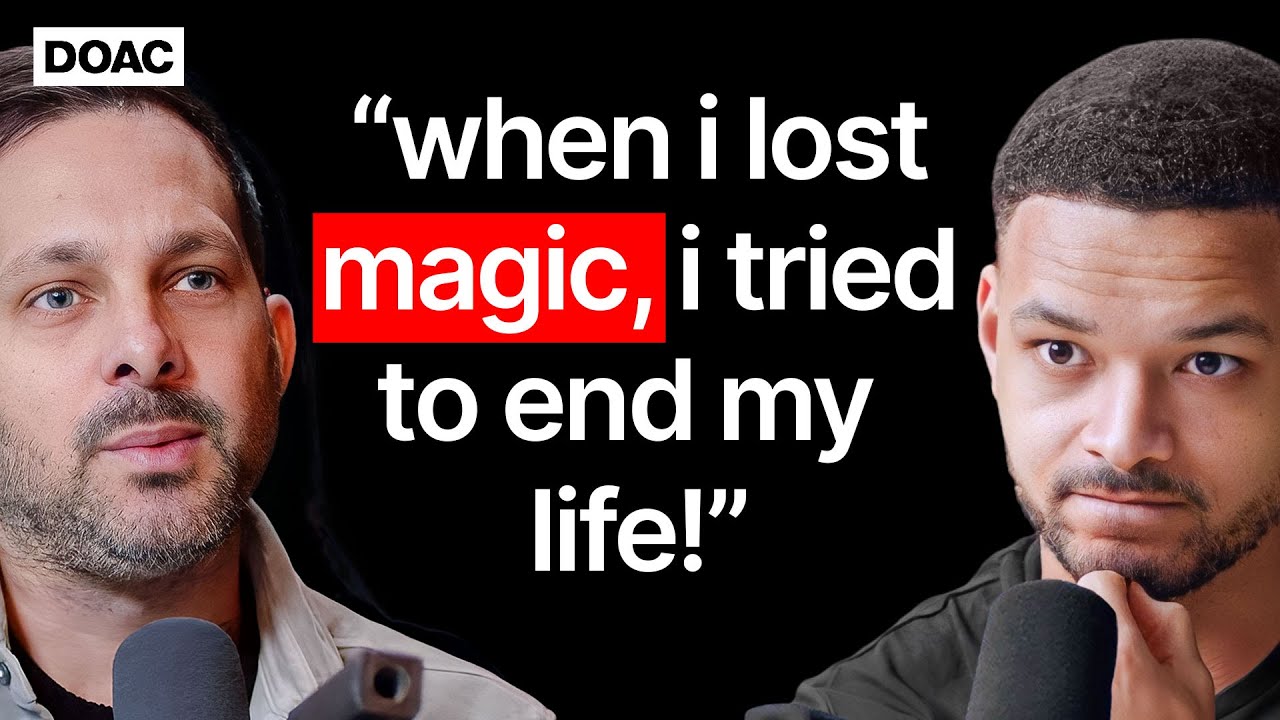
Illusionist Dynamo Returns to Public Life After Career-Halting Illness
The Diary Of A CEO
The British magician overcame severe health complications, legal battles, and a suicide attempt by abandoning his lone-wolf persona and embracing human connection.
## Background
This episode was published on YouTube by The Diary Of A CEO channel on December 14, 2023. According to the page description, the episode features a deep-dive conversation with illusionist Dynamo (Steven Frayne) following his years-long public disappearance, highlighting the release of his new Sky Max TV special, 'Dynamo is Dead'.
## TL;DR
In this candid interview, illusionist Steven Frayne (Dynamo) opens up about his traumatic childhood in Bradford, battling severe Crohn's disease, and his rapid rise to global stardom. He describes how a catastrophic bout of food poisoning in 2017 triggered severe reactive arthritis, leaving him physically unable to perform magic and driving him into a deep mental health crisis, self-harm, and a suicide attempt in late 2020. Frayne details how unconditional support from his wife, therapy, and a fundamental shift toward finding magic in human connection helped him heal. Reclaiming his life, he explains the symbolic concept of killing off his 'Dynamo' persona before concluding the show with intimate, mind-bending magic tricks for the podcast crew.
## Atmosphere & style
The interview is raw, somber, and deeply emotionally intimate, moving from harrowing accounts of psychological torment and physical suffering to moments of profound vulnerability and catharsis. Steven Bartlett acts as a compassionate, grounded sounding board, allowing Frayne the space to unpack intense personal trauma without sensationalism. The emotional arc transitions from heavy despair and isolation toward healing, hope, and renewed purpose, ending on a thrilling and awe-inspiring note during the live magic demonstrations.
## Key takeaways
- [03:20](https://www.youtube.com/watch?v=TTzgD6Tn9DY&t=200s) Growing up on a tough council estate in Bradford with an absent, incarcerated father shaped Dynamo's resilient mindset and his desire to not be defined by his harsh environment.
- [06:43](https://www.youtube.com/watch?v=TTzgD6Tn9DY&t=403s) When Dynamo reconnected with his father at age 19, his father attempted to enlist him in criminal activities rather than build a paternal relationship.
- [13:31](https://www.youtube.com/watch?v=TTzgD6Tn9DY&t=811s) Dynamo endured severe racially motivated bullying during school, including a life-threatening incident where he was thrown into a deep dam without knowing how to swim.
- [18:02](https://www.youtube.com/watch?v=TTzgD6Tn9DY&t=1082s) Dynamo's grandfather introduced him to magic as a practical shield and coping mechanism to deflect negative attention from schoolyard bullies.
- [21:23](https://www.youtube.com/watch?v=TTzgD6Tn9DY&t=1283s) Diagnosed with Crohn's disease at age 13, Dynamo faced lifelong debilitating physical symptoms and severe secondary conditions like reactive arthritis.
- [30:30](https://www.youtube.com/watch?v=TTzgD6Tn9DY&t=1830s) A severe bout of Campylobacter food poisoning in 2017 exacerbated his Crohn's disease, leaving him unable to hold or manipulate playing cards due to severe joint pains.
- [36:17](https://www.youtube.com/watch?v=TTzgD6Tn9DY&t=2177s) Losing his physical ability to perform magic destroyed Dynamo's sense of purpose and identity, plunging him into intense mental anguish and self-harm.
- [41:09](https://www.youtube.com/watch?v=TTzgD6Tn9DY&t=2469s) A severe convergence of personal losses, Crohn's flare-ups, and an ongoing legal battle restricting his stage name and social media led to a suicide attempt on November 6, 2020.
- [51:52](https://www.youtube.com/watch?v=TTzgD6Tn9DY&t=3112s) Dynamo's wife became his ultimate pillar of support following his rock-bottom moment, guiding him toward professional mental health therapy.
- [01:04:51](https://www.youtube.com/watch?v=TTzgD6Tn9DY&t=3891s) Faced with unaffordable therapy costs during his mental health crisis, his therapist Edward Sim offered to continue treatment completely free of charge.
- [01:06:25](https://www.youtube.com/watch?v=TTzgD6Tn9DY&t=3985s) As part of his recovery, Dynamo utilized Sonic Reset Therapy and adapted the 12-step Alcoholics Anonymous program as a blueprint to process grief and emotional trauma.
- [01:12:01](https://www.youtube.com/watch?v=TTzgD6Tn9DY&t=4321s) Confronting his past trauma allowed Dynamo to heal long-held resentment toward his mother after coming to understand the domestic abuse she endured.
- [01:15:35](https://www.youtube.com/watch?v=TTzgD6Tn9DY&t=4535s) Dynamo shifted his personal philosophy from seeking magic within himself to recognizing and accepting the 'magic' and support found in other people.
- [01:18:21](https://www.youtube.com/watch?v=TTzgD6Tn9DY&t=4701s) Dynamo returned to public life with his special 'Dynamo Is Dead' on Sky Max, featuring a symbolic live performance where he buried himself alive to mark the transition out of his old persona.
- [01:27:18](https://www.youtube.com/watch?v=TTzgD6Tn9DY&t=5238s) Dynamo demonstrated his return to performance magic by executing complex physical illusions with cards, coins, and fire for Steven Bartlett and the crew.
## Detailed walkthrough
Here is a detailed, faithful walkthrough of the provided transcript section:
[00:00](https://www.youtube.com/watch?v=TTzgD6Tn9DY&t=0s) Intro: The Disappearance and the Darkest Moment
The interview opens with a raw, harrowing reflection on mental anguish, where the speaker describes an inner noise so overwhelming that looking into a mirror brought on the urge to violently smash his head into it until the noise stopped. While this mental torment drove him to vanish from the public eye, he reveals it was not the only reason. Magic—the very tool he had used his whole life to cope with racism, bullying, and a lack of self-belief—could no longer fix him.
The conversation establishes the extreme highs and devastating lows of the life of illusionist Steven Frayne (famously known as Dynamo). Host Steven Bartlett recounts how, after reaching global stardom where "everything you touch is turning into gold," Dynamo abruptly vanished in 2017 due to severe illness that left his body deteriorating until he could no longer hold playing cards. Tragically, this physical decline coincided with the death of his beloved grandmother—his biggest supporter—and a painful legal battle that stripped him of the rights to perform magic or even use his own stage name, Dynamo. On November 6, 2020, reaching absolute rock bottom, he attempted to end his life and was found unconscious in a dog bed by his wife.
- **Unseen Meeting:** Steven Bartlett reveals that three years prior at a Christmas party, a stranger—Dynamo—approached him in a deeply dark place and whispered a shocking story about losing his name and his ability to perform magic, an encounter Bartlett never forgot.
- **The Core Epiphany:** The realization that "Dynamo as we know it needed to die" became the catalyst for him to reclaim magic and finally tell his true story.
- **Audience Pact:** Bartlett addresses the viewers, noting that 58% of regular listeners are not subscribed, promising to upgrade the show into a richer, documentary-style format with background footage if they subscribe.
---
[03:20](https://www.youtube.com/watch?v=TTzgD6Tn9DY&t=200s) Growing Up in Bradford with an Absent Father
The conversation shifts back to the beginning to build context around how Steven's childhood shaped his path into magic. Born in Bradford in 1982, Steven grew up on a rough council estate with very little family, no clear direction, and an environment where, on paper, he "should never have amounted to anything." For him, learning not to be defined or confined by his harsh environment was the primary magic he sought throughout his life, which he now hopes will inspire others trapped in similar circumstances.
When discussing his early family dynamics, Steven notes that his mother was extremely young—getting pregnant at just 16 and having him at 17—and was left to raise him when his father was sent to prison in roughly 1986, when Steven was around four years old. Because he was so young when his father went away, not having a father felt completely normal to him, especially on a council estate filled with broken families. He explains his heritage, noting that his father is Pathan (a tribe spanning parts of Afghanistan and Pakistan) and his mother is English. At that young age, he felt no active resentment toward his absent father because he didn't know any different.
---
[06:43](https://www.youtube.com/watch?v=TTzgD6Tn9DY&t=403s) Reconnecting with His Dad and the Ultimate Betrayal
Resentment towards his father only took root much later in Steven's adult life. When Steven was 19 years old, he had begun building momentum as a magician—doing gigs at the Revolution Wine Bar in Bradford and applying for a Prince's Trust start-up loan to build a positive future. Out of nowhere, the bar manager informed him that a man claiming to be his father was looking for him. After asking his mother, Steven learned his father was out of prison and had been trying to contact the family, though his mother and grandmother had shielded Steven to protect the stable life he was building without him.
When Steven finally met his father face-to-face a few days later, his father showed no interest in building a meaningful relationship or getting to know his son. Instead, noticing that Steven had a small crew around him, his father asked if any of his friends could help "shift some stuff" for him—referring to illegal drugs and other criminal activities. Steven realized instantly that his father was completely unreformed. Having just surrounded himself with positive male role models for the first time at the Mapper Youth Centre in Bradford, Steven was deeply hurt that his father chose to view him merely as a vehicle for criminal enterprise rather than a son to connect with.
- **Context on the Father:** Steven's grandmother and Auntie Mel later revealed that while his parents loved each other, it was a blessing the father went away because he was severely abusive toward Steven's mother, and they believed Steven and his mother might not have survived had he stayed.
- **Passing Away:** His father has since passed away, leaving unresolved questions. Steven notes he feels no personal regrets because the situation was never of his own making, though the experience left him feeling largely indifferent toward his father's absence.
---
[13:31](https://www.youtube.com/watch?v=TTzgD6Tn9DY&t=811s) School Years, Racism, and Trauma
Addressing his school days, Steven explains that while he loved learning and understanding how things worked, he genuinely loathed and feared school due to constant physical violence and bullying. Surviving the playground and making it to and from lessons was a daily ordeal. The bullying was heavily racially motivated; as he grew older, his mixed-race complexion became more pronounced, making it impossible to blend in. On his council estate, prejudice was deeply ingrained, to the point where his family and neighbors advised him, "if anybody asks, just say you're white" to avoid hatred.
He recounts a deeply traumatic incident between the Delph Hill estate and the Woodside estate in Bradford. Separating the two estates was a large field containing a dam where the "cool kids" hung out. Having never been accepted, Steven was thrilled when he was unexpectedly invited to join them, only to discover it was a trick: they threw him into the deep dam, fully aware he could not swim. Drowning in sheer panic, he was saved only when a local guy named Wayne Jewitt dived in and pulled him to safety. The terror of that moment left him with a lifelong fear of open water and sea swimming.
- **School Life Strategy:** To avoid getting beaten up or ridiculed after school, Steven played the "sad little kid," keeping his head down and taking long, convoluted routes home.
- **Safe Spaces:** English class was one of his few safe havens thanks to a nurturing teacher, Mrs. Wilcox, who made him feel comfortable and safe from the fear of answering questions incorrectly and facing further beatings.
[18:02](https://www.youtube.com/watch?v=TTzgD6Tn9DY&t=1082s) Magic as a Shield from Childhood Bullying
Steven Bartlett compares Dynamo’s upbringing to that of a previous guest who turned to fighting to survive childhood adversity. Dynamo clarifies that magic was never something he actively sought out as a career choice early on; rather, "magic kind of found me." It was originally a hobby of his grandfather, who served as the primary male role model in his life. His grandfather wasn't a world-class illusionist, but rather performed simple pub-style tricks. Nevertheless, he was the life of the party and always seemed to possess a solution to every problem.
One afternoon, after watching quietly from afar as a young Dynamo was repeatedly picked on and pulled into fights at the school gates, his grandfather decided to intervene. Rather than teaching him martial arts like "Mr. Miyagi in *The Karate Kid*," his grandfather taught him a few magic tricks. He explained that these routines earned him positive social attention and suggested Dynamo give them a try. Although terrified that performing magic would make him look like even more of an outcast, the strategy worked. Magic transformed his identity at school, deflecting negative behavior and keeping bullies at bay.
- **Grandfather's Role:** Acted as Dynamo's key male role model and introduced magic to redirect negative attention.
- **Purpose of Magic:** Functioned as a survival mechanism and social shield against schoolyard bullying.
---
[21:23](https://www.youtube.com/watch?v=TTzgD6Tn9DY&t=1283s) Diagnosis of Crohn’s Disease and Physical Struggles
At 13 years old in 1995, Dynamo was diagnosed with Crohn's disease, a chronic inflammatory bowel condition. Before the formal diagnosis, he noticed he was falling behind his peers physically during puberty—while other kids were growing taller and broader, he remained remarkably small. His mother began taking him to hospitals for extensive medical evaluations. For a teenager who already felt isolated, being subjected to constant testing made him feel fundamentally "broken" and question his sense of purpose.
Dynamo describes living with Crohn's disease as equivalent to having an open, unhealing wound inside the stomach. Every meal feels like "rubbing dirt into an open wound," triggering severe infections, debilitating inflammation, and excruciating stomach cramps. Furthermore, the condition manifests systemic side effects, most notably reactive arthritis. When his Crohn's flares up—often triggered by everyday psychological stress rather than just food—his joints seize up entirely, leaving him unable to walk, get out of bed, or handle playing cards.
- **Age at Diagnosis:** 13 years old (in 1995).
- **Physical Symptom Analogy:** Describes eating with Crohn's as "rubbing dirt into an open wound."
- **Secondary Condition:** Reactive arthritis, causing severe joint stiffness and disabling hand mobility.
---
[26:28](https://www.youtube.com/watch?v=TTzgD6Tn9DY&t=1588s) Early Career Breakthroughs and his Grandparents' Support
Dynamo dropped out of sixth-form college to pursue magic full-time, spending time with his grandmother in the United States before returning to London around age 20. A pivotal turning point came in 2002 when he secured a business startup loan from The Prince's Trust. Prior to that grant, he assumed he would eventually have to give up his dream and get a "proper job." His grandparents harbored similar worries, holding out hope that he would secure conventional employment right up until his grandfather passed away in 2012.
His grandfather died during the filming of the second series of *Dynamo: Magician Impossible*, but he lived long enough to witness the magic he had passed down brought to life on television—a moment Dynamo considers one of his proudest. His grandmother, who passed away in recent years, remained his fiercest supporter despite her constant worry about his financial security. Over the following decade, *Magician Impossible* became an international hit, winning TV Choice Awards and leading to massive arena tours such as *Seeing Is Believing*.
- **2002:** Received a Prince's Trust business startup loan at age 20, turning magic into a viable career.
- **2012:** Grandfather passed away during the production of Season 2 of *Dynamo: Magician Impossible*.
- **Major Milestones:** Toured globally with *Seeing Is Believing* and received multiple "Magician of the Year" accolades.
---
[30:30](https://www.youtube.com/watch?v=TTzgD6Tn9DY&t=1830s) Food Poisoning and the Physical Collapse
In 2017, while at the height of his career following extensive global touring, Dynamo suffered a severe bout of food poisoning caused by *Campylobacter* bacteria. Combined with his pre-existing Crohn's disease, the infection escalated into a medical emergency. He recalls preparing for bed around 10:00 PM when severe stomach pain struck. Expecting the pain to pass as usual, he was horrified when he suddenly began vomiting blood and bleeding internally. He was rushed to the hospital, but even high doses of morphine failed to ease the agonizing pain.
```
Campylobacter Infection + Pre-existing Crohn's
│
▼
Severe Internal Bleeding & Hospitalization
│
▼
Crohn's Spreads to New Regions of the Gut
│
▼
Onset of Severe Reactive Arthritis & Joint Locks
```
The severe infection caused his Crohn's to spread to previously unaffected areas of his digestive tract, triggering aggressive reactive arthritis. Months after leaving the hospital, simple magic maneuvers he used to perform in his sleep became impossible. Electric-shock-like pains shot through his joints when handling cards, and his knees locked, leaving him feeling as frail as "Mr. Burns from *The Simpsons*."
- **Pathogen:** *Campylobacter* food poisoning in 2017.
- **Symptoms:** Internal bleeding, vomiting blood, unmanageable pain resistant to morphine.
- **Impact on Magic:** Severe joint shocks and stiffness rendered him unable to hold or manipulate a deck of cards.
---
[33:34](https://www.youtube.com/watch?v=TTzgD6Tn9DY&t=2014s) Medical Trials and Disappearing from the Public Eye
To manage the debilitating flare-ups, Dynamo spent years undergoing various experimental medical trials. Protocol required him to test each new medication for a full three-month window before doctors could deem it ineffective, even when he knew within two weeks that it wasn't working. In the ninth month of testing, he started treatments with *infliximab*, an intravenous infusion therapy requiring eight-hour hospital visits every few weeks. The medication initially provided a miraculous recovery and a renewed lease on life.
However, contracting COVID-19 in 2020 disrupted his treatment regimen, causing the *infliximab* to lose its effectiveness and sending him back into medical trials. It wasn't until early 2021 that he stabilized on a new treatment plan. Despite this progress, he continues to endure roughly three days a week of severe joint stiffness and abdominal distress. Managing these chronic health issues alongside the public pressure to perform forced him to step back and disappear from the spotlight.
- **Trial Protocol:** Required to remain on each trial medication for 3 months regardless of early failure.
- **Infliximab Treatment:** 8-hour hospital intravenous infusions every few weeks.
- **Ongoing Reality:** Continues to experience around 3 severe, debilitating days every week.
[36:17](https://www.youtube.com/watch?v=TTzgD6Tn9DY&t=2177s) Mental Collapse, Self-Harming, and the Loss of Identity
Dynamo (Steven Frayne) reflects on the harrowing psychological toll of losing the ability to perform magic—the single thing he loved and relied upon for his entire sense of purpose. As his body imploded under the weight of severe health complications from Crohn's disease, his mental state spiraled into chaos and intense self-hatred. Looking into his home mirror, he felt so overwhelmed by hatred for his physical state and appearance that he violently slammed his head into the glass repeatedly, desperate to make the pain and the image in front of him go away.
For Dynamo, magic had always been his sanctuary—the primary tool he used to overcome childhood bullying, intense self-doubt, and the skepticism of others. Stripped of the physical dexterity and control required to perform, he felt utterly powerless and trapped in an identity crisis. He describes feeling like an impostor who could no longer live up to the public's expectations of a magician—someone who performs the impossible—when he couldn’t even perform the basics of his craft.
- **Internal Noise & Despair:** He felt constant overwhelming noise in his mind, feeling that life wasn't worth living if he couldn't perform magic.
- **Physical Dexterity as Core Identity:** His unique style relied heavily on physical manipulation and precise card handling; losing that ability felt like losing his entire identity.
- **The Impostor Dilemma:** "I'm a magician who feels like I can't do the first thing that a magician needs to do... So then I'm just an impostor."
---
[41:09](https://www.youtube.com/watch?v=TTzgD6Tn9DY&t=2469s) The Convergence of Crises: Loss, Illness, and Legal Disputes
The mental health collapse was triggered by a simultaneous cluster of devastating personal and professional events. The loss of his grandmother—his primary pillar of strength throughout his life—served as the final breaking point. Whenever he felt weak, his "Nana" had been strong for him, and her passing left him feeling entirely exposed and undefended against the world.
Compounding his grief and debilitating Crohn's flare-ups, Dynamo faced a major legal dispute with his management team. This legal conflict effectively severed his access to his social media channels and restricted the use of his stage name, "Dynamo." Feeling as though the ground should open up and swallow him whole, the emotional numbness became so profound that he turned to physical self-harm just to feel something tangible.
- **Loss of His Backbone:** Described his grandmother's passing as "the straw that broke the camel's back."
- **Coping Through Self-Harm:** The internal numbness was so severe that physical self-harm became an unhealthy attempt "to try and feel something."
- **Management Separation:** The legal battle disrupted his public footprint and restricted his access to the name Dynamo and his established digital channels.
---
[44:53](https://www.youtube.com/watch?v=TTzgD6Tn9DY&t=2693s) Rock Bottom: November 6th, 2020
Dynamo pinpointed his exact rock bottom to November 6th, 2020—almost precisely three years prior to the interview. On that day, overwhelmed by the belief that he was an unfixable burden whose existence was damaging his household and family, he attempted to take his own life. He reasoned through a dark, simplistic logic that removing himself would allow his loved ones to finally move on and be happy.
His wife returned home and found him unconscious in the dog bed. Rather than calling an emergency ambulance immediately, she called Dr. Edward Despott—Dynamo's long-time gastroenterologist and Crohn's specialist. Dynamo remembers regaining consciousness to the sound of his wife weeping on the phone. While he had physically hurt himself worse on prior occasions, being found by the person whose opinion mattered most to him filled him with immense shame and embarrassment.
- **The Incident Date:** November 6, 2020.
- **Location & Discovery:** His wife found him unconscious in their dog bed.
- **Medical Contact:** His wife contacted his Crohn's specialist, Dr. Edward Despott.
- **The Core Distortion:** He falsely believed he was the root source of everyone's problems: "If I'm dead, then my problems won't affect these other people in my life... I felt like ultimately I was the problem."
---
[51:52](https://www.youtube.com/watch?v=TTzgD6Tn9DY&t=3112s) Unconditional Love and the Path to Healing
In the aftermath of the suicide attempt, Dynamo experienced a profound shift in his relationship with his wife. Instead of making him feel ashamed, she offered unconditional support, acting as his rock and guiding him into professional therapy. Having felt vulnerable and exposed at his absolute lowest point, he realized he was receiving a deep, genuine love outside of his blood family for the first time.
Her unwavering presence saved his life and provided the foundation he needed to begin repairing his mental health. He noted that while family love often feels baseline, seeing how a partner reacts when everything hits the fan reveals true devotion.
- **Therapy Catalyst:** His wife was the driving force behind getting him into therapy and professional care.
- **Exposing Vulnerability:** "I was exposed... you can't get any more exposed than what I've felt. And she became the rock."
- **Shame vs. Feeling:** He emphasized that he does not feel ashamed for having dark mental health struggles, but rather feels deep remorse for the trauma his wife had to witness.
---
[54:36](https://www.youtube.com/watch?v=TTzgD6Tn9DY&t=3276s) Stepping Away and the Conflict Between Steven and Dynamo
Addressing the legal split with his management and his absence from the public eye, Dynamo explained that stepping away from everything was the only way to break his destructive mental cycle. He recognized that continuing down the same path would produce the same suicidal thoughts. Choosing to let lawyers handle the dispute in the background, he focused entirely on learning how to manage the pressure of living and adapting his craft around his physical limitations.
He detailed an internal conflict between "Steven" (the flawed human being with health struggles) and "Dynamo" (the larger-than-life magician expected to achieve the impossible). The line between his real self and his stage persona had blurred to a dangerous degree, leaving him feeling like an empty shell when his health prevented him from performing.
- **Fresh Start Necessity:** Realized he needed to completely disconnect from his previous structure to survive and rebuild.
- **Adapting the Magic:** Had to accept that arthritis and Crohn's disease meant finding entirely new ways to perform magic rather than relying on his past physical techniques.
- **Steven vs. Dynamo:** "Dynamo is the part of me that feels like it can do anything. But Steven's the flawed human being that realizes and knows that he can't."
[01:00:46](https://www.youtube.com/watch?v=TTzgD6Tn9DY&t=3646s) Mental Noise and the "Magic Writer's Block"
Dynamo describes the overwhelming internal chaos that prevented him from performing or creating new illusions during his darkest period. Outside forces, including complex legal disputes, combined with severe mental health issues to completely paralyze his creative capacity. He explains that to craft magic, he needs a clear mind, but instead, his head was filled with non-stop "horrible thoughts" and a constant noise he simply could not turn off. He compares this state to a "magic writer's block"—a total inability to access his creative spark because every ounce of mental energy was consumed by survival and problem-solving. Steven Bartlett compares this to trying to write in a room with deafening music playing, where the brain is too overloaded to focus on output.
This mental block was profoundly depressing for Dynamo because magic represents his core purpose, joy, and identity. For him, magic has never been merely about performing card tricks or mechanics; it is a visceral "feeling" and an emotional experience created in the body when someone witnesses the seemingly impossible. He reflects poignantly on the deep irony of his predicament: having spent his whole life trying to bring joy and put smiles on other people's faces, he found himself utterly unable to put a smile on his own face.
- **Legal and Financial Pressures:** Behind-the-scenes legal issues severely complicated his ability to secure work, which subsequently triggered heavy financial stress during his illness.
- **Physical vs. Mental Readiness:** Even when physical medications began working to stabilize his Crohn's symptoms, his mental state remained completely unfit for public performance.
---
[01:04:51](https://www.youtube.com/watch?v=TTzgD6Tn9DY&t=3891s) Therapy and an Act of Unexpected Kindness
When Dynamo reached a critical breaking point, his wife intervened and contacted his cosmetologist, Ed Despo, who connected them with a therapist named Edward Sim. Though Dynamo initially started session work with Sim, the mounting therapy bills quickly proved financially unsustainable alongside his existing stress. Realizing he could no longer afford the treatment, Dynamo prepared to stop. However, Edward Sim demonstrated incredible compassion by calling Dynamo's wife and offering to continue all therapy sessions entirely free of charge.
This act of generosity left a lasting impression on Dynamo, who notes that Sim has continued to support him ever since and continuously refuses any offer of payment now that Dynamo's situation has improved. Dynamo expresses deep gratitude, stating he will never be able to fully repay Sim for saving his life and providing a beacon of kindness when he felt most isolated.
- **Edward Sim:** Therapist who provided free treatment to Dynamo during his financial and mental crisis.
- **Ed Despo:** Dynamo's cosmetologist who helped connect his wife to therapist Edward Sim.
---
[01:06:25](https://www.youtube.com/watch?v=TTzgD6Tn9DY&t=3985s) Coping Mechanisms and Reading Alcoholics Anonymous
As part of his ongoing recovery, Edward Sim introduced Dynamo to several therapeutic tools, including "Sonic Reset Therapy"—a specialized sound treatment Dynamo listens to twice daily for 20 minutes to calm his nervous system, process thoughts, and improve sleep. Additionally, Sim made a surprising recommendation: he suggested Dynamo read the official *Alcoholics Anonymous* (Big Book) 12-step literature.
The suggestion initially baffled Dynamo, who has been completely teetotal his entire life, never drinking alcohol or taking recreational drugs due to his strict health management with Crohn's disease. However, upon reading it, he realized the book's core principles apply far beyond chemical dependency. The personal stories within the 12 steps detail how people overcome deep trauma and grief. Dynamo discovered he could replace the word "alcohol" with his own emotional pain and physical illness, using the text as a practical blueprint for emotional recovery.
> "I'm a testament you don't have to be an alcoholic to read it and gain something from it... it's like a blueprint."
- **Sonic Reset Therapy:** Audio-based therapy practiced twice a day for 20 minutes to reset focus and achieve calm.
- **The 12 Steps:** Adapted by Dynamo as a framework for working through life trauma, internal grief, and personal recovery rather than substance addiction.
---
[01:12:01](https://www.youtube.com/watch?v=TTzgD6Tn9DY&t=4321s) Unpacking Childhood Resentment and Understanding His Mother
Working through his recovery required Dynamo to confront long-buried past trauma, particularly surrounding his relationship with his mother. After his father went to prison, his mother sought new romantic relationships, but many of the men she brought into her life treated Dynamo terribly. Growing up as a mixed-race child in a predominantly racist area, he felt discarded by these partners, who openly made it clear they did not want him around. To allow his mother a chance at happiness, Dynamo sacrificed his own well-being and moved in with his grandparents at age 15, feeling as though he had effectively "lost" his mother in the process.
For years, Dynamo carried quiet, underlying resentment toward her. However, applying the insights gained through therapy and the 12-step literature allowed him to initiate difficult conversations with his mother for the first time. Through these discussions, he learned about the severe physical abuse she had suffered from both his father and subsequent partners. Recognizing that she was caught in a repetitive cycle of trauma helped him abandon his resentment and view her with empathy. Steven Bartlett adds that psychological research shows people often unconsciously seek out familiar, even toxic, forms of love because familiarity feels safe, even when it is destructive.
- **Move to Grandparents' House:** Dynamo moved in with his grandparents at age 15 due to hostiles/racist attitudes from his mother's partners.
- **Reconciliation:** Open conversations allowed Dynamo to understand his mother's history of domestic abuse, breaking his long-held emotional resentment.
---
[01:15:35](https://www.youtube.com/watch?v=TTzgD6Tn9DY&t=4535s) Powerlessness and Finding Magic in Others
Reflecting on the first two steps of the 12-step program—admitting powerlessness and believing in a power greater than oneself—Dynamo acknowledges that he has felt powerless for years. His debilitating chronic illness frequently served as a humbling reminder of his fallibility whenever he felt like he was "flying high."
Dynamo explains a major philosophical shift in his life: previously, he spent his whole life searching for the magic strictly *within himself* to pull himself out of every bad situation. The therapeutic process and his recovery journey opened his mind to realizing that true magic exists in *other people* and in community support. This shift sets the stage for his grand return to the public eye.
> "I've always looked for the magic in me to help me out of whatever situation I was in. And what this book opened up my mind to the idea of is the magic in other people."
- **Step 1 & Step 2 Realization:** Acknowledging lack of control over physical illness while learning to accept external support and human connection.
---
[01:18:21](https://www.youtube.com/watch?v=TTzgD6Tn9DY&t=4701s) *Dynamo Is Dead* and Returning to Magic
The narrative transitions to Dynamo's return to public life with his new television special, *Dynamo Is Dead*, airing on Sky Max. The show symbolizes the closure of his former persona and his evolution into a new chapter of life and magic, rooted in human connection and shared experiences rather than isolated performance.
- **TV Show Release:** *Dynamo Is Dead* on Sky Max marks his official return to magic and public performance after his prolonged hiatus.
[01:18:39](https://www.youtube.com/watch?v=TTzgD6Tn9DY&t=4719s) Finding Magic in Humanity and the Mission Behind the New Show
Dynamo explains that his desire to return to magic stems from needing it back in his life, describing it as "the thing that I live for." Over the past few years, as he worked on his personal growth, he began recognizing a different kind of magic—not "Dynamo magic," but the magic found in other human beings. He cites his therapist, Ed Can Help founder Edward Sim, who offered him therapy for free simply to share his own "magic" and help rewire Dynamo's mindset. He also points to host Steven Bartlett, recalling a candid conversation they had three years prior where Steven listened and offered genuine support without any cameras present.
Dynamo addresses the cultural stigma surrounding mental health in working-class communities, noting that growing up on a council estate instilled a "keep calm and carry on" or "suck it up and be a man" attitude. He wants to leverage his global platform as Dynamo to show people from similar backgrounds that it is okay to be broken and ask for help. While acknowledging how grandiose it sounds to say he wants to save lives, Steven notes that sharing his vulnerability does exactly that, citing confirmation from CALM (Campaign Against Living Miserably) CEO Simon Gunning.
- **Therapist Reference:** Edward Sim provided complimentary sessions that helped change Dynamo's perspective on human kindness.
- **Cultural Stigma:** Working-class council estate upbringing reinforced hiding emotional pain rather than seeking therapy.
- **Goal:** Using his platform to spark candid conversations about trauma and self-doubt so others realize they are not alone.
---
[01:24:17](https://www.youtube.com/watch?v=TTzgD6Tn9DY&t=5057s) Killing Dynamo and Burying Himself Alive
Dynamo reveals the radical concept behind his special, *Dynamo is Dead* (broadcast on Sky Max). He explains that after his grandmother passed away, he realized the "Dynamo" persona as people knew it had to die with her. To achieve true closure and transition into his next chapter, he decided he needed to symbolically bury himself alive on live television.
He describes the act not as a stunt or a gimmick to escape, but as a deeply personal "cleansing." Having previously engaged in extreme endurance feats, he reflects on how profoundly those experiences alter a person internally. Despite feeling terrified, he notes that since May 7, 2021, he believed this burial was the only way to move forward with his life and stop living in fear.
- **Event:** Burying himself alive live on Sky Max following the broadcast of his special.
- **Symbolism:** A symbolic death of his old stage identity to gain closure after his grandmother's passing.
- **Key Date:** May 7, 2021 — the date he realized he needed this dramatic ritual to move forward.
---
[01:27:18](https://www.youtube.com/watch?v=TTzgD6Tn9DY&t=5238s) Mind-Bending Card Magic with the DOAC Team
Steven invites members of *The Diary Of A CEO* crew into the studio to experience Dynamo's magic firsthand. Jack brings in three team members: a video editor, the head of trailers, and the head of guest bookings. After the team members thoroughly shuffle a deck of cards, four cards are selected and shown to the camera while Dynamo looks away.
Dynamo rapidly identifies and manipulates the cards in astonishing ways. First, he reveals the King of Diamonds, followed by the Four of Spades with a simple snap of his fingers. For the final card selected by Steven, Dynamo makes the rest of the deck completely vanish right out of his hands, leaving everyone in disbelief as he jokes that they will find the missing cards under their pillows that night.
- **Participants:** Steven Bartlett alongside three *DOAC* crew members (video editor, head of trailers, head of bookings).
- **Props:** A thoroughly shuffled, split deck of playing cards.
- **Effects:** Card identification, snapping to change cards, and the complete physical vanishing of the remaining deck.
---
[01:30:08](https://www.youtube.com/watch?v=TTzgD6Tn9DY&t=5408s) The Signed Card and the Burning Coin
Dynamo pulls out a fresh deck, joking that he tries to "cut down to two packs a day." He has Steven and the team members sign their names across the face of a selected card before placing it face-down into the middle of the pack.
He then produces a real one-pound coin and a small piece of paper. Setting the coin on top of the deck, he ignites it; the coin visually melts and burns its way straight down through the deck. When they check where the coin stopped inside the pack, it has burned through every card except one: the specific card signed by Steven and the team.
- **Props:** A spare deck of cards, a permanent marker, a British £1 coin, a small piece of paper, and a lighter.
- **Effect:** The ignited £1 coin burns deep into the stack of cards, stopping precisely on top of the team's signed card.
---
[01:32:40](https://www.youtube.com/watch?v=TTzgD6Tn9DY&t=5560s) Pulling a Heartstring and Creating Ice from Fire
Dynamo transitions to a visceral, intimate illusion centered on emotional manipulation and vulnerability. He asks crew member Jim to put his hand on Dynamo's chest and describe the feelings associated with being manipulated—Jim lists "insecurity," "lack of confidence," and feeling "stupid." When asked to name a color, Jim chooses red. Dynamo lowers his shirt collar, revealing a physical red string protruding directly out of the skin on his chest. He has Jim grab the "heartstring" and physically pull a long, sticky red thread entirely out of his chest, leaving the team visibly shocked.
To conclude, Dynamo reflects that magic is about taking a tiny spark in your mind and bringing it into reality. He asks Steven to hold a lighter and strike a flame between his hands. Taking the open flame directly into his hands, Dynamo instantly transforms the fire into a solid block of real ice.
> "For me, magic is about taking something that kind of doesn't exist, like a little spark in your mind, and then somehow being able to bring it to life."
- **Heartstring Illusion:** Jim physically extracts a long, sticky red thread straight out of Dynamo's bare chest.
- **Fire to Ice:** Dynamo takes an open flame lit by Steven and instantly converts it into genuine ice.
- **Sponsor Outro:** Steven concludes the episode with a brief message detailing his custom Huel bundle and recommended podcast listens.
## Notable quotes
> [00:00](https://www.youtube.com/watch?v=TTzgD6Tn9DY&t=0s) Dynamo as we know it needed to die
> [18:02](https://www.youtube.com/watch?v=TTzgD6Tn9DY&t=1082s) magic kind of found me — Dynamo
> [21:23](https://www.youtube.com/watch?v=TTzgD6Tn9DY&t=1283s) rubbing dirt into an open wound — Dynamo
> [36:17](https://www.youtube.com/watch?v=TTzgD6Tn9DY&t=2177s) I'm a magician who feels like I can't do the first thing that a magician needs to do... So then I'm just an impostor. — Dynamo
> [41:09](https://www.youtube.com/watch?v=TTzgD6Tn9DY&t=2469s) the straw that broke the camel's back — Dynamo
> [41:09](https://www.youtube.com/watch?v=TTzgD6Tn9DY&t=2469s) to try and feel something — Dynamo
> [44:53](https://www.youtube.com/watch?v=TTzgD6Tn9DY&t=2693s) If I'm dead, then my problems won't affect these other people in my life... I felt like ultimately I was the problem. — Dynamo
> [51:52](https://www.youtube.com/watch?v=TTzgD6Tn9DY&t=3112s) I was exposed... you can't get any more exposed than what I've felt. And she became the rock. — Dynamo
> [54:36](https://www.youtube.com/watch?v=TTzgD6Tn9DY&t=3276s) Dynamo is the part of me that feels like it can do anything. But Steven's the flawed human being that realizes and knows that he can't. — Dynamo
> [01:06:25](https://www.youtube.com/watch?v=TTzgD6Tn9DY&t=3985s) I'm a testament you don't have to be an alcoholic to read it and gain something from it... it's like a blueprint. — Dynamo
> [01:15:35](https://www.youtube.com/watch?v=TTzgD6Tn9DY&t=4535s) I've always looked for the magic in me to help me out of whatever situation I was in. And what this book opened up my mind to the idea of is the magic in other people. — Dynamo
> [01:18:39](https://www.youtube.com/watch?v=TTzgD6Tn9DY&t=4719s) the thing that I live for — Dynamo
> [01:32:40](https://www.youtube.com/watch?v=TTzgD6Tn9DY&t=5560s) For me, magic is about taking something that kind of doesn't exist, like a little spark in your mind, and then somehow being able to bring it to life. — Dynamo
## Mentioned
Dynamo, Steven Frayne, Steven Bartlett, Derren Brown, Wayne Jewitt, Mrs. Wilcox, Dr. Edward Despott, Edward Sim, Simon Gunning, The Diary Of A CEO, Sky Max, Dynamo: Magician Impossible, Dynamo Is Dead, Seeing Is Believing, The Prince's Trust, Alcoholics Anonymous, CALM, Campaign Against Living Miserably, Huel, WHOOP, Sonic Reset Therapy, Ed Can Help, Crohn's disease, Campylobacter, infliximab, reactive arthritis, Bradford, Delph Hill estate, Woodside estate, Mapper Youth Centre
Illusionist Steven Frayne, known as Dynamo, reveals that his prolonged disappearance from public life was caused by an overlapping crisis of debilitating illness, family bereavement, legal battles, and a near-fatal mental collapse.
Roots of Magic and Childhood Defense (3:20)
Born in Bradford in 1982 to a 17-year-old mother, Frayne grew up on a council estate marked by domestic instability. His father was imprisoned around 1986 and later re-entered Frayne's life only to solicit help moving illegal drugs. Compounding his home life, Frayne faced persistent, racially motivated bullying due to his mixed-race heritage, culminating in a traumatic incident where he was thrown into a reservoir dam despite being unable to swim. To shield him from physical violence, his grandfather taught him basic magic tricks, transforming performance into a vital social defense mechanism.
Physical Deterioration and Creative Paralysis (21:23)
Diagnosed with Crohn's disease at age 13 in 1995, Frayne managed chronic abdominal pain for years while building an international entertainment career. However, a severe Campylobacter bacterial infection in 2017 triggered internal bleeding and aggressive reactive arthritis. The secondary condition stiffened his joints, causing electric-shock sensations that prevented him from manipulating cards. His creative process stalled under the weight of what he described as 'magic writer's block,' while protocol-mandated clinical trials and intravenous infliximab infusions failed to offer sustained relief.
Convergence of Crises and Suicide Attempt (41:09)
Frayne's physical decline coincided with a dispute with his management team that restricted his access to digital channels and the 'Dynamo' stage name. The death of his grandmother, his lifelong emotional pillar, removed his primary source of support. Overwhelmed by chronic pain and perceived uselessness, Frayne engaged in self-harm and attempted suicide on November 6, 2020. His wife discovered him unconscious in their dog bed and contacted his Crohn's specialist, Dr. Edward Despott, initiating an emergency intervention.
Therapeutic Recovery and Reconceptualizing Magic (64:51)
Supported by his wife, Frayne entered therapy with practitioner Edward Sim, who continued treatments free of charge when Frayne faced financial distress. Frayne adopted Sonic Reset sound therapy and applied the 12-step principles of Alcoholics Anonymous to his chronic pain and trauma, which also enabled him to reconcile past resentments toward his mother. Through this process, Frayne shifted his philosophy from finding magic entirely within his own physical skill to recognizing resilience and generosity in others.
Retiring the Persona in Dynamo Is Dead (78:39)
To conclude his public hiatus, Frayne developed the Sky Max television special 'Dynamo Is Dead,' featuring an act where he was symbolically buried alive on live television. Frayne framed the performance not as a standard stunt, but as a deliberate ritual to lay to rest the invulnerable stage persona that had alienated him from his human limitations. Demonstrating his modified illusions in studio, he articulated a mission to counter working-class stigmas around men seeking mental health assistance.
While new medical regimens have stabilized his condition, Frayne notes that he continues to endure roughly three days a week of severe joint stiffness and abdominal flare-ups, requiring an ongoing adaptation of both his life and stagecraft.
## Background
该视频由 YouTube 频道《The Diary Of A CEO》(主持人 Steven Bartlett)于 2023 年 12 月 14 日发布。视频简介介绍了风靡全球的魔术师戴纳魔(Dynamo)在沉寂多年后携 Sky Max 全新特辑《Dynamo is Dead》重返公众视野,并揭开他隐退背后的真正心碎故事。
## TL;DR
享誉全球的魔术大师戴纳魔(Dynamo)在节目中深情剖析了自己从巅峰坠入深渊的真实经历:童年经历父亲入狱、严重的校园霸凌与混血歧视,随后将魔术作为生存护甲并登顶世界舞台。然而自 2017 年起,严重的克罗恩病(Crohn's Disease)恶化引发剧烈关节炎导致他双手无法持牌,接踵而至的外婆离世、法律纠纷失去艺名使用权,最终将他推入在 2020 年 11 月企图自杀的人生谷底。在妻子无条件的爱、心理治疗师无私救助以及戒瘾理念的启发下,他选择埋葬旧日无所不能的“Dynamo”假象,接纳脆弱的真实自我,并用直击灵魂的即兴魔术宣告涅槃重生。
## Atmosphere & style
整场对话极具压迫感与窒息感,同时又充满令人动容的人性救赎力量。采访前半段如同漫长而残忍的心理剖白,戴纳魔声音低沉微颤,将身体崩溃的剧痛、自我厌恶与自杀未遂的绝望毫无保留地袒露出来,与主持人之间建立了深厚信任与温柔倾听的安全场域。到了后半段与现场魔术演示环节,演播室气氛从深沉肃穆陡然转变为纯粹的惊骇与敬畏——从生生抽离的“红色心弦”到掌心化火为冰,令观众在撕心裂肺的真实创伤与不可思议的精神奇迹之间深受震撼。
## Bulletin
- [44:53](https://www.youtube.com/watch?v=TTzgD6Tn9DY&t=2693s) 身心重创与自杀未遂:2020年11月6日,在遭遇克罗恩病恶化、双手丧失持牌机能、外婆离世以及陷入法律纠纷失去艺名“Dynamo”等多重打击下,戴纳魔企图自杀,最终被妻子在狗窝中发现并救起。
- [30:30](https://www.youtube.com/watch?v=TTzgD6Tn9DY&t=1830s) 致命感染摧毁职业机能:2017年世界巡演落幕后,戴纳魔感染严重的空肠弯曲菌引发吐血便血,导致克罗恩病灶转移并诱发反应性关节炎,陷入长达数年的药物试验,至今每周仍有三天饱受慢性剧痛折磨。
- [01:18:20](https://www.youtube.com/watch?v=TTzgD6Tn9DY&t=4700s) 精神重塑与告别旧身份:在心理治疗师 Edward Sim 的无偿施援及《匿名戒酒互助社》十二步戒瘾法的启发下,戴纳魔承认自身无力并走出创伤,决定通过 Sky 特辑《Dynamo is Dead》及现场“活埋自我”的极限仪式彻底埋葬过往旧身份。
- [01:18:20](https://www.youtube.com/watch?v=TTzgD6Tn9DY&t=4700s) 破除底层心理求助耻感:出身英格兰布拉德福德贫困公营住宅区的戴纳魔,公开呼吁打破英国工人阶层“咬紧牙关硬扛”的隐忍文化,用自身经历鼓励陷入绝境的人勇敢寻求心理援助。
## Key takeaways
- [03:20](https://www.youtube.com/watch?v=TTzgD6Tn9DY&t=200s) 童年父爱缺位:1986年戴纳魔年仅4岁时父亲入狱离家,在布拉德福德公营住宅区贫困且缺乏指引的环境中,单亲与破碎成为其童年的常态。
- [06:43](https://www.youtube.com/watch?v=TTzgD6Tn9DY&t=403s) 19岁重逢的幻灭:失联15年的生父在戴纳魔通过王子信托基金谋求魔术创业时突然现身,不仅毫无改过之意,反而要求戴纳魔协助贩毒,促使其彻底斩断对父爱的幻想。
- [13:31](https://www.youtube.com/watch?v=TTzgD6Tn9DY&t=811s) 魔术成为生存护甲:因混血肤色在以白人为主的公屋社区与学校频遭残酷霸凌,外公传授的近景魔术成为戴纳魔化解敌意、在恶劣环境中立足的保护伞。
- [21:38](https://www.youtube.com/watch?v=TTzgD6Tn9DY&t=1298s) 少年患病与身心阴影:13岁确诊罕见的肠道炎性疾病克罗恩病,伴随剧烈腹痛与发育停滞,日常压力即会诱发反应性关节炎,给其身心造成长久重创。
- [30:30](https://www.youtube.com/watch?v=TTzgD6Tn9DY&t=1830s) 巅峰之下的突发灾难:凭借《不可思议的魔术师》走红全球并完成两年爆满的世界巡演后,戴纳魔于2017年意外感染空肠弯曲菌,因极度剧痛和大量吐血便血濒临死亡。
- [32:17](https://www.youtube.com/watch?v=TTzgD6Tn9DY&t=1937s) 身体瓦解与药物试验:严重关节炎导致双手僵硬无法操控扑克牌,漫长且煎熬的药物试验周期和新冠疫情干扰,使其职业生涯和身体机能双双停摆。
- [35:34](https://www.youtube.com/watch?v=TTzgD6Tn9DY&t=2134s) 双重身份撕裂与自我憎恶:当创造奇迹的“Dynamo”无法施展魔术,凡人“Steven”深陷冒牌者综合征与价值虚无感,甚至多次在家中撞镜自残。
- [44:53](https://www.youtube.com/watch?v=TTzgD6Tn9DY&t=2693s) 至暗时刻与伴侣救赎:2020年11月6日戴纳魔陷入自杀绝境,妻子在危急时刻联系专科医生,用毫无指责与羞辱的无条件接纳成为拯救他生命的重要磐石。
- [54:36](https://www.youtube.com/watch?v=TTzgD6Tn9DY&t=3276s) 官司纠纷与彻底断舍离:由于与原管理团队产生激烈的法律冲突并失去艺名使用权,他不得不选择与过去的运作模式彻底切割,沉寂下来闭关自我修复。
- [01:04:50](https://www.youtube.com/watch?v=TTzgD6Tn9DY&t=3890s) 专业善意重塑生命:在戴纳魔因无法工作而面临财务和心理双重崩溃时,心理治疗师 Edward Sim 主动承诺免除一切治疗费用,成为其走出深渊的关键贵人。
- [01:06:25](https://www.youtube.com/watch?v=TTzgD6Tn9DY&t=3985s) 跨界疗愈工具的启发:戴纳魔通过声波重置疗法平复心绪,并将《匿名戒酒互助社》的“十二步原则”转化为梳理自身创伤与走出哀伤的情绪康复指南。
- [01:12:06](https://www.youtube.com/watch?v=TTzgD6Tn9DY&t=4326s) 与母亲的和解与释怀:通过深层对话,戴纳魔得知母亲一生遭受多任伴侣严重家暴,从而理解母亲被困在毒性依恋循环中的悲剧,将长年的怨恨转化为深切共情。
- [01:15:08](https://www.youtube.com/watch?v=TTzgD6Tn9DY&t=4508s) 承认无力与感知人性微光:戴纳魔放下试图仅靠自身解决所有问题的全能幻想,领悟到真正的“魔法”并非孤立自救,而是存在于人与人之间的真诚连接和善意之中。
- [01:18:20](https://www.youtube.com/watch?v=TTzgD6Tn9DY&t=4700s) 反思阶层文化并消除求助耻感:出身公租房底层社区的他主张打破“男人咬牙硬扛”的有毒隐忍观念,呼吁大众正视心理脆弱,主动寻求专业援助。
- [01:22:55](https://www.youtube.com/watch?v=TTzgD6Tn9DY&t=4975s) 活埋仪式作为精神净化:伴随 Sky 特辑《Dynamo is Dead》播出,他通过现场直播将自己活埋的耐力壮举,宣告旧身份彻底终结,以全新姿态重返魔术与生活。
## Detailed walkthrough
### [00:00](https://www.youtube.com/watch?v=TTzgD6Tn9DY&t=0s) 濒临崩溃:隐退背后的至暗时刻与自杀未遂
戴纳魔(Dynamo)回忆起自己隐退前精神状态崩溃的极端痛苦:“我无法关掉脑海里的那些噪音。只要在镜子里看到自己,我就恨不得把头狠狠砸向镜子,一遍又一遍地撞,直到那些痛苦全部消失。”然而,心理上的折磨仅仅是他从公众视野中消失的部分原因,最残酷的现实在于——"魔术无法拯救我"。
在过去的岁月里,魔术曾是他对抗校园霸凌、种族歧视和他人轻视的唯一护甲,让这个边缘少年以耀眼的方式脱颖而出。当他攀上全球幻术大师的巅峰、点石成金之时,厄运却在2017年突然降临。因严重的身体病变,他的肌体机能迅速恶化,双手甚至虚弱到无法握住一副扑克牌;与此同时,给予他无限支持的外婆不幸离世;更雪上加霜的是,一场版权官司剥夺了他使用“Dynamo”这一名字的权利。人生走入绝境,他迎来了彻底的谷底——2020年11月6日,戴纳魔企图结束自己的生命,最终被妻子发现昏迷在家中的狗窝里。他一度绝望地认为自己的离开会让身边的人更快乐,但这次濒死体验也让他彻底顿悟:那个曾经的“Dynamo”必须死去,唯有如此,真正的他才能带着魔术涅槃重生。
- **至暗转折点**:2020年11月6日尝试自杀,被妻子在宠物狗的睡垫中救起。
- **身心双重打击**:2017年身体恶化无法持牌、挚爱且全力支持他的外婆去世、陷入法律纠纷被剥夺艺名“Dynamo”的使用权。
### [01:31](https://www.youtube.com/watch?v=TTzgD6Tn9DY&t=91s) 圣诞派对上的低语:失去名字与魔术的魔术师
主持人斯蒂芬·巴特利特(Steven Bartlett)首次公开了一段往事:三年前的一场圣诞派对上,素未谋面的戴纳魔径直走向他,俯身在他耳边轻声吐露了一番令人震惊的真相。当时这位风靡全球的魔术师正深陷一场极为黑暗的官司泥潭中,不仅刚刚输掉了自己名字的使用权,甚至被彻底禁止再公开表演魔术。
```mermaid
flowchart TD
accTitle: 戴纳魔从巅峰到重启的历程
accDescr: 展示戴纳魔从早期通过魔术突围,到多重打击后跌入谷底,再到决心让旧身份死去的涅槃转变过程。
subgraph Rise["突围与崛起"]
A["布拉德福德公营住宅区"] --> B["靠魔术化解歧视与霸凌"]
B --> C["享誉全球的魔术大师"]
end
subgraph Collapse["多重危机交织"]
C --> D["2017年严重病发无法持牌"]
D --> E["外婆离世与艺名版权诉讼"]
E --> F["2020年11月自杀未遂"]
end
subgraph Rebirth["涅槃重生"]
F --> G["顿悟:过去的戴纳魔必须死去"]
G --> H["夺回自我并让魔术重归生活"]
end
```
巴特利特回忆道,戴纳魔当时所展现出的巨大痛苦是他平生罕见的。直到此次录制前一周,戴纳魔主动发来短信,表示自己终于准备好面对公众,完整揭开当年耳语背后的一切——他究竟去了哪里、经历何种磨难,以及未来将何去何从。
### [03:20](https://www.youtube.com/watch?v=TTzgD6Tn9DY&t=200s) 布拉德福德的童年:父亲入狱与破碎的家庭环境
谈起1982年出生在英格兰布拉德福德(Bradford)的童年时光,戴纳魔坦言,魔法往往萌芽于最不可思议的贫瘠之地。他在政府公营住宅区(council estate)长大,家境赤贫,缺乏亲人支持,生活毫无方向。在周围人的眼里,这样的孩子注定一事无成。不甘被原生环境与残酷现实所困锁,成为了他一生苦苦追寻的“魔术”。
戴纳魔的母亲在16岁时怀孕、20岁左右生下他,父母是一对跨种族伴侣——母亲是英格兰人,父亲则来自普什图族(Pathan)。1986年,年仅4岁的戴纳魔目睹父亲离家后就再也没有回来,后来才知道父亲被判入狱。在单亲家庭和破碎关系司空见惯的公营社区里,父爱的缺席反倒成了戴纳魔童年里的“生活常态”。由于当时年纪太小,他对失去父亲并无深刻概念,未曾感到钻心的痛苦,但这种缺失却在潜意识里埋下了长久的阴影。
- **家庭与出生背景**:1982年生于布拉德福德公营住宅区,母亲16岁怀孕、约20岁生子;父亲属阿富汗与巴基斯坦一带的普什图族。
- **父亲入狱的时间点**:1986年父亲获刑入狱,当时戴纳魔年仅4岁,对家庭变故懵懂无知。
### [06:43](https://www.youtube.com/watch?v=TTzgD6Tn9DY&t=403s) 十九岁时的重逢:失踪十五年的父亲与毒品交易
直到戴纳魔长大成人,他才真正开始对父亲产生怨恨。19岁那年,他正依靠自己的魔术崭露头角,四处申请王子信托基金(Prince's Trust)的创业贷款,人生正朝着积极光明的轨道迈进。某天,他在布拉德福德的革命葡萄酒吧(Revolution Wine Bar)准备进行魔术表演,酒吧经理突然告知有名自称是他父亲的男士来找他。
几天后两人正式见面,对方与戴纳魔相似的外貌印证了血缘关系。这是他们时隔15年后的首次相见,然而这位缺席多年的生父开口说的第一件事,却让戴纳魔心如刀绞。父亲看到戴纳魔身边聚拢了一群年轻朋友,竟直接提出想让戴纳魔和他的朋友帮忙“出货”(分销毒品及其他非法物品)。父亲不仅毫无改过自新之意,甚至试图将刚步入正轨的儿子拉入犯罪泥潭。彼时的戴纳魔正在当地马宁厄姆青年中心(Manningham Youth Centre)获得宝贵的正向引导,渴望从生父身上寻找健康的男性楷模形象,但这场荒唐的试探瞬间浇灭了所有幻想。戴纳魔彻底陷入冷漠与释然:“既然没有父亲我也已经走到了今天,那么从今往后,我也根本不需要父亲。”
- **重逢地点与契机**:19岁在布拉德福德 Revolution 酒吧驻场演出,正通过王子信托基金筹划魔术事业。
- **失落的交谈**:失联15年的生父当面要求其动员朋友协助走私/分销非法物资。
- **情感切割**:彻底斩断对父爱的寄托,依靠青年中心的正向榜样走出阴霾。
### [10:54](https://www.youtube.com/watch?v=TTzgD6Tn9DY&t=654s) 对父亲的怨恨与未解的心结
当被问及对父亲最强烈的怨恨从何而来时,Dynamo 解释道,当时父亲眼前本有一个与他建立父子连接的绝佳机会,但父亲却只看到了另一种“机会”——将年幼的他当成贩毒的掩护工具。当主持人 Steven Bartlett 问他内心是否依然保留着这份伤痛时,Dynamo 坦言百分之百依然存在,而且这部分心结永远无法彻底解开,因为父亲如今已经离世。
回顾父亲去世以及母亲告知他死讯的那一刻,Dynamo 表示自己并不感到后悔,因为当年的境遇根本不是他自己能选择或造成的。后来,外婆和 Mel 阿姨曾充满感情地告诉他,当年他的父母其实深爱着彼此;但长辈们也直言,父亲离开这个家庭其实是一件幸事——因为父亲具有极其严重的暴力倾向(abusive),如果他当年没有离开,Dynamo 和母亲极有可能早就没命了。这些事情发生在 Dynamo 尚记不得事的婴儿时期或出生前,直到近几年他探寻自我、追问自己“存在的意义”时,才从母亲和阿姨口中逐步了解更多真相。
---
### [13:31](https://www.youtube.com/watch?v=TTzgD6Tn9DY&t=811s) 充满恐惧的校园时光与严重的霸凌
谈及早年的学校生活,Dynamo 强调自己其实喜欢学习、喜欢探索和理解未知事物,但他极度恐惧去学校,因为他每天都在挨打。对他而言,去学校最痛苦的不是课堂本身,而是如何安全穿过走廊、熬过操场并活着回家。当时他所在的学校以白人学生为主,随着年龄增长,他混血的肤色逐渐显现,越来越难掩盖自己并非纯正英国人的事实。
在他们居住的廉租房社区(council estate),环境里根深蒂固地充斥着对一切“与众不同”之物的排斥与仇恨。母亲、外婆以及身边的亲友从小就告诫他:“如果有人问起,就说你是白人。”在学校里,他不敢在课堂上举手回答问题,因为一旦答错就会引来更多嘲笑,放学后也会挨更狠的揍。只有极少数老师能带给他安全感,比如他的英语老师 Wilcox 夫人,她待人友善、循循善诱,让他不必担心显得愚蠢。为了不挨打,那个悲伤自卑的小男孩每天放学只能选择绕远路回家。
```mermaid
flowchart TD
accTitle: Dynamo 童年成长环境与困境
accDescr: 展示 Dynamo 在廉租房社区和学校中因混血肤色而遭遇的系统性霸凌与孤立
subgraph Estate ["社区环境 (Council Estate)"]
Culture["排斥异己的社区氛围"]
Advice["家人叮嘱:对外坚称自己是白人"]
Culture --> Advice
end
subgraph School ["学校现实 (School Reality)"]
Identity["混血肤色显现,无法再隐瞒"]
Bullying["日常遭遇言语嘲笑与肢体暴力"]
Fear["课堂不敢举手 / 绕远路回家避开霸凌"]
Identity --> Bullying
Bullying --> Fear
end
Advice -.-> Identity
```
---
### [14:49](https://www.youtube.com/watch?v=TTzgD6Tn9DY&t=889s) 被扔进水坝的濒死创伤
在布拉德福德(Bradford)生活期间,由于母亲频繁更换伴侣,Dynamo 辗转搬过多个公营住宅区。在德尔夫希尔区(Delph Hill estate)与伍德赛德区(Woodside estate)之间隔着一大片开阔的草地,正中央有一处水坝(dam),那里是社区里“酷小孩”们经常聚集玩耍的地方。
平时根本不合群的 Dynamo 有一天意外接到了那些孩子的邀请,他天真地以为自己终于被同龄人接纳并获得了认可。然而到了现场,那群孩子只是为了把他扔进水坝里取乐。当时 Dynamo 只有十几岁,家里没有大人教过他游泳(他直到十四五岁才学会游泳),落水后陷入了极度的濒死恐慌。幸运的是,同社区一位名叫 Wayne Jewitt 的少年跳入水中,凭借出色的泳技将他救上了岸。这段差点溺亡的创伤深深刻在了他的脑海中,导致他至今对海水和接近水源抱有长期的心理阴影。
---
### [17:43](https://www.youtube.com/watch?v=TTzgD6Tn9DY&t=1063s) 魔术成为生存与转移注意力的保护伞
主持人 Steven Bartlett 提到,UFC 世界冠军伊斯瑞尔·阿迪萨亚(Israel Adesanya)当年也是为了躲避校园里的种族歧视和霸凌而绕远路,最终走向格斗之路来求生;他询问 Dynamo 是否也是将魔术作为一种生存手段。Dynamo 表示自己并非主动去寻找魔术,而是“魔术找到了他”。
Dynamo 的外公是他童年唯一的男性榜样。外公性格开朗,总是聚会上的焦点,擅长在酒吧里变一些简单的小把戏。有一天外公提前来到学校接他,在不远处亲眼目睹了 Dynamo 被同学围堵欺凌的惨状。在回家的路上,外公说要教他一些东西来帮他摆脱困境。Dynamo 原以为会像电影《龙威小子》(Karate Kid)里的宫木师傅(Mr. Miyagi)传授武功那样,没想到外公教给他的却是魔术。外公告诉他,魔术能让他在人群中获得积极正向的关注。起初 Dynamo 极为忐忑,担心被当成更大的怪胎,但实际展示后,魔术成功吸引了同学们的注意力,帮他化解了敌意,让霸凌者不再找他的麻烦。魔术最初并不是为了炫技,而是成为了他掩盖内心创伤、在残酷环境中求得生存的保护伞。
### [21:38](https://www.youtube.com/watch?v=TTzgD6Tn9DY&t=1298s) 13岁确诊克罗恩病:身体与心理的双重创伤
在青春发育期到来时,同龄的男孩子们身体都在飞速拔高、壮实起来,而 Dynamo 却成了那个“慢热”的异类。他的生长几乎停滞,在周围人格外显眼的对比下,他甚至觉得自己正在“变小”。母亲带他辗转各大医院接受一系列繁琐的检查。对于一个本就深感自己格格不入、在学校饱受排挤的孩子而言,这种被推进冰冷病房不断抽血化验的经历,带来了极大的心理冲击。他内心忍不住质问:“我已经找不到归属感了,现在身体又有问题,我存在的意义究竟是什么?难道我彻底坏掉了吗?”
最终,医生确诊他患有克罗恩病(Crohn's Disease)。这项在当时认知度远不如今日的肠道炎性疾病,不仅难于启齿,更伴随着常人难以想象的慢性折磨。Dynamo 将这种痛感形容为腹腔内有一道鲜血淋漓的开放性伤口,而每一次进食,都如同“把泥土硬生生揉进未愈合的伤口里”,不断诱发感染和剧烈炎症。肠道功能的紊乱更波及全身,甚至诱发了反应性关节炎。日常生活中哪怕只是遭遇寻常的心理压力,都会引起肠道剧痛,随后蔓延至全身关节,导致关节肿胀僵硬。最严重的时候,他连起床和走路都极其困难,不得不依赖药物维系行动能力。对于一名极度依赖肢体灵敏度和机动性的魔术师而言,这无疑构成了毁灭性的职业威胁与心理重压。
- **病症隐喻**:克罗恩病就像腹腔内无法愈合的开放创口,进食如同在伤口上撒泥沙。
- **并发症危害**:诱发反应性关节炎(Reactive Arthritis),日常精神压力即可引发急性肠胃炎并导致全身关节僵死无法动弹。
```mermaid
flowchart TD
accTitle: 克罗恩病与并发症恶性循环图
accDescr: 展示克罗恩病在压力或进食刺激下引发剧痛,并进一步诱发反应性关节炎,从而摧毁行动能力与表演事业的过程。
subgraph Trigger["诱发因素"]
A["日常进食刺激"]
B["日常心理与精神压力"]
end
subgraph Pathology["病理反应"]
C["肠道黏膜炎症加剧<br/>(体内未愈创口感染)"]
D["严重腹部绞痛与消化吸收崩溃"]
end
subgraph Complication["全身影响"]
E["诱发反应性关节炎"]
F["全身关节僵死、剧痛<br/>(丧失行动与表演机能)"]
end
A --> C
B --> C
C --> D
D --> E
E --> F
```
### [26:00](https://www.youtube.com/watch?v=TTzgD6Tn9DY&t=1560s) 追逐魔术、走出家门与“王子的信托”创业起步
经历病痛的折磨后,Dynamo 升入预科学校(Sixth Form College),但不久便毅然选择退学,全心投入魔术事业。17岁那年,他因克罗恩病恶化切除了部分胃部;在此期间他也曾前往美国与祖母短暂同住,并在20岁前后回到伦敦。在街头表演与互联网早期视频浪潮的推动下,他的魔术以惊人的速度在网络上引发轰动,迅速累积起庞大的粉丝群体。
外界通常将他随后的腾飞视作成功的起点——22岁受邀在超级碗表演,29岁自编自导并主演了红遍全球的代表作《不可思议的魔术师》(*Dynamo: Magician Impossible*),横扫各大电视奖项。然而在 Dynamo 看来,外界定义的成功标准并不适用于他自己。他认为自己真正意义上的起点,是2002年(20岁时)获得英国“王子信托基金”(The Prince's Trust)发放的青年商业创业贷款那一刻。在那之前,家人始终觉得魔术不过是一时的玩闹,总有一天他必须“长大成人”,去找一份体面的“正经工作”。
- **求学与手术**:预科退学全职钻研魔术,17岁因克罗恩病手术切除部分消化器官。
- **创业里程碑**:2002年凭借“王子信托基金”(The Prince's Trust)商业贷款正式确立魔术职业化道路。
### [27:46](https://www.youtube.com/watch?v=TTzgD6Tn9DY&t=1666s) 祖父母的牵挂与世界巡演的辉煌与落幕
在家人眼中,那份对 Dynamo 未来生计的担忧持续了多年。他的祖父在2012年去世,当时恰逢《不可思议的魔术师》第二季紧锣密鼓拍摄的中途。令人欣慰的是,祖父在生前亲眼见证了自己当年倾囊相授的魔术技巧,通过孙子的电视节目被全球数以千万计的观众惊叹赞美,Dynamo 将此视为人生中最引以为傲的时刻之一。而在近期离世的祖母,生前则是他最坚定的后盾。即便当年 Dynamo 退学时祖母曾竭力反对并劝他重返学堂,但那种阻拦完全源于老人家对孙子未来无依无靠的深切疼惜与担忧。
Dynamo 的职业生涯随后攀上顶峰,他多次蝉联“年度魔术师”,其节目斩获英国电视选择奖最佳娱乐节目大奖。在完成四部现象级电视剧集后,他告别电视荧幕,开启了名为“眼见为实”(Seeing is Believing)的全球大型现场巡演。整整两年时间,巡演走遍数个国家,门票屡屡售罄。然而到了2017年(35岁),长期的高负荷奔波让他的身体逐渐亮起红灯。巡演落下帷幕的同时,他也渴望停下脚步沉淀全新灵感,不料一场突如其来的灭顶之灾却在此刻降临。
- **至亲离世**:祖父于2012年在第二季魔术节目录制中途去世;祖母于近两年离世,生前始终是他精神上最温暖的避风港。
- **巡演转折**:2017年结束轰动全球的《眼见为实》巡演,计划闭关研发新魔术,却立刻遭遇严重健康危机。
### [30:30](https://www.youtube.com/watch?v=TTzgD6Tn9DY&t=1830s) 致命食物中毒:血液从两头涌出的生死边缘
2017年巡演刚结束不久,Dynamo 意外感染了严重的空肠弯曲菌(Campylobacter),这被公认为破坏力最凶猛的食源性中毒病菌之一。对普通人而言,剧烈腹泻呕吐数日或许能逐渐代谢自愈,但对于本身患有重度克罗恩病的 Dynamo,这无异于一场致命的复合灾难。
事发当晚10点左右,他正准备就寝,腹部突然袭来一阵剧烈异常的钝痛。起初,常年与克罗恩病共存的他早已习惯了隐忍,以为这又是一次“硬扛半小时就能缓解”的日常阵痛。然而疼痛非但没有消退,反倒疯狂加剧,几分钟之内身体彻底失控——大口大口的鲜血从口中狂喷而出,排泄系统同样大量便血,“上下两头都在大量涌血”。他痛到撕心裂肺,在剧痛中向妻子绝望尖叫,随即被紧急送往急诊室救治。医院立刻为他静脉输液并注射大剂量吗啡,但任何常规强效止痛药在这样摧毁性的剧痛面前都如同泥牛入海,毫无作用。这次中毒引发了连锁恶化,原本已被手术切除大部分的克罗恩病灶转移扩散至其他肠段,紧随其后的剧烈反应性关节炎再次彻底封锁了他的肢体行动力。
- **感染病菌**:空肠弯曲菌(Campylobacter)食物中毒。
- **发病细节**:夜间突发大量吐血与便血("Blood was coming out of both sides"),医疗团队使用吗啡等极效止痛药物均无法缓解剧痛。
- **严重后遗症**:克罗恩病灶急剧扩散至其余健康肠道,彻底激活反应性关节炎,引发新一轮全身瘫痪风险。
### [32:17](https://www.youtube.com/watch?v=TTzgD6Tn9DY&t=1937s) 身体崩溃与漫长的药物试验
走出食物中毒的险境并出院数月后,戴纳摩(Dynamo)本以为生活能重回正轨,身体却突然爆发了前所未有的剧烈异样。原本连睡觉时都能信手拈来的纸牌魔术手法,突然变得不可企及——他的关节传出阵阵电击般的抽痛,手指僵硬到连扑克牌都拿捏不住;双膝关节更经常像是彻底卡死一样,坐在椅子上便根本无法自行站立。正值壮年、理应处于人生巅峰的他,却感到自己变得如同《辛普森一家》(The Simpsons)里的伯恩斯先生(Mr. Burns)那样羸弱不堪、步履蹒跚,眼睁睁看着肉体在眼前一天天衰亡。
为了治病,他不得不陷入长达数年的药物试验泥潭。医学试验有极为严苛的流程:每尝试一种新药,哪怕他在最初两周内就知道毫无起效,也必须硬着头皮撑满整整三个月,医生才被允许判定该药无效并更换下一组方案。在一次又一次充满煎熬的三个月周期里,他的病情不仅没有好转,反而持续恶化。直到试验进入第九个月,他开始接受英夫利昔单抗(Infliximab)的静脉输注治疗:每隔几周就必须前往医院,坐在输液椅上一动不动地接受长达8小时的点滴注射。这种药物一度带来了惊人的奇迹,赋予他全新的生机与前所未有的力量,然而2020年新冠疫情(COVID-19)的突袭中断了治疗节奏,导致英夫利昔单抗失效。他又不得不重新回到试验阶段,直至2021年初才寻找到相对起效的方案;但即便到了今天,他每周仍有三天因关节剧痛和克罗恩病(Crohn's disease)肠胃不适而极度虚弱,这也是他当年在公众视野中彻底神隐的核心原因之一。
```mermaid
flowchart TD
accTitle: Dynamo身体恶化与漫长药物试验流程
accDescr: 展现从剧烈关节疼痛到尝试各种药物治疗、获得短暂转机后又因疫情陷入反复的过程。
A["严重关节抽痛与僵直<br/>无法握牌/无法站立"] --> B["陷入漫长的药物试验<br/>每种新药必须强撑3个月观察期"]
B --> C["第9个月:英夫利昔单抗输注<br/>每隔数周接受8小时静脉点滴"]
C --> D["迎来短暂新生与精力恢复"]
D --> E["2020年新冠疫情爆发<br/>药效被阻断失效"]
E --> F["重回试验泥潭<br/>留下每周3天的长期慢性痛苦"]
```
---
### [35:34](https://www.youtube.com/watch?v=TTzgD6Tn9DY&t=2134s) 身份认同崩塌与自我憎恶
然而,身体的残破仅仅是戴纳摩坠入深渊的导火索。一边是试图修复躯体的绝望,另一边是维持职业生涯、迎合大众期待的巨大压力,这两者构成了无法调和的撕裂。魔术曾是他一生的挚爱与唯一的救赎,是他当年用来对抗校园霸凌、击碎自我怀疑和他人轻视的唯一护甲。然而当手指彻底不听使唤、当他连最基础的魔术都无法施展时,他痛苦地意识到:“魔术已经拯救不了我了。”当赋予他生命目的与意义的东西被连根拔起,他的身心开始全面内爆,陷入了“我活着到底还有什么意义”的空虚与绝望。
脑海中翻江倒海的杂音转化成了极端的自我厌恶。戴纳摩痛恨那个软弱无力的自己,痛恨这副千疮百孔的皮囊。每当他在家中路过镜子,看到镜中映出的倒影时,他都会涌起难以忍受的厌恶与愤怒,甚至发狂般地一次又一次将头部重重砸向镜子,试图借由剧烈的撞击让那个狼狈的形象从眼前彻底消失。在世人眼中,魔术师是创造奇迹、无所不能的化身,但他却成了一个连最基础魔术都施展不了的“骗子”与“冒牌货”(impostor)。他承认自己从不奢求外界的追捧——魔术在很多人眼里从来都不算什么“酷炫的事物”,他之所以能自成一派,纯粹依赖于他对自己身体的极限制约与精妙的纸牌操控手法;而一旦丧失了这种操控能力,他的精神世界便宣告坍塌。
---
### [41:09](https://www.youtube.com/watch?v=TTzgD6Tn9DY&t=2469s) 厄运接踵而至:失去至亲、官司纠纷与自残
在那段极其黑暗逼仄的岁月里,致命的打击接二连三地降临。除了克罗恩病恶化导致身体全面瓦解,他人生中最坚实的后盾、最大的支持者——他的外婆(Nana)不幸离世。每当戴纳摩在生活中感到脆弱无助时,外婆总是那个给予他无尽力量的顶梁柱。外婆的撒手人寰,成了压垮骆驼的最后一根稻草。与此同时,他与管理团队爆发了激烈的法律纠纷,甚至直接导致他被剥夺了“Dynamo”这一艺名的使用权以及所有社交媒体账号的掌控权。肉体残疾、至亲离世、失去名字与事业阵地,多重重击将他的整个人生彻底颠覆,他只觉得“全世界都在与我为敌”,恨不得地面裂开一道缝隙将自己彻底吞没。
在那间紧闭门扉的住宅内,外人无法窥见的景象是一场残酷的折磨。除了无休止的痛苦,戴纳摩陷入了极度的情感麻木。为了打破那种令人窒息的虚无感,他开始通过自残(Self-harming)来迫使自己重新“感受到活着的存在”。他的妻子当时同样沉浸在失去亲人的巨大悲痛中,沉重的哀伤往往让身处其中的人难以洞察伴侣眼中的深渊;但即便如此,她依然敏锐地觉察到了他的异样,正是妻子最终促成并陪伴他走进了心理咨询室,寻求专业心理治疗与支持。
---
### [44:53](https://www.youtube.com/watch?v=TTzgD6Tn9DY&t=2693s) 人生最低谷:2020年11月6日的自杀企图
当史蒂文·巴特利特(Steven Bartlett)问及整场噩梦中是否有哪一刻称得上是“绝对的谷底”(rock bottom)时,戴纳摩给出了一个刻骨铭心的确切日期:2020年11月6日。
那一天发生的事情,让他知道妻子彻底明白了一切的严重性。在那一天,戴纳摩企图自杀以终结所有苦难。当妻子在屋子里四处寻找他时,最终发现他已经失去了知觉,整个人毫无意识地倒在屋内的狗窝(dog bed)里。这段极其痛苦且不堪回首的记忆,成为了他生命中最为险象环生的生死界线。
### [45:50](https://www.youtube.com/watch?v=TTzgD6Tn9DY&t=2750s) 敞开心扉与直面自杀念头
Dynamo(本名 Steven Frayne)坦言,自己平时的生活状态并非一直感到自在,而这次对话是他自 2020 年以来第一次在非心理医生面前接受如此深入的采访。他之所以愿意畅所欲言,是因为他信任主持人 Steven Bartlett,并在过去几年里得到了对方的诸多支持。主持人随之承诺,只要他在采访后觉得任何内容不妥,都可以选择不公开。主持人提到,自己曾与反自杀慈善机构 CALM(Campaign Against Living Miserably)的首席执行官 Simon Gunning 交流过,明白公众人物讨论自杀倾向时,最宝贵的是让身处黑暗中的人理解“人是如何陷入这种绝境的,又是如何从绝境中重新站起来的”。
谈及当时将自己推向边缘的心理状态,Dynamo 回忆称,那种感觉就像是积压了太多问题,多到自己连解决其中任何一个的头绪都没有。更可怕的是,这些困扰不仅折磨着他自己,还严重波及到了他的整个家庭与家庭生活。在那个极端时刻,他脑海中产生了一个极为单纯而危险的逻辑:“如果我死了,这些问题就不会再拖累他们,他们就能好好生活。”他当时坚信自己才是一切痛苦的根源,以为只要自己消失,大家都会过得更快乐。
### [49:25](https://www.youtube.com/watch?v=TTzgD6Tn9DY&t=2965s) 狗窝里的绝望与对妻子的愧疚
当主持人询问他妻子那天在狗窝里找到他后是否叫了救护车时,Dynamo 澄清说,妻子当时并没有叫救护车,而是立刻打给了他的克罗恩病(Crohn's Disease)专科医生兼肠胃病学家 Edward Despott 医生。当他恢复意识时,耳边传来的正是妻子一边与医生通话一边痛哭的声音。那一刻的痛苦远胜过身体上的伤害;他坦承自己过去在自残时可能受过比那次更严重的伤,但从未被这辈子自己真正在乎其评价的人当场撞见过。
无论未来发生什么,他都永远无法抹去妻子眼中看到的那一幕,这也成为了他心中最深沉的羞愧之源。尽管在自杀的念头里,他自以为是在“替身边所有人解决麻烦”,但他根本未曾真正站在亲人的角度,去设想一旦他离开,他们会承受多么巨大的心灵创伤。Dynamo 感慨道,作为一名丈夫,他原本应该成为家庭的顶梁柱,成为妻子依赖和坚强的后盾,而自己却甚至无法为自己坚强起来,这让他感到无比羞愧与难堪。
### [51:51](https://www.youtube.com/watch?v=TTzgD6Tn9DY&t=3111s) 无条件的爱与重获新生的支柱
在探讨身陷心理危机的人需要什么样的支持时,Dynamo 认为妻子的应对方式至关重要——除了在危急关头本能地求助专业医生,最关键的一点在于,她从未让 Dynamo 感到被羞辱或有负罪感。主持人感慨这正是“患难见真情”的无条件之爱,而 Dynamo 也由衷赞同。他提到,除了一直包容自己的外婆(Nan)或血浓于水的家人那种近乎理所当然的亲情之外,这是他人生中第一次如此切身地感受到来自伴侣深沉无私的爱。
即使两人在此之前已经结婚多年,但生活在平日里是无法看透人心的,只有当事情糟糕到极致、“在人前彻底赤裸展现脆弱”时,才能真正看清对方的反应。在那个他感到人生中最赤裸、最不堪的时刻,妻子成了他不可动摇的磐石。正是这份毫无保留的爱与接纳,成为了将他从死亡边缘拉回来的终极力量,也支撑着他一步步活了下来。
```mermaid
flowchart TD
accTitle: Dynamo 从绝境走向重生的心路历程
accDescr: 展示 Dynamo 面对多重压力、产生极端念头、被妻子拯救以及最终重塑自我认同的演变过程。
subgraph Crisis ["危机爆发"]
A["多重问题缠身<br/>(健康恶化与家庭压力)"] --> B["思维陷入死胡同:<br/>'我才是那个核心问题'"]
B --> C["极端自毁念头:<br/>认为自己消失家人会更快乐"]
end
subgraph TurningPoint ["转折与支撑"]
C --> D["被妻子发现并联系专科医生"]
D --> E["深刻的羞愧与自责"]
E --> F["妻子的包容与无条件的爱<br/>(成为坚固磐石)"]
end
subgraph Rebuilding ["重塑与突破"]
F --> G["斩断旧循环<br/>(与管理层解约、远离社交媒体)"]
G --> H["重新审视自我:<br/>无所不能的 Dynamo vs 脆弱的 Steven"]
H --> I["寻求全新魔术表达方式"]
end
```
### [54:36](https://www.youtube.com/watch?v=TTzgD6Tn9DY&t=3276s) 业务纠纷与自我重构的断舍离
围绕那一时期 Dynamo 与管理团队产生的法律纠纷,尽管由于诉讼限制无法透露过多细节,Dynamo 坦言自己当时在生活中彻底迷失了方向。他深知,如果继续按照以往的模式生活与工作,只会陷入相同的结果;既然已经滋生出自杀念头和强烈的无价值感,打破恶性循环的唯一方法就是彻底重新开始。正如商业世界中企业倒闭或合伙人分道扬镳一样,他必须从过去的一切中抽离出来,把时间完全投入到修复自我当中。
主持人推测,他在社交媒体上的长期沉寂是否与这场管理层解约纠纷有关。Dynamo 回应道,虽然部分事宜交由律师去处理,但更深层的原因在于他觉得当时的生活“根本不值得分享”。他当时全部的心力都在与内心的挣扎搏斗,试图学会在高压世界中重新找到喘息之地。他内心唯一的渴望,就是重新回到一个可以再次分享魔术的状态。哪怕关节炎和克罗恩病夺走了他原有的表演方式,他也必须找到全新的表现手法。为了成长,过去生活中的某些人和事,他不得不痛下决心将其抛在身后。
### [58:38](https://www.youtube.com/watch?v=TTzgD6Tn9DY&t=3518s) Dynamo 与 Steven:双重身份的拉扯与撕裂
当被问及“你现在还是不是 Dynamo”时,Dynamo 承认这个名字永远是自己的一部分,但内心长期充斥着“Steven”与“Dynamo”之间的拉扯与撕裂。这两个身份的界限被严重模糊,导致了巨大的困惑:
- **Dynamo** 是他心中那个仿佛无所不能、创造奇迹的化身,也是世人眼中的传奇魔术师;
- **Steven** 则是一个有着致命缺陷、深知自己能力受限的普通血肉之躯。
这两者之间爆发了激烈的冲突。当他的身体由于疾病土崩瓦解、生活陷入全面危机,除了魔术之外所热爱的一切都在慢慢流失时,他感觉自己只剩下了一个空洞的躯壳。那种“如果不把自己唯一擅长的魔术展现给世界,我就对这个世界毫无价值、活着还有什么意义”的虚无感,成为了引发他极端痛苦的根源。
### [01:00:49](https://www.youtube.com/watch?v=TTzgD6Tn9DY&t=3649s) 无法关闭的脑中杂音与“魔术创作者的瓶颈”
当被问及为何在消失的那段时间里无法向大众袒露心声时,Dynamo 坦言背后交织着多重复杂的因素。其中一部分是不可抗力——涉及无法公开谈论的法律纠纷与幕后事务;而更深层的阻碍则在于他的精神世界完全被禁锢了。“如果我要创作魔术、展现魔术,我的大脑必须是自由的,”他回忆道,但当时他的脑海中被无休止的杂音和可怕的想法所吞噬,“全是我无法关掉的噪音,根本没有留给魔术进驻的空间。”他将那种状态形容为“魔术领域的创作者瓶颈(Writer's Block)”。主持人 Steven Bartlett 随即感同身受地比喻道:这就像试图在一间播放着震耳欲聋、歌词密集的音乐房间里写作,大脑根本无法双向聚焦。
除了身体在克罗恩病(Crohn's Disease)与药物副作用下难以正常表演外,幕后的复杂局面导致他甚至很难接到工作,随之而来的便是沉重的财务危机。在重重生活重压下,他每天都在忙于应对生存难题,根本无暇去想魔术;而这种“无法思考魔术”的状态本身,反过来又将他拖入了更深的绝望泥潭。
```mermaid
flowchart TD
accTitle: Dynamo 心理阻滞与丧失魔术能力的恶性循环
accDescr: 展示现实压力与精神噪音如何阻断 Dynamo 创造魔术并导致意义感丧失的过程
subgraph Trap["心理与现实困境"]
A["法律纠纷与生计危机"] --> B["大脑充斥负面噪音与焦虑"]
B --> C["失去精神自由与创作空间"]
end
subgraph Paralysis["魔术能力与意义丧失"]
C --> D["出现'魔术创作瓶颈'<br/>无法构思与表演"]
D --> E["无法为自己带来快乐<br/>失去人生核心支柱"]
E --> B
end
```
对 Dynamo 而言,魔术从来不只是扑克牌手法或舞台上的视觉把戏,而是一种深切的生理与心灵体验——是人们目睹无法解释、看似不可能发生的事物时,内心所激发的震撼与感动。
- **核心价值的悖论**:魔术的核心本质是“给别人的脸上带来微笑”,而 Dynamo 痛苦地发现,自己当时甚至连逗自己笑都做不到,“如果我连最简单的事情都无法为自己做到,我又怎么可能去感染别人?”
- **多重困境的叠加**:法律纠纷的限制、无法登台带来的断崖式收入锐减,以及身体对大剂量药物的耐受与反应,形成了难以喘息的恶性循环。
---
### [01:04:50](https://www.youtube.com/watch?v=TTzgD6Tn9DY&t=3890s) 破局的善意:心理治疗师 Edward Sim 的慷慨救助
在 Dynamo 处于自杀边缘、妻子发现他陷入生命危险并向外界求救时,她首先拨通了美容学专家 Ed Despo 的电话。Ed 随后迅速引荐了心理治疗师爱德华·西姆(Edward Sim)。起初的几次心理咨询让 Dynamo 看到了一丝希望,但这种专业治疗的费用极为高昂。
刚收到前几张咨询账单时,失去收入来源的 Dynamo 感到了巨大的无力感:“我确实极度需要治疗,但为了支付账单所产生的焦虑,反而让我的病情在治疗过程中更加恶化。”就在他准备放弃时,治疗师 Edward Sim 展现出了令他至今无法忘怀的善意。Sim 主动联系了他的妻子,坚定地表示:“听着,我想要救他,后续的所有治疗全部免费。”
- **长期的无私陪伴**:从那以后,Edward Sim 一直悉心看护 Dynamo 的心理状况。哪怕后来 Dynamo 的境况好转、多次主动提出补交费用,Sim 也全部坚决拒绝。
- **无以为报的恩情**:Dynamo 深情地提到,Sim 是他生命中永远不可或缺的人,这份在绝境中伸出的援手是他“一生都无法偿清的情谊”。
---
### [01:06:25](https://www.youtube.com/watch?v=TTzgD6Tn9DY&t=3985s) 疗愈工具:声波重置疗法与《匿名戒酒互助社》
在 Edward Sim 的引导下,Dynamo 接触并尝试了一系列非常规但行之有效的自我疗愈方式。其中一项便是“声波重置疗法”(Sonic Reset Therapy / SRT)。Dynamo 每天会听两次这种特殊的声波音频,每次持续 20 分钟。在聆听时,系统会引导他将负面的创伤体验或积极的未来目标带入意识前沿进行直面与处理。这套机制逐渐成为了帮助他平复心绪、缓解失眠的关键日常支柱。
另一项极具转折意义的建议,是治疗师推荐他阅读《匿名戒酒互助社》(Alcoholics Anonymous,简称 AA)的经典书籍。起初 Dynamo 感到匪夷所思,因为他这辈子滴酒不沾(Teetotal),除了克罗恩病的处方药外也从未沾染过任何毒品,他本能地认为这本书与自己毫无关联。然而,Steven Bartlett 在现场拿出了自己提前准备的同一本书,两人深入探讨了这本书的普适价值。
- **创伤疗愈的蓝图**:AA 经典中的“十二步戒瘾法”记录了大量个体如何克服成瘾与痛苦的真实案例。Dynamo 发现,只要把书里的“酒精”替换成自己所经历的“心理创伤”或“至深哀伤”,整本书就变成了一套不可思议的心理康复蓝图。
- **超越自我的精神寄托**:书中的核心逻辑在于引导人们去信仰某种“高于自身的存在”(something greater than yourself),从而重新校准生活目标。Dynamo 由此借鉴该框架,摸索并梳理出了属于他自己的“十二步情绪康复之路”。
---
### [01:10:48](https://www.youtube.com/watch?v=TTzgD6Tn9DY&t=4248s) 直面童年创伤:对母亲的积怨与继父们的排斥
踏上自我剖析与疗愈的旅程,迫使 Dynamo 重新审视自己深埋已久的过往,尤其是与原生家庭之间复杂的情感伤痕。除了当年父亲入狱带来的冲击,他坦言自己多年来内心一直对母亲怀有强烈的怨恨。
父亲离开后,母亲自然需要开始新的生活并寻找新的伴侣,然而陆续进入家庭的几个男人却给童年时期的 Dynamo 带来了巨大的阴影。由于 Dynamo 是一名混血儿,而他们当时居住在一个种族歧视严重的社区,这些伴侣表现出了极端的排斥与敌意。他们喜欢温和善良的母亲,却容不下眼前的这个混血男孩。当 Steven 追问他当时是如何察觉到那些男人不接纳他时,Dynamo 平静而残酷地回答:“他们会直接当面告诉我,他们不想要我。”这种被排挤和寄人篱下的屈辱感,成为了他终生难以释怀的精神重创之一。
### [01:12:06](https://www.youtube.com/watch?v=TTzgD6Tn9DY&t=4326s) 理解母亲的创伤循环:从怨恨到真正的释怀
戴纳魔(Dynamo)回忆起自己 15 岁时便搬去与外祖父母同住的经历。当时母亲身边的男人们不断用言行向他释放冷漠与排斥的信号,让他深刻感受到自己在这个家中是不被需要的。为了让母亲获得自以为需要的爱情与幸福,年轻的戴纳魔选择牺牲自己的快乐退步离开。然而,这种妥协让他感到自己“在这个过程中失去了母亲”。多年来,两人之间虽然维系着体面——比如圣诞节依然会聚在一起,但戴纳魔心底始终深埋着一种未曾言明的怨恨,母子间本应拥有的亲密纽带荡然无存。
直到戴纳魔接触到戒瘾与心理疗愈书籍后,他才终于鼓起勇气,与母亲展开了过去一直不敢触及的深层对话。通过坦诚沟通,他发现母亲的一生充满了悲剧与不易,并首次得知了生父以及后来几任伴侣对母亲施加的严重身体虐待。母亲深陷在一个不断寻找错误伴侣的死循环中,“一遍又一遍重复同样的模式,却期待不同的结果”。戴纳魔坦言,母亲根本不需要他高高在上的“原谅”,因为母亲并非故意犯错,当了解了她的遭遇后,内心的怨恨自然转化成了深深的理解与心疼。
斯蒂芬·巴特利特(Steven Bartlett)对此从心理学角度进行了补充。他指出,许多恋爱与创伤心理学专家都曾谈到,人在成年后往往会不自觉地追寻成长过程中最熟悉的那种“爱”,即便那种爱充满了虐待与毒性。人们常误以为经历过毒性环境后会本能地寻找健康的关系,但现实往往相反——人类的大脑会在“熟悉感”中寻求安全感,哪怕这种熟悉的环境本身极其危险。
```mermaid
flowchart TD
accTitle: 毒性依恋与创伤重复机制
accDescr: 展示童年创伤如何转化为对熟悉毒性模式的病态依恋心理循环流程图。
subgraph Childhood["童年成长环境"]
A["经历早期毒性/虐待关系"] --> B["将痛苦与'爱'的定义产生病态绑定"]
end
subgraph Adulthood["成年亲密关系循环"]
B --> C["潜意识追寻'熟悉感'"]
C --> D["在毒性伴侣身上寻求安全感"]
D --> E["重复创伤经历并期待不同结果"]
E --> C
end
```
- **家庭破裂与搬离**:戴纳魔在 15 岁时因无法忍受母亲伴侣的排挤而搬离家庭,投奔外祖父母。
- **家暴真相**:深谈中戴纳魔得知生父及后来的伴侣均对母亲实施过严重的身体虐待(Physical abuse)。
- **心理机制共鸣**:“人们在熟悉感中寻找安全感,即便那种熟悉感根本不安全”("People find safety in familiarity, even if that familiarity isn't actually safe.")。
---
### [01:15:08](https://www.youtube.com/watch?v=TTzgD6Tn9DY&t=4508s) 承认自身的无力:从向内自求到看见他人身上的“魔法”
斯蒂芬拿出一本探讨戒瘾康复的册子,读出了其中直击人心的前两步核心准则:“第一步,我们承认自己无能为力,生活已经变得无法掌控;第二步,我们开始相信,有一种超越自身的力量能够让我们恢复心智健全。”当被问及是否也曾经历过这种“承认无力”的心路历程时,戴纳魔给出了毫不犹豫的肯定回答。
戴纳魔坦言,自己多年来一直深受无力感的折磨。长年缠身的克罗恩病(Crohn's disease)彻底摧毁了他的身体机能。每当他在事业上如日中天、觉得自己坚不可摧时,顽疾总会冷酷地复发,将他狠狠拽回现实,残酷地提醒他只是个脆弱、充满缺陷的凡人。过去,他陷入了一种思维误区:每当深陷危机,他总是固执地试图从自己身上压榨出“魔法”来拯救自己。而如今他终于醒悟,自己寻找魔法的方向完全错了——真正的魔法并不在孤立的自我体内,而在于“其他人身上”("the magic in other people")。
在此期间,斯蒂芬穿插介绍了两项生活支持工具:其一是播客推出的“深度对话卡牌”(The Conversation Cards),旨在打破人际隔阂;其二是持续为身心健康与恢复监测提供支持的智能穿戴设备 Whoop。两者的内核均指向现代人在健康、自我审视与深度社交连接上的重塑。
- **十二步原则的启示**:戴纳魔深刻体会到承认自我“无能为力”(Powerless)并放下全能自恋是疗愈的核心起点。
- **疾病的警钟**:克罗恩病的反复发作打破了他在舞台上的“无敌”幻觉,迫使他正视身为普通人的局限。
- **思维维度的跃迁**:从孤独依靠自身能力解决一切,转变为接纳他人力量、感知人际连接中的奇迹。
---
### [01:18:20](https://www.youtube.com/watch?v=TTzgD6Tn9DY&t=4700s) 重生之作《Dynamo is Dead》:打破工人阶层的心理求助耻感
谈及当晚在英国天空电视台(Sky Max)首播的全新重磅特辑《戴纳魔已死》(Dynamo is Dead),戴纳魔表示,这部作品代表了他重回公众视野的起点。之所以决定归来,是因为他渴望重新找回生命中的魔法,而这种魔法已不再是过去那个舞台魔术师戴纳魔的把戏,而是一种源于灵魂共鸣的人性微光。这种全新的体验唤醒了他麻木已久的感知,甚至让他觉得有生以来第一次真正活着。
戴纳魔以自己的心理治疗师爱德华·辛(Edward Sim)为例。爱德华本是一位极具声望与地位的专家,却主动选择无偿为戴纳魔提供心理疏导。爱德华用专业与善意重塑了戴纳魔的认知,让他惊觉世上竟然有如此纯粹的人能够改变他人的生命。戴纳魔同样回忆起三年前与斯蒂芬的一次私密长谈——当时现场没有任何摄像机,斯蒂芬只是全身心地坐在他身边倾听并提供建议,那种不带功利色彩的陪伴本身就是一种不可思议的“魔法”。斯蒂芬也将以一种不同于以往的形式在今晚的电视特辑中现身。
戴纳魔动情地谈到自己出身于底层工人阶级公租房社区(Council estate)的经历。在那种环境中,看心理医生被视为奇耻大辱,人们从小被灌输“咬紧牙关硬扛”("suck it up")、“像个男人一样”("be a man")以及英国传统的“保持冷静,继续前行”("keep calm and carry on")。但他希望能以自己的经历告诉那些有着相似出身的人:“寻求帮助并不可耻,承认自己身心破碎是正常的,不知道人生的答案也完全没问题。”戴纳魔意识到,仅仅利用自己的名气去满足自我虚荣(ego)毫无意义;相反,他选择走向世界各地,利用自己的平台与人们坦诚探讨创伤、自卑以及那些曾让人彻底丧失求生意志的至暗时刻。
- **新节目首播**:特别节目《Dynamo is Dead》在 Sky Max 频道播出,记录其精神重生与重返魔法之路。
- **治疗师的善举**:心理治疗师爱德华·辛(Edward Sim)免费提供心理干预,促成了戴纳魔心智的认知重塑。
- **阶层文化反思**:英国公屋社区长期盛行“隐忍文化”,将心理脆弱视为软弱,戴纳魔致力于打破这一针对心理健康的有毒刻板印象。
- **平台价值的转变**:彻底抛弃以往为个人名利而秀魔术的执念,转向用自身影响力探讨自杀倾向、创伤与精神重建。
### [01:22:55](https://www.youtube.com/watch?v=TTzgD6Tn9DY&t=4975s) 告白的力量与告别“Dynamo”:活埋自我的终极净化
Dynamo 坦言,如果公开自己的痛苦经历能够挽救哪怕另一个人的生命,那一切就值得了。虽然他自嘲现在连拯救自己的生活都勉子支撑,把“救人”挂在嘴边未免像句空洞宏大的口号,但主持人 Steven 坚定地肯定了这种坦白的重量。Steven 提到防自杀公益机构 CALM 的首席执行官西蒙·冈宁(Simon Gunning)曾对他说过的话:仅仅是站出来分享自己跌落谷底并重新站起的真实经历,就切切实实地能挽救生命。在当下的时代,人们比以往任何时候都更需要欢乐、逃避现实的慰藉,以及拓展想象力边界的奇迹感。
当谈及即将在 Sky 电视台播出的特别节目时,Dynamo 揭露了一个令人屏息的决定:在节目结束后,他将进行一场“活埋自己”的现场直播。他回忆道,自从 2021 年 5 月 7 日深爱的外婆去世后,他就清醒地意识到,世人所熟知的那个魔术师“Dynamo”必须随着外婆一同逝去。对他而言,给过往人生彻底画上句号的唯一方式,就是将自己活埋在泥土之下。
Dynamo 强调这绝非博人眼球的惊险特技(stunt),也绝不是逃避现实的把戏,而是一场关乎身心的“净化”(cleansing)。面对未知与死亡般的恐惧,他在这几年里学会的最深刻一课,就是停止恐惧并真正开始活出自我。
```mermaid
flowchart LR
accTitle: 告别旧身份的重生历程
accDescr: 展现从亲人离世、身份破灭到活埋仪式与精神净化的演变路径
A["2021年5月7日<br/>外婆离世"] --> B["心理顿悟<br/>旧身份 Dynamo 必须终结"]
B --> C["极端耐力壮举<br/>电视直播活埋自我"]
C --> D["精神净化<br/>非特技表演,重塑自我"]
```
- **精神共鸣**:Steven 援引 CALM 负责人西蒙·冈宁的观点,指出公开脆弱并展现复苏本身就是一种救命的力量。
- **关键转折日期**:2021 年 5 月 7 日外婆逝世,成为 Dynamo 决定彻底埋葬过去旧身份的时间锚点。
- **告别仪式**:在 Sky 电视台直播完特别节目后,他将把自己置身土坑活埋,借由极限耐力体验达成精神上的彻底蜕变。
---
### [01:27:19](https://www.youtube.com/watch?v=TTzgD6Tn9DY&t=5239s) 奇迹重临:消失的扑克牌与穿透纸牌的硬币
在交流完沉重的心路历程后,Steven 提出想在现场亲眼见证魔术。Dynamo 欣然应允,并热情地邀请楼上的《CEO日记》(The Diary Of A CEO)幕后制作团队一同参与。视频剪辑师、预告片负责人及嘉宾统筹等团队成员纷纷下楼落座。Dynamo 拿出一副扑克牌分给大家洗牌,随后让 Steven 和团队成员各自抽取一张牌并向镜头展示、记在心中,自己则始终低头回避视线。随后,他将收回的纸牌重新洗乱,以神乎其技的手法逐一揭晓答案——不仅迅速找出了方块 K,还在弹指之间切出了团队成员选中的黑桃 4。
然而,更震撼的一幕发生在寻找 Steven 的选牌时:Dynamo 并未试图去翻找出那张牌,而是反其道而行之,宣布要“让其他所有的牌统统消失”。刹那之间,整副厚厚的扑克牌在他指掌间凭空蒸发,只留下 Steven 那张牌,惊得全场工作人员目瞪口呆,甚至开玩笑说那些消失的牌今晚会出现在他们的枕头底下。
随后,Dynamo 拿出一副备用牌展开第二项近景魔术。他让团队成员和 Steven 在抽出的纸牌正面逐一亲笔签名,并展示给镜头后塞回牌叠正中。Dynamo 拿出一枚经现场确认无误的真一英镑硬币和一小片纸片,平放在牌叠顶端。伴随着令人屏息的静默与微小摩擦,那枚沉甸甸的金属硬币竟然在众目睽睽之下“熔穿”了层层叠叠的纸牌,一路下沉,且不偏不倚,恰好停在了大家刚刚亲笔签名的那张牌的正上方,整张牌被彻底烧穿烙印,引发现场一阵难以置信的惊呼。
- **互动人员**:DOAC 幕后团队包括视频剪辑师(Video Editor)、预告片主管(Head of Trailers)及通告主管(Head of Bookings)。
- **消失扑克魔术**:依次找出团队成员的方块 K(King of Diamonds)与黑桃 4(Four of Spades)后,令整副牌瞬间蒸发,仅存主持人的选牌。
- **硬币穿牌奇观**:一枚 1 英镑硬币借助纸片热力贯穿牌叠,深度精准卡在所有人签名的那唯一一张牌上。
---
### [01:32:40](https://www.youtube.com/watch?v=TTzgD6Tn9DY&t=5560s) 拽出内心的创伤:直击灵魂的“心弦”魔术
进入最后一个演示时,现场气氛突然从惊奇转为深刻的心理探索。Dynamo 转向团队成员吉姆(Jim),低声询问他过往是否曾遭遇过这样的经历:某些人刻意接近你、建立虚假的安全感,随后操纵并狠狠拉扯你的“心弦”(pull your heartstrings)。吉姆坦诚自己确实经历过这种情感操纵。Dynamo 随即让吉姆将手掌紧紧贴在自己的胸口上,并要求他闭上眼睛,描述经历那种操控时内心的真实感受。
吉姆缓缓吐露出“缺乏安全感”、“丧失自信”以及“觉得自己很蠢”等沉重的情绪词汇。紧接着,Dynamo 让吉姆随口说出一种颜色,吉姆脱口而出:“红色”。Dynamo 解释道,如果这些痛苦的情绪都连结在一根心弦上,那么它必定是红色的。下一秒,Dynamo 慢慢拉开自己胸口的衣领——吉姆骇然发现,在自己手掌刚刚按压的胸口皮肉之间,赫然嵌着一根鲜红色的棉线。
在全场倒吸冷气的惊骇目光中,Dynamo 让吉姆伸手捏住线头,缓缓将那根“心弦”从自己的胸膛皮肤中向外拉拽。随着红线不断被抽离,现场充满窒息般的视觉冲击,吉姆惊呼“这太吓人了”、“它摸起来还带着黏性”,长长的红线仿佛直接连着皮肉被一寸寸生生拽出。这个极具视觉震撼与心理隐喻的仪式,将隐形的操控创伤具象化为了撕扯心扉的实体痛苦。
演出落幕后,Dynamo 道出了魔术对于他的真正真谛:魔术并非虚张声势,而是将原本不存在的东西——那些深埋在脑海中的小小微光,设法在现实世界中唤醒并赋予其生命。尽管过去几年他一度觉得体内的魔法已经熄灭,但那种渴望冲破牢笼的火焰,始终深埋在他的灵魂深处。
- **情绪投射关键词**:不安全感(Insecurity)、缺乏自信(Lack of confidence)、愚蠢(Stupid)。
- **心理具象化演示**:将受访者随机选取的“红色”心弦化为实体,现场从胸膛皮肉中生生拉拽出一根漫长且带黏性的红色丝线。
- **关于魔术的核心哲学**:魔术就是“将头脑中微小的火花(a little spark in your mind)在现实中赋予生命”,即便沉沦数年,内心渴望释放魔法的火焰也从未熄灭。
### [01:36:05](https://www.youtube.com/watch?v=TTzgD6Tn9DY&t=5765s) 水火相生:从火焰中凝结冰块的震撼魔术
在对谈的尾声,Dynamo 为主持人史蒂文·巴特利特(Steven Bartlett)即兴展示了一个令人目瞪口呆的近景奇迹。Dynamo 递给史蒂文一个打火机,平静地对他说:“再来一次,你能把双手像这样合在一起吗?然后点燃打火机。”当火焰跃动而起时,Dynamo 示意自己要“取走这团火”,并随口吐出一句看似不可能的谶语:“因为我要带走火,而从火焰之中,你将得到冰。”
话音未落,在史蒂文紧闭的双手中,原本滚烫的火苗骤然化作了一块实打实、冰冷刺骨的真冰。史蒂文当场失控惊呼:“天啊!什么?!天啊,这真的是冰块!”这一违背物理常理的转瞬奇迹,不仅瞬间打破了演播室的空气,也为这场充满创伤叙事与重生挣扎的深情对话,画上了一个充满魔幻与敬畏的惊艳句点。
### [01:36:48](https://www.youtube.com/watch?v=TTzgD6Tn9DY&t=5808s) 节目赞助与史蒂文的坦白推荐
魔术落幕后,史蒂文按照惯例为节目赞助商 Huel 进行推荐。作为该公司的早期投资人和忠实拥趸,史蒂文特别分享了自己精选的“Steven 专属精选组合”(Huel Steven bundle)。他逐一盘点了礼包内的核心单品:含有 17 份用量、超高蛋白质配比的黑金版(Black Edition)咸焦糖味代餐粉,附赠的他个人最爱的定制摇摇杯,以及最新推出的全营养能量棒(Complete Nutrition Bar)巧克力焦糖味。史蒂文指着眼前已经被吃空的包装盒打趣道,如果把这些能量棒放在工作台面上五秒钟,就会被他和团队一抢而空。
在这个推荐环节中,史蒂文还坦率道出了一段从未公开过的幕后内幕:很多年前 Huel 最初推出初代能量棒时,他亲自尝试后觉得口感欠佳,因此在过去的播客中他始终拒绝提及和推广该产品。直到团队历时两到三年对配方进行了颠覆性改良,打造出了如今这款让他赞不绝口的全新版本,他才全心全意地将其实名推荐给听众。最后,史蒂文引导听众通过节目简介栏中的专属链接开启自己的营养之旅,并向喜欢本期内容的观众推荐了另一期相关的精彩对谈。
- **Huel Steven Bundle 精选配置**:黑金版咸焦糖味高蛋白代餐粉(每罐 17 份)、专属摇摇杯,以及全新巧克力焦糖味全营养能量棒。
- **真实的产品态度**:史蒂文透露在过去两到三年研发改良前,他因初代产品口感不符预期而多年未曾公开背书,直至改版满意后才正式推荐。
## Notable quotes
> [00:00](https://www.youtube.com/watch?v=TTzgD6Tn9DY&t=0s) 我无法关掉脑海里的那些噪音。只要在镜子里看到自己,我就恨不得把头狠狠砸向镜子,一遍又一遍地撞,直到那些痛苦全部消失。 — Dynamo
> [00:00](https://www.youtube.com/watch?v=TTzgD6Tn9DY&t=0s) 魔术无法拯救我 — Dynamo
> [06:43](https://www.youtube.com/watch?v=TTzgD6Tn9DY&t=403s) 既然没有父亲我也已经走到了今天,那么从今往后,我也根本不需要父亲。 — Dynamo
> [13:31](https://www.youtube.com/watch?v=TTzgD6Tn9DY&t=811s) 如果有人问起,就说你是白人。 — Dynamo 的家人
> [45:50](https://www.youtube.com/watch?v=TTzgD6Tn9DY&t=2750s) 如果我死了,这些问题就不会再拖累他们,他们就能好好生活。 — Dynamo
> [01:00:49](https://www.youtube.com/watch?v=TTzgD6Tn9DY&t=3649s) 如果我要创作魔术、展现魔术,我的大脑必须是自由的 — Dynamo
> [01:04:50](https://www.youtube.com/watch?v=TTzgD6Tn9DY&t=3890s) 听着,我想要救他,后续的所有治疗全部免费。 — Edward Sim
> [01:12:06](https://www.youtube.com/watch?v=TTzgD6Tn9DY&t=4326s) 人们在熟悉感中寻找安全感,即便那种熟悉感根本不安全 — Steven Bartlett
> [01:18:20](https://www.youtube.com/watch?v=TTzgD6Tn9DY&t=4700s) 寻求帮助并不可耻,承认自己身心破碎是正常的,不知道人生的答案也完全没问题。 — Dynamo
> [01:36:05](https://www.youtube.com/watch?v=TTzgD6Tn9DY&t=5765s) 因为我要带走火,而从火焰之中,你将得到冰。 — Dynamo
## Mentioned
Dynamo (Steven Frayne), Steven Bartlett, Derren Brown, The Prince's Trust (王子信托基金), Crohn's Disease (克罗恩病), Reactive Arthritis (反应性关节炎), Campylobacter (空肠弯曲菌), Infliximab (英夫利昔单抗), Edward Despott, Edward Sim, Sonic Reset Therapy (声波重置疗法), Alcoholics Anonymous (AA / 匿名戒酒互助社), Dynamo: Magician Impossible (不可思议的魔术师), Dynamo is Dead, Seeing is Believing, Sky Max, CALM (Campaign Against Living Miserably), Simon Gunning, Huel, WHOOP, Israel Adesanya, Wayne Jewitt
## Video description
If you enjoy hearing about the power of magic and challenge of creativity, I recommend you check out my conversation with the illusionist, Derren Brown, which you can find here: https://www.youtube.com/watch?v=AVblCpr_qAc
00:00 Intro
3:20 When I Was a Child, My Dad Went to Prison.
6:43 My Dad Asked Me to Engage in Illegal Activities.
13:31 I Hated School; I Was Bullied.
17:43 Magic Was My Escape and My Way of Belonging.
21:23 How Crohn's Disease Changed My Life.
26:28 Becoming a World-Famous Magician.
30:30 I Was So Ill That I Was Vomiting Blood.
35:34 I Didn’t Know What to Do with My Life.
41:09 Self-Harming.
44:53 Hitting Rock Bottom.
46:32 I Tried to End My Life.
51:52 My Loved Ones Saved Me.
54:36 Legal Disputes.
58:38 Are You Still Dynamo?
1:04:51 Therapy Sessions.
1:06:25 Coping Mechanisms.
1:12:01 My Mum’s Toxic Relationships and My Resentment Towards Her.
1:18:21 Your New TV Show and Returning to Magic.
01:27:40 Magic Tricks.
Dynamo is back! But not as you have known him before… 'Dynamo is Dead' On Sky Max: http://bit.ly/3RHqSWC
Follow Dynamo:
Instagram: https://bit.ly/4agid4C
Twitter: https://bit.ly/3uTAKDH
Sonic rest therapy: https://edcanhelp.io/
The Conversation Cards:
https://bit.ly/4amtNew
My new book! 'The 33 Laws Of Business & Life' is out now:
https://smarturl.it/DOACbook
Follow me:
Instagram: http://bit.ly/3nIkGAZ
Twitter: http://bit.ly/3ztHuHm
Linkedin: https://bit.ly/41Fl95Q
Telegram: http://bit.ly/3nJYxST
Sponsors:
Huel: https://try.huel.com/steven-bartlett
WHOOP: https://join.whoop.com/en-uk/CEO
[Source](https://www.youtube.com/watch?v=TTzgD6Tn9DY)
[0:00] Dynamo as we know it needed to die
[18:02] Dynamo: magic kind of found me
[21:23] Dynamo: rubbing dirt into an open wound
[36:17] Dynamo: I'm a magician who feels like I can't do the first thing that a magician needs to do... So then I'm just an impostor.
[41:09] Dynamo: the straw that broke the camel's back
[41:09] Dynamo: to try and feel something
[44:53] Dynamo: If I'm dead, then my problems won't affect these other people in my life... I felt like ultimately I was the problem.
[51:52] Dynamo: I was exposed... you can't get any more exposed than what I've felt. And she became the rock.
[54:36] Dynamo: Dynamo is the part of me that feels like it can do anything. But Steven's the flawed human being that realizes and knows that he can't.
[66:25] Dynamo: I'm a testament you don't have to be an alcoholic to read it and gain something from it... it's like a blueprint.
[75:35] Dynamo: I've always looked for the magic in me to help me out of whatever situation I was in. And what this book opened up my mind to the idea of is the magic in other people.
[78:39] Dynamo: the thing that I live for
[92:40] Dynamo: For me, magic is about taking something that kind of doesn't exist, like a little spark in your mind, and then somehow being able to bring it to life.
Original transcript
[0:00] I can't turn off the noise, and if I saw
[0:02] myself in a mirror, I'd slam my head
[0:03] into the mirror and just keep slamming
[0:05] it until it make it go away. But, that's
[0:06] why I disappeared, but it's not the only
[0:08] reason why I disappeared.
[0:11] Magic couldn't fix me.
[0:14] Dynamo, illusionist, magician
[0:16] extraordinaire.
[0:18] Are you watching closely?
[0:19] Was there a moment you look back on and
[0:21] say that was my rock bottom?
[0:23] The 6th of November, 2020. Cuz that was
[0:26] the day when I tried to kill myself.
[0:28] Your wife found you unconscious.
[0:30] In the dog bed.
[0:32] Magic's always been the thing that has
[0:33] given me hope, that I've used to
[0:35] overcome the bullying, overcome the
[0:37] racist abuse, and the lack of belief.
[0:39] And it made me stand out in a DIFFERENT
[0:40] WAY.
[0:41] DYNAMO!
[0:42] SHOUT OUT TO MY HOMEBOY DYNAMO.
[0:43] Everything you touch is turning into
[0:44] gold, and you become the sensation. And
[0:46] then in 2017, you stop suddenly.
[0:48] I got really sick. I couldn't hold the
[0:50] cards anymore. My body was
[0:52] deteriorating.
[0:53] And then at that same time, your
[0:55] grandmother had passed away, who was
[0:57] your biggest supporter. I'd also heard
[0:59] that you had had a legal dispute, which
[1:01] meant that you could no longer use the
[1:02] name Dynamo.
[1:03] I had so many problems, but I couldn't
[1:06] figure out how to even solve one of
[1:08] them. I thought if I'm not here, then
[1:10] everybody else might be happier.
[1:13] I realized then that Dynamo as we know
[1:15] it needed to die. And I'm finally
[1:17] feeling it again. Now, I just need to
[1:19] get magic back in my life.
[1:21] Dynamo, or should I say Steven, is there
[1:24] some magic you can show me right now?
[1:27] What?
[1:28] Oh my god.
[1:31] I've never shared this before,
[1:33] but 3 years ago, Dynamo walked up to me
[1:35] when I was at a Christmas party. I'd
[1:38] never met him before, and he whispered
[1:40] something in my ear that quite frankly
[1:43] stopped me in my tracks that I could not
[1:46] believe. I knew Dynamo was this
[1:47] incredible online magician, and what he
[1:50] said to me that day, I was unable to
[1:52] forget. He was in a dark dark place. He
[1:56] was engaged in a legal battle and he
[1:58] just lost the rights to use his own
[2:01] name. He could no longer call himself
[2:03] Dynamo. He was no longer able or allowed
[2:05] to do magic.
[2:07] And this stranger that had walked over
[2:08] to me at that Christmas party was
[2:10] suffering in a way that I've never seen
[2:13] before.
[2:14] And just a week ago, Dynamo text me and
[2:16] said it's finally time to tell my story.
[2:18] And that is what you're going to hear
[2:20] today.
[2:21] The story he whispered in my ear at that
[2:23] Christmas party all those years ago.
[2:26] Where has Dynamo been?
[2:29] What happened?
[2:30] And what happens next?
[2:32] And before this episode starts, I want
[2:34] to make a deal with you. About 58% of
[2:37] you that watch this podcast frequently
[2:38] haven't yet hit the subscribe button. If
[2:40] you enjoy what we do here, here's the
[2:41] deal that I want to make with you. If
[2:43] you hit that subscribe button, I promise
[2:46] you that we will keep making this show
[2:49] better in every single way. And we have
[2:51] huge plans to turn this into more of a
[2:53] documentary style conversation, where we
[2:56] work incredibly hard to bring in footage
[2:58] of the things we're talking about to
[3:00] give you greater context and greater
[3:01] meaning. So, if you hit the subscribe
[3:03] button, I promise you that we will
[3:06] deliver an even greater version of this
[3:09] show.
[3:10] I hope you choose to come along on this
[3:11] journey. Enjoy this episode.
[3:20] Dynamo,
[3:22] or should I say Steven?
[3:24] My friends, you can call me whatever you
[3:26] like.
[3:27] Steven,
[3:28] in researching your story, I've been
[3:31] surprised, inspired, shocked,
[3:34] but in many ways,
[3:36] it's given me the context I think that
[3:38] was missing as to how a man like you
[3:40] committed their life to magic.
[3:43] For people that don't know your story,
[3:44] your earliest years, and the context
[3:46] back there in Bradford in 1982,
[3:51] what is the context that we need to
[3:52] understand in order to understand
[3:55] you?
[3:56] I think
[3:57] ultimately
[4:00] it's the force that
[4:03] sometimes magic is found in the most
[4:05] unlikely places.
[4:07] And
[4:08] I was a kid in a counselor state with
[4:11] no hopes, no kind of
[4:13] not much family around me,
[4:15] no real direction.
[4:18] And if anything
[4:19] I should never have amounted to
[4:21] anything.
[4:23] So for me
[4:25] just trying to
[4:27] not be confined by my environment, by my
[4:29] circumstances
[4:30] is the magic I've been searching for my
[4:32] life.
[4:33] And hopefully
[4:36] I can
[4:37] use the magic I've now found to inspire
[4:39] others who might find themselves trapped
[4:41] in a similar position.
[4:43] Bradford, 1982, you you said you didn't
[4:46] have a lot of family around you.
[4:48] Mhm.
[4:48] What family did you have and not have
[4:51] around you?
[4:52] I mean, I was I just born, so you know,
[4:55] I can't remember exactly everything from
[4:57] literally '82. But from say '80
[5:02] from '86
[5:04] I believe that was when my dad went to
[5:06] jail.
[5:07] So
[5:09] he wasn't around any longer.
[5:12] Um
[5:13] my mom
[5:15] was there, but she she had me really
[5:17] young, but she would have been about
[5:19] she'll have been about 20 then. So a
[5:21] young mom um losing
[5:24] you know, losing her her partner who
[5:25] would have been raising me with her.
[5:27] So your mom had you at 16?
[5:28] Yeah, she was she was pregnant at 16.
[5:30] Okay. Was there
[5:32] racial issues
[5:34] in your childhood?
[5:35] Cuz I think you're Are you biracial?
[5:37] Yeah, yeah. My father's Pathan, my mom's
[5:39] English.
[5:39] Okay. Pathan, I'm not familiar.
[5:41] Yeah. It's a it's a tribe. Um
[5:44] it's there's parts of it in Afghanistan,
[5:46] parts of it in Pakistan, parts of it's
[5:48] kind of scattered around the world.
[5:50] You must have been what, 4 years old
[5:51] when he went to prison?
[5:53] Yeah.
[5:53] Did you understand what that meant?
[5:56] No.
[5:57] No, not at all. I uh
[5:59] I remember him going out and then just
[6:02] never coming back.
[6:05] It wasn't till I was a little older that
[6:06] I kind of understood
[6:08] that he'd gone away and why he'd gone
[6:10] away and you know,
[6:12] and I kind of
[6:15] It's weird.
[6:17] Like I was young enough
[6:20] that
[6:21] not having him around became a normal
[6:23] thing. Like not having a father, you
[6:24] know, I was on a council estate where
[6:25] other people didn't have fathers around
[6:27] or mothers or you know, we had a lot of
[6:29] broken families. So for me
[6:32] it became just a normal way of life. I
[6:34] think if I'd have been a bit older and
[6:36] had more chance to understand more and
[6:39] miss more then it would have maybe been
[6:41] harder.
[6:43] Did you resent him?
[6:45] At that age when you started to realize
[6:46] what you had
[6:48] lost in a father?
[6:49] I think if I'm honest, I resented him
[6:51] more as an adult.
[6:53] As I got older, like I resented him more
[6:57] when
[6:58] I first met him properly after, you
[7:01] know, like when I'm I'm he
[7:04] He came to
[7:06] uh Revolution Wine Bar in Bradford.
[7:10] And this was when I was 19 years old.
[7:15] And I'd started to make a little bit of
[7:16] a name for myself with my magic. Right
[7:18] then, you know, I had um
[7:20] I'd I think I was applying for like
[7:22] Prince's Trust start-up loan and all
[7:24] that sort of thing. I was I was
[7:25] basically, you know, starting to
[7:28] go somewhere that was positive in my
[7:31] life.
[7:32] And
[7:34] I got called by the manager of
[7:35] Revolution saying, "Oh, there's a
[7:37] gentleman that says he's your dad." He
[7:38] said, "Come to see you." He said, "I'm
[7:40] from dad."
[7:41] And I'm like, that's weird because like
[7:44] I don't really feel like I've got a dad.
[7:47] So, I'm like, okay, this is strange. And
[7:49] then
[7:51] I said, oh, well, just tell him I'm busy
[7:53] right now, but if he wants to come in in
[7:55] a couple of days time when I'm not
[7:56] working cuz I was getting ready to do a
[7:57] set at the bar. I perform magic,
[7:59] basically, in Revolution bar.
[8:01] And
[8:03] he came back a few days later.
[8:06] And I mean, he kind of looked like me,
[8:08] so I kind of knew it was true.
[8:10] You know, I asked my mom about it and
[8:12] she explained, you know,
[8:13] but yeah, he's he's not in jail anymore
[8:15] and he's been out and he's been asking
[8:17] about you. He's I think he tried to call
[8:18] my mom a few times. He's called my nan
[8:19] on his phone as well.
[8:21] And they'd always just kind of, you
[8:22] know, they they saw what I was getting
[8:24] all my life and I'd got used to a life
[8:26] without him in it. So,
[8:29] they felt that it was best for me to not
[8:31] have him in my life.
[8:33] And then
[8:35] when I met him
[8:38] it was so strange
[8:40] because
[8:41] he basically
[8:43] said, but you've you've got a, you know,
[8:45] you're see you've got a little crew
[8:46] around you.
[8:48] Do any of your your friends want to help
[8:50] shift some
[8:51] stuff for me?
[8:52] And when I say stuff, I'm not talking
[8:53] about legal stuff.
[8:55] And at that point, I was just like, wow,
[8:57] you know, he's
[8:58] he's clearly not been reformed and I
[9:00] don't feel like he's the sort of person
[9:02] I need in my life right now cuz
[9:04] I've spent a lot of my life trying to
[9:06] avoid this type of environment.
[9:08] How long had it been since you'd seen
[9:10] him at that moment?
[9:13] This was when I was 19, so
[9:15] from say four
[9:17] years old.
[9:18] So, you hadn't seen him for like 15
[9:20] years and the first time he sees you, he
[9:21] offers to he asks you to help him shift
[9:23] some drugs.
[9:24] Yeah. Not just drugs, but yeah.
[9:29] I'm trying to figure out what else it
[9:30] could be if it's not drugs.
[9:32] Okay.
[9:33] He was into other stuff, lots of stuff,
[9:35] you know. Um
[9:38] And
[9:40] you know, that's that's the life some
[9:41] people choose, you know what I mean?
[9:42] Like um I didn't know him enough to to
[9:46] to have a
[9:48] to be able to say whether he was a good
[9:49] man or a bad man because, you know, end
[9:51] of the day
[9:52] just because you do that sort of stuff
[9:54] doesn't necessarily ultimately make you
[9:55] a bad person. It can be the
[9:57] circumstances that
[9:59] lead you into that world.
[10:01] Mhm.
[10:01] Um
[10:02] but
[10:04] at the time in my life
[10:05] you know
[10:06] I'd been getting some incredible support
[10:08] from Mapper Youth Centre in Bradford. I
[10:12] basically
[10:13] was surrounded by for the first time in
[10:16] my life positive role models from you
[10:19] know, positive male role models.
[10:21] And part of me
[10:24] hoped that when I saw my dad
[10:27] that he could be one of those.
[10:29] But
[10:31] I think I was too far gone in the other
[10:34] direction and he was going in a
[10:35] different direction and it just wasn't
[10:37] meant to be and
[10:39] you know
[10:40] I I
[10:42] I think then I just became indifferent.
[10:44] I just thought, "Well, you know what?
[10:46] I've gone this far without a father.
[10:52] So, I don't really need one now.
[10:54] Resentment.
[10:55] Mhm.
[10:55] Was that because you were still holding
[10:57] out hope that he was someone else or
[11:01] where where did the resentment come from
[11:02] in that moment? You said that's when you
[11:03] resented him the most.
[11:05] Because I think he they he had in front
[11:08] of him an opportunity to connect with
[11:09] me.
[11:11] And he saw a different opportunity in
[11:13] that moment.
[11:15] He cared more about using you as a
[11:17] vehicle to sell drugs.
[11:19] Yeah.
[11:21] Are you still holding on to pain?
[11:23] Oh, yeah. 100%.
[11:26] There's going to be parts of that that
[11:27] will never be closed off uh because um
[11:30] sadly he's not alive anymore.
[11:32] People often say to me when I speak to
[11:34] them on this podcast about parents that
[11:36] they've lost that
[11:38] when we lose someone it often changes
[11:39] our perspective on them and the
[11:41] situation and often that the issue that
[11:44] held us apart.
[11:45] When your mum came to you and told you
[11:47] that he had now passed away, is there
[11:49] anything you look back on and go with
[11:52] that new perspective now that he's gone
[11:53] and go do you know what
[11:55] this would have been a
[11:57] probably a different or a better way of
[11:58] handling the situation. Is there any
[12:00] regrets there at all?
[12:02] I can't really have regrets personally
[12:04] because
[12:05] the circumstance I was in was not of my
[12:08] making, you know.
[12:09] Um
[12:10] I was told by by my grandma
[12:13] that and my auntie as well, my auntie
[12:15] Mel, they both they both would tell me
[12:17] passionately
[12:18] how much my mum and dad loved each
[12:21] other.
[12:22] But there was also an element that they
[12:25] said it's a good job that he went away
[12:26] because if he'd have not gone away, it's
[12:30] highly likely that my mum and my and me
[12:33] would have been dead
[12:35] because he was apparently very abusive.
[12:38] And
[12:39] to your mother?
[12:40] Yeah.
[12:42] Did Did you ever know this? Did you ever
[12:44] see this?
[12:44] No, I was like I wasn't really I think
[12:47] it was more before I was born and then,
[12:50] you know, I think
[12:52] yeah, I was too young to really
[12:54] understand it.
[12:56] Like I've my mum's told me about stuff
[12:58] more recently.
[13:00] And you know, my auntie and as I've been
[13:02] like you know, uncovering things about
[13:04] myself
[13:05] like I've asked more questions.
[13:08] What have you been trying to figure out
[13:09] about yourself?
[13:11] A lot of things the last few years um
[13:14] the
[13:15] point in my existence ultimately.
[13:20] If we go back to the the rest of the
[13:21] context there um from those early years,
[13:24] what were you like socially in school
[13:26] and
[13:28] we were
[13:29] Did you like school?
[13:31] Mhm.
[13:35] I like learning.
[13:37] I like trying to understand things.
[13:41] But
[13:42] did I like school?
[13:44] I was scared of school.
[13:46] Why?
[13:47] Just cuz I used to get beat up all the
[13:48] time.
[13:50] Like it was school for me was painful.
[13:55] But it wasn't the learning aspect of it.
[13:57] It was getting
[13:59] to and from the lessons, you know,
[14:01] surviving the playground.
[14:04] Like that for me was difficult because
[14:07] I went to a school that was
[14:09] predominantly uh
[14:10] you know
[14:11] a more white school, so it's let's say,
[14:14] and
[14:16] you know, I was getting to an age where
[14:19] my complexion started to show, so it was
[14:22] obvious that I wasn't fully English.
[14:25] So it was a lot harder to hide because
[14:27] I was told when I lived on the estate,
[14:29] you know, I was recommended by
[14:29] everybody, you know
[14:31] by my mom, by my nan,
[14:33] by
[14:34] just anybody who was was close to my
[14:37] family at the time, if anybody asks,
[14:39] just say you're white.
[14:40] You know, it was kind of ingrained
[14:43] in where we lived
[14:45] to hate anything that is different.
[14:49] I read about a story where someone threw
[14:51] you into a river. Have you?
[14:52] Oh, yeah, the dam. Yeah, yeah.
[14:55] Yeah, that was um
[14:56] So one of the estates I lived on, I
[14:58] lived on quite a few council estates in
[15:00] Bradford, where depending on where my
[15:02] mom's boyfriends lived or girlfriends um
[15:05] at the time. So
[15:07] So I remember
[15:10] there's Delph Hill estate
[15:11] and then there's Woodside estate and
[15:14] separating them is a big massive field
[15:15] and in the middle of the field is a dam.
[15:17] And it was where like all the cool kids
[15:19] would kind of go to hang out.
[15:21] And
[15:23] I wasn't one of the cool kids.
[15:25] But
[15:27] like one time I got invited down there.
[15:29] So I thought, oh, amazing, you know, I'm
[15:31] finally being accepted.
[15:33] And when I got there, they only invited
[15:34] me down there to kind of throw me in the
[15:36] dam, but I knew I couldn't swim. Like I
[15:38] didn't I didn't have a
[15:39] an adult to teach me how to swim till I
[15:41] didn't learn to swim till I was like,
[15:43] you know, 14, 15.
[15:45] So they threw me in the dam and
[15:48] it was one of the most traumatizing
[15:49] experiences I'd felt at that time.
[15:52] Thankfully there was one guy on the
[15:54] estate, Wayne Jewitt,
[15:56] um who basically dived in and helped me
[15:58] out and
[15:59] you know, he was a really good swimmer.
[16:01] He could he could um get me to safety.
[16:04] And
[16:05] yeah, like stuff like that happened all
[16:07] the time though. It wasn't like
[16:09] you know, I can remember that because I
[16:11] couldn't swim and if you've ever
[16:12] experienced that panic that you get when
[16:14] you, you know, when you feel like you're
[16:15] drowning, that will stay with you.
[16:18] Mhm.
[16:18] Um you know, I don't like going, you
[16:21] know,
[16:21] I don't like going into the sea and
[16:23] stuff like that, you know,
[16:24] like getting into water in general is
[16:26] not my favorite thing.
[16:28] You and me both. I can't swim either, so
[16:31] I remember the first time I nearly
[16:32] drowned and I remember the person that
[16:33] jumped in and saved me when I was a kid
[16:35] as well. Remember it like it was
[16:36] yesterday.
[16:37] Mhm. So
[16:39] Yeah. So like that experience happened,
[16:41] you know, it
[16:42] it happened on the way to school, it
[16:43] happened after school, you know.
[16:45] So for me
[16:46] the the thought of going to school
[16:49] was always like a daunting notion.
[16:53] There were certain teachers like Mrs.
[16:54] Wilcox, you know, like uh she was my
[16:57] English teacher and she was really nice
[17:00] and
[17:01] she was really nurturing.
[17:03] And I didn't feel
[17:06] stupid in front of her because of if in
[17:08] a lot of the classes
[17:10] when
[17:11] you know, when the teacher's asking you
[17:13] to get involved,
[17:15] I was so nervous of other people's
[17:17] opinions in the class that if I spoke
[17:20] up, if I if I put my hand up to answer a
[17:22] question, and that it was wrong, then
[17:24] that just was going to lead to more
[17:26] getting beaten up harder after school,
[17:27] or you know, more ridicule.
[17:29] So,
[17:31] I kind of kept myself to myself, but at
[17:33] the same time,
[17:34] I was just like this
[17:36] this like sad little kid kid
[17:39] who would take the long way home, so I
[17:41] didn't get beat up.
[17:42] I remember speaking to Israel Adesanya,
[17:44] who was the UFC world champion,
[17:48] and him telling me a very similar story
[17:51] about taking the long way round school
[17:53] so that he would avoid the bullies on
[17:55] the playground, and
[17:56] all of those things. Again, in his
[17:57] situation, it was heavily racially
[17:59] motivated. He had was this kid that had
[18:01] flown to New Zealand from Africa. He was
[18:02] the black kid, and so he was
[18:05] he ultimately turns to fighting as a way
[18:08] to help him
[18:10] survive.
[18:11] Yeah, I mean, he's he's very good at it.
[18:13] I saw him fight him.
[18:14] He's he's amazing.
[18:15] Well, I I think about your story, and I
[18:16] go,
[18:17] in a way, didn't did you turn to magic
[18:19] as a way to help you to survive?
[18:22] Ultimately, that's where it ended up,
[18:24] but
[18:26] I didn't turn to magic. Magic kind of
[18:28] found me,
[18:30] cuz it was never something I was into
[18:33] initially.
[18:35] It was something that my grandpa used to
[18:38] do.
[18:40] He'd do tricks here and there, you know,
[18:41] little like the sort of things you see a
[18:43] guy doing in a pub, you know, nothing
[18:45] like super amazing. But, to me,
[18:49] he was like
[18:50] kind of the main male role model in my
[18:52] life,
[18:53] and
[18:54] he was always the life of the party, you
[18:56] know, and
[18:58] he seemed to have an answer to every
[19:00] single problem.
[19:03] And one day, when he's picking up from
[19:04] school, like he saw the sort of things
[19:06] that was happening to me, and I never
[19:08] knew he saw this, but, you know, he'd
[19:10] always get to the school playground
[19:11] early, so, you know, so he didn't want
[19:13] to be late for picking me up. And often
[19:15] I'd walk out the door and straight away
[19:16] I'd kind of get in a fight or get, you
[19:18] know, get caught up in something.
[19:20] And he'd kind of stay back. He never
[19:22] really got involved, but he saw it kind
[19:24] of be quite bad one day, and when he was
[19:27] walking home he's telling me he's going
[19:29] to like show me some things, you know,
[19:31] that might help me. And I'm thinking,
[19:33] oh, yeah, it's going to be like Karate
[19:35] Kid, you know, Mr. Miyagi, you know,
[19:36] like but it wasn't any of that stuff. He
[19:40] He's
[19:41] He showed me magic and he says,
[19:43] you know, these things that they get me
[19:46] positive attention when I'm out and
[19:48] about, when I share these things. So
[19:49] maybe maybe try these.
[19:51] And
[19:54] I was scared at school about trying them
[19:55] because I'm like thinking, well, I'm
[19:57] already seen as this weirdo, this
[19:58] outcast.
[20:00] Like how is
[20:02] No, you know, he's he's sharing magic
[20:04] with people cuz magic wasn't like a cool
[20:05] thing.
[20:06] Thankfully,
[20:08] it made me stand out in a different way,
[20:10] and it deflected attention
[20:14] from me.
[20:15] And there was definitely some people
[20:17] that,
[20:18] you know,
[20:20] shunned it, didn't like it, but there
[20:22] was enough people that thought it was
[20:24] interesting and, you know,
[20:27] kind of kind of cool that it got people
[20:30] off my back.
[20:31] That was really where the magic began.
[20:34] Properly, that's before that point.
[20:38] It was
[20:39] you know, it was something that I was
[20:42] using
[20:43] to deflect attention from the other
[20:47] areas of my life that I was trying to
[20:48] hide.
[20:50] It's um it's quite remarkable how many
[20:52] times I've heard
[20:53] similar stories about someone finding a
[20:57] way to belong through a craft or through
[21:01] singing or through acting, whatever it
[21:02] might be, and then them committing their
[21:05] life to that. It's almost like they
[21:06] become
[21:08] addicted to it in some way. And it I
[21:10] guess the issue is when you ask yourself
[21:12] the question
[21:13] what am I now without it?
[21:15] Do I therefore not belong if I don't do
[21:17] magic?
[21:19] Mhm. Yeah, I know that feeling
[21:22] all too well.
[21:23] I'm sure we're going to come to that.
[21:25] Um
[21:26] about 13 years old in '95, you're
[21:28] diagnosed with Crohn's disease, which is
[21:30] very young, I believe, to be diagnosed
[21:32] with Crohn's disease,
[21:34] which is a lifelong disease. Um
[21:37] It's like a severe inflammation related
[21:38] to irritable bowel syndrome from what I
[21:40] understand.
[21:41] Yeah.
[21:41] And it can be life-threatening as well.
[21:43] Yeah, yeah. Um I've had a a few moments
[21:45] where I've had life like
[21:47] life-threatening operations.
[21:49] How does that change the picture at 13
[21:51] years old with that diagnosis? And what
[21:53] led up to that diagnosis?
[21:56] Well,
[21:57] before the diagnosis,
[22:01] I'd got to, you know, my teenage years
[22:03] where you you know, you kind of start to
[22:06] have changes, right? You go into
[22:08] puberty.
[22:09] And
[22:11] I was definitely like a bit of a slow
[22:12] starter. I was still, you know, all the
[22:13] kids at school were getting bigger and I
[22:15] was getting smaller. I wasn't getting
[22:17] smaller, but they they were getting
[22:18] bigger and I was just basically wasn't
[22:20] really kind of
[22:21] growing
[22:22] growing at the same rate. And my mom
[22:25] started to
[22:26] take me to the hospital to get tests
[22:28] done to try and figure out, you know,
[22:30] what was up with me.
[22:32] Which
[22:35] I understand
[22:37] why my mom would do that,
[22:40] but at the same time,
[22:42] for a kid who feels like they don't
[22:43] belong,
[22:45] to then be taken to hospital to have
[22:47] tests done on me
[22:49] to figure out what's wrong with me,
[22:52] like suddenly I'm like, well, all right.
[22:56] I don't belong and I've got something
[22:57] wrong with me. I mean, this is, you
[22:58] know, like what is the point in me,
[23:02] you know,
[23:03] you I broken? Do you know what I mean?
[23:06] So,
[23:08] I mean, there clearly there clearly was
[23:10] issues
[23:11] um
[23:12] and they found my Crohn's disease.
[23:16] And I guess
[23:17] now I feel that's quite a it's an
[23:20] incredibly good thing to have done. The
[23:23] problem was back then
[23:26] there wasn't enough known about Crohn's
[23:29] as there is now.
[23:30] Right.
[23:31] The doctors understand it a lot more.
[23:33] They understand how to treat it and
[23:37] people are a lot more open to, you know,
[23:40] to it.
[23:42] You know, essentially
[23:43] it's an illness that affects your bowels
[23:45] which ultimately
[23:47] affects,
[23:48] you know,
[23:52] And and how your body digests things and
[23:54] that's not the sort of topics that, you
[23:56] know,
[23:57] are that easy to talk about um
[23:59] especially when you're you know, a
[24:00] teenager going through your formative
[24:01] years, you know.
[24:02] Is there a lot of pain associated with
[24:04] Crohn's disease?
[24:04] Mhm. Yeah. Yeah. Yeah.
[24:06] Stomach cramps um
[24:08] you know, it's
[24:09] I mean,
[24:10] if I don't take my medication and I'm on
[24:12] it at the moment, I can struggle to walk
[24:14] or to even get out of bed.
[24:16] Really?
[24:16] Every day. Yeah.
[24:17] It's like having
[24:19] a
[24:21] a wound inside your tummy.
[24:24] And it's like an open wound.
[24:27] And every time you eat, you essentially
[24:30] it's like rubbing dirt into an open
[24:31] wound. So, it's never going to heal.
[24:32] It's going to constantly keep getting
[24:33] infected and it's going to constantly
[24:34] keep being inflamed.
[24:36] And because it's inside you,
[24:39] like, you know, your gut affects
[24:42] every part of your body, you know? So,
[24:45] and then
[24:47] it has side effects which one of those
[24:49] is one of the side effects is reactive
[24:50] arthritis which is what I suffer from
[24:52] where if my Crohn's flares up, which can
[24:55] be brought on from simple things like
[24:57] just just everyday stress. Like or to
[25:00] You don't have to just eat something for
[25:01] it to be bad. Like you can
[25:03] you can have a stressful day and it can,
[25:05] you know,
[25:06] give you a stomach ache, which then can
[25:08] ultimately spread to the rest of your
[25:09] body and make you feel debilitated. And
[25:12] that if you've got reactive arthritis,
[25:14] it means that all your joints start to
[25:15] seize up and ache. Um hence why
[25:18] sometimes I struggle to walk and kind of
[25:21] function. And you know, you you kind of
[25:23] need your mobility
[25:25] to be a good magician. So, you know, for
[25:27] me when Yeah, when that happens
[25:30] it stops me from being able to perform
[25:32] the way that that I've kind of grown to
[25:34] love.
[25:35] And that will then have knock-on effects
[25:37] to the psychological
[25:38] Yeah, and every case of Crohn's is
[25:40] different, you know, it affects people
[25:41] in different ways, but but ultimately,
[25:45] yeah, it Imagine stomach having stomach
[25:47] ache just all the time.
[25:49] And being scared to eat because
[25:51] you don't want to,
[25:53] you know, eat something and it it ruin
[25:55] the it to it wipe you out for the rest
[25:57] of the day.
[25:58] Right.
[25:59] So, you um
[26:00] you go to this new sixth form college.
[26:02] You end up dropping out of college
[26:05] because you decide you want to pursue
[26:07] magic full-time.
[26:08] And then you go off to America
[26:10] where you stayed with your grandmother
[26:11] in America. By the age of sort of 17
[26:13] years old, you have that operation for
[26:15] your Crohn's, which removes part of your
[26:18] stomach. And then at sort of 20 years
[26:20] old, you end up back in London.
[26:23] And that's when you started to sort of
[26:25] gain a following for your performances
[26:26] online. I think, you know, most of us
[26:29] saw that chapter of your life, I
[26:31] believe, most of us, um through videos
[26:34] on social media,
[26:35] stuff on TV, and all of that. And from
[26:37] there on, it really looks like your
[26:39] career starts to take off.
[26:41] Because I I was looking through
[26:43] your biography and at 22 years old, you
[26:46] receive an invitation to to perform at
[26:47] the United States Super Bowl. By 29
[26:50] years old, you have your own TV show
[26:51] called Dynamo Magician Impossible. And
[26:54] then that shows a smash hit.
[26:56] Wins all these awards, best
[26:58] entertainment program.
[26:59] Is that really in your view where things
[27:01] started to take off? You're 29 years
[27:02] old, 30 years old.
[27:04] Everything you touch is turning to gold,
[27:06] and you become this kind of sensation.
[27:10] I guess that depends on what you class
[27:13] as like what is success, Mhm. right?
[27:17] Because for me
[27:20] the the beginning of success where
[27:22] things started to take off
[27:24] was when I got my Prince's Trust
[27:26] business startup loan.
[27:28] You were what, when you were 16 or
[27:29] something? Or
[27:29] No, I was a bit I was older. It was um
[27:32] it was 2002.
[27:33] So you're 20?
[27:34] Mhm. Like before that point
[27:38] I thought one day I'm going to have to
[27:39] go up.
[27:40] Or one day I'm going to have to get, you
[27:43] know, get like
[27:44] a real job.
[27:45] Yeah. Yeah.
[27:46] say, right?
[27:47] Yeah. Like yeah, you know, I think right
[27:49] up until uh
[27:50] you know, right up until like
[27:53] my grandpa died and and
[27:55] my nana passed, you know, I think they
[27:57] were still thinking that I might get
[28:00] come up come home one day and say, "Oh,
[28:01] I've got a proper job now."
[28:02] When was that?
[28:03] Uh my grandpa died in 2012, right? And
[28:07] he he died in the middle of my second
[28:10] series of of Magician Impossible.
[28:14] So
[28:15] he got to see
[28:16] some of his
[28:19] like the way he nurtured me and helped
[28:21] me and shared that magic, he got to see
[28:22] some of that magic get brought to life
[28:24] on screen. So I was that's probably one
[28:26] of my proudest moments.
[28:28] But then my uh my nana
[28:31] um sadly she passed in the last couple
[28:33] of years. Um I don't think
[28:36] I think anybody really knows about my
[28:37] nana passing um outside of, you know, my
[28:40] family and my friends.
[28:41] Um and
[28:44] for me like
[28:47] my nana was my biggest supporter
[28:49] for everything.
[28:50] But I know that she was always worried
[28:53] about me cuz she always
[28:55] thought that this magic thing wouldn't
[28:57] work out and she wanted me to have
[28:59] something to fall back on.
[29:01] You know, when I dropped out of college
[29:02] to pursue magic as you know, as that's
[29:04] just all I wanted to do.
[29:06] You know, she was very worried. She was
[29:08] She was the one trying to tell me that I
[29:10] should not fall out. I need to get you
[29:11] know, get an education and
[29:13] in many respects, you know, the advice
[29:15] she was giving was you know, was good
[29:17] advice.
[29:19] But
[29:21] luckily
[29:23] things kind of turned out all right for
[29:25] the in the magic.
[29:28] I mean, it turned out all right. It's
[29:29] quite an understatement. You were
[29:31] magician of the year multiple times. The
[29:34] TV show Magician Impossible then won the
[29:36] TV Choice Awards as best entertainment
[29:38] show. You ended that Dynamo's Magician
[29:41] Impossible show after its fourth season
[29:43] I believe.
[29:44] And then you embarked on your first live
[29:46] tour called Seeing is Believing. And
[29:47] then in when you're 35 years old in 2017
[29:51] you stopped that tour suddenly.
[29:53] Yeah, I think that the tour kind of
[29:55] run its course.
[29:57] We we did it. We We did over like, you
[29:59] know, we we did a lot of countries and a
[30:03] lot of tickets and it was amazing. You
[30:06] know, I'm I like trying pushing the
[30:08] envelope with magic and with everything
[30:09] I do.
[30:10] And I felt like
[30:12] that time
[30:14] on the road
[30:16] gave me time to have a lot of new ideas.
[30:19] And I felt like I wanted to try and
[30:20] bring some of those ideas to life. But
[30:23] some of those ideas had to get put on
[30:24] hold cuz it was shortly after that but I
[30:27] got really sick with my Crohn's.
[30:30] What happened?
[30:31] Just got uh food poisoning and that gave
[30:35] me a
[30:36] uh campylobacter to
[30:38] um food poisoning which basically is
[30:40] like probably the worst type of food
[30:41] poisoning you can get.
[30:43] And that combined with my Crohn's was a
[30:45] recipe for disaster. So,
[30:48] basically I was in hospital. I
[30:51] I just remember
[30:54] it was like 10:00.
[30:56] I was getting ready to go to bed and I
[30:57] went to the bathroom.
[30:59] And
[31:00] I had this like
[31:01] horrible feeling in my stomach. But I've
[31:03] got Crohn's, so like I'm used to kind of
[31:05] having to numb these these feelings, you
[31:07] know, I'm used to just thinking, "Okay,
[31:10] it's going to be uncomfortable for like
[31:11] half an hour and then it'll pass."
[31:12] Right?
[31:14] And it wasn't going away and then
[31:16] suddenly
[31:17] like
[31:18] blood was coming out of my mouth. I was
[31:20] vomiting. I was Blood was coming out of
[31:22] both sides.
[31:23] Like that's Yeah. Uh
[31:26] And I didn't know what to do. Like it
[31:28] would it wouldn't stop. I was in so much
[31:29] pain.
[31:31] Um I was screaming at my wife like and
[31:34] literally I got rushed to hospital.
[31:36] And they gave me, you know, they gave me
[31:39] all the medications to try and you know,
[31:40] they put me on the drip and give
[31:41] morphine everything and nothing was
[31:43] getting rid of the pain. Like I'd never
[31:44] felt a pain like it.
[31:46] And I just did not understand what it
[31:48] was. Like
[31:50] and
[31:51] what because of that
[31:54] it caused my Crohn's to kind of
[31:57] even though I'd so much of my Crohn's
[31:59] cut out already in the previous
[32:01] operations it caused it to spread into a
[32:04] different part of my bowel.
[32:06] And
[32:08] from that
[32:10] came the reactive arthritis because
[32:13] in the part of the bowel that it moved
[32:15] to had different side effects that I'd
[32:17] never had before.
[32:18] Mhm.
[32:18] Like I remember like
[32:21] just getting these sensations where I,
[32:23] you know,
[32:24] I'd got kind of over the
[32:27] you know, a few months later I'd I'm I'm
[32:29] over the like food poisoning element of
[32:31] it, you know, I'm I'm out of hospital.
[32:33] I'm kind of
[32:34] you know, trying to get on with my life.
[32:36] But,
[32:37] I'd
[32:38] be
[32:39] holding my cards, you know, I'd be
[32:40] doing, you know,
[32:42] magic like things that you know, stuff
[32:44] that I do in my sleep, right?
[32:48] But, suddenly I was getting like
[32:49] shooting pains in my joints and I was it
[32:52] was like electric shocks I was having I
[32:53] couldn't hold the cards anymore.
[32:55] I was struggling to move, you know, like
[32:57] I'd be in a seat I won't be able to get
[32:59] up because like my knees would be like
[33:01] like stuck.
[33:04] And I'd never had that experience before
[33:05] and
[33:06] I
[33:08] I suddenly felt like Mr. Burns, you
[33:10] know, from The Simpsons.
[33:11] Mhm.
[33:12] You know, like he seems really like
[33:14] frail and weak.
[33:16] And
[33:18] I felt like I was, you know, I was
[33:20] I wasn't old. I was like I felt like I
[33:22] should be in my prime, you know what I
[33:23] mean?
[33:24] And I couldn't understand it. I felt
[33:26] like my body was deteriorating
[33:29] around me and
[33:31] so
[33:33] I went
[33:34] basically on medical trials for the next
[33:36] few years. Um
[33:38] and the thing is with medical trials is
[33:41] that when you try a new medicine,
[33:45] you have to try it for 3 months before
[33:48] the doctors will s- write that off as
[33:50] not working
[33:52] and try on a new medication.
[33:55] But, there was times when
[33:57] I knew within the first 2 weeks it
[33:59] wasn't working, but I had to go the full
[34:01] 3 months.
[34:02] And in those 3 months, you know, my
[34:04] symptoms weren't getting better. If
[34:06] anything, they'd get worse.
[34:08] And it, you know, it wasn't till
[34:12] we got to
[34:13] the
[34:15] 9th month
[34:17] where
[34:18] I started this medication called
[34:20] infliximab
[34:22] where you have to go to the hospital
[34:24] every few weeks and you get put on a
[34:25] drip for you need to sit there for like
[34:27] 8 hours and they basically put this
[34:29] medicine inside you.
[34:30] And that really had an incredible
[34:33] effect. Like that gave me a new lease of
[34:35] life. I felt stronger of I probably felt
[34:37] stronger than I'd felt before I was on
[34:39] it. But then
[34:41] COVID happened.
[34:42] Um
[34:44] it stopped my infliximab from working.
[34:48] So suddenly
[34:50] I mean 2020
[34:53] and I'm on medical trials again.
[34:56] And I tried um you know
[35:00] I tried and so many different
[35:02] medications and it's it was
[35:05] it wasn't until like
[35:08] the
[35:09] beginning of 2021 where I really
[35:12] got one that was really working
[35:14] properly.
[35:15] Um and even now I'm on that but it's
[35:18] still I still have like I have 3 days a
[35:20] week where I'm really bad.
[35:21] Where my joints just don't really work
[35:23] that well. Um and my Crohn's my stomach
[35:26] feels bad. But yeah, that that was a big
[35:29] part of the reason why
[35:31] I
[35:32] kind of I guess disappeared for a while.
[35:35] But it's not the only reason why you
[35:36] disappeared for a while.
[35:37] Yeah, I think um
[35:41] everything that
[35:43] my body was going through everything I
[35:45] was going through the pressures of you
[35:48] know
[35:50] trying you like wanting to do magic and
[35:52] the pressures of trying to sustain a
[35:54] career and live up to people's
[35:55] expectations
[35:57] um was almost an impossible task to do
[36:01] whilst I was trying to fix my body. And
[36:05] ultimately
[36:07] it you know
[36:10] I
[36:11] ended up in a situation where
[36:16] without magic, without being able to do
[36:17] what I loved not knowing if I was ever
[36:19] going to be able to get it back
[36:24] made me think
[36:25] what's the point in my existence, and
[36:29] I think
[36:31] my body was
[36:33] kind of
[36:34] imploding,
[36:35] and so was my mind.
[36:38] What was going on in your mind?
[36:41] I didn't know what to do with my life.
[36:43] Didn't know what to do with myself.
[36:44] Um
[36:46] there's a lot of things that I don't
[36:47] want to
[36:48] fully go into, so
[36:50] but I'll try and, you know, be as
[36:52] give you as much as I can.
[36:54] There was just so much noise in my head.
[36:57] And
[36:59] I hated myself for feeling how I felt.
[37:02] I hated
[37:03] the my way my body felt because of, you
[37:05] know, because of everything I was
[37:07] dealing with.
[37:08] If I saw myself in a mirror
[37:10] in my house,
[37:12] I hated what was looking back at me. I
[37:15] hated it so much that I slammed my head
[37:16] into the mirror and just keep slamming
[37:18] it to try and just
[37:20] either, you know,
[37:22] make it go away.
[37:24] And
[37:27] yeah, I remember I didn't
[37:29] I didn't want to be alive because I
[37:30] didn't feel like
[37:32] the life I had.
[37:34] Take away all the the success and, you
[37:36] know, that side of things.
[37:39] I wasn't
[37:42] I wasn't
[37:44] living because I wasn't able to do
[37:46] the thing I loved the most, which was
[37:48] magic.
[37:49] And
[37:51] it was
[37:55] it was a time in my life where
[37:59] I felt
[38:00] that
[38:02] magic
[38:04] couldn't fix me.
[38:07] But magic's always been the thing
[38:09] that has given me hope.
[38:12] That I've kind of
[38:13] used to
[38:15] overcome the bullying, overcome
[38:18] the
[38:19] self-doubt and the lack of belief from
[38:22] others and then my and then in my own
[38:23] self.
[38:25] And
[38:26] suddenly
[38:28] I'm in a position where
[38:31] I don't know what to do with myself
[38:33] and magic isn't going to fix it.
[38:35] And I can't
[38:37] I can't until I'm fixed I can't
[38:39] do the thing that gives me a reason and
[38:41] gives me a purpose.
[38:44] In performing magic, I can't do that
[38:46] because
[38:47] I'm not mentally or physically
[38:50] capable.
[38:52] How long did that
[38:55] that last?
[38:56] I'm still dealing with it now, to be
[38:57] honest.
[38:59] Like it
[39:01] it's difficult because
[39:05] I'm
[39:07] a magician.
[39:08] All right?
[39:10] And to everybody else
[39:12] looking at me as a magician
[39:16] I'm someone who does the impossible.
[39:18] I'm someone who
[39:20] kind of should be able to do anything.
[39:25] But
[39:28] I'm a magician
[39:31] who can't who felt like, you know, back
[39:33] then and you know
[39:35] and still at times now
[39:37] I'm a magician
[39:39] who
[39:41] feels like I can't do
[39:44] the first thing
[39:46] that a magician needs to do perform
[39:48] magic.
[39:51] So then
[39:53] I'm just an impostor. I
[39:56] can't
[39:58] live up to
[39:59] the expectations
[40:02] that
[40:04] people have of me.
[40:06] And it's not that I
[40:08] I'm not the sort of person who like
[40:10] searches for validation from other
[40:11] people, you know, like I mean
[40:14] you know, magic is not an art form that
[40:17] is
[40:18] seen as the coolest thing ever. Do you
[40:20] know what I mean? It's it you know
[40:22] I just set myself up to fail if if you
[40:24] know if
[40:25] by by following through with magic um if
[40:28] I'd have been naive to that point. Do
[40:30] you know what I mean? And I know that
[40:31] magic's never been cool, right? And
[40:34] you know, I hope that in some small way
[40:36] I've helped to make it feel a bit cooler
[40:37] than maybe what it was perceived as.
[40:40] But magic's the only thing that I'm good
[40:42] at.
[40:44] And
[40:47] I think
[40:51] the way that I can
[40:53] manipulate my body and you know
[40:55] kind of handle cards and do the things
[40:58] is a big part of what's made my magic
[41:00] unique and feel special.
[41:03] And not being able to do that
[41:06] kills me.
[41:08] Am I right in thinking that at that same
[41:10] time your grandmother had passed away
[41:13] who was your biggest supporter
[41:15] your body was breaking down because of
[41:17] Crohn's and your illness around that
[41:19] time as well. And I'd also heard that
[41:22] you had had a legal dispute with your
[41:24] management.
[41:25] Which meant that you could no longer use
[41:27] your social media channels, the name
[41:29] Dynamo, etc. etc.
[41:31] And that had all happened in this
[41:32] concentrated period of your life.
[41:36] There was there's a lot of stuff going
[41:39] on and
[41:41] yeah, like you know
[41:42] I
[41:44] I think losing my nana
[41:47] ultimately
[41:49] was
[41:52] I think the thing that
[41:53] I guess the straw that broke the camel's
[41:55] back is the expression they use.
[41:58] Because
[41:59] she's always been the backbone for me.
[42:02] Whenever I felt weak
[42:04] and there's a lot of times I felt weak
[42:06] my nana's always been strong for me.
[42:10] And then
[42:12] with
[42:14] a lot of things going on in my life
[42:17] in my life with my life being flipped
[42:18] upside down,
[42:20] you know,
[42:22] and then my nana going as well, it was
[42:24] just like, man, like
[42:27] you know,
[42:30] the like like it just felt like the
[42:32] world was out to get me.
[42:33] And
[42:35] I kind of wanted the ground to just
[42:37] break open and just swallow me up.
[42:40] If I was a fly on the wall in your house
[42:41] at that time, what would I have seen?
[42:44] Mhm.
[42:47] A lot of stuff that I don't really want
[42:50] I wouldn't want anybody to see.
[42:52] Like
[42:56] I wasn't very nice to myself.
[43:02] There's a lot of pain.
[43:06] But also a lot of numbness and
[43:08] I felt that
[43:12] ironically actually, I didn't feel
[43:15] like I felt so numb
[43:18] that
[43:20] I'd hurt myself to try and feel
[43:22] something.
[43:24] Self-harming?
[43:25] Mhm.
[43:31] Does your Does your partner know what's
[43:33] going on
[43:34] in your life inside your head during
[43:36] this period?
[43:38] Cuz I cuz I have a I have a partner and
[43:41] I if I was
[43:43] in such a dark place
[43:46] where I was
[43:47] self-harming and
[43:49] doing some of the things you've
[43:50] described, the banging my head against
[43:52] the mirror, and I was in that sort of
[43:54] cycle of self-hatred, my partner I I
[43:57] think my partner would
[43:59] would would know.
[44:01] Mhm. Yeah.
[44:05] She knew.
[44:06] She
[44:07] She maybe didn't know the extent of it
[44:09] to begin with and I think
[44:11] also
[44:14] the the loss side of things, you know,
[44:16] she obviously felt that herself. So, I
[44:20] think
[44:21] those things she's dealing with it
[44:24] dealing with her own grief
[44:25] Mhm.
[44:25] at the same time. So, sometimes when
[44:28] you're dealing with grief you it's hard
[44:29] to see outside of your own grief to see
[44:31] other people's.
[44:32] Mhm.
[44:32] You know what I mean?
[44:33] Um
[44:35] and we were kind of almost together in
[44:36] those moments, you know, we came
[44:38] together like, you know,
[44:39] but
[44:41] she
[44:44] she was the one who ultimately got me
[44:48] to go to therapy and to get the help and
[44:51] support that I needed really.
[44:53] In this chapter was there was there a
[44:55] moment you look back on and say that was
[44:57] that was my rock bottom?
[44:59] Mhm.
[45:00] Yep. 6th of November, 2020.
[45:03] The 6th of November, 2020.
[45:05] Mhm.
[45:09] Almost 3 years ago today.
[45:12] Exactly, almost.
[45:15] Why was that the hardest day?
[45:18] Cuz that was the day
[45:19] that
[45:21] I knew that she knew.
[45:24] Cuz she found me.
[45:26] And I tried to kill myself.
[45:31] She found you in the house.
[45:32] Mhm.
[45:39] She found you unconscious?
[45:43] Yep. In the dog bed.
[45:48] What are you comfortable talking about?
[45:50] I mean, I'm not
[45:52] super comfortable
[45:53] at life
[45:55] generally, so
[45:57] you know, just talking
[45:59] this is is first time I've kind of done
[46:02] an
[46:02] an interview
[46:04] that's not been with a therapist
[46:07] in since 2020.
[46:10] So,
[46:11] you know, I I I trust you. You've
[46:15] you know, we've you've been a bit of a
[46:18] you've been a help for me over the last
[46:19] few years.
[46:22] So, I guess
[46:25] if you're respectful, then I respect
[46:28] what you'll do with what I say.
[46:31] It'll be done.
[46:32] There's two There's two things. There's
[46:34] two things. I want you to feel
[46:35] comfortable about whatever you say, but
[46:37] also after this conversation, if there's
[46:39] anything you
[46:40] you're not comfortable
[46:41] with having said, you can of course let
[46:43] me know and it won't be
[46:45] it won't be out there in the world. But,
[46:46] I I want to um
[46:49] I think the the question that I
[46:51] like
[46:52] that I think is of most
[46:54] value is understanding how
[46:57] someone gets to that point. I've I've
[46:59] actually spent a quite a long time
[47:00] speaking to Simon Gunning, who's the CEO
[47:03] of Calm, Campaign Against Living
[47:04] Miserably.
[47:05] Yeah.
[47:05] Um and he's done a really great job of
[47:08] helping me to understand
[47:10] suicidality as a topic, but also when I
[47:13] have a public platform like this where I
[47:15] speak on this these subject matters
[47:16] occasionally
[47:18] about what elements of that are useful
[47:21] for people that are in that mindset now.
[47:24] And
[47:26] what he's shared with me is
[47:29] part of it is um people understanding
[47:31] that some how someone gets there, but
[47:33] also understanding how they go from
[47:35] there
[47:37] and they rise out of that situation.
[47:42] What was What was on your mind
[47:47] when
[47:48] that led you up to that moment?
[47:52] I felt
[47:56] that
[47:59] I had so many
[48:02] problems
[48:04] that I couldn't figure out
[48:07] how to even solve one of them.
[48:11] And the problems weren't just affecting
[48:13] me.
[48:15] They were affecting my household.
[48:18] They were
[48:21] affecting, you know,
[48:23] just
[48:24] my family's life.
[48:30] And a big part of me thought
[48:35] if I'm dead
[48:39] then
[48:40] my problems won't affect these other
[48:42] people in my life
[48:44] and they will be all right.
[48:47] Cuz I felt like
[48:49] ultimately
[48:52] I was the problem.
[48:57] It was quite a simple
[49:00] kind of thought That was it. It was like
[49:04] Okay.
[49:08] If I'm not here
[49:11] then everybody else might be happier.
[49:14] And they can get on with their lives and
[49:17] you know
[49:19] like
[49:21] that was it.
[49:25] Your wife finds you finds you that day
[49:27] in the dog bed and then she
[49:30] calls an ambulance?
[49:32] No, she called Edward Despot who's my
[49:35] doctor. He's He's my my
[49:37] gastroenterologist, my Crohn's
[49:38] specialist.
[49:40] And then
[49:41] I remember well
[49:43] she was on the phone to him when I kind
[49:45] of came round and she was just crying.
[49:48] And
[49:50] that's Well, you asked me
[49:53] a
[49:53] where it feels like it was the worst.
[49:59] I'd probably hurt myself
[50:01] worse
[50:03] on previous occasions.
[50:06] But
[50:08] I'd never been found by the one person
[50:11] in this life
[50:12] whose opinion I genuinely care
[50:15] about.
[50:17] And
[50:19] no matter what I do now
[50:22] in the future
[50:23] there's nothing I can do
[50:26] that can erase
[50:28] what she saw.
[50:33] And that's the thing I'm the most
[50:34] ashamed of because
[50:36] in the moment I felt like I was trying
[50:38] to maybe do something
[50:41] that would
[50:44] take all the problems I thought I was
[50:46] facing
[50:47] and remove them from everybody else's
[50:49] world.
[50:52] But
[50:54] I'd not actually thought about
[50:59] what
[51:01] these people would feel
[51:02] if I wasn't here.
[51:05] Do you know what I mean?
[51:05] Mhm.
[51:06] So
[51:07] that's
[51:09] the shame that I feel
[51:12] for that. I don't feel ashamed for
[51:13] feeling the way I did.
[51:17] But I feel ashamed
[51:19] that
[51:21] my wife kind of saw that. Like it's
[51:25] it's just embarrassing, isn't it?
[51:29] She's the person I'm supposed to be
[51:30] strong for.
[51:31] You know, she's person who relies on me
[51:33] and you know
[51:34] I'm the
[51:36] I'm the husband that not I don't mean
[51:38] that like I know we live in a modern
[51:39] world, you know, where you know, you
[51:40] know, it's but like
[51:43] I'm supposed to be there to be strong
[51:46] for her.
[51:47] And I couldn't even be strong for
[51:49] myself.
[51:51] Can I ask you a question? In that
[51:53] when someone is in that situation as you
[51:55] were psychologically,
[51:57] what do you think
[52:00] those around them
[52:02] can do to support that person?
[52:07] Or do you think there's very little
[52:09] those around I'm trying to understand
[52:11] how to support someone, you know, in my
[52:14] life that would be in such a such a
[52:16] mindset.
[52:18] I mean, I guess what my wife did.
[52:21] Like not not just call you naturally you
[52:24] would call someone for help like a
[52:26] doctor or something like that.
[52:28] But
[52:30] I mean
[52:32] even though I still feel it
[52:35] and I can't necessarily speak on her
[52:37] behalf.
[52:39] But
[52:41] she
[52:44] didn't make me feel ashamed.
[52:48] She loves you, doesn't she?
[52:51] Yeah.
[52:56] It's one of the greatest gifts, isn't
[52:58] it, to have someone in your life like
[52:59] that that you know just loves you
[53:03] through thick and thin.
[53:07] From the ex- from the experience and
[53:11] how she's been
[53:14] even up up till now, you know, how she
[53:16] dealt with it and dealt with me and
[53:19] I think
[53:21] it's the first time
[53:24] outside of my nan or outside of family
[53:27] who, you know, they have to do it some
[53:28] conditional, right?
[53:30] Um cuz they're family, they're blood.
[53:32] But it's the first time that I have
[53:36] actually felt
[53:38] the love of somebody else.
[53:40] Like because
[53:42] we've been married a long time before
[53:44] then.
[53:45] But,
[53:47] you know, you
[53:50] you just never know
[53:52] what someone's going to
[53:53] act like when really hits the fan.
[53:57] Let me see you naked.
[53:58] Yeah.
[53:59] And
[54:02] I was exposed I was
[54:04] you can't get any more exposed than
[54:08] than what I've felt.
[54:11] And
[54:13] she became the rock. She She gave me a
[54:16] love that I've never had to
[54:18] to deal with it. And
[54:22] you know, it's
[54:24] Yeah, that is something that
[54:27] I didn't necessarily maybe know I needed
[54:29] in my life until
[54:31] that moment. And that ultimately has
[54:34] kept me alive.
[54:36] Around this time there's a dispute with
[54:38] your management.
[54:41] What are you able to tell me about that?
[54:43] Cuz I know it's a legal dispute, so
[54:45] there's things that probably can't talk
[54:47] about, but I think it's important
[54:48] context to understand what you're going
[54:51] through in this moment as it relates to
[54:52] your sense of purpose and identity and
[54:54] all those things. What are you able to
[54:56] tell me?
[54:58] I think
[55:03] I was at a time in my life
[55:06] where
[55:09] I felt lost.
[55:13] And
[55:15] I knew
[55:17] if I
[55:20] you know,
[55:21] stayed
[55:22] doing things exactly the same way that
[55:24] I'd always done them,
[55:28] then
[55:29] you're only going to get kind of the
[55:30] same results, right?
[55:32] You know, if I'm
[55:35] if I'm feeling suicidal thoughts I'm
[55:37] feeling
[55:38] kind of like worthless,
[55:43] then the only way to break that cycle is
[55:45] to have a
[55:46] fresh start.
[55:48] It's needed to
[55:50] break away from
[55:51] everything and
[55:53] ultimately, you know, you've
[55:56] started many of businesses, and you
[55:58] know, I'm sure some of those have
[55:59] failed, and some of those have, you
[56:00] know,
[56:02] you've had to have, you know, go your
[56:03] separate ways at times. Um so,
[56:07] that happens in business, um
[56:09] and I think
[56:11] there was a lot of work needed to be
[56:13] done on myself.
[56:14] Mhm.
[56:15] And
[56:16] which had to take time away from that.
[56:19] Like um
[56:22] yeah, I can't really uh
[56:24] touch on
[56:25] Mhm.
[56:26] it too much. I'm trying to be extremely
[56:28] Yeah, yeah, yeah, yeah. It's all good.
[56:28] I'm
[56:30] actually quite interested in the the not
[56:33] what happened, but the consequence of
[56:35] what happened. So, cuz I've noticed
[56:38] you've not been posting on social media
[56:42] in a while, for example. So, I assumed
[56:46] that one of the consequences of this
[56:48] separation with your management was
[56:50] you've not
[56:51] you've not been able to use your social
[56:53] media accounts, and we've not seen you
[56:54] on the internet as much. Is that
[56:57] a correct assumption?
[57:00] Although I feel like I've wanted to kind
[57:03] of
[57:04] post things because
[57:08] I felt like
[57:09] my life
[57:12] isn't been worth sharing.
[57:14] So,
[57:16] you know, whilst I've been trying to
[57:19] fix myself,
[57:22] I I didn't feel comfortable kind of
[57:25] sharing in those moments, and
[57:28] kind of just let the lawyers do what
[57:29] they do,
[57:31] and figure that stuff out because I'm
[57:34] I'm too I'm too busy trying to figure
[57:35] out
[57:36] what's going on in my own head, you
[57:37] know, how to
[57:40] kind of just
[57:42] get to a place in this world
[57:44] where
[57:46] I can deal with the pressure of
[57:50] life. Ultimately,
[57:53] all I wanted to do,
[57:55] which is
[57:56] you know,
[57:57] what's led me to here with you today,
[58:00] is get to a place in my life
[58:02] where
[58:04] I could share magic again.
[58:06] And even if
[58:09] my arthritis and my Crohn's stopped me
[58:11] doing it in the way I used to,
[58:13] I had to find a new way to share it.
[58:17] And there's
[58:19] certain
[58:21] things
[58:23] in the past
[58:25] that
[58:27] I've had to go through,
[58:29] negative experiences, you know, positive
[58:32] experiences.
[58:34] But ultimately, I've had to go through
[58:35] those things to learn and grow from
[58:38] them. And some things I've had to leave
[58:40] behind.
[58:43] And I'm speaking of things you've left
[58:45] behind.
[58:47] Are you still Dynamo?
[58:50] I think Palm is always Dynamo. Yeah, of
[58:53] course. Like
[58:55] and
[58:59] the thing is
[59:03] I've battled with knowing
[59:05] who They're almost like there's been a
[59:07] battle between me and myself because
[59:14] the lines are so blurred or worse or
[59:17] blurred
[59:18] between
[59:20] you know,
[59:21] the Steven that you know,
[59:23] Mhm.
[59:23] and the Dynamo that you you but the
[59:25] greater world kind of knows.
[59:28] So, then
[59:31] like
[59:33] it's just been
[59:36] it's been a lot of confusion. Mhm. All
[59:39] right. In simple terms, it's been a lot
[59:41] of confusion.
[59:43] Because
[59:47] Dynamo
[59:49] is the part of me that feels like it can
[59:51] do anything.
[59:54] But Steven's
[59:56] the flawed human being
[59:58] that realizes and knows
[60:00] that he can't.
[60:03] And it's a conflict.
[60:06] And then when my body's
[60:08] falling apart, my life's falling apart,
[60:11] I'm losing everything in my life outside
[60:13] of magic that I love.
[60:16] Then
[60:19] I'm just an empty shell.
[60:22] And
[60:26] that's the sort of feeling
[60:30] that makes you think like
[60:32] what is the point? Why am I here?
[60:35] Like I am worthless
[60:38] to
[60:39] this world
[60:42] if
[60:44] I can't share
[60:46] the only thing that I feel I'm good at.
[60:49] People will be sat thinking, "Why can't
[60:51] you share it?"
[60:54] Because
[60:58] partly
[61:01] for
[61:02] some reasons
[61:04] that
[61:05] you know, are outside of my control.
[61:08] Mhm.
[61:09] Legal-related reasons.
[61:11] Some.
[61:11] Yeah.
[61:11] And yeah, sure.
[61:14] Um
[61:16] you know, and then
[61:19] partly
[61:21] because
[61:24] mentally
[61:27] I wasn't free. Like, I need to be free
[61:30] in my head
[61:31] to create
[61:33] material, and to create the magic I
[61:35] share.
[61:38] But,
[61:40] all that was in my head
[61:42] is horrible things.
[61:44] Is
[61:45] things that
[61:46] I can't shut off. I can't turn off the
[61:48] noise.
[61:49] So, then, there's no space
[61:52] for magic to find its way in.
[61:55] So,
[61:58] I
[61:59] I guess it'd be like the
[62:02] equivalent
[62:04] to
[62:06] writer's block.
[62:07] Like, magic writer's block. Like,
[62:10] I don't know if that's a real thing, but
[62:12] Mhm.
[62:12] that's the only way I'm trying to simply
[62:14] explain it.
[62:15] The way that I heard it from what you
[62:17] just said about the noise was I can't
[62:18] write if there's loud music playing with
[62:20] lots of lyrics in it.
[62:22] So, when I when I do writing, I have to
[62:23] turn off loud music with lyrics in it,
[62:26] or else I can't my brain can't focus on
[62:28] both. So, I was almost imagining being
[62:30] in a room with really loud music
[62:31] playing, and then me trying to think and
[62:33] write,
[62:34] and I just wouldn't be able to.
[62:36] Yeah. Like,
[62:38] like, my body was not
[62:40] allowing me to perform in the physical
[62:42] sense in the way that I wanted to, you
[62:45] know? I was, you know, some of the
[62:47] medication was working well, and I was
[62:48] doing good, but then
[62:50] like, mentally,
[62:53] like, I wasn't in a fit state to do
[62:55] magic, you know?
[62:57] And
[63:00] because of things that were going on
[63:02] behind the scenes, I also it was really
[63:04] complicated, you know?
[63:06] Um
[63:07] even
[63:08] getting work.
[63:11] And then,
[63:13] naturally, with that,
[63:15] you know, there's going to come
[63:15] financial pressures, which is you know,
[63:17] the last thing you need when you've also
[63:19] dealing with everything else.
[63:21] So,
[63:23] ultimately,
[63:26] I had too many
[63:29] horrible thoughts in my mind to try I
[63:31] too many
[63:32] problems to solve
[63:36] to even think about magic.
[63:39] But then, me not thinking about magic,
[63:43] is you just
[63:46] then that's the that's a depressing
[63:48] notion.
[63:49] Mhm.
[63:49] Cuz that's how much of your purpose and
[63:51] meaning and joy and
[63:53] Yeah.
[63:54] And it's not just tricks. It's not you
[63:57] know, I'm not when I talk about magic in
[63:59] this sense like
[64:01] there's the
[64:03] there's the card tricks. There's the
[64:04] things that people see, right?
[64:07] But for me,
[64:09] magic is a feeling.
[64:12] It's something you experience
[64:15] in your body
[64:16] when you witness something that you
[64:18] can't explain or when you see
[64:20] something that feels impossible, but
[64:22] feels like unobtainable,
[64:24] Mhm.
[64:24] right?
[64:26] Putting a smile on someone's face is a
[64:28] magical thing.
[64:29] And that's what I've spent my life
[64:31] doing.
[64:33] But the irony is I was in a position
[64:36] where
[64:38] I couldn't put a smile on my own face.
[64:41] So, how am I meant to do that
[64:43] for anybody else if I can't
[64:45] you know,
[64:47] if I can't do the the simplest thing for
[64:49] myself.
[64:50] And you go to therapy at this point, you
[64:52] said.
[64:52] Yeah. My wife was on the phone when she
[64:55] found me
[64:56] to
[64:57] to Ed Despo, who's my cosmetologist,
[65:00] right? And then, he
[65:03] he
[65:04] put my wife in touch with with therapist
[65:07] um called Edward Sim.
[65:10] And
[65:12] I had some sessions with him initially,
[65:15] but this type of therapy can be quite
[65:18] expensive.
[65:18] Yeah.
[65:19] So like I got like the first few bills
[65:22] and I was like I can't sustain this. I
[65:23] need it, but having to pay for therapy
[65:27] was
[65:28] making me more stressed in the process
[65:31] because I just couldn't afford the
[65:32] therapy.
[65:34] But
[65:35] Edward Sim, um
[65:38] he showed me a kindness that
[65:41] I've kind of been, you know, but I
[65:43] haven't seen in a long time, especially
[65:45] at that time. Like
[65:48] he contacted my wife,
[65:51] um and just said, "Listen, I want to
[65:53] help him. Um I'll do it for free."
[65:57] And he's been he's been looking after me
[65:58] ever since and
[66:00] you know, like
[66:03] For free?
[66:04] Yeah.
[66:04] Wow.
[66:05] I mean, I've, you know, I've
[66:07] I've keep offering to pay now you know,
[66:09] I'm in a slightly better place and
[66:11] but he refuses, you know, he
[66:14] um but you know, I don't think, you
[66:15] know,
[66:16] he's someone who I want in my life
[66:17] forever and you know, I want
[66:21] I want to be able to repay. I'll I'll
[66:23] never be able to repay him for what he's
[66:24] done for me.
[66:26] But
[66:27] like
[66:29] Yeah, I mean
[66:32] he introduced me to so many different
[66:34] things like
[66:36] stuff that I like I use this thing
[66:38] called Sonic Reset Therapy.
[66:40] Don't know if you know about it.
[66:42] It's
[66:43] this
[66:45] like noise that you listen to.
[66:47] I listen to it twice a day for 20
[66:49] minutes
[66:50] and
[66:52] it it
[66:54] it's definitely
[66:57] become something that calms me down
[66:59] and helps me sleep at night.
[67:02] Um and then
[67:03] What do you think it's doing? What is it
[67:04] doing for you? It's just kind of
[67:07] resetting your mind in a way or
[67:09] Yeah, I think that's I mean I think I
[67:11] guess that's the intention behind it. As
[67:13] as I listen to it, it tells me to think
[67:16] about negative experiences or think
[67:18] about positive experiences that like
[67:21] think about goals you want to achieve or
[67:22] think about things you want to you know
[67:24] get past.
[67:25] And just let them come into your mind at
[67:27] the forefront.
[67:29] And
[67:31] it's really strange like it just has a
[67:33] real calming effect.
[67:35] We'll try and get hold of it and we'll
[67:36] try and include it in the description
[67:38] below. So
[67:39] That is it's you know like it
[67:42] is been it's been helping me, you know,
[67:45] um sure it will help others um but you
[67:47] know there's lots of different things
[67:48] like
[67:49] one of the things that he suggested to
[67:52] me
[67:53] which
[67:54] at the time when he suggested it
[67:57] it was such a weird thing.
[68:00] Is he
[68:02] he recommended that I read the
[68:04] Alcoholics Anonymous book.
[68:07] Now
[68:08] I say it's a strange thing for him to
[68:09] recommend for me
[68:11] because
[68:12] I've never drunk alcohol in my life.
[68:15] I've never done drugs other than what
[68:17] the doctors prescribe for me for my
[68:18] Crohn's.
[68:20] So I've literally been teetotal forever,
[68:22] do you know what I mean? So
[68:24] like
[68:25] I just naively assumed that you know
[68:28] this is a book to help someone who is an
[68:30] alcoholic.
[68:32] Right?
[68:33] That yeah, I've I've actually I've got a
[68:35] stuff copy.
[68:36] My copy.
[68:37] That's yours. This is my copy um and in
[68:39] in researching your story I I realized
[68:41] the significance of this book so I just
[68:43] bought a copy of it.
[68:44] Yeah. For people who've never read it,
[68:46] um I recommend reading it. You don't
[68:48] have to be
[68:49] I'm a testament you don't have to be an
[68:50] alcoholic to read it and gain something
[68:52] from it.
[68:53] Um you know essentially
[68:56] it's
[68:57] broken up into 12 steps.
[68:59] And
[69:01] each
[69:03] chapter, each step
[69:05] is
[69:06] a lot of people's
[69:08] like short stories of how they overcome
[69:10] different phases of addiction or trauma.
[69:14] Ultimately, it's trauma, but it's in the
[69:16] in the Alcoholics Anonymous book,
[69:17] obviously, it's specifically kind of
[69:20] aimed at, you know, addiction in that
[69:22] sense.
[69:24] And as you hear all the stories,
[69:28] it's very easy
[69:29] to
[69:32] replace
[69:33] the alcoholic side of it in this book
[69:37] and put your own
[69:39] trauma or grief that you're trying to
[69:40] deal with
[69:41] in that place.
[69:44] And
[69:46] it's like a blueprint like literally
[69:48] people are telling you
[69:50] how they overcome a certain thing. And
[69:54] might not work everything might not work
[69:55] for you as an individual,
[69:57] but I took so much from this. And
[70:00] you know, it's
[70:01] it can it's kind of
[70:03] written maybe from like a
[70:05] spiritual perspective, you know, I'm not
[70:07] particularly religious like um but
[70:11] ultimately, it's about trying to get you
[70:14] to
[70:15] believe in something greater than
[70:17] yourself to help you find your purpose.
[70:20] And for me, I've always known what that
[70:22] is. It's It's been It's been doing
[70:23] magic, right?
[70:25] But I didn't know how to get back to
[70:27] that place
[70:30] without dealing with all these things I
[70:32] was dealing with, you know, like
[70:34] and
[70:36] I've kind of
[70:37] you know,
[70:40] gone through the 12-step book, but I've
[70:41] kind of gone through my own
[70:43] 12-step kind of
[70:45] recovery
[70:48] like going through the different
[70:49] emotional phases that I've
[70:52] been trying to overcome.
[70:54] You know, and some of those
[70:56] involved like, you know,
[70:59] going back, looking at my past, you
[71:01] know, looking at, you know,
[71:03] the situation with my dad, you know,
[71:05] looking at my mom, you know, like cuz I
[71:07] think if I'm honest, there was
[71:09] definitely
[71:10] there's definitely been a lot of
[71:11] resentment towards my mom um
[71:14] over the years. Um
[71:17] because
[71:19] when my dad went away, like, you know,
[71:21] as my mom, you know, my mom's now, you
[71:22] know, living a different life without
[71:24] him, you know, naturally she's going to
[71:26] get to a stage where she wants a new
[71:28] boyfriend, a new new partner. She wants
[71:31] a life of her own, right?
[71:33] But
[71:35] there's quite a few of those men that
[71:36] came into her life
[71:38] but
[71:39] were horrible to me.
[71:42] You know, a
[71:43] big part of that was because I was a
[71:45] mixed-race kid and we lived in a, you
[71:47] know, quite a racist area. So,
[71:51] you know,
[71:53] a lot of the
[71:55] men
[71:56] you know, didn't want me.
[71:58] They wanted my mom cuz my mom was
[72:00] lovely.
[72:01] How did you know they didn't want you?
[72:03] They just showed tell me.
[72:04] They would tell you?
[72:05] Yeah.
[72:06] It was like they'd just tell me how they
[72:08] and they'd they'd
[72:10] do things that
[72:12] showed me
[72:13] that they didn't want me. I I
[72:16] I pretty much moved in with my
[72:18] grandparents when I was 15.
[72:20] Like because the
[72:23] the men
[72:24] in my mom's life
[72:27] just I wanted my mom to be happy.
[72:30] But that came at
[72:31] the sacrifice of my own happiness. It
[72:33] mean It meant that she'd be happy cuz
[72:35] she'd get the love maybe that she
[72:37] thought she needed.
[72:39] But I felt like I lost my mom in the
[72:40] process.
[72:44] So,
[72:45] there's been resentment.
[72:47] It's not been like
[72:48] surf on the surface resentment, like,
[72:50] you know,
[72:51] I'd still see my mom at Christmas and
[72:53] stuff like that, but we never really had
[72:55] that the bond that I felt we should have
[72:57] had.
[72:58] Um
[73:00] but
[73:01] kind of
[73:03] one of the things I got from from the
[73:04] book is
[73:06] I've had conversations with my mom that
[73:07] I've never I've been too scared to have.
[73:10] And I've actually got to understand her
[73:13] better.
[73:14] And
[73:16] this is this is the wrong word, but
[73:18] because ultimately she doesn't need
[73:21] forgiveness cuz knowing her story, she
[73:24] hasn't done things wrong in you know,
[73:26] she hasn't purposely done things wrong
[73:28] for me to go, I forgive you, right? But
[73:31] there was
[73:33] knowing what she'd been through like
[73:35] it's it's in these conversations that
[73:36] I've learned about some of the physical
[73:38] abuse that my dad would do and that also
[73:40] that other partners of hers would give
[73:43] her and I think she'd been trapped in a
[73:45] cycle of you know, you know, not
[73:47] necessarily kind of picking the wrong
[73:48] partners and just kind of trying to do
[73:50] the same thing over and over again
[73:51] expecting different results.
[73:53] You know, which uh
[73:55] you know, you can't blame someone for
[73:57] like
[74:00] I mean, I've come to learn from doing
[74:01] this podcast and speaking to a lot of
[74:02] psychologists that specialize on love
[74:04] that we often seek out the form of love
[74:07] that we grew up on and sometimes that's
[74:10] an abusive form of love.
[74:12] So, many psychologists that I've spoken
[74:14] to have alluded to this, but a few have
[74:16] said this quite directly that if you
[74:18] were at a very young age had an sort of
[74:20] a toxic
[74:22] um attachment with a maybe a figure in
[74:24] your life, that there's a chance that
[74:26] you'll then grow up and seek out toxic
[74:28] attachments
[74:30] um in the cycle that you've described.
[74:33] We we tend to think that well,
[74:35] you know,
[74:38] we tend to think that
[74:40] if we've been in a toxic situation when
[74:42] we were younger, for example, that we'll
[74:44] then seek out really, really healthy
[74:46] situations cuz we know what bad looks
[74:47] like. But in fact, I've been told that
[74:49] it's often the opposite that we go back
[74:51] to the cycle of love that we were
[74:53] familiar with.
[74:54] Yeah.
[74:55] Familiarity seems to be the key word.
[74:57] Yeah, yeah. People find safety in
[74:58] familiarity, even if that familiarity
[75:01] isn't actually safe.
[75:03] Mhm.
[75:04] Like Yeah, like
[75:06] I can feel that.
[75:08] This book
[75:10] this very small book
[75:12] there's something about this these ideas
[75:14] that seem to reach people when they're
[75:16] in their
[75:18] toughest moments.
[75:21] Step number one, we admitted we were
[75:23] powerless.
[75:24] That our lives had become unmanageable.
[75:27] Step two, we came to believe that a
[75:29] power greater than ourselves could
[75:30] restore us
[75:32] to sanity.
[75:35] Have you had to admit you were
[75:36] powerless?
[75:37] And have you started to believe in a
[75:38] power greater than yourself?
[75:40] Oh, definitely.
[75:41] Um
[75:43] I mean, I've felt powerless for years.
[75:46] Like
[75:48] I know that
[75:50] I'm not in control, like
[75:51] my illness has debilitated me for so
[75:54] long.
[75:54] But just when it always seemed to kind
[75:57] of pop up, you know, when when I'm kind
[75:59] of flying high when I feel like I'm
[76:01] untouchable, then suddenly I get a
[76:03] little reminder that, you know,
[76:06] I'm fallible. I've got weaknesses, you
[76:07] know, and
[76:08] can't get above my station, so to speak.
[76:11] But
[76:14] But yeah, I think
[76:17] I think
[76:20] that I've always
[76:21] looked
[76:24] for
[76:26] the magic
[76:28] in the wrong place.
[76:30] And what I mean by that
[76:32] is that
[76:33] I've always looked
[76:36] for the magic in me
[76:38] to help me
[76:40] out of whatever situation I was in.
[76:43] And what this book
[76:45] opened up my mind
[76:48] to the idea of
[76:51] is the magic in other people.
[76:53] As you know, because I've been sent
[76:54] thousands of messages, these
[76:56] conversation cards sell out
[76:57] exceptionally quick. So, here's the deal
[76:59] I'm going to make with you. If you join
[77:00] the waiting list, which is in the
[77:01] description below, you will get sent
[77:04] access to buy these conversation cards 1
[77:07] hour before anybody else. They're in
[77:10] limited supply, so if you really do want
[77:12] to get your hands on them, please do add
[77:14] your name to the waiting list in the
[77:15] description below. And you can find that
[77:17] waiting list at
[77:18] theconversationcards.com,
[77:20] but I'll also include it in the
[77:21] description below wherever you're
[77:23] listening to this episode. As you know,
[77:25] Whoop are a sponsor of this podcast,
[77:27] which came about from me being the
[77:28] biggest fan of their product. It's been
[77:30] an absolute game-changer for my sleep,
[77:32] for my recovery, and for my overall
[77:33] well-being. Whoop is a wearable device,
[77:36] this thing on my wrist right here if
[77:37] you're watching me, that not only tracks
[77:38] your health 24/7, but also guides you to
[77:41] improve it. It's probably the perfect
[77:44] gift for the person who has everything
[77:46] or is impossible to buy for, which is
[77:48] what my friends say to me, because it's
[77:50] the kind of gift that keeps on giving,
[77:52] offering real-time benefits for their
[77:54] health and their wellness forever. So,
[77:56] if you're on the hunt for the perfect
[77:58] present for a loved one or a team member
[78:00] or even for you this festive season, I
[78:03] would highly, highly recommend checking
[78:04] out Whoop. And they've very kindly
[78:06] offered our community here on the Diary
[78:08] of a CEO a special discount just for
[78:10] you, but keep this to yourself. If you
[78:12] head over to join.whoop.com/ceo, you can
[78:13] get that discount. Let me know
[78:17] who you get one for and how they get on.
[78:20] You have a TV show coming out tonight,
[78:23] which is really your grand return to
[78:26] the public stage. And that TV show is
[78:29] called Dynamo is Dead, and it's
[78:30] appearing on Sky tonight, which is very,
[78:33] very exciting.
[78:34] And I guess this links to what you just
[78:35] said about finding the magic in others,
[78:37] right?
[78:37] Yeah.
[78:38] Yeah.
[78:39] Why are you doing this?
[78:40] What is it?
[78:42] I just need to get magic back in my
[78:44] life.
[78:46] Cuz that's the thing that I live for.
[78:49] And
[78:50] over the last few years when I've been
[78:53] working on myself,
[78:56] seeing
[78:58] a different type of magic,
[79:02] seeing magic in other people
[79:05] is
[79:05] what's
[79:07] given me that spark back.
[79:11] And
[79:13] the magic I've been seeing is not Dynamo
[79:16] magic.
[79:17] You know, it's something different. It's
[79:19] something that I'm feeling and I'm
[79:21] finally feeling it again. In fact, I
[79:22] feel like I'm feeling it for the first
[79:24] time.
[79:27] Like
[79:30] Edward Sim,
[79:31] my therapist.
[79:35] He's a very successful therapist. He
[79:36] doesn't need to offer me therapy for
[79:38] free.
[79:41] But
[79:42] he wanted to share some of his magic and
[79:46] that started to rewire my mind
[79:49] to
[79:50] realize, "Whoa, like
[79:52] there's some amazing people out there
[79:55] who can
[79:56] you know,
[79:57] who they can change lives. They're
[79:59] changing mine."
[80:01] You know, when I saw you
[80:03] 3 years ago,
[80:05] and we shared a candid conversation, you
[80:07] know,
[80:09] about some of the things I was feeling
[80:10] at the time.
[80:12] You first off listened to me.
[80:17] And there was no cameras around. It
[80:18] wasn't like this, you know, it was just
[80:20] you were you were present in the room
[80:22] with me.
[80:25] And then not only did you listen, but
[80:28] you
[80:30] you kind of helped
[80:32] in a small way.
[80:36] And that was magic.
[80:38] You know, I don't know if anybody knows
[80:40] who's watching this, but you are part of
[80:41] my new show. Don't know if you told
[80:43] anybody yet.
[80:44] Um, so you can also see you on the show
[80:46] tonight um in a different way than maybe
[80:48] they've used to seeing you.
[80:50] Definitely.
[80:51] But like your story, you know, like
[80:54] I think
[80:56] one of the things I realized for a lot
[80:58] of people
[80:59] from places like where I'm from
[81:06] speaking to a therapist seems like
[81:08] the last thing
[81:10] you would feel comfortable doing.
[81:12] You know, I'm
[81:13] from a council estate. We're working
[81:15] class. We're like, you know, if you
[81:16] you're told
[81:17] if you've got a problem, just suck it
[81:19] up, you know, be a man. You can't talk
[81:21] about your problems, you know, like
[81:23] you've got to get on with it, you know.
[81:26] What's that expression that keep calm
[81:28] and carry on, you know, that's it was
[81:29] like
[81:30] it's kind of like instilled in us.
[81:33] I wanted to
[81:36] show
[81:37] people
[81:38] from where I'm from
[81:41] that
[81:44] it's okay
[81:46] to ask for help. It's okay to be broken.
[81:49] It's okay to not know the answers.
[81:52] And
[81:54] I'm
[81:56] not
[81:58] too proud
[82:00] to go out there and
[82:02] search for the answers
[82:04] for people, you know, like
[82:09] And I've gone around the world
[82:11] using the
[82:14] you know,
[82:14] the platform that I have, you know, I
[82:16] I've
[82:17] obviously as Dynamo
[82:19] um the name opens doors. So,
[82:23] but
[82:24] opening doors just for myself is
[82:27] pointless
[82:28] cuz
[82:29] it's only feeding my own ego. But I
[82:31] realized that if I could
[82:34] use that platform
[82:37] to
[82:39] speak to
[82:40] individuals candidly
[82:43] about
[82:44] dealing with any type of trauma
[82:46] dealing with not feeling good enough,
[82:48] dealing with all the things
[82:50] that I felt that made me not want to be
[82:52] alive anymore
[82:55] then maybe that can
[82:56] save
[82:58] someone else's life.
[83:00] And I know it's a grand
[83:02] grandiose mission statement. I don't
[83:04] take it lightly. I don't you know, I
[83:07] like I can I'm barely saving my own life
[83:10] at the minute
[83:11] to you know, so
[83:14] I don't want to like throw it so loosely
[83:16] but you know but like I can save someone
[83:19] else's life.
[83:20] No, but that's exactly what it does.
[83:22] That that is exactly what it does and
[83:24] there are lives that you never really
[83:25] get to see, but just even in sharing how
[83:28] you felt and how you've risen from that.
[83:30] This is exactly what Simon Gunning told
[83:32] me. It does save people's lives.
[83:36] And in this new chapter of your life
[83:38] following this show tonight called
[83:40] Dynamo: A Celebration on Sky
[83:42] you're going to continue to do that.
[83:44] And if there was ever a time and I think
[83:46] this is why when you when you came up to
[83:48] me at that event many a year ago and
[83:50] started telling me a little bit about
[83:51] your story
[83:52] I think I probably said it to you then,
[83:54] but I'm not sure um if there's ever a
[83:55] time when people need that
[83:57] when they need a little bit of joy and
[83:59] they need a little bit of escapism
[84:01] and they need a little bit of wonder and
[84:03] they need their imagination to be
[84:04] stretched into what is real and what is
[84:06] possible and what is impossible
[84:08] it is now.
[84:09] And you know that.
[84:11] You know that's what people need now.
[84:13] And that means
[84:15] we need you now.
[84:17] I had the idea obviously to make this
[84:18] show when we first started speaking.
[84:23] But when my nan died,
[84:28] I
[84:31] I realized then
[84:33] that
[84:36] the Dynamo as we know it
[84:38] needed to die with her.
[84:42] And that
[84:45] the only way to fully have closure
[84:48] on that part of my life
[84:50] was
[84:53] if I actually bury myself alive.
[84:57] And
[84:59] tonight
[85:01] after the show plays out
[85:03] live on Sky,
[85:06] I'm going to be doing that.
[85:07] You're going to bury yourself alive?
[85:08] Mhm.
[85:10] In order to kill off the Dynamo
[85:11] identity?
[85:13] Yeah.
[85:15] And yeah, I I mean, I haven't I haven't
[85:18] put myself in that hole yet.
[85:19] Right. So,
[85:22] you know,
[85:25] what will
[85:27] happen
[85:28] after that point
[85:30] is hard to really kind of summarize
[85:33] because
[85:35] there's only been a few times in my life
[85:37] where I've done like crazy like, you
[85:39] know, endurance feats like this.
[85:42] And something in you changes when you do
[85:45] them.
[85:47] You know,
[85:48] it's a
[85:49] incredibly
[85:51] scary thought.
[85:54] But
[85:57] since I've thought about it, you know,
[85:59] since
[86:01] the 7th of May
[86:06] 2021,
[86:09] I thought it's the only way to
[86:12] move forward in my life.
[86:15] And
[86:18] yeah, tonight
[86:21] after the show finishes
[86:23] you'll be able to see it live.
[86:27] But it's not for me. It's it's not like
[86:30] a stunt. It's not on
[86:32] it's not about escaping.
[86:35] It's a cleansing
[86:37] for me.
[86:42] And
[86:45] I feel like it will be one of the most
[86:48] incredible
[86:50] scary things I've ever done.
[86:52] But
[86:53] the thing I've learned over the last few
[86:55] years
[86:56] is that
[86:57] I've got to stop being scared and just
[86:59] start living my life.
[87:03] I'm I'm both terrified and excited in
[87:07] equal measure to watch the show tonight.
[87:09] I had no idea you were burying yourself
[87:10] alive, so that's
[87:12] terrifying, but I understand your
[87:13] rationale.
[87:15] Um
[87:16] and I'm very excited to see what
[87:17] happens.
[87:19] Stephen
[87:22] I would like to see some magic
[87:26] if possible.
[87:28] Is there some magic you can show me
[87:30] right now?
[87:31] Yeah, do you want to get some of your
[87:33] friends in as well?
[87:34] My team?
[87:35] Yeah.
[87:35] My team are upstairs. Um
[87:37] Jack, could you bring the team
[87:38] downstairs?
[87:39] What do you guys do here at DOAC?
[87:41] I am a video editor at DOAC.
[87:43] Nice.
[87:44] I'm head of trailers for the podcast.
[87:46] They're some good trailers as well.
[87:47] Thank you.
[87:49] Thank you.
[87:50] Uh I'm head of the bookings.
[88:03] Do you want to mix some?
[88:04] You go for it.
[88:04] Go on, then. You want to as well? Some
[88:06] of We'll split them. You can both mix.
[88:08] Yeah, yeah.
[88:08] Is this the best shuffling you've ever
[88:10] seen?
[88:10] I mean, it's not bad.
[88:13] It's not the worst.
[88:16] Usually it's when you find a table and
[88:18] you just do all that. Standard edition
[88:19] here.
[88:20] Can I mix these others as well? Mix
[88:22] these in. So, I'll I'll mix these all
[88:24] together here.
[88:24] Yeah. Yeah.
[88:25] So, you know what? Let's just have
[88:26] everybody pick one. We'll just We'll
[88:27] just try this. So, take one out, Steven.
[88:29] Uh there we go.
[88:30] And mine is There we go.
[88:32] Thank you.
[88:35] Don't let me see. I'll look down so I
[88:37] can't see them. Just remember them and
[88:38] maybe show them to the cameras so that
[88:41] the people at home can remember them,
[88:42] too. Yeah.
[88:47] Cool. I'm going to I'm going to look up
[88:48] now.
[88:49] Yeah.
[88:49] Yeah?
[88:51] I'll take this one first.
[88:53] It's one.
[88:55] Two.
[88:57] Three.
[89:00] Four.
[89:03] I'll give them a
[89:05] Give them a shuffle.
[89:09] I'll do one of those for you.
[89:10] Okay.
[89:12] Ooh.
[89:14] That is so cool. Oh my god.
[89:16] So, the first card and
[89:20] That's one. King of diamonds.
[89:21] That's mine.
[89:22] That's your card.
[89:24] Fire.
[89:26] Name your card out loud.
[89:27] Four of spades.
[89:28] Four of spades. If I just take this and
[89:30] just
[89:31] give it a little snap like that, we get
[89:32] the four of spades.
[89:33] Yeah?
[89:34] So, um
[89:36] Send two, I think.
[89:38] I've got IS THAT YOURS?
[89:42] AND THEN FOR STEVEN'S, INSTEAD OF
[89:44] FINDING IT, I'LL just I'll make all the
[89:46] other cards disappear.
[89:48] Even.
[89:51] What?
[89:52] Oh my god.
[89:53] Where'd they go?
[89:54] Where'd they go?
[89:55] When you When you look under your pillow
[89:56] tonight
[89:56] Yeah.
[89:57] They're They're They're going to be
[90:01] WOW. THAT IS UNREAL.
[90:06] UM
[90:07] CRAZY.
[90:07] DON'T WORRY. I I did bring a spare deck
[90:09] of cards just in case. Yeah.
[90:11] How many packs of cards do you have?
[90:13] I'm trying
[90:15] I'm trying to cut down to two packs a
[90:17] day.
[90:20] Take one.
[90:22] Thank you.
[90:22] And then Stephen, have you got a pen?
[90:24] Yeah.
[90:28] Can you write your name on the face of
[90:30] the card?
[90:31] On on the on this side. Yeah, on the
[90:33] other side. And in fact pass it around
[90:35] so all of you can sign it. Yeah.
[90:38] Oh my god these ones. I've seen these on
[90:39] telly.
[90:53] Getting a few things I'm going to need.
[90:56] Perfect. Have you signed it as well?
[90:57] Yeah. Great.
[90:59] Place it
[91:00] right there face down. Yeah.
[91:02] Did you show the camera?
[91:03] No.
[91:04] Maybe show the camera real quick. Yeah.
[91:11] Perfect.
[91:16] So it's about halfway down.
[91:19] I've got a pound coin.
[91:20] Mhm.
[91:21] Do you want to check it out?
[91:23] I can confirm it's a real pound coin.
[91:27] And I've got a little piece of paper.
[91:28] I'm going to
[91:30] place it like this. In fact, um
[91:32] you can see you can see clearly but the
[91:34] card it's it's in the middle where you
[91:36] placed it. That's that's not the card.
[91:37] Not on the top.
[91:48] Oh my god.
[91:54] What?
[91:55] That's going to be it isn't it?
[91:57] The bottom.
[92:01] Do the coin
[92:02] burns through the pack.
[92:06] Right through.
[92:13] It didn't go all the way through the
[92:14] pack. You see, it stopped on one card.
[92:20] Take a look.
[92:21] You take a look.
[92:27] No.
[92:29] Oh my days.
[92:30] What on earth is taking it?
[92:40] Jim.
[92:41] Yeah.
[92:42] Have you ever had a time in your life
[92:44] where
[92:46] you feel
[92:47] people have got close to you,
[92:49] but then
[92:51] they've almost like lured you into a
[92:52] false sense of security,
[92:54] so that they can almost like manipulate
[92:56] you and like pull your heartstrings. Do
[92:58] you know what I mean? Have you ever had
[92:59] that?
[93:00] Ooh. Uh, didn't realize this was a dark
[93:02] area.
[93:04] No. Um
[93:06] Yeah, I guess I could say maybe.
[93:08] Okay.
[93:09] Someone.
[93:10] Okay, cool. Not not to be a person, I
[93:11] think, but just like a time where you've
[93:12] experienced that, where you maybe
[93:14] Manipulation.
[93:15] Yeah.
[93:16] So, put your hand on my chest.
[93:20] And
[93:22] I want you to start to describe the
[93:24] types of emotions you'd feel when you
[93:26] went through that sort of thing.
[93:30] Insecurity.
[93:32] Lack of confidence.
[93:34] Um
[93:38] Stupid.
[93:39] Stupid, okay.
[93:40] And then, I just want you to name a
[93:42] color.
[93:48] Red.
[93:48] Red. Okay. So,
[93:51] imagine these feelings were attached to
[93:53] a heartstring. A heartstring would be
[93:55] red, right?
[93:56] You can
[93:58] you feel that pressure, right?
[93:59] Yeah.
[94:05] Slowly I'm just going to pull down my
[94:06] top where your hand is.
[94:09] Oh.
[94:11] Oh, it's red string. What?
[94:13] See that?
[94:14] Oh my god.
[94:15] Can you see that, right?
[94:17] Oh my god, your chest.
[94:21] Oh my days.
[94:22] Just
[94:23] Should I touch it?
[94:24] Yeah, touch You can touch It's my It's
[94:25] my my It's
[94:26] It's coming out my chest. Like you can
[94:28] feel it on my chest, yeah?
[94:29] Yeah.
[94:30] Take it.
[94:31] Oh god.
[94:36] What Take Pull it?
[94:37] Yeah. Slowly pull it out of my chest.
[94:40] Oh, it's a bit tight.
[94:44] Oh.
[94:44] Oh. Oh yeah.
[94:48] You're pulling on a dark string.
[94:51] Can you feel this?
[94:51] Mhm.
[94:52] Okay.
[94:55] Oh, sorry. More?
[94:57] Yeah.
[94:58] Is it going to come out?
[94:59] Pull it all the way, yeah.
[95:02] Oh. Oh. Oh my god.
[95:04] Oh.
[95:06] Oh my god, this is FREAKING ME OUT.
[95:09] MORE? HOW long is the start string? That
[95:11] long?
[95:13] Oh.
[95:14] THAT FEELS STICKY.
[95:19] WOAH.
[95:29] FOR ME,
[95:30] MAGIC is about taking something
[95:34] that
[95:37] kind of doesn't exist, like a like a
[95:39] little
[95:40] a little spark in your mind, yeah?
[95:43] And then somehow
[95:46] being able to bring it to life.
[95:48] I spent the last few years
[95:51] not
[95:52] feeling like I had the magic in me that
[95:54] I really wanted to share.
[95:56] But, there was always
[95:58] that fire somewhere deep inside of me
[96:00] dying to get out.
[96:05] So,
[96:06] can you take the lighter?
[96:08] Here we go again.
[96:09] And can you
[96:11] put your hands together like this for
[96:12] me?
[96:14] Light the lighter.
[96:18] Cuz I'm going to take fire
[96:22] and from fire
[96:25] you get
[96:26] ice.
[96:26] OH MY GOD. WHAT?
[96:41] OH, THAT'S ACTUAL ICE.
[96:48] AS you guys know, I'm a big fan of Huel.
[96:50] I'm an investor in the company, and they
[96:51] sponsor this podcast. And what I've done
[96:53] for you, I put together what I call the
[96:55] Huel Steven bundle, which is a selection
[96:57] of my favorite products from Huel,
[96:59] including the black edition salted
[97:01] caramel flavor, which is super high in
[97:03] protein and has 17 servings per
[97:05] container, my favorite Huel bottle here,
[97:07] which comes with my bundle, and also the
[97:09] brand new and very exciting Huel
[97:12] complete nutrition bars. This is
[97:14] chocolate caramel. You can see from the
[97:16] empty box in front of me that I've eaten
[97:17] most of them, right? Me and my team
[97:18] here. If you leave these on the counter
[97:20] for 5 seconds, they'll go. I'm going to
[97:22] say something I've never said. When Huel
[97:23] first made their bar many, many years
[97:25] ago, I tried it and I didn't like it.
[97:27] So, I've never talked about it on this
[97:29] podcast. They've spent roughly the last
[97:31] 2 to 3 years making a brand new bar,
[97:33] which I absolutely love, and that's why
[97:35] I now talk about it because it's a
[97:36] product that I eat. If you want to order
[97:37] them yourself and get started on your
[97:39] Huel journey, the link is in the
[97:41] description below. In this podcast
[97:43] episode, wherever you're listening to
[97:44] it, there'll be a Steven's bundle link
[97:46] and check it out.
[97:48] Do you need a podcast to listen to next?
[97:50] We've discovered that people who liked
[97:52] this episode also tend to absolutely
[97:55] love another recent episode we've done.
[97:57] So, I've linked that episode in the
[97:59] description below. I know you'll enjoy
[98:01] it.