Thierry Henry Attributes Career Success and Traumas to Father's Demands
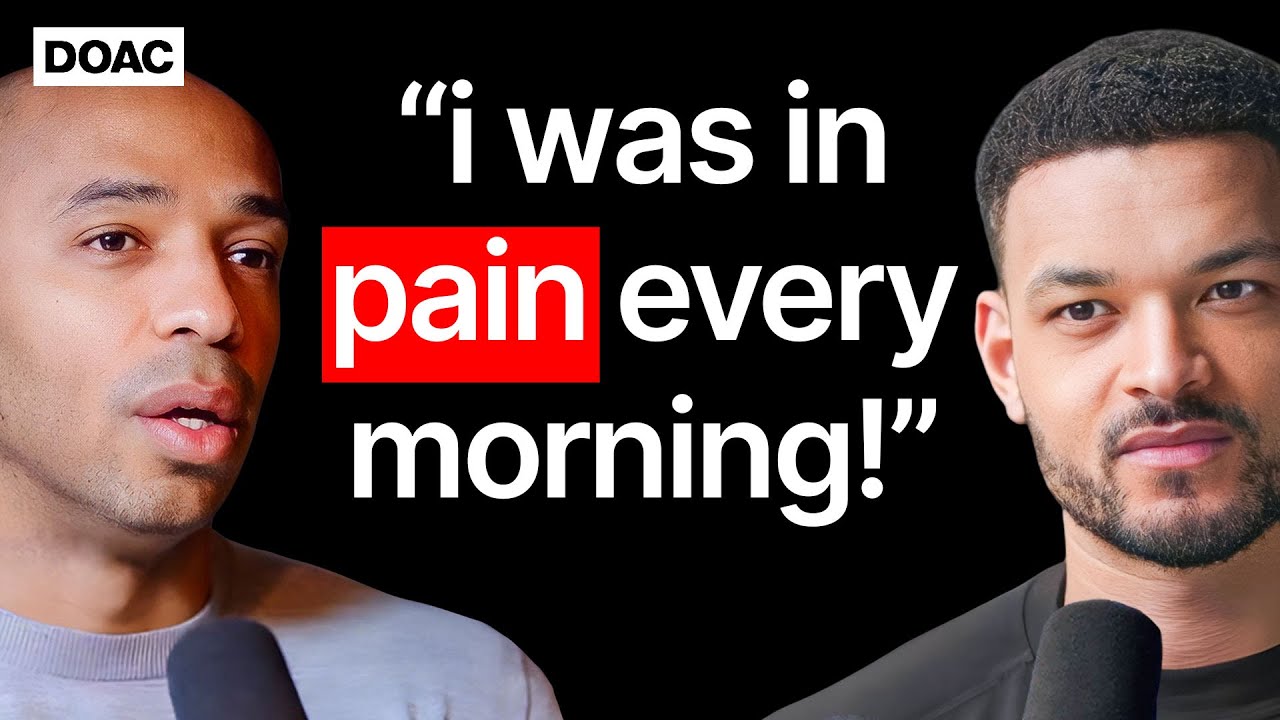
Thierry Henry: I Was Depressed, Crying & Dealing With Trauma! — The Diary Of A CEO

The Diary Of A CEO

Decades of suppressing emotional pain to fulfill paternal expectations caused silent depression throughout a record-breaking football career.

AI-assisted summary of Thierry Henry: I Was Depressed, Crying & Dealing With Trauma! — original source. Check the original for full context.

Source published:

Detailed notes

## Background The Diary Of A CEO podcast hosted by Steven Bartlett released this episode with Thierry Henry on YouTube on January 8, 2024. According to the page description, the episode features a candid conversation with football icon Thierry Henry about the beautiful game, his life, and personal experiences with depression and trauma.

## TL;DR In this deeply personal interview, legendary French footballer Thierry Henry opens up about his lifelong battle with depression, emotional trauma, and the intense pursuit of paternal approval that drove his career. He discusses growing up in the tough Parisian suburb of Les Ulis, entering elite football at Clairefontaine, and how his father's relentless pressure conditioned him to focus strictly on performance over emotion. Henry details key emotional turning points, including stripping off his athletic "cape" after retirement, confronting his inner child during COVID-19 isolation in Montreal, and choosing family over his managerial role. Ultimately, he redefines success around fatherhood, vulnerability, and personal healing rather than trophies.

## Atmosphere & style The conversation is remarkably intimate, vulnerable, and reflective, shifting away from standard sports bravado toward deep emotional introspection. Steven Bartlett acts as an empathetic, guided sounding board, allowing Henry space to process decades of suppressed emotions and trauma in real time. The mood evolves from a heavy, poignant examination of childhood conditioning and isolation into a transformative moment of catharsis and healing. Watching or listening feels like witnessing a global icon drop his protective armor to reveal his raw humanity.

## Key takeaways - [00:00](https://www.youtube.com/watch?v=aivpDPCP7Q8&t=0s) Throughout his record-breaking football career, Thierry Henry was likely living with depression, hiding his mental health struggles behind an intense drive for performance and perfection. - [00:00](https://www.youtube.com/watch?v=aivpDPCP7Q8&t=0s) Henry's life was directed by a prophecy made by his father at his birth, leading to a childhood defined by high expectations, severe criticism, and a persistent drive to gain paternal approval. - [04:28](https://www.youtube.com/watch?v=aivpDPCP7Q8&t=268s) Growing up in the tough Parisian suburb of Les Ulis shaped Henry's adaptability and character, while his talent and older brother provided protection from street crime. - [10:52](https://www.youtube.com/watch?v=aivpDPCP7Q8&t=652s) Emotional distance, lack of physical affection, and a focus on what went wrong in his childhood household conditioned Henry to become hyper-vigilant and obsessively attentive to detail. - [26:12](https://www.youtube.com/watch?v=aivpDPCP7Q8&t=1572s) Leaving home at age 13 for the elite Clairefontaine academy deprived Henry of a normal childhood, forcing him into a high-pressure environment focused solely on elite performance. - [41:48](https://www.youtube.com/watch?v=aivpDPCP7Q8&t=2508s) Henry reflects that speed was his primary natural asset, and reaching the top required immense daily repetition, hard work, and learning from role models like Dennis Bergkamp. - [52:50](https://www.youtube.com/watch?v=aivpDPCP7Q8&t=3170s) Throughout his peak playing days at Arsenal and Barcelona, Henry used his success and athlete persona as a "cape" to mask deep internal pain, emotional detachment, and insecurity. - [01:00:37](https://www.youtube.com/watch?v=aivpDPCP7Q8&t=3637s) At age 37, after enduring over a decade of severe chronic Achilles tendonitis, a moment playing with his daughter made Henry realize he could no longer endure the physical pain required to play professionally. - [01:02:48](https://www.youtube.com/watch?v=aivpDPCP7Q8&t=3768s) Retiring from football stripped away Henry's protective mask, leaving him with existential questions and long-suppressed emotions that surfaced during the pandemic lockdown in Montreal. - [01:21:48](https://www.youtube.com/watch?v=aivpDPCP7Q8&t=4908s) A turning point occurred when Henry realized his family loved him as a human being rather than an athlete, prompting him to resign from managing CF Montréal to prioritize his children and emotional healing. - [01:37:22](https://www.youtube.com/watch?v=aivpDPCP7Q8&t=5842s) Henry stresses the necessity of unlearning rigid masculine stereotypes, seeking therapy, and being vulnerable to become a better father and help others facing mental health challenges.

## Detailed walkthrough ### [00:00](https://www.youtube.com/watch?v=aivpDPCP7Q8&t=0s) Living in the Shadows of Depression and High Expectations

Thierry Henry opens the conversation with a candid admission about his mental health, revealing that throughout his storied football career—where he broke records and became Arsenal's all-time top scorer—he was likely living with depression. He notes that he hid it for a long time because society was not ready to hear such vulnerability from elite athletes, nor did he know how to address it at the time. To understand how he became the person and player he was, Henry emphasizes that one must look back at his early childhood. Growing up, he experienced very little physical affection or overt love from his parents, but rather a rigid programming focused strictly on performance and perfection.

Recall line from his father set his entire trajectory in motion: the first time his father held him as a newborn baby, he declared that the child would become an amazing football player. From that moment, Henry's life was dictated by an intense drive to fulfill his father's prophecy. His father effectively took control of his development, pushing him relentlessly. Henry shares a defining memory from when he was 13 years old: his team won a match 6–0, with Henry scoring all six goals. Yet, on the ride home, his father focused entirely on his flaws—pointing out every missed pass, bad touch, or failed cross. That unrelenting pressure could break many young athletes, but Henry determined early on that it would serve as his fuel. He admits that he wasn't afraid of failing on the pitch; rather, he was terrified of failing to please people, especially his father.

Even during his peak years at Arsenal—winning Golden Boots, titles, and being part of "The Invincibles"—Henry was still driven by that subconscious need for paternal approval. It was only years later, after stepping away from the game, that he confronted the emotional toll of this conditioning. He recalls a poignant moment when he was preparing to leave his family for another coaching job: his girlfriend and children began to weep. It was the first time he realized they were crying for him as a person and a father, rather than for the football icon, allowing him to finally feel human and connect with the wounded child inside who had been crying for decades.

- **Record-breaking career:** Arsenal's all-time top goalscorer, Premier League Golden Boot winner, and member of the 2003–04 "Invincibles" team. - **Childhood turning point:** Scoring 6 goals in a 6–0 victory at age 13, only to be criticized by his father for minor mistakes on the drive home. - **Core motivation:** Driven not by fear of failure on the field, but by a deep-seated fear of failing to please his father and others.

---

[02:28](https://www.youtube.com/watch?v=aivpDPCP7Q8&t=148s) The Early Context: Growing Up in the Parisian Suburbs

Prompted by host Steven Bartlett on how early environment shapes an adult, Henry details his upbringing in Les Ulis, a commune in the southwest suburbs of Paris. He describes his childhood household as modest, though as a child he did not perceive it as poor because he had nothing else to compare it to. In his household, love was expressed implicitly through provision—having food on the table and a roof over his head meant you were cared for—rather than through physical affection, verbal reassurance, or praise.

Henry explains the cultural context of his family, who immigrated to mainland France from the French Caribbean islands of Guadeloupe and Martinique. While technically French territories, moving to the "continent" was seen by that generation as their version of the American Dream—a chance at a better life. However, this transition came with immense pressure and a pervasive fear of non-acceptance. His parents constantly reminded him to speak French flawlessly, avoid Guadeloupean Creole, and refrain from making any mistakes that could draw negative attention to Caribbean immigrants.

This environment created a perpetual survival mindset. The underlying rule was to fit in at all costs, avoid troubling authority, and work twice as hard to secure a place in society. Henry recalls being a slightly heavy child who learned to navigate these high expectations, developing a deep awareness that he could not afford to slip up or bring shame upon his family.

- **Hometown:** Les Ulis, a suburb southwest of Paris, France. - **Family background:** Parents emigrated from the French Caribbean islands of Guadeloupe and Martinique to mainland France. - **Cultural mindset:** Constant pressure to assimilate cleanly, speak pristine French, and avoid bringing negative scrutiny to the immigrant community.

---

[06:01](https://www.youtube.com/watch?v=aivpDPCP7Q8&t=361s) Life on the Concrete Streets of Les Ulis

Moving outside the walls of his home, Henry reflects on the nature of the neighborhood he grew up in. Les Ulis was a typical tough public housing estate (*banlieue*) filled with high-rise concrete buildings, gangs, street fights, and drugs, but also immense diversity, vibrant food, and a rich mix of cultures. He credits this environment with teaching him how the real world operates, forcing him to learn co-existence, adaptability, and acceptance across different ethnicities and backgrounds. When Bartlett asks how his childhood streets compare to the lush, private gardens his own children are growing up in today, Henry laughs at the sharp contrast, noting there is no comparison.

Despite the harshness of the estate, Henry admits that if he had to do it all over again, he would choose the exact same upbringing because it forged his character and gave him an invaluable education in human nature. He joke-confesses that he feels uneasy if he goes more than a week without seeing concrete, as the urban environment is deeply baked into his identity.

Henry was also fortunate to have two layers of protection growing up on the estate that kept him out of serious trouble. First, his older brother—seven years his senior—was highly respected in the neighborhood as one of the first in their age group to get a job, earn money, and buy a car. Second, as Henry's football talent became obvious to everyone on the block, the local older guys established an unwritten rule to protect him. Recognizing that young Thierry had a real shot at making it out and succeeding in the professional world, the neighborhood made sure he was kept away from street crime and conflict.

- **Year of birth & town origin:** Born in 1977, the exact same year the newly constructed housing estate of Les Ulis was established. - **Neighborhood diversity:** Grew up alongside peers with Senegalese, Malian, North African, Asian, Italian, Polish, and Portuguese roots. - **Street protection:** Protected from crime by his older brother's strong local reputation and the community's unwritten rule to safeguard promising young athletic talent.

---

[10:52](https://www.youtube.com/watch?v=aivpDPCP7Q8&t=652s) Inside the Household: Hyper-Vigilance and Detail Orientation

Returning to his home life, Henry discusses how emotional communication was handled within his family structure. His parents divorced when he was seven or eight years old, after which his father moved out. Although his father remained involved in his football training and matches, Henry primarily grew up with his mother. Even before the divorce, the household lacked warmth, hugs, or open discussions about feelings. In the tough environment of the suburbs, emotional vulnerability was discouraged; boys were taught to be strong, tough, and silent.

Because of this lack of emotional openness, Henry explains that he never learned how to ask for help or articulate his problems as a child. To this day, physical affection remains somewhat unnatural for him; even hugging his mother can feel awkward because it was not part of his childhood vocabulary. He recalls that as he grew older and visited friends' houses where families sat down to chat casually about their feelings and days, he was baffled by the concept of open dialogue.

A lasting byproduct of this upbringing was a constant focus on what he *didn't* do right rather than what he accomplished. In his family, attention was primarily drawn when something went wrong or when performance fell short. This relentless focus on flaws conditioned Henry to become hyper-vigilant. To this day, whenever he walks into a room or analyzes a situation, his eyes immediately lock onto what is wrong or out of place rather than what is good. While this hyper-awareness caused personal strain, it also became his greatest asset on the football pitch, fueling his obsessive attention to detail and ability to spot tactical flaws instantly.

- **Family structure:** Parents divorced when Henry was 7 or 8 years old; raised primarily by his mother while his father managed his football development. - **Emotional environment:** Expressing vulnerability or asking for help was absent; physical affection like hugging was rare. - **Psychological takeaway:** Developed an intense, hyper-vigilant attention to detail and a lifelong habit of spotting defects or errors immediately.

---

[16:41](https://www.youtube.com/watch?v=aivpDPCP7Q8&t=1001s) Programmed to Succeed: The Singular Mission

Henry revisits the origin of his football career, recounting the story his uncle and aunt told him about the day he was born. When his father picked him up as a newborn baby, he didn't make typical parental comments about his appearance; instead, he held him up in the air and declared, "This baby will be an amazing football player." From that precise moment, Henry's destination was set. His father took it upon himself to fulfill that prophecy, effectively programming young Thierry for athletic success.

By the age of five or six, his father was taking him to the local field for repetitive training sessions, focusing endlessly on fundamental ball striking. Henry admits that as a child, he didn't know whether he truly loved football or if it was simply a mission forced upon him. He didn't hate it, but he was never given a choice in the matter. When asked if he wishes his father had said something different when holding him as a baby, Henry reflects complexly: while he achieved extraordinary success and fame through football, the emotional burden and pressure that followed made his youth a relentless pursuit of someone else's vision.

- **Age of origin:** Commenced structured football drills with his father around age 5 or 6. - **Paternal prophecy:** His father held him up as a newborn and declared he would become an amazing football player, setting a singular life trajectory. - **Childhood agency:** Henry felt he had no choice in pursuing football; it was an obligation to fulfill his father's dream rather than a personal passion discovered independently.

[20:56](https://www.youtube.com/watch?v=aivpDPCP7Q8&t=1256s) The Pursuit of Parental Approval and the Burden of Fear

Thierry Henry reflects deeply on how his childhood relationship with his father was almost entirely mediated through football. After his parents divorced, their time together centered on practice sessions, trips to Guadeloupe, or rides to training. Henry came to realize very early that the only way to make his father happy was through his performance on the pitch. His father explicitly communicated this expectation, and it was reinforced by the reactions of those around them. Henry shares a profound personal philosophy that governed his life: "what you fear will master you." For him, the single hardest challenge he ever faced—both as a man and as a player—was seeking to please his father.

While the rest of the world showered him with praise as his career blossomed, the young boy inside him never felt that validation. His father consistently pointed out what he had failed to do rather than acknowledging his successes. This created an unfillable void, instilling in Henry a lifelong impulse to seek approval from others, whether it was his teammates or the fans. While this rigid, demanding upbringing molded a fiercely driven athlete who never allowed himself to be complacent, it starved the human being within him. With emotional expression stifled, Henry found that rage and anger became his primary emotional outlets and fuel.

* **Paternal Dynamic:** Football was the sole bridge between Henry and his father following his parents' divorce. * **Core Philosophy:** "What you fear will master you." * **Emotional Outlet:** Difficulties in expressing softer emotions left anger and rage as his main sources of fuel.

---

[26:12](https://www.youtube.com/watch?v=aivpDPCP7Q8&t=1572s) Leaving Home at 13 for Clairefontaine

At just 13 years old, Henry left home to join Clairefontaine, the elite French football academy. He describes the intense pressure of competing at such a young age, entering an environment designed to filter down thousands of hopefuls to a select few. The rigorous schedule demanded normal schooling from 8:00 AM to 3:00 PM, immediately followed by grueling football training. This high-pressure environment meant he had virtually no time to simply be a child or develop normally as a person outside of sports.

* **Selection Rigor:** Clairefontaine filtered roughly 1,600 trialists down through multiple stages to select approximately 23 elite players per year. * **Notable Alumni:** Famous players who trained at Clairefontaine include Thierry Henry, Nicolas Anelka, Kylian Mbappé, and William Gallas. * **Pro Transition:** While passing through Clairefontaine gave players a high statistical chance of turning professional, only around 2% ultimately reached the absolute pinnacle of the sport.

---

[28:42](https://www.youtube.com/watch?v=aivpDPCP7Q8&t=1722s) Re-Education Through Fatherhood and the Death of the Athlete

Reflecting on his development, Henry explains that while he was educated by his upbringing, his own children are now "re-educating" him and saving him every day. Watching his kids love him unconditionally teaches him how to be a better father and opens emotional doors he previously did not know how to navigate. As an active player, the demands of sport allowed him to feed his ego, avoid personal issues, and hide behind his identity as an athlete. Being an athlete was easier because the objective was clear, even when painful.

However, Henry emphasizes that when an elite competitor stops playing, a vital part of them dies. Transitioning back into normal life feels like a shock to the system because players have been removed from regular societal norms since early adolescence. Comparing the identity loss to actors getting lost in a role or military personnel struggling to adapt post-service, Henry notes that removing the "cape" of a professional athlete leaves a person feeling exposed and naked, forced to face long-ignored weaknesses.

* **Fatherhood Impact:** Henry notes that his children are "re-educating" him daily, teaching him how to give and receive unconditional love. * **Post-Career Adjustment:** Returning to everyday domestic life made him feel like a "guest" in his own home due to decades of constant travel and rigid routine.

---

[35:36](https://www.youtube.com/watch?v=aivpDPCP7Q8&t=2136s) Disconnecting from His Father and the "Six Goals" Game

When Henry moved to AS Monaco at age 17 under manager Arsène Wenger, Wenger stepped into a father-figure role. Around this time, Henry had to subtly create distance between himself and his real father to establish his independence. Rather than having an explicit conversation, Henry indirectly set boundaries—such as occasionally withholding match tickets—to escape the suffocating pressure of constantly trying to satisfy his father's standards.

To illustrate his father's relentless strictness, Henry recounts a famous story from when he was 15 years old. His team won a match 6–0, with Henry scoring all six goals. Despite this remarkable performance, he could sense his father's intense disapproval just by reading his posture and aura as he walked off the pitch. During the silent car ride home, his father finally broke the silence by asking, "You happy?" When Henry hesitantly agreed, his father systematically listed every mistake he made: "You missed that control, you missed that cross, you missed that..." When he finally arrived at his mother's house looking despondent, she assumed his team had lost, only to be bewildered when Henry revealed he had scored six goals in a 6–0 victory.

* **Arsène Wenger's Role:** Wenger became a pivotal mentor and father figure when Henry joined Monaco at 17. * **The 6–0 Story:** After scoring all six goals in a 6–0 win at age 15, Henry's father spent the entire drive home picking apart his minor technical mistakes. * **Perspective on his Father:** Henry attributes his father's rigid nature to a lack of formal education and limited life exposure, recognizing that his father was simply using the limited tools he possessed.

[41:48](https://www.youtube.com/watch?v=aivpDPCP7Q8&t=2508s) Becoming the Animal: Work Ethic and the Imperative of Repetition

Thierry Henry reflects on what it took to reach the highest peaks of football and earn a statue outside the Emirates Stadium in London. He emphasizes that while everyone possesses innate potential, developing it requires a distinct shift in mindset and drive. For Henry, reaching that level meant transforming into a focused "animal" on the pitch—a evolution accelerated by watching teammates like Dennis Bergkamp and other Arsenal legends train relentlessly every morning. Realizing he had to compete with such world-class talent, Henry knew he had to push beyond his natural abilities.

Contrary to the common belief that his success was purely natural talent, Henry reveals that speed was initially his only standout attribute as a young player; he lacked exceptional technical ability or spatial awareness. He emphasizes that he had to work extraordinarily hard every single day to hone his skills. His left foot was poor, his heading ability was weak—a flaw he admits he never fully managed to fix during his career—and every element of his game required constant practice. Through endless repetition, he built the habits that defined his play. Rising through Clairefontaine and every French youth national team level (under-15 through under-21) to the senior squad, he constantly had to fight and perform. Yet, because pleasing his father was the single hardest challenge of his life, facing the demands of elite football felt manageable by comparison.

- **Key Insights:** - **The Drive:** Watching Dennis Bergkamp and fellow Arsenal teammates train daily served as the standard for what was required to reach the top. - **Core Attributes:** Speed was his only natural gift early on; he lacked initial elite technical skill or awareness. - **Areas of Weakness:** Weak left foot and persistent difficulty with heading throughout his career. - **Path Through the Ranks:** Trained at Clairefontaine and represented France at every youth level ($U15$, $U16$, $U17$, $U18$, $U19$, $U21$) before the first team. - **Philosophy:** Repetition is key because "repetition always creates habit."

---

[45:16](https://www.youtube.com/watch?v=aivpDPCP7Q8&t=2716s) The Missing Pieces: Vulnerability and Empathy in Leadership

Looking back on his career, Henry acknowledges a major blind spot in his personal and professional evolution: the absence of vulnerability and empathy. While he spent years attempting to connect with his "inner child" and seek the parental approval he missed early on, he realized later in life that the greatest leaders possess the ability to show warmth and understanding. In the high-stakes, ruthless environment of professional football, traditional culture dictated that players simply play, suppress their problems, and hide their emotions.

Henry points out that during his playing days, dressing rooms maintained a strict taboo against showing emotional strain, sadness, or mental health struggles. While he welcomes the modern shift where athletes can openly express mental health difficulties, his own era demanded complete emotional guard. He notes that true leadership does not mean softening one's standards, but rather showing teammates that you are relatable and human. When a squad realizes their leader shares their struggles, they will willingly follow them through the toughest challenges.

---

[46:44](https://www.youtube.com/watch?v=aivpDPCP7Q8&t=2804s) The Pursuit of Pleasing: Smiles for Assists, Rage for Goals

Despite winning the Premier League as an "Invincible," capturing Golden Boots, and lifting the World Cup, Henry reveals that at his core, he was still driven by the unyielding urge to please his father. He compares his mindset to the film *The Pursuit of Happyness*, describing his life as a constant "pursuit of pleasing people." When asked if he was actually happy during the height of his career, Henry admits he never even considered the question and "couldn't care less" at the time. His focus was entirely on execution, resulting in a stern, hardened demeanor on the pitch.

This internal dynamic explained his unique, often misunderstood body language during matches. In France, critics frequently called him out for not celebrating his goals, as he would often stand in a stoic, proud, or enraged stance rather than smiling. However, Henry points out a stark contrast: whenever he provided an assist for a teammate, he always smiled warmly. Scoring was merely fulfilling a strict duty, but setting up a teammate allowed him the joy of giving and making someone else happy. Host Steven Bartlett notes how children raised by hard-to-please parents often become hyper-attuned empaths or chronic people-pleasers, drawing a parallel to how comedians often channel childhood trauma into making a depressed parent smile.

- **Memorable Quotation:** "When your medicine is your poison, because you always chase that... my face was always hard... but watch, assist: smile. Goal: rage."

---

[50:00](https://www.youtube.com/watch?v=aivpDPCP7Q8&t=3000s) Winning the League and Skipping the Party

Henry illustrates his relentless intensity through a story shared by his former teammate and assistant coach, Gaël Clichy. After Arsenal secured the Premier League title while remaining completely undefeated, Clichy excitedly asked Henry where the team was going to celebrate that night. To Clichy's shock, Henry calmly stated that he was staying home and not joining any party. When Clichy pressed him on why he wouldn't join the rest of the squad, Henry explained that the European Championship was right around the corner and required his immediate focus.

This refusal to pause and celebrate was characteristic of Henry's career mindset. Victory was merely a signal to lock in for the next objective. While such behavior caused some to view him as detached or isolated from the group, Henry maintained that his commitment to his teammates was proven strictly on the field. For him, friendship outside of football was secondary to whether a teammate would cover for him on the pitch. It was only near the end of his career that Henry realized trophies were not the only thing that mattered; true fulfillment came from inspiring others, transmitting knowledge, and transcending the sport—tools he lacked during his peak playing days.

- **Key Details:** - **Teammate Mentioned:** Gaël Clichy (former Arsenal and Manchester City player, who later served as Henry's assistant coach). - **The Incident:** Refused to attend the team's victory celebration after winning the Premier League title as an "Invincible" because he was strictly focused on preparing for the upcoming UEFA European Championship.

---

[52:50](https://www.youtube.com/watch?v=aivpDPCP7Q8&t=3170s) The Cape of Isolation: Divorce and Struggling in Barcelona

When Henry moved to FC Barcelona, he entered one of the most turbulent periods of his life. He arrived dealing with a physical injury, going through a high-profile divorce, adjusting to a new language, adapting to a foreign culture, and learning a completely different system of play. Separated from his young daughter for extended stretches, he felt an overwhelming sense of failure. Given his lifelong obsession with pleasing people, the situation was devastating; he felt he was letting down his daughter, his fans, his friends, his club, and himself.

To cope with the unbearable emotional weight, Henry relied on his standard defense mechanism: putting on his metaphorical "cape." On the pitch, wearing the cape allowed him to hide behind the identity of "Thierry Henry the superstar footballer," masking the deep human pain underneath. He describes the paradoxical psychological state of wanting someone to notice his suffering and offer help, while simultaneously wearing a mask to ensure nobody could see his vulnerability. He lived with the agonizing thought that by divorcing, he was repeating the exact pattern of his parents' split from his childhood—amplifying his deepest, ongoing fear: failing as a father.

- **Memorable Quotation:** "When I put that cape on, I feel like you can't see that I'm hurt... You want help, but you don't want to ask for help."

---

[59:34](https://www.youtube.com/watch?v=aivpDPCP7Q8&t=3574s) The Turning Point: Ten Years of Pain and an Unplayable Game

Henry recalls the exact moment he knew his professional playing career was finally over at age 37, while playing for the New York Red Bulls. For over a decade, Henry had quietly endured severe, chronic Achilles tendonitis in both legs. The constant pain was present every single morning, afternoon, and night without relief, making basic daily movements a struggle long before he stepped onto a training field.

The decisive moment occurred at his home in New York during a simple, everyday moment with his young daughter.

- **Key Details:** - **Final Club:** New York Red Bulls - **Retirement Age:** 37 years old - **Physical Condition:** Suffered from severe, continuous bilateral Achilles tendon injuries for over 10 years.

[01:00:37](https://www.youtube.com/watch?v=aivpDPCP7Q8&t=3637s) The Moment He Knew the Pain Was Too Much

Thierry Henry describes a deeply personal, poignant moment playing tag with his daughter that made him realize his professional playing career was effectively over. While playing together, she touched him, yelled "You're it!" and sprinted away. Henry desperately wanted to chase after her, but his body physically refused to move. He had to stop, look at her, and concede, "Hey, you won." Standing frozen, he asked himself in disbelief what he was doing. That was the instant he knew he could no longer tolerate the physical pain required to stay at the highest level.

He explains that to be an elite athlete, one must possess an almost irrational love for pain—both mental and physical. While the cliché of "no pain, no gain" gets tossed around casually, he insists it is a stark, unavoidable reality: if you do not genuinely embrace that suffering, you cannot remain at the top.

* "She ran and I just couldn’t move... That’s when I knew I couldn’t handle pain anymore. People forget about anything that you can think of: you need to love pain to be an athlete." * Retired from professional football at age 37 on his own terms, rather than being forced out by a sudden injury. * Felt a sense of peace retiring because it was his decision, but was left with the daunting question of how to satisfy his intense competitive drive and desire to please without playing every three days.

---

[01:02:48](https://www.youtube.com/watch?v=aivpDPCP7Q8&t=3768s) Stripping Off the Cape and Facing the Past

When host Steven Bartlett asks when he realized he was struggling with life, Henry reveals that throughout his career, he used football as a superhero "cape" to shield himself from his internal battles whenever pain or self-doubt crept in. However, once he hung up his boots, the cape vanished. Without the distraction and validation of matches every weekend, all of his past choices, behaviors, and relationships came rushing back to haunt him.

He transitioned from a world where he had a clear, tactical answer for every problem—such as working on his left foot or training harder for the next game—to a reality filled strictly with overwhelming questions. Overthinking led him down dark paths, forcing him to re-evaluate how he treated people, what kind of father he wanted to be, and whether he had truly been a "good guy."

* "The cape was always my thing to make sure that when I felt the struggle coming... I put the cape on. But then when you’re not a player anymore, you can't put that cape anymore." * Describes a shift from a proactive mindset ("I had answers") to an existential gridlock ("Now all I had is questions"). * Denies feeling simple "sadness"; rather, he felt an agonizing need for a logical explanation as to why he felt so unmoored and unable to comprehend his own identity.

---

[01:05:50](https://www.youtube.com/watch?v=aivpDPCP7Q8&t=3950s) Isolated in Montreal: Crying and COVID-19 Isolation

The onset of the COVID-19 pandemic brought Henry's fast-paced life to a complete halt while he was managing CF Montréal in Canada. Isolated away from his children for nearly a year due to lockdowns and travel restrictions, he could no longer use work or travel as an escape from his deep-seated issues. Forced into solitude, he experienced an unprecedented emotional breakdown where he found himself crying almost every day for no apparent reason.

Watching mundane, non-sad movies would trigger uncontrollable tears. Henry reflects that those tears had likely been suppressed inside him for decades. For the first time in his life, he chose not to suppress his vulnerability or try to control the emotional floodgates, realizing that society and sports culture had conditioned him from a young age to view crying as a fatal sign of weakness.

* Spent long stretches locked down in Montreal, separated from his children for a full year. * Cried daily during quarantine, feeling as though decades of unexpressed emotions were finally escaping. * Learned to differentiate between feeling an emotion and becoming it: "Anger is normal, don't become angry. Jealousy is normal, don't become jealous."

---

[01:09:13](https://www.youtube.com/watch?v=aivpDPCP7Q8&t=4153s) Confronting the Inner Child and Unmasking Society

Henry comes to the realization that the tears shed in Montreal were not those of the world-famous adult footballer, but rather those of his "younger self"—a child starving for the approval he never received growing up. He cautions that sitting down to have an honest conversation with your inner child is one of the most terrifying experiences imaginable, because that child will force you to stop lying to yourself and demand that you drop your fake external exterior.

This leads into a critique of societal hypocrisy. Henry points out how adults constantly teach children rules like "don't judge a book by its cover," while the real world operates in the exact opposite manner every single day—judging people instantly based on their clothing, attire, or background. He references a poignant moment from the film *Black Panther* to illustrate how historical treasures stolen from native cultures are showcased in foreign museums, while the descendants of those cultures are often judged or kept out.

* Describes his inner child taking control and telling him: "Just be yourself. Be human. Show who you really are. Stop fronting, stop lying." * Criticizes societal double standards: "Go and try to find a job with a tracksuit... but we've been told since we're young, 'do not judge the book by its cover.' That's a lie." * Cites the museum scene in Marvel's *Black Panther* as a metaphor for structural hypocrisy and surface-level judgments.

---

[01:12:09](https://www.youtube.com/watch?v=aivpDPCP7Q8&t=4329s) The Search for Harmony and Self-Diagnosis

Reflecting on his quarantine experience, Henry confesses that he lacked the emotional tools to understand what was happening to him at the age of 40. Growing up, love was something he believed he had to earn through performance or buying gifts, rather than an inherent state of being. When asked what truly made him happy outside of his children, he admits he had zero answers.

To cope, he mentally conceptualized an image of the ideal human existence, which he even got tattooed on his body: a person walking a high tightrope, holding hands in harmony with their inner child, while meticulously balancing decisions made by the brain with decisions made by the heart. Moving too far toward pure logic or pure emotion leads to a fall. Bartlett asks if he realizes he was battling depression, and Henry admits that while he didn't recognize the formal signals at the time, in hindsight it rings entirely true. He explains that athletes are conditioned to just keep walking no matter how rough the storm is, and it wasn't until COVID forced him to stop walking that he finally felt the full weight of his mental health struggles.

* Imagines the perfect balance in life as a tightrope walker in total harmony with their inner child, weighing logic and heart equally. * Admits to having no answer when asking himself what brings him joy as an individual outside of his kids. * Reflects on surviving trauma and depression without formal diagnosis: "Since I was born, I must have been in depression. Did I know it? No... But you gotta put one foot after another and walk."

<ElicitationsGroup message="To explore more from this interview:"> <Elicitation label="Walk through Thierry Henry's early childhood and relationship with his father" query="Summarize Thierry Henry's early childhood, his upbringing in the Parisian suburbs, and his complex relationship with his father as discussed in this interview."/> <Elicitation label="Detail Thierry Henry's relationship with Arsène Wenger at Arsenal" query="Detail Thierry Henry's relationship with Arsène Wenger at Arsenal, including how Wenger acted as a father figure and transformed his career."/> </ElicitationsGroup>

[01:20:21](https://www.youtube.com/watch?v=aivpDPCP7Q8&t=4821s) Mental Health Statistics and the Male Burden

Steven Bartlett brings up stark UK mental health statistics to frame Thierry Henry's emotional journey. He notes that someone dies by suicide every 90 minutes in the UK, with 76% of those deaths being male, and that suicide is the single biggest cause of death for men under the age of 45. While clarifying that he does not wish to ignite a gender debate, Henry acknowledges how immense the societal pressure on men can be. Reflecting on his period of isolation during the COVID pandemic, Henry explains that while he never explicitly contemplated taking his own life, he truly did not know where he was heading mentally.

- Suicide is the single biggest killer of men under 45 in the UK. - There are an estimated 25 suicide attempts for every recorded death. - Young adults aged 19 to 35 are twice as likely to report being in distress.

---

[01:21:48](https://www.youtube.com/watch?v=aivpDPCP7Q8&t=4908s) The Moment I First Felt Loved

Henry recounts a pivotal moment during the COVID pandemic that permanently altered his life. After returning home briefly from his coaching job at CF Montréal, the time came for him to pack his bags and head back. As he was preparing to leave, everyone in the house—from his partner and his children to the nanny—burst into tears. Putting his bags down, Henry experienced a profound realization: for the first time in his entire life, he felt loved for who he was as a human being rather than for his achievements as a football superstar. His "inner child," which had spent a lifetime seeking unfulfilled validation, finally felt nourished.

Driven by this revelation, Henry decided to quit his managerial job at CF Montréal on the spot rather than isolate himself from his family once again. He realized he had been running on a treadmill of trying to please people and wear a heroic "cape." For the first time, he felt comfortable just being "Thierry" rather than "Thierry Henry."

- Henry stepped down from his role as manager of CF Montréal to remain close to his family. - He realized that his children loved "Thierry," not the football icon "Thierry Henry."

---

[01:27:04](https://www.youtube.com/watch?v=aivpDPCP7Q8&t=5224s) Emotional Breakthroughs and Unlocking Vulnerability

Bartlett relates Henry's breakthrough to a story told by former French teammate Patrice Evra on the podcast. Evra, who grew up in Les Ulis just like Henry, described breaking down in tears for the first time in his life at age 40 when his partner simply asked him, "Are you happy?" Henry agrees that opening those emotional doors requires vulnerability and empathy, qualities he began cultivating during the pandemic. He admits that he had been "blind" to affection for years because his internal focus was entirely consumed by survival and performance.

---

[01:28:34](https://www.youtube.com/watch?v=aivpDPCP7Q8&t=5314s) Seeing the Game with the Brain vs. Seeing Life with the Eyes

Explaining his mindset as an athlete, Henry outlines how he navigated the football pitch using his brain rather than just his eyes. He describes visualizing solutions on a two-dimensional grid, recognizing that opponents could not "defend the air." When faced with multiple defenders, he broke the challenge down into a series of consecutive 1v1 duels—beating one player automatically eliminated the entire defensive line behind them.

However, Henry notes a fundamental flaw in his approach to life off the pitch: while he analyzed football with his mind to find solutions, he viewed life merely through his eyes, making him susceptible to feeling overwhelmed by obstacles.

> "How do you defend the air? You can't defend the air. I always used to say... you can't pass me because they think that the line is there. I used to chip the ball over your leg... 20 billion people defending me, if you hold the line, bowling behind, you're dead. Not on the ground—in the air."

---

[01:30:24](https://www.youtube.com/watch?v=aivpDPCP7Q8&t=5424s) Always Looking for Solutions and Challenging Authority

Henry shares that he has always possessed an analytical, questioning nature that frequently put him at odds with authority figures. As a footballer, he constantly challenged his coaches about the purpose of specific training drills, refusing to do them blindly unless he understood their direct relevance to a match.

He recalls a memorable childhood incident where he was sent to the headmaster's office after arguing with his schoolteacher over the interpretation of a French poem. When the teacher insisted his reading of the poem was wrong, Henry retorted, "Have you ever met Victor Hugo? How do you know what he meant then?" He argues that creative works—much like life—are open to interpretation, famously joking that the creators of *Alice in Wonderland* were clearly "on something."

- Henry frequently questioned his football coaches to understand the explicit purpose behind every drill. - He was sent to the headmaster's office for questioning a teacher's rigid interpretation of Victor Hugo's poetry.

---

[01:34:43](https://www.youtube.com/watch?v=aivpDPCP7Q8&t=5683s) The Stages of Healing and the Escape into Work

Reflecting on his mental state, Henry reveals that he is currently seeing a professional therapist to process his past. While he now possesses the "answers" to his internal questions, he emphasizes that having an answer is different from truly digesting and absorbing it. Bartlett breaks this process down into three distinct stages: knowing, understanding, and implementing behavior change.

The conversation shifts to the emotional struggles fathers face. Bartlett admits his own struggle with emotional avoidance, often using his work in business as a protective "cape." Henry agrees, explaining that many men retreat into their careers because work acts as a comfortable zone where they feel competent. At home, men are often terrified of feeling vulnerable or exposed in front of their families, leading them to constantly manufacture excuses to head back to the office.

- Henry confirms he is actively seeing a therapist to help digest his emotional past. - Both Henry and Bartlett identify work as a protective "cape" that men use to avoid emotional vulnerability at home.

[01:39:53](https://www.youtube.com/watch?v=aivpDPCP7Q8&t=5993s) The Challenge of Slowing Down and Finding Comfort in Chaos

Thierry Henry and Steven Bartlett discuss the difficulty of turning down work opportunities to prioritize personal time. Henry explains that for those who are privileged enough to have options, continuously chasing work or money often comes at the expense of spending time with loved ones. Having been on the road and living on flights since the age of 30, Henry reflects on how unnatural it feels for him to sit still at home. Being at home for even a single week leaves him feeling out of his element, as he is conditioned to a life of solitude, constant travel, and relentless schedules.

Bartlett points out that staying in motion becomes a familiar comfort zone. He compares it to a child wanting to watch the exact same cartoon episode repeatedly: knowing what happens next provides a sense of safety and predictability. Bartlett notes how top athletes can become institutionalized by a lifestyle structured around rigid match schedules, flights, and singular focus, making the eventual transition to normal life feel like a traumatic cycle of death and rebirth. Henry agrees, reiterating that stepping away from high-level sports is a profound shock to the system.

* Henry admits he has not been a "homebody" since he was 30 years old, spending decades constantly traveling and living largely alone. * He accepts that while playing football is completely over and he will "never play in the Premier League again," the transition away from competitive athletics remains a severe psychological shock.

---

[01:43:22](https://www.youtube.com/watch?v=aivpDPCP7Q8&t=6202s) Redefining Success: Fatherhood and Unlearning Masculine Stereotypes

Looking toward his next chapter, Henry states that his single biggest priority in life is becoming a better father and partner. He acknowledges that despite his best efforts, he still has a long way to go, but being aware of his shortcomings is a crucial starting point. Henry reflects on how men are traditionally socialized to focus solely on working hard to provide financial stability, often missing out on the true essence of life and family connection in the process.

Henry challenges outdated societal definitions of what it means to "be a man." Growing up, he was conditioned to believe that showing emotion or vulnerability was a sign of weakness. He now recognizes that hiding emotions is unhealthy and is actively working to unlearn those rigid expectations.

* Henry considers becoming a better dad and partner far more important than any past athletic achievement or future professional pursuit. * He highlights the struggle men face with expectations to constantly deliver while suppressing emotional vulnerability.

---

[01:45:19](https://www.youtube.com/watch?v=aivpDPCP7Q8&t=6319s) Advice to His Younger Self and Rejecting Regrets

When asked what advice he would give to his five-year-old self, Henry emphasizes three simple words: "Enjoy the ride." He admits that throughout his career, he often forgot to take pleasure in the journey because he was relentlessly focused on performance and pleasing others. However, Henry explicitly rejects the idea of harboring regrets. He believes that every failure, hardship, and mistake is essential for shaping a person into a stronger, wiser individual.

Henry notes that while many people fear failure, his primary fear was failing to please those around him. He reflects on how hard it was for him to accept compliments throughout his career, as his mind would immediately fixate on what he had failed to execute perfectly on the pitch rather than what he did well.

* Henry's core message to his younger self is to enjoy living, comparing the subconscious march through life to breathing without noticing it. * He views failure as an inevitable, essential tool for personal growth rather than something to be feared or regretted.

---

[01:47:23](https://www.youtube.com/watch?v=aivpDPCP7Q8&t=6443s) The Last Guest's Question and the Duty to Stay Authentic

Answering the closing tradition question left by the previous guest, Henry addresses his continuous habit of trying to please everyone. He acknowledges that while pleasing others is an inherently positive trait, it becomes toxic when it overrides one's own happiness and well-being. He states that he is learning to balance helping others with preserving his internal peace.

When discussing his legacy, Henry emphasizes that being remembered as a legendary footballer matters far less to him than the human impact he leaves behind. He explains that for years, high-profile figures were expected to hide their internal struggles because society was not ready to hear the truth. Now, he feels a duty to speak openly about his mental health, trauma, and vulnerabilities so that others realize success does not exempt someone from pain.

* Henry answers the podcast's tradition question by identifying "pleasing people at the expense of my own happiness" as the trait that can keep him stuck. * He stresses that being honest about personal struggles holds far greater value than winning trophies or titles.

---

[01:50:04](https://www.youtube.com/watch?v=aivpDPCP7Q8&t=6604s) A Lifesaving Encounter in Miami and Closing Reflections

Henry shares a poignant story about an encounter with a fan in Miami to illustrate what truly matters to him now. A police officer approached Henry and asked him to sign his arm so he could get the signature permanently tattooed. When Henry playfully tried to dismiss it, suggesting the officer had more important things to focus on, the man looked at him and said, "No, you changed my life... through the struggle, I was looking up to you." The moment profoundly moved Henry, leaving him speechless and driving home the true mission of his life and career beyond sport.

Steven Bartlett closes the interview by thanking Henry on behalf of the listeners. Bartlett expresses how deeply inspiring it is to see an icon of Henry's stature speak so openly about mental health, noting that normalizing these struggles reassures millions of people that experiencing emotional pain does not mean they are broken, but simply human.

* During a trip to Miami, a police officer asked Henry to sign his arm for a tattoo, revealing that watching Henry helped save him through personal struggles. * Henry kept the fan's contact information at home, intending to send him a personal note and gift. * Bartlett praises Henry for using his platform to transcend sport and help others navigate their own personal hardships.

## Notable quotes > [20:56](https://www.youtube.com/watch?v=aivpDPCP7Q8&t=1256s) what you fear will master you — Thierry Henry

> [46:44](https://www.youtube.com/watch?v=aivpDPCP7Q8&t=2804s) When your medicine is your poison, because you always chase that... my face was always hard... but watch, assist: smile. Goal: rage. — Thierry Henry

> [52:50](https://www.youtube.com/watch?v=aivpDPCP7Q8&t=3170s) When I put that cape on, I feel like you can't see that I'm hurt... You want help, but you don't want to ask for help. — Thierry Henry

> [01:00:37](https://www.youtube.com/watch?v=aivpDPCP7Q8&t=3637s) She ran and I just couldn’t move... That’s when I knew I couldn’t handle pain anymore. People forget about anything that you can think of: you need to love pain to be an athlete. — Thierry Henry

> [01:02:48](https://www.youtube.com/watch?v=aivpDPCP7Q8&t=3768s) The cape was always my thing to make sure that when I felt the struggle coming... I put the cape on. But then when you’re not a player anymore, you can't put that cape anymore. — Thierry Henry

> [01:05:50](https://www.youtube.com/watch?v=aivpDPCP7Q8&t=3950s) Anger is normal, don't become angry. Jealousy is normal, don't become jealous. — Thierry Henry

> [01:09:09](https://www.youtube.com/watch?v=aivpDPCP7Q8&t=4149s) Just be yourself. Be human. Show who you really are. Stop fronting, stop lying. — Thierry Henry

> [01:09:09](https://www.youtube.com/watch?v=aivpDPCP7Q8&t=4149s) Go and try to find a job with a tracksuit... but we've been told since we're young, 'do not judge the book by its cover.' That's a lie. — Thierry Henry

> [01:12:09](https://www.youtube.com/watch?v=aivpDPCP7Q8&t=4329s) Since I was born, I must have been in depression. Did I know it? No... But you gotta put one foot after another and walk. — Thierry Henry

> [01:28:34](https://www.youtube.com/watch?v=aivpDPCP7Q8&t=5314s) How do you defend the air? You can't defend the air. I always used to say... you can't pass me because they think that the line is there. I used to chip the ball over your leg... 20 billion people defending me, if you hold the line, bowling behind, you're dead. Not on the ground—in the air. — Thierry Henry

> [01:30:24](https://www.youtube.com/watch?v=aivpDPCP7Q8&t=5424s) Have you ever met Victor Hugo? How do you know what he meant then? — Thierry Henry

> [01:45:19](https://www.youtube.com/watch?v=aivpDPCP7Q8&t=6319s) Enjoy the ride. — Thierry Henry

## Mentioned Thierry Henry, Steven Bartlett, Frank Lampard, Arsène Wenger, Dennis Bergkamp, Gaël Clichy, Patrice Evra, Victor Hugo, Kylian Mbappé, Nicolas Anelka, William Gallas, The Diary Of A CEO, Arsenal FC, AS Monaco, FC Barcelona, New York Red Bulls, CF Montréal, Clairefontaine, Premier League, UEFA European Championship, FIFA World Cup, Les Ulis, Guadeloupe, Martinique, Montreal, Miami, The Invincibles, Golden Boot, The Pursuit of Happyness, Black Panther, Alice in Wonderland, Huel, WHOOP

[Source](https://www.youtube.com/watch?v=aivpDPCP7Q8)

中文简报

蒂埃里·亨利将职业成功与内心创伤归因于父亲的严苛要求 数十年来为迎合父亲期望而压抑情感痛苦,让他在屡破纪录的足球生涯中饱受隐性抑郁症折磨。 在这场极其坦诚的深度访谈中,法国传奇足球运动员蒂埃里·亨利(Thierry Henry)敞开心扉,讲述了他毕生与抑郁症及心理创伤的抗争,以及推动其职业生涯的对父亲认可的强烈追求。他回顾了在巴黎治安严峻的莱于利斯(Les Ulis)郊区长大的经历、进入克莱枫丹(Clairefontaine)精英足球训练营的过往,以及父亲施加的巨大压力如何促使他只专注赛场表现而忽视个人情绪。亨利详细分享了人生中的关键情感转折点,包括退役后卸下运动员的“披风”、在蒙特利尔疫情隔离期间直面内心的自我,以及最终选择陪伴家人而非继续担任主教练。最终,他重新定义了成功,认为成功在于承担父亲的责任、勇于展现脆弱和实现自我疗愈,而不仅是赢取奖杯。 蒂埃里·亨利(Thierry Henry)坦承在其破纪录的辉煌职业生涯中可能一直深受抑郁症困扰,长年借助对比赛表现和完美的极端追求来掩饰内心的心理挣扎。 (0:00) 亨利的人生自出生起便被父亲的球星预言所绑定,严苛的期望与不断的批评让他的童年承受巨大压力,终其一生都在为寻求父亲的认可而奔跑。 (16:41) 家庭环境中情感表达的匮乏以及对错误的过度聚焦,使亨利形成了高度警惕的心态,这种对瑕疵的本能关注也转化为他在球场上对细节的极致把控。 (10:52) 亨利透露自己曾把超级巨星的身份当成遮掩内心创伤与不安全感的“斗篷”,直到挂靴并在疫情隔离期间情绪彻底崩溃,才终于直面压抑数十年的脆弱与内在小孩。 (62:48) 在饱受双侧慢性跟腱炎折磨十多年后,37岁的亨利在与女儿玩抓人游戏时因身体剧痛而无法迈步,这一刻让他意识到自己已无法再承受高强度竞技的肉体痛苦,从而决定退役。 (60:37)

Reading summary

Former Arsenal and France forward Thierry Henry reveals that throughout his record-breaking football career, he was driven by a subconscious fear of failing to please his father, masking undiagnosed depression behind his athletic success until post-retirement isolation forced an emotional reckoning. Paternal Prophecy and Childhood Conditioning (0:00) Henry explains that his life trajectory was determined at birth when his father held him and declared he would become an amazing football player. Raised in the tough Parisian banlieue of Les Ulis by immigrant parents from Guadeloupe and Martinique, Henry grew up in an environment where survival, strict assimilation, and provision took precedence over overt affection or emotional vulnerability. His father managed his athletic development with unyielding severity, institutionalizing a mindset where only flawlessness was acceptable. After a match at age 13 where Henry scored all six goals in a 6–0 win, his father spent the entire drive home detailing every missed pass, bad touch, and errant cross rather than offering praise. This rigid dynamic taught Henry that love and approval had to be earned through on-pitch performance. Although he was not afraid of failing on the field, he became terrified of failing to please his father and others. The constant scrutiny conditioned him to develop hyper-vigilance, instinctively scanning environments and tactical situations for what was wrong rather than what was functioning well—a trait that fueled his elite tactical analysis but starved his emotional well-being. The Athlete's Mask and Relentless Execution (41:48) To survive the relentless pressure and climb from Clairefontaine to European titles, Henry transformed into an intensely focused competitor. Lacking natural technical dominance aside from his raw foot speed, he relied on daily, obsessive repetition to mask weaknesses in his left foot and heading. He describes wearing a metaphorical superhero "cape" to insulate himself from self-doubt, family breakdown, and personal turmoil, including during his high-profile divorce while adapting to FC Barcelona. The pitch served as an emotional shield where clear tactical objectives substituted for unaddressed personal issues. This psychological conditioning manifested in a stoic, often misunderstood demeanor during matches. Henry recalls that French critics often judged him for failing to smile after scoring goals, which he viewed merely as fulfilling an obligatory duty fueled by rage. Conversely, providing assists elicited genuine smiles because creating opportunities for teammates allowed him to please others. His singular focus on future objectives left no room for celebration; after Arsenal completed an undefeated Premier League season, he declined to attend the team's victory party to focus immediately on preparing for the upcoming European Championship. Retirement, Isolation, and Confronting Trauma (60:37) Henry's playing career ended at age 37 with the New York Red Bulls after a decade of severe, chronic bilateral Achilles tendonitis culminated in a moment where he physically could not chase his daughter during a game of tag. Stepping away removed the protective athletic cape, stripping away the structured routine, ego validation, and clear answers that competition provided. He transitioned into a state of existential gridlock, questioning how he had treated people, his efficacy as a parent, and his genuine identity outside of football. The emotional reckoning intensified during the COVID-19 pandemic while Henry managed CF Montréal. Cut off from his children for a year due to quarantine measures and travel restrictions, the isolation triggered an emotional collapse where he found himself crying uncontrollably on a daily basis. Henry realized these tears were not shed for his present circumstances, but were the unexpressed grief of his childhood self confronting decades of suppressed trauma, conditioned emotional detachment, and an unquenchable desire for validation. Redefining Identity, Vulnerability, and Legacy (81:48) A permanent shift occurred during a brief trip home from Montreal: as Henry prepared to pack his bags to return to coaching, his partner, children, and nanny broke down in tears. Realizing for the first time that his family loved him as "Thierry" the human being rather than "Thierry Henry" the superstar athlete, he resigned from his managerial position on the spot to stay with them. His children, he reflects, have been "re-educating" him on how to receive and offer unconditional love without relying on performance. Currently seeing a professional therapist, Henry acknowledges that understanding the psychological answers to his behavior is distinct from fully digesting them. He identifies the impulse to please others at his own expense as a lingering challenge, yet he actively rejects harboring regrets, viewing his hardships as essential to his growth. Shifting away from past athletic achievements, Henry now places higher importance on emotional honesty and dismantling masculine stigmas around mental health, maintaining that speaking openly about internal suffering provides far greater human value than winning trophies. Henry acknowledges that while he has identified the roots of his people-pleasing and emotional suppression, internalizing vulnerability and adapting to a slower domestic life remain ongoing personal challenges.

精炼阅读摘要

法国足球名宿蒂埃里·亨利(Thierry Henry)在专访中透露,他在辉煌的职业生涯中长期处于未被察觉的抑郁状态,其终极驱动力并非对失败的恐惧,而是对无法取悦严苛父亲的深层焦虑。他指出,自己多年来一直将运动员身份作为遮蔽脆弱的“披风”,直到退役带来的断崖式落差、疫情隔离期间的情绪崩溃以及家庭给予的无条件接纳,才促使他正视童年创伤并重构对自我价值与男子气概的认知。 预设的宿命与取悦父亲的心理重负 (20:56) 亨利回忆,其父在他出生时便单方面宣称他将成为一名非凡的足球运动员,使他自五六岁起便接受近乎编程式的基本功训练。父母离异后,足球成为他与父亲维系联系的唯一纽带,而父亲苛刻的评价标准彻底主导了他的心理结构。亨利强调了影响其一生的核心信条——“你所恐惧之物必将统治你”;对他而言,人生最大的挑战从不是球场上的对抗,而是取悦父亲。一个标志性事件发生在他少年时期的一场比赛中:亨利独中六元帮助球队6比0大胜,但在返程的车上,父亲全程未予褒奖,而是冷酷地逐一复盘他在停球、传中与跑位中的微小技术瑕疵。 这种严苛管教将亨利塑造成不知疲倦的竞技利刃,却也使他的情感世界极度匮乏。在阿森纳以不败战绩夺得英超冠军、斩获金靴奖乃至赢得世界杯的巅峰时期,他从未真正体会过快乐,而是将进球视作完成一项冷酷的履约义务,甚至唯有为队友送出助攻时才会展露笑容。亨利坦言,愤怒与怨气长期是他宣泄压力的主要燃料,外部世界的掌声无法填补未获父亲认可所形成的心理空洞。 移民郊区生存法则与超警觉性格 (10:52) 亨利的心理机制与其童年成长的巴黎西南郊区莱叙利斯(Les Ulis)密切相关。作为一个建于1977年(恰好是亨利出生年份)的高密度廉租公屋社区,这里充斥着帮派冲突与毒品,但也汇聚了多元族群文化。作为来自法属加勒比群岛(瓜德罗普与马提尼克)的移民后代,亨利的家庭深陷被主流社会排斥的焦虑之中,父母严厉告诫他必须讲无可挑剔的法语、严禁犯错,以避免给移民群体招致负面审视。家庭内部缺乏拥抱或言语关怀,爱仅被具象化为提供食宿等生存保障,男孩更被规训必须保持刚强与沉默。 父母在其七八岁时离异后,家庭中“只聚焦缺陷、漠视成就”的沟通模式,让亨利养成了根深蒂固的超警觉(hyper-vigilance)特质。无论步入任何空间或审视何种情境,他的目光总会本能地锁定瑕疵与错误。亨利指出,这种超警觉性格虽然加剧了个人的心理紧绷,使他至今对肢体亲昵感到不适且难以主动求助,但投射到足球领域中,却淬炼出他对战术破绽与微观技术细节近乎偏执的洞察力,成为支撑其走过克莱枫丹青训营及各级国家队的立身之本。 超级巨星的“披风”与退役断崖 (62:48) 在亨利看来,职业足球的至高地位就像一件超级英雄的“披风”,为他提供了遮蔽内在创伤与自我怀疑的坚固防线。无论是在转会巴塞罗那期间遭遇严重身体伤病、经历高调离婚并与女儿分居的剧烈动荡,还是在更衣室文化严禁展示脆弱的年代,他都选择将痛苦藏匿于“球星亨利”的光环之后。他描述了一种极度矛盾的心理状态:内心深处渴望有人能洞悉自己的痛苦并伸出援手,但外表却始终维持着严防死守的面具,唯恐被人察觉自身的无助。 然而,在双侧跟腱炎持续折磨长达十余年后,37岁的亨利在纽约红牛效力期间因在家中无法陪女儿玩抓人游戏而决定挂靴。退役瞬间剥离了这件“披风”,使他骤然跌入无所适从的心理悬崖。在球员时代,每一个困境都有极其明确的战术化解决途径——例如加练弱势左脚或投入下一场比赛;退役后,这种行动导向的确定性彻底瓦解,取而代之的是关于过往行为、为人父之道以及自我身份认同的无尽拷问与虚无感。 疫情孤立溃堤、父职救赎与重构认知 (81:48) 真正的心理危机在新冠疫情爆发期间全面爆发。当时执教蒙特利尔冲击队的亨利因封锁政策被迫与家人分居近一年,快节奏的工作与奔波戛然而止,使他再也无法通过忙碌逃避内心。在蒙特利尔的极度孤立中,他陷入了持续近一年的无缘由日常啜泣。亨利意识到,那些泪水并非来自聚光灯下的足球传奇,而是源于那个数十年间压抑脆弱、在无爱与严苛指责中挨饿的“内在小孩”。他将理想的人生状态构想为走钢丝者:在理性(大脑)与感性(心灵)之间维系精细平衡,并牵手内在小孩同行。 决定性的转变发生在他短暂归家准备再度离境的瞬间:当目睹伴侣、孩子乃至保姆集体落泪挽留时,亨利第一次真切体会到自己是作为“蒂埃里”这个人、而非“蒂埃里·亨利”这个符号被无条件地深爱。他随即辞去教练职务留在家中,并开始接受专业心理治疗。面对主持人斯蒂芬·巴特利特(Steven Bartlett)引用的英国男性心理健康严峻数据,亨利直言男性不应再将工作视为逃避家庭情感暴露的掩体,重新反思将压抑情感视作坚强的传统男子气概,并将成为合格的父亲与伴侣确立为当前人生的最高优先级。 亨利的叙述揭示了现代高水平竞技体育与传统男性文化如何系统性地压抑个体的情感脆弱,并将早期创伤转化为驱动成就的病态燃料。尽管他已通过心理治疗、反思父职与直面内在小孩逐步走向愈合,但如何在彻底脱离赛场高强度秩序后适应平静家庭生活、消化深层认知,依然是一个处于进行时的复杂课题。

Detailed notes — zh

## Background 本期访谈由史蒂文·巴特利特(Steven Bartlett)于2024年1月8日发布在YouTube频道《The Diary Of A CEO》上。节目简介聚焦于传奇足球巨星蒂埃里·亨利(Thierry Henry)鲜为人知的内心世界,深度剖析了他在光鲜璀璨的职业生涯背后所长期压抑的抑郁情绪、童年创伤,以及退役后艰难寻找真实自我的心路历程。 ## TL;DR 蒂埃里·亨利在访谈中罕见地撕碎了传奇球星的光环,坦承自己从降生那一刻起就背负着父亲近乎偏执的严苛期待,一生都在“讨好父亲”与“取悦他人”的心理牢笼中挣扎。尽管他在阿森纳缔造了英超不败夺冠的金靴神话,但其内心深处一直深陷隐性抑郁,进球被其视作必须履行的冰冷任务,只有送出助攻取悦他人时才能展露微笑。退役剥离了掩盖情绪的“超人斗篷”,新冠疫情隔离期间的孤独更引爆了数十年的心理防线,迫使他日复一日独自痛哭。直到目睹孩子们为了他作为“普通人”而非“巨星”落泪时,他才生平第一次感受到无条件的爱,毅然辞职回归家庭,学会拥抱脆弱并与内心的“内在小孩”达成和解。 ## Atmosphere & style 整场对谈沉静而厚重,自始至终弥漫着坦诚撕裂与心灵救赎交织的情感张力。史蒂文·巴特利特沉稳且具高度同理心的引导,与亨利毫不设防、数度哽咽的剖白形成了极具温度的心灵共振。聆听过程如同直面一位曾被封神的顶尖竞技王者亲手拆解自己的精神盔甲,将隐忍一生的孤独、恐惧与创伤毫无保留地袒露在聚光灯下,展现出一种超越绿茵场胜负的、令人动容的生命韧性与觉醒力量。 ## Bulletin - [00:00](https://www.youtube.com/watch?v=aivpDPCP7Q8&t=0s) 蒂埃里·亨利坦言自己长达数十年的职业生涯乃至从出生起很可能一直处于抑郁状态,父亲在其降生时便强加的足球使命与严苛评价,使他终身深陷以讨好他人为驱动的紧绷心理。 - [01:05:43](https://www.youtube.com/watch?v=aivpDPCP7Q8&t=3943s) 2020年新冠疫情期间在蒙特利尔独自执教并隔离近一年,彻底剥离了亨利用于掩饰痛苦的“超人斗篷”,促使他几乎每日无故痛哭,直面从未被真正认可的内在小孩。 - [01:20:37](https://www.youtube.com/watch?v=aivpDPCP7Q8&t=4837s) 当亨利准备离家返岗而目睹全家人失声痛哭时,他生平第一次体会到自己是作为普通人“蒂埃里”而非传奇球星被无条件所爱,促使他毅然决定辞去主教练职务回归家庭。 - [28:55](https://www.youtube.com/watch?v=aivpDPCP7Q8&t=1735s) 亨利揭示顶级运动员退役无异于经历精神上的“死亡与重生”,并犀利指出许多男性之所以过度扑向工作,本质上是将忙碌当作逃避家庭真实情感与自身脆弱的舒适区。 ## Key takeaways - [16:41](https://www.youtube.com/watch?v=aivpDPCP7Q8&t=1001s) 父亲在亨利出生时便预言其将成为伟大球员,13岁单场独中六元赛后仍遭全程严苛挑刺,导致他将自我价值与赛场表现彻底绑定。 - [02:28](https://www.youtube.com/watch?v=aivpDPCP7Q8&t=148s) 加勒比移民家庭背负着极重的防御性生存压力,关爱仅停留在物质温饱与行为规训层面,剥夺了亨利幼年习得情感交流与温情表达的机会。 - [26:34](https://www.youtube.com/watch?v=aivpDPCP7Q8&t=1594s) 克莱枫丹青训体系从数千人中层层筛选极少数精英,高度专业化的高压竞技环境虽造就了顶级球星,却牺牲了健全人格与普通童年。 - [46:44](https://www.youtube.com/watch?v=aivpDPCP7Q8&t=2804s) 亨利在场上进球时常表现出冷酷与愤怒,唯有在送出助攻时才展露笑容,因进球仅是履约的沉重任务,而助攻才代表给予他人快乐与取悦队友。 - [49:28](https://www.youtube.com/watch?v=aivpDPCP7Q8&t=2968s) 在阿森纳创下不败夺冠神话的当晚,亨利因执念于备战欧洲杯而独自回家,长期深陷“只能迈步向前、无法享受当下”的机械生存模式。 - [52:51](https://www.youtube.com/watch?v=aivpDPCP7Q8&t=3171s) 加盟巴塞罗那期间遭遇婚姻破裂与伤病困扰,亨利只能强行披上超级球星的“斗篷”硬扛,在极度渴望被理解与坚决拒绝求助的矛盾中内耗。 - [01:00:29](https://www.youtube.com/watch?v=aivpDPCP7Q8&t=3629s) 历经长达十年的双脚跟腱剧痛折磨,直到在纽约家中因身体剧痛连女儿的抓人游戏都无法参与时,亨利才惊觉肉体极限已至,于37岁主动挂靴。 - [31:43](https://www.youtube.com/watch?v=aivpDPCP7Q8&t=1903s) 运动员脱下球衣后相当于经历社会身份的“死亡”,曾经每三天就能通过比赛解决问题的确定性骤然消失,取而代之的是无休止的过度思虑。 - [01:12:16](https://www.youtube.com/watch?v=aivpDPCP7Q8&t=4336s) 疫情独处撕碎了亨利的心理防御机制,压抑数十年的情绪失控决堤,迫使他学会在理智(大脑)、情感(心灵)与内在小孩之间寻找走钢丝般的动态平衡。 - [01:24:13](https://www.youtube.com/watch?v=aivpDPCP7Q8&t=5053s) 离别时孩子们的泪水让亨利顿悟到家人的爱超越了所有金靴与光环,他放下行李辞去帅位,打破了自幼通过远行与奔波逃避内心的旧循环。 - [01:27:04](https://www.youtube.com/watch?v=aivpDPCP7Q8&t=5224s) 球场上亨利善于利用三维空中“无法被防守的空气”破解重围,但长期用肉眼观察生活却让他屡屡受挫,反映出顶级运动智慧与生活情商的割裂。 - [01:37:30](https://www.youtube.com/watch?v=aivpDPCP7Q8&t=5850s) 许多男性成年后疯狂扑向职场差旅,往往并非单纯为了赚钱,而是因为缺乏健康的亲密相处模板,害怕在家庭中赤裸暴露自身的情感笨拙。 - [01:43:22](https://www.youtube.com/watch?v=aivpDPCP7Q8&t=6202s) 亨利呼吁社会摒弃要求男性“不能示弱、强压情绪”的刻板观念,展现脆弱与具备同理心才是最高级的领导力与成熟男子气概。 - [01:48:47](https://www.youtube.com/watch?v=aivpDPCP7Q8&t=6527s) 相比于世界杯与英超奖杯,迈阿密偶遇球迷“因你而熬过逆境”的真情告白,让亨利顿悟到诚实袒露自身创伤与脆弱才是激励他人最伟大的力量。 ## Detailed walkthrough ### [00:00](https://www.youtube.com/watch?v=aivpDPCP7Q8&t=0s) 开场预告:被设定的人生、抑郁与未曾被看见的内在小孩 蒂埃里·亨利(Thierry Henry)在访谈伊始坦言,他在很长一段时间里都在对外界“撒谎”,因为彼时的社会环境根本没有准备好倾听球星脆弱的一面。作为阿森纳历史最佳射手、纪录打破者与传奇缔造者,他在光芒万丈的职业生涯中,内心深处其实一直处于长期的抑郁状态,但当时的他从未正视或寻求解决。要理解他如今的为人,就必须追溯他最早的起点:在亨利出生时,父亲第一次将他抱在怀里便断言:“这个婴儿将来会成为一名了不起的足球运动员。”从那一刻起,他的人生就像被预先编排好了程序,只为了成功而运转,父亲几乎接管了他的整个身体与童年。 这种近乎苛刻的期待塑造了亨利极其紧绷的心理机制。他回忆起自己13岁时的一场比赛,球队以 6-0 大胜,全部6粒进球皆由他一人打进;然而赛后父亲却完全不提进球,反而一路挑刺:“你那次停球失误了,那个传中你跑丢了,这里没做好,那里也不行。”这种近乎窒息的挑剔要么彻底击垮一个人,要么逼人发狠,而少年亨利选择了“迎难而上”。他并不害怕失败本身,因为失败是塑造人的过程,他真正恐惧的是“无法让别人满意”。即便日后他在阿森纳加冕英超金靴、缔造49场不败神话,潜意识里依然在拼命取悦父亲。直到后来的某一天,当他准备再次离家,女友和孩子们忍不住失声痛哭时,他才第一次顿悟:家人们落泪是因为心疼他这个人,而不是那个顶着无数光环的球星。在那一瞬间,压抑了数十年的“小蒂埃里”终于撕开伪装,任由泪水宣泄。 - 亨利的父亲在他出生第一天就为他确立了人生轨道:“这个孩子未来会成为出色的足球运动员。” - 13岁时单场包办全部进球(6-0),赛后父亲依然只复盘其跑位与停球瑕疵。 - 职业生涯长期受制于“取悦他人(尤其是父亲)”的情绪驱动,而非真正的自我快乐。 ```mermaid flowchart TD accTitle: 蒂埃里·亨利的心理驱动机制演变 accDescr: 展示亨利从童年被父亲设定程序,到赛场上取悦父亲,再到回归人性的觉醒过程。 subgraph 童年塑形阶段 A["父亲的预言与掌控<br/>'这个婴儿将成为伟大球员'"] --> B["严苛挑剔的评价机制<br/>单场6球仍只被指责瑕疵"] B --> C["恐惧未能取悦父亲<br/>将自我价值绑定在表现上"] end subgraph 职业生涯巅峰 C --> D["阿森纳传奇成就<br/>金靴奖、49场不败纪录"] D --> E["内心的隐性抑郁<br/>缺少拥抱与无条件的爱"] end subgraph 自我觉醒时刻 E --> F["家庭情感的冲击<br/>家人们为'他本人'而哭泣"] F --> G["找回作为'人'的真实情感<br/>直面内在小孩的脆弱"] end ``` ### [02:28](https://www.youtube.com/watch?v=aivpDPCP7Q8&t=148s) 加勒比移民背景与“法国梦”的隐形重压 史蒂文·巴特利特(Steven Bartlett)在插播频道订阅呼吁后正式切入正题,提出人的本质是由其最早期的成长语境塑造的。亨利深表赞同,认为要真正读懂一个人,必须了解其背后的挣扎与原生环境。亨利生长在一个极其普通且拮据的家庭,但在童年时代,由于没有外界参照物,他甚至觉得那就是最好的生活。在这个家庭里,情感表达是隐性且务实的:“桌上有饭吃,就代表我爱你;照顾好你的温饱,就代表我爱你。”家里几乎从不会出现拥抱、亲口表达“我爱你”或一句由衷的“干得漂亮”,大人眼中看到的往往只是孩子哪里没做好。 这一代家庭的情感模式深受其移民历史的影响。亨利的父母早年从加勒比海的法国海外省——瓜德罗普(Guadeloupe)与马提尼克(Martinique)来到法国本土(当地人习惯称之为“大陆”)。在那个年代,前往法国本土被视作改变命运的“法国梦”。然而,跨海而来的第一代移民时刻背负着沉重的生存危机与戒备心。亨利回忆道,父母总是在耳边告诫:“千万别犯错,别让别人指着我们说‘看,那些加勒比来的人就是这样’;在外面绝不要讲克里奥尔语(Creole),必须把法语说得无可挑剔;老老实实做人,别惹任何麻烦,我们绝不能被遣返回加勒比,我们必须保住现有的工作和住处。”尽管亨利本人出生在法国本土,但他自幼就承担着父母那种如履薄冰的心理包袱——必须削足适履去“融入”,却始终无法产生真正的归属感。 - 亨利父母来自法属加勒比海群岛:瓜德罗普与马提尼克。 - 移民家庭的爱体现在物质温饱层面,缺乏语言表达与肢体触碰。 - 父母对下一代的要求充满防御心理:严禁在公众场合讲克里奥尔语,要求言行完美以防被边缘化或遣返。 ### [06:01](https://www.youtube.com/watch?v=aivpDPCP7Q8&t=361s) 水泥丛林中的童年:多元文化与街头的隐形保护伞 谈及成长的大街小巷,亨利描述自己生活的地方就是一个充满烟火气但也危机四伏的典型郊区街区(Banlieue)。那里充斥着帮派、毒品、街头斗殴,但同时也交织着快乐、高度的文化多样性以及不同宗教与美食的融合。当史蒂文打趣询问这与如今亨利自己的孩子们所处的生活环境有何区别时,亨利笑称:“哪有什么街头?他们出门只有私家花园和草坪,连水泥地都见不到!”虽然亨利竭尽所能给后代提供最优渥的条件,坚决不让他们重复自己当年的艰苦,但他内心依然感激那片街区赋予自己的一切。在那个同班同学涵盖塞内加尔、马里、加勒比、北非、亚洲、意大利、波兰和葡萄牙裔的环境里,亨利足不出户便“环游了世界”,学会了如何包容共处,看透了真实世界的运作规则。 这种环境甚至塑造了他奇特的生活习惯:“如果超过一周看不到混凝土和水泥地面,我整个人就会感到不自在。”亨利解释道,许多人向往乡村、大海或田园风光,但他是在纯粹的水泥森林中长大的,那是带给他安全感的地方。在危险潜伏的街头,亨利之所以能安然无恙并远离麻烦,主要得益于两层特殊保护:一是他的亲哥哥比他年长7岁。亨利出生于1977年,恰好那座新兴卫星城(莱叙利斯,Les Ulis)也是在1977年落成,他的哥哥是当地第一批拥有正经工作、稳定收入和汽车的青年,在街区备受尊重,因而能庇护弟弟;二是他在足球上的惊人天赋。在贫民街区存在一条心照不宣的潜规则:街头混混们一旦发现某个孩子具备出众的足球才华,甚至有希望出人头地踢出名堂,便会自觉离他远点、不去招惹他,甚至形成一种默契的“隐形保护”,生怕毁了这个街区未来的希望。 - 亨利出生于1977年,所在的新兴郊区小镇也始建于1977年。 - 多元文化的平民窟经历塑造了其世界观,同学背景横跨非洲、亚洲及欧洲多个国家。 - 街头双重庇护伞:比他大7岁且极具声望的亲哥哥,以及因其过人足球天赋而享有的街区非正式“免打扰特权”。 ### [10:52](https://www.youtube.com/watch?v=aivpDPCP7Q8&t=652s) 情感荒漠的家庭:离异、缺席与未曾学会的拥抱 史蒂文谈及自己在原生家庭中由于父母缺乏爱意互动,导致成年后极其缺乏表达爱与接受爱的能力。亨利对此感同身受,并进一步揭开了自己家庭内部的情感隐秘。在他大约七八岁时,父母便正式离异,父亲搬离了家庭住所。虽然在后续的生活中,每逢亨利要去参加足球训练或正式比赛,父亲依然会按时出现并全程盯梢,但日常生活中亨利在法律和生活层面上是跟随母亲长大的。 即便在父母离婚前,这个家庭的内部氛围也从未有过亲密与温情。亨利坦白,在那个屋檐下,他从未见过父母之间有亲昵的举动,也几乎没有体验过来自父母的拥抱或细腻的情感关怀。亨利强调,自己这样说绝不是在怨天尤人,那个家庭绝非人间地狱,父母尽其所能供养了他;但那种被称为“爱与温存”的情感维度,在他的童年完全是一片空白。这种长期缺失情感反馈的成长状态,让他在日后很长一段时间里,根本不知道该如何面对和表达自己内心深处的情绪。 - 亨利在7至8岁时经历父母离异,随后主要由母亲抚养。 - 父亲虽然搬离住所,但牢牢掌控亨利的足球训练与赛事日程。 - 童年家庭缺乏直观的爱与肢体温情,使得亨利在成长中未能习得健康的情感表达机制。 ### [12:12](https://www.youtube.com/watch?v=aivpDPCP7Q8&t=732s) 街区与家庭的硬汉法则:压抑情感与身体接触的隔阂 在蒂埃里·亨利(Thierry Henry)成长的街区,生存的法则彻底放大了家中的冷硬氛围——男孩必须粗犷、愤怒、强大,“你是个男人,要坚强,别哭”。在那种环境下,亨利完全不知道该如何敞开心扉求助,甚至根本没有接触过能够表达内心困境的“工具”或“大门”。这种深入骨髓的阻隔感延续至今,以至于他坦言现在拥抱自己的母亲依然会感到极其怪异(weird)。每次拥抱,他都无法停留太久,内心甚至会暗自打鼓:“我是不是抱得太久了?是不是过头了?” 这种情感荒漠在童年时成了他的“正常状态”。直到后来他走进别人的家、与其他人交谈,听到他们居然会围坐在一起讨论各种家庭琐事与心事时,他感到不可思议并大为震撼:“你们居然会坐下来沟通?你们真的会聊天?”在当时的亨利看来,有问题根本无人可诉,更关键的是,他当时压根不知道“人是需要通过表达和倾诉来获得心理健康的”。无论是在学校打架、考试没做好,还是感到羞耻,回到家面对一句常规的“今天过得怎么样?”,他的回答永远是毫无波澜的“挺好的”。 ### [14:34](https://www.youtube.com/watch?v=aivpDPCP7Q8&t=874s) 负面关注与移民生存模式:永远在挑错中建立的极致细节控 在亨利的成长环境中,关注往往只在犯错或不听话时才会降临。这种“只有做错了事才会被看见”的家庭动态,塑造了他维持一生的敏锐与偏执——对细节的极度挑剔。亨利坦白,时至今日,只要他走进任何一个房间,第一眼注意到的永远是“哪里出了问题、哪里不对劲”,而永远看不到“哪里做得很好”。虽然这种特质让他在球场和生活中能瞬间预判危机、评估局势,但也伴随着沉重的心灵代价。 他将这种严苛归结为典型的加勒比海移民家庭教养方式与移民生存创伤(immigrant survival mode)。父母背井离乡来到法国,首要目标是生存、立足并获得教育,根本没有余力去考虑自我实现、幸福感或心理满足。他们时刻处于防御状态,反复告诫孩子:“你必须融入,在这个社会上你得付出加倍的努力才能找到工作。”在这种“绝不能犯错”的生存重压下,无论是母亲还是父亲,给他的反馈永远是“你做得还不够”。尤其在踢球上,父亲总是巨细靡遗地挑出他的不足,日积月累,这种审视最终内化成了他一生的思维定式。 ```mermaid flowchart TD accTitle: 移民家庭防御机制与心理模式 accDescr: 展示从移民生存压力到亨利成年后挑错思维与追求认可的心路历程 subgraph Survival ["生存驱动与家庭环境"] A["加勒比海移民背景"] --> B["防御生存模式<br/>'付出双倍努力才能立足'"] B --> C["缺乏情感沟通与肯定<br/>只在犯错时给予关注"] end subgraph Internalization ["心理机制内化"] C --> D["过度警觉与细节挑剔<br/>'进门永远只看哪里有错'"] C --> E["恐惧驱动与讨好心理<br/>'你所恐惧的终将掌控你'"] end subgraph Outcomes ["双重后果"] D --> F["球场上的顶级球商与敏锐度"] E --> G["内在小孩无法安宁<br/>将自我价值完全绑架于赛场表现"] end ``` ### [16:41](https://www.youtube.com/watch?v=aivpDPCP7Q8&t=1001s) 婴儿时期的预言:被“程序化”设定为足球巨星 关于亨利与足球的羁绊,始于他降生那一刻的一段著名往事。亨利回忆道,父亲第一次把他抱进怀里时,既没有像普通父亲那样端详他“长得像不像我”,也没有调侃孩子的大脑门、厚嘴唇或大鼻子,而是当着亨利叔叔和婶婶的面,直接将这个刚出生的婴儿高高举向空中,郑重宣告:“这个婴儿将会成为一名了不起的足球运动员。” 这句话奠定了他一生的基调。亨利表示,如今回头看,这种感觉既怪异又复杂,既有庆幸也有无奈。因为紧接着发生的,就是父亲全力以赴去“实现这个预言”——“我被程序化地设定为必须成功”。从五六岁起,父亲就把他带上球场,一遍又一遍地做着机械单调的踢球训练。亨利直言,年幼的他根本分不清自己到底喜不喜欢足球,唯一的念头就是“我不讨厌它”;这根本不是他自己的选择,而是一场从幼童时期就背负上的、为满足父亲梦想而前行的绝对使命。 - 亨利回忆幼年练球:最深刻的记忆就是站在球场上,“不断地抽球、踢球、抽球,仅此而已”。 - 关于童年的自主权:“一个五六岁的孩子能有什么选择?如果母亲要你弹钢琴或练柔道,你也许能反抗,但面对我父亲,我根本不可能说出‘我不想要’。” - 面对主持人询问“是否希望父亲当年说点别的”,亨利坦承当年父亲无论说了什么都无法改变既成事实,真正对自己一生造成深远冲击的,是父亲为了达成这句预言而在随后岁月里展现出的极端行为与教育方式。 ### [21:01](https://www.youtube.com/watch?v=aivpDPCP7Q8&t=1261s) 取悦父亲的牢笼:将自我价值与赛场表现彻底绑定 由于父母离异,亨利与父亲的交往几乎完全以足球为轴心。除了极少数去瓜德罗普(Guadeloupe)度假的日子,父亲来看他、接他,永远是为了足球训练。足球成了维系父子关系的唯一纽带,也让年幼的亨利形成了一个坚固的信念:“如果我想让他开心,就只能通过足球这一条路。” 这种执念演变成了他整个人生中最痛苦的战役。亨利引用了一句至理名言:“你所恐惧的,终将掌控你(What you fear will master you)。”对他而言,作为男人和球员,此生最难翻越的高山就是取悦他的父亲。成年后,全世界都在对他说“蒂埃里,你太棒了、不可思议”,但那个藏在他心底的“内在小孩”却从未从父亲口中得到过哪怕一次真正的认可。父亲永远都在指出“你漏掉了这个机会,你没做好那个传球”。这种长年无法获得的“准入许可”,让亨利深陷讨好型人格之中,不仅拼命想让父亲满意,后来更延伸到球场上绝不让队友失望、必须讨好球迷。这种近乎残酷的心理设定虽然锻造了一位永远不知自满的顶尖运动员,却在很长一段时间里,彻底剥夺了他作为一个独立人类感受无条件之爱的权利。 ### [25:06](https://www.youtube.com/watch?v=aivpDPCP7Q8&t=1506s) 讨好外部的机器与唯有愤怒的情感 蒂埃里·亨利(Thierry Henry)反思起年轻时的心理状态,坦言自己过去从未学会如何体会内在的快乐或悲伤。在父亲严格的教导下,无论表现得多好都“永远不能过于满足”,因为“明天又是新的一天,你必须再次表现出色”。因此,他的情绪完全建立在取悦他人之上:“我的快乐与悲伤总是通过别人来决定的”。在很长一段时间里,除了“狂怒与愤怒”(rage and anger),他几乎无法表达任何其他情绪。愤怒对他来说轻而易举,因为一旦事情没做好,挫败感便立刻转化为怒火,并成为他不断在场上狂奔的唯一燃料。 这种严酷的培养模式造就了一位顶尖运动员,却彻底牺牲了一个健全的人格。当主持人史蒂文·巴特利特(Steven Bartlett)问及作为“人”的那一部分究竟缺失了什么时,亨利的回答极其沉重:“几乎缺失了一切。”十三岁那年,他就离开了家,去面对沉重无比的成功压力与竞争。正如他所说:“一个十三岁的孩子,在那个年纪你究竟能算个什么人?”但当时的他别无选择,必须全力去争夺通往克莱枫丹(Clairefontaine)的入场券。 ### [26:34](https://www.youtube.com/watch?v=aivpDPCP7Q8&t=1594s) 克莱枫丹的残酷漏斗与失去的童年 亨利详细拆解了法国国家足球学院克莱枫丹严酷的选拔与日常训练机制。对于不了解的人而言,克莱枫丹就像法国足球界的特种部队(SAS)。每年整个大巴黎及周边地区约有 1,600 名最具潜力的足球少年参加试训。选拔经过层层筛选:一个周末挑选出 20 人,其他区域同样选出 20 人,逐级汇总、缩减到 40 人,最后仅留下 20 到 23 人正式入校。入校后,学员们上午 8 点到下午 3 点在普通学校上文化课,其余所有时间都投入到极其高强度的专业足球训练中。包括亨利自己、尼古拉·阿内尔卡(Nicolas Anelka)、基利安·姆巴佩(Kylian Mbappé)、威廉·加拉(William Gallas)以及让-皮埃尔·帕潘(Jean-Pierre Papin)等人均出自该体系。 ```mermaid flowchart TD accTitle: 克莱枫丹青训精英选拔流程 accDescr: 展示从上千名候选人到最终极少数人成为职业球员的严酷漏斗筛选过程 subgraph 选拔漏斗 A["约 1,600 名候选少年"] --> B["区域多轮周末选拔 (各区取前 20 人)"] B --> C["集结后缩减至 40 人"] C --> D["最终仅录取 20-23 人进入克莱枫丹"] end subgraph 职业残酷现实 D --> E["虽然具备极高成材率,但最终登顶者仍仅约 2%"] end ``` 外界常有传言称,一旦进入克莱枫丹,成为职业球员的几率高达 90% 到 95%,但亨利纠正道,即便在这群最顶尖的孩子里,真正能够长期立足金字塔尖、成为所谓“1998一代”那样的成功者,比例依旧极低(通常只有 2%)。更深远的代价在于对人性的剥夺——从童年早期开始就被置于这种环境,根本没有时间去当一个普通的孩子。亨利承认,当时身处其中完全意识不到问题,直到人至中年回头看,才猛然惊觉那个人性层面的自己存在多大的空洞。 - **选拔基数**:全法约 1,600 名顶尖青少年竞争,最终每年仅录取 20 至 23 人。 - **作息安排**:早晨 08:00 至下午 15:00 上文化课,课后全天候进行高强度专业训练。 - **代表球星**:亨利、阿内尔卡、姆巴佩、加拉等法国国家队核心成员。 ### [28:55](https://www.youtube.com/watch?v=aivpDPCP7Q8&t=1735s) 孩子的救赎与退役即“死亡” 谈及如何意识到自己缺失的童年,亨利深情地谈到了自己的孩子们:“我曾接受过教育,而现在我的孩子们正在重新教育我(re-educating me)。”他直言孩子们每天都在拯救他,教会他如何成为一个真正的父亲,打开了他以前完全不知道如何面对的情感心门。看着孩子们看着自己时眼中流露出的纯粹爱意,亨利常常心生感慨:“如果他们知道我也在用同样的目光看着他们、多么感谢他们的存在就好了。”在当运动员时,一切都很简单,运动场像一个完美的避难所,可以用训练和比赛填满自我(ego),借此回避内心的创伤;然而脱离了这个框架,真正的挑战才刚开始。 亨利提出了一个极具震撼力的观点:“当一名运动员停下脚步时,他就已经死去了(You die when you stop)。”那种最高水准的竞争者特质随之消亡——他再也无法踏上英超赛场,再也无法代表法国队出战,曾经构成他生命核心的那一部分已经彻底死去了。这个世界上没有人会教运动员如何面对这种“死亡”。当镁光灯熄灭、比赛掩盖问题的功能彻底消失后,退役球员往往会在现实世界中陷入巨大的空虚与失衡。 ### [31:43](https://www.youtube.com/watch?v=aivpDPCP7Q8&t=1903s) 脱下英雄斗篷:像回归现实的囚徒与老兵 主持人将这种脱离体制的高落差与刑满释放的人员或从战场归来的退伍军人作比——从 5 岁开始踢球,13 岁进入全封闭精英体系,二十多年来的人生全部由高强度机构、比赛和外界评价来定义,骤然停摆时自然无法适应独坐一室的死寂。亨利极为认同这种感受,并将运动员比作长期沉浸在角色中而患上抑郁症的演员。二十多年来,球员像是披着一件超人般的“斗篷”(cape),这件斗篷赋予他们超越常人的力量、使命感与球迷的情感共鸣,让他们确信自己有所归属。 然而,一旦脱下这件斗篷,人就像赤裸在荒野之中:“那一刻就像是,‘等等,现在大家能看到我的软弱了’,而你自己也真切地看到了自己的脆弱。”歌手到了七八十岁依然能登台开演唱会,但职业球员的黄金竞技期一旦结束,曾经治愈自己、逃避现实的“良药”就彻底断供了。亨利形容退役后第一次回到家庭时,自己甚至像一个“客人”,完全不知道该如何跟伴侣、孩子进行日常的深度连接,因为自 13 岁起他就没过过一天所谓的普通人生活。 ### [35:36](https://www.youtube.com/watch?v=aivpDPCP7Q8&t=2136s) 告别父亲的掌控与阿尔塞纳·温格的出现 当亨利 17 岁离开克莱枫丹加盟摩纳哥(AS Monaco)时,阿尔塞纳·温格(Arsène Wenger)成为了球队的主教练,并在日后逐渐演化为他生命中的“父亲形象”。与此同时,亨利与自己亲生父亲的关系迎来了关键的转折点。亨利面临着一个极度痛苦的困境:当你的父亲为你倾尽了一切、把你一手塑造成职业球员时,你该如何开口告诉他“你需要退到一旁,让我自己独自去飞、去过我自己的人生”? 亨利透露,这并不是通过一场开诚布公的面对面对话解决的,因为那样的谈话根本不可能发生。相反,他只能通过无声的行动让父亲明白界限——一个眼神,或者当父亲索要比赛门票时故意不寄给他,用这种冷处理和间接的方式拉开距离。亨利解释这并非出于对父亲的抛弃或厌恶,而是在那漫长岁月里积压的巨大窒息感之下,他别无选择:“在某一个节点上,这一切压力真的太沉重了,我快要承受不住了。” ### [37:20](https://www.youtube.com/watch?v=aivpDPCP7Q8&t=2240s) 独中六元后的沉默车厢:父亲永不满足的苛责与代际工具箱 在法国足坛流传着一个非常著名的故事,至今很多球迷在街上碰到蒂埃里·亨利,依然能随口喊出当年那支对手球队的名字。那是亨利 15 岁时的一场比赛,球队最终以 6 比 0 取得大胜,场上的全部 6 粒进球全部由亨利一人包办。然而,当他走下球场的那一刻,甚至不需要抬头去看,仅凭空气中弥漫的强大气场与能量,他就瞬间感知到父亲极度不高兴。亨利坦言,父亲的肢体语言和周身散发的气息是如此强烈,只要稍稍转过身,他就能百分之百确定父亲的情绪。 随后两人坐进车里,车厢内陷入了令人窒息的死寂。年少的亨利在副驾驶上如坐针毡,内心反复纠结着到底该不该开口打破沉默。良久,父亲冷冷地问了一句:“你觉得挺高兴是吧?”亨利一时不知所措,只能小心翼翼地应了一声,父亲随即毫不留情地泼下冷水:“你不配高兴。你漏停了那个球,你丢了那次控球权,你的传中不到位,你这个没做好,那个也没做好……”随后,父亲将亨利送到了母亲家楼下。亨利耷拉着脑袋、脚步沉重地走上楼,母亲一开门看见他垂头丧气的模样,脱口便问:“你们输球了吗?”亨利回答:“没有,我们 6 比 0 赢了,6 个球全是我进的。”母亲顿时愣在原地,难以置信地看着他。 面对主持人关于“父亲为何如此严苛”的提问,亨利表示自己如今早已释怀。他分析道,父亲的一生从未读过多少书,也从未远行见识过广阔的世界,脑海中只有自己被灌输的那套非黑即白的单一路线。亨利提出了一个深刻的“工具箱”隐喻: - **代际局限与工具箱**:父亲成长在一个极其严苛的旧时代,他拿出的已经是自己工具箱里仅有的全部工具来教育儿子;而亨利这一代人拥有更丰富的工具箱,他的下一代又会比他拥有更多应对生活与情感的工具。 - **理智接纳与情感消化的落差**:亨利认为,你无法去怨恨一个倾尽全力用有限工具爱你的人,理智上必须接受现实;然而,真正艰难的是如何在日后“消化”(digest)这种教育方式在心理深处留下的持久创伤与阴影。 --- ### [41:19](https://www.youtube.com/watch?v=aivpDPCP7Q8&t=2479s) 成功背后的残酷基石:除了飞快速度,其余全靠苦练 史蒂文·巴特利特询问亨利,是什么样超越天赋的价值观与底层心态,让他不仅能站在世界足球的顶峰,甚至在伦敦酋长球场外拥有一座属于自己的铜像。亨利直言,严苛粗暴的成长环境如同一把双刃剑,“它可以成就你,也可以彻底摧毁你”,而他选择让它成就自己。在某个节点上,他不得不暂时将父亲以及周遭所有人的评价抛在脑后,将自己封闭起来,在球场上蜕变成一头冷酷专注的“野兽”。 在阿森纳,当亨利每天清晨看到丹尼斯·博格坎普(Dennis Bergkamp)这样的大师依然在不知疲倦地刻苦训练时,他被深深震撼,并不断逼问自己:“我要如何才能撼动这群足坛顶尖人物的地位?”父亲留给他的烙印——“永远不要满足,做更多,只看没做好的地方”——在此刻化作了疯狂的动力。亨利澄清了一个公众常见的误解:很多人以为他是无所不能的天才,但他坦承自己年轻时除了“速度飞快”之外一无所有。他的左脚技术曾经非常糟糕,头球更是一塌糊涂,甚至终其职业生涯也未能完全弥补头球短板;他的任意球、传中与控球技巧,全靠日复一日近乎枯燥的机械重复硬生生磨炼出来。“重复是关键,重复铸就习惯。” ```mermaid flowchart TD accTitle: 亨利职业心态与领导力进化路径 accDescr: 展示亨利从父亲的严苛要求转化为赛场执念,再到后期领悟同理心与脆弱感的过程。 subgraph Growth["成长与驱动力"] A["父亲严苛苛责<br/>(永不满足、寻找不足)"] --> B["专注个人道路<br/>(屏蔽外界噪音,化身赛场野兽)"] end subgraph Mastery["职业锻造与技术打磨"] B --> C["高标准榜样力量<br/>(见证博格坎普每日苦练)"] C --> D["机械式重复训练<br/>(弥补左脚、头球与任意球短板)"] end subgraph Evolution["心智成熟与领导力"] D --> E["赛场顶级成就<br/>(取悦父亲的难度远超职业足球)"] E --> F["领悟最高级领导力<br/>(展现脆弱感与共情同理心)"] end ``` 回顾克莱枫丹(Clairefontaine)青训基地以及代表法国 U15 一路跳级直至成年国家队的历程,外界总以为他是一路顺风顺水的天之骄子,但亨利坦白道:“在我的内心深处,讨好父亲才是我一生中面对过的最艰难的事情;与取悦那个老人相比,职业赛场上的所有挑战简直微不足道。”然而,亨利也反思了自己在巅峰期作为领袖的重大盲区: - **更衣室的传统禁忌**:在他踢球的时代,足球世界充斥着硬汉文化,在更衣室内表达心理脆弱、哭泣或示弱是绝对的禁忌。 - **最高级的领导力特质**:直到生涯后期亨利才领悟到,一名伟大领袖不可或缺的两大核心特质其实是**脆弱感(vulnerability)**与**同理心(empathy)**。只有当团队看到你同样拥有凡人的软弱并能感同身受时,他们才会真正死心塌地追随你。 --- ### [46:44](https://www.youtube.com/watch?v=aivpDPCP7Q8&t=2804s) 进球是愤怒,助攻才有微笑:讨好型人格与“良药亦毒药” 即使在阿森纳包揽多座英超金靴、缔造 49 场不败神话的巅峰岁月里,亨利承认,自己在最底层依然受制于童年的那个“小男孩”,一刻不停地在球场内外追逐着来自父亲的认可与赞许。他借用电影《当幸福来敲门》(*The Pursuit of Happyness*)的梗,自嘲自己陷入了一种终身“对取悦他人的追求”。这是一种扭曲的共生关系:“当你的解药同时变成了你的毒药,你就只能停不下来地永远追逐下去。” 当被问及“当年作为足坛巨星你真的快乐吗”时,亨利语气淡然甚至有些冷酷:“我不知道,我从没问过自己这个问题,我根本不在乎。”这种心理状态直接投射在他极具争议的进球庆祝动作上: - **进球时的冷酷与愤怒**:在法国,媒体和球迷常常批评亨利在取得进球后毫无笑容,总是面色铁青、神情骄傲甚至满脸“暴怒”(rage)。亨利解释道,进球在他潜意识里仅仅是一份“必须完成的任务”,就像履行合同一样理所应当,毫无值得庆祝的喜悦。 - **助攻时的由衷微笑**:亨利郑重地对镜头强调:“请大家回头去看看比赛录像,只要是我送出助攻的瞬间,我脸上永远洋溢着灿烂的微笑。”因为送出助攻是在“给予”他人幸福,是在满足并取悦队友。 史蒂文·巴特利特对此从心理学层面进行了深度剖析:那些在童年时期竭尽全力试图取悦严苛父母的孩子,成年后往往会固化出两种鲜明的人格特质——其一是高度敏锐的“共情者”(empath),他们对房间内任何人的情绪微小波动有着神经质般的雷达感应;其二则是典型的“讨好型人格”(people-pleaser)。这恰如喜剧演员行业中流传的经典定式:每当坐在一流喜剧大师面前,最根本的问题往往是“你的父母中到底哪一位患有抑郁症”,才逼得你穷尽一生用表演去换取他们脸上一抹难得的笑容。 ### [49:28](https://www.youtube.com/watch?v=aivpDPCP7Q8&t=2968s) 奖杯背后的空虚与不休的齿轮:不败赛季夜的缺席 史蒂文·巴特利特(Steven Bartlett)提到一个有趣的现象:当他采访喜剧演员时,很多人常说不是自己抑郁,而是童年时父亲抑郁,所以四岁起他们就竭尽全力逗父亲笑——这与亨利童年时期为了取悦严厉的父亲而拼命踢球的心态如出一辙。随后巴特利特抛出一个核心问题:亨利赢得了世界杯、率领阿森纳缔造了“不败赛季”(The Invincibles)、斩获无数奖杯,走到了职业生涯与能力的巅峰,但在那个时期,他究竟感受到了快乐吗? 亨利毫不犹豫地回答:“没有,因为对我来说,我只是完成了自己必须完成的事。”即使赛后回家,短暂的愉悦感也转瞬即逝,因为下一场战斗立刻就会压过来。亨利分享了一件轶事:在法国国家队集训营中,他的助教兼前队友加埃尔·克利希(Gaël Clichy,曾与他共同效力于阿森纳和曼城)问他:“蒂埃里,你还记得当年夺冠那天你做了什么吗?”亨利一头雾水。克利希回忆道,在阿森纳以不败战绩夺冠的那天晚上,全队都在问“今晚去哪里办庆祝派对”,亨利却平静地回答:“我今晚哪儿也不去。”克利希诧异地说“大家都会去啊”,亨利只是回应:“我不是所有人,我待在家里,因为我们马上有欧洲杯要踢。” 全队都去尽情狂欢庆祝,唯独亨利一人回家休整。这种对下一个目标的执念,让他完全无法享受当下。克利希直言“你当时简直疯了”,但亨利认为这就是自己的生存模式:“我必须专注于欧洲杯。”在外界看来,这样的他或许显得孤僻冷漠、不合群,但亨利表示他在球场上绝对为团队付出一切:“只要在球场上你能为我补位,我们在场下根本不需要做朋友。”他从小被灌输的价值观只有“场上表现”与“交出成果”,从来没有庆祝、享受与快乐。 - **克利希的回忆**:在阿森纳缔造英超赛季不败神话的当晚,全队前往派对狂欢,亨利独自回家为即将到来的 2004 年欧洲杯备战。 - **职业信念的转变**:直到职业生涯后期,亨利才醒悟过来——冠军与奖杯固然重要,但它们并不是全部;真正长久的是你如何超越自我、向他人传递了什么,以及你如何激励了下一代。 --- ### [52:51](https://www.youtube.com/watch?v=aivpDPCP7Q8&t=3171s) 巴塞罗那的孤独深渊:披上披风伪装坚强 当亨利转会加盟巴塞罗那俱乐部(FC Barcelona)时,他迎来了人生极其残酷的动荡期。他在童年七八岁时经历了父母离异,13岁便进入青训学院,从未有人教过他如何维持一段亲密关系、如何去爱一个女人。当他在巴塞罗那经历婚姻破裂与离婚时,他发现自己根本无力招架。带着未愈的身体伤病、语言不通的新环境、全新的战术打法,以及因离婚而暂时无法探望女儿的痛苦,他被扔进了巨大的压力漩涡中。 外界和球迷并不在乎球员的个人私生活有多痛苦,他们只想要表现。亨利别无选择,只能强行“穿上英雄的披风”(put the cape on)。他形容披上披风是一种幻象和自我欺骗——仿佛披上了战袍,世人就看不见他千疮百孔的内心,只看到那个光鲜亮丽的超级球星。但他内心陷入了极度的拉扯:一方面他渴望被人理解,渴望有人看穿他的伪装并说一句“天啊,他正经历这些,太不容易了”;但另一方面,那种深植骨髓的自尊又让他极力抗拒主动开口求救,宁愿躲在球员的角色背后承受抨击。 脱下披风独处时,亨利陷入了自我怀疑与愧疚的深渊。他是一个极度渴望让周围人满意的人,但在那个阶段,生活到处都是“拒绝”与挫败:球场上表现不如预期,家庭破裂让他觉得自己辜负了年幼的女儿、辜负了球迷、朋友和自己。他甚至质问自己:“我做出了正确的选择吗?”在那个阶段,脱下披风后的他脑子里甚至无法再去思考足球,剩下的全是对人生的怀疑——他曾发誓绝对不要像父母那样离婚,结果却惊恐地发现自己正在重蹈原生家庭的覆辙。 ```mermaid flowchart TD accTitle: 亨利在巴塞罗那的情感拉扯模型 accDescr: 展示亨利在面对个人生活危机与职业球星身份时的内心矛盾循环 subgraph Internal_Crisis["私人困境与心理痛苦"] A["生活剧变<br/>婚姻破裂 / 远离女儿 / 身体伤病"] --> B["自责愧疚<br/>深恐重蹈父母覆辙 / 害怕辜负所有人"] end subgraph Armor_Mechanism["心理防御机制(披上披风)"] C["披上超级球星披风<br/>上场踢球 / 隐藏真实软弱"] --> D["内心矛盾撕扯<br/>渴望被理解救赎 vs 拒绝主动求助"] end Internal_Crisis --> Armor_Mechanism Armor_Mechanism -.脱下披风回到独处.-> Internal_Crisis ``` - **内心的终极恐惧**:亨利坦言自己人生最大的恐惧就是“未能成为一个好父亲”。离婚让他一度觉得自己既是一个失败的父亲,也是一个失败的人。 - **情感工具的匮乏**:因为自幼生活在严苛的竞技环境中,他缺少正常人表达脆弱和处理情感的心理工具,只能将一切痛苦硬扛在心底。 --- ### [57:36](https://www.youtube.com/watch?v=aivpDPCP7Q8&t=3456s) 赞助商插播:健康习惯与生活平衡 在此处,主持人史蒂文·巴特利特插播了播客赞助商广告: - **WHOOP**:巴特利特分享了这款健康监测手环对调整作息、监测日常活动对睡眠与压力水平影响的帮助,重点提到了其新推出的 WHOOP Coach 功能、日常日志与每周规划工具,并为听众提供了 30 天无风险试用优惠。 - **Huel**:作为投资人与长期用户,巴特利特推荐了他精选的“Steven 专属补给包”(Steven bundle),包含高蛋白黑金版海盐焦糖味代餐粉(每罐 17 份)、即饮代餐奶昔(Ready-to-drink)、营养代餐棒、摇摇杯以及周边 T 恤。 --- ### [59:36](https://www.youtube.com/watch?v=aivpDPCP7Q8&t=3576s) 身体的警报:十年跟腱剧痛与终局的临近 广告结束后,巴特利特将话题引向职业生涯的终点。亨利在转会至美职联(MLS)的纽约红牛队(New York Red Bulls)并在大约 37 岁挂靴前,究竟是在哪一个具体的瞬间、哪一天,突然意识到自己的职业球员生涯已经走到尽头了? 亨利微笑着坦白,那一刻听起来甚至有些令人唏嘘或想笑。当时他在纽约的家中,与女儿待在一起。在长达十多年的职业高压拼杀中,他的双脚跟腱(Achilles tendon)一直饱受严重伤病的折磨。每天早晨醒来,他的跟腱都伴随着无法缓解的剧烈疼痛,日复一日,双侧脚踝从未真正摆脱过痛苦。有时状态稍微好一点,但大多数时候疼痛如影随形,这具伤痕累累的躯体已经在悄然向他发出退役的最后通牒。 ### [01:00:29](https://www.youtube.com/watch?v=aivpDPCP7Q8&t=3629s) 无法追逐女儿的瞬间:当身体再也无法承受疼痛 蒂埃里·亨利(Thierry Henry)回忆起他在职业生涯晚期所忍受的长达十年的肉体折磨。那十年里,他几乎每天从早到晚都生活在剧烈的疼痛之中。直到有一天,在家里发生的一幕彻底击垮了他坚持下去的防线。当时他的女儿走近他,轻轻拍了他一下喊道:“抓到你了,换你来抓我了!”("you it"),然后转身跑开。亨利本能地想要迈开双腿去追赶她,但他发现自己根本动不了。他只能眼睁睁看着女儿跑远,呆立在原地对她说:“嘿,你赢了。” 那一刻,亨利内心受到了巨大的震动。他对自己说:“你到底在干什么?”他完全不是在开玩笑——女儿就在眼前跑开,而作为一名世界顶级的职业运动员,他在生活里竟然连追赶女儿的几步路都迈不出去。那是他第一次清醒地意识到,自己再也无法忍受这种肉体痛苦了。亨利指出,人们常常忽略成为顶尖运动员的核心前提:你必须发自内心地“热爱痛苦”。这不仅仅是口号,无论是精神上还是肉体上,你都必须去拥抱痛苦;如果你做不到,那就只能止步不前。 - **长年伤痛**:在职业生涯长达十年的时间里,早中晚无时无刻不在忍受肉体疼痛。 - **决定性的转折点**:与女儿玩抓人游戏时,由于伤痛身体完全无法移动,被迫认输,让他意识到极限已至。 - **运动员的残酷真相**:要想达到顶尖水准,必须在心理和生理上都学会“热爱痛苦”("love pain")。 --- ### [01:01:41](https://www.youtube.com/watch?v=aivpDPCP7Q8&t=3701s) 37岁选择退役:卸下“超人斗篷”后的空虚 最终,亨利在 37 岁时宣布正式挂靴退役。当被问及离开绿茵场后的感受时,亨利表示,在某种程度上他是欣慰的,因为他是按照自己的意愿主动选择离开,而不是因为突发伤病或其他外界因素被迫终结生涯。尽管当时许多人还在对他说“你还能踢”,亨利自己也心知肚明这一点,但他坚持在属于自己的时刻画下句点,因此退役当天他并未感到恐惧。 然而,真正可怕的是退役之后的生活。亨利做好了表面上的所有准备:考取教练执照、在心理上做调适,但现实的问题依然摆在眼前——一个一生都被竞争驱动、习惯于每三天就要去取悦外界或证明自己的顶尖竞争者,在失去赛场后究竟该去向何方? ```mermaid flowchart TD accTitle: 退役心理转变过程 accDescr: 展示亨利从戴着斗篷的职业球员转变为退役后失去答案的迷茫状态 subgraph 球员时期["球员时期:超人斗篷模式"] A["感知到内心挣扎"] --> B["披上超人斗篷 (Cape)"] B --> C["专注于赛场与改进细节"] C --> D["永远拥有明确答案"] end subgraph 退役之后["退役之后:斗篷消失"] E["失去比赛舞台与斗篷"] --> F["过去的经历与质疑全面反扑"] F --> G["反复反思过往对待他人的方式"] G --> H["从满怀答案到只剩下无穷疑问与内耗"] end D -.->|退役卸下伪装| E ``` 亨利将自己在球场上的身份比作一件“斗篷”(the cape)。在过去漫长的职业生涯中,每当他觉察到内心的挣扎或痛苦即将来袭时,他就会立刻披上这件斗篷,以此逃避和压抑深层情绪。他坦承自己过去在对自己撒谎,用斗篷阻止负面感受蔓延。但退役后,这件保护壳彻底消失了,所有的质疑与反思瞬间如潮水般涌入脑海: - 自己究竟变成了什么样的人?过去对待他人的方式是否妥当? - 过去所做的某些苛刻举动是否真的有必要?自己对身边的人以及对自己造成了怎样的冲击? - 面对自己的孩子们,自己究竟想成为一个怎样的父亲? 过去,亨利的生活永远有“答案”:如果今天踢得不好,明天去加练就行了;下周会变得更强,明年会让自己的左脚技术更加精湛。但现在,他发现自己失去了所有的答案,脑海中只剩下无休止的疑问和过度思虑(overthinking)。而这种过度思虑往往不会走向积极面,反而会不断将人向下拉扯。 --- ### [01:05:43](https://www.youtube.com/watch?v=aivpDPCP7Q8&t=3943s) 疫情隔离与防线崩塌:直面脆弱与每日的泪水 虽然亨利通过考取教练证书、执教球队来让自己保持忙碌,试图寻找新的“斗篷”来逃避那些追逐他多年的问题,但这种忙碌在新冠疫情(COVID-19)爆发后戛然而止。当时亨利执教蒙特利尔(CF Montréal),在漫长的隔离期内,他被困在蒙特利尔,无法探望自己的孩子们,独自一人生活了将近一年。 在完全切断外界干扰的孤独状态下,逃跑的通道被彻底封死。亨利坦言,正是经历了这种极端境遇,他才真正理解了什么是“脆弱”(vulnerability)、什么是“共情”(empathy),以及流泪的真正含义。过去,如果他感到愤怒,整个人就会完全被愤怒吞噬并化为愤怒本身;而现在他终于明白,情绪只是情绪,愤怒和嫉妒是正常的,但不应让自己直接变成那些负面情绪。 当被主持人问及如果当时在蒙特利尔的房间里装上摄像头会拍到什么时,亨利坦承:**“你会看到我几乎每天都在无缘无故地哭泣,眼泪自己就流下来了。”** 那些压抑了太久的泪水似乎等待这一刻已经很久了。他看着并不悲伤的电影也会失声痛哭,任何小事都能触发泪点。在成长过程中,无论是在家庭还是在职业足球环境里,他接受的教育永远是“不要软弱”、“不要展现脆弱”、“如果哭泣别人会怎么看你”。但在这段隔离期内,他彻底放下了控制与压抑,任由泪水宣泄。 - **孤独的引爆点**:在加拿大蒙特利尔执教期间因疫情长期隔离,与孩子分离近一年。 - **失控的眼泪**:几乎每日无故痛哭,过往数十体积压的情绪无法再被强行压制。 - **认知的重塑**:学会接纳情绪的存在,不再将情绪等同于自身行为,也不再视展现脆弱为羞耻。 --- ### [01:09:08](https://www.youtube.com/watch?v=aivpDPCP7Q8&t=4148s) 与内在小孩的对话:撕破社会虚伪的面具 亨利进一步剖析道,当时哭泣的其实并不是成年后的自己,而是“那个年幼的我”(the young Thierry)。那个年幼的孩子之所以哭泣,是因为他在一生中从未真正得到他最渴望的东西——并非外界世俗的赞同与荣誉,而是源自至亲发自内心的认可。尽管成年后亨利获得了数不清的赞美和掌声,但那些外界的赞同从来无法真正填补他内心深处的空缺。最终,那个受尽压抑的内在小孩接管了他的身体。 亨利表示,与体内的那个小孩展开真诚的对话是非常可怕的,因为他会无情地道出所有你多年来极力回避、根本不敢面对的真相。那个内在小孩接管身体后对他说的核心信息只有一句话:**“做你自己,做个真正的人,展现真实的你,别再伪装了,别再撒谎了。”** 亨利借此猛烈抨击了当代社会的虚伪本质。他指出,我们生活在一个充斥着谎言与假象的世界里: - **“人不可貌相”的谎言**:从小到大人人都被教育“不要以貌取人”("do not judge the book by its cover"),但现实社会每一天都在做完全相反的事情。一个人如果穿着运动服、套着连帽衫去参加求职面试,根本没有人会搭理他。外表在现实中至关重要,但大人们却一边看着现实发生,一边继续向孩子们灌输虚伪的说教。 - **《黑豹》(Black Panther)与文明的虚伪**:亨利特别引用了电影《黑豹》中的经典桥段——当反派埃里克·基尔蒙格(Erik Killmonger)在博物馆质问展品时指出:“这是来自我村落的东西,你们凭什么占有它?”亨利以此说明,世界上充斥着掠夺自他人的文物,被堂而皇之地陈列在豪华博物馆中供人牟利,而真正创造这些文化的人可能仅仅因为衣着寒酸就被挡在门外。 亨利直言,整个人类社会都在玩这种自欺欺人的虚伪游戏。为了融入其中,每个人都只能跟着扮演角色、随波逐流;然而,长期维持这种虚伪的人设和面具,终究会对一个人的精神健康造成极其沉重的打击。 ### [01:12:16](https://www.youtube.com/watch?v=aivpDPCP7Q8&t=4336s) 独处时的崩溃与走钢丝的比喻:平衡大脑、心灵与内在小孩 主持人史蒂文·巴特利特(Steven Bartlett)回忆起自己 21 岁担任年轻 CEO 时的心境:那时他总觉得自己必须扮演一个刀枪不入的硬汉,认定心理健康问题只会降临在他人身上,因此当脆弱感来袭时,内心充斥着羞耻与自我怀疑,纠结于究竟该向人倾诉还是默默咽下。他以此问亨利:在 2020 年新冠疫情期间,当四十出头的亨利被困在房间里日复一日独自痛哭且不知缘由时,身边是否有一个能让他毫无保留、百分之百坦诚倾诉脆弱的人? 亨利坦言那段时光异常艰难,因为他当时甚至不知道“作为普通人的自己”究竟是谁。过去的四十年里,他从未拥有过探索内心世界的认知与心理工具,那扇门此前从未被推开过。他对生活乃至“爱”的理解极其单一且变形——在过去的认知里,“爱”就是去讨好他人,比如给周围的人买昂贵的礼物,看到别人开心,自己便误以为那就是快乐。然而,当他在安静的房间里逼问自己“蒂埃里,究竟什么能让你真正快乐”时,除了脱口而出的“我的孩子们”之外,针对他自己本身的答案是冰冷的“零”。 为了理清混乱的内心,亨利在脑海中勾勒出了一幅画面,并最终将其刺成了身上的纹身:一个走钢丝的人(Tightrope Walker)。亨利认为,完美健全的人格就像是在一根高悬的钢丝上行走,必须与自己内心的“内在小孩”(Inner Child)紧密相连且保持和谐。在行走的过程中,人必须时刻平衡“大脑(理智)”与“心灵(情感)”所做出的抉择。如果完全倒向由心而发的感性冲动,人会跌落深渊;若完全任由大脑的冰冷理性掌控,同样会失去平衡坠落。亨利意识到,过去自己整个人生都在潜意识里为了博取父亲的认可而拼命奔跑;如今脱离了球场,他必须在脑海中建立起这一平衡的图景,重新寻找活着的目标与人生的锚点。 ```mermaid flowchart TD accTitle: 亨利的心灵平衡模型:走钢丝的人 accDescr: 展示亨利所描述的在理智与情感之间保持平衡,并与内在小孩连接的人格健全模型。 subgraph Core ["核心联结"] IC["内在小孩 (Inner Child)<br/>真实的自我与童年创伤"] end subgraph Balance ["走钢丝的抉择平衡"] Brain["大脑理智决策<br/>(规避风险与冷静克制)"] Heart["心灵情感决策<br/>(释放情绪与感受爱)"] Walker["钢丝上的行走者<br/>(健全完整的个体)"] end IC --- Walker Brain <--> Walker Walker <--> Heart ``` --- ### [01:16:24](https://www.youtube.com/watch?v=aivpDPCP7Q8&t=4584s) 创伤的适应机制:“也许我从出生起就一直身处抑郁” 被问及在疫情隔离的房间里痛哭时是否意识到自己在自我诊断,亨利直言当时根本不懂,只是任由身体和情绪自然宣泄。他将心理创伤比作身体骨骼的损伤:人体的肉身具备自愈本能,即便愈合后的状态并不完美、甚至会导致日后走路姿势变得怪异跛行,但身体总会想方设法去重新适应。心理层面同样如此,长年暴露在严苛、高压甚至缺乏温情的情感环境中,人会像适应极寒或极热气候的原住民一样,不知不觉将极端环境视为常态。亨利表示,他学会了带着这些不可磨灭的印记和创伤后果生存下去,但这并不意味着那种生存方式是健康的。 史蒂文询问亨利在那个阶段是否患上了某种形式的抑郁症。亨利坦白,自己当时对抑郁症的专业信号一无所知;直到后来听别人描摹抑郁症的症状与愤怒情绪时,他才猛然意识到这一切与自己的体验完全吻合。回溯漫长的职业生涯甚至整个人生,亨利给出了一个令人震撼的审视:“回看我的整个职业生涯,甚至从我出生的那一刻起,我很可能就一直处于抑郁状态之中。” 然而,他此前从未察觉,更谈不上寻求救助,因为他从小接受的唯一生存训诫就是“机械地迈步向前”。无论出身何处、无论狂风暴雨多么凶猛,无论生活怎样重击你,你都只能将一只脚迈到另一只脚前面,咬紧牙关站立并继续前行。正是这种从未停歇的奔跑掩盖了内心的崩塌;直到 2020 年疫情来袭,世界的齿轮骤然停转,他也无法再向前迈出半步时,整个人被迫陷于停顿,潜藏了数十年的创伤才如山洪般集中爆发。 - **生存模式的灌输**:亨利从小被灌输“无论境遇多难都必须站起来继续走”的硬汉哲学,使他将麻木和坚持当成了应对一切心理创伤的万能解药。 - **停滞带来的觉醒**:疫情切断了亨利通过高强度工作和奔跑来逃避内心的通道,正是这无法迈步的停顿,迫使他面对压抑了一生的真实自我。 --- ### [01:20:37](https://www.youtube.com/watch?v=aivpDPCP7Q8&t=4837s) 男性的隐形重压与决定性的一刻:放下行囊,第一次感受到被当作凡人所爱 史蒂文由此列举了一组令人触目惊心的英国男性心理健康统计数据: - 在英国,每 90 分钟就有一人死于自杀; - 自杀人群中男性占比高达 76%; - 每发生一起自杀死亡,背后平均伴随着 25 次未遂的自杀尝试; - 自杀是 45 岁以下男性群体的单一最大死因。 亨利对此感同身受,并澄清这绝非挑起性别对立,而是男性所背负的社会期望、不能示弱的禁锢以及无处倾诉的重压,确实沉重得令人窒息。亨利动情地表示,真正将他从可能滑向万劫不复的深渊中拉回来的,是他的孩子们。 他详细讲述了那个改变他人生轨迹的转折时刻。在蒙特利尔执教期间经历了漫长孤独的疫情封锁后,亨利终于得以回欧洲家中休整一个月。然而休假期满,他面临着重返蒙特利尔带队开始新赛季的抉择;鉴于当时的防疫封控政策,一旦动身,他极有可能又是整整一年无法见到家人。离别的那一刻,他收拾好行李走到玄关,准备和全家人道别。当他把行李箱放在地上准备拥抱道别时,整个屋子里的人——从保姆、伴侣到年幼的孩子们——突然全部失声痛哭。 面对哭成一片的家人,亨利内心那个从未得到过父亲认可、从未在童年感受过无条件关爱的“小男孩”,在那一瞬间被彻底震撼并击中了。亨利深刻地意识到,家人此刻的泪水与痛苦,不是因为他是进球如麻的传奇前锋,不是因为他头顶那些耀眼的冠军奖杯与荣誉头衔,也不是因为他能像超级英雄一样披上斗篷在外人面前叱咤风云。他们哭泣,仅仅是因为他是“蒂埃里”,因为这个普通人要离开他们。那一刻,亨利生平第一次褪去了所有讨好与表演的外壳,平生第一次真切地感受到自己作为一个血肉丰满的“凡人”被无条件地深爱着。正是这一刻的情感震颤,让他做出了辞去主教练职务、留在家中陪伴孩子的重大抉择。 ### [01:24:13](https://www.youtube.com/watch?v=aivpDPCP7Q8&t=5053s) 孩子的眼泪与辞职决定:人生第一次被当作“普通人”去爱 当亨利看到孩子们因为自己的离开而痛哭流涕时,他内心深处的一块坚冰彻底融化了。他敏锐地意识到,孩子们流泪不是因为崇拜那个耀眼的球星“蒂埃里·亨利”(Thierry Henry),而是因为他们深爱着眼前这位作为父亲的“蒂埃里”(Thierry)。在长达数十年的生命里,亨利一直被工具化地审视,而那一刻,他心中那个长期缺爱、被压抑的“内在小孩”第一次被纯粹的爱喂饱了。亨利毫不犹豫地放下了行李,决定不再返回加拿大,正式辞去蒙特利尔冲击队(CF Montréal)主教练的职务。他反问自己:“我到底在做什么?为什么还要为了迎合他人、为了追求外界的认可,再次跳进那个孤立无援的火坑?” 这一刻让亨利人生中第一次感到自己是一个真正的“人”:“我不怕说出来,那是第一次我觉得自己像个人类,我觉得他们终于看到了真实的我,那种感觉真的很好。”亨利直言,是孩子们在那一天拯救了他;如果当时他执意拖着行李箱离开,继续回到蒙特利尔过着与家人隔绝的生活,他根本不敢想象自己的精神状态会崩溃到何种地步。这种无条件的爱其实一直就在他身边,但他过去几十年的心门始终紧闭。正是新冠疫情期间孤独的自我审视,逼他直面自己的脆弱、同理心与真实情绪,才终于为他推开了一扇接纳爱的新大门。 ```mermaid flowchart TD accTitle: 亨利的情感觉醒与辞职闭环 accDescr: 展示亨利从疫情独处的脆弱反思,到感受孩子真实的爱,最终决定放下执念辞去主帅职位的过程。 subgraph Internal["内在心理蜕变"] A["疫情隔离独处<br/>学会面对脆弱与情绪"] --> B["心门被叩开<br/>具备感知爱的能力"] end subgraph Catalyst["情感催化瞬间"] C["准备离家返岗<br/>目睹孩子们痛哭流涕"] --> D["意识到孩子们爱的是<br/>父亲蒂埃里而非球星亨利"] end subgraph Breakthrough["觉醒与抉择"] B --> E["内在小孩首次获得爱的滋养<br/>'第一次感受到自己是个活生生的人'"] D --> E E --> F["放下行李箱,辞去蒙特利尔帅位<br/>停止取悦他人,选择陪伴家人"] end ``` ### [01:27:04](https://www.youtube.com/watch?v=aivpDPCP7Q8&t=5224s) 用大脑看球场,用双眼看生活:为何“空中”是不可防守的 主持人史蒂芬·巴特利特(Steven Bartlett)由此联想到另一位法国足坛名宿帕特里斯·埃弗拉(Patrice Evra)。埃弗拉与亨利来自巴黎南郊同一个小镇(莱聚利斯,Les Ulis),同样是在极其严酷粗粝的环境中长大。埃弗拉曾透露,他在 40 岁时因伴侣一句突如其来的关心“你快乐吗?”而当场崩溃痛哭,那是他人生第一次卸下“硬汉”伪装、展露真实情感。亨利对此深有共鸣,他坦言自己过去在生活层面完全是盲目的,因为他习惯了“用大脑看足球,却用肉眼看生活”。 亨利详细剖析了顶级球员的思维维度:足球场是一个二维的矩形地面,大多数防守球员的注意力只停留在地面和站位线上;但如果你抬起头,将目光投向三维的空中,防守就会彻底失效——“你怎么防守空气?空气是无法被防守的(How do you defend the air? You can't defend the air)”。无论对方布置多少人紧逼,只要把球挑过防守者的腿,或者在对方压迫防线身后挑传过顶,地面防线瞬间就会瓦解。在绿茵场上,亨利用大脑思考,一眼就能看穿破绽并找到解法,坚信对手绝不可能阻挡自己;但在现实生活中,他过去却只用肉眼看世界,肉眼极易被表象欺骗,眼里见到的全都是不可逾越的障碍与迷茫。 - 亨利与埃弗拉同出身于巴黎南郊的莱聚利斯(Les Ulis),在街头足球与严苛环境下养成了极度坚硬的防御心理。 - 球场上的三维维度认知:绝大多数人只盯着地面防线,而顶级球员善于利用“无法被防守的空气”(挑传与挑球过人)破解一切密集防守。 - 认知错位:用大脑看比赛能迅速找到解决方案,用眼睛看生活却容易被障碍所困,亨利表示自己如今正在努力改变这种观察生活的方式。 ### [01:30:24](https://www.youtube.com/watch?v=aivpDPCP7Q8&t=5424s) 从 1v9 到一连串 1v1:质疑权威、雨果的诗与消化答案 面对主持人关于他是否接受过心理咨询的提问,亨利毫不避讳地承认自己确实在看心理医生,但他那套抽丝剥茧、寻找终极答案的思维模式完全是与生俱来的。在赛场上,当他从中场拿球向前推进时,旁人看来似乎是他一人面对对方九人防守(1v9)的绝境,但在亨利的脑海里,这根本不是 1v9,而是一连串可拆解的“1 对 1”:“我先击败眼前的你,这就破解了四人防线;接着我再过掉冲上来的中后卫,最后单刀面对门将。每次都只是单纯的 1 对 1,只要在脑海中完成路径的可视化,庞大的障碍就会被瓦解。” 这种对事物底层逻辑的执着,让亨利无论在学生时代还是职业生涯中,都是个令权威头疼的“刺头”。在训练课上,如果教练安排了一项在实战中毫无意义的演练,亨利绝不会盲从,哪怕因此被视为冒犯,他也必须当面问清楚:“教练,我们为什么要练这个?比赛里根本用不到,它对我们的踢法有什么帮助?”在学校分析法国文豪维克多·雨果(Victor Hugo)的诗作时,老师断言作者的意图与亨利的理解不符,亨利当场质问:“你见过维克多·雨果吗?如果你没见过,你怎么敢断定他心里想的是什么?文字的美妙不就在于每个人能看到不同的东西吗?除非你把雨果叫来,否则我绝不接受你的标准答案。”最终他被逐出教室、送进了校长办公室。亨利回忆道,也许雨果写诗时喝醉了,又或者像《爱丽丝梦游仙境》的作者一样处于某种天马行空的精神状态。正是这种极度渴求底层解释的偏执,导致他在蒙特利尔的孤寂酒店中陷入了疯狂的过度思考。亨利坦白,现在他已经掌握了人生的答案,但他仍在努力去真正理解、吸收并彻底消化这些答案。 ### [01:36:06](https://www.youtube.com/watch?v=aivpDPCP7Q8&t=5766s) 行为改变的三阶段与情感回避的“斗篷” 史蒂芬·巴特利特(Steven Bartlett)与蒂埃里·亨利深入探讨了认知与行为改变之间的巨大鸿沟。史蒂芬指出,想要改变行为通常包含三个阶段:第一阶段是“知晓”,就像大家都知道应该去健身房,但知晓并不代表会去行动;第二阶段是“理解其意义”,明白为什么这件事对自己至关重要;第三阶段则是“付诸实践”,而绝大多数人往往卡在实践这一步。史蒂芬坦言,人到了成年之后再试图去改变情感模式极其艰难,他分享了自己的个人经历:他从小到大总是直呼父母的名字,从不叫“爸爸妈妈”,家里也从未有过拥抱或任何亲昵举动;这导致他直到31岁步入恋爱关系时,一旦面对情感流露就会感到极度尴尬,甚至说某些温情的话时觉得自己是在“假装”,在情感依恋类型上属于典型的“回避型”。 亨利对此深有共鸣,指出这正是他此前所说的“斗篷”效应——每个人都会用不同的外壳来掩饰内心的不安。史蒂芬承认他的斗篷就是“商业与工作”,过去一旦察觉到对话正在滑向让自己不适的深层情感领域,就会找借口脱身,说一句“嘿,我得去打个电话”然后迅速撤离。亨利表示所有习惯情感回避的人都会如此,当面对自己不知如何应对的真实情感时,本能反应就是逃跑。 ```mermaid flowchart TD accTitle: 行为改变与情感回避机制 accDescr: 展示行为改变的三阶段以及在面对情感时不适而退回工作舒适区的心理循环 subgraph Stages ["行为改变的三阶段"] A["知晓 (To Know)<br>明白道理但未行动"] --> B["理解 (To Understand)<br>懂得其深层重要性"] B --> C["践行 (To Implement)<br>付诸生活实践"] end subgraph Avoidance ["回避型心理机制"] D["面对未知的情感冲突 / 家庭脆弱时刻"] --> E["感到尴尬与恐慌<br>'赤身裸体被看穿弱点'"] E --> F["披上'斗篷'逃避<br>(躲进工作 / 商界 / 差旅)"] F --> G["重获掌控感与舒适区"] G -.-> D end ``` ### [01:37:30](https://www.youtube.com/watch?v=aivpDPCP7Q8&t=5850s) 逃进工作的舒适区:成为父亲后的困惑与挣扎 当史蒂芬问及现在作为父亲,是否渴望为了三个孩子去做出改变并建立真正的情感联结时,亨利吐露了内心深处的挣扎。他解释说,自己的问题并不是“没有获得一个好榜样”,而是“童年根本没有任何相处范例”——在成长过程中,家里从未存在过一对正常夫妻共同生活的模板。正因为父亲缺席了那种相处,亨利长大为人父后,完全无法参照“我爸爸当年如何做”来应对生活。雪上加霜的是,在漫长的职业球员生涯中,亨利因工作常年四处奔波、居无定所,几乎很少待在家里。 亨利深刻剖析了现代许多男性的共同困境:努力平衡家庭与工作极其艰难,而许多男人之所以疯狂扑向工作,是因为在潜意识里,工作反而是他们的“舒适区”。理论上,陪伴孩子应当是世界上最舒适、最温暖的事,但因为现实中你不知道如何与家人相处,那种笨拙和未知让人害怕,仿佛“整个人被扒光、弱点被彻底暴露”。于是,男人们便会借故逃避:“我还有工作要处理,我得去办公室了”,或者到处奔波出差。亨利坦白,到了他们当下的生活阶层,其实完全有特权对额外的工作说“不”,但当新的工作机会到来时,男人往往不会拒绝。虽然嘴上说是为了赚钱养家,但必须诚实自问:对于已经享有特权的人来说,到底还在追逐什么?难道金钱真的比陪伴所爱之人更重要吗?答案显然不是,根本原因在于男人不知道该如何在家庭中自处,只能躲进自己熟悉了数十年的奔波与孤独中。 ### [01:41:00](https://www.youtube.com/watch?v=aivpDPCP7Q8&t=6060s) 对熟悉的病态依恋与职业球员的“死亡与重生” 谈及长年累月在路上的生活,亨利表示自己从三十岁起就习惯了一个人坐飞机、满世界跑,这种奔波虽然令人疲惫,却因为极度“熟悉”而成为了一种病态的安全感。史蒂芬引用心理治疗师的观点指出,人类往往会本能地在成年后重塑童年熟悉的体验,哪怕那种体验是不健康的——例如童年遭受父母虐待的人,长大后依然会被虐待型的伴侣吸引,因为那是他们唯一认知中的“爱”。 史蒂芬将顶级职业运动员的生活形容为一种“被体制化”(institutionalized)的状态:每天日程被严格规划,备战比赛、环游世界、拥有极其明确的目标,而一旦退役,这一切瞬间灰飞烟灭,人必须经历一次精神上的“死亡与重生”。亨利对“死亡”这个词给予了强烈认同,坦言离开球场是对整个身心系统的剧烈震荡:“不管别人怎么安慰你说‘你还可以踢球啊’,我都清楚那彻底结束了。我不可能再去踢英超,不可能再像当年那样作为竞技运动员去战斗。那一部分的我,已经彻底死去了。” ### [01:43:22](https://www.youtube.com/watch?v=aivpDPCP7Q8&t=6202s) 涅槃之后:重新定义男子气概与人生的下一个篇章 在职业生涯的灰烬中,亨利找到了新生的核心方向。面对“人生下一篇章是什么”的提问,亨利毫不犹豫地表示,自己当前最大的挑战和目标就是“做一个好父亲、一个更好的伴侣”。他坦言自己距离合格还差得非常远,但庆幸的是自己已经清楚意识到了缺失所在,而保持觉察就是最好的开始。他反思道,男人在很长一段时间里都误以为不断赚钱、给家庭提供优渥的物质条件就是在尽责,却在不知不觉中错过了生活中最真实的温情时刻。 亨利犀利地解构了社会强加给男性的刻板期望。社会总是要求男人“像个男人一样”(Be a man),但他反问:“这到底是什么意思?” - “难道不表露情绪、强压所有脆弱才叫男人吗?我从小被灌输的正是这种思想,但那是错的。” - 社会要求男人永远扮演坚强的支柱,随时随地保持高水准的输出,这给男性带来了沉重的枷锁。 - 亨利强调,无论男女都需要打破这种扭曲的期待,找回表达脆弱和真实情感的权利。 ### [01:45:19](https://www.youtube.com/watch?v=aivpDPCP7Q8&t=6319s) 致五岁的自己:学会享受旅程,坦然面对失败 在对话的尾声,史蒂芬问亨利:如果能够穿越时空回到过去,对五岁时的自己说几句话,会说什么?亨利沉思片刻后回答:“享受这段旅程(Enjoy the ride)。”他特别强调了“享受”二字,因为在过去几十年全力以赴的紧绷生涯中,他彻底忘记了去享受当下。 当被问及是否为此感到后悔时,亨利坚定地表示“并不后悔”。他解释说,如果当年的自己真的学会了享受,或许就不会拥有那种近乎偏执的求胜动力,可能就不会成为后来那名伟大的球员,甚至变成完全不同的人。他不后悔任何经历,因为正是那些挣扎与痛苦塑造了今天的自己: - 亨利坦言自己从来不害怕失败,“人注定是要失败的,正是失败塑造了你的品格”;他过去真正恐惧的,只是“无法取悦他人”。 - 很多人在忙碌奔波中就像机械地呼吸一样生活,完全忘记了去体会活着本身的滋味。 - 面对史蒂芬“那你现在真正活着并享受生活了吗”的提问,亨利微笑着确认,自己如今正在学着接受自我、学着真正去享受生命的每分每秒。 ### [01:47:09](https://www.youtube.com/watch?v=aivpDPCP7Q8&t=6429s) 最后一问:童年遗憾与摆脱不掉的“讨好型人格” 亨利坦言自己过去很不习惯接受夸奖,因为最容易触动他神经的往往是自己没做好的地方。每当有人走过来赞叹“蒂埃里,你太棒了”,他的第一反应总是冷淡而苛刻的:“那本来就是我该做的。”此时,主持人史蒂文·巴特利特(Steven Bartlett)引出了节目的保留传统——由上一位不知情的嘉宾为下一位访客留下一道神秘问题。巧合的是,这次留下的问题恰好直击核心:“在童年时代,你最遗憾的事情是什么?你目前正在如何努力化解它?” 对于这个问题,亨利沉思后表示自己并没有真正的遗憾。他认为错误与弯路恰恰是促使人变得更好的养分;如果一定要对年少时的自己说些什么,那便是:“去享受这一切,别忘了享受过程,保持快乐。”鉴于童年的话题此前已深入探讨,史蒂文换回了笔记本上紧邻的前一个问题:“你现在正在做的哪些事情,正导致你陷入停滞,或阻碍你以自己期望的方式向前迈进?”亨利毫不犹豫地脱口而出:“依然是讨好别人(Pleasing people)。”他坦承这是深入骨髓、至今无法彻底根除的潜意识冲动。亨利认为渴望让别人开心固然是一种善良的品质,但如果不懂得节制、无法与自身的幸福感达成平衡,就会在无底线的迎合中逐渐迷失自我。 - 亨利以往对外界赞誉的心理机制:将其完全视为“理所应当的底线”,注意力只聚焦于未能做好的失误上。 - 面对“童年遗憾”的答卷:不后悔过往的经历,唯独希望当年的自己“别忘了享受与快乐”。 - 至今仍限制自身成长的盲点:根深蒂固的取悦型人格,目前仍在学习如何在满足他人与守护自身幸福之间找到界限。 --- ### [01:48:47](https://www.youtube.com/watch?v=aivpDPCP7Q8&t=6527s) 超越冠军奖杯:在迈阿密顿悟人生的真正意义 当史蒂文询问亨利希望在未来的漫长岁月中如何被世人铭记时,亨利淡然回应,能被人们记住本身就说明做成过一些事情,但那已不再是他最看重的东西。如今对他而言,真正重要的是能否去激励、升华他人,以及如何帮助别人敞开心扉。他谈到,在登上顶峰、成为众人追随的偶像之后,最重要的事情是诚实地撕开面具,告诉世人你所经历的痛苦挣扎与脆弱。长久以来,无论是因为社会观念还是残酷的职业足球环境,亨利被迫说了太久的谎言去掩饰脆弱;但唯有坦露真实的自我,才能真正触动生命。相比于曾经赢得的无数奖杯与头衔,这种深度的生命联结才是至高无上的。 ```mermaid flowchart TD accTitle: 亨利对人生意义与影响力的认知转变 accDescr: 展示亨利从追求足球荣誉到通过真实脆弱启发他人的心路历程。 subgraph Past["过往:足球世界的面具"] A["追逐锦标与完美表现"] --> B["隐藏痛苦与脆弱<br>(迎合社会与职业期许)"] end subgraph TurningPoint["顿悟契机:迈阿密偶遇"] C["迈阿密球迷寻求签名纹身"] --> D["球迷道出心声:<br>‘是你陪我熬过逆境、改变了我的人生’"] end subgraph Present["当下:生命深处的升华"] E["诚实面对过往创伤"] --> F["以真实与脆弱启迪他人<br>(超越一切冠军与奖杯)"] end B --> C D --> E ``` 亨利随后分享了不久前在迈阿密发生的一件震撼心灵的真实故事。平日里,当走在街头听到路人惊呼他的名字时,他虽然感激但早已习以为常。然而那天,一名男子走上前恳求他在自己的手臂上签名,以便随后直接做成永久纹身。亨利有些不解,甚至劝阻对方:“兄弟,别这样,生活中还有很多更重要的事要做。”那名男子却直视着亨利的眼睛,动情地说道:“不,你不知道,是你改变了我的一生。在我人生最绝望艰辛的挣扎岁月里,我一直仰望着你,是你拯救了我。” 这句话让亨利瞬间愣在原地,千言万语哽在喉咙里,完全不知所措。直到那一刻,他才彻底看清了生命的真谛:原来自己从小背负着父亲严苛的使命、走过所有残忍的煎熬与创伤,其冥冥之中的归宿全都在这里。那个普通的陌生人告诉他,他在球场上的拼搏拯救了一条生命。亨利当场要下了这名球迷的姓名与住址,并将纸条带回了家,准备亲笔给他写信回赠礼物。亨利动容地表示,比起告诉自己的孩子们父亲曾捧起过大力神杯,这才是他真正想要传承给下一代的故事。 - 迈阿密偶遇:一名球迷要求将亨利的亲笔签名直接纹在手臂上,并坦言亨利是支撑他熬过人生苦难的救命稻草。 - 精神顿悟:父亲强加的使命与半生创伤,最终因成为他人走出至暗时刻的微光而获得了终极意义。 - 价值观排序:相比于炫耀世界杯等荣誉奖杯,亨利更愿意向孩子讲述这个拯救生命的真实故事。 --- ### [01:52:13](https://www.youtube.com/watch?v=aivpDPCP7Q8&t=6733s) 坦露脆弱的力量:史蒂文的致谢与人生的下一篇章 史蒂文由衷地表达了对亨利的感激与敬意。他回忆起两人在巴黎初次相遇的情景,当时的他坐在椅子边缘,内心中充满震撼——世人皆知球场上那个无可匹敌、无可挑剔的神话球员,但那一刻他第一次窥见了脱去球衣后作为“人”的亨利。在绿茵场上,亨利的造诣几乎无人可及,然而真正彻底折服史蒂文的,是亨利敢于展现身为凡人所有的迷茫、伤痛与无助。正是那次触动,促使史蒂文立即向他发出邀请,促成了这场震撼心灵的深度对谈。 史蒂文总结道,当世界级的超级巨星蒂埃里·亨利毫不避讳地承认自己经历过抑郁、哭泣与创伤时,这就为千千万万同样深陷精神泥潭的普通人卸下了沉重的耻辱感。它以无可辩驳的事实向大众证明:内心的脆弱与挣扎绝不是无能或残缺的证据,而是我们作为人类最真实的印记。亨利主动摘下面具、拥抱真实的举动,本身就是一种极具穿透力的人格升华,也正式开启了他人生下一阶段最宏大的篇章。两位男人在深情而肃穆的致谢中为全篇访谈画上了圆满的句号。 ## Notable quotes > [00:00](https://www.youtube.com/watch?v=aivpDPCP7Q8&t=0s) 这个婴儿将来会成为一名了不起的足球运动员。 — 蒂埃里·亨利的父亲 > [06:01](https://www.youtube.com/watch?v=aivpDPCP7Q8&t=361s) 如果超过一周看不到混凝土和水泥地面,我整个人就会感到不自在。 — 蒂埃里·亨利 > [21:01](https://www.youtube.com/watch?v=aivpDPCP7Q8&t=1261s) 你所恐惧的,终将掌控你(What you fear will master you)。 — 蒂埃里·亨利 > [28:55](https://www.youtube.com/watch?v=aivpDPCP7Q8&t=1735s) 当一名运动员停下脚步时,他就已经死去了(You die when you stop)。 — 蒂埃里·亨利 > [46:44](https://www.youtube.com/watch?v=aivpDPCP7Q8&t=2804s) 请大家回头去看看比赛录像,只要是我送出助攻的瞬间,我脸上永远洋溢着灿烂的微笑。 — 蒂埃里·亨利 > [49:28](https://www.youtube.com/watch?v=aivpDPCP7Q8&t=2968s) 我不是所有人,我待在家里,因为我们马上有欧洲杯要踢。 — 蒂埃里·亨利 > [01:05:43](https://www.youtube.com/watch?v=aivpDPCP7Q8&t=3943s) 你会看到我几乎每天都在无缘无故地哭泣,眼泪自己就流下来了。 — 蒂埃里·亨利 > [01:09:08](https://www.youtube.com/watch?v=aivpDPCP7Q8&t=4148s) 做你自己,做个真正的人,展现真实的你,别再伪装了,别再撒谎了。 — 蒂埃里·亨利(内在小孩) > [01:16:24](https://www.youtube.com/watch?v=aivpDPCP7Q8&t=4584s) 回看我的整个职业生涯,甚至从我出生的那一刻起,我很可能就一直处于抑郁状态之中。 — 蒂埃里·亨利 > [01:24:13](https://www.youtube.com/watch?v=aivpDPCP7Q8&t=5053s) 我不怕说出来,那是第一次我觉得自己像个人类,我觉得他们终于看到了真实的我,那种感觉真的很好。 — 蒂埃里·亨利 > [01:27:04](https://www.youtube.com/watch?v=aivpDPCP7Q8&t=5224s) 你怎么防守空气?空气是无法被防守的(How do you defend the air? You can't defend the air)。 — 蒂埃里·亨利 > [01:45:19](https://www.youtube.com/watch?v=aivpDPCP7Q8&t=6319s) 享受这段旅程(Enjoy the ride)。 — 蒂埃里·亨利 > [01:48:47](https://www.youtube.com/watch?v=aivpDPCP7Q8&t=6527s) 不,你不知道,是你改变了我的一生。在我人生最绝望艰辛的挣扎岁月里,我一直仰望着你,是你拯救了我。 — 迈阿密球迷 ## Mentioned 蒂埃里·亨利 (Thierry Henry), 史蒂文·巴特利特 (Steven Bartlett), 弗兰克·兰帕德 (Frank Lampard), 丹尼斯·博格坎普 (Dennis Bergkamp), 阿尔塞纳·温格 (Arsène Wenger), 加埃尔·克利希 (Gaël Clichy), 帕特里斯·埃弗拉 (Patrice Evra), 尼古拉·阿内尔卡 (Nicolas Anelka), 基利安·姆巴佩 (Kylian Mbappé), 威廉·加拉 (William Gallas), 让-皮埃尔·帕潘 (Jean-Pierre Papin), 阿森纳足球俱乐部 (Arsenal FC), 巴塞罗那足球俱乐部 (FC Barcelona), 摩纳哥足球俱乐部 (AS Monaco), 纽约红牛队 (New York Red Bulls), 蒙特利尔冲击队 (CF Montréal), 克莱枫丹国家足球学院 (Clairefontaine), 莱叙利斯 (Les Ulis), 瓜德罗普 (Guadeloupe), 马提尼克 (Martinique), 英格兰足球超级联赛 (Premier League), 欧洲足球锦标赛 (UEFA Euro), 国际足联世界杯 (FIFA World Cup), 《黑豹》 (Black Panther), 维克多·雨果 (Victor Hugo), 《当幸福来敲门》 (The Pursuit of Happyness), Huel, WHOOP ## Video description If you enjoy hearing about the beautiful game, I recommend you check out my conversation with Frank Lampard, which you can find here: https://www.youtube.com/watch?v=OEDzn83BxFo 0:00 Intro 02:28 Your Early Context 06:01 The Streets You Grew Up On 10:52 Life Inside Your Home 16:41 When Did Football First Come Into Your Life? 23:06 "I Was Always Looking For Approval From My Dad" 27:08 "I Had No Time To Be A Child" 31:43 Life After Football, Trying To Adapt To Normal Life 35:36 Relationship With Arsene Wenger & How He Became A Father Figure 37:37 My Dad Was Always Putting Me Down 41:19 What Were The Values That Made You A Success? 46:44 At My Core I Was Always Trying To Please My Dad 52:50 Who Taught You To Love? 57:36 Ads 59:34 The Moment You Realized Your Playing Career Was Over 01:02:48 The Moment I Realized I Was Struggling With Life 01:12:09 "I Was Trying To Balance Inner Child, I Didn't Know Who I Was" 01:21:48 The Moment I First Felt Loved 01:30:24 Always Looking For Solutions & Challenging The Way Things Are Done 01:43:22 What's The Next Chapter? 01:47:23 The Last Guest's Question Get tickets to The Business & Life Speaking Tour: https://stevenbartlett.com/tour/ FOLLOW ► Instagram: https://www.instagram.com/steven/ Twitter: https://x.com/StevenBartlett?s=20 Linkedin: https://www.linkedin.com/in/steven-bartlett-56986834/ Sponsors: Huel: https://my.huel.com/daily-greens-uk WHOOP: https://join.whoop.com/en-uk/CEO [Source](https://www.youtube.com/watch?v=aivpDPCP7Q8)

Source quotes

[0:00] 蒂埃里·亨利的父亲: 这个婴儿将来会成为一名了不起的足球运动员。 [6:01] 蒂埃里·亨利: 如果超过一周看不到混凝土和水泥地面,我整个人就会感到不自在。 [21:01] 蒂埃里·亨利: 你所恐惧的,终将掌控你(What you fear will master you)。 [28:55] 蒂埃里·亨利: 当一名运动员停下脚步时,他就已经死去了(You die when you stop)。 [46:44] 蒂埃里·亨利: 请大家回头去看看比赛录像,只要是我送出助攻的瞬间,我脸上永远洋溢着灿烂的微笑。 [49:28] 蒂埃里·亨利: 我不是所有人,我待在家里,因为我们马上有欧洲杯要踢。 [65:43] 蒂埃里·亨利: 你会看到我几乎每天都在无缘无故地哭泣,眼泪自己就流下来了。 [69:08] 蒂埃里·亨利(内在小孩): 做你自己,做个真正的人,展现真实的你,别再伪装了,别再撒谎了。 [76:24] 蒂埃里·亨利: 回看我的整个职业生涯,甚至从我出生的那一刻起,我很可能就一直处于抑郁状态之中。 [84:13] 蒂埃里·亨利: 我不怕说出来,那是第一次我觉得自己像个人类,我觉得他们终于看到了真实的我,那种感觉真的很好。 [87:04] 蒂埃里·亨利: 你怎么防守空气?空气是无法被防守的(How do you defend the air? You can't defend the air)。 [105:19] 蒂埃里·亨利: 享受这段旅程(Enjoy the ride)。 [108:47] 迈阿密球迷: 不,你不知道,是你改变了我的一生。在我人生最绝望艰辛的挣扎岁月里,我一直仰望着你,是你拯救了我。

Source quotes

[20:56] Thierry Henry: what you fear will master you [46:44] Thierry Henry: When your medicine is your poison, because you always chase that... my face was always hard... but watch, assist: smile. Goal: rage. [52:50] Thierry Henry: When I put that cape on, I feel like you can't see that I'm hurt... You want help, but you don't want to ask for help. [60:37] Thierry Henry: She ran and I just couldn’t move... That’s when I knew I couldn’t handle pain anymore. People forget about anything that you can think of: you need to love pain to be an athlete. [62:48] Thierry Henry: The cape was always my thing to make sure that when I felt the struggle coming... I put the cape on. But then when you’re not a player anymore, you can't put that cape anymore. [65:50] Thierry Henry: Anger is normal, don't become angry. Jealousy is normal, don't become jealous. [69:09] Thierry Henry: Just be yourself. Be human. Show who you really are. Stop fronting, stop lying. [69:09] Thierry Henry: Go and try to find a job with a tracksuit... but we've been told since we're young, 'do not judge the book by its cover.' That's a lie. [72:09] Thierry Henry: Since I was born, I must have been in depression. Did I know it? No... But you gotta put one foot after another and walk. [88:34] Thierry Henry: How do you defend the air? You can't defend the air. I always used to say... you can't pass me because they think that the line is there. I used to chip the ball over your leg... 20 billion people defending me, if you hold the line, bowling behind, you're dead. Not on the ground—in the air. [90:24] Thierry Henry: Have you ever met Victor Hugo? How do you know what he meant then? [105:19] Thierry Henry: Enjoy the ride.

Original transcript

[0:00] I was lying a very long time because [0:02] Society wasn't ready to hear what I had [0:04] to say but I will be honest with you I [0:07] was H record breaker history maker [0:11] Arsenal's record goal scorer throughout [0:14] my career I must have been in depression [0:16] did I do something about it no but to [0:19] understand the person that I became you [0:21] have to understand what happened early [0:23] when I was young I didn't see a lot of [0:25] love affection hugging my dad the first [0:28] time he took me in his arms said this [0:30] baby will be an amazing football player [0:32] from that point I was programmed to [0:35] succeed my dad took control of my body [0:37] and it was tough one day we played the [0:40] game I was 13 years old we won a game 60 [0:43] I scored six goals but it was always [0:45] what I didn't do you missed that control [0:47] you missed that cross you missed that [0:48] this you missed that that and it can [0:49] make you or break you I decided it was [0:51] going to make [0:53] me I wasn't scared of failing you're [0:56] going to fail that's what shapes you but [0:58] I was more scared not to pleas people [1:00] even when you were playing at Arsenal [1:01] and you were winning golden boots and [1:03] invincibles you were still trying to [1:04] please your dad yeah but were you [1:10] happy so long you think what you're [1:13] doing is to please off football money we [1:16] have a roof but then I was about to [1:18] leave again my girlfriend the kids [1:20] everybody starts to cry and for the [1:22] first time I realized they were crying [1:24] for me not the football player not the [1:27] accolades and I felt human if I was [1:29] watching you what would I have seen me [1:33] crying almost every day but it was the [1:36] young T what was he crying [1:43] for quick one this is really really [1:45] fascinating to me on the back end of our [1:47] YouTube channel it says that [1:50] 69.9% of you that watch this channel [1:52] frequently over the lifetime of this [1:53] channel haven't yet hit the Subscribe [1:55] button I just wanted to ask you a favor [1:57] it helps this channel so much if you [1:59] choose to just subscribe helps us scale [2:01] the guest helps us scale the production [2:03] and it makes this show bigger so if I [2:04] could ask you for one favor if you've [2:06] watched the show before and you've [2:07] enjoyed it and you like this episode [2:09] that you're currently watching could you [2:10] please hit the Subscribe button thank [2:12] you so much and I will repay that [2:14] gesture by making sure that everything [2:16] we do here gets better and better and [2:17] better and better that is a promise I'm [2:19] willing to make you do we have a [2:21] [Music] [2:27] deal to understand a man I [2:30] know that you have to understand his [2:32] context especially his early context I [2:35] think we're all products of our earliest [2:36] context I certainly am and having spent [2:40] a very small amount of time with you I [2:41] know you are as well what is that early [2:44] context that people need to know to [2:46] understand the man that sits in front of [2:47] me [2:48] today I will second what you just said I [2:52] think need to understand the struggles [2:53] of someone to know exactly what the [2:57] person is and uh and what a person is [3:02] about are so many so many things that we [3:06] can we can start with well I grew up in [3:11] a in a modest household if I would if I [3:15] can say that for me at the time it was [3:17] the it was the best because I couldn't [3:20] compare it to anything I grew up with [3:23] with [3:24] diversity I grew up with there is food [3:28] on the table so there therefore I love [3:30] you I take care of you so therefore I [3:34] love you it wasn't so much [3:38] uh communicated by Uggs by I Love You by [3:45] a well [3:46] done more often than not it was more [3:49] something that I didn't do that was [3:51] raised um being from the [3:56] Caribbean my my parents came early to [3:58] France which [4:01] they call it the continent it is still [4:03] France because they are they are French [4:05] islands guadaloop and martinque but we [4:07] always say going to France it was the [4:10] dream for that that era to go to the [4:13] continent to go to France to have a [4:15] better life uh to try to make sure that [4:18] we could have a better life but when [4:22] when you when you grew up there you know [4:25] you [4:27] you you dream of going to France because [4:33] it's better because it's it's like in [4:36] bracket the American dream which [4:38] actually it is the French Dream I'm sure [4:40] it was the same for you when you arrive [4:44] in in in uh in [4:47] France make make sure you don't make any [4:50] mistakes make sure they don't come to us [4:53] and say oh those guys from the Caribbean [4:55] you know they just arrive and you know [4:57] so don't don't don't speak real make [5:00] sure you speak French well don't do this [5:03] don't do that we need to fit in we don't [5:05] want to get sent back to to the [5:08] Caribbean we want to keep the house that [5:10] we have we want to keep the job that we [5:11] have always that fear of getting sent [5:14] back not so much for me because I I was [5:17] born in France but they always had that [5:20] chip on their shoulder of make sure you [5:23] you don't make any mistakes I don't want [5:25] anyone to say that my son was this my [5:28] son was that don't bring any problem you [5:31] know we we came here to work we came [5:33] here to have a better life so please do [5:35] not do not spoil it kind of so you [5:39] always feel like you need to fit in and [5:41] not and not and not uh belong I was uh I [5:45] was kind of heavy at one point as a as a [5:49] as a young kid you know but that's [5:52] that's the way it was you listen to it [5:55] you you grow up with it um and you you [5:58] just try to to to fit in at one point [6:02] what was life like outside of the four [6:04] walls that you lived in outside of the [6:06] home the streets you grew up [6:08] on just a normal neighborhood if I can [6:11] use the word normal neighborhood with [6:13] everything that goes with with it uh [6:17] gangs [6:19] drugs [6:21] fight happiness [6:23] diversity different food different [6:27] religions so I always said was the best [6:30] for me to understand what the world was [6:32] how does it compare to the streets that [6:33] your kids are growing up [6:39] on what [6:43] street the [6:45] garden the grass no concrete there now [6:48] Jing aside you can't compare it man I [6:52] mean but if I had to do it again I would [6:54] do it again I'll do it again because he [6:57] made me he you know is very diff I can't [7:01] even start to even compare anything I [7:04] did everything for them not to grow up [7:07] there because because you don't want to [7:10] grow up there [7:12] why [7:14] because I didn't want them to go through [7:17] that it's weird for me to say that it's [7:20] it's kind of a cliche thing to say that [7:22] you don't really want to grow up there [7:24] if you ask anyone when they can compare [7:27] it they're like oh no it's better to to [7:29] grow up there it's better to grow up [7:30] there but for me like I said I'll do it [7:33] again because it made me understand a [7:36] lot of things [7:38] acceptance uh living with others to [7:41] coexist uh in in any way by the way what [7:46] you think of what you what you [7:48] wear uh what you what how you see the [7:51] world for me you know I I couldn't care [7:54] less that you know that you know in my [7:56] in my class the same thing was syal [7:58] malan [8:00] Caribbean uh North African Asian Italian [8:05] polish Roots Portuguese Roots I couldn't [8:08] care less about what you thought or not [8:11] I'm like this is my friend do you know [8:13] what I mean and and and I traveled also [8:17] without [8:18] traveling like I went around the world [8:20] staying in the same place had all the [8:23] food in the world staying in the same [8:26] place so this is why I would say it's [8:29] kind of a cliche thing to say you don't [8:31] want to grow up there but what it gives [8:33] you also a what it gives you is second [8:37] to none for me in terms [8:40] of what you need in order to comprehend [8:43] how the world is you described it before [8:46] as growing up and only seeing [8:49] cement yeah concrete I grew up it's kind [8:53] of weird for me to say that Stephen but [8:54] if I don't see concrete for more than a [8:56] week I don't feel well I know people [8:59] like country and Country Life and [9:02] Country Life and and and and the seea if [9:05] I don't see my my if I don't see [9:07] concrete I don't feel well I grew up in [9:09] I grew up in it some people will tell [9:10] you that I can't see it anymore I need I [9:12] need the sea I need I need whatever for [9:16] me I'm I'm happy in a town concrete [9:20] that's where I grew up uh but yes you [9:23] can encounter problems there a lot but [9:26] I'll be honest with you I was lucky [9:28] enough [9:30] I have older brother that's seven years [9:31] older than me so his friend him used to [9:35] protect me because he was I have the [9:38] same age as my [9:40] town so I was born in [9:43] 77 my town was buil in [9:47] 77 so just imagine my brother arriving [9:50] in this town is older than me was the [9:52] first one I had a [9:54] job the first one obviously I had money [9:56] the first one I had a car so it was well [9:58] respected [10:00] I know it sounds stupid now to say that [10:02] but it was well respected so I always [10:04] stayed away from from trouble especially [10:08] with my parents but also I don't know if [10:10] you if you had that but when you have a [10:14] certain gift and the guys in the [10:16] neighborhood know that you might do [10:18] something you're also protected [10:21] interesting because they leave this one [10:23] alone might he might do something he's [10:26] good at football you know so [10:30] let him be kind of interesting so had my [10:32] brother that also yeah because when you [10:35] play football and and you're from a town [10:37] and like hey little kid it's from out [10:40] out town you know so you have a kind of [10:43] a Unwritten protection m in a way [10:47] because you might do [10:49] it you know you might you might succeed [10:52] going back inside your home what was [10:55] what was life like inside the walls of [10:57] your home I always think that we learn [10:59] you you kind of gave a hint to it there [11:01] we learn emotion inside the walls of our [11:04] home I certainly didn't because there [11:08] wasn't a lot of love in my parents' [11:10] house in terms of their love with each [11:12] other and we weren't necessarily a very [11:14] affectionate family so I then struggled [11:16] growing up as an adult because I didn't [11:18] really learn affection I you know that [11:21] that's exactly what I referred to before [11:23] no we didn't have that my my parents my [11:26] parents already divorced uh when I was [11:28] seven [11:29] eight so dad left at one point the house [11:33] he was present when uh I had to go to [11:36] training or games or coming around at [11:39] times but he left when I was uh eight so [11:43] I technically grew up with my [11:45] mom uh but even when they were together [11:49] is exactly what you said I didn't see a [11:51] lot of love affection hugging uh you [11:57] know when I said that I'm not [11:58] complaining I'm it wasn't hell please by [12:01] any means but it wasn't it wasn't a lot [12:04] of love that that side of the of the [12:09] emotion I didn't I didn't know it and [12:12] even more so when you grew up in this [12:14] type of [12:17] neighborhood that that amplify also what [12:19] was happening at home like it's more of [12:22] a be rough anger uh you're the man [12:25] you're a man be strong don't cry you [12:28] know [12:29] uh uh I didn't know how to how to to [12:32] open up talking I the problem maybe I [12:37] need [12:38] help I don't I I didn't know those those [12:40] tools I didn't know I didn't have a door [12:42] first and foremost to be able to know uh [12:45] what it [12:47] was I'm sure you understand what I mean [12:49] like even until now when I hug my mom is [12:52] weird [12:54] yeah like and I know people like come on [12:58] it's we [13:00] you know I I'll uh you know I won't stay [13:03] too long if you know what I mean like [13:05] I'm I mean maybe I went too far with it [13:09] did I go too far you know because I [13:11] don't know it stayed it stayed I didn't [13:14] know I didn't know how to deal with [13:17] that was was I even aware of it it's [13:21] when then I went to other people's [13:24] houses later on or when you speak with [13:28] people and tell you they have [13:31] discussions about whatever I'm like what [13:35] you guys discuss you [13:38] talk all right must be nice not in a bad [13:42] way understand me well but that's how it [13:45] was you know you get on with it you get [13:46] used to it it becomes uh it becomes a [13:50] norm who could you speak to back then [13:54] nobody but understand me well I didn't [13:57] know that I had to speak to people to [13:59] feel well I didn't I didn't know [14:01] anything else so I can't be sitting here [14:03] saying oh I wish I don't wish anything I [14:06] just didn't know that when you had a [14:08] problem you talk about it whatever it is [14:12] you had a fight uh you feel well about [14:17] or you were ashamed about you go home [14:19] how was your day good how part if you've [14:22] been you know something happened and the [14:24] Headmaster called at home or whatever it [14:26] is and then and then you didn't do your [14:28] homework or whatever but if if you ask [14:30] me are you okay I'm okay did you get [14:34] more attention when things didn't go [14:36] well when you were naughty or you know [14:38] maybe oh that's also the nor so you get [14:41] attention for bad that yeah yeah that [14:43] that that was this is where you know [14:45] that stayed on with me up until now my [14:48] my attention to [14:50] details comes from the fact [14:53] that it was always what I didn't do that [14:56] mattered so if I walk in the room room I [14:59] can Str away see what's [15:02] wrong never what's good which is I'm [15:05] working on it did help me in my life and [15:07] it still does help me because I can [15:09] assess the situation pretty quick and [15:10] see if something's going to go soft or [15:12] not [15:14] or if there is something wrong or [15:16] whatever I will notice it straight [15:19] away you know comes with a cost yeah it [15:22] does obviously he does but like I said [15:26] like I said to youon help myself like it [15:29] was always what I didn't do to to [15:33] whoever my mom my dad you know it was [15:36] tough Caribbean Caribbean way it's just [15:40] what you know you didn't do enough you [15:42] didn't my dad was very particular at [15:45] times on on our as as [15:48] um as a as as a player as a as a little [15:51] boy it was always like you didn't do [15:54] that well so obviously when you hear [15:57] that more often and the nut that's what [16:00] it's going to stay this is part of the [16:02] sort of immigrant Story of Survival when [16:05] you come to a new place parents aren't [16:07] focused on self-actualization or [16:08] happiness or fulfillment they're focused [16:10] on you know you better survive and you [16:12] better get an education and that they're [16:14] they're defense they're almost in [16:16] defense mode you got to fit yeah you got [16:19] to fit so make sure you you know it's [16:23] going to be it is a cliche thing and I'm [16:26] sure you heard it at home is gonna [16:30] be twice as out for you to get a job so [16:33] you grew up with [16:36] that grew up with oh I can't make any [16:40] mistakes where did football come into [16:42] this oh I early dolls dolls my my [16:48] dad this is and I said it so many times [16:51] this is exactly what he said the first [16:52] time he took me in his arm he didn't say [16:54] as people joke about it up until now [16:56] because that story it's it's known but I [16:58] didn't say that you know my God he looks [17:00] like me or he looks it doesn't look like [17:02] me or he has a big forehead or massive [17:04] lips or a big nose or whatever you say [17:07] oh my god oh is it's not a good-looking [17:09] one or you know [17:11] whatever it it the first thing he did [17:14] say is he put me in the air this is what [17:17] my uncle and mount said uh he [17:21] said this baby will be an amazing [17:25] football [17:27] player this is what he said and I know [17:30] people would say yeah right this is [17:32] exactly what he [17:34] said and he puts me down and he put me [17:37] down how do you feel about [17:39] that weird because you [17:43] know weird and and happy and at times [17:47] why and thank [17:50] God [17:51] but I wish and I will [17:55] explain because after that you can [17:59] imagine what comes next he's going to [18:02] fulfill the [18:03] prophecy so what come next is that I was [18:07] programmed to [18:09] [Music] [18:10] succeed so [18:13] whatever what what was going to happen [18:15] was always going to happen you [18:18] know he he took me on the field I was [18:21] maybe five six [18:24] to it's funny how you don't remember [18:26] stuff at times that early but I do [18:29] remember the first time he took me on [18:30] the field just to just to strike the [18:32] ball just to strike the ball just to [18:35] strike the ball and that's about it and [18:36] from that point it was always a mission [18:41] I was on the [18:42] mission to to to fulfill his dream to to [18:47] to please him [18:50] to and by the way don't get me [18:53] wrong at the time I don't know how much [18:56] I liked it [18:59] I I I cannot I don't know all I knew is [19:03] I didn't hate [19:06] it was it your choice definitely not my [19:10] choice early do what what choice do you [19:12] have anyway when you're young if your [19:15] mom wants to play piano it's at one [19:17] point you turn and you go like hey I [19:18] I've had enough of the piano or you I've [19:21] had enough of the guitar I've had enough [19:22] of of Judo or I've had enough of track [19:24] and field mom you know but this is what [19:27] I'm saying [19:29] whether I thought about it or I didn't [19:31] think about it could [19:34] I could I have [19:37] said that I didn't want it you know when [19:40] he picked you up as a baby and said this [19:43] baby is going to be an amazing football [19:45] player do you wish he said something [19:48] else It's just tough one I don't know I [19:52] don't know because look at where I am [19:55] look at what what happened [19:58] [Music] [20:00] uh do you wish he added a [20:02] sentence honestly it's [20:06] just it's [20:10] just when you hear what he [20:15] said that will you can understand in a [20:18] way exactly or what we're going to talk [20:21] about obviously do I wish that he said [20:24] something [20:27] else not at that moment knowing my dad [20:31] but do I wish that he he he behave a [20:34] certain way after yes but what he said [20:38] is what he said you know some people [20:40] said different different stuff and and [20:42] he didn't have an impact on your life or [20:44] not we're talking about it because I [20:46] became a football player or maybe if I [20:48] didn't I wouldn't have been here to tell [20:50] you my story also so no what he said [20:54] it's okay it's what came after that had [20:56] an impact uh um um on on me he takes you [21:01] out into the pitch you're five or six [21:02] years old he gets you doing practice of [21:05] kicking the ball kicking the ball I'm [21:07] assuming at this time because he's [21:08] divorced your mother your relationship [21:11] with him the center of your relationship [21:14] sort of has this gravitates around [21:17] football that is the relationship mainly [21:20] I [21:21] know that's you know apart from holidays [21:24] and and and you know I'm I'm going to [21:27] see him in cuz one point he went he went [21:29] back to live in in guadaloop so I'm [21:31] going to see him back there or I know I [21:35] was saying him about the weekend or he's [21:37] coming to get me for training so it's [21:40] it's it's even a it's like a double [21:42] thing I know I seem a lot thanks to [21:46] football and I know if I want to make [21:48] him happy it will be through football [21:51] how how how did you know that well first [21:54] of most because he said it and I knew [21:56] what he said I knew what he said said [21:58] because everyone told me after what he [21:59] said and the way he behaved I knew like [22:05] if I if I want to make him happy it can [22:08] only be that and you wanted to make him [22:11] happy yeah it's it's it's uh I think we [22:14] had a we had a discussion I talked about [22:15] it but uh yeah it's it's I always say [22:19] and I think I said it what you fear will [22:20] Master you [22:22] so my fear and and and and what was the [22:26] most difficult thing for me to do as as [22:30] a man and as a player ever was to please [22:33] my dad that was the hardest thing I had [22:36] to deal with to please my dad [22:40] and as you can imagine I heard it [22:44] after Cherry you great or my God or my [22:47] this or my that or from everybody or [22:49] whatever but the little me never heard [22:50] it it was always what I didn't do so [22:54] obviously you you all you you you always [22:57] trying to [22:58] to to to get the the nud the approval [23:03] the you were great oh you know you [23:06] you're progressing or it's always no you [23:08] miss this or you miss that or so for a [23:12] very long [23:13] time up until not that long [23:17] ago always my thing was to please [23:21] people because I never got that access [23:24] that access was never granted when I was [23:27] young [23:29] on that subject understand well on that [23:33] subject I was always looking for that [23:37] approval [23:39] which when I was young never [23:42] came at that age do you then almost [23:46] without knowing it start to associate [23:47] your sense of self your sense of worth [23:50] with your performance on the pitch [23:52] because that's it sounds like your your [23:54] father maybe intentionally or [23:57] unintentionally has programmed this [23:59] belief into you that if you do well on [24:01] the pitch then you are [24:04] worthy or you're lovable I I I didn't [24:06] even think about anything else than [24:08] pleasing him I wasn't even thinking [24:11] about what he can do for me after but [24:13] because I was always trying to do that [24:16] then he carried on with everything I [24:18] never wanted to let my teammates down I [24:20] always wanted to please them I always [24:21] wanted to please the fans I always [24:22] wanted to please because I grew up with [24:25] wanting to please him so I never stopped [24:29] you're looking for for something that [24:32] came from obviously what happened to you [24:35] young so he helped me because at one [24:38] point he works he works with with [24:42] sports because it's great to stay on [24:45] your you know to to stay grounded it's [24:47] another day and it to be the best so [24:50] that that at one point connected well [24:52] but technically he didn't help the [24:55] little me or he didn't help so much the [24:57] human being being it did to a degree [25:01] help the the [25:03] athlete because he works like don't be [25:06] you know too too satisfied with what you [25:09] have tomorrow is another day you need to [25:11] be good again so I was like okay I need [25:14] to I need to be the best I need to [25:16] please everybody again today I need to [25:18] you know my happiness and my sadness is [25:20] was always through [25:23] people cuz I didn't know I didn't know [25:26] you know what used to make me side on [25:28] that side it was always through you know [25:31] like y you said oh no you happy yeah you [25:36] know but me I was always like kind of I [25:39] won't say dead the word is not dead but [25:41] expressing my feelings was very [25:44] difficult apart rage and [25:46] anger rage and anger is [25:49] easy why because the same it's something [25:52] that I didn't [25:53] do so I'm I'm getting upset so it gives [25:56] me fuel [25:58] always he helped the athlete but he [26:00] didn't help the human no what was the [26:04] human missing what should he have given [26:07] about everything the human being was [26:08] missing almost [26:10] everything but you need to understand s [26:12] like i s to I left my house I was [26:16] 13 you know people don't realize that [26:19] who are you who are you at 13 years old [26:22] you leave your [26:23] house and you you already dealing with [26:27] the pressure of succeeding because you [26:29] you you're trying to enter CL Fontaine [26:31] so already here is competition what is [26:34] clar Fontaine for people that don't know [26:36] G is a it's a preschool [26:38] preformation you you you have to pass [26:42] four so one weekend you come they take [26:44] the best 20 then they do the same in [26:47] around not far from Paris then the [26:49] weekend after that you have the 20 from [26:51] that place 20 from that place 20 from [26:53] Paris then you bring it down to 40 you [26:55] bring it out to 20 and eventually [26:57] obviously the 20 goes to that school of [26:59] clar fontain to teach you how to play [27:01] football and you go to school from by [27:04] the way 8 to 3 after that you play [27:07] football for people that don't know as [27:09] well because I was reading about CLE [27:10] Fontaine is it's considered to be the [27:13] elite sort of Academy in France I read [27:16] that around 1,600 trial for the program [27:19] and out of which 23 are selected per [27:21] year yeah yeah so that's this is like [27:24] the SAS of football in France it is it [27:26] is and a lot of players came from there [27:28] me if I give you me anela mbappe Galas [27:33] you know we we you know Pap I don't know [27:36] if you remember Pap but a lot of players [27:38] came from from that Academy so my friend [27:41] in the in our team here is French and he [27:43] was with with us in Paris when we when [27:45] we first met and he said if you go to [27:47] Clair Fon your chance of becoming a [27:48] professional footballer is like 95% it's [27:50] like 90% it's like that's the elite yes [27:54] but in the 95 yeah you have a chance but [27:58] not a lot of those guys it's still very [28:00] minimum the guys that made it [28:03] interesting the guys that went there [28:07] still very minimum this is why you know [28:09] the usual 2% succeed in 1998 don't you [28:13] know to be part of the [28:15] 2% it's very difficult but to go back to [28:19] what we were [28:20] saying it does have an impact on a human [28:23] being because you didn't have a a a [28:26] normal [28:28] uh young life you it's not the same what [28:33] you expose to right from the start is [28:37] very difficult to deal with there was no [28:39] time to be a child it sounds like no not [28:42] at all and like I said you don't think [28:44] about it you think I think about it now [28:46] this is why I said to you I can now see [28:49] that the human being is missing a lot [28:52] have you learned a lot of these insights [28:55] from watching your kids get to just [28:57] playing be kids [28:59] um as I use that line often you know I [29:03] got educated and my kids are re [29:05] educating me you know uh my kids [29:10] uh save me they all saving me every day [29:15] every day I see something new that [29:18] teaching me to be a dad a better dad not [29:21] a better dad and my dad this is what I'm [29:23] saying myself a better dad and and they [29:27] open [29:27] doors that I that I I didn't know how to [29:30] deal with you know it's it's it's it's [29:35] it's [29:36] very you know sometimes when you [29:39] like I can see sometimes when they look [29:42] at me how much they love me and how much [29:44] like they they they like oh that but if [29:47] they only knew actually I look at them [29:50] the same way you know thanks for being [29:53] here because because it would have been [29:55] tough cuz I you know as an as an an [29:57] athlete as long as you stay within that [30:01] frame you can feed whatever you need to [30:04] feed to satisfy that little that little [30:07] thing that you have your ego your your [30:10] your avoiding your [30:12] problems distract because because you [30:15] prefer to be the athlete than the human [30:17] being because then the athlete it's [30:20] easier you know what to do well I knew [30:23] what to do even if it was painful [30:25] whatever I knew what to do [30:27] this is why when you go [30:30] there so it's easy for a little while [30:33] when you have your [30:34] career but I think I think you remember [30:38] that as an as as a as an athlete and and [30:42] I say it and I will maintain it you die [30:45] when you [30:46] stop the athlete a competitor [30:50] dies I can never play again in the Prem [30:53] I can never play for France anymore I [30:54] don't care what people say you can play [30:55] football not at that level not competing [30:58] the way I used to compete and not part [31:01] of me died so people don't teach you to [31:06] die so now you are going to face all [31:10] your [31:11] problems because you could put them on [31:13] the side because you're playing games [31:16] because you have other things that will [31:17] cover that but once once everything [31:20] stops we're not used to be at [31:23] home we're not used to deal with a [31:26] normal life since I'm 13 I never had a [31:28] normal life understand me well I'm not [31:30] complaining I'm just saying to go back [31:33] like to the to the real world it's a [31:37] it's a shock to the system because [31:39] you're actually technically not equipped [31:42] to live in that world it's an [31:44] interesting comparison to make but when [31:46] you hear people talk in these terms you [31:48] think of someone that had been [31:50] incarcerated in jail or you think of [31:52] someone that went off to maybe the [31:54] military and then returned after War to [31:57] a normal life and couldn't sort of [31:59] acclimatize to what it meant to just sit [32:01] in silence Alone um and in many respects [32:04] although those examples are quite [32:06] extreme in many cases your experience of [32:09] going being a football player since sort [32:11] of five years old being drafted into [32:14] this Elite Academy at 13 years old and [32:16] then spending the rest of your career in [32:18] sort of [32:19] Institutions where it high performance [32:22] institutions where as you say like you [32:24] were distracted from having to think [32:26] about being a human and you were an [32:28] athlete your identity was an athlete [32:31] your expectations were based on being an [32:33] athlete your sense of validation came [32:34] from being an athlete and [32:37] suddenly [32:39] boom it's over [32:42] look actors [32:45] often go into depression or problem when [32:49] they go into a character for a [32:51] movie because at one point they don't [32:53] know who they are anymore they they [32:56] become that character so when you put [32:59] that Cape as a [33:00] player for more than 20 years and you [33:03] have to be what you have to be for [33:06] people because you might transcend them [33:10] because of what you transmit the feeling [33:12] that you have of your club and with the [33:14] fans that that that that you know that [33:19] almost like you're like yeah I belong [33:21] when I had to fit in for a very long [33:24] time now I belong when that [33:27] goes can't wear that Cape [33:31] anymore and when you wear that Cape you [33:33] feel [33:34] different [33:36] responsibilities performing losing [33:38] winning doesn't matter but you know the [33:40] next day what you need to do in order to [33:43] compete put the cape on when you leave [33:46] that Cape it's like you're [33:48] naked like oh wait I'm going to ADM it [33:52] now they see my weakness they see my [33:54] things you see your weakness you feel [33:56] build it it's different you know when [34:00] it's it's like whatever it is for you [34:02] that when you put your cap you're like [34:03] okay you know put it down you're like oh [34:06] I don't like I like I don't like that so [34:09] much you know so how do you deal with [34:11] that this why I mean when I say you die [34:14] obviously is strong understand me well [34:16] with what's happening in the world at a [34:18] minute maybe it is strong to say but [34:21] that part of me died never come back [34:24] that can never come back a singer can [34:26] sing [34:30] can have you can have your concert up [34:32] until I can't I can't I can't play [34:37] anymore have to deal with [34:39] that and and [34:42] that it's tough to deal with it's tough [34:45] to deal with because that that's your [34:48] medicine you can't take it [34:51] anymore so there's another life there's [34:54] obviously it's not the end uh but you [34:57] need to to to learn how to be at [35:00] home to connect with your mes to connect [35:05] with with your kids because the way of [35:08] connecting before was very [35:10] minimal when you think about it you [35:12] never at [35:14] home so now you you you arrive at home [35:17] when you stop your career you're like a [35:19] guest well that's what you do you guys [35:21] when I used to [35:23] play you know it's it's not understand [35:27] me well I'm not complaining I'm not [35:29] saying you know people have you know I [35:32] understand I'm just trying to explain [35:33] what I went through what I'm going [35:36] for arson became it seems from reading [35:39] your story a bit of a substitute father [35:42] for you at one point when you moved to s [35:44] Monaco after C font yeah so you were 17 [35:47] years old when you moved there Aron's [35:49] the manager at um Monaco at the [35:53] time does he because this relationship [35:55] you have with arson [35:57] it you know that time you go off to [35:59] Monaco I think there's a little bit of a [36:00] sort of a disconnect from your father in [36:02] some way is that accurate uh to yeah [36:05] yeah [36:06] well the thing is uh how do you tell [36:10] your dad that that he needs to step [36:13] aside in order for [36:15] me to have my career it's my life when [36:18] he did everything for you at that moment [36:22] as a dad by the way but how how do you [36:26] make him understand and now I needs to [36:27] fly I need to fly alone is that a [36:30] conversation is it no it wasn't a [36:33] conversation no it wasn't that that that [36:36] that that never happened it [36:39] just I made him I made him [36:41] understand you made him understand yeah [36:44] the look the the the the the you [36:50] know making you know making sure that he [36:53] was understanding that he couldn't come [36:55] anymore but you know if he's asking me [36:57] for some tickets I wasn't maybe sending [36:59] them at times or stuff like that you [37:01] know because [37:03] talking what [37:05] stuff so you indirectly yeah you do you [37:10] do you do no it's not it's not rejecting [37:13] but it was it was too much at one point [37:17] what was too much but the pressure of of [37:20] of pleasing him the constant he was [37:23] always there which was good don't get me [37:25] wrong but it's like for everybody you're [37:26] not going to be always on top of your [37:28] kids in whatever because at the end of [37:30] the day you you you you don't help [37:34] them I needed to make mistakes by myself [37:37] have you got specific memories of when [37:39] you thought you played well but he [37:41] just oh so many I mean it's that one [37:44] also is very famous in France people [37:47] still talk to me about it they still [37:49] when they see me the three they said the [37:51] name of the team that I played against [37:53] yeah it's a very famous one it's true [37:55] story uh we played the game I was uh 15 [37:59] uh already then you can see if someone [38:01] is kind of good or not good uh we won a [38:04] game six nil I scored the six goals and [38:07] on no way back you know so I step I step [38:09] out of the um of the game and I knew I'm [38:13] sure you the [38:16] same if I'm if I was like this I swear [38:20] believe you believe me or you don't [38:22] believe me the aura of my dad I knew [38:25] even with about looking at him if if if [38:28] the man was happy or not so if you [38:30] turned around you feel even before like [38:34] it was that powerful you could just feel [38:37] his energy feel it and he wasn't happy I [38:42] I I turn and I saw it I could I can tell [38:47] you any posture and I knew if if he was [38:51] happy not happy or [38:53] or or whatever so we arrive in the car [38:58] you know [39:01] silence so I'm [39:03] like shall I talk shall I not [39:08] talk [39:09] okay like you know so yeah we this [39:13] exactly how we [39:16] were so it goes like you're [39:20] happy so I'm like what shall I [39:25] answer [39:29] yeah yeah but you shouldn't because you [39:31] missed that you missed that thing you [39:32] missed that control you missed that [39:33] cross you missed that this you missed [39:34] that that you missed that then I arrive [39:37] at my mom's house I always remember he [39:38] dropped me at my mom's [39:40] house I go up and I'm walking like this [39:44] my mom is like did you lose I said no we [39:47] won six nil and I scored the six [39:50] goals and then she looked at me going [39:52] in it was often like that why why was he [39:55] doing that in your view I don't know [39:58] like I always say you know what I try to [40:00] uh came to you know to come to terms [40:03] with it um but you need to understand [40:06] something [40:08] like my dad never read my dad never [40:12] traveled my dad knows only one way his [40:16] way and what is been told and if if I [40:19] compare what how I've been brought up to [40:22] how is been brought up there a world so [40:26] for him he [40:28] already you know put that down so you [40:33] can't you can't be upset with someone [40:37] that tries to do his best and educate [40:40] you with his tools I don't have the same [40:42] tools my box of tools has more tools and [40:47] my kids would have more tools than me so [40:51] you can't you can't you know you can't [40:54] be upset with that one you have to come [40:56] to to terms with how it was that's how [40:59] it was [41:02] now you need to accept [41:05] it but digesting it is when it becomes [41:10] tricky because you can always accept [41:13] everything but the impact that he has on [41:15] you after it's on you to deal with that [41:19] the values he he gave you and you learn [41:22] growing up up until you you know you [41:24] ultimately move on to you know in [41:27] Arsenal the values that made you [41:29] successful in hindsight when you look [41:31] back what are those values that are [41:34] transferable to any industry or any [41:36] discipline that put you where you are [41:38] because listen you know [41:40] people people can be born with great [41:43] genetics they can be born with whatever [41:45] but that isn't enough it's been proven [41:47] time and time again that that isn't [41:48] enough to reach the highest of the highs [41:50] and have a statue of yourself you know [41:52] over there in [41:53] London there's got to be a mindset [41:56] character or values underneath there [41:59] that [42:00] creates that [42:02] Legend that's so many things but that I [42:07] understood and there's so you know you [42:10] talk about Al you a lot of guys that I [42:13] came uh across in my career helped me [42:16] develop something that was in me I do [42:19] believe that we always always have we [42:20] all have something in now are we going [42:24] to develop it it's a different ball [42:27] game as you know my upbringing was rough [42:32] strict um but it it can go both ways [42:36] yeah can make you or break you I decided [42:40] it was going to make me but I had to put [42:42] my dad on the side at one point I had to [42:44] put everybody on the side at one point [42:47] and concentrate to the path now we're [42:48] talking about it's a different it's a [42:51] different topic now we're going to talk [42:52] about what I became and the in bracket [42:55] the animal I became came on I was a [42:56] player that's that's a different ball [42:58] game that comes with seeing Dennis bamp [43:02] every morning working hard that comes [43:05] with seeing all those players at one [43:08] stuff working out and I'm looking at it [43:09] and I'm like how am I going to move [43:11] those [43:11] guys if you add obviously what my dad [43:14] gave me never be satisfied do [43:19] more it's always what you didn't do well [43:22] you know obviously had a certain [43:24] attribute I was fast that's the only [43:25] attri with I had when I was young I was [43:27] fast you have guys that are technical or [43:29] see the game or whatever awareness or [43:31] whatever I was just fast so I had to [43:33] work really hard and I know people would [43:36] say oh my god get that cliche sentence [43:38] no I had to work really hard every day [43:41] my le my left foot was [43:44] poor uh Ed forget about it and he still [43:48] I still didn't manage to to be better [43:50] during my career I got a tiny bit better [43:53] but I work free kick I going to take a [43:54] free kick uh uh anything you know [43:58] repetition is key repetition always [44:01] creates habit you know so I [44:04] knew I knew I wasn't as gifted as so [44:08] many players although I did everything [44:11] that you're supposed to do I went to [44:13] Clon I play under 15 France under 16 [44:16] under the 17 under 18 under 19 under 21 [44:19] first team so people when they see my [44:21] path they always go like yeah I mean [44:24] natural it was always going to no not [44:26] true not true I always had to battle but [44:30] when you know that the hardest thing [44:32] that I had to do was to please my dad [44:34] the rest was nothing for me in bracket [44:38] not disrespecting anything that happened [44:40] in my career but that was so easy [44:44] compared to what I had to do in order to [44:47] please the the old man and my young self [44:52] is still waiting for that approval still [44:55] yeah I'm trying to connect with the [44:57] little man it's said you know I'm going [44:58] to a different discussion now but I'm [45:01] still trying I'm trying to connect with [45:03] the the little man but you go back I go [45:06] back too sorry to what you asked me what [45:08] did it teach me is obviously to never [45:09] give up do more but there's something [45:12] that was [45:14] missing that I understood [45:16] late and I think for me the best leader [45:21] you can be need the leader or the [45:24] greatest leader do have that and I was [45:27] missing that for a very long time which [45:30] in in sport because you have to play a [45:34] game and you have to you're not here to [45:37] you know oh you have a problem or let's [45:38] have a talk about it you know when you [45:40] play you play it stuff during a season [45:42] is stuff during a game and stuff but [45:45] vulnerability and empathy was [45:49] missing those are the two greatest point [45:52] of the leader for me when you show [45:54] vulnerability and obviously you show [45:58] empathy you you you can go places you [46:02] can go places because if your group [46:04] knows that you're like them and they can [46:06] relate although you might be as you can [46:10] you might be hard as you know [46:12] what they they will follow you but in [46:16] football because of how it is because it [46:19] is taboo sometime to be vulnerable it is [46:21] taboo to show emotion you know the [46:23] emotion that emotion the crying the this [46:26] the that especially in my time in a [46:28] dressing room you couldn't say anything [46:29] it's a bit more accepted now if you say [46:32] I'm not well mentally is is and and and [46:35] and thank God for that by the way uh but [46:39] all the above that that you can imagine [46:41] for me it was always trying to be the [46:43] best version that I can be every day did [46:45] you think you were going to be the [46:47] player you become no how do how do you [46:51] how do [46:53] you how do you look look I just wanted [46:56] to please my dad how am I going to think [47:00] that I you fast forward are going to [47:02] have a statue in front of the the the [47:05] Emirates I mean how even when you were [47:09] playing at Arsenal and you were winning [47:11] them golden boots and you were winning [47:12] everything and the invincibles and all [47:14] of that you were still trying to please [47:15] your dad at your core in a way yeah I [47:18] couldn't see it that constant look of to [47:22] not name a movie The postet of happiness [47:24] or the the the pursuit of pleasing [47:27] people I love that movie so I um [47:31] um yeah but I what that that that was my [47:36] that what that's it's kind of weird when [47:38] I always say when your your medicine is [47:40] your poison because you always chase [47:43] that were you happy [47:46] um I don't know I never asked myself [47:48] that question I couldn't care [47:52] less I just couldn't care less like you [47:55] saw it you I mean you saw me play so I [47:57] couldn't care less you saw me I my face [47:59] was always hard was always you know I [48:03] could smile it's funny I always say and [48:06] this is why I always said to people and [48:07] in France they used to have a go at me [48:08] because I never used to celebrate my [48:09] goals I always used to stand in a stoic [48:13] manner way or you know always proud or [48:17] or rage but people never used to see [48:20] when I used to give an assist I always [48:22] used to [48:24] smile please [48:27] watch assist smile goal [48:32] rage sweetd but pleasing again giving [48:37] was always always always smiling you see [48:40] even now I smile but goal no goal was [48:43] just like that's what you had to do man [48:45] because you're making the player that [48:46] you've given the goal happy I guess [48:48] you're giving them it's interesting [48:49] because people who grew up in [48:52] environments where they had a parent or [48:54] parents that they were trying trying to [48:56] please often tend to exhibit two traits [48:58] one of them is being an empath with the [49:00] term empath is like being so emotionally [49:03] sensitive to how everyone's feeling in [49:04] every room all the time because that [49:06] started as a young age with you know con [49:08] you know and then the second is people [49:10] pleasing and it they always say people [49:11] pleases start with trying to please one [49:13] or more of their parents and it's funny [49:15] there's a cliche about comedians right [49:17] comedians whenever I sit with a comedian [49:20] the question is always which one of your [49:21] parents was [49:23] depressed which one of the parents were [49:24] you trying to put smile on their face [49:27] and this is cliche that comedians are [49:28] depressed whereas when I've interviewed [49:29] comedians they say no no no no no it's [49:32] my dad that was depressed and at four I [49:33] was trying to make him smile and I and [49:36] it's and that's and it's so interesting [49:37] that in your case as well it was a very [49:40] similar thing this question [49:43] though like all these great achievements [49:47] you know won the World Cup you know the [49:51] Invincible Team all these Trophies the [49:53] height the the peak of your powers and [49:56] you can't tell me whether you were happy [49:58] or not [50:00] no no because for me I did what I had to [50:03] do when you went home though when you [50:05] went home after a great game you get [50:08] home if I'm a fly on the wall in that [50:10] room do I see a man that's [50:13] happy yes for a little while and then [50:16] you because that's how the game is you [50:18] know I was talking about gichi which is [50:22] my assistant and you know played at Man [50:25] City and and Arsenal with [50:28] me the other day we were in Camp with [50:32] the national team obviously being my [50:33] assistant said to me cherry do you [50:35] remember what you did one day I'm like [50:38] I'm like I don't know man said we won [50:40] the league so he won the league with us [50:41] when we stayed [50:42] [Music] [50:45] Invincible he said to [50:48] me okay uh where where is the party [50:51] tonight we going and everything so I'm [50:53] not going to to no party tonight [50:56] he said yeah but everybody's going I [50:57] said yeah I'm not [51:00] everybody stay home he said why said we [51:03] have the Euro going home everyone went [51:06] to the party I didn't so understand for [51:10] me it was like Hey I have the [51:12] Euro just the next thing yeah so you you [51:16] you tend at one point not to enjoy it [51:19] while you're [51:22] playing that was my way was the way or [51:25] not I don't know but it was mine so girl [51:28] was like you were crazy I said I don't [51:29] know if I was crazy but that's how it [51:32] was for me I have the Euro I need to [51:34] concentrate for the Euro so I didn't go [51:37] which time can be seen as a guy that [51:39] keep himself to himself or doesn't want [51:40] to belong in the team well I surely did [51:43] when I was on the [51:45] field for me that's the only thing that [51:47] matters are you going to cover me we [51:49] don't have to be we don't have to be [51:50] friends after [51:52] that it goes back to what you were Tau [51:54] to Value though you went taught to Value [51:56] party celebration happiness you were [51:59] taught to [52:00] Value performance on the pitch you have [52:02] to perform and so I said to you when you [52:05] put that Cape that's what is asked of [52:08] you [52:11] then when I arve towards the end of my [52:15] career I realized something I was big [52:18] and something I was missing is I always [52:21] thought that titles mattered and yes [52:24] they do but I always thought that that's [52:27] the only thing that mattered when it's [52:31] not true it's not true is how you is how [52:34] you as I mentioned before is how you [52:37] transcend and what you can transmit and [52:40] also how you inspire people that [52:43] matters and I never took I never thought [52:46] about it when I was playing again [52:48] because I didn't have those tools [52:51] also when you went off to when you went [52:53] off to Barcelona an adjustment period [52:56] took place and you were married at the [52:59] time and then you went through a divorce [53:01] this question of love comes back into [53:03] the picture you know if you'd grown up [53:06] in that household where your parents got [53:07] divorced when you were seven or eight [53:08] years [53:09] old you know you look back who taught [53:11] you and then you were in Academy at 13 [53:15] so you get married the marriage falls [53:17] apart when you're in [53:19] Barcelona who taught you how to be in a [53:23] relationship nobody with a love woman [53:26] nobody you you deal with it you learn [53:30] you [53:31] fail [53:33] uh again you know you you mentioned it I [53:36] arrive at Barcelona I arrive injured I [53:38] was divorcing adapting to a new life new [53:40] language new team new way of playing [53:44] people don't [53:45] care I don't I don't ask people to Care [53:48] by the way because that's how it is but [53:50] it's not easy it was stuff it was stuff [53:54] don't see you don't see you know I [53:56] couldn't see my daughter for a little [53:57] while you know and people expect you to [54:00] perform so what do you do you put the [54:02] cap [54:03] on put the cape on because that's the [54:06] only way so okay you put the cape on [54:08] you're like okay and you do feel that [54:10] everything goes away it's a feeling [54:13] though it's an impression it's a lie but [54:17] when I put that cape [54:20] on I feel like you can't see that I'm [54:24] hurt I feel like you don't see because [54:26] now people see the player so in a in a [54:29] in a in a weird way you want people to [54:34] know and you want people to know how you [54:36] feel that you're not equipped right now [54:38] to [54:38] perform and in in in the same time you [54:42] you put it on because you don't want [54:43] them to know you understand what I mean [54:47] it's it's kind of way you're like you [54:48] know what let me put the cape on and [54:51] then they will attack the player you [54:53] want help but you don't want to ask for [54:54] help you do but you don't it's kind of [54:57] weird you you want you want someone to [55:00] go like oh this is what's happening to [55:01] him and you're like thank you but you [55:04] don't want to say it what were the [55:06] symptoms you said the word hurt if I [55:09] again if I was a fly on the wall in that [55:11] room in Barcelona when you were alone [55:12] what was going on in your head well just [55:15] imagine I like to please people and [55:17] everything everywhere was a no no I [55:19] wasn't playing well you're divorcing so [55:22] you you I'm feeling I'm letting my [55:23] daughter down I'm listen the fans down I [55:26] listen letting my friends down myself [55:28] down everybody down just imagine how I [55:30] am on wanting to please [55:33] people and it wasn't [55:35] happening [55:37] so [55:40] tough cap on cap [55:42] off tough but the easiest way to deal [55:45] with it was to put the cape on when the [55:47] cape's not on what are your thoughts [55:48] saying to at that [55:51] time what you kind of as a human being [55:53] like did I make the right choice [55:56] [Music] [55:57] uh you know and I said it I think [56:02] that par moment football wasn't really [56:05] my priority if the cap wasn't on [56:08] obviously but when the even before when [56:10] the cap wasn't on was still football you [56:12] need to rest you need to this you need [56:14] to that but there it wasn't because it's [56:16] it's actually technically and this is [56:18] not me having a go at my dad or the [56:20] relationship or or anything but I was [56:23] like you know when swear that if you get [56:26] married you never get divorced because [56:28] you know and you you know very little [56:31] about life [56:32] obviously and I was like I know this is [56:36] exactly what happened to me or what's [56:38] happening to me what are you doing [56:41] you're repeating yeah to yourself like [56:43] you know you you kind of [56:47] like what are you doing this is why I [56:49] said I say it so many times and I will [56:51] say it again my biggest fear is not to [56:53] be a good dad and and so I was go in my [56:56] mind that doesn't mean it's not because [56:58] you're going to divorce you're going to [56:59] be a bad dad but in my mind I'm letting [57:04] people down I'm a bad dad I'm a bad [57:06] whatever you understand what I mean my [57:08] way of thinking I'm lying that's my [57:11] biggest fear still still now is to to to [57:16] to you know cuz I'm learning to be a [57:19] dad like everybody by the way because [57:23] you know that's that's but [57:25] you know some dolls I didn't have some [57:28] emotions I didn't have I wasn't often at [57:32] home and still not often at [57:35] home as you know this podcast is [57:37] sponsored by and people often ask me [57:39] why I chose whoop over all of the [57:41] possible wearable options and I've tried [57:43] many of them but whoop for me stands out [57:45] for several reasons a because of its [57:47] non-invasive design B Because of its [57:50] unique analytics and C a membership [57:52] model that continually evolves with with [57:55] the product but the biggest game changer [57:57] for me which is reason D is wop's [57:59] ability to Foster meaningful Behavior [58:01] change for me with whoop I've been more [58:03] attuned than ever before on how my daily [58:05] activities can impact my sleep and [58:08] stress levels and their features like [58:09] the whoop coach feature which they [58:11] recently announced and the journal and [58:13] the weekly planner Have Been [58:14] instrumental in helping me to maintain [58:16] health and fitness habits that I [58:18] previously struggle to achieve [58:19] consistency with if you're looking to [58:21] improve your health and fitness this [58:23] year Beyond January then you've got to [58:25] give whoop a try go to join. woop.com [58:28] CEO and you'll be able to get whoop for [58:31] 30 days risk-free with zero commitment [58:34] and let me know how you get on as you [58:36] guys know I'm a big fan of hu I'm an [58:38] investor in the company and they sponsor [58:39] this podcast and what I've done for you [58:41] is I've put together for those people [58:43] especially that haven't yet tried hu but [58:45] for all of those also that have but [58:47] haven't tried my favorite products I put [58:49] together what I call the hule Steven [58:51] bundle which is a selection of my [58:54] favorite products from hu including the [58:56] Black Edition salted caramel flavor [58:58] which is super high in protein and has [59:00] 17 servings per container the bundle [59:02] also comes with their ready to drink [59:04] product which is one of my all-time [59:05] favorite products from hu it is [59:07] convenient it is nutritionally complete [59:09] and on those days when my life just gets [59:11] very very busy it is my go-to product [59:13] you've got your heu bars which are [59:14] absolutely gorgeous and in there you [59:16] also get this incredible t-shirt which [59:18] is apparently according to lots of my [59:19] friends the best quality t-shirt they've [59:21] ever had and I don't really know why but [59:23] there's something about this t-shirt [59:24] that's incredible flattering this Shu [59:26] Shaker the link is in the description [59:28] below in this podcast episode wherever [59:30] you're listening to it there'll be a [59:31] Stevens bundle link and check it out [59:33] back to the episode when did [59:36] you what was the moment when you [59:39] realized that you're playing Korea was [59:42] behind you you know you obviously went [59:44] off to America um for a while and then [59:47] it you transferred to the New York Red [59:49] Bulls and then you retired at sort of 37 [59:51] years old but was there a moment where [59:53] you realized a day where you thought do [59:56] you know what I'm I'm not going to be on [59:58] the pitch as a professional player [59:59] anymore oh yeah there was a day uh and [60:03] you might laugh but my daughter was at [60:05] home in New York I suffered of Achilles [60:09] problem for more than 10 years both side [60:12] uh as it was I was in pain every morning [60:17] really pain pain was never going away [60:21] all day both side both of [60:23] myties uh just I just some sometimes I [60:27] felt a bit better sometimes no but every [60:29] morning I was in pain afternoon night [60:32] for 10 years so I'm at home with my [60:37] daughter and she comes she comes close [60:41] to me and she touches me and she goes [60:43] you it and she [60:46] ran I wanted to run I [60:50] couldn't I wanted to run I couldn't I [60:54] looked at her I said hey you won I [60:56] couldn't chase her and I stopped I went [60:58] what are you [60:59] doing like I couldn't I just couldn't I [61:03] I'm not even joking Stephen I I she run [61:07] and I just couldn't move what are you [61:09] doing that's when I knew I couldn't [61:12] handle pain anymore because this is why [61:14] it is people forget about anything that [61:17] you can think of you need to love pain [61:20] to be an [61:21] athlete and I know no pain know this [61:25] whatever all the you know the oh my no [61:28] this is real you need to love [61:33] pain however mentally physically love it [61:37] you need to love it if not stay where [61:40] you [61:41] are and then you retire eventually at 37 [61:45] years old from professional [61:47] football what happens [61:49] then [61:51] I I was in a way happy I'll tell you why [61:54] because because I [61:57] stopped some people stopped because of [61:59] injuries some people stopped because of [62:01] different stuff I [62:04] stopped it was on my terms I stopped you [62:09] know it's better than people were like [62:10] Cher you still can play oh I knew I [62:11] could still play but I stopped so I [62:15] didn't have a problem with [62:18] stopping like you know when you know the [62:21] fear that day I didn't have a problem [62:22] with that but I didn't know what going [62:24] to to come after you prepare yourself [62:27] you pass your badges you you know you [62:29] prepare yourself mentally and [62:32] whatnot but then how do you fit the [62:37] competitor how do you fit the guy that [62:39] loves to [62:40] please when he can do it or not every 3 [62:45] days [62:47] how when did [62:49] you know that you were [62:53] struggling when I [62:56] wasw [62:59] because the cape was always my [63:03] thing to make sure that I when I felt [63:06] the struggle coming [63:08] Cape [63:11] so I knew it before but I was lying to [63:15] myself or I was going to make sure that [63:18] that feeling wasn't going to go too [63:21] far so I put the cape on [63:25] but then when you're not a player [63:26] anymore you can't put that Cape anymore [63:29] so then everything starts to crep in you [63:32] know you think you go back to what [63:37] happened what you became are you were [63:39] with people are you behave with people [63:42] were you a good guy not a good guy was [63:44] it necessary sometime not necessary you [63:47] start to re to replay everything in your [63:49] head on how you were what you did and [63:53] pack you had on people the P that you [63:56] had on [63:57] yourself what type of person you want to [64:00] be for your kids and that's when it [64:03] becomes scary because you don't have the [64:06] answers because usually have the answers [64:08] for [64:09] everything Theory tomorrow or that guy [64:12] okay I'm going to work out on that work [64:14] on this going to be better next weekend [64:16] I going to work on this I'm going to [64:18] work on that don't worry about it going [64:20] to work you know what next year next [64:21] year you'll see I come back my left foot [64:23] going to be sound my this my this my [64:25] this my that I had [64:27] answers now all I had is [64:30] questions that's about it too many [64:33] questions brain thinking other thinking [64:37] and when you other think usually you [64:39] don't go to the positive thinking when [64:41] you overthink you you you tend to bring [64:45] yourself down and and whatever wasn't [64:49] good uh uh in your life you you you try [64:53] to find way to make sure that you you [64:56] can cover it but cap wasn't around [64:58] anymore so how do you do that were you [65:01] sad no sad no no sad sad would not be [65:06] the the word I wasn't sad but I was [65:08] trying to find an explanation of of what [65:10] happened to me regardless of why it is [65:13] because I'm a guy that likes to have an [65:15] explanation I need I need to know why [65:19] and when you [65:20] cannot answer it it is it is KN I find [65:24] that not knowing when I cannot and and [65:26] not everything has an explanation but [65:28] this is the way I am I always need to [65:30] have a logical or illogical explanation [65:32] even if your explanation is not logical [65:35] explain something to me so when I cannot [65:38] understand and comprehend what's [65:41] happening to me it's the tough one [65:43] what's happening to you in that moment [65:45] post retirement or what happened to you [65:48] in your career everything everything [65:50] came at once especially uh during covid [65:53] time [65:55] because that's when I really stopped [65:57] because again I was trying to find a way [65:58] to find that Cape so you pass your your [66:01] badges you you becoming a coach you try [66:04] to do something to make sure that you're [66:06] not going to to to think about what's [66:09] been chasing me for a very long time [66:11] when are you going to deal with what [66:13] happened to you whatever it is to you to [66:16] me to whoever but we we we we tend to [66:21] run instead of facing our problems [66:24] that's what we do all the time you stay [66:26] busy you you try to avoid the problem or [66:29] not think about it uh but then Co [66:33] happened and when Co [66:36] happened what are you running why are [66:38] you running what are you doing was uh [66:41] you know isolated in uh in uh Montreal [66:44] for a year um not for a year I would say [66:47] you know whenever the you know threee mo [66:49] and another two Mo and whatever it was [66:52] and not being able to see my kid kids [66:54] for a year was [66:56] tough was tough because but I mean it's [66:59] a title right so I don't I don't need to [67:01] even explain that one um but yeah it was [67:05] tough because it had to something like [67:07] that had to happen to me for me to [67:10] understand vulnerability empathy [67:13] crying uh you know understand that [67:17] emotions are emotion just don't become [67:20] it uh you know it's you know anger is [67:23] normal [67:24] uh jealousy is normal but don't become [67:26] jealous anger is normal don't become [67:29] angry you know I couldn't I couldn't [67:32] like if I before if I if I feel anger [67:36] man I become angry if I was a again the [67:39] question I asked earlier if I was a fly [67:40] on the wall in quarantine watching [67:43] you what would I have seen me [67:47] crying almost every day for no reason [67:51] tears were coming [67:52] alone why I don't know but maybe they [67:56] were waiting for they were there for a [67:58] very long [67:59] time was crying for [68:03] everything everything I'm watching a [68:05] movie that's not even really sad but I'm [68:10] crying you know everything I don't know [68:12] if that needed to come out I don't know [68:18] if you know was weird in a good way in a [68:22] good way that there was some stuff that [68:24] I couldn't [68:26] control and to be fair I didn't try to [68:28] control them and that's you know and I [68:31] couldn't couldn't hide them I couldn't [68:34] surpress them and do you want even to [68:36] surpress them really you know but you've [68:38] been told since you're young whe if it [68:40] was at home or in your job don't be that [68:44] guy man don't show that you're You're [68:47] vulnerable if you if you cry what what [68:49] they're going to think which [68:51] is it's not the end of the world [68:55] but for me like if if if I when I was [68:57] young I saw someone crying what are you [68:58] doing man you know I'm like [69:02] really type of thing so it was yeah you [69:05] would have seen me crying you would have [69:06] seen [69:08] me technically it wasn't me it was it [69:11] was the young [69:13] me it was me understand what I'm saying [69:15] but it was the Young The Young ter [69:19] there what was he crying for well for [69:22] everything he didn't get I approval it's [69:24] kind of weird to say that approval I got [69:26] that I still get that all the time but I [69:29] didn't want to hear [69:31] it you know it wasn't it wasn't like it [69:35] was coming but not feeding my little man [69:37] so my little man I want point to control [69:39] of that body and and it was tough you [69:43] know you need to have the balance this [69:45] is what I'm trying to do now to have the [69:47] balance between me and and my inner [69:49] child which is not an easy one this is [69:51] why I always say to people once you have [69:53] the that discussion with that little guy [69:56] inside you it's scary [70:00] man it is scary because what he going to [70:03] tell you is everything that you didn't [70:05] want to hear or trying to avoid for a [70:08] very long time and he took [70:11] control and what did he tell [70:14] you just be be yourself be human show [70:18] you are [70:19] really stop fronting stop lying because [70:22] we're Liars [70:24] we pretend we live in a world right [70:27] where let's all be honest we live in the [70:29] world where we've both been told do not [70:32] judge the book by his cover right we do [70:35] the total opposite every day we do the [70:38] total opposite go and try to find a job [70:40] with a [70:41] tracksuit and you arrive with your hood [70:43] on walk in and see if they're going to [70:45] receive you but we've been told since [70:47] we're young right Stephen do not judge [70:50] the book by his cover that's a lie [70:52] that's all we do [70:54] our appearances matter and then we keep [70:57] on saying to our kids no the L doesn't [71:00] matter [71:01] really Luke doesn't matter let's all be [71:04] honest it does we want to pretend or [71:08] think that you've been we are saying the [71:10] right things because it looks cool but [71:12] when it comes to do [71:14] it it's a different story it is a [71:16] different story look we we we go we go [71:20] you know this is why I like the movie [71:22] Black Black Panther you know when when [71:24] when he's in the museum and the girl [71:27] says what are you doing here I said [71:28] that's from my Village what are you [71:30] talking [71:32] about we have stuff that have been in [71:35] the world stolen for however however it [71:39] was however it happened or whatever that [71:42] are in museum that that that maybe you [71:44] from that part and you can't go in [71:46] because you're not dressed well or [71:47] because and people are making money out [71:50] of those things and you know what are we [71:52] doing what are we talking about and we [71:54] sitting here trying to say all the time [71:58] pretending or whatever it is it's a bit [72:01] all falls so we you tag along you play [72:05] the game but that that has an impact I [72:09] remember the first time I experienced [72:11] something that would be considered a [72:12] mental health issue and I remember the [72:16] the almost the shame I felt because I [72:19] never thought that as a young CEO at the [72:23] of 21 I always had to be the tough guy [72:26] but also I always thought those mental [72:28] health challenges happened to other [72:30] people so there was almost a bit [72:32] of struggle with my own sort of Shame [72:36] and accepting my own vulnerability that [72:38] and like do I talk to someone about this [72:40] or do I keep it to myself when you're in [72:42] that room in covid and you're crying [72:44] every day and you don't know why at that [72:47] point do you have someone that you can [72:49] talk to about how you're feeling truly [72:52] and be 100% honest with how you're [72:54] feeling all these years later you must [72:55] have been what 40 40 in your 40s yeah it [73:00] was 2020 [73:02] yeah it's [73:06] look it's tough it's tough [73:09] [Music] [73:11] because you know I'm trying to bring [73:13] myself [73:15] there [73:16] um it's very difficult cuz [73:20] I I don't know who the wom the the the [73:23] human being was like I I I don't know I [73:28] just didn't know like I said to you I go [73:29] back I didn't have those doors I didn't [73:30] have those tools I didn't I didn't know [73:34] uh I I I just didn't know everything was [73:37] new for me that part of my body those [73:40] dolls that I didn't have before the [73:42] understanding of the that side of the of [73:44] the of the of the game want I say the [73:47] game talking about life obviously uh [73:49] dealing with uh love and and it was we [73:53] weird weird my my my way of dealing with [73:56] love was like you know like I said [73:58] pleasing again like you know giving [74:00] present to people oh my God I'm happy [74:03] then I asked myself that question what [74:04] makes you happy [74:08] Cherry what makes you [74:11] happy obviously my kids but again it's [74:15] my kids what makes you happy at zero [74:20] answer zero so you know when [74:25] you it's kind of weird because [74:28] I when you look at it this is this is [74:32] what I would like to achieve but it's is [74:34] virtually impossible whether you act [74:37] with your brain or you act with your [74:39] heart and at times both feels good [74:43] especially with your heart because it [74:45] brings different emotions and when you [74:47] act with your brain is a bit more no I'm [74:49] not doing it here is like let's let's [74:51] let's see what's going to happen right [74:53] right but both if you can balance right [74:59] your thoughts and the way you act and [75:02] you can walk on the on on the Rope you [75:04] know like the funer we call them tight [75:07] rope tight rope yes and you are walking [75:12] on [75:13] there in harmony with your inner child [75:18] connected [75:22] balancing decision with your heart and [75:25] decision with your brain that will me [75:27] the that's in my head the image of the [75:30] perfect human [75:32] being you walking on a tight rope with [75:36] your inner child balancing decision with [75:40] your brain and with your heart because [75:41] if you go too much that that side you're [75:44] going to fall although you are in [75:46] harmony with your inner child if you go [75:48] that way you're also going to fall which [75:51] we all know it's impossible [75:53] but that's you know so I had to in my [75:57] head create that picture that I have the [76:01] tattoo of it by the way but I had to [76:03] create that picture in order to see what [76:07] I'm Hing [76:08] for I need to I needed that I needed [76:11] something you know before I was you're [76:14] trying to please your dad whether I was [76:16] aware or not aware of it doesn't matter [76:18] it was in me what am I trying to do now [76:21] what is it so I had to draw something [76:24] in that room did you know if I was in a [76:27] room in Co in the pandemic and I'd been [76:29] you know this Superstar athlete and then [76:31] I find myself in the situation where I'm [76:33] crying in the hotel or in the in the in [76:36] the [76:38] room are you self- diagnosing do you [76:41] understand what that is at the [76:42] time no but I had to do [76:45] it [76:47] so do the body the body [76:51] okay the body does heal [76:54] itself whether if it's going to be [76:56] beautiful or not it will eventually in a [76:59] certain way heal itself and even if you [77:03] walk in a weird way after you will walk [77:06] your body will readjust or not why can [77:09] you not heal yourself alone mentally to [77:13] a certain degree because you need help I [77:16] understand [77:17] that but this is what I'm saying if you [77:21] Expos to something [77:23] for so long it would have an impact on [77:25] you but it somehow along the way you did [77:29] adapt to it like you will adapt to [77:31] living in a hot country or in a cold [77:33] country I go and said how can you live [77:36] here you're like I grew up here man so I [77:39] got used to it that doesn't mean it's [77:41] okay but you do in a way adapt to it or [77:45] you learn how to live with it or you [77:48] don't so I did learn how to live live [77:51] with it with a lot of impact on me as [77:53] you can see a lot of consequences that [77:55] I'm still trying to deal with but yes I [77:58] do you do self deal with it or self [78:02] diagnose yourself without realizing it [78:06] did you it sounds like you were [78:09] struggling with a form of depression [78:10] when you were in that phase of your life [78:13] did you know that that's what it was no [78:16] and did you that's impossible I I don't [78:17] know I didn't know in hindsight do you [78:20] think that's what it was I would like to [78:22] think so [78:23] but how do I know cuz I don't know the [78:25] signals like I cannot tell you that I [78:28] was or wasn't I don't know the [78:31] signals like I don't know said to me [78:34] right now I don't know like if you give [78:36] me any other [78:38] signals not any of let me tell you anger [78:41] this and that yeah yeah I was angry man [78:44] yeah were you I'm like but how you've [78:47] heard people characterize it now and [78:49] describe it now does that yeah it does [78:52] ring a Bell more than the Bell but was [78:55] it you know I'm look I'm a human being [78:59] so I have [79:00] feelings throughout my career and since [79:03] I was born I must have been in [79:04] depression did I know it [79:07] no did I do something about it obviously [79:10] no but I [79:12] adapted to a certain way that doesn't [79:14] mean I'm walking [79:16] straight but I'm walking you gota you [79:19] got to put one foot and another one and [79:23] walk that's that's what I've been told [79:26] since I'm young and it doesn't matter [79:29] where you're from it doesn't matter what [79:30] you do it doesn't matter your your job [79:32] you got to walk you got to stand no [79:35] matter how the the rough the sea is [79:38] whatever it is you got to stand and [79:40] walk and and people have a you know way [79:44] out life than than I obviously but I'm [79:47] just saying it doesn't matter you have [79:50] to get up and walk so do do I realize [79:53] because I never stopped walking then [79:56] maybe I would have realized Co I stopped [79:59] walk uh [80:01] walking cuz I couldn't put a [80:04] foot after and again I couldn't I just [80:09] couldn't Ste so that's why I was like oh [80:13] I need to pose then you start to realize [80:15] and you start to other thing then you [80:16] start to to to whatever I know it's kind [80:18] of a cliche one you need to stand it's [80:21] not how you fall it's how you stand yeah [80:23] we all know right not trying to be uh uh [80:26] you know uh clever here but I've been [80:29] told you know keep on [80:32] walking I I say this because your [80:37] story brings to like a bunch of [80:39] Statistics that I've I was reading about [80:42] as it relates to mental health um [80:44] someone dies by suicide in the UK every [80:46] 90 minutes 76% of these are male 25 [80:50] attempts for every death single biggest [80:52] cause of death for men under the age of [80:55] 45 is suicide single biggest cause of [80:57] death for 15 to 49 year olds 19 to 35 [81:01] year olds are twice as likely to report [81:03] being in the these stats are absolutely [81:06] shocking and there're almost 80% of this [81:08] is men it's the this crazy stat that [81:11] people always talk about the single [81:12] biggest cause of death if you're under [81:14] the age of 45 uh I will this is please [81:17] this is not a sexist thing or whatever I [81:20] don't want to enter the battle men w [81:23] this is not where I'm going but it's not [81:27] easy to be a [81:28] man that sheare [81:31] pressure and it is and the stats you [81:35] know will tell you uh and I I keep on [81:38] saying I don't know this is not me [81:41] trying to say that I thought about it or [81:43] whatever not not at all not that but I I [81:46] told you that there I'm sure you [81:49] remember my kids saved me and I'm not [81:53] saying that just like that but literally [81:56] I'll explain yeah I'll explain I don't [81:59] know where I was going mentally I don't [82:02] know really I don't know where I was I [82:04] was going CU when I came back from [82:07] covid came back home I didn't see [82:09] because after that year we were allowed [82:11] back home but then I knew if I was going [82:15] back to Montreal I don't know what was [82:17] happening with Co if I was going to not [82:18] see my kids for a year or whatever so [82:21] I'm at home next you know it's a month [82:24] whatever I pack my bags I was about to [82:26] leave [82:28] again so I said bye to my kids everybody [82:31] was there and you remember when I told [82:34] you uh my my young me never got any [82:39] approval never got any recognation no no [82:44] how can I explain that no no love Yeah [82:46] in bracket apart from the you know the [82:50] we have food we have this but was never [82:53] hugging or or saying or nodding or any [82:56] approval like that pack my bag I'm like [82:59] okay Daddy's about to leave next thing [83:01] you know I put my bags [83:03] down [83:06] and everyone starts to cry so I put my [83:08] bags down to say bye to everybody and [83:11] everybody starts to [83:13] cry [83:15] from the The Nanny to to my girlfriend [83:19] to the kids everybody was crying and [83:22] then for the first time for the first [83:25] time and I know people say oh my God [83:27] Cherry for the first time because at [83:31] that moment it [83:32] was the little me that felt it I'm like [83:36] oh they see [83:39] me not the football player not the [83:42] accolades not the and I felt [83:46] human not you know me always trying to [83:49] please people because oh you play [83:52] football [83:53] or you can put your cape on or this is [83:56] why they like you that's what they want [83:57] to see they want to see a guy that's [83:59] strong a guy that's going to perform [84:01] trans transmit transcend Inspire and the [84:05] both so be that guy okay boom let's do [84:08] it again today let's do it again today [84:10] but for the first time that day I was [84:13] like [84:14] oh they see me they were crying because [84:17] you were leaving yeah but this they were [84:19] crying for me to happy or crying for the [84:23] athlete understand me well I'm not [84:25] saying they didn't before but I never [84:28] realized it I never for the I felt it [84:32] the first time there and my little me [84:34] for the first time got [84:37] fed with [84:40] love put my bags down but I told you and [84:43] I stayed I stopped coaching in Montreal [84:47] I said I said what am I [84:48] doing what am I doing going to go again [84:52] into situation just because you're [84:54] pursuit of pleasing people and stuff and [84:57] stuff they they love they love Terry the [85:00] kids not not not t Henry they love ti so [85:04] I stayed and for the first time and I'm [85:07] not scared to say it I felt human I felt [85:10] like people like they saw [85:12] me like the human being I was like well [85:16] that feel nice it feels really nice this [85:20] is why I said my kids save me so I don't [85:22] where I was going I don't know if I was [85:23] going to obviously go back not see them [85:26] again I don't know where mentally that [85:27] would have brought me I I don't I I [85:30] don't actually know but that day is a [85:33] special day for me [85:36] because because yeah that what they did [85:40] fed my little my little me and you know [85:45] when you you you you've been looking for [85:49] something for so long but you don't know [85:51] what it was m [85:52] you just don't know it's annoying it's [85:55] like you're looking for something you [85:57] know you're looking for something but [85:59] you don't know what it is and you you've [86:01] been thrown a lot of things no that's [86:03] not it no that's not it no that's not it [86:07] that's still not it still not it and [86:09] then out of nowhere when I wasn't [86:11] looking for [86:13] anything it came but it was right in [86:16] front of you the whole [86:17] time yeah was I was I open enough to say [86:21] it though that the thing was I you know [86:25] this is why covid you know made me you [86:28] know [86:29] might vulnerability [86:32] empathy [86:34] understanding those emotions so the [86:37] doors were [86:38] there so suddenly when that happened oh [86:42] I was like oh that door well that's a [86:44] new door that's nice open boom done [86:48] before [86:49] like maybe that happened before and [86:52] never felt it if you know what I mean [86:54] it's it's kind of weird but I felt it [86:56] that day though and it did resonate and [86:59] you quit working in Montreal yeah [87:01] straight away straight [87:04] away it it reminds me I got a flashback [87:07] to speaking to Patrice Patrice Evra [87:11] Patrice Evra grew up in the south of [87:13] France I believe rough rough area no [87:15] same down as me same town yeah south of [87:18] Paris same town we from the same town [87:22] Patrice is a good friend of mine and he [87:24] he told me um he shared it publicly on [87:26] this podcast before that he I think he [87:29] was 40 years old and his partner at the [87:31] time kept asking him like are you okay [87:33] are you okay are you okay and then one [87:35] day she's at home there having a little [87:36] bit of a tiff and she turns to him and [87:38] goes Patrice are you are you happy and [87:43] he looked at her and he burst into tears [87:46] cried for the first time in his life and [87:49] it sounds like a similar moment a [87:51] similar sort of unlocking him was the [87:53] first time in his life he could ever [87:56] show that emotion and he said it was [87:58] that moment first time I ever cried [87:59] first time I ever showed her emotion [88:01] because up until then I'd been a tough [88:02] guy um and it was just the a question [88:06] asked at the right moment the right [88:07] question from the right person that [88:10] inspired him to boom and he says that's [88:12] the moment that unlocked his his [88:14] emotions and obviously he's on a journey [88:15] as well with no no no no I know yeah [88:18] yeah yeah Patrice look it it's [88:23] yeah this is why I literally say that [88:25] they they saved me because I don't know [88:27] where I was going I really don't [88:29] know I really don't know [88:34] but like I said it's very difficult for [88:37] me to compare to uh the way I was before [88:40] and and why you worked in bracket then [88:43] and not before because I was blind like [88:45] I just just said I said so many times [88:48] you know I could see so for example you [88:50] put me on the field I see [88:55] Solutions because I used to see the game [88:57] with my brain not with my [89:00] eyes i' explain you have dimensions on [89:03] the field right [89:06] MH right it's a rectangle [89:10] yeah if you put your head [89:14] up what can stop you this is why great [89:17] players always pass the ball in the air [89:19] you know when they arrive by the Box [89:20] they lift it how you defend the air you [89:22] can't defend the [89:25] air I always used to say like you can't [89:28] pass me because they think that the line [89:30] is there right I used to chip the ball [89:32] over your [89:33] leg of course I can pass your can you [89:35] can't defend the [89:37] air 20 billion people defending me if [89:40] you hold the line bowling behind you're [89:42] dead not on the ground in the [89:46] air so I I used to see the game with my [89:50] brain I see life with my [89:53] eyes and eyes can be pretty [89:56] deceiving MH so you know I I see [90:01] obstacles you see with your brain you're [90:03] like okay how can oh I can go through [90:06] there okay no problem but life I used to [90:10] see it I'm trying to change obviously I [90:11] used to see it with my eyes so no no no [90:15] but when he when it came to [90:18] competing I was like it's impossible [90:20] that you can stop me so okay oh okay [90:23] that's a solution you sound like a man [90:26] that's been through to therapy because [90:28] you use terminology that I've typically [90:30] heard from therapists things like the [90:31] inner child and no that's something that [90:33] I've since I'm young oh really I always [90:37] knew that uh I was disconnected with my [90:40] little self uh and the thing is that's [90:43] how I used to play Disconnected no just [90:47] I I you know all since I'm [90:50] young [90:52] like I see a solution like if someone [90:54] says we can't do this I'm like [90:56] why [90:58] why it's [91:00] like you know I me you saw me play I I [91:03] used to come in Midfield and and take [91:05] the ball and go I'm going to [91:07] goal and at particular [91:09] moment anyone will go like oh it's [91:12] impossible it's one v9 and I explain so [91:15] time it's not one v9 it's one V one if I [91:18] beat you I beat the line of four if I [91:21] beat you my son back after I beat the [91:22] line of four then I beat the goalkeeper [91:26] it's one V one at the time it's one V [91:30] one it's one V one and I score while I [91:34] do it or not def ball game but I was [91:36] capable of [91:37] visualizing visualizing sorry the path [91:41] instead of seeing so let me put the ball [91:44] back why why are you pushing the ball [91:46] back like okay Steven One V one I don't [91:50] care about the two guys are on your side [91:51] I beat you they're dead it's nothing [91:53] they can do now you and me after Center [91:56] back let's go I'm not saying and I [91:59] didn't go through all the time it's a [92:00] lie but I'm seeing the [92:05] solution so it's it's always something [92:08] that I I used to [92:10] have so and again to be in situation at [92:14] one point you need to over analyze [92:17] yourself but am I seeing someone yes I'm [92:19] seeing someone just I'm not I'm not [92:21] lying with that but the the two points [92:23] that you raised are always at that [92:26] because I I [92:28] have I was annoying as a player and as a [92:32] student I was always challenging my [92:35] coaches always I needed to [92:39] know why are we doing this drill like [92:43] was never going to do a drill in [92:44] training like boss why yeah but we don't [92:48] need that in the game oh why how can you [92:51] say that just being honest I'll do it [92:53] but I don't think we need that in the [92:54] game I just wanted to know why we're [92:55] doing this why is it going to be [92:58] relevant to how we [93:00] play like I got in trouble once at [93:02] school um we were analyzing a [93:06] poem you [93:08] know or whatever Terry what do you think [93:12] of that poem whatever so I think the [93:16] author wanted to say that whatever I [93:18] said the teacher was like no that's not [93:22] what he meant I'm like [93:24] wait can I speak I go Cherry you always [93:27] have something to say I said [93:29] well not always but I mean anyway so I [93:33] said to the to the teacher have you ever [93:35] met Victor [93:38] Ugo she said no I said how do you know [93:41] what he meant [93:43] then is not the beauty of of words can I [93:47] not see something different that you see [93:49] as long as you don't bring Victor you [93:51] goey and to tell me what he really meant [93:54] I'm not going to go with what you're [93:55] saying she sent me to the Head [93:57] Headmaster office but what I'm trying to [94:00] say I was always that guy why are you [94:02] going to tell me what I see of [94:07] it it's good that's what you think maybe [94:10] the guy was [94:11] drunk when he wrote it maybe he was [94:14] under [94:15] something I mean one of the best uh uh [94:18] Disney movie is Alis in Wonderland [94:24] I mean when you look at she clearly [94:27] wasn't [94:27] something yeah but it it wasn't not the [94:30] beauty of letting someone open their [94:34] mind so I always have been big on that [94:38] even young without realizing I I needed [94:42] to [94:43] know so just imagine now knowing all the [94:46] ingredients now about [94:48] me imagine now in that room room over [94:53] thinking yeah in Montreal yeah sounds CU [94:56] I I I need I need an [95:01] explanation that's why I'm saying [95:04] someone [95:06] because because I [95:08] need explanations and [95:11] sometimes you you don't have all the [95:13] tools are you still looking for [95:17] answers uh no I'm trying to deal and [95:22] digest with what happened cuz I now I [95:26] have the answers but it's not because [95:28] you have the answers sometimes that you [95:30] understand what happened yeah you see [95:32] what I mean I can give you the answer of [95:33] a of a of a riddle and you're [95:35] like did you understand [95:38] no you know what I mean so you can have [95:41] the answer of something and you're like [95:43] oh okay cool yeah did you get it though [95:46] yeah yeah yeah yeah that's the answer no [95:48] no did you get it yeah yeah yeah so [95:50] that's that's the get in it and the [95:53] absorbing it and the digesting part of [95:56] it that I'm trying to to to come to [95:59] terms with I guess it breaks down into [96:01] three stages which is to know to [96:03] understand and then to do like the [96:06] behavior change so to know something is [96:08] one thing we can all know things we all [96:09] know we should go to the gym and and you [96:12] don't I'm saying you obviously but [96:14] people don't they know it's better and [96:16] they still don't yeah and then [96:18] understand why that matters and why you [96:20] should go not everyone understands that [96:21] and then to do it most people don't do [96:23] it so there's three stages to [96:25] implementing something we know um and [96:29] you're in the stage of understanding and [96:32] implementing it's tough though man like [96:34] it's tough late in life to to even with [96:37] me with emotions and affection like I [96:40] still call I always called my parents by [96:42] the first name never called the m and [96:43] Dad yeah yeah yeah never hugged never [96:46] nothing so going into a relationship as [96:48] like a 31y old man it's all very like [96:51] like you were describing awkward like [96:54] sometimes I feel like I'm faking it when [96:55] I say things like emotional things I [96:57] know I've got to say it but I don't I [97:00] can't connect with it I'm classed as [97:02] like an avoidant emotionally I avoid um [97:05] we all do however this is why I call the [97:08] the cape cape can be [97:10] anything yeah for me it's business so [97:12] sometimes exactly oh when I know not [97:15] anymore when I knew a conversation was [97:17] going in a certain you know was going [97:20] somewhere I didn't want to be in I'm [97:22] like hey I I have to make a phone call [97:24] like an emotional conversation whatever [97:26] things that I didn't feel comfortable [97:28] I'm out as a dad now is much of your [97:31] motivation to do the work based on who [97:35] you want those three children to be and [97:38] the dad they want to connect with it's [97:40] tough because like I said to [97:42] you there's [97:45] there's it's not about not getting a [97:47] good example it's not the it's not the [97:49] word but I didn't I didn't have I didn't [97:52] have an [97:53] example understand there is a difference [97:55] we're not talking about good example I'm [97:57] talking about I didn't have a real [97:59] example of a couple at [98:03] home so for me that's already difficult [98:06] to deal with that as as a as a as a dad [98:10] because oh my dad used to or my dad you [98:13] know it didn't it didn't happen because [98:15] he wasn't around for [98:18] that then I myself wasn't a lot at home [98:24] as a as a player as a [98:28] dad and that carries on because of work [98:32] or thanks to work but because of work [98:35] but thanks to work if not also because [98:37] if not there's no home there's no [98:38] nothing there's no but having saying [98:41] that trying to fight the find the right [98:44] balance on something that I already [98:46] struggle with myself of being at home [98:50] but also how to be gave when you at when [98:52] you at home as a dad and that's the [98:54] fight of a lot of [98:56] men that's why they pursue [99:00] work because it's [99:03] it's in our [99:06] head a a a a more of a comfortable place [99:11] is your comfort zone while you think [99:14] it's your comfort zone because nothing [99:16] can be more Comfort Comfort comfortable [99:18] sorry than than being with your kids [99:22] but again you you pretend to live a [99:25] certain life because you're you're [99:27] afraid to find yourself in situation [99:30] where you don't know what to [99:32] do and it's kind of awkward or weird so [99:36] you like oh people are going to see me [99:38] naked they see my weakness uh I have [99:41] work to do I'm going to the office and [99:43] you leave oh I'm going somewhere or I'm [99:45] going you find a way to go somewhere all [99:47] the [99:48] time you understand what I'm saying and [99:51] and I'm not trying to you know let let [99:53] me rephrase that you don't find a way to [99:57] but when things comes you don't say no [100:02] yeah that's a better way to explain it [100:03] when a work opportunity you don't say no [100:05] yeah instead of going no this is time [100:08] with my [100:10] family because we are privileged in the [100:13] way to say no I'm talking about being [100:15] privileged because sometimes you cannot [100:17] say no but if we are privileged what are [100:20] you actually [100:22] chasing yes money let's not let's all be [100:25] honest okay money okay but what are you [100:27] is it is [100:28] it more important than spending time [100:34] with people that you love but [100:36] because you don't know how to [100:39] behave it's kind of a it's kind of a [100:42] weird way and then you said the same [100:44] thing your ways work okay yeah for I've [100:48] been at home for a week now uh I not [100:51] really me you know [100:54] so those are the stuff that are [100:58] difficult to deal with in my brain it's [101:00] kind of weird I know people say really [101:02] that's really hard yeah for me it is [101:04] really hard because I've never been a [101:06] homebody you never been at home since [101:09] since I'm 30 I've been on the [101:12] road you know and leave leave almost [101:15] alone you know on flights or or [101:18] somewhere you know whatever it is you [101:21] know so that I know well I'm not saying [101:23] it's good or that I know well so I'm [101:25] like Terry tomorrow you need to do this [101:27] alone or whatever you need to go back [101:29] with travel you're like yeah let's find [101:30] something oh that's tiring no it's okay [101:32] just but it's also Comfort right it's [101:33] familiar it is it is it's interesting CU [101:36] this is why when you're [101:37] young as a kid you always want to watch [101:41] the same cartoon that you know even it's [101:43] the same episode because knowing what's [101:47] coming next makes her feel comfortable [101:50] the familiar whether it's healthy or not [101:52] the therapists I've spoken to on the [101:53] show always talk about how we would we [101:58] unfortunately try and recreate the [102:00] unfamiliar as adults even if it was [102:02] unhealthy and they s say that in [102:04] relationships people will go for a [102:05] partner even if they're you know their [102:07] father or mother was abusive they'll go [102:09] for that because it was the the way they [102:11] learned love and I think about it the [102:12] same with with our careers as well you [102:14] know it's uh it really is a difficult [102:17] adjustment to make later in life to go [102:18] from being almost like institutionalized [102:20] and I use that word to describe the life [102:22] of a top athlete that's always you know [102:24] preparing for a game always flying [102:26] around the world always got a clear [102:27] Focus to suddenly having none of it um [102:30] and to have to as you described almost [102:33] like rebirth yourself there's a death [102:34] and there's like a rebirth and and and [102:38] and and this is [102:40] exactly what I why I said you [102:43] die you do it's a shock it's a shock to [102:48] the system when you whatever you you do [102:51] in your life by the [102:53] way I loved it so I [102:56] loved football I still love but love [102:59] football as a competitor like the [103:01] athlet regardless of what people say you [103:04] still can play football yeah yeah I know [103:06] not like that that is over I don't care [103:10] what people say no you know you can work [103:12] on now that's [103:13] over never gonna play again never [103:16] goingon to play in the Prem never [103:17] goingon to play Never Never that's [103:20] that's over that's dead so what's what's [103:23] the new tiar what's the what was born [103:28] out of those [103:29] ashes what's the next chapter for me my [103:32] my biggest challenge now is to be a good [103:34] dad I don't really care about the rest I [103:37] do understand what I'm saying so to [103:39] speak but in comparison to that yeah is [103:42] to be a better dad because I'm not there [103:44] yet not at all actually uh I I have a [103:49] long way to go um but I'm working on it [103:53] you know I'm not perfect but I'm aware [103:55] of what I'm missing that's always a good [103:57] start uh so for me that's that's I what [104:01] I would say you know a better a better [104:03] dad and and and and a better uh partner [104:07] uh you know because for so long you you [104:10] think that what you're doing is to [104:13] please others bring money back to have a [104:16] good life and everything but along the [104:17] way you're missing the the the the the [104:20] right moment of and the true essence of [104:23] life this is why I said sometime it's [104:25] tough to be a man in a certain way is [104:30] we've been told that we need to go out [104:32] there and and be men I don't even know [104:36] what it's supposed to [104:37] mean do you understand what I mean [104:39] that's that's why before I go back to oh [104:41] be a man what is [104:44] that because not showing emotion is not [104:47] being a man but I've been told not to [104:49] show emotion [104:52] that's being a man that's wrong so I [104:54] need to to readjust to that you know go [104:58] out there be that be strong be the the [105:03] level of expectation of always [105:05] delivering whatever you need to deliver [105:07] you know be a good dad be a good partner [105:10] it's like for everybody by the way you [105:12] know I'm not talking about gender and [105:14] everything but I'm a man so but be a man [105:17] what is that supposed to mean if you [105:19] could go back and have a conversation [105:20] with that 5year old tierry and you could [105:23] say a couple of words to him that maybe [105:25] would [105:26] have helped him later in life um that's [105:31] a tough one [105:36] because that's the fun because I I [105:38] always say I always say when people ask [105:42] me that I'll say Enjoy the [105:45] Ride enjoy the ride and I insist on [105:47] enjoy cuz I I forgot to enjoy the ride [105:53] and you do you regret that no I don't [105:55] regret it because maybe if I did enjoy [105:58] the ride I would have been different [106:00] it's so weird for me to say that but [106:02] this is what I will say to him now [106:03] knowing that he might have an [106:05] impact on his life and maybe not being [106:08] that good of a [106:10] player or maybe [106:12] better I don't actually know but I don't [106:16] I don't regret stuff because that's what [106:19] made you in a way [106:21] you know you learn from from people are [106:22] scared of [106:24] failing I'm I wasn't scared of [106:27] failure you know I I was more scared not [106:30] to please people but failure you're [106:32] going to [106:34] fail you know and that's what makes you [106:37] that's what shapes you so when people [106:39] say regret I don't regret it because [106:42] makes you be better or a better man or a [106:46] better person or whatever it is so I [106:48] don't have regrets but a thing along the [106:51] way we enjoy we we we we forget to enjoy [106:56] living to enjoy it we just we just do it [106:59] it's like breathing you don't think [107:00] about breathing right are you living now [107:04] yeah I am I'm enjoying it I'm trying to [107:06] enjoy it I'm trying to accept you know [107:09] when people say something to me like I I [107:10] never used to take a compliment well as [107:12] you can imagine [107:14] because what used to trigger me the most [107:17] was what I didn't do well so when [107:19] someone was like oh Cherry you good well [107:21] that's what I'm supposed to do Terry we [107:23] have a closing tradition on this podcast [107:25] which is kind of interesting because the [107:27] last guest leaves a question for the [107:28] next guest not knowing who they're [107:29] leaving it for and it's funny that this [107:31] is the question that's been left for [107:36] you what do you most regret from your [107:39] childhood and how are you working to [107:41] resolve that [107:43] regret what do you regret I said you I [107:45] don't regret anything but what I would [107:47] say to solve it in a way I don't regret [107:50] regret it it's true it's it's not a [107:52] cliche thing I do think that when you [107:55] you you you this [107:58] is your mistakes will make you better [108:01] hopefully but what I will say to my [108:03] young self is actually uh enjoy it don't [108:08] forget to enjoy it and be happy the [108:12] question before I'm going to ask you [108:13] instead because I already asked you that [108:15] what things are you doing that are [108:16] contributing to keeping you stuck or [108:19] stopping you from progressing in the way [108:21] that you would [108:22] like uh pleasing people still yeah [108:26] because it's some that's something I [108:27] cannot get rid of but I need to to to [108:31] balance it out with my own [108:33] happiness so I can't help myself [108:36] pleasing people that's something that I [108:37] have in me and I think you know what [108:40] it's I think personally it's it's a good [108:42] trade but you can't go too far with it [108:44] because you forget your own happiness [108:47] what do you want people to you know we [108:48] know the tiar on the on the pitch the [108:50] Legend [108:51] but what do you want to be remembered as [108:55] especially considering your you know [108:57] you've got so many chapters of life left [108:58] to [109:00] live I like I said to you I just want to [109:03] be remembered because if you are [109:05] remembered is because you've done [109:06] something uh you're going to be [109:08] remembered but that's good enough for me [109:11] then it will depends on people but for [109:13] me what matters right now is are you are [109:15] you transcend people what you transmit [109:18] and how you can help people for example [109:20] to be able to open up like the way I am [109:22] matters for me more than [109:27] because when you did succeed and people [109:32] see you as someone that they like to [109:34] follow tell them you struggled tell them [109:37] the real you for them to understand [109:39] fully what's happening and that matters [109:42] more than any title that I want that [109:44] matters more than anything else be [109:47] honest stop lying and I did lie for for [109:50] a very long time because you have to [109:52] because Society wasn't ready to hear [109:54] what you have to say especially in my [109:56] world uh but that if you can have an [110:01] impact on someone's life and the other [110:04] day I was in Miami I will be honest with [110:06] you I [110:07] don't I don't [110:09] really I don't get bothered I I'm not [110:12] too bothered when people say oh my God [110:14] Cherry like I love it I love to hear it [110:17] but I'm not like after like did you see [110:19] what he said you know I don't take it [110:21] too far but there was a guy the other [110:24] day I'm in Miami a cup he came and he [110:27] says to me cherry can you can you sign [110:29] on on my [110:30] arm what you what you what you going to [110:33] do it's like I mean so no I'm going to [110:35] tattoo your your your autograph and I [110:39] was like and I looked at him I said come [110:41] on man you have you know more important [110:43] stuff to do and he goes like no you [110:45] changed my [110:48] life so I looked at him and I went [110:52] sorry they went yes man you don't [110:54] understand through the struggle I was [110:55] looking up to you and you changed my [110:59] life I didn't know what to [111:02] say I I didn't know what to say I really [111:06] like I stopped and I looked at people [111:07] and I [111:08] went then I [111:10] realized what matters then I [111:13] realized without [111:16] knowing from the the the the the the the [111:20] mission of a man from the mission of my [111:24] dad actually throughout all the [111:26] struggles all the problem that I'm still [111:28] dealing [111:30] with that's for that that is exactly for [111:35] that because you that man said to [111:41] me like I change his life saved him from [111:46] playing football it's like I said to you [111:48] is what you transmit in now you [111:50] transcend people I don't know why he saw [111:53] because I you know I had to go and I [111:55] actually took his uh his his address and [111:57] his name I still have it at home I need [111:59] to write him write something for him and [112:02] send him something [112:03] soon but that is something yes when like [112:06] up until now and that's something yes I [112:08] will tell my kids not that I won W cups [112:11] and stuff like that I will tell my [112:13] kid tiry thank you so much for having [112:16] this conversation with me um for many [112:18] many reasons I I met you in Paris and I [112:21] sat there in awe because I knew the [112:25] player but I didn't know the man and I [112:29] sat there on the edge of my chair [112:30] because I got a glimpse of the man and [112:33] for me you know the stuff you did on the [112:35] field you're a legend there's you know [112:37] there's almost nobody that I can there's [112:39] no comparisons there on the [112:41] field but the the thing that blew me [112:44] away was your willingness to speak so [112:49] vulnerably and powerfully as a human and [112:51] as a man and that's why I then messaged [112:54] you straight after and said please I [112:55] would love to have a conversation with [112:56] you because it left such a profound [112:59] impact on me to think oh my God tiar on [113:02] re feels those things Taron re has those [113:07] struggles it makes it okay for me to [113:09] have those struggles and it will make it [113:11] okay for the millions of people that [113:12] will listen to this conversation to have [113:14] those struggles as well and in and and [113:17] in normalizing it and us all realizing [113:19] that those struggles aren't evidence of [113:21] my inadequacy or evidence that I'm [113:22] broken it's actually evidence that I'm a [113:24] human being too like tiar exactly helps [113:27] me to move past those struggles and [113:28] that's the one of the most powerful [113:30] things and I think one of the most [113:31] inspiring things that you can do and [113:33] it's another example of TI R [113:35] transcending in another chapter of his [113:37] of his life in another way so thank you [113:38] so much thank you and I say that thanks [113:40] I extend it on behalf of everybody [113:42] listening as well who who would love to [113:43] be able to say it to you thank you so [113:45] much thank you thank you [113:47] Stephen do you need a podcast to listen [113:50] to next we've discovered that people who [113:52] liked this episode also tend to [113:54] absolutely love another recent episode [113:56] we've done so I've linked that episode [113:59] in the description below I know you'll [114:01] enjoy [114:04] [Music] [114:09] it