## Background
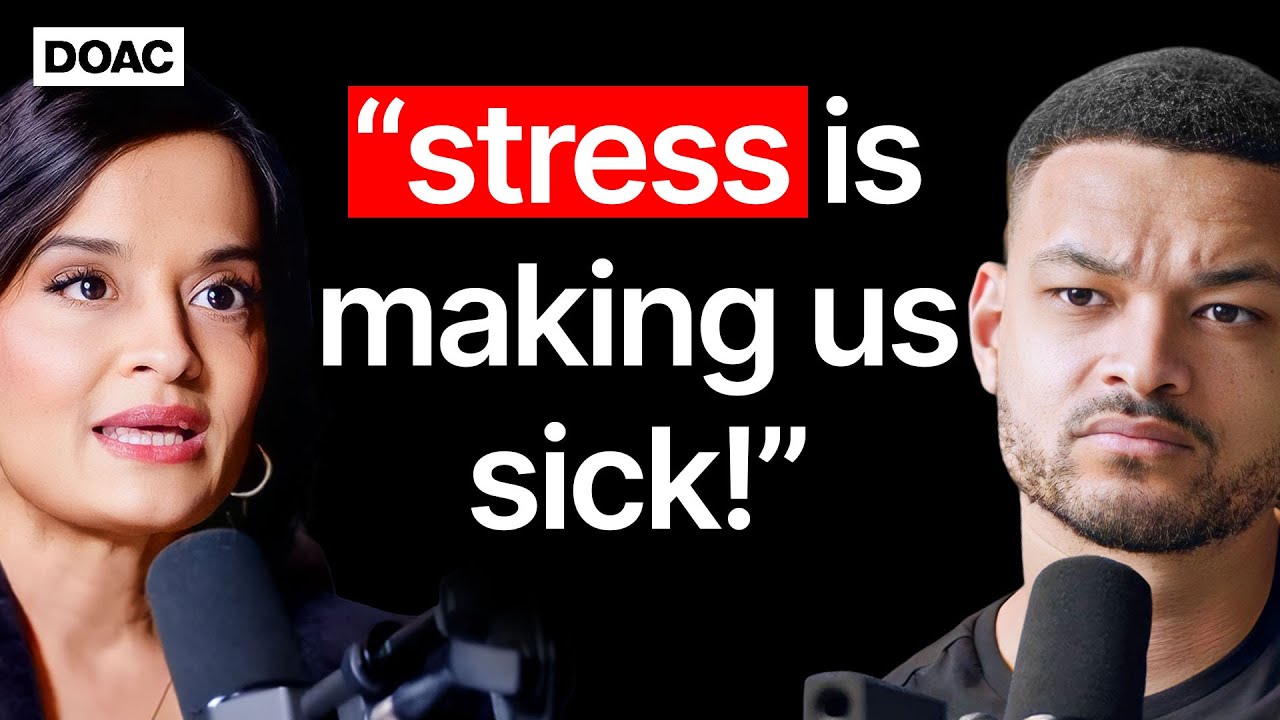
This video was published on YouTube by the channel The Diary Of A CEO on January 15, 2024. According to the page description, host Steven Bartlett interviews physician and stress expert Dr. Aditi Nerurkar to discuss actionable ways to reduce stress and build resilience based on her book, 'The 5 Resets: Rewire Your Brain and Body for Less Stress and More Resilience'.
## TL;DR
Dr. Aditi Nerurkar breaks down the neurobiology of stress and burnout, detailing how chronic modern pressure shifts control from the logical prefrontal cortex to the survival-driven amygdala. She addresses issues like atypical burnout, work addiction, digital overstimulation, and screen reliance, emphasizing that stress itself is adaptive when kept within healthy limits. Through evidence-based practices—such as setting M.O.S.T. goals, limiting lifestyle changes to two at a time, practicing diaphragmatic breathing, and writing expressively—she presents a practical blueprint to re-establish biological resilience.
## Atmosphere & style
The interview feels deeply empathetic, grounded, and insightful, blending rigorous neuroscience with personal vulnerable reflections. Host Steven Bartlett and Dr. Aditi Nerurkar share an authentic connection that makes complex medical concepts feel comforting rather than clinical. The overarching emotional arc moves from validating the overwhelming reality of modern stress to offering a reassuring, actionable path toward balance and healing.
## Key takeaways
- [00:00](https://www.youtube.com/watch?v=FN0_ow76hU8&t=0s) The world is experiencing a global stress epidemic, with 70% of people showing burnout features and 60-80% of primary care visits linked to stress.
- [03:00](https://www.youtube.com/watch?v=FN0_ow76hU8&t=180s) A delayed stress reaction often occurs after an acute crisis ends, causing psychological defenses to drop and releasing suppressed emotions and fatigue.
- [07:00](https://www.youtube.com/watch?v=FN0_ow76hU8&t=420s) Stress triggers a neurobiological shift from the prefrontal cortex (executive function) to the amygdala (fight-or-flight), creating a continuous stress loop when modern intangible threats persist.
- [10:18](https://www.youtube.com/watch?v=FN0_ow76hU8&t=618s) Atypical burnout manifests as obsessive work engagement and an inability to disconnect rather than typical apathy or exhaustion.
- [16:31](https://www.youtube.com/watch?v=FN0_ow76hU8&t=991s) True biological resilience involves rest, boundary setting, and self-compassion, contrasting sharply with toxic resilience that demands productivity at all costs.
- [22:46](https://www.youtube.com/watch?v=FN0_ow76hU8&t=1366s) Every individual has a physical early-warning system (a 'canary in the coal mine')—such as headaches, palpitations, or GI issues—signaling elevated stress before full burnout occurs.
- [29:45](https://www.youtube.com/watch?v=FN0_ow76hU8&t=1785s) The HPA axis drives the body's stress response by releasing cortisol and adrenaline, which remain elevated when chronic stress leaves the amygdala hyperactive.
- [43:06](https://www.youtube.com/watch?v=FN0_ow76hU8&t=2586s) The 'Resilience Rule of Two' limits lifestyle changes to a maximum of two small goals for eight weeks to match the neural timeframe required for habit formation.
- [48:24](https://www.youtube.com/watch?v=FN0_ow76hU8&t=2904s) Resetting stress requires moving from self-blame to identifying core values and setting M.O.S.T. (Motivating, Objective, Small, Timely) goals.
- [58:01](https://www.youtube.com/watch?v=FN0_ow76hU8&t=3481s) Constant digital overstimulation causes 'popcorn brain,' where rapid media consumption overstimulates threat-scanning mechanisms.
- [01:03:34](https://www.youtube.com/watch?v=FN0_ow76hU8&t=3814s) Stress-induced emotional eating and scrolling stem from the same primitive survival loops driven by the amygdala's demand for high-calorie survival energy.
- [01:10:26](https://www.youtube.com/watch?v=FN0_ow76hU8&t=4226s) Adaptive stress follows a Goldilocks principle where moderate stress optimizes performance, while micro-breaks throughout the day reduce cumulative stress.
- [01:18:42](https://www.youtube.com/watch?v=FN0_ow76hU8&t=4722s) The gut-brain axis and the psychobiome play a significant role in mental health, with the gut containing 3 to 5 times more serotonin receptors than the brain.
- [01:25:55](https://www.youtube.com/watch?v=FN0_ow76hU8&t=5155s) Only 2% of the population can true multitask; the other 98% engage in rapid task-switching, which degrades prefrontal cortex function.
- [01:29:35](https://www.youtube.com/watch?v=FN0_ow76hU8&t=5375s) Diaphragmatic breathing and quick mental pauses directly stimulate the parasympathetic nervous system to switch off fight-or-flight arousal.
- [01:35:40](https://www.youtube.com/watch?v=FN0_ow76hU8&t=5740s) James Pennebaker's expressive writing protocol (20-25 minutes over 4 days) helps shift emotional processing from the amygdala to the prefrontal cortex.
- [01:45:00](https://www.youtube.com/watch?v=FN0_ow76hU8&t=6300s) Consuming graphic news feeds causes indirect trauma and significantly increases mental health risks compared to reading written news.
- [01:50:21](https://www.youtube.com/watch?v=FN0_ow76hU8&t=6621s) Chronic loneliness affects 330 million people worldwide and carries health risks equivalent to smoking 15 cigarettes a day.
## Detailed walkthrough
### [00:00](https://www.youtube.com/watch?v=FN0_ow76hU8&t=0s) The Modern Crisis of Stress and Burnout
The episode opens with stark statistics highlighting a pervasive mental health crisis: 72% of people report struggling with stress, and 70% display at least one feature of burnout. Introducing Dr. Aditi Nerurkar—a Harvard physician, integrative medicine clinician, and nationally recognized stress expert—the conversation frames modern burnout not merely as an individual struggle, but as an unprecedented global issue affecting people across all industries, ages, and backgrounds.
Before diving into the core discussion, host Steven Bartlett shares a brief, candid meta-moment regarding the show's YouTube analytics. Pointing out that 69.9% of frequent viewers remain unsubscribed, he makes a direct pact with his audience, promising to continually elevate the show’s production quality, guest list, and overall content in return for a simple click on the subscribe button.
- **72%** of people report active struggles with stress.
- **70%** of individuals exhibit at least one signature feature of burnout.
- **69.9%** of regular *The Diary Of A CEO* YouTube viewers are not subscribed.
[02:22](https://www.youtube.com/watch?v=FN0_ow76hU8&t=142s) Dr. Aditi's Origin Story: Becoming the Doctor She Needed
When asked about the catalyst behind her career, Dr. Aditi shares a deeply personal origin story. Her journey into stress research began during her medical residency, where she was working demanding 80-hour workweeks. Experiencing late-night heart palpitations and severe physiological stress, she sought medical advice, only to find that doctors could offer little beyond vague suggestions like "try to relax."
Realizing there was a distinct gap in clinical care for stress management, she set out to uncover evidence-based solutions grounded in neurobiology. She transformed her personal struggle into her professional calling, declaring, "I became the doctor I needed at a time when I was in my own stress struggle."
[03:00](https://www.youtube.com/watch?v=FN0_ow76hU8&t=180s) The Global Stress Epidemic and the "Delayed Stress Reaction"
Addressing the current global climate, Dr. Aditi explains that stress has reached unprecedented levels, serving as "the great equalizer" across all sectors of society. While mental health and burnout were historically treated as taboo topics in corporate C-suites, recent years have forced these conversations into the mainstream. Studies indicate that 60% to 80% of all patient visits to primary care doctors now involve a stress-related component, and nearly three-quarters of workers report that the past few years have been the most stressful of their professional careers.
Dr. Aditi introduces the clinical concept of the **delayed stress reaction** to explain why so many people feel exhausted rather than relieved in post-crisis periods. She likens the human brain under acute stress to a dam or a fortress. During an ongoing crisis—whether a grueling medical residency, a cancer treatment, or a global pandemic—people shore up their psychological defenses and keep it together at all costs. Once the threat subsides and a moment of respite occurs, those internal defenses drop, triggering an emotional deluge of anxiety, fatigue, and depression.
> "The reason we are all feeling very much not the roaring '20s is because our brains are built like dams... when we have that moment of respite, when that acute stressor is over, then our psychological defenses come down and our true emotions can emerge, and it's often a deluge."
- **60% to 80%** of routine physician visits feature a primary or secondary stress-related component.
- **Delayed Stress Reaction:** A phenomenon where psychological collapse or emotional breakdown occurs after an acute crisis ends, rather than during the event itself.
[07:00](https://www.youtube.com/watch?v=FN0_ow76hU8&t=420s) How Stress Rewires the Brain: Prefrontal Cortex vs. Amygdala
To understand stress biologically, Dr. Aditi distinguishes between how the brain functions under normal conditions versus under acute or chronic threat. During baseline resilience, humans are governed by the **prefrontal cortex**—located directly behind the forehead—which controls higher-level executive functions such as strategic planning, organization, memory, and logical decision-making (what she colloquially terms "adulting"). When Steven jokes about the physical size of his own head, Dr. Aditi playfully affirms his strong executive skill set.
Under stress, however, control shifts away from the prefrontal cortex to the **amygdala**, an almond-shaped structure deep within the limbic system often referred to as the "reptilian brain." The amygdala initiates the primitive fight-or-flight response, redirecting physiological resources:
* Heart rate and breathing accelerate to boost oxygen delivery.
* Blood is shunted away from internal organs toward skeletal muscles.
* Pupils dilate to enhance visual awareness.
While this system evolved to survive acute physical threats (such as escaping a predator in the wild), modern human threats are chronic and intangible—ranging from unpaid bills and job insecurity to relationship friction. Because these contemporary "tigers" never truly disappear, the body maintains a constant, low-grade hum of fight-or-flight activation, preventing the brain from recharging and eventually causing chronic stress to turn into burnout.
[10:18](https://www.youtube.com/watch?v=FN0_ow76hU8&t=618s) Atypical Burnout and the Trap of Work Addiction
While the World Health Organization officially recognized burnout as an occupational phenomenon in 2019—typically characterized by apathy, lethargy, and a loss of productivity—Dr. Aditi highlights a shift toward **atypical burnout**. Rather than stepping back or feeling unmotivated, individuals experiencing atypical burnout often display an obsessive hyper-engagement with their work.
In a landmark study on modern work habits, **60% of burned-out individuals** cited an inability to disconnect from work as their primary symptom. These individuals may check their smartphones thousands of times a day or log into work emails late into the night, convincing themselves that their compulsion is merely a passion for their career. Dr. Aditi warns that this hyper-vigilant inability to unplug is a deceptive manifestation of chronic nervous system strain.
> "You could be that person who is engaged in work and can't shut off, and you're thinking to yourself, 'This can't be burnout... In fact, I can't shut off my brain.' You might be experiencing atypical burnout."
- **Atypical Burnout:** A form of burnout marked by work addiction, hyper-vigilance, and an inability to unplug, rather than classic symptoms like apathy or lethargy.
- **2,600+ times:** The average number of times a person touches or checks their smartphone per day in high-usage studies.
[13:56](https://www.youtube.com/watch?v=FN0_ow76hU8&t=836s) Parental Burnout and the Long-Term Cost of Overwork
The conversation turns to specific demographics, highlighting that burnout extends far beyond corporate environments into domestic life. Research reveals that two-thirds (66%) of parents report experiencing parental burnout, a number Dr. Aditi suspects is significantly underestimated due to social stigma and shame surrounding parental admission of exhaustion.
Steven poses a challenge regarding ambitious entrepreneurs or high-performers who love their intense routine and see no immediate reason to change. Dr. Aditi framing it through her experience treating young founders in Boston, asks: *"What's your end game?"* She notes that while high intensity can be sustained during a brief sprint, chronic workism without rest is fundamentally incompatible with longevity, physical health, and meaningful relationships. Steven concurs, emphasizing that while high intensity works in short bursts, zooming out over a 10-year horizon reveals that an unmanaged lifestyle inevitably leads to broken health or strained personal connections.
- **66% (2/3)** of parents fulfill the criteria for parental burnout.
- High-intensity work habits without recovery represent an unsustainable short-term strategy that degrades long-term health, lifespan, and interpersonal relationships.
[16:31](https://www.youtube.com/watch?v=FN0_ow76hU8&t=991s) Toxic Resilience vs. True Biological Resilience
The discussion explores the modern obsession with pushing through fatigue, exemplified by popular culture slogans like "keep calm and carry on." While society praises people for toughing it out, the human brain and body biologically require dedicated rest for cellular maintenance. True biological resilience is defined as our innate biological ability to adapt, recover, and grow in the face of life's challenges. However, resilience cannot exist in a vacuum; it requires stress to reveal itself. Dr. Aditi Nerurkar uses the metaphor of a swim instructor representing stress—prompting you to reach the other side—while your resilience is what keeps your head above water as your arms flail until practice makes the movement smoother.
The modern paradigm has warped this concept into "toxic resilience," born out of hustle culture and accelerated by workplace expectations during and after the pandemic. Corporations often weaponize the word, telling employees who are managing remote work and childcare simultaneously, "You're resilient, take on another project." True resilience honors boundaries, creates space for rest and self-compassion, and accepts human limitations. Toxic resilience, by contrast, demands productivity at all costs and promotes a "mind-over-matter" mindset that rejects discomfort as weakness.
- **Scientific Definition of Resilience:** The innate biological ability to adapt, recover, and grow when facing life's challenges.
- **True Resilience Principles:** Setting boundaries, making time to rest and recharge, practicing self-compassion, and accepting physical/mental limits.
- **Toxic Resilience Characteristics:** Unchecked productivity at all costs, "mind-over-matter" fallacies, and glorified overwork without recovery.
---
[20:11](https://www.youtube.com/watch?v=FN0_ow76hU8&t=1211s) Debunking the Generational Resilience Myth
When addressing whether older generations are inherently more resilient than younger generations like Gen Z or Generation Alpha, Dr. Nerurkar firmly rejects the common stereotype. The traditional argument claims that Boomers—having worked in factories or mines without the constant digital comparison of social media—were tougher, whereas younger generations are perceived as fragile despite spending hours on self-care, breathwork, or yoga.
Instead of a lack of resilience, younger populations are experiencing unprecedented spikes in anxiety, depression, burnout, and sleep disorders because they live in an overstimulated, hyperconnected world. They have endured collective traumas early in life without decades of lived experience to process them. Dr. Nerurkar recalls her own medical residency, where older doctors minimized her strain by boasting about working 120-hour weeks compared to her reformed 80-hour workweek cap—which still felt exhausting. Rather than playing comparison games, it is vital to validate people's struggles using the principle "name it to tame it."
- **Generational Stereotype:** Boomers claim superior resilience due to manual labor and lack of social media; Gen Z is stereotyped as overly sensitive.
- **Medical Training Example:** Older physicians bragged about 120-hour workweeks to dismiss the strain of the mandated 80-hour resident limit.
- **Root Cause for Gen Z:** High rates of stress and mental health conditions stem from constant hyperconnectivity and collective trauma, not personal weakness.
---
[22:46](https://www.youtube.com/watch?v=FN0_ow76hU8&t=1366s) Identifying Your "Canary in the Coal Mine" Stress Signals
Dr. Nerurkar introduces the core concept of her book, *The 5 Resets: Rewire Your Brain and Body for Less Stress and More Resilience* (published January 2024). A foundational element of managing stress is identifying one's physical "canary in the coal mine." Historically, coal miners carried a caged canary into the mines; because the bird was sensitive to bad air, it would stop singing long before human workers noticed toxic gases, serving as an early warning system to evacuate.
In human physiology, stress manifests uniquely across individuals—ranging from headaches, back pain, and gastrointestinal issues to fatigue, anger, or heart palpitations. Dr. Nerurkar's personal canary symptom was experiencing heart palpitations every night for two weeks. Steven Bartlett shares his own physical tells: getting a distinct spot on his tongue, skin breakouts on his face, and catching a cold roughly once every six months. Because stress is often a "diagnosis of exclusion" in medicine—where organic diseases are ruled out first—recognizing your body's personal stress "song" allows you to intervene before reaching severe burnout.
> "The canary in the coal mine is this idea that we all have a song, a stress song, and our body is trying to tell us something."
- **Historical Metaphor:** Miners relied on the canary's silence to signal dangerous air quality before physical symptoms hit the workers.
- **Common Stress Manifestations:** Palpitations, tension headaches, GI distress, skin breakouts, tongue ulcers, fatigue, and lower immunity.
- **Medical Context:** Stress is frequently a diagnosis of exclusion, requiring a full medical workup to rule out structural or organic diseases first.
---
[27:13](https://www.youtube.com/watch?v=FN0_ow76hU8&t=1633s) Overcoming Pride and Understanding the Mind-Body Connection
Steven Bartlett reflects candidly on his time as a CEO in his early twenties, leading hundreds of employees. For years, he assumed he was immune to stress, viewing mental health challenges as something that only happened to other people. Driven by pride, ego, and societal expectations around male leadership and strength, he resisted acknowledging his strain, fearing that admitting to stress or burnout would signal personal inadequacy or weakness.
Dr. Nerurkar reframes physical stress responses not as evidence of being broken or inadequate, but as fundamental proof of being human. The mind-body connection operates continuously in the background like gravity; once a person learns to observe it, they cannot unsee it. Overcoming the myth that resilient people never get burned out is a crucial step toward proactive health.
- **CEO Experience:** Leading large teams at ages 23–27 created a mindset of invulnerability that eventually caught up with physical health.
- **Ego & Stigma:** Leaders often hide stress due to toxic associations between unyielding endurance and executive capability.
- **Mind-Body Realization:** Stress responses are normal physiological indicators rather than marks of personal flaw or failure.
---
[29:45](https://www.youtube.com/watch?v=FN0_ow76hU8&t=1785s) The Biological Highway of Stress: The HPA Axis
Explaining the internal mechanics of stress, Dr. Nerurkar outlines the main biological highway connecting the brain and body: the HPA axis. Standing for the **Hypothalamus**, **Pituitary gland**, and **Adrenal glands**, this pathway governs the body's acute stress response, triggering fight-or-flight reactions, accelerating heart rate, and releasing cascades of hormones.
```
+-------------------------------------------------------+
| BRAIN |
| [ Hypothalamus ] -------> [ Pituitary Gland ] |
+-------------------------------------------------------+
|
v (Hormonal Signals)
+-------------------------------------------------------+
| BODY |
| [ Adrenal Glands ] |
| (Above the Kidneys) |
+-------------------------------------------------------+
|
v
Release of Cortisol & Adrenaline
```
During acute stress, hormones like cortisol, adrenaline, and noradrenaline flood the bloodstream to prepare the organism to handle immediate pressure. The amygdala plays a major role in coordinating this activation. However, under chronic stress, the amygdala fails to shut off, leaving the HPA axis continuously active and flooding the body with elevated cortisol levels over extended periods, which leads to physical and mental strain. When asked whether stress is contagious in workplace environments like a physical virus, Dr. Nerurkar notes that while stress does not spread via biological microbes, it spreads through environmental and interpersonal dynamics.
- **HPA Axis Components:**
- **H:** Hypothalamus (Brain)
- **P:** Pituitary Gland (Brain)
- **A:** Adrenal Glands (Located above the kidneys)
- **Key Hormones:** Cortisol, adrenaline, and noradrenaline.
- **Chronic Stress Mechanism:** The amygdala remains hyperactive, preventing the HPA axis from turning off and causing long-term hormone elevation.
[32:39](https://www.youtube.com/watch?v=FN0_ow76hU8&t=1959s) The "Vibe" of Contagious Emotion and Therapeutic Presence
Dr. Aditi Nerurkar and Steven Bartlett discuss how emotions, rather than physical viruses, are contagious between people. Bartlett brings up pheromones, though Dr. Nerurkar clarifies that pheromones primarily govern attraction, sexuality, and mating behavior rather than general emotional contagion. She touches on a popular idea that the human heart possesses an electromagnetic field extending roughly 15 feet. While acknowledging this is more of a fascinating mental exercise or lived-experience concept than a rigorously proven scientific fact, she uses it to illustrate how people sense an energy or "vibe" when entering a room.
This concept leads directly into what medicine terms the "therapeutic presence" or "therapeutic encounter." Dr. Nerurkar explains that when a doctor projects a genuine therapeutic presence, it builds a powerful sense of healing. She emphasizes that healing and curing are distinctly different: curing addresses the physical disease, whereas healing addresses the person's overall sense of well-being and security. Studies show that when patients experience a strong therapeutic encounter, concrete medical outcomes improve dramatically.
- **Clinical Impact of Therapeutic Presence:** Fosters higher medication adherence, tighter glucose control in diabetic patients, and fewer asthma flares.
- **Key Distinctions:** Pheromones drive mating and attraction behavior rather than emotional atmosphere; healing deals with well-being, while curing addresses pathology.
---
[36:07](https://www.youtube.com/watch?v=FN0_ow76hU8&t=2167s) Non-Verbal Cues: Eye Level, Mirroring, and the Primal Power of Voice
When Bartlett asks how someone can cultivate a therapeutic presence, Dr. Nerurkar highlights that spend duration matters far less than body language. A landmark finding shows that a physician who sits down for seven minutes to speak with a patient at eye level (or slightly lower) is perceived as far more caring, engaged, and present than a physician who remains standing for the exact same seven minutes. This removes the intimidating power dynamic—a principle that applies equally when speaking to children or comforting a loved one in a hospital bed. Bartlett relates this to video production on *The Diary Of A CEO*, noting that maintaining camera angles directly on the guest's eye line yields measurably higher viewer engagement across thousands of videos.
```
+-----------------------------------------------------------------------+
| CULTIVATING THERAPEUTIC PRESENCE |
+------------------------------------+----------------------------------+
| Action | Psychological Effect |
+------------------------------------+----------------------------------+
| Sit at or below eye level | Equalizes power dynamics |
| Mirror subtle body language | Builds rapport & alignment |
| Maintain authentic voice tone | Bypasses "BS detector" |
+------------------------------------+----------------------------------+
```
The conversation transitions into the evolutionary role of the human voice. Voice is one of our earliest primal connections, formed pre-verbally in infancy through our caregivers. Because of this deep neural wiring, people possess an innate "BS meter" for vocal authenticity. Audio-based mediums like podcasts create an intense sense of intimacy because listeners intuitively sense whether a speaker is being vulnerable and authentic.
- **Eye-Level Dynamics:** Sitting at or below eye level eliminates hierarchy, making the listener feel safe and heard without changing the actual duration of the meeting.
- **Vocal Authenticity:** The human brain evaluates vocal tone intuitively, making it difficult to fake genuine emotion or empathy over audio.
- **Pheromones and Olfaction:** Mention of classic studies where participants found the scent of t-shirts worn by genetically distinct individuals more attractive, aiding natural mate selection.
---
[43:06](https://www.youtube.com/watch?v=FN0_ow76hU8&t=2586s) The Resilience "Rule of Two" and the Holmes-Rahe Stress Scale
Dr. Nerurkar introduces the **Resilience Rule of Two**, a foundational framework from her work on how the human brain processes lifestyle changes. She shares an anecdote about a patient who arrived at her office with a thick binder full of health protocols. After trying to overhaul his entire lifestyle for a month using a "everything but the kitchen sink" approach, he hit a wall of burnout and abandoned every single habit. Dr. Nerurkar explains that even positive habits—like eating better, sleeping more, and exercising simultaneously—are interpreted by the brain as novel stressors requiring psychological adaptation.
```
THE PATHWAY OF SUSTAINABLE CHANGE
[ Pick 2 Changes ] ---> [ Practice for 8 Weeks ] ---> [ Habit Formed ]
^ |
| v
+------------------ Add 2 New Changes <------------------+
```
The scientific backbone of this rule originates from the seminal 1960s study by psychiatrists Thomas Holmes and Richard Rahe. They evaluated 5,000 individuals across 43 common life events—ranging from negative events like divorce or the death of a loved one to positive events like graduation, buying a home, or receiving a promotion. Each event carried a specific stress point value. Holmes and Rahe discovered that accruing too many life events in a short window drastically increased a person's risk of developing physical illness, proving that any major change requires adaptive energy from the brain.
<Sequence>
{/* Reason: Demonstrates the step-by-step application of the Resilience Rule of Two for habit formation. */}
<Step subtitle="Select a maximum of two specific goals" title="Identify Priority Changes">
Choose two manageable lifestyle or medical targets (e.g., stopping smoking and lowering cholesterol).
</Step>
<Step subtitle="Allow neural pathways to solidify" title="Integrate for 8 Weeks">
Consistently practice only these two habits for eight consecutive weeks until they become automatic.
</Step>
<Step subtitle="Expand lifestyle changes incrementally" title="Layer Additional Goals">
Once the initial two habits are firmly established, select two new changes to integrate over the next eight-week block.
</Step>
</Sequence>
- **The Holmes and Rahe Stress Scale (1960s):** Studied 5,000 subjects across 43 life events to establish that all significant changes—positive or negative—accumulate as physiological stress.
- **Delayed Stress Response:** Dr. Nerurkar shares her personal experience moving into a new home, where initial adrenaline masked the stress until a delayed burnout hit three months later.
- **Clinical Habit Formation Window:** It takes approximately 8 weeks of focused effort for a new behavior to solidify into an automated neural habit.
---
<ElicitationsGroup message="Explore related stress management topics:">
<Elicitation label="Learn about the remaining 5 Resets for stress" query="What are the 5 Resets for managing stress mentioned by Dr. Aditi Nerurkar?"/>
<Elicitation label="Explore how physical exercise reduces stress hormones" query="How does exercise manage to reduce stress according to Dr. Aditi Nerurkar?"/>
</ElicitationsGroup>
[48:24](https://www.youtube.com/watch?v=FN0_ow76hU8&t=2904s) The First Reset: Getting Clear on What Matters Most
When a person experiences chronic stress, they are living in survival mode governed almost entirely by the amygdala. This primitive region of the brain prioritizes immediate self-preservation above all else. In contrast, the prefrontal cortex—located directly behind the forehead—is responsible for executive functions like forward planning, organization, and higher-level problem solving. When someone in deep stress or fight-or-flight mode is told to "just figure it out" or practice "mind over matter," it fails because it is biologically impossible to think five or ten steps ahead when the amygdala is running the show.
```
┌─────────────────────────────────────────┐
│ CHRONIC STRESS STATE │
└────────────────────┬────────────────────┘
│
┌──────────────────┴──────────────────┐
▼ ▼
┌──────────────────────┐ ┌──────────────────────┐
│ AMYGDALA ACTIVE │ │ PREFRONTAL CORTEX │
│ (Survival / Hazard) │ │ (Planning / Future) │
└───────────┬──────────┘ └───────────┬──────────┘
│ │
▼ ▼
• Immediate focus • Suppressed function
• Scanning for danger • Hard to plan ahead
• "What's the matter?" • Roadmaps blocked
```
To break this loop, the first reset outlined in *The 5 Resets* focuses on getting clear on what matters most. Instead of dwelling on self-criticism ("What is the matter with me?"), the framework directs attention outward to establish a personal "why" or North Star. By using structured, science-backed strategies to identify what truly matters, an individual can systematically reduce amygdala reactivity and reactivate the prefrontal cortex to map out a path forward.
- **The Amygdala's Role:** Focuses strictly on the immediate present and survival during acute or chronic stress.
- **The Prefrontal Cortex's Role:** Governs organization, future planning, and long-term goal setting.
- **Mindset Shift:** Moves from internal fault-finding ("What's the matter with me?") to value-based purpose ("What matters to me most?").
To create a concrete roadmap out of stress, Dr. Aditi Nerurkar emphasizes measuring stress rather than treating it as a vague, subjective state. Just as clinicians monitor blood pressure with precise numbers to judge whether an intervention works, stress management requires clear metrics. Patients evaluate their baseline using a clinical stress score assessment before establishing targeted goals using the **M.O.S.T.** acronym:
* **M — Motivating:** The goal provides a meaningful reason to look forward to the future.
* **O — Objective:** Progress can be easily monitored and measured.
* **S — Small:** The goal is scaled down sufficiently to guarantee early success.
* **T — Timely:** The objective is time-sensitive and achievable within a 3-month window.
Examples of M.O.S.T. goals include a grandparent aiming to teach their grandchild how to throw a baseball, or an individual recovering from joint pain wanting to walk a specific number of blocks comfortably by summer. These goals shift focus away from current suffering and provide tangible goalposts. Celebrating small victories—such as moving from walking zero blocks to five blocks—builds self-efficacy and quietens internal self-doubt.
- **Objective Progress Tracking:** Replaces simple "yes/no" checks with quantifiable milestones.
- **Building Self-Efficacy:** Achieving small, incremental goals proves capability to oneself and silences the inner critic.
[54:06](https://www.youtube.com/watch?v=FN0_ow76hU8&t=3246s) Exercise and Movement for Stress Reduction
A common misconception about exercise is that managing stress requires intense, time-consuming workouts. In reality, even minimal physical activity can deliver significant mental health benefits by shifting focus out of head-space and back into the body. Simple adjustments incorporated into daily routines—such as parking farther away, taking the stairs, or going for a brief 20-minute walk—help establish consistency without triggering overwhelm.
Dr. Nerurkar shares a personal experience from her time as a medical resident in Boston. Extremely stressed, she walked into her apartment building's state-of-the-art gym, saw the bright mirrors, complex equipment, and loud techno music, and immediately turned around and walked out. Instead, she started simply by taking a 5-to-10-minute walk outside on a pleasant day. Gradually scaling up to a daily 20-minute walk provided a low-effort habit that significantly improved her resilience.
While prolonged sitting is well known for its physical risks ("sitting is the new smoking"), research shows that sedentary behavior also directly increases anxiety. Movement serves as an effective antidote to this physical and mental stagnation.
- **Daily Movement Target:** A 20-minute walk provides foundational health and stress-relief benefits.
- **Overcoming the Gym Barrier:** High-intensity environments can act as a deterrent for sedentary individuals; simple walking offers a low-friction starting point.
- **Sedentary Risk:** Physical stillness directly correlates with heightened anxiety markers.
[58:01](https://www.youtube.com/watch?v=FN0_ow76hU8&t=3481s) "Popcorn Brain" and Modern Media Overstimulation
"Popcorn brain" is a biological phenomenon—a term coined by psychologist Dr. David Levy—describing brain circuitry that feels as though it is popping due to constant digital overstimulation. Driven by non-stop information streams online, it creates an intense challenge to disengage and live in the slower-paced physical world. Unlike *Internet Addiction Disorder* (a diagnostic condition that severe disrupts daily functioning), popcorn brain is a widespread affliction typical of modern daily life.
```
========================================================================
POPCORN BRAIN vs. INTERNET ADDICTION DISORDER
========================================================================
FEATURE POPCORN BRAIN INTERNET ADDICTION
------------------------------------------------------------------------
Prevalence Ubiquitous / Universal Clinical Diagnostic
Primary Cause Constant stream / Compulsive /
Overstimulation Impaired control
Impact on Functioning Distracted, fast-paced Severe disruption to
mental state daily obligations
Biological Trigger Primal threat-scanning Addiction pathway
(Amygdala) activation
========================================================================
```
From an evolutionary perspective, human tribes once relied on a designated night watchperson to sit by the fire and scan the dark for danger. Under stress, the hyperactive amygdala triggers that same primal threat-scanning urge. Lacking physical predators to watch for, people turn to their smartphones, continuously scrolling through news feeds and social media to scan for potential threats or bad news.
```
[ Ancient Danger Scanning ] [ Modern Danger Scanning ]
┌───────────────────────────┐ ┌───────────────────────────┐
│ Night watchperson sits │ │ Stressed individual │
│ by tribe's campfire. │ │ holds smartphone. │
│ │ ───────► │ │
│ Scans darkness for │ │ Scrolls endless feeds │
│ predators / physical │ │ for bad news / climate │
│ threats. │ │ crises / conflicts. │
└───────────────────────────┘ └───────────────────────────┘
```
Rather than attempting total digital abstinence—which research shows does not improve mental well-being—the key is to establish firm digital boundaries and reconsider one's relationship with technology.
- **Average Screen Check Frequency:** People look at their phones an average of 2,617 times per day.
- **Morning and Night Habits:** 62% of people check their phones within 15 minutes of waking up, and roughly 50% check them in the middle of the night.
- **Primal Drive:** Infinite scrolling is driven by the amygdala's instinctual urge to scan for hazards during stressful periods.
[01:03:34](https://www.youtube.com/watch?v=FN0_ow76hU8&t=3814s) The Connection Between Stress and Emotional Eating
When work demands increase or life stressors intensify, dietary habits often deteriorate rapidly. Steven Bartlett notes that during difficult times, his diet invariably slips, leading to persistent cycles of poor eating choices. Dr. Nerurkar explains that this tendency toward emotional eating is another direct consequence of the amygdala taking control during stress.
When the body enters survival mode, the amygdala seeks quick energy sources to prepare for perceived threats, sparking strong cravings for high-calorie, quick-dopamine foods. Recognizing that emotional eating and phone checking both stem from primitive survival loops helps shift the focus away from personal guilt toward intentional lifestyle resets.
- **Survival-Driven Cravings:** The stressed brain seeks rapid, high-density energy to cope with perceived threats.
- **Behavioral Patterns:** Stress triggers predictable feedback loops involving comfort eating and phone scrolling to feel safe.
[01:04:35](https://www.youtube.com/watch?v=FN0_ow76hU8&t=3875s) Emotional Eating, Biological Cravings, and the Mind-Body Connection
Dr. Aditi Nerurkar explains that when under severe stress, the amygdala—the evolutionary "reptilian" part of the brain focused purely on survival—operates under the principle that calories equal survival. It does not distinguish between an ancient famine and modern workplace pressure or unpaid bills. As a result, emotional or stress-induced eating triggers intense cravings for high-fat and high-sugar foods. Rather than letting the inner critic take over, Dr. Nerurkar advises self-compassion. She reveals her personal stress food is tortilla chips, while host Steven Bartlett confesses that his ultimate weakness is carrot cake and sweet treats.
Steven reflects on his own cycle: while he manages a clean diet most of the time, he experiences periodic lapses every three to four months where he feels completely out of control. He describes this using a vivid analogy: normally he is in the driver’s seat holding the steering wheel, but occasionally he finds himself thrown into the backseat of a car flying down the motorway on autopilot with windows down and debris flying everywhere, struggling frantically to grab the wheel with one hand. Dr. Nerurkar reassures him that being human means experiencing these ebbs and flows. She notes that Steven's ability to regain control within a week or two stems from built-up practice and "agency," whereas less experienced individuals take much longer to recover.
Closing the gap between knowledge and action requires understanding that building a habit takes roughly eight weeks, and falling off the wagon is a natural part of the process. Rather than relying on willpower, Dr. Nerurkar emphasizes that taking action relies on starting extraordinarily small—often so small that it feels trivial or humiliating.
* **Biological Craving Drivers:** The amygdala seeks dense energy (high fat and high sugar) during perceived survival threats.
* **The "Small" Action Strategy:** Attempting an hour-long gym session while stressed causes the prefrontal cortex and amygdala to fight, creating a feeling of "wading through molasses"; starting with a 2-minute or 5-minute walk bypasses this resistance.
* **The Mental Health Promise of Exercise:** Dr. Nerurkar highlights that long-term exercise habits are rarely sustained by aesthetic goals (such as taut bellies or muscular physiques); rather, mental health benefits drive consistency. Even without weight loss, short walks significantly improve metabolic and cardiovascular health.
> "When you do better, you feel better, but it's all in the doing and getting yourself into that moment of action when you have the information, but you need to act. It's all about keeping it smaller than you think it is."
---
[01:10:26](https://www.youtube.com/watch?v=FN0_ow76hU8&t=4226s) The Goldilocks Principle of Stress and The Power of Micro-Breaks
Addressing workplace burnout, Dr. Nerurkar introduces the **Goldilocks Principle** of human productivity. Productivity does not operate on a linear trajectory; instead, it follows a bell-shaped curve where productivity is plotted against stress:
* **Left side of the curve:** Low stress, resulting in boredom, apathy, and low productivity.
* **Right side of the curve:** Excessive stress and anxiety, causing hyper-arousal and low productivity.
* **The Sweet Spot (Center):** "Just-right stress" (adaptive stress), where focus and performance peak.
Because extreme lifestyle overhauls—such as taking a month-long surfing trip to Bali, spending six months eating through Italy, or retreating to the Himalayas—are unrealistic due to financial and family constraints, managing stress relies on micro-practices. Citing research from Microsoft Labs, Dr. Nerurkar explains that taking brief breaks throughout the workday has a cumulative positive effect on mood, engagement, and stress management. Furthermore, stress itself is not the enemy; distinction must be made between **adaptive stress** (good stress that fuels new endeavors, friendships, and achievements) and **maladaptive stress** (unhealthy, chronic strain).
* **Adaptive vs. Maladaptive Stress:** Life requires stress to function; the objective is not a stress-free life, but transitioning from maladaptive back to adaptive stress.
* **Microsoft Brain Scan Study:** Microsoft researchers compared brain scans of individuals in back-to-back meetings against those who took short breaks. The break-taking group demonstrated significantly lower stress accumulation.
* **Neural Consolidation:** Pausing for as little as 10 seconds allows the brain to undergo neural consolidation—the neurological process where floating information is cemented into lasting knowledge.
Steven relates this directly to his own grueling schedule, describing his back-to-back calendar with zero-second buffers between meetings. He compares his internal state to a heating kettle filling up with steam; without breaks or "opening the lever," pressure continuously builds until exhaustion sets in.
> "Stress isn't the enemy. Our cultural perception of it is. There is good stress and bad stress... The goal of life is not to live a life without stress because that is biologically impossible. Our brains and our bodies need stress to survive."
Steven takes a short pause to highlight two show sponsors:
* **Whoop:** Steven shares why he uses Whoop over other wearables, citing its non-invasive design, behavioral analytics, and features like the Whoop Coach, journal, and weekly planner that foster long-term health habits. He directs listeners to `[join.whoop.com/ceo](https://join.whoop.com/ceo)` for a 30-day risk-free trial.
* **Huel:** As an investor and long-time user, Steven introduces the *Huel Steven Bundle*, which features the Black Edition Salted Caramel protein powder (17 servings), ready-to-drink meals, and the reformulated Huel Complete Nutrition Bars in chocolate caramel flavor.
---
[01:18:31](https://www.youtube.com/watch?v=FN0_ow76hU8&t=4711s) The Gut-Brain Connection
Returning to the conversation, Steven transitions into the topic of gut health, recalling how previous guests like Tim Spector introduced the foundational science behind the gut-brain axis and how the microbiome directly communicates with the brain to influence mood and stress resilience.
[01:18:42](https://www.youtube.com/watch?v=FN0_ow76hU8&t=4722s) The Psychobiome and the Gut-Brain Connection
Steven reflects on how drastically his perspective on the gut has shifted, admitting he used to think of it merely as a processing unit where food enters, chemicals break it down, and waste exits. Dr. Aditi Nerurkar confirms that the science connecting gut health to mental health is rapidly expanding. She introduces the concept of the "psychobiome"—a dedicated community of healthy microbes within the trillions residing in the gut whose sole evolutionary function is managing mood, anxiety, and overall mental well-being.
Dr. Nerurkar explains that while people often view bacteria as harmful pathogens, the human gut hosts trillions of beneficial micro-organisms that form a dynamic ecosystem. This microbiome regulates critical functions like blood glucose levels, but its impact on the brain is particularly striking. She highlights that three to five times more serotonin receptors exist in the gut than in the brain. Because serotonin (commonly targeted by SSRIs for treating depression and anxiety) is heavily centered in the digestive tract, the gut effectively operates as the body's "second brain." To optimize this gut-brain axis, she emphasizes maintaining a baseline of solid sleep, regular exercise, stress management, and a diet rich in prebiotic and probiotic foods.
* The microbiome is composed of trillions of healthy bacteria and micro-organisms managing digestion, blood sugar, and neural signals.
* The "psychobiome" refers specifically to gut bacteria whose primary purpose is to regulate mood and mental health.
* There are 3 to 5 times more serotonin receptors in the human gut than in the brain.
* Core habits that reset the gut-brain connection include adequate sleep, exercise, stress reduction, and eating prebiotic and probiotic foods.
---
[01:22:22](https://www.youtube.com/watch?v=FN0_ow76hU8&t=4942s) A 30-Day Plan to Maximize Stress and Anxiety
To illustrate how everyday habits impact mental health, Steven flips the narrative and asks how someone could intentionally make themselves as stressed, anxious, and depressed as possible. Dr. Nerurkar plays along with this thought experiment, laying out a satirical "30-day plan" that mirrors many modern lifestyle traps. She advises starting at midnight by turning phone brightness all the way up, doomscrolling through social media and news feeds, and watching graphic or disturbing videos until 4:00 or 5:00 a.m. Right around 6:00 a.m.—when the body naturally experiences its circadian cortisol spike to promote waking—one should immediately check their phone again and resume scrolling without getting out of bed.
The recipe for total burnout continues with severe physical restriction and sleep disruption. Dr. Nerurkar recommends staying completely sedentary, avoiding all natural sunlight, keeping a television blasting news media at full volume in the bedroom overnight, and isolating oneself entirely from human contact. On the dietary front, her sarcastic advice is to avoid water, drink heavily additives-laden beverages, skip all fruits and vegetables, and eat ultra-processed foods erratically at all hours of the night.
* **The Night Watchman Phenomenon:** Dr. Nerurkar notes that while younger generations doomscroll on smartphones, many elderly patients in their 60s and 70s fall into a similar trap by leaving news channels running on their bedroom TVs all night. Moving the television out of the bedroom is often her first clinical intervention.
* **Circadian Rhythm & Cortisol:** Cortisol naturally peaks around 6:00 a.m. to help the body wake up; pairing this natural spike with immediate smartphone stimulation amplifies panic and stress.
* **Erratic Meal Times:** The brain craves structure and predictability; erratic eating patterns prevent the body from exiting fight-or-flight mode.
---
[01:25:55](https://www.youtube.com/watch?v=FN0_ow76hU8&t=5155s) The Myth of Multitasking vs. Monotasking
Addressing a common workplace misconception, Steven mentions that he considers himself a multitasker. Dr. Nerurkar dismantles this notion, stating that while nearly 100% of people believe they excel at multitasking, neuroscientific research proves that only 2% of the population can actually process multiple cognitive tasks simultaneously. For the remaining 98%, "multitasking" is a scientific misnomer; the brain is simply "task-switching"—jumping rapidly between tasks, which degrades cognitive stamina.
Dr. Nerurkar warns that constant task-switching weakens the prefrontal cortex—the region responsible for complex problem solving, concentration, and emotional regulation. In a world full of systemic challenges, eroding our prefrontal cortex leaves us ill-equipped to perform high-level thinking. The direct antidote is "monotasking"—focusing intensely on a single task at a time. To implement monotasking, she recommends time-blocking methods like the Pomodoro Technique, which she used throughout medical school and when writing her book *The 5 Resets*.
* **The Pomodoro Technique:** Developed in the 1980s by an Italian researcher using a tomato-shaped kitchen timer (*pomodoro* is Italian for tomato), this method structures work into 20–25 minute focused sprints followed by 5-minute breaks.
* **Self-Efficacy Impact:** Multitasking lowers perceived self-efficacy because individuals leave tasks half-finished, whereas completing structured monotasking intervals restores a sense of agency and shifts people from feeling like "passengers" to feeling like "drivers" in their own lives.
---
[01:29:35](https://www.youtube.com/watch?v=FN0_ow76hU8&t=5375s) Diaphragmatic Breathing and "Stop, Breathe, Be"
Steven brings up the low-grade, persistent "humming" of angst that so many people live with on a daily basis. He asks for the most practical, science-backed breathing exercise anyone can adopt immediately to quiet this background anxiety. Dr. Nerurkar offers two primary practices, starting with **diaphragmatic breathing** (deep belly breathing). She explains that humans naturally breathe from the diaphragm as infants, but stress and adulthood condition people to become shallow chest-breathers.
To demonstrate, she guides Steven through placing a hand on his belly to ensure his abdomen expands on the inhale rather than lifting his chest. Breathing out slowly through pursed lips forces the body out of sympathetic dominance. Dr. Nerurkar highlights a unique physiological fact: "Breath is the only physiological mechanism in our body that is under voluntary and involuntary control." While heart rate, digestion, and brain waves run entirely automatically, the breath bridges conscious control and automatic functioning. Rapid, shallow chest breathing signals threat to the brain and activates the sympathetic nervous system (fight-or-flight). Intentionally slowing the breath down and expanding the belly immediately triggers the parasympathetic nervous system (rest-and-digest), halting the stress cascade.
Dr. Nerurkar's second recommended technique is a micro-reset called **"Stop, Breathe, Be."** Designed to break acute stress loops throughout the day, this three-second practice requires stopping whatever task is underway, taking a single conscious deep breath, and grounding oneself in the present moment.
* **Physiological Dual-Control:** Breathing is the sole bodily system operating under both voluntary control (conscious choice) and involuntary control (autonomic regulation).
* **Nervous System Switch:** Sympathetic (fight-or-flight) and parasympathetic (rest-and-digest) systems cannot be active at full capacity simultaneously; forcing slow belly breaths actively shuts down the sympathetic response.
* **"Stop, Breathe, Be":** A 3-second rapid intervention to interrupt stress spikes in real time.
[01:34:29](https://www.youtube.com/watch?v=FN0_ow76hU8&t=5669s) "Stop, Breathe, and Be": Practical Grounding Techniques
Dr. Aditi Nerurkar shares a simple, real-time stress reset technique called **Stop, Breathe, and Be**. She explains how she used it as a busy medical resident right before turning the doorknob to enter an exam room, and how she continues to use it today—even right before walking into the interview studio or waiting for microphone adjustments. This practice functions as a mental bookend for high-stress, fast-paced schedules. By pausing for just a moment before or after routine tasks or Zoom calls, individuals can tap into the mind-body connection and cultivate immediate presence.
When Steven asks what this does to the brain, Dr. Nerurkar explains that it instantly shifts the nervous system from a sympathetic ("fight-or-flight") state to a parasympathetic ("rest-and-digest") state. It flips the internal switch to lower the immediate stress response, grounding runaway anxiety and keeping your mind "where your feet are."
- **The Practice:** Whispering or mentally repeating *"Stop, breathe, and be"* during transition moments or mundane, repetitive tasks throughout the day.
- **Neurological Shift:** Switches the brain from sympathetic arousal to parasympathetic activation, priming the body for the next task.
- **Application:** Best used as bookends before or after meetings, phone calls, or entering new environments.
---
[01:35:40](https://www.youtube.com/watch?v=FN0_ow76hU8&t=5740s) The Science of Expressive Writing and Processing Trauma
The conversation turns to therapeutic writing as a tool for stress reduction. Dr. Nerurkar points to the landmark research of psychologist James Pennebaker at Vanderbilt University, who pioneered the technique known as **expressive writing**. The standard protocol requires setting a timer for 20 to 25 minutes for four consecutive days and writing continuously about a past trauma or current emotional struggle—whether it's a deep-seated life event, a work conflict, or an argument with a partner.
Dr. Nerurkar notes that while individuals might experience a temporary uptick in emotional distress on days two or three, sticking with the four-day protocol ultimately yields profound health benefits. Clinical studies show expressive writing can improve mood and sleep, reduce anxiety and irritability, boost student GPAs, and even lower hospital admission rates.
From a neurological standpoint, writing facilitates cognitive reframing. On day one, writing is typically driven by the reactive **amygdala**—expressing survival instincts and the inner critic. Over four days, as emotions are safely processed rather than suppressed, neural activity shifts toward the **prefrontal cortex**. This enables structured thinking, self-compassion, and a restored sense of agency. Steven adds that this explains why sending emails or text messages while stressed is disastrous: when the amygdala is typing, it is always better to "sleep on it."
- **Pennebaker Protocol:** Write continuously for 20–25 minutes daily over 4 consecutive days about an emotional conflict or traumatic experience.
- **Documented Health Outcomes:** Reduced hospital admissions, improved sleep quality, lower anxiety, and higher academic performance.
- **Brain Shift:** Shifts processing from the reactive amygdala (emotional distress) to the prefrontal cortex (executive reasoning and self-regulation).
---
[01:40:02](https://www.youtube.com/watch?v=FN0_ow76hU8&t=6002s) "Live a Lifetime in a Day": The Antidote to Hustle Culture
Dr. Nerurkar introduces her universal prescription for daily fulfillment: **"Live a lifetime in a day."** Though it sounds like a slogan for hustle culture about cramming endless tasks into 24 hours, it is actually the exact opposite. Because humans are meaning-seeking creatures, spending days on autopilot leads to burnout and a sense of empty exhaustion when hitting the pillow at night.
The technique involves bringing tiny doses of the six core stages of a complete human lifetime into every single day—even for just one or two minutes per stage:
1. **Childhood:** Experiencing a brief moment of play, awe, or wonder.
2. **Work:** Engaging in meaningful activity (paid or unpaid) that brings accomplishment.
3. **Solitude:** Taking time alone to reflect, promoting mental health and creativity.
4. **Vacation:** Doing an activity purely for joy (e.g., a patient playing guitar for 2 minutes a day instead of falling into an all-or-nothing mindset).
5. **Family:** Connecting briefly with loved ones or community, even via a quick phone call.
6. **Retirement:** Taking stock of the day at night to reflect on what worked and what didn't.
By touching each of these six areas daily, individuals overcome the "all-or-nothing fallacy" and end their day with a deep sense of purpose and satisfaction.
---
[01:43:12](https://www.youtube.com/watch?v=FN0_ow76hU8&t=6192s) Managing Digital Overload: Popcorn Brain, Brain Drain, and Media Diets
Addressing screen use, Dr. Nerurkar outlines two key phenomena: **popcorn brain** (a brain conditioned to constant, rapid online stimulation) and **brain drain** (the passive cognitive depletion caused by having a smartphone nearby, even when it isn't in active use, due to the subconscious anticipation of notifications). Because smartphones are not benign devices, she advocates for a strict **media diet** built around three boundaries:
- **Time Limits:** Restricting news and social media consumption (e.g., 20 minutes a day).
- **Geographical Limits:** Keeping the phone at least 10 feet away from your workspace during the day and completely off the nightstand at night. Avoiding the morning phone scroll prevents an immediate spike in stress.
- **Logistical Limits:** Setting clear digital boundaries and app restrictions to curb the primal urge to scroll.
---
[01:45:00](https://www.youtube.com/watch?v=FN0_ow76hU8&t=6300s) Indirect Trauma, Doomscrolling, and Mental Health
Steven shares a personal story highlighting the emotional toll of graphic media content. He describes walking into his kitchen on consecutive days to find his partner weeping over graphic photos and videos of war and suffering on social media, leaving her deeply shaken. Dr. Nerurkar validates this experience, noting that she has experienced similar distress despite knowing the medical science.
Citing research by psychologist Roxane Cohen Silver at UC Irvine, Dr. Nerurkar explains that consuming graphic media content—even events occurring thousands of miles away, such as conflicts or climate disasters—significantly increases an individual's personal risk for **PTSD** and long-term mental health conditions. This occurs because graphic visuals trigger indirect trauma.
The stress response and the urge to doomscroll share the same underlying fight-or-flight biology: the amygdala gets hijacked, feeling unsafe, which fuels further scrolling in a vicious cycle. Dr. Nerurkar emphasizes that protecting one's sanity is not about censorship or ignoring world events. Instead, individuals should consume written news from trusted sources rather than graphic images and videos, and channel distress into active support, such as donating to causes. She concludes by urging anyone experiencing severe alarm signs—such as sleep disturbances, mood disorders, elevated anxiety, or thoughts of self-harm—to seek professional counseling.
[01:49:15](https://www.youtube.com/watch?v=FN0_ow76hU8&t=6555s) Over-Consuming News and the Impulse to Check Your Screen
Dr. Aditi Nerurkar emphasizes that if you find yourself feeling deeply overwhelmed by current events, you should actively seek medical attention rather than minimizing your reaction. It is easy to brush off distress by thinking, "It's happening far away, I shouldn't be feeling like this," but Dr. Nerurkar cautions against "shoulding" yourself. She points out that data clearly demonstrates real mental health risks associated with over-consuming negative news. While staying informed is natural, there is a fine, dangerous line between healthy consumption and constant over-consumption.
Transitioning to how hyper-connected our society has become, Dr. Nerurkar shares a striking practical test to gauge screen reliance. While a person takes roughly 960 breaths an hour, many individuals end up touching their smartphones at a rate that rivals their breathing frequency. To measure your own subconscious digital impulses, she suggests leaving your phone far away for three to four hours and keeping a tally mark on a sheet of paper every time you feel the urge to check it.
* Data shows the average person touches their phone screen **2,617 times a day**.
* A human takes approximately **960 breaths in an hour**.
[01:50:21](https://www.youtube.com/watch?v=FN0_ow76hU8&t=6621s) The Loneliness Epidemic and its Health Consequences
Despite living in a world where everyone is digitally hyper-connected, Dr. Nerurkar highlights a profound internal paradox: humanity is vastly disconnected. In her book *The 5 Resets*, she treats loneliness not just as an epidemic, but as a global pandemic with measurable physiological costs. Feeling lonely is distinctly different from simply being alone; loneliness carries severe, quantifiable physical health risks regardless of whether you are an introvert or an extrovert.
Community and genuine connection serve as the ultimate biological antidote to stress. When individuals lack meaningful interaction, the biological strain shortens life expectancy and drastically elevates cardiovascular risks.
* Globally, **330 million people** go two full weeks without speaking to family, friends, or anyone at all.
* Chronic loneliness is health-wise equivalent to **smoking 15 cigarettes a day**.
* Feeling isolated increases the risk of heart disease by **30%** and the risk of stroke by **30%**.
[01:51:44](https://www.youtube.com/watch?v=FN0_ow76hU8&t=6704s) The Last Guest Question: Misconceptions About Internal State
Following the show's closing tradition, host Steven Bartlett presents Dr. Nerurkar with a blind question left by the previous guest: "What idea that you once held to be true turned out to be entirely false?" Dr. Nerurkar reflects deeply, noting that she used to believe a person's external presentation directly matched their internal emotional state—assuming that someone who looks put-together and confident on the outside must feel that way on the inside.
Through her lived experience as a human, a practicing physician treating patients, and a public speaker addressing tens of thousands of people, she realized this assumption is completely false. People frequently maintain a calm, smiling exterior while privately fighting intense battles. This realization reinforces her belief in the cliché to "be kinder than necessary," because you never truly know what someone else is going through beneath the surface.
> "Be kinder than necessary, because everyone is fighting a battle you know so little about."
[01:53:10](https://www.youtube.com/watch?v=FN0_ow76hU8&t=6790s) Expressing Gratitude and Finding the Nuanced Middle Ground
Steven Bartlett expresses profound appreciation for Dr. Nerurkar's work, sharing how reading *The 5 Resets* helped him reframe his perspective and discard toxic language surrounding stress and resilience. He commends her for articulating a science-backed, nuanced middle ground between "hustle culture"—which glamorizes toxic, chronic stress—and the opposite extreme that advocates avoiding all stressors entirely. Bartlett highlights that chronic stress is not a sign of success or something to be glamorized, but rather an obstacle to true fulfillment.
In return, Dr. Nerurkar praises Bartlett's interviewing style, noting his unique ability to uncover both the essence of a guest's work and their underlying humanity. She observes that while we carry out our professional endeavors, we are ultimately "mere mortals of flesh and blood." Bartlett accepts the feedback warmly, emphasizing that every episode is a learning experience, before the two embrace in a heartfelt hug to close out the interview.
> "It's really rare to be a fan of something and then do it and have a greater esteem for it afterwards, and that is what has happened today, my friend."
[01:56:36](https://www.youtube.com/watch?v=FN0_ow76hU8&t=6996s) Sponsor Message and Closing Announcements
In the final post-interview segment, Steven Bartlett shares a brief message on behalf of podcast sponsor Zoe, a personalized nutrition company he has invested in. He warns listeners about the predatory diet culture cluttering media channels every January, advising against short-lived fad diets or restrictive eating rules. Instead, he highlights Zoe's focus on sustainable, long-term habit formation through personalized nutrition, offering a discount code (**CEO10**) for 10% off their testing kit. Finally, he encourages viewers to check the description box for a recommended follow-up episode that pairs naturally with this conversation.
## Notable quotes
> [02:22](https://www.youtube.com/watch?v=FN0_ow76hU8&t=142s) I became the doctor I needed at a time when I was in my own stress struggle. — Dr. Aditi Nerurkar
> [03:00](https://www.youtube.com/watch?v=FN0_ow76hU8&t=180s) The reason we are all feeling very much not the roaring '20s is because our brains are built like dams... when we have that moment of respite, when that acute stressor is over, then our psychological defenses come down and our true emotions can emerge, and it's often a deluge. — Dr. Aditi Nerurkar
> [10:18](https://www.youtube.com/watch?v=FN0_ow76hU8&t=618s) You could be that person who is engaged in work and can't shut off, and you're thinking to yourself, 'This can't be burnout... In fact, I can't shut off my brain.' You might be experiencing atypical burnout. — Dr. Aditi Nerurkar
> [13:56](https://www.youtube.com/watch?v=FN0_ow76hU8&t=836s) What's your end game? — Dr. Aditi Nerurkar
> [22:46](https://www.youtube.com/watch?v=FN0_ow76hU8&t=1366s) The canary in the coal mine is this idea that we all have a song, a stress song, and our body is trying to tell us something. — Dr. Aditi Nerurkar
> [01:04:35](https://www.youtube.com/watch?v=FN0_ow76hU8&t=3875s) When you do better, you feel better, but it's all in the doing and getting yourself into that moment of action when you have the information, but you need to act. It's all about keeping it smaller than you think it is. — Dr. Aditi Nerurkar
> [01:10:26](https://www.youtube.com/watch?v=FN0_ow76hU8&t=4226s) Stress isn't the enemy. Our cultural perception of it is. There is good stress and bad stress... The goal of life is not to live a life without stress because that is biologically impossible. Our brains and our bodies need stress to survive. — Dr. Aditi Nerurkar
> [01:51:44](https://www.youtube.com/watch?v=FN0_ow76hU8&t=6704s) Be kinder than necessary, because everyone is fighting a battle you know so little about. — Dr. Aditi Nerurkar
> [01:53:10](https://www.youtube.com/watch?v=FN0_ow76hU8&t=6790s) It's really rare to be a fan of something and then do it and have a greater esteem for it afterwards, and that is what has happened today, my friend. — Dr. Aditi Nerurkar
## Mentioned
Dr. Aditi Nerurkar, Steven Bartlett, The Diary Of A CEO, Harvard, World Health Organization, Thomas Holmes, Richard Rahe, Dr. David Levy, The 5 Resets: Rewire Your Brain and Body for Less Stress and More Resilience, Mel Robbins, Tim Spector, James Pennebaker, Roxane Cohen Silver, Vanderbilt University, UC Irvine, Microsoft Labs, Whoop, Huel, Zoe
Dr. Aditi Nerurkar argues that modern chronic burnout stems from a primitive survival mechanism—governed by the amygdala and the HPA axis—being perpetually activated by constant digital stimuli, sedentary habits, and unmanaged psychological demands. Rather than pursuing radical overhauls or adhering to 'toxic resilience,' she contends that recovery requires aligning with human biology through modest, incremental behavioral resets.
Neurobiology of Stress, HPA Activation, and Burnout (7:00)
According to Dr. Nerurkar, human cognition operates under baseline conditions via the prefrontal cortex, which governs executive function, planning, and organization. Under acute or sustained pressure, control shifts to the amygdala, activating the hypothalamic-pituitary-adrenal (HPA) axis to release cortisol, adrenaline, and noradrenaline. While this response evolved to survive immediate physical perils, contemporary stressors—such as professional uncertainty and financial pressure—rarely resolve cleanly, locking the nervous system into a prolonged state of hyper-arousal.
This continuous physiological strain frequently results in what Dr. Nerurkar describes as atypical burnout. Rather than presenting as classic exhaustion or apathy, atypical burnout often manifests as hyper-vigilance and an inability to unplug from work, a condition reported by 60% of burned-out professionals in cited research. Additionally, she points to the 'delayed stress reaction,' where psychological collapse occurs only after an acute crisis concludes and internal coping defenses fall away.
Digital Overstimulation, Sedentary Lifestyles, and Danger Scanning (58:01)
Dr. Nerurkar identifies the smartphone as a primary driver of 'popcorn brain,' a term coined by Dr. David Levy to describe neural circuits overstimulated by continuous online inputs. She notes that the average individual touches their phone screen 2,617 times per day, with 62% checking devices within 15 minutes of waking and roughly 50% checking during the night. From an evolutionary perspective, she views endless social media scrolling as an hijacked threat-scanning impulse, akin to an ancestral night watchperson monitoring darkness for predators.
This digital hyper-connectivity is compounded by physical stagnation. Dr. Nerurkar notes that prolonged sitting directly correlates with increased anxiety markers, while exposure to graphic media feeds triggers indirect trauma. Citing research by Dr. Roxane Cohen Silver, she highlights that viewing graphic disaster or conflict footage significantly elevates individual risks for PTSD and mood disorders, trapping users in cyclical amygdala-driven media consumption.
The Gut-Brain Axis and Somatic Stress Signals (78:42)
Stress translates into physical manifestations that Dr. Nerurkar terms an individual's 'canary in the coal mine'—early physiological warnings that include tension headaches, gastrointestinal upset, skin flare-ups, and heart palpitations. In the digestive tract, this connection is mediated by what researchers identify as the 'psychobiome,' a specialized microbial ecosystem influencing mood and anxiety. She emphasizes that the human gut houses three to five times more serotonin receptors than the brain itself, making digestive balance integral to emotional regulation.
Under acute stress, the primitive brain treats emotional distress as a biological famine, driving cravings for dense, high-calorie fats and sugars. To counter sympathetic nervous system dominance, Dr. Nerurkar emphasizes diaphragmatic breathing. Because respiration is the only bodily system governed by both voluntary and involuntary neural pathways, intentional deep abdominal exhalations mechanically trigger parasympathetic tone, reducing heart rate and interrupting the stress cascade.
Incremental Behavioral Resets and Cognitive Reframing (43:06)
To counter the 'all-or-nothing' fallacy of wellness culture, Dr. Nerurkar advocates for the 'Resilience Rule of Two.' Drawing on the 1960s Holmes-Rahe stress scale—which established that any major change represents an adaptive burden—she advises adopting at most two behavioral modifications over an eight-week window. Goals should follow the M.O.S.T. framework (Motivating, Objective, Small, Timely) to foster self-efficacy, such as initiating low-friction 20-minute daily walks rather than demanding gym regimens.
Cognitive efficiency also requires dismantling the myth of multitasking. Research indicates that only 2% of people can process multiple cognitive streams simultaneously; the remaining 98% merely switch tasks rapidly, which degrades prefrontal function. Dr. Nerurkar recommends monotasking structures like the Pomodoro Technique alongside micro-breaks, supported by Microsoft Labs data showing that brief pauses promote neural consolidation. For emotional processing, she cites James Pennebaker's protocol of expressive writing for 20 to 25 minutes over four consecutive days, which clinically documents a shift from reactive amygdala distress to prefrontal cognitive reframing.
Dr. Nerurkar emphasizes that the objective of stress management is not total eradication—an impossibility since adaptive stress drives growth—but rather shifting away from chronic maladaptive strain. She warns that severe social disconnection carries stark biological costs, noting that chronic loneliness elevates the risk of stroke and cardiovascular disease by 30%. Ultimately, sustainable resilience depends on setting firm digital boundaries, honoring somatic early-warning signs, and replacing toxic productivity expectations with structured, biology-first recovery habits.
精炼阅读摘要
哈佛医师兼压力专家阿迪蒂·内鲁尔卡(Dr. Aditi Nerurkar)指出,现代慢性压力与倦怠并非意志力不足,而是大脑杏仁核过度激活、排挤前额叶皮层功能的神经生物学反应。要建立持久的生理适应力,必须摒弃盲目死撑的“有害韧性”,转而通过微调数字边界、分阶段微习惯以及激活副交感神经来重塑身心。
压力重塑大脑与非典型倦怠 (7:00)
在基准状态下,大脑由前额叶皮层主导,负责战略规划、组织与理性决策;但当个体陷入急慢性威胁时,控制权转向杏仁核,引发心率加快、呼吸急促和血液流向骨骼肌的“战或逃”反应。现代人面对的财务、工作与人际压力往往难以消除,使下丘脑-垂体-肾上腺轴(HPA轴)长期处于激活状态,持续分泌皮质醇与肾上腺素。内鲁尔卡博士指出,60%至80%的初级诊疗就诊均与压力有关,且许多人正经历“非典型倦怠”:他们并未表现出冷漠或迟钝,反而陷入强迫性过度工作与警觉,在研究中有60%的倦怠者表示最主要的症状是无法从工作中抽离。此外,急性危机过后个体常出现“延迟性压力反应”,在防御机制解除后才爆发剧烈疲惫与情绪崩溃。
真正生物适应力与极小改变法则 (16:31)
社会文化常将“有害韧性”美化为不惜一切代价的持续产出与“意志压倒一切”,但生物学意义上的真正适应力依赖于主动设定边界、休息和自我关怀。针对行为习惯的重塑,内鲁尔卡博士提出了“适应力二分法则”(Resilience Rule of Two):人脑将所有生活改变都视为需要适应的压力源,即使是健康生活方式也不例外。因此每次最多只能选取两项具体目标,并专注执行约8周以固化神经通路。在目标设定上,她建议采用“M.O.S.T.”原则,即目标必须具备激励性(Motivating)、客观可衡量(Objective)、极度微小(Small)且有时效性(Timely),例如先从每日步行20分钟或数分钟开始,以绕过前额叶与杏仁核的内在抗拒,逐步积累自我效能感。
数字过载、爆米花大脑与间接创伤 (58:01)
数字设备的过度刺激使现代人普遍面临“爆米花大脑”现象,即注意力飞速跳跃、难以回归现实节奏。高频使用数据显示,普通人平均每天触碰手机达2617次,62%的人在醒来15分钟内看手机,约半数人甚至在半夜查看。内鲁尔卡博士解释,从演化角度看,这源于杏仁核本能的危险巡视冲动,个体将滑动屏幕当作寻找潜在威胁的代偿手段。此外,手机即使未在使用,近距离放置也会造成被动的认知损耗(脑力流失)。持续浏览远方冲突与灾难的图文视频还会引发间接创伤,显著推高创伤后应激障碍(PTSD)风险。对此,必须推行包含时间限制(如每日20分钟)、物理隔离(工作与睡眠时手机保持10英尺外)与技术限制的“媒体节食”,并以文字资讯替代冲击性图像。
生理减压微机制:呼吸、肠脑与单任务 (78:42)
针对日常持续存在的焦虑杂音,神经系统调节可通过低门槛的微操作实现。呼吸是人体唯一同时受自主神经与意识双重调控的生理机制;通过腹式呼吸并经由撅嘴缓慢呼气,能够主动切断交感神经兴奋,迅速激活负责“休息与消化”的副交感神经系统。在工作间隙,践行仅需数秒的“停下、呼吸、安住”(Stop, Breathe, Be)即可打断急性应激循环。在认知层面,神经科学证实全人类仅有2%能够真正进行多任务处理,其余98%频繁在任务间切换不仅会磨损前额叶皮层,还会削弱自我效能感;利用番茄工作法等专注单一任务(Monotasking)并穿插微休息,能促进大脑进行神经巩固。此外,肠道作为拥有比大脑多3至5倍血清素受体的“第二大脑”,其内部的“心理微生物群”(psychobiome)对情绪调节具有决定性作用,需依靠规律作息、运动与益生元饮食加以维护。
表达性书写与人际联结的健康效应 (95:40)
在心理创伤与情绪冲突的处理上,内鲁尔卡博士推荐了佩内贝克(James Pennebaker)协议:连续4天、每天进行20至25分钟的自由表达性书写。该过程使大脑处理机制从前两天的杏仁核主导情绪释放,逐步过渡到第四天由前额叶皮层主导的认知重塑与理性整合,临床证明其能改善睡眠、减轻焦虑并降低住院率。在日常生活中,通过“一天活出一生”(Live a lifetime in a day)模型,在每日匀出微小碎片时间分别体验童年玩乐、工作成就、独处反思、纯粹喜悦、家庭联结与日落复盘,可打破全有或全无的极端心态。最后,内鲁尔卡博士强调,社会脱节与慢性孤独具有等同于每天吸15支香烟的生理危害,使心血管疾病与中风风险分别升高30%,因此真实的面对面互动与社区支持是化解压力的最终生物学解药。
内鲁尔卡博士指出,生活的终极目标并非追求绝对无压力的真空状态,而是将破坏性的适应不良压力调节回驱动成长的适应性压力。不过,针对严重的情绪障碍、长期睡眠受损或自残倾向,微干预不能替代专业医疗救治,个体在出现重大警示信号时应及时寻求临床心理协助。
Detailed notes — zh
## Background
本视频由知名播客频道 The Diary Of A CEO(主持人为 Steven Bartlett)于 2024 年 1 月 15 日发布在 YouTube 平台。视频简介指出,哈佛内科医生及压力倦怠专家阿迪蒂·内鲁卡尔博士(Dr. Aditi Nerurkar)做客节目,深入探讨手机屏幕使用、久坐生活方式与现代高压环境如何损害大脑健康,并结合其著作《五次重置》(The 5 Resets)系统阐述重塑身心复原力的方法。
## TL;DR
内鲁卡尔博士指出全球超过七成人群正承受过度压力,而现代职场中最主要的非典型倦怠表征恰恰是“无法从工作中抽离”与强迫性刷屏。她从脑科学视角拆解了杏仁核激发的生存恐慌与前额叶皮层受损机制,犀利批判了违背生理极限的“毒性韧性”以及仅有 2% 人群适用的多任务处理迷思。为此,她提出了以神经生物学为基石的“五大重置法”,倡导每次仅落实两项微小改变的“韧性二选法则”、M.O.S.T. 目标导向、腹式呼吸与三秒“停、吸、在”神经开关、表达性写作以及设定严格的数字媒体边界。同时,对谈还剖析了肠脑连接对情绪的深层调控、会议微间隙在神经巩固中的刚需作用,以及媲美每日吸烟 15 支的全球慢性孤独危机。
## Atmosphere & style
整场访谈在严谨扎实的医学科普与真挚细腻的情感流动之间取得了绝佳平衡,洋溢着温暖平视的疗愈感。主持人毫不避讳地袒露自己创业期间经历的心悸、日历失控与压力进食,内鲁卡尔医生则以极其亲切的临床同理心和生动比喻一一化解,展现出医患与知己交融的动人张力。收听过程如同经历一场卸下心理防御的身心体检,不仅彻底消解了人们在倦怠内耗中的自我苛责,更带来一种重新坐回生活驾驶座的清醒与平静。
## Bulletin
- [00:00](https://www.youtube.com/watch?v=FN0_ow76hU8&t=0s) 全球约有 72% 的职场人士正承受严重压力,70% 表现出至少一项职业倦怠体征;研究表明,在倦怠人群中高达 60% 的主要症状是“无法脱离工作”,而非传统的消极怠工。
- [43:25](https://www.youtube.com/watch?v=FN0_ow76hU8&t=2605s) 神经生物学证实大脑重塑习惯约需 8 周且认知带宽有限,推行生活变革时必须遵循“韧性二选法则”,一次最多执行两项微小改变以顺应压力生理机制。
- [01:26:11](https://www.youtube.com/watch?v=FN0_ow76hU8&t=5171s) 全人类中仅有 2% 具备真正的多任务处理能力,日常所谓“多任务”实为损耗前额叶的高频“任务切换”;践行单任务工作块可有效降低压力并恢复自我效能感。
- [01:49:40](https://www.youtube.com/watch?v=FN0_ow76hU8&t=6580s) 全球孤独流行病蔓延,长期的心理隔绝与孤独感对机体的健康损害相当于每天吸 15 支香烟,并使心血管疾病与中风风险激增 30%。
## Key takeaways
- [04:28](https://www.youtube.com/watch?v=FN0_ow76hU8&t=268s) 延迟压力反应揭示了大脑的“大坝效应”:机体在剧烈危机期间会咬牙强行支撑,而在急性威胁解除、生活平稳的喘息阶段,被压抑的情感洪流与身心疲态才会集中决堤爆发。
- [07:01](https://www.youtube.com/watch?v=FN0_ow76hU8&t=421s) 现代慢性压力将人类困在“爬行动物脑”杏仁核激发的“战或逃”模式中,无法长远思考;唯有平息应激,前额叶皮层的高阶规划与自理功能才能恢复主导。
- [16:03](https://www.youtube.com/watch?v=FN0_ow76hU8&t=963s) 必须警惕不计代价追求生产力的“有毒复原力”,真正的科学韧性绝非盲目硬撑,而是尊重生理极限、主动划定界限并在压力后留出充足的恢复时间。
- [22:46](https://www.youtube.com/watch?v=FN0_ow76hU8&t=1366s) 关注身体里的“金丝雀”信号:偏头痛、心悸、肠胃功能紊乱或失眠往往是神经系统发出的早期超载求救,不可凭意志力长期漠视。
- [34:26](https://www.youtube.com/watch?v=FN0_ow76hU8&t=2066s) 在人际与医患沟通中建立“疗愈性临在”,核心在于平视的视线交互、真实的倾听与身体语言,消解不对等感能显著改善双方的心理与生理健康结局。
- [44:53](https://www.youtube.com/watch?v=FN0_ow76hU8&t=2693s) 根据霍尔姆斯-拉赫研究,任何重大生活事件(即使是结婚、乔迁等积极好事)都需要消耗高昂的人体适应成本,叠加过快会急剧推高机体致病风险。
- [50:10](https://www.youtube.com/watch?v=FN0_ow76hU8&t=3010s) 通过 M.O.S.T. 目标框架(具激励性、客观衡量、微小易行、具时效性)将内耗的自我苛责转变为长远的前进导向,帮助大脑平稳走出战或逃状态。
- [54:06](https://www.youtube.com/watch?v=FN0_ow76hU8&t=3246s) 运动缓解压力不依赖高强度挥汗或追求身材美学,即使是每天 2 到 5 分钟的微量步行也能即刻调节神经系统,打破久坐带来的僵滞与焦虑。
- [59:55](https://www.youtube.com/watch?v=FN0_ow76hU8&t=3595s) 现代人普遍陷入过度受激的“爆米花脑”,频繁刷手机实际上是原始杏仁核在缺乏安全感时触发的“守夜人本能”,试图通过信息扫描危险却反被深度耗竭。
- [01:03:34](https://www.youtube.com/watch?v=FN0_ow76hU8&t=3814s) 压力进食源于古老演化逻辑:大脑将心理危机等同于生存大饥荒,驱动摄入高糖高脂;理解这一生物本能有助于减少情绪化进食后的自我批判。
- [01:10:20](https://www.youtube.com/watch?v=FN0_ow76hU8&t=4220s) 压力与生产力遵循倒“U”形的“金发姑娘原则”:既不可追求绝对无压的麻木状态,也不可长期过载,必须在日常工作流中穿插微休息以保持适度张力。
- [01:14:02](https://www.youtube.com/watch?v=FN0_ow76hU8&t=4442s) 大脑在持续信息输入时无法深度学习,必须在会议或日程中留出 10 秒到数分钟的微间隙,通过“神经巩固”将碎片信息转化为稳固认知。
- [01:18:31](https://www.youtube.com/watch?v=FN0_ow76hU8&t=4711s) 肠道是人体的“第二大脑”,其血清素受体数量是大脑的 3 到 5 倍,调节情绪的“心理微生物组”要求人们通过规律作息与益生饮食呵护肠脑轴。
- [01:29:52](https://www.youtube.com/watch?v=FN0_ow76hU8&t=5392s) 呼吸是人体唯一兼具自主与潜意识控制的生理机制;有意识地践行深沉缓慢的腹式呼吸,能在数秒内强行阻断交感神经兴奋并激活副交感神经。
- [01:35:56](https://www.youtube.com/watch?v=FN0_ow76hU8&t=5756s) 连续 4 天、每天 20 分钟的未筛选表达性写作,能有效促使情绪处理权从恐惧的杏仁核转移至理性的前额叶皮层,带来长期的认知重塑与减压效果。
- [01:40:02](https://www.youtube.com/watch?v=FN0_ow76hU8&t=6002s) 践行“一日一生”法则,将童年、工作、独处、度假、社群与退休六大生命切片浓缩进日常生活中的数分钟实践,能从根本上瓦解倦怠文化的虚无感。
- [01:45:00](https://www.youtube.com/watch?v=FN0_ow76hU8&t=6300s) 过度消费远方的暴力惨烈新闻会导致“间接创伤”并显著提高患创伤后应激障碍(PTSD)的风险,需通过时间、空间与载体限制严格执行“媒体节食”。
## Detailed walkthrough
### [00:00](https://www.youtube.com/watch?v=FN0_ow76hU8&t=0s) 全球压力大流行与成为自己需要的医生
哈佛大学内科医生、全美公认的压力与倦怠专家阿迪蒂·内鲁卡尔医生(Dr. Aditi Nerurkar)在开篇抛出了一组触目惊心的现代人健康数据:全球有高达 72% 的人正在与过度压力抗争,70% 的人表现出至少一项职业倦怠(burnout)的典型特征。在临床门诊中,至少有 60% 到 80% 的就诊病例与压力直接相关,抑郁症、睡眠障碍与慢性疲劳的发病率也创下历史新高。现代人沉溺于工作且无法抽离,每天查看手机的次数高达 2,600 次,甚至有三分之二的父母正处于严重的育儿倦怠之中。然而,这种普遍的集体痛苦却伴随着极度的孤独感,全球有多达 3.3 亿人可以连续两周不与任何人交谈。
内鲁卡尔医生回顾了自己投身该领域的催化剂时刻。当她还是一名每周高负荷工作 80 小时的医学生时,自己也陷入了极度崩溃的压力困境。夜间频发的心悸让她感到恐惧,但在求医过程中,却没有一位医生能提供切实有效的医学支持,得到的往往只是轻描淡写的“试着放松一下”。这种求助无门的经历促使她下定决心,“成为我自己需要的那位医生”("I became the doctor I needed")。她深入梳理海量科学文献,总结出了一套帮助人们走出倦怠、重获活力的“五项重置法”(The 5 Resets)。主持人史蒂文·巴特利特(Steven Bartlett)在此期间穿插了一段频道数据说明:后台显示常看节目的观众中有 69.9% 尚未订阅,他真诚呼吁大家点击订阅,以支持团队持续带来更高水准的访谈与制作。
- 全球 72% 的人群正承受巨大的心理压力,70% 的人存在至少一项倦怠体征。
- 临床常规就诊中有 60% 至 80% 包含与压力相关的健康诱因。
- 60% 的倦怠人群完全丧失了从工作中抽离休息的能力。
- 普通人平均每天查看手机屏幕多达 2,600 次;全球有 3.3 亿人长达两周不与外界进行实质社交。
---
### [03:01](https://www.youtube.com/watch?v=FN0_ow76hU8&t=181s) 压力的普遍化与打破职场心理禁忌
史蒂文询问目前全球压力的宏观背景:全人类是否正变得越来越焦虑?内鲁卡尔医生指出,当前世界正经历前所未有的压力浪潮,压力已经成为一种“伟大的平权力量”(the great equalizer),它不分行业、年龄、种族或国界,对所有人一视同仁。对于临床医生而言,压力一直是潜伏在病患身后的重大健康隐患,但过去几年发生的一大积极转变在于,精神健康、压力与职业倦怠终于打破了以往的社会禁忌,从隐秘角落走入了公众与高管会议室(C-suite)的正式讨论语境中。
数据显示,约 72% 的职场人士明确表示,过去的几年是他们整个职业生涯中压力最为沉重的时期。然而,人们在危机之后并没有迎来预期的轻松感,反而陷入了更深沉的心理疲态。这种全民范围内的疲惫并非个案,而是人类心理机制在经历长期巨变后的普遍生理反应。
---
### [04:28](https://www.youtube.com/watch?v=FN0_ow76hU8&t=268s) 延迟压力反应:大脑如大坝,风暴过后决堤
内鲁卡尔医生深入剖析了她当年在医学院经历夜间心悸的根源——“延迟压力反应”(delayed stress reaction)。在遭遇剧烈的急性应激事件时(例如全球性公共卫生危机或个体重大疾病),人类的大脑和身体会本能地调动所有内在储备,不惜一切代价维持运转与表面的平静。她在肿瘤门诊中观察到了极为典型的一幕:癌症患者在漫长痛苦的化疗与放疗过程中往往表现得异常坚强,一滴眼泪也不流;然而,当医生最终宣布他们身体痊愈、拿到“完全健康的体检报告”那一刻,患者却常常在诊室里失声痛哭,令家属感到困惑不解。
```mermaid
flowchart TD
accTitle: 延迟压力反应形成机制
accDescr: 展示人类大脑在急性压力期严防死守、在急性威胁结束后心理防线崩溃并释放情绪洪流的神经机制。
subgraph AcutePhase["急性压力期(危机应对)"]
A["突发危机 / 剧烈压力源"] --> B["大脑启动防御机制(如大坝蓄水)"]
B --> C["竭力调动内在储备,维持运转不崩溃"]
end
subgraph RespitePhase["缓解与决堤期(延迟反应)"]
C --> D["外部急性威胁解除 / 获得喘息契机"]
D --> E["心理防御卸下,压抑情绪决堤而出"]
E --> F["出现心悸、抑郁、失眠与深度倦怠"]
end
```
这种机制正是当前全球心理状态的写照。大众媒体此前大肆宣扬后疫情时代将迎来像 20 世纪初那样的“咆哮的二十年代”(the roaring '20s),但内鲁卡尔医生看到这些标题时只能苦笑,因为“大脑的运作方式并非如此”。人类的大脑在危机期如同一座大坝,将所有负面情绪与恐惧强行拦截在身后;只有当外部的急性威胁结束、防御工事松懈时,积蓄已久的情感洪流才会倾泻而出。因此,现代人在危机平息后反而普遍面临焦虑、抑郁、失眠以及深刻的全身倦怠。
- **大坝效应**:在持续的高压应激期,大脑会压抑真实感受以确保机体生存,表现为惊人的坚韧。
- **迟滞爆发**:真正的心理创伤与情绪宣泄往往出现在危机警报解除、生活趋于平稳的“喘息时刻”。
- **社会反差**:公众普遍期待生活回归常态后能迎来狂欢与繁荣,但神经生理机制却带来了更为广泛的慢性倦怠与抑郁情绪。
---
### [07:01](https://www.youtube.com/watch?v=FN0_ow76hU8&t=421s) 前额叶皮层与杏仁核:现代“无形之虎”与慢性压力
为了理清压力与倦怠的界限,内鲁卡尔医生从脑神经科学的角度阐述了大脑在不同模式下的工作机理。在日常的“韧性模式”下,大脑由位于前额正后方的前额叶皮层(Prefrontal Cortex)主导。前额叶负责科学上所称的高级执行功能(executive function),也就是通俗意义上的“成年人自理能力”(adulting)——涵盖了逻辑推理、战略规划、记忆调取与时间管理等核心技能。史蒂文在此打趣称自己的脑门很大、前额叶皮层一定极其发达,引得内鲁卡尔医生连连赞同他的战略规划能力。
然而,一旦进入压力状态,大脑的主导权就会被深藏于双耳之间、呈杏仁状的微小神经核团——杏仁核(Amygdala)夺走。作为边缘系统的核心,杏仁核被称为未充分进化的“爬行动物脑”(reptilian brain),专门负责激发人类的“战或逃”(fight or flight)应激反应。从进化生物学的角度来看,人类机体被设计得极擅长处理急性短期压力:在原始丛林中遭遇猛虎时,杏仁核迅速指挥交感神经兴奋,促使心跳加速、呼吸急促以摄入更多氧气、瞳孔放大,同时将血液从内脏紧急分流至四肢肌肉,以便人类搏斗或逃命。危险解除后,身体便能迅速回归平衡。
然而,现代社会已经几乎不存在即刻致命的急性野兽,取而代之的是各种慢性的“无形之虎”:永远还不完的账单、经济压力、婚姻与人际冲突、长期的健康隐患。这种生活方式让机体底层的“战或逃”反应常年保持在低频嗡鸣状态。大脑缺乏停歇与充电的机会,原本健康的适应性应激演变成了无法代谢的慢性压力,最终导致职业倦怠与身心彻底枯竭。
### [10:08](https://www.youtube.com/watch?v=FN0_ow76hU8&t=608s) 重新定义职业倦怠:当“无法脱离工作”成为主要症状
职业倦怠的临床定义在近年来发生了颠覆性的变化。过去大众对职业倦怠(burnout)的认知往往停留在“典型症状”上:情感冷漠、极度倦怠无力、生产力低下以及彻底失去动力。世界卫生组织(WHO)在2019年将职业倦怠正式认定为一种“职业现象”及临床综合征,这对无数深受其害的人而言是一种迟来的认可与肯定。然而,随着经历2020年至2022年的剧变,职业倦怠的表现形式发生了结构性改变,越来越多的人表现出“非典型职业倦怠”(atypical burnout)。一项研究表明,在患有职业倦怠的人群中,高达60%的人最主要的特征其实是“无法脱离工作”(inability to disconnect from work)。
这种转变彻底颠覆了人们对倦怠的传统想象。许多人误以为倦怠就等于躺在床上起不来、对工作毫无热情,因而当自己对工作极度投入、大脑一刻不停高速运转时,会理所当然地认为:“我不可能得了职业倦怠,我很热爱工作,甚至一刻都停不下来。”对此,斯蒂芬·巴特利特深有感触地指出,许多人常以为工作成瘾是热情的体现,却没意识到这恰恰可能是倦怠的危险信号。阿迪蒂·内鲁卡尔博士(Dr. Aditi Nerurkar)解释道,区分“热爱工作”与“非典型倦怠”的关键在于是否背离了自己的基线:真正的热爱会让你留出充足的睡眠时间、维系亲密的人际关系并积极参与生活,工作不会全面侵蚀日常;而倦怠的表现则像困在无休止的“仓鼠轮”里,出于焦虑和必须跟上节奏的强迫感,每晚反复多次查看手机和工作邮件,大脑始终无法“断电关机”。
- **世界卫生组织(WHO)的定性**:2019年正式将职业倦怠列为一种职业现象和临床综合征。
- **核心数据**:一项研究指出,60%的职业倦怠患者其首要症状是“无法脱离工作”,而非消极怠工。
- **典型症状 vs. 非典型症状**:典型表现为冷漠、无动力、嗜睡与低效;非典型表现为工作成瘾、持续亢奋、夜晚频繁查收信息、无法彻底放松。
---
### [12:54](https://www.youtube.com/watch?v=FN0_ow76hU8&t=774s) 普遍蔓延的倦怠:短跑还是马拉松的终局思考
职业倦怠在现代社会究竟有多普遍?内鲁卡尔博士指出,虽然不同行业的统计数据有所差异,但倦怠率普遍处于60%到70%的高位。例如在一项针对育儿倦怠的大型研究中发现,竟有高达三分之二(约66%)的父母正处于倦怠状态,而且考虑到社会偏见与羞耻感(stigma and shame),很多人即便身处困境也不愿承认或上报,实际数据很可能被严重低估。不少人甚至一边一晚上查十几次工作邮件,一边自我安慰“我根本没有倦怠”。
面对这种隐蔽的非典型倦怠,很多人会产生疑问:“如果我工作非常成功,自己也不觉得有什么痛苦,那为什么非要做出改变?”内鲁卡尔博士以自己在波士顿长期接诊年轻创业者的临床经验给出了回应。她通常会直截了当地问这些患者一个根本问题:“你的终局目标(end game)究竟是什么?这是一场短跑冲刺,还是一场马拉松?”如果打算透支身体拼个两年套现离场,那确实是一种选择;但绝大多数人深思熟虑后的愿望,都是希望在十几年乃至几十年后依然拥有精彩的生活,健康活到75岁甚至100岁。巴特利特赞同指出,极端的透支和高压或许可以短期维持,但绝不可能持之以恒,放眼十年的人生尺度,如果不做调整,“某些东西终究会彻底崩坏”。
```mermaid
flowchart TD
accTitle: 职业倦怠的发展路径选择
accDescr: 对比短期极度透支与长期可持续发展两种不同人生路径的结局
subgraph Sprint["短跑冲刺模式(透支型)"]
A["高强度工作成瘾 / 每晚查看邮件15次"] --> B["忽视睡眠、人际关系与身心界限"]
B --> C["非典型职业倦怠潜伏累积"]
C --> D["短期或许成功,但10年尺度必然崩溃"]
end
subgraph Marathon["马拉松模式(可持续型)"]
E["设定工作边界 / 主动留出休息空间"] --> F["保障生物学必需的生理修复与睡眠"]
F --> G["保持身心韧性与长期生产力"]
G --> H["实现长寿与全方位的充实人生"]
end
```
---
### [16:03](https://www.youtube.com/watch?v=FN0_ow76hU8&t=963s) 警惕“有毒的复原力”:不要把不计代价的透支当坚韧
人类的心理与生理带宽(bandwidth)是绝对有限的,而不是取之不尽的资源。尽管很多人挂在嘴边的是“我天生只需要睡4个小时”,但从细胞生物学与人体生理机制来看,大脑和身体必须依赖足量的休息与睡眠才能维持正常运转。然而,现代社会与“拼搏文化”(hustle culture)却推崇类似英国战时口号“保持冷静,继续前进”(Keep calm and carry on)式的盲目硬撑,并将其粉饰为值得赞美的“坚韧”(resilience)。内鲁卡尔博士犀利地指出,这种观念实际上已经演变成了危害极大的“有毒的复原力”(toxic resilience)。
真正的科学意义上的复原力(resilience),是指我们在面对生活挑战时,与生俱来的适应、恢复和成长的生物学能力。复原力不可能在真空中产生,它必须依托压力才能显现——这好比游泳初学者在水中扑腾,教练提出的要求是“压力”,而让你在挣扎中保持头部浮出水面的机制便是“复原力”。然而,近年来尤其是在居家隔离期间,“复原力”一词被各大企业和机构严重滥用与绑架。管理者往往以“你很有复原力”为由,肆无忌惮地要求员工在兼顾育儿与家务的同时承担更多工作。“有毒的复原力”本质上是一种“唯意志论”(mind-over-matter)和“不计代价追求生产力”的剥削话术,妄图让人们全盘接纳无休止的不适感;而真正的复原力,恰恰包含着对个人生理极限的尊重、划定边界、主动休息与充电,以及对自己抱有同理心与慈悲心。
- **复原力的科学定义**:在面对挑战时,机体与生俱来的适应、恢复与成长能力;它必须在压力情境下被激活,但也必须依赖休息与恢复来闭环。
- **“有毒的复原力”的特征**:
- 不惜一切代价追求效率与产出(productivity at all costs)。
- 奉行违背生理极限的“唯意志论”(mind-over-matter)。
- 将无限期忍受不适与超负荷工作错误包装为“美德”。
- **“真正的复原力”的核心**:
- 清楚认知并尊重人类生理和心理的有限带宽。
- 设定清晰的工作生活边界(boundaries)。
- 主动留出让身心自我修复(rest and recharge)的时空。
- 保持自我关怀与慈悲(self-compassion)。
### [19:49](https://www.youtube.com/watch?v=FN0_ow76hU8&t=1189s) 毒性韧性与代际抗压能力的刻板迷思
Aditi Nerurkar 博士指出,当人们随口劝别人“要更有韧性”时,往往让人感到极其尴尬和不适(cringeworthy)。真实的韧性(true resilience)实际上是一种与生俱来的生理潜能,是人类本身就具备的礼物与能力;然而现代社会广泛推崇的,却往往是要求人们盲目硬撑、压抑痛苦的“毒性韧性”(toxic resilience),这种风气必须被制止。
针对当下人们究竟是更有韧性还是更脆弱的议题,Steven 抛出了社会上常见的一种代际论调:有人认为婴儿潮一代(Boomers)在工厂和矿井中从事繁重的体力劳动,而且当年没有社交媒体,不用看着隔壁朋友一边喝着花式拿铁一边做瑜伽,没有复杂的社会比较,因此更坚韧;相比之下,Z 世代或更年轻的 Alpha 世代似乎过得太轻松,整天做做呼吸训练和瑜伽,抗压能力大不如前。
Nerurkar 博士明确驳斥了这种对比。年轻一代中焦虑症、抑郁症、职业倦怠及与压力相关的身心疾病呈现前所未有的暴增,绝不是因为他们“更缺乏韧性”,而是因为他们长期暴露在全天候的超负荷冲击下。年轻群体不仅经历了集体性的重大创伤事件,且心智尚处于发展阶段,缺乏数十年的生活阅历作为缓冲。正如她在接受医学住院医师培训时,虽然工时改革将每周上限压到 80 小时,但老一辈医生总会嘲讽:“才 80 小时?我们当年可是干 120 小时的!”这种比较忽视了每个人的真实痛苦。
```mermaid
flowchart TD
accTitle: 代际抗压迷思与真实压力源对比
accDescr: 对比传统刻板印象中两代人的韧性观念与当今年轻人实际面临的环境压力
subgraph Stereotype["老一代刻板观念"]
A["婴儿潮一代:高体力负荷、无社交媒体"] --> B["被标榜为'天生坚韧'"]
C["年轻一代:物质更丰富、关注身心练习"] --> D["被贬低为'抗压脆弱'"]
end
subgraph Reality["真实的现代困境"]
E["年轻群体缺乏长周期阅历缓冲"]
F["超链接社会(Hyperconnected World)带来无休止刺激"]
G["集体创伤与高压环境重叠"]
E & F & G --> H["焦虑、抑郁、睡眠障碍与慢性疲劳激增"]
end
```
- 所谓“老一辈更坚韧”的观点脱离了现实背景,老一代只是面临着不同维度的挑战且神经刺激较少。
- 压力管理的核心第一步是“命名它才能驯服它”(Name it to tame it),承认并肯定受压者的痛苦感受至关重要。
- 当今年轻人生活在高度互联的世界中,持续的数字刺激和社交比对对其身心健康造成了深远的负面影响。
---
### [22:46](https://www.youtube.com/watch?v=FN0_ow76hU8&t=1366s) 煤矿里的金丝雀:捕捉身体的早期预警信号
话题切入 Nerurkar 博士的新书《The 5 Resets》(五大重置法)。书中深入探讨了神经可塑性以及如何重塑身心对压力的反应机制,其中一个核心比喻就是“煤矿里的金丝雀”(canary in the coal mine)。压力在生理上的表现具有极强的高度个体差异性:有人是心悸(博士与 Steven 两人均经历过此症状),有人则表现为偏头痛、颈肩及背部酸痛、胃肠道功能紊乱、眩晕、慢性疲劳、失眠或情绪上的易怒和暴躁。
Nerurkar 博士解释了这个历史典故:早期煤矿工人在下井时会随身携带一只金丝雀。当矿井内的有毒气体开始蔓延时,在工人们身体产生任何明显不适之前,金丝雀会因为对有毒环境更敏感而停止歌唱。工人们一旦听不到鸟叫,便知危险临头,会立刻撤离矿井。身体的各种亚健康症状,就是每个人内在金丝雀的“压力之歌”。只有在经过正规医疗检查并排除器质性病变后,这种排他性诊断(diagnosis of exclusion)才能确认症状由压力引起;而一旦确认,这些反复出现的不适就是身体在向意识发出求救信号。
- 每个人体内都有一只专属的金丝雀,其停止歌唱的方式就是特定的压力代偿症状(如消化道疼痛或持续心悸)。
- Nerurkar 博士自身的金丝雀警报是连续两周每晚出现的剧烈心悸,直到此时她才真正停下来审视自身的压力水平。
- 面对身体异常,必须先通过常规医学手段排查器质性病变,不可盲目将所有身体不适直接归咎为压力。
---
### [26:35](https://www.youtube.com/watch?v=FN0_ow76hU8&t=1595s) 揭穿“我不会被压力打倒”的坚强神话
Steven 结合自身经历产生了强烈共鸣,直言每个人其实都凭直觉知晓自己的金丝雀信号。就他个人而言,压力往往在潜意识中积累,甚至在自我尚未察觉心理压力时,身体就已精准发出警报:舌头上会长出特定的小红点或类似溃疡的异物、皮肤状态迅速变差爆痘,或者每隔半年必定会经历一次因免疫力下降导致的感冒。
回顾自己 23 至 27 岁担任掌管数百名员工的大型企业 CEO 的经历,Steven 坦承,自己曾一度迷信那种“韧性神话”,认为心理健康问题、崩溃和压力都只会发生在别人身上,误以为凭借年轻与意志力可以无限期硬撑。然而在全力透支数年之后,身体依然无法逃脱生理规律的惩罚。他剖析了男性和高管身上普遍存在的虚荣心与自尊包袱——把承认压力与“软弱”、“能力不足”画等号,导致许多人甚至连“我压力很大”这几个字都羞于启齿。
Nerurkar 博士强调,心身连接(mind-body connection)就如同万有引力,无论一个人是否愿意承认,它每时每刻都在底层静默运转。一旦人们开始正视这一机制,就会意识到身体的生理预警不是个人能力的缺陷,而是生物学层面的客观反馈。
### [29:02](https://www.youtube.com/watch?v=FN0_ow76hU8&t=1742s) 听众共鸣与压力的高速公路:HPA轴
对谈在一阵轻松温暖的气氛中展开。嘉宾阿迪蒂·内鲁卡尔医生(Dr. Aditi Nerurkar)表示,体验到压力其实恰恰是“你是正常人类、你并没有坏掉”的证明。主持人史蒂文·巴特利特(Steven Bartlett)笑着询问她是不是平时常听这个播客,内鲁卡尔医生坦言自己是不折不扣的忠实听众,不仅在晨间散步时定期收听,还在自己的 Instagram 动态中分享过数百条从中汲取的感悟。
史蒂文随后将话题切入正题,提到自己对压力的粗浅理解是“压力会导致皮质醇激增”,并询问内鲁卡尔医生压力对大脑的具体机制,以及压力是否会在人与人之间“传染”。
内鲁卡尔医生详细拆解了大脑和身体中应对压力的核心信息通路——**HPA轴**(下丘脑-垂体-肾上腺轴,Hypothalamic-Pituitary-Adrenal axis):
- **H(Hypothalamus,下丘脑)**与 **P(Pituitary gland,垂体)**位于大脑内部;
- **A(Adrenal glands,肾上腺)**位于双肾上方。
当面临急性压力时,大脑和身体同步启动,杏仁核(Amygdala)与前额叶皮层(Prefrontal Cortex)共同协作,引发体内的激素级联反应(包括肾上腺素、去甲肾上腺素和皮质醇的剧烈分泌),产生典型的心跳加速和“战斗或逃跑”(Fight-or-Flight)反应。在健康状态下,这是一种适应性保护;但在**慢性压力**下,杏仁核无法正常关闭开关,导致激素持续在这条“高速公路”上狂奔,长期维持高水平的皮质醇,从而对机体造成广泛的生理损害。
```mermaid
flowchart TD
accTitle: HPA轴压力反应机制
accDescr: 展示下丘脑、垂体与肾上腺轴在急性与慢性压力下的级联反应流程
subgraph Brain["大脑中枢"]
H["下丘脑 (Hypothalamus)"] --> P["垂体 (Pituitary)"]
Amygdala["杏仁核 (Amygdala)"] -.-> H
end
subgraph Periphery["外周机体 (肾脏上方)"]
A["肾上腺 (Adrenal Glands)"]
end
P -->|激素信号| A
A -->|释放| Hormones["肾上腺素 / 去甲肾上腺素 / 皮质醇"]
subgraph StressResponse["机体状态表现"]
Hormones --> Acute["急性压力:心跳加速、战斗或逃跑反应"]
Hormones --> Chronic["慢性压力:杏仁核持续激活、皮质醇长久居高不下"]
end
```
---
### [32:14](https://www.youtube.com/watch?v=FN0_ow76hU8&t=1934s) 压力的“传染性”与心脏电磁场假说
针对史蒂文提出的“在办公室里压力是否会像病毒一样传染”的疑问,内鲁卡尔医生澄清道,压力并不是像细菌或病毒那样通过微生物进行实体传播,它也不是通过吸引力、性魅力相关的费洛蒙(Pheromones)来扩散。所谓“压力的传染”,更多是指情绪和氛围(Vibe)的相互影响,比如某些人会营造出一种令人窒息的有毒环境。
内鲁卡尔医生还分享了一个早年导师曾告诉她的趣谈假说:人类心脏周围存在一个可延伸达15英尺(约4.5米)的电磁场。依照这种说法,当两个人相距仅5英尺坐着时,彼此的心脏电磁场就在相互重叠交融,这也是人们在某些人身边能感受到“心灵舒展”(heart expansiveness)或良好气场的原因。
不过,内鲁卡尔医生严谨地指出,尽管这一概念常被大众津津乐道,但从扎实的科学研究角度来看,目前并没有足够充分的实证数据证实这一电磁场假说的真实性。但无论如何,把它当作一种认知思想实验(Mind exercise),对于医护人员在步入诊室或与他人互动时调整自身心态,依然具有启发意义。
---
### [34:26](https://www.youtube.com/watch?v=FN0_ow76hU8&t=2066s) 疗愈性临在与改善健康结局的身体语言
谈到人与人之间的互动,内鲁卡尔医生引入了临床上至关重要的概念——**疗愈性临在**(Therapeutic Presence,或称治疗性会遇 Therapeutic Encounter)。
这种临在感是一种可以通过训练培养的专业能力,它追求的不是瞬间的“根治”(Cure),而是让对方感受到被倾听、被关怀的“疗愈”(Healing)。实证医学研究表明,具备良好疗愈性临在的医患沟通,能直接带来切实的健康改善:
- 患者对医嘱及药物治疗的依从性明显提高;
- 糖尿病患者的血糖控制更为平稳;
- 哮喘等慢性病急性发作的频率显著下降。
史蒂文好奇如何通过技巧培养这种能力,内鲁卡尔医生指出,这其中的关键**绝非投入时间的长短,而在于身体语言和视线交互**:
- **消除权力不对等**:研究显示,医生站着与卧床患者交谈7分钟,远不如拉一把椅子坐下来、将视线放至与患者平视(甚至略低于患者)交谈更具疗愈效果;后者会让患者深切感知到医生的关切与投入。
- **平视视线(Eye Level)的核心价值**:这种做法消解了自上而下的居高临下感。在与孩子交流时蹲下身子是同样的道理,它传递的是平等、同理心与慈悲,而非展示权威或力量。
史蒂文随即联系到自身的影视制作与播客运营经验:在过去10到15年的大量内容创作中,团队发现镜头的水平视线高度至关重要。《The Diary Of A CEO》播客的机位既不俯拍也不仰拍,严格调校在主持人和嘉宾的正平视高度,并且镜头越是直视人眼(Down the barrel),观众的观看留存与互动数据就越高。这种视觉上的平视与直视,精准契合了无形中建立信任与连接的心理机制。
### [38:40](https://www.youtube.com/watch?v=FN0_ow76hU8&t=2320s) 镜面模仿、声音本能与嗅觉的原始联结
Dr. Aditi Nerurkar 与主持人 Steven Bartlett 讨论了建立人际联结与疗愈现场(therapeutic presence)的微妙技巧。除了保持平视坐姿外,**镜面模仿**(mirroring)也是一种常被运用的手段——当对方做出某种动作,你也自然做出相应举动,对方就会潜意识觉得“这个人完全能理解并跟得上我”。但 Aditi 强调,所有这些技巧都必须建立在真实性(authenticity)之上;缺乏真诚的机械模仿毫无意义。播客和人际深度沟通之所以迷人,核心在于人类的**声音**。人类在婴儿期、语言能力发展之前(pre-verbal),最先对声音建立起极度敏锐的本能联结;我们大脑自带的“假话过滤器”(BS meter)在听声音时尤为灵敏,听众单凭直觉就能察觉某人是否真实诚恳、展现了脆弱,还是在虚张声势。当一个人在耳畔轻语时,那种私密感在进化层面具备深刻的直觉力量。
随后两人将话题延展到人类同样原始的感官——**嗅觉与信息素(费洛蒙)**。Steven 谈到自己得知人体化学物质能跨身体相互作用时,曾觉得这简直像“黑魔法”。他提到母亲与妹妹同住一屋时月经周期会同步的现象,自己在 Google 上求证后大受震撼。Aditi 提到了经典著作《红帐篷》(*The Red Tent*),指出圣经时代女性在月经期聚居红帐篷、整个部族周期同步的记载。她进一步分享了著名的“汗衫实验”:受试女性嗅闻男性穿过的 T 恤,仅凭气味挑选出自己偏好的费洛蒙,随后发现其选出的气味恰好与视觉上极具吸引力的长相高度吻合。进化生物学研究表明,基因差异越大的个体,其费洛蒙往往越具备性吸引力与择偶吸引力,驱动着人类的繁衍择偶行为。
- **婴儿期的声学感知**:对母亲和看护者声音的识别先于语言系统形成,建立了深刻的大脑突触连接。
- **声音与真伪鉴别**:听播客时产生的“喜欢”或“排斥”多来自对声音真诚度与脆弱感的情绪直觉,而非纯粹的逻辑推理。
- **汗衫与费洛蒙实验**:费洛蒙主要调控择偶吸引力(mating behavior)与性魅力,且生物学倾向于将基因差异度更高的人群识别为更具吸引力。
---
### [43:25](https://www.youtube.com/watch?v=FN0_ow76hU8&t=2605s) 为什么一次只能改两件事?“韧性二选法则”
从急性压力与慢性压力的区别切入,Steven 询问 Aditi 在其著作《The 5 Resets》中提出的核心原则——**韧性二选法则(The Resilience Rule of Two)**。Aditi 分享了一个临床案例:一名深陷重度压力的男性患者走进诊室,掏出一本厚厚的活页夹,上面密密麻麻记录着他试图同时推行的所有生活方式变革,从锻炼、饮食到作息无所不包。然而刚坚持到第二个月,该患者彻底崩溃:“医生,我已经坚持了一个月,但现在到了第二个月,我什么都不想做了,我放弃了。” Aditi 指出,这是大多数人常陷入的误区:当我们意识到压力过载时,往往试图进行“全方位大修”(lifestyle overhaul)——同时吃得更健康、开始高强度锻炼、早睡早起、多社交、减少工作。然而,大脑的生物机制决定了它**一次最多只能消化并落实两项新改变**;哪怕是纯粹的积极转变,对大脑而言本质上依然是一种压力源(stressor)。
```mermaid
flowchart TD
accTitle: Lifestyle Overhaul Failure vs Rule of Two
accDescr: Diagram contrasting failing all-at-once lifestyle overhauls with the successful Resilience Rule of Two approach.
subgraph Failure ["彻底崩溃模式(大包大揽)"]
A["多重积极改变同时推行<br/>(饮食+健身+作息+社交减负)"] --> B["大脑被适应压力压垮<br/>(所有改变本质上皆为压力源)"]
B --> C["1个月后彻底放弃<br/>(倦怠、阻抗、全盘崩塌)"]
end
subgraph Success ["韧性二选法则(科学落地)"]
D["选择 2 项微小具体改变<br/>(顺应压力生物机制)"] --> E["专注执行约 8 周<br/>(神经突触重塑与习惯固化)"]
E --> F["习惯自动化后<br/>再引入下 2 项新改变"]
end
```
---
### [44:53](https://www.youtube.com/watch?v=FN0_ow76hU8&t=2693s) 霍尔姆斯-拉赫压力研究与医学干预的边界
Aditi 解释了“二选法则”背后的科学基石:1960 年代由精神病学家托马斯·霍尔姆斯(Thomas Holmes)与理查德·拉赫(Richard Rahe)主导的划时代里程碑研究。该研究追踪了 5,000 名受试者,梳理出人生中最常遭遇的 43 种核心生活事件——包括毕业、入职新工作、购入首套房产、取得重大个人成就、结婚、生子,直至离婚与丧亲。研究为每种生活事件评定压力分值,并发现无论事件在常理中是好是坏,一个人在一定时间内累积的生活事件越多,其整体压力负荷就越高,日后患上生理与心理疾病的风险也大幅提升。原因在于:**任何好事的发生,都迫使人类机体付出高昂的适应成本(human adaptation)以重新建立原本的平衡稳定**。Aditi 以自己近期的搬家经历为例,尽管众人祝贺、前几个月兴奋顺利,但最初的肾上腺素高峰退去后,3 个月后便迎来了延迟性压力反应与漫长的失眠之夜。
这套逻辑同样深植于临床诊疗之中。半个世纪后,当 Aditi 作为住院医师接受培训时,导师们教导的行医准则如出一辙:面对带着一身症状、同时患有六七种慢性病的患者,绝不能一股脑要求其“戒烟、减肥、降胆固醇、控血压、做防癌筛查”。这不仅会摧毁患者的依从性,还会让大脑因过载而瘫痪。科学的路径是先锁准两项最明确的指标——例如“戒烟”与“降胆固醇”。由于大脑重构并稳固一个新习惯大约需要 8 周时间,只有在这两项微小改变彻底融入生活、不再需要消耗认知意志力时,才可以继续引入下两个目标。Aditi 在新书中提炼的 5 种思维转变与 15 项经过科学验证的策略,正是通过这种每次只动两处的小步微调,借力而非抗衡人体的压力生理机制,从而实现持久的蜕变。
- **霍尔姆斯-拉赫生活事件量表(Holmes and Rahe Stress Scale)**:分析 5,000 人与 43 项重大生活事件,证实“积极转变”与“负面打击”同样会向机体施加适应压力,生活事件叠加直接推高致病率。
- **延迟性压力反应(Delayed Stress Reaction)**:重大事件(如乔迁、升职)初期依赖肾上腺素支撑,数月后当机体放松,潜在压力与失眠等生理代偿才会显现。
- **8 周习惯养成周期**:建立神经稳态习惯通常需要约 8 周,之后才具备增添新生活干预项的认知容量。
### [48:18](https://www.youtube.com/watch?v=FN0_ow76hU8&t=2898s) 重置压力的核心法则:两项改变与逃离杏仁核的生存模式
在探讨长期压力管理时,专家强调改变绝非一蹴而就。正确的节奏是先执行两项小改变,耐心等待整整八周让习惯彻底固化,然后再引入两项新改变。假以时日,无论是罗列着八种不同医学诊断的复杂病历,还是患者此前尝试过“除了厨房水槽外所有方法”的混乱状态,都能通过这种小步快跑的渐进方式彻底解决压力问题,最终跨过终点线。
在“五大重置法”(The 5 Resets)中,第一大重置是“明确什么对你最重要”(Get clear on what matters most)。当一个人深陷极度压力时,大脑实际上处于纯粹的“生存模式”,完全由负责自我保护的杏仁核(Amygdala)接管,让人仅仅为了活在眼前这一刻而挣扎。而位于额头后方的前额叶皮层(Prefrontal Cortex),才是掌控长远规划、前瞻性思维和组织架构的区域。因此,如果对一个处于战或逃状态的人轻描淡写地说“自己想办法解决、做个规划、靠意志力战胜困难”,不仅毫无帮助,在生物学上也是完全不可能的——当杏仁核拉响警报时,大脑根本无法进行五步或十步之后的深度规划。第一大重置通过三项具有科学依据的策略,帮助人们摆脱战或逃反应的本能阻碍,逐步将控制权从杏仁核重新交还给前额叶皮层。
```mermaid
flowchart TD
accTitle: 压力状态下大脑控制权的转移机制
accDescr: 展示了从杏仁核主导的生存模式通过第一重置法转向前额叶主导的高阶规划状态。
subgraph Survival ["生存模式(压力过载)"]
A["杏仁核 (Amygdala) 主导"] --> B["战或逃反应 (Fight or Flight)"]
B --> C["仅能关注眼前生存,无法长远规划"]
end
subgraph Transition ["介入与重置"]
D["执行第一大重置法 (Get Clear on What Matters Most)"]
E["运用 M.O.S.T. 原则建立明确导向"]
end
subgraph Rational ["理性恢复(前额叶接管)"]
F["前额叶皮层 (Prefrontal Cortex)"] --> G["长远思考、规划与组织能力复苏"]
G --> H["实现两项小改变的稳固落地"]
end
C --> D
D --> E
E --> F
```
---
### [50:10](https://www.youtube.com/watch?v=FN0_ow76hU8&t=3010s) 用 M.O.S.T. 原则重塑内在对话与北极星目标
为了帮助人们从内耗中解脱出来,需要一套行之有效的目标制定系统,即 M.O.S.T. 框架。许多深受压力折磨的人陷入了一种消极的自我指责:“我到底怎么了?(What's the matter with me?)为什么我总感觉这么糟?”而这套体系的核心就是将问句彻底翻转为:“什么对我最重要?(What matters to me most?)”一旦拥有了一个向外的“为什么”,就等于树立了一座指引前路的北极星。
在波士顿接诊期间,医生发现大量压力患者迫切想要感觉好转,却根本不知道具体为何而努力。通过制定具体的 M.O.S.T. 目标,患者能够获得具象化的衡量指标。例如,有的患者设定的目标是“今年夏天去徒步并且膝盖不再疼痛”,或者“能够教小孙子扔棒球”。这种目标之所以能缓解压力,是因为它让人跳脱出眼前战火纷飞的窒息感,对未来产生具体且美好的期待。日常医学中我们用仪器测量血压的变化,但在面对压力时,绝不能仅凭“你感觉好点了吗”这种非黑即白的粗糙问答来评估。压力存在无数的灰度,只有建立清晰可衡量的指标——比如“最初我连一个街区都走不了,现在我能连续走完五个街区”——才能让人确凿地感受到压力正在实质性好转。
- **M — Motivating(具激励性)**:目标必须发自内心,能激发对生活的期待与向往。
- **O — Objective(客观可衡量)**:能够被轻松、客观地监测其进展,而非模糊的感受。
- **S — Small(微小易行)**:体量足够微小,足以百分之百确保执行成功。
- **T — Timely(具有时效性)**:时间跨度清晰,通常要求在接下来的三个月内即可达成。
---
### [54:06](https://www.youtube.com/watch?v=FN0_ow76hU8&t=3246s) 运动抗压的科学真相:微小步行动摇“久坐焦虑”
关于运动缓解压力,大众普遍存在一个巨大的认知误区,即认为只有大汗淋漓、精疲力竭的高强度锻炼才算有效。然而海量科学研究证明,事实恰恰相反:即使是微量的身体活动,也能立竿见影地把人“从繁杂的思绪中拉出,重新带回身体的感知里”。你并不需要一头扎进健身房,在日常生活中把车停得远一点、多爬几层楼梯,或者每天进行一次二十分钟的简单散步,就能带来显著的神经系统调节和健康长寿益处。
讲述者回忆起自己当年做住院医师时的经历:当时处于极度压力与耗竭之中,楼里就配备着最顶级的现代化健身房。作为医生,她深知运动的好处,但当她硬着头皮走进去,看到四面冰冷的镜子、复杂的器械,听着震耳欲聋的高分贝电子乐时,巨大的心理门槛让她当场转身落荒而逃。后来,她只是趁着天气晴朗到街区周围散步,发现感觉棒极了;第二天多走了五到十分钟,感觉毫无负担、门槛极低;一两周后,便稳定维持在每天二十分钟的步行习惯。这种微小且可持续的成功极大地提升了“自我效能感”(Self-efficacy)——即坚信“我能做成这件事”的内心信念,从而彻底平息了脑海中苛责自我的批判声。
人们常说“久坐等于新型吸烟”,但最新科研揭示,长久静坐还会直接加剧内心的焦虑感。当人承受高度压力时,身体本能地只想僵坐不动,而打破这种僵局的解药正是最自然的身体运动。无论是长跑爱好者还是普通的步行者,只要告别久坐状态、开始活动身体,即便是低强度的轻量活动,也能切实降低压力水平。
### [58:12](https://www.youtube.com/watch?v=FN0_ow76hU8&t=3492s) 什么是“爆米花脑”?过度刺激下的现代大脑
史蒂文(Steven Bartlett)将话题引向社交媒体,并提到阿迪蒂·内鲁尔卡博士(Dr. Aditi Nerurkar)在书中使用的一个词——“爆米花脑”(popcorn brain)。史蒂文直言,当自己第一次读到这个词的含义时,立刻怀疑自己是不是就已经患上了“爆米花脑”。
阿迪蒂博士解释称,事实上绝大多数现代人都存在“爆米花脑”。这是一个真实的生物学现象,最初由心理学家戴维·莱维博士(Dr. David Levy)提出。它本质上是指大脑回路在过度刺激下开始产生类似爆米花般噼啪乱跳的感知。当然,大脑并不是真的在物理上爆裂,而是指因长时间在线而产生的一种过度活跃、难以静止的状态。因为线上信息流永无止境,人们极难从中抽身,同时也很难适应节奏明显慢得多的纯现实离线生活。
这种状态几乎成了一种普遍的现代病。阿迪蒂指出,人们在日常生活中几乎不再给大脑任何放空或漫游的机会:
- 在杂货店排队时,不再无聊发呆,而是立刻掏出手机;
- 在银行排队、在洗车店等待、甚至在路口等红绿灯时,都在低头看屏幕;
- 行人穿过马路时不看路灯,低头看手机险些酿成交通事故(阿迪蒂在波士顿街头经常目睹这种危险场景);
- 绝大多数听众在搭乘地铁、火车或飞机时,也都是一边听播客一边低头刷手机。
```mermaid
flowchart TD
accTitle: 爆米花脑的形成机制
accDescr: 展示线上持续信息刺激如何导致大脑过度亢奋并排斥缓慢的现实生活
subgraph OnlineState ["线上环境:高频刺激"]
A["源源不断的数字信息流"] --> B["大脑神经回路过度受激<br/>(如爆米花般跳跃)"]
end
subgraph MentalState ["心理机制"]
B --> C["注意力碎片化<br/>无法容忍无聊与停顿"]
C --> D["现实节奏脱节<br/>难以适应离线生活的缓慢"]
end
subgraph HabitLoop ["日常行为"]
D --> E["碎片时间强迫性看屏幕<br/>(排队/等灯/过马路)"]
E --> A
end
```
### [59:55](https://www.youtube.com/watch?v=FN0_ow76hU8&t=3595s) 爆米花脑与网络成瘾的区别:人人都是现代“守夜人”
很多人会询问“爆米花脑”是否等同于网络成瘾。阿迪蒂明确指出二者截然不同。“网络成瘾障碍”(Internet Addiction Disorder)是精神医学诊断体系(如 DSM 标准)中一种真正的精神障碍,其核心特征是严重干扰正常生活与基本功能,导致患者无法维持正常的工作和社交。而“爆米花脑”则是无处不在的普遍现象,几乎成了现代生活的标配。
尤其在面临压力时,人类极易陷入严重的爆米花脑状态。从进化生物学角度来看,这与负责生存防御和自我保护的杏仁核密切相关:
- **远古部落的“守夜人”模式**:在原始部落时代,夜间族人入睡时,总需要留下一名守夜人坐在营火旁,时刻巡视四周、警惕危险,以确保全族的安全。
- **现代人的孤独守夜**:如今人类脱离了部落生活,但面对生存压力时,杏仁核依然会触发原始本能。面对铺天盖地的气候灾难、国际冲突等坏消息,每个人都在潜意识里变成了孤独的“守夜人”,通过在手机上不断下拉刷新、无休止地浏览(scrolling),试图扫描潜藏的危险,以获取虚妄的安全感。
这种不断刷屏的冲动并非意志力薄弱,而是源自杏仁核应对危机的底层生存程序。
- 人们每天平均查看手机的次数高达 **2,617 次**。
- 研究显示,**62%** 的人在早晨醒来后 15 分钟内就会查看手机;约 **50%** 的人甚至会在半夜醒来时看手机。
- 解决之道绝非彻底与世隔绝(做“数字苦行僧”),研究表明完全戒断并不会改善心理健康;真正有效的是建立健康的**数字边界**(Digital Boundaries),如同在伴侣、亲子与职场关系中设立边界一样,重新梳理人与手机的关系。
### [01:03:34](https://www.youtube.com/watch?v=FN0_ow76hU8&t=3814s) 压力进食的生理本能与“失控的汽车”
史蒂文坦言自己对手机极度依赖,压力大时尤甚。他同时分享了一个连锁反应:每当生活或工作压力骤增,除了手机刷个不停,他的健康饮食习惯也会彻底崩盘。
阿迪蒂指出,这种在压力下饮食失控的现象正是典型的“情绪化进食”(Emotional Eating)。这同样归咎于古老的杏仁核:
- 杏仁核作为原始的“爬行动物脑”,根本无法分辨工作账单、KPI 与真正的自然大饥荒。
- 在杏仁核的进化逻辑中,**卡路里等同于生存机会**。因此在感知到危机与压力时,它会强行驱动身体去渴望高脂肪、高糖分的食物,以便快速储备能量。
- 当人们在压力下疯狂渴望甜食或高热量零食时,不应一味自我苛责或启动内心的批判声音,因为这纯粹是生物本能的驱动。
阿迪蒂分享自己压力大时的“罪恶快感”是吃玉米脆片(tortilla chips),史蒂文则笑着透露自己压力大时最抗拒不了的是胡萝卜蛋糕(carrot cake)和各类甜食。
史蒂文用了一个生动的比喻来形容自律崩塌时的无力感:平时他感觉自己双手紧握方向盘,对生活拥有绝对的掌控权;但每当压力侵袭,他就像被猛地甩到了汽车后座,整辆车开启了自动驾驶模式在高速公路上狂飙,车窗大开、狂风肆虐、杂物乱飞。他只能拼命从后座往前爬,试图用一只手重新抓住方向盘。经过一到两周的挣扎,才能重新把自己拉回驾驶座,重获几个月的自律与掌控。
阿迪蒂对此给予了高度肯定,她指出这种能够在失去掌控后迅速调整状态、在一两周内从后座爬回驾驶座的能力,正是长期锻炼形成的大脑与心理“肌肉”。这种掌控感与自我效能感,让人知道即便生活偶尔偏离轨道,自己依然有能力将其重新拉回正轨。
### [01:07:17](https://www.youtube.com/watch?v=FN0_ow76hU8&t=4037s) 缩小知与行的差距:微习惯与身心联结
要让改变真正发生,最关键的挑战在于弥合“知道”与“行动”之间的鸿沟。建立一个新习惯通常需要大脑经历长达 8 周的重塑期,在此期间,“中途掉队”本身就是习惯养成不可或缺的正常环节。面对那些听懂了所有道理却感到缺乏能动性、面对红丝绒胡萝卜蛋糕难以自持的群体,Dr. Aditi Nerurkar 直言,改变甚至不需要先具备强大的意志力和掌控感。在她接诊的经历中,她最喜欢的恰恰是那些满腹狐疑、宣称“我根本不信这套”的怀疑派患者。因为她提出的“5 项重置”(The 5 Resets)与 15 项基于实证的策略,全都建立在严谨的压力生物学机制上:只要迈出第一步去践行,大脑与身体凭借紧密的身心联结(Mind-body connection),自然会识别出良好反馈并作出反应。“当你做得更好时,你就会感觉更好”,身体与大脑每时每刻都在进行双向对话。
行动落地的核心秘诀是把目标缩减到“比你想象中还要小得多”的程度。如果一个人在精疲力竭、压力爆表的状态下强行要求自己“每天去健身房锻炼一小时”,他的杏仁核(Amygdala)与前额叶皮层(Prefrontal cortex)便会在大脑内部展开激烈的神经拉锯战,这种体验宛如“穿着鞋在黏稠的糖蜜里艰难跋涉”,最终必然放弃。相反,如果把目标设定为“今天只散步 5 分钟”,行动阻力便荡然无存。这种微小的行动有时甚至小到让人觉得“微不足道甚至是屈辱”——比如仅仅散步 2 分钟,难免让人自我怀疑:“走 2 分钟能顶什么用?根本减不掉肚子上的肥肉。”但这恰恰落入了对习惯机制的误解。
- **习惯重塑周期**:大脑需要约 8 周时间巩固新习惯,中途偶尔受挫脱轨是正常神经重构的一部分。
- **身心双向对话**:行动领先于感受;直接调动微小行动即可越过意志力屏障,启动正向身心反馈。
- **微目标策略**:从 2 到 5 分钟的微习惯起步,避免杏仁核触发恐惧和抵触,绕过前额叶的过度能耗。
---
### [01:09:06](https://www.youtube.com/watch?v=FN0_ow76hU8&t=4146s) 运动的心理驱动与外貌承诺的陷阱
Dr. Aditi Nerurkar 指出,健身行业常年宣扬的“外貌承诺”(如紧致平坦的腹部、棱角分明的肌肉身材)其实从未真正促使任何一位长期不运动的患者转变为坚持锻炼的人。这些外在形象过于遥远和理想化,极易让人望而却步。相反,那些最终被她说服并长期坚持运动的人,几乎全部是被运动对“心理健康”的即时修复承诺所打动,而非肉体美学。
医学研究表明,即便长期规律运动没有带来任何体重减轻,人体内部的心血管机能、代谢指标和整体健康状况也已经获得了显著改善。从缓解压力的角度来看,只要能够起身活动 15 分钟、5 分钟甚至短短 2 分钟,就足以对体内的压力生物标记产生可观的积极扰动。运动的首要价值是对抗压力与拯救心理状态,体型的微调不过是身心恢复平衡后的附带产物。
- **外貌承诺 vs. 心理承诺**:追求紧致腹肌往往让人产生心理负担;而为了缓解焦虑、改善情绪去散步,则更容易让人开始行动。
- **无减重的代谢获益**:即便体重秤数字完全没有变化,规律的轻度身体活动也能实质性改善心血管与代谢指标。
---
### [01:10:20](https://www.youtube.com/watch?v=FN0_ow76hU8&t=4220s) 金发姑娘原则:压力与效率的钟形曲线
人类的工作效率与压力之间的关系并非线性的,而是遵循生物学上的倒“U”形钟形曲线,Dr. Aditi 将其命名为“金发姑娘原则”(The Goldilocks Principle,意即恰到好处)。曲线的纵轴代表人类生产力(Human Productivity),横轴代表压力水平(Stress):
```mermaid
flowchart TD
accTitle: 压力与生产力的金发姑娘倒U形曲线
accDescr: 展示从低压力的无聊冷漠区,到最佳中等压力的平衡区,再到过度压力的焦虑耗竭区。
subgraph Curve ["金发姑娘原则(压力-生产力钟形曲线)"]
A["低压力区<br/>(缺乏动力 / 无聊 / 冷漠)"] --- B["最佳压力区:金发姑娘甜点区<br/>(适应性压力 / 专注 / 高效)"]
B --- C["高压力区<br/>(焦虑 / 神经紧绷 / 生产力暴跌)"]
end
```
- **曲线左端(低压力)**:人处于动力不足、百无聊赖和冷漠麻木的状态,工作效率极其低下。
- **曲线右端(过高压力)**:人陷入持续紧绷、高度焦虑和疲于奔命的状态,也是绝大多数现代打工人的现状,生产力同样遭遇断崖式下跌。
- **曲线中央(金发姑娘甜点区)**:只有处于恰到好处的适度压力区间内,人类大脑的专注度与创造力才能达到巅峰。
面对右端的高压耗竭状态,普通人受限于经济条件、家庭责任与工作职责,根本不可能随心所欲地飞去巴厘岛冲浪一个月、在意大利享受半年的美食之旅,或躲进喜马拉雅山深处闭关静修。因此,科学调整状态的核心办法不是追求彻底脱离现实生活,而是在日常工作流程中“尊重休息”(Honor your breaks),通过微型断档让自身动态回归到适度压力的甜点区。
---
### [01:12:22](https://www.youtube.com/watch?v=FN0_ow76hU8&t=4342s) 区分适应性压力与致病压力:微软的脑电波休息研究
Dr. Aditi Nerurkar 强调,现代文化的致命误区在于将所有“压力”一律视为敌人。从生物学演化角度来看,绝对无压力的生活是不存在的,也是致命的——人类的大脑和机体为了生存与适应必须依赖压力的刺激。科学上将压力划分为两大类:
1. **适应性压力(Adaptive stress / 好压力)**:促进成长、调动专注力的良性生理激发。生命中几乎所有美好而有价值的事件,最初都伴随着适度压力——例如创办播客、与伴侣相遇确立恋爱关系、成年后结交挚友,亦或是为喜爱的球队呐喊助威。
2. **不良适应性压力(Maladaptive stress / 坏压力)**:长期失控、无法释放且侵蚀身心健康的慢性消耗。现代健康管理的目标绝非消除全部压力,而是将机体从病态的坏压力轨道引导回可控的良性适应性压力区间。
微软实验室(Microsoft Labs)近期开展的一项突破性研究对比了“背靠背连续开会”与“在会议间隙穿插短暂休息”两组受试者的脑电图扫描(Brain scans)。结果显示,在全天工作中穿插 3 到 4 次短短 10 分钟微休息的受试者,其大脑积累的压力显著骤降,在专注度、情绪调节以及工作投入度方面表现出色。休息绝非可有可无的消遣软福利,而是保障工作效能与神经系统健康的刚性生理必需品。
---
### [01:14:02](https://www.youtube.com/watch?v=FN0_ow76hU8&t=4442s) 水壶压力模型与日程表中的“神经巩固”微间隙
Steven Bartlett 结合自身惨痛的实际日程印证了这项研究。由于团队制作 Vlog 视频,他的日历完全对公众透明:全天被连续不断的“背靠背”会议占满,甚至没有预留哪怕 60 秒的喘息窗口。这种安排导致他不仅由于上一个会议拖堂而永远处于“注定迟到 30 秒到 1 分钟”的慌乱赶场中,连打开 Zoom 会议软件的加载时间都成了负担。
Steven 联想到书中的“水壶压力模型”(Kettle analogy of stress):当会议一个接着一个无缝衔接时,人体就像一只被架在烈火上不断蓄积蒸汽的水壶,壶内压力疯狂膨胀。在理想情况下,蒸汽从壶嘴呼啸喷出或人工掀开杠杆阀门,压力才能宣泄;而在现实生活中,他根本没有拔掉塞子的机会。甚至播客录制一结束,门外就已经排满了等待他决策的团队成员(制作人 Jack 更是守在最近的位置),手头堆积了 17 件待办审批事项,连去洗手间的间隙都被完全剥夺。
针对这种极致高压的日程生态,Dr. Aditi 警告称,必须在日程表中像标记核心业务一样强制锁定休息时间。甚至短至 10 秒到 10 分钟的抽离,都能在神经层面上产生决定性差异。这背后的核心机制在于**神经巩固(Neural consolidation)**:当大脑从连续不断的信息输入和行动奔波中短暂撤出时,神经元需要这宝贵的微小间隙来消化、归档和处理认知负荷。没有这一物理停顿,大脑的认知机能便会不可避免地面临系统过载。
- **水壶泄压机制**:高频无间隙的日程会导致体内应激激素持续蓄积;会议间的短暂停歇相当于扳开水壶的减压阀。
- **神经巩固(Neural Consolidation)**:短至 10 秒的放空与微间隙,能为神经元提供重组突触连接和恢复认知算力的必要物理窗口。
### [01:15:56](https://www.youtube.com/watch?v=FN0_ow76hU8&t=4556s) 神经巩固与信息消化:为何你需要停顿
Dr. Aditi Nerurkar 解释了大脑在处理信息时的一个关键神经生物学机制:大脑如果在持续不断地运转、接收外界输入,实际上并没有处于有效的学习状态。要将浮动的信息真正转化为知识,大脑需要依赖“神经巩固”(Neural consolidation)的过程,即神经回路将新接收的碎片信息压实、固化为稳固的长期记忆。如果缺乏休息和停顿,这种固化过程就无法顺利完成。
听到这里,Steven Bartlett 联想到听播客的场景,并提出了一个日常实操的设想:当听众在播客中听到某句极具启发性、震撼人心的话时,是否应当主动按下暂停键,静默等待大约 10 秒钟,让大脑有时间完成神经巩固?Dr. Aditi 极为赞同地确认了这一点,指出这种短暂的思维空隙对大脑建立深度认知连接有着绝佳的促进作用。
```mermaid
flowchart TD
accTitle: 神经巩固机制图
accDescr: 展示信息输入后如何通过主动停顿实现从碎片信息到稳固知识的固化转化。
subgraph Input["信息接收"]
A["高频外部信息输入<br/>(例如播客、书籍、对话)"]
end
subgraph Process["认知转化"]
B["主动停顿 / 短暂休息<br/>(暂停10秒或放空)"]
C["神经巩固过程<br/>(Neural Consolidation)"]
end
subgraph Output["知识沉淀"]
D["知识压实与固化<br/>(转化为长期认知)"]
end
A --> B
B --> C
C --> D
```
---
### [01:18:31](https://www.youtube.com/watch?v=FN0_ow76hU8&t=4711s) 肠脑连接与心理微生物组:你的“第二大脑”
对话转向了近年来医学界最重磅的发现之一——“肠脑连接”(Gut-Brain Connection)。Steven 坦言,在早期未接触 Tim Spector 等前沿专家的研究之前,他一直认为肠道仅仅是食物消化、化学分解排泄的机械通道,却没想到自己的精神心理状态很大程度上竟然受制于肠道。Dr. Aditi 赞叹道,医学界几乎每个月都会涌现出关于肠道微生物组的新研究。肠道内寄居着数以万亿计的健康有益菌群与微生物,它们不仅参与调节血糖和能量代谢,更是维护心理健康的核心生理结构。
尤其令人震撼的是一个名为“心理微生物组”(Psychobiome)的全新医学概念:肠道内存在着专门负责调节人体情绪和心理健康的特定益生菌群。不仅如此,大众通常将血清素(Serotonin)视作大脑中调节快乐和抗抑郁的典型神经递质(也是抗抑郁药 SSRI 的核心靶标),但事实证明,人体肠道内的血清素受体数量实际上是大脑的 3 到 5 倍。这也从生理结构上印证了为何肠道被称为人体的“第二大脑”。要重置肠脑连接并缓解压力,人们不仅需要借助规律的睡眠、运动与心理调适,还可以通过摄入益生元和益生菌食物直接滋养这些有益微生物。
- **心理微生物组(Psychobiome)**:肠道微生物中专属调控情绪、压力水平与精神心理状态的特化菌群。
- **血清素受体分布**:肠道中的血清素受体数量是大脑的 3 到 5 倍,肠道健康直接影响抗抑郁与抗焦虑能力。
- **微生物组调控途径**:健康睡眠、规律运动、压力管理,以及摄入益生元(Prebiotics)与益生菌(Probiotics)食物。
---
### [01:22:06](https://www.youtube.com/watch?v=FN0_ow76hU8&t=4926s) 逆向思维实验:如何用 30 天把自己逼到极度焦虑
为了生动揭示哪些恶习正在侵蚀人们的神经系统,Steven 提出了一场极具反讽意味的“逆向思考实验”:如果一个人想彻底搞垮自己的心理健康,让自己陷入极度焦虑、压力乃至抑郁,他究竟该如何生活?Dr. Aditi 顺势列出了一份长达 30 天的“压力最大化自毁方案”。虽然听起来荒谬,但这恰恰是现代许多人真实生活的残酷写照。
在这套方案中,你必须将手机屏幕亮度调至最高,从午夜开始不断在各个社交媒体与新闻平台之间切换,疯狂刷取世界各地的恐怖暴力画面与灾难新闻,一直断断续续刷到凌晨四五点。清晨 6 点左右,人体生物钟会自然迎来一波用于唤醒身体的皮质醇激增(Cortisol spike),此时必须立刻抓起手机继续刷屏,让原本自然的觉醒生理机制彻底演变成应激惊恐。在接下来的整整一个月里,必须严格践行绝对的久坐不动:整天瘫在床上或椅子上,不见任何自然阳光,远离窗户,断绝一切真实社交,同时尽可能剥夺自己的深度睡眠,整夜频繁惊醒。
Dr. Aditi 补充道,这种自我损耗在临床上不仅存在于沉迷手机的年轻人群,也在许多六七十岁的老年患者身上以另一种形式发生。许多老年人虽然不刷社交软件,但习惯在卧室开着电视睡觉,电视屏幕整夜以最大音量播放 24 小时滚动新闻。这些患者最初可能只想每天看一小时电视新闻,最终却演变成了通宵达旦地伴着灾难报道入睡。这种行为在本质上与年轻人刷短视频一样,都是原始大脑在安全感缺失时触发的“守夜人现象”(Night watchman phenomenon),大脑被迫在整夜的恐惧刺激中保持戒备,最终导致整个神经系统彻底崩溃。
### [01:25:14](https://www.youtube.com/watch?v=FN0_ow76hU8&t=5114s) 卧室禁电视与饮食结构化:帮大脑建立秩序感
在日常作息与生活环境方面,阿迪蒂·内鲁卡(Dr. Aditi Nerurkar)给出了极具操作性的建议。她指出,许多患者常常整夜开着电视看新闻,导致严重失眠、健康恶化;因此,对于这类人群,她提出的首要干预措施就是把电视搬出卧室。
随后两人以反讽的幽默方式,列举了现代人最容易加剧压力的一系列糟糕饮食行为:随时随地胡乱吃东西、不管白天黑夜想吃就吃、专挑超加工食品、对地中海饮食嗤之以鼻、坚决不吃果蔬、不喝白水只喝充斥添加剂的饮料,并且吃饭时间极其混乱。
当史蒂文·巴特利特(Steven Bartlett)追问饮食时间不规律与压力究竟有何关联时,内鲁卡医生解释道,我们的大脑天生偏好“模块化与结构感”(compartmentalization and structure)。如果一整天的日程安排拥有清晰的结构,不仅有助于提前规划,还能帮助身体退出战斗或逃跑模式(fight-or-flight mode),在生理与心理上建立稳定的平衡。
---
### [01:26:11](https://www.youtube.com/watch?v=FN0_ow76hU8&t=5171s) 多任务处理是伪命题:单任务工作与番茄工作法
谈到工作模式时,史蒂文提到内鲁卡医生在书中将“多任务处理”(multitasking)定性为一个神话,但他自己平时也常常觉得自己能够同时做很多事。内鲁卡医生纠正道,虽然有98%甚至接近100%的人自认为擅长多任务处理,但科学研究表明,全人类中仅有2%的大脑能够真正做到有效的多任务处理。在科学层面,“多任务处理”其实是一个用词不当的误区(misnomer);当人们以为自己在同时做几件事时,大脑实际进行的只是“任务切换”(task switching),即在两个不同的任务之间快速来回跳转。
多任务处理的对立面是“单任务工作”(monotasking)。研究证实,频繁的任务切换会削弱大脑的前额叶皮层(prefrontal cortex),直接损害个体解决复杂问题的能力,并全面冲击注意力、情绪以及投入度。内鲁卡医生强调,当今世界充满了需要应对的复杂挑战,我们根本承受不起多任务处理带来的大脑退化。
针对许多人“不进行多任务处理怎么做得完工作”的顾虑,内鲁卡医生指出其解药正是通过“时间块”(time blocking)来践行单任务工作。她透露,自己在写《五次重置》(*The 5 Resets*)以及当年在医学院必须消化海量医学知识时,使用的全都是这套方法。时间块的代表工具便是源于20世纪80年代由一位意大利研究人员发明的“番茄工作法”(Pomodoro Technique,因其采用番茄形状的定时器而得名):
- **初学者设定**:将定时器设置为20至25分钟(进阶可至30分钟),在此期间只专注于手头的一项具体任务。
- **休息间隔**:时间一到,立即休息5分钟。
- **循环往复**:按“工作25分钟 + 休息5分钟”的节奏循环进行,在1至1.5小时后,各项任务不仅能高效完成,而且前额叶皮层不会因频繁切换而疲惫受损。
多任务处理之所以会让人压力倍增,核心在于它严重损害了人的“自我效能感”(self-efficacy)。当你一边盯着 Slack 频道一边试图处理五件不同的事,不仅没有一件能做好,工作结束时还会陷入注意力涣散、毫无成就感的挫败状态。相反,单任务工作带来的按时交付与完成感,能让人重获掌控感与自主权,就像从汽车后座重新坐回驾驶座一样,为生活注入强大的能动性。
```mermaid
flowchart TD
accTitle: 任务切换与单任务工作流对比
accDescr: 展示多任务处理与单任务时间块模式对前额叶皮层及压力的不同影响路径
subgraph TaskSwitching["多任务处理(伪命题)"]
A["多任务并行动作<br/>(如同时看Slack与写报告)"] --> B["大脑高频进行任务切换<br/>(Task Switching)"]
B --> C["削弱前额叶皮层<br/>注意力分散、无法深入"]
C --> D["缺乏完成感<br/>自我效能感下降、压力激增"]
end
subgraph MonoTasking["单任务工作(时间块 / 番茄钟)"]
E["设定25分钟单一专注目标"] --> F["5分钟固定休息"]
F --> G["开启下一个25分钟专注块"]
G --> H["保护前额叶皮层<br/>建立掌控感与能动性(驾驶座状态)"]
end
```
---
### [01:29:52](https://www.youtube.com/watch?v=FN0_ow76hU8&t=5392s) 腹式呼吸:夺回神经系统控制权的关键通道
史蒂文谈及现代人普遍存在的“背景噪音式”焦虑——一种潜伏在日常生活底色中的隐秘焦虑感(subtle angst),并询问书中第三个重置(Third Reset)里提到的最有效、能随时随地自主练习的减压呼吸法。内鲁卡医生给出了两项核心练习,第一项便是“腹式呼吸”(diaphragmatic breathing / deep belly breathing)。
内鲁卡医生现场指导史蒂文进行练习:婴儿天生就会用肚子呼吸,但成年后大多数人都丧失了这种本能,退化成了浅表而急促的胸式呼吸。练习时,可将单手或双手放在腹部:
- **吸气要领**:用鼻子缓缓吸气,感觉肚子像气球一样向外隆起,避免胸口大幅起伏。
- **呼气要领**:噘起双唇(pursed lips),通过嘴巴或鼻子极其缓慢地把气呼出,感受腹部逐渐下沉。
- **呼气节奏**:尽可能缓慢,部分瑜伽传统中甚至建议呼气时长为吸气时长的两倍。
内鲁卡医生解释了呼吸能从根本上重塑压力反应的生理机制:呼吸是人体内**唯一一个同时受自主意识(voluntary)和无意识(involuntary)双重调控的生理机制**。心跳、脑电波、肠胃消化全天候自动运转,人的意志无法直接命令心脏停跳或加速;但呼吸既能完全自动运行,又能在任何瞬间被意识接管。
当人处于压力或战斗或逃跑状态时,交感神经系统(sympathetic nervous system)激活,体内儿茶酚胺(catecholamines)与皮质醇飙升,心跳加速,身体本能地急促通过胸口浅呼吸来摄取氧气。由于人体的交感神经系统与副交感神经系统(parasympathetic nervous system)无法同时开启,一旦我们有意识地强迫自己进行缓慢深沉的腹式呼吸,就能立刻将神经通路切换至代表“休息与消化”(rest and digest)的副交感系统,在当下强行阻断压力级联反应。
在此基础之上,内鲁卡医生引出了第二项极具实操性的心身联结练习——“停下、呼吸、感受”(Stop, Breathe, Be),教人在焦虑袭来的瞬间按下生活的暂停键。
### [01:34:23](https://www.youtube.com/watch?v=FN0_ow76hU8&t=5663s) “停、吸、在”:三秒重置自主神经系统的微习惯
Dr. Aditi Nerurkar 介绍了一项只需三秒钟的身心重置技巧:“停下、呼吸、感受当下”(Stop, Breathe, and Be)。这项练习是她在初任住院医师、每天穿梭于各个病房的极度高压时期摸索出来的。当时,每当她要走向下一间病房、把手搭在门把手上正准备敲门进入前,都会先在门外停顿一下,轻声在心中默念“停下、深吸一口气、体会当下”,调整好呼吸与仪态后再推门进入。这种极简的微断裂非常适合植入到日常单调、重复或高频率的转换环节中,比如在准备点开线上 Zoom 会议的前几秒。
针对主持人 Steven 紧锣密鼓、几乎连喘息时间都没有的工作日程,Dr. Nerurkar 建议他将这个微习惯当作每一场会议前后的“书挡”(bookend),用来切割上一个任务与下一个任务。这种操作在神经生物学层面上能产生立竿见影的效果:它像扳动开关一样,瞬间将身体从紧张紧绷的“交感神经兴奋”(战斗或逃跑反应)切换到平复舒缓的“副交感神经系统”(休息与消化反应)。这不仅能削弱正在滚雪球般失控的压力连锁反应,让精神与身体彻底锚定在“你的双脚所站立的地方”,还能为即将面临的下一个挑战做好认知与情绪上的预备。
```mermaid
flowchart TD
accTitle: 3秒微重置神经机制示意图
accDescr: 展示从停下吸气到切换副交感神经系统的生理机制路径
subgraph Trigger["三秒微习惯:Stop, Breathe, Be"]
A["日常间歇与任务转换<br/>(会议前后 / 推门之前)"] --> B["停下 (Stop)"]
B --> C["呼吸 (Breathe)"]
C --> D["感受当下 (Be)"]
end
subgraph NeurologicalShift["神经生理转换机制"]
D --> E["切断交感神经应激反应<br/>(Sympathetic State)"]
E --> F["激活副交感神经系统<br/>(Parasympathetic Flip)"]
F --> G["情绪落地与身心锚定<br/>(Mind where your feet are)"]
end
```
---
### [01:35:56](https://www.youtube.com/watch?v=FN0_ow76hU8&t=5756s) 表达性写作的神经科学与认知重塑机制
Steven 随后引申到应对压力的另一种方式:表达性写作(therapeutic writing / expressive writing)。Dr. Nerurkar 证实这一疗法有相当扎实的心理学与医学实证支持。该技术最初由得克萨斯大学奥斯汀分校(注:对话中口误提及范德堡大学)的心理学家 James Pennebaker 创立,其具体执行规范极其简单明了:
1. 设定手机闹钟或老式厨房定时器,设定 20 至 25 分钟;
2. 连续 4 天,拿出纸笔,针对一件经历过的创伤性事件、或者近期引发强烈情绪的冲突(例如与伴侣争吵、职场挫折、家庭摩擦)展开不间断书写;
3. 全过程无需在意语法与排版,也绝不公开给任何人看;
4. 闹钟一响立刻停笔,次日同一时间重复。
许多人在实践的第 2 天或第 3 天可能会体会到痛苦情绪的短暂反弹(uptick in distress),但到了第 4 天痛苦感便会显著滑落。临床与跟踪研究表明,这种简易的写作干预不仅能显著缓解焦虑、易怒和改善睡眠质量,甚至在更广泛的指标上表现出令人惊讶的效果:它可以降低患者的再住院率,甚至能提高学生的平均学分绩点(GPA)。
从大脑机制来看,表达性写作实际上是一个深度的“认知重塑”(cognitive reframing)过程:
- **第 1 天的杏仁核主导**:刚动笔时,完全是杏仁核在宣泄求生本能、防御机制与内心批判的声音,充满情绪化的宣泄与抨击;
- **第 2 至 4 天的额叶接管**:随着记录深入,大脑创造了一个安全的处理场域,促使注意力和控制权从主管恐惧情绪的杏仁核转移到主导逻辑、策略与秩序的前额叶皮层(prefrontal cortex);
- **自我效能感与自悯**:模糊混沌的负面感受被具象化为清晰的文字,个体在自主梳理事件脉络的过程中重新夺回生活的主导权(sense of agency),并最终能够以自我悲悯(self-compassion)的新视角审视自己。
Steven 对此感同身受地补充道,这也从神经机制上解释了为什么在盛怒、疲惫或压力重重时发出的即时信息与工作邮件往往糟糕透顶——因为那些文字是由“杏仁核代笔”的。面对冲突时,最好的解法是“睡一觉再说”(sleep on it);如果一个决策在今天被证实是明智的,经过一夜前额叶的冷静重置后,明天的构想必定会更加成熟。
---
### [01:40:02](https://www.youtube.com/watch?v=FN0_ow76hU8&t=6002s) “一日一生”法则:对抗倦怠文化的六大生命切片
谈话切入到 Dr. Nerurkar 提出的一项核心处方——“一日一生”(Live a lifetime in a day)。尽管这句话乍听之下极像那种要求人们把日程塞爆的“拼搏文化”(hustle culture),但其内涵恰恰是倦怠文化的解毒剂。当人们在自动驾驶模式(autopilot)下像陀螺般飞转了一整天,每晚躺下时往往会陷入巨大的虚无感:“我今天到底干了些什么?这一切有什么意义?”人类天生是追寻意义与目标的物种,而“一日一生”主张将构成漫长而有意义一生的 6 个核心要素,浓缩到当天的日常生活中,哪怕某些维度只花上一两分钟:
* **童年(Childhood)**:每天花几分钟让自己重新进入单纯的好奇心、探索欲与玩乐(wonder and play)状态;
* **工作(Work)**:从事一项能带来成就感与价值认同的活动,无论是有偿职场工作还是无偿付出;
* **独处(Solitude)**:留出一小段独处的时间,不被外界打扰地反思与审视内心,这对心理健康与创造力至关重要;
* **度假(Vacation)**:每天挤出哪怕两分钟,纯粹为了快乐去从事热爱的事。Dr. Nerurkar 分享了一位患有重度压力的全职母亲案例,对方家里放着三把吉他却因育儿和工作整整 6 个月没碰。在医生打破“非黑即白”的完美主义思维后,患者从每天只弹 2 分钟、弹一首歌开始,逐步拓展到两首歌,最终自发恢复到了每天享受弹琴 30 分钟的放松状态;
* **家庭与社群(Family / Community)**:抽出片刻与亲友、所爱之人产生情感连接,哪怕仅仅是一通两分钟的问候电话;
* **退休(Retirement)**:在一天收尾时,花几分钟复盘当天的经历,梳理哪些进展顺利、哪些需要改进。
这六大维度的每日微量实践,彻底打破了人们将“生活推迟到周末或退休”的拖延误区。当这些切片在一天内完整闭环,夜晚头部挨到枕头的那一刻,内心便会充盈着踏实而深邃的意义感与满足感。
### [01:42:55](https://www.youtube.com/watch?v=FN0_ow76hU8&t=6175s) “拼命文化”的解药与手机带来的“脑力耗竭”
当人们能够每天哪怕只花一两分钟,在生活的六个核心领域都有所触及——比如回忆一下童年、感受片刻轻松——内心就会油然而生一种充实与满足感。这恰恰是打破现代“拼命文化”(hustle culture)的解药。在极度压力与职业倦怠(burnout)的驱使下,由杏仁核(amygdala)主导大脑运转的人们整日疲于奔命、做个不停,但到了夜晚上床睡觉时,却感受不到丝毫成就感,第二天醒来又不得不重复这种机械消耗。想要在每日生活中重新注入喜悦、意义与目标感,就必须打破这种恶性循环。
在被问及人们还忽略了哪些最关键的健康隐患时,阿迪蒂·内鲁卡尔医生(Dr. Aditi Nerurkar)提到了“爆米花脑”(popcorn brain,即长期过度沉迷手机导致大脑适应超快节奏、无法集中注意力)之外的另一个概念——“脑力耗竭”(brain drain)。研究表明,即使手机只是放在手边没有被拿起来使用,大脑由于需要时刻抵制分心的潜在诱惑,其认知带宽和脑力也会被无形削弱。手机绝非人畜无害的小物件,它的存在本身就具有极其强大的心理吸附力。
要抵抗爆米花脑与脑力耗竭,核心在于践行“媒体节食”(media diet),通过三种边界管理来克制原始的刷屏冲动:
```mermaid
flowchart TD
accTitle: 媒体节食的三大边界策略
accDescr: 展示抵抗爆米花脑与脑力耗竭的时间限制、空间限制与逻辑界限三种方法
subgraph Boundaries["媒体节食三步法"]
T["时间限制<br/>每天消耗负面新闻限制在20分钟以内<br/>必要时设定闹钟倒计时"]
G["空间限制<br/>白天:手机放置在离工位至少10英尺外<br/>夜晚:彻底移出床头柜,杜绝晨起刷屏"]
L["逻辑限制<br/>设定数字边界与使用规范<br/>保护心理防线与精神健康"]
end
T --> Out["缓解原始刷屏冲动<br/>减轻压力与脑力消耗"]
G --> Out
L --> Out
```
- **时间限制**:每天接收和浏览负面新闻的时间严格限制在 20 分钟以内,甚至可以通过设闹钟来强行打断。
- **空间限制**:白天工作时,将手机放在距离工位至少 10 英尺(约 3 米)之外、手臂触碰不到的地方;夜间睡觉时,必须将手机移出床头柜。仅“不在床头柜放手机”这一个小习惯就是人生的重大转折点(game-changer)——早晨醒来不再是躺在床上漫无目的地刷屏,而是起床、刷牙、洗漱,随后再有意识地接触科技。
- **逻辑限制**:在生活中划清清晰的数字防线,全面重构自己与手机的关系,从而保护精神健康、降低整体压力。
---
### [01:45:00](https://www.youtube.com/watch?v=FN0_ow76hU8&t=6300s) 间接创伤、创伤后应激障碍与过度消费新闻的危险
史蒂文·巴特利特(Steven Bartlett)随后谈及当前世界的动荡与海量负面资讯。他坦言自己在社交媒体与互联网上生活了 20 年,从未经历过如此极端的时刻——在 Instagram 上随处可见死难婴儿的照片与视频,甚至距离他们身处的欧洲并不遥远。前几天他走进厨房,看到伴侣正坐在那里面对手机失声痛哭;尽管他帮她设置了屏蔽以避免误刷,但第二天伴侣依然泪流满面、连续数日陷入巨大的痛苦之中。
内鲁卡尔医生确认这绝非个例,甚至连熟知脑科学的她自己面对这些惨剧时也忍不住流泪。加利福尼亚的心理学家罗克珊·西尔弗(Roxane Silver)通过多项严谨研究证实:**接触大量血腥残忍的图像与视频,哪怕灾难或战争发生在数千里之外,也会显著提高个人患上创伤后应激障碍(PTSD)的风险**。这种“间接创伤”(indirect trauma)会启动危险的恶性循环——画面刺激导致杏仁核高度兴奋,为了应对不安,人脑的原始刷屏冲动被激活,由于极度缺乏安全感,人们会陷入无休止的“灾难刷屏”(doomscrolling)。
这种由恐惧驱动的点击诱饵(clickbait)和灾难刷屏,与人类底层的“战斗或逃跑”(fight or flight)应激反应共享完全相同的神经生物学机制。数据明确显示,过度摄入此类内容不仅增加当下罹患 PTSD 的几率,更会在数年之后大幅增加患上各类精神疾病的长期风险。
针对“既不能对苦难视而不见,又会因此引发 PTSD”的矛盾心理,内鲁卡尔医生作为一名医学记者给出了明确区分:这绝不是提倡信息审查或闭目塞听。在当今时代,做一个知情明理的公民(informed citizen)对民主与社会运转至关重要,但必须学会守护自己的心理健康:
1. **改变信息载体**:尽量避免直接观看未经筛选的惨烈视频和血腥图像,转为阅读文字报道;通过关注少数值得信赖的高质量新闻媒体来掌握事态进展。
2. **将无力感转化为建设性行动**:通过向可靠机构捐款、支持人道主义救援来提供实际帮助,这比单纯在屏幕前被动消耗精神更有益于身心。
3. **警惕预警信号**:如果出现睡眠障碍、焦虑急剧上升、抑郁倾向,甚至产生伤害自己或他人的念头,必须立即寻求专业心理咨询和医疗救治。切莫对自己施加苛责道德绑架(“事情发生在那么远的地方,我不应该这么脆弱”),医学证据已经证实过度消费新闻确实具有实质伤害。
---
### [01:49:40](https://www.youtube.com/watch?v=FN0_ow76hU8&t=6580s) 孤独流行病:比吸烟更致命的健康杀手
内鲁卡尔医生借由具体的触屏数据进一步剖析了当今社会的异化现象:普通人平均每天触碰手机屏幕高达 2,617 次;而人类每小时的呼吸次数大约只有 960 次。如果想测试自己对手机的心理依赖程度,只需将手机放在远处 3 到 4 个小时,准备一张纸,每当内心冒出“想看手机”的冲动时就画一笔正字做标记,最终统计出的数字足以让人触目惊心。
我们在数字世界中处于“超连接”(hyper-connected)状态,但在现实人际关系中却彻底“断连”(disconnected)。这种全球性的“孤独流行病”(loneliness epidemic)已经蔓延到了前所未有的程度:
- **全球有多达 3.3 亿人整整两周不曾与任何人(包括家人、朋友在内的所有人类)说过一句话**。
- 感到“孤独”(loneliness)与单纯的“独处”(being alone)有着本质不同;孤独是一种主观的心理隔绝,会对身体健康造成灾难性的病理影响。
- **长期的孤独感对身体的危害相当于每天吸 15 支香烟**。
- 孤独会使罹患**心脏病的风险激增 30%**,使发生**中风的风险增加 30%**,并直接大幅缩短人类的预期寿命。
无论是性格内向还是外向,人类都需要切实的社群归属感与深度联结,这种真实的人际纽带才是化解慢性压力的真正终极良方。
---
### [01:51:44](https://www.youtube.com/watch?v=FN0_ow76hU8&t=6704s) 最后一问:外在表现与内在真实的巨大落差
在播客尾声,巴特利特引出了节目的招牌收尾环节——由上一位匿名嘉宾为内鲁卡尔医生留下的盲盒提问:“你曾经深信不疑、但后来发现完全错误的观念是什么?”(“What idea that you once held to be true turned out to be entirely false?”)
内鲁卡尔医生听到问题后由衷赞叹,并坦陈自己曾反复思考过这个谜题。她直言,自己过去一直笃信的一个错误认知就是:**“人们的内在体验与其外在表现是一致的。”**(“people's internal experience and external presentation match up.”)我们往往倾向于认为,一个外表看起来光鲜亮丽、生活井井有条、应对自如的人,其内心也必然同样安宁自信;然而在现实与多年临床医学的观察中,这种表象与内在的错位往往超乎想象。
### [01:52:31](https://www.youtube.com/watch?v=FN0_ow76hU8&t=6751s) 表象之下的内在挣扎与友善之道
阿迪蒂·内鲁尔卡医生(Dr. Aditi Nerurkar)指出,人们往往有一种错觉,以为某人外表看起来自信从容、光鲜得体,其内心深处就同样安稳笃定。然而,凭借她作为普通人的亲身阅历、作为一线医生救治病患的临床经验,以及面向数以万计听众演讲的洞察,她深知事实绝非如此。许多人表面上展现出无懈可击的微笑、自信与井井有条,内心却在经历剧烈的痛苦与挣扎。正因如此,她时刻提醒自己去践行那句或许有些老生常谈却至关重要的格言:“对待他人要比必要的限度更加友善,因为每个人都在打一场你一无所知的苦战(be kinder than necessary, because everyone is fighting a battle you know so little about)。”
### [01:53:12](https://www.youtube.com/watch?v=FN0_ow76hU8&t=6792s) 重塑压力认知:跳出极端,寻找科学的平衡点
史蒂芬·巴特利特(Steven Bartlett)对阿迪蒂医生的到访表达了由衷的感谢,无论是在镜头前还是镜头后,她的见解都为节目带来了巨大的启发。史蒂芬坦言,阿迪蒂的新书《5个重置秘诀》(*The 5 Resets*)恰逢其时,不仅帮助他重构了对压力、倦怠与韧性的认知框架,更彻底改变了他过去所使用的语言体系。社会上充斥着许多关于压力和韧性的刻板印象与带有误导性的词汇,史蒂芬承认自己过去也百分之百深陷其中,甚至在不自觉地助长这些不健康的观念。
在史蒂芬看来,阿迪蒂最卓越之处在于她极具同理心的沟通方式,能够兼顾当下舆论场中两个截然相反的极端阵营:一端是推崇“拼命文化”(hustle culture)、认为所有压力都有益且不可或缺的狂热者;另一端则是主张彻底规避任何压力、把所有紧张状态视如猛兽的消极派。阿迪蒂基于严谨的神经科学与多年临床医学研究,在二者之间开辟出一条清晰、精妙的中间道路。史蒂芬强调,大众必须清醒地意识到:慢性压力既不是生理常态,也不该被赋予浪漫色彩或美化为“成功的勋章”,真正的幸福、成就感与人际联结建立在科学调节之上。
```mermaid
flowchart TD
accTitle: 压力认知的三种范式对比
accDescr: 对比拼命文化、过度规避与阿迪蒂医生科学平衡路线的思维差异
subgraph Extremes["两种极端误区"]
A["极端一:拼命文化 (Hustle Culture)<br/>将所有压力浪漫化,视慢性压力为成功徽章"]
B["极端二:绝对规避<br/>拒绝承受任何压力,将应激完全妖魔化"]
end
subgraph Balance["科学中间道路 (The 5 Resets)"]
C["阿迪蒂医生的科学平衡法<br/>区分健康压力与毒性倦怠<br/>建立生理与神经重置机制"]
end
A --> C
B --> C
C --> D["实现真正的幸福、身心韧性与深层联结"]
```
- **重塑压力定义**:慢性压力(chronic stress)绝非成功的象征,不可盲目美化;识别压力源并及时刹车才是维持长期高绩效的核心。
- **走出二元对立**:摆脱“要么过度内卷、要么完全躺平”的思维陷阱,在良性压力(eustress)与休息恢复之间建立动态平衡。
### [01:54:53](https://www.youtube.com/watch?v=FN0_ow76hU8&t=6893s) 人性与共鸣:互致敬意与温暖告别
谈及本次对谈的感受,阿迪蒂医生毫不掩饰自己作为节目忠实观众的兴奋之情。她盛赞史蒂芬是一位罕见的杰出访谈者,不仅精准提炼了其著作的核心要义,更触碰到了思想背后的灵魂本质。阿迪蒂感叹道,无论学者或专家从事何种工作,剥开光环之后,大家归根结底都只是由血肉之躯构成的凡人。史蒂芬的播客之所以能够引发全球数百万人的共鸣,正是因为他在展现对谈嘉宾专业深度的同时,毫无保留地揭示出彼此身上真实、脆弱而丰满的人性。
面对阿迪蒂的高度评价,史蒂芬动情地回应道,常有人以为他听惯了赞美会对反馈感到麻木,但事实上,每一次真诚的互动都能让他汲取新的认知,并进一步强化内心的信念。阿迪蒂感慨,以往自己只是这档节目的远距离仰慕者,而亲身参与对谈后,对节目的敬意反而成倍增长。伴随着彼此间诚挚的谢意与深切的共鸣,两人以一个温暖的拥抱为这场长篇深度对谈画上了圆满的句号。
### [01:56:36](https://www.youtube.com/watch?v=FN0_ow76hU8&t=6996s) 节目结语与个性化营养建议
在节目尾声,史蒂芬向观众分享了一则健康提示与赞助商信息。针对一月份各大减脂公司铺天盖地的营销狂潮,他提醒大家务必保持警惕,切勿被形形色色的流行节食迷思(diet fads)与商业黑话所裹挟。在面对自身健康时,应当遵循权威专家的指导。作为由史蒂芬投资并赞助本期节目的健康科技品牌,Zoe 倡导的并非极端的食物禁断或节食,而是通过“个性化营养”(personalized nutrition)帮助每个人找到最适合自身体质的饮食结构,进而养成可持续一生的日常健康习惯。
- **健康消费提醒**:警惕每年年初集中爆发的极端饮食风潮,避免盲目限制饮食带来的身体损伤。
- **福利代码**:在 Zoe 购买个性化健康检测套组时使用折扣代码 `CEO10`,可享受九折(10% off)优惠。
- **下期推荐**:史蒂芬在视频简介中附上了往期广受好评的梅尔·罗宾斯(Mel Robbins)对谈单集链接,供感兴趣的观众延伸收听。
## Notable quotes
> [00:00](https://www.youtube.com/watch?v=FN0_ow76hU8&t=0s) 我成为了我自己需要的那位医生。 — 阿迪蒂·内鲁卡尔医生
> [03:01](https://www.youtube.com/watch?v=FN0_ow76hU8&t=181s) 压力已经成为一种伟大的平权力量,它不分行业、年龄、种族或国界,对所有人一视同仁。 — 阿迪蒂·内鲁卡尔医生
> [12:54](https://www.youtube.com/watch?v=FN0_ow76hU8&t=774s) 你的终局目标究竟是什么?这是一场短跑冲刺,还是一场马拉松? — 阿迪蒂·内鲁卡尔医生
> [19:49](https://www.youtube.com/watch?v=FN0_ow76hU8&t=1189s) 命名它才能驯服它。 — 阿迪蒂·内鲁卡尔医生
> [26:35](https://www.youtube.com/watch?v=FN0_ow76hU8&t=1595s) 心身连接就如同万有引力,无论一个人是否愿意承认,它每时每刻都在底层静默运转。 — 阿迪蒂·内鲁卡尔医生
> [50:10](https://www.youtube.com/watch?v=FN0_ow76hU8&t=3010s) 我到底怎么了?为什么我总感觉这么糟?而这套体系的核心就是将问句彻底翻转为:什么对我最重要? — 阿迪蒂·内鲁卡尔医生
> [01:07:17](https://www.youtube.com/watch?v=FN0_ow76hU8&t=4037s) 当你做得更好时,你就会感觉更好。 — 阿迪蒂·内鲁卡尔医生
> [01:26:11](https://www.youtube.com/watch?v=FN0_ow76hU8&t=5171s) 全人类中仅有2%的大脑能够真正做到有效的多任务处理。 — 阿迪蒂·内鲁卡尔医生
> [01:49:40](https://www.youtube.com/watch?v=FN0_ow76hU8&t=6580s) 长期的孤独感对身体的危害相当于每天吸 15 支香烟。 — 阿迪蒂·内鲁卡尔医生
> [01:51:44](https://www.youtube.com/watch?v=FN0_ow76hU8&t=6704s) 人们的内在体验与其外在表现是一致的。 — 阿迪蒂·内鲁卡尔医生
> [01:52:31](https://www.youtube.com/watch?v=FN0_ow76hU8&t=6751s) 对待他人要比必要的限度更加友善,因为每个人都在打一场你一无所知的苦战。 — 阿迪蒂·内鲁卡尔医生
## Mentioned
阿迪蒂·内鲁卡尔, 史蒂文·巴特利特, 梅尔·罗宾斯, 托马斯·霍尔姆斯, 理查德·拉赫, 戴维·莱维, 蒂姆·斯佩克特, 詹姆斯·佩内贝克, 罗克珊·西尔弗, 哈佛大学, 世界卫生组织, 微软实验室, ZOE, WHOOP, Huel, The Diary Of A CEO, The 5 Resets, 红帐篷, 霍尔姆斯-拉赫生活事件量表, 番茄工作法, Slack, Zoom, Instagram, YouTube
## Video description
If you enjoyed this episode with Dr. Aditi Nerurkar, I recommend you check out my conversation with Mel Robbins which you can find here: https://www.youtube.com/watch?v=iEo48f_Rs4w
00:00 Intro
02:01 Is The World Getting More Stressed?
06:45 What Are the Signs of Being Burnt Out?
13:56 Work Addiction & Burnout Linked
16:23 Toxic Resilience
22:29 The 5 Resets to Deal with Stress
27:51 Understanding If You Have Stress
35:10 How to Have a Therapeutic Presence
43:06 Why You Should Stick to 2 Changes at a Time
48:29 Your Stress Score and How to Improve It
53:50 How Exercise Manages to Reduce Stress
58:01 How Social Media Fuels Stress
01:03:34 The Relationship Between Food and Stress
01:12:13 The Importance of Taking Breaks
01:18:16 Your Gut Health Impacts Your Stress
01:21:11 Reset Your Stress by Resetting Your Brain
01:21:50 All the Stuff That Is Making You Stressed!
01:25:55 Only 2% of the Population Can Actually Multitask
01:29:35 Breathing Technique to Reduce Stress
01:35:40 The Science Behind Therapeutic Writing
01:39:13 Don’t Live in Autopilot, It’s Hurting You
01:43:12 Don’t Do This at Nighttime!
01:49:23 What Loneliness Is Doing to You
01:51:28 The Last Guest Question
You can purchase ‘The 5 Resets: Rewire Your Brain and Body for Less Stress and More Resilience’, here: https://amzn.to/41Sof7M
Follow Dr. Aditi:
Twitter: https://bit.ly/47tPNBI
Instagram: https://bit.ly/3vwWGVF
Get tickets to The Business & Life Speaking Tour: https://stevenbartlett.com/tour/
FOLLOW ►
Instagram: https://www.instagram.com/steven/
Twitter: https://x.com/StevenBartlett?s=20
Linkedin: https://www.linkedin.com/in/steven-bartlett-56986834/
Sponsors:
Huel Bundle: https://try.huel.com/steven-bartlett
WHOOP: https://join.whoop.com/en-uk/CEO
ZOE: http://joinzoe.com with an exclusive code CEO10 for 10% off
[Source](https://www.youtube.com/watch?v=FN0_ow76hU8)
[2:22] Dr. Aditi Nerurkar: I became the doctor I needed at a time when I was in my own stress struggle.
[3:00] Dr. Aditi Nerurkar: The reason we are all feeling very much not the roaring '20s is because our brains are built like dams... when we have that moment of respite, when that acute stressor is over, then our psychological defenses come down and our true emotions can emerge, and it's often a deluge.
[10:18] Dr. Aditi Nerurkar: You could be that person who is engaged in work and can't shut off, and you're thinking to yourself, 'This can't be burnout... In fact, I can't shut off my brain.' You might be experiencing atypical burnout.
[13:56] Dr. Aditi Nerurkar: What's your end game?
[22:46] Dr. Aditi Nerurkar: The canary in the coal mine is this idea that we all have a song, a stress song, and our body is trying to tell us something.
[64:35] Dr. Aditi Nerurkar: When you do better, you feel better, but it's all in the doing and getting yourself into that moment of action when you have the information, but you need to act. It's all about keeping it smaller than you think it is.
[70:26] Dr. Aditi Nerurkar: Stress isn't the enemy. Our cultural perception of it is. There is good stress and bad stress... The goal of life is not to live a life without stress because that is biologically impossible. Our brains and our bodies need stress to survive.
[111:44] Dr. Aditi Nerurkar: Be kinder than necessary, because everyone is fighting a battle you know so little about.
[113:10] Dr. Aditi Nerurkar: It's really rare to be a fan of something and then do it and have a greater esteem for it afterwards, and that is what has happened today, my friend.
Original transcript
[0:00] You need to hear about this. 72% of
[0:03] people are struggling with stress. 70%
[0:06] have at least one feature of burnout,
[0:08] and we are seeing a rise in mental
[0:10] health problems like we've never seen
[0:11] before. What's happening? So, as a
[0:13] doctor, I can tell you that
[0:15] Dr. Aditi Nerurkar is a Harvard
[0:17] physician, nationally recognized stress
[0:19] expert who is understanding and
[0:20] combating modern-day burnout. When I was
[0:23] a medical student working 80 hours a
[0:25] week, I was in my own stress struggle,
[0:27] and it was terrifying, but I couldn't
[0:29] find a doctor who could help. So, I
[0:32] became the doctor I needed. I uncovered
[0:35] all of these studies and found a
[0:37] solution that wasn't just try to relax.
[0:40] We are seeing increased rates of
[0:42] depression, sleep disorders, fatigue, or
[0:45] burnout because stress is higher than
[0:48] ever. Studies have shown at least 60 to
[0:50] 80% of patient visits have a
[0:52] stress-related component.
[0:53] Jesus. It's crazy. And 60% of people
[0:56] with burnout had an inability to
[0:58] disconnect from work. And being addicted
[1:01] to work and can't shut off, and checking
[1:03] your phone 2,600
[1:05] times a day. Yes, that is a statistic.
[1:08] So, you might be experiencing atypical
[1:10] burnout. Even 2/3 of parents have
[1:12] burnout.
[1:13] That's crazy. And yet, even though we
[1:15] are all collectively experiencing it,
[1:17] it's so isolating. And now I'm 330
[1:20] million people go 2 weeks before
[1:22] speaking with anyone. So, what can we
[1:24] do? Well, these are the five resets that
[1:27] are going to help you survive and
[1:29] thrive. The first technique is
[1:33] Quick one. This is really, really
[1:35] fascinating to me. On the back end of
[1:36] our YouTube channel, it says that 69.9%
[1:40] of you that watch this channel
[1:41] frequently over the lifetime of this
[1:43] channel haven't yet hit the subscribe
[1:45] button. I just wanted to ask you a
[1:46] favor. It helps this channel so much if
[1:48] you choose to just subscribe. Helps us
[1:50] scale the guests, helps us scale the
[1:52] production, and it makes the show
[1:53] bigger. So, if I could ask you for one
[1:55] favor, if you've watched this show
[1:56] before and you've enjoyed it, and you
[1:57] like this episode that you're currently
[1:59] watching, could you please hit the
[2:00] subscribe button? Thank you so much, and
[2:02] I will repay that gesture by making sure
[2:05] that everything we do here gets better
[2:06] and better and better and better. That
[2:08] is a promise I'm willing to make you. Do
[2:09] we have a deal?
[2:17] Dr. Aditi Nerurkar.
[2:22] Where does your story begin? And when I
[2:24] say that, I'm talking about the story
[2:26] that inspired the work you do on stress,
[2:28] burnout. There tends to be a catalyst
[2:30] moment in the experts that I speak to's
[2:33] lives where something happened which
[2:35] started a chain of events, the first
[2:37] domino that fell, which led them to be
[2:39] sat here. Where does that story begin
[2:41] for you?
[2:42] My origin story as a doctor with an
[2:45] expertise on stress started as a
[2:48] stressed patient who couldn't find a
[2:51] doctor with an expertise in stress.
[2:54] And I became the doctor I needed at a
[2:57] time when I was in my own stress
[2:59] struggle.
[3:00] What is the backdrop? What is the
[3:01] situation of stress, the state of stress
[3:03] in the world at the moment? Are we
[3:05] getting more stressed as a people?
[3:08] We are seeing unprecedented levels of
[3:11] stress in the world. It is affecting
[3:14] every single industry
[3:16] and no country or group, including, you
[3:20] know, all ages, all industries, all
[3:22] races, it is the great equalizer.
[3:27] More now than ever. So, as a physician
[3:29] and clinician
[3:31] those of us who work in the medical
[3:32] field, stress has always been a major
[3:35] problem.
[3:36] We see it with our patients, but now, if
[3:39] there is one silver lining from the
[3:42] recent several years, is that now mental
[3:45] health, stress, burnout, the lexicon has
[3:48] grown, and it is something that people
[3:50] are talking about finally in the
[3:53] C-suite, in other areas, where before it
[3:55] was, you know, there was so much taboo.
[3:57] There still is, but it is finally
[3:59] getting the recognition it deserves. And
[4:01] stress right now is
[4:04] higher at greater rates than ever.
[4:08] What are the What are those rates?
[4:10] So, typically, 70% of people have at
[4:14] least one feature of burnout. 72% of
[4:18] people are struggling with stress, and
[4:20] approximately that same number have said
[4:22] that the past several years have been
[4:23] the most stressful of their entire
[4:24] professional careers.
[4:27] What's happening?
[4:29] A couple of things are happening. So,
[4:32] going back to my own personal stress
[4:33] story, why did I have those palpitations
[4:37] at night as I was going to bed, I was
[4:39] developing something called a delayed
[4:41] stress reaction. And what happens is,
[4:44] under periods of acute stress like the
[4:47] recent events that we've all endured
[4:49] collectively as a global whole,
[4:53] during acute periods of stress, we shore
[4:55] up our internal reserves. As a human
[4:57] being, you often do not crack in that
[5:00] moment. You keep it together at all
[5:02] costs. I've seen this with my cancer
[5:03] patients. They have a cancer diagnosis,
[5:06] and they go through the treatment,
[5:07] radiation, chemotherapy, all of it, and
[5:10] they are fine. They do not shed a tear.
[5:12] Then, when they get that first
[5:14] clean bill of health from their doctors,
[5:16] they are in my office sobbing. And
[5:18] everyone is confused. Why now? What's
[5:20] going on now? Same thing with all of us.
[5:22] You may be feeling this way, I may be,
[5:24] too. Right now, it's that feeling of
[5:26] like, okay, we've just lived through the
[5:27] pandemic, we should be celebrating. I'm
[5:29] sure you've seen every headline over the
[5:31] past several years, at least I did,
[5:33] the roaring '20s are coming, the
[5:35] post-pandemic era. The Guardian had a
[5:37] great piece on this, and I remember
[5:38] seeing headline upon headline, and I
[5:40] would just laugh because I would think
[5:42] that is not how the brain works. The
[5:44] reason we are all feeling very much not
[5:47] the roaring '20s is because our brains
[5:49] are built like dams.
[5:51] So, what happens is, when you are going
[5:53] through a period of stress, you shore up
[5:55] your internal reserves and you keep it
[5:57] together at all costs. That is just how
[5:59] the brain is built. When that acute
[6:01] period of stress is over, so in a cancer
[6:04] patient, the actual cancer treatment,
[6:06] for me as a medical resident going
[6:08] through, you know, the difficult 30-hour
[6:11] work shift and going to bed, and for all
[6:13] of us collectively going through the
[6:15] pandemic experience and the various
[6:17] things that have happened since, we keep
[6:19] it together. But when we have that
[6:21] moment of respite, when that acute
[6:23] stressor is over, then our psychological
[6:26] defenses come down and our true emotions
[6:29] can emerge, and it's often a deluge, and
[6:32] it comes out in different ways. So, the
[6:34] manifestations of stress are different,
[6:36] but it's this delayed stress response.
[6:38] We are all feeling it, which is why none
[6:40] of us feel like it's the roaring '20s.
[6:42] We are seeing increased rates of mental
[6:44] health issues, anxiety, depression,
[6:47] sleep disorders, stress-related
[6:49] disorders, and a general feeling of
[6:51] malaise or fatigue or burnout now
[6:55] even more than we were back in 2020 or
[6:57] 2021. It's the delayed stress reaction.
[7:00] What is stress? We should probably
[7:01] define that word, and I'd also like to
[7:04] try and define it against the word
[7:05] burnout. Are they different things? Are
[7:07] they the same thing? Do either of them
[7:08] exist?
[7:10] Great question.
[7:12] There is a difference between acute
[7:15] stress and chronic stress.
[7:18] Under normal circumstances, we function
[7:21] in resilient mode, and we are governed
[7:23] by the prefrontal cortex. The prefrontal
[7:25] cortex is the part of our brain, if you
[7:27] put your hand here, right behind the
[7:29] forehead. And it is the part of your
[7:31] brain that is responsible for, in
[7:33] scientific terms, we call it general
[7:35] executive function, or, you know,
[7:37] layman's terms, adulting.
[7:39] God, mine's huge.
[7:41] Behind the skull.
[7:43] Okay. Memory, planning, organization.
[7:46] This is what our strategic thinking.
[7:49] You're really good at these things,
[7:50] Steven.
[7:51] you so much. The prefrontal cortex is
[7:53] what governs all of that. Under stress,
[7:56] we are governed not by the prefrontal
[7:57] cortex, but by the amygdala. And the
[8:00] amygdala is a tiny, almond-shaped
[8:02] structure deep in our brains. You can't
[8:06] touch it. It's not like the prefrontal
[8:07] cortex right behind here. It's like
[8:08] between your ears, deep down. And that
[8:11] is our emotional center. It's the limbic
[8:13] system, and we often call it the
[8:15] reptilian brain because that part of our
[8:18] brain has not evolved the way other
[8:21] parts of our brain have. So, it's that
[8:22] And the response that that amygdala
[8:24] creates is the fight or flight response,
[8:27] that stress response in our bodies. So,
[8:29] under acute stress, we are not governed
[8:32] by the prefrontal cortex up here, we are
[8:34] governed by our amygdala. Our brains and
[8:36] our bodies are expertly designed to
[8:39] manage acute stress. We are built for
[8:43] managing stress. However, nowadays, so
[8:46] for example, let's talk a little bit
[8:47] about the fight or flight response that
[8:49] the amygdala
[8:50] governs, right?
[8:52] Back when we were all cave people,
[8:54] we were in the forest, we saw a tiger.
[8:56] You would either flee or fight, and
[8:58] there's all of these bodily mechanisms
[9:00] that happen when you are engaged in the
[9:01] fight or flight response. Your heart
[9:03] beats faster. Your lungs start taking in
[9:06] more oxygen. Blood is shunted away from
[9:09] your vital organs, and it goes to your
[9:10] muscles, so you can either fight or you
[9:12] can run. Your pupils dilate. There's so
[9:14] many biological, physiological
[9:16] mechanisms that happen with the fight or
[9:17] flight response.
[9:19] Then, when that acute threat is over, so
[9:21] you either have fought or you have flown
[9:23] away from the tiger, you have a moment
[9:25] to recalibrate. Modern-day times, there
[9:28] are no acute threats anymore. All of our
[9:32] tigers are chronic, bills,
[9:34] financial troubles, marital conflicts or
[9:37] relationship problems, health issues.
[9:39] So, there's this constant low hum of
[9:42] that fight or flight response in the
[9:44] distance. And that is the problem. So,
[9:46] acute stress, we are good at. Our brains
[9:49] and bodies are great at managing. And it
[9:50] serves serves a role, right? Of course
[9:52] it serves a role. It's evolutionarily
[9:55] healthy, and we can talk about the
[9:56] differences between healthy stress and
[9:57] unhealthy stress, but when it starts
[9:59] becoming chronic, that is when burnout
[10:02] sets in. Your brain doesn't get time to
[10:04] rest or recharge. It's not like a tiger
[10:06] in the forest where you fight, flee, and
[10:08] then there's like a respite time. So,
[10:10] it's just ongoing in the in the
[10:13] background at a low hum at all times.
[10:16] What are the symptoms of burnout then?
[10:18] How do I know if I'm burnt out?
[10:20] The interesting thing about burnout is
[10:22] that the definition is changing. So,
[10:25] earlier, when you think about burnout,
[10:26] you know what someone with burnout has,
[10:30] or you might yourself might think like,
[10:31] "Oh, I know what burnout is. I don't
[10:33] have it." That's a lot of people feel
[10:35] this way. Classic, typical symptoms of
[10:38] burnout: apathy, lethargy, feeling
[10:41] unproductive, not very motivated. And
[10:44] the WHO in 2019 designated burnout as an
[10:47] occupational phenomenon and a clinical
[10:50] syndrome, which was really validating
[10:51] for many people who are feeling that
[10:53] way. This is 2019, way before the
[10:55] pandemic. In 2020, 2021, and 2022, what
[11:00] burnout is looking like has changed. So,
[11:03] it is no longer these classic, typical
[11:06] symptoms. Now, we are seeing
[11:08] increasingly atypical features of
[11:11] burnout. In one study, 60% of people
[11:15] with burnout had an inability to
[11:17] disconnect from work as their main
[11:20] feature of burnout. So, it's not what
[11:22] you think when you're thinking about the
[11:24] face of burnout of someone who's really
[11:25] not interested in work, you could be
[11:27] that person who is engaged in work and
[11:31] can't shut off, and you're thinking to
[11:33] yourself, "This can't be burnout. I'm
[11:34] totally, you know, engaged in work. In
[11:36] fact, I can't shut off my brain." You
[11:38] might be experiencing atypical burnout.
[11:41] Atypical burnout. Cuz yeah, when I think
[11:43] of burnout, I think of like, like not
[11:45] getting out of bed and losing
[11:46] motivation, but you're telling me that
[11:49] my addiction to work might be a symptom
[11:52] and a sign of being burnt out. That's
[11:54] right.
[11:55] So, how do I know? Cuz I'm addicted to
[11:56] my work. I love my work.
[11:58] You know when you when it is different
[12:00] from your baseline. Being addicted to
[12:02] work, you love your work, yes, but you
[12:05] also make time for sleep, yeah,
[12:08] relationships and connections with loved
[12:10] ones, you feel a sense of engagement in
[12:13] the world, it is not interfering with
[12:16] your day-to-day life, so to speak.
[12:19] Okay. So, when you are feeling that
[12:21] sense of inability to unplug, that means
[12:24] you're checking your phone multiple
[12:25] times per night because you feel like
[12:28] you have to keep up, you are trying to
[12:30] keep up in in the hamster wheel
[12:32] situation where you just can't. And so,
[12:34] there are many manifestations of this
[12:36] atypical burnout, but that is one. And
[12:38] so, often what's happening now is that
[12:40] people are feeling burnt out. Again,
[12:42] unprecedented rise, right, in stress,
[12:45] chronic stress, and burnout. And often,
[12:48] people don't recognize that it's
[12:49] happening to them simply because the
[12:51] face and definition of burnout is
[12:53] changing.
[12:54] How many people are burnt out? Do they
[12:56] know? Have they done any studies on that
[12:57] to figure out what that number is?
[12:59] We don't know. I mean, it depends on the
[13:01] sector. So, there are lots of studies on
[13:04] burnout, and so one big study, it was
[13:06] done on parental burnout and found that
[13:10] 2/3 of parents have burnout. 2/3? Jesus,
[13:13] 66%.
[13:14] Yeah, and that is probably
[13:17] underestimated and certainly
[13:19] underreported. So,
[13:22] typically, we're seeing anywhere rates
[13:24] from 60 to 70% of people note burnout,
[13:27] but again, think about, you know, if
[13:29] you're if based on what we've talked
[13:31] about, if you are feeling like, "I'm not
[13:34] burnt out." So, you if you're
[13:35] self-reporting burnout and you're
[13:36] saying, "I I don't really feel burnt
[13:37] out. I'm very engaged in my work. In
[13:39] fact, I check my email 10 times a
[13:41] night." You could actually be having
[13:42] burnout. There's also a lot of stigma
[13:44] and shame around burnout, so people
[13:45] don't want to come forward and say,
[13:47] "Hey, I might have be stressed or I
[13:48] might have burnout."
[13:49] If I have that atypical burnout,
[13:51] what does it matter?
[13:53] It matters because your brain and your
[13:55] body deserve a rest. And to function
[13:59] optimally,
[14:00] you need to have spaciousness, you need
[14:04] you know, to function optimally, you
[14:06] need to have rest. And when you feel
[14:08] that sense of burnout, you are not
[14:11] thriving. What if I don't feel it? What
[14:13] if I'm one of those people that you just
[14:14] described, that's, you know, checking my
[14:15] emails 15 times a night, I seem to I
[14:18] seem to be successful in my work, I
[14:20] can't I'm kind of out of balance in my
[14:21] life. I don't really have anything else
[14:23] going on in my life. I'm just work,
[14:24] work, work, work, work, work, work,
[14:25] work, but I don't necessarily feel like
[14:28] there's anything wrong. So, if I don't
[14:30] feel like there's anything wrong, if I'm
[14:31] successful in my work, then what is the
[14:34] case for making a change? So, I've had
[14:36] lots of patients. I had a clinical
[14:38] practice in Boston, and what you're
[14:39] describing is the, you know, young
[14:41] entrepreneur. So many patients who are
[14:43] young entrepreneurs, and the question I
[14:45] would always ask them is, "What's your
[14:46] end game?" So, is it a sprint or a
[14:48] marathon? Are you looking to do this for
[14:51] 2 years and you love it, and then that's
[14:53] it? You're going to cash out? Or do you
[14:55] want to think about what your life is
[14:57] going to look like 10, 20, 30 years from
[14:59] now?
[15:00] And so, they would think about it,
[15:02] ponder, and then say, "Yeah, I want to
[15:03] spend time, you know, I my end game is
[15:06] that I want to lead a great life, and I
[15:07] want to live until I'm 75 or until I'm
[15:09] 100." And so, if you are on this fast
[15:12] track that you're describing, you know,
[15:14] burnout is not conducive with this idea
[15:18] of longevity and having that long life.
[15:23] That's what I was thinking. I was
[15:24] thinking of case studies that I know of
[15:26] of people that I think probably check
[15:27] their email 15 times a night and I like
[15:29] that. And
[15:31] those that are out of balance, I think,
[15:33] as you say, you can do that intensity,
[15:36] but you can't do it consistently. Like,
[15:38] it's possible to be that intense, but
[15:40] it's not sustainable.
[15:42] And it doesn't allow you to achieve the
[15:43] other things that life can offer you
[15:45] that will make you happy. There's no way
[15:46] of of being like that and having like a
[15:47] healthy relationship with your family,
[15:50] building a family, staying in shape, and
[15:52] all those other things. And that for me
[15:54] is the really clear
[15:56] that is you just play it out, zoom out
[15:58] on your life, in 10 years' time,
[16:00] something's going to be broken.
[16:01] Something's got to give. You know, we
[16:03] don't have I mean, I think that's
[16:05] a good segue into this idea of toxic
[16:08] resilience. It's like, we don't all
[16:09] have, human beings, we don't have an
[16:11] unlimited amount of bandwidth. There is
[16:13] a discrete amount of bandwidth that we
[16:16] all have, mental and physical. And so,
[16:18] if you are not getting the proper rest
[16:19] that you need and you're not sleeping as
[16:21] much as you, you know, your body and
[16:23] brain need. And it's not about you as in
[16:26] personal, "I don't need sleep. I only
[16:27] need 4 hours." I've also had many
[16:29] patients who've said that to me. But
[16:31] your brain and your body do
[16:32] physiologically and biologically need a
[16:35] certain amount of rest simply for the
[16:36] cellular function to continue. But we've
[16:39] got those posters up in our kitchens,
[16:41] you know, not my kitchen, obviously, but
[16:43] some people have their posters up in the
[16:44] house, the the keep calm carry on.
[16:47] That's like a
[16:49] a hallmark of society today is to just
[16:52] tough it out and carry on. And we're
[16:54] praised for that. We're praised for our
[16:56] resiliency. Resilience is a good thing,
[16:59] right? Beautifully said, keep calm and
[17:01] carry on. Resilience, the true
[17:05] scientific definition of resilience is
[17:08] our innate biological ability to adapt,
[17:11] recover, and grow in the face of life's
[17:14] challenges.
[17:15] But resilience doesn't function in a
[17:17] vacuum. You need stress for resilience
[17:19] to show itself. Without stress, there
[17:21] can be no resilience. So, think of
[17:23] swimming. You the swim instructor is the
[17:28] stress saying like, "You can make it to
[17:29] the other side." And your resilience is
[17:31] what keeps your head up as you're
[17:32] swimming while your arms are flailing.
[17:34] And then with time and practice, it gets
[17:35] better.
[17:37] What you're describing, keep calm and
[17:38] carry on, is a manifestation of hustle
[17:41] culture, and it our our entire modern
[17:45] society is built on this idea of toxic
[17:47] resilience. And so, what is toxic
[17:49] resilience? You have heard the word
[17:52] resilience over your lifetime, and you
[17:54] had no real, you know, no real it had no
[17:57] real charge, right? Like, you would
[17:59] listen to that word and it would be
[18:00] like, "Okay, fine." And over the past
[18:02] several years, specifically 2020, 2021,
[18:05] it was used, it was like a real buzzword
[18:07] at the start of our quarantine. "We're
[18:08] resilient. We're going to get through
[18:10] this." And it has been misused, and this
[18:13] is because of corporations and large
[18:15] companies said, "You can work more.
[18:17] You're working from home now. Take on an
[18:19] extra project. You're resilient. Doesn't
[18:21] matter that you're doing childcare and
[18:23] working. You're resilient." And so, you
[18:25] you hear these toxic messages all of the
[18:27] time. Resilience went from being
[18:29] something that's true, which is honoring
[18:31] your boundaries, making space and time
[18:34] for rest and to recharge, focusing on a
[18:37] sense of self-compassion, and
[18:39] understanding that you are a human being
[18:41] with limitations. That is true
[18:43] resilience.
[18:44] Toxic resilience is productivity at all
[18:46] costs, a mind-over-matter mindset, and
[18:50] what many of us think of as true
[18:53] resilience is in fact toxic resilience.
[18:56] We are taught from a very young age that
[18:59] dealing with discomfort and being okay
[19:02] with discomfort is what resilience is
[19:04] all about, and I am here to debunk that
[19:07] because absolutely not. Resilience is
[19:09] our innate biological ability, but it
[19:12] also needs rest and recovery. It is not
[19:15] meant to be toxic. But being resilient,
[19:18] is that a good thing in your view? Being
[19:20] a resilient person?
[19:21] Resil- Being Being a resilient context.
[19:24] I mean, the psych- being psychologically
[19:25] resilient. Being resilient is an
[19:27] excellent thing to be. It is something
[19:29] that we can learn how to be better at.
[19:32] And yes, true resilience is wonderful.
[19:36] The challenge right now is that many of
[19:39] us hear the word resilience and we
[19:41] bristle at it. I do. When I hear, you
[19:43] know, the messaging of toxic resilience,
[19:45] no one calls it toxic resilience when
[19:47] they're giving you that messaging. They
[19:48] just say, "Hey, this is resilience."
[19:49] It's cringeworthy, right? Like, you hear
[19:51] it like, "Oh, be more resilient." And
[19:53] so, yes, true resilience is a gift. It
[19:56] is our innate biological ability. We all
[19:58] have the power and the aptitude for true
[20:02] resilience, but toxic resilience is what
[20:05] we often see and what is often promoted,
[20:08] and that is something that needs to
[20:10] stop.
[20:11] Do you think people are getting more or
[20:13] less resilient with the nature of the
[20:15] way that the world is?
[20:16] Often have the conversation about
[20:17] whether
[20:18] you know,
[20:20] the boomer generation are more or less
[20:23] resilient than the Gen Z or whatever's
[20:26] coming next. What's next? Is it like
[20:28] Alpha? I think it's Generation Alpha.
[20:30] These new generations.
[20:32] And the argument or the stereotypical
[20:34] argument is that because the boomer
[20:36] generation were working in factories and
[20:37] mines and they were doing harder labor
[20:40] and they had less comparison cuz they
[20:41] didn't have social media and they didn't
[20:43] see, you know, their mate down the road
[20:44] having a choc a frocca latte yata during
[20:46] their lunch break and doing yoga
[20:47] sessions whatever, then they are more
[20:50] resilient. And the Gen Zs, they've got
[20:52] it easy. They're all doing like, you
[20:53] know,
[20:54] breath work and yoga for 6 hours a day.
[20:57] Is Is that true?
[21:00] I would say no, because we know that
[21:01] with Gen Z and other younger
[21:03] populations, we're seeing a rise in
[21:05] mental health, burnout, stress like
[21:07] we've never seen before. And I don't
[21:09] think it's because they're {quote}
[21:10] {unquote} less resilient. They are
[21:12] managing lots and lots of onslaughts.
[21:15] You know, they've lived through
[21:16] something really awful. They've had a
[21:17] sense of collective trauma. Their minds
[21:21] are still young. They haven't had that
[21:23] lived experience of, you know, decades
[21:25] of going through stuff. So, no, I don't
[21:27] think so. And of course, the older
[21:30] generation is going to say that. I
[21:31] remember when I was in my medical
[21:33] training, you know, people would say,
[21:34] "Ah, 80 hours? It's all you're working?
[21:36] Cuz we worked 120 hours." Cuz there was
[21:39] some reform in terms of like how many
[21:41] hours we could work as medical
[21:42] residents. And 80 hours felt awful to
[21:45] me. And so, I think it's important to
[21:47] validate and normalize people's
[21:49] difficult experience. And it's not about
[21:51] what happened to you, you know, like So,
[21:53] in this example about prior generations,
[21:56] it's about
[21:57] helping people feel a sense of
[21:59] validation because if you you need to
[22:02] name it to tame it. And so, for example,
[22:04] when you are going through a difficult
[22:06] experience like a young person, there
[22:08] are there's such a rise of
[22:11] anxiety, depression, stress-related
[22:13] conditions, sleep disorders, mental
[22:16] health challenges, physical health
[22:17] challenges in the younger population.
[22:19] It's not because they're not resilient.
[22:20] It's because they're living in a
[22:21] hyperconnected world and that is causing
[22:24] all sorts of issues down the road for
[22:26] them, both mental health and physical
[22:28] health. So, I
[22:30] reject this idea that the older
[22:31] generation was more resilient. They had
[22:34] less stimulation and they had, you know,
[22:38] different They had different challenges,
[22:41] but I think it's important to normalize
[22:42] and validate the difficult experience
[22:44] that people are having. I want to go
[22:46] through your book now, which is called
[22:47] The Five Resets, which is released
[22:49] January 2024. Very exciting.
[22:52] Um which really aims to take on how we
[22:55] deal with stress, how we manage stress.
[22:57] There's sort of shades of
[22:58] neuroplasticity and how we can change
[23:00] our our responses to stress, but
[23:03] I guess the first question about the
[23:04] canary in the coal mine, why did you
[23:06] write about that? What's that got to do
[23:07] with stress?
[23:09] It has everything to do with stress
[23:10] because stress is something that is so
[23:13] individualized, and that's something
[23:15] that we were talking about earlier,
[23:16] right? Like some people who feel a sense
[23:18] of stress have physical manifestations.
[23:21] Like I had palpitations. You had
[23:23] palpitations. Someone else might have
[23:24] headaches, neck pain, shoulder pain,
[23:27] back pain, GI upset, gastrointestinal
[23:30] issues, dizziness, fatigue, sleep
[23:33] problems, irritability, anger. The list
[23:36] goes on and on. It's It's like
[23:38] never-ending list.
[23:40] And
[23:41] the canary in the coal mine is my way of
[23:45] personally, it's my way of really
[23:48] explaining this idea of the physical
[23:51] manifestations of stress. So, my canary
[23:54] in the coal mine was palpitations. What
[23:57] is What is that phrase? I've never heard
[23:58] the phrase the canary in the coal mine.
[24:00] Well, I've heard the phrase before, but
[24:01] I've just kind of been one of those
[24:02] people that pretends they know what it
[24:03] means.
[24:05] The canary in the coal mine is a
[24:06] historical reference.
[24:08] Back when there were coal miners, they
[24:10] would bring a canary, a bird, down into
[24:13] the mines with them. The bird would sing
[24:16] its canary song.
[24:18] When the air got bad, the workers were
[24:21] just working, right? Like 12-hour days
[24:24] and continued to work. When the air got
[24:26] bad, they the canary would stop singing.
[24:29] They were in their mode. They didn't
[24:31] understand, you know, they weren't
[24:32] paying attention. And when the canary
[24:34] stopped singing, that was the first tell
[24:36] that the air is bad before any physical
[24:38] or mental health ramifications for the
[24:41] workers. And so, the coal miners, when
[24:43] they stopped hearing the canary song,
[24:45] they would leave the mine with the
[24:47] canary, and it was the first tell of
[24:49] something going awry. And so, everyone
[24:53] has a canary within them that tells them
[24:56] a signal, a song that is telling them
[24:59] that there is something happening with
[25:02] their stress. I didn't pay attention to
[25:04] it. It took a the palpitations to occur
[25:07] every single night for 2 weeks before I
[25:11] sat up and took notice. All of the
[25:13] physical manifestations of stress that
[25:14] I've mentioned,
[25:16] of course you need to see a doctor like
[25:18] you and I did, got the full workup, and
[25:20] been told stress is often what we call a
[25:22] diagnosis of exclusion, meaning you rule
[25:24] out any organic problems and then you
[25:26] say, "Okay, this is because of stress."
[25:28] So, seeing your doctor and getting that
[25:30] full workup is important. I have to say
[25:31] that as a medical professional because I
[25:33] believe in the medical system and I'm
[25:35] part of the medical system. And so, the
[25:37] canary in the coal mine is this idea
[25:40] that we all have a song, a stress song,
[25:44] and our body is trying to tell us
[25:46] something. And understanding that canary
[25:49] symptom for you, you know, it takes a
[25:51] little time to dig through, but once you
[25:53] kind of figure it out, then you can use
[25:55] that. We all have our Achilles' heel of
[25:58] something that is the tell. So, when if
[26:01] you have a medical condition like, say,
[26:03] peptic ulcer disease, that's easy to
[26:04] understand. You know, you feel like,
[26:06] "Oh, I have stomach pain." And so, I
[26:08] can't eat certain foods and I need to
[26:10] take care of myself and there'll be a
[26:11] flare and then you manage that symptom
[26:13] and it goes away. And, you know, you
[26:16] know what that tell is of peptic ulcer
[26:18] disease, stomach pain. But for stress,
[26:20] often things are happening to your body
[26:21] and you're not even aware of what that
[26:23] physical manifestation is. That's not to
[26:25] say that it's, you know, your headaches
[26:27] are caused by stress, but they're
[26:28] certainly worsened by stress. So, when
[26:29] you have a certain symptom happening to
[26:31] your body, understanding that, hey, that
[26:33] could be my canary song.
[26:35] I think everybody intuitively knows what
[26:37] that canary is. I think everybody knows
[26:39] what that is. I've got a bunch of
[26:40] different ones.
[26:42] Um whenever I'm stressed, and you I I
[26:45] don't even know when I'm stressed,
[26:47] but I don't know why, but I don't I
[26:48] don't know consciously that I'm
[26:49] stressed, but certain things start to
[26:51] happen.
[26:53] I have this really weird one where on my
[26:54] tongue, I'll get a little bit of like a
[26:56] not like an ulcer. It kind of feels like
[26:57] I've got a spot on my tongue. I get that
[26:59] whenever I'm stressed.
[27:00] My skin gets worse. So, I get like spots
[27:03] on my face when I'm stressed. Um there's
[27:05] a few of them. I I I'll get a cold
[27:08] pretty much exclusively when I'm
[27:10] stressed, which happens about one time
[27:11] once every 6 months or so.
[27:13] I think generally I manage stress well,
[27:15] generally,
[27:16] but I'm not immune. I once upon a time
[27:18] thought I was immune. I thought stress
[27:20] and all these other things, mental
[27:21] health, all happened to other people.
[27:23] Turns out, happens to me, too. That's
[27:25] right. You know, and I think I really
[27:27] pushed myself for a good 5, 6, 7, 10
[27:30] year You know, I was a CEO of a company
[27:31] that had hundreds and hundreds and
[27:32] hundreds of employees.
[27:33] Um and I was 25,
[27:35] 23, 24, 25, 26, 27. So, I pushed myself
[27:39] very hard and I think for the first
[27:41] couple of years I withstood it, but then
[27:42] as time went on,
[27:44] you know,
[27:45] I was not able to outrun
[27:47] the inevitable.
[27:49] Um And that's that resilience myth, you
[27:51] know, that like resilient people don't
[27:53] get burned out. It can't be me. Of
[27:55] course I Of course I'm not stressed. I
[27:57] Someone like me couldn't even fathom
[27:59] being stressed, and I have seen
[28:00] thousands of people who have said that
[28:02] very thing. I said the exact same thing
[28:04] during my stress struggle. Stress?
[28:05] Doesn't happen to people like me. It's
[28:07] You don't want to admit it, either,
[28:08] because there's a there's an element of
[28:09] it where you go, "I don't want to be
[28:10] [ __ ] weak. I don't want to be the
[28:11] weak person. If I'm If I'm experiencing
[28:13] stress or I'm burnt out, then that makes
[28:15] me inadequate in some way. So, I don't
[28:17] want to talk about that." You know, but
[28:19] I I I think I've been a victim of that,
[28:22] like that pride, that ego, especially as
[28:24] like a as like a man and like a CEO and
[28:27] all of those things that are
[28:28] stereotypically, toxically associated
[28:30] with strength. Um I've never wanted to
[28:32] admit that I was stressed, ever. I don't
[28:35] think I've ever actually said the words
[28:36] to anybody, but I've definitely been
[28:37] stressed, and I know because my body
[28:39] told me, and it tells me in a very
[28:41] predictable way. That canary stops
[28:43] singing.
[28:44] So, I just think that's important
[28:45] because
[28:47] It's your mind-body connection, and once
[28:49] you see it, you cannot unsee it. It's
[28:51] like gravity. It's all around you. It's
[28:53] working in the background all the time,
[28:55] and then suddenly you start paying
[28:56] attention and it's like, "Oh my god."
[28:59] And on that point of it feeling like
[29:00] evidence of your inadequacy, it's
[29:02] actually evidence that you're a human.
[29:04] That you're perfectly normal. That
[29:05] you're That you're not broken versus
[29:07] this idea that it's evidence that you're
[29:09] broken.
[29:10] Um Beautifully said. Thank you. Really,
[29:13] just Have you listened to this podcast
[29:15] before? I'm checking. I am I'm not
[29:17] joking.
[29:17] For the record, testing, testing 1 2 3.
[29:21] I am a
[29:22] avid fan of this podcast and I have
[29:24] listened countless times and I This is
[29:29] the one podcast I regularly listen to on
[29:32] my morning walks, and I have shared on
[29:34] Instagram probably hundreds of lessons
[29:37] in my stories about what I've learned on
[29:39] this podcast.
[29:42] Thank you.
[29:43] So,
[29:45] stress on the brain,
[29:47] you write about that your book as well.
[29:49] I know that stress causes cortisol. This
[29:51] is my very limited understanding of
[29:52] stress.
[29:53] It causes cortisol. Talk me through
[29:56] that. And then I have this other
[29:57] question that I wanted to ask you about
[29:58] the contagion of stress. If I am
[30:00] stressed and Jack is sat over there,
[30:03] will Jack feel my stress?
[30:07] So, let's talk about stress
[30:09] and the main highway of stress in the
[30:13] brain and the body. It is the HPA axis.
[30:17] H stands for hypothalamus, P stands for
[30:20] pituitary gland, A stands for the
[30:22] adrenal glands.
[30:24] The hypothalamic-pituitary-adrenal
[30:26] axis. Mouthful. But, the H and P part of
[30:29] the axis is in your brain and the A part
[30:32] of the axis is above your kidneys, the
[30:34] adrenal glands. And that is the
[30:36] information highway that is responsible
[30:39] for our stress response. It's all of the
[30:42] things that we talked about, the fight
[30:43] or flight response, it makes our
[30:44] heartbeat, it makes, you know, it does
[30:46] all sorts of stuff. The amygdala works
[30:49] in that HPA axis as well.
[30:53] And other parts of the brain, the
[30:55] prefrontal cortex, etc. So, when you
[30:57] have that experience of stress, and this
[31:00] is we're talking about acute stress,
[31:02] this is what is happening to you. Your
[31:04] brain and your body are syncing up and
[31:07] reacting. There's a cascade of hormones
[31:09] that happens in the body and that is
[31:13] what you feel as, "Wow, I'm stressed."
[31:16] Or, like you describe, this discomfort
[31:19] or familiar feeling of like, "Wait a
[31:21] second, I know what this is. It's that
[31:23] thing that I have when I'm under
[31:24] pressure or under situations that are
[31:26] tense."
[31:27] And that is the stress response.
[31:31] And that is essentially what is
[31:33] happening to our bodies when we are
[31:34] feeling that fight or flight syndrome.
[31:36] Unfortunately, what often happens with
[31:38] the amygdala is that while it is helping
[31:41] with this fight or flight syndrome and
[31:43] the HPA axis, it with chronic stress
[31:46] does not shut off. And that is the
[31:49] problem. So, those hormones are just
[31:51] flowing through that high highway all
[31:52] the time.
[31:53] cortisol is our stress hormone and it's
[31:55] all part of that as well because
[31:58] cortisol surges during, you know,
[32:00] adrenaline, noradrenaline, all of these
[32:03] hormones are working through our bodies
[32:06] and surging through our bloodstream.
[32:08] Cortisol is also a stress hormone. And
[32:10] so, when we have chronically elevated
[32:12] levels of cortisol, all sorts of badness
[32:14] can happen. Is stress contagious? Cuz I
[32:16] I was on I was on Google and I typed in
[32:18] is stress contagious and it says that in
[32:20] a workplace, stress is contagious.
[32:23] Stress is not contagious in the way that
[32:27] you think of a virus or microbes are
[32:30] contagious as far as I am aware. Now,
[32:32] there might be emerging data to suggest
[32:34] otherwise, but it is not like a microbe
[32:37] where like it's going to spread like the
[32:39] a virus that it's going to spread from
[32:40] me to you, for example.
[32:42] But, Cuz there are hormones, aren't
[32:44] they, that spread like pheromones? Is it
[32:45] pheromones?
[32:46] Pheromones, but that's different. That's
[32:48] like,
[32:49] you know, that's more for like like
[32:51] attraction, sex, and other things like
[32:53] charisma, etc.
[32:55] What is kind of contagious, and I want
[32:58] to use that word loosely, is like
[33:00] emotion. So, yes, creating a toxic
[33:02] environment, right? Like, we call it in
[33:04] pop culture like a vibe. Like, that
[33:06] person just didn't have a good vibe.
[33:08] What's really interesting, and there
[33:11] it's anecdotal, there isn't a ton of
[33:13] research to support this, but I find
[33:15] this fascinating,
[33:17] that the heart has a electromagnetic
[33:19] field that extends 15 ft.
[33:22] That's something that one of my
[33:25] early mentors had told me. And so, that
[33:28] is that vibe that you sense from people.
[33:31] Like, you feel that goodness, right?
[33:33] Like, when you meet someone that you
[33:35] just really like their heart, you know,
[33:37] it's like heart expansiveness.
[33:40] So, when
[33:40] other people we're with 5 ft away from
[33:42] each other. So, your heart, it's
[33:45] electromagnetic field is overlapping
[33:48] with my heart's electromagnetic field
[33:51] right now. So, they say.
[33:53] Now, I've heard this in lots of, you
[33:56] know, lots of people say this, but I
[33:58] have also dug deep into the science of
[34:01] like, does this even exist? Is that is
[34:03] this even a real thing? And I'm not sure
[34:04] if it's a real thing because I haven't
[34:06] found like multiple scientific studies
[34:08] that show robust data that yes, this is
[34:10] a real thing. But, it is a fascinating
[34:12] thing to think about as a mind exercise.
[34:15] Not so much from the scientific
[34:16] perspective, but like from a human lived
[34:19] experience perspective of, you know, and
[34:22] I try to think about that when I enter a
[34:23] room. Certainly when I'm with a patient.
[34:26] We call it the therapeutic presence or
[34:28] the therapeutic encounter.
[34:30] And it's this idea that when you are
[34:32] with a patient or right now, I'm talking
[34:34] to you and I am the doctor talking to
[34:36] you, right? Not your doctor, of course,
[34:38] but
[34:39] it's this idea that you have that you
[34:41] can have a therapeutic experience. I try
[34:44] to engage in the therapeutic encounter
[34:46] at every talk
[34:48] anytime I'm speaking to an audience. I
[34:50] want people to leave feeling a sense of
[34:53] healing. Healing and cure are two
[34:54] different things, by the way. So, I'm
[34:56] not saying like I'm, you know, we're
[34:58] going to talk and then it's like you're
[34:59] going to be cured of whatever illness
[35:01] you I can't wait. I can't wait. I want
[35:03] to see some of those pressure spots.
[35:04] But, it's like it's this idea of like
[35:06] feeling that sense of healing and it's
[35:08] the therapeutic encounter. There is
[35:09] science behind the therapeutic
[35:11] encounter. And what that simply means is
[35:13] that doctors who have that sense of
[35:16] therapeutic presence, you know exactly
[35:18] what I mean. You might not call it that.
[35:21] And then you also have had lots of
[35:23] doctors who've had no therapeutic
[35:24] presence and you know what that feels
[35:26] like, too. How does one get a
[35:28] therapeutic presence? It's something
[35:30] that needs to be cultivated. Of course,
[35:31] it's something that, you know, you can
[35:32] have, but then you cultivate it with
[35:35] training and practice, etc. But, the
[35:37] therapeutic presence, that therapeutic
[35:39] encounter has been shown to actually
[35:40] have health outcomes. So, greater
[35:43] adherence, you know, to medication,
[35:46] tighter glucose control, decreased
[35:49] asthma flares, like real concrete health
[35:52] outcomes when you have a therapeutic
[35:54] encounter with in that doctor-patient
[35:57] relationship. So, there is some magic
[36:00] secret sauce happening in that
[36:02] encounter. And what is it? How do I
[36:04] cultivate it? Are there any tricks?
[36:07] Any any tips, tricks? Is there like a
[36:08] body language thing? Maybe, I don't
[36:10] know. Yes. So, as a doctor, I can tell
[36:12] you that there is lots of studies. There
[36:15] are lots of studies which show that it's
[36:18] not really the amount of time you spend
[36:19] with someone. It's your body. And so,
[36:23] for example, they've been they've done
[36:25] studies on doctors who stand for, let's
[36:28] say, 7 minutes and talk to the patient
[36:30] versus a doctor who sits down, makes eye
[36:32] contact, and is at the same level or a
[36:35] lower level than the patient, the
[36:36] patient has a perceived sense that this
[36:38] doctor cares more and is more engaged
[36:41] and has a therapeutic presence. No
[36:43] difference in time. I think that's the
[36:44] great myth that people people say, you
[36:47] know, "Oh, I need to spend more time to
[36:49] create a therapeutic presence." It's not
[36:51] about the time spent. It's about how you
[36:53] are spending the time and the quality of
[36:55] time. So, that's like one trick that you
[36:58] could try. Eye level, you mentioned eye
[36:59] level there. Being at the same eye level
[37:01] or lower because it's a power dynamic.
[37:03] Think about when you're seeing if you
[37:05] were in the hospital and you're lying in
[37:06] a hospital bed and your doctor came in
[37:09] and you're lying there and the doctor is
[37:11] speaking above you. Does that feel
[37:12] therapeutic in any way? Not really. But,
[37:14] if the doctor came, pulled up a chair,
[37:16] sat next to you, and looked at you eye
[37:19] level. That's why when you're talking to
[37:21] a child, it's better to bend down and
[37:23] make, you know, get on their level and
[37:25] talk to them. And if I'm in a meeting
[37:27] and my chair is maybe a little bit
[37:28] higher and I'm speaking to a client and
[37:30] I want the client to do a deal with me,
[37:32] it's best for me to get down to their
[37:33] eye level.
[37:35] It depends because in that situation,
[37:37] you know, again, this is like what you
[37:39] were talking about earlier. Like,
[37:40] there's times when you want to show a
[37:41] sense of like power.
[37:44] And therapeutic presence is not a sense
[37:45] of power, right? It's a sense of
[37:47] equality, compassion, empathy. Are these
[37:51] the qualities that you're trying to
[37:52] create in a business interaction? I
[37:54] don't know. Maybe. Well, one of the
[37:56] things we've learned from, I don't know,
[37:58] I've been to making content for about
[37:59] 10, 15 years now, for a long time,
[38:02] making lots of videos. One of the things
[38:03] we've learned is that the engagement
[38:05] goes significantly up if you are on the
[38:07] eye line of the camera. So, you'll
[38:08] notice in the Diary of a CEO,
[38:11] we don't shoot from above, we don't
[38:12] shoot from below. We go to great lengths
[38:14] to make sure that the camera is is on
[38:16] eye line. And we just see that the
[38:17] engagement numbers are higher. And
[38:19] actually, the more down the barrel it
[38:20] is, especially so if I'm looking into
[38:21] this camera here, the more down the
[38:23] barrel and the more on eye line I am,
[38:24] the better the engagement with the
[38:25] video. We've just seen that over
[38:27] thousands and thousands of videos we've
[38:28] made. So, that's why the the podcast is
[38:30] set up like this where there's
[38:32] we're on we're on your eye line and
[38:35] we're on down the barrel as much as we
[38:37] possibly can be without you seeing too
[38:38] much of the back of my head there. And
[38:40] the same applies for this one cuz it
[38:41] just makes, for some reason, the
[38:42] engagement with the audience is better.
[38:43] We see it in the numbers. That's
[38:45] interesting.
[38:45] many tricks that you could use. I mean,
[38:47] like, sitting down eye level is one. Um,
[38:51] mirroring also something else. This is
[38:53] not related to stress, but it's like
[38:54] mirroring. So, for example, as I'm
[38:56] talking to you,
[38:58] as you're talking, if I do this,
[39:00] if I do this, and then you're like, "Oh,
[39:02] this person is like totally following
[39:04] me."
[39:07] But, it's like if I start doing this,
[39:09] you just did this and so I did that. So,
[39:11] there's like mirroring is something that
[39:12] you, you know, there's lots of ways to
[39:14] try that. But, again, it has to be
[39:15] supported by science.
[39:17] Yes. It The key is authenticity, though,
[39:20] right? Like, you can do all of these
[39:21] things, but ultimately, authenticity and
[39:23] the human The really fascinating thing
[39:25] about podcasting, by the way, and any
[39:28] sort of
[39:29] connection with another human being is
[39:31] the voice.
[39:32] So, we as children, as infants, we are
[39:36] highly attuned to voice. It's one of our
[39:39] first primal instincts, right? Like,
[39:42] hearing our mother's voice or our
[39:44] caregiver's voice or our parents' voice.
[39:47] And we can our BS meter
[39:52] with voice is high.
[39:54] So, if someone isn't authentic, and that
[39:57] is why the audio version, like so
[39:59] listening to a podcast, the reason like
[40:03] you can always suss out like who is
[40:05] uh for example, I don't know, like who's
[40:08] telling the truth and who's not.
[40:10] And it's not like something that you can
[40:11] explain. You just like you're like, "Oh,
[40:13] I don't really like this person." Or I
[40:14] really like this person. It's because
[40:16] they lead with authenticity,
[40:17] vulnerability, all of these things that,
[40:19] you know, the likeability factor is
[40:21] high. It's because our brains are primed
[40:25] to recognize and register the human
[40:28] voice
[40:29] in a way that's very different from the
[40:31] physical.
[40:32] So, yes, we of course, like we see
[40:34] someone and you get the whole picture,
[40:35] yes. But when you hear them in your ear,
[40:38] there's like something that is deeply
[40:40] intimate about that experience and that,
[40:42] you know, evolutionarily and even like
[40:44] in our own life,
[40:46] it's um very poignant.
[40:48] And it's an intuitive thing. We don't
[40:49] necessarily know what it is about a
[40:51] voice that's authentic. It's just a
[40:52] feeling.
[40:53] it. And you know it because when you
[40:54] hear someone on a podcast, you
[40:56] immediately are like, "Oh,
[40:58] yeah, I like this." And you don't know
[41:00] why you like it or, you know, you feel
[41:02] that connection. It's like the voice is
[41:03] a very primitive thing. And it's also
[41:05] like it's it was because we formed those
[41:08] connections and synapses in our brain
[41:10] pre-verbal, right? Like when we were
[41:11] infants. Same thing with smell.
[41:14] You know, you smell something and it
[41:15] takes you right back to that moment. Uh
[41:18] I was so fascinated. I remember where I
[41:20] was when someone told me about
[41:22] pheromones,
[41:23] that there's these chemicals that
[41:26] like leave our bodies and then into my
[41:29] chemicals will interfere with your
[41:30] chemicals. I just thought that was
[41:32] absolute witchcraft. And I'm a very like
[41:33] logical science-based person, so I need
[41:35] science and evidence to believe
[41:36] anything. And then when I heard this
[41:39] rumor that like, you know, if you put a
[41:41] my mother and my sister in the same
[41:44] house, their menstrual cycles would sync
[41:46] up. That's right.
[41:48] I Googled it to check if it was true.
[41:49] Google told me it was true. And then I
[41:51] thought,
[41:53] "Fuck, I now believe in witchcraft."
[41:55] Do you know what I mean? Like if Well,
[41:56] have you read the book The Red Tent? I
[41:57] mean, it's like very much along those
[41:59] lines of like biblical times they had a
[42:01] red red tent for women menstruating
[42:05] women and then it would just like the
[42:06] whole tribe would like sync up and
[42:08] they'd be in the red tent during
[42:09] menstruating times. They've done studies
[42:11] with um t-shirts and attractiveness. So,
[42:14] you will smell a t-shirt that, you know,
[42:17] they've done studies with women and men
[42:18] have worn the t-shirts and then you
[42:20] smell the t-shirt and you say like I
[42:22] like this scent or I don't. And it's not
[42:24] body odor, it's pheromones. And um
[42:28] they've matched it with like the
[42:29] pheromones that you like and then you
[42:32] see the visual and there's a match. Like
[42:34] this person is attractive and then you
[42:36] smell the pheromone and there's like a
[42:37] match. It's that person's pheromones. Um
[42:39] often they say like you you described
[42:41] your mother and your sister, for
[42:42] example,
[42:43] they say that like genetically, the more
[42:45] different, the more attractive, right?
[42:48] Because we're always trying to Ah.
[42:51] So, if you Of course, there's like a
[42:52] comfort thing of like, you know, your
[42:54] mother and like that's different.
[42:56] Because pheromones are mostly for um
[42:58] attractiveness and mating behavior.
[43:01] So, it's not about
[43:03] comfort, you know, I guess there might
[43:05] be some studies about comfort and
[43:07] maternal comfort and um self-soothing or
[43:10] soothing with your parent or caregiver.
[43:12] But most of the pheromone research that
[43:14] I'm aware of is
[43:15] um like sexuality, attractiveness,
[43:18] charisma,
[43:19] um but mostly due to mating behavior. Um
[43:22] so, going back to this subject of
[43:24] stress,
[43:25] I get stressed now. I kind of understand
[43:27] the difference between acute stress and
[43:28] sort of chronic stress, which is a very
[43:30] bad thing. In your book, you talk about
[43:33] the resilience rule of two.
[43:36] Yes.
[43:37] The resilience rule of two is how our
[43:40] brains make change possible.
[43:43] So,
[43:45] when we are undergoing a change, even a
[43:49] positive change in our life, like let's
[43:52] say, you know, I've had a patient who
[43:54] came to see me and had a binder filled
[43:57] of things that he was trying. And it was
[43:59] like the kit- everything but the kitchen
[44:01] sink approach.
[44:02] And so, he came to see me and was like,
[44:05] "Doc, I've been doing a great job. It's
[44:07] been a month and now I'm in month two
[44:08] and I don't want to do any of it. And
[44:10] I'm done."
[44:12] And he was under a lot of stress and he
[44:13] was trying all sorts of things. We've
[44:15] all been there. We've tried lots of
[44:17] different things. And then you just say,
[44:21] "Okay, I'm done. Can't do any of it."
[44:23] Why?
[44:24] Our brains, even when we're making
[44:26] positive changes, like let's say you
[44:28] recognize like, "Yeah, I think stress is
[44:29] a problem in my life. I'm going to make
[44:31] a change. I'm going to start eating
[44:32] better and I'm going to start exercising
[44:34] and sleeping better and I'm going to
[44:35] spend time with friends and I'm going to
[44:36] do less work and I'm going to do all of
[44:38] these things to help my life and, you
[44:40] know, make a big lifestyle overhaul."
[44:41] And I'm really stressed. It will not
[44:43] last because our brains have the ability
[44:45] to make two new changes at a time
[44:47] because even positive change, like all
[44:49] of these things that we're describing
[44:50] right now, are a stressor to your brain.
[44:53] How do we know that? How do we know we
[44:54] can only make two changes at once? The
[44:56] basis of the rule of two is based on a
[45:00] seminal landmark study in the 1960s by
[45:03] two psychiatrists, doctors Holmes and
[45:06] Rahe.
[45:07] They looked at 5,000 people and looked
[45:10] at 43 common conditions, like life
[45:14] events that happen in people's lives,
[45:16] the most common ones.
[45:18] Graduation, getting a new job,
[45:21] buying your first home, a outstanding
[45:23] personal achievement, getting married,
[45:26] having a child, getting a divorce, death
[45:28] of a loved one, 43 of the most common
[45:31] conditions. And when in every single
[45:33] condition, good and bad, got a score.
[45:36] They studied 5,000 people and found that
[45:38] the more life events someone accrued,
[45:41] and it's not about like age or, you
[45:42] know, chronology of age. It's just the
[45:44] more life events a person accrued, the
[45:46] greater their stress. The greater the
[45:48] likelihood also that they would develop
[45:50] an illness later in life.
[45:52] And that Holmes and Rahe study is the
[45:55] basis of this rule of two because what
[45:58] they discovered is that positive life
[46:01] changes are also a stress to your brain
[46:04] and your body. And that is because there
[46:07] is a certain level of adapting. You
[46:10] know, there's a certain level of human
[46:11] adaptation that needs to happen with
[46:14] something positive and fantastic that
[46:16] happens in your life to regain the
[46:18] stability that you had before. Think
[46:20] about your own life. There are probably
[46:22] so many examples. I recently moved into
[46:24] a new home. Everyone was like,
[46:26] "Congratulations, this is amazing, a new
[46:28] home."
[46:30] And it was wonderful for a few months
[46:33] and then like also incredibly stressful.
[46:36] And then of course, I had the delayed
[46:37] stress reaction 3 months later, right?
[46:39] Like where you're running on adrenaline
[46:41] initially and everything is great and
[46:42] then
[46:43] that stops and then you're, you know,
[46:45] having sleepless nights about all the
[46:46] various stressors. So, the rule of two
[46:49] is based on this idea that positive life
[46:51] events, things that you think might be
[46:53] really helpful to you to manage your
[46:55] stress, if you do them all at once,
[46:57] chances are it's not going to stick. So,
[46:59] instead, aim to do two new things at a
[47:02] time. Build them into your life over
[47:04] time. In the five resets, I offer five
[47:07] mindset shifts, 15 science-backed
[47:10] strategies, and every step of the way,
[47:13] it's about two small changes at a time.
[47:16] You work with your biology of stress
[47:17] rather than against it and competing
[47:19] against it. That is how you make change
[47:22] possible. In clinical practice, when I
[47:25] was a medical resident learning how to
[47:27] take care of patients, my mentors would
[47:29] do the same thing. So, this is 50 years
[47:31] later after that study. They taught me
[47:34] that when I'm seeing a patient, you
[47:36] know, a patient will come in with a
[47:37] laundry list of symptoms or they will
[47:39] have six, seven, eight medical
[47:41] conditions. You always focus on two
[47:44] things. Because if you say to the
[47:46] patient, "I really think you should stop
[47:47] smoking. Here's some suggestions. Let's
[47:49] work on your weight and get your weight
[47:51] better. Let's work on your cholesterol.
[47:53] How about your blood pressure? How about
[47:54] minimizing chances of cancer?"
[47:57] Too overwhelming for the brain to
[47:58] sustain.
[48:00] Instead, let's focus on getting you to
[48:02] stop smoking and let's focus on lowering
[48:04] your cholesterol. These are two tangible
[48:07] things that you can work on. It takes
[48:09] about 8 weeks to build a habit. Once you
[48:12] are engaged and that has become a habit
[48:15] for you, then you add two new things.
[48:18] Let 8 weeks go by, then two new things.
[48:21] So, over time, you do address that
[48:24] laundry list of symptoms. Or in this
[48:26] patient's case, you know, all eight
[48:28] medical diagnoses. In the other
[48:30] patient's case who came in with
[48:31] everything but the kitchen sink approach
[48:33] to managing his stress, we eventually
[48:35] did get all the way to the finish line
[48:37] of fixing his stress and addressing all
[48:39] of the issues. But it only happens two
[48:42] small incremental steps at a time.
[48:45] The five resets. The first of those
[48:47] resets is to get clear on what matters
[48:49] the most.
[48:50] When you are feeling a sense of stress,
[48:53] you are living in survival mode.
[48:56] You are governed by your amygdala.
[48:59] It's focus is self-preservation. You are
[49:01] literally living in the moment.
[49:05] Your prefrontal cortex is the area of
[49:07] your brain that, like we said, behind
[49:09] the forehead, that governs forward
[49:12] thinking, planning, organization.
[49:16] When you tell someone who is deeply
[49:18] stressed and in a
[49:20] crisis or fight or flight mode, "Oh,
[49:23] just figure it out. You know, make a
[49:25] plan. Figure out what's going to help
[49:26] you and just do it. Mind over matter."
[49:29] None of that helps. It is also
[49:31] biologically impossible to think five,
[49:35] 10 steps ahead when you are living in
[49:38] fight or flight mode governed by your
[49:39] amygdala.
[49:40] The first reset get clear on what
[49:43] matters most offers three concrete
[49:46] science-backed strategies that can help
[49:48] you when you are feeling a sense of
[49:50] stress and you're in fight or flight
[49:52] mode to help get out of your own way,
[49:54] create a roadmap and a plan forward. So,
[49:58] it actively through going the
[50:01] by going through these strategies you
[50:03] slowly get out of that amygdala mode and
[50:06] back to letting your prefrontal cortex
[50:09] take over. So, how do I figure out what
[50:10] matters to me most? Is there a system?
[50:12] Yes.
[50:14] Most is an acronym m o s t and the book
[50:21] has a whole strategy of how to figure
[50:24] out what matters to you most because
[50:26] it's not so much what's the matter with
[50:28] me. It's what matters to me most. So,
[50:32] when you shift that framework and stop
[50:34] blaming yourself and criticizing
[50:36] yourself of like this you know, what's
[50:39] the matter with me? Why do I feel like
[50:40] this? Instead have an external why we
[50:43] know that when you have a why you can
[50:46] get through things, right? Like you have
[50:48] a North Star of like how do you want to
[50:50] get to that place? And so, my job is to
[50:52] hold up a mirror and say this is your
[50:54] why because you you figured it out using
[50:56] the strategies. The first reset will get
[50:58] you a clear plan and roadmap to that
[51:02] destination. So, I'm going to do the
[51:03] first reset. Um
[51:06] So, you have a stress score that you
[51:08] sort of initially do with your patients,
[51:09] right? So, you figure out how stressed
[51:10] they are. That's right. There's some
[51:12] questions I think in the book which I'll
[51:14] put up on the screen for anyone that's
[51:15] watching the video. These are questions
[51:17] you ask your patient to help them figure
[51:18] out their stress score. Yes. And then
[51:20] the first reset is really figuring out
[51:22] what matters to them which is
[51:24] the acronym you're talking about most
[51:26] motivating objectives small and timely.
[51:29] That's like a
[51:30] What am I doing with that? So, I'm
[51:31] setting myself a a goal
[51:33] or understanding what matters what goals
[51:36] matter to me and I want those goals to
[51:37] be motivating objective which means
[51:40] um can you objectively and easily
[51:42] monitor
[51:43] this goal's progress? Small is the goal
[51:46] small enough to guarantee success? And
[51:48] timely is the goal time sensitive? Can
[51:49] you achieve it in the next 3 months?
[51:52] I've had so many patients when I was
[51:55] seeing patients in Boston I have had so
[51:57] many patients who have been stressed and
[52:00] they want to feel better but they don't
[52:03] know why.
[52:05] Because they are consumed with what's
[52:07] matter what's the matter with me? What's
[52:08] the matter with me? Rather than what
[52:10] matters most to me. And so, this is a
[52:12] way to reframe that internal dialogue
[52:14] and the conversation to what matters
[52:16] most to you. And so, you figure out what
[52:19] your most goal is and there are many
[52:21] examples throughout the book. The book
[52:23] is filled with patient stories real life
[52:26] people who've had lots of different
[52:27] experiences and there examples of most
[52:29] goals. You know, some most goals have
[52:31] been I want to throw I want to teach my
[52:34] grandson on how to throw a baseball.
[52:37] I want to go this summer on a hike and
[52:40] my knees not hurt. How does that help me
[52:41] with my stress?
[52:43] Because you have something to look
[52:44] forward to. Okay. It takes me out of the
[52:46] present moment. And it also gives you
[52:49] something measurable. You know, when we
[52:51] stress can often feel like this vague
[52:54] nebulous thing that's happening to us,
[52:55] right? But we need a metric to measure
[52:58] our progress and the book is filled with
[53:00] metrics. And so, the most goal is your
[53:03] first sort of like North Star of this is
[53:05] where you want to go and then there are
[53:07] various other strategies throughout the
[53:09] book of like how to get there and what
[53:11] to measure. We do this with I don't
[53:13] know. We do this with every single we do
[53:16] this with blood pressure. We check to
[53:18] see like if you have high blood
[53:19] pressure. We check like oh, your blood
[53:21] pressure's getting better with these
[53:22] interventions. But we don't do anything
[53:24] when it comes to stress. We just say
[53:25] like are you feeling better? Yes or no.
[53:27] And stress is not a yes or no question.
[53:30] There are degrees and shades of stress
[53:33] in there. So, you need a quantifiable
[53:36] metric to say yes
[53:37] my stress is getting better. Why?
[53:39] Because I wanted to walk 20 blocks and
[53:41] guess what? I could walk zero blocks
[53:43] when I started with you, but now I can
[53:46] walk five blocks and that is good. So,
[53:48] whatever that goal is for you of like
[53:51] you're feeling a lot of stress because
[53:53] you've had a medical issue or you know,
[53:55] whatever that most goal to you is
[53:57] finding that goalpost to say like okay,
[54:00] that's my destination and this is where
[54:02] I am today and then finding a way to get
[54:03] there. And um this this team here
[54:06] there's about 30 of us at the Drive CEO
[54:07] and we we have a group inside the
[54:09] company which is about exercise and
[54:10] fitness and we do that because
[54:12] um so many members of the team love to
[54:14] exercise. I mean even the team here in
[54:16] New York City they went out for a long
[54:18] run all of them together
[54:20] um in the morning. And I think you know,
[54:21] we do that because we have goals for
[54:23] fitness and we like exercise whatever
[54:25] else. What is the evidence that shows
[54:27] exercise helps with stress management?
[54:31] What is the research? Reams of research
[54:33] on exercise helping with stress and the
[54:36] real
[54:38] misconception is that you have to do a
[54:40] lot of exercise to manage stress and
[54:42] that is unequivocally false.
[54:45] Even a little bit of exercise can help
[54:48] because it gets you out of your head and
[54:49] into your body.
[54:50] A few minutes here and there can make
[54:52] all the difference.
[54:54] Park far away when you're driving
[54:56] someplace and you're going to a
[54:57] restaurant or you're going into a mall a
[54:59] shopping center. Park far and walk if
[55:01] you can. Build it into your day
[55:03] throughout the day. Take the stairs if
[55:05] you can. It is just small incremental
[55:08] changes over the course of a day. Aim
[55:10] for 20-minute walk. It has lots of
[55:13] health benefits. It gets you out of your
[55:14] head into your body. It gets you into
[55:16] that daily habit of movement. Initially
[55:19] when you are a sedentary person and a
[55:21] lifelong non-exerciser going into the
[55:23] gym to exercise is like a complete
[55:26] deterrent. I remember as a medical
[55:28] resident when I was going through my
[55:29] stress struggle I had a state-of-the-art
[55:32] gym in my building. I remember being
[55:35] incredibly stressed and you know, I'm a
[55:38] doctor. I was like oh yeah, exercise is
[55:39] good for me.
[55:41] I walked into the gym. I saw the
[55:42] mirrors. I saw all of the fancy
[55:44] equipment the techno music blasting. I
[55:46] walked right out. Walked right out.
[55:49] I then started a walking regimen simply
[55:52] because it was nice out one day and I
[55:53] walked around the block and then I was
[55:55] like oh, that felt really nice. Next day
[55:57] I walked around the block and then some.
[55:59] Did a 5-10 minute extra walk. And then
[56:01] the next day it was manageable. It was a
[56:04] low lift. It was easy for me to do.
[56:06] Wasn't like all this complicated
[56:07] equipment. So, I walked a little bit
[56:09] more and I just gradually moved up over
[56:11] the course of a week or two to 20
[56:13] minutes and then I committed to a
[56:14] 20-minute walk. Over time my
[56:16] self-efficacy which is that ability of
[56:18] of you to know like oh, I can do this.
[56:21] It increased and that's what happens
[56:22] when you exercise and you do something
[56:24] like this something small a little bit
[56:26] every day your sense of self-efficacy
[56:28] increases. So, you feel like oh, I can
[56:30] do this and your inner critic starts
[56:32] silencing.
[56:34] And then I started walking. Just the
[56:35] walkers. You know, not the extreme
[56:36] exercises just the walkers. You're
[56:38] telling me there's research that shows
[56:40] those people have are less stressed in
[56:41] their lives and more resilient person.
[56:43] It's not so much that walkers are less
[56:46] stressed. It's that movement when you go
[56:49] from being sedentary to moving that
[56:53] daily physical activity even at low
[56:56] levels can help decrease your stress.
[56:59] So, it's not like Why and how?
[57:02] So many reasons. So, the first reason is
[57:05] because something like walking is
[57:06] something that's a very natural
[57:08] phenomenon that all of us do. We don't
[57:09] really feel like walking when we are
[57:11] feeling a sense of stress. You just want
[57:13] to be still, but science shows that you
[57:17] know, you've heard of the expression
[57:18] sitting is a new smoking. You've heard
[57:20] of that expression. But a research study
[57:22] found that sitting can also increase
[57:24] your sense of anxiety.
[57:26] So, it's not so much that sitting is the
[57:29] new smoking per se. Yes, but it also has
[57:32] a tremendous impact on your actual
[57:36] mental health and that movement is a
[57:40] antidote to that. So, it's not necessary
[57:43] that you have to do excessive exercise,
[57:44] but even just a simple walk getting out
[57:47] low grade exercise has been shown to
[57:50] help with longevity. It's been It's been
[57:52] shown to help with so many markers of
[57:55] health just a simple walk. And yes, your
[57:58] team, you know, people like to run. I'm
[58:00] not saying that like you don't have you
[58:02] you can continue running, but that's
[58:04] someone who is like a avid exerciser and
[58:08] so, they run. Some people walk. It
[58:10] doesn't really matter what you do. It's
[58:12] that you do something you enjoy a little
[58:15] bit every day.
[58:16] I want to talk about social media and in
[58:18] your book you use this term popcorn
[58:19] brain which
[58:22] I for a second when I read what popcorn
[58:24] brain meant
[58:26] started to think maybe I now have a
[58:27] popcorn brain.
[58:29] What is a popcorn brain?
[58:31] Many people most people have popcorn
[58:34] brain. Popcorn brain is a biological
[58:36] phenomenon a real biological phenomenon
[58:39] coined by a man named Dr. Levy a
[58:42] psychologist.
[58:44] And it is essentially your brain
[58:46] circuitry starting to pop based on
[58:49] overstimulation. So, it's not like your
[58:51] brain is actually popping, but it's that
[58:53] sensation of
[58:55] popcorning
[58:56] because of spending too much time
[58:58] online.
[58:59] It is hard to disengage from what's
[59:01] happening online because there's a
[59:03] constant information stream and it is
[59:05] difficult to live fully offline where
[59:08] life moves at a decidedly slower pace.
[59:11] Popcorn brain is an affliction that
[59:13] nearly every single person has right
[59:15] now. Think about what you do when you're
[59:17] waiting in line at the grocery store.
[59:19] You're not just like letting your brain
[59:21] wander pondering things. You are on your
[59:23] phone. What are you doing at the bank?
[59:25] On your phone. At a car wash at a
[59:27] traffic light. Pedestrians walking
[59:29] across the street. They're not looking
[59:31] up at the light. In fact, it's like one
[59:33] of the hazards, a public health hazard
[59:35] of, you know, pedestrians having near
[59:37] miss accidents because they're looking
[59:38] down on your phone. I see it in Boston
[59:40] all the time. A busy street and people
[59:42] are looking at their phone.
[59:43] Most people listening now will be like
[59:44] on a tube somewhere, on a train, on a
[59:46] plane,
[59:47] looking at their phone.
[59:48] While they're listening to this, but we
[59:51] rarely give our brains a moment of rest.
[59:54] So,
[59:55] popcorn brain is different. A lot of
[59:57] people will ask me, is popcorn brain
[59:59] internet addiction? No.
[60:01] Internet addiction is a real, it's
[60:04] called internet addiction disorder. It's
[60:06] a DSM-4 criteria and it means that's our
[60:09] diagnostic criteria in um medicine.
[60:13] And it's a real disorder, but what
[60:15] really defines
[60:17] internet addiction and popcorn brain is
[60:20] that internet addiction interferes with
[60:21] your life where you're unable to do
[60:24] certain things. Popcorn brain, on the
[60:26] other hand, is ubiquitous. It's
[60:28] everywhere. It is what defines modern
[60:30] life. Those two are very different
[60:32] things.
[60:33] And when we are feeling a sense of
[60:35] stress, we are especially prone to
[60:39] popcorn brain. Why? Because when we feel
[60:42] stressed, we talked about the amygdala,
[60:44] right? Like that part of our brain that
[60:46] is focused on survival and
[60:47] self-preservation.
[60:49] Back evolutionarily, when we were all
[60:51] cave people,
[60:52] there was a night watch person and that
[60:56] person would sit by the fire, the tribe
[60:58] would sleep, and that person would scan
[61:01] for danger
[61:02] to keep the tribe safe.
[61:04] In modern times, we have all become that
[61:07] night watch person and we scroll
[61:10] incessantly when we feel a sense of
[61:13] stress because it is our primal urge. It
[61:16] is the way our amygdala feels a sense of
[61:19] safety because we are scanning for
[61:20] danger. We are no longer in a tribe,
[61:23] we're not cave people anymore. So, what
[61:24] do we do? We scroll. That is how we are
[61:26] scanning for danger, especially when we
[61:28] are feeling stressed. In recent times,
[61:31] there's been a lot of bad news. In fact,
[61:33] it feels like the onslaught of bad news,
[61:35] one thing after another, whether it's a
[61:37] climate disaster or a conflict in a
[61:39] certain part of the world or something
[61:41] or the other is always happening now.
[61:43] The information stream, it is rapid and
[61:45] unprecedented.
[61:47] And so, we are constantly scrolling and
[61:49] scanning for danger. And it's that
[61:51] primal urge to scroll. So, how do we The
[61:54] goal is really not to limit our social
[61:56] media use or media use because we know
[61:59] studies have shown that it is not about
[62:01] abstinence because that actually doesn't
[62:03] have an impact a positive impact on our
[62:05] mental health or our well-being, but
[62:08] what does have an impact on our mental
[62:10] health and well-being is
[62:12] decreasing our reliance to our phones.
[62:16] You know, most of us check our phones
[62:19] 2,600
[62:21] times a day. That is a statistic. 2,617
[62:24] times a day is the average number of
[62:26] times a person looks at their phone.
[62:29] Think about that, right? The other thing
[62:31] you want to think about is when you're
[62:33] thinking about like, huh,
[62:35] do I have Am I Do I have a reliance on
[62:37] my phone? It's like the goal here is to
[62:40] reconsider your relationship with your
[62:42] phone. It is not about abstinence. We're
[62:45] not trying to become digital monks here.
[62:47] It's about creating digital boundaries.
[62:50] In every relationship in your life, you
[62:53] have boundaries. You have a boundary
[62:54] with your partner, with your children,
[62:57] with your colleagues because
[62:58] relationships need boundaries, right? To
[63:00] thrive. Why don't we have a boundary
[63:03] when it comes to the relationship we
[63:05] have with our phone? There is no
[63:06] boundary. It is simply porous. We check
[63:09] in the morning, we check at night.
[63:11] What's the first thing you do when you
[63:13] wake up before your second eye is even
[63:15] open? You are scrolling.
[63:18] Studies show that 62% of people check
[63:20] their phones within 15 minutes of waking
[63:22] up and about 50% check them in the
[63:24] middle of the night.
[63:26] I'm guilty of this. I I like I'm not
[63:27] going to pretend I'm some saint here.
[63:29] I'm that person. I'm on on the upper end
[63:32] of that scale.
[63:33] I'm glued to my phone.
[63:35] Glued to my phone. And you know what?
[63:37] When I'm stressed, I'm even more glued
[63:39] to it.
[63:40] That is facts.
[63:42] I tell you, when I'm stressed, I got
[63:43] some bad habits. It's your primal urge
[63:45] to scroll. It's a feedback loop. You
[63:47] want to feel safe. out the window.
[63:50] You know, all kinds of bad habits that
[63:53] are
[63:53] And we can talk about the diet piece,
[63:55] too.
[63:55] of them we can't talk about, but we can
[63:56] talk about the diet piece. For some
[63:57] reason,
[63:58] if there's ever a time in my life where
[64:00] my diet slips, it's when work is hard or
[64:02] when I'm, you know, when something's
[64:03] difficult in my life.
[64:04] That's when I I just can't get out of
[64:06] that bad diet rut for just, you know,
[64:08] just a moment. So, we can do a small
[64:10] caveat cuz I think the social media
[64:12] piece is really interesting and what
[64:13] people like everyone loves hearing about
[64:15] that.
[64:16] The reason that you crave high So,
[64:21] emotional eating is what you're
[64:23] describing when you're saying that your
[64:24] diet goes out the window when you're
[64:25] feeling a sense of stress. And that is
[64:27] because your amygdala
[64:29] When your amygdala, like I said, it's
[64:31] like a I'm like a broken record when I
[64:32] say your amygdala is focused on survival
[64:35] and self-preservation.
[64:36] Your amygdala doesn't recognize a famine
[64:39] coming or bills or work stress, right?
[64:41] It's the reptilian part of your brain.
[64:44] And so, it is focused on survival and
[64:47] calories equals survival. So, when you
[64:50] are stress eating or emotional eating,
[64:53] your body craves high-fat, high-sugar
[64:56] foods.
[64:57] That's just biologically what your body
[64:59] craves. And that is why instead of
[65:02] berating yourself and letting that inner
[65:04] critic really Instead of berating
[65:06] yourself and letting that inner critic
[65:07] really take off, like when you're
[65:08] craving, you know, chocolate cake or my
[65:11] guilty pleasure is tortilla chips. I
[65:14] just can't get enough when I'm under
[65:16] stress. What's your stress food?
[65:21] Carrot cake.
[65:23] Oh my god, I didn't Listen, I can't get
[65:25] carrot So, you know, it's carrot cake's
[65:26] not easy to get. You can't bake it
[65:28] yourself very easily. But um I'd say
[65:30] like just things like that, like sweet
[65:32] foods are my probably my my thing when
[65:34] when I'm really stressed. And it I
[65:36] sometimes I go through these periods,
[65:37] maybe it once every like three to four
[65:38] months. I'm like really I think
[65:40] generally, if you see what I eat, I
[65:41] think I'm really healthy. I think I I do
[65:44] what I say, but there are moments, you
[65:47] know. And it should be that way because
[65:48] you're a human being and it ebbs and
[65:50] flows. And so, you're not a robot,
[65:52] you're a mere mortal, as am I. And so,
[65:54] even though I know all of the science,
[65:56] like put a chocolate cake in front of me
[65:57] when I'm stressed and I will, of course,
[65:59] it's my biology. Anyway, so back We can
[66:01] talk about social media if you wish, but
[66:02] that is an important caveat cuz I think
[66:04] people
[66:05] often when you're stress eating and
[66:07] you're feeling a lot of stress, like you
[66:08] even said, right? Like, I hate myself
[66:10] when I'm my diet is off and
[66:12] I stop beating myself up. I'm like,
[66:13] "Steve, listen, you got bloody podcasts,
[66:14] there's people that follow you that
[66:15] like, you know,
[66:17] I think like you got you got to live
[66:18] what you say." And then I'll just go
[66:20] through that moment of It's like It
[66:22] feels like most of the time I've got my
[66:24] hands on the steering wheel and I'm in
[66:26] charge. And then once in a while, I'm in
[66:28] the backseat and this car is on
[66:29] autopilot and and we're just flying down
[66:32] the motorway and I'm I'm like, "Jesus,
[66:33] I'm I'm trying to get back into the
[66:34] front seat." And I'm struggling against
[66:36] I don't know, the wind, the windows are
[66:37] open, shit's flying everywhere. And then
[66:39] eventually I get a hold of the steering
[66:41] wheel again with one hand and then I can
[66:42] kind of pull myself back onto the
[66:43] steering wheel. And we have another good
[66:45] couple of months, you know. Discipline
[66:46] has its turns.
[66:47] And that ability that you have, that
[66:50] where you are able to get out of the
[66:52] backseat,
[66:54] get your whereabouts and get back into
[66:56] the front seat and the driver's seat,
[66:58] that time for you is likely maybe a
[67:02] week, maybe 2 weeks max. Yeah. And
[67:06] because you have all of this knowledge
[67:08] and you've done this before, it's a
[67:10] muscle, right? It like grows, that sense
[67:12] of agency and like I can do this. I know
[67:15] how to get this back on track. For
[67:17] others who may not have the practice
[67:20] that you have or the knowledge, it takes
[67:23] a longer time. And that is what I am
[67:24] trying to work on is like closing the
[67:26] gap between knowledge and action.
[67:29] Understanding, by the way, that your
[67:30] brain it takes 8 weeks to build a habit
[67:32] and falling off the wagon is part of
[67:35] habit building. So, how? How do we close
[67:38] that gap? Some There's going to be
[67:39] people listening to this now that have
[67:40] heard everything you've said. They want
[67:41] to implement better habits in their life
[67:43] to counteract the stress they're
[67:44] experiencing. They want to get away from
[67:46] that red velvet carrot cake, whatever.
[67:48] Um but they don't have that sense of
[67:50] agency or they struggle to a more
[67:52] extreme extent. You don't have to have a
[67:54] sense of agency. In fact, my favorite
[67:55] patients have been the skeptical
[67:57] patients.
[67:58] And people who are like, "I don't
[67:59] believe any of this stuff." When you
[68:01] follow the five resets and the 15
[68:02] science-backed strategies, your body
[68:04] it's all based on the biology of stress.
[68:06] So, when you start the process and you
[68:08] go through the first technique and the
[68:09] second technique, your brain and your
[68:11] body will just know what to do because
[68:13] you will be doing the work. It's all
[68:15] about the work of doing. And when you do
[68:17] better, you feel better. That's the
[68:18] mind-body connection. Your brain and
[68:20] your body are constantly speaking to
[68:21] each other. They're inextricably linked.
[68:23] What's good for your body is good for
[68:24] your brain. And when you do better, you
[68:26] feel better, but it's all in the doing
[68:28] and getting yourself into that moment of
[68:30] action when you have the information,
[68:32] but you need to act. It's all about
[68:34] small Keeping it smaller than you think
[68:37] it is. So, it's not about going to the
[68:39] gym for an hour every day when you're
[68:40] stressed. Forget it. Your amygdala and
[68:42] prefrontal cortex will be duking it out
[68:45] for that one. No way, you're not going
[68:46] to go. It's like you're wading through
[68:48] molasses to put your sneakers on. But,
[68:51] if you start small and say I'm going to
[68:52] go for a 5-minute walk today, you'll do
[68:55] it. But sometimes it's so small that
[68:58] it's almost humiliating. It's so small
[69:00] that it seems trivial. That's how it
[69:01] feels, right? Two minutes, what's that
[69:04] going to do? Two minute walk, that's not
[69:05] that's going to do nothing.
[69:06] Trust the process. I'm not going to lose
[69:08] any belly fat with 2 minutes. It's not
[69:09] about losing belly fat. So, the cosmetic
[69:12] promise of fitness has never propelled
[69:16] any of my patients from going from
[69:20] lifelong non-exercisers to exercisers.
[69:23] Taut bellies, muscular physiques, never
[69:27] the reason people exercise. People start
[69:30] exercising because because those are all
[69:33] aspirational things. It's like they're
[69:34] out of reach. Most people who exercise,
[69:38] at least in my experience, who I have
[69:39] been able to convince to exercise, they
[69:42] exercise because of the mental health
[69:46] promise, not the physical health
[69:48] promise. In turn, they might have some
[69:50] weight loss. You know, we know that even
[69:52] if you exercise on a regular basis and
[69:55] have no weight reduction whatsoever, you
[69:58] are still improving your cardiovascular
[69:59] health, your metabolic health, all of
[70:01] the other profiles. You can still
[70:03] improve even without any weight change.
[70:05] What my
[70:06] thing is about stress, right? Like so
[70:08] mental health. So that's just the
[70:09] physical health aspect of it. Even just
[70:12] a 15, five, two-minute walk can make a
[70:16] difference in your biology of stress. I
[70:19] read in There was a study in your book
[70:21] about how just taking even a 10-second
[70:23] break from your work can have an impact
[70:25] on your stress levels.
[70:26] That study was done
[70:29] by Microsoft Labs.
[70:31] You know how we say you've you'll often
[70:33] hear like, "Oh, just take a break and
[70:35] you know, take cuz we often when we're
[70:37] feeling a sense of burnout and a typical
[70:39] burnout, an inability to disconnect from
[70:40] work, right?" And then it's like, "How
[70:42] are you going to get yourself back on
[70:45] track?" I call it the Goldilocks
[70:46] principle. I talk about it in the five
[70:48] resets. Human productivity functions on
[70:50] a curve. It's not linear. It's not like,
[70:52] "Okay, like I'm going to just keep being
[70:54] productive." There's actually a
[70:56] bell-shaped curve for stress as there is
[70:58] a bell-shaped curve for human
[71:00] productivity. And so if you think about
[71:02] one side, you know, the the Y axis as
[71:06] human productivity and the X axis as
[71:09] stress, it's a bell-shaped curve. So,
[71:12] when we are to the left of the curve,
[71:14] we're not feeling very motivated, we're
[71:16] bored, we're apathetic, chances are
[71:19] you're not going to be very productive.
[71:21] When you are to the far right of the
[71:23] curve, you're highly stressed, you're
[71:25] anxious. Many of us are feeling this
[71:27] way.
[71:28] You're not going to be very productive.
[71:30] There is a sweet spot of human
[71:32] productivity right in the middle of that
[71:34] bell-shaped curve, and that is the
[71:36] Goldilocks principle, the just-right
[71:38] part of stress and human productivity.
[71:42] Now, many of us are to the right of the
[71:44] curve. We are anxious and keyed up and
[71:48] stressed out and we're not very
[71:49] productive.
[71:51] So, how do we bring the science into
[71:53] everyday life and apply it to our life?
[71:55] We can't just like chill out and like go
[71:57] for a month to Bali for a surfing
[72:00] holiday. Wish I could, can't do it,
[72:02] can't, you know, spend 6 months eating
[72:04] my way through Italy or hanging out in
[72:06] the Himalayas in a retreat. All of these
[72:09] things are my dreams.
[72:10] You have financial constraints, you have
[72:12] constraints with your family,
[72:14] obligations, all of these things. And so
[72:16] we can't do all of those things to
[72:18] suddenly scale back into that sweet spot
[72:20] of human productivity. So what can we
[72:22] do? We can honor our breaks. And there
[72:25] was a study by Microsoft done not too
[72:27] long ago, which showed that even taking
[72:30] 10-minute breaks, like three to four
[72:32] 10-minute breaks throughout the day, can
[72:34] have a cumulative impact on your stress
[72:37] and can help with your mood,
[72:40] productivity, sense of engagement. So
[72:43] it's not like, "Oh, breaks are nice to
[72:44] have." They should be an essential part
[72:46] of your work day because it helps manage
[72:48] your stress in the work day. It is a way
[72:50] to honor your breaks to get back into
[72:53] that sweet spot of human productivity so
[72:56] that you can have just-right stress. And
[73:00] with that idea of just-right stress, I
[73:02] want to make a point that not all stress
[73:04] is bad. Stress isn't the enemy. Our
[73:06] cultural perception of it is. There is
[73:08] good stress and bad stress. Good stress
[73:11] is adaptive stress. That's the
[73:13] scientific term for healthy good stress.
[73:16] Bad stress is maladaptive stress. That
[73:19] is the scientific term.
[73:21] Everything good in your life was created
[73:23] because of a little bit of stress. Like
[73:26] you started this podcast, something
[73:28] really positive. You met your
[73:29] girlfriend, also something positive. You
[73:31] may have made a new friend as an adult,
[73:33] wonderful and positive. Cheering for
[73:35] your favorite sports team, also a
[73:37] positive thing. Now, when we think of
[73:39] the word stress in modern culture, we
[73:41] think about bad stress. Bad stress are
[73:43] all of the things that we already know,
[73:45] right? Like the feelings that we've
[73:46] talked about, but the goal of life is
[73:48] not to live a life without stress
[73:50] because that is biologically impossible.
[73:52] Our brains and our bodies need stress to
[73:54] survive. It is to live with healthy,
[73:57] manageable stress. It's to move away
[73:59] from unhealthy stress back to healthy
[74:02] stress. I my calendar, and people see my
[74:04] calendar a lot cuz we have this um vlog
[74:06] channel. My calendar is full of just
[74:09] like back-to-back-to-back-to-back
[74:10] meetings. I actually had a conversation
[74:12] with my assistant the other day. I was
[74:13] like,
[74:14] um when you look at my calendar, there's
[74:15] actually not a a 60-second gap between
[74:18] meetings, which means I'm continually
[74:20] like late
[74:21] because meetings always run over. And
[74:23] also you have to travel between one
[74:24] meeting to the next. Really, so you
[74:25] might have to load up Zoom or something,
[74:27] which takes like 30 seconds. I So I'm
[74:28] going to be 30 seconds late cuz there's
[74:29] not a gap. And when I was reading in
[74:31] your book about this Microsoft study
[74:33] that compared brain scans of people who
[74:35] are in back-to-back meetings with those
[74:37] who took short breaks, and they found
[74:39] that the group taking short breaks
[74:41] experienced significantly less stress.
[74:43] It made a lot of sense to me because
[74:45] when I'm
[74:45] back-to-back-to-back-to-back-to-back-to-back,
[74:48] it's kind of like your kettle example.
[74:50] You have the I'll put it on the screen.
[74:51] The the kettle analogy of stress. I just
[74:53] feel like it's filling up with steam.
[74:56] You know? And then
[74:58] in the kettle analogy, when the steam
[74:59] comes out of the nose of the kettle,
[75:02] that's kind of when you like let some of
[75:03] the stress out. So taking those gaps
[75:05] Opening the lever.
[75:06] Oh, you can open the lever. That also
[75:08] lets the stress out. Um
[75:10] that's what I don't have in my day. I
[75:12] don't have breaks. Like when this
[75:15] podcast ends, right?
[75:17] People will come through this door over
[75:19] there
[75:19] one by one, and they have and Jack's
[75:22] laughing cuz he knows he's one of them.
[75:23] He's he's he's cuz he's closest, so he
[75:25] gets in first. I have like 17 things
[75:28] that I need to do for these people. I
[75:29] won't even be able to make it to the
[75:30] toilet because someone's going to want
[75:32] me to review something. And that's my
[75:34] day every day. You have to build in
[75:37] breaks. And even if that means that
[75:39] you're putting it in your calendar.
[75:41] Again, the study was 10 minutes. You can
[75:43] do as little as 10 seconds, stat
[75:46] research has shown. Why? Because neural
[75:48] consolidation. Again, a very fancy
[75:51] scientific term, but it simply means
[75:53] that when we are on the go and moving,
[75:56] moving, moving, we are not always
[75:58] learning. And so when do you want to
[76:01] learn? Neural consolidation means that
[76:03] there's information floating in our
[76:04] brains. And it consolidation, your brain
[76:08] lays down, cements that information into
[76:11] knowledge, right? So there's information
[76:12] and knowledge. And neural consolidation
[76:14] is the process of the cementing of new
[76:17] information. And taking a break helps to
[76:19] do that.
[76:20] Wait, so if I'm listening to a podcast
[76:22] and something profound just gets said,
[76:24] I should pause the podcast and just wait
[76:26] 10 seconds to help with the neural
[76:28] consolidation. That would be wonderful.
[76:31] Mhm, interesting.
[76:32] As you know, this podcast is sponsored
[76:34] by Whoop, and people often ask me why I
[76:36] chose Whoop over all of the possible
[76:38] wearable options. And I've tried many of
[76:40] them, but Whoop for me stands out for
[76:42] several reasons. A, because of its
[76:44] non-invasive design. B, because of its
[76:46] unique analytics. And C, a membership
[76:49] model that continually evolves with the
[76:51] product. But the biggest game changer
[76:53] for me, which is reason D, is Whoop's
[76:55] ability to foster meaningful behavior
[76:58] change for me. With Whoop, I've been
[77:00] more attuned than ever before on how my
[77:01] daily activities can impact my sleep and
[77:04] stress levels. And the features like the
[77:06] Whoop Coach feature, which they recently
[77:08] announced, and the journal, and the
[77:09] weekly planner have been instrumental in
[77:12] helping me to maintain health and
[77:13] fitness habits that I previously
[77:15] struggled to achieve consistency with.
[77:17] If you're looking to improve your health
[77:19] and fitness this year beyond January,
[77:20] then you've got to give Whoop a try. Go
[77:23] to join.whoop.com/ceo, and you'll be
[77:24] able to get Whoop for 30 days risk-free
[77:29] with zero commitment, and let me know
[77:31] how you get on.
[77:33] As you guys know, I'm a big fan of Huel.
[77:35] I'm an investor in the company, and they
[77:36] sponsor this podcast. And what I've done
[77:37] for you, I've put together what I call
[77:39] the Huel Steven Bundle, which is a
[77:42] selection of my favorite products from
[77:43] Huel, including the Black Edition Salted
[77:46] Caramel flavor, which is super high in
[77:47] protein and has 17 servings per
[77:50] container. Also comes with their
[77:52] ready-to-drink product, which is one of
[77:53] my all-time favorite products from Huel.
[77:55] The brand new and very exciting Huel
[77:58] Complete Nutrition Bars. This is
[78:00] chocolate caramel. You can see from the
[78:02] empty box in front of me that I've eaten
[78:03] most of them, right? Me and my team
[78:04] here. If you leave these on the counter
[78:06] for 5 seconds, they'll go. I'm going to
[78:07] say something I've never said. When Huel
[78:09] first made their bar many, many years
[78:11] ago, I tried it and I didn't like it. So
[78:13] I've never talked about it on this
[78:14] podcast. They've spent roughly the last
[78:17] two to three years making a brand new
[78:18] bar, which I absolutely love. If you
[78:20] want to order them yourself and get
[78:21] started on your Huel journey, the link
[78:24] is in the description below. In this
[78:26] podcast episode, wherever you're
[78:27] listening to it, there'll be a Steven's
[78:28] Bundle link, and check it out. Back to
[78:30] the episode.
[78:31] On this podcast, one of the things I
[78:33] came to learn about was this gut-brain
[78:34] connection. Yes.
[78:36] Tim Spector was one of the first people
[78:37] who talked about that, but many of the
[78:38] guests have have built on that
[78:40] knowledge. And now, if it wasn't for
[78:42] this podcast, I wouldn't understand the
[78:44] importance of the gut. I thought the gut
[78:46] was just where the food goes in,
[78:47] chemicals attack the food, processes it,
[78:50] poop comes out the other end.
[78:52] What I've come to learn, which is really
[78:54] surprising and amazing, is that much of
[78:56] my mental health can be attributed to my
[78:59] gut. That is incredible. Isn't it? Isn't
[79:02] it? It is newly emerging science.
[79:05] Honestly, every month we learn more and
[79:07] more about the gut-brain connection, the
[79:10] microbiome, which is an ecosystem of
[79:12] healthy bacteria that govern the
[79:14] gut-brain connection, and what you're
[79:16] speaking about specifically, an even
[79:18] newer entity called the psychobiome,
[79:21] which are a dedicated group of healthy
[79:25] bacteria in your gut whose sole function
[79:29] is to manage mood and other mental
[79:32] health.
[79:32] What?
[79:33] So, the the bacteria in my gut, first of
[79:35] all, I thought bacteria were bad.
[79:37] You know, people always say, "Get that
[79:38] bacteria off your hands. Have some of
[79:40] this."
[79:40] But, you're telling me there's bacteria
[79:42] in my gut?
[79:43] Trillions.
[79:44] Trillions?
[79:45] Trillions of healthy bacteria
[79:47] and microbes living in your gut. And
[79:51] they are very active. It's an ecosystem,
[79:54] and they have many different roles
[79:56] besides digestion. We are learning,
[79:58] honestly, every month a new finding what
[80:02] the what the microbiome can do. It can
[80:05] help regulate blood glucose, the
[80:07] microbiome, and
[80:09] we we say it for the microbiome because
[80:11] we're talking about it as a one large
[80:13] entity, but what is actually the
[80:15] microbiome and what constitutes the
[80:17] microbiome is trillions and trillions of
[80:20] healthy bacteria, right? So, but we when
[80:22] we use the word microbiome, we're saying
[80:24] it just because it's easier to say in
[80:27] parlance, like when we're talking. In
[80:29] your book, I learned about serotonin in
[80:30] the gut. Yes, three to five times more
[80:34] serotonin receptors in our gut than our
[80:37] brain. Now, when you think about
[80:39] serotonin, Stephen, like, of course,
[80:40] serotonin is a brain chemical, right?
[80:43] And yet, What does it do? Serotonin is
[80:46] like the happy hormone. For like mood
[80:49] and Yeah, mood, stress, like you you
[80:52] know about this
[80:53] um very popular class of drugs called
[80:55] SSRIs,
[80:57] selective serotonin reuptake inhibitors.
[81:02] They are used for anxiety and depression
[81:04] and lots of other mental health, you
[81:07] know, conditions.
[81:09] And we always think of serotonin, it's
[81:11] we call it a neurotransmitter
[81:13] or a brain chemical. When in fact, we
[81:16] have more serotonin, three to five times
[81:18] more, in our guts than our brains, which
[81:20] just goes to prove how important
[81:23] the
[81:24] gut is. It's truly our second brain. So,
[81:27] we can reset our stress by resetting our
[81:29] gut-brain connection.
[81:31] Yes. And how do I reset my gut-brain
[81:34] connection? Is this something that I
[81:34] have to eat?
[81:36] Or So, a lot of your microbiome and the
[81:38] health of your gut and your microbiome
[81:41] is governed in the same way that many
[81:43] things that we've talked about. So,
[81:45] sleep,
[81:46] of course, yes, diet, exercise, stress
[81:49] reduction. And there are many, many ways
[81:52] to help your microbiome thrive. But,
[81:55] yes, food is also one way. So, focusing
[81:58] on prebiotic and probiotic foods,
[82:02] um there's, you know, there's many
[82:03] different avenues to that. Okay, so
[82:06] question then. If I wanted to be, this
[82:08] is flipping the coin, if I wanted to be
[82:10] really, really stressed and really,
[82:12] really anxious, right? And I wanted
[82:14] maybe to throw in some depression.
[82:16] I If I wanted stress and anxiety, how
[82:19] should I live?
[82:22] That's a great question. Get on your
[82:24] phone, make sure it's on high
[82:26] brightness, and scroll through every
[82:29] social media platform, every news
[82:31] platform, watch graphic content of
[82:34] videos of horrible, terrible things
[82:36] happening in the world.
[82:38] At midnight. Keep doing that off and on
[82:41] until
[82:43] 4:00, 5:00 a.m.
[82:45] Your cortisol spike usually happens
[82:47] around 6:00 a.m.
[82:49] Um you know, give or take for people.
[82:51] That cortisol spike is a natural thing
[82:53] that happens. It's part of your
[82:54] circadian rhythm. It's what prompts you
[82:55] to get up out of bed.
[82:58] Um of course, make sure that you are,
[83:01] you know, you check your phone right
[83:03] away, right when you get up out of bed,
[83:05] and continue scrolling.
[83:07] Um this is a really fun exercise of what
[83:11] not to do rather than what to do. Um
[83:15] It doesn't always happen in like it
[83:17] won't be 1 day because you do have some
[83:19] reserves, but if you did this for 1
[83:20] month, I would say, instead of like 1
[83:22] day.
[83:23] to do it for 1 month.
[83:23] Yeah, 30 days. 30-day plan to maximize
[83:26] anxiety
[83:27] and stress.
[83:30] No movement whatsoever. Just stay in
[83:32] bed. Stay in bed or sit, you know, as
[83:36] sedentary as you can. Skimp on your
[83:38] sleep as much as you can. Yeah.
[83:40] In every possible way. Sleep late,
[83:43] keep waking up throughout the night, and
[83:46] make sure that you get as little sleep
[83:48] as possible for as long as possible.
[83:51] Um don't spend time with anyone. Spend,
[83:54] you know, don't stay on your phone day
[83:56] and night, day and night, day and night.
[83:58] No movement. Um
[84:01] What else?
[84:01] Do I go outside? I can't I can't go
[84:03] outside cuz No, you're just going to
[84:04] sit.
[84:04] Window? No, don't even be near natural
[84:06] light. Just sit in a chair if you can.
[84:10] Um make sure that you have, if you're on
[84:13] your phone, great, but if you have a TV
[84:14] on, make sure it's on in your bedroom,
[84:17] too. On full volume all night long. Is
[84:20] that That's going to make me stressed?
[84:22] Yes, it will. Keep it on like a news
[84:24] channel all night long.
[84:26] Okay. So, you know, we're joking about
[84:29] this, of course, but um what I have
[84:32] experienced in my clinical practice is
[84:35] you know, we are of a younger generation
[84:37] where we engage on our phones, but many
[84:39] of the older generation, people in their
[84:41] 60s and 70s, many of my patients, in
[84:43] fact, um were using were getting their
[84:47] news from their TV. And I've had so many
[84:49] patients over the years who have told me
[84:52] that they used to just watch TV that 1
[84:54] hour of news a day, then it morphed into
[84:56] 2 hours and 3 hours, and I've had
[84:58] patients who sleep with the TV on all
[85:01] night long. And they didn't start off
[85:03] that way, but it just happened that way.
[85:05] Again, talk about, you know, it's not
[85:07] the primal urge to scroll, so to speak,
[85:09] because they're not scrolling on a
[85:10] phone, but it's that night watchman
[85:12] phenomenon. And so, they are watching
[85:14] the news all night long. They're not
[85:15] sleeping. They're, you know, really in
[85:17] bad shape. And so, moving the TV out of
[85:19] the bedroom is one of the first
[85:21] interventions that I suggest to patients
[85:24] like that. I'm hungry. What do I do?
[85:26] Eat. Eat at all hours of the day and
[85:29] night. Don't even think about it. The
[85:31] more processed food, the better. Don't
[85:33] even read anything about the
[85:35] Mediterranean diet.
[85:37] No fruits and vegetables.
[85:39] in reading?
[85:40] No No water. Lots of other beverages
[85:43] besides water. More additives, the
[85:45] better.
[85:46] Um
[85:47] And no regular meal times. Erratic food,
[85:51] lots of it. What's likely to do with
[85:52] stress? Erratic meal times? Well, just
[85:54] because our brains like
[85:55] compartmentalization and structure. And
[85:57] so, when you have a sense of structure
[86:00] throughout your day, it helps you plan
[86:02] better. It helps get out of the
[86:04] fight-or-flight mode and, you know,
[86:05] creates a little bit more of a balance
[86:07] and um
[86:09] that's that's really the main reason.
[86:11] What about multitasking? You You say in
[86:12] the book multitasking is a myth. I think
[86:15] that I multitask sometimes. 98% 100% of
[86:19] people
[86:20] think they are excellent multitaskers,
[86:22] but in fact, the science shows that only
[86:24] 2% of human brains can effectively
[86:26] multitask. Multitasking is a scientific
[86:30] misnomer. There is no such thing. When
[86:34] we multitask, what we are actually doing
[86:37] is task switching, doing two different
[86:40] tasks in rapid succession.
[86:44] The opposite of multitasking is
[86:46] monotasking.
[86:48] And the reason we want to monotask is
[86:51] because multitasking, task switching,
[86:54] has been shown to decrease and weaken
[86:57] our prefrontal cortex. It decreases our
[87:00] ability to solve complex problems. It
[87:02] impacts our concentration, mood,
[87:06] engagement, and a whole host of other
[87:08] things.
[87:10] At this time in our lives, in the world
[87:12] and the state of the world as it is, we
[87:14] cannot afford to multitask because the
[87:17] world is filled with complex problems
[87:19] that need to be solved. Instead,
[87:22] monotask. One common question I get when
[87:25] I suggest monotasking is, "How am I
[87:27] going to get everything done? I need to
[87:28] multitask." You don't need to multitask,
[87:31] it's a myth. You're actually not
[87:32] multitasking, you're doing task
[87:33] switching, which is detrimental to your
[87:35] brain and your prefrontal cortex. So,
[87:37] the antidote to multitasking is
[87:39] monotasking. And the way you do
[87:41] monotasking is time blocking. In fact, I
[87:44] wrote the five resets doing time
[87:46] blocking. It's the technique that I use
[87:48] for everything that I work on. I I
[87:51] started doing it in medical school cuz I
[87:52] had to
[87:54] consume vast amounts of information. And
[87:57] how did I do that? So, what I would do
[87:59] is What is time blocking? It's the
[88:00] Pomodoro Technique. You may have heard
[88:02] of it. It was developed in the 1980s.
[88:05] Pomodoro means tomato, and um an Italian
[88:08] researcher developed this technique and
[88:11] used a tomato-shaped timer, which is why
[88:14] it's called the Pomodoro Technique. And
[88:16] it's essentially time blocking. So, you
[88:18] set a timer for, say, 30 minutes. Or
[88:21] initially, when you first start off, 20
[88:23] minutes, 25 minutes. And then you do
[88:25] whatever task you're doing, one task,
[88:27] and then you take a 5-minute break. Then
[88:29] you come back, and you do another
[88:31] 25-minute section of work, the next
[88:33] task, and then you take a 5-minute
[88:35] break. 25 minute, 5-minute break, 25
[88:38] minute, 5-minute break. So, at the end
[88:39] of like an hour, hour and a half, you
[88:41] have completed all of your tasks, but
[88:43] you have been monotasking, not task
[88:45] switching. So, you're protecting your
[88:47] prefrontal cortex, strengthening your
[88:48] prefrontal cortex, and not decreasing or
[88:52] making it difficult with
[88:54] attention, memory, concentration, etc.
[88:56] That multitasking
[88:58] Does multitasking make you more stressed
[89:00] then?
[89:01] Multitasking
[89:03] makes you more stressed, yes, because it
[89:05] decreases your sense of self-efficacy.
[89:07] Because most people aren't good at
[89:08] multitasking. So, then at the end, you
[89:10] haven't really completed You've done a
[89:12] lot of different things. Your attention
[89:14] is all over the place. You're on your
[89:16] Slack channel. You're trying to do five
[89:17] different tasks at once, you're not
[89:18] doing any of them well. So, at the end
[89:20] of that hour and a half where you could
[89:22] have been mono-tasking using the time
[89:23] blocking technique, you feel you don't
[89:26] feel that sense of accomplishment or
[89:27] completion. We know that when we feel
[89:29] that sense of accomplishment and
[89:31] completion, we are just feeling less
[89:34] stressed cuz you have a greater sense of
[89:35] agency saying like, "Oh, I can do this."
[89:37] You know, it's like that same feeling of
[89:38] getting out of the backseat, going into
[89:40] the driver's seat. What prompts that?
[89:42] It's like, yes, I have the ability to
[89:44] get out of the backseat and go into the
[89:46] driver's seat. That takes some chutzpah
[89:48] and that takes some agency and
[89:50] self-efficacy. So many people listening
[89:52] to this, and you talk about this in
[89:53] chapter five of your book where you're
[89:54] talking about um the third reset. So
[89:57] many people have that subtle You talked
[89:59] about it at the start as well. That
[90:00] subtle humming of stress and anxiety in
[90:02] their life. It's just kind of like a
[90:03] background noise of their life. I have
[90:05] that sometimes. Often. I have that
[90:07] subtle
[90:09] angst.
[90:11] One of the things that's really helped
[90:12] me, which you talk about in the book, is
[90:13] breathing.
[90:15] And learning some practical breathing
[90:17] techniques because you don't need to go
[90:19] to I don't know a therapist or go to
[90:20] some yoga class to do breathing on your
[90:23] own, especially sort of short breathing
[90:24] techniques. What is the most effective
[90:28] breathing technique that anybody
[90:29] listening to this right now that has a
[90:31] little sense of angst could adopt
[90:32] instantly and repetitively as a habit in
[90:34] their lives that you've seen and that
[90:36] has been proven to be most effective in
[90:38] reducing that subtle angst?
[90:41] Two. First, diaphragmatic breathing.
[90:44] It's how we all breathe as babies and
[90:46] somewhere in our adulthood or young
[90:48] adulthood, we lose our ability to
[90:51] innately do diaphragmatic breathing. But
[90:53] if you watch babies, diaphragmatic
[90:55] breathing is belly breathing or deep
[90:57] belly breathing.
[90:57] When people say belly breathing, I need
[90:58] you to explain this to me. How do I know
[91:00] if I'm doing it right?
[91:01] Put your hand on your belly. Yeah.
[91:03] One hand on your heart or one hand on
[91:05] your belly or both hands on your belly
[91:06] since we're doing diaphragmatic
[91:07] breathing.
[91:08] And then you're going to take a deep
[91:10] breath in.
[91:11] Let your belly expand.
[91:13] Here, you're expanding your chest. But
[91:16] what I want you to do is
[91:19] expand your belly
[91:20] and then
[91:23] let it out with your lips.
[91:25] Purse your lips and get it out. So,
[91:27] you're always inhaling through your nose
[91:30] and exhaling through your mouth or your
[91:33] nose, but you're doing it very slowly.
[91:35] So, what you did initially is that you
[91:37] went
[91:39] With my chest.
[91:39] chest. And that's not diaphragmatic
[91:41] breathing per se.
[91:43] What you're trying to do is just expand
[91:45] your belly and then let it fall. And you
[91:48] want to get into somewhat of a natural
[91:50] breathing pattern. You're forcing it
[91:51] right now because we're doing this like,
[91:53] you know, immersive instructional
[91:55] moment.
[91:56] But you can then
[91:58] as you get better at it, you can put
[92:00] your hand on your belly, both hands.
[92:03] And as you're hanging out talking to me,
[92:05] just let your belly rise and fall. Is
[92:07] there a speed in which I need to exhale?
[92:10] Not necessarily. You want to be as slow
[92:12] as possible. Some people, you know, in
[92:14] some yogic traditions say like the
[92:16] exhale should be double than the inhale.
[92:18] The reason The reason that breathing is
[92:22] truly a game changer when it comes to
[92:25] your stress response
[92:27] is because the breath is the only
[92:29] physiological mechanism in our body that
[92:32] is under voluntary and involuntary
[92:36] control.
[92:37] So, as you're writing down right now,
[92:39] you are breathing. Your body is
[92:41] breathing. You're not even thinking
[92:42] about it. And then suddenly, if I say,
[92:45] "Hey Stephen, want to try diaphragmatic
[92:46] breathing again?" You can voluntarily
[92:49] start breathing again. It is the only
[92:52] bodily mechanism that is under voluntary
[92:54] and involuntary control. Your heart
[92:56] can't do that. Your brain waves can't do
[92:58] that. Your digestion can't do that.
[93:01] It's all involuntary, right? It's just
[93:03] happening. But the breath is the one
[93:06] thing that you can control and then let
[93:09] go and it does it on its own. And the
[93:11] reason the breath is so powerful at
[93:15] mitigating the stress response and
[93:16] decreasing it is because when you are
[93:18] feeling a sense of stress and the fight
[93:21] or flight response, your breath
[93:23] involuntarily is short in your chest and
[93:27] rapid. It's like this.
[93:29] Right? You're stressed, your heart's
[93:30] beating, and that's also a physiological
[93:32] mechanism because your body's trying to
[93:34] get oxygen and you're anxious and your
[93:35] catecholamines and your cortisol and
[93:37] your heartbeat is racing. So, you're
[93:39] breathing quick.
[93:40] And that is called fight or flight. That
[93:43] is the sympathetic nervous system. Your
[93:46] sympathetic and parasympathetic system
[93:47] can't be on at the same time. So, when
[93:49] you start forcing yourself to take deep
[93:51] belly breaths, you switch your mode into
[93:54] the parasympathetic system, and that is
[93:56] called the rest and digest system, and
[93:58] then that is what starts calming down
[94:00] your stress response in the moment.
[94:04] And the second important breathing
[94:06] technique that I would really suggest
[94:08] people try is stop breathe be. It's a
[94:10] way to tap into your mind body
[94:11] connection, and it can be really
[94:14] helpful. And the way you do that is and
[94:16] I was the first technique I learned. And
[94:19] you essentially just stop whatever
[94:20] you're doing.
[94:23] Breathe.
[94:24] And be. It's 3 seconds. Typically, it's
[94:27] done I did it when I was first starting
[94:29] in my in a busy as a busy medical
[94:31] resident, I did it when I right before I
[94:33] would knock on the patient's door of the
[94:35] exam room and I would turn the knob. So,
[94:37] I would stop, breathe, and be. I would
[94:39] knock and walk in. You can do it right
[94:41] before your Zoom meeting. Mundane
[94:43] repetitive tasks is when stop breathe
[94:45] and be works best. You can do it
[94:46] throughout the day. You tap into your
[94:48] mind body connection. You get a sense of
[94:50] presence. You take that mental break and
[94:52] then you go on. So, for you Stephen,
[94:54] with your crazy schedule of not having
[94:56] even a moment, you could try stop
[94:59] breathe be after before or after every
[95:02] single meeting as a book as a bookend.
[95:04] And what would that do to my brain? That
[95:06] will immediately set off that it'll go
[95:09] from sympathetic to parasympathetic. So,
[95:10] it will switch the it will flip the
[95:13] switch and it will decrease your stress
[95:16] response in the moment. It will prime
[95:17] your brain and body for what's next. It
[95:19] will also help you in the moment because
[95:22] it will make you feel grounded and a
[95:24] sense of presence in the moment. So, it
[95:27] will you stop, you breathe, and you be.
[95:29] And you can say that whisper that to
[95:30] yourself as you're doing it. And then as
[95:32] you get better, you know, um you won't
[95:34] have to say that to yourself. I do it
[95:36] constantly. I did it right before I
[95:37] walked into this building. Right before
[95:40] I sat down. As we were getting the mic
[95:43] fixed.
[95:44] Stop. Breathe. Be. Just keeps you
[95:46] grounded and in the present moment. It
[95:48] helps with the runaway train of stress
[95:51] and it keeps you in
[95:52] right here, right now. And keeps your
[95:55] mind where your feet are. We talked
[95:56] about speaking to people when you have,
[95:58] you know, you're experiencing stress.
[96:00] But one of the things I read about in
[96:01] your book is the importance of writing,
[96:04] therapeutic writing, and how that plays
[96:05] a a really wonderful role in limiting
[96:07] our stress. Um
[96:10] is there any research that supports the
[96:11] fact that if I just go home and write,
[96:14] that I'll I'll experience less stress?
[96:16] And if so, what is the research and how
[96:18] what's going on there? Yes, there's
[96:20] plenty of research. A wonderful
[96:22] researcher psychologist named James
[96:24] Pennebaker from the University of
[96:25] Vanderbilt
[96:26] um developed a technique called
[96:28] expressive writing, also known as
[96:29] therapeutic writing. And the instruction
[96:32] is essentially for 4 days, write for 20
[96:35] to 25 minutes, set a timer, and just
[96:37] write. No one's going to see it.
[96:39] Just write about a traumatic event that
[96:41] happened to you. So, whatever that
[96:43] trauma may be, I talk about it in the
[96:45] book. It's like one of my patients who
[96:47] had a traumatic event or if something's
[96:49] gone on this week for you that you want
[96:51] to work out. It doesn't have to be some
[96:52] deep-seated trauma. It can be like you
[96:53] had an argument with your girlfriend.
[96:55] You had something come up at work. You
[96:57] were stressed about a project or you're
[97:00] getting into an argument with your
[97:02] parent or your child or whatever it may
[97:04] be.
[97:05] You just set a timer on your phone if
[97:08] you wish or a, you know, old-fashioned
[97:09] alarm clock or your, you know, your oven
[97:12] if you don't have if you don't want to
[97:14] use your phone. Set a timer for 20
[97:16] minutes or 25 minutes. Sit down with a
[97:18] piece of paper and a pen and just start
[97:21] writing about the
[97:23] event. And then when the timer ends, you
[97:25] stop. And then the next day you do it
[97:27] again. Four consecutive days, you might
[97:29] notice an uptick in your distress on day
[97:31] two or day three, and then it will just
[97:33] decrease. That therapeutic writing has
[97:36] been shown to be effective for so many
[97:39] things. It can be helpful for your mood
[97:43] and sleep and anxiety and irritability.
[97:47] It's been shown to be helpful in studies
[97:50] to increase your GPA, to decrease
[97:52] hospital admissions. It's been It's wild
[97:55] what therapeutic writing has been shown
[97:56] to do. It's called expressive writing.
[97:59] And
[98:00] on there in the brain? What's going on
[98:01] in the body? What's making the it so
[98:03] therapeutic?
[98:04] I think one of the things that is
[98:05] happening is that there is we you you
[98:08] had mentioned this earlier. I think one
[98:09] of the things that's happening is likely
[98:11] cognitive reframing. So, first, you are
[98:14] on day one and I've done this many, many
[98:16] times. I practice therapeutic writing on
[98:17] a regular basis. On day one as you're
[98:19] writing, it's your amygdala speaking,
[98:21] right? It's like your self-preservation
[98:24] and survival and your inner critic and
[98:26] you're like
[98:28] blasting whatever issue is happening.
[98:30] And then as you go through day two,
[98:32] three, and four, I think there is you're
[98:34] creating a safe space. You're processing
[98:37] a lot of your emotions. It's very
[98:38] important to process a lot of your
[98:40] emotions and you're not keeping them
[98:41] stuck. You're, you know, expressing
[98:43] yourself. And then I think you're coming
[98:45] to your own conclusion. So, there's
[98:46] probably many, many things, active
[98:48] things that are happening in your brain.
[98:50] You are
[98:51] moving away from amygdala to prefrontal
[98:54] cortex because you're thinking,
[98:55] strategizing, organizing your ideas.
[98:58] You're expressing yourself. We know that
[99:00] writing and just, you know, journaling
[99:02] is also very helpful. Why? Because it is
[99:04] a way to express yourself and let these
[99:07] nebulous ideas become concrete words and
[99:10] thoughts and feelings.
[99:12] Um And then I think there's an element
[99:13] of self-efficacy and a sense of agency
[99:15] happening, too, because you are solving
[99:17] your own issue or figuring out a new
[99:19] angle, a new perspective, and you're
[99:22] looking at yourself, hopefully by the
[99:24] end, through a lens of self-compassion,
[99:26] which is also something that happens. It
[99:27] made me think that you know, it explains
[99:30] why if I send a message or an email when
[99:33] I'm stressed, it's never a good message.
[99:34] I always regret it. You know, like when
[99:36] you're having an argument with somebody
[99:37] or like you know, you might be with your
[99:38] girlfriend or your boyfriend and they've
[99:40] triggered you in some way. Maybe you're
[99:41] tired and then you start responding.
[99:43] Very bad time to send messages. Very bad
[99:45] time to send anything. Just
[99:47] Stress stressed people are going to send
[99:49] the worst emails, aren't they? Because
[99:50] the amygdala's writing the email. That's
[99:52] right. Take a beat. Do it the next day.
[99:54] That's why they say sleep on it, right?
[99:56] Sleep on it. If it's a good idea today,
[99:58] it'll be a better idea tomorrow.
[100:00] Interesting.
[100:02] I want to talk to you about this last
[100:03] thing, which is live a lifetime in a
[100:05] day.
[100:06] I've never heard this before, but you
[100:08] say this technique is the antidote to
[100:11] hustle culture.
[100:14] Often, when you hear the term live a
[100:16] lifetime in a day, it sounds like hustle
[100:18] culture. It's like cram it all in in a
[100:20] day, make it all count. No, it's the
[100:22] antidote.
[100:24] When we are going through life on
[100:26] autopilot and we are doing a million
[100:28] things, we often go to bed at night and
[100:31] we're like, "What did we just do? What
[100:33] was the point of all of that?" Right?
[100:34] Like, human beings are meaning-seeking,
[100:36] purpose-driven creatures.
[100:39] And live a lifetime in a day is my
[100:41] universal prescription to patients. It
[100:44] is helpful when you have 70 years to
[100:46] live, if it's helpful when you have 7
[100:48] days to live. And what it essentially
[100:50] means is that there are six areas of
[100:53] what make up the arc of a long and
[100:56] meaningful life. And the prescription is
[100:59] to bring those six areas into one day,
[101:02] even for a minute or two. So, when your
[101:05] head hits the pillow at night, you have
[101:08] a sense of fulfillment,
[101:10] of meaning, of purpose.
[101:12] The six elements of live a lifetime in a
[101:14] day are childhood. Spend a few minutes
[101:17] every day in a sense of wonder and play.
[101:20] Whatever that may mean to you. Work. For
[101:23] most of us, it's hours, so that's easy,
[101:25] right? Like, doing something, whether
[101:27] it's paid or unpaid, that gives you a
[101:29] sense of meaning and accomplishment.
[101:31] Solitude. Spend some time alone to
[101:34] reflect and really think about We know
[101:36] that spending time alone is helpful for
[101:38] our mental health and well-being, also
[101:39] for creativity. Vacation. That's an easy
[101:42] one. Spend time, even if it's a few
[101:44] minutes a day, doing something you love.
[101:46] And the example of that that is the most
[101:48] common that I've seen with patients is
[101:49] people love playing a musical
[101:50] instrument, let's say the guitar. And
[101:52] this is one particular patient I'm
[101:53] thinking about. And she loved playing
[101:56] the guitar and I asked her, "When was
[101:57] the last time you played the guitar?"
[101:58] And she said, "Oh my god, it's been like
[101:59] 6 months. And I have three guitars at
[102:01] home." And I said, "Why?"
[102:03] She said, "Because I like have three
[102:04] kids and I have lots of stress and I
[102:06] have a job and my husband." I said,
[102:08] "Well, what about just like 2 minutes
[102:09] every day?
[102:10] Like, you know, bring that into your
[102:12] life as you just do it for the joy of
[102:14] playing the guitar." And so, she did.
[102:15] Every single day and she played a song
[102:17] and then over time she played two songs
[102:19] and then she started playing 30 minutes
[102:20] a day. But, initially, it's like that,
[102:22] you know, cuz we have that all or
[102:23] nothing fallacy, so we don't do it at
[102:25] all.
[102:26] Vacation, so build that in a little bit.
[102:27] Something that brings you joy. Then,
[102:30] family. Doesn't mean you have to have a
[102:31] family, but spend time in community with
[102:33] loved ones, engaging with some people,
[102:36] whether it it could even mean a quick
[102:38] phone call.
[102:39] And then finally, retirement. Spend a
[102:41] few minutes taking stock of your day,
[102:43] figuring out what worked, what didn't.
[102:45] And then that is the prescription
[102:48] essentially to lead a wonderful,
[102:51] fulfilling life. So, when your head hits
[102:53] the pillow at night, you feel that deep
[102:55] sense of satisfaction. You've hit all
[102:57] six areas, even if it's a minute or two.
[102:59] You're like, "Oh yeah, I spent some time
[103:01] in childhood. I spent some time, you
[103:02] know." And that is the antidote to
[103:04] hustle culture because when we are
[103:06] feeling stressed and burned out and
[103:07] always on the go and living with our
[103:09] amygdala, we often will be doing so much
[103:13] during the day and then we go to bed at
[103:14] night and we don't feel a sense of
[103:15] accomplishment at all. And then you wake
[103:17] up and you do it again the next day. And
[103:19] so, how do you bring in that sense of
[103:21] joy and meaning and purpose into our
[103:25] life every day? That's one way.
[103:27] What is the most important thing that
[103:28] we've missed?
[103:32] So,
[103:33] we talked about popcorn brain and that's
[103:35] what happens when we spend too much
[103:36] times on too much time on our phone.
[103:38] There's also this concept of brain
[103:40] drain.
[103:41] What happens to us and our brainpower
[103:44] even when our phone is close by but not
[103:46] in use because of the sheer potential
[103:48] for distraction.
[103:51] So, our phones are really powerful. They
[103:53] are not benign devices.
[103:56] One antidote to popcorn brain and to
[104:00] brain drain is a media diet. And there
[104:03] are really three ways that you can
[104:05] instill this media diet into your life
[104:08] to
[104:09] help with your primal urge to scroll.
[104:11] The first is time limits, 20 minutes a
[104:12] day, and set a timer if you have to for
[104:15] engaging and consuming
[104:17] bad news. The second is geographical
[104:20] limits. During the day, keep your phone
[104:21] 10 feet away from your workstation if if
[104:23] you can, out of reach, out of arm's
[104:25] reach, and at night, off your
[104:27] nightstand. Keeping your phone off your
[104:30] nightstand could be the biggest
[104:33] game-changer because in the morning when
[104:35] you wake up, like most people checking
[104:36] their phone, instead, you aren't just
[104:39] scrolling. You're getting up, maybe
[104:40] brushing your teeth, using the bathroom,
[104:42] and then you can engage with technology.
[104:45] But that one small shift could be key.
[104:48] And the third is to set some logistical
[104:49] limits. So, creating some sort of
[104:51] boundary in a digital boundary could
[104:54] make all of the difference in your
[104:55] relationship with your phone, thereby
[104:58] improving your stress and mental health.
[105:00] There's a lot going on in the world
[105:01] right now.
[105:02] There's
[105:03] a lot of bad news. There is wars, there
[105:06] is I mean,
[105:07] in the whole sort of two decades that
[105:09] I've been on the internet, social media,
[105:12] I have never lived through a moment,
[105:14] maybe the pandemic was somewhat similar,
[105:16] but I think this is maybe even more
[105:17] extreme, where I go on my Instagram and
[105:20] I see
[105:21] videos and photos of
[105:24] dead babies.
[105:28] Not that far away from where we are in
[105:30] Europe, relatively.
[105:31] And there's a there's a sort of trauma
[105:34] involved in that. So much so that the
[105:37] other day I walked into the uh into my
[105:39] kitchen
[105:40] and my partner was sat there and she's
[105:42] just crying. And she's looking at her
[105:44] phone and she's crying. And I you know,
[105:46] I put some things on her phone just to
[105:48] make sure that she wouldn't accidentally
[105:49] stumble across those things again. And
[105:51] then the next day we had the same
[105:52] situation happen where she was in the
[105:54] kitchen and she was very, very upset.
[105:55] She was again tears coming down her
[105:57] face. She's like struggling with it for
[105:58] multiple days in a row.
[106:00] And it just made me think, that's an
[106:01] extreme example, but
[106:04] yeah, I mean, like It's not an extreme
[106:06] example. I had the same thing happen to
[106:09] me. I knew all the I know all the
[106:10] science and yet I was also weeping and I
[106:13] think many people are feeling exactly
[106:15] like your girlfriend. And the science
[106:17] supports this, you know, we're
[106:19] experiencing, in many ways, it's like
[106:21] the cycle of trauma. And a researcher
[106:23] who I spoke to for my book, Roxane
[106:25] Silver, who is a psychologist in
[106:27] California,
[106:29] has shown through multiple studies that
[106:32] your risk of PTSD
[106:35] increases when you consume graphic
[106:38] images, even if the thing that you're
[106:41] consuming is happening thousands of
[106:43] miles away. Like the war. Like any
[106:46] conflict, any climate disaster,
[106:49] anything. If you start consuming graphic
[106:52] images and videos, you increase your
[106:55] risk of PTSD, your own personal risk,
[106:57] even though you have not had any direct
[107:00] trauma because it's indirect trauma that
[107:02] you're seeing. And so, it's a cycle. The
[107:05] more videos you consume or the more
[107:07] graphic content you consume, your
[107:09] amygdala gets fired, your primal urge to
[107:11] scroll starts going haywire, and then
[107:13] you scroll some more, and then you
[107:14] scroll some more because you don't feel
[107:16] safe, you don't, you know. So, this is a
[107:21] It is your biology working as it should
[107:24] because it is your biology of stress and
[107:26] clickbait and doomscrolling are both
[107:28] powered by the same biology that governs
[107:31] the fight or flight response. And there
[107:33] is actual data to show that it increases
[107:36] your risk of PTSD
[107:39] and increases your risk of getting
[107:42] mental health conditions later in life,
[107:44] so years later. When I think about all
[107:47] the things that are going on in the
[107:48] world,
[107:49] I'm conflicted, right? Because you can't
[107:51] ignore those things, but at the same
[107:53] time, those things are giving you PTSD.
[107:56] That's right. Well, the key is, and I
[107:58] work in journalism. I'm a medical
[108:00] correspondent. It's not about
[108:02] censorship.
[108:04] Being an informed citizen is critical at
[108:06] all times, especially now. You have to
[108:08] be an informed citizen, but you have to
[108:10] create some digital boundaries, so
[108:11] you're protecting your sanity and
[108:13] protecting your mental health. There are
[108:14] also other ways that you can get
[108:16] involved by supporting various causes
[108:18] and donating and taking action. We know
[108:20] that that is also very helpful. But you
[108:22] want to limit your
[108:26] engagement with graphic content. You can
[108:28] also limit your engagement with looking
[108:30] at videos and looking at images and
[108:33] instead read about it, right? Like,
[108:35] follow certain accounts that you trust
[108:38] and read about what's happening in the
[108:39] world. It is not about censorship
[108:42] because the news and journalism, and I
[108:45] am speaking from the perspective of
[108:47] being a journalist or correspondent,
[108:50] it's vital. It's vital to democracy,
[108:52] it's vital to functioning society, but
[108:54] there has to be a line between being an
[108:57] informed citizen and protecting our
[109:00] mental health and our sanity. And
[109:02] understanding that if you are having
[109:03] difficulty sleeping, if you notice any
[109:05] alarm signs, like
[109:07] mood disorders, if you're having an
[109:09] uptick in anxiety, depressive thoughts,
[109:11] thoughts of hurting yourself, hurting
[109:13] others, that you should seek counseling
[109:15] and seek medical attention, because
[109:18] these are not benign thoughts, like you,
[109:20] you know, it's very easy to say, "Oh,
[109:21] but it's happening far away. I shouldn't
[109:23] be feeling like this." Don't should
[109:25] yourself, right? Instead, seek the help,
[109:27] because the data shows that you are at
[109:29] risk if you are over-consuming. There is
[109:32] a fine line between consuming and
[109:35] over-consuming the news at any time,
[109:37] especially now, but really at any time.
[109:39] You wanted to show me something on the
[109:40] paper. You wanted to say I wanted to
[109:41] talk to you a little bit about this idea
[109:44] of
[109:45] we are all hyper-connected. We've
[109:47] already talked about all of the data
[109:48] about you know, we look at we touch our
[109:51] screens, our phones, 2,617 times a day.
[109:55] We, you know, think about like how many
[109:57] times we breathe in an hour. It's 960
[110:00] breaths that we take an hour, and some
[110:02] people are touching their phones like
[110:03] that much. And if you want to check your
[110:05] reliance on your phone, it's very easy
[110:07] to check. You just like keep your phone
[110:09] far away three or four hours and take a
[110:11] piece of paper and do a tick mark every
[110:13] time, like a tally, every time you feel
[110:15] like you want to check your phone and
[110:16] see what that impulse is, and you'll
[110:18] you'll be shocked at how often you're
[110:19] checking your phone.
[110:21] I want to kind of talk a little bit
[110:23] about this idea of hyper-connected and
[110:26] that we are all hyper-connected, but we
[110:27] are disconnected.
[110:29] And I write about this in the five
[110:30] resets.
[110:31] The loneliness epidemic, it's really a
[110:33] pandemic. Globally,
[110:36] loneliness levels are higher than they
[110:38] have been in years.
[110:40] And one statistic, 330 million people
[110:45] globally go two weeks before speaking
[110:48] with anyone, family, friends, anyone.
[110:53] Loneliness is something that is a real
[110:57] concern, because we know that when we
[110:59] are not spending time with people and we
[111:02] feel a sense of loneliness, and that's
[111:03] different than being alone, by the way.
[111:07] When you are feeling a sense of
[111:08] loneliness, it actually has a health
[111:11] outcome.
[111:12] Loneliness has been found to be equal to
[111:15] smoking 15 cigarettes a day.
[111:17] It increases your It increases your risk
[111:20] of heart disease by 30%. It increases
[111:22] your risk of stroke by 30%, and it
[111:25] shortens your lifespan. So, um, all to
[111:28] say that we are spending more time alone
[111:30] now than ever.
[111:32] And you could be an introvert, you could
[111:33] be an extrovert. It's not about
[111:35] necessarily your personality type, it's
[111:37] about feeling that sense of connection
[111:39] and community.
[111:41] And that is really an antidote for
[111:43] stress.
[111:44] We have a closing tradition on this
[111:46] podcast. The tradition is that the last
[111:48] guest leaves a question for the next
[111:50] guest, not knowing who they're going to
[111:51] be leaving it for.
[111:52] And the question that's been left for
[111:53] you
[111:54] is
[111:57] This is a great one for you, I think.
[111:59] What idea that you once held to be true
[112:02] turned out to be entirely false?
[112:09] I love this question, and I've thought
[112:10] about it so often, because I
[112:20] One idea that I used to think was true
[112:24] is that people's internal experience and
[112:27] external presentation match up.
[112:30] So, if you see someone who's really
[112:31] confident and put together, it's because
[112:33] inside they feel confident and put
[112:34] together.
[112:36] And through my own lived experience as
[112:38] just a human in this world, as a doctor
[112:40] treating patients, as a speaker speaking
[112:43] to tens of thousands of people, I so
[112:46] deeply know that that is not true, that
[112:49] people will often look a certain way and
[112:53] look put together and confident and
[112:55] happy and smiling, but they are
[112:56] struggling inside. And so, I try to do
[113:00] this and to, you know, corny cliché, but
[113:03] be kinder than necessary, because
[113:05] everyone is fighting a battle you know
[113:07] so little about.
[113:10] Thank you so much.
[113:12] Thank you so much for both the wonderful
[113:13] compliments you've given us on and off
[113:15] camera about what we do here, but thank
[113:16] you for helping us build this show, make
[113:18] it even better. The things that you talk
[113:19] about in your book are so timely.
[113:22] You know, the subject matter of stress
[113:23] and burnout and resilience and all of
[113:25] these things are so timely, and reading
[113:27] through the book has helped me to
[113:30] reframe both my perspective, but maybe
[113:34] even more interestingly some of my
[113:35] terminology.
[113:36] Because there is certain loaded
[113:38] terminology that we all use, and there's
[113:40] certain ideas we have about stress and
[113:42] resilience and stereotypes that are
[113:43] completely unhealthy that I'm I'm 100%
[113:46] guilty of um, using and furthering.
[113:51] You're also a wonderful communicator. I
[113:52] think the way that you approach this
[113:54] subject matter is through a very
[113:55] empathetic lens, and you're able, I
[113:57] think, to bring both sides of the
[113:58] conversation and the argument, per se,
[114:01] with you. And when I say both sides of
[114:02] the argument, I mean the people on the
[114:05] the one side who think that um, all
[114:08] stress is great, and that, you know, the
[114:10] hustle culture side, but also the other
[114:12] side that think we should never do
[114:14] anything that's stressful whatsoever.
[114:15] There's a There's a nuanced middle
[114:17] ground, which you approach so
[114:18] articulately based on science and the
[114:21] the work that you've done for the
[114:22] entirety of your life, and it's such
[114:23] important work. It's increasingly more
[114:25] important work.
[114:26] Um, and hopefully more of us can realize
[114:29] that chronic stress is not natural. It's
[114:33] not to be glamorized, per se, and it is
[114:36] not a sign of success. And really,
[114:37] there's something else we should be
[114:38] aiming at in our lives, which will get
[114:40] us closer to the happiness, fulfillment,
[114:42] connection that we're all seeking. And
[114:43] that's what your book endeavors to do
[114:45] and does so well. So, thank you for
[114:46] being here today, and thank you for the
[114:48] the wisdom and the gems that you've
[114:49] given me, cuz I'm sure it'll change my
[114:51] life and nudge me in a better direction.
[114:53] Thank you so much, Steven. Like I told
[114:55] you before, I am a fan. And you're such
[114:57] a great interviewer, and this is
[115:00] testament, like you're reading back the
[115:01] book to me, and it just is, you know, it
[115:05] is so beautiful. And you really get at
[115:07] the heart I think what you do so, so
[115:09] well, and I've noticed this when you are
[115:11] doing your interviews, is that you
[115:13] really get to the heart of the person's
[115:16] work that you're talking about, but you
[115:18] also get to the heart of who the person
[115:20] is. And I really admire that, because
[115:23] ultimately, while we all do our work, we
[115:26] are humans doing this work. We are mere
[115:28] mortals of flesh and blood, and I think
[115:32] that's something that you do so well, is
[115:34] that you really show the humanity in
[115:36] each person and their work, but it's so
[115:39] much deeper, and I think that's why your
[115:41] podcast is so successful. You share your
[115:43] own humanity, and you bring out the
[115:45] humanity in the people you speak to. So,
[115:47] thank you. Thank you. Thank you.
[115:49] Honestly, you know,
[115:50] people say to me all the time that I
[115:51] call, "You must get sick of hearing this
[115:53] and all that stuff." But every single
[115:54] time I get feedback, it really does I
[115:57] There's not been a time that someone's
[115:58] given me feedback on this podcast that I
[116:00] don't feel like I've learned something.
[116:02] And in that, what you just said there, I
[116:03] learned something again.
[116:05] You know, and it's rein- reinforced
[116:07] something that I believe. So, thank you
[116:09] so much for sharing that, you didn't
[116:10] have to. And thank you for being here,
[116:11] and this is the start of our
[116:12] relationship, and I'm looking forward to
[116:14] the rest of it. Thank you. It's really
[116:16] rare to be a fan of something and then
[116:19] do it and have a greater esteem for it
[116:22] afterwards, and that is what has
[116:24] happened today, my friend.
[116:25] Oh, wow.
[116:27] Thank you. Come give me a hug.
[116:36] Quick one. As you might know, a company
[116:37] that I've invested in is now also a
[116:39] sponsor of this podcast, and they're
[116:41] called Zoe. And I'm coming to you today
[116:44] with a warning. It is January, and it's
[116:46] all of those diet companies' favorite
[116:48] month of the year. And that means that
[116:49] you're about to hear a lot of jargon and
[116:52] words across all types of media when it
[116:54] comes to diet culture. Please don't get
[116:57] caught up in the fads. When it comes to
[116:59] your own health, you must listen to
[117:01] experts, and that's exactly what Zoe
[117:04] has. Zoe isn't about restriction or
[117:06] removing foods from your diet, it's
[117:08] about building sustainable daily habits
[117:10] that will make your life better forever.
[117:13] They'll help you to discover how eating
[117:15] in the right way for your body, with
[117:17] what they call personalized nutrition,
[117:19] will have you feeling the benefits
[117:21] almost instantly and far into the
[117:23] future. If you're looking to pick up new
[117:25] habits this year, then use my code CEO10
[117:28] to get 10% off of your Zoe kit, and do
[117:31] it right now.
[117:34] Do you need a podcast to listen to next?
[117:36] We've discovered that people who liked
[117:38] this episode also tend to absolutely
[117:41] love another recent episode we've done.
[117:43] So, I've linked that episode in the
[117:45] description below. I know you'll enjoy
[117:47] it.