Pakistan Uses Trump Ties, Iran Talks to Court U.S. Investment
Bloomberg Originals
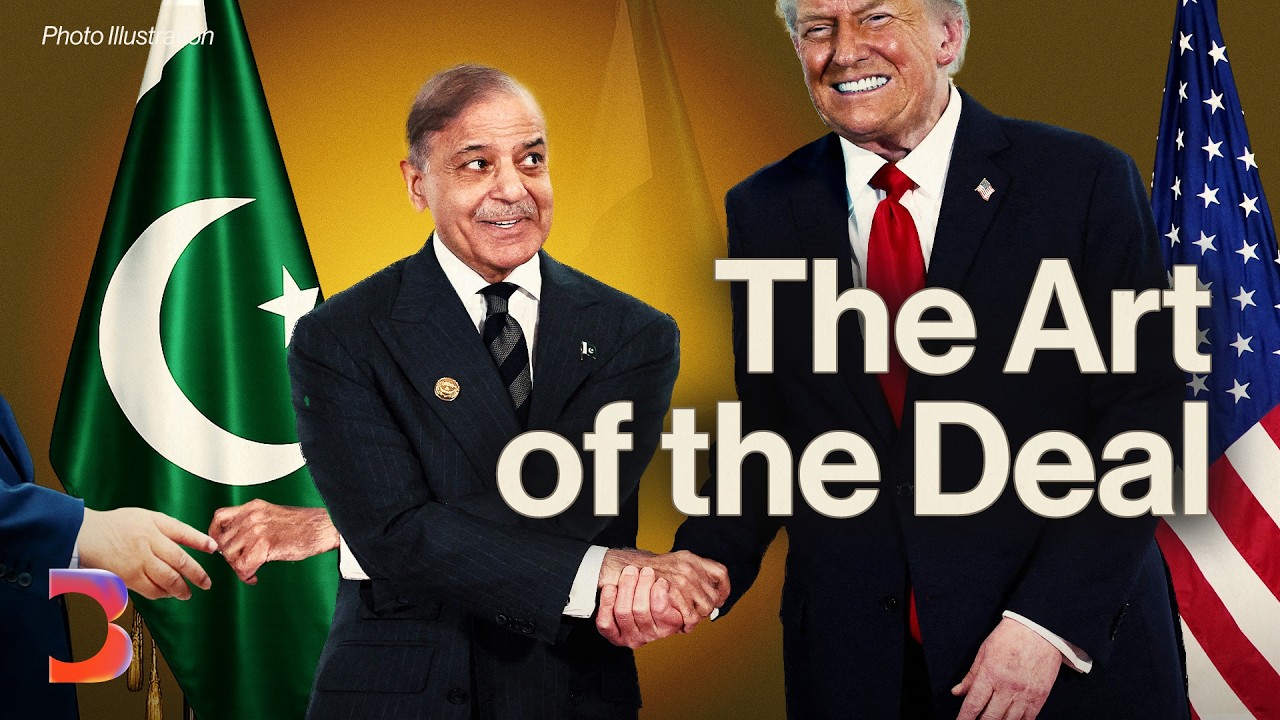
Islamabad is leveraging personal ties with Donald Trump and its role as a regional mediator to secure crucial U.S. commercial partnerships and Western financial support.
AI-assisted summary of Inside Pakistan's High-Stakes Gamble on Trump — original source. Check the original for full context.
Source published:
Detailed notes
## Background Published on YouTube by Bloomberg Originals on July 24, 2026, this video examines Pakistan's diplomatic maneuvering as an intermediary in the conflict between the United States and Iran. According to the page description, Pakistan's efforts to cultivate ties with Donald Trump could potentially unlock new economic opportunities for the nation.
## TL;DR Pakistan has embarked on a high-stakes diplomatic strategy by building strong personal and business ties with Donald Trump's inner circle to repair its global standing and bolster its struggling economy. Leveraging key figures like Army Chief Field Marshal Asim Munir, Pakistan facilitated historic direct talks between U.S. and Iranian officials in Islamabad and secured commercial partnerships spanning critical minerals and cryptocurrency. While this transactional approach has elevated Pakistan's international profile, its economic benefits remain vulnerable to regional instability and the unpredictable nature of foreign relations.
## Atmosphere & style The video presents a sharp, analytical, and cinematic narrative typical of investigative geopolitical reporting. It balances high-stakes diplomacy—symbolized by lavish summits and custom 'Brewed for Peace' coffee cups—with the gritty economic and security realities facing Pakistan. The tone is measured yet compelling, capturing the ambition and inherent volatility of Islamabad's political gamble.
## Key takeaways - [00:00](https://www.youtube.com/watch?v=jbuB1DhZlnM&t=0s) The Pakistani government owns the historic $1 billion Roosevelt Hotel in New York, and in February 2026, Trump advisor Steve Witkoff helped broker a deal to redevelop the property. - [00:00](https://www.youtube.com/watch?v=jbuB1DhZlnM&t=0s) Pakistan positioned itself as a key diplomatic mediator, successfully bringing U.S. and Iranian delegations to the same negotiating table for the first time in nearly 50 years. - [01:53](https://www.youtube.com/watch?v=jbuB1DhZlnM&t=113s) Pakistan's leaders actively cultivated ties with Donald Trump's inner circle, with Prime Minister Shehbaz Sharif publicly backing Trump for the Nobel Peace Prize. - [01:53](https://www.youtube.com/watch?v=jbuB1DhZlnM&t=113s) Trump bypassed traditional diplomatic norms by directly hosting Field Marshal Asim Munir, Pakistan's military chief and primary power broker, for lunch at the White House. - [02:33](https://www.youtube.com/watch?v=jbuB1DhZlnM&t=153s) Warm relations with the U.S. are crucial for Pakistan's fragile economy, as it is the 4th-largest IMF debtor and has struggled with stagnant foreign direct investment. - [03:45](https://www.youtube.com/watch?v=jbuB1DhZlnM&t=225s) Pakistan practices geopolitical hedging by balancing ties between China and the U.S., evidenced by its military operating both Chinese and American fighter jets. - [03:45](https://www.youtube.com/watch?v=jbuB1DhZlnM&t=225s) Following a major May 2025 military conflict between India and Pakistan, President Trump claimed credit for brokering a ceasefire through trade threats, though India denied external mediation occurred. - [05:40](https://www.youtube.com/watch?v=jbuB1DhZlnM&t=340s) By late 2025, the U.S. and Pakistan signed an MoU to develop Pakistan's untapped critical mineral reserves, highlighted by Field Marshal Munir presenting gem samples to Trump in a briefcase. - [05:40](https://www.youtube.com/watch?v=jbuB1DhZlnM&t=340s) Trump family-backed cryptocurrency venture World Liberty Financial expanded into Pakistan, leveraging the country's status as the world's 3rd-largest crypto market with over 40 million active users. - [06:54](https://www.youtube.com/watch?v=jbuB1DhZlnM&t=414s) In April 2026, Pakistan hosted historic high-level U.S.-Iran peace talks in Islamabad, providing luxury accommodations and messaging for delegates. - [08:26](https://www.youtube.com/watch?v=jbuB1DhZlnM&t=506s) Peace between the U.S. and Iran offers massive economic incentives for Pakistan, including sanction relief that could unblock the long-delayed Iran-Pakistan natural gas pipeline. - [08:26](https://www.youtube.com/watch?v=jbuB1DhZlnM&t=506s) Despite diplomatic progress, Pakistan faces persistent regional instability, including cross-border skirmishes with Afghanistan and the collapse of the initial U.S.-Iran ceasefire. - [09:08](https://www.youtube.com/watch?v=jbuB1DhZlnM&t=548s) Experts warn that relying on personal chemistry with Trump is highly volatile and risky, making Pakistan's diplomatic strategy a delicate gamble for political and economic survival.
## Detailed walkthrough ### [00:00](https://www.youtube.com/watch?v=jbuB1DhZlnM&t=0s) The Roosevelt Hotel and Pakistan's Diplomatic Revival
The iconic Roosevelt Hotel in New York City—celebrated for its Italian Renaissance architecture and historic legacy as a favorite destination for Hollywood stars—recently served as a migrant shelter and now sits shuttered. Despite its dormant state, its owners value the real estate at $1 billion and have brought in high-profile assistance to revamp it. Those owners are none other than the government of Pakistan, for whom the hotel represents one of its most prized international assets. In February 2026, Steve Witkoff, a key advisor to Donald Trump, helped broker a landmark deal between the U.S. government and Pakistan to jointly redevelop the New York landmark.
This hospitality venture is only a small fragment of a broader realignment between Islamabad and Washington. Pakistan has recently stepped onto the global stage in unprecedented ways, notably serving as a mediator between the United States and Iran. Observers noted that Pakistan achieved what seemed nearly impossible: bringing high-level American and Iranian officials to the same negotiating table after nearly 50 years of hostility. Although that initial ceasefire eventually broke down, Pakistan’s deliberate strategy to position itself as an indispensable international player has given the nation its brightest diplomatic spotlight in years.
- **Roosevelt Hotel Valuation:** $1 billion asset owned by the Pakistani government in New York City. - **Redevelopment Partner:** Steve Witkoff brokered the joint US-Pakistan development deal in February 2026. - **Diplomatic Milestone:** Brought U.S. and Iranian delegations to the same table for the first time in nearly five decades.
---
[01:53](https://www.youtube.com/watch?v=jbuB1DhZlnM&t=113s) Inner Circles, Army Power, and Economic Realities
Pakistan's diplomatic resurgence is largely driven by its leaders' success in cultivating close personal ties with Donald Trump's inner circle. Pakistani Prime Minister Shehbaz Sharif publicly praised Trump, going so far as to back him for the Nobel Peace Prize. Meanwhile, Trump has frequently referred to Pakistan’s top leadership as "good friends." At the absolute center of this political dynamic is Field Marshal Asim Munir, the head of Pakistan's military and widely considered the most powerful army chief the country has seen since its founding.
In a departure from traditional foreign policy norms—where U.S. administrations typically focused interactions on democratically elected prime ministers—Trump invited Field Marshal Munir directly to the White House for lunch. Trump’s transactional diplomatic style favored dealing directly with Pakistan's primary power broker. This access represents a dramatic pivot for Pakistan, a nation whose international reputation has long been defined by cascading crises, including catastrophic floods, severe energy shortages, political turmoil, and persistent reliance on foreign debt.
- **Key Figures:** Prime Minister Shehbaz Sharif and Field Marshal Asim Munir (Army Chief). - **White House Lunch:** Munir became the first Pakistani Army Chief directly hosted for lunch at the White House by a U.S. President. - **IMF Debt Burden:** Pakistan is the 4th-largest debtor to the IMF, trailing only Argentina, Ukraine, and Egypt. - **Foreign Direct Investment (FDI):** Stagnant for over two decades, making warm U.S. relations vital for securing Western loans and financial support.
---
[03:45](https://www.youtube.com/watch?v=jbuB1DhZlnM&t=225s) Balancing China and the U.S.
Historically, Pakistan relied heavily on China as its primary economic and geopolitical benefactor. Through the massive China-Pakistan Economic Corridor (CPEC), Beijing poured billions of dollars into Pakistani infrastructure and energy projects. Despite rising tensions between Beijing and Washington, Pakistan has managed to maintain a delicate geopolitical balance between both superpowers. A clear illustration of this dual strategy is visible in the Pakistani military, which operates a mixed fleet featuring both American and Chinese fighter jets.
Relations between Washington and Islamabad were not always smooth, strained for years by deep-seated distrust following the 2011 military raid that killed Osama bin Laden inside Pakistan. However, a major military flashpoint in South Asia helped reshape this dynamic. In May 2025, hostilities flared up dramatically between India and Pakistan. India launched targeted military strikes across the border, and Pakistan retaliated by claiming to have shot down five Indian fighter jets. After four days of intense brinkmanship, a ceasefire was struck—and Trump immediately claimed full credit for ending the conflict by threatening to freeze bilateral trade with both nations if they did not stop fighting.
- **Geopolitical Hedging:** Pakistan maintains military hardware from both China (CPEC partner) and the U.S. - **May 2025 India-Pakistan Conflict:** A 4-day military escalation involving Indian targeted strikes and Pakistani aerial counterattacks. - **Trump’s Trade Threat:** Trump claimed he halted the war by telling both sides, "If you stop it, we'll do trade. If you don't stop it, we're not going to do any trade." - **Contrasting Reactions:** India flatly denied any external mediation occurred, whereas Pakistani Prime Minister Sharif praised Trump effusively, stating Trump "saved 35 million lives" by stopping the war.
---
[05:40](https://www.youtube.com/watch?v=jbuB1DhZlnM&t=340s) Minerals, Crypto, and Commercial Ties
The warming diplomatic environment quickly translated into commercial partnerships, spanning sectors from critical raw materials to emerging technologies. By late 2025, the U.S. and Pakistan signed a Memorandum of Understanding (MoU) focused on developing and extracting Pakistan's vast untapped reserves of critical minerals. During his high-profile visit to the White House alongside Prime Minister Sharif, Field Marshal Munir brought a physical briefcase filled with raw Pakistani mineral specimens and gemstones to show President Trump directly.
Simultaneously, Pakistan established commercial ties with World Liberty Financial, a cryptocurrency venture co-founded by Donald Trump Jr., Eric Trump, and Zachary Witkoff (son of Steve Witkoff). The entity signed an agreement allowing it to operate within Pakistan, tapping into a booming regional market. These business ties built deep interpersonal trust between Islamabad and Trump's inner circle, which Pakistan swiftly leveraged on the geopolitical stage.
- **Critical Minerals MoU:** Signed by late 2025 to encourage U.S. investment in Pakistani mining. - **The Mineral Briefcase:** Field Marshal Munir brought a briefcase filled with local gems and minerals to demonstrate resource potential directly to Trump. - **Crypto Expansion:** World Liberty Financial signed an MoU to expand operations into Pakistan. - **Crypto Market Size:** Pakistan ranks as the world's 3rd-largest crypto market, boasting over 40 million active users.
---
[06:54](https://www.youtube.com/watch?v=jbuB1DhZlnM&t=414s) High-Stakes Peace Brokerage in Islamabad
As geopolitical tensions flared between Washington and Tehran, several regional countries—including Turkey, Qatar, and Pakistan—offered to facilitate communication. Thanks to its newly minted trust with the Trump team and its long-standing relationship with neighboring Iran, Pakistan emerged as the primary mediator. Pakistan shares a lengthy land border with Iran, maintains deep historical and cultural connections, and houses a substantial Shia Muslim population, creating a foundation of trust that Western nations lacked.
Initial diplomacy involved Pakistani officials literally shuttling messages back and forth between Washington and Tehran. By April 2026, these efforts culminated in direct, high-level negotiations hosted in Islamabad. To accommodate the talks, the Pakistani government requisitioned an entire luxury hotel, rolling out an elaborate diplomatic reception—even serving media members custom coffee cups stamped with the slogan "Brewed for Peace." The meeting marked the first time in decades that a U.S. Vice President sat down directly across from top Iranian government counterparts.
- **Mediator Advantages:** Shared border with Iran, cultural ties, and a large Shia population complemented Pakistan's access to the Trump administration. - **April 2026 Summit:** Requisitioned a luxury hotel in Islamabad for direct, historic negotiations between the U.S. Vice President and top Iranian officials. - **Diplomatic Touch:** Media press centers were outfitted with special coffee cups labeled "Brewed for Peace."
---
[08:26](https://www.youtube.com/watch?v=jbuB1DhZlnM&t=506s) Fragile Peace and Political Survival
For Pakistan, brokering a lasting peace between the U.S. and Iran is not merely a matter of international prestige—it is tied directly to its national economic survival. A permanent end to U.S. sanctions against Iran would unlock vast regional trade opportunities and potentially revive the long-delayed Iran-Pakistan gas pipeline, which could resolve Pakistan's chronic energy shortages. However, these ambitions remain on hold as the ceasefire between the U.S. and Iran subsequently collapsed, returning the region to active conflict. Furthermore, Pakistan faces ongoing security challenges along its western border, engaged in active cross-border skirmishes with Afghanistan since the start of 2026.
Diplomatic experts caution that relying on personal chemistry with Trump is an inherently risky strategy. Reflecting the classic foreign policy maxim that "countries do not have permanent friends, only permanent interests," analysts point to neighboring India—where Prime Minister Narendra Modi went from close personal ally to facing sudden diplomatic friction with Trump—as a cautionary tale. For Pakistan’s current ruling establishment, maintaining warm relations with Washington is essential to securing international legitimacy, economic lifelines, and political regime survival.
- **Economic Upside of Peace:** Sanction relief on Iran would enable the completion of the Iran-Pakistan natural gas pipeline to alleviate domestic power shortages. - **Regional Instability:** Cross-border military clashes with Afghanistan have persisted since early 2026. - **Diplomatic Volatility:** Experts note Trump’s transactional style can quickly shift from warm friendship to hostility, making Pakistan's high-stakes gamble a delicate balance.
<ElicitationsGroup message="To explore these topics further:"> <Elicitation label="Analyze the economic viability of the Iran-Pakistan gas pipeline" query="Analyze the economic viability, history, and geopolitical hurdles facing the Iran-Pakistan natural gas pipeline."/> <Elicitation label="Detail the military structure and political power of Pakistan's Army Chief" query="Detail the historical role, political power, and military structure surrounding the position of Army Chief in Pakistan."/> </ElicitationsGroup>
## Notable quotes > [01:53](https://www.youtube.com/watch?v=jbuB1DhZlnM&t=113s) good friends — Donald Trump
> [03:45](https://www.youtube.com/watch?v=jbuB1DhZlnM&t=225s) saved 35 million lives — Shehbaz Sharif
> [03:45](https://www.youtube.com/watch?v=jbuB1DhZlnM&t=225s) If you stop it, we'll do trade. If you don't stop it, we're not going to do any trade. — Donald Trump
> [06:54](https://www.youtube.com/watch?v=jbuB1DhZlnM&t=414s) Brewed for Peace
> [08:26](https://www.youtube.com/watch?v=jbuB1DhZlnM&t=506s) countries do not have permanent friends, only permanent interests
## Mentioned Roosevelt Hotel, New York City, Pakistan, Steve Witkoff, Donald Trump, U.S. Government, Iran, Shehbaz Sharif, Asim Munir, White House, IMF, Argentina, Ukraine, Egypt, China, China-Pakistan Economic Corridor, Beijing, Washington, Osama bin Laden, India, Memorandum of Understanding, World Liberty Financial, Donald Trump Jr., Eric Trump, Zachary Witkoff, Turkey, Qatar, Islamabad, Tehran, Afghanistan, Narendra Modi, Bloomberg Originals
[Source](https://www.youtube.com/watch?v=jbuB1DhZlnM)