Trump USAID Cuts Leave Unfinished Kenya Dams to Trigger Floods
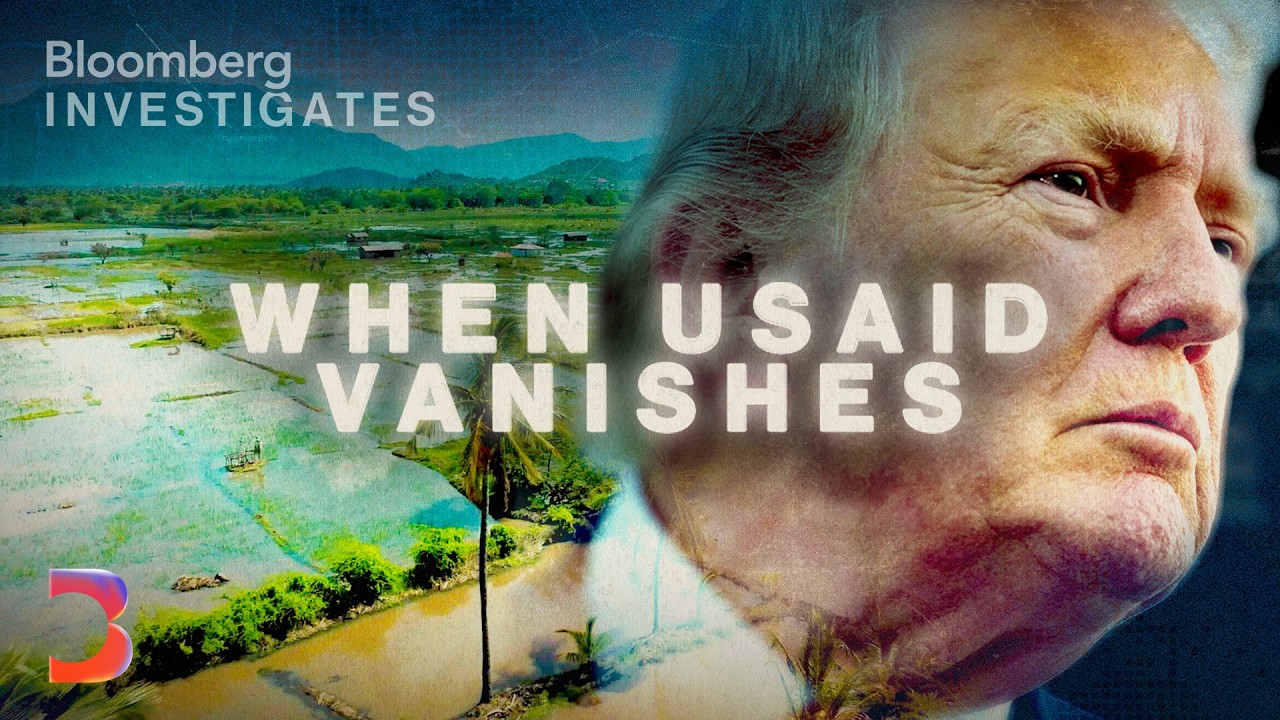
Bloomberg Originals
Abruptly abandoning a $217,000 irrigation project in Kenya broke local drainage systems, driving severe floods and disease without producing the promised budget savings.
AI-assisted summary of The Hidden Cost of Trump's USAID Cuts | Bloomberg Investigates — original source. Check the original for full context.
Source published:
Detailed notes
## Background Published by Bloomberg Originals on YouTube on July 27, 2026, this video report from the award-winning series Bloomberg Investigates examines the fallout of the abrupt dismantling of USAID by Donald Trump and Elon Musk. According to the page description, the episode travels to Kenya to uncover how abandoned infrastructure and unfinished water initiatives have left vulnerable communities facing severe flooding, disease, and financial ruin.
## TL;DR Following the Trump administration's rapid cancellation of USAID programs, Bloomberg Investigates used satellite data, spatial mapping, and internal documents to examine the consequences on the ground in Kenya. The abrupt halt of the Kamlenza Irrigation Scheme and 25 other active water and hygiene projects left half-built canals without control gates, causing stagnant water to submerge local crops and trigger outbreaks of severe diarrhea. Although the administration framed the budget cuts as eliminating wasteful spending, field data and former agency staff reveal massive financial wastage and severe humanitarian hazards, with over 80 water projects canceled globally affecting 11 million people.
## Atmosphere & style The video carries a somber, investigative, and emotionally grounded tone, balancing rigorous data analysis with intimate human stories. Striking visuals of waterlogged, rotting crops and abandoned construction sites evoke a quiet sense of tragedy and frustration among local Kenyan farmers. The host and former USAID officials speak with stark candor and deep disillusionment, creating a tense narrative arc that contrasts detached high-level political rhetoric with devastating on-the-ground consequences.
## Key takeaways - [00:03](https://www.youtube.com/watch?v=VbnoIf7aknM&t=3s) President Donald Trump systematically dismantled USAID, claiming foreign aid must strictly serve U.S. national interests, while critics warn the cuts risk tens of millions of lives globally. - [00:03](https://www.youtube.com/watch?v=VbnoIf7aknM&t=3s) Former USAID staffers reveal that despite promises of a contract review, the administration completely bypassed internal assessment dashboards and canceled projects overnight. - [00:03](https://www.youtube.com/watch?v=VbnoIf7aknM&t=3s) USAID's budget accounted for only 0.6% to 0.7% of the total annual U.S. federal budget. - [03:41](https://www.youtube.com/watch?v=VbnoIf7aknM&t=221s) Bloomberg Investigates combined satellite mapping and internal documents to show how abandoned civil engineering projects create severe new hazards when left without supervision. - [04:51](https://www.youtube.com/watch?v=VbnoIf7aknM&t=291s) The sudden halt of Water, Sanitation, and Hygiene (WASH) programs left essential water infrastructure in chaos across Kenya. - [04:51](https://www.youtube.com/watch?v=VbnoIf7aknM&t=291s) In the Kamlenza Irrigation Scheme, unfinished canal construction without sluice gates caused uncontrolled water flow, drowning nearby banana fields and rotting crops. - [04:51](https://www.youtube.com/watch?v=VbnoIf7aknM&t=291s) Completing the Kamlenza project would have cost $217,000, while finishing all 26 halted WASH projects in Kenya required around $2 million. - [07:10](https://www.youtube.com/watch?v=VbnoIf7aknM&t=430s) Despite claims of saving taxpayer money, field data and former officials report that abandoning active construction sites resulted in massive financial waste. - [10:02](https://www.youtube.com/watch?v=VbnoIf7aknM&t=602s) Satellite and radar analysis of the 2026 Kimorigo deluge proved seasonal rainfall was normal, but incomplete infrastructure directly intensified standing floodwaters. - [10:02](https://www.youtube.com/watch?v=VbnoIf7aknM&t=602s) The stagnant, uncontrolled flooding triggered an immediate surge in severe diarrhea cases among young children in the region. - [14:17](https://www.youtube.com/watch?v=VbnoIf7aknM&t=857s) Trump administration officials defended the strategy by framing foreign policy as purely transactional, dismissing soft power as a media narrative. - [14:17](https://www.youtube.com/watch?v=VbnoIf7aknM&t=857s) Globally, the administration canceled at least 80 water projects, stripping an estimated 11 million people of planned clean water access.
## Detailed walkthrough ### [00:03](https://www.youtube.com/watch?v=VbnoIf7aknM&t=3s) Devastating Agricultural Loss in Kenya
In rural Kenya, a local farmer walks through waterlogged, dying crops, holding up a banana plant whose roots have completely rotted due to stagnant, uncontrollable flooding. "Everything has dried," he laments, explaining that his community is suffering deeply because their crops cannot survive the excess water, leaving them with no food to harvest and severe financial ruin. This local crisis is the direct result of an abrupt shutdown of American foreign aid initiatives.
The backdrop to this human suffering is the radical political shift in Washington. President Donald Trump, declaring that USAID was run by "radical lunatics," systematically dismantled the agency, asserting that foreign aid is not charity and must strictly further the national interest of the United States. While Secretary of State Marco Rubio and his team promised a review of every canceled contract to eliminate "wasteful, inefficient" spending, former USAID staffers reveal that no meaningful review process ever took place. Administration officials defended the decision as standard, strategic diplomacy, dismissing claims of cruelty. However, experts and former agency workers warn that shutting down an agency without understanding its work puts tens of millions of lives at risk globally for a budget line that constituted only 0.6% to 0.7% of the total U.S. federal budget.
* **USAID Budget:** Accounted for roughly **0.6% to 0.7%** of the total annual U.S. budget. * **Human Impact:** Experts predict the abrupt cancellation of global aid programs could result in tens of millions of deaths worldwide.
---
[00:221] Investigating the Unfinished Infrastructure
Bloomberg Investigates set out to track the real-world consequences of abandoning unfinished U.S.-backed infrastructure projects across the globe. Combining satellite imagery, spatial mapping, data analysis, and over 100 internal documents, researchers examined the dangers created when construction sites are left without supervision or safety protocols. Former USAID employees had issued multiple explicit warnings regarding the hazards of abandoning incomplete civil engineering projects.
A former USAID staffer who served from 2012 to 2025 shared her emotional perspective, describing her career at the agency as her life's pride and safest space. She recalled how, shortly after the inauguration in January 2025, leadership was informed of a planned six-month review. The internal team proactively created a "red, yellow, green" dashboard, preparing to sacrifice less aligned programs and defend critical ones. Instead, the administration completely bypassed this process and canceled every single project in her office overnight—including crucial Water, Sanitation, and Hygiene (WASH) programs.
---
[04:51](https://www.youtube.com/watch?v=VbnoIf7aknM&t=291s) The Overlooked Crisis in Water, Sanitation, and Hygiene (WASH)
Bloomberg's investigation focused specifically on WASH initiatives—a funding sector that is often overlooked and considered unglamorous within foreign aid, yet remains vital for basic human survival. Proper WASH infrastructure prevents waterborne silent killers and guarantees sanitary conditions for children under five. In Kenya, the abrupt halt of these programs left essential water networks in chaos.
A primary example is the Kamlenza Irrigation Scheme. USAID had stepped in to rebuild the scheme's main canal and distribution points to help local farmers efficiently irrigate their banana crops. When stop-work orders arrived, workers were forced to abandon the upper section of the canal midway through construction—after digging up the earth and clearing surrounding vegetation. Without functioning sluice gates or control structures, incoming water now flows unchecked, submerging surrounding fields rather than irrigating them.
``` [Unfinished Upper Canal] ──> Uncontrolled Water Flow ──> Waterlogged Fields ──> Rotting Crops & Flooding ```
* **Cost to Complete Kamlenza Scheme:** Approximately **$217,000**. * **Total Ongoing WASH Projects in Kenya:** **26 projects** were active when work was halted. * **Total Cost to Finish All 26 Projects:** Approximately **$2 million**.
---
[07:10](https://www.youtube.com/watch?v=VbnoIf7aknM&t=430s) Abandoned Work Sites and Financial Wastage
Local Kenyan farmers describe how initial optimism turned into desperation. One farmer explains how he attempted to dig manual drainage ditches by hand, but because the entire area remains thoroughly waterlogged, crops cannot grow. He pleads with the U.S. government to complete the project so his family can eat and regain financial stability. Completing the project would have required a modest $217,000—a negligible figure in the context of the federal budget.
Despite frantic messages sent by field teams to Washington decision-makers, sites were abandoned exactly as they were. Bloomberg's investigation revealed a clear pattern across Kenya: most halted projects were not in the initial design phase, but were already under active construction. Construction materials were left to rot in the open air alongside half-finished structures. While the Trump administration claimed the cancellations saved taxpayer money, former officials and field data show it resulted in massive financial waste through abandoned materials, wasted salaries, and ruined infrastructure.
---
[10:02](https://www.youtube.com/watch?v=VbnoIf7aknM&t=602s) Satellite Data Links Unfinished Canals to 2026 Deluge
To verify whether the severe 2026 flooding in the village of Kimorigo was caused by the unfinished irrigation project, Bloomberg analyzed radar and satellite imagery measuring accumulated standing water. By plotting a flood intensity index against cumulative seasonal rainfall, data analysts made a striking discovery: total rainfall during the 2026 rainy season was not statistically unusual compared to past years.
However, 2026 stood out as an extreme anomaly regarding flood severity. Spatial mapping confirmed that the catastrophic flooding was heavily concentrated along the western side of Kimorigo—the precise location of the incomplete USAID irrigation scheme. Leaving the infrastructure incomplete fundamentally broke the drainage system, making it function far worse than if no construction had ever taken place.
> "When nothing is put in its place, it can actually have the totally unintended consequence of making things way worse than they actually even used to be."
* **Health Fallout:** The stagnant floodwaters triggered an immediate spike in severe diarrhea cases among young children in the region.
---
[14:17](https://www.youtube.com/watch?v=VbnoIf7aknM&t=857s) Transactional Foreign Policy vs. Global Consequences
Trump administration officials defend the sweeping cuts by framing international relations in purely transactional terms. They argue that the traditional concept of American "soft power" was a narrative manufactured by the media, asserting that developing nations are accustomed to transactional deals like those offered by China. Administration spokespeople maintain that three decades of traditional foreign assistance yielded little benefit to U.S. interests.
In stark contrast, former aid workers and affected communities view the policy as a tragic collapse of credibility and basic humanity. Workers point out that while WASH programs are rarely classified under basic "life-saving emergency aid," clean water directly impacts neurological development, school attendance, disease prevention, and overall economic survival. Kenya represents merely a fraction of the broader destruction: internal records show that the administration canceled at least 80 other water projects globally, stripping planned water access from at least 11 million people worldwide.
* **Global Scale:** At least **80 water projects** were canceled globally across multiple countries. * **Impacted Population:** Deprived an estimated **11 million people** of planned clean water access.
## Notable quotes > [00:03](https://www.youtube.com/watch?v=VbnoIf7aknM&t=3s) Everything has dried — local farmer
> [00:03](https://www.youtube.com/watch?v=VbnoIf7aknM&t=3s) radical lunatics — Donald Trump
> [00:03](https://www.youtube.com/watch?v=VbnoIf7aknM&t=3s) wasteful, inefficient — Marco Rubio
> [03:41](https://www.youtube.com/watch?v=VbnoIf7aknM&t=221s) red, yellow, green — former USAID staffer
> [10:02](https://www.youtube.com/watch?v=VbnoIf7aknM&t=602s) When nothing is put in its place, it can actually have the totally unintended consequence of making things way worse than they actually even used to be.
## Mentioned Donald Trump, USAID, Bloomberg Investigates, Elon Musk, Kenya, Marco Rubio, Kamlenza Irrigation Scheme, WASH, Kimorigo, China, United States
[Source](https://www.youtube.com/watch?v=VbnoIf7aknM)