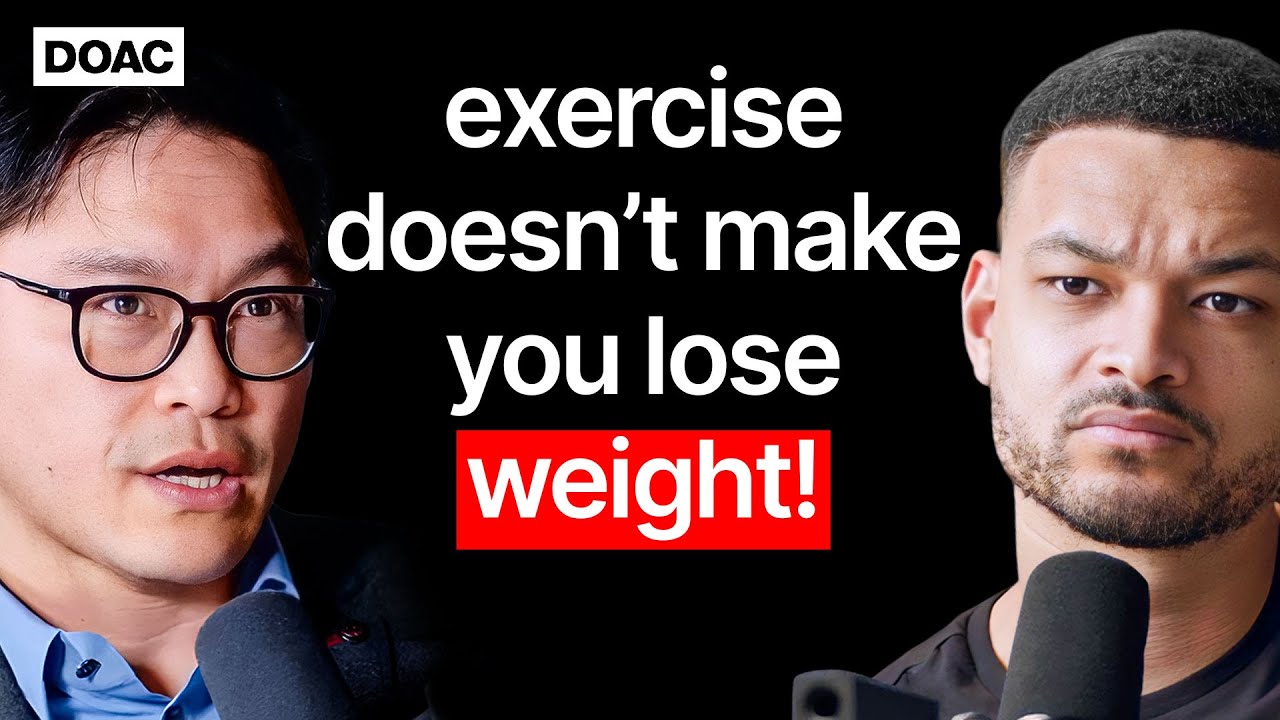
Dr. Fung Links Obesity to Insulin Spikes and Reverses Diabetes via Fasting
The Diary Of A CEO
Weight gain is driven by insulin and elevated hormone levels rather than simple calorie intake, allowing intermittent fasting and low-carbohydrate diets to reverse type 2 diabetes naturally.
## Background
Published on YouTube by The Diary Of A CEO on January 22, 2024, this episode features host Steven Bartlett interviewing Dr. Jason Fung about his book 'The Diabetes Code' and the underlying causes of obesity. The page description outlines topics such as the flaws of calorie counting, the hormonal drivers of weight gain, intermittent fasting, and the natural reversal of type 2 diabetes.
## TL;DR
Dr. Jason Fung challenges the conventional 'calories in, calories out' model, arguing that obesity and weight gain are fundamentally driven by hormonal imbalances—primarily elevated insulin levels—rather than a simple lack of willpower or exercise. He explains how ultra-processed foods bypass natural satiety mechanisms and why traditional calorie restriction lowers metabolic rate over time. Instead, Dr. Fung advocates for intermittent fasting and reducing refined carbohydrates to lower insulin, enable body fat burning, and reverse conditions like type 2 diabetes naturally.
## Atmosphere & style
The conversation carries an insightful, serious, and intellectually curious atmosphere where host Steven Bartlett poses thoughtful, probing questions to guide the discussion. Dr. Jason Fung presents his medical expertise with clarity, measured conviction, and grounded humility, using vivid metaphors—like the locked freezer and the Titanic—to unpack complex metabolic science. The dynamic feels like a collaborative, deep-dive dialogue that seeks to empower listeners by dismantling long-held health myths with scientific logic and ancient wisdom.
## Key takeaways
- [00:00](https://www.youtube.com/watch?v=8RuWp3s6Uxk&t=0s) The conventional "calories in, calories out" energy-balance model fails in practice because it ignores the underlying hormonal drivers of hunger and energy storage, specifically insulin.
- [09:49](https://www.youtube.com/watch?v=8RuWp3s6Uxk&t=589s) Obesity is primarily a hormone-driven condition where elevated insulin levels force the body to store fat and prevent access to stored energy reserves.
- [19:05](https://www.youtube.com/watch?v=8RuWp3s6Uxk&t=1145s) Genetics account for approximately 70% of an individual's susceptibility to obesity, but environmental factors and dietary changes drive population-wide increases.
- [23:54](https://www.youtube.com/watch?v=8RuWp3s6Uxk&t=1434s) Continuous caloric restriction causes the basal metabolic rate to drop, leading to fatigue, increased hunger, and weight regain (the "yo-yo diet" effect).
- [29:13](https://www.youtube.com/watch?v=8RuWp3s6Uxk&t=1753s) Intermittent fasting lowers circulating insulin levels, enabling the body to access stored fat for energy without triggering a drop in metabolic rate.
- [31:51](https://www.youtube.com/watch?v=8RuWp3s6Uxk&t=1911s) Exercise plays a minor role in weight loss because the calories burned are relatively low and physical activity often triggers compensatory hunger.
- [35:55](https://www.youtube.com/watch?v=8RuWp3s6Uxk&t=2155s) Frequent eating and constant snacking keep insulin chronically elevated, preventing the body from tapping into stored fat reserves.
- [38:59](https://www.youtube.com/watch?v=8RuWp3s6Uxk&t=2339s) Fasting for extended periods increases counter-regulatory hormones like growth hormone, adrenaline, and cortisol, preserving and even boosting metabolic rate.
- [48:32](https://www.youtube.com/watch?v=8RuWp3s6Uxk&t=2912s) GLP-1 receptor agonists like Ozempic demonstrate that managing weight is fundamentally about controlling appetite and regulating hormones rather than calorie tracking.
- [52:39](https://www.youtube.com/watch?v=8RuWp3s6Uxk&t=3159s) Dietary fiber acts as a natural buffer, slowing nutrient absorption and preventing rapid spikes in glucose and insulin caused by ultra-processed foods.
- [01:00:03](https://www.youtube.com/watch?v=8RuWp3s6Uxk&t=3603s) Autophagy is a cellular recycling process triggered during fasting that breaks down dysfunctional cellular components and allows for structural renewal during refeeding.
- [01:06:00](https://www.youtube.com/watch?v=8RuWp3s6Uxk&t=3960s) Type 2 diabetes is primarily a dietary disease that can be naturally reversed through carbohydrate restriction and intermittent fasting.
## Detailed walkthrough
### [00:00](https://www.youtube.com/watch?v=8RuWp3s6Uxk&t=0s) Introduction and The Flaws of "Calories In, Calories Out"
The conventional wisdom surrounding weight loss centers on the simplistic "calories in, calories out" energy-balance model, but this paradigm completely fails in practice. Telling someone struggling with weight to simply eat fewer calories or move more is ineffective because it ignores the underlying biological drivers of hunger and energy storage. True body fat management is not a mechanical equation of willpower, but rather a complex system governed by hormones that determine whether the energy we consume is burned or stored as fat.
* **Hormonal Control:** Body fat acts as an energy store dictated by hormonal signals, most notably insulin.
* **The Weight-Gain Prescription:** When patients with type 2 diabetes are prescribed insulin injections, they almost universally gain weight regardless of effort or willpower, proving that specific hormonal signals actively force the body to store fat.
* **The Alcoholism Analogy:** Advising an obese person to simply "eat less" is as unhelpful as telling an alcoholic to "drink less than you expend." While mathematically true, it ignores the root drivers—such as underlying addiction, emotional distress, or physiological hunger—that dictate the behavior in the first place.
---
[02:17](https://www.youtube.com/watch?v=8RuWp3s6Uxk&t=137s) Why Dr. Jason Fung Wrote *The Obesity Code*
Dr. Jason Fung, a kidney specialist (nephrologist), was driven to write *The Obesity Code* after observing the systemic failure of standard medical advice regarding weight loss. Despite being taught the traditional energy-balance model in medical school, he recognized that both patients and doctors themselves fail to achieve lasting weight loss through calorie counting. His search through medical literature revealed a fundamental disconnect: the real issue isn't that people don't know they need to create a caloric deficit, but rather *why* their bodies are constantly driven to take in and lock away excess energy.
* **Clinical Background:** Trained in nephrology, Dr. Fung regularly witnessed how standard dietary advice failed kidney and diabetic patients.
* **Universality of Failure:** Calorie counting has an extremely high failure rate among both the general public and healthcare professionals trying to lose weight.
* **Key Realization:** The body takes in excess energy because hormonal instructions tell it to store fat; treating obesity requires changing these signals rather than counting numbers.
---
[06:50](https://www.youtube.com/watch?v=8RuWp3s6Uxk&t=410s) The Global Obesity Epidemic and the Satiety Spectrum
Despite unprecedented scientific and medical advancements, global obesity rates continue to surge because mainstream academic centers remain fixated on restricting calories rather than fixing the hormones behind them. Hunger is not a conscious choice. When people eat refined foods, they trigger an immediate spike in insulin that rapidly shuttles nutrients out of the bloodstream and directly into fat stores. This leaves no accessible energy for immediate metabolic needs, leaving the individual ravenous shortly after eating.
```
Refined Carbohydrates (e.g., White Bread) ➔ High Insulin Spike ➔ Shunted to Fat Stores ➔ Constant Hunger
Whole Foods (e.g., Eggs) ➔ Stable Insulin Response ➔ Accessible Energy ➔ Sustained Satiety
```
To illustrate how different food compositions drive hunger, consider the stark contrast in biological responses to identical caloric amounts:
* **White Bread and Jam vs. Eggs:** Eating two slices of white bread with jam causes a massive insulin spike due to its high concentration of refined carbohydrates. This rapidly locks the energy into body fat, leaving no circulating energy for daily tasks; by 10:30 AM, hunger returns aggressively. Conversely, eating an egg produces minimal insulin response, keeping the energy available in the bloodstream for immediate use and suppressing hunger.
* **The Refrigerator Metaphor:** Storing calories under high insulin is like buying groceries and immediately locking them inside a freezer with no key. Even though the house is full of food, you have nothing to eat and are forced to go back out to purchase more.
---
[09:49](https://www.youtube.com/watch?v=8RuWp3s6Uxk&t=589s) Obesity as a Hormone-Driven Behavior and the Body Set Weight
From an evolutionary standpoint, the human body is equipped with powerful, redundant satiety systems designed to prevent overeating and maintain a stable weight. In the wild, animals like lions and antelopes cannot afford to become obese, as it directly compromises their survival. When humans consume natural foods, mechanical stretch receptors in the stomach signal the brain when full. Furthermore, specific macronutrients trigger potent satiety hormones that suppress appetite and temporarily raise the metabolic rate to burn off excess calories after a large meal.
> *"If you eat a giant steak, so you're activating all these satiety hormones, peptide YY, cholecystokinin... well, you may not be hungry for the next day."*
* **Peptide YY (PYY):** Activated primarily by dietary protein to signal fullness to the brain.
* **Cholecystokinin (CCK):** Triggered by the intake of dietary fats to slow down gastric emptying and suppress appetite.
* **Leptin and the "Body Set Weight":** Produced by fat cells, leptin acts like a biological thermostat (or set point). When body fat increases, leptin signals the brain to suppress appetite and increase energy expenditure to bring body weight back down to its set point.
---
[13:50](https://www.youtube.com/watch?v=8RuWp3s6Uxk&t=830s) How Ultra-Processed Foods Bypass Biological Brake Systems
The modern obesity epidemic is severely exacerbated by ultra-processed foods, which are explicitly engineered to bypass the body's natural satiety mechanisms. By stripping away dietary fiber and pulverizing ingredients into fine powders, processed foods are absorbed into the bloodstream almost instantaneously—acting like a direct intravenous infusion of pure sugar. This produces unnaturally high spikes in glucose and insulin while failing to trigger the stomach stretching or hormonal releases that tell us to stop eating.
* **Absence of Satiety Signals:** Consuming ultra-processed carbohydrates without protein or fat fails to activate PYY or CCK, allowing individuals to consume hundreds of empty calories without feeling full.
* **The Soda Paradox:** A person can easily consume a 1,000-calorie sugary soda at a stadium and feel zero fullness, immediately desiring popcorn or chips afterward. In contrast, consuming a 1,000-calorie steak creates intense satiety due to its dense protein, fat, and physical bulk.
* **Commercial Exploitation:** Food venues profit off low-satiety items because fast-absorbing, high-insulin foods leave consumers unsatisfied and driven to buy additional concessions.
[16:21](https://www.youtube.com/watch?v=8RuWp3s6Uxk&t=981s) The Environment and Stigma Surrounding Obesity
Addressing the obesity crisis requires looking beyond the concept of individual willpower. In the United States, around 70% of the population is overweight or obese, a figure that has been rising consistently since 1977. Using an educational analogy, if one student out of a hundred fails an exam, the student may not have studied; however, if 70 out of a hundred fail, the issue lies with the teacher or the system. Similarly, widespread obesity points to a systemic issue: a flawed nutritional message centered strictly around "calories in, calories out" and an environment saturated with ultra-processed foods.
The main issue with attributing obesity purely to personal choice is the social stigma it creates. Individuals are often blamed for letting themselves go, despite navigating a modern food landscape designed to promote hyper-palatable, processed products.
* **US Overweight/Obesity Rate:** ~70%, increasing annually since 1977.
* **Core Problem:** The food environment and dominant nutritional advice, not a lack of personal willpower.
---
[18:10](https://www.youtube.com/watch?v=8RuWp3s6Uxk&t=1090s) The Hormonal Tug-of-War: Insulin vs. Leptin
Obesity is fundamentally a hormone-driven condition rather than a matter of simple energy math. Leptin is the hormone responsible for signaling satiety and suppressing hunger, leading to questions about whether weight gain stems from leptin resistance. The body operates via balanced hormonal signals: while insulin signals the body to store energy and gain weight, leptin signals the body to reduce appetite and spend energy.
Body fat serves as a biological energy store, and the body only stores or releases this energy based on hormonal directives. When insulin levels remain chronically elevated, insulin overrides leptin's signals, effectively shutting down the body's ability to access stored fat and manage hunger properly.
---
[19:05](https://www.youtube.com/watch?v=8RuWp3s6Uxk&t=1145s) Genetics vs. Environment in Weight Gain
Genetics play a substantial role in determining an individual's susceptibility to obesity. Twin studies—particularly those evaluating identical twins raised in separate environments—demonstrate that approximately 70% of an individual's risk for obesity is genetically determined. If a twin born to obese biological parents is adopted into a thin family, that child still retains a high genetic predisposition to developing obesity.
> "Genetics loads the gun, but the environment pulls the trigger."
However, genetic makeup alone cannot explain the global surge in obesity over the last 40 to 50 years, as the human genome has not changed significantly within that timeframe. Genetics explain why one individual may gain weight more easily than another in the same environment, but the changing food environment—specifically shifted dietary patterns compared to previous generations—drives the overall population-level increase in obesity across Asia, Europe, Africa, and the Americas.
* **Genetic Contribution to Obesity Risk:** Approximately 70% (derived from twin studies).
* **Population Dynamics:** Genetics account for individual differences within a group, whereas environmental and dietary shifts drive population-wide trends.
---
[23:54](https://www.youtube.com/watch?v=8RuWp3s6Uxk&t=1434s) The Basal Metabolic Rate and the Calorie Restriction Trap
A major misconception in weight management is the assumption that the basal metabolic rate (BMR) remains stable when caloric intake drops. Conventional advice suggests that cutting 500 calories a day will automatically yield a pound of fat loss per week based on the standard energy balance equation. However, decades of clinical research show that when caloric intake is reduced, the body compensates by lowering its basal metabolic rate to match the reduced input.
When a person cuts intake from 2,000 calories to 1,500 calories while eating high-carbohydrate foods or grazing throughout the day, insulin levels stay elevated. High insulin inhibits lipolysis (the breakdown of fat), rendering stored body fat inaccessible for fuel. To balance the equation without access to stored fat, the body reduces its energy expenditure down to 1,500 calories. This reduction in metabolic rate leaves the individual feeling fatigued, cold, and hungry.
If the individual increases intake slightly to 1,800 calories, they gain weight despite eating less than their original 2,000-calorie baseline. This pattern explains the mechanism behind "yo-yo dieting," where weight loss stalls and weight regain occurs quickly once normal eating resumes.
* **Basal Metabolic Rate Adaptation:** BMR decreases in response to continuous caloric restriction when insulin remains elevated.
* **Metabolic Symptoms of Caloric Deficits:** Low energy, feeling cold, and persistent hunger.
---
[29:13](https://www.youtube.com/watch?v=8RuWp3s6Uxk&t=1753s) How Insulin Controls Fat Access and Intermittent Fasting
Managing body weight effectively requires addressing the underlying hormonal drivers rather than focusing strictly on total calorie counts. Food provides both thermal energy (calories) and biochemical instructions via hormones like insulin and cortisol. Fasting lowers circulating insulin levels; when insulin drops, the body receives the signal to unlock adipose tissue and burn stored energy.
Comparing two scenarios with an identical intake of 1,500 calories highlights the role of insulin dynamics:
* **High-Insulin Protocol:** Frequent meals and high-carbohydrate intake keep insulin elevated. The body cannot access fat stores, so BMR drops from 2,000 to 1,500 calories.
* **Low-Insulin Protocol (Intermittent Fasting):** Fasting windows allow insulin levels to fall. The body draws 500 calories from stored body fat to supplement the 1,500 calories consumed, maintaining a total metabolic burn of 2,000 calories.
By using intermittent fasting to lower insulin levels, individuals can access stored fat reserves without forcing their basal metabolic rate to drop. Consequently, returning to a normal maintenance intake of 2,000 calories does not trigger immediate weight regain.
---
[31:51](https://www.youtube.com/watch?v=8RuWp3s6Uxk&t=1911s) The Limited Impact of Exercise on Weight Loss
While exercise provides clear health benefits—including improved cardiovascular fitness, mobility, core strength, and muscle tone—it plays a relatively minor role in weight loss. Relying on physical activity to burn off excess caloric intake is generally inefficient, as the body adapts to expenditure and energy balance is primarily governed by hormonal responses to dietary intake.
[32:26](https://www.youtube.com/watch?v=8RuWp3s6Uxk&t=1946s) The Reality of Exercise and Weight Loss
Dr. Jason Fung explains that while exercise is critical for general health, its effect on weight loss is surprisingly minimal. The fundamental issue is numeric: the number of calories burned during typical exercise sessions is simply too small to make a major dent in body fat. Unless someone is engaging in eight hours of high-intensity training, a typical middle-aged adult doing a brisk 30- to 45-minute walk three times a week burns very little energy. Watching the treadmill calorie counter crawl up to a meager 120 calories after half an hour underscores this reality—that entire effort is easily erased by eating just two cookies. When the human body naturally expends around 2,000 calories a day running the brain, heart, liver, and basic metabolic functions, adding 100 extra calories of burn through light exercise barely shifts the needle.
Furthermore, exercise triggers physiological mechanisms that often cause people to eat more afterwards. While intense activity temporarily suppresses appetite through a phenomenon known as "exercise-induced anorexia"—where blood is redirected to muscles during a game or workout—a strong rebound hunger follows later. Dr. Fung highlights a classic Harvard study comparing children's energy balances across activities: sitting and watching TV resulted in a net surplus of roughly +100 calories per hour, but surprisingly, mild exercise yielded the exact same net surplus of +100 calories per hour. The only logical explanation is that the exercise increased the children's hunger, driving them to consume more food. Consequently, Dr. Fung stresses in Chapter 4 of *The Obesity Code* that roughly 95% of weight loss comes down to diet rather than physical activity. While everyone should exercise for overall health, losing weight requires altering the types and frequency of foods eaten to fix the underlying hormonal balance.
- A 30-minute treadmill session often burns only around 120 calories, which is equivalent to just a couple of cookies.
- Exercise-induced anorexia temporarily lowers hunger during activity as blood flows away from the digestive system to active muscles.
- A Harvard study revealed that mild exercise in children resulted in a net +100 calories per hour surplus—identical to watching TV—due to post-workout compensatory eating.
- **Key Quote:** "If you're trying to lose weight, you still got to focus on the main topic, which is the foods that you eat, which is not just the calories, it's about the types of food that you eat, which is going to affect the hormonal balance..."
---
[35:55](https://www.youtube.com/watch?v=8RuWp3s6Uxk&t=2155s) Modern Eating Habits and the Snacking Epidemic
Addressing how society's eating patterns have transformed, Steven Bartlett references an American survey of over 60,000 adults and children showing that in 1977, most people ate three times a day, but by 2003, average eating frequency jumped to five or six times daily. Dr. Fung points to this subtle shift as an inadvertent dietary disaster. In 1977, official dietary guidelines began pushing high-carbohydrate (55%–60%) and low-fat diets. Back then, snacking was frowned upon as a rare indulgence; parents actively warned children that an after-school or bedtime snack would "ruin your dinner."
However, high-carbohydrate foods like toast with jam lack lasting satiety. They trigger rapid spikes in blood glucose and insulin, followed by a sharp crash that leaves people ravenous by 10:30 a.m. This metabolic roller coaster forces people to search for mid-morning snacks like low-fat muffins, followed by pasta for lunch, leading to a afternoon energy slump at 3:00 p.m. that demands crackers, and eventually a bedtime snack. Over the decades, constant snacking became institutionalized as a supposedly "healthy" habit, creating a culture where people believe they should never go more than an hour and a half without eating. Dr. Fung emphasizes the core physiology: when you eat, insulin rises and commands the body to store calories; when you fast, insulin drops and allows the body to draw calories back out of storage. Eating constantly guarantees that insulin stays chronically elevated, locking energy inside fat cells and completely preventing fat burning.
- Between 1977 and 2003, average eating frequency in the U.S. rose from 3 meals per day to 5–6 eating occasions per day.
- Post-1977 government guidelines recommended a high-carbohydrate diet of 55% to 60% total calories while demonizing dietary fat.
- High-carbohydrate meals create a cycle of rapid insulin and blood sugar spikes followed by crashes, driving mid-morning and mid-afternoon hunger.
- **Key Quote:** "You eat, you store calories, you don't eat, you burn calories. Very simple. So, why would you want to eat all the time? That makes no sense at all."
---
[38:59](https://www.youtube.com/watch?v=8RuWp3s6Uxk&t=2339s) Fasting, Hormones, and the Metabolic Rate
Steven Bartlett notes that Dr. Fung is widely regarded as a pioneer of modern intermittent fasting, bringing a practice thousands of years old back into medical literature around 2013–2014. Dr. Fung recalls that when he first began advocating for fasting as a clinical tool to manage weight and metabolic disease, he was a lone voice in the wilderness and faced intense criticism. Doctors and dietitians attacked him, claiming fasting would cause severe harm. Yet Dr. Fung found the backlash ironic: medical professionals routinely instruct patients to fast before surgeries, post-procedure, or for blood tests without issue. He realized that if fasting is safe and routinely ordered in clinical settings, avoiding it as a therapeutic tool for weight management made no medical sense.
Addressing the persistent myth that fasting causes "starvation mode" by crashing the basal metabolic rate (BMR), Dr. Fung presents compelling clinical data. In studies where participants fasted completely for four consecutive days, their baseline energy expenditure was measured on Day 0 and again on Day 4. Rather than decreasing, the basal metabolic rate actually increased—for instance, rising from 2,000 calories per day on Day 0 up to 2,200 calories per day on Day 4. This counterintuitive rise is driven by basic human physiology: when food intake ceases, insulin levels drop to allow fat mobilization, while counter-regulatory hormones like adrenaline (sympathetic tone), cortisol, and growth hormone surge to activate the body. Drawing a comparison to nature, Dr. Fung notes that a hungry wolf is not lethargic; it is highly focused and energized, whereas a well-fed lion simply wants to lie down and digest.
- Fasting for 4 days continuously has been shown in clinical trials to *increase* basal metabolic rate (e.g., from 2,000 to 2,200 calories/day) rather than decrease it.
- Calorie-restricted diets and frequent eating lower metabolic rate over time, whereas full fasting triggers hormone shifts that preserve and elevate metabolism.
- Fasting increases key counter-regulatory hormones: adrenaline (sympathetic tone), cortisol, and growth hormone.
- **Key Quote:** "If you see a hungry wolf, is that wolf just sort of lethargic? No, he's activated. He's actually more dangerous than any other wolf as opposed to, say, a lion who just ate."
---
[43:47](https://www.youtube.com/watch?v=8RuWp3s6Uxk&t=2627s) Rethinking Breakfast and Natural Fasting Rhythms
Turning to the concept of breakfast, Dr. Fung dispels the widespread belief that eating immediately upon waking is biologically necessary. The word itself—"break-fast"—explicitly acknowledges that human biology relies on a natural daily alternation between feeding and fasting. In a typical baseline schedule from previous decades, stopping food intake at 6:00 p.m. and eating the next morning at 8:00 a.m. creates an automatic 14-hour fast that gives insulin levels time to drop so the body can burn stored energy. Citing data from page 132 of *The Obesity Code*, Steven Bartlett points out that breakfast eaters consume an average of 539 extra calories per day compared to those who skip breakfast, a finding mirrored across multiple dietary trials.
Dr. Fung explains that there are no rigid rules for fasting regimens, which range from 12-to-16-hour daily windows to 24-hour fasts (eating once a day) or multi-day fasts. Because an average human carries over 100,000 calories stored in body fat, going two or three days without food allows the body to seamlessly feed off its own internal fuel reserves. Furthermore, hunger is not a linear counter that increases with every hour without food; it is hormonally controlled. Studies show that on average, hunger follows a circadian rhythm where it is lowest at 8:00 a.m. (the longest point without food) and highest at 8:00 p.m. Around 5:00 a.m., the body naturally experiences a natural surge in cortisol, growth hormone, and adrenaline to prepare for the day, releasing internal stored energy into the bloodstream and naturally curbing morning appetite.
- According to *The Obesity Code*, individuals who routinely eat breakfast consume an average of 539 more total calories per day than those who skip it.
- A standard 12- to 14-hour overnight fast (e.g., 6:00 p.m. to 8:00 a.m.) serves as the baseline historical standard for human feeding schedules.
- Circadian hunger studies reveal that average hunger peaks around 8:00 p.m. and drops to its lowest point around 8:00 a.m.
- The morning "dawn phenomenon" releases cortisol, growth hormone, and sympathetic stimulation around 5:00 a.m., naturally raising blood glucose without food.
### [48:32](https://www.youtube.com/watch?v=8RuWp3s6Uxk&t=2912s) GLP-1 Receptor Agonists and Weight Loss
Dr. Jason Fung and Steven Bartlett pivot to discussing the boom in weight-loss injections, specifically GLP-1 receptor agonists like Ozempic. Dr. Fung notes that high-profile figures—such as Elon Musk and a mutual billionaire acquaintance—have publicly acknowledged using these medications to shed significant weight. Rather than discrediting them, Dr. Fung sees their overwhelming success as validation of his core thesis: weight management is not about managing calorie balance or forcing oneself to burn energy, but about governing hunger and regulating hormone signals.
Mechanistically, GLP-1 (glucagon-like peptide-1) is a naturally occurring peptide hormone predominantly synthesized and secreted by the distal small intestine in response to food ingestion. It forms a key part of the human body's native homeostatic satiety loop, stimulating insulin release to handle digestion while crossing the blood-brain barrier to bind to receptors in the midbrain, signaling the brain to cease eating. Medications like Ozempic mimic this natural signal without requiring food intake, keeping appetite at a minimum. When appetite drops, food intake naturally decreases, causing insulin levels to plummet and forcing the body to tap into stored energy and burn fat.
- **Weight Loss Maintenance:** GLP-1 medications demonstrate roughly a **70%** retention rate of weight loss while active.
- **Key Takeaway:** "Every successful drug to gain or lose weight... is hormone-based because that's instructions to the body."
---
### [52:39](https://www.youtube.com/watch?v=8RuWp3s6Uxk&t=3159s) The Essential Role of Dietary Fiber
Bartlett highlights how recent conversations with clinical nutritionists emphasize that modern populations suffer from a severe fiber deficiency. Dr. Fung explains that ultra-processing deliberately strips natural fiber out of carbohydrates to make food hyper-palatable and addicting. When refined carbohydrates lacking fiber are consumed, they cause an immediate, massive spike in blood glucose and insulin. This artificial spike stimulates a rapid release of dopamine in the brain, driving behavioral cravings akin to substance addiction.
In contrast, intact dietary fiber serves as an antidote to carbohydrates by slowing down gastrointestinal absorption and blunting the glycemic response. By dampening the insulin spike, fiber alters the hormonal feedback instructions given to the metabolic system. Dr. Fung stresses that whole foods—such as beans and whole grains—naturally contain high amounts of fiber, preventing hyper-insulinemia without requiring individuals to restrict total carbohydrate volume.
- **Dopamine Mechanism:** Processed carbohydrates trigger rapid dopamine release, creating habit-forming cycles similar to refined substances.
- **Food Sources:** Unprocessed whole foods, legumes, and whole grains retain their natural fibrous matrix, ensuring controlled nutrient absorption.
---
### [55:06](https://www.youtube.com/watch?v=8RuWp3s6Uxk&t=3306s) Protein as an Inefficient Energy Source
When questioned about the utility of high-protein diets for weight loss, Dr. Fung offers a nuanced perspective on macronutrients. While protein is essential, pure isolated protein powders (like whey isolates) are an artificial byproduct of modern food processing that rarely exist in nature. In natural whole foods, protein is almost always paired with fat (e.g., in meats) or complex carbohydrates.
Unlike fats and carbohydrates, human physiology has no direct pathway to store excess protein as a pure energy buffer; it must be converted or utilized structurally. While consuming large quantities of isolated protein does stimulate insulin secretion, it remains an inefficient macronutrient for weight gain compared to refined sugars and fats.
---
### [57:05](https://www.youtube.com/watch?v=8RuWp3s6Uxk&t=3425s) Whole Foods, Fasting, and Juice Fasting Myths
Dr. Fung reiterates that managing insulin comes down to two choices: altering *what* you eat (shifting from refined foods to unprocessed whole foods) or changing *when* you eat (fasting). Unprocessed foods produce significantly lower insulin responses compared to refined items like white bread, fitting within the human evolutionary blueprint.
Addressing the popularity of "juice fasting," Dr. Fung cautions that most commercial fruit juices are not true fasts at all, as they deliver concentrated liquid sugars and hundreds of calories without any fiber. However, vegetable-focused juices—such as kale or cucumber juice—can provide micronutrients with minimal glycemic impact. True water or tea fasting remains the most effective tool to deplete systemic glucose and force the body to consume stored body fat.
- **Juice Fasting Risk:** High-sugar fruit juices deliver rapid calorie loads that trigger insulin, halting lipolysis.
- **Low-Glycemic Alternatives:** Cucumber and kale juices minimize sugar content while supplying essential vitamins.
---
### [01:00:03](https://www.youtube.com/watch?v=8RuWp3s6Uxk&t=3603s) Autophagy, Rejuvenation, and Evolutionary Biology
The discussion turns to **autophagy** (literally "self-eating"), a cellular recycling process recognized by the 2016 Nobel Prize in Physiology or Medicine awarded to Yoshinori Ohsumi. During extended periods of nutrient deprivation—specifically the absence of dietary protein—the body initiates autophagy to break down and clear out degraded cellular components and dysfunctional intracellular organelles.
```
FASTING STATE (Nutrient Deprivation / Protein Absence)
│
├─► Autophagy Triggered ──► Breaks down junk proteins & intracellular organelles
│
└─► Growth Hormone Increases (Up to 5x over 2-3 days)
│
REFEEDING STATE ──► Uses elevated Growth Hormone to build new, healthy cellular structures
```
Dr. Fung compares autophagy to remodeling a home: "The first thing you got to do, you got to throw out the 1970s tub and the avocado green toilet... You got to break down before you can rebuild better." Fasting provides the cleanup stage, while the subsequent refeed phase utilizes the elevated growth hormone to construct fresh, pristine proteins—a fundamental mechanism for biological rejuvenation and potential mitigation of chronic neurodegenerative and metabolic diseases.
Evolutionarily, when food was scarce, natural selection favored organisms whose bodies heightened metabolic activity and mental sharpness rather than shutting down. Fasting triggers counter-regulatory hormones to mobilize body fat reserves, maintaining high energy levels so early humans could hunt and forage. Furthermore, during acute illness (such as a viral infection or flu), loss of appetite is an evolutionary defense mechanism designed to lower systemic glucose levels and starve invading pathogens.
Dr. Fung notes that virtually all major world religions embedded structured fasting regimens (whether 24-hour periodic fasts or annual seasonal fasts) into their traditions long before modern laboratory science verified these underlying physiological benefits.
- **Growth Hormone Surge:** A **2 to 3-day fast** can elevate human growth hormone (HGH) levels by up to **500% (5x)**.
- **Autophagy Onset:** Autophagy typically begins ramping up around **20 to 30 hours** of continuous fasting, with dietary protein ingestion acting as the primary off-switch.
<FollowUp label="Want to explore the final part of the transcript covering Type 2 diabetes reversal and the 'Calories In, Calories Out' myth?" query="Please provide the next detailed walkthrough section covering the remaining timestamp topics from 01:06:00 to the end of the transcript."/>
[01:04:41](https://www.youtube.com/watch?v=8RuWp3s6Uxk&t=3881s) Fasting, Mental Capacity, and Evolutionary Adaptation
Dr. Jason Fung concludes his thought on the evolutionary purpose of fasting, noting that while the body can readily run on stored fat during a fast, bacteria thrive on glucose. By fasting, you effectively lock down available glucose, creating an evolutionary defense mechanism against bacterial infections. Furthermore, refraining from food doesn't leave you sluggish; instead, it sharpens mental capacity and boosts energy levels. From an evolutionary standpoint, this heightened focus was essential to give early humans the edge they needed to go out and hunt when food was scarce.
Steven Bartlett pauses the conversation to share an update regarding his role as an investor and board member at Huel. He announces the UK launch of Huel’s "Daily Greens" product, which was previously unavailable in the region despite high customer demand. He notes that getting enough greens for gut microbiome health can be challenging, but a single daily scoop provides 91 vitamins, minerals, and whole-food-sourced nutrients.
---
[01:06:00](https://www.youtube.com/watch?v=8RuWp3s6Uxk&t=3960s) Reversing Type 2 Diabetes Naturally
When asked about the most fascinating topic not yet discussed, Dr. Fung points to the natural reversal of type 2 diabetes. Since the 1970s, global rates of obesity and type 2 diabetes have skyrocketed. For decades, the medical community has treated type 2 diabetes strictly as a chronic, progressive disease requiring pharmaceutical intervention. However, Dr. Fung emphasizes that type 2 diabetes is primarily a dietary disease. Giving medication to treat a dietary issue fails to fix the root cause, whereas targeted dietary interventions can resolve it entirely.
Dr. Fung highlights landmark real-world data from Dr. David Unwin in the UK, who demonstrated that reducing dietary carbohydrates can put approximately 50% of type 2 diabetes patients into complete, drug-free remission. This dietary shift effectively eliminates the heightened risk of devastating complications like cardiovascular disease, stroke, blindness, kidney failure, nerve damage, and severe infections. Crucially, remedies like carbohydrate reduction and intermittent fasting cost nothing and are accessible to everyone worldwide, unlike expensive pharmaceuticals or specialized surgeries reserved for a privileged few.
* Type 2 diabetes rates have paralleled the sharp rise in global obesity since the 1970s.
* Dr. David Unwin’s UK clinic data showed a **~50% remission rate** in type 2 diabetes patients using low-carbohydrate diets.
* Diseases and complications mitigated by diabetes remission: heart disease, stroke, cancer, blindness, kidney disease, nerve damage, and severe infections.
> "I'm not talking about a drug that costs thousands of dollars. I'm not talking about a surgery which is only available to the 1%... I'm talking about a treatment, which is intermittent fasting, which is available to everybody in the entire world for free."
---
[01:08:35](https://www.youtube.com/watch?v=8RuWp3s6Uxk&t=4115s) Why Medical Institutions Resist Intermittent Fasting
Bartlett asks why a free, universally accessible treatment isn't widely prescribed by healthcare systems. Dr. Fung explains that institutional change in academic medicine moves at a painfully slow pace. When he began publishing and advocating for fasting and diabetes reversal around 2016 with *The Obesity Code*, he met deep-seated resistance. Academic institutions and clinicians have spent decades building their careers around the "calories in, calories out" (CICO) framework. Admitting that fasting works requires admitting that decades of telling patients "it's your fault because you ate too much" was fundamentally flawed.
Despite immense public interest in intermittent fasting over the past decade, medical school curricula still provide virtually zero training on the topic. Mainstream doctors often dismiss fasting as a transient "fad diet," ignoring the fact that it has been practiced successfully across human civilizations for over 2,000 years.
Dr. Fung summarizes his core treatment principles from *The Diabetes Code* into two straightforward steps:
1. **Put less sugar in:** Reduce refined carbohydrates and sugars (supported by the American Diabetes Association as having the strongest scientific evidence for reversing type 2 diabetes).
2. **Burn the remaining sugar off:** Utilize intermittent fasting so the body burns through stored blood glucose and body fat.
---
[01:11:53](https://www.youtube.com/watch?v=8RuWp3s6Uxk&t=4313s) The Shallow Logic of "Calories In, Calories Out"
Bartlett observes that personal trainers and fitness influencers often get offended when the CICO model is challenged, because they see clients lose weight simply by tracking calories. Dr. Fung clarifies that while CICO is technically true on a surface level, it represents a shallow, first-order understanding of physiology.
To illustrate, Dr. Fung uses the analogy of the Titanic: if you ask why the Titanic sank, saying "it hit an iceberg" is technically correct, but superficial. The actionable, deeper truth is that the ship was traveling too fast for iced waters. Telling someone to "hit fewer icebergs" is as unhelpful as telling a struggling person to "eat fewer calories." The real, second-order question must be: *Why* is the person consuming so many calories? If someone eats white bread and jam, insulin spikes and drives those calories straight into fat storage, leaving the body starved for cellular energy and triggering constant, intense hunger.
Bartlett reflects on how framing obesity through a hormonal lens rather than a moral failing completely shifts the paradigm. Rather than blaming individuals for a lack of willpower, understanding underlying hormone signaling (like insulin, cortisol, and GLP-1 responses targeted by medications like Ozempic) gets to the root cause of appetite and metabolic dysfunction.
> "I would say that it's shallow. It's correct if you don't think about it too hard... Yes, if you drink less alcohol, you'll cure your alcoholism. But you won't cure the PTSD that caused you to drink."
---
[01:16:13](https://www.youtube.com/watch?v=8RuWp3s6Uxk&t=4573s) Cortisol, Community, and Ancient Wisdom
The conversation expands to touch on the holistic and psychological factors influencing body weight. Bartlett notes that previous podcast guests discussed the role of compassion, stress reduction, and emotional well-being in weight management. Through a hormonal lens, managing stress, practicing gratitude, and cultivating happiness lower cortisol levels, directly aiding weight loss.
Dr. Fung points out that ancient cultural and religious traditions intuitively understood these physiological dynamics far better than modern society does. Religious practices routinely brought communities together weekly—reducing social isolation and lowering cortisol—while embedding structured group fasting for physical and spiritual cleansing. In contrast, modern suburban living often isolates individuals in large houses with high stress levels, leading to late-night emotional eating and poor metabolic health.
Even our daily language preserves this ancient wisdom: the word "breakfast" literally means to *break* your *fast*, implying an essential, natural balance between eating periods and non-eating periods.
* Ancient religious fasting and communal gatherings naturally balanced hormones by reducing stress (cortisol) and giving the digestive system a rest (lowering insulin).
* Etymology note: "Breakfast" originates from the cycle of feeding and fasting ("break your fast").
* Dr. Fung's books mentioned in the discussion: *The Obesity Code*, *The Diabetes Code*, and *The PCOS Plan: Prevent and Reverse Polycystic Ovary Syndrome Naturally*.
---
[01:18:50](https://www.youtube.com/watch?v=8RuWp3s6Uxk&t=4730s) The Last Guest's Question
To wrap up the conversation, Bartlett asks Dr. Fung the traditional final question left blind by the previous guest: *"What is your greatest gift to the world?"*
Dr. Fung answers with characteristic humility, stating that while it might sound ambitious, he hopes his legacy and greatest contribution will be helping people realize they can naturally prevent and reverse type 2 diabetes—sparing millions from a lifelong, debilitating chronic disease.
<ElicitationsGroup message="To explore these topics further, you can select one of the following options:">
<Elicitation label="Summarize Dr. Jason Fung's core protocols for intermittent fasting" query="Summarize Dr. Jason Fung's recommended intermittent fasting protocols and rules for implementation."/>
<Elicitation label="Compare the hormonal model of obesity with Calories In, Calories Out" query="Explain the detailed scientific differences between the Hormonal Theory of Obesity and the Calories In Calories Out (CICO) model."/>
</ElicitationsGroup>
[01:20:24](https://www.youtube.com/watch?v=8RuWp3s6Uxk&t=4824s) Challenging the Status Quo on Weight Loss and Health
Dr. Jason Fung opens up about his mission to shift the global understanding of weight loss beyond the rigid "calories in, calories out" paradigm. He reflects on how deeply entrenched and almost "fossilized" the calorie-centric framework is worldwide, acknowledging that trying to disrupt such widespread institutional thinking can feel overwhelming or even absurd. He questions himself at times, wondering if it stems from pure hubris to think one person can change such a entrenched system. However, seeing the transformative health outcomes in his own medical practice drives him to keep spreading this message to anyone willing to listen. He emphasizes that the goal isn't to promote expensive drugs, surgeries, or complex modern gimmicks, but rather to return to tried-and-true, ancient principles like intermittent fasting and managing hormonal responses like insulin.
Steven Bartlett offers strong encouragement, reminding Dr. Fung that "it's the crazy ones that change the world." He highlights how Dr. Fung's pioneering work on intermittent fasting and reversing type 2 diabetes naturally has already impacted millions of lives around the globe, elevating the conversation long before this interview took place. Steven shares his personal gratitude, stating that the conversation illuminated key areas of health for him, before wrapping up the interview with mutual thanks.
- Dr. Fung advocates for addressing root hormonal drivers of obesity and reversing type 2 diabetes through lifestyle rather than relying on medications or surgical interventions.
- Steven Bartlett notes that shifting the narrative around diabetes from an irreversible condition to a reversible one has the potential to save tens or hundreds of millions of lives over coming decades.
---
[01:23:22](https://www.youtube.com/watch?v=8RuWp3s6Uxk&t=5002s) Podcast Sponsor and Outro
Following the interview, host Steven Bartlett introduces podcast sponsor Shopify, highlighting its role as a leading global commerce platform. He shares that *The Diary Of A CEO* team relies on Shopify for their own product launches, including their custom conversation cards. He offers listeners a promotional deal to test out the platform for $1 per month. To conclude the episode, Steven recommends another related podcast episode linked in the description for viewers looking for their next listen.
- **Sponsor Offer:** Viewers can sign up for a $1 per month trial of Shopify by visiting `[shopify.com/bartlett](https://shopify.com/bartlett)`.
## Notable quotes
> [09:49](https://www.youtube.com/watch?v=8RuWp3s6Uxk&t=589s) If you eat a giant steak, so you're activating all these satiety hormones, peptide YY, cholecystokinin... well, you may not be hungry for the next day. — Dr. Jason Fung
> [19:05](https://www.youtube.com/watch?v=8RuWp3s6Uxk&t=1145s) Genetics loads the gun, but the environment pulls the trigger. — Dr. Jason Fung
> [33:26](https://www.youtube.com/watch?v=8RuWp3s6Uxk&t=2006s) If you're trying to lose weight, you still got to focus on the main topic, which is the foods that you eat, which is not just the calories, it's about the types of food that you eat, which is going to affect the hormonal balance... — Dr. Jason Fung
> [35:55](https://www.youtube.com/watch?v=8RuWp3s6Uxk&t=2155s) You eat, you store calories, you don't eat, you burn calories. Very simple. So, why would you want to eat all the time? That makes no sense at all. — Dr. Jason Fung
> [38:59](https://www.youtube.com/watch?v=8RuWp3s6Uxk&t=2339s) If you see a hungry wolf, is that wolf just sort of lethargic? No, he's activated. He's actually more dangerous than any other wolf as opposed to, say, a lion who just ate. — Dr. Jason Fung
> [48:32](https://www.youtube.com/watch?v=8RuWp3s6Uxk&t=2912s) Every successful drug to gain or lose weight... is hormone-based because that's instructions to the body. — Dr. Jason Fung
> [01:00:03](https://www.youtube.com/watch?v=8RuWp3s6Uxk&t=3603s) The first thing you got to do, you got to throw out the 1970s tub and the avocado green toilet... You got to break down before you can rebuild better. — Dr. Jason Fung
> [01:06:00](https://www.youtube.com/watch?v=8RuWp3s6Uxk&t=3960s) I'm not talking about a drug that costs thousands of dollars. I'm not talking about a surgery which is only available to the 1%... I'm talking about a treatment, which is intermittent fasting, which is available to everybody in the entire world for free. — Dr. Jason Fung
> [01:11:53](https://www.youtube.com/watch?v=8RuWp3s6Uxk&t=4313s) I would say that it's shallow. It's correct if you don't think about it too hard... Yes, if you drink less alcohol, you'll cure your alcoholism. But you won't cure the PTSD that caused you to drink. — Dr. Jason Fung
## Mentioned
Dr. Jason Fung, Steven Bartlett, Jessie Inchauspé, The Obesity Code, The Diabetes Code, The PCOS Plan: Prevent and Reverse Polycystic Ovary Syndrome Naturally, The Diary Of A CEO, Glucose Goddess, Elon Musk, Dr. David Unwin, Yoshinori Ohsumi, Harvard University, American Diabetes Association, Huel Greens, Shopify, Ozempic, GLP-1, Peptide YY, Cholecystokinin, Leptin, Insulin, Cortisol, Growth Hormone
冯医生:肥胖源于胰岛素激增,可通过断食逆转糖尿病
体重增加是由胰岛素及升高的激素水平驱动,而非单纯的热量摄入,这使得间歇性断食和低碳水饮食能够自然逆转2型糖尿病。
Dr. Jason Fung对传统的“热量摄入与消耗”模型提出质疑,认为肥胖和体重增加从根本上是由激素失衡(主要是胰岛素水平升高)驱动的,而非单纯缺乏意志力或运动。他解释了超加工食品如何绕过人体的天然饱腹感机制,以及为何传统的卡路里限制会随着时间推移降低代谢率。相反,Dr. Fung主张通过间歇性断食和减少精制碳水化合物来降低胰岛素水平,促进身体燃烧脂肪,从而自然逆转2型糖尿病等病症。
传统的“卡路里进出”能量守恒模型在实践中难以奏效,因为肥胖本质是由胰岛素等激素主导的能量储存失调,持续升高的胰岛素会锁定脂肪储备并引发饥饿感。 (0:00)
基因决定了个体约70%的肥胖易感性,但过去数十年全球肥胖率激增的核心诱因在于超加工食品普及与高频进食等环境转变。 (19:05)
持续的热量限制会导致基础代谢率代偿性下降并引发体重反弹;而间歇性断食通过降低胰岛素水平,使身体能够动用储存的体脂供能,避免代谢率滑坡。 (23:54)
运动对减重的贡献仅占约5%,日常锻炼消耗的热量极少且常伴随代偿性食欲增加,控制体重必须聚焦于调节激素平衡的饮食方式。 (32:26)
长期断食并不会导致所谓的“饥饿模式”使代谢崩溃,临床数据显示连续断食能促使肾上腺素与生长激素上升以维持代谢活性,并激活细胞自噬机制。 (38:59)
Reading summary
Dr. Jason Fung contends that obesity and type 2 diabetes are biologically driven by hormonal imbalances—primarily elevated insulin—rather than simple caloric surpluses, meaning sustainable weight loss requires altering food quality and meal timing rather than relying on calorie counting or exercise.
The Caloric Deficit Trap and Exercise Limits (32:26)
Dr. Fung asserts that standard 'calories in, calories out' (CICO) guidance fails because it views body weight as a passive mathematical equation rather than an active endocrine response. When individuals cut calories while keeping insulin elevated through frequent eating or refined carbohydrates, the body defends its energy reserves by lowering basal metabolic rate (BMR) to match intake. This metabolic adaptation causes cold intolerance, fatigue, and rapid weight regain once baseline eating resumes. Furthermore, Fung claims that physical activity accounts for only roughly 5% of weight loss, noting that a typical 30-minute treadmill session expends roughly 120 calories—an amount erased by just two cookies. Citing a Harvard study where mild exercise in children resulted in a net surplus of +100 calories per hour identical to watching television due to post-workout compensatory hunger, Fung emphasizes that exercise cannot outpace hormonal drivers of appetite and fat storage.
Hormonal Control of Satiety and Fat Storage (6:50)
Under Fung's model, fat storage is strictly governed by endocrine signals, with insulin functioning as a chemical instruction to store circulating energy and inhibit lipolysis. In clinical practice, administering insulin to type 2 diabetic patients universally causes weight gain regardless of voluntary caloric restriction, while chronically high insulin levels override leptin, the hormone signaling the brain's adiposity set point. Natural whole foods trigger redundant biological brake systems, including stomach stretch receptors, peptide YY (activated by protein), and cholecystokinin (activated by fats), which suppress appetite and promote fullness. In contrast, ultra-processed foods deliberately strip out dietary fiber and pulverize ingredients, causing rapid spikes in blood glucose, insulin, and dopamine akin to addictive substances without stimulating satiety hormones. Fung points to the clinical efficacy of GLP-1 receptor agonists (such as Ozempic) as real-world proof of this principle: these drugs mimic gut-secreted satiety peptides acting on the midbrain to curb appetite, allowing systemic insulin to fall and body fat to be mobilized.
Metabolic Advantages of Intermittent Fasting (38:59)
Between 1977 and 2003, average American eating frequency rose from three meals daily to five or six occasions per day, keeping circulating insulin elevated and blocking fat burning around the clock. Fung advocates intermittent fasting to allow insulin to drop, enabling the body to tap into stored adipose tissue without depressing resting energy expenditure. Challenging the widespread belief that fasting triggers a damaging 'starvation mode,' Fung highlights clinical trials showing that four consecutive days of complete fasting actually increased daily BMR from 2,000 to 2,200 calories, driven by increases in counter-regulatory hormones including adrenaline, cortisol, and growth hormone. Extended fasting also induces autophagy—a cellular recycling mechanism recognized by the 2016 Nobel Prize that ramps up after 20 to 30 hours without dietary protein—clearing damaged intracellular components before human growth hormone, which can rise up to 500% over two to three days of fasting, supports renewed tissue synthesis upon refeeding.
Dietary Reversal of Type 2 Diabetes (66:00)
Fung argues that treating type 2 diabetes as an inevitably chronic, progressive condition requiring lifelong medication misidentifies the underlying pathology. Because type 2 diabetes is fundamentally a dietary disease of chronic hyperinsulinemia and glucose overload, pharmacological therapies that do not address dietary inputs fail to treat the root cause. Fung cites data from Dr. David Unwin's clinical practice in the UK demonstrating that dietary carbohydrate reduction achieved approximately a 50% drug-free remission rate in type 2 diabetes patients, drastically reducing risks for cardiovascular disease, renal failure, stroke, and blindness. His treatment framework consists of two core steps: reducing incoming glucose through whole foods and low-carbohydrate nutrition, and utilizing intermittent fasting to burn off residual sugar reserves. Fung attributes resistance from mainstream healthcare institutions to decades of career investment in the CICO paradigm and a lack of fasting education in medical curricula.
Fung concludes that addressing widespread metabolic illness requires replacing personal-blame frameworks with hormonal management through accessible, non-pharmacological methods like fasting and carbohydrate reduction. However, systemic adoption remains constrained by institutional inertia in medical education, commercial food environments dominated by fiber-depleted products, and cultural norms that encourage continuous eating.
精炼阅读摘要
肾脏专科医生 Jason Fung 在《The Diary Of A CEO》访谈中指出,肥胖与2型糖尿病主要由胰岛素等激素失衡引起,而非单纯由意志力匮乏或“卡路里摄入与消耗”失衡所致。他主张通过减少精制碳水化合物与实践间歇性禁食来降低胰岛素水平,从而调动脂肪储备并改善代谢健康。
热量平衡理论局限与激素驱动假说 (0:00)
Fung 认为主流医学长期依赖的“卡路里进出”(CICO)模型仅停留在表面浅层,无法解释人们持续摄入过量能量的生理根源。当身体摄入精制碳水化合物时,胰岛素会剧烈上升并迅速将养分锁入脂肪储备中,导致血液中循环利用的能量匮乏,使人在进食后不久再次产生强烈的饥饿感。这种机制类似把食物锁进没有钥匙的冰柜,即便体内储备丰富,细胞仍处于饥饿状态。相比之下,当2型糖尿病患者被注射胰岛素时,无论其意志力如何都会普遍增重,证明脂肪积聚本质上由激素指令驱动,而非单纯的热量算术。
代谢适应与过度依赖运动减重的困境 (23:54)
传统的持续节食限制卡路里摄入(例如每日减少500卡路里)往往难以长久维持,因为人体会产生代谢适应。若日常频繁进食或摄入高碳水食物,胰岛素水平持续处于高位并抑制脂肪分解,人体无法动用脂肪来填补能量缺口,基础代谢率(BMR)便会被动下调(例如从2000卡路里降至1500卡路里),引发疲惫、畏寒及剧烈饥饿,最终导致体重在恢复进食后迅速反弹,形成“溜溜球”效应。
此外,Fung 指出运动对直接减轻体重的效果被过度夸大。一次30至45分钟的快走或跑步机运动通常仅消耗约120卡路里,极易被两块饼干抵消。哈佛大学对儿童的一项研究发现,轻度运动与坐着看电视后均产生大约每小时100卡路里的能量盈余,表明运动引发的代偿性进食抵消了消耗。在 Fung 看来,减重约95%取决于饮食所调控的激素反应,运动则更多用于维护心血管与肌肉等全身健康。
超加工食品对饱腹机制的绕过与进食频率变化 (13:50)
人体原本具备完善的饱腹感调控网络,包括由胃部机械伸展受体以及促饱腹激素(如受蛋白质激活的PYY和受脂肪激活的CCK)构成的制动系统,脂肪细胞释放的瘦素亦用于设定并维持体重设定点。然而,现代超加工食品剥离了天然膳食纤维并将成分高度粉碎,吸收速度极快,在激增血糖与胰岛素的同时无法激活饱腹感受体,且会刺激大脑迅速释放多巴胺,形成类似成瘾的行为渴求。
这一现象因进食模式的变迁进一步加剧。数据显示,1977年大多数人每日仅进食3餐,而到2003年美国人群平均进食频率已上升至5至6次。官方饮食指南推崇的高碳水(55%–60%)和低脂建议加速了血糖大幅波动,零食文化的普及导致机体胰岛素长年居高不下,脂肪分解通路被全面阻断。
间歇性禁食的生理机制与细胞自噬 (38:59)
间歇性禁食通过延长不进食的时间窗口来降低循环胰岛素,进而解锁体内超过10万卡路里的脂肪储备,使代谢率在脂肪供能的补充下维持稳定。针对禁食会降低代谢的担忧,临床数据显示,连续全禁食4天的受试者其基础代谢率不仅没有下降,反而从每日2000卡路里小幅上升至2200卡路里。这是由于禁食期间肾上腺素、皮质醇和生长激素等逆调节激素升高,不仅调动储备供能,还使机体保持敏锐活跃状态;连续禁食2至3天可使生长激素上升达5倍。
不仅如此,当持续断食达到约20至30小时且缺乏膳食蛋白质时,机体会启动细胞自噬(Autophagy)机制,清理老旧和受损的细胞结构,并在恢复进食时利用升高的生长激素重建健康组织。这种天然生理节律与人体昼夜节律相符:人体饥饿感通常在早晨8点处于低谷,晚间8点达到高峰,早晨5点左右体内自然分泌的皮质醇与肾上腺素已能自发释放血糖储备,因而并非人人都必须食用早餐。
逆转2型糖尿病的临床实践与制度性阻力 (66:00)
Fung 强调2型糖尿病本质上是一种饮食引起的疾病,而非不可逆转的进行性绝症。根据英国 David Unwin 医生的临床数据,单纯采用低碳水化合物饮食即可使约50%的2型糖尿病患者实现完全且停药的临床缓解,大幅降低心脏病、中风、肾衰竭与截肢等严重并发症的风险。GLP-1受体激动剂(如 Ozempic)能够取得约70%的减重维持效果,同样证实了通过模拟肠道饱腹激素减少食量、进而降低胰岛素以促使燃脂的激素驱动逻辑。
尽管限制糖分摄入与间歇性禁食具有零成本且普适的优势,但医疗系统和学术机构对此依然存在长期的采纳阻力。Fung 指出,承认禁食与生活方式干预的疗效,意味着主流机构必须承认过去数十年指责患者单纯因“吃太多、动太少”而致病的框架存在缺陷。目前医学院课程对营养学与禁食干预的培训仍然极少,学术认知与制度性转变依旧进展缓慢。
Fung 主张通过饮食结构改善(增加全食物纤维、减少精制糖)与间歇性禁食重新平衡机体激素,以此作为解决全球代谢危机的主要路径。然而,现有医学培训体系与公共卫生指南依然深受传统热量平衡理论支配,如何打破这种制度性惯性并推动非药物生活方式干预的普及,仍是尚未解决的核心挑战。
Detailed notes — zh
## Background
本期视频由 YouTube 知名播客频道《The Diary Of A CEO》于 2024 年 1 月 22 日发布,主持人为 Steven Bartlett。节目专访了《肥胖代码》作者、肾脏科专科医生 Jason Fung 博士,围绕肥胖的激素驱动机制、破除“少吃多动”与早餐神话,以及如何利用间歇性断食和低碳饮食逆转 2 型糖尿病展开深度探讨。
## TL;DR
Jason Fung 博士在访谈中指出,传统“热量进出平衡”(CICO)和依赖运动减肥的模型在临床上已被证明失效,肥胖的本质在于胰岛素等荷尔蒙失衡,而非个人意志力匮乏。单纯削减卡路里会导致基础代谢率代偿性下跌并锁死脂肪储备,进而引发严重的“溜溜球”反弹;相反,间歇性断食能够降低胰岛素水平、保护代谢率并激活细胞自噬。通过减少进食频率、剔除超加工食品中的精制碳水并回归天然饮食,不仅能有效控制饥饿感,更能从源头自然逆转 2 型糖尿病等代谢顽疾。
## Atmosphere & style
整场对话兼具严密的科学解构与强烈的同理心,充满推翻医学陈规的颠覆感与顿悟时刻。Steven Bartlett 的提问层层递进、充满好奇与共鸣,而 Jason Fung 博士则用犀利生动的隐喻(如“泰坦尼克号”、“锁死的冰箱”与“饥饿的狼”)将复杂的内分泌生理学拆解得通俗透彻。对谈氛围从对传统节食教条及“肥胖羞辱”的深刻反思,逐渐升华为重拾古老断食智慧与社群归属的温情呼吁,给观众带来拨云见日般的认知震撼与实操希望。
## Bulletin
- [23:54](https://www.youtube.com/watch?v=8RuWp3s6Uxk&t=1434s) 传统“少吃多动/CICO”模型将减重视为热量数学题,但人体的热量摄入与基础代谢率深度动态联动;长期纯粹节食会诱发代谢当代偿性暴跌并锁死脂肪通道,引发溜溜球式反弹。
- [02:17](https://www.youtube.com/watch?v=8RuWp3s6Uxk&t=137s) 肥胖的本质是激素失衡而非意志力缺陷:精制碳水刺激胰岛素暴增将能量锁入脂肪库并产生剧烈饥饿,而通过间歇性断食拉低胰岛素方可启动体内巨量体脂的分解利用。
- [31:51](https://www.youtube.com/watch?v=8RuWp3s6Uxk&t=1911s) 单靠运动减重效率极低且会诱发食欲代偿,减肥 95% 取决于饮食;以司美格鲁肽(Ozempic)为代表的 GLP-1 药物之所以有效,同样是因其作用于中枢饱腹激素而非直接燃烧热量。
- [41:18](https://www.youtube.com/watch?v=8RuWp3s6Uxk&t=2478s) 断食并不会导致“饥饿模式”或代谢下降,实测断食 4 天基础代谢反而由 2000 kcal 升至 2200 kcal;断食 20 至 30 小时还可触发细胞自噬与生长激素激增,实现细胞级抗衰焕新。
- [01:06:00](https://www.youtube.com/watch?v=8RuWp3s6Uxk&t=3960s) 2 型糖尿病本质是饮食源性疾病,通过低碳水饮食减少糖分摄入并结合间歇性断食消耗蓄积糖原,约 50% 的患者无需昂贵药物即可实现临床逆转。
## Key takeaways
- [02:17](https://www.youtube.com/watch?v=8RuWp3s6Uxk&t=137s) 肥胖属于激素驱动的生理失衡:给任何人注射胰岛素都会不可逆地增重,传统将肥胖完全归咎于意志力薄弱属于不公的社会污名化。
- [05:02](https://www.youtube.com/watch?v=8RuWp3s6Uxk&t=302s) “卡路里进出平衡”如同对酗酒者说“少喝多排”一样浅薄,它虽然符合热力学表象,却完全忽略了导致机体拼命储存能量与失控觅食的激素根源。
- [06:50](https://www.youtube.com/watch?v=8RuWp3s6Uxk&t=410s) 相同热量的食物引发的内分泌反应截然不同:精制碳水使胰岛素飙升并将能量强行锁进脂肪库,而蛋白质与天然脂肪则能稳定供能并激发 PYY、CCK 等饱腹激素。
- [19:24](https://www.youtube.com/watch?v=8RuWp3s6Uxk&t=1164s) 双胞胎分离抚养研究显示个体肥胖风险约 70% 与基因相关,但近半个世纪全球肥胖潮由超加工食品与全天候高频进食环境扣动扳机,绝非基因突变所致。
- [23:54](https://www.youtube.com/watch?v=8RuWp3s6Uxk&t=1434s) “每日少吃 500 大卡即可每周减一磅”已被证实为彻底的伪科学;人体会代偿性下调体温与器官消耗,导致基础代谢率同步暴跌。
- [29:15](https://www.youtube.com/watch?v=8RuWp3s6Uxk&t=1755s) 间歇性断食能在不损耗基础代谢的前提下实现燃脂:在摄入受限时,极低的胰岛素水平解除了对脂解的抑制,迫使身体从自身脂肪库调取能量补足总消耗。
- [31:51](https://www.youtube.com/watch?v=8RuWp3s6Uxk&t=1911s) 运动无法有效减重的两大原因:跑步等常规锻炼消耗热量极微(跑半小时仅约 120 大卡,相当于两块饼干),且运动后会触发剧烈的代偿性食欲激增。
- [35:55](https://www.youtube.com/watch?v=8RuWp3s6Uxk&t=2155s) 自 1977 年推荐高碳水低脂饮食以来,美国人平均餐次从一日三餐激增至一日五到六餐,低饱腹感食品将加餐制度化,使机体长期处于高胰岛素储能状态。
- [41:18](https://www.youtube.com/watch?v=8RuWp3s6Uxk&t=2478s) 完全禁食不会降低代谢:受交感神经张力、生长激素和皮质醇脉冲的激活,断食 4 天后人体的能量消耗不仅没有下滑,反而从 2000 大卡升至 2200 大卡。
- [43:47](https://www.youtube.com/watch?v=8RuWp3s6Uxk&t=2627s) 吃早餐并非减重灵丹妙药,词源“Breakfast”本意就是“打破断食”;临床对照显示习惯吃早餐的人群日均多摄入约 539 大卡热量。
- [46:01](https://www.youtube.com/watch?v=8RuWp3s6Uxk&t=2761s) 饥饿感受内分泌昼夜节律调控而非随空腹线性累积:清晨 5 点皮质醇动员内源能量使得早晨 8 点往往最不饥饿,而饥饿感最高峰常出现在晚上 8 点。
- [48:28](https://www.youtube.com/watch?v=8RuWp3s6Uxk&t=2908s) GLP-1 受体激动剂(如 Ozempic)印证了减重由激素主导:该类药物通过模拟肠促胰素向中脑饱和中枢发出停止进食指令,从而在源头上抑制食欲。
- [52:39](https://www.youtube.com/watch?v=8RuWp3s6Uxk&t=3159s) 膳食纤维是天然碳水化合物的“解药”,剥离纤维的工业精制碳水会带来毒品级的多巴胺奖赏峰值与血糖暴震,诱发暴食成瘾。
- [57:05](https://www.youtube.com/watch?v=8RuWp3s6Uxk&t=3425s) 绝大多数市售果蔬汁断食属于健康陷阱:滤除纤维后浓缩了巨量果糖与游离糖,会猛烈刺激胰岛素分泌,根本无法实现真正的代谢休眠。
- [58:30](https://www.youtube.com/watch?v=8RuWp3s6Uxk&t=3510s) 断食 20 至 30 小时(尤其是停食蛋白质后)可激活细胞自噬机制,彻底清理老化受损细胞器并配合复食期激增的生长激素完成组织焕新。
- [01:10:06](https://www.youtube.com/watch?v=8RuWp3s6Uxk&t=4206s) 2 型糖尿病的两步逆转法:依靠低碳水饮食切断外源多余糖分摄入,利用间歇性断食燃烧体内多余糖原与体脂储备,无需昂贵医药即可让约半数患者获得缓解。
- [01:14:47](https://www.youtube.com/watch?v=8RuWp3s6Uxk&t=4487s) 慢性压力、焦虑与孤独感会诱发皮质醇长期高企并直接促发脂肪堆积,而良好的社群归属感与古老的节制习俗能有效协同调控内分泌。
## Detailed walkthrough
### [00:00](https://www.youtube.com/watch?v=8RuWp3s6Uxk&t=0s) 破除“少吃多动”的神话:专访前瞻与频道寄语
在节目的开篇剪辑中,嘉宾杰森·冯医生(Dr. Jason Fung)开门见山地指出,传统宣扬的“热量进出平衡”(Calories In, Calories Out / CICO)模型根本行不通。作为间歇性断食领域的权威学者,他的著作彻底颠覆了大众对减重与长寿的认知。全球各大洲的肥胖率都在急剧上升,但医学界与社会舆论往往将责任完全推给个人意志力。冯医生直言,我们给大众传递的健康信息本身就存在重大缺陷:运动虽然在很多方面极具健康价值,但在减重层面的作用实际上非常微小;而“早上起床必须立刻吃早餐”的说法也是彻底的误导。
冯医生援引双胞胎研究指出,虽然一个人患肥胖症的风险有 70% 源于遗传基因,但这完全无法解释为何近年来整个人群的肥胖率会出现爆炸式激增。我们无法仅仅通过叮嘱患者“少摄入热量”来治愈肥胖症,核心在于修复卡路里背后的“荷尔蒙失衡”。如果你想真正减掉体脂,必须拉长不进食的时间窗口,通过间歇性断食来激活体脂代谢、提升能量与专注力——这是一种对所有人免费、且能让身体更健康的干预手段。随后,主持人史蒂文·巴特利特(Steven Bartlett)穿插了一段对观众的诚恳呼吁:后台数据显示频道有 69.9% 的常客尚未点击订阅,他希望观众能举手之劳订阅频道,以此换取制作团队持续提升节目水准与嘉宾阵容的承诺。
---
### [02:17](https://www.youtube.com/watch?v=8RuWp3s6Uxk&t=137s) 为什么写《肥胖代码》:一名肾脏科医生的觉醒
主持人拿起冯医生的畅销书《肥胖代码》(*The Obesity Code*),询问他为何会投入生命中极重要的一段时光去深耕这一课题。冯医生坦言,这源于自己作为肾脏科专科医生(Nephrologist)在临床中经历的一段发人深省的探索之旅。在早期的医学生涯中,他对待减重问题的思维也与主流学界无异,遵循着非常教条的“计算热量差、少吃多动”理论。然而,这套所有医学院都在传授的标准建议,在现实中却显得荒谬而无力——它不仅对患者毫无效果,甚至连医生自己想减肥时都不会去采用这套方案。
冯医生发现,几乎每个尝试过严格数卡路里的人最终都以失败告终。为了找出真正有效的减重途径,他扎进海量的医学文献中钻研,逐渐对主流学界反复讨论“能量平衡方程式”(热量摄入 - 热量消耗 = 身体脂肪储存)感到极度沮丧。把体脂视为能量储存库固然在物理学上没有错,但这种描述在临床指导上毫无价值。
```mermaid
flowchart TD
accTitle: 传统热量观念与荷尔蒙调控模型的对比
accDescr: 对比传统观念(摄入大于消耗导致肥胖)与真实生理机制(荷尔蒙指令身体储存能量,导致饥饿与脂肪堆积)。
subgraph CICO["传统热量平衡视角(停留在表面现象)"]
A["卡路里摄入过多"] --> B["体脂储存增加"]
C["缺乏意志力 / 运动不足"] --> B
end
subgraph Hormonal["荷尔蒙驱动视角(冯医生的底层根源分析)"]
D["外源性刺激(高精制碳水/药物)"] --> E["胰岛素水平激增"]
E --> F["身体接收到'指令':将能量锁入脂肪"]
F --> G["细胞可用能量不足,引发强烈饥饿感"]
G --> H["迫使个体摄入更多卡路里"]
end
```
问题的根本不在于人们不知道需要减少热量或增加消耗,而在于“身体为什么会被驱使着储存多于消耗的能量?”冯医生解释道,这是因为身体内部的荷尔蒙向细胞下达了“必须储存能量”的生理指令。最典型的例证就是胰岛素(Insulin):在治疗2型糖尿病时,一旦给患者注射外源性胰岛素,几乎所有人都会不由自主地发胖。
> “如果我给你注射胰岛素,你一定会长胖。这和你的‘意志力’没有半点关系。为什么?因为我直接向你的身体注入了‘储存能量’的生化指令。”
---
### [05:02](https://www.youtube.com/watch?v=8RuWp3s6Uxk&t=302s) 酒精成瘾的比喻:深入探究“热量差”背后的深层根源
面对史蒂文关于“体重增加究竟是不是卡路里问题”的追问,冯医生强调,我们必须分清“表象规律”与“底层机制”的认知层级。从物理层面来看,“摄入热量减去消耗热量等于体脂变化”确实符合热力学,但这就像把酗酒问题简单归结为数学公式一样荒唐。
为了更形象地拆解这一逻辑,冯医生提出了一个精妙的比喻:
- **酗酒的数学表达**:摄入的酒精量 - 代谢排出的酒精量 = 血液中的醉酒程度。
- **房间人数的数学表达**:进入房间的人数 - 走出房间的人数 = 房间内的拥挤程度。
在物理层面上,对一个酗酒成瘾者说“只要喝进嘴里的酒少于排出的酒,你就不会醉”是完全正确的废话,对解决成瘾毫无助益。因为这种建议完全跳过了最关键的下一步追问:“他为什么会无法自控地喝下这么多酒?”其根源可能是抑郁症、严重的心理创伤或生理上的多巴胺依赖,只有针对这些深层的“成瘾机制”进行治疗,酗酒问题才能迎刃而解。同样的道理,指望对肥胖患者喊“少吃点卡路里”来逆转体重,完全忽略了身体为何在荷尔蒙驱使下拼命储存能量并频繁索要热量。
---
### [06:50](https://www.youtube.com/watch?v=8RuWp3s6Uxk&t=410s) 相同的热量,不同的荷尔蒙反应:为什么你会越来越饿?
史蒂文提出疑问:既然如今科学研究如此发达、健康资讯触手可及,为什么全球范围内的肥胖发病率不降反升?冯医生指出,核心症结就在于各大顶尖学术机构至今仍被困在“如何帮人削减卡路里”的陈旧思维中。人类可以主动克制并少吃一些食物,但“饥饿感”是一种强大的生理本能,没有人能凭空命令自己“别感到饥饿”。因此,解决问题的关键必须转移到控制饥饿感以及调控背后所对应的内分泌荷尔蒙上。
冯医生用极其生动的对照实验揭示了食物质量如何通过荷尔蒙决定命运:即使摄入**完全相同卡路里**的两种食物,身体给出的内分泌应答也天差地别:
* **精制碳水化合物早餐**:两片涂抹果酱的白面包。这种食物富含高度加工的精制碳水,食用后会导致体内胰岛素瞬间飙升(Spike)。胰岛素会将吸收进来的所有能量强行塞进脂肪细胞贮存起来,导致血液中根本没有可供机体日常运转的可用能量。到了上午 10:30,人体细胞因陷入能量饥荒而发出疯狂的饥饿信号;此时人往往会再去买一个“低脂松饼”,由于依然是纯碳水,胰岛素再次暴增,所有热量再次被锁进脂肪。
* **富含营养的蛋白质与脂肪早餐**:一颗鸡蛋。食用鸡蛋不会引起胰岛素的剧烈波动,摄入的热量能够留存在血液和代谢组织中持续供能,维持机体一整天的运转。
冯医生打了一个“冰箱与杂货店”的绝妙比方:高胰岛素状态就像你从超市买完食物回家,把所有吃的塞进冰箱并用一把大锁锁死;这时你眼前依然没有任何食物可吃,你的大脑只能绝望地判断“家里没吃的了,我必须立刻再去一趟超市购买更多食物”。如果你频繁摄入导致胰岛素飙升的食物,食物能量就会被立即“锁死”在脂肪库中无法被调用,从而催生出难以抗拒的生理性饥饿,最终诱发过量的暴食与持续的体重增长。
- 摄入相同热量的食物,其引起的荷尔蒙反应截然相反:高精制碳水诱发胰岛素激增并锁定脂肪,而全蛋等蛋白质食品则提供平稳可用的能量。
- 胰岛素高企会导致机体无法动用已储存的体脂作为燃料,即便体内有数万大卡储备,个体在细胞层面依然处于“饥饿”状态。
### [09:50](https://www.youtube.com/watch?v=8RuWp3s6Uxk&t=590s) 进化视角下的食物丰裕与饱腹感激素网络
对于肥胖流行的成因,一种极具吸引力的进化论解释认为:现代社会拥有冰箱和唾手可得的过剩食物供应,而人类的原始大脑机制还停留在“吃了这顿吐司加果酱,可能接下来两周都找不到食物”的匮乏记忆中,因此本能地抓住一切机会暴饮暴食。然而,杰森·冯(Jason Fung)医生直截了当地指出,这远远不是事实的全貌。这种假设忽视了人体自主调控体脂的精密生理机制——我们根本不可能毫无节制地无休止吃下去。
人体内存在着极其强大的饱腹感激素刹车系统。在自助餐厅里,任何人都必须在某一刻停下来,因为胃肠道和内分泌网络早已启动了多重阻断信号。在自然界中,我们从来见不到肥胖的羚羊或肥胖的狮子,因为体脂的恒定关乎生死存亡:羚羊过胖会被捕食者追上吃掉,而狮子过胖则追不上猎物活活饿死。野生动物体内这种天衣无缝的自平衡回路,在人类生理学中同样存在。
```mermaid
flowchart TD
accTitle: 饱腹感信号与摄食抑制机制
accDescr: 展示胃壁机械牵拉、蛋白质及膳食脂肪分别如何激活不同生理机制向大脑传递停止进食信号
subgraph INTAKE["食物摄入刺激"]
A["进食 / 胃部充盈"]
B["摄入高蛋白"]
C["摄入膳食脂肪"]
end
subgraph PATHWAYS["信号通路激活"]
D["胃壁机械牵拉感受器"]
E["促发酪酪肽 (Peptide YY)"]
F["促发胆囊收缩素 (CCK)"]
end
subgraph BRAIN["中枢神经反馈"]
G["大脑接收饱足中枢指令:停止进食"]
end
A --> D --> G
B --> E --> G
C --> F --> G
```
- **胃壁牵拉感受器(Stretch Receptors)**:随着食物撑大胃囊,感受器向大脑中枢发出强烈的物理机械信号,要求立即停止摄食。
- **酪酪肽(Peptide YY, PYY)**:当消化道摄入大量优质蛋白质时被激活释放,属于强效抑制食欲的肠道激素。
- **胆囊收缩素(Cholecystokinin, CCK)**:在摄入膳食脂肪后被大量促发,直接介导饱足感并延缓胃排空。
---
### [12:17](https://www.youtube.com/watch?v=8RuWp3s6Uxk&t=737s) 体重设定点理论与超加工食品的机制劫持
人体的体重调控在本质上就像房间里的恒温器,存在一个预设的“体重设定点”(Body Set Weight)。如果你在前一天参加盛大婚宴并吃下巨量牛排,体内的瘦素(Leptin)、PYY 和 CCK 等饱腹激素会全面飙升,第二天你自然感受不到饥饿,机体甚至会通过提高基础代谢来代偿多余的热量;反之,若热量摄入不足,激素系统也会降低消耗并诱发觅食冲动。脂肪细胞分泌的瘦素正是这种负反馈的核心:体脂增加,瘦素升高,大脑收到信号命令身体减少摄食。
肥胖的核心症结在于:为什么现代人的这个“恒温器”设定点被强行拔高了?传统“热量进、热量出”(CICO)的说法极度简化了病理。真正的幕后黑手是现代食品工业对食物的深度破坏——去除了所有膳食纤维并将碳水化合物精磨成微细粉末。当精制碳水如同“静脉注射”般迅速涌入血液循环时,血糖和胰岛素发生剧烈暴增,而原本触发胃壁牵拉与肠道激素分泌的防御机制被彻底绕过。
现代商业环境更是将这种生理漏洞利用到了极致。在棒球场或电影院里,喝下一杯含 1000 卡路里的巨型含糖汽水几乎带不来任何饱腹感,甚至让人更渴望立刻抓一把爆米花或薯片;相比之下,吃下一块同样含 1000 卡路里的完整牛排,绝大多数人会饱到难以下咽。这是因为精制糖水零蛋白、零脂肪、零纤维,完全无法启动 PYY 和 CCK。球场小卖部通过兜售汽水不仅不会让顾客产生饱意,反而诱导他们购买更多零食,实现了商业销售额的最大化。
---
### [16:06](https://www.youtube.com/watch?v=8RuWp3s6Uxk&t=966s) 肥胖是激素驱动的系统性危机,而非意志力溃败
全美有超过 70% 的成年人处于超重或肥胖状态,且这一数字自 1977 年以来连年攀升。冯医生用一个极具说服力的教育学比喻反驳了将肥胖归咎于个人堕落的偏见:如果一个班级里只有 1 个孩子考试不及格,那可能是这个孩子自身没有努力;但如果 100 个孩子里有 70 个都不及格,问题显然出在老师、教学体系或教材本身。面对高达 70% 的患病率,指责大众“缺乏自律、不够小心、自我放纵”是极不公平的,它构成了“热量进出”教条下残酷的社会污名化。
人们固然拥有选择吃什么的自由,但并没有选择当下的致肥环境。在这个环境中,各大食品巨头铺天盖地兜售并美化超加工食品,诱导大众将其视作健康必需品。在机体深层,胰岛素和瘦素形成了一对剧烈对抗的跷跷板:
- **胰岛素(Insulin)**:能量储存的绝对指令官。无论是谁,只要注射外源性胰岛素,体重就会不可逆地增加。
- **瘦素(Leptin)**:告知大脑能源储备充足、应停止进食的刹车阀。
在长期的精制饮食冲刷下,极度高企的胰岛素信号彻底压垮了瘦素的饱足反馈,引发了严重的瘦素抵抗(Leptin Resistance)。体内细胞即便饱含脂肪,大脑却始终接收不到吃饱的信号,导致超重者陷入持续饥饿与囤积脂肪的内分泌死循环。这是一种完全由激素失调驱动的病理行为,绝非单凭意志力即可扭转;而针对外界常常提出的“既然不是意志力,那是否肥胖完全由父母基因决定”的宿命论质疑,生理学机制背后还有更深层次的脉络。
### [19:24](https://www.youtube.com/watch?v=8RuWp3s6Uxk&t=1164s) 肥胖的基因真相:70%的遗传易感性与无法归咎于基因的现代流行病
围绕“肥胖是否会遗传自父母”这一问题,Jason Fung 博士给出了一个看似矛盾却极为严谨的回答:“是,也不是。”从个体差异的角度来看,肥胖确实存在极强的遗传易感性。通过大量将出生后便分开抚养的双胞胎研究发现,即使同卵双胞胎被安置在生活习惯和体型完全不同的收养家庭中成长——比如一个在肥胖家庭,另一个在消瘦家庭——成年后两人的体重相关性依然高达约 70%。这意味着个体罹患肥胖的风险中有将近七成是由基因决定的。生活中随处可见这种差异:有些人随心所欲大吃大喝却始终骨瘦如柴,而另一些人仿佛“光是看一眼松饼(muffin)就会长肉”。
然而,Jason Fung 博士随即指出了基因决定论的巨大盲区:基因完全无法解释过去 40 到 50 年间席卷全球的肥胖大爆发。人类整体的基因库不可能在短短半个世纪内发生如此剧烈的改变。不仅如此,这场肥胖危机绝非仅限于美国,而是遍布欧洲、亚洲、南美洲乃至非洲的全球性现象。基因解释的是“你和我之间”为什么一个人比另一个人更容易发胖,但它根本无法解释为什么整个国家、整个地球的人口突然集体变胖。
这种遗传本质上是一种对食物的“激素反应倾向”。我们继承了父母应对食物刺激时的激素反应机制,但我们如今所处的饮食环境与祖父母辈已经截然不同。超加工食品、随时随地的进食诱惑和极度升糖的现代食谱,不断激发着人类内在的易感基因,导致激素系统彻底紊乱。因此,继续停留在单纯计算卡路里的表面讨论已经毫无意义,医学界和大众必须穿透热量表象,深入探究食物环境与激素反应的本质。
- **双胞胎分离抚养研究**:被不同家庭领养的双胞胎成年后体重大致相似,证明个体肥胖风险中约 70% 与遗传相关。
- **全球性公共卫生危机**:过去 40 至 50 年间,亚洲、欧洲、美洲、非洲等全球各大洲肥胖率同步飙升,彻底推翻了“现代肥胖潮是基因突变导致”的假设。
- **基因与环境的交互作用**:基因赋予个体易感性,而现代恶化的饮食结构与高频进食环境则是扣动肥胖扳机的真正力量。
---
### [23:54](https://www.youtube.com/watch?v=8RuWp3s6Uxk&t=1434s) “卡路里欺骗”:基础代谢率的动态暴跌与节食陷阱
Steven Bartlett 提到 Jason Fung 博士在著作《肥胖代码》(*The Obesity Code*)第二部分中提出的核心概念——“卡路里欺骗”(The Calorie Deception),特别是关于热量摄入与消耗相互独立、基础代谢率(BMR)恒定不变的错误假设。针对日常生活中人们常说的“我代谢太慢”,Jason Fung 博士直言其真实性不容置疑。传统能量平衡公式“体脂 = 摄入卡路里 - 消耗卡路里”催生了一个极其荒谬且流传极广的节食建议:“只要每天少吃 500 大卡,每周就能减掉一磅脂肪。”
Jason Fung 博士强调,过去 80 年来的每一项严谨实验都证明这一结论“毫无疑问是错误的”(unquestionably false)。人体的热量摄入(Calories In)和热量消耗(Calories Out)绝非彼此独立的变量。当你每天刻意少吃 500 大卡时,身体为了生存并维持能量平衡,会通过下调体温、降低心率和减缓器官运转等机制,将基础代谢率也相应降低 500 大卡。结果就是,摄入减少了,消耗也同步减少,体重很快进入平台期,脂肪根本无法被持续消耗。
```mermaid
flowchart TD
accTitle: 卡路里限制与胰岛素对代谢及体脂的影响机制
accDescr: 展示单纯限制热量结合高碳水饮食如何降低代谢率并锁死脂肪储备,最终导致溜溜球反弹。
subgraph Restriction["节食与卡路里限制"]
A["每日摄入从 2000 kcal 降至 1500 kcal"]
B["高碳水化合物 / 高频进食模式"]
end
subgraph Hormone["激素锁定与代谢代偿"]
C["胰岛素水平持续维持高位"]
D["脂肪分解通道被完全关闭<br/>(体内脂肪无法调动)"]
E["基础代谢率被迫代偿下调至 1500 kcal"]
end
subgraph Outcome["生理后果与恶性反弹"]
F["疲倦、畏寒、极端饥饿"]
G["恢复摄入至 1800 kcal<br/>(消耗仍停留在 1500 kcal)"]
H["体重剧烈反弹(溜溜球效应)"]
end
A --> E
B --> C
C --> D
D --> E
E --> F
F --> G
G --> H
```
更致命的症结在于胰岛素的生理作用。当人们遵循传统的低脂、高碳水、一日多餐的减肥建议时,即便将热量压低到 1500 大卡,血液中高浓度的胰岛素也会彻底锁死脂肪燃烧的通道。这就像“身体在银行里存了巨额能量(脂肪),但银行大门紧锁,你一分钱也取不出来”。由于无法从体内脂肪中获取弥补缺口的 500 大卡,身体唯一的出路就是削减开支,将基础代谢率从 2000 大卡降至 1500 大卡。此时节食者不仅一两肉没减,反而会感到极度疲劳、手脚冰凉且饥肠辘辘。一旦意志力崩溃,热量稍微回弹至 1800 大卡(依然低于最初正常的 2000 大卡),在已崩塌的 1500 大卡代谢基础上便会产生 300 大卡的盈余,进而导致疯狂发胖。
- **动态联动的代谢率**:摄入卡路里与消耗卡路里深度绑定,长期低热量节食会迫使人体基础代谢率大幅下滑。
- **胰岛素的生化锁**:胰岛素是阻断脂肪分解的关键激素;只要胰岛素水平处于高位,储存在体脂中的热量就完全无法被释放和消耗。
- **传统医患矛盾**:患者即便吃得比以前少却依然复胖,常常被医生和营养师扣上“在偷吃、在撒谎、记错了摄入量”的不公正罪名。
---
### [28:18](https://www.youtube.com/watch?v=8RuWp3s6Uxk&t=1698s) 溜溜球效应与披萨减脂的短暂假象
Steven Bartlett 联想到身边的真实案例:一位朋友是“卡路里进出理论”(CICO)的坚定拥趸,经常在社交媒体上宣传这一理念。该朋友在严格控制热量期间频繁吃达美乐披萨(Domino's Pizza),竟然一度减出了近乎六块腹肌的身材;然而一旦停下这种极端的节食方式,体重便出现了极其严重的“溜溜球效应”(yo-yo effect),迅速反弹复胖。
Jason Fung 博士对此进行了解构:通过极端的热量控制和意志力硬撑,哪怕吃垃圾食品短期内也可能制造热量赤字并看到体重下降,但这一过程是以严重摧毁基础代谢率为代价的。代谢率被压低后,人体的能量消耗低谷通常会长久维持。当节食结束、饮食稍有放松甚至并未恢复到最初暴饮暴食的水平时,“所有减掉的体重都会卷土重来,甚至比之前更胖”(It all comes back and then some)。这种忽视激素生理学、单纯依赖节食数字游戏的减肥模式,在长期来看不仅注定失败,更是对机体代谢系统的一种深重损害。
### [29:15](https://www.youtube.com/watch?v=8RuWp3s6Uxk&t=1755s) 激素才是身体的指令:为何断食能在不降代谢的前提下燃脂
人们熟知的“溜溜球式节食”(yo-yo dieting)对身体具有毁灭性的破坏力,但如果换一种思路来看待相同的卡路里摄入,结果就会完全不同。食物不仅包含卡路里和能量,更承载着传递给身体的“生化指令”(instructions),而荷尔蒙就是具体的执行信号。假设一个人的日常基础能量平衡是摄入 2000 卡路里、消耗 2000 卡路里;现在开始节食,将摄入削减至 1500 卡路里,但配合了间歇性断食(Intermittent Fasting)。断食的核心机制在于让胰岛素水平下降——进食时胰岛素上升,身体发出储存能量的信号;不进食时胰岛素下降,身体便意识到没有外部营养摄入,指令“请从储备库中调取能量”。
当摄入 1500 卡路里且胰岛素处于低位时,身体依然需要维持 2000 卡路里的代谢消耗。由于胰岛素处于低位,身体的脂解大门被打开,便顺理成章地从体内脂肪中提取 500 卡路里补充缺口。此时,1500 卡来自食物,500 卡来自体脂,总消耗依然维持在 2000 卡路里,能量方程达成平衡。人体内储存着高达 20 万至 30 万卡路里的脂肪储备,普通人无法调用它们的原因并非缺乏意志力,而是未激活正确的荷尔蒙钥匙。“请把能量释放出来,打开大门让体脂出来”——唯有胰岛素降低才能发出这一信号。在这样的机制下,当节食者恢复到 2000 卡路里日常饮食时,基础代谢并未受损,体重既不会增加也不会反弹;除了胰岛素作为主导激素外,皮质醇(Cortisol)等压力激素也在体重调节中扮演着极关键的角色。
```mermaid
flowchart TD
accTitle: 间歇性断食与低胰岛素状态下的能量平衡
accDescr: 展示摄入1500卡路里时,低胰岛素如何开启体脂调动,维持2000卡路里总代谢
subgraph FastingState ["间歇性断食状态(低胰岛素)"]
FoodIn["膳食摄入:1500 卡路里"]
InsulinDrop["胰岛素下降(打开脂肪库通道)"]
FatBurn["调动体内脂肪:500 卡路里"]
end
subgraph EnergyOutput ["身体总能耗维持"]
TotalBurn["总代谢支出:2000 卡路里<br/>(心肺、大脑与基础生理运作)"]
end
FoodIn --> TotalBurn
InsulinDrop --> FatBurn
FatBurn --> TotalBurn
```
- **体内能量储备**:人体内部储存着约 200,000 至 300,000 卡路里的脂肪,高胰岛素状态会直接锁死这些储备的释放通道。
- **代谢保护机制**:配合间歇性断食削减卡路里时,身体通过消耗 500 卡路里自身脂肪来补足 2000 卡路里的日常消耗,避免了基础代谢率的代偿性滑坡。
### [31:51](https://www.youtube.com/watch?v=8RuWp3s6Uxk&t=1911s) 揭穿“靠运动减肥”的神话:消耗少与运动诱发的高食欲
传统“卡路里进出”(Calories In, Calories Out)模型常让人误以为只要去运动消耗 1000 卡路里,就能换回多吃东西的“热量配额”。对此,杰森·冯医生明确指出,运动对减肥的实际效果微乎其微。他强调这绝不意味着否定运动的价值——运动在柔韧性、力量、核心力量和整体健康方面有着无可替代的巨大益处,每个人都应该运动,但若寄希望于依靠运动来减重,其效率极其低下。首要原因是运动实际消耗的热量非常有限。除了极少数人能完成长达 8 小时的高强度极限训练外,大多数中老年人和普通人的锻炼方式仅是快走,或每周进行三到四次、每次 30 至 45 分钟的中低度锻炼。
只要踩上跑步机观察上面的热量计数器就会发现,数字攀升得异常缓慢:大汗淋漓地跑了半小时,显示的消耗往往仅有区区 120 卡路里左右,而这微不足道的热量仅仅相当于“两块饼干”。人体的核心器官(大脑、发热系统、心脏、肺部、肝脏等)原本每天就需要维持 2000 卡路里的基础开销,运动增加的这 100 卡路里从百分比上看几乎可以忽略不计。更为致命的问题在于,运动往往会诱发人体摄入更多食物。尽管在运动进行时人体会出现“运动诱导性厌食”(exercise-induced anorexia)——例如在打篮球的高潮阶段,血液全流向肌肉组织,人并不会感到饥饿——但运动结束后机体会产生剧烈的食欲反弹,迫使人进食过量。
哈佛大学数年前开展的一项针对儿童活动与卡路里差额的追踪研究印证了这一点:
- **看电视状态**:儿童每看 1 小时电视,热量差额平均呈现 **+100 卡路里** 的正增长(久坐且伴随无意识进食)。
- **轻度运动状态**:儿童进行轻度运动 1 小时后,体内的卡路里差额同样呈现 **+100 卡路里** 的正增长。
- **核心结论与数据**:轻度运动并没有带来热量亏空,因为运动激发的生理饥饿感促使孩子摄入了更多能量。正如杰森·冯医生在其著作第四章中所指出的:"减肥的 95% 取决于饮食"(95% of weight loss is diet),单靠运动根本无法跨越热量弥补的鸿沟。
### [35:55](https://www.youtube.com/watch?v=8RuWp3s6Uxk&t=2155s) 从一日三餐到一日六餐:被低脂高碳膳食绑架的现代加餐文化
一项覆盖超过 60,000 名美国成人与儿童的长期调查揭示了一个令人震惊的饮食结构变迁:在 1977 年,绝大多数美国人每天仅吃三餐;而到了 2003 年,绝大多数人每天要吃五到六餐。这一剧变完全是伴随现代饮食指导原则而无形渗透的。1977 年,美国官方发布膳食指南,白纸黑字地要求公众摄入 55% 到 60% 的高碳水化合物,并严格限制脂肪摄入。在 1977 年以前,社会的标准饮食节律就是规规矩矩的早餐、午餐和晚餐,根本没有日常零食加餐的概念。放学后孩子如果想要零食,母亲会断然拒绝并告诫“这会毁了你的正餐”;睡前如果想吃夜宵,母亲则会批评“你晚餐时就该多吃点”。
然而,高碳水低脂饮食的推广彻底摧毁了这种天然的饱腹感节律。早晨吃两片抹果酱的面包,几乎无法提供饱腹感,导致血糖和胰岛素剧烈飙升,随后急速暴跌。到了上午 10:30,饥饿感便卷土重来,人们不得不翻找标榜健康的“低脂松饼”当加餐;午餐吃下一大盘意大利面后,到了下午 3:00 又再度饥肠辘辘,只能继续寻找苏打饼干垫饥;紧接着是晚餐以及睡前夜宵。公众误以为自己严格践行低脂饮食是在追求健康,却在不知不觉中将加餐(snacking)演变成了一种“制度化”(institutionalized)的日常习惯。在过去,吃零食被视为偶一为之的放纵(indulgence),而现代人却被洗脑为“每隔一个半小时就绝不能让嘴巴空着”。
从生理机能来看,这种全天频繁进食的做法完全违背了代谢规律:
- **进食阶段**:刺激胰岛素分泌升高,身体严格执行指令,将摄入的能量转化为脂肪储存起来。
- **禁食阶段**:胰岛素水平回落,身体指令解除对脂肪的封锁,调取储备脂肪进行燃烧供能。
- **减重关键**:若想消耗身体脂肪,必须主动延长不吃东西的时间跨度,即拉长断食窗口并彻底摒弃零食,为胰岛素创造足够的回落周期以启动持续燃脂。
### [39:01](https://www.youtube.com/watch?v=8RuWp3s6Uxk&t=2341s) “旷野中的呼声”:间歇性禁食的兴起与最初的医学界争议
在互联网与大众健康圈中,杰森·冯博士(Dr. Jason Fung)常被视作将现代间歇性禁食推向大众视野的关键人物。尽管人类在宗教与生存演化中进行断食已有数千年历史,但在 2013 至 2014 年间,主流医学界几乎没有人从生理学机制的角度去系统剖析“断食期间人体究竟发生了什么,它为何有益或有害”。当时,医学界普遍将断食视为一种极端危险、会导致疲惫、剧烈饥饿和反弹增重的行为。冯博士自嘲当时自己就像“旷野中的孤独呼声”(one voice in the wilderness),坚定地向公众普及:间歇性禁食只是一种极为自然的健康与减重工具,只要设定一段不吃东西的时间即可,背后根本没有耸人听闻的危害。
这种颠覆主流认知的观点立刻招致了四面八方的口诛笔伐,无论是全科医生还是注册营养师,纷纷指责他提倡断食会“害人不浅”。然而,最耐人寻味的是,私下里许多医生同行却向冯博士坦言,他们在规培住院医期间早已习以为常:在急诊室通宵轮班或在手术室连续站上二十几个小时,整整 24 小时颗粒未进是家常便饭,身体也并未发生任何崩溃。更荒谬的矛盾在于,医生在临床工作中每天都在要求病人断食——无论是择期手术前、手术后还是晨起空腹抽血检查,医疗体系始终在安全地运用断食原则;然而一旦将同样的生理机制用于肥胖治疗,整个医学界却突然群起攻之,在生理逻辑上完全自相矛盾。
- **时代背景**:2013—2014 年间,关于间歇性禁食的医学讨论几乎处于空白状态,主流观点坚称不进食会摧毁代谢。
- **临床实践的讽刺**:医疗机构长期常规要求患者术前术后或化验前禁食,但医学界却曾长期排斥将其应用于体重管理。
---
### [41:18](https://www.youtube.com/watch?v=8RuWp3s6Uxk&t=2478s) 破解“饥饿模式”迷思:禁食为何反而能提高基础代谢?
针对间歇性禁食,流传最广的误解莫过于所谓的“饥饿模式”(starvation mode)——即人们认为一旦断食,基础代谢率(BMR)就会断崖式下跌,导致日后一旦恢复进食就会剧烈反弹。冯博士用扎实的临床生理学数据粉碎了这一谣言。实验表明,如果对受试者进行为期 4 天的纯粹禁食并监测其能量消耗,结果令人震惊:在禁食第 0 天,受试者每天的基础代谢消耗约为 2,000 大卡;而到了完全不进食的第 4 天,身体每天燃烧的热量非但没有减少,反而攀升至 2,200 大卡。
这种代谢率的逆势上升直接反驳了传统节食理论。在传统的“少吃多餐”和低脂低卡饮食中,由于频繁刺激胰岛素,身体无法顺畅动用储备脂肪,基础代谢率确实会大幅下降,陷入减重停滞与反弹的绝境,冯博士将其形容为减重过程中的“死局”。相反,完全禁食属于医学院一年级的基础生理学:当不吃食物时,体内胰岛素迅速回落,解除了对脂肪分解的抑制,身体得以自由调用体内存储的能量储备;与此同时,交感神经张力(fight-or-flight 反应)被激活,皮质醇和生长激素分泌激增,这些兴奋性激素促使机体进入高度运转状态。正如大自然中捕猎的野兽:一只腹中饥饿的狼绝不会昏沉萎靡,反而极度专注警觉、攻击性拉满;反倒是刚饱餐一顿的狮子才会瘫软在地昏睡消化。
```mermaid
flowchart TD
accTitle: 禁食引发的人体激素与代谢变化机制
accDescr: 展示禁食如何降低胰岛素并升高应激与生长激素,从而使基础代谢率不降反升
subgraph FastingState ["停止进食(禁食状态)"]
A["停止摄入热量"] --> B["胰岛素水平骤降"]
B --> C["解除脂肪分解抑制<br/>调动体内储备热量"]
end
subgraph HormonalActivation ["激素激活与交感神经兴奋"]
A --> D["交感神经兴奋<br/>(应激战斗反应)"]
A --> E["皮质醇与生长激素激增"]
end
C --> F["能量供给充足"]
D --> G["机体处于警觉活跃状态"]
E --> G
F & G --> H["基础代谢率逆势上升<br/>(如 2000 kcal 升至 2200 kcal)"]
```
- **代谢实测数据**:断食 4 天后,人体的基础代谢率不仅没有下降,反而从每日 2,000 大卡上升至约 2,200 大卡。
- **激素与神经调控**:胰岛素大幅下行,交感神经系统被激活,生长激素和皮质醇上升以保障肌肉维持与脂肪供能。
- **野性比喻**:“一只饥饿的狼绝不会昏昏沉沉,它反而比任何时候都更具威胁性;相反,刚吃饱的狮子只会瘫躺在原地消食。”
---
### [43:47](https://www.youtube.com/watch?v=8RuWp3s6Uxk&t=2627s) 重新审视早餐:“进食-禁食”循环与被打破的生理节律
谈到日常饮食节奏,斯蒂芬·巴特利特引述了冯博士在《肥胖代码》(*The Obesity Code*)中的观点——大多数现代人根本不需要吃早餐,早晨醒来并不需要立即吞咽食物。冯博士拆解了“Breakfast”的英文词源本义,即“Break Fast”(打破禁食)。这表明人类语言早已揭示了身体天然的节律:每天都应该由一个进食周期和一个禁食周期循环构成。在进食期间,胰岛素上升,身体储存能量;而在晚饭后至次日进餐之前的数小时内,身体应处于禁食期,胰岛素下降并由机体自我消耗热量。
现代健康宣教往往把早餐神化为“一天中最重要的一餐”,但如果一个人从清晨睁眼吃到深夜睡前,身体将永远处于胰岛素居高不下的储能阶段,彻底丧失燃脂排毒的空档。针对早餐是否真能帮助控制全天食量的论调,文献给出了相反结论:巴特利特提到《肥胖代码》第 132 页引用的临床试验数据显示,习惯吃早餐的人群平均每天比跳过早餐的人多摄入整整 539 大卡热量。由于胃容量和饱腹感机制的存在,限制进食餐数能从根本上阻止过量卡路里的积累,一日一两餐的人很难在短时间内强行塞进三餐总量的食物。
- **词源意涵**:Breakfast 即“打破禁食”(Break-fast),揭示了人类机体本就建立在周期性进食与禁食交替的生理基础上。
- **热量摄入对比**:临床对照研究显示,习惯吃早餐者比不吃早餐者每天平均多摄入 539 大卡热量。
- **频次与热量**:提高进食频次通常会直接导致总热量超标;减少餐次时,饱腹感机制会让人天然难以一次性吞下过剩的热量。
---
### [46:01](https://www.youtube.com/watch?v=8RuWp3s6Uxk&t=2761s) 禁食的实操方法与饥饿感的激素真相
关于间歇性禁食的执行细则,冯博士强调“断食并没有一成不变的刻板规则”。常见的 12 到 14 小时断食(例如晚上 6 点后不吃,次日早上 8 点进食)实际上只是上世纪 70 年代普通家庭的正常作息,对于现代有强烈减重需求的人来说,这种时长往往力度不足。真正有效的减重方案可以采用 16:8 断食(通过延后早餐或提前晚餐,将进食窗口压缩在 6 至 8 小时内)、24 小时断食(一日一餐,即 OMAD),甚至可以安全地进行数天的长时间断食。人体脂肪组织蕴含着多达 10 万至 20 万大卡的巨量热量储备,当几天不吃外源热量、身体需要消耗 6,000 大卡时,大自然早已配备了强大的自我代偿系统——“让身体吃自己的脂肪,脂肪长在身上不是为了好看,而是你自带的能量仓库。”
很多人对断食望而却步是因为害怕饥饿,但冯博士揭示了一个极为反常识的医学发现:饥饿感并非随着断食时间的延长而线性递增,它完全由昼夜节律与内分泌激素主导。统计平均表明,普通人在一天之中感到最饥饿的时刻往往是晚上 8:00,而在早晨 8:00 饥饿感反而处于全天的最低谷。早晨 8:00 是人体经历了一整夜数十小时未进食的时刻,理论上应处于最匮乏状态,但人们却最不饥饿,原因在于清晨 5:00 左右,体内的皮质醇与生长激素发生周期性脉冲式激增,自发动员肝糖原与内源能量供给身体,使机体在无需摄入外界热量的情况下依然能够神采奕奕地醒来。
- **进食窗口划分**:
- **基础日常模式(12—14 小时)**:仅仅是晚饭后不加餐的自然基线,很难实现显著减重。
- **进阶减重模式(16:8 或 OMAD)**:压缩窗口至 6—8 小时内吃两餐,或全天仅吃一顿 24 小时断食。
- **多日延长断食**:借助体内高达 100,000 至 200,000 大卡的脂肪库供能,属于完全自然的能量利用过程。
- **饥饿感的反直觉波峰与波谷**:
- **最不饿时刻(约上午 8:00)**:虽然空腹时间最长,但受晨间 5:00 的皮质醇与生长激素脉冲调动内源能量,饥饿感反处于全天最低。
- **最饥饿时刻(约晚上 8:00)**:体内激素节律与习惯性食欲在此刻达到高峰。
### [48:28](https://www.youtube.com/watch?v=8RuWp3s6Uxk&t=2908s) GLP-1 与 Ozempic 的减重真相:不是计算热量,而是重置饥饿激素
人体在清晨五点左右,交感神经系统张力(sympathetic tone)便会自动升高,提前动员体内储存的体脂和糖原释放葡萄糖,让人在尚未进食的状态下就为新的一天充满能量,这正是大多数人早晨八点并不感到饥饿的生理原因。基于这种受激素精密调控的身体节律,史蒂文·巴特利特(Steven Bartlett)将话题引向了当下席卷全球的减重注射药物——以司美格鲁肽(Ozempic)为代表的 GLP-1 受体激动剂。史蒂文直言,身边包括一位行业巨头亿万富翁朋友在内的许多人都在使用这款针剂,埃隆·马斯克(Elon Musk)也曾公开承认使用过。面对这种看似走捷径的科技产物,杰森·冯博士(Dr. Jason Fung)明确表示自己并不排斥 Ozempic,因为它恰恰用最无可辩驳的临床事实给大众上了一堂深刻的代谢课:减重的核心从来不是计算和限制卡路里,因为 Ozempic 本身根本不消耗或燃烧任何热量,它起效的真正原因在于深入源头去控制了“饥饿感”。
从生理机制来看,GLP-1(胰高血糖素样肽-1)是人体小肠远端(distal intestine)在感知到特定食物后自然分泌的肠促胰素。人体从来不是一台吃到腹胀爆炸才停下来的机械进食机器,进食这一行为本身就会激活包括 GLP-1 在内的多重体内平衡(homeostasis)反馈机制。GLP-1 一方面促进消化并调节胰岛素分泌,另一方面则跨越血脑屏障(blood-brain barrier),精准刺激中脑区域的饱腹感中枢,向大脑下达“停止进食”的指令。如果一个人吃得太快,这种内稳态反馈往往来不及建立,导致人在信号生效前过度摄入;而 Ozempic 这类药物正是人工模拟并放大了这种激素信号,哪怕患者完全没有进食,大脑也会收到极其强烈的饱腹指令,使其食欲降到冰点。当人不再感到饥饿时,热量摄入自然锐减,体内的基础胰岛素水平随之暴跌,身体由此顺理成章地开启脂肪分解模式。“食物不仅是能量,更是指令(Food is energy, and food is instructions)。”冯博士总结道,历史上所有真正能让人有效增重或减重的成功药物无一例外都是作用于激素系统,只要改变了激素向身体传递的指令,体重轨迹就会彻底改变。
```mermaid
flowchart TD
accTitle: GLP-1 介导的摄食抑制与代谢机制
accDescr: 展示自然进食或药物模拟下,GLP-1 如何影响大脑中枢并最终促成脂肪消耗的流程图。
subgraph INTESTINE["肠道与激素信号"]
A["进食摄入食物 / 注射 GLP-1 类药物"] --> B["小肠远端释放 GLP-1"]
end
subgraph BRAIN["大脑中枢调控"]
B --> C["穿透血脑屏障"]
C --> D["激活中脑饱腹中枢"]
D --> E["发出停止进食指令,食欲骤降"]
end
subgraph METABOLISM["代谢转变"]
E --> F["进食减少,自发减少热量摄入"]
F --> G["体内胰岛素水平大幅下降"]
G --> H["机体启动脂肪氧化分解供能"]
end
```
### [52:39](https://www.youtube.com/watch?v=8RuWp3s6Uxk&t=3159s) 纤维的缺失与多巴胺陷阱:精制碳水为何如毒品般上瘾
史蒂文谈到,过去半年中多位受访的顶尖营养学家都反复强调现代人严重处于“纤维匮乏”(fiber deficient)的状态。对此,冯博士指出膳食纤维在大众食谱中的集体蒸发是现代高度工业化食品加工的必然结果,因为将纤维从天然原料中剥离,正是食品工业让产品变得极致诱人、甚至令人上瘾的核心商业手段。
当全麦或面粉中保留大量膳食纤维时,食物在肠胃内的排空和消化吸收都会显著减缓,餐后胰岛素呈现出平缓稳定的温和上升。相反,工业加工将所有纤维剔除殆尽后,高浓度的精制碳水化合物会以惊人的速度被消化吸收,引发人体血糖与胰岛素的剧烈暴增(massive spike)。冯博士用吸毒打了个刺耳却精准的比方:正如可卡因被提纯为极其细腻的粉末进行鼻吸会带来瞬时的神经轰炸一样,剥离了纤维的精制碳水也会给代谢系统带来不自然的巨大冲击。这种峰值会瞬间促使大脑大量分泌“快乐激素”多巴胺(dopamine),给大脑带来强烈的愉悦回馈与依赖感,让人像对成瘾物质一样不断渴望下一块饼干或下一份精制点心。
- **纤维即碳水的“解药”(antidote)**:高纤维并未减少碳水化合物的绝对数量,但它通过物理屏障延缓了吸收速率,彻底改变了食物向身体下达的代谢指令,抚平了引发暴食渴望的多巴胺巨浪。
- **天然完整食物是最佳来源**:未经深加工的豆类(beans)和全谷物等天然食品天生自带完整纤维结构,能在源头避免胰岛素与神经系统的过载。
### [55:06](https://www.youtube.com/watch?v=8RuWp3s6Uxk&t=3306s) 蛋白质迷思:大自然中不存在纯蛋白,它不是人体的储能载体
针对现代健身减脂圈将蛋白质奉为神明、“高蛋白等于万能减重”的普遍认知,冯博士澄清了其中的误区。他在《肥胖代码》(The Obesity Code)中始终强调的核心原则是减少加工食品,而现代市面上诸如乳清蛋白粉(whey powder)或分离蛋白之类的产品,完全是通过现代极端工业深度加工提纯出来的非自然产物,在大自然中几乎不存在“100%纯蛋白质”的天然形态。
自然界中的蛋白质永远与油脂、微量营养素紧密共存。即便是肉类,在提供蛋白质的同时也天然包裹着大量脂肪;哪怕是像去皮鸡胸肉这样极度精瘦的肉类,也含有水分和其他成分,人类在生理上很难纯粹吞咽毫无脂肪的纯蛋白质,因为脂肪赋予了肉类风味与可食性。虽然过量进食蛋白质同样会刺激胰岛素分泌并在一定程度上诱发体重增加,但蛋白质本身是一种极其低效的储能营养素。人体摄入的三大宏量营养素中:
- **碳水化合物**:身体将其转化为葡萄糖和糖原进行储存;
- **脂肪**:身体将其高效转化为体脂储存备用;
- **蛋白质**:身体并不存在直接将蛋白质作为主要“储备燃料”的生理机制,它极难被身体直接作为过量能量留存下来。
### [57:05](https://www.youtube.com/watch?v=8RuWp3s6Uxk&t=3425s) 降低进食频率与果蔬汁断食的陷阱
既然只要摄入食物,无论成分为何,身体都会或多或少地升高胰岛素并发出“储存能量”的指令,那么顺理成章的终极减重策略究竟是什么?史蒂文提问断食是否就是唯一出路。冯博士指出,断食固然是强效工具,但彻底改变食物结构同样举足轻重。精制白面包引发的胰岛素激增与天然未加工完整食物带来的平稳反应有着云泥之别,人类基因在数千年的漫长演化中早已完全适应了天然食物的消化代谢逻辑。
应对胰岛素持续居高不下的最根本法则在于:**减少进食的频次(eat less often)**。针对近年来流行的“果蔬汁断食”(juice fast),冯博士直截了当地指出,这在严格意义上根本算不上真正的断食。果蔬汁断食不仅无法让消化系统休眠,往往还会适得其反:
- **商业果蔬汁的含糖陷阱**:大量榨汁不仅剥离了宝贵的纤维,还浓缩了巨量果糖与游离糖,不知不觉间就能让人喝下数千卡路里,导致血糖和胰岛素如坐过山车般飙升。
- **合格果汁断食的严苛前提**:只有完全采用黄瓜汁、羽衣甘蓝(kale)等极低糖分绿叶蔬菜现榨的饮品,在保留微量维生素的同时避免糖分轰炸,才可能具备健康价值。
- **纯粹断食的清空效应**:真正的断食核心在于零能量摄入,使身体从能量储存模式彻底切换到能量自省与自体清理模式,为后续机体启动深层的自噬机制创造基础。
### [58:30](https://www.youtube.com/watch?v=8RuWp3s6Uxk&t=3510s) 细胞自噬机制与身体的“去旧生新”
Dr. Jason Fung 深入探讨了断食期间身体发生的深层细胞清理过程——细胞自噬(Autophagy)。这是一项近年来备受瞩目的重大医学发现,其核心机制研究者甚至在 2016 年荣获诺贝尔生理学或医学奖。当人体停止摄入食物,尤其是停止摄入蛋白质时,身体就会激活自噬机制。在微观层面,细胞会开始分解并清除受损或老旧的亚细胞结构(细胞器)以及废旧蛋白质。虽然听起来像是在“自体消化”,但实际上这是人体极其关键的自我净化机制。
与此同时,断食还会促使生长激素(Growth Hormone)水平呈爆发式上升。在进行为期两到三天的断食时,体内的生长激素水平可能会暴涨至平时的五倍。这种机制构成了一个完美的生理闭环:断食期间先彻底清除老旧、低效的“垃圾蛋白质”;而一旦恢复进食,体内飙升的生长激素就会迅速投入工作,合成健康的新生蛋白质。Dr. Fung 将其概括为“去旧生新”的焕新抗衰过程。越来越多的前沿医学数据(包括 Dr. Chris Palmer 对精神障碍的研究)表明,自噬不仅关系到减重和糖尿病,更在阿尔茨海默病、神经退行性疾病、多种癌症甚至精神疾患的预防与对抗中发挥着关键作用。
值得反思的是,这一现代科学刚解开不久的奥秘,早已存在于人类的远古智慧中。世界各大主要宗教几乎无一例外地都设有特定的断食期或断食月。古人通过千百年的经验摸索,早已意识到“周期性禁食能让人更强壮”。人体并不适应一年 365 天无休止地进食,饮食节奏理应有“盛宴”与“断食”的周期交替。
```mermaid
flowchart TD
accTitle: 细胞自噬与身体更新机制
accDescr: 展示断食状态下自噬与生长激素协同完成细胞净化的流程
subgraph Fasting["断食阶段(停食蛋白质)"]
A["开启细胞自噬 (Autophagy)"] --> B["分解并清除老旧细胞器与垃圾蛋白质"]
C["生长激素水平飙升(可达平时的 5 倍)"]
end
subgraph Feeding["复食阶段 (Re-feeding)"]
D["高效合成优质新生蛋白质"]
E["全身细胞焕新与抗衰老修复"]
end
B --> D
C --> D
D --> E
```
---
### [01:02:17](https://www.youtube.com/watch?v=8RuWp3s6Uxk&t=3737s) 触发自噬的时间窗口与进化论视角下的断食优势
关于自噬启动所需的具体时长,Dr. Fung 澄清目前科学界尚无绝对统一的定论,因为这很大程度上取决于前期的蛋白质摄入量——蛋白质是关闭自噬的关键开关;一旦摄入蛋白质,自噬机制就会立即停止。通常而言,自噬大约在断食 20 至 30 小时后开始活跃,这恰好对应了许多宗教传统中设立的 24 小时禁食日。Dr. Fung 打了一个生动的比喻:“这就好比翻新老旧浴室,在安装现代化设施之前,你必须先砸掉 70 年代风格的浴缸和那台牛油果绿的旧马桶。”你必须先破后立,而自噬就是身体清除顽固垃圾蛋白质的唯一途径。
从进化生物学的角度来看,断食更是人类生存的关键优势:
- **生存能量调配**:远古人类在冬季或食物匮乏时,身体绝不会进入停滞或关机状态;如果饥饿导致疲惫无力,人类早就因无法捕猎而灭绝。相反,身体会激活肾上腺系统并切换供能模式,直接调动体脂储备,反而让人精力更充沛、注意力更集中,以便外出猎食。
- **生病时的天然本能**:当人生病(如患上流感或遭遇细菌感染)时,第一反应往往是食欲全无、只想喝水。这是身体进化的保护机制——通过断食锁定并迅速降低血液中的葡萄糖浓度。人体自身可以切换为利用脂肪酸供能,但入侵的细菌极度依赖葡萄糖繁殖;断食实际上是在“饿死”细菌。
---
### [01:05:08](https://www.youtube.com/watch?v=8RuWp3s6Uxk&t=3908s) 赞助商插播:Huel Daily Greens 英国上市
Steven Bartlett 插播了播客赞助商 Huel 的最新动态。作为该公司董事及投资人,他宣布 Huel 旗下备受期待的产品 Daily Greens 正式登陆英国市场。该产品每勺富含 91 种源自天然整全食物的维生素、矿物质与营养素,旨在帮助现代人便捷地补充维持肠道微生态与身体健康所需的关键绿叶营养。
---
### [01:06:00](https://www.youtube.com/watch?v=8RuWp3s6Uxk&t=3960s) 逆转2型糖尿病:饮食疾病必须用饮食来根治
在被问及当前医学领域中最令人振奋且尚未深入展开的话题时,Dr. Fung 毫不犹豫地指向了 2 型糖尿病的逆转。自 1970 年代以来,全球肥胖率与 2 型糖尿病发病率呈爆炸式同步上升。然而,长久以来的医学常规往往将 2 型糖尿病当做终身慢性病,并完全依赖药物进行干预。
Dr. Fung 犀利地指出,2 型糖尿病从根本上说是一种“饮食源性疾病”(Dietary Disease)。用药物去治疗因饮食导致的疾病,就像试图用止痛药扑灭火灾一样,永远无法根除核心病因。唯有从源头改变饮食结构,才能彻底清除病根并逆转病情。目前,利用间歇性断食与低碳水化合物饮食逆转糖尿病已拥有充分的临床证据。例如,英国的 David Unwin 医生发表的临床数据显示,仅通过减少碳水化合物摄入,就能帮助约 50% 的患者实现完全摆脱药物的临床缓解(Remission),彻底改写了 2 型糖尿病不可逆转的传统认知。
### [01:07:39](https://www.youtube.com/watch?v=8RuWp3s6Uxk&t=4059s) 免费的根治良方与医学体系的固有阻力
杰森·冯(Dr. Jason Fung)指出,通过低碳水饮食或间歇性断食来改变生活方式,基本上能够逆转 50% 的 2 型糖尿病患者病情。这些患者原本面临着癌症、心脏病、中风、失明、肾病、神经损伤及严重感染等多重致命风险。与动辄花费数千美元的药物,或仅有 1% 富人阶层才能负担得起的手术截然不同,间歇性断食是一种“对全世界每个人都完全免费且人人可用”的治疗方案,却拥有彻底扭转疾病、让身体恢复健康的强大力量。
面对史蒂芬·巴特利特(Steven Bartlett)关于“为什么我们不去普及推广”的追问,冯医生直言医疗系统、利益机制与观念惯性构成了深层阻碍。他坦言学术界医生对颠覆性认知有着天然的抗拒心理。自 2016 年他的著作《肥胖代码》(The Obesity Code)出版并提出逆转 2 型糖尿病以来,许多学术专家依然行动迟缓。他们将整个职业生涯与学术声誉都押注在“热量进出”(Calories In, Calories Out,简称 CICO)模型之上,习惯于将肥胖归咎于患者的个人过错——指责是他们吃错了食物、摄入了过多热量,却从不肯深入探究激素层面的本质诱因。
- **高危并发症消除**:通过饮食干预可有效降低 2 型糖尿病伴随的心脏病、中风、癌症、肾衰竭与截肢感染风险。
- **医学教育断层**:十年来民间对断食的兴趣呈爆发式增长,但大多数临床医生从未接受过关于间歇性断食及其疗效的系统培训,“受训课时很可能为零”。
---
### [01:10:06](https://www.youtube.com/watch?v=8RuWp3s6Uxk&t=4206s) 《糖尿病代码》的两步法则与动摇既得利益的“两千年时尚”
许多医生轻视间歇性断食,嘲讽它不过是一种转瞬即逝的“流行时尚(fad)”。冯医生对此予以反驳:“断食已经存在了 2000 多年,这是一场极其漫长的‘时尚’。”从生理逻辑来看,其原理极其直接且毋庸置疑:人不进食,就会调动并消耗血液中蓄积的葡萄糖,进而促使糖尿病好转;人不进食,体重自然会下降。
```mermaid
flowchart TD
accTitle: 逆转 2 型糖尿病的两大步骤
accDescr: 展现《糖尿病代码》中提出的减少糖分摄入与消耗糖分储备的生理逻辑。
subgraph Step1["第一步:减少糖分摄入"]
A["低碳水化合物饮食"] --> B["阻断过多糖分进入血液与肝脏"]
end
subgraph Step2["第二步:消耗体内蓄糖"]
C["间歇性断食"] --> D["迫使身体燃烧已储存的葡萄糖与脂肪"]
end
Step1 --> E["胰岛素水平下降"]
Step2 --> E
E --> F["逆转 2 型糖尿病与减重"]
```
巴特利特手持《糖尿病代码》(The Diabetes Code)总结出书中核心的两步法则:第一步是“减少糖分摄入”,第二步是“把多余的糖分燃烧掉”。冯医生强调,第一步对应的低碳水饮食拥有最坚实的科学依据,美国糖尿病协会(ADA)的官方营养指南亦承认,在所有饮食疗法中,低碳水饮食逆转 2 型糖尿病的科学证据最为充分;而第二步对应的断食,则直接提供了消耗积存糖分的高效途径。然而,这种不花一分钱的极简方法动摇了由权威教授、既定医疗流程和健康产业构筑的“整个利益推车(apple cart)”。
---
### [01:11:53](https://www.youtube.com/watch?v=8RuWp3s6Uxk&t=4313s) “泰坦尼克号”隐喻与 CICO 模型的浅薄性
针对许多健身教练执着于热量计算模型、并以客户算卡路里瘦身成功的案例进行辩护的现象,冯医生提出了著名的“泰坦尼克号隐喻”。如果有人问“泰坦尼克号为什么沉没”,浅层的回答是“因为它撞上了冰山”,对应的荒谬解决方案便是“少撞冰山”;但这完全是第一层思考(first order thinking)。真正直达本质的第二层思考必须追问:船为什么会撞上冰山?答案是它在暗冰密布的海域开得太快,真正该做的是“减速航行”。
同理,简单宣称“减少卡路里摄入”就像叫人“少撞冰山”一样肤浅。面对高热量摄入,必须进一步追问:“你为什么会吃那么多热量?你为什么会一直挨饿?”当人们食用白面包、果酱和精制糖等高升糖碳水化合物时,过量胰岛素会迅速将所有热量直接打入脂肪细胞储存,导致流动的有效能量匮乏,身体向大脑发出饥饿信号,迫使人不得不继续进食。近年来风靡的 GLP-1 药物(如诺和泰/Ozempic)之所以有效,正是因为它绕过能量账本,直接从神经和激素层面解决了失控的饥饿感。
- **第一层思考 vs. 第二层思考**:
- *第一层(浅层表象)*:摄入热量过多 $\rightarrow$ 解决方案:少吃多动。
- *第二层(激素本质)*:精制碳水导致胰岛素飙升 $\rightarrow$ 能量迅速被锁入脂肪仓库 $\rightarrow$ 组织饥饿并刺激食欲 $\rightarrow$ 解决方案:调整饮食结构与断食。
- **非意志力缺陷**:肥胖绝非个人软弱、缺乏自制力或道德败坏,而是被加工食品环境与激素失衡扭曲的生理结果。
---
### [01:14:47](https://www.youtube.com/watch?v=8RuWp3s6Uxk&t=4487s) “正确却毫无用处”:消除肥胖羞辱与皮质醇的减重密码
当巴特利特请冯医生用一个词来概括“热量进出模型”时,冯医生的评价是“浅薄(shallow)”。如果不过脑子思考,它在物理学热力学层面确实成立,就像“少喝酒就能治愈酗酒”在字面上无懈可击一样;但这种空洞的正确忽略了导致人酗酒的原发性创伤(PTSD),“在科学上是正确的,但在实际帮助患者时毫无用处(Correct, but not helpful)”。更恶劣的是,这种浅薄的逻辑将肥胖归咎为个人意志力薄弱,沦为赤裸裸的“指责受害者(victim blaming)”——对于一个努力想要减掉 50 磅体重的人而言,反复叮嘱他们“少吃点”,不过是让他们听了一万次完全相同的废话。
巴特利特补充道,从激素机制的角度来看,这也解释了为什么同理心、友善、社群归属感和感恩心态对减重切实有效。冯医生对此表示高度认同:
- 长期处于怨恨、缺乏感恩、焦虑与痛苦的情绪状态下,体内的压力激素皮质醇(Cortisol)会持续飙升,直接诱发顽固的体重增加。
- 充满善意的人际连接、欢笑以及身处有支持性的社群中,能够实质性地降低皮质醇水平,化解慢性压力,从而为身体打破脂肪堆积的恶性循环创造出关键的激素窗口。
### [01:17:12](https://www.youtube.com/watch?v=8RuWp3s6Uxk&t=4632s) 重归古老智慧:从宗教传统到断食的本质
回顾新冠疫情期间的种种社会现象,除了显而易见的健康危机,孤独感与社交割裂同样带来了巨大创伤。Jason Fung 博士由此反思现代人与古代智慧的脱节。他指出,许多古老宗教其实远比现代人想象的更为先知先觉:宗教往往要求信徒每周聚会,以此建立深厚的社区纽带;同时,各大宗教无一例外地融入了断食与彼此分享的仪式。这些传统在无形中帮助人们降低皮质醇(Cortisol)与胰岛素(Insulin)水平,维持身心健康。反观现代人,独自蜷缩在冰冷巨大的豪宅(McMansion)里,晚餐只顾着吃冰激凌,反倒百思不得其解为何自己无法拥有父辈或祖辈当年的幸福感。现代社会恰恰丢失了祖先早已了然于胸的生活智慧。
博士强调,自己所极力推广的理念绝非哗众取宠的怪诞新知,而是全人类历史中早已存在、人人都曾亲身践行的生活方式——间歇性断食(Intermittent Fasting)。无论是通过宗教戒律、自然环境下的食物匮乏,抑或古老的排毒净化仪式,断食始终是人类文明史的一部分。甚至在英语日常用语中,早餐“Breakfast”一词的词源就是“打破断食(Break your fast)”。人类生理节律的本质正是“进食—断食—打破断食”的交替循环。
```mermaid
flowchart TD
accTitle: 传统智慧与现代生活方式的生理与心理影响对比
accDescr: 对比祖先通过社群连结与间歇断食维持激素平衡,与现代人孤立生活和全天进食导致的代谢失衡。
subgraph Ancestral["古老传统智慧 (Ancestral Wisdom)"]
A1["定期社群聚会与分享"] --> B1["降低皮质醇 (Cortisol)"]
A2["间歇性断食与节制"] --> B2["降低胰岛素 (Insulin)"]
B1 & B2 --> C1["代谢健康与心理幸福感"]
end
subgraph Modern["现代生活困境 (Modern Dilemma)"]
D1["独居大豪宅与社交孤立"] --> E1["慢性压力与孤独感上升"]
D2["随时随地高糖饮食 (如冰激凌晚餐)"] --> E2["高胰岛素与胰岛素抵抗"]
E1 & E2 --> F1["慢性病高发与幸福感缺失"]
end
```
### [01:18:50](https://www.youtube.com/watch?v=8RuWp3s6Uxk&t=4730s) 系统性重塑认知:上一位嘉宾的特别提问
主持人 Steven Bartlett 对此深有感触,感叹激素对人体的影响网络庞大繁复,宛如错综复杂的蛛网,延伸出无数值得深挖的医学分支。他特别提及了 Jason Fung 博士的另一本著作《多囊卵巢综合征方案》(*The PCOS Plan: Prevent and Reverse Polycystic Ovary Syndrome*),认为该书为长久以来缺乏深度探讨的妇科代谢顽疾提供了全新视角。近几十年来,全球肥胖与代谢相关疾病的数据持续恶化,唯有摆脱表象、从系统性激素机制层面建立认知,人类才有机会扭转危机。
随后,Steven 抛出了该节目每一期的保留压轴环节——由上一位匿名嘉宾向下一位嘉宾提出的灵魂拷问:“你留给这个世界最伟大的礼物是什么?”(What is your greatest gift to the world?)
- 节目中提及 Jason Fung 博士关于女性健康与代谢的重要专著《多囊卵巢综合征方案》(*The PCOS Plan*),探讨了胰岛素与激素失衡对多囊卵巢综合征(PCOS)的核心诱因。
- 过去数十年来全球肥胖率不降反升,充分证明仅靠传统减重建议已彻底失效,亟需底层认知的范式转移。
### [01:20:00](https://www.youtube.com/watch?v=8RuWp3s6Uxk&t=4800s) 撼动百年教条:逆转 2 型糖尿病与打破卡路里迷思
面对这个问题,Jason Fung 博士坦言,谈论自己的贡献可能会让人觉得有些傲慢,但他内心最大的期盼,是通过自己的临床研究与科普,真正帮助患者逆转 2 型糖尿病(Type 2 Diabetes)。作为一名常年一线接诊的肾病专科医生,糖尿病合并症是他每天都要面对的残酷现实。他希望彻底打破围绕糖尿病与肥胖的社会偏见,并引导大众反思减肥的真正逻辑,不再盲目受困于“卡路里摄入与消耗”(Calories In, Calories Out)的陈旧公式。
博士感慨道,这一愿景在当下看来近乎“天方夜谭”,因为卡路里教条已经在全球医疗体制和公共意识中彻底制度化、化石化。单凭个人力量去挑战并动摇这一根深蒂固的庞然大物,在很多人眼里无异于狂妄自大。但他强调,自己所提倡的既非高昂复杂的药物,也非激进的外科手术,更不是闻所未闻的现代怪论,而恰恰是人类经过数千年检验的古老常识。正是在个人诊所中见证了无数患者因此重获健康,才赋予了他必须发声的使命感:“如果人们愿意接受帮助,他们自然会获益;如果不想尝试,也完全没有关系,我绝不会强迫任何人。”
### [01:22:19](https://www.youtube.com/watch?v=8RuWp3s6Uxk&t=4939s) 唯有疯子才能改变世界:对代谢革命的致敬与赞赏
Steven Bartlett 引用经典名言回应道:“正是那些自以为能改变世界的疯子,才真正改变了世界。”他指出,Jason Fung 博士掀起的间歇性断食风潮早已在不知不觉中改变了成千上万人的生命。早在博士亲临播客录制现场的好几个月前,甚至近一年前,前来做客的各界嘉宾就频繁在节目中主动探讨间歇性断食,这在很大程度上要归功于博士多年来坚持不懈的科普普及。
更重要的是,Jason Fung 博士让“2 型糖尿病在许多情况下是一种完全可逆的疾病”这一事实深入人心,未来几十年里这项认知将拯救成百上千万乃至上亿人的健康生命。Steven 动情地表示,今天的对话宛如有人为他知识版图中的某片暗室按下了开关,让人顿感豁然开朗,这场关于激素、断食与健康的深度对谈堪称一份珍贵的人生启蒙。
### [01:23:22](https://www.youtube.com/watch?v=8RuWp3s6Uxk&t=5002s) 商业合作支持与延伸节目推荐
访谈尾声,主持人 Steven 介绍了节目的全新商业合作伙伴——电商平台 Shopify。他坦言,《CEO 日记》(The Diary Of A CEO)团队在发布各类周边产品时(例如近期推出的深度交流卡牌产品 Drops),后台系统完全依托于 Shopify 搭建与运营。Steven 为听众提供了专属福利:访问指定活动链接 `shopify.com/bartlett`(全小写),即可享受仅需 1 美元试用一个月的优惠套餐。最后,Steven 还向意犹未尽的听众推荐了置顶于视频简介栏中的关联往期单集,鼓励大家继续深入探索健康与商业的交叉智慧。
## Notable quotes
> [02:17](https://www.youtube.com/watch?v=8RuWp3s6Uxk&t=137s) 如果我给你注射胰岛素,你一定会长胖。这和你的‘意志力’没有半点关系。为什么?因为我直接向你的身体注入了‘储存能量’的生化指令。 — Dr. Jason Fung
> [28:18](https://www.youtube.com/watch?v=8RuWp3s6Uxk&t=1698s) It all comes back and then some — Dr. Jason Fung
> [29:15](https://www.youtube.com/watch?v=8RuWp3s6Uxk&t=1755s) 请把能量释放出来,打开大门让体脂出来 — Dr. Jason Fung
> [31:51](https://www.youtube.com/watch?v=8RuWp3s6Uxk&t=1911s) 95% of weight loss is diet — Dr. Jason Fung
> [41:18](https://www.youtube.com/watch?v=8RuWp3s6Uxk&t=2478s) 一只饥饿的狼绝不会昏昏沉沉,它反而比任何时候都更具威胁性;相反,刚吃饱的狮子只会瘫躺在原地消食。 — Dr. Jason Fung
> [46:01](https://www.youtube.com/watch?v=8RuWp3s6Uxk&t=2761s) 让身体吃自己的脂肪,脂肪长在身上不是为了好看,而是你自带的能量仓库。 — Dr. Jason Fung
> [48:28](https://www.youtube.com/watch?v=8RuWp3s6Uxk&t=2908s) Food is energy, and food is instructions — Dr. Jason Fung
> [01:02:17](https://www.youtube.com/watch?v=8RuWp3s6Uxk&t=3737s) 这就好比翻新老旧浴室,在安装现代化设施之前,你必须先砸掉 70 年代风格的浴缸和那台牛油果绿的旧马桶。 — Dr. Jason Fung
> [01:10:06](https://www.youtube.com/watch?v=8RuWp3s6Uxk&t=4206s) 断食已经存在了 2000 多年,这是一场极其漫长的‘时尚’。 — Dr. Jason Fung
> [01:14:47](https://www.youtube.com/watch?v=8RuWp3s6Uxk&t=4487s) Correct, but not helpful — Dr. Jason Fung
> [01:18:50](https://www.youtube.com/watch?v=8RuWp3s6Uxk&t=4730s) 你留给这个世界最伟大的礼物是什么? — Steven Bartlett
> [01:22:19](https://www.youtube.com/watch?v=8RuWp3s6Uxk&t=4939s) 正是那些自以为能改变世界的疯子,才真正改变了世界。 — Steven Bartlett
## Mentioned
Dr. Jason Fung, Steven Bartlett, The Diary Of A CEO, The Obesity Code, The Diabetes Code, The PCOS Plan, Jessie Inchauspé, Elon Musk, Dr. Chris Palmer, David Unwin, Ozempic, GLP-1, Huel, Daily Greens, Shopify, Drops, Domino's Pizza, American Diabetes Association (ADA)
## Video description
If you enjoyed this episode with Dr. Jason Fung, I recommend you check out my conversation with the Glucose Goddess, Jessie Inchauspé, which you can find here: https://www.youtube.com/watch?v=DnEJrgc1BCk
00:00 Intro
02:17 The Obesity Code: Why I Wrote It
06:50 The Scary Rise In Obesity Worldwide
09:49 Obesity Is a Hormone-Driven Behaviour.
18:10 Is This Protein Resistance Stopping People From Losing Weight?
19:05 Do We Inherit Obesity From Our Parents?
23:54 Metabolism’s Impact on Body Weight
31:51 Exercise Doesn’t Help Weight Loss
35:55 Modern Eating Habits & Why We Eat More
38:59 The Ancestral Key to Losing Weight That You Made Viral
43:47 The Lies Around Breakfast.
48:50 The Drugs Making People Lose Weight.
52:39 The Role of Fibre in Managing Body Weight.
55:06 Is Protein Good for Weight Loss?
57:05 The Best Way to Actually Lose Weight.
57:55 Does Juice Fasting Work?
01:02:18 What’s Autophagy?
01:06:00 Reversing Type 2 Diabetes Naturally.
01:11:53 The Myth About “Calories In, Calories Out”
01:18:50 The Last Guest's Question.
You can purchase Jason’s book, ‘The Diabetes Code: Prevent and Reverse Type 2 Diabetes Naturally’, here: https://amzn.to/3HoavZd
Follow Jason:
Twitter - https://bit.ly/429c5rw
Instagram - https://bit.ly/3Szn6iJ
YouTube - https://bit.ly/4b0zfnT
Get tickets to The Business & Life Speaking Tour: https://stevenbartlett.com/tour/
Follow me:
https://beacons.ai/diaryofaceo
Sponsors:
Huel Greens: https://my.huel.com/DiaryofaCEOJan24
Shopify: http://shopify.com/bartlett
[Source](https://www.youtube.com/watch?v=8RuWp3s6Uxk)
Source quotes
[2:17] Dr. Jason Fung: 如果我给你注射胰岛素,你一定会长胖。这和你的‘意志力’没有半点关系。为什么?因为我直接向你的身体注入了‘储存能量’的生化指令。
[28:18] Dr. Jason Fung: It all comes back and then some
[29:15] Dr. Jason Fung: 请把能量释放出来,打开大门让体脂出来
[31:51] Dr. Jason Fung: 95% of weight loss is diet
[41:18] Dr. Jason Fung: 一只饥饿的狼绝不会昏昏沉沉,它反而比任何时候都更具威胁性;相反,刚吃饱的狮子只会瘫躺在原地消食。
[46:01] Dr. Jason Fung: 让身体吃自己的脂肪,脂肪长在身上不是为了好看,而是你自带的能量仓库。
[48:28] Dr. Jason Fung: Food is energy, and food is instructions
[62:17] Dr. Jason Fung: 这就好比翻新老旧浴室,在安装现代化设施之前,你必须先砸掉 70 年代风格的浴缸和那台牛油果绿的旧马桶。
[70:06] Dr. Jason Fung: 断食已经存在了 2000 多年,这是一场极其漫长的‘时尚’。
[74:47] Dr. Jason Fung: Correct, but not helpful
[78:50] Steven Bartlett: 你留给这个世界最伟大的礼物是什么?
[82:19] Steven Bartlett: 正是那些自以为能改变世界的疯子,才真正改变了世界。
Source quotes
[9:49] Dr. Jason Fung: If you eat a giant steak, so you're activating all these satiety hormones, peptide YY, cholecystokinin... well, you may not be hungry for the next day.
[19:05] Dr. Jason Fung: Genetics loads the gun, but the environment pulls the trigger.
[33:26] Dr. Jason Fung: If you're trying to lose weight, you still got to focus on the main topic, which is the foods that you eat, which is not just the calories, it's about the types of food that you eat, which is going to affect the hormonal balance...
[35:55] Dr. Jason Fung: You eat, you store calories, you don't eat, you burn calories. Very simple. So, why would you want to eat all the time? That makes no sense at all.
[38:59] Dr. Jason Fung: If you see a hungry wolf, is that wolf just sort of lethargic? No, he's activated. He's actually more dangerous than any other wolf as opposed to, say, a lion who just ate.
[48:32] Dr. Jason Fung: Every successful drug to gain or lose weight... is hormone-based because that's instructions to the body.
[60:03] Dr. Jason Fung: The first thing you got to do, you got to throw out the 1970s tub and the avocado green toilet... You got to break down before you can rebuild better.
[66:00] Dr. Jason Fung: I'm not talking about a drug that costs thousands of dollars. I'm not talking about a surgery which is only available to the 1%... I'm talking about a treatment, which is intermittent fasting, which is available to everybody in the entire world for free.
[71:53] Dr. Jason Fung: I would say that it's shallow. It's correct if you don't think about it too hard... Yes, if you drink less alcohol, you'll cure your alcoholism. But you won't cure the PTSD that caused you to drink.
Original transcript
[0:00] This calories in calories out model
[0:02] doesn't work at all. If you're trying to
[0:04] lose weight, what you need to do is Dr.
[0:06] Jason Fung, the founder of intermittent
[0:09] fasting whose influential work could be
[0:11] the key to a healthier and even longer
[0:13] life. Every continent is seeing this
[0:16] increase in obesity, but we put the
[0:18] blame on the individual. The problem is
[0:21] there's something wrong with the message
[0:23] we're giving people and I can go over a
[0:24] few examples. First of all, exercise is
[0:27] really good in a number of ways, but in
[0:29] terms of weight loss, it's actually very
[0:32] very small effect. The whole idea that
[0:34] you need to eat as soon as you get up is
[0:37] just false. We know that from twin
[0:39] studies that 70% of your risk of
[0:41] becoming obese is due to genetics, but
[0:44] it doesn't explain why the population
[0:46] became much more obese. And we know that
[0:48] you can't cure obesity by saying eat
[0:50] fewer calories. It's about fixing the
[0:52] hormones that are behind the calories.
[0:54] If you want to lose body fat, you
[0:56] actually need to extend the period of
[0:58] time that you're not eating, so you do
[1:00] some intermittent fasting. There's all
[1:02] this data showing that fasting activates
[1:05] the body fat, increases your energy and
[1:07] your concentration. A treatment
[1:09] available to everybody for free and it
[1:12] will be healthier for us. So I need some
[1:14] advice then. What does your fast look
[1:15] like? What food should I be giving my
[1:17] body and in what proportions? The first
[1:20] thing you got to do
[1:21] is
[1:23] I've got to talk to you about these new
[1:24] injections people are getting to lose
[1:26] weight.
[1:27] I think
[1:30] Quick one. This is really really
[1:32] fascinating to me. On the back end of
[1:33] our YouTube channel, it says that 69.9%
[1:37] of you that watch this channel
[1:38] frequently over the lifetime of this
[1:40] channel haven't yet hit the subscribe
[1:42] button. I just wanted to ask you a
[1:43] favor. It helps this channel so much if
[1:45] you choose to just subscribe, helps us
[1:47] scale the guests, helps us scale the
[1:49] production and it makes the show bigger.
[1:50] So if I could ask you for one favor, if
[1:52] you've watched this show before and
[1:54] you've enjoyed it and you like this
[1:55] episode that you're currently watching,
[1:56] could you please hit the subscribe
[1:58] button? Thank you so much and I will
[1:59] repay that gesture by making sure that
[2:02] everything we do here gets better and
[2:03] better and better and better. That is a
[2:05] promise I'm willing to make you. Do we
[2:06] have a deal?
[2:14] Dr. Jason.
[2:17] Hey Steven, how are you? I'm really
[2:18] really good.
[2:20] This book here, The Obesity Code,
[2:22] unlocking the secrets of weight loss.
[2:24] Why
[2:26] did you write this book? What was the
[2:29] sort of driving motivation behind
[2:32] committing what must have been a very
[2:33] long part of your life to this subject
[2:35] matter?
[2:36] Uh it's it was actually a very
[2:38] interesting sort of journey of discovery
[2:42] for me. So I did my training in
[2:44] nephrology, which is kidney disease, so
[2:45] I'm a kidney disease specialist. And I
[2:47] thought about weight loss sort of very
[2:49] conventionally, sort of calories in
[2:51] calories out, just watch what you eat
[2:53] sort of thing.
[2:55] And that's what's taught to all doctors
[2:56] is that it's extremely
[2:59] unhelpful for people. It doesn't work at
[3:02] all. It doesn't work for patients and it
[3:03] doesn't work for for for doctors even,
[3:06] right? So doctors who want to lose
[3:07] weight,
[3:09] they don't they don't use calories in
[3:11] calories out because it doesn't really
[3:12] work. And we all know this. Um every
[3:15] person has sort of counted their
[3:17] calories and almost all of them failed
[3:20] to succeed. So the whole point was how
[3:23] to get people to lose weight. And so I
[3:25] started to look into the literature and
[3:26] I started to read about it and so on. I
[3:28] got very very interested in it. And
[3:31] again, I I started to become very
[3:33] unhappy with the discussion about
[3:36] calories in calories out because the
[3:39] whole point was that people had this
[3:42] idea that it was energy balance, right?
[3:45] And there's this sort of energy balance
[3:47] equation, which is
[3:49] uh calories in minus calories out equals
[3:51] body fat, right? Because body fat is a
[3:53] way to store calories.
[3:56] But that's not a very helpful sort of
[4:00] description of how to approach the
[4:02] problem, right? The problem is not that
[4:06] people didn't realize that they had to
[4:08] eat fewer calories or increase their
[4:09] calorie expenditure.
[4:11] The problem was
[4:13] why were they eating more calories than
[4:15] they could expend, right? And it's
[4:17] because the body is
[4:21] is being told to store energy, right?
[4:24] That's the way it is. That's why you're
[4:26] taking in more calories or you're
[4:27] storing more calories is because your
[4:29] body has hormones that tell you to store
[4:32] calories. So there's a hormone called
[4:34] insulin, for example, and if you give
[4:36] people insulin, so
[4:39] inject them with insulin, which is a
[4:41] drug for type 2 diabetes,
[4:43] almost everybody gains weight. So if you
[4:46] give somebody insulin, they gain weight.
[4:47] If I gave you insulin, you would gain
[4:49] weight. It has nothing to do with the,
[4:52] you know, your willpower, for example.
[4:54] If I gave you insulin, you would gain
[4:55] weight. Why? Because I'm giving your
[4:58] body the instructions to store energy.
[5:01] So you're saying that weight gain and
[5:03] obesity in particular isn't a
[5:05] function of calories in calories out. It
[5:08] is a
[5:09] function of hormones. It's a function of
[5:11] hormones and it's sort of you have to
[5:13] think about it in sort of levels, right?
[5:16] So calories in calories out is true. So
[5:19] body fat is a storage is it's a way to
[5:21] store energy, which is calories, equals
[5:24] calories in calories out. But that's not
[5:26] the real question. The question is why
[5:28] are you storing more calories than
[5:29] you're expending? And it's because
[5:31] you're telling your body to do so. So
[5:34] for example, if if you take another
[5:36] equal I'll give you an analogy. Say
[5:39] alcoholism is
[5:42] alcohol in minus alcohol out, right?
[5:44] Same same idea. Or if you have a room,
[5:48] it's the number of people how how full
[5:50] it is is how many people enter the room
[5:52] or exit the room, right? So same same
[5:54] idea, right? It's absolutely true. So
[5:56] alcohol in minus alcohol out
[5:58] equals how drunk you are. equals how
[6:00] drunk you are. So alcoholism. So can you
[6:02] simply cure alcoholism by tell telling
[6:05] an alcoholic, "Oh, just drink less
[6:08] alcohol than you expend." It's like,
[6:10] yes, you can say that and it's
[6:12] absolutely true, but it's not useful in
[6:15] any way because you've never gotten to
[6:16] the really the deeper understanding of
[6:19] why that person is taking in more
[6:21] alcohol, right? You have to get to that
[6:23] next level and say what, you know, it's
[6:25] like going one level deeper. Why? Why
[6:28] are they drinking more alcohol? Well,
[6:29] maybe they're depressed. Maybe they're
[6:31] addicted.
[6:32] Deal with the addiction. That is the way
[6:34] to deal with alcoholism. You can't cure
[6:37] it just by saying drink less alcohol,
[6:39] the same way you can't cure the obesity
[6:42] by saying eat fewer calories because
[6:45] you're not understanding why the body is
[6:47] is storing more energy.
[6:50] With the amount of information we now
[6:52] have, the amount of science we have, one
[6:53] would expect that obesity levels would
[6:55] be coming down.
[6:57] Yeah, unfortunately, if you think about
[7:00] the way most people think about it, it's
[7:02] mostly still in calories. Even in the
[7:04] academic centers, they all think about
[7:06] sort of calories, how to get calories
[7:09] down, how to reduce calories. And I
[7:11] always and I always say, "Well, it's not
[7:12] about the calories, right? It's about
[7:14] fixing the hormones that are behind the
[7:16] calories." Like cuz you can choose to
[7:18] eat fewer calories. Yes, that's true,
[7:21] but you can't but you have to ask
[7:22] yourself, why are people eating
[7:25] um so many calories, right? Well, it's
[7:27] because they're hungry. You can't choose
[7:30] to be less hungry and therefore you have
[7:32] to really talk about controlling the
[7:34] hunger and controlling the hormones,
[7:37] which are behind the calories that you
[7:39] eat. And that's going to be much more
[7:40] successful to you. If you take two
[7:42] different foods,
[7:44] equal number of calories,
[7:45] and you eat them,
[7:47] the hormonal response to those calories
[7:50] are completely different. So you eat two
[7:52] slices of white bread and jam.
[7:55] All that energy the so insulin spikes up
[7:57] because it's very high in refined
[7:59] carbohydrates. All that energy goes
[8:01] straight into your body fat and you've
[8:03] left none of it for for for energy for
[8:05] your day. By 10:30, now you're ravenous
[8:09] and you go get yourself a low-fat
[8:10] muffin. Again, pure carbs.
[8:13] Insulin spikes up, all of that goes
[8:15] straight into your your fat stores. Why?
[8:17] Because you told it to. Remember that
[8:20] when you eat
[8:22] white bread or muffins or refined
[8:24] carbohydrates, you're going to have this
[8:26] insulin spike, which is going to tell
[8:28] your body to store energy. If you eat an
[8:30] egg, you don't get that spike in
[8:32] insulin. So that that energy that you've
[8:34] taken, those calories, are there. You
[8:36] can use it. And so what happens? Well,
[8:38] that keeps you full during the day. If
[8:40] you're telling your body to immediately
[8:43] store those calories as body fat, well,
[8:44] guess what? Over time you're going to
[8:46] gain body fat cuz you told your body to
[8:48] do that.
[8:49] If you eat the egg and insulin's not
[8:51] spiking up, well, you haven't told your
[8:53] body to store that energy, so it's going
[8:55] to be around for you to use all day
[8:57] long.
[8:57] And you won't be hungry. And you're not
[8:59] going to be hungry because your body's
[9:00] like, "Why do I need to eat again?"
[9:02] Because, you know, you're you're you're
[9:04] you're basically have taken the energy
[9:06] that you need, I've got it available,
[9:09] right? It's sort of like if you go to
[9:11] the the the grocery store, right? You
[9:13] can store food in the refrigerator.
[9:15] Suppose you go to the grocery store, put
[9:17] all your food away, lock it away in the
[9:19] in the refrigerator. Now you have
[9:21] nothing to eat, right? You're going to
[9:23] say, "Oh, I need to go out and get some
[9:25] more food, right?" Same thing with your
[9:27] body, right? So if you take food, but
[9:29] you've also spiked up your insulin,
[9:32] you're going to lock away all those that
[9:34] energy immediately into into your fat
[9:37] stores. It's not going to be available
[9:38] for you to use. Well, you're going to
[9:40] say, "I'm going to go out and get more."
[9:41] So you haven't controlled the hunger
[9:43] that's going to lead to the caloric
[9:45] intake, which is going to lead to the
[9:47] weight gain. People look at this through
[9:50] an evolutionary lens and say, you know,
[9:51] we just didn't have this much food, so
[9:53] it's the abundance and um ease of access
[9:56] to food, it's the fridges that we now
[9:58] have, it's the you know, we never had
[10:00] fridges in our home. So, people point at
[10:02] it and go, "Well, that's why people are
[10:04] getting gaining weight and you know,
[10:06] we're suffering with obesity at epidemic
[10:08] levels." It's just because there's more
[10:10] supply.
[10:11] Yeah.
[10:12] is taking advantage of it because once
[10:13] upon a time
[10:14] if we didn't eat that
[10:16] jam and toast, then we would have, you
[10:19] know, maybe not have been able to find
[10:20] food for another 2 weeks or something.
[10:23] Yeah, I don't think that's the whole
[10:24] story because if you think about it, and
[10:27] people again
[10:29] make that assumption that we don't have
[10:31] any control over
[10:34] our body fatness, right? So, they say,
[10:36] "Well, it's available, so you're going
[10:37] to take it, right?" In fact, that's not
[10:40] true because we actually have a number
[10:43] of different
[10:45] hormones that tell us to stop eating.
[10:48] Okay? So, if you eat, you cannot simply
[10:51] keep eating and eating and eating,
[10:53] right? If you go to an all-you-can-eat
[10:54] buffet, at some point you have to stop
[10:57] because you're full.
[10:58] Right? So, there are systems, very
[11:01] powerful systems within our body that
[11:04] tell us to stop eating. So, you eat
[11:06] food, there are
[11:08] stomach stretch receptors, for example.
[11:10] So, as your stomach stretches out, it
[11:12] sends a signal to your brain and says,
[11:14] "Stop eating." If you eat a lot of
[11:16] protein,
[11:17] it activates a hormone called peptide
[11:19] YY, which tells you to stop eating. If
[11:22] you eat a lot of dietary fat, you
[11:24] activate a hormone called
[11:26] cholecystokinin, which again tells you
[11:28] to stop eating. And these are very
[11:29] powerful. If you look in the wild, there
[11:32] are no obese antelope, there are no
[11:33] obese lions. Why? Because how much body
[11:37] fat you you carry
[11:39] is actually very important. If you are
[11:42] obese as an antelope, you're going to
[11:43] get eaten. If you're an obese lion,
[11:45] you're not going to catch any food. So,
[11:47] therefore, it's going to correct itself.
[11:49] So, if I overeat now, my body will
[11:51] basically overcompensate by burning off
[11:54] the extra calories? It It absolutely.
[11:56] So, if you eat a huge meal,
[11:58] right? You eat, you know, you go to a
[12:00] big wedding or something like that, you
[12:02] eat a huge meal, the next day you're
[12:04] probably not that hungry.
[12:05] If you eat a giant steak, so you're
[12:08] activating all these satiety hormones,
[12:10] peptide YY, cholecystokinin, you're
[12:12] eating all this food, well, you may not
[12:14] be hungry for the next day. So, that
[12:17] means that my body has some kind of
[12:19] baseline
[12:21] weight. Yeah. It will know whether you
[12:24] should eat more or less. So, there's a
[12:27] this concept called the sort of body set
[12:29] weight, which is a sort of thermometer.
[12:33] That is, your body sets a weight that
[12:35] you should be at.
[12:37] And if you go above that weight, or if
[12:39] you eat too much, it will activate
[12:41] hormonal systems to bring it back down.
[12:44] If you don't eat enough, it will also
[12:46] activate hormonal systems to bring it
[12:48] up. So, it's like a thermostat that you
[12:50] set you have in your room. For example,
[12:52] you set the the room temperature,
[12:54] if it's too hot, you're the the the the
[12:56] room activates the air conditioning. If
[12:58] it's too cold, it activates the heat.
[13:00] Your body actually acts the same way. If
[13:02] you gain too much body fat,
[13:05] your fat cells, for example, will
[13:07] produce leptin, which is another
[13:09] hormone. The leptin tells your body to
[13:11] stop eating. That's really interesting.
[13:13] So, in the case of obese people,
[13:15] their set point must just be really
[13:17] high. Yes, and that's the crux of the
[13:19] matter. Why is that set point being
[13:22] overridden? Just like if you have a room
[13:24] that's too hot, and you look and you
[13:26] say, "The thermometer set for room
[13:28] temperature, why is it so hot in here?"
[13:31] Then you can say, "Okay, well, what's
[13:32] the problem?" And the problem is not,
[13:34] you know, heat in versus heat out,
[13:35] right? That's That's a very simplistic
[13:37] way. Same thing, if your body has too
[13:40] much body fat, you got to then think
[13:42] about why are you overcoming the normal
[13:46] compensatory mechanisms
[13:48] that are happening, that are stopping
[13:50] you from eating. A lot of it relates to
[13:52] processing foods, of course. So, if you
[13:55] take out So, remember I talked about
[13:58] stretch receptors in the stomach, right?
[14:00] So, you eat natural natural foods,
[14:02] there's a natural break.
[14:04] It It stretches the stomach, you stop
[14:06] eating.
[14:07] Well, what's one way? Pull out all the
[14:09] fiber, process the foods, turn it into,
[14:12] say, a very fine dust. That means it's
[14:14] absorbed extremely quickly into the
[14:17] bloodstream. So, that means that pure
[14:19] You've got pure carbohydrate basically
[14:22] mainlining it into your IV like like an
[14:24] IV.
[14:25] Your
[14:26] glucose spikes way up, your insulin
[14:28] spikes way up. It's completely
[14:29] unnatural, right? If you eat pure
[14:32] carbohydrate instead of eating it with,
[14:34] you know, proteins and fats, it's going
[14:36] to go It's going to shoot way high.
[14:38] That's unnatural, and that's going to
[14:40] overcome the natural
[14:42] tendencies to for you to stop eating.
[14:45] So, you you know, you've you've
[14:46] basically overcome that that that that
[14:49] protective mechanism because you've
[14:51] ultra-processed the the carbohydrates.
[14:54] If you don't eat any protein, if you
[14:56] don't eat any fat, you're not activating
[14:58] peptide YY, which is the satiety
[14:59] hormone. You're not activating
[15:01] cholecystokinin. All of a sudden, you're
[15:03] eating, you know, 500 calories of white
[15:07] bread, but you have zero satiety. Or if
[15:10] you drink a Coca-Cola or a soda, for
[15:12] example, I've always, you know, thought
[15:14] about this. It's like, how can you take
[15:16] a thousand calories, for example, in one
[15:19] of those giant sodas you get at the ball
[15:21] game or something,
[15:23] and don't feel full at all? Whereas if
[15:25] you took a steak that's a thousand
[15:27] calories, you'd be like, "I'm pretty
[15:29] full. I don't really feel like eating."
[15:31] You drink the soda, you're like, "I
[15:32] really feel like eating some chips or
[15:34] popcorn or something." Why?
[15:37] Because it has zero satiety.
[15:39] Interesting. So, if I'm if I've got a
[15:41] baseball stadium, what I want to do
[15:44] is I want to make sure people get a soda
[15:47] because then they'll also buy the chips.
[15:49] But if they just eat the chips,
[15:51] you know, maybe they won't buy anything
[15:52] else. But the soda's going to
[15:55] increase my revenue
[15:57] because it'll basically just pass right
[15:59] through them. It'll pass right through
[16:00] them. They're going to store the all
[16:02] that energy as calories, but they're
[16:03] going to want more because you haven't
[16:05] made them full.
[16:06] Right? So, the the the whole point is
[16:08] that you have to think more than about
[16:10] the calories. There's more there than
[16:12] just the calorie story. There's this
[16:14] whole hormonal balance. You're saying
[16:16] that overeating isn't just a choice,
[16:18] it's a hormone-driven behavior. It's a
[16:19] hormone-driven behavior. I mean, the
[16:21] whole thing about obesity is is quite
[16:23] interesting to me because
[16:25] if you think about obesity, if you think
[16:27] about
[16:28] in the United States, which is where I
[16:29] get a lot of my data from, um, you know,
[16:32] you have maybe 70% of people overweight
[16:35] or obese, and it's going up every year.
[16:37] It's been going up every year since
[16:38] 1977.
[16:40] And if you think about that, it tells
[16:42] you that
[16:44] the problem is not willpower. The
[16:46] problem is not the people. The problem
[16:48] is the environment that they find
[16:49] themselves in, the food environment that
[16:51] they find themselves in.
[16:53] Because you can take an analogy. Say you
[16:54] have a hundred children. One of them
[16:56] fails. Well, that might be the child.
[16:58] They didn't study. What if 70 of them
[17:00] fail?
[17:01] Would you say it's it's each and every
[17:04] one of them's fault, or would you say
[17:06] it's more likely that it's the teacher's
[17:07] fault?
[17:09] I think it's more likely that it's the
[17:10] teacher's fault. So, if we have a
[17:12] hundred Americans and 70 of them are
[17:14] obese, the problem is likely not an
[17:17] individual willpower problem.
[17:20] The problem is likely that there's
[17:22] something wrong with the message we're
[17:24] giving people, the information we're
[17:25] giving people, and the food environment
[17:27] that we're finding ourselves in, which
[17:29] is dominated by this sort of calories
[17:31] in, calories out thinking.
[17:33] And what's really unfair, of course, is
[17:35] that we put the blame
[17:38] on the obesity or overweight
[17:41] on the individual. And we say, "Well,
[17:43] they let themselves go, and they didn't
[17:45] watch themselves. They weren't careful.
[17:46] It's their fault."
[17:48] And that's the stigma that comes with
[17:49] this whole calories in, calories out
[17:51] thinking because we say it's their fault
[17:53] because they could choose what they eat.
[17:55] It's like, yes, they could choose what
[17:56] they eat,
[17:57] but they didn't choose the food
[17:58] environment that is telling them to eat
[18:01] all this ultra-processed food, that is
[18:02] making all this ultra-processed food
[18:04] available to them, that is telling them
[18:06] that all this ultra-processed food is
[18:07] good for you. So, leptin is this hormone
[18:10] that essentially brings down my hunger,
[18:14] makes me less hungry. Is it therefore
[18:16] possible that
[18:18] people are becoming leptin resistant?
[18:21] There is leptin resistance. The question
[18:22] again is why? And the way to think about
[18:25] it is it's sort of this sort of balance,
[18:27] right? So, insulin, if you give people
[18:29] insulin, like if you think about causes
[18:31] of obesity, what causes people to gain
[18:33] weight? Well, if I give you insulin,
[18:35] you'll gain weight. If I give me
[18:36] insulin, I'll gain weight. So, insulin
[18:38] causes weight gain, whereas leptin will
[18:39] cause the opposite. So, it's sort of
[18:40] this seesaw. Body fat is nothing more or
[18:43] less than
[18:46] a store of energy, right? And you only
[18:48] store energy when your body tells you.
[18:50] Our entire body runs on hormones, right?
[18:52] Nothing happens without the hormonal
[18:54] system being activated. So, insulin is
[18:56] pushing us to gain weight, leptin us is
[18:58] pushing us to lose weight, and what's
[18:59] happening is that one is sort of
[19:01] overcoming the other. Insulin is
[19:03] overcoming the leptin. If obesity isn't
[19:05] about a lack of willpower, and it isn't
[19:07] just a case of people being lazy or all
[19:09] those things that sometimes some people
[19:11] stereotypically assert,
[19:15] I've also heard the counterargument that
[19:17] obesity is a function of our genetic
[19:18] makeup and uh we inherit obesity from
[19:21] our
[19:22] parents, you know.
[19:24] Is there any truth and merit in that?
[19:25] Um,
[19:27] it's it's yes and no. So, yes,
[19:30] there is a very strong sort of genetic
[19:33] predisposition to obesity. So, if you
[19:36] take, you know, somebody with a family
[19:39] history and look at the genetics, about
[19:40] 70% of your risk of becoming obese is
[19:44] due to genetics. And we know that from
[19:45] twin studies, for example. What do we
[19:47] know from twin studies?
[19:48] If you take twins Um raise them sort of
[19:51] in different environments,
[19:53] you know, they actually turn out very
[19:55] similarly. So, we know that there's a
[19:58] there's a genetic component to obesity.
[20:00] So, when they they sort of do the uh
[20:02] calculations, they say about 70% of
[20:05] obesity is sort of genetically related.
[20:07] So, if you take a
[20:08] a twin that comes from originally a
[20:11] family that were obese, and you put them
[20:13] with a family that are not obese,
[20:16] Yeah. the child will still likely become
[20:20] obese even with the family that are not
[20:22] obese.
[20:22] Yeah. So, you
[20:23] the this was done in obviously they they
[20:25] had uh
[20:27] twins that were sort of separated at
[20:29] birth, compare them after they've grown
[20:31] up, and say what's the sort of
[20:33] correlation between the weight of the
[20:35] two. And it's about 70%. So, you have
[20:38] somebody who's very overweight and, you
[20:41] know, twin A goes into one family, twin
[20:43] B goes into a second family, you know,
[20:45] twin B uh
[20:47] is going to be more prone to gaining
[20:48] weight even if they're with a thin
[20:50] family, right? So, the environment has
[20:52] some role, but it's it it's the genetics
[20:55] have a very large role, too. 70% of it?
[20:58] About 70% is it is is genetic. So, there
[21:00] is. However,
[21:02] the part that's important is that that
[21:05] doesn't explain why we have obesity in
[21:09] the last 40 to 50 years because the
[21:12] genetics of the world population
[21:15] has not changed. So, if we're seeing
[21:18] more obesity now, and then remember this
[21:20] is not a
[21:21] a USA problem, it's a it's a worldwide
[21:23] problem. We see it in Asia, we see it in
[21:25] Europe, we see it in America, we see it
[21:27] in South America, we see it everywhere.
[21:29] Uh we see it in Africa. So, every
[21:31] continent is seeing this increase in
[21:33] obesity. Therefore, it's not due to this
[21:37] this recent change within the last 50
[21:39] years is not due to a change in
[21:41] genetics. So, while yes, it's true that
[21:43] there is a strong genetic component,
[21:45] that explains my risk of, say, obesity
[21:49] compared to yours, but doesn't explain
[21:51] how the population of the United States,
[21:54] for example, all of a sudden became much
[21:57] more obese in general. So, you're saying
[21:59] this is really about a predisposition,
[22:01] which basically means your genetics make
[22:04] you more or less likely, for some
[22:06] reason,
[22:07] um which is a genetic reason, to become
[22:09] obese when
[22:12] you
[22:13] make certain lifestyle choices.
[22:15] Um but that is a predisposition, which
[22:17] means that And I guess your work asserts
[22:19] that the predisposition relates to your
[22:22] hormones' response to the foods that we
[22:25] So, it really it's really a
[22:27] genetic response to foods,
[22:31] which is based on your hormone response.
[22:32] We all have a certain genetic sort of
[22:34] predisposition to obesity, right? So,
[22:36] all of us have a certain risk. Some
[22:38] people, obviously, they eat whatever
[22:40] they want and they don't gain weight. We
[22:41] all know people like that, right? And
[22:42] some people sort of look at a muffin and
[22:44] they gain weight. So, you have that
[22:46] genetic predisposition. So, that
[22:48] explains the difference between two
[22:50] people, but it doesn't explain the
[22:52] difference within an entire population.
[22:55] Like if you take the entire population
[22:57] of the Earth or even of America or
[22:59] whatever, the genetics haven't changed
[23:01] sufficiently
[23:02] of that entire population
[23:05] to say why there's more obesity now than
[23:07] before. So, we're inheriting our
[23:08] parents' hormone response.
[23:10] Uh yeah, but we're we're we're the the
[23:13] hormone response that we have is going
[23:15] to be dependent a lot on genetics, but
[23:18] the food choices we're making are
[23:21] different than our our parents. So,
[23:22] they're eating different things. If you
[23:24] think back about what your grandmother
[23:26] ate and stuff, it's different than the
[23:28] food environment that we find ourselves
[23:30] in right now, and that food environment
[23:32] is creating this sort of
[23:35] uh is sort of increasing the risk uh
[23:38] over over time. That's the sort of uh
[23:41] what what we need to try and figure out
[23:43] and why we need to have a deeper
[23:45] discussion as opposed to calories
[23:47] because we've been having this sort of
[23:48] calories discussion for, you know, 30,
[23:51] 40 years. It just hasn't been very
[23:53] helpful. You call it a a deception. You
[23:55] say in chap part two of your book, you
[23:57] say the calorie deception.
[23:59] Yeah.
[23:59] And you say there are five wrong
[24:00] assumptions about obesity and weight
[24:02] loss.
[24:03] The calorie calo- calorie in calorie out
[24:05] are independent of each other, so won't
[24:07] trigger one another.
[24:08] Um this interesting point about the
[24:10] basal metabolic rate being stable.
[24:13] Is that in essence because people, you
[24:14] know, people will often say I have a low
[24:16] metabolism. It's kind of like a word in
[24:18] culture. If someone is um obese, often
[24:21] the
[24:22] the diagnosis is they have a low
[24:23] metabolism.
[24:25] Is there any merit in that? Is that
[24:26] true? Oh, absolutely. The question So,
[24:28] when you think about so, body fat, you
[24:31] think about the energy balance equation.
[24:32] Body fat equals calories in minus
[24:34] calories out. This often leads people to
[24:37] say, "Well, just eat 500 fewer calories
[24:39] and you'll lose a pound of fat per
[24:41] week."
[24:42] It's
[24:43] it's unquestionably false because every
[24:46] single study that we've done over the
[24:48] last 50 years shows that if you eat 500
[24:52] fewer calories, then
[24:55] over time, depending on what foods
[24:56] you're eating, eventually your body will
[24:58] just burn 500 fewer calories. So, that's
[25:01] your basal metabolic rate, the number of
[25:03] calories that your body is expending in
[25:05] one day.
[25:06] So, we see this in almost every single
[25:09] study. We've known about it for like 80
[25:11] years at least. You eat fewer calories,
[25:14] your body burns fewer calories. Well,
[25:17] that's going to limit how much weight
[25:19] you're going to lose, right? So, this
[25:21] idea that just eat fewer calories will
[25:23] automatically lead to weight loss
[25:26] is completely false because we know that
[25:29] eating fewer calories leads also to
[25:31] burning fewer calories.
[25:33] So, you eat 500 less, your body burns
[25:36] 500 less,
[25:37] and you're not losing any body weight.
[25:40] So, I go on a diet, let's say, cuz I'm
[25:42] trying to lose weight.
[25:44] My metabolism lowers to meet the
[25:47] calorific restriction that I've imposed
[25:49] on myself. Yeah. What then happens when
[25:52] I come off the diet? Does my metabolism
[25:54] stay
[25:55] Generally, yes.
[25:56] low? Yeah. So, that's that yo-yo dieting
[25:59] effect. So, say you start with 2,000
[26:01] calories in,
[26:02] 2,000 calories out. You're not gaining
[26:04] weight, you're not losing weight, right?
[26:05] Now, you decide, "Okay, I'm going to go
[26:07] on a diet." So, you go down to 1,500
[26:09] calories thinking that you're going to
[26:11] burn 2,000,
[26:13] and the body fat's going to provide 500,
[26:16] right? That's how you balance that
[26:17] equation.
[26:18] However, if you eat the wrong foods, and
[26:21] you're eating all the time, so you're
[26:23] eating 10 times a day, eight times a
[26:24] day, like people say you should, you're
[26:26] eating low fats, you're eating tons of
[26:27] carbs, you're spiking your insulin.
[26:30] Insulin prevents you from burning body
[26:32] fat, okay? So, we've again, we've known
[26:34] about this for 80 years. So, now you eat
[26:37] 1,500 calories, but you're keeping your
[26:39] insulin levels really high. So, fewer
[26:41] calories, but lots of high-carb foods,
[26:44] eating all the time, insulin stays high.
[26:47] You're you're taking in 1,500, your body
[26:49] is now burning 2,000, but you can't burn
[26:51] any body fat. So, the calories that are
[26:53] stored in your body fat cannot be cannot
[26:56] be sort of taken out. It's like it's in
[26:59] the bank and the bank is closed. It's
[27:01] you can't take it out. So, what's going
[27:02] to happen? Well, you don't have a
[27:04] balanced equation.
[27:06] So, that cannot cannot happen. So, what
[27:08] happens is that in order to balance that
[27:10] equation because your insulin levels are
[27:12] high,
[27:13] you're eating 1,500 calories coming in,
[27:16] your body can only burn 1,500 calories.
[27:18] Your metabolic rate has just now gone
[27:20] down by 500 calories. And guess what?
[27:22] You're not losing any body fat.
[27:25] So, that's an example of how the whole
[27:27] the calories idea is completely wrong
[27:30] because if you continue to do that,
[27:34] what's going to happen over time is that
[27:36] you you get tired because you're burning
[27:38] fewer calories. You don't have enough
[27:39] energy to generate body heat. So, you're
[27:41] cold, you're tired, you're hungry. So,
[27:44] you say, "Okay, I'm going to go to 1,800
[27:46] calories."
[27:47] So, now you're eating 1,800 calories,
[27:49] but you're only burning 1,500 calories.
[27:51] Guess what? You gain weight. And you
[27:54] say, "But how can I gain weight? I'm
[27:55] eating less than I did." Yes, you are
[27:57] eating less than the 2,000 calories you
[27:59] used to eat. You're eating 1,800, but
[28:01] you're eating the wrong foods. You're
[28:03] very high-insulin foods.
[28:05] So, therefore, you're going to gain
[28:07] weight. In fact, everybody says that.
[28:10] And and all the all the nutritionists,
[28:12] all the doctors just they just don't
[28:14] believe them. They say, "You're lying.
[28:15] You're cheating. You're eating more than
[28:16] you think." So, this explains something
[28:19] that happened with one of my friends,
[28:20] which I always puzzled me.
[28:22] He swears by the calories in calorie out
[28:24] thing. I've spoken about him a few
[28:25] times. He posts about it online, as
[28:27] well.
[28:28] Um and he he actually managed to get a
[28:30] pretty much like six-pack abs, pretty
[28:32] much.
[28:34] And at the time, it appears that he was
[28:36] eating a lot of Domino's pizzas, a lot
[28:38] of pizzas. And I was thinking, "How does
[28:40] this guy eat all these pizzas, but he's
[28:41] using this calories in calorie out
[28:43] thing?"
[28:44] Uh and then when the pizzas stopped,
[28:46] Yeah. there was this yo-yo effect.
[28:48] Yeah.
[28:49] Where he managed to get to basically
[28:51] what I'd describe as a six-pack or there
[28:53] thereabouts, and then um stopped eating
[28:55] all
[28:56] stopped the diet, per se, and then there
[28:58] was this big yo-yo effect, which I
[29:00] imagine is what you've said there. What
[29:01] he's done is he's lowered his
[29:03] metabolism, then when he goes up just a
[29:05] little bit,
[29:06] it all comes back.
[29:07] It all comes back and then some. And
[29:10] then some. Yeah, absolutely. So, this
[29:11] form of dieting
[29:13] is actually over the long term probably
[29:15] going to make you gain weight. Oh, it's
[29:16] it's very detrimental. And that's what
[29:18] yo-yo dieting we all know it's very
[29:20] detrimental. But think about it
[29:22] differently, right? So, let's take a
[29:24] different example with the same
[29:26] calories, which is why I keep saying you
[29:28] have to think about more than the
[29:29] calories. You have to think about what
[29:30] the hormones are because that's the
[29:32] instructions to your body. Food contains
[29:34] calories, energy, but it contains
[29:36] instructions as to what to do. So, let's
[29:38] take an example. You're eating 2,000
[29:40] calories in, 2,000 calories out. Now,
[29:42] you go on a diet. You want to you take
[29:44] in 1,500. But what you do is you do some
[29:46] intermittent fasting. When you fast,
[29:49] insulin is going to fall. That's the
[29:51] whole point. Insulin is a hormone that
[29:53] goes up when you eat, it goes down when
[29:55] you don't eat, right? So, when you eat,
[29:57] insulin goes up, your body wants to
[29:59] store energy. When you don't eat,
[30:01] insulin goes down, your body says, "I
[30:03] have no energy. I have no food coming
[30:05] in. Please take it out of storage." So,
[30:07] now you take 1,500 calories, but you do
[30:09] intermittent fasting, so you're allowing
[30:10] your insulin levels to fall. Now, 1,500
[30:13] calories are coming in, insulin levels
[30:15] are low, your body wants to burn 2,000
[30:18] calories. It says, "Well, insulin levels
[30:20] are low. Let me take 500 calories from
[30:22] my body fat." Guess what? You have 500
[30:25] coming from your body fat, you have
[30:26] 1,500 coming from your food, you burn
[30:28] 2,000.
[30:30] It's a balanced equation. So, instead of
[30:33] the opposite situation, so and and and
[30:35] you see that the calories are the same.
[30:37] You went from 2,000 in to 1,500 in,
[30:40] but what the difference was that you
[30:42] allowed insulin to fall, which allowed
[30:44] you to burn body fat, right? It's the
[30:46] hormonal signal that says,
[30:48] "Please take energy out. Open up the
[30:51] doors so that body fat can come out."
[30:53] And this is the piece that's missing
[30:55] because people are all all like, "Well,
[30:57] I'm this, I'm that." And it's like,
[30:58] "Well, why can't you burn the fat that's
[31:00] on your body?" Cuz there's 200, 300,000
[31:03] calories of body fat. Why can't you
[31:06] access it? It's because you haven't
[31:08] activated the right hormones so that you
[31:10] can access it.
[31:12] So, now if you do intermittent fasting,
[31:14] you eat 1,500 calories, you take 500
[31:16] calories out, your body's burning 2,000.
[31:19] Now, all of a sudden, if you go off your
[31:21] diet and you go back to 2,000 calories,
[31:23] guess what?
[31:25] You don't gain weight, you don't lose
[31:26] weight. Same as before. Whereas before
[31:28] you go even to 1,800 calories, you lost
[31:31] weight. But the difference was not the
[31:33] calories, it was always 2,000 to 500.
[31:36] The difference was you paid attention to
[31:39] the hormones that you're telling your
[31:41] body. And the insulin is sort of the
[31:43] primary hormone. There's actually a lot
[31:45] more. There's, you know, there's there's
[31:47] there's cortisol is a is a very
[31:49] important hormone. There's other
[31:50] hormones.
[31:51] You mentioned burning calories there.
[31:53] One of the thoughts around the calories
[31:55] in calories out model is that you can
[31:57] just exercise, and if you burn 1,000
[32:00] calories exercising, then that gives you
[32:02] a little bit of a reserve there to eat
[32:04] more, for example. Yeah, and it's
[32:06] probably a very very small effect for
[32:09] for a couple of reasons. So, we know
[32:12] that uh if you exercise,
[32:15] and I I and I say this, exercise
[32:18] is really good for you in a number of
[32:20] ways. Flexibility, strength, core, all
[32:24] kinds of things. So, very very
[32:26] important. But in terms of weight loss,
[32:29] it's actually very very small effect.
[32:31] Why? Because one, the amount of calories
[32:33] you burn during exercise are simply not
[32:35] that high. So, if you look at, you know,
[32:39] if you do walking, I mean, if you did 8
[32:41] hours of high-intensity exercise, yeah,
[32:43] you're going to burn a lot of calories.
[32:44] But most people I deal with, which are
[32:46] sort of middle-aged and higher, you're
[32:48] talking about sort of a quick walk or,
[32:51] you know, 45 to half an hour three times
[32:53] a week sort of thing.
[32:54] And if you ever go on the treadmill and
[32:56] you ever watch that calorie counter on
[32:58] the treadmill, you know, it goes up very
[33:01] very slowly, right? You'll do half an
[33:03] hour and it'll be up to like 120
[33:07] calories or something like that, right?
[33:09] So, that exercise really didn't burn off
[33:11] very many calories. It's the amount that
[33:13] you'd get in a couple of cookies, for
[33:14] example, right? So, it's it's just
[33:16] numerically, it's just very small. So,
[33:18] if you're you're taking in if your body
[33:21] is normally using 2,000 calories with
[33:24] your brain, generating body heat, your
[33:26] heart, your lungs, your liver, they're
[33:28] using 2,000 calories, and now you go up
[33:30] to 2,100 calories. Well,
[33:33] percentage-wise, it's not a huge deal,
[33:35] right? The other problem with exercise
[33:38] is that it tends to actually cause you
[33:41] to eat more. So, uh again, we found had
[33:45] decades of study for this. If you
[33:47] exercise, during the exercise, you have
[33:50] uh loss reduced appetite. So, you have
[33:53] extra diet It's called exercise-induced
[33:55] anorexia. So, in the middle of a
[33:57] basketball game, you don't suddenly go,
[33:59] "Oh, wow, I'm really hungry." Right? Cuz
[34:01] your your blood is flowing in your you
[34:03] know, in your muscles and so on. Uh
[34:05] you're not thinking about the hunger.
[34:06] So, hunger actually goes down during
[34:08] exercise. But after exercise, we see
[34:11] this rebound. So, we see that people are
[34:13] actually more hungry after exercise. And
[34:15] if you're hungrier after exercise, it's
[34:17] going to cause you to tend to gain more
[34:19] weight. In fact, there's this very
[34:20] interesting study that was done a few
[34:23] years ago in Harvard where they measured
[34:25] the sort of calorie difference that you
[34:27] get with uh for for children
[34:31] um in certain activities. So, they said,
[34:33] "Okay, what if a child is watching TV?
[34:35] What's the average uh caloric
[34:38] difference?" And it was like plus 100
[34:40] calories per hour. So, for every hour of
[34:42] TV,
[34:43] they're sort of positive 100 calories
[34:46] over time, right? And that makes sense,
[34:47] you're just sitting there. When you look
[34:49] at mild exercise, it's about the same.
[34:51] It's about positive 100 calories. So,
[34:54] the only way that happens is that if
[34:56] that exercise is causing you to eat
[34:59] more, right? And you say, "Well, why are
[35:01] you eating more?" It's like, "Well,
[35:02] because you're you're hungry." Like the
[35:04] exercise is inducing you to eat more.
[35:07] And that's going to make it difficult to
[35:08] lose weight. You say in the book in
[35:10] chapter four that 95% of weight loss is
[35:13] diet. Yeah. And that's the reason why
[35:17] exercise is very hard to exercise enough
[35:21] to lose weight. And and and that's not
[35:23] to say that you shouldn't exercise. It's
[35:25] it you really should exercise. Everybody
[35:27] should exercise. But if you're trying to
[35:29] lose weight, you still got to focus on
[35:33] the main
[35:35] topic, which is the foods that you eat,
[35:37] which is not just the calories, it's
[35:39] about the types of food that you eat,
[35:41] which is going to affect the hormonal
[35:43] balance, and also how often you eat. If
[35:45] you're eating all the time versus if
[35:46] you're eating only eating very
[35:48] infrequently, then you're going to have
[35:50] a different hormonal balance that is
[35:52] going to affect your weight as well.
[35:55] An American survey of more than 60,000
[35:57] adults and children revealed that in
[35:59] 1977, most people ate three times a day.
[36:02] By 2003, most people were eating five to
[36:05] six times a day.
[36:08] Yeah.
[36:10] Yeah, this is the whole idea of sort of
[36:13] eating all the time, and this I find
[36:16] fascinating because it was this sort of
[36:18] inadvertent
[36:20] change in our diet that we never talked
[36:22] about, right? So, in 1977, we told
[36:25] people eat lots of carbs, okay? So, we
[36:28] know that. That's in print. For sure,
[36:31] the American government said eat 55 to
[36:33] 60% carbs, eat less fat.
[36:36] What happened is that, you know, in
[36:38] 1977, people ate breakfast, lunch, and
[36:40] dinner. No snacks. If you wanted an
[36:43] after-school snack, your mom said, "No,
[36:45] you're going to ruin your dinner." If
[36:46] you wanted a bedtime snack, your mom
[36:48] would say, "No, you should ate more at
[36:49] dinner." Right? No problem.
[36:52] But what happened is that as we started
[36:54] to eat sort of a lot of carbs, what
[36:58] happened is exactly as what we discussed
[37:00] before, you eat two slices of bread in
[37:02] the morning with jam,
[37:04] you have no satiety, insulin spikes way
[37:06] up, glucose spikes way up, but then it
[37:08] crashes because
[37:10] again. then you get hungry at 10:30. So,
[37:12] you go around looking for a low-fat
[37:14] muffin, and it was because, you know,
[37:18] you know, your your your your sugars are
[37:20] going down, your insulin's going down.
[37:22] So, now you're eating mid-morning snack,
[37:25] then you eat a big plate of pasta, then
[37:26] you get ravenous at like 3:00, so you go
[37:29] find yourself some more crackers or
[37:30] something like that, right? And then so
[37:32] now you're having a mid-morning snack,
[37:34] you're having mid-afternoon snack, then
[37:36] you're having a bedtime snack. And
[37:37] that's the average American by 2003 is
[37:40] eating six five six times a day. But
[37:43] they're saying, "Hey, I'm eating so low
[37:44] fat, this must be the right way to eat.
[37:47] This must be good for me." So, now the
[37:49] snacking becomes institutionalized.
[37:51] Whereas pre-1977, snacks are an
[37:53] indulgence, right? It's not something
[37:56] good for you. It's something bad for
[37:57] you, but hey, once in a while you
[37:59] you you you indulge. Then it becomes
[38:02] institutionalized as something that
[38:04] every single one of us should be doing,
[38:06] and we should never be without food for
[38:09] more than an hour and a half. Let's
[38:11] think about this very simply, okay? So,
[38:14] if you eat, your insulin's going to go
[38:16] up, your body's going to store calories
[38:18] because you told it to. If you don't eat
[38:20] or if you fast, your body is your your
[38:23] insulin's going to go down, you're going
[38:24] to bring those calories back out of
[38:26] storage, right? So, you're going to burn
[38:28] calories. You eat, you store calories,
[38:30] you don't eat, you burn calories. Very
[38:32] simple.
[38:33] So, why would you want to eat all the
[38:35] time? That makes no sense at all. If you
[38:38] want to lose body fat, you actually need
[38:41] to extend the period of time that you're
[38:43] not eating, in other words, extend your
[38:45] fasting period and get rid of all the
[38:47] snacks
[38:49] in order for you to have enough time
[38:51] that your insulin is low. When insulin
[38:53] is low, it's going to allow fat burning,
[38:55] which is going to allow you to pull
[38:57] those calories back out. You're
[38:59] something to this being really the
[39:01] founder of modern intermittent fasting,
[39:03] and I've heard people talk about
[39:04] intermittent fasting on this show over
[39:07] and over and over and over again now,
[39:10] but
[39:11] the internet says that it really came
[39:13] from you.
[39:14] I know that intermittent fasting's been
[39:15] happening for thousands of years, but
[39:17] the idea of it as a tool for weight
[39:19] loss, they say it came from you.
[39:21] Because in 2013, 2014, really nobody was
[39:25] talking about it from a medical
[39:27] standpoint. Like, what's happening in
[39:28] the body? Why is it good? Why is it bad?
[39:31] And really, I was for years sort of this
[39:33] one voice in the wilderness that was
[39:35] saying like, "Hey, this is a tool for
[39:38] us. If you want to lose weight because
[39:40] it's important, then you can just set
[39:43] aside a period of time that you don't
[39:45] eat. At the time, people thought it was
[39:46] extremely bad for you. And I I looked
[39:48] through all the literature and I said,
[39:50] "Well, why is it bad for you?" And they
[39:52] had all these reasons. There's all these
[39:54] myths about intermittent fasting and how
[39:56] it's going to cause you to gain weight
[39:58] and be tired and hungry and all these
[40:00] sorts of things. I said, "Well, no,
[40:01] there's actually a lot of data here over
[40:03] the last, you know, 2,000 years that
[40:05] we've used intermittent fasting and
[40:08] they're simply not true. And I can go
[40:09] over a few of those. But that's why
[40:11] there was nobody talking about it at the
[40:13] time and that's where I started to sort
[40:15] of bring it into the uh sort of public
[40:18] consciousness that this is a tool.
[40:19] That's all it is. Were you attacked for
[40:21] that at the time? Oh, absolutely. Like I
[40:23] got I got attacked from all sides. I
[40:26] got, you know, doctors were coming after
[40:28] me, dieticians were coming after me.
[40:30] Everybody thought I was going to do so
[40:31] much harm.
[40:33] And the funny part was that,
[40:35] you know, as I think back as I spoke to
[40:38] a lot of colleagues, a lot of colleagues
[40:39] would say to me, "You know what? I used
[40:41] to do that when I was in training. We
[40:43] did that all the time. We'd go 24 hours
[40:45] without eating because we're in the OR
[40:47] or we're in the ER or we were busy. So,
[40:49] we did that constantly and nothing bad
[40:51] happened. And I remember thinking, you
[40:53] know what? As a doctor, I actually tell
[40:56] people to fast all the time.
[40:58] If you have to go for surgery, you need
[40:59] to fast. If you're after surgery, you
[41:02] need to fast. If you do fasting blood
[41:04] work, you need to fast. So, why is it
[41:06] that I'm actually telling people to fast
[41:09] all the time and yet for weight loss,
[41:11] you shouldn't fast. That doesn't make
[41:12] any sense. And physiologically, from a
[41:15] body standpoint, it doesn't make any
[41:16] sense.
[41:18] Uh one of the things people talked about
[41:20] was,
[41:21] you know, it's going to make you eat
[41:22] more later. It's going to make you more
[41:24] hungry. Your basal metabolic rate's
[41:26] going to go down. This was one of the
[41:27] big myths of intermittent fasting.
[41:28] That's going to cause the so-called
[41:30] starvation mode, right? And this is the
[41:32] idea that your basal metabolic rate will
[41:34] fall so low that when you do start to
[41:36] eat, you're going to gain weight again.
[41:38] So, I said, "Well, let's think about
[41:41] this. You can do a study where you take
[41:43] somebody, say you for example, and you
[41:45] could fast them for 4 days
[41:47] and measure how much how many calories
[41:49] they're burning, their basal metabolic
[41:51] rate on day zero before the fast and
[41:53] measure them 4 days into the fast and
[41:55] see how many calories you're burning."
[41:57] So, on day zero, they say you're you're
[42:00] burning, say, 2,000 calories a day. On
[42:02] day four of zero food, you don't eat any
[42:04] food for 4 days, they measure how much
[42:07] calories you're burning, your body is
[42:08] burning 2,200 calories.
[42:11] Your basal metabolic rate didn't go
[42:13] down.
[42:14] It went up. Your body's activating
[42:17] itself during fasting,
[42:19] which is fascinating because if you're
[42:20] trying to lose weight,
[42:22] dropping that basal metabolic rate is
[42:24] death.
[42:25] Like if you drop that metabolic rate,
[42:28] it's so hard to lose weight. That's what
[42:30] the calorie restricted diets did. That's
[42:32] what the low-fat diets did. The eating
[42:34] all the time did. But when you actually
[42:36] fast, your metabolic rate went up. And
[42:38] we see this in study after study. And
[42:41] the reason is actually basic physiology.
[42:44] It's actually medical physiology, like
[42:46] first-year medical school stuff.
[42:48] When you don't eat, what happens in your
[42:50] body from a hormone standpoint is that
[42:53] your insulin's going to fall, you're
[42:55] going to allow your body to start using
[42:57] the calories that are in the body.
[43:00] At the same time, other hormones go up.
[43:03] So, the sympathetic tone goes up, which
[43:05] is your fight-or-flight response. Your
[43:07] cortisol levels go up because again,
[43:09] it's an activation and your growth
[43:11] hormone goes up. Because those hormones
[43:13] are going to start telling your body to
[43:15] start pulling calories out. So, you're
[43:17] actually activating yourself.
[43:19] Think about it the wild. If you see a
[43:21] hungry wolf, is that wolf just sort of
[43:24] you know, all like lethargic? No, he's
[43:27] activated. He's actually more dangerous
[43:30] than any other wolf as opposed to, say,
[43:33] a lion who just ate. Because when you
[43:35] just eat, you just want to lie there,
[43:36] you know, you you want to digest your
[43:38] food. You have no energy. So, people
[43:40] say, "Well, your your your metabolic
[43:42] rate's going to go down if you fast."
[43:43] No. The the truth is actually the
[43:45] opposite. It goes up. You've got me
[43:47] thinking about food as an instruction
[43:49] I'm giving my body because if I eat this
[43:51] food, it's going to have this impact on
[43:52] my hormones, which is going to have this
[43:54] impact on my body. So, if we view food
[43:56] as an instruction to the body, we talked
[43:58] a little bit about the timings of eating
[44:00] and a little bit about fasting. I want
[44:01] to get into that a little bit more, but
[44:03] breakfast. I read that you didn't think
[44:06] most people need breakfast.
[44:08] Yeah, the the whole idea that you need
[44:11] to eat as soon as you get up is just
[44:14] false. So, there's this whole um thing
[44:18] about breakfast. Now, you will always
[44:20] break your fast. Think about the actual
[44:21] word, right? Break fast. It's the meal
[44:24] that breaks your fast, which tells you
[44:27] that in the English language, we accept
[44:29] that your body should have a fasting
[44:31] period every day. Why? There's a period
[44:35] of time that you're supposed to feed.
[44:37] You eat, insulin goes up, you store
[44:39] calories. Then there's supposed to be a
[44:40] period of time that you fast. That's
[44:42] after dinner until the next day's meal,
[44:46] which is breakfast, right? So, you say
[44:48] you stop eating at 6:00 p.m., you eat at
[44:50] 8:00 a.m. That's a 14-hour period where
[44:53] your body
[44:55] is not eating, it's fasting, and
[44:57] therefore, it's going to use calories,
[44:59] right? But the word breakfast tells us
[45:01] that that's actually a normal pattern.
[45:03] This normal cyclical pattern. You feed,
[45:06] then you fast, right? If you eat all the
[45:08] time,
[45:09] your body's just going to store energy
[45:11] and never have a period to burn energy.
[45:13] So,
[45:14] okay, well, what's going to happen?
[45:16] You're going to gain weight. I read as
[45:17] well that breakfast eaters averaged 539
[45:21] extra calories per day compared to those
[45:23] that skipped breakfast.
[45:25] And that's a finding that's consistent
[45:27] with other trials. That was on page 132
[45:30] of The Obesity Code. Yeah, so the more
[45:32] often you eat in general, the more
[45:34] calories you take in. So, if you eat
[45:37] three times a day, you you're six times
[45:39] a day, then you know, if you eat three
[45:41] times a day compared to two times a day,
[45:43] for example,
[45:44] you'll in general eat less because it's
[45:47] harder to eat that, you know, big meal.
[45:49] So, say you eat once a day versus three
[45:51] times a day. If you eat once a day, it's
[45:53] not always easy to eat three meals'
[45:56] worth of calories
[45:58] all in one sitting because you get full.
[46:01] Do you fast? Oh, I do that regularly,
[46:03] yeah. And what what does your fast look
[46:05] like? Cuz I've heard of all these
[46:05] different types of fasting, 36 hours, 72
[46:08] hours.
[46:09] Oh, yeah. 14 hours.
[46:10] Yeah. There's no rules for fasting. You
[46:11] could do,
[46:13] you know, it could be 16 hours. So, 14
[46:15] hours, remember, is sort of a baseline,
[46:17] 12 to 14 hours, right? That just means
[46:19] you're not eating after dinner. That's
[46:21] it.
[46:22] Um and so, if you want to lose weight,
[46:24] that's probably not strong enough to
[46:27] make you lose weight because 12 to 14
[46:29] hours is sort of just this baseline that
[46:31] people had in the '70s.
[46:33] Um so, you can go to 16 hours, for
[46:34] example, and you shrink that by either
[46:36] eating breakfast a little later or
[46:39] eating dinner a little earlier. But you
[46:41] can do more than that. You can do, say,
[46:43] a 24-hour fast. You could eat two meals
[46:45] a day. Say eat between 12:00 and 6:00.
[46:47] That's a 6-hour eating window. Or you
[46:48] could eat once a day, which is like a
[46:50] 24-hour fast. Or you could even go
[46:52] multiple days
[46:54] uh without eating because again, your
[46:55] body is smart. Like our your body knows
[46:58] what to do. If you have all those
[47:01] calories sitting on your body,
[47:03] right? 100,000 calories sitting in body
[47:05] fat and you don't eat for 3 days. Well,
[47:07] you need 6,000 calories. Well, you have
[47:09] 100,000, 200,000. So, what's the
[47:12] problem? Take it out of your body fat.
[47:14] Let your body eat your body fat. That's
[47:17] what fasting is doing for you.
[47:19] And it's totally natural because that's
[47:22] what it's there for.
[47:24] That body fat is not there for looks.
[47:26] It's there for you as a source, as a
[47:28] store of calories. So, fasting just lets
[47:31] you use that. There's nothing wrong with
[47:33] it. People talk about hunger, for
[47:35] example, but again, hunger is very
[47:37] interesting because people think it's
[47:39] the amount of time that you haven't
[47:41] eaten. But it's not true. It's actually
[47:43] hormonally mediated. So, if you think
[47:45] about hunger,
[47:46] I actually found this really
[47:47] fascinating.
[47:48] So, if you look at studies of when
[47:51] people are the most hungry and the least
[47:53] hungry,
[47:54] on average, people are the most hungry
[47:57] at 8:00 p.m. and the least hungry at
[47:59] 8:00 a.m.
[48:00] So, in the morning time, you are
[48:02] actually the least hungry that you will
[48:04] be all day. That's just an average.
[48:07] And at 8:00 8:00 p.m. in the evening
[48:09] time, you're the most hungry. So, 8:00
[48:10] a.m. is the period of time that you've
[48:12] gone the longest without food.
[48:15] So, why are you the least hungry? It's
[48:17] because it's hormonally mediated.
[48:20] When you wake up at 5:00 a.m., your body
[48:23] actually has this surge of hormones,
[48:25] growth hormone, cortisol, and uh
[48:28] sympathetic tone, which is already
[48:30] getting you prepared for the day. It's
[48:32] starting to release some of the stored
[48:35] glucose from your body fat, from your
[48:36] sugar stores
[48:38] at 5:00 a.m. So, your body has already
[48:40] prepared you for the day ahead
[48:43] without you even doing anything. That's
[48:45] why people in general are not hungry at
[48:48] 8:00 a.m. I've got to talk to you about
[48:50] these um these new injections people are
[48:52] getting to lose weight and the role that
[48:54] they must be playing in our hormone
[48:55] balances. What are those bloody things
[48:57] called? The
[48:58] GLP-1s? GLP-1s. There's another name for
[49:00] it, isn't there?
[49:00] Yeah. Uh well, there's
[49:02] there's the drug name, which is uh
[49:04] Ozempic is the
[49:06] is the American name. And these are all
[49:08] in in a class called GLP-1s. And
[49:10] essentially,
[49:12] again, very interesting because they
[49:15] essentially
[49:17] really reduce the appetite,
[49:19] which goes to show you that and people
[49:21] lose weight, like a lot of weight, and
[49:23] they keep it off. So, it's 70%.
[49:26] I know. Like a a billionaire friend of
[49:28] mine that's
[49:29] very big in a certain industry uses
[49:32] Ozempic. And Elon Musk came out and said
[49:35] he used it.
[49:35] used it, yeah. Ozempic as well.
[49:38] Um I don't I'm not I I I don't have any
[49:41] problem with the Ozempic because again,
[49:43] if you think about it, what it's telling
[49:46] you that the lesson it's teaching you
[49:48] about weight loss is that it's not about
[49:50] controlling the calories cuz the Ozempic
[49:53] doesn't burn any calories. It's about
[49:55] controlling your hunger.
[49:57] It's about that one level deeper. Why
[49:59] are you taking so many calories? So if
[50:01] you simply reduce the hunger, you're
[50:04] going to naturally eat fewer calories,
[50:06] which is going to cause weight loss. And
[50:08] that's what this Ozempic does. It it
[50:10] really reduces your appetite to very low
[50:12] levels.
[50:12] How?
[50:14] It it's it's it's this this hormone
[50:16] called GLP-1, uh which is a natural sort
[50:19] of hormone. It's it's released mostly in
[50:21] the intestines in the distal intestine
[50:23] in the small intestine.
[50:25] And in response to certain foods, it it
[50:28] goes up, right? So when you eat, the
[50:30] body has a homeostatic mechanism. So
[50:33] again, remember, you know, people think
[50:35] that we're just eating machines. We eat
[50:37] until, you know, we explode sort of
[50:38] thing, but that's not true. When you
[50:40] eat, you actually activate the GLP-1
[50:44] along with other hormones. There's
[50:46] multiple hormonal systems. The GLP-1 is
[50:48] the one we're interested in. You
[50:49] activate GLP-1, which then sets into
[50:52] motion the the the instructions for you
[50:54] to stop eating, right? So the act of
[50:57] eating
[50:58] sort of sets in motion that whole
[51:00] feedback loop to stop, right? So this is
[51:02] homeostasis, which is trying to keep
[51:03] things at a proper level. Does that mean
[51:05] if you eat slower,
[51:07] Uh there's
[51:08] you'll be less you'll eat less? Um
[51:10] there's probably not
[51:11] time to catch up. Yeah, probably it's
[51:13] true. Um you know, although it's
[51:17] probably mostly true that if you eat
[51:18] really, really fast, that you don't have
[51:21] enough time for this sort of homeostatic
[51:23] mechanisms to kick in, so you don't have
[51:25] enough time to stop eating.
[51:27] Um but the GLP-1s then go to the brain.
[51:31] So they do certain things. They help
[51:32] with digestion, so they increase insulin
[51:34] response. And then they go to the brain.
[51:36] It crosses the the the the blood-brain
[51:39] barrier. So the GLP-1s gets released by
[51:43] the act of eating, goes into the brain,
[51:45] crosses, and is active um in the sort of
[51:48] midbrain area that tells your body to
[51:51] stop eating. What these GLP-1s do, of
[51:53] course, is that it's a uh it it gives
[51:56] you the hormone that tells you to stop
[51:58] eating even though you haven't eaten.
[52:01] It's sort of That's that's the way the
[52:02] drug works. So then what people tell you
[52:05] is that, you know, they're just not
[52:06] hungry. And if they're not hungry, then
[52:08] they don't eat. And when they don't eat,
[52:10] of course, insulin falls, and you start
[52:12] to burn calories, and lose weight. But
[52:14] it wasn't about controlling the
[52:16] calories, it was about controlling the
[52:18] hunger.
[52:20] That was the important part of it. It's
[52:22] the hormones, right? Every successful
[52:25] drug to gain or lose weight, right, is a
[52:28] hormone. It's a hormone-based because
[52:30] that's instructions to the body. Food is
[52:33] energy, and food is instructions. You
[52:36] change the instructions, and you you
[52:37] change the hormone. This whole history
[52:39] of fiber thing has been so interesting
[52:41] to me because
[52:42] in the last 6 months, so many of the
[52:44] nutritionists I've spoken to have really
[52:46] impressed upon me that we are fiber
[52:48] deficient.
[52:50] And I'm wondering how that happened.
[52:52] Um well, I think it was part of the
[52:54] processing
[52:55] thing. So taking out fiber is a great
[52:58] way to make foods more
[53:01] appealing, if you will. Um so what
[53:04] happens is that if you take um
[53:08] flour, for example, and you have a lot
[53:09] of fiber in it, then the digestion is
[53:12] slowed. So what you get is a slower
[53:14] rise. So you take flour, and you put a
[53:17] lot of fiber in it. Well, instead of
[53:20] having this huge spike in insulin, what
[53:22] you're going to get is a much slower
[53:23] spike in insulin.
[53:25] When you have the huge spike in insulin,
[53:27] it basically overloads your system, and
[53:31] it makes you feel, you know, gives you
[53:33] this big hit. Sort of like if you have
[53:35] like cocaine, for example, you know,
[53:37] it's it's turned into a very fine
[53:39] powder, then you snort it, so you get
[53:41] this massive sort of spike. Same thing
[53:43] with
[53:45] um you know, carbohydrates. If you don't
[53:46] have any uh fiber, you you pull all the
[53:49] fiber out by processing, you get this
[53:51] massive sort of unnatural spike, and
[53:53] your body says, "Oh, that's great. It
[53:55] tastes great. I really love it." And you
[53:57] get people who are sort of addicted to
[53:59] it because that big spike is going then
[54:02] going to release dopamine.
[54:05] And dopamine is a pleasure hormone. So
[54:07] you eat, you know, cookies or whatever,
[54:09] highly processed foods, you get this
[54:12] sort of pleasurable response. And that
[54:14] makes you crave it. If you have a lot of
[54:17] fiber, it acts almost sort of an like an
[54:19] antidote to that carbohydrate because
[54:22] you're slowing down that release. What
[54:24] foods are high in fiber? Well, mostly
[54:27] unprocessed foods. So the the things
[54:28] like beans, and if you're having if
[54:30] you're eating whole grains, for example,
[54:32] compared to others, then it's going to
[54:34] have a reduction in the speed of
[54:37] absorption. So it's again not about the
[54:39] calories necessary or even necessarily
[54:41] about the carbohydrates because you're
[54:43] still eating the same amount of
[54:44] carbohydrate, but you're slowing down
[54:47] the speed at which is absorbed, which is
[54:50] going to change the instructions that
[54:51] you give your body. If you have a
[54:53] massive spike in glucose, you get this
[54:56] massive dopamine surge, right? And your
[54:59] body's like, "Yo, love it."
[55:02] Then the next time you're like, "Okay,
[55:04] give me that refined carbohydrate." What
[55:06] about protein cuz we we tend to think of
[55:08] protein as something that, you know, is
[55:10] super great for weight loss.
[55:12] Yeah, protein is probably
[55:15] sort of inter it's not bad. I mean, the
[55:18] main thing is cutting down the
[55:19] carbohydrates, but you know, in the ABCD
[55:21] code, I really talk about cutting the
[55:22] processing down because proteins
[55:27] usually don't come as pure protein,
[55:30] right? In nature, you never find like,
[55:32] you know how you have like whey powder
[55:35] or protein or whatever you get. The only
[55:37] way you can do that is by processing the
[55:40] heck out of food to get some kind of
[55:42] pure protein. It doesn't exist in
[55:44] nature. Like it almost doesn't exist.
[55:47] And maybe there's a few examples. But
[55:49] when you eat meat, you think, "Okay,
[55:51] there's a lot of protein." But there's
[55:52] actually a lot of fat in there, too,
[55:54] right? Um if you eat anything else that
[55:57] has protein, it's it's rarely all
[55:59] protein. You know, very lean meats like
[56:02] chicken breast and stuff are going to be
[56:03] higher in protein, but there's still a
[56:05] lot of other stuff in there. And it's
[56:07] very rare that somebody will eat just
[56:09] all pure 100% protein. It it tends to be
[56:13] hard to eat. Like the fat brings a lot
[56:15] of flavor and so on. So it's a bit of an
[56:17] unnatural way to eat. Sure, if you if
[56:21] you're to eat a lot of protein, it does
[56:23] spike insulin, so it does have some
[56:24] effect to gain weight, but it's actually
[56:26] a very um
[56:28] inefficient macronutrient. That is,
[56:30] you're There's three macronutrients.
[56:32] There's carbohydrates, there's
[56:34] fat, and there's protein.
[56:36] Your body stores energy or calories in
[56:38] two ways. There's glucose, which is
[56:40] carbohydrate, and it stores it as body
[56:42] fat, which is fat, right? It doesn't
[56:45] protein is not a way for the body to
[56:47] store energy. So when you're eating a
[56:49] lot of protein, it's very difficult for
[56:51] it to turn it into a storage mechanism.
[56:54] Like, you know, so you eat glucose,
[56:57] and you eat fat. You can store glucose,
[57:00] and you can store fat, but you you eat
[57:01] protein, but you don't really store it
[57:03] as a source of energy. So if all foods
[57:05] then increase our insulin levels,
[57:09] I guess the best solution is to fast. Uh
[57:11] fasting is certainly one way, but just
[57:13] changing the foods to otherwise because
[57:16] if you look at the insulin uh release in
[57:20] processed foods versus unprocessed
[57:22] foods, there's a huge difference. So if
[57:24] you eat sort of highly refined foods
[57:27] like white bread, for example, then
[57:30] you're going to have a very different
[57:32] response in insulin compared to sort of
[57:36] um a a whole a whole food. So
[57:39] unprocessed foods in general, your body
[57:41] knows how to handle. Like we've been
[57:43] eating them for thousands of years. Um
[57:46] but certainly, anytime you eat, your
[57:49] insulin's going to go up. You're giving
[57:50] your body instructions to store energy.
[57:52] So the solution is to eat less often.
[57:55] What if you do a juice fast? Juice fast,
[57:57] of course, is not a real fast because
[57:58] you're you're taking a lot of sugars.
[58:01] What do you think of juice fasting?
[58:02] Um
[58:03] I'm generally I I I think it's less
[58:06] effective than regular fasting, and it
[58:08] really depends on how much juice you
[58:09] take. If you take a lot of juice, you
[58:11] could easily get, you know, thousands of
[58:13] calories plus a lot of sugar. If you do
[58:15] it, you know, cucumber juice and stuff
[58:17] that's very low in sugar and kale juice,
[58:19] then it could be very, very healthy for
[58:20] you cuz there's vitamins and stuff
[58:22] there. So it all depends on how it's
[58:24] done.
[58:25] However, the
[58:26] um the fasting is a way for you to sort
[58:28] of clean out the body. So you can clean
[58:30] out the glucose. If you have excess body
[58:32] fat, you're you're going to use it,
[58:33] right? So again, weight clean it out.
[58:35] There's this whole process called
[58:37] autophagy, which is just fascinating.
[58:40] And autophagy is this um so it's been
[58:42] very topical cuz in 2016, one of the key
[58:45] researchers was given the Nobel Prize in
[58:47] Medicine. So it's it's a very important
[58:49] process that's been relatively recently
[58:51] discovered.
[58:52] What they discovered is that when you
[58:54] don't eat protein particularly, but when
[58:56] you fast, your body activates this thing
[58:59] called autophagy, and it breaks down
[59:02] some of the subcellular organs, which
[59:04] sounds really bad.
[59:05] Subcellular organs? Yeah, so
[59:08] you know, these are sort of like the
[59:10] organs within the cell. So it's not like
[59:12] the liver, but there's something called
[59:14] organelles within a cell, and some of
[59:16] that is broken down. So basically, these
[59:18] proteins and so on within the cell, your
[59:20] body gets rid of that. And you think,
[59:22] "Oh, well, that sounds really bad."
[59:24] But it's not. It turns out that it's
[59:26] very, very good for you because it's an
[59:29] opportunity for your body to get rid of
[59:31] all this old protein, old junkie
[59:33] protein. And at the same time, remember
[59:36] that your fasting, your growth hormone
[59:38] levels are shooting up through the roof.
[59:40] So, like a you know, 2 3 day fast, your
[59:42] growth hormone levels might have go up
[59:44] five times. So, you're getting rid of
[59:47] all the old stuff, then when you eat
[59:49] again, you're actually got growth
[59:51] hormone to produce new proteins. So, in
[59:54] essence, you're getting rid of the old,
[59:56] you're bringing in the new. It's
[59:57] basically the process of rejuvenation.
[59:59] Could this be a very important way
[60:03] to get rid of some of the chronic
[60:05] illnesses of aging? And there's lots of
[60:07] data, uh you know, talking about uh you
[60:10] know, Alzheimer's disease, there's talk
[60:13] people talking about cancers, there's
[60:15] people talking about just general aging,
[60:17] you know, Dr. Chris Palmer talking about
[60:20] mental disorders. We're all talking
[60:21] about insulin and overeating and diet as
[60:25] a really important component of not just
[60:28] diabetes and weight,
[60:30] but all of these diseases, mental
[60:32] illnesses,
[60:33] uh you know, chronic uh illnesses like
[60:36] Alzheimer's disease, neurologic
[60:38] illnesses. And there's all this data
[60:40] that suggests that autophagy and fasting
[60:42] is a way to activate autophagy could be
[60:45] actually extremely beneficial for you.
[60:47] Which is fine when we used to do it. And
[60:50] and
[60:50] you know, what's so interesting
[60:53] is that
[60:55] people seem to have already known about
[60:57] it. Like, you see it in almost every
[61:01] major religion.
[61:03] There's periods of fasting.
[61:05] Right? It's like, why did they do that?
[61:08] Because it was good for them.
[61:10] Through trial and error, whatever, they
[61:12] realized that, "Hey,
[61:13] periodically abstaining from food
[61:17] makes us stronger."
[61:20] If you eat all the time, constantly, day
[61:22] in day out, week in week out, month in
[61:25] month out, that's not that good for you.
[61:27] There are periods that you should feast,
[61:30] and there are periods you should fast.
[61:31] So, religion set
[61:34] days or weeks or months even where you
[61:36] should fast. So, it's like, "Whoa.
[61:40] Why did they do that? And are they just
[61:41] way ahead of us in terms of
[61:43] understanding the human body?" Like, we
[61:45] get so, you know, enamored of our own,
[61:48] you know, intelligence and science and
[61:50] so on that we think they're
[61:52] you know, that they didn't know what
[61:53] they're talking about. Maybe they knew
[61:55] more about what they're talking about,
[61:56] and science is just catching up and
[61:57] saying, "Oh,
[61:58] this process of autophagy that you
[62:00] activate with fasting,
[62:02] this could be really important for
[62:04] longevity, uh for other things. I'm not
[62:07] saying you should do it like every month
[62:08] or whatever. If you look at the way that
[62:10] people do it, they don't do it like, you
[62:12] know, they don't do like 5 days a month
[62:14] or something. It's they do it once a
[62:15] year or once every few months.
[62:17] does autophagy take to kick in? Is it 72
[62:20] hours did you say?
[62:21] Um
[62:22] nobody knows, but probably it's
[62:24] and it depends on probably how much
[62:26] protein you eat. Protein is the key
[62:28] um sort of when you eat protein,
[62:31] autophagy just stops. So, low protein,
[62:34] you can activate it. It's probably
[62:35] somewhere around 20 to 30 hours. So,
[62:38] you'll see a lot of religions, for
[62:39] example, they'll have like a 24-hour
[62:41] fast, right? One day that you're not
[62:42] supposed to eat or something like that.
[62:44] And maybe that's the way to cleanse your
[62:46] body not just of the glucose and the
[62:48] fat, but also the excess proteins that
[62:51] are are are old, they're junkie. I mean,
[62:53] you think about renovating your bathroom
[62:55] or something like that, right?
[62:57] The first thing you got to do, you got
[62:59] to throw out the, you know, 1970s tub
[63:02] and the avocado green toilet. That's the
[63:04] first thing you got to do.
[63:06] You got to get rid of it. You got to
[63:08] break down before you can rebuild
[63:09] better.
[63:10] Well, autophagy might be that way to
[63:13] break down some of the stuff that you
[63:15] actually can't break down any other way.
[63:17] If your body's full of all this junkie
[63:19] protein,
[63:21] you can't get rid of it. Is there an
[63:22] evolutionary explanation for the role of
[63:24] autophagy, do you think?
[63:26] I think there is, actually. I think
[63:27] there's a huge
[63:29] uh number of reasons why people
[63:31] uh do it. One of it, um this whole idea
[63:34] that fasting actually activates the
[63:36] body, for example,
[63:38] um is is very interesting because I
[63:40] think it's like if you're a caveman, for
[63:42] example, or cavewoman, and it's winter
[63:43] and there's nothing to eat.
[63:45] If your body starts to shut down, then
[63:48] evolutionarily, you're going to die,
[63:50] right? Because you have less energy, you
[63:51] can't go out and hunt. So, our body's
[63:53] just not that stupid. So, what it does
[63:55] is says, "Okay, well, I'm going to give
[63:56] you more energy. So, I'm going to
[63:58] activate the body, but then I'm going to
[64:00] uh change where you're getting your
[64:02] energy from. You're not going to get the
[64:04] energy from the food, you're going to
[64:05] get it from your body fat stores, which
[64:07] is your stored food, right? You stored
[64:09] food for a reason.
[64:10] So, that's why I think some of the the
[64:13] fasting has a lot of evolutionary
[64:16] benefits because it increases your
[64:18] energy, it it it lowers the glucose. So,
[64:22] if if you look at the blood glucose, the
[64:23] blood glucose goes down. So, in times of
[64:25] stress and so on,
[64:27] your your body actually naturally fasts.
[64:29] If you get sick, you get a flu or
[64:31] something, you stop eating. First thing
[64:33] you do, right? You just want to drink
[64:35] some water and stuff. Why? Because your
[64:37] body wants to lock down the glucose
[64:39] because the bacteria
[64:41] love glucose. Your body can run on fat,
[64:44] but the bacteria want the glucose. So,
[64:45] you fast to lock down the glucose. So,
[64:48] there's a lot of evolutionary reasons
[64:49] why the fasting might be good for, you
[64:51] know, bacterial infections, taking care
[64:53] of things, increasing your energy,
[64:55] increasing your concentration at a time
[64:58] that you're not like when you're not
[65:00] eating, you're actually getting more
[65:02] mental capacity and more energy because
[65:05] you need it in order to go hunt.
[65:07] Interesting.
[65:08] As you'll know if you've listened to
[65:09] this podcast before, I'm an investor in
[65:11] a company called Huel. I'm on their
[65:12] board, and they sponsor this podcast.
[65:14] And I have a very exciting announcement
[65:15] to make.
[65:16] This product called Daily Greens is one
[65:18] of the most highly requested products at
[65:20] Huel, but it's never been sold in the UK
[65:22] before.
[65:23] Until
[65:25] now. It's often difficult to get all of
[65:27] the greens into our diet that we need to
[65:29] have a healthy gut microbiome and a
[65:30] healthy body. And with Huel's Daily
[65:33] Greens product, with one scoop every
[65:35] morning, a very very delicious scoop,
[65:37] you can get 91 vitamins, minerals, and
[65:40] whole food sourced nutrients into your
[65:42] diet. The most important point here is I
[65:44] genuinely believe it tastes delicious.
[65:46] It's maybe my favorite Huel product ever
[65:49] for all the reasons I've described. So,
[65:51] if you want access to this product, the
[65:52] link is in the description below. It
[65:54] launches in the UK in January. Because
[65:56] of the demand, I'm pretty sure it's
[65:58] going to sell out.
[66:00] What is the What is the most interesting
[66:01] thing or the most
[66:03] you know, you use the word interesting a
[66:04] lot or fascinating.
[66:06] What is the most fascinating thing that
[66:08] we haven't talked about?
[66:11] I think to me, the most fascinating
[66:13] thing is uh other than for intermittent
[66:16] fasting because a lot of the stuff we
[66:18] thought about it was wrong.
[66:20] Uh in fact, the opposite. But
[66:22] the the most interesting thing I think
[66:24] is in the field of type 2 diabetes
[66:26] because it's such an important disease.
[66:29] Um if you look at the number of people
[66:33] being affected with type 2 diabetes,
[66:35] it's skyrocketing. So, we had, since the
[66:37] 1970s, an increase in obesity, then we
[66:40] had an increase in type 2 diabetes. And
[66:42] I think the most fascinating thing, the
[66:44] most promising thing I've heard in a
[66:46] long time, is that you can actually
[66:48] start to reverse this disease
[66:51] by changing the diet. And I think what's
[66:54] interesting is that you have to
[66:56] understand that type 2 diabetes is
[66:58] largely a dietary disease.
[67:00] And so, we treated it with drugs for a
[67:02] long time. And if you give drugs to a
[67:05] dietary disease, well, you're never
[67:06] going to fix it because you haven't
[67:08] identified the core problem and fixed
[67:10] it. You need to change the diet to fix
[67:13] that dietary problem, then the disease
[67:15] goes away. And now we have data on
[67:18] intermittent fasting, for example, and
[67:20] also
[67:21] low carbohydrate diets. Dr. David Unwin
[67:24] published his data in the in the UK on
[67:27] reversing type 2 diabetes with uh
[67:29] reducing carbohydrates, which
[67:31] is showing that you can reduce about 50%
[67:35] of the people and put them into a
[67:36] completely drug-free remission state.
[67:39] Like, basically cure 50% of those type 2
[67:43] diabetics who are at risk of cancer, at
[67:45] risk of heart disease, at risk of
[67:47] strokes, at risk of blindness, at risk
[67:49] of kidney disease, nerve damage,
[67:50] infections.
[67:52] All these people you can fix
[67:54] just by changing their diet, either
[67:56] cutting down the carbohydrates or using
[67:58] intermittent fasting.
[68:00] And it's free.
[68:03] And anybody can do it.
[68:05] I'm not talking about a drug that costs
[68:07] thousands of dollars. I'm not talking
[68:09] about a surgery which is only available
[68:12] to the the the 1%.
[68:15] I'm talking about a treatment, which is
[68:17] intermittent fasting,
[68:19] which is available to everybody
[68:22] in the entire world for free. And yet
[68:25] has the power to completely reverse
[68:29] their disease and make them so much
[68:30] healthier.
[68:32] So, the question is, why don't we do it?
[68:35] I can't answer that question for you.
[68:39] I try to do my part to tell people, but
[68:42] you know,
[68:43] Did you know I was going to ask you that
[68:44] question?
[68:45] Uh no.
[68:46] I was going to ask you why don't we do
[68:47] it?
[68:50] No, but what is systems, incentives,
[68:52] money? I think it is. I think it's
[68:57] You know,
[68:59] the real reason is I think that people
[69:00] are slow to catch new ideas. Like, when
[69:04] people hear about
[69:06] new ideas, and I'm talking about
[69:07] academic doctors and so on, there's an
[69:10] intrinsic resistance to change. So, I
[69:12] started talking about intermittent
[69:14] fasting, say 2016, when The Obesity Code
[69:16] was published. I talked about it about
[69:19] reversing type 2 diabetes around the
[69:21] same time.
[69:22] Um and uh it's just they're just very
[69:25] slow to say, "Hey, this makes a lot of
[69:28] sense." because for them they've
[69:30] invested so much in this calories in
[69:33] calories out model. They've built their
[69:34] entire careers on saying that it's it's
[69:37] your fault that you're fat, right? It's
[69:39] it's the foods that you ate. It's the
[69:41] calories that you ate instead of trying
[69:43] to get to a deeper understanding. So,
[69:45] people are very reluctant to change. In
[69:47] fact, I mean, it's been 10 years and you
[69:49] see the public the interest in
[69:51] intermittent fasting has skyrocketed.
[69:53] And yet most doctors still won't
[69:55] prescribe it. They won't talk about it.
[69:57] They know nothing about it. There's How
[69:59] much teaching do doctors get about
[70:01] intermittent fasting and why it might be
[70:03] helpful? Probably zero.
[70:06] Like, why? We have this amazing tool.
[70:10] And people, you know, doctors call it a
[70:12] fad, right? It's a fad diet. Well, it's
[70:14] been around for 2,000 plus years. That's
[70:16] a long long long fad, right?
[70:19] It's it's proven effective. If you don't
[70:22] eat, you're going to lose weight.
[70:24] What's simpler than that? If you don't
[70:26] eat, you're going to use up your blood
[70:27] glucose. Your diabetes will get better.
[70:30] What's wrong with that? It's not hard to
[70:32] understand. The diabetes code. I've got
[70:34] the diabetes journal here in front of
[70:35] me. And put simply, it talks about step
[70:39] one being to put less sugar in and step
[70:41] two being burn the sugar off. Yeah. And
[70:43] and step one, which relates to putting
[70:46] more sugar in, is all about
[70:47] um
[70:49] low carbohydrate diets, right? Cutting
[70:51] down the carbohydrates. Yeah, that's
[70:53] that's one effective way of cutting down
[70:56] the type two diabetes. In fact, the
[70:57] American Diabetes Association in their
[70:59] sort of um nutritional journals, they
[71:01] talk about it having the most scientific
[71:04] evidence of any diet. There's no diet
[71:06] with more evidence
[71:07] for reversing type two diabetes than
[71:09] cutting down the carbohydrates. And then
[71:11] step two about burning the sugar off,
[71:13] and that's where fasting comes into the
[71:14] picture. Yeah.
[71:16] I mean, if you think about it, there's
[71:17] there's it's it's not that hard to
[71:19] understand. Everybody can understand it.
[71:21] You don't eat, you're going to lose
[71:23] weight, right? I mean, it's it's such a
[71:26] simple powerful tool, but it it
[71:30] threatens the whole apple cart. All
[71:34] these doctors, all these professors,
[71:36] which have built their entire
[71:37] reputations, all these uh systems that
[71:40] are in place Personal trainers.
[71:43] Yeah, personal trainers work on a
[71:45] different level because they talk about
[71:47] more exercise. Um whereas I talk about
[71:50] out. I think when we talk about calories
[71:52] on this show sometimes, I think the
[71:54] people that get quite offended tend to
[71:56] be um
[71:58] personal trainers because I think they
[72:00] would say they've got case studies of
[72:02] telling one of their clients to monitor
[72:06] their calories, and they saw a reduction
[72:09] in weight. So, they for them that means
[72:11] it works, this calories in calories out
[72:13] model.
[72:14] Um it again, it it is that, but it's a
[72:18] simplistic understanding. That's that's
[72:20] that's my whole point. It's sort of like
[72:22] if I were to say to you, "Why did the
[72:24] Titanic crash?" right? And most people
[72:27] would say, "Well, it hit an iceberg."
[72:29] Well, that's very simplistic. That's not
[72:31] the right answer.
[72:33] The right answer is it was going too
[72:35] fast. Right? If you think the right
[72:38] answer to why did the Titanic crash is
[72:40] because it hit an iceberg, you'd say the
[72:42] solution is to hit less icebergs, which
[72:45] is the same as eat less calories or
[72:47] drink less alcohol. That's a very
[72:49] superficial understanding. You have to
[72:51] get to that deeper level, which is say,
[72:53] "Why did the Titanic hit that iceberg?"
[72:56] It was going too fast, and there's all
[72:57] these icebergs, and it was going too
[72:59] fast for where it was.
[73:01] So, then you say, "It needs to slow
[73:03] down."
[73:04] Now you've identified that deeper
[73:06] understanding. Same as with calories.
[73:08] You can say eat less calories, and for
[73:09] some people it will work. But for some
[73:11] people it's like, "Why are you eating so
[73:13] many calories? Is it because you're
[73:14] hungry? Why are you hungry?"
[73:16] Is it because all those calories that
[73:18] you're eating are going immediately into
[73:19] storage. You're eating white bread and
[73:22] jam and sugar, and all of it's going
[73:23] directly into storage, which is leaving
[73:25] you hungry, which is making you eat too
[73:26] many calories. So, in the end, yes, you
[73:29] are eating more calories, but that's the
[73:31] sort of first order thinking and not the
[73:33] second order thinking that we need to be
[73:35] doing. And that's what the Ozempic and
[73:38] so on starts to address is the hunger
[73:40] issue.
[73:41] And this is really what all your work
[73:42] addresses, and it's really the first
[73:44] time I've heard someone talk to me about
[73:46] obesity and weight gain through the lens
[73:49] of hormones. Never really I've never
[73:52] heard that before. And reading through
[73:53] your work was really illuminating
[73:55] because it allowed me to change my
[73:56] frame. And it's as you say, when we're
[73:58] just focusing on the surface, it's very
[74:00] easy to fail because we need to
[74:02] understand the first principles of
[74:04] what's going on underneath the surface
[74:06] for that long-term success to stand a
[74:08] chance of occurring. And I think
[74:10] everyone listening to this who's
[74:12] struggled with weight or obesity or
[74:13] whatever else um
[74:17] can relate to this idea that something's
[74:19] not working in, you know, the If there
[74:22] was any diet that worked, there wouldn't
[74:24] be a thousand of them.
[74:25] Yeah. And I think the other thing is to
[74:27] understand that it's not the personal
[74:31] failing that Mhm. we make it out to be,
[74:34] which is I think extremely unfair,
[74:38] because obviously there's something
[74:39] within the system, within the food
[74:41] environment, within the system of how
[74:43] we're framing it, Mhm. which is making a
[74:45] lot of people overweight.
[74:47] But it's not because they don't have
[74:48] willpower or because they're weak or
[74:51] these other number of reasons that we
[74:53] stigmatize obesity. Because we look at
[74:57] it from that calories in calories out
[75:00] framework, right? We say you're eating
[75:01] too many calories, you must be weak. As
[75:04] opposed to you're eating too many
[75:05] calories, what Why is it that you're
[75:08] eating too many calories? Why are you
[75:09] hungry all the time?
[75:11] In a word then,
[75:12] if you had to describe what you think
[75:15] about this idea of calories in calories
[75:17] out,
[75:18] what is that word?
[75:20] I would say that it's shallow. It's
[75:23] correct
[75:24] if you don't think about it too hard.
[75:27] Anybody who focuses in on thermodynamics
[75:29] and calories
[75:31] hasn't really thought about the problem
[75:33] enough. That's what I think. So, in the
[75:35] end it is correct, just like alcohol in
[75:38] alcohol out, you know, hitting the
[75:41] iceberg. Yes, it did hit an iceberg.
[75:42] That's why it crashed. But it was going
[75:44] too fast, right? Or alcohol in, yes, if
[75:46] you drink less alcohol, you'll cure your
[75:48] alcoholism. But you won't cure the PTSD
[75:52] that caused you
[75:53] to drink. Correct, but not helpful.
[75:56] Exactly. That's exactly right. It's it's
[75:59] it's it is correct,
[76:01] but it's sort of not getting to that
[76:04] root deeper cause that we need to Mhm.
[76:08] in order to help people, and that's
[76:10] causing us to blame them. So, what we're
[76:13] doing, which I think is very unfair, is
[76:15] blaming the victim. Like, do you think
[76:19] this person who's trying to lose 50 lb
[76:22] needs you to tell them that need need to
[76:25] lose 50 lb? Absolutely not. That's only
[76:27] going to be the 10,000th time they've
[76:29] heard it. It's interesting cuz one of
[76:31] our guests talked about the role of
[76:33] compassion and kindness in weight loss.
[76:36] And now through the lens of
[76:37] understanding cortisol,
[76:39] now I can understand how
[76:41] kindness and gratitude and being happy,
[76:45] Yeah. you know, for a lack of a better
[76:46] word, can help us lose weight. And when
[76:48] we're not happy, when we're resentful,
[76:51] when we're low in gratitude, um when
[76:53] we're bitter, Yeah. we're more likely to
[76:56] gain weight. And and and other things
[76:58] help, too, because if you think about
[77:00] things like a sense of community, Mhm.
[77:02] it's very important.
[77:04] Lowers cortisol levels. Lowers cortisol
[77:06] is a way for you to relieve stress,
[77:08] right? Talking to other people. We did
[77:10] that if we did, of course, limit that
[77:12] during COVID. And of course, we saw a
[77:15] lot of problems, but one of them was
[77:16] loneliness and all these sort of things.
[77:19] But again, I always think about um
[77:22] you know, people
[77:24] you know,
[77:25] the the way they are. So, if you look at
[77:27] a lot of religions, for example, it's
[77:29] like, "Oh, they were so far ahead of
[77:31] us."
[77:32] What did they do? They brought people
[77:34] together every week.
[77:37] Oh, you're building a sense of
[77:39] community.
[77:40] Fasting. Oh, they all got together and
[77:43] fasted. They all shared. They're
[77:45] lowering their cortisol. They're
[77:46] lowering their insulin levels. They're
[77:47] staying healthy. And and we in our big
[77:50] McMansions, right? We we we eat the the
[77:54] ice cream for dinner, and we live alone
[77:56] in this giant house,
[77:58] and we wonder why we're not as as as
[78:00] happy as, you know, our grandparents or
[78:02] parents before them because they
[78:04] understood the power of some of these
[78:07] things that we're trying to get back to.
[78:09] Like,
[78:10] the the weirdest thing is that I'm not
[78:12] trying to tell people something that's
[78:15] weird and unusual and you never thought
[78:17] about this before. I'm trying to tell
[78:19] them about something that everybody in
[78:22] human history
[78:24] has been exposed to, which is
[78:26] intermittent fasting. That's been a part
[78:29] of our human history, whether it's
[78:31] through religion or whether it's through
[78:33] inadvertent whatever or whether it's
[78:35] through its cleansing and purifications
[78:37] and all this sort of stuff. People have
[78:39] been exposed to it even in the English
[78:41] language. Breakfast, break your fast.
[78:43] You need to feed, then you need to fast,
[78:45] then you need to break your fast. So,
[78:47] I'm not telling people anything
[78:48] different.
[78:50] Jason,
[78:51] thank you so much. We um
[78:53] feel like we could talk for hours cuz
[78:55] I'm so there's so many
[78:57] sort of I was thinking about it like
[78:59] spider webs, but there's so many little
[79:00] branches we could go off on as it
[79:02] relates to hormones and the impact of
[79:03] hormones on the human body. You have
[79:05] this other book as well called the PCOS
[79:07] plan,
[79:08] um preventing and reversing polycystic
[79:10] ovary syndrome, which is a, you know, a
[79:12] whole 'nother conversation for another
[79:14] time. But these books are so wonderful
[79:16] because they provide a new lens on an
[79:18] old conversation, and a conversation
[79:20] that's lacked the depth that's required
[79:22] to make any
[79:24] significant progress on these subjects.
[79:26] As we've seen, obesity levels and other
[79:28] issues with weight have gone in the
[79:29] wrong direction for the last couple of
[79:30] decades. And I think it's a more
[79:32] systemic understanding of these issues
[79:34] that will give us any chance of
[79:35] reversing it, and that's exactly what
[79:36] your work does.
[79:38] Um everyone knows where to find you, Dr.
[79:39] Jason Fung. We'll link all of your work
[79:41] in the description below.
[79:42] We have a closing tradition on this
[79:44] podcast where the last last guest leaves
[79:45] a question for the next guest
[79:47] without knowing who they're leaving it
[79:49] for.
[79:50] And the question that's been left for
[79:51] you
[79:53] is what is your greatest gift to the
[79:57] world?
[80:00] I think
[80:01] if if if you know, I I suppose it's
[80:06] sounds very arrogant. Um but I really
[80:10] hope that my my work helps people
[80:16] sort of
[80:18] reverse the type 2 diabetes cuz that is
[80:21] really sort of one of the most close
[80:24] things that I deal with because I deal
[80:25] with it professionally sort of every
[80:27] day.
[80:28] Um and helps break the stigma of not
[80:32] just the stigma, but the understanding
[80:34] there like this you know, stimulates
[80:37] more thinking about weight loss, how to
[80:40] lose weight more than calories and
[80:42] calories out.
[80:43] I mean, it's so sort of pie in the sky
[80:46] because, you know, it's there's a whole
[80:50] you know, worldwide sort of
[80:52] institutionalized,
[80:53] fossilized almost, you know, thinking
[80:56] around calories. It's all about
[80:58] calories, that sort of thing. So, to for
[81:00] me to upset it seems ridiculous.
[81:03] But I hope that I can at least
[81:06] start that conversation to say, "Hey,
[81:09] let's think about these things. Let's
[81:11] think about the hormones. Let's think
[81:13] about reversing type 2 diabetes. Let's
[81:14] think about all getting together and
[81:16] helping each other to become so much
[81:19] healthier
[81:21] not through drugs and not through more
[81:23] surgery and not with, you know, weird
[81:27] and new things that you've never heard
[81:29] of, but with the tried and the true sort
[81:33] of oldest thinking that has been there,
[81:36] right? It's It's to me it's I I
[81:38] sometimes think about this and I get
[81:40] crazy. I like
[81:41] Why do I think I can even do that,
[81:43] right? It's just ridiculous. It's so
[81:45] much hubris, but you know,
[81:48] I I can only try, right? Because I I see
[81:51] in my own practice how much good it's
[81:54] done for some people. So, it drives me
[81:56] to say, "I need to bring it to more
[81:58] people. I need to to to explain it to
[82:00] them. If they want to be helped, they
[82:02] will be helped. But if they don't want
[82:03] to say that's okay. I'm I'm not trying
[82:04] to force myself to do anything." But,
[82:07] you know, that's what I hope my greatest
[82:08] gift will be.
[82:10] Um but at the same time I sort of think
[82:14] that's just, you know, you're crazy if
[82:16] you can think you can do that. But Well,
[82:19] it's the crazy ones that change the
[82:20] world, Dr. Jason. Um it's the crazy ones
[82:22] that change the world. And even with,
[82:24] you know, your conversation around
[82:26] intermittent fasting has changed many,
[82:28] many lives that you'll never get to
[82:29] meet. I imagine many, many millions.
[82:32] Many, many millions because it's even
[82:34] brought the conversation to this show
[82:35] before you entered the room many, many
[82:38] months and months and months and almost
[82:39] a year ago, as people started talking on
[82:41] the show about intermittent fasting.
[82:43] And that's in
[82:44] many respects due to the work that
[82:46] you've done to further that
[82:47] conversation. And now your work
[82:49] continues to highlight the fact that
[82:51] type 2 diabetes is a reversible disease
[82:53] in many cases. And I think again, that's
[82:55] going to save,
[82:57] you know, tens of millions, if not
[82:59] hundreds of millions of lives over the
[83:00] coming coming decades and years. So,
[83:02] thank you for what you do, Dr. Jason. Um
[83:05] it's an huge honor to get to sit with
[83:06] you today, and I feel wiser and more
[83:08] enlightened and like someone has turned
[83:10] the lights on in a certain part of my
[83:12] knowledge
[83:13] because of this conversation. So, I
[83:14] thank you for that tremendously. Thank
[83:16] you so much. It's been great.
[83:22] Quick one. We are working with an
[83:23] exciting new sponsor on this podcast,
[83:25] Shopify. I'm sure you guys have heard of
[83:28] Shopify if you haven't been living under
[83:29] a rock. But for those that don't know,
[83:31] Shopify is a commerce platform
[83:33] revolutionizing millions of businesses
[83:35] worldwide. It is pretty incredible. They
[83:37] provide everything you need to start
[83:39] your business, and it's super simple to
[83:40] get started and to get your business out
[83:42] there. Here at The Diary of a CEO, we've
[83:44] used Shopify for a variety of our
[83:46] different product drops, the latest
[83:47] being the conversation cards. And
[83:49] without the help of Shopify, that
[83:51] wouldn't have been possible. It's mine
[83:53] and my team's go-to website for all
[83:55] things commerce related. So, I'm giving
[83:58] you guys the chance to trial Shopify for
[84:00] $1. That's right, $1. Sign up for a $1
[84:06] trial for a month by searching
[84:08] shopify.com/bartlett. All lowercase.
[84:13] Keep it to yourself, and let me know how
[84:15] you get on.
[84:17] Do you need a podcast to listen to next?
[84:19] We've discovered that people who liked
[84:21] this episode also tend to absolutely
[84:24] love another recent episode we've done.
[84:26] So, I've linked that episode in the
[84:28] description below. I know you'll enjoy
[84:30] it.