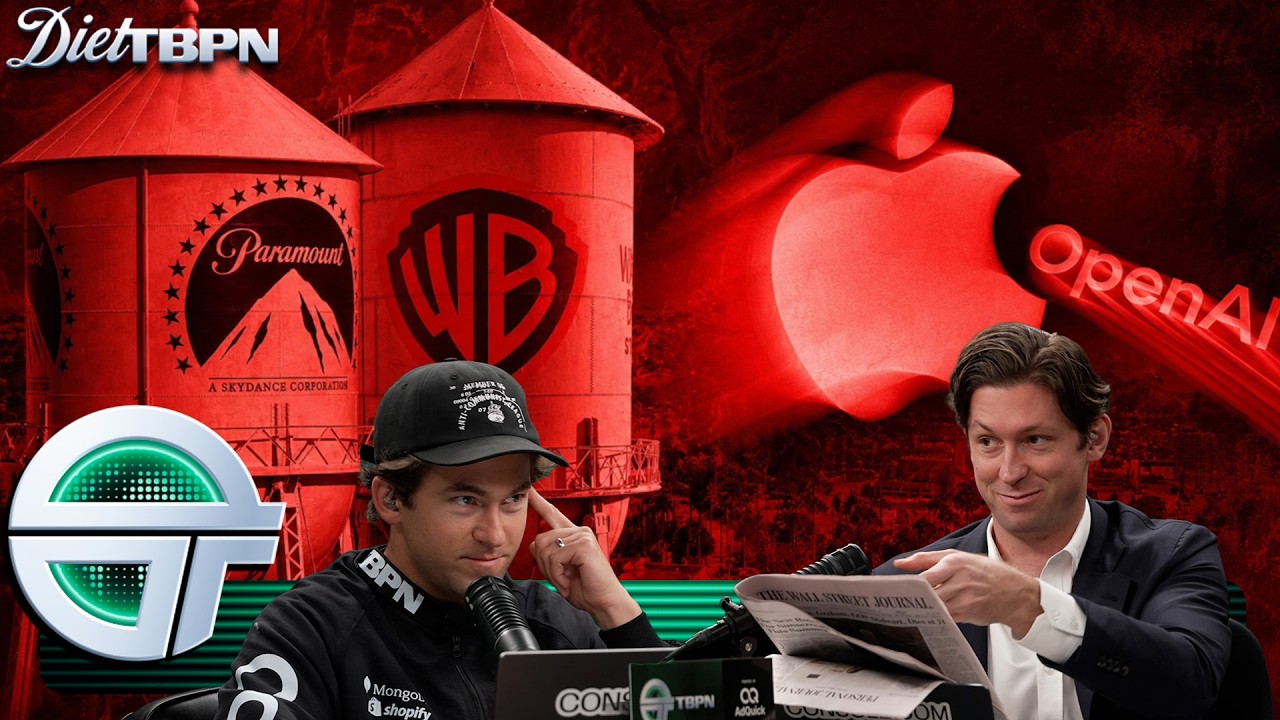
Apple Sues OpenAI Alleging Stolen Trade Secrets for AI Hardware
TBPN
Apple's trade secret lawsuit against OpenAI signals an aggressive effort to stall competition as generative AI poses an existential threat to its core iPhone franchise.
## Background
TBPN published this live tech talk show video on YouTube on July 13, 2026. Hosted by John Coogan and Jordi Hays, the episode delivers a roundup of major tech news, including Apple's legal battle with OpenAI, Paramount's potential exit from California, and a new AI economic impact statement.
## TL;DR
The hosts analyze Apple's explosive trade secrets lawsuit against OpenAI over alleged hardware secrets theft, placing it alongside historical tech rivalries and Ben Thompson's critique of Apple's AI strategy. They then cover Paramount's threat to relocate operations out of California following antitrust pushback on its $110 billion acquisition of Warner Bros. Discovery. Additionally, they discuss a new warning letter signed by over 200 researchers regarding AI's economic impact, before closing with internet commentary and SpaceX launch pad visuals.
## Atmosphere & style
The episode features a lively, conversational, and energetic vibe driven by the analytical rapport between hosts John Coogan and Jordi Hays. Combining sharp industry commentary with sharp, humorous banter, the dynamic shifts seamlessly from serious breakdowns of high-stakes corporate drama to casual reactions to viral clips. Watching feels like sitting in on an insider tech debrief that balances grounded business analysis with lighthearted humor.
## Key takeaways
- [00:00](https://www.youtube.com/watch?v=KinZYt_30Rk&t=0s) Apple filed a major trade secrets lawsuit against OpenAI and its hardware leadership, accusing them of systematically stealing proprietary hardware trade secrets and poaching over 400 Apple employees.
- [00:00](https://www.youtube.com/watch?v=KinZYt_30Rk&t=0s) The lawsuit centers on former Apple employee Zhang Lu, who allegedly retained server access and downloaded proprietary files after leaving, as well as former VP Tang Tan asking candidates to bring physical Apple parts to interviews.
- [00:00](https://www.youtube.com/watch?v=KinZYt_30Rk&t=0s) OpenAI denied interest in trade secrets and CEO Sam Altman publicly expressed respect for Apple, while legal observers note the case echoes Steve Jobs's 2010 'thermonuclear war' against Android.
- [11:08](https://www.youtube.com/watch?v=KinZYt_30Rk&t=668s) Analyst Ben Thompson argues Apple is acting aggressively because the generative AI boom threatens its smartphone dominance, disrupted its chip-manufacturing costs, and raised existential risks of alternative AI form factors.
- [15:02](https://www.youtube.com/watch?v=KinZYt_30Rk&t=902s) Stratechery criticized Apple's AI approach, contending the company is prioritizing protecting its core iPhone franchise over true innovation while sending an aggressive message to departing talent.
- [15:48](https://www.youtube.com/watch?v=KinZYt_30Rk&t=948s) Paramount is considering relocating its operations out of California after State AG Rob Bonta filed a lawsuit to block its proposed $110 billion merger with Warner Bros. Discovery.
- [15:48](https://www.youtube.com/watch?v=KinZYt_30Rk&t=948s) Critics fear the Paramount-WBD merger creates an anti-competitive environment for creators, while supporters argue legacy media must consolidate to survive against tech giants like YouTube and social platforms.
- [20:27](https://www.youtube.com/watch?v=KinZYt_30Rk&t=1227s) Over 200 prominent researchers and economists signed an open letter calling on governments to prepare for the massive economic transformations and potential job displacement driven by advanced AI.
- [20:27](https://www.youtube.com/watch?v=KinZYt_30Rk&t=1227s) Top tech lab CEOs were notably absent from signing the open letter, likely to prevent media headlines linking them directly to widespread job displacement claims.
- [28:02](https://www.youtube.com/watch?v=KinZYt_30Rk&t=1682s) SpaceX is building a futuristic Starship launch facility designed to eventually support an ambitious launch frequency of one rocket per hour.
- [31:04](https://www.youtube.com/watch?v=KinZYt_30Rk&t=1864s) SpaceX's launch deluge system operates at an immense flow rate of roughly 650,000 gallons of water per minute to suppress heat and acoustic energy during launches.
## Detailed walkthrough
Here is a detailed walkthrough of the transcript part provided.
---
[00:00](https://www.youtube.com/watch?v=KinZYt_30Rk&t=0s) Apple Sues OpenAI in a "Thermonuclear" Trade Secrets Battle
A major scoop dropped over the weekend when reporter Mark Gurman broke the news that Apple Inc. has officially sued OpenAI, triggering what *The Wall Street Journal* called a "thermonuclear" war reminiscent of the Steve Jobs era. The lawsuit accuses OpenAI and its hardware chief of orchestrating a coordinated campaign to steal Apple’s trade secrets and proprietary information regarding upcoming consumer hardware products—such as smart home devices (a lamp or tabletop robot), headphones, or pins.
The centerpiece of the lawsuit is a former Apple employee, Zhang Lu, who left for OpenAI. Apple claims Lu retained his Apple-issued laptop for weeks after departing, accessed internal servers, downloaded proprietary files, and encouraged colleagues to do the same. The hosts reflect on standard corporate departure protocols, noting that taking files or retaining access is a major violation; one host recalls leaving behind all email contacts and starting fresh after leaving Founders Fund to maintain proper practice. Furthermore, Apple highlights that OpenAI has systematically poached over 400 Apple employees in recent years—a trend Cupertino deeply despises.
- **Key Figures in the Lawsuit:**
- **Zhang Lu:** Former Apple employee accused of taking proprietary hardware files and using active credentials on Apple servers weeks post-departure.
- **Tang Tan:** Former Apple VP of Product Design (who spent 24 years at Apple) who left in 2024 to co-found AI hardware startup LoveFrom / io with Jony Ive. OpenAI acquired io in 2025 to lead its consumer device team.
- **Tim Cook & John Turnus:** In one of his final major aggressive moves as CEO before John Turnus takes over, Tim Cook "fired a missile" at OpenAI.
- **Allegations:** Apple claims Tang Tan solicited sensitive internal details during interviews, even asking candidates to bring physical Apple component parts for "show-and-tell" sessions. However, tech hiring insiders note that walking through engineering work is common, leaving the legal fight to center on whether those parts were confidential trade secrets.
- **OpenAI's Response:** OpenAI stated, "We have no interest in other companies' trade secrets," and CEO Sam Altman posted on X that he holds "tremendous respect" for Apple, calling it an "S-tier company."
---
[03:50](https://www.youtube.com/watch?v=KinZYt_30Rk&t=230s) Historical Precedents: Apple’s Battles Against Android, Meta, and "Sherlocking"
The legal war between Apple and OpenAI draws direct parallels to Steve Jobs's 2010 declaration of "thermonuclear war" against Google's Android, which Jobs considered a stolen product. That era’s legal battle royale spanned eight years of costly litigation with Samsung and other phone manufacturers before settling in 2018. A core issue in both cases is a perceived breach of trust—historically exemplified by former Google CEO Eric Schmidt sitting on Apple’s board while Android was in development.
The conversation touches on how major tech hyperscalers have repeatedly tried and failed to dethrone Apple’s smartphone supremacy:
- **Failed Competitors:** Jeff Bezos’s Amazon Fire Phone, Microsoft’s Windows Phone, and Meta’s early attempts (including Chamath Palihapitiya's work on a Facebook phone).
- **Meta & SpaceX Pressure:** Mark Zuckerberg’s metaverse pivot failed to disrupt the iPhone, while Elon Musk’s SpaceX unit is currently suing Apple over App Store ranking practices while prototyping its own direct-to-cell/AI hardware.
- **"Sherlocking" Irony:** The hosts point out the irony of Apple suing over stolen ideas when Apple frequently "Sherlocks" third-party developers (a term originating from Apple replacing the third-party Watson search tool with its native Spotlight search feature, formerly connected to Sherlock). While flashlight apps were rendered obsolete by built-in iOS updates, modern apps like Partiful have managed to survive Apple's built-in event invite alternatives.
---
[11:08](https://www.youtube.com/watch?v=KinZYt_30Rk&t=668s) Ben Thompson’s Analysis: Why the AI Era Has Sucked for Apple
Stratechery analyst Ben Thompson broke down Apple's court filing, arguing that while Zhang Lu appears blatantly guilty and handled his exit with extreme carelessness, Apple’s own internal security looked surprisingly lax by allowing a former employee's server access and laptop to slip through unmonitored for weeks. Thompson recalled his own experience interning at Apple 16 years prior, emphasizing that Apple employees have always known the company aggressively monitors hardware and logs.
The hosts read Thompson’s synthesis on why Apple is acting with such raw aggression:
- **Pre-2022 Stability:** Before the generative AI boom, Apple had a lock on the premium smartphone market and reliable, expanding recurring revenue from services.
- **AI Paradigm Shift:** The rapid rise of AI forced Apple into existential questions over foundational models, led to a public relations mess during the 2024 Siri announcement, forced major team reorganizations, and caused Apple to lose its favored status with chip manufacturer TSMC (resulting in mid-cycle cost pressures).
- **Existential Threat:** Beyond losing 400 top talent members to OpenAI, Apple faces the real possibility that AI agents and alternative form factors could render the smartphone screen secondary.
- **Revenge Opportunity:** Finding a clear "smoking gun" of trade secret theft gives Apple a legal bludgeon to slow down OpenAI’s hardware progress and retaliate against the company driving the paradigm shift.
Here is a detailed, faithful walkthrough of this section of the transcript:
[15:02](https://www.youtube.com/watch?v=KinZYt_30Rk&t=902s) Stratechery's Critical Take on Apple's AI Strategy
Reading from a Stratechery piece, the hosts detail a sharp critique regarding Apple's recent moves in artificial intelligence. The article argues that Apple’s primary contribution to the AI boom has merely been delivering two-year-old technology, differentiated only by exclusive access to user data it refuses to share. Rather than embracing a new AI-driven paradigm, Apple seems intent on protecting its core iPhone franchise at all costs. Furthermore, any employees looking to push boundaries are being sent a clear signal that Apple believes it owns not just their laptops, but their minds and institutional knowledge. The passage brutally concludes that the situation "mostly stinks, but then again, rotten things usually do." The hosts react to the intense phrasing, calling it "thermonuclear" before encouraging viewers to subscribe to Stratechery to read the full context.
- The excerpt specifically characterizes Apple's strategy as protecting its flagship iPhone franchise against disruptive AI paradigms.
- The hosts note that this is not the first "thermonuclear" critique written about Apple's corporate posture in recent tech history.
[15:48](https://www.youtube.com/watch?v=KinZYt_30Rk&t=948s) Paramount Threatens California Exit Over Warner Bros. Acquisition Lawsuit
The hosts transition to a major media story breaking via Rohan Goswami at Semafor: Paramount is actively weighing whether to shift its major business operations out of California. This threat comes right after California Attorney General Rob Bonta, alongside 11 other state attorneys general, filed a lawsuit to block Paramount's massive $110 billion acquisition of Warner Bros. Discovery. The proposed deal represents the largest merger in Hollywood history, combining two of the top five film distributors to command roughly 27% of U.S. film distribution and basic cable channels.
Paramount responded aggressively to the lawsuit, with media analyst Brian Stelter breaking down their statement that the state complaint distorts settled antitrust law and misrepresents the realities of modern entertainment competition. Industry observers note that while the Justice Department cleared the merger and international regulators in China raised no major objections, California’s aggressive state-level opposition has brought negotiations to a standstill. Paramount executives privately complain that AG Bonta has completely refused to negotiate, despite Paramount previously offering concessions—such as keeping both historic Los Angeles studio lots operational and committing to release 30 films annually combined.
The hosts discuss the broader debate surrounding the deal. Critics view the merger as a nightmare scenario for Hollywood creators, fearing a monopolistic environment with fewer script buyers, depressed prices, and the potential conversion of historic studio lots into real estate developments. Conversely, supporters argue that Hollywood cannot be viewed in isolation; traditional studios face immense competitive pressure from platforms like YouTube, Instagram, podcasts, and livestreams. They draw a parallel to the Getty Images and Shutterstock consolidation, where traditional legacy companies had to combine forces to survive systemic disruption from outside technology. If Paramount does follow through on leaving California, potential relocation destinations include tax-friendly states like Texas and Florida, or established production hubs like Atlanta, London, or Toronto.
- **Transaction Details**: Paramount's $110 billion acquisition of Warner Bros. Discovery is the largest proposed merger in Hollywood history.
- **Combined Market Share**: The deal would control approximately 27% of U.S. film distribution and basic cable networks.
- **Production Guarantees**: Paramount offered to keep both historic L.A. studio lots open and guarantee 30 film releases annually (15 from each studio).
- **Financial Risk for Taxpayers**: Semafor reports that if the state's lawsuit fails, California taxpayers could potentially assume $600 million to $1.2 billion in ticking fees and legal damages.
[20:27](https://www.youtube.com/watch?v=KinZYt_30Rk&t=1227s) Over 200 Researchers Sign New AI Economic Impact Statement
A new open letter signed by over 200 high-profile researchers and economists—including Jack Clark, Jeff Dean, Tyler Cowen, Yoshua Bengio, Eric Schmidt, John Schulman, Don Brown, and Dean Ball—urges institutions and governments to immediately prepare for the economic fallout of advanced AI. Unlike past "pause" letters or apocalyptic predictions, this concise statement consists of just three core consensus points: AI may become radically more powerful over the next decade; this growth could trigger an economic transformation larger than the Industrial Revolution in a far shorter timeframe; and policymakers and tech leaders must act now to establish guardrails, incentives, and economic research to steer AI in a human-centric direction.
The hosts analyze the letter's exceptionally mild phrasing, noting that point one—that AI *may* become more powerful over ten years—is so conservative that almost anyone could sign it with as little as a 1% subjective probability. They contrast this with aggressive timeline claims coming out of top labs or Elon Musk's statements regarding AI solving new physics within two years. They also observe a notable trend among the signatories: while top tech institutions are represented by high-level executives like Chief Financial Officers or key researchers (e.g., Sara Fryer and Jack Clark), the ultimate CEOs like Sam Altman, Dario Amodei, Demis Hassabis, and Sundar Pichai are absent. The hosts speculate that lab CEOs intentionally avoid signing such documents to prevent media outlets from attaching headlines like "Lab CEO Warns of Large-Scale Job Displacement" directly to their names.
Comparing this document to other frameworks, the hosts contrast it with the rigid, geopolitical "AI 2040" plan—which advocates for global, treaty-level slowdowns on large-scale training runs in coordination with China. They praise the new letter's call for increased economic research and safety net preparation. The hosts suggest that while massive job displacement isn't visibly happening right now, having fiscal stimulus plans and rate-cut playbooks ready for potential 10% to 15% unemployment spikes is a prudent strategy.
- **Core Statements**:
1. AI may become radically more powerful over the next 10 years.
2. It could drive an economic transformation larger than the Industrial Revolution over a vastly shorter timeframe, bringing risks like job displacement alongside living-standard gains.
3. Economists, policymakers, and tech leaders must act now to understand transformative AI economics and build necessary guardrails.
- **Signatory Highlights**: Includes Yoshua Bengio, Eric Schmidt, Jeff Dean, Jack Clark, Tyler Cowen, Dean Ball, John Schulman, Sara Fryer, Reid Hoffman, and Jaan Tallinn.
[28:02](https://www.youtube.com/watch?v=KinZYt_30Rk&t=1682s) Banter on Betting, Voiceover Parodies, and SpaceX's "Dune" Rocket Launch Pad
The show winds down with a series of lighthearted internet clips and social media commentary. First, the hosts highlight a quote from X user Risk Maxing regarding traditional employment: "A 9-to-5 isn't a career, it's a supply chain for casino ammo." While the hosts joke about various nicknames for money—recalling Tai Lopez calling money "fuel units" and Nicolas Cage referencing respecting the dollar—they reaffirm their own dedication to their work.
Next, they play a viral video by voice actor Emily, who frequently parodies corporate technology jargon. In the clip, she delivers a hyper-repetitive, deadpan corporate ad: "Introducing Business AI for Business. Business AI for Business leverages the power of Business AI for your business, transforming your business into AI business..." The hosts laugh at how accurately it captures real-world tech marketing clutter, remarking that legacy companies ironically hire real voice actors to read scripts that sound like they were generated by early AI models rather than using cutting-edge text-to-speech tools.
To close out the episode, the hosts showcase footage from SpaceX's new Starship launch facility. Admiring the scale and futuristic aesthetics, they note that the mechanical installation looks straight out of the movie *Dune* or like a giant Transformer. The advanced mechanical systems and engineering infrastructure are designed with massive scale in mind, built to eventually support launching a Starship rocket every single hour.
- "A 9-to-5 isn't a career, it's a supply chain for casino ammo." — *Risk Maxing*
- "The future of business isn't coming. It's here. Business AI for Business." — *Emily's parody ad*
- SpaceX's new launch pad infrastructure is engineered to support an ambitious target launch frequency of one Starship per hour.
[031:04] Water Cooling the Rocket Launch Deluge System
The hosts discuss the staggering scale of the water suppression and cooling systems used during high-powered rocket launches. Highlighting the sheer volume of water required to suppress the acoustic energy and extreme heat of a launch, they note that the system operates at an astonishing flow rate of roughly 650,000 gallons per minute. To put that massive throughput into perspective, they describe it as being equivalent to draining an entire Olympic-sized swimming pool in just sixty seconds.
- **System Flow Rate:** Approximately 650,000 gallons of water per minute ("the deluge").
- **Visual Scale:** Equal to about one full Olympic swimming pool worth of water drained every minute.
[031:27] Show Wrap-Up and Listener Call to Action
As the episode comes to a close, the hosts express their gratitude to the audience for tuning in to TBPN. They ask listeners to support the show by leaving a five-star review on Apple Podcasts and Spotify, and encourage everyone to subscribe to their daily newsletter at tbpn.com before signing off until the next show.
- **Platform Review Request:** Five-star ratings requested on Apple Podcasts and Spotify.
- **Newsletter Subscription:** Sign-up available at tbpn.com.
## Notable quotes
> [00:00](https://www.youtube.com/watch?v=KinZYt_30Rk&t=0s) We have no interest in other companies' trade secrets — OpenAI
> [00:00](https://www.youtube.com/watch?v=KinZYt_30Rk&t=0s) tremendous respect — Sam Altman
> [00:00](https://www.youtube.com/watch?v=KinZYt_30Rk&t=0s) S-tier company — Sam Altman
> [00:00](https://www.youtube.com/watch?v=KinZYt_30Rk&t=0s) thermonuclear — The Wall Street Journal
> [15:02](https://www.youtube.com/watch?v=KinZYt_30Rk&t=902s) mostly stinks, but then again, rotten things usually do. — Stratechery
> [20:27](https://www.youtube.com/watch?v=KinZYt_30Rk&t=1227s) Lab CEO Warns of Large-Scale Job Displacement
> [28:02](https://www.youtube.com/watch?v=KinZYt_30Rk&t=1682s) A 9-to-5 isn't a career, it's a supply chain for casino ammo. — Risk Maxing
> [28:02](https://www.youtube.com/watch?v=KinZYt_30Rk&t=1682s) fuel units — Tai Lopez
> [28:02](https://www.youtube.com/watch?v=KinZYt_30Rk&t=1682s) Introducing Business AI for Business. Business AI for Business leverages the power of Business AI for your business, transforming your business into AI business... — Emily
> [28:02](https://www.youtube.com/watch?v=KinZYt_30Rk&t=1682s) The future of business isn't coming. It's here. Business AI for Business. — Emily
## Mentioned
Apple, OpenAI, The Wall Street Journal, Mark Gurman, Steve Jobs, Zhang Lu, Founders Fund, Tang Tan, LoveFrom, io, Jony Ive, Tim Cook, John Turnus, Sam Altman, Google, Android, Samsung, Eric Schmidt, Amazon, Fire Phone, Microsoft, Windows Phone, Meta, Chamath Palihapitiya, Facebook, Mark Zuckerberg, iPhone, Elon Musk, SpaceX, App Store, Sherlock, Watson, Spotlight, Partiful, Ben Thompson, Stratechery, TSMC, Siri, Paramount, California, Rohan Goswami, Semafor, Rob Bonta, Warner Bros. Discovery, Hollywood, Brian Stelter, Justice Department, China, YouTube, Instagram, Getty Images, Shutterstock, Texas, Florida, Atlanta, London, Toronto, Jack Clark, Jeff Dean, Tyler Cowen, Yoshua Bengio, John Schulman, Don Brown, Dean Ball, Industrial Revolution, Sara Fryer, Dario Amodei, Demis Hassabis, Sundar Pichai, AI 2040, Risk Maxing, Tai Lopez, Nicolas Cage, Emily, Starship, Dune, Transformer, TBPN, Apple Podcasts, Spotify, tbpn.com
苹果起诉OpenAI 指控其窃取AI硬件商业机密
苹果就商业机密起诉OpenAI,表明在生成式AI对其核心iPhone业务构成生存威胁之际,该公司正采取激进举措遏制竞争。
主持人分析了苹果针对OpenAI涉嫌窃取硬件机密提起的重磅商业机密诉讼,并将其与科技巨头历史上的竞争以及Ben Thompson对苹果AI战略的批评联系起来。随后,他们报道了派拉蒙因其以1100亿美元收购华纳兄弟探索公司遭遇反垄断阻力后威胁将业务迁出加利福尼亚州一事。此外,他们还讨论了200多位研究人员针对AI经济影响联合签署的新警告信,最后以网络评论和SpaceX发射台画面收尾。
苹果公司正式起诉 OpenAI 及其硬件团队负责人,指控其系统性窃取专有硬件商业机密并挖走超过 400 名苹果员工。 (0:00)
分析师 Ben Thompson 指出,生成式 AI 的爆发对苹果的智能手机主导地位构成了生存威胁,促使苹果采取激进策略以保护其核心 iPhone 业务。 (11:08)
在加州总检察长提起诉讼试图阻止其与华纳兄弟探索价值 1100 亿美元的并购后,派拉蒙正考虑将其主要业务迁出加州。 (15:48)
超过 200 位知名研究人员与经济学家联名签署公开信,呼吁政府及各界为先进 AI 引发的重大经济转型与潜在就业冲击提前做好准备。 (20:27)
Reading summary
Legacy tech and media leaders are increasingly deploying high-stakes legal challenges and regulatory threats to protect core business models from disruptive technological shifts.
Apple's Trade Secret Lawsuit Against OpenAI (0:00)
Apple has filed a major trade secrets lawsuit against OpenAI and its hardware leadership, alleging a concerted effort to steal confidential information regarding upcoming consumer hardware, including smart home devices, tabletop robotics, and audio accessories. The complaint focuses heavily on former employee Zhang Lu, who Apple claims retained his corporate laptop for weeks post-departure, accessed internal servers, and urged peers to extract confidential materials. Apple also pointed to OpenAI's systematic hiring of more than 400 former Apple employees.
The lawsuit additionally implicates former Apple design executive Tang Tan, who departed to co-found LoveFrom / io—an entity OpenAI acquired in 2025—alleging Tan solicited confidential design details during candidate interviews. OpenAI denied interest in third-party trade secrets, while CEO Sam Altman publicly praised Apple as an 'S-tier' institution.
Strategic Anxiety Driving Apple's AI Confrontation (11:08)
According to analysis by Stratechery's Ben Thompson, Apple's legal aggression mirrors Steve Jobs's 2010 legal campaign against Google's Android, reflecting deep corporate defensiveness amid the generative AI boom. Before 2022, Apple enjoyed secure smartphone dominance and steady services revenue. However, recent advances in generative AI have forced internal reorganizations, caused high-profile public relations setbacks during Siri announcements, and cost Apple its favored manufacturing terms with TSMC.
Thompson argues that trade secret claims provide Apple with a legal lever to slow OpenAI's hardware progress. Because ambient AI agents and alternate hardware form factors threaten to diminish the central role of smartphone screens, Apple's aggressive posture is interpreted as an effort to protect its core iPhone franchise from technological obsolescence.
Paramount Challenges California Over Warner Bros. Merger (15:48)
Paramount is considering moving its primary business operations out of California after State Attorney General Rob Bonta and 11 other state attorneys general sued to halt its $110 billion acquisition of Warner Bros. Discovery. The transaction represents the largest proposed consolidation in Hollywood history, uniting roughly 27% of U.S. film distribution and basic cable networks. While the U.S. Department of Justice and Chinese regulators cleared the deal, California's state-level antitrust opposition has brought negotiations to an impasse.
Paramount contends the state's lawsuit misrepresents modern entertainment competition, arguing traditional studios must consolidate to compete with digital platforms such as YouTube, podcasts, and social media. Despite Paramount offering concessions—such as keeping both Los Angeles studio lots operational and guaranteeing 30 annual theatrical releases—negotiations remain stalled. If the state loses, Semafor reports California taxpayers could face $600 million to $1.2 billion in legal fees and damages, while Paramount explores alternative hubs in Texas, Florida, Atlanta, London, or Toronto.
Economists Urge Preparedness for AI Labor Shifts (20:27)
More than 200 economists and artificial intelligence researchers—including Yoshua Bengio, Eric Schmidt, Jeff Dean, Jack Clark, and Tyler Cowen—have signed a concise public statement warning of rapid economic disruption from advanced AI. The letter establishes three consensus principles: AI capabilities may expand dramatically over the next decade; this growth could trigger an economic transformation outpacing the Industrial Revolution; and policymakers must proactively design safety nets and research frameworks to navigate structural labor changes.
The hosts note that the letter's phrasing is intentionally mild to secure broad academic consensus, while prominent frontier lab CEOs such as Sam Altman, Dario Amodei, Demis Hassabis, and Sundar Pichai were absent from the signatory list. Commentators suggest this absence allows company heads to avoid direct headlines about job losses, while recommending governments prepare contingency playbooks for potential 10% to 15% unemployment shifts.
These developments demonstrate that as generative AI and digital platforms pressure entrenched markets, the battlegrounds have shifted from product development into state courtrooms, antitrust filings, and regulatory policy debates.
## Background
本期内容由科技商业播客频道 TBPN 于 2026 年 8 月 3 日发布在 YouTube 平台。节目属于“Diet TBPN”精简播报系列,时长约 31 分钟,重点梳理了当天科技圈的重磅头条,包括苹果起诉 OpenAI、学者联名 AI 警告信以及好莱坞派拉蒙并购案的最新动态。
## TL;DR
节目核心聚焦于彭博记者 Mark Gurman 曝出的重磅消息:苹果正式起诉 OpenAI 及其硬件负责人 Tang Tan 涉嫌系统性窃取商业机密并挖走 400 余名核心员工,拉开了被视作乔布斯时代后又一场“全面核战争”的法律消耗战。同时,节目深入剖析了派拉蒙因 1100 亿美元收购华纳兄弟受加州反垄断阻击而威胁撤出该州的产业震动,并解读了 200 余位顶尖学者签署 AI 经济冲击警告信背后“科技高管退居幕后、副手代理表态”的公关博弈。最后,主持人们还分享了讽刺企业滥用“Business AI”黑话的恶搞广告,并惊叹于 SpaceX 星舰发射台堪比《沙丘》工业奇观的暴力美学工程。
## Atmosphere & style
整期节目节奏紧凑、快人快语,主持人间充满硅谷内行特有的默契调侃与犀利讽刺。情绪从开场讨论苹果世纪诉讼时的严谨推演与历史纵深感,逐步过渡到剖析联名信与行业假大空广告时的捧腹戏谑,最后在星舰震撼工程画面的赞叹中收尾。听感上既有顶级科技战略分析的深度与张力,又兼具晨间脱口秀的轻松诙谐与信息高密度。
## Bulletin
- [00:00](https://www.youtube.com/watch?v=KinZYt_30Rk&t=0s) 苹果正式起诉 OpenAI 及其硬件负责人 Tang Tan 涉嫌系统性窃取商业机密,包括指控其通过挖角 400 余名苹果骨干以及在面试中索取未发布硬件零部件与图纸。
- [15:50](https://www.youtube.com/watch?v=KinZYt_30Rk&t=950s) 派拉蒙以 1100 亿美元收购华纳兄弟探索的巨型并购案遭遇加州等 12 州司法部长的反垄断诉讼阻击,派拉蒙正严肃考虑将核心影视制作业务撤出加州。
- [20:27](https://www.youtube.com/watch?v=KinZYt_30Rk&t=1227s) 200 余位知名学者与科技高管联署公开信呼吁警惕 AI 对经济与就业的颠覆性冲击,但前沿大模型各家 CEO 默契缺席,由副手代为出面以规避公关风险。
- [30:28](https://www.youtube.com/watch?v=KinZYt_30Rk&t=1828s) SpaceX 推进新一代星舰发射台架构建设以支持高频周转,其底部水幕消音与冷却喷淋系统每分钟流量达到 65 万加仑,相当于一分钟抽干一座奥运规格泳池。
## Key takeaways
- [00:00](https://www.youtube.com/watch?v=KinZYt_30Rk&t=0s) 彭博社 Mark Gurman 爆料苹果起诉 OpenAI,指控其不仅策动前员工 Cheng Lu 留存公司电脑并下载机密文件,更系统性窥探未发布硬件规划。
- [01:28](https://www.youtube.com/watch?v=KinZYt_30Rk&t=88s) 诉讼揭示 OpenAI 近年已从苹果挖走超过 400 名核心员工,牵头人正是联合 Jony Ive 创业后被 OpenAI 收购的硬件主管 Tang Tan。
- [03:09](https://www.youtube.com/watch?v=KinZYt_30Rk&t=189s) 分析指出此举重现了当年乔布斯针对 Android 发动的“全面核战争”,也是蒂姆·库克卸任前为继任者 John Ternus 扫清前沿硬件对手的战术重锤。
- [05:37](https://www.youtube.com/watch?v=KinZYt_30Rk&t=337s) 科技挑战者如亚马逊、微软、Meta 曾前赴后继试图打造硬件手机颠覆苹果生态均告失败,如今 OpenAI 在尚未推出硬件产品前便率先遭到苹果法律阻截。
- [07:13](https://www.youtube.com/watch?v=KinZYt_30Rk&t=433s) 诉状指控 OpenAI 在面试苹果求职者时要求其将“真实未发布零部件”带到现场展示,行业信任破裂重现了当年埃里克·施密特脚踩两只船引发的争端。
- [09:10](https://www.youtube.com/watch?v=KinZYt_30Rk&t=550s) 苹果历史上常以系统原生功能替代第三方创意(“Sherlocking”),此次反诉 OpenAI 侵权反映出巨头对可能动摇智能手机核心范式的新硬件的极度戒备。
- [11:08](https://www.youtube.com/watch?v=KinZYt_30Rk&t=668s) 本·汤普森解析诉状称前员工涉案行为证据确凿,但事件同时暴露了苹果离职未收回设备、账号权限延迟注销等极低级的内控安全漏洞。
- [13:28](https://www.youtube.com/watch?v=KinZYt_30Rk&t=808s) 生成式 AI 的崛起严重冲击了苹果原有的供应链霸权与生态飞轮,苹果因台积电先进制程议价权被分流及新 Siri 翻车而陷入全面的战略焦虑与被动防守。
- [15:50](https://www.youtube.com/watch?v=KinZYt_30Rk&t=950s) 加州总检察长联手多州以反垄断为由起诉阻止派拉蒙 1100 亿美元收购华纳兄弟探索,派拉蒙则指责监管层严重误判了流媒体与社交平台瓜分用户注意力的现实。
- [18:14](https://www.youtube.com/watch?v=KinZYt_30Rk&t=1094s) 若加州阻挠合并成功,派拉蒙或将制作力量迁往亚特兰大、伦敦或多伦多等税收优惠地,导致加州损失巨额就业与财政税收。
- [20:27](https://www.youtube.com/watch?v=KinZYt_30Rk&t=1227s) 学界与业界 200 余人签署公开声明,低门槛地提出 AI 十年内极端强大、引发就业冲击并要求政策干预的三大宽泛陈述,其措辞被指高度保守且缺乏具体方案。
- [23:12](https://www.youtube.com/watch?v=KinZYt_30Rk&t=1392s) 前沿 AI 实验室的一把手 CEO 全员缺席本次公开信签署,默契交由首席科学家或政策主管代劳,旨在防范媒体以“巨头警告失业潮”为由引发舆论与监管重压。
- [27:49](https://www.youtube.com/watch?v=KinZYt_30Rk&t=1669s) 虽然当前体系在宏观利率与韧性下尚未爆发系统性就业崩溃,但科技圈频繁发布警告信已逐渐演变成某种公关例行公事的表态循环。
- [28:50](https://www.youtube.com/watch?v=KinZYt_30Rk&t=1730s) 社交媒体走红的配音讽刺短片揭示出传统企业追逐 AI 概念的荒诞现状:高管们因认知脱节,斥巨资聘请顶级真人配音员念出机械空洞的 AI 营销黑话。
- [30:28](https://www.youtube.com/watch?v=KinZYt_30Rk&t=1828s) SpaceX 打造的新一代星舰发射台具备极其庞大的工业结构,理论吞吐量旨在支撑极高发射频率,其喷淋系统每分钟消耗 65 万加仑水以抵御极端推力冲击。
## Detailed walkthrough
### [00:00](https://www.youtube.com/watch?v=KinZYt_30Rk&t=0s) Mark Gurman 曝出重磅猛料:苹果起诉 OpenAI 窃取商业机密
节目一开场,主持人便抛出了周末科技圈最震撼的消息:知名科技记者 Mark Gurman 在周五下午爆料,苹果公司已正式起诉 OpenAI,指控其窃取商业机密。两家巨头直接宣战,《华尔街日报》更是将这场冲突与乔布斯时代的“全面核战争”相提并论。诉状中,苹果直指这家 AI 明星初创公司及其硬件负责人展开了一场有组织的秘密行动,蓄意窃取苹果尚未发布的未来产品机密,甚至鼓励苹果在职员工分享关键零部件、图纸和相关技术资料。
面对这些指控,主持人们一边推测被窥探的到底是什么硬件——是传闻中的家用机器人、智能台灯,还是耳机甚至 AI 别针——一边打趣称,Gurman 本人知道的 OpenAI 硬件内幕恐怕比他们还多,因为大家之前为了避免卷入无休止的传闻,刻意选择“保持在黑暗中”。节目稍后也将直接连线 Mark Gurman,深度剖析这起诉讼的背后细节。
- 苹果在诉讼中明确指控 OpenAI 及其硬件负责人通过系统化手段获取苹果未发布产品的机密信息。
- 涉案泄密内容涵盖组件设计图纸、关键硬件材料以及尚未面世的产品线规划。
- 彭博社记者 Mark Gurman 率先爆料此案,并将做客本期节目进行深度解析。
### [01:28](https://www.youtube.com/watch?v=KinZYt_30Rk&t=88s) 诉讼核心指控:笔记本留存、挖角 400 人与硬件主管 Tang Tan
诉讼的核心人物之一是苹果前员工 Cheng Lu。指控称,他在离职前往 OpenAI 后,不仅违规将苹果公司的笔记本电脑私自保留了数周,还下载了大量专有敏感文件,并煽动其他在职同事如法炮制。主持人指出,在硅谷离职时当天上交设备是基本常识;即便像他们当年从 Founders Fund 离职创业做这档节目时,连参会嘉宾名单的邮件都绝不会主动导出,宁愿日后从零独立建立联系,也绝不触碰前公司的合规红线。
更让库比蒂诺总部震怒的是人才流失的规模:诉状中用了大量篇幅强调,OpenAI 近年来已从苹果挖走了超过 400 名员工。苹果一向对恶意挖角深恶痛绝,早年乔布斯因挖角问题与 Adobe 等公司交恶的往事历历在目。这场挖角风暴的领头人正是 Tang Tan——他于 2024 年离开效力了 24 年的苹果,与传奇设计师 Jony Ive 共同创办了 AI 硬件初创公司 io Products,该公司在 2025 年被 OpenAI 全资收购。如今身为 OpenAI 首席硬件官的 Tang Tan,被苹果指控在面试苹果求职者时,系统性地套取敏感商业信息。
```mermaid
flowchart TD
accTitle: 苹果起诉 OpenAI 核心纠纷脉络
accDescr: 展示苹果针对 OpenAI 挖角与硬件机密窃取的指控关系链路
subgraph Apple["苹果阵营 (Apple)"]
direction TB
A1["苹果设计团队核心"] --> A2["Tang Tan (前产品设计副总裁)"]
A1 --> A3["Cheng Lu 及 400+ 离职员工"]
end
subgraph Startup["过渡阶段 (2024-2025)"]
direction TB
A2 -- "2024年离职联手 Jony Ive" --> S1["硬件初创公司 io Products"]
end
subgraph OpenAI["OpenAI 阵营"]
direction TB
S1 -- "2025年被收购" --> O1["OpenAI 消费级硬件部门"]
O1 --> O2["Tang Tan 担任首席硬件官"]
A3 -- "面试过程中涉嫌索取图纸/样件" --> O1
end
Apple -. "发起商业秘密诉讼".-> OpenAI
```
### [03:09](https://www.youtube.com/watch?v=KinZYt_30Rk&t=189s) 重演乔布斯时代“全面核战争”:库克的临别飞弹与奥特曼的“S 级”回应
科技分析师 Ben Thompson(Stratechery)与《华尔街日报》的 Rolfe Winkler 均对这起诉讼给出了极具历史纵深感的解读。文章写道,2010 年史蒂夫·乔布斯曾因 Android 系统公开宣称要发动一场“全面核战争”,怒斥其为“盗窃来的产品”。如今,在首席执行官蒂姆·库克即将卸任、接力棒交予继任者 John Ternus 之前,库克同样向苹果最危险的新宿敌射出了一枚战术导弹。主持人们调侃道,即便内部争议只是关于“下一代设备到底是配 12GB 还是 32GB 内存”这种琐碎细节,一旦冠以“全面核战争”的名头,员工的战斗意志瞬间就会被点燃。
这起诉讼发生在一个微妙的节点:OpenAI 甚至还没有正式发布任何一款消费级硬件产品。科技界正全力竞速,试图打造能超越智能手机时代的新型 AI 设备,不过关于“未来到底需要更多新硬件,还是完全不再需要硬件、仅凭 Agent 就能打理一切”的争论仍在持续。面对指控,OpenAI 官方回应称对苹果的商业机密毫无兴趣,CEO Sam Altman 随后在 X 平台发文表态:“我不怕苹果,但我对他们怀有巨大的敬意”,并称苹果是一家“S 级公司”(S-tier company)。主持人们打趣称,《华尔街日报》报道时漏掉了“S 级”这个词,可能该报读者根本不玩排级榜,误以为 S 是排在 A 下面的垫底级别。
- 乔布斯曾在 2010 年因 Android 涉嫌抄袭而宣战,称其为全盘抄袭的盗窃产物。
- 此次诉讼被视为库克任期尾声的一记重击,为即将上任的硬件工程高级副总裁 John Ternus 铺路。
- Sam Altman 公开称苹果为“S 级公司”,并强调 OpenAI 聚焦于开创新技术,无意窥探对手秘密。
### [05:37](https://www.youtube.com/watch?v=KinZYt_30Rk&t=337s) 科技巨头的宿命成人礼:从手机战场到漫长的侵权消耗战
在硅谷,挑战苹果的硬件霸权几乎是每一个新兴科技巨头的“成人礼”,但无一例外付出了沉重代价。谷歌虽然依靠 Android 占领了设备数量优势,但由于硬件利润率极低,捕获的市场实际价值仅有苹果的十分之一左右。当年杰夫·贝索斯曾意气风发地在台上发布 Amazon Fire Phone 豪言必胜;微软不惜代价力推 Windows Phone;就连 Chamath Palihapitiya 当年在 Facebook 也曾主导研发过 Facebook Phone。如今,凭借大模型异军突起的 OpenAI 也踏上了这条充满险阻的老路,试图研发自研设备家族来彻底颠覆传统智能手机。
苹果此番挥动法律大棒,外界普遍认为其战略意图之一就是遏制核心人才的大规模外流。这场官司很可能会重演苹果当年与 Android 阵营长达数年的法律车轮战。当年苹果指控三星数以百万计的智能手机是在“奴隶般地全盘照抄”iPhone,三星坚决否认,双方的世纪诉讼整整僵持了八年,直到 2018 年才达成和解。主持人们感叹道,在日新月异的 AI 行业里,“八年简直就像经历了一百万个十年一样漫长”。
| 挑战者 | 尝试的产品/战线 | 最终结局 |
|:--- |:--- |:--- |
| **亚马逊 (Amazon)** | Fire Phone | 惨遭市场淘汰并巨额减计 |
| **微软 (Microsoft)** | Windows Phone | 市场份额归零,彻底关停移动操作系统 |
| **Meta / Facebook** | Facebook Phone (HTC First) | 迅速夭折,沦为行业谈资 |
| **三星 (Samsung)** | Galaxy 系列智能手机 | 遭遇苹果 8 年诉讼围剿,2018 年才达成和解 |
| **OpenAI** | 研发中的全新 AI 消费级硬件系列 | 尚未发布产品即遭苹果“商业机密”诉讼阻击 |
### [07:13](https://www.youtube.com/watch?v=KinZYt_30Rk&t=433s) 信任背叛的循环:从施密特到“零件带去面试”的争议
在苹果发起的所有重量级知识产权诉讼中,贯穿始终的核心情绪都是“信任的破裂”。当年谷歌首席执行官埃里克·施密特一边坐在苹果董事会席位上,一边秘密督导谷歌研发 Android 系统,这种脚踩两只船的行为彻底激怒了乔布斯,以至于乔布斯在沃尔特·艾萨克森撰写的自传中直言:“我要摧毁 Android,因为它是偷来的产品。”
诉状中披露的最新细节更为具体甚至离奇:除了有初级员工违规借用前同事账号登录苹果服务器窃取数据外,苹果还指控 Tang Tan 在主持 OpenAI 招聘面试时,诱导苹果工程师将苹果的“真实零部件”带到面试现场做展示(“show and tell”)。虽然行业内部人士指出,工程面试中求职者展示过往实际工作成果并不罕见,但关键在于带去的零件是否属于保密级别,这正是苹果目前通过证据开示程序试图查证的焦点。曾经执掌苹果产品设计帅印、与 Jony Ive 并肩作战 24 年的元老,如今站在了老东家的对立面,正如节目所总结的那样:“在科技圈,同床共枕的亲密盟友往往转眼就会变成刺刀见红的死敌。”
- 历史重演:当年施密特身兼苹果董事参与开发 Android,与如今离职高管另立山头如出一辙。
- 苹果在诉讼中明确指控 OpenAI 在面试环节鼓励求职者携带“苹果未发布零部件”进行现场拆解与讲解。
- Tang Tan 与传奇设计副总裁 Jony Ive 关系紧密,io Products 研发初衷正是为了通过 AI 硬件让人类摆脱对智能手机屏幕的过度依赖。
### [09:10](https://www.youtube.com/watch?v=KinZYt_30Rk&t=550s) 挑战苹果霸权的历史困境与“Sherlocking”的讽刺
在宣布将 ChatGPT 整合至 iPhone 的部分系统功能约一年后,苹果与 OpenAI 之间的关系却急转直下。回顾科技巨头们挑战苹果生态统治地位的历程,无论是亚马逊折戟的 Fire Phone、微软遗憾退场的 Windows Phone,还是马克·扎克伯格试图通过“元宇宙”(Metaverse)绕过 iPhone 打造全新计算平台的愿景,都没能真正动摇苹果的根基。埃隆·马斯克同样对苹果对数字经济的强力把控深感不满,SpaceX 旗下的部门不仅起诉苹果歧视其 AI 应用程序,马斯克团队也在着手原型化开发类似智能手机的新型 AI 硬件设备。面对各方指责,苹果历来的官方立场都是 App Store 依靠算法和专家策展,绝不打压竞争对手。
然而,苹果此番起诉 OpenAI 侵犯知识产权,戏剧性在于苹果自身过去正是因为屡屡将第三方开发者的创意“占为己有”而臭名昭著。科技界甚至由此诞生了一个专用动词——“Sherlocking”(夏洛克化)。该词起源于早期 Mac 上一款通过快捷键调出全盘搜索窗口的第三方工具,随后苹果直接在自家系统中内置了功能极其相似的 Spotlight,瞬间让原软件失去了生存空间。这种平台巨头对创业公司的碾压屡见不鲜,但结局并非总是巨头获胜。比如苹果近期试图“夏洛克”聚会派对软件 Partiful,但 Partiful 依然活得很好;反观曾经泛滥的手电筒应用,如今随着系统原生手电筒的普及已几乎无人付费。两人打趣提到 Instagram 上曾有人恶搞过一款“全球最昂贵手电筒 App”:开启手电筒只要 5 美元,关掉它却要收 129 美元,商业构思堪称“天才”。
- **平台挑战者的折戟史**:亚马逊 Fire Phone、微软 Windows Phone 以及 Meta 的元宇宙项目均未动摇 iPhone 的核心地位。
- **新兴 AI 硬件对抗**:马斯克旗下团队正秘密研发新型智能手机形态的 AI 设备,试图打破苹果生态桎梏。
- **“Sherlocking”现象**:源于早期 Mac 搜索插件被苹果官方 Spotlight 取代的历史,已成为科技平台将生态内第三方创意内置化的代名词。
---
### [11:08](https://www.youtube.com/watch?v=KinZYt_30Rk&t=668s) 本·汤普森解析苹果诉状:被盗的商业机密与低级的离职漏洞
科技战略分析师本·汤普森(Ben Thompson,Stratechery 创始人)深入研读了苹果针对前员工张璐(Zhang Lu)及 OpenAI 发起的诉状,并一针见血地指出,案件的关键全部浓缩在诉状第一页的前四段。第一段开门见山定性:"本案关乎苹果前员工为 OpenAI 的利益窃取商业机密,苹果提起诉讼正是为了制止这种行径";第二段回顾了苹果耗费巨资打造取悦用户的卓越产品;第三段暗示苹果所做的一切几乎都属于商业机密;第四段则直指核心涉案人员张璐,并在接下来的篇幅中逐一列举其具体行径。汤普森直言不讳地评价称,张璐在证据确凿面前“几乎必然有罪,而且愚蠢透顶”。起诉书详细记录了他用苹果配发的工作电脑下载了数十份涉及苹果硬件的核心机密文件,甚至煽动其他员工效仿,更离谱的是在正式离职后长达数周内依然使用凭证登入苹果内部服务器。
但这起事件同样暴露了苹果内部安全管理的惊人纰漏。汤普森指出,苹果在流程上犯了极低级的错误:其一,张璐离职时并未归还其中一台笔记本电脑,苹果安全部门甚至没有远程锁定或擦除该设备;其二,由于苹果所谓的一个系统“Bug”,张璐离职数周依然拥有公司内部网络的直接访问权限。此外,诉状中牵扯出的另一核心人物是前苹果硬件高管唐·坦(Tang Tan),苹果指责他主导为 OpenAI 从苹果挖走了多达 400 名硬件及软件工程师。虽然正常跳槽招聘并不违法,但苹果在诉状字里行间流露出的态度,显然是将这种大规模人才流失视作“不可饶恕的背叛”。
```mermaid
flowchart TD
accTitle: 苹果起诉 OpenAI 与前员工窃密事件逻辑图
accDescr: 展示涉案前员工行为、苹果内控安全漏洞及 OpenAI 挖角构成的诉讼核心链条
subgraph 涉案行为与指控["指控核心细节"]
A["前员工张璐 (Zhang Lu)"] --> B["使用苹果配发笔记本下载数十份硬件机密"]
A --> C["煽动其他在职员工复制下载资料"]
A --> D["离职后数周仍利用内部 Bug 登入苹果服务器"]
end
subgraph 苹果安全漏洞["苹果内控纰漏"]
E["离职未收回/未远程注销笔记本电脑"]
F["权限系统 Bug 导致离职员工账号未及时封锁"]
end
subgraph 组织挖角阵营["人才迁移争端"]
G["前设计/硬件高管 (Tang Tan)"] --> H["牵头为 OpenAI 硬件团队招揽超 400 名苹果核心骨干"]
end
涉案行为与指控 --> I["苹果发起诉讼:指控商业窃密并阻击 OpenAI"]
苹果安全漏洞 -.暴露监管失职.-> I
组织挖角阵营 -.引发苹果强烈敌意.-> I
```
针对此前 Meta 监控员工电脑击键记录训练 AI 引发的轩然大波,汤普森感到颇为荒谬:任何人在公司配发的硬件上工作,本就应该明白公司拥有完全的审查权限。他在 16 年前曾作为实习生在苹果工作,早在当时整个 Cupertino 就人尽皆知:只要你触犯了公司的红线,苹果绝对会巨细靡遗地倒查工作设备上的每一个比特。涉案员工在全天候受控的资产设备上肆无忌惮地盗取文件,简直是不可思议的狂妄或愚钝。
- **诉状指控要点**:苹果前员工张璐在跳槽 OpenAI 期间,利用公司电脑下载关键硬件机密,并试图拉拢其他员工加入。
- **安全管控失职**:涉案员工离职后不仅设备未被远程收回,而且由于权限判定系统故障,持续访问苹果内网长达数周。
- **关键枢纽人物**:前苹果知名硬件副总裁唐·坦(Tang Tan)被视为 OpenAI 组建硬件团队的桥头堡,直接牵头挖走了约 400 名苹果精锐。
---
### [13:28](https://www.youtube.com/watch?v=KinZYt_30Rk&t=808s) “AI 时代对苹果糟糕透顶”:从供应链王座到全面开战
汤普森在其分析文章中展开了一场情绪激昂的深度剖析,将苹果此举直接定性为不惜发动“全面核战争”(Thermonuclear War)。他写下了一句充满冲击力的断言:"AI 时代对苹果来说糟糕透顶(AI era has sucked for Apple)"。OpenAI 如今成了生成式 AI 的代言人,而苹果表现出的姿态,几乎可以说是发自内心地痛恨 AI。退回到 2022 年,苹果的日子无比惬意:牢牢霸占着全球高端智能手机市场,源源不断地从每一位 iPhone 用户身上榨取高毛利的服务性收入,商业飞轮运转得完美无瑕。
但 AI 浪潮的席卷粗暴地打破了一切。苹果突然被迫卷入一场关于是否要加入前沿大模型生死博弈的被动决断中:2024 年推出的新版 Siri 演示陷入了令人难堪的舆论翻车,甚至被最知名的科技博主痛批“库比蒂诺的体系内部已经腐烂不堪”;为了追赶进度,苹果不得不全面重组软件和服务团队;曾经作为台积电(TSMC)无可撼动的顶级 VIP 客户和供应链绝对霸主,其地位如今被英伟达等 AI 算力买家无情取代,甚至罕见地在产品周期中遭遇成本逼迫下的调价;更深层的危机在于,AI 所带来的全新人机交互范式,有可能从物理层面根本瓦解智能手机的存在价值。
在焦头烂额之际,苹果还眼睁睁看着以唐·坦为首、由传奇设计师乔尼·艾维(Jony Ive)参与合作的团队挖走了 400 名王牌工程师,并且这些离职员工每天还在联络更多旧部跳槽。因此,当苹果终于抓到一个“愚蠢前员工明目张胆盗取文件”的确凿把柄时,立刻将其变成了发泄愤怒与报仇雪恨的战略重锤。汤普森尖锐地反讽道,当苹果指责他人“骨子里烂透了”时,或许正是一种心理投射——AI 正在重塑世界,而苹果如今拿出的所谓贡献,不过是将两年前的技术包上排他性隐私数据的外壳;苹果根本不想颠覆 iPhone 帝国,而那些渴望探索 AI 全新范式的员工,却被平台以极其冷酷的方式警告:公司不仅拥有你的电脑,还妄图拥有你的心智和知识。
- **黄金时代的终结**:2022 年前苹果坐拥硬件与服务收费的双重垄断,AI 爆发将其拖入不可控的模型竞赛与交互范式颠覆中。
- **软硬件全面承压**:2024 年 Siri 重大升级失利引发公关灾难;台积电先进产能的最优议价权被 AI 芯片新贵分流。
- **诉讼的深层动机**:苹果借助前员工张璐的低级失误发起诉讼,本质上是在用法律武器狙击 OpenAI 与前员工艾维团队对其硬件人才的毁灭式掠夺。
---
### [15:50](https://www.youtube.com/watch?v=KinZYt_30Rk&t=950s) 派拉蒙威胁撤离加州:1100亿美元华纳兄弟收购案遭司法阻击
话题转向了好莱坞的一场巨震。Semafor 记者罗汉(Rohan)报道,派拉蒙环球(Paramount)目前正严肃考虑将主要业务全面撤出加利福尼亚州,起因是加州总检察长罗布·邦塔(Rob Bonta)联合其他 11 个州的司法部长,共同向法院提起反垄断诉讼,全力阻击派拉蒙斥资 1100 亿美元收购华纳兄弟探索(Warner Bros. Discovery, WBD)的惊天大交易。罗汉透露,如果各州坚持阻挠收购,各州可能不得不承担由此产生的附带损害,尤其是多达 6 亿至 12 亿美元的“计时费”(Ticking fees),若派拉蒙选择将业务搬迁出加州,加州纳税人将彻底失去这笔巨额财税贡献。
派拉蒙迅速针对各州检察长的诉讼作出了正面回应,资深媒体人布赖恩·斯特尔特(Brian Stelter)分析指出,派拉蒙反驳该诉状严重扭曲了已确立的反垄断法律,并且建立在对当今娱乐业竞争格局的严重误判之上。这场围绕华纳兄弟探索的争夺战历经波折,曾传言奈飞(Netflix)等巨头有意介入,但最终派拉蒙以最高报价和全现金承诺胜出,为华纳掌门人大卫·扎斯拉夫(David Zaslav)及其股东带来了巨额溢价套现,却在电影产业界掀起了狂风骤雨。
| 交易双方 / 核心维度 | 关键交易信息与合并影响 |
|:--- |:--- |
| **涉及并购实体** | 派拉蒙环球(Paramount)收购 华纳兄弟探索(Warner Bros. Discovery) |
| **交易涉及总金额** | 约 1100 亿美元(好莱坞历史上规模最大的并购案) |
| **市场份额集中度** | 合并后将直接统揽全美约 27% 的院线电影发行份额及大量基础有线电视频道 |
| **司法阻击力量** | 加利福尼亚州总检察长 Rob Bonta 牵头,联合 11 个州司法部长集体提起反垄断诉讼 |
| **行业与传统担忧** | 两大历史制片厂面临裁撤、影视脚本购买方减少导致压价、老牌制片厂地皮恐遭转售商业开发 |
好莱坞电影传统拥趸和行业从业者陷入了巨大的恐慌之中。派拉蒙与华纳兄弟在洛杉矶各自拥有极其深厚历史底蕴的大型制片厂厂区(Studio Lots),一旦合并,新集团势必追求敏捷精简与全球分散化,极有可能关停或将其中一座标志性制片厂改建为普通公寓楼。更危险的信号在于买方垄断:过去两家公司在好莱坞公开竞价购买原创剧本和知识产权(IP),相互抬价造福创作者;合并后好莱坞五大传统发行厂牌瞬间折损其二,垄断导致的议价权集中不仅会压低剧本收购价格,更会大幅缩减未来长片电影的投资与生产数量。这桩好莱坞历史上前所未有的巨型并购,已然将传统电影工业推向了生死存亡的撕扯边缘。
### [18:14](https://www.youtube.com/watch?v=KinZYt_30Rk&t=1094s) 好莱坞并购争议与派拉蒙威胁撤离加州
针对派拉蒙(Paramount)并购案面临的监管审查,主持人们深入探讨了娱乐行业当下的竞争格局。支持合并的一方主张,人们现在整天都在刷 Instagram、看 YouTube、听播客和看直播,因此绝不能孤立地看待好莱坞传统片厂。当一个行业面临来自全新颠覆性外部技术的巨大压力时,适度的行业整合是非常合理的。类似的情况早就在图片库市场发生过——面对生成式技术等全新势力的冲击,Shutterstock 与 Getty Images 之间的竞争与重组逻辑便如出一辙。但反垄断监管机构如果单纯将行业定义为“好莱坞片厂内部”,这笔交易自然会被扣上“行业垄断整合”的帽子。
由于加利福尼亚州总检察长罗伯·邦塔(Rob Bonta)针对该交易提起诉讼并拒绝谈判,派拉蒙与加州政府的摩擦持续升级。派拉蒙首席执行官大卫·埃里森(David Ellison)的朋友和顾问们据报已极力建议他重新考虑公司在加州的业务布局。此前派拉蒙曾做出妥协,承诺保留加州境内的两处历史性制片厂区,并保持每年制作发行 30 部电影(相当于两家制片厂原本各 15 部的产量之和)。然而,尽管美国司法部早已批准该合并,中国及其他国际监管机构迄今也未提出实质性异议,加州政府却执意阻挠。派拉蒙官方抗辩称,加州的指控不仅歪曲了既有的反垄断法,更是对当今娱乐业竞争现状的严重误判。
如果派拉蒙真的将制作力量撤出加利福尼亚,它们会去向何方?主持人们分析指出,虽然许多科技与商业机构倾向于搬往得克萨斯州或佛罗里达州,但在影视制作领域,多伦多、伦敦、亚特兰大(佐治亚州)才是极具吸引力的成熟基地。引入影视工业对于任何地方政府而言几乎都是稳赚不赔的好牌,既能带来可观的本地就业,又能创造丰厚的税收收入,各州之间势必会展开激烈的争夺战。
- **反垄断法律争议**:司法部与跨国监管均已放行,唯独加州检方发起阻挠,派拉蒙指责其无视流媒体与社交平台分流注意力的现实。
- **制片厂妥协方案**:派拉蒙原承诺保留加州两大片场、保证年产 30 部院线级长片,但仍未换来加州监管方的让步。
- **潜在迁址目的地**:除了免税或低税的佛州与得州外,拥有成熟摄影基地和税收优惠的亚特兰大、多伦多与伦敦成为热门备选。
---
### [20:27](https://www.youtube.com/watch?v=KinZYt_30Rk&t=1227s) 又一封 AI 警告信:200 余位学者与高管联署三大陈述
科技界迎来了一封新的联名公开信。原本主持人们还打趣期待看到一份全新的“十亿美元级 PDF 深度报告”,结果等来的却是又一次泛泛的公开倡议。来自学界、产业界的 200 多名研究人员与经济学家共同签署了一份简短声明,呼吁各国政府和机构立即采取行动,为人工智能可能带来的经济冲击做好准备。签署名单包括 Jack Clark、Jeff Dean、Don Brown、Tyler Cowen、Sholto Douglas、John Schulman、Eric Schmidt、Dean Ball 以及“AI 教父”之一的 Yoshua Bengio 等重量级人物。
整篇声明极其克制,仅仅围绕三项简短陈述展开,主持人们调侃称这简短得甚至不能算正文,签署者们只需对这三句话点头即可:
```mermaid
flowchart TD
accTitle: AI经济影响倡议书核心逻辑
accDescr: 描述声明中的三项递进式核心主张,从技术演进到经济影响再到政策行动建议。
subgraph Claims["三项核心联合陈述"]
P1["陈述一:技术潜能<br/>AI 在未来 10 年内可能会变得极端强大"]
P2["陈述二:经济冲击<br/>可能推动前所未有的经济转型(规模超工业革命),带来大规模失业风险与生活水平提升"]
P3["陈述三:行动号召<br/>经济学家、决策者与科技领袖必须立即行动,建立激励机制、护栏与制度以引导 AI"]
end
P1 --> P2
P2 --> P3
```
主持人们就第一条陈述的措辞展开了讽刺与辩论:称 AI 在未来 10 年内“可能会变得极端强大”,态度显得极其保守,甚至像是“根本不需要承担任何承诺责任的废话”。尽管网络上还有一部分人(例如在社交媒体上获得数万点赞的批评者)依然固执地坚称 AI 只是充满幻觉、毫无用处的玩具,过几年就会彻底消亡,但主流实验室内部的预期早已激进得多——无论是埃隆·马斯克宣称的“两年内解出全新物理定律”,还是各家前沿实验室推演的“两到三年实现递归式自我改进与快速起飞”。相比之下,这份公开信的门槛低到“哪怕你认为只有 1% 的概率发生,也能毫无心理负担地签名”。整个声明中唯一具有约束力、措辞最强硬的部分,实际上是第三条——要求决策者与科技领袖现在就必须投入行动,去深入理解转型期 AI 的经济学规律。
---
### [23:12](https://www.youtube.com/watch?v=KinZYt_30Rk&t=1392s) 签字名单的玄机:“二把手”代理人出面与政策路线之争
剖析签署人背景时,主持人们注意到了一个极为微妙的行业潜规则:虽然有大量来自 OpenAI、Anthropic、Meta、Google、斯坦福和哈佛的顶尖学者参与,前谷歌 CEO Eric Schmidt、LinkedIn 联合创始人 Reid Hoffman、Skype 创始人 Jaan Tallinn 也赫然在列,但是当前各家前沿实验室的一把手——包括 Sam Altman、Dario Amodei、Demis Hassabis、Sundar Pichai、Satya Nadella 以及 Elon Musk——全都缺席了。
相反,签名的大多是各家巨头的二把手、政策主管或首席科学家(例如 Anthropic 的 Jack Clark、OpenAI 的 John Schulman、前高管及外部顾问等)。主持人们推测,这些 CEO 们必然知晓此事,但他们默契地选择让副手出面作为“代理人”。如果像 Sam 或 Dario 这样的 CEO 率先以个人身份签署一份包含“AI 可能带来大规模失业”字眼的信件,媒体第二天便会铺天盖地打出恐慌性头条:“某某 AI 巨头 CEO 警告大规模失业即将来临”,引发严重的公关危机和监管审查。而当前站在最顶层的行业大佬们,正试图在公开场合淡化近期可能出现的失业风险。
对比此前的《AI 2040》白皮书,这一封公开信的诉求相对温和且空泛。后者更像是一个“大家先聚在一个房间里把问题理清楚”的务虚倡议,而《AI 2040》则提出了极具争议性的具体方案(例如甚至要求中美两国展开类似核裁军级别的顶级谈判,在全球范围内全面减缓甚至冻结大规模前沿 AI 的训练)。主持人们总结指出,这类要求加大经济学研究和政策储备的倡议很难办砸,因为它只是在呼吁产出更多数据、报告与讨论;政策制定者确实应该未雨绸缪——虽然绝不能在失业潮尚未到来前就恐慌性地乱印钞票搞救济引发通胀,但万一未来失业率真的因 AI 冲击飙升至 10% 甚至 15%,政府的手牌里必须早早备好成熟的经济刺激预案。
- **高管缺席规避公关风险**:顶层 CEO 避免为“大规模失业(large-scale job displacement)”等极具杀伤力的字眼直接背书,改由副手或研究员代为签署。
- **与激进监管提案的区别**:没有提出类似《AI 2040》中跨国谈判强制叫停超大模型训练等具体行动纲领,仅倡导加强政策与经济学前瞻研究。
- **政策储备平衡术**:反对过早滥发补贴引发通胀,但主张必须为潜在的高失业率(如 10%-15%)准备好应对预案。
### [27:49](https://www.youtube.com/watch?v=KinZYt_30Rk&t=1669s) 经济韧性、AI 行业警告信与“赌场弹药”
主持人回顾了应对就业冲击的历史,并结合当前的利率环境指出,整个体系在面对潜在动荡时其实具备相当的韧性。尽管眼下失业潮并未真正全面爆发,但行业内部的焦虑感却始终挥之不去。针对科技界大佬们频繁签署公开信的做法,主播们提出了尖锐的批评:正是那些亲手打造这项技术的人,在一遍又一遍地大声呼吁“我们必须对此做点什么”,这种循环往复的表态仿佛变成了例行公事,“也许他们只是需要每个月都发布一封全新的警告信,一直持续到永远”。
随后,话题轻松地拐向了观众互动。有位名叫 Risk Maxing 的网友在讨论博彩与风险时留言调侃称:“朝九晚五不是一份职业,它只是赌场弹药的供应链。” 主持人笑称虽然他们自己对待工作绝非这种心态,但这个比喻确实别具一格。他们随即聊起对金钱的各种戏谑称呼——有人学尼古拉斯·凯奇(Nicolas Cage)那样敬畏美元,而网红商人泰·洛佩兹(Tai Lopez)则总把钱叫作“燃料单位”(fuel units),让人忍俊不禁。
- **宏观观察**:基于利率与历史应对就业冲击的经验,当前体系具备较强的抗风险能力,短期内并未见到系统性就业崩溃。
- **公开信循环**:AI 领域的建设者不断呼吁监管与反思,但形式正逐渐沦为月度打卡式的公关姿态。
- **网友神评**:“朝九晚五是给赌场提供弹药的供应链”,道出了当代部分年轻人在高风险投机浪潮中的荒诞心态。
---
### [28:50](https://www.youtube.com/watch?v=KinZYt_30Rk&t=1730s) 恶搞广告:“面向商业的商业 AI”与配音反讽
节目切入了一段由配音演员艾米丽(Emily)录制、近期在社交媒体上极度火爆的恶搞视频。艾米丽是一名专业的电台广告配音员,近期凭借多部讽刺科技圈黑话的视频频频出圈。视频中,她以极其字正腔圆的商业广播腔,生动演绎了一则将“Business”和“AI”堆砌到精神污染级别的虚构广告:
> “您的业务依靠商业运转,但您企业的业务却一直困在过去——直到现在。隆重推出:面向商业的商业 AI(Business AI for business)。面向商业的商业 AI 充分利用面向您商业的商业 AI 力量,将您的商业转化为 AI 商业。凭借面向商业的商业 AI,商业 AI 可以在数秒内搞定您的商业,让您的团队专注于您商业中最重要的商业业务。现在,您的企业可以自由地以规模化、高速度、AI 化来经营您的商业。商业的未来尚未到来,它已经在此。商业 AI 赋能商业,商业 AI,商业商业,AI AI AI……”
主持人对此捧腹大笑,直呼“这简直就像我们自己会憋出来的文案”。他们进一步分析了背后的幽默与荒诞:虽然当前的 AI 语音合成技术已经非常强大,理论上完全能生成这种标准旁白,但现实中很多传统大企业不仅思维陈旧,甚至还在“假装跟进 AI(larping)”。这些传统大厂对尖端语音技术的真实进展一无所知,因而依然雇佣顶尖的真人配音艺术家,去念出一段通篇全是 AI 行话、空洞至极的复读机式脚本。
```mermaid
flowchart TD
accTitle: 传统企业采购 AI 广告的荒诞逻辑
accDescr: 展示了传统大企业因技术认知滞后,用真人配音念纯 AI 废话文案的荒诞流程。
subgraph CorporateReality ["传统企业的认知断层"]
A["传统大企业想要拥抱 AI 潮流"] --> B["撰写充斥 'Business AI' 的空洞广告词"]
B --> C{"是否采用最新 AI 语音技术?"}
C -- "认知滞后 / 假装懂 AI" --> D["斥巨资聘请专业真人配音演员"]
C -- "前沿技术路线" --> E["直接调用最新语音模型生成"]
end
subgraph SatiricalOutcome ["现实讽刺结果"]
D --> F["真人演员念出最机械、最 AI 化的复读机文案"]
end
```
---
### [30:28](https://www.youtube.com/watch?v=KinZYt_30Rk&t=1828s) SpaceX 星舰发射台的科幻工程与冷却巨流
节目的最后一段视频展示了 SpaceX 全新发射场地的惊人画面。主持人惊叹这一幕看起来就像电影《沙丘》(Dune)中的庞大外星工业设施,甚至开玩笑说 SpaceX 不小心造出了一台巨大的“变形金刚”。从现场极其震撼的机械结构和声效来看,整个发射系统的设计极其超前,其核心目标是实现极高频次的发射周转,甚至旨在达到“每小时发射一枚星舰(Starship)”的惊人吞吐量。
不仅机械主体结构宏伟,发射台的地面保障系统同样展现了暴力美学般的工程极限。为了在火箭点火瞬间承受巨大的热量与声振冲击,其底部喷淋消音系统(deluge system)拥有恐怖的冷却能力。主持人引用数据指出,该系统每分钟喷水量高达约 65 万加仑(650,000 gallons per minute),相当于在一分钟之内直接抽干整整一座标准奥运会规格的游泳池。
- **超前设计指标**:星舰发射台架构旨在支持高密度轮转,理论目标直指每小时发射一枚。
- **视觉与音效冲击**:巨大的机械构造宛如《沙丘》机械现身,被戏称为现实版变形金刚。
- **喷淋系统能耗**:冷却系统每分钟倾泻约 65 万加仑水,排水速度等同于 1 分钟倒空一座奥运标准泳池。
节目最后,主持人向观众致谢,并呼吁大家在 Apple Podcasts 和 Spotify 上打出五星好评,订阅官网 newsletter,随后正式结束了当日本期节目。
## Notable quotes
> [11:08](https://www.youtube.com/watch?v=KinZYt_30Rk&t=668s) 本案关乎苹果前员工为 OpenAI 的利益窃取商业机密,苹果提起诉讼正是为了制止这种行径
> [13:28](https://www.youtube.com/watch?v=KinZYt_30Rk&t=808s) AI 时代对苹果来说糟糕透顶(AI era has sucked for Apple) — Ben Thompson
> [13:28](https://www.youtube.com/watch?v=KinZYt_30Rk&t=808s) 库比蒂诺的体系内部已经腐烂不堪
> [03:09](https://www.youtube.com/watch?v=KinZYt_30Rk&t=189s) 我不怕苹果,但我对他们怀有巨大的敬意 — Sam Altman
> [07:13](https://www.youtube.com/watch?v=KinZYt_30Rk&t=433s) 我要摧毁 Android,因为它是偷来的产品 — Steve Jobs
> [07:13](https://www.youtube.com/watch?v=KinZYt_30Rk&t=433s) 在科技圈,同床共枕的亲密盟友往往转眼就会变成刺刀见红的死敌
> [05:37](https://www.youtube.com/watch?v=KinZYt_30Rk&t=337s) 八年简直就像经历了一百万个十年一样漫长
> [27:49](https://www.youtube.com/watch?v=KinZYt_30Rk&t=1669s) 朝九晚五不是一份职业,它只是赌场弹药的供应链 — Risk Maxing
> [28:50](https://www.youtube.com/watch?v=KinZYt_30Rk&t=1730s) 您的业务依靠商业运转,但您企业的业务却一直困在过去——直到现在。隆重推出:面向商业的商业 AI(Business AI for business) — Emily
## Mentioned
Mark Gurman, 苹果 (Apple), OpenAI, 华尔街日报 (The Wall Street Journal), Cheng Lu (张璐), Tang Tan (唐·坦), Jony Ive (乔尼·艾维), io Products, Tim Cook, John Ternus, Steve Jobs, Ben Thompson, Stratechery, Sam Altman, Android, Google, Eric Schmidt, Amazon Fire Phone, Windows Phone, Microsoft, Meta, HTC First, Samsung, Elon Musk, SpaceX, Spotlight, Partiful, 台积电 (TSMC), Siri, NVIDIA, Paramount (派拉蒙), Warner Bros. Discovery (华纳兄弟探索), Rob Bonta, David Zaslav, David Ellison, Brian Stelter, Jack Clark, Jeff Dean, Yoshua Bengio, Anthropic, Emily, Starship (星舰)
## Video description
Sign up for TBPN’s daily newsletter at TBPN.com
Diet TBPN delivers the best of today’s TBPN episode in 30 minutes. TBPN is a live tech talk show hosted by John Coogan and Jordi Hays, streaming weekdays 11–2 PT on X and YouTube, with each episode posted to podcast platforms right after.
Described by The New York Times as “Silicon Valley’s newest obsession,” the show has recently featured Mark Zuckerberg, Sam Altman, Mark Cuban, and Satya Nadella.
TBPN is made possible by:
Ramp - https://ramp.com
Public - https://public.com
Cisco - https://www.cisco.com
Console - https://www.console.com
CrowdStrike - https://www.crowdstrike.com
Figma - https://www.figma.com
MongoDB - https://www.mongodb.com
NYSE - https://www.nyse.com
Railway - https://railway.com
Shopify - https://www.shopify.com/
Follow TBPN:
https://TBPN.com
https://x.com/tbpn
https://open.spotify.com/show/2L6WMqY3GUPCGBD0dX6p00?si=674252d53acf4231
https://podcasts.apple.com/us/podcast/technology-brothers/id1772360235
https://www.youtube.com/@TBPNLive
[Source](https://www.youtube.com/watch?v=KinZYt_30Rk)
Source quotes
[11:08] 本案关乎苹果前员工为 OpenAI 的利益窃取商业机密,苹果提起诉讼正是为了制止这种行径
[13:28] Ben Thompson: AI 时代对苹果来说糟糕透顶(AI era has sucked for Apple)
[13:28] 库比蒂诺的体系内部已经腐烂不堪
[3:09] Sam Altman: 我不怕苹果,但我对他们怀有巨大的敬意
[7:13] Steve Jobs: 我要摧毁 Android,因为它是偷来的产品
[7:13] 在科技圈,同床共枕的亲密盟友往往转眼就会变成刺刀见红的死敌
[5:37] 八年简直就像经历了一百万个十年一样漫长
[27:49] Risk Maxing: 朝九晚五不是一份职业,它只是赌场弹药的供应链
[28:50] Emily: 您的业务依靠商业运转,但您企业的业务却一直困在过去——直到现在。隆重推出:面向商业的商业 AI(Business AI for business)
Source quotes
[0:00] OpenAI: We have no interest in other companies' trade secrets
[0:00] Sam Altman: tremendous respect
[0:00] Sam Altman: S-tier company
[0:00] The Wall Street Journal: thermonuclear
[15:02] Stratechery: mostly stinks, but then again, rotten things usually do.
[20:27] Lab CEO Warns of Large-Scale Job Displacement
[28:02] Risk Maxing: A 9-to-5 isn't a career, it's a supply chain for casino ammo.
[28:02] Tai Lopez: fuel units
[28:02] Emily: Introducing Business AI for Business. Business AI for Business leverages the power of Business AI for your business, transforming your business into AI business...
[28:02] Emily: The future of business isn't coming. It's here. Business AI for Business.
Original transcript
[0:00] Huge news over the weekend dropped Mark
[0:02] Gurman dropped a massive scoop right
[0:05] after we got off on Friday night Friday
[0:07] afternoon. Mark Gurman broke the news
[0:09] that Apple is suing open AI Apple and
[0:11] open AI are going to war. The Wall
[0:13] Street Journal called it thermonuclear
[0:15] echoed past attacks
[0:18] calling back to the jobs era. We'll get
[0:20] to that. But first the accusations.
[0:22] Apple is suing open AI accusing it of
[0:24] stealing Apple's trade secrets. Apple
[0:28] Inc. sued open AI for trade secret after
[0:30] accusing the artificial intelligence
[0:31] startup and its hardware chief of
[0:33] engaging in a coordinated campaign to
[0:35] steal information about upcoming
[0:37] products. The iPhone maker said in a
[0:38] suit Friday that open AI encouraged
[0:40] Apple employees to share information
[0:42] components drawings and other materials
[0:44] related to upcoming products. So like
[0:47] the robot? What are the upcoming
[0:48] products from Apple right now? Part of
[0:50] efforts by the AI company. The lamp yeah
[0:52] smart lamp.
[0:53] Um
[0:54] by the AI company develop its own suite
[0:56] of devices. I feel like rumors around
[0:58] the devices have gone back and forth. Is
[0:59] it phones is it is it headphones? Is it
[1:02] something else? A pin? We're having Mark
[1:05] Gurman on the show today to break it
[1:06] down for us. He's coming on 12:45.
[1:09] >> is I bet
[1:10] >> [snorts]
[1:11] >> Gurman knows more about open AI's
[1:13] devices than we do because we
[1:15] specifically
[1:16] didn't want to be read in anything
[1:19] device related because we knew there was
[1:20] going to be so much speculation that we
[1:22] just said like we're we're going to be
[1:23] in the dark.
[1:24] >> We'll find out. We'll find out like
[1:26] everyone. Uh
[1:27] >> [snorts]
[1:27] >> so the center of the lawsuit is a former
[1:29] Apple employee named Cheng Lu who left
[1:32] for open AI and allegedly kept his Apple
[1:34] laptop for weeks after he left the
[1:36] company downloaded proprietary Apple
[1:37] files and encouraged other Apple
[1:38] employees to do the same. Yeah, if that
[1:40] happened that's a big no-no. When you
[1:42] leave a company you got to leave your
[1:43] device on the day you leave usually. I
[1:46] mean I was
[1:47] remembering back to I mean we had a very
[1:49] graceful transition
[1:51] to this business from from Founders Fund
[1:53] but you know I had like emails from in
[1:56] Founders Fund from like people that went
[1:58] to Hereticon, people that'd be good
[1:59] guests. And I was like, "I'm not even
[2:01] going to export that. I'm just going to
[2:02] like leave that and I'll reestablish
[2:04] those connections to people, cold email
[2:06] them, find find their information
[2:08] independently. Just don't take any
[2:10] files, leave them with the other
[2:12] >> Standard practice.
[2:13] >> Yeah, it is standard practice. Uh you
[2:15] know, some people can make mistakes.
[2:17] Also, these are just allegations, none
[2:18] of this is confirmed. And this lawsuit
[2:20] will be going on for like months if not
[2:22] years. We can go through some of the
[2:23] other historical examples that are sort
[2:25] of interesting to uh sort of set the the
[2:28] the table on what might play out here.
[2:30] So, Apple's filings also spends quite a
[2:33] few words on the fact that OpenAI has
[2:35] poached more than 400 employees from the
[2:37] company in recent years. That's not
[2:38] going to make anyone in Cupertino happy.
[2:41] Uh they hate poaching. There's the
[2:43] famous Steve Jobs Adobe back and forth.
[2:46] Uh Tang Tan left Apple in 2024 to
[2:49] co-found the AI hardware startup IO with
[2:52] Jony Ive, which OpenAI acquired in 2025
[2:55] as part of its consumer AI device
[2:57] effort. Tan is now OpenAI's chief
[2:59] hardware officer and he's leading the
[3:00] consumer device effort there. In this
[3:02] lawsuit, Apple says Tan systemically
[3:04] solicited sen- sensitive information
[3:06] from Apple employees who were
[3:07] interviewing for roles at OpenAI. A lot
[3:09] of perspective on this flying around the
[3:11] timeline, but Ben Thompson and Rolf
[3:12] Winkler in The Wall Street Journal both
[3:14] had interesting angles here.
[3:16] >> Wait, they have a Ben Thompson at the
[3:18] Wall Street Journal?
[3:18] >> No, no, no. Ben Thompson at Stratechery
[3:21] and Wolf I said that wrong. Brandon got
[3:23] it cracked in that newsletter. We can
[3:25] read a little bit of what Ralph said in
[3:28] the journal. He says, "Open Apple's
[3:29] OpenAI suit echoes past attacks. Steve
[3:32] Jobs declared thermonuclear war." If
[3:35] you're trying to fire up your staff and
[3:37] you're going to battle, even if it's
[3:39] mundane,
[3:40] >> even if it's just for like, "Will the
[3:42] next device have 12 gigs of RAM or 32?"
[3:45] That's boring. Thermonuclear war is
[3:47] exciting. You got to fire up the the the
[3:49] staff.
[3:50] >> Uh so, he declared Steve Jobs declared
[3:52] thermonuclear war on Google on Google's
[3:54] Android operating system in 2010 calling
[3:56] it a stolen product. Now his successor
[3:59] is going to battle against Apple's most
[4:01] da- new most dangerous rival uh in one
[4:04] of his last acts as Apple's chief
[4:07] executive before successor John Turnus
[4:09] takes over. Tim Cook fired a missile at
[4:11] OpenAI. In a lawsuit filed Friday, Apple
[4:13] alleged that senior OpenAI executive who
[4:16] once sat atop Apple's own product design
[4:19] team was involved in a month-long
[4:21] campaign to steal Apple trade secrets.
[4:23] Uh OpenAI's
[4:24] uh replied at this point and said, "We
[4:26] have no interest in Apple's trade
[4:28] secrets." But Ralph continues, he says,
[4:29] "Although it isn't clear yet what
[4:31] evidence the company has to back up all
[4:33] of its claims, the suit lands before
[4:35] OpenAI has released a product and as the
[4:37] technology industry races to build
[4:38] artificial intelligence-powered devices
[4:40] that can move society beyond the
[4:42] smartphone era." And there's a whole
[4:44] debate to be had for, you know, where
[4:47] that goes and the value of devices in a
[4:49] world where the agents are just kind of
[4:52] off working and you can maybe just text
[4:54] them or send them a message on Telegram.
[4:55] There's a whole debate over what the Is
[4:58] the Is the future of devices at more
[4:59] devices and different devices or is it
[5:01] just no devices? Um but OpenAI has
[5:03] clearly been working on devices as we
[5:04] know from the IO acquisition. The winner
[5:07] could dominate the future just as
[5:09] Apple's iPhone ruled the consumer market
[5:11] for the last 20 years. Uh quote, "I am
[5:14] not afraid of Apple, but I have
[5:16] tremendous Got to flip to A6.
[5:21] Let's see. Tremendous respect for them."
[5:23] OpenAI CEO Sam Altman posted on X
[5:25] Saturday.
[5:26] >> And he said S-tier company.
[5:28] >> Yeah, he said Oh, that didn't make it
[5:29] into the paper. Maybe uh the Wall Street
[5:31] Journal readers aren't familiar with the
[5:32] proper tier list. They think S is down
[5:34] at the bottom when in fact it is above
[5:35] A. Big tech rivals have long tried to
[5:38] supplant Apple, but so far Google,
[5:40] Samsung, Meta Platforms, Microsoft, and
[5:42] amazon.com have all failed. It is crazy.
[5:45] People think, you know, okay, Android
[5:47] was successful, but captured like 1/10
[5:50] of the actual value because the margins
[5:52] on Android devices are so much lower.
[5:54] But, you forget that Jeff Bezos stood on
[5:55] stage and said, "We're launching the
[5:57] Amazon Fire phone, and we're going to
[5:59] win." And then Microsoft had the whole
[6:00] Microsoft phone, and they were really
[6:02] pushing that. And Facebook, Chamath was
[6:04] at Facebook working on the
[6:06] Facebook phone.
[6:07] >> Sort of a right of passage.
[6:08] >> It is a right of passage. It it it it's
[6:10] a it's an ultimate long shot as a as an
[6:13] up-and-coming hyper scalar to
[6:15] >> It's a right of passage
[6:16] >> to go and and challenge Apple. Now
[6:19] OpenAI is emerging as a new threat. It
[6:21] has It has built powerful AI models and
[6:23] is working to toward an unspecified
[6:26] family of devices. Interesting to hear
[6:29] that. To run them. Devices that could
[6:31] supplant Apple's. Company observers say
[6:34] to slow poaching of Apple staffers, for
[6:36] instance. So, this could just slow the
[6:38] the poaching that's happening. Friday's
[6:39] lawsuit has echoes of one of Apple's
[6:42] of the ones Apple's filed against
[6:44] various Android ecosystem players
[6:46] beginning in 2010. A legal battle royale
[6:48] with hardware makers producing rival
[6:50] phones that played out over eight years.
[6:53] The central allegation then, as now, was
[6:55] a rival stole Apple's innovations. Apple
[6:58] said Samsung slavishly copied the iPhone
[7:01] with smartphones it was already selling
[7:03] by the millions, which Samsung denied.
[7:05] The company settled in 2018 after a long
[7:08] costly battle. Eight years. In AI years,
[7:11] that's like a million decades.
[7:13] >> Wow.
[7:13] >> Um
[7:14] At the center of each case Apple has
[7:16] pursued was perceived breach of trust.
[7:19] Trust. So, Google's then chief
[7:20] executive, Eric Schmidt, sat on Apple's
[7:23] board as his company developed Android.
[7:26] So, there was like you're you're on the
[7:28] board of Apple saying, "Yeah, we should
[7:29] definitely launch the
[7:30] >> Kind of similar to the Kreiger-Figma
[7:33] dynamic.
[7:33] >> Yeah, very very tricky.
[7:35] I'm going to destroy Android because
[7:37] it's a stolen product, Jobs told
[7:40] biographer Walter Isaacson.
[7:42] Apple alleges in its new suit that quote
[7:45] at every level OpenAI has been stealing
[7:47] Apple's trade secrets. A more junior
[7:49] employee appeared to cross the line by
[7:51] using an Apple employees login to access
[7:54] Apple servers, but Apple has also
[7:56] accused OpenAI's hardware chief Tang Tan
[7:58] of soliciting trade secrets from its
[7:59] employees in interviews for jobs and
[8:03] encouraging them to bring quote actual
[8:05] parts from Apple for show and tell
[8:07] sessions at OpenAI. Tan worked at Apple
[8:09] for 24 years rising to vice president of
[8:12] product design. But bringing parts to an
[8:14] engineering interview isn't unusual say
[8:16] people familiar with the tech hiring
[8:18] process. That was shocking to me. I it
[8:20] does feel unusual to me. Interviewers
[8:22] want candidates to talk through their
[8:24] work. The question is whether the parts
[8:27] were sensitive, something Apple doesn't
[8:29] offer evidence of and is seeking
[8:32] seeking discovery to determine. A
[8:34] spokesperson for OpenAI said quote, we
[8:35] have no interest in other companies
[8:37] trade secrets. We re we remain focused
[8:40] on building innovative technology that
[8:42] empowers everyday people everywhere. Tan
[8:45] and a more senior employee Tang Liu
[8:47] didn't respond to request for comment.
[8:49] At Apple Tan worked very closely with
[8:51] Jony Ive, its famous industrial design
[8:53] chief. Ive left Apple to build his own
[8:55] design firm later poaching Tan. OpenAI
[8:57] bought that company IO products in 2025
[9:00] to spearhead its own device development
[9:02] efforts. Bedfellows can quickly become
[9:04] enemies in tech. OpenAI made the IO
[9:06] acquisition revealing its intention to
[9:08] wean customers off smartphone screens a
[9:10] year after announcing a partnership with
[9:11] Apple to integrate ChatGPT into some
[9:13] parts of the iPhone. The Wall Street
[9:15] Journal has a content licensing
[9:17] partnership with OpenAI of course.
[9:18] Bigger companies have so far failed to
[9:21] dent Apple's dominance and they talk
[9:23] about Amazon's Fire phone, Microsoft's
[9:25] Windows phone. Mark Zuckerberg also
[9:27] tried to do an end run around the iPhone
[9:29] with a metaverse that never fully
[9:30] disrupted the iPhone of course. Elon
[9:33] Musk has also chafed at Apple's control
[9:35] of the digital economy. A unit of SpaceX
[9:37] is suing Apple for disadvantaging its AI
[9:40] app and the company is now prototyping
[9:42] its own smartphone-like AI device. Apple
[9:45] has said that its App Store relies on
[9:47] algorithms and expert curation and
[9:48] doesn't suppress rivals. The irony of
[9:51] Apple's case against OpenAI is that
[9:53] Apple itself has so frequently been
[9:55] accused of stealing other companies'
[9:56] ideas that it has spawned a new verb,
[9:58] Sherlocking, which is a reference to a
[10:02] an app for the Mac that allowed you to
[10:05] hit, I think, command space and get a
[10:07] finder window to search everything
[10:08] across your entire desktop. That That
[10:11] That That eventually became the
[10:12] Spotlight feature baked into Apple, but
[10:15] it was not very good for the company
[10:17] that was running Sherlock. And so, Apple
[10:19] This is the same like, you know,
[10:21] the the labs will steamroll this or this
[10:24] These many companies just got put out of
[10:26] business by this company. And sometimes
[10:28] it works, sometimes it doesn't. It just
[10:29] sort of depends. Apple recently tried to
[10:31] Sherlock Partiful, but it seems like
[10:33] Partiful is doing fine. Um, and so, it
[10:35] sort of depends on the actual product.
[10:37] >> Yeah, I've not gotten a single Haven't
[10:39] gotten a single invite from Apple's
[10:42] >> True. True.
[10:43] >> invite system.
[10:44] >> At the same time, when was the last time
[10:45] you paid for a flashlight app? Probably
[10:47] never, right? Cuz all of that stuff's
[10:49] baked in. Apple's trying to catch up.
[10:51] >> someone actually go pretty viral on
[10:53] Instagram with the world's most
[10:55] expensive flashlight app. I think it was
[10:57] like a hundred It was It was like $5 to
[11:00] turn the light on and then $129 to turn
[11:03] it off.
[11:04] >> Mhm.
[11:06] >> [laughter]
[11:06] >> That's great. Genius. I like those guys.
[11:08] >> Ben Thompson read through the filing as
[11:12] as he as he would. He says, "You can
[11:15] read Apple's filing here and almost
[11:17] everything you need to know is actually
[11:18] on the first page and the first four
[11:19] paragraphs. Paragraph one is a succinct
[11:21] introduction to the case. This case is
[11:23] about Apple's former employees stealing
[11:24] trade secrets for the benefit of OpenAI.
[11:26] Apple brings this suit to put a stop to
[11:28] it. Paragraph two recounts how Apple has
[11:31] spent a lot of time and money building
[11:32] products that delight customers.
[11:34] Paragraph three basically says that
[11:36] everything they do is a trade secret.
[11:38] And paragraph four introduces Zhang Lu
[11:41] and spends the next page and a half for
[11:43] counting his crimes. Ben Thompson says
[11:45] Lu is almost certainly guilty and an
[11:46] idiot to boot, not mincing words there.
[11:49] Apple has a lot of details about Lu's
[11:51] behavior including dozens downloading
[11:53] dozens of proprietary Apple hardware
[11:55] related files and encouraging other
[11:57] Apple employees to do the same because
[11:59] he did it on his Apple issued laptop.
[12:02] >> Mhm.
[12:03] >> And furthermore logged on to Apple
[12:04] servers for weeks after he had already
[12:07] left the company. Ben says Apple
[12:09] security
[12:10] says as depicted in this case is
[12:12] shockingly poor. First, the company lost
[12:13] track of the fact that Lu didn't return
[12:15] one of his laptops or disable it
[12:17] remotely. Second, due to what Apple
[12:19] claimed was a bug, Lu continued to have
[12:20] access to the company's internal servers
[12:22] for weeks. He talks about how,
[12:25] you know, Tan is is the point person for
[12:28] the 400 people that Apple says that
[12:30] OpenAI has hired away from the
[12:31] smartphone maker. That is no crime, of
[12:33] course, although one does get the sense
[12:35] Apple sure thinks it is.
[12:37] >> Mhm. The funniest moment in here is
[12:38] where he says a couple quick points. A
[12:40] few weeks ago there was a bit of hubbub
[12:41] about Meta capturing keystrokes from
[12:43] employees in order to train AI. What
[12:45] confused me was people's surprise that a
[12:47] company had this level of access to
[12:49] company issued hardware in the first
[12:51] place. Moreover, while that access may
[12:53] very well be theoretical for a lot of
[12:55] companies, at Apple it has always been a
[12:56] well-known fact going at least as far
[12:58] back as when I was an intern there. Ben
[13:00] Thompson was an intern there 16 years
[13:02] ago. Uh that the company could and would
[13:04] go through everything if you ever
[13:06] crossed them. And so it's it's uh yeah,
[13:09] everyone should know this, but somehow
[13:11] it uh it at least Apple alleges that it
[13:14] was not uh known or or just a terrible
[13:17] mistake or brazen uh
[13:20] you know,
[13:21] brazen mistake. Uh he does he does talk
[13:23] about a little bit of the uh the the
[13:26] motivations for why you're going to
[13:28] thermonuclear war. He says, had "AI era
[13:30] has sucked for Apple."
[13:34] >> Open AI is the face of AI generally, and
[13:36] it's hard to escape the sense that Apple
[13:37] just really hates AI, and why shouldn't
[13:39] they? Go back to 2022, Apple had it all
[13:41] figured out. They had a lock on the
[13:43] premium end of the smartphone market,
[13:44] which they continued to slowly expand,
[13:46] even as they'd figured out how to earn
[13:48] services revenue from every iPhone user
[13:50] basically forever. Business was good. AI
[13:52] has ruined all of that. Suddenly, Apple
[13:54] has to make existential decisions about
[13:56] whether or not to compete in the model
[13:57] game. They totally embarrassed
[13:59] themselves with the 2024 new Siri
[14:01] introduction.
[14:02] Had their most prominent blogger declare
[14:04] that something is rotten in the state of
[14:05] Cupertino.
[14:07] Had to completely overhaul their
[14:08] software and services teams, lost their
[14:10] position as kings of the supply chain
[14:11] and most favored customer of TSMC to the
[14:14] point where they had to enact an
[14:15] emergency mid-cycle price rise, and then
[14:17] worst of all, have to actually wrestle
[14:19] with the possibility that AI is such a
[14:21] paradigm shift that it might actually
[14:22] threaten the iPhone. And then on top of
[14:24] all that, they lost they lose 400 of
[14:26] their best employees, recruited by the
[14:28] lead hardware engineer for the iPhone in
[14:30] partnership with their most famous
[14:31] executive outside of Steve Jobs, and
[14:33] have to know that all 400 of those
[14:35] employees are getting hit up by their
[14:37] former colleagues looking for a job as
[14:38] well. The AI era has sucked for Apple,
[14:42] even if they aren't necessarily doomed,
[14:43] and even if they relaunch new Siri ends
[14:45] up working out, their position is still
[14:47] more fragile than it was, and everything
[14:49] about life is worse. Given that, how
[14:50] sweet it must feel to suddenly have a
[14:52] smoking gun in the form of a seriously
[14:54] dumb employee blatantly lifting
[14:56] documents and to use it as a casual to
[14:59] exact revenge on the company that
[15:01] represents everything that is making
[15:02] your life miserable. The perspective
[15:04] does make one wonder if that phrase
[15:07] rotten to its core was projection in the
[15:09] end. AI is changing the world, and
[15:11] Apple's contribution is to deliver
[15:13] 2-year-old technology differentiated by
[15:15] exclusive access to data it won't share.
[15:17] It certainly has no interest in
[15:19] delivering on a new AI-driven paradigm
[15:21] that endangers its iPhone franchise in
[15:23] any way. Any of its employees who wish
[15:25] to do exactly that, meanwhile, are being
[15:27] told loud and clear that Apple doesn't
[15:28] just think it owns your laptop, but also
[15:31] your mind and knowledge. I think it
[15:33] mostly stinks, but then again, rotten
[15:35] things usually do.
[15:36] >> It's thermonuclear.
[15:38] >> Cupertino
[15:39] >> But it's not the first thermonuclear
[15:40] >> Go sign up for Stratechery, read the
[15:42] whole article. There's a bunch of
[15:44] context. Um, and we're going to come
[15:47] back to the story uh with the
[15:48] Germinator. Rohan in Semafor says
[15:51] Paramount weighs leaving California over
[15:55] Warner Brothers rift. What's going on
[15:57] here, John?
[15:58] >> So, this is uh on the basis that
[16:00] California is trying to block the
[16:03] Paramount uh
[16:05] uh the Paramount acquisition of Warner
[16:06] Brothers Discovery. Rohan says, "I'm
[16:08] told that if the states do choose to
[16:10] sue, they would have to assume the
[16:12] damages stemming from that action
[16:14] chiefly uh 600 million to 1 billion 1.2
[16:17] billion in ticking fees would
[16:19] potentially be paid out to state state
[16:20] taxpayers. So, if uh if they leave,
[16:24] those uh those fees would not be paid to
[16:26] the state." Paramount just issued this
[16:28] response to the state AG lawsuit. Brian
[16:31] Stelter is breaking it down uh saying
[16:32] the complaint distorts settled antitrust
[16:34] law and is based on uh misrepresentation
[16:37] of competition in the in in the
[16:39] entertainment industry today. So, uh
[16:41] Paramount is weighing whether to shift
[16:43] major operations out of California uh
[16:46] after Attorney General Rob Bonta and 11
[16:49] other state attorneys general, I always
[16:51] get that wrong, filed today to block its
[16:53] 110 billion-dollar acquisition of Warner
[16:56] Brothers Discovery. This story was back
[16:58] and forth. Will Netflix get it?
[17:00] Paramount wound up with the highest bid,
[17:02] the most cash offer. It got approved.
[17:05] Huge windfall for David Zaslav over at
[17:07] Warner Brothers Discovery, uh but a very
[17:09] controversial acquisition.
[17:11] >> the shareholders?
[17:12] >> Yeah, everyone did very well. Um, but
[17:14] people were very worried because they
[17:15] own two uh two historic studio lots in
[17:19] Los Angeles. Would they need both of
[17:21] those? Would they [clears throat]
[17:21] convert one to apartment buildings? This
[17:23] was sort of
[17:24] the the nightmare case for fans of
[17:27] Hollywood filmmaking that it would
[17:29] become a more agile, lean, globally
[17:32] distributed
[17:35] studio. And would they be making less
[17:36] films? Would they change their their
[17:39] pattern? Because as they are two
[17:41] separate buyers of intellectual property
[17:43] and scripts that come to Hollywood, they
[17:45] can pay higher prices. There's less
[17:46] competition. Potentially, the the price
[17:49] of the
[17:51] that the industry becomes more
[17:52] monopolistic and there's less buying
[17:54] activity. So, the proposed deal was the
[17:56] and is the largest merger in Hollywood
[17:59] history.
[18:00] It would combine two of the five major
[18:02] film distributors and give the resulting
[18:04] company control of roughly 27% of US
[18:07] film distribution and basic cable
[18:09] channels.
[18:11] Of course,
[18:12] anyone who's in favor of this was
[18:14] arguing that well, people are watching
[18:16] Instagram and YouTube all day long and
[18:18] listening to podcasts and live streams.
[18:20] You can't look at Hollywood in
[18:22] isolation. It's okay if there's a little
[18:24] bit of consolidation in an industry
[18:25] that's facing incredible pressure from a
[18:27] new disruptive industry. We saw this
[18:30] play out with the Shutterstock Getty
[18:32] Images question where you have immense
[18:35] pressure in the stock image market from
[18:38] an entirely new outsider technology.
[18:41] Consolidation makes a lot of sense
[18:43] usually in those scenarios. But if
[18:45] you're just looking at it, if you're
[18:47] just defining the industry as only
[18:49] Hollywood studios, then yes, this is
[18:52] this does represent more consolidation.
[18:54] Friends and advisors to Paramount CEO
[18:56] David Ellison had reportedly been urging
[18:59] him to reconsider the company's
[19:00] California footprint in the event that
[19:02] California sued over the deal.
[19:04] Previously, Paramount had offered to
[19:05] keep both of its historic studio lots in
[19:08] California open and release 30 films
[19:11] annually, which was basically just
[19:12] adding the 15 and 15 that were made from
[19:14] both studios, I believe, something like
[19:16] that. Uh but executives have privately
[19:18] complained that Bontha refused to
[19:19] negotiate. Worth noting that the Justice
[19:22] Department has already cleared the
[19:23] merger, while China and other
[19:25] international regulators have raised no
[19:27] comparable
[19:29] comparable objections thus far. So, from
[19:31] a anti-trust perspective, it looks like
[19:34] the merger can go through, but the state
[19:36] of California is potentially trying to
[19:38] block it now. So, Paramount says
[19:40] California's complaint distorts settled
[19:42] anti-trust law and is based on
[19:44] misrepresentation of competition in the
[19:46] entertainment industry today. It'd be
[19:48] very interesting to see where they
[19:49] actually go if they do leave California.
[19:52] There's been so much so much movement to
[19:53] Texas and Florida, but in terms of
[19:56] filmmaking, Toronto, London, Atlanta,
[19:58] exactly. So, maybe Georgia. I don't
[20:00] know. I'm sure every other state is
[20:03] gunning for this because
[20:05] bringing a new bringing an industry to
[20:07] town is is almost always a good move.
[20:09] More jobs for your local economy, more
[20:12] more tax dollars going around. There
[20:14] will probably be a competition, but
[20:16] we'll see we'll see where this
[20:18] where this develops and we might have
[20:19] someone
[20:21] from the media analysis industry come on
[20:25] the show later this week to discuss.
[20:27] >> There is a new letter, new letter just
[20:31] dropped. We are hoping for a new
[20:33] billion-dollar PDF.
[20:35] But, we got another letter. More than
[20:38] 200 researchers and economists,
[20:40] including Jack Clark, Jeff Dean, Don
[20:42] Brown, Tyler Cowen, Sholto, John
[20:44] Schulman, Eric Schmidt, Dean Ball,
[20:48] Yoshua Bengio
[20:50] >> Yoshua Bengio, Eric Schmidt
[20:52] >> a statement urging governments and
[20:53] institutions to act now to prepare for
[20:55] AI's economic impact. They start the
[20:59] >> Pretty simple
[21:00] >> by saying, "AI may become radically more
[21:04] powerful over the next 10 years."
[21:06] >> They
[21:06] >> This isn't like the start. It's just
[21:08] three statements. The entire message
[21:10] >> signing that but they're signing
[21:11] >> They're saying we all agree with these
[21:12] three statements.
[21:13] >> They agree that AI could possibly become
[21:16] radically more powerful over the next 10
[21:18] years.
[21:19] >> Which feels very conservative.
[21:20] >> That's
[21:22] like an incredible You're You're You're
[21:23] not committing to anything at all.
[21:25] >> Uh no. I mean, there are plenty of
[21:26] people that are saying that AI will go
[21:28] away in the next 10 years. Like it's
[21:30] it's useless, you know.
[21:31] >> No one's really saying that.
[21:33] >> And Zittrain saying that and like
[21:34] 100,000 people are liking his post when
[21:36] he says that. So like there are 100,000
[21:38] people out there that are like it
[21:39] hallucinates. It's dumb. It's It's not
[21:42] useful.
[21:43] >> 100,000 people out of billions believe
[21:46] it's going to go away.
[21:47] >> I'm just saying there there are people
[21:48] that don't believe this. But yes, this
[21:49] does feel like a like a like actually an
[21:52] easier statement to agree with than the
[21:54] short timelines of fast takeoff in 2
[21:57] years, uh recursive self-improvement,
[22:00] anything that's coming out of basically
[22:02] any lab is much more aggressive than
[22:04] this. Elon's timelines have been solving
[22:06] new physics in 2 years, stuff like that.
[22:08] >> Point one, AI may become radically more
[22:11] powerful over the next 10 years. Point
[22:12] two, this could drive an unprecedented
[22:15] transformation of our economy larger
[22:17] than the Industrial Revolution but
[22:19] unfolding over a vastly shorter
[22:21] timeframe. It could bring risks
[22:23] including large-scale job displacement
[22:25] as well as opportunities such as major
[22:27] gains in living standards. And three,
[22:30] economists, policymakers, and technology
[22:32] leaders must act now to understand the
[22:34] economics of transformative AI and to
[22:36] build the incentives, guardrails, and
[22:37] institutions needed to steer AI in a
[22:39] direction that complements humans and
[22:41] benefits society.
[22:42] >> So that last one's not a probability.
[22:44] >> Yeah, they're not
[22:44] >> one it feels like you can sign if you're
[22:47] at 1%. Like 1% chance that it gets more
[22:50] more radically more powerful over the
[22:52] next 10 years. 1% chance that it drives
[22:55] an unprecedented transformation of our
[22:56] economy. But as long as you agree that
[22:59] economists, policymakers, and technology
[23:01] leaders must act now to understand the
[23:03] economics of transformative AI. You sign
[23:06] this. So, so three is really the
[23:08] strongest the strongest the the most
[23:10] strongly worded bullet point.
[23:12] >> it's interesting because the people
[23:14] signing this are technology leaders. So,
[23:16] that really says
[23:17] >> not the actual top leaders,
[23:19] interestingly. So, if you look at who
[23:21] signed this, you have a ton of people
[23:23] from OpenAI, Anthropic, Stanford, Meta,
[23:27] like every Harvard, like every lab
[23:29] >> Demis Hassabis, I think you said.
[23:31] >> no.
[23:33] Uh Google, Jeff Dean, like you have
[23:35] people from top
[23:37] from top institutions, but not the CEOs,
[23:40] not the investors. Like there's been
[23:41] other There's been other I mean, I guess
[23:43] Reid Hoffman and Jaan Tallinn and um Who
[23:47] else is I mean, Eric Schmidt's on here.
[23:49] But notably absent are Sam Altman, Dario
[23:52] Amodei. I don't believe Demis is on
[23:54] here. Is he on here?
[23:55] >> Yeah, but you you have Jack Clark, Sara
[23:57] Fryer.
[23:58] >> Yeah, so But what's interesting is that
[23:59] it's It's sort of like the proxies. It's
[24:01] the It's like the right-hand men and
[24:03] women of the AI leaders that are
[24:05] signing. And so, you have to imagine
[24:07] that that Dario, Sam, Elon,
[24:11] Demis, Sundar, Satya, like they got the
[24:15] message. This was received to them and
[24:17] they were like, "You guys can solve
[24:19] this, but we you can sign this, but
[24:21] we're not signing it." Because this
[24:23] doesn't feel like something that happens
[24:24] behind the scenes where Sara Fryer
[24:27] doesn't go to Sam or or Shalto doesn't
[24:29] bring this up to Dario. "Oh, there's a
[24:31] new letter I'm thinking of signing it."
[24:32] Like it feels like it's sort
[24:33] >> There was the like that that big pause
[24:35] letter that Elon did sign at one point.
[24:37] >> A lot of people signed it. And in that
[24:39] one, every lab leader actually did sign.
[24:41] And this one isn't even a pause, but
[24:44] somehow didn't rise to the aura level,
[24:47] and maybe that's deliberate because then
[24:50] it [snorts] gets clipped and turned into
[24:52] headlines where it's like, "Blank lab
[24:54] leader, fill in anyone." It's going to
[24:56] be a It's going to be
[24:57] >> Leaders at XYZ Labs.
[25:00] >> to be head of blank lab if you're the
[25:02] first one to jump if you're Sam or Daria
[25:04] or Demis or Elon. Uh they just said uh
[25:08] that um it could bring large-scale job
[25:11] displacement. So you you you're going to
[25:12] have that headline tag next to you as
[25:15] opposed to if it's like someone at a lab
[25:18] who is not the CEO of that lab says it
[25:22] can bring large-scale job displacement.
[25:24] Cuz right now it seems like at the very
[25:26] top a lot of the lab leaders are sort of
[25:28] backing off of the near-term job
[25:30] displacement worries.
[25:32] >> Yeah, but I I think this still feels
[25:33] much more like the the AI doc than like
[25:35] AI 2040, right? And that like
[25:38] the message I got from the AI doc was
[25:40] like we all got to talk about this, you
[25:41] know, let's get everyone in a room and
[25:43] like figure something out. We don't know
[25:44] at all what it's going to be. We got to
[25:45] figure something out. Where AI 2040 is
[25:47] like, okay, we have this this is our our
[25:49] plan A. We should be doing this specific
[25:52] set of of, you know, policies, tasks,
[25:54] whatever.
[25:55] >> It's as much more like
[25:56] >> specifically unifying rules with China.
[25:59] Like US and China like nuclear-level
[26:02] negotiations on how things slow down.
[26:05] It's it's a global slow down of
[26:08] large-scale AI training runs
[26:10] essentially.
[26:11] Uh and this is very yeah, this is very
[26:12] very different. So much easier to sign.
[26:15] But AI 2040 didn't have like
[26:17] signatories. I mean it had people that
[26:19] like helped out with it in general. And
[26:21] then they did poll them as to they
[26:23] pulled some of the authors to say like
[26:26] which one do you think is most likely to
[26:28] play out? But uh I I guess by any I
[26:31] guess everyone implicitly in the AI
[26:33] 2040, if you contributed to that
[26:35] document, you're sort of alongside
[26:38] advocating for Is it plan A? Cuz it's
[26:40] the fourth one that they offer, I think.
[26:42] Is it plan D?
[26:43] >> I think plan A is is what they are
[26:45] advocating for. There's like four plans
[26:47] and then I think like in the order on
[26:49] the website, I I it is the fourth one,
[26:51] but that's like the arbitrary.
[26:52] >> AI 2040.
[26:55] Trying to load the site, but it's not
[26:56] loading. Anyway, we can come back to
[26:58] that. We must act now. I I like this. I
[27:00] like I like the idea of of more economic
[27:03] research, more policy-making research to
[27:05] understand these things. It It It's not
[27:08] like it's hard to get wrong because the
[27:10] end result is just more information,
[27:13] more studies, more
[27:16] uh
[27:17] you know, conversation and proposals.
[27:19] It's not anything specifically. Like if
[27:22] it was like
[27:23] like
[27:24] large-scale job displacement is coming
[27:26] next month. We need to, you know, print
[27:29] money and do economic stimulus broadly
[27:31] like we did during COVID. I would be
[27:33] like, I don't know that that What if the
[27:36] job displacement doesn't come up and we
[27:37] just create a bunch of inflation? Like I
[27:39] don't I don't I don't know if we should
[27:39] do that.
[27:41] But we should be ready for if we hit 10%
[27:44] unemployment, 15% unemployment, that we
[27:46] do have stimulus in the back pocket. And
[27:49] I think we do with where interest rates
[27:50] are and with the with the history of how
[27:52] we've dealt with employment shocks in
[27:54] the past. Uh so I think we are like set
[27:57] up pretty well if that happens. It
[27:58] doesn't seem like it's happening at this
[28:00] moment, but
[28:01] >> Yeah.
[28:02] >> Tell us about the mustard.
[28:03] >> the critical view on this is the people
[28:06] building the technology say that we got
[28:08] to do something about this. Like like
[28:10] it's kind of just continuation of like
[28:13] that we got to do something about this
[28:14] and maybe you just need to do a new
[28:15] letter every single month forever.
[28:18] >> Maybe.
[28:18] >> Um but
[28:20] >> I don't know.
[28:20] >> Uh speaking of our previous conversation
[28:22] on on betting, Risk Maxing says a 9-5
[28:26] isn't a career. It's a supply chain for
[28:28] casino ammo. And that is certainly one
[28:31] way to look at it. Although, that's not
[28:34] how we think about our work here,
[28:36] gentlemen.
[28:36] >> No, we respect the dollar like uh Nick
[28:39] Cage. Uh Tai Lopez calls money fuel
[28:42] units. I always thought that was a funny
[28:44] funny turn of phrase. Fuel I call them
[28:46] fuel units. I call them fuel units.
[28:48] Well, this person calls them casino
[28:49] ammo. Pull up this last video. We'll
[28:51] close out the show with it.
[28:53] Uh from Emily who
[28:55] >> She's been on a tear.
[28:56] >> is a
[28:57] >> Every video is going viral now.
[28:58] >> voice
[28:59] actor.
[29:00] >> I think she's a real She's a real She
[29:02] does voice acting for for radio ads, but
[29:04] of course is uh making fun of the tech
[29:06] industry, I I think.
[29:07] >> Your business runs on business, but your
[29:09] business's business is stuck in the past
[29:12] until now. Introducing business AI for
[29:16] business.
[29:17] >> something we would come up with.
[29:17] >> Business AI for business leverages the
[29:19] power of business AI for your business,
[29:22] transforming your business into AI
[29:24] business. With business AI for business,
[29:27] business AI does your business in
[29:29] seconds, leaving your team to focus on
[29:32] the important business of your business,
[29:34] business.
[29:35] Now your business is free to run your
[29:37] business at scale, at speed, at AI.
[29:41] The future of business isn't coming.
[29:43] It's here. Business AI for business.
[29:46] Business AI, business business, AI AI
[29:50] AI.
[29:52] >> It's pretty
[29:52] >> Very talented. The funny she's saying
[29:53] every voice, every script right now,
[29:55] which I would assume that this kind of
[29:58] like audio is like AI's really good at.
[30:02] >> Yeah.
[30:02] >> But But I think some of the AI companies
[30:04] are larping and they don't know how good
[30:06] the the voice models have gotten, so
[30:08] they haven't actually just
[30:10] >> voice actor to read the most AI-laden
[30:12] script of all time.
[30:14] >> Yeah. So So I
[30:15] >> Like sometimes I listen to the radio on
[30:16] the way to work and I hear ads like this
[30:17] and they're always by these like big
[30:19] legacy companies. So I assume that's why
[30:20] they're not using like actual
[30:21] cutting-edge technology.
[30:23] >> Polish her voiceover artist, I guess.
[30:25] Reading AI for business ads.
[30:28] >> Last video of the day.
[30:29] >> Yeah.
[30:30] >> Did you see this? Um there's a clip from
[30:32] >> This is so
[30:33] >> SpaceX's new launch site.
[30:35] >> like Dune. It actually looks like Dune.
[30:37] I'm pretty sure SpaceX accidentally
[30:39] built a transformer, at least that's
[30:41] what it sounds like here. This is
[30:42] designed to to uh hold all the rockets
[30:45] so they can launch them I think every
[30:47] hour.
[30:53] The engineering that goes into this just
[30:55] so thinking so far ahead like I think
[30:58] this is designed to launch a Starship
[31:01] every hour.
[31:02] >> Yep.
[31:02] >> And it's like
[31:04] >> They said that it's something like an
[31:05] Olympic swimming pools worth of water
[31:08] that they used to
[31:09] >> Cool everything? Yeah, the deluge. This
[31:11] is crazy.
[31:13] >> about 650,000 gallons per minute.
[31:18] That's approximately in the range of
[31:20] about like one entire Olympic swimming
[31:22] pool being drained in the course of a
[31:24] minute.
[31:27] >> Thank you for tuning into TBPN and leave
[31:30] us five stars in Apple Podcast and
[31:31] Spotify. Sign up for our newsletter at
[31:33] tvn.com. We'll see you tomorrow.
[31:35] Goodbye.