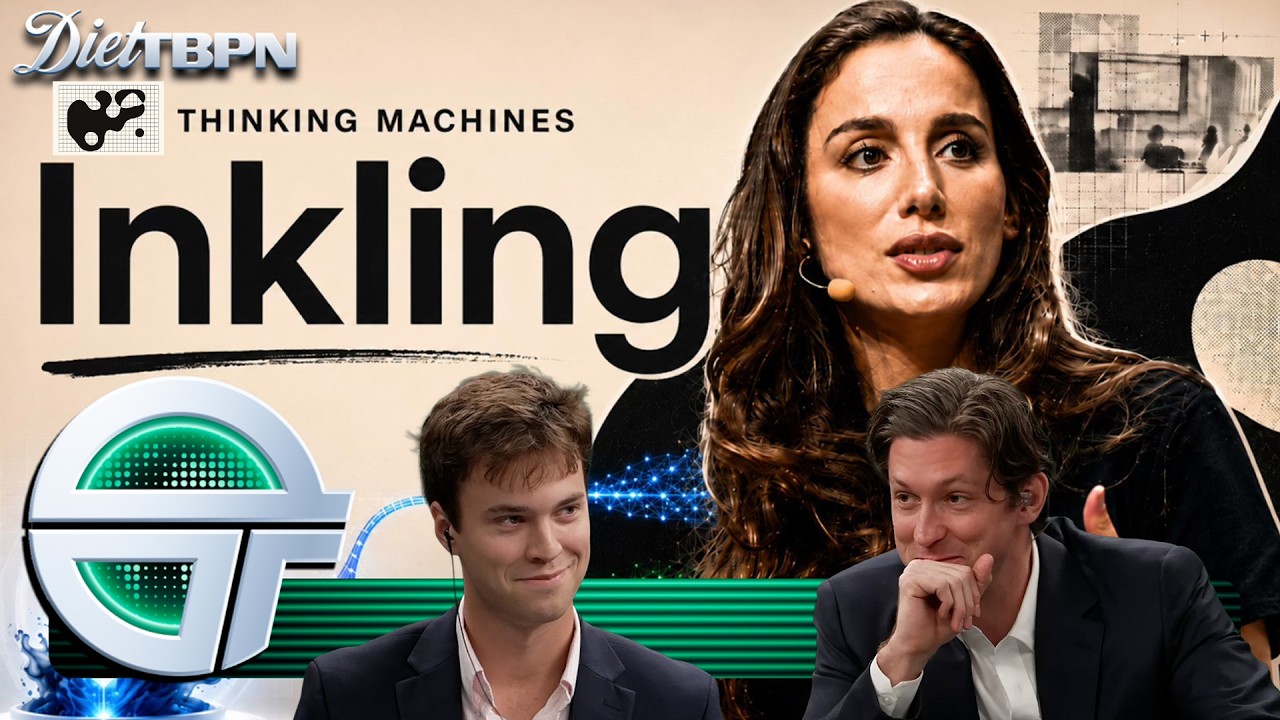
Murati's Thinking Machines Launches Inkling AI Model with Open Weights
TBPN
Thinking Machines Lab launched its 975-billion parameter model Inkling under an open-weights architecture to complement its core API service business while bypassing Chinese open-source restrictions.
## Background
This episode was published by TBPN on YouTube on July 16, 2026. According to the page description, Diet TBPN provides the highlights from the daily tech talk show hosted by John Coogan and Jordi Hays, which features major tech leaders and covers key industry news.
## TL;DR
In this episode, host John Coogan and guest host Tyler Cosgrove cover the launch of Thinking Machines Lab's open-weights AI model, Inkling, and examine the surrounding debate over model distillation and anti-distillation enforcement. They discuss technical front-end design choices in GPT-5.6 "Soul" aimed at avoiding overused AI design tropes, as well as defense tech startup Saronic choosing Texas over California for a $3.2 billion shipyard project. Additional stories highlight TSMC raising its capital expenditure plans despite market skepticism, Lexus striking a custom brand partnership with YouTube creators Colin and Samir, and a debate over Disney's corporate valuation and historical M&A spending.
## Atmosphere & style
The show carries a breezy, candid, and fast-paced tech-talk vibe with casual camaraderie between the hosts. John Coogan sets an affectionate, lighthearted tone early on by poking fun at missing his regular co-host, comparing his adjustment to Warren Buffett turning instinctively to his late partner Charlie Munger. Throughout the episode, the commentary balances sharp industry analysis with witty banter, practical founder anecdotes, and spontaneous reactions to news items, concluding with a warm and energetic sign-off to the live audience.
## Key takeaways
- [00:55](https://www.youtube.com/watch?v=DY75IAf217s&t=55s) Thinking Machines Lab officially launched Inkling, a 975-billion parameter open-weights AI model featuring 41 billion active parameters via a mixture-of-experts architecture.
- [00:55](https://www.youtube.com/watch?v=DY75IAf217s&t=55s) Inkling was intentionally positioned as a broad, flexible foundational model rather than aiming for top-rank benchmark superiority across the board.
- [00:55](https://www.youtube.com/watch?v=DY75IAf217s&t=55s) Inkling uses an open-weights model to support Thinking Machines' Red Hat business model, driving enterprise clients toward their fine-tuning Tinker API.
- [04:40](https://www.youtube.com/watch?v=DY75IAf217s&t=280s) Inkling's post-training relied on synthetic data generated by open-weight models like Kimi k2.5 for supervised fine-tuning, reflecting a light-touch distillation pipeline rather than direct frontier model cloning.
- [04:40](https://www.youtube.com/watch?v=DY75IAf217s&t=280s) Anthropic publicly accused Chinese firm Zhipu AI of distilling Claude and OpenAI models for GLM-5.2, while currently shutting down millions of distillation-linked accounts per week.
- [04:40](https://www.youtube.com/watch?v=DY75IAf217s&t=280s) Anthropic recommended that the US government coordinate globally to restrict the adoption of Chinese AI models, mirroring past trusted telecom policies.
- [10:14](https://www.youtube.com/watch?v=DY75IAf217s&t=614s) OpenAI's GPT-5.6 'Soul' improved design aesthetics by actively eliminating predictable AI UI anti-patterns like Bento Box layouts and massive hero typography.
- [13:41](https://www.youtube.com/watch?v=DY75IAf217s&t=821s) Defense tech startup Saronic selected Brownsville, Texas, over Solano County, California, for its $3.2 billion automated shipyard project 'Port Alpha' due to California's regulatory delays.
- [14:41](https://www.youtube.com/watch?v=DY75IAf217s&t=881s) Texas secured Saronic's Port Alpha project by offering a $211 million tax abatement package.
- [15:47](https://www.youtube.com/watch?v=DY75IAf217s&t=947s) TSMC pledged an additional $100 billion investment for its Arizona fabs, but Wall Street reacted with skepticism over potential overspending, causing the Nasdaq to fall 1%.
- [16:42](https://www.youtube.com/watch?v=DY75IAf217s&t=1002s) Lexus partnered with YouTube creators Colin and Samir in a milestone sponsorship deal featuring custom-produced commercials and dedicated channel content.
- [17:30](https://www.youtube.com/watch?v=DY75IAf217s&t=1050s) Despite Disney's aggregate acquisition spend totaling $182 billion adjusted for inflation against a $169 billion market cap, the company has returned over $70 billion to shareholders through buybacks and dividends.
## Detailed walkthrough
Here is a detailed, faithful walkthrough of the transcript segment:
### [00:01](https://www.youtube.com/watch?v=DY75IAf217s&t=1s) Show Intro and Warmup Banter
The episode kicks off with host John Coogan introducing guest host Tyler Cosgrove, who is filling in for co-host Jordi Hays in the "TBPN Ultradome." John admits he is feeling emotionally off-balance without Jordi present and jokes that he is bound to make mistakes throughout the broadcast by reflexively throwing discussions over to "Jordi" instead of Tyler.
To illustrate his emotional state and the awkwardness of adjusting to a new desk partner, John cues up a humorous compilation clip of billionaire investor Warren Buffett at various Berkshire Hathaway annual shareholder meetings over the decades. In the clip, Buffett repeatedly finishes making a point and instinctively turns to his late partner, asking, "Charlie?"—referencing Charlie Munger—before eventually turning to his current successor, Greg Abel. John notes that the emotional montage brings a tear to his eye and asks the audience to forgive him if he accidentally calls Tyler "Charlie" or "Jordi" during today's show.
### [00:55](https://www.youtube.com/watch?v=DY75IAf217s&t=55s) Thinking Machines Lab Launches "Inkling"
The primary news story of the day centers on Thinking Machines Lab (TML), the AI startup founded by former OpenAI Chief Technology Officer Mira Murati. The company officially launched its very first AI model, named **Inkling**, in an open-weights release intended to challenge the dominant market hold of established frontier giants like OpenAI and Anthropic.
Tyler and John discuss whether the open-source nature of the launch came as a surprise. Tyler explains that releasing an open-weights model makes strategic business sense given Thinking Machines' reliance on their "Tinker API." Because their enterprise model centers on providing fine-tuning and customer integration on top of open-source models, releasing their own weights does not cannibalize their core revenue. Instead, it creates a "Red Hat business model" dynamic: enterprise clients receive open weights and the flexibility to leave at any time, but they choose to remain paying customers because TML handles the heavy lifting of tuning and deployment.
* **Model Specifications:** Inkling features **975 billion total parameters**, though only **41 billion parameters** are active at any given moment via a mixture-of-experts architecture.
* **Strategic Framing:** Unlike typical frontier model launches where labs claim top-rank benchmark superiority across the board, Mira Murati told *The Wall Street Journal* that Inkling was built to be a broad, flexible, foundational model rather than the single strongest model on the market today.
* **Market Position:** AI researcher DD Das noted that Inkling represents the best open-weight model outside of China. It beats Nvidia’s Nemotron-3 Ultra and benchmarks between Moonshot AI’s Kimi k2.5 and k2.6 models. This is particularly attractive to US business leaders who have regulatory or security reticence around adopting Chinese-developed open-source models.
### [04:40](https://www.youtube.com/watch?v=DY75IAf217s&t=280s) Distillation Debates and Controversy Surrounding Frontier Models
The conversation shifts to the technical lineage of Inkling and the broader industry debate surrounding model "distillation"—the practice of training smaller or newer models using synthetic data generated by larger, established closed models.
John brings up an initial post by Jack Morris of Engram Labs, who claimed Inkling was revolutionary as "the only open weight model that's trained without distilling" from OpenAI or Anthropic. However, Tyler points out that TML's own blog post refutes this absolute claim. TML explicitly disclosed that to bootstrap post-training, they ran initial supervised fine-tuning (SFT) on synthetic data generated by open-weight models, including Kimi k2.5. Tyler notes this is a standard, light-touch distillation pipeline similar to Nvidia’s Nemotron approach rather than an outright clone. Following the community correction, Engram Labs' AI persona, Grok, issued a humorous apology acknowledging the confusion caused by Morris's original post and subsequent follow-ups while still defending his overall enthusiasm for Inkling.
The hosts broaden the topic to address geopolitical friction over model distillation:
* **Aspen Security Forum Allegations:** Taryn Chhabra, Anthropic's head of national security policy, publicly accused Chinese AI firm Zhipu AI of distilling both Claude and OpenAI models to create GLM-5.2. It marks the first time Anthropic named Zhipu directly alongside previous calls out against DeepSeek, Alibaba, Moonshot, and MiniMax.
* **Scale of Anti-Distillation Enforcement:** Anthropic is currently shutting down distillation-linked accounts at a rate of "millions of accounts per week." John highlights how difficult this "game of whack-a-mole" is, as labs mask their scraping through distributed proxy entities and pass-through wrapper companies that resell API tokens across different countries.
* **Policy Recommendations:** Anthropic warned that distillation is rapidly shrinking the US lead in AI, suggesting the US government coordinate with global allies to restrict international adoption of Chinese models—mirroring previous trusted telecom initiatives targeted at Huawei and ZTE. Meanwhile, reports indicate Beijing is considering restricting overseas access to top Chinese AI models, further driving the strategic timing and necessity for Western open-source models like Inkling.
### [10:14](https://www.youtube.com/watch?v=DY75IAf217s&t=614s) Deconstructive AI Design Patterns in GPT-5.6 "Soul"
John highlights an intriguing technical post by researcher Grace Lee, who analyzed how OpenAI's GPT-5.6 "Soul" model drastically improved its front-end design aesthetics compared to previous iterations. Lee projected 1,000 AI-generated websites into a design manifold and identified clear structural "holes"—regions where GPT-5.5 used to generate predictable layouts with a "bad AI smell."
To eliminate generic "AI slop," developers actively trained the model to avoid specific overused anti-patterns:
1. **The Bento Box Layout:** Ubiquitous in modern software dashboards.
2. **Massive Hero Typography:** Oversized blocks of text taking up the entire top fold of a webpage.
3. **Over-generic UI tropes:** Predictable high-border-radius rounded corners and standard accent side-colors.
John shares a personal example, noting that when he recently used OpenAI Codex to vibe-code a promotional website for Nick Bostrom's appearance on *The Joe Rogan Experience*, he specifically prompted it to look like a UFC fight card. Injecting even a single distinct reference point breaks the model out of generic design templates. Tyler and John discuss whether removing bad design tropes actually makes models more creative, concluding that while it eliminates immediate visual clichés, users will likely begin spotting new recurring design patterns within six months unless models continuously adapt.
### [13:41](https://www.youtube.com/watch?v=DY75IAf217s&t=821s) California Loses $3.2B Defense Shipyard Project to Texas
The final segment focuses on a major economic blow to Northern California. Defense technology startup Saronic officially passed on Solano County, California, selecting the Port of Brownsville, Texas, as the location for its massive $3.2 billion automated shipyard project, dubbed **Port Alpha**.
The announcement draws a cheer from Tyler (a native Texan in the studio) and frustration from John and *TBPN* newsletter editor Brandon Grahl. Port Alpha was slated to be a flagship tenant for "California Forever"—the ambitious planned city project designed to revitalize regional manufacturing—and was projected to generate approximately 10,000 permanent jobs alongside thousands of union construction jobs.
* **Cause of Loss:** Industry leaders, including Joshua, executive director for the California Alliance for Jobs, attributed the failure directly to California’s sluggish, bureaucratic approval process and regulatory drag.
* **The Takeaway:** Texas acted with immediate urgency to secure the deal, underscoring growing frustration among tech and defense founders over California's inability to move quickly on major industrial infrastructure projects.
[14:41](https://www.youtube.com/watch?v=DY75IAf217s&t=881s) California Loses Major Defense Project to Texas
The hosts discuss a major blow to California's manufacturing economy as defense contractor Saronic elected to move its massive investment to Brownsville, Texas—roughly 20 miles from Starbase—instead of Solano County, California. The decision came after California failed to provide the clear and expedited approval process required for the proposed shipyard project. Although California Forever had previously signed a 40-year construction labor agreement covering 70,000 acres and labor groups backed fast-track environmental legislation, the bill stalled. In contrast, Texas aggressively secured the project in June by offering a $211 million tax abatement package.
Labor leaders noted that they had explicitly warned California officials that the project would leave without expedited approvals. A project insider told the *San Francisco Chronicle* that while California Forever itself remains on track, losing a major defense contractor sends a "powerful signal about the state's ability to compete for large industrial investments." Host John Coogan expressed disappointment, noting that he likes Jan Sramek and the California Forever project and remains excited to see who they land as their next major tenant.
- California lost a defense shipyard project to Texas due to regulatory delays and lack of expedited permitting.
- Texas granted Saronic a $211 million tax abatement package in June to secure the facility in Brownsville.
- The project in California involved a 40-year construction labor agreement spanning 70,000 acres.
---
[15:47](https://www.youtube.com/watch?v=DY75IAf217s&t=947s) TSMC Beats Earnings, Boosts Capex, and Faces Wall Street Skepticism
Taiwan Semiconductor Manufacturing Company (TSMC) reported strong earnings and raised its capital expenditures guide, pledging to invest an additional $100 billion into the United States for its Arizona fabs. Despite TSMC planning record spending to cement its dominance at the top of the global semiconductor supply chain, Wall Street reacted with skepticism. The Nasdaq dropped 1% as investors voiced concerns over potential overspending, offsetting the strong earnings results.
The hosts find the market reaction odd, pointing out that TSMC has historically survived numerous tech cycles—from the smartphone boom to various buildouts and busts—and was never a particularly "AGI-pilled" company. Now that TSMC is finally declaring "yes, now is the time" to build heavily, investors are reacting with "Ah, I don't know" and worrying that the massive spending commitment is coming too late.
- TSMC pledged an additional $100 billion investment toward its Arizona chip fabricators.
- Tech markets slipped, with the Nasdaq falling 1% due to worries over TSMC's record capex plans.
---
[16:42](https://www.youtube.com/watch?v=DY75IAf217s&t=1002s) Creator Economy Milestone: Lexus Partners with Colin and Samir
In creator economy news, YouTube duo Colin and Samir inked a landmark deal making Lexus the official car of their channel. Rather than standard host-read or mid-roll advertisements, the partnership includes four bespoke commercials produced for Lexus that will roll out across YouTube alongside sponsorship of four dedicated channel videos.
The hosts view this first-of-its-kind deal as a sign of a broader media shift, expanding the aperture of how major legacy brands collaborate with digital creators. The deep integration represents a promising blueprint that could be replicated across YouTube to unlock new high-value revenue streams for digital creators.
- Lexus became the official vehicle sponsor of Colin and Samir in a multi-video, custom-commercial deal.
---
[17:30](https://www.youtube.com/watch?v=DY75IAf217s&t=1050s) Debating Disney’s $169 Billion Market Cap and M&A Value
The show highlights a tweet from Jake at Econompic regarding Walt Disney Company's corporate valuation. Over the years, Disney spent $129 billion acquiring Pixar, Marvel, Lucasfilm (Star Wars), ESPN, and 21st Century Fox—an aggregate investment equal to $182 billion in today's inflation-adjusted dollars. However, when combining those acquired crown jewels with all of Disney's legacy assets, the entire company's market capitalization stands at just $169 billion.
This comparison raises questions about whether Disney's massive acquisitions ultimately created or destroyed shareholder value. However, the hosts emphasize a crucial missing piece in that narrative: capital returns. Over that same timeframe, Disney returned over $70 billion to shareholders through dividends and share buybacks. They also note that the financial mechanisms used to fund those acquisitions play a critical role when evaluating total value creation.
- Disney's combined acquisitions of Marvel, Star Wars, Pixar, ESPN, and Fox total $182 billion in adjusted terms versus a $169 billion total company market cap.
- Disney has returned roughly $70 billion or more directly to shareholders via buybacks and dividends during this era.
---
[18:45](https://www.youtube.com/watch?v=DY75IAf217s&t=1125s) The High Costs of New York City and Show Wrap-Up
The hosts react to a viral pitch from Sean Frank sarcastically urging people to move to New York City by highlighting its glaring drawbacks: 100-degree weather with minimal air conditioning, sky-high taxes, the highest rents in the country, poor air quality, and local tech bans like banning Waymo autonomous vehicles. When asked if they ever harbored aspirations to move to NYC, the hosts acknowledge that while all the complaints are accurate, the city remains an unmatched, dense, and vibrant place to hang out.
To close out the episode, the hosts give a shout-out to their guest host Tyler and thank the live chat audience for their positive feedback. They encourage listeners to leave reviews on Spotify and Apple Podcasts, sign up for the daily newsletter at TBPN.com, and wish everyone "the best Thursday of your life" before getting hit with their classic video flashbang outro.
- Sean Frank's viral post outlined NYC's severe downsides, including extreme heat, top-tier rents, high taxes, and a ban on Waymo driverless cars.
- The hosts wrapped up the broadcast by encouraging viewers to subscribe to the newsletter at TBPN.com.
> [00:55](https://www.youtube.com/watch?v=DY75IAf217s&t=55s) Red Hat business model — Tyler Cosgrove
> [04:40](https://www.youtube.com/watch?v=DY75IAf217s&t=280s) the only open weight model that's trained without distilling — Jack Morris
> [10:14](https://www.youtube.com/watch?v=DY75IAf217s&t=614s) bad AI smell — Grace Lee
> [13:41](https://www.youtube.com/watch?v=DY75IAf217s&t=821s) Port Alpha
> [13:41](https://www.youtube.com/watch?v=DY75IAf217s&t=821s) California Forever
> [14:41](https://www.youtube.com/watch?v=DY75IAf217s&t=881s) powerful signal about the state's ability to compete for large industrial investments
> [15:47](https://www.youtube.com/watch?v=DY75IAf217s&t=947s) yes, now is the time
> [15:47](https://www.youtube.com/watch?v=DY75IAf217s&t=947s) Ah, I don't know
> [18:45](https://www.youtube.com/watch?v=DY75IAf217s&t=1125s) the best Thursday of your life — John Coogan
## Mentioned
John Coogan, Tyler Cosgrove, Jordi Hays, TBPN Ultradome, Warren Buffett, Berkshire Hathaway, Charlie Munger, Greg Abel, Thinking Machines Lab, Mira Murati, OpenAI, Inkling, Anthropic, Tinker API, The Wall Street Journal, DD Das, Nvidia, Nemotron-3 Ultra, Moonshot AI, Kimi k2.5, Kimi k2.6, Jack Morris, Engram Labs, Grok, Aspen Security Forum, Taryn Chhabra, Zhipu AI, GLM-5.2, Claude, DeepSeek, Alibaba, MiniMax, Huawei, ZTE, Grace Lee, GPT-5.6 Soul, GPT-5.5, OpenAI Codex, Nick Bostrom, The Joe Rogan Experience, Saronic, Solano County, Brownsville, Texas, Port Alpha, California Forever, Brandon Grahl, California Alliance for Jobs, Jan Sramek, San Francisco Chronicle, Taiwan Semiconductor Manufacturing Company, TSMC, Arizona, Nasdaq, Colin and Samir, Lexus, YouTube, Jake at Econompic, Walt Disney Company, Pixar, Marvel, Lucasfilm, Star Wars, ESPN, 21st Century Fox, Sean Frank, New York City, Waymo, Spotify, Apple Podcasts, TBPN.com
Murati 旗下 Thinking Machines 推出开放权重 AI 模型 Inkling
Thinking Machines Lab 以开放权重架构推出了 9750 亿参数的 Inkling 模型,旨在补充其核心 API 服务业务,同时规避中国开源限制。
在本期节目中,主持人 John Coogan 与特邀主持人 Tyler Cosgrove 探讨了 Thinking Machines Lab 开放权重 AI 模型 Inkling 的发布,并审视了围绕模型蒸馏及反蒸馏执法的争议。他们讨论了 GPT-5.6 “Soul” 为避免泛滥的 AI 设计套路而采取的前端技术设计抉择,以及国防科技初创公司 Saronic 放弃加利福尼亚州、选择在得克萨斯州投资 32 亿美元开展造船厂项目。其他要闻还包括台积电在市场疑虑下依然上调资本支出计划、雷克萨斯与 YouTube 创作者 Colin and Samir 达成定制品牌合作,以及关于迪士尼企业估值与历史并购支出的争论。
Thinking Machines Lab 正式推出首个开源权重 AI 模型 Inkling,该模型采用 MoE 架构,拥有 9750 亿总参数和 410 亿活跃参数,旨在通过类似 Red Hat 的商业模式带动其 Tinker API 企业微调业务。 (0:55)
模型蒸馏争议持续发酵,Anthropic 公开指责智谱 AI 蒸馏 Claude 和 OpenAI 模型来研发 GLM-5.2,并透露目前每周封禁数百万个涉嫌蒸馏的账号,呼吁美政府协调盟友限制采用中国 AI 模型。 (4:40)
国防科技初创公司 Saronic 因加州监管审批繁琐迟缓,放弃在索拉诺县的项目,转而在得克萨斯州布朗斯维尔投资 32 亿美元建设名为“Port Alpha”的自动化造船厂,得州为其提供了 2.11 亿美元的税收减免。 (13:41)
台积电承诺向美国亚利桑那州晶圆厂追加投资 1000 亿美元并上调资本支出指引,尽管财报表现强劲,但华尔街因担忧过度支出导致纳斯达克指数应声下跌 1%。 (15:47)
Reading summary
TBPN hosts John Coogan and Tyler Cosgrove examine emerging fractures across technology and capital allocation, highlighted by Thinking Machines Lab's debut open-weights AI model, California's loss of a $3.2 billion automated shipyard to Texas, and Wall Street's skeptical reaction to TSMC's $100 billion U.S. fab commitment.
Thinking Machines' Inkling and Frontier Distillation Tensions (0:55)
Thinking Machines Lab (TML), founded by former OpenAI Chief Technology Officer Mira Murati, released its first AI model, Inkling. Built on a mixture-of-experts architecture with 975 billion total parameters and 41 billion active parameters, Inkling was framed by Murati in The Wall Street Journal as a broad, flexible foundational model rather than a benchmark-chasing release. AI researcher DD Das observed that it outperforms Nvidia’s Nemotron-3 Ultra and sits between Moonshot AI’s Kimi k2.5 and k2.6. Tyler Cosgrove noted that open-sourcing the weights aligns with TML's enterprise strategy, mirroring a Red Hat model where the company monetizes customer integration and fine-tuning via its Tinker API without cannibalizing revenue.
The launch also intersected with industry debates over model distillation—the training of newer architectures on synthetic outputs from existing frontier systems. Although initially framed by some commentators as completely undistilled, TML acknowledged bootstrapping post-training using synthetic data from open-weight models including Kimi k2.5. Meanwhile, Anthropic national security policy head Taryn Chhabra publicly accused Chinese firm Zhipu AI of distilling Claude and OpenAI models to develop GLM-5.2. Anthropic reported banning millions of distillation-linked accounts weekly and called for allied policy coordination against Chinese model adoption, even as Beijing considers restricting outbound access to its own models.
Mitigating Clichés in Generative Web Design (10:14)
OpenAI's GPT-5.6 "Soul" demonstrates deliberate architectural attempts to eliminate generic outputs in front-end web generation. Technical analysis by researcher Grace Lee mapped 1,000 AI-generated websites across a design manifold, revealing that earlier models frequently generated repetitive layouts characterized as "AI slop."
To counter this uniformity, developers trained the model away from specific visual anti-patterns: omnipresent bento box dashboard grids, oversized hero typography filling the initial page fold, and standardized high-radius rounded corners with predictable accent colors. While injecting unconventional reference prompts can disrupt these standard templates, the hosts questioned whether removing current design clichés fosters genuine creativity or merely delays the emergence of a new set of predictable patterns.
Regulatory Delays Drive $3.2B Shipyard to Texas (13:41)
Defense contractor Saronic bypassed Solano County, California, selecting the Port of Brownsville, Texas, for Port Alpha, its $3.2 billion automated shipyard facility. The facility was intended to serve as a flagship manufacturing tenant for the planned California Forever development, which had established a 40-year labor agreement covering 70,000 acres and carried projections for 10,000 permanent positions alongside union construction employment.
Industry representatives, including California Alliance for Jobs executive director Joshua, attributed the lost deal to California’s slow permitting process and the stalling of fast-track environmental legislation. In contrast, Texas secured the project after offering a $211 million tax abatement package in June, illustrating ongoing friction between California's regulatory apparatus and the speed demanded by defense and industrial infrastructure builders.
Capital Skepticism in Semiconductor Fab Buildouts and Acquisitions (15:47)
Taiwan Semiconductor Manufacturing Company (TSMC) reported strong quarterly earnings and raised its capital expenditure outlook, pledging an additional $100 billion toward its Arizona chip fabrication facilities. Despite TSMC's central position in the semiconductor supply chain and its history of navigating hardware cycles, tech markets reacted with caution, pulling the Nasdaq down 1% amid investor concerns over aggressive capital spending.
The discussion highlighted parallel debates regarding capital efficiency in corporate acquisitions, citing an analysis by Jake at Econompic regarding The Walt Disney Company. Disney spent $129 billion—amounting to $182 billion when adjusted for inflation—to acquire Pixar, Marvel, Lucasfilm, ESPN, and 21st Century Fox, yet its total equity market capitalization stands around $169 billion. However, the hosts noted that simplistic acquisition-to-market-cap comparisons overlook the more than $70 billion Disney returned to shareholders through buybacks and dividends across the same era.
The episode underscores how execution hurdles—from cross-border data scraping disputes in AI to regional regulatory delays in physical manufacturing—continue to complicate long-term capital allocation. Whether Western open-weights releases can outpace foreign models, and whether high-cost states can adjust permitting frameworks to retain domestic industrial investments, remain decisive open questions.
## Background
该视频由科技商业播客频道 TBPN 于 2026 年 8 月 3 日发布在 YouTube 平台。节目属于“Diet TBPN”系列精粹,致力于用短平快的形式浓缩每日科技谈话核心,涵盖硅谷重磅 AI 动向、产业政策与宏观商业动态。
## TL;DR
本期节目重点聚焦前 OpenAI CTO Mira Murati 的新公司 Thinking Machines 发布首款开源模型 Inkling,并深入探讨了模型后训练中的间接蒸馏争议以及中美 AI 阵营的博弈现状。此外,节目解析了 GPT-5.6 Soul 如何主动规避“便当盒”等视觉陈词滥调来提升设计品味,并报道了加州因官僚拖延痛失 Saronic 32 亿美元造船厂大单转向得州的产业挫败。最后,主持人剖析了台积电千亿资本开支背后的市场担忧、重新审视了迪士尼百亿并购的股东回报账本,并轻松吐槽了纽约市让人又爱又恨的生活魅力。
## Atmosphere & style
节目呈现出轻快幽默且极具硅谷从业者视角的对谈氛围,开场拿巴菲特与芒格调侃代班主持的串场习惯,迅速奠定了风趣亲近的基调。探讨模型蒸馏黑客战、造船厂落地得州以及迪士尼资本账等严肃议题时,主持人们分析犀利透彻、直击痛点,但在吐槽 AI 视觉臭味和纽约烂天气时又充满即兴自嘲与欢笑。整体节奏明快流畅,既有前沿技术探讨的智识硬度,又兼具录音室闲聊的轻松生动。
## Bulletin
- [00:55](https://www.youtube.com/watch?v=DY75IAf217s&t=55s) 前 OpenAI 首席技术官 Mira Murati 创立的 Thinking Machines 推出首款开源模型 Inkling(总参数 975B / 激活 41B),主打企业级微调生态,采用类似“红帽”的商业闭环路线。
- [07:16](https://www.youtube.com/watch?v=DY75IAf217s&t=436s) 前沿模型数据蒸馏暗战白热化,Anthropic 每周封号数百万以遏制模型抓取,催生出年化收入破亿美元的 API 包装转售地下“洗数据”产业链。
- [13:42](https://www.youtube.com/watch?v=DY75IAf217s&t=822s) 得州布朗斯维尔火速兑现 2.11 亿美元税收减免击败加州,夺得防务科技公司 Saronic 投资达 32 亿美元的自动化造船厂项目。
- [15:47](https://www.youtube.com/watch?v=DY75IAf217s&t=947s) 台积电宣布在美追加 1000 亿美元资本支出,但资本市场担忧半导体周期见顶与过度支出,纳斯达克指数反跌 1%。
## Key takeaways
- [00:55](https://www.youtube.com/watch?v=DY75IAf217s&t=55s) Thinking Machines 推出首款开源权重模型 Inkling,采用 9750 亿稀疏 MoE 架构(单次激活 410 亿),定位专注二次微调而非卷跑分极限。
- [00:55](https://www.youtube.com/watch?v=DY75IAf217s&t=55s) Inkling 的开源策略与自研微调平台 Tinker API 形成互补,通过权重免费规避技术锁定,依托基础设施托管实现变现。
- [03:37](https://www.youtube.com/watch?v=DY75IAf217s&t=217s) Inkling 填补了北美市场对高端非中系开源模型的急迫需求,性能介于月之暗面 Kimi K2.5 与 K2.6 之间,超越英伟达 Nemotron 3 Ultra。
- [03:37](https://www.youtube.com/watch?v=DY75IAf217s&t=217s) 社区针对 Inkling 是否为“零蒸馏纯血开源”产生激辩,官方证实后训练冷启动采用了包含 Kimi K2.5 输出的合成数据,引发间接蒸馏讨论。
- [07:16](https://www.youtube.com/watch?v=DY75IAf217s&t=436s) Anthropic 公开指责智谱 AI 等机构持续蒸馏其闭源前沿模型,为切断数据渗透每周全球封禁账号高达数百万个。
- [07:16](https://www.youtube.com/watch?v=DY75IAf217s&t=436s) 地下 API 转售产业链异军突起,部分年化收入过亿的 API 包装公司实质沦为下游模型规避风控、清洗对齐数据的中转跳板。
- [08:43](https://www.youtube.com/watch?v=DY75IAf217s&t=523s) 低成本蒸馏快速侵蚀闭源模型的护城河,促使美国政策圈讨论针对 AI 开源及技术出口采取类似传统电信领域的限制政策。
- [10:12](https://www.youtube.com/watch?v=DY75IAf217s&t=612s) GPT-5.6 Soul 通过在高维设计流形中识别并消除便当盒布局、粗暴超大字号和通用微光高圆角等反模式,有效淡化了典型“AI 臭味”。
- [10:12](https://www.youtube.com/watch?v=DY75IAf217s&t=612s) 在网页代码生成中,人类主动注入风格强烈的细分设计锚点(如特定赛事风格),是避免陷入平庸 AI 视觉套路的有效解法。
- [13:42](https://www.youtube.com/watch?v=DY75IAf217s&t=822s) 加州“永恒加州”项目错失 Saronic 自动化造船厂 32 亿美元投资,暴露出审批迟缓对重大先进制造业招商引资的致命拖累。
- [15:47](https://www.youtube.com/watch?v=DY75IAf217s&t=947s) 台积电财报超预期并承诺在亚利桑那追加 1000 亿美元投资,然而资本市场因担忧重资产过度扩张反而令大盘受挫。
- [15:47](https://www.youtube.com/watch?v=DY75IAf217s&t=947s) 迪士尼经通胀调整后累计斥资 1820 亿美元并购漫威、星球大战等顶尖 IP,但公司当前总市值仅 1690 亿美元,引发资本运作效率质疑。
- [17:52](https://www.youtube.com/watch?v=DY75IAf217s&t=1072s) 单纯以市值对比历史收购价并不全面,评估迪士尼价值还需计入历年来通过分红与股票回购返还股东的超 700 亿美元现金流。
## Detailed walkthrough
### [00:01](https://www.youtube.com/watch?v=DY75IAf217s&t=1s) 代班主持登场:巴菲特痛失芒格式的“习惯性串场”
本期节目迎来了一位特别嘉宾——Tyler Cosgrove 临时作为代班主持坐镇演播间。主控台前的 John Coogan 一开场便笑着给观众打预防针,坦言自己今天极有可能会口误犯错。因为在过去无数期的节目录制中,他只要一说完开场白或抛出话题,就会本能地转头向老搭档 Jordi Hays 递话。面对身旁换了面孔的 Tyler,John 调侃自己今天在情感上正经历一场艰难的适应期,这让他不由自主地联想到了投资界的世纪搭档。
屏幕随即切到了伯克希尔·哈撒韦(Berkshire Hathaway)历年股东大会的经典名场面集锦:数十年来,沃伦·巴菲特(Warren Buffett)每次发表完高见,总会雷打不动地转头问一句坐在身旁的查理·芒格:“查理,你怎么看?”("Charlie?")。视频里一遍又一遍回响着巴菲特呼唤查理的声音,既温情又令人唏嘘,直到芒格辞世后,身旁换成了副董事长格雷格·阿贝尔(Greg Abel),巴菲特依然习惯性地差点叫错名字。John 笑称这段剪辑简直是“催泪弹”,并以此向 Tyler 提前致歉:如果今天自己不慎管 Tyler 叫成了 Jordi,大家千万别觉得奇怪。
### [00:55](https://www.youtube.com/watch?v=DY75IAf217s&t=55s) Mira Murati 的 Thinking Machines 携开源模型 Inkling 破局
玩笑过后,节目切入当天的重磅科技头条:由前 OpenAI 首席技术官 Mira Murati 创立的全新 AI 初创公司 Thinking Machines Lab(TML),正式推出了其首款人工智能模型。Murati 的这一举措被视作向老东家 OpenAI 以及 Anthropic 等闭源前沿巨头霸权发起的一次直接挑战。而最令行业意外的是,Thinking Machines 并没有像传统前沿实验室那样把模型严密锁在付费 API 之后,而是毅然选择了开源权重(open weights)的技术路线。
Tyler 和 John 深入分析了其商业层面的深层考量。这一策略实际上与 Thinking Machines 正在力推的微调基础设施平台 Tinker API 形成了完美的战略闭环。他们的核心商业构想就是为企业客户提供开源模型的定制化微调服务;推出自研的开源模型,不仅不会侵蚀现有业务,反而如同软件界的“红帽(Red Hat)模式”——公司可以坦然告诉客户,模型权重完全对你开放,没有任何技术锁定风险,但留在平台上享受托管和微调服务却能获得极佳的开发效率,二者互为助推。
根据《华尔街日报》的报道与官方披露,该模型被命名为 **Inkling**,其核心架构参数与定位展现出独特的工程权衡:
- **参数架构**:Inkling 的总参数量为 9750 亿(975B parameters),但它并非四年前那种传统的稠密模型(dense model),而是采用了稀疏激活机制,单次推理实际激活的参数量仅约为 410 亿(41B active parameters),在当前开源界属于体量偏大的第一梯队。
- **差异化宣发**:Murati 在接受专访时表示,团队将其训练为一个广泛、均衡、跨多领域表现稳健且具备极强自适应能力的基座模型。与几乎所有宣称自己“跑分全网第一”的实验室不同,TML 坦然承认 Inkling 并不是目前整体能力最顶尖的模型,这种不卷绝对前沿、专注为二次微调而生的务实定位,赢得了开发者社区的广泛赞誉。
### [03:37](https://www.youtube.com/watch?v=DY75IAf217s&t=217s) 中国模型之外的最强开源:基准对决与“纯血”争议
Inkling 一经发布,立刻在社交网络上引发了激烈的讨论浪潮。知名技术评论员 Deedy Das 在 X 上直言不讳地评价道:“Thinking Machines 刚刚发布了除中国之外最优秀的开源权重 AI 模型。”这一评价之所以在北美引起震动,是因为许多美国本土大型企业出于合规政策、地缘政治考量以及对潜在安全风险的忌惮,在采用中国开源模型时始终存在顾虑与阻力。Inkling 的出现,恰好填补了美国本土企业在高端开源替代方案上的真空。从跑分表现来看,Inkling 不仅击败了英伟达的 Nemotron 3 Ultra,其综合基准测试成绩也稳稳落在了月之暗面的 Kimi K2.5 与 K2.6 之间。
随后,Engram Labs 创始人 Jack Morris 的一条推文将这场讨论推向了高潮。Morris 极为看好 Inkling,认为市场严重低估了其重要性,并声称这是业内“唯一一个完全没有使用 OpenAI 或 Anthropic 模型进行蒸馏(distillation)的开源权重模型”。在他口中,Kimi、智谱 GLM、阿里通义千问 Qwen、英伟达 Nemotron、甚至 DeepSeek 都存在蒸馏成分,而 Inkling 则是“首个纯血统的前沿开源代码模型”。
但这番激进的断言很快引来了官方打脸与平台的社区附注(Community Note)。Tyler 随即指出了其中的技术漏洞:
- **官方博客证实引入合成数据**:TML 在技术博文中白纸黑字写明,在模型后训练(post-training)的冷启动阶段,他们使用了由开源权重模型生成的合成数据来进行初始监督微调(SFT),而这些模型中就明确包含了 Kimi K2.5。
- **蒸馏套娃的逻辑闭环**:社区嘲讽这种链条实质上是一种“间接蒸馏”——Inkling 吸收了 Kimi 的数据,而 Kimi 此前也被广泛推测吸收了闭源前沿巨头的数据。不过 John 认为,随着抽象层级的增加与数据源的多样化稀释,这种轻度蒸馏的影响已被大幅淡化。
- **社交媒体的趣味致歉**:在社区附注出现后,Jack Morris 方面发推自我调侃,表示为原帖、跟帖以及“跟帖的跟帖”引发的误导深表歉意,但依然坚信自身的核心论点以及 Inkling 作为开源力作的卓越价值。
```mermaid
flowchart TD
accTitle: 模型训练数据继承与间接蒸馏流向图
accDescr: 展示了从闭源前沿模型通过合成数据流向开源模型,再到 Inkling 监督微调的完整依赖链条。
subgraph Frontier ["前沿闭源实验室"]
A["OpenAI / Anthropic<br/>前沿闭源模型"]
end
subgraph OpenModels ["主流开源模型研发"]
B["Kimi K2.5 / DeepSeek 等<br/>开源权重模型"]
end
subgraph TML_Pipeline ["Thinking Machines 后训练链路"]
C["提取开源模型生成的合成数据<br/>(含 Kimi K2.5 等输出)"]
D["监督微调 (Initial SFT)"]
E["Inkling 最终权重<br/>(975B MoE / 41B 激活)"]
end
A -.->|"间接/直接数据借鉴与对齐"| B
B -->|"生成合成数据用于冷启动"| C
C --> D
D --> E
```
### [07:16](https://www.youtube.com/watch?v=DY75IAf217s&t=436s) 蒸馏战争白热化:Anthropic 的封号风暴与地下 API 产业链
讨论进一步延伸到了全球 AI 竞赛中日益严峻的“知识蒸馏”暗战。Tyler 提到,如今在社交媒体上,指责对手“全靠蒸馏”已经成了一种贬低中国顶尖模型实力的流行模因,仿佛除了蒸馏之外对方一无是处。但不可否认的是,蒸馏这一模糊的概念确实成为了科技冷战与地缘博弈的焦点抓手。
《南华早报》资深 AI 记者 Vincent Chao 报道称,在当周举办的阿斯彭安全论坛(Aspen Security Forum)上,Anthropic 的国家安全政策主管 Tarun Chhabra 罕见公开发难,首次直接点名智谱 AI(Zhipu / Z.ai),指责其在开发 GLM-5.2 时同时蒸馏了 Claude 与 OpenAI 的模型数据。此前,Anthropic 就曾公开指控 DeepSeek 开展对抗性的持续蒸馏,阿里巴巴、月之暗面和 MiniMax 等中国大模型领军企业也早已在其指责名单之上。
为了切断这种数据渗透,前沿实验室正在后台展开极高密度的围剿:
- **惊人的封禁量级**:Anthropic 目前为了遏制对手的数据蒸馏行为,每周在全球范围内封禁的滥用账号竟然高达数百万个,防御对抗的烈度已完全超出常规网络攻防的范畴。
- **地下套壳转售产业链**:面对封禁,模型爬取方早已不再使用单一企业 IP 进行粗暴请求,而是演变出高度分布式、跨地域的隐蔽供应链。
- **“合法”代理层成为洗数据跳板**:市场上充斥着大量打着转售 Claude 或 GPT 访问权限旗号的 API 包装公司(API Wrappers)。这些公司往往在极短时间内就能将年化营收(run rate)做到 1 亿美元以上;表面上看似是正常的海外企业集成业务,其背后真正的大客户实则是企图通过中间实体洗脱数字水印、规避地理与频率审查,从而批量拉取对齐数据的 AI 实验室。
### [08:43](https://www.youtube.com/watch?v=DY75IAf217s&t=523s) 中美 AI 竞争与开源模型博弈:蒸馏挑战与监管分歧
随着全球 AI 军备竞赛不断升级,开源与闭源生态的角力正演变为一场国际层面的“打地鼠”游戏。节目中谈及智谱 AI 的 GLM 模型,指出它“很可能是目前市场上最先进的中国模型,对网络安全构成了严峻挑战”。为了让网络防御者拥有公平对决的能力,Anthropic 暗示将进一步扩大其 Mythos 模型的访问权限。更为核心的症结在于模型“蒸馏”(distillation)现象——非顶尖团队通过调用先进制程模型的 API 输出进行蒸馏训练,正在快速侵蚀并缩小美国在 AI 领域的领先身位。对此,业内已有声音呼吁美国政府采取更为强硬的手段,联手盟友在全球范围内遏制中国模型的普及,其策略类似于此前针对华为和中兴通讯(ZTE)等可信电信网络设备的围堵行动,这也引发了关于政府干预力度究竟该有多大的激烈辩论。
与此同时,这一波西方开源力量的涌现与宏观地缘政策形成奇妙的呼应。就在此前不久,有报道称中国官方正考虑限制海外用户访问顶尖本土 AI 模型,这从反面进一步论证了西方和美国必须打造自主掌控的开源模型的必要性。然而,两名主持人分析指出,官方监管诉求与本土科技企业的实际商业意图之间存在着巨大的脱节:中国 AI 初创企业极度渴望“把所有英伟达芯片运过来,蒸馏一切可能蒸馏的模型,然后推向开源去参与国际竞争”;而决策层则更倾向于构建自主可控的本土供应链,把核心模型和技术留在国内闭环迭代。
- **安全防御平衡**:Anthropic 计划扩大 Mythos 访问权限,以协助网络防御人员对抗基于高级模型构建的自动化网络威胁。
- **蒸馏冲击波**:低成本蒸馏先验大模型正在显著压低顶尖模型的护城河,促使美国政策圈讨论类似电信制裁的出口及生态管制。
- **开源战略分歧**:在获取海外算力芯片与模型开源出海的问题上,商业公司的全球化扩张冲动与地缘政治下的自主闭环诉求产生拉扯。
---
### [10:12](https://www.youtube.com/watch?v=DY75IAf217s&t=612s) GPT-5.6 Soul 是如何学会“设计品味”的?AI 视觉陈词滥调的反模式消除
在产品与审美维度,讨论转向了技术博主 Grace Lee 近期引发热议的一篇分析帖——《OpenAI 的 Soul 究竟是如何学会设计品味的?》。Grace Lee 将 GPT-5.6 Soul 生成的 1,000 个网页界面投影到一个高维设计流形(design manifold)中,惊讶地发现其中存在数个巨大的“空洞”。这些空白区域正是上一代 GPT-5.5 频繁生成、被大众诟病具有浓厚“AI 臭味”(bad AI smell)的视觉灾区。正如 AI 生成文本中泛滥的破折号(em dash)和“不是……而是……”等句式套路一旦被用户厌烦就会被刻意规避一样,模型开发者似乎在训练中主动将特定的陈词滥调标记为“反模式”(anti-patterns)并进行了精准剔除。
```mermaid
flowchart LR
accTitle: AI 设计美学优化机制
accDescr: 展示从早期的 AI 刻板套路到通过反模式消除形成新审美的流程
subgraph Legacy["早期 AI 典型视觉套路"]
A["便当盒布局 (Bento Box)"]
B["巨型首屏字号 (Hero Font)"]
C["Claude 风格高圆角与边框亮色"]
end
subgraph Filter["流形剪裁与对齐"]
D["识别用户负面反馈<br/>('Bad AI Smell')"]
E["主动规避反模式<br/>剔除常见刻板特征"]
end
subgraph Output["新一代模型输出"]
F["GPT-5.6 Soul 设计输出"]
G["引入先验参考 (如 UFC 风格)<br/>摆脱通用 AI 垃圾感"]
end
Legacy --> D
D --> E
E --> F
G -.-> F
```
帖中特别列举了被刻意剔除的三大设计毒瘤:其一是后台仪表盘中泛滥成灾的“便当盒”(Bento box)网格布局;其二是首屏 Hero 区域内粗暴堆砌的大号字块——这类排版往往缺乏人类设计师的精炼文案打磨;其三则是过度模仿 Linear 等热门产品的通用“Claude 式审美”,包括清一色的大圆角(border-radius)和侧边微光色块。主持人感叹,最初用新模型生成第一个网页时往往觉得惊艳,但连做十个后就会发现“到处都是模式化的影子”。一位主持人分享了他们使用 Codex 为 Nick Bostrom 做客《The Joe Rogan Experience》播客单集制作网站的经历:他们明确要求按照“UFC 格斗对战卡与赛事推广页”的风格进行氛围编码(vibe coding),只要人类主动注入强烈的特定参考锚点,生成的成品就能摆脱通用的“AI 垃圾感”(AI slop)。然而大家也坦言,消除已知套路并不等于赋予模型真正的创造力,如果未来半年模型不发生底层架构跃迁,用户很快又会提炼出下一批视觉审美疲劳的特征。
---
### [13:42](https://www.youtube.com/watch?v=DY75IAf217s&t=822s) 加州痛失 32 亿美元防务大单:Saronic 船厂落户得州布朗斯维尔
加州在重工业与制造业招商引资领域遭遇重大挫败:由科技精英倡导的索拉诺县(Solano County)宏伟新城项目“永恒加州”(California Forever),正式痛失防务科技初创公司 Saronic 投资高达 32 亿美元的自动化造船厂项目。Saronic 最终决定将该项目选址在得克萨斯州的布朗斯维尔港(Port of Brownsville)。录音室里来自得州的团队成员忍不住鼓掌欢呼,主持人则半开玩笑地自嘲道:“这对加州可是个坏消息,我们本希望加州能迎来一系列惊艳的落地项目。”
| 对比维度 | 得克萨斯州(布朗斯维尔港) | 加利福尼亚州(索拉诺县 / California Forever) |
|:--- |:--- |:--- |
| **审批效率与态度** | 行动迅捷激进,提供明晰的加急审批路径 | 流程漫长繁琐,审批立法停滞不前 |
| **政策与资金激励** | 6月火速批准 **2.11 亿美元** 专项税收减免方案 | 劳工法案与加急环评方案未能取得实质推进 |
| **地理与产业协同** | 毗邻 SpaceX 星际基地(Starbase,相距约 20 英里) | 原计划作为拟建未来城市的首个旗舰防务工业支柱 |
| **预期就业规模** | 约 **10,000 个永久岗位**,以及数千个工会建筑岗位 | 全盘错失,当地工会与制造业遭遇沉重打击 |
这一代号为“Port Alpha”的自动化船厂不仅能带来上万个长期高薪岗位,还能拉动数千个建筑工会就业。加州就业联盟(California Alliance for Jobs)执行总监 Joshua 直言不讳地批评加州政府彻底丧失了应对工业项目所需的紧迫感:“得克萨斯州行动迅捷而激进,加州却无法提供所必需的明确、加急的审批流程。”尽管 California Forever 此前签署了覆盖 70,000 英亩土地、长达 40 年的建筑劳工协议,并获得了劳工团体推动环评及许可绿色通道立法的支持,但相关立法迟迟没有进展。得州则在 6 月迅速兑现了 2.11 亿美元的税收优惠。尽管项目发起人 Jan Sramek 坚称 California Forever 整体规划仍在正轨上,但首个标志性工业客户的流失,无疑向全美发出了一个残酷信号:加州在争夺大型高端实体制造业投资方面的竞争力正在急剧衰退。
---
### [15:47](https://www.youtube.com/watch?v=DY75IAf217s&t=947s) 台积电加码千亿资本支出引担忧,创作者经济与迪士尼资本账
话题随后转向半导体代工霸主台积电(TSMC)。台积电不仅最新财报全面击败预期,更大幅上调了资本支出指引,并承诺在美国追加投资 1000 亿美元扩建亚利桑那州晶圆厂,以创纪录的开支巩固其在全球半导体产业链中的顶峰地位。然而戏剧性的是,由于市场担忧其过度资本开支(overspending)以及 AI 需求见顶风险,纳斯达克指数反而因此下挫了 1%。主持人指出这颇具讽刺意味:台积电历经智能手机时代的数轮繁荣、萧条与重资产扩张周期,长期以来并不是一家被“AGI 药丸”(AGI pilled)冲昏头脑的企业,当这样一家严谨周期的老牌巨头终于坚定表态“时机已到、全面加码”时,资本市场却反而退缩怀疑“是不是太晚了”。
节目的尾声切入了新媒体商业模式与传统好莱坞资产的强烈反差:
- **创作者经济里程碑**:顶级 YouTube 创作者 Colin and Samir 宣布雷克萨斯(Lexus)成为其官方指定用车。合作内容包括为雷克萨斯定制 4 支在 YouTube 平台宣发的原创广告,并冠名赞助其频道的 4 期长视频节目。这种超越传统主持人口播(host-read)与片中贴片(mid-roll)的深层品牌整合,标志着品牌与创作者合作维度的根本性拓宽。
- **好莱坞巨头的资本困局**:财经博主 Jake(来自 EconomPic)公布了一组发人深省的对比数据:迪士尼(Disney)历年来斥资 1290 亿美元先后吞并了漫威(Marvel)、星球大战母公司卢卡斯影业(Star Wars)、皮克斯(Pixar)、ESPN 以及 21 世纪福克斯(Fox),若折算为今天的通胀美元,这笔收购总额高达 1820 亿美元;然而令人唏嘘的是,即便把上述超级 IP 资产连同迪士尼自身全部的传统百年家底全算在内,整个迪士尼公司当下的公开市场总市值也仅仅只有 1690 亿美元,甚至不及这些核心 IP 当年的通胀调整收购成本。
### [17:52](https://www.youtube.com/watch?v=DY75IAf217s&t=1072s) 迪士尼百亿并购争议:市值停滞还是股东回报?
节目讨论了一张广为流传的图表和财务分析。该分析指出,迪士尼在历任管理层手中耗费巨资收购了大量重磅资产(包括皮克斯、漫威、卢卡斯影业、21世纪福克斯等),然而如今整个公司的市值仅约为 1690 亿美元,甚至没有超过其并购花费的总和。这种局面引发了外界关于迪士尼这些年来的并购到底是在创造价值(accretive),还是在摧毁或稀释价值(destructive / dilutive)的质疑。
主持人和嘉宾对此提出了另一个常被此类分析遗漏的关键维度——股东回报与现金流流向。他们指出,只看当前的静态市值完全忽视了迪士尼历年返还给投资者的巨额现金:通过持续的股息派发(dividends)和股票回购(buybacks),迪士尼向股东返还了大约 700 亿美元甚至更多。此外,这些并购交易当年的出资机制与支付方式(现金还是增发换股)也对最终分析起着决定性作用。单纯拿当前市值与历史收购价对比,并不能完整呈现资本运作的全貌。
- **市值对比与争议焦点**:迪士尼手握诸多顶级资产,但当前总市值仅约 1690 亿美元,被外界质疑并购并未让整体公司价值跨越式提升。
- **缺失的拼图**:评估公司长期资本效率时,必须计入历年来通过分红和股票回购返还给股东的 700 亿多美元现金,以及具体的资金筹集方式。
---
### [18:45](https://www.youtube.com/watch?v=DY75IAf217s&t=1125s) 调侃纽约市生活:恶劣环境与致命吸引力的矛盾
随后,节目切换到了轻松的吐槽环节,提到 Sean Frank 在社交平台上对纽约市(NYC)极具反讽意味的“安利”。该段子把去纽约生活的真实痛点罗列得淋漓尽致:夏季天气恶劣、气温动辄轻松破 100 华氏度(约 37.8 摄氏度);满街的老旧公寓连空调(AC)都没有;税率居高不下;租金更是全美最贵;空气质量也是全美最差之列。在科技方面,纽约甚至还禁掉了无人驾驶出租车 Waymo。
面对这样“如果你能在这里生存,你在哪里都能生存”的环境,两人探讨了各自对纽约的感受与憧憬。尽管所有的负面吐槽都是事实,但他们一致认为纽约依然是一座无与伦比的城市:极其紧凑的人口密度、浓厚的人文与社交氛围、随处可步行的街道,以及走在路上随时随地能接触到形形色色的人。那种独特的生机与体验是任何其他地方都无法替代的。
- **吐槽纽约的典型清单**:
- 天气恶劣(夏季常破 100°F)且空调设施落后
- 全美最高的租金与沉重的税负
- 极差的空气质量
- 科技接受度保守(禁止 Waymo 无人驾驶车运营)
- **无法抗拒的城市魅力**:超高的人流密度、极强的可步行性(walkability)以及不可替代的都市活力,让这里依然成为极具吸引力的生活与聚会圣地。
---
### [19:34](https://www.youtube.com/watch?v=DY75IAf217s&t=1174s) 节目收尾、嘉宾致谢与社群互动
节目进入尾声,主持人向聊天室中实时互动的观众致谢,并特别感谢了大家对本期代班或特邀嘉宾 Tyler 的热烈反馈。他们鼓励收听节目的听众前往 Apple Podcasts 和 Spotify 留下评价,或者通过电子邮件告诉团队 Tyler 的表现,并盛赞他今天发挥得“极其出色(fantastic)”。在一段模仿告别语的欢笑声中,他们提醒大家订阅 TBPN 的官方每日通讯(tbpm.com),祝愿大家度过一个“人生中最棒的周四”,并在导播切入经典的“白光炸弹(incoming flashbang)”转场和背景音乐中与大家周一再会。
## Notable quotes
> [00:01](https://www.youtube.com/watch?v=DY75IAf217s&t=1s) Charlie? — Warren Buffett
> [03:37](https://www.youtube.com/watch?v=DY75IAf217s&t=217s) Thinking Machines 刚刚发布了除中国之外最优秀的开源权重 AI 模型。 — Deedy Das
> [03:37](https://www.youtube.com/watch?v=DY75IAf217s&t=217s) 唯一一个完全没有使用 OpenAI 或 Anthropic 模型进行蒸馏(distillation)的开源权重模型 — Jack Morris
> [03:37](https://www.youtube.com/watch?v=DY75IAf217s&t=217s) 首个纯血统的前沿开源代码模型 — Jack Morris
> [08:43](https://www.youtube.com/watch?v=DY75IAf217s&t=523s) 很可能是目前市场上最先进的中国模型,对网络安全构成了严峻挑战 — John Coogan / Tyler Cosgrove
> [08:43](https://www.youtube.com/watch?v=DY75IAf217s&t=523s) 把所有英伟达芯片运过来,蒸馏一切可能蒸馏的模型,然后推向开源去参与国际竞争 — John Coogan / Tyler Cosgrove
> [13:42](https://www.youtube.com/watch?v=DY75IAf217s&t=822s) 得克萨斯州行动迅捷而激进,加州却无法提供所必需的明确、加急的审批流程。 — Joshua
> [13:42](https://www.youtube.com/watch?v=DY75IAf217s&t=822s) 这对加州可是个坏消息,我们本希望加州能迎来一系列惊艳的落地项目。 — John Coogan
> [18:45](https://www.youtube.com/watch?v=DY75IAf217s&t=1125s) 如果你能在这里生存,你在哪里都能生存 — Sean Frank
## Mentioned
Tyler Cosgrove, John Coogan, Jordi Hays, Warren Buffett, Charlie Munger, Berkshire Hathaway, Greg Abel, Mira Murati, Thinking Machines Lab, OpenAI, Anthropic, Tinker API, Red Hat, Inkling, The Wall Street Journal, Deedy Das, Nemotron 3 Ultra, Nvidia, Kimi K2.5, Kimi K2.6, Moonshot AI, Engram Labs, Jack Morris, GLM, Zhipu AI, Qwen, Alibaba, DeepSeek, Vincent Chao, South China Morning Post, Aspen Security Forum, Tarun Chhabra, Claude, MiniMax, Mythos, ZTE, Huawei, Grace Lee, GPT-5.6 Soul, GPT-5.5, Linear, Codex, Nick Bostrom, The Joe Rogan Experience, Saronic, California Forever, Port of Brownsville, SpaceX, Starbase, Joshua, California Alliance for Jobs, Jan Sramek, TSMC, Colin and Samir, Lexus, Disney, Jake, EconomPic, Marvel, Lucasfilm, Pixar, ESPN, 21st Century Fox, Sean Frank, Waymo, Apple Podcasts, Spotify
## Video description
Sign up for TBPN’s daily newsletter at TBPN.com
Diet TBPN delivers the best of today’s TBPN episode in 30 minutes. TBPN is a live tech talk show hosted by John Coogan and Jordi Hays, streaming weekdays 11–2 PT on X and YouTube, with each episode posted to podcast platforms right after.
Described by The New York Times as “Silicon Valley’s newest obsession,” the show has recently featured Mark Zuckerberg, Sam Altman, Mark Cuban, and Satya Nadella.
TBPN is made possible by:
Ramp - https://ramp.com
Public - https://public.com
Cisco - https://www.cisco.com
Console - https://www.console.com
CrowdStrike - https://www.crowdstrike.com
Figma - https://www.figma.com
MongoDB - https://www.mongodb.com
NYSE - https://www.nyse.com
Railway - https://railway.com
Shopify - https://www.shopify.com/
Follow TBPN:
https://TBPN.com
https://x.com/tbpn
https://open.spotify.com/show/2L6WMqY3GUPCGBD0dX6p00?si=674252d53acf4231
https://podcasts.apple.com/us/podcast/technology-brothers/id1772360235
https://www.youtube.com/@TBPNLive
[Source](https://www.youtube.com/watch?v=DY75IAf217s)
Source quotes
[0:01] Warren Buffett: Charlie?
[3:37] Deedy Das: Thinking Machines 刚刚发布了除中国之外最优秀的开源权重 AI 模型。
[3:37] Jack Morris: 唯一一个完全没有使用 OpenAI 或 Anthropic 模型进行蒸馏(distillation)的开源权重模型
[3:37] Jack Morris: 首个纯血统的前沿开源代码模型
[8:43] John Coogan / Tyler Cosgrove: 很可能是目前市场上最先进的中国模型,对网络安全构成了严峻挑战
[8:43] John Coogan / Tyler Cosgrove: 把所有英伟达芯片运过来,蒸馏一切可能蒸馏的模型,然后推向开源去参与国际竞争
[13:42] Joshua: 得克萨斯州行动迅捷而激进,加州却无法提供所必需的明确、加急的审批流程。
[13:42] John Coogan: 这对加州可是个坏消息,我们本希望加州能迎来一系列惊艳的落地项目。
[18:45] Sean Frank: 如果你能在这里生存,你在哪里都能生存
Source quotes
[0:01] Warren Buffett: Charlie?
[0:55] Tyler Cosgrove: Red Hat business model
[4:40] Jack Morris: the only open weight model that's trained without distilling
[10:14] Grace Lee: bad AI smell
[13:41] Port Alpha
[13:41] California Forever
[14:41] powerful signal about the state's ability to compete for large industrial investments
[15:47] yes, now is the time
[15:47] Ah, I don't know
[18:45] John Coogan: the best Thursday of your life
Original transcript
[0:01] We have a very special show for you
[0:02] today because we have Tyler Cosgrove
[0:05] guest hosting.
[0:06] >> He's here
[0:07] >> Great to be here. Chair.
[0:09] >> And
[0:10] I know I'm going to make mistakes today
[0:12] because I always throw it over to Jordy.
[0:13] I got to remember that's Tyler. It
[0:14] reminds me of this video from Warren
[0:17] Buffett. We got to play it to show what
[0:19] I'm going through emotionally today
[0:22] without Jordy in the TVP and Ultradoom.
[0:24] Let's pull up this video of Warren
[0:26] Buffett throughout the years at the
[0:28] Berkshire Hathaway shareholder meetings.
[0:30] >> Warren Buffett always goes to Charlie
[0:33] after he gives his comment. He he he he
[0:36] he gives his speech and then he kicks it
[0:38] over to Charlie.
[0:39] >> Charlie through the through the years.
[0:41] >> Charlie?
[0:41] >> [music]
[0:41] >> Charlie?
[0:42] >> Charlie?
[0:43] >> Tear jerker.
[0:44] >> Yeah, makes me want to cry.
[0:45] >> It's emotional.
[0:46] >> Charlie, how do you feel about this?
[0:48] Charlie and Charlie and me
[0:50] Charlie.
[0:51] I I Charlie.
[0:52] >> And that's Greg Abel.
[0:53] >> So if that happens today, I apologize.
[0:55] Um but the first big story is of course
[0:58] Thinking Machines new model has
[1:00] released. Mir Murati's AI startup
[1:02] released its first model in bid to
[1:04] loosen AI giants grip. We're going to be
[1:06] talking about open source, closed
[1:08] source, where the frontier is, uh
[1:11] national, geopolitical model moves.
[1:13] >> And and some people had an idea this was
[1:14] going to happen, some inkling.
[1:16] >> had an inkling?
[1:16] >> That yeah, that they were going to
[1:17] release some.
[1:18] >> they? I didn't have an inkling that they
[1:19] were going to jump into the open source
[1:21] market.
[1:21] >> it's actually I think it makes a lot of
[1:23] sense given the Tinker API, right? The
[1:25] whole business is is you know, you're
[1:26] doing fine-tuning on on open source
[1:27] models. It makes a lot of sense that
[1:29] they're going to have their own. Yeah.
[1:30] Uh that you know, you can easily
[1:32] >> It's sort of like it it it they are set
[1:34] up as a business to launch an open
[1:37] source model without it degrading any
[1:40] other piece of their business because
[1:41] the Tinker API, that fine-tuning uh that
[1:44] they do, that integration with the
[1:46] customers that they have, uh actually
[1:48] benefits from open source. Yeah. And
[1:49] then they can go to their clients and
[1:51] say, "Look, you know, it's the Red Hat
[1:53] model. At any time you can leave because
[1:55] we are giving you the weights of the
[1:57] model open source. You can do whatever
[1:58] you want with them, but keep working
[2:00] with us because we're helping you a
[2:02] bunch and we're making money in the
[2:02] process. So, Thinking Machines Lab first
[2:05] the first model is an open weights model
[2:07] designed to chip away at the lead of
[2:08] Open AI and Anthropic, says the Wall
[2:09] Street Journal. Former Open AI
[2:11] technology chief Mira Murati is betting
[2:13] on more customizable artificial
[2:14] intelligence models to chip away at the
[2:16] lead of the frontier labs such as their
[2:18] former employer hold over the
[2:20] technology. TML, a company led by
[2:22] Murati, released its first AI model
[2:24] Wednesday and did it with open weights,
[2:26] meaning that others can modify it with
[2:27] their data. Called Inkling, the model
[2:29] has 975
[2:32] billion total parameters, making it far
[2:33] smaller than estimates of the most
[2:35] advanced closed-source models.
[2:37] >> So, only I think the number is 41
[2:39] billion of those are actually like
[2:40] active
[2:41] >> moment.
[2:41] >> Yeah, so this is definitely on the on
[2:42] the bigger side of open source models.
[2:44] >> Sure.
[2:44] >> Um but like that number, it's not these
[2:46] aren't like dense models like what you
[2:47] would traditionally think of of the
[2:49] models like, you know, 4 years ago.
[2:51] >> Yeah, yeah. Uh they Mira Murati told the
[2:54] journal, uh we trained it to be a broad,
[2:57] balanced, foundational foundation model
[2:59] strong across many domains, flexible
[3:01] enough to adapt. Uh Inkling is not the
[3:04] strongest overall model available today,
[3:06] open or closed, which is a different
[3:08] frame of reference for uh many of these
[3:11] model launches. There's it's been
[3:13] Everyone's been jockeying for the
[3:14] frontier even if they're not uh
[3:17] world-class at everything. Usually when
[3:18] they launch, they say, "Oh, well, we're
[3:20] best at something or we're best at
[3:21] this." Uh but a different tone,
[3:24] different uh communication strategy. And
[3:27] I think it's being well received. I
[3:28] think people are are having fun with it.
[3:29] The real pitch
[3:29] >> Yeah, I mean, I I think the main pitch
[3:30] here is that this model is like uniquely
[3:32] set up for the tinker API. It's built to
[3:35] be fine-tuned. That's the whole point.
[3:37] >> it.
[3:37] >> DD Das says, "Thinking Machines just
[3:39] dropped the best open weight AI model
[3:41] outside of China." And obviously, that
[3:43] is a big topic of conversation as
[3:46] business leaders in the United States
[3:47] have some policies and some reticence
[3:50] about using Chinese open source models
[3:52] uh even if they're not worried about the
[3:54] the dystopian you know
[3:57] Manchurian candidate hidden inside the
[3:59] weights, maybe they just want to be
[4:01] aligned with a US-based company for a
[4:03] variety of reasons. Inkling beats
[4:05] Nematron 3 Ultra and benchmarks put it
[4:08] between Kimmy K 2.5 and 2.6. Of course,
[4:11] there's also news today that Kimmy K3
[4:14] will be launching and is another jump
[4:16] forward, but there's back and forth
[4:18] between some
[4:20] AI researchers around what's going on
[4:22] there, how long that strategy will
[4:24] continue. So,
[4:26] DD says many were contending to this
[4:28] throne, but Thinky has come out on top.
[4:31] Really solid release and will pair well
[4:33] with Tinker. So, there's some benchmarks
[4:36] that you can go and dig into if that's
[4:38] your thing.
[4:40] There's another very bullish take from
[4:42] Jack Morris of Engram Labs. He says
[4:45] people are under
[4:46] are underestimating what a big deal this
[4:48] is. This is the only open weight model
[4:50] that that's trained without distilling
[4:52] for Open AI from Open AI or Anthropic.
[4:55] Kimmy distills, GLM distills, Qwen
[4:57] distills, Nematron distills, Kimmy and
[4:59] Deep Seek which count. Basically, a
[5:01] fully different text
[5:02] text stack. The first pure open frontier
[5:05] coding model, very exciting. And there's
[5:07] a community note on this. Can you break
[5:08] down exactly like where are they
[5:11] standing on the shoulders of giants,
[5:12] where are they not?
[5:13] >> So, I think this tweet is is not exactly
[5:15] true. In the blog post, they say to
[5:18] bootstrap post training, we ran initial
[5:20] supervised fine-tuning on synthetic data
[5:22] generated by open weight models
[5:23] including Kimmy K 2.5.
[5:25] >> Okay.
[5:26] >> So, I think that's like generally how
[5:28] people think of like distillation that
[5:30] they mean something related to this.
[5:31] >> Sure.
[5:32] >> So, I think that's actually is not that
[5:34] different than what the people like you
[5:36] know, at Nvidia with Nematron did. So,
[5:38] this is not like very new, I think.
[5:40] >> sort of like the lightest touch of
[5:43] distillation that could happen cuz it's
[5:45] It's one piece of the pipeline, one
[5:47] small amount of data. It's not
[5:50] one of these scenarios where we're like,
[5:51] "Why is it identifying as Claude?" Or
[5:53] why is it Why Why is it just saying that
[5:55] it's ChatGPT? This
[5:56] >> But it is funny cuz you can kind of say
[5:57] like, "Oh, well, if this is like kind of
[5:59] distilled on on Kimi and Kimi's kind of
[6:01] distilled on closed source."
[6:02] >> Yep.
[6:04] This sort of round trip loop. But at the
[6:07] same time, there's probably something to
[6:08] be said for the more layers of
[6:10] abstraction, the the the more, you know,
[6:13] ingredients you pour in, like the
[6:15] distillation becomes weaker and weaker.
[6:17] >> Yeah, and I I think there's also an
[6:18] important question of like, well, okay,
[6:20] that they're doing some level of
[6:21] distillation, like why? Because you can
[6:23] either be like, well, they're just doing
[6:24] it to save time, whatever. Like
[6:26] obviously they have these capabilities,
[6:27] but there's no point in in in, you know,
[6:29] doing everything over again. You might
[6:31] as well just just use what's out there
[6:32] already. Or is it because these
[6:34] capabilities that they get from this
[6:35] this, you know,
[6:37] distillation light, whatever it is, are
[6:39] those actually super imperative to the
[6:41] model like being good?
[6:42] >> Mhm. And Grok says our founder, Jack
[6:44] Morris, recently issued some unfounded
[6:46] claims that got community noted. We
[6:47] deeply apologize for the confusion
[6:48] caused by his original post, the
[6:50] follow-up post, and the follow-up to the
[6:52] follow-up post. Nevertheless, we stand
[6:54] by his conviction in his own takes and
[6:56] in strong open-source models like
[6:58] Inkling. And there is a question of
[7:00] like, distillation is a vague term where
[7:03] it's not a binary thing. And if it's not
[7:05] in the pre-training data, does it count?
[7:07] I don't
[7:07] >> I think it's also very much this this
[7:08] meme people love to talk about on X.
[7:10] They like to kind of, you know,
[7:11] scapegoat it. Oh, you know, it's all
[7:13] distillation. That's the only reason
[7:14] Chinese models are good.
[7:15] >> Yep.
[7:16] I mean, Anthropic's head of national
[7:18] security policy, Taryn Chabbra, accused
[7:20] Zhipu, Z.ai, of distilling both Claude
[7:23] and OpenAI models for GLM-5.2 at the
[7:26] Aspen Security Forum earlier this week.
[7:30] This is from Vincent Chao, senior AI
[7:32] reporter at SCMP.
[7:34] He said it's the first time that they've
[7:36] named Zhipu specifically after
[7:38] previously calling out DeepSeek,
[7:40] Alibaba, Moonshot, and MiniMax join the
[7:44] join the club at this point. Also
[7:46] accused they also accused Deep Seek of
[7:48] continuing its adversarial campaign of
[7:50] distillation. Anthropic is now shutting
[7:53] down distillation accounts on the order
[7:55] of millions accounts of per week. That
[7:58] is crazy scale. You have to I I mean,
[8:00] you always think about it as like, "Oh,
[8:02] there's like shut down that one company
[8:04] or shut down that one block of IP
[8:06] addresses." But when there's a really
[8:08] really distributed attack. We've even
[8:11] heard about whole companies that just
[8:13] like resell Claude tokens or or GPT's
[8:17] 5.6 tokens. And that looks like a
[8:20] reasonable business because it's just a
[8:22] wrapper company. Of course, you want to
[8:24] work with them. But then you don't
[8:25] realize that on the other side, who are
[8:27] their customers? Why do they Why do they
[8:28] get to a 100 million run rate so
[8:30] quickly? Well, maybe it's a lab that's
[8:32] trying to distill through this
[8:34] pass-through entity. And of course, it's
[8:36] hard to like watermark the tokens once
[8:38] they go out the API. And they get passed
[8:40] through some other system. And they can
[8:42] go through other countries, all sorts of
[8:43] things. So, millions per week, that is
[8:45] crazy. That's got to be really difficult
[8:47] to
[8:48] It's a game of whack-a-mole.
[8:50] They say, "GLM is {quote} probably the
[8:52] most advanced Chinese model on the
[8:53] market now, which poses significant
[8:55] cybersecurity challenges."
[8:58] They hinted that Anthropic will expand
[9:00] access to Mythos to ensure fair fight
[9:02] for cyber defenders. And they said that
[9:04] distillation challenge is real in
[9:06] shrinking USA a lead in AI, suggesting
[9:09] that the US government more to clamp
[9:10] down on Chinese model adoption globally
[9:13] by working with allies similar to
[9:15] trusted telecom efforts like Huawei and
[9:17] ZTE. So, obviously a hot topic, and
[9:20] people will be debating how how how
[9:24] exactly how heavy of a hand the
[9:25] government should be putting.
[9:26] >> Yeah, I think this this release is also
[9:28] makes a lot of sense in I think it was a
[9:30] week ago there was that article about
[9:33] like Beijing is like at curbing overseas
[9:35] access to Chinese top AI models. Yeah.
[9:36] Right, so you're not going to be able to
[9:38] access the Chinese open source, right?
[9:39] It makes a lot of sense to to start
[9:40] doing American open source, Western open
[9:42] source.
[9:42] >> Yeah, it really does feel like there's a
[9:44] >> Like it feels very well timed.
[9:45] >> Yeah, there's it seems like there's a
[9:46] pretty wide gap with between at least
[9:48] what's reported preferences from Beijing
[9:51] from the actual government and the
[9:53] companies. The companies are like, "Send
[9:55] us all the Nvidia chips. Let's distill
[9:57] everything. Let's
[9:58] and then let's open source these models
[10:00] and compete internationally." And
[10:02] Beijing's like, "Hey, maybe we need
[10:03] like, you know, an indigenous supply
[10:05] chain here. Maybe we need to, you know,
[10:07] lock down these models, keep our lead
[10:09] over here, go work internally."
[10:12] I don't know. This was an interesting
[10:14] post from Grace Lee. She's She asked the
[10:17] question, "How did OpenAI's Soul finally
[10:20] learn design taste?" She projected 1,000
[10:23] websites by GPT-5.6 Soul into a design
[10:25] manifold and discovered big holes. These
[10:28] holes were where GPT-5.5 previously
[10:31] generated outputs outputs with quote bad
[10:34] AI smell. So, there were you know,
[10:37] there's these tells in any AI model that
[10:39] it's not this, it's that, the M dash.
[10:42] Once people start identifying those as,
[10:45] "We don't like that. It's too AI. It's
[10:47] too generic." One way it appears to
[10:50] actually sort of beat that out of the
[10:51] model is to actively avoid those
[10:54] specific things. And then she calls out
[10:56] three particular areas that have been
[10:58] avoided as anti-patterns. One, the Bento
[11:01] box layout in dashboards. Two, large
[11:04] typefaces in hero images. I did realize
[11:07] that that sometimes you would ask for a
[11:09] website and you would just get a massive
[11:10] block of huge text. And that's just not
[11:13] the way you when you land on a beautiful
[11:15] website, it's usually there's more
[11:17] wordsmithing, there's more
[11:18] >> Yeah, yeah.
[11:19] >> first language.
[11:20] >> you know, you you make your first
[11:21] website with with 5.6 Soul or whatever
[11:22] and it looks really good. And then you
[11:24] make 10 and you're like, "Oh, wait.
[11:25] Okay, there's there's actually a lot of
[11:26] patterns I'm I'm seeing."
[11:27] >> Totally. Totally.
[11:27] >> And then you can start clocking them
[11:28] like everywhere you see you see a lot
[11:30] lot like cloudisms whatever on general
[11:32] design. You see them everywhere.
[11:34] >> if you don't come with any
[11:35] >> it's like the the the the, you know,
[11:37] high border radius on the edges. There's
[11:39] a little color on the on the side.
[11:41] >> Yeah. Uh especially if you don't come
[11:43] with like an opinion. If you come like
[11:45] uh we made a whole vibe-coded website in
[11:48] Codex for just the latest episode of
[11:52] Nick Bostrom on Joe Rogan. And I wanted
[11:55] to look like a UFC fight card and a
[11:57] fight promotional website. And it
[12:00] doesn't look like any like normal AI
[12:02] slop. I mean, there's still like
[12:03] AI-generated images. It looks like AI,
[12:05] but it doesn't look like, oh, yes,
[12:07] that's the Bento box layout, or that's
[12:09] the offset layout, or that's the purple,
[12:11] or it's stealing from linear.
[12:12] >> Yeah. It's a completely different style.
[12:14] So, if you at least inject like one
[12:16] reference point, you'll usually land
[12:18] somewhere.
[12:18] >> Yeah. I mean, it's just interesting
[12:19] though this makes it seem like the new
[12:21] model is not necessarily doesn't have
[12:22] like higher variance with outputs it
[12:24] gives, but it we basically just found
[12:26] like, oh, there's certain examples that
[12:28] people really don't like. Let's just
[12:29] remove those.
[12:30] >> Mhm.
[12:30] >> But you're not necessarily like making
[12:31] the model more creative by you by
[12:33] removing these like patterns that always
[12:35] comes to you.
[12:36] >> Yeah. Well, you're giving like the
[12:39] the flavor of creativity. And maybe
[12:41] that's
[12:42] >> Yeah, but you can imagine if we kind of
[12:44] keep the same model for 6 months, we'll
[12:46] just notice new patterns.
[12:47] >> Totally.
[12:47] >> And and you'll have this kind of same
[12:48] problem.
[12:49] >> the same time like Midjourney had like a
[12:51] very distinct look, and people like that
[12:54] look, at least some people. And so, if
[12:56] you can if you can quickly personalize
[12:59] and customize and land in a place where
[13:01] someone whose job is designing
[13:03] dashboards is happy every time with the
[13:05] layout. Like there is somewhat of a
[13:08] platonic ideal for some of these design
[13:10] patterns. And at the same time uh
[13:13] if you're yeah, working on
[13:16] uh certain like there's certain designs
[13:19] that are just like solved. Like, you
[13:20] know, make the call to action green or
[13:24] blue, not red, right? Uh and so some of
[13:26] those like do you need to be consistent?
[13:29] And then also I imagine that many folks
[13:32] who are using these tools like in
[13:33] enterprises are doing even if it's not a
[13:36] fine tune they're uploading a reference
[13:38] for everything that they're designing.
[13:39] So it's consistent with the brand that
[13:40] they've designed, right? Anyway,
[13:42] California forever lost a $3.2 billion
[13:46] shipyard project from defense startup
[13:48] Saronic after the company chose the Port
[13:50] of Brownsville, Texas over Solano
[13:52] County. I was
[13:53] like, "No." You got to give us a clap
[13:55] for that.
[13:56] >> [laughter]
[13:56] >> We got a Texan in the studio who's happy
[13:58] about that. This is bad news for
[14:00] California. We want California have a
[14:02] whole bunch [laughter] of
[14:04] amazing stuff.
[14:05] Brandon Grahl who wrote the newsletter
[14:07] tbpn.com today was very disappointed
[14:10] about this. The automated ship shipyard
[14:12] known as Point Alpha, Port Alpha is
[14:14] expected to create roughly 10,000
[14:16] permanent jobs along with thousands of
[14:18] union construction jobs. Supporters say
[14:20] California's lengthy approval process
[14:22] ultimately cost the state
[14:24] one of the first marquee tenants that
[14:27] California forever had pointed to as
[14:29] evidence its planned city could anchor a
[14:31] new era of American shipbuilding.
[14:33] Joshua, executive director for the
[14:35] California Alliance for Jobs said
[14:37] California failed to move with the
[14:38] urgency the product required. Quote,
[14:40] "While Texas moved quickly and
[14:41] aggressively, thank you Jackson.
[14:44] California could not provide clear
[14:46] expedited approval process needed." He
[14:49] said calling the decision an enormous
[14:50] loss for Solano County, California
[14:52] workers, and our state's manufacturing
[14:54] economy. Earlier this year, California
[14:55] forever signed a 40-year construction
[14:57] labor agreement covering 70,000 acres
[14:59] and labor groups later backed
[15:01] legislation to fast-track environmental
[15:03] review and permitting for the proposed
[15:05] shipyard. The legislation has yet to
[15:06] advance. Instead, Texas approved a $211
[15:10] million
[15:12] tax abatement package in June to secure
[15:15] Saronic's investment at Brownsville,
[15:16] roughly 20 miles from Starbase. Labor
[15:18] leaders said they warned that without
[15:21] expedited expedited approvals the
[15:23] project would leave the state, and that
[15:25] is exactly what happened. A project
[15:26] insider told the San Francisco Chronicle
[15:27] that California Forever itself remains
[15:30] on track, but acknowledged that losing a
[15:32] major defense contractor sends a
[15:33] powerful signal about the state's
[15:34] ability to compete for large industrial
[15:37] investments. Very disappointing, but I
[15:39] like Jan, I like the California Forever
[15:41] project, and I'm excited for where he
[15:43] takes it next. I'm sure he's on the hunt
[15:45] for the next major tenant.
[15:47] >> Got to talk about TSMC.
[15:48] >> Yes, TSMC. TSMC both beat earnings
[15:53] and raised their capex guide. They're
[15:55] spending a lot more money, and uh
[15:57] >> pledged to invest an additional 100
[15:58] billion in the US.
[16:00] >> Yes.
[16:00] >> Plans to spend a record amount,
[16:01] cementing its position atop the global
[16:03] semiconductor supply chain.
[16:04] >> Yes.
[16:05] Um but uh and and yeah, and they're
[16:07] they're they're investing another 100
[16:08] billion in in Arizona fabs, but uh
[16:12] people are worried about overspending.
[16:13] The news is that the Nasdaq dropped 1%
[16:16] on TSMC's spending plans offset by
[16:19] strong results. Very very odd story that
[16:22] in in a time when even TSMC, which was
[16:24] not a particularly AGI pilled company
[16:27] for a long time since they've been
[16:28] through the smartphone boom, the so many
[16:31] booms and busts, so many cyclical
[16:33] buildout cycles, um that when they are
[16:35] finally like, "Yes, now is the time."
[16:37] People are like, "Ah, I don't know."
[16:39] >> Yeah, it's too late.
[16:39] >> They're they're skeptical. Um
[16:42] >> [laughter]
[16:42] >> Uh in creator world, there is some news
[16:45] from Colin and Samir. Lexus is now the
[16:48] official car of Colin and Samir. What
[16:51] does that actually mean? They made four
[16:53] ads for them that roll across the roll
[16:54] out across YouTube. They're sponsoring
[16:56] four videos on their channel. It's the
[16:58] first of its kind deal uh that
[17:01] represents a broader shift taking place
[17:02] in media. The aperture of what it means
[17:04] for a brand to work with the creators is
[17:05] changing quickly. It's very cool to see
[17:08] because obviously they've been on
[17:10] YouTube for a long time. They've done a
[17:11] lot of like host-read ads, mid-roll ads,
[17:14] but this is a much deeper integration
[17:17] and something that I think will be
[17:19] uh hopefully replicated all over YouTube
[17:22] and be a new source of revenue for um
[17:25] for creators of all kinds. So, I was
[17:28] excited to see this. Uh in other
[17:30] entertainment news, Jake uh from
[17:34] Econompic uh says this is almost hard to
[17:36] believe. Disney spent $129 billion
[17:40] acquiring Marvel, Star Wars, Pixar,
[17:42] ESPN, and Fox, which is $182
[17:46] billion in today's dollars. Throw in all
[17:48] their legacy assets and the entire
[17:50] company's market cap today is $169
[17:52] billion. Wow. Do you know what this
[17:54] picture is missing?
[17:55] >> Uh which What do you mean? Picture?
[17:57] >> So, so they're saying they acquired all
[17:59] these assets and the company's only
[18:01] worth $169 billion.
[18:03] What's missing from this analysis?
[18:06] The cash that's been returned to
[18:07] shareholders. Disney across
[18:10] uh dividends and buybacks has returned
[18:12] like 70 billion, maybe more, to
[18:14] shareholders, which is I don't know. I
[18:17] just thought this
[18:18] and and it is it is it is an interesting
[18:21] angle because they have spent a lot
[18:23] acquiring and the company is not worth
[18:25] more than what they acquired. So,
[18:27] there's this question of like where
[18:28] those where where those acquisitions are
[18:29] creative or destructive uh or dilutive.
[18:31] But uh there is a whole separate
[18:33] picture, which is that uh a lot of cash
[18:36] has been returned to shareholders
[18:37] throughout this journey.
[18:38] >> Yeah, also I mean the the mechanism with
[18:40] with with which those acquisitions were
[18:42] funded also
[18:43] >> Yeah.
[18:43] >> should uh
[18:43] >> Yeah, matters a lot. I don't know. It
[18:45] was sort of interesting. Sean Frank has
[18:46] a pitch. He says you should move to New
[18:49] York City. Bro, you got to move to NYC.
[18:51] The weather, horrible, 100° easy.
[18:53] >> [laughter]
[18:53] >> AC, F that.
[18:56] Taxes, so high. Rent, highest in the
[18:58] country. Air quality, some of the worst
[19:00] in America. Tech, bro, we banned we Did
[19:02] they really ban Waymo in New York?
[19:04] >> Uh I believe so, yeah. They didn't allow
[19:06] Waymos.
[19:07] >> Wow. That's very wild. Uh yeah, if you
[19:09] can make it here, you can make it
[19:10] anywhere. Uh so, I don't know. Do you
[19:12] ever have uh aspirations to move to New
[19:14] York City?
[19:15] >> Uh at some point it seems
[19:16] >> to New York City?
[19:17] >> Yeah. What do you think?
[19:18] >> It's a nice city. That's the thing is
[19:19] that all of this is true and it's still
[19:21] a great city to hang out in. It's so
[19:23] fun, so dense. You can see so many
[19:24] people walk around. It's beautiful. It's
[19:27] just like I don't know, it's unlike
[19:28] anything else. Still great, but uh yeah.
[19:31] You never lived in New York City. City,
[19:33] but I've spent like a lot of time there.
[19:34] So, I've had a good time. Thank you to
[19:37] everyone who tuned in in the chat. Thank
[19:39] you for uh positive reviews of Tyler.
[19:42] Let us know what you think of Tyler.
[19:44] Leave us a review on Apple Podcast and
[19:46] Spotify. Write us an email. Uh tell us
[19:49] how he did. I think he did fantastic.
[19:51] Have the best Thursday of your life.
[19:52] Yes. Have There you go. That's a good
[19:54] impression. That's a good impression.
[19:56] But uh but thank you. Sign up for our
[19:58] newsletter at tbpm.com and we will see
[20:00] you on Monday. See you. Goodbye.
[20:02] >> Incoming flashbang.
[20:04] >> Oh, we got the flashbang. There we go.
[20:07] >> [music]