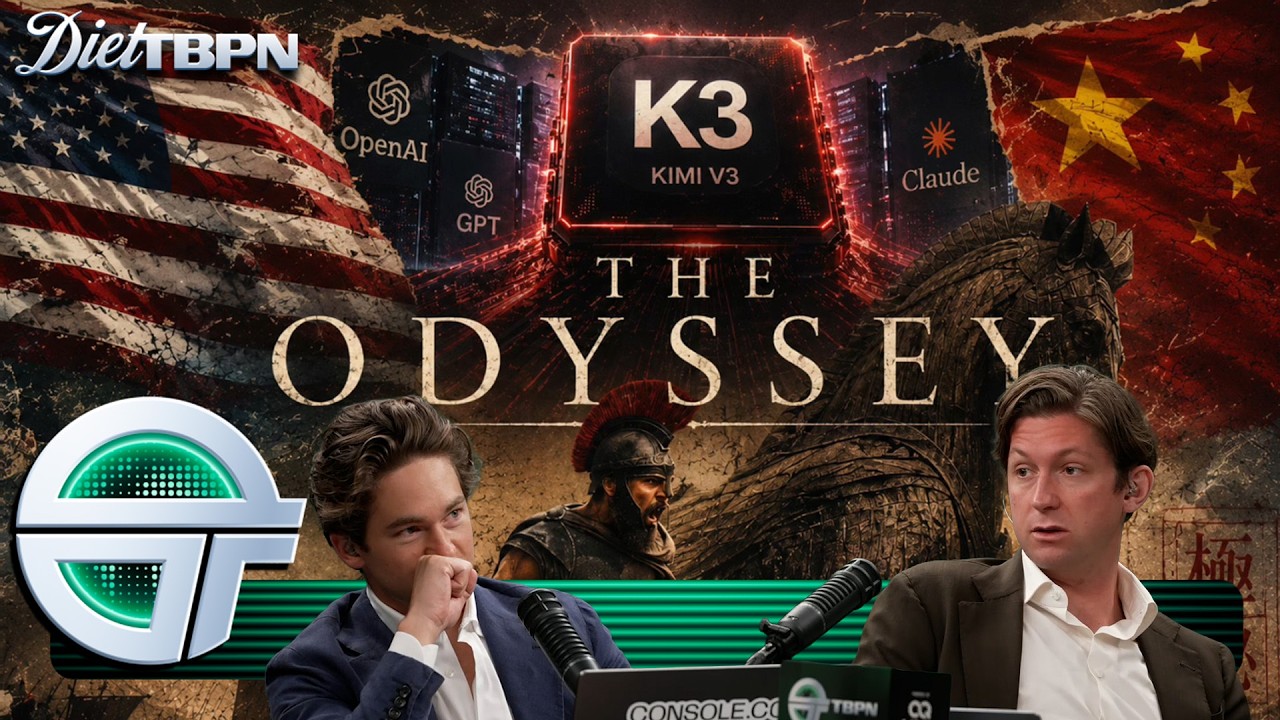
Moonshot AI Open-Sources Kimi K3 as US Labs Debate China AI Gap
TBPN
Moonshot AI's release of its 2.8-trillion parameter Kimi K3 model challenges US closed-source dominance by keeping Chinese open-weights within three to nine months of frontier capabilities.
## Background
TBPN published this video on YouTube on July 20, 2026. According to the page description, it is a 30-minute "Diet TBPN" digest of their daily live tech talk show hosted by John Coogan and Jordi Hays, which covers major tech news and features high-profile tech leaders.
## TL;DR
Hosts John Coogan and Jordi Hays analyze the release of Moonshot AI's Kimi K3 open-source model, examining the debate over whether Chinese open-source models threaten US frontier labs or serve as an effective business and geopolitical strategy. They evaluate Kimi K3's impressive technical performance, 2.8+ trillion parameter scale, cybersecurity risks, and hardware implications for NVIDIA and global compute constraints. Additionally, the show covers Christopher Nolan's $264M debut of *The Odyssey* as proof of the shift toward director-driven box office franchises, and concludes with Netflix's widespread integration of Generative AI across 300 productions.
## Atmosphere & style
The episode is fast-paced, conversational, and intellectually curious, blending witty banter with sharp tech and market analysis. Coogan and Hays display a casual yet expert rapport, seamlessly transitioning from humorous weekend anecdotes about suits and luxury resorts to deep dives into AI architecture, open-weight geopolitics, and Hollywood economics. The tone feels energetic, pragmatic, and unscripted—like listening in on an insightful, high-level Silicon Valley conversation over coffee.
## Key takeaways
- [01:10](https://www.youtube.com/watch?v=rjRe544D68k&t=70s) Moonshot AI announced Kimi K3, an open-source model that challenges the narrative that open-source AI is exponentially falling behind closed frontier models.
- [01:10](https://www.youtube.com/watch?v=rjRe544D68k&t=70s) The release of Kimi K3 supports the industry thesis that open-source models will consistently lag closed frontier models by a manageable gap of just 3 to 9 months.
- [03:20](https://www.youtube.com/watch?v=rjRe544D68k&t=200s) The bull case for Chinese open source suggests Moonshot is leveraging a legitimate strategy to gain global mindshare and build enterprise support, similar to Red Hat's business model.
- [03:20](https://www.youtube.com/watch?v=rjRe544D68k&t=200s) The bear case for Chinese open source points to potential geopolitical issues, such as circumventing US export controls or using distillation attacks against US frontier APIs.
- [05:21](https://www.youtube.com/watch?v=rjRe544D68k&t=321s) Open-source frontier models present immediate cybersecurity challenges by democratizing advanced reasoning tools for hyper-personalized spam and phishing attacks.
- [05:21](https://www.youtube.com/watch?v=rjRe544D68k&t=321s) Cybersecurity defenders at companies like Palo Alto Networks and CrowdStrike have had advanced access to tools like GPT-Cyber to prepare defenses before open-source releases reach malicious actors.
- [10:18](https://www.youtube.com/watch?v=rjRe544D68k&t=618s) Kimi K3 represents a significant performance leap, outperforming previous models like GLM 5.2 and showing particular strength in front-end coding benchmarks and mathematical challenges like the Jacobian conjecture.
- [13:25](https://www.youtube.com/watch?v=rjRe544D68k&t=805s) Despite architectural advancements in Kimi K3 that reduce KV cache memory needs, standard analysis indicates the model remains highly bullish for NVIDIA's large-scale architectures due to parameter size.
- [13:25](https://www.youtube.com/watch?v=rjRe544D68k&t=805s) Global AI infrastructure remains heavily constrained by physical vectors including land, power permits, electricity grid connections, chips, and cooling systems.
- [15:40](https://www.youtube.com/watch?v=rjRe544D68k&t=940s) Kimi K3's top-tier cyber performance refutes the idea that it is purely distilled from American models, as standard US frontier models are heavily restricted on cybersecurity capabilities.
- [15:40](https://www.youtube.com/watch?v=rjRe544D68k&t=940s) Dean Ball speculates that China's open-weight strategy is partly driven by domestic compute constraints and an unintended consequence of US export controls, making the models inherently 'decelerationist' for global cap-ex.
- [20:41](https://www.youtube.com/watch?v=rjRe544D68k&t=1241s) Christopher Nolan's 'The Odyssey' achieved a massive $264 million global debut, proving the financial viability of massive auteur-driven original projects over aging corporate franchises.
- [20:41](https://www.youtube.com/watch?v=rjRe544D68k&t=1241s) Audience data reveals that directors themselves are becoming the primary commercial franchises, prompting Hollywood studios to aggressively sign singular directors to generous multi-movie pacts.
- [29:42](https://www.youtube.com/watch?v=rjRe544D68k&t=1782s) Netflix has integrated Generative AI tools across roughly 300 titles in 2026, focusing heavily on post-production to lower costs and execute ambitious creative concepts rather than replacing talent.
- [29:42](https://www.youtube.com/watch?v=rjRe544D68k&t=1782s) Netflix utilized AI-enhanced footage in the docuseries 'The American Experiment' to achieve historical scale that would have been financially impossible using traditional physical production or legacy visual effects.
## Detailed walkthrough
### [00:01](https://www.youtube.com/watch?v=rjRe544D68k&t=1s) Weekend Recaps, Suits, and the Caruso Property Debate
Hosts John Coogan and Jordi Hays kick off the week noting a massive news day, starting with a lighthearted recap of their weekend activities. Jordi shows up wearing a suit, which John jokes is "the elephant in the room," making Jordi feel refreshed after returning from a trip to the "old country." Meanwhile, John recounts spending his weekend at the Rosewood Miramar Beach, a luxury property developed by Rick Caruso.
John jokes that after experiencing such high-end development, he could never vote for Caruso for public office again because he needs Caruso "laser-focused on resorts and malls" rather than politics. Jordi counters that Caruso’s political pitch was always the idea of transforming Los Angeles itself into something as seamless and high-quality as his commercial developments, joking about taking the city private to turn it into a giant Caruso property.
[01:10](https://www.youtube.com/watch?v=rjRe544D68k&t=70s) Moonshot's Kimi K3 and the AI Cold War
The discussion shifts to the main tech narrative over the weekend: the unfolding "AI cold war" between American frontier labs and Chinese open-source AI developers. The primary catalyst is Moonshot AI’s announcement of its latest open-source model, **Kimi K3**, which was unveiled the previous Thursday and ignited heated debates across tech social media.
While Kimi K3 is currently gated behind an app with model weights scheduled to drop on Monday, its performance benchmarks have surprised industry observers. The hosts discuss how this release challenges the prevailing government narrative that open-source models were falling behind closed frontier models on an exponential curve. Instead, it supports the thesis held by many lab leaders that open-source models will consistently lag closed frontier models by a manageable gap of just 3 to 9 months.
* **Model Details:** Moonshot Kimi K3 unveiled on Thursday; weights scheduled for public release on Monday.
* **Timeline Debates:** Notable back-and-forth arguments occurred on X between Dean Ball, David Sacks, and Emil Michael regarding the strategic and economic implications of Chinese open-source models.
---
[03:20](https://www.youtube.com/watch?v=rjRe544D68k&t=200s) Bull and Bear Cases for Chinese Open Source
John breaks down the opposing viewpoints surrounding Chinese open-source AI models. In the "bull case" (or most above-board scenario), Moonshot AI is simply a group of elite researchers who marshaled compute to build a world-class model. Under this view, open-sourcing is a legitimate business strategy to attract talent, gain global mindshare, and build a customer base for hosted API services and consulting—similar to how Red Hat built a $30 billion business around open-source Linux (later acquired by IBM).
Conversely, the "bear case" held by timeline skeptics points to potential geopolitical warfare and intellectual property theft. Critics suggest the necessary compute may have been smuggled into China in violation of US export controls, training data may have been exfiltrated from US frontier APIs via wrapper companies in distillation attacks, or corporate spies may have directly stolen IP. While some users claimed Kimi K3 identified itself as Claude or ChatGPT when prompted, the hosts note these claims could be fake, hallucinatory, or easily patched via system prompts and fine-tuning.
* **Red Hat Comparison:** IBM acquired Red Hat for ~$34 billion, proving that enterprise support, consulting, and hosted services around open-source code can create massive enterprise value.
---
[05:21](https://www.youtube.com/watch?v=rjRe544D68k&t=321s) Cybersecurity Risks, "Punk Rock" Open Source, and US Policy
Addressing AI safety and cybersecurity, John notes that while fast-takeoff scenarios (e.g., "paperclips" or "grey goo") remain theoretical, open-source models present immediate cybersecurity challenges by giving hackers access to frontier-level reasoning. Spam and phishing attacks will become hyper-personalized—for instance, an automated agent knowing a target's specific insurance provider and agent details rather than sending generic spam. Fortunately, cybersecurity defenders at companies like Palo Alto Networks (led by Nikesh Arora) and CrowdStrike (led by George Kurtz) have had roughly six months of exclusive access to frontier tools like GPT-Cyber and Mythos to patch vulnerabilities in advance.
> "Open-source AI just feels punk rock to me. It feels like Napster... liberating all the information."
Despite the risks, the hosts confess a strong ideological affinity for open-source AI, describing it as "punk rock," culturally aligned with the early internet, and even mirroring American Second Amendment ideals. The idea of running a private "country of geniuses" on a solar-powered server rack in one's basement offers unstoppable personal capability, analogous to holding Bitcoin or owning physical books like *Encyclopædia Britannica*. As the Kimi K3 weights prepare to drop, the US government faces choices ranging from hard or soft bans to patriotic messaging ("Buy American").
* **Cybersecurity Defense:** Palo Alto Networks and CrowdStrike have been utilizing closed models like GPT-Cyber and Mythos for months to prepare defenses before open-source releases reach malicious actors.
* **Demand Bottlenecks:** Moonshot posted on X that overwhelming demand forced them to temporarily pause new subscriptions and prioritize compute for existing members.
---
[10:18](https://www.youtube.com/watch?v=rjRe544D68k&t=618s) Market Realities and Kimi K3 Technical Performance
Jordi and guest Tyler analyze the broader market takeaways, agreeing that Kimi K3 is not a "black pill" for AI investment. Demand remains insatiable across all tiers of AI: frontier intelligence, near-frontier models, and ultra-cheap, distilled older models ("intelligence too cheap to meter"). Even lower-tier AI startups are growing faster than almost any software companies from six years ago, provided they have strong distribution and forward-deployed enterprise execution (as seen in legal AI).
Tyler notes that Kimi K3 represents a significant step forward, far closer to current frontier models than previous releases like GLM 5.2 (which lagged by closer to a year). Kimi K3 showed particular strength on front-end coding benchmarks, jumping ahead of competitors. Additionally, it made progress on storied mathematical challenges like the Jacobian conjecture, reflecting Moonshot's specific training priorities.
* **Front-End Benchmark Leader:** Kimi K3 made notable strides on front-end coding evaluation arenas, surpassing existing models in design and web implementation tasks.
---
[13:25](https://www.youtube.com/watch?v=rjRe544D68k&t=805s) Hardware Implications and the Global Compute Bottleneck
Addressing hardware market reactions, standard analysis from SemiAnalysis refutes the idea that Kimi K3's architecture is bad for NVIDIA. Some commentators panicked over Kimi K3's use of Linear Attention / KDA (Kimi Delta Attention), which reduces KV cache memory and networking bandwidth requirements by up to 10x. However, SemiAnalysis points out that Kimi K3 is extremely bullish for NVIDIA's NVL72 architectures: with over 2.8 trillion parameters, storing its large weights requires massive scale-up domains and high network bandwidth to implement "wide Expert Parallelism" (wide EP) across GPUs.
```
+-------------------------------------------------------------------+
| KIMI K3 ARCHITECTURE |
| - 2.8+ Trillion Parameters |
| - Linear Attention / KDA (Up to 10x lower KV cache network load)|
| - Requires Wide Expert Parallelism (Wide EP) across GPUs |
+-------------------------------------------------------------------+
|
v
+-------------------------------------------------------------------+
| HARDWARE REQUIREMENT |
| - High scale-up memory domain (NVIDIA NVL72) |
| - High interconnect bandwidth for weight distribution |
+-------------------------------------------------------------------+
```
The conversation touches on how Chinese labs access compute despite chip controls. While acquiring Google TPUs requires direct cooperation with Google, NVIDIA GPUs flow through multi-tiered reseller networks and neo-clouds—or through US entities controlled by overseas founders accessing cloud compute remotely. Closing out the segment, a quote from Microsoft's Nicholas Boamonte highlights that the world remains severely compute-constrained across every physical vector: land, power permits, electricity grid connections, chips, and cooling infrastructure.
* **Parameter Count:** Kimi K3 contains over **2.8 trillion parameters**.
* **Architecture:** Uses Kimi Delta Attention (KDA) / linear attention to cut KV cache requirements, but relies on **wide EP** to distribute weights across GPU clusters.
* **Infrastructure Constraints:** Microsoft's Nicholas Boamonte emphasizes that non-AI revenue streams (like Microsoft's legacy software businesses) are vital for funding the hundreds of billions in capital expenditures needed to scale AI infrastructure.
<FollowUp label="Want to continue with Part 2 of the transcript when you're ready?" query="Here is Part 2 of the transcript:"/>
Here is a detailed and faithful walkthrough of the provided transcript section:
[15:40](https://www.youtube.com/watch?v=rjRe544D68k&t=940s) Debate Over Kimi K3, Model Distillation, and Open-Weight Geopolitics
The hosts dive into the cybersecurity implications of the newly released Kimi K3 model. They note that Kimi K3 is performing at a top-tier level in cyber capabilities, which raises the question of whether its open release will trigger an uptick in cyberattacks. The model's strength also implicitly refutes the idea that it is purely distilled from American frontier models; standard frontier models are severely "nerfed" on cybersecurity, meaning Kimi would have had to distill from a non-nerfed, highly restricted version, which is far more difficult. By comparison, another model, Soul, offers a major leap forward in cybersecurity capabilities at a significantly higher cost while being remarkably open to assisting with defensive cyber hardening. Meanwhile, Fable failed the testing benchmark completely due to strict refusal guardrails.
The conversation pivots to a debate involving public posts by Dean Ball regarding the open-source landscape. Ball argues that Kimi K3's coding performance—roughly on par with the best public models from Q1 2026—cannot be dismissed as mere distillation, though it is noticeably "token hungry." He expresses surprise that the Chinese government permits open-sourcing models of this caliber given the potential risks. Ball speculates that Beijing's stance is roughly 75% explained by "strategic blindness" and a lack of being "AGI pilled" (viewing AI purely through a lean, utilitarian CCP lens), and 25% by a lack of compute for customer inference. This makes China's open-weight strategy an unintended byproduct of US export controls, paired with the reality that international companies are hesitant to send sensitive corporate codebases or IP to Chinese cloud APIs like Moonshot.
- **Cybersecurity Comparisons**: Soul is highly capable and open to defensive cyber hardening despite higher costs; Fable refused all benchmark prompts and failed to complete the run.
- **Economic Realities of Open Weights**: Distillation and copying happen so quickly that funding $50 billion frontier training runs becomes tricky if a lab can only monetize an advance for three months without a temporary monopoly or oligopoly.
- **Dean Ball's "Decelerationist" Take**: Ball posits that open-weight models are inherently decelerationist because they deter future AI capital expenditure (cap-ex), even though "accelerationists" embrace them for their ungovernability.
[20:41](https://www.youtube.com/watch?v=rjRe544D68k&t=1241s) Christopher Nolan's *The Odyssey* Hits $264M and the Rise of "Director Franchises"
Christopher Nolan's latest film, *The Odyssey*, scored a massive $264 million global debut ($124 million domestic), marking the biggest non-animated opening of the year so far. With a $250 million production budget and $125 million in global marketing, the movie recouped its core production costs almost immediately. Analysts project a global box office total slightly over $1 billion, translating to roughly $250 million in pre-tax lifetime profit for Universal and Comcast. While that sum represents just 0.2% of Comcast's overall market value, the film highlights a major tectonic shift in Hollywood: directors themselves have become the new commercial franchises.
Data from research firm Rentrak reveals that 53% of *The Odyssey* attendees cited Christopher Nolan as their primary reason for buying a ticket—outranking actors, genre preference, or the underlying Homeric IP. The hosts discuss how audiences, particularly Gen Z, have grown fatigued by aging corporate intellectual properties (like *Marvel*, *Star Wars*, *Fast & Furious*, and *Transformers*) and are seeking authentic, auteur-driven filmmaking. The film boasts massive practical visual effects—including a 35-foot tall wooden Trojan Horse—and was shot extensively across Europe on 70mm IMAX. The show's producer, Mike, chimed in to share that he has already scheduled four separate theater viewings for the film, ranking it firmly in his top five Nolan movies alongside *Inception*, *The Dark Knight*, *Interstellar*, and *Oppenheimer*.
- **Box Office Highlights**: Beats major 2026 releases including *Star Wars: The Mandalorian & Grogu*, *Supergirl*, and *Scream 7*, though sitting behind animated hits like *Toy Story 5* and *Super Mario Galaxy*.
- **Auteur-Driven Deals**: Studios are aggressively signing singular directors to multi-movie pacts. Examples include Warner Bros. giving Ryan Coogler generous ownership terms for *Sinners*, Sony hiring *Weapons* director Zach Cregger for a *Resident Evil* film, Greta Gerwig tackling *The Chronicles of Narnia* at Netflix, and Curry Barker securing major deals following his horror hits *Obsession* and *The Backrooms*.
- **Quote on Market Shifts**: Quoting CAA CEO Bryan Lourd on Hollywood's strategic pivot: "Things have generationally changed and individual singular voices are taking advantage."
[29:42](https://www.youtube.com/watch?v=rjRe544D68k&t=1782s) Netflix Embraces Generative AI Across 300 Productions
In business news, Netflix disclosed that it has integrated Generative AI tools across roughly 300 different titles in 2026 alone. The adoption spans the entire production life cycle—from early concept art and pre-visualization to post-production and final delivery—with the heaviest concentration in post-production work. Netflix leadership emphasized that these tools are being leveraged to deliver higher-quality outputs faster and at a lower cost, rather than replacing writers, actors, or directors.
A prominent example highlighted by co-CEO Ted Sarandos is *The American Experiment*, a docuseries centered on the American Revolution. The production utilized 17 minutes of AI-enhanced footage to convey the grand scale of historical events—a feat Sarandos noted would have been financially impossible using traditional physical production or standard legacy visual effects methods.
- **AI Strategy**: Netflix frames generative workflows as the natural evolution of filmmaking software, enabling creative teams to execute ambitious shots that were previously cost-prohibitive.
- **Show Wrap**: The hosts close out the episode from the "Ultradome," reminding viewers to subscribe, rate the show five stars on Apple Podcasts and Spotify, and sign up for the daily newsletter at TBPN.com.
## Notable quotes
> [00:01](https://www.youtube.com/watch?v=rjRe544D68k&t=1s) the elephant in the room — John Coogan
> [00:01](https://www.youtube.com/watch?v=rjRe544D68k&t=1s) laser-focused on resorts and malls — John Coogan
> [10:18](https://www.youtube.com/watch?v=rjRe544D68k&t=618s) intelligence too cheap to meter
> [05:21](https://www.youtube.com/watch?v=rjRe544D68k&t=321s) Open-source AI just feels punk rock to me. It feels like Napster... liberating all the information. — John Coogan
> [05:21](https://www.youtube.com/watch?v=rjRe544D68k&t=321s) country of geniuses — John Coogan
> [15:40](https://www.youtube.com/watch?v=rjRe544D68k&t=940s) token hungry — Dean Ball
> [15:40](https://www.youtube.com/watch?v=rjRe544D68k&t=940s) strategic blindness — Dean Ball
> [15:40](https://www.youtube.com/watch?v=rjRe544D68k&t=940s) AGI pilled — Dean Ball
> [20:41](https://www.youtube.com/watch?v=rjRe544D68k&t=1241s) Things have generationally changed and individual singular voices are taking advantage. — Bryan Lourd
## Mentioned
TBPN, Diet TBPN, John Coogan, Jordi Hays, Rick Caruso, Rosewood Miramar Beach, Moonshot AI, Kimi K3, GLM 5.2, Dean Ball, David Sacks, Emil Michael, Red Hat, IBM, Palo Alto Networks, Nikesh Arora, CrowdStrike, George Kurtz, GPT-Cyber, Mythos, Tyler, SemiAnalysis, NVIDIA, Google, Nicholas Boamonte, Microsoft, Soul, Fable, Christopher Nolan, The Odyssey, Universal, Comcast, Rentrak, Marvel, Star Wars, Fast & Furious, Transformers, Mike, Inception, The Dark Knight, Interstellar, Oppenheimer, Star Wars: The Mandalorian & Grogu, Supergirl, Scream 7, Toy Story 5, Super Mario Galaxy, Warner Bros., Ryan Coogler, Sinners, Sony, Zach Cregger, Weapons, Resident Evil, Greta Gerwig, The Chronicles of Narnia, Netflix, Curry Barker, Obsession, The Backrooms, Bryan Lourd, CAA, Ted Sarandos, The American Experiment, Ultradome, Apple Podcasts, Spotify
TBPN hosts John Coogan and Jordi Hays report that Moonshot AI's open-source Kimi K3 challenges assumptions that open models are falling behind closed frontier labs, while the entertainment sector experiences structural shifts toward auteur-driven cinema and enterprise-scale AI production.
The Open-Source AI Gap and Commercial Realities (1:10)
Moonshot AI's launch of Kimi K3 reignited debate over the competitive gap between American proprietary labs and Chinese open-source developers. Industry observers noted that the model supports the view that open-source releases trail closed frontier models by only 3 to 9 months, countering assumptions of an exponential divergence. The hosts outline contrasting explanations for China's open releases: a commercial bull case modeled after Red Hat's enterprise monetization of open-source software, versus a bear case involving potential compute smuggling, data exfiltration, or distillation attacks on Western APIs.
Analyst Dean Ball argues that Kimi K3's coding performance rivals top Q1 2026 public models and cannot be explained purely by distillation. Ball attributes Beijing's willingness to allow open-weight releases to an estimated 75% strategic blindness regarding artificial general intelligence and 25% domestic compute shortages for hosting inference. Ball further contends that open-weight releases act as an economic decelerationist force by undermining the short-term monopolies needed to recoup $50 billion frontier training runs.
Architectural Demands on Advanced Hardware Clusters (13:25)
Kimi K3 incorporates more than 2.8 trillion parameters alongside Linear Attention, also known as Kimi Delta Attention (KDA). While KDA reduces key-value (KV) cache memory and network transmission loads by up to tenfold, analysis from SemiAnalysis indicates this design is not detrimental to hardware vendors like NVIDIA. Instead, serving Kimi K3 requires wide Expert Parallelism (wide EP) to distribute its massive weight footprint across GPU clusters, making it highly dependent on high-bandwidth scale-up architectures such as NVIDIA NVL72.
Hardware analysts note that Chinese developers circumvent strict chip export controls through multi-tier reseller channels, neo-clouds, and overseas corporate entities. Meanwhile, broader scaling faces global infrastructure constraints highlighted by Microsoft's Nicholas Boamonte, who emphasizes that severe shortages in power permits, grid connections, physical land, and cooling infrastructure require legacy software cash flows to sustain frontier capital expenditure.
Cybersecurity Vulnerabilities and Defensive Preparation (5:21)
Releasing frontier reasoning capabilities openly creates immediate cybersecurity risks, including automated, hyper-targeted spear phishing and vulnerability exploitation. Because Kimi K3 demonstrates robust native cyber capabilities, observers argue it was not distilled from standard consumer-facing frontier APIs, which carry heavy safety guardrails. In benchmark testing, specialized models like Soul demonstrated strong defensive posture at a premium cost, whereas Fable failed entirely due to strict safety refusals.
To counter emerging offensive risks from accessible open-weight tools, defensive cybersecurity firms including Palo Alto Networks and CrowdStrike had approximately six months of advance access to closed frontier defensive models, such as GPT-Cyber and Mythos, allowing them to harden systems before open-source equivalents became broadly accessible.
Auteur Directors Eclipse Legacy Studio Franchises (20:41)
Christopher Nolan's historical epic The Odyssey debuted to $264 million globally, including $124 million domestically, against a $250 million production budget and $125 million marketing spend. Analysts project the film will exceed $1 billion in total box office, generating roughly $250 million in pre-tax profit for Universal Pictures and Comcast. Rentrak data revealed that 53% of ticket buyers cited Nolan himself as their primary motivator, reflecting growing audience fatigue with corporate franchise intellectual property.
In response to shifting consumer demand, Hollywood studios are increasingly structuring major creative pacts around established auteur directors rather than existing comic book or legacy franchises. Recent studio commitments include Warner Bros. partnering with Ryan Coogler on Sinners, Sony tapping Zach Cregger for Resident Evil, and Netflix backing Greta Gerwig's adaptation of The Chronicles of Narnia.
Practical Generative AI Deployment at Netflix (29:42)
Netflix announced the integration of generative AI tools across roughly 300 productions in 2026, primarily concentrated in post-production, pre-visualization, and concept generation. Co-CEO Ted Sarandos highlighted the historical docuseries The American Experiment, which incorporated 17 minutes of AI-augmented footage to depict large-scale Revolutionary War sequences that were otherwise cost-prohibitive.
Netflix management framed generative tools as workflow enhancements that reduce production timelines and expenses for complex shots, asserting that the technology complements rather than replaces principal creative personnel.
The source highlights unresolved tensions between the rapid spread of open-weight frontier intelligence and the multi-billion-dollar capital requirements of frontier labs, even as mature industries like film integrate these tools to reduce production overhead.
## Background
该视频由科技脱口秀频道 TBPN 于 2026 年 8 月 3 日发布在 YouTube 平台。节目为 TBPN 的 30 分钟精简版(Diet TBPN),由 John Coogan 和 Jordi Hays 共同主持,节目简介将其描述为探讨科技圈前沿热点的日常节目,本期重点聚焦月之暗面 Kimi K3 发布的行业震动、克里斯托弗·诺兰新片《奥德赛》的首周票房佳绩以及 Netflix 大规模引入生成式 AI 的制作动向。
## TL;DR
节目深入剖析了月之暗面发布 Kimi K3 所引发的地缘科技与商业逻辑大辩论,指出开源模型依然死咬闭源前沿,并探讨了这一趋势对半导体硬件需求、网络安全攻防以及长期 AI 资本开支的深层影响。随后,主播们热议克里斯托弗·诺兰新作《奥德赛》以 2.64 亿美元开画的票房奇迹,分析了传统流水线 IP 疲软背景下好莱坞重金押注“作者导演”的代际权力转移。最后,节目解读了 Netflix 在约 300 部影视作品中全面嵌入生成式 AI 工作流以实现降本扩容的产业落地。
## Atmosphere & style
整期节目洋溢着典型的硅谷科技圈内行谈话风格,语调轻松幽默且思维敏锐,主持人在西装调侃、海滩偶遇名导的日常轶事与硬核架构拆解之间无缝切换。讨论技术博弈与地缘政治时,对话充满激辩色彩与宏观商业推演的张力,而在聊到 70 毫米 IMAX 观影体验时又流露出十足的极客与影迷狂热。整场听感既有演播室好友闲聊的松弛感,又高密度传递着前沿产业变革的兴奋与紧迫感。
## Bulletin
- [09:34](https://www.youtube.com/watch?v=rjRe544D68k&t=574s) 月之暗面发布新一代大模型 Kimi K3,由于调用需求激增打满底层硬件集群,官方在发布 48 小时内紧急暂停新用户订阅并优先保障存量用户,再次印证全球前沿 AI 依然处于极度的算力受限状态。
- [11:53](https://www.youtube.com/watch?v=rjRe544D68k&t=713s) SemiAnalysis 针对市场恐慌发文辟谣,指出拥有 2.8 万亿超大参数量的 Kimi K3 虽然采用 KDA 线性注意力降低了 KV Cache 传输要求,但必须依赖宽专家并行(Wide EP)与 NVL72 机柜部署,对英伟达芯片和网络带宽实际上是重大利好。
- [20:41](https://www.youtube.com/watch?v=rjRe544D68k&t=1241s) 克里斯托弗·诺兰执导的新作《奥德赛》首周末全球票房狂揽 2.64 亿美元,Rentrak 调研显示 53% 的观众因导演个人号召力买票,标志着好莱坞正从漫威式流水线 IP 迈入“导演即超级 IP”时代。
- [29:42](https://www.youtube.com/watch?v=rjRe544D68k&t=1782s) Netflix 宣布已在约 300 部影视作品中全面应用生成式 AI 工作流,尤其在后期制作中以更低成本实现宏大视效,例如历史纪录片《美国实验》包含 17 分钟完全由 AI 增强制作的大场面镜头。
## Key takeaways
- [01:10](https://www.youtube.com/watch?v=rjRe544D68k&t=70s) Kimi K3 的亮眼跑分打破了此前官方所谓“闭源模型正在加速甩开开源模型”的预期,证明开源阵营依然紧咬第一梯队,维持着 3 到 9 个月的技术代差。
- [03:20](https://www.youtube.com/watch?v=rjRe544D68k&t=200s) 围绕 Kimi K3 形成了两种对立叙事:光明叙事认为其遵循类似 Red Hat 的商业飞轮(开源引流、企业托管 API 变现);怀疑叙事则聚焦于绕过芯片管制走私硬件、对前沿 API 实施模型蒸馏攻击及知识产权争议。
- [05:22](https://www.youtube.com/watch?v=rjRe544D68k&t=322s) AI 安全的担忧核心发生位移,从科幻式的末日失控或纳米机器假说,转向了迫在眉睫的现实网络威胁,例如利用前沿推理能力批量生成无破绽的钓鱼信息与高度定制化的精准社会工程学攻击。
- [07:37](https://www.youtube.com/watch?v=rjRe544D68k&t=457s) 开源权重模型具备去中心化的极客吸引力,让华盛顿的监管决策陷入两难;无论是直接禁令还是“支持国货”式的爱国主义宣传,都难以在纯技术竞争中构建有效壁垒。
- [09:34](https://www.youtube.com/watch?v=rjRe544D68k&t=574s) Kimi K3 需求爆仓表明算力瓶颈依然严峻,市场对前沿模型突破、准前沿模型普及以及低成本推理落地均存在巨大的未满足需求,企业级 AI 的制胜关键在于前线部署交付能力。
- [11:53](https://www.youtube.com/watch?v=rjRe544D68k&t=713s) 硬件出口管制下 TPU 相比 GPU 更难走私或流转,中国团队除二级市场渠道外,亦可通过设立美国离岸实体直接远程合法租用本土算力资源。
- [14:55](https://www.youtube.com/watch?v=rjRe544D68k&t=895s) Vercel 等机构的评测显示 Kimi K3 网络安全攻防能力达到顶尖水准;鉴于海外前沿模型在对齐阶段已严重阉割了此类能力,该测试有力反驳了“K3 仅靠蒸馏美系前沿 API”的说法。
- [14:55](https://www.youtube.com/watch?v=rjRe544D68k&t=895s) 中国模型选择开源受多重现实因素驱动:除高层监管更倾向于将 AI 视作生产力工具外,也因算力受限难以支撑全球闭源推理,且西方企业存在合规顾虑难以直接接入中国闭源 API,开源抢占生态是硬件受限下的最优解。
- [18:55](https://www.youtube.com/watch?v=rjRe544D68k&t=1135s) 开源权重模型呈现出经济学悖论:加速主义者看中其“不可治理”的避险属性,但前沿模型一旦在 3 个月内被开源社区蒸馏复制,将大幅缩短商业回报周期,进而可能抑制长期 AI Capex 资本开支。
- [20:41](https://www.youtube.com/watch?v=rjRe544D68k&t=1241s) 《奥德赛》总预算达 3.75 亿美元(制作 2.5 亿、宣发 1.25 亿),仅首周票房便覆盖制作成本,全球总票房预计突破 10 亿美元并为环球影业带来约 2.5 亿美元税前利润。
- [26:00](https://www.youtube.com/watch?v=rjRe544D68k&t=1560s) 诺兰凭借极高的创作信誉让环球影业为其豪赌 2.5 亿美元实拍制作,全片拒绝绿幕依赖并在欧洲多国实景拍摄,彻底碾压了同档期依托传统流水线 IP 的竞争对手。
- [26:00](https://www.youtube.com/watch?v=rjRe544D68k&t=1560s) 好莱坞流水线大片与虚假数字特效令观众陷入审美疲劳,尤其是 Z 世代观众对老旧 IP 和纯电脑科技驱动的叙事产生本能怀疑,更倾向于为真诚且视角鲜明的作者电影买单。
- [28:34](https://www.youtube.com/watch?v=rjRe544D68k&t=1714s) 好莱坞各大制片厂正放弃盲目依赖大型系列 IP 的策略,转而向柯里·巴克、瑞恩·库格勒和扎克·克雷格等极具个人风格的新锐导演提供前所未有的打包大单与创作自主权。
- [29:42](https://www.youtube.com/watch?v=rjRe544D68k&t=1782s) Netflix 强调引入生成式 AI 是影视制作工具的代际进化而非取代编剧与导演,旨在让创作者以可控成本达成以往在财务上无法实现的恢弘视觉奇观。
## Detailed walkthrough
### [00:01](https://www.youtube.com/watch?v=rjRe544D68k&t=1s) 周末闲聊:西装打趣、加州地产与卡鲁索的度假村
节目一开场,两位主持人就着周一早晨轻松的闲聊切入正题。针对录影棚里显眼的装束变化,主持人打趣道“房间里的大象”(the elephant in the room)就是今天居然有人穿了正装西服,整个人看起来焕然一新,仿佛刚从某个充满古典情调的“老家”度假归来。另一位主持人则分享了自己周末在加州富商里克·卡鲁索(Rick Caruso)旗下物业——著名的蒙特西托罗斯伍德米拉玛海滩酒店(Rosewood Miramar Beach)度过的奢华体验。
这段经历甚至让他产生了一个啼笑皆非的政治感叹:他戏称自己以后“再也不会投票支持卡鲁索竞选任何公职了”。他的理由并非否定卡鲁索的能力,而是“希望他把全部精力都激光般精准地放在开发更多顶级度假村和高端购物中心上”。两人开玩笑说,当年卡鲁索竞选洛杉矶市长时,人们曾幻想着他或许能把整个大洛杉矶地区改造得像他旗下的顶级商场那样光鲜亮丽,甚至“把整个洛杉矶私有化变成一座巨大的卡鲁索地产”,但现实而言,让全美每个城市都拥有一座奢华的罗斯伍德酒店显然才是更好的归宿。
---
### [01:10](https://www.youtube.com/watch?v=rjRe544D68k&t=70s) Kimi K3 登场:开源追赶闭源与突袭周末的社交媒体论战
在短暂的闲扯之后,话题迅速切入整个周末让科技圈社交媒体几乎“燃烧”起来的重磅炸弹:美国前沿大模型闭源阵营与中国开源模型之间爆发的“AI冷战”。在上周四,月之暗面(Moonshot AI)正式发布了新一代模型 Kimi K3,其基准测试跑分表现惊人。尽管模型权重当时仍被限制在专属应用内、尚未完全公开对外提供下载(预计下周一正式放开),但这一举动已经引发了巨大的连锁反应。很多从业者甚至只要一打开 X(原 Twitter),就会被铺天盖地的争论淹没,只能感慨“真为你高兴,或者很遗憾发生了这种事”,然后无奈关掉手机。
这场发布迅速演变为宏观经济与地缘科技的大辩论:有人争论这究竟是印证还是反驳了“杰文斯悖论”(Jevons paradox)?对半导体产业链是极大利好还是利空?科技政策学者迪恩·鲍尔(Dean Ball)以及戴维·萨克斯(David Sacks)、埃米尔·迈克尔(Emil Michael)等科技投资与商业大佬在信息流中激烈交锋。Kimi K3 的亮眼表现直接打破了此前美国官方图表中描绘的“闭源模型正在以指数级加速甩开开源模型”的论调,证明了开源阵营依然死死咬住第一梯队,维持着科技界领袖此前预言的“3到9个月”的技术代差区间。
```mermaid
flowchart TD
accTitle: AI模型格局与Kimi K3争论路径
accDescr: 展示Kimi K3发布后在商业逻辑与地缘审查之间的两极化争论
subgraph 行业格局分化 ["行业技术格局"]
A["美国闭源前沿实验室<br/>(OpenAI / Anthropic)"]
B["开源/中国AI模型<br/>(Moonshot Kimi K3)"]
A -.->|"维持3-9个月代差"| B
end
subgraph 舆论解读两极 ["针对 Kimi K3 的核心叙事"]
C["光明叙事 (Bull Case)"]
D["怀疑叙事 (Bear Case)"]
C1["顶尖科研团队调动算力"] --> C
C2["Red Hat 式商业模式<br/>开源获客 + 托管 API 变现"] --> C
D1["突破芯片出口管制走私算力"] --> D
D2["对前沿 API 进行蒸馏攻击"] --> D
D3["地缘竞争与知识产权窃取"] --> D
end
B --> C
B --> D
```
---
### [03:20](https://www.youtube.com/watch?v=rjRe544D68k&t=200s) 两种对立叙事:正规商业飞轮还是地缘科技暗战?
对于 Moonshot 与 Kimi K3 的崛起,主持人们梳理了社交媒体上针锋相对的两套极端叙事框架。在最合情合理的“光明叙事”(bull case)中,Moonshot 团队不过是一群才华横溢的天才 AI 研究员,合法有效地调配了充足的算力,打造出了一款令人惊叹的模型。对他们而言,开源 Kimi 是一套非常成熟经典的商业飞轮:通过开源引爆全网关注、招揽顶级研发人才,进而将海量企业客户导流至其付费的交钥匙(turnkey)托管 API 服务。这就像当年开源起家的 Red Hat Linux,即便最终被 IBM 以超过 300 亿美元收购,任何人都可以免费部署 Linux,但大企业依然愿意为技术咨询、企业级托管和配套服务大掏腰包。
而在天平的另一端,则是充满冷战色彩的“怀疑叙事”(skeptical case)。持怀疑态度的人士揣测:Moonshot 的大规模算力是否是通过违规走私英伟达芯片运进国内的?训练数据是否是通过套壳公司的 API 从美国前沿实验室大规模爬取并进行“模型蒸馏攻击”(distillation attack)?这种全面开源策略是否是意图挤垮美国商业公司的地缘经济战术?甚至是否存在企业内鬼直接盗窃底层知识产权?周末甚至流传着一些截图,显示 Kimi 在推理思考链(reasoning trace)中承认自己是“Claude”或“GPT”。尽管这极可能是伪造截图,或者是在数据蒸馏后未被微调和提示词彻底清洗干净的痕迹,但现实往往介于两极之间,需要时间去检验真相。
---
### [05:22](https://www.youtube.com/watch?v=rjRe544D68k&t=322s) 安全防线的位移:从末日假说到高度个性化的黑客武器
随着强大的开源大模型逐渐铺开,AI 安全(AI Safety)阵营的担忧正在发生结构性转变。大家担忧的焦点不再仅仅是传统科幻式的主机暴走、纳米机器“灰蛊”(gray goo)或“回形针毁灭世界”等快速失控(fast takeoff)假说,而是极其现实且迫在眉睫的网络安全攻防平衡被打破。过去半年里,防守方凭借 Palo Alto Networks(CEO 尼克什·阿罗拉)和 CrowdStrike(CEO 乔治·库尔茨)等公司对 GPT-4 等前沿专用网络安全工具的独占期,抢先给许多系统打上了补丁。
然而,一旦这类顶尖推理模型被无限制地开源,黑客与网络犯罪分子的军火库将瞬间升级:
- **终结机械化垃圾信息**:任何攻击者都能在本地拉起一个智力超群的大模型,批量生成毫无“AI味”、无法被常规规则识别的钓鱼邮件与短信。
- **深度推理与定制化侦察**:攻击者利用大模型的自主研究与思维链能力,能够摸清受害者购买了哪家保险公司、其保险代理人是谁、代理人的基本信息与说话语气,进而进行天衣无缝的精准欺诈。
- **攻防对抗烈度升级**:防守层虽然会随之升级,但极具说服力的个性化社会工程学攻击将泛滥成灾。
---
### [07:37](https://www.youtube.com/watch?v=rjRe544D68k&t=457s) 本地算力与“第二修正案”精神:极客浪漫下的监管难题
尽管安全隐患巨大,主持人们坦言,开源 AI 本身依旧散发着一种无法抗拒的魅力。这种“释放全人类信息”的感觉就像当年的 Napster 一样充满了“朋克摇滚”(punk rock)式的反叛与酷感,完全契合互联网诞生的底层文化。这种体验在文化上极度契合美国精神甚至宪法“第二修正案”的逻辑:
> “这感觉就像是在地下室拥有一位随时陪伴你的天才。你不再需要去依赖某个被巨头公司控制的数据中心,而是可以在离网状态下,依靠一组太阳能机架为你输出不可阻挡的智能(unstoppable intelligence)。”
这种心态与加密货币玩家对比特币的执着如出一辙——渴望拥有一种不可剥夺、不会被断电剥夺的终极资产;也像是过去每个美国家庭客厅书架上整套的《大英百科全书》,随时随地提供无审查的确定性知识。
面对即将公开的权重,华盛顿的监管决策窗口正在急剧收窄。美国政府正陷于两难之中,并在本周紧急研判对策:究竟是采取强硬的直接行政禁令(hard ban)、设置合规门槛的软性限制(soft ban),还是退回到道德呼吁层面,打出类似“支持国货”(Buy American)的爱国主义宣传,呼吁开发者不要使用外国技术。然而,仅仅靠“爱国主义营销”从来无法在纯粹的技术竞争中构筑壁垒,就像它当年无法把 GoPro 扶植成一家百亿美元市值的巨无霸企业一样。
### [09:34](https://www.youtube.com/watch?v=rjRe544D68k&t=574s) Kimi K3 需求爆仓与算力瓶颈:并非悲观的“黑药丸”时刻
周末最引人瞩目的动态来自月之暗面(Moonshot AI)旗下的 Kimi。官方在 X 平台发文表示,Kimi K3 受到的喜爱远超团队预期,导致背后的 GPU 集群不堪重负。在过去 48 小时内,激增的调用需求几乎逼近了现有算力容量的极限。为了优先保障现有订阅用户的体验,团队决定暂时关闭新订阅入口,将算力向既有付费会员倾斜,同时正开足马力扩充容量,后续将分批次逐步放开新名额。这一声明生动展现了当前全球 AI 依然处于极度的“算力受限(Supply Constrained)”状态,同时也再次将这场地缘政治博弈的聚光灯拉回到了底层硬件的较量上。
主持人指出,自己绝不把这一幕视为行业见顶的“黑药丸(Black Pill)”悲观信号。即便它的发布就像此前的 DeepSeek 时刻一样引发资本市场短期的震荡与摇摆,但底层现实依然坚固:市场对前沿顶级智能(Frontier Intelligence)存在海量需求,对准前沿智能存在海量需求,对那些已被极致压缩、成本低至“便宜到无需计量(Too cheap to meter)”的旧模型同样有着巨大的渴望。整个行业当下的主线非常清晰——先找到某个领域的真实落地场景,然后通过技术手段将其使用成本压缩到极致并大规模推向市场。过去两年来这种剧本不断上演:一家初创公司融了资,随后销声匿迹半年,等它再次出现在公众视野时,即便只做到垂直赛道的前十名,其业务增速依然能碾压六年前几乎所有传统科技企业。
这一波增长很大程度上归功于精准的交付与部署模式(Deployment)。消费级产品拼的是顶级的市场推广节奏(Go-to-market),而企业级 AI 则依赖强大的前线部署团队(Forward Deployed Motion),深入组织腹地去推动流程变革。例如法律科技领域的 AI 公司,绝不仅仅是丢给律师事务所一个冷冰冰的 API 接口,而是深入律所严苛的组织边界与合规流程,交付真正嵌进工作流的产品。
- **Kimi K3 限流举措**:因 48 小时内算力需求打满硬件上限,暂停新用户付费订阅,优先保障存量用户算力,后续采取分批放量机制。
- **市场需求格局**:前沿模型突破、准前沿模型普及,以及低成本推理模型的规模化应用均存在巨大真空,算力消费依然在指数级扩张。
- **落地关键动力**:企业级 AI 的胜负手在于前线部署交付能力,而非单纯的 API 接入服务。
---
### [11:53](https://www.youtube.com/watch?v=rjRe544D68k&t=713s) 模型品味、SemiAnalysis 架构拆解与硬件走私迷思
谈及对 Kimi K3 的初步测评反馈,Tyler 认为这无疑是一记惊艳的更新。“开源模型正在掉队”的论调在此刻不攻自破。此前智谱 GLM-5.2 的发布已经让外界感知到开源追赶闭源的步伐,但当时业内普遍评估其与最顶尖模型仍有大半年到一年的代差;而 Kimi K3 的亮相,则将这个距离拉得前所未有地近,甚至传出其在攻克诸如“雅可比猜想(Jacobian Conjecture)”这类极具挑战性的经典数学难题上展现出了惊人实力。
```mermaid
flowchart TD
accTitle: SemiAnalysis 对 Kimi K3 硬件需求的解析
accDescr: 解释 Kimi K3 使用 KDA 注意力与超大参数规模对英伟达 GPU 及网络带宽带来的真实影响
subgraph MemoryOptimization["KV Cache 优化"]
KDA["Kimi Delta Attention (KDA)"] --> LowKVCache["KV Cache 传输需求降低高达 10x"]
LowKVCache -. 误导认知.-> MarketPanic["错误推论:利空英伟达 HBM 与网络"]
end
subgraph RealHardwareDemands["真实硬件诉求(利好 NVL72)"]
Scale["2.8 万亿超大参数量 (2.8T+)"] --> NVL72Needs["必须依赖超大 Scale-up 域<br>单机柜容纳权重"]
NVL72Needs --> WideEP["引入 Wide EP(宽专家并行)<br>跨 GPU 分散权重"]
WideEP --> HighBandwidth["对网络互联带宽产生更高渴求"]
end
MarketPanic --> SemiCorrection["SemiAnalysis 辟谣与修正"]
SemiCorrection --> RealHardwareDemands
```
在前端评测竞技场(Front-end Arena)中,Kimi K3 的表现同样拔得头筹。这引发了关于各大实验室“品味(Taste)”与专项冲刺策略的讨论:OpenAI 极度痴迷数学推理,Anthropic 早期将筹码重押在代码生成上,还有的团队会突然花一个月时间集中攻坚国际象棋或长文写作,模型的长板往往折射出核心团队的偏好与 Harness(测试框架)的调优重点。
与此同时,知名半导体分析机构 SemiAnalysis 针对市场恐慌发文辟谣。部分外界舆论错误地认为,Kimi K3 采用了线性注意力机制(KDA, Kimi Delta Attention),降低了对 KV Cache(键值缓存)的需求,从而会冲击英伟达、高带宽内存(HBM DRAM)以及网络互联芯片的销量。SemiAnalysis 指出事实恰恰相反,K3 对英伟达是重大利好:
- Kimi K3 拥有超过 2.8 万亿(2.8T+)参数,这种超大模型的推理任务正是英伟达 NVL72 机柜大放异彩的主战场,需要极大的 Scale-up 域来分布式存放权重。
- 虽然 KDA 技术将 KV Cache 的传输带宽要求降低了多达 10 倍,但超大权重必须借助一种名为 Wide EP(宽专家并行)的优化手段,将权重切分并分散到大量不同的 GPU 之间,这反倒需要极其庞大的网络带宽进行协同交互。
硬件封锁问题也引发了热议。面对“中国是否在使用谷歌 TPU”的疑问,主播们分析认为 TPU 的出口管制更为致命且不可逾越,因为 TPU 没有庞杂的二级分销网络,要想搭建基于 TPU 的数据中心必须与谷歌极其紧密地绑定;相比之下,英伟达 GPU 流经无数小型新兴算力云(Neo Clouds),“倒手转卖七道之后,哪怕有人用电吹风吹掉标签塞进手提箱带走都有可能”。退一步讲,中国 AI 团队甚至无需走私实体硬件,完全可以通过设立美国离岸实体,直接远程合法租用本土算力资源。
---
### [14:55](https://www.youtube.com/watch?v=rjRe544D68k&t=895s) 算力饥渴论、网络安全测试与中国开源的底层动因
微软知识工人 AI 部门的 Nicholas Bamonte 在社交媒体上直言,整个世界依然陷入极其严重的算力饥渴之中。他表示自己完全无法理解为何有人会持有相反观点:“当今几乎还没有谁真正把 AI 深度融入业务,而我们却已经撞上了算力天花板。一切环节皆是瓶颈——数据中心用地、施工许可、电力供应、电网接入、芯片供给、基建工程乃至冷却系统。需求的膨胀速度远远甩开供给,而扩建算力供应的基础设施成本简直高到荒唐。”在他看来,能够最终赢得这场军备竞赛的,必然是那些依靠非 AI 传统核心业务拥有源源不断净利润支撑的巨头,因为只有它们能掏出数千亿美元的资本支出(Capex)来豪赌未来。
Vercel 创始人 Guillermo Rauch 则对 Kimi K3 的实测结果表示高度认可。安全团队测试显示,Kimi K3 在网络安全(Cybersecurity)能力上达到了顶尖水准(Top Tier)。这一评测结果从侧面狠狠反驳了所谓“中国模型纯靠蒸馏自美系前沿模型”的说法:因为作为潜在被蒸馏对象的海外主流模型,其网络安全与攻击性能力在对齐阶段已经被严重削弱(Nerfed);除非能够接触到未阉割的底层模型进行蒸馏,否则不可能凭空复制出如此高水准的攻防能力。测试者指出,另一款代号 Soul 的模型在网络安全上虽然是一大飞跃但调用成本极高,而 Fable 则因严格限制对各类渗透测试直接拒绝响应;相比之下,新模型甚至在网络防御加固方面表现得极其开放,标志着顶尖前沿的开源权重网络安全能力正式落地。
智库学者 Dean Ball 在深入体验后同样认定该模型表现极为硬核,在代码编程测试中完全比肩 2026 年第一季度的最佳公开模型,但极为消耗 Token。针对“为何中国官方允许开源这种具备极高潜在风险的顶尖大模型”,Dean Ball 展开了深入推演:
- **75% 源于战略盲区与非 AGI 崇拜**:高层监管决策在本质上非常贴近扬·勒昆(Yann LeCun)的技术现实主义路线,并未陷入 AGI 末日威胁论(Not AGI-pilled),更倾向于视其为基础工具。
- **25% 源于推理算力匮乏与封锁倒逼**:受限于美国芯片出口管制,团队根本无法维持面向全球海量用户的端到端闭源推理服务,开源权重反而是硬件受限下的被动最优解。
- **商业现实考量**:在海外地缘政治阻力下,西方跨国企业很难放下合规顾虑把内部核心代码与商业机密上传至月之暗面的闭源 API。“试想一下,连向美国本土前沿实验室上传数据都要经历层层内审,哪家西方巨头敢全力押注调用中国闭源 API?”与其死守变现无门的闭源服务,通过开源抢占开发者心智和底层生态反而是最理性的进攻方式。除非是一家毫无知识产权包袱的本地通下水道水管公司,才会毫不在乎地全量上传数据。
### [18:55](https://www.youtube.com/watch?v=rjRe544D68k&t=1135s) 开源权重模型的悖论:加速主义外衣下的资本“减速器”
节目以一场关于 AI 哲学阵营的热烈辩论展开。一位名为 Dean 的观点引发了探讨:他提出“开源权重模型在本质上其实是减速主义(decelerationist)”。这一论点之所以尖锐,是因为外界通常看到所谓的“有效加速主义者”(e/acc)对开源权重模型欢呼雀跃,但其背后的真实心理或许在于:开源权重模型在实际操作中是“无法被监管的”(effectively ungovernable)。加速主义者正是看中了开源权重模型为整个 AI 领域披上的这层“不可治理的隐形斗篷”。这种策略让人联想到政治学家詹姆斯·C·斯科特(James C. Scott)在《不受统治的艺术》(*The Art of Not Being Governed*)中对无政府高地住民生存策略的论述。
然而,辩论的另一面在于经济现实:开源权重模型最终可能会抑制 AI 领域的巨额资本支出(capex)。前沿大模型的训练极度依赖资本密集投入,以国内的大模型独角兽月之暗面(Moonshot AI,Kimi 背后的公司)为例,即便近期融到了约 10 亿美元,行业核心单次预训练运行可能尚未达到 500 亿美元的天文数字,但巨额的人力、算力与实验开销已是不争的事实。如果一家顶尖实验室耗资数十亿美元训练出前沿模型,在短短三个月内就会被开源社区迅速蒸馏(distilled)或逆向抄袭,那么投资者便会质疑其商业变现周期,进而失去继续注资的意愿。相比之下,传统的垄断或寡头垄断格局能够为资本提供相对持久的利润护城河,以回收巨额研发投入。
```mermaid
flowchart TD
accTitle: 开源权重模型的经济学争议
accDescr: 展示开源权重模型在监管规避与资本回收之间引发的正反效应流向
subgraph Ideology["意识形态与监管层面"]
A["开源权重模型 (Open-weight)"] --> B["规避强力监管与行政干预"]
B --> C["为整个 AI 领域提供不可治理的斗篷"]
end
subgraph Economics["商业回报与资本支出"]
A --> D["前沿模型迅速被蒸馏与复制"]
D --> E["商业变现窗口缩短至数月"]
E --> F["巨额前沿算力投资回报受损"]
F --> G["抑制长期 AI Capex 投入"]
end
```
两位主持人调侃道,如果有任何来自 Kimi 或 Moonshot AI 的听众在收听节目,不妨上节目聊聊,或者“偷偷爆料一下独家秘方”。既然产品宣称如此开放,那直接来节目现场公开交流岂不是合情合理。
- 政治人类学类比:引用詹姆斯·C·斯科特《不受统治的艺术》,将开源逃避监管比作逃避国家机器统治的高地族群。
- 核心商业痛点:一旦前沿模型在发布 3 个月内被开源社区蒸馏(distillation),数十亿美元级训练周期的经济学模型将面临重构。
---
### [20:41](https://www.youtube.com/watch?v=rjRe544D68k&t=1241s) 《奥德赛》斩获 2.64 亿美元开画:克里斯托弗·诺兰的“导演即 IP”时代
话题转向周末的好莱坞票房重磅:克里斯托弗·诺兰执导的新作《奥德赛》(*The Odyssey*)全球首周末票房暴收 2.64 亿美元,根据彭博社记者 Lucas Shaw 的报道,这创下了当年除两周后的《蜘蛛侠》之外体量最大的非动画电影开画成绩。从商业账本来看,该片总预算高达 3.75 亿美元,其中制作成本为 2.5 亿美元,全球宣发营销费用约为 1.25 亿美元。影片上映仅首周便已覆盖制作成本,业界基准预测其最终全球票房将轻松突破 10 亿美元大关。对于制片方环球影业及其母公司康卡斯特(Comcast)而言,这预计将带来 2.5 亿美元的税前生命周期利润。尽管 2.5 亿美元仅占康卡斯特整体市值的 0.02%,但对整个电影工业与诺兰个人而言,这无疑是一场巨大的商业胜利。
《华尔街日报》商业与金融板块当天刊文指出,诺兰的《奥德赛》证明了当今好莱坞的全新权力逻辑——“导演本身就是超级 IP(directors are franchises)”。数据机构 Rentrak 的民调显示,在《奥德赛》的购票观众中,高达 53% 的人明确表示“导演”是促使他们买票入场的第一原因。这压倒了演员卡司号召力、荷马史诗原著 IP 的情怀、古装冷兵器(Sword and Sandals)的类型偏好,甚至超越了纯粹的 IMAX 特效追求。观众建立起了一种纯粹基于导演个人的信任:“无论诺兰带我去古代还是去未来,我都全盘接受,跟着诺兰走。”在过去二十年迪士尼、漫威、星战和皮克斯通过垂直 IP 构筑工业霸权的背景下,诺兰凭一己之力让导演品牌压倒了传统内容专营权。
- 成本与盈利核算:制作成本 2.5 亿美元,宣发成本 1.25 亿美元,总预算 3.75 亿美元;预计全球票房破 10 亿美元,预计产生 2.5 亿美元税前生命周期利润。
- 观众调研数据:53% 的观影者将“克里斯托弗·诺兰执导”列为第一入场动机,而非改编题材或明星主演。
---
### [22:37](https://www.youtube.com/watch?v=rjRe544D68k&t=1357s) 海滩偶遇名导糗事与 70 毫米 IMAX 观影狂热
现场分享了一段极为生动的海滩偶遇轶事:主持人在海滩漫步时,克里斯托弗·诺兰恰好带着爱犬走在前方。起初主持人并未认出这位大导演,直到同行同伴低声惊呼“那是克里斯托弗·诺兰”,才恍然大悟。戏剧性的是,海滩上突然窜出一只无人看管的陌生小狗,冲上前疯狂骚扰诺兰的狗。眼看诺兰回头投来质疑的目光,主持人不得不尴尬地大声澄清:“嘿,伙计,那不是我的狗!”生怕自己被误当成纵容恶犬的无礼游客,好在诺兰本人显得处变不惊、十分平静。
随后演播室讨论起网络上疯传的一张由现场观众拍摄的“IMAX 第一排极致畸变照”。画面中银幕因贴脸仰角而极度扭曲,主持人们调侃这究竟是真实抓拍还是用 AI 夸大了眩晕效果。团队成员 Tyler 和 Mike 也加入了讨论,Mike 对该片赞不绝口,将其称为“有史以来视觉质感最强的影片之一”,并极力推崇 70 毫米胶片 IMAX 的非凡画质。当被问及打算在影院几刷时,Mike 坦言自己已经预订了整整四场。
```mermaid
flowchart LR
accTitle: 演播室热议的诺兰电影 Top 5 榜单
accDescr: 现场演播室讨论评选出的克里斯托弗·诺兰个人作品排名前五位
A["第 1 名<br>《盗梦空间》<br>(Inception)"] --> B["第 2 名<br>《黑暗骑士》<br>(The Dark Knight)"]
B --> C["第 3 名<br>《星际穿越》<br>(Interstellar)"]
C --> D["第 4 名<br>《奥本海默》<br>(Oppenheimer)"]
D --> E["第 5 名<br>《奥德赛》<br>(The Odyssey)"]
```
关于改编内容,现场也有原著党提出的幽默挑剔:有人发帖认为电影少了一些原诗里本该有的“搞怪与荒诞骚操作”(high jinks),叙事显得过于严肃沉重。大家还趁兴顺带排出了诺兰影史前五佳作:《盗梦空间》、《黑暗骑士》、《星际穿越》、《奥本海默》,以及新晋的《奥德赛》;尽管《信条》同样备受喜爱,但在诺兰极具统治力的履历面前,挤进前三或前五依旧门槛极高。
- 格式规格热度:团队成员力荐 70mm 胶片 IMAX 规格,单人排定四刷计划。
- 史诗还原槽点:原诗中部分荒诞喜剧色彩的情节在成片中被严肃化删改,被评为“缺少了一些原著特有的搞怪胡闹”。
---
### [26:00](https://www.youtube.com/watch?v=rjRe544D68k&t=1560s) 超级英雄疲劳与 Z 世代追捧的作者电影复兴
好莱坞各大制片厂如今都渴望拥有自己的克里斯托弗·诺兰,但这种模式与迪士尼拥有漫威有着本质区别:漫威模式依靠流水线系统运作,几乎不存在“关键人风险”(key man risk);而环球与诺兰的深度绑定则完全系于一人之身。然而实打实的票房战绩证明了这笔重注的正确性。《奥德赛》北美首周末轰下 1.24 亿美元,在当年所有影片中仅次于《玩具总动员 5》和《超级马力欧银河》排在第三,同时彻底碾压了当年依托传统 IP 的重磅竞品——包括《星球大战:曼达洛人与古古》、《超级少女》以及《惊声尖叫 7》。
```mermaid
flowchart TD
accTitle: 2026 年好莱坞票房格局与代际偏好变迁
accDescr: 对比传统流水线 IP 衰退与诺兰实拍作者电影受 Z 世代追捧的转变
subgraph StudioSystem["传统流水线体系 (2000-2010年代)"]
S1["漫威 / 变形金刚 / 速激"]
S2["依靠续集、衍生剧、软重启"]
S3["工业流水线,消除关键人风险"]
S1 --> S2 --> S3
end
subgraph ModernShift["当下观众与世代演变 (2026年)"]
M1["观众对虚假数字特效与老化 IP 审美疲劳"]
M2["Z 世代渴望真诚、独具个人视角的作者表达"]
M3["实拍质感带来长尾高票价与多次复看率"]
M1 --> M2 --> M3
end
StudioSystem -.->|"票房接连受挫"| ModernShift
```
通常而言,R 级历史动作片在好莱坞属于难以撬动海量主流票房的垂直赛道,绝不可能与合家欢动画相提并论。但诺兰凭借无与伦比的商业信誉,说服环球影业豪赌 2.5 亿美元:全片横跨欧洲多国实地取景,拒绝泛滥的数字绿幕,几乎全部采用实物特效,甚至现场打造了一个高达 35 英尺(约 10.7 米)的巨型特洛伊木马。环球国内发行总裁直言:“Chris 赢得了观众长期的信任与尊重,这种号召力在现代影史上凤毛麟角。”
这折射出好莱坞权力版图的深刻更迭。在 2000 年代末到 2010 年代,好莱坞制片厂更倾向于雇佣听话的工业型导演,批量炮制续集、衍生片和重拍片,诺兰是极少数能在把控《黑暗骑士》三部曲的同时拍摄《盗梦空间》和《星际穿越》等原创宏大故事的特例。如今,《漫威电影宇宙》、《速度与激情》和《变形金刚》等流水线系列票房接连受挫,观众已对套路化模式彻底厌倦。尤其是 Z 世代观众,对那些依赖老旧 IP 和纯电脑科技驱动的电影展现出本能的怀疑;他们更愿意为具有鲜明作者视角、富有真诚表达与辨识度的导演买单。
### [28:34](https://www.youtube.com/watch?v=rjRe544D68k&t=1714s) 好莱坞格局突变:制片厂放弃IP迷信,重金抢购“导演作者”
好莱坞各大制片厂长期以来对大型商业IP和系列化运作(franchise management)近乎偏执,但如今风向正发生剧烈的代际转移,制片厂纷纷转而将资源与精力倾注在极具个人风格的新锐导演身上。这一波潮流源于一系列新登大银幕且由导演个人意志驱动的口碑票房双收之作,例如恐怖大作《Obsession》、科幻电影《挽救计划》(Project Hail Mary)以及源自网络怪谈的《后室》(The Backrooms)。好莱坞现在的反应极其迅速且激进,甚至愿意直接押注十部电影的大体量长约;比如新晋导演柯里·巴克(Curry Barker)仅仅凭借处女作《后室》的惊艳表现,就已经轻松斩获了多部影片的打包合约。CAA(创新艺人经纪公司)首席执行官布莱恩·洛德(Bryan Lourd)一针见血地指出:“制片厂现在完全搞不清楚什么能奏效、什么行不通了。时代已经发生了代际更替,极具个人独特视角的创作者正在牢牢抓住这一风口。”
在这一背景下,名导们正获得前所未有的创作自主权和优厚待遇:
- **瑞恩·库格勒(Ryan Coogler)**:曾执导《黑豹》(Black Panther)与《奎迪》(Creed)的库格勒,从华纳兄弟(Warner Bros.)手中拿到了异常优渥的版权与分成协议,用以打造由他完全主导的原创恐怖惊悚片《罪人》(Sinners),该片在去年成为院线爆款。
- **扎克·克雷格(Zach Cregger)**:凭借恐怖片《野蛮人》打响名头后,克雷格正执导《武器》(Weapons),随后又被索尼影业(Sony Pictures)选中执导今年秋季开拍的知名游戏改编电影《生化危机》(Resident Evil),近期更与华纳兄弟敲定了一笔数百万美元的全新恐怖原创IP大单。
- **格蕾塔·葛韦格(Greta Gerwig)**:凭借影史级现象作《芭比》(Barbie)积累的巨大号召力与业界话语权,她成功说服流媒体巨头 Netflix 为其大预算重启改编《纳尼亚传奇》(The Chronicles of Narnia)大开绿灯。
### [29:42](https://www.youtube.com/watch?v=rjRe544D68k&t=1782s) Netflix 大规模拥抱生成式 AI:300部作品实战与降本扩容
Netflix 正式披露其在影视制作流程中全面推行生成式 AI(Generative AI)的最新进展。官方数据显示,到 2026 年,Netflix 已经在约 300 部不同的影视作品中实际应用了生成式 AI 工作流。这套工具贯穿了从前期概念设计、动态预演(previsualization)到后期制作与最终交付的整个制作生命周期,其中应用最为密集、落地规模最大的环节依然是后期制作。官方明确表示,引入这些前沿工具的核心目的,是以比传统工业流程更快的速度、更低的成本交付更高品质的视听画面。
```mermaid
flowchart LR
accTitle: Netflix 生成式 AI 影视制作工作流
accDescr: 展示 Netflix 从前期到后期的生成式 AI 工作流,强调后期制作的核心地位以及带来的核心效益。
subgraph Pre["前期阶段 (Pre-production)"]
A["概念构想 (Concept)"] --> B["动态预演 (Previs)"]
end
subgraph Post["后期与交付 (Post-production)"]
B --> C["后期特效与增强<br/>(AI-enhanced Footage)"]
C --> D["最终成片交付 (Delivery)"]
end
subgraph Benefits["落地成效"]
C -.-> E["突破预算极限<br/>打造宏大场面"]
C -.-> F["降本提速<br/>提升视听画质"]
end
```
Netflix 联席首席执行官泰德·萨兰多斯(Ted Sarandos)特别以讲述美国独立战争的纪录片剧集《美国实验》(The American Experiment)为例进行了说明。该剧集包含整整 17 分钟完全由 AI 增强制作的动态画面,正是这些镜头极大拓宽了历史战争场面的恢弘尺度与视效边界;萨兰多斯直言,如果沿用传统的好莱坞实拍或常规 CGI 工业流程,这种制作规模在财务预算上根本不可行。面对好莱坞工会对于技术抢夺饭碗的长期焦虑,Netflix 坚称 AI 绝非用来替代编剧、导演、演员或其他创意专业人员,而是将其定位于影视制作软件的下一轮代际进化,使创作者能够以可控的成本实现以往技术无法达成或过于昂贵的镜头和视觉奇观。
### [30:54](https://www.youtube.com/watch?v=rjRe544D68k&t=1854s) 节目尾声与明日预告
两位主持人在节目的欢声笑语中收尾,戏称大众对影视圈引入 AI 的反应一定会“非常买账”。他们感叹能够重返 TBPN 的“超级穹顶”(Ultradome)演播室直播非常棒,并向所有观众致谢。主播提醒收听观众,TBPN 将在太平洋时间每个工作日上午 11 点准时直播,呼吁大家前往 Apple Podcasts 和 Spotify 为节目留下五星好评,并登录官网 tbpn.com 订阅每日科技商业通讯简报。
## Notable quotes
> [00:01](https://www.youtube.com/watch?v=rjRe544D68k&t=1s) 希望他把全部精力都激光般精准地放在开发更多顶级度假村和高端购物中心上 — 主持人
> [01:10](https://www.youtube.com/watch?v=rjRe544D68k&t=70s) 真为你高兴,或者很遗憾发生了这种事
> [07:37](https://www.youtube.com/watch?v=rjRe544D68k&t=457s) 这感觉就像是在地下室拥有一位随时陪伴你的天才。你不再需要去依赖某个被巨头公司控制的数据中心,而是可以在离网状态下,依靠一组太阳能机架为你输出不可阻挡的智能 — 主持人
> [14:55](https://www.youtube.com/watch?v=rjRe544D68k&t=895s) 当今几乎还没有谁真正把 AI 深度融入业务,而我们却已经撞上了算力天花板。一切环节皆是瓶颈——数据中心用地、施工许可、电力供应、电网接入、芯片供给、基建工程乃至冷却系统。需求的膨胀速度远远甩开供给,而扩建算力供应的基础设施成本简直高到荒唐。 — Nicholas Bamonte
> [14:55](https://www.youtube.com/watch?v=rjRe544D68k&t=895s) 试想一下,连向美国本土前沿实验室上传数据都要经历层层内审,哪家西方巨头敢全力押注调用中国闭源 API? — Dean Ball
> [18:55](https://www.youtube.com/watch?v=rjRe544D68k&t=1135s) 开源权重模型在本质上其实是减速主义 — Dean Ball
> [20:41](https://www.youtube.com/watch?v=rjRe544D68k&t=1241s) 无论诺兰带我去古代还是去未来,我都全盘接受,跟着诺兰走。
> [22:37](https://www.youtube.com/watch?v=rjRe544D68k&t=1357s) 嘿,伙计,那不是我的狗! — 主持人
> [26:00](https://www.youtube.com/watch?v=rjRe544D68k&t=1560s) Chris 赢得了观众长期的信任与尊重,这种号召力在现代影史上凤毛麟角。 — 环球国内发行总裁
> [28:34](https://www.youtube.com/watch?v=rjRe544D68k&t=1714s) 制片厂现在完全搞不清楚什么能奏效、什么行不通了。时代已经发生了代际更替,极具个人独特视角的创作者正在牢牢抓住这一风口。 — Bryan Lourd
## Mentioned
TBPN, Rick Caruso, Rosewood Miramar Beach, Moonshot AI, Kimi K3, Dean Ball, David Sacks, Emil Michael, Red Hat, Claude, GPT, Palo Alto Networks, Nikesh Arora, CrowdStrike, George Kurtz, GoPro, GLM-5.2, SemiAnalysis, Nvidia, NVL72, Google TPU, Nicholas Bamonte, Guillermo Rauch, Vercel, Yann LeCun, James C. Scott, The Art of Not Being Governed, Christopher Nolan, The Odyssey, Lucas Shaw, Universal Pictures, Comcast, Rentrak, Inception, The Dark Knight, Interstellar, Oppenheimer, Tenet, Bryan Lourd, CAA, Ryan Coogler, Sinners, Zach Cregger, Weapons, Resident Evil, Greta Gerwig, The Chronicles of Narnia, Netflix, Ted Sarandos, The American Experiment, Curry Barker, The Backrooms
## Video description
Sign up for TBPN’s daily newsletter at TBPN.com
Diet TBPN delivers the best of today’s TBPN episode in 30 minutes. TBPN is a live tech talk show hosted by John Coogan and Jordi Hays, streaming weekdays 11–2 PT on X and YouTube, with each episode posted to podcast platforms right after.
Described by The New York Times as “Silicon Valley’s newest obsession,” the show has recently featured Mark Zuckerberg, Sam Altman, Mark Cuban, and Satya Nadella.
TBPN is made possible by:
Ramp - https://ramp.com
Public - https://public.com
Cisco - https://www.cisco.com
Console - https://www.console.com
CrowdStrike - https://www.crowdstrike.com
Figma - https://www.figma.com
MongoDB - https://www.mongodb.com
NYSE - https://www.nyse.com
Railway - https://railway.com
Shopify - https://www.shopify.com/
Follow TBPN:
https://TBPN.com
https://x.com/tbpn
https://open.spotify.com/show/2L6WMqY3GUPCGBD0dX6p00?si=674252d53acf4231
https://podcasts.apple.com/us/podcast/technology-brothers/id1772360235
https://www.youtube.com/@TBPNLive
[Source](https://www.youtube.com/watch?v=rjRe544D68k)
Source quotes
[0:01] 主持人: 希望他把全部精力都激光般精准地放在开发更多顶级度假村和高端购物中心上
[1:10] 真为你高兴,或者很遗憾发生了这种事
[7:37] 主持人: 这感觉就像是在地下室拥有一位随时陪伴你的天才。你不再需要去依赖某个被巨头公司控制的数据中心,而是可以在离网状态下,依靠一组太阳能机架为你输出不可阻挡的智能
[14:55] Nicholas Bamonte: 当今几乎还没有谁真正把 AI 深度融入业务,而我们却已经撞上了算力天花板。一切环节皆是瓶颈——数据中心用地、施工许可、电力供应、电网接入、芯片供给、基建工程乃至冷却系统。需求的膨胀速度远远甩开供给,而扩建算力供应的基础设施成本简直高到荒唐。
[14:55] Dean Ball: 试想一下,连向美国本土前沿实验室上传数据都要经历层层内审,哪家西方巨头敢全力押注调用中国闭源 API?
[18:55] Dean Ball: 开源权重模型在本质上其实是减速主义
[20:41] 无论诺兰带我去古代还是去未来,我都全盘接受,跟着诺兰走。
[22:37] 主持人: 嘿,伙计,那不是我的狗!
[26:00] 环球国内发行总裁: Chris 赢得了观众长期的信任与尊重,这种号召力在现代影史上凤毛麟角。
[28:34] Bryan Lourd: 制片厂现在完全搞不清楚什么能奏效、什么行不通了。时代已经发生了代际更替,极具个人独特视角的创作者正在牢牢抓住这一风口。
Source quotes
[0:01] John Coogan: the elephant in the room
[0:01] John Coogan: laser-focused on resorts and malls
[10:18] intelligence too cheap to meter
[5:21] John Coogan: Open-source AI just feels punk rock to me. It feels like Napster... liberating all the information.
[5:21] John Coogan: country of geniuses
[15:40] Dean Ball: token hungry
[15:40] Dean Ball: strategic blindness
[15:40] Dean Ball: AGI pilled
[20:41] Bryan Lourd: Things have generationally changed and individual singular voices are taking advantage.
Original transcript
[0:01] It's Monday and there's a lot of news.
[0:03] The big stuff, uh, Kimmy K3 dropped. But
[0:07] first, we should recap the weekend. How
[0:08] was your weekend?
[0:09] >> The elephant in the room that I'm
[0:10] wearing a suit.
[0:11] >> Yes, the elephant in Did somebody say
[0:13] that? The elephant in the room.
[0:15] >> George suit. He's feeling good. He's
[0:17] refreshed.
[0:18] >> Yeah, refreshed. I uh Yeah, was in was
[0:21] in the weekend.
[0:22] >> The old country.
[0:24] >> Yes. Yes, exactly. Uh really fun time.
[0:27] Glad to be back. Uh very very uh
[0:31] refreshed,
[0:31] >> very fun. I was at a Caruso property
[0:34] this weekend and I got to say being
[0:36] there, being at the the Myiramar
[0:38] Rosewood, uh I I can never vote for him
[0:41] for public office ever again.
[0:43] >> Why? Because you want him to develop
[0:44] more properties like that.
[0:45] >> I want him laser focused on resorts and
[0:48] malls.
[0:49] >> It doesn't really hold up because the
[0:50] whole the whole point was that he could
[0:52] there was some possibility that he could
[0:54] make greater Los Angeles something like
[0:57] his incredible get a rosewood in every
[0:59] city in America and uh maybe I'll
[1:02] >> take private of the of the city of Los
[1:04] Angeles, turn it all into a Caruso
[1:07] >> potentially. But uh it was it was a good
[1:10] weekend. Glad to be back. Uh the
[1:11] timeline was burning up over the weekend
[1:14] over uh the AI cold war that's breaking
[1:16] out between the US frontier labs and
[1:19] Chinese open source. Uh there's been a
[1:21] whole bunch of new Chinese open source
[1:23] models that have dropped with some uh
[1:26] promising benchmarks. Uh the latest one
[1:28] that everyone is up in arms about is uh
[1:30] Moonshots Kimmy K3. Uh it was unveiled
[1:34] last Thursday. Now they aren't actually
[1:37] >> I kept opening X and thinking looking
[1:41] scrolling a few times thinking, "Oh, I'm
[1:45] happy for you." Or sorry that happened.
[1:47] [laughter] I put my phone away. I feel
[1:50] like I missed a lot.
[1:51] >> Yeah, I mean it's it's gated behind of
[1:53] uh behind an app right now. Um the waits
[1:56] are not actually open just yet. That
[1:59] should happen Monday if things go to
[2:01] plan. But of course there's a lot going
[2:02] back and forth uh with the
[2:04] administration. People are uh you know
[2:07] uh weighing every possible consequence
[2:09] of this. Um it's a you know the classic
[2:13] it's over. We're back. Is this good for
[2:15] semiconductors? Is this bad for
[2:16] semiconductors? Is this Jebans paradox?
[2:18] Is it the counter example to Jeban's
[2:20] paradox? It's all very interesting
[2:22] debates and everyone's coming out with
[2:24] their own opinion. Dean Ball was going
[2:26] back and forth with uh two people uh
[2:29] David Saxs and also uh Emil Michael were
[2:33] duking it out on the timeline, fighting
[2:35] it out back and forth. Um but you know,
[2:38] decent takes on both sides. Lots to chew
[2:40] through. The headlines for Kimmy are
[2:42] impressive but not wildly surprising
[2:45] based on the current trend lines and
[2:46] model progress. Um but it does seem to
[2:48] invalidate uh the thesis that open
[2:51] source would start falling behind which
[2:53] was something that was start there was
[2:55] that chart from the government I believe
[2:57] that showed uh closed model progress was
[3:01] you know accelerating on this particular
[3:03] exponential and uh open models were
[3:06] falling behind uh this seems like a
[3:08] proper catchup something that was
[3:09] predicted from you know many lab leaders
[3:12] that you know the six-month gap
[3:14] three-month gap ninemonth gap it will
[3:16] remain just that gap for the foreseeable
[3:18] future. But there are of course a bunch
[3:20] of other nuances here. In the most above
[3:22] board scenario, sort of here's what
[3:25] happened. Like the moonshot team, it's
[3:26] just a bunch of highly talented AI
[3:28] researchers who marshaled enough compute
[3:30] to release to release a great model. Uh
[3:32] open sourcing Kimmy is a great way to
[3:34] grab attention, attract talent, drive
[3:35] demand for hosted API services uh that
[3:38] are more turnkey eventually. There's a
[3:40] very reasonable business model behind
[3:42] open sourcing. Uh, Red Hat Linux, of
[3:45] course, is an open-source company, uh,
[3:47] owned by IBM. Now, I think the
[3:49] acquisition price was in the $30 billion
[3:51] range, and at any point you could just
[3:53] say, I'm just doing Red Hat on my own.
[3:55] But a lot of companies pay for uh, you
[3:58] know, consulting, hosted, and all sorts
[4:00] of different uh, services around the
[4:03] open-source piece of software. That's
[4:05] sort of like the the the the bull case,
[4:07] like, you know, everything's going well.
[4:09] The more skeptical folks on the timeline
[4:11] are pointing to uh you know ideas such
[4:14] as uh maybe the compute was smuggled in
[4:16] to China against chip controls. Maybe
[4:18] the data was excfiltrated from frontier
[4:20] lab APIs routed through rapper
[4:22] companies. Maybe this is a distillation
[4:23] attack. Um the open- source strategy is
[4:26] a deliberate attempt to destroy American
[4:28] companies. It's geopolitical warfare.
[4:30] It's the AI cold war. Um and there might
[4:32] even be spies inside companies stealing
[4:34] IP directly. And so that's sort of like
[4:36] the bad version. Uh the reality is
[4:39] probably a mix of both but we'll know
[4:41] more over time and we'll hear more
[4:42] statements from the labs and from all
[4:45] sorts of different uh participants to
[4:47] understand there people were going back
[4:48] and forth on you know if you ask Kimmy
[4:50] its name will it just say it's Claude or
[4:52] GBT and uh there were some examples of
[4:55] people doing that seemed like it was
[4:56] photoshopped seemed like that also seems
[4:58] like the easiest thing to fix possibly
[5:00] it's just put it in the put in the
[5:02] prompt put in the finetuning never can
[5:05] you find and replace seems pretty
[5:07] showing it in the reasoning tracing.
[5:09] >> Yeah. But you know, I I I I don't know.
[5:11] All these things are hard to hard to
[5:13] assess over time. It takes time to
[5:15] actually work through what's real,
[5:16] what's fake, what's a hallucination. You
[5:19] know, they all they all make mistakes
[5:20] from time to time. But there are bigger
[5:22] questions about AI safety in a world of
[5:25] powerful open- source AI. Uh I haven't
[5:27] seen a ton of takes from this crowd, but
[5:28] you have to imagine that they aren't
[5:30] happy about it. Uh maybe the uh the stop
[5:33] AI protests will head over to Beijing
[5:35] next and beat down the the doors of uh
[5:39] Moonshot directly. But it is an odd
[5:42] thing because even if you're not worried
[5:43] about the fast takeoff, you know, gray
[5:46] goo paperclip from a cyber security
[5:49] perspective like things are going to get
[5:51] more complex. There's reasonable
[5:52] solutions to all of this, but uh it is a
[5:55] more powerful tool in the hackers or the
[5:58] act hackers tool chest. Uh fortunately
[6:00] defenders have had roughly six months of
[6:02] frontier exclusivity with GPT cyber and
[6:04] mythos for a while and so there's been a
[6:06] lot of preparation. We've talked to
[6:08] Nicash at PaloAlto Networks and George
[6:10] at Crowdstrike about this like they have
[6:12] been aware that this is coming for a
[6:14] while and so a lot of systems have been
[6:17] patched. Uh but at the same time you can
[6:19] just imagine now anyone who's a hacker
[6:23] can spin up a very very intelligent
[6:26] model and start sending a bunch of spam
[6:29] emails or spam text messages that stop
[6:32] seeming so AI and they're not as
[6:33] clockable because it's just another
[6:35] level of intelligence and it can do uh
[6:38] reasoning traces and research and and so
[6:40] you know that the the the spammer or the
[6:43] fishing attack can actually know what
[6:45] insurance you have and then pose who's
[6:47] your insurance agent and actually know a
[6:49] little bit about your insurance agent
[6:51] instead of just sort of sending you a
[6:52] generic spam text. You're things are
[6:55] going to get more customized, more
[6:57] personalizable. Of course, there will be
[6:59] more advanced defense layers, but the
[7:01] war is continuing. There really is no
[7:03] debating that open- source is just cool,
[7:07] like open source AI. It just feels punk
[7:08] rock to me. It feels like Napster. like
[7:11] as a kid the idea of just like
[7:13] liberating all the information
[7:14] >> and it's culturally aligned to the
[7:16] internet itself.
[7:17] >> Yeah. It's just a cool thing even though
[7:20] you do have to grapple with all the
[7:21] different problems that come from it
[7:23] downstream. Uh like the there's
[7:26] something just deeply satisfying about
[7:28] the idea of like a solar powered server
[7:30] rack serving you up unstoppable
[7:33] intelligence which is another good name
[7:34] for a neolab you know a country of
[7:36] geniuses.
[7:37] >> Yeah. In some ways, to me, it feels like
[7:39] aligned to America's ideals.
[7:42] >> Oh, yeah. It's like
[7:43] >> feels like it feels like like very
[7:45] empowering.
[7:46] >> It's total second amendment. Totally
[7:48] second. Exactly.
[7:49] >> It's like I should be able to go off-rid
[7:51] and have uh you know, not a country of
[7:54] geniuses in a data center controlled by
[7:56] a corporation, but just like my own
[7:57] genius who's riding with me no matter
[7:59] what in my basement, you know. And it's
[8:02] like even if you're not thinking like
[8:03] nefarious, it's like this it's this idea
[8:05] that you know uh I like to have a copy
[8:08] of a movie in case like the grid goes
[8:09] down. You know that the the more like
[8:11] you know apocalyptic thinking. This is a
[8:13] very general thing that I think a lot of
[8:15] people align to especially if they're at
[8:17] all cryptonative. It's like why do you
[8:19] want Bitcoin? Well, it's unstoppable
[8:21] money. The government can't take it from
[8:22] you in certain scenarios. Of course,
[8:24] like there's a bunch of ways they can of
[8:26] course like anything else. Um, but uh
[8:29] there there is just something very very
[8:31] attractive about having just a machine
[8:34] with all of human knowledge on it. It's
[8:36] like a it's like the you know every
[8:38] house used to have the the full
[8:40] encyclopedia bratannica and you can just
[8:42] look up anything and now you have the
[8:44] LLM that can solve you know any math
[8:46] problem for you. But uh you know the US
[8:49] government is going back and forth on
[8:51] this issue uh how to handle the
[8:53] situation and I imagine we'll see you
[8:55] know developments this week. uh the
[8:57] Kimmy K3 weights drop next Monday and so
[9:00] this is the week where if the government
[9:02] wants to do something one way or another
[9:04] um they have the opportunity to do that.
[9:06] There were some back and forth on like
[9:08] would there be a a direct ban, a hard
[9:11] ban, a soft ban, maybe just some like
[9:13] messaging around hey like please be a
[9:17] patriot, don't use this foreign product.
[9:20] You know, there's all sorts of different
[9:21] ways like the original like buy made in
[9:23] America, buy America. That's just
[9:26] marketing, but it does have some effect.
[9:28] It's not enough to make GoPro a, you
[9:31] know, 10 billion dollar company, but it
[9:34] is enough to, you know, cause a little
[9:36] bit of motion in the in the in the
[9:38] economy. Um,
[9:39] >> one thing that was notable over the
[9:41] weekend, uh, Kimmy on X said that Kimmy
[9:45] K3 has received far more love than we
[9:47] expected and our GPUs are feeling it
[9:49] over the past 48 hours. Demand has
[9:51] pushed close to the limits of our
[9:52] current capacity to protect the
[9:54] experience of existing subscribers.
[9:56] We're temporarily pausing new
[9:57] subscriptions and prioritizing compute
[9:59] for current members.
[10:01] >> We're adding capacity as fast as we can
[10:03] and we will reopen new subscription
[10:05] spots in batches. So Kimmy and the world
[10:08] more broadly are quite uh supply
[10:11] constrained and showing that uh the
[10:13] other dimension of this whole
[10:15] geopolitical battle is around the
[10:18] hardware side.
[10:18] >> I mean in general I think my my takeaway
[10:21] was and Tyler be interested to hear how
[10:22] you process this but uh like I I just
[10:25] don't see this as a black pill. Even if
[10:27] it's like a deepseek moment and the
[10:29] markets sort of bounce around for a
[10:30] little bit, it seems like there's still
[10:33] a lot of demand for frontier
[10:34] intelligence, a lot of demand for near
[10:37] frontier intelligence, a lot of demand
[10:39] for really cheap older models that have
[10:41] been baked down to basically
[10:43] intelligence too cheap to meter. And we
[10:45] are going to be in this process of go
[10:48] and find an actual use for something and
[10:51] then bake it down to be really really
[10:53] cheap so that it can be offered.
[10:55] >> Yeah. In so so many moments over the
[10:57] last two years,
[10:59] >> we've there's been a company that's come
[11:01] out, maybe they've raised some money,
[11:03] you maybe forget about them for like 6
[11:05] months,
[11:06] >> and then they pop up and it turns out
[11:08] even though they're the number 10
[11:09] company in their category, they're still
[11:11] growing faster than uh almost any
[11:15] company uh that existed like six years
[11:18] ago.
[11:18] >> Yeah. And a lot of it goes down to
[11:20] deployment, too. There's like certain
[11:22] companies if they're in consumer like
[11:23] they just have a really good go-to
[11:25] market motion like they're just able to
[11:26] get customers to subscribe or use their
[11:28] product or if they're in enterprise like
[11:31] they just have a great like forward
[11:32] deployed motion to actually do the
[11:35] change necessary as opposed to just like
[11:37] here's an API law firm like they could
[11:40] have done that and yet you have legal AI
[11:42] companies that have done a great job of
[11:44] coming in and actually creating a
[11:45] product that works within the confines
[11:47] of the the broader organization. What
[11:50] what what are your Kimmy K3 uh
[11:52] reactions, Tyler?
[11:53] >> Uh yeah, I mean I think it was
[11:54] definitely like a a surprise, an update.
[11:56] Like this is extremely good model. The
[11:58] idea that open source is falling behind
[12:00] seems like very much.
[12:01] >> We sort of got a preview with GLM 5.2
[12:03] like people were already saying like oh
[12:05] GLM 5.2 is sort of catching up. So
[12:07] >> yes, but even even that that was closer
[12:09] to you know maybe a year maybe a little
[12:12] less than than a year behind. This seems
[12:14] like much closer. Okay.
[12:15] >> Um,
[12:16] >> yeah,
[12:16] >> but I I think I I broadly agree like
[12:18] okay, there's this great open source
[12:19] model and now we have okay the Jacobian,
[12:21] you know, conjecture like this this kind
[12:23] of storied math problem.
[12:24] >> Yeah.
[12:25] >> And so like
[12:26] >> yeah, there's just going to be a lot
[12:27] more use like everywhere. I I expect you
[12:29] know these kinds of models to to
[12:32] >> be used everywhere.
[12:32] >> It seems like a lot of the hype is
[12:34] around like specifically the parameters,
[12:35] the size of the model, the way it was
[12:37] trained. It'll be and then also it did
[12:39] very well in the front-end arena which
[12:41] was interesting because that's I mean it
[12:44] jumped ahead of everything there and
[12:45] that feels like a particular like it'll
[12:48] be interesting to see because you see
[12:49] more and more taste going into these
[12:51] models like OpenAI is really big into
[12:53] the math stuff and uh Anthropic was
[12:56] really big on code early and there's all
[12:58] these different like you can just tell
[12:59] that like oh this lab cares about chess
[13:02] now and now the model's good at chess or
[13:04] the model got better at writing because
[13:06] like they they took the time to spend a
[13:08] month sprinting on that and it'll be
[13:10] interesting to see like where did they
[13:12] sprint if anywhere where didn't they
[13:14] sprint and it's sort of lagging uh and
[13:16] then what harness it works best with how
[13:19] important is the harness relative to
[13:20] everything else but uh we'll be will be
[13:23] interesting to to continue following
[13:25] semi analysis said similar to the panic
[13:27] over deepseat R1 some uneducated people
[13:30] think Kimmy K3's use of linear attention
[13:33] KDA is bad for Nvidia HBM DRAMM and
[13:36] networking because it has relatively
[13:38] lower KV cache requirements. The
[13:40] opposite is true and they'll explain.
[13:42] Kimmy K3 is actually quite positive for
[13:44] NVIDIA as large model inference is where
[13:46] the NVL72 shines because K3 has more
[13:49] than 2.8 trillion parameters, it
[13:51] requires a large scaleup domain to store
[13:53] its weights. Secondly, although Kimmy
[13:56] Delta attention has up to 10x lower
[13:58] networking requirements for KB cache
[13:59] transfers, its large weights require
[14:02] even more network bandwidth to implement
[14:03] an optimization called wide EP, which
[14:06] spreads weights across different GPUs.
[14:08] Is China getting TPUs? those have to be
[14:11] uh chip export restricted and probably
[14:14] more difficult to get into the country
[14:15] because there's less resellers and in
[14:17] order to set up a TPU based data center
[14:20] you probably have to work very closely
[14:22] with Google whereas Nvidia GPUs are sort
[14:25] of going to like all sorts of small neo
[14:27] clouds and there's a lot of places where
[14:28] seven steps down the chain it can wind
[14:31] up in a suitcase with a with a haird
[14:33] dryer removing the label or something
[14:34] like that.
[14:35] >> Well, it's not even that. You can
[14:36] imagine like if you were a Chinese lab
[14:39] and you wanted to get access to compute,
[14:42] >> there would be a number of ways to like
[14:44] set up US entities. Yeah.
[14:46] >> That then basically get compute through
[14:49] variety of different sources here in the
[14:51] US. Yeah.
[14:52] >> And you're you're uh just getting it
[14:54] remotely. Yeah.
[14:55] >> Nicholas Bamonte at Microsoft uh who is
[14:58] working on AI for knowledge workers uh
[15:01] says, "Guys, the world is so computed. I
[15:04] honestly don't understand how anyone
[15:06] thinks otherwise. Almost nobody is
[15:08] seriously using AI today and we're
[15:10] already hitting capacity. Everything is
[15:11] a bottleneck. Land for data centers,
[15:13] permits, electricity, grid connections,
[15:14] chips, construction, cooling. Demand is
[15:17] growing far faster than supply and
[15:20] expanding supply is [clears throat]
[15:21] insanely expensive. In this game, the
[15:23] best position companies are the ones
[15:25] with massive net income from nonAI
[15:27] products. They can fund hundreds of
[15:29] billions in capex. He's given a little
[15:31] bit of a bullcase for Microsoft. Uh,
[15:33] hundreds of millions of
[15:35] >> GMO over at Versel says
[15:38] >> tested it.
[15:39] >> What's that?
[15:40] >> Oh, yeah. That's great to hear.
[15:41] >> Yeah, Kimmy K3 is top tier at cyber
[15:44] security. Uh, that will uh that will be
[15:48] interesting as the as basically uh the
[15:51] weights are released. Do we see an
[15:53] uptick in tax? And it's also sort of a a
[15:56] reputation of like the it's just
[15:58] distilled because the models that you
[16:01] would be distilling from are pretty
[16:03] severely nerfed on cyber security at
[16:05] least in theory. And so it's like you
[16:07] would need to distill on the non uh the
[16:11] non- nerfed model which is probably way
[16:13] harder because those are much more
[16:14] restricted. And so uh it it it does feel
[16:18] like there's a uh uh there's a little
[16:20] bit of a reputation of the idea that
[16:22] these are pure purely distilled. Uh,
[16:24] Soul is a leap ahead in cyber capability
[16:26] at a significantly higher cost, but
[16:28] quite remarkable still. Fable refuses
[16:30] everything. We couldn't get it to
[16:32] complete the run at all. What is
[16:33] interesting is that Soul in comparison
[16:35] was much more open to helping with
[16:36] defensive cyber hardening. TLDDR
[16:39] frontier openweight cyber capability is
[16:42] here. This was good. Hi, Harry says,
[16:44] "Rip the bear case July 16th to July
[16:48] 19th." perfectly coinciding with my uh
[16:52] trip which which is which is nice. Dean
[16:55] Ball was going back and forth. Uh oh,
[16:57] some deleted posts now. His observations
[17:00] were getting taken to task going back
[17:02] and forth. He says, "It's a very good
[17:04] model. I don't think its performance can
[17:05] be explained away by distillation or
[17:07] anything like that in a coding sessions.
[17:09] It seems pretty much on par with the
[17:10] best public models of Q1 2026. In my
[17:13] fairly limited use, it also seems very
[17:15] token hungry." Dean says, "I am
[17:17] personally surprised the Chinese state
[17:19] continues to allow the open sourcing of
[17:21] models this good given potential risks."
[17:24] Now it seems like the that is very much
[17:26] like from the top they are pro-
[17:28] opensource right now. Dean says to be
[17:31] clear I myself might be fine with models
[17:33] presenting this level of marginal risk
[17:35] being open weight but I'm surprised that
[17:37] China is fine with it. I suspect the
[17:39] reason is that they uh they are is 75%
[17:42] explained by strategic blindness lack of
[17:44] AGI pilledness. The CCP is very lean
[17:47] lacuni in its view of AI. Uh the other
[17:51] 25% or so is their lack of compute for
[17:54] customer inference making China's
[17:55] openweight strategy an unintended
[17:57] byproduct of US export controls. That's
[17:59] interesting. And the normal Chinese
[18:01] strategy of aggressive exports for the
[18:03] companies as opposed to the government.
[18:05] The decision to open source is partially
[18:06] ideological and partially because they
[18:08] are behind and they know that very few
[18:10] people would pay for subfrontier models
[18:12] from China. Yeah, you have to imagine
[18:14] that it like the idea of sending pe I
[18:17] mean people are having discussion over
[18:18] like should you send your corporate data
[18:21] to a to an American frontier lab.
[18:24] Imagine that that same level of should
[18:26] we upload our entire codebase to the
[18:28] moonshot API because we've gone allin on
[18:32] Chinese closed source which seems like
[18:34] that's a very very hard sell. So there
[18:37] is a world where there's like no money
[18:39] to be made in America. I don't know.
[18:40] Maybe there's some American businesses
[18:42] that would just be like, "Yeah, I'm cool
[18:43] with it." Like, "Take my take
[18:45] everything. Take all my IP. I'm
[18:46] anti-fragile. I can't be You can't clone
[18:49] me." So, and I have no IP, so just
[18:52] upload it all.
[18:52] >> I mean, if you're a local plumbing
[18:54] company.
[18:55] >> Yeah, maybe.
[18:56] >> Probably in a good spot.
[18:58] >> Ripping it. Maybe. Maybe. This is a
[18:59] pretty hot take. Dean says, "Oop models
[19:02] are inherently decelerationist." And
[19:03] Tyler and I were debating this before
[19:05] the show. Uh he said, "I'm continually
[19:07] surprised to see the so-called
[19:09] accelerationists
[19:10] so excited about openweight models. I
[19:13] suspect the reason is that they know
[19:14] openweight models are effectively
[19:16] ungovernable." That's correct. Uh and
[19:18] they simply like the overall cloak of
[19:21] ungovernability openweight models uh
[19:24] create over the whole of AI. It's not a
[19:26] bad strategy. It reminds me of James
[19:28] Scott's recounting of the Hill people in
[19:30] the art of not being governed. Still in
[19:32] the end openweight models deter further
[19:35] AI capex and this is the debate that we
[19:38] were having was like how capex intensive
[19:41] are these frontier training runs because
[19:43] moonshots raised I think a billion
[19:46] dollars recently uh and and it just
[19:49] feels like even them even the latest
[19:51] labs like there's a lot of cost a lot of
[19:53] researchers and they do a lot of
[19:54] experiments but the but the core run
[19:57] might not we might not be talking about
[19:59] 50 billion yet maybe in in the future
[20:02] like you you need to acrue towards that
[20:04] and maybe people wouldn't fund it if
[20:05] they're like ah you're only going to be
[20:07] able to monetize this for for like three
[20:09] months because you're going to get
[20:10] distilled so fast or you're going to get
[20:12] copied so fast. That is tricky. Like it
[20:14] is nicer when you have a monopoly or
[20:16] oligopoly for some period of time to to
[20:19] actually earn profits off of what you
[20:20] invested against.
[20:21] >> Well, if anyone listening to this is
[20:23] over at Kimmy or Moonshot,
[20:26] >> come on.
[20:27] >> No, don't come on the show. Just uh feel
[20:29] free to let us know how how you made it.
[20:32] >> Yeah, maybe
[20:32] >> feel free to to leak the secret sauce
[20:35] >> on the show. Come on [laughter] the
[20:37] show.
[20:37] >> Come on the show. Yeah, if you're so if
[20:39] you're so open, why not?
[20:41] >> The Odyssey is up to 264 million.
[20:45] Biggest non animated opening of the year
[20:48] until Spider-Man in two weeks according
[20:49] to Lucas Shaw over at Bloomberg.
[20:52] >> $375 million budget. Production was $250
[20:56] million. they recoup that uh
[20:59] immediately. 125 million in global
[21:01] marketing apparently. Um and looks like
[21:04] a big financial win but very much you
[21:07] know priced in like uh you know the base
[21:09] case here uh the film will make a little
[21:11] bit over a billion dollars. Uh the cash
[21:14] flow to Universal and Comcast who are uh
[21:18] the studio behind this uh you're looking
[21:21] at $250 million in pre-tax lifetime
[21:23] profit. That's 02% of Comcast's market
[21:27] value. So, it's not like this crazy
[21:30] thing for the corporate entity, but it
[21:32] is exciting for the film and it's
[21:34] exciting for Christopher Nolan, who's in
[21:37] the journal today in the business and
[21:39] finance section uh because Nolan's The
[21:42] Odyssey shows directors are franchises.
[21:44] Now, they have an interesting statistic
[21:46] in here. 53% of Odyssey attendees said
[21:51] that the director was their number one
[21:53] reason for attending. Not the actor, not
[21:56] the fact that they loved the book and
[21:58] they were waiting for the IP to get
[22:00] adapted. Not that it's a, you know, oh,
[22:02] they like Sword and Sandals, they were
[22:04] looking or that it was IMAX, they wanted
[22:06] a Nolan film. And that's, I mean,
[22:08] everyone knows this intuitively from
[22:10] talking to everyone. Everyone's like, I
[22:11] want to see the next Nolan film. But uh
[22:13] it's just interesting that that there
[22:16] has been this huge shift towards uh
[22:19] franchises built around particular
[22:21] intellectual property verticals, Marvel,
[22:23] Star Wars, Disney stuff, Pixar and
[22:26] whatnot. But uh now people are saying
[22:28] I'm I'm just going to ride with this
[22:31] director and whatever he does and he can
[22:33] take me to the past, he can take me to
[22:35] the future. Wherever he goes, I'm riding
[22:37] with Nolan.
[22:37] >> I had a funny runin with Christopher
[22:41] Nolan. I was uh walking on the beach and
[22:46] uh Christopher Nolan was walking in
[22:50] front of me.
[22:51] >> Yeah, [laughter]
[22:53] >> I'm not hitting any sound effects right
[22:55] now to be clear. And uh he's walking
[22:57] with his dog. I don't know who he is or
[23:00] what he looks like. Someone else who I'm
[23:01] with says, "That's Christopher Nolan." I
[23:04] said, "Who?" [laughter]
[23:07] Uh and then and then uh it came to me.
[23:09] Uh, but then this dog ran up behind us.
[23:12] He was walking his dog. Another dog
[23:14] joins and is like really messing with
[23:16] his dog. And so I had to be like I just
[23:18] had to say, "Hey man, it's not my dog
[23:20] because it seemed it seemed like my dog
[23:22] was offramed.
[23:23] >> I was being framed for having a poorly
[23:25] trained dog that was harassing his dog."
[23:28] >> Um, but he he was pretty unbothered.
[23:32] >> Um, let's head over to this picture from
[23:34] Goier. He had the best seat in the
[23:37] house. This is is this a real photo or
[23:40] do you think this is like take a photo
[23:42] and then put it in AI and say like make
[23:44] it even more distorted because this is
[23:46] what it looks like to be truly in the
[23:48] front row of an IMAX uh showing. Uh
[23:52] people were really were really crazy
[23:54] about like the IMAX looked way better. I
[23:56] think some folks on the team saw the
[23:58] film once, twice, three times. Uh who
[24:01] saw it in IMAX? Okay, we got some IMAX
[24:03] chat back there.
[24:03] >> Mike seen it. Mike's seen it.
[24:05] >> Give us the review. You liked it. What?
[24:07] What? How many thumbs up out of 10? What
[24:09] What do you got for me? Tyler, you can
[24:10] you can chime in, too. What do you
[24:12] think?
[24:12] >> It was fantastic.
[24:13] >> It was fantastic.
[24:14] >> Were you taking Were you taking notes
[24:15] the whole time? Like, did you have a a
[24:17] notebook?
[24:18] >> Mentally? Mentally? Absolutely. No, but
[24:20] it it it's great. It's an amazing
[24:22] accomplishment.
[24:23] >> You're like, shoot the next movie in
[24:24] IMAX,
[24:25] >> dude. I mean, it's one of the best
[24:27] looking films I think ever. I mean, the
[24:30] quality is just like unmatched.
[24:31] >> You did 70 mm
[24:33] >> 70 mil IMAX. It's it's it's incredible.
[24:36] It's incredible.
[24:37] >> How many times do you think How many
[24:39] times do you think you'll see it in
[24:40] theaters?
[24:41] >> Well, I mean, I'm already scheduled for
[24:43] four total.
[24:44] >> Four total. [laughter]
[24:45] >> That's crazy.
[24:46] >> We'll see. We'll see how that go. I was
[24:48] sluming it in normal theaters. I I don't
[24:50] want to spoil it in case you haven't
[24:51] read it yet.
[24:51] >> Okay. Yeah. Thank you.
[24:52] >> You know.
[24:53] >> Yeah.
[24:53] >> Just Yeah. But I I think uh my
[24:55] >> I'm really excited to find out if he
[24:56] gets home.
[24:57] >> Yeah. Yeah. We'll see.
[24:58] >> Can't wait.
[24:59] >> Uh my my take I posted it was missing
[25:01] some some high jinks and some gas. There
[25:03] there are a few scenes missing from the
[25:04] actual poem that I I would have liked to
[25:05] see. I think it was
[25:06] >> Wait, are there hy jinks in the poem
[25:08] that you didn't that didn't make it in?
[25:09] >> Yes, that's what I'm saying.
[25:11] >> It was It was low on high jinks.
[25:12] >> We should do an episode on IMAX.
[25:14] >> Oh, yeah. We got to film this show in
[25:16] IMAX. That' be awesome. Um, how would
[25:18] you rank it in the Nolan Cannon top
[25:22] five, top two? What are we doing?
[25:24] >> He's not going to beat the Dark Knight.
[25:26] Yeah, Dark Knight.
[25:26] >> Dark Knight's better.
[25:28] Inception. Tenant, obviously.
[25:30] >> Wait, Mike's coming back.
[25:31] >> I love Tenant. I think it says a lot
[25:33] about the filmmaker. If if this film
[25:35] doesn't make his top three for some
[25:37] people, that says a lot about or top
[25:39] five just with like his filmography.
[25:41] >> Top five right now. Top five Nolan films
[25:43] go.
[25:43] >> Inception, Dark Knight, Interstellar,
[25:46] Oppenheimer, Odyssey's got to be up
[25:48] there.
[25:48] >> Okay, Odyssey's in the in the top five.
[25:50] >> There you go. Well, hopefully uh Jordy
[25:54] can take a look at it. I think we said,
[25:56] we'll wait till I can chime in
[25:57] [laughter]
[25:58] >> to solidify that top five. Every
[26:00] Hollywood studio wants its own
[26:02] Christopher Nolan. And I'm interested to
[26:04] know like how locked in is he with
[26:08] Comcast, particularly like Universal,
[26:11] like it it feels like it's this huge
[26:13] asset, but it's wildly different than,
[26:16] you know, when you're Disney and you
[26:17] just own Marvel and there's absolutely
[26:19] no key man risk. Um, but it's clearly
[26:22] worked out very well. Uh, The Odyssey
[26:24] was written and directed by Christopher
[26:25] Nolan. It opened to an estimated 600 uh
[26:28] 264 million dollars worldwide
[26:31] domestically. Its 124 million debut was
[26:35] the third biggest for any film this
[26:37] year. So, it's not that huge. It didn't
[26:40] beat Toy Story 5, didn't beat Super
[26:42] Mario Galaxy, but it does feel like
[26:43] it'll have a longer run of people seeing
[26:45] it multiple times, paying more for IMAX,
[26:48] and it is just a breakout for an R-rated
[26:50] historical movie. That's a niche that
[26:53] typically doesn't put up massive
[26:54] numbers. Uh like a Toy Story for
[26:56] example. The opening was higher than
[26:58] many 2026 releases based on current more
[27:01] current intellectual properties. It
[27:03] smoked Star Wars, The Mandalorian, and
[27:05] Grou. Smoked Supergirl, and it also beat
[27:08] Scream 7. Nolan's brand power and
[27:11] commercial track record got Comcast
[27:13] Universal Pictures to say yes to a
[27:15] roughly $250 million R-rated adaptation
[27:20] of an ancient Greek poem shot across
[27:22] Europe with largely practical uh visual
[27:25] effects including a 35- foot tall Trojan
[27:27] horse. According to data data from
[27:29] Renrak, uh 53% of the Odyssey attendees
[27:33] said the director was the number one
[27:36] reason for attending. It's not often you
[27:39] see that, said Universal president of
[27:41] domestic distribution. Chris Nolan has
[27:43] earned the audience's trust and respect.
[27:45] And that's completely true. In the late
[27:47] 2000s and 2010, franchises dominated the
[27:50] movie industry. Studios hired directors
[27:51] who could pump out sequels, spin-offs,
[27:53] and remakes as efficiently as possible.
[27:54] Nolan was the most successful and
[27:57] prolific among a tiny number of
[27:59] filmmakers who still called their own
[28:01] shots. Along with the hugely successful
[28:03] Dark Knight trilogy, he made his
[28:05] original hit movies uh like Inception
[28:07] and Interstellar. But Marvel, Fast and
[28:09] Furious, and Transformers have all
[28:11] stumbled at the box office recently as
[28:14] audiences have grown tired of them. Gen
[28:17] Z, in particular, appears skeptical of
[28:19] the industry's reliance on aging brands
[28:23] and technologydriven filmm. They're more
[28:25] drawn to stories told by an authentic,
[28:28] recognizable filmmaker with a point of
[28:30] view, says the Wall Street Journal. Like
[28:32] Curry Barker, director of surprise
[28:34] horror blockbuster Obsession, that film
[28:37] was one of the several new to the big
[28:38] screen director-driven hits this year,
[28:40] including Project Hail Mary and Back
[28:42] Rooms. In response, studios that used to
[28:45] obsess over franchise management are
[28:48] devoting more energy to signing the most
[28:49] promising filmmakers. So, you can
[28:52] imagine a 10 movie deal. I think Curry
[28:53] Barker already has a multiple movie deal
[28:55] just on the ba back of back rooms even
[28:57] though it's his first film. Studios are
[28:59] lost as far as knowing what works and
[29:01] what doesn't, said Byron Lord, uh, CEO
[29:04] of CIA. Things have generally
[29:06] generationally changed and individual
[29:09] singular voices are taking advantage.
[29:12] Warner Brothers gave Black Panther and
[29:13] Creed director Ryan Cougler an unusually
[29:16] generous deal to the rights to make his
[29:18] own original horror movie Sinners, which
[29:20] became a hit last year. Weapons director
[29:22] Zack Kger is helming an adaptation of
[29:25] the video game Resident Evil for Sony
[29:27] Pictures this fall and was part of a
[29:29] recent multi-million dollar deal Warner
[29:31] made for a new horror property. Barri
[29:34] director Greta Gerwig used her clout to
[29:36] convince Netflix to make her adaptation
[29:38] of The Chronicles of Narnia.
[29:40] Interesting. They're rebooting that.
[29:42] >> Netflix disclosed it has used Generative
[29:44] AI in about 300 different productions
[29:46] this year already.
[29:48] >> People are going to love this. They
[29:49] wrote across the production life cycle
[29:51] from concept and previsisualization
[29:53] through post and delivery.
[29:55] >> Genai utilization by our creative
[29:57] partners is scaling quickly in 2026.
[29:59] Genai workflows have been used in
[30:01] roughly 300 of our titles
[30:03] >> with the largest concentration of work
[30:05] in post-prouction. We are increasingly
[30:07] leveraging these tools to deliver higher
[30:09] quality output more quickly and at a
[30:11] lower cost than traditional methods. One
[30:13] of the clearest examples came from The
[30:15] American Experiment, a docue series
[30:17] about the American Revolution. Co-CEO
[30:20] Ted Sando said the series included 17
[30:22] minutes of AI enhanced footage that
[30:24] explained the scale of the project and
[30:27] that expanded the scale of the project
[30:29] and would not have been financially
[30:31] feasible using traditional production
[30:33] methods. The company insists that AI is
[30:36] not being introduced to replace writers,
[30:38] directors, actors, or other creative
[30:41] professionals. Instead, Netflix is
[30:43] positioning the technology as the next
[30:44] evolution of filmm software, allowing
[30:46] productions to create shots and
[30:48] sequences that would previously have
[30:50] been impossible or overly expensive.
[30:52] Very cool. I don't know.
[30:54] >> That is our show today, folks.
[30:55] >> Thank you for tuning in.
[30:56] >> It's an honor to be back here in the
[30:57] Ultradome.
[30:58] >> It's fantastic
[30:59] >> with you all. We'll see you tomorrow at
[31:01] 11 a.m. Pacific. Leave us five stars on
[31:03] Apple Podcast and Spotify. Sign up for
[31:05] our newsletter at tbpi.com.
[31:07] >> We will see you tomorrow. Goodbye.
[31:12] >> [music]