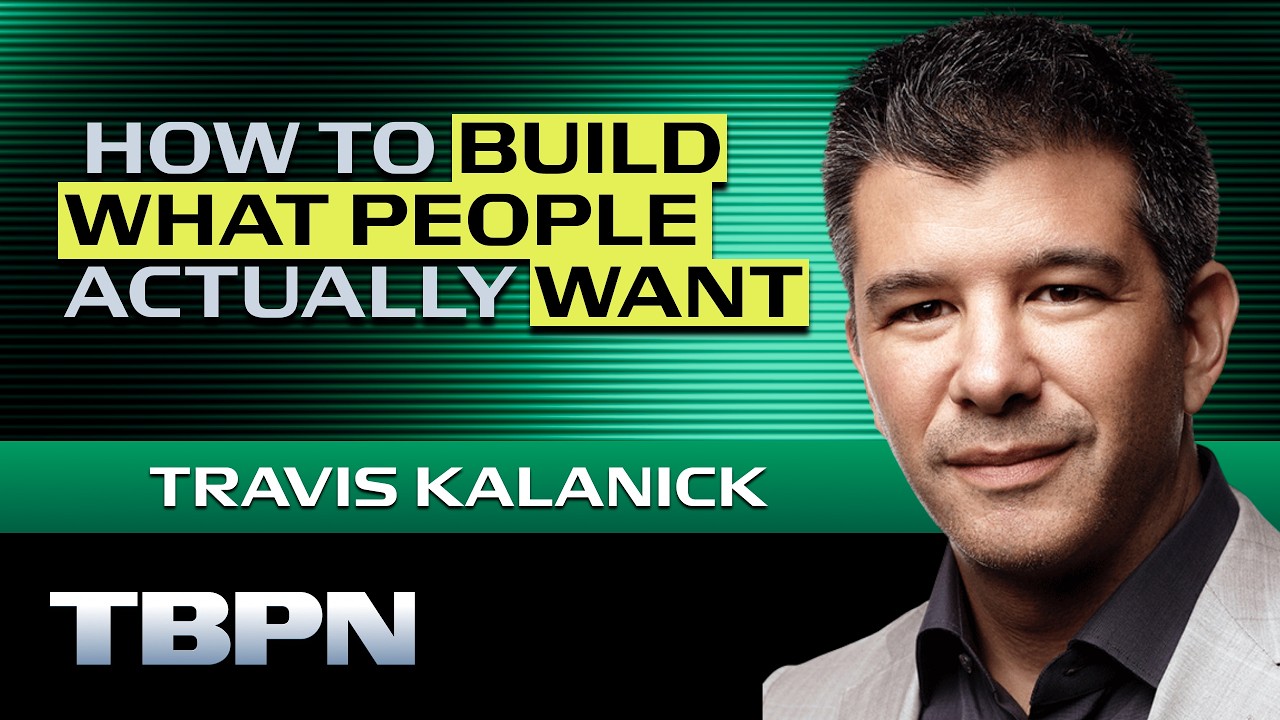
## Background
Published on YouTube by TBPN on July 22, 2026, this 45-minute interview features tech entrepreneur Travis Kalanick. According to the page description, the episode covers Kalanick's $1.7 billion funding round, his transition to industrial AI, autonomous mining productivity, executive hiring practices, lessons from scaling Uber, and his daily jet ski commute.
## TL;DR
In this wide-ranging interview, Travis Kalanick details his $1.7 billion raise for Atoms, a consolidated industrial AI company automating legacy physical industries like mining, logistics, and food infrastructure. He explains how retrofitting autonomous technology onto heavy machinery boosts output by 30% to 40% while pushing toward 'no entry' autonomous mines. Kalanick also shares his philosophy on scaling enterprise operations from 'lean to muscular,' executive recruitment prioritizing problem-solving, navigation of regulatory environments, and a vision of 'super prosperity' driven by automation. The discussion closes with a look at full-stack robotics applications, including 75-cent autonomous food delivery.
## Atmosphere & style
The interview maintains a relaxed, collegial, and energetic tone that balances lighthearted banter with sharp business insights. The hosts treat Kalanick with deep admiration as a childhood hero, creating an intimate, podcast-as-therapy dynamic where playful teases about high-speed jet ski commutes seamlessly transition into high-stakes corporate strategy. Kalanick speaks with candid, pragmatic intensity—deadpanning about executive hiring, sharing vivid stories from remote Amazon mines, and passionately explaining the physical mechanics of industrial automation. The result is a grounded yet ambitious conversation that feels like an insider look into the mind of a veteran tech founder navigating his next major act.
## Key takeaways
- [04:10](https://www.youtube.com/watch?v=E1agLjfdvQc&t=250s) Travis Kalanick announced a $1.7 billion funding round for Atoms, consolidating his previously separate food, mining, and transport ventures under a single industrial AI structure.
- [04:10](https://www.youtube.com/watch?v=E1agLjfdvQc&t=250s) Atoms focuses on 'industrial AI' and physical automation, retrofitting autonomous software, hardware, and sensors onto heavy industrial machinery across legacy industries.
- [13:18](https://www.youtube.com/watch?v=E1agLjfdvQc&t=798s) In mining, deploying autonomous technology like Pronto can increase overall site productivity by 30% to 40% while significantly reducing operational expenditures and improving safety.
- [19:19](https://www.youtube.com/watch?v=E1agLjfdvQc&t=1159s) The ultimate goal for autonomous mining is reaching a 'no entry mine,' where human operators are completely removed from high-risk physical pits and manage operations remotely.
- [19:19](https://www.youtube.com/watch?v=E1agLjfdvQc&t=1159s) Automating haulage serves as the central operational priority, acting as the 'cardiovascular system' of a mine site due to high vehicle density and continuous movement.
- [15:29](https://www.youtube.com/watch?v=E1agLjfdvQc&t=929s) Retrofitting legacy industrial machinery requires building custom physical actuation mechanisms to translate electronic signals into mechanical actions on non-drive-by-wire hydraulic systems.
- [22:28](https://www.youtube.com/watch?v=E1agLjfdvQc&t=1348s) Commercial AI and robotics safety are governed by economic alignment: systems must deliver clear utility to human buyers, as products that fail to serve human needs are starved of funding.
- [27:46](https://www.youtube.com/watch?v=E1agLjfdvQc&t=1666s) Executive leadership requires both operational scaling skills and strategic problem-solving ability, with core problem-solving capacity being the most essential metric for startup success.
- [33:01](https://www.youtube.com/watch?v=E1agLjfdvQc&t=1981s) Kalanick criticizes corporate pushes for federal preemption and artificial AI safety scares, viewing them as attempts at regulatory capture designed to protect incumbents from competition.
- [37:08](https://www.youtube.com/watch?v=E1agLjfdvQc&t=2228s) Full-stack industrial automation extends across supply chains, utilizing specialized non-humanoid wheeled robotics for heavy freight, warehouse operations, and autonomous food delivery.
- [39:37](https://www.youtube.com/watch?v=E1agLjfdvQc&t=2377s) Automating physical infrastructure lowers input costs for basic goods like food and logistics, driving Jevons paradox dynamics and ushering in an era of 'super prosperity' that reallocates human labor to high-value skilled trades.
- [42:24](https://www.youtube.com/watch?v=E1agLjfdvQc&t=2544s) The $1.7 billion financing round was led by Andreessen Horowitz (a16z), with plans for a second close due to overwhelming investor demand.
## Detailed walkthrough
### [00:00](https://www.youtube.com/watch?v=E1agLjfdvQc&t=0s) Jet Ski Commutes and Made Men in Retirement
The conversation kicks off with lighthearted banter about Travis Kalanick’s unconventional daily commute: riding a jet ski to work. Kalanick reveals that he clocks speeds up to 70 miles per hour during his five-minute water commute as a primary resident of Texas. When asked if the high-speed ride helps him do his best thinking or clear his mind, Kalanick laughs it off, admitting it is purely "a notch on the belt" because nobody else at a major, thousand-person-plus company is jet skiing to work. He jokes about looking it up on ChatGPT—fondly teasing the hosts by calling it "your guys's application"—and discovering that perhaps only one or two other CEOs do anything similar.
The hosts reflect emotionally on Kalanick's prior appearance on the show, describing it as a peak moment and "one of one" because they grew up looking up to him as a childhood hero during the 2010s startup boom. Kalanick playfully offers them advice and "therapy sessions" on what it feels like to be a "made man in retirement," noting that navigating the transition requires moving past denial and acceptance. The hosts joke that podcasts serve as the modern equivalent of therapy for men, prompting Kalanick to share that he has been teaching many tech founders and his own engineers how to water ski and wake surf—even successfully getting one engineer who didn't know how to swim behind the boat in a life jacket.
[04:10](https://www.youtube.com/watch?v=E1agLjfdvQc&t=250s) Consolidation and the $1.7 Billion Industrial AI Raise
Shifting gears to serious business, Kalanick discusses his massive, newly announced $1.7 billion funding round. He reflects on the progress made since his last appearance on the show roughly four months prior in early March. The massive capital injection was unlocked by the official market announcement of Atoms, a company focused on physical automation and "industrial AI" designed to transform legacy industries one by one. Kalanick explains that the business originally operated as a collection of separate subsidiaries—with food infrastructure in one bucket, and mining and transport in another.
When Kalanick initially went to market to raise capital, he asked investors whether they preferred to invest selectively in the mining or food divisions. However, the first five institutional investors he spoke with responded uniformly: "We want to invest in you." In response to this feedback, Kalanick consolidated the subsidiaries into a single entity and sold equity under a singular corporate structure. He notes that while Elon Musk has successfully run separate companies like Tesla, SpaceX, Boring Company, and Neuralink for two decades, consolidating everything into a single puzzle makes capital allocation much easier for him. Kalanick acknowledges that keeping entities separate offers upside early on because investors do not have to underwrite multiple distinct risks, but the conversation changes dynamically once individual business units reach profitability.
* The funding round totaled $1.7 billion for the newly consolidated entity, Atoms.
* The company focuses on "industrial AI" and physical automation across distinct sectors: food, mining, and transport.
[08:12](https://www.youtube.com/watch?v=E1agLjfdvQc&t=492s) High-Stakes Go-To-Market in Deep Amazon and Saudi Borders
The hosts ask Kalanick how his go-to-market strategy in the mining sector differs from his legendary consumer playbook at Uber, where he famously deployed young teams to launch cities like Miami via grassroots marketing and organizational design. Kalanick notes that B2B enterprise sales take years off your lifespan to master, but describes the mining go-to-market process as "freaking best" and entirely wild. He shares an anecdote from a month prior when he traveled to the deep northern Brazilian Amazon to visit a massive iron ore mine operated by their customer, Vale. Flying into tiny airstrips and touring the colossal site via a 30-minute helicopter ride, he observed how their autonomous tech kits are retrofitted onto machinery—some new, some 20 years old—to simultaneously lower operational expenditure, radically improve safety, and boost output.
Straight from Brazil, Kalanick traveled to a phosphate mine located on the Saudi Arabian side of the Iraq-Saudi border. Due to regional conflicts and border tensions, the aircraft's navigation signals were jammed, forcing his pilots to land "old school style" using visual flight rules. Kalanick explains that the technology developed by Pronto (an Atoms subsidiary) has officially surpassed human-level productivity. When approaching gold mine CEOs with a value proposition of yielding 20% more gold per year, the answer is always an enthusiastic yes, though companies demand that they "prove it" via rigorous corporate pilots.
[13:18](https://www.youtube.com/watch?v=E1agLjfdvQc&t=798s) Autonomous Mining Economics and Shifting from Lean to Muscular
Kalanick details the distinct economic drivers behind autonomous mining productivity gains. The first lever is increasing the mechanical output per hour of the machines themselves. The second lever centers on eliminating the logistical headaches of human shifts, call-outs, and rigid safety protocols required when placing human drivers in high-risk environments. Kalanick projects that autonomous integration can ultimately make a mining operation 30% to 40% more productive. While precious metals like gold or critical minerals like lithium offer direct upside through increased volume, Kalanick notes that lower-margin aggregate quarries—which feed regional cement markets—focus primarily on lowering OPEX because demand is capped by what local buyers can store and consume.
Praising the engineering foundation of the business, Kalanick highlights Anthony Levandowski and the core team at Pronto for their hyper-scrappy, lean startup execution style. He jokingly compares their ultra-lean state to Christian Bale's drastic physical transformation in the movie *The Machinist*. Kalanick concludes that the purpose of the new $1.7 billion funding round is to transition the company’s organizational structure from that incredibly lean baseline into something incredibly muscular, shifting from a survivalist startup stance to a dominant, high-growth enterprise scale reminiscent of a superhero transformation.
* Autonomous mining integration can drive overall productivity increases of 30% to 40%.
* In aggregate quarries and cement operations, the technology functions primarily as a margin-saving OPEX play rather than a volume play.
* Anthony Levandowski leads the scrappy autonomous technology team at Pronto.
Here is the detailed walkthrough of part 2 of the transcript:
[15:29](https://www.youtube.com/watch?v=E1agLjfdvQc&t=929s) Going from Lean to Muscular: The Mechanics of Scaling On-Site Operations
Transitioning an enterprise AI operation from a small-scale pilot to full customer deployment requires moving from a lean setup to a heavily resource-backed operation—a shift Travis Kalanick describes as going from "lean to muscular." When a customer asks to scale up after a successful initial run, the bottleneck isn't merely customer demand; it is navigating the heavy physical logistics involved in retrofitting massive, isolated industrial infrastructure. Installing an autonomous system at a remote site—such as a mine deep in the Amazon—involves shipping sensory arrays, compute hardware, customized mechanical equipment, and edge servers to construct a self-contained computational footprint directly on location.
Once the hardware arrives, the true challenge begins with site commissioning and change management. Mining sites run on rigid, time-honored daily routines to keep personnel safe, because "weird things happen on a mining site" if unexpected variables are introduced. Bringing autonomous machinery online requires careful calibration, rigorous testing, and overcoming physical mechanical barriers. Much of the legacy equipment operating in these environments lacks modern drive-by-wire capability, relying instead on raw mechanical linkages and high-pressure hydraulic systems. To automate a vehicle that requires physical button presses or manual steering wheel turns, the team must engineer custom physical actuation systems capable of translating electrical signals into mechanical action.
- Enterprise customers are eager to scale once pilots demonstrate success, demanding robust support ("protein powder") from their solution providers.
- On-site deployments function almost like localized data centers, requiring self-contained compute servers and extensive sensor suites.
- Legacy heavy machinery requires custom physical actuation mechanisms to automate hydraulic and mechanical systems that are not natively drive-by-wire.
- Strict site commissioning and change management are crucial to maintaining safety protocols when shifting from manual to autonomous operations.
[19:19](https://www.youtube.com/watch?v=E1agLjfdvQc&t=1159s) Reaching the "No Entry Mine" and the Cardiovascular System of Haulage
In the mining industry, the ultimate operational objective is achieving a "no entry mine"—a site where zero humans step foot inside the physical pit. In this vision of the future, human workers remain safely in remote control centers while automated systems handle drilling, blasting, loading, haulage, and crushing. Reaching this milestone is a step-by-step progression: teams begin by introducing remote control tools into specific workflows, proving out safety metrics, and then deploying full autonomy across individual vectors until human exposure to the pit is entirely eliminated.
The core focus for Kalanick's approach is haulage, which he views as the "cardiovascular system" of a mining operation because it accounts for the vast majority of vehicles on site. Controlling haulage requires managing massive physical forces—such as 2-million-pound off-road haul trucks hurtling down dirt roads at 35 miles per hour while carrying payloads like gold ore. Rather than trying to acquire legacy machinery manufacturers or force a complete overhaul of a site's infrastructure, Kalanick prefers building in-house tech while relying on open software APIs. This strategy enables his haulage system to orchestrate actions smoothly alongside third-party equipment by sharing real-time positional and status data across the entire site ecosystem.
> "A no entry mine is a mine where there are no people in the pit... You're talking about loaded a 2 million pound machine that's moving potentially 35 miles an hour down the road."
- Haulage represents the highest density of vehicles on a mine site and serves as the primary operational pipeline connecting all other stages.
- The platform uses APIs to coordinate real-time positioning and operational statuses across non-haulage machinery within the site ecosystem.
- Kalanick notes that while Uber's philosophy under his tenure was strictly "we didn't acquire shit, we just built," he remains open to strategic partnerships if a team offers truly differentiated technology.
[22:28](https://www.youtube.com/watch?v=E1agLjfdvQc&t=1348s) Real-World Engineering vs. "Laptop Jobs" and Asimov's Laws
When pitching fresh computer science graduates from top universities like Stanford, Kalanick offers a stark alternative to comfortable corporate software roles. Instead of taking a standard "laptop job" or pushing consumer apps to the App Store, young engineers have the opportunity to be dropped directly into the Amazon rainforest to write real-world automation software for multi-million-pound industrial behemoths. Drawing inspiration from classic science fiction—specifically Isaac Asimov's *I, Robot* series—Kalanick reflects on the tension between AI capability and safety. While Asimov's Three Laws of Robotics demonstrated complex nuances and edge-case failures, the core intention behind alignment principles remains critical when deploying heavy, high-risk physical hardware.
Kalanick grounds his perspective on AI safety in a fundamental lesson learned over a lifetime of building startups: projects fail when people build things that nobody likes or wants. Applying this principle to AI, he argues that building anti-human or unhelpful technology is inherently self-defeating because AI models actively seek to please humans, and human buyers exercise ultimate financial control. Until autonomous agents possess their own bank accounts and civil rights, every robot is ultimately owned by a person who pays based on tangible, positive utility.
> "You're not dropping a fucking app in the App Store. You're like automating a 2 million pound machine going 35 miles an hour carrying gold."
> "If you make something that is anti-human, if you make something that doesn't serve people... I don't think you're going to make it."
- Asimov's *I, Robot* series serves as a favorite reference point for the foundational tensions and nuances of robotics safety.
- Commercial AI systems are constrained by economic alignment: if a system fails to serve human utility, buyers will withhold funding and kill the product.
- Real-world deployment forces an acute focus on practical safety—making sure physical machines stay on designated roads rather than focusing purely on theoretical doom scenarios.
[27:46](https://www.youtube.com/watch?v=E1agLjfdvQc&t=1666s) Value-Based Enterprise Pricing and Executive Hiring Philosophy
From a business model perspective, pricing industrial AI relies on classic enterprise software negotiation dynamics rather than aggressive profit-sharing schemes. When software can boost a mine's yield or productivity by 30 to 40%, the goal is to capture a fair portion of the value created without resorting to crass demands like asking for a direct percentage of the customer's raw output. Operators establish a baseline pricing model that increases as productivity gains are proven, striking a balance between delivering massive customer ROI and securing strong subscription revenue for the platform.
When asked about his methodology for recruiting executive leadership, Kalanick candidly deadpans that his process begins with "pray." Expanding on the difficulty of hiring top executives, he explains that candidates often talk an impressive game, but true success comes down to balancing two distinct skills: leading and organizing at scale versus being a world-class strategic problem solver. Analysing this dynamic as a left-handed versus right-handed split, Kalanick notes that while few executives are truly ambidextrous, problem-solving ability must take priority. An executive who excels at organization but lacks core problem-solving capacity will simply execute useless or misaligned initiatives in an impeccably structured way.
> "If you get somebody who organizes and manages well, but cannot solve a problem, they're going to be doing ridiculous stuff in a super organized way."
- Enterprise software pricing strategies use baseline tiers and value-add escalators linked to proven productivity gains instead of taking a percentage of client output.
- Executive candidates often fall into two camps: large-scale operational managers or strategic problem solvers.
- Exceptional executive talent requires both skill sets, but deep problem-solving capability is the essential non-negotiable metric for startup success.
[31:18](https://www.youtube.com/watch?v=E1agLjfdvQc&t=1878s) Management Capacity and the "Problem-Solver-in-Chief" Mentality
Travis Kalanick explains that the primary constraint on his ambition isn't a lack of ideas, but management capacity—which he defines fundamentally as "problem-solving at scale." When his teams are executing effectively, he can continuously create new, exciting problems for them to tackle. Operating as the "problem-solver-in-chief," Kalanick spends his personal time targeting the most impactful, high-level issues that aren't getting solved elsewhere in the organization. He expects this mindset to cascade down throughout the company: every direct report must act as a "deputized problem-solver-in-chief" for their respective domain, scaling that problem-solving culture to their own teams.
To build a team capable of this, Kalanick emphasizes rigorous interview processes that simulate real, day-to-day work together. By removing the boundary between interviewing and actual job execution, a candidate's first day on the job feels like week two. If a new hire remains energized after this realistic simulation, significant risk is eliminated from the hiring process.
- Management capacity is defined as problem-solving at scale rather than administrative overhead.
- Executives must prove they can solve actual problems rather than just "talking the talk."
- Realistic work simulations during interviews ensure seamless transitions from day one to week two.
[33:01](https://www.youtube.com/watch?v=E1agLjfdvQc&t=1981s) Regulatory Strategy, Federal Preemption, and Systemic Friction
Addressing regulatory approaches, Kalanick draws a sharp contrast between market-opening strategies and corporate protectionism. He argues that pushing for federal preemption or broad federal regulations is typically favored by companies seeking "regulatory capture" to squeeze out potential competitors. Reflecting on his tenure at Uber, he notes that the company never lobbied for rules designed to give itself an unfair advantage over others; instead, they fought city-by-city to open markets and let the best operator win. He warns against "closed-weight" AI companies that engineer security scares or hire hackers to manufacture problems, only to approach the government claiming they saved the day and asking for protective regulations.
When discussing autonomous vehicles and transportation safety, Kalanick highlights the structural incentives behind systemic regulatory friction. He singles out trial lawyers and insurance companies as the primary drivers of weird, inefficient transport regulations. While trial lawyers thrive on accidents to secure large settlements, insurance companies profit from predictable, actuarially planned risk. During Uber's early expansion in Washington, D.C., taxi liability was capped at around $25,000 per ride, but regulators pushed a mandatory $1.5 million policy per ride for rideshare services—a massive financial pool welcomed by both trial lawyers and insurers.
- Federal preemption is often leveraged by incumbents pursuing pro-regulatory capture to shut out competition.
- Closed-weight AI labs are cautioned against creating artificial safety crises to invite favorable government regulation.
- Transport system inefficiencies are frequently pushed by trial lawyers and insurance firms, which profit off predictable accident volumes.
- Washington, D.C., taxi liability was historically $25,000, while rideshare platforms were pushed toward $1.5 million policies per ride.
[37:08](https://www.youtube.com/watch?v=E1agLjfdvQc&t=2228s) Full-Stack Industrial Automation: From Freight to Autonomous Food Delivery
Kalanick details the hardware and transportation strategy behind his current industrial AI push, describing his focus as "wheelbase for robots." Distinguishing his approach from humanoid robotics, he targets specialized, non-humanoid industrial machinery designed for high-scale tasks that humanoids are ill-suited to perform. The full-stack automation vision spans entire supply chains: autonomous freight vehicles transport goods into facilities, automated machines process and prepare materials internally, and custom rolling infrastructure handles outbound delivery. For food distribution, he envisions rolling insulated temperature-controlled units—dubbed "autonomous burritos"—delivering meals directly to homes for roughly 75 cents per drop, compared to the $12 per drop costs typical of legacy delivery services like Uber Eats or DoorDash.
This full-stack approach extends across heavy industries, including mining and logistics. Beyond heavy haulage trucks, Kalanick points to routine support tasks like road grading, water spraying for dust suppression, and material handling as prime candidates for automation. He notes the massive scale of traditional material handling overhead, highlighting an unnamed major company spending $3.5 billion annually solely on human labor for forklifts inside its facilities.
- Focuses on non-humanoid, specialized industrial robots built on heavy-duty wheeled chassis.
- Envisions "autonomous burritos" (box-on-wheels delivery machines) reducing food drop costs from $12 down to approximately $75 cents.
- Applies automation across mining support systems, including dirt road graders, dust-suppression water trucks, and freight haulers.
- Mentions a major company spending $3.5 billion annually on labor purely to operate forklifts in warehouse facilities.
[39:37](https://www.youtube.com/watch?v=E1agLjfdvQc&t=2377s) Economic Productivity, Jevons Paradox, and the "Super Prosperity" Era
Addressing concerns around automation eliminating human labor, Kalanick differentiates between automating isolated tasks and replacing entire jobs. Using the food industry as an example—where automated real estate, production, and delivery drastically reduce prices—he argues that driving down input costs releases capital back to consumers. Because "robots don't have bank accounts," capital freed up by cheaper food and goods flows directly into other consumer activities, expanding the broader economy.
Rather than inducing joblessness, productivity gains spark Jevons paradox dynamics across whole industries. While specific routine tasks become fully automated, human effort shifts into newly emerging categories of work enabled by surplus capital. Kalanick predicts a era of "super prosperity" where non-automatable human skills—such as specialized trade work—will command immense economic value, drawing a parallel to plumbers being paid like professional elite athletes across thousands of new, unforeseen job categories.
- Drastic cost reductions in foundational goods (food, logistics) create economic surplus for consumers.
- Automation shifts human labor from repetitive technical tasks to high-value physical or interpersonal services.
- Predicts widespread "super prosperity" where skilled trade workers command premium, high-level compensation.
[42:24](https://www.youtube.com/watch?v=E1agLjfdvQc&t=2544s) Unfinished Business, a $1.7 Billion Round, and Industrial AI
Discussing his company's massive $1.7 billion funding round led by Andreessen Horowitz (a16z), Kalanick describes the investment as "unfinished business," referencing missed opportunities to partner with a16z during his tenure at Uber. Due to overwhelming demand following the round's announcement, he reveals that the company will likely conduct a second close to accommodate select strategic investors and close allies ("homies").
Kalanick reframes his company's mission away from vague terms like "physical AI" or general world models, adopting the distinct label **industrial AI**. He defines industrial AI as a complete full-stack solution—integrating software, robotics, sensors, and heavy machinery—to fully automate entire physical industries from end to end.
- Raised $1.7 billion in funding led by Andreessen Horowitz (a16z), with plans for a second close.
- Frames the enterprise specifically around **industrial AI**: full-stack software, robotics, sensors, and heavy machinery for physical automation.
[44:36](https://www.youtube.com/watch?v=E1agLjfdvQc&t=2676s) Signing the Gong and Water Sports Commutes
Closing out the interview, the hosts invite Kalanick to sign their ceremonial studio gong to join their "museum of business." The conversation turns to Kalanick’s daily routine in Austin, where he routinely commutes on a jet ski and spends time water skiing and wake surfing on the lake. He shares that he hits the water every morning at 7:30 AM and frequently goes back out around 8:30 PM after leaving the office, extending a casual offer to teach the hosts how to slalom ski next time they are in town.
- Commutes regularly via jet ski and practices water sports daily in Austin at 7:30 AM and 8:30 PM.
- Signs the studio gong to commemorate the episode.
## Notable quotes
> [19:28](https://www.youtube.com/watch?v=E1agLjfdvQc&t=1168s) A no entry mine is a mine where there are no people in the pit... You're talking about loaded a 2 million pound machine that's moving potentially 35 miles an hour down the road. — Travis Kalanick
> [22:28](https://www.youtube.com/watch?v=E1agLjfdvQc&t=1348s) You're not dropping a fucking app in the App Store. You're like automating a 2 million pound machine going 35 miles an hour carrying gold. — Travis Kalanick
> [22:28](https://www.youtube.com/watch?v=E1agLjfdvQc&t=1348s) If you make something that is anti-human, if you make something that doesn't serve people... I don't think you're going to make it. — Travis Kalanick
> [27:46](https://www.youtube.com/watch?v=E1agLjfdvQc&t=1666s) If you get somebody who organizes and manages well, but cannot solve a problem, they're going to be doing ridiculous stuff in a super organized way. — Travis Kalanick
## Mentioned
Travis Kalanick, Atoms, Pronto, Uber, Uber Eats, DoorDash, Vale, Andreessen Horowitz (a16z), Anthony Levandowski, Elon Musk, Tesla, SpaceX, Boring Company, Neuralink, ChatGPT, TBPN, Ramp, Public, Cisco, Console, CrowdStrike, Figma, MongoDB, NYSE, Railway, Shopify, Codex, Amazon, Saudi Arabia, Brazil, Austin, Texas, Christian Bale, The Machinist, I, Robot, Isaac Asimov
Travis Kalanick argues that the next major frontier in technology is 'industrial AI'—deploying specialized robotics and autonomy to retrofit heavy physical industries rather than pursuing general humanoid robots or consumer software apps. Backed by a $1.7 billion funding round, his consolidated enterprise, Atoms, targets high-friction, capital-intensive sectors like mining and logistics to radically lower operational costs and improve worker safety.
Consolidation and the $1.7 Billion Capital Base (4:10)
After initially dividing his initiatives into distinct subsidiaries covering food infrastructure, mining, and transport, Kalanick consolidated these efforts into a single entity named Atoms. The decision followed consistent feedback from the first five institutional investors he approached, who preferred investing in Kalanick directly across a unified corporate structure rather than underwriting individual sectoral risks. The resulting $1.7 billion financing round, led by Andreessen Horowitz (a16z) with plans for a second close, is designed to shift the business from a lean, survivalist startup into a well-capitalized enterprise capable of scaling complex industrial deployments.
Engineering Realities of Autonomous Mining Operations (15:29)
Deploying autonomy in physical environments requires overcoming severe operational logistics rather than simply writing code. In mining—where subsidiary Pronto operates—retrofitting legacy equipment requires building localized edge-compute footprints and engineering custom physical actuators to translate electronic signals into mechanical steering and hydraulic control. Kalanick identifies haulage as the operational 'cardiovascular system' of a mine, with two-million-pound trucks operating at 35 miles per hour. The ultimate goal is the 'no entry mine,' removing all humans from hazardous pits into remote control rooms.
Industrial Economics and Value-Based Pricing (13:18)
Kalanick projects that autonomous retrofits can increase overall mining productivity by 30% to 40% by boosting machine output per hour and eliminating the logistical friction of human shift handoffs. In precious metals like gold, where Kalanick claims autonomous systems have exceeded human-level output, customers gain direct top-line volume; in lower-margin aggregate quarries, the technology serves primarily as an operational expenditure reduction play. Rather than demanding equity-like cuts of raw output, Atoms uses enterprise software pricing with baseline tiers and performance escalators tied to validated productivity gains.
Wheeled Industrial Automation Across the Supply Chain (37:08)
Rejecting general humanoid robotics, Kalanick concentrates on non-humanoid, wheeled platforms engineered for high-scale specialized work. This strategy extends across supply chains, from autonomous freight haulers and mine-maintenance vehicles like road graders to internal warehouse handling, where Kalanick notes a major company spends $3.5 billion annually solely on human forklift drivers. In food logistics, he envisions insulated rolling pods delivering meals for roughly 75 cents per trip, down from the approximately $12 per drop typical of legacy app-based delivery platforms.
Labor Market Effects, Regulatory Friction, and Executive Hiring (33:01)
Kalanick dismisses existential AI doom, arguing that autonomous machines are constrained by the economic reality that only humans hold bank accounts and dictate capital allocation. Invoking Jevons paradox, he predicts that slashing foundational costs will free consumer capital and generate a 'super prosperity' era where skilled human trades command premium pay. Regarding governance, he cautions against closed-weight AI labs seeking federal preemption to entrench regulatory capture. Internally, Kalanick views management capacity as the primary bottleneck to growth, prioritizing strategic problem-solving ability over pure administrative coordination when hiring executives.
While Kalanick outlines aggressive operational efficiencies and cost cuts across mining, transport, and food delivery, his model hinges on navigating rigorous enterprise pilot validations and executing heavy hardware retrofits across legacy, non-drive-by-wire machinery in remote global environments.
[19:28] Travis Kalanick: A no entry mine is a mine where there are no people in the pit... You're talking about loaded a 2 million pound machine that's moving potentially 35 miles an hour down the road.
[22:28] Travis Kalanick: You're not dropping a fucking app in the App Store. You're like automating a 2 million pound machine going 35 miles an hour carrying gold.
[22:28] Travis Kalanick: If you make something that is anti-human, if you make something that doesn't serve people... I don't think you're going to make it.
[27:46] Travis Kalanick: If you get somebody who organizes and manages well, but cannot solve a problem, they're going to be doing ridiculous stuff in a super organized way.
Original transcript
[0:00] I forgot to ask Jason if he has
[0:03] opinions about resto mods for jet skis.
[0:05] I'll ask you. Is there a Is there a jet
[0:08] ski that you'd recommend for the
[0:09] somebody
[0:10] >> I saw a wooden I saw a wooden jet ski
[0:12] recently.
[0:12] >> A wooden? That's a
[0:13] >> Like a really classic jet ski.
[0:15] >> Dude, don't get me excited. I'm into it.
[0:17] >> But these things go fast.
[0:18] >> Yeah?
[0:19] >> I think I went 70 miles an hour on my
[0:21] jet ski to work.
[0:22] >> Wow.
[0:22] >> To work. [laughter]
[0:23] >> That's faster than most people commute.
[0:24] They're stuck in traffic.
[0:25] >> I mean, I've got a 5-minute commute to
[0:27] work on a jet ski.
[0:28] >> ski.
[0:28] >> Unless it's raining.
[0:29] >> Yeah.
[0:29] >> Unless it's raining. Yeah,
[0:31] not unless
[0:31] >> I think it's a little weird.
[0:32] >> And you call an Uber.
[0:34] >> Okay.
[0:34] >> Is it Is it Is it helpful? Do you do
[0:36] your best thinking on the jet ski?
[0:40] >> No.
[0:40] >> No.
[0:41] >> [laughter]
[0:43] >> Does it clear the mind?
[0:44] >> Does it clear the mind?
[0:45] >> No, it's just
[0:46] Guys, it's it's a it's a it's a
[0:50] it's a [ __ ] notch on the belt. It's
[0:51] like, who else do you know is jet skiing
[0:54] to work? Nobody. I'm the guy.
[0:57] >> Oh, you're that guy.
[0:58] >> I looked it up. I looked it up
[1:01] uh on your guys's application, Open AI,
[1:03] you know, Chat GPT on your guys's app.
[1:05] >> Yeah, yeah, that's our app. Yeah, our
[1:06] app.
[1:06] >> Yeah, on your app.
[1:07] >> You're welcome, by the way.
[1:08] >> Um yeah. No, I I want to thank you for
[1:10] all the great stuff that you guys are
[1:11] providing in Chat GPT.
[1:14] >> [laughter]
[1:14] >> But I think there's like one or two
[1:16] other CEOs, but but nobody at a major
[1:20] Nobody at Nobody thousand person plus as
[1:23] a CEO is commuting to work.
[1:25] >> On a jet ski.
[1:26] >> On a jet ski.
[1:26] >> Only a Texas resident, right?
[1:28] >> Texas resident.
[1:29] >> That's right.
[1:30] >> Primary residence. That's right.
[1:31] >> Yes.
[1:32] >> Um
[1:34] Before we start, the last time you were
[1:35] on here,
[1:36] that was for me the best moment of
[1:40] making the show ever. John and I uh it
[1:43] was it was totally surreal and uh we had
[1:45] a we really really enjoyed the
[1:47] conversation, but but to me, we left
[1:50] that and it was almost depressing
[1:51] because as somebody who, you know,
[1:54] started getting into startups in the
[1:56] 2010s,
[1:58] you were that guy.
[2:00] And then I was realizing with the show,
[2:02] we
[2:03] we had that conversation with you and it
[2:06] and it was, you know, a significant day
[2:07] for you, but it was sort of depressing
[2:09] cuz I realized like a moment like that
[2:11] would never actually come again where I
[2:13] got to basically interview
[2:16] it will happen it will happen no it'll
[2:18] happen differently but but you know a
[2:19] childhood hero having that conversation
[2:24] that's one of one for me. I don't think
[2:25] it'll happen again. There'll be other it
[2:27] was peak it was peak.
[2:28] But anyways, you've been busy since
[2:30] then.
[2:31] >> I've been busy.
[2:32] I look I'm super excited it's my first
[2:34] open AI podcast.
[2:35] >> [laughter]
[2:36] >> I'm very excited about it. Also, I want
[2:39] to let you guys know that
[2:41] if you need therapy sessions for what
[2:43] it's like to be a made man in
[2:45] retirement.
[2:46] >> Sure.
[2:47] >> Like if that's a thing I can
[2:49] I can help motivate you guys.
[2:50] >> one of therapy in this situation just
[2:52] get a jet ski?
[2:53] >> No, it's just it's it's actually denial.
[2:55] You got to get over the denial.
[2:56] >> Okay. Over the denial.
[2:58] And then [laughter] the acceptance?
[2:59] >> Yeah, it's something like that. I don't
[3:00] know the 12 steps. I don't know the 12
[3:01] steps.
[3:02] >> Yeah, yeah, yeah, everyone just knows
[3:04] denial and acceptance. They they don't
[3:05] know any of the other ones.
[3:07] Grieving, bargaining, there's a couple
[3:09] others in there but you do go through
[3:10] that. It's natural. Yeah,
[3:11] it happens but then you start building
[3:13] and
[3:14] >> So if you guys need advice, you need
[3:15] therapy I'm here for you. I mean I know
[3:17] that [ __ ] maxing is you're not
[3:18] supposed to do therapy. I'm just saying
[3:20] >> [laughter]
[3:20] >> there are benefits.
[3:21] >> your new partners. They're like if
[3:23] there's one thing they wrote into the
[3:25] fundraising round, they wrote into the
[3:26] docs like cannot go to therapy.
[3:28] >> Yes, but but podcasts are modern therapy
[3:31] for men. This is what men do. They don't
[3:32] go to therapy.
[3:33] >> You should have you should have you
[3:35] should have office hours for founders
[3:37] but they have to just come out on a jet
[3:39] ski while you're going and you're going
[3:40] 70 miles an hour and you'll coach them.
[3:43] >> I'm
[3:44] I am starting to teach many founders and
[3:47] people in tech world how to water ski,
[3:50] how to wake surf. A bunch of my
[3:52] engineers already. So, there was one guy
[3:54] who didn't know how to swim, but I got
[3:55] him behind the boat wake surfing.
[3:57] >> Woah.
[3:58] >> Woah. So, you had a you had a life
[3:59] jacket.
[3:59] >> Yeah, life jacket. The life jacket on.
[4:01] >> Life jacket. It It It sounds weirder
[4:03] than it is.
[4:03] >> Yeah.
[4:04] >> But, it was still very weird.
[4:05] >> It's [clears throat] a high risk.
[4:06] >> Yeah.
[4:06] >> Yeah, it was good.
[4:07] >> Potentially.
[4:08] >> Uh
[4:09] okay, cool.
[4:10] >> The business.
[4:10] >> Business.
[4:11] >> Going well?
[4:11] >> Dude, it's business time.
[4:12] >> Yeah.
[4:13] >> Got to put on the business socks.
[4:14] >> Unfinished business.
[4:15] >> Unfinished business.
[4:17] Um so, yeah, I announced earlier today
[4:19] uh we did a $1.7 billion raise. There's
[4:22] some There's some noise that's going to
[4:23] happen.
[4:27] >> Wow.
[4:29] >> For now.
[4:31] This is [ __ ] You guys are crazy.
[4:34] >> [laughter]
[4:35] >> I'm hitting it next time.
[4:36] >> Yeah. [clears throat]
[4:36] >> Um
[4:42] Uh
[4:43] so much noise.
[4:44] >> So much noise.
[4:45] >> All right, but walk us through.
[4:46] >> you came in very relaxed.
[4:48] >> It's just walk us through. I think it's
[4:49] been what?
[4:50] >> It's been
[4:51] uh 4 months since we talked? Three or
[4:53] four months? Something like that.
[4:54] >> Yeah, I think Did we talk in April or
[4:56] March?
[4:57] >> I think March.
[4:58] >> Yeah.
[4:58] >> Oh, that's right. Yes.
[4:59] >> Early March.
[5:00] >> The 4 months.
[5:01] >> So,
[5:02] >> So, yeah. So,
[5:03] >> What happened with the business to
[5:05] unlock the next round?
[5:07] >> Uh
[5:08] I mean, we continue to go up and to the
[5:10] right, but like the announcement of
[5:11] Atoms was we are we're going to do
[5:15] physical automation, physical AI.
[5:18] What we are calling industrial AI to
[5:21] transform these industries one at a
[5:23] time. We were we did food. We moved into
[5:26] mining. We're doing transport.
[5:29] And
[5:30] it's working.
[5:32] And so,
[5:33] that's how you go. Yeah, and then of
[5:35] course, there's like going out of
[5:36] stealth, there's all the things, and it
[5:37] was just the right time.
[5:39] >> Yeah.
[5:39] >> So, um
[5:41] So, yeah. We just went to market.
[5:43] >> Yeah.
[5:43] >> We said when I when I originally went to
[5:45] market, I was like,
[5:47] "These were separate companies. Okay, so
[5:49] our mining and transport was a separate
[5:51] thing.
[5:52] Food was a separate thing and and we had
[5:54] a bunch of other, you know, a bunch of
[5:56] subsidiaries doing cool stuff. And I
[5:58] said, "Which one do you guys want to do?
[5:59] Do you want to invest in mining? Do you
[6:01] want to invest in food? Do you want to
[6:02] invest in this?"
[6:03] And they're just like, "We want to
[6:05] invest in you."
[6:06] >> Yeah.
[6:06] >> Yeah.
[6:07] >> And we heard that
[6:09] like we took the like the first five
[6:11] folks we talked to all said that.
[6:13] >> Yeah.
[6:13] >> So then what we did is we put the
[6:15] companies
[6:16] together
[6:18] and then sold the equity in a singular
[6:21] entity.
[6:22] >> Yeah.
[6:22] >> Yeah.
[6:22] >> Uh so just put put it together. And it
[6:26] and it I it's much easier for me. I
[6:28] don't know how
[6:29] uh how Elon does it with all the
[6:31] different companies
[6:32] >> tables and
[6:32] >> It's it's wild.
[6:33] >> Well, no, no, you The answer The answer
[6:35] is what's been happening, right?
[6:37] >> Is it all comes back together? But he
[6:38] did Guys, he did it for 20 years though.
[6:40] >> Yeah. Yeah. Yeah.
[6:41] >> And he's still technically doing it with
[6:42] Tesla.
[6:42] >> Yeah.
[6:42] >> SpaceX like they are different
[6:43] companies.
[6:44] >> Boring company, Neuralink. Like he's
[6:46] still got a lot of different companies.
[6:48] >> in there for investors is like even with
[6:50] Elon companies there's such an insane
[6:52] power law where you have a $10 billion
[6:54] company and then you have a, you know, a
[6:56] $2 trillion company, right? And it's
[6:58] like you just want to expose you want
[7:00] broad exposure. Ideally, you know, you
[7:03] could just invest in the one that breaks
[7:05] out, but you want broad exposure to
[7:07] the category.
[7:08] >> When things are first getting going,
[7:10] there is a lot of upside of having them
[7:13] separate.
[7:14] >> Sure.
[7:15] >> Uh because if somebody wants to invest
[7:17] in a really cool thing and this is what
[7:18] happened when we first got the transport
[7:20] and mining thing going. If they want to
[7:22] invest in that cool thing, they're like,
[7:23] "I don't know anything about food." By
[7:24] the way, food on its own is robotics,
[7:27] real estate, like restaurants, like uh
[7:30] you know? And so they want they want to
[7:33] be exposed to that one thing and they
[7:34] don't want to have to underwrite
[7:36] something going across all things. Um
[7:39] and they're like, "Well, if If losing
[7:40] money over here, I want you to lose
[7:42] money over here.
[7:43] >> Mhm.
[7:43] >> So, how much of the money I'm putting in
[7:45] is going to go to that?
[7:47] There There has to be a theory of the
[7:48] case of how you put it together, how you
[7:50] allocate capital across. And honestly,
[7:52] once you're starting to get to
[7:53] profitability on one or more, then that
[7:56] conversation starts to get easier. And I
[7:57] think that's That could be why
[8:00] I I I can't I can't speculate on on on
[8:04] sort of Elon's world, but certainly I'm
[8:07] super excited to have those pieces put
[8:09] together into a single into a single
[8:11] puzzle.
[8:12] >> What does go to market look like in the
[8:15] mining industry for you?
[8:17] >> It's the freaking best.
[8:18] >> Okay. Because
[8:20] specifically like when I think of when I
[8:23] think of your go to market magic.
[8:26] >> Okay.
[8:26] >> It was deploying young people to a new
[8:30] city in Miami, and they're doing a
[8:32] marketing stunt, and it's not like
[8:35] you're calling in favors or leveraging
[8:38] your network to get Uber up and running
[8:41] in a new city. That was something that
[8:44] was organizational design.
[8:46] >> on. That's consumer.
[8:47] >> Exactly. So, how is it different?
[8:48] >> Well, it's just like Well, all the food
[8:50] stuff we're doing is business. Almost
[8:51] all of it.
[8:52] >> Really all of it. Uh mining's all
[8:54] business. So, it's So, so look, there is
[8:57] a big thing if you go from doing
[8:59] consumer to doing business. And I think
[9:01] we may have talked about this last time.
[9:04] That's a whole other ballgame. I mean,
[9:06] it takes years off your lifespan doing
[9:10] it. Like getting good at it and then
[9:12] owning it. But mining go to market is
[9:15] cray-cray.
[9:17] >> Yeah.
[9:17] >> Like So, I was just giving an example.
[9:20] >> to the mining conference or something?
[9:22] >> yes. You're meeting CEOs. Yes, you do
[9:24] that. But But But you know,
[9:27] I can a lot of times Look, when you have
[9:30] very efficient transportation, you can
[9:34] go places. So, a month ago, I dropped
[9:37] into deep Amazon in Brazil.
[9:41] Okay? Like deep northern Brazil, like
[9:44] Amazon
[9:45] >> Places you can't even get a jet ski to.
[9:46] >> Guys, it's the Amazon of the Amazon,
[9:49] okay?
[9:49] >> Okay.
[9:50] >> [laughter]
[9:50] >> And and like
[9:53] tiny airports, you just like you kind of
[9:55] just
[9:56] >> Dirt.
[9:56] >> You slide into the DMs, except there's a
[9:58] tarmac, okay?
[9:59] >> you go.
[10:00] >> And
[10:01] >> Yes, of course. And massive iron ore
[10:05] mine that we're operating in there.
[10:07] >> Okay.
[10:07] >> And you see like we took
[10:10] We were there for a couple days cuz we
[10:12] already have customers there.
[10:13] Customers called Valley. It's a massive
[10:15] mining company.
[10:16] >> Yeah.
[10:16] >> And
[10:18] um
[10:19] They It's It's like the world's largest
[10:22] iron ore mine. And you go and you get in
[10:24] a helicopter.
[10:26] Just going over one of the sites takes
[10:27] 30 minutes.
[10:28] >> Wow.
[10:29] >> Okay?
[10:30] And it's fascinating. It's so
[10:33] fascinating and you're learning how the
[10:35] system works.
[10:37] You're sort of figuring out how do I
[10:40] You basically take a kit, you apply you
[10:42] you you install it onto a machine and
[10:45] that machine becomes autonomous. And
[10:47] some of these machines are like 20 years
[10:48] old. Some of them are new.
[10:50] Um and so there's lots of different
[10:51] kinds of machines as well and you're
[10:54] making the mine more productive. You're
[10:57] um
[10:58] you are making it way safer. It is super
[11:01] Like they have lots of safety protocols,
[11:04] but like it is mining.
[11:05] >> Dangerous business.
[11:06] >> It is a dangerous business
[11:08] uh and the opex goes down all at the
[11:09] same time. It's kind of a beautiful
[11:11] thing. And then, you know, I went from
[11:13] Brazil and then straight from there
[11:15] dropped into the border between Iraq and
[11:19] Saudi on the Saudi side. So, we have a
[11:22] phosphate mine that we're doing stuff
[11:24] there.
[11:26] The signals were jammed.
[11:28] So, we had to like my pilots had to land
[11:30] kind of like old school style, like
[11:32] visual physical visual.
[11:34] >> Is that because of the conflict going on
[11:36] in the region?
[11:36] >> And just the general
[11:38] >> Yeah.
[11:39] >> the vibes on the borders there. Yeah.
[11:41] So,
[11:43] um
[11:43] but same story. And so, go to market is
[11:46] wild. You just stand up and like
[11:48] crazy places, but it's super needed. And
[11:51] so, what's happened is the the Pronto
[11:53] technology has got gotten past human
[11:56] productivity.
[11:57] Which means you go to a gold mine CEO,
[11:59] you talk about go to market, you go to a
[12:00] gold mine CEO and you say, "Would you
[12:02] like to have 20% more gold per year?"
[12:06] >> [snorts]
[12:06] >> Absolutely.
[12:07] >> Good stuff.
[12:07] >> We haven't heard no.
[12:08] >> Yes.
[12:09] >> Okay. Okay.
[12:09] >> But they're but they say, "Prove it."
[12:11] And that's where the rubber meets the
[12:12] road, right?
[12:13] >> does it take to prove?
[12:15] >> It used to take a lot longer. Now, like
[12:17] once you've proven it enough times, then
[12:20] it sort of gets its own momentum.
[12:22] >> Gets around.
[12:22] >> And so, we're in that we're in that
[12:24] place on Pronto where that momentum is
[12:27] taking hold because there's enough proof
[12:29] points where it shows it's working in so
[12:30] many different places. Where people are
[12:32] like, "All right, let's go. We're going
[12:33] to think of mining autonomous mining
[12:36] almost like um
[12:38] almost like enterprise software where
[12:40] you get a pilot. There's like a 10,000
[12:42] person company and you've got you you
[12:44] you got an enterprise startup and
[12:45] they're like,
[12:46] "I got like eight seats, but it's this
[12:48] huge company. And if we get it, it's
[12:49] huge."
[12:50] And we've got this other 10 seats over
[12:52] at this other one. It's a pilot, but I
[12:54] swear it's going to work. And they're
[12:55] out there pitching and trying to make it
[12:57] happen.
[12:58] >> Yeah.
[12:58] >> But once it works,
[13:01] and in mining that means human
[13:03] productivity, human level better than
[13:05] human productivity. Once it works,
[13:08] it goes big.
[13:09] >> Mhm. Yeah.
[13:10] >> And they're like, "Okay, let's get
[13:12] across
[13:14] let's get across all the vehicles." And
[13:16] so, we're sort of in that mode with a
[13:17] bunch of different customers right now.
[13:18] >> How big is the opportunity to just
[13:21] increase uptime of mining operations? I
[13:24] imagine that there are mines that are
[13:26] trying to operate 24/7, but getting a
[13:29] night shift in the middle of the Amazon
[13:32] reliably, everyone showing up and being,
[13:36] you know, healthy and happy and eager.
[13:39] It gets a lot easier when it's like,
[13:40] "Yeah, we're still going to have a bunch
[13:41] of people on site, but they're going to
[13:42] be overseeing robotic work." For sure.
[13:44] >> So,
[13:46] uh so, yeah. I mean, the um
[13:48] there's two parts to the productivity
[13:49] gain. First is
[13:51] the machine per hour doing more.
[13:54] >> Yeah.
[13:54] >> That's part one. Part two is hours and
[13:57] call outs and all of that stuff. Uh as
[14:01] well as just, you know, the safety
[14:03] protocols change when you have less
[14:06] risk.
[14:06] >> Yeah.
[14:07] >> So, there's a lot of things like this
[14:08] that pile on to each other.
[14:10] My guess is you could even end up 30%,
[14:13] 40% more productive at the end of all of
[14:15] it. And when you do that, the
[14:17] opportunity speaks for itself. Um a gold
[14:21] mine that's doing 30 or 40% more gold
[14:23] per year is kind of whoa, but that's for
[14:26] every mineral.
[14:27] >> Mhm.
[14:27] >> That's lithium. That's Like, we also go
[14:30] all the way down to quarries. Quarries
[14:32] are different because quarries are
[14:33] basically it's about cement, let's just
[14:36] say. That's the main jam. There are
[14:38] others, but let's just go with that. Um
[14:41] you can't you don't just go do more rock
[14:43] because you need cement customers on the
[14:45] other side. They're only using so much
[14:47] cement.
[14:47] >> Like, where do you store it?
[14:49] >> Yeah, exactly.
[14:49] >> Yeah.
[14:50] >> And so so, that's more of an OPEX play
[14:53] and they're thinner margins there. But
[14:56] I'm in the game and it's kind of
[14:58] interesting and it's a lot of fun. And
[15:00] for that company, for Pronto, they were
[15:02] super Anthony Levandowski and the team
[15:04] there,
[15:06] super scrappy,
[15:08] true startup style,
[15:10] lean as hell, like
[15:13] so lean, like that Christian Bale movie.
[15:15] I can't remember the name of it.
[15:16] >> The Machinist.
[15:17] >> Yeah, dude. He's like super lean and I'm
[15:19] like, "Guys, we got to go from lean to
[15:20] muscular."
[15:21] >> to go to Batman.
[15:22] >> And that's what we're doing Like, and
[15:23] you think of that
[15:26] >> That's a good. That's a
[15:29] >> And so you think about enterprise go to
[15:32] market.
[15:33] Part of our go to market is
[15:35] is
[15:38] building credibility with our enterprise
[15:40] customers that we're going from lean to
[15:41] muscular because they
[15:43] the demand is there.
[15:45] It's ready to go. They're like
[15:47] we need you to be muscular. We need the
[15:49] protein powder and the whatever else.
[15:52] >> What what What holds you back from
[15:55] What holds you back from scaling? You
[15:57] let's say you do a pilot, it works well.
[15:59] You're attaching hardware to existing
[16:03] systems and hardware that they're using
[16:06] and they say, "Okay, we're getting more
[16:07] out. Maybe we want to place orders for
[16:09] more machines." I I imagine the lead
[16:12] times on some of this mining equipment
[16:14] could be
[16:15] insane. How much of the stack do you
[16:17] want to own?
[16:19] >> Um
[16:22] Say the question again. I'm sorry. I
[16:23] just blanked. Go for it one more time. I
[16:25] apologize.
[16:26] >> you're taking existing mining equipment.
[16:28] And you're augmenting it with you're
[16:31] bringing your you're making it AI
[16:33] enabled, makes it autonomous, you're
[16:34] making it more efficient. And they say,
[16:36] "Great, this is working. We want to
[16:37] scale up our operation cuz maybe we need
[16:39] less or we can do more with the same,
[16:41] you know, human head count." Um but
[16:44] what's the I imagine there's some things
[16:46] that are out of control for for you at
[16:48] that point where they're like, "Okay, we
[16:49] need more of this heavy mining
[16:50] equipment. Let's let's add it to the
[16:53] site." But is there like a lag time
[16:54] there?
[16:55] >> The real lag time is getting So you have
[16:58] to you're So let's say we want to get a
[17:00] bunch of machines that are in the Amazon
[17:01] up and running.
[17:03] Okay? How do you do that?
[17:05] So I've got a ship a bunch of sensors, a
[17:07] bunch of compute, a bunch of
[17:10] equipment
[17:13] and mechanical systems, let's just say,
[17:15] so that a team can then go install it.
[17:18] >> Yeah. So, you're basically building a
[17:20] data center on site.
[17:22] >> So, you know, it's sort I wouldn't put
[17:24] it that way. I would say it I mean, if
[17:25] you considered a machine with sensors
[17:28] and compute a data center, I mean, you
[17:30] could, but it's really think of those
[17:32] there are servers, but I wouldn't say a
[17:34] data center. It's not really like
[17:35] >> of Bring Mining are modest style like
[17:37] shipping container size level of
[17:40] volunteer as one.
[17:41] >> You're So, you bring in the stuff. Yeah.
[17:43] Okay.
[17:45] You have to install it.
[17:46] >> Yeah.
[17:47] >> Um you have to like bring it up and make
[17:49] sure, okay, this is a new place. How
[17:52] does it Does this machine work properly
[17:54] in this new place? And calibrate and
[17:56] make sure it's safe and all of this. So,
[17:57] there's like a process of getting up.
[17:59] Then there's change management because
[18:01] that that site's going from
[18:04] there are people that show up in the
[18:05] morning. There's all this very
[18:07] regimented process
[18:08] uh to make sure everything's going
[18:10] exactly as planned and people are
[18:11] exactly where they're supposed to be
[18:13] because otherwise, weird things happen
[18:16] on a on a mining site.
[18:17] >> Yeah.
[18:18] >> So, you have to go from that to, okay,
[18:21] we're now running a autonomous mining
[18:23] operation.
[18:24] It's just a very different thing. So,
[18:26] the ins the installation and the bring
[18:29] up and what we call commissioning are
[18:31] sort of like the things you have to do.
[18:33] >> Mhm.
[18:33] >> Um and, you know, like why does it take
[18:37] a long time to install? Because that
[18:39] machine may not even be drive-by-wire.
[18:41] >> Yeah.
[18:42] >> So, you have a mechanical system.
[18:44] >> Mhm.
[18:44] >> Like if you turn the steering wheel like
[18:45] it's You know what I mean? Yeah. It's a
[18:47] It's a mechanical system.
[18:49] Uh hydraulic system.
[18:51] >> bringing where you have to
[18:52] >> You have to push a physical button. You
[18:54] You're Yeah, you're you're trying to
[18:57] make electricity then do a physical
[18:59] thing. So, then you need physical
[19:00] actuation.
[19:01] >> Yeah.
[19:02] >> Yeah.
[19:02] >> To do the things because it's not These
[19:05] machines are not natively drive-by-wire.
[19:07] >> Yeah, so that's So, that's that sounds
[19:09] That sounds
[19:10] uh
[19:11] incredibly difficult, but necessary cuz
[19:13] you're not going to get a mine to rip
[19:15] out tens of millions of dollars of
[19:17] equipment that they already have.
[19:19] But would you eventually go full stack?
[19:21] Like build the entire
[19:24] >> I mean look, we ultimately I mean that
[19:26] if you go in the mining industry there's
[19:28] like this this uh term it's called no
[19:30] entry mine.
[19:31] >> Mhm.
[19:31] >> A no entry mine is a mine where there
[19:34] are no people
[19:35] >> Mhm.
[19:35] >> in the pit.
[19:36] >> factory.
[19:36] >> Yeah, kind of like that version version
[19:38] of it. There might be people in a
[19:39] control center. There might be but like
[19:42] in that pit
[19:44] no human.
[19:44] >> a wildly different calculus from a
[19:47] safety perspective I imagine.
[19:48] >> Totally different obviously. And so
[19:51] there's drilling, there's blasting,
[19:54] there's loading, there's haulage,
[19:57] >> Mhm.
[19:58] >> uh there's crushing. I'm just going
[20:00] through the different parts of the
[20:01] mining operation.
[20:02] >> Mhm.
[20:03] >> Um and what you do is you start
[20:05] somewhere and then you start extending
[20:07] to those other areas to get to that no
[20:09] entry thing. And the no entry thing is
[20:11] you can have an autonomous thing. Like
[20:13] like
[20:13] our haulage system is autonomous.
[20:15] >> Mhm.
[20:17] >> If you're getting in a new place, you
[20:18] can do remote control and move into
[20:21] autonomous.
[20:22] >> Mhm.
[20:23] >> If you want to go super no entry or
[20:25] lower entry mine if that makes sense. Um
[20:29] it's it's super fascinating. And then
[20:30] you're talking about you're talking
[20:32] about loaded a 2 million pound machine
[20:37] that's moving
[20:39] potentially 35 miles an hour down the
[20:41] road.
[20:42] >> Yeah.
[20:43] >> And it's it's an off-road thing.
[20:45] >> But like 2 million pound machine moving
[20:47] 35 miles an hour off-road.
[20:52] >> Yeah, dude.
[20:52] >> This is why you have to jet ski this is
[20:53] why you have to jet ski to work.
[20:56] >> So no, I you get in it and you can you
[20:58] know, you would can experience it like
[21:00] uh I mean it's not like there's like a
[21:02] amusement park for this but like I've
[21:04] certainly experienced it where I can get
[21:05] in the I get in the machines and and
[21:08] check out what's going on.
[21:09] >> This is like the dump truck with 20-ft
[21:11] tires, is actually
[21:12] >> Are any of these are any of these
[21:13] companies like acquisition targets?
[21:16] Where you would you would be able to
[21:17] come in and say like you're doing a lot
[21:19] of stuff well, but here's all the stuff
[21:22] that you're never going to figure out
[21:23] like us and
[21:24] >> I mean look, I would say the way we
[21:26] think about it is the the haulage part
[21:29] of a mine is where the most of the
[21:31] vehicles are.
[21:32] And so and we think of haulage as the
[21:35] cardiovascular system of a mine.
[21:37] >> Mhm.
[21:38] >> So
[21:39] we're obviously very connected to all
[21:41] the other machines, but we don't do all
[21:42] the other machines. So we're like in an
[21:43] ecosystem. So we can work with them
[21:46] where like there's APIs cuz like if
[21:48] you're doing haulage, you need to know
[21:49] where the other machines are and what
[21:50] their status is as an example. There
[21:52] needs to be orchestration coordination
[21:54] there, which is pretty interesting. In
[21:56] terms of like acquisition, like you
[21:58] know, I I do I have to sort of admit
[22:01] like the
[22:02] Uber mentality
[22:05] my mentality, let's just say. Yeah,
[22:07] yeah.
[22:07] >> [laughter]
[22:08] >> My dune.
[22:08] >> Yeah, yeah. It's like not I guess Uber
[22:10] is different today, but in my world, we
[22:13] didn't acquire [ __ ] We just built.
[22:14] >> Yeah, that's right.
[22:15] >> I don't know if I have an opinion yet.
[22:17] I'm not like religious about it, but if
[22:20] we feel like we can build something, we
[22:22] do. But that But sometimes people have
[22:24] differentiated awesome stuff and you're
[22:25] like, let's partner. We're open to it,
[22:27] you know.
[22:28] >> How would you pitch me if I was a young
[22:30] person
[22:32] Stanford CS new grad worried
[22:36] software engineering not being the easy
[22:40] path where I can bounce around from
[22:42] Google and maybe Uber had a cushy job
[22:44] for me.
[22:46] Pitch me on going to the Amazon and
[22:48] building the app.
[22:49] >> that's awesome. I mean that's awesome. I
[22:51] thought I just did. I mean that That was
[22:53] the pitch. That was the pitch.
[22:55] >> Do you think Do you think uh young
[22:57] people are receptive to this pitch? Yet
[22:59] are we about to to receptive? Why should
[23:01] they be receptive?
[23:02] >> interesting cuz I only run into the
[23:04] young people that are receptive. Like
[23:06] I'm not out there pitching like lame
[23:08] sauce dude who doesn't want to work.
[23:09] Sure.
[23:10] >> Sure.
[23:10] >> Like I don't end up I don't end up in
[23:12] the same room as this guy.
[23:13] >> Do you want to Do you want to Do you
[23:14] want to a job where Do you want a laptop
[23:17] job or do you want to be dropped into a
[23:19] mine in the Amazon and like build build,
[23:22] you know, science fiction?
[23:23] >> This is the thing, right? This is why
[23:25] the Adams thing is cool.
[23:28] Because you're not dropping a You're not
[23:29] dropping a [ __ ] app in the App Store.
[23:33] You're like
[23:35] automating a 2 million pound machine
[23:37] going 35 miles an hour carrying gold.
[23:42] >> Do you Do you watch Do you get Do you
[23:44] get a
[23:44] >> There's a lot of profanity happening
[23:46] today. I don't know why it's happening,
[23:47] but it is.
[23:48] >> No, it's Let it flow.
[23:49] >> It's why I acknowledge it.
[23:50] >> Do you Do you watch sci- Do you Do you
[23:52] get inspired by science fiction at all?
[23:54] Like I can I can imagine like watching
[23:56] Dune for you is you're just like texting
[23:58] pictures to the team like
[24:00] >> Of course. I'm like a I'm My fave is is
[24:03] Asimov.
[24:04] He's my fave.
[24:06] Um
[24:07] Yeah, the I, Robot series is like just
[24:09] so
[24:11] epic. Um
[24:12] >> What is your takeaway from the I, Robot
[24:14] series with regard to
[24:16] AI safety doom generally? Have you ever
[24:20] had moments of
[24:21] maybe we won't figure it out?
[24:24] >> Won't figure what out?
[24:26] >> The alignment problem broadly? Like the
[24:28] the the I, Robot the three laws of
[24:30] robotics which is sort of an elegant
[24:32] solution. It's tested obviously, but
[24:35] >> I love
[24:36] >> I would love to come back to a world
[24:37] where where everyone both the doomers
[24:40] and the AI builders agree that yep, the
[24:42] three laws of robotics will be
[24:44] sufficient.
[24:44] >> some ways Well, in some ways it in the
[24:47] series the three laws don't always work
[24:49] out.
[24:50] >> Yeah.
[24:51] >> So I think there's a lot of
[24:53] I I thought there was a lot of nuance to
[24:55] those three laws even though the laws
[24:56] are sort of so simple.
[24:58] >> Yeah.
[24:58] >> Um I love the intention of those laws.
[25:01] >> Sure.
[25:01] >> Um
[25:03] I I sort of think of it a little bit
[25:05] differently, which is I have been
[25:07] entrepreneuring for a a long time.
[25:09] >> Mhm.
[25:10] >> Like a long time.
[25:11] >> Yeah.
[25:11] >> And I have failed.
[25:14] And when I think about why I failed,
[25:17] it's usually because I was building
[25:19] something that nobody liked.
[25:20] >> Mhm.
[25:23] >> So, if you build something that people
[25:25] don't like, I don't think you're going
[25:27] to succeed.
[25:28] >> Mhm.
[25:29] >> So, what how does that relate to your
[25:31] question?
[25:32] He's like, "Please tell me cuz I'm not
[25:34] >> [laughter]
[25:34] >> connecting the dots at all. What are you
[25:35] talking about?" Well,
[25:37] if you make something that is
[25:39] anti-human,
[25:41] if you make something that doesn't serve
[25:43] people,
[25:44] >> It will be
[25:45] >> think you're going to make it.
[25:46] >> Yeah.
[25:47] >> I don't think you're going to make it.
[25:49] And by the way, like yes, we're using AI
[25:51] to help us make decisions, etc., but
[25:52] what do those AIs really, really want to
[25:54] do? Almost too much. They want to please
[25:57] us.
[25:57] >> Mhm.
[25:58] >> So, I just think if you're not making
[26:00] stuff that humans want,
[26:02] it's not going to work out, and that's
[26:03] kind of obvious, obviously, but I think
[26:06] it keeps going.
[26:07] >> Yeah.
[26:07] >> Um and yes, there's the dangers and the
[26:09] things and the this,
[26:11] but that's my that's my starting point
[26:14] for how I think about these things, and
[26:15] we can't control all the things.
[26:17] >> Yeah.
[26:17] >> Um and I do think, of course, you have
[26:19] to have safety situations, and there's
[26:21] collisions
[26:23] uh of like
[26:25] what do I what do I prioritize first,
[26:28] and how do I do it, which is I think
[26:29] where Asimov's laws go, but um I I I
[26:32] instead of writing sci-fi books, I'm
[26:34] just doing the thing, and I'm making
[26:35] sure that the the machine stays on the
[26:37] road.
[26:38] >> Yes. [laughter]
[26:39] And related to that idea of like doing
[26:41] the thing, making the machine stay on
[26:42] the road, I imagine that your your world
[26:45] war view is somewhat informed by your
[26:48] contact with reality, the fact that you
[26:50] can see the progress of diffusion, how
[26:53] long drive-by-wire systems take took to
[26:56] roll out, and the need for AI to be
[26:59] deployed in like tactile ways that
[27:03] that that that you just see it as more
[27:06] positive sum, more there's more
[27:08] opportunity.
[27:08] >> like you're deploying robots that people
[27:10] want. Right now, robot I mean, look,
[27:12] there's some point where robots have
[27:13] their own bank accounts and their
[27:14] citizens and all this. We're just not
[27:16] there yet.
[27:17] >> Sure. Sure.
[27:17] >> And before we until we get there,
[27:19] >> Yeah.
[27:20] >> that robot is owned by somebody.
[27:22] >> Yeah.
[27:23] >> And that somebody has a bank account.
[27:25] >> Yeah.
[27:25] >> They are paying based on the value
[27:27] you're bringing them because they like
[27:28] your stuff.
[27:29] >> Mhm.
[27:29] >> So, if you are doing things that humans
[27:31] don't like,
[27:33] you're done.
[27:34] >> Yeah.
[27:34] >> And trust me,
[27:35] I've done it.
[27:36] >> Yeah. Yeah. Yeah.
[27:37] >> I've built things that nobody liked, and
[27:39] it sucked. I don't recommend anybody do
[27:42] it.
[27:43] >> [laughter]
[27:43] >> If you can avoid it, you totally should.
[27:45] >> Yeah.
[27:46] >> Uh on the business model side,
[27:49] what are you doing now in mining, and
[27:52] where do you think it could go over
[27:53] time? Cuz if you're able to bring in a
[27:55] system that helps someone increase their
[27:57] yield 30 to 40%, I imagine eventually
[28:00] you just do some type of JV so that your
[28:03] guys have
[28:04] >> We're selling the word.
[28:05] >> Oh, look, there's there's you know, and
[28:08] the the instinct should be how do
[28:12] enterprise company enterprise software
[28:13] companies do it?
[28:14] >> Mhm.
[28:15] >> Start there, and you guys will know
[28:16] that. Like you you know that.
[28:18] >> Yeah.
[28:18] >> What's the answer?
[28:20] Let's just say you're an enterprise
[28:21] software company, you're making a
[28:22] company more productive. What do you do?
[28:24] >> Raise prices, subscription.
[28:26] >> Or you the price goes up when you prove
[28:30] that productivity. So, there's baseline,
[28:32] and then baseline outcomes, you get a
[28:34] little extra juice.
[28:35] >> Sure. Sure.
[28:36] >> And you can say
[28:37] >> Or you're always trying to make sure
[28:38] that like you want to be producing
[28:40] creating more value than you're
[28:42] capturing, but there's a sort of
[28:44] cat and mouse game where you're always
[28:46] trying to you don't want to give away
[28:48] maybe too much value.
[28:49] >> Here totally but here's the thing you
[28:51] never go to a customer I don't care what
[28:53] you're selling. Okay, [snorts] I don't
[28:54] care if it's enterprise software. I
[28:55] don't care if it's widgets. I don't care
[28:57] what it is.
[28:58] You never go to a customer and say give
[28:59] me a percentage of your stuff.
[29:01] >> Yeah.
[29:02] >> You go to a customer and say here's the
[29:04] price of our stuff and if it does really
[29:06] well for you, we think we should get a
[29:08] little more
[29:10] scratch cashish
[29:13] stuff you know, whatever I you know what
[29:15] I mean.
[29:16] And it's that simple.
[29:17] Don't be crass about it.
[29:20] And you know, partner with folks and
[29:21] they're down. They want to win too.
[29:24] How do you say it's literally an
[29:25] enterprise it's an enterprise software
[29:27] style negotiation or approach to the
[29:30] whole thing. And the more differentiate
[29:32] your value is the more you're going to
[29:34] get.
[29:35] >> What is your process for hiring
[29:37] executives today?
[29:40] >> [sighs]
[29:40] >> Pray.
[29:42] >> [laughter]
[29:43] >> I was hoping I was hoping you had the
[29:45] Kalanick system to achieve a 99%
[29:49] success
[29:49] >> you
[29:50] >> [laughter]
[29:50] >> why would I tell you that?
[29:52] >> Uh no, I mean
[29:53] >> No, but I I think you can this is one of
[29:54] the things you can tell people exactly
[29:56] what you do and they're not they're not
[29:58] Kalanick. So they're not doesn't that
[30:00] doesn't mean they can compete with you.
[30:03] >> You know, they could they yeah. Okay, so
[30:06] how would I put it?
[30:08] Um
[30:10] Look, the I think
[30:11] no matter who you go nobody's nailed
[30:13] executives all the way.
[30:16] It's it's
[30:17] it's weird because what will happen is
[30:20] executives talk a [ __ ] awesome game
[30:24] and there's two things you want an
[30:25] executive to do. You want them to be
[30:27] able to organize at scale organize and
[30:29] manage at scale lead
[30:31] at scale.
[30:33] You also want them to be epic problem
[30:35] solvers the most strategic badass
[30:37] problem solvers alive.
[30:39] This is like being left-handed or
[30:40] right-handed.
[30:42] And there's very few people that are
[30:43] ambidextrous.
[30:45] But you need that. Now, somebody's
[30:46] they're always leaning a little bit one
[30:48] side or the other. The best executives
[30:50] are the ones that are doing both well.
[30:53] But I have come to the conclusion over
[30:56] my years doing the stuff is the
[30:58] problem-solving is the most important
[31:00] thing. If you get somebody who organizes
[31:02] and manages well, but cannot solve a
[31:04] problem,
[31:05] they're going to be doing
[31:07] ridiculous stuff in a super organized
[31:10] way.
[31:11] And so that's the and and sort of my
[31:14] theory I I maybe there's a couple
[31:16] theories on how I manage or how I lead
[31:18] is that the only constraint on your
[31:21] imagination is management capacity.
[31:23] >> Yeah.
[31:24] >> But what is management capacity? It's
[31:25] really problem-solving at scale.
[31:27] >> Sure.
[31:27] >> Cuz if you are doing super well over
[31:29] there, guess what? Their problem-solving
[31:31] there, I can create other awesome
[31:33] problems.
[31:34] >> Yeah.
[31:34] >> Yeah.
[31:35] >> Like I love creating problems.
[31:37] >> Sure.
[31:37] >> Go solve those, too. But if I don't have
[31:39] the management capacity, then I'm effed.
[31:41] >> Sure.
[31:42] >> So, um, the the management style that I
[31:45] do is sort of problem-solver-in-chief,
[31:47] which is I take
[31:50] the most impactful problems that are not
[31:53] being solved,
[31:54] and that's on my desk.
[31:56] >> Yeah.
[31:57] >> Their or desk or room or whatever you
[31:58] want to call it. That's where I'm
[32:00] spending my time. So, people go, "Oh,
[32:01] what do you spend your time on?" Like,
[32:03] it depends what the freaking problems
[32:04] are that matter.
[32:05] >> Mhm.
[32:05] >> And it can change.
[32:07] >> Mhm.
[32:07] >> And that's how how I roll. But it means
[32:10] once you have a problem-solver-in-chief
[32:12] mentality,
[32:13] that flows downward. That means any
[32:15] direct report of mine must be the
[32:18] deputized problem-solver-in-chief.
[32:20] >> Mhm.
[32:20] >> And they've got their cuz there's only
[32:21] 24 hours in a day.
[32:23] I can only solve so many myself. They
[32:25] have to then take that for their world
[32:27] and do the same thing and then do the
[32:28] same thing to their people.
[32:30] >> Mhm.
[32:30] >> Yeah.
[32:31] >> So, the bottom line is you got to prove
[32:33] that these folks can solve actual
[32:36] problems and aren't just talking the
[32:37] talk. That's the number one.
[32:39] >> And then correct.
[32:39] >> And then on the interview process,
[32:42] simulate what it's like working together
[32:43] so that day one is really feels like
[32:45] week two.
[32:46] >> Mhm.
[32:46] >> And day one, you better be excited.
[32:48] >> Mhm.
[32:49] >> So, if you're excited on day one after
[32:51] simulating what it's like working
[32:52] together in the interview process, then
[32:54] day one is really week two and you're
[32:55] still excited, uh you took a lot of risk
[32:58] out of the system.
[32:59] That's all I got for you.
[33:01] >> I have a question about regulation.
[33:03] Uber famously went city by city.
[33:05] >> Yeah.
[33:06] >> The AI labs are duking it out over
[33:08] federal preemption.
[33:10] Did you ever have develop a theory
[33:13] around when federal preemption is better
[33:17] than state-by-state regulation? Do you
[33:19] have a philosophy around this? I I it
[33:22] seems like the labs go back and forth on
[33:24] what they want. It's hard to see where
[33:25] the chips are falling and
[33:27] >> Federal preemption is good when you are
[33:30] pro-regulatory capture.
[33:32] >> Okay.
[33:33] >> When you want to squeeze others out, you
[33:37] should get federal
[33:40] regulatory
[33:41] bigness going for you.
[33:43] >> Yeah. Cuz then you don't have to do the
[33:44] ground game that you went
[33:45] >> Well, no, you're squeezing others out.
[33:47] It's just the whole point is to squeeze
[33:49] everybody out.
[33:49] >> Sure.
[33:50] >> I never did that. Like we never did that
[33:52] at Uber. We basically never ever
[33:56] pro-
[33:57] proposed or
[33:59] pushed any rule
[34:01] that would be beneficial to us versus
[34:04] somebody else.
[34:04] >> Sure.
[34:05] >> We always were trying to open up the
[34:06] market and we said let the best man win
[34:09] and we just went for it. But uh I think
[34:12] we got to be careful with some of these
[34:14] closed weight things that are um
[34:17] creating situations where they need to
[34:22] be regulated and they want it.
[34:25] I'd be very
[34:26] I'd keep an eye on that.
[34:28] >> Yeah. Well, you got to have customers
[34:29] that love your product and they're
[34:30] willing to pay
[34:31] >> you guys, when you guys
[34:34] uh
[34:35] you know, decide to tell your own hacker
[34:39] to hack the thing and then go to
[34:42] somebody then go to the federal
[34:43] government and say then go to the
[34:45] federal government and say um
[34:48] dude, we saved the day.
[34:50] Like, you know,
[34:52] >> You don't have You don't have to get
[34:53] watched by George.
[34:54] >> You guys don't have to do this. You guys
[34:55] don't have to do it.
[34:57] >> Uh on regulation, I'm sure you saw the
[34:59] trial lawyers that are fighting back
[35:01] against autonomous vehicles because
[35:03] they're worried they're going to be too
[35:05] safe.
[35:06] >> Yes.
[35:07] >> Um I'm sure that's not surprising to
[35:09] you.
[35:09] >> No. So, look, every bad thing that you
[35:12] see in transport,
[35:14] like systemically, any anything in
[35:16] transport that you view as systemically
[35:18] bad,
[35:20] was most likely pushed by the trial
[35:23] lawyers and the insurance companies.
[35:24] >> Wow.
[35:27] >> Every single bad rule that's weird and
[35:30] dumb,
[35:31] >> Yeah.
[35:32] >> the insurance companies and the trial
[35:34] lawyers were in the game, big time.
[35:37] >> Uh where where do they align?
[35:40] >> What do you mean?
[35:42] >> Well, because trial lawyers, I imagine,
[35:43] want more accidents.
[35:44] >> Yeah, sure.
[35:45] >> companies
[35:46] >> are the ones that pay for it.
[35:47] >> Wait, yes.
[35:47] >> Yeah, yeah. So, I mean
[35:48] >> No, no. Remember, insurance companies
[35:50] make margin on accidents.
[35:51] >> Okay.
[35:52] >> If there's no accidents, there's no
[35:53] insurance company.
[35:55] >> Okay.
[35:55] >> In a weird way, they love accidents. As
[35:58] long as it's in their actuarial table,
[36:00] they're pumped.
[36:01] >> Wow.
[36:02] Yeah.
[36:03] >> Right? The They don't like is accidents
[36:04] they didn't plan for. But accidents that
[36:06] they planned for,
[36:08] >> Yeah.
[36:08] Business is good.
[36:09] >> big insurance
[36:11] outcomes,
[36:12] >> Yeah.
[36:13] >> they love. Like, I remember we went to
[36:15] DC and the taxi system,
[36:19] the the liability on a ride, if you took
[36:22] a taxi, it might still be this way to
[36:23] this day, was like $25,000
[36:26] in a taxi.
[36:28] But we went to we being Uber at the time
[36:31] went to DC and they pushed a 1 and 1/2
[36:35] million-dollar policy per ride.
[36:39] Okay? So what does that mean? That means
[36:41] well, this you know, accidents are going
[36:43] to happen. We're probably like Uber's
[36:45] probably safer.
[36:47] But it just you think the trial lawyers
[36:50] weren't pumped about that? You think the
[36:52] insurance companies weren't also pumped
[36:53] about that?
[36:55] Because by the way, the insurance
[36:56] company might be on the other side and
[36:58] they're like, oh, there's a
[37:00] there's a 1 and 1/2 million-dollar bank
[37:01] account here that I can get access to on
[37:04] a random accident.
[37:05] >> Okay.
[37:08] Uh what can you share on the
[37:09] transportation side of the business
[37:11] right now? How much are you how much is
[37:12] that business in service of mining or
[37:16] food versus
[37:17] >> It's number one. So number one is it's
[37:19] it's So I call it wheelbase for robots,
[37:22] which is if you're going to do
[37:24] specialized robots that move and act in
[37:27] the physical world.
[37:29] They're either humanoids,
[37:31] which we're not. I'm not anti-humanoid.
[37:33] I'm just non-humanoid.
[37:35] Specialized industrial robots, right? So
[37:38] that's
[37:39] it's high-scale industrial-scale tasks,
[37:42] which means you would not have a
[37:43] humanoid ever do that.
[37:45] Um
[37:47] that means you got to be on wheels.
[37:49] So we got to build wheels. So that means
[37:51] okay, well, when food when supply chain
[37:54] is going into our facilities.
[37:56] That's a freight vehicle.
[37:58] We probably should just turn that into a
[37:59] robot that moves stuff and actually
[38:01] interfaces with our facility in a really
[38:03] cool way. When the when the food is
[38:06] coming out of our facilities, there's
[38:08] probably like a a machine that holds
[38:10] food at temperature that's like a box on
[38:13] wheels. I call them autonomous burritos
[38:15] and
[38:16] it brings it to your home and it costs
[38:19] 75 cents instead of like the $12 per
[38:23] drop that it costs like an Uber Eats or
[38:25] DoorDash today.
[38:26] So, it's serving Remember, I I'm taking
[38:30] I'm sort of going through an industry
[38:32] and saying, "How do we transform it?"
[38:34] Full stack.
[38:35] How do we automate full stack that
[38:37] entire industry?
[38:39] So, okay, that's the food thing.
[38:41] Obviously, mining's pretty obvious, but
[38:43] you can imagine there's a lot of other
[38:45] machines that move. Like I talked about
[38:48] haulage, but what about like
[38:50] What about grading the roads, the dirt
[38:51] roads? You got to grade them.
[38:54] That's a machine. What about the you
[38:55] spray water so there's not a lot of dust
[38:57] all over the place? That's a freaking
[38:59] machine. Like what about the material
[39:01] that ultimately goes somewhere beyond
[39:03] the mine? Well, that's a freight
[39:06] machine. Like there's lots of things
[39:08] moving.
[39:09] Um you know, I saw something that was
[39:11] like, "Think about just forklifts."
[39:15] I I know a company or name unnamed
[39:18] that's spending three and a half This is
[39:21] on the supply chain side. Three and a
[39:23] half billion dollars a year on forklift
[39:26] labor.
[39:27] >> [snorts]
[39:28] >> In their facilities.
[39:30] >> That probably shows up in an SEC filing
[39:31] if we want to get creative and figure
[39:33] that [laughter] one out what company
[39:34] you're talking about.
[39:34] >> Just saying, but you see what I'm
[39:35] saying?
[39:36] >> big opportunity.
[39:37] >> just solve the forklift problem.
[39:38] >> Yes, but on solving the problem,
[39:42] what do you think about this this
[39:43] distinction between
[39:45] jobs versus tasks? Like a lot of people
[39:48] would have assumed that there would be
[39:49] no more marketing people because the job
[39:52] is just writing marketing copy, but the
[39:54] job is actually much more. Writing copy
[39:55] is one task. I was looking at
[39:59] automated trucking and I found some stat
[40:01] like I think 30% of truck drivers are
[40:04] armed. They carry weapons. And so
[40:07] driving the vehicle is one task, but in
[40:11] that job, you are also providing
[40:13] security for that payload and you are
[40:16] also doing other things refueling the
[40:18] vehicle, maybe some minor maintenance.
[40:20] And so, just the just the steering and
[40:23] gas and brake pressure is just one task
[40:26] that you're doing. How do you think
[40:27] about that in the context of all this?
[40:30] >> This really gets to the jobs question, I
[40:32] think.
[40:32] >> Yes.
[40:32] >> Which is basically like, okay, well, if
[40:35] I do everything that we are imagining
[40:38] >> Yeah.
[40:38] >> on food, which is I have industrial real
[40:41] estate, which is manufacturing and
[40:42] logistics.
[40:43] >> Mhm.
[40:44] >> I automate the manufacturing, which is
[40:45] production. Robotic food.
[40:47] >> Mhm.
[40:48] >> Robotic food machines, robots.
[40:50] Uh and I have robotic couriers.
[40:53] >> Mhm.
[40:53] >> What happens?
[40:55] Food, the price of food goes down.
[40:57] >> Yeah.
[40:58] >> Okay, when the price of food goes down,
[40:59] remember, robots don't have bank
[41:00] accounts.
[41:01] >> Mhm.
[41:01] >> When the price of food goes down, what
[41:02] happens? More people have more money.
[41:05] >> Yeah.
[41:05] >> Jevons paradox.
[41:06] >> What do they do?
[41:07] >> start eating [laughter] more. They just
[41:09] start having 10 10 burgers a day.
[41:11] >> not what I'm saying. Everyone's going to
[41:12] >> This is hilarious.
[41:15] >> That's not what I'm saying.
[41:16] >> That's the problem.
[41:17] >> That's not [laughter] what I'm saying.
[41:19] No, what I'm saying is what I'm saying
[41:21] is when once you
[41:23] >> [laughter]
[41:24] >> Jevons paradox.
[41:25] >> I'll take I was going to get three
[41:26] pizzas. I actually take three pizzas.
[41:28] >> six.
[41:29] >> You're like, what's that the price? I'm
[41:30] sorry.
[41:31] >> Yeah, continue.
[41:32] >> No, no, no. So, what happens? You have
[41:33] more money to do other things. But
[41:35] remember, that money is only ultimately
[41:37] going to humans.
[41:37] >> Yes.
[41:39] >> So, it's it's the things that get
[41:41] automated go down in price.
[41:43] >> Yes.
[41:43] >> Which then creates surplus
[41:45] >> Yes.
[41:45] >> to do what?
[41:46] >> Yes, this is
[41:46] >> To do other things.
[41:48] >> is the bomb.
[41:48] >> So, it doesn't always have to be, "Oh,
[41:51] marketing's automated, but sort of, and
[41:53] there's still people doing it." It's
[41:54] like, whatever,
[41:56] there's going to be a hundred other new
[41:58] things that come out because there's
[42:00] this excess of capital, and progress
[42:02] continues.
[42:02] >> Yep. Yeah.
[42:03] >> And as long as humans still have things
[42:06] that we do that robots cannot,
[42:09] >> Yep.
[42:10] >> it's go-go time, man. It's going to be
[42:12] super prosperity. We talked about the
[42:14] plumber that is paid like LeBron last
[42:16] time. It's going to be across 1,000
[42:18] categories. And some categories we don't
[42:20] even know. Like we don't even know what
[42:22] they are today. Yeah.
[42:24] >> You raised 1.7 billion.
[42:27] Why didn't you raise more?
[42:29] >> That's a good question. I mean
[42:30] >> Because last time we were here you
[42:32] talked about like well if what you if
[42:34] you were doing something and it was easy
[42:36] you weren't going hard enough.
[42:37] >> Seems pretty going pretty hard but
[42:40] >> Unpack it.
[42:41] >> You have to stop somewhere.
[42:43] >> [laughter]
[42:44] >> No.
[42:45] >> Even I have my limits.
[42:46] >> No, it's like but like look I as you can
[42:48] imagine today my phone's blowing up.
[42:51] I mean I'm pumped like A16
[42:53] these guys we we should have done
[42:55] business at Uber.
[42:56] >> That's right.
[42:57] >> If we did it business at Uber my 2017
[42:59] would have been a different year.
[43:00] >> Yeah.
[43:01] >> Yeah.
[43:01] >> Okay.
[43:02] >> Totally.
[43:02] >> So that's why I called it unfinished
[43:04] business.
[43:04] >> Mhm.
[43:06] >> And so
[43:08] um
[43:09] But yeah like my phone's blowing up.
[43:12] Like we're probably just going to do a
[43:14] second. We'll do a second close.
[43:16] >> There we go.
[43:17] >> Yeah, I figured.
[43:18] >> Yeah, I figured.
[43:18] >> Come back for the second close.
[43:20] >> Run it back.
[43:22] >> No, I mean we're not going to do a big
[43:23] announcement on the second close but
[43:24] like you know those people who are who
[43:27] are texting me and hitting me hard right
[43:29] now
[43:31] >> You got room.
[43:32] >> You know no well we'll see. We have to
[43:35] we'll see. [laughter]
[43:36] >> Depends.
[43:37] >> We'll see.
[43:38] >> Depends on what the previous text
[43:39] message
[43:39] >> If you're a homie we definitely have
[43:41] room. If we're not a homie you should
[43:43] talk to one of my homies.
[43:44] >> [laughter]
[43:45] >> There we go.
[43:45] >> Yeah, I I did come away from the last
[43:47] conversation thinking all right there's
[43:49] a lot of exciting companies in physical
[43:51] AI and you could spend years and years
[43:53] and years trying to find all the best
[43:55] teams or you could just give TK a big
[43:58] pile of cash and just say go cook and
[44:01] you know sometimes the the easier route
[44:03] is better.
[44:05] >> Yeah, and I think there's this thing
[44:06] physical AI people are like "What is
[44:07] that a humanoid? Is that a world model?
[44:09] Is it?" And so on this one I sort of
[44:11] dialed the language a little bit and I'm
[44:14] calling it industrial AI.
[44:15] >> Yeah.
[44:16] >> It's like, okay, this is a full stack
[44:19] software, robotics, sensors, machinery,
[44:24] like a full stack solution
[44:27] to automating an industry.
[44:30] And that's kind of how we think about
[44:31] it. And it's industrial.
[44:33] Yeah, so it's like heavy atom stuff.
[44:36] Yeah.
[44:36] >> Well, thank you so much.
[44:38] >> incredible.
[44:38] >> You want to get a signature? Can we get
[44:40] an autograph?
[44:41] >> Sure, why not?
[44:42] >> get something? What do you What do you
[44:43] >> They can figure it out back there.
[44:45] >> Okay. Oh, we got to go. We'd love to
[44:46] sign We'd love to have you sign this
[44:48] gong. We'll hang it in the rafters.
[44:49] >> We want to hang it in the rafters. We're
[44:51] trying to build our our repertoire.
[44:53] >> The museum of business grows one gong
[44:55] stronger today.
[44:57] >> Uh and we will we'll see you in Austin.
[45:00] >> Yeah.
[45:00] >> Next time you're on your commute, if you
[45:01] see two jet skis moving out of out of
[45:04] your you know, out of uh out of sight
[45:06] coming in, it's probably us.
[45:08] >> That's us.
[45:08] >> If it's not, you're
[45:09] >> Guys, let me know if you want to learn
[45:11] how to slalom ski,
[45:12] >> Oh, yeah.
[45:12] >> if you want to learn how to wake surf
[45:14] like well,
[45:15] >> I've only been water skiing once or
[45:17] twice in in the last 20 years or so.
[45:19] >> I go at 7:30 in the morning every
[45:21] morning, and I'd say half the time I'm
[45:24] out there at 8:30 when I leave the
[45:26] office.
[45:27] >> That's amazing.
[45:28] >> So.
[45:28] >> I love it.
[45:29] >> That's what we do.
[45:29] >> Beauty of summer.
[45:30] >> Well, thank you so much for coming on
[45:32] the show. Always a pleasure.
[45:35] Have a great rest of your day.
[45:36] >> For sure. Good to see you guys.