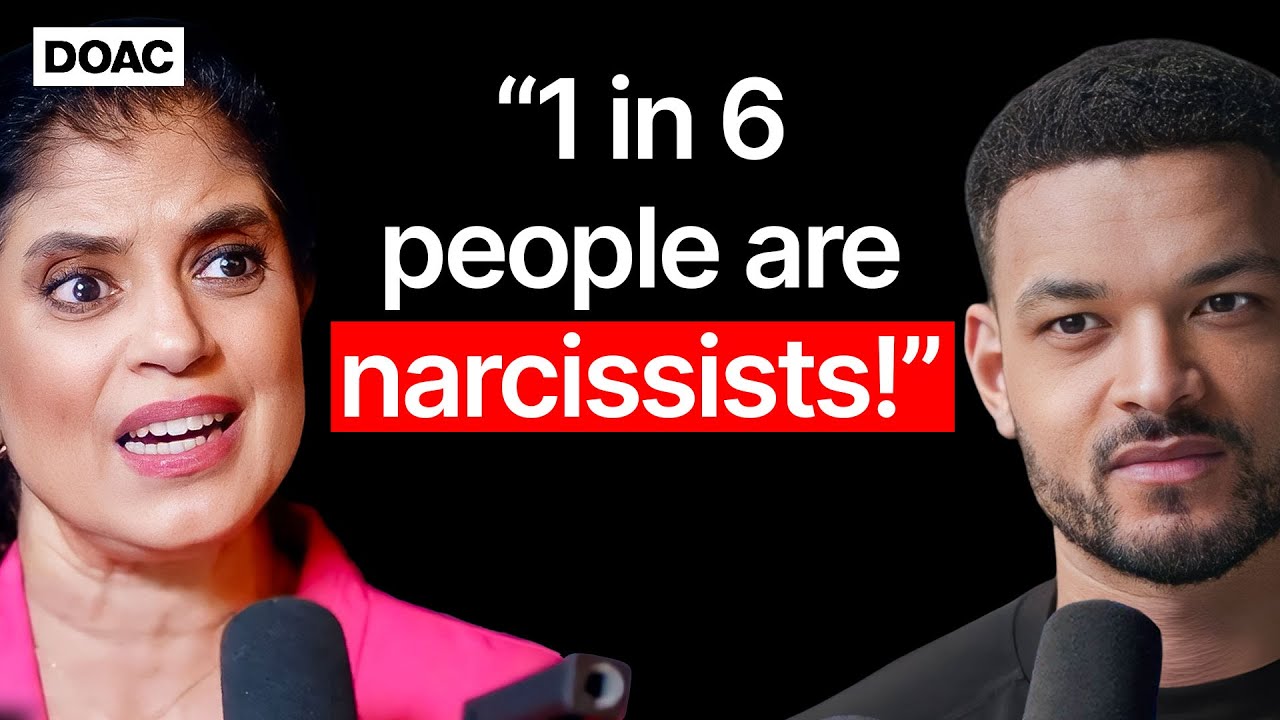
Psychologist Ramani Durvasula Links Narcissism to 15% of Population
The Diary Of A CEO
ingrained narcissistic traits cannot be cured and disproportionately thrive under capitalist reward structures, requiring strategic disengagement rather than rehabilitation.
## Background
Published on YouTube by The Diary Of A CEO on February 29, 2024, this episode features clinical psychologist Dr. Ramani Durvasula. The page description outlines her expertise on narcissism and highlights key discussion topics, ranging from identifying narcissistic traits and their prevalence to relationship dynamics and recovery from narcissistic abuse.
## TL;DR
Dr. Ramani Durvasula breaks down the nature, spectrum, and widespread prevalence of narcissism, estimating that roughly 1 in 6 people display narcissistic personality traits. The conversation explores the distinct types of narcissism, how societal systems like capitalism and social media amplify these behaviors, and the tactical defenses used by narcissists, such as gaslighting and projection. Additionally, Dr. Ramani offers practical strategies for navigating narcissistic partners or bosses through disengagement and radical acceptance, while sharing her personal background to inspire post-traumatic growth and healing for survivors.
## Atmosphere & style
The interview strikes a deeply empathetic, candid, and psychologically sharp tone, blending rigorous clinical insights with engaging real-world examples. Steven Bartlett acts as an inquisitive and self-reflective host, allowing Dr. Ramani's authoritative yet comforting presence to guide the conversation through tense, eye-opening topics into a grounded sense of validation and empowerment. The emotional arc transitions from uncovering the unsettling mechanics of psychological abuse to delivering hope, practical clarity, and personal resilience for survivors.
## Key takeaways
- [00:00](https://www.youtube.com/watch?v=hTkKXDvSJvo&t=0s) Dr. Ramani Durvasula estimates that roughly 1 in 6 people (15% to 18%) display significant narcissistic personality traits, spanning a spectrum from mild self-centeredness to dangerous malignant narcissists.
- [09:45](https://www.youtube.com/watch?v=hTkKXDvSJvo&t=585s) Narcissism is an ingrained personality style defined by core traits such as low empathy, entitlement, grandiosity, a constant need for admiration, and superficiality, making it an incurable condition.
- [12:33](https://www.youtube.com/watch?v=hTkKXDvSJvo&t=753s) Unlike an asshole who is consistently disagreeable, a narcissist strategically switches between extreme charm in public and psychological abuse behind closed doors.
- [18:30](https://www.youtube.com/watch?v=hTkKXDvSJvo&t=1110s) There are four primary types of narcissism: Grandiose, Vulnerable, Malignant (which borders on psychopathy), and Communal narcissism.
- [27:27](https://www.youtube.com/watch?v=hTkKXDvSJvo&t=1647s) Social media does not directly create narcissism, but acts as an accelerant and amplifier for pre-existing narcissistic traits and envy.
- [37:44](https://www.youtube.com/watch?v=hTkKXDvSJvo&t=2264s) Capitalism rewards outcomes rather than processes, allowing narcissistic traits to disproportionately thrive in corporate leadership and high-wealth settings.
- [54:17](https://www.youtube.com/watch?v=hTkKXDvSJvo&t=3257s) People in relationships with narcissists frequently experience the 'Three Rs': Rumination, Regret over lost time, and euphoric Recall of rare positive moments.
- [01:01:32](https://www.youtube.com/watch?v=hTkKXDvSJvo&t=3692s) Narcissists rely heavily on projection to protect their fragile inner ego, directing their unconscious shame outward as rage and false accusations toward others.
- [01:06:31](https://www.youtube.com/watch?v=hTkKXDvSJvo&t=3991s) Gaslighting in intimate dynamics often follows the DARVO model: Deny the behavior, Attack the person raising the issue, and Reverse Victim and Offender.
- [01:11:25](https://www.youtube.com/watch?v=hTkKXDvSJvo&t=4285s) The single most effective countermeasure against gaslighting and narcissistic manipulation is non-engagement and disengagement rather than arguing or presenting evidence.
- [01:18:08](https://www.youtube.com/watch?v=hTkKXDvSJvo&t=4688s) For individuals who cannot leave a narcissistic relationship, radical acceptance—ceasing to expect the narcissist to change—and building external support networks are essential for survival.
- [01:16:21](https://www.youtube.com/watch?v=hTkKXDvSJvo&t=4581s) Prevalence of narcissistic traits surges in high-status roles, estimated at 40%-50% in famous individuals and up to 60%-70% among world leaders.
## Detailed walkthrough
### [00:00](https://www.youtube.com/watch?v=hTkKXDvSJvo&t=0s) Introduction and the Hidden Danger of Narcissism
Narcissism is far more pervasive and destructive than most people realize. Licensed clinical psychologist Dr. Ramani Durvasula, widely recognized as one of the world's leading experts on the subject, estimates that roughly **1 in 6 people** display narcissistic personality traits. Exposure to narcissistic individuals is not merely a social inconvenience; in severe cases, it can escalate into a life-or-death situation. Narcissism exists along a vast spectrum—ranging from mild "Instagram saviors" on the lower end to dangerous cult leaders on the severe end.
Regardless of where someone falls on this spectrum, core narcissistic behaviors remain strikingly consistent: low empathy, a drive to dominate others, an absolute need to get the last word, and a explosive temper. While narcissistic individuals often appear charming, charismatic, and confident in public, their private relationships follow a dark pattern. They lure partners in quickly before turning to dismissiveness, manipulation, and gaslighting, leaving those behind closed doors psychologically destroyed while the outside world views them as fantastic partners or ideal leaders.
- Narcissism affects roughly 1 in 6 people.
- The spectrum ranges from self-absorbed social media personalities to dangerous cult leaders.
- Key indicators include low empathy, dominance, quick rage, and a need for control.
---
[01:34](https://www.youtube.com/watch?v=hTkKXDvSJvo&t=94s) Milestones and the Mission of *The Diary Of A CEO*
Host Steven Bartlett pauses to express deep gratitude to his audience for reaching a major milestone: **5 million subscribers** on YouTube. Reflecting on the show's origins just over three years prior, Bartlett admits that reaching even 100,000 subscribers would have exceeded his wildest expectations. He reiterates his core promise to viewers: to continuously raise the bar by elevating production values, hosting world-class guests, and sharing impactful global stories.
---
[02:44](https://www.youtube.com/watch?v=hTkKXDvSJvo&t=164s) Why Study Narcissism?
Dr. Ramani's dedication to studying narcissism stems from seeing how deeply exposure to a narcissistic individual shapes a person's identity and development. When encountered during childhood, narcissistic parenting distorts how identity develops; when encountered in adulthood, a narcissistic partner or boss can hijack a person's sense of self, effectively "stealing a person away from themselves."
> "There's nothing more than me wanting to return people back to their authentic selves."
Dr. Ramani highlights a strange paradox within mental health culture: society often shies away from naming narcissism, viewing it as "not very nice" to explicitly call out narcissistic behavior. Her primary mission is to break this silence, give victims permission to acknowledge the harm being done, and guide them back to their true selves.
---
[03:46](https://www.youtube.com/watch?v=hTkKXDvSJvo&t=226s) The Human Cost of Narcissistic Abuse
The true cost of narcissism is measured in shattered potential and stolen lives. Dr. Ramani shares poignant examples from her clinical work: individuals who abandoned higher education and creative dreams because a narcissistic parent or partner systematically stripped away their self-belief; people who relinquished their true identity to fulfill a parent's rigid demands because it was the only way to receive conditional love; and warm, empathetic people who internalize years of verbal abuse—being called "selfish," "foolish," or "greedy"—until they believe they are fundamentally flawed.
These individuals often end up repeating these painful relationship patterns because they no longer believe they deserve genuine, compassionate love. Furthermore, Dr. Ramani's background as a PhD in clinical psychology with a minor in health psychology revealed how personality traits directly impact physical health and behavior. For instance, there is a massive overlap between narcissism and substance addiction, as narcissistic individuals frequently use alcohol or drugs as a mechanism to regulate their unaddressed internal distress.
- Narcissistic control often leads victims to abandon their career goals, personal interests, and authentic identities.
- Internalized abuse creates a cycle where victims continuously seek out abusive relationship dynamics.
- High co-occurrence exists between narcissism and substance abuse used for emotional self-regulation.
---
[06:43](https://www.youtube.com/watch?v=hTkKXDvSJvo&t=403s) Clinical Practice and the Reality of Survivors
Despite her extensive academic background, media presence, and book authoring, Dr. Ramani still conducts clinical therapy sessions every single week. Working directly with survivors in the therapy room keeps her grounded in the reality of individual human suffering, preventing her from becoming detached by high-level population data and sample sizes.
Dr. Ramani draws a sharp contrast between relationships with individuals struggling with addiction versus those with narcissists. In an addiction dynamic, the non-addicted partner can usually distinguish between two distinct states: the sober person and the intoxicated person. Society recognizes addiction as a treatable disease, providing context and validation to the partner. In contrast, a narcissist's toxic behavior is accompanied by a highly polished, socially successful mask. They are often charismatic bosses, beloved community members, or attentive colleagues who reserve their psychological evisceration exclusively for those closest to them behind closed doors. Because the outside world views the narcissist as wonderful, victims are frequently told how "lucky" they are, driving them into profound self-doubt, isolation, and self-blame.
> "Behind closed doors, they psychologically eviscerate the people they're with."
- Dr. Ramani prefers the term "survivor" over "victim" to acknowledge their resilience and active coping efforts.
- Unlike addiction, narcissism lacks widespread public recognition as a distinct relational pattern, compounding the survivor's isolation.
- Recovery focuses on psychoeducation, validating their experience, breaking self-blame, and restoring self-trust.
---
[09:45](https://www.youtube.com/watch?v=hTkKXDvSJvo&t=585s) Defining Narcissism: The Clinical Criteria
When asked to define narcissism, Steven Bartlett attempts a definition, describing it as "delusions of grandeur," thinking one is superior to everyone else, arrogance, and cruelty. Dr. Ramani gives his attempt a lighthearted "C+ / B-" grade, explaining that while he identified key outward manifestations, the clinical framework goes much deeper into the underlying personality structure.
At its core, narcissism is characterized by a specific suite of interconnected traits and behaviors:
- **Variable or Low Empathy:** An inability or unwillingness to genuinely tune into, care about, or validate another person's emotional experience.
- **Entitlement and Grandiosity:** A deep-seated belief that they are special, superior, and that standard societal rules do not apply to them.
- **Excessive Need for Admiration:** A constant, insatiable hunger for external validation to support their inflated self-image.
- **Superficiality and Emotional Shallowness:** An inability to cultivate deep, sustained, intimate connections with others.
- **External Validation Dependency:** They rely on external benchmarks—status, wealth, acclaim—rather than an internal moral compass to define their worth and goals.
- **Relational Maladaptive Behaviors:** Frequent devaluation, dismissiveness, manipulation, gaslighting, rage, passive-aggression, cheating, broken promises, and relentless blame-shifting.
---
[12:33](https://www.youtube.com/watch?v=hTkKXDvSJvo&t=753s) Differentiating a Bad Day, an Asshole, and a Narcissist
It is common to wonder how to distinguish a true narcissist from someone who is simply having a bad day or acting like an "asshole." Dr. Ramani clarifies these differences through specific behavioral tests:
When a non-narcissistic person has a bad day—perhaps due to lack of sleep or stress—they may snap or act selfishly. However, once the mood passes, they demonstrate genuine **accountability**. They acknowledge their bad behavior, apologize sincerely without making excuses, and actively work to prevent it from happening again. A bad day is an isolated event, not a permanent relational pattern.
An "asshole," according to Dr. Ramani, tends to be consistently disagreeable, rude, or hostile across all contexts and with all people. A narcissist, by contrast, possesses a far broader and more calculated behavioral repertoire. A narcissistic person can be remarkably charming, warm, and attentive on the golf course with their company's CEO—remembering details about the CEO's family and asking after a sick relative—only to return home moments later, forget their spouse's anniversary, scream at their partner, and demand that the children be silenced.
> "That is not assholery. That's narcissism."
---
[15:25](https://www.youtube.com/watch?v=hTkKXDvSJvo&t=925s) Can You Cure Narcissism?
When asked point-blank whether narcissism can be cured, Dr. Ramani offers a definitive "No." In over 20 years of clinical work and research with both narcissistic individuals and their survivors, she has never seen a true narcissist transform into a non-narcissist. Because narcissism is a deeply ingrained personality style rather than an acute, temporary illness, expecting a complete cure is unrealistic. While some narcissistic individuals in long-term therapy may learn to make micro-adjustments to specific overt behaviors—such as learning not to intentionally provoke a partner—their underlying personality traits, lack of empathy, and fundamental motivations remain intact.
[015:59] Micro-Changes vs. Lasting Damage
When working with clients who exhibit narcissistic tendencies, therapy rarely yields dramatic, overnight transformations. Instead, progress manifests in tiny, subtle shifts. A client might begin honoring the therapeutic structure by showing up on time rather than arriving 10 minutes late and demanding an extension, or they might take responsibility for a missed session by paying the bill without argument. Occasionally, a client exhibits a rare moment of genuine insight, admitting something like, *"I screamed at my girlfriend again last night and that wasn't cool."* While a therapist celebrates these micro-changes as steps in the right direction, they are rarely enough to heal the relationships damaged by their behavior.
For the loved ones who have endured long-term emotional harm, these small improvements can feel painfully insufficient. A partner or family member who has suffered years of abuse is unlikely to be satisfied simply because the person managed to say "thank you" once during the week.
- Micro-gains in therapy include respecting the therapeutic frame and acknowledging bad behavior.
- The core conflict in treatment: A single act of polite behavior from a narcissist is progress to a therapist, but a drop in the ocean to a victim.
---
[016:45] Is Narcissism Gender-Specific?
While online search trends show a massive imbalance—with high search volume for "is my husband a narcissist?" and virtually none for "is my wife a narcissist?"—narcissism itself is not strictly limited to men. Clinical experience demonstrates that women, female-identified individuals, and partners in same-sex relationships frequently exhibit high levels of narcissism. However, the manifestation of narcissistic traits often varies significantly by gender:
- **Grandiose Narcissism:** Markedly more common in men.
- **Malignant Narcissism:** Markedly more common in men.
- **Vulnerable Narcissism:** Equally distributed across genders (gender balanced).
---
[018:30] The Four Types of Narcissism
Narcissism manifests in distinct sub-types across a broad spectrum:
1. **Grandiose Narcissism:** The classic "garden variety" narcissist. They are showy, charismatic, pretentiously charming, and constantly attention-seeking. Unlike other types, grandiose narcissists are often quite successful and execute big dreams, though they frequently burn bridges, engage in shady deals, and betray partners along the way.
2. **Vulnerable Narcissism:** Lacking the outward charm or success of the grandiose type, vulnerable narcissists are characterized by a "failure to launch." They are socially anxious, sullen, resentful, and constantly aggrieved, viewing themselves as perpetual victims of a world that failed to give them their due (*"How come she got that? I was better than him!"*).
3. **Malignant Narcissism:** The most severe and problematic form for relationships. Malignant narcissists utilize manipulation, exploitation, coercion, isolation, and menace as tools of control. Dr. Ramani describes malignant narcissism as *"the last stop on the train before you hit psychopathy station."*
4. **Communal Narcissism:** A concept introduced in psychological research around 2003 (notably by Gebauer). Communal narcissists do not seek validation through traditional arrogance; instead, they gain narcissistic supply by posing as grand rescuers, humanitarians, or saviors. Their good deeds are driven entirely by the desire to be praised as a "good person" rather than genuine empathy.
- **Fluctuating States:** A grandiose narcissist who loses their status, money, or partner will often collapse into vulnerable narcissism, adopting a paranoid victim mentality (*"This is a witch hunt; everyone is out to get me"*).
- **The Dark Tetrad:** Malignant narcissism shares heavy overlap with the Dark Tetrad: Narcissism, Psychopathy, Machiavellianism (exploiting others for personal gain), and Sadism (plus low-grade paranoia).
- **Malignant vs. Psychopathy:** Psychopaths lack the literal capacity for empathy and feel no guilt or remorse (often seen in serial killers), whereas malignant narcissists retain enough awareness to know when they have done something wrong.
- **The Communal Spectrum:** At the mild end, communal narcissists are relatively harmless "Instagram saviors" cleaning beaches in bikinis for likes; at the extreme end, communal and malignant traits merge to form cult leaders.
---
[025:13] Prevalence: How Many People Are Narcissists?
Determining exact numbers is difficult because narcissists rarely answer diagnostic surveys honestly. While formal epidemiological studies estimate clinical Narcissistic Personality Disorder (NPD) at 1% to 6% of the population, the actual prevalence of people with significant, harmful narcissistic traits is much higher.
Dr. Ramani estimates the true global prevalence of noticeable, impactful narcissism to be roughly **15% to 18%**—or approximately **1 in 6 people**.
- Prevalence rates are noticeably higher in major metropolitan areas, competitive industries, and specific corporate cultures.
- In close-knit small towns, the rate may drop closer to 1 in 8 due to a higher degree of social interdependence and community accountability.
---
[027:27] Does Social Media Create Narcissists?
Social media does not *create* narcissists; rather, it acts as an **accelerant** and an **amplifier**. Narcissism is a deeply ingrained personality style that forms through socio-emotional developmental processes between infancy and adolescence. An otherwise healthy, well-adjusted 18-year-old posting selfies on Instagram will not suddenly turn into a narcissist—at worst, it just makes them boring.
However, social media provides pre-existing narcissists with an unprecedented global megaphone. Historically, a narcissist had to shower, get dressed, and leave the house to solicit praise from co-workers, family, or local pub patrons. Modern platforms allow them to extract endless validation from home while lounging on the couch.
This environment creates a harmful dynamic: narcissistic users post curated, idealized versions of their lives to mask their deep core insecurities, while vulnerable, non-narcissistic viewers consume this content and are left feeling inadequate and devalued.
[31:12](https://www.youtube.com/watch?v=hTkKXDvSJvo&t=1872s) Social Media and the Rise of the Internet Troll
Dr. Ramani challenges the popular belief that social media inherently turns everyone into a narcissist. While people constantly post vacation pictures, breakfasts, and personal thoughts, she cautions against over-pathologizing what is simply a new mechanism for social connection. Reflecting on her own daughters in their early twenties, she notes that their seamless use of platforms serves as authentic communication to maintain a broad, intimate network of friends.
However, social media acts as an accelerator for a specific subgroup. While grandiose narcissists have always held the spotlight as leaders and public figures throughout history, the digital age has dramatically amplified **vulnerable narcissism**. Seeing others showcase curated, idealized lives triggers intense resentment and hostility in vulnerable narcissists, driving the toxic online behavior commonly seen in internet trolls.
- **Vulnerable Narcissism:** Fuelled by envy and resentment toward others' perceived perfection, directly driving online trolling.
- **Data Generation:** Society is nearing two decades of social media, with the first generation being tracked from birth to adulthood.
---
[32:46](https://www.youtube.com/watch?v=hTkKXDvSJvo&t=1966s) The Two Pathways to Narcissism: Genetics and Environment
Narcissism stems from a complex, multi-determined interaction between inherent biological traits and childhood environment. Every child is born with a distinct **temperament**—some are easygoing, while others are tightly wound or highly demanding from birth. When a biologically vulnerable child who requires more soothing encounters an invalidating, chaotic, or abusive upbringing, the risk for narcissism spikes dramatically.
```
Pathways to Adult Narcissism
├── Pathway 1: Adversity & Vulnerability
│ ├── High-demand/vulnerable temperament
│ └── Invalidating environment (trauma, neglect, abuse)
└── Pathway 2: The "Overvalued Child"
├── Unchecked praise ("more special than others")
└── Lack of emotional mirroring/nourishment
```
Dr. Ramani highlights research by Eddie Brummelman from the University of Amsterdam regarding the second major pathway: the **overvalued child**. These children are repeatedly told they are inherently superior to others and above the rules, preventing them from learning how to self-soothe or regulate emotions. Though showered with material perks, they remain emotionally undernourished, missing out on developing a healthy internal emotional "atlas."
- **Retrospective vs. Prospective:** Narcissism is a story easily told backward, but impossible to predict forward; adolescent rebellion rarely guarantees adult narcissism.
- **Parental Advice:** Parents worried about a difficult 17-year-old are advised to check back in 10 years to see if the behavior was developmental or personality-based.
---
[36:42](https://www.youtube.com/watch?v=hTkKXDvSJvo&t=2202s) The Spectrum of Mild Narcissism
Narcissism exists on a wide spectrum, and those on the milder end are best described as annoying, shallow, vapid, and self-centered rather than overtly malicious. They demand full attention during their own crises, yet become completely unavailable when others need support.
While mild narcissists can be energetic, fun companions for a night out on the town, building a long-term romantic relationship or raising a family with them is exhausting and emotionally imbalanced due to their lack of depth.
---
[37:44](https://www.youtube.com/watch?v=hTkKXDvSJvo&t=2264s) Success, Capitalism, and the "Unicorn" Empathic CEO
Narcissists disproportionately thrive in professional and leadership settings because external success functions as "the blood that flows to their psyche." Unlike average individuals who balance career goals with family, friends, and basic comfort, narcissists view success as a matter of life or death. Systemic structures heavily favor them because capitalism rewards cold outcome-based metrics over ethical processes.
> "Narcissism and capitalism go together really well because it's a competitive system that rewards the person who does the most and we don't look at process, we look at outcome."
When host Steven Bartlett brings up transformative figures like Steve Jobs and questions if ruthless behavior is a necessary evil for world-changing innovation, Dr. Ramani acknowledges that grandiose dreamers are uniquely built to stage massive breakthroughs. Her pragmatic advice for everyday people: enjoy the technological and societal gifts these figures create, but "just don't marry them." Genuine empathy at the executive level remains exceptionally rare because caring deeply about every stakeholder leads to swift burnout.
- **Economic Advantage:** Narcissistic individuals, particularly narcissistic men, tend to earn higher incomes than agreeable peers.
- **Corporate Hazards:** Their high tolerance for cutting corners often ends in total collapse or imprisonment when arrogance convinces them they are above the law.
---
[43:40](https://www.youtube.com/watch?v=hTkKXDvSJvo&t=2620s) How Wealth Breeds Entitlement
Wealth creates a protective bubble—a phenomenon where an individual's "feet never touch the ground." High net-worth individuals are constantly shielded from everyday indignities and inconveniences through private transport, luxury suites, and catered environments, ultimately crippling their ability to self-regulate or empathize with ordinary struggles.
Steven references social psychologist Paul Piff's notable psychological studies, which show that inducing a feeling of wealth causes people to act more selfishly. When people feel wealthier, they become more self-referential, express less empathy, donate less to charity, and show a higher willingness to endorse unethical acts.
- **Paul Piff's Findings:** Wealthier-feeling participants were more likely to endorse minor theft (like office supplies or candy) and focus on self-centered emotions like pride over compassion.
- **Luxury Car Study:** Drivers of high-end vehicles in Orange County were significantly less likely to yield to pedestrians or obey basic road rules at intersections.
[45:47](https://www.youtube.com/watch?v=hTkKXDvSJvo&t=2747s) Money, Narcissistic Supply, and Entitlement
The conversation explores the relationship between wealth, reckless behavior, and narcissistic traits. Research highlights that drivers of high-end luxury vehicles are significantly less likely to come to a full stop at stop signs compared to those driving mid-level cars, and at least a dozen published studies confirm that narcissistic individuals tend to drive more dangerously. However, money itself does not transform a warm, agreeable, self-aware adult in their mid-thirties into a narcissist. Instead, wealth can undercut self-awareness by isolating individuals from the everyday realities of ordinary life. This creates a bubble where waiting in line feels bewildering rather than malicious; they are not necessarily being cruel, but rather baffled by what they perceive as gross inefficiency.
While money may foster a self-centered perspective, it acts primarily as the ultimate source of narcissistic supply. Wealth delivers power, status, admiration, and romantic or sexual opportunities, making the pursuit of money the fastest and most reliable shortcut for a narcissist to secure validation. Narcissistic individuals are heavily driven toward money to fuel this need, but it is the surrounding environment of privilege and "bubble wrapping"—rather than wealth alone—that breeds entitlement.
- Published studies consistently associate narcissism with riskier driving behaviors and traffic rule disregard.
- Money provides the core components of narcissistic supply: power, admiration, status, and sexual access.
- Wealth tends to create a disconnect from ordinary societal routines rather than instant malice.
[47:39](https://www.youtube.com/watch?v=hTkKXDvSJvo&t=2859s) How to Know If You Are a Narcissist: Tests, Self-Awareness, and Gaslighting
Measuring narcissism is inherently difficult because psychological assessments struggle to evaluate socially undesirable traits that people naturally try to hide or downplay. Five or six standard tests exist, but they primarily capture less offensive markers like assertiveness, self-importance, and entitlement. Studies indicate that narcissistic individuals consistently overestimate their own empathy and generosity while severely underestimating their negative impact on those around them, maintaining a deeply distorted vision of themselves.
When individuals express concern that they might be narcissists, Dr. Ramani advises pausing to examine their actual relationship dynamics. Frequently, non-narcissistic people are gaslighted by narcissistic partners into believing they are selfish simply for voicing basic human needs, such as requesting a turn to pick a restaurant or wanting to talk about their feelings. There is, however, a tiny minority of self-aware narcissists who openly recognize their trait and treat it as a "superpower" or competitive edge that helps them close business deals. While rare, a few individuals have walked into therapy admitting they are narcissists after reading books, watching videos, or searching their behaviors online, proudly declaring phrases like "don't hate the player, hate the game" while acknowledging on a checklist that they lack empathy and feel above the rules.
- Narcissistic individuals overestimate their empathy and underestimate their negative impact on others.
- Many victims of narcissistic abuse are gaslighted into believing they are the selfish ones.
- True self-aware narcissists often reframe their lack of empathy and entitlement as a professional advantage.
[50:55](https://www.youtube.com/watch?v=hTkKXDvSJvo&t=3055s) What Attracts People to Narcissists and Who Gets Stuck
Almost everyone is initially drawn to narcissistic individuals due to their charm, charisma, confidence, and polished physical appearance. They are often exceptionally knowledgeable, deeply invested in social status, and know the trendy places to go. Even vulnerable narcissists, who can seem sullen or resentful over time, initially present as vulnerable, hurting souls who need rescuing—a dynamic that deeply appeals to natural caretakers. While narcissists are drawn to partners who offer tangible supply such as beauty, social status, connections, or resources, the critical issue is what keeps partners trapped in these dynamics over time.
Narcissistic relationships begin intensely, resembling a fairy tale where the narcissist runs "their fastest miles at the beginning of the marathon." They shower the partner with intense focus and charm until they feel captured like "a butterfly under glass." Between six weeks and six months into the relationship, the devaluing phase begins, marked by passive-aggressive jabs, minimization, emotional withdrawal, and a distinct lack of empathy. Highly empathic, forgiving, and optimistic people are the most vulnerable to getting stuck in this phase because they continually make excuses for the behavior, blame themselves for the tension, and cling to the few good days sprinkled in between.
- Narcissists attract partners through charm, polished appearance, and superficial attentiveness.
- Vulnerable narcissists often hook caretakers by appearing as helpless individuals who need saving.
- The devaluing stage typically sets in between six weeks and six months into the relationship.
- Empathic and optimistic individuals stay stuck longer because they rationalize abusive behavior and self-blame.
[54:17](https://www.youtube.com/watch?v=hTkKXDvSJvo&t=3257s) Recognizing a Narcissistic Partner and the "Three Rs"
Historically, people rarely recognized that they were in a relationship with a narcissist, viewing such realization as disloyal to a partner they loved and built a life with. These relationships operate through a slow process of indoctrination described as "death by a thousand cuts," where victims continually alter their behavior, walk on eggshells, and live in service to their partner until they lose their sense of identity. Over the past decade, expanded access to information online and books like *Should I Stay or Should I Go?* have allowed people to identify these patterns earlier, helping them break free before becoming completely trauma-bonded.
Dr. Ramani outlines the "Three Rs" that characterize the psychological state of a person trapped in a narcissistic relationship:
1. **Rumination:** An obsessive, cyclical line of thinking where the victim constantly analyzes what went wrong, what they did to cause an argument, or how to fix problems, trying to make sense of dynamics that are fundamentally irrational.
2. **Regret:** Deep emotional grief surrounding macro and micro losses, such as realizing they will never have a loving relationship with a narcissistic parent, regretting that their children lack a healthy marriage model, or mourning decades spent in a destructive relationship.
3. **Recall (Euphoric Recall):** The uncanny cognitive tendency to hyper-focus on rare positive moments—such as a partner bringing home a favorite blueberry muffin after a month of emotional abuse—to rationalize staying and maintain the status quo.
- Narcissistic abuse functions through "death by a thousand cuts," gradually eroding the victim's identity.
- Increased public awareness helps victims identify abuse earlier and reduce long-term trauma bonding.
- The "Three Rs" defining victim experiences are **Rumination** (obsessive overthinking), **Regret** (grief over wasted time and lost potential), and **Recall** (euphoric recall of rare good moments).
[59:00](https://www.youtube.com/watch?v=hTkKXDvSJvo&t=3540s) Tactical Manipulation and Social Perceptiveness vs. Empathy
Narcissistic individuals operate as expert tacticians in personal relationships, exploiting their partner's deepest psychological wounds. For instance, if a partner's core wound is fear of abandonment and they threaten to leave, a narcissistic partner may call their bluff with a casual "Okay, cool, let's call it quits," triggering acute panic in the victim rather than the fight for the relationship they hoped to see. Narcissists succeed in these manipulations not through empathy, but through high **social perceptiveness**—the ability to read a room, understand what people want or need, and strategically manipulate those details to maintain power and control.
This strategy underpins the transition from everyday manipulation to **pathological manipulation**. While ordinary manipulation occurs in daily negotiations, sales, or haggling for a discount, pathological manipulation is executed with complete disregard for the harm inflicted on the other person. The narcissist prioritizes their own needs entirely while convincing the victim that the abusive or manipulative dynamic is actually beneficial for them.
- Narcissists strategically target core vulnerabilities, such as abandonment fears, to maintain leverage.
- **Social perceptiveness** allows narcissists to read and manipulate people despite lacking genuine **empathy**.
- **Pathological manipulation** involves total disregard for the victim's well-being while framing the manipulation as beneficial to the victim.
Here is a detailed, faithful walkthrough of this section of the transcript, capturing the arguments, examples, emotional beats, and precise psychological concepts discussed.
### [01:00:44](https://www.youtube.com/watch?v=hTkKXDvSJvo&t=3644s) The Psychological Bargaining of Manipulation
Dr. Ramani explains that when entering a business or sales relationship, people understand the implicit rules and codes: one party is attempting to sell a product, and the other is evaluating whether it is right for them. Because we do not expect intimate or familial relationships to operate on sales models, our psychological guards remain down. Narcissistic individuals exploit this vulnerability by applying aggressive sales-like tactics to "matters of the heart," closeness, and compassion.
Through skilled manipulation, the narcissist leaves their target believing that whatever sacrifice or compromise they made was ultimately in their own best interest. In reality, because narcissists are fundamentally self-centered, every maneuver is executed solely to serve themselves.
### [01:01:32](https://www.youtube.com/watch?v=hTkKXDvSJvo&t=3692s) Projection: The Defense Mechanism
Dr. Ramani defines **projection** as a primitive psychological defense mechanism that everyone utilizes from time to time. It occurs when uncomfortable, unconscious feelings—frequently rooted in shame—are activated inside a person, leading them to falsely accuse someone else of feeling or doing the exact thing they themselves are guilty of.
To illustrate, Dr. Ramani and Steven roleplay a relationship scenario:
* Dr. Ramani aggressively accuses Steven of being secretive and needy, demanding: *"Who you texting, Steven?... Show me your phone!"*
* She then reveals the inner reality behind the accusation: she is the one maintaining a "side piece" and preparing to dump him, yet she accuses him of cheating so she can exit the relationship while framing him as the offender.
* Moving beyond low-hanging examples like infidelity, Dr. Ramani notes that people project lies when they are lying, or project insecurity and discomfort onto others when they are the ones feeling insecure or uncomfortable.
Dr. Ramani uses the metaphor of an inner **volcano** covered by a heavy **manhole cover** to describe the narcissistic mind:
* **The Magma:** Deep-seated shame, inadequacy, and severe insecurity form the churning core inside the narcissist.
* **The Manhole Cover:** The outward display of grandiosity, charm, superior intellect, and perfectionism acts as a heavy seal to keep the shame hidden.
* **The Explosion:** When everyday life nudges that cover—whether through direct criticism, a delayed elevator, bad traffic, an employee messing up a coffee order, or a failed public offering—the toxic gases spill out in the form of rage and projection. This cycle can occur 20 times a day because the narcissist cannot tolerate anything that disproves their perceived perfection.
### [01:04:56](https://www.youtube.com/watch?v=hTkKXDvSJvo&t=3896s) Inability to Accept Feedback
When asked if narcissists can accept feedback, Dr. Ramani’s immediate answer is a firm "No." Because narcissists are deeply hierarchical creatures, the only rare exception is when feedback comes from someone holding significantly higher status or power—such as a CEO critiquing a Vice President.
* Even in high-power situations, compliance is merely a **means to an end** rather than genuine internal integration.
* Inside their head, the narcissist is often thinking: *"God, this person's such a dick. I could do that job so much better."*
* Because they cannot vent their frustration at the powerful figure, they perform a delayed reaction: they return home or enter a safe space and unleash their redirected rage onto a more vulnerable target, such as a romantic partner, a family member, or a stranger on the subway.
### [01:06:31](https://www.youtube.com/watch?v=hTkKXDvSJvo&t=3991s) Demystifying Gaslighting & DARVO
Gaslighting is a form of emotional abuse and a deliberate power play. Crucially, true gaslighting requires a preexisting **presumption of trust**—which is why it occurs primarily between intimate partners, family members, trusted colleagues, or professionals like physicians and attorneys.
```
THE GASLIGHTING ESCALATION
+--------------------------------------------------------------+
| 1. DENIAL OF REALITY |
| "That never happened. You're making that up." |
+--------------------------------------------------------------+
|
\/
+--------------------------------------------------------------+
| 2. COUNTER-ATTACK WHEN PROOF IS SHOWN |
| "You are the most petty human being I've ever met!" |
+--------------------------------------------------------------+
|
\/
+--------------------------------------------------------------+
| 3. INDOCTRINATION & EROSION |
| Target doubts their memory, sanity, and judgment. |
+--------------------------------------------------------------+
|
\/
+--------------------------------------------------------------+
| 4. UTTER SUBMISSION |
| Target relies entirely on the gaslighter for reality. |
+--------------------------------------------------------------+
```
Dr. Ramani breaks down how the psychological trap unfolds over time:
1. **Initial Denial:** The gaslighter systematically denies memories, events, or facts (*"We never went there"*).
2. **Pushback & Deflection:** When the victim presents undeniable evidence (e.g., showing photos on a phone), the gaslighter shifts goalposts. Instead of conceding, they attack character: *"You are the most petty human being I've ever met... I don't know that I want to even be in a relationship like this."*
3. **Indoctrination:** Repeated over time, the victim loses their anchor to reality. They begin believing statements like *"You're crazy," "You have dementia,"* or *"You need medication."*
4. **Subjugation:** Eventually, the victim ceases trusting their own perception entirely, entering a state of absolute submission where the gaslighter dictates reality.
#### The DARVO Dynamic
Narcissistic abusers regularly utilize **DARVO**, an acronym coined by researcher Dr. Jennifer Freyd:
* **D**eny the behavior.
* **A**ttack the person raising the issue.
* **R**everse **V**ictim and **O**ffender.
Dr. Ramani offers a concrete example: A partner comes home at 1:00 AM after promising to be back by 9:00 PM. When confronted, he denies coming home late, attacks the partner for checking the security system logs (*"You read the ADT guide all day?"*), and paints himself as the mistreated victim (*"I work so hard to keep us in this fabulous house so you can stay home, and I'm the bad guy? You put me through so much!"*).
### [01:11:25](https://www.youtube.com/watch?v=hTkKXDvSJvo&t=4285s) How to Respond to Gaslighting
When targeted by gaslighting, the single most critical rule is **non-engagement**. Attempting to show receipts, pull up text messages, or argue logically only pulls the victim deeper into a trap.
* **Recommended De-escalation Phrase:** Simply state, *"We're having a different experience then,"* and disengage completely.
* **Dr. Ramani's Personal Anecdote:** She reveals that she was recently gaslit within a corporate setting. Even with her decades of specialized clinical expertise, experiencing her reality being denied felt deeply dehumanizing and upsetting. Because the individual involved was not inherently narcissistic (they were echoing corporate policy), confronting them led to a resolution. However, when dealing with actual narcissistic individuals, her strategy is immediate disengagement: drop the argument, record the behavior internally, and recognize that the relationship cannot develop deeper substance.
### [01:13:46](https://www.youtube.com/watch?v=hTkKXDvSJvo&t=4426s) Domestic Abuse and Coercive Control
The conversation shifts to physical and domestic control. Dr. Ramani highlights that the UK has been a global leader in establishing public policy and legal frameworks around the psychological dimensions of domestic abuse, particularly through pioneer legislation on **coercive control**.
Dr. Ramani shares her firm, unyielding professional conviction: **all domestic abusers are narcissistic, without exception.**
- She argues that expressing love and commitment to someone, while simultaneously subjecting them to emotional, physical, or sexual violence, demonstrates a total lack of empathy, coupled with extreme entitlement, arrogance, and zero self-awareness.
- She notes this fundamental connection is why traditional domestic violence intervention programs frequently fail: standard court-ordered anger management or intervention models cannot easily dismantle or "cure" deep-seated narcissism.
Here is a detailed, faithful walkthrough based on the transcript provided.
---
[01:15:19](https://www.youtube.com/watch?v=hTkKXDvSJvo&t=4519s) Domestic Violence, Narcissistic Behavior, and Accountability
Addressing the historical context of domestic violence research, Dr. Ramani notes that back in the 1970s, there was strong pushback against assigning personality labels to abusers. While clinicians and experts working in domestic violence never doubt that abusive perpetrators exhibit underlying personality issues, there was a legitimate concern that labeling their actions as "narcissism" would pull the focus away from their actual behavior.
Dr. Ramani firmly asserts that the two concepts go hand in hand: abusive behavior is completely unacceptable regardless of whether the offender has a narcissistic personality. Narcissism can never be used as an excuse or a backstory to justify harmful actions. If a person's behavior is unacceptable, it must be treated as such, especially since a abusive backstory signals that the harmful behavior is bound to happen again—and inevitably does.
---
[01:15:55](https://www.youtube.com/watch?v=hTkKXDvSJvo&t=4555s) Spotting and Navigating a Narcissistic Boss or Workplace
When dealing with workplace dynamics, identifying a narcissistic boss, manager, or CEO comes down to how you feel within the environment. In a narcissistic workplace, employees often feel unseen, undervalued, and subjected to an unpredictable, unfair, inequitable, and psychologically unsafe environment. Workplace praise and credit are handed out without rhyme or reason, and toxic gossip runs rampant.
To survive such a workplace, Dr. Ramani strongly advises employees to document everything extensively. Human Resources departments do not act on simple subjective statements like "I think my manager is narcissistic." Instead, workers must build a rigorous evidence base by saving emails, text messages, voicemails, and meeting minutes, while actively avoiding one-on-one meetings without witnesses.
For those in larger organizations who still believe in the institution's mission, transferring under a different manager can preserve their job. However, in smaller companies where reassignment is impossible, employees often realize they cannot outlast the narcissistic boss and must seek alternative employment. Solace can also be found in team collaboration; research shows that teams facing a narcissistic leader often form remarkably strong, tight-knit bonds as they unite against a common enemy.
- Key indicators of a narcissistic workplace: feeling unseen/undervalued, psychological insecurity, inequitable praise, erratic management, and high gossip.
- HR strategy: Document all interactions (emails, texts, voicemails, minutes) and avoid unmonitored solo meetings.
- Team dynamics: Narcissistic leadership can unintentionally foster intense peer-to-peer collaboration among non-narcissistic colleagues.
---
[01:18:08](https://www.youtube.com/watch?v=hTkKXDvSJvo&t=4688s) Radical Acceptance: Coping When You Can't Leave
When asked if victims should simply get out of narcissistic relationships, Dr. Ramani emphasizes that leaving is not always a realistic option. Pressuring individuals to leave can leave those trapped feeling helpless and abandoned. People often stay for valid personal reasons—such as family ties, long-term marriages with minor children, financial constraints, cultural expectations, or job security. Unless the situation involves physical danger, no one should feel forced to act against their circumstances, though staying means continued exposure to manipulative, invalidating, and destabilizing behavior.
The cornerstone strategy for surviving while staying is **radical acceptance**—the hard realization that the narcissistic individual will never change. There will be no "someday better" when a promotion occurs, when children grow up, or as a parent ages. Accepting this truth triggers an initial wave of intense grief as hopes and fantasy outcomes are shattered, but it ultimately stops the exhausting cycle of being constantly shocked by the narcissist's predictable behavior.
To survive post-acceptance, individuals must build a robust external support network of healthy, empathic, responsive, and compassionate people through friendships, therapy, or support groups. While staying in a compromised relationship or marriage requires adjusting expectations, people find practical workarounds to minimize impact.
- Reasons people stay in narcissistic relationships: family obligations, minor children, financial constraints, long-held jobs, or cultural factors.
- **Radical Acceptance**: Acknowledging that the behavior will not improve, abandoning false hope, and processing the resulting grief.
- Survival tactics: Establishing external boundaries, setting strict limits on interactions, and cultivating healthy external social connections.
> "Once you radically accept, you're not as surprised by their behavior... Can we just stop that part and say, of course you believe they did it. In fact, we could have set a clock by the idea that they would have done it."
---
[01:22:40](https://www.youtube.com/watch?v=hTkKXDvSJvo&t=4960s) Finding Happiness and the Dynamics of Narcissistic Intimacy
Dr. Ramani clarifies that while a person can find personal happiness while remaining in a relationship with a narcissist, they cannot be happy *with* the relationship itself. People manage to stay by compartmentalizing and anchoring onto narrow, specific touchpoints—such as a shared niche hobby, collecting antique fountain pens, playing Scrabble, watching period dramas, or specific physical intimacy—while viewing the surrounding narcissistic behavior as a background annoyance.
Addressing intimacy, Dr. Ramani explains that narcissists approach sex performatively. Because they crave admiration and validation, they can be intensely focused on pleasing a partner purely to receive praise and be told they are the best lover ever. Conversely, they can also be selfish or overly stylized ("porny") in bed. In worse scenarios, sex becomes a coercive routine that victims tolerate just to keep peace in the relationship.
- Relationships can survive only on narrow shared activities (e.g., Scrabble, period dramas, niche collecting, sex) rather than deep emotional connection.
- Sexual dynamics: Highly performative and validation-seeking, driven by a desire for applause, but ranging from over-the-top performance to selfish or coercive demands.
---
[01:24:45](https://www.youtube.com/watch?v=hTkKXDvSJvo&t=5085s) What Is a Narcissist's Kryptonite?
Using the analogy of Superman's weakness, Dr. Ramani identifies the ultimate "kryptonite" for a narcissist: **disengagement**. Narcissists thrive on conflict and will continuously poke, prod, and provoke to drag someone into a fight. Refusing to engage, denying them the satisfaction of an argument, and withholding admiration or "oohs and aahs" strips them of their power.
Another major weakness is encountering someone vastly more powerful or authoritative than themselves. When a narcissistic middle-manager encounters a truly empathic, high-level CEO whose warmth and integrity cannot be manipulated by standard narcissistic tricks, the narcissist feels deeply cowed and unsettled by the very qualities they normally hold in contempt.
---
[01:26:21](https://www.youtube.com/watch?v=hTkKXDvSJvo&t=5181s) Why Narcissists Are Threatened by Authenticity
Authenticity is deeply threatening to a narcissistic person. When someone shows up as their true, authentic self, the narcissist will actively mock, hold contempt for, and attempt to dismantle that identity. This makes maintaining authenticity inside a narcissistic relationship particularly difficult and dangerous for psychological well-being.
However, if an individual remains completely unshakeable and solid in their authentic identity, the narcissist eventually loses interest. Because an authentic person will not feed their ego or engage in their manipulative games, the narcissist grows bored and ultimately walks away to seek an easier target.
---
[01:27:28](https://www.youtube.com/watch?v=hTkKXDvSJvo&t=5248s) Prevalence of Narcissism in Public Figures and Leaders
Discussing fame and politics, Dr. Ramani notes that the pursuit of fame itself is an inherently narcissistic drive, as average people generally prefer privacy over public recognition. While estimating that 1 in 6 people in the general population show narcissistic traits, she estimates that **40% to 50% of famous people** and **60% to 70% of world leaders** are narcissists.
Modern politics has evolved into a performative, bombastic, cruel, and manipulative arena, making it almost impossible for non-narcissistic individuals to succeed. Society repeatedly votes narcissists into power because people fall for the charismatic "circus" and engage in fawning behavior, wrongly assuming that an individual who acts supremely confident must actually possess the competence to lead.
- Estimated prevalence of narcissism:
- General public: ~1 in 6 (approx. 16-17%)
- Famous individuals: 40% to 50%
- Political leaders: 60% to 70%
- Public perception: The public often mistakes grandiosity and charisma for competence, leading voters to elect narcissistic leaders.
[01:28:56](https://www.youtube.com/watch?v=hTkKXDvSJvo&t=5336s) The Illusion of Leadership and the Magic Castle Analogy
Dr. Ramani and Steven explore why society consistently falls for narcissistic personalities in positions of power and leadership. Dr. Ramani uses a vivid analogy, bringing up the Magic Castle in Los Angeles to illustrate how human psychology interacts with charlatans. When people attend a magic show, they do not actually want the illusion spoiled by learning the mechanics of sleight of hand; they willingly suspend disbelief to feel lost in the magic. Similarly, society often prefers the intoxicating story and absolute certainty sold by narcissists rather than looking closely at how the trick is done. Most people struggle with self-doubt and internal questioning, so when a individual appears with 100% conviction—even if that conviction is totally misplaced and devoid of facts or integrity—people mistake that unwavering posture for true leadership.
Conversely, thoughtful and circumspect leaders who hesitate to weigh all sides before taking a stance are frequently dismissed as weak-minded or indecisive. Steven poses a strategic question: if a nation is facing an aggressive, narcissistic foreign adversary like Vladimir Putin or Kim Jong-un, wouldn't it be advantageous to have a narcissistic leader fighting on our side? Dr. Ramani cautions strongly against this mindset. When two narcissists clash, it becomes a destructive battle of pure ego where neither side can tolerate appearing smaller. In the process, both leaders lose sight of what actually benefits their people, risking economic ruin, unnecessary conflict, and severe harm to the public.
- The ideal leadership quality in high-stakes global conflicts is a "wise, circumspect" middle ground—someone fully aware of the perpetrator's psychology while remaining grounded in the populace's actual needs.
- Dr. Ramani expresses a strong wish that basic training in narcissism and personality dynamics were integrated into international diplomacy, foreign policy, the UN, and secretariats of state, as attempting to negotiate with a narcissistic world leader is as futile as negotiating with a narcissistic spouse.
[01:32:31](https://www.youtube.com/watch?v=hTkKXDvSJvo&t=5551s) Hope, Healing, and Coming Back from Narcissistic Abuse
Addressing Steven's question about what vital message might have been left unsaid, Dr. Ramani emphasizes that surviving or experiencing a narcissistic relationship is not a permanent sentence to misery or lost authenticity. She wants listeners to understand that healing is fully achievable. Once individuals learn the mechanics of narcissistic abuse and receive validation to name abusive behavior for what it is, they can begin reclaiming their lives without self-shame.
She notes that she has witnessed remarkable recoveries across every domain of life—from individuals overcoming deep-seated familial trauma and toxic marriages to those recovering from workplace exploitation. Once clear of the abuse, survivors often emerge far stronger, wiser, and more creatively fulfilled than they were before. While she stresses that recovery requires active effort and is not an effortless journey, it happens every single day.
[01:34:40](https://www.youtube.com/watch?v=hTkKXDvSJvo&t=5680s) "Which Was Your Darkest Day?"
Following the podcast’s signature closing tradition, Steven asks Dr. Ramani the question left by the previous guest without knowing her identity: *"Which was your darkest day, and how did you turn the lights on?"* Dr. Ramani reflects quietly before sharing a painful, formative chapter from her past—being stalked and sexually assaulted as a college student during a time before institutional reporting systems or awareness existed. She describes an overwhelming sense of terror, living back in the era of landline rotary phones without modern cell phones or safety protocols, where the perpetrator systematically broke down her self-esteem.
The individual was a peripheral acquaintance exhibiting classic traits of a vulnerable narcissist—a profile she considers every bit as dangerous as a malignant narcissist. The perpetrator engaged in severe psychological gaslighting, repeatedly stealing her personal items like her backpack and then secretly returning them to their precise spots. When she sought help, campus authorities dismissed her, pointing to the returned item as proof nothing had happened. Unable to find institutional support or justice, she ultimately left the university altogether to escape the situation.
- Dr. Ramani explains that this early experience with institutional betrayal directly fueled her lifelong professional mission to advocate for trauma survivors and individuals who are doubted by systems.
- She notes that even in present times, women reporting sexual violence or stalking on college campuses are far too often disbelieved, blamed, or failed by administrative processes.
- While she processed and healed from this trauma through dedicated personal therapy, she reflects on how the mind and body utilize protective mechanisms like dissociation and compartmentalization to survive acute distress.
- She reveals that similar online threats and stalking directed at her in recent years as a prominent public figure and woman of color briefly reactivated those deeply buried trauma memories.
[01:38:51](https://www.youtube.com/watch?v=hTkKXDvSJvo&t=5931s) Impact, Awareness, and Moving Forward
Steven expresses deep gratitude to Dr. Ramani for dedicating her life's work to bringing clarity to a subject that remains widely misunderstood. He shares that reading her book *It's Not You: How to Identify and Heal from NARCISSISTIC People* was a transformative experience that "turned the lights on" for him personally. He admits that reading about these dynamics forced him to reflect on his own behavior as a CEO and business leader, inspiring a strong desire to self-correct and become a better person.
Dr. Ramani appreciates his candid reaction, noting that every person occasionally exhibits narcissistic tendencies or unhelpful behaviors. The goal of education on this topic is twofold: to allow individuals to recalibrate their own conduct and to build psychological resilience across society. By cultivating self-awareness and strong boundaries, individuals are better equipped to protect their core sense of self whenever they encounter toxic dynamics in the world.
## Notable quotes
> [02:44](https://www.youtube.com/watch?v=hTkKXDvSJvo&t=164s) There's nothing more than me wanting to return people back to their authentic selves. — Dr. Ramani Durvasula
> [06:43](https://www.youtube.com/watch?v=hTkKXDvSJvo&t=403s) Behind closed doors, they psychologically eviscerate the people they're with. — Dr. Ramani Durvasula
> [12:33](https://www.youtube.com/watch?v=hTkKXDvSJvo&t=753s) That is not assholery. That's narcissism. — Dr. Ramani Durvasula
> [18:30](https://www.youtube.com/watch?v=hTkKXDvSJvo&t=1110s) the last stop on the train before you hit psychopathy station. — Dr. Ramani Durvasula
> [37:44](https://www.youtube.com/watch?v=hTkKXDvSJvo&t=2264s) Narcissism and capitalism go together really well because it's a competitive system that rewards the person who does the most and we don't look at process, we look at outcome. — Dr. Ramani Durvasula
> [01:01:32](https://www.youtube.com/watch?v=hTkKXDvSJvo&t=3692s) Who you texting, Steven?... Show me your phone! — Dr. Ramani Durvasula
> [01:06:31](https://www.youtube.com/watch?v=hTkKXDvSJvo&t=3991s) That never happened. You're making that up. — Dr. Ramani Durvasula
> [01:06:31](https://www.youtube.com/watch?v=hTkKXDvSJvo&t=3991s) You are the most petty human being I've ever met... I don't know that I want to even be in a relationship like this. — Dr. Ramani Durvasula
> [01:11:25](https://www.youtube.com/watch?v=hTkKXDvSJvo&t=4285s) We're having a different experience then — Dr. Ramani Durvasula
> [01:18:08](https://www.youtube.com/watch?v=hTkKXDvSJvo&t=4688s) Once you radically accept, you're not as surprised by their behavior... Can we just stop that part and say, of course you believe they did it. In fact, we could have set a clock by the idea that they would have done it. — Dr. Ramani Durvasula
> [01:34:40](https://www.youtube.com/watch?v=hTkKXDvSJvo&t=5680s) Which was your darkest day, and how did you turn the lights on? — Steven Bartlett
## Mentioned
Dr. Ramani Durvasula, Steven Bartlett, The Diary Of A CEO, LUNA Education, Training & Consulting, California State University, Should I Stay or Should I Go: Surviving a Relationship with a Narcissist, It's Not You: How to Identify and Heal from NARCISSISTIC People, Eddie Brummelman, University of Amsterdam, Steve Jobs, Paul Piff, YouTube, Instagram, LinkedIn Ads, Eightsleep, Gold Tree Studios, Dr. Jennifer Freyd, Vladimir Putin, Kim Jong-un, Magic Castle, ADT
Clinical psychologist Dr. Ramani Durvasula argues that narcissistic personality traits affect roughly one in six people, driving severe relational harm and thriving within competitive institutional systems. Because the underlying personality architecture is essentially incurable, Dr. Ramani contends that self-protection depends on understanding their manipulative playbook, practicing radical acceptance, and systematically disengaging.
The Spectrum, Typology, and Developmental Roots
Dr. Ramani defines narcissism through an interconnected suite of traits: variable or low empathy, grandiosity, entitlement, a chronic hunger for admiration, superficiality, and external validation dependency. Unlike individuals having a bad day—who demonstrate accountability and offer sincere apologies—a narcissist exhibits calculated behavioral control, performing charitably in public while mistreating dependents behind closed doors. Clinically, narcissism spans four primary presentations: grandiose (pretentious, charming, and ambitious), vulnerable (resentful, anxious, and chronically aggrieved), communal (posing as a humanitarian savior for praise), and malignant (exploitative, menacing, and overlapping with psychopathy and the Dark Tetrad).
Developmentally, Dr. Ramani outlines two main childhood pathways: an innate, high-demand temperament paired with trauma or emotional neglect, or what researcher Eddie Brummelman identified as the "overvalued child," who is praised as superior while remaining emotionally undernourished. While formal diagnostic surveys estimate clinical Narcissistic Personality Disorder at 1% to 6%, Dr. Ramani estimates that impactful narcissistic traits affect 15% to 18% of the general population—a rate amplified by social media platforms that reward curated self-obsession and fuel vulnerable online trolling.
Mechanisms of Relational Exploitation and Gaslighting (66:31)
Narcissistic relationships commonly open with intense courtship and charm before devolving into devaluation between six weeks and six months. Dr. Ramani emphasizes that narcissists exploit others not through empathy, but through high social perceptiveness—the tactical ability to read rooms and weaponize personal vulnerabilities such as fears of abandonment. At the core of the narcissistic psyche lies a churning "volcano" of deep shame and inadequacy, covered by a "manhole cover" of outward grandiosity; any perceived slight, criticism, or delay dislodges this barrier, triggering defensive rage and projection.
To evade accountability, abusers systematically utilize gaslighting and DARVO (Deny, Attack, and Reverse Victim and Offender), shifting blame until the victim questions their own memory and judgment. Dr. Ramani identifies "Three Rs" that keep partners trapped: obsessive rumination over irrational arguments, deep regret over lost time or family stability, and euphoric recall, wherein victims cling to rare, minor gestures of kindness to rationalize enduring prolonged emotional erosion.
Systemic Incentives in Workplaces and Governance (37:44)
Narcissistic individuals disproportionately thrive in corporate and political environments because competitive systems reward outcome-oriented metrics over ethical processes. Dr. Ramani observes that narcissists aggressively chase professional success because external status functions as essential psychological fuel. Wealth compounds this dynamic: citing social psychologist Paul Piff's behavioral studies, she notes that heightened wealth fosters an insulated bubble that reduces empathy, diminishes rule compliance, and fosters entitlement, such as reckless driving among luxury car owners.
In public leadership, Dr. Ramani estimates that 40% to 50% of celebrities and 60% to 70% of political leaders exhibit narcissistic traits. The public regularly mistakes absolute, unhesitating conviction for competence, falling for charismatic spectacle much like audiences at a magic show who resist having an illusion spoiled. Dr. Ramani warns against backing narcissistic leaders to confront hostile foreign autocrats, explaining that clashes between two narcissists devolve into ego battles where public welfare is sacrificed.
Incurability, Radical Acceptance, and Survival Strategies (78:08)
Over two decades of clinical work have led Dr. Ramani to conclude that narcissism cannot be cured. While intensive therapy can yield minor behavioral micro-adjustments—such as arriving to sessions on time or curbing overt insults—the lack of genuine empathy and underlying motivations remain unchanged, leaving these gains painfully inadequate for long-term victims.
When leaving a relationship or job is impossible due to financial, legal, or family constraints, Dr. Ramani advocates for radical acceptance: relinquishing all hope that the individual will reform, thereby stopping the cycle of recurring shock. Practical survival requires documenting workplace mistreatment, cultivating outside support networks, and deploying the narcissist's ultimate "kryptonite"—non-engagement. Refusing to argue, denying validation, and standing firm in an authentic identity causes narcissists to lose leverage and eventually seek alternative targets.
Dr. Ramani concludes that recovering from narcissistic abuse requires shifting focus away from attempting to rehabilitate the abuser toward restoring the survivor's self-trust and agency. However, a significant unresolved challenge remains at the systemic level: until society and institutional structures learn to separate grandiosity from actual capability, narcissistic personalities will continue to be disproportionately elevated to leadership.
[2:44] Dr. Ramani Durvasula: There's nothing more than me wanting to return people back to their authentic selves.
[6:43] Dr. Ramani Durvasula: Behind closed doors, they psychologically eviscerate the people they're with.
[12:33] Dr. Ramani Durvasula: That is not assholery. That's narcissism.
[18:30] Dr. Ramani Durvasula: the last stop on the train before you hit psychopathy station.
[37:44] Dr. Ramani Durvasula: Narcissism and capitalism go together really well because it's a competitive system that rewards the person who does the most and we don't look at process, we look at outcome.
[61:32] Dr. Ramani Durvasula: Who you texting, Steven?... Show me your phone!
[66:31] Dr. Ramani Durvasula: That never happened. You're making that up.
[66:31] Dr. Ramani Durvasula: You are the most petty human being I've ever met... I don't know that I want to even be in a relationship like this.
[71:25] Dr. Ramani Durvasula: We're having a different experience then
[78:08] Dr. Ramani Durvasula: Once you radically accept, you're not as surprised by their behavior... Can we just stop that part and say, of course you believe they did it. In fact, we could have set a clock by the idea that they would have done it.
[94:40] Steven Bartlett: Which was your darkest day, and how did you turn the lights on?
Original transcript
[0:00] We believe one in six people are
[0:02] narcissistic and exposure can become a
[0:05] life or death situation. But the key
[0:07] step to identify narcissism is Dr.
[0:10] Ramani Durvasula
[0:12] licensed clinical psychologist
[0:14] the world's leading expert on
[0:16] narcissism.
[0:17] All narcissism is on the spectrum. At
[0:20] the lowest ends it's Instagram saviors.
[0:22] But severe end of the spectrum you're
[0:23] talking about a cult leader. They have
[0:25] low empathy. They will dominate people.
[0:27] They have to get the last word. They get
[0:29] angry very quickly and that's just the
[0:31] top of the iceberg.
[0:33] What about the impacts of narcissism on
[0:35] relationships?
[0:36] Narcissistic people, they can go out in
[0:38] the world and they're able to be
[0:40] charming and charismatic. And
[0:41] narcissistic relationships start strong.
[0:44] They want to get you quick and then it
[0:45] becomes dismissiveness, manipulation,
[0:48] gaslighting. The world thinks this
[0:50] person's fantastic. A lot of people say,
[0:53] "Aren't you lucky that you're married to
[0:55] that guy?" And behind closed doors they
[0:57] psychologically destroy you. Narcissism
[0:59] in work. How do I know if my boss is a
[1:02] narcissist? You're going to feel it in
[1:04] the sense of you don't feel seen, you
[1:05] don't feel valued, you feel like the
[1:07] workplace is unpredictable, you might
[1:09] even feel that it's psychologically
[1:11] unsafe. What about world leaders? If our
[1:14] adversary in another country is a
[1:15] narcissist, would we rather our leader
[1:17] be a narcissist as well? That's a
[1:19] fantastic question and I think So, the
[1:22] big question. How do you know if you are
[1:25] a narcissist? And can you cure
[1:28] narcissism? So, here's where we get into
[1:30] some interesting muddy waters.
[1:34] It's absolutely crazy to me that so many
[1:36] of you have decided to watch our show um
[1:38] and so many of you have decided to
[1:39] subscribe to our show. We now have 5
[1:41] million subscribers on YouTube which is
[1:43] a number that I just can't comprehend
[1:45] and it's a dream that I absolutely never
[1:47] could have had. We started The Diary of
[1:49] a CEO just over 3 years ago now and in
[1:51] my wildest expectations we might have
[1:53] had 100,000 subscribers by now. So, you
[1:56] can imagine how shocked I am
[1:58] that so many of you have chosen to tune
[2:00] into these conversations every week um
[2:03] and spend some time with us. So, thank
[2:05] you. And I made a deal with you. I made
[2:06] a deal that if you subscribe to the
[2:08] show, that we would continue to raise
[2:10] the bar. And in 2024,
[2:13] we're going to raise the bar like never
[2:14] before. I've been working for the last 9
[2:16] months on a surprise for all of you that
[2:19] have subscribed to the show, and I'm
[2:20] very excited to deliver that for you.
[2:23] The production's going to change. We're
[2:24] going to go even further with our
[2:25] guests, and we're going to tell even
[2:27] more global stories. So, as always, if
[2:30] you appreciate what we're doing here,
[2:31] the simple free favor I'll ask from you
[2:34] is to hit the subscribe button. Let's
[2:36] get on with the episode.
[2:44] Dr. Ramani. Mhm.
[2:46] You've committed so much of your life
[2:48] and your energy to the subject of
[2:49] narcissism.
[2:52] Why does it matter? Oh, it matters so
[2:54] much because exposure to people who have
[2:57] narcissistic personalities
[3:00] shapes how people's identity develops,
[3:02] shapes how their personality develops.
[3:05] Or if the first time you encounter a
[3:06] narcissistic person is in adulthood, it
[3:09] can actually sort of hijack that sense
[3:11] of identity. It can really steal a
[3:14] person away from themselves.
[3:16] And we I think it's so important because
[3:19] we haven't given ourselves permission, I
[3:22] think as a culture, as a field of mental
[3:23] health, to identify this as a problem
[3:27] and allow people to have better
[3:29] responses. In a way, it's almost viewed
[3:31] as sort of not being very nice to say
[3:34] that narcissistic people are not very
[3:36] nice. It's a strange paradox in the
[3:39] world of mental health. That's why I do
[3:40] it, because nothing more than me wanting
[3:43] to return people back to their authentic
[3:45] selves. You must have seen the cost of
[3:48] narcissism.
[3:49] Can you give me some examples of the
[3:52] cost that a narcissist has had on
[3:54] someone's life that you've seen. Mhm.
[3:55] Oh.
[3:56] Where do I begin? I'll tell you cost is
[3:59] a person who so doesn't believe in
[4:01] themselves that they may give up on
[4:03] their path of education and never pursue
[4:06] an interest. So, we never got to see the
[4:08] work product that that would have
[4:10] created. Not to mention that person
[4:12] actually getting to unfurl their wings
[4:14] and fully be who they wanted to be as a
[4:17] creative or as a professional.
[4:19] It's the person who knew what they
[4:22] wanted to be, that they had a very
[4:23] strong identity as pick something,
[4:26] and they ended up choosing something
[4:28] else because they knew the only way they
[4:30] could be loved was to be what that
[4:32] parent demanded of them, and it was so
[4:34] clear to them they wouldn't be loved
[4:36] unless they fully gave in to what that
[4:39] parent expected of them. It's the person
[4:42] who is an absolutely glorious human
[4:45] being, lovely, empathetic, and warm, but
[4:48] feels so damaged after years of being
[4:51] told, "You're not enough. You're
[4:52] selfish. You're greedy. You're foolish."
[4:55] that they get into relationship after
[4:57] relationship that duplicates that theme
[5:01] and don't get the real collaborative,
[5:03] compassionate love story that they
[5:05] deserve because they don't think they
[5:08] deserve it. And that's just the tip of
[5:10] the iceberg. And your academic
[5:12] background, your the experience that
[5:14] you're drawing from, what is that
[5:16] experience? So, my my experience is in
[5:18] in my academic background is I have a
[5:19] PhD in clinical psychology, and my
[5:22] minor's in something called health
[5:23] psychology. And so, I got really
[5:25] interested in how various elements of
[5:28] mental health and mental illness showed
[5:29] up in people who had co-occurring
[5:31] medical conditions. So, it's a very
[5:33] almost like strange point to enter, but
[5:35] what we do know is people personality
[5:38] affects how we take care of our health,
[5:40] how we might engage in behaviors that
[5:41] might put our health at risk. For
[5:43] example, narcissism and addiction have a
[5:45] really high overlap. So, here's a case
[5:47] of now a personality style putting a
[5:50] person at health risk due to using
[5:53] substances to regulate and then all the
[5:54] things that would come of that. But,
[5:56] it's tough to measure personality,
[5:58] Stephen. It's really hard to measure.
[5:59] It's not one of those things It's not
[6:01] like a blood test. It's not even like
[6:02] measuring depression. Frankly,
[6:04] depression is eminently measurable.
[6:06] Yeah, there's different variants and
[6:08] there's different severity, but we're
[6:10] very clear diagnostically and
[6:12] phenomenologically what makes
[6:14] depression. What qualifies? Personality
[6:16] is like the wild west. And so, from a
[6:18] research perspective, it's something
[6:21] that people would often shy away from
[6:23] cuz we couldn't get the constructs
[6:24] right. But, I said I welcome the
[6:26] challenge because I truly in my heart
[6:29] believed if we could understand and
[6:31] study personality more, we'd actually be
[6:34] understanding all this unmeasurable
[6:36] noise in the mental health research cuz
[6:38] I thought that's probably where it was.
[6:40] And I think more and more of the
[6:41] research is supporting that.
[6:43] And do you spend time, even today,
[6:46] dealing with patients
[6:48] who are the victim of a narcissistic
[6:51] relationship or the victim of a
[6:53] narcissist? Every week. Every week. I
[6:55] mean, it's it's probably one of the if
[6:57] not the most gratifying part of my week.
[7:00] I'm a big believer that if you're a
[7:01] mental health practitioner, you practice
[7:03] mental health. So, that's a privilege to
[7:06] be able to be in that room and to work
[7:07] with clients. But,
[7:09] it would be so easy when you're dealing
[7:11] at a macro level, large populations
[7:14] going on YouTube, writing books, to get
[7:16] distanced from what is happening to
[7:19] individual people's lives. One of the
[7:21] tricky bits with research is we study
[7:23] populations. We study samples, right? We
[7:25] study hundreds of people.
[7:26] What happens in the room is something
[7:28] very different. And you start to
[7:30] recognize A, how badly these
[7:32] relationships harm people, their schemas
[7:35] of the world, their schemas of
[7:36] themselves. And B, how much potential
[7:39] for intervention there is with these
[7:41] clients through very very simple
[7:43] approaches around education about
[7:45] narcissism, validation of their
[7:47] experience, breaking through self-blame,
[7:49] and teaching them to trust themselves.
[7:51] So, how many patients do you think
[7:53] you've seen that have been victims of
[7:55] narcissists? I mean, hundreds. Hundreds,
[7:58] really. And I even use the word
[7:59] survivor. I hate to call them victims
[8:01] cuz I don't even think they're that
[8:02] passive. I mean, I think that they just
[8:04] weren't No one ever taught anyone this,
[8:06] right? I'll give you the example. When
[8:08] people are in a relationship with
[8:10] somebody who's living with addiction,
[8:12] it's very clear what they're dealing
[8:13] with, right? You have a person, they're
[8:16] using a substance that's altering them,
[8:18] that's altering their behavior, that's
[8:20] taking them away from who they are.
[8:21] Person People in relationships with
[8:23] addicts will say, "I'm in two
[8:24] relationships. I'm in a relationship
[8:26] with a sober person, and I'm in a
[8:28] relationship with somebody who's using
[8:29] or intoxicated or denying or defending
[8:32] their use, right? Two people. And it
[8:34] breaks the people in those
[8:35] relationships, and we're willing to call
[8:36] it that.
[8:38] The experience people have in
[8:39] narcissistic relationships in a way is
[8:40] no different with the added bit though
[8:43] that at least with addiction people can
[8:44] say, "I see what the behavior is. I see
[8:46] what the issue is. Addiction's a
[8:48] disease, and we know it's treatable."
[8:50] Narcissism, not so much. And on top of
[8:53] that, the narcissistic person has this
[8:56] very well-developed, very successful
[8:59] behavioral repertoire. They can go out
[9:01] in the world and they're able to be
[9:02] charming and charismatic and confident
[9:05] and smart and the center of attention
[9:07] and running companies,
[9:08] and behind closed doors,
[9:10] they psychologically eviscerate the
[9:12] people they're with.
[9:14] Spouses, partners, family members, close
[9:16] friends, maybe people who are below them
[9:19] in an organization, people where they
[9:20] can kind of get away with it. So, the
[9:22] people they're harming, the world thinks
[9:24] this person's fantastic. At least the
[9:26] person who's in a relationship with an
[9:27] addict, people will say, "Okay, I get
[9:28] it. They're using. This is hard." But
[9:30] for the folks in narcissistic
[9:31] relationships, a lot of people say,
[9:33] "Aren't you lucky that you're married to
[9:36] that guy?" And the person's like, "Oh my
[9:38] gosh, are these people out of their
[9:39] mind?" Like, so what do they do? They
[9:41] blame themselves.
[9:45] Okay.
[9:46] What is narcissism? Mhm.
[9:50] Because
[9:51] I've heard the word used so often, but I
[9:54] couldn't tell you the definition of it.
[9:55] And I feel like I'd butcher the
[9:57] definition of what it is. Mhm. So, I'm
[10:00] almost curious to ask you, what just
[10:02] before I almost contaminate you with a
[10:04] with what my definition is, what's your
[10:07] working definition? What's your working
[10:09] model of what narcissism is? Um
[10:11] delusions of grandeur, someone that
[10:13] thinks they're like super important and
[10:14] that they are better than everybody
[10:16] else, arrogance,
[10:18] um and they're cruel. Okay. All right,
[10:21] so I I would give you probably like a
[10:24] C+ B- if you're a student in my class. I
[10:26] mean, I I I cut students a lot of slack
[10:28] back in the day. So, I'll give you a C+
[10:30] B-. Because you're in the neighborhood,
[10:32] right? The grandiosity,
[10:35] the arrogance,
[10:37] the the meanness, but that to me is even
[10:39] more sort of a manifestation of all the
[10:41] traits, like the grandiosity, the
[10:42] arrogance. They have variable empathy
[10:44] and typically have low empathy. They're
[10:47] deeply entitled. They truly think
[10:49] they're more special than everyone else
[10:51] and that the rules should apply to them
[10:53] very differently. They have a excessive
[10:57] need for admiration and validation.
[11:00] They're very superficial. They don't
[11:02] really have the capacity for deep
[11:04] sustained intimate relationships.
[11:07] They're very much referential to the
[11:08] world out there out outside of them to
[11:10] set goals. They don't have a good
[11:11] internal sense of like what matters to
[11:13] me, what what do I want to do? They just
[11:15] want to do what they do again to get
[11:17] that admiration and validation. There's
[11:19] a shallowness, a real emotional
[11:21] shallowness to narcissism. Those are the
[11:23] patterns and traits we sort of see.
[11:25] They're very very self-centered, very
[11:28] preoccupied with themselves, the good
[11:29] parts of themselves, the bad parts of
[11:31] themselves. It's very rare for them to
[11:33] sort of lift their heads up and
[11:34] genuinely notice the experience of
[11:36] another person. That's what narcissism
[11:38] is. How does it show up? It shows up as
[11:41] devaluation, dismissiveness,
[11:44] manipulation, gaslighting.
[11:47] They get angry very quickly, especially
[11:49] when they're frustrated or disappointed,
[11:51] and that can show up as overt rage or
[11:53] overt anger, yelling, screaming, or even
[11:55] violence. That can show up as passive
[11:57] aggression, withholding, and
[11:59] withdrawing. They are They can be They
[12:02] are prone to betrayal. They lie. They
[12:04] cheat. They make promises about the
[12:06] future they never keep, but they do that
[12:08] to keep people around so they won't
[12:10] leave them. So, it's It's part of a
[12:11] larger sort of a manipulation. They will
[12:14] dominate people. They have to get the
[12:15] last word. They will shift blame onto
[12:18] other people. They will rarely take
[12:19] responsibility for their misdeeds, even
[12:22] when they're clearly caught in them. And
[12:23] if they do, they'll still blame the
[12:25] other person. They're very neglectful
[12:28] and careless in relationships. That is
[12:30] narcissism.
[12:33] How can you tell the difference between
[12:35] someone having a bad day, an [ __ ]
[12:38] and a narcissist? Because some of those
[12:39] things there I thought, you know, on a
[12:41] bad day I might do that. Yeah. You know,
[12:43] um the whole collection together, no.
[12:46] But on a bad day when I haven't slept, I
[12:48] go, "You know what? I might
[12:50] blame someone or whatever else." What's
[12:52] the distinction? When a person has a bad
[12:54] day, and we all have bad days, and on
[12:56] those bad days, we might look like all
[12:58] the If the only take someone had of us
[13:01] was of that day, ooh, right? But the
[13:03] Here's the piece.
[13:05] When people are not narcissistic and
[13:07] they have bad days, they will
[13:10] take accountability. They will make
[13:12] amends, and they will change their
[13:13] behavior and say, "I'm not doing this
[13:15] again. This is This is not okay." Why
[13:17] wasn't it okay? Because it was none of
[13:19] those people's fault you didn't get
[13:20] enough sleep. And whether that means we
[13:22] reach deeper to be as kind as we can to
[13:25] the people. In some cases, especially if
[13:26] it's people we know or we see again. You
[13:29] may not know the random person at the
[13:30] gym, but if we someone we know or work
[13:33] with, we step we step out of ourselves
[13:34] to say the way I conducted myself
[13:36] yesterday wasn't okay and I'm really
[13:38] sorry about that.
[13:39] And so that that they're having that
[13:41] experience of you taking accountability.
[13:44] That's where I know we're not dealing
[13:46] with a narcissistic person, we're
[13:47] dealing with a bad day. And a bad day is
[13:49] just that, a day. It's not every day.
[13:52] With a narcissistic person, many days
[13:55] I'm not going to say all, but many days
[13:57] are characterized by these machinations,
[14:00] these manipulations, and these
[14:01] invalidations. If the person in a
[14:03] relationship with a narcissistic person
[14:05] feel like they're constantly on their
[14:06] back foot, that they can't be
[14:08] themselves, they can't express a need,
[14:10] they can't express a want, they can't
[14:11] even express a feeling for fear of it
[14:13] being shut down. So, there's your So,
[14:16] there's your not narcissistic person.
[14:19] What about an [ __ ] okay? I do think
[14:22] assholery and narcissism are pretty We
[14:25] You know, they're they're We use the
[14:26] terms interchangeably.
[14:28] I think though that here's my here's my
[14:30] [ __ ] belief since this is something
[14:32] since I think the construct validation
[14:34] on [ __ ] is probably still needing to
[14:36] be done.
[14:37] I think [ __ ] tend to be pretty
[14:39] consistently [ __ ] So, whereas
[14:41] narcissistic people can really they have
[14:44] a much
[14:45] wider behavioral repertoire. To be
[14:48] absolutely charming This is a person who
[14:50] can be absolutely charming on the golf
[14:53] course with the CEO of their company.
[14:55] Like charming, nice, warm, remembering
[14:58] the ages of their kids, and asking about
[15:01] the wife, and remembering that their
[15:02] grandmother is sick, and all this stuff.
[15:05] And get home,
[15:06] forget it was his anniversary, scream at
[15:09] their partner, "Why is the house like
[15:11] look like this? Why do I have to put up
[15:13] with this? Make those damn kids shut
[15:16] up."
[15:17] But they were Mr. "I remember that your
[15:19] little girl's birthday is February 6th"
[15:21] when they were on the golf course. That
[15:23] is not assholery. That's narcissism. Can
[15:26] you cure narcissism?
[15:28] In your opinion? No, I don't because I
[15:30] think that would imply changing a
[15:31] personality which I don't think we can
[15:33] do.
[15:35] Is there any evidence? Have you ever
[15:37] seen in your 20 years of working with
[15:40] narcissists and their survivors
[15:43] any sign of a narcissist becoming a not
[15:46] narcissist or a non-narcissist? I've not
[15:48] seen them become a not narcissist. I
[15:49] we've seen them make micro changes cuz I
[15:53] measure and monitor and make my notes in
[15:55] therapy. So I'll see, "Interesting.
[15:57] They're no longer trying to mess with
[15:59] coming in 10 minutes later and asking me
[16:01] to keep them for the whole hour. They
[16:03] are honoring the therapeutic frame.
[16:05] They're paying the bill when they decide
[16:07] not to show up at the last minute." I'll
[16:09] see tiny tweaks. I'll see people who'll
[16:11] come in and say,
[16:13] "I screamed at my girlfriend again last
[16:15] night and that wasn't cool." So I was
[16:17] like, "Whoa. Whoa. That's insight." Like
[16:19] I'll run with it. But here's the rub,
[16:21] okay? These micro changes, and they are
[16:24] micro changes, but they are changes and
[16:25] they're in the right direction.
[16:28] That much water under the under the
[16:29] bridge for the family members and
[16:32] partners and other people that have been
[16:33] harmed. They're saying, "You want me to
[16:35] stay in this relationship cuz this dude
[16:36] remembered to say thank you once this
[16:38] week?" I think not. To me, the thank you
[16:40] is progress. To the people in their
[16:42] lives who've been harmed, that one thank
[16:44] you is not going to be enough.
[16:47] When I was looking at the subject of
[16:49] narcissism and I was looking at what
[16:51] people are searching around the subject
[16:53] matter,
[16:54] I could see no searches online for
[16:58] is my wife a narcissist?
[17:00] But I saw lots of searches for is my
[17:02] husband a narcissist?
[17:04] Really? Yes. So I wondered,
[17:07] is narcissism a gender-specific thing?
[17:10] And in what proportion do you typically
[17:12] see men and women being narcissists?
[17:14] Yeah, no, it's not gender-specific. I'm
[17:15] so shocked at that because I've worked
[17:17] with so many men
[17:19] who have narcissistic wives or or female
[17:21] partners. And I've worked with many
[17:24] I've met worked with many lesbian
[17:25] couples. I've I mean I've worked with
[17:28] cases where clearly it was a woman,
[17:31] female identified person, who was
[17:32] narcissistic. It is definitely not
[17:34] limited to men. So here's what we know.
[17:37] Grandiose narcissism, much more common
[17:40] in men.
[17:41] Malignant narcissism, much more common
[17:44] in men.
[17:45] But there's a form of narcissism
[17:48] called vulnerable narcissism.
[17:51] Vulnerable narcissism isn't so much of
[17:53] the showy, charismatic, charming, look
[17:55] at me, arrogant,
[17:57] salesy, attention-seeking narcissist.
[18:01] The vulnerable narcissist is more
[18:04] socially anxious,
[18:06] victimized, sullen, resentful,
[18:10] aggrieved. And often we sort of see a
[18:11] failure to launch, right? There's sort
[18:13] of a I'm angry at the world. How come I
[18:15] never got my turn? You know, makes me
[18:17] How come she got that? And you know, I I
[18:20] was better than him. I should have
[18:21] gotten that. There's like
[18:22] Victimhood. Yeah, victimhood, okay?
[18:24] That's called vulnerable narcissism,
[18:26] right? When we look at vulnerable
[18:28] narcissism, gender balanced.
[18:31] Okay, so these other types of
[18:32] narcissism, you named four types there.
[18:34] Grandiose narcissism. Right, so that's
[18:36] our traditional sort of garden variety
[18:38] narcissism, the showy, charismatic,
[18:40] pretentious, preening, charming,
[18:43] attention-seeking, actually quite often
[18:46] quite successful narcissistic person.
[18:48] Unlike the vulnerable narcissist who are
[18:50] failure to launch, the grandiose
[18:52] narcissistic people often have big big
[18:54] dreams and they'll execute. Not always,
[18:56] not always, and they'll often burn
[18:57] bridges because they are in fact
[18:59] narcissistic, so they'll anger people or
[19:01] do shady deals or cut people out and all
[19:03] that stuff. But the grandiose
[19:05] narcissistic folks are often the larger
[19:07] than life folks. Now, if they are angry
[19:10] at you, if they feel let down by you,
[19:12] they will let you know. They can be very
[19:13] vindictive. They are not going to be
[19:15] very honest in a relationship. They're
[19:17] probably going to betray you. They're
[19:18] going to be mean to their partners. We
[19:20] can count on that, too. But, to the
[19:22] world at large, larger than life. That's
[19:24] the typical model. Now, the vulnerable
[19:26] narcissism is what I narcissist is what
[19:28] I just shared with you. That more of
[19:30] vulnerable, victimized Sorry,
[19:32] victimized, socially anxious, angry,
[19:35] aggrieved, sullen, resentful,
[19:38] failure-to-launch narcissist. Okay? Some
[19:40] people would argue they're one in the
[19:41] same. That as long as a grandiose
[19:43] narcissistic person is well supplied,
[19:45] things are going well, they're getting
[19:47] lots of attention, they're making money,
[19:49] they're they're just sort of feeling
[19:50] like they're they're the person, they're
[19:52] good, then they're going to they're
[19:54] going to stay in their grandiose mode.
[19:56] However, if the thing tips
[19:59] and things everything goes wrong for the
[20:00] grandiose narcissist, they lose the
[20:02] money, they lose the job, they lose the
[20:03] partner, they lose social status, the
[20:06] vulnerable stuff will start showing up.
[20:08] The victimhood, the resentment This is a
[20:11] witch hunt. Everyone's out to get me.
[20:12] Can almost feel sort of low-grade
[20:14] paranoid. You're either more one than
[20:17] another. So, the vulnerable narcissist
[20:19] could definitely have a grandiose moment
[20:21] if everything turned for them, but some
[20:23] people are just more grandiose, some
[20:25] people are more vulnerable, but they do
[20:26] have the other underbelly. That's just
[20:28] That's how that looks. Now, the
[20:29] malignant narcissist, which is another
[20:31] type I talked about,
[20:33] this is where we see the most severe
[20:35] form.
[20:36] And that when I say most severe, most
[20:37] severe in terms of how it shows up in
[20:39] relationships. So, I'd say the most
[20:40] problematic form of narcissism. And
[20:42] here's where we see a form of narcissism
[20:45] that shows up as manipulativeness,
[20:47] exploitativeness, a willingness to take
[20:49] advantage of people,
[20:51] um coerciveness, isolation, using menace
[20:55] as a tool of control, very vindictive,
[20:57] dangerous. It could be quite dangerous.
[20:59] Um this This is what I always say,
[21:01] malignant narcissism is the last stop on
[21:03] the train before you hit psychopathy
[21:05] station, because this is as close to
[21:07] psychopathy as you're going to get
[21:08] without it being psychopathy. And in
[21:10] fact, there's a personality model called
[21:12] the dark tetrad. And the dark tetrad is
[21:15] comprised of narcissism, psychopathy,
[21:19] Machiavellianism, which is sort of like
[21:21] that willingness to use other people for
[21:23] your own advantage, and sadism.
[21:25] I personally think there should be a
[21:26] fifth bit, which is paranoia, cuz I
[21:28] think these folks can be really think
[21:30] everyone's out to get them, but the
[21:31] model right now is those four pieces,
[21:33] right? Malignant narcissism has a lot of
[21:35] those top notes. The calculated, callous
[21:39] coldness, the shallow charm, the shallow
[21:41] superficial charm, intelligence, um the
[21:45] lack of empathy, the in some ways
[21:48] getting some pleasure out of seeing
[21:51] someone who wronged them being hurt. So,
[21:53] again, it feels more dangerous, and
[21:55] that's malignant narcissism.
[21:57] Is that your serial killers? I would say
[21:59] the serial killers are probably more
[22:01] psychopathic, and psychopathy is
[22:03] definitely a different subtype. It's
[22:05] different. Psychopathy is something
[22:06] different than malignant narcissism.
[22:08] They're not the same thing. They They
[22:10] They They look different even
[22:12] genetically and all and and they look
[22:14] different probably look different in the
[22:15] brain. Psychopathic people have um
[22:18] They don't have remorse. They don't feel
[22:20] guilt. Whereas malignant narcissistic
[22:22] people may They know they did something
[22:24] wrong. A psychopathic person, it's
[22:26] almost as though they don't understand
[22:28] what they did wrong. Not because they
[22:29] have a mental deficit, but because they
[22:31] literally have zero capacity for
[22:33] empathy. And the fourth type of
[22:35] narcissism?
[22:36] So, I gave you vulnerable, grandiose,
[22:38] malignant, and the fourth type is
[22:40] communal narcissism. Right? Grandiose,
[22:42] malignant, vulnerable. Yes, the fourth
[22:44] type is communal narcissism. Communal
[22:46] narcissism's very interesting. It's a
[22:48] relatively new construct in the field.
[22:50] It came around 2003 is when I started
[22:52] reading some of the first papers by a
[22:54] guy named Gebauer. I think he was
[22:56] writing at his university in Munich at
[22:57] the time. And
[22:59] I I loved the work. I thought it was
[23:01] absolutely compelling because it was
[23:04] this idea that there were people out
[23:07] there
[23:08] who were going to get their narcissistic
[23:10] supply not to the usual look at me, I'm
[23:13] so great. I'm going to do things so
[23:14] people tell me I'm great, but by doing
[23:17] good deeds, by being perceived as
[23:19] saviors, by being perceived as grand
[23:22] rescuers, humanitarians.
[23:24] So, the communal narcissist is a person
[23:26] who gets their narcissistic supply,
[23:28] their praise, or admiration, and their
[23:30] awe
[23:31] by doing these good deeds. And that's
[23:33] the motivation for doing the good deeds,
[23:35] not the good deed in and of itself, not
[23:37] because you care about a refugee group,
[23:40] not because you care about the plight of
[23:42] animals, but because you want to be
[23:44] viewed as a good dude. And so, that's
[23:46] the communal narcissist. Now,
[23:48] what gets interesting like with all
[23:50] forms of narcissism, all narcissism's on
[23:52] a spectrum. It's not an either/or. From
[23:54] mild to severe, all of mental health is
[23:56] on a spectrum. There's no such thing as
[23:58] a black and white dichotomy in mental
[24:00] health. It's It's It's mild to severe,
[24:02] mild to severe. And what's interesting
[24:04] with communal narcissism, at the lowest
[24:06] ends, it's sort of like you're more like
[24:08] Instagram saviors. Like, look at me, I'm
[24:10] saving the world, but you know, like
[24:11] they're cleaning up the beach in their
[24:13] bikini. And I'm like, is this about how
[24:14] attractive you are or is this about
[24:15] really trying to save the environment?
[24:17] Like, it really is about Are we talking
[24:18] about abs or are we talking about trash
[24:21] in the street? Like, what are we talking
[24:22] about? But they want the validation.
[24:24] Like, what a cool person you are for
[24:26] spending your weekend saving elephants.
[24:28] They're relatively harmless, they're
[24:30] moderately ridiculous, but they do get
[24:32] angry if people don't give them a big
[24:34] bravo for how huma- humanitarian they
[24:36] are. You take communal narcissism all
[24:39] the way to the severe end of the
[24:40] spectrum, you're talking about a cult
[24:41] leader. These are now people who are
[24:43] saying, "I have the answer to the
[24:45] universe. I know everything. I know you
[24:47] better than you." They'll bring people
[24:49] into cultic systems. They will
[24:51] completely, you know, separate them from
[24:54] their sense of self and their sense of
[24:55] self-worth, have no problem doing it,
[24:58] and tell them that they're doing them a
[24:59] good thing the whole time. That's to me
[25:01] your
[25:02] severe cult leader or
[25:04] I think all cult leader cult leader
[25:06] forget severe a cult leader is really
[25:08] probably where communal and malignant
[25:10] narcissism come together.
[25:13] The big question, how many people are
[25:16] narcissists?
[25:17] This is a big question because our
[25:18] problem is this, there's really no good
[25:21] studies about this. It's tough to
[25:22] measure narcissism. Who's really going
[25:23] to cop to being really entitled or
[25:26] really manipulative? You often don't get
[25:28] people who are going to answer those
[25:29] questions in an honest open way.
[25:32] When we look at the prevalence of
[25:34] narcissistic personality disorder that
[25:36] are done in what we call large-scale
[25:37] epidemiologic studies, we see the rates
[25:39] to be somewhere between 1 and 6% but
[25:41] that's the diagnosis and that's in
[25:43] really structured research settings.
[25:46] Narcissism is a person who has enough of
[25:48] the narcissistic personality style to be
[25:50] noticeable to be experienced by others.
[25:52] It's a spitball number cuz we've never
[25:54] done the numbers so I'd say if you
[25:56] spitball number is probably sitting
[25:57] somewhere between
[25:59] 15 and 18%. I think that's a good guess
[26:01] about one in six people. I think if
[26:03] you're in a major metropolitan area,
[26:05] it's going to be a little higher. I
[26:06] think in certain industries, it's going
[26:09] to be higher. Um I think in certain
[26:11] maybe even cultures, it could be higher.
[26:14] So but if you were going to just give me
[26:15] ask me for a global prevalence, I mean I
[26:17] think that's it's my it's my best guess
[26:21] and I think a lot of folks in the field
[26:22] might agree with me. Again, enough of it
[26:24] that you would notice it, enough of it
[26:26] that people are being affected by it.
[26:29] So you've met six team members of mine
[26:31] including me.
[26:32] I have not. I've only met four of you.
[26:35] So you're still two men down. You're
[26:37] okay.
[26:38] You might still be coming in through.
[26:39] Cuz my next question was which one do
[26:41] you think it was?
[26:42] So far so bad for you cuz each one of us
[26:45] has been sweeter than the next. So
[26:46] Steven, you're in the hot seat right
[26:48] now.
[26:49] Sugar.
[26:50] Okay, interesting. Okay, so I mean one
[26:52] in six is a is a spitball number is is
[26:55] scarily high. That's interesting you
[26:57] think it's scarily high. I mean I think
[26:59] it's about
[27:01] I mean listen, we know how
[27:03] I I actually don't think it is. I think
[27:04] if you went to a small town, you might
[27:06] hit closer to one in eight because I
[27:08] think a small town is almost based on a
[27:10] greater need for sociality. I think
[27:12] there's more interdependence in that
[27:14] kind of a situation. So narcissism isn't
[27:16] going to probably work as well. But I I
[27:18] mean one in six I think if any of us
[27:20] really went home and did the soul
[27:21] searching, listed out the names of
[27:23] everyone we knew,
[27:25] the number's probably going to track.
[27:27] Is that number increasing? Are we
[27:29] breeding narcissists because of the sort
[27:31] of social and societal changes that have
[27:33] occurred? I'm thinking about Instagram
[27:35] when you said that. I was thinking is
[27:37] is
[27:38] social media narcissist creator?
[27:41] It's I think it's a it's a narcissist
[27:43] amplifier, but I don't think it's a
[27:44] creator. Narcissism's a personality
[27:46] style and like all personality styles,
[27:48] it's a social emotional developmental
[27:50] phenomenon that happens from infancy
[27:52] into adolescence. So somebody jumping
[27:55] onto Instagram when they're 18 and
[27:57] posting lots of selfies, they're a
[27:59] decent person, that's not going to turn
[28:00] them narcissistic. It might turn them
[28:02] boring, but I don't know that it would
[28:04] necessarily turn them narcissistic. I
[28:06] think it could take if somebody's got
[28:07] the traits, they have the tendency to
[28:09] need the validation and admiration. And
[28:12] again, a person posting selfies,
[28:15] that doesn't make them narcissistic. Cuz
[28:17] Jack went on holiday up this mountain
[28:18] and he posted loads of photos.
[28:19] So no, but but I we have to if Jack's a
[28:22] nice person, right? Jack is excited to
[28:25] share his trip with everyone, right?
[28:27] But if he was kind of like rubbing it
[28:29] in. Okay, so it's a that's right. Jack
[28:31] just lost some points there. Poor Jack.
[28:33] But it's a But but I would say this,
[28:36] what we'd want to know with anyone who's
[28:37] posted a lot of vacation photos, right?
[28:40] And they keep doing it.
[28:42] How present are they when you're
[28:43] actually with them? If you say say
[28:45] "Listen, Jack is the loveliest person in
[28:47] the world and Jack loves sharing his
[28:50] vacation trips and there's a little bit
[28:52] of schadenfreude in there, like, you
[28:53] know, but he's a sweetie." Then Jack's
[28:56] off the hook, right? I think though that
[28:58] what not what social media has become is
[29:01] it has taken
[29:03] Once upon a time
[29:05] and you're probably even You're you're
[29:06] you're not so young that you wouldn't
[29:07] remember this, but I remembered it as a
[29:09] full-grown ass woman is that I can tell
[29:11] you that if I go backwards to when I
[29:13] first heard about social media, I was
[29:15] already in my 40s at that point. And um
[29:18] and I remember looking at it and I was
[29:20] already studying narcissism and I said,
[29:21] "Oh god." I I And it was really like it
[29:24] was almost like, "Houston, we have a
[29:26] problem." kind of thing. I had someone
[29:28] else had shown it to me and I thought to
[29:30] myself, "This isn't going to create more
[29:31] narcissists." But once upon a time
[29:34] for a narcissistic person to get
[29:36] validation
[29:37] they'd actually have to have a shave and
[29:38] a shower and get out of the house. You
[29:40] couldn't just sit home
[29:42] and get validation. You had to go go to
[29:44] work get it in the family sphere, get it
[29:47] in your town bar or pub or something
[29:49] like that, but it wasn't going to come
[29:51] home from you just sitting on your ass
[29:53] at home
[29:54] taking pictures of yourself cuz I don't
[29:56] know if you've ever tried to take a
[29:57] picture of yourself with the camera,
[29:59] you're either going to catch your head
[30:00] or your mouth. Like that's how we used
[30:02] to try to do it, right? So now there was
[30:04] a tool for these people to have a
[30:06] megaphone to say, "Look how wonderful I
[30:09] am." So a person who was already
[30:11] narcissistic
[30:13] this was going to harness it and sort of
[30:15] it was an accelerant on a fire that was
[30:17] already burning. But I don't put
[30:19] the house though, isn't it? Which is
[30:20] sounds like it's a safer place for it to
[30:21] be than wondering around the streets.
[30:22] Yeah, well, the point is what? Keeping
[30:24] Oh, keeping them in the at home rather
[30:26] than But I still think that what it did
[30:28] though is now we get into a bigger
[30:29] philosophical question. This many people
[30:32] depicting lives that are Look how much
[30:34] better my life is than yours. Look how
[30:36] together I am. Look how great I'm doing.
[30:39] While that might be something the
[30:41] narcissistic people will do to offset
[30:43] their sense of insecurity because that's
[30:44] sort of the core wound in narcissism.
[30:47] There are other vulnerable people who
[30:49] are watching that content who are not
[30:50] narcissistic but already feel like they
[30:52] don't measure up and we've created this
[30:54] really messy space of people who already
[30:57] devalue themselves looking at these
[30:59] lives far better than theirs and
[31:01] wondering what's wrong with me.
[31:05] Roughly one in six people have a podcast
[31:07] so I was just wondering
[31:11] I mean that that MANY PEOPLE THINK THEY
[31:12] HAVE SOMETHING that interesting to say,
[31:13] right? So um
[31:16] And like I said everybody's trying to
[31:17] put their voice out there, their
[31:18] vacation pictures out there, their
[31:20] breakfast pictures out there are not
[31:22] narcissistic. I think in some cases I I
[31:24] don't think we should over pathologize
[31:27] what has become a new way of
[31:28] interacting. I've got It's interesting.
[31:30] I've children my my my daughters are now
[31:32] both in their early 20s and I'll watch
[31:34] their facility but they're it's not I
[31:37] see what they're doing. It's not
[31:37] narcissism. It's actually communication
[31:40] and they're staying in touch with a very
[31:41] large net of widely spread friends and
[31:44] there is a lot of intimacy there. So I
[31:46] think young people whose cognition kind
[31:49] of also grew with it, they use it in a
[31:51] more sort of seamless way. The Listen,
[31:54] what's it been around? We're we're going
[31:55] to soon come come 20 years around 20
[31:58] years since social media's been around,
[32:00] right? We're we're rounding that horn
[32:01] soon. We're going to get it's going to
[32:03] take a minute to get the data. We're
[32:04] going to get our first set of data from
[32:06] the kids whose lives were captured from
[32:09] the day they plopped onto a delivery
[32:10] table all the way right through
[32:11] adolescence. That data's going to be
[32:14] very telling. I don't think it's created
[32:15] more narcissism. I think we've always
[32:17] had grandiose narcissists. I think they
[32:19] make history. They've been our leaders.
[32:21] They're the people we've always looked
[32:22] to. They've been the town mayor or
[32:24] whatever. I think what it's all that has
[32:26] done though, it's taken this problem of
[32:28] vulnerable narcissism and it's really
[32:30] blown it up because the vulnerable
[32:32] narcissistic people get super resentful
[32:35] when they perceive other people as
[32:36] having these awesome lives that they
[32:38] don't and they get more angry and this
[32:40] is sort of the advent of the internet
[32:42] troll. A lot of that is explained by
[32:44] vulnerable narcissism.
[32:46] So, where does narcissism come from
[32:48] then? It's one of the the big questions.
[32:50] It from what you said there, I assume it
[32:52] comes there might be a genetic component
[32:55] that's brought out by our childhood or
[32:57] So, we're all born with a temperament,
[32:59] right? I don't know if you're an only
[33:00] child, if you have siblings or anything
[33:02] like
[33:02] Youngest of four. You're youngest of
[33:03] four. Okay, so this is harder for you.
[33:04] So, you would have It'd be interesting
[33:05] for you to talk with them is that and
[33:07] your your your parents, whoever was the
[33:09] parents, whoever were around, every one
[33:12] of you, you and your siblings, had
[33:13] slightly different
[33:15] personalities from the day you were
[33:16] born. And that rolled out in early
[33:18] childhood. So, you'll see that one kid
[33:20] who's just easy breezy from the day
[33:22] they're born. You'll sometimes see that
[33:24] kid who's just a clenched up ball of
[33:26] nerves from the day they're born. You'll
[33:28] see that kid who just doesn't want to
[33:29] chill for a minute from the day they're
[33:31] born. That stuff is called temperament.
[33:33] And what we know about temperament is
[33:35] that there are certain temperaments and
[33:37] those that make a child more
[33:39] biologically vulnerable, little bit more
[33:41] difficult to soothe. They may be more
[33:43] They just sort of need more, right? So,
[33:44] they're more of a demand on a caregiver.
[33:47] It that with that more vulnerable
[33:49] temperament, if that comes up against an
[33:51] environment that's at all invalidating,
[33:54] trauma, neglect, other adversities,
[33:57] chaos, domestic violence, substance use
[34:00] in the family,
[34:02] um
[34:02] and it even emotional abuse, where the
[34:04] child is just being told, "Stop. Sit
[34:06] down. Shut up. Why can't you be like
[34:08] your sisters?" right? That com- that
[34:10] combination
[34:12] can actually set up a real risk for
[34:14] developing narcissism. So, that's
[34:15] pathway one. But pathway two, and this
[34:18] is actually coming out of really
[34:19] interesting work by a guy named Eddie
[34:21] Brummelman from the University of
[34:22] Amsterdam. It's fascinating work. And he
[34:24] is studying more sort of How do we do
[34:26] What's the other pathway? Well, the
[34:28] other pathway, and other folks like
[34:29] Masterson and others have written about
[34:31] this, which is the overvalued child.
[34:33] These are the children who are told,
[34:35] "You're more special than any other
[34:37] child." Not that you're special, but you
[34:39] are more special than him and him and
[34:41] her, so you shouldn't have to wait in
[34:43] the line. You're more special. You
[34:45] should get the teacher you want. You
[34:46] should get everything you want. Those
[34:48] children often they don't learn to
[34:50] self-soothe. They often aren't as well
[34:52] regulated. They actually kind of believe
[34:54] the hype that the parent is giving them,
[34:55] which is not doing them any favors. And
[34:57] Bromomans is suggesting that this could
[34:59] sort of be a foreshadowing of what could
[35:01] turn into adult narcissism. You I'm
[35:04] guessing you need that temperament on
[35:05] board. I think if you had a
[35:06] sweet-tempered kid, that constantly
[35:09] being told that they're special actually
[35:10] might leave the sweet-tempered kid
[35:12] feeling a little bit guilty, actually.
[35:14] But the kid with that more
[35:15] vulnerable temperament, they might sort
[35:17] of they might buy into the hype. So you
[35:19] sort of have this one pathway of
[35:21] adversity.
[35:22] You have the one pathway of sort of
[35:24] these are kids who are told, "You're
[35:26] great. You can have anything you want.
[35:27] We'll do anything you want. Let's go on
[35:28] this vacation. Here's this device." But
[35:31] they're off also kids that are often
[35:33] very emotionally undernourished. They're
[35:36] not They're not their emotions are not
[35:38] valued. They're not reflected. They're
[35:40] not mirrored. So these are kids who are
[35:42] get get get, but it's a very tenuous
[35:44] existence because they're still not in
[35:46] touch with their emotional world, which
[35:48] has to happen in childhood, otherwise
[35:50] you don't get that
[35:51] So you don't get that atlas of your own
[35:53] emotions, right? So those tend to be the
[35:55] two primary pathways. Now,
[35:58] not every kid who goes through those
[36:00] pathways will will become narcissistic.
[36:02] In fact, the vast majority will not. So
[36:04] I think that it's a very complicated and
[36:07] what we call it's very it's it's
[36:09] multi-determined. It's a very
[36:11] multi-determined series of pathways to
[36:13] what leads to adult narcissism. And
[36:15] because of that, I always say,
[36:17] "Narcissism is one of those stories we
[36:19] can always tell backwards, but it's
[36:20] really difficult to tell forwards."
[36:23] Don't show me your 17-year-old who is
[36:25] who is has a lot of attitude and won't
[36:27] empty the dishwasher and calls you names
[36:29] and don't ask me if he's narcissistic. I
[36:31] usually tell those parents call me in 10
[36:33] years. And in 10 years you're going to
[36:35] see if this tracked or he pops out of it
[36:37] like every adolescent who's trying to
[36:39] kind of individuate from his parents and
[36:42] settles down into a decent guy. You
[36:43] mentioned that narcissism exists on a
[36:45] spectrum. So does that mean that someone
[36:47] can be a little bit narcissistic? I
[36:49] would say somebody can have milder
[36:51] narcissistic presentation. So what I
[36:53] mean by milder that the mild
[36:55] narcissistic people, the best adjective
[36:57] I could use are they're annoying.
[36:58] They're emotionally immature, they're
[37:01] superficial, they're shallow, they're
[37:03] vapid and and they're also very
[37:06] self-centered. So these are people when
[37:08] they're having a problem they expect the
[37:09] world to stop for them, take their
[37:10] calls, talk to them for hours. But the
[37:13] day finally comes that you need your
[37:14] friend, they're nowhere to be seen like
[37:16] oh, I don't have time for this. So it
[37:19] can feel like a very very imbalanced
[37:21] relationship. And when you're with them,
[37:22] the mild narcissist can actually be kind
[37:24] of fun, right? They're they're like
[37:26] let's go to this new hot hip whatever
[37:28] blah blah blah and they're fun and laugh
[37:30] and dance and attention seeking. Could
[37:32] be fun for a minute, but they're it
[37:35] would be very difficult to have a
[37:36] long-term committed relationship with
[37:38] someone like that. It'd be difficult to
[37:39] raise children with someone like that.
[37:40] It would have been very difficult to
[37:41] have been raised by someone like that.
[37:44] Are narcissists more successful
[37:46] professionally? Yes.
[37:48] They're much more successful. That's the
[37:50] problem. And not I mean again I and I'm
[37:52] not going to make this a blanket
[37:53] statement, but I mean an Italian that
[37:56] they are
[37:57] they're more ambitious. Success is life
[38:00] or death to them, right? Because it's
[38:01] validation. It's the it's the it's the
[38:04] blood that flows to their psyche. So the
[38:06] stakes are much higher for them. The
[38:07] rest of us we want to succeed, but at
[38:09] the end of the day we would say I've got
[38:10] my family, I got my friends, I got
[38:12] enough money in the bank, I got some
[38:13] food in my belly like I'm good. But for
[38:15] them it is it's the air in their lungs.
[38:17] So they're more represented in
[38:19] leadership. They are they make more
[38:21] money, especially narcissistic men make
[38:23] more money than agree um agreeable men.
[38:27] Um they're more successful at dating. Um
[38:30] they're more successful. And
[38:32] unfortunately, the way our economy is
[38:35] set up, it is set up so that the
[38:38] narcissistic people win. Narcissism and
[38:40] capitalism go together really well
[38:42] because it's a competitive system that
[38:45] rewards the person who does the most and
[38:47] we don't look at process, we look at
[38:49] outcome. And because when they anytime
[38:51] you have an outcome-heavy metric,
[38:53] narcissistic people are always going to
[38:55] win.
[38:57] I'm thinking about some of the greatest
[38:58] companies that have been built that
[39:00] changed the world, you know, Apple being
[39:02] one of them.
[39:04] Oftentimes when you hear about how these
[39:06] people treated other people,
[39:08] um
[39:10] it sounds like the narcissistic
[39:12] characteristics that you described
[39:14] earlier.
[39:15] You know, but then we often excuse that
[39:17] because of what they brought into the
[39:19] world, the great innovations, the great
[39:20] companies they built, how they helped
[39:21] change the world, how they maybe led us
[39:23] through or out of war.
[39:25] Mhm. So,
[39:27] what do you say to that? Is it sometimes
[39:30] worth the narcissism for what they gave
[39:32] the world? So, here's here's a rub. I
[39:33] completely agree with what you're
[39:35] saying. I actually think that some of
[39:37] the greatest innovations, greatest
[39:39] creativity, in fact, many wartime
[39:41] presidents and prime ministers were had
[39:44] to be narcissistic, right? And might
[39:46] have gotten countries, people through
[39:49] messes, might have made the
[39:51] decisive postures that were necessary,
[39:54] that might have made the
[39:56] really, really kind of um difficult
[39:59] corporate decisions that needed to be
[40:00] made with little regard for how the
[40:02] human beings were going to get hurt,
[40:03] treated people in a push them to an
[40:05] inhuman limit. And then there was this
[40:08] thing that came out of it. Was it worth
[40:10] it? I mean, now we're in now we're in
[40:11] philosophy, honey, and I'm a
[40:12] psychologist, but but
[40:16] suffice it to say,
[40:19] you know, there's some there's always
[40:19] been talk like even inventors like Tom
[40:21] Alva Thomas Alva Edison wasn't a night
[40:24] was not a nice guy, right? Some archival
[40:26] research.
[40:28] Loving these light bulbs, right? Would
[40:30] someone else have done it? It's a moot
[40:32] point. He did. And so
[40:35] I think the innovations are important. I
[40:37] think narcissistic people are built for
[40:38] innovation. They're grandiose. They're
[40:40] dreamers. They want the adulation. They
[40:42] want to do the big thing. They want to
[40:44] be on the big tech stage and have all
[40:46] the lights on them and have all the
[40:48] attention while they have the beautiful
[40:49] video and the simple thing and they want
[40:51] that. That is their everything. And what
[40:54] I tell people is we're never going to
[40:56] have a world without them. We have
[40:58] gotten lots of cool stuff in our lives
[41:01] from them. Just don't marry them.
[41:06] Is it possible to be
[41:09] the person on the stage
[41:11] to build the incredible thing, to have
[41:14] the insane ambition to put little
[41:16] computers into our pockets, and do all
[41:19] of that, and not be a narcissist?
[41:21] I fully believe they're absolutely 100%.
[41:23] I think it's harder though. I really
[41:25] really do. I think that the empathic CEO
[41:28] is an is a unicorn. It's tough. The you
[41:31] know, and it because they're they're
[41:33] answering to so many masters, right?
[41:35] They're answering to shareholders.
[41:36] They're answering to rank and file.
[41:37] They're answering to management. It's I
[41:40] wouldn't want that job. I I'm a very
[41:42] agreeable empathic person and I I I I
[41:44] got to tell you I'd I'd rather do any
[41:46] job than that one. It sounds I'd love
[41:48] the money, but I it's it sounds
[41:49] terrible. And I think that the kind of
[41:52] shapeshifting and chameleon-like
[41:54] qualities that required, it's I would
[41:56] say that an empathic person would get a
[41:58] bit more swallowed up in that job cuz if
[42:00] you actually stopped to care about
[42:01] everyone you were serving in that
[42:03] position, you would burn out real fast.
[42:06] The not caring, I think is what actually
[42:08] can protect a person in that position.
[42:10] And that's not to say all CEOs are
[42:12] narcissistic, though a lot are. Because
[42:14] it's a competition at the end of the
[42:15] day.
[42:15] a competition at the end of the day, and
[42:17] narcissistic people are built for
[42:18] competition. They're built for it,
[42:20] because they have to win at any cost.
[42:22] The rest of us are probably like, "I'm
[42:24] out." Yeah, a lot of industries are a
[42:26] zero-sum game. Not business generally
[42:28] isn't, but when I say zero-sum game, I
[42:29] mean this, you know, when um one person
[42:32] does well, that kind of means that
[42:34] someone else is not going to do well.
[42:35] So, I'm thinking about some industries,
[42:36] even
[42:37] one of my companies, ThirdWeb,
[42:39] we realized that it's kind of a
[42:41] winner-takes-all industry, in the same
[42:43] way that like Amazon is like there's one
[42:46] Amazon, and they dominate the whole of
[42:47] them, pretty much all the market share.
[42:49] And with Google, there's one Google, and
[42:51] their nearest competitor probably has 5%
[42:53] of the market share. So, there are
[42:55] elements in business where it is pretty
[42:56] winner-takes-all, and it's conceivable
[42:58] to think the person who is most
[43:00] ruthless, most willing to cut ethical
[43:03] corners,
[43:04] most willing to put profits over people,
[43:07] is probably going to rise to the top.
[43:09] So, you know, generally, at least in the
[43:11] short term. In the short term, and but
[43:13] the thing is, and they'll cash out.
[43:14] Yeah, or their bad ethics will catch up
[43:17] with them. Or their bad ethics will
[43:18] catch up.
[43:19] end up in jail, which we see a lot.
[43:20] We do. We see it, and I think for some
[43:22] people it was a was it was a worthy
[43:24] gamble, because they could have
[43:25] potentially won it all, right? Or they
[43:27] or they truly believed they were going
[43:29] to get away with it. And I think that
[43:31] that's when we used the word arrogance.
[43:33] Arrogance is at the it's at its deepest
[43:35] level is, "I'm going to do the bad
[43:37] thing, and I'm going to get away with
[43:38] it."
[43:40] What about money? Um does money make you
[43:42] more narcissistic?
[43:45] Here's where it gets to be an
[43:45] interesting conversation, and I write
[43:47] about this actually more in my other
[43:48] book, in Don't You Know Who I Am, where
[43:50] I
[43:51] money breeds privilege, money breeds
[43:53] entitle- entitlement. So, they call this
[43:55] sort of phenomenon of feet that never
[43:57] touch the ground, right? If people have
[43:59] enough money, they're whisked to
[44:00] airports in cars, they don't stand in
[44:02] the TSA line with the unwashed masses,
[44:05] like the rest of us do. They're taken to
[44:07] the best hotel suites. They are They
[44:09] don't think about where their next meal
[44:10] is coming from. It's brought to them.
[44:11] They don't They don't do the all the the
[44:13] stuff that the rest of us do. They don't
[44:15] tolerate the indignities, and they don't
[44:17] have to regulate the same way.
[44:19] So, when a person has money for long
[44:21] enough, that feet never touching the
[44:23] ground creates what I call this sort of
[44:26] privileged entitlement. Doesn't
[44:28] [ __ ] What's that? Maybe [ __ ]
[44:29] but maybe not. I think it's also that
[44:31] bubble-wrapped way that they go through
[44:33] life. Like, they actually don't
[44:35] understand how to use the self-checkout
[44:37] at Target. Did you hear the Paul Piff
[44:39] study from the University of California?
[44:40] yeah. He's great, by the way. He's
[44:42] wonderful. Which Which he did so many.
[44:44] Which study are you referring to?
[44:45] Um the one where people are made to feel
[44:48] wealthier, and when they feel wealthier,
[44:51] they were more likely to endorse
[44:53] unethical decisions, such as stealing
[44:54] office supplies and stealing candy.
[44:56] People who were made to feel wealthier
[44:58] also gave less to charity. People who
[45:00] were who were made to feel wealthier
[45:02] expressed happiness through feelings
[45:03] that were self-focused, such as through
[45:05] pride, um contentment, and amusement.
[45:07] And people who felt less wealthy were
[45:10] more likely to agree with statements
[45:11] that were focused on others.
[45:13] That's right. Which kind of suggests
[45:14] that being wealthier and feeling
[45:16] wealthier makes you more of an [ __ ]
[45:18] Makes you more of an [ __ ] It makes
[45:20] you more self-referential, right? So, I
[45:22] think that, you know, does that make
[45:23] sense?
[45:24] You'd think it'd be the other way
[45:25] around.
[45:25] Not at all. Not at all. Because I think
[45:27] that again, it's Paul's research is
[45:29] great, by the way. He's wonderful. He
[45:30] actually did another research study
[45:32] where he studied um He look He went to
[45:34] busy uh intersections in Orange County.
[45:37] He's professor at UC Irvine, or was at
[45:38] the time when I had met him. Um and
[45:40] they'd go to busy intersections, stop
[45:42] signs, not red lights. And he found that
[45:44] people who drove luxury cars were
[45:47] far less likely to make a full stop at
[45:49] the stop sign and be compared to people
[45:52] who had more sort of, you know,
[45:53] middle-level cars. I mean, it was
[45:55] fascinating. So, there's And And there's
[45:56] there's at least a dozen published
[45:58] studies that show that narcissistic
[46:00] people drive more dangerously. So, it's
[46:01] an interesting kind of an accumulation.
[46:03] But per the money part,
[46:06] I don't believe like if a person was a
[46:08] full-grown adult, 30, 35 years old, and
[46:11] they were an agreeable,
[46:13] warm, self-aware person,
[46:17] and they made a lot of money,
[46:19] okay? I don't think you would turn them
[46:21] narcissistic.
[46:23] I do think you might undercut that
[46:25] self-awareness because they may be sort
[46:27] of pulled out of the world that the rest
[46:30] of us live in. So, there might be
[46:32] unrealistic expectations for how the
[46:34] world like why are we waiting in this
[46:36] line? I'm like, "Well, that's cuz what
[46:37] we do is wait in this line." Cuz they've
[46:39] come out of it, but they're not cruel
[46:41] about it. They're like, "Why are these
[46:42] dumb people making me wait in line?" So,
[46:44] it's not a dismissiveness. It's almost
[46:45] like, "How is this so inefficient?"
[46:48] There's almost a
[46:50] There's like a disconnect, I guess. So,
[46:51] I wouldn't say money
[46:54] I think what he's showing is that money
[46:55] creates a self-centeredness,
[46:57] right? As you thought it might go the
[46:59] other way, but I think that we sort of
[47:01] double down on sort of keeping it and we
[47:03] There's a There's an importance. I mean,
[47:04] money is is the ultimate source of
[47:06] narcissistic supply because it delivers
[47:09] power, it delivers admiration, it
[47:12] delivers a greater likelihood of getting
[47:13] sex or getting laid, it delivers all
[47:16] kinds of stuff. So, for a narcissistic
[47:18] person, the quest of for money is the
[47:21] the surest quick ticket way to get this
[47:24] thing called narcissistic supply. So,
[47:26] you'll often see them attempting to do
[47:27] that by any means possible. So, but they
[47:30] but they're driven to the money. I don't
[47:32] think that the money is what makes
[47:34] people rotten. I think the bubble
[47:35] wrapping at that point makes them
[47:36] entitled. It's a different conversation.
[47:39] How do you know if you are a narcissist?
[47:43] Do Like does a narcissist know they are
[47:45] one? Is there a a narcissist test one
[47:47] can do?
[47:48] I don't There's about
[47:50] five to six tests out there that are
[47:52] designed to detect narcissism in its
[47:54] various ways.
[47:55] All of them have flaws, like I said, and
[47:57] it's not it's not even fully the fault
[47:59] of the test because this is a very
[48:01] difficult thing to measure, right? We're
[48:02] we're trying to measure things that are
[48:04] not socially desirable, right? That's
[48:07] really tough to measure. So, a lot of
[48:09] the narcissism tests will measure things
[48:12] like and some entitlement,
[48:14] assertiveness,
[48:16] self-importance that people may not find
[48:18] as offensive, but the research actually
[48:21] shows that narcissistic people
[48:23] overestimate their empathy and
[48:26] underestimate their negative effect on
[48:28] other people. They do not have a clear
[48:31] look at themselves. They really have an
[48:33] almost deluded sense of who they are and
[48:37] how they go through the world. So, when
[48:39] a person says to me, "I think I'm
[48:41] narcissistic." I always say, "Hold the
[48:43] presses. You need to tell me a little
[48:45] bit about you." Because there's a lot of
[48:47] people out there
[48:48] who think of themselves as narcissistic
[48:51] because they're in relationships with
[48:52] narcissistic people who have told them
[48:55] over the years, "You are such a selfish
[48:57] person." Because this unfortunate person
[49:00] is doing simple things like saying,
[49:01] "Hey, could we go where I want to go for
[49:03] dinner once?" Or you know, "I want to
[49:05] talk about my feelings." And then their
[49:07] narcissistic partner is saying, "Oh my
[49:08] gosh, you're so selfish." And they're
[49:10] really sort of indoctrinated into this
[49:12] idea of gaslighted into this idea that
[49:14] there's something narcissistic about
[49:16] them. Once we clear the decks of that,
[49:18] is there a subset of people out there
[49:20] who are narcissistic and are kind of in
[49:23] some awareness like, "This might be who
[49:25] I am." Yes, and we call them self-aware
[49:27] narcissistic people. They're out there.
[49:29] Some of them view narcissism as a
[49:31] superpower. They say like, "Don't take
[49:33] this away from me. This is why I've got
[49:34] the edge. This is why I close the sale.
[49:36] This is why I'm the man." I had one
[49:38] client who was like, "I'm the man." I'm
[49:40] like, "Oh my gosh, you sound like a
[49:41] 6-year-old, but okay." Do people men
[49:44] come to you, women come to you and say,
[49:45] "I am a narcissist?"
[49:46] Yes, I've had that happen. It's not
[49:48] common. I can count on one hand the
[49:49] number of times it's happened. And did
[49:51] you agree with them? And they I did
[49:52] about an hour, yeah.
[49:54] What were they How did they figure out
[49:57] they were narcissists? What were they
[49:58] saying?
[49:58] They might have They might have read my
[50:00] books or more
[50:02] more likely saw a YouTube video. They
[50:04] might have, you know, sort of again,
[50:05] seen my content. Someone might have
[50:06] called said that to them and then they
[50:08] looked it up on Google and they're like,
[50:10] that is kind of me. But they did in many
[50:12] ways rationalize it saying, this is why
[50:14] I always close the deal. This is who I
[50:15] am. Like, you know, what was it? Don't
[50:17] hate the
[50:19] Don't hate the player, hate the game.
[50:20] They would try that kind of stuff with
[50:21] me. And I'd say, but your behavior is
[50:23] offensive. Like, this is not okay. What
[50:25] you're doing, what you did, you're doing
[50:27] on an ongoing basis to your spouse or
[50:29] partner is not okay. And so, they would
[50:32] have that awareness like almost like
[50:34] from a checklist. Yeah, like, yeah, I
[50:36] don't care that much about people's
[50:37] feelings. And yeah, I guess I kind of
[50:38] think the rules don't apply to me.
[50:40] They'll have that awareness. It's pretty
[50:41] uncommon. Like I said, most narcissistic
[50:44] people veer into this idea of They
[50:47] overestimate their
[50:48] goodness and generosity. Underestimate
[50:51] how
[50:52] how negatively they're viewed by other
[50:54] people.
[50:55] So, let's talk then about the impacts of
[50:57] narcissism on relationships, in
[50:59] particular.
[51:00] What kind of people do narcissists
[51:03] attract
[51:05] in relationships? And what kind of
[51:06] people are attracted to narcissists? So,
[51:08] it's such a big question. I'm so glad
[51:10] you asked it. What kind of people do
[51:12] they attract? Everyone's attracted to
[51:14] narcissistic people. They're charming.
[51:16] They're charismatic. They're confident.
[51:19] They're In research has shown they're
[51:20] often rated as more attractive than
[51:22] other people. They take good care of
[51:24] their bodies. They know lots of
[51:26] interesting things. They're so concerned
[51:28] about hip cred that they are like They
[51:30] know the cool restaurants. That they
[51:33] All of us have been indoctrinated to
[51:35] think that these are people we're
[51:36] supposed to be dating, right? Who says
[51:39] no to charm, charisma, and
[51:41] attractiveness? Me, maybe. But just
[51:43] about nobody else would do that. So,
[51:45] we're all attracted to them, right?
[51:47] Until And even with the vulnerable
[51:49] narcissistic folks, you'll say, "Really?
[51:51] Someone's going to be attracted to
[51:52] sullen and resentful?" Well, that's not
[51:54] how they come off when you first meet
[51:55] them. Many times a vulnerable
[51:57] narcissistic person looks like a
[51:58] vulnerable child who needs to be
[52:00] rescued. So, if you like rescuing people
[52:02] or puppies or any small vulnerable
[52:04] creature, that's going to seem actually
[52:06] very attractive to you. So, we're all
[52:08] attracted to them. What about what are
[52:09] they attracted to in us?
[52:11] They're What they're attracted to in us
[52:13] is our supply. Now, supply can mean
[52:15] different things to different
[52:16] narcissistic folks. Classical sorts of
[52:18] supply are are we attractive?
[52:21] If we're attractive, if we have some
[52:23] form of social status, if we have
[52:25] resource, if we have connections, the
[52:28] things that would get them supply.
[52:31] Here's where it gets wonky. Cuz the
[52:33] question Attractiveness is what attracts
[52:36] people is almost the wrong question. The
[52:38] more deep question is what gets people
[52:41] stuck in narcissistic relationships.
[52:44] Because narcissistic relationships start
[52:46] strong. These are people who are running
[52:48] their fastest miles in the beginning of
[52:49] the marathon. Like they're just like go.
[52:51] And you This is These can often feel
[52:53] like a fairy tale. It is It's glamorous,
[52:56] and it's exciting, and it's The dates
[52:59] are really interesting, and they're very
[53:00] attuned. They may be very attentive.
[53:03] They focus on you, and they figure
[53:05] what's going to work for you. If they
[53:07] really want to keep you close, it's they
[53:09] want to they want to get you, and they
[53:11] want to get you quick. Cuz then you're
[53:13] like a butterfly under glass. Then
[53:14] they've got you captured. Because after
[53:16] all this good stuff happens, you've
[53:18] bought in.
[53:20] You might even be dubious for a while
[53:21] saying, "This seems seem too good to be
[53:22] true." Or I don't know, but then people
[53:26] after about I always say it's somewhere
[53:27] between 6 weeks and 6 months, the
[53:30] devaluing stage starts. And then it's
[53:32] they've got you, right? And they they
[53:34] you might get the
[53:36] passive-aggressive digs, the
[53:38] minimizations,
[53:39] the
[53:41] lack of empathy, the withdrawing, the
[53:43] withholding. And people will say, "Where
[53:45] did that first 6 weeks go?" They're
[53:47] like, "Wait a minute, we had such a good
[53:48] time."
[53:49] And as the devaluing begins, people
[53:51] start to blame themselves.
[53:53] So, people who are more empathic, more
[53:56] forgiving, more optimistic, these are
[53:59] the kinds of people who get stuck
[54:01] because they're making allowances for
[54:02] this. They're saying,
[54:04] "I mean, I can't I they they were lovely
[54:05] and they did say they're having a really
[54:07] stressful time at work, but their
[54:09] behavior is consistently dismissive and
[54:11] rude." And so, you keep making excuses,
[54:13] excuses, excuses.
[54:15] But then there's a few good days
[54:16] sprinkled in there.
[54:18] So, one of the interesting things is um
[54:21] a lot of people are trying to figure out
[54:22] if their partners are narcissists.
[54:25] Do people in relationships, especially
[54:27] long-term relationships, tend to know
[54:29] that they're dating a narcissist?
[54:31] Or is the nas- Or is the narcissist
[54:33] gaslighted them to the point that they
[54:36] they don't know? Until recently, most
[54:37] people did not know because it's it
[54:39] feels like a disloyal thing to know
[54:41] about your partner. Many people say, "I
[54:43] love my partner. We have built a life
[54:44] together. There are enough good days
[54:46] that leave them thinking like there's
[54:48] something here."
[54:49] They're confused. People in these
[54:51] relationships are confused. They're
[54:53] they blame themselves for everything
[54:54] that goes wrong. They're walking on
[54:56] eggshells. They've in essence modified
[54:58] themselves to be exactly what the
[55:00] narcissistic partner wants. But it's a
[55:02] slow burn. It's it's a very slow process
[55:05] of indoctrination. I always say, "These
[55:07] relationships are death by a thousand
[55:09] cuts." Because each each of these things
[55:11] happens slowly over time. It's almost as
[55:13] if one day you wake up, you're like,
[55:14] "Who am I Like, what have I become? I'm
[55:16] literally like living in service to this
[55:19] other person."
[55:21] It's only in the last 10 years, I'd say,
[55:23] that there's so much more content and
[55:25] the internet is more robust with making
[55:27] this. And I'm sure people type it in,
[55:29] "My partner has no empathy and is really
[55:31] entitled and yells at me a lot." Bing,
[55:33] and then narcissism pops out at you. I
[55:35] think this really created the revolution
[55:37] of people saying, "What is this?" And
[55:39] even when I wrote Should I Stay or
[55:41] Should I Go? That was 2015,
[55:43] I think it was. We're still in the
[55:45] beginning phases of it, just maybe about
[55:46] a dozen books out there taking this on.
[55:48] And so,
[55:49] we it's it's a As more information gets
[55:52] out there, more people are clear
[55:55] that this is happening in their
[55:56] relationships. The hope is the earlier
[55:58] you identify it, the less indoctrinated,
[56:01] the less what we call trauma bonded you
[56:02] become. And then the easier it would be
[56:04] to make clear-headed decisions about how
[56:07] you want to proceed. You talk about the
[56:09] three Rs that are the hallmarks of
[56:11] negative relationships in your books.
[56:13] What are the three Rs?
[56:14] So, the first is rumination, okay? That
[56:17] The rumination is it's an obsessive
[56:20] thinking about the relationship, and
[56:21] it's usually in an attempt to either
[56:23] say, "What did I do wrong? What
[56:25] happened? What is going on?" It's a
[56:27] trying to fix it.
[56:28] So, these are the three things that
[56:30] someone that's in a relationship with a
[56:32] narcissist will do. Mhm. Yeah. I mean,
[56:34] they do a lot more, but these are three
[56:36] common ones. So, the rumination is a
[56:37] hallmark characteristic of a person in a
[56:40] narcissistic relationship. In essence,
[56:42] you're just trying to make sense of
[56:44] something that makes no sense. The next
[56:46] R is regret.
[56:48] And that regret links to bigger themes
[56:50] like grief. People having regret that
[56:52] this is the parent I have, and I will
[56:54] never have a close loving relationship
[56:56] with them. The regret that this is the
[56:58] marriage I created, and my children will
[57:00] never get a healthy model of marriage.
[57:02] The regret that I've spent 20 years in
[57:04] this relationship, and really all I have
[57:06] to show for it is a whole lot of nothing
[57:08] except that it's harmed me. So, the
[57:10] regrets play out either big ways and
[57:12] even small ways. Like, "Why did I say
[57:14] that? Why didn't I say it that way?" And
[57:16] then the last R is It's really euphoric
[57:19] recall, the R being for recall. By
[57:21] euphoric recall, I mean that people in
[57:23] narcissistic relationships have an
[57:25] uncanny ability to sort of cherry-pick
[57:29] the good things that happened in the
[57:31] relationship to keep rationalizing and
[57:33] justifying it to themselves. So, they
[57:35] might be in a narcissistic relationship
[57:37] where the person has really treated them
[57:39] heinously for a month, but on one day of
[57:42] that month, the narcissistic person,
[57:44] when they went to the grocery store, for
[57:46] the first time remembered to bring home
[57:48] two muffins so that you could have a
[57:50] muffin. And the person is like, "They
[57:52] brought me home the best blueberry
[57:54] muffin. Wasn't that thoughtful? They
[57:56] brought me home a muffin. We had muffins
[57:58] together." So, the euphoric recall is
[58:00] the overfocus on those good experiences
[58:04] as a way in essence to create this sort
[58:06] of psychological buy-in so that you can
[58:08] maintain the status quo. For people in
[58:11] narcissistic relationships, it's not as
[58:13] though they're waking up saying, "This
[58:14] is a hellscape I want to get out."
[58:16] They're getting up saying, "I'm so
[58:18] confused. I feel like I'm never enough.
[58:20] Nothing I do is ever enough. Nothing I
[58:23] say is ever They're not listening to me.
[58:25] What is going on? Maybe I'm not being
[58:27] clear enough. Maybe there's something
[58:28] wrong with me." So, that's the confusion
[58:31] element. So, it's not like everyone is
[58:33] saying, "I want to get out of this."
[58:35] There's a lot of history. There's a lot
[58:37] of experiences together. So, people
[58:39] again, and they're also confused cuz
[58:40] there's good things that happen and bad
[58:42] things that happen, and that's what
[58:43] creates, like I said, this thing called
[58:44] the trauma-bonded relationship. So,
[58:46] people might even be able to say like,
[58:49] "There's something about this that isn't
[58:50] okay." And might even be able to
[58:52] articulate, "These are the problems in
[58:54] the relationship, but the idea of
[58:56] leaving this relationship fills me with
[58:58] an absolute sense of panic." Would a
[59:00] Would a narcissist play to that
[59:02] insecurity and that um
[59:05] that history? Well, the narcissistic
[59:07] person created the insecurity, and they
[59:09] they will. Because the narcissistic
[59:11] person is an expert tactician, right?
[59:13] Cuz that's what they bring to
[59:14] relationships is tactics. And so, they
[59:17] are very expert at knowing like, "Ah,
[59:19] your wound is abandonment. Piece of
[59:21] cake." So, if you say, "I I can't do
[59:24] this anymore. I'm out." the narcissistic
[59:26] partner might say, "Okay, cool. Let's
[59:27] call it quits." And you're like,
[59:28] "That's not what I wanted them to say. I
[59:30] wanted them to say they were going to
[59:31] fight for the relationship." You see
[59:33] what I'm saying? Like there It's so
[59:35] interesting because And part of the
[59:36] reason narcissistic people are so
[59:38] successful is because they're so
[59:40] socially perceptive.
[59:42] They have no empathy. Social
[59:44] perceptiveness and empathy are not the
[59:46] same thing. What are they? Social
[59:48] perceptiveness is kind of being aware of
[59:50] reading the room, understanding what
[59:52] people need, understanding what makes
[59:54] them tick and what they want, and then
[59:57] strategically giving it to them to keep
[59:59] them on the chain or keep them in the
[60:01] position you need them in.
[60:03] That's not empathic.
[60:05] Manipulation, you used the word earlier
[60:07] on to describe narcissism.
[60:10] There's two types of manipulation you
[60:11] speak about, which is the the sort of
[60:13] normal manipulation, which I think we
[60:14] all do in our own ways when we're trying
[60:16] to get our way with a deal or with sales
[60:19] or with someone or whatever, when we're
[60:20] trying to haggle for a discount,
[60:21] whatever it might be. And then there's
[60:23] this pathological manipulation, which
[60:26] seems to be a little bit different.
[60:27] Mhm. Yeah. Pathological manipulation is
[60:30] that there's absolutely no regard for
[60:31] the harm it's bringing the other person.
[60:33] You really are giving absolute primacy
[60:36] to your own needs and then making the
[60:38] other person think that this truly is
[60:41] good for them. This isn't as simple as
[60:43] I'm going to sell this car to someone,
[60:44] maybe it's not the right car for them.
[60:46] This is really around psychological
[60:48] stuff. And it's with somebody where it
[60:51] Listen, you're going into a sales
[60:52] relationship, you understand what the
[60:54] sort of the codes of that relationship
[60:57] are. They're trying to sell you
[60:58] something you're trying to decide if
[60:59] it's right for you. We don't try to
[61:01] think of our intimate and our familial
[61:02] relationships as sales models. So our
[61:05] guard is not up in the same way, and yet
[61:07] the same tactics are being brought, and
[61:09] we're sort of bargaining on things that
[61:11] are matters of the heart and matters of
[61:13] closeness and compassion. So it's Again,
[61:15] the narcissistic person is so skilled at
[61:19] leaving the other person feeling that
[61:21] the thing they sacrificed or gave up was
[61:24] in their best interest and and
[61:26] ultimately the narcissistic person is so
[61:28] self-centered that anything that they're
[61:30] trying to do is going to serve them.
[61:32] Projection. I've heard this phrase used
[61:34] a few times like he's projecting onto
[61:36] you or she's projecting.
[61:38] In the context of narcissism, what is
[61:40] projection? Mhm. So, projection
[61:42] is is a primitive defense that any of us
[61:44] can use and we do use. All of us engage
[61:46] in projection. We engage in projection
[61:49] when some of that uncomfortable
[61:50] unconscious stuff inside of us is
[61:52] getting activated. It's often shame
[61:54] oriented and then we'll accuse someone
[61:56] of something that we're actually feeling
[61:58] like an uncomfortable feeling. That's
[61:59] projection. We all do
[62:00] Give me an example. Um How you might
[62:02] project onto me?
[62:03] Okay, we're in a we're in a relationship
[62:07] and I'll say something like who you
[62:09] texting Steven? Like why what do you
[62:10] like
[62:11] Okay, so shady. Like you know, why don't
[62:13] you show your show me your phone? Like
[62:15] what Oh my gosh Steven like what the
[62:16] hell you need so many you need so all
[62:18] the girls to like you, don't you? Like
[62:20] that's what you're all you're about.
[62:22] Show me your phone. Show me your phone.
[62:23] Show me your phone now.
[62:26] I guess who's got a side piece. That
[62:28] would be me. Oh, really? Oh.
[62:32] There's a life hack for you, Steven.
[62:34] Okay, so you're you're insecure because
[62:36] you know that you're sneaking
[62:37] Not insecure.
[62:38] I mean I'm doing a bad thing.
[62:40] Are you still pretending?
[62:42] No,
[62:43] I am no longer
[62:44] Okay,
[62:45] okay, we're over. So, we're done. That's
[62:47] because you cheated on me even though
[62:48] you didn't but it was me. But now I can
[62:50] go be with my new guy. Okay. So, but
[62:53] it's I'm giving you like such a low
[62:55] hanging fruit example. It's anytime we
[62:57] might accuse someone of lying when we're
[62:59] lying. We may accuse somebody of even
[63:02] being insecure when we're the one
[63:03] feeling insecure, right? We'll accuse
[63:05] someone of being uncomfortable when
[63:06] we're the one
[63:07] who's feeling uncomfortable. And all of
[63:09] us have different stuff we project about
[63:11] cuz all of us have different sort of
[63:12] psychodynamic histories, right? Well,
[63:14] narcissistic people do this all the
[63:15] time. Let me give you sort of a sense of
[63:17] what the inner psychological apparatus
[63:19] of a nice a narcissistic person looks
[63:21] like. Despite all the shiny,
[63:23] charismatic, charming, arrogant,
[63:25] grandiose stuff on the outside, what's
[63:28] in them is at the best I can describe it
[63:30] is a volcano, right? And that volcano,
[63:33] the magma and the gases and the lava, is
[63:36] shame and it's insecurity. Well, that's
[63:38] not very perfect-looking, is it? So, all
[63:41] these defenses, the grandiosity and the
[63:43] arrogance and the charm and all the rest
[63:44] of it, is like a manhole cover, a big
[63:47] manhole cover that covers the volcano.
[63:50] So, all that insecurity doesn't exist.
[63:52] I'm I'm just the smartest person you
[63:54] know, right? So, they get to show up as
[63:56] perfect, as extraordinary.
[63:59] But, things can kick that manhole cover
[64:02] off.
[64:03] Criticism, negative feedback, their
[64:05] friend doing better than them, their new
[64:08] venture not succeeding, um them not
[64:10] getting something that they wanted, some
[64:12] form of frustration. Well, that means
[64:13] they're not perfect. The manhole cover
[64:15] gets nudged. The gases and the lava ooze
[64:18] out. And what does that look like? It
[64:20] looks like anger, it looks like
[64:22] projection. You accuse the other. And
[64:25] this happens to them 20 times a day, cuz
[64:27] nobody lives a perfect life. We get
[64:29] disappointed all the time. There's
[64:30] traffic on the freeway. There we had to
[64:32] wait for the elevator. They People at
[64:35] the coffee shop screwed up our order.
[64:37] Our Our public offering didn't go well.
[64:39] Could be big things, it could be small
[64:40] things. It doesn't matter. But, each
[64:43] time the manhole cover gets nudged, that
[64:45] grandiose exterior gets tinged, and they
[64:48] poom, they explode on others. And that
[64:51] often looks like projection. And that
[64:52] projection allows them to maintain that
[64:55] idealized interior.
[64:57] Can they take feedback, narcissists?
[65:00] Like, do they listen to the Do they No.
[65:02] They could they can't take feedback.
[65:04] don't They They cannot. The only time a
[65:06] narcissistic person may may tiny bit
[65:10] listen to feedback is if it comes from
[65:12] somebody with much, much more power than
[65:14] them. Because narcissistic people are
[65:16] very hierarchical climbing creatures,
[65:19] right? So, let's say they're getting at
[65:21] the CEO's up here, and they're some sort
[65:23] of VP level person here. They admire the
[65:26] CEO. The CEO's giving them feedback.
[65:29] They will listen because they want to be
[65:32] him. They want to be with him. They want
[65:34] to be next to or her or them, whoever
[65:36] the CEO is, right?
[65:38] But I So, they may get some of it, but
[65:40] they're still going to hear it as
[65:43] I am a
[65:44] They'll be this
[65:46] noise that's blocking them out from
[65:47] hearing all of it.
[65:48] So, it might be compliance
[65:50] as a means to an end versus them
[65:52] actually going, "Oh, okay."
[65:53] Oh, no, yeah. They're not integrating it
[65:54] into They're They're just sort of And
[65:56] they might even think like, "God, this
[65:57] person's such a dick.
[65:59] I I I could do that job so much better.
[66:01] They're so lucky they got there. I'm
[66:03] going to get there." But they They
[66:05] again, they also envy this person. So,
[66:07] they are listening, but like you said,
[66:09] it is exactly what you said. It's
[66:10] compliance versus the sense of let me
[66:12] listen to this. And I can promise you
[66:14] what this person's going to do if
[66:15] they're in a relationship, they're going
[66:17] to go home and rage at their partner
[66:19] because they had to have that feedback
[66:20] session. They're going to find a more
[66:22] vulnerable target cuz they can't attack
[66:24] that CEO, and they'll go and find
[66:26] someone else to rage at. A partner, a
[66:27] person on the subway train, a family
[66:29] member, friend, someone else. I heard
[66:32] this word gaslighting. Again, it's a
[66:33] word I've heard a lot, but I I'm not
[66:35] necessarily really clear on what the
[66:36] definition of gaslighting is, but
[66:38] from reading your work, I hear that
[66:40] narcissists gaslight people a lot.
[66:42] A lot, right.
[66:43] What is gaslighting?
[66:43] So, gaslighting
[66:45] At its simplest, it's a power play. It's
[66:46] a form of emotional abuse, and it's a
[66:48] tactic. Gaslighting is predicated on a
[66:51] relationship that's ostensibly
[66:53] characterized by trust. So, that's why
[66:56] strangers can't gaslight you in the same
[66:57] way as an intimate partner, a trusted
[67:00] colleague, a family member, even a
[67:02] person with expertise like an attorney
[67:04] or a physician could gaslight you. Like
[67:06] cuz there's a there's a presumption of
[67:08] trust. So, you're going to listen to the
[67:10] gaslighter.
[67:11] Initially, what the gaslighter will do
[67:13] is they will doubt the gaslighted
[67:15] person's
[67:17] perceptions, experiences, memories, even
[67:20] reality. That never happened. I never
[67:22] said that. You're making that up. That
[67:25] you're We never went there. So, now this
[67:28] person's a little confused. Because
[67:30] their reality is saying, you know, we
[67:32] did. Yeah, we did. So, initially, a
[67:35] person will fight back against the
[67:36] gaslighter. They'll say, "We absolutely
[67:38] went there. Do you want me to show you
[67:40] the pictures on my phone?"
[67:42] Then we go to the next step of
[67:43] gaslighting.
[67:45] The gaslighter doesn't want to see the
[67:46] pictures on your phone. They just want
[67:47] to overpower you. This isn't about
[67:49] evidence. This is about them
[67:51] overpowering you. So, they'll say,
[67:52] "Look, here's the pictures on my phone."
[67:54] And then, the gaslighter won't say,
[67:56] "Well, you're right. We did go there."
[67:58] Instead, they'll say, "Oh my gosh, you
[68:00] are the most petty human being I've ever
[68:02] met. Is this what it is? You're just
[68:04] going to go through your your phone to
[68:06] find the pictures to prove something to
[68:08] me? Is that what this relationship is? I
[68:10] don't know that I want to even be in a
[68:12] relationship like this." Now, this poor
[68:13] person who's being gaslighted is
[68:14] thinking,
[68:15] "I just showed them the pictures to
[68:17] prove a point, and now I'm the bad one."
[68:20] And so, they're and they trust this
[68:21] person. So, they think, "Well, maybe I
[68:23] am doing something bad. Maybe I am being
[68:25] petty." But gaslighting doesn't happen
[68:27] once. It happens over and over and over
[68:31] again. It's an indoctrination process
[68:33] that leaves the gaslighted person
[68:35] utterly confused, completely out of
[68:38] their mind, doubting themselves, and
[68:40] they start to believe the critiques that
[68:43] the gaslighter will tell them things
[68:44] like, "You're crazy. You're stupid. You
[68:47] don't remember things right. Maybe you
[68:48] have dementia. Do you think you should
[68:49] be in therapy? You might need to be on
[68:51] medication." Like, by the time the
[68:52] gaslighter's done with someone, they
[68:54] have lost all sense of They don't They
[68:56] don't trust themselves at all. And so,
[68:58] if they don't leave the relationship,
[69:00] and some people don't, they are then
[69:02] sort of in this again, this form of
[69:04] servitude with the narcissistic person,
[69:06] a gaslighting person, almost relying on
[69:09] them to lead them through reality. So,
[69:11] it's almost like utter submission at
[69:12] that point. That they get the the
[69:14] gaslighter gets to dictate reality. And
[69:16] then, over time there's there's this
[69:19] there's this tactic that narcissistic
[69:21] and other abusive people use called
[69:23] DARVO.
[69:25] DARVO stands for deny,
[69:27] attack,
[69:28] reverse victim and offender. It's a
[69:31] construct that was developed by Dr.
[69:32] Jennifer Freid. Deny,
[69:35] attack,
[69:36] reverse victim and offender. So,
[69:40] what the narcissistic person will in a
[69:42] very skilled, I mean, in a
[69:44] cruelly skillful way do is
[69:48] if the person, the gaslighted person,
[69:50] ever attempts to push back on something
[69:53] that the narcissist has done done. Like,
[69:56] you came you said you were going to be
[69:57] home by 9:00 last night, you didn't get
[69:58] home till 1:00 in the morning.
[70:01] The narcissistic person will deny it and
[70:02] say, "That's not true. I came I yeah, I
[70:05] didn't get home at 9:00, but I didn't
[70:06] come home at 1:00 in the morning. But
[70:08] again, like what is your problem? Like,
[70:10] what do you do? Like, you read the ADT
[70:11] guide all day to see what time I come in
[70:13] the door? And you know what? Like, I
[70:15] can't believe that this is my life. I
[70:18] work so hard to keep us in this fabulous
[70:21] house. I work so hard so you can stay
[70:23] home, and I'm the bad guy? Like, I can't
[70:27] even believe that this is the issue.
[70:28] Like, you put me through so much."
[70:30] Reverse victim and offender.
[70:32] He was out till 1:00 in the morning, and
[70:33] he knows it.
[70:35] But now he's shut down the conversation.
[70:37] It is an insidious dynamic, because done
[70:41] enough, you literally strip another
[70:44] person of their reality, and that is
[70:46] unacceptable to me. That's absolute
[70:48] abuse. Do you see this a lot? All the
[70:50] time.
[70:51] All the time. It is the dynamic that
[70:53] once it had name to it, when When word
[70:55] is used right, most people use this word
[70:57] wrong. That whole process I described is
[70:59] gaslighting. When the word is used
[71:01] correctly, it's powerful. It captures a
[71:04] unique interpersonal dynamic that really
[71:08] eats people from the inside out. I hear
[71:09] I see it all the time.
[71:11] From by family members, by partners, in
[71:14] the workplace, you name it. And it
[71:17] really messes people up because they
[71:19] they feel like they've lost their minds
[71:20] and they feel like they can't trust
[71:22] themselves. And I think that's a
[71:23] terrible thing to do to someone.
[71:26] What should you do if you're being
[71:27] gaslit?
[71:29] When you know what it is and someone
[71:31] starts to gaslight you, they literally
[71:33] deny your reality, right? You have to
[71:36] take a step back and say,
[71:38] "That's not what happened." But you
[71:39] don't say it to them. The importance
[71:41] with gaslighting is you don't engage
[71:43] with the gaslighter. You now know you're
[71:45] being gaslighted, which means
[71:48] the other person in that interaction
[71:50] has the capacity to gaslight you. So,
[71:53] what that means is from your side, you
[71:55] need to shut it down. And that means no
[71:58] longer engaging. Does that make So, that
[72:00] you cannot keep engaging with them cuz
[72:02] they're going to pull you down. Further
[72:03] and further.
[72:04] Yeah, they're going to It's almost like
[72:05] they're going to pull you down into into
[72:07] being drowned or pull you into the
[72:08] quicksand. So, when they start
[72:10] gaslighting, "I never said that."
[72:13] One playback could be,
[72:15] "We're having a different experience
[72:16] then."
[72:17] And leave it at that.
[72:19] Don't go down that slippery slope.
[72:20] Don't go down the slip. Don't say Don't
[72:22] show them the text message. Don't pull
[72:24] out the email. Don't try to prove them
[72:27] wrong. Don't engage with them. It's It's
[72:29] funny you're asking me this cuz I was
[72:31] recently gaslighted. I was in a
[72:33] relatively recently in a professional
[72:34] situation.
[72:36] And I'm thinking, "Not me." Like I don't
[72:38] know much, but I know this. So, don't
[72:40] But they did. I was.
[72:42] And
[72:43] I got very upset. And in this particular
[72:46] situation, it was actually I understand
[72:48] why I got It was like Think of it as a
[72:50] corporate structure that was gaslighting
[72:52] me. So, sometimes very nice people who
[72:54] work in corporate systems gaslight cuz
[72:57] they're trying to prop up the narcissism
[72:58] of the corporation, but they're decent
[73:00] human beings. So, it was very clear to
[73:02] me. I've seen that happen. But, in this
[73:03] particular case, I was being gaslighted.
[73:05] I got upset though, knowing all I know,
[73:08] knowing all the tactics,
[73:10] it's very dehumanizing to have your
[73:13] reality completely doubted. And so, I I
[73:16] did feel a sense of upset, but I
[73:19] confronted the person
[73:21] and it's not okay. And I know you're
[73:24] better than this.
[73:25] And they were happen to be This was a
[73:26] lucky case with the the the gaslighter
[73:28] was not narcissistic.
[73:30] So, we came to a conclusion. But, when
[73:32] I've been gaslighted by narcissistic
[73:35] people,
[73:37] I just disengage.
[73:38] And I file it away and say this person
[73:40] is capable of this. This this this
[73:42] There's really not much juice here. I
[73:43] don't This can only go so deep.
[73:47] Controlling behavior. Emotionally but
[73:50] also
[73:51] I guess physically controlling behavior.
[73:53] When we when we often think about
[73:54] narcissists, we think of like sort of
[73:55] domestic violence and this kind of
[73:57] thing. Is that quite typical of a
[73:59] narcissist to engage in domestic
[74:01] violence?
[74:01] So, here's where we get to an
[74:02] interesting question. You're from the UK
[74:04] and I have to say actually of all the
[74:05] countries in the world, the UK actually
[74:07] has had has taken the front I think that
[74:11] the the highest front position in terms
[74:13] of being very creating public policies
[74:16] around understanding the psychological
[74:19] elements of domestic violence.
[74:21] It was actually a coercive control laws
[74:23] first showed up in the UK. So,
[74:25] this is my personal belief, Stephen, and
[74:26] this is my personal belief and I will
[74:28] hold to this personal belief 100%. I
[74:31] believe all domestic abusers are
[74:32] narcissistic without exception. And I'll
[74:35] tell you why I think that. The capacity
[74:37] to tell someone, "I love you.
[74:40] I'm going to care for you. We're in a
[74:42] relationship."
[74:44] And then to emotionally, physically, or
[74:47] sexually assault them?
[74:49] That's That's zero empathy.
[74:51] That's tremendous entitlement. It's
[74:54] incredible arrogance.
[74:56] That's narcissism.
[74:58] There's a lack of self-awareness.
[75:00] There's a lack of awareness of the
[75:02] other. And I think this is why so much
[75:05] of the domestic violence intervention
[75:07] programs, they don't work.
[75:09] Because how are you going to undo
[75:10] someone's narcissism?
[75:13] So, that's my belief. And I know that
[75:15] this has been a This is very
[75:16] controversial conversation in the field
[75:19] of domestic violence. Back in the '70s,
[75:21] there was a real pushback on this. I
[75:22] don't think that anyone who does
[75:24] domestic violence work will ever doubt
[75:26] that there's a personality issue in
[75:28] these folks. But the concern was if we
[75:30] made it about narcissism, we'll pull the
[75:32] focus away from their behavior, right?
[75:34] But I think the two things go together.
[75:36] The behavior is unacceptable. I don't
[75:38] give a damn if they're narcissistic. And
[75:41] this whole idea of does the narcissism
[75:43] excuse the behavior? Never. If behavior
[75:46] is unacceptable, it's unacceptable. I
[75:48] don't care about the backstory because
[75:50] it means it's going to happen again, and
[75:52] it always does.
[75:55] Narcissism in work.
[75:57] How do I know if my boss, or my manager,
[75:59] or my CEO is a narcissist?
[76:02] And what should I do about it? Do I quit
[76:03] the job?
[76:04] So, if you believe that someone you
[76:06] report to, a manager, a boss, or someone
[76:08] like that in a job is narcissistic,
[76:11] you're going to feel it in the sense of
[76:12] you don't feel seen, you don't feel
[76:14] valued, you feel like the workplace is
[76:16] unpredictable, you feel like it's
[76:18] unfair, that it's inequitable. You might
[76:21] even feel that it's psychologically
[76:22] unsafe. You might feel that the way
[76:25] people are praised and get credit for
[76:27] their work. Again, it doesn't have rhyme
[76:29] or reason. It is inequitable. There
[76:30] might be a very There might be a lot of
[76:31] gossip in the workplace. Those are the
[76:34] things that would suggest a workplace is
[76:36] not You have You might be working for
[76:38] someone who's narcissistic. It's a tough
[76:40] one. It it A lot of this might depend on
[76:42] the nature of your organization. I
[76:43] always tell people if you suspect that
[76:46] your boss or manager or someone you
[76:48] report to is narcissistic, start
[76:50] documenting the hell out of it because
[76:52] the one thing HR doesn't care is you you
[76:54] cannot roll up to an HR office and say,
[76:56] I think my manager is narcissistic.
[76:58] You're going to need documentation,
[76:59] which means saving emails and text
[77:01] messages and voicemails and meetings
[77:04] meet minutes of meetings and you know,
[77:07] you you're going to need as much
[77:09] information try to avoid meetings alone.
[77:11] All that stuff to have that sort of
[77:13] evidence base.
[77:15] If you're in a large enough company
[77:16] where you might be able to switch to
[77:18] work under someone else's management,
[77:19] especially if you still believe in the
[77:20] company. Some people might say, I love
[77:21] the organization. I can't stand working
[77:24] with this person. They may find that
[77:26] working with someone else will allow
[77:28] them to preserve in the institution. But
[77:30] in a smaller employer or where that is
[77:32] not possible, some people might try to
[77:34] stick it out the best they can, but
[77:36] documenting is not going to make it
[77:37] easier. So, some people will find that
[77:40] ultimately if they can't outlast the
[77:41] narcissistic boss or manager, which they
[77:43] often can't, they will look for other
[77:45] employment. Some people also find a lot
[77:48] of solace in collaboration. So, just
[77:50] because you work for a narcissistic
[77:52] manager doesn't mean your colleagues are
[77:53] narcissistic and there's some
[77:54] interesting research suggesting that
[77:56] some really
[77:58] powerful collaborative relationships can
[78:00] come when the leadership is
[78:01] narcissistic, but the the teams actually
[78:04] come together even stronger. It's almost
[78:06] like they're united against a common
[78:08] enemy.
[78:09] I want to make sure I've given enough
[78:10] advice to someone who is currently
[78:12] dealing with a narcissist.
[78:15] All of the things that you've said to
[78:16] them ring true. They they can relate to
[78:19] everything you've said.
[78:22] Are you telling them to get out of that
[78:24] situation? No. And it's something that's
[78:26] very, very important to me is that
[78:28] people don't feel compelled that they
[78:29] have to get out cuz they can't always
[78:31] get out. And I think if we sit if we put
[78:33] that forth as the only pathway, then
[78:35] people who can't get out might say, then
[78:37] now what? I'm just supposed to sit here
[78:39] and suffer?" And the answer to that's
[78:40] no.
[78:42] In in my in my book, what I talk about
[78:44] is this idea, if you're going to if
[78:46] you're going to stay in a relationship
[78:47] like this, right? For whatever reason.
[78:49] Could be a family member and you you
[78:51] don't you still don't want to fully walk
[78:53] away from your family of origin. Could
[78:55] be a long-term marriage and you've got
[78:56] minor children or there's financial or
[78:58] cultural reasons. It might be a job
[79:00] you've had for a long time and you're
[79:02] not financially in a position to step
[79:03] away from it. It might be a friend
[79:06] you've had a long time. Your reasons are
[79:08] yours. And so I always say to people,
[79:10] you must never feel pressure unless it's
[79:13] dangerous. Let's take dangerousness out
[79:15] of the equation, right?
[79:17] You don't feel compelled to do what
[79:18] people say. It's going to be harder if
[79:20] you stay. It is going to be harder cuz
[79:21] you're still being exposed to their
[79:23] manipulative, invalidating, unkind,
[79:27] unsettling, destabilizing behavior.
[79:29] However, the first step, the key step,
[79:32] is what I call radical acceptance. This
[79:34] is not going to change. This is it.
[79:37] There is going to be no someday better.
[79:38] It's not going to get better when he
[79:39] gets a promotion. It's not going to get
[79:41] better for her when the kids grow up.
[79:43] Your mom's not going to get soften with
[79:44] age. This is it, folks. You now know
[79:48] what this looks like. It is not going to
[79:50] change substantially. Their behavior's
[79:51] not going to change substantially. So if
[79:53] you're going to stay in it,
[79:55] your workarounds
[79:57] are going to be based on knowing that.
[79:58] You have to have very realistic
[79:59] expectations. Now what happens though is
[80:02] when people initially have this level of
[80:04] radical acceptance, they have a
[80:05] tremendous amount of grief because a lot
[80:07] of hope was keeping them going. I
[80:09] thought it was going to get better
[80:10] someday. I thought maybe that someday
[80:12] would come.
[80:14] The staying means that someday's not
[80:16] going to come.
[80:17] And so that means that you're not as
[80:19] Once you radically accept, you're not as
[80:21] surprised by their behavior cuz a lot of
[80:23] people get exhausted from the number of
[80:25] times over years or decades. They're
[80:26] like, "I can't believe they did that. I
[80:30] can't believe they did" it. like, "Can
[80:32] we just stop that part and say, of
[80:34] course you believe they did it. In fact,
[80:35] we could have set a clock by the idea
[80:38] that they would have done it, by the
[80:39] fact they would have done it. That's a
[80:41] big piece of this, but the grief of
[80:42] letting go of what you wanted these
[80:44] things to be, that's its own process and
[80:47] grief takes time.
[80:48] But, you know, as you come around
[80:50] through that, as you come around the
[80:52] bend on that, and you really do
[80:53] radically accept, you need some tools.
[80:55] And probably the biggest tool of all is
[80:58] social connection with people who are
[81:00] healthy, empathic, attuned, responsive,
[81:05] compassionate, and respectful. Whether
[81:07] that means you may you might have
[81:09] friends who already are this for you. It
[81:11] might be enhanced by getting into
[81:12] therapy. You might join a support group.
[81:15] You might meet friends at work. There's
[81:18] many ways you might try to do this, but
[81:20] you're going to need it. Cuz if you're
[81:21] going to stay, you're going to need
[81:23] spaces where you're not gaslighted.
[81:25] You're going to need spaces where you
[81:26] are seen, where you are valued, where
[81:28] you are cherished. That becomes the
[81:31] pathway to surviving. And then, it
[81:33] doesn't feel good to feel like you're in
[81:35] a marriage where you're phoning it in
[81:36] for the rest of your life, but you know,
[81:38] people
[81:39] people say that now that I'm not as
[81:40] surprised by their behavior, it's a
[81:42] little more bearable. I've constructed a
[81:44] rich life almost around this marriage,
[81:47] and I just sort of, you know, view that
[81:49] as sort of the kind of annoyance at the
[81:51] side of the room that it is. Some people
[81:52] say, I happen to adore my
[81:56] my sister, but I can't stand my
[81:58] narcissistic parents, and you know, I so
[82:00] but I'm going to stay in touch with them
[82:02] so I can also have the family gatherings
[82:05] that matter to my sister, but I no
[82:07] longer have conversations with my
[82:09] mother. Or, one person I know said she
[82:11] would regularly visit a narcissistic
[82:13] father cuz nobody else would give him
[82:15] the time of day, and he he needed a
[82:17] little bit of assistance. She said, I'd
[82:18] set a timer. 90 minutes max. Once the 90
[82:21] minutes rang out, I'd say, well, I've
[82:22] got to jump. He'd always yell at her.
[82:23] She said, but better to yell at 90
[82:25] minutes than at 3 hours. Either way, he
[82:27] was going to yell. So, people get into
[82:29] the space of accepting what this is and
[82:31] its limitations. Some people over time
[82:33] may still decide to leave, but not at
[82:35] that moment. But, staying and not
[82:37] radically accepting it will destroy you.
[82:40] Can you be happy in a relationship with
[82:42] a narcissist, do you think?
[82:44] You can be happy, but not with the
[82:46] relationship. So, you don't think you
[82:47] can be happy with the relationship?
[82:49] think so. No. I I think you can see it
[82:51] with its limitations and I think you
[82:53] know I've met people who said who have
[82:55] told me everything about narcissistic
[82:58] um partners who said
[83:00] they happen to be able to do this one
[83:01] sex thing I love, and so that's just I
[83:04] mean all the rest of it's awful. We
[83:05] can't end any how, so we do the sex
[83:08] thing and it works for me. Um some
[83:10] people will say, "We both love watching
[83:13] period dramas and that's they're my
[83:15] person to do period dramas with."
[83:17] Someone else said, "We're
[83:18] we're obsessive about collecting antique
[83:21] fountain pens and I really can't stand
[83:23] spending time with them, but we get
[83:24] excited when we find a new pen." Someone
[83:26] else said, "He's a hell of a Scrabble
[83:27] player." You find the one or two things
[83:30] that work for you. Is it happy? I mean,
[83:31] again, we're getting back into
[83:32] philosophy there. That's the sense of
[83:34] it, you know, what what's happy? On that
[83:36] point of sex, are narcissists better in
[83:38] bed? Depends on what you call better. I
[83:40] actually just recently did a big piece
[83:42] in USA Today on this that I'd been
[83:44] interviewed for.
[83:45] They are very performative lovers. They
[83:48] are as you can imagine they like they
[83:50] they they almost want applause after the
[83:51] sex act, right? Because they need
[83:53] admiration and validation. So, they
[83:55] actually can be rather invested in
[83:56] getting a partner off because they want
[83:58] to be told, "Oh my gosh, you're the best
[83:59] lover ever." They might want to be very
[84:01] like mirrory sex so they can see their
[84:04] body or your body cuz it's all again
[84:06] very performative. But, some
[84:07] narcissistic folks are very selfish
[84:10] lovers. The sex can be a little bit
[84:11] porny. Like it's a bit, you know, like a
[84:14] bit over the top and like I said, it
[84:15] feels performative. And um but, for some
[84:19] people where it gets into dangerous
[84:20] waters is when people are in
[84:22] narcissistic relationships and they feel
[84:24] like they're having sex just to go along
[84:26] just to keep the trains of the
[84:27] relationship going along and that's a
[84:28] very un healthy precedent. So, it can be
[84:31] on a spectrum from sort of ridiculous
[84:34] performative sex to maybe they're
[84:35] skilled and they want to sort of show
[84:37] off, but then they're like a little
[84:38] 6-year-old who wants to get a lollipop
[84:40] for having done a good whatever on you
[84:42] and then all the way up to stuff that
[84:44] feels almost coercive. Superman has
[84:47] kryptonite and in the context of the
[84:48] Superman story, kryptonite is the thing
[84:51] that
[84:52] he's kind of allergic to. The thing that
[84:54] kind of, you know, defeats his very
[84:56] strong set of powers. For a narcissist,
[84:59] what is their kryptonite? What is the
[85:01] thing that
[85:03] you know, makes them fall to their knees
[85:04] and that they run from but when they see
[85:06] it in a person, a trait maybe?
[85:09] I think that for a narcissistic person,
[85:11] there's a couple of ways kryptonite can
[85:13] show up. I think that the kryptonite
[85:15] that we could bring into it is not
[85:17] engaging with them anymore, right? Not
[85:18] giving them the satisfaction of the
[85:20] fight, not getting into the mud with
[85:21] them, but we have to be strong in the
[85:23] face of that because they are going to
[85:24] want the fight. So, they're going to
[85:25] push and they're going to push and
[85:26] they're going to push and push and try
[85:28] to poke us and make us take the fight
[85:30] cuz they're really good at fighting.
[85:31] Another thing that's kryptonite for a
[85:33] narcissistic person is a person who's
[85:35] much, much more powerful than them cuz
[85:38] they they do feel they sort of feel
[85:39] cowed by them. So, if they meet I guess
[85:41] I said they gave you the example of the
[85:43] sort of middle-level narcissistic person
[85:45] working in a large organization and then
[85:47] they meet the big CEO and it's really,
[85:50] really great if you had one of those
[85:51] empathic CEOs and then the narcissistic
[85:54] person who's almost trying to get into
[85:55] the good books with this empathic CEO
[85:58] and all their usual tricks aren't
[85:59] working, that would definitely be a bit
[86:01] of be a bit of kryptonite too that the
[86:03] very person that they envy wants them to
[86:06] be sort of warm and fuzzy and all the
[86:08] things that they have contempt for. But,
[86:10] I have to say not engaging with a
[86:12] narcissistic person is the ultimate
[86:14] kryptonite and not sort of oohing and
[86:16] ahing. Narcissistic people are very used
[86:18] to people owing and owing over them.
[86:21] What about authenticity?
[86:23] I saw you talk about that once that they
[86:25] don't like people that are authentic.
[86:27] They feel threatened by people who are
[86:28] authentic. So and to show up as your
[86:31] authentic self in a narcissistic
[86:33] relationship can actually be I'm going
[86:35] to say dangerous. I put dangerous in
[86:36] quotes. It's not like they're going to
[86:37] beat you up, but they're not going to
[86:39] have it, right? Your true self, your
[86:41] authentic self, they're going to mock
[86:43] it, they're going to have contempt for
[86:45] it. They're going to if if you're not
[86:48] solid in that authentic identity,
[86:50] they're going to attempt to dismantle
[86:51] it, which is why many people struggle.
[86:53] If they don't know they're dealing with
[86:54] a narcissistic person, they may struggle
[86:56] with authenticity in a narcissistic
[86:58] relationship because it gets dismantled.
[87:00] It's hard enough for us to get to
[87:01] authenticity. If somebody wants to
[87:03] dismantle it, especially when we were
[87:04] younger, I think authenticity, the odds
[87:06] of it happening grow with age. It's It's
[87:09] hard to be a young authentic person, but
[87:11] if you remain solid in your authentic
[87:14] identity around the narcissistic person,
[87:17] they'll actually probably get bored and
[87:18] leave, which is always the hope, right?
[87:20] They may ramp up for a little while, but
[87:22] then you're just not an interesting
[87:24] target to them anymore. So then they'll
[87:25] sort of slowly lose interest and walk
[87:27] away. Famous narcissists. Oh, what what
[87:31] what famous people are
[87:33] Oh, [ __ ] You think all famous people
[87:34] are? I don't think all are, but I think
[87:36] a lot are because the quest for fame is
[87:38] a very narcissistically driven interest,
[87:40] right? So I think most normal people
[87:42] don't want to be famous. They really
[87:43] don't. If you talk to average person, do
[87:46] you want to be famous? They'd be hell
[87:47] no. I want to be able to go to the
[87:49] grocery store and have no one know who I
[87:51] am. I want to be able to live my life
[87:52] without being recognized. So I think we
[87:55] talk famous people, you're saying that
[87:56] is it one in five one in six seems like
[87:59] a lot. I'd say famous people were at 40
[88:01] to 50%.
[88:02] 40 to 50% of famous people are
[88:04] narcissists.
[88:04] I do. I really think it's a coin flip.
[88:06] What about world leaders?
[88:08] Now we're we might be closer to 60 to
[88:10] 70%. I mean, think of what you're
[88:12] signing up for.
[88:13] Yeah, it's crazy. need to run a country.
[88:16] I believe I can run a country. And you
[88:18] know what? There's We have in over
[88:21] history had some good people do that.
[88:23] But when you look at the circus politics
[88:25] has become, which is performative and
[88:28] ridiculous and bombastic and cruel and
[88:32] critical and manipulative, I don't see
[88:34] how someone non-narcissistic could ever
[88:36] win at that game. Why do we vote for
[88:37] narcissists? Why do we put them into
[88:39] power? Well, I mean, I think that we we
[88:41] we're still we still do what I call we
[88:44] or many of us call we still fawn in
[88:46] their in their in the face of their
[88:48] charisma. I think we believe somebody
[88:50] who walks around thinking that they're
[88:51] all that, that they actually have the
[88:53] goods.
[88:54] I still think we fall for the circus
[88:56] barker. We fall for the person who is
[88:58] who is sort of selling the story. We we
[89:01] we vote for them. We choose them. And I
[89:03] think we want You know, this is the best
[89:05] example I can give you, Steven. When we
[89:07] go to a magic show, right? I don't know
[89:08] if you've ever been to a magic show.
[89:10] This place called the Magic Castle in
[89:11] LA. You should You should try to go
[89:13] sometime because I find it intriguing.
[89:15] But when you go There's don't There's no
[89:17] such thing as magic. It's all slight of
[89:18] hand, right?
[89:20] But for a moment we I don't want them to
[89:22] show me the trick. I want to be lost in
[89:24] the magic. And most of us most of us,
[89:26] not all, I think some people want to
[89:27] know how the trick is done.
[89:28] But once we're shown how the trick is
[89:30] done, the magic's gone. Now it's just
[89:32] right It's It's It's dexterity, right?
[89:34] Mhm. Most people don't want to know how
[89:37] the trick is done. We want to believe in
[89:39] magic. And that's why narcissistic
[89:41] people don't get called out because
[89:43] there's something about them. There's
[89:44] something that feels
[89:46] that you know, they there's a confidence
[89:48] they breed because they have so much
[89:49] conviction, but it's misplaced
[89:51] conviction. It's not conviction backed
[89:53] by facts or integrity. It's just They
[89:55] just believe it cuz they think it's true
[89:57] and it's going to forward their cause.
[89:58] So It becomes a self-fulfilling
[90:00] Exactly. But we believe Most of us don't
[90:02] have that kind of conviction. We doubt
[90:04] ourselves. We question ourselves. And so
[90:06] when someone comes in with absolute 100%
[90:09] I wanted to bang my hand but I didn't
[90:11] 100% conviction, we're like, "Wow, then
[90:14] they must really know what they're
[90:15] talking about. Leaders have conviction."
[90:17] But, in fact, when we see a leader who's
[90:19] circumspect, who might say, "Well, give
[90:21] me a minute. I want to weigh both sides
[90:23] of this." Those leaders are often viewed
[90:25] as more weak-minded and are less likely
[90:28] often to get the vote. If our adversary
[90:31] in another country is a narcissist, you
[90:32] know, like a Putin or an Kim Jong-un,
[90:36] whatever he's called. Um
[90:38] would we rather our leader that's
[90:39] against him be a narcissist as well?
[90:42] That's a fantastic question. Do we want
[90:44] a narcissist fighting a narcissist?
[90:46] I would say that
[90:48] the problem with a narcissist fighting a
[90:50] narcissist is they lose track of what is
[90:53] good for their people. Mhm. So, they
[90:56] could drag them into a conflict or a
[90:57] problem that could harm the populace
[91:00] economically, physically, battles, wars,
[91:03] the whole nine yards, right?
[91:05] And that's what a narcissistic person is
[91:07] more likely to do cuz they can't be the
[91:09] smaller one in the fight. It's all about
[91:10] It's two egos fighting each other. They
[91:12] can't just say, "Okay." No. But, an
[91:15] overly empathic leader might do a little
[91:17] bit of saying, "Okay." And then a a
[91:19] narcissistic or a psychopathic leader
[91:21] will absolutely sort of railroad that
[91:23] person.
[91:24] That sort of perfect mid-level sort of
[91:28] wise
[91:29] circumspect
[91:31] aware of the needs of the populace
[91:34] but
[91:35] aware of the psychology of the
[91:37] perpetrator is what we want. I have to
[91:40] say, if I ran the world, Stephen, and I
[91:42] don't not even long shot and I wish I
[91:44] was more grandiose cuz it really my
[91:45] career would be fire if I was. But, I'm
[91:48] not. And so, but I wish what one place I
[91:51] wish we really brought more narcissism
[91:53] training is into diplomacy. I wish more
[91:56] of the diplomats around the planet,
[91:58] secretaries of state and UN
[92:00] representatives understood narcissism
[92:03] because I think a lot of times people
[92:05] are making bad deals where a lot of
[92:06] people are getting hurt and they're
[92:08] trying to negotiate with people you
[92:10] cannot negotiate with. Anyone who's ever
[92:12] tried to negotiate with a narcissistic
[92:15] spouse knows that it's impossible. It's
[92:17] no different with a world leader and I
[92:19] think a lot of innocent people have been
[92:22] incredibly harmed as we diddle around
[92:25] and try to negotiate with narcissistic
[92:27] world leaders and just simply aren't
[92:29] willing to call them out for what they
[92:30] are.
[92:32] What is the most important thing we
[92:33] haven't discussed that we should have
[92:35] discussed? I would say the most
[92:36] important thing that we've discussed is
[92:37] that I don't want people to leave this
[92:39] conversation thinking it's all doom and
[92:40] gloom.
[92:41] People can take themselves back from
[92:43] these relationships. This isn't like
[92:45] sort of some terrible deterministic
[92:47] destiny that I've been through a
[92:48] narcissistic relationship so I'm never
[92:50] going to be authentic. I think what's
[92:52] remarkable is once people learn about
[92:54] this and they're taught about this and
[92:56] the dynamics of it and they're given
[92:58] permission to call abusive behavior what
[93:01] it is, they're able to slowly but surely
[93:04] start coming back into themselves. No
[93:07] longer shaming themselves for having a
[93:08] need or a want or a feeling or a hope.
[93:11] People do heal and I've seen remarkable
[93:14] stories of people coming back from
[93:17] familial narcissistic abuse, marital
[93:19] narcissistic abuse, long-term committed
[93:21] relationship narcissistic abuse,
[93:23] workplace narcissistic abuse and out of
[93:26] it have come out so much wiser,
[93:28] stronger, finally enacting their
[93:30] creative selves. I really want people to
[93:31] leave this episode knowing all the
[93:34] dynamics but that not only is healing
[93:36] possible, it happens all the time to
[93:39] people but it's work and it's not an
[93:40] easy process.
[93:43] If you've seen my most recent post on
[93:44] LinkedIn, you probably have seen that
[93:45] I'm on a bit of a hiring spree at the
[93:46] moment across my company Flight Group
[93:48] trying to find the world's best talent
[93:50] and throughout these years of building
[93:51] these businesses, my first port of call
[93:53] for hiring has always been LinkedIn Jobs
[93:56] who are a proud sponsor of this podcast.
[93:58] This is because of two reasons. Number
[93:59] one, LinkedIn isn't just another job
[94:01] board. It has a vast network of more
[94:03] than a billion professionals and quality
[94:04] candidates, which I believe makes it the
[94:06] best place to find and hire
[94:07] professionals you can't find anywhere
[94:09] else. And number two, their process and
[94:11] features. LinkedIn is constantly finding
[94:13] ways to make the hiring process easier
[94:15] with super easy and intuitive features.
[94:18] Hiring is easy when you have that many
[94:20] quality candidates. In fact, 86% of
[94:22] small businesses get a qualified
[94:24] candidate within 24 hours through
[94:26] LinkedIn Jobs. Post your job for free at
[94:28] linkedin.com/doac.
[94:32] That's linkedin.com/doac
[94:35] to post your job for free right now. And
[94:38] of course, terms and conditions apply.
[94:40] We have a closing tradition where the
[94:41] last guest leaves a question for the
[94:43] next guest Oh.
[94:44] Diary of a CEO, not knowing who they're
[94:46] leaving it for.
[94:48] The question here that's been left for
[94:49] you is,
[94:54] which was your darkest day and how did
[94:57] you turn the lights on?
[95:00] Mhm.
[95:05] I was stalked by someone who who
[95:07] sexually assaulted me. And um it was a
[95:11] sort of this nightmarish collegiate
[95:13] experience before you would report these
[95:15] things. I'm I'm again, I'm quite a bit
[95:16] older than you. And it was it was
[95:17] horrific. It was just absolutely
[95:19] horrific. And there was I didn't
[95:21] understand I talk about not knowing what
[95:23] narcissism was. I was it was I was much
[95:25] younger. I'm still in my teens, early
[95:26] 20s. Um but you that one experience, you
[95:30] learn so much about what trauma does to
[95:33] us. But I I was it was absolute terror.
[95:36] I was being stalked all the time. I
[95:38] didn't know what to do. We didn't
[95:40] understand this stuff then. We did not
[95:42] understand. We did not talk about it. It
[95:44] was we didn't have cell phones. It was
[95:46] still like we're still back in the these
[95:47] dialing phones days. And and the person
[95:50] just kept breaking me down, breaking me
[95:52] down. I didn't know what I was dealing
[95:53] with. I didn't have a lot of self
[95:55] self-esteem. I didn't know who to ask.
[95:57] And you know, it was sort of and then it
[96:00] was yeah, and it was what it was. And so
[96:03] probably is what propelled me to want to
[96:06] work with people who are doubted by
[96:08] systems and who are and to help me want
[96:11] to understand trauma. A system that
[96:14] doubted you.
[96:15] There was nowhere to go with that stuff.
[96:17] To this day when women bring um
[96:22] reports of sexual assault or abuse on
[96:24] college campuses
[96:26] they're they're believed they're not
[96:28] believed more often than they are
[96:29] believed. They're blamed. There wasn't
[96:32] even a I didn't even know where to go. I
[96:34] didn't know where to take it. I didn't
[96:35] know who to tell. It's fine. I mean I I
[96:38] when I say it's fine, I like I've done
[96:39] the work. I've been
[96:41] supported through therapy.
[96:43] But you just didn't know
[96:45] where to take it. And
[96:48] The person who did it? I didn't know
[96:50] them well enough at the time. There was
[96:51] someone who was sort of peripherally
[96:53] known to me. Yes, for sure. I'd say
[96:55] vulnerable narcissist actually, which I
[96:57] think by far even some ways is is at
[96:59] level with the the the danger of the
[97:02] malignant narcissistic person. And in
[97:04] that time Stephen very frankly like
[97:06] doing this work, I don't know what your
[97:08] experience has been as a public person,
[97:09] but maybe as a woman woman of color it's
[97:11] you know, there's a little more risk is
[97:13] that I've had people
[97:15] say very dangerous things to me in
[97:17] online spaces and issue some real
[97:20] threats towards me.
[97:21] And it all came back at me. In fact, we
[97:24] had something like this happened in the
[97:25] last few years and it just it flooded
[97:27] me. I I'd really compartmentalized that
[97:29] piece and it was um
[97:32] and it all comes flooding back when when
[97:34] you went through something like that
[97:35] when you felt again,
[97:36] back then it wasn't online stalking. It
[97:38] was using phones. It was following you
[97:40] places. My things were being stolen. It
[97:42] was a lot of gaslighting. My things
[97:44] would be stolen and my things would be
[97:45] put back so the campus police didn't
[97:47] believe me. They'd said, "You said your
[97:49] stuff was stolen, but your backpack is
[97:51] right there." But the person would take
[97:53] my backpack and then put the backpack
[97:55] back in its place.
[97:56] Can I ask, how did that end?
[97:58] Um I left the university.
[98:01] Is Is that why you left the university?
[98:07] Has that inspired why you were focused
[98:09] on working on this subject matter at
[98:11] all? No. No, I I I think I'm like most
[98:13] people. It's your trauma. I It I don't
[98:15] mean to laugh about it, but I
[98:16] compartmentalized it, you know, and I'm
[98:18] saying like as we mostly dissociate from
[98:20] our pain. And so, um Consciously?
[98:23] It's uh no, not consciously. I think
[98:24] dissociation's a very protective
[98:26] mechanism. I think the
[98:27] the way the mind and the body work when
[98:29] we've gone through trauma. I think the
[98:30] body's
[98:32] beautiful in how it tries to protect us.
[98:34] Um I think the mind is also trying to
[98:36] protect us and together, like these
[98:39] these are painful things, but the
[98:40] problem is them getting pushed away
[98:43] actually doesn't do us any favors, if
[98:45] you will. You know what I'm saying? And
[98:47] so, um but yeah.
[98:51] Well, thank you. Thank you for um taking
[98:53] the time to write such brilliant,
[98:56] important books on a subject that is
[98:58] still
[99:00] not well known enough. Uh and the way
[99:03] that you go about both your videos, your
[99:06] content more broadly, but especially
[99:07] your books is
[99:10] so important because you're giving
[99:12] information in a very, very accessible
[99:14] way. And information is always and
[99:16] awareness is always the first step in
[99:17] being able to do something about your
[99:19] situation. And there must be so many
[99:21] thousands, hundreds of thousands of
[99:23] people, millions of people that have
[99:26] been exposed to your work. It's
[99:28] heightened their awareness, and because
[99:30] of that, they've taken a step out of a
[99:32] situation that wasn't serving them, that
[99:34] was hurting their health and happiness,
[99:35] and towards a better place. And that is
[99:37] a really remarkable thing. That is a
[99:39] really, really remarkable thing. This
[99:40] book was
[99:41] um I've heard about the word narcissism
[99:43] but this new book it's not you
[99:46] turn the lights on for me.
[99:48] In a really really important way. To be
[99:49] honest as well as a CEO as a business
[99:52] leader
[99:53] it also made me ask myself a lot of
[99:55] questions about myself about behavior
[99:56] that I have. I don't consider myself to
[99:57] be a narcissist but but as I was reading
[99:59] about the behaviors of narcissists and
[100:01] also the impact that it can have on
[100:03] someone I thought [ __ ] hell like
[100:05] you know
[100:06] it's as you said it's insidious.
[100:10] It's insidious
[100:11] and we I think I'm right in saying that
[100:13] we can all exhibit
[100:16] some traits of narcissism sometimes and
[100:19] we kind of you know define that as being
[100:20] an [ __ ] or whatever.
[100:22] And it really made me want to be a
[100:24] better person.
[100:25] It really really did. Really made me
[100:27] want to be a much much better person. So
[100:29] thank you for that. Thank you for
[100:30] shining a light on this subject matter
[100:32] and thank you for all the millions of
[100:33] people that you've helped through your
[100:34] work. It's really important.
[100:34] I love that. I mean I think that that's
[100:36] such an interesting take on it that we
[100:38] do sometimes do these things that are
[100:39] narcissistic but we you know we may not
[100:41] even because we are narcissistic but to
[100:43] even recalibrate those behaviors. I
[100:45] think the the the better we all can be
[100:49] the more we're all fortified should
[100:51] someone who has these qualities come
[100:52] into our life that we don't give up on
[100:54] ourselves and I think that that's the
[100:56] more good we can sort of create in our
[100:58] universes that bad's going to happen
[101:00] it's nature of life but we'll be
[101:01] stronger in the face of it. So thank
[101:03] you.
[101:06] I think it was about a year ago I became
[101:07] obsessed with sleep to the point that as
[101:09] many of you know I pretty much have it
[101:11] as a non-negotiable. One of the things
[101:13] that I found is a brand called Eight
[101:15] Sleep that sponsors this podcast and
[101:17] that is the cover that I have on my bed.
[101:19] Some of you will know that in order to
[101:20] have optimal sleep our bodies need to be
[101:22] a certain temperature and there's slight
[101:23] variants between all of us. That's
[101:25] exactly what Eight Sleep does. It learns
[101:48] more energized and more capable to
[101:49] pursue our goals. The podcast sponsors
[101:51] that I have are brands that I love and
[101:53] use, and Eight Sleep is one of them.
[101:55] I've had so many technological
[101:57] game-changers in my life, and Eight
[101:59] Sleep is certainly one of them. Check it
[102:00] out at eightsleep.com/steven
[102:03] for holiday savings.