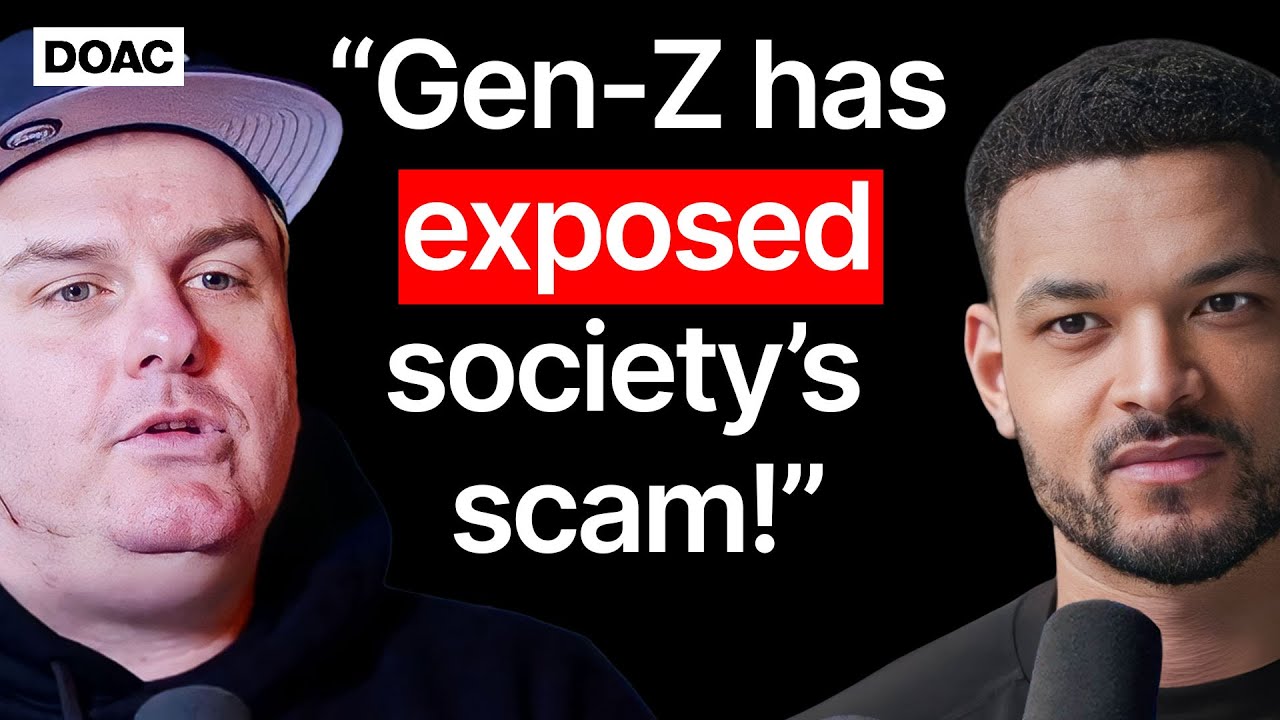
Tim Dillon Sees Gen Z Workplace Tactics Exposing Corporate Exploitation
The Diary Of A CEO
Younger workers exploit corporate taboos and remote-work loopholes to undermine a system that offers them no path to traditional home ownership or financial security.
## Background
Published on YouTube by the channel The Diary Of A CEO on April 4, 2024, this episode features comedian Tim Dillon in a detailed conversation hosted by Steven Bartlett. According to the show description, the interview explores Dillon's journey from a closeted drug addict and his upbringing with a schizophrenic mother to his stand-up success, podcasting career, and broad critiques of generational dynamics, AI, and social media.
## TL;DR
Tim Dillon traces how his turbulent childhood, raised by a mother with schizophrenia, and his early struggles with closeted cocaine addiction inadvertently honed his improvisational comedy skills. He reflects on reaching rock bottom, finding sobriety, and transitioning into stand-up and long-form podcasting without relying on political correctness or sanitized corporate approval. The discussion spans sharp social commentaries on Gen Z work culture, the Boomer generation's selfishness, Hollywood's superficiality, and the ongoing crises in men's mental health.
## Atmosphere & style
The conversation balances raw, vulnerable self-reflection with rapid-fire, cynical satire. Host Steven Bartlett provides a grounded, supportive space that allows Dillon to pivot effortlessly between dark childhood trauma, addiction milestones, and outrageous, unscripted riffs on modern culture. The resulting atmosphere feels unvarnished, darkly funny, and intellectually honest as Dillon dissects absurd societal trends without self-censorship.
## Key takeaways
- [02:01](https://www.youtube.com/watch?v=J5lAgTvbGS8&t=121s) Tim Dillon's agility as an improv comedian stems from living a double life as a closeted gay cocaine addict between ages 13 and 25, where lying and improvising under pressure were survival mechanisms.
- [03:23](https://www.youtube.com/watch?v=J5lAgTvbGS8&t=203s) Growing up with a mother diagnosed with severe schizophrenia shaped Tim's acute understanding of the fragility of mental health and the constant lingering threat of sudden chaos.
- [11:09](https://www.youtube.com/watch?v=J5lAgTvbGS8&t=669s) Lack of parental structure led Tim into severe substance abuse starting in middle school, culminating in an acid trip during his 8th-grade graduation and 14 years of total sobriety today.
- [17:10](https://www.youtube.com/watch?v=J5lAgTvbGS8&t=1030s) Tim hit absolute rock bottom at age 25 when he woke up in an egret's nest in the Long Island Sound after a late-night boating crash, prompting him to attend his first AA meeting.
- [24:27](https://www.youtube.com/watch?v=J5lAgTvbGS8&t=1467s) Serving as a juror on a high-profile Long Island police informant murder trial forced Tim to confront mortality and justice, accelerating his decision to turn his life around through comedy.
- [29:25](https://www.youtube.com/watch?v=J5lAgTvbGS8&t=1765s) Comedians are fundamentally meant to act as non-moral, absurd entertainers crossing lines for laughs, rather than societal leaders, moral guides, or targets for political cancellation.
- [36:09](https://www.youtube.com/watch?v=J5lAgTvbGS8&t=2169s) Celebrity podcast deals frequently fail because hyper-managed, corporate-created stars have nothing raw or unscripted to say, unlike early unfiltered podcasting pioneers.
- [39:42](https://www.youtube.com/watch?v=J5lAgTvbGS8&t=2382s) Baby Boomers represent a deeply selfish cohort of paranoid hoarders clinging to homes and political power, transforming from 1960s hippies into a materialistic generation.
- [45:04](https://www.youtube.com/watch?v=J5lAgTvbGS8&t=2704s) American politics fails to attract top young talent because public toxicity and system corruption push ambitious minds toward finance or tech rather than holding public office.
- [49:04](https://www.youtube.com/watch?v=J5lAgTvbGS8&t=2944s) Following his mother's passing, Tim developed a more spiritual perspective on life, accepting death as a liberation from physical suffering and recognizing that career accolades hit an emotional ceiling.
- [01:20:51](https://www.youtube.com/watch?v=J5lAgTvbGS8&t=4851s) Gen Z has correctly identified modern corporate structure as a scam, using identity dynamics, workplace taboos, and remote-work loopholes to manipulate the system to their benefit.
- [01:25:06](https://www.youtube.com/watch?v=J5lAgTvbGS8&t=5106s) Rapid AI advancements will easily displace generic, uninspired social media influencers while severely disrupting creative entertainment logistics and production pipelines.
- [01:30:26](https://www.youtube.com/watch?v=J5lAgTvbGS8&t=5426s) Rising male mental health crises, isolation, and addiction stem partly from continuous societal narratives dismissing male vulnerability while condemning traditional status aspirations.
- [01:34:04](https://www.youtube.com/watch?v=J5lAgTvbGS8&t=5644s) Culturally, society encourages women to aggressively pursue corporate wealth and status as 'girl bosses' while hypocritically demonizing figures like Andrew Tate for offering men the exact same advice.
The episode kicks off with Tim Dillon taking aim at Generation Z and their unique knack for working the modern corporate system to their advantage. He quips about Zoomers realizing the whole setup is a scam, inventing mental health issues, taking endless personal days, and keeping their bosses too intimidated to question them. "Why are you late?" Dillon mimics. "I'm gay." "Don't worry about it," comes the immediate corporate backdown. Following a preview of upcoming topics—from his early life as a closeted addict to the absurdity of social media influencers and AI—host Steven Bartlett steps in with a quick subscriber plea before diving into the interview.
* **Key Themes:** Gen Z work culture, corporate social dynamics, comedy preview.
* **Standout Quote:** *"We've bred some of the least interesting people on the planet. Influencers... these generic barcodes with feet, those people don't need to exist. They need to be replaced by an AI version of that."*
---
[02:01](https://www.youtube.com/watch?v=J5lAgTvbGS8&t=121s) I Was a Closeted Gay Addict
Steven compliments Tim on his status as one of the most exceptional, provocative, and quick-witted improv comedians in the world, asking where that specific skill set was forged. Tim traces his ability to think on his feet directly back to a chaotic period of his life between ages 13 and 25, when he was a closeted gay cocaine addict.
When living a double life at a young age, Tim explains, survival requires a constant ability to lie, filibuster, and improvise under pressure. While he acknowledges that these talents didn't stem from healthy origins, he notes with dark humor that the resulting agility serves him well on stage today.
* **Age Range of Addiction/Closeted Era:** 13 to 25 years old.
* **Key Insight:** Survival mechanisms and deceit from active addiction accidentally laid the foundation for quick-thinking comedy.
---
[03:23](https://www.youtube.com/watch?v=J5lAgTvbGS8&t=203s) Which One of Your Parents Were Depressed?
Steven brings up a recent conversation with British comedian Jimmy Carr, who told him that when meeting a comic, you don't ask if *they* are depressed—you ask which of their *parents* was depressed. Tim accepts the premise but raises the stakes immediately, noting that his mother was schizophrenic. In the hierarchy of mental illnesses, he jokes, schizophrenia is the "gold standard," making standard depression look almost mild by comparison.
Tim details what schizophrenia looked like through the eyes of a 12- or 13-year-old child. It was a disorienting haze of paranoia, confusion, and elaborate fabrications. Unlike physical illness, which a child can easily grasp because they have experienced being sick, severe mental illness is nearly impossible to process at that age.
* **Family Mental Health:** Mother diagnosed with schizophrenia; father experienced periods of depression.
* **Onset Period:** Symptoms began severely manifesting when Tim was around 12 or 13 years old.
* **Key Dynamic:** The confusion of trying to discern reality when a parent presents grand, untrue stories as fact.
---
[05:44](https://www.youtube.com/watch?v=J5lAgTvbGS8&t=344s) The Impact of Your Parent's Mental Illnesses on You
Growing up with a mother with schizophrenia was a stark, jarring experience, particularly when Tim visited friends' homes and witnessed normal family interactions. His mother was naturally eccentric, fun, and a free spirit who loved him deeply, meaning his childhood wasn't purely hellish. However, the reality of her condition was inescapable. He recalls a specific moment in the car when she calmly told him that people were following them—not to harm her, but to *protect* her. Internalizing that "doubly crazy" claim was the moment young Tim realized something was fundamentally wrong.
This environment left lasting marks on Tim's worldview. It gave him an acute understanding of the fragility of human mental health and the constant, lingering sense that a breakdown or crisis is always right around the corner. He also had to watch the brutal physical toll of her psychiatric medications, including visible tremors and involuntary rocking back and forth.
* **Medical Reality:** Schizophrenia as a degenerative disorder without a true cure; side effects of anti-psychotic medications (tremors, tardive dyskinesia).
* **Emotional Impact:** A sense of grieving a loved one bit by bit while they are still alive.
---
[09:05](https://www.youtube.com/watch?v=J5lAgTvbGS8&t=545s) Your Parents' Divorce
The onset of his mother's severe symptoms coincided with his parents' divorce. Tim believes the immense stress of the split acted as a catalyst that triggered or accelerated her underlying genetic predilection for schizophrenia. Even before the full breakdown, her behavior included compulsive obsessions—such as hoarding entire McDonald's Disney toy sets, collecting Beanie Babies, and pulling junk off the street insisting it could be refurbished into valuable antiques.
Tim jokes that the paranoid, conspiratorial things his mother used to say in the 1990s are now routinely uttered by members of Congress, noting she could have made a great living on YouTube if it existed back then. Because he was raised in an extended Irish Catholic family, the mental illness was met with deep denial; relatives brushed off her severe condition by using polite euphemisms, calling her "fun" or "eccentric" rather than addressing the crisis.
* **Family Structure:** Only child; no siblings to share the burden.
* **Cultural Framing:** Irish Catholic taboo surrounding mental illness led to denial and minimization ("Patty's just fun").
Tim clarifies that while his mother hated drugs, alcohol, and cigarettes, her worsening mental health and his father's absence left him essentially raising himself. By the time he hit middle school, that complete lack of structure combined with unprocessed trauma pushed him straight into substance abuse.
He started smoking marijuana in the summer between 7th and 8th grade after befriending an older local girl—a rollerblading goth lesbian who was constantly high. Within a single year, his drug use escalated dramatically into cocaine, acid, ecstasy, and Special K (ketamine). In an infamous milestone, he dropped acid right on stage during his 8th-grade graduation ceremony.
* **Timeline of Substance Use:**
* *7th/8th Grade:* Marijuana.
* *8th Grade:* LSD (dropped acid at graduation), cocaine, MDMA (ecstasy), Ketamine.
* **Sobriety Milestone:** Completely sober from all drugs and alcohol for 14 years at the time of recording.
* **Retrospective View:** Acknowledges the self-destructive harm, but refuses to sanitize the past—admitting that at the time, running wild on drugs with friends was also genuinely fun.
---
[14:54](https://www.youtube.com/watch?v=J5lAgTvbGS8&t=894s) Hitting Rock Bottom
Even amidst the heavy drug abuse, Tim was always the comedic goofball of his group, driving around the wealthy neighborhoods of Long Island smoking weed, mocking the empty mega-mansions, and doing dark impressions of deceased teachers. However, as he entered his twenties, the lifestyle spiraled toward a grim dead end.
By age 25, Tim had hit absolute rock bottom. He was living in Baldwin, New York, in a house he purchased with a risky subprime mortgage. He was a deeply closeted alcoholic working at a failing mortgage brokerage in a bleak Long Island industrial park years after the 2008 financial crash had already decimated the industry. He paints a grimly hilarious picture of his office mate: a man losing his own home to foreclosure who spent his entire workday ignoring his screaming wife on the phone while obsessively trying to order live koi fish for a backyard pond.
* **Location:** Baldwin, Long Island, New York.
* **Age at Rock Bottom:** 25 years old.
* **Circumstances:** Deeply closeted, active alcoholic, subprime mortgage holder, working in a crumbling mortgage bank post-2008 crash.
[17:10](https://www.youtube.com/watch?v=J5lAgTvbGS8&t=1030s) Hitting Rock Bottom in an Egret's Nest
Recounting the chaos of his early twenties, Tim shares stories about hanging out with a friend's wild, unemployed father who sold drugs and had racked up three DWIs and a "BWI" (boating while intoxicated)—a rare badge of honor. He fondly recalls a night at a Long Island tiki bar where the father promised to buy everyone's drinks, pointed to Tim and his friends, and gave a thumbs-up to the bartender. An hour later, the group was handed a $2,500 bill because the father, who had been drinking on a tab there for two days with no money, had tricked them into covering his balance.
The ultimate turning point came at age 24 while speed-boating late at night through the dark waters of Freeport. The boat slammed full speed into a marsh, hurling Tim headfirst out of the vessel. He regained consciousness at 1:00 AM, lying directly inside a nest surrounded by white egrets in the middle of the Long Island Sound. Soaked and dazed, he realized he could have easily been paralyzed or killed, marking this absurd yet terrifying moment as his absolute rock bottom and the impetus to attend his first AA meeting.
- A BWI (boating while intoxicated) is an achievement because of how difficult it is to get caught and charged with one on the water.
- The friend's father had run up a $2,500 bar tab over two days before tricking Tim and his friends into taking over the bill.
- The crash took place in the waters off Freeport, Long Island, leaving Tim stranded in an egret's nest.
[19:40](https://www.youtube.com/watch?v=J5lAgTvbGS8&t=1180s) "Lisa's Lounge" and the Decision to Get Sober
Tim describes the depressing atmosphere surrounding his local haunt, a dive bar called Lisa's Lounge located just up the block from his foreclosed childhood home. The bar was named by a grieving father after his daughter who had been killed by a drunk driver. Bizarrely, her picture hung on the wall where patrons would regularly raise their glasses to toast "To Lisa!" while getting heavily intoxicated. The bar owner openly admitted he opened the place so people with nowhere else to go had a spot on Christmas, right before snorting a line of cocaine off the pool table.
Seeing late-stage alcoholics at Lisa's Lounge every single night provided Tim with a bleak, terrifying mirror of his future. He realized that staying on this path was a fate "worse than death"—a life defined by fear, wasted potential, and sitting at a bar drinking alongside strangers like "Marge." Driven by a core belief that a better life was possible through sobriety and honesty, he made the firm commitment to change.
- Lisa's Lounge was named in memory of a girl killed by a drunk driver, yet hosted a nightly community of severe addicts.
- Tim felt that rotting away in a neighborhood dive bar was scarier than death because it represented total surrender and failure.
- As a child actor between ages 6 and 13, Tim had toured in *Annie Get Your Gun* alongside his mother and appeared on *Sesame Street* before quitting to do drugs at 13.
[24:27](https://www.youtube.com/watch?v=J5lAgTvbGS8&t=1467s) The Murder Trial and Finding Comedy
Around the exact same time he began getting sober at age 25, Tim served as a juror on a high-profile murder trial in Long Island. A police informant had murdered the mother of his children after authorities repeatedly ignored multiple orders of protection to keep receiving his tips—a scandal that later led to an $8 million settlement for the victim's family. Initially taking the jury duty assignment out of boredom, facing the daily weight of mortality and justice forced Tim to reflect deeply on his own chaotic existence and reinforced his need to turn his life around.
Navigating early sobriety and 12-step programs proved exceptionally challenging, particularly the requirement to practice absolute honesty and deliver direct, humiliating apologies to people he had wronged or stolen money from. Shortly after getting sober, he took a leap of faith by stepping onto the stage at a stand-up comedy open mic held in a joint coffee shop and tattoo parlor in Merrick, Long Island.
- The Long Island murder case involved severe police malfeasance, eventually resulting in an $8 million payout to the victim's estate.
- The hardest parts of the 12-step program for Tim were vulnerability, finding a "higher power," and making restitution for lying and stealing.
- His first open mic was performed over the buzzing sound of tattoo needles as patrons got old relationship tattoos redesigned into patriotic 9/11 tributes or missiles.
- Unlike his past failed identities, finishing his first set gave Tim a rare, unshakable certainty that comedy was what he was meant to pursue.
[29:25](https://www.youtube.com/watch?v=J5lAgTvbGS8&t=1765s) Taboos, Correctness, and the Role of the Comedian
When asked about the ongoing clash between political correctness and stand-up comedy, Tim dismisses the hyper-fixation on outrage, echoing George Carlin's rule that a comedian's job is to find the line and cross it. He acknowledges that while dark humor isn't for everyone, the backlash often comes from unhappy individuals who take jokes literally and thrive on being offended. Tim argues that society has spent the last four years paying far too much attention to outraged critics and columnists who hold no actual power.
He emphasizes that comedians are essentially "clowns" whose primary objective is to be funny, not to be right, moral, or politically correct. Comparing stand-up to serious professions, he notes that while a surgeon cannot afford to "wing it," a comic's duty is to explore absurd, stupid, or wrong ideas for the sake of a laugh. Expecting comedians to act as moral leaders confuses their role in culture, as true authority and real power rest in the hands of corporate CEOs and politicians rather than people telling jokes in night clubs.
- "As George Carlin said, your job is to find out where the line is, cross it..."
- Tim views outrage over comedy as absurd because comics possess only soft cultural influence, not real societal power.
- He asserts that a comic's primary job is entertainment, with shedding light on truth being a purely secondary byproduct.
[33:20](https://www.youtube.com/watch?v=J5lAgTvbGS8&t=2000s) Being "Uncancelable" and Ranting on Podcasts
Addressing a viral clip where he jokingly expressed frustration that Joe Rogan gets targeted for cancellation while he gets ignored, Tim rejects the idea that he is truly "uncancelable." Instead, he attributes his immunity to the fact that he presents as a self-aware "goofball" wearing ridiculous glasses whose statements frequently blur the line between serious commentary and complete absurdity.
Having produced over two hours of weekly broadcasts for eight straight years, Tim explains that the sheer volume of his unscripted, rambling output makes it nearly impossible for even him to keep track of what he says on air. Because his audience understands that his rants oscillate wildly between sharp satire and nonsensical gibberish, his commentary resists easy outrage or takedowns.
- Tim has been hosting and recording long-form weekly podcast broadcasts for over 8 years.
- His comedic style relies on blending absurd exaggerations with satirical social commentary so rapidly that listeners cannot take every statement literally.
[34:03](https://www.youtube.com/watch?v=J5lAgTvbGS8&t=2043s) The Craft of Comedy and Shooting from the Hip
Tim Dillon reflects on his comedic style, describing how his thoughts unfold organically when he sits down to talk. Some of the most absurd things he says start intelligently, while seemingly intelligent thoughts often begin absurdly. For him, the joy of podcasting lies in not having a rigid agenda; having a pre-planned message would make him bored instantly. Instead, he simply reacts to what he sees, candidly asking himself what he actually thinks about a given topic. He acknowledges that his over-the-top, goofy nature sometimes makes his critics look foolish because they take his wild exaggerations far too seriously.
Comparing his approach to other major podcasters like Joe Rogan—whom he places alongside *The Diary of a CEO* as running the largest shows in the world—Dillon notes that Rogan does deep research, reads books, and conducts serious interviews. Dillon, by contrast, relies on "shooting from the hip." He jokes that he will often dismiss a news story, only to read the third paragraph halfway through a rant and realize, "Oh, this is a problem," causing him to abruptly flip his stance mid-sentence.
- Dillon praises Joe Rogan as one of the most generous figures in entertainment, emphasizing how Rogan uses his massive platform to promote comedians, writers, and journalists.
- He notes that appearing on Rogan's show was a pivotal turning point in his career, largely because their on-air chemistry mirrors their genuine, unfiltered private conversations.
---
[36:09](https://www.youtube.com/watch?v=J5lAgTvbGS8&t=2169s) Why Celebrity Podcasts Fail and Hollywood's Banal Reality
Examining the evolution of the podcasting industry, Dillon contrasts early pioneers like Joe Rogan, Adam Carolla, and Marc Maron—who started before money or mainstream cool was involved—with the recent wave of celebrity podcasters. He argues that major platforms like Spotify are rolling back massive media deals with A-list stars because most celebrities simply "have nothing to say." He quips that mainstream celebrities are essentially "created in a laboratory," citing his own talent agency, CAA, as an example. Corporate teams of PR managers, agents, and lawyers construct a sanitized persona, telling stars what parts of their past to highlight, what to hide, and to "leave the Confederate flag at home."
Giving a microphoned, hour-long platform to these highly managed, uninspired individuals inevitably backfires. Dillon dispels the popular conspiracy theory that Hollywood is entirely run by "satanic pedophiles eating children," suggesting that while some sinister elements exist, the truth is far more mundane: Hollywood is largely filled with remarkably boring, banal people created by corporations. What drives everyday people mad is realizing just how uninteresting these celebrities are despite their immense wealth and massive estates. In Dillon's view, celebrities should be restricted to brief, scripted appearances on red carpets where they say two or three pre-approved words like "climate change" before collecting an award.
- Dillon references Spotify's multi-million dollar deal with figures like Meghan Markle, agreeing that the platform made a mistake giving astronomical sums to talent who cannot sustain raw, unscripted commentary.
- He jokes that he should have received that money instead, adding that he would have gladly stayed in a royal castle regardless of the public scrutiny.
- For Dillon, the core appeal and magic of podcasting lie in being completely unfiltered, free, and having fun.
---
[39:42](https://www.youtube.com/watch?v=J5lAgTvbGS8&t=2382s) Gen Z Violence, AI, and the Boomer Generation
When asked for his read on current generational dynamics, Dillon sarcastically declares that society has completely "given up on the children." Rather than viewing the next generation as the future, society has shifted its focus and excitement entirely toward AI and robotics. He paints a grim, satirical picture of modern youth as "dead-eyed little monsters" raised by algorithms, abusing fentanyl, and committing random acts of violence for online clout.
To illustrate this, he points to a real-world case in Gilbert, Arizona, where a group of wealthy teenagers recorded violent attacks on random peers to post on TikTok, ultimately resulting in a murder. Dillon lambasts the local police department for ignoring the pattern for a year because the perpetrators were affluent white kids, acting as though it was just "a couple of kids having fun... how people grow up."
Turning his attention to the Baby Boomers—the subject of his upcoming book—Dillon describes them as the ultimate selfish generation. He characterizes them as paranoid hoarders who refuse to leave their massive McMansions, relinquish their jobs, or yield political power, literally "collapsing in Congress" and "dying in the Senate." He argues that Boomers exposed the lie of the 1960s hippie movement, proving they were never truly progressive; they were merely selfish drug addicts who swapped LSD for money, transforming into a materialistic, soulless cohort. Despite—or because of—their total lack of concern for their children or the planet's future, Dillon considers them the funniest generation to ever live.
- Dillon half-jokingly proposes forcibly evicting Boomers from their homes and committing them to mental institutions, noting he consulted lawyers but ran into legal hurdles.
- He categorizes Millennials as an insecure, ribbon-seeking generation whose politics are purely aesthetic, constantly crowdsourcing opinions to be told they are "good" to fill the void left by their Boomer parents.
- He views Gen Z (Zoomers) as skeptical self-starters and independent thinkers, though severely undermined by viral violence, fentanyl vapes, and social media addiction.
- As a sarcastic fix for youth disaffection, Dillon suggests bringing back the military draft so young people can "go die in the Ukraine so that Boeing can make some money."
---
[45:27](https://www.youtube.com/watch?v=J5lAgTvbGS8&t=2727s) The Decline of American Politics and Personal Goals
Dillon expresses zero optimism about the future of the country, dismissing the idea that upcoming elections will resolve core societal issues. Addressing the aging political class, he points out that leaders like Joe Biden and Donald Trump highlight a complete lack of new, capable political talent in America. Dillon argues that nobody wants to run for office anymore unless they are "psychotic." The country's brightest, most ambitious young minds refuse to enter politics because the media dissects their personal lives and the system is deeply corrupt; instead, they would rather "go to Miami and trade Bitcoin on a yacht."
As a result, the nation is governed by octogenarians suffering from visible cognitive decline who barely comprehend modern technology like TikTok, relying on their grandchildren to explain it to them while eating lobsters on estates in Maine. Regarding potential social media bans, Dillon humorously admits he supports banning TikTok purely out of spite because he has no followers on it, though he acknowledges it is a destructive cultural force.
Looking ahead in his career, Dillon shares a deeply personal goal: creating a movie or television show centered around the Boomer generation and the eccentric environment in which he grew up. He wants to capture the unique, dark humor of his friends' parents and immortalize that era before that generation passes away entirely.
- Dillon notes that Biden appeared surprisingly energetic during his State of the Union address, joking that handlers "shot him up with something."
- He emphasizes that political office no longer attracts genuine leaders due to lower financial incentives compared to tech or finance, coupled with intense public toxicity.
- His primary creative objective remains telling authentic, hilarious stories about his childhood and the distinct Boomer culture that shaped him.
[49:04](https://www.youtube.com/watch?v=J5lAgTvbGS8&t=2944s) Processing Childhood Trauma and the Death of His Mother
Reflecting on his childhood trauma, Tim Dillon notes that processing early life experiences isn't something that can easily be fully wrapped up in a single lifetime, though he has managed to process a significant portion of it. He explains that mental health requires ongoing effort and that there is always room to reach a better place emotionally. His perspective on his mother's struggles shifted dramatically following her passing in August, roughly six months prior to the interview.
He recounts hosting his mother and extended family—including his cousins and aunt—at his house on Long Island for a gathering shortly before her passing. Looking back at her life, he recalls that while the end was extremely difficult, her early years were filled with joy: she was married to his father for ten years before having him, loved surfing and boating, spent time in Florida, and was voted best looking in her high school. He humorously frames her life as "the front nine were good, the back nine were a little tough."
Dillon reflects on how his outlook has grown increasingly spiritual over time. Raised Catholic, he rejects the institution’s scandals and specific dogmas while maintaining a belief in a spiritual dimension, the soul, and life beyond physical existence. Seeing his mother trap-bound in a deteriorating body and mind made him realize that forcing her to stay alive would have been selfish; her death ultimately brought a sense of relief and liberation.
- **Mother's early life:** Married 10 years before having Tim; enjoyed boating and surfing in Florida; voted best looking in high school.
- **Family gathering:** Hosted a gathering at his Long Island home with extended family, including his aunt and cousins, shortly before his mother died.
- **Spiritual shift:** Raised Catholic; retains belief in the soul and a spiritual realm while rejecting institutional abuses.
---
[53:34](https://www.youtube.com/watch?v=J5lAgTvbGS8&t=3214s) Therapy, Aging, and Evolving Beyond Career Ambition
Addressing therapy, Dillon shares that while he has attended therapy in the past and acknowledges its benefits, he is not currently seeing a therapist due to his heavy touring schedule. As he navigates his late 30s, he has noticed a fundamental shift in what brings him fulfillment. He emphasizes that at a certain age, career achievements hit a emotional ceiling—even as success grows, the personal joy derived purely from individual accolades begins to dim.
Instead of an ego-driven "me, me, me" mindset, he finds himself deriving genuine happiness from community, helping others, being part of something valuable, and celebrating other people's accomplishments. He notes that while professional goals remain, they no longer serve as the primary source of personal happiness.
---
[54:58](https://www.youtube.com/watch?v=J5lAgTvbGS8&t=3298s) The Separation of the Public Persona and the Real Self
When asked about the side of him that audiences rarely get to see, Dillon acknowledges the inherent division between a public comedy brand and a private human being. While he maintains that his core opinions on his podcast are completely authentic—stating that his off-screen conversations at dinner mirror his podcast rants rather than hiding a secret double life—he points out that he has many personal interests outside of comedy, such as his thoughts on spirituality, that simply don't fit the comedic format of his show.
Addressing his creative process on podcasts and guest appearances (such as on *The Joe Rogan Experience*), Dillon explains that his long-form, riffing style is completely unscripted. He compares his comedic improvisation to his past habits as a drinker: he used to sit at bars and talk about the news, and now he does the exact same thing completely sober.
> "I look at a landscape of stories and articles... I don't have an agenda. I'm not sponsored by the person in this article... What's the funniest take, and how does this explain something larger that's going on?"
---
[58:24](https://www.youtube.com/watch?v=J5lAgTvbGS8&t=3504s) Coming Out, Dating, and Relationship Dynamics
Dillon discusses coming out as gay at around 25 years old, jokingly remarking that by modern standards that is relatively late, given that "statistically today most people come out at the age of two." He attributes his lack of long-term, marriage-track relationships to his hyper-fixation on establishing his comedy career during his 20s and 30s, acknowledging that using career focus as an excuse was partly a form of self-centeredness.
He observes that while many comedians marry within the industry because standard partners struggle with the lifestyle, he prefers dating people completely removed from the entertainment world. He describes his current dating life as casual rather than searching for a serious partner, though he remains far more open to long-term connection now that his career is established. He also reflects on how childhood observations of parental relationships shape adult expectations of love and commitment.
- **Age coming out:** Approximately 25 years old.
- **Dating preferences:** Prefers dating outside the comedy industry to maintain separation between work and personal life.
- **Relationship status:** Currently dating casually rather than pursuing immediate marriage or family.
---
[01:01:51](https://www.youtube.com/watch?v=J5lAgTvbGS8&t=3711s) Resilience, Overcoming Addiction, and Daily Self-Improvement
When asked what he values most about himself, Dillon points to his extreme resilience and refusal to make excuses. Recognizing that many people facing similar childhood trauma and addiction end up remaining trapped in self-pity or destructive cycles, he credits his ability to handle rejection, dust himself off, and relentlessly pursue his goals on his own terms.
> "Growing up the way I grew up, there's a version of me that's just a druggy, that's just on the street, that's dead, that is blaming everyone else... I could have been that guy. I was that guy for many years... I'm happy I was able to get rid of that."
He clarifies that achieving sobriety isn't the end of self-improvement, but rather the baseline from which real personal growth starts. Now sober, he focuses on fundamental life improvements: eating better, improving sleep quality, going on dates, actively listening to others, and avoiding falling back into old coping mechanisms like lying, drinking, or substance abuse.
[01:05:08](https://www.youtube.com/watch?v=J5lAgTvbGS8&t=3908s) Managing Mental Health and Escaping the Internet
Tim Dillon reflects on his personal strategies for managing mental health, dryly observing that as a comedian, his approach is far from perfect—otherwise, he wouldn't have ended up in comedy in the first place. For him, staying sane involves simple, grounding habits: talking to people, taking long walks, helping others, expanding his spiritual life, and striving to be a better person. He emphasizes the importance of avoiding the "insanity" of the world, which is amplified by spending too much time online, obsessing over things outside of one's control, and remaining trapped in one's head.
Dillon argues that modern digital platforms are actively toxic, particularly for younger generations. He points out how absurd it is that tech companies deny any link between their products and youth mental health crises, joking that they act as though launching a new app called "Suicider" or releasing harmful filters has zero connection to rising suicide rates. As he has grown older, he views the internet primarily as a tool for his career rather than a substitute for real life. Real-world human interaction, reading a book, or sitting on a beach offer far more genuine value than endless scrolling.
- **Key Coping Mechanisms**: Long walks, real-world human interactions, service to others, and spiritual growth.
- **Critique of Tech Companies**: Satirizes corporate denial regarding the negative mental health impacts of social media apps on youth.
- **Personal Shift**: Views online engagement strictly as a career requirement, prioritizing off-screen real life as he gets older.
---
[01:07:27](https://www.youtube.com/watch?v=J5lAgTvbGS8&t=4047s) Free Speech, Twitter, and Handling Online Feedback
When host Steven Bartlett brings up Elon Musk’s acquisition of Twitter (X) and whether it balanced the scales regarding free speech, Dillon agrees that the purchase was positive. He notes that Twitter had become a primary example of censorship in American society. While he hesitates to call Twitter a true "town square," recognizing it as an chaotic battleground where people go to fight, he appreciates that users now have a space to speak more freely without heavy-handed censorship.
Regarding public criticism and online feedback, Dillon admits that everyone gets bothered by it, but he actively limits his exposure to audience reactions. He warns that tailoring creative work to satisfy audience feedback can destroy the authenticity and beauty of what made the art good in the first place. Instead of letting online comments dictate his creative mind, he relies on simple personal metrics: whether the work makes him laugh, whether people he trusts enjoy it, and standard comedy metrics like ticket sales.
- **On Elon Musk's Twitter Acquisition**: Views it as a beneficial move against censorious trends, even if the platform remains chaotic.
- **Dealing with Feedback**: Ignores online comment sections to avoid letting public perception warp his artistic voice.
- **Key Success Metrics**: Self-satisfaction, approval from trusted peers, and ticket sales.
---
[01:09:46](https://www.youtube.com/watch?v=J5lAgTvbGS8&t=4186s) Global Comedy Touring and the Absurdity of Wealth
Dillon discusses his upcoming tour across the UK and Europe, highlighting his show at London's iconic Royal Albert Hall. When mentioning stops in places like Finland, Manchester, and Liverpool, he shares an anecdote about a Finnish fan who messaged him saying, "It's not London and it's not the Hamptons... but it's what we have," a level of grounded self-awareness he deeply admires. Describing his live comedy set, Dillon explains that it dives into dark, topical humor touching on cultural trends, social media toxicity, homelessness, and cancel culture.
The conversation shifts to London's real estate, specifically One Hyde Park in Knightsbridge. Dillon expresses a fascination with the building—the most expensive residential real estate in the world—not out of a desire to live there, but because of what it represents. He describes it as a symbol of the "utter coldness, emptiness, and banality" of extreme wealth, where ultra-wealthy individuals store capital in vacant buildings. Recalling a wild show in Dublin where an audience fight broke out over religious slurs, Dillon remembers shouting at the crowd: "This is why Dubai is winning! Look at you people... You're all potatoes screaming at other potatoes that they're slightly different kinds of potatoes!"
- **Tour Highlights**: Performances scheduled at the Royal Albert Hall, Manchester, Liverpool, and across Europe.
- **Observation on One Hyde Park**: Uses the ultra-exclusive Knightsbridge property to illustrate the hollow banality of extreme wealth.
- **Dublin Stand-Up Anecdote**: Calmed a chaotic, drunk crowd by pointing out the absurdity of their infighting compared to global economic shifts like Dubai's rise.
---
[01:15:03](https://www.youtube.com/watch?v=J5lAgTvbGS8&t=4503s) The Hollow Reality of Hollywood and Los Angeles
Dillon dismantles the glamorous British perception of California, calling the Hollywood image a total lie built by television. While the state possesses stunning natural beauty, Dillon describes the people living in Los Angeles as "empty," "fractals," and "figments of your imagination" who do not exist in reality the way normal people do.
He explains that LA operates on a pervasive psychological fear because every person—from a high-level studio executive down to a busboy hoping for a spot at the Hollywood Improv—feels completely replaceable. As a result, the entire town consists of "people waiting for instructions." Rather than holding core beliefs or acting independently, people wait for a corporate consensus to dictate what is currently acceptable, whether that means showcasing non-traditional body types one day or reverting to standard Hollywood tropes the next.
> "Everybody in this town is replaceable. Everybody feels that... So, everybody's waiting for instructions. Nobody wants to act. Everybody's waiting for somebody else to let them know what's okay."
- **The LA Psyche**: Defined by deep-seated insecurity, replaceability, and a lack of genuine personal convictions.
- **Systemic Conformity**: Entertainment professionals wait for cultural directives before committing to any idea or trend.
- **Silver Lining**: Jokes that despite the psychological hollowed-out nature of the city, "the tacos are good."
---
[01:17:40](https://www.youtube.com/watch?v=J5lAgTvbGS8&t=4660s) The American Dream and the Myth of Unlimited Potential
Bartlett contrasts Dillon's take on LA with the traditional British view of the American Dream—the belief that anyone can come to America, work hard, and become whatever they want. Dillon acknowledges that America markets this concept exceptionally well, but argues that the narrative leaves out the harsh realities and compromises required to achieve high-level success. Telling an eight-year-old child they can become President of the United States is misleading because it ignores the grueling, dirty journey involved.
Dillon asserts that telling masses of people they can achieve anything without regard for reality, personal talent limitations, or their actual willingness to work hard does a massive disservice. Blanket promises of unlimited potential set people up for deep frustration and unhappiness when faced with the actual demands of real-world accomplishment.
- **Deconstruction of the American Dream**: Argues the traditional myth ignores personal limitations and the severe sacrifices required to reach the top.
- **Critique of Modern Advice**: Rejects the blanket sentiment that anyone can be anything without factoring in hard work and reality.
[01:19:30](https://www.youtube.com/watch?v=J5lAgTvbGS8&t=4770s) Decoding the "American Dream" Slogan
Tim Dillon critiques the ubiquitous slogan "you can be anything you want to be in America," calling it little more than a bumper sticker, license plate, or T-shirt catchphrase rather than a true life philosophy. While people are certainly capable of doing great things—in the U.S. or the UK—the actual translation of the phrase in American culture is simply "you can make as much money as you want." The culture aggressively promotes an upwardly mobile, vertical path where one must grab power, run an empire, and become a boss to achieve happiness.
However, Dillon argues that working oneself to death isn't actually the path to true fulfillment; it is merely what society pushes so that individuals remain productive cogs in the wheel without questioning the system.
* The phrase "you can be whatever you want" translates culturally to "work yourself to death."
* Upward mobility and entrepreneurship are sold as the sole avenues to human happiness.
---
[01:20:51](https://www.youtube.com/watch?v=J5lAgTvbGS8&t=4851s) How Gen Z Discovered Society's Scam
Unlike previous generations, Gen Z has largely realized that the system is a scam. Dillon fully supports their response, pointing out that once you recognize a scam, it makes sense to navigate it like a scammer or con artist. Rather than burning out, younger workers leverage workplace taboos, weaponize HR language, and manipulate corporate anxieties to do the bare minimum while demanding full respect and job security.
Whether taking endless days off, citing non-existent mental health struggles, or using identity chips to intimidate superiors, Gen Z has exposed the flaws in corporate culture. Dillon views this not with disdain, but as a hilariously pragmatic strategy: they are simply using the exact playbook corporate America handed them.
* **Corporate dodge tactics:** Employees use phrases like "you're using volume right now" or "you keep coming into my physical space" to halt criticism.
* **Quiet quitting:** Leveraging remote work post-pandemic to do minimal labor while retaining full pay.
* **Self-preservation:** Utilizing workplace diversity policies and mental health claims as shielding tools against performance evaluations.
---
[01:25:06](https://www.youtube.com/watch?v=J5lAgTvbGS8&t=5106s) The AI Revolution and the Death of "Generic" Influencers
Turning to the rapid rise of artificial intelligence, Dillon highlights how profoundly AI is disrupting creative industries like film, writing, and acting. He cites filmmaker Tyler Perry halting an $800 million studio expansion after seeing AI-generated locations, noting that entire auxiliary industries—such as set decorators, prop rental houses, and location managers—face severe disruption.
Dillon reserves his sharpest critique for generic social media influencers who hawk skincare products using identical, scripted promo codes. Because these influencers lack distinct depth or original artistry, replacing them with AI avatars will be completely unnoticeable to the public. However, replacing iconic talent like Robert De Niro or Tina Turner presents a far steeper hurdle.
* Tyler Perry paused an **$800 million studio expansion** due to advancing AI text-to-video tools like OpenAI's Sora.
* AI influencers with hundreds of thousands (and millions) of followers are attracting genuine engagement and romantic interest from lonely followers.
---
[01:28:00](https://www.youtube.com/watch?v=J5lAgTvbGS8&t=5280s) The Corporate Dystopia: "You'll Own Nothing and Be Happy"
Dillon paints a dark, satirical vision of the modern socio-economic trajectory. As massive institutional funds like BlackRock acquire real estate and price ordinary citizens out of home ownership, physical property and tangible assets are becoming permanently out of reach for younger generations. In place of real-world ownership, corporations offer digital substitutes: social media avatars, virtual opinions, and AI companion relationships.
In this techno-dystopian future, real-world cities face physical decline while individuals remain isolated inside tiny pods, comforted by AI influencers and online commentary. The system strips away physical autonomy and digital privacy, replacing tangible prosperity with the illusion of participation.
* Major investment firms are locking average buyers out of housing markets, turning ownership into a luxury reserved for the super-rich.
* Digital platforms offer virtual avatars and online commentary as substitutes for real-world equity and influence.
---
[01:30:26](https://www.youtube.com/watch?v=J5lAgTvbGS8&t=5426s) Men's Mental Health and the Trap of Tribalism
Addressing the growing crisis in men's mental health—marked by rising rates of loneliness, addiction, and suicide—Dillon critiques the cultural tendency to dismiss male struggles. While society claims to prioritize mental health, young men hearing constant narratives that they are inherently toxic, sexist, or privileged are left isolated and unsupported when trying to navigate an increasingly difficult world.
Instead of fragmenting society into warring identity groups, Dillon advocates for returning to shared human values. Trying to force everyone to share identical political or cultural worldviews—especially in a country as vastly diverse as the United States—is a futile effort. True progress relies on respecting differences and allowing individuals to build communities around common principles rather than aggressive tribalism.
* Men face alarming spikes in social isolation, porn addiction, and suicide.
* Dillon argues that cultural discourse frequently dismisses male vulnerability with "you've had it good, shut up," undermining genuine mental health efforts.
* Society must transition away from atomized identity battles toward value-driven communities.
[01:34:04](https://www.youtube.com/watch?v=J5lAgTvbGS8&t=5644s) Andrew Tate and Social Double Standards
Tim addresses his perspective on Andrew Tate, having had him as a guest on his podcast. Describing him as "very, very, very lovely" and a nice guy in person, Tim clarifies that while Tate says "wacky things" and shouldn't be running for office, his massive appeal stems from addressing men's core desire for respect and status. Tate preaches financial independence, physical fitness, and high status—traits that are both demonized by critics and universally coveted.
Tim points out a stark cultural double standard in how society treats material ambition. Celebrating female CEOs, praising "girl bosses," and encouraging women to pursue wealth and status at events like the Aspen Ideas Conference is universally cheered. Yet, when Tate tells men to build their financial standing to earn respect and attract women, it is endlessly demonized as toxic advice, even though both sides are chasing the exact same material accomplishments.
- **On Meeting Tate:** Found him polite in person; notes that like many public figures, he says outlandish things but isn't meant to be a senator.
- **The Core Message:** Young men gravitate toward Tate because he offers a playbook for earning respect, getting fit, and reaching financial status.
- **The Double Standard:** Encouraging women to pursue wealth and material corporate success is celebrated cultural discourse, while telling men that money brings status and romance is condemned.
[01:36:50](https://www.youtube.com/watch?v=J5lAgTvbGS8&t=5810s) The Closing Tradition: A Shameless Apology
Steven explains the show's signature closing tradition: answering an anonymous question left by the previous guest on a card deck. After learning that the deck features QR codes linking to videos of guests answering their questions, Tim reads his prompt: "Who should you have apologized to but didn't, and why?" Without missing a beat, Tim delivers a classic satirical response, naming Meghan Markle as the person he owes an apology to.
Tim hilariously breaks down his "full circle" moment with Markle following the launch of her lifestyle brand, *American Riviera Orchard*. He admires how she leveraged all the social capital built from claims of royal mistreatment to sell glassware and dishes for drinking Chardonnay in Santa Barbara. Expressing genuine respect for her pure "shamelessness" and top-tier career climbing, Tim jokes that he would love to be hired by her brand, praising her transition from a C-list Hollywood actress to living in a Montecito mansion as a masterclass in getting results.
- **The Question:** "Who should you have apologized to but didn't, and why?"
- **The Sarcastic Apology:** Apologizes to Meghan Markle for ever doubting her "level of shamelessness."
- **American Riviera Orchard:** Mocks her lifestyle brand, describing its collection of glassware and dishes as "three words that don't really make sense together, but yet sound lovely."
- **The "Climber" Dynamic:** Notes that while she supposedly hates privilege and class, she built an empire right in Montecito, proving that despite any criticism of her character, her status-climbing results are unmatched.
[01:40:21](https://www.youtube.com/watch?v=J5lAgTvbGS8&t=6021s) Sincere Regrets and Closing Compliments
When Steven pushes past the satirical Meghan Markle answer and demands a genuine response, Tim softens and reflects on his past addiction. He shares that if he could speak to his late grandmother, he would apologize for how much anxiety and worry his self-destructive drug habit caused her. Recognizing her as a deeply positive force in his life, he reflects on how young, reckless people rarely realize how much stress their late nights and erratic behavior inflict on the family members who care about them.
Steven wraps up the interview by expressing deep gratitude, calling Tim potentially his favorite comedian. He admits that during dark or difficult moments, he turns to Tim's comedy because it represents the "unacceptable," taboo side of the brain that people aren't usually allowed to explore publicly. After plugging Tim's upcoming "American Royalty" tour—highlighting his show at the Royal Albert Hall in London alongside sarcastic dismissals of stops in Finland—the two share a warm farewell.
- **Genuine Apology:** To his deceased grandmother, for being an inconsiderate addict and causing her constant worry.
- **Host's Praise:** Steven shares that Tim's raw, boundary-pushing humor brings him joy during stressful times by exploring topics others are afraid to touch.
- **Tour Details:** Tim promotes his "American Royalty" tour across the UK and Europe, naming London's Royal Albert Hall as the crown jewel of the run.
## Notable quotes
> [00:00](https://www.youtube.com/watch?v=J5lAgTvbGS8&t=0s) We've bred some of the least interesting people on the planet. Influencers... these generic barcodes with feet, those people don't need to exist. They need to be replaced by an AI version of that. — Tim Dillon
> [29:25](https://www.youtube.com/watch?v=J5lAgTvbGS8&t=1765s) As George Carlin said, your job is to find out where the line is, cross it... — Tim Dillon
> [54:58](https://www.youtube.com/watch?v=J5lAgTvbGS8&t=3298s) I look at a landscape of stories and articles... I don't have an agenda. I'm not sponsored by the person in this article... What's the funniest take, and how does this explain something larger that's going on? — Tim Dillon
> [01:01:51](https://www.youtube.com/watch?v=J5lAgTvbGS8&t=3711s) Growing up the way I grew up, there's a version of me that's just a druggy, that's just on the street, that's dead, that is blaming everyone else... I could have been that guy. I was that guy for many years... I'm happy I was able to get rid of that. — Tim Dillon
> [01:09:46](https://www.youtube.com/watch?v=J5lAgTvbGS8&t=4186s) This is why Dubai is winning! Look at you people... You're all potatoes screaming at other potatoes that they're slightly different kinds of potatoes! — Tim Dillon
> [01:15:03](https://www.youtube.com/watch?v=J5lAgTvbGS8&t=4503s) Everybody in this town is replaceable. Everybody feels that... So, everybody's waiting for instructions. Nobody wants to act. Everybody's waiting for somebody else to let them know what's okay. — Tim Dillon
> [01:22:09](https://www.youtube.com/watch?v=J5lAgTvbGS8&t=4929s) you're using volume right now — Tim Dillon
> [01:22:09](https://www.youtube.com/watch?v=J5lAgTvbGS8&t=4929s) you keep coming into my physical space — Tim Dillon
## Mentioned
Tim Dillon, Steven Bartlett, Jimmy Carr, George Carlin, Joe Rogan, Adam Carolla, Marc Maron, Meghan Markle, Andrew Tate, Elon Musk, Tyler Perry, Robert De Niro, Tina Turner, Joe Biden, Donald Trump, The Diary Of A CEO, The Tim Dillon Show, Tim Dillon: A Real Hero, American Royalty, Annie Get Your Gun, Sesame Street, Rolling Stone, YouTube, Netflix, Spotify, CAA, TikTok, Twitter, X, BlackRock, Aspen Ideas Conference, OpenAI, Sora, Royal Albert Hall, Lisa's Lounge, Gold Tree Studios, Sunset Strip, West Hollywood, Baldwin, Freeport, Long Island, Gilbert, Arizona, London, Manchester, Liverpool, Dublin, Finland, Dubai, Montecito, Santa Barbara, Knightsbridge, One Hyde Park, Boeing
Tim Dillon 认为 Z 世代职场策略揭露了企业剥削
年轻员工利用企业禁忌和远程办公漏洞,来反抗无法为他们提供传统购房途径或财务保障的体制。
Tim Dillon 追溯了由患有精神分裂症的母亲抚养长大的动荡童年,以及早年在隐瞒可卡因成瘾中挣扎的经历,是如何在无意中磨练了他的即兴喜剧技巧。他回顾了跌入人生谷底、走向戒瘾清醒,并在不依赖政治正确或企业粉饰性认可的情况下,转向单口喜剧和长篇播客的历程。本期讨论还广泛涉及对 Z 世代职场文化、婴儿潮一代的自私、好莱坞的虚浅表面,以及男性心理健康持续危机的犀利社会评论。
蒂姆·狄龙(Tim Dillon)即兴喜剧的敏捷反应源于13至25岁期间隐瞒同性恋身份并深陷可卡因成瘾的双重生活,在高压下说谎和临场发挥成了他当时的生存手段。 (2:01)
由于母亲患有严重的精神分裂症且家庭缺乏管束,狄龙自初中起便严重滥用药物,甚至在八年级毕业典礼上吸食LSD,如今他已彻底戒毒戒酒14年。 (11:09)
在深夜快艇事故后于长岛海峡的白鹭巢中醒来,让狄龙意识到自己跌入人生谷底,随后参与长岛一桩谋杀案的陪审团经历更促使他直面生死并决心投身喜剧。 (17:10)
狄龙强调喜剧演员的本职是寻找边界并跨越界限以逗笑观众,而非充当道德领袖;同时指出由公关团队包装的名人播客因缺乏真实、未经审查的内容而注定失败。 (29:25)
Reading summary
Comedian Tim Dillon argues that modern American economic and social structures have deteriorated into transparent scams, prompting Gen Z to cynically manipulate workplace protocols while an entrenched older generation hoards assets and political power. Dillon attributes his satirical, improvisational worldview to surviving a chaotic youth shaped by his mother's severe schizophrenia and his own battle with substance abuse.
Addiction, Family Illness, and the Comedy Pivot (2:01)
Dillon traces his comedic reflexes directly to surviving as a closeted cocaine addict between ages 13 and 25, where continuous deception and fast-talking under pressure functioned as essential survival mechanisms. This instability was exacerbated by his mother's onset of severe schizophrenia when he was 12 or 13. Raised in an extended Irish Catholic family, Dillon observed relatives minimize her paranoia as mere eccentricity. Following his parents' divorce, a lack of parental supervision pushed him into severe substance abuse by middle school, including marijuana, cocaine, ketamine, and LSD, which he took during his eighth-grade graduation.
By age 25, Dillon hit rock bottom in Baldwin, New York, burdened with a subprime mortgage and working at a failing mortgage brokerage after the 2008 financial crash. Following a late-night boat collision in Freeport that launched him into an egret's nest, and confronted with the grim future modeled by patrons at a local dive bar, he entered 12-step recovery. A simultaneous stint on a Long Island murder trial jury prompted him to confront his mortality, leading him to try stand-up comedy at a local open mic. At the time of recording, Dillon had achieved 14 consecutive years of sobriety.
Generational Conflict: Boomer Hoarding and Gen Z Subversion (39:42)
Dillon describes Baby Boomers as an exceptionally selfish cohort that abandoned 1960s countercultural values for unchecked materialism. He criticizes older generations for refusing to yield corporate power, McMansions, or government roles, noting that elderly politicians remain in office despite visible physical decline. In Dillon's view, Millennials remain insecure conformists crowdsourcing validation, whereas Gen Z has correctly recognized that the conventional American Dream of working oneself to death in pursuit of vertical mobility is a scam.
Instead of demonstrating corporate loyalty, Dillon observes that Gen Z workers pragmatically leverage human resources policies, remote work, and identity politics to avoid labor while securing employment. By invoking mental health days and weaponizing workplace taboos against management evaluations, younger employees mirror corporate America's own manipulative tendencies. Dillon endorses this calculated self-preservation, arguing that treating an exploitative corporate framework like a con game is the only logical response.
Institutional Conformity and the Role of Comedians (29:25)
Dillon dismisses the premise that stand-up comedians must serve as societal moral arbiters. Aligning with George Carlin's view that a comedian's role is to locate and cross societal boundaries, Dillon argues that outrage culture stems from unhappy critics taking jokes literally. He asserts that comedians wield only soft cultural influence, whereas true societal accountability rests with corporate executives and politicians. His own unscripted podcasting format relies on rapid exaggeration and satire, deliberately resisting rigid ideological agendas.
Examining the wider media landscape, Dillon characterizes mainstream Hollywood and Los Angeles as culturally hollow environments driven by insecurity and replaceability. He rejects sensationalist conspiracies about entertainment figures, asserting instead that corporate teams manufacture sanitized, banal celebrities who lack authentic insight. Dillon points to major streaming networks canceling lucrative celebrity podcast deals—such as Spotify's partnership with Meghan Markle—as evidence that heavily managed public figures cannot sustain unscripted formats, whereas unscripted independence remains essential for engaging commentary.
Technological Alienation, Dispossession, and Male Isolation (88:00)
Dillon envisions a bleak socio-economic trajectory shaped by artificial intelligence and institutional asset accumulation. As institutional investment funds like BlackRock acquire residential properties, homeownership becomes increasingly unattainable for younger generations, who are relegated to renting and offered virtual avatars as substitutes for tangible assets. Dillon notes that rapid AI developments—evidenced by filmmaker Tyler Perry halting an $800 million studio expansion after reviewing text-to-video tools like Sora—will disrupt production trades while rendering scripted, generic social media influencers obsolete.
Within this disconnected landscape, Dillon points to an accelerating crisis in men's mental health marked by rising rates of isolation, addiction, and suicide. He criticizes cultural narratives that dismiss male vulnerability under assumptions of universal privilege. Regarding controversial figures such as Andrew Tate, Dillon argues that Tate's massive following reflects young men's unaddressed desire for physical competence, financial independence, and respect. Dillon highlights a societal double standard that celebrates female corporate climbing while condemning identical status-seeking ambitions in men.
Dillon's assessment presents a society dominated by institutional stagnation, corporate banality, and asset dispossession, viewing individual sobriety and grounded real-world relationships as primary defenses against digital alienation. However, his analysis leaves open whether Gen Z's workplace subversion and pragmatic disengagement represent a durable coping mechanism or merely a temporary retreat from permanent economic disenfranchisement.
[0:00] Tim Dillon: We've bred some of the least interesting people on the planet. Influencers... these generic barcodes with feet, those people don't need to exist. They need to be replaced by an AI version of that.
[29:25] Tim Dillon: As George Carlin said, your job is to find out where the line is, cross it...
[54:58] Tim Dillon: I look at a landscape of stories and articles... I don't have an agenda. I'm not sponsored by the person in this article... What's the funniest take, and how does this explain something larger that's going on?
[61:51] Tim Dillon: Growing up the way I grew up, there's a version of me that's just a druggy, that's just on the street, that's dead, that is blaming everyone else... I could have been that guy. I was that guy for many years... I'm happy I was able to get rid of that.
[69:46] Tim Dillon: This is why Dubai is winning! Look at you people... You're all potatoes screaming at other potatoes that they're slightly different kinds of potatoes!
[75:03] Tim Dillon: Everybody in this town is replaceable. Everybody feels that... So, everybody's waiting for instructions. Nobody wants to act. Everybody's waiting for somebody else to let them know what's okay.
[82:09] Tim Dillon: you're using volume right now
[82:09] Tim Dillon: you keep coming into my physical space
Original transcript
[0:00] Zoomers, some of them have figured out
[0:02] that the country's a scam. They invent
[0:04] mental health ailments they don't have.
[0:06] They take days off on end. They terrify
[0:08] their superiors. They found the flaw in
[0:10] the system. They go, "Why are you late?"
[0:12] They go, "I'm gay." You go, "Don't worry
[0:15] about it." Are we still on YouTube?
[0:18] Tim Dillon.
[0:19] He's a comic icon.
[0:21] A master of improv.
[0:22] One of the best in the world.
[0:24] I like making people laugh at stuff that
[0:26] is inherently maybe a little darker
[0:27] because
[0:28] from 13 to 25, I was a closeted gay
[0:32] cocaine addict. But, some of our best
[0:35] qualities don't come about because of
[0:36] the best reasons.
[0:38] There's no one better at those random
[0:40] rants.
[0:40] Tim, there's a lot of topics I want to
[0:42] go through with you. And the first is
[0:44] the future of AI.
[0:45] We've bred some of the least interesting
[0:47] people on the planet.
[0:49] Influencers.
[0:50] These generic barcodes with feet, those
[0:53] people don't need to exist. They need to
[0:55] be replaced by an AI version of that.
[0:57] What's your assessment of different
[0:59] generations?
[0:59] Well, we've given up on the children.
[1:01] They're being raised by algorithms. The
[1:02] boomers, they're the funniest generation
[1:04] because to be funny, you kind of have to
[1:06] just not care. And there's no generation
[1:08] of people that have cared less about the
[1:11] future of this planet, about their
[1:12] children. And then the millennials,
[1:14] we're this very shitty generation of
[1:15] like want to constantly be patted on the
[1:18] back and told how great they are. I
[1:20] believe the right things. I tweeted the
[1:21] right thing. I am good.
[1:24] I know that's unpopular maybe to say,
[1:27] but I'll just keep going.
[1:30] Before this episode starts, I have a
[1:31] small favor to ask from you. Two months
[1:34] ago, 74% of people that watch this
[1:36] channel didn't subscribe. We're now down
[1:38] to 69%.
[1:40] My goal is 50%. So, if you've ever liked
[1:43] any of the videos we've posted, if you
[1:45] like this channel, can you do me a quick
[1:46] favor and hit the subscribe button? It
[1:48] helps this channel more than you know.
[1:49] And the bigger the channel gets, as
[1:51] you've seen, the bigger the guest get.
[1:53] Thank you and enjoy this episode.
[2:02] Tim,
[2:03] I've
[2:04] watched you for many a year. Now, and I
[2:06] think you're one of the
[2:08] most exceptional,
[2:11] interesting, provocative,
[2:14] talented comedians because you have a
[2:17] remarkable ability to
[2:19] to to improvise, it seems.
[2:22] Well, thank you.
[2:24] And I wonder how someone learns to do
[2:28] that. Where does that talent come from?
[2:30] I was a a closeted gay cocaine addict
[2:34] for many years.
[2:35] Um
[2:36] you really have to be good on your feet
[2:39] when you are uh a closeted gay cocaine
[2:42] addict from like 13 to 25, you you're
[2:46] going to run into situations where
[2:48] you're going to need to
[2:50] uh lie,
[2:52] and you're going to need to be able to
[2:53] kind of uh you know, filibuster,
[2:57] and uh I guess I got good at it then.
[3:00] I was always good at talking, but I
[3:02] think that was good. That kind of
[3:04] allowed me
[3:06] to think on my feet more than other
[3:09] people would have to,
[3:11] perhaps.
[3:12] Not always for the best reasons. Some of
[3:14] our best qualities don't come about
[3:16] because of the best reasons.
[3:18] But it's good that I have that quality
[3:20] now, I guess.
[3:23] Do you know Jimmy Carr?
[3:24] I don't know him personally. I I I adore
[3:26] his comedy, and he's like a an amazing
[3:29] comedian, but I don't I don't know if
[3:30] we've met.
[3:31] I was sat here with him 2 weeks ago, and
[3:32] he said to me, he says, "Steve, when you
[3:33] meet a comedian, you don't ask a
[3:35] comedian if they're depressed. You ask
[3:36] them which one of their parents is
[3:38] depressed."
[3:39] That's a good way to say it. Sure. Well,
[3:41] my mother was a schizophrenic, so I tend
[3:44] to think on the mental illness
[3:45] hierarchy, she was kind of
[3:47] kind of the gold standard, whereas
[3:49] depression, all all respect, is slightly
[3:51] less.
[3:53] Um and then I think my father might have
[3:54] been on and off depressed. But
[3:56] schizophrenia was the
[3:59] that was the um
[4:01] you know,
[4:02] central challenge in her life.
[4:06] For people that don't know what that is
[4:07] or haven't experienced it, what is how
[4:09] does it sort of manifest being
[4:11] schizophrenic? Especially for you as a
[4:13] you know, 10-year-old when you have a
[4:14] schizophrenic parent?
[4:14] Yeah. It started to really come out when
[4:17] when I was about 13
[4:19] and 12 or 13.
[4:21] Um uh it's a lot of paranoia.
[4:24] It's a lot of confusion
[4:26] that as a child you're trying to
[4:28] contextualize. You don't really
[4:30] understand why your mother is talking
[4:33] about people following her or these
[4:36] grand elaborate uh stories that aren't
[4:39] true and even at 12 or 13 you know
[4:42] they're not true.
[4:43] And you're worried for her because
[4:47] physical illness is very easy to kind of
[4:50] understand as a child because, you know,
[4:54] somebody else gets sick. As a child you
[4:56] get sick. So you get it. Mental illness
[4:59] is much tougher to understand. As a
[5:02] child you only really start to
[5:04] understand it as you go through life and
[5:07] when you become more of an adult you
[5:08] start to look back at it because you've
[5:11] had your own mental struggles. You know
[5:12] people that have had mental struggles.
[5:14] At 12 you really don't
[5:16] for most 12-year-olds. So it's something
[5:18] that I've understood more as I got older
[5:21] and then it was kind of just very
[5:23] disorienting and confusing.
[5:25] And what was the the sort of cost or the
[5:29] impact that that confusion had? Cuz
[5:31] yeah, you're so right.
[5:33] With schizophrenia in particular when
[5:35] you can compare how your parents are
[5:37] acting to other parents,
[5:39] that sort of disparity of that like
[5:41] distinction must be quite
[5:43] It's jarring.
[5:44] Yeah.
[5:44] It's jarring. When you're young and you
[5:46] are at somebody house and you see the
[5:49] way their mother is talking
[5:51] and you see the way that the family
[5:54] interacts
[5:56] and in your house when that is different
[5:58] and my mother was a very fun person,
[6:00] very eccentric um a free spirit her
[6:04] whole entire life she had been. It
[6:06] wasn't hellish to grow up with her. I I
[6:09] loved her and she loved me a lot.
[6:12] But around my early teen years it became
[6:15] apparent that something was wrong.
[6:19] I think I was in the car one day
[6:22] and I remember she said there are people
[6:24] that are following us but don't worry
[6:25] they're protecting me and I found that
[6:27] to be so crazy like doubly crazy, right?
[6:31] Not only did she believe that there were
[6:32] people following her but that they were
[6:33] doing it to protect her.
[6:36] I thought that was so crazy and I
[6:38] remember being young and hearing that
[6:41] and internalizing that as something is
[6:43] actually really wrong.
[6:46] And
[6:47] I remember thinking about it and telling
[6:49] a friend of mine like
[6:51] I think my mother, you know, is crazy,
[6:55] you know, and I I don't know, you know.
[6:57] And and that got progressively worse as
[7:01] I got older.
[7:03] And what was the impact of all of that
[7:04] on you? Like growing up in that family
[7:06] home, how does that shape you and does
[7:07] that leave any sort of fingerprints on
[7:08] you that are still with you today in
[7:10] terms of comedy or who you are?
[7:11] Yeah, for sure. Um the fragility
[7:15] of
[7:17] mental health
[7:19] is something that I understand in a way
[7:21] that other people don't.
[7:23] Um I understand that people
[7:28] uh can have a nervous breakdown, people
[7:30] can, you know, have uh you know, a
[7:32] stress-related event that tips them in a
[7:35] direction where you know, and I've had
[7:37] friends that have had this, right? Like,
[7:39] you know, it's a difficult
[7:41] uh thing to understand at 12 or 13. But,
[7:45] that was a huge impact on me
[7:47] uh growing up uh was basically
[7:51] your world is rocked a little bit when
[7:53] someone is suffering from a mental
[7:55] health issue. You feel less secure, less
[7:59] safe. You kind of feel like uh something
[8:04] is coming that isn't good. You know,
[8:06] schizophrenia is a degenerative
[8:08] disorder. There is no real cure. There
[8:11] are medications that can um
[8:14] make uh
[8:16] the effects less apparent for periods of
[8:18] time. Those medications have really bad
[8:22] physical side effects. So, watching my
[8:24] mother go through a lot of like physical
[8:25] side effects from those medications, you
[8:28] know, the rocking back and forth, right?
[8:31] Uh um muscle twitches and things like
[8:33] that uh was also very was very tough to
[8:36] watch as
[8:37] you know, as I got older and and and she
[8:39] was medicated
[8:41] uh with some very strong drugs to try to
[8:44] like, you know, I guess uh mitigate the
[8:47] schizophrenia. It's It's very tough.
[8:49] It's
[8:50] It's akin to a loved one getting a
[8:52] physical ailment. It's very similar to
[8:55] that in the sense that um you know, you
[8:59] are saying goodbye in a way to someone
[9:03] little by little.
[9:05] And your father, your your parents
[9:06] divorced around this time as well.
[9:08] Yeah. Yeah.
[9:09] And that's what compounds things, I
[9:10] imagine.
[9:11] Yes, I believe that that was an event
[9:13] that probably was uh
[9:15] I I believe she was always a
[9:16] schizophrenic. There was there was an
[9:17] underlying predilection for that. I
[9:19] mean, from speaking to doctors, this is
[9:20] what I believe. I believe that the
[9:22] divorce, the stress, that was but she
[9:24] she initiated the divorce. I think it
[9:26] was a catalyst for her to feel perhaps
[9:31] vulnerable or or she, you know, I think
[9:34] a lot of stress brought on kind of the
[9:38] symptoms cuz I had never There were
[9:40] always indications.
[9:42] She was kind of a again a wild person,
[9:45] right? She would go out and collect
[9:47] these Disney toy sets at McDonald's. She
[9:49] would collect Beanie Babies. She would
[9:50] pick up junk on the street and say we're
[9:52] going to fix it up and refurbish it and
[9:55] these are antiques and everything. There
[9:57] was a lot of compulsive obsession
[9:59] obsessive kind of behavior.
[10:03] Um
[10:03] some of the behavior now, you know, a
[10:06] little conspiratorial.
[10:08] I do a joke now that where I talk about
[10:10] it. I go, you know, the people that are
[10:12] saying the things that my mother said
[10:14] for years are now in Congress. So,
[10:17] you know,
[10:18] had we known about YouTube, we could
[10:20] have thrown her on there. She would have
[10:21] made a good living.
[10:23] You know, really she would have done
[10:24] well. She was a personable woman. But
[10:26] yeah, I mean, that was that was tough
[10:28] because he was out of the house. She was
[10:32] there and she was struggling and because
[10:35] I'm from an Irish Catholic family,
[10:36] nobody talked about it and people would
[10:39] use words like eccentric or she's fun.
[10:43] Be like Patty's fun. Nobody would really
[10:46] go, "Wow, I think she's got a real
[10:48] problem."
[10:49] And you were sort of 13 years old, so
[10:50] you're going through all of the you
[10:51] know, the stuff 13-year-olds go through
[10:54] figuring out life. You got got any
[10:55] siblings?
[10:56] No.
[10:57] Okay.
[10:57] Just me.
[10:58] Okay.
[10:59] Just me.
[11:01] That's
[11:01] All the fun for me.
[11:03] Yeah.
[11:03] Just one.
[11:05] Uh yeah, it was just me.
[11:07] Do you think you were parented from that
[11:08] point onwards really?
[11:09] No. No. I kind of grew up.
[11:13] And it's the generation to a degree as
[11:15] well. I think I'm more of an extreme
[11:17] case because my mother cared about me
[11:19] and she wanted, you know, she hated
[11:21] drugs and alcohol. She hated cigarettes.
[11:24] She hated all these things that if, you
[11:25] know, she would, you know, find a thing,
[11:28] she would go nuts and scream. She was
[11:29] never like a permissive person. She did
[11:31] not
[11:33] encourage any of my behaviors. She
[11:35] always wanted me to succeed and she was
[11:38] always very,
[11:39] you know, critical of of my behavior.
[11:42] So, there was that sense. There was
[11:43] parenting in that sense where it wasn't
[11:46] a free-for-all, right? But,
[11:47] generationally, you know, we just
[11:49] weren't parented the way kids today are
[11:51] parented. There were no cell phones.
[11:53] There was no, uh, you know, "Where is
[11:55] your location?" Nobody was being
[11:57] tracked. You were able to spend hours on
[11:59] your bike riding around the suburbs with
[12:01] your friends. You had a curfew. You had
[12:03] to be in by curfew. You had to make sure
[12:05] that your eyes weren't bloodshot when
[12:07] you went home because, you know, you
[12:10] were smoking weed for the entire time
[12:12] you were gone. Um,
[12:14] so, there were things like that. But, in
[12:16] addition to that, which is a kind of a
[12:18] generational difference in parenting,
[12:20] there was just the idea that she was
[12:22] dealing with her own issues. And my
[12:25] father was out of the picture. So, I had
[12:27] this freedom where it's kind of like I
[12:28] kind of raised myself in a weird way.
[12:32] A lot of freedom and a lot of trauma, by
[12:34] the sounds of it.
[12:35] Yes.
[12:36] Yes. Yeah. There was a lot, I would say,
[12:39] um, unprocessed for a long time.
[12:43] And that tends to find an avenue.
[12:46] Unprocessed trauma, right?
[12:47] It tends to find an avenue. For many
[12:49] years it was drugs. That was the avenue,
[12:52] which is where a lot of it goes, you
[12:53] know. Um, and then
[12:55] How old were you when you started drugs?
[12:57] I was I started smoking weed in eighth
[13:00] grade and, uh, seventh seventh grade.
[13:03] The summer
[13:04] between seventh grade and eighth grade,
[13:08] uh, I I smoked weed a few times in
[13:10] seventh grade. And the summer between
[13:12] seventh and eighth grade, I we really
[13:13] ramped it up. We really, you know,
[13:16] um, I was friends with a a girl in my
[13:19] town who was fun. She was a a lesbian
[13:22] who rollerbladed everywhere, uh, which I
[13:24] thought was an interesting archetype and
[13:25] I still do.
[13:26] Uh, and she always was smoking weed
[13:29] while she rollerbladed, and I thought it
[13:30] was a very cool, you know, she's kind of
[13:32] a goth lesbian who smoked weed and just
[13:34] kind of very London, to be honest. And
[13:36] she would just kind of rollerblade
[13:37] places high all the time, and I just
[13:40] became friends with her, and I said,
[13:41] "This seems like a good way to live."
[13:43] And, uh, I just, you know, started
[13:46] smoking weed with her, and then very
[13:47] quickly, you know, within a year that,
[13:50] you know, we were doing blow and acid,
[13:52] you know, I dropped acid on stage in my
[13:54] eighth-grade graduation, uh, you know,
[13:57] with her and and another buddy of mine.
[13:58] We, you know, drop dropped tabs of acid.
[14:01] Uh, we were doing ecstasy, we were doing
[14:03] lines of special K. It was a good time,
[14:06] you know? I mean, this was obviously a
[14:08] response to everything I just talked
[14:09] about, but you know, drugs are a lot of
[14:11] fun. They have a lot of negatives,
[14:14] but they that period of my life was was
[14:17] a lot of fun, and terrible. But, you
[14:20] know, that's why I haven't done any of
[14:21] any drugs or had a drink in 14 years.
[14:24] So, I'm not advising it. It's not a
[14:25] course of action I advise, but looking
[14:27] back at it, there, you know, there were
[14:29] certainly good times.
[14:31] I know that's unpopular, maybe, to say.
[14:34] I don't think that, you know, it wasn't
[14:36] all terrible is my point.
[14:39] But, don't do it.
[14:41] But, you know what I mean? But, I
[14:43] wouldn't have traded those moments for
[14:45] anything. But, it's not a good thing to
[14:48] do. I would have rather be like a hot
[14:50] surfer or have gotten into sports or
[14:53] something.
[14:54] What about Were you comedic at that age?
[14:57] Probably. Yeah, I was always kind of a
[14:59] goofball.
[14:59] So, were people Were people telling you
[15:01] at that age that you were funny?
[15:02] Yes. I would like to make people laugh.
[15:05] I, you know, would imitate, uh, we had a
[15:08] teacher who died. She was a smoker, and
[15:09] she died of lung cancer, and she had a
[15:11] voice like this, and I would imitate her
[15:13] in the back of class,
[15:15] and I would be like, "I'm here, and I'm
[15:16] in hell now, and because of you." You
[15:18] know, things like that. Um, and I would
[15:21] I would just we would, you know, it was
[15:22] always kind of like we'd drive around
[15:24] Long Island, we'd smoke marijuana in
[15:26] cars, and I would point at big houses.
[15:28] That's kind of a lot of what we did, you
[15:30] know, we'd drive around like rich areas
[15:31] because no one was ever home. No one's
[15:33] ever home in these rich areas, by the
[15:34] way. Too real, you know, that's just
[15:36] something your audience can take with
[15:37] them. Rich people don't they're never
[15:40] home.
[15:41] So, we would just smoke pot and you
[15:42] know, drive around and then I would just
[15:45] try to be funny and sometimes I would be
[15:47] funny and sometimes I guess I would be
[15:48] annoying. But, I was always trying to be
[15:51] funny.
[15:51] What was the um the age range of drug
[15:53] usage in town? Was there a
[15:55] Yeah.
[15:56] a
[15:58] a rock bottom? I was going to say a
[15:59] peak, but it actually goes the other way
[16:00] when it we talk about drugs, doesn't it?
[16:01] Yes. So, the rock bottom was I was 25. I
[16:05] owned a house that I had bought with a
[16:06] subprime mortgage in a town called
[16:09] Baldwin, New York, and I was an
[16:12] alcoholic. I had not come out of the
[16:13] closet. I had not done any kind of
[16:15] stand-up comedy. I was working at a
[16:19] mortgage bank in Long Island several
[16:22] years after the mortgage
[16:24] um
[16:25] industry had completely collapsed. There
[16:27] was really nothing to do. It was an
[16:29] incredibly depressing place. I worked
[16:31] next to a guy who uh was kind of losing
[16:34] his mind. He was just he was losing his
[16:36] house, but he was ordering koi fish for
[16:39] a pond. He wanted to have a nice koi
[16:40] pond, and he would spend the majority of
[16:43] the day. His wife would call and scream
[16:44] at him, "We have nothing. We're going to
[16:46] die." And he would always just call
[16:48] people. He'd go, "What what size are the
[16:50] fish?
[16:51] And how many of the fish can I get?" You
[16:54] know, so everybody was kind of losing
[16:55] their mind at that point in in this
[16:58] particular very bleak office um you
[17:02] know, kind of industrial park in Long
[17:03] Island, and I was just sitting there
[17:05] trying to be a a billionaire in real
[17:07] estate, I guess. And uh
[17:10] I was hanging out with my friend's
[17:12] father, who's who's passed away, but he
[17:15] was a really fun guy. Um he was such a
[17:17] fun guy, I was in two boating accidents
[17:20] with him. That's how fun he was. Most
[17:23] people tap out after one boating
[17:25] accident. I was in two boating accidents
[17:26] with this man. Um, he had three DWIs and
[17:30] a BWI. A BWI is boating while
[17:32] intoxicated. It's incredibly difficult
[17:36] to get a boating while intoxicated. It's
[17:39] a actual accomplishment.
[17:41] He was a fun guy. He never had a job his
[17:43] whole life. He sold drugs.
[17:45] Um, and his wife worked, and I was
[17:48] friends with his son. I went to high
[17:49] school with his son, but this guy was so
[17:51] much fun. I we adored him. There was one
[17:53] time me and my friend were sitting at a
[17:54] bar. It was an outdoor bar in Long
[17:56] Island, you know, that kind of dumb tiki
[17:58] bar vibe. And his father came up to us.
[18:00] It was me and my friend and a few girls
[18:02] that we were friends with. And he said,
[18:04] um, I want I want you guys like I'm
[18:07] going to buy all your drinks. And we
[18:09] said, okay, thanks. And then he walked
[18:11] to the bartender. He pointed at us. He
[18:13] pointed at himself. The bartender thumbs
[18:15] up. We gave him a thumbs up. We said,
[18:16] okay. We never got the drinks. We
[18:18] forgot. About an hour later, we got a
[18:20] tab that was like $2,500. We go, what
[18:23] what the hell's going on? And the
[18:24] bartender said, you just you agreed to
[18:26] pay that man's tab. He pointed at you.
[18:29] You said thumbs up. He's been drinking
[18:30] here for 2 days. He has no money.
[18:32] That's the type of guy he was, right? He
[18:35] was just a fun guy. I mean, you know, so
[18:37] we would go for
[18:39] out on Long Island from bar to bar in
[18:41] his little boat. He had like this little
[18:43] little uh, cigarette boat, like a real
[18:45] little, you know, and we'd go from bar
[18:47] to bar to bar.
[18:49] And one time, I was 24 years old, we
[18:53] we were going really fast. It was late
[18:54] at night, and we just ran up on like a
[18:57] marsh, and we were both thrown out of
[18:59] the boat. And I like I literally came to
[19:01] in like a nest of egrets, that bird. Had
[19:04] those big white birds that and I was
[19:06] just in the middle of it. And I felt to
[19:08] my side. I said, my life is kind of out
[19:10] of control. That was the rock bottom.
[19:11] That was kind of the where I said to
[19:13] myself, I said, "You know what? This is
[19:15] I could have been paralyzed. I could
[19:16] have been killed. I'm like, this is
[19:18] probably not going to end well if I keep
[19:19] drinking." So, I was laying in that
[19:20] egret's nest at probably 1:00 in the
[19:23] morning in the middle uh of you know,
[19:26] the Long Island Sound or wherever I was.
[19:27] I think we're in the ocean. We're on
[19:28] We're in Freeport. And uh I was just
[19:31] basically going like, "This is a real
[19:33] problem." So, then I went to to AA. You
[19:35] know, I started I I was like, "This is
[19:38] This is probably time to like fix this."
[19:41] So, you made the decision to go to AA?
[19:43] Yeah.
[19:43] I'm trying to figure out how you get
[19:44] from that egret's nest
[19:45] Yeah.
[19:46] to that first AA session cuz it doesn't
[19:48] seem like one just wakes up the next day
[19:49] and goes, "Okay, I'm going to go to AA."
[19:51] Well, I it wasn't the next day, but I I
[19:54] woke up and what what basically happened
[19:56] was I
[19:58] I was around a lot of really uh
[20:02] end-stage alcoholics, meaning like these
[20:05] people had drank their entire lives. I
[20:08] was hanging at this bar called Lisa's
[20:10] Lounge, which was a bar in Long Island.
[20:13] It was in the town I lived in and up the
[20:15] block from the house that was foreclosed
[20:17] was this bar. I could walk to it. It was
[20:19] named, I kid you not, after a woman who
[20:22] died in a drunk driving accident. Her
[20:24] father had named the bar after her. She
[20:27] had died. She was hit by a drunk driver
[20:29] and he named the bar after her. And
[20:31] people would to And she her picture was
[20:33] on the I mean, this is unreal. This is
[20:35] true. Her picture was on the wall of the
[20:37] bar and people would toast her, "To
[20:39] Lisa." And everybody would get drunk. It
[20:41] was a It was a
[20:42] It was a great community
[20:44] of people and it was a lot of drugs and
[20:47] alcohol and people that had uh you know,
[20:50] nowhere to go. Nowhere to go. Like the
[20:53] the owner told me once, he goes, as
[20:54] people doing coke on the pool table, he
[20:56] goes, "I I opened this bar, I swear to
[20:58] God." He said this because I opened this
[20:59] bar because I really wanted people that
[21:01] didn't have a place to go to have
[21:02] somewhere to go on Christmas.
[21:05] And then he just did a line of cocaine
[21:06] and I said, "Well, that's a nice thing."
[21:08] At 24 years old, I thought that was a
[21:10] great thing. Um and I was just like
[21:13] hanging out in this
[21:14] old man bar. This was not a fun bar.
[21:17] This is not where you'd go to get laid.
[21:19] This was not a club. This was not This
[21:21] was the end. The end of late-stage
[21:26] alcoholism after decades. People found
[21:30] themselves here. And it was so close to
[21:32] my house, I went there. And um
[21:35] that was, you know,
[21:38] that was a weight.
[21:40] Every night when I went to bed, I I
[21:42] looked at their lives and I said, "I'm
[21:44] young, but this is where I'm going. This
[21:47] is where I'm heading." I had that
[21:50] example kind of right in front of me.
[21:52] And that, together with my friend's
[21:55] father, together with that accident,
[21:58] started to basically I said, "I've got
[22:00] to make a choice now or this is where
[22:02] I'm going."
[22:03] Which seemed a little bit worse than
[22:06] death. Sitting there in a bar every
[22:08] night, being afraid of who I was, being
[22:10] afraid of trying something in life that
[22:13] I loved, trying to make something of
[22:15] myself, sitting in that bar, drinking my
[22:18] life away, felt like a a huge failure. I
[22:23] didn't want to fail. So, that's why I
[22:25] stopped.
[22:26] There was still something in you. There
[22:28] was still some kind of desire or fight
[22:30] in you, which isn't always there for
[22:31] some people who are in sort of that
[22:32] late-stage addiction. There was some
[22:34] reason to persist, right?
[22:36] Yes. Well,
[22:37] I thought that I could have a better
[22:39] life. And that's all you need, I think.
[22:42] And I think that that is the
[22:44] primary
[22:46] motivating factor for anyone to change
[22:49] anything in their life is that they have
[22:52] the hope or the idea, they have the
[22:54] imagination that they can have a better
[22:56] life. If you can conceive of a better
[22:58] life. So, I said there's probably a
[23:00] version of me that's not drunk every
[23:01] day, that's not working at a dead-end
[23:04] job, that's doing something that he
[23:05] likes. And it was tough. It's not hard
[23:08] to change, very difficult to change
[23:09] anything, but that was that was my, you
[23:12] know, moment where I had that
[23:14] realization.
[23:15] Did you know what that better life
[23:16] looked like specifically, or did you
[23:18] just know that it existed?
[23:20] Well, I I knew that it was sobriety. So,
[23:22] I knew that it was being sober. I didn't
[23:25] have a road map for exactly what it
[23:27] would be, but I knew that it wouldn't
[23:28] involve sitting in a bar, getting drunk
[23:31] next to someone named Marge, you know,
[23:33] for example, right? I knew that it would
[23:35] be sobriety, I knew that it would be
[23:37] honesty,
[23:38] and those two things go hand in hand.
[23:41] So,
[23:42] that was what I knew. And I And I'd
[23:44] always wanted, you know, as an actor, as
[23:45] a little kid, right? From 6 years old to
[23:49] 13 to 12, I acted. I was in theater, I
[23:52] was in plays, I was in Sesame Street on
[23:55] on the show Sesame Street a few times. I
[23:57] toured around the country in 6th grade
[23:59] with my mother right before the divorce,
[24:01] right before the onset of her symptoms,
[24:04] um with a a Broadway show, Annie Get
[24:06] Your Gun. I I was an actor. I I liked
[24:09] performing. I enjoyed that life. I'd
[24:12] given up to do drugs when I was like 13,
[24:16] but then when I sobered up around 25,
[24:19] about exactly 25, I went to a stand-up
[24:23] comedy open mic, and that that was the
[24:24] thing that kind of pivoted the direction
[24:26] of my life.
[24:27] So, does this all happen around the same
[24:28] time, the AA meeting, the first stand-up
[24:32] comedy
[24:32] Yes.
[24:33] The AA thing in particular, was that
[24:35] difficult for you because I I kind of
[24:36] understand the 12-step program, and
[24:39] there's some quite challenging elements
[24:40] of that.
[24:41] 100%. I was also around this time a
[24:43] juror on a murder trial. This is
[24:45] something that I shouldn't leave out cuz
[24:47] this really did impact me as well. There
[24:50] was a murder trial in Long Island. It
[24:53] was pretty
[24:54] uh
[24:55] well-known. I was unknown to me at the
[24:58] time I was selected, but
[25:00] a a guy had murdered the mother of his
[25:02] children, and he was an informant for
[25:04] the police, and
[25:06] they had failed to follow up on many
[25:08] orders of protection
[25:10] that this woman had against him because
[25:12] he was providing them information. They
[25:14] subsequently after the verdict settled
[25:17] an $8 million lawsuit with her family,
[25:18] paid paid her $8 million. So, this was
[25:21] like a pretty big case. It involved
[25:24] police, you know, malfeasance, and
[25:26] things like that. Um and I was selected
[25:29] as a juror, and I really wanted to be a
[25:30] juror on this case because I was bored
[25:33] in my life, and I thought that maybe it
[25:35] would be interesting to be a juror on a
[25:38] murder trial. You know, I thought it was
[25:40] going to be something stupid like
[25:41] someone fell in a Wendy's and wanted
[25:43] $100,000, but I heard it was murder one,
[25:47] you know, and I'm like, "Well, that's
[25:48] fun."
[25:50] You sit there every day, and every day
[25:52] it's just mortality is is the theme of
[25:56] every single day. Life, her life, his
[26:00] life,
[26:01] his life being taken, you know, him
[26:04] losing his freedom, her life being
[26:06] taken.
[26:07] And that really kind of
[26:10] impacted me, too, because I was you
[26:11] going to bars every night drinking after
[26:13] that thinking
[26:15] about life and going, "I'm on a a really
[26:17] bad course, and I got to change." And
[26:21] hey, it was tough. It was difficult
[26:22] because
[26:24] it's hard to be vulnerable.
[26:27] Like as a comedian, you hide behind the
[26:29] jokes and the bits and things like that.
[26:32] But in that room, you can't do that. So,
[26:34] that is difficult. The God thing was
[26:36] difficult. The higher power. I had to
[26:40] come to that in a in a different way.
[26:43] There's There are challenges. You know,
[26:45] being honest is it was a big challenge.
[26:48] I was like, "God, they're like, you have
[26:49] to be honest." And I'm like, "Okay. I
[26:51] can stop drinking. I can stop using
[26:53] drugs. I don't know if I can be honest.
[26:55] That seems insane. Look at the world we
[26:57] live in. Why would anyone be honest?
[26:59] That doesn't seem to get you anywhere.
[27:01] And
[27:02] they were like, yeah, but if you are
[27:04] become a liar and you're a compulsive
[27:05] liar, you will go back to drinking and
[27:07] drugs. That's the way it works.
[27:09] So, that was the toughest thing for me.
[27:12] And you have to forgive
[27:14] yourself. You have to forgive yourself.
[27:17] You have to forgive
[27:19] other people. You have to make an
[27:21] inventory of people you've wronged. You
[27:23] have to go to those people and say, I
[27:24] apologize for what I've done, for taking
[27:27] money from your drawer and using it on
[27:30] drugs, for lying to you, for making you
[27:33] worry about me. These are all important
[27:35] things and you have to do it. And it's
[27:37] it's really hard to do, but it's
[27:39] important to get over that hump.
[27:41] That first stand-up gig
[27:43] Yeah.
[27:44] did.
[27:45] Yeah.
[27:45] How did you get on?
[27:46] It was an open mic and it was at a
[27:48] coffee shop in Long Island in
[27:51] place called Merrick.
[27:53] Yeah. You were like 25 years old 25 at
[27:55] the time?
[27:55] I was 25 and
[27:57] it was also a tattoo shop. So, you would
[27:59] hear like tattoo needles as you if you
[28:02] weren't doing well, it would
[28:05] And it would just be guys having, you
[28:07] know, having their girlfriends like
[28:09] tattoos like changed because they were
[28:12] no longer in the relationship. So, they
[28:14] were like they were making them into
[28:15] missiles and like patriotic things or
[28:18] 9/11 remembrances, you know, whatever
[28:20] the case may be. And occasionally they
[28:22] would chuckle and then there was a few
[28:24] like local people that liked comedy that
[28:26] would come to the coffee house.
[28:27] But it was kind of an everybody gets on
[28:29] thing. So, that's the beginning of
[28:31] comedy is like everyone gets on. It's an
[28:32] open mic. You just go and
[28:34] you're on.
[28:36] And it went well?
[28:38] It went as well as it could have gone
[28:39] for the first time. I got some laughs.
[28:42] Certain things didn't hit. But I felt
[28:46] confident and I felt like I belonged,
[28:49] and I felt like I was doing the right
[28:50] thing.
[28:51] And I, for the first time in my life,
[28:53] was like
[28:55] I I felt
[28:58] kind of
[29:00] certain that I would keep doing this.
[29:04] There was a certainty.
[29:05] And
[29:07] for the majority of my life
[29:09] I wasn't certain of anything. I was kind
[29:12] of trying different identities out,
[29:15] trying things out seeing what would
[29:18] work, and then this this was like, okay,
[29:20] this is I'm good at this. I can get
[29:22] better at it, and I like it enough to
[29:24] work hard at it.
[29:25] Comedy Comedy is
[29:27] Comedy is an interesting time it appears
[29:29] to someone that's not at all involved in
[29:31] comedy at all, because you have these
[29:33] like these two forces almost colliding
[29:35] more so than I've really ever seen in my
[29:36] lifetime, which is
[29:37] Good and evil. No, I'm kidding.
[29:42] No, but it's like correctness and comedy
[29:45] Yeah.
[29:46] are at war.
[29:48] It seems.
[29:48] Sure. Well
[29:50] And even correctness is now made its way
[29:52] onto the stage of comedy.
[29:54] Yeah, I I think that
[29:57] there is
[29:59] always going to be
[30:03] taboo subjects.
[30:05] There's always going to be things that
[30:06] are harder to make funny than other
[30:08] things.
[30:10] There's always going to be a line. As
[30:12] George Carlin said, your job is to find
[30:13] out where the line is, cross it, you
[30:15] know?
[30:16] You got to get good at stuff to make
[30:18] people laugh at stuff. I like making
[30:20] people laugh at stuff that is inherently
[30:22] maybe a little darker cuz of the way I
[30:23] grew up. But I got to make sure those
[30:26] jokes are funny enough so that people
[30:28] will laugh at them. And then there's
[30:29] some people that will never laugh at
[30:30] them.
[30:31] There's some people that don't
[30:32] understand comedy. They take it very
[30:34] literally. They don't like it. They like
[30:37] to be bothered by it. They get angry
[30:39] about it. They're unhappy about it.
[30:42] Someone's making someone laugh somewhere
[30:44] and they're angry.
[30:46] I don't know what to do with those
[30:48] people. I don't know how much we can pay
[30:49] attention to those people. I know many
[30:51] of them write articles and you know, you
[30:53] know,
[30:54] the monologue on television about that
[30:56] they're upset about something. I just
[30:58] don't know how much attention we've
[31:00] paid. We've paid a lot of attention to
[31:02] them over the last 4 years. I think
[31:03] people are a bit exhausted by it. I
[31:05] think people are a bit over it. I think
[31:07] there are people in society that they
[31:10] they're allowed to have their reactions
[31:11] to anything you do. You're allowed to
[31:13] hate me, find something I've said
[31:15] offensive, disagree with me. You can
[31:16] write about it, talk about it, whatever
[31:18] you want to do.
[31:19] I it's really kind of not my business
[31:22] and there's only so much attention that
[31:23] I can pay to it. I think that's kind of
[31:26] the way comedians have to look at this
[31:27] stuff. They go like, "Hey man,
[31:29] we're we're making jokes, we're having
[31:31] fun. You have the right to be very angry
[31:34] about it, be upset about it, but I mean
[31:35] again, that's a little crazy in my
[31:38] estimation to be that upset
[31:40] by comedians that have no real power.
[31:43] The thing about comedians, we don't have
[31:44] but now people say, "Well, you have
[31:46] cultural power, soft power, whatever."
[31:48] That's sure, but we don't have the type
[31:52] of power that CEOs of large companies
[31:55] do. Our job is not to you know, move a
[31:58] conversation forward. Our job is not to
[32:01] it's Our job's to be funny. Now,
[32:03] if we do some other things, if we happen
[32:06] to shed light on something that's good,
[32:08] if we move a conversation forward, if we
[32:10] illustrate a truth, that's a great thing
[32:12] and it's secondary. Our primary job is
[32:14] to be funny and that can be that's being
[32:16] wrong, that's being stupid, that's being
[32:20] short-sided. It might be even being
[32:21] bigoted if it's funny.
[32:24] We're not in the
[32:26] we're not in the job of being right.
[32:29] We're not in the job of being correct.
[32:32] There are people whose jobs are they
[32:34] have to be right. A surgeon has to be
[32:36] right. They can't just wing it.
[32:40] We are in the job of being funny, so if
[32:43] you confuse those things, which a lot of
[32:44] people out there do, that's where you
[32:46] get this tension.
[32:48] You know? But again, I'm a clown. I
[32:51] perform at comedy clubs and theaters. I
[32:53] do a podcast.
[32:56] If I say something you don't like,
[32:58] there's
[33:00] it's really really
[33:03] an infinitesimal chance that anything I
[33:05] say is really going to have the gravity
[33:09] and weight that these people think it
[33:11] does. Um you want to be looking at
[33:15] other people that have more power.
[33:17] Direct that energy somewhere else.
[33:21] You say direct that energy somewhere
[33:22] else, but I watched that video of you
[33:23] getting um very irate because
[33:26] Yeah.
[33:26] Rogan
[33:28] uh
[33:28] Yeah.
[33:29] he gets canceled and you don't. And you
[33:31] say some pretty
[33:32] Yes, I try to get canceled. Yes.
[33:34] You seem uncancelable in many respects.
[33:36] Well, no, no, no, I'm not uncancelable.
[33:38] I'm a goofball. I wear crazy glasses.
[33:40] I'm a comedian. I say things that
[33:42] probably aren't intelligent. And
[33:44] sometimes people will look at me and go,
[33:47] "That's a good take." A lot of the
[33:48] things I say are completely absurd.
[33:51] Um and
[33:53] I you know, I don't even know which is
[33:55] which when I say it. Because I do 2
[33:58] hours of broadcasting. I've done it for
[34:00] 8 years.
[34:01] And I don't know what I'm going to say
[34:03] until I sit down and I talk. And some of
[34:07] the things I say that are absurd start
[34:10] intelligently. And some of the things I
[34:12] say that are intelligent maybe start
[34:13] absurdly.
[34:15] And that's the fun of it to me. If I
[34:17] knew what I was going to say or if I had
[34:18] an agenda, if I wanted to say a certain
[34:20] thing, I would get very bored very
[34:22] quickly. But I just try to look at stuff
[34:24] and go, "What do I think? What do I
[34:26] think? I'm being told this.
[34:28] You know, what what's my reaction, you
[34:30] know?"
[34:32] And that's kind of like what I try to
[34:34] do. But yeah, I think I'm I'm goofy and
[34:37] if people are mad at me, they're kind of
[34:38] they're they look stupid sometimes
[34:41] because of how over the top I am about
[34:44] certain things and how wild and And
[34:46] again, a lot of it I think is funny.
[34:48] Right? So Joe has a different podcast.
[34:50] He has like a He has a podcast where
[34:52] it's sometimes it's funny, but he has
[34:53] very serious people on. He has the
[34:55] biggest podcast, I think, in the world.
[34:56] I think you guys are maybe the second.
[34:59] Right? Are you
[35:00] I have no idea. I have no idea.
[35:01] You have no idea. Okay. Clever.
[35:04] You know, like he's hugely
[35:07] successful and he, you know, does all
[35:09] these really amazing interviews where he
[35:11] researches and he reads books and he's
[35:14] smart and he's talking to somebody and
[35:16] I'm like shooting from the hip. I'm just
[35:19] going off the top of my head and like
[35:21] halfway through a story I'll go, "Oh,
[35:23] no." And I'll just go the other way on
[35:25] it because I'll realize I'll Sometimes
[35:27] I'll read the third paragraph. I'll be
[35:28] dismissing the whole thing and then when
[35:29] I get to the third paragraph I go, "Oh,
[35:31] this is a problem."
[35:32] So it it is and that's what I think
[35:34] makes it funny.
[35:37] Joe Rogan?
[35:37] Yeah.
[35:38] Um going on his show, you you described
[35:40] that as being really pivotal for you in
[35:41] your career.
[35:42] Yeah.
[35:43] He's the most generous person that I've
[35:45] met with his audience, with his fan
[35:47] base. All he wants is other people to
[35:48] succeed. He brings on comedians, he
[35:51] brings on writers, he brings on
[35:52] journalists.
[35:53] He helps them promote whatever they're
[35:54] doing. He has this huge fan base. He
[35:57] shares it with people. So I'm very lucky
[35:59] that he He's had me on the show a bunch
[36:01] of times and he's a very good friend and
[36:02] like when I go on the show, we just have
[36:04] the conversation that we would have
[36:06] privately, we have it on the show. So I
[36:08] think that's why people like it.
[36:09] Podcasting?
[36:10] Yeah.
[36:11] It's I mean, it's taken on a life of its
[36:12] own. What do you think of podcasting? I
[36:14] mean, it's been on a bit of a journey.
[36:15] Obviously, there's
[36:16] there was this big I think podcasting
[36:18] was like the OGs of podcasting like
[36:19] Rogan started out and then
[36:21] Adam Carolla, Joe Rogan.
[36:22] Yeah, and then there's
[36:23] Ethan the Girl Show in New York City,
[36:25] Marc Maron, and guys were in the very,
[36:27] very early. Before it was cool, before
[36:29] anyone was really like before the money
[36:30] was there, and then the celebrities show
[36:32] up. It was like a bit of an experiment
[36:34] for a couple of years. It seems Spotify
[36:35] have kind of rolled back from that
[36:36] experiment.
[36:36] Yes, because they have nothing to say.
[36:38] Um most celebrities don't. A lot of them
[36:41] you know are invented people who are
[36:44] created in a laboratory. The laboratory
[36:46] is CAA, um my agency.
[36:50] And uh and they create a person and they
[36:52] get public relations people, they get
[36:54] lawyers, they get all these people,
[36:56] business managers, agents. They come in
[36:58] and they go, "This is who you are. This
[37:00] is what plays. These are the things you
[37:02] highlight about your past. These are the
[37:03] things we don't talk about. Let's leave
[37:05] the Confederate flag at home." You know,
[37:07] they create a person. That person then
[37:09] goes and they're now famous.
[37:11] Um it's a terrible idea to give that
[37:13] person a microphone and tell them to
[37:15] talk for an hour. It's terrible. You
[37:17] know, many of these people aren't that
[37:19] talented. Some of them are. Some of them
[37:21] are amazingly talented. Some of them are
[37:22] very very kind of banal people.
[37:25] People tend to think of Hollywood as
[37:26] this place where it's all satanic
[37:28] pedophiles eating children. Now,
[37:30] undoubtedly some of that is true, but a
[37:33] lot of it is just very banal, boring
[37:35] people that have been created by these
[37:37] corporations that
[37:40] when you realize how boring they are and
[37:43] then you look at how much money they
[37:44] have and where they live, that's what
[37:46] will drive you nuts. You'll go, "Oh my
[37:47] god." So, that's why podcasting is a
[37:49] really, really bad idea for these
[37:52] people. They should be kept somewhere.
[37:55] They should have very managed things
[37:57] where they come out on the red carpet
[37:59] and they go, "How are you doing?" and
[38:01] they just go, "Climate change." and then
[38:03] walk into the auditorium and get an
[38:05] award. They should be allowed to speak
[38:07] two to three words at once, and they
[38:09] should know what those words are
[38:10] beforehand. Um it is a terrible idea to
[38:13] give someone again these people that all
[38:17] of their interactions are with other
[38:19] famous people. All of their thoughts are
[38:22] filtered through a prism of
[38:25] you know, corporate lawyers before they
[38:27] can say anything.
[38:28] This is not what podcasting is in my
[38:30] estimation.
[38:31] Is there any celebrity podcast that you
[38:33] think is
[38:33] I'm sure there's some that are really
[38:34] good. This is not everyone, right? I'm
[38:37] sure there are people that have really
[38:38] good podcasts, but like if we're just
[38:40] talking in general about let's give
[38:43] A-list actors a microphone, probably not
[38:46] the best idea. She's probably not the
[38:49] best idea, you know?
[38:51] What's your um
[38:52] Cuz I know they they get Meghan Markle
[38:53] money, they gave they give a lot of
[38:54] people money.
[38:56] There
[38:57] at Spotify. And you know,
[38:59] and I don't know that that but that then
[39:02] they came out and said we made a
[39:02] mistake.
[39:04] We shouldn't have given these people
[39:05] money.
[39:06] Do you think you should have gotten the
[39:07] money instead?
[39:08] Of course.
[39:09] I absolutely believe that.
[39:12] But you know, I
[39:15] I I can't compel them to give me the
[39:18] money.
[39:20] I can't compel them. I can't get a
[39:22] member of the royal family to marry me
[39:25] and I would have stayed in that castle
[39:26] no matter what was said.
[39:29] And but I can't have that happen. So I
[39:30] can't you know, Oprah doesn't interview
[39:32] me. So you got you you I have enough
[39:34] money. But the um sure, you know, I I
[39:37] think it's podcasting to me the fun of
[39:39] podcasting is being unfiltered free and
[39:41] just having fun.
[39:42] What's your assessment of these sort of
[39:44] different generations? We have these Gen
[39:46] Zs, millennials, and we have the
[39:48] boomers. What's your read on
[39:50] Well, we've given up on the children.
[39:52] The future is not the children. The
[39:54] children are no longer the future. The
[39:55] future is AI. The future is robotics.
[39:58] We're very clear on that. We don't even
[40:00] talk about the children anymore. We talk
[40:01] mainly about AI. No one's even said
[40:03] anything about the children in months,
[40:05] years really. Oh, we've given up on the
[40:07] children. They're dead-eyed little
[40:08] monsters. They're running around killing
[40:10] each other. We can't deal with it. It's
[40:11] very traumatic. I've even stopped
[40:13] thinking about what they're doing cuz
[40:15] it's crazy. I'm more excited about AI
[40:18] than the children, just like anyone
[40:19] else.
[40:20] Who's reviving the economy of San
[40:22] Francisco? The children? No, AI.
[40:24] So, AI's next. We don't know what we're
[40:26] going to do with the children. Build
[40:27] prisons, that's what I say, for
[40:29] children.
[40:30] Um they're crazy.
[40:32] Um they're being raised by algorithms.
[40:33] They're all on fentanyl, they're all on
[40:35] drugs, they're all running around trying
[40:36] to kill each other, and and record it.
[40:39] Um there was a case in Phoenix, Arizona,
[40:41] these rich white kids running around
[40:42] beating up kids at random, filming it
[40:45] and putting it on TikTok. No motive,
[40:47] nothing. Just for clout, just for being
[40:49] sick. And they killed a kid, and
[40:52] finally, now cuz they're all white, of
[40:53] course, the cops didn't do anything for
[40:55] a year, and they were like, "Whoa, yeah,
[40:56] yeah, yeah, yeah, yeah, yeah, yeah,
[40:57] yeah, yeah, yeah, just a couple of kids
[40:58] having fun killing other kids. This is
[41:01] HOW PEOPLE GROW UP." SO, this Gilbert,
[41:03] Arizona Police Department does nothing
[41:04] about the whole thing. Finally, they
[41:06] just arrested these kids cuz they they
[41:07] killed somebody.
[41:08] But this is not only there, I mean, it's
[41:11] kind of an epidemic where like
[41:13] all over the place, you see like, you
[41:15] know, young people, unfortunately,
[41:18] you know, these crazy acts of violence
[41:20] that are now being uploaded for clout.
[41:22] People going, "Look at what I did." And
[41:24] what they did was like,
[41:26] you know, assault someone or kill
[41:27] someone. This is a real problem.
[41:29] Um
[41:30] so, we have to deal with the kids in
[41:31] some way. Jail them, put I don't know
[41:33] what to do with them.
[41:34] But AI's big, robotics is big, that's
[41:37] what is next. The boomers, I have a book
[41:39] coming out about them. I love the
[41:41] boomers, they're a selfish generation uh
[41:44] uh of people. It the the the the the the
[41:47] the state of the boomers, these these
[41:49] paranoid people who refuse to leave
[41:51] their McMansions. They will not leave,
[41:53] they will not retire.
[41:55] Uh they lord around their houses. Uh
[41:57] they they they uh diminish their
[41:59] children. They say, "I can't believe you
[42:00] don't own something like this." They
[42:02] like holding these houses over their
[42:04] kids' heads. Um they retired at bigger
[42:06] houses. They have thousands and
[42:08] thousands of square feet. They're very
[42:09] sick people. They refuse to give up
[42:12] their jobs. or dying in the Senate,
[42:13] they're collapsing in Congress. They
[42:15] will not leave. Uh they will not cede
[42:17] any of their power. They're emotional
[42:20] terrorists.
[42:21] Uh and uh
[42:23] and I grew up with them, they're very
[42:24] interesting people. They they've proven
[42:26] the lie of the '60s. These hippies that
[42:28] everybody thought were like progressive,
[42:30] they're actually not. They were always
[42:31] just selfish drug addicts. They never
[42:33] cared about uh anything they purported
[42:36] to care about. They just wanted to get
[42:37] high and roll around in the mud. And
[42:40] then as soon as the drugs changed from,
[42:42] you know, uh whatever from uh you know,
[42:45] acid to money, uh they, you know, became
[42:48] this very like materialistic, soulless
[42:51] group of people, but the funniest
[42:53] generation that has ever lived. Nobody's
[42:55] funnier. Nobody's funnier because to be
[42:57] funny, like we talked about, you kind of
[42:59] have to just not care about anything.
[43:01] And there's no generation of people that
[43:04] have cared less about the future of this
[43:06] planet, about their children, about
[43:08] anything than the boomers. Uh they're
[43:11] all little islands and they all are
[43:13] about themselves forever and ever.
[43:15] There's something actually refreshing
[43:17] about that, funny. Um and they're
[43:20] holding the planet hostage. They won't
[43:21] die, they won't leave. I've suggested
[43:23] they be forcibly evicted from their
[43:25] homes and committed to mental
[43:26] institutions. Legally, we have some
[43:28] problems. That's not easy to do. Um I've
[43:30] spoken to some lawyers. There are
[43:32] problems doing that. Um and then the
[43:34] millennials were this very shitty
[43:35] generation of like pin a medal on me,
[43:38] pin a ribbon on me, I'm right, I went to
[43:41] the right college, I got the right
[43:42] internship, I believe the right things,
[43:44] I tweeted the right thing, I did the
[43:46] right thing, I have all the right
[43:47] beliefs, I have the good politics, I
[43:49] have this. Shower me with you tell me
[43:51] I'm good cuz my boomer parents, they
[43:53] don't care about me, but you tell me I'm
[43:55] good. The world needs to fill the void
[43:57] that exists inside of me. Uh and these
[43:59] millennials are these kind of ambitious
[44:01] people that uh want to constantly be
[44:04] patted on the back and told how great
[44:06] they are. So, they're kind of
[44:08] shapeshifters that conform to any
[44:11] popular sentiment. They crowdsource all
[44:13] of their opinions. They just want
[44:14] Where's the boomers just kind of didn't
[44:16] care about anyone or anything. You have
[44:18] the millennials who are
[44:21] kind of like more like I am good and you
[44:24] tell me that I'm good because they're
[44:25] not They're good to be told to be good.
[44:27] Their politics are aesthetic. They want
[44:29] everyone to look at them and to tell
[44:31] them how great they are. And then the
[44:32] zoomers are the younger generation after
[44:35] the millennials. They seem to be
[44:38] you know, somewhat like they're
[44:39] self-starters. They're very skeptical of
[44:41] institutions. They're a little more
[44:43] cynical. That's some of their positive
[44:45] qualities that they're more
[44:46] independent-minded. The negative
[44:48] qualities are the aforementioned
[44:50] um
[44:51] murder and the filming of the murders
[44:53] and the killings and the drugs and the
[44:56] fentanyl vapes and all of that. That
[44:58] seems to be less
[45:00] I mean, we need a draft, to be honest.
[45:03] You know, now that I'm kind of older and
[45:04] uh
[45:05] fat, now we need a draft. Young people
[45:08] should probably just go into the
[45:10] military. I I I I've I know that's going
[45:13] to be a controversial thing to say, but
[45:14] if they're just going to do fentanyl and
[45:16] attack each other in malls and put it on
[45:18] TikTok, they can go die in the Ukraine
[45:20] so that Bowen can make some money.
[45:24] Are we still on YouTube?
[45:27] So, you um would you consider yourself
[45:29] to be optimistic about the future?
[45:31] There's a lot going on in the world.
[45:32] No.
[45:33] No, I I I I don't I don't I I'm I'm
[45:35] sane.
[45:37] So, I don't I don't I I think there's
[45:38] good things happening, but I mean,
[45:39] optimistic about the future overall, I
[45:41] don't know. That's tough to be, maybe,
[45:43] right?
[45:44] I mean, you've got you've got elections
[45:45] coming up this year as well here in the
[45:46] US
[45:47] Well, we all know elections solve
[45:48] everything.
[45:52] We all know that's where the real power
[45:53] lies, the elections. Now, yeah.
[45:56] When you were talking about refusing to
[45:58] relinquish control and power, the boomer
[45:59] generation, I was thinking a lot about
[46:00] Biden there.
[46:01] Sure.
[46:01] Cuz it seems like your presidents are
[46:03] getting older and older and refusing to
[46:05] Yeah, I mean Biden seems to be a bit
[46:08] old. Trump's old, you know, Biden just
[46:10] seems to be at a a stage of mental
[46:11] decline though. He was really good at
[46:13] the State of the Union. They gave him
[46:15] something they shot him up with
[46:16] something, which is great. Uh we have no
[46:18] new talent in the country.
[46:20] Uh nobody wants to be a politician
[46:22] anymore unless they're psychotic.
[46:24] You need young people that care about
[46:27] the country
[46:28] and that want to change it. And what
[46:30] you're getting now more and more is you
[46:33] know, all of the interesting people in
[46:36] our country are and and the people that
[46:38] are ambitious and the people that have
[46:39] talent, they don't want to be in
[46:41] politics. They want to be somewhere
[46:43] else. It's more fun to go to Miami and
[46:45] trade Bitcoin on a yacht. You know what
[46:48] I mean? They just don't want to be in
[46:50] politics. They don't want to do it.
[46:53] So you end up with these octogenarian
[46:56] uh drooling
[46:58] somewhat
[46:59] uh you know, like dementia-ridden
[47:04] elderly people who are
[47:08] incapable of even understanding what's
[47:10] happening in the cuz they don't even
[47:11] know what it is. They barely know what
[47:13] Tik Tok is. Tik Tok is something their
[47:15] grandchild shows them
[47:17] you know, at some party they're having
[47:19] in Maine. They're sitting on a on a hill
[47:21] in Maine eating lobsters falling out of
[47:23] their mouth. They go, "Look grandpa,
[47:24] look at the Tik Tok." They go, "Ah." And
[47:26] then they have to then go into Congress
[47:28] and and hash this out. You know, so I
[47:30] mean the problem really is we just don't
[47:31] have young people that care enough about
[47:33] the country because the press is going
[47:35] to rip their lives apart, right? They're
[47:38] going there's so much more money
[47:39] elsewhere. Uh there's so much more and
[47:42] the system's so toxic and so corrupt
[47:44] they go, "I don't want to get involved
[47:45] in that."
[47:46] They're going to ban Tik Tok, aren't
[47:47] they? They're talking a lot about
[47:48] banning
[47:48] They're talking about it. I have no
[47:50] followers on it so I'm I'm for the ban.
[47:53] You know, for personal completely
[47:55] personal reasons I'm for the and I also
[47:57] think it's probably it's I don't know. I
[47:59] don't know anything about it. I I just
[48:00] know that people are making a lot of
[48:01] money on it and so if I say I'm for the
[48:03] ban, people get angry with me.
[48:05] It's not a good It's not a good cultural
[48:07] force. But what is?
[48:09] Do you have
[48:11] goals
[48:12] in terms of your comedy and your career
[48:14] more generally? Do you have like stated
[48:15] goals?
[48:16] Yeah, I have things I want to do. I have
[48:18] You know the boomer thing I want to do a
[48:20] show about boomers. I've always wanted
[48:21] to. The book is going to be a large part
[48:23] of that. I want to do either a movie or
[48:24] a show. There's something I find it very
[48:27] funny the way I grew up. My friends'
[48:29] families, their parents were very funny
[48:31] people.
[48:32] And I want to do something that kind of
[48:35] immortalizes that cuz they are going to
[48:37] about to leave. They're about to go. And
[48:39] there's something very funny about them
[48:41] and I want to make something about I
[48:43] think a lot of comedians, maybe everyone
[48:45] wants to do something about their
[48:47] childhood or do something about how they
[48:49] grew up or but you know, I mine will be
[48:53] good. That would be the difference. No,
[48:54] I I really like the idea of that. That's
[48:56] a goal. Just to tell that story is a
[48:58] goal. I'm banging on the desk. I
[49:00] apologize.
[49:01] Um
[49:02] And then it's just to keep making people
[49:04] laugh and to keep having fun. You know,
[49:07] I mean all the things that I
[49:10] There's certain that that boomer story
[49:11] is something I want to tell. You got to
[49:13] find the right platform for the right
[49:15] medium, but that's something I want to
[49:17] do.
[49:18] The um the the all those early
[49:20] experiences that you've had have quite
[49:22] clearly manifested in your work in
[49:23] various ways. You talked about the
[49:26] unprocessed trauma from your earliest
[49:27] years.
[49:28] Yes.
[49:29] Have you processed it?
[49:30] No. No, I mean I I I processed some of
[49:32] it.
[49:33] Some of it. I mean, I don't know that I
[49:35] processed all of it. I don't in in one
[49:38] lifetime it's a tough thing to process
[49:39] all of it. But I processed a good amount
[49:42] of it. And I've come to a point where
[49:46] there's always more work to do. You can
[49:49] always be in a better place mentally and
[49:51] you should try that.
[49:53] Try to get there.
[49:55] But, I think I've done a good job of
[49:58] processing it. I lost my mother about 6
[50:00] months ago.
[50:01] I think.
[50:03] I don't know. It was August died in
[50:05] August, maybe maybe 6 months.
[50:07] Um and
[50:10] it was a very difficult thing to go
[50:11] through because the the her life was not
[50:15] great at the end, but it was in the
[50:16] beginning. She had a lovely amazing life
[50:19] in the beginning. Her and my father were
[50:20] married for 10 years before they had me.
[50:22] She loved surfing and boating, and she
[50:24] spent a lot of time in Florida, and she
[50:25] was kind of she was voted best looking
[50:27] in her high school. She was very very
[50:29] attractive early on. The front nine were
[50:31] good. The back nine were a little tough.
[50:33] But, I had her out to my house um on
[50:36] Long Island, and the whole family was
[50:38] kind of there. We had a really nice day
[50:40] of everybody, my cousins, my her sister,
[50:44] everybody being there, and that was a a
[50:48] good moment. That's what I'm
[50:50] remembering,
[50:52] and it was, you know, she was as good as
[50:55] she could be.
[50:56] Um I I try to get more
[50:59] religious as I get older and more faith.
[51:01] I I think faith is a good thing to have.
[51:04] Um you know, obviously,
[51:06] religion being a human institution,
[51:07] there's there's pitfalls, there's
[51:09] problems. You know, we don't have to
[51:10] rehash them.
[51:11] Um
[51:13] The idea of there being a spiritual
[51:15] realm to me is
[51:17] I think
[51:18] very
[51:20] interesting. I think it seems to be
[51:22] quite possible. I think that
[51:26] people are more than their bodies,
[51:30] they're more than the flesh, they're
[51:32] more than there is a spirit there, and I
[51:34] think there was a spirit in my mother
[51:36] that was trapped
[51:38] in a very difficult situation, and I
[51:42] think that spirit is free. And I think
[51:44] that's the way that I feel about a lot
[51:48] of things now is that I seem to be
[51:50] getting more
[51:52] into this idea of
[51:55] you know, the physical not being
[51:57] everything.
[51:58] And that we we should develop a
[52:00] spiritual side of ourselves. And
[52:04] I'm I I I look at the struggles that she
[52:07] had later on in her life.
[52:09] And I was like keeping her in a body and
[52:11] in a mind
[52:13] that is actively fighting against her
[52:16] was a selfish thing. So, letting her
[52:19] having her be free, I think is is the
[52:21] best you know, outcome.
[52:24] It's a complex set of feelings.
[52:26] It is.
[52:28] Because there's grief on one end and
[52:29] then there's something else on the
[52:30] other, right? There's like a
[52:31] Well, there's relief because she was in
[52:33] pain. So, when someone's in pain and
[52:35] they depart
[52:37] uh this world, you are there's a relief
[52:40] that you have because watching them go
[52:43] through that
[52:44] is terrible. It's hard. And this is
[52:47] people that suffer in all kinds of ways.
[52:49] So,
[52:50] you know, again, I think people are more
[52:52] than their bodies. And you know, I think
[52:54] they are you know, the the soul I
[52:55] believe is a real thing. I believe the
[52:56] spirit is real. And I was raised
[52:58] Catholic. There's parts of the
[53:00] Catholicism I don't
[53:01] vibe with as much, obviously, the
[53:03] terrible lineage of abuses.
[53:05] Uh but then there's parts of it that I
[53:06] think are really good. Having a
[53:07] spiritual dimension to your life, I
[53:10] think is really good. So, you know, I I
[53:13] look at it and I would never say like it
[53:15] was time.
[53:17] But she had suffered greatly
[53:19] for a while and having her out of the
[53:22] house and having her
[53:25] be with everybody kind of for the last
[53:27] time. Nobody knew she was going to die,
[53:28] but like that was just kind of a moment
[53:30] where I think she might have felt like
[53:31] it was okay to let go. I don't know if
[53:33] that's true or not.
[53:34] Have you Have you been to therapy? To
[53:36] process
[53:37] I've been, yeah. I'm not in it currently
[53:39] um
[53:40] because I'm on tour, but I and I haven't
[53:41] been in it in a bit, but I I certainly
[53:43] have. And I think it can be very good.
[53:46] I've been to therapy.
[53:47] Yeah, it can also not be good.
[53:49] Yeah, it can also be Yeah.
[53:50] It can also not be good. But it can be
[53:53] good.
[53:53] Cuz you presumably you want to have your
[53:56] own family someday.
[53:58] I'm presuming.
[53:59] Perhaps, yeah. I mean, I don't know.
[54:00] I've done I've done a lot of career
[54:03] stuff for a very long time, and I think
[54:04] it the age I'm at in your late 30s, you
[54:06] kind of start realizing that there's
[54:09] just a ceiling
[54:10] not even career-wise, but in how happy
[54:13] it'll make you.
[54:15] So,
[54:16] my career might get a lot better,
[54:19] uh but the
[54:22] the amount of joy you derive from
[54:26] accomplishments
[54:28] as you get older starts to dim, and you
[54:30] actually start enjoying other people's
[54:32] accomplishments. You start looking
[54:33] around, community makes you happy, being
[54:36] involved in things makes you happy, um
[54:39] helping people makes you happy. It
[54:41] starts to shift if you are, you know, on
[54:45] a good path. I think you start to shift
[54:46] from like, "Me, me, me, look what I've
[54:48] done." to like, "Hey, can I help
[54:51] somebody?" or can I be part of something
[54:54] that has a value?
[54:56] What's the the biggest side of you that
[54:58] your audience don't un-
[54:59] don't understand or don't know?
[55:01] Um
[55:02] Cuz I've watched you for years, and I
[55:03] think I've watched a one dimension of
[55:05] you.
[55:06] Yes. A funny one, hopefully.
[55:08] A really funny one, but
[55:09] that, you know, I think ev- everyone
[55:12] that they watch, me as well, um is a
[55:15] human being and not
[55:17] always on all the time. And I think
[55:20] that, you know, there there's a
[55:22] dimension of me that you get on the
[55:23] show, there's a dimension of a lot of
[55:25] And you get a lot of what I think on the
[55:27] show. Like, if you went out to dinner
[55:29] with me, I And the things that I'm
[55:32] saying on the show are what I would say
[55:33] there. Like, I I
[55:35] I'm not going to have an opinion on the
[55:36] show and then sit down and go, "Well,
[55:39] actually this is the way I really feel."
[55:40] Everything you hear is what I think and
[55:42] some of it's really funny, some of it's
[55:43] not. Um but I think it's just like just
[55:47] a dimension of like
[55:48] being a human being
[55:50] apart from being a product, right? Where
[55:52] people just consume
[55:54] the things you're saying and doing.
[55:56] A lot of people probably didn't know
[55:59] so a lot of this. Some of them did
[56:00] because I'm pretty open about it, but
[56:01] like you know, I think that a lot of
[56:03] people just see one side of you where
[56:06] here's a guy who makes everything funny
[56:07] or tries to make everything funny, but
[56:09] then there are a lot of things too
[56:10] where, you know, I have interests that
[56:12] aren't comedy, I have interests that are
[56:14] not you know, my career, I have
[56:17] interests that are not and I like to
[56:21] you know, you know, talk about the
[56:22] spirituality stuff. That's probably
[56:24] something that I don't talk about.
[56:27] Maybe I'll bring it up as like an aside,
[56:29] but there are interests that I have that
[56:31] are varied, but for whatever reason I'm
[56:33] like it's not funny or it doesn't fit
[56:36] the show that I'm doing. So, there's a
[56:38] show and then there's a person, right?
[56:40] That's not me, that's every entertainer
[56:42] everywhere.
[56:43] Your show at the Royal Albert Hall
[56:45] that's coming up, it's in a couple of
[56:46] days time.
[56:47] Yeah.
[56:47] Um one of the things that I I'm always
[56:50] shocked by with you and you've said it
[56:52] earlier is that when you do your podcast
[56:53] or when you do these sort of long long
[56:55] long form bits, it appears that you're
[56:56] basically freestyling.
[56:58] Yeah.
[56:59] Uh what's going through your head? Like
[57:00] I've always wondered
[57:01] Yeah.
[57:02] when if you're sat on Rogan or if you're
[57:03] sat on your podcast and you know, your
[57:05] producer pulls up some article
[57:06] Right.
[57:07] do you just kind of trust
[57:08] Yes.
[57:09] that you'll [ __ ]
[57:10] I It's what I used to do when I was a
[57:11] drunk. I would sit at a bar and talk and
[57:13] now I just do that without alcohol. Like
[57:15] I I've I I like looking at things and
[57:19] trying to figure out what's going on and
[57:21] trying to make them funny and that's the
[57:24] value and the service that I provide is
[57:25] like here's a landscape of stories and
[57:29] articles and things and
[57:32] what the hell's going on and let let's
[57:34] see if we can make it funny and let's
[57:37] see if we can understand it on a deeper
[57:38] level because there's so you know the
[57:40] press has all these agendas about like
[57:42] what they want you to believe all over
[57:44] the place left-wing right-wing whatever
[57:46] centrist corporate just buy things
[57:48] whatever it is.
[57:49] And what I like to do is look at them
[57:51] and go well maybe there's a dimension
[57:53] here that's more human that I can flesh
[57:57] out because I'm looking at it and I
[57:59] don't have an agenda. I don't care
[58:02] either way. I'm not sponsored by
[58:05] the person in this article. I don't have
[58:07] a alliance or an allegiance to anything.
[58:10] I'm looking at it and going like what's
[58:12] the funniest take and how does this
[58:14] you know how how does this explain
[58:16] something larger that's going on? That's
[58:18] interesting to me. That's fun to me. I
[58:20] like doing that. So I think it's been
[58:22] successful because I enjoy it.
[58:25] You came out as gay at roughly sort of
[58:26] 25 years old during the period of your
[58:28] time during that period of your life.
[58:29] late by today's standards. Most people
[58:32] statistically today come out at the age
[58:35] of two.
[58:40] You came
[58:41] So where do you fit love into all of
[58:42] this?
[58:43] You try to fit it as as in into it as as
[58:47] much as you can. You know you try to you
[58:49] got to you know it's hard because you
[58:51] travel a lot and it's hard because you
[58:54] are spending a lot of time doing the
[58:56] things that are benefiting you in one
[58:59] part of your life but sometimes that
[59:00] hurts another part of your life.
[59:02] So you try to and again like once you
[59:05] start
[59:06] like you know having success it's so a
[59:09] lot of comics like marry other comedians
[59:12] or somebody in that world who gets it
[59:15] who understands it.
[59:17] So
[59:19] you know I think
[59:20] you know that's been something I've seen
[59:22] and and that works a lot of times. Like
[59:24] people really happy and bring up great
[59:26] families kind of in the world of comedy
[59:28] because their partner gets it. But, for
[59:30] me I I don't know if that's going to I
[59:32] don't want that really. I would like
[59:34] somebody who's completely like not
[59:36] involved with this at all.
[59:37] You dating?
[59:38] Yeah, but not in not one person in like
[59:41] a serious way.
[59:43] You know? Like you just around and you
[59:45] know kind of meeting people and seeing
[59:46] like what's fun.
[59:48] Have you ever been
[59:49] Homosexuality is slightly different. So,
[59:51] it's not like a whole You know what I
[59:52] mean? It's not the royal wedding per se.
[59:55] It's not like moving to the castle. But,
[59:57] maybe one day, you know?
[60:00] Have you ever been in a long-term
[60:01] relationship or serious one?
[60:02] On and off, but not not serious where
[60:04] it's like again like it's going to lead
[60:06] to marriage and children. There is kind
[60:08] of that difference where like
[60:10] you know, not that gay people can get
[60:12] married and have kids. They can and have
[60:13] and blah blah blah. We know that. But,
[60:16] I personally have not been in a
[60:17] relationship where it was like this is
[60:20] where it's going. And I think it's a lot
[60:21] of it is because I was just so hyper
[60:23] focused on like trying to figure out a
[60:26] way
[60:27] to do this really hard thing, which was
[60:29] like be a comedian. But, you know, now I
[60:31] think I'm more open to that stuff
[60:33] because like I said, you know, you do
[60:34] some stuff and do some cool stuff and
[60:36] then you like want to enlarge those
[60:37] other parts of your life that you've
[60:38] neglected.
[60:39] I was the same for most of my life, but
[60:42] I actually think when I look back I just
[60:43] had
[60:45] I think the first model of what love is
[60:46] you learn from observing your parents.
[60:48] Yeah, uh-oh. Yeah, but you're right.
[60:50] You know, and then you go okay, this is
[60:52] this is love. Okay, so this man this
[60:53] woman how do they interact? And then you
[60:55] grow up and you go that never leaves
[60:57] your brain and you think is that what I
[60:58] want?
[60:59] That's right. That's right. That's
[61:01] right. Yeah, it is it is not But, you're
[61:04] right and a lot of it is an excuse when
[61:07] when I go oh, it's all the it's all the
[61:09] career. That's me being kind of a
[61:11] selfish person that you I needed to be
[61:14] selfish to figure out a way to like get
[61:17] to where I wanted to go.
[61:19] But, you know, I could have made more
[61:20] time, but I didn't, right? So, it's
[61:22] like, you know, you battle a lot in life
[61:24] with like the things you want, the
[61:25] things you think you want. You know,
[61:28] it's kind of you want the thing, you
[61:29] want the nice stuff, you want the nice
[61:31] cars, you want the nice things, but then
[61:33] you realize that the things you really
[61:35] like are the things that you feel drawn
[61:38] to and you feel drawn to obviously
[61:41] making people laugh, but you also feel
[61:42] drawn to being, you know, in a like a
[61:46] situation where you're being
[61:47] appreciated, loved, and, you know,
[61:50] taken care of.
[61:51] What do you love about yourself?
[61:52] My ability to do it and keep doing it
[61:55] and like I don't I'm not an excuse
[61:58] person. I don't uh I you know, I I take
[62:01] rejection and I I kind of
[62:03] move on pretty quickly. I've done that
[62:05] since I'm a kid.
[62:07] Uh I have a lot of the qualities that a
[62:09] lot of the YouTube uh guys try to not
[62:13] not the go to the gym every day and do
[62:15] this and do that, obviously, but like I
[62:17] don't let someone tell me something's
[62:20] not going to happen. I'll just keep
[62:22] going until I figure out a way to make
[62:24] it happen on my terms and I like that
[62:27] about myself at all.
[62:28] Uh
[62:29] you know, I like that about myself a
[62:30] lot. I think that that's a good quality
[62:32] to have. Growing up the way I grew up,
[62:35] there's a version of me that's just a
[62:36] druggy, that's just on the street,
[62:38] that's dead, that is blaming everyone
[62:42] else for every other thing, that's
[62:44] talking about how, you know, whatever.
[62:47] So many people
[62:49] had it so much harder than me. Right? I
[62:52] had a mom that was sick and, you know, a
[62:54] dad that was maybe not as involved as
[62:56] maybe he could have been, but they're
[62:57] both really good people. Both very
[63:00] supportive of me. The drugs were
[63:02] something that I did. That, you know
[63:04] what I mean? Like, so many people grow
[63:05] up in genuinely abusive environments.
[63:09] And they succeed wildly. So, I'm
[63:12] inspired by people like that. So, I'm
[63:14] not trying to say like it's woe is me or
[63:15] anything, but like I did come from a an
[63:18] environment and I do have that thing in
[63:21] me. We all do. Where I could just
[63:23] offload everything and say, "Hey, I
[63:26] didn't get what I wanted. It wasn't a
[63:28] perfect scenario. I'm going to use drugs
[63:30] for the rest of my life. I'm going to
[63:32] mismanage my money. I'm going to go
[63:34] broke. I'm going to, you know, blame
[63:37] everybody else." I could have been that
[63:38] guy. I was that guy for many years and I
[63:41] know who that guy is.
[63:43] I'm happy I was able to get rid of that.
[63:45] That doesn't mean the guy that I am now
[63:46] is a perfect person. Not at all. There's
[63:50] a whole host of other problems you have
[63:52] once you get rid of that guy. But, I'm
[63:54] glad I got rid of that guy.
[63:56] And what are you working on now over
[63:57] there?
[63:58] I mean, everything. Eating better,
[64:00] sleeping better,
[64:03] spending more time with people, going on
[64:05] dates and listening to actually what
[64:07] people say. You know, even if they're
[64:09] terribly uninteresting as most of them
[64:10] are, right? But, you have to, you know,
[64:13] bless them. You have to God bless them.
[64:14] They're children of God. You have to
[64:15] just kind of listen and you did you
[64:17] majored marketing?
[64:19] So, you know, you do but but all that
[64:21] stuff and I'm obviously I'm I'm kidding,
[64:22] but like, all the stuff that human
[64:24] beings have to do. Their mental,
[64:26] physical health.
[64:28] Uh, you know, the way they balance their
[64:31] lives. It's it's all Once you sober up,
[64:34] it's not like, "Wow, the journey's
[64:36] done." It's like, "Wow, the journey can
[64:38] actually begin and I can learn how to
[64:40] negotiate all this stuff as a human
[64:41] being." And you fail all the time
[64:44] across the board. But, what you don't do
[64:47] is you don't start using drugs, you
[64:49] don't start drinking, you don't start
[64:50] becoming a pathological liar, you don't
[64:52] start doing the things that you used to
[64:55] do when you were out there,
[64:57] you know, being the worst version of
[64:59] yourself.
[65:00] Coping mechanisms.
[65:01] Yeah.
[65:02] Mental health coping mechanisms. What
[65:04] should What's How is your mental health
[65:05] and what are your new sort of mechanisms
[65:08] for managing mental health?
[65:10] Well, I it's just I think it's good. I'm
[65:12] a comedian, so it can't be great. If it
[65:14] was great, I
[65:15] wouldn't have became a comedian
[65:17] probably. Um
[65:19] I think talking to people, you know,
[65:21] taking long walks, again, helping
[65:24] people, enlarging your life, your
[65:27] spiritual life, trying to be a better
[65:28] person
[65:30] is is what everyone should do all the
[65:32] time. I think that's what I try to do. I
[65:34] try not to get too caught up in
[65:36] you know, the insanity of the world of
[65:40] spending too much time online, looking
[65:42] at the internet too much, you know, not
[65:45] being around real people, being in your
[65:47] head, obsessing about things you can't
[65:49] control. All of that, if you can if you
[65:51] can find ways
[65:53] to not watch the murders on TikTok and
[65:55] go somewhere else and just sit on a
[65:57] beach or take a walk or do something,
[65:59] it's much better for your mental health
[66:02] than just watching
[66:03] this parade of insanity. You know, I
[66:06] It's fun to do. I do it sometimes. I
[66:08] have to do it as part of my show. But I
[66:10] think if you can get away from it, I As
[66:12] I get older, I spend less time online. I
[66:14] grew up without it. And then it became
[66:17] your life. And now, if you spend less
[66:19] time on it,
[66:20] I actually think you look at it as, "Oh,
[66:22] this is something I do for my career."
[66:23] But then you actually have a real life.
[66:25] You can read a book and go somewhere.
[66:27] Like that to me has more value now than
[66:30] just scrolling and the endless That That
[66:33] to me is a recipe for unhappiness. We
[66:36] know it, too. All these young kids, we
[66:39] know how bad it is. We know how bad the
[66:40] effects of a lot of this stuff are, and
[66:41] we will lie about it. And all these tech
[66:43] companies are like, "There's no
[66:44] correlation between the mass suicide and
[66:48] my new app, which tells them how to do
[66:50] it." Like there's no No, there's no You
[66:52] know, they have a new app, suicider.
[66:54] They're like, "That has nothing to do
[66:55] with that." Um you know, it's like, you
[66:58] know,
[66:59] uh just filters which you can kill
[67:01] yourself. They're like, "Oh, that has
[67:02] nothing to do with what's happening.
[67:04] It's for entertainment, and the kids
[67:06] know it." So, we know how bad this stuff
[67:08] is. We know how toxic it is.
[67:11] Um we're seeing it with young people now
[67:13] the way we've never seen it before.
[67:15] And uh
[67:16] you know, so I think
[67:18] that's another thing. Your mental health
[67:20] can be really dramatically improved if
[67:23] you
[67:24] have a human human interaction.
[67:27] Elon obviously bought Twitter, and that
[67:29] seems to have kind of balanced the
[67:30] scales in terms of giving
[67:33] you know, one could call it free speech,
[67:34] but another outlet for people to just
[67:36] speak in a more uncensored, free way
[67:38] without
[67:39] Are you Are you happy that he he bought
[67:41] I think it was good. Yeah, I mean,
[67:42] listen, Twitter had become a really
[67:48] unfortunate example of censorship in
[67:53] American society.
[67:55] Twitter itself, you know, as a a thing
[67:57] is not
[67:59] a holistic thing. It never was. It was
[68:01] always this kind of battleground where
[68:03] people would just be crazy and, you
[68:05] know, fight with each other and this
[68:06] that and the other thing. I don't know
[68:07] that it is, you know, people say it's
[68:09] the town square. It might be. I don't
[68:11] know if it is.
[68:13] Uh I think it's good that he bought it.
[68:14] I think it's good that people can say
[68:15] what they want to say. Again, I I just I
[68:18] think that at the end of the day it's
[68:19] like, whatever Twitter is for people, if
[68:22] they really enjoy it or they like it,
[68:23] use it.
[68:24] You know, there are times when I enjoy
[68:25] it and I use it. There are times when I
[68:27] just don't care as much and I'd rather
[68:29] put those thoughts on my show
[68:31] and develop them more. I think that's,
[68:33] you know, where I'm at.
[68:35] Do you ever get um bothered by feedback
[68:37] you get?
[68:38] Sure, everyone does. Everyone does. But,
[68:39] I don't get a lot of I've tried to limit
[68:42] feedback because feedback can work in
[68:45] two ways. You can also start doing
[68:47] something you think people will like and
[68:50] then end up
[68:52] destroying
[68:53] the beauty of what you do or what you
[68:55] enjoy. So, I think when people go,
[68:58] "Well, why don't you do more of this?
[69:00] Well, I don't like this. This sucks. Do
[69:02] more of that.
[69:03] You shouldn't be in that headspace. You
[69:06] should go out and do what you do. And
[69:08] then the responses to it are all valid
[69:11] because the people that are having them,
[69:13] this is their reaction. But you don't
[69:15] have to consume their reactions as a way
[69:17] to program your mind about the things
[69:20] you created. I think you can let them
[69:22] have their reactions. And you know, you
[69:25] can tell
[69:26] you know, you can look and and you know,
[69:28] does what you're doing feel good? Does
[69:30] it make you laugh? Is it funny? Do
[69:32] people you trust and like enjoy it? And
[69:35] you know,
[69:36] you know, in in comedy there are
[69:37] metrics, right? Uh there's all kinds of
[69:40] things. The internet there's all kinds
[69:41] of metrics. Are people liking it? Do
[69:42] they buy tickets? Do they Are they
[69:44] enjoying it? People communicate in all
[69:46] kinds of ways.
[69:47] So, your tour
[69:48] Yes.
[69:49] comes to the UK. Very, very excited. I'm
[69:50] going to do my very, very best to make
[69:52] sure I'm I'm at least one of the shows.
[69:54] love to you go go to the one in Finland
[69:55] where 19 people have bought tickets. No,
[69:57] I'm kidding. Um that's uh
[69:59] I love the Finnish woman sent me a
[70:01] message. She goes, "It's not London and
[70:02] it's not the Hamptons. But she goes,
[70:04] it's what we have and I'll show it to
[70:06] you." And I was like, "Well, I like
[70:07] that." I like someone who's very
[70:09] grounded like that who really knows what
[70:10] it is.
[70:12] But the Royal Albert Hall
[70:13] That's the iconic venue and I'm I'm
[70:15] really happy to do it. And I'm so mad
[70:18] you're in Australia. We would have, you
[70:20] know,
[70:20] I'm pretty sure I'm in Australia on that
[70:22] day, aren't I? Cuz I when I saw you post
[70:24] on Twitter that you were coming to
[70:25] London, I sent it to my team within
[70:26] about a millisecond and said, "Oh my
[70:28] god, let's all get tickets." And then
[70:29] someone rebuttled and said you're in
[70:31] Australia at that time. But you're doing
[70:33] you're in Manchester and Liverpool as
[70:34] well.
[70:34] Manchester. For the 7th of April, the
[70:35] Royal Albert Hall.
[70:37] What what can one expect from that show?
[70:41] I think if you
[70:43] are into darker
[70:46] comedy, if you like, you know, kind of
[70:49] it's it's a lot of it's
[70:51] somewhat
[70:52] you know,
[70:53] topical to a degree. I look back at the
[70:56] year that we've kind of had and you
[70:58] know, I talk about stories that have
[70:59] interested me
[71:01] in funny ways, you know, obviously and
[71:03] there there are cultural trends in
[71:04] America and probably a lot of them in
[71:06] Britain that you know, we talk about all
[71:08] these things. A lot of the things we've
[71:09] covered today, whether it's social media
[71:10] and its effect on children and mental
[71:13] health. All of these things are themes
[71:14] in the hour of comedy, right? And like
[71:16] people getting canceled for certain
[71:18] things and homelessness I talk about
[71:20] because that's an epidemic in American
[71:21] cities like uh drugs, everything. So, a
[71:24] lot of what we've today, it's it's
[71:26] funnier there.
[71:30] And you um
[71:31] Hopefully.
[71:31] You I I think I heard you say you were
[71:33] thinking about potentially moving to
[71:35] London at one point.
[71:36] I want to I'd love to own something in
[71:37] London. I like One Hyde Park, but it's
[71:39] very expensive and the reason that I
[71:40] like it is because
[71:42] it's the most expensive residential real
[71:44] estate building in the world. No one
[71:46] really lives there, but you see these
[71:47] young Saudi kids drive their Bugattis
[71:49] and stuff and every now and then one or
[71:51] two lights is on and it to me it
[71:53] symbolizes the utter coldness and
[71:55] emptiness of having things.
[71:58] And I think there's a beauty to that.
[72:00] There's something very interesting about
[72:01] it. You know, that whole city of London
[72:02] really interests me and I don't mean the
[72:03] city of London, I mean that city of
[72:05] London, that city within a city, which
[72:07] most people don't know about, but
[72:08] there's a great article in Vanity Fair,
[72:09] read it or don't. The point is that
[72:12] whole area of Knightsbridge is very
[72:13] interesting to me and One Hyde Park is
[72:15] interesting because the the banality
[72:18] and the hollowness of
[72:22] extreme wealth really shocks We we tend
[72:25] to And listen, we know the rich are
[72:27] doing crazy things, right? The mega
[72:29] rich, they crazy the yachts, the this,
[72:31] the that, the Epstein stuff, a lot of it
[72:33] not good, regrettable, we understand it.
[72:36] There's also an element I think people
[72:37] don't understand and that's to the
[72:38] banality.
[72:40] How boring. How
[72:42] passionless
[72:44] a lot of people are at that level of And
[72:46] that's always made me
[72:47] You would like to join the Knightsbridge
[72:49] crowd.
[72:49] I I well, to observe, you know, they'll
[72:52] never let me in. That's the other thing
[72:53] I love about I'm addicted to rejection,
[72:55] right? Since I'm six, I've been
[72:56] auditioning and have no, no. So, they'll
[72:58] never let me in. But, it's just fun to
[73:00] kind of look at. And you don't even want
[73:02] to be in per se cuz it's not fun. That's
[73:03] the thing, it's not really that fun.
[73:06] But, it is funny to me when I look at
[73:07] like, you know, the secrecy and how,
[73:11] you know, some of it really yeah, is
[73:13] really bad and people are doing crazy
[73:15] things and they're overthrowing
[73:16] governments and it that's probably 10%
[73:19] of them. And the 90% of them, it's just
[73:21] they're fighting extreme, suffocating
[73:24] boredom.
[73:25] And the north of England's very
[73:26] different as you've observed.
[73:28] Very spirited, lively, fun, interesting.
[73:31] I love it there.
[73:32] They like alcohol a little bit more,
[73:33] they have fun.
[73:35] have a lot of fun.
[73:36] I guess they probably heckle you more.
[73:37] Perhaps. Yeah. I mean, I haven't been in
[73:40] the north. This is my first time in the
[73:42] north.
[73:42] I've been in Glasgow, which is Scotland.
[73:44] I've been in Dublin.
[73:45] Uh, but this is my first time in the
[73:46] north. I did a show the sec- First show
[73:48] in Dublin I did last year one of the
[73:49] greatest shows I've ever done. Second
[73:51] show, uh, was a late show and it was
[73:53] just drunk, so drunk and they were crazy
[73:55] and one woman screamed, "Fuck
[73:56] Catholics." And then there was a big
[73:58] fight in the audience. And then I
[74:00] screamed at them. I said, "This is why
[74:02] Dubai is winning.
[74:03] This is why China is winning. Like, look
[74:06] at you people. You're screaming You all
[74:08] look alike. You all You look like me.
[74:10] You're all potatoes screaming at other
[74:12] potatoes that they're slightly different
[74:14] kinds of potatoes. It's stupid." Um, and
[74:17] they liked that. They cheered. I said,
[74:18] "This is why you guys are losers and and
[74:20] Dubai is taking over. They're building
[74:21] buildings that reach the sky in your
[74:23] sky." And they all cheered. They
[74:24] understood, you know.
[74:25] They get it. I mean, that's where I'm
[74:27] from. That's where culturally I'm from.
[74:28] So.
[74:29] Dubai really is um, doing well by by all
[74:31] sort of economic accounts.
[74:32] People love it. People love it.
[74:34] You You like it?
[74:35] I've never been.
[74:36] You've never been?
[74:36] I've never been.
[74:37] It's a beautiful, clean, orderly place.
[74:41] Seems like there's no left.
[74:42] that's the themes, right? I mean, this
[74:43] is this is what,
[74:45] you know, we're seeing is that this is
[74:47] what people want. They want beautiful,
[74:49] clean, and orderly, and
[74:51] you know, that there's an underbelly
[74:52] there, obviously. You know, this is not
[74:55] ideal, right? Um
[74:59] you know, but these are the things
[75:00] America's struggling with right now. A
[75:01] lot of our cities are in disarray.
[75:03] Yeah, I mean California's a good example
[75:05] of a city in disarray. I couldn't quite
[75:06] believe it cuz the um the image we all
[75:07] have of California as Brits is this
[75:09] beautiful, clean
[75:12] Lie. Lies. Hollywood lies.
[75:14] That's what that's what we've seen on
[75:15] our TVs.
[75:16] There are some beautiful parts of this
[75:18] state that are incredibly stunning, and
[75:22] you are but it the people are hollow.
[75:25] They're empty. They don't exist. All the
[75:28] people you meet in LA are figments of
[75:30] your imagination. They're fractals.
[75:33] They're not real. You didn't meet them.
[75:35] Uh they are uh an entity of which they
[75:39] are they go between worlds, but they're
[75:41] not physically in reality the way that
[75:44] you are or I am. So, keep that in mind
[75:46] as you're navigating the city that the
[75:48] people, many of them that you're seeing,
[75:51] it's just kind of, you know, some of
[75:53] them are attractive and whatever, but
[75:55] they actually don't meaningfully exist
[75:57] in any way that you would understand.
[76:00] There's quite actually a thin As you say
[76:01] that, there's a thin line between the
[76:02] two polar sides of LA, the extreme like
[76:05] wealth and then the extreme poverty.
[76:07] There's like a thin line psychologically
[76:09] between
[76:10] Most of LA is people
[76:14] waiting for instructions.
[76:17] That's what it is.
[76:19] Now, because everybody here is on the
[76:21] chopping block from the CEO of Paramount
[76:23] to a busboy who's trying to get a
[76:26] showcase to get a spot at the Hollywood
[76:30] Improv, or
[76:31] maybe he wants to be an actor, whatever.
[76:33] Everybody in this town is replaceable.
[76:35] Everybody feels that. Everybody So,
[76:37] everybody's waiting for instructions.
[76:39] Nobody wants to act. Everybody's waiting
[76:40] for somebody else to let them know
[76:42] what's okay because that is how the town
[76:45] works and people tend to wait for a
[76:48] consensus to build before they do
[76:50] something. You know, again, they don't
[76:52] believe anything. The town is not a town
[76:54] of people who believe things. They are
[76:56] They sit in their house. They're
[76:57] sitting, you know, you you look at these
[76:58] house in Beverly Hills or wherever you
[77:00] are in Malibu. They're just sitting like
[77:02] this.
[77:03] They're sitting like this. They're very
[77:04] still.
[77:05] And they don't, you know, and then they
[77:06] go out. The trainer works them out. They
[77:07] go back in the shed and they stare. And
[77:09] they're waiting for instruction. Waiting
[77:10] for the phone a call. They're waiting
[77:12] for an email. They're waiting to be told
[77:13] what to believe and who to believe in.
[77:16] And what reality is the reality of
[77:18] today. Are fat women in? Great. Get them
[77:21] on. Get a bunch of women in this on
[77:23] oxygen machines. What are we in today?
[77:26] Are we doing something else? Tomorrow,
[77:27] are we back to hot people? Get them.
[77:30] They're waiting for instructions. They
[77:31] have no beliefs. They are empty. They're
[77:34] hollow. They are vessels.
[77:36] Um but it is pretty and the tacos are
[77:38] good.
[77:40] The um the thing that we've you know, as
[77:41] Brits we've watched America for so long
[77:43] and we see California, Hollywood. We you
[77:45] know, we it seems glamorous. We see New
[77:47] York which looks like an amazing place
[77:48] as well.
[77:48] New York's amazing.
[77:49] And at the start
[77:50] It's very different.
[77:51] I love I love New York. I love New York.
[77:52] an actual city. This is an idea and not
[77:55] a good one.
[77:56] And you said at the start of this this
[77:58] you said the phrase that like you can
[77:59] that it's bad advice that you can do
[78:01] anything and be anything. But to us
[78:02] that's always been like the American
[78:04] dream. Is you come here and then you can
[78:06] do anything and be anything.
[78:08] That's what we see as the American dream
[78:10] in the UK. Like the
[78:12] land of possibilities. You can become
[78:14] anyone and you rise to the top and
[78:15] Well, yes, we market that quite well.
[78:19] And sure, I mean, listen.
[78:22] Yeah, I mean, could you? Yeah, but
[78:25] the reality of the situation is
[78:28] that journey
[78:31] is a bit more involved than people say.
[78:34] When you go, oh, you can be the
[78:36] president of the United States. When you
[78:38] tell a kid who's an eight, you know, 8
[78:40] years old or whatever, you can be the
[78:41] president. Yeah, but the journey is a
[78:43] bit involved. You leave out a lot. You
[78:46] leave out a lot about the compromises
[78:48] that you have to make to become the
[78:50] president of the United States.
[78:52] It's kind of like telling someone they
[78:54] can be a superhero. Yes, I'm sure that
[78:57] you can be a version of that, but
[78:58] there's a little bit you're going to
[78:59] have to do.
[79:01] Um
[79:02] I think it's a very bad overall thing to
[79:06] tell masses of people
[79:09] that they should without regard to
[79:11] reality,
[79:12] without regard to their own
[79:15] uh limitations or their own without
[79:18] regard to their own tolerance for work
[79:21] and how much work they want to make
[79:22] without regard for any of that, telling
[79:26] them that they can just be anything they
[79:28] want to be. It's such a deeper
[79:30] conversation
[79:32] and it's such a it's a catchphrase. It's
[79:34] a license plate. It's something to put
[79:36] on a shirt. It's a bumper sticker. It's
[79:39] not a philosophy for life because
[79:41] there's a lot more
[79:43] there's a lot more that goes into that
[79:45] statement and I think that's what I
[79:47] mean. Not that people can't do great
[79:49] things. People can absolutely do great
[79:51] things. I think people can do great
[79:53] things in the UK, too, right? People can
[79:56] do things in the UK. I mean, maybe the
[79:58] class system's a more stratified there
[80:00] than it is here,
[80:02] but I just think that like, you know,
[80:05] what we mean when we say you can be
[80:06] whatever you want in America is you can
[80:08] make as much money as you want. That's
[80:10] what we're really saying. We're really
[80:12] pushing this idea that the only route to
[80:15] happiness is this upwardly mobile
[80:17] vertical where you have to grab
[80:19] everything and be a boss and be an
[80:21] entrepreneur and run an empire and
[80:23] that's the way to happiness. That's not
[80:27] the way to happiness. That's what we're
[80:29] pushing. We're not telling everybody
[80:31] they can be anything they want to be so
[80:33] that we have a lot of challenges to like
[80:35] our ideas and stuff. We're not We're not
[80:38] looking for that type of feedback. We
[80:39] just want people going out and working
[80:41] themselves to death. That's what we
[80:44] really want. When you say that you can
[80:45] be anything you want to be, the
[80:46] translation is work yourself to death.
[80:49] I'm going on my boat.
[80:51] And then this younger generation aren't
[80:53] apparently working themselves to death
[80:54] if you if you observe things like TikTok
[80:56] where they're having like the mocha
[80:58] chocolate frappalattes and doing the
[80:59] yoga and they're working at the big tech
[81:01] company and quiet quitting and
[81:02] Some of them have figured out that the
[81:04] country's a scam. And here's the good
[81:06] news. They're not wrong and what when
[81:09] when you figured out the country's a
[81:11] scam, you can approach it the way a con
[81:14] artist or a scammer would approach it,
[81:16] which is what a lot of them do. They
[81:17] invent mental health elements they don't
[81:19] have. They take days off on end. They
[81:21] terrify their superiors into respecting
[81:24] their mediocre shotty quality of work.
[81:26] This is something that Gen Z has latched
[81:29] onto. This is something that I fully
[81:31] support. Um this is their way of rising
[81:34] through the ranks. They're taking
[81:36] advantage of people that they work with
[81:39] um and and uh you know, making them
[81:41] tolerate less and less work and work of
[81:43] lower and lower quality because they've
[81:45] realized that a lot of this is [ __ ]
[81:47] So they're like, why shouldn't I get in
[81:48] on it?
[81:50] And there's also the remote working now
[81:52] as well. That's a big thing post
[81:53] pandemic
[81:53] Yeah. Which is Absolutely.
[81:56] We've realized over the pandemic I I
[81:59] think a lot of people that a lot of the
[82:01] things that we thought were guarantees
[82:04] aren't and a lot of
[82:06] the things we tended to believe in
[82:08] fervently, we at the very least right
[82:10] now question.
[82:12] I think young people like, why in the
[82:14] hell should I spend 40 hours
[82:17] doing a job I hate when I can pretend to
[82:19] do it and threaten my boss if they try
[82:23] to fire me and fake a mental illness
[82:25] that I don't have and demand everybody
[82:28] conform to what I want and then use
[82:31] whatever diversity chips I have to go
[82:34] out and and throw a scare into anyone
[82:37] that tries to call me to account for any
[82:39] of my behavior.
[82:41] And I think that's a beautiful thing. I
[82:42] mean, it's very interesting. It's really
[82:44] destabilizing a lot of uh society, you
[82:46] know. Now, obviously, the same thing is
[82:48] to shut those people up and say shut up.
[82:50] You have to do these things or get out.
[82:53] But, nobody's going to do that. They
[82:54] found the flaw in the system. They've
[82:56] kind of exposed the scam and once the
[82:59] scam is exposed, it's for all to be seen
[83:01] and now everybody can kind of just
[83:04] approach it the way it is. Everybody now
[83:06] is kind of like even big companies,
[83:08] everybody's like in it for themself and
[83:10] just trying to figure out like, how do I
[83:12] get the most? And there's nothing wrong
[83:14] with that. That's the most American
[83:16] thing ever, right? Is to try to get some
[83:19] for yourself. There's no There shouldn't
[83:21] be any hate for that. It's a bit silly,
[83:24] ridiculous, and crazy how they do it.
[83:26] But, they're only taking the tools that
[83:29] you've given to them and that you've
[83:31] allowed them to use, right?
[83:33] Mhm.
[83:33] So, they use these things, you know?
[83:35] Smart.
[83:36] They go, "Why are you late today?" They
[83:38] go, "I'm gay, you know. Don't worry
[83:40] about it." You know, like what They're
[83:42] They're They're you It's the most
[83:44] American thing ever to use
[83:47] the the playbook that someone hands you
[83:49] and goes, "Here's the playbook." And you
[83:51] go, "Great.
[83:52] I have an anxiety. I have an You keep
[83:55] coming into my physical space." It's
[83:57] great words. You keep coming into my
[83:58] physical space. You're using volume
[84:00] right now. I have anxiety. I need time
[84:02] right now to I do This report is not
[84:05] ready, but I need time right now. And I
[84:07] have And you know what I need right now
[84:08] is just to be a little quiet. So, it's
[84:10] great. I mean, I'm for it.
[84:13] Let's talk about Zoe, who you may know
[84:16] because they're a sponsor of this
[84:18] podcast and I'm an investor in the
[84:19] company. You guys know health is my
[84:21] number one priority. Zoe's growth story
[84:23] has been absolutely incredible so far.
[84:25] They're doing science at a scale that
[84:27] I've never seen before. Because of their
[84:29] members and recent breakthroughs in
[84:30] research, they can now continue to offer
[84:33] the most scientifically advanced gut
[84:34] health test on the market. Previously,
[84:38] the test allowed them to analyze 30
[84:40] bacteria types in your gut, but now,
[84:43] thanks to new science, they've
[84:44] identified 100 bacteria types. This is a
[84:46] huge step forward and there's nothing
[84:49] else that's available even close to it
[84:51] on the market at all. So, to find out
[84:53] more and to get started on your Zoe
[84:55] journey, visit zoe.com/steven.
[84:58] You can use my exclusive code CEO10
[85:02] for 10% off. Don't tell anybody about
[85:04] that, okay? Just for you guys.
[85:06] I've I've interviewed a lot of people
[85:07] about AI, experts at the very top of
[85:09] these AI companies, but you you
[85:11] mentioned it earlier. And I was when I
[85:12] knew you were coming today, I thought,
[85:13] "This is the guy I need to ask about the
[85:15] future of AI." Because as it relates to
[85:17] that generation, the thing that's going
[85:18] to disrupt them, but also many other
[85:19] generations, is the advent of
[85:22] super intelligence, where, you know,
[85:23] apparently all of the things we do
[85:25] that report can be done by some kind of
[85:28] robot or AI. So, you must have a a
[85:31] pretty, you know, informed view about
[85:33] artificial intelligence.
[85:34] Well, listen, it's affecting the
[85:36] industry that I'm in greatly. I think
[85:38] I'm lucky enough, and comedians are
[85:39] lucky enough, that we won't be replaced
[85:41] as quickly, perhaps, as other people,
[85:44] but it's certainly going to disrupt
[85:48] the world of writing, the world of
[85:49] acting. Certainly, you know, Tyler Perry
[85:51] just canceled an $800 million expansion
[85:54] because he looked at this new AI that
[85:56] was generating locations. Because why do
[85:58] we have to have on-location shoots? So,
[86:00] then you start thinking about set
[86:02] dressers, prop companies, all these
[86:04] things that will be, you know, you know,
[86:07] maybe unnecessary now with AI. So, the
[86:10] business that I'm in, it it seems like,
[86:13] and again, not to be
[86:15] overly dramatic about it, but it people
[86:17] are looking at it like an apocalyptic
[86:19] event because there are jobs that when
[86:22] we look at how profoundly AI is going to
[86:24] impact the business that just simply
[86:26] won't exist.
[86:28] You know, we have AI influencers now
[86:30] that are actually because we've bred in
[86:33] this country some of the least
[86:35] interesting people on the planet and
[86:37] some of the most interesting. But some
[86:39] of the least interesting people, the
[86:40] most generic people are making millions
[86:43] and millions of dollars to essentially
[86:44] just hawking products on the internet.
[86:45] So all they do, they go, "Someone asked
[86:48] me about my skin care routine and I
[86:50] thought I would share something with you
[86:51] guys. I'd share a promo code with you
[86:53] guys because a lot of people come up to
[86:55] me and they go, 'Your skin is really
[86:56] glistening. It looks really good.'" So
[86:58] I'm really excited to share this promo
[87:00] and and so those people don't need to
[87:02] exist. In fact, they really don't. They
[87:04] don't exist as human beings. So they
[87:06] need to be just replaced by a pixelated
[87:08] version of that, an AI version of that.
[87:11] There's Now going from Robert De Niro to
[87:13] AI, that's going to be a thing. Going
[87:14] from, you know,
[87:17] Tina Turner to AI, that's a big deal.
[87:19] Going from these people, these generic
[87:22] barcodes with feet, these promo codes,
[87:25] going from them to AI is going to be
[87:28] literally unnoticeable. Let it happen.
[87:31] I saw an AI influencer the other day
[87:34] that had 200,000 followers. I was like,
[87:36] "Oh my god."
[87:37] And then some with millions. There's
[87:38] like Lynn What's that? Lynn AI
[87:40] influencer that's got millions and
[87:41] millions. And I was thinking And then
[87:42] the crazy thing was the comment section
[87:44] Yeah.
[87:45] of like these men that were genuinely
[87:48] messaging this AI influencer saying
[87:50] Very healthy men. Yes. Genuinely. Yes.
[87:53] Well, you know,
[87:55] not everyone's happy with women at right
[87:57] now and this AI woman might be, you
[87:59] know, doing better. I don't know.
[88:00] If you If you play this forward, you
[88:02] talked about robotics earlier. AI
[88:03] robotics
[88:04] people are getting lonelier than ever.
[88:06] It seems like a lot of people in the
[88:08] future are going to be dating these AI
[88:10] Yes.
[88:11] sex robots.
[88:12] That might be where I finally find
[88:14] someone that respects my autonomy and
[88:18] respects me and it might be someone I
[88:20] love. I mean, I'm very open to that to
[88:22] dating kind of an AI.
[88:23] Really?
[88:24] Well, I mean, you never say never.
[88:27] You never say never. I mean,
[88:29] humans are over. We've had a run. It's
[88:32] ending.
[88:34] It's all around us. That's why I mean
[88:36] the whole thing about the children. No
[88:37] one cares. Politicians used to talk
[88:39] endlessly about children and families.
[88:41] Now the only reason children come up is
[88:43] if they're using a bathroom and it's a
[88:45] gender thing. Other than that, no one
[88:47] cares. No one cares. They're only a
[88:49] battering ram about like a cultural
[88:51] conversation or whatever. It has nothing
[88:53] to do with like are they being educated?
[88:55] Do they have they got any money? Can
[88:56] they own anything ever? And you know,
[88:59] all these all these companies that own
[89:01] everything now and they have have
[89:02] excluded people, have locked people out
[89:04] of owning them, the BlackRocks, things
[89:05] like that. Basically, they're just
[89:07] having They're just like the internet's
[89:08] your home now. That's what you That's
[89:10] your home. You can't own a house. You
[89:12] can't own anything, but you own your
[89:14] avatar. You can date someone who's AI.
[89:16] You can have any comments on anything
[89:18] you want. If we you know, something
[89:19] comes out and you don't like it, you can
[89:21] type about it. You'll never own a thing.
[89:23] You'll never own a house. You'll never
[89:24] own a car. You'll never have any money.
[89:27] The best parts of the world will be
[89:28] colonized by the super rich. The rest
[89:30] will be ravaged by climate change. The
[89:32] good news is you can close the door to
[89:34] your little pod, talk to your AI
[89:35] influencer, and have an opinion, but it
[89:37] won't change anything and it won't
[89:39] matter because you'll be living in this
[89:41] world that we've created for you to feel
[89:43] like you have a purpose, but we've
[89:45] robbed you of all of the things
[89:48] that you could say that are yours. And
[89:52] everything that is yours, even your own
[89:54] thoughts, we now own. Even your your
[89:57] locations are digital. The way you you
[90:00] know, where you park your memories are
[90:01] digital. We own all of that. We've taken
[90:04] everything from you. The the
[90:07] physical dimension of your life, we've
[90:08] just completely removed it. We've let
[90:10] the cities you used to love get invaded
[90:12] with hordes of drug addicts and you're
[90:15] scared to leave your home and isn't that
[90:16] nice isn't that great because you don't
[90:17] really need to leave your home anyway.
[90:19] So, after we've taken all of this from
[90:21] you, we're going to give you a nice AI
[90:22] influencer today. So, am I optimistic
[90:25] about the future? The answer is yes.
[90:27] What about men? Men are struggling it
[90:28] seems.
[90:30] Yeah.
[90:30] If you look at the data, there's men
[90:31] seem to be lonely than ever. There's
[90:33] higher rates of sort of suicide and that
[90:35] sort of thing.
[90:36] There's lots of sort of addictions,
[90:37] there's pornography addictions and stuff
[90:38] like that. You know, now we have these
[90:40] sort of quote-unquote
[90:42] masculine influencers emerging that are
[90:44] presenting a set of answers and telling
[90:46] them that they're losers and those
[90:47] people seem to be the most compelling
[90:49] to that group.
[90:50] Yeah, well, I I I think it's again, I
[90:52] think that
[90:54] dividing the world into interest groups
[90:58] and having them only be interest groups
[91:00] and
[91:01] you know, giving our humanity away
[91:04] to this idea that we should all be
[91:07] pitted against each other, whether it's
[91:09] men and women, whether it's different
[91:10] races, whether it's different religions.
[91:13] At the end of the day, it all feeds the
[91:15] same type of isolation that you're
[91:17] seeing now, right? It feeds that. It is
[91:21] an ideology that is not about building
[91:24] anything, it's not about constructing
[91:25] something, it's about tearing something
[91:27] apart. So, when everybody endlessly
[91:29] talks about how terrible men are or that
[91:31] men are the result of all of these
[91:33] horrible things happen because of men
[91:35] and that you know, having a man in
[91:37] something or giving a man an opportunity
[91:39] for whatever reason. Now, obviously, men
[91:41] do great in the world, right? So, even
[91:43] as people hear me say this, they're
[91:44] going to get angry, they're going to go,
[91:45] "No, every president's been a man."
[91:48] Well, you
[91:48] But, no, the reality is, you know,
[91:51] hearing if you're a young guy, you're
[91:52] young boy that goes to school and you
[91:54] hear that you're toxic and there's
[91:55] traits about you that are toxic and that
[91:58] you're contributing to a world view
[92:01] uh is unknowingly or that you're
[92:02] inherently racist or that you're
[92:04] inherently sexist.
[92:06] Learning that and hearing that and
[92:08] feeling that and everything else I just
[92:11] talked about, this world that is harder
[92:12] and harder to stand out in. It's harder
[92:16] and harder to get something that feels
[92:19] like it's worthwhile. It's more
[92:22] difficult now to carve out a space for
[92:25] yourself for everybody, you know? But I
[92:28] think nobody wants to hear men talk
[92:30] about it. Nobody wants to hear men
[92:33] commiserate about the difficulties and
[92:36] the challenges they're having because I
[92:37] think a lot of people's knee-jerk
[92:39] reaction is to just tell men, "You've
[92:41] had it good. Shut up. Nobody wants to
[92:43] hear you." That's terrible. These are
[92:45] also the same people who talk about the
[92:46] importance of mental health
[92:48] and how important it is to to talk about
[92:50] mental health. So, I think we have to we
[92:53] have to stop
[92:55] pitting people against each other and
[92:57] stop, you know, tearing everything apart
[93:01] and start to build things based on
[93:03] values and the values cannot be just
[93:06] this rampant tribalism of you're a man,
[93:09] you're straight, you're gay, you're
[93:11] white, you're black, you're indigenous,
[93:13] you're
[93:14] I think we have to build it on values
[93:15] like what do we believe?
[93:17] What do we believe? And then you should
[93:18] be around like-minded people who believe
[93:20] the things you believe and they all
[93:22] don't have to be the same thing. America
[93:23] is a very big country. The people that
[93:25] live in Malibu, California don't believe
[93:26] the same things the people that live in
[93:28] Louisiana. That's okay. We're all going
[93:31] to die if we keep trying to convince
[93:32] each other to think the way other people
[93:36] think. There is not a bigger waste of
[93:38] time on this planet than for me to go to
[93:41] people and convince them to have the
[93:44] same thoughts I'm having and the same
[93:45] experience on this planet that I am
[93:47] having. The way forward is to respect
[93:50] people's differences and to create a
[93:51] world where different people can thrive.
[93:54] And Andrew Tate has shown up as kind of
[93:55] a symbol for that group of people with
[93:57] the Lamborghini and the muscles and the
[93:58] fighting and the money and the women and
[94:01] and it that's drawn in a big group of
[94:03] men who say,
[94:04] you know,
[94:05] Well, you know, I I think I've met
[94:07] Andrew Tate. I've had him on my show and
[94:08] he's very very very lovely to me. He was
[94:10] a nice guy. I think what he speaks to
[94:12] and he says wacky things like everyone
[94:14] does like I do like a lot of people do.
[94:15] He's not Again, he shouldn't be a
[94:17] senator.
[94:18] Um
[94:19] but I think what he speaks to is that
[94:21] desire that a lot of people have a lot
[94:25] of men have to be respected.
[94:27] They want to be respected.
[94:30] And they want to do things in life that
[94:31] bring them respect. And I think he's
[94:34] preaching certain things that can get
[94:37] you respect, can raise your status as
[94:40] male.
[94:41] Now, some of those things have negative
[94:43] connotations and some of those things
[94:45] might have unintended consequences, but
[94:47] the things he's talking about it's easy
[94:49] why young people
[94:52] understand why they would want to have
[94:53] money and have status and, you know, be
[94:56] in good shape and all these things that
[94:58] are, you know, somewhat demonized, you
[95:02] know, potentially by people
[95:04] but then also at the same time coveted.
[95:07] Meaning that a lot of the people that
[95:08] demonize the Andrew Tates of the world
[95:11] are doing the same thing he's doing
[95:14] in another way. Nobody would ever, you
[95:16] know, if you're if if someone goes and
[95:18] celebrates female CEOs, they would never
[95:21] be criticized. It would actually be a
[95:24] great thing. If I had an event for women
[95:26] leaders, if I had an event for women
[95:28] leaders and I got up and I said, "These
[95:30] women are rich. You have money. You have
[95:33] status. Look what you've done." It would
[95:36] be cheered. This would be the Aspen
[95:37] Ideas Conference. This would be
[95:38] anywhere, right? Now,
[95:41] what Andrew Tate has said to men,
[95:43] among other things that are probably not
[95:45] all great, but one of his things is go
[95:48] get your financial status up because
[95:52] that's how you're going to get respect
[95:53] in this world is by having money and not
[95:55] relying on other people.
[95:57] That is demonized endlessly as this
[95:59] crazy thing that is terrible and the
[96:02] worst advice for men to get. And he
[96:03] says, yes, it'll get you women. By
[96:05] having these things it'll get you women.
[96:07] And then people demonize that. They go,
[96:08] how dare he? That's crazy. But on the
[96:10] flip side, if I'm celebrating the
[96:13] material accomplishments of women,
[96:15] that's in our culture great.
[96:17] And telling girls that they all should
[96:19] be girl bosses and they all should get
[96:21] material things and own your house and
[96:24] own a company and be
[96:26] So, I think there's a little bit of a
[96:28] double standard where we're kind of we
[96:30] we look at the Andrew Tates of the
[96:31] world, we we completely demonize the
[96:33] idea that they're telling men money gets
[96:35] you status, these things get you status,
[96:37] get you women. However, on the other
[96:38] side, we're constantly telling
[96:40] uh young women that career-oriented
[96:44] goals
[96:46] are the most important thing in life.
[96:50] We have a closing tradition on this
[96:52] podcast where the last guest leaves a
[96:53] question for the next guest not knowing
[96:54] who they're going to leave it for.
[96:55] Interesting. Wow.
[96:58] That's a good one.
[96:59] Oh, I think you know this person.
[97:01] But I Okay, but but interesting. After I
[97:04] say the question, can you tell me who it
[97:05] is?
[97:06] Well, that violates the rules a little
[97:07] bit.
[97:08] right. All right. Then I won't violate
[97:09] the rules.
[97:10] But you you would be able to figure it
[97:11] out if you if you care enough to figure
[97:13] it out. Actually, we we turn these into
[97:15] cards, which are over there. So, it's a
[97:18] stack of cards. And if you turn over
[97:20] your question, the question you'll Well,
[97:21] if you if you find this question in
[97:23] there, you turn it over and you scan the
[97:25] back of the card. It will show you
[97:26] answering it. So, you would be able to
[97:28] figure it out.
[97:29] Oh, interesting. Okay, so I have to
[97:30] leave a question for
[97:31] the next person.
[97:32] person. And you don't know who that's
[97:33] going to be either.
[97:34] Do I answer their question first?
[97:35] Yeah, you answer this one first.
[97:36] Okay.
[97:37] Who should you have apologized to but
[97:40] didn't and why?
[97:42] Good question.
[97:43] Um
[97:46] Meghan Markle.
[97:47] because when she launched her lifestyle
[97:50] brand
[97:52] American Riviera Orchard
[97:54] which is a beautiful collection of
[97:55] glassware and dishes
[97:57] for the upwardly mobile woman.
[98:00] I really thought I had doubted her level
[98:04] of shamelessness. I am now I respect it.
[98:07] I like it. I'd have lunch with her. I've
[98:09] come full circle on her.
[98:12] Using all of that
[98:14] um social capital
[98:16] uh about this supposed racist treatment
[98:18] you received
[98:20] using all of that social capital to
[98:22] launch a lifestyle brand so that people
[98:25] have glasses of which they can drink
[98:27] Chardonnay
[98:28] in in Santa Barbara.
[98:31] Perfect. So I'm sorry Meghan that I had
[98:33] ever doubted you.
[98:35] I'm on board now in a major way and if
[98:37] there is a job for me at American
[98:38] Riviera Orchard, three words that don't
[98:41] really make sense together but yet sound
[98:43] lovely, I would love to
[98:45] I would love to be I'd love to be
[98:47] considered for a position.
[98:49] So you're a fan of Meghan Markle's now?
[98:50] Big time.
[98:52] Big time. It's going the other way.
[98:54] Often with me it does. I'll criticize a
[98:56] person for being sort of grotesque and
[98:59] then they start to own their
[99:00] grotesqueness and it makes them you
[99:03] inevitably have to like them because
[99:06] they're just so shameless. You just go I
[99:08] like this. I I adore this. You know,
[99:11] like I saw
[99:13] I saw her and she's like American
[99:15] Riviera Orchard, Montecito. It's just so
[99:18] funny. It's everything she supposedly
[99:20] hates which is privilege and class and
[99:22] all this stuff and it's just right
[99:24] there. You know. It's great. It's It's
[99:27] It's actually fun and it gives me hope
[99:30] for the future.
[99:31] I sense you aren't being serious with
[99:33] that answer.
[99:34] But I am. I would apologize to her. I
[99:36] would say to her
[99:38] I doubted you
[99:39] and
[99:40] uh you know, and I I I am kind of deadly
[99:42] serious about that. Meghan Markle is at
[99:45] her essence, okay, a climber.
[99:48] This is all she is. A Hollywood actress
[99:50] is a climber. Look where she's climbed.
[99:53] Look where she's climbed. She's living
[99:55] in a mansion in Montecito. She's got all
[99:57] these idiots like
[99:59] she has climbed. That We're not talking
[100:01] about her character. We're not talking
[100:03] about that. I I I'm hitting the desk
[100:04] again. We're not talking about her
[100:05] character. We're talking only about the
[100:07] results. You have to give it to her.
[100:10] A lot of C-list actresses end up a lot
[100:14] of places. Very few of them end up in
[100:16] Buckingham Palace
[100:17] or our version of Buckingham Palace,
[100:19] which is Montecito. So, good for her.
[100:21] I'm not going to let you leave until you
[100:22] give me a
[100:24] another answer.
[100:25] Another answer about who I should have
[100:26] apologized to?
[100:28] I don't know. I've apologized to so many
[100:30] people.
[100:31] Um
[100:33] I guess my grandmother who died, I
[100:34] should have been more apologetic about
[100:37] you know, when I was a druggy and when I
[100:40] was out there and how much she worried
[100:42] about me. I think people tend to not
[100:46] realize how much anxiety their behavior
[100:50] causes. Like I didn't realize how me
[100:53] going out and staying out late and doing
[100:55] these things, she just spent a lot of
[100:57] time worrying about me. And she was such
[100:59] a positive force in my life. If I could
[101:02] speak to her again, I would apologize
[101:03] for
[101:05] you know, how how you know,
[101:08] inconsiderate I was.
[101:11] Tim, thank you.
[101:13] Thank you.
[101:13] Thank you so much. You know, I've you've
[101:17] you're potentially my favorite comedian.
[101:19] Oh, stop.
[101:19] And I only say that because I've never
[101:21] seen you live, but I absolutely you've
[101:23] given me so many moments of joy,
[101:26] laughter amongst a life that sometimes
[101:27] difficult. I'm not going to say I've got
[101:29] a very difficult life these days, but
[101:30] sometimes I struggle like everyone else.
[101:32] In those moments I actually find myself
[101:33] gravitating towards you because I think
[101:35] you represent the other side of my brain
[101:38] which I'm not sort of publicly allowed
[101:40] to you know
[101:43] investigate as much cuz it your humor is
[101:45] so unacceptable at times that it is so
[101:48] wonderful.
[101:48] Well, thank you so much.
[101:50] rare in a world where people are
[101:51] increasingly scared. I was I was it's
[101:53] funny the amount of times I've played
[101:55] clips or videos of yours to all of my
[101:56] team here way before you know I mean we
[101:59] were sitting down sitting down together.
[102:01] Is incredible and to hear that you're
[102:02] coming to London and you're going to be
[102:03] doing the show is very very exciting and
[102:05] I would recommend everybody every single
[102:07] person to go and get tickets to Tim
[102:10] Dillon's tour called American Royalty.
[102:12] It's the American Royalty tour and we're
[102:14] we're all over the UK and Royal Albert's
[102:16] the you know the penultimate the really
[102:18] the great one you know but then there's
[102:20] also places like Finland and other
[102:22] places that
[102:23] you know are are are of less importance
[102:26] to me and the world.
[102:27] Thank you so much. The links to your
[102:29] tour are all below in the description
[102:30] below so everyone can go and get those
[102:32] go and get those tickets right now
[102:33] before they all sell out so
[102:35] Tim thank you. Thank you for being here.
[102:37] Thank you for everything you do and I
[102:38] don't think you'll ever you're probably
[102:39] not very good at taking compliments I
[102:40] can kind of see that in you a little
[102:41] bit.
[102:41] great at it but I'm I'm usually being
[102:43] yelled at but thank you. Thank you for
[102:45] having me on I really enjoyed this.