Mark Hyman Rejects GLP-1 Weight Drugs in Favor of Root Cause Care
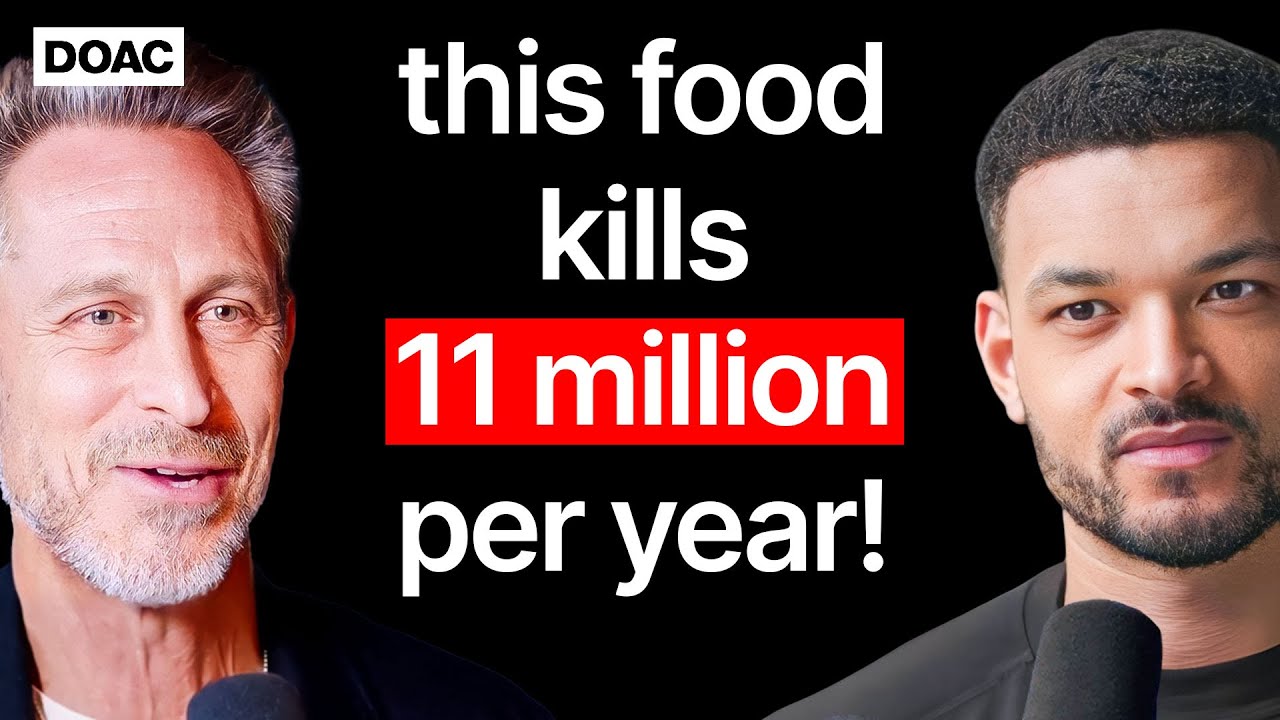
The Longevity Expert: Is There A Link Between Milk & Cancer? + Ozempic Can Really Mess You Up! — The Diary Of A CEO

The Diary Of A CEO

Ultra-processed foods and systemic inflammation drive modern chronic disease, making lifestyle interventions and functional medicine far superior to costly GLP-1 weight-loss drugs.

AI-assisted summary of The Longevity Expert: Is There A Link Between Milk & Cancer? + Ozempic Can Really Mess You Up! — original source. Check the original for full context.

Source published:

Detailed notes

## Background This episode was published on YouTube by The Diary Of A CEO on April 11, 2024. The page description introduces guest Dr. Mark Hyman—a practicing family doctor, founder of The UltraWellness Center, director at the Cleveland Clinic Center for Functional Medicine, and fifteen-time New York Times best-selling author—who discusses functional medicine, the toxic food system, the risks of popular weight-loss drugs like Ozempic, and strategies for reversing biological age.

## TL;DR Dr. Mark Hyman breaks down the core principles of functional medicine, arguing that chronic disease stems from systemic issues like processed foods, environmental toxins, and unaddressed trauma rather than simple isolated symptoms. He critiques modern dairy, refined sugars, and quick-fix weight-loss drugs like Ozempic, advocating instead for lifestyle interventions such as strength training, time-restricted eating, and nutrient-dense whole foods. Drawing on research from Blue Zones and epigenetic science, Dr. Hyman highlights how community, trauma recovery through psychedelics, and comprehensive biomarker testing can lower biological age and extend healthspan.

## Atmosphere & style The conversation carries an urgent yet empowering tone, blending clinical insights with candid personal disclosures. Host Steven Bartlett creates an intimate atmosphere where Dr. Hyman transitions smoothly between sharp systemic critiques of the food industry and vulnerable accounts of his own childhood trauma and health struggles. The dialogue feels both deeply analytical and grounded in real-world human experience, offering listeners a compelling mix of scientific rigor and hopeful action.

## Key takeaways - [03:08](https://www.youtube.com/watch?v=lbzn5iz8Mbo&t=188s) Functional medicine focuses on identifying and addressing the root causes of disease rather than merely treating individual symptoms, recognizing that one root cause can lead to multiple illnesses and vice versa. - [13:06](https://www.youtube.com/watch?v=lbzn5iz8Mbo&t=786s) The modern food landscape, dominated by ultra-processed foods and subsidized sugar, drives widespread metabolic dysfunction, chronic disease, and mental health issues globally. - [15:33](https://www.youtube.com/watch?v=lbzn5iz8Mbo&t=933s) Overcoming biological cravings for junk food requires structural planning and environmental control, as stress and hunger naturally deactivate executive control in the prefrontal cortex. - [24:21](https://www.youtube.com/watch?v=lbzn5iz8Mbo&t=1461s) Standard dietary recommendations for cow's milk are heavily influenced by industry lobbying rather than health benefits, as modern milk contains inflammatory A1 casein and added hormones. - [29:49](https://www.youtube.com/watch?v=lbzn5iz8Mbo&t=1789s) While GLP-1 agonists like Ozempic induce rapid weight loss, they carry high medical risks—such as muscle loss, bowel obstruction, and pancreatitis—without addressing the systemic drivers of obesity. - [40:53](https://www.youtube.com/watch?v=lbzn5iz8Mbo&t=2453s) Intermittent fasting and overnight fasting periods of 12–14 hours trigger autophagy and cellular repair mechanisms that are otherwise suppressed by constant eating. - [47:57](https://www.youtube.com/watch?v=lbzn5iz8Mbo&t=2877s) Longevity in Blue Zones is primarily driven by strong community ties, active daily motion, clean diets free of ultra-processed foods, and a deep sense of life purpose. - [52:18](https://www.youtube.com/watch?v=lbzn5iz8Mbo&t=3138s) Loneliness and social isolation carry biological risks comparable to severe physical toxins, while strong social connections significantly extend life expectancy. - [01:02:03](https://www.youtube.com/watch?v=lbzn5iz8Mbo&t=3723s) Psychological trauma and Adverse Childhood Events (ACEs) physically manifest as chronic disease, but targeted therapies—including psychedelic-assisted treatment—can help resolve root trauma. - [01:13:00](https://www.youtube.com/watch?v=lbzn5iz8Mbo&t=4380s) Biological age can be lowered relative to chronological age through resistance training, optimizing protein intake, overnight fasting, and eliminating artificial sweeteners and ultra-processed food. - [01:22:53](https://www.youtube.com/watch?v=lbzn5iz8Mbo&t=4973s) The exposome—the sum of total lifetime environmental, nutritional, and emotional exposures—exerts a far greater influence on health outcomes and gene expression than genetics alone. - [01:34:24](https://www.youtube.com/watch?v=lbzn5iz8Mbo&t=5664s) Comprehensive biomarker testing allows individuals to identify hidden inflammation, nutrient deficiencies, and metabolic risks before they progress into overt disease.

## Detailed walkthrough Here is a detailed, faithful walkthrough of the transcript section.

---

[00:00](https://www.youtube.com/watch?v=lbzn5iz8Mbo&t=0s) Intro: The Health Crisis and Simple Rules for Longevity

The episode opens with a rapid-fire teaser highlighting core topics discussed throughout the interview, ranging from the hidden issues with modern dairy to the alarming side effects of weight-loss drugs like Ozempic. Dr. Mark Hyman addresses the massive obesity epidemic and expresses deep concern over proposal discussions to prescribe weight-loss drugs to children as young as five years old. He emphasizes that 93% of the population suffers from metabolic dysfunction due to a toxic, highly processed food landscape. This metabolic dysfunction directly fuels a spectrum of health conditions—including mental health struggles, depression, anxiety, ADD, and gun violence—and contributes to 11 million deaths globally each year.

Dr. Hyman stresses that these health issues are not inevitable. He shares an example of a 12-year-old child with severe ADD whose handwriting was completely illegible; within two months of dietary interventions and fixing his gut, the child showed dramatic improvement and excelled in school. He notes that relying on willpower to control food behavior fails because the underlying issue is educational and biological. Eating high-sugar breakfasts like cereal, pancakes, or bagels sets the body up for failure. To counteract these health threats, he highlights practical steps—such as strength training for 20 minutes, three times a week—as vital practices for long-term longevity. Host Stephen Bartlett pauses to thank his audience, pointing out that subscriber rates have improved from 69% unsubscribed viewers down to 63%, with a target goal of reaching 50%.

- **Key Statistics:** 93% of Americans suffer from metabolic dysfunction; poor diet contributes to 11 million deaths per year. - **Key Interventions:** 20 minutes of strength training 3 times per week; eliminating morning sugars and processed foods.

---

[02:06](https://www.youtube.com/watch?v=lbzn5iz8Mbo&t=126s) What Is Functional Medicine?

When asked why listeners should stay tuned, Dr. Hyman promises a window into the future of health and medicine—a fundamental paradigm shift comparable to Columbus demonstrating the Earth is round, Galileo proving the Earth revolves around the Sun, Darwin introducing evolutionary theory, or Einstein revolutionizing physics through relativity. He explains that science is finally deciphering the natural laws of human biology.

Defining functional medicine, Dr. Hyman admits he isn't fond of the term itself, as it can confuse people, but describes it as a system-based methodology and operating system to unpack root causes. Rather than focusing on *what* disease a person has, functional medicine asks *why* they have it. It operates on the principle that one root cause can lead to many symptoms, or one symptom can stem from many root causes.

* "It's the medicine of why, not what—not what disease do you have, but why do you have it."

To illustrate this, he shares two clear examples: 1. **One Cause, Multiple Diseases:** Gluten exposure can trigger conditions as varied as osteoporosis, autism, schizophrenia, rheumatoid arthritis, anemia, and alopecia. 2. **One Disease, Multiple Causes:** Depression is a symptom rather than a primary "Prozac deficiency." It can stem from major emotional trauma, vitamin $D$ deficiency, brain inflammation from gluten, $B_{12}$ deficiency caused by long-term acid blocker use, mercury toxicity from high sushi consumption, omega-3 deficiency from avoiding fish altogether, or insulin resistance and diabetes.

Dr. Hyman references network biology concepts—citing work by Dr. Joseph Loscalzo at Harvard—emphasizing that chronic conditions like Alzheimer's disease require multimodal interventions (diet, lifestyle, exercise, and risk-factor management) rather than a single magic-bullet drug. He notes that advances in deep phenomic diagnostics allow doctors to evaluate the real-time dynamic expression of a person's biology beyond their static genome.

---

[06:29](https://www.youtube.com/watch?v=lbzn5iz8Mbo&t=389s) Dr. Hyman's Personal Health Crisis and Path to Healing

Dr. Hyman shares the personal health crisis that led him to functional medicine. After working at Canyon Ranch health resort, he lived in Beijing, China, during the winter. Breathing air filled with coal-burning exhaust, his air filters daily collected heavy concentrations of mercury. Upon returning from China, a severe gut infection triggered a complete breakdown of his biological systems.

The decline was abrupt: having previously ridden his bicycle 100 miles a day and managed 30 patients daily without needing notes, he suddenly could not walk up a flight of stairs or remember the end of a sentence he had just started. He found himself unable to read a book out loud to his children while simultaneously understanding the words. Diagnosed with severe chronic fatigue syndrome, he felt as though he was "walking through mud" while experiencing systemic immune, gut, and cognitive collapse.

At age 36, facing what felt like sudden-onset dementia, he refused to accept that his condition was purely psychological. Through intensive self-experimentation, cellular-level analysis, and functional medicine principles, he reverse-engineered his path back to health. Applying these principles to his clinical practice yielded rapid turnarounds in patients with long-standing autoimmune conditions, 20-year histories of migraines caused by hidden egg sensitivities, type 2 diabetes, and severe pediatric ADD.

- **Pediatric ADD Case:** A 12-year-old patient with illegible handwriting and severe ADD underwent a protocol removing processed foods and lead, alongside gut optimization and targeted nutrition. Within two months, the boy achieved perfect penmanship and top academic performance. - **Economic & Systemic Burden:** Dr. Hyman notes that chronic diseases now consume nearly $1 out of every $5 in the US economy, threatening to bankrupt both the American healthcare system and the UK's NHS.

---

[13:06](https://www.youtube.com/watch?v=lbzn5iz8Mbo&t=786s) The Toxic Food System and Daily Navigation Strategies

Shifting from micro-level clinical medicine to macro-level root causes, Dr. Hyman explains that chronic diseases cannot be cured solely inside a doctor's office because they originate downstream from farms, food factories, grocery stores, and restaurants. To address this, he authored the book *Food Fix* and established a non-profit advocacy organization in Washington, D.C., working on policy changes such as child-friendly front-of-pack labeling, medically tailored meals, nutrition education, and SNAP (food stamp) reforms. He highlights the absurdity of allocating 10% of the $100 billion SNAP budget to sugar-sweetened beverages that actively drive chronic illness.

When host Stephen Bartlett describes how difficult it is for visitors to the US to avoid weight gain when navigating typical convenience stores and city streets, Dr. Hyman agrees, describing the modern food environment as a "nutritional wasteland" and a "carnival of enticing, colorful, addictive, highly processed food-like substances." He notes that government data from NHANES (National Health and Nutrition Examination Survey) proves that 93% of Americans suffer from metabolic dysfunction.

To navigate this toxic landscape personally, Dr. Hyman adheres to strict rules: * He completely eliminates ultra-processed foods, treating packaged junk items in convenience stores mentally as non-edible objects—comparing them to rocks. * He accepts minimally processed whole foods (e.g., canned sardines, canned tomatoes, sauerkraut, plain yogurt). * He cooks his own meals whenever possible and travels with his own food when doing host appearances and podcasts.

---

Optionally, here are three ways to proceed based on this transcript excerpt:

<ElicitationsGroup message="What would you like to do next?"> <Elicitation label="Draft summary of policy solutions from *Food Fix*" query="Draft a summary of the policy solutions from Food Fix mentioned in the transcript" query_intent="CLICKABLE_SUGGESTION" /> <Elicitation label="Outline the key principles of Functional Medicine" query="Outline the key principles of Functional Medicine discussed in the text" query_intent="CLICKABLE_SUGGESTION" /> <Elicitation label="Continue to Part 2 of the transcript walkthrough" query="Provide the walkthrough for Part 2 of this transcript" query_intent="CLICKABLE_SUGGESTION" /> </ElicitationsGroup>

[15:33](https://www.youtube.com/watch?v=lbzn5iz8Mbo&t=933s) Planning Ahead to Avoid Food Emergencies

Dr. Mark Hyman explains how he manages his daily routine when traveling or working packed schedules. He describes carrying a dedicated "emergency snack pack"—essentially a day's worth of food rations—wherever he goes so he is never forced to make desperate choices when he cannot sit down for a meal. Drawing a parallel to traveling across the globe, Dr. Hyman notes that while people carefully prepare their clothes, equipment, and logistics for a long trip, they rarely apply that same level of intentional planning to what they feed themselves.

Stephen Bartlett shares a recent insight into human neurology that helped him make sense of his own late-night cravings. When a person gets hungry or tired, the prefrontal cortex—the logical, executive center of the brain—becomes less active, while the amygdala and emotional, dopamine-seeking structures take over. Stephen reflects on how planning his daily food intake in the morning using his prefrontal cortex shields him from giving in to high-carb, sugary temptations late at night when his resolve is weak.

* Willpower is ineffective against primitive, ancestral evolutionary mechanisms designed to prevent starvation when blood sugar crashes. * Lack of sleep and elevated stress spike cortisol and ghrelin (the hunger hormone), driving intense cravings for carbs and sugar. * Studies show that sleep-depriving young, healthy college students rapidly increases their sugar cravings and leads to weight gain.

[18:24](https://www.youtube.com/watch?v=lbzn5iz8Mbo&t=1104s) Overcoming Economic and Educational Barriers to Healthy Eating

Addressing the belief that healthy eating is an expensive luxury, Dr. Hyman argues that while economic disparities in healthcare are real, education is often the single greatest predictor of health outcomes. He recalls a conversation with a doctor at a clinic in Bed-Stuy (Bedford–Stuyvesant), an underserved area in Brooklyn, who emphasized that education—not wealth—is what ultimately empowers individuals to make better choices. Dr. Hyman illustrates this through his experience filming the documentary *Fed Up*, where he visited one of America's worst food deserts in Easley, South Carolina.

In Easley, Dr. Hyman worked directly with a family living in a trailer on $1,000 a month for food and disability assistance. The retail food environment index in their area was severely skewed, with fast-food outlets outnumbering healthy grocery options ten to one. The family faced severe health crises: * The mother was over 100 pounds overweight. * The 42-year-old father suffered from severe obesity, type 2 diabetes, and was already undergoing kidney dialysis. * The 16-year-old son had 50% body fat (where normal levels for young men range from 10% to 20%) and was pre-diabetic.

Instead of lecturing them, Dr. Hyman audited their kitchen. He found ultra-processed foods, boxes, and freezer meals loaded with trans fats and high-fructose corn syrup—even in items labeled "diet" or marketed as healthy options. Dr. Hyman shares a key rule of thumb: "If it has a health claim on the label, don't eat it."

Using the free *Good Food on a Tight Budget* guide from the Environmental Working Group (ewg.org), Dr. Hyman showed the family how to cook whole foods from scratch on a tiny budget. Lacking proper kitchen tools, they had to chop onions and sweet potatoes with a butter knife until Dr. Hyman bought them basic knives and cutting boards on Amazon.

The immediate and long-term results of this single intervention were life-changing: * In the first week alone, the family lost a combined 18 pounds. * Over the following year, the mother lost 100 pounds. * The father lost 45 pounds and successfully qualified for and received a kidney transplant. * The 16-year-old son lost 132 pounds and went on to become the first member of his family to attend college, ultimately going to medical school.

Dr. Hyman notes that ultra-processed food is linked to 11 million global deaths annually and strongly correlates with mental health problems, aggression, violence, depression, anxiety, ADD, and cognitive decline. While a proposed bill in U.S. Congress aims to restrict ultra-processed food purchases in pilot SNAP (food stamp) programs for children, the massive food industry continues to lobby heavily against such regulations.

[24:21](https://www.youtube.com/watch?v=lbzn5iz8Mbo&t=1461s) The Truth About Cow's Milk, Health Claims, and Dairy Misconceptions

Stephen Bartlett recalls chugging milk straight from the carton as a kid, believing popular claims that it would make him grow taller like his older brothers. Dr. Hyman addresses the widespread cultural myth that milk builds strong bones, pointing out the deep involvement of the dairy industry and government policy in driving these narratives.

> "Milk is not Nature's perfect food. It's only Nature's perfect food if you're a calf."

Dr. Hyman highlights a seminal review paper, *Milk and Health*, published in the *New England Journal of Medicine* by two Harvard scientists who dismantled common claims surrounding dairy consumption. Historically, programs like the "Got Milk?" campaign—supported by government checkout programs using taxpayer dollars—promoted milk aggressively until regulatory scrutiny forced adjustments due to a lack of scientific backing. Official dietary guidelines in the U.S. recommend three glasses of milk per day for adults and two for children, which is required for schools to receive federal lunch funding, despite mounting evidence challenging its benefits.

Scientific and health concerns associated with standard commercial cow's milk include: * Skim milk is linked to weight gain because it lacks fat to satisfy appetite. * Higher dairy consumption is associated with an increased risk of prostate cancer and does not lower overall bone fracture risks. * Milk can trigger digestive distress, food allergies, sensitivities, and autoimmune conditions like type 1 diabetes. * Dr. Hyman recalls treating a young child in the ER with recurrent ear infections that began immediately after transitioning from breast milk to cow's milk at 12 months old. * Systemic issues stem from corporate capture, where food industry lobbying heavily influences government policy and agricultural bills (e.g., the Farm Bill).

[27:54](https://www.youtube.com/watch?v=lbzn5iz8Mbo&t=1674s) A1 vs. A2 Dairy, Hormones, and Alternative Options

Dr. Hyman delves into the biology of modern dairy production, contrasting modern industrial cow's milk with traditional sources. Most modern milk comes from Holstein cows, bred in a highly uniform genetic pool, which produce A1 beta-casein protein. A1 casein breaks down into inflammatory peptides that frequently cause gut distress, congestion, skin issues, and systemic inflammation.

In contrast, heirloom cow breeds (like Jersey or Guernsey cows), along with goats and sheep, produce A2 casein, which is significantly less inflammatory and much easier for the human body to digest.

Modern milk processing further compounds these issues through industrial farming practices: * Standard milk undergoes high-heat pasteurization, homogenization, and frequent addition of synthetic growth hormones and estrogens. * Commercial dairies routinely milk pregnant cows, resulting in elevated levels of naturally occurring hormones (up to 60 distinct hormones) in the final product. * Roughly 75% of the world's population is lactose intolerant or sensitive to dairy proteins.

Dr. Hyman notes that healthier alternatives include sheep or goat milk, A2 dairy products, and goat whey protein—which he uses personally for his daily protein shakes because it does not trigger the congestion or breakouts he experiences from standard A1 whey protein.

[29:49](https://www.youtube.com/watch?v=lbzn5iz8Mbo&t=1789s) The Rise of Ozempic and the Weight Loss Drug Craze

The conversation turns to the explosive popularity of GLP-1 receptor agonist drugs like Ozempic, which have dramatically inflated the stock value and market cap of pharmaceutical manufacturers like Novo Nordisk (making it a dominant contributor to Denmark's national GDP).

Stephen notes that while the general public often views these weekly injections as miracle treatments with few obvious drawbacks, Dr. Hyman crosses his arms and prepares to address the nuance. Acknowledging that the global obesity crisis desperately needs solutions, Dr. Hyman explains why a once-a-week injection that suppresses appetite by bypassing natural biological satiety signals appears so extraordinarily appealing to millions of people.

[31:01](https://www.youtube.com/watch?v=lbzn5iz8Mbo&t=1861s) The Ozempic Hype, How It Works, and Its Short-Term Side Effects

Dr. Mark Hyman addresses the massive cultural wave surrounding GLP-1 receptor agonists like Ozempic, pointing out that even the CEO of Novo Nordisk publicly reported receiving worried calls from processed food executives concerned that their market share was declining as people lost their appetites. To explain how it functions, Dr. Hyman notes that Ozempic mimics glucagon-like peptide-1 (GLP-1), a hormone naturally produced by the human body to regulate insulin, blood sugar, weight, and appetite. Originally engineered to manage diabetes, its dramatic side effect of weight loss turned it into a blockbuster anti-obesity drug—a pivot Dr. Hyman humorously compares to how Viagra was originally tested for blood pressure before its unexpected efficacy for erectile dysfunction was discovered.

While acknowledging that Ozempic can be a effective "pharmacological appetite straightjacket" for people struggling with severe obesity who want to avoid surgery, Dr. Hyman highlights the immediate downside: the intense short-term side effects. Users frequently experience severe nausea and vomiting, which leads many patients to abandon the medication entirely.

- **Global Context:** Over 2 billion people worldwide are currently classified as overweight or obese. - **Natural GLP-1 Boosters:** Natural production of GLP-1 can be enhanced through specific gut bacteria (e.g., *Akkermansia* probiotics), dietary adjustments, and eating patterns.

---

[32:53](https://www.youtube.com/watch?v=lbzn5iz8Mbo&t=1973s) The Hidden Costs and Danger of Muscle Loss on GLP-1 Agonists

The discussion turns to the substantial long-term downsides and economic costs of relying on GLP-1 drugs. At a retail cost of $1,300 to $1,700 per month (around £1,500), universal coverage for everyone who is overweight in the United States alone would carry a staggering price tag of $5.1 trillion. Furthermore, because Ozempic does not instill behavioral changes or habit building, stopping the drug almost inevitably leads to rapid weight regain.

Dr. Hyman stresses a widely overlooked danger: up to 50% of the weight lost on Ozempic comes from muscle tissue rather than fat. Muscle serves as the central engine of human metabolism, burning seven times more calories than fat tissue. Losing muscle severely lowers baseline metabolic rate, leaving individuals with a slower metabolism after stopping the drug than before they started. Mitigating this risk requires strict DEXA scan monitoring, high protein intake, and rigorous heavy resistance training—protocols that most typical users fail to receive or follow.

- **Economic Impact:** Universal US coverage would cost ~$5.1 trillion annually at $1,300–$1,700/month per patient. - **Metabolic Impact of Muscle:** Muscle tissue burns 7x the calories of fat tissue per pound at rest.

---

[34:41](https://www.youtube.com/watch?v=lbzn5iz8Mbo&t=2081s) Long-Term Medical Risks, Systemic Causes, and Industry Pushback

Drawing on a classic medical adage from the *New England Journal of Medicine*—"be sure to use new drugs as soon as they come out, before the side effects develop"—Dr. Hyman warns that two to three years of real-world data are revealing alarming long-term complications. While standard medical interventions like statins reduce heart disease risk by 20% to 30%, Ozempic exhibits side effect increases that dwarf typical baseline risks.

Dr. Hyman argues that relying on pharmaceuticals misses the root cause: obesity is not an "Ozempic deficiency," but the result of an ultra-processed food system, environmental toxins, and sedentary lifestyle choices. Reversing the epidemic demands broad policy shifts, agricultural reform, and public health education. However, genuine systemic reform faces fierce resistance because the global food industry generates $16 to $17 trillion annually—outstripping the total gross domestic product of nearly every nation on Earth.

- **Bowel Obstruction Risk:** Increased by **450%** on GLP-1 agonists (requiring surgical intervention when bowel motility halts). - **Pancreatitis Risk:** Increased by **900%** (a life-threatening inflammation affecting digestion and insulin regulation). - **Global Food Industry Size:** Estimated at **$16–$17 trillion** per year.

---

[37:03](https://www.youtube.com/watch?v=lbzn5iz8Mbo&t=2223s) Insurance Coverage, Future Pricing, and Pediatric Concerns

Host Stephen Bartlett speculates whether GLP-1 drugs represent the future of treating metabolic disease, guessing that prices will plummet as competing iterations flood the market following initial clinical trial exclusivity. Dr. Hyman confirms that while any doctor can write an off-label prescription, standard health insurance providers rarely cover drugs like Ozempic solely for weight loss, though approved variations like Wegovy receive intermittent coverage.

Dr. Hyman expresses deep alarm over ongoing proposals to prescribe lifelong GLP-1 injections to children as young as five years old. Both speakers conclude that there is "no free lunch" in pharmacology, emphasizing that while severely obese individuals facing life-threatening conditions may benefit from GLP-1 therapy as a temporary tool, using it as a quick cosmetic fix for minor weight loss presents unacceptable health risks.

- **Target Approvals:** Proposals exist to approve GLP-1 medications for children down to 5 years of age for lifelong administration.

---

[39:29](https://www.youtube.com/watch?v=lbzn5iz8Mbo&t=2369s) Fruit, Fructose, and the Case for Protein-Rich Breakfasts

When asked about his stance on fruit, Dr. Hyman enthusiastically defends whole fruit while adding crucial nuance regarding individual metabolic health. Whole fruit is packed with phytonutrients, fiber, and phytochemicals that buffer its sugar content. However, for severely diabetic patients lacking metabolic resilience, even high-sugar fruits like plums can trigger dangerous glucose spikes (often detectable using continuous glucose monitors, whereas lower-glycemic choices like apples might not).

Dr. Hyman strongly condemns fruit juice, linking it directly to childhood obesity due to the lack of fiber. He cautions against consuming sugar or refined carbs first thing in the morning—such as conventional breakfast items like cereals, waffles, pancakes, pastries, and sweetened coffees. Instead, morning meals should focus on quality protein and healthy fats to stimulate metabolism and muscle protein synthesis without crashing insulin levels.

> "If you eat sugar in the morning, which is essentially what we eat in the world today... it's the worst possible thing we can do for our biology. It jacks up our blood sugar and insulin and ends up causing us to gain weight."

---

[40:53](https://www.youtube.com/watch?v=lbzn5iz8Mbo&t=2453s) Time-Restricted Eating and Activating the Body's Repair Systems

Moving to the timing of meals, Dr. Hyman critiques modern habits where people eat constantly from the moment they wake up until right before bed. This constant intake deprives the body of overnight fasting windows that are necessary to trigger innate cellular repair mechanisms. Just as the body automatically heals a broken bone or a deep skin cut by recruiting stem cells and growth factors without conscious thought, it possesses internal mechanisms to regenerate tissue—provided those pathways are not constantly suppressed by food.

Disregulated nutrient sensing—one of the core recognized "Hallmarks of Aging"—occurs when a continuous supply of sugar, refined starch, and ultra-processed foods overwrites these natural maintenance routines. Dr. Hyman recommends a baseline overnight fast of at least 12 hours (e.g., 6:00 PM to 6:00 AM) and ideally 14 hours (e.g., finishing dinner at 6:00 PM and breaking the fast at 8:00 AM) to allow cellular cleanup systems to function efficiently.

- **Recommended Fasting Window:** Minimum **12 hours** overnight; optimal target is **14 hours**. - **Pre-Bed Cutoff:** Cease all food intake at least **3 hours** prior to going to sleep.

---

[42:45](https://www.youtube.com/watch?v=lbzn5iz8Mbo&t=2565s) The Evolutionary Story of Fasting: Lessons from the Hadza

Dr. Hyman provides evolutionary context for fasting, reflecting on his recent expedition to Tanzania to spend time with the Hadza tribe—one of the last remaining hunter-gatherer populations on Earth. Watching the Hadza spend hours trekking, digging up roots, and hunting birds highlighted how much physical labor was historically required to secure a single meal. Humans evolved under conditions of alternating feast and famine, forcing the genome to adapt mechanisms that optimize biological function when food is scarce.

During fasting periods, the body initiates internal conservation routines: it improves blood sugar sensitivity, clears out damaged proteins, reduces systemic inflammation, and stimulates mitochondrial biogenesis (the creation of new cellular powerhouses). It also activates autophagy—the cell's internal "vacuum cleaner" that breaks down old, dysfunctional cellular debris and recycles the raw components. Dr. Hyman even notes that historical cohorts of concentration camp survivors frequently lived into their 90s or 100s, partially due to severe, albeit tragic, starvation cycles resetting cellular longevity pathways.

> "It was a project! We ran around for hours... The body has had to deal with periods of feast and famine before, so what it's got built into it is a system of conservation and repair when we don't eat."

---

[44:36](https://www.youtube.com/watch?v=lbzn5iz8Mbo&t=2676s) Calorie Restriction vs. Fasting Mimicry (mTOR, Rapamycin, and Metformin)

Dr. Hyman distinguishes between chronic calorie restriction and targeted fasting strategies. While animal studies consistently demonstrate that reducing overall caloric intake by one-third extends lifespan by one-third (equivalent to a human living to 120 years), chronic starvation is unpleasant and dangerous, leading to muscle wasting and hormone disruption. He humorously recalls meeting a member of the Calorie Restriction Society who ate five pounds of raw celery for breakfast just to feel full without exceeding his daily calorie allotment.

Instead of living in state of perpetual hunger, modern longevity medicine focuses on "fasting mimetic" hacks that trigger the same cellular signaling pathways without malnutrition:

- **Autophagy & mTOR Inhibition:** The target of rapamycin (mTOR) pathway drives protein synthesis and muscle growth when stimulated by dietary protein. However, chronic activation accelerates cellular aging. Drugs like rapamycin inhibit mTOR, mimicking the cellular cleanup triggered by starvation. - **AMPK Activation:** Nutrient-sensing pathways like AMP-activated protein kinase (AMPK) detect low cellular energy states. Medications like metformin are being studied for their ability to activate AMPK, triggering metabolic longevity switches even in nutrient-replete environments.

[46:47](https://www.youtube.com/watch?v=lbzn5iz8Mbo&t=2807s) Fasting, mTOR, and the Goldilocks Balance

Dr. Mark Hyman addresses fasting-mimicking hacks and calorie restriction, explaining that extreme approaches can backfire. While restricting calorie intake or avoiding mTOR activation is intended to encourage autophagy and combat aging or cancer, overdoing it can lead to severe muscle loss. He describes human biology as a delicate balance, similar to Goldilocks: body systems require both activation and inhibition to function properly, just like taking a breath in and out, or balancing wakefulness and sleep.

- Extreme calorie restriction or strict veganism aimed at stopping mTOR activation can unintentionally cause muscle wasting. - The body requires a dynamic cycle of activation and recovery, rather than constant suppression of cellular pathways. - Discussions around fasting and strict dietary restrictions must be handled carefully, as they can inadvertently trigger or exacerbate eating disorders.

---

[47:57](https://www.youtube.com/watch?v=lbzn5iz8Mbo&t=2877s) Lessons from the Blue Zones

Dr. Hyman discusses his visits to the Blue Zones—a term coined by his friend Dan Buettner to describe regions across the globe where people consistently live extraordinarily long, healthy lives. Dr. Hyman specifically spent time in Ikaria (Greece) and Sardinia (Italy). These remote, isolated areas have largely resisted modern, ultra-processed food systems. Instead, residents grow their own food, tend heirloom livestock, and maintain an active daily routine built into their environment.

- The five recognized Blue Zones are Okinawa (Japan), Sardinia (Italy), Nicoya Peninsula (Costa Rica), Ikaria (Greece), and Loma Linda (California). - Dr. Hyman observed couples in these regions with a combined age over 210 years, living independently and staying physically vibrant into their late 90s and 100s. - An 87-year-old woman in Ikaria managed a massive hillside mini-farm, running up steep terrain faster than younger visitors and cooking every meal from scratch. - Livestock in these regions consist of heirloom sheep and goats grazing on wild, phytochemical-rich plants; as a result, their milk and cheese contain high levels of health-promoting compounds like catechins, rivaling those found in green tea. - Physical activity is natural and continuous: a 95-year-old Sardinian shepherd named Panagiotis hiked five miles daily across rugged, mountainous terrain to herd his sheep, retaining a booming voice and upright posture. - Chronic stress is virtually absent; local farmers like Silvio view daily challenges—such as catching an escaped goat—as normal life events rather than psychological stressors.

---

[52:18](https://www.youtube.com/watch?v=lbzn5iz8Mbo&t=3138s) Community, Loneliness, and the Epidemic of Isolation

Beyond diet and exercise, a central driver of longevity in the Blue Zones is tight-knit community and a deep sense of social belonging. Residents remain fully integrated into family and community life as they age; there are no nursing homes, and older individuals continue to feel useful and valued. Dr. Hyman contrasts this with modern Western society, where isolation and loneliness have reached epidemic proportions.

- A 100-year-old woman named Julia (who playfully measured her age as "100 years and 3 months") actively crafted items for weddings while living with her niece and nephew. - Loneliness has severe biological consequences, with research indicating its health risks are equivalent to smoking two two packs of cigarettes a day. - The U.S. Surgeon General issued an advisory highlighting social connection as a critical public health priority due to its role in driving disease and mortality. - Modern lifestyle shifts—such as geographic mobility, screen-dominated interaction, and hyper-individualistic culture—have stripped away the daily, face-to-face community connections that historically sustained human health. - While emerging technologies like virtual reality (e.g., Apple Vision Pro) offer impressive digital immersion, they threaten to further isolate people from physical human contact, touch, and authentic community. - Emerging social initiatives like "The Belong Center" are being built to combat isolation by fostering real-world, in-person connection.

---

[56:15](https://www.youtube.com/watch?v=lbzn5iz8Mbo&t=3375s) Systemic Solutions: Community as Medicine and The Daniel Plan

Dr. Hyman highlights how chronic disease is socially contagious, noting that an individual's risk of obesity or poor health is strongly influenced by their social circle. Recalling his experience in Haiti alongside Dr. Paul Farmer—who built a global network of over 11,000 community health workers to fight TB and HIV—Dr. Hyman stresses that long-term health transformation requires community-based systems rather than isolated medical advice.

- Dr. Hyman co-created "The Daniel Plan" with Pastor Rick Warren at Saddleback Church, leveraging pre-existing small groups to deliver a faith-based wellness curriculum. - In its first week, 15,000 church members enrolled, collectively losing over 250,000 pounds in the first year without formal health coaches or nutritionists. - The program was built on the "5 Fs": Faith, Friends, Food, Fitness, and Focus (mindset). - The framework was subsequently scaled across thousands of churches and adapted into group models at the Cleveland Clinic Center for Functional Medicine.

---

[59:23](https://www.youtube.com/watch?v=lbzn5iz8Mbo&t=3563s) Purpose, Lifespan, and the Danger of Retirement

Having a clear sense of purpose is one of the most potent longevity factors known to medical science. Dr. Hyman cites research demonstrating that individuals with a defined sense of meaning live significantly longer than those without one. Conversely, abrupt life transitions—such as retirement or the loss of a life partner—frequently trigger rapid physical and cognitive decline.

- Research published in the *Journal of the American Medical Association* (JAMA) shows that individuals with a clear sense of meaning and purpose live up to 7 years longer. - Purpose does not require a traditional career; it can stem from creative pursuits, family roles, personal goals, or social missions. - Dr. Hyman describes his own purpose as ending unnecessary suffering through functional medicine and empowering people with health data via initiatives like Function Health. - Statistically, retirement at age 65 correlates with a sharp rise in mortality, often driven by sudden loss of routine, social engagement, and physical activity. - The death of a lifelong spouse severely increases bereavement mortality; Dr. Hyman recalls a healthy male patient who rapidly developed heart failure and passed away following the loss of his wife of 40 years.

[01:02:03](https://www.youtube.com/watch?v=lbzn5iz8Mbo&t=3723s) The Mind-Body Connection: Broken Heart Syndrome and Trauma

Dr. Mark Hyman opens this section with a stark medical story demonstrating the immense power of the human mind over physical health. He recounts a patient who suffered literal heart failure—a condition clearly visible on medical imaging and scans—triggered entirely by severe emotional shock and heartbreak. Dr. Hyman points out that the medical literature documents this exact phenomenon (takotsubo cardiomyopathy, or "broken heart syndrome"). By addressing the patient's emotional heartbreak alongside energy healing, they were able to restore his heart function. As Dr. Hyman puts it, "the biggest and most powerful pharmacy in the world is between your ears."

The conversation transitions directly into the role of unresolved trauma in overall longevity and chronic illness. Dr. Hyman reflects on how medical schools traditionally failed to teach the profound link between psychological trauma and physical disease. He introduces the ACE questionnaire (Adverse Childhood Events), a free, validated tool that asks individuals about childhood adversity—such as parental divorce, household alcoholism, physical or sexual abuse, domestic violence, or incarcerated family members.

``` High ACE Score ──► Increased Risk: Obesity, Autoimmune Disease, Cancer, Heart Disease, Diabetes ```

Dr. Hyman emphasizes that emotional trauma is physically registered in the body, citing Carolyn Myss's famous phrase, "your biography becomes your biology." However, he notes that the relationship is a two-way street: "your biology can become your biography." Poor diet, nutritional deficiencies, and environmental toxins (such as mercury poisoning) directly impair mental health and alter a person's life narrative.

- **ACE Questionnaire**: Measures exposure to childhood trauma; higher scores directly correlate with elevated risks of chronic physical illnesses later in life. - **Bidirectional Link**: Psychological trauma manifests as physical disease, while physical ailments (inflammation, toxicity) degrade psychological well-being.

---

[01:04:20](https://www.youtube.com/watch?v=lbzn5iz8Mbo&t=3860s) The Psychedelic Revolution in Trauma and Mental Health

Dr. Hyman highlights the emerging revolution in psychedelic medicine as a ground-breaking frontier for treating hard-to-manage conditions like Post-Traumatic Stress Disorder (PTSD), severe depression, and anxiety. Historically, traditional medicine could only offer sedatives or talk therapy, which often yielded limited results. Psychedelics operate differently from standard pharmaceuticals: rather than requiring daily lifelong dosing—unlike drugs like Ozempic—a single session or a few guided sessions can permanently alter brain structure and response. They stimulate compounds like BDNF (Brain-Derived Neurotrophic Factor), encouraging neuroplasticity, growing new neural connections, and repairing damaged pathways.

The host, Steven Bartlett, shares his deep personal connection to this field. Steven reveals that he spent a year and a half heavily involved with a psychedelic company called ATAI Life Sciences, where he invested seven figures and served as Creative Director to support their mission before their $3.4 billion NASDAQ IPO. Steven also collaborates with research organizations like MAPS (Multidisciplinary Association for Psychedelic Studies) and Compass Pathways, emphasizing his belief in the transformative clinical research behind compounds like psilocybin.

When Steven asks Dr. Hyman about his personal experience, Dr. Hyman candidly admits to being a "biology adventurer." Having grown up in the 1970s, he shares that psilocybin mushrooms were pivotal to his personal awakening, and he has since explored LSD, peyote, ayahuasca, and *Bufo* (DMT).

- **Neuroplasticity Mechanism**: Psychedelics boost BDNF (Brain-Derived Neurotrophic Factor), promoting the growth of new brain connections and structural repair. - **Dosing Difference**: Unlike traditional daily psychiatric drugs, psychedelic-assisted therapy often requires only 1–2 sessions to produce lasting physiological changes. - **Key Organizations**: MAPS and Compass Pathways lead clinical trials studying psilocybin and MDMA for PTSD, treatment-resistant depression, and anxiety.

---

[01:07:10](https://www.youtube.com/watch?v=lbzn5iz8Mbo&t=4030s) Ibogaine, Addiction, and the Food Addiction Hypothesis

The discussion turns to Ibogaine, a potent psychoactive compound extracted from the root bark of the West African *Tabernanthe iboga* plant. Dr. Hyman discusses research from Stanford University demonstrating how a single dose of ibogaine can eliminate severe physiological narcotic withdrawal symptoms virtually overnight. Active metabolites like noribogaine remain in the system for extended periods, blocking opioid receptors and curbing cravings.

This leads Dr. Hyman to propose an innovative hypothesis regarding food addiction. Citing the Yale Food Addiction Scale, he highlights alarming data showing that 14% of adults and 12% of children globally meet the clinical criteria for addiction to ultra-processed foods, refined sugar, and simple carbohydrates.

> "I actually talked to one of the leading ibogaine researchers. I said, 'Wouldn't it be interesting to do a pilot where we took people who had food addiction and we gave them ibogaine and we saw what happened?'"

The two also address the serious medical risks associated with ibogaine. Its primary side effect is cardiac toxicity—specifically, prolonging the QTc interval, which can induce fatal arrhythmias. Dr. Hyman explains that medical protocol manages this risk through continuous monitoring and pre-treatment with high doses of intravenous (IV) magnesium, a standard emergency medicine intervention used to stabilize cardiac electrical activity.

- **Yale Food Addiction Scale Rates**: 14% of adults and 12% of children suffer from ultra-processed food addiction. - **Ibogaine Mechanism**: Derived from West African tree bark; its metabolite noribogaine blocks addiction receptors and halts physiological withdrawal. - **Cardiac Pretreatment**: Pre-treating patients with IV magnesium counteracts the QTc prolongation risk associated with ibogaine administration.

---

[01:09:22](https://www.youtube.com/watch?v=lbzn5iz8Mbo&t=4162s) Healing Personal Trauma: Dr. Mark Hyman's Journey

Dr. Hyman opens up about his own childhood trauma and its long-term impact on his life. He shares that he experienced incest during his youth and grew up in a difficult household. His mother was a "parentified child" of deaf parents who became her parents' caretaker early on. She carried that dynamic into adulthood, treating Dr. Hyman as her personal therapist while navigating toxic marriages with broken men. This left Dr. Hyman with a deep inner emptiness and a belief that love meant taking care of broken people.

Despite being exceptionally high-functioning professionally as a doctor and author, Dr. Hyman notes that this unhealed trauma heavily sabotaged his adult romantic relationships. He developed an "anxious attachment style," characterized by a constant fear of abandonment. He would suppress his true feelings or withhold desires out of fear that honesty would cause his partners to leave. He recounts a specific relationship with a partner who had an "avoidant attachment style"; after not seeing her for three weeks, her need for space triggered visceral panic and fear in him.

Through dedicated medicine journeys, MDMA-assisted therapy, psilocybin work, and therapeutic frameworks like Byron Katie's "The Work," Dr. Hyman successfully rewired his psychological conditioning. He describes how the critical internal dialogue in his mind fundamentally changed, granting him a lasting sense of internal safety and emotional security that eliminated his relationship panic.

- **Attachment Styles**: Unaddressed childhood trauma manifested as anxious attachment, causing fear-based communication and relationship strain. - **Therapeutic Modalities**: Healing was achieved through MDMA and psilocybin-assisted therapies, medicine journeys, and Byron Katie's "The Work."

---

[01:13:27](https://www.youtube.com/watch?v=lbzn5iz8Mbo&t=4407s) Upgrading Your Biological and Psychological Software

Dr. Hyman reflects on his own recovery from severe chronic illness—including Chronic Fatigue Syndrome, toxic mold illness, and Lyme disease—recalling how he spent ten painful years piecing together solutions without a roadmap. He urges people not to wait until their 50s or 60s to address their health or trauma, emphasizing that earlier intervention prevents decades of unnecessary suffering.

Addressing a common misconception, Steven notes that many people view their personality, trauma, and physical baseline as fixed traits ("this is just who I am"). Dr. Hyman strongly rejects this fatalistic view, asserting that modern science offers the tools to upgrade both biological and psycho-emotional software at any age, whether someone is 25 or 65.

To illustrate this, Dr. Hyman reveals his own biological metrics: despite being chronologically 65 years old, testing confirms his biological age is 43. This is measured via epigenetic clocks that analyze DNA methylation patterns on the epigenome—the regulatory system above the genome that shifts in response to lifestyle factors like diet, toxins, and stress. He concludes that just as functional medicine can reverse biological age and chronic physical disease, psychedelic medicine represents an "Ozempic for mental health"—offering high efficacy and a strong safety profile without requiring daily long-term use.

- **Biological vs. Chronological Age**: Dr. Hyman is chronologically 65, but tests at a biological age of 43 due to epigenetic interventions. - **Epigenetics**: The epigenome regulates gene expression and responds dynamically to lifestyle changes, diet, stress, and environmental exposure.

Here is a detailed, faithful walkthrough of the transcript.

---

[01:17:29](https://www.youtube.com/watch?v=lbzn5iz8Mbo&t=4649s) Practical Strategies for Lowering Biological Age

Stephen Bartlett asks Dr. Mark Hyman for practical advice on lowering his biological age. Stephen, who is 31, expresses a desire to be 25 or 21 biologically. He jokingly contrasts this approach with previous guest Bryan Johnson, whose intense routine involves strict schedules, $5,000 contraptions, and eating "two blades of grass for lunch." Stephen asks for the 80/20 rule—the simple things that yield the biggest impact. Dr. Hyman highlights core tenets from his book *Young Forever*: eliminating ultra-processed foods, drastically cutting sugar and refined starches/flour, and engaging in regular exercise.

When it comes to diet, Dr. Hyman emphasizes fasting 12 to 14 hours overnight and eating 30 to 40 grams of protein in the first meal of the day to build muscle, which he calls the "currency of longevity." Maintaining muscle is vital to remaining strong and avoiding age-related functional decline, such as struggling to tie shoelaces or stand up from a chair. Furthermore, he recommends a phytochemically rich diet packed with colorful vegetables and healthy fats, suggesting that roughly 75% of one's plate should consist of vegetables.

* Overnight fasting windows should ideally be between 12 to 14 hours. * Morning protein intake should aim for 30 to 40 grams to promote muscle synthesis. * 75% of the diet's volume on a plate should be made up of vegetables.

---

[01:19:18](https://www.youtube.com/watch?v=lbzn5iz8Mbo&t=4758s) Meat, Protein Requirements, and Resistance Training

In response to Stephen's question about the risks of eating meat, Dr. Hyman points to historical precedents like the Lakota Plains Native Americans at the turn of the 20th century. Despite eating almost exclusively bison—including organs, bone marrow, and liver, alongside a few wild berries or roots—they were among the longest-lived populations on earth, often living past 100 years. Meat is one of the most nutrient-dense foods and an optimal protein source for building muscle. While regeneratively raised meat (such as elk, bison, venison, or grass-fed beef) and pasture-raised chicken are ideal, they can be harder to source.

Dr. Hyman clarifies that as people age, they develop "anabolic resistance," requiring higher protein intake and increased exercise to maintain muscle mass. The recommended dietary allowance (RDA) of 0.8 grams of protein per kilogram of body weight is designed merely to prevent deficiency diseases, not to optimize health. For active individuals lifting weights, he recommends 0.5 to 1 gram of protein per pound of body weight per day (roughly double the standard RDA). Stephen shares that he consumed 32 grams of protein from a small bag of biltong (South African beef jerky) for lunch, demonstrating how achievable a daily target can be when combined with a morning protein shake. In addition to diet, Dr. Hyman notes that strength training at least three times a week for 20 minutes is critical to prevent sarcopenia (age-related muscle loss), which otherwise triggers metabolic dysfunction, pre-diabetes, and systemic inflammation.

* **RDA vs. Optimal Protein:** 0.8 g/kg prevents deficiency, but optimal muscle health requires up to 0.5–1.0 g per pound (approx. 1.1–2.2 g/kg). * **Target Minimum:** ~30 grams of protein three times a day. * **Exercise Recommendation:** Minimum of 20 minutes of resistance/strength training, 3 times per week.

---

[01:22:53](https://www.youtube.com/watch?v=lbzn5iz8Mbo&t=4973s) Artificial Sweeteners and Life's Broader "Exposome"

When asked about artificial sweeteners found in diet drinks, Dr. Hyman shares that he recently reviewed two studies claiming artificial sweeteners have no negative health effects. However, upon checking the funding sources, he discovered one was entirely funded by the American Beverage Association (formerly the American Soda Pop Association) and the other was linked to Coca-Cola and the International Sweeteners Association. He advises following the money; while artificial drinks may be preferable to sugar-loaded soda, they are far worse than water due to their negative impact on the gut microbiome.

Beyond diet, Dr. Hyman defines the concept of the **exposome**—the sum total of every exposure over a lifetime (food, thoughts, toxins, relationships, microbiome) and how it influences biological function. While the genome is fixed, 90% of disease is driven by the exposome.

> "Follow the money... Is it better than drinking soda? Yes. Is it better than drinking water? No."

* 90% of chronic disease risk is determined by the exposome rather than genetics. * Stress management tools like the NuCalm app use binaural beats to guide the brain into relaxed wave states. * Key lifestyle elements for biological age include strong community, love, stress reduction, and genuine enjoyment of life.

---

[01:25:58](https://www.youtube.com/watch?v=lbzn5iz8Mbo&t=5158s) Epigenetics and Transgenerational Trauma

Dr. Hyman explains how epigenetics dictates gene expression without altering the underlying DNA sequence. He uses a piano analogy: if your DNA consists of the 88 keys on a keyboard capable of playing any genre of music, the **epigenome is the piano player** controlling which songs are played based on life experiences, diet, and environment. Epigenetic clocks can measure biological age, and lifestyle interventions or phytochemicals can actually reverse biological age. He notes Japanese scientist Shinya Yamanaka's Nobel Prize-winning discovery of transcription factors (Yamanaka factors) that can reprogram mature cells back into pluripotent embryonic-like stem cells.

Addressing whether trauma is inherited across generations, Dr. Hyman asserts that the scientific data is definitive. Children of Holocaust survivors display altered stress responses, and children of mothers who were pregnant during the September 11 attacks show altered gene expression linked to higher anxiety and disrupted stress hormone processing. In animal studies, exposing a grandmother mouse to glyphosate (the active ingredient in Roundup, sprayed on 70% of crops) causes disease and epigenetic disruptions three generations later in mice that were never directly exposed to the chemical. He compares this to Jean-Baptiste Lamarck's early theories on inherited environmental adaptations, which complement Charles Darwin's theories of long-term natural selection.

* **Piano Analogy:** DNA = 88 keys; Epigenome = the piano player selecting the tune. * **Glyphosate Impact:** Environmental toxins like glyphosate induce disease patterns that persist across 3 generations in animal models.

---

[01:30:00](https://www.youtube.com/watch?v=lbzn5iz8Mbo&t=5400s) The Value of "Being" and the Healing Power of Connection

Reflecting on his primary takeaway from years of studying health and longevity, Dr. Hyman emphasizes that modern society spends far too much time as "human doings" rather than "human beings." During his time visiting Blue Zones, he observed that people prioritize slowing down to savor life and foster deep relationships.

He shares a story from Sardinia where an 86-year-old local named Carmine stopped their car on a mountain road and invited Dr. Hyman and his guides to sit on a stone wall. They spent two hours conversing about philosophy, politics, and life history before Carmine showed them around his farm, easily running up steep hills that proved challenging to keep up with. Dr. Hyman contrasts this deep, spontaneous human connection with the rushed, aggressive nature of modern life. He commends Stephen for creating a podcast space where guests feel safe, heard, and truly seen.

> "We spend so much time being human doings and not being human beings... being seen is a powerful medicine. Love is a powerful medicine, connection, belonging."

[01:32:14](https://www.youtube.com/watch?v=lbzn5iz8Mbo&t=5534s) Nature Deficit Disorder and Heart Rate Variability

Stephen Bartlett and Dr. Mark Hyman reflect on how the frantic pace of modern life alters brain function and causes people to feel as though they are developing disorders like ADD or ADHD. Dr. Hyman shares a personal story from a recent trip to Patagonia. Despite running multiple companies, managing a clinic, and overseeing patients, he found that being completely off the grid—without cell service or Wi-Fi—and hiking 10 to 12 hours daily transformed his nervous system. He realized he did not suffer from ADD, but rather what he calls "NDD" or "Nature Deficit Disorder." During this time in nature, his heart rate variability (HRV), a key metric for tracking stress responses, doubled.

Stephen shares a friendly anecdote about his close friend Dom, who was playfully teased for weeks over a low HRV score of 20 to 30 on their group leaderboard. However, while on a month-long honeymoon in sunny Australia, Dom’s HRV skyrocketed to 140 simply by spending time outdoors in the sun. Ever since, Dom has maintained his elevated HRV by regularly spending time in nature. Both agree that intentional breaks to slow down, breathe, and connect with nature profoundly regulate the human immune and nervous systems.

- Dr. Hyman highlights that being immersed in nature doubled his heart rate variability despite his high-stress lifestyle as a business founder and physician. - Stephen notes his friend's HRV surged from 20–30 up to 140 during a month in Australia's sunshine.

[01:34:24](https://www.youtube.com/watch?v=lbzn5iz8Mbo&t=5664s) Accessing Your Own Biology with Function Health

Dr. Hyman introduces his healthcare company, Function Health, created to democratize access to personal health data. He criticizes conventional medicine for being slow to adopt new scientific insights and relying on brief doctor visits where critical tests are rarely ordered. Function Health provides a health co-pilot by aggregating blood tests, biosensor tracking, genomics, metabolomics, microbiome profiles, and imaging data to create a personalized, real-time health roadmap. For a $499 annual membership, users receive over 110 biomarkers tested twice a year.

The initial beta testing data from Function Health revealed striking insights, even within a seemingly healthy user base. For instance, while standard cholesterol tests fail to detect deeper issues, advanced lipoprotein fractionation (which assesses particle size and number) revealed that 89% of tested members had small, dense particles indicating poor metabolic health. Furthermore, 46% displayed systemic inflammation via high C-reactive protein (CRP), 13% had undetected autoimmune thyroid conditions, and 67% suffered from key nutritional deficiencies. Dr. Hyman gives the example of an elite athlete whose performance was severely hindered by undetected low levels of iron, vitamin D, and B vitamins. He asserts that combining these insights with AI image recognition and data analysis will revolutionize medicine by empowering individuals to own and upgrade their biological health.

- Function Health tests over 110 biomarkers twice a year for an annual cost of $499 (around $1.30 per day). - Lipoprotein fractionation tests—though discovered 40 years ago—make up less than 1% of standard cholesterol panels, yet 95% of members show lipid issues and 89% display small particle sizes. - Beta findings across 3 million data points show 46% with elevated CRP inflammation, 13% with silent autoimmune thyroid disease, and 67% with nutrient deficiencies. - Function Health currently has around 30,000 active members and a waitlist exceeding 100,000 people. - Dr. Hyman quotes an ancient proverb: "A healthy man wants many things; a sick man wants one thing."

[01:38:44](https://www.youtube.com/watch?v=lbzn5iz8Mbo&t=5924s) Recommended Books and Key Influences

When asked to recommend essential reading, Dr. Hyman points to his book *Young Forever*, in which he condensed his full spectrum of knowledge regarding longevity and health optimization. Stephen strongly seconds *Young Forever* while also praising Dr. Hyman's book *Food Fix* for bringing total clarity to people confused by complex food systems and nutrition policies. Dr. Hyman notes that while he has authored 19 books, he is pausing on writing for now.

- Dr. Mark Hyman has authored 19 books throughout his career. - Recommended books include *Young Forever* (longevity and health optimization) and *Food Fix* (food system, health policy, and nutrition). - Dr. Hyman hosts *The Doctor's Farmacy*, a top health podcast covering the intersection of health, food, and policy.

[01:39:32](https://www.youtube.com/watch?v=lbzn5iz8Mbo&t=5972s) The Last Guest Question: Greatest Personal Influences

Answering the traditional closing question left by the previous podcast guest—asking what revelation or question Stephen should have posed—Dr. Hyman discusses the two greatest influences on his life. His primary living influence is Dr. Jeffrey Bland, a nutritional biochemist who studied under two-time Nobel laureate Linus Pauling and is widely considered the father of functional medicine. Dr. Hyman describes Dr. Bland as a scientific polymath who carried foot-thick stacks of research papers, synthesizing patterns across disparate medical specialties decades ahead of mainstream medicine. Dr. Bland’s insights saved Dr. Hyman’s personal health and shaped his entire medical career.

Dr. Hyman's major historical influence is Henry David Thoreau, particularly his 1854 book *Walden*. Thoreau lived in a simple cabin by Walden Pond near Boston, writing deeply about nature, philosophy, and implicit Eastern philosophy. Dr. Hyman notes that reading *Walden* during his childhood had a profound, lasting effect on his worldview.

- **Dr. Jeffrey Bland:** Nutritional biochemist, student of Linus Pauling, pioneer of functional medicine, and Dr. Hyman's primary living mentor. - **Henry David Thoreau:** 19th-century transcendentalist author of *Walden*, which deeply shaped Dr. Hyman's philosophy on nature and life.

[01:42:32](https://www.youtube.com/watch?v=lbzn5iz8Mbo&t=6152s) Closing Remarks and Sponsor Note

Stephen expresses deep gratitude to Dr. Mark Hyman for his decades of impactful work, his contributions to functional medicine, and his new initiative with Function Health. Following the main interview, Stephen presents a short sponsor message for WHOOP in honor of Stress Awareness Month, highlighting its real-time stress monitoring features and breathwork tools developed alongside neuroscientists.

## Notable quotes > [03:08](https://www.youtube.com/watch?v=lbzn5iz8Mbo&t=188s) It's the medicine of why, not what—not what disease do you have, but why do you have it. — Dr. Mark Hyman

> [20:00](https://www.youtube.com/watch?v=lbzn5iz8Mbo&t=1200s) If it has a health claim on the label, don't eat it. — Dr. Mark Hyman

> [24:21](https://www.youtube.com/watch?v=lbzn5iz8Mbo&t=1461s) Milk is not Nature's perfect food. It's only Nature's perfect food if you're a calf. — Dr. Mark Hyman

> [39:29](https://www.youtube.com/watch?v=lbzn5iz8Mbo&t=2369s) If you eat sugar in the morning, which is essentially what we eat in the world today... it's the worst possible thing we can do for our biology. It jacks up our blood sugar and insulin and ends up causing us to gain weight. — Dr. Mark Hyman

> [42:45](https://www.youtube.com/watch?v=lbzn5iz8Mbo&t=2565s) It was a project! We ran around for hours... The body has had to deal with periods of feast and famine before, so what it's got built into it is a system of conservation and repair when we don't eat. — Dr. Mark Hyman

> [01:02:03](https://www.youtube.com/watch?v=lbzn5iz8Mbo&t=3723s) the biggest and most powerful pharmacy in the world is between your ears. — Mark Hyman

> [01:02:03](https://www.youtube.com/watch?v=lbzn5iz8Mbo&t=3723s) your biography becomes your biology — Carolyn Myss

> [01:02:03](https://www.youtube.com/watch?v=lbzn5iz8Mbo&t=3723s) your biology can become your biography. — Mark Hyman

> [01:07:10](https://www.youtube.com/watch?v=lbzn5iz8Mbo&t=4030s) I actually talked to one of the leading ibogaine researchers. I said, 'Wouldn't it be interesting to do a pilot where we took people who had food addiction and we gave them ibogaine and we saw what happened?' — Mark Hyman

> [01:22:53](https://www.youtube.com/watch?v=lbzn5iz8Mbo&t=4973s) Follow the money... Is it better than drinking soda? Yes. Is it better than drinking water? No. — Mark Hyman

> [01:30:00](https://www.youtube.com/watch?v=lbzn5iz8Mbo&t=5400s) We spend so much time being human doings and not being human beings... being seen is a powerful medicine. Love is a powerful medicine, connection, belonging. — Mark Hyman

> [01:34:24](https://www.youtube.com/watch?v=lbzn5iz8Mbo&t=5664s) A healthy man wants many things; a sick man wants one thing. — Mark Hyman

## Mentioned Dr. Mark Hyman, Stephen Bartlett, The Diary Of A CEO, The UltraWellness Center, Cleveland Clinic Center for Functional Medicine, Young Forever, Food Fix, Dr. Joseph Loscalzo, Dan Buettner, Novo Nordisk, Ozempic, Wegovy, Prozac, Viagra, Rapamycin, Metformin, Environmental Working Group, National Health and Nutrition Examination Survey, SNAP, NHS, Hadza tribe, Gold Tree Studios, Panagiotis, Julia, Dr. Paul Farmer, Pastor Rick Warren, Carolyn Myss, Shinya Yamanaka, Carmine, Dom, Dr. Jeffrey Bland, Linus Pauling, Henry David Thoreau, Saddleback Church, The Belong Center, ATAI Life Sciences, MAPS, Compass Pathways, Function Health, The Daniel Plan, Walden, Apple Vision Pro, NuCalm, WHOOP, Yale Food Addiction Scale

[Source](https://www.youtube.com/watch?v=lbzn5iz8Mbo)

中文简报

马克·海曼反对GLP-1减肥药,主张从根本病因入手治疗 超加工食品和系统性炎症是诱发当代慢性病的核心推手,这使得生活方式干预和功能医学远优于昂贵的GLP-1减肥药物。 Mark Hyman 博士深入剖析了功能医学的核心原则,指出慢性疾病源自加工食品、环境毒素以及未解决的心灵创伤等系统性问题,而非单纯孤立的症状。他批判了现代乳制品、精制糖以及像 Ozempic 这样追求速效的减肥药,转而倡导力量训练、限时进食和摄入营养密集的天然全食物等生活方式干预手段。结合“蓝色地带”(Blue Zones)与表观遗传学研究,Hyman 博士强调社区支持、借助致幻剂进行创伤康复以及全面的生物标志物检测,能够有效降低生物学年龄并延长健康寿命。 功能医学主张探寻慢性疾病的根本诱因,而非单纯对症用药;当前泛滥的超加工食品已导致93%的美国人存在代谢功能障碍,成为全球重大健康隐患。 (2:06) 常规牛奶营养建议多受食品工业游说推动,现代工业生产的A1酪蛋白牛奶含有多种激素并易诱发体内炎症,不仅未能显著降低骨折风险,还与前列腺癌风险增加相关。 (24:21) Ozempic等GLP-1类减肥药虽能抑制食欲,但其减重过程中高达50%的损失为关键肌肉组织,且临床数据显示其使肠梗阻风险上升450%、胰腺炎风险上升900%,未解决致肥的系统性根源。 (34:41) 夜间维持12至14小时的轻断食可有效激活细胞自噬与修复机制;而蓝区(Blue Zones)的长寿实践表明,远离超加工食品、融入日常天然劳作与紧密的社群关系是维持健康机能的根本。 (40:53)

Reading summary

Functional medicine physician Dr. Mark Hyman argues that the modern chronic disease crisis is driven by an ultra-processed food environment, unaddressed trauma, and social isolation rather than isolated biological deficiencies. He contends that long-term longevity requires targeting metabolic root causes through whole-food nutrition, resistance training, and community connection rather than relying on pharmacological appetite suppressants. Functional Medicine and the Root-Cause Approach (2:06) Dr. Hyman defines functional medicine as an operating system focused on asking why a disease occurs rather than simply classifying what it is. Under this framework, a single root cause such as gluten sensitivity can produce multiple conditions, including osteoporosis, schizophrenia, or rheumatoid arthritis, while a single symptom like depression can arise from diverse origins, including vitamin D deficiency, mercury toxicity, or systemic gut inflammation. He argues that chronic disease is primarily dictated not by static genomes, but by the exposome—the cumulative lifetime impact of diet, environmental toxins, stress, and lifestyle on biological expression. Highlighting government data from NHANES indicating that 93% of Americans suffer from metabolic dysfunction, Dr. Hyman views chronic illness as an ecological breakdown driven by agricultural policy and corporate food systems. He notes that diet-related disease contributes to 11 million deaths globally per year and consumes nearly one-fifth of the US economy. He advocates for policy reforms, including limits on sugar-sweetened beverages in assistance programs like SNAP, and argues that health education can successfully reverse severe metabolic conditions even in low-income food deserts. Critiquing Dietary Dogma: Dairy, Fasting, and Muscle (24:21) Examining common nutritional claims, Dr. Hyman challenges the public health consensus that commercial cow's milk is necessary for bone health, citing a review in the New England Journal of Medicine that found no reduction in bone fracture risk alongside correlations with elevated prostate cancer rates. He attributes digestive and inflammatory reactions to the predominance of A1 beta-casein protein from industrially farmed Holstein cows and elevated hormonal levels in commercially milked cows, contrasting this with better-tolerated A2 casein found in heirloom cows, goats, and sheep. On meal timing and body composition, Dr. Hyman warns against starting the day with refined carbohydrates and juices, which cause sharp insulin spikes. He advocates for a 12- to 14-hour overnight fasting window to allow cellular repair systems like autophagy to clear debris without the extreme muscle wasting linked to prolonged caloric restriction. To preserve muscle mass—which burns seven times more resting calories per pound than fat—he advises consuming 30 to 40 grams of protein in the morning, targeting 0.5 to 1.0 grams of protein per pound of body weight daily for active individuals, and strength training at least three times a week for 20 minutes. Risks and Limitations of GLP-1 Agonists (32:53) While acknowledging that GLP-1 receptor agonists such as Ozempic offer a pharmacologic appetite intervention for patients facing life-threatening obesity, Dr. Hyman warns that they fail to address the root causes of metabolic disease. He notes that up to 50% of the weight lost on these medications can be lean muscle mass rather than fat. Because muscle is central to metabolic regulation, patients who discontinue the medication without having formed lifestyle habits face rapid weight regain alongside a compromised resting metabolic rate. Dr. Hyman also highlights emergent safety signals from real-world data, including an estimated 450% increased risk of bowel obstruction and a 900% increased risk of pancreatitis. He criticizes proposals to prescribe GLP-1 agonists to children as young as five for lifelong administration, emphasizing that universal coverage in the United States alone would cost an estimated $5.1 trillion annually at current retail pricing of $1,300 to $1,700 per month. Trauma, Social Connection, and Longevity (62:03) Beyond physical nutrition, Dr. Hyman emphasizes the direct biological impact of emotional trauma and psychosocial distress. Citing the Adverse Childhood Experiences (ACE) framework and clinical phenomena like takotsubo cardiomyopathy (broken heart syndrome), he argues that psychological injury directly increases susceptibility to chronic conditions such as autoimmune disease and heart disease. To treat persistent trauma and food addiction, he highlights emerging clinical trials involving psychedelic-assisted therapies (including psilocybin, MDMA, and ibogaine), pointing to their capacity to stimulate Brain-Derived Neurotrophic Factor (BDNF) and neuroplasticity in a small number of guided sessions. Examining communities in global Blue Zones like Sardinia and Ikaria, Dr. Hyman observes that extended longevity depends heavily on physical integration into multi-generational networks and a strong sense of purpose. Noting that research in JAMA correlates a clear life purpose with up to seven additional years of life, he contrasts these communities with Western patterns of isolation. Research suggests loneliness carries health risks equivalent to smoking two packs of cigarettes daily, prompting Dr. Hyman to advocate for community-centered health programs, such as The Daniel Plan, which leverage social accountability to achieve sustainable behavioral change. Dr. Hyman maintains that biological age is dynamic and reversible through lifestyle, diet, and stress modulation rather than predetermined by genetics. However, systemic obstacles remain substantial: shifting away from pharmaceutical reliance requires confronting powerful agricultural and pharmaceutical industries, overcoming socioeconomic barriers to whole foods, and addressing the pervasive modern epidemics of loneliness and chronic stress.

精炼阅读摘要

功能医学专家 Mark Hyman 博士指出,全球普遍蔓延的慢性疾病与高达 93% 的代谢紊乱并非不可逆转的衰老宿命,而是现代超加工食品体系与失衡环境暴露造成的系统性危机;真正的健康长寿取决于根除病因的生活方式重塑、肌肉保护、节律性断食与社会心理支持,而非单纯依赖对症压制症状的药物。 功能医学与慢性病系统根因 (2:06) Hyman 博士指出,传统医疗往往局限于诊断患者“患有什么疾病”,而功能医学基于网络生物学架构,核心在于探究机体失衡的底层“诱因”。他引用哈佛大学学者 Joseph Loscalzo 的观点说明,单一病因可引发多样化疾病(例如麸质敏感可能诱发骨质疏松、自闭症、精神分裂症、类风湿关节炎或脱发),而同一症状也可源于完全不同的机制(例如抑郁症并非单纯缺乏百忧解,而是可能由维生素 D 缺乏、麸质引发的脑部炎症、抑酸药导致的 B12 匮乏、汞中毒、Omega-3 缺失或胰岛素抵抗所致)。针对阿尔茨海默病等复杂慢性病,必须实施多模态综合干预,结合深度表型分析动态评估生理状态,而非寄望于单一特效药物。 根据美国国家健康与营养体检调查(NHANES)数据,全美已有 93% 的人群存在代谢功能障碍;全球每年约有 1100 万人死于不良饮食,慢性病消耗了美国近五分之一的经济产出。Hyman 强调,慢性病的根源不在诊所之内,而在农场、加工厂与超市货架。仅凭个人意志力难以抵御加工食品对大脑多巴胺机制的劫持,必须从系统机制层面纠正生物化学失衡。 现代食品体系陷阱与乳制品迷思 (24:21) Hyman 博士批评了大众文化对全脂或脱脂牛奶的盲目推崇,直言乳制品是牛犊而非人类的理想食物。他援引发表在《新英格兰医学杂志》(NEJM)上的哈佛学者综述指出,大量摄入乳制品不仅未能降低骨折发生率,反而与前列腺癌风险上升显著相关;脱脂牛奶因缺乏脂肪饱腹感更易促成体重增加。现代商业牛奶主要产自高度近亲繁殖的荷斯坦牛(Holstein),含有易分解为促炎肽的 A1 β-酪蛋白,常诱发肠道不适、皮肤充血与过敏;且工业化采集常贯穿母牛孕期,致使牛奶残留多达 60 种内源性激素。 相比之下,原生牛品种(如泽西牛或根西牛)以及山羊、绵羊生产的 A2 酪蛋白抗炎性更好且更易消化。Hyman 进一步揭露,全球食品工业每年创造 16 至 17 万亿美元产值,巨额商业游说深度俘获了政府膳食指南与农业法案(如美国 1000 亿美元的 SNAP 粮食补助中有 10% 补贴含糖饮料)。他建议消费者摒弃带有营销健康标签的包装垃圾,转向以全食物为主的日常烹饪。 GLP-1减肥药的代谢代价与安全风险 (32:53) 针对以司美格鲁肽(Ozempic)为代表的 GLP-1 受体激动剂在全球的风靡,Hyman 博士警示其存在严重的生理损伤与经济不可持续性。尽管这类药物能如“药理学拘束衣”般阻断下丘脑食欲信号,为极重度肥胖患者提供临时干预,但其短期恶心、呕吐等副作用常导致患者中断治疗。更关键的隐患在于,通过此类药物减掉的体重中多达 50% 来自骨骼肌而非纯脂肪。静息状态下肌肉组织的能量消耗约为脂肪的 7 倍,骨骼肌骤减会导致基础代谢率大幅下滑,一旦停药,患者往往迅速复胖且代谢状况比用药前更差。 在安全性层面,Hyman 指出临床数据提示使用 GLP-1 药物使肠梗阻风险上升 450%,胰腺炎风险增加 900%。若以每人每月 1300 至 1700 美元的费用让美国所有超重群体普及用药,每年财政开销将高达 5.1 万亿美元;尤其提议将此类注射剂用于年仅 5 岁儿童的终身处方方案极度令人担忧。他强调肥胖不是“Ozempic 缺乏症”,依靠药物无法取代底层生活方式与行为模式的重塑。 代谢优化法则:肌肉储备与节律断食 (77:29) Hyman 博士将肌肉定义为“长寿的硬通货”。随着年龄增长,人体会出现同化抗性(Anabolic Resistance),官方推荐的每日每公斤体重 0.8 克蛋白质标准仅能避免缺乏症,远不足以优化长寿机制。对于积极健身的人群,他建议每日摄入量提升至每磅体重 0.5 至 1.0 克(约合每公斤 1.1 至 2.2 克),尤其强调早餐需补充 30 至 40 克优质蛋白以激活肌肉合成并平稳血糖;同时每周应至少安排 3 次、每次 20 分钟的抗阻力量训练,以预防诱发胰岛素抵抗的少肌症。 在进食节律上,Hyman 提倡 12 至 14 小时的夜间断食(并在睡前 3 小时停止进餐),以激活自噬清理机制(Autophagy)与线粒体新生。但他同时警告不可陷入极端节食:过度压制 mTOR 通路或长期极端热量限制会导致肌肉萎缩并扰乱内分泌。人体健康遵循“金发姑娘原则”(Goldilocks Balance),需要合成代谢(进食/刺激)与自噬分解(断食/恢复)之间建立动态节律,日常餐盘中蔬菜体积应维持在 75% 左右以提供充沛的植物化学素。 身心暴露组:创伤修复与社群延寿效应 (62:03) Hyman 强调,人类基因组是固定的,但主导 90% 疾病风险的是暴露组(Exposome,涵盖食物、毒素、压力及心理体验)。不良童年经历(ACE)问卷与临床观察显示,心理创伤与急性情绪应激可直接转化为生物学病变(例如诱发“心碎综合征”心肌缺损);反之,重金属超标或肠道菌群失调也会加剧精神障碍。为了重塑神经回路,辅助心理治疗的赛洛西宾、MDMA 及从西非植物提取的伊博格碱(Ibogaine)等迷幻医学正在展现潜力,有望通过促进脑源性神经营养因子(BDNF)释放修复神经突触,并阻断多达 14% 成人所患的加工食品成瘾。 此外,全球蓝区(Blue Zones)长寿调查证明,社会归属感与生活意义构成了深层延寿要素。长期孤独带来的死亡风险等同于每日吸烟两包,而美国医学会杂志(JAMA)发表的研究表明拥有明确人生目标可使寿命延长达 7 年。Hyman 博士本人生理年龄检测为 43 岁(其实际年龄 65 岁),他据此主张表观遗传软件具有高度可塑性,个体应通过拥抱自然、深耕社群关系与调节自主神经系统实现生命周期的全面优化。 Hyman 博士倡导的健康长寿哲学建立在对人体自愈系统与表观遗传可塑性的信心之上,主张以数据监测(如 Function Health 全面生物标志物检测)和生活方式重构取代对单一药物的迷信。然而,正如他所指出的,在面临全球万亿美元食品巨头游说与深层社会经济不平等的现实下,如何让边缘弱势群体同样享受到低成本健康教育与营养全食物,仍是当代公共卫生政策面临的巨大未解挑战。

Detailed notes — zh

## Background 本期视频由 YouTube 商业与个人成长播客频道《The Diary Of A CEO》于 2024 年 4 月 11 日发布。视频对话了家庭医生、克利夫兰诊所功能医学中心创始人、畅销书作者马克·海曼博士(Dr. Mark Hyman),围绕现代食品体系隐患、网红减肥药 Ozempic 的潜在代谢与健康风险、牛奶与癌症关系、延长健康寿命(Longevity)的生活方式干预及功能医学展开深入探讨。 ## TL;DR 马克·海曼博士系统性反思了现代超加工食品环境与工业化农业对大众代谢机能的系统性破坏,指出高达 93% 的人群存在代谢失调。他深入剖析了 Ozempic(司美格鲁肽)在快速减重表象下的隐蔽代价,包括骨骼肌流失、肠梗阻风险以及终生依赖性,并拆解了工业化 A1 牛奶与慢性炎症的关联。结合自身从重病崩溃中通过逆向工程康复的经历,海曼博士提倡以功能医学思维审视身体网络,通过规律的 12-14 小时夜间断食、抗阻力量训练、富含植物化学素的饮食与深层心理创伤疗愈(包括迷幻疗法),重塑人体的内源性自愈系统并降低生理年龄。 ## Atmosphere & style 整场对话在严谨的循证科学与极具冲击力的个人叙事之间张弛有度,既有揭露食品工业利益集团时的愤慨与尖锐,也有谈及童年创伤与身心崩溃时的坦荡与脆弱。主持人斯蒂芬·巴特利特循序渐进地抛出公众核心困惑,与海曼博士构建了高度信任、充满智慧与温情的对话场域。观众不仅能感受到前沿医学范式转移带来的理智震颤,更能从关于社区纽带、自然归属和深层疗愈的真诚探讨中获得巨大的心灵慰藉与掌控自身健康的赋能感。 ## Bulletin - [01:20](https://www.youtube.com/watch?v=lbzn5iz8Mbo&t=80s) 现代工业化食品体系导致高达 93% 的美国人存在代谢功能障碍,且超加工食品每年在全球导致约 1100 万人死亡,甚至深刻损害大脑认知并诱发抑郁与攻击性行为。 - [32:39](https://www.youtube.com/watch?v=lbzn5iz8Mbo&t=1959s) 网红减重药物 Ozempic 减掉的体重中约 50% 来自骨骼肌,会大幅摧毁基础代谢率,且停药后反弹严重并伴随肠梗阻风险上升 450%、急性胰腺炎风险上升 900% 等严重隐患。 - [27:41](https://www.youtube.com/watch?v=lbzn5iz8Mbo&t=1661s) 传统牛奶营销神话被推翻:流行病学研究显示高乳制品摄入并不能降低骨折率,荷斯坦奶牛产生的 A1 酪蛋白易诱发肠道炎症,而传统山羊或绵羊奶的 A2 酪蛋白则友善得多。 - [01:24:36](https://www.youtube.com/watch?v=lbzn5iz8Mbo&t=5076s) 疾病 90% 取决于由环境、饮食、心理及人际关系构成的“暴露组”(Exposome)而非基因组,且生活创伤与化学毒素可通过表观遗传机制跨代传递。 - [52:40](https://www.youtube.com/watch?v=lbzn5iz8Mbo&t=3160s) 长寿不仅关乎饮食与运动:孤独对健康的危害堪比每天抽两包烟,拥有明确人生目标可使寿命延长整整 7 年,而社区互助网络是逆转慢性病的核心良药。 ## Key takeaways - [03:08](https://www.youtube.com/watch?v=lbzn5iz8Mbo&t=188s) 功能医学的核心是将人体视作相互连接的动态生物网络,从关注“得了什么病”转向探究“为什么得病”,一种诱因可引发多种表象,一种表象也可源于多重诱因。 - [16:22](https://www.youtube.com/watch?v=lbzn5iz8Mbo&t=982s) 现代超加工食品环境压垮了人体自控力;单纯依靠意志力无法对抗血糖骤降激发的古老爬行脑饥饿本能,应对之道在于前置规划饮食与避免进入绝地饥饿。 - [18:31](https://www.youtube.com/watch?v=lbzn5iz8Mbo&t=1111s) 决定个体健康的首要预测指标是健康教育水平而非财富特权,即便是低收入家庭通过学会挑选未加工整全食物烹饪,也能快速逆转肥胖与糖尿病风险。 - [27:41](https://www.youtube.com/watch?v=lbzn5iz8Mbo&t=1661s) 现代工业牛奶富含促炎的 A1 酪蛋白和多达 60 种激素,且高乳制品摄入与前列腺癌风险及自体免疫失调相关,山羊奶等 A2 酪蛋白来源更适合人体。 - [32:39](https://www.youtube.com/watch?v=lbzn5iz8Mbo&t=1959s) Ozempic 等 GLP-1 药物实质上是“药理学食欲束缚衣”,无法解决导致肥胖的系统性有毒食品环境,且伴随大幅肌肉流失和极高的肠梗阻与胰腺炎风险。 - [39:28](https://www.youtube.com/watch?v=lbzn5iz8Mbo&t=2368s) 晨间第一餐应拒绝麦片、面包等高糖精制碳水,改以优质蛋白质与健康脂肪开启一天,以启动肌肉蛋白合成并稳定全天血糖曲线。 - [40:53](https://www.youtube.com/watch?v=lbzn5iz8Mbo&t=2453s) 人体拥有极其精密的内生自愈与再生机制,维持每晚 12 至 14 小时的规律空腹窗口能够有效激活自噬作用并重置营养感应通路。 - [46:47](https://www.youtube.com/watch?v=lbzn5iz8Mbo&t=2807s) mTOR 调节需遵循“金发女孩原则”:既需要通过空腹抑制 mTOR 来激活细胞自噬清理,也需要蛋白质与阻抗运动激活它来维持关键的骨骼肌储备。 - [47:57](https://www.youtube.com/watch?v=lbzn5iz8Mbo&t=2877s) “蓝色宝地”的长寿智慧表明,日常自然融入的身体活动、无污染的天然整全食物、极低的慢性精神压力以及野生草药多酚是健康衰老的基础。 - [56:11](https://www.youtube.com/watch?v=lbzn5iz8Mbo&t=3371s) 社交关系网对健康的塑造作用远超基因网,慢性病具有高度社交传染性,而“社区本身就是良药”,小型互助群体能显著提升健康生活方式的践行率。 - [59:15](https://www.youtube.com/watch?v=lbzn5iz8Mbo&t=3555s) 《美国医学会杂志》研究证实拥有明确生活目标可使平均寿命延长 7 年;缺乏意义感的退休状态及丧偶等严重心理创伤可直接引发器质性心力衰竭。 - [01:02:49](https://www.youtube.com/watch?v=lbzn5iz8Mbo&t=3769s) 童年不良经历(ACE)等深层心理创伤会直接演化为成年后的生理疾病,而迷幻剂辅助疗法展现出通过激发神经可塑性、在神经回路层面根除创伤病灶的潜力。 - [01:14:00](https://www.youtube.com/watch?v=lbzn5iz8Mbo&t=4440s) 人脑与生理具备终生可塑性,通过表观遗传检测与生活方式干预可显著逆转生理年龄,打破“我天生如此”的固定思维是身心重塑的第一步。 - [01:19:14](https://www.youtube.com/watch?v=lbzn5iz8Mbo&t=4754s) 随着年龄增长出现的同化耐药性要求年长者摄入比常规推荐量更高的优质蛋白(每日每磅体重约 0.5-1 克),并配合每周至少 3 次、每次 20 分钟的抗阻力量训练。 - [01:22:49](https://www.youtube.com/watch?v=lbzn5iz8Mbo&t=4969s) 人工甜味剂并非健康理想替代品,其背后的无害研究多由软饮料巨头资助,实际摄入仍会干扰肠道微生物群稳态。 - [01:27:46](https://www.youtube.com/watch?v=lbzn5iz8Mbo&t=5266s) 表观基因组如同弹奏基因琴键的“钢琴家”,创伤经历及环境化学毒素(如草甘膦)即使停止接触,其引发的表观遗传损伤仍可跨越三代持续致病。 - [01:32:10](https://www.youtube.com/watch?v=lbzn5iz8Mbo&t=5530s) 现代快节奏生活引发的注意力涣散常是“自然缺失症”的表现,置身荒野自然能显著提升心率变异性(HRV)并平复过度紧绷的自主神经系统。 - [01:34:24](https://www.youtube.com/watch?v=lbzn5iz8Mbo&t=5664s) 常规体检遗漏了大量隐匿性代谢与炎症异常,利用深度生物标志物检测与 AI 工具让公众掌控自身生理数据,是实现预防性个性化医疗的关键转型。 ## Detailed walkthrough ### [00:00](https://www.youtube.com/watch?v=lbzn5iz8Mbo&t=0s) 震撼预告与健康危机警示 在节目的开篇预告中,马克·海曼博士(Dr. Mark Hyman)迅速抛出了一系列颠覆大众常识的观点。当被问及对牛奶的看法时,他直言不讳地指出“目前的乳制品问题重重,绝不是我们应该摄入的食物”。在谈到当下风靡全球的降糖减肥药 Ozempic 时,海曼博士承认肥胖是一场缺乏有效应对手段的巨大公共卫生危机,任何能快速减肥的药物都会极具诱惑力,但他警告此类药物的副作用档案极其吓人,甚至有人提议给五岁儿童开具此类药物,这完全是令人不寒而栗的危险举动。 海曼博士强调,现代人生活在一个充满诱惑且高度成瘾的超加工食品环境中,这也是导致高达 93% 的人群存在某种程度代谢功能障碍的核心原因。这种代谢失调不仅破坏身体健康,更直接诱发抑郁、焦虑、注意缺陷多动障碍(ADD)乃至枪支暴力等精神与心理问题,每年在全球夺走约 1100 万人的生命。然而,这些绝非不可避免的命运。海曼博士举例说明,他曾接诊过一名患有严重 ADD 的 12 岁男孩,病情严重到字迹完全无法辨认,但仅通过两个月的干预,男孩就从严重病态转变为在学校名列前茅。 大众必须认清一个事实:单凭意志力是绝不可能控制摄食行为的,这本质上是一个教育和生物学认知的问题。如果清晨第一餐就摄入含糖麦片、煎饼或百吉饼等高糖碳水化合物,那就是在给一天的健康埋下最糟糕的隐患。相反,每周进行三次、每次 20 分钟的力量训练,配合改善健康的“5F 原则”,才是延年益寿的核心基石,但遗憾的是大多数人的日常做法恰恰南辕北辙。 --- ### [01:27](https://www.youtube.com/watch?v=lbzn5iz8Mbo&t=87s) 订阅呼吁与医学视角的范式转换 节目主持人斯蒂芬·巴特利特(Steven Bartlett)首先向听众更新了频道的订阅数据。他提到定期收听播客但尚未点击订阅的听众比例已经从 69% 下降至 63%,而频道的阶段性目标是降至 50% 以下。斯蒂芬诚恳地呼吁大家动动手指点击订阅,因为频道规模的扩大直接决定了他们能够邀请到多大影响力的顶尖重磅嘉宾。 随后斯蒂芬切入正题,询问海曼博士:如果有人刚刚点开这期节目,为什么他们应该留下来听完全程?海曼博士给出了极具穿透力的回答:这期对话将为听众打开一扇通往“未来健康”与“未来医学”的窗口。它将彻底重构每个人看待自身健康、日常症状、家族遗传疾病以及如何优化生命状态的认知方式。 海曼博士将这场即将到来的医学变革比作科学史上里程碑式的范式转移。正如哥伦布推翻“地平说”、伽利略论证地球并非宇宙中心、达尔文提出进化论,或者 20 世纪初爱因斯坦用相对论彻底颠覆物理学一样,生物学与医学领域如今也迎来了历史性的拐点——人类有史以来第一次真正开始理解生物学的自然法则,以及人体这台精密仪器究竟是如何协同运转的。 --- ### [03:08](https://www.youtube.com/watch?v=lbzn5iz8Mbo&t=188s) 什么是功能医学:从“什么病”到“为什么”的网络医学 面对主持人关于“到底什么是功能医学”的提问,海曼博士坦言自己其实不太喜欢这个名词,因为常会给公众带来晦涩困惑的联想。他将功能医学定义为一种解决慢性疾病谜题的全新思维模型:它不再孤立地对号入座,而是寻找深层根因,将人体视为一个相互连接的动态网络。传统医学往往只关注“你得了什么病”(Medicine of what),而功能医学则是“探究为什么会得病”(Medicine of why)的医学,是一门主动创造健康的科学。 人体是一套高度复杂的生物网络系统,功能医学提供了一套思维操作系统与启发式方法,去全面拆解人体的生物学状态以及由所有环境暴露总和构成的“暴露组”(Exposome)。其核心逻辑体现为两大原则:“一种诱因可引发多种疾病”与“一种疾病可源于多种诱因”。例如,常见的麸质不耐受不仅会导致乳糜泻,还可能引发骨质疏松、自闭症、精神分裂症、类风湿性关节炎、严重贫血乃至斑秃脱发;相反,抑郁症也绝不是简单的“百忧解缺乏症”,它不过是一组表面症状的标签,其背后可能是创伤应激、维生素 D 缺乏、麸质引发的脑部神经炎症、长期服用抑酸药导致的维生素 B12 吸收障碍、金枪鱼等海鲜摄入过多引起的汞中毒、长期不吃鱼导致的 Omega-3 脂肪酸缺乏,或是胰岛素抵抗与糖尿病带来的系统性炎症。 ```mermaid flowchart TD accTitle: 功能医学的病因与疾病网络关系图 accDescr: 展示功能医学中单一原因引发多病以及单一疾病背后多因的复杂系统网络。 subgraph OneCause ["一种诱因 -> 多种疾病表现"] C1["单一环境/饮食刺激<br/>(例如:麸质摄入)"] --> D1["精神/神经障碍<br/>(自闭症、精神分裂症)"] C1 --> D2["自体免疫与骨骼<br/>(类风湿关节炎、骨质疏松)"] C1 --> D3["血液与毛发异常<br/>(慢性贫血、严重斑秃)"] end subgraph OneDisease ["一种疾病/表象 <- 多种根本病因"] E1["微量元素缺乏(Vit D / B12 / Omega-3)"] --> S1["临床诊断综合征<br/>(例如:抑郁症 / 代谢异常)"] E2["重金属与毒素累积(如环境汞负荷)"] --> S1 E3["生活方式与代谢失衡(胰岛素抵抗、慢性炎症)"] --> S1 E4["心理应激与创伤事件"] --> S1 end ``` 这种网络医学的框架与哈佛大学拉斯洛·巴拉巴西(Albert-László Barabási)等学者倡导的网络生物学不谋而合。海曼博士指出,医学界如果继续指望找到治疗阿尔茨海默病的某种“单一神药”,注定是徒劳无功的;相反,近期整合了饮食、生活方式干预、规律运动以及全方位风险因子管理的综合性研究,已经成功实现了阿尔茨海默病病程的逆转。随着“深层表型组学”(Phenomics)诊断技术的飞跃,人类终于能够超越固定的基因组(Genome),实时洞察体内生理功能的动态表达。 --- ### [06:29](https://www.youtube.com/watch?v=lbzn5iz8Mbo&t=389s) 马克·海曼的个人健康崩溃与觉醒之路 海曼博士回顾了促使他将一生奉献给健康事业的契机。早年在阿默斯特学院探望姐姐时,他在素食餐厅第一次尝到全麦面包配花生酱和蜂蜜,从此对素食产生兴趣;之后他又深入修习了佛学和瑜伽,这些关于调伏心智与疗愈身心的哲学早早在其心中埋下了种子。然而,真正将他彻底推上功能医学探索之路的,是一场突如其来的毁灭性健康浩劫。 彼时海曼博士在著名的健康度假胜地峡谷农场(Canyon Ranch)工作,此前他曾在北京生活。那时的北京冬季普遍燃烧原煤取暖,空气中弥漫着严重的煤烟与汞。他回忆自己当时房间里配有空气净化器,每天清洗滤网时都能刮下厚厚一层黑灰,体内在不知不觉中吸入了极高剂量的汞。回到美国后不久,一次突发的肠道感染成了压垮身体的最后一根稻草,他的整个生理系统在极短时间内全面崩溃。 - **体能雪崩:** 前一天他还能日行百里骑自行车,后一天虚弱到连楼梯都无法爬上去。 - **脑力丧失:** 原本他一天可以看 30 位病患,不用翻看任何笔记就能精准记清每个人的姓名、病史和细节,并流畅地完成口述病历录音;发病后,他说话说到句尾就完全忘记自己句首说了什么。他甚至无法给孩子们读睡前故事——如果尝试出声朗读,大脑就无法理解字句的含义;如果专注去理解,喉咙就无法把文字读出声。 - **系统性瓦解:** 免疫系统、肠道消化功能、线粒体代谢全部停摆,他整个人仿佛深陷在泥浆中挣扎,被诊断为极其顽固的慢性疲劳综合征(CFS)。 在当时的医学环境下,慢性疲劳综合征常被武断地贴上“心理疾病”或心身障碍的标签。但海曼博士坚信自己没有发疯,没有精神分裂,也没有患上重度抑郁症、ADD 或在 36 岁的年纪罹患早发性老年痴呆。正是这种求生本能促使他接触到了刚萌芽的功能医学。当时摆在他面前的只有两种可能:这套理论“要么是彻头彻尾的荒谬胡话,要么就是超前的天才理论”。海曼博士决定以身试法,从细胞层面彻底剖析自己的生理机制,并将自身作为第一个临床试验品,从而拉开了自我救赎以及日后帮助数以万计慢性病患者重获新生的序幕。美国国立卫生研究院(NIH)近期公布的重磅科研论文也完全证实了他当年的直觉:慢性疲劳综合征存在着明确客观的生物标志物、线粒体能量衰竭以及严重的系统性免疫炎症反应。 ### [09:19](https://www.youtube.com/watch?v=lbzn5iz8Mbo&t=559s) 逆向工程找回健康:从自身自救到功能医学临床奇迹 Mark Hyman 医生回顾了自己当年在生理机能全面崩溃后,纯粹出于生存本能,不得不深入钻研人体生物学机制,通过“逆向工程”一步步找回健康的过程。当他开始将这套以病因为导向的原则应用到患者身上时,所取得的疗效让他大为震惊:困扰多年的自身免疫性疾病通过特定干预逐渐康复;备受偏头痛折磨长达 20 年的患者,查出鸡蛋食物不耐受并在停食后彻底好转;甚至连糖尿病患者在接受“食物即药物”(Food is Medicine)的系统调理后也能实现逆转。 最令人震撼的案例之一是一名 12 岁的重度注意缺陷障碍(ADD)患儿。由于严重的神经认知障碍和运动协调问题,孩子的字迹凌乱不堪、根本无法辨认,日常功能也近乎完全丧失。Mark Hyman 医生没有开具常规精神类药物,而是从底层生物学入手:修复肠道功能、优化微量元素营养、排解体内的铅毒素,并彻底剔除所有超加工食品。仅仅两个月后,孩子的健康状态发生了天翻地覆的逆转,不仅在学校成绩名列前茅,连手写笔迹都变得工整漂亮。 这些看似“奇迹”的治愈案例让 Mark Hyman 医生意识到,现代医学正处于一个极其尴尬的断层期:科学理论与治疗手段早已具备,却没有被广泛临床应用。看到数以百万计的人承受着本完全可以避免的痛苦,他将其视作一生的使命,立志去揭示这些并非不可避免的慢性疾病的真正根源。 - **儿童 ADD 逆转要点**:通过修复肠道菌群、补充关键营养素、重金属排铅以及清除超加工食品,仅历时 2 个月即让字迹完全改变、学业表现拔尖。 - **慢性病的非必然性**:心脏病、糖尿病、癌症、失智症及自身免疫病并不是长寿带来的必然副产品,而是现代饮食、环境毒素与肠道微生态失衡共同催生的产物。 --- ### [11:14](https://www.youtube.com/watch?v=lbzn5iz8Mbo&t=674s) 上游根源:从诊室看病到宏观食品政策变革 慢性疾病的大爆发不仅在摧毁人类健康,更正在拖垮国家经济。Mark Hyman 医生指出,慢性病的治疗支出目前已占到美国整体经济规模的近五分之一(即每 5 美元中就有将近 1 美元用于应对慢性病),英国国民保健制度(NHS)同样深陷泥潭。在行医过程中,他逐渐认识到一个残酷的事实:医生不可能仅仅在诊室里根治糖尿病。 真正的致病源头在上游——在农场、食品加工厂、超级市场和快餐店。如果源头不断向人群输送毒素与劣质食品,门诊就会有源源不断的新患者涌入。为了推动系统性改变,Mark Hyman 医生撰写了《Food Fix》(食物修复)一书,阐述食物如何作为枢纽交织着健康、气候与经济等所有关键议题;他还在华盛顿特区成立了非营利倡导组织,直接游说推动政策改革。 ```mermaid flowchart TD accTitle: Upstream Food Policy vs Downstream Healthcare Burden accDescr: A flow diagram showing how systemic upstream factors cause metabolic diseases and how policy reform addresses the root causes. subgraph Upstream ["上游根源:产业与政策环境"] A["集约化农业与食品工厂"] --> B["超加工食品 / 含糖饮料普及"] B --> C["政策扭曲<br/>(如 SNAP 补贴劣质汽水)"] end subgraph Biology ["人体生理连锁反应"] C --> D["肠道菌群失调与营养缺乏"] D --> E["代谢功能紊乱 (93% 人群受累)"] end subgraph Downstream ["下游恶果与政策应对"] E --> F["慢性疾病爆发<br/>(糖尿病/心脏病/癌症)"] F --> G["医疗体系不堪重负<br/>(占美国经济 ~20%)"] H["华盛顿政策游说<br/>(儿童标签/医疗配餐/SNAP改革)"] -.->|"截断源头"| B end ``` - **经济消耗数据**:慢性病相关支出已逼近美国整体经济规模的 20%(“almost $1 in $5 dollar of our entire economy”)。 - **政策荒谬现状**:美国政府在每年预算高达 1000 亿美元的补充营养援助计划(SNAP,即食物券)中,竟然有大约 10% 的资金被用于购买已被证实严重致病致死的碳酸含糖饮料。 - **倡导目标**:推动儿童友好型包装标签法、推行具有医疗干预属性的针对性配餐(Medically Tailored Meals)、改革医生群体的营养学教育以及更新国家膳食指南。 --- ### [13:06](https://www.youtube.com/watch?v=lbzn5iz8Mbo&t=786s) 毒性营养荒原:93% 代谢不正常与“应急零食包”法则 谈及英美当前的食品环境,主持人 Steven 坦言作为英国人,每次出差来纽约或洛杉矶录播节目都极易发胖,只要踏进随处可见的便利店,整个人几乎就“在劫难逃”。对此,Mark Hyman 医生用“营养荒原”(Nutritional Wasteland)来形容现代食品景观——那是一个充斥着五颜六色、极具成瘾性且高度加工的“类食品物质”(Food-like Substances)的狂欢节。依据美国国家健康与营养调查(NHANES)对数十万人的长期血检数据追踪,目前高达 93% 的美国人存在不同程度的代谢功能障碍。 面对这样险象环生的环境,普通人极难靠直觉保持健康。Mark Hyman 医生分享了自己的日常生活纪律: 1. **绝对剔除超加工食品**:设立铁律,坚决不吃包装加工食品。他在心理认知上已建立起一种投射机制——在便利店货架上看到超加工垃圾食品时,大脑会自动将其视作一块毫无食用价值的“石头”,完全不会产生食欲。对于如酸菜、原味酸奶或沙丁鱼、番茄罐头等古老而基础的最低限度加工食品,则属于可接受范畴。 2. **提前做足饮食规划(Pre-planning)**:把健康饮食当作出门远行一样周全规划。他每天随身背包里必定备有一个“紧急零食包”(Emergency Snack Pack),里面装足一整天的应急配给,比如随身坚果等。一旦因为连续录制播客导致无法正规吃午餐,绝不会将就吃垃圾食品,彻底杜绝“食物危机”的发生。 --- ### [16:22](https://www.youtube.com/watch?v=lbzn5iz8Mbo&t=982s) 为什么深夜总想破戒?爬行动物脑对意志力的碾压 针对进食失控的心理机制,Steven 分享了自己的体会:深夜饥饿时,前额叶皮层等逻辑控制中枢活跃度显著下降,而渴望多巴胺奖赏的杏仁核异常亢奋,从而使人极易向高糖高碳水化合物妥协。早晨提前用理性逻辑做好全天饮食规划,能够有效降低夜间犯错的概率。 Mark Hyman 医生完全赞同这一观察,并直言:“意志力从来不是解决暴食的答案。”控制进食冲动的并非高级意识,而是潜藏在人体深处的古老爬行脑(Reptile/Dinosaur Brain)。在进化史上,人体根本不知道拐角处就有超市和全天候餐馆;一旦血糖骤降,古老基因就会将其判定为生死攸关的饥荒危机,强行驱使人体搜寻眼前能拿到的一切高密度热量——哪怕那是自动贩卖机里的甜甜圈。 此外,现代人普遍面临的睡眠不足与慢性压力更是火上浇油: - **应激与代谢失控机制**:缺觉与压力会急剧拉高皮质醇(Cortisol)水平。 - **食欲激素失调**:睡眠剥夺会促使胃饥饿素(Ghrelin)暴增并压制饱腹感信号,让哪怕平时极为健康的年轻大学生迅速对糖分和精制碳水产生病态渴望,进而导致体重飙升。因此,避免陷入“绝地饥饿”状态是战胜生物本能的最关键手段。 ### [18:31](https://www.youtube.com/watch?v=lbzn5iz8Mbo&t=1111s) 健康的贫富差距与教育的力量:南卡罗来纳州家庭的真实蜕变 面对处于社会底层、缺乏特权与充裕经济条件的大众,在转角便利店充斥着廉价高糖食品的环境中,如何保持健康?Dr. Mark Hyman 指出,健康固然存在经济门槛和巨大鸿沟,但最核心的决定性因素其实是**教育**。曾有一位在布鲁克林贝德福德-斯泰弗森特(Bed-Stuy)贫困诊所工作的医生告诉他,预测一个人健康状况的首要指标不是金钱,而是教育水平——哪怕是富裕阶层,若缺乏科学的健康认知同样会疾病缠身。只要具备正确的常识,吃得健康完全可以做到经济实惠。 大约十年前,Dr. Hyman 参与了纪录片《甜蜜的高潮》(Fed Up)的拍摄。摄制组深入南卡罗来纳州伊斯利(Easley)——全美最贫困、"食物荒漠"(Food Desert)现象最严重的地区之一。那里的“零售食品环境指数”(Retail Food Environment Index,即健康生鲜超市与快餐店/便利店的比例)高达 1 比 10,居民很难买到新鲜平价的果蔬。Dr. Hyman 接触了一个依靠残疾补助和食品券度日、一家五口每月食品预算仅 1,000 美元的贫困家庭: - 父亲年仅 42 岁,因重度肥胖患有 2 型糖尿病,并已出现肾衰竭进入透析阶段; - 母亲体重超重 100 多磅; - 16 岁的儿子体脂率高达 50%(健康男性应在 10%~20% 之间),处于糖尿病前期; - 他们之所以求助,是因为父亲必须成功减重才有资格进入肾脏移植等待名单,但家中堆满的所谓“低脂”、“节食”代餐食品均未见效。 Dr. Hyman 并没有采用说教的方式,而是走进了他们简陋的活动板房(Trailer)厨房进行现场排查。拉开橱柜、冰箱和冷冻室,里面塞满了高度加工的盒装和包装食品,从花生酱到沙拉酱,几乎样样添加了高果糖玉米糖浆(HFCS)和致命的反式脂肪(Trans fat),包装上甚至贴满各种宣称健康的“低脂”或“无麸质”标签。Dr. Hyman 提出了一个直截了当的消费法则:“如果包装盒上带有某种健康宣传声称(Health Claim),就别买它”——就像无麸质薯片或无麸质可口可乐一样,无麸质绝不等于健康。 随后,Dr. Hyman 利用美国环境工作组(Environmental Working Group, EWG)发布的免费电子指南《预算紧缩下的优质食物》(*Good Food on a Tight Budget*),指导他们挑选洋葱、胡萝卜、芹菜等廉价蔬菜以及平价豆类和肉类。在那个连像样菜刀和砧板都没有、只能用一把抹黄油刀费力切洋葱的厨房里,他们一起动手做了一顿火鸡肉辣酱汤(Turkey Chili)、新鲜橄榄油醋汁沙拉、烤红薯和清炒芦笋。烤红薯散发出的香气甚至把沉迷于电子游戏的孩子们直接吸引到了厨房。临走前,Dr. Hyman 在亚马逊上下单给他们送去了一套基础砧板和厨刀。 改变的效果极其震撼: - 全家在践行天然饮食的**第一周就减重 18 磅**; - 一年后,父亲减重 45 磅,指标好转成功获得肾脏移植; - 母亲减重 100 磅; - 儿子更是成功减重 132 磅,不仅身体摆脱了糖尿病风险,更奋发图强考上医学院,成为家族中第一个大学生,并由 Dr. Hyman 亲自为他撰写了医学院推荐信。 这个案例证明,健康饮食不需要靠每磅 70 美元的日本和牛肋眼牛排,拒绝超加工食品是人人都学得会且能够承受的选择。 --- ### [23:18](https://www.youtube.com/watch?v=lbzn5iz8Mbo&t=1398s) 超加工食品的致命危机与政策层面的“行业俘渴” 远离超加工食品的意义远不止于预防肥胖和糖尿病。全球每年因不良饮食引发的疾病导致多达 1,100 万人死亡。Dr. Hyman 强调,近期越来越多的研究表明,超加工食品正在深刻损害人类的精神与大脑认知健康,直接诱发或加剧抑郁症、焦虑症、攻击性冲动、暴力倾向、注意力缺陷障碍(ADD)以及认知功能退化等问题。 科学上已清晰洞悉饮食对健康的直接关联,但现实中的社会变革却极度迟滞,症结在于政治意愿与系统性利益勾结。目前美国国会正在推进一项试点法案,拟限制联邦营养补充援助计划(即食品券 SNAP)资助的对象购买超加工食品以保护儿童健康,然而这项提案遭到了全球最大商业体——食品工业集团的“顽抗与极力阻挠”(Fighting back tooth and nail)。从政策制定到补贴流向,食品巨头的游说深深主导了规则走向。 ```mermaid flowchart TD accTitle: 超加工食品与政策驱动的恶性循环 accDescr: 展示食品游说集团如何控制政策补贴、驱动超加工食品消费,并最终导致健康与精神双重危机。 subgraph Policy["政策与商业资本"] Lobby["食品游说集团与资本"] --> PolicyCapture["监管捕获 (FDA / USDA / 农业法案)"] PolicyCapture --> Subsidies["高额补贴高果糖浆、精炼油等廉价原料"] end subgraph Market["消费环境"] Subsidies --> CheapJunk["泛滥的超加工食品与'食物荒漠'"] CheapJunk --> SNAP["食品券受助群体/学校食堂强制采购"] end subgraph Consequences["个体与社会代价"] SNAP --> ChronicDisease["生理代谢崩溃 (肥胖、糖尿病、肾衰)"] SNAP --> MentalCrisis["精神与神经损伤 (抑郁、攻击性、ADD、暴力)"] end ``` --- ### [24:21](https://www.youtube.com/watch?v=lbzn5iz8Mbo&t=1461s) 牛奶神话的破灭与乳制品行业的营销真相 主持人谈及童年经历,表示自己曾为了追赶哥哥们的身高而拼命狂饮鲜奶,坚信多喝牛奶能骨骼强健、长得更高。针对这普遍存在的观念,Dr. Hyman 明确指出,这是食品工业营销塑造的现代迷思之一。 乳制品巨头在美国拥有极大的政治话语权(现任美国农业部部长曾长期在乳制品行业任职)。《新英格兰医学杂志》(NEJM)曾发表由两位哈佛顶尖科学家撰写的重磅综述《牛奶与健康》(*Milk and Health*),系统梳理了围绕牛奶声称的所有临床证据,结果发现很多长期宣传的“益处”根本缺乏严谨的科学支持: - **涉嫌虚假宣传被叫停**:当年席卷全美、由明星及政客佩戴白色牛奶胡子出镜的知名“Got Milk?”广告,宣称喝牛奶能强健骨骼、全面提升健康,最终因证据不足被美国联邦贸易委员会(FTC)等监管机构叫停下架。然而,这类营销此前却长期通过政府的“农业统筹推广计划”(Checkoff programs)动用公共纳税人的资金进行补贴宣传。 - **强制性政策灌输**:美国官方膳食指南至今仍推荐普通成年人每日饮用 3 杯牛奶、儿童饮用 2 杯牛奶;甚至全美中小学的公立学校午餐项目,若不将牛奶列入配餐,就无法拿到联邦拨款。 - **与事实相悖的科学发现**: 1. **骨折与骨骼健康**:流行病学数据表明,大量饮用牛奶人群的骨折发生率并未降低,部分研究中甚至呈现更高的骨折风险; 2. **脱脂奶致胖**:由于脱脂牛奶抽离了脂肪,无法带来充分的饱腹感,反而促使人摄入更多碳水与热量,导致体重增加; 3. **癌症风险**:高乳制品摄入量被证实与前列腺癌(Prostate cancer)等特定恶性肿瘤的发病率上升相关; 4. **消化系统与免疫负担**:导致普遍的乳糖不耐受、肠道消化不良、食物敏感,并与儿童 1 型糖尿病等自身免疫疾病的诱发存在关联。 Dr. Hyman 回忆了自己在急诊室当医生时的亲身经历:一位年轻母亲带着因第 10 次复发性中耳炎而痛苦不堪的幼儿前来就诊。当询问病情发展时,母亲透露在孩子满 12 个月断掉母乳换喂配方牛奶后,中耳炎便开始无休止地频繁发作。这生动展示了乳制品作为过敏原对幼童黏膜与免疫系统的刺激。 这一切的背后是典型的**“机构捕获”(Corporate Capture)**。食品与乳制品工业通过庞大的资本深度渗透了 FDA(美国食品药品监督管理局)和 USDA(美国农业部),仅围绕每五年的美国《农业法案》(Farm Bill),相关行业利益集团投入的游说与影响资金就高达数亿美元。原本应当依据前沿科研制定的公共营养指南与国民政策,已被商业力量严重裹挟。 ### [27:40](https://www.youtube.com/watch?v=lbzn5iz8Mbo&t=1660s) 牛奶的神话与现代乳制品的隐患:A1 与 A2 酪蛋白的差异 马克·海曼博士(Dr. Mark Hyman)直言,牛奶被包装为“大自然最完美的食物”,但残酷的真相是——“它只有在你是一头小牛犊时,才是大自然最完美的食物”。尽管乳制品并非全无营养益处,但现代工业化乳业生产的牛奶早已面目全非。如今市售牛奶绝大部分来自荷斯坦奶牛(Holstein cows)。这些奶牛的基因高度均质化,通过极少数经过严苛人工选育的种牛进行大规模人工授精,遗传多样性极其有限。最关键的是,荷斯坦奶牛产出的牛奶主要含有 A1 β-酪蛋白(A1 casein),这种蛋白质在人体消化时极易引发炎症、导致肠道紊乱及各类身体不适。 相比之下,传统的古老牛种(如泽西牛 Jersey 或根西牛 Guernsey)以及山羊和绵羊的奶,主要含有 A2 酪蛋白(A2 casein)。A2 酪蛋白引起的炎症反应微弱得多,对消化系统也友善许多,目前市场上也已经能买到专门的 A2 牛奶甚至 A2 冰淇淋。除了蛋白质类型的变异,现代工业牛奶还经过了巴氏杀菌与均质化处理;奶牛常年被注射生长激素与雌激素,且通常在怀孕期间被持续挤奶,导致牛奶中充斥着多达 60 种不同的激素。海曼博士指出,全球约有 75% 的人口存在乳糖不耐受,还有大量人群对乳制品存在慢性过敏反应。因此,除非选择特定品质的乳制品,否则普通现代牛奶绝不该被大剂量饮用。 海曼博士分享了自己的日常饮食选择:他每天早晨的蛋白质奶昔使用的是山羊乳清蛋白(goat whey)。山羊乳清中几乎不含酪蛋白,即便有微量残留也属于温和的 A2 酪蛋白,因此他喝了完全没有任何不适;但只要碰普通的牛乳清蛋白,他就会立刻出现鼻塞、起痘等一系列发炎反应。 ```mermaid flowchart TD accTitle: 现代乳制品与传统乳制品的健康影响对比 accDescr: 流程图展示了现代工业牛奶与传统A2乳制品在来源、加工及对人体健康影响上的差异 subgraph Modern["现代工业乳制品"] A["荷斯坦奶牛 (高度均质化)"] --> B["产生 A1 酪蛋白"] C["工业加工与孕期挤奶"] --> D["混入60余种激素 / 促炎"] B & D --> E["引发肠道紊乱、痤疮与全身炎症"] end subgraph Traditional["传统/替代乳制品"] F["山羊/绵羊/古种泽西牛"] --> G["富含 A2 酪蛋白"] G --> H["肠道友好 / 低致敏性"] end ``` - **全球乳糖不耐受比例**:世界上约 75% 的人存在不同程度的乳糖不耐受。 - **激素负担**:现代工业牛奶中含有约 60 种不同激素(包括天然存在与外源添加的激素,孕期母牛产奶使激素水平进一步飙升)。 - **个人习惯**:海曼博士日常使用山羊乳清蛋白(A2 来源),避免常规牛乳清引起的鼻塞和长痘。 --- ### [29:49](https://www.youtube.com/watch?v=lbzn5iz8Mbo&t=1789s) 降糖药变身减肥神药:Ozempic 的爆发式狂潮与 GLP-1 机制 当主持人史蒂文·巴特利特(Steven Bartlett)将话题转向席卷全球的网红减肥药 Ozempic(司美格鲁肽)时,海曼博士默默抱紧了双臂。主持人打趣地问:“你把胳膊交叉起来,是不是担心自己待会儿说出什么惹麻烦的话?”海曼博士笑着回应:“我只是在努力克制自己不要愤怒地拍桌子。”这种情绪背后,是 Ozempic 在现代商业社会引发的荒诞狂潮——由于肥胖危机席卷全球,却始终缺乏行之有效的干预手段,一种每周只需注射一次、能直接“绕过人体正常生理调节”并让人丧失饥饿感的针剂,瞬间成为了整个消费世界的救命稻草。 这一狂潮直接让该药的研发公司诺和诺德(Novo Nordisk)一跃成为丹麦市值最高的跨国巨头,其市值甚至超越了丹麦的全国 GDP。海曼博士提到一个极具讽刺意味的商业细节:诺和诺德的首席执行官近期公开表示,他频繁接到来自各大跨国超加工食品制造商高管打来的焦虑电话,因为 Ozempic 让消费者的胃口急剧萎缩,导致这些垃圾食品巨头的市场份额正在出现断崖式下跌,高管们极其担心自己的生意难以为继。 为了给观众更通俗的背景知识,海曼博士拆解了该药的药理逻辑: 1. **GLP-1 靶点**:Ozempic 最初是作为一种 2 型糖尿病药物进行研发的,其作用机制是模拟人体天然分泌的胰高血糖素样肽-1(GLP-1)。这一生理通路负责调控胰岛素分泌、维持血糖稳态以及向大脑反馈饱腹感。 2. **“伟哥式”的意外副产物**:该药用于控制血糖,但临床试验中表现出了惊人的“副作用”——体重大幅下降。这与当年万艾可(Viagra)的研发轨迹如出一辙(最初作为降压药研发,却意外发现了改善男性勃起功能的作用)。 3. **立竿见影的表象**:全球目前有超过 20 亿人处于超重或肥胖状态。注射该药后,下丘脑的饥饿信号被强行掐断,食欲瞬间跌入谷底,虽然短期内常常伴随严重的恶心、呕吐等胃肠道副作用,但体重的急速下降依然让无数人趋之若鹜。 --- ### [32:39](https://www.youtube.com/watch?v=lbzn5iz8Mbo&t=1959s) 隐秘代价:终生服药、“药理束缚衣”与肌肉流失的代谢陷阱 然而,海曼博士警告称,人们误以为 Ozempic 是无害的神药,但其背后隐藏着极其可怕的生物学与经济学陷阱。首先是令人咋舌的经济负担与终生依赖性:该药在美国每月的花费高达 1,300 至 1,700 美元(约合 1,500 英镑)。若按全国超重人群的基数计算,全民用药一年的财政开销将高达 5.1 万亿美元。最致命的是,它根本不是一套行为重塑或生活方式改善方案,而是一件“药理学食欲束缚衣”(pharmacological appetite straightjacket)。一旦停止注射,除非患者在此期间进行了近乎严苛的生活方式重组,否则反弹的体重会立刻卷土重来——这意味着患者必须终生持续给药。 更隐蔽且严重的健康代价在于人体成分的破坏: - **50% 的减重来自肌肉**:绝大多数使用者根本不知道,通过 Ozempic 减掉的体重中,约有一半是宝贵的骨骼肌,而非纯脂肪。 - **代谢引擎被毁**:肌肉是人体新陈代谢的核心引擎,其消耗的热量是脂肪组织的 7 倍之多。当大量肌肉流失后,患者的基础代谢率被严重摧毁,陷入“瘦胖子”(Skinny-fat)的亚健康窘境。用药疗程结束后,患者身体的实际代谢速度反而比服药前更加迟缓。若不配合大重量抗阻力量训练、足量蛋白质摄入以及定期进行 DEXA 双能 X 射线体成分扫描监测,其长期健康状况将出现毁灭性滑坡。 此外,随着临床应用时间拉长至两到三年,该药更具杀伤力的远期并发症开始集中浮出水面。海曼博士援引《新英格兰医学杂志》(NEJM)曾刊登的一句黑色幽默名言:“一种新药上市时一定要尽快使用,趁着它的严重副作用还没被发现。”如今那些未被大众正视的严峻副作用数据已经公布: - **肠梗阻(Bowel obstruction)风险增加 450%**:肠道平滑肌蠕动可能彻底停滞,部分患者甚至需要紧急外科开腹手术来解除梗阻。 - **急性胰腺炎(Pancreatitis)风险增加 900%**:胰腺产生剧烈炎症,严重破坏消化与内分泌系统,甚至存在致命风险。 - **其他隐患**:伴随肾功能受损等一系列连锁反应。 --- ### [35:49](https://www.youtube.com/watch?v=lbzn5iz8Mbo&t=2149s) 肥胖不是“Ozempic 缺乏症”:万亿食品工业与治标不治本的技术幻象 海曼博士尖锐地指出,将 Ozempic 视为肥胖的救世主,从根本上避开了真正的核心问题:“肥胖并不是因为你体内缺乏 Ozempic(Obesity is not an Ozempic deficiency)。”肥胖大流行的根源在于整个社会有毒的饮食环境、深加工食品体系、久坐不动的生活模式、环境毒素以及不公的农业政策。 彻底解决肥胖必须直面整个社会的系统性根源——重构农业补贴政策、严控超加工食品的配方与制造、开展全方位的公众营养教育。然而,这一变革必然会严重动摇庞大商业帝国的根基。全球食品工业是一条年产值高达 16 至 17 万亿美元的巨型经济命脉,这一体量几乎与整个美国的国内生产总值(GDP)旗鼓相当。面对如此盘根错节的既得利益,食品游说集团必定会极力阻挠任何深层改革;而采用每周注射一针药物的方式,看似为体制提供了一条毫不费力的逃避捷径。 主持人巴特利特提出一个冷峻的商业观察:这或许正是未来医疗商业运作的缩影。虽然诺和诺德凭借早期的临床试验与专利垄断占据了先发优势并攫取了超额暴利,但随着专利窗口收窄,其他生物制药巨头必然会推出类似的 GLP-1 竞品,价格战打响后,用药成本必将呈指数级下跌,注射这类抑制食欲的药物或将成为一种高度普及的社会常态。面对这种可能由化学合成药物全面接管人类饮食本能的未来,海曼博士则神色凝重地轻叹:“我希望那千万不要发生。” ### [37:32](https://www.youtube.com/watch?v=lbzn5iz8Mbo&t=2252s) Ozempic 与肠道副作用:药物处方、商业利益与儿童隐患 主持人与 Mark Hyman 博士探讨了 Ozempic(司美格鲁肽)的处方情况和保险报销现状。Hyman 指出,理论上医生可以给任何人开具此类药物,但大部分保险公司并不乐意为此买单;除了被批准用于治疗糖尿病的情况外,用于未获批适应症时通常无法报销。虽然用于减重的获批版本 Wegovy 在部分保险覆盖范围内,但保险公司对此依然非常抵触。针对主持人关于副作用究竟是源于“吃得少”还是“药物化学成分本身”的疑问,Hyman 明确表示,这完全是药物本身的生物学效应所致:它会使肠壁增厚,直接作用于肠道神经与代谢激素,从根本上改变肠道功能并大幅延缓胃排空,长此以往会给很多人带来严重的消化系统障碍。 两人谈及当前社会对于此类药物近乎狂热的正面宣传。主持人感叹外界叙事仿佛它毫无副作用,Hyman 随即揭穿其背后是价值数百万美元的广告投放与数十亿美元的巨额商业营收,资本利益驱使下自然“没人去谈论坏的一面”。更令 Hyman 感到毛骨悚然的是,如今甚至有人提出让 5 岁的儿童终身服用该药。主持人指出,世上没有免费的午餐,任何事物都有代价;Hyman 赞同这一观点,强调对于患有重度肥胖且健康状况极差、举步维艰的患者,它确实是一个有益的辅助工具,但若只是为了参加聚会或婚礼想减掉 5 磅体重而滥用,则绝对不可取。 - 处方与报销:除糖尿病或特定获批减重版本(Wegovy)外,多数保险不愿支付 Ozempic 的高额费用。 - 药物机制与危害:药物直接改变肠道代谢功能并导致肠壁增厚、胃排空严重迟缓,而非单纯饮食减少的反应。 - 滥用倾向:医学界甚至出现针对 5 岁儿童长期用药的提议,Hyman 对此表示极度震惊与担忧。 --- ### [39:28](https://www.youtube.com/watch?v=lbzn5iz8Mbo&t=2368s) 水果的真相与早餐的代谢陷阱 谈到对水果的态度,Hyman 直言自己“很喜欢水果”,但摄入量必须因人而异。关键在于个体的代谢灵活性(Metabolic Resilience):如果一个人患有糖尿病、代谢系统完全紊乱,那么哪怕只是吃一颗李子,血糖都可能飙升爆表;而在借助连续血糖监测仪(CGM)的患者观察中,有人吃李子血糖失控,吃苹果却相对平稳。整体而言,完整水果富含植物生化素(Phytochemicals)、膳食纤维和植物营养素,虽然含有微量糖分,但依然是健康的。不过他严厉警告绝对不能喝果汁,因为果汁滤去了纤维,其升糖效应直接导致了儿童肥胖与代谢危机。 ```mermaid flowchart TD accTitle: 早餐摄入对代谢系统的影响路径 accDescr: 对比高糖精制碳水与高蛋白健康脂肪在清晨对血糖、胰岛素和机体代谢产生的截然不同结果 subgraph Bad["传统高糖碳水早餐 (谷物片/松饼/甜咖啡)"] A1["摄入大量精制糖与淀粉"] --> B1["血糖快速飙升 & 胰岛素激增"] B1 --> C1["脂肪囤积 & 饥饿感/进食冲动反弹"] end subgraph Good["推荐高蛋白与脂肪早餐 (蛋白粉/冷冻浆果)"] A2["摄入优质蛋白质 + 健康脂肪"] --> B2["激活机体新陈代谢 & 肌肉蛋白合成"] B2 --> C2["平稳血糖曲线 & 抑制全天食欲"] end ``` Hyman 强烈反对在早晨第一件事就摄入水果或糖分。现代人习惯用精制碳水开启一天——麦片、煎饼、华夫饼、松饼、贝果、加糖酸奶和甜咖啡,被他称为“我们能对生物机体所做的最糟糕的事情”。这种吃法会瞬间引爆血糖与胰岛素分泌,诱发脂肪堆积,并在短时间内引发更强烈的饥饿感与暴食冲动。早晨应当优先补充蛋白质与优质脂肪,以启动新陈代谢和蛋白质合成(Protein Synthesis)。如果一定要吃水果,可以像他一样将冷冻浆果或冷冻樱桃加入乳清蛋白粉摇杯中,蛋白质的存在能够显著缓冲果糖对血糖的冲击。 - 水果建议:鼓励食用全果以获取纤维和抗氧化物,严禁饮用高致肥风险的浓缩果汁。 - 个体化监控:代谢受损人群需通过 CGM 观察不同水果对自身血糖的具体反应。 - 晨间黄金法则:清晨首餐忌单吃高糖碳水,需以优质蛋白与健康脂肪为基底,防止胰岛素剧烈震荡。 --- ### [40:53](https://www.youtube.com/watch?v=lbzn5iz8Mbo&t=2453s) 空腹窗口与人体内生自愈系统的唤醒 在进食时间的选择上,Hyman 指出“早餐”(Breakfast)字面本意是“打破断食”(Break the fast),然而现代人的进食习惯已经彻底失控:从早吃到晚,睡前还在加餐,清晨一睁眼又灌下含糖饮料,使机体完全失去了宝贵的空腹窗口期。在他撰写的《永葆青春》(*Young Forever*)一书中,核心探讨的正是如何唤醒人体内源性的修复与更新系统。他以人体自愈为例:皮肤划破会自动愈合,骨骼骨折后会自行动员干细胞、修复因子和生长因子进行接骨重建,根本无需人为干预。人体内部蕴藏着极其精密的修复、再生与更新机制,但现代人不仅没有利用它,反而在竭尽全力通过不良饮食去摧毁它。 进食是调控这些再生系统最关键的杠杆。衰老的标志之一是“营养感应失调”(Deregulated Nutrient Sensing),现代高加工食品、高糖和高精制淀粉饮食彻底打乱了这套系统。Hyman 给出的实用日常饮食节奏是:每天至少保证 12 小时的夜间断食窗口(例如晚上 6 点用晚餐,次日早晨 6 点后再进食),而最佳状态是维持 14 小时的断食(例如晚上 6 点晚餐,次日早晨 8 点早餐)。在这十几个小时内,消化系统停止高负荷运转,机体才能全面启动清理、垃圾回收和细胞修复程序。 - 推荐断食时长:基础底线为 12 小时(如 18:00 至次日 06:00),理想区间为 14 小时(如 18:00 至次日 08:00)。 - 睡前进食禁忌:睡前至少 3 小时内坚决不吃任何食物,留出内脏清理窗口。 - 衰老机制:不间断进食加剧“营养感应失调”,阻断干细胞与内源性修复因子的动员。 --- ### [42:45](https://www.youtube.com/watch?v=lbzn5iz8Mbo&t=2565s) 进化历程、模拟饥饿与延寿路径(mTOR 与 AMPK) 从演化生物学角度来看,人类过去没有超市或餐馆,身体完全适应了“盛宴与饥荒交替”的生存模式。Hyman 分享了自己探访坦桑尼亚哈扎人(Hadza)的经历:作为仅存的狩猎采集部落之一,他们为了挖掘植物根茎、捕杀树上的飞鸟必须顶着烈日奔跑数小时,下一顿饭永远充满不确定性。为了应对饥荒,人体演化出了一套在缺乏食物时激活的保守与修复机制:改善血糖调控、招募并生成新的线粒体、降低全身慢性炎症,并开启自噬(Autophagy)——犹如微型吸尘器和垃圾降解机,将衰老细胞与受损蛋白分解回收再利用。大量动物实验表明,减少三分之一的热量摄入能够延长生命三分之一;甚至在部分二战集中营幸存者身上,也观察到了早期严重饥荒经历诱发持久生物适应、最终活过 90 或 100 岁的现象。 然而,极端的热量限制(Calorie Restriction)在现实中并不可行且充满痛苦。Hyman 提到了他认识的热量限制协会成员,为了产生饱腹感早餐竟要吞下整整 5 磅(约 2.27 公斤)的西芹;过度饥饿不仅折磨意志,还会导致致命的肌肉流失。因此,现代抗衰科学的核心是“模拟饥饿”(Mimic Starvation),通过不损失肌肉的手段来调动长寿开关: - **过夜断食**:通过规律的 12-14 小时空腹激活自噬作用。 - **雷帕霉素(Rapamycin)与 mTOR 靶点**:mTOR 通路负责细胞构建与肌肉合成,需要靠蛋白质激活,但长期过度激活会加速衰老;雷帕霉素能够模拟饥饿状态抑制 mTOR,从而促进长寿。 - **二甲双胍(Metformin)与 AMPK 靶点**:作为营养感应的核心通路,AMPK 在养分匮乏时激活以启动自愈,该药物正是通过模拟这一低能量信号来发挥潜在延寿效果。 ### [46:47](https://www.youtube.com/watch?v=lbzn5iz8Mbo&t=2807s) 饥饿模拟与 mTOR 调节的“金发女孩原则” 对话继续探讨了模拟饥饿机制的药物与手段。Mark Hyman 医生坦言自己对此类药物持不可知论态度(agnostic),既不支持也不反对,因为目前的临床试验数据尚不足以让他自己或建议患者开始服用。但他指出,这些疗法本质上都在利用“模拟饥饿”的生理技巧。对于“挨饿是否对人体有益”的提问,Hyman 医生给出了审慎肯定的答复,但他特别警告绝不能走极端。 许多长寿追求者走入误区,认为激活雷帕霉素靶蛋白(mTOR)会加速衰老、阻碍细胞自噬(autophagy)并诱发癌症,于是走向极端:完全吃纯素(vegan)、极度削减卡路里摄入。这种做法的最终代价是肌肉大量流失。Hyman 医生强调这必须遵循“金发女孩原则”(Goldilocks principle,即适度适中):人体既需要 mTOR 的抑制来启动清理修复,也需要 mTOR 的激活来构建肌肉和组织。就像人体必须吸气也必须呼气、需要清醒也需要睡眠、心脏需要收缩也需要舒张一样,生物节律是一张一弛的平衡系统。主持人也补充道,这类关于断食与节食的讨论极需谨慎,否则很容易诱发严重的进食障碍(eating disorders),反倒给健康带来毁灭性打击。 ```mermaid flowchart LR accTitle: mTOR 动态平衡模型 accDescr: 展示过度抑制与过度激活 mTOR 的后果,以及健康所需的周期性动态平衡。 subgraph Balance["动态节律(金发女孩原则)"] Inhibit["mTOR 抑制<br/>(断食/自噬清理)"] <--> Activate["mTOR 激活<br/>(营养摄入/合成肌肉)"] end ExtremeLow["极端纯素 / 极度节食"] --> Inhibit Inhibit -.-> MuscleLoss["代价:肌肉严重流失"] ExtremeHigh["持续高糖高蛋白过量"] --> Activate Activate -.-> AgingCancer["代价:加速衰老与促癌"] ``` --- ### [47:57](https://www.youtube.com/watch?v=lbzn5iz8Mbo&t=2877s) 走进“蓝色宝地”:长寿之乡的自然密码 话题转向了著名的全球长寿热点——“蓝色宝地”(Blue Zones)。Hyman 医生介绍,这一概念是由他的好友 Dan Buettner 提出的。研究人员在世界地图上用蓝色墨水圈出百岁老人极其密集的区域,因而得名。目前公认被深入研究的区域有五个:日本冲绳(Okinawa)、美国加州的洛马琳达(Loma Linda)、哥斯达黎加的尼科亚半岛(Nicoya Peninsula)、希腊的伊卡利亚岛(Ikaria)以及意大利的撒丁岛(Sardinia)。此外,Hyman 医生在土耳其等地也亲眼见过许多长寿村落。在这些地方,百岁已非罕见奇闻,甚至有一对夫妻的年龄加起来达到了整整 210 岁,更有活到 117 岁的 Emma Morano 等超级人瑞。 探究这些偏远地区长寿的秘密,Hyman 医生指出了最根本的区别:地理的隔绝与偏远保护了他们,使其免受现代工业化食品体系的侵蚀。他们依然过着自给自足的生活。Hyman 医生分享了他在伊卡利亚岛探访一对夫妻的经历:97 岁的老先生 Panagiotis 性格闲适,而 87 岁高龄的妻子精力充沛得令人难以置信。她带着访客在依山而建的小农场上奔波,健步如飞,甚至把 Hyman 医生甩在身后。老人亲手打理果树、橄榄树与菜园,所有的饭菜都从零做起用新鲜天然原料烹饪。这种生活方式本身就是纯天然、无污染的有机生活。 - **传家宝级别(Heirloom)牲畜**:岛民不喝工业化杂交奶牛产出的牛奶,而是放养传统品种的山羊和绵羊。 - **高植物化学素奶制品**:放养的山羊自由采食漫山遍野的野生草药与植物,这些植物富含保护性多酚(如儿茶素 catechins)。检测显示,这些羊奶和羊乳酪中的植物化学素含量甚至超过了绿茶。 --- ### [50:27](https://www.youtube.com/watch?v=lbzn5iz8Mbo&t=3027s) 自然运动、零压力与野生草药的疗愈 在蓝色宝地,长寿老人展现出了令人震撼的生命体态。Hyman 医生在撒丁岛遇到了一位名叫 Pietro 的 95 岁牧羊人。这位老人每天必须在极为陡峭崎岖的岩石山路上徒步 5 英里来放牧。与现代养老院里步履蹒跚的老人截然不同,95 岁的 Pietro 站姿笔挺、眼神清澈、嗓音洪亮如钟,性格更是风趣幽默,现场还为客人们放声高歌。这里的居民没有刻意去健身房跑步的习惯,运动完全融入了日常生活。 在伊卡利亚岛,Hyman 医生与一位正在挤羊奶并制作羊乳酪的当地人交流,对方递给他一杯热茶。一问才知是用野生鼠尾草(Wild Sage Tea)冲泡的饮品。经查阅植物成分分析,这种野生草药富含儿茶素等长寿化合物,具有极高的抗氧化和抗衰老价值。 与现代人的焦虑形成鲜明对比的是当地几乎为零的慢性精神压力。Hyman 医生回忆与当地农场主 Silvio 共进晚餐的情景。Silvio 的家族世代在此放牧着大约 200 只羊,并开了一家小餐馆招待访客。当 Hyman 问他“你生活中会有压力(stress)吗”时,Silvio 一脸茫然,似乎根本无法理解这个词的概念。在 Hyman 费尽口舌解释什么是挫折、焦虑与压力后,Silvio 才恍然大悟地说:“哦,有的。有时候夜里羊跑出去了,我得大半夜去抓它;或者母羊下崽的时候,我必须起个大早。”对他们而言,生活的辛劳只是自然发生的事务,不存在现代社会那种持续摧残身心的慢性神经官能症。 --- ### [52:40](https://www.youtube.com/watch?v=lbzn5iz8Mbo&t=3160s) 孤独是新型吸烟:社群纽带与现代科技的隐忧 除了饮食、运动与低压力,蓝色宝地最不可或缺的长寿基石是强烈的**社群归属感与连接**(Community & Belonging)。在当地,没有任何一家养老院,老人们从未被边缘化。 - 100 岁零 3 个月的 Giulia 老太太依然精神矍铄地为婚礼缝制蕾丝花边用品,寄宿在侄子侄女家中受人照料; - 86 岁的 Carmine 虽丧偶,但在亲属的陪伴下共同打理着大花园并喂养牛羊与兔子。 当 Silvio 遇到剪羊毛的农忙时节,邻里朋友会自然而然地登门相助,生活完全交织在邻里、家庭与咖啡馆的温情中。 Hyman 医生直言:“孤独是新型的吸烟(Loneliness is the new smoking)。”美国正蔓延着严重的孤独与社交隔绝流行病,这种孤立对健康的致命程度堪比每天抽两包香烟。美国卫生局局长(Surgeon General)甚至发布了专题警示并启动了应对孤独的国家倡议。现代人沉溺于在线社交平台 Facebook,却失去了面对面(face-to-face)的真实体温;追逐成就与外在成功的现代文化,彻底剥离了人与人之间真实的连接。 主持人切身体验了 Apple Vision Pro 虚拟现实头显后表达了极大的恐惧:尽管技术本身令人惊叹,但顺着这个趋势发展,随着硬件越来越廉价、生态越来越成熟,人们可以在虚拟世界里工作、聚会、约会甚至观看色情内容,这将把孤独推向深渊。面对这种技术异化,Hyman 医生坚定地反问:“我依然渴望真实的拥抱与牵手,这些你在头显里怎么可能感受得到?”尽管形势严峻,Hyman 医生仍抱持希望。他参与了包括“Belong Center”在内的多个旨在重建人际连接与归属感的社会组织,呼吁全社会必须深刻反思现有的生活方式,主动重建富有温度的真实人类社群。 ### [56:11](https://www.youtube.com/watch?v=lbzn5iz8Mbo&t=3371s) 解决孤独需要系统性设计与“社区即良药”的力量 针对现代人普遍面临的孤独感,对话双方一致认为不能单靠个人的意志力去解决,而必须将其视为一项社会系统工程。无论是在健康长寿还是在饮食改善方面,最有效的解决方案往往源于顶层社会的系统设计:例如健全的法规政策、注重步行与社交的城市规划、充分的绿地空间、图书馆以及社区中心的建设。 Dr. Mark Hyman 回忆起自己在海地大地震后的救援经历。作为最早抵达现场的医疗团队成员之一,他结识了哈佛大学知名医生保罗·法默(Paul Farmer)。Paul Farmer 当时在海地通过组建“社区卫生工作者(Community Health Workers)”网络,成功应对了结核病(TB)和艾滋病(AIDS)的肆虐,随后这一模式在全球扩展到超过 1.1 万名社区工作者,并成为克林顿基金会与盖茨基金会的标准参考范式。Paul Farmer 深刻认识到: > “我们其实并不缺乏治疗结核病或艾滋病的科学方法与药物;人们缺乏的是完成最基本生存事务的能力——比如喝到干净的水,或者有一块手表知道何时服药。” 通过让身边的邻里担任社区工作者,Paul Farmer 证明了“社区本身就是良药(Community is medicine)”。这一领悟极大地触动了 Hyman。他意识到慢性病虽不具微生物传染性,却具有极强的“社交传染性”:如果你的朋友超重,你变胖的几率远高于家里亲属超重的影响;在决定一个人健康状态的维度上,你的社交网络往往比基因网络更为关键。 为了将这一理念落地,Hyman 与马鞍峰教会(Saddleback Church)的华理克牧师(Rick Warren)联合创立了“丹尼尔计划”(The Daniel Plan)。该项目首周便有 1.5 万人报名,第一年累计减重达 25 万磅。这项计划没有任何一对一的专职健康教练或营养师,而是依托教会既有的小组周会网络,由病患在小型社群中依照课程相互监督、共同实践: - **丹尼尔计划的“5F”健康支柱**: - 信仰(Faith) - 朋友(Friends) - 食物(Food) - 健身(Fitness) - 专注(Focus,即心态、目标与意义感) ```mermaid flowchart TD accTitle: 社区医学与健康行为扩散机制 accDescr: 展示从外部环境与社交网络到个体行为改变和健康结果的因果链路 subgraph SystemLevel["社会与环境基础设施"] A["城市规划 / 政策法规 / 绿地与社区中心"] end subgraph SocialLevel["社交与社群网络"] B["社交圈与同伴行为<br/>('社交网络比基因网络更具决定性')"] C["小型互助小组<br/>(如 The Daniel Plan / 社区健康工作者)"] end subgraph IndividualLevel["个人身心状态与结果"] D["5F要素实践<br/>(信仰 / 朋友 / 饮食 / 健身 / 专注)"] E["慢性病逆转与寿命延长"] end A --> B B --> C C --> D D --> E ``` --- ### [59:15](https://www.youtube.com/watch?v=lbzn5iz8Mbo&t=3555s) 人生目标如何为生命延寿七年与退休的致命隐患 主持人询问“专注(Focus)”是否包含了目标感与意义感(Purpose and Meaning)。Hyman 明确表示,目标感是极为关键的长寿因子。《美国医学会杂志》(JAMA)发表的一项研究直接指出:拥有明确人生意义和目标的人,平均寿命要长整整 7 年。这种目标感未必要绑定在商业工作上,它可以是陪伴孙辈成长、科学家攻克某个课题,或是小说家写完下一本书。 对 Hyman 自己而言,驱使他每天兴奋醒来的使命,是通过功能医学与前沿思维消除数百万人的无谓病痛。他联合创立的 Function Health 致力于赋予公众掌握自身全套健康数据的权利,并借助 AI 辅助工具,让患者不必受困于缺乏最新前沿医学的传统年度体检系统。 谈到缺乏人生目标会让人更早死亡的原因,Hyman 指出,退休往往是健康崩溃的高危节点。许多人到了 65 岁退休后,生活突然失去重心,活动量骤减,陷入抑郁状态,死亡率随之激增;而相守一生的伴侣离世后,未亡人不久后也相继离世的现象在统计学上极其显著。 Hyman 分享了一个触目惊心的临床案例:一位身体素来极其硬朗、规律饮食且经常健身的男患者,在其患乳腺癌的妻子去世后,竟然因极度的悲恸而直接陷入了物理性的急性心力衰竭。医学影像清晰地显示他的心脏无法正常泵血,这正是典型的“心碎综合征”(Takotsubo 心肌病)。Hyman 强调: > “全世界最大、最强大的药房,其实就长在你的两耳之间(大脑)。” --- ### [01:02:49](https://www.youtube.com/watch?v=lbzn5iz8Mbo&t=3769s) 创伤如何烙印在肉体与迷幻剂疗法的神经重塑革命 主持人将话题引向深层创伤(Trauma)与寿命的关系。Hyman 坦言,传统医学院几乎完全忽视了心理创伤对器质性疾病的决定性影响。临床上广泛使用的“童年不良经历评估量表”(ACE Questionnaire)涵盖了家庭破裂、酗酒、家庭暴力、性侵犯或亲属入狱等一系列童年负面事件。大量临床数据证实,ACE 评分越高,个体成年后患上肥胖、自身免疫性疾病、癌症、心血管疾病及糖尿病的概率就越高。 正如畅销书《身体从未忘记》(*The Body Keeps the Score*)以及作家卡罗琳·梅斯(Carolyn Myss)所总结的洞见:“你的生平经历,终将演化为你的生物生理状态(Your biography becomes your biology)”。这种影响同样是双向的:如果日常饮食摄入垃圾食品、重金属超标(如汞中毒)或营养极度匮乏,糟糕的肉体生理指标也会侵蚀心理健康,改写人生的精神叙事。 在探讨如何从生理层面根治创伤时,Hyman 高度肯定了迷幻剂(Psychedelics)带来的精神医疗革命。以往面对创伤后应激障碍(PTSD)等顽疾,现代医学只能被动开具镇静剂,或辅以见效甚微的传统谈话疗法;而迷幻剂与普通药物有着本质区别: - **传统药物与迷幻疗法的机制对比**: - **传统药物(如 Ozempic、镇静药)**:属于压制症状的外源干预,必须持续不断地服药才能维持效果,一旦停药便迅速反弹。 - **迷幻剂干预**:通常仅需规范使用一至两次,便能直接重塑大脑的生理结构与神经网络连接。 - **神经可塑性激发**:迷幻剂能显著刺激大脑中的脑源性神经营养因子(BDNF)等关键化学物质合成,促使受损的神经元生成全新连接,从根源上修复深层心理创伤所造成的神经退行性病变。 ### [01:05:03](https://www.youtube.com/watch?v=lbzn5iz8Mbo&t=3903s) 迷幻药的前沿探索:从个人觉醒到百亿资本入局 谈及创伤在大脑神经回路中的烙印,马克·海曼博士(Dr. Mark Hyman)指出,医学界目前正在见证一系列令人振奋的全新干预方式。其中,迷幻药多学科研究协会(MAPS, Multidisciplinary Association for Psychedelic Studies)始终处于这一领域的最前沿,积累了大量关于迷幻药物治疗抑郁、焦虑、创伤应激、创伤后应激障碍(PTSD)以及人际关系障碍的高质量临床研究。当主持人史蒂文·巴特利特(Steven Bartlett)好奇地询问海曼博士是否亲自尝试过迷幻药时,海曼毫不掩饰地坦承自己几乎尝试过所有主流品类,唯独还没试过伊博格碱(Ibogaine)。作为在 20 世纪 70 年代成长起来的一代人,迷幻蘑菇(裸盖菇素,Psilocybin)在他早期的个人觉醒与心智探索中扮演了极为重要的角色;此后,出于对自己生物机体与心灵边界的冒险精神,他还陆续体验过 LSD、佩奥特仙人掌(Peyote)、死藤水(Ayahuasca)以及蟾毒素(Bufo),并由衷感慨这些物质在重构自我认知方面带来了极大的启发。 史蒂文随即分享了自己与迷幻药行业的深厚渊源。他的伴侣此刻正身处哥斯达黎加主持死藤水仪式,而他本人此前曾耗费整整一年半的时间深度参与迷幻药商业化进程。当时,全球精神健康危机愈演愈烈,传统精神病学却拿不出像样的根治方案,而围绕裸盖菇素等活性成分的临床数据展现出前所未有的突破。出于纯粹的探索欲,史蒂文自掏腰包投入了高达七位数的资金,联合推动迷幻药研发公司 ATAI Life Sciences 的创立与孵化,并投资了 Compass Pathways,与 MAPS 保持紧密合作。为了近距离观察行业,他甚至担任了近一年的创意总监,并约定在公司敲钟上市当天离职。最终,ATAI 成功登陆纳斯达克(NASDAQ),估值高达 34 亿美元。 - **海曼博士的体验清单**:涵盖裸盖菇素蘑菇、LSD、佩奥特仙人掌、死藤水与 Bufo(5-MeO-DMT),唯独缺少伊博格碱。 - **史蒂文·巴特利特的投资履历**:注资数百万美元参与 ATAI Life Sciences,深度链接 Compass Pathways 与 MAPS,见证公司以 34 亿美元估值在纳斯达克挂牌上市。 ### [01:07:10](https://www.youtube.com/watch?v=lbzn5iz8Mbo&t=4030s) 伊博格碱的神经奇迹:终结戒断反应与应对食物成瘾的新假说 两人的讨论自然转向了迷幻药中最具争议也最神秘的分子——伊博格碱(Ibogaine)。海曼博士谈到最近听取了一位斯坦福大学科学家的前沿汇报,该研究正探讨伊博格碱在创伤、抑郁、焦虑以及各类严重成瘾上的惊人表现。这种化合物提取自西非灌木伊博格树(Tabernanthe iboga)的根皮。最不可思议的医学现象在于,患者在停止摄入麻醉阿片类药物时,通常会经历极其剧烈甚至致命的生理戒断综合征,而单次剂量的伊博格碱竟能像开关一样,在生理层面上直接掐断整个戒断过程。研究人员推测,这或许与其在体内长效留存的活性代谢产物去甲伊博格碱(Noribogaine)有关,它能够长期阻断相关靶点受体,尽管确切的分子机制尚在解析之中。 这引发了海曼博士针对当代公共健康危机的大胆构想:根据权威的耶鲁食物成瘾量表(Yale Food Addiction Scale, YFAS),全球目前有 14% 的成年人和 12% 的儿童完全符合超加工食品、糖分及精制碳水化合物成瘾的临床诊断标准。许多人面对巨型奶油蛋糕或甜食时,表现出与重度药物滥用毫无二致的强迫失控。海曼博士曾与顶尖的伊博格碱研究学者探讨,是否可以开展一项先导临床试验,将伊博格碱应用于严重食物成瘾患者,验证其能否从神经生物学源头直接熄灭患者对垃圾食品的病态渴望;甚至在未来开发去甲伊博格碱的日常口服制剂,作为替代司美格鲁肽(Ozempic)等减肥药的根治性方案。针对史蒂文提出的安全性担忧,海曼解释称伊博格碱最大的风险在于心脏毒性,它会导致心电图上的 QT 间期延长,诱发致命的心律失常;但这种风险在医学上完全可控——正如急诊室在面对暴发性心律失常时会使用静脉注射硫酸镁作为终极抢救手段一样,在给予伊博格碱前进行大剂量或静脉注射镁剂预处理,就能有效阻断这种心律失常机制。 ```mermaid flowchart TD accTitle: 伊博格碱戒断机制与食物成瘾干预假说 accDescr: 展示西非伊博格树根皮提取物阻断阿片类戒断与潜在干预超加工食品成瘾的生理路径 subgraph Source["天然来源与活性成分"] A["西非伊博格树根皮<br>(Tabernanthe iboga)"] --> B["活性化合物:伊博格碱 (Ibogaine)"] B --> C["长效体内代谢物:去甲伊博格碱 (Noribogaine)"] end subgraph Mechanisms["临床效应与安全性管理"] C --> D["阻断神经受体:<br>单次给药切断麻醉品生理戒断"] B -.->|"潜在心脏风险"| E["QT 间期延长与严重心律失常"] F["高剂量/静脉注射镁剂 (IV Magnesium)"] -->|"预处理中和阻断"| E end subgraph Application["食物成瘾治疗构想"] D --> G["耶鲁食物成瘾量表:<br>14% 成人 / 12% 儿童超加工食品成瘾"] G --> H["替代 Ozempic 的潜在日常疗法:<br>彻底切断糖与精碳强迫性进食渴望"] end ``` ### [01:09:22](https://www.youtube.com/watch?v=lbzn5iz8Mbo&t=4162s) 躯体症状背后的创伤根源:海曼医生的童年阴影与亲职化代际传递 海曼博士感叹道,现代医学已经正式步入“迷幻药时代”,这为临床医生带来了全新的曙光。在长年的行医经历中,他痛苦地发现许多顽固的慢性病患者之所以无法康复,是因为其底层的行为模式被尚未化解的心理创伤牢牢劫持;若无法拔除创伤病灶,任何饮食指导、生活方式重塑和药物干预都无法落地。说到这里,海曼首次深入剖析了自己隐秘的过去:“我自己也经历过创伤,小时候遭遇过乱伦(incest),童年在很多方面都极其动荡艰难。”面对史蒂文震惊的确认追问,海曼坦言,即便自己后来在世俗层面表现出极高的社会功能——考取医学博士、撰写十数本畅销书、在国际上声名斐然——但童年创伤却如同幽灵一般,全面侵蚀着他的亲密关系架构与职业社交边界。 除了严重的虐待经历,海曼的情感空洞还来自于母亲无意间施加的代际创伤。海曼的母亲是个善良的女人,但因其双亲皆为失聪人士,她自幼便被迫承担起照顾聋哑父母的责任,成为心理学上典型的“亲职化儿童”(parentified child),过早剥夺了童年。进入成年后,未获疗愈的母亲陷入抑郁与破裂的婚姻泥潭,习惯性地选择残缺受损的男人,误以为“爱就是拯救破碎之人”。更糟糕的是,她将年幼的海曼当成了自己的专职心理治疗师,不断倾泻成人的痛苦。这导致海曼内心深处始终存在一个难以填补的巨大黑洞,演化出严重的焦虑型依恋风格(anxious attachment style)。成年后的海曼在亲密关系中充满了被遗弃的极度恐慌,他不敢坦白真实感受,甚至通过隐瞒与委曲求全来维系伴侣的留存;当遇到回避型依恋的伴侣(例如久别三周后伴侣抗拒肢体接触并表示“需要重新适应你”)时,他的内脏器官会瞬间爆发剧烈的恐慌与刺痛。 ### [01:12:22](https://www.youtube.com/watch?v=lbzn5iz8Mbo&t=4342s) 重构内在情感架构:从恐惧回路的重编程到自我疗愈的漫长摸索 为了打破这一代际噩梦,海曼博士踏上了漫长而艰苦的治愈旅程。他先后接受了多种流派的传统心理治疗,并结合了严谨的迷幻药物体验(Medicine Journeys)。最终,他实现了深刻的心灵突破,彻底重塑了自己的“情感架构”(emotional architecture),迎来了此前从未拥有过的安全感。海曼用极为形象的语言描述这种神经可塑性变化:“这就像是大脑底层的底层代码被彻底重写了。每个人脑子里可能都有一个喋喋不休、令人厌烦的小声音,成天指手画脚,诱导你做出痛苦的行为。我原本以为这辈子都不可能改变它,但在完成深度疗愈后,那个声音竟然彻底变了,它说的内容变了,我在亲密关系里的生理反应也彻底变了——那种源自创伤的内脏惊恐彻底烟消云散。” 为了佐证这一转变,海曼分享了身边一位好友的经历:该好友童年生活在母亲持续不断的歇斯底里与咆哮中,大脑长期处于惊恐防御状态,导致他成年后因害怕受到攻击而丧失了说真话的能力。后来在专业指导下,这位朋友接受了 MDMA 辅助心理治疗(MDMA-assisted therapy)。虽然 MDMA 在分子分类上不同于典型迷幻药,但它能精准作用于杏仁核等区域,对创伤后应激障碍具有奇迹般的抚慰效果。这位朋友在治疗后感叹,脑海中那个常年失控拉响警报的恐惧区域仿佛被一键“关停”,他终于能够坦然面对自我、毫不畏惧地表达内心的真实感受。海曼最后感叹,现代人若不在生命早期主动直面创伤,“人生的后续旅程将会变得异常艰难”。回顾自己的后半生,他将疗愈心理创伤比作早年战胜慢性疲劳综合征、霉菌毒素中毒和莱姆病(Lyme disease)的过程:在没有现成医疗路线图的漫漫长夜里,只能在黑暗中摸索着微弱的面包屑,向无数人求教求索,最终才拼凑出一整套功能医学的自愈体系。 - **焦虑型依恋的病理投射**:以隐瞒真实需求、自我牺牲为代价换取关系留存,伴侣的退缩会引发躯体化的濒死惊恐感。 - **MDMA 辅助治疗的机制体现**:有效弱化边缘系统的过度恐惧激活,让深陷应激障碍的个体重建安全表达与情感信任的神经回路。 - **身心自愈的共性**:无论是面对复杂的环境慢性疾病(霉菌毒素、莱姆病),还是潜伏数十年的童年期心理重创,根治的前提都在于跳出对症压制的局限,建立系统性的底层重构路径。 ### [01:14:00](https://www.youtube.com/watch?v=lbzn5iz8Mbo&t=4440s) 疗愈与重塑自我:升级你的“生物与心理软件” 马克·海曼博士(Dr. Mark Hyman)感慨道,如果当年他就能明白如今掌握的这些道理,他的康复可能只需要一年甚至更短,而不是漫长的十年;如果自己在二三十岁时就开始向内审视和疗愈,而不是拖到五六十岁,就能免受极大的痛苦。面对那些正在经历内心挣扎或人际关系困境的人,他强调有诸多极佳的疗愈途径可供探索。例如拜伦·凯蒂(Byron Katie)的“转念作业”(The Work),它提供了一种审视自我念头和内在视角的绝佳方法。与此同时,迷幻药辅助治疗(Psychedelic Medicine)——如 MDMA 辅助治疗与裸盖菇素(Psilocybin)辅助治疗——正在迅速走入主流医学,FDA 甚至可能在年内批准 MDMA 辅助疗法。他直言,无论你是 25 岁还是 65 岁,都绝对没有必要被困在现有的生理或心理框架中,任何时刻都可以开启疗愈。 主持人史蒂芬(Steven Bartlett)对此深有感触。他指出,许多人最大的阻碍在于陷入了一种“固有思维”(Fixed Mindset)——年纪越大,人们越倾向于认为自己的健康、动力、创伤甚至思维模式都是一成不变的,总觉得“这就是我”,哪怕去学一些销售技巧或公开演讲的方法,骨子里依然觉得自己无法改变,这种认知如同一座牢笼将人禁锢。对此,海曼博士给出了两个核心主张: 1. **升级生物学软件**:借助现代科技与功能医学,逆转慢性病并显著降低生理年龄(海曼博士虽已 65 岁,但其测定的生理年龄仅为 43 岁;该技术通过检测表观基因组 Epigenome,评估环境、毒素、饮食对基因表达的调控影响)。 2. **升级心理、情感与精神软件**:打破原有的精神枷锁。海曼博士将迷幻药革命比作“心理健康领域的 Ozempic(诺和泰)”,但迷幻药物具有极高的安全性,没有严重副作用,且无需频繁使用即可产生深远益处。 ```mermaid flowchart TD accTitle: 现代身心重塑的双重升级体系 accDescr: 展示生物学与心理精神两方面的重塑路径及其核心驱动力 subgraph BIO["生物软件升级 (Biological Software)"] B1["表观基因组检测 (Epigenome)"] --> B2["饮食与生活方式干预"] B2 --> B3["逆转慢性病 & 降低生理年龄"] end subgraph PSYCH["心理精神升级 (Psycho-Emotional Software)"] P1["认知审视 (The Work 等)"] --> P2["迷幻药辅助疗法 (MDMA / Psilocybin)"] P2 --> P3["打破固有牢笼 & 创伤疗愈"] end UPGRADE["摆脱固定思维 (I am who I am)"] --> BIO UPGRADE --> PSYCH ``` --- ### [01:17:31](https://www.youtube.com/watch?v=lbzn5iz8Mbo&t=4651s) 降低生理年龄的“二八法则”与长寿饮食策略 谈及如何降低生理年龄,31 岁的主持人调侃自己虽然还很年轻,但希望能把生理年龄降到 21 或 25 岁。他提到曾做客节目的布莱恩·约翰逊(Bryan Johnson),笑称对方的严苛方案要求早上 11 点吃完最后一餐、晚上 8 点睡觉、身上绑满价值 5000 美元的仪器,午餐简直像只吃“两片草叶”,令人望而生畏。史蒂芬向海曼博士请教:对于普通人来说,能对降低生理年龄产生最大影响的“二八法则”(80/20法则)到底是什么? 海曼博士表示,这正是他在其著作《永葆青春》(*Young Forever*)中所探讨的核心,实际上操作起来远没有那么复杂: - **消除超加工食品(Ultra-processed food)**:回归真正的整全食物(Real Food)。 - **严格限制糖与精制淀粉**:大幅减少面粉类制品。 - **隔夜禁食 12 至 14 小时**:给予身体充分的自噬与修复窗口。 - **早餐摄入优质蛋白质**:第一餐必须补充 30 至 40 克的蛋白质,以刺激肌肉合成。肌肉被海曼博士称为“长寿的硬通货”(The currency of longevity);年老后能否从椅子上自如站起、能否弯腰系鞋带,全仰仗肌肉储备。 - **富含植物化学素(Phytochemicals)的饮食**:多吃色彩鲜艳的蔬菜、优质脂肪(Good fats)以及来源优良的蛋白质。 --- ### [01:19:14](https://www.youtube.com/watch?v=lbzn5iz8Mbo&t=4754s) 肉类争议、同化耐药性与抗阻力量训练 主持人针对海曼博士在书中提出的“盘中 75% 为蔬菜、25% 为蛋白质”的建议提出疑问:摄入过多肉类是否存在健康风险?海曼博士从进化与现代营养学角度进行了多维度剖析: - **原住民饮食与肉类营养**:1900 年代初的北美大平原印第安人(如拉科塔族 Lakota)是当时地球上最长寿的群体之一,许多人寿命超过百岁。他们的主食几乎全是野牛(Bison)——从内脏、肝脏、骨髓到肉,仅仅补充极少量的浆果和野生块茎。肉类是地球上营养密度最高、合成肌肉效率最高的食物之一。 - **肉类的选择与质量**:关键在于肉质来源。海曼博士建议选择可再生农业放牧(Regeneratively raised)的肉类(如野牛、麋鹿、鹿肉或高品质草饲牛肉)、优质海鱼以及散养鸡肉。 - **打破“同化耐药性”(Anabolic Resistance)**:随着年龄增长,人体肌肉合成效率会天然下降,这就是同化耐药性。为了维持同等肌肉量,年长者往往需要比年轻人摄入更多的蛋白质以及配合更明确的抗阻刺激。 - **重新定义蛋白质需求量**:官方推荐摄入量(RDA)的 0.8克/公斤 体重,仅仅是“防止蛋白质缺乏症”的底线标准,绝非“维持最佳健康与机能”的理想标准。对于积极锻炼、追求增肌长寿的人群,海曼博士建议每日摄入量应提高至每磅体重约 0.5 到 1 克(约合 1.1 至 2.2克/公斤)。 - **实操与训练建议**: - 每天分配三次、每次约 30 至 40 克的优质蛋白质补充(例如早餐一杯 30-40 克的蛋白昔,午餐一袋 32 克的南非干牛肉干 Biltong)。 - **抗阻力量训练(Resistance/Strength Training)**:每周至少进行 3 次、每次至少 20 分钟的力量训练。这是延缓衰老、防止肌少症(Sarcopenia)的绝对基石;失去肌肉不仅意味着虚弱,更会直接引发代谢紊乱和全身性慢性炎症。 ### [01:22:49](https://www.youtube.com/watch?v=lbzn5iz8Mbo&t=4969s) 人工甜味剂的真相与长寿生活方式 在讨论完糖对健康的严重破坏(如诱发糖尿病前期等后果)后,主持人 Stephen Bartlett 追问零度苏打等饮品中常用的人工甜味剂是否安全。Mark Hyman 博士指出围绕人造甜味剂的争议极大。他分享道,就在前一天做其他研究时,他恰巧读到两篇学术论文,内容全是在否认人工甜味剂对健康有任何负面影响。Hyman 博士感到十分奇怪,因为从生物学机制来看这显然不合常理。于是他去查阅了论文背后的资助机构:第一篇论文完全由美国饮料协会(American Beverage Association,前身为美国汽水协会 American Soda Pop Association)资助;第二篇论文的作者则接受可口可乐公司的资助,同时还为国际甜味剂协会(International Sweeteners Association)工作。 Hyman 博士直言:“跟着钱走”(follow the money)就能看清真相。人工甜味剂固然比含糖苏打水好一些,但绝对比不上白开水,而且它对肠道微生物群等生理系统会产生不可预期的破坏性后果。随后,Hyman 博士总结了降低生理年龄的核心原则:不仅包括健康的饮食和运动,更在于社群、朋友、人际关系和爱——“爱本身就是一味良药”(Love is medicine)。此外,压力管理至关重要,他经常使用一款名为 NuCalm 的应用程序,通过双耳节拍(binaural beats)引导大脑进入特定的脑电波放松状态。最关键的是要学会享受生活、寻找乐趣。Stephen 也赞同道,人们总在谈论长寿,但如果不能真正喜欢并享受自己所过的生活,长寿也就失去了意义。 - 行业利益驱动的研究:宣称人工甜味剂无害的论文往往由软饮料巨头或相关利益行业协会资助。 - 人工甜味剂的实际危害:虽能避免直接摄入精制糖,但会干扰肠道微生物群(microbiome),并非长期健康的理想选择。 - 综合抗衰干预手段:饮食管理、规律运动、社群关怀、压力管理(如 NuCalm 冥想工具)以及保有纯粹的生活乐趣。 --- ### [01:24:36](https://www.youtube.com/watch?v=lbzn5iz8Mbo&t=5076s) 暴露组学与表观遗传学:命运掌握在自己手中 Stephen 提到他在查阅 Hyman 博士资料时首次看到的词汇——“暴露组”(Exposome)。Hyman 博士解释,如同基因组(genome)、代谢组(metabolome)和微生物组(microbiome)一样,“暴露组”是一个严谨的科学术语,指的是人一生中所接触到的所有外部与内部环境因素的总和,以及它们在此时此刻如何塑造人体的生物学状态。它涵盖了饮食、运动、思维、情绪、微生物群、环境毒素以及所有人际关系。令人振奋的研究表明,人体 90% 的疾病与暴露组相关,而与基因组无关;这意味着人类并不是基因的奴隶,绝大多数疾病的发展掌握在自主选择的生活方式中。 为了生动解释这一机制,Hyman 博士将人类基因比作钢琴上的 88 个琴键:仅凭这 88 个琴键,你可以弹奏出古典乐、摇滚乐、爵士乐、拉格泰姆或雷鬼乐等任何曲风。而表观基因组(epigenome)正是弹奏这些琴键的“钢琴家”,它决定了生命乐章的演奏走向。生活经历、食物、心智模式、压力水平以及肠道菌群,每时每刻都在动态影响基因的开启与关闭。如今科学已经证实,通过生活方式干预、健康饮食及特定补充剂,人体不仅可以扭转生理年龄(biological age),还能在历法年龄增长的同时实现生物学层面的逆生长。日本科学家甚至因发现诱导多能干细胞的转录因子(山中因子)而获得诺贝尔奖,证明细胞具有被逆转重编程回胚胎状态的潜能。 ```mermaid flowchart TD accTitle: Exposome and Epigenetic Regulation accDescr: Diagram illustrating how the exposome influences the epigenome to control gene expression and biological aging. subgraph Exposome["暴露组 (Exposome) - 决定90%的疾病"] E1["生活方式: 饮食 / 运动 / 补充剂"] E2["心理与环境: 情绪 / 压力 / 毒素"] E3["内在生态: 微生物组 / 人际关系"] end subgraph Epigenetics["表观基因组 (Epigenome) - '钢琴演奏家'"] P["表观遗传修饰: 甲基化 / 组蛋白修饰等"] end subgraph Genome["基因组 (Genome) - '88个钢琴键'"] G["基因静态序列 (开启 / 关闭状态)"] end subgraph Outcomes["生物学表型与结局"] R1["逆转生理年龄 / 促进长寿"] R2["疾病发生 / 加速衰老"] end Exposome -->|实时动态塑造| Epigenetics Epigenetics -->|调控表达指令| Genome Genome --> Outcomes ``` --- ### [01:27:46](https://www.youtube.com/watch?v=lbzn5iz8Mbo&t=5266s) 创伤的代际传递与跨代遗传机制 当 Stephen 问及我们是否会继承祖先的创伤时,Hyman 博士明确指出:“这不仅是一种信念,更有极其确凿的科学数据支持。”例如,大屠杀幸存者的后代在心理压力和焦虑方面的发病率显著升高;在纽约经历 9/11 恐怖袭击的孕妇,其体内的胎儿因母体承受的极度创伤而发生了基因表达的重编程。科学测量发现,这些后代体内的不同应激通路被异常激活,导致皮质醇等应激激素代谢能力下降,表现出终生的易焦虑特质。 动物实验也为这种跨代遗传提供了有力证据。以农业中广泛使用的除草剂草甘膦(农达/Roundup)为例,当仅给母辈小鼠摄入该毒素,而后代小鼠完全不再接触任何毒物时,草甘膦引发的表观遗传损伤依然会在第三代(孙辈小鼠)身上显现,导致其罹患癌症、代谢障碍及肾脏疾病的概率显著升高。Hyman 博士回顾了科学史:达尔文强调生物在长期自然选择与环境压力下缓慢发生基因突变;而拉马克则认为生物能迅速将后天获得的特征传递给下一代。站在现代科学的角度,达尔文描述的是基因突变,而拉马克预见的正是表观遗传机制,二者共同构成了生命进化的完整图景。 - 9/11 与大屠杀后代研究:人类母体在剧烈外部创伤下,其应激反应会直接重塑胎儿的表观基因印记,引发跨代情绪与代谢障碍。 - 毒素的跨代效应:草甘膦(用于全球 70% 农作物)实验证明,环境化学毒素即使停止接触,其表观遗传恶果仍能跨越三代小鼠持续致病。 - 演化观的融合:表观遗传学证实了后天获得的表型修饰能够快速代际遗传,验证了拉马克进化假说的现代内核。 --- ### [01:30:00](https://www.youtube.com/watch?v=lbzn5iz8Mbo&t=5400s) 蓝区智慧:从“做事的人”重归“存在的人” 在被问及行医多年来领悟到的最重要健康真理时,Hyman 博士感慨道:现代人耗费了太多精力在“做事”(Human Doings),却遗忘了该如何纯粹地“存在”(Human Beings)。在他走访世界长寿之乡“蓝区”(Blue Zones)时,触动最深的就是当地人那种从容安详的“存在”状态——慢下节奏,细细品味生命中最珍贵的美好。 他分享了一段在意大利撒丁岛的难忘经历。当时他正由两位当地向导开车陪同,沿着山间村庄蜿蜒而下。突然,一辆汽车横停在路中间拦住了他们,一位老人下车招手示意他们过去。按撒丁岛的标准来看,这位 86 岁的老人卡迈恩(Carmine)还算相对年轻。老人热情地邀请他们坐在路边的石墙上畅谈了两个小时,从个人经历聊到哲学、政治、宗教以及年轻时的回忆。随后,老人带领他们参观自己的农场,展示羊群、橄榄树、无花果树和菜园。86 岁的卡迈恩身轻如燕,快步跑上山坡,连 Hyman 博士都自叹跟不上他的脚步。在如今快节奏、充满敌意的现代社会中,路人之间往往连超车都会引发冲突,而这种建立深层连接、敞开心扉长谈的价值观几乎已被遗忘。Hyman 博士向 Stephen 致谢,称赞播客访谈营造的安全与真诚氛围同样具有治愈力量:“被看见、被倾听,本身就是一剂极具力量的良药”(Being seen, being heard, that's a powerful medicine)。 ### [01:32:10](https://www.youtube.com/watch?v=lbzn5iz8Mbo&t=5530s) 现代生活的快节奏与“自然缺失症” 爱、归属感与人际联结本身就是极其强大的良药。然而,现代生活的高速运转却在无形中重塑着人类的大脑与神经系统。主持人 Steven 坦言,生活在如此极端的步调下,人们常常讨论专注力失调(ADD)、多动症(ADHD)以及自闭症谱系,他甚至常觉得自己正处于罹患某种疾病的边缘。Mark Hyman 医生对此百分之百认同,并分享了自己最近前往巴塔哥尼亚(Patagonia)旅行的经历。平日里,他经营着多家企业、诊所,管理无数病患,每天被上百万件琐事缠身,有时也觉得自己注意力涣散、像得了 ADD 一样。然而,当他置身于巴塔哥尼亚深处,远离蜂窝网络和 Wi-Fi,四周仅有高山与纯粹的自然环境时,他和妻子每天徒步长达十到十二个小时。 身处荒野之中,Hyman 医生发现自己的整个神经系统完全沉静了下来。那一刻他幡然醒悟:自己得的根本不是 ADD(注意力缺陷障碍),而是“自然缺失症”(NDD, Nature Deficit Disorder)。监测数据显示,反映人体应激反应与自主神经调节的关键指标——心率变异性(Heart Rate Variability, HRV)在徒步期间直接翻了一倍。尽管他平时自认并不焦虑,但现代社会无处不在的微小压力却在潜移默化中摧残着身体,唯有主动停下脚步、放慢节奏、深呼吸去“闻一闻玫瑰花香”,神经系统才能真正复原。Steven 随即谈到自己的挚友 Dom:Dom 曾因 HRV 极低而在朋友圈的“HRV 排行榜”上被调侃数月(数值仅有 20 到 30 左右),但在前往澳大利亚度蜜月一个月后,由于成天沐浴在阳光下、徜徉于自然之间,其 HRV 惊人地飙升到了 140,并在之后一直通过亲近自然维持着极佳的水准。这充分证明大自然能对人体的免疫系统与神经调节带来多么深远的影响。 ### [01:34:24](https://www.youtube.com/watch?v=lbzn5iz8Mbo&t=5664s) 掌控身体健康的主权:Function Health 与个性化医疗 随后,话题转向 Hyman 医生联合创立的新型健康平台——Function Health。Hyman 医生指出,绝大多数人对自己皮肤之下的生物学状态一无所知;传统的医疗流程极为被动且滞后:病人需要挂号排队,祈祷医生开具了正确的检测项目,祈祷医生懂得如何解读关键数据,还要祈祷医生紧跟了最新的科学前沿——但现实往往并非如此,主流医学在吸纳最新科学成果方面存在严重滞后。Function Health 的初衷,就是让每个人成为“自己健康的 CEO”,构建属于自己的全方位健康数据库。该平台不仅涵盖常规血液检测,未来还将整合生物传感器数据、全基因组测序、医疗影像、病历档案、代谢组学(Metabolome)以及肠道微生物组数据,借助前沿科学与专家知识,为每个人绘制个性化的健康演进图谱。 加入 Function 会员每年仅需 499 美元,包含一年两次的全面检测,追踪超过 110 项关键生物标志物。这些深度检测揭示了常规体检中经常遗漏的重大隐患: ```mermaid flowchart TD accTitle: Function Health 深度生物标志物筛查异常比例 accDescr: 展示 Function Health 在常规体检之外筛查出的核心生物指标异常分布情况。 subgraph MetabolicHealth["代谢与心血管健康"] A["脂蛋白亚组分检测 (NMR)<br/>常规体检使用率 < 1%"] --> B["95% 存在脂蛋白分布异常"] A --> C["89% 具有高危致密小颗粒 LDL"] end subgraph SystemicRisks["系统性炎性与营养风险"] D["46% 高敏 C 反应蛋白偏高<br/>(体内存在潜在炎症)"] E["13% 患有未确诊的<br/>自身免疫性甲状腺疾病"] F["67% 存在明确营养素缺乏<br/>(如维生素 D、B 族、铁)"] G["通过液体活检<br/>早期捕获隐匿性肿瘤"] end ``` - **心血管与代谢指标**:在常规体检中占比不足 1% 的脂蛋白亚组分检测(检测颗粒大小与数量,该技术已问世 40 年但主流医学界仍少有开具),筛查显示有 95% 的人存在指标异常,89% 的人存在易引发动脉硬化的小颗粒密度脂蛋白。 - **系统性炎症与免疫失衡**:46% 的检测者高敏 C 反应蛋白(CRP)偏高,体内存在慢性全身性炎症;13% 的人患有此前从未察觉的自身免疫性甲状腺疾病。 - **隐匿性疾病与营养短缺**:通过液体活检(Liquid Biopsy)在早期阶段筛查出了未被常规医学发现的恶性肿瘤;此外,即便是极度关注健康的测试人群,仍有高达 67% 的人存在严重的营养缺乏(如低铁、维生素 D 与维生素 B 族不足,甚至顶级运动员也会因此遭遇运动机能严重滑坡)。 Function 正在构建一个基于 AI 的个人健康副驾(AI Co-pilot)。面对公众对人工智能的疑虑,Hyman 医生指出医疗正是 AI 最具价值的落地场景:与其依赖一位仅见过数千例皮损的皮肤科医生,不如借助审阅过数十亿张病灶切片且具备超凡识别精度的 AI。目前该平台处于 Beta 测试阶段,已拥有近 30,000 名会员,累积了逾 300 万项生物学数据点,候补名单(Waitlist)上已排有超过 10 万人(可通过 functionhealth.com 加入)。Steven 与 Hyman 医生感慨,折合每天只需约 1.30 美元——甚至比一杯咖啡还便宜——就能掌握身体的自主权。正如那句古老的名言所说:“健康的人有千百个愿望,而生病的人只有一个愿望。” ### [01:38:44](https://www.youtube.com/watch?v=lbzn5iz8Mbo&t=5924s) 著作推荐与压轴问题:谁是生命中最深刻的影响者? 谈及知识分享,Hyman 医生主持的播客《The Doctor's Farmacy》深入剖析了健康、食物与社会公共政策的交汇点。他迄今已撰写了 19 本畅销书。在被问及若只能推荐一本时,Hyman 医生首推自己的新作《Young Forever》(永远年轻),该书倾注了他关于优化身体机能、改善各系统亚健康状态与实现健康长寿的完整知识体系;Steven 则强烈推荐了 Hyman 医生的另一部力作《Food Fix》(食物修复),认为它厘清了大众对食物体系与饮食选择的种种困惑。 随后,节目进入了由上一位神秘嘉宾留下问题的招牌闭幕环节。针对留给 Hyman 医生的提问——“Steven 本该问你、但却没有问的最有趣且最具启发性的问题是什么?”,Hyman 医生思考片刻,给出了自己的设定:“无论在世与否,谁是你一生中影响最深远的人?”面对自己抛出的问题,Hyman 医生立刻给出了答案: 他生命中最重要的导师兼无名英雄,正是营养生物化学家 Jeffrey Bland 博士。Jeffrey Bland 曾师从两度荣获诺贝尔奖的 Linus Pauling,被誉为现代营养科学之父与功能医学的奠基人。在过去数十年里,Jeffrey Bland 每次出行都随身携带着“足足有一英尺厚”的最新科研论文,像吸尘器一样如饥似渴地消化前沿数据,并以天才般的洞察力将其融会贯通。他早在几十年前便预见并勾勒出了如今现代医学正在发生的这场范式革命。 ### [01:41:00](https://www.youtube.com/watch?v=lbzn5iz8Mbo&t=6060s) 影响一生的导师与《瓦尔登湖》的精神滋养 在回答前一位嘉宾留下的问题时,马克·海曼博士(Dr. Mark Hyman)回顾了深刻塑造他人生观与医学道路的核心导师。他首先提到了功能医学领域的奠基导师,称赞对方是一位真正的跨学科博学者(polymath),能够敏锐洞察不同医学专科之间的交叉网络。海曼博士深情地表示,正是接触到这一套整体系统的思维模型,才在自己当年重病濒死之际挽救了他的生命;而这份救命之恩不仅重塑了他个人的健康,更成为他日后帮助全球数百万人疗愈疾病的基石。 除了医学领域的科学引路人,海曼博士谈到的另一位对精神世界产生深远影响的人物是 19 世纪美国超验主义作家亨利·戴维·梭罗(Henry David Thoreau)。当主持人斯蒂芬·巴特利特(Steven Bartlett)好奇询问书名如何拼写时,海曼拼出“W-A-L-D-E-N”(《瓦尔登湖》),并描绘了当年梭罗独自前往波士顿郊外的瓦尔登湖畔、在一间极简的小木屋中离群索居的生活状态。海曼博士回忆道,梭罗用优美至极的文字记录自然、生命以及深邃的哲学思辨,字里行间还巧妙融入了当时年幼的自己尚未完全读懂的东方哲学。这本书在海曼的少年时代留下了难以磨灭的烙印,奠定了他敬畏自然与追求极简生命本质的底色。 - **科学视角的启发**:跨专科的系统生物学思维打破了传统医学的壁垒,帮助海曼博士完成自我救赎并开启了功能医学实践之路。 - **《瓦尔登湖》(Walden)**:梭罗在瓦尔登湖畔的独居实验与哲学反思,对海曼博士的童年与世界观形成了极其深远的精神滋养。 ### [01:42:05](https://www.youtube.com/watch?v=lbzn5iz8Mbo&t=6125s) 访谈致谢与健康使命的展望 斯蒂芬·巴特利特向海曼博士表达了由衷的敬意与谢意,赞扬他在整场对话中所展现的真诚、智慧与坦荡。巴特利特动情地总结道,海曼博士在过去数十年里倾注心血所开展的工作,其深远影响或许连他自己都无法完全衡量;这些研究与科普不仅改变了无数人的生活质量,更在悄无声息中拯救了难以计数的生命。面对海曼博士正在推进的健康普及平台 Function Health 及其未来蓝图,主持人致以最美好的祝愿,称赞这是一项极为崇高且功在千秋的事业。 - **使命肯定**:数十年来致力于慢性病逆转、寿命延长与功能医学普及,产生了不可估量的社会与医学价值。 - **未来倡议**:通过 Function Health 等前沿工具赋予大众对自己身体生物数据的知情权与掌控权。 ### [01:42:32](https://www.youtube.com/watch?v=lbzn5iz8Mbo&t=6152s) 主持人结语:压力管理与 WHOOP 的日常实践 访谈尾声,斯蒂芬·巴特利特结合“压力意识月”(Stress Awareness Month)的话题,与听众探讨了现代生活中的压力应对之道。巴特利特坦言,运动健身是他个人不可或缺的“头号心理疗法”,优先保障身心健康始终是他高强度工作的定海神针。 随后巴特利特介绍了本期播客的赞助商 WHOOP。作为该公司的早期投资者与日常使用者,他特别分享了设备内嵌的实时压力监测功能。该功能不仅能让佩戴者在白天即刻察觉自身进入高压力状态的节点,更结合顶尖神经科学家的实证研究,提供具有科学依据的呼吸调节与干预方案。巴特利特将其称为改变日常状态管理的关键工具,并为听众提供了 30 天无风险试用体验。 ```mermaid flowchart LR accTitle: 科学压力管理闭环示意图 accDescr: 展示从生理数据监测、实时高压识别到科学呼吸干预的闭环流程。 subgraph 监测感知 A["WHOOP 生理监测设备"] --> B["实时识别日间高压波段"] end subgraph 科学干预 B --> C["神经科学实证呼吸调节"] C --> D["平复交感神经并恢复机体稳态"] end ``` ## Notable quotes > [00:00](https://www.youtube.com/watch?v=lbzn5iz8Mbo&t=0s) 目前的乳制品问题重重,绝不是我们应该摄入的食物 — 马克·海曼博士 (Dr. Mark Hyman) > [18:31](https://www.youtube.com/watch?v=lbzn5iz8Mbo&t=1111s) 如果包装盒上带有某种健康宣传声称,就别买它 — 马克·海曼博士 (Dr. Mark Hyman) > [16:22](https://www.youtube.com/watch?v=lbzn5iz8Mbo&t=982s) 意志力从来不是解决暴食的答案。 — 马克·海曼博士 (Dr. Mark Hyman) > [27:40](https://www.youtube.com/watch?v=lbzn5iz8Mbo&t=1660s) 它只有在你是一头小牛犊时,才是大自然最完美的食物 — 马克·海曼博士 (Dr. Mark Hyman) > [35:49](https://www.youtube.com/watch?v=lbzn5iz8Mbo&t=2149s) 肥胖并不是因为你体内缺乏 Ozempic — 马克·海曼博士 (Dr. Mark Hyman) > [52:40](https://www.youtube.com/watch?v=lbzn5iz8Mbo&t=3160s) 孤独是新型的吸烟 — 马克·海曼博士 (Dr. Mark Hyman) > [56:11](https://www.youtube.com/watch?v=lbzn5iz8Mbo&t=3371s) 我们其实并不缺乏治疗结核病或艾滋病的科学方法与药物;人们缺乏的是完成最基本生存事务的能力——比如喝到干净的水,或者有一块手表知道何时服药。 — 保罗·法默 (Paul Farmer) > [01:02:49](https://www.youtube.com/watch?v=lbzn5iz8Mbo&t=3769s) 你的生平经历,终将演化为你的生物生理状态 — 卡罗琳·梅斯 (Carolyn Myss) > [59:15](https://www.youtube.com/watch?v=lbzn5iz8Mbo&t=3555s) 全世界最大、最强大的药房,其实就长在你的两耳之间 — 马克·海曼博士 (Dr. Mark Hyman) > [01:30:00](https://www.youtube.com/watch?v=lbzn5iz8Mbo&t=5400s) 被看见、被倾听,本身就是一剂极具力量的良药 — 马克·海曼博士 (Dr. Mark Hyman) > [01:34:24](https://www.youtube.com/watch?v=lbzn5iz8Mbo&t=5664s) 健康的人有千百个愿望,而生病的人只有一个愿望。 — 马克·海曼博士 (Dr. Mark Hyman) ## Mentioned Mark Hyman, Steven Bartlett, The UltraWellness Center, Cleveland Clinic Center for Functional Medicine, The Doctor's Farmacy, Young Forever, Food Fix, Ozempic, Wegovy, Novo Nordisk, Albert-László Barabási, Paul Farmer, Rick Warren, Dan Buettner, Byron Katie, Bryan Johnson, Jeffrey Bland, Linus Pauling, Henry David Thoreau, Function Health, WHOOP, NuCalm, MAPS, ATAI Life Sciences, Compass Pathways, The Daniel Plan, Environmental Working Group (EWG), FDA, USDA, FTC, NHS, NIH, Apple Vision Pro, Canyon Ranch ## Video description Dr Mark Hyman is a practicing family doctor, the founder and director of The UltraWellness Center, as well as the Cleveland Clinic Center for Functional Medicine. He is a fifteen-time New York Times best-selling author, as well as the host of the health podcast, ’The Doctor’s Farmacy’. 00:00 Intro 02:06 What Is Your Mission 03:08 What’s Functional Medicine? 06:29 I Couldn’t Function Properly, My Health Deteriorated Massively. 13:06 The Food System Is Damaging Our Health. 16:22 The Primitive Instinct That Make You Eat Junk Food. 18:24 How to Stay Healthy in Today's Unhealthy World. 24:21 Is Milk Good for Us? 27:54 Are There Health Benefits to It? 29:49 Ozmepic Drugs, Are They Good? 39:28 Fruit 40:53 When Should We Eat? 42:45 Evolutionary Story Behind Fasting. 44:36 Restricting Your Calories vs Fasting. 47:57 What Are Blue Zones, and the Importance of Studying Them? 49:06 Starvation Is Good for Us. 53:18 Loneliness Is Killing People. 56:15 We Need Systemic Solutions for Our Health Problems. 59:23 How to Add 7 Years to Your Lifespan. 01:00:57 Retiring Is Detrimental to Our Health. 01:02:49 The Role of Trauma in Our Longevity. 01:05:22 The Power of Psychedelics. 01:10:22 Healing Journey to Overcome Trauma. 01:17:00 How to Lower Our Biological Age. 01:17:31 Artificial Sugars. 01:22:53 What Is Exposome? 01:24:28 How Is Trauma Passed Down Generations? 01:27:46 The Biggest Discovery About Longevity & Health. 01:32:16 How to Have Access to What Happens in Our Body. 01:34:17 The Last Guest Question. You can purchase Dr Hyman’s most recent book, ‘Young Forever’, here: https://amzn.to/3Qkvp0j Follow Mark: Twitter - https://bit.ly/49vDWUE Instagram - https://bit.ly/3xDgWWq YouTube - https://bit.ly/43V3CJp Join this channel to get access to perks: https://www.youtube.com/channel/UCGq-a57w-aPwyi3pW7XLiHw/join Follow our Shorts channel for more content: https://www.youtube.com/@TheDiaryofaCEOShorts Follow me: https://beacons.ai/diaryofaceo Sponsors: Linkedin Jobs: https://www.linkedin.com/doac WHOOP: https://join.whoop.com/en-uk/CEO This episode of The Diary Of A CEO was filmed at Gold Tree Studios, located in the heart of the Sunset Strip, West Hollywood, California [Source](https://www.youtube.com/watch?v=lbzn5iz8Mbo)

Source quotes

[0:00] 马克·海曼博士 (Dr. Mark Hyman): 目前的乳制品问题重重,绝不是我们应该摄入的食物 [18:31] 马克·海曼博士 (Dr. Mark Hyman): 如果包装盒上带有某种健康宣传声称,就别买它 [16:22] 马克·海曼博士 (Dr. Mark Hyman): 意志力从来不是解决暴食的答案。 [27:40] 马克·海曼博士 (Dr. Mark Hyman): 它只有在你是一头小牛犊时,才是大自然最完美的食物 [35:49] 马克·海曼博士 (Dr. Mark Hyman): 肥胖并不是因为你体内缺乏 Ozempic [52:40] 马克·海曼博士 (Dr. Mark Hyman): 孤独是新型的吸烟 [56:11] 保罗·法默 (Paul Farmer): 我们其实并不缺乏治疗结核病或艾滋病的科学方法与药物;人们缺乏的是完成最基本生存事务的能力——比如喝到干净的水,或者有一块手表知道何时服药。 [62:49] 卡罗琳·梅斯 (Carolyn Myss): 你的生平经历,终将演化为你的生物生理状态 [59:15] 马克·海曼博士 (Dr. Mark Hyman): 全世界最大、最强大的药房,其实就长在你的两耳之间 [90:00] 马克·海曼博士 (Dr. Mark Hyman): 被看见、被倾听,本身就是一剂极具力量的良药 [94:24] 马克·海曼博士 (Dr. Mark Hyman): 健康的人有千百个愿望,而生病的人只有一个愿望。

Source quotes

[3:08] Dr. Mark Hyman: It's the medicine of why, not what—not what disease do you have, but why do you have it. [20:00] Dr. Mark Hyman: If it has a health claim on the label, don't eat it. [24:21] Dr. Mark Hyman: Milk is not Nature's perfect food. It's only Nature's perfect food if you're a calf. [39:29] Dr. Mark Hyman: If you eat sugar in the morning, which is essentially what we eat in the world today... it's the worst possible thing we can do for our biology. It jacks up our blood sugar and insulin and ends up causing us to gain weight. [42:45] Dr. Mark Hyman: It was a project! We ran around for hours... The body has had to deal with periods of feast and famine before, so what it's got built into it is a system of conservation and repair when we don't eat. [62:03] Mark Hyman: the biggest and most powerful pharmacy in the world is between your ears. [62:03] Carolyn Myss: your biography becomes your biology [62:03] Mark Hyman: your biology can become your biography. [67:10] Mark Hyman: I actually talked to one of the leading ibogaine researchers. I said, 'Wouldn't it be interesting to do a pilot where we took people who had food addiction and we gave them ibogaine and we saw what happened?' [82:53] Mark Hyman: Follow the money... Is it better than drinking soda? Yes. Is it better than drinking water? No. [90:00] Mark Hyman: We spend so much time being human doings and not being human beings... being seen is a powerful medicine. Love is a powerful medicine, connection, belonging. [94:24] Mark Hyman: A healthy man wants many things; a sick man wants one thing.

Original transcript

[0:00] what's your thoughts on milk it's [0:01] problematic current Dairy is not [0:03] something we should consume so you might [0:05] not know this [0:07] but that's crazy Dr Mark Hyman one of [0:11] the world leading doctors in functional [0:13] medicine and an expert in helping people [0:15] understand how they can live their [0:16] longest healthiest life what are your [0:19] thoughts on his imp so we have a massive [0:21] obesity problem and we don't have any [0:23] good Solutions so something comes along [0:25] that makes you lose weight that's a huge [0:27] attractive thing but the side effect [0:29] Prof file in this is scary people are [0:31] not aware that and by the way they're [0:34] thinking of giving it to 5-year-old kids [0:35] which is just terrifying but we live in [0:37] a toxic landscape of enticing addictive [0:40] highly processed food which is why 93% [0:43] of us have some metabolic dysfunction we [0:45] know that causes mental health issues [0:47] depression anxiety add gun violence it [0:51] kills 11 million people a year but these [0:53] are not inevitable problems so for [0:55] example I had a kid with ADD who was so [0:57] bad that you couldn't read his [0:58] handwriting at 12 years old but after 2 [1:00] months he went from having severe ADD [1:02] symptoms to excelling and score and [1:04] there's so many things that you can do [1:05] but people have to understand that you [1:07] cannot use willpower to control your [1:09] food Behavior it's a problem of [1:10] education for example if you eat sugar [1:12] in the Morning cereal pancakes Bagels [1:15] it's the worst possible thing we can do [1:17] string training three times a week 20 [1:18] minutes is really key for longevity and [1:20] this is really important we call it the [1:22] five FS for getting healthy but most of [1:24] us do the opposite so [1:27] it's congratulations Dario gang we we've [1:30] made some progress 63% of you that [1:32] listen to this podcast regularly don't [1:35] subscribe which is down from [1:37] 69% our goal is 50% so if you've ever [1:41] liked any of the videos we've posted if [1:43] you like this channel can you do me a [1:45] quick favor and hit the Subscribe button [1:46] it helps this channel more than you know [1:48] and the bigger the channel gets as [1:49] you've seen the bigger the guests get [1:51] thank you and enjoy this [1:53] [Music] [1:56] episode [1:58] Mark if someone's just on this [2:01] podcast can you tell me why they should [2:04] stay and [2:05] listen great question great question the [2:09] answer is quite simple you're going to [2:11] be able to have a window into the future [2:14] of your [2:15] health and the future of medicine itself [2:19] and the way to think about things the [2:22] way you think about your health the way [2:23] you think about symptoms you have or [2:26] diseases you have or your family members [2:28] have the way you think about optimiz her [2:30] health you're going to have a window [2:32] into what the next generation of [2:34] thinking is about this a paradigm shift [2:36] that's akin to Columbus saying the Earth [2:38] is not flat or Galileo saying the the [2:41] the the the Earth is not uh is not the [2:44] center of the universe you know these [2:45] are massive scientific Paradigm or [2:48] evolutionary theory by Darwin think [2:50] about physics at the turn of the last [2:53] century and and how much that changed [2:55] with Einstein's discoveries of [2:58] Relativity we are now at that stage in [3:01] biology where we're understanding for [3:02] the first time in history of science and [3:04] medicine the natural laws of biology and [3:07] how the Body Works what is functional [3:09] medicine how do you like I've heard the [3:12] word before but I've never really [3:13] understood the true definition yeah I [3:14] mean I don't particularly like the word [3:16] to be honest with you Stephen I think I [3:18] think it has kind of you know confusing [3:21] implications for people but essentially [3:24] the way I would describe it as a new way [3:26] of thinking about solving the puzzle of [3:28] chronic disease looking at root causes [3:30] seeing the body as a system as a network [3:33] it's the medicine of why not what not [3:35] what disease do you have but why do you [3:37] have it it's a science of creating [3:39] Health how do we create Health what are [3:41] the things that are impediments to [3:43] health how do we get rid of those and [3:44] what are the ingredients for health and [3:45] how do we provide those and it's not [3:47] that big a list like we're biological [3:48] organisms right and so functional [3:50] medicine is a systematic way of thinking [3:52] it's an operating system or [3:54] methodology uh heuristic let's say to to [3:58] unpack all of your body ology and all [4:01] the inputs we call the exposome and make [4:04] sense of what your personal story is and [4:07] and personalized and approach to [4:09] diagnosis and treatment so you know we [4:11] always say in functional medicine you [4:13] can have one cause that creates many [4:15] diseases or one disease it can have many [4:17] causes so for example gluten can cause [4:20] everything from osteoporosis to autism [4:23] to schizophrenia to R arthritis to [4:25] anemia [4:27] to hair loss alpia I mean it can cause a [4:30] million things and it's one inciting [4:31] event or you can have you know one [4:33] disease like depression that can be [4:35] caused by many things depression is a [4:37] symptom right it's not a proac [4:39] deficiency right it's caused by many [4:41] factors it could be that you had a major [4:43] trauma or or a loss it could be that [4:45] you're vitamin D deficient it could be [4:47] that you're eating gluten it creates [4:48] inflammation in your brain it could be [4:50] that you're not taking acid blocker for [4:52] years for reflux because you're have the [4:54] wrong diet and that causes be2 [4:56] deficiency that causes depression or it [4:58] could be because you're eating a lot lot [4:59] of sushi and that has mercury that [5:01] causes depression or maybe it's because [5:02] you hate sushi and fish and you don't [5:04] eat any fish and you have omega-3 [5:05] deficiency or you maybe have in some [5:07] resistance and diabetes that can cause [5:09] depression and inflammation in the brain [5:10] so depression is just a name we give to [5:12] people who share a collection of [5:14] symptoms most of the diseases we have [5:16] that we describe as obesity or diabetes [5:18] or heart disease or cancer they're not [5:20] really helpful to understand the true [5:22] root cause they're just describing the [5:24] symptoms it's descriptive right and so [5:27] functional medicine is a really [5:29] different model model uh it's also could [5:31] be called Network medicine with the [5:33] there's a textbook out of Harvard by [5:35] larasi that talks about the network [5:38] biology we have you know how we need to [5:40] think about multia factorial causes of [5:42] disease there's many factors there not [5:44] just one and then multimodal [5:45] interventions not just one we're looking [5:47] at that one cure for Alzheimer's we're [5:49] never going to find it you know but a [5:50] study that looked at multiple [5:52] interventions of diet and lifestyle and [5:54] exercise and aggressive treatment of [5:56] risk factors showed a regression of [5:57] Alzheimer's not one drug but many many [5:59] different modalities that optimize [6:01] health so it's really to me the most [6:04] exciting time in medicine it's this this [6:06] Paradigm sh is happening it's happening [6:08] fast and it's being accelerated through [6:10] this sort of Advent of our our ability [6:13] to do deep phenomic di Diagnostics so [6:16] phenomics is essentially the expression [6:18] of your biology any moment your genome [6:21] is fixed right but your phenome is [6:24] essentially the the things that your [6:26] body expresses whether it's health or [6:28] disease was there any personal [6:30] experiences that made you more drawn [6:32] towards focusing your life on health and [6:34] helping people absolutely I mean I I've [6:37] always been interested so I don't know [6:39] why I think it was I visited my sister [6:40] at ammer college and went to the veggie [6:42] room and had whole grain bread and [6:44] peanut butter and honey I'm like this is [6:45] good I'm vegetarian so I just sort of [6:47] got into it and then I studied Buddhism [6:49] and got into that so I I think I all [6:52] that was sort of seated in me and then I [6:53] started n studies in yoga which is sort [6:56] of a science of really healing the mind [6:58] and Buddhism is healing the mind so [6:59] always sort of got into that uh but [7:02] there was something that happen after I [7:03] went to work at this place called Kya [7:05] Ranch it's a health [7:06] resort and I got very ill I had lived in [7:10] China and basically was breathing in [7:14] Mercury Laden air uh in Beijing in the [7:18] winter and I had an air filter I would [7:19] clean it every day and that air filter [7:22] was full of mercury CU it's in the S [7:25] it's in the coal that they burn they [7:26] burn raw coal in the city and I haed it [7:29] every day and when I got back from China [7:33] um there was something that happened I [7:34] got some gut infection and my system [7:36] just collapsed one day I was riding my [7:38] bike 100 miles a day the next day I [7:40] couldn't walk up the stairs one day I [7:41] had 30 patients and I could remember [7:43] everybody's name and story and [7:44] everything without notes and dictate [7:46] everything at the end of the day with no [7:47] problem to not being able to remember [7:50] where I was at the end of a sentence [7:51] from where I started and I couldn't read [7:53] a book to my kids out loud and actually [7:55] understand it I could either read it and [7:56] try to understand it or I could read it [7:57] out loud and not know what I was saying [7:59] my brain just stopped working my immune [8:00] system not working my gut stopped [8:02] working my whole body just collapsed I [8:04] developed chronic fatigue syndrome and I [8:06] felt like I was walking through mud and [8:10] it took me years to figure it out uh [8:12] really years and I got introduced to [8:13] functional medicine at that time I heard [8:16] about I said this either is lunacy or [8:19] it's genius and if it's true I devoted [8:23] to finding out whether it's true for me [8:25] for my own healing and for my patients [8:27] because if it if it was true everything [8:30] was going to be different it's like you [8:31] know like discovering the Earth wasn't [8:33] flat well if that's true then everything [8:34] is different and so I dove into it head [8:37] first to heal myself and then I started [8:39] using my patience and that that feeling [8:42] of being sick drove me because I was I [8:45] was clear that I wasn't crazy chronic [8:47] fatigue syndrome was thought to be a you [8:49] know sort of a psychological disease and [8:52] now the data is really clear the NH just [8:54] came out with a large paper I think last [8:56] week talking about the biomarkers and [8:58] the biology and the mology and the [9:00] mitochondrial dysfunction and the [9:02] inflammation and all the things that do [9:04] go wrong and I I knew was I wasn't crazy [9:06] and I knew I wasn't mentally ill and I [9:07] knew I wasn't depressed and I knew I [9:08] didn't have ADD and you know I knew I [9:10] wasn't getting dementia at 36 years old [9:13] and so I I I I really had to understand [9:16] my biology internally on a cellular [9:19] level and reverse engineer my way back [9:21] to health and so that forced me just out [9:24] of survival to to dig deep into the [9:27] science of what was happening and then [9:29] to attack that and then start to use it [9:31] on my patients and when I would to use [9:33] it on my patients I was shocked I would [9:35] have someone coming with autoimmune [9:36] disease they had for years and I say do [9:38] this this and this based on the [9:39] principles and they would get better or [9:41] I would say I've had migraines for 20 [9:43] years and I would check and they would [9:44] have a food sensitivity to eggs they [9:46] stop and go away or I would take someone [9:49] who's had diabetes and put them on the [9:51] right approach with food is medicine and [9:54] the diabetes would go away so I would [9:56] started seeing all these what I thought [9:57] were Miracles or things that wouldn't [9:59] change or treating kids with autism or [10:01] add or and we can we can share in the [10:02] show notes but I had a kid with ADD who [10:04] was so bad that you couldn't read his [10:06] handwriting at 12 years old and after [10:08] two months he went from having severe [10:10] ADD symptoms and all these other health [10:11] issues and I fixed his gut I optimized [10:14] his nutrition I I get the lead out of [10:16] his system I got all the processed food [10:19] out and he went from being completely [10:23] non barely non-functioning to excelling [10:26] in school to having perfect Penman ship [10:29] after two months and I'm like wow this [10:31] is crazy if you just look at the image [10:32] of this and can share it on the show [10:34] notes if you want it was like okay [10:36] something is going on here that that we [10:38] don't completely understand and if it's [10:40] something as simple as optimizing his [10:42] gut and optimizing his nutrition and [10:43] getting rid of the the toxin in his body [10:46] and the Brain could function again then [10:48] so many people who are suffering don't [10:50] need to suffer and that's really what [10:52] drove me was just seeing so many people [10:54] suffering without need and how easy it [10:57] was to fix them once you understood [10:59] right we're at that stage in medicine [11:01] where the answers are here the science [11:03] and technology is here it's just not [11:05] applied and so my whole life has been [11:07] driven by The Passion of trying to [11:10] relieve needless suffering for millions [11:12] of people these chronic diseases that [11:14] are now accounting for you know almost [11:16] $1 in5 dollar of our entire economy that [11:20] are bankrupting America and I think the [11:22] NHS is not far behind us in the UK you [11:25] know we're we're these are not [11:27] inevitable problems you know heart [11:28] disease diabetes many cancers dementia [11:33] autoimmune diseases these are just [11:35] exploding in the last 100 years they [11:37] weren't around before it wasn't because [11:38] we didn't live long it wasn't because of [11:40] that it was because something changed [11:43] and and and what changed was our diet [11:46] was environmental toxins was our [11:48] microbiome was our nutritional [11:50] deficiencies because of the ultra [11:52] processed food we're eating and so I've [11:54] been driven you know to both solve [11:55] problems individually for in for people [11:58] with their health as as well as take on [12:00] the bigger issues of the root causes of [12:03] our of our chronic disease which if it's [12:06] food right so and and environmental [12:09] toxins and I and I realized that I [12:11] couldn't cure diabetes in my office [12:13] right diabetes was caused on the farm [12:16] and the factories and the grocery stores [12:18] and the restaurants not in in my office [12:22] and so I really had to go Upstream to [12:24] deal with the root causes of why my [12:25] patients were sick because I could [12:26] change your diet and I could get them to [12:28] be better and could fix a lot of things [12:30] but it they would just kept more people [12:32] just keep coming in I'm like this is [12:33] ridiculous and so I realized I had to do [12:35] something about it so I wrote a book [12:36] called food fix which essentially lays [12:39] out how food is a Nexus of everything we [12:41] care about and create a nonprofit where [12:43] I work in Washington to try to change [12:45] food policies like child-friendly [12:46] labeling and medically tailored meals [12:48] and changing nutrition education and [12:50] changing our dietary guidelines and [12:51] changing the kinds of food they aable [12:53] through Snap or food stamps you know why [12:55] should we be giving you know 10% of our [12:57] hundred billion do budget for food [12:59] stamps for soda which we know kills [13:01] people you know it's so so I've been [13:03] kind of working on these issues both on [13:04] the macro and the micro what what is the [13:07] um current state of food in your point [13:10] of view because it's difficult isn't it [13:12] especially you when we come to America [13:13] as Brits um I feel like we always get [13:16] fat it's very very difficult to come to [13:18] Los Angeles or New York where we [13:20] frequent as Brits to run the show yeah [13:22] and to not get fat I'm sorry so like [13:25] what is but it's difficult like you know [13:27] I do these podcasts about health in food [13:29] all the time but then I I think okay [13:31] it's all good having this all all this [13:32] advice but when you walk outside and you [13:34] walk into a convenience store you are [13:37] doomed yeah yeah we live in a toxic [13:39] nutritional landscape it's a nutritional [13:42] Wasteland a carnival of of uh enticing [13:46] colorful addictive highly processed [13:50] food-like substances that drive our [13:53] biology in all the wrong ways and and so [13:56] it's very difficult to be healthy In [13:57] America which is why 90 3% of us have [14:00] some metabolic dysfunction this is [14:03] according to the we call the national [14:05] health and nutrition examination survey [14:07] the government does which is hundreds of [14:09] thousands of people looking at their [14:10] blood work over many many years and [14:13] we're messed up you know and it's it's [14:16] not an accident it has to do with with [14:18] the food we produce how we grow it what [14:21] we grow how it's processed how it's um [14:25] made into different food-like substances [14:28] how it's marketed sold in grocery stores [14:30] restaurants so it's very difficult [14:32] unless you really know what you're doing [14:34] to stay out of trouble in America I mean [14:35] I I do it because I'm highly educated [14:38] but it's very tough and it's easy to [14:40] make the wrong choice how do you do it [14:42] oh well I I'm very sort of religious [14:45] about what I put in my body I mean I [14:47] don't eat anything that comes in a [14:48] package or processed I just don't it's [14:51] it's a it's a hard and fast rule if if [14:53] it's basically I mean if it's something [14:55] that's like a can of sardines or a can [14:56] of tomatoes obviously if it's minimally [14:58] processed Foods that's fine you know [15:00] we've been Mally processing Foods [15:02] forever sauerkraut is processed yogurt [15:04] yogurt's processed that's not bad it's [15:06] how it's processed and and so I I [15:09] eliminate all Ultra processed foods I [15:11] won't I won't even think of it as food [15:13] if I go into a store convenience store [15:15] and I see all these different things to [15:16] buy it it just it looks to me like a [15:19] rock like the way Pro that process in my [15:21] brain well that's not really food why [15:23] would I eat that I'm not going to pick [15:24] up a rock and eat it uh so I I tried to [15:28] uh cook my own food [15:29] and uh I bring food with me so for [15:31] example today I had another podcast I [15:33] did earlier and I knew I wasn't going to [15:35] have time for lunch so I had uh earlier [15:39] bought some snacks and I actually have a [15:41] a care package basically a emergency [15:43] Snack Pack so I don't have a food [15:45] emergency in my backpack all the time so [15:47] it's like a day's rations and that was [15:48] my lunch so basically even though I [15:50] didn't have time to kind of go out to [15:52] eat today I I pre-planned so it takes a [15:54] little planning you know like you came [15:56] to the United States from the UK you [15:58] didn't just like leave your house and go [16:00] to the airport you thought about what [16:01] you're packing you brought the right [16:03] clothes you brought your crew you want [16:04] to bring your cameras or whatever you [16:06] have to bring you have you have to plan [16:09] but somehow we don't think we have to do [16:10] that for our health we we have to plan [16:12] it and so I'm very careful about [16:14] planning and occasion I get stuck and [16:16] you know usually I can find some nuts or [16:18] something somewhere even if they're in [16:20] oil that I don't like so it it's tough I [16:23] got told the other day which helped me [16:25] understand myself I got told that when [16:27] we're hungry especially when it's sort [16:28] of like late at night The Logical center [16:32] of our brain like the pre-renal cortex [16:34] is less active and the amydala the sort [16:37] of emotional part of our brain that [16:38] wants the dopamine is much more active [16:40] and it helped me to understand why maybe [16:42] late at night if I haven't planned my [16:44] food um I'm much more susceptible to [16:47] make a bad food choice that I then [16:48] regret I'm much more acceptable to lean [16:50] in for sugar or something that's like [16:52] yeah super high in carbs or whatever [16:54] yeah that really helped me and this is [16:56] the why the planning thing makes a lot [16:58] of sense cuz I can use my prefrontal [16:59] cortex my logic center of my brain to [17:01] make the food choice in the morning yeah [17:04] so that I don't find myself making a [17:05] mistake it's so important Stephen [17:07] because people have to understand that [17:10] willpower is not the answer you cannot [17:13] use willpower to control your food [17:15] Behavior it's part of your [17:17] ancestral evolutionary limbic reptile [17:20] dinosaur brain and so when your blood [17:23] sugar drops you're going to eat whatever [17:26] in front of you if there's a vending [17:27] machine if there's a donut if it's [17:29] cookies it doesn't matter even if you [17:31] know better and I I've experienced this [17:34] you're just going to eat whatever [17:35] because it's a life-threatening [17:36] emergency your body doesn't know that [17:37] there's grocery stores and restaurants [17:39] it means you're going to go out and try [17:40] to hunt and gather and do something it's [17:42] like an emergency so when you have that [17:44] food emergency and you don't have the [17:46] right food on you you're in trouble I [17:49] have that all the time I have this like [17:50] constant fight fight with myself where [17:53] this one voice is like do the [17:54] right thing and then this other part of [17:56] my brain is like just today break the [17:57] rule and and but obviously that voice is [18:00] louder sometimes than others and [18:01] typically late at night it's louder [18:03] sleep deprivation stress stress sleep [18:06] deprivation all that increases your [18:08] appetite it increases cortisol it [18:11] increases uh grin which is a grin which [18:13] is a hunger hormone I we know you can [18:16] take uh you know young healthy K college [18:18] kids and sleep deprive them and they're [18:20] going to crave carbs they're going to [18:22] crave sugar and they're going to gain [18:24] weight it's not rocket science what [18:26] about for someone that doesn't have [18:29] any money at all so they can't you know [18:31] they don't have the ability to a lot of [18:34] the Privileges that me and you have what [18:36] are some of the very Basics that they [18:39] should be thinking about in order to [18:41] remain healthy in a world where every [18:43] convenience store is trying to sell you [18:44] something cheap and sugary yeah a really [18:47] good good question you know I think I [18:48] think the economics of being healthy is [18:50] a problem and and and we know that [18:52] there's a huge disparity in health um [18:55] but it's not only economics it's [18:56] education uh you know I met with woman [18:59] who is the doctor at the a clinic in bed [19:02] Stenson which is in Brooklyn it's a very [19:04] underserved [19:05] area and uh you know very um low social [19:09] economic status group very unhealthy and [19:12] she said you know Mark you know the the [19:13] number one predictor of [19:16] health is it money no is education so [19:20] even people who are were wealthy but [19:23] haven't been educated still have issues [19:26] so for me it was really about education [19:27] and so people can be educated to do the [19:30] right thing and it doesn't have to be [19:31] expensive and I was part of this film 10 [19:33] years ago called fedup that looked at [19:35] childood obesity and our food system and [19:37] the Advent of sugar and marketing and [19:39] processed foods and we we visit a lot of [19:41] families and I work with a family in [19:43] North Car South Carolina Easley it's one [19:45] of the poorest areas in [19:47] America it has the worst uh called the [19:51] uh uh food deserts one of the worst Food [19:53] deserts in America basically where [19:55] there's not a lot of healthy options to [19:57] choose from oh yeah and there's [19:58] something called the retail food [19:59] environment index how many healthy [20:01] grocery stores are there to fast food [20:02] and convenience stores and there was [20:04] like 10 to one it was was [20:06] terrible and his family you know was [20:08] lived on $1,000 a month for food for a [20:12] family of five they lived in a trailer [20:15] they uh were in disability in food [20:17] stamps the mother was 100 plus pounds [20:20] overweight the father was very [20:21] overweight had type two diabetes and was [20:23] on already at 42 year olds old was on [20:25] dialysis for kidney [20:27] failure which is amazing cuz you usually [20:29] don't see that till later the son was 16 [20:32] years old and 50% body fat guy should be [20:35] 10 to 20 and was about di to be diabetic [20:37] was [20:38] pre-diabetic and rather than kind of [20:41] they were part of the movie I said why [20:42] do you want to do this they were like [20:43] well in order for my dad to get the [20:44] kidney transplant wait we're trying we [20:46] don't know what to do we're doing all [20:47] this lowfat stuff and we're doing all [20:49] this diet stuff we have in the house not [20:50] working so I went to their house their [20:53] trailer and I rather than giving a [20:54] lecture about what to do I said let's [20:57] cook a meal together but let first Let's [20:58] do an inspection of your kitchen and [21:00] let's see what's in here and so we [21:02] pulled out everything from the freezer [21:04] and the fridge and the cupboards and [21:06] everything was packaged boxed processed [21:09] everything was very high in high [21:10] fructose corn syrup from the peanut [21:11] butter to the salad dressing everything [21:13] had trans fat in it which is deadly and [21:16] a lot of it said diet there so my basic [21:18] rule is if it has a health claim on the [21:19] label don't eat it you know it's [21:21] gluten-free potato chips doesn't make it [21:23] healthy right Coca-Cola is gluten-free [21:25] doesn't make it healthy so um I showed [21:29] them what they were doing and I said [21:30] let's just make a simple meal here's a [21:31] guide called good food on a tight budget [21:34] how to eat well for you for the planet [21:37] and your wallet and it's made by the [21:38] environmental working group you can get [21:40] up on ewg.org it's free and and and it [21:44] was like how do you choose the cheaper [21:45] cuts of meat or the the beans or the [21:47] grains or the veggies you know like [21:48] onions and carrots and celery are not [21:51] expensive you know like a lot of veggies [21:53] are not expensive so we made turkey [21:54] chili we made a salad from fresh [21:57] ingredients olive oil and vinegar [21:59] dressing not a dressing that was full of [22:01] chemicals and high fructose corn syrup [22:02] and refined oils we I showed them how to [22:04] roast his sweet potatoes I showed them [22:06] how to stir fry vegetables we had some [22:08] asparagus they never eaten anything [22:10] fresh they never cooked in the kitchen [22:12] the kids came out who were playing video [22:14] games they came running in the kitchen [22:16] like what's that smell like and it was [22:17] like the roasting the sweet potatoes we [22:19] had this beautiful dinner together they [22:20] love the food and I was like you know [22:22] what I don't know if it's going to work [22:24] but you don't they didn't even have [22:24] cutting boards they didn't have knives [22:26] they like they literally had like we [22:29] tried to cut uh the you know the um the [22:32] onions and the sweet potatoes with a [22:34] butter knife cuz that's all they had it [22:35] was like a butter knife it was really [22:36] hard W uh so I bought them on the way [22:38] home I bought them cutting boards on [22:40] Amazon and on knes and I sent it to [22:41] their house next week the mom text me [22:44] she says Mark we lost 18 pounds this [22:46] week as a family A year later the father [22:48] lost 45 got a new kidney the mother lost [22:50] 100 pound the son lost 132 lbs and and [22:55] went to medical school first guy in his [22:57] family to go to college and he asked me [22:59] for a letter recommendation for medical [23:01] school and they lived in one of the [23:02] worst Food deserts they didn't have much [23:05] you know economically and they were able [23:06] to figure it out because eating real [23:08] food doesn't have to be expensive you [23:10] don't have to have a $70 wagu ribeye [23:12] steak right you can you can eat real [23:14] food and it's just as simple as not [23:16] eating the ultr processed food it's so [23:19] bad for us and it kills 11 million [23:21] people a year we know the state is so [23:24] strong it causes mental health issues [23:25] aggression violence depression and [23:28] anxiety uh gun violence I mean the [23:31] studies are there I just I did a podcast [23:32] on the Doctor's Pharmacy my podcast [23:34] about this talking about how our food is [23:37] affecting our mental health not just [23:38] obesity and diabetes but our cognitive [23:40] function uh add and memory issues I mean [23:44] it's all linked to what we're eating so [23:46] we we have a you know like I said the [23:48] best of times the worst of times we know [23:51] what to do but we have the ability to do [23:53] it it it's just it's just a problem of [23:56] Education a problem of a political will [23:58] to change the policies that are driving [24:00] us to do the wrong thing and right now [24:01] there's a bill being proposed in [24:03] Congress that would limit as a pilot [24:05] Ultra processed food for kids with food [24:08] stamps which I think would be [24:10] amazing the food industry is fighting [24:13] back tooth and nail right so so we're [24:15] fighting big forces food industry is the [24:17] biggest industry on the [24:20] planet when I was growing up um and I [24:22] was trying to be healthy one of the [24:24] things I used to do was chug milk yeah [24:28] because [24:28] I got told that it would make me tall [24:30] like my brothers so I used to drink milk [24:32] like crazy yeah straight from the carton [24:34] just as many gulps as I could take from [24:36] the fridge did it work did you did you [24:37] grow I have no idea I'm still shorter [24:39] than they are so I guess not um but [24:42] that's one of the big myths that I think [24:44] a lot of families still believe that [24:46] milk is great for our bones and to help [24:48] us grow what's your thoughts on milk [24:50] yeah so uh you controversial topic as [24:52] well yes I mean the dairy industry is [24:54] Big um our current Secretary of [24:57] agriculture worked for the dairy [24:58] industry it's problematic because [25:01] because the science isn't there there [25:02] was a there was a paper called milk in [25:05] health that was published in the New [25:06] England Journal of Medicine top medical [25:08] journal in the world arguably maybe the [25:09] lanet if you're from the [25:11] UK but it it basically was written by [25:15] two Harvard scientists that dissected [25:17] all the scientific evidence around milk [25:19] and whether the claims were right or not [25:21] and just maybe for the audience in [25:23] Europe you might not know this but in [25:24] the states you'll remember this there [25:26] were all these got milk ads so there [25:27] were famous people celebrities uh you [25:31] know Sports athletes politicians all [25:33] wearing a white milk mustache and [25:35] they're like got milk as a promotion and [25:39] and and In Those ads it would say it's [25:41] going to build better bones it's going [25:42] to do this it's going to do that and the [25:44] FTC the Federal Trade [25:47] Commission uh actually or I think it was [25:50] Federal say you can't do that because [25:54] it's it's not true like you have to take [25:57] those ads out so the ads went away and [26:00] it was the government promoting Those [26:02] ads with the dairy Council so there's [26:04] something called Check Out programs that [26:05] the government has where it's supposed [26:06] to support agriculture well the [26:08] government was paying in part for these [26:10] ads with taxpayer dollars and the [26:12] science wasn't there and the the dietary [26:15] guidelines for Americans says that the [26:18] average American should have three [26:19] glasses of milk a day and kids should [26:21] have two glasses of milk a day to be [26:22] healthy you cannot get money and funding [26:25] for school lunches in America without [26:27] having milk on the menu now there is no [26:30] evidence to support this in fact there's [26:32] opposite evidence that skin milk causes [26:35] weight gain because it doesn't satisfy [26:36] your appetite that milk can cause cancer [26:39] that prate cancer prostate cancer that U [26:42] it doesn't create strong bones in fact [26:45] there's higher risk of fracture with [26:46] high milk drinkers that it creates a lot [26:49] of digestive issues for people it can [26:51] create autoimmune diseases like type 1 [26:53] diabetes it has common allergies or food [26:56] sensitivities that people get [26:58] and I remember I was I was in the um [27:00] emergency room once and when I was [27:02] working in the ER and this mother comes [27:03] in with this kid with like you know had [27:05] like this 10th ear infection fews I was [27:08] like what happened like when did this [27:09] start oh it started when he was like 12 [27:11] months old I said what changed well I [27:12] stopped breastfeeding and I started [27:13] giving him milk and all of a sudden he [27:15] started getting these ear infections I'm [27:16] like oh this is before I even knew about [27:18] all this it was just kind of an [27:19] interesting footnote but we really have [27:21] have to look at the data and be [27:23] science-driven and the problem is we're [27:25] we're we have corporate capture in [27:27] America we're where the food industry [27:29] has captured our food agencies our [27:31] political um system from the FDA to the [27:35] USDA they spend for example half a [27:37] billion dollars just on the farm bill uh [27:40] which has you know for example food [27:42] stamps and other food programs child [27:44] infant nutrition so it's it's really [27:47] unfortunate but milk is not Nature's [27:49] perfect food it's only Nature's perfect [27:51] food if you're a [27:53] calf is there health benefits to milk [27:56] yes so so that's the other side of it [27:58] now what milk should we be drinking [28:00] right if we're drinking modern milk [28:01] modern milk is from wholen cows that are [28:05] almost homogen ins same not homogenized [28:07] milk but homogeneous breed they have [28:09] very few bows inseminating them they [28:11] have like you know massive insemination [28:12] program from very [28:14] few bulls that have a limited genetic [28:17] stock and uh they're what we call A1 [28:19] cows so most heirloom cows most sort of [28:23] historical Dairy had something called A2 [28:26] casine Which is less inflamm fatory less [28:28] likely to cause gut issues less [28:31] problematic for the body so sheep and [28:32] goat milk have A2 certain cows like [28:36] Jersey or gery cows have A2 in them and [28:38] you can get A2 milk you can A2 ice cream [28:42] now um and and so this A1 casine is [28:46] potentially very problematic so I think [28:48] the current Dairy is not great and then [28:50] we pasteurize it and homogenize it and [28:52] we you know and we add growth hormone to [28:56] to the cows that goes in there we have [28:57] EST Esten that we add into the cows it's [28:59] in the milk we have 60 different [29:01] hormones in the milk some of them are [29:02] naturally occurring but we milk uh [29:04] pregnant cows and that milk has a lot [29:07] more hormonal effects so I think current [29:10] current Dairy is not something we should [29:12] consume now if you have a chance to get [29:13] sheep milk or goat milk or A2 milks from [29:16] a cow that may be okay yogurts may be [29:19] okay it depends on your genetics too 75% [29:22] the world's lactose intolerant many [29:24] people have dairy sensitivities but uh I [29:26] think you know if it's if it's the right [29:28] Source it's okay for example I use goat [29:30] way as my morning protein shake so goat [29:33] way is from goats obviously uh there's [29:35] very little casine in it but it's A2 [29:37] casc if there's any and I don't react to [29:39] it but if I have regular way I do have a [29:41] reaction I get congested I'll get [29:42] pimples or I get regular stuff so I [29:44] don't think Dair is something we should [29:46] be consuming in large amounts unless [29:47] it's certain kinds of dairy what do you [29:49] think of um this conversation at the [29:51] moment around a zmac it seems like it's [29:53] just exploded in yeah culture I mean the [29:55] share price of the company that maker [29:57] zenek has gone through the roof yeah in [29:59] a way that I've just never seen in [30:00] biotech before yeah um it appears that [30:03] there's no apparent side effects if you [30:05] ask [30:06] people they struggle to T any side [30:08] effects but I actually think I saw you [30:10] make a video about it if I'm yeah yeah [30:12] yeah to say about it what's what are [30:15] your thoughts on his imp um you crossed [30:18] your arms are you going to get yourself [30:19] in [30:21] trouble just like well I'm trying not to [30:24] bang the [30:25] table [30:26] but first of all we have a massive [30:29] obesity problem and we don't have any [30:31] good Solutions and so something comes [30:34] along that's an injection you can take [30:36] once a week that makes you not hungry [30:39] and bypasses your normal biological [30:42] mechanisms and you lose [30:44] weight that's a [30:46] huge attractive thing and that's why NOA [30:50] Nordisk is the biggest company now in [30:52] Denmark it's the biggest uh part of the [30:55] GDP of Denmark I don't know if they [30:57] leave allow it in Denmark they're the [30:59] people that make oek yeah people that [31:01] make OIC and uh recently the CEO of Nova [31:04] Nordisk who makes OIC publicly said he [31:07] was getting calls from processed food [31:09] manufacturers very concerned because [31:11] their market share was dropping and they [31:13] were very concerned that it was going to [31:14] affect their business think about that [31:18] so I think oing is effective it works [31:21] with a natural part of your biology uh [31:24] called glp1 which is something your body [31:26] makes uh and we can can make more of it [31:28] by doing lots of different things from [31:30] certain probiotics and bacteria arot to [31:32] certain foods uh to certain ways of [31:35] eating but the effect of the drug is [31:37] very strong just for context for anyone [31:39] that doesn't know what a zenek is let's [31:41] give them some context well it's it's a [31:43] drug that's was first Ed for [31:45] diabetes and then it it works by acting [31:49] on a pathway called gp1 glucagon like [31:52] pep peptide one which is just a pathway [31:54] and it and it and it regulates insulin [31:56] function it regulates weight [31:58] uh and appetite and so it really works [32:00] to help with blood [32:01] sugar but the side effect was weight [32:04] loss so it was like we studied Viagra [32:06] for blood pressure but the side effect [32:08] was it helped men with tions so it was [32:11] like well it's like kind of like that [32:12] right it was like wasn't designed for [32:14] this but it actually had the side effect [32:16] and you know since obesity affects so [32:19] many people there's now two billion [32:20] people on the planet who are overweight [32:22] so you take this injection yeah and you [32:25] basically your appetite drops out so you [32:27] don't you don't feel hungry you don't [32:28] feel as hungry and you can feel nauseous [32:30] you can throw up you can not want to eat [32:33] and and people stop it because of the [32:34] side effects so those are short-term [32:35] side effects um what it so the plus side [32:39] is that it works uh it it's uh it's [32:43] effective it has some metabolic benefits [32:45] when you lose weight which can help your [32:47] health benefits I don't think it's the [32:48] drug that's having the health benefits [32:50] it's the weight loss but there's a lot [32:53] of downsides one uh it costs not a lot [32:56] of money so if you were to put everybody [32:58] who's overweight in the country on it it [33:00] would be $5.1 trillion so it's an [33:02] enormous enormously cost how much does [33:04] it cost like $13 to $700 a month 13 to [33:08] $1,700 a month a month which is like you [33:10] know probably you know 1,500 pound or [33:13] something it's a lot it's a lot of money [33:16] every month forever right when you stop [33:19] it the weight gain comes back unless you [33:21] really rigorously change your lifestyle [33:23] so it's not a lifestyle change program [33:25] it's not a this doesn't help you change [33:27] your behavior or habits it's it's a [33:29] pharmacological appetite straight jacket [33:32] and and that can be effective if you if [33:35] some people really need it they need it [33:37] if some people are mass overweight and [33:38] they don't want to get a gastric bypass [33:39] I think it may be okay but here's the [33:42] rup one you have to take it forever two [33:45] it's expensive three most uh uh of [33:50] people are not aware that not only do [33:52] you lose fat but you lose muscle so [33:55] about 50% of the weight you lose is [33:58] muscle and muscle is where your [34:00] metabolism is it burns seven times the [34:03] calories as fat and you need it for [34:05] longevity and health and so when you [34:06] lose muscle your whole Health declines [34:09] it's Center of your health and it's very [34:11] tough to get that back so you have to [34:13] really increase protein and you have to [34:15] hit the gym hard with weights if you're [34:18] going to be on a drug like OIC longer [34:21] term and that that can be managed but [34:23] it's it's most people don't right that [34:25] can be managed and you need to be [34:27] tracked with dexas scans and body [34:28] composition testing and really know what [34:30] you're doing because it can really mess [34:31] you up and then you you lose the weight [34:32] but then your metabolism is slower at [34:35] the end of that process than it was [34:37] before you started because you've lost [34:39] your metabolic engine which is your [34:40] muscle the other thing that happens and [34:42] we're now seeing this because it's it's [34:43] not been around that long right there [34:45] was it was an article in the New England [34:46] Journal years ago that said be sure to [34:48] use new drugs as soon as they come out [34:50] before the side effects develop right so [34:54] now we're seeing two three years out [34:57] serious side effects so you know we in [34:59] medicine when we see an effect of 20 or [35:02] 30% on a study we go that's that's a [35:04] great thing let's you know statens lower [35:06] heart disease by 20 to 30% great number [35:09] one drug in the [35:11] world the side effect profile in this is [35:14] scary because bow obstruction which is [35:16] not a trivial thing essentially where [35:18] your bowels stop moving and you need [35:20] surgery to release them is is increased [35:23] by [35:25] 450% pancre pancreatitis which is not a [35:29] fun condition which is where your [35:30] pancreas becomes inflamed that affects [35:32] your digestion it affects your insulin [35:34] affects everything and you can die from [35:36] it is increased by [35:39] 900% so these are not trivial things [35:41] there's other side effects kidney and so [35:43] forth so I think the longer this is out [35:45] there we're going to see more and more [35:46] consequences of this drug and I think it [35:48] misses the real issue which is how do we [35:50] fix the problem causing this it's not an [35:53] OIC deficiency right like this is weight [35:57] weight gain obesity is not a zic [35:58] deficiency is because of our toxic [36:02] environment lifestyle food system lack [36:05] of exercise environmental toxins it's [36:07] complicated and and and it's not it's [36:09] not an easy fix and it requires policy [36:12] change it requires us to rethink our [36:13] agricultural system our food processing [36:16] and Manufacturing system it requires [36:17] massive education for people what to eat [36:20] it requires us really to make widescale [36:22] change in our society which is going to [36:25] cause significant loss for a lot of [36:27] companies [36:28] I mean like I said the food industry is [36:29] the biggest industry in the world it's s [36:31] 16 to 17 trillion dollar a year industry [36:35] that's that's bigger than the GDP of [36:37] most countries or I think of like I mean [36:40] the entire United States is is I think [36:42] 16 trillion so it's it's a it's a big [36:46] industry with a lot to lose and and so [36:49] there's a lot of push back about [36:50] changing the things that have to change [36:51] for us to become healthy so taking this [36:53] drug seems great and and I think it's [36:56] it's it's got benefits but it's it's not [37:00] just a risk-free solution it's funny [37:03] because it it feels like it's a window [37:04] into the future of how we're going to [37:06] treat things like obesity because the [37:08] the price hope not I well play this [37:11] forward the price is going to come down [37:13] because more companies are going to [37:14] release very similar iterations that [37:17] cause the same effect on gp1 the price [37:19] will come down so quickly there'll be [37:21] this kind of price race I'm sure I I [37:23] imagine a zek got ahead of the pack [37:24] because they ran the clinical trials so [37:26] they invested all that money which they [37:27] got approved first that window's going [37:29] to close and then the price comes down [37:32] and then I don't know if do they [37:33] prescribe it here and conductors [37:36] prescribe oh sure anybody can prescribe [37:37] it yeah oh really okay oh yeah so it can [37:39] be subsidized by your insurance or [37:41] something no no it can't be I mean the [37:43] most insurance don't pay for it they [37:45] might pay for it if you're diabetic but [37:46] for non-approved indications they they [37:49] typically don't pay for it now there [37:50] rovi which is the approved version and [37:53] and some insurance will pay some [37:54] insurance won't but it it's not [37:56] something they're excited to pay about [37:58] interesting why do you know this one [38:00] those side effects that you named for [38:02] link to zek what is it about the drug [38:05] that's causing that because I was [38:08] wondering as you're saying it I like is [38:09] that because people start eating less or [38:10] is it the chemical itself no no it's the [38:13] it's the effect of the drug it it [38:14] thickens the bowel wall it it it has [38:17] effect on the gut so it is working on [38:19] the gut in in a lot of the the hormones [38:21] and the metabolic functions of the gut [38:24] are affected by OIC in ways that change [38:26] its functions [38:28] and and slow the emptying and do a lot [38:31] of things So eventually it seems to [38:33] cause problems for a lot of people [38:35] interesting because you know the [38:37] narrative out there is quite is very [38:38] positive at the moment these drugs come [38:40] along and it's it's like there's no side [38:41] effects and they're super millions of [38:43] dollars of advertising and billions of [38:44] dollars of Revenue at stake so yeah you [38:48] nobody's talking about the bad side [38:50] interesting and by the way they're [38:51] thinking of giving it to 5-year-old kids [38:53] which is just terrifying to me uh for [38:56] life [38:58] I do think with these things there's no [38:59] such thing as a free lunch is there in [39:00] life so I think we'll eventually figure [39:02] out what the trade-off is yeah and then [39:04] people can decide for themselves if the [39:05] trade-off is worth it based on their own [39:07] circumstan yeah I mean listen people go [39:08] like I want to lose 5 pounds and I don't [39:10] think that's a good idea if you're [39:12] severely obese person you have severe [39:14] health conditions you're really [39:15] struggling to get going you know it can [39:19] it be a helpful Aid absolutely you know [39:21] should it be given to everybody who [39:23] wants to look good for a party or a [39:25] wedding absolutely not [39:29] what's your um position on fruit I love [39:32] fruit how much fruit I I think it [39:34] depends right so if you're a diabetic uh [39:37] and you're metabolically [39:38] completely out of whack um and you don't [39:41] have any metabolic [39:43] resilience you know eating a plum might [39:45] be a problem for you and now we have [39:46] continuous glucose monitors you can [39:48] track your blood sugar and see and i' [39:50] I've had patients like this ge I I I eat [39:52] a plum and my sugar goes to the roof so [39:54] but if I eat an apple it doesn't so I [39:56] think different fruits have different [39:58] effects on you uh but for most part [40:00] fruit is full of phytochemicals fiber [40:03] phytonutrients it does have a little bit [40:05] of sugar in it uh I would say no fruit [40:07] juice I think fruit juice is definitely [40:09] linked to obesity and kids and other [40:10] things but if you want to have an apple [40:12] or a peach or a plum it's fine I think [40:15] you shouldn't have it first thing in the [40:16] morning I think protein and fat in the [40:19] morning is important because it it [40:20] activates your metabolism and your [40:22] protein synthesis if you eat sugar in [40:24] the morning which is essentially what we [40:26] eat in the world today cereal pancakes [40:28] waffles muffins bagels you know [40:30] sweetened yogurts sweetened coffees I [40:32] mean it's the worst possible thing we [40:34] can do for our biology it it jacks up [40:37] our blood sugar and insulin and ends up [40:38] causing us to gain weight and be hungry [40:40] and you know be craving more stuff so [40:43] having having um fruit for example you [40:45] have frozen berries in your so I had [40:47] Frozen cherries for example in my Whey [40:49] Protein that's okay because there's [40:50] protein in there it mitigates the effect [40:53] so what about eating times when to eat [40:56] yeah have you got any thoughts around [40:58] when we should and shouldn't be to yeah [40:59] for sure I think you know you know we [41:01] had something called breakfast before [41:03] which was breaking the [41:04] fast and now people eat all night they [41:07] eat till they go to bed and they soon [41:08] they wake up they eat or have something [41:10] sugary stuff in the morning they get [41:11] sugary coffee and they don't get [41:13] themselves a window of fasting which is [41:16] critical for our biology and I wrote [41:18] about this in my book Young Forever [41:20] where we talked about how do we have our [41:22] own repair re renewal system kick in cuz [41:25] the body think about it uh Stephen your [41:27] body when you cut yourself heals the [41:30] skin closes it heals how does it know [41:32] how to do that right it's it's so smart [41:35] it's got a your bones break it heals [41:37] right I broke my a few years ago it just [41:39] healed right what's going on I'm not [41:41] going would you please heal in there it [41:42] knows what to do it recruits stem cells [41:44] it recruits repair factors and growth [41:46] factors and it it knows what to do so [41:48] the body has this innate healing repair [41:51] renewal and regeneration system and we [41:53] need to learn how to activate it and [41:55] most of us do the opposite we do [41:56] everything in our power to deactivate it [41:58] and that causes disease so food is the [42:01] most important thing we do to interact [42:04] with these regenerative renewal repair [42:06] systems it's one one of the things we [42:07] call the Hallmarks of aging and there's [42:09] one called deregulated nutrient sensing [42:11] and it really relates to how our bodies [42:13] relate to food how our nutrient sensing [42:16] systems are disregulated by our highly [42:18] processed diet by high sugar and starch [42:21] and not enough of the right Foods so so [42:24] in the in the long answer to your [42:25] question you know it's important to give [42:28] yourself a break of 12 hours so if you [42:31] eat at 6 at night you could eat 6 in the [42:33] morning minimum but best probably 14 so [42:36] if you eat dinner at 600 eat breakfast [42:38] at 8 that's okay that's a 14-hour fast [42:41] and in that time your body is doing its [42:43] clean up recycling repair is there an [42:45] evolutionary story here for sure [42:48] absolutely you know when when uh you [42:49] know we didn't have grocery stores we [42:51] didn't have you know Whole Foods we [42:52] didn't have restaurants we didn't have [42:54] takeout we didn't have convenience [42:55] stores so we had to go out and find food [42:57] you I just came back from Tanzania and [42:59] visited the hunter gatherers there the [43:02] kazza which is one of the last few [43:03] tribes that hunt and gather and we went [43:05] hunting and Gathering I was like man [43:06] it's a lot of work to go you know dig up [43:09] some roots and kill a bird in the tree [43:11] and like it was it was a project we ran [43:13] around for hours uh and and so we don't [43:16] know where we're getting our next meal [43:18] and so the body has had to deal with [43:20] periods of feast and famine before so [43:23] what it's got built into it is a system [43:25] of conservation and and and repair when [43:29] we don't eat and so the system gets [43:31] activated that improves our our blood [43:34] sugar control that recruits new [43:36] mitochondria and builds new mitochondria [43:37] that reduces inflammation that activates [43:41] um cellular cleanup and repair processes [43:43] so you have all these old cells and [43:45] damaged proteins your body has a little [43:48] like digestor almost like a little [43:49] vacuum cleaner that goes and sucks this [43:51] all up and then digest it and then uses [43:54] the parts it's almost like a a recycling [43:56] system in the body we need to activate [43:59] that and so that fasting period is a [44:01] time to do that and we've seen even for [44:03] example we know for example [44:04] concentration camp survivors who live [44:07] really long like they live 90 100 plus [44:10] years old many of them and it's because [44:12] they had this period of deep starvation [44:14] that had an effect on their biology and [44:17] we know this we know this from many [44:18] animal studies that starvation and [44:20] fasting will extend your life by a third [44:22] if you eat a third less calories you'll [44:23] live a third longer now it's not fun [44:26] right but you don't have to do that so [44:28] timing of eating is important so give [44:29] yourself 3 hours before bed for no food [44:32] and give yourself at least 12 to 14 [44:34] hours between dinner and breakfast how [44:36] do we know in the animal studies it [44:38] wasn't just the calorie restriction that [44:40] caused the um sort of longevity effect [44:44] it was oh it was the it was so what if I [44:47] just restrict my calories instead of [44:49] fasting well you can do that uh I met a [44:51] guy who was from the calorie restriction [44:53] Society there a calorie restriction [44:56] Society yeah which is based on this this [44:58] research in animals where think about if [45:00] you eat a third less you live a third [45:01] longer so for a human that would be 120 [45:03] years old now I said what do you have [45:05] for breakfast he said well I had five [45:08] pounds of celery and I'm like okay you [45:11] go do that I'm gonna figure out another [45:14] way so you have to eat enormous amounts [45:17] of like low calorie food just to feel [45:19] full right that's why he had all that [45:22] food so he he was starving and and there [45:25] are a lot of downsides starving you lose [45:27] muscle which is necessary there's [45:29] certain things that go wrong and so it's [45:31] not really the optimal strategy you want [45:33] to do things that mimic starvation so [45:35] how do you mimic this period of [45:38] starvation that that causes something [45:40] called autophagy which basically means [45:42] to eat yourself to basically clean up [45:44] your cell it's like self-cleaning or [45:46] self-repair right and and and so there's [45:49] a lot of ways to hack that you can do it [45:51] by this longer term overnight fast you [45:55] can do it by certain supplements and and [45:58] certain medications like rapamycin is [46:00] being studied for longevity which is a a [46:02] drug that's used for for cancer and for [46:04] other immune suppressing treatments but [46:06] it works on this pathway called mtor [46:09] which essentially is the activation of [46:13] cellular buildup right it causes muscle [46:15] synthesis so if you want to build muscle [46:17] you want to activate mtor with protein [46:19] which is good but you don't want to [46:20] activated all the time so this drug [46:22] inhibits mtor which is what happens when [46:24] you starve yourself so what mimics [46:26] starvation [46:28] and then you get this kind of benefit or [46:31] drugs like metformin are being studied [46:33] which is another drug that's looking at [46:35] how do we activate this longevity switch [46:37] called amk another pathway that's [46:40] regulating your nutrient sensing so when [46:42] you have enough you don't have enough [46:43] nutrients this activates but if we're [46:46] running around eating well you can [46:47] actually take this drug and it may have [46:48] an effect there's a large trial going on [46:50] now I'm still agnostic about it I I'm [46:53] I'm neither Pro or against it I think [46:55] the data is not in it for me to start [46:57] taking it or for my patients to start [46:58] taking it but it works on some of the [47:00] these sort of uh starvation mimicking [47:03] hacks let's call them so starvation is [47:06] good for us yeah I mean yes I would say [47:10] you have to be careful because you know [47:12] people go really to the extreme they go [47:13] like I'm going to not activate mtor [47:16] because activating mour causes me to age [47:19] faster and it prevents autophagy and it [47:22] builds cancer and it's bad so I'm going [47:25] to become a vegan and I'm to eat less [47:27] calories and eventually what happens is [47:30] you lose muscle so it's it's like [47:31] Goldilocks you know you need both mtor [47:34] activation and mtor ambition you need to [47:37] take a breath in you need to take a [47:38] breath out you need to be awake you need [47:40] to go to sleep your heart needs to beat [47:42] it needs to relax it's just how the body [47:44] works it's a difficult conversation as [47:46] well because of it can provoke [47:48] disordered eating yeah um various Eating [47:51] Disorders which [47:52] are obviously extremely bad in terms of [47:56] health outcom yeah blue zones you [47:59] visited some blue zones haven't you I [48:01] have what are blue zones and uh what did [48:04] they teach you about the nature of being [48:06] healthy well well my friend Dan buner [48:09] basically came up with this concept of [48:10] the blue zones after visiting these [48:13] areas in the world where people had [48:15] extremely long lives and somebody on the [48:18] map circled them in blue ink which is [48:21] why they're called Blue [48:23] zones and and uh I visited I iara and [48:28] also Sardinia how many of them are there [48:30] uh there's five there's okanawa Japan uh [48:33] Loma Linda California and uh theoa [48:36] peninsula in uh Costa Rica but there are [48:38] many more I mean I was in turkey and I [48:40] saw Villages where people were very very [48:42] old and and so those are the ones that [48:44] have been studied how old are we talking [48:46] well I mean one couple there was like [48:48] collectively 210 years [48:51] old so they look to be 100 105 109 110 I [48:56] mean Emma Morano was 117 when she died [49:01] uh you know [49:02] she and and so so the Cur the question [49:05] is you know what is different about [49:06] these areas and what's different is that [49:08] you know they're very [49:10] isolated and remote so they haven't been [49:13] burdened with all the modernization of [49:15] our food system they still grow their [49:17] own food I mean I visited this couple he [49:19] was I think 90 panotes he was like 97 [49:23] his wife was a young [49:25] 87 and and they had land and the farm [49:28] they lived on uh he he was more chill [49:31] but she was out there showing us around [49:33] all the fruit trees the olive trees the [49:35] garden she planted I mean this massive [49:38] mini farm that she managed herself on [49:40] the side of a hill when she was running [49:42] up faster than I could get to her at 87 [49:45] years old cooking everything from [49:47] scratch all it wasn't like organic but [49:50] it was because that's just what they did [49:53] they used all heirloom animals like [49:55] sheep and goats so they had heirloom [49:57] sheep and goat with what's arloom sheep [50:00] it's not like some industrialized [50:02] hybridized cow that's producing this [50:05] nasty milk which we shouldn't be [50:06] drinking it's they're having goat milk [50:08] and goat cheese but their goats are [50:10] eating wild plants that have [50:11] phytochemical some of those you know [50:13] cheeses and goat milks have actually [50:15] higher phytochemicals even than green [50:17] tea which has a lot that comes from for [50:19] example cakin that you can get from the [50:21] goat milk which is from the goats that [50:23] are eating the plants that have these [50:25] compounds that benefit their health [50:27] they're also active like um patrao was [50:30] like U 95 years old and he was in [50:33] Sardinia and he had to hike five miles a [50:36] day off this extremely Rocky mountainous [50:38] terrain to hurt his sheep at 95 years [50:41] old I mean what most 95 years old aren't [50:43] hiking the mountains right he was [50:45] booming voice stood up straight ice [50:48] clear not hunched over uh funny as heck [50:52] sang me a song you know uh and and then [50:56] you know so they move naturally they [50:58] have amazing food phytochemical rich [51:00] food uh food that's you know it's rich [51:03] in all these plant compounds that are [51:05] found to connect to longevity for [51:06] example uh in in Korea I was sitting [51:09] with this guy who was making milking the [51:11] goats and and we're making goat cheese [51:15] together and he like he gives me this [51:17] tea I'm like what is this he oh this is [51:19] Wild Sage Tea and I looked at he said [51:22] what is I said what is the plant I [51:23] looked it up and then I looked up the [51:24] plant and I analyzed you know what it [51:27] was and turned out it's it's a extremely [51:29] phytochemical rich plant that has a lot [51:31] of these same longevity compounds in it [51:33] called cakin that know we don't drink a [51:35] lot of green tea has it you can get from [51:37] from Japan for example and then um you [51:40] know uh we we we we just basically see [51:43] that not only do they have good food [51:45] they have the the activity um they they [51:48] have very low levels of stress there was [51:50] one guy Sylvio I'm I was having dinner [51:52] with him he had this mountainous uh kind [51:55] of that his whole family had had for [51:58] years and they had about 200 sheep and [51:59] goats and they had a little kind of [52:01] restaurant they started for people to [52:02] come and so they basically all the [52:03] family cooked and you had everything [52:05] from the from the [52:06] farm and I said silia after do I said [52:09] silia do you any stress like in your [52:11] life he looked at me like stress like [52:14] like he didn't almost didn't understand [52:16] the word like you know when things are [52:18] difficult and you know hard things are [52:19] hard and and get you feel stressed and [52:23] he's like oh oh yeah well sometimes at [52:26] night a goat will get out and I'll have [52:28] to go get [52:29] it like and sometimes you know when the [52:32] goats are you know giving birth I have [52:34] to go get up early so so they very low [52:38] levels of stress and then they also have [52:40] something which is really important [52:41] which is community so they they have a [52:44] sense of belonging and connection you [52:46] know I met Julia who was 100 years old [52:50] well sorry 103 months she told me I'm 10 [52:54] I guess it's like when you're five I'm a [52:55] 5 and 3/4 like I'm 103 months you count [52:58] in the months and and she was still [53:00] working she was still making stuff for [53:02] weddings and doilies and all things and [53:03] she didn't have any kids but her niece [53:05] and her nephew invited her to come stay [53:08] with them and so she was living with [53:09] them or another guy Carmine had lost his [53:12] wife but he was living with family [53:14] members and was running this big Garden [53:16] at ' 86 and animals and sheeps and [53:18] rabbits so they all part of community [53:20] they have Gatherings they celebrate [53:22] together there's a sense of belonging [53:23] there's no nursing homes there's no [53:25] loneliness loneliness is is the new [53:27] smoking really I mean we have an [53:29] epidemic of isolation and loneliness in [53:32] America and increasing around the globe [53:34] and and it's it's it's lethal it's like [53:35] smoking two packs of cigarettes a day [53:37] how do we know how do we know that it's [53:39] dangerous yeah there's so much science [53:41] around this the evidence of of this is [53:43] is is immense in fact the Surgeon [53:44] General of America just released a [53:46] statement about this and an initiative [53:48] to redress loneliness because it's such [53:51] a driver of not just unhappiness but [53:54] actual disease and death why why are we [53:56] so lonely what is it that's happening do [53:57] you think it's what is it the internet [53:59] or is it oh yeah I mean think about it [54:01] we used to you know rely on each other [54:02] in communities to to live like like they [54:05] do for example well I said you know how [54:07] did it work Sylvia when you have all [54:08] these sheep how do you manage it well [54:09] you know I have like all my friends they [54:10] come over when it's time for to share [54:12] the Sheep they come over and they help [54:13] and it's just life is just naturally [54:15] connected and you go over to someone's [54:18] house you walk down the street you you [54:19] know you sit in the cafe just you have a [54:21] neighborhood you have a family we've [54:23] lost that we're all mobile we're all [54:24] moving around we are all disconnected [54:26] from our families were you know online [54:28] most of the time you know we have face [54:30] we have Facebook instead of actually [54:32] face real face Toof face time I mean [54:34] it's great to sit here with you in [54:36] person right been the zoom call and it's [54:39] it's something we've lost and we've [54:41] we've lost the value of relationships [54:43] and our culture of achievement and [54:45] success and it's just kind of [54:47] disconnected us from what really matters [54:49] which is is the human Community is there [54:51] any way back for that do do you think [54:53] because I was thinking about this the [54:54] other day listen I've talked about this [54:55] once or twice now but I tried the Vision [54:57] Pro the other day oh you did yeah yeah [54:59] yeah and [55:00] um incredible in terms of the technology [55:04] yeah but terrifying in terms of the [55:06] potential implications over the long [55:07] term yeah you're just going to wear that [55:08] all the time and forget about every [55:09] exactly and it was it was incredible [55:12] like the fact that I can I can just sit [55:14] there and just the things I do with my [55:15] hands that are on my lap impact all of [55:18] these massive screens in front of me you [55:20] can see when again when you play it [55:22] forward that this is going to get [55:23] cheaper and cheaper and cheaper and [55:24] cheaper more accessible the apps going [55:26] to get better and then we think about [55:28] what that's going to mean for loneliness [55:30] yeah when I could go hang out you know [55:31] with my friends in a virtual world and [55:34] do my work in a virtual world and date [55:35] in a virtual world watch pornography in [55:38] a virtual world and all of these things [55:39] no I still like hugging and holding [55:41] hands how do you do [55:42] that you can't do that in there are you [55:46] hope like are you hopeful for us being [55:47] able to turn around the loneliness and [55:49] isolation epidemic I mean it's a tough [55:51] one I think we have to you know rethink [55:52] how we live and what we do and the [55:54] communities we build and I think there [55:55] efforts of that happening all around so [55:57] just at the same time we're seeing this [55:59] epidemic of loneliness we're also seeing [56:01] you know a lot of initiatives of [56:02] community building and connection and [56:04] belonging and so there's a lot of these [56:06] communities that I'm involved with that [56:07] are happening and and you know I'm on [56:08] the board of something called the belong [56:09] Center which is really about addressing [56:11] loneliness and creating ways and [56:13] mechanisms for people to connect and be [56:14] with each other in real time I think it [56:16] needs to be a systemic thing I think a [56:18] lot with a lot of the issues we've [56:19] talked about relating to longevity and [56:20] diet the best answers are probably going [56:22] to be the really TR truly systemic ones [56:24] that come from how we designed societies [56:27] yeah like regulation and policy and how [56:31] we designed cities and green spaces and [56:33] libraries and community community [56:35] centers and all these kinds of things [56:36] yeah that seems to you know I I did a um [56:40] I realized this was a problem a long [56:42] time ago and I I went to Haiti after the [56:43] earthquake and I I went helping there [56:46] when it was just a disaster one of the [56:48] first Medical Teams on the ground and uh [56:50] in that process I met Paul Farmer who [56:53] was an incredible Visionary doctor from [56:55] har Harvard who went to Haiti and helped [56:58] solve the problem of TB and AIDS by [57:00] building community health workers and he [57:02] then went on to build a network of [57:04] community health workers of over 11,000 [57:06] globally it was a model for the Clinton [57:08] and Gates Foundation and what he [57:09] realized was that we didn't didn't have [57:11] a lack of the right science or the right [57:13] medicines to heal these problems we we [57:15] know what to do with TB andas it was it [57:18] was you know a lack of people being able [57:20] to do the basic things that they needed [57:22] to do like get clean water or have a [57:23] watch know what time it was and so he [57:25] built this network of community health [57:26] workers and realized that Community was [57:28] medicine and so he he was their [57:31] neighbors and so I I came back from that [57:33] very moved and I realized that chronic [57:35] disease was also an issue that that [57:38] chronic disease was wasn't wasn't [57:40] infectious but it was contagious right [57:43] you're more likely to be overweight if [57:44] your friends overweight than if your [57:45] family members are overweight right that [57:47] your social networks are more important [57:49] than your genetic work networks in [57:50] determining your health right you're [57:53] you're basically you look around at your [57:54] five closest friends it's probably kind [57:57] of the way you are too right and and so [58:00] I realized that we needed to use the [58:01] power of community to transform our [58:03] health and our behavior and and and I [58:06] can tell you what to eat and what to do [58:07] but if all your friends are doing the [58:08] opposite it's going to be hard right so [58:11] I I created a program with Rick Warren [58:13] called The Daniel Plan faith-based [58:14] wellness program where we got 15,000 [58:17] people to sign up in the first week at [58:18] quarter million pounds or lost in the [58:20] first year we created a book called The [58:22] Daniel Plan of how to do this in [58:24] community so it was it was we call it [58:26] the five FS for for getting healthy [58:28] right it's Faith [58:31] Friends food Fitness and focus which is [58:34] your mindset so and and it was amazingly [58:37] effective we scaled it to thousand [58:39] churches around the world and and it [58:41] really was helping people in small [58:43] groups do this together so there there [58:45] was no health coach there was no [58:46] nutritionist it was just you know me and [58:48] another doctor and we basically created [58:50] this program which could be delivered in [58:52] a curriculum that people did in small [58:55] groups together and this Saddleback [58:56] Church with Rick Warren had an [58:58] infrastructure already of groups meeting [59:00] every week so we just hijacked that and [59:02] put the curriculum in there and people [59:04] did it and and it was really powerful [59:06] and we've seen that now at Cleveland [59:08] Clinic where I work and we've done that [59:09] with with groups there as well that lost [59:11] F Focus do you is that an umbrella word [59:15] also for purpose purpose meaning and [59:18] purpose Yeah Yeah from reading your work [59:20] I I came to learn that purpose is a sort [59:22] of longevity Factor [59:24] 100% to what extent I mean the data is [59:27] really clear I was a recent paper in [59:30] Journal of the American Medical [59:31] Association showed that those who had [59:33] meaning and purpose lived seven years [59:35] longer and what do they mean by meaning [59:37] and purpose in that context it's [59:38] whatever your meaning and purpose is it [59:40] could be you want to be there for your [59:42] grandchild it could be you're a [59:45] scientist and want to make a discovery [59:47] it could be that you you're a novelist [59:49] you want to write your next novel or [59:50] it's not a job necessarily it's not no [59:51] it doesn't have to be I mean for me you [59:54] know my purpose is ending needless [59:55] suffering uffing for millions of people [59:57] through the power of this new thinking [59:59] and model and and the new company that I [60:01] co-founded function health is I think [60:03] the tip of the spear that's going to be [60:04] able to do that at scale by empowering [60:06] people with their own Health Data giving [60:09] them an AI co-pilot to uplevel their [60:11] health and to help them understand [60:13] what's going on in real time and to me [60:16] building that creating that scaling that [60:17] getting people access to things that are [60:20] really hard to get for people that it's [60:22] not happening in your doctor's office or [60:23] your Healthcare System not happening in [60:25] your annual physical you're not getting [60:26] the latest science and medicine so how [60:28] do we accelerate that change so for me [60:30] that that that drives me every day gets [60:32] me excited to wake up and I'm very [60:34] passionate but of course you know I'm [60:35] also passionate about my friends and my [60:36] community I'm passionate about my health [60:38] I'm passionate about having fun you know [60:40] like and doing things that I love so I [60:43] think you know it's really important to [60:45] design your life and in terms of your [60:48] values what do you care about what [60:50] matters to you what makes you come alive [60:52] what gives you energy what takes away [60:54] your energy and and focus on those [60:55] things that that take you to where you [60:57] want to go why would not having a [60:59] purpose make us die earlier I mean you [61:02] see it all the time Stephen I mean you [61:03] look at you know people retire literally [61:06] in the retirement age here is 65 which [61:09] I'm going to be this year which is a [61:10] little scary to say [61:12] that you know I'm just getting started [61:15] and uh people think well you know if you [61:17] look at people who retire the the death [61:19] rate happens so fast like people who [61:22] retire die die like they there's a much [61:25] higher death rate if if for example [61:27] you're married and your spouse dies and [61:29] you've been together your life whole [61:30] life you're likely to die very quickly [61:32] after that is this STS to support that [61:34] 100% 100% that's crazy [61:38] yeah why what happens you know wonder [61:41] you stop moving you get depressed yeah [61:43] you get depressed you stop moving I I [61:45] had a patient who the most beautiful [61:47] relationship I I I it was such a deep [61:50] love and they were together for like 40 [61:53] years and his wife got breast cancer and [61:55] she just didn't make it and when he died [61:58] and he was healthy guy he was fit [62:00] healthy ate well he went into heart [62:03] failure like literally heart failure his [62:06] heart couldn't pump and he he had a true [62:08] medical condition that showed up on [62:10] scans and imaging he was in trouble and [62:13] I was like wow you know I looked it up [62:15] and and there's actually evidence for [62:18] emotional shock and loss heartbreak [62:21] literally his heart broke and that [62:23] caused his heart to literally break [62:25] physically not just emotionally and we [62:28] were able to get him back and fix it by [62:30] dealing with that emotional heartbreak [62:32] and by using energy healing and a lot of [62:34] other things with him that that helped [62:36] him overcome it but that's when I was [62:38] like wow you know the mind you know [62:40] listen even the biggest and most [62:42] powerful Pharmacy in the world is [62:44] between your ears you know and it can do [62:47] all kinds of stuff trauma yeah does [62:51] trauma play a role in all longev 100% I [62:54] mean you know um it's it's amazing how [62:57] in medical school we just did not learn [62:58] this but there there there's such a link [63:00] between trauma and everything in your [63:03] life but particularly disease there's a [63:05] questionnaire we use called the ace [63:07] questionnaire adverse childhood [63:10] events and it basically ask you a series [63:12] of questions you can look it up online [63:13] you can link to it in your show notes [63:15] it's free and it says well were your [63:17] parents divorce was there alcoholism in [63:19] your family did your parents fight in [63:20] front of you did anybody hit you were [63:21] you sexually abused and he just goes [63:23] through this whole list there any family [63:25] members in prison you know and and the [63:27] higher your [63:28] score the more likely you are to have [63:31] health issues be obese have autoimmune [63:33] disease get cancer get heart disease get [63:35] diabetes it's really striking and so [63:39] trauma is registered in your body and [63:42] there's a book called the body keeps [63:43] score and Carolyn mace was a sort of a [63:46] Mystic said you your biography becomes [63:49] your biology and it works the other way [63:52] too from up down right your biology can [63:55] become your bi graphy if you're eating [63:57] crap and you're nutritionally deficient [63:59] and you have all these health issues and [64:01] mercury poisoning well that can kind of [64:03] affect your mental health too in your [64:05] story but but we know really clearly [64:07] that your trauma is influencing your [64:10] biology and so we have to we have to [64:12] deal with this in medicine whether it's [64:14] depression or whether it's autoimmune [64:16] diseases or whether it's other health [64:17] issues and we now have an incredible [64:20] revolution in psychedelics which is for [64:22] the first time showing us that we have [64:25] treatments for things like PTSD which [64:28] really were very hard to treat you can [64:30] give people a sedative you know but that [64:32] was it maybe some therapy which barely [64:34] worked if that but you you start to work [64:37] with these these compounds that change [64:39] the structure and function of the brain [64:42] which is really amazing to me it's not [64:43] just uh like a normal drug where you [64:45] take the drug and you have to keep [64:46] taking it men you took OIC once and you [64:49] would stay losing weight forever right [64:51] it's like taking these psychedelics you [64:52] it once or twice and it changes your [64:55] physiological functioning in your brain [64:57] response it changes compounds in your [64:59] brain like bdnf that grow new brain [65:01] connections and repair and heal things [65:03] in your brain and so we're seeing new [65:05] ways to deal with trauma that I I feel [65:07] really exciting and Maps is an [65:09] organization um The multi-disciplinary [65:11] Association of psychedelic studies you [65:13] can share that link but it's it's [65:15] sharing all the research about treating [65:17] depression anxiety trauma responses PTSD [65:20] relational issues what you think of [65:22] psychedelics have you tried them yes I [65:24] have which ones have you tried [65:27] you know all of them which ones haven't [65:29] you tried um I haven't tried Iain oh [65:34] okay yeah it's quite strong adct for [65:36] addiction right yeah um but you know I [65:38] grew up in the 70s so uh mushrooms were [65:42] psychedelic mushrooms were big part of [65:44] my my Awakening uh and and my personal [65:47] Journey tried LSD I've tried peyote I've [65:51] tried iwasa I've tried bufo I've tried [65:54] pretty much all of them because I just [65:55] sort of an adventurer in my biology and [65:58] and my mind and I can tell you that they [66:00] really helped me uh which one helped you [66:02] the most and and give me a a story of [66:06] how it helped you my girlfriend's [66:07] actually in uh in Costa Rica right now [66:10] serving iasa and I spent a year and a [66:13] half um investing in and we took a um [66:17] psychedelics company public called the [66:18] tie Life Sciences so I work in [66:21] partnership with maps and Compass [66:23] Pathways we at a tie we invest Inc [66:25] Compass Pathways which is so I'm quite [66:27] heavily oh you're very into that yeah [66:29] yeah yeah i' yeah spent about a year as [66:31] a year and a about a year as the [66:33] creative director of the company purely [66:35] because I I just was interested so I [66:36] invested about seven figures in the [66:38] business then I joined as a creative [66:39] director to stay close and then I my my [66:42] contract was basically to leave on the [66:43] day of the IPO so it ipoed on the NASDAQ [66:47] 3.4 billion and I left the next day [66:49] basically yeah amazing but it was so [66:51] just it was because I was interested in [66:53] mental health I heard about this [66:54] epidemic of Mental Health no good [66:55] answers yeah and psychedelics and the [66:58] clinical research that was coming out [66:59] around things like [67:01] cybin which is the active compound of [67:04] magic mushrooms were just really [67:05] interesting and I I didn't need to work [67:07] so I just it's fascinating I mean you [67:10] know there was this uh recently heard a [67:12] presentation by a Stanford scientist [67:13] who's studying ibigan for trauma [67:15] depression anxiety but addiction and [67:18] it's quite interesting it's a compound [67:19] that you take from a bark of a tree from [67:23] West Africa the batry and it somehow [67:27] shuts off the withdrawal so we know [67:31] medically that when you stop narcotics [67:33] you go through physiological withdrawal [67:35] which is a medical phenomena it just [67:37] stops that somehow it's like a one dose [67:40] one dose now there is metabolites that [67:42] stay for a long time nor Iain that may [67:45] mitigate those effects and block those [67:47] receptors and we don't really quite [67:48] understand it yet but I did I did have a [67:52] thought which is that when you look at [67:54] the Yale food addiction scale which is a [67:57] validated metric for food addiction now [67:59] different people have various degrees [68:00] right there are people who can't stop [68:02] eating sheet cakes and there's people [68:03] who you know crave ice cream once in a [68:05] while it's not true food addiction but [68:07] you look at the data globally 14% of [68:10] adults and 12% of kids meet the criteria [68:13] according to the Yale food addiction [68:15] scale for food addiction from Ultra [68:17] processed food from sugar carb refined [68:19] carbohydrates so I I actually talked to [68:22] one of the leading Ryan researchers I [68:23] said wouldn't it be interesting to do a [68:25] pilot where we took people who had food [68:28] addiction and we gave them iig gain and [68:31] we saw what happened I mean it could be [68:33] fascinating you know could shut that off [68:35] and and maybe there's going to be and I [68:37] think there will be a nor ibigan which [68:39] is a metabolite of ibigan that I think [68:41] may be doing a lot of the effect that's [68:43] something you can take on a daily basis [68:44] instead of OIC for example what I heard [68:46] about Iain is that the side effects are [68:48] quite yeah it can be quite significant [68:50] but it's it's the main side effect is is [68:52] a heart side effect it increases [68:54] something called the QT and interval [68:56] which can put you into an arhythmia [68:57] which can a fatal heart rhythm um and [69:00] you'll have to be monitored when you're [69:01] taking it but we found it if you take uh [69:04] High higher Doses and even IV magnesium [69:07] which is actually what we use in the [69:08] emergency room to treat arhythmia like [69:11] if your heart's beating like crazy and [69:12] you're going to die we give you [69:13] intervenous magnesium as the last resort [69:16] well you can pre-treat with magnesium [69:17] and that stops that phenomena so there's [69:20] a lot of ways to deal with it but I do [69:22] think we're in a psychedelic era and uh [69:24] it's really hard to me because I think [69:27] there's so many problems as a doctor I [69:28] can't solve you know if someone has a [69:30] health issue but their trauma is [69:33] controlling their [69:34] behavior and unless they deal with the [69:37] trauma it's hard to address the things [69:39] that they need to do to fix their [69:41] behavior in their life right so if [69:42] you're if you're you're traumatized [69:44] because you were raped or had sexual [69:45] abuse when you were a kid you know and [69:47] I've had my own trauma I had incest when [69:48] I was a kid I had you know kind of a [69:50] rough K childhood in many ways incest [69:52] when you were a kid yeah yeah so I've [69:55] had to deal with this myself and doing [69:57] that has really helped me to kind of [70:00] recover and repair my own emotional [70:02] architecture and have a really a sense [70:04] of security and safety which I didn't [70:06] have before did you have symptoms of [70:08] that trauma in in your early life or [70:10] your adult life 100% um you I was highly [70:13] functional obviously I mean I'm doctor [70:15] I've written many books done a lot in [70:16] the world but it was really affecting my [70:19] um way of being in relationships and [70:22] your sexual health or your in your sort [70:23] of not my Sexual Health but more my [70:25] romantic relationships and even [70:27] sometimes work relationships where I I [70:29] really developed a a pattern and my it [70:32] was also trauma that I had from my [70:33] mother who was a wonderful woman but she [70:36] was a child of deaf parents so she had [70:38] to become their parent and she basically [70:41] was a what you call a parentified child [70:44] and she was the adult so she never had a [70:46] childhood and then she did the same [70:48] thing to me she made me her therapist [70:49] because she was depressed and in bad [70:51] marriages and chose men who were broken [70:53] CU she thought love was taking care of [70:54] broken people and so I developed this [70:57] place where I just felt this big hole in [70:58] emptiness in my heart and I couldn't [71:00] really overcome that and so I did a lot [71:03] of work did medicine Journeys I did lot [71:07] of different kinds of therapy and I was [71:09] able to really break through and release [71:11] that and when I did it was like it was [71:14] like [71:15] literally the programming changed you [71:18] know you got little voice in your head [71:19] all the time some has a very annoying [71:22] voice in your head and it just says [71:24] stuff all the time that you know you [71:26] just wish it wouldn't or it it dictates [71:29] your behavior in certain ways that you [71:30] wish it wouldn't oh I I never thought [71:33] this was possible but literally that [71:35] voice changed and what it said changed [71:37] and how it was in relationships changed [71:39] and it was physiologically different and [71:42] I didn't have that sense of trauma and I [71:44] had another friend who had the same [71:46] thing and he had you know a mother who [71:47] was a yeller and a screamer and and was [71:50] traumatizing couldn't tell the truth and [71:52] wasn't honest because he was afraid he [71:54] was going to get attack packed and hurt [71:55] and so he was that little boy and so [71:57] this part of his brain that wasn't [71:58] working and we we helped him get MDMA [72:02] therapy uh which is you know MDMA is a [72:06] compound that that isn't like a [72:07] psychedelic but it has effects on PTSD [72:10] and he said as like that part of his [72:11] brain just turned off and he stopped [72:14] having that feeling and he was able to [72:17] tell the truth and speak what he felt [72:19] and you know was powerful and the [72:22] symptoms that you experienced in your [72:24] later life with relationship what was [72:25] that just like a bit struggling to find [72:27] form attachments uh you know I had what [72:30] was called an anxious attachment style [72:32] so um basically uh I I was anxious about [72:37] the relationship and wouldn't be honest [72:40] with how I felt or what I was doing and [72:42] it wasn't like I was lying like I'm [72:44] lying but Omission or if I if I say how [72:47] I'm feeling or what I want then they're [72:49] going to leave me or they're going to [72:50] they're going to be gone and so I [72:52] developed this this hole in this [72:54] emptiness that affected my relationships [72:56] and and and it was bad you know like so [73:00] if if my partner for example I'm just [73:03] this partner she she was a perfectionist [73:05] and she really had a hard time opening [73:07] up and she had an avoiding attachment [73:09] style so like one time I had seen her in [73:11] three weeks and she didn't really want [73:12] to connect or hug or be together and and [73:15] she's like I need to get used to you and [73:16] I'm like and so I I just could feel this [73:18] like visceral reaction of panic and fear [73:21] and hurt and like now I don't have any [73:25] of that you know what was it that you [73:27] did that fixed it do your do your work [73:30] earlier your life is going to be [73:32] difficult I think I wish you know it's [73:34] like it's like when I was sick with [73:36] chronic illness and I was had chronic [73:38] fatigue syndrome and I had mold issues [73:40] and lime disease and I was so sick you [73:43] know and it was I didn't have a road map [73:47] I didn't have a path you know I I I [73:49] didn't know what to do and so I was [73:51] groping in the dark and finding a crumb [73:53] here and a crumb there and I talk to [73:55] this person and that person I would P [73:56] Peach to get patch together this whole [73:58] approach that finally allowed me to get [74:00] well and I wish I'd known now what I [74:03] knew then it would have been better in [74:04] the year not 10 years that it took me to [74:06] get better or maybe even shorter and if [74:09] IID done the work on myself when I was [74:10] 20 and 30 and not waited till I was 50 [74:13] and 60 I would have you know not [74:17] prevented a lot of suffering and so my [74:19] my advice to people is to if you are [74:21] struggling with any of these relational [74:22] issues with yourself there's work to be [74:25] done there's great amazing paths out [74:27] there to help look at things like Byron [74:29] Katie's you know work called the work [74:31] which is a way of looking at your own [74:32] thoughts and your own your own [74:34] perspective there's so many things that [74:36] you can do psychedelic medicine MDMA [74:38] assistant therapy psilocybon assistant [74:40] therapy it's coming it's not available [74:41] to everybody yet but it's coming fast I [74:43] think maybe even this year the MDA [74:45] assisted therapy will be FDA approved so [74:48] I feel like you know everybody's on [74:50] their own Journey but you don't have to [74:52] stay stuck in the biologic iCal or [74:55] psychological framework that you are now [74:58] like there is a way to heal at any time [75:00] right whether you're 65 or 25 I think [75:03] this isessential to the concern a lot of [75:05] people have but also the resistance is [75:07] we kind of see ourselves as being fixed [75:09] especially the older you get you kind of [75:10] assume both our health our motivation [75:13] our trauma our mind it's all kind of [75:15] this who I am this is who I am now I can [75:17] maybe act differently or whatever I can [75:19] learn tips and tricks to like I don't [75:21] know become better at sales or speaking [75:23] but fundamentally my is my [75:25] it is me yeah exactly and that [75:28] holds us kind of imprisons us yeah so my [75:30] my message is number one we now have the [75:33] science and technology and medicine to [75:35] upgrade your biological software and [75:37] reverse chronic disease reverse your [75:39] biological age my biological age is 43 [75:42] even though I'm [75:43] 65 how do they know your biological age [75:45] oh well it's a kind of fancy technology [75:48] that looks at something called The epig [75:49] genome which is the above your genome [75:51] the regulator of your gene expression [75:53] which changes based on different insults [75:55] and things in your life whether it's [75:57] diet toxins lifestyle so we can measure [75:59] that now so that's what it was uh so you [76:01] can upgrade your biological software and [76:04] you can upgrade your psycho emotional [76:06] spiritual software it's really possible [76:08] and I've seen it happen and I've seen it [76:10] happen with many people I think the [76:12] Psychedelic Revolution is probably like [76:14] OIC for mental health you know but with [76:17] a lot of side effects I mean that [76:19] there's there's really an incredible [76:21] safety profile for these compounds [76:23] they're really really safe [76:25] and they don't really have side effects [76:27] and you don't need to use them that [76:29] often to have the [76:31] benefit if you've seen my most recent [76:33] post on LinkedIn you probably have seen [76:35] that I'm on a bit of a hiring spree at [76:36] the moment across my company flight [76:38] group trying to find the world's best [76:39] talent and throughout these years of [76:41] building these businesses my first Port [76:43] of Call for hiring has always been [76:44] LinkedIn jobs who are a proud sponsor of [76:47] this podcast this is because of two [76:48] reasons number one LinkedIn isn't just [76:50] another job board it has a vast network [76:52] of more than a billion professionals and [76:54] quality candidates which I believe makes [76:56] it the best place to find and hire [76:57] professionals you can't find anywhere [76:58] else and number two their processing [77:00] features LinkedIn is constantly finding [77:03] ways to make the hiring process easier [77:05] with super easy and intuitive features [77:08] hiring is easy when you have that many [77:10] quality candidates in fact 86% of small [77:13] businesses get a qualified candidate [77:14] within 24 hours through Linkedin jobs [77:17] post your job for free at linkedin.com [77:21] doac that's linkedin.com [77:25] AC to post your job for free right now [77:27] and of course terms and conditions [77:29] apply when you think about biological [77:32] age if you are giving me some advice on [77:33] lowering my biological age I'm 31 now [77:36] yeah you're 31 I'm 31 just a baby but [77:39] I'd like to be 25 biologically or 21 [77:42] biologically yeah so I know you had [77:44] Brian Johnson on the podcast he probably [77:47] G me some advice yeah he's got a eat [77:50] breakfast and eating my 11 go to bed at [77:52] 8 uh no no when I speak yeah speak to J [77:55] Brian Johnson I have to buy some like [77:57] $5,000 Contraption and strap it to [77:59] myself in the morning and I just it's [78:01] it's it's a lot two blades of grass for [78:03] lunch yeah yeah but the simple things [78:06] that have had the biggest impact on your [78:08] biological age what are those what's the [78:09] 8020 on this yeah yeah yeah uh well I [78:13] wrote a book about it yeah you did [78:14] called young forever yeah uh and it it's [78:17] not that hard uh you know as we talked [78:19] about the blue zones it's eat real food [78:22] I would say eliminate Ultra processed [78:24] food y dramatically reduce or limit [78:27] sugar and starch from your diet flour [78:29] products [78:30] particularly make sure you exercise so I [78:33] think you know in terms of of and by the [78:35] way in terms of eating just to make a [78:37] few more points give yourself 12 to 14 [78:40] hours overnight from eating first meal [78:42] should be protein and it should be 30 to [78:44] 40 grams of protein that'll help you [78:46] build muscle which is the currency of [78:48] longevity so if you want to live long [78:49] and be strong and be able to do stuff [78:52] and not you know have trouble getting up [78:54] out of it chair or TI your shoelaces you [78:56] need to build muscle and that protein is [78:58] critical in the morning you need to have [79:00] a phytochemically rich diet which means [79:02] lots of colorful vegetables lots of good [79:04] fats and and the right kinds of protein [79:07] so that's that's pretty straightforward [79:08] again I've written lots of books I talk [79:09] about the diet in there but it's those [79:11] are the sort of the main things in the [79:12] Young Forever longevity diet you talk [79:14] about the the 75% of your plate should [79:17] be vegetables yeah this point about [79:20] limiting the protein to sort of 25% of [79:22] your plate is there a risk in having too [79:24] much meat [79:26] products because this is I mean you know [79:28] this is a interesting question you know [79:30] we looked at for example uh the Plains [79:33] Indians like the Lakota at the turn of [79:35] the last century 1900s they were the [79:37] longest live population on the planet [79:39] they were 100 years old plus and all [79:41] they ate was [79:42] bison that was their diet pretty much [79:45] and a few berries and maybe a few things [79:46] they could dig up from the ground well [79:48] they was bison pretty much yeah they [79:51] they could eat the liver they'd eat the [79:52] organs they'd have the bone marrow they [79:55] would eat the meat and they would have I [79:58] think some some veggies from the berries [80:01] or roots or things that they would have [80:03] but it was very limited and they had [80:05] lots of longevity um there there's I [80:08] mean meat is a very nutrient food so I [80:10] think the challenge with meat and this [80:12] is a whole another tangent that would [80:14] take us an hour to go through but you [80:16] know vegan or is not vegan meat not [80:19] meat meat's one of the most [80:20] nutritionally densest Foods on the [80:21] planet it's the best source of protein [80:24] to build muscle [80:25] and we should be eating regeneratively [80:27] raised meat which is hard to find but [80:29] there's places like force of nature [80:31] where you can get online you can get elk [80:32] bison benison and uh even beef and and [80:37] um you can eat good quality fish [80:39] pasturised [80:40] chicken you know we need that kind of [80:43] protein particularly as we age to build [80:45] muscle because we get something called [80:46] anabolic resistance our bodies resist [80:49] building muscle and you need more [80:51] protein and you need more exercise and [80:54] and and so you know the the amount of [80:57] meat depends on what you're doing and [80:59] your size and your your your lifestyle [81:01] so if you're very active and you want to [81:03] build muscle and you want to lift [81:05] weights and you which you should you [81:07] probably need between you know you know [81:09] a half to a gram per pound of protein [81:12] per [81:13] day that's that's more than people think [81:16] so the way we sort of say protein needs [81:19] is based on deficiency diseases so the [81:21] recommended dietary allowance is point 8 [81:24] G per kilo I'm talking about double that [81:29] now8 gr is the amount that you need to [81:32] prevent a protein deficiency disease not [81:34] how much you need for Optimal Health and [81:36] functioning so you need to be able to [81:38] have the right protein at the right time [81:40] you also need fasts and times to not [81:43] have protein so your body can heal and [81:45] repair but it's it's like golden nox [81:47] phenomena you need both and so I would [81:50] say depending on your activity level and [81:51] how much you're doing you need more but [81:53] you know roughly about you know 30 gram [81:56] three times a day which is not that much [81:57] you know I I just had a bag of bong [82:00] which is a little bag of beef right it's [82:02] like beef yeah it's a South African like [82:03] beef jerky and I was like after I ate it [82:05] was like looked at the package I was [82:07] like oh it's only it's 32 grams so I had [82:08] 32 grams of protein for lunch right [82:11] that's so hard I could have a 30 or 40 [82:13] gram protein shake what I had this [82:14] morning that's I'm already at like you [82:16] know uh 70 grams so I think the the body [82:20] needs that protein so I think food is [82:22] really important and and I talk about [82:23] how to activate longevity switches with [82:25] food and phytochemicals in the book the [82:27] resistance training is really key for [82:28] longevity so if if you if you want to do [82:31] cardio that's great and I think we need [82:32] to both but but strength training three [82:35] times a week minimum 20 minutes is the [82:38] key to Health and Longevity it will keep [82:40] your muscle strong it'll prevent what we [82:42] call sarcopenia which is muscle loss one [82:44] of the biggest things that happens as [82:45] you get older you lose muscle and that [82:47] leads to metabolic issues inflammation [82:49] pre-diabetes you know just all kinds of [82:52] Health consequences sugar oh yeah said [82:54] get rid of the sugar okay what about [82:56] artificial sugars like in dark sweet [82:59] yeah I mean there's so much you know [83:02] debated about this I was actually [83:03] reading a couple of papers yesterday [83:04] Stephen and I was because I was not [83:06] related to this but something else I was [83:07] working on and there were these two [83:09] papers that were basically discounting [83:11] the fact that artificial sweeteners had [83:13] any bad impact on health and I was like [83:16] oh interesting because you know there's [83:17] some biology around this and I and I and [83:21] I said let me see who funded this study [83:23] and it says this stud was entirely [83:25] funded by the American Beverage [83:27] Association formerly known as the [83:29] American soda pop Association oh wow and [83:32] the other study was similar [83:34] study said funded by so and so who's [83:37] funded by Coca colola and who works for [83:39] the international sweeteners [83:41] Association so follow the [83:44] money you know is it better than [83:47] drinking soda yes is it better than [83:48] drinking water no are there potentially [83:50] untour consequences I think so because [83:53] of it's on the microbiome and other [83:55] things so if you're asking what are the [83:57] things to do for my biological age how I [83:59] eat it's exercise it's it's community so [84:02] I really focus on community friends [84:04] relationships love it's like medicine [84:07] love is medicine and also making sure [84:10] that I manage stress I meditate I mean I [84:13] like this app called newom which [84:15] basically is like a binaural beats and I [84:17] put it on it just takes you into a [84:18] altered brain wave state uh and uh you [84:22] know having fun man have fun is okay [84:25] longevity enjoying life yeah it makes [84:28] life worth living as well doesn't it I [84:30] guess we talk about longevity a lot but [84:32] you have to I guess you have to like the [84:33] life you live exactly yeah it has be fun [84:36] expose them expose them expose them yeah [84:39] what is that I I mean tell yeah never [84:43] heard the word before so first time I [84:44] heard it was researching you yeah so [84:47] it's it's a scientific term that you [84:49] know like your genome right your [84:50] metabolome your microbiome your exposome [84:53] is the SU total of everything that [84:56] you've been exposed to in your life and [84:59] how it's impacted your biology in this [85:01] moment so it's really interesting thing [85:03] about this though that I was [85:04] particularly interested in was that this [85:06] includes what's happened to your [85:08] ancestors yeah yes well the epigenetics [85:11] is really fascinating but but the expose [85:13] them just to quickly Define it and I'll [85:15] I'll lump back to the ancestor thing in [85:17] a minute but but the exposome is what [85:19] you eat it's exercise it's your thoughts [85:21] your feelings your microbiome [85:23] environmental toxins [85:25] uh everything your relationships all of [85:26] that is your exposome right so all that [85:29] influences your expression of your genes [85:31] and it turns out the 90% of disease is [85:33] related to the exposome not the genome [85:36] which is a good news because we have [85:38] control over that so how the things that [85:40] happen to us impact the expression of [85:42] our genes exactly and how it affects our [85:45] biology right how it turns them on and [85:46] off and yeah turn on and off genes [85:49] regulates our hormones our brain [85:50] chemistry or microbiome everything right [85:52] it's everything you're exposed to [85:54] determines the quality of your life and [85:55] your health in terms of ancestral [85:58] effects there's a phenomenon called [85:59] epigenetics which is how we measure [86:02] biological age which is the effect of [86:04] this uh think of it your genes as the [86:07] keys on a piano there's 88 [86:09] keys and you can create any kind of [86:12] music from that think about that you can [86:13] create classical music rock music jazz [86:15] Rock rag time reggae whatever you want [86:18] and it's just 88 [86:19] keys the epig genome is the piano player [86:24] that controls the songs of your life [86:28] right and and and it is determined by [86:31] your life experience and what you do and [86:33] what you eat and what you how you think [86:35] and your your uh stress level and your [86:39] relationships and your gut microbiome [86:41] all everything is affecting this in real [86:43] time and it's a dynamic process so we [86:46] now know that using different [86:48] interventions of lifestyle or diet or [86:50] various supplements that you can reverse [86:52] your biological age that you can turn [86:54] back the biological clock that you can [86:55] get biologically younger as you get [86:58] chronologically older and so it's really [87:01] exciting research there's even there's [87:03] even uh scientist from Japan who won a [87:06] Nobel Prize finding these transcription [87:09] factors that regulate our gene [87:10] expression that can be inserted into us [87:13] and reprogram our genes and our [87:16] epigenome to become younger in other [87:18] words can create an original stem cell [87:21] what we call a plur potent stem cell so [87:23] it'll take back the all the way back to [87:25] embryonic like Benjamin Button all the [87:27] way back now you don't want to go all [87:28] the way back CU you're you know but but [87:30] but we have these systems built in us [87:32] and so we we now can actually regulate [87:34] this through [87:36] epigenetic uh Behavior changes that we [87:39] know work and there are drugs that do [87:40] this too there are pyrochemical that do [87:42] this so it's it's a new era of study do [87:46] you believe that we inherit the trauma [87:47] of our ancestors I I don't think it's a [87:50] belief Stephen um the data is really [87:52] clear if you look at Holocaust survivors [87:55] their children have way more issues in [87:59] terms of psychological stress anxiety [88:02] 911 there were a lot of women pregnant [88:03] during 911 in New York City and those [88:07] Offspring Have reprogrammed genetics [88:11] based on the trauma that their mother [88:12] experienced during that time and those [88:14] can be measured different genes are [88:16] expressed different pathways are [88:17] expressed that cause for example a [88:20] higher level of anxiety a decreased [88:22] ability to process the stress hormones [88:25] and many other phenomena that happen [88:26] that are programmed epigenetically we [88:28] know that if you take in animal studies [88:30] if you take a for example glyphosate [88:32] which is sprayed on 70% of all crops [88:34] it's a weed killer Roundup we call it in [88:37] this days and if you give it to let's [88:39] say a grandmother [88:41] Mouse but not to the the daughter and [88:44] not to the granddaughter or grand [88:45] whatever kid of the I don't know what [88:48] you call grandkid mice anyway that there [88:51] will be changes three generations down [88:55] caused by that toxin that that original [88:58] ancestor was exposed to that will cause [89:00] increased cancer metabolic issues kidney [89:02] issues a whole series of phenomena that [89:05] are caused by epigenetic changes so you [89:09] spray the grandmother and then she has [89:11] one generation of kids and then then the [89:13] next generation of kids are still [89:15] impacted by spraying the grandmother [89:16] yeah so you might have heard of Lamark [89:19] have you heard of Darwin Darwin okay you [89:21] heard of Darwin Darwin basically had the [89:23] theory of evolution which is that [89:25] species evolve through natural selection [89:27] and they change slowly based on [89:30] environmental pressures over time they [89:32] change their genes Lamar basically said [89:35] you can change genes inherit things very [89:38] quickly and so they were kind of both [89:40] right in a sense Lamar was more talking [89:42] about epigenetics and dman was talking [89:46] more about uh you know genetic Evolution [89:48] and mutations over time which you know [89:52] both are true both are true and knew [89:54] about genes but they were both observing [89:56] phenomena that are explained by exactly [89:58] what I'm talking about what is the most [90:00] important thing you've discovered [90:01] through your years of work as it relates [90:03] to longevity and health and all of that [90:06] that we haven't talked about we we we [90:08] spend so much time um Being Human doings [90:13] and not being human [90:15] beings and the thing that I observed in [90:18] the blue zones was there was a lot of [90:19] being going on there was a lot of just [90:22] being you know and and how important [90:25] slowing down is to actually Savor the [90:29] things that really matter that make life [90:30] beautiful like we were we I was with [90:33] this Italian ladies that were taking me [90:35] around these tour guides and we were [90:36] driving down out of this little village [90:38] on the side of this mountain and L this [90:40] car stops in front of us and just like [90:42] stops and kind of stops us and waves and [90:44] says get out of the car like okay what's [90:47] going on so we got out of the car this [90:49] old man he was relatively Young by [90:52] Sardinian standards he was 86 [90:55] named Carmine and and he said come and [90:58] we sat down on the side of the stone [91:00] wall on the side of the street and we [91:02] talked for two hours he talked about his [91:05] life he asked me questions we were [91:06] talking about philosophy politics [91:08] religion what it was like when he was [91:10] younger we we went to and then he took [91:11] me on a tour of his farm and showed me [91:13] his sheep and the olive trees and the [91:15] fig trees and the vegetables he was [91:17] growing and and I couldn't keep up with [91:19] him he ran up the hill I was he was like [91:20] so fit and you know he tell me the story [91:22] of his life and you know when was the [91:24] last time someone did that they might [91:26] give you the finger if you shot in front [91:28] of them you know like and we don't have [91:31] this this sort of value system anymore [91:34] that values you know deep uh [91:37] relationships and deep conversations and [91:39] deep connection and that's beautiful [91:40] what you're doing you're you're creating [91:42] a space for deep connections and you [91:44] know you've gotten to know me in this [91:47] last two hours in ways that know most [91:50] people don't because you've asked [91:51] questions and you spend time and you're [91:53] curious and I've been feeling safe to [91:55] share it with you and like you know I [91:57] haven't said a lot of this stuff in [91:58] public before and so it's it's really [92:01] something beautiful that that can come [92:03] out of that and then I feel oh somebody [92:05] sees me I'm seen I'm heard and that [92:07] that's a powerful medicine so being seen [92:10] is a powerful medicine love is a [92:11] powerful medicine connection belonging [92:14] is powerful medicine I wonder how the [92:17] lives we live now are really changing [92:18] our brains as well you know we talk [92:20] about ADD and ADHD and autism all these [92:22] kinds of things but you know the pace at [92:24] which I live my life at I often think [92:27] like I think I'm developing a disease [92:28] yeah 100% 100% I me I I just got back [92:33] from um from pagonia and you know I do a [92:37] lot of stuff I have multiple companies [92:38] businesses I have a clinic I have [92:40] patients I constantly dealing with [92:42] million things every day and uh you know [92:45] I sometimes I I do I feel like some I [92:47] have ADD and I was in there in pagonia [92:52] in the middle of nowhere there's no sell [92:53] service there's no Wi-fi there's just [92:55] mountains nature and me and my wife we [93:00] hiked over 10 12 hours a day sometimes [93:03] more and I felt my nervous system [93:06] completely changed and I realized I [93:07] don't have ADD I have [93:09] ND which is nature deficit disorder yeah [93:13] you know and I felt everything calmed [93:15] down I felt everything kind of settle I [93:18] saw my heart rate variability which is a [93:20] metric that we can measure that checks [93:21] our stress response double I'm like oh [93:24] God you know like and I I don't think of [93:26] myself as stress but it's like it's just [93:29] this phenomena from being in our society [93:32] and it takes a will to stop and pause [93:35] and breathe and to go slower and to you [93:38] know smell the roses it's a cliche but [93:40] it's really it's a thing my friend one [93:42] of my best friends called Dom he we used [93:45] to roast him a little bit because his [93:47] heart rate variability was very very low [93:49] and so we he was being roasted for a [93:50] couple of weeks on end couple of months [93:52] really cuz we we all have this like [93:53] heart rate variability League table and [93:56] and then he went on his honeymoon from [93:57] month to Australia yeah and his heart [94:00] rate variability went from like [94:01] something like 20 or 30 to 140 wow and [94:05] all that was happening was he was [94:06] basically just spending his time in [94:07] nature in the sunshine as well which is [94:09] an important factor yeah and now and [94:11] since then he's managed to maintain his [94:13] heart rate variability predominantly by [94:15] staying out in nature and I thought God [94:17] that's so interesting yeah that it like [94:18] regulates our immune system in such a [94:20] profound way it does you um before the [94:24] conversation started we were talking [94:25] very excitedly about your new company [94:26] called function yeah sounds incredibly [94:29] exciting for someone that's curious [94:31] about function what is it and and where [94:33] can they find it so you know most of us [94:37] don't have access to what's happening [94:39] under our skin right uh we have to go to [94:41] the doctor we have to get an appointment [94:44] we have to hope they order the right [94:46] test we have to hope that they know how [94:48] to interpret the important tests we Hope [94:50] they've kept up with the science we hope [94:51] they are you know doing all the right [94:53] things but the truth is they're not and [94:55] and medicine is is is [94:58] unfortunately delayed in its adoption of [95:00] new science and so function is really an [95:03] attempt to help you get access to your [95:06] own biology to be the CEO of your own [95:09] health to create a health database of [95:12] your own data that will take everything [95:14] eventually right now it's your blood [95:16] test but eventually your biosensor data [95:18] your whole genomics all your medical [95:21] records Imaging data your metabolome [95:25] your [95:25] microbiome and and interpret all that in [95:28] a way that helps you get a personalized [95:30] picture of what's going on in real time [95:32] with your biology and then through [95:35] evidence-based science and through the [95:38] influence of expert opinion that also [95:40] has value and through the wisdom that [95:43] comes from the patterns in your own data [95:46] being able to create a personalized road [95:48] map for your health over time and it's [95:51] not a one-time test it's it's it's being [95:54] a member of function allows you twice [95:55] your testing for like [95:57] $499 you get over 110 biomarkers you [96:01] track them over time you see the changes [96:02] and what we're seeing Stephen is [96:03] striking we're seeing doing we're doing [96:06] tests that are not part of your regular [96:07] checkup right we're doing for example [96:09] for cholesterol we're doing lipoprotein [96:10] fractionation which looks at the [96:12] particle number and size it's less than [96:13] 1% of all cholesterol tests it was [96:15] discovered 40 years ago but 99% of [96:18] people don't get it right and it tells [96:20] us that 95% have problems with that 89% [96:23] have small particles which shows poor [96:25] metabolic Health we're seeing 46% of [96:29] people have inflammation with a high C [96:30] reactor protein we're seeing 133% have [96:33] autoimmune thyroid disease that's [96:34] undetected we're finding cancers that [96:36] nobody found through liquid biopsies [96:38] we're finding that 67% have nutritional [96:41] deficiencies and this is a very health [96:43] population because we're still in beta [96:45] and we're seeing they didn't even know [96:46] we're affecting their health so I had so [96:49] lead athlete for example who's great but [96:50] he had low iron and he had low vitamin D [96:52] and he had low B vitamin and it was [96:54] affecting his performance so it was like [96:55] he had a disease so we're able to map [96:57] this for people and provide a basically [97:00] AI co-pilot for your health based on the [97:03] learnings and you know AI is a scary [97:05] thing for people but the the truth is [97:07] that in medicine it's the best use case [97:09] would you rather have a dermatologist [97:11] who's seen a few thousand lesions look [97:12] at your skin and see if it's a cancer or [97:14] not or an AI that sees billions of [97:16] lesions and can actually know what's [97:18] really going on so we're going to be [97:20] able to do this in a very safe way for [97:22] you to to you own your data and you can [97:25] personalize your approach you can [97:27] upgrade your biological Health you can [97:28] do that biological upgrade that I talked [97:30] about and and you can share the data [97:32] with your doctors and it's going to I [97:34] think transform medicine uh and right [97:36] now you know we've just started uh in [97:37] betab but we have almost 30,000 members [97:40] we've had seen over three million data [97:41] points of people's biology um we have [97:45] this available now at function [97:47] health.com if you go to function [97:50] health.com Mark you can learn more about [97:53] it and you can get off the weight list [97:55] and get to see CU we have 100,000 people [97:57] on the weight list and get to learn [97:58] about your own biology and what people [97:59] are discovering is really life-changing [98:01] for them I'm very excited for you and [98:03] it's so wonderful to see how AI is [98:05] creating new opportunities within health [98:07] and and wellness that weren't previously [98:09] available so it's you know it's all been [98:11] happening over the last sort of 12 [98:12] months in the world of AI and from I [98:14] hope some incredible solutions emerg [98:16] that bring down the cost and access the [98:19] cost to access of healthcare well that's [98:21] the thing is so affordable for most [98:23] people it's like less than you spend on [98:25] a cup of coffee every day it's like $130 [98:27] something a day you know and for most [98:29] people you know that that's affordable [98:30] some people not but when you think about [98:33] the what's your wealth your health is [98:35] your wealth like I said earlier in the [98:37] podcast a healthy man wants many things [98:40] a sick man wants one thing I think it's [98:41] a Chinese proverb [98:44] right you have an incredible podcast [98:47] called The Doctor's Pharmacy which is [98:48] one of the top health podcasts where you [98:49] discuss the sort of intersection between [98:50] health food and and policy which I [98:52] recommend everyone to go and check [98:53] account you've written a lot of books A [98:55] Lot 19 too many I'm done for a minute [98:57] I'm going to I'm going to recommend one [98:58] and then I'll let you recommend another [98:59] one yeah yeah which one would you [99:01] recommend if you have to recommend one I [99:03] Young Forever is my latest book and it's [99:05] where I poured my entire knowledge base [99:08] and tips and ideas and strategies about [99:11] how to optimize your health and it's not [99:12] just for longevity for any area of [99:14] Health that you have issues with it's [99:15] powerful I was going to recommend that [99:16] one as well but I'm going to say food [99:18] fix um because that book is fantastic [99:20] and that's one of the ones um the book [99:23] longevity That You released recently [99:24] Young Forever is fantastic book but the [99:26] food fix book as well is really [99:28] clarifying for a lot of people that are [99:29] probably confused about food um we have [99:32] a closing tradition on this podcast [99:34] where the last guest leaves a question [99:35] for the next not knowing who they're [99:36] leaving it for and the question that's [99:38] been left for you is interesting because [99:39] it's a little bit similar to what I [99:40] asked you earlier but with a slight [99:43] variation what is the most interesting [99:46] and revealing question Steve should have [99:48] asked you but didn't oh and this is for [99:51] the next guest no this was left for you [99:53] and they didn't know who they were [99:54] leaving it for oh I see okay [99:58] um I would say you know who were the [100:01] biggest influences in my life living or [100:03] dead so Mark who are the biggest [100:10] influences you're gonna have to answer [100:11] now people are Wonder all right uh so I [100:14] would say living is a gentleman who's an [100:17] unsung hero uh a man named Jeffrey Bland [100:20] who's a nutritional biochemist studied [100:21] with lonus Pauling who won two priz is [100:24] really the father of of nutritional [100:26] science in in the modern way who uh [100:30] really established this field of [100:31] functional medicine and he he's a [100:33] nutritional biochemist but [100:35] he he's a genius he he's he's a [100:38] synthesizer so every time I would see [100:40] him for decades he would have a pile of [100:42] scientific papers this thick like you [100:44] know a foot thick carrying with him all [100:46] the time and he would Hoover those [100:48] things up and he synthesizes it and he's [100:51] seen patterns in that data for decades [100:54] that have pre preceded the revolution [100:56] we're seeing now in me medicine so most [100:58] things I talked about today he he [101:00] basically understood by seeing the [101:02] intersections across Specialties so he's [101:04] sort of a polymath in science and he [101:07] influenced my work he saved my life [101:09] personally by learning about this model [101:11] I I was able to save my health he's [101:13] helped me help millions of people so [101:15] he's a huge influence uh the other I [101:18] think main influence on my life was [101:20] Henry thorough who was a [101:22] transcendentalist lived in the 1800s [101:24] wrote a book called Walden I if you've [101:26] heard about it but it's a profound book [101:28] uh it was basically a guy who Walden [101:30] Walden how do you spell that w l d n and [101:34] it's it's it's a classic book [101:36] about this man in the 1800s who went and [101:39] lived on a lake outside of Boston Walden [101:43] Pond and lived there by himself in a [101:45] cabin with nothing almost and wrote [101:47] about wrote about it and he had you this [101:50] beautiful way of writing and describing [101:52] nature and life and philosophy and it [101:55] really also included a lot of Eastern [101:57] philosophy embedded in it which I didn't [102:00] realize at the time and so that book uh [102:02] really impacted my childhood [102:05] profoundly Dr Mark hman thank you so [102:08] much for taking the time today and thank [102:09] you for all of your wisdom and honesty [102:11] and openness it's incredibly important [102:13] and uh the work you've done over the [102:15] last couple of decades has changed lives [102:17] save lives and in more so than I think [102:19] you'd probably ever realize and more so [102:21] than we could ever count so thank you [102:22] for that incredibly Noble and worthy [102:24] cause that you're you've been on but are [102:26] on as well with function and all that's [102:27] going to come with that so I wish you [102:29] the very very BL thank you so much for [102:31] your [102:32] time how do you guys manage your stress [102:35] this month is Stress Awareness Month and [102:38] it's a topic that I'm super passionate [102:39] about and we talk about a lot on this [102:41] podcast I personally manage my stress by [102:43] prioritizing my health and well-being [102:45] going to the gym is my number one form [102:46] of therapy and I couldn't be without [102:49] those two things as you guys know whoop [102:51] is a sponsor of this podcast and I'm an [102:53] investor in the company as well for [102:54] those of you that don't know we've [102:56] actually created a stress monitor within [102:58] this device not only does this help me [103:00] to identify periods of high stress in [103:02] real time throughout the day but it also [103:03] provides me with the tools I need to [103:05] deal with stresses as they come up [103:07] throughout the day and it's based on [103:09] scientifically backed breathing [103:11] exercises and research that's been [103:13] developed by Leading neuroscientists [103:15] it's a feature that has been [103:17] gamechanging for me and I highly [103:18] recommend if you're someone that's [103:20] looking to manage your stress levels [103:21] then head over to join whoop.com [103:25] CEO where we'll give you 30 days [103:28] risk-free and zero commitment to try [103:31] whoop let me know how you get [103:32] [Music] [103:52] on [103:55] a