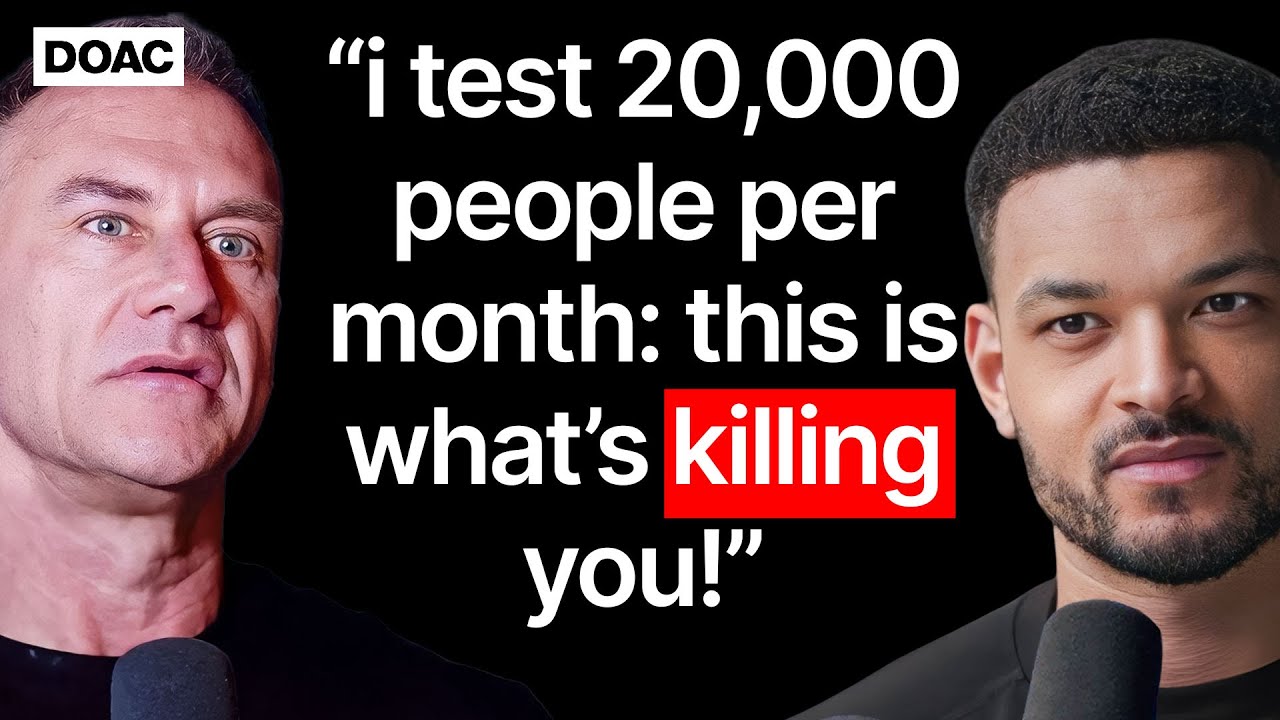
## Background
This video was published on YouTube by The Diary Of A CEO on April 22, 2024. The page description outlines an interview with Gary Brecka, co-founder of 10X Health System and expert in human biology, who discusses biohacking, human performance, genetic deficiencies, and health optimization.
## TL;DR
Gary Brecka explores how underlying biological and nutrient deficiencies, rather than isolated diseases, drive common mental and physical health issues like anxiety, hypertension, and fatigue. He highlights the impact of key biomarkers, genetic mutations like MTHFR and COMT, and daily foundational habits such as grounding, red light therapy, breath work, and proper hydration with trace minerals. Drawing from his 20-year background in mortality prediction for life insurance, Brecka critiques the modern healthcare system's reactive approach and advocates for proactive, accessible biohacking strategies.
## Atmosphere & style
The interview carries an intense, urgent, yet deeply engaging and optimistic tone as Gary Brecka delivers complex biological concepts with fast-paced passion and relatable analogies. Host Steven Bartlett creates a grounded, curious dynamic, allowing Brecka's authoritative expertise and personal conviction to lead the conversation. The discussion balances sobering revelations about systemic healthcare failures with inspiring, actionable wellness solutions that leave the listener feeling empowered and reflective.
## Key takeaways
- [00:00](https://www.youtube.com/watch?v=10enqcw2Qiw&t=0s) Anxiety and many chronic health conditions often stem from underlying biological and nutrient deficiencies rather than external triggers.
- [09:20](https://www.youtube.com/watch?v=10enqcw2Qiw&t=560s) Human sub-optimal performance is frequently driven by genetic variations (SNPs) like the MTHFR mutation, which impairs the body's ability to convert folic acid into essential methylfolate.
- [11:49](https://www.youtube.com/watch?v=10enqcw2Qiw&t=709s) Comprehensive health tracking requires evaluating key glycemic markers, hormone panels, nutrient levels, and a one-time genetic methylation test.
- [15:25](https://www.youtube.com/watch?v=10enqcw2Qiw&t=925s) The COMT gene regulates the breakdown of catecholamines, determining whether an individual responds to stress as a 'worrier' (slow COMT) or a 'warrior' (fast COMT).
- [22:16](https://www.youtube.com/watch?v=10enqcw2Qiw&t=1336s) Elevated homocysteine levels constrict blood vessels and directly contribute to high blood pressure and cardiovascular risk without structural heart damage.
- [34:43](https://www.youtube.com/watch?v=10enqcw2Qiw&t=2083s) Life insurance companies utilize vast mortality data and comorbidity multipliers to predict life expectancy with high precision.
- [46:26](https://www.youtube.com/watch?v=10enqcw2Qiw&t=2786s) Systemic flaws in healthcare often prioritize pharmaceutical symptom management over correcting foundational nutrient and trace mineral deficiencies.
- [52:52](https://www.youtube.com/watch?v=10enqcw2Qiw&t=3172s) Daily foundational practices such as proper hydration with unrefined sea salt, grounding, and breath work enhance cellular repolarization and tissue oxygenation.
- [01:04:26](https://www.youtube.com/watch?v=10enqcw2Qiw&t=3866s) Red light therapy (photobiomodulation) stimulates mitochondrial function, significantly increasing cellular ATP energy output and promoting tissue repair.
- [01:15:24](https://www.youtube.com/watch?v=10enqcw2Qiw&t=4524s) Casual cosmetic use of GLP-1 agonists like Ozempic carries risks including severe muscle mass loss and potential gastrointestinal complications.
- [01:23:18](https://www.youtube.com/watch?v=10enqcw2Qiw&t=4998s) Social isolation and loss of purpose severely shorten human lifespan, underscoring the vital impact of community on cellular and cardiovascular health.
## Detailed walkthrough
### [00:00](https://www.youtube.com/watch?v=10enqcw2Qiw&t=0s) Introduction and the Hidden Root of Anxiety and Disease
Gary Brecka introduces a core premise: many people who suffer from anxiety cannot point to a specific external trigger. They spend their lives trying to pin their anxiety on their outside environment, when in reality, they suffer from underlying biological deficiencies. Brecka, a human biologist who spent 20 years in the life insurance industry predicting mortality to the nearest month, is now on a mission to extend human life and healthspan. He discusses performing a buccal (mouth) swab test on host Steven Bartlett to examine gene mutations—one of the most overlooked areas in modern medicine.
Brecka emphasizes that disease is often not something happening *to* us, but something happening *within* us. Nutrient deficiencies contribute to widespread issues including ADHD, OCD, mental illness, manic depression, bipolar disorder, severe gut issues, and sleep disturbances—conditions that often resist conventional therapies or simple dietary adjustments. Reflecting on his past in the insurance sector, Brecka shares the emotional weight of having watched people unknowingly walk into preventable health crises, feeling like he was "sitting behind a thick glass wall watching blind people walk into traffic." Now, his goal is to broadcast these actionable insights to the public.
---
[02:18](https://www.youtube.com/watch?v=10enqcw2Qiw&t=138s) What We're Getting Wrong About Supplements & Deficiencies
Steven asks how everyday listeners can prevent chronic disease, and Brecka begins by highlighting the core problem with how people approach health. Rather than taking targeted action, most individuals suffer from "paralysis by analysis," mindlessly stacking popular supplements—such as NMN, resveratrol, CoQ10, St. John's Wort, ashwagandha, and vitamin C—without actual data regarding what their body truly lacks.
To illustrate this, Brecka draws on a botany lesson from his graduate studies in human biology. When an arborist observes a rotting palm leaf, they do not attempt to treat the leaf directly or dump random nutrients onto it. Instead, they core-test the soil, discover a specific deficiency like nitrogen, and replenish it, allowing the plant to heal naturally. Modern medicine and individuals often treat human health in reverse, forgetting the body's intrinsic ability to heal when provided with the correct raw materials.
* **Entrepreneurial Paradox:** Brecka notes that entrepreneurs frequently claim health is their number one priority, yet while they can instantly cite exact business metrics ($148,000/month gross revenue, $38,250/month net income, 16 employees), they have no idea what their hemoglobin A1C, testosterone, triglycerides, or C-reactive protein (CRP) levels are.
* **The Foundation of Health:** The body requires baseline raw materials to function: 16 essential minerals (out of approximately 72 total minerals), 2 essential fatty acids, and 8 essential amino acids.
* **Reframing ADD and ADHD:** ADD and ADHD are often mischaracterized as an inability to pay attention, when they are actually "attention overload disorders"—an overactive mind attempting to process too many things at once. Standard treatments like Adderall or Vyvanse stimulate the central nervous system to match this hyperactive mental pace, whereas addressing raw material deficiencies can help quiet the mind naturally.
Responding to Steven's query about whether humans are "born broken," Brecka clarifies that humans are not born broken, but rather operating below optimal function due to genetic variations known as Single Nucleotide Polymorphisms (SNPs or "genetic snips"). The human body relies on delicate, sequential biological cascades where the byproduct of one physiological reaction feeds the next.
Brecka illustrates this cascade through the process of methylation:
1. Green leafy vegetables provide folate.
2. The body converts folate into **methylfolate**.
3. Methylfolate downregulates **homocysteine**, an inflammatory amino acid.
4. Homocysteine converts into **methionine**.
5. Methionine travels to the brain to assist in quieting mental activity and supporting deep sleep.
When a genetic enzyme pathway is broken, the body fails to convert raw materials into their usable forms. The most prevalent example is the **MTHFR** gene mutation (affecting roughly 44% of the population), which impairs the conversion of folic acid and folate into usable methylfolate. This deficiency is directly linked to various health issues, including neural tube defects in fetal development, which are prevented not by synthetic folic acid, but by its converted, usable counterpart, methylfolate. Supplementing directly with methylfolate bypasses this genetic bottleneck simply and inexpensively.
---
[11:49](https://www.youtube.com/watch?v=10enqcw2Qiw&t=709s) The Biomarkers That Predict Your Health Outcomes
Steven asks for a simplified framework of key biomarkers that an everyday person should track to optimize their health without needing a medical degree. Brecka breaks it down into three critical blood biomarker categories, along with a one-time genetic test:
1. **Glycemic Profile:** Brecka asserts that poorly regulated blood sugar is "the root of all evil" in human physiology. High insulin blocks fatty acid metabolism, leading to elevated blood triglycerides and cholesterol, which cascades into cardiovascular disease and metabolic syndrome. The three key markers are:
* *Glucose:* Current blood sugar levels.
* *Hemoglobin A1C:* A 3-month average of blood sugar levels.
* *Fasting Insulin:* Indicates insulin sensitivity (higher insulin relative to glucose signifies insulin resistance).
2. **Hormone Panel:** Evaluating core hormones and markers that support hormone production, specifically **DHEA** and **SHBG** (Sex Hormone-Binding Globulin).
3. **Basic Nutrient Panel:** Checking foundational levels of **Vitamin D3**, **Magnesium**, **Potassium**, and **Vitamin B12**.
In addition to these routine blood panels, Brecka strongly recommends a **one-time lifetime genetic methylation test** to evaluate five primary genes that dictate how the body processes and converts essential raw materials: **MTHFR**, **MTR**, **MTRR**, **AHCY**, and **COMT**.
Here is the detailed walkthrough for this portion of the transcript:
[15:25](https://www.youtube.com/watch?v=10enqcw2Qiw&t=925s) The COMT Gene, Catecholamines, and the Mechanism Behind Anxiety
Gary Brecka breaks down the function of the COMT gene (*catechol-O-methyltransferase*), explaining that its name simply describes how it transfers a methyl group to clear out a class of neurotransmitters known as catecholamines. These four specific neurotransmitters—including epinephrine, norepinephrine, ephedrine, and dopamine (adrenaline being a primary driver)—are responsible for triggering the body's fight-or-flight response. Brecka illustrates this with a stark comparison: if you get out of your car at night and someone is standing in front of you holding a knife, your pupils dilate, your heart rate spikes, and your extremities flood with blood. However, if you are lying safely in bed at night simply imagining getting eaten by a shark, your body undergoes the exact same physiological reaction. Because the brain cannot distinguish between perception and reality, both real external threats and imagined fears meet at the exact same biochemical junction: a spike in catecholamines.
When individuals possess a genetic mutation affecting COMT, their ability to break down these neurotransmitters is compromised. Brecka points out that while people experiencing anxiety often describe it as a "fear of the future" or a "sense of impending doom," its underlying physical cause is frequently this unchecked rise in catecholamines. Consequently, people suffer from sudden rushes of anxiety without any identifiable external trigger; they might be sitting calmly on a podcast set when their levels rise, leaving them desperately searching their surroundings for a cause. This condition often stems from a shortage of methylated nutrients—such as methylcobalamin (a specific form of B12) and methylfolate—which the body requires to downregulate catecholamines. While true anxiety disorders exist where triggers are clear (such as a phobia of heights on a 30th-floor balcony), physiological anxiety is frequently driven by this enzymatic bottleneck.
* Catecholamines include epinephrine, norepinephrine, ephedrine, and dopamine (adrenaline).
* The brain produces the same fight-or-flight cascade for a real physical threat (a knife-wielding attacker) as it does for a purely imagined fear (a shark attack while lying in bed).
* Methylated nutrients like methylfolate and methylcobalamin (B12) provide the raw material necessary to downregulate catecholamines and calm the nervous system.
[18:23](https://www.youtube.com/watch?v=10enqcw2Qiw&t=1103s) Fast vs. Slow COMT: "Worriers" vs. "Warriors"
The conversation turns to how genetic variations in the COMT gene dictate daily emotional baseline and stress responses, often categorized as either "slow COMT" or "fast COMT." People with slow COMT take much longer to break down catecholamines, earning them the nickname "worriers." Brecka lists the hallmark traits of this mutation: going to bed "body tired, but mind awake" as the brain clicks through innocuous thoughts; defaulting instantly to worst-case scenarios; chronic overthinking; and operating at a baseline anxiety level of six out of ten instead of two. Because their baseline is already elevated, minor stressors that would push an average person from a zero to a two escalate a slow COMT individual from a six to an eight, prompting observers to say "the punishment doesn't fit the crime."
When host Steven Bartlett asks if this functions as a genetic predisposition that makes certain people struggle more in a modern world filled with screens and constant notification stimuli, Brecka agrees. Without proper downregulation of adrenaline and catecholamines, the mind remains trapped in a heightened state of alertness and fear. This baseline state often manifests in early childhood—where a child feels an unexplainable fear without the vocabulary to articulate complex future-oriented anxiety—and persists throughout adulthood. Standard anti-anxiety medications frequently fail these individuals, leaving them feeling like "zombies" because the underlying issue is a raw material deficiency rather than a psychiatric deficit.
* **Slow COMT ("Worrier"):** Characterized by slow breakdown of catecholamines, leading to an elevated baseline alertness (walking around at a 6/10), race-mind insomnia, and worst-case scenario overthinking.
* **Fast COMT ("Warrior"):** Clears catecholamines rapidly, allowing quick recovery from stress.
* Children with this mutation experience physiological fear long before they understand the mental concept of future-oriented anxiety.
* Standard pharmaceuticals often fail or induce a zombie-like state because they do not supply the missing B-vitamin complexes needed for natural neurotransmitter breakdown.
[22:16](https://www.youtube.com/watch?v=10enqcw2Qiw&t=1336s) What 100,000 DNA & Blood Tests Reveal: Vitamin D3, Homocysteine, and High Blood Pressure
When asked what a random sample of 100 people off the street would reveal across blood and genetic panels, Brecka draws on the massive dataset collected by his team, which processes roughly 20,000 genetic methylation tests and comprehensive blood panels a month (analyzing around 74 biomarkers per patient, including CBC, lipid panels, thyroid, and hormones). He notes that 50% of the population is clinically deficient in Vitamin D3 (cholecalciferol), with the risk increasing in darker-complexioned individuals. Vitamin D3 is unique because every cell in the body features a receptor site for it, and it is the only vitamin humans synthesize internally—produced via sunlight and cholesterol. Deficiencies severely weaken the immune system and drive conditions like osteopenia and osteoporosis; notably, Brecka mentions it was the second leading cause of morbidity during the COVID-19 pandemic.
Brecka also connects genetic mutations in methylation to cardiovascular issues like idiopathic hypertension, which accounts for 85% of all high blood pressure diagnoses. "Idiopathic" simply means of unknown origin, occurring when cardiologists find nothing structurally wrong with the heart after running EKGs, stress tests, and cardiac catheterizations. In reality, poor metabolism of the amino acid homocysteine causes it to accumulate in the bloodstream, leading to vascular constriction. Shrinking the diameter of the pipes in a fixed system forces pressure to rise. Rather than immediately resorting to synthetic pharmaceuticals, Brecka advocates testing for methylation defects and supplementing with targeted raw materials to convert homocysteine into methionine, thereby relaxing the vascular system and normalizing blood pressure.
> "If we make the pipes smaller in a fixed system, pressure goes up. But there's nothing wrong with the heart."
* **Data volume:** 10X Health System processes ~20,000 genetic tests a month alongside 74-biomarker blood panels.
* **Vitamin D3:** 50% of the general population is clinically deficient. It acts as both a vitamin and a hormone, manufactured in the skin using sunlight and cholesterol.
* **Hypertension linkage:** 85% of high blood pressure is diagnosed as idiopathic. Elevating homocysteine levels constricts blood vessels, directly driving up pressure without any underlying structural heart disease.
* Peer-reviewed research in the *Journal of Hypertension* directly links elevated urinary catecholamines and homocysteine to cardiovascular disease.
[26:40](https://www.youtube.com/watch?v=10enqcw2Qiw&t=1600s) B12 Deficiencies, Hormone Imbalances, and the Pre-Diabetes Epidemic
Continuing the breakdown of a random sample of the population, Brecka states that a majority of people walk around with B12 levels below 500 pg/mL, far beneath the optimal high end of around 1,250 pg/mL. Furthermore, 25% to 40% of people suffer from hormone imbalances out of optimal range—not due to underlying endocrine gland failure, but because they lack the basic building blocks required for hormone synthesis. Elevated Sex Hormone Binding Globulin (SHBG) and low DHEA frequently trap testosterone, preventing it from converting into free testosterone. Supplementing men with simple raw materials like DHEA and Vitamin D3 often restores free testosterone to healthy levels without requiring exogenous Hormone Replacement Therapy (HRT), which permanently shuts down the body's natural production.
On glycemic control, Brecka warns of a "shockingly high percentage" of pre-diabetic individuals, calling it an absolute pandemic. Contrary to popular belief, pre-diabetes isn't caused solely by overt sweets like soda, chocolate cake, and Ben & Jerry's ice cream; it is driven by overloading the body with refined, high-glycemic carbohydrates like white flour, white rice, white bread, pasta, white potatoes, and excessive fruit juices. These foods overwhelm the pancreas and sabotage blood sugar control. Ultimately, gut-derived amino acids like tryptophan, phenylalanine, and tyrosine serve as the precursors to mood-regulating neurotransmitters like serotonin and dopamine; nutrient shortages at this fundamental level can easily be misdiagnosed as primary mental illnesses.
* **B12 status:** Most people score under 500 pg/mL, whereas optimal biological function sits closer to 1,250 pg/mL.
* **Hormone restoration:** 25%–40% of people have sub-optimal hormone levels due to raw material deficits (like low DHEA or high SHBG). Replacing missing nutrients often restores natural hormone production without needing external HRT.
* **The pre-diabetes pandemic:** High-glycemic "white foods" (white flour, white rice, white bread, white potatoes) overwhelm pancreatic function just as severely as obvious sugary treats.
* **Gut-brain connection:** Amino acids in the gut (tryptophan, phenylalanine, tyrosine) synthesize neurotransmitters (serotonin, dopamine) that control mood and behavior. Shortages in these base raw materials are routinely mislabeled as clinical mental health disorders.
[30:33](https://www.youtube.com/watch?v=10enqcw2Qiw&t=1833s) High-Profile Clients and the Mission to Reach the Masses
Gary Brecka reflects on his work with high-profile individuals, noting that figures such as Dana White, Steve Harvey, Stephen A. Smith, Steve Aoki, and Kendall Jenner have publicly shared their health journeys with him. However, Brecka stresses that he does not want to be pigeonholed merely as a "celebrity biologist" or an A-list advisor. Instead, his core message is directed at the "non-woke biohacker"—the average person seeking actionable health knowledge. He criticizes the current social media landscape where creators focus on intellectual posturing—flexing knowledge about intricate mechanisms like the carboxylic acid cycle or the electron transport chain—rather than delivering practical, transformative information that inspires genuine change.
* Celebrities Brecka has worked with include Dana White, Steve Harvey, Stephen A. Smith, Steve Aoki, and Kendall Jenner (appearing on a Hulu special together receiving IV therapy).
* Brecka emphasizes that micro-details of mitochondrial biology do not impact humanity as much as simplified, actionable health education.
[32:00](https://www.youtube.com/watch?v=10enqcw2Qiw&t=1920s) Public Scrutiny, Misconceptions, and a Mission Driven by Purpose
Steven Bartlett recalls reaching out to Brecka over a year prior after stumbling upon a YouTube clip with only 20,000 views. Bartlett highlights Brecka’s meteoric rise since, observing that Brecka now carries the demeanor of someone who has "been through some shit." Brecka acknowledges this shift, explaining that entering the public eye brought intense scrutiny from critics watching long-form content specifically searching for a "gotcha moment." He addresses common accusations, clarifying that he has never claimed to be a licensed medical doctor and routinely goes out of his way to explicitly state this limitation. While this criticism made him more guarded and precise in his speech, his commitment to his calling remains unshaken.
> "A lot of people find their purpose in their pleasure, and I found my purpose from my pain."
* Brecka clarifies that he regularly disclaims being a licensed medical physician on stages and podcasts.
* He notes that critics frequently seize on minor verbal slips—such as saying sodium chloride instead of sodium hydroxide—to attack his credibility.
[34:43](https://www.youtube.com/watch?v=10enqcw2Qiw&t=2083s) The Morality of Mortality: Predicting Death for Life Insurance
Brecka recounts his career as a mortality expert for major life insurance and investment firms, where he was tasked with predicting life expectancies based on medical records and actuarial data. When an insurance company underwriting 10 to 50 million dollars in risk needs to price a policy or guarantee an annuity stream—such as a Single Premium Immediate Annuity (SPIA)—the single critical variable is calculating how many months an applicant has left to live. He underscores the precision of actuarial science by pointing out that during the 2008–2009 financial crisis, 364 banks failed while not a single life insurance company collapsed or failed to pay a valid death claim.
```
Standard Actuarial Base (1,000 Lives) ──► Median Life Expectancy (e.g., 200 Months)
│
┌────────────────────────────────────┴────────────────────────────────────┐
▼ ▼
Individual Debits Comorbidity Multiplier
(Obesity, Hypertension, Anemia) (Hypertension + Diabetes + Obesity)
Linear Impact: 1 + 1 + 1 Exponential Impact: 1 + 1 + 1 = 10
```
* Life insurance firms possess unrivaled datasets containing the exact date, time, location, and cause of death for millions of individuals over decades.
* An applicant’s base life expectancy represents the exact midpoint of a bell curve for a pool of 1,000 similar lives, where they have an equal probability of being alive or dead.
* Multiple health conditions create exponential risk; while individual debits add up linearly, combined comorbidities (like simultaneous hypertension, diabetes, and obesity) act as compounding multipliers.
[38:24](https://www.youtube.com/watch?v=10enqcw2Qiw&t=2304s) The Glass Wall: Watching Preventable Tragedies Unfold
Extracting data from trust documents, financial records, and years of medical history allowed Brecka to intimately understand the human beings behind the spreadsheets. He details watching patients' health deteriorate in real time following major life traumas—such as a spouse passing away—followed by the introduction of antidepressants, weight gain, and declining vital signs. The emotional weight of his job peaked when legal restrictions barred him from contacting individuals whose life-threatening conditions or medication errors he could identify. In one instance, after discovering a dangerous drug interaction in the Medical Information Bureau (MIB) database prescribed by two different doctors that would likely lead to a thrombolytic event, Brecka threatened to call the patient directly. Human resources immediately warned him that doing so would result in criminal prosecution.
> "A big part of my career felt like I was sitting behind a thick glass wall just watching blind people walk into traffic."
* Medical record extractions included access to wills, trusts, divorce decrees, bank accounts, and longitudinal blood work.
* Brecka was legally prohibited from contacting individuals to warn them about dangerous drug interactions or lifestyle trajectory risks.
* Feeling unauthentic and driven purely by wealth, Brecka ultimately quit his career, telling his then-fiancée (now wife) that he was founding a wellness company named Streamline.
[43:18](https://www.youtube.com/watch?v=10enqcw2Qiw&t=2598s) Addressing Health Deficiencies and Countering Disease From Within
Reflecting on his transition to human biology, Brecka addresses the pushback he receives from mainstream medical professionals regarding his recommendations. He owns up to early career missteps, such as citing news articles rather than peer-reviewed literature, but stands by the effectiveness of addressing basic nutrient deficiencies. To illustrate, he points to a meta-analysis involving 8,819 participants published in a journal covering headaches and facial pain, which demonstrated a direct inverse relationship between sodium intake and migraine headaches. He explains that the dura—the outer covering of the brain containing pain receptors—reacts negatively to stretching or contracting caused by osmotic shifts across cellular membranes, which can sometimes be alleviated by proper salt supplementation.
* The meta-analysis on sodium and migraines evaluated **8,819 participants**, revealing that higher sodium levels correlated with lower migraine incidence.
* Sodium deficiencies often occur in people who drink un-mineralized filtered water, exercise without replacing electrolytes, or restrict dietary salt.
* Brecka recommends unrefined salts like Baja Gold sea salt or Celtic sea salt to provide essential trace minerals alongside sodium.
* His clinic processes **20,000 new gene tests per month**, giving them massive empirical data on biomarkers.
* Interventions such as using trimethylglycine (TMG) to lower high homocysteine levels or using silica clays and activated charcoal to lower C-reactive protein (CRP) have consistently yielded normalized blood pressure and improved cardiovascular risk markers across thousands of patients.
[46:26](https://www.youtube.com/watch?v=10enqcw2Qiw&t=2786s) The Flaws of the Healthcare System and Misdiagnosed Deficiencies
The United States leads the world in healthcare spending, laying out $4.5 trillion annually, yet ranks 52nd in life expectancy and 39th in healthcare delivery. Despite high rates of flu vaccinations and routine screenings for breast and colorectal cancer, the country still leads the world in cancer rates and experiences the highest infant and maternal mortality rates among developed nations. Furthermore, the U.S. has twice the rate of obesity of any other civilized nation, while medical error stands as the third leading cause of death. Having spent nearly two decades analyzing medical records six days a week, Gary Brecka highlights how standard medical practice frequently mistake simple nutrient deficiencies for chronic pathological conditions.
A prime example is prolonged Vitamin D3 deficiency, which presents with joint aches, stiffness, and swollen ankles—symptoms easily misdiagnosed as rheumatoid arthritis. Patients are often prescribed corticosteroids based solely on history rather than thorough lab work. While these steroids act as short-term anti-inflammatories, they eventually degrade joints "like a termite." In insurance mortality models, data revealed that specific medications predictably led to joint replacements within six years. Analysts artificially advanced a patient's biological age by six years, scheduled their expected joint replacement, and factored in the resulting drop in mobility—which in turn accelerated other diseases. Meanwhile, simple interventions like correcting Vitamin D3, B12, or hormone levels were routinely overlooked.
- **Healthcare Spending:** The U.S. spends $4.5 trillion per year on healthcare, yet ranks 52nd in life expectancy and 39th in healthcare delivery.
- **Obesity and Mortality:** The U.S. has double the obesity rate of other civilized nations, and medical error ranks as the third leading cause of death.
- **Centenarians and Cholesterol:** In analyzing thousands of death claims, Brecka noted that almost every centenarian had clinically elevated LDL cholesterol at their time of death, questioning whether high LDL alone should automatically trigger pharmaceutical intervention.
- **Statin Side Effects:** While statins lower LDL cholesterol to target cardiovascular risk, they simultaneously inhibit the body's natural synthesis of essential hormones, cell walls, and cell membranes.
- **Anemia Treatment Failures:** Patients suffering from anemia are frequently given standard folic acid, B12, and iron repeatedly without success because their bodies cannot process synthetic folic acid; switching to methylated forms (methylfolate and methylcobalamin) alongside iron bisglycinate resolves the condition.
---
[52:28](https://www.youtube.com/watch?v=10enqcw2Qiw&t=3148s) Fundamental Habits: Water, Salt, Omegas, and Grounding
To prevent chronic diseases before they manifest, individuals must filter harmful exposures before they reach the body—metaphorically maintaining an "invisible fence." Drinking unfiltered tap water forces the liver and kidneys to process fluoride, chlorine, microplastics, and pharmaceutical residues. To optimize daily health, Brecka outlines five foundational practices, beginning with morning hydration and proper fatty acid supplementation.
> "Either we can filter things for the temple or we can let the temple be the filter."
Upon waking, the body benefits from 10 ounces of water mixed with mineral-rich salt to replenish vital trace minerals that are largely absent from modern diets. Table salt (pure sodium chloride) should be eliminated. The optimal choice is **Baja Gold sea salt**, which contains all 91 trace minerals, is tested down to 250 parts per billion for microplastics and glyphosate, and consists of only ~75% sodium. **Celtic sea salt** is the second-best alternative, followed by **pink Himalayan sea salt** (though Himalayan salt carries a higher risk of heavy metal contamination depending on its source). Following mineralized water, taking an Omega-3 fatty acid supplement rich in DHA and EPA (or an MCT oil blend) supports cellular function before moving into a natural morning routine.
- **Essential Trace Minerals:** Baja Gold sea salt supplies trace elements like boron, manganese, molybdenum, and selenium.
- **Morning Routine Pillars:** A healthy morning protocol rests on natural inputs: morning sunlight, grounding, breathwork, and cold exposure.
---
[54:55](https://www.youtube.com/watch?v=10enqcw2Qiw&t=3295s) Grounding, Cellular Polarity, and Oxygenation
Humans derive three fundamental inputs from nature: **magnetism** from the earth, **oxygen** from the air, and **light** from the sun. Modern lifestyles isolate individuals indoors for roughly 97% of their time (compared to an evolutionary baseline of 85% outdoors), contributing to chronic illness. When bare feet contact natural surfaces—such as soil, grass, or sand—the body exchanges ions with the Earth's low-Gauss magnetic field, altering cellular electrical polarity.
Under a microscope, red blood cells from an un-grounded individual often appear clumped together due to loss of uniform charge, reducing the surface area required for oxygen exchange, cellular detoxification, and repair. Direct contact with the Earth for as little as ten minutes repolarizes these cells. Once repolarized, the red blood cells repel one another and glide freely "like eggs slithering around in a bowl of oil." Physical indoor barriers like concrete, asphalt, wood, and tile insulate the body from this natural current. To simulate these effects indoors, one can use a Pulsed Electromagnetic Field (**PEMF**) mat, which emits a low-Gauss current to clear electrosmog (from Wi-Fi and 5G) and optimize blood pH.
> "An alkaline state is a disease-free state. The more acidic we get, the sicker we become."
- **Blood pH Fallacy:** Drinking alkaline water does not alter systemic blood pH; however, applying a low-Gauss current (via grounding or PEMF) influences potential hydrogen ($\text{pH}$) by altering cellular charge across its narrow physiological range.
- **PEMF Mat Benefits:** Running a low-Gauss current on a PEMF mat during sleep promotes deep sleep stages, reduces electrosmog buildup, and improves red blood cell separation.
- **Exercise with Oxygen Therapy (EWOT):** Advanced oxygenation can be achieved using multi-step oxygen therapy (such as a HyperMax system), where an individual inhales 95% pure oxygen from a 900-liter bag for 10–12 minutes during light treadmill activity.
- **Breathwork Alternatives:** Without specialized equipment, intentional deep breathwork engages auxiliary respiratory muscles to drive oxygen deep into the lower lung lobes rather than relying on shallow chest breathing.
- **Sprinting Dynamics:** Brecka notes a widely circulated statistic that 90% of individuals over the age of 35 will never sprint again, highlighting how drastically lung capacity and physical exertion decline with age.
Here is a detailed walkthrough of this portion of the conversation:
[01:01:22](https://www.youtube.com/watch?v=10enqcw2Qiw&t=3682s) Oxygenating the Body: Breath Work and Internal Consistency
Gary explains that as people age, their posture collapses and they stop engaging their auxiliary muscles of respiration—such as the diaphragm and the intercostal muscles between the ribs. This causes air to stay trapped in the upper respiratory tract. Until fresh oxygen is pushed deep into the lower lobes of the lungs, it cannot reach the bloodstream. As a result, shallow breathing leads to hyperventilating carbon dioxide, accelerating aging and disease. Gary asserts that "the presence of oxygen is the absence of disease."
To combat this, Gary emphasizes a strict morning routine consisting of grounding and Wim Hof-style breath work—specifically three rounds of 30 deep breaths with an extended breath hold. He states this is the single habit he never misses. When asked why, Gary shares a deeper psychological rationale: breaking small internal promises (like lying about bedtime or skipping an intended workout) erodes self-confidence and trust in oneself. Keeping simple daily commitments, like stepping out onto a cool balcony at sunrise to breathe and face the sun, builds trust and signals to the body that "this is go time."
- Wim Hof routine structure: 3 rounds of 30 breaths accompanied by extended breath holds.
- Shallow respiratory rate leads to elevated CO2 retention and accelerated cellular aging.
- Morning breath work and grounding act as a portable anchor across time zones.
---
[01:04:26](https://www.youtube.com/watch?v=10enqcw2Qiw&t=3866s) The Science and Benefits of Red Light Therapy
Steven shares a personal story about exchanging Christmas gifts with his partner, where both coincidentally bought each other red light therapy panels. After swapping for appropriate sizes, they integrated the panel into their morning routine without fully understanding the mechanisms behind it. Gary clarifies the science, noting that in clinical literature, this practice is termed **photobiomodulation**. Specific wavelengths of light (typically 600 to 1,000 nanometers) penetrate the cell cytoplasm and mitochondria, kicking out mitochondrial nitric oxide and forcing oxygen into the Krebs cycle. This dramatically boosts energy production from 2 units of ATP up to 36 units of ATP—a 16-fold increase in cellular efficiency.
The practical results of this mitochondrial boost include improved skin elasticity (collagen and elastin generation), reduced inflammation, and enhanced microvascular circulation (angiogenesis). Gary reveals that after supplying a red light therapy bed to podcast host Joe Rogan, Rogan reported no longer needing reading glasses after four or five weeks, alongside noticeable skin improvements. Steven adds that he had researched looking directly at red light panels; Gary confirms it is safe for eyesight because these panels lack damaging UVA and UVB rays. Gary also clarifies the distinction between red light beds and infrared saunas: red light beds operate on lower wavelengths that do not heat water molecules or cause sweating, whereas saunas operate higher on the spectrum to generate heat and sweat.
- Clinical term: Photobiomodulation.
- Increases mitochondrial ATP production by up to 16 times (from 2 to 36 units).
- Measurable via saliva nitric oxide test strips before and 10 minutes post-treatment.
- Red light spectrum range: 600 nm to 1,000 nm (non-thermal); higher infrared wavelengths trigger sweating in saunas.
- First light of the day (first 45 minutes) contains healthy blue light with no UVA/UVB, helping to reset the circadian rhythm and downregulate melatonin.
- Unlike blue light, red light can be used at night without disrupting sleep or falsely elevating cortisol.
---
[01:12:15](https://www.youtube.com/watch?v=10enqcw2Qiw&t=4335s) The Health Benefits of Hydrogen Water
Taking a sip from his water container during the conversation, Gary introduces his portable hydrogen water generator. The device uses a small electrolysis pump under pressure to force hydrogen gas into the liquid, preventing it from dissipating into the air. Cold water holds a higher parts-per-million concentration of dissolved hydrogen, remaining effective for roughly five hours before dissipating.
Gary calls hydrogen water "the best water that you can put in the human body," citing over 1,350 studies listed on `hydrogenstudies.com`. These clinical trials show that hydrogen gas acts as a powerful therapeutic tool to combat systemic and neural inflammation, enhance supplement absorption, boost athletic performance, and reduce delayed onset muscle soreness (DOMS). While hydrogen can be administered via nasal, ear, or eye cannulas, drinking hydrogen-rich water is the most accessible everyday method.
- Resource: `hydrogenstudies.com` hosts ~1,350 clinical studies on hydrogen gas therapy.
- Primary benefits: Reduces systemic/neural inflammation, aids supplement absorption, and alleviates DOMS.
- Operational method: Sealed electrolysis pump forces hydrogen gas to dissolve into water under pressure.
- Alternative format: Hydrogen (H2) dissolvable tablets.
*(Note: The segment ends with a host read sponsor break for Zoe personalized nutrition, highlighting a 10% discount code CEO10 for listener nutrition coaching.)*
[01:15:24](https://www.youtube.com/watch?v=10enqcw2Qiw&t=4524s) The Promises, Risks, and Nuances of Ozempic
The discussion shifts to one of the most culturally pervasive medical topics of the era: Ozempic and the rise of GLP-1 receptor agonists. Host Steven Bartlett notes that the valuation of Novo Nordisk (the manufacturer of Ozempic) has surged into astronomical territory as these medications become ubiquitous. Gary Brecka breaks down the science behind the trend, detailing how semaglutide works as a GLP-1 agonist and highlighting tirzepatide (found in Mounjaro and Zepbound), which outperformed semaglutide in head-to-head clinical trials. While acknowledging that these drugs are genuinely life-changing medical breakthroughs for individuals suffering from morbid obesity, severe insulin resistance, or type 2 diabetes by curbing intense cravings, Brecka expresses strong reservations about their rapid adoption as casual "vanity drugs" for quick cosmetic weight loss.
Brecka outlines the physiological complications associated with abusing these peptides without proper medical oversight. Because GLP-1 agonists dramatically slow the rate of gastric emptying, they can lead to severe gastrointestinal issues like paralytic ileus—a painful condition where the gut essentially becomes paralyzed, leaving food to putrefy inside the digestive tract. Furthermore, clinical trials show that up to one-third to one-half of the weight lost on semaglutide or tirzepatide comes directly from lean body mass rather than body fat. Brecka notes that when people use these drugs without a structured weight training regimen or protective growth hormone peptides (such as sermorelin or ipamorelin to preserve muscle tissue), they aggressively deplete fat reserves from everywhere on the body, including facial fat pads. This creates the sunken cheeks and hollowed-out eyes known culturally as "Ozempic face" or "Wegovy face."
- **Semaglutide vs. Tirzepatide:** Semaglutide (Ozempic, Wegovy) acts as a single GLP-1 receptor agonist, while tirzepatide (Mounjaro) targets both GLP-1 and GIP receptors, showing higher efficacy in clinical trials.
- **Muscle Loss Risk:** Up to 33% to 50% of weight lost on GLP-1 inhibitors can be lean muscle tissue if not paired with resistance exercise and protective protocols.
- **Gastric Slowing Complications:** Delayed gastric emptying can escalate to paralytic gut (paralytic ileus) and severe gastrointestinal distress.
- **"Ozempic Face":** Uncontrolled facial adipose tissue loss leads to sunken cheeks, hollow eye sockets, and a premature aging effect.
---
[01:18:18](https://www.youtube.com/watch?v=10enqcw2Qiw&t=4698s) Life in the Spotlight: Passion, Gratitude, and the Burden of Success
When asked to describe his current daily reality, Gary Brecka speaks with visceral gratitude, admitting that he often feels like he is "living somebody else's life." He expresses awe at having turned his lifelong intellectual curiosity about human biology, longevity, biohacking, and sports performance into a thriving platform where he gets to collaborate with top scientists, doctors, and high-performance athletes. However, when Steven presses him on the inevitable pain and burden that accompanies such rapid public fame, Brecka speaks openly about the emotional strain of scaling his mission.
Brecka admits that his sudden rise to popularity created a frustrating disconnect from the everyday people he originally set out to help. In the early days, he maintained direct, personal interactions with individuals seeking health answers, but the sheer volume of demand quickly overwhelmed his organization. The company nearly collapsed under the weight of its own success, creating a painful period where thousands of desperate inquiries went unanswered, occasionally turning eager followers into vitriolic critics. Brecka describes the crushing psychological burden of knowing people needed urgent intervention while his infrastructure lacked the capacity to respond fast enough—a struggle he has since addressed by focusing on training practitioner networks to scale the work globally.
- **Intellectual Curiosity:** Brecka attributes his motivation to an insatiable drive to learn from leading experts in cancer research, longevity, and biohacking.
- **Operational Strain:** The explosive demand following viral media appearances briefly outpaced 10X Health System's customer support and lab testing capacity.
- **Scaling Strategy:** Brecka shifted focus from one-on-one consulting to educating and certifying clinicians to expand patient reach.
---
[01:21:08](https://www.youtube.com/watch?v=10enqcw2Qiw&t=4868s) Family Dynamics and the 19-Year Parenting Rule
Turning to his personal life, Gary Brecka describes his family as the absolute greatest blessing of his journey. His three children are deeply embedded in his life and work; his two oldest children work alongside him full-time while actively completing their doctoral degrees (PhD/DNP) in nursing. He describes the profound joy of seeing his children catch his passion for health science, traveling together, seeing clients as a team, and building the business alongside his wife.
Brecka references a poignant concept often cited by longevity expert Dr. Peter Attia regarding the timeline of parenthood: parents get approximately 19 total years of time with their children—18 years during their childhood under one roof, and the equivalent of just one final year scattered across the remaining decades of their adult lives. Refusing to succumb to that statistic, Brecka expresses immense gratitude that he spends more quality time with his adult children now than he did when they were growing up, finding daily inspiration in watching them evolve into high-achieving adults.
- **Family Involvement:** Both of Brecka's older children are pursuing doctorates in nursing while working full-time in his health practice.
- **The 19-Year Rule:** Dr. Peter Attia's observation highlights that ~93% of the time a parent will ever spend with their child occurs before the child turns 18.
- **Shared Purpose:** Brecka emphasizes that while you can teach children skills, instilling a shared family passion creates lifelong connection.
---
[01:23:18](https://www.youtube.com/watch?v=10enqcw2Qiw&t=4998s) The Loneliness Epidemic and Cellular Community
The conversation turns to the profound biological impact of human connection and the ongoing loneliness epidemic. Drawing from his years analyzing mortality data in the life insurance industry, Brecka shares a striking fact: placing a human being in complete social isolation effectively cuts their remaining life expectancy in half. He explains that conditions like "broken heart syndrome" or caregiver mortality—where a widowed spouse dies shortly after their long-term partner—are not mere romantic myths, but measurable physiological phenomena where emotional surrender directly alters cellular frequency and causes bodily systems to collapse.
Brecka draws a fascinating parallel between human sociology and cellular biology, criticizing traditional medical research that isolates single cells in a Petri dish (*in vitro*) and expects them to behave the same way as they do inside a living organism. Cells, much like human beings, operate within interdependent communities; they communicate, exchange energy, detoxify, and repair collectively. When an individual is isolated from daily communal purpose—such as an elderly person entering a cold care facility away from family—the loss of social touch and connection acts as a severe comorbidity factor that dramatically accelerates mortality.
> "When the mind surrenders, the body surrenders... the impact of community has a meaning all the way down to a cellular level."
- **Isolation Mortality:** Social isolation acts as a primary comorbidity factor, reducing projected life expectancy by up to 50%.
- **Broken Heart Syndrome:** The biological reality where severe grief and loss of purpose cause rapid decline in cardiovascular and immune function.
- **Cellular Interdependence:** Single-cell behavior in isolation (*in vitro*) fails to capture how cells exchange signals, clean waste, and thrive within tissue communities.
---
[01:26:15](https://www.youtube.com/watch?v=10enqcw2Qiw&t=5175s) Shrinking Circles, Purpose, and Lessons from Blue Zones
Addressing his personal lifestyle, Brecka reflects on advice given to him by his business partner Grant Cardone when his public profile exploded: *"Your sphere is about to get a lot smaller."* While Brecka initially thought growing fame would broaden his social circle, he found the opposite to be true. Despite public "flashbulb moments" spent with high-profile celebrities, sports stars, and figures like UFC President Dana White, Brecka's actual day-to-day life is intentionally restricted to an intimate inner circle consisting of his immediate family and a small, trusted core team.
This tight-knit structure mirrors the critical factors found in global "Blue Zones"—regions where people consistently live vibrant lives past the age of 100. Brecka notes that while dietary habits vary wildly across long-lived populations (with Singaporeans consuming high amounts of meat, Sardinians eating wheat and pasta, and Mediterranean cultures consuming high-fat oils and seafood), the universal common denominators of extreme longevity are continuous physical mobility into old age and a deep, daily sense of purpose. In traditional societies, aging family members lived with their children and retained active roles—whether gathering vegetables for dinner or working a trade—rather than being placed in isolated assisted living facilities.
- **The Inner Circle:** Despite public celebrity interactions, Brecka maintains a tightly closed daily environment focused on family and business operations.
- **Blue Zone Commonalities:** Dietary composition varies globally, but physical movement, intergenerational living, and an active sense of purpose (*ikigai*) are non-negotiable longevity drivers.
- **Retirement Risks:** Statistical mortality rates rise significantly post-retirement due to the sudden loss of routine, community engagement, and psychological drive.
---
[01:28:58](https://www.youtube.com/watch?v=10enqcw2Qiw&t=5338s) The Hidden Ethics of Life Insurance and Annuities
Steven asks Brecka to look back at his previous career as a life insurance actuary and mortality forecaster to evaluate the ethics of the industry. Brecka shares that his greatest frustration was being legally forbidden from contacting patients or their primary care physicians when he spotted obvious, treatable medical red flags or dangerous drug interactions in medical files. While privacy laws and medical licensing regulations exist to keep unlicensed underwriters from practicing medicine, Brecka laments that life-saving mortality databases remain locked behind corporate vault doors.
Brecka explains the inherent financial conflict of interest at the heart of the insurance and financial services sector. Life insurance companies benefit when policyholders live longer because they continue collecting monthly premiums. Conversely, annuity providers—which guarantee a fixed payout stream for the rest of a client's life—financially benefit when the recipient dies as quickly as possible. Because major financial conglomerates often sell both products, they utilize hyper-accurate predictive algorithms to manage their balance sheets, keeping predictive health insights hidden from the public to protect their business models.
- **Locked Databases:** Life insurance mortality datasets contain vast predictive insights into human disease and death that could revolutionize preventative medicine if made public.
- **Insurance vs. Annuity Conflicts:**
- *Life Insurance:* Profitability increases when policyholders live longer and pay more premiums over time.
- *Annuities:* Profitability increases when annuity recipients pass away early, minimizing guaranteed payout obligations.
- **Combined Products:** Financial institutions utilize complex hybrid contracts (such as Life Insurance Life Annuity Contracts, or LILACs) to hedge mortality risks across portfolio offerings.
Here is the detailed walkthrough of the final portion of the transcript:
[01:30:57](https://www.youtube.com/watch?v=10enqcw2Qiw&t=5457s) The Last Guest Question and Gandhi's Vision
As per the tradition of *The Diary Of A CEO*, Steven Bartlett presents Gary Brecka with a question written in "The Diary" by the preceding guest. Opening the journal, Steven initially struggles to decipher the handwriting, humorously misreading the attribution as "Gundalini" before realizing it refers to Mahatma Gandhi. The quote left by the previous guest reads: *"Gandhi said, 'Be the change that you want to see in the world.' What is the change you want to see and how will you be it?"*
Reflecting on the prompt, Gary shares his core mission: he wants to see people live healthier, happier, longer, and more fulfilling lives. While humbly acknowledging that he "can't hold a candle to Gandhi," he commits to being that change by spending the remainder of his adult life relentlessly spreading his message about health, human biology, and optimal wellness.
- The diary question references Gandhi's famous principle: "Be the change that you want to see in the world."
- Gary states his purpose is to help people achieve longer, happier, and healthier lives by waking up every day focused on getting the truth about health out to the public.
---
[01:32:04](https://www.youtube.com/watch?v=10enqcw2Qiw&t=5524s) Expressing Gratitude and Closing Remarks
Steven expresses deep appreciation for Gary, commending him as a genuine, true, and lovely human whose intentions are undeniably pure. He shares that since their first conversation, thousands upon thousands of listeners have reached out or emailed describing how Gary's advice fundamentally improved their health and lives. Steven thanks Gary on behalf of all the audience members who benefited but may never have the chance to express their gratitude directly.
Acknowledging the praise, Gary notes that putting oneself out in the public eye comes with its challenges, but accepts it as an "occupational hazard" worth enduring for the impact made. The episode concludes on a warm note of mutual respect as Steven thanks Gary for his time and insights.
- Steven reported searching his emails from their previous interview and finding "thousands and thousands" of messages from people whose lives improved because of Gary's guidance.
- Gary acknowledges that public advocacy comes with friction and difficulty, but accepts it as a necessary trade-off for his mission.
## Notable quotes
> [22:16](https://www.youtube.com/watch?v=10enqcw2Qiw&t=1336s) If we make the pipes smaller in a fixed system, pressure goes up. But there's nothing wrong with the heart. — Gary Brecka
> [32:00](https://www.youtube.com/watch?v=10enqcw2Qiw&t=1920s) A lot of people find their purpose in their pleasure, and I found my purpose from my pain. — Gary Brecka
> [38:24](https://www.youtube.com/watch?v=10enqcw2Qiw&t=2304s) A big part of my career felt like I was sitting behind a thick glass wall just watching blind people walk into traffic. — Gary Brecka
> [52:28](https://www.youtube.com/watch?v=10enqcw2Qiw&t=3148s) Either we can filter things for the temple or we can let the temple be the filter. — Gary Brecka
> [54:55](https://www.youtube.com/watch?v=10enqcw2Qiw&t=3295s) An alkaline state is a disease-free state. The more acidic we get, the sicker we become. — Gary Brecka
> [01:01:22](https://www.youtube.com/watch?v=10enqcw2Qiw&t=3682s) the presence of oxygen is the absence of disease. — Gary Brecka
> [01:23:18](https://www.youtube.com/watch?v=10enqcw2Qiw&t=4998s) When the mind surrenders, the body surrenders... the impact of community has a meaning all the way down to a cellular level. — Gary Brecka
> [01:26:15](https://www.youtube.com/watch?v=10enqcw2Qiw&t=5175s) Your sphere is about to get a lot smaller. — Grant Cardone
> [01:30:57](https://www.youtube.com/watch?v=10enqcw2Qiw&t=5457s) Gandhi said, 'Be the change that you want to see in the world.' What is the change you want to see and how will you be it? — Steven Bartlett
## Mentioned
Gary Brecka, Steven Bartlett, Dana White, Steve Harvey, Stephen A. Smith, Steve Aoki, Kendall Jenner, Grant Cardone, Joe Rogan, Dr. Peter Attia, Mahatma Gandhi, 10X Health System, The Diary Of A CEO, Ultimate Human podcast, Medical Information Bureau (MIB), Baja Gold sea salt, Celtic sea salt, Himalayan sea salt, Journal of Hypertension, MTHFR, COMT, MTR, MTRR, AHCY, HyperMax, Wim Hof, Zoe, Novo Nordisk, Ozempic, Mounjaro, Wegovy, Zepbound
Gary Brecka将营养缺乏与慢性疾病及焦虑联系起来
基因突变与原料匮乏导致了常见疾病,而针对性补充和简单的生活习惯即可逆转这些问题。
Gary Brecka探讨了潜在的生理与营养缺乏(而非孤立的疾病)如何引发焦虑、高血压和疲劳等常见的身心健康问题。他强调了关键生物标志物、MTHFR和COMT等基因突变的影响,以及赤足接地、红光疗法、呼吸训练和补充微量元素水分等日常基础习惯的作用。结合在人寿保险领域长达20年的死亡率预测背景,Brecka批判了现代医疗体系被动应对的模式,并倡导采取主动、易于实践的生物黑客策略。
焦虑和许多慢性健康问题往往源于体内生物学和营养素匮乏而非外部诱因。约44%的人携带MTHFR基因突变,会阻碍叶酸转化为可用的甲基叶酸,直接补充活性形态的营养原料即可突破该代谢瓶颈。 (9:20)
COMT基因决定儿茶酚胺(如肾上腺素)的分解速度;“慢COMT”突变者清除神经递质缓慢,易长期处于高警觉、胡思乱想的“担忧者”状态,补充甲基化B族维生素能有效促进递质降解并平复神经。 (15:25)
约85%的高血压被归为无法查出心脏器质性病变的“特发性高血压”,其真实成因往往是同型半胱氨酸堆积导致血管收缩;此外超50%的人群缺乏维生素D3,这类营养缺乏常被常规医疗误诊为器质性疾病。 (22:16)
寿险精算数据表明多种共病会呈指数级加速死亡风险;与其依赖治标不治本的药物干预,通过饮用含微量矿物质的未精制海盐水、赤脚接地气(Grounding)改善红细胞极性等基础习惯,更能从细胞层面维护健康。 (52:28)
Reading summary
Human biologist Gary Brecka contends that many chronic diseases and mental health issues, including anxiety and ADHD, stem from basic nutrient deficiencies and genetic methylation defects rather than primary psychiatric or structural illnesses.
Methylation Bottlenecks and the Physiology of Anxiety (15:25)
Brecka argues that physiological anxiety often arises from unchecked catecholamines (such as epinephrine and dopamine) triggered equally by real physical dangers and imagined fears. Variations in the COMT gene govern how quickly these neurotransmitters are degraded; individuals with 'slow COMT' experience prolonged adrenaline surges, elevated baseline stress, racing thoughts, and sleep disruption. This issue is exacerbated when patients lack methylfolate or methylcobalamin (B12), which are required to downregulate these compounds.
Diagnostic Blind Spots in Conventional Healthcare (46:26)
Drawing on his background forecasting mortality in the life insurance industry, Brecka criticizes standard healthcare models for mistaking nutrient deficiencies for pathology. For instance, he links prolonged Vitamin D3 deficiency to misdiagnosed rheumatoid arthritis treated with damaging corticosteroids, and notes that 85% of high blood pressure cases are deemed 'idiopathic' despite elevated homocysteine constricting blood vessels. Brecka highlights that although the U.S. spends $4.5 trillion annually on healthcare, it ranks 52nd in life expectancy.
Core Biomarkers and Targeted Nutritional Supplementation (11:49)
Rather than aimlessly stacking unverified supplements, Brecka advises tracking a targeted glycemic profile (glucose, hemoglobin A1C, and fasting insulin), core hormone markers like DHEA and SHBG, and basic nutrient levels including D3, B12, magnesium, and potassium. In blood samples, Brecka claims 50% of people are clinically deficient in Vitamin D3 and a majority fall well below optimal B12 levels. To address nutritional needs, he recommends unrefined salts like Baja Gold to restore trace minerals, methylated B-complexes to bypass MTHFR mutations, and omega-3 fatty acids.
Physical Inputs: Grounding, Breathwork, and Photobiomodulation (54:55)
Brecka outlines foundational physical routines centered on natural biological inputs: oxygen, light, and the Earth's low-Gauss magnetic field. He claims direct skin contact with natural surfaces or PEMF mats repolarizes clumped red blood cells to improve circulation and oxygen exchange. He advocates structured breathwork to access the lower lung lobes, red light photobiomodulation (600 to 1,000 nanometers) to displace nitric oxide and optimize mitochondrial ATP production, and molecular hydrogen water to mitigate systemic inflammation.
The Risks of Weight-Loss Peptides and Social Isolation (75:24)
Brecka cautions against using GLP-1 receptor agonists like semaglutide and tirzepatide purely for cosmetic weight loss, warning that without resistance training, 33% to 50% of weight lost can come from lean muscle tissue alongside risks of delayed gastric emptying. Furthermore, Brecka emphasizes the biological toll of social isolation, citing mortality models showing that complete isolation can cut life expectancy in half, underscoring that longevity depends as much on daily purpose and community as it does on biology.
Brecka acknowledges that he is not a licensed medical physician and that his clinic has faced public scrutiny and operational strain amid explosive demand. He maintains that preventative medicine should focus on correcting cellular deficiencies, daily movement, and social connection rather than relying solely on pharmaceuticals.
## Background
该视频由著名播客频道《The Diary Of A CEO》(主持人 Steven Bartlett)于 2024 年 4 月 22 日在 YouTube 平台发布。节目邀请了 10X Health System 联合创始人、人类生物学家加里·布雷卡(Gary Brecka),深入探讨人体基因检测、常见营养素缺乏症以及饮食生活方式对寿命与健康的深远影响。
## TL;DR
加里·布雷卡结合其早年在人寿保险精算领域精准预测死亡率的经验,揭示了现代医学常将基础营养匮乏误判为器质性病理的致命盲区。他系统性拆解了甲基化通路、MTHFR 与 COMT 基因变异对慢病、原发性高血压及慢性焦虑的生化影响,强调补充活性 B 族维生素、微量矿物质与平衡电解质的关键价值。此外,他提出了晨间接地气、深呼吸、红光照射以及饮用富氢水等低成本日常生物优化法,并批判了滥用 Ozempic 等减重药物的潜在健康隐患,呼吁大众通过数据驱动的精准营养与保持社群生活目标感来延长健康寿命。
## Atmosphere & style
整场对话充满张力且发人深省,既有硬核生化机制的条分缕析,又有触碰人性的深刻伦理反思。加里·布雷卡言辞恳切、直击痛点,在回忆过去受限于体制眼看患者走向死亡时流露出强烈的痛苦与使命感,而主持人史蒂文·巴特利特的敏锐提问与个人经验分享则为节目增添了亲切感与真实温度。收听体验兼具醍醐灌顶的认知冲击与抚慰人心的温暖力量,让人从焦虑无助的亚健康困局中重新燃起对掌控自我生命健康的坚定信念。
## Bulletin
- [02:15](https://www.youtube.com/watch?v=10enqcw2Qiw&t=135s) 人体许多慢性亚健康与内源性焦虑并非器质性病变,而是由于基因变异(如MTHFR、COMT)导致的甲基化障碍及基础营养素匮乏,盲目服用复合补剂无法替代针对生物标志物的精准修复。
- [22:16](https://www.youtube.com/watch?v=10enqcw2Qiw&t=1336s) 临床上高达85%的特发性高血压实质源于同型半胱氨酸偏高导致的血管机械性痉挛收缩,而长期的维生素D3缺乏则经常被医疗系统误诊为类风湿性关节炎并过度处方皮质类固醇。
- [01:05:14](https://www.youtube.com/watch?v=10enqcw2Qiw&t=3914s) 光生物调节(红光疗法)能穿透细胞并驱逐线粒体一氧化氮,促使氧气充分结合克雷伯氏循环,将ATP产能效率提升高达16倍。
- [36:50](https://www.youtube.com/watch?v=10enqcw2Qiw&t=2210s) 寿险精算与寿命预测模型显示,多重慢性共病具有几何级乘数效应(1+1+1=10),而极度社交隔离对机体产生致命打击,可将预期寿命直接削减一半。
## Key takeaways
- [02:15](https://www.youtube.com/watch?v=10enqcw2Qiw&t=135s) 疾病多由内部营养匮乏而非外力侵入引起;解决亚健康如同给枯树测土施氮肥,必须通过生化数据精准补齐缺失原材料,避免陷入盲目跟风进补的分析瘫痪。
- [05:04](https://www.youtube.com/watch?v=10enqcw2Qiw&t=304s) 注意力缺陷多动症(ADD/ADHD)本质上是“注意力过载障碍”,患者大脑处于杂乱信息的超负荷失控状态,采用兴奋剂强行刺激神经往往本末倒置,关键在于提供平息过度放电的生化原料。
- [11:49](https://www.youtube.com/watch?v=10enqcw2Qiw&t=709s) 普通人最应重点监控的三大生理指标群包括:即时血糖与空腹胰岛素代谢谱、荷尔蒙全项(DHEA与SHBG)、以及基础营养素(维生素D3、镁、钾、B12),并建议做一次终身不变的5大核心甲基化基因检测。
- [18:17](https://www.youtube.com/watch?v=10enqcw2Qiw&t=1097s) 慢COMT基因突变导致儿茶酚胺分解迟缓,使神经系统警觉基线维持在高位,诱发无外在诱因的长期慢性焦虑以及夜间“身累脑醒”的灾难化思维。
- [22:16](https://www.youtube.com/watch?v=10enqcw2Qiw&t=1336s) 绝大多数高血压患者的心脏结构本身完全健康,因缺乏将同型半胱氨酸甲基化为蛋氨酸的营养辅酶,导致血管受压狭窄引发原发性高血压。
- [46:24](https://www.youtube.com/watch?v=10enqcw2Qiw&t=2784s) 全美每年医疗支出高达4.5万亿美元但人均寿命表现惨淡,医疗差错已成为第三大死因,将基础营养匮乏简单当做器质性病变进行药物压制的现象普遍存在。
- [48:12](https://www.youtube.com/watch?v=10enqcw2Qiw&t=2892s) 滥用皮质类固醇会在数年内如白蚁般蚕食软骨组织,导致患者提前进行关节置换并丧失行动能力,诱发久坐引发的一系列加速早逝并发症。
- [34:43](https://www.youtube.com/watch?v=10enqcw2Qiw&t=2083s) 大额寿险公司掌握数千万人口的详尽死亡全数据,利用同质千人生命池与正态分布模型,可极其精准地预测高额投保人的余寿月数。
- [55:40](https://www.youtube.com/watch?v=10enqcw2Qiw&t=3340s) 赤足接触土壤或沙滩可接收大地低高斯电流,改变红细胞表面电荷使其相互排斥分散,恢复最大有效表面积以进行高效养分交换与深层排毒。
- [01:10:28](https://www.youtube.com/watch?v=10enqcw2Qiw&t=4228s) 早晨日出后45分钟内的初光能够通过视网膜下调褪黑素并规律启动皮质醇分泌,真正决定当夜深睡眠质量的是清晨接触光线的首套行为。
- [01:15:24](https://www.youtube.com/watch?v=10enqcw2Qiw&t=4524s) 以虚荣减重为目的滥用司美格鲁肽(Ozempic)存在巨大健康隐患,不仅极易导致胃肠动力麻痹,还会导致减掉的体重中多达30%至50%为宝贵的肌肉组织。
- [01:27:24](https://www.youtube.com/watch?v=10enqcw2Qiw&t=5244s) 全球长寿“蓝区”的饮食结构截然不同,但贯穿百岁老人的共同特征唯有两点:到高龄阶段依然维持肢体行动力,以及拥有被家庭与社区持续需要的生命目标感。
## Detailed walkthrough
### [00:00](https://www.youtube.com/watch?v=10enqcw2Qiw&t=0s) 引言:焦虑背后的生理真相与基因突变
很多人常年饱受焦虑折磨,却始终得不到一个科学合理的解释。人们往往找不到确切的外在诱因,便习惯性地将焦虑归咎于周围的工作或生活环境,但事实的核心在于他们体内缺乏某些关键的营养原材料。人类生物学家加里·布雷卡(Gary Brecka)曾在美国人寿保险行业工作了二十年,通过分析庞大的医疗死亡率数据,能够极其精准地预测一个人会在哪个月份离世。如今,他转向全面投身于延长人类寿命与优化健康的事业中。
前几天,主持人史蒂文·巴特利特(Steven Bartlett)接受了一次口腔拭子采样。这项检测的核心目的是筛查是否从父母那里继承了某种基因突变。布雷卡指出,这正是现代医学最严重的盲区之一——绝大多数难以被传统疗法或饮食调整治愈的顽疾,包括精神心理疾病、注意力缺陷多动障碍(ADHD)、强迫症(OCD)、躁郁症、睡眠障碍以及严重的肠道吸收问题,本质上都是因为体内的某种严重缺陷引起的。“疾病往往不是从外部强加于我们,而是从我们体内悄然滋生(Disease is not happening to us, it's happening within us)。”布雷卡坦言,过去坐在人寿保险公司的办公室里,明知有办法改变客户的命运却受限于体制无法施以援手,就像“坐在厚厚的防弹玻璃后面,眼睁睁看着盲人走入车流”,如今他下定决心将这些救命的健康真相公之于众,并分享每个人清晨起床后即可践行的关键健康习惯。
### [02:15](https://www.youtube.com/watch?v=10enqcw2Qiw&t=135s) 树木与土壤的比喻:甲基化与盲目补充的误区
在寒暄之后,史蒂文将对话的控制权交给布雷卡,询问观众能从本期播客中获得什么最核心的价值。布雷卡直截了当地指出,这不仅关乎更健康、长寿的数据指导,更关乎解决那些日常生活中如同“挂在船尾的小锚”一样拖累身体表现的棘手隐患——例如莫名发胖、水肿水潴留、脑雾、注意力涣散、清晨醒来疲惫不堪以及深度睡眠缺乏。令人震惊的是,这些看似互不相干的全身性症状,其实都可以追溯到同一个核心轮轴:甲基化(Methylation),其核心机制就是人体细胞在生物化学层面遭遇的营养素匮乏。
```mermaid
flowchart TD
accTitle: 盲目进补与寻根修复对比
accDescr: 对比传统盲目补充与通过土壤检测和甲基化精准修复营养短缺的区别
subgraph WrongApproach ["传统表象治疗与盲目进补"]
A["外在病症 / 枯萎树叶"] --> B["盲目叠加各种补剂<br/>(NMN, 白藜芦醇, 辅酶Q10, 南非醉茄)"]
B --> C["陷入分析瘫痪 / 缺乏自身数据"]
end
subgraph RootCause ["生物学底层逻辑与精准干预"]
D["核心根源: 甲基化与原材料匮乏"] --> E["检测土壤 / 基因与血液生物标志物"]
E --> F["精准补齐缺失物质 (如必需氨基酸/矿物质)"]
F --> G["系统恢复自愈能力 / 消除亚健康症状"]
end
```
为了通俗地阐释这一点,布雷卡分享了他在研究生阶段攻读人类生物学时的经历。当时他被迫修读了许多令他痛苦的植物学课程,但植物生理学的一个场景彻底颠覆了他的认知:如果一棵棕榈树的叶子正在腐烂,一位真正优秀的树艺师绝不会去修剪或涂抹那片叶子,而是会提取土壤进行钻孔化验。当检测出土壤缺乏氮元素时,他们只需向土壤注入氮肥,树叶便会自然愈合。然而,现代人却在自身健康上丧失了这种对机体自愈能力的信任:
- 人们习惯盲目跟风,听说 NMN、白藜芦醇(Resveratrol)、辅酶 Q10(CoQ10)、圣约翰草(St. John's Wort)、南非醉茄(Ashwagandha)或维生素 C 有益,就一股脑全买来吃;
- 这种“为了补充而补充”的行为最终导致了严重的“分析瘫痪(Paralysis of analysis)”,因为在没有自身客观数据指引的情况下,你永远找不到属于你身体的那份“氮元素”。
### [05:04](https://www.youtube.com/watch?v=10enqcw2Qiw&t=304s) 企业家与身体神殿:数据缺失与注意力的真相
布雷卡直言,当代人对外部业务的数据了如指掌,却对承载生命的神殿一无所知。他在公众演讲中经常邀请台下的年轻创业者上台对质:他们宣称健康是自己人生的头号优先级,并能随口背出自己营销机构的精确财务数据——例如每月营收 14.8 万美元、净利润 38,250 美元、拥有 16 名员工。然而,当布雷卡转而询问他们的糖化血红蛋白(HbA1c)、睾酮水平、甘油三酯或超敏 C 反应蛋白(CRP)时,这些创业者无一例外陷入茫然。史蒂文也深有感触地回应,正如他在演讲中所说,如果夺走身边的外物、宠物甚至伴侣,自己的事业和生活依然能继续运转;但如果健康被剥夺,整个人生将彻底归零。
随后,布雷卡针对困扰现代职场的大流行病——注意力缺陷多动症(ADD / ADHD)提出了颠覆性的生物学见解:
- 传统医学将 ADD/ADHD 定义为“注意力缺失”,但从神经生物学角度看,它本质上是“注意力过载障碍(Attention overload disorder)”;
- 患有 ADD 的人并非缺乏专注的能力,而是无法同时处理大脑中瞬间涌现的大量杂乱信息,他们的大脑处于过度活跃的失控运转状态;
- 传统治疗手段普遍开出 Adderall、Vyvanse(赖右苯丙胺)或各类安非他命类中枢神经兴奋剂,这实际上是在人为刺激中枢神经系统去强行迎合大脑的狂飙节奏;
- 正确的生理学干预绝非无休止地刺激神经,而是为机体补齐缺失原料,平息过度放电的大脑。
### [07:53](https://www.youtube.com/watch?v=10enqcw2Qiw&t=473s) 回归基础原材料与一生一次的基因甲基化检测
绝大多数人以为自己目前的生理感受是“正常”的,但布雷卡强调,在补齐体内真正缺失的生物原材料之前,“你根本无法想象真正的神清气爽到底有多么美妙”。想要见证人类身体自我修复的奇迹,关键就在于找出缺少的原材料并物归原主。这些所谓的原材料并不神秘,而是最基础的生命要素:
- 自然界存在约 72 种矿物质,其中至少有 16 种属于人体必需矿物质;
- 人体维持健康所必需的 2 种必需脂肪酸;
- 必须通过摄入获取的 8 种必需氨基酸。
大量亚健康人群在最底层的必需氨基酸、脂肪酸或基础矿物质方面存在严重的临床级缺乏,却舍本逐终地砸重金追逐深红光疗法、昂贵的小众补剂或 NAD+ 前体。布雷卡呼吁,所有人的健康管理都应从打牢这些最基础的营养拼图开始,随后通过血液生化指标进行针对性校准。不仅如此,他极力主张每个人一生中都应该至少做一次“基因甲基化检测(Genetic methylation test)”,因为基因序列终生不变,这份检测能够精准揭示个体先天在营养转化机制上存在哪些原料代谢短板,从而提供一张真正意义上的个性化健康路线图。
### [09:07](https://www.youtube.com/watch?v=10enqcw2Qiw&t=547s) 甲基化:人体不是“天生残缺”,而是缺乏可利用的原料
当谈到营养素缺乏会导致疾病表达时,主持人提出疑问:如果我们体内天生就缺乏某些机能所需的物质,这是否意味着人类“生来就是残缺的”?Gary Brecka 明确反驳了这种观点。人类并非天生残缺,只是“没有达到最佳运转状态”(not functioning optimally)。每个人体内都存在单核苷酸多态性(SNP,即基因突变),这些基因负责为人体编码各种酶,驱动极其复杂而精妙的生化活动。
人体的运作逻辑是极其环环相扣的:利用一种原材料进行生理代谢,代谢产生的“副产物”随即成为下一个生化环节的启动原料。以绿叶蔬菜为例,人体吸收其中的叶酸(Folate),通过生化转化变成人体内最普遍的核心营养素之一——甲基叶酸(Methylfolate)。甲基叶酸会下调一种具有致炎性的氨基酸——同型半胱氨酸(Homocysteine),将其转化为甲硫氨酸(Methionine),随后进入大脑帮助平复思绪、促进睡眠。因此,并不是菠菜叶直接让人入睡,而是“菠菜叶最终转化成的物质”在改善睡眠。这一连串精密的反应链条被称为甲基化(Methylation)。
最关键的是,即便基因通路存在先天缺陷,现代医学虽然无法改变基因本身,却能直接补充其功能产物。例如全球最常见的基因变异——MTHFR(常被戏称为“那个该死的基因”),大约 44% 的人群携带有该突变。由于无法顺利将常规叶酸转化成具备生物活性的甲基叶酸,人体就会表现出各种病症(例如神经管畸形,真正起预防作用的是甲基叶酸而非未转化的合成叶酸)。通过精准检测甲基化通路,人们便能获得一张清晰的人体补充路线图,彻底告别盲目跟风吃保健品的做法。
```mermaid
flowchart TD
accTitle: 甲基化代谢级联流程图
accDescr: 展示从绿叶蔬菜摄入叶酸到改善睡眠并促进神经平静的生化转化路径
subgraph Raw["摄入阶段"]
A["绿叶蔬菜中的叶酸 (Folate)"]
end
subgraph Conversion["关键转化 (MTHFR 酶作用)"]
B["活性甲基叶酸 (Methylfolate)"]
end
subgraph Regulation["下游级联调节"]
C["下调促炎物质: 同型半胱氨酸 (Homocysteine)"]
D["转化为甲硫氨酸 (Methionine)"]
E["进入大脑调节神经递质并促进睡眠"]
end
A --> B
B --> C
C --> D
D --> E
```
---
### [11:49](https://www.youtube.com/watch?v=10enqcw2Qiw&t=709s) 普通人必须掌握的极简生物标志物(Biomarkers)
面对繁杂难懂的生化指标,非专业人士该如何抓重点?Gary Brecka 提炼出了每个人都应优先检测并掌控的“三大基础指标群”,以及一生只需做一次的甲基化基因筛查:
1. **血糖与胰岛素代谢特征谱(Glycemic Profile)**:
- 包含三项核心指标:即时血糖(Glucose)、糖化血红蛋白(HbA1c,反映近 3 个月的平均血糖水平)以及空腹胰岛素(Insulin)。
- Brecka 断言“血糖是万恶之源”。即便一个人从不摄入精制糖、每晚也不吃 Ben & Jerry's 冰激凌,同样可能出现胰岛素抵抗。
- 当身体需要分泌极高浓度的胰岛素才能降下血糖时,便意味着产生了胰岛素抵抗,这是代谢综合征(Metabolic Syndrome)的早期红色预警。高胰岛素不仅负责代谢糖分,还会强行阻断其他能量消耗途径(如脂肪酸代谢),导致高甘油三酯、高血脂与胆固醇异常,从而诱发心血管疾病。降低胰岛素水平能带来全方位的下游健康红利。
2. **激素全套检查(Hormone Panel)**:
- 重点关注机体荷尔蒙的平衡,特别是脱氢表雄酮(DHEA)以及性激素结合球蛋白(SHBG)这两种直接影响健康激素生成的核心蛋白质与前体。
3. **基础营养素缺乏筛查(Nutrient Deficiencies)**:
- 常规血液检测即可覆盖的四大核心元素:维生素 D3、镁、钾和维生素 B12。
除此之外,每个人一生应进行一次针对 5 个核心代谢基因的甲基化检测:**MTHFR、MTR、MTRR、AHCY 与 COMT**。这些基因共同构成了人体内部处理摄入物质的“流水线工厂”。
---
### [15:23](https://www.youtube.com/watch?v=10enqcw2Qiw&t=923s) 焦虑的生理本质:儿茶酚胺与 COMT 基因的秘密
在这 5 个核心基因中,COMT(儿茶酚-O-甲基转移酶)直接主导情绪与神经反应。它的生化作用是从一类被称为儿茶酚胺(Catecholamines)的神经递质中转移甲基,进而将其降解。儿茶酚胺正是掌管人体“战斗或逃跑”(Fight-or-Flight)应激反应的核心驱动力。
Brecka 用一个生动的场景解释了大脑对危机的误判:如果今晚开车回家,下车时迎面站着一个持刀歹徒,人会立刻瞳孔放大、心跳加快、血液涌向四肢,进入战斗或逃跑状态;而如果大半夜平躺在床上,突然在脑海中脑补“自己被鲨鱼吃掉”的画面,身体产生的生理反应会与被持刀威胁时一模一样。大脑根本分不清“真实感知”与“脑中假想”,两者在生理层面都会导致儿茶酚胺的大幅激增。
对于 COMT 代谢缓慢的人群而言,他们降解这些应激神经递质的速度极其缓慢。这揭开了慢性焦虑症的生理真相:
- 医学界往往向患者描绘焦虑的“感受”——对未来的恐惧、末日降临般的压迫感;但从生理本质来看,它其实就是**体内儿茶酚胺的异常蓄积**。
- 这解释了为什么许多焦虑症患者根本找不出具体的外部诱因:他们可能正坐在演播室录播客,体内的儿茶酚胺毫无征兆地飙升,身体便自动陷入惊恐状态,逼得大脑在外部环境里疯狂寻找“我为什么焦虑”的替罪羊。
- 这类问题通常源于缺乏能够下调儿茶酚胺的甲基化营养素复合体,如特定形式的活性 B12(甲基钴胺,Methylcobalamin)以及甲基叶酸。
- 与由于心理创伤(Trauma)、恐高或恐飞等拥有清晰外部触发点(Trigger)的纯心理应激不同,许多不明原因的广泛性焦虑,本质上是一场身体无法代谢应激化学物质的生化风暴。
### [18:17](https://www.youtube.com/watch?v=10enqcw2Qiw&t=1097s) COMT 基因变异:从“担忧者”到慢性焦虑
Gary Brecka 详细剖析了儿茶酚胺(catecholamines)与大脑思维模式之间的紧密关联。负责分解儿茶酚胺的关键酶由 COMT 基因编码,该基因通常被戏称为“担忧者(worrier)”或“勇士(warrior)”基因,在医学上也常区分为快 COMT(fast COMT)和慢 COMT(slow COMT)。如果某人携带导致慢 COMT 的基因突变,身体降解儿茶酚胺的速度就会极其迟缓,导致这些神经递质在体内堆积升高。其直接后果往往体现在睡眠与日常思绪中:晚上躺在床上时,身体明明极度疲惫,大脑却异常清醒("body tired, but I'm mind awake"),不受控制地快速运转,反复纠缠于白天最微不足道的小事。
这种体质的人在考虑事情时极易陷入过度思考,习惯性地直接推导至“最坏情况(worst-case scenario)”。Gary 用数值来打比方:常人的平静基准线可能在 0 到 2 之间,而慢 COMT 携带者的神经警觉基线平时就维持在 6。一旦遭遇外部刺激,常人可能只是从 0 升到 2,慢 COMT 患者却瞬间从 6 飙升至 8。周围的人往往会觉得他们“反应过度,小题大做(the punishment doesn't fit the crime)”。虽然儿茶酚胺的激增也可能来自创伤、真正的恐惧或幽闭恐惧症等外部诱因,但对于许多没有经历过特定心理创伤的人来说,长期的慢性焦虑、入睡困难或半夜醒来后思绪纷飞,其根本元凶正是这种基因突变所致的生理代谢迟滞。
- **COMT 基因分类**:通常被称为“担忧者(worrier)”或“勇士(warrior)”,对应快 COMT 与慢 COMT 两种代谢表型。
- **高儿茶酚胺的日常表现**:过度思考(overthinking)、睡眠中“身累脑醒”、倾向于灾难化思维(worst-case scenario)。
- **警觉度基线差异**:慢 COMT 人群日常处于 6 级警觉状态(而非正常人的 2 级),容易对轻微刺激产生剧烈反应。
```mermaid
flowchart TD
accTitle: COMT基因突变与焦虑机制
accDescr: 展示慢COMT基因突变如何导致儿茶酚胺代谢迟缓,进而诱发过度思考与焦虑。
subgraph Gene["基因代谢缺陷"]
A["慢 COMT 基因变异"] --> B["儿茶酚胺分解迟缓"]
B --> C["去甲肾上腺素 / 肾上腺素 / 多巴胺堆积"]
end
subgraph State["生理警觉基线"]
C --> D["基础神经兴奋度偏高 (维持在 6 级而非 2 级)"]
D --> E["轻微外界刺激即触发过激反应 (飙升至 8 级)"]
end
subgraph Symptoms["行为与心理表征"]
E --> F["身累脑醒 / 入睡困难"]
E --> G["思维倾向最坏结果 (灾难化)"]
E --> H["内源性无诱因焦虑"]
end
```
### [20:20](https://www.youtube.com/watch?v=10enqcw2Qiw&t=1220s) 焦虑的生化本质:终身相伴的恐惧与 B 族维生素
主持人提问:既然身处相同的现代环境(屏幕、弹窗和高密度刺激),是否意味着这部分人天生就具备更容易焦虑的体质?Gary 给出了肯定的回答。这背后的四大核心递质——去甲肾上腺素(norepinephrine)、肾上腺素(epinephrine)、麻黄酮类物质及多巴胺(dopamine)——构成了行为的主要驱动力。当这四种神经递质无法被下调和代谢清除时,大脑就会持续处于惊醒甚至恐惧的状态,产生毫无由来的“大祸临头感(impending doom)”。
这种内源性焦虑最典型的特征是“贯穿终身”。许多人在童年时期就体验过这种感受,只是当时年幼,无法向父母准确表达这种“担心一件未来可能发生、但概率极低且从未发生过的事”的复杂情绪,只能将其统称为恐惧。成年后,他们终于明白那是焦虑,却始终找不到明确的诱发诱因。Gary 指出,这类患者尝试抗焦虑药物时,绝大多数往往收效甚微,甚至只会让人感到麻木迟钝宛如“行尸走肉(zombie)”。要解决这个问题,应该审视身体内部是否缺乏分解儿茶酚胺所需的关键“原材料”——即负责甲基化代谢支持的复合 B 族维生素。
- **核心神经递质**:去甲肾上腺素、肾上腺素、多巴胺等无法及时下调。
- **贯穿一生的特征**:从童年时期模糊的恐惧感,延续到成年后无法解释的持续焦虑。
- **药物应对困境**:常规抗焦虑药物往往无法根治此类代谢问题,反而使患者精神麻木。
- **生理原料支持**:分解儿茶酚胺需要完整的活性复合 B 族维生素作为辅酶。
### [22:16](https://www.youtube.com/watch?v=10enqcw2Qiw&t=1336s) 大数据透视:同型半胱氨酸与“原发性高血压”的真相
主持人询问,如果随机从街上拉来 100 个人检测他们的血糖指标、激素谱和营养素水平,最常见的短缺会是什么?Gary 提到,他的诊疗机构每月检测约 20,000 例基因甲基化样本,并结合全血细胞计数(CBC)、综合代谢面板、血脂、甲状腺谱、激素以及 74 项生物标志物的大数据。海量数据表明,极多的慢病表象根本不是器官病变,而是基础代谢原料的匮乏。
以高血压为例,Gary 指出高血压并不一定全由特定基因引起,但有两处关键甲基化基因与同型半胱氨酸(homocysteine)代谢不良高度相关。当同型半胱氨酸水平升高时,它会促使整个血管系统发生收缩。在封闭循环管道中,管径变细自然导致压力上升,但此时患者的心脏本身是完全健康的。令人震惊的是,临床上 85% 的高血压被诊断为“原发性/特发性高血压(idiopathic hypertension)”,所谓“原因不明”,其实是指做了心电图(EKG)、脑电图(EEG)、心脏负荷试验、造影对比检查和心脏导管插入术后,找不到心脏任何结构性病变。医学界往往忽视了最基本的生化环节:这仅仅是因为缺乏将同型半胱氨酸重新转化为蛋氨酸(methionine)的基础营养素,导致血管受压狭窄。在依赖人工化学合成药物干预之前,完全可以通过补充缺乏的原料来恢复代谢平衡。
- **月度检测规模**:每月处理约 20,000 例基因甲基化检测,追踪约 74 项综合生物标志物。
- **高血压与血管收缩**:血液中同型半胱氨酸水平升高会导致血管痉挛狭窄,机械性抬高血压。
- **85% 特发性高血压**:绝大多数高血压患者的心脏检查完全正常,病因实际潜藏在血管内皮代谢中。
- **代谢通路逆转**:同型半胱氨酸需要营养素辅助才能顺利甲基化转化为蛋氨酸(methionine)。
### [25:21](https://www.youtube.com/watch?v=10enqcw2Qiw&t=1521s) 人群普遍缺乏的生化基石:维生素 D3、B12 与激素原料
回到“街头 100 人”的假设,Gary 指出首当其冲的问题是极其普遍的严重缺乏:
1. **维生素 D3(胆钙化醇,Cholecalciferol)**:受试人群中高达 50% 存在临床意义上的缺乏,且肤色越深的人缺乏风险越高。D3 是人体唯一能利用阳光和胆固醇自身合成的维生素,其作用兼具维生素与激素特征,全身每个细胞都分布着 D3 受体。一旦缺乏,会导致免疫系统受损、骨量减少(osteopenia)及骨质疏松症(osteoporosis),它甚至是 COVID-19 致死率中的第二大关键共病因素。
2. **维生素 B12**:绝大多数人体内 B12 水平低于 500 pg/mL,而理想的高限应在 1250 pg/mL 左右。
3. **激素失衡**:约 25% 至 40% 的人群激素水平脱离最佳区间。Gary 强调,这通常并非内分泌器官本身发生病变,尤其在年轻人中,根本原因是缺乏制造激素的原材料。例如性激素结合球蛋白(SHBG)异常升高、脱氢表雄酮(DHEA)缺乏等,导致机体空有内分泌腺体,却无法顺利合成维持高机能运作所需的激素。
- **维生素 D3 缺乏率**:街头随机人群中约 50% 存在临床缺乏;肤色越深,缺乏风险越高。
- **维生素 D3 核心作用**:由阳光与胆固醇合成,兼具激素特性,各细胞均有受体,与免疫力和骨质代谢休戚相关。
- **维生素 B12 理想区间**:大多数人低于 500 pg/mL,理想状态应接近 1250 pg/mL。
- **激素原料缺乏**:25%–40% 的人群激素偏离正常值,多归咎于 DHEA 等合成原料匮乏或 SHBG 异常,而非内分泌腺体衰竭。
### [27:21](https://www.youtube.com/watch?v=10enqcw2Qiw&t=1641s) 激素平衡、原料缺乏与隐蔽的糖尿病前期危机
血液检测面板不仅能揭示体内的激素水平,还能显示身体制造这些激素所需的营养原料。在临床实践中,许多患有睾酮水平偏低或游离睾酮(Free Testosterone)不足的男性,其实根本不需要从体外直接注射外源性激素,从而抑制自身的分泌功能。很多时候,仅仅通过补充 DHEA(脱氢表雄酮)和维生素 D3 这两种关键原料,或者调控阻碍睾酮向游离睾酮转化的性激素结合球蛋白(SHBG),患者的激素水平就会自然恢复到正常范围。身体真正需要的是恢复自产激素的原料与营养支持。
与此同时,当前的血糖控制状况呈现出极其惊人的恶化趋势,糖尿病前期(Pre-diabetes)已经成为一场名副其实的隐形流行病。许多人误以为只有那些整天喝苏打水、狂吃巧克力蛋糕和 Ben & Jerry's 冰淇淋的人才会得糖尿病前期,但这完全是误区。当人们大量摄入精制碳水化合物——即使是白面粉、白米饭、白面包、精制意面、土豆和水果这类通常不被当作“甜食”的食物时,胰腺依然会不堪重负,导致血糖彻底失控。
```mermaid
flowchart TD
accTitle: 营养缺乏引发心理与代谢问题的机制链路
accDescr: 展示了从基础营养素缺乏到代谢异常、激素失调,并最终引发情绪障碍与精神疾病诊断的因果链条。
subgraph 原料供给层
A["关键原料缺失\n(DHEA, 维生素 D3, 氨基酸)"]
B["高升糖精制饮食\n(白米、白面、土豆等)"]
end
subgraph 生理代谢层
A --> C["激素与神经递质受阻\n(睾酮低 / 色氨酸与酪氨酸不足)"]
B --> D["胰腺过载\n(血糖失控 / 糖尿病前期流行)"]
end
subgraph 表型输出层
C --> E["认知与情绪障碍\n(焦虑、专注力涣散、情绪麻木)"]
E --> F["被医学系统贴上\n『精神疾病』标签"]
end
```
这种潜移默化的营养失衡与血糖异常,日积月累地蚕食着人体的最佳机能。许多人距离精力充沛、情绪稳定的理想状态,可能仅仅差了一种甲基化复合维生素或特定氨基酸。人们在日常中经常忍受的阵发性焦虑、注意力涣散或轻度情绪麻木,其根源往往就在肠道和营养代谢中:
- 肠道吸收的氨基酸(如色氨酸、苯丙氨酸、酪氨酸)是合成血清素和多巴胺等关键神经递质的底层原料。
- 神经递质主导着情绪与行为驱动力;一旦氨基酸缺乏,连锁引发激素与神经递质断供,这种生理层面的匮乏在现代临床中往往会被直接贴上“精神疾病”的标签。
- 只要掌握基础生理数据(激素平衡、血糖控制、营养缺口),了解身体能够有效转化何种物质并精准补充,机体就会焕发出前所未有的生机。
---
### [30:24](https://www.youtube.com/watch?v=10enqcw2Qiw&t=1824s) 拒绝圈地自萌:将硬核生物学带向大众
在谈及合作的高知名度客户时,Gary 提到了一些已经公开分享过健康管理经历的名字,包括 UFC 总裁达纳·怀特(Dana White)、著名主持人史蒂夫·哈维(Steve Harvey)、体育名嘴斯蒂芬·A·史密斯(Stephen A. Smith)、知名 DJ 史蒂夫·青木(Steve Aoki),以及在 Hulu 真人秀特辑中一起进行静脉营养滴注(IV)治疗的肯达尔·詹娜(Kendall Jenner)。《每日邮报》(Daily Mail)的一篇报道中也详细列举过这些名人名单。
然而,Gary 明确表示自己并不想仅仅被标签化为“明星御用生物学家”或顶级运动员的专属顾问。他的核心使命是面向那些“非深度发烧友的大众群体”(non-woke biohackers)。他认为在当前的健康与生物黑客领域,许多人为了争夺社交媒体眼球、争当超级网红,陷入了同行之间互飙术语的怪圈——人们登上播客和演讲台,炫耀自己对三羧酸循环(TCA cycle)、线粒体电子传递链等微观机制掌握得多么透彻。但 Gary 坚信,这种细枝末节的学术卖弄根本无法真正改变普通人的命运;能够启发大众迈出改变第一步的通俗教育,才是真正有价值的信息。
---
### [32:00](https://www.youtube.com/watch?v=10enqcw2Qiw&t=1920s) 爆红之后的审视与创伤印记
主持人 Steven Bartlett 回顾了两人结缘的经过。一年多以前,Steven 偶然在 YouTube 上看到一段仅有 2 万播放量的 Gary 采访切片,内容深深吸引了他。通常团队会根据 Steven 的兴趣调研、物色并向他提案候选嘉宾,但那一次 Steven 破天荒地亲自在 Instagram 发私信邀请 Gary 上节目。自那次访谈播出后,Gary 在各大主流播客和社交平台呈现爆发式蹿红,个人事业与商业体量迎来剧烈扩张。
然而,Steven 敏锐地指出,眼前的 Gary 相比一年前有了一些显而易见的变化,整个人带着一种“历经沧桑、被狠狠撕扯过”(been through some shit)的防御感与沉重感。伴随着爆红而来的,是前所未有的显微镜式审视:
- 许多人带着挑刺的心态反复翻看三小时的深度播客,专门寻找所谓的“破绽瞬间”(gotcha moment)。
- “他把氯化钠说成了氢氧化钠,他是个骗子!”这类言论层出不穷,甚至被指控“假冒医生”。
- Gary 严肃澄清,自己在任何演讲、视频或播客中都从未自称过医生,且每次都会主动声明自己并无行医执照。这种残酷的审视确实让他变得更加谨慎防备、字斟句酌。
- 尽管面临巨大的舆论压力,Gary 依然坚信传播真相是他的天命。他坦言自己前半生有太多岁月并未真正服务于人类福祉:“许多人在享乐中找到人生的追求,而我是在痛苦中找到了自己的使命。”
---
### [34:43](https://www.youtube.com/watch?v=10enqcw2Qiw&t=2083s) 保险精算室的黑匣子:数亿生命数据背后的死亡倒计时
当 Steven 追问这份“痛苦”的来源时,Gary 揭开了他早年在大型人寿保险与投资机构担任死亡率预测分析师的冷酷经历。当时他所在的人寿精算团队负责预测高额投保人的预期寿命与死亡风险。整个系统有一套深度的职业洗脑机制,让分析师们坚信自己经手的“不过是一串串冰冷的数据”,无需对屏幕另一端活生生的人承担任何道义责任。
当一份投保金额高达 1000 万、2000 万甚至 5000 万美元的大额保单进入核保流程时,对保险公司而言,唯一具有决定性意义的变量就是:**这个人在地球上还能活多少个月?**
这种死亡预测科学的精确度超乎常人想象。Gary 用金融史上的经典案例证明了保险精算体系的坚固与冷酷:
- 在 2008 至 2009 年的全球金融海啸中,全美有 364 家银行相继倒闭破产,但没有任何一家大型人寿保险公司倒下。
- 在美国历史上,合法的死亡理赔金从未发生过无法兑付的情况,人寿保险机构是全世界偿付能力最强、财务最稳固的实体之一。
- 全球没有任何一家风险投资基金或金融机构敢把数千万美元的风险孤注一掷地押在单一变量上,唯独人寿保险敢,因为他们掌握着任何高校、医疗机构甚至政府都不曾拥有的终极数据库。
- 人寿保险公司精确掌握着数千万人的出生背景、死亡日期、具体时间、地点以及确切的死因链条,他们比任何人都清楚究竟是哪些生理标志物在加速把人类推向早逝。当投保高额保单时,他们首先会提取投保人的全面血液样本,从而将个体生物标志物与庞大的死亡大数据进行严密重叠比对。
### [36:50](https://www.youtube.com/watch?v=10enqcw2Qiw&t=2210s) 寿险公司如何精准预测人类寿命与复合发病率
保监与寿险行业的预测模型针对的并非几十万甚至百万元的小额定期寿险,而是大额的终身寿险(Whole Life)、万能寿险(Universal Life)以及即期年金(SPIA, Single Premium Immediate Annuity)。以即期年金为例,客户一次性向保险公司缴纳百万美元支票,保险公司承诺向其终身按月支付固定收益。精算系统能够计算出这一收益流的唯一依据,就是精确推算出客户在地球上还能活多少个月。这项测算结合了患病率指标、共病风险因子、生活方式偏好及人口统计学特征。在具体算法中,每位受保人会被置于一个由一千名高度相似样本构成的生命曲线上,其预期寿命正好位于正态分布曲线的中心点。若预测寿命为两百个月,便意味着恰好两百个月时,其实际生存与死亡的概率各占百分之五十。
决定这一死亡概率上升的负面扣分项被称为发病因子,涵盖肥胖、糖尿病、贫血、认知功能减退以及服药依从性等。当单一疾病叠加时,风险并非简单的线性递加,而是呈几何级数爆发。若一个人同时患有高血压、糖尿病和肥胖症,其综合扣分效应绝非“1 + 1 + 1 = 3”,而是会剧增至“1 + 1 + 1 = 10”。彼时 Gary Brecka 的本职工作正是深度解析并抽取这些医疗记录背后的关键数据。
```mermaid
flowchart TD
accTitle: 寿险精算发病率与死亡预测逻辑
accDescr: 展示保单数据整合、共病指数乘数效应以及寿命正态分布曲线的精算流程
subgraph InputData ["底层数据输入"]
A["个人核心档案<br/>(遗嘱/信托/税单/离婚协议)"]
B["多维度健康指标<br/>(病历/生化检验/用药依从性)"]
end
subgraph RiskCalc ["风险乘数精算"]
C["单一发病因子扣分<br/>(高血压、糖尿病、肥胖)"]
D["共病指数叠加<br/>(1 + 1 + 1 = 10 乘数效应)"]
end
subgraph ActuarialPool ["大数法则精算模型"]
E["同质千人生命池<br/>(正态分布生命曲线)"]
F["精确锁定中位存活月数<br/>(50% 生存 / 50% 死亡概率阈值)"]
end
InputData --> RiskCalc
C --> D
RiskCalc --> ActuarialPool
E --> F
```
- **数据资产维度**:提取信息远超身高、体重、血压与处方药清单,深入包含当事人的遗嘱、家族信托、离婚裁决书、针对子女的差异化遗产分配协议、银行与证券账户流水乃至多年纳税申报表。
- **动态生活画像**:随着多年病史记录的翻阅,受保人的生命轨迹完整展开——从频繁探访医生、言谈中对孙辈的宠溺,到配偶去世后抗抑郁药物的切入,以及随之而来的体重指数(BMI)大幅失衡。
---
### [39:52](https://www.youtube.com/watch?v=10enqcw2Qiw&t=2392s) 隔着玻璃窗看盲人走向车流:不可逾越的伦理窒息与职业转型
随着日复一日分析这些冰冷的电子表格,Gary Brecka 愈发清晰地意识到数据背后都是活生生的人。在审查病历的过程中,他多次发现只需一通简单的电话就能彻底逆转当事人的生命轨迹,但法律条文却严禁他以任何形式越界联系患者。在一次职业生涯的重大冲突中,他敏锐地察觉到两位不同医生为同一位患者开具了存在致命禁忌的交叉配伍药物,而全美医疗信息局(Medical Information Bureau, MIB)的审查系统竟然完全遗漏了这一疏漏。
根据精确的药理与临床数据,这一配伍禁忌极大概率会诱发血栓性栓塞事件,诸如致死性肺栓塞、严重中风或急性心肌梗死。当他怀着挽救生命的迫切心情致电公司人力资源总监,声明自己准备直接联络该患者实施预警时,管理层却以涉嫌违法为由对他发出了严肃的司法起诉威胁。这段长达数十年的职业经历让他倍感煎熬,感觉自己就像是“坐在厚厚的玻璃幕墙后面,眼睁睁看着盲人径直走向车流”。他反思自己此前盲目追逐财富的虚浮心态,最终决心彻底决裂,转身与未婚妻(现任妻子)共同创办健康优化企业 Streamline(即 10X Health System 的前身),运用人体生物学专长去帮助人们改善健康。
- **死刑宣判式的精准**:公司内部曾为他精准预测生命周期而庆祝,例如曾有一位史密斯夫人(Mrs. Smith),他在十三年前预测其尚余存活期为 188 个月,该患者最终在第 184 个月离世,同事纷纷跑进办公室惊呼“你预测得太准了,死亡理赔款刚刚到账”,这种荒谬的欢呼让他彻底警醒并陷入反胃。
- **行医初心的确立**:走出办公室后,他意识到每一行数据都曾是一个家庭中的母亲、女儿或姐妹;如今他每天清晨醒来最庆幸的,就是自己终于站在了“对抗死亡规律、主动延长健康寿命”的正向战场上。
---
### [43:18](https://www.youtube.com/watch?v=10enqcw2Qiw&t=2598s) 偏头痛的钠盐真相与两万例基因大数据的逆转力量
在转型倡导精准生物优化与功能医学的过程中,Gary 遭遇了大量来自传统医学界的质疑与批判。他坦诚在职业早期曾犯过引用未经严格同行评审的文章而非权威科研文献的错误,但如今他的很多主张都在大型临床队列中得到了印证。以偏头痛为例,2018 年发表在国际权威头面部疼痛期刊上的一项纳入了 8,819 名受试者的大型荟萃分析明确揭示,膳食钠摄入量与偏头痛发作频率之间存在直接的反比关系——即体内有效钠水平上升时,偏头痛发作频率显著下降。
大脑实质本身并不具备痛觉感受器,但包裹大脑的脑膜硬脑膜(Dura)却对痛觉高度敏感。硬膜极其抗拒两种生理拉扯:异常拉伸与过度收缩,而主导这一形变过程的核心机制正是跨膜水分流动的渗透压梯度。在现实生活中,大量规律运动出汗而不补充电解质的人群,或是为了过滤氟化物和微塑料而长期饮用纯净过滤水却未重新矿化的人群,其生化全项检查中的血钠水平往往处于临界低值。通过补充富含全谱微量矿物质的下加利福尼亚黄金海盐(Baja Gold sea salt)或凯尔特海盐(Celtic salt),便能平衡渗透压,让不少顽固性偏头痛彻底进入缓解期。
面对传统医学界“缺乏双盲临床试验”的责难,Gary 指出其机构每月处理超过两万份全新的人类基因检测报告,拥有远超普通诊所的海量临床代谢干预样本,许多看似棘手的慢性退行性病变都在简单的生化修正中被逆转:
- **高同型半胱氨酸与高血压**:临床上数以千计的真实样本证实,当患者同型半胱氨酸水平偏高时,针对性补充三甲基甘氨酸(TMG)氨基酸衍生物即可促使同型半胱氨酸快速回落,其顽固的高血压指标随之在主治医师的复查中恢复常态。
- **代谢综合征靶标改善**:通过将糖化血红蛋白(HbA1c)和空腹胰岛素拉回到最优区间,受试者的三酰甘油迅速恢复正常,心血管疾病风险断崖式下降。
- **全身系统性炎症降解**:运用活性炭、天然硅酸盐黏土等辅助吸附手段,能够迅速降低患者体内的超敏 C 反应蛋白(CRP)水平。
- **核心哲学转向**:“疾病往往不是发生在我们身上的外在灾难,而是发生在我们身体内部的生化失衡。”
### [46:24](https://www.youtube.com/watch?v=10enqcw2Qiw&t=2784s) 医疗系统的误诊怪圈与营养缺乏的“病理化”
许多慢性健康问题本质上源于人体基础营养素的匮乏(deficiencies),而非器质性病理病变(pathology)。Gary Brecka 指出,美国是全球医疗支出最庞大的国家,每年在医疗保健上投入高达 4.5 万亿美元,但交出的健康答卷却令人触目惊心:不仅婴儿死亡率和孕产妇死亡率在发达国家中居高不下,肥胖率更达到其他文明国家的两倍。尽管美国在流感疫苗接种率、乳腺癌筛查以及结直肠癌筛查方面领先全球,其癌症发病率同样位居世界前列;在预期寿命上仅排在全球第 52 位,医疗服务供给能力更是跌至第 39 位。具有讽刺意味的是,医疗差错(medical error)已经成为美国的第三大死因,公众却仍在指望现代医疗体系指引如何延年益寿。
在长达近二十年的时间里,Gary Brecka 每天 6 天、日复一日地审阅医疗记录,阅读量远超普通临床医生数千倍。他目睹了大量将“简单缺乏症”误判为“病理性疾病”的荒谬案例。最典型的例子便是维生素 D3 的严重缺乏:长期的 D3 匮乏会导致类似类风湿性关节炎(rheumatoid arthritis)的症状,患者常感关节酸痛、脚踝僵硬、甚至握拳困难。许多医生在未进行血沉(ESR)或类风湿因子等血液检测的情况下,仅凭口述病史便给患者扣上“类风湿性关节炎”的帽子,并立刻开具皮质类固醇(corticosteroids)。这种“把营养缺乏当疾病治”的做法,往往让患者踏上了一条不可逆的药物伤害之路。
- 美国每年医疗支出:4.5 万亿美元
- 预期寿命排名:全球第 52 位;医疗服务供给排名:全球第 39 位
- 医疗差错现状:全美第三大致死原因
- 常见误诊范例:长期维生素 D3 缺乏导致关节僵硬酸痛,被直接误诊为类风湿性关节炎并处方皮质类固醇
### [48:12](https://www.youtube.com/watch?v=10enqcw2Qiw&t=2892s) 药物的下游代价与“胆固醇迷思”
在人寿保险精算与死亡率预测领域,精算团队掌握着海量的药物追踪数据。现代医学往往将某些指标孤立来看(in a complete vacuum):比如看到低密度脂蛋白(LDL)胆固醇升高,便武断认定有害,随即使用他汀类药物(statins)强行降脂,以期降低心血管疾病风险。然而,这种干预直接摧毁了下游的生理机能——胆固醇是人体合成激素、细胞壁和细胞膜的核心原料,强行压低胆固醇必然导致激素分泌匮乏和细胞损伤。Gary 强调,在其处理过的数百份百岁老人(centenarians)死亡赔付档案中,**几乎没有任何一位长寿老人在去世时 LDL 胆固醇不是处于临床偏高状态的**。这不得不让人质疑:偏高的 LDL 到底代表着长寿标记物,还是必须用人工合成药物强行干预的心血管疾病元凶?
类固醇对关节的蚕食更是精准可预测的灾难。皮质类固醇在初期确实具有强大的消炎镇痛效果,但随后便会“像白蚁啃食木头一样”(eat the joint like a termite)逐步侵蚀关节组织。死亡率精算模型甚至能够精准推算出,开始使用此类药物后的约 6 年左右,患者必然需要接受关节置换手术。在保险精算中,他们会直接将该受保人的生理年龄调快 6 年,提前排定关节置换时间,并下调其“活动机能画像”(ambulatory profile)。随着行动能力的丧失,各种因久坐和行动受限引发的并发症接踵而至,形成恶性循环。Gary 回忆道,自己当时无数次想要冲破规则给这些患者打电话,大喊:“琼斯太太,快停掉皮质类固醇!去补充维生素 D3,把你的 B12 提上来,调理好你的激素——这正在摧毁你的红细胞并导致你精疲力竭!”
```mermaid
flowchart TD
accTitle: 营养缺乏导致误诊与健康恶化的级联循环
accDescr: 展现了从基础维生素D缺乏被误诊为关节炎,导致滥用类固醇、行动力丧失,最终大幅缩短健康寿命的因果链。
subgraph Lack["根本起因:基础营养匮乏"]
A["长期维生素 D3 缺乏"]
B["呈现关节僵硬、酸痛<br/>(假性类风湿症状)"]
end
subgraph Misdiagnosis["医疗干预与药物副作用"]
C["未做深入生化检测<br/>误诊为类风湿性关节炎"]
D["处方皮质类固醇<br/>(Corticosteroids)"]
E["软骨与关节被侵蚀<br/>(如同白蚁啃食)"]
end
subgraph Cascade["下游恶化与寿命折损"]
F["约 6 年后关节置换"]
G["行动力(Ambulatory Profile)骤降"]
H["活动受限引发并发疾病<br/>健康寿命与预期寿命大幅缩短"]
end
A --> B
B --> C
C --> D
D --> E
E --> F
F --> G
G --> H
```
### [50:48](https://www.youtube.com/watch?v=10enqcw2Qiw&t=3048s) 破译致命病历与上游的“隐形防护盾”
在职业生涯后期,Gary 经常在内部模型中做模拟推演:如果在数据中纠正患者的贫血、补足 D3、逆转前期糖尿病或降低糖化血红蛋白(HbA1c),受保人的预期寿命曲线便会立刻大幅跃升。然而现实中,无数人深陷错误的常规治疗中。例如,临床上治疗贫血的标准处方往往是叶酸(folic acid)、B12 与铁剂;许多患者反复服用却毫无起色,因为医生根本没意识到由于基因缺陷,患者无法将未活化的叶酸转化为活性形式。只要换成甲基叶酸(methylfolate)、甲基钴胺素(methylcobalamin)和双甘氨酸亚铁(iron bisglycinate),贫血便能迅速痊愈。
针对主持人 Steven 提出的“如何在根源上阻止慢性病发生”的提问,Gary 提出了“隐形防护盾”的哲学概念:人体是一座神圣的殿堂(the temple),我们必须在外界毒素进入殿堂前将其阻截,而不是“让身体本身变成过滤器”。以自来水为例,若直接饮用自来水,人体的肝肾等器官就不得不充当过滤器去拦截氟化物、氯气、微塑料和药物残留;而提前将水过滤,就能直接卸下身体的沉重排毒负担。
### [52:28](https://www.youtube.com/watch?v=10enqcw2Qiw&t=3148s) 晨间极简健康五步法与天然盐的选择
Gary 提出了普通人每天清晨应坚决执行的健康底层逻辑,核心在于为身体补充流失的基础元素:
1. **醒后第一杯矿物质水**:晨起饮用约 10 盎司(约 300 毫升)水,并加入高品质天然海盐。现代人普遍缺乏微量矿物质(如硼、锰、钼、硒等不起眼但至关重要的元素)。他严肃告诫切勿使用普通餐桌精制盐(单纯的氯化钠),并对盐的品质做出了明确梯队划分:
- **顶选(Baja Gold 黄金海盐)**:富含 91 种微量矿物质,测试显示其微塑料和草甘膦残留极低(低至 250 ppb),氯化钠仅占结晶体的约 75%,其余全为天然微量矿物质。
- **优选(Celtic 凯尔特海盐)**:品质非常接近 Baja Gold。
- **及格(粉红喜马拉雅盐)**:尚可接受,但近年来部分产地批次可能存在重金属风险。
- **坚决剔除(普通精制餐桌盐)**:必须永久从生活中清除。
2. **补充优质脂肪酸**:早上摄取 DHA/EPA 鱼油、高品质 Omega-3 或 MCT 油,滋养细胞膜。
3. **大自然晨间规律仪式**:回归母亲自然的基本馈赠——沐浴阳光(sunlight)、赤足接地(grounding)、呼吸练习(breath work)以及冷水淋浴(cold shower)。
当讨论转向“赤足接地”(Grounding)时,Steven 坦言自己的女友一直是接地的狂热践行者,每天早上必须出门光脚踩地;他起初觉得这非常“神叨古怪”(kooky),但后来发现神经科学家也开始证实其科学价值。Gary 肯定地总结道,人类从大自然中汲取三样不可或缺的能量:**大地的磁力(magnetism)、空气中的氧气(oxygen)以及太阳的光照(light)**。人类现代生活离这三者越远,身体就会越发病态。
### [55:40](https://www.youtube.com/watch?v=10enqcw2Qiw&t=3340s) 接地气(Grounding)与红细胞电荷机制
人类在进化史上原本有约 85% 的时间待在户外,而现代人却有 97% 的时间被禁锢在室内。Gary Brecka 指出,大多数人其实并不是日照过多,而是严重缺乏日照。当今癌症发病率激增的主因并不是阳光暴晒,而是糟糕的饮食结构——尤其是种子油(Seed oils)在皮肤组织中发生氧化反应所致。
谈到身体与自然的物理连接,地球本身具有微弱的高斯电流(Low Gauss current)。当人类的双脚直接踩在泥土、草地或沙滩上时,身体会向大地放电,从而改变体内的极性(Polarity)。这种变化是可以通过显微镜直接观察并测量的。如果人在室内用针刺破手指取一滴血抹在玻片上,透过常规显微镜往往会看到红细胞全都黏附、聚集在一起(并非凝结成血栓,而是相互吸附)。当红细胞带有相反电荷时就会相互吸引并紧贴,而接触的地方就会丧失与外界环境交换的有效表面积;反之,若细胞带有相同电荷则会相互排斥,表面积大幅增加,红细胞才能顺畅地交换养分、排除毒素、修复和再生。
```mermaid
flowchart TD
accTitle: 接地对红细胞电荷与功能的影响对比
accDescr: 展示缺乏接地导致红细胞黏连,与接地后红细胞排斥并恢复表面积的过程
subgraph UnGrounded["未接地状态(室内/带相反电荷)"]
A1["红细胞电荷混乱 / 呈现异性相吸"] --> A2["红细胞抱团成簇(Clumped up)"]
A2 --> A3["有效表面积严重受损"]
A3 --> A4["排毒受阻、细胞废物堆积、机能衰退"]
end
subgraph Grounded["接地状态(接触泥土/PEMF电流)"]
B1["与大地交换离子 / 重新极化(Repolarize)"] --> B2["红细胞带有相同电荷 / 相互排斥"]
B2 --> B3["如油中滑动的鸡蛋般自由散开"]
B3 --> B4["表面积最大化:高效排毒、自我修复与再生"]
end
```
如果走到户外赤脚踩在泥土或草地上几分钟,身体便会与大地交换离子并放电,红细胞会重新极化(Repolarize)。回屋 10 分钟后再次采血观察,原本成团聚集的红细胞会像“滑入油碗里的生鸡蛋”一样,虽然彼此碰撞滑动,但绝不粘连。针对主持人提问“如果我住在一楼,是不是就可以直接在室内接地”,Gary 解释道不行,因为现代建筑的地砖、混凝土、钢筋、沥青和木地板都是绝缘体,彻底隔绝了地磁场。
- **自然与现代环境反差**:人类祖先约 85% 时间在室外,现代人 97% 时间在室内。
- **红细胞物理特性**:同性电荷相斥使表面积最大化,便于物质交换;异性电荷相吸导致细胞团聚,丧失排毒与修复功能。
- **接地介质要求**:必须赤脚接触裸露的泥土、草地或沙地;普通建筑地板材料(混凝土、木板、瓷砖)具有绝缘性。
---
### [58:34](https://www.youtube.com/watch?v=10enqcw2Qiw&t=3514s) 脉冲电磁场(PEMF)与血液酸碱度真相
对于无法保证每天去户外赤脚接地的人,或者想在室内获得类似效果的人,脉冲电磁场垫(PEMF mat)是一种科技解决方案。PEMF 垫售价通常在 5,000 美元左右。虽然 Gary 经常因为推荐昂贵设备而招致批评,但他强调接地本身完全是免费的,而 PEMF 垫则是给有条件人群的投资。将 PEMF 垫铺在床上通入微弱的高斯电流入睡,有助于身体进入深度睡眠,抵御并排出 5G、Wi-Fi 等电磁辐射(Electrosmog)。
谈到 PEMF 能让人“每天早晨在弱碱性状态下醒来”,Gary 澄清了关于酸碱平衡的巨大误区:血液的 pH 值维持在一个极窄的区间内(波动范围仅约 0.5 左右)。市面上所谓的“喝弱碱性水能改变血液酸碱度”是彻头彻尾的谬论(Fallacy),饮用水根本改变不了血液 pH。pH 的实质是“潜在氢”(Potential hydrogen),它本质上是一种电荷。通过接触地表或使用 PEMF 垫向人体施加低高斯电流,才能在微观上调节血液的电荷与酸碱平衡。处于弱碱性状态的机体不易生病,而身体越偏向酸性,机体就越脆弱易病。实验表明,让人在 PEMF 垫上躺一段时间后即刻采血复检,不仅能观察到红细胞完全散开,血液也呈现更理想的碱性状态。
- **PEMF 核心功能**:模拟大地低高斯电流,促进深度睡眠,排出电磁辐射(Wi-Fi/5G),促使红细胞极化分离。
- **饮水误区澄清**:饮用碱性水无法改变人体血液 pH;pH 本质是电荷状态(Potential Hydrogen)。
- **生理法则**:弱碱性状态代表无病(Disease-free),偏酸性状态则伴随更高患病风险。
---
### [01:00:27](https://www.youtube.com/watch?v=10enqcw2Qiw&t=3627s) 呼吸法、辅助呼吸肌与内心的自我承诺
第二项至关重要的健康干预是呼吸训练(Breath work)。在高端临床与运动领域,Gary 采用基于诺贝尔奖得主 Otto Warburg 与 Manfred von Ardenne 研究的多步氧疗(Multi-Step Oxygen Therapy,如 HyperMax 系统):配合氧气浓缩机将充有 900 升、浓度达 95% 的氧气气囊连接面罩,让人在跑步机上运动的同时吸入高浓度氧气 10 至 12 分钟(即 EWOT 运动氧疗)。
但普通人完全不需要昂贵设备,只需学会运用呼吸法,重新激活人体的辅助呼吸肌(Auxiliary muscles of respiration)。Gary 提到一项说法(尽管尚未找到最初的临床文献出处):人在 35 岁之后,有 90% 的人此生再也不会进行冲刺跑。无论这一统计数字是否绝对精准,一个确凿的事实是绝大多数成年人彻底停止调动膈肌(Diaphragm)与肋间肌(Intercostal muscles),无法将氧气真正压入肺叶深处。随着年龄增长与含胸驼背的不良体态,人体呼吸变得越来越浅短。从鼻腔、口腔、食管到支气管末端,滞留的全部都是废气;如果吸气无法到达肺叶最边缘,氧气就根本无法进入血液循环。浅呼吸本质上是在不断重复吸入二氧化碳,加速机体衰老;而“氧气的存在即是疾病的缺席”(The presence of oxygen is the absence of disease)。
```mermaid
flowchart LR
accTitle: 浅表呼吸与深层呼吸对机体氧合的影响
accDescr: 展现体态塌陷导致浅呼吸衰老循环,对比深层呼吸调动辅助呼吸肌注入氧气的过程
subgraph AgingTrap["浅呼吸陷阱(衰老循环)"]
C1["体态塌陷 / 膈肌停滞"] --> C2["呼吸浅短"]
C2 --> C3["废气滞留呼吸道 / CO2 浓度过高"]
C3 --> C4["红细胞缺氧 / 加速机体老化"]
end
subgraph DeepBreathing["深层呼吸法(活力激活)"]
D1["调动膈肌与肋间肌"] --> D2["深吸气充盈肺叶各底段"]
D2 --> D3["气体交换充分 / 氧气渗透入血"]
D3 --> D4["氧气充盈 / 抑制病态细胞"]
end
```
Gary 个人常年践行维姆·霍夫(Wim Hof)风格的呼吸法:每天清晨固定做 3 轮、每轮 30 次深呼吸,并在末尾配合长时间屏息。这项晨间习惯是他多年来雷打不动、绝不缺席的一件事。主持人追问他为何如此决绝,Gary 袒露了心声:
> “因为我会给自己许下微小的承诺,并且我必须去兑现它们。当一个人不断打破对自己许下的微小承诺时,他就会慢慢丧失对自己的信心。”
很多人的自信心崩溃并不是因为违背了对伴侣、孩子或合伙人许下的宏大诺言,而恰恰是日常中细碎的自我失信——昨晚说好十点半睡却拖到凌晨一点,早晨说好去健身却躺着不动,听完播客发誓要去晒太阳接地做呼吸最后却完全放弃。这种微小的失信会像白蚁一样一点点蚕食自尊与自我信任。Gary 强调,无论出差到哪个时区、身在何处,早起 30 分钟内完成 3 组 30 次深呼吸是他随身携带的健康锚点;人类身体渴望节律与一致性,当身体习惯了这个晨间信号,它就会立刻领悟:“这是早晨,战斗时间到了(This is go time)。”
- **EWOT 氧疗原理**:基于 Manfred von Ardenne 与 Otto Warburg 的理论,吸入 95% 浓度氧气配合轻度运动快速提升血氧分压。
- **辅助呼吸肌退化**:多数成年人缺乏冲刺与深呼吸,膈肌与肋间肌萎缩,死腔气体(Expired air)无法彻底排出。
- **心理机制与习惯**:坚持晨间 Wim Hof 呼吸法(3 组 × 30 次 + 屏息),核心在于建立“守信于己”的心理基石,重塑自我掌控感。
### [01:04:15](https://www.youtube.com/watch?v=10enqcw2Qiw&t=3855s) 圣诞礼物互送红光板的日常趣事
在延续晨间健康习惯的讨论中,Steven Bartlett 分享了自己当下的晨间流程:由于刚到美国东海岸存在时差,他每天早早醒来后便推开门走向凉爽的阳台,坐在椅子上面朝升起的太阳,雷打不动地完成三轮每轮 30 次的呼吸练习。谈及此,Steven 笑着聊起去年圣诞节与伴侣之间一段颇有默契的趣事——两人竟然心照不宣地把“红光治疗板”(red light panels)选为了送给对方的圣诞礼物。
拆礼物时场面十分逗趣:Steven 的伴侣身材娇小,体重和体型几乎只有他的一半,却送给了他一块小号的红光板;而 Steven 拆开自己买给她的礼物时,发现那是一块巨大的大号红光板。两人相视一笑,当场调换了礼物。如今,每天清晨起床后坐在一起照红光板,已成为他们两人固定的晨间仪式。虽然 Steven 自己查过一些资料确保安全无害,并切身感受到了积极的生理变化,但他依然好奇其背后的运作机理,并向 Gary Brecka 请教为什么红光会有如此神奇的功效。
### [01:05:14](https://www.youtube.com/watch?v=10enqcw2Qiw&t=3914s) 光生物调节与线粒体能量爆发的科学机制
Gary Brecka 指出,红光疗法在医学文献中的正式学名为“光生物调节”(Photobiomodulation,简称 PBM)。如果在学术数据库中检索“光生物调节”,并将其与痴呆症、阿尔茨海默病、皮肤修复或抗炎等关键词结合,就能找到海量的临床研究支持。光线依据不同的纳米波长,对人体有着截然不同的生物学效应。研究已充分证实,特定波长的光能有效减轻全身炎症,并显著改善微血管循环,让体内最细微的毛细血管重新充满活力。
```mermaid
flowchart TD
accTitle: 红光进入线粒体提升能量代谢机制
accDescr: 展示红光如何驱逐一氧化氮并促使氧气结合,使线粒体 ATP 产出提升 16 倍的生化流程。
subgraph INHIBITED["低效状态(无红光/缺氧)"]
A["线粒体结合<br/>线粒体一氧化氮 (NO)"] --> B["氧气无法对接克雷伯氏循环"]
B --> C["产能极低:<br/>仅生成 2 个单位 ATP"]
end
subgraph ACTIVATED["高效状态(红光照射)"]
D["特定纳米波长红光穿透细胞壁"] --> E["驱逐线粒体一氧化氮<br/>(排出至唾液与血液)"]
E --> F["强迫氧气充分结合克雷伯氏循环"]
F --> G["产能爆发:<br/>生成 36 个单位 ATP(提升16倍)"]
end
```
这种光线最核心的作用发生在细胞内的“能量工厂”——线粒体。深入细胞质并进入线粒体内部,可以看到一个如同微型马达般高速旋转的生化体系,即克雷伯氏循环(三羧酸循环)。该循环在输出三磷酸腺苷(ATP)能量时面临着两种截然不同的效率抉择:要么每转一圈仅产生 2 个能量单位,要么产生高达 36 个能量单位。两者的能量转化效率相差整整 16 倍,而决定这一巨大差距的关键催化要素,正是氧气能否顺利进入该循环。
红光能够直接穿透线粒体外壁,强力驱逐并释放占据结合位点的“线粒体一氧化氮”(mitochondrial nitric oxide)气体,迫使氧气与线粒体受体对接。这一过程完全可以通过客观实验进行测量:使用市售的唾液一氧化氮试纸在照射红光前进行测试,试纸通常呈现苍白的淡黄粉色;但在红光治疗舱内躺上 20 分钟后,仅仅等待 10 分钟再次检测,唾液中的一氧化氮水平就会“爆表”大幅飙升。这正是线粒体彻底吐出一氧化氮并全负荷摄取氧气的直接生理铁证。当体内数以万亿计的细胞瞬间获得高达 16 倍的能量供给时,机体排出代谢废物、自我修复、深层排毒与组织再生的速度都会迎来质的飞跃。
- 光生物调节显著促进胶原蛋白(collagen)、弹性蛋白(elastin)与纤维蛋白(fibrin)的合成。
- 促进组织微血管新生(angiogenesis),生成输送养分的新生毛细血管。
### [01:07:34](https://www.youtube.com/watch?v=10enqcw2Qiw&t=4054s) 视力逆转案例与红光 vs 红外桑拿的光谱差异
谈到红光的惊人疗效,Gary Brecka 分享了著名播客主持人 Joe Rogan 的亲身经历。在录制完 Joe Rogan 的节目后,Rogan 从 Gary 那里购买了一台全身红光治疗舱安装在家中。仅使用了大约四到五周,Rogan 便兴奋地致电 Gary 透露:他现在看书看手机已经彻底告别了老花镜(readers),视力得到了不可思议的改善,同时他的面部皮肤状态也发生了肉眼可见的年轻化转变。Gary 强调,红光对眼部健康与视力修复有着惊人的益处,且设备本身不含有任何有害紫外线(无 UVA 和 UVB),使用者甚至可以完全睁开眼睛直视光源,无需担心眼部灼伤。
针对外界偶尔出现的“红光有害论”,Gary 从物理光学波长的角度做了严谨厘清。红光与红外线本质上是一个连续的光谱:
- **红光与近红外光治疗舱/面板**:波长通常严格控制在 600 纳米到 1000 纳米之间(部分近红外光可延伸至 1100 纳米)。该区段的不可见光波长处于红外光谱的低端,它不会激发使分子剧烈震动产热的特定发色团(chromophore),因此使用者在红光治疗舱里接受深层细胞修复时不会大量出汗。
- **远红外线桑拿房(Infrared Sauna)**:其波长位于红外光谱的高端区段。这种高波段光波专门针对人体内的“水分子”这一特定发色团,通过引发水分子的剧烈震动产生强大的深层热能,从而促使人体剧烈流汗排毒。
Gary 补充道,虽然高品质的红光床效果立竿见影且屡屡创造出堪比“医学奇迹”的个案,但这绝不意味着普通人必须花大价钱添置昂贵设备。大自然早已提供了完美的免费替代方案:只要在清晨日出后的前 45 分钟(即“初光”阶段,First Light)走到户外,让裸露的皮肤和眼睛沐浴在阳光下,就能接收到丰富且温和的健康蓝光,此时空气中不仅完全没有损伤皮肤的 UVA 和 UVB,还能高效启动维生素 D3 的自体合成。
### [01:10:28](https://www.youtube.com/watch?v=10enqcw2Qiw&t=4228s) 晨间初光对节律的重置与夜间使用红光的安全性
Steven 随后从进化生物学的角度追问:人类在漫长的进化史中究竟是如何与红光建立这种生物学纽带的?Gary 解释道,人类本质上是高度依赖光的“光伏生物”(photovoltaic beings),机体内在的生物钟深度锚定在太阳的昼夜节律之上。许多人以为睡眠质量取决于晚上的睡前准备,但事实恰恰相反——“当晚的睡眠例程,实际上始于你清晨的第一套行动”。
早晨接触前 45 分钟的初光,能够重置大脑中枢生物钟,其改善当夜睡眠的效果超过几乎任何单一的睡眠药物或补剂。早晨的光线透过眼睑与视网膜时,会向下调节褪黑素受体,同时刺激皮质醇这一天然“清醒激素”按生理规律正常升高,向全身各器官宣告白昼的到来。这正是为何专家强烈反对夜间接触手机屏幕等电子蓝光的原因——在准备入睡的深夜接触蓝光,会错误地刺激皮质醇飙升并压制褪黑素。
面对这种生物机制,Steven 表达了一个日常使用中的疑虑:如果在夜间或睡前照射红光面板,是否会像蓝光一样欺骗大脑以为天亮了,进而干扰睡眠?Gary 断然打消了他的顾虑。他明确解释,红光与具有强唤醒特性的蓝光波段截然不同,它不仅不会扰乱睡眠周期,反而具有极好的神经放松与镇静效果。Gary 经常会在睡前特意躺入红光治疗舱照上一次,随后整夜都能“睡得像个婴儿一样甜美”。
- **终极晨间健康叠加法则(Morning Stacking Routine)**:每天清晨只需抽出 15 至 20 分钟,将“赤脚接地气(Grounding)”、“深呼吸练习(Breathwork)”与“沐浴晨光(Sunlight)”三者叠加同时进行,只需坚持尝试 7 天,身体机能便会感受到翻天覆地的转变。
### [01:12:29](https://www.youtube.com/watch?v=10enqcw2Qiw&t=4349s) 富氢水的生物学益处与原理
对话开始时,主持人注意到了 Gary 手中的水杯,好奇地询问里面装的是什么。Gary 举起水杯展示底部自带的微型电解发生装置,解释这是一种便捷式富氢水杯。水杯通过底部的电解泵将氢气直接注入水中。Gary 直言不讳地表示,他坚信富氢水是人体能摄入的“最好的水”。为了佐证这一观点,他推荐了一个名为 `hydrogenstudies.com` 的研究数据库平台。该平台收录了大约 1,350 项关于分子氢的研究,使用者可以按人类临床试验或动物试验分类检索。大量的临床试验证明,分子氢在医学治疗中具有多重功效:
- 显著减轻机体系统性炎症;
- 提高各类营养补充剂的吸收率;
- 提升运动表现并有效缓解延迟性肌肉酸痛(DOMS);
- 减轻神经系统炎症(neural inflammation)。
主持人好奇地追问:当氢气被打入水中时,气体难道不会直接从顶部逸出吗?Gary 解释说,水杯是密封且处于加压状态的,这种压力会强行将气体溶解回液体中,从而形成极高浓度(PPM,百万分率)的富氢水。液体的温度越低,能溶解的氢气量就越多;注入氢气后,其浓度大约能在水中维持 5 个小时才逐渐消散。虽然市面上也有人使用分子氢泡腾片(H2 tablets),但他个人习惯随身携带这个便携式电解氢水杯,走遍任何地方都不离身,一旦没喝到就能明显感知到身体状态的差异。
```mermaid
flowchart TD
accTitle: 富氢水制备机制与生理益处
accDescr: 展示加压电解制备富氢水的过程及其对人体的多重健康改善效益
subgraph PREP["电解加压溶解过程"]
A["便携式水杯底部电解泵"] --> B["电离生成氢气 (H2)"]
B --> C["密封加压系统"]
C --> D["强行将气体溶入水中<br/>(低温环境下溶解浓度更高)"]
end
subgraph BENEFITS["主要生理机制与疗效"]
D --> E["强效抗炎与减轻神经炎症"]
D --> F["改善肠道/细胞对补充剂的吸收"]
D --> G["提升运动耐力与缓解肌肉酸痛 (DOMS)"]
end
```
---
### [01:14:24](https://www.youtube.com/watch?v=10enqcw2Qiw&t=4464s) 赞助商插播:步入三十岁后的个性化精准营养(Zoe)
在讨论药物之前,主持人插播了一段赞助信息。他分享了自己刚迈入 30 岁时的心理转折点——当时身体的代谢水平和精力明显下滑,促使他意识到必须严肃对待长期健康。他投资并代言的精准营养科技品牌 Zoe,正是依靠前沿科学数据与个人生物测试来指导日常饮食。无论是在外点外卖时先吃一份蔬菜垫底,还是挑选富含纤维的食物,Zoe 就像一位 24 小时随叫随到的个性化营养教练,帮助他在日常生活中做出更理性的食物抉择。
---
### [01:15:24](https://www.youtube.com/watch?v=10enqcw2Qiw&t=4524s) 司美格鲁肽与 Ozempic 滥用的健康隐患
话题转向当下社会极具争议的“神药”Ozempic。主持人提到,制造该药物的公司市值如今已飙升至数万亿美元,街头巷尾所有人都在讨论它。Gary 详细拆解了这类药物的分子本质:Ozempic 的有效成分是名为司美格鲁肽(Semaglutide)的肽类物质,属于 GLP-1 受体激动剂;而另一款名为替尔泊肽(Tirzepatide,商品名如 Mounjaro)在头对头的临床对照试验中表现甚至优于司美格鲁肽。
Gary 客观指出,对于真正的 2 型糖尿病患者或重度肥胖且饱受暴饮暴食渴望(cravings)折磨的人群,这类药物确实具有改变人生的疗效。然而,目前社会上已将其彻底沦为追求“虚荣瘦身”(drugs for vanity)的快速途径,随之而来的严重副作用正在集中爆发:
1. **胃排空延迟与麻痹性肠梗阻(Paralytic Gut)**:药物强烈抑制胃动力、延缓胃排空。当食物残渣长时间滞留在消化道内时,极易腐败变质(putrefy),甚至引发胃肠麻痹;
2. **严重流失瘦体重(肌肉)**:多项临床研究显示,使用者减掉的体重中,有三分之一甚至多达一半属于瘦体重(Lean Body Mass)。失去核心肌肉会严重摧毁人体的基础代谢与长期健康基石;
3. **“司美格鲁肽脸”(Semaglutide / Wegovy Face)**:使用者无法自主决定消除身体哪个部位的脂肪。随着体内脂肪被激进动员代谢,脸颊和眼眶底部的脂肪垫会迅速萎缩,导致双颊深陷、眼窝凹陷,整个人呈现出极度憔悴老态。
Gary 强调,如果非要使用这些药物,必须严格配合抗阻力量训练,并建议在临床专业团队的指导下联合使用促生长激素释放肽(如 Sermorelin 舍莫瑞林或 Ipamorelin 伊帕瑞林),以最大程度保护机体肌肉量。对于仅仅为了好看而想减重几磅的普通人而言,这种做法不仅本末倒置,而且市面上存在远比其更安全合理的肽类与生活方式替代方案。
---
### [01:18:08](https://www.youtube.com/watch?v=10enqcw2Qiw&t=4688s) 爆红背后的痛苦:成功重负与家庭的传承
主持人话锋一转,询问 Gary 如今的生活状态如何。Gary 感慨万分地形容:“我感觉自己像是在过着别人的生活。”他简直不敢相信自己能把自己即便免费也乐意去做的事情,变成了一份蒸蒸日上的事业。他拥有对知识近乎贪婪的好奇心,每天能与世界上最顶尖的长寿、抗衰、生物黑客、癌症及运动表现专家坐在一起交流探讨,这一切让他每天都忍不住“掐自己一下”来确认不是在做梦。
然而,正如主持人所言,“所有特权都伴随着代价与痛苦(With all privilege comes our pain)”。被要求坦诚相对时,Gary 吐露了内心的挣扎:
- **脱离最初想要服务的人群**:随着知名度暴增,他无法再像最初那样与需要帮助的个体进行一对一深入互动。这迫使他不得不调整重心,转去培训更多合格的健康专业人员,试图借此惠及大众;
- **险些被自身成功的重压压垮**:公众共鸣的强烈程度完全超出了他公司的承载上限。无数身患重疾、迫切渴望获得帮助的人蜂拥而至申请检测与服务,公司因承载力不足一度无法及时回复,甚至引发了部分用户的愤怒与谩骂(vitriol)。虽然团队如今已稳住局势,但他深切体会到了“如愿以偿”所带来的沉重心理负担。
谈到家庭,Gary 展露出无比的欣慰与骄傲。他的三个孩子中,最大的两个全职为他的公司工作。大女儿刚刚从护理学院毕业,正攻读护理学博士(PhD in nursing);儿子紧随其后大约 14 周,也正在攻读同样的博士学位,两人未来都将获得护理学博士头衔。Gary 动情地总结道,做父母最幸福的事莫过于看到孩子拥有自己的热爱——你可以教会孩子任何知识技能,但你无法硬塞给他们一份热情。孩子们尊重他在做的事,并选择跟随他的脚步投身大健康领域,这种欣慰感是任何语言都无法衡量的。
### [01:22:04](https://www.youtube.com/watch?v=10enqcw2Qiw&t=4924s) 陪伴孩子的倒计时与家庭的紧密联结
Gary Brecka 谈到了自己如今的工作与生活方式。他经常带着孩子们一起出差旅行、一同面见客户,妻子也深度参与到业务中。在他看来,如果没有家人的陪伴,目前高强度的生活节奏将会变得无比艰难。他提到曾在播客中听彼得·阿提亚医生(Dr. Peter Attia)分享过一个让他感触极深的观点:“人这一生陪伴孩子的时间总共大约只有 19 年——前 18 年是从他们出生到 18 岁成年的阶段,随后他们离开家庭;而剩下的最后 1 年时间,则是分散在孩子余生的漫长岁月里。”
听到这番话时,Gary 感到非常心酸。与许多成年后渐行渐远的家庭不同,他现在陪伴孩子的时间反而比他们刚出生以来的任何时期都要多。看到孩子们逐步成长为令自己深受鼓舞的成年人,他由衷感慨,在上帝赐予的所有恩赐中,家庭的这份紧密联结是他最大的幸运。
---
### [01:23:02](https://www.youtube.com/watch?v=10enqcw2Qiw&t=4982s) 孤独流行病:社交隔离如何将预期寿命减半
主持人转向探讨“社区与人际关系”在长寿中的作用,指出当今社会正处于一场“孤独流行病”之中。对此,Gary 从过去在人寿保险精算与寿命预测行业的从业经历中给出了确凿的数据支持:在寿命预测领域,这是一项不争的客观事实——**如果你想在任何年龄将一个人的预期寿命直接砍掉一半,最有效的办法就是将其彻底隔离(Isolation)。**
在数据模型中,这种现象最典型的体现就是“心碎综合征”(Broken Heart Syndrome)或称“看护者综合征”(Caregiver Syndrome)。这在老年人群体中屡见不鲜:当相濡以沫四五十年甚至六十年的伴侣去世后,另一半往往会在极短的时间内随之离世。这绝非单纯的浪漫民间传说,而是具有生理和生物学依据的。当心智选择放弃、情绪状态与身体的频率发生剧变时,身体也会随之投降放弃。越来越多的科学证据表明,情绪能够直接致病,长期的心理压力最终会转化为器质性病理改变。
Gary 进一步将这种人际隔离比作生物学实验中的细胞研究:现代医学研究中最糟糕的偏差之一,就是将人体细胞取出来单独放在培养皿中做体外(*in vitro*)观察,然后想当然地推断该细胞在人体内也是如此运作。事实并非如此,细胞本身就生存在一个庞大的社群中,彼此交换物质、排除废物、自我修复并进行解毒。人际社群的影响力,一直深植到细胞层面。
```mermaid
flowchart TD
accTitle: 社交隔离对寿命的削减机制
accDescr: 展示心理隔离如何通过心智与生理交互最终导致寿命减半的传导路径
subgraph MindState["心理与社会层面"]
A["伴侣离世 / 亲人疏离 / 居住隔离"] --> B["心智与情绪放弃 (Mind Surrenders)"]
end
subgraph BioState["生理与细胞层面"]
B --> C["机体生物频率与内分泌失调"]
C --> D["细胞社群微环境破坏与病理转化"]
end
subgraph Outcome["寿命结果"]
D --> E["预期寿命直接减半 (Mortality Accelerates)"]
end
```
- **心碎综合征的现实影响**:老年伴侣一方离世后,未亡人短时间内相继离世是精算中明确的死亡加速指标。
- **照护设施与探视频率**:当老人被送入辅助生活设施(Assisted Living Facility)且家人极少探视时,这种脱离日常社会交往的隔离会被精算师作为关键的“共病风险因子”(Comorbidity Factor)录入模型。
- **社交圈的精简化**:Gary 回忆起自己出售公司时,合伙人格兰特·卡登(Grant Cardone)曾告诫他“你的圈子马上会变得非常小”。当时他以为圈子会变大,但现实确实如此:虽然外界看到他与 UFC 总裁白大拿(Dana White)等各类名流巨星交往,但那些只是聚光灯下的瞬间;日常中他深度围绕着家人和极少数高度信任的核心团队展开工作。
---
### [01:27:24](https://www.youtube.com/watch?v=10enqcw2Qiw&t=5244s) 退休、使命感与“蓝区”长寿密码
主持人提问退休以及“生活目标感”(Sense of Purpose)在长寿中扮演的角色。Gary 回忆,自己过去曾熟背 VBT(变动基础生命表,Variable Basic Table),精算模型中确实有针对退休和社区互动的概率因子。尽管具体权重随时间有所模糊,但人口统计数据清晰地证明:**人在退休之后,死亡率会显著加速。**
这背后的根本原因正是目标感的丧失。以全球著名的“蓝区”(Blue Zones)和百岁老人为例,各地的饮食结构其实千差万别:
- **新加坡**:拥有全球最高的预期寿命之一,但肉类摄入量极大;
- **撒丁岛(意大利)**:同样极其长寿,居民饮食中却含有大量的面包、面食(Pasta)和面粉;
- **地中海蓝区**:饮食则以高油脂、大量鱼类和优质脂肪为主。
贯穿所有长寿蓝区的真正共同点只有两个:**到高龄阶段依然保持身体活动能力(Mobility),以及强烈的生存目标感(Sense of Purpose)。** 在这些文化中,根本不存在把老人送进养老院的概念。所谓的“协助照料”,是祖父母搬回来与儿女同住,直到生命最后一刻。老奶奶每天的目标可能是负责准备晚饭所需的蔬菜,老爷爷的目标可能是继续给街角的皮匠制作皮带——他们始终被家庭需要,始终拥有活着的意义。
---
### [01:28:58](https://www.youtube.com/watch?v=10enqcw2Qiw&t=5338s) 寿险精算行业的伦理反思与商业博弈
谈及过去在人寿保险公司担任寿命预测精算工作的经历,主持人询问 Gary 是否觉得这个行业存在不道德之处。Gary 表示,受限于法律与隐私政策,精算人员绝对不允许与患者本人或其主治医生取得联系。他理解这一制度的初衷是为了防止未取得行医资格的人擅自介入医疗行为,但最令他痛心的是,有时明明在报告中看到了极其明显的错误——例如不同医生开具了互相冲突、足以致命的处方——却根本无法打电话提醒对方医生。
最让 Gary 感到遗憾的是,**保险公司用于精准预测死亡的庞大数据库从未能够公之于众**。在他看来,这些积累了数十年海量真实结局的数据库如果能公开,足以彻底改变人类的健康面貌;然而利益集团绝不会允许它面世,因为这将在颠覆现代医学商业体系的同时,摧毁保险业自身的底层盈利逻辑:
| 保险产品类型 | 客户活得越久,对公司的利害 | 核心商业诉求 |
|:--- |:--- |:--- |
| **传统人寿保险 (Life Insurance)** | 客户存活时间越长越好 | 客户活得越久,缴纳的保费越多,赔付延迟,公司利益最大化 |
| **终身年金险 (Annuities)** | 客户存活时间越长越亏 | 客户一次性投入本金后公司按期给付直至身故,公司巴不得客户“明天就去世” |
同一家大型保险集团往往同时开展这两种业务,甚至会设计出被称为“终身寿险年金组合”(LILAC,Life Insurance Life Annuity Contract)的金融对冲产品,将年金险与寿险同时捆绑在同一个被保险人身上,从而锁定无论生死公司都绝不亏损的闭环利润。播客在此处进入尾声,主持人准备开启上一位嘉宾留下神秘提问的收尾传统。
### [01:30:54](https://www.youtube.com/watch?v=10enqcw2Qiw&t=5454s) 上一位嘉宾的提问:成为你希望在世界上看到的改变
按照节目的传统惯例,主持人史蒂文·巴特利特(Steven Bartlett)翻开了笔记本,念出上一位匿名嘉宾留给加里·布雷卡(Gary Brecka)的问题。翻开手写字迹时,两人还发生了一段幽默的小插曲——史蒂文一开始把手写名字误认成了“衮达利尼”(Gundalini),仔细辨认后才发现引用的其实是甘地(Gandhi)的名言:“成为你希望在世界上看到的改变(Be the change you want to see in the world)。”上一位嘉宾提出的问题正是:“你希望在这个世界上看到什么样的改变?你又将如何践行并成为这一改变?”
听到这个问题,加里由衷感慨并给出了坚定而朴素的回答。他表示,自己最渴望看到的改变,是所有人都能活得更健康、更幸福、更长寿、生命更加充实饱满。至于如何成为这种改变,他的选择就是不遗余力地把健康与生命优化的科学真相传播出去。“这就是我今天坐在这里的原因,也是我每天睁开眼醒来所做的一切。”加里谦虚地补充道,自己虽然远远无法与甘地相提并论,但他发誓将用尽自己余生的全部时间,持续不断地向全世界传递这些能够拯救生命的信息。
### [01:32:04](https://www.youtube.com/watch?v=10enqcw2Qiw&t=5524s) 坚守初心的力量与主持人的真挚致谢
访谈步入尾声,史蒂文向加里表达了由衷的敬意与感谢。史蒂文坦言,无论是在镜头前还是在私底下的接触中,加里都是一个极其真诚、纯粹且善良的人,其出发点和意图无比干净。史蒂文透露,自从两人上一次录制播客播出后,数以千计的听众给他发来私信和邮件,分享加里的建议如何切实改变了他们的身体状况和生活轨迹,许多人因这些简单的生理优化建议而重获健康与快乐。
史蒂文特别代表那些无法直接联系到加里的千千万万名普通受众,向加里所付出的努力致以深切的谢意。面对公众关注与各种外界审视,加里感叹这条路“并不总是那么轻松容易”;史蒂文则感同身受地回应道,把自己推向公众视野必然伴随着这种“职业风险”。整场对话在彼此惺惺相惜与对生命健康的崇高使命感中圆满结束。
- **上一位嘉宾的问题**:引用甘地名言“成为你希望在世界上看到的改变”,询问加里希望世界发生何种转变以及他个人的践行方式。
- **加里的终极使命**:帮助人类活得更健康、更长寿、更有幸福感,并承诺将后半生的全部时间投入到健康真相与生物黑客知识的普及中。
- **听众反响与实际影响**:史蒂文证实上期节目播出后收到数以千计的受众反馈,证实加里的方案切实改善了大众的健康与生活状态。
## Notable quotes
> [00:00](https://www.youtube.com/watch?v=10enqcw2Qiw&t=0s) Disease is not happening to us, it's happening within us. — Gary Brecka
> [18:17](https://www.youtube.com/watch?v=10enqcw2Qiw&t=1097s) body tired, but I'm mind awake — Gary Brecka
> [18:17](https://www.youtube.com/watch?v=10enqcw2Qiw&t=1097s) the punishment doesn't fit the crime — Gary Brecka
> [32:00](https://www.youtube.com/watch?v=10enqcw2Qiw&t=1920s) 许多人在享乐中找到人生的追求,而我是在痛苦中找到了自己的使命。 — Gary Brecka
> [48:12](https://www.youtube.com/watch?v=10enqcw2Qiw&t=2892s) 琼斯太太,快停掉皮质类固醇!去补充维生素 D3,把你的 B12 提上来,调理好你的激素——这正在摧毁你的红细胞并导致你精疲力竭! — Gary Brecka
> [01:00:27](https://www.youtube.com/watch?v=10enqcw2Qiw&t=3627s) The presence of oxygen is the absence of disease — Gary Brecka
> [01:00:27](https://www.youtube.com/watch?v=10enqcw2Qiw&t=3627s) 因为我会给自己许下微小的承诺,并且我必须去兑现它们。当一个人不断打破对自己许下的微小承诺时,他就会慢慢丧失对自己的信心。 — Gary Brecka
> [01:00:27](https://www.youtube.com/watch?v=10enqcw2Qiw&t=3627s) This is go time — Gary Brecka
> [01:10:28](https://www.youtube.com/watch?v=10enqcw2Qiw&t=4228s) 当晚的睡眠例程,实际上始于你清晨的第一套行动 — Gary Brecka
> [01:18:08](https://www.youtube.com/watch?v=10enqcw2Qiw&t=4688s) With all privilege comes our pain — Steven Bartlett
> [01:22:04](https://www.youtube.com/watch?v=10enqcw2Qiw&t=4924s) 人这一生陪伴孩子的时间总共大约只有 19 年——前 18 年是从他们出生到 18 岁成年的阶段,随后他们离开家庭;而剩下的最后 1 年时间,则是分散在孩子余生的漫长岁月里。 — Gary Brecka
> [01:23:02](https://www.youtube.com/watch?v=10enqcw2Qiw&t=4982s) 如果你想在任何年龄将一个人的预期寿命直接砍掉一半,最有效的办法就是将其彻底隔离 — Gary Brecka
> [01:27:24](https://www.youtube.com/watch?v=10enqcw2Qiw&t=5244s) 人在退休之后,死亡率会显著加速。 — Gary Brecka
> [01:30:54](https://www.youtube.com/watch?v=10enqcw2Qiw&t=5454s) Be the change you want to see in the world — Steven Bartlett
## Mentioned
Gary Brecka, Steven Bartlett, The Diary Of A CEO, 10X Health System, Dana White, Steve Harvey, Stephen A. Smith, Steve Aoki, Kendall Jenner, Joe Rogan, Dr. Peter Attia, Grant Cardone, Manfred von Ardenne, Otto Warburg, Wim Hof, Zoe, Baja Gold sea salt, Celtic salt, HyperMax, Ozempic, Semaglutide, Tirzepatide, Mounjaro, Sermorelin, Ipamorelin, Adderall, Vyvanse, MTHFR, COMT, AHCY, MTR, MTRR, Medical Information Bureau
## Video description
Gary Brecka is the co-founder of 10X Health System and is one of the world’s leading experts in human biology and biohacking. He has worked with CEOs, models, to athletes from the UFC, NFL, and professional boxers. Gary is also the host of the ‘Ultimate Human’ podcast.
00:00 Intro
02:18 What We're Getting Wrong About Supplements & Deficiencies
09:20 Humans Aren't Functioning Optimally
11:49 The Biomarkers That Predict Your Health Outcomes
17:53 The Link Between Your Genes & Anxiety & Trauma
22:16 Common Deficiencies That Keep Us Away from Our Optimal Health
30:24 Working with High Profile People
32:00 How Your Life & Business Changed In The Last Year
34:43 Life Insurances Know When You're Going to Die
41:51 I Knew Thousands of People Would Die but They Wouldn't Let Me Help Them
43:18 Fixing Your Deficiencies Could Save Your Life
50:44 What I Learned Analysing Thousands of Medical Reports
51:57 Fix the Simple Things Before It's Too Late
54:52 The Importance of Grounding for Your Blood Cells
01:00:02 The Most Important Exercise to Oxygenate Your Blood Cells
01:04:26 The Incredibly Health Benefits of Red Light
01:12:15 How Hydrogen Gas Helps Your Body
01:15:23 The Issues with Ozempic
01:16:42 How Is Gary's Life and His Pain
01:18:18 Advice to His Kids
01:19:18 The Loneliness Epidemic
01:25:13 Unethical Insurance
01:42:10 Last Guest Question
You can listen to the ‘Ultimate Human’ podcast and purchase Gary’s products here: https://bit.ly/3w2m8mr
Follow Gary:
Instagram - http://bit.ly/3IVf6Dw
Twitter - http://bit.ly/41w492P
YouTube - https://bit.ly/4aLbmA7
Join this channel to get access to perks:
https://www.youtube.com/channel/UCGq-a57w-aPwyi3pW7XLiHw/join
Follow our Shorts channel for more content:
https://www.youtube.com/@TheDiaryofaCEOShorts
My new book! 'The 33 Laws Of Business & Life' is out now - https://smarturl.it/DOACbook
Studies mentioned:
1. https://academic.oup.com/ajh/article/28/7/943/2743393
2.https://headachejournal.onlinelibrary.wiley.com/doi/full/10.1111/head.12792#:~:text=This%20study%20is%20the%20first,sodium%20concentrations%20and%20neuronal%20excitability
Steve's results:
https://drive.google.com/file/d/1DYXS2PU06CcSSezL7CL8S_BQmLrP4LPc/view?usp=sharing
Follow me:
https://beacons.ai/diaryofaceo
Sponsors:
Zoe: http://joinzoe.com with an exclusive code CEO10 for 10% off
[Source](https://www.youtube.com/watch?v=10enqcw2Qiw)
Source quotes
[0:00] Gary Brecka: Disease is not happening to us, it's happening within us.
[18:17] Gary Brecka: body tired, but I'm mind awake
[18:17] Gary Brecka: the punishment doesn't fit the crime
[32:00] Gary Brecka: 许多人在享乐中找到人生的追求,而我是在痛苦中找到了自己的使命。
[48:12] Gary Brecka: 琼斯太太,快停掉皮质类固醇!去补充维生素 D3,把你的 B12 提上来,调理好你的激素——这正在摧毁你的红细胞并导致你精疲力竭!
[60:27] Gary Brecka: The presence of oxygen is the absence of disease
[60:27] Gary Brecka: 因为我会给自己许下微小的承诺,并且我必须去兑现它们。当一个人不断打破对自己许下的微小承诺时,他就会慢慢丧失对自己的信心。
[60:27] Gary Brecka: This is go time
[70:28] Gary Brecka: 当晚的睡眠例程,实际上始于你清晨的第一套行动
[78:08] Steven Bartlett: With all privilege comes our pain
[82:04] Gary Brecka: 人这一生陪伴孩子的时间总共大约只有 19 年——前 18 年是从他们出生到 18 岁成年的阶段,随后他们离开家庭;而剩下的最后 1 年时间,则是分散在孩子余生的漫长岁月里。
[83:02] Gary Brecka: 如果你想在任何年龄将一个人的预期寿命直接砍掉一半,最有效的办法就是将其彻底隔离
[87:24] Gary Brecka: 人在退休之后,死亡率会显著加速。
[90:54] Steven Bartlett: Be the change you want to see in the world
Source quotes
[22:16] Gary Brecka: If we make the pipes smaller in a fixed system, pressure goes up. But there's nothing wrong with the heart.
[32:00] Gary Brecka: A lot of people find their purpose in their pleasure, and I found my purpose from my pain.
[38:24] Gary Brecka: A big part of my career felt like I was sitting behind a thick glass wall just watching blind people walk into traffic.
[52:28] Gary Brecka: Either we can filter things for the temple or we can let the temple be the filter.
[54:55] Gary Brecka: An alkaline state is a disease-free state. The more acidic we get, the sicker we become.
[61:22] Gary Brecka: the presence of oxygen is the absence of disease.
[83:18] Gary Brecka: When the mind surrenders, the body surrenders... the impact of community has a meaning all the way down to a cellular level.
[86:15] Grant Cardone: Your sphere is about to get a lot smaller.
[90:57] Steven Bartlett: Gandhi said, 'Be the change that you want to see in the world.' What is the change you want to see and how will you be it?
Original transcript
[0:00] No one really tells people that have
[0:02] anxiety what it is. And this is why very
[0:05] often people don't have a specific
[0:07] trigger they can point to. So, they're
[0:08] trying to pin it on their outside
[0:09] environment, but the truth is that they
[0:11] are deficient. Usually in
[0:15] Gary Brecka.
[0:16] He's a human biologist.
[0:17] Who spent 20 years working in life
[0:19] insurance predicting when people are
[0:21] going to die to the nearest month.
[0:23] And now he's on a mission to extend your
[0:25] life. A couple of days ago someone did a
[0:27] swab inside of my mouth. What was that
[0:30] test and why did I do it? You did it to
[0:32] look at whether your parents gave you a
[0:33] gene mutation. And it's one of the most
[0:35] overlooked things in all of modern
[0:36] medicine because it's this deficiency
[0:38] that leads to some of the most common
[0:40] elements that we suffer from. Mental
[0:42] illness, ADHD, OCD, manic depression,
[0:45] bipolar, sleep disorders, very severe
[0:47] gut issues. I mean, there are so many
[0:49] that don't seem to be fixable with
[0:51] conventional therapies or dietary
[0:52] changes because very often disease is
[0:54] not happening to us, it's happening
[0:56] within us. And I'm not going to stop
[0:58] getting the message out to the masses
[1:01] because
[1:02] I just think about all the times I could
[1:03] have
[1:05] made a real material change in
[1:06] somebody's life and I didn't have the
[1:08] opportunity to do it and felt like I was
[1:11] you know, sitting behind a thick glass
[1:13] wall just watching blind people walk
[1:15] into traffic.
[1:18] Now I got a chance to make a difference.
[1:21] So, what are like the simple things that
[1:23] we can be doing to prevent us even
[1:24] getting these chronic diseases? So,
[1:26] there's five things that I would commit
[1:28] to doing on a regular basis. Number one
[1:30] is upon waking, I would
[1:34] I wanted to invite in Dr. Carrie Saida
[1:36] who's going to give me those results of
[1:37] my test. I want to know there's any sort
[1:39] of health implications that I should be
[1:40] aware of. Okay.
[1:41] So, that right there is an issue.
[1:46] Congratulations Diary of a CEO gang.
[1:47] We've made some progress. 63% of you
[1:50] that listen to this podcast regularly
[1:52] don't subscribe, which is down from 69%.
[1:56] Our goal is 50%. So, if you've ever
[2:00] liked any of the videos we've posted, if
[2:01] you like this channel, can you do me a
[2:03] quick favor and hit the subscribe
[2:04] button. It helps this channel more than
[2:05] you know and the bigger the channel gets
[2:07] as you've seen, the bigger the guests
[2:09] get. Thank you and enjoy this episode.
[2:15] Gary.
[2:16] Steven. Good to see you back.
[2:19] Don't throw me off. It's good to have
[2:21] you I was saying
[2:22] I knew I'd do your game off there.
[2:24] Steven.
[2:26] Great to be back, man. It really is.
[2:28] If someone's just clicked on this
[2:29] podcast
[2:31] and they're wondering why they should
[2:32] stay and listen. You're going to direct
[2:34] the conversation. I'm going to go where
[2:35] you want to go. I'm going to follow my
[2:36] curiosity and ask questions. But what
[2:38] are they going to get from this
[2:39] conversation today if you are at the
[2:40] driving wheel?
[2:42] I'm just data on how to live a
[2:43] healthier, happier, longer life and
[2:45] maybe answers to some of the most um
[2:48] pesky health related challenges that
[2:51] they're having and I and when I say
[2:53] pesky health related challenges, I mean,
[2:54] everybody has these little tiny anchors
[2:56] off their stern, right? Weight gain,
[2:58] water retention, brain fog, lack of
[3:00] focus and concentration, poor waking
[3:02] energy, lack of deep sleep.
[3:04] And it's shocking how many of these
[3:07] conditions have
[3:09] a common repository. I mean, they like
[3:10] the hub of the wheel where they all
[3:12] meet. All these individual spokes to
[3:13] come together to common hub of
[3:16] methylation. And they and and
[3:18] methylation is essentially nutrient
[3:19] deficiencies in the human body.
[3:22] And
[3:23] I don't usually start off with this
[3:25] analogy, but I'll start off with an
[3:26] analogy.
[3:27] Um when I was in grad school, first of
[3:29] all, I'm a human biologist. I'm not a
[3:30] physician. I My undergraduate degrees
[3:32] are in biology. My post-graduate degrees
[3:34] are in human biology.
[3:35] But when I was in my second four years
[3:37] of of grad school getting human biology
[3:40] degree, I had to I had to take all these
[3:41] plant botany courses,
[3:43] which I hated cuz I was like I wanted to
[3:45] study like anatomy and physiology in
[3:46] human beings, but I'm studying algae and
[3:49] and but the one thing that stood out to
[3:51] me about plant physiology was
[3:53] let's say you have a a palm leaf that's
[3:55] rotting in a palm tree and you call a
[3:57] true arborist, a true botanist out to
[3:59] your house
[4:00] and they see that that leaf is rotting
[4:02] in the tree. They won't touch that leaf.
[4:03] They will core test the soil.
[4:05] And then they'll say, "You know what,
[4:06] Steven, there's no nitrogen in the
[4:07] soil." And they'll add nitrogen to the
[4:10] soil and the leaf will heal.
[4:12] Only we've stopped thinking about human
[4:14] beings this way. We've lost a lot of
[4:16] faith in humanity and mankind, the
[4:17] body's ability for this to heal this.
[4:20] And we believe very often, and this is
[4:23] true in some cases, that disease and
[4:25] pathology are happening to us,
[4:27] not something that happens within us.
[4:30] And if you go back to the tree analogy,
[4:31] you know, you could put it anything you
[4:33] wanted on that soil, right? You could
[4:34] supplement for the sake of
[4:36] supplementing. And I think a lot of
[4:37] people get lost in this realm where
[4:40] well, I heard NMN is good and
[4:41] resveratrol is good and CoQ10 and St.
[4:43] John's Wort and ashwagandha and vitamin
[4:44] C and I should take a multivitamin and
[4:46] you know, and pretty soon you have this
[4:48] paralysis of analysis because you're
[4:50] supplementing for the sake of
[4:51] supplementing.
[4:52] And in the tree's case, if you didn't
[4:54] find the nitrogen, the leaf never would
[4:56] have healed. And and the reason why most
[4:58] of us supplement for the sake of
[4:59] supplementing is that we don't have
[5:00] data. We just don't get data on our
[5:02] bodies. You know, when when when I bring
[5:05] and you you run into a lot of a lot more
[5:07] young entrepreneurs than I do, but when
[5:08] I run into them and I'll bring them up
[5:10] sometimes when I'm doing a stage talk
[5:12] and you can question them um about their
[5:15] priorities. Like, what's the most
[5:17] important thing to you? My health. Um
[5:19] how important is health to you? Oh, it's
[5:21] the number one priority I have. And I
[5:23] say, well, come come on up here and
[5:24] let's let's talk about, you know, how
[5:26] much you're you're prioritizing your
[5:28] health and you say, um you know, what
[5:31] kind of business do you have? A
[5:31] marketing agency. What does your
[5:33] business earn on a monthly basis?
[5:35] $148,000
[5:36] a month. What's your net income? $38,250
[5:40] a month. How many employees do you have?
[5:41] 16.
[5:42] What's your hemoglobin A1C?
[5:46] Blank.
[5:47] Right? Where are your testosterone
[5:49] levels?
[5:50] Um how about your triglycerides?
[5:53] Do you ever look at your C-reactive
[5:55] protein? And their face is just blank.
[5:57] And we have more data on our businesses
[5:59] than we do on our temple.
[6:02] And you know, I I I actually saw you on
[6:04] a stage talk, I believe it was. Um
[6:06] and you talked about how you could take
[6:08] anything away from me in my life. You
[6:10] know, you you you referred to your dog
[6:12] and your girlfriend.
[6:14] Yeah. So,
[6:15] hopefully you still have the dog and the
[6:17] girlfriend, but Yeah. you said, you
[6:18] know, if you took my girlfriend away,
[6:20] you took my dog away. I don't want I
[6:22] don't want to get you in a fight with
[6:23] your girlfriend. So, let's talk about
[6:23] the dog. So, you took my dog away, I'd
[6:25] still have my business. I still have my
[6:27] life, right? But if you took away my
[6:29] health,
[6:31] I'd lose everything.
[6:32] Right? And I think most of us don't
[6:35] realize the importance of it until it is
[6:37] taken away. And so, recognizing that
[6:39] that the temple is the most important
[6:40] vehicle that we have,
[6:42] I just really encourage people to get
[6:44] data, basic data on their body so they
[6:46] have some kind of road map so they are
[6:49] supplementing for deficiency, not just
[6:51] the sake of of of supplementing and that
[6:53] they're getting the most out of their
[6:55] body because that's what they're going
[6:57] to get That's how they're going to get
[6:57] the most out of their business.
[6:59] You know what I mean? Just
[7:00] picking up these little tiny anchors
[7:02] that are nibbling away at productivity.
[7:04] You know, people that suffer from ADD
[7:06] and ADHD don't really realize that
[7:10] ADD and ADHD very often are not
[7:12] attention deficit disorders or attention
[7:14] deficit hyperactivity disorders. They're
[7:15] actually attention overload disorders.
[7:18] And we characterize people that have ADD
[7:21] as as not being able to pay attention,
[7:23] but the truth is they they don't lack
[7:25] the ability to pay attention. They lack
[7:26] the ability to pay attention to so many
[7:27] things.
[7:29] And if we understand that this is an
[7:31] overactive mind,
[7:33] not a mind that's trying to pay
[7:34] attention to too many uh too many
[7:36] things, then
[7:38] we can go about quieting the mind and
[7:40] not stimulating the central nervous
[7:43] system to match that pace of the mind,
[7:45] which is kind of what Adderall and
[7:46] Five-Ams and and um
[7:48] uh amphetamines do when you when you you
[7:51] when you take them for ADD and ADHD. So,
[7:53] if we understood that
[7:56] as normal or as good as we think we
[7:58] feel, we have no idea how good normal
[8:00] feels until we find the missing raw
[8:02] material in our body and we put it back.
[8:04] You want to see magic happen in human
[8:06] beings?
[8:07] Find the raw material that's missing and
[8:09] put it back in their body. And by raw
[8:11] material, I mean simple things. You
[8:13] know, I mean, depending on who you talk
[8:14] to, there's 72 minerals. I think 16 of
[8:18] those are essential minerals. There are
[8:20] there are two essential fatty acids.
[8:21] There are eight essential amino acids.
[8:24] It is astounding how many people are
[8:26] clinically deficient in some of those
[8:28] basics.
[8:29] And then they go searching in all of the
[8:32] esoteric super supplements and red light
[8:34] therapy and and NAD boosting supplements
[8:38] and they're actually just missing that
[8:39] one of those raw materials. Basic
[8:42] essential amino acids, basic fatty
[8:44] acids, and basic minerals. And that's
[8:46] where all human beings should start. And
[8:48] then from there, we should do some
[8:51] testing, biomarkers in the blood. In my
[8:53] opinion, every human being should do a
[8:55] genetic methylation test, the very same
[8:56] test that you did.
[8:58] Whether they do it through me or not, a
[9:00] genetic methylation test is a test
[9:03] you'll do once in your lifetime and it
[9:05] will tell you exactly what raw materials
[9:07] your body can convert into the usable
[9:10] form and what it can't.
[9:12] Because in human beings, just like in
[9:14] that tree analogy, when you have a
[9:16] deficiency, you get the expression of
[9:18] disease.
[9:19] You know, when we say you talk about
[9:20] deficiencies,
[9:21] Mhm. it brings me back to something that
[9:23] I think we talked about briefly last
[9:25] time, which is it makes me feel like
[9:27] humans are being born broken.
[9:30] Is that true? Because if I've got if I'm
[9:31] deficient in something that my body
[9:33] needs, then does that not mean that my
[9:35] body was born broken? It's not that it's
[9:36] born broken, it's just not functioning
[9:38] optimally, right? And and all of us have
[9:42] um
[9:42] genetic snips. We have these that are
[9:44] called single nucleotide polymorphisms.
[9:46] We have these
[9:47] um our genes which are coding for
[9:49] enzymes to conduct these different
[9:51] activities in the body. And what is
[9:53] astounding about human beings is is how
[9:56] beautifully intricate the human body is.
[9:58] We take one raw material, we put it into
[10:00] a physiological process, and then we
[10:02] take the waste product from that
[10:05] process and we feed another process and
[10:07] on and on. So, for example, we'll take
[10:11] um folate from green leafy vegetables.
[10:13] We'll convert that into methylfolate.
[10:16] Methylfolate becomes one of the most
[10:17] prevalent nutrients in the human body.
[10:19] It helps to downregulate an inflammatory
[10:22] amino acid called homocysteine, which
[10:24] then turns into something called
[10:26] methionine, which then goes up to the
[10:27] brain and helps to quiet the mind. So,
[10:30] you start with this green leafy
[10:31] vegetable and it winds its way all the
[10:33] way up to helping you sleep. And it's
[10:35] not that the spinach leaf is helping you
[10:37] sleep, it's what the spinach leaf has
[10:39] become that's helping you sleep. And
[10:41] this sequence of events is called
[10:42] methylation.
[10:44] And what's astounding about methylation
[10:46] is that
[10:47] in many cases when it's broken,
[10:50] while we can't fix the gene, we can just
[10:52] supplement for its function.
[10:54] So, the most common gene mutation in the
[10:55] world, which we talked about last time
[10:56] on your podcast, MTHFR,
[10:59] affectionately called the [ __ ]
[11:00] gene, um 44% of the population has this
[11:02] gene mutation. I talk about it all the
[11:04] time and it's a simple inability to to
[11:07] to to convert folic acid and its
[11:10] derivatives um folate into the usable
[11:13] form called methylfolate. Well, it's
[11:15] very easy to supplement with
[11:17] methylfolate and very inexpensive, I
[11:19] might add, to supplement with
[11:20] methylfolate. And deficiencies in
[11:22] methylfolate are are linked to all kinds
[11:25] of conditions, including neural tube
[11:27] defects, because it's not folic acid
[11:29] that prevents neural tube defects, it's
[11:30] methylfolate that prevents neural tube
[11:32] defects. It's what the body converts it
[11:34] into, the usable form. And so, when we
[11:36] look at um
[11:38] methylation in the human body, we get an
[11:40] exact roadmap of what we need to
[11:42] supplement with, so that we're not
[11:44] wandering around just supplementing for
[11:47] the sake of just supplementing.
[11:49] You mentioned the entrepreneurs that you
[11:50] meet that you bring up on stage and you
[11:51] ask them various questions and then you
[11:52] ask them about sort of biomarkers in
[11:54] their body. What are the simple
[11:57] biomarkers you think that everyone needs
[11:59] to understand because listen, I'm not a
[12:01] chemist, I'm not going to be a
[12:01] biologist. So, if there's a couple of
[12:03] them, I can probably get my head around
[12:05] them and stay on top of them, but I
[12:06] can't stay on top of everything. Yeah,
[12:08] so there there's I would say three.
[12:10] Okay. Number one is um what's called
[12:12] glycemic profile, which is a a check of
[12:15] how well your insulin and sugar
[12:18] metabolism is. Yep. And it has three
[12:20] markers, glucose,
[12:22] hemoglobin A1C, 3-month average of your
[12:24] blood sugar, and insulin.
[12:26] So, definitely your glycemic profile,
[12:28] because blood sugar, I promise you, is
[12:30] the root of all evil. So, first I would
[12:32] I would do your glycemic profile.
[12:33] Second, I would do um
[12:35] your hormones. Can I just check on the
[12:37] glycemic profile? That's basically my
[12:39] relationship with
[12:41] sugar. That's your relationship with
[12:42] sugar. And it's it's also your
[12:44] relationship with insulin, because, you
[12:46] know, very often even people that don't
[12:48] eat high amounts of refined sugar and
[12:50] Ben & Jerry's ice cream every night have
[12:52] issues with insulin sensitivity.
[12:54] And so, as insulin
[12:56] rises, it causes a whole myriad of
[13:00] conditions. It's one of the hallmarks of
[13:01] something called metabolic syndrome,
[13:02] which we're seeing in younger and
[13:03] younger populations. And it's generally
[13:06] easy to catch early on. You have three
[13:08] markers that look at how well you're
[13:10] regulating your blood sugar, glucose,
[13:11] which is a measure of your the amount of
[13:13] sugar in your blood right now,
[13:15] hemoglobin A1C, which is essentially a
[13:17] 3-month average of your blood sugar, and
[13:19] then you have your insulin.
[13:21] And the higher your insulin relative to
[13:23] your blood sugar, the more insulin
[13:25] resistant you are, right? So, the more
[13:27] insulin it takes to drop your blood
[13:29] sugar, the more resistant you are to
[13:30] insulin. This is an early warning sign
[13:32] of metabolic syndrome.
[13:34] But it's not just the metabolic
[13:35] syndrome, it's that when insulin rises,
[13:37] there's a whole downstream cascade of
[13:39] events, because insulin's not just
[13:40] responsible for helping us metabolize
[13:43] sugar, it's also responsible for
[13:45] blocking other forms of energy use in
[13:47] the body, one of which is fatty acid
[13:49] metabolism. And so, generally people
[13:51] that have very high insulin have very
[13:53] high blood triglycerides. They have high
[13:56] blood fat.
[13:57] And high blood fat and elevated
[13:59] cholesterol are other markers for
[14:01] cardiovascular disease. So, by actually
[14:03] bringing down one biomarker, you have a
[14:06] positive effect all the way downstream.
[14:09] And I would say if you're only going to
[14:10] look at three things, I would look at um
[14:12] your glycemic profile, your your blood
[14:15] sugar, and your insulin, and your
[14:16] hemoglobin A1C.
[14:18] Hormone panel.
[14:19] Okay. Um so, looking at your hormones
[14:22] and then specifically looking at what
[14:24] contributes to healthy hormone
[14:26] production, DHEA and a protein called
[14:29] SHBG.
[14:31] And then I would look at basic nutrient
[14:33] deficiencies,
[14:34] um vitamin D3, magnesium, potassium, and
[14:39] um vitamin B12, which are on most blood
[14:41] panels. And that is a great place to
[14:43] start to get the basics. How am I
[14:45] regulating my blood sugar? Are my
[14:47] hormones balanced? What nutrient
[14:49] deficiencies do I have? And then the
[14:51] second piece of information I would get,
[14:53] which you only do once in your entire
[14:54] lifetime, is is a methylation test. And
[14:56] these are these are widely available,
[14:59] you know, all over the world. I'm sure
[15:00] they're very easy to get in the UK. And
[15:02] you want to look at five genes, MTHFR,
[15:05] MTR, MTRR,
[15:08] AHCY,
[15:09] and COMT. And just to be clear, so I I
[15:12] can dumb this down for myself here,
[15:14] those five genes
[15:16] relate to how my body processes the
[15:18] things I put into it at different stages
[15:21] in that sort of processing line. Yes, I
[15:23] mean, to to take for example that gene
[15:25] at the top, COMT.
[15:27] Um if you look at what COMT does, it
[15:29] stands for catechol-O-methyltransferase.
[15:32] So, it's a fancy way of saying it
[15:33] transfers a methyl group from the
[15:35] category of neurotransmitters called
[15:37] catecholamines. And that's a huge
[15:39] mouthful, but essentially what this
[15:40] means is these four neurotransmitters
[15:43] that are called catecholamines are
[15:45] responsible for our fight-or-flight
[15:47] response. So, for example, if you drove
[15:49] home tonight and you got out of your car
[15:52] and somebody was standing in front of
[15:53] you with a knife. Mhm. Right? You would
[15:55] instantly have a fight-or-flight
[15:57] response. Your pupils would dilate, your
[15:58] heart rate would increase, your
[15:59] extremities would flood with blood. You
[16:01] would begin to have a fight-or-flight
[16:02] response based on that stimulus. But you
[16:04] could also be laying in your bed at
[16:06] night
[16:07] and you could start thinking about
[16:09] getting eaten by a shark.
[16:11] And you could have the exact same
[16:13] response,
[16:14] because the brain doesn't really know
[16:15] the difference between perception and
[16:17] reality. The the similarity between
[16:20] these two events, a very real fear and a
[16:22] reaction to it, and an imagined fear, is
[16:24] they both meet at
[16:27] catecholamines. It's a rise in the same
[16:29] class of neurotransmitters.
[16:31] So, now some people are very slow to
[16:34] break these down. And what are the
[16:35] consequences of this? Well, if you've
[16:37] ever had anxiety or know somebody that's
[16:40] suffered from anxiety, no one really
[16:42] tells people that have anxiety what it
[16:44] is. They describe the feeling. So, they
[16:48] say it's a fear of the future. It's
[16:50] it's a sense of impending doom. It's a
[16:51] sense of anxiousness.
[16:53] But what is it? Physiologically, what's
[16:55] going on in the body? Well, very often
[16:57] it is a rise in catecholamines, the same
[17:01] class of neurotransmitters that are that
[17:03] are involved in a fight-or-flight
[17:04] response. And this is why very often
[17:06] people that suffer from anxiety don't
[17:08] have a specific trigger they can point
[17:10] to. They could be on a podcast like you
[17:12] and I are going doing right now, and all
[17:14] of a sudden as those catecholamines
[17:16] rise, they get that sensation of
[17:18] anxiety. And they're trying to pin it on
[17:20] their outside environment. They're
[17:21] trying to look for a cluster of symptoms
[17:23] outside their body. But this is because
[17:25] they are deficient, usually, in a
[17:27] complex of B vitamins, um a very
[17:30] specific form of B12 called
[17:31] methylcobalamin, methylfolate, these
[17:34] methylated nutrients that that
[17:35] downregulate these catecholamines. What
[17:38] else could it be?
[17:40] Well, I mean, there are true anxiety
[17:42] disorders, right? Um and generally
[17:44] people that have true anxiety actually
[17:46] know what the trigger is. They're afraid
[17:47] of heights, they walk to the edge of a
[17:48] 30th floor balcony, they have an anxiety
[17:50] um attack. They have a fear of flights.
[17:52] Is this different from So, someone's
[17:54] been through a trauma in their life, say
[17:55] they had an early trauma, and then
[17:57] certain things in their adult life end
[17:58] up triggering that. Mhm.
[18:00] This is that's very different from what
[18:02] you're saying here. So, some people that
[18:04] have trauma and they wake up, for
[18:06] example, consistently in the past,
[18:08] right? Their first thought of the day is
[18:10] about the pain that they are already
[18:13] suffering from. Well, these thoughts,
[18:15] fight-or-flight thoughts, these these
[18:17] thoughts have a tendency to be
[18:18] worst-case scenario, because they are
[18:20] also highly related to catecholamines.
[18:23] In fact, people that have that gene
[18:25] mutation fall into one of two
[18:26] categories. Think about it this way. If
[18:29] catecholamines rise very fast,
[18:31] you're a worrier. And the nickname for
[18:33] that gene is either a worrier or a
[18:36] warrior,
[18:37] because as those catecholamines, they
[18:39] call it fast COMT or slow COMT. So, just
[18:42] looking at this one gene mutation, if
[18:44] you're slow to break these
[18:46] catecholamines down and they rise, what
[18:48] are the consequences of that? Um I lay
[18:51] down to go to sleep at night and I'm
[18:52] body tired, but I'm mind awake. Right?
[18:54] My mind is just clicking through the
[18:56] day, thinking about the most innocuous
[18:57] little thoughts.
[18:58] Um I have a tendency when I consider
[19:01] scenarios to go straight to worst-case
[19:02] scenario. I'm an overthinker. Um I I am
[19:07] prone to anxiousness and anxiety. I walk
[19:09] around at a six instead of walking
[19:11] around at a two. So, things that would
[19:13] only move somebody from a zero to a two
[19:16] take me from a six to an eight. Very
[19:18] often people in their surrounding
[19:19] environment will say the punishment
[19:21] doesn't fit the crime, the way that they
[19:23] react to certain situations. So, this
[19:25] means that the mind is in awakened
[19:27] state, a heightened state of alertness.
[19:30] Think about a fight-or-flight response,
[19:31] but not quite to that level, but they're
[19:34] in a heightened state of alertness.
[19:36] And this gives you that that feeling of
[19:38] anxiety. Now, what's driving the
[19:40] catecholamines can have different
[19:41] drivers. It could be this gene mutation,
[19:43] it could be trauma, it could be the
[19:46] presence of a real fear, could be that
[19:47] you're claustrophobic in stepping on a
[19:49] crowded elevator. But for people that
[19:52] have not isolated trauma in their life,
[19:54] they have a tendency to consider worst
[19:56] case scenario. They find that their mind
[19:59] is very active at night, interrupts
[20:00] their sleep. Or if they get up to go to
[20:02] sleep at night and they go back to bed
[20:03] and they can't fall asleep because their
[20:05] mind is awake thinking about the most
[20:07] innocuous little thoughts. They have a
[20:08] tendency to be anxious. They have a
[20:10] tendency to be a warrior. They have a
[20:12] tendency to have feelings of anxiety
[20:13] that are not tied to their outside
[20:15] environment. Those are all hallmarks of
[20:18] that gene mutation.
[20:20] So can I view this as a predisposition?
[20:22] I you know, I often wonder why we can
[20:24] all be in the same situation, but we can
[20:26] have entirely different experiences.
[20:28] In the case of anxiety, some people as
[20:29] you report just for some reason they're
[20:32] just more anxious in the in the modern
[20:33] world than some other people are. The
[20:35] modern world has changed. We use screens
[20:37] and we have notifications. We have all
[20:38] this stimuli. They're struggling more in
[20:40] the modern world than others. Um
[20:43] What you're suggesting is that they
[20:44] could have a predisposition
[20:47] to
[20:48] worry more because of these
[20:50] catecholamines? Because of the
[20:52] catecholamines, yes. Because of these
[20:53] catecholamines, norepinephrine,
[20:55] epinephrine, ephedrone, dopamine. One of
[20:58] those we can also call adrenaline. And
[21:00] so you have the main driver of behavior
[21:02] and you have catecholamines. And we all
[21:03] know what adrenaline does in the body.
[21:05] So when these four neurotransmitters are
[21:07] not down regulated,
[21:10] right? Then our mind is awake and it is
[21:12] very often fearful. Think about somebody
[21:15] who has a sensation of impending doom or
[21:19] anxiety without any any trigger. And and
[21:23] and the other hallmark is they will have
[21:24] had it on and off throughout their
[21:25] entire lifetime. Even when they were a
[21:27] child. When they were a child, they
[21:28] might not have understood the complex
[21:30] sensation of anxiety, but they had that
[21:33] sensation. And then as they grew to be
[21:35] an adult, they understood that this is
[21:37] anxiety. I mean, when you when you're
[21:38] when you're a child, you're just
[21:41] fearful, right? I mean, you don't know
[21:42] how to explain to your mom, "Hey, I'm
[21:44] worried about something that is
[21:46] might happen in the future, that's
[21:48] probably not likely to happen, that's
[21:49] never happened, but I'm still afraid
[21:51] it's going to happen." It's a very
[21:52] complex emotion, right? So
[21:55] they've had it on and off their entire
[21:56] lifetime. It's very hard for them to
[21:58] point to the specific trigger that
[22:00] causes it. The majority of the time if
[22:02] they try to anti-anxiety medications,
[22:04] they don't work. They just make them
[22:05] feel like a zombie. So this is time to
[22:07] look inside and make sure the body has
[22:09] the raw material it needs to do its job,
[22:11] which is the complex of B vitamins to
[22:14] dismantle catecholamines. So if we went
[22:16] out into the street now and I pulled in
[22:17] a hundred people just off the street
[22:18] that were walking past, Mhm. and we did
[22:20] these three tests on them to look at
[22:22] their glycemic profile, their hormone
[22:24] panel, their nutrient deficiencies,
[22:27] what are some of the most popular things
[22:29] that
[22:30] a random group of people off the street
[22:31] would be missing that are central to
[22:34] their high performance? Um so
[22:37] let's let's take men and then we'll take
[22:38] women so so we can be specific about
[22:40] hormones. So
[22:41] in 50% of that population, you would see
[22:44] a clinical deficiency in vitamin D3. I
[22:46] have to say you've actually you actually
[22:47] run a lot of tests every single month.
[22:49] Yes. Tens of thousands. We run 20,000 a
[22:52] month. We do about 20,000 gene tests a
[22:54] month. I mean, so we so one of the
[22:56] unique things about
[22:58] the perspective that I come from is we
[22:59] have voluminous amounts of data. You
[23:01] know, we see
[23:02] 20,000 of these new
[23:04] um
[23:05] patients a a month testing for for
[23:07] genetic methylation. And on a lot of
[23:09] these patients, we also have blood work.
[23:11] So we have a full what's called a CBC,
[23:13] comprehensive metabolic panel, lipid
[23:15] panel, hormone profile, a full thyroid
[23:18] panel. We have their nutrient
[23:20] deficiencies that I'm speaking of. Um we
[23:22] have cholesterol, triglycerides. So we
[23:24] have a pretty We have about 74
[23:26] biomarkers on them. Then we also get
[23:28] this genetic test. And then we look at
[23:31] what happens to certain biomarkers on
[23:33] average when you when you simply
[23:35] supplement for a deficiency. So for
[23:37] example, I'm not saying that every
[23:38] person that has high blood pressure or
[23:40] hypertension has this gene mutation, but
[23:43] two of these genes are highly linked to
[23:44] poor homocysteine metabolism. And there
[23:47] have been plenty of peer-reviewed
[23:48] studies. We can put the link to the one
[23:50] below in the Journal of Hypertension,
[23:52] which linked higher levels of urinary
[23:54] catecholamines to an and urinary
[23:57] homocysteine to
[23:59] cardiovascular disease. Because what
[24:01] happens is when you have a certain amino
[24:04] acid in particular rise in the blood
[24:05] called homocysteine.
[24:07] As this amino acid rises, it has a
[24:09] tendency to cause the vascular system to
[24:11] constrict.
[24:12] And if we make the pipes smaller in a
[24:14] fixed system, pressure goes up. But
[24:17] there's nothing wrong with the heart.
[24:19] Right? And so think about the fact that
[24:21] 85% of all diagnosis of hypertension is
[24:25] idiopathic. It's of unknown origin.
[24:28] Well, of unknown origin means we can't
[24:29] find anything wrong with the heart.
[24:30] We've tested the heart, EKGs, EEGs,
[24:33] stress tests,
[24:34] dye contrast studies, cardiac cath, what
[24:36] have you. But we we haven't looked at
[24:38] the vascular system. We haven't looked
[24:40] to see was there a simple nutrient
[24:41] deficiency keeping this person from
[24:43] breaking down homocysteine, which caused
[24:46] the vascular system to constrict?
[24:48] Because we know that there's a
[24:48] correlation between this
[24:52] amino acid homocysteine and its elevated
[24:54] nature and and increased risk of
[24:56] cardiovascular disease. So before we
[24:58] actually went the routes of chemicals
[24:59] and synthetics and pharmaceuticals, why
[25:01] wouldn't we just test to see see if we
[25:03] have an issue
[25:05] um dismantling this amino acid, you
[25:07] know, breaking this amino acid down into
[25:09] or something called methionine.
[25:11] And why don't we supplement for that
[25:13] deficiency and see if by putting that
[25:16] raw material back into the body and
[25:18] bringing homocysteine metabolism into
[25:19] normal, we can normalize this person. So
[25:21] So back to your question about the
[25:22] people in the street, you would see that
[25:24] 50% of them are clinically deficient in
[25:26] vitamin D3, cholecalciferol, you know,
[25:28] the sunshine vitamin. Um the darker
[25:31] their complexion, the higher the
[25:33] uh risk that they would be clinically
[25:35] deficient in vitamin D3. And if if you
[25:37] put that vitamin D3 at the center of a
[25:39] hub of a wheel and looked at all of the
[25:41] different spokes, it's one of the only
[25:42] vitamins that human beings make on our
[25:44] own. I have argued and and um people
[25:47] have counter-argued, but I take the
[25:49] position that it's arguably one of the
[25:51] most if not the most important nutrient
[25:54] in the human body. You need all You need
[25:55] a lot of essential nutrients, but if you
[25:57] really start isolating them, you know,
[25:59] vitamin D3 is the only vitamin that
[26:01] human beings make on our own. Um every
[26:04] cell in the body has a receptor site for
[26:05] vitamin D3. And when we're deficient in
[26:07] this vitamin,
[26:08] um this nutrient acts like a hormone
[26:10] sometimes, it acts like a vitamin other
[26:11] times. We make it from sunlight and
[26:13] cholesterol. When it's deficient, we
[26:16] have a compromised immune system. We
[26:18] know that it leads to osteopenia,
[26:20] osteoporosis. There are all kinds of
[26:21] consequences that you wouldn't think
[26:23] stem from a simple nutrient deficiency,
[26:24] but they do. One that we get from going
[26:26] outside in the sun. We get it from going
[26:28] outside in the sun. We make it from
[26:29] sunlight and cholesterol. Um and and you
[26:32] know, if you look at you know, COVID
[26:33] statistics, it was the second leading
[26:34] cause of morbidity in COVID. Um and so
[26:38] you if So first you would see that
[26:39] they're D3 deficient. The majority of
[26:40] them are also B12 deficient. If you look
[26:42] at the vitamin B12, you'd see it's less
[26:44] than 500.
[26:45] Um the higher end of B12 is around 1250.
[26:48] And then you would see
[26:50] 25 to 40% of that population would be
[26:54] hormone deficient, meaning that their
[26:56] hormones would be out of the optimal
[26:58] range, but not because
[27:01] they have an endocrine system issue per
[27:05] se, generally because they have
[27:07] especially in younger ages
[27:09] nutrient deficiencies. Things like
[27:11] elevated SHBG, sex hormone binding
[27:14] globulin, deficiencies in DHEA, raw
[27:17] materials that the body needs to
[27:19] manufacture hormones. So a good hormone
[27:21] panel will tell you not only what your
[27:23] hormone levels are, but what some of the
[27:25] nutrients are that are your body's using
[27:27] to make those hormones. And again, by by
[27:30] putting some of these raw materials,
[27:32] very often DHEA, not all the time, but
[27:34] very often putting DHEA and vitamin D3
[27:36] alone back into men with deficient
[27:39] levels of testosterone or deficient
[27:41] levels of free testosterone or looking
[27:43] at a protein that interrupts the
[27:45] conversion of testosterone into free
[27:47] testosterone called SHBG, by actually
[27:50] just addressing these, you see that the
[27:52] hormone levels rise back to the normal
[27:54] range. They don't need to take hormones
[27:56] from outside the body and shut their
[27:57] production down. They need to put
[27:58] nutrients and raw materials back into
[28:00] the body so their body can produce
[28:02] hormones on their own. And then if you
[28:04] looked at at their glycemic control, you
[28:07] would see a shockingly high
[28:10] percentage of people that are
[28:12] pre-diabetic.
[28:14] It is an absolute pandemic right now
[28:17] because the amount of processed foods we
[28:18] we think that the pre-diabetes
[28:21] um you know, is only because people that
[28:23] are eating a ton of sugar. So they must
[28:24] be drinking soda and eating chocolate
[28:26] cake and Ben & Jerry's every night, but
[28:28] that's actually not true. When we
[28:29] overload the body with high glycemic
[28:32] carbohydrates, even if they ate a lot of
[28:35] white flour, white rice, white bread,
[28:36] white pasta, white potatoes and fruit,
[28:39] you know, they I'm not saying any of
[28:41] those things are going to kill you, but
[28:43] when we eat diets high in refined
[28:44] carbohydrates, even things that we don't
[28:46] consider to be sweets, it overpowers our
[28:49] pancreas and our blood sugar gets out of
[28:52] control. But wouldn't you want to know
[28:53] that? Wouldn't you want to know that
[28:56] um do I have some of these nutrient
[28:58] deficiencies or hormone imbalances or
[29:00] poor blood sugar control that could be
[29:02] nibbling away at my performance? Am I
[29:04] maybe one raw material, one methylated
[29:07] multivitamin away or an amino acid away
[29:10] from being in a state of being optimal?
[29:12] Maybe even not having to deal with
[29:14] little things like
[29:16] um intermittent feelings of anxiousness
[29:18] and anxiety or poor focus and
[29:20] concentration or even mild states of
[29:23] mood numbness. Remember that
[29:26] nutrients,
[29:27] amino acids for example,
[29:29] in our gut become neurotransmitters.
[29:32] Neurotransmitters form the basis of all
[29:34] mood. They drive our emotion. They they
[29:37] um they govern our behavior.
[29:39] And so is it possible that an amino acid
[29:42] like tryptophan or phenylalanine or
[29:44] tyrosine, which becomes serotonin and
[29:46] dopamine, that deficiencies in these
[29:48] amino acids could lead to deficiencies
[29:50] in hormones, which could actually lead
[29:51] to deficiencies in neurotransmitters
[29:53] that would be labeled a mental illness.
[29:56] Yes.
[29:58] So
[29:59] again, I feel I feel like I'm eating
[30:00] your face a little bit, but
[30:03] but what I what I really mean to say is
[30:04] that
[30:05] you know, if
[30:07] if we would get basic information, basic
[30:09] data on the body, hormone balance,
[30:11] um glycemic control, nutrient
[30:13] deficiencies, if we would actually look
[30:15] at what our body can convert into the
[30:17] usable form and what it can't and
[30:18] supplement for that deficiency,
[30:20] you would see your body begin to thrive
[30:22] in ways you never thought possible.
[30:24] You work with a lot of high-profile
[30:25] individuals as well. I do. What are some
[30:28] of the high-profile names that you're
[30:30] you have permission to share?
[30:32] Well, clearly anyone that's shared their
[30:33] their journey with me on on on the
[30:35] podcast. Um
[30:37] there's a great hit piece on me and in
[30:38] the Daily Mail that listed I listed a
[30:40] lot of them. Um but uh Dana White, um
[30:44] Steve Harvey, uh Stephen A. Smith, um
[30:47] Steve Aoki,
[30:49] um
[30:51] Kendall Jenner and and I were on a uh
[30:53] one of her Hulu specials
[30:55] uh together running some IVs. There are
[30:57] a few others that will be
[30:59] public here very shortly that have gone
[31:01] on podcasts with me and I and it's I
[31:03] don't necessarily want to be known as
[31:05] like a celebrity biologist or working
[31:07] with um just working with professional
[31:09] athletes and A-listers. It's my message
[31:12] is for
[31:13] is actually for the non-woke biohacker.
[31:16] Like I don't feel like my job is to sit
[31:17] here and impress you with how smart I
[31:18] am. I feel like my job is to put
[31:20] information out to the masses that that
[31:24] is
[31:25] educational enough to inspire them to
[31:28] make a change.
[31:29] And and I think
[31:31] all too often we you know, we're we're
[31:33] we're all competing for eyeballs in this
[31:35] in this space and we're trying to become
[31:37] the biggest influencer and we we really
[31:39] forget about the mission of speaking to
[31:41] the masses and we just start speaking to
[31:43] each other. Like we we want to get on
[31:45] podcasts and stage talks and interviews
[31:46] and impress people with how much we know
[31:48] about the carboxylic acid cycle or you
[31:51] know, electron transport chain or
[31:52] something going on inside of the
[31:53] mitochondria and and those minute
[31:56] nuances are not what's going to impact
[31:59] humanity.
[32:00] A lot has changed since we last sat down
[32:02] in your life.
[32:03] It has. Yeah, it really has. I feel like
[32:05] I feel like I live somebody else's life.
[32:08] I really do. What's what's changed? I
[32:10] mean, when I when I first reached out to
[32:12] you, it was because I saw a clip on
[32:14] YouTube which had 20,000 views. And that
[32:17] clip on YouTube I found really
[32:18] interesting. So I think I I personally
[32:19] sent you a DM and said, "Hey, Gary, do
[32:21] you want to come on my show?" which I,
[32:23] to be honest,
[32:24] never personally send a DM. Because
[32:26] Yeah, because my team the way our system
[32:28] works here is
[32:29] the um they understand what I'm
[32:31] interested in and curious about right
[32:32] now. So they'll go out into the market
[32:34] and try and find people for me. They'll
[32:36] bring those people those people to me as
[32:37] a pitch. They'll pitch the individuals
[32:39] to me and then I have the say whether
[32:41] I'm curious enough to sit down and have
[32:43] the conversation right now.
[32:44] it twice. All right. Yeah.
[32:46] So in this case it was I I'd seen
[32:47] something you'd you'd done online, I
[32:49] don't know, more than a year ago now it
[32:50] feels like and it was really compelling
[32:52] to me. So I wanted to sit down with you.
[32:53] Since then I've observed you're you've
[32:55] kind of had this sort of meteoric rise
[32:58] um on loads of different podcasts and
[33:00] social media and your business has
[33:02] exploded.
[33:04] There is something different about you.
[33:05] Mhm.
[33:07] And the thing that's different about you
[33:08] that strikes me is
[33:11] you strike me as a man that has been
[33:14] through some [ __ ] Oh, yeah. Frankly.
[33:16] Yeah. Cuz cuz the
[33:19] the Gary that I met the first time
[33:20] versus this Gary slightly different and
[33:22] it's the type of thing when someone's
[33:23] been through some [ __ ]
[33:24] Mhm.
[33:25] And with all good things come the
[33:27] opposite. Yeah. It's unavoidable.
[33:30] Yeah, I mean you you you you go under a
[33:32] level of scrutiny, you know, you start
[33:34] off you're like so excited, you're like
[33:35] I'm going to get the message out and God
[33:37] God's blessed me with the ability to
[33:39] take ultra-complicated information,
[33:40] distill it down and get it to the masses
[33:42] and then you realize that there are
[33:43] people that are watching your videos
[33:46] like a 3-hour podcast and they're
[33:48] looking for the one gotcha moment.
[33:51] Right, he said sodium chloride, not
[33:52] sodium hydroxide. Scam artist,
[33:54] charlatan, you know, he pretends to be a
[33:56] doctor, he's not a doctor. I've never
[33:57] pretended to be a doctor. You will not
[33:59] find a a video, a stage talk, a podcast,
[34:02] anything in the media where I've ever
[34:03] represented that I'm a doctor. I go out
[34:05] of my way to say that I'm not licensed
[34:06] to practice medicine. So yeah, I have
[34:08] become a little more gun-shy and a
[34:10] little more guarded
[34:11] um with what I say. It's an effort to be
[34:13] more precise with what I'm saying. Um
[34:17] but I'm not going to stop getting the
[34:20] message out to the masses because
[34:23] I know that this is God's calling for
[34:25] me.
[34:26] I know that.
[34:28] Because I spent so many years of my life
[34:31] not in service to humanity.
[34:34] And I think a lot of people find
[34:38] their purpose in their pleasure and I
[34:40] found my purpose from my pain.
[34:43] What pain?
[34:47] You know, when when um
[34:52] when I was doing
[34:54] life expectancies and and and mortality
[34:56] predictions,
[34:57] um
[34:59] we were sort of brainwashed to believe
[35:00] that this was just data.
[35:03] Right? You weren't responsible for it.
[35:04] You didn't have anything
[35:06] to do with this person.
[35:08] I was on a mortality team and uh we were
[35:11] charged with predicting the life
[35:13] expectancy of people for um large life
[35:16] insurance and investment companies.
[35:18] So when you apply for a large life
[35:20] insurance com policy, you know,
[35:21] everybody's on an actuarial curve.
[35:23] Right? So you're on one, I'm on one,
[35:25] everybody listening this podcast is on
[35:27] an actuarial curve. What happens is
[35:29] when a life insurance company is getting
[35:31] ready to put 10 million or 20 million or
[35:33] 50 million dollars worth of risk on your
[35:35] life,
[35:36] only one thing matters.
[35:37] How many more months do you have left on
[35:38] Earth?
[35:40] And
[35:41] the science of predicting that
[35:43] mortality is a very accurate science. I
[35:46] get a lot of flak about it, but if you
[35:47] want to know how accurate life insurance
[35:49] companies are at predicting death,
[35:52] just look at what happened during the
[35:54] 2008-2009 financial services crisis.
[35:57] We had
[35:58] we had 364 banks fail. Not a single life
[36:01] insurance company failed. A valid death
[36:03] claim in the United States has never
[36:05] failed to have been paid. They are some
[36:06] of the most solvent institutions in the
[36:08] world. There's not another financial
[36:09] services enterprise anywhere on the
[36:11] planet that would take that level of
[36:12] risk on one variable.
[36:15] I mean, you have an investment fund.
[36:17] You wouldn't put that level of risk on a
[36:18] single variable. Right? How many more
[36:21] months does this person have left on
[36:23] Earth? And they have data that no other
[36:25] medical enterprise has. They have data
[36:27] that no other collegiate university has.
[36:29] Not even the government has. They know
[36:30] the day, the date, the time, the
[36:31] location, and the cause of death
[36:34] for millions and millions of lives. So
[36:37] they know what leads to early mortality.
[36:40] And so How do they get your sort of
[36:42] health biomarkers to overlap that with?
[36:44] Well, first of all, they they do a blood
[36:46] test on you. So if you've ever had a
[36:47] large life I'm not talking about term
[36:48] life insurance where you get a hundred
[36:50] thousand dollar two hundred thousand or
[36:51] even a million dollar term life
[36:52] insurance policy. I'm talking about
[36:54] permanent universal life or whole life
[36:56] life insurance. Um also annuities. When
[36:59] when you um there's something in in the
[37:02] states called a a SPIA, single premium
[37:04] immediate annuity where you give the
[37:06] insurance company, for example, a check
[37:08] for a million dollars.
[37:09] They guarantee you an income stream for
[37:11] life.
[37:13] Well, how do you think they're
[37:13] determining that income stream?
[37:16] They They're predicting how many more
[37:17] months you have left on Earth. And they
[37:19] they use morbidity factors and
[37:20] comorbidity factors and yes, they factor
[37:22] into to your your recreational profile,
[37:25] your demographic profile. It's not as
[37:26] simple as a blood test or a gene test,
[37:28] but essentially what you do is you start
[37:30] on a curve in a pool of a thousand lives
[37:33] that are similar to yours.
[37:35] And and your life expectancy is the dead
[37:38] center of that curve. So if your life
[37:40] expectancy is 200 months, that means in
[37:42] 200 months you have the exact same
[37:44] chance of being dead as you do of being
[37:46] alive.
[37:47] Now, what determines your increased
[37:49] probability of death or your mortality
[37:52] factors? Are you obese, diabetic,
[37:54] anemic? Do you have cognitive decline?
[37:56] Are you compliant with your medication?
[37:58] You know, there are all of these
[37:59] different debits.
[38:01] And then there are certain debits that
[38:03] we called comorbidities.
[38:05] Right? So if you were hypertensive, that
[38:06] was a debit. If you were if you were
[38:08] diabetic, that was a debit. If you were
[38:10] um obese, that was a deb- debit. But if
[38:13] you were hypertensive, diabetic,
[38:16] and obese,
[38:17] it wasn't 1 + 1 + 1, it was 1 + 1 + 1 =
[38:20] 10. Right? These were massive
[38:22] comorbidity factors.
[38:24] My job was to read the medical record
[38:26] and do the medical record extraction.
[38:29] And we had
[38:31] incredible data on on on these people.
[38:33] You saw their trust um you saw their
[38:35] wills, their trusts, their divorce
[38:37] decrees. You knew that they were
[38:38] treating their children differently in
[38:39] their in their estate, um bank accounts,
[38:42] brokerage accounts, tax returns, um and
[38:45] their medical records. And you have
[38:47] recent blood work on them. But when you
[38:50] read a medical record on somebody,
[38:51] there's more than just their height,
[38:53] weight, and blood pressure and the
[38:54] medications that they're on. You really
[38:56] start to get a profile for a lot for the
[38:58] for the person.
[38:59] And a lot of times I felt like I was
[39:02] really getting to know these people,
[39:04] oddly, because I had so much personal
[39:06] information on them.
[39:08] And
[39:10] you know, a lot of these people's
[39:13] came alive to me.
[39:16] I know that sounds very strange, but
[39:18] when you're reading about
[39:20] their repeated, you know, visits to the
[39:22] doctor and they're constantly talking
[39:24] about, you know, their grandchildren and
[39:26] then all of a sudden you see in the
[39:28] medical record where the husband passed
[39:29] away and then you see the
[39:31] antidepressants creeping in and you see
[39:34] um their their weight change, their body
[39:36] mass index change and you you actually
[39:38] as you're going through years of their
[39:40] medical record, you really get a real
[39:42] profile for them.
[39:44] And I started to
[39:46] realize that there were human beings on
[39:48] the other side of these spreadsheets.
[39:51] And
[39:52] there were cases where
[39:54] I knew that if I could have picked up
[39:56] the phone and just contacted that
[39:59] patient,
[40:00] I could have completely changed the
[40:02] trajectory of their life.
[40:04] And I was prohibited from doing so by
[40:06] law. And
[40:09] even at one point in my career, I was
[40:11] threatened with prosecution for
[40:13] threatening to call a patient and warn
[40:15] them about um a a
[40:18] a life-threatening potential
[40:19] life-threatening drug interaction that
[40:20] I'd spotted in the medical record
[40:22] between
[40:23] two physicians that had written
[40:24] contraindicated scripts in something
[40:26] called the MIB, the Medical Information
[40:27] Bureau, hadn't
[40:28] uh picked it up. And
[40:31] the data that I had said that this was
[40:32] going to lead to a thrombolytic event,
[40:33] like a plugged a blood clot, a stroke,
[40:35] you know, a heart attack, an embolism.
[40:37] And um I remember
[40:40] calling the human resources director and
[40:42] just, you know, basically saying that
[40:43] I'm going to contact this patient. And
[40:46] and and being threatened with
[40:47] prosecution. And I
[40:51] I think about it a lot. And
[40:55] I just think about all the times I could
[40:56] have picked up the phone and just
[40:59] made a real material change in
[41:00] somebody's life. And I didn't have the
[41:01] opportunity to do it. And
[41:05] big part of my career felt like I was,
[41:08] you know, sitting behind a thick glass
[41:09] wall just watching blind people walk
[41:11] into traffic.
[41:13] And
[41:14] so I wasn't in service to humanity. All
[41:16] I wanted to do was be wealthy. I was
[41:17] very unauthentic.
[41:19] And then I just woke up one day and
[41:21] said, "What the hell am I doing? I mean,
[41:23] I
[41:24] I have so much information. I'm a human
[41:26] biologist. And I have
[41:27] I I've been studying this database for
[41:29] 20 years.
[41:31] I could help people live healthier,
[41:32] happier, longer lives.
[41:34] And
[41:36] and I quit my career. And I went home
[41:38] and told my
[41:39] fiancée at the time, now my wife, that I
[41:41] wanted to start a wellness firm.
[41:44] And that was the the the genesis of of
[41:46] my firm, Streamline. And part of the
[41:48] trajectory that I'm on.
[41:50] And so
[41:51] It still sits with you?
[41:53] Everyday.
[41:55] Really? Oh, dude, it's it's
[41:58] Well, it it sits with me in a good way
[42:00] because
[42:02] you know, whereas before
[42:04] it's it's really hard to imagine, you
[42:07] know, somebody coming into your office
[42:08] and going, "Hey, you know, Gary, you
[42:10] know, my god, remember the um
[42:12] you know, the Mrs. Smith life expectancy
[42:14] we we we did 13 years ago, you know, you
[42:16] did this life expectancy was 188 months.
[42:18] You predicted 188 months. She died in
[42:21] 184 months."
[42:23] Oh my god, you did great job. It's
[42:24] amazing.
[42:26] The death claim just paid. And I'm like,
[42:28] "Is it really amazing?"
[42:30] You know, um
[42:32] when you start to realize that was
[42:34] somebody's, you know, it was like
[42:35] somebody's sister or somebody's daughter
[42:36] or somebody's mother,
[42:38] you you you start to realize
[42:40] that
[42:41] I I allow myself to be brainwashed and
[42:43] just think that it was data and and
[42:45] forget that there was human beings on
[42:46] the other side of the the spreadsheet.
[42:48] And so now
[42:51] I'm sorry, I'm getting emotional, but
[42:52] but um
[42:54] you know, now I wake up every day and I
[42:55] look over my eyes and I go, "Fuck yeah,
[42:57] you know, I got a chance to to make a
[42:59] difference." And
[43:01] and I talk about the research and and
[43:04] the fact patterns that we saw in
[43:06] predicting death. And I want to counter
[43:08] those
[43:09] so that we can extend life. Yeah, so we
[43:12] can help people live longer, healthier,
[43:15] happier lives.
[43:18] So the
[43:19] counter arguments that you've
[43:20] experienced,
[43:22] you know, you used the word counter
[43:23] argument in hip hippies. What do those
[43:25] sort of counter arguments tend to center
[43:27] on as it relates to your work?
[43:29] Obviously, you talked about the doctor
[43:30] thing. I've definitely made some
[43:31] mistakes, you know, I I I made a mistake
[43:33] early in my career of of
[43:35] quoting
[43:37] articles and not and not research, which
[43:39] I regret. And I and I've made the most
[43:41] mistakes.
[43:43] I think very often what I try to do is
[43:44] is simplify the message. I talk, for
[43:47] example, about a 2018 study. We should
[43:49] put the link to this, um which was in
[43:51] the journal of um
[43:54] uh headaches and face pain. There's a
[43:56] journal of headaches and face pain. I
[43:58] want to say it was 2018.
[44:00] There were 8,819 participants in this
[44:02] meta-analysis. So a very large
[44:05] um analysis.
[44:07] And they found
[44:09] a direct inverse relationship between
[44:11] sodium intake and migraine headaches.
[44:14] And meaning that as sodium levels went
[44:16] up, migraine headaches went down.
[44:18] Now, by no means am I telling everybody
[44:20] that has a migraine headache that you
[44:21] need to take a little bit of salt and
[44:22] you're going to be fine.
[44:23] What I'm saying is on your on your
[44:25] comprehensive metabolic panel, you can
[44:26] see your sodium level.
[44:28] When your sodium level gets to a
[44:30] critically low level, which believe it
[44:31] or not quite a few people have, people
[44:33] that regularly salt on their plate,
[44:34] people that exercise and don't
[44:35] remineralize with electrolytes, people
[44:36] that drink um filtered bottled water in
[44:39] an effort to filter out fluoride and
[44:41] microplastics, but don't remineralize
[44:43] their water, get nutrient deficient
[44:45] sodium.
[44:46] And you know, remembering that the brain
[44:48] actually doesn't have any pain
[44:49] receptors, but the covering of the brain
[44:51] does. You know, something called the
[44:53] dura.
[44:54] And the dura hates two things. It hates
[44:56] being stretched and hates being
[44:57] contracted. And what what determines
[44:59] whether or not it's stretching or
[45:00] contracting is something called the
[45:01] osmotic gradient, the movement of water
[45:02] across the membrane.
[45:04] And yes, it can be as simple as
[45:07] supplementing with sodium. Um my
[45:09] preference would be Baja Gold sea salt
[45:11] or Celtic salt, um so that you get all
[45:14] of the other trace minerals as well,
[45:16] um to permanently put migraine headaches
[45:18] in into remission. And then, you know,
[45:20] out come all of the physicians saying
[45:22] there's no evidence of that. Where are
[45:23] the clinical trials on that? And the
[45:25] other
[45:26] the other
[45:27] tool that I have in my chest is for 20
[45:29] years I worked with one of the largest
[45:31] databases in the world. And we're at the
[45:33] point now where we see 20,000 new gene
[45:35] tests a month. I don't know many clinics
[45:37] that are that busy. So we have
[45:38] voluminous amounts of data.
[45:41] We see what happens when you have a high
[45:43] homocysteine and you put them on you put
[45:46] a patient on an amino acid called
[45:47] trimethylglycine and the homocysteine
[45:50] comes down. And then they go to their
[45:51] doctor and their blood pressure is
[45:53] normalized. Not once, not twice, not
[45:55] anecdotally, thousands and thousands of
[45:57] times. You see what happens to people
[46:00] when you bring their hemoglobin A1c and
[46:02] their insulin back down into the optimal
[46:04] level and their triglycerides return to
[46:05] normal and their risk for cardiovascular
[46:07] disease declines. You see what happens
[46:08] to C-reactive proteins when people take
[46:11] simple things like silica clays um and
[46:14] activated charcoals. And so
[46:17] I want to keep getting the message out
[46:19] that
[46:20] very often disease is not happening to
[46:22] us, it's happening within us. And very
[46:24] often it's happening because
[46:26] of deficiencies in the human body, not
[46:28] pathology in the human body.
[46:30] And you know, in in in in in the United
[46:33] States we're we're by far the largest
[46:35] spender of on health care. You know, we
[46:36] spend 4 and 1/2 trillion dollars a year
[46:38] on on health care in the US.
[46:40] We have the highest infant mortality
[46:42] rate. We have the highest maternal
[46:44] mortality rate. Um even though we lead
[46:47] the the world in flu vaccinations and
[46:49] breast screen um and breast cancer
[46:51] screening and colorectal screening, we
[46:53] also lead the world in cancer. Um we're
[46:56] ranked 52nd in life expectancy. We're
[46:57] ranked 39th in in health care delivery.
[47:00] Um we're one of the most obese nations
[47:02] on the planet, twice the rate of obesity
[47:04] of any other civilized um nation.
[47:07] And yet modern medicine being
[47:11] you know, medical error being the third
[47:12] leading cause of death,
[47:14] is where we're going to get information
[47:16] on how we extend our life.
[47:18] And I watched in medical records, I've
[47:21] probably read thousands of times more
[47:22] medical records than most physicians cuz
[47:23] I read medical records all day, every
[47:25] day, 6 days a week for for almost 20
[47:27] years.
[47:28] And I would see what would happen when
[47:31] simple deficiencies would be mistaken
[47:34] as a pathological condition. And I've
[47:36] talked about these a lot. Um
[47:40] you know, like clinical deficiencies in
[47:41] in vitamin D3 for prolonged periods of
[47:43] time eventually
[47:45] present as rheumatoid arthritis-like
[47:47] symptoms. People get joint aches and
[47:50] pains and and stiff and sore ankles and
[47:52] they have a hard time making a fist. And
[47:53] and you know, when you're speaking to
[47:55] the wrong physician, very often a doctor
[47:56] will diagnose you based on your medical
[47:59] history. Not before they do said rates
[48:02] in rheumatoid arthritis, you know,
[48:03] actual blood uh checks, they'll say,
[48:05] "You know what, Stephen, you've got
[48:06] rheumatoid arthritis." And they put you
[48:08] on on things like corticosteroids. And
[48:12] in the mortality space, we had data.
[48:14] So we had data on all of these
[48:16] pharmaceuticals. So we knew the
[48:17] trajectory of of hormones and cell walls
[48:20] and cell membranes and um production of
[48:23] vitamin D3 when somebody took a statin
[48:25] and reduced cholesterol. And we looked
[48:27] at, you know, they the studies will look
[48:29] at cholesterol in a complete vacuum. So
[48:32] LDL cholesterol high, so that's bad.
[48:34] Let's bring LDL cholesterol down with a
[48:35] statin, so we decrease the risk of
[48:38] cardiovascular disease. But then you
[48:39] have a concomitant outcome where you
[48:41] you're reducing the ability for the body
[48:43] to make hormones and cell walls and cell
[48:45] membranes. And so you buy yourself a
[48:46] consequence downstream.
[48:48] When really, if we go back to just
[48:51] studying the physiology of the human
[48:52] body, when we in in the mortality space,
[48:55] I don't think I saw a single centenarian
[48:58] once, and we processed hundreds of these
[49:00] death claims. I don't think I saw a
[49:01] single centenarian that at the time of
[49:03] death did not have clinically elevated
[49:05] levels of LDL cholesterol.
[49:07] So begs the question, is
[49:09] simply having high LDL cholesterol a
[49:11] marker for
[49:12] um longevity or is it a a marker for
[49:15] cardiovascular disease that needs to be
[49:17] intervened
[49:18] with a chemical or a synthetic? And
[49:22] and these corticosteroids that people
[49:23] are put on, you know, very often they
[49:25] they they're they're anti-inflammatory
[49:27] in the beginning, but then they eat the
[49:28] joint like a termite.
[49:30] And
[49:31] and so these were resulting in
[49:33] voluminous amounts of joint replacements
[49:38] so accurately that we would
[49:40] we were able to predict that the course
[49:43] of some of these medications would
[49:44] result in a joint replacement in roughly
[49:46] 6 years.
[49:47] And so we would artificially advance
[49:49] people's age 6 years and we would
[49:50] actually schedule the joint replacement
[49:52] for them. And then we would reduce
[49:54] what's called their ambulatory profile,
[49:55] how well they ambulated, how well they
[49:57] moved. And as we reduce their mobility,
[49:59] we could bring in all of these diseases
[50:01] that exacerbated with reduced mobility.
[50:03] And in my mind, I'm just watching all
[50:05] this happen and I wanted to call this
[50:07] these people and say
[50:08] I'm not qualified to do that cuz I'm not
[50:10] licensed to practice medicine, but I I
[50:12] wanted to call them and just say Mrs.
[50:13] Jones, stop taking the corticosteroid.
[50:15] Start supplementing vitamin D3. Get your
[50:17] B12 level to here. Let's fix your
[50:19] hormones because this is killing your
[50:21] red blood cell count and this is what's
[50:23] leading you to be so exhausted. And and
[50:26] no one was looking at at these basic
[50:29] nutrient deficiencies that we would see
[50:31] run in blood work that would cause all
[50:34] of these diseases to exacerbate and
[50:37] people were succumbing much earlier
[50:40] to death or to the loss of their health
[50:43] span. How many records do you think you
[50:45] saw in your time where you saw the full
[50:47] picture?
[50:48] I would be working on two or three of
[50:50] these four of these cases at a time.
[50:52] Some were shorter cases, some were
[50:53] longer cases, thousands.
[50:55] I mean thousands. And in the tail end of
[50:57] my career, I started to manipulate the
[51:00] um
[51:01] record artificially just to see what
[51:02] would happen to the life expectancy. I
[51:04] would never submit that as a report, but
[51:05] I would say, what if I fix the anemia?
[51:08] What if I actually just corrected the D3
[51:09] deficiency? What if um you know, I I and
[51:13] I was able to
[51:14] um take out the pre-diabetic condition
[51:17] or reduce their hemoglobin A1C and you
[51:19] would see the life expectancy jump.
[51:22] Right? And so these are modifiable risk
[51:24] factors and I think how many times you
[51:27] know, I would be reading a medical
[51:28] record and go, what? I know what this is
[51:29] going to happen. This is just going to
[51:30] get worse cuz this patient has anemia.
[51:33] Like the classic treatment for some
[51:35] anemias is folic acid, B12 and and iron.
[51:38] And they would give them folic acid, B12
[51:40] and iron and it wouldn't correct. Then
[51:41] they give them folic acid, B12 and iron
[51:42] and it wouldn't correct. Folic acid, B12
[51:44] and iron wouldn't correct. And they
[51:45] wouldn't realize that
[51:46] um
[51:47] that person can't process folic acid. If
[51:49] they gave them methylfolate
[51:52] methylcobalamin
[51:54] and iron bisglycinate
[51:56] the anemia would correct. But these are
[51:57] all sort of symptoms of further upstream
[52:00] issues, right? Like something that a
[52:01] decision that someone has made in their
[52:03] life typically
[52:04] typically Mhm. that has caused them to
[52:07] develop these conditions which far down
[52:08] the stream, like the tree you talked
[52:10] about with the bad leaf doctors then
[52:13] point at the leaf and go, we need to fix
[52:14] the leaf. Mhm. But it's down in the
[52:16] roots somewhere. Mhm. So what are the
[52:18] what are like the
[52:20] societal and individual level things
[52:23] that we can be doing
[52:24] to prevent us even getting these chronic
[52:26] diseases? Like the the simple simple
[52:28] things.
[52:28] I'll tell you the simplest thing that we
[52:30] can do.
[52:31] First I you know, we should think about
[52:34] having an an invisible fence around us.
[52:36] Right? Like a like a little force field.
[52:38] And we should filter things before they
[52:39] make it to the temple.
[52:41] Um because
[52:43] either we can filter things for the
[52:45] temple or we can let the temple be the
[52:46] filter. So you can drink tap water and
[52:49] if you drink tap water, your body will
[52:50] filter out the fluoride, the chlorine,
[52:52] the microplastics, the pharmaceuticals
[52:54] or you can filter your water before you
[52:56] drink it. Right? And and take one toxic
[52:59] load off your body. So what I would say
[53:01] is
[53:02] probably five things that I would
[53:04] commit to doing on a regular basis.
[53:06] Number one is upon waking, I would I
[53:10] would drink a mineral mineralized water.
[53:12] I would take 10 oz of water and I would
[53:14] add either a Celtic sea salt or a Baja
[53:16] gold salt to my water. The reason for
[53:19] that is that most of us are deficient in
[53:21] some or several of the trace minerals in
[53:24] our body. The boring ones, boron,
[53:26] manganese, molybdenum, selenium.
[53:29] And stir it up and just whack it back.
[53:31] The second thing I would do is
[53:32] Wait, you know what I'm talking about
[53:33] table salt here. No, no, no, not sodium
[53:35] chloride. No, I'm talking about Baja
[53:37] gold sea salt. That's probably the best
[53:39] salt that
[53:40] you can put in the human body because it
[53:41] has all 91 trace minerals. It's tested
[53:44] down to 250 parts per billion
[53:47] for microplastics and glyphosate. Um
[53:50] only about 75% of that sodium crystal is
[53:52] actually sodium. The rest of them is all
[53:53] of these trace minerals. You can get
[53:55] very close to that with Celtic salt.
[53:58] Right? And if you can't get Celtic salt,
[54:00] then you could move to a pink Himalayan
[54:01] sea salt. The problem with pink
[54:02] Himalayan sea salt recently is that a
[54:04] lot of it has um heavy metals cuz it's
[54:07] coming out of China. So I would say the
[54:08] best salt is Baja gold. A a great salt
[54:12] is Celt Celtic salt.
[54:14] And
[54:15] a decent salt is pink Himalayan sea
[54:17] salt. Forget table salt. I would just
[54:19] get that permanently out of your life.
[54:21] Okay, so number one, I have my Baja
[54:22] Mineralized. Mineralized. Um and then
[54:26] number two, I would I would take a DHA
[54:28] EPA fish oil supplement or a a fatty
[54:31] acid supplement with DHA or EPA oil. Um
[54:36] an MCT oil. I'll take a fatty acid um
[54:39] oil in the morning. An omega supplement.
[54:41] An omega. Omega 3. An omega 3
[54:44] supplement. And then I would develop a
[54:46] morning routine that included the basics
[54:47] from mother nature, sunlight, grounding
[54:51] breath work cold shower. Okay, so I
[54:53] wanted to zoom in here on grounding.
[54:55] Mhm.
[54:57] I'm a huge fan of grounding. My
[54:58] girlfriend grounds and again, listen, my
[55:01] girlfriend's much smarter than I am at
[55:02] it transpires because everything she
[55:03] says, I think I said this to you last
[55:04] time. Everything she says to me
[55:06] eventually I sit here with like a
[55:07] neuroscientist a year later and turns
[55:09] out she was absolutely right. I thought
[55:10] she was a bit a little bit kooky for
[55:12] thinking that getting outside in the
[55:13] morning and putting her feet on the
[55:14] ground were
[55:15] at all beneficial, but I've been told
[55:17] time and time again it is.
[55:19] What is grounding and why does it help?
[55:22] So we get three things from mother
[55:24] nature, right? We get magnetism from the
[55:26] earth, we get oxygen from the air, we
[55:27] get light from the sun.
[55:29] The further we get away from those
[55:30] things, the sicker we become. Really?
[55:32] Yes. So the magnetism
[55:34] Absolutely.
[55:34] piece of it sounds like like a spiritual
[55:37] kooky stuff.
[55:37] I you know, I mean probably
[55:39] 10,000 years ago they probably thought
[55:40] the same thing about gravity, you know,
[55:42] but um
[55:43] but the earth has a low Gauss current.
[55:46] Right? I mean we were meant to spend 85%
[55:48] of our time outside. We spend 97% of our
[55:50] time indoors now.
[55:52] The truth is most of us are not getting
[55:53] enough sun. We're not getting too much
[55:55] sun. We're not getting enough sun.
[55:57] And you know, because of the way we eat
[55:59] and seed oils and everything that are
[56:01] that are oxidizing in our skin, our
[56:03] cancer rates are are are exploding, but
[56:05] not because of our sun exposure, it's
[56:07] because of our our diet. We could talk
[56:08] about that later, but
[56:10] when you touch the surface of the earth,
[56:11] when bare feet touch a pair of soil,
[56:13] grass, sand, we discharge into the
[56:15] earth. And by that, I mean you actually
[56:17] change the polarity in the body. And
[56:19] this is measurable. In fact, if you want
[56:21] to do a little experiment, um find find
[56:23] somebody that has a microscope, a basic
[56:25] microscope and get a slide and just take
[56:28] a prick prick your finger and take a
[56:29] drop of your blood and put it on that
[56:30] slide, smear it around and look at it
[56:32] under the microscope. I think I have a
[56:34] video of this on my Instagram. And what
[56:37] you'll see when you look at your blood
[56:38] in real time is you'll see most of your
[56:39] red blood cells are stuck together and
[56:41] clumped up. Not clotted, but they're
[56:43] attracted to each other. Because when
[56:45] cells have the same charge, they repel.
[56:47] When they repel, it increases the amount
[56:49] of surface area that that cell has to
[56:51] contact the outside environment. So now
[56:53] it can exchange waste. It can eliminate
[56:56] waste, detoxify, repair, can regenerate.
[56:59] So imagine that you have bloodstream
[57:01] full of red blood cells and they start
[57:03] to get opposite charges.
[57:05] So they attract. And when they attract,
[57:07] they touch and everywhere that they
[57:09] touch, that cell loses surface area to
[57:11] exchange with the outside environment.
[57:13] When you touch the surface of the earth
[57:15] for a few minutes, you will repolarize
[57:17] those. Prick your finger 10 minutes
[57:19] after you come inside, put it back on
[57:21] that same slide, look at your blood,
[57:23] it's going to look like
[57:25] eggs slithering around in a bowl of oil.
[57:28] They will bump into each other and
[57:29] they'll be sliding around, but they will
[57:30] not be clumped together and stuck. So
[57:33] what's going on then? May I must be
[57:35] coming through my feet. The charge
[57:36] coming through my feet. Yeah, so you're
[57:38] actually discharging into the earth, you
[57:39] know, you're exchanging um ions. It's a
[57:41] low Gauss current. So like a magnet,
[57:43] you're exchanging ions with the earth
[57:45] and you're discharging. You're you're
[57:47] you're grounding. What if I live on the
[57:49] ground floor, do I still have to go
[57:50] outside? Yes, you got to touch bare
[57:51] dirt, soil, grass, sand.
[57:54] Why can't I if I live on the ground
[57:55] floor, why doesn't the floor on the
[57:57] lower floor of the house Because they
[57:59] they that insulates you from um from the
[58:01] earth's magnetic field. There's usually
[58:02] steel, concrete, wood. There's other
[58:05] barriers, tile, asphalt. There are
[58:07] things that actually prevent you from
[58:08] actually contacting the surface of the
[58:10] earth. You know, there there are there
[58:11] are grounding mattresses that you plug
[58:13] into the ground wire and then um that
[58:16] ground wire, if you if you look at how,
[58:19] you know, the grounding of a circuit
[58:20] occurs, at some point is running
[58:22] directly into the ground. There will be
[58:24] a pole in the ground that is connected
[58:27] usually by copper to that wire and
[58:28] connected to your outlet to ground that
[58:30] outlet. Can I just get some kind of mat
[58:32] that does has the same charge?
[58:34] you could get a PEMF mat. But again, you
[58:36] know,
[58:37] one of the things I get a lot of flack
[58:38] of is is saying that you have to buy all
[58:40] this expensive equipment. So there's two
[58:42] ways to do it.
[58:43] You can buy a pulse electromagnetic
[58:45] field mat, a PEMF mat. I have one. Um
[58:48] they cost about five grand. Um so if you
[58:50] got five grand lying around, it's one of
[58:51] the best investments you can make. You
[58:53] put it in your bed, you go to sleep on
[58:54] it, you you run it you run a low Gauss
[58:56] current at night, it will help get you
[58:58] into a deep sleep. You'll wake up
[58:59] alkaline every morning. Um it will push
[59:02] the electrosmog right out of your your
[59:04] body um cuz PEMF gets rid of
[59:06] electrosmog, 5G, Wi-Fi. When you say you
[59:08] wake up alkaline every morning. So when
[59:11] you change the um so the pH of the blood
[59:13] is a it's a pretty narrow range. It's
[59:15] about it's about 5/10 of a point. It's
[59:17] about half a point. And it's a complete
[59:20] fallacy that you can change the pH of
[59:22] the blood by drinking alkaline water.
[59:24] Alkaline water will actually not
[59:26] actually change the pH of your blood. If
[59:28] you want to change the pH of your blood
[59:29] amongst other things, you you apply a
[59:32] low Gauss current. pH stands for
[59:34] potential hydrogen. It's a charge. And
[59:36] so by running a low Gauss current
[59:37] through the body or touching the surface
[59:39] of the earth, you actually can move the
[59:41] pH of the blood slightly. And that does
[59:43] An alkaline state is a disease-free
[59:45] state. The more acidic we get, the
[59:47] sicker we become.
[59:49] And so
[59:50] um and so if we want to move the pH of
[59:53] of the blood slightly, if we want to
[59:55] wake up alkaline, if we want to run a
[59:57] low Gauss current through our body, we
[59:59] can either touch the surface of the
[60:00] earth or wear a bio PMF mat. See, so
[60:02] they've done tests where someone lays on
[60:03] a PMF mat for a certain amount of time.
[60:05] They then do a blood test and they find
[60:07] that their blood is more alkaline.
[60:09] Yes. Mhm. Yes, and that that separation
[60:12] of blood cells, you can see instantly on
[60:15] getting off of a PMF mat. Again, I've
[60:16] got videos of me doing this to my
[60:18] production manager on um you know, I'm
[60:20] in my house breaking his finger, putting
[60:22] it on the
[60:23] on a slide, putting it on the uh the PMF
[60:26] and actually looking at it afterwards.
[60:27] The second thing I would do is I would
[60:28] learn to do breath work. I use something
[60:30] called a HyperMax, which is based on um
[60:32] Dr. Van Arden and Dr. Otto Warburg's um
[60:35] Nobel Prize
[60:37] winning work and that is the it's called
[60:38] multi-step oxygen therapy where you
[60:40] actually take an oxygen concentrator,
[60:42] you fill up a bag full of 900 L of 95%
[60:45] O2 and you actually just breathe that
[60:46] 95% O2 for 10 to 12 minutes while you're
[60:49] active on a treadmill.
[60:51] But if you don't want to have an
[60:52] EWOT, exercise with oxygen therapy
[60:55] machine, you can learn to do breath
[60:56] work, engage the auxiliary muscles of
[60:59] respiration, get oxygen down into the
[61:01] lobes of your lungs and out of the apex
[61:03] of your lungs. One of the one of the
[61:05] articles that I quoted that turned out
[61:06] not to be a study and I still can't find
[61:08] the reference for it was that
[61:10] after age 35 90% of people will never
[61:13] sprint again.
[61:16] And again, I haven't been able to find
[61:18] if that came from a clinical study or if
[61:19] it was an an article, but
[61:22] whether or not that's true, the vast
[61:24] majority of people stop engaging their
[61:27] auxiliary muscles of respiration.
[61:30] You know, really exercising our
[61:32] diaphragm, using the intercostal muscles
[61:34] between our ribs, pushing air down into
[61:37] lobes of our body. And as our posture
[61:39] collapses and our CO2 rises, you know,
[61:41] if you think about the expired air in
[61:43] your body from the tip of your nose to
[61:44] the tip of your mouth all the way down
[61:46] your esophagus out your bronchioles into
[61:49] the farthest reaches of your lungs,
[61:50] that's all expired air. Until you get
[61:53] the oxygen all the way down and out to
[61:55] the edges of the lung, you're not
[61:57] getting oxygen into the bloodstream. So
[61:59] as we age and our posture collapses, our
[62:01] respiratory rate gets more and more
[62:03] shallow. We're essentially
[62:04] hyperventilating carbon dioxide.
[62:06] Right? And which is accelerating aging.
[62:08] I mean, aging is
[62:10] the presence of oxygen is the absence of
[62:12] disease. And so by just learning how to
[62:15] do breath work. So one, I would ground.
[62:17] Two, I would I would learn to do breath
[62:19] work. I do a Wim Hof style of breath
[62:20] work. I do three rounds of 30 breaths
[62:23] with an extended breath hold every
[62:24] single morning. It is the one thing that
[62:27] I never ever ever ever miss. Why? Ever.
[62:32] Because
[62:33] I make little promises to myself and I
[62:35] try to keep them.
[62:37] And I find that
[62:40] I lose confidence in myself when I
[62:41] consistently break really small promises
[62:44] to myself.
[62:45] Um and I think a lot of people do this.
[62:48] And our bodies crave consistency.
[62:51] And so You lose confidence in yourself.
[62:54] You say, you know, I'm going to go to
[62:55] bed at, you know,
[62:57] 10:30 tonight and you go to bed at 1:00
[62:59] a.m. You know, and then you say I'm
[63:01] going to work out and first thing in the
[63:03] morning and you actually don't work out.
[63:05] Or you get up in the morning you say, I
[63:08] listened to that podcast, I'm going to
[63:09] do what Gary said, I'm going to ground
[63:10] and get some sunlight and I'm going to
[63:11] do some breath work. And then you
[63:12] actually don't do it. So these are
[63:14] little internal promises that you make
[63:15] to yourself.
[63:17] And I feel like a lot of people
[63:19] break these little promises to
[63:21] themselves. If they're not making them
[63:22] to their spouse or to their kids or to
[63:24] their partners or, you know, they're
[63:26] they're they're not the big promises
[63:27] that everybody knows about. And I think
[63:29] it nibbles away at our self-confidence
[63:31] and our own ability to trust ourselves.
[63:34] And so
[63:35] I have a morning routine. Um I'm very
[63:37] consistent with it. But the one thing
[63:39] that is portable for me is the ability
[63:41] to get outside and ground and do breath
[63:44] work.
[63:45] And I never ever ever miss.
[63:48] I can't even tell you how many years
[63:49] I've gone without missing a single
[63:51] morning of breath work. The other thing
[63:52] that it does for me because, you know,
[63:54] human beings crave consistency. So if
[63:56] within 30 minutes of waking every day,
[63:58] no matter what time zone you're in,
[64:00] you're doing three rounds of 30 breaths,
[64:03] your body begins to zero in on that and
[64:05] it begins to understand that that's the
[64:07] morning. This is go time. And
[64:11] so simple to do. You know, when I'm
[64:12] here, I wake up. I might be at a
[64:14] different time because I'm usually on
[64:15] the East Coast, so I wake up earlier
[64:16] here, but I go I open the door, I go out
[64:19] on the balcony, I sit on the chair, it's
[64:20] nice and cool outside, I face the sun
[64:22] and I do three rounds of 30 breaths
[64:24] every single day.
[64:26] My partner brought me one of those big
[64:28] red light panels for Christmas. It was
[64:30] my Christmas present. And funnily
[64:32] enough, guess what my Christmas present
[64:34] to her was as well.
[64:36] A [ __ ]
[64:37] Yeah. You got a bed or did you get the
[64:38] panels? The panels. It was so sweet.
[64:40] like JuveXo or what did you get?
[64:42] idea. What did you get? Okay. I've no
[64:44] idea the brand. But it but she brought
[64:45] me one. It's like a small one. And then
[64:48] I was like, "Babe, open your present."
[64:50] And then I opened them and she opened
[64:51] hers and hers was like a big one. She's
[64:53] like literally half the size of me, so
[64:55] it was quite sweet. So we swapped. Um
[64:57] but but we now both use it. It's a bit
[64:58] of a routine in the morning. We both
[64:59] wake up.
[65:00] Amazing.
[65:00] and sit down by it. And I'm not really
[65:03] sure what's it's doing. I've just kind
[65:05] of noticed it's doing
[65:06] positive things. I've done a little bit
[65:07] of my own research on it and how to use
[65:09] it to make sure I'm not like killing
[65:10] myself somehow. But um
[65:13] what is it doing and why should everyone
[65:14] consider getting one? So it's it's
[65:17] referred to in the literature as
[65:18] photobiomodulation, photobiomodulation.
[65:21] So if you want to look up any of the
[65:22] clinical studies, put photobiomodulation
[65:25] and then put and dementia and
[65:27] Alzheimer's and skin and um inflammation
[65:31] and and the studies will come up. But
[65:33] basically, different nanometers of of of
[65:36] light have different effects in the
[65:38] body.
[65:39] And um so they are um well researched
[65:44] and and publicized to reduce
[65:46] inflammation,
[65:47] um increase microvascular circulation,
[65:49] so the smallest of the capillaries in
[65:51] our body are affected by light. Um they
[65:55] have a very specific effect in the
[65:56] mitochondria, the powerhouse of the
[65:58] cell.
[65:59] So if you actually went through the wall
[66:00] of a cell and into the cytoplasm and
[66:01] found the mitochondria and you went into
[66:03] the mitochondria, you'd see that there's
[66:04] a motor in there that's spinning around.
[66:06] It's called the Krebs cycle.
[66:08] And this motor, when it spits out energy
[66:11] called ATP, um
[66:13] it you know, essentially it has two
[66:14] choices every time it makes a
[66:16] revolution, right? It it can either
[66:18] create two units of energy or it creates
[66:20] 36 units of energy. It's either 16 times
[66:23] more efficient or 16 times less
[66:25] efficient. And what determines that is
[66:28] whether or not oxygen enters that cycle.
[66:31] So one of the things that red light does
[66:33] is it goes through the wall of the
[66:34] mitochondria and it kicks out a gas
[66:36] called mitochondrial nitric oxide and
[66:38] forces oxygen to dock.
[66:41] So when you get into a red light therapy
[66:42] bed or use red light therapy panels, one
[66:44] of the things that's happening is you're
[66:45] essentially forcing oxygen into the
[66:47] mitochondria. You're forcing the oxygen
[66:49] to use mitochondria and release a gas
[66:51] called mitochondrial nitric oxide. This
[66:53] is also measurable, by the way. You can
[66:55] get saliva nitric oxide strips, you can
[66:57] put it in your mouth and before you got
[66:59] in a red light therapy bed, and you
[67:00] could look at the saliva
[67:02] um the amount of nitric oxide in your
[67:04] saliva and you'd see it's like a pale
[67:05] kind of yellowish pink.
[67:07] Then you get in one of those red light
[67:08] therapy beds for 20 minutes and about 10
[67:10] minutes after you get out, test it
[67:12] again, you'll see that your nitric oxide
[67:13] levels are through the roof. That's a
[67:15] positive sign that the mitochondria has
[67:17] thrown this gas out and brought oxygen
[67:19] in.
[67:20] And it's to imagine what happens in a
[67:21] cell when you give it 16 times the
[67:25] amount of energy. So imagine upstaging
[67:27] trillions of cells to allow them to
[67:29] eliminate waste, repair, detoxify,
[67:31] regenerate just by using light. It also
[67:34] has a very positive effect on collagen,
[67:36] elastin, fibrin. Um it's known to
[67:39] improve angiogenesis, the new blood
[67:41] vessel formation. Um I was I was on the
[67:44] uh Joe Rogan's podcast a few months ago
[67:46] and um he ended up buying one of these
[67:48] red light um beds uh from me and we
[67:52] installed it in his house and
[67:54] he told me about four or five weeks ago
[67:56] that he's no longer in wearing readers
[67:58] anymore. Like his his eyesight has
[68:00] improved that much. And he said he's
[68:02] starting to really notice the changes in
[68:03] his skin. So photobiomodulation is very
[68:06] real and it absolutely works. But um
[68:10] you know, without people having to think
[68:11] that they have to spend that kind of
[68:12] money on a red light therapy bed, you
[68:14] can also just expose your skin to
[68:15] sunlight, especially during first light,
[68:17] the first 45 minutes of the day when
[68:19] there's no UVA, there's no UVB, there's
[68:21] high amounts of healthy blue light. Um
[68:23] you can still generate vitamin D3. Let
[68:25] me just run that back so I'm clear. Um
[68:27] on the point about Rogan's eyesight, uh
[68:30] I did some I was looking through some
[68:31] research about the impact of red light
[68:34] on eyesight and it said that it's good
[68:35] for eyesight and so Incredibly good for
[68:37] eyesight.
[68:38] Cuz I was wondering whether I should be
[68:39] looking at this thing while it's on.
[68:41] Yes. And then I went online, Googled it,
[68:43] had a rummage around and it said you can
[68:45] look at it, you can stare at it.
[68:46] You can. Yeah. You can. Because
[68:48] remember, there's no UVA, there's no
[68:49] UVB. Um and and and some of the
[68:54] marginal information that comes out
[68:55] about red light being damaging to you,
[68:57] you have to remember that red light is a
[68:59] spectrum. Infrared, for example, is a
[69:00] spectrum. Most most red light therapy
[69:03] beds run from 600
[69:05] um nanometers to about 1,000 nanometers
[69:07] wavelength of light.
[69:09] As you get above that, you're you're in
[69:11] the infrared spectrum, but you're going
[69:13] all the way to 1,100, maybe even above.
[69:17] So so in other words, when you say
[69:18] infrared light, this is a non-visible
[69:20] spectrum of light.
[69:22] But there's a there's a broad number of
[69:24] wavelengths, right? So an infrared
[69:28] um
[69:28] red light bed will have infrared light,
[69:31] but it will be very low in the spectrum,
[69:33] so it doesn't create heat. It doesn't
[69:35] excite a chromophore that creates
[69:36] vibration and makes you sweat. When you
[69:38] get an infrared sauna, you're getting
[69:40] very high into those wavelengths. You're
[69:42] exciting a different chromophore in the
[69:44] body and your water water to be specific
[69:46] and it vibrates and creates heat and you
[69:48] start to sweat. So, you don't sweat in a
[69:50] red light therapy bed even though it's
[69:52] infrared, low in the spectrum, but you
[69:54] do sweat in an infrared sauna um even
[69:57] though it's infrared light, it's high in
[69:59] the spectrum. So,
[70:02] the infrared light and the red light
[70:03] that comes from red um red light beds
[70:06] and red light panels and face masks is
[70:07] incredibly beneficial for you. I mean,
[70:09] I've
[70:10] I would be scared to even tell you all
[70:11] the the positive outcomes that we've
[70:14] seen people that regularly use red light
[70:16] therapy
[70:17] because you know, you can't really make
[70:19] medical claims around them, but I can
[70:21] tell you firsthand we have seen just
[70:23] astounding things that people would
[70:24] probably consider miracles with red
[70:27] light therapy. You mentioned the first
[70:28] 45 minutes of sunlight. Mhm. First
[70:31] light. Uh cuz I'm try I always try to
[70:32] try and figure out the sort of
[70:33] evolutionary backstory to red light and
[70:36] where it came from in nature and why it
[70:37] was good for us as humans and why we've
[70:39] lost it.
[70:41] Those are the three sort of questions I
[70:42] Well, we're really photovoltaic beings.
[70:44] I mean, we're very tied to the circadian
[70:46] cycle of the sun. I mean,
[70:48] light causes the body to behave in very
[70:50] special ways. I mean, you know,
[70:53] you probably heard that getting first
[70:54] light can actually reset your circadian
[70:56] cycle and do more for you to sleep that
[70:58] night than probably just about any other
[71:00] sleep habit. So, your sleep routine
[71:02] really starts with your morning routine
[71:04] and it has a an effect on cortisol
[71:06] receptors. It has effect on dopamine I
[71:08] mean, on on melatonin receptors.
[71:10] Remember, cortisol is a hormone that
[71:11] responds to light, right? I mean, um
[71:14] when our light when our eyes are closed
[71:15] and light is passing through our
[71:17] eyelids, it has a tendency to raise our
[71:18] cortisol levels, which is why they tell
[71:20] you not to use blue light at night,
[71:22] right? You're stimulating cortisol and
[71:24] you're stimulating a waking hormone when
[71:25] you actually are trying to go to sleep.
[71:27] So, by getting first light, you're
[71:29] you're you're telling the body that it's
[71:32] that it's morning. You know, you're
[71:34] you're raising cortisol, you're
[71:35] downregulating your melatonin receptors,
[71:37] you're getting healthy blue light into
[71:38] your eyes, you're getting healthy light
[71:40] onto your skin. There's no UVA, there's
[71:42] no UVB, none of the damaging rays of of
[71:45] the sun. And and in 15 or 20 minutes, if
[71:48] if you stack them all together, you can
[71:50] ground do breathwork and get sunlight. I
[71:54] mean, just try it for 7 days.
[71:55] What if I have the red light at night
[71:57] time? Is that going to trick my body
[71:59] into thinking it's the morning? No.
[72:01] The red light won't won't do that. It's
[72:02] completely different. It's not the it's
[72:04] not the blue light spectrum that we're
[72:05] talking about.
[72:06] have red light anytime of day.
[72:07] Dope. You can have red light anytime. In
[72:08] fact, red light I find it very relaxing.
[72:10] I sometimes will do my um my red light
[72:12] bed right before bed. Sleep like a baby.
[72:15] We've been doing that as well at home,
[72:16] so I was just checking cuz I I did
[72:18] Google to to see if it was something
[72:20] that would wake me up, but no, yeah,
[72:21] you're right. Blue light is the thing
[72:22] that wakes us.
[72:23] Um bit of a tangent, but I just saw you
[72:26] have a gulp of that water. Mhm.
[72:29] What is in that water?
[72:30] Hydrogen water. Why hydrogen water? This
[72:33] is a little hydrogen generator I get. I
[72:36] don't know if you can just see that, but
[72:37] there's
[72:38] um
[72:39] what it's doing is a there's a little
[72:41] Pick it up and and you'll be able to see
[72:42] it in the Yeah, a little electrolysis
[72:43] pump down there and it's and it's
[72:45] basically adding hydrogen gas to the
[72:47] water. It's not much left in there, but
[72:49] if you if you fill it with water, you
[72:51] can see that.
[72:52] I mean, it is
[72:53] fascinating. I am so convinced that
[72:55] hydrogen water is the best water that
[72:56] you can put in the human body and
[72:59] there's a there's a website called
[73:01] hydrogenstudies.com
[73:02] that has about 1,350
[73:05] studies um on the site. You can go to
[73:07] hydrogenstudies.com. When you get to
[73:09] that site, you can actually search um by
[73:12] human clinical trials or animal clinical
[73:14] trials, so you could sort out and look
[73:15] at human clinical trials and look at all
[73:18] of the ways that hydrogen gas is used in
[73:22] therapeutic treatments, reducing
[73:23] inflammation, improving the absorption
[73:25] of supplements, improving proving
[73:27] athletic performance, delaying um the
[73:31] uh addressing delayed onset muscle
[73:32] soreness, reducing neural inflammation.
[73:34] I mean, there are so many clinical
[73:35] trials
[73:37] proving the efficacy of hydrogen gas in
[73:40] the body. And people do hydrogen gas
[73:42] through a nasal cannulas, through ear
[73:44] cannulas, through eye cannulas. You can
[73:46] breathe hydrogen gas, but by drinking um
[73:48] hydrogen water, you have a very positive
[73:50] effect on inflammation in the body. When
[73:52] you pump the hydrogen into that, doesn't
[73:54] it just come out the top? No, it's
[73:56] sealed. So, it's under pressure. So,
[73:58] what it does is it forces the gas back
[74:00] into the liquid. Okay. And so, the
[74:02] liquid actually gets has a high part per
[74:04] million concentration of hydrogen gas.
[74:07] The colder the liquid, the more gas you
[74:08] can dissolve. So, it takes about 5 hours
[74:10] for it to dissipate from that. Um some
[74:13] people use hydrogen H2 tablets. Um I
[74:16] just use this
[74:18] this
[74:19] hydrogen bottle and I take it literally
[74:21] everywhere I go. I notice when I don't
[74:23] have it.
[74:24] How many of you started thinking about
[74:26] your long-term health when you hit 30?
[74:27] For me, this was a wake-up moment of me
[74:31] thinking to myself, okay, I probably
[74:32] need to start paying a little bit more
[74:33] attention now. I already felt a change
[74:35] in myself when I hit 30 with things like
[74:37] my metabolism, my energy levels. So,
[74:40] this year is no different. Zoe, which is
[74:42] a company I've invested in, but also a
[74:44] company that are a sponsor of this
[74:46] podcast, helps me to make smarter food
[74:48] choices all based on their world-leading
[74:50] science and my own test results. If I'm
[74:53] ordering food, I know how to make my
[74:55] takeaways so much smarter by adding
[74:57] things like a side of vegetables to eat
[74:59] first or choosing the option with the
[75:01] most fiber. Zoe helps me to make that
[75:04] choice. It guides me and coaches me.
[75:05] It's my personalized nutrition coach
[75:07] that I have on me 24/7. And to help you
[75:10] start your Zoe journey and start making
[75:12] smarter food choices, I'm giving you
[75:14] guys 10% off when you join Zoe now. All
[75:16] you've got to do is use code CEO10 at
[75:19] the checkout when you sign up. Enjoy and
[75:22] let me know how you get on.
[75:24] One of the subjects that's been really
[75:26] sort of pertinent culture at the moment
[75:27] is this subject of Ozempic. Mhm.
[75:30] You know, since we spoke, it's got even
[75:32] more popular.
[75:33] Um and it's everywhere. I looked
[75:34] yesterday at the company that make
[75:36] Ozempic and I believe if my
[75:38] Apple stock app wasn't deceiving me, the
[75:41] company's worth trillions now. Oh, I'm
[75:42] sure. Yeah, it was Ozempic and so,
[75:45] Ozempic is is um
[75:47] a peptide called semaglutide. Um it's
[75:49] GLP-1 inhibitor. There's a there's
[75:51] another one called tirzepatide, which
[75:53] actually did better in side-by-side
[75:54] clinical trials than semaglutide and
[75:56] that's the Wegovy version um or the
[75:59] Mounjaro version. Um semaglutide I think
[76:02] is Ozempic and Wegovy.
[76:04] But,
[76:06] these are great for for people that have
[76:09] um that are type 2 diabetics or that are
[76:12] morbidly obese and have issues with
[76:14] cravings um and that have that have
[76:19] either diabetes or or or
[76:21] significant obesity. I think that they
[76:24] become drugs for vanity
[76:27] and what people are realizing now is all
[76:29] of the issues with gastric emptying,
[76:31] paralytic gut, um the fact that when you
[76:35] start to Paralytic gut? Paralytic gut,
[76:37] which is where you actually get
[76:38] paralysis in in the gut. Because one of
[76:40] the things that they slow is gastric
[76:42] emptying. And so, if you slow the rate
[76:44] of gastric emptying, very often contents
[76:46] can putrefy
[76:47] um in the gut.
[76:49] And
[76:50] it's not that I'm totally against these
[76:52] these peptides. If you use these
[76:53] peptides, you have to be in a weight
[76:55] training program. So, you have to be um
[76:58] doing resistance training because
[77:00] a third of the weight that you lose, as
[77:02] much as half of the weight that you lose
[77:04] in some in some of the studies is lean
[77:07] body mass.
[77:08] So, if you're taking a semaglutide or
[77:10] tirzepatide, then you want to make sure
[77:11] that you're also on a I would
[77:15] our clinical team would put you on a
[77:16] peptide, a growth hormone peptide like
[77:20] uh sermorelin, ipamorelin to muscle
[77:23] protect and then also make sure that
[77:24] you're on a a a good strength training
[77:27] regimen because just taking these you
[77:29] you don't get to spot remove fat. And
[77:31] so, what happens is you start to
[77:32] aggressively mobilize and metabolize fat
[77:35] very often from the cheeks and from the
[77:36] face and people are getting semaglutide
[77:39] face or Wegovy face, they're saying now,
[77:41] where like their cheeks get really
[77:42] sunken in, their eyes, the fat pads
[77:43] beneath their eyes um are metabolized,
[77:46] their eyes start to look like they're
[77:48] sunken in. So, if you're morbidly obese
[77:50] or or have a significant amount of
[77:53] weight to lose, you struggle with
[77:55] cravings, you have you're either
[77:57] severely pre-diabetic or you're
[77:59] diabetic, I mean, they can be a
[78:00] life-changing. But, for vanity purposes,
[78:04] I I don't I I think there are a lot
[78:06] better peptides and a lot better ways to
[78:08] do it. What's your life like these days?
[78:11] It's amazing.
[78:12] You know, I
[78:14] I think I was telling you before I got
[78:15] on the show today that I feel like I
[78:16] live somebody else's life.
[78:19] I really do. I
[78:21] I've I can't believe that I found
[78:22] something that I would
[78:24] like otherwise do for free and somehow
[78:26] monetized it.
[78:27] And
[78:29] you must feel the same way, you know,
[78:30] when you're when you're doing a podcast
[78:32] and
[78:33] you know, your your message starts to
[78:35] resonate, the caliber caliber of people
[78:37] that it attracts. I mean, the rooms that
[78:39] you get to get in.
[78:40] And
[78:41] for me, I have a insatiable
[78:45] level of intellectual curiosity. Like
[78:47] I'm super super curious.
[78:49] And the fact that I get to sit down with
[78:51] people like yourself, but some of the
[78:53] greatest minds um you know, in in the in
[78:55] the world that are studying longevity,
[78:58] anti-aging, biohacking, um cancer,
[79:01] mortality, um sports performance, it's
[79:05] it's just
[79:06] I pinch myself.
[79:08] I really do.
[79:09] With all privilege comes our pain.
[79:11] Yeah.
[79:12] What's the pain?
[79:15] Um You need to be honest with me here
[79:17] cuz this is why we did start this
[79:18] podcast many years ago.
[79:20] Um
[79:22] you know, for me um
[79:25] the pain is as I've
[79:28] as I've become more popular, I guess, um
[79:31] and as the message has resonated
[79:35] I've become a little more distant from
[79:37] the
[79:38] the folks that I initially
[79:40] sought to serve and support.
[79:43] I had a lot more individual reaction. I
[79:45] mean uh interaction in the beginning.
[79:48] And now I just
[79:50] simply can't
[79:51] interact with a number of people
[79:55] that would like me to, that actually do
[79:57] need me.
[79:59] And I've turned my attention to trying
[80:01] to
[80:03] train and support the training of as as
[80:05] many qualified people as I can so we can
[80:08] really touch the masses.
[80:10] And
[80:12] I had no idea how much the message would
[80:14] resonate.
[80:15] And it resonated in a way that
[80:18] overpowered my company.
[80:21] And
[80:22] you know, one of the worst things is
[80:23] kind of collapsing under the weight of
[80:24] your own success.
[80:27] And that didn't quite happen, but
[80:30] you know, the the message began to
[80:31] resonate and there were so many people
[80:34] coming to take our test and seek our
[80:36] services that really really needed us
[80:39] and I felt the burden of of that need.
[80:42] Um
[80:43] we were for a period of time unable to
[80:45] respond. We were overwhelmed and that
[80:47] turned to vitriol in some cases. Um
[80:50] that's stabilized now, but um
[80:54] you know, it's kind of the it's kind of
[80:56] be careful what you ask for.
[80:59] Because you might get it, but
[81:01] by the same token I wouldn't I wouldn't
[81:03] change a thing.
[81:04] I feel like the most blessed person in
[81:06] the world. What about the family impact
[81:08] cuz you got kids and and all that? You
[81:10] know,
[81:11] that is the greatest blessing for me. My
[81:13] my kids are landing at LAX in in within
[81:17] a few hours. They're they're in the air
[81:18] right now. Um
[81:20] So I've got three children and the
[81:22] oldest two work for me full-time. And my
[81:25] daughter just graduated from nursing
[81:27] school. She's starting her PhD in
[81:28] nursing. My son's about 14 weeks behind
[81:30] her. So they're both going for their
[81:32] their PhDs in nursing. So they'll both
[81:34] have their doctorate in nursing.
[81:36] And
[81:38] that is the greatest blessing in life is
[81:41] when
[81:42] your you see that your kids have a
[81:46] passion because I feel like you can
[81:48] teach your kids anything, but you can't
[81:49] give them a passion.
[81:51] And the and the fact that they think
[81:53] enough about me and what I'm doing to
[81:55] want to follow in my footsteps is
[81:59] that is beyond
[82:02] anything I can even put into words.
[82:04] Because I travel with my kids. I
[82:07] I see clients with my my my kids. You
[82:10] know, my wife is also in in the business
[82:13] and I think the pace of our life would
[82:14] be a lot more difficult if I didn't have
[82:16] my family around. I saw Dr. Peter Attia
[82:18] talking on a podcast once and he
[82:21] I'm paraphrasing so I don't know if I'm
[82:23] getting right, but he said
[82:25] you get 19 years with your kids.
[82:28] The first 18
[82:30] is from when they're born to when
[82:31] they're 18 years old.
[82:33] And then they're gone.
[82:35] The last year
[82:37] is spread out over the entirety of the
[82:38] rest of their lifetime.
[82:41] And I thought how sad.
[82:43] Cuz I spend more time with my kids now
[82:45] than I did
[82:47] almost since the day they were born.
[82:50] And they're just becoming these adults
[82:52] that really inspire me.
[82:54] And so I think that
[82:57] of all the blessings that God has given
[82:58] me, that's the biggest one.
[83:02] There are a couple of other things that
[83:03] I was really curious about um when I
[83:05] knew I was going to speak to you today.
[83:07] One of them was kind of what we were
[83:08] talking about there with your family,
[83:09] which is just like the role of
[83:10] community. Mhm. Which we're clearly in a
[83:13] bit of a loneliness epidemic.
[83:15] And I Well, um you know, we knew in the
[83:18] in the life expectancy space um
[83:20] this is a material fact that if you
[83:21] wanted to cut somebody's life expectancy
[83:23] in half at any age
[83:25] put them in isolation.
[83:28] So if you put a human being in
[83:29] isolation, you will cut their life
[83:31] expectancy in half. How could you see
[83:33] that in the data?
[83:34] Because you would there there was
[83:36] something we we call the broken heart
[83:37] syndrome or caregiver syndrome um and
[83:40] it's it's well documented in the
[83:41] elderly. Um you know, when you have
[83:44] a
[83:45] companion that you've been with for 40
[83:48] or 50 or 60 years and that companion
[83:50] passes, very shortly thereafter the
[83:53] second companion goes.
[83:55] And I always thought that was a myth,
[83:57] like a nice tale of heartbreak and love.
[83:59] Well, we call it the broken heart
[84:00] syndrome. It has nothing to do with a
[84:02] broken heart, but I mean the the
[84:03] emotional state, I mean the frequency in
[84:06] their body changes. Um and when this
[84:09] surrenders, this surrenders. The mind
[84:12] and the body.
[84:12] Mhm. When the mind surrenders, the body
[84:14] surrenders and there's a lot of
[84:16] emerging body of evidence that that's
[84:18] actually putting some science behind the
[84:20] the the theory that emotions can make us
[84:22] sick and and I think everyone's believes
[84:25] that in the in the stress can actually
[84:28] um lead to pathology and lead to
[84:30] disease, but um so you know that when we
[84:33] isolate human beings, it's hard to
[84:35] completely isolate them, but we know
[84:36] when you isolate human beings that that
[84:38] it
[84:39] it has dramatic effect on life
[84:40] expectancy. Some of the worst
[84:42] science that we and research that we do
[84:45] is when we study components of the body
[84:48] or cells from the human body in
[84:49] isolation. You take a cell out and you
[84:51] put it in a Petri dish and you look how
[84:53] it behaves in vitro and then you assume
[84:55] when you put that cell back into the
[84:56] body that it's going to behave that way
[84:58] because cells exist in communities, too.
[85:01] They exchange with their outside
[85:02] environment. They eliminate waste. They
[85:04] repair. They detoxify. They're they're
[85:06] very active community. Um and so
[85:11] um
[85:12] you know, the impact of community has a
[85:13] meaning all the way down to a cellular
[85:15] level. They do animal studies on this
[85:16] kind of thing, right? Oh yeah, no
[85:18] question. On loneliness and On
[85:21] loneliness and and and and isolation and
[85:23] it and it has a dramatic effect on life
[85:26] expectancy. It's been a while since I've
[85:27] read an animal study, but we knew
[85:30] that isolation
[85:32] had a dramatic effect on mortality. So
[85:35] if when when a loved one got moved into
[85:38] an assisted care living facility or we
[85:41] looked at the proximity of family
[85:44] members to a mother or a father that had
[85:46] just lost a grandmother or grandfather
[85:49] that had just lost one or the other
[85:50] spouse.
[85:51] Um and you knew that
[85:54] the family wasn't going to visit
[85:55] frequently and then now that person was
[85:57] in isolation. Um and when I mean
[86:00] isolation, not completely isolated, but
[86:02] they were isolated from daily activity.
[86:04] That had dramatic effect on life
[86:06] expectancy. It was it was a comorbidity
[86:09] factor that we used.
[86:11] And mainly in the elderly, but it would
[86:13] happen in younger ages as well.
[86:15] So I I think that community is
[86:17] increasingly important for me. You know,
[86:20] I remember when I
[86:21] sold my company, my my partner Grant
[86:23] Cardone at the time told me, he said,
[86:25] "Your sphere is about to get a lot
[86:26] smaller."
[86:27] And I was like
[86:28] that doesn't make sense.
[86:30] Um
[86:31] my sphere is about to get a lot larger.
[86:33] And it was true. What he said was very
[86:35] true. You know, my
[86:37] I spend the majority of my time with my
[86:40] kids.
[86:41] Um they're working for me full-time. We
[86:44] travel together. We see clients
[86:45] together. Um we're in the hunt together.
[86:48] Um they're big supporters of the
[86:50] business. They caught the bug. They're
[86:51] in school together. You know, my
[86:52] youngest still still lives with me.
[86:55] So my my circle has gotten so much
[86:57] smaller even though you see
[87:00] me out there with like Dana Whites and
[87:02] you know, and and and celebrities and
[87:04] athletes and those are those are the
[87:05] flashbulb moments. But in my day-to-day
[87:08] and week-to-week and month-to-month
[87:10] I'm I'm intensely surrounded by my
[87:12] family and a very small team that I have
[87:15] a high level of trust in that is really
[87:18] helping me continue to be in service.
[87:20] You know, to
[87:22] to the clients that I'm working with.
[87:24] What about retirement and and purpose
[87:25] and the role that plays in our
[87:26] longevity?
[87:28] It's been a while since I I used to have
[87:29] the VBT, the variable basic table
[87:31] memorized, but there is a probabilistic
[87:34] factor
[87:35] um
[87:36] um for retirement and communal
[87:39] interaction and
[87:41] um I forget exactly what that the level
[87:44] of impact was, but we had we had a
[87:46] probabilistic model where we would use
[87:47] this demographic data. Um but there is
[87:50] no question that
[87:52] mortality accelerates post-retirement. I
[87:55] don't know that I've dealt enough into
[87:56] the science to really accurately comment
[87:58] on it, but it must have something to do
[87:59] with the loss of the sense of purpose.
[88:01] When you look at blue zones and and
[88:03] centenarians, you know, one of the
[88:06] one of the key themes even beyond the
[88:08] diet because
[88:10] you know, the diets were very different.
[88:12] You know, Singapore has one of the
[88:13] longest life expectancies on earth. They
[88:15] eat the highest amount of meat. Sardinia
[88:17] has very long life expectancies. They
[88:19] eat they high amounts of bread, pasta,
[88:22] and flour. Um you know, the the
[88:24] Mediterranean blue zones eat high
[88:26] amounts of of oils, fish, and fats.
[88:29] But what was a common theme between all
[88:31] of them was mobility into older ages
[88:34] and a sense of purpose.
[88:36] And there was no such thing as assisted
[88:38] care living facilities where you
[88:39] assisted care was when grandma and
[88:40] grandpa moved back in with their kids
[88:44] and live with the kids until the day
[88:45] that they died. And maybe her purpose
[88:46] was just to get vegetables that night
[88:48] for
[88:49] for dinner. Um
[88:50] and grandpa's purpose was maybe to
[88:52] continue to make belts for the a leather
[88:54] smith down the road, but they they had a
[88:55] sense of purpose. When you think back to
[88:58] your your job in life insurance and
[89:00] the the role that you had, is there any
[89:02] parts of it that you look back on now
[89:03] and you think about that industry that
[89:04] are unethical? Because you can't reach
[89:07] out because of law and privacy to these
[89:09] people, as you've said. You know, that'd
[89:11] be a violation of a variety of different
[89:13] sort of policies and stuff. But is Is
[89:15] anything else it within the the practice
[89:18] of it that you find unethical?
[89:20] Just the fact that you know
[89:22] I wasn't allowed to have any contact
[89:24] with the patient or the training
[89:25] physician and I understand for good
[89:27] reason because most of the people that
[89:28] are doing this work are not licensed to
[89:30] practice medicine. They don't want them
[89:31] jumping Yeah.
[89:32] into the practice of medicine. Um but
[89:35] when you notice things that are obvious
[89:37] and then maybe you know that a doctor
[89:39] would have appreciated appreciated that
[89:40] phone call. Oh my gosh, I didn't know
[89:42] that she was on that other script. Thank
[89:43] you for calling me. I mean wasn't to
[89:46] besmirch them or or take over their
[89:48] practice of medicine.
[89:50] But I really wish that the database
[89:54] would see the light of day.
[89:56] The databases that are used in
[89:58] predicting mortality in my opinion could
[90:00] change the face of humanity.
[90:02] I know why they won't because it would
[90:04] upend modern medicine in a way in in my
[90:06] opinion that would be catastrophic.
[90:07] Destroy that business as well, wouldn't
[90:09] it? Cuz they need people to die, really.
[90:11] They do. Because they don't want to be
[90:14] paying out. Well, you know, annuities um
[90:18] need people to die. Life insurance wants
[90:20] people to to live a little bit longer.
[90:22] Okay. Oh, yeah, cuz the longer they
[90:24] live, the more they pay. The longer they
[90:26] live, the more they pay.
[90:28] want
[90:28] But annuities You've put down a deposit,
[90:30] basically. So, they want that deposit
[90:31] They guarantee me an income stream for
[90:32] life. Wow. So, if you could kindly
[90:35] expire tomorrow, that would be good for
[90:37] me. And the same companies do both? Same
[90:39] companies do both. Okay. Um there's
[90:41] something called a life insurance life
[90:43] annuity contract, a lilac. Where you
[90:45] actually put an annuity and a life
[90:46] insurance policy on the same life and
[90:48] you can't lose.
[90:50] As you know, we have a closing tradition
[90:51] on this podcast where the last guest
[90:52] leaves a question for the next guest not
[90:53] knowing who they're going to be leaving
[90:54] it for. Um The question that has been
[90:57] left for you is this one.
[90:59] I wish I knew who your last guest was.
[91:02] Okay.
[91:03] So,
[91:05] they said they're quoting someone and it
[91:07] says Gundalini said, "Be the change
[91:12] that you want to see in the world."
[91:16] What is the change you want to see?
[91:22] God, it looks like Gundalini.
[91:25] Gundalini.
[91:26] You try to read this. Gandhi. Gandhi
[91:29] said, "Be the change you want to see in
[91:30] the world." What is the change you want
[91:32] to see and how
[91:37] will you be it? Wow. Well, I want to see
[91:40] people live healthier, happier, longer
[91:43] lives, more fulfilling lives. And
[91:47] I will be that by continuing to get the
[91:48] message out.
[91:50] And that's why I'm here.
[91:52] And that's what I wake up and do every
[91:53] day.
[91:55] And I can't hold a candle to Gandhi.
[91:58] Um but I will spend the balance of my
[91:59] adult lifetime continuing to get the
[92:02] message out.
[92:04] Gary, thank you so much. Um having
[92:05] getting to know you on and off camera,
[92:07] you're such a a genuine, true
[92:10] lovely human. Thank you.
[92:11] And your intent and your intentions are
[92:13] so clear to me and so pure. So, you
[92:15] know, I've had loads of people reach out
[92:17] to me since our last conversation and
[92:18] speak to the value that your advice has
[92:20] had on their lives. Oh, man.
[92:22] Thousands and thousands of people, I
[92:23] mean
[92:23] Dude, that makes me I mean, I looked at
[92:25] the last conversation, I looked at my
[92:27] emails around that time. I searched your
[92:28] name and when I say thousands, I mean
[92:30] thousands and thousands of people that
[92:31] are reporting to have better lives,
[92:33] happier lives because they listened to
[92:35] that conversation. So,
[92:36] So awesome. They probably won't be able
[92:38] to reach you. So, on behalf of those
[92:39] people, I wanted to say thank you so
[92:40] much for doing what you do because it's
[92:41] very important.
[92:42] Oh, man. It's not always easy.
[92:43] Yeah. But you know, it's an occupational
[92:45] hazard. Yeah, it is. Putting yourself
[92:47] out there in the world as I would know.
[92:48] So, thank you so much, Gary. I
[92:50] appreciate your time. Super welcome.