Former Google X Exec Mo Gawdat Warns Stress Drives 80% of Doctor Visits
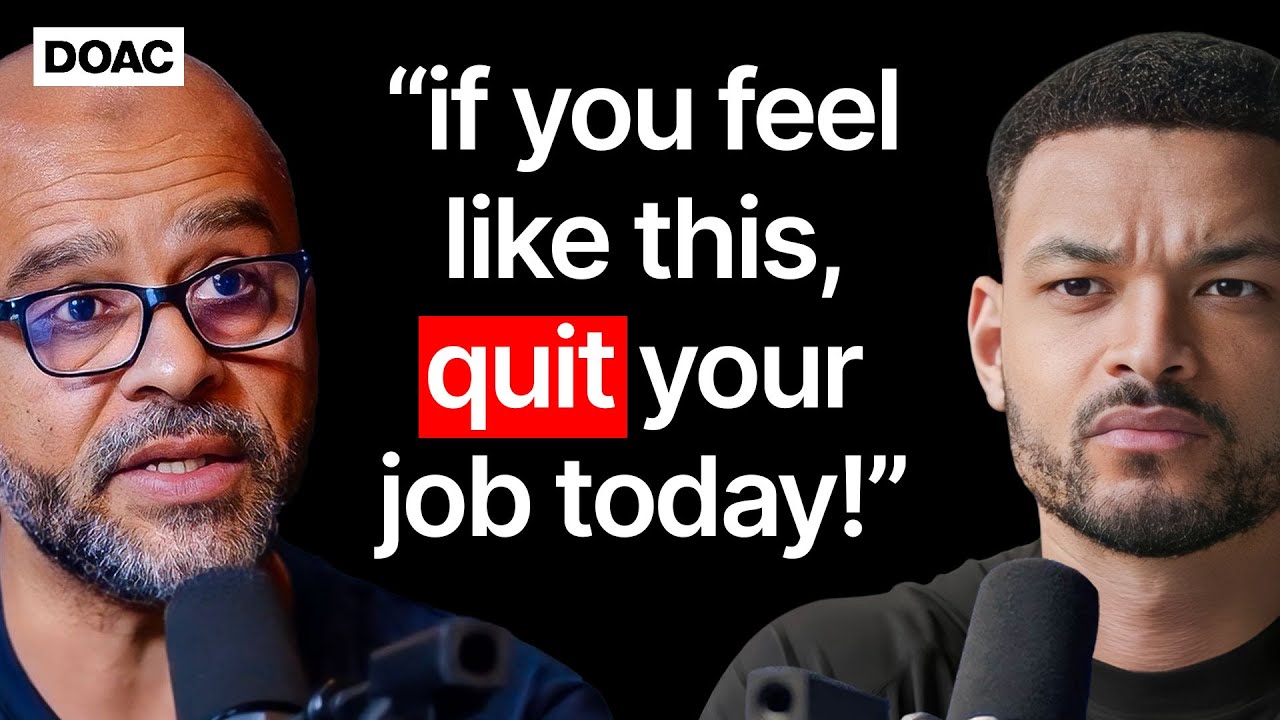
Mo Gawdat: A WARNING about Stress & Anxiety! This Is Causing 70% Of Heart Attacks In Young People! — The Diary Of A CEO

The Diary Of A CEO

Unchecked workaholism and constant micro-stressors physically ruin long-term health, requiring individuals to set strict life ceilings and eliminate unnecessary obligations.

AI-assisted summary of Mo Gawdat: A WARNING about Stress & Anxiety! This Is Causing 70% Of Heart Attacks In Young People! — original source. Check the original for full context.

Source published:

Detailed notes

## Background This episode of 'The Diary Of A CEO' was published on YouTube by host Steven Bartlett on April 25, 2024. Featuring Mo Gawdat—former Chief Business Officer for Google X, bestselling author, and co-founder of Unstressable—the video addresses the global epidemic of stress and anxiety, exploring its underlying causes and practical methods for living a stress-free life.

## TL;DR Mo Gawdat warns that chronic stress has become the modern world's greatest pandemic, directly driving up to 80% of doctor visits and causing severe health crises in young people. He deconstructs how societal pressure, over-scheduling, and fear drive toxic workaholism and internal noise, challenging Steven Bartlett and listeners to redefine success. Through actionable frameworks like TONN (Trauma, Obsessions, Nuisances, Noise) and boundary-setting strategies, Gawdat demonstrates how to eliminate unnecessary commitments and build mental resilience. Ultimately, he reframes time and personal connection as our most precious assets, urging a shift from relentless growth toward inner peace.

## Atmosphere & style The conversation carries an intimate, deeply reflective, and urgent atmosphere, moving seamlessly between hard-hitting analytical logic and raw emotional vulnerability. Mo Gawdat communicates with a gentle yet firm authority, challenging Steven Bartlett's hyper-productive lifestyle with poignant insights born from intense personal grief and high-level tech experience. The dynamic feels like a high-stakes mentorship session, marked by long, contemplative pauses, honest self-examinations, and an underlying sense of compassionate urgency regarding the state of modern human well-being.

## Key takeaways - [03:31](https://www.youtube.com/watch?v=IxVNR0Om-lA&t=211s) The world is entering a 'perfect storm' driven by AI, economics, climate, geopolitics, and synthetic biology, leading to 'the end of truth' and rapid societal change. - [12:31](https://www.youtube.com/watch?v=IxVNR0Om-lA&t=751s) Chronic stress has become the modern world's biggest pandemic, with 70% to 80% of doctor visits linked to stress-related conditions. - [17:14](https://www.youtube.com/watch?v=IxVNR0Om-lA&t=1034s) Saying 'I'm busy' and over-scheduling have become toxic status symbols used to validate self-worth and avoid facing internal stillness. - [19:15](https://www.youtube.com/watch?v=IxVNR0Om-lA&t=1155s) Around 80% of workplace activity is performative validation, while true breakthrough productivity requires unstructured time and empty mental space. - [30:39](https://www.youtube.com/watch?v=IxVNR0Om-lA&t=1839s) The TONN framework categorizes the sources of internal strain into Trauma, Obsessions, Nuisances, and Noise. - [43:31](https://www.youtube.com/watch?v=IxVNR0Om-lA&t=2611s) Loss aversion makes people fear change and hold onto toxic commitments, items, or relationships that no longer serve them. - [50:43](https://www.youtube.com/watch?v=IxVNR0Om-lA&t=3043s) The Burnout Equation shows that burnout is an accumulation of micro-stressors over time, not just sudden catastrophic events. - [54:34](https://www.youtube.com/watch?v=IxVNR0Om-lA&t=3274s) Stress can be mathematically defined as the intensity of external challenges divided by internal skills and available resources. - [56:00](https://www.youtube.com/watch?v=IxVNR0Om-lA&t=3360s) Stress manifests across four distinct modalities: mental, emotional, physical, and spiritual. - [01:11:16](https://www.youtube.com/watch?v=IxVNR0Om-lA&t=4276s) High achievers must establish clear boundaries and financial or operational 'ceilings' to prevent trading health and happiness for infinite growth. - [01:21:04](https://www.youtube.com/watch?v=IxVNR0Om-lA&t=4864s) Heartbeats are our only true non-renewable currency, making time spent living far more valuable than endless resource accumulation. - [02:10:00](https://www.youtube.com/watch?v=IxVNR0Om-lA&t=7800s) Anticipation-based distress breaks down into four specific forms: Fear (known threat), Worry (uncertainty), Anxiety (skill gap), and Panic (time constraint). - [02:17:12](https://www.youtube.com/watch?v=IxVNR0Om-lA&t=8232s) Low-quality 'junk relationships' deplete emotional energy, whereas finding a compatible life partner requires high self-awareness and avoiding 'dating potential'. - [02:27:42](https://www.youtube.com/watch?v=IxVNR0Om-lA&t=8862s) Deep social connection and helping others trigger the parasympathetic nervous system, effectively neutralizing the physical damage of stress. - [02:37:39](https://www.youtube.com/watch?v=IxVNR0Om-lA&t=9459s) True resilience requires turning the mind into a 'Mind Gym' to eliminate stress before it forms, rather than relying on temporary post-stress relaxation techniques.

## Detailed walkthrough ### [00:00](https://www.youtube.com/watch?v=IxVNR0Om-lA&t=0s) The Anatomy and Four Modalities of Stress

Former Google X Chief Business Officer Mo Gawdat returns with a critical mission: helping millions navigate an increasingly chaotic world without letting stress destroy their health. While acute stress served an evolutionary purpose, modern life has transformed it into a silent, widespread killer. The true danger lies not in sudden catastrophic shocks, but in the relentless accumulation of daily "nuisances"—the dozen micro-stressors triggered within the first ten minutes of waking up—and long-term "obsessions" fueled by internal lies.

Stress manifests across four distinct modalities: mental, emotional, physical, and spiritual. Each modality speaks its own language, requiring tailored techniques rather than a one-size-fits-all remedy. Learning to decode these signals allows individuals to address tension before it cascades into burnout, anxiety, or panic attacks. Before diving into the core discussion, host Steven Bartlett shares a channel milestone with the community, noting that regular non-subscribed listeners have dropped from 69% to 63%, with an ultimate target of reaching 50%.

- Stress operates in four distinct modalities: mental, emotional, physical, and spiritual. - Daily stressors accumulate rapidly, with people often encountering 10 to 15 nuisances in their first 10 minutes awake. - The channel's non-subscriber audience rate improved from 69% down to 63%, targeting 50%.

[02:01](https://www.youtube.com/watch?v=IxVNR0Om-lA&t=121s) A World Transforming Beyond AI

Opening the conversation, Mo describes his current state of mind as existing "somewhere between the best time of my life and the most interestingly inviting for change time of my life." While his message of happiness and well-being is reaching a massive global audience, he recognizes that the foundational rules of society are shifting so rapidly that past methods will no longer deliver the same results.

Looking ahead, Mo warns that the next five years will bring a degree of disruption unprecedented in modern human history. When Steven asks if this shift is centered purely on artificial intelligence, Mo clarifies that AI is merely one component of a much broader global transformation that will render the near future unrecognizable for most people.

- Mo views the current era as a pivotal inflection point requiring deep re-evaluation of how to live and work. - Relying on legacy strategies and habits will fail to yield predictable outcomes in the coming five-year window.

[03:31](https://www.youtube.com/watch?v=IxVNR0Om-lA&t=211s) The Perfect Storm and the "End of Truth"

Mo outlines what he terms a "perfect storm" composed of converging pressures: macroeconomic strain, geopolitical instability, climate change, artificial intelligence, and synthetic biology. The defining characteristic of this new era is what he calls "the end of the truth," where information is morphed to a degree that ordinary citizens can no longer distinguish reality from manipulation. This pervasive loss of clarity creates optimal conditions for leadership to maneuver populations into conflicts and economic compromises they would otherwise reject.

This convergence will make the upcoming period "the most stressful time of any generation that we've ever met." However, Mo emphasizes that while disruption is inevitable, personal stress is optional. The primary driver of societal anxiety is not necessarily the severity of the outcomes, but the sheer pace and unfamiliarity of the shifts. With Western economies overburdened by unsustainable debt, governments resort to currency dilution, fueling global friction and systemic instability.

- The five pillars of the "perfect storm": economics, geopolitics, climate, AI, and synthetic biology. - Unprecedented Western debt levels prevent standard fiscal policy solutions, leading to economic dilution. - "Wars are not the results of conflict; conflict is the needed trigger to start a war" to execute fiscal and geopolitical goals.

[07:08](https://www.youtube.com/watch?v=IxVNR0Om-lA&t=428s) The Origin of *Unstressable* and the Scale of Modern Competition

The inspiration for Mo’s book *Unstressable* came from his co-author, Alice Law, who challenged him by stating, "you cannot continue to write about happiness and well-being without addressing stress." Having survived severe stress in her twenties, Alice realized that external events do not cause stress; rather, stress is generated by internal responses. Together, they established a broader initiative aimed at liberating one million people from chronic stress every year.

To illustrate why modern life feels so intensely pressure-filled, Mo traces the history of human leverage. In hunter-gatherer times, an exceptional hunter might feed the tribe for two extra days; an elite farmer could sustain them for a month; an industrial manufacturer could supply millions. Today, AI platform creators like OpenAI are centralizing the commodity of raw intelligence itself—creating a plug-in-the-wall utility that instantly adds "100 IQ points." This extreme concentration of technological and economic power forces nations, corporations, and individuals into a hyper-competitive rat race just to avoid obsolescence.

- Co-author Alice Law suffered severe stress in her 20s, realizing that perception dictates stress levels. - The overarching goal of the *Unstressable* initiative is to free 1,000,000 people from chronic stress annually. - Historical reward and leverage evolution: Hunter-gatherers (days of food) $\rightarrow$ Farmers (millions of dollars) $\rightarrow$ Industrialists (billions) $\rightarrow$ AI platform owners (monopolized intelligence).

[12:31](https://www.youtube.com/watch?v=IxVNR0Om-lA&t=751s) Exponential Change and Stress as the Greatest Pandemic

Referencing research on futurist Ray Kurzweil's predictions by writer Michael Simmons, Steven notes the staggering acceleration of technological change. A ten-year-old child today will, by age 60, experience a full year’s worth of current progress in just 10 days. Similarly, the 21st century will witness roughly 10,000 years of historical progress—a thousandfold increase over the previous century. Mo points to recent advances in conversational AI models, such as ChatGPT and Sora, which now engage with human-like tonality and deliver evasive, politically polished answers that mimic human diplomacy.

In the face of this compounding complexity, Mo argues that chronic stress has surpassed all other health crises to become "the biggest pandemic of our time by a very, very, very large margin." While short-term stress can sharpen performance for an upcoming presentation or interview, constant pressure degrades human systems into burnout, severe anxiety, and panic attacks. Because individuals cannot halt global technological acceleration, they must adopt strict boundaries and internal filtering to survive.

- Kurzweil's acceleration projection: A 10-year-old today will experience 1 year of current change in 10 days by age 60. - The 21st century is projected to encapsulate 10,000 years of technological progress compared to prior rates. - An estimated 70% to 80% of modern doctor and clinic visits are driven by stress-related illnesses.

[17:14](https://www.youtube.com/watch?v=IxVNR0Om-lA&t=1034s) Why We Are Addicted to Stress as a Status Symbol

Mo explains that modern society has transformed stress into an addictive status symbol and a defense mechanism. Stating "I'm busy" has become a prized badge of honor, signaling to the world: "I'm wanted, I'm needed." People actively invite chaotic schedules into their lives to prove their worth, often spending 80% of their work effort simply validating their existence rather than producing meaningful results.

Beyond social validation, busyness serves as a shield against uncomfortable self-reflection. When people sit quietly with themselves, internal insecurities and negative dialogue surface. To escape this psychological discomfort, individuals over-schedule their lives to keep their minds perpetually occupied. However, lifestyle decisions carry a delayed lag effect: the choices made today manifest as severe exhaustion two to three months down the line. Even while launching his fourth book, Mo admits to feeling the physical toll of promotion, observing that "publishing a book is just a grueling job" because success relies far more on aggressive marketing than on the writing itself.

- Busyness functions as a modern status symbol to project necessity and social value. - An estimated 80% of workplace activity is spent trying to prove one's value rather than driving core outcomes. - Lifestyle and scheduling choices typically produce physical and mental exhaustion after a 2.5-month lag period.

[19:15](https://www.youtube.com/watch?v=IxVNR0Om-lA&t=1155s) The Addiction to Overloading Our Lives

Mo Gawdat illustrates the exhausting reality of modern over-scheduling, describing how people routinely stack their calendars beyond human capacity. He recalls his own brutal year: while trying to manage speaking engagements, four podcast recordings, and trips planned months prior in November, life suddenly intervened. His mother suffered a fall, and he tragically lost both his brother and his sister. When unpredictable life events hit, the sheer weight of an overcommitted schedule becomes unbearable. Yet, as soon as the crisis passes, people jump right back onto the treadmill, overloading themselves again for the next tour, book launch, or work assignment.

Gawdat argues that this compulsion to overwork exhibits all the classic symptoms of an addiction. We use constant busyness as a substance to justify our existence and validate our way of living. When Steven Bartlett offers the counterargument of a typical "workaholic brain"—reasoning that working 100-hour weeks is necessary to unlock one's full potential, afford sports cars, mansions, and private jets—Gawdat firmly rejects this narrative as false. True productivity and breakthrough ideas do not come from endless output; they require empty space.

* **The Trap of Continuous Output:** Over-scheduling leads to mere consumption or repetition of past ideas rather than new creation (e.g., traveling on a press tour where no new thinking actually occurs). * **Where Real Value Lives:** True impact happens in the unstructured gaps—the quiet hour in the morning without calendar pressure, writing a transformative email, or sitting peacefully over morning coffee connecting with a partner. * **The "Reaction" Trap:** Most back-to-back commitments force people to react to past achievements rather than generate fresh, high-value ideas.

> "The week you don't work is the week you are most productive... you allow yourself those spaces in which creativity happens, in which ingenuity happens, in which real connection happens."

---

[24:28](https://www.youtube.com/watch?v=IxVNR0Om-lA&t=1468s) Efficiency, Communication, and Eliminating Bureaucracy

Reflecting on his 12-year tenure as an executive at Google, Gawdat shares his unorthodox approach to corporate communication and time management. He openly refused to attend unnecessary meetings, asserting that showing up just to prove "I am alive and checked in" is a waste of human energy. Instead of clogging inboxes, Gawdat initiated only **four emails** in his entire 12-year career at Google. He only replied to messages that specifically asked for his direct input ("Mo, what do you think of that?"); if a message did not explicitly seek his opinion, he ignored it to avoid triggering endless reply threads.

Instead of emailing, Gawdat built real human connections through quick phone calls, corridor chats, walks, and structured weekly reviews. He argues that almost no weekend interruption is truly urgent enough that it cannot wait for Monday's review. Society has become addicted to creating false urgency just to squeeze out a marginal 5% increase in efficiency. Gawdat emphasizes that he gladly gives up that extra 5% because 95% of actual results can be achieved with just 20% of the effort.

* **Initiating vs. Responding:** Initiating emails creates an exponential influx of noise; limiting outreach keeps communication clear and intentional. * **Delivering Numbers Over Showing Up:** Proof of existence in a career comes from results, not attendance badges or performative emails. * **The 80/20 Rule of Workplace Effort:** 80% of typical workplace activity is done merely to validate one's presence, while 20% yields actual performance.

> "I think in my entire career 12 years at Google I sent four emails... You initiate one email and you get a shitload of emails back, right? And what's the point?"

---

[26:41](https://www.youtube.com/watch?v=IxVNR0Om-lA&t=1601s) The Parable of the Fisherman and Redefining Success

Steven admits his internal fear: if he stops pushing at maximum intensity, won't he become less innovative and fall short of his potential? Gawdat responds with the famous parable of the wealthy billionaire and the coastside fisherman.

In the story, a billionaire meets a fisherman who catches two fish every morning—one to feed his family and one to sell—spending the rest of his day relaxing and enjoying time with his loved ones. The billionaire urges him to catch more fish, buy a bigger boat, build a fleet, sell a company, and make millions. When the fisherman asks why, the billionaire replies, "So you can retire, live by the ocean, and go out in your boat every morning." To which the fisherman replies, "I'm already doing that every morning."

Gawdat notes that society sells a artificial dream that "more, better, faster" is always superior, or that one needs a billion dollars to feel secure. He asks whether scaling an enterprise to "change the world" is truly more valuable than hugging your daughter or spending quality time with your partner. To break free from this cycle, Gawdat advises setting explicit targets and incorporating personal well-being directly into the success equation.

* **Redefining the Objective:** Shift the target from "maximize output at all costs" to "achieve 100% of performance targets using the minimum required effort while maximizing well-being." * **Sustained Longevity:** Prioritizing personal balance enables high performance over decades rather than leading to premature burnout.

---

[30:39](https://www.youtube.com/watch?v=IxVNR0Om-lA&t=1839s) The TONN Framework: Trauma, Obsessions, Nuisances, and Noise

Introducing a core framework from his book *Unstressable*, Gawdat explains the "Three L's" model—**Limit, Learn, and Lesson**—focusing heavily on how to **Limit** the sources of daily anxiety. He breaks down the acronym **TONN**, which categorizes the four primary sources of stress:

1. **Trauma:** Major external events that break a person temporarily (e.g., loss of a loved one, sudden job loss, or war). While 91% of people experience a PTSD-inducing event, 93% recover within three months. Trauma is rarely what permanently breaks us. 2. **Obsessions:** Internal macro-narratives and scripts that do not reflect reality (e.g., believing "I have a small belly, so no one will ever love me"). 3. **Nuisances:** Daily micro-stressors that do not break you individually, but compound over time to cause severe burnout. 4. **Noise:** Background chatter and information overload.

Gawdat points to co-author Alice Law’s breakdown of a typical person's first 10 minutes of the morning: blaring alarms, opening social media, checking stressful messages, and absorbing 10 to 15 distinct micro-stressors before even drinking coffee. By conducting an honest inventory of these daily occurrences, people can intentionally cut out hundreds of unnecessary stressors.

* **Audit Your Daily Micro-Stressors:** Identify daily pain points—such as a chaotic commute or toxic media intake—and optimize them (e.g., leaving 10 minutes earlier, listening to music or podcasts). * **Setting Boundaries on Obligations:** Many draining situations are self-imposed obligations that can easily be limited or eliminated.

---

[35:07](https://www.youtube.com/watch?v=IxVNR0Om-lA&t=2107s) Eliminating Toxic Obligations and Having Honest Conversations

Addressing the awkward reality of social obligations, Bartlett admits that "Old Steve" constantly commits to events and projects that "Future Steve" ends up dreading. Gawdat relates, sharing that at the beginning of the year, he audited his commitments and realized he was essentially running **18 full-time jobs**. When he cut them down to nine, his loved ones reminded him that nine was still far too many.

To reclaim time, one must accept that setting boundaries will occasionally upset people or hurt feelings. Gawdat recounts an explicit conversation with a close, long-time friend whose self-absorbed ego made every coffee meeting exhausting. Instead of continuing out of sheer obligation, Gawdat told him directly at the end of a meetup: *"I think we shouldn't meet again... Every time I sit next to you, you make me miserable."* When the friend asked why, Gawdat laid out the behavior clearly, giving him the choice to change or end the relationship.

* **Cutting Down Workload:** Reducing commitments from 18 projects to 9 required making firm, un-apologetic cuts. * **Directness Over Fake Politeness:** Continuing draining friendships or business commitments out of obligation harms long-term health. * **Choosing Self-Care First:** Saying a clear "no" without elaborate excuses is an essential business and personal skill.

[37:15](https://www.youtube.com/watch?v=IxVNR0Om-lA&t=2235s) Setting Boundaries and Putting Your Well-Being First

Continuing his discussion on navigating difficult relationships, Mo Gawdat recalls ending a weekly commitment with a friend whose persistent negativity drained him. He explained to his friend that while he loved him, spending four hours every Sunday listening to unchangeable complaints made no sense. Mo highlights that a true friend’s role isn't to pull someone out of a rut unprompted, but rather to be there when specifically asked for help they can actually provide. Addressing those who feel trapped in abusive or unproductive relationships out of a sense of obligation, Mo asks why people hesitate to prioritize their own mental well-being over a past history together.

Stephen Bartlett steps in to question the short-term cost of putting oneself first, noting that even when the long-term gains are clear, it is the immediate friction that keeps people imprisoned in harmful situations. Mo brings up insights from his wife, Hannah, a therapist, explaining that human psychology is deeply wired for consistency and terrified of change—even when that change is undeniably good for us. Our survival mechanism prefers a familiar, predictable pain over the terrifying uncertainty of the unknown.

* Mo shares that when leaving Google X—where his mission evolved from "10 Million Happy" (which was achieved in just eight weeks) to "1 Billion Happy"—he caught himself falling into extreme anxiety about the future. * Being an engineer, Mo built an elaborate spreadsheet modeling every possible future expense and income source for his ex-wife, daughter, and himself. * When the numbers proved he was fine, his brain fabricated an extreme edge case: *"What if there is a nuclear war... and nuclear dust comes to Dubai so your real estate portfolio gets wiped out?"* * Realizing the absurdity of trying to plan for a nuclear fallout, Mo recognized that the human mind will always invent new threats to avoid venturing into the unknown.

[43:31](https://www.youtube.com/watch?v=IxVNR0Om-lA&t=2611s) Loss Aversion and the Hidden Opportunity in Letting Go

Stephen Bartlett pays tribute to psychologist Daniel Kahneman, who had passed away just days prior to the recording, referencing his seminal 1980s research on loss aversion. Kahneman’s work demonstrated that human beings experience the pain of a loss far more intensely than the pleasure of an equivalent gain—requiring a potential reward to be two to three times larger to justify taking a risk. Stephen notes that this evolutionary quirk likely stems from ancient trading risks, keeping modern individuals stuck in mediocre jobs or relationships unless the alternative appears drastically superior.

Mo counters this instinct by pointing out a factual reality of life: losing something is usually the exact mechanism that creates the space for something better to enter. Retrospectively, losing a job or ending a relationship is what opens the door for a better career path or the right partner to appear. However, because the brain acts as a survival mechanism focused on hypothetical worst-case scenarios, it overlooks personal resilience and ignores how often past hardships were successfully navigated.

- **Ranked Priorities:** Mo observes that if people truly ranked what matters, only four or five core things genuinely warrant major concern, yet people hold onto thousands of trivial anxieties. - **Minimalism and Clutter:** Recalling when his wife Hannah first visited his home, she teased him for being a "minimalist wannabe" because he kept 16 varieties of tea he never drank, whereas she only keeps two that she truly loves. - **The "Rule of 10":** Mo practices a routine of giving away or throwing out 10 items from his house every week. He illustrates this with an old humidifier he kept for eighteen months; when he finally tested it, it didn't even work—proving it was just physical and mental noise. - **Physical Clutter as Stress:** Unused objects take up space, require attention, and create ambient stress, while keeping them deprives others of the chance to actually use them.

[50:43](https://www.youtube.com/watch?v=IxVNR0Om-lA&t=3043s) Understanding the Origin of Stress and the "Burnout Equation"

Mo clarifies what he terms "noise" in his book *Unstressable*, describing it as internal micro-stressors generated entirely inside one's head—such as intrusive negative thoughts about aging or past mistakes—rather than real-world events. To systematically categorize stressors, Mo outlines the **TONN** framework based on two axes: internal vs. external, and macro vs. micro.

``` INTERNAL EXTERNAL +------------------------+------------------------+ MACRO | Existential / Future | Trauma (Capital 'T') | | Anxieties & Dread | Major Crises/Losses | +------------------------+------------------------+ MICRO | NOISE | Daily Hassles & | | (Internal Self-Talk) | Micro-Stressors | +------------------------+------------------------+ ```

Mo emphasizes that stress is biologically useful until it reaches a point where it breaks you. Outside of rare external traumas—from which 93% of people recover within three months and 96% within six months—the primary ways stress destroys lives are burnout and the anticipation of stress, both of which are under an individual's control.

Mo mathematically defines the **Burnout Equation** as:

$$\text{Burnout} = \sum \Big( \text{Number of Stressors} \times \text{Intensity} \times \text{Time of Application} \times \text{Frequency} \Big)$$

Using a daily commute as an example, Mo shows how a single two-hour, high-intensity commute done twice a day, five days a week, accumulates massive stress weight over time. Humans rarely break because of one isolated event; rather, they collapse when a tiny, trivial trigger—like a friend playfully calling them "chubby"—is stacked on top of 400 accumulated micro-stressors that have pushed them past their breaking point.

[54:34](https://www.youtube.com/watch?v=IxVNR0Om-lA&t=3274s) The Physics Equation of Stress

Mo Gawdat shares an epiphany regarding the definition of stress, credited to his co-author Alice Law during the writing of *Unstressable*. Coming from a background in physics, Mo notes that stress is traditionally defined as the force applied to a cross-sectional square area of an object. Translating this directly to human psychology, stress is not merely the external challenge or threat someone faces. Instead, it is the intensity of those external challenges divided by the skills, resources, and abilities available to handle them.

This mathematical relationship explains why certain individuals remain calm under circumstances that would cause others to panic. When a person accumulates more internal resources and techniques, their capacity increases, allowing them to look back at things that made them "freak out" in their twenties and simply laugh.

* **The Stress Equation:** $\text{Stress} = \frac{\text{Intensity of Challenges}}{\text{Resources \& Skills}}$

---

[56:00](https://www.youtube.com/watch?v=IxVNR0Om-lA&t=3360s) Age, Experience, and the Four Modalities of Stress

Steven Bartlett probes into the concept of "flapping"—the tendency of people to panic or worry when situations become difficult. Mo distinguishes anticipation-based breakdown from situational pressure. He recalls his corporate career at Google, where colleagues would panic over a sudden change in leadership, declaring a nine-month deal dead. Drawing on his experience managing hundreds of executive transitions, Mo would remain unbothered, knowing the exact steps needed to rebuild the network.

Mo illustrates this generational split with an anecdote from his first day at Google. His shrewd manager introduced him to the team by saying, "Hey everyone, this is Mo, he’s bringing the average age of the company up." While a blunt introduction, this age diversity proved vital during the 2008 economic crisis. As the company panicked, the older cohort recognized the downturn as cyclical, drawing on past economic cycles to stabilize their response.

To manage these inevitable pressures, Mo outlines the four modalities through which humans experience stress, noting that each operates in a completely distinct "language course":

* **Mental Stress:** Addressed through rational techniques, like writing down thoughts that wake you up at 4:00 AM to offload them from the brain. Mo references a system called "GYMMM" consisting of eight specific practices, alongside a technique called "Meet Becky" to allow the brain to express ideas rather than blocking them. * **Emotional Stress:** Subtle and deeply blended like overlapping brush strokes. Unlike the mind, emotions always speak the truth—if you feel fear, the fear is real—yet society frequently conditions people to ignore them. * **Physical Stress:** Manifests as aches, pains, headaches, and digestive issues. People often normalize body aches by blaming external factors like a 16-hour flight, ignoring the underlying stress signatures. * **Spiritual Stress:** Not tied to religion, but rather the non-physical consciousness. It communicates purpose and alignment through intuition, a voice frequently drowned out by the frantic pace of modern life.

---

[01:01:38](https://www.youtube.com/watch?v=IxVNR0Om-lA&t=3698s) Spotting Physical Stress and the Addiction of Workaholism

Recognizing one's own stress is notoriously difficult because people internalize false narratives, believing that anxiety or burnout are noble prerequisites for productivity and growth. Mo argues that physical stress has the most undeniable signature. The human body functions like a luxury vehicle; it should operate seamlessly unless compromised by illness. When it begins to shake, it demands inspection. Anxiety leaves a distinct signature in the stomach, while fear spreads throughout the entire body. To counteract this, Mo highlights Alice Law's recommendation of a thorough body scan—closing one's eyes on a flight, breathing deeply, and scanning from head to toe to identify where it hurts.

Steven counters by comparing workaholism to substance addiction. Addicts logically understand that their behavior is destructive, but the underlying emotional trauma, self-esteem issues, and chemical dependencies override logic. Steven admits that he often views himself as "dragged and not very driven," feeling a lack of control over his compulsive work habits. He observes his own close friends literally killing themselves with work, fully aware of the toll it takes, yet unable to stop.

---

[01:04:49](https://www.youtube.com/watch?v=IxVNR0Om-lA&t=3889s) The "Too Busy" Myth and Setting Caps on Revenue

Mo challenges the common defense of being "too busy" by calling it an outright lie. He asserts that anyone claiming to have no time has likely binged hundreds of hours of *Game of Thrones*. Even if someone returns home completely brain-dead and wastes three hours staring at a screen, those hours were still available. The stark reality is that individuals will either choose to spend time managing their stress upfront, or they will be forced to spend that time lying in bed recovering from burnout. Even with a lifetime of training, Mo confesses that he historically burned out at the end of every book launch, losing a week and a half to total exhaustion because he fell into the trap of playing "Superman."

For the current *Unstressable* launch, Mo adjusted his approach by clearing his schedule entirely for two weeks to focus solely on the book, accepting his limitations. When Steven asks about individuals who truly have no choice—such as factory workers balancing two jobs to feed a family—Mo honors their struggle but urges those in privileged positions to question why they push themselves so hard. He advises that when external environments cannot be altered, one must rely on the principle of "Limit, Learn, and Listen."

Steven turns the mirror on himself, asking Mo what psychological narrative drives his own obsessive behavior, noting that no future achievement or revenue will realistically make him any happier. Mo observes that Steven's life "doesn't have a ceiling." He illustrates this by recalling his own pivot with his foundation, One Billion Happy. Mo originally planned to speak for free anywhere with more than 50 people. His business manager, Monir, intervened, advising that profit-making organizations should be charged full price, while charity work remains free. This small adjustment generated significant revenue, forcing Mo to confront a fundamental question: "How much revenue is enough?"

<ElicitationsGroup message="What would you like to do next?"> <Elicitation label="Learn about the latest solar innovations" query="Learn about the latest solar innovations" query_intent="CLICKABLE_SUGGESTION" /> <Elicitation label="Exploring how artificial networks mimic the human brain's evolution" query="Exploring how artificial networks mimic the human brain's evolution" query_intent="CLICKABLE_SUGGESTION" /> <Elicitation label="Investigating the long-term geopolitical shifts triggered by this era" query="Investigating the long-term geopolitical shifts triggered by this era" query_intent="CLICKABLE_SUGGESTION" /> </ElicitationsGroup>

[01:11:16](https://www.youtube.com/watch?v=IxVNR0Om-lA&t=4276s) Setting Boundaries: Defining Your Ceiling and True Costs

Mo Gawdat shares a conversation he had with a close professional colleague—someone he considers like a brother—who presented him with a target for the year. Mo set a firm constraint: he would agree to a maximum of 20 travel trips per year, pushing everything else online. When the colleague asked if they could increase it to 25, Mo held the line. He emphasizes that the world will continuously push you; boundaries are not set by the world, but by yourself. Stephen Bartlett plays devil's advocate, pointing out that taking 30 or 40 trips would generate significantly more revenue to fund Mo’s mission of making people unstressable. Mo counters that creating an online program reaches more people with higher margins, whereas trading health and personal well-being for extra speaking fees is a false economy.

Stephen reflects on his own tendency to measure the financial gain of speaking engagements easily while failing to quantify the hidden cost. Mo explains that when you sell your well-being, time, joy, and relationships, you are mispricing the true expense of opportunity cost. Sharing a personal shift, Mo notes how falling in love with his wife, Hannah, changed his perspective: spending an extra day conversing with her about psychology and dating enriches his life and feeds directly into his creative work—such as his book *Finders Keepers*—far more effectively than additional money ever could.

* Mo's personal rule limits his travel to a maximum of 20 trips per year. * "If you sell your health and well-being for Revenue it's always opportunity cost... What you're selling is your time, is your joy, is your health." * Mo recalls his time at Google X when he asked why `google.org` donated money instead of leveraging their unique capability to write code for disaster recovery.

---

[01:15:33](https://www.youtube.com/watch?v=IxVNR0Om-lA&t=4533s) Challenging the Workaholic Pace and Unexamined Goals

Turning the spotlight directly on Stephen, Mo affectionately calls him out on his relentless schedule, challenging his practice of releasing two podcast episodes a week. Mo argues that Stephen is operating in a seasonal posture driven by early-20s hustle energy, stressing both himself and his audience just to drive up views. When asked how much attentive, restful time Stephen spent with his girlfriend over the past quarter, Stephen admits it was "even less" than the already inadequate amount of time they spent together overall.

Mo contrasts this with a recent 9-hour flight he took from Dubai to London alongside his daughter, Aya, calling it the "best 9 hours ever" because he chose to be fully present rather than grinding through emails. Referring back to his core stress formula—*External Challenges divided by Resources*—Mo questions how many challenges we needlessly invite into our lives by failing to define our boundaries or establish what is "enough." He cites an example of a friend staying in a toxic relationship purely to split rent on an apartment, illustrating how people tolerate avoidable misery out of habit.

* Stephen admits that out of the time spent with his partner, "completely attentively restful" moments were extremely scarce. * Mo describes his flight with Aya: "Best 9 hours ever ever... What a waste of life" it would have been to spend it writing emails instead. * Mo highlights that stress is self-invited when we fail to ask what target or objective we are actually trying to achieve.

---

[01:18:20](https://www.youtube.com/watch?v=IxVNR0Om-lA&t=4700s) Childhood Conditioning, Self-Worth, and the Hamster Wheel

Stephen opens up about the root causes of his workaholism, questioning whether childhood experiences and inherited survival mindsets drive self-inflicted stress. As a child of first-generation immigrants, Stephen internalized his mother's survival instinct. He reflects on childhood shame from being the only Black kid in his area, recalling how he chemically relaxed his hair and listened to bands like The Kooks and Arctic Monkeys just to fit in. Stephen confesses that he attached his core self-worth and self-esteem to his work achievements, constantly striving to prove that he is "enough."

Mo compares this unchecked ambition to a hamster wheel with no ceiling: capable people keep running faster and faster without questioning when their well-being enters the equation. Stephen references a chapter from his book *Happy Sexy Millionaire* where he quit his CEO position because the role had lost all joy and was killing him, demonstrating how easy it is to excel at a goal that no longer serves you.

* "I still feel like I've got my mother's survival thing in me... I've connected my work to my self-esteem or my self-worth in some deep way." * Stephen recalls trying to blend in during his youth by listening strictly to The Kooks and Arctic Monkeys. * Mo uses the metaphor of a treadmill with no ceiling: "I'm a very good hamster... you keep running to achieve what? That's the whole question."

---

[01:21:04](https://www.youtube.com/watch?v=IxVNR0Om-lA&t=4864s) Heartbeats as Currency: The Reality of Time and Loss

Mo reminds Stephen that heartbeats are the only true resource and asset an individual possesses. While someone in their 30s may look forward to decades of life, their 20s are permanently gone, and the specific window of peak mental sharpness to outperform machines is fleeting. Mo shares a poignant memory of sitting beside his ex-wife after their 21-year-old son, Ali, passed away. As she flipped through a photo album, she remarked that the infant Ali had "died" and was replaced by the child, who then "died" to become the teenager, who eventually became the young man who passed away.

This realization deeply reshaped Mo’s view of time: every phase of a loved one's life lasts only a couple of years before it vanishes forever, yet people routinely defer connection until after they finish building their goals. Mo admits feeling regret on his flight with Aya, asking himself why he had not brought her on every trip, caught up in illusions of cost or business busyness. He contrasts this with memories of taking her shopping for shoes or jeans in Canada, realizing he had stopped doing so simply because he lost sight of his core objectives.

* Ali's mother observed while looking at photos: "He was such a beautiful infant and then he died... and then this young man showed up... and then the teenager died." * Mo reflects on saving, investing, and starting three separate businesses aligned with Ali's changing college majors, only to lose him at age 21. * "While life is supposed to be lived, we spend most of it planning to live it." * Mo references the parable of the fisherman who catches two fish—one for his family and one to sell—and notes that unchecked fear drives people to endlessly hoard resources beyond their actual needs.

---

[01:27:18](https://www.youtube.com/watch?v=IxVNR0Om-lA&t=5238s) Knowing Your Minimums and the Fear of Stillness

When Mo asks Stephen what he actually *needs* to live, Stephen admits that running multiple businesses inflates his required capital, even though he does not strictly need to operate them. If he stripped everything back to just *The Diary Of A CEO* podcast, Stephen calculates he could film a quarter’s worth of episodes in two weeks (recording two or three per day) and have five out of seven days free every week. However, Stephen acknowledges that his default reaction to free time is to immediately fill it with new projects like writing books because sitting idle with his own thoughts is uncomfortable.

Stephen references a psychological study where participants preferred administering self-inflicted electric shocks over sitting alone in a quiet room for 15 minutes. Mo responds by recounting his experience being detained by immigration at Los Angeles International Airport (LAX). Held in detention for 37 hours without access to his phone, Mo reframed the ordeal as a luxury "silent retreat." He spent eight-hour blocks meditating, sleeping, and chatting with the security staff, proving that internal stillness depends entirely on one's mindset rather than external circumstances.

* Stephen estimates that scaling back to just the podcast would leave him with five free days a week, requiring only about two weeks of filming per quarter. * Stephen cites a study where a staggering number of participants chose to give themselves an electric shock rather than sit quietly alone for 15 minutes. * Mo spent 9 hours in LAX immigration questioning followed by 37 hours in detention without a phone, treating it as the "best 37 hours" by viewing it as an unexpected silent meditation retreat.

[01:29:49](https://www.youtube.com/watch?v=IxVNR0Om-lA&t=5389s) Unpacking built-up noise: The "Limit, Learn, and Listen" framework

Steven opens the discussion by addressing listeners who feel trapped in high-powered corporate lives—such as managing directors of funds—surrounded by constant demands like WhatsApp messages, emails, and personal commitments. He asks how someone can unpack this noise without destroying the life they have carefully built. Mo explains that people can make adjustments at a granular or micro level using his core methodology: **limit, learn, and listen**. He asserts that roughly **80% of what people surround themselves with is unnecessary**, including excess wealth, because a person cannot drive two cars or sleep in two beds simultaneously.

To demonstrate how limiting works at an executive level, Mo shares a story from his time as Chief Business Officer at Google X. He once met an exceptionally calm CEO and asked for his secret. The CEO replied that he strictly conducts a maximum of **four meetings a day**, with each lasting **exactly one hour**. The CEO explained that meetings shorter than an hour are overly operational, while those longer than an hour indicate that the team has not yet figured out the problem. Mo relates this back to sales teams he used to manage: when salespeople presented 12 potential deals a week, he would force them to focus on just two high-value, highly interested accounts. By narrowing their focus, they consistently exceeded their targets, whereas spreading themselves across 12 deals led to burnout and losing 10 of them due to a failed portfolio approach.

* **80% Reduction Rule**: Mo claims that 80% of a typical high-performer's commitments and expenses are unnecessary waste. * **The 4-Meeting CEO Rule**: Maximum 4 meetings per day, strictly 1 hour each (shorter is too operational, longer means lack of clarity). * **Focusing Sales Strategy**: Concentrating on 2 key deals out of 12 yields a **110% target completion**, avoiding the trap of spreading attention too thin.

---

[01:33:01](https://www.youtube.com/watch?v=IxVNR0Om-lA&t=5581s) Debunking the hustle lie and setting life ceilings

Steven plays devil's advocate, noting that almost every successful entrepreneur admits there was zero work-life balance during their first year or two. He mentions his own past experience of working in a call center while building his business until midnight every night. Mo acknowledges that an initial period of intense push is understandable, but calls the idea that hustle must be endless a **damaging lie**. He argues that people fail to set a clear "ceiling" or pre-planned stopping point where they can declare that what they have built is enough.

Mo illustrates the power of limits across different areas of life: capping travel at 20 trips increases one's value per trip while maintaining revenue; limiting social circles to five close friends creates genuine, in-person relationships instead of distant text exchanges. He discusses his own internal struggle regarding a proposed Arabic podcast aimed at a regional audience of **350 million people**. Although he is one of the few who could launch a show as successful as *Slo Mo* in that market, he decided to pause it because adding 52 episodes a year would break his health. He directly challenges Steven to consider whether releasing one "kickass" episode of *The Diary Of A CEO* per week—instead of two—would truly harm his mission or bottom line.

> "The lie is it's never ending... for every one of us, there's no ceiling, there's no pre-plan of when 'I reach this, it's enough'."

* **350 Million Audience Constraint**: Mo postponed launching an Arabic podcast for 350M people to preserve his personal health. * **Quality Over Quantity**: Limiting commitments (e.g., capping trips or narrowing friend groups) elevates depth and overall value without losing ground.

---

[01:35:47](https://www.youtube.com/watch?v=IxVNR0Om-lA&t=5747s) Redefining podcast metrics and Steven's internal realization

When Mo asks Steven if cutting back to one episode a week would slash his sponsorship revenue, Steven reveals that sponsorship money is actually inconsequential in the grand scheme of things. For the first three years of *The Diary Of A CEO*, all revenue was reinvested directly into the show; now, excess funds simply allow them to hire more staff or run parallel studios in LA and the US. Mo urges Steven to measure a different objective altogether: focusing on the depth of impact on every individual listener, the true quality of guests, and topics he deeply believes in over the long term.

Steven admits to experiencing an internal realization about his own habits. He acknowledges that while building a platform yields incredible conversations—referencing Episode 101 as his favorite conversation of all time—the personal cost of running 40 investment companies and co-founding six or seven businesses has become severe. He confesses to being trapped in a "voluntary insanity" driven by the addiction to stress. Mo contrasts Steven's celebrity-focused strategy with his own podcast, *Slo Mo*, which focuses on everyday people out of a potential guest pool of **7.8 billion people**, choosing depth and resonance over pure reach or follower counts (pointing out his ~150,000 Instagram followers versus Steven's multi-million audience).

* **Podcast Reinvestment**: *The Diary Of A CEO* funneled 100% of its revenue back into production during its first three years. * **Steven's Business Overload**: Steven is involved with **40 companies as an investor** and **6 or 7 companies as a co-founder**, leading him to question his own schedule. * **Episode 101**: Steven highlights Mo's previous appearance on Episode 101 as his favorite conversation in the show's history.

---

[01:41:12](https://www.youtube.com/watch?v=IxVNR0Om-lA&t=6072s) Evolution of purpose: From Silicon Valley hustle to inner peace

Reflecting on his own journey, Mo recalls a public talk he gave in 2009 where he declared his life's purpose was to help startups build technology as complex as Google outside the Western world. To fulfill this, he used to coach **50 startups a week**, parking himself at the Blue Bottle Cafe on University Avenue in Palo Alto every Sunday between 11:00 AM and 5:00 PM to meet 15 to 20 founders. Looking back, Mo realizes that this was not his true life purpose; he was simply operating within a system he happened to excel at.

His true purpose—focused on happiness and well-being—chose him following the tragic death of his son, Ali. Embracing this meant walking away from Google X, stopping angel investing, and stepping off the corporate treadmill. Now, when founders text him asking for money, he flatly refuses, emphasizing that investing is not merely handing over cash, but taking calls every four hours. Mo cautions that the global obsession with endless growth, speed, and progress is a illusion that leads people to rush blindly into risks, including uncritical adoption of artificial intelligence.

* **2009 Life Purpose Statement**: Helping non-Western startups build Google-level technology. * **Blue Bottle Cafe Routine**: Hosting Sunday drop-in hours from 11:00 AM to 5:00 PM on University Ave, meeting **15–20 startup teams** weekly. * **Coaching Volume**: Mentoring up to **50 startups per week** prior to shifting his focus to happiness.

---

[01:43:51](https://www.youtube.com/watch?v=IxVNR0Om-lA&t=6231s) The infinite growth trap and AI's impact on workforce stress

Mo challenges humanity's uncritical acceptance that "more is better" and "faster is better." He points out that technological progress has successfully raised human life expectancy from around 37 years historically to over 70 or 80 years today. However, he questions futurists like Peter Diamandis and Ray Kurzweil, who advocate for extending life infinitely or living forever via technology. Mo asks whether this pursuit stems from an unexamined fear of death or unaddressed childhood issues, noting that stress—like technology—is beneficial only up to a point before becoming toxic.

Steven shifts the conversation to how artificial intelligence is accelerating stress across society. He cites recent statements from the founder of Klarna, who revealed that AI is currently performing the work equivalent to **800 customer service jobs** at the company, alongside a UK report indicating **8 million jobs are vulnerable to AI automation**. Steven notes that "ease" is the temptation luring society into adopting these tools, but Mo challenges this by asking *who* it actually becomes easier for—the workers losing their jobs or the executives hiring the AI? They conclude by questioning the core mechanics of productivity and the traditional economic model of fiat currency and fractional reserve banking, which forces a continuous cycle of mining resources and accumulating debt.

> "Everything is positive until you have too much of it. Stress itself is positive unless you let it linger forever."

* **Life Expectancy Gains**: Human life expectancy increased from ~37 years in historical times to 70–80+ years today. * **Klarna AI Case Study**: AI tools now perform the equivalent workload of **800 customer service roles** at Klarna. * **UK Job Vulnerability**: An estimated **8 million UK jobs** are threatened by AI automation.

[01:47:06](https://www.youtube.com/watch?v=IxVNR0Om-lA&t=6426s) The Productivity Trap and the False Promise of Endless Growth

Mo Gawdat challenges the prevailing economic dogma that demands infinite annual growth. He questions why a company that creates quality products, pays fair salaries, and earns a reasonable profit must constantly strive to grow by 2%, 5%, or 20% every single year. Gawdat argues that this relentless expectation is driven by a debt-based economic system that requires ever-increasing GDP simply to cover compounded debt. He calls this cycle a "big lie" that tricks society into believing it constantly needs more productivity.

To illustrate how artificial this economic treadmill is, Gawdat contrasts modern financial systems with a simple historical bartering economy. In the past, a shoemaker only needed to make two pairs of shoes to trade for 14 eggs, while a farmer produced 28 eggs to get a pair of shoes and a few vegetables. There was no inflation or hyper-productivity rat race; people produced what was necessary to meet human needs. Gawdat emphasizes that while technology and growth were beneficial up to a point, pushing past that threshold makes progress work against humanity.

* Gawdat asserts that if he could press a single button right now to completely stop AI development, he would do so "100%".

---

[01:49:01](https://www.youtube.com/watch?v=IxVNR0Om-lA&t=6541s) Live Demo: OpenAI's Voice Engine and Diplomatic AI Guardrails

Steven Bartlett shifts the discussion to the accelerating AI race, noting major developments from tech giants like Microsoft, Meta, and OpenAI over the preceding months. Live on air, Steven demonstrates OpenAI's newly released Voice Engine by having an interactive, real-time voice conversation with ChatGPT. The synthetic voice speaks with fluid human inflection, discussing whether AI will replace podcasters, how developers can adjust tone and cadence to make machines sound less human, and the debate surrounding artificial consciousness.

When Steven presses the voice assistant on whether AI will eventually become completely indistinguishable from humans, the AI offers a measured, evasive answer about uncertainties and complex variables. Reacting to the interaction, Steven and Gawdat note that the machine feels like it is "lying" or acting like a "creepy diplomatic politician." Gawdat highlights how rapidly voice synthesis and language processing have evolved. Only months prior, models were purely text-based; now, they seamlessly understand colloquial accents, switch between languages, and can even adapt to specific regional dialects like Egyptian Arabic.

* Steven highlights OpenAI's press release for its Voice Engine, which can clone any human voice from just 15 seconds of sample audio. * OpenAI issued explicit warnings in its release, advising banks and financial institutions to immediately update security systems that rely on voice verification. * Steven mentions investing in Wondercraft AI, a voice synthesis platform, while noting tools like ElevenLabs that are reshaping audio generation. * Gawdat recalls seeing a hyper-realistic AI avatar of himself at the Abundance360 conference that matched his appearance and voice completely.

---

[01:54:02](https://www.youtube.com/watch?v=IxVNR0Om-lA&t=6842s) The Escalating Mental Health Crisis and Artificial Relationships

Gawdat argues that society will never voluntarily stop pushing technological boundaries, which makes an increasingly stressful world inevitable. Because external technological and economic shifts cannot be paused, Gawdat emphasizes that every individual's most critical task over the next few years is learning how to cultivate internal calm, peace, and resilience amidst the chaos. He notes that the rapid pace of change is disrupting every pillar of life, from macroeconomics to personal friendships and dating.

The conversation turns to the growing epidemic of loneliness and the rise of synthetic companionship. Gawdat and Steven discuss products on tech platforms like Product Hunt that allow grieving or heartbroken individuals to upload their complete chat histories with ex-partners or deceased loved ones. AI models then process this data to simulate the person's exact texting style, allowing users to continue "relationships" with artificial avatars. Gawdat warns that these technological advances are rarely created to serve human well-being, but are driven by corporate financial motives and individual ego.

* Gawdat reflects on the social shift from knocking on a friend's door as a child, to phone calls, to social media, and ultimately to young people forming primary friendships with AI bots. * Gawdat shares an anecdote about having an in-depth conversation with ChatGPT comparing Einstein's theory of relativity and string theory to define gravity. * Steven points out that social status games are hardwired into human nature, citing author Will Storr's work on status, though Gawdat emphasizes that people can choose *which* status game to play (e.g., being the wealthiest versus being the kindest or wisest). * Gawdat reiterates his personal mission, "One Billion Happy," framing it as a capitalist movement where the primary currency is human happiness rather than dollars.

---

[01:58:31](https://www.youtube.com/watch?v=IxVNR0Om-lA&t=7111s) Abundance versus Scarcity: Rethinking Technological Progress

Gawdat presents a philosophical vision of how artificial intelligence could reshape global economics. If "commoditized intelligence"—which Gawdat describes as plugging into a wall to instantly gain 400 IQ points—is applied to solving clean energy, energy could effectively become free and abundant. Gawdat frames the ultimate societal question: will humanity use infinite energy and automated intelligence to lower the cost of living to zero for everyone, or will corporate builders hoard the technology to become "gazillionaires" while the public struggles?

This divide represents a fundamental shift from a mindset of scarcity to one of abundance. Gawdat notes that legacy business models were built on zero-sum competition—such as Microsoft needing to defeat Lotus 1-2-3—whereas technological abundance allows everyone to win simultaneously. He urges people to evaluate their true human needs, questioning whether individuals genuinely require hundreds of thousands of social media followers when what actually enriches life is cultivating deep, meaningful connections with a handful of true friends.

---

[02:02:04](https://www.youtube.com/watch?v=IxVNR0Om-lA&t=7324s) The Myth of the Balanced Billion-Dollar Founder

Steven asks Gawdat whether it is possible for entrepreneurs to build a billion-dollar business while maintaining a healthy, balanced lifestyle. Gawdat firmly answers "no," stating that targeting a billion-dollar valuation from the outset is inherently the wrong goal. He explains that setting a monetary target at that scale often involves exploiting resources and people purely for personal wealth accumulation, which strays from core morality.

However, Gawdat draws a clear distinction between aiming for a dollar figure and aiming for scale of impact. If an entrepreneur's goal is to serve a billion users, improve the lives of a billion people, or solve a massive global problem like hunger—and wealth occurs as a natural byproduct—the moral alignment and personal dynamic change completely. Balance depends on where an individual directs their internal focus and intention.

<FollowUp label="Want to continue with part 8 of the transcript?" query="Please provide the next part of the transcript walkthrough."/>

[02:03:58](https://www.youtube.com/watch?v=IxVNR0Om-lA&t=7438s) Capitalist Traps, Burnout, and Taking Back Control

Addressing the treadmill of modern work, Mo Gawdat highlights how easily individuals fall into the trap of endless productivity—doing more tax reports or accounting files just to triple annual revenue, but to what end? The capitalist framework was built on an assumption of scarcity, driving people to accumulate wealth out of fear of loss or to feed the ego in competition with wealthy peers. Today, technological intelligence allows humanity to harvest fruits and build things almost for free. If the objective were redirected, society could end hunger, reverse climate change, or cure cancer. Instead, capitalism keeps moving the goalposts, attempting to make a multi-hundred-billion-dollar fortune feel trivial compared to the next upcoming trillionaire.

``` CAPITALIST TREADMILL HUMAN-CENTRIC ALTERNATIVE ┌──────────────────────────────┐ ┌──────────────────────────────┐ │ • Scarcity & Ego mindset │ │ • Leverage intelligence │ │ • Endless economic expansion │ vs. │ • Eliminate hunger & disease │ │ • Chasing the next trillion │ │ • Prioritize well-being │ └──────────────────────────────┘ └──────────────────────────────┘ ```

This rat race extracts a heavy personal toll. High net-worth individuals and billionaires often find themselves deeply miserable and profoundly stressed because they simply do not know how to stop. Steven Bartlett shares a story of meeting a billionaire in the North of England whose family admitted he was terribly unhappy. Sitting across from him, Bartlett realized he was looking at a man who had completely lost control of his own life—unable to step off the "Monopoly table." Bartlett reflects on his own experience with burnout, recounting a recent Instagram post featuring a photo of him with his head in his hands after staying up for two straight days to finish a commitment. The overwhelming wave of DMs he received revealed how many people feel trapped on a similar merry-go-round due to external expectations.

However, Gawdat challenges the language of feeling trapped, asserting that anyone can step off if they make unstressing their explicit target. By applying a straightforward framework—listening, learning, and setting clear limits—one can audit their daily commitments, delegate tasks, and cancel unnecessary burdens. While external life events certainly impose friction, stress is ultimately defined by an equation: the magnitude of the event divided by internal resilience and resources.

- **Capitalist Scarcity Premise:** Economic systems push relentless growth based on ego and fear rather than human well-being. - **The Toll of Wealth:** High net-worth individuals frequently experience severe stress and an inability to disengage from work. - **Bartlett's Burnout Story:** After working two days straight and posting an authentic photo of his exhaustion, Bartlett received an unprecedented number of messages from followers feeling trapped by obligations. - **The Stress Equation:** $\text{Stress} = \frac{\text{Event / Challenge}}{\text{Internal Resources / Capacity}}$.

---

[02:10:07](https://www.youtube.com/watch?v=IxVNR0Om-lA&t=7807s) Deconstructing Threat Anticipation: Fear, Worry, Anxiety, and Panic

Moving into the mechanics of mental strain, Gawdat unpacks a core concept from his book: the breakdown caused by the *anticipation* of threats. While trauma and burnout stem from past or ongoing pressure, anticipation deals with perceived future hazards. Gawdat dismantles fear and its three major derivatives—worry, anxiety, and panic—by mapping each to a specific cognitive trigger:

``` ┌─────────────┬───────────────────────────────┬──────────────────────────────────────────┐ │ State │ Core Trigger │ Productive Action / Solution │ ├─────────────┼───────────────────────────────┼──────────────────────────────────────────┤ │ Fear │ Known future threat │ Plan, prepare, or mitigate │ │ Worry │ Uncertainty / Unknown threat │ Fact-check and verify reality │ │ Anxiety │ Insufficient internal skills │ Upskill or seek external assistance │ │ Panic │ Lack of time │ Reallocate time or adjust deadlines │ └─────────────┴───────────────────────────────┴──────────────────────────────────────────┘ ```

When someone faces pure **fear**, a specific future event feels unsafe, and the logical response is to prepare or limit the threat. However, people often confuse fear with its subtle derivatives. **Worry** is born out of uncertainty ("I don't know if I'll lose my job"). The correct response to worry is not panic-saving or obsessing, but actively verifying facts to establish certainty or dropping the thought altogether. **Anxiety** arises when a person feels their personal abilities are inadequate for an upcoming demand (such as presenting a complex financial report to a manager). The solution to anxiety is to bolster capabilities or seek help from a skilled peer. **Panic**, by contrast, is purely a crisis of time—the feeling that there are not enough hours left to handle the incoming demand.

To illustrate how to break the paralysis of worry, Gawdat shares a personal story about his mother, who suffered a severe fall in Cairo. Rather than staying trapped in London obsessing over potential tragedy, Gawdat converted uncertainty into action: he canceled his meetings, flew straight to Cairo, and sat by her bedside to show her love. He points out that the only actual certainty regarding a sick loved one is that "they're still here today." Channelling energy into presence rather than anticipatory grief eases the burden of difficult life circumstances.

- **Fear:** Triggered by a known, concrete challenge in the future. - **Worry:** Triggered by uncertainty; requires fact-checking and verification rather than endless rumination. - **Anxiety:** Triggered by perceived skill deficits; requires upskilling or delegating. - **Panic:** Triggered by time constraints. - **Gawdat's Personal Example:** Flying to Cairo to care for his injured mother instead of wasting mental energy worrying about worst-case scenarios.

---

[02:16:16](https://www.youtube.com/watch?v=IxVNR0Om-lA&t=8176s) Love, Speed-Dating, and the 48-Day Marriage

The conversation pivots to personal relationships as Gawdat reflects on how love can serve as a primary buffer against life's harshness. Bartlett recalls their previous conversation when Gawdat was single and living as a self-described "digital nomad," seemingly destined to remain unattached. Bartlett expresses pleasant surprise at Gawdat's sudden marriage, noting with amusement that Gawdat proposed just three days after meeting his partner, Hannah, and married her within 48 days.

Bartlett plays devil's advocate, questioning whether an analytical engineer should have waited six months, a year, or two years to be certain. Gawdat firmly rejects the conventional Western dating model, arguing that waiting extended periods often stems from an entitled assumption that the partner is responsible for one's long-term happiness. Gawdat emphasizes that true readiness comes from doing deep internal work on oneself first, making the right partnership intuitive and swift.

Gawdat recounts the serendipitous story of how he met Hannah. While hosting a podcast miniseries on love and romance, he literally bumped into her on a street corner in Marylebone. Recognizing him, Hannah introduced herself as a therapist who worked with men in relationships. Gawdat invited her onto his podcast, and during their 90-minute interview, he was struck by her profound insights. Hannah observed that people often "date potential"—expecting a partner to fix or improve them—rather than taking responsibility for their own personal growth. Recognizing that they shared identical values and had both done the required self-work, Gawdat knew almost instantly that he had found his "jackpot."

> "We date our potential... thinking they can make us better. They can't. The only way you can become better is for you to work on who you are. And if you're ready, then love will be very easy." — **Hannah Gawdat**

- **Proposal Timeline:** Gawdat proposed on Day 3 of knowing Hannah and married her 48 days later. - **Chance Encounter:** The couple met by chance on a street in Marylebone after Hannah recognized Gawdat from his public work. - **The Dating Potential Trap:** Gawdat cautions against choosing partners based on their "potential" to fix or elevate one's life, emphasizing individual self-work as the prerequisite for a healthy relationship.

[02:20:32](https://www.youtube.com/watch?v=IxVNR0Om-lA&t=8432s) Flipping the Mindset on Dating and "Junk Relationships"

Mo Gawdat shares a personal commitment he made after surviving numerous misaligned relationships: he vowed never to enter a physical or serious relationship with a woman unless he felt absolute certainty that he wouldn't walk away within the first six months. While Steven Bartlett clarifies that Mo isn't prescribing this exact six-month timeline to everyone, Mo explains that the fundamental principle is a necessary shift in mindset. Instead of jumping into a relationship with the casual attitude of "let's see if this works," people should refuse to engage unless there is a high probability of success. Mo applies this advice equally to men and women, pointing out that men are frequently driven by superficial motivations that lead to "junk relationships." These relationships offer fleeting intimacy and sexuality, but ultimately cost far more emotional energy than they provide.

Mo explains that men often fail to recognize the toxicity of these arrangements because, especially for successful and desired men, switching partners feels effortlessly easy. However, treating relationships as disposable creates a morally compromising habit of using others to mask inner confusion, degrading one's own character in the process. To break this cycle, an individual must cultivate deep self-knowledge to identify what is truly nourishing rather than "junk" for them specifically. Speaking as a mathematician, Mo recalls calculating that the specific qualities he desired in a life partner held a statistical probability of just 1 in 8,737,000. Upon meeting his partner, Hannah, he immediately recognized her value and "bought that stock." He credits her with making him the happiest he has ever been, inspiring him to grow, and fundamentally transforming how he serves life.

- **Calculated Probability:** Mo calculated that finding a partner who met all his specific compatibility criteria was a **1 in 8,737,000** chance, illustrating how compound probabilities work (e.g., combining 1 in 10, 1 in 5, and 1 in 20 traits quickly scales to 1 in 1,000). - **Internal Work First:** Steven reflects on his own journey before meeting his partner, noting he consumed a massive amount of "McDonald's" (junk dating) until he changed internally, emphasizing that "dating is an internal job." - **Moving Past Short-Term Thinking:** Both Mo and Steven admit to historically questioning whether monogamy was viable, realizing later that the desire for multiple partners stems from consuming low-quality relationships rather than finding genuine alignment.

> "There is a lot of junk food that comes in relationships—junk relationships... they tax you more than they feed you."

---

[02:26:17](https://www.youtube.com/watch?v=IxVNR0Om-lA&t=8777s) Conditioning, Attachment Scripts, and Rewriting Internal Trauma

Addressing why serial daters often fail to find a partner despite going on hundreds of dates a year, Mo explains that people operate on deeply ingrained psychological "scripts." Formed through childhood conditioning and family dynamics, these scripts create the mental lens through which individuals perceive relationships. For instance, a person raised in an attachment-avoidant household or starved of childhood attention grows up believing love is inherently conditional or nonexistent. Steven shares his own childhood script: watching his parents led him to believe that relationships were a "prison" where men inevitably lost their freedom, causing him to build massive defensive walls and display avoidant behavior throughout his adult life.

Breaking free from self-sabotaging patterns requires confronting these scripts when reality challenges them, rather than retreating into comfortable, familiar pain. Steven recalls how his partner managed to get over his emotional walls and reframe relationship dynamics, showing him that a healthy partnership expands freedom rather than restricting it. Despite this progress, Steven admits he still gets triggered during couple's therapy when he misinterprets his partner's needs as a threat to his independence. Mo highlights that when a single individual experiences the exact same destructive cycle across multiple relationships, they must realize that they are the only common denominator.

- **The Mechanism of Triggers:** A trigger is never caused purely by the immediate event itself, but by that event magnified through the lens of unresolved past trauma. - **Mo's Relational Script Example:** Mo developed a false script that women lacked accountability. This was shattered when Hannah explicitly acknowledged her own internal triggers after a disagreement, taking full responsibility for her reaction. - **The Dinner Party Anecdote:** Mo details a story from *Unstressable* where a normally serene ex-girlfriend suddenly exploded at a female friend who was crying on Mo's shoulder. She later recognized her extreme reaction was triggered by her past trauma of an ex-boyfriend cheating with a close friend. - **Attracting the Mirror:** Mo emphasizes that people attract partners who match their current internal state; improving oneself naturally changes the caliber and nature of the partners one attracts.

> "If an event happens and you get triggered, you're not triggered by the event—you're triggered by the event magnified by the lens of your trauma."

---

[02:34:22](https://www.youtube.com/watch?v=IxVNR0Om-lA&t=9262s) Unstressable, Human Connection, and the Co-Author Balance

Transitioning to his book *Unstressable*, Mo and Steven discuss how managing stress is fundamentally connected to human relationships and self-awareness. Steven cites a study of 850 people from Detroit, which revealed that experiencing major life stressors increased an individual's mortality risk by 30%. However, this elevated risk was completely erased in individuals who reported high rates of helping others, demonstrating that robust social connections and altruism physically buffer the body against stress. Mo connects this finding to the book's chapter on spiritual stress, noting that humanity survived not through individual intellectual dominance, but through collective cooperation and tribe cohesion.

Mo explains that deep, authentic human connection serves as the ultimate physiological signal to activate the parasympathetic nervous system, telling the brain that it is safe and causing stress levels to drop. Steven praises *Unstressable* as a timely masterpiece co-authored by Mo and Alice Law, an international Stress Management coach who has worked with major organizations like RBS and The Ned. Steven highlights the unique "Yin and Yang" harmony of the book: Mo brings an analytical, engineering-minded, logical structure with concise bullet points and equations, while Alice provides a deeply empathetic, intuitive, and feminine perspective. This blend of contrasting methodologies ensures the book resonates with readers regardless of how their brains are wired.

- **Detroit Stress Study:** A study monitoring **850 people in Detroit** showed major stress increased death risk by **30%**, but high levels of helping others entirely neutralized this mortality risk. - **Evolutionary Tribe Instinct:** Humanity's core survival mechanism is the deep-seated impulse to fit within a tribe, making social connection the primary trigger for nervous system regulation. - **Co-Author Structure:** Mo and Alice Law co-wrote *Unstressable* by outlining each chapter together before blending Mo's structured mathematical logic with Alice's holistic, emotional coaching expertise.

> "Humanity did not succeed because we were the most intelligent being on the planet; we succeeded because we could work together. The only true survival instinct in humanity is: can I fit within the tribe?"

Here is a detailed, faithful walkthrough of Part 10 of the conversation.

---

[02:37:39](https://www.youtube.com/watch?v=IxVNR0Om-lA&t=9459s) Co-Authoring *Unstressable* and the Power of Prevention

Mo discusses collaborating with his co-author, Alice Law, noting how distinct her writing style is from his own. When reading her pages, he initially wonders where she is going, but he notices how strongly her feminine perspective resonates with early readers. Instead of engaging purely with his intellect, reading her work evokes a deep feeling in his heart. This complementary partnership captured an emotional depth that would have been missing had he written *Unstressable* entirely on his own. Host Steven Bartlett strongly endorses the book as a timely, essential read for anyone interested in stress-free living.

Mo clarifies the core philosophy of "unstress," emphasizing that it is fundamentally different from traditional "de-stressing." Standard Western medicine or wellness practices often suggest temporary relief—like eating a vegetable, meditating to calm down, or taking a walk in nature after becoming overwhelmed. In contrast, *Unstressable* aims to reconfigure a person so that stress stops reoccurring altogether. By going to what Mo calls the "Mind Gym," individuals build mental fitness to handle life's heavy loads rather than waiting to break under the pressure.

- Mo stresses that life is only going to get more demanding, so preparing and building mental capacity beforehand is vital. - The book is not focused on passive rest; it functions as a training regimen for emotional resilience.

[02:40:15](https://www.youtube.com/watch?v=IxVNR0Om-lA&t=9615s) Family Heartache and the Harsh Reality of Stress

Mo opens up about recent personal tragedies that reshaped his view on life. During an intensive, multi-day filming shoot for BBC Maestro, he received news that his brother, Amr, had been diagnosed with multiple serious cancers requiring urgent surgery. Mo immediately halted production and flew to be at his side, unsure if he would ever see him again. While the initial surgery and subsequent immunotherapy went well, a secondary, benign digestive issue led to an unexpected crisis.

The heavy emotional strain proved fatal for Amr's wife, Sahar—a woman Mo loved like a sister for 42 years. Overwhelmed by stress while in the intensive care unit, Sahar suffered a fatal heart attack. Only two to three weeks later, Mo's brother passed away as well, seemingly unable to live without her. The sudden loss of Sahar and his brother shocked Mo back to reality even more profoundly than the passing of his son, Ali. It forced him to confront how he spends his time and question whether he should have prioritized visiting family in Egypt over public speaking engagements.

- Mo reflects on life's harsh nudges: "If you change direction or heal and learn before life finds a reason to force you... there wouldn't be harshness." - He reaffirms that while he will not abandon his "One Billion Happy" mission, he is shifting away from endlessly maximizing output without a ceiling at the expense of family connection. - Sahar and Amr are remembered by Mo as the "kindest, most beautiful, pure people you would ever meet."

[02:44:53](https://www.youtube.com/watch?v=IxVNR0Om-lA&t=9893s) A Message to His First Love

Turning to the podcast's closing tradition, Steven asks Mo a question left by the previous guest: "Think of the first person you were ever in love with—when did you last see them, and what would you say to them if you saw them now?" Mo shares that his first love was his ex-wife, Nibel. Despite their separation, they remain extremely close, speaking nearly every week. Mo emphasizes that failing as a romantic couple does not erase the purity or value of a long-term connection.

Mo explains the framework from his book *Finders Keepers*, outlining the core components of romantic relationships: Partnership, Passion, Romance, Friendship, Companionship, Tenderness/Touch, and Support. When passion or romance falters, people often erase decades of shared history out of ego and anger. Mo credits Nibel with shaping who he is over their 27 years together, asserting that it is "almost criminal" to let bitterness ruin a deep bond.

When pressed on what he would say in a final 30-second phone call, Mo grows visibly emotional. Reflected through the grief of losing his son Ali and his family members, he wishes Nibel had never been subjected to such immense pain, stating: "I wish life didn't give us that test."

- Mo describes Nibel as a "delicate, beautiful soul" who profoundly shaped his character. - He emphasizes expressing gratitude toward former partners, even after painful breakups, for the time shared together. - Reflecting on his accumulated losses, Mo solemnly admits: "I hope I never have that call... I don't know how many more I can take, to be honest."

[02:51:01](https://www.youtube.com/watch?v=IxVNR0Om-lA&t=10261s) A Final Reflection on Purpose and Seasons of Life

As the episode winds down, Steven expresses his deep gratitude to Mo, sharing that Mo's remarkable wisdom helps him confront things he usually avoids. Mo pivots the focus back to Steven, offering a profound insight into Steven's career and purpose. Mo notes that Steven's brilliance in his 20s was applied in a completely different season than the one he is entering now.

Mo encourages Steven to shift his underlying intentions. Rather than using his massive platform merely to seek success or maximize numbers, Steven can use his ability to reach millions to spread wisdom and achieve a far more rewarding outcome. Mo assures him that he doesn't need to change what he does, only *why* he does it, predicting that Steven will become "one of the most heard people on the planet" and be richly rewarded by life.

- Mo reflects on Steven's impact: "I really think that your ability to reach people can be converted into a much more rewarding result than just success." - Steven jokingly remarks on entering an "existential crisis" before warmly thanking Mo and encouraging the audience to buy *Unstressable*. - Both conclude the session calling it their favorite conversation together.

## Notable quotes > [19:15](https://www.youtube.com/watch?v=IxVNR0Om-lA&t=1155s) The week you don't work is the week you are most productive... you allow yourself those spaces in which creativity happens, in which ingenuity happens, in which real connection happens. — Mo Gawdat

> [24:28](https://www.youtube.com/watch?v=IxVNR0Om-lA&t=1468s) I think in my entire career 12 years at Google I sent four emails... You initiate one email and you get a shitload of emails back, right? And what's the point? — Mo Gawdat

> [35:07](https://www.youtube.com/watch?v=IxVNR0Om-lA&t=2107s) I think we shouldn't meet again... Every time I sit next to you, you make me miserable. — Mo Gawdat

> [01:11:16](https://www.youtube.com/watch?v=IxVNR0Om-lA&t=4276s) If you sell your health and well-being for Revenue it's always opportunity cost... What you're selling is your time, is your joy, is your health. — Mo Gawdat

> [01:15:33](https://www.youtube.com/watch?v=IxVNR0Om-lA&t=4533s) Best 9 hours ever ever... What a waste of life — Mo Gawdat

> [01:18:20](https://www.youtube.com/watch?v=IxVNR0Om-lA&t=4700s) I still feel like I've got my mother's survival thing in me... I've connected my work to my self-esteem or my self-worth in some deep way. — Steven Bartlett

> [01:18:20](https://www.youtube.com/watch?v=IxVNR0Om-lA&t=4700s) I'm a very good hamster... you keep running to achieve what? That's the whole question. — Mo Gawdat

> [01:21:04](https://www.youtube.com/watch?v=IxVNR0Om-lA&t=4864s) He was such a beautiful infant and then he died... and then this young man showed up... and then the teenager died. — Ali's mother

> [01:21:04](https://www.youtube.com/watch?v=IxVNR0Om-lA&t=4864s) While life is supposed to be lived, we spend most of it planning to live it. — Mo Gawdat

> [01:33:01](https://www.youtube.com/watch?v=IxVNR0Om-lA&t=5581s) The lie is it's never ending... for every one of us, there's no ceiling, there's no pre-plan of when 'I reach this, it's enough'. — Mo Gawdat

> [01:43:51](https://www.youtube.com/watch?v=IxVNR0Om-lA&t=6231s) Everything is positive until you have too much of it. Stress itself is positive unless you let it linger forever. — Mo Gawdat

> [02:16:16](https://www.youtube.com/watch?v=IxVNR0Om-lA&t=8176s) We date our potential... thinking they can make us better. They can't. The only way you can become better is for you to work on who you are. And if you're ready, then love will be very easy. — Hannah Gawdat

> [02:17:12](https://www.youtube.com/watch?v=IxVNR0Om-lA&t=8232s) There is a lot of junk food that comes in relationships—junk relationships... they tax you more than they feed you. — Mo Gawdat

> [02:19:37](https://www.youtube.com/watch?v=IxVNR0Om-lA&t=8377s) If an event happens and you get triggered, you're not triggered by the event—you're triggered by the event magnified by the lens of your trauma. — Mo Gawdat

> [02:27:42](https://www.youtube.com/watch?v=IxVNR0Om-lA&t=8862s) Humanity did not succeed because we were the most intelligent being on the planet; we succeeded because we could work together. The only true survival instinct in humanity is: can I fit within the tribe? — Mo Gawdat

## Mentioned Mo Gawdat, Steven Bartlett, The Diary Of A CEO, Google X, Google, One Billion Happy, Unstressable, Alice Law, Ray Kurzweil, Michael Simmons, OpenAI, ChatGPT, Sora, Daniel Kahneman, Hannah Gawdat, Monir, Ali, Aya, Slo Mo, Finders Keepers, Happy Sexy Millionaire, Blue Bottle Cafe, Klarna, Voice Engine, ElevenLabs, Wondercraft AI, Abundance360, Product Hunt, Peter Diamandis, Will Storr, The Kooks, Arctic Monkeys, Amr, Sahar, Nibel, Scary Smart, Solve for Happy, That Little Voice in Your Head, BBC Maestro, RBS, The Ned

[Source](https://www.youtube.com/watch?v=IxVNR0Om-lA)

中文简报

前Google X高管Mo Gawdat警告:80%的就医由压力导致 放任的工作狂倾向和持续的微压力在生理层面破坏长期健康,个人需设定严格的生活上限并消除不必要的义务。 Mo Gawdat警告称,慢性压力已成为现代世界最大的“大流行病”,直接导致了高达80%的就医,并在年轻人中引发严重的健康危机。他剖析了社会压力、过度紧凑的日程安排与恐惧如何催生有害的工作狂倾向与内心杂音,促使Steven Bartlett及听众重新定义成功。通过TONN(Trauma、Obsessions、Nuisances、Noise,即创伤、执念、烦扰、杂音)等可操作框架与边界设定策略,Gawdat展示了如何消除不必要的承诺并建立心理韧性。最终,他将时间和人际联结重构为我们最宝贵的资产,呼吁从无休止的增长转向内心的平静。 Mo Gawdat 指出世界正迎来由 AI、宏观经济、气候、地缘政治及合成生物学交织而成的“完美风暴”,剧烈的变革正将人类带入“真相终结”的动荡时代。 (3:31) 慢性压力已演变为现代社会最大的流行病,全球约 70% 至 80% 的门诊就医均与长期压力引发的身心疾病有关。 (12:31) 将“我很忙”当作彰显价值的身份象征会导致过载与成瘾,职场中约 80% 的行为仅用于证明存在感,而真正的高价值产出需要未被填满的思维留白空间。 (17:14) TONN 框架将压力源划分为创伤(Trauma)、执念(Obsessions)、日常烦扰(Nuisances)和内部杂音(Noise),表明崩溃多由微小压力源长期复合累积而成,而非单一突发事件。 (30:39) 压力的物理学公式定义为“外部挑战强度除以个体技能与可用资源”,通过积累应对方法提升内在承载力,即可显著降低心理压力水平。 (54:34)

Reading summary

Mo Gawdat argues that chronic stress has become the primary modern health crisis, driven by rapid technological acceleration and an addictive culture of perpetual growth. He contends that while external disruption is inevitable, personal stress is controllable by building internal capacity, defining explicit lifestyle ceilings, and dismantling the psychological compulsion to overwork. Macro Disruptions Driving the Modern Stress Epidemic (3:31) Mo Gawdat warns of a converging "perfect storm" composed of macroeconomic debt strain, geopolitical instability, climate change, synthetic biology, and artificial intelligence. The defining feature of this period is what he calls the "end of truth," where ubiquitous information manipulation impairs the public's ability to distinguish reality. Citing futurist Ray Kurzweil's projections via writer Michael Simmons, host Steven Bartlett notes that the 21st century is expected to experience approximately 10,000 years of historical progress, meaning a 10-year-old child today will face a year of current change in just 10 days by age 60. Gawdat asserts that chronic stress has eclipsed other public health issues to become the dominant pandemic of our time. He observes that while technological advances such as conversational AI models and voice synthesis are marketed as conveniences, they centralize intelligence into a utility that triggers hyper-competitive workplace pressure. Because individuals cannot slow down technological acceleration, Gawdat argues that surviving this transition requires deliberate internal filtering and defensive boundary-setting. Structural Models of Stress, Burnout, and Anticipation (50:43) To deconstruct how tension operates, Gawdat and his co-author Alice Law define human stress mathematically as the intensity of external challenges divided by an individual's internal skills and resources. Rather than being a monolithic feeling, stress functions across four distinct modalities—mental, emotional, physical, and spiritual—each requiring its own tailored intervention. Physical stress presents noticeable somatic cues, such as localized gastrointestinal tension, while mental overload stems from unaddressed cognitive loops. Gawdat categorizes stressors using the TONN framework: acute external Trauma, internal macro Obsessions, compounding daily Nuisances, and internal mental Noise. He models burnout as the cumulative sum of the number of stressors multiplied by their intensity, duration, and frequency. Gawdat highlights that while approximately 93% of people recover from major psychological trauma within three months, cumulative daily micro-stressors pose a far greater risk of long-term collapse. Furthermore, he differentiates future threat anticipation into distinct mechanisms: fear addresses identifiable threats, worry stems from uncertainty, anxiety signals a resource or skill deficit, and panic arises from perceived time shortages. The Psychological Compulsion Behind Perpetual Busyness (17:14) Gawdat observes that modern culture treats over-scheduling as a status symbol to validate personal worth, estimating that corporate workers can spend up to 80% of their effort attempting to justify their organizational necessity rather than delivering core outcomes. This busyness frequently serves as an avoidant defense mechanism against psychological discomfort. Bartlett cites experimental findings where participants preferred self-administering electric shocks over sitting silently alone in a room for 15 minutes, illustrating the common aversion to internal reflection. Examining personal workaholism, Bartlett notes how childhood conditioning, immigrant survival mindsets, and experiences with social exclusion can tether adult self-esteem to professional milestones. Gawdat counters that breakthrough thinking and genuine creativity require unoccupied space rather than relentless execution. He warns of a delayed lag effect, where overcommitted schedules and constant output inevitably cause mental and physical exhaustion two to three months after the decisions are made. Establishing Ceilings and Proactive Stress Immunity (71:16) Gawdat differentiates proactive "unstressability" from standard de-stressing, contrasting preventative mental fitness training with reactive remedies like post-exhaustion rest. Recovery requires implementing his "Limit, Learn, and Listen" model, premised on the assessment that roughly 80% of accumulated obligations, possessions, and activities are superfluous. He advocates for instituting hard personal ceilings—such as capping his own annual travel to 20 trips or strictly limiting executive meetings to four one-hour sessions daily—to preserve health. In addition to operational constraints, social dynamics play a measurable role in stress resilience. Bartlett points to an 850-person study from Detroit showing that experiencing major life stressors increased mortality risk by 30%, but this risk was fully eliminated among individuals who regularly helped others. Gawdat connects this to spiritual stress management, noting that deep human connection activates the parasympathetic nervous system, providing a physiological signal of safety that counters systemic anxiety. Gawdat establishes that resilience depends on active restraint, yet the practical adoption of these models highlights an unresolved tension: while executives and established creators possess the leverage to cap output and travel, workers in low-margin jobs or debt-burdened economies face structural constraints that make setting voluntary lifestyle limits significantly harder.

精炼阅读摘要

前 Google X 首席商务官 Mo Gawdat 指出,在宏观经济、地缘政治与人工智能等复合危机交织的当下,慢性压力已演变为当代最严重的健康隐患;但他主张压力并非不可逆转的外部宿命,而是外部挑战与个体应对资源失衡所致,唯有主动设限、剔除微小损耗并重塑内部认知,才能从根源上实现真正的防压。 压力机制解构与复合时代危机 (54:34) Gawdat 与合著者 Alice Law 将压力的本质类比为物理学概念:压力等于外部挑战的强度除以个体可支配的资源与技能。外部冲击本身并不必然导致心理崩溃,当个人的应对手段与内化能力提升时,同样的困境往往能被从容化解。Gawdat 警告,未来五年人类将迎来经济债务危机、地缘政治摩擦、气候变化、人工智能与合成生物学共同构成的“完美风暴”。随着虚假信息的泛滥与“真理的终结”,不确定性正在以几何级数激增,促使整个社会陷入为了避免被淘汰而不断加速的恶性竞争。 压力具体投射在四大维度:心智(Mental)、情绪(Emotional)、身体(Physical)与精神(Spiritual),每一维度都拥有独特的表现机制,需要针对性干预而非单一疗法。心智压力往往源于深夜盘旋的非理性思绪,身体压力则会通过胃部痉挛或全身震颤展现明显的生理警讯。若缺乏早期识别与专门技巧阻断,日常微小压力的无节制累积最终将不可避免地滑向职业倦怠、严重焦虑或惊恐发作。 忙碌成瘾与无限增长的认知陷阱 (17:14) Gawdat 观察到,现代社会已经将持续忙碌异化为一种展示自身价值与不可替代性的地位象征。人们常常投入高达 80% 的工作精力去反复证明自身的存在意义,而非真正推动核心成果。这种无休止填满日程的倾向具备典型的成瘾特征,其心理动因往往是为了逃避独处时的自我怀疑与负面内心对话。主持人 Steven Bartlett 亦引用心理学实验指出,当面临在安静房间内独坐 15 分钟的场景时,许多受试者甚至宁愿对自己施加轻度电击,也不愿面对虚无的自我对话。 这种个体层面的强迫行为在宏观上契合了崇尚无限生产力的经济范式。Gawdat 直言,基于债务和复利驱动的传统经济模型迫使企业与个人陷入“更多、更快”的虚幻奔波,通过“渔夫与亿万富翁”的经典寓言,他质疑无休止累积财富的合理性。许多技术乐观派对长生不老或无限扩张的狂热追求,本质上往往源于对死亡的恐惧或未解的童年创伤。若无法在心中明确划定“何为足够”的止境,过度追求产能终将反噬身心健康。 抵御损耗的 TONN 框架与边界确立 (30:39) 为有效减轻生活负荷,Gawdat 在其著作《Unstressable》中阐明了“TONN 框架”,将压力源划分为四大类:重大创伤(Trauma)、内心执念(Obsessions)、日常困扰(Nuisances)与脑内噪音(Noise)。数据显示,尽管 91% 的人一生中会经历引发创伤后应激的重大突发事件,但其中 93% 的人在三个月内能自然康复。真正导致长期衰竭的,恰恰是每天清晨醒来前十分钟便扑面而来的十几项微小干扰(Nuisances),以及源自消极自我设限的杂音(Noise)。 针对这些持续性的心理侵蚀,Gawdat 提出了“限制、学习与倾听”(Limit, Learn, and Listen)的应对逻辑。他建立的倦怠模型指出,心理衰竭是压力源数量、强度、施加时长与发生频率共同累加的乘积结果。为了遏制这种损耗,个体必须主动建立严格的防护边界:例如强行将全年的跨国差旅压减至 20 次以内、砍掉低价值的消耗性社交,并在商务运作中实行会议时长控制。只有确立清晰的生活与工作上限,敢于坦然拒绝外界的无度索取,才能守护持久的精力与健康。 威胁预判拆解与深度人际连接 (130:07) 在认知运作层面,Gawdat 细致剖析了因“威胁预判”而产生的四类心理应激:针对已知风险的“恐惧”(Fear)、源于未知与不确定性的“担忧”(Worry)、因应对资源匮乏而诱发的“焦虑”(Anxiety),以及由于缺乏处置时间所导致的“恐慌”(Panic)。他主张每种状态都具备精准的化解途径——恐惧需要前瞻规划,担忧需要积极核验事实以消除模糊,焦虑需要提升技能或寻求外部支持,而恐慌则需通过重新分配时间来缓解,混淆概念只会导致无谓的内耗。 除了认知重构,深厚的人际连接与利他行动是抵抗压力的核心生理屏障。Bartlett 引用一项涉及 850 名受试者的追踪研究指出,重大生活压力会使个体死亡风险提高 30%,但这一负面效应在积极向他人施以援手的群体中被完全抵消。Gawdat 强调,与依赖事后休整的被动“减压”(De-stress)不同,真正的“防压”(Unstress)是在日常生活中如同锻炼肌肉般强化心理韧性,并借助真诚的人际互助唤醒副交感神经系统的安全感知,从而彻底阻断压力对机体的慢性摧毁。 Mo Gawdat 的论述将压力管理从微观的个人养生,拓展为对无限增长伦理与技术异化的高维反思。然而,其倡导的“主动设限”与缩减工作输出等策略,很大程度上依赖于个体已具备的经济余裕与话语权;对于身处激烈职场竞争、缺乏自主议价能力的工薪阶层而言,如何在人工智能引发的替代浪潮中平衡生计压力与自我保护,仍是该框架有待进一步深化的现实命题。

Detailed notes — zh

## Background 本期内容由知名播客《The Diary Of A CEO》的主持人 Steven Bartlett 于 2024 年 4 月 25 日在 YouTube 平台发布。节目特邀 Google X 前首席商务官、“One Billion Happy”基金会创始人兼《Unstressable》合著者 Mo Gawdat 展开深度对谈,围绕现代社会中蔓延的慢性压力与焦虑危机、AI 技术剧变带来的不确定性,以及如何在快节奏世界中重建身心界限与内在平衡展开深入剖析。 ## TL;DR Mo Gawdat 指出,现代社会中高达 70% 至 80% 的健康问题直接源自压力,人们常把“极度忙碌”当作身份勋章,陷入了用过度工作逃避内省与创伤的成瘾恶性循环。他提出了压力物理学公式与应对压力的 TONN 及 3L 模型(Limit 限制、Learn 学习、Lessen 减轻),警示大家决定身心状态的从来不是外部事件本身,而是我们应对事件的内在承载力与界限。结合亲历儿子意外离世、亲人骤逝的切肤之痛以及对失控 AI 军备竞赛的宏观反思,Mo 尖锐直指现代人对无限增长的病态执念,呼吁停下无谓的奔忙,主动设定欲望天花板,在不可逆的人生季节中把真正的时间留给健康与挚爱。 ## Atmosphere & style 全场对话兼具冷静严密的工程系统思维与催人泪下的深沉情感,既有对宏观经济、技术反噬及神经机制的透彻解构,又充盈着直面生离死别后的生命顿悟。Mo 宛如一位兼具智慧与慈悲的长者,在敏锐指出 Steven 工作狂状态与脆弱心魔的同时,给予最温厚、诚挚的警醒;现场氛围从对 AI 虚妄繁荣的凝重探讨,平稳过渡到面对至亲猝逝、朗读临终假想通话时的极度动容与肃穆,带给听众一种直击灵魂的警醒与治愈感。 ## Bulletin - [14:33](https://www.youtube.com/watch?v=IxVNR0Om-lA&t=873s) 前 Google X 首席商务官 Mo Gawdat 指出,门诊就医人群中 70% 至 80% 的病因直接或间接由压力引发,且极度精神压力正在导致年轻群体中心脏病发作激增,压力已成为当代最大的隐形大流行病。 - [31:06](https://www.youtube.com/watch?v=IxVNR0Om-lA&t=1866s) 提出抗压“3L 原则”(Limit 设定界限、Learn 学习机制、Lessen/Listen 削减反应)与 TONN 压力源模型(创伤 Trauma、执念 Obsessions、微扰 Nuisances、噪音 Noise),强调 93% 的人能在 3 个月内自主走出创伤,而日常微小压力的无节制累加才是导致倦怠的元凶。 - [54:30](https://www.youtube.com/watch?v=IxVNR0Om-lA&t=3270s) 基于物理学视角建立压力公式(压力 = 外部挑战强度 ÷ 内在资源与应对技能),指出若无法消减外界客观负荷,拓宽承压截面与内在心智资源是稀释压力的根本解法。 - [01:47:08](https://www.youtube.com/watch?v=IxVNR0Om-lA&t=6428s) AI 极端杠杆与债务经济体系正驱使企业陷入零和博弈与无休止的“生产力狂热”,然而效率的提升并未让普通劳动者受益,反而加剧了社会性焦虑与失控的军备竞赛。 ## Key takeaways - [07:08](https://www.youtube.com/watch?v=IxVNR0Om-lA&t=428s) 决定身心健康状态的从来不是事件本身,而是个体应对事件的认知与行动方式。 - [12:04](https://www.youtube.com/watch?v=IxVNR0Om-lA&t=724s) 技术与社会变革呈指数级爆发,已严重超出人类生理与心智线性进化的承受极限,引发深层时代性焦虑。 - [17:14](https://www.youtube.com/watch?v=IxVNR0Om-lA&t=1034s) 现代职场将“我很忙”异化为身份与价值的象征,许多人通过把日程塞满来逃避内心的空虚与自我批判。 - [23:00](https://www.youtube.com/watch?v=IxVNR0Om-lA&t=1380s) 职场中 80% 的忙碌只是在自我证明,放弃追求边缘琐碎效率、保留充足的心智留白才能迸发最高创造力。 - [26:41](https://www.youtube.com/watch?v=IxVNR0Om-lA&t=1601s) 人们常深陷“赚够钱换取未来自由”的虚妄叙事,却忽视了牺牲当下的健康与陪伴往往是不可逆的单向流失。 - [50:43](https://www.youtube.com/watch?v=IxVNR0Om-lA&t=3043s) 击垮现代人的往往不是突发创伤,而是晨间微扰等数百个未被设防的微型压力源长期累加至断裂点所致的慢性倦怠。 - [01:04:32](https://www.youtube.com/watch?v=IxVNR0Om-lA&t=3872s) “没有时间”往往是自我欺骗的谎言,身体终会记账,若不主动排期减压,身体最终会被迫以卧床或疾病的方式强制停机。 - [01:10:07](https://www.youtube.com/watch?v=IxVNR0Om-lA&t=4207s) 必须为欲望设定明确的“物理天花板”(如限制出差次数与会议数量),缺乏边界的野心必然会挤占所有健康与家庭空间。 - [01:21:16](https://www.youtube.com/watch?v=IxVNR0Om-lA&t=4876s) 生命唯一的硬通货是有限的“心跳”,子女与亲人的每个成长阶段一旦过去便永久消逝,为虚妄的未来全盘透支当下代价极其昂贵。 - [01:47:06](https://www.youtube.com/watch?v=IxVNR0Om-lA&t=6426s) 现代经济的债务机制与商业激励让 AI 军备竞赛无法主动踩下刹车,导致技术从赋能转向全面异化人类生存环境。 - [02:02:05](https://www.youtube.com/watch?v=IxVNR0Om-lA&t=7325s) 将“赚取十亿美元”作为单一目标在道德与心理上存在悖论,资本主义匮乏假设将富豪与大众一同困在永不停歇的仓鼠跑轮上。 - [02:10:23](https://www.youtube.com/watch?v=IxVNR0Om-lA&t=7823s) 威胁预期可细分为恐惧、担忧、焦虑和恐慌,其终极解药在于停止脑内灾难化臆想,果断转化为当下的确定性行动。 - [02:22:32](https://www.youtube.com/watch?v=IxVNR0Om-lA&t=8552s) 亲密关系本质是向内的功课,若无法认清童年依恋创伤与潜意识剧本,个体只会反复陷入同质化的情感破坏循环中。 - [02:34:24](https://www.youtube.com/watch?v=IxVNR0Om-lA&t=9264s) 利他倾向与深度人际联结能激活副交感神经系统并有效对冲压力带来的生理致死风险,真正的抗压在于建立内在免疫系统的“心灵健身房”。 ## Detailed walkthrough ### [00:00](https://www.youtube.com/watch?v=IxVNR0Om-lA&t=0s) 压力成瘾与现代社会的集体崩溃 现代社会中,压力常常被伪装成一种美德。Mo Gawdat 指出,压力在特定情境下确实对人有益,直到它最终演变成致命的摧毁力量。如今人们陷入了一种普遍的“压力成瘾”:忙碌和高压被视作一种“荣誉勋章”(badge of honor),仿佛只有处于持续的压力之下,才意味着“我是被需要的、我是有价值的”。然而残酷的事实是,许多人在职场中所做的 80% 的事情,仅仅是为了证明自己的存在价值,而“我们实在太忙了”不过是一句自欺欺人的谎言。这种长期的过度运转,正以惊人的速度演化为广泛的职业倦怠(burnout)、焦虑症与惊恐发作。 摧毁现代人的往往不是某一次突发的灭顶之灾,而是“烦扰”(nuisances)与“执念”(obsessions)的长期叠加与施压。所谓烦扰,是指日常生活中密集触发的各种微小应激源——每天清晨醒来的前 10 分钟里,普通人就可能接连遭遇 10 到 15 个压力触发点;而执念则是大脑基于自己编造的谎言而产生的持续内耗。Mo Gawdat 总结,压力主要通过四种维度侵蚀人类: - **精神层面(Mentally)**:大脑中的逻辑思绪、预设与谎言 - **情绪层面(Emotionally)**:由内在感受与情绪反应所激发的波澜 - **身体层面(Physically)**:生理机能、神经系统与躯体化的紧张反应 - **灵性层面(Spiritually)**:关于生命意义、归属感与存在目的的迷茫 这四种形态各有一套独特的“沟通语言”,精神压力的语言与情绪压力的语言完全不同。唯有学会识别并读懂这些维度的语言,才能运用简单有效的具体技巧在压力发生时逐一化解。 ```mermaid flowchart TD accTitle: 现代压力的形成与四维表现 accDescr: 描绘日常烦扰与心智执念如何通过四大维度转化为焦虑与倦怠 subgraph Input["压力源输入"] A["日常微小烦扰<br/>(清晨前10分钟即多达10-15个)"] B["心智执念与谎言<br/>(80%为证明自身价值)"] end subgraph Modalities["四维承载模式"] C["精神维度 (Mental)"] D["情绪维度 (Emotional)"] E["身体维度 (Physical)"] F["灵性维度 (Spiritual)"] end subgraph Output["终极恶果"] G["长期负荷下的崩溃:<br/>职业倦怠 / 焦虑症 / 惊恐发作"] end A --> C & D B --> C & F C & D & E & F --> G ``` --- ### [02:01](https://www.youtube.com/watch?v=IxVNR0Om-lA&t=121s) 巨变前夜:置身于人生巅峰与“完美风暴”之间 对谈开场时,Steven Bartlett 询问 Mo Gawdat 的近况。Mo 坦言自己此刻的心境正处于一种奇特的交织状态:一方面,这堪称他“人生中最好的时光”,因为借助播客等平台,他的核心理念与使命正传播给千百万人,让他深刻体会到推进使命的荣誉感;但另一方面,这也是他人生中“最具变革召唤力的时期”。 Mo 深刻意识到,整个世界正在经历全方位的深刻剧变,过去行之有效的处事方式与成功路径,在未来恐怕无法再产生相同的结果。人类社会在未来 5 年内将发生根本性的蜕变,绝大多数人甚至根本没有意识到即将到来的断裂有多么剧烈。Steven 追问这是否又是指他在上一期节目中反复警示的人工智能,Mo 严肃地反驳称,这绝不仅仅关乎 AI,而是一场更为庞大且多维的系统性危机。 --- ### [03:31](https://www.youtube.com/watch?v=IxVNR0Om-lA&t=211s) “完美风暴”与真相的终结:不可避免的集体焦虑 Mo Gawdat 重新梳理了他在上次会面结尾提出的核心论断:当今世界正在迎头撞上一场由多股巨浪汇聚而成的“完美风暴”(the perfect storm)。这场风暴由六大要素交织驱动: - **宏观经济危机**:西方社会面临不可逆转的巨额债务堆积,传统的财政政策已无法修补,迫使各国政府采取稀释经济与货币的手段,让每个普通人都承受切肤之痛。 - **地缘政治博弈与冲突**:冲突往往不是战争的结果,而是发起战争所需的诱因或假象,被统治阶层用来转嫁财政危机与巩固地缘立场。 - **气候变迁的现实反噬**。 - **人工智能(AI)技术的失控式演进**。 - **合成生物学(Synthetic Biology)的潜在威胁**。 - **“真相的终结”(The End of the Truth)**:信息被极度扭曲、篡改与重塑,普通公众已彻底丧失甄别真伪的能力,从而在不知不觉中默许领导者推行本不该被允许的政策。 Mo 直言不讳地断言,我们正在步入“有史以来任何一代人所经历过的最具压力的时代”。导致这种普遍压力的最根本原因,并非单纯是变化带来的直接破坏力,而是**变化的极端速度与极度陌生感**。人类天生对未知与剧变充满防御心理,当经济、政治、安全感乃至人生意义在极短时间内被同时颠覆时,绝大多数缺乏应对机制的人将陷入前所未有的生存与精神困局。 --- ### [07:08](https://www.youtube.com/watch?v=IxVNR0Om-lA&t=428s) 写作《Unstressable》的契机与杠杆放大的极端世界 当谈到为何在构思诸多书籍的背景下,专门耗费心力撰写关于压力的新书《Unstressable》时,Mo 回忆这始于他的合著者 Alice Law。大约在 2021 年,Alice 找到他并直言:“你不能只谈幸福与身心健康,却对压力避而不谈。”Alice 自己在二十多岁时曾经历过极度高压的至暗时刻,并由此领悟到一个关键法则:**真正让你感到压力的并不是生活中的事件本身,而是你应对这些事件的方式**。这促使他们制定了一项长远目标——每年帮助 100 万人走出压力泥潭。 Mo 进一步从人类生产力发展史的角度,解释了现代人压力激增的经济学本质: - **原始狩猎采集时代**:部落中最优秀的猎人倾尽全力,也只能多为部落提供一到两天的食物,换取的生活奖励可能只是多娶两个妻子; - **农业时代**:最擅长耕作的农夫改进农场管理,能多供养部落一个月,换取的收益上升到数以百万计的财富; - **工业化时代**:顶尖的工业巨头通过机械制造为全球提供产品,获取的财富与杠杆跨越到了数十亿美元量级; - **AI 与平台经济时代**:努力与回报之间的传导杠杆被无限放大。像 OpenAI 这样的平台所有者,将几乎完全垄断名为“智力”(intelligence)的底层生产要素。未来获取智力就如同把插头插入墙上的插座一样简单,瞬间便能为使用者增添 100 点智商。 这种技术与权力的极端集中,将为极少数寡头企业、国家及经济体带来前所未有的统治性优势,进而逼迫其他所有组织和国家展开零和博弈与你死我活的恶性竞争。那些深陷经济泥潭的国家正试图借此技术风口翻盘,甚至不惜以牺牲其他群体的利益为代价。这种空前的杠杆分化与全球博弈,正是现代社会一切普遍性焦虑与深层压力的宏观根源。 ### [12:04](https://www.youtube.com/watch?v=IxVNR0Om-lA&t=724s) 时代飞速演进带来的不确定性与失控感 莫·盖达特(Mo Gawdat)深入剖析了当今世界正在经历的剧烈震荡。技术颠覆首当其冲,人工智能正在引发普遍的工作替代焦虑,不仅带来沉重的经济压力,更加剧了地缘政治局势的动荡与不确定性。盖达特坦言,就连他这样长期深耕前沿科技的人,如今也深感自己完全跟不上技术演进的疯狂节奏。这种全方位的急剧变革与未来不确定性,正将绝大多数人推向焦虑的深渊。 史蒂芬·巴特利特(Steven Bartlett)随即引申了著名未来学家雷·库兹韦尔(Ray Kurzweil)的理论,以及学者迈克尔·西蒙斯(Michael Simmons)基于其预测所做的研究: - 如果你现在 10 岁,等到 60 岁时,世界在短短 10 天内发生的变化量,就相当于当今一整年的变化幅度。 - 如果你现在 40 岁,等到 60 岁时,每 3 个月经历的技术与社会变迁就相当于如今整整一年的总量。 - 整个 21 世纪所经历的技术与认知变革,将相当于人类过去 10,000 年变迁的总和,其烈度是上个世纪的上千倍。 面对这种让人产生强烈无力感与失控感的飞速巨变,巴特利特不禁发问:普通人究竟该如何自处,才能在不发疯的前提下渡过这场时代的惊涛骇浪? ```mermaid flowchart TD accTitle: 加速回报定律与人类焦虑链条 accDescr: 展示指数级技术变革如何超出人类生理适应极限并导致群体性焦虑 subgraph TechAcceleration ["指数级加速变革"] A["前沿 AI 与自动化爆发"] --> B["就业替代与经济不确定性"] B --> C["地缘政治动荡加剧"] end subgraph CognitiveGap ["认知与心理落差"] C --> D["人类线性进化的认知上限"] D --> E["超负荷运转 / 无法跟上节拍"] end subgraph Outcome ["心理反噬"] E --> F["严重焦虑与心理失控感"] end ``` ### [13:25](https://www.youtube.com/watch?v=IxVNR0Om-lA&t=805s) 设定界限与审视 AI 的惊人演进 盖达特指出,应对这种超负荷现实的第一核心原则就是**“设定界限”(The idea of limit)**——即主动选择让什么进入自己的生活、将什么阻挡在心门之外。人类本能地渴望追赶周围发生的一切,但眼下的技术浪潮早已超越了人类个体的生理与认知极限。 盖达特列举了最新版本的 ChatGPT 以及 OpenAI 推出的视音频生成与交互系统(如 Sora)。在距离他们上次录制播客仅过去短短一年的时间里,机器不仅能与人类进行极度逼真、富有情绪声调起伏的深度对话,甚至学会了政客式的圆滑应答技巧。当被抛出尖锐棘手的问题时,AI 会从容不迫地推脱回应:“噢,不,这完全取决于人类的聪明才智与具体行为。”盖达特感慨,机器如今模仿人类政客的语言伪术已经达到了炉火纯青的程度。这证明外在世界的狂飙已成定局,我们既无法阻止也难以跟上。 ### [14:33](https://www.youtube.com/watch?v=IxVNR0Om-lA&t=873s) 压力不是外界事件,而是应对方式的副产品 盖达特强调了其新书《Unstressable》的核心信条:**“决定你身心健康状态的,从来不是你生命中发生的具体事件,而是你应对这些事件的方式。”** 现实中,人们承受的巨大压力往往是自己亲手做出的选择所导致的。盖达特与巴特利特交流道,在开机录制前两人还在讨论各自的生活安排。他们之所以做出那些压榨自己的选择,并不是因为智商不够、看不到后果,而是因为身陷于停不下来的社会运转闭环中。像他们这样的人往往对自己的能力抱有过高期待,总以为“我还能再扛一扛,我还能跑得更快,我能承担更多”。 然而残酷的现实是人类承受力终有边界。盖达特断言,人类文明已经迈入了一个全新的演化节点:在这个时代,**将个人身心健康(Well-being)列为毫无争议的第一优先级**,已是不可拖延的生死命题。 - 目前大量医学研究表明,门诊就诊人群中,有 **70% 至 80%** 的就医原因直接或间接由压力相关的急慢性疾病引发。 - 尽管人们常将新冠疫情视作这个时代最凶猛的全球大流行,但盖达特直言,压力才是当今世界真正最大、波及面最广的“隐形大流行病”。 - 适度、短期的良性压力在面对演讲或重要访谈时能够激发潜能,但现代人所经历的高压早已彻底失控,恶化成了持续性的职业倦怠(burnout)、深层焦虑甚至惊恐发作(panic attacks)。 ### [17:14](https://www.youtube.com/watch?v=IxVNR0Om-lA&t=1034s) 压力已成为新型“社会成瘾”与身份象征 当巴特利特询问为何盖达特在书中将压力定性为“新型成瘾”(The New Addiction)时,盖达特一针见血地指出:**在现代社会,压力与忙碌已经退化成了一种“身份地位的象征”(Status symbol)。** 人们主要通过两种病态的心理机制将压力主动招揽进生活: 1. **“我很忙”成了荣耀徽章**:在当代语境中,宣称自己“忙得不可开交”等同于向外界宣告“我是被需要的、我是举足轻重的、我是有价值的精英”。反之,如果一个人日程闲适,内心就会滋生恐慌与自我怀疑,生怕自己落后于人。 2. **无法忍受与自我思维独处**:现代人极度恐惧安静地坐下来审视自我。一旦停下奔忙,内心的阴暗心魔就会趁虚而入,脑海中不断回响批判性的声音(“你还不够好”、“你那天说的话惹人不快了”)。为了逃避这种深层的心理不适,除了刷社交媒体,最有效的方式就是不断向日程表里塞进更多待办事项,用忙乱麻痹自我。 盖达特以亲身经历说明了这种“生活设计滞后爆发”的陷阱。出书是一项极其痛苦枯燥的营销工程,为了冲击畅销榜、唤醒更多人关注压力问题,他在数月前就预先排满了宣传档期。结果到了今年初,意料之外的家庭变故接踵而至——母亲不慎摔倒受伤,随后他又接连承受了痛失兄弟与姐妹的沉重打击。面对骤变的生活,早已排满的四场播客录制、多场公开演讲与跨国差旅彻底将他逼入绝境。然而,人们在下一次巡回、下一本书或新的工作目标到来时,又会重蹈覆辙,像瘾君子依赖毒品一样继续过载透支。 ### [20:40](https://www.youtube.com/watch?v=IxVNR0Om-lA&t=1240s) 警惕工作狂陷阱:留白才是创造力的源头 巴特利特抛出了一个典型的“工作狂式自我辩护”:如果自己不把日程塞满、每周不拼命工作 100 个小时,岂不是在浪费自己的潜能?如果不疯狂工作,怎么去赚大钱、买大飞机、住大豪宅、开跑车,又如何能获得终极自由去享受最顶级的食物与度假? 盖达特当即驳斥了这一论调,认为这是本末倒置的幻觉。真正的现实是:**往往是在你彻底不工作的空隙里,你的生产力与价值创造才达到顶峰。** - 如果一个人把日历排满数以千计的播客录制与琐碎会议,他就永远不可能腾出心智空间去真正写出一本有深度的著作。 - 无论是深刻的人际连结、跨越性的灵感迸发,还是突破性的商业创意,全部孕育于“日程的留白空间”之中。 - 盖达特调侃巴特利特即将启程的澳大利亚之行:这种行程本质上只是在机械性地消耗过去积累的成果,根本无法在旅途中创造出任何全新的智力增量。 盖达特分享了他团队带来的典型工作推力。他的团队成员执行力极强、极具奉献精神,但由于每个人各司其职,所有人都在试图最大化争夺盖达特的时间资源:有人会兴奋地提议“我们为你邀约到了史蒂芬·巴特利特这样重磅的嘉宾,你正好在伦敦,赶紧把录制办了”,接着另一位成员又会迅速递上新的差旅与工作诉求。面对来自周围环境的持续索取,如何权衡“为了所谓的潜力塞满日历”与“为了真正的潜能清空日历”,成为了现代人必须正视的生存博弈。 ### [23:00](https://www.youtube.com/watch?v=IxVNR0Om-lA&t=1380s) 真正的生产力:为何多挤出的 5% 效率正在毁掉你的生活 当各种外界机会接踵而至——报纸要采访、客户希望你做演讲、新的合作项目不断冒头——人们往往会对自己说:“再逼自己一把,再加把劲。”然而,这种强迫往往导致两个灾难性的后果:其一是彻底的倦怠(Burnout),特别是随着年龄增长,身体便无法再承受这种无休止的负荷;其二是剥夺了自己获得“真正生产力”的机会。真正的生产力绝不是排得满满当当的日程表,而是早晨那一段没有压力的一小时:你可以在那时静心写出一封能够改变局面的关键邮件,通一个达成合作的重要电话,或者构思新书里的核心框架。对 Mo Gawdat 而言,那是清晨煮好咖啡后,与妻子 Hannah 深度连接的一小时。相比于整天被动响应外部需求、被过度消耗的“反应时间”,这一小时的价值是不可估量的。 在职场中,大多数人都在做毫无意义的表演性消耗。Mo 分享了他在 Google 担任高管 12 年间的极致工作法则:他公开拒绝参加绝大多数会议,甚至鼓励团队成员也不去开无意义的会。很多人开会或发邮件只是为了证明“我还活着,我来打过卡了”。Mo 在 Google 的 12 年里总共只主动发起过 4 封电子邮件;若有邮件没明确指名道姓问“Mo,你怎么看?”,他一律不回复,因为“主动发一封邮件,就会招来铺天盖地的一大堆回信”。他无需通过堆积邮件来证明自己的存在,证明存在的唯一标准是交付出色的业务结果。 Mo 处理工作依靠的是走廊里的即兴交谈、几分钟的直接电话沟通,以及每周一次的复盘会。在绝大多数情况下,根本不存在什么天塌下来的急事需要打断周末或当前的工作流,所有事情都可以留到周一例会上解决。现代人制造了一种“压力成瘾”的幻象,把每件事都粉饰得至关重要、万分紧急,只为了在边际上多挤出 5% 的效率。但 Mo 的哲学是:果断放弃这 5% 的多余追求,因为剩下的 95% 效率,往往只需投入 20% 的精力即可达成。 - **Google 12 年仅发 4 封主动邮件**:只回复明确寻求其个人专业意见的邮件,避免陷入无休止的邮件往复与存在感证明。 - **沟通方式的极简替代**:优先使用面对面交谈、直接电话或走廊偶遇,将非紧急事项统一收拢至周一例会。 - **80/20 法则与边际递减**:职场中 80% 的忙碌只是在“证明自己还活着”,只有 20% 的核心行动真正产出业绩;为追求最后 5% 的边际效率而耗尽 80% 的额外心力是极不划算的。 --- ### [26:41](https://www.youtube.com/watch?v=IxVNR0Om-lA&t=1601s) 渔夫与亿万富翁:停止用“未来才能自由”的谎言麻痹自己 面对 Mo 的极简哲学,主持人 Steven Bartlett 提出了很多人心中的深层恐惧:如果戒掉了对压力的成瘾,创新力和生产力会不会随之下降?Steven 坦白自己内心一直在编织一个荒谬却难以摆脱的叙事——必须不分昼夜地拼命工作、榨干所有潜能,因为只有这样,某一天才能彻底换来不用工作的自由生活。 听到这里,Mo 忍不住笑了起来,直言这完全就是经典的“渔夫与富翁”寓言。故事里,亿万富翁在海滩上遇到一个渔夫,渔夫每天只钓两条鱼,卖掉一条糊口,另一条留给家人享用。富翁跑去指责渔夫:“你做错了!你应该捕四条鱼,甚至更多,把它们卖掉换一艘大船。”渔夫问:“然后呢?”富翁说:“换大船能抓更多鱼,然后你可以建立一支船队!”渔夫又问:“那再然后呢?”富翁回答:“你就可以风风光光地退休,搬到海边,每天清晨开着小船出海钓鱼。”渔夫纳闷地反问:“可我现在每天清晨不就已经在海边钓鱼了吗?” Mo 指出,现代社会灌输了一种“更多即更好、更快即更优”的集体虚妄之梦,让人们误以为非得赚到十亿美元才能感到安稳,但实际上绝大多数人并不需要开兰博基尼。人们常高喊“改变世界”,却忽略了更深层次的对比:去拯救世界,难道真的比拥抱自己的女儿、陪伴伴侣更崇高、更有价值吗?人生的优先级决定了你会在什么事情上获得成功。如果我们在追求业绩和财务指标的同时,把“最大化身心健康”也列为明确的核心 KPI,整个生活方程式就会被彻底改写。 ```mermaid flowchart TD accTitle: 现代人忙碌逻辑与平衡逻辑的对比 accDescr: 对比为了未来自由而过度劳累与直接兼顾健康目标的两种不同生活路径 subgraph Trap["透支陷阱:被灌输的宏大梦想"] A["无底线拼命工作"] --> B["追求更多、更快、更高收入"] B --> C["幻想未来某天实现财务自由"] C --> D["退休后才能享受生活与平静"] end subgraph Reality["清醒路径:渔夫寓言与健康约束"] E["设定核心交付目标(20% 核心努力)"] --> F["引入关键指标:最大化身心健康"] F --> G["主动放弃最后 5% 的极致边际收益"] G --> H["即刻享有高质量生活、陪伴家人"] end ``` --- ### [31:06](https://www.youtube.com/watch?v=IxVNR0Om-lA&t=1866s) 压力的根源:TONN 模型与被忽视的“日常微扰” 为了系统性地解构并摆脱压力,Mo 在其著作《Unstressable》(与 Alice Law 合著)中提出了核心架构“3L 模型”(Limit 设立界限、Learn 觉察认知、Lessen 减轻缓解),其中设立界限(Limit)是抵御压力的第一道防线。Mo 将日常压力的来源提炼为缩写词 **TONN**:创伤(Trauma)、执念(Obsessions)、日常微扰(Nuisances)和噪音(Noise)。 很多人误以为彻底摧毁一个人的是飞来横祸式的突发创伤(Trauma),但统计数据给出了截然相反的结论。现实生活中,高达 91% 的人一生中都会经历至少一次引发 PTSD 级别的重大创伤(如失去至亲、突遭解雇陷入绝境或身处战区),然而令人惊叹的是,其中 93% 的人能够在三个月内自主复原。真正把现代人拖入慢性崩溃深渊的,并不是创伤本身,而是另外三者的持续侵蚀。 其中,执念(Obsessions)是人们在大脑中构建的虚构故事(例如因为自己有一点小肚子,就坚信“我永远不可能被爱”,并为此痛苦半生);而最具破坏力却最容易被忽略的,是日常微扰(Nuisances)。这些微小的压力源单次出现并不会击垮你,但它们密度极高且无孔不入。正如 Alice Law 在书中描写的清晨场景:在起床后的前 5 到 10 分钟里,刺耳的闹钟声、点开社交媒体看到的刺眼言论、WhatsApp 里令人不适的消息提示……连咖啡还没来得及喝上一口,神经系统就已经被迫承受了 10 到 15 个接连不断的微小刺激。摆脱压力成瘾的第一步,就是诚实地盘点上周所有的压力源,果断剔除那些毫无必要的日常微扰——哪怕只是把通勤时间提前或延后 10 分钟,或者在路上戴上耳机听音乐与《The Diary Of A CEO》播客,都能彻底重塑内在的能量状态。 - **创伤恢复数据**:91% 的人会遭遇重大创伤,但 93% 的人会在 3 个月内自然恢复,创伤并非长久压力的主因。 - **TONN 压力模型**: - **T (Trauma,创伤)**:外部突发的剧烈剧变。 - **O (Obsessions,执念)**:宏观层面的自我精神内耗与自编自导的焦虑剧本。 - **N (Nuisances,日常微扰)**:日常生活中高频、细碎的压力触发点。 - **N (Noise,噪音)**:外界纷扰的信息泛滥与杂音。 - **晨间微扰盘点**:清晨前 10 分钟内累积的 10-15 次负面微刺激,会对一整天的自主神经系统定下焦躁基调,必须通过主动设立界限加以清理。 ### [33:50](https://www.youtube.com/watch?v=IxVNR0Om-lA&t=2030s) 摆脱“义务感”的人情绑架:为何我们主动选择留在痛苦中? 在日常生活中,如果人们能够专注且清醒地审视身边所有细微的烦心事(nuisances),其实绝大多数都是可以被人为削减的。Mo Gawdat 指出,我们完全有能力切断无数消耗精力的事情:比如疏远那个让你厌烦的朋友——无论是直接发短信说明不再来往,还是渐渐冷淡互动、在对方喋喋不休时只回一句“哦,真有意思”而不陷进去;又比如限制垃圾食品的摄入,或者减少施加给自己那些不必要的严苛条框。然而,许多人迟迟不肯行动,因为这些事在心理上变成了“无法推卸的义务”(obligations)。 这种“义务感”让人们深陷泥潭。Steven Bartlett 坦言,很多友谊、社交聚会或慈善活动,原本只是过去的承诺,但最终都变成了沉重的包袱,让人即便倍感压力和不适也觉得必须硬撑到底。Mo 笑着打趣 Steven:“这可真不像从你嘴里说出来的话,你是我认识的最精明的商人之一,在生意场上你往往能毫不迟疑、毫无歉意地直接说‘不’。”Steven 苦笑承认,这恰恰是人性的弱点——“过去的 Steven 总是严重高估了未来的承受力”,雄心勃勃地替未来的自己签下各种契约,却忘了每天只有 24 小时,结果让未来的自己被彻底困住。 ```mermaid flowchart TD accTitle: 义务感心理陷阱模型 accDescr: 展示过去自我做出过度承诺,导致当下自我被虚假义务感绑架并产生内耗的恶性循环。 subgraph Past["过去自我(过度乐观)"] A["高估未来精力与时间"] --> B["轻易许下社交/工作承诺"] end subgraph Present["当下自我(被动内耗)"] B --> C["沉没成本与人情绑架<br/>(视承诺为不可违背的义务)"] C --> D["持续承受精神痛苦与压力"] end subgraph Breakthrough["主动破局"] D -.-> E["课题分离:果断说‘不’并设定界限"] end ``` --- ### [35:44](https://www.youtube.com/watch?v=IxVNR0Om-lA&t=2144s) 从 18 份全职工作砍到 9 份:如何清醒地与消耗你的人切割? 即使是深谙此道的 Mo 也曾深陷过度承诺的泥潭。他坦言这是自己人生最大的挑战:今年年初他停下来盘点自己的事务,震惊地发现自己竟然同时承担了相当于 18 份全职工作的工作量。经过痛苦的割舍,他将项目砍掉了一半,缩减到 9 份。当他兴奋地向家人朋友报喜说“我砍掉了 50% 的工作”时,大家却无奈地看着他说:“可你手里依然有整整 9 份全职工作啊!”Steven 追问:“砍掉这些项目,你肯定得罪了不少人吧?”Mo 坦然回答:“我只是直截了当地告诉他们‘这个项目我们不做了’。你确实可能会伤到某些人的感情,但你别无选择。” 这种清醒的断舍离同样适用于私人社交圈。Mo 分享了一个亲身经历:他曾有一位认识很多年、非常要好的朋友,但对方始终陷在强烈的自我虚荣(ego)中,每次喝咖啡时话题全都在拼命证明自己有多优秀,这让 Mo 感到痛苦不堪。终于在一次碰面结束时,Mo 坦率地对他说:“我觉得我们不应该再见面了。”朋友诧异地问:“为什么?你要去旅行吗?”Mo 直言:“不是。每次坐在你身边,我都觉得特别难受。因为你一直在试图证明这证明那,你能不能把这个改掉?” 当对方表示无法改变、下一次碰面依然如故时,Mo 充满爱意却极其坚定地为彼此划清了界限:“我非常爱你,我们依然是朋友,但绝不能再每个周日都雷打不动地坐在一起喝咖啡了。我自愿牺牲周日的宝贵时光来承受折磨,这毫无意义。”Mo 强调: - **朋友的真正职责**:朋友不是用来当情绪垃圾桶的,也不负责拯救对方走出人生泥潭;只有当对方提出明确需求、且自己有能力提供实质帮助时,朋友才有责任施以援手。 - **停止无意义的消耗**:坐在那里干耗 4 个小时去听一段自己完全无法改变的抱怨,纯粹是对生命的浪费。 --- ### [38:41](https://www.youtube.com/watch?v=IxVNR0Om-lA&t=2321s) 熟悉之痛 vs 未知之险:大脑为何宁愿受折磨也不愿做出改变? 许多人明知一段伴侣关系有毒、或者职场环境恶劣,却依然以“我们在一起这么多年了”、“其实他也没那么糟糕”为借口继续忍受。面对 Steven 提出的疑问——“把自我身心健康放在第一位,短期内最大的阻碍成本究竟是什么?”Mo 借用了他身为专业心理治疗师的妻子 Hannah 的洞见:**人类的大脑极度迷恋一致性(consistency),却厌恶任何改变,即便这种改变对我们是有益的。** 如果一个人长期持有一套自我设限的人生脚本(例如“我很丑”或“我不够优秀”),这套脚本虽然痛苦,但去打破和重写它却会带来更剧烈的痛苦。因为潜意识里的生存本能机制在咆哮:“至少我对眼下的痛苦是熟悉的,我知道该如何应对它;而改变却意味着不可测的未知。”现代社会最核心的压力源正是这种对未来的失控感,导致人们宁可背痛、频繁出差、身心俱疲,也紧抓着熟悉的痛苦不放。 Mo 回忆起当年离开 Google X 时的心理挣扎。当时他的《解题退行器》(*Solve for Happy*)大获成功,“十亿人快乐”(One Billion Happy)计划在首发仅 8 周内就触达了 1000 万人,他清楚自己必须全职投入其中。尽管在 Google 获得了丰厚的报酬,但在决定辞职的那一刻,工程师思维的大脑却开始疯狂制造焦虑:“如果未来女儿 Aya 的开销不够怎么办?前妻的需求怎么满足?钱真的够吗?”他甚至专门做了一张详尽的 Excel 电子表格,把每一笔潜在收入和开支列得清清楚楚。当表格显示资金完全充裕时,大脑为了阻止改变,竟然炮制出了荒谬的灾难假想:“等等 Mo,万一美伊爆发核战争,核尘埃飘到迪拜,导致你在迪拜的房产组合彻底清零怎么办?”Mo 最终被自己的荒谬逗笑了:“如果真到了核战那一步,我当时关心的恐怕远远不是能赚多少钱了。” --- ### [41:42](https://www.youtube.com/watch?v=IxVNR0Om-lA&t=2502s) 拥抱不确定性与丹尼尔·卡尼曼的“损失厌恶” 人们明知现状在慢慢杀死自己,却因为“熟悉感”而被困在原地: - **学业/职业困境**:读了一个自己完全不喜欢的专业,仅仅因为“已经读了 3 年,我很熟悉这种状态”。Mo 建议,与其鲁莽退学,不如设定清晰界限——用最小的必要精力完成最后一年学业,把省下来的时间精力重新投资到探索未来的方向中。 - **情感泥潭**:深陷一段名存实亡的恋爱,仅仅因为害怕重新面对残酷的约会市场。但现实是,如果一段关系已经注定失败,迟早都会结束;只有尽早从消耗你的错的人身边抽身,当对的人出现时,你才有空间和机会去迎接。 Mo 提到他和合著者 Alice Law 在写作《不被压力左右》(*Unstressable*)时的有趣对比:Alice 风格柔和、感性且带有灵性视角,而 Mo 则是纯粹的硬核工程师思维,满脑子都是公式和逻辑清单。Alice 常说:“世界总会推你一把,逼你去改变方向或完成内在疗愈(heal)”;而在 Mo 的理性字典里,这句话则是:“世界总会推你一把,逼你去改变方向或学习(learn)”。无论用哪个词,核心逻辑都是相通的——**既然现实世界终究会逼你转向,为什么不化被动为主动,自己做出那个清醒的抉择?** 在这段对话的结尾,Steven 提到了几天前刚刚逝世的著名心理学家、诺贝尔经济学奖得主丹尼尔·卡尼曼(Daniel Kahneman)。他感叹卡尼曼是一位启发了无数人的思想巨匠,并由此引入了卡尼曼在 20 世纪 80 年代提出的划时代概念——“损失厌恶”(Loss Aversion),揭示了人们为何总是宁愿忍受已有的痛苦,也不愿为了潜在的收益而承担哪怕一丁点损失的风险。 ### [44:01](https://www.youtube.com/watch?v=IxVNR0Om-lA&t=2641s) 损失厌恶与“清空空间”的智慧 对话由主持人探讨“损失厌恶”(Loss Aversion)的心理机制展开。人类的大脑机制决定了收益必须是潜在损失的两到三倍,我们才愿意采取行动——例如,在地上丢了 10 英镑所感受到的痛苦,必须捡到 20 到 30 英镑的快乐才能弥补。从进化角度看,这种对不平等交易的警惕深植于人类早期与其他群体以物易物的风险规避。这种心理把人们牢牢困在那些无法为自身提供滋养的处境中:为了换一份新工作或开始一段新感情,新选择在预期中必须比现存的要好上两到三倍,导致许多人明知现状令人窒息,却依然选择停留在原地。 Mo Gawdat 对此提出反驳,指出如果客观看待人生过往,失去往往是获得的前提。“失去某物,才是真正腾出空间让新事物走入生活的唯一契机。”比如,被解雇虽然痛苦,但往往是找到真正契合的工作的前提。不幸的是,人类的后见之明无法化为先见之明,因为大脑的核心使命是生存,它本能地屏蔽过去的经验,整日敲响“可能会有核战争”的虚假警报。人们常常低估了自己的适应力与韧性——如果那些最糟糕的恐惧真的彻底摧毁了你,你根本不会坐在这里;即使其中一些真的发生了,你也依然活得好好的。 在人生的实际排序中,真正重要到“绝不能轻易改变”的事情其实不过四五样,但每个人却在为剩下的两千件小事患得患失。Mo 讲起妻子 Hannah(汉娜)第一次到他家时的趣事:Hannah 听过他的播客,了解他的理念,却笑着评价他是“极简主义的模仿者”(a minimalist want-to-be)。Mo 自认已经相当极简,但 Hannah 的标准完全不同——只有当她“真正热爱”某样东西时,才允许它进入生活。例如,Mo 的橱柜里囤了 16 种茶,有些甚至从没尝过,而 Hannah 只留两款她深爱的茶。Mo 强调,人们习惯死守着一年前买的伯爵茶(心里想着总有一天会喝),或是维系着四岁时认识、如今早已形同陌路的发小。唯有学会放下这些冗余,生活才能迎来扩展与喘息的空间。 - **损失与获益的心理杠杆**:人类体验到的损失痛苦约是同等收益快感的 2 到 3 倍。 - **极简生活法则**:放弃那些仅仅是“还过得去”或“也许以后有用”的事物,只保留真正热爱的少数核心。 --- ### [48:23](https://www.youtube.com/watch?v=IxVNR0Om-lA&t=2903s) 物件的沉重负担与物品的“生命权” Mo Gawdat 分享了他曾经践行的一个习惯:每个周六尝试从家里扔掉或送出 10 样东西。令人惊讶的是,这个过程似乎永远没有尽头,家里总能清理出源源不断的冗余物品。不久前的一个周六,他翻出一台设计精美的加湿器,纠结再三到底是留下还是扔掉,结果插上电源发现它根本无法工作——这台机器已经被闲置了一年半。 面对主持人关于“一件放着不用的东西真的会让人产生压力吗”的提问,Mo 斩钉截铁地回答:“100% 会。”他从一个哲理性的视角解释:加湿器的天职是加湿,而不是坐在那里充当摆设。如果你闲置它,不仅剥夺了物品履行自身功能的“生命权”,也剥夺了他人使用它的机会。如果你将它送给需要的人,对方就无需去买新的,这在微观上也为地球环境减负。 堆积与囤积在生活里无处不在。Mo 提到自己极度喜欢阿拉伯熏香(Arabic incense),单价仅约 10 美元,不知不觉就囤了 14 种不同的香气。后来他意识到,每次点香只能点一支,而如今便捷的物流一天之内就能送达。他完全可以在一支即将用完、且充分体会了它的美好之后,再去订购下一支。生活中任何看似微不足道的东西,都会占据物理空间、吸走注意力,并且需要你花时间去清洁、打理和维护。 ```mermaid flowchart TD accTitle: 物品囤积对个体与环境的负面连锁反应 accDescr: 展现从闲置物品到注意力消耗,再到剥夺物品价值和增加环境负担的连锁逻辑 subgraph AttentionDrain["个体心智负荷"] A["闲置未用物品"] --> B["占据物理与心智空间"] B --> C["额外打理与打扫负担"] C --> D["持续隐性微压力"] end subgraph ExternalImpact["资源与环境损耗"] A --> E["剥夺物品自身功能价值"] E --> F["阻碍流转给真正需要者"] F --> G["促成重复购买与环境消耗"] end ``` --- ### [50:43](https://www.youtube.com/watch?v=IxVNR0Om-lA&t=3043s) 压力四象限与压垮个体的“微压力累积” 主持人询问这是否就是 Mo 在新书《Unstressable》中提到的压力四象限里的“噪音”(Noise)。Mo 澄清说,“噪音”特指源自个体大脑内部的微观压力源。压力来源可以从两个维度划分:内部与外部、宏观与微观。外部宏观压力最典型的代表是大写的“创伤”(Trauma)——它是由外界突发重大事件引起的剧烈冲击,非个体所能主导;而“噪音”则是微观且内生的,比如照镜子或开车时脑海中不断回荡的自我贬损与挑剔:“你又把事情搞砸了”、“你开始长白头发了”、“你变老了”。这种唠叨单次并不致命,但日积月累就会演变成沉重的负担。 Mo 指出,适度压力对人有益,直到它将人击垮。通常只有三种途径会击垮一个人:创伤、倦怠(Burnout)以及对压力的预期(Anticipation of stress)。除了外部创伤外,后两者完全在个人掌控之中。甚至对于外部创伤,数据也极其乐观:93% 的人在 3 个月内康复,96% 的人在 6 个月内复原,大部分人甚至会经历“创伤后成长”(Post-traumatic growth)。 真正置人于死地的绝大多数是“倦怠”,它由海量微小压力的叠加引起。Mo 在书中给出了倦怠的计算方程式: $$\text{倦怠} = \sum (\text{压力源数量} \times \text{单次强度} \times \text{持续时间} \times \text{发生频率})$$ 以通勤为例:通勤本身是一个压力源,如果单程长达 2 小时且人群拥挤嘈杂,强度便极高;一天往返两次与往返四次不同,天天如此与每周一次更是天壤之别。所有这些小压力累加的总和($\Sigma$),一旦达到人体承载的临界断裂点,人就会崩溃。然而在现实中,人们往往误以为是压垮骆驼的最后一根稻草毁了一切——比如好友一句无心的玩笑“嘿,小胖子”,平时只会一笑而过,但在这个瞬间却让人崩溃倒地、连床都爬不起来。击垮我们的从来不是最后那一件孤立的小事,而是此前早已悄然堆叠的数百个微小压力。 - **创伤恢复统计**:93% 的创伤经历者可在 3 个月内恢复,96% 在 6 个月内恢复。 - **倦怠方程式的四个变量**:压力源数量(Number of stressors)、单次强度(Intensity)、持续时长(Time of application)、发生频率(Frequency of application)。 - **崩溃的真相**:崩溃极少由单一重大事件直接引发,而是微观压力长期积累到临界点后的突变。 ### [54:30](https://www.youtube.com/watch?v=IxVNR0Om-lA&t=3270s) 压力物理学公式:挑战与资源的博弈 莫·乔达特(Mo Gawdat)回忆起与合著者爱丽丝·劳(Alice Law)共同撰写新书《Unstressable》时的讨论。爱丽丝倾向于一种充满灵性与柔性的方法,但莫作为一个工程与理性思维主导的人坦言自己一开始难以理解,于是从物理学中寻找答案。在物理学中,压力的定义极为明确:对物体的横截面积施加作用力即产生应力。压力并非单纯取决于外部的施力(外界的挑战或威胁),物体本身的承压截面积同样决定了最终的压力大小。 ```mermaid flowchart LR accTitle: 压力物理学模型 accDescr: 展示人类面对的外部挑战与内在资源技能如何共同决定压力水平 subgraph External["外部压力源"] C["挑战与威胁强度<br/>(Intensity of Challenges)"] end subgraph Internal["内在承压面积"] R["技能、资源与应对能力<br/>(Skills & Resources)"] end C --> Div["相除 (÷)"] R --> Div Div --> S["最终感受到的压力<br/>(Stress)"] ``` 莫将该定律投射至人类的生存体验:人类所承受的压力,本质上等于面临的挑战强度除以应对这些挑战所具备的技能、资源与能力。这解释了为什么同一件足以让初出茅庐的年轻人彻底崩溃的棘手事务,在拥有深厚积累的资深人士眼中却能泰然处之甚至付诸一笑。外界事件的本质并未改变,发生改变的是个人内在承压资源的扩充与升级。 - 物理学应力公式在心理机制上的映射:$\text{压力 (Stress)} = \frac{\text{外部挑战强度 (Challenges)}}{\text{内在资源与应对技能 (Resources)}}$。 - 面对风浪不再惊慌失措的关键,不在于祈求外部挑战消失,而在于主动扩充自身承压的“横截面积”。 --- ### [55:57](https://www.youtube.com/watch?v=IxVNR0Om-lA&t=3357s) 恐慌与阅历:2008年谷歌危机中的“年龄优势” 史蒂芬·巴特利特(Steven Bartlett)顺着公式发问:普通人究竟该如何有效增加自己的内在资源?许多人在现实中一旦遭遇棘手困境就会陷入手足无措的“慌乱(flap)”状态。莫澄清指出,恐慌与担忧本质上是在对潜在威胁的过度预期中自我崩溃。以商业职场为例,许多人常因为重大合作项目推进了九个月后客户公司突然更换首席执行官而哀叹“天塌了、前功尽弃”,但经历过两百多次类似人事更迭的莫则深知,这不过意味着重新建立人脉和推进关系,远谈不上末日。 莫分享了自己刚加入谷歌时一段印象深刻的经历。当时他的主管行事极为直接敏锐,在管理层会议的第一天介绍莫时,仅仅抛出一句话:“各位,这是莫,他的到来拉高了我们公司的平均年龄。”莫当时打趣地心想:“求你再多补充一句吧!”然而主管就此打住。然而到了 2008 年全球金融海啸爆发时,全公司年轻员工陷入空前恐慌,而这群年长资深的员工却镇定自若,指出经济周期本就起伏更迭,这种风浪并非首次得见,只要按既定规律应对即可。面对完全相同的危机事件,年长者之所以没有被压垮,正是因为丰富的阅历构筑了充沛的应对资源。因此,主动掌握管理压力的底层技能,是每个人对自己不可推卸的责任。 --- ### [57:42](https://www.youtube.com/watch?v=IxVNR0Om-lA&t=3462s) 压力的四种形态与其独特的“沟通语言” 在《Unstressable》一书中,莫与爱丽丝将压力解构为四种截然不同的维度:精神(Mental)、情绪(Emotional)、身体(Physical)与灵性(Spiritual)。莫强调,这四种压力如同四门不同的外语,各自遵循完全相异的表达逻辑与生理反馈: * **精神压力(Mental Stress)**:最典型的表现是凌晨四点把人惊醒且在脑海中挥之不去的杂念。面对精神压力的实用技巧极其朴素——立刻将念头白纸黑字写在纸上,并对自己承诺“明早醒来再正式处理它”。只要让念头落实在纸面上,它便不再驻留在脑中反复盘旋;但关键在于次日清晨必须信守诺言去复盘它。此外,书中还提到了包含八种心理训练的“GYMMMMMM”法则,以及名为“遇见贝奇(Meet Becky)”的思维技术(允许大脑表达而非强行压制)。莫指出,大脑虽时刻向我们诉说,但它很少吐露真正的客观现实,它诉说的仅仅是它自以为的真实。 * **情绪压力(Emotional Stress)**:与不可靠的大脑相反,情绪从不撒谎。如果你感到恐惧,那份恐惧就是不折不扣的事实。然而情绪语言的复杂之处在于其细腻且往往层层交叠,犹如不同色彩的笔触混合在一起;更糟的是,现代社会教育人们压抑、忽视情绪,导致我们彻底丧失了理解情绪语言的能力。 * **身体压力(Physical Stress)**:肉体通过酸痛与疲劳发声。许多人误以为长途奔波 16 个小时全身酸痛是“理所当然”的常态,但莫驳斥了这种钝感:疼痛是身体超载的明确求救信号,若真正把身体健康置于首位,便能通过调节避免这种透支。 * **灵性压力(Spiritual Stress)**:这里的灵性并非宗教范畴,而是指代人类超越肉体层面的意识(Consciousness)与人生使命。当个体的现实轨迹背离其深层目标时,意识会通过“直觉(Intuition)”持续发出信号,然而奔波于生活琐事的大众鲜少停下脚步去倾听直觉的低语。 --- ### [01:01:38](https://www.youtube.com/watch?v=IxVNR0Om-lA&t=3698s) 身体的警报与工作狂的成瘾机制 谈及如何识别自身已被逼至极限,史蒂芬提出困惑:现代人擅长自我合理化,把肉体透支美化为“成长”,将极度焦虑与精疲力竭包装成“高效产出”,从而忽视了崩溃的临界点。莫指出,在四种形态中,身体压力实际上最容易捕捉且无法否认。感冒喉咙痛时人们会警觉,但遭遇慢性背痛时却选择视而不见。身体在理论上犹如一台精密奢华的顶级轿车,除偶发病理外本应无缝顺畅地运转;一旦它开始剧烈颤抖或性能骤降,就必须立刻停机检修。 ```mermaid flowchart TD accTitle: 压力在身体层面的具体映射与觉察流程 accDescr: 展示焦虑与恐惧在躯体上的不同反应,以及通过身体扫描觉察压力的步骤 subgraph Signals["压力的躯体签名 (Physical Signatures)"] A["焦虑 (Anxiety)"] --> SA["腹部/肠胃痉挛不适"] F["恐惧 (Fear)"] --> SF["周身战栗、强烈的逃跑冲动"] O["其他表征"] --> SO["顽固头痛、消化不良、失眠与睡眠无法解乏"] end subgraph Practice["重返身心联结 (Body Scan)"] B1["闭上双眼,深呼吸"] B2["由头顶至脚趾逐一扫描觉察"] B3["定位痛点并自省:解除酸痛将如何提升效能?"] B1 --> B2 --> B3 end Signals -.-> Practice ``` 每种压力都会在肉体上留下独特的生理指纹:焦虑通常滞留在腹部与肠胃,而恐惧则充斥全身、激发夺路而逃的原始冲动。莫建议实践爱丽丝倡导的“身体扫描(Body Scan)”练习:在长途飞行或劳碌间隙闭目深呼吸,用意念自头顶至脚尖逐寸探查不适之处,并直面反思——如果卸下这些疼痛,自己在实现人生使命时将会高效多少? 史蒂芬随即补充指出,工作狂对待压力的态度与药物成瘾如出一辙。若向一名成瘾者阐明物质依赖的有害性,对方在逻辑上心知肚明,但成瘾绝非单纯的理性抉择,而是极其复杂的深层心理与情绪代偿;它往往伴随神经化学机制,并深植于未解的心理创伤或病态的自我认同与低自尊之中。 ### [01:04:32](https://www.youtube.com/watch?v=IxVNR0Om-lA&t=3872s) “我太忙了”是自我欺骗:侃爷演唱会与《权力的游戏》法则 主持人 Steven Bartlett 提出了许多听众在面对生活压力时普遍存在的抗拒心理:“我们常觉得自己是被生活的惯性拖着走,而不是主动驱动生活,因此根本没有掌控权。”他提到自己的一些挚友,客观上每天都在用工作将自己逼上绝路,甚至自己也承认“我快被这份工作搞死了”,却依然坚称自己忙得抽不出任何时间来调整或休息。 Mo Gawdat 并没有立刻讲大道理,而是突然问了 Steven 一个看似风马牛不相及的问题:“你最喜欢的乐队或音乐人是谁?”Steven 回答是 Kanye West(侃爷),并补充说虽然必须将艺术与个人人品分开看待,但他极度欣赏其在艺术上打破边界、毫不妥协的独特性。Mo 随即抛出了核心问题:“假设 Kanye 今晚在伦敦有一场突击演出,你会去吗?”Steven 毫不犹豫地回答:“会,我一定会想办法挤出时间。” Mo 直截了当地指出,这证明了“我们太忙了”完完全全是一句自我安慰的谎言。人们并非真的缺乏时间,而是优先级的问题。Mo 幽默地反驳道,任何坚称自己忙到无法自拔的人,只要他看过《权力的游戏》(Game of Thrones),其借口就不攻自破——“因为如果你能允许自己花上 600 个小时去追剧,你就绝对不是没有时间”。许多人声称忙碌不堪,然而下班一回到家就彻底“脑死亡”,瘫在沙发上连续三小时狂刷垃圾视频。既然这三个小时横竖都被白白浪费掉了,那完全可以把它们重新分配到白天的喘息与身心修复上。 --- ### [01:06:29](https://www.youtube.com/watch?v=IxVNR0Om-lA&t=3989s) 身体总会记账:主动管理压力,还是被迫卧床倦怠? Mo 提出了一个严肃的警告:压力管理从来不是一个“要不要做”的选择题,而是一个关于“何时偿还代价”的硬性规则。他引用了经典心理学著作《身体从未忘记》(The Body Keeps the Score)的理念指出,你的肉体和心智最终都会抗议,并直接对你亮红灯喊停。一个人要么在事前主动投入时间去疏解和对抗压力,要么在事后彻底倦怠崩溃(burnout),被迫躺在病床上虚度光阴。 哪怕是像 Mo 这样一辈子都在研究并处理极度复杂、高压工作的专业人士,过去也难免陷入这个循环。他坦诚地向 Steven 承认,以往每完成一次新书发布,自己都会陷入严重的倦怠期:“拼命狂奔三周之后,我往往会有一周半的时间完全丧失行动能力,整个人彻底瘫痪。从数学平均值来看,这相当于我三周里其实只有一周半是在有效工作的。” 为了打破这种反复伤害自己的恶性循环,Mo 在筹备新书《Unstressable》的发布时彻底改变了策略。他不再像过去那样自诩为无所不能的“超人”(Superman),而是自嘲现在已是“超老之人”(Super old man)。他提前做好了日程隔离:在图书正式发售后的两周半时间里,除全力践行减压(unstress)之外,坚决不安排任何耗竭精力的繁杂事务,从而在系统崩溃之前主动构筑心理防御。 --- ### [01:08:27](https://www.youtube.com/watch?v=IxVNR0Om-lA&t=4107s) 真正没有选择的人,与无法停止的成功者之问 面对 Mo 的阐述,Steven 提出了一种不可忽视的现实反驳:那些在流水线上日夜三班倒、为了养家糊口不得不打两份工的底层劳动者,他们是真的没有选择权,这套理论对他们适用吗?Mo 肃然起敬地回应,这些在艰辛处境中默默托起家庭的人是最值得敬佩与赞扬的。但在讨论这类群体之前,他要求生活优渥的人首先意识到自己的幸运:如果你没有身处战火连天的战区,没有背负不可抗力的极度困顿,你就必须诚实拷问自己——“既然你有选择,为什么还要把自己逼迫得如此绝望?” 而对于那些客观环境确实极为受限的人,Mo 强调的核心应对原则是 **“界限、学习与倾听”(Limit, Learn, and Listen)**。当外部客观境遇暂时无法撼动时,个体唯一能改变的,就是自身承受和转化急性痛苦(distress)的内在反应机制。 ```mermaid flowchart TD accTitle: 应对压力的决策路径 accDescr: 区分不可控的生存困境与可控的过度劳累,采取不同的调整机制。 A["审视自身处境与压力源"] --> B{"外部境遇是否拥有选择权?"} subgraph Survival ["生存困境型(流水线/极端匮乏)"] B -- "否 (生存所迫)" --> C["不可改变外部现实"] C --> D["践行 3L 原则: Limit, Learn, Listen"] D --> E["调整内在抗压阈值,减少次生内耗"] end subgraph Choice ["自我驱动型(高阶职场/创业者)"] B -- "是 (拥有选择空间)" --> F["拷问内心: 为何把自己推向绝境?"] F --> G["戳穿忙碌谎言,设立硬性上限 Ceiling"] G --> H["划定不可逾越的时间与生活边界"] end ``` 随后,Steven 将话题引向自己的困惑。作为与 Mo 相识多年的好友,Steven 在商业与媒体上极为成功,早已财务自由,生活无虞,但他坦言自己依然对正在做的事情保持着一种病态般的强迫与执念。他真诚地向 Mo 发问:“我经常对自己说:‘Steven,你根本不需要再工作了,未来取得的任何成就都不可能让我更快乐,也不可能让我的生活变得更实质性地优美。’那我到底在对自己撒什么谎?我为什么停不下来?” --- ### [01:10:07](https://www.youtube.com/watch?v=IxVNR0Om-lA&t=4207s) 给欲望设定天花板:20次出差与边界的建立 Mo 一针见血地指出了 Steven 的症结所在:“你的架构里没有天花板(You don't have a ceiling)。”当一个系统没有封顶线时,外界的扩张力量和内心的贪婪就会无休止地填满每一个缝隙,而现实世界永远不会主动替你踩刹车。 Mo 以自己的真实经历向 Steven 拆解了如何设置“人生天花板”: - **起初的理想化策略**:当 Mo 启动“十亿人快乐”(One Billion Happy)的公益愿景时,他的规矩非常单纯——任何地方只要听众超过 50 人,他就愿意免费飞过去演讲。 - **商业经理人的纠偏**:他的商业合伙人兼好友 Monir 随后指出,对于利用他的名气来卖门票或追求商业盈利的机构,必须收取高额演讲报酬,这符合商业闭环;除此以外的公益活动则继续免费。 - **划定硬性封顶线**:高额报酬带来了大量涌入的商业机会,此时的关键问题变成了“多少收入才算足够?”Monir 给出了年度财务指标,Mo 则直接设定了物理红线:“今年我最多只能出差 20 次(20 trips)。”当 Monir 试图讨价还价问能否放宽到 25 次时,Mo 坚决拒绝:“不行,上限就是 20 次。其余的要么转到线上,要么直接推掉。” Mo 借此强调,边界(boundary)必须由自己确立。无论是面对商业演讲的邀约、职场中无休止的额外工作任务,还是亲密关系中的争执与社交应酬,如果自己不设定清晰的边界天花板,外部世界就会持续不断地压榨你,直到你被彻底榨干。 --- ### [01:12:19](https://www.youtube.com/watch?v=IxVNR0Om-lA&t=4339s) 机会成本陷阱:你卖掉的不是时间,而是健康与爱 Steven 随即站在“魔鬼代言人”的视角提出反驳:如果你把 20 次出差增加到 30 次或 40 次,就能多赚一大笔钱,而这笔巨资可以反哺到减压事业中,帮助成千上万的人,那多做一点难道不是更优解吗?Steven 剖析自己的心理:“在商业上,我们极其擅长衡量收益(Gain),多接一场演讲就能拿到具体的支票;但我们很难去精准度量损失与成本(Cost),这导致我们永远被‘机会成本’的执念推着跑——眼前放着这么大一笔钱,我怎么能留在桌上不拿?” Mo 严厉地指出了这种商业思维在生命层面的荒谬性。他指出,当你为了账面收入而出卖自己的身心健康时,你所谓的“机会成本”完全算错了账: 1. **你并不需要那笔额外的钱**:在物质基础已经完备的情况下,增量收入边际效应递减。 2. **被严重低估的真实成本**:一场演讲所消耗的绝不仅仅是台上那一个小时或路上的三小时,你真正典当出售的,是自己的生物健康、心智的安宁、纯粹的快乐,以及最无可挽回的——与挚爱之人相处的人际关系。 谈及此处,Mo 动情地分享了爱情带给自己的彻底转变。与妻子 Hannah 相遇相爱后,金钱的吸引力在生命深度面前变得微不足道:“说实话,我宁愿推掉一场高昂报酬的商业演讲,只为了能和我的妻子多呆一天。”在与 Hannah 的朝夕相处中,两人展开了无数深邃的灵魂对话,妻子向他传授心理学在亲密关系与约会中的深层机制,这彻底颠覆并丰富了 Mo 原本的思维模型。这种看似“放弃赚钱”的陪伴时光,反而滋养并启发了他撰写关于爱情的新书《Finders Keepers》。Mo 总结道,唯有打破将一切明码标价的狭隘得失心,人才能看清什么才是生命中真正不可替代的资产。 ### [01:14:52](https://www.youtube.com/watch?v=IxVNR0Om-lA&t=4492s) 审视人生的“季节”与付出的代价:两周一更的疯狂 莫·戈达特(Mo Gawdat)谈到,能够改变他人生命的远不止金钱。他回忆起自己在 Google 工作时曾向团队提出一个问题:为什么慈善机构 google.org 总是捐钱,而不是贡献代码?Google 拥有全球最顶尖的技术能力,编写救灾恢复软件、开发核心系统,才是他们最不可替代的贡献。随后,莫将这个逻辑转向了对面的史蒂芬·巴特利特(Steven Bartlett),直言不讳地指出:“你没有遵循自己人生的‘季节’。”史蒂芬在二十几岁时靠着极高的精力和冲劲开疆拓土,如今无论从其出版的书籍还是访谈质量来看,思想都愈发成熟。莫认为,《CEO日记》(The Diary Of A CEO)就是史蒂芬对世界最大的贡献,这本该以极高水准沉淀产出,但史蒂芬现在却坚持每周更新两期。 莫带着关切与不解评价这种节奏简直是“彻头彻尾的疯狂(absolutely mad)”。频繁更新不仅在榨干史蒂芬自己,也在给听众施加心理压力。莫尖锐地挑明:“你一周做两期节目的唯一原因,就是它能带来更多播放量。”但代价却是史蒂芬用自己有限的生命在换取听众的数字。莫直截了当地询问史蒂芬上一季度陪女朋友的时间,史蒂芬坦承“远远不够”;当莫追问其中有多少时间是彻底放松、全神贯注陪伴彼此时,史蒂芬苦笑着承认更是少之又少。相比之下,莫分享了自己从迪拜飞往伦敦的经历:那次他带着女儿一同飞行,整整 9 个小时成了他人生中最美好的时光。莫感慨道,如果按以往的工作狂模式,那 9 个小时他肯定在飞机上拼命写书、思考或回复邮件,而那种活法简直是在“浪费生命”。 ### [01:17:17](https://www.youtube.com/watch?v=IxVNR0Om-lA&t=4637s) 压力方程式与自找的困境:为什么不设定边界? 莫进一步重申了他提出的压力方程式(Stress Equation):压力等于外部挑战除以应对这些挑战所具备的资源。面对这个公式,最核心的追问是:生活中有多少外部挑战是我们自己亲手制造、主动招揽进来的?又有多少是因为我们没有给自己设定底线与边界而导致的? ```mermaid flowchart TD accTitle: Stress Equation and Boundary Failure accDescr: 外部挑战除以应对资源等于压力,而缺乏边界会导致挑战无上限膨胀。 subgraph Core["压力方程式 (Stress Equation)"] direction TB Challenges["外部挑战 (External Challenges)<br/>工作狂、无上限目标、不良关系"] Resources["内在资源 (Internal Resources)<br/>心跳、时间、精力、心理弹性"] Stress["压力感 (Stress)<br/>失衡与身心耗竭"] Challenges -->|除以| Resources Resources -->|产生| Stress end subgraph Trap["自陷困境的无意识循环"] direction TB NoBoundary["未设立清晰边界"] --> CreateChallenge["主动招揽过量负荷 / 恐惧改变"] CreateChallenge --> Overwhelm["挑战呈指数级激增"] Overwhelm --> Exhaustion["内在资源透支枯竭"] end Core -.-> Trap ``` 为了说明人们往往在可以破局的时刻自我设限,莫举了一个现实中的例子:他的一位好友深陷在一具极度痛苦且恶劣的亲密关系中不肯离开。当莫询问她为何不分手时,对方回答说两人合租了一套公寓,她一个人无力承担房租。莫感到不可思议,直接反问她:“为什么不找个室友合租?这到底算什么不可逾越的困难?”莫指出,很多时候明明存在替代方案,人们却任由自己陷入糟糕的泥潭,根本原因在于缺乏对边界的掌控力和对自我的负责。 ### [01:18:20](https://www.youtube.com/watch?v=IxVNR0Om-lA&t=4700s) 童年创伤与工作狂倾向:将自我价值绑定于事业 史蒂芬顺着莫的剖析反思了更深层的心理成因,探讨童年经历如何在无意识中铸就了人们对“工作狂”的病态偏好。史蒂芬观察到,许多第一代和第二代移民往往从父母拼死搏击生存的经历中继承了一种深刻的危机感——即便现实中他们早已脱离险境、财富无虞,内心深处依然觉得生活就是一场非生即死的生存之战。 史蒂芬毫不避讳地剖析了自己的童年创伤与羞耻感: * **种族与身份认同危机**:作为成长环境中唯一的黑人孩子,他为了融入白人富裕阶层,曾去化学拉直自己的卷发; * **假装热爱白人独立摇滚**:他当年假装狂热地听 The Kooks 和 Arctic Monkeys 的歌,仅仅是因为这是当时白人精英阶层听的乐队; * **价值认同绑架**:他承认自己一直通过工作来证明自我价值,试图通过一次次的事业成就来向自己证明“我是配得上被认可的、我已经足够好了(I am enough)”。 史蒂芬提到,职场中绝大多数人都在盲目接受每一次升职或工作机会,却很少有人会为了家庭或身心健康主动拒绝升迁。莫也呼应了这一点,并提到史蒂芬在《高富帅与百万富翁》(*Happy Sexy Millionaire*)中最精彩的章节之一,就是讲述史蒂芬当年辞去公司 CEO 职位的那一刻——当时那种生活几乎要将史蒂芬撕碎,工作中早已荡然无存任何快乐。莫总结道,人类的悲哀往往在于我们极其擅长达成设定的目标,但问题在于我们设定的目标往往是错的;大多数人就像在无休止的“仓鼠转轮”上狂奔,拼命展示自己是一只多么优秀的仓鼠,却从未停下来问一句:跑成这样究竟是为了实现什么?我们的身心健康究竟什么时候才能被纳入考量?大多数人的回答永远是:“等以后再说。” ### [01:21:16](https://www.youtube.com/watch?v=IxVNR0Om-lA&t=4876s) 心跳是唯一的资源:孩子在每个成长阶段的“逝去” 莫指出,人来到这个世界上,真正拥有的唯一本钱和有限资产就是自己的“心跳(heartbeats)”。健康、强壮的体魄或许能让人拥有数十年充沛的精力,但每一个人生“季节”过去就是过去了。史蒂芬如今刚过三十岁,他在二十几岁那段时光里拥有的特定心跳已彻底归零;而莫自己虽然希望未来 10 到 15 年还能持续做出贡献,但在人工智能时代,能够保持大脑极致敏锐、与机器抗衡的巅峰黄金期,或许只剩下短短三年。 为了说明时间的不可逆与生命的脆弱,莫分享了儿子阿里(Ali)猝逝后发生的一段极具震撼力而深情的往事: * **相册里的每一次告别**:阿里去世后,莫的前妻坐在莫身旁翻看旧相册。她一边翻一边喃喃自语:“天哪,他曾经是那么可爱的婴儿,然后他死去了。”起初莫感到震惊和困惑,因为阿里是在 21 岁时去世的。但妻子接着说:“然后他长成了一个如此美好的孩童,然后他也死去了;接着那个少年出现了,随后少年也死去了;最后是这个英俊、高大、优秀的青年,而他最终彻底离开了我们。” * **阶段性的不可逆**:莫随后彻底理解了前妻的洞察。孩子当婴儿的阶段只有短短两年,一旦走过,那个婴儿就永远消失了;接着是那个学说话磕磕绊绊、极具童趣、爱拥抱的小孩,这个阶段也只有两三年,过去就再也不会重来;之后是少年,接着是青年。 * **推延当下的谎言**:莫痛心地指出,人们总是习惯性地自欺欺人:“等我把手上正在追求的宏图大业建立好了,我就去好好拥抱他们。”然而,在漫长的追逐中,那些原本可以拥抱的阶段已经彻底消逝。 ### [01:24:02](https://www.youtube.com/watch?v=IxVNR0Om-lA&t=5042s) 无上限的追逐与幻象:为未来做足准备,却失去了当下 回忆起在飞机上坐在女儿阿雅(Aya)身边的时刻,莫忍不住反复自责:“我过去到底为什么没有每次出差飞行都带上她?”人们总是在用各种虚妄的借口糊弄自己——工作太忙、票价昂贵、孩子需要专注于学业等。莫澄清自己并不是一个脱离实际的纯粹浪漫主义者,他也承认生活需要平衡,但他痛恨人们把目标异化。他回忆以前去加拿大看望阿雅时,最快乐的事情就是带她去购物,阿雅买下一条好看的牛仔裤、一双阿迪达斯(Adidas)新鞋,就能带来纯粹的幸福;然而随着自己将目标转变成教导女儿理财、投资等“理性能力”,这些温馨的陪伴细节却无意中减少了。 莫直截了当地点破史蒂芬的心理机制:史蒂芬之所以如此停不下来,是因为他把人生目标设定成了“无上限地实现最大化(maximize without a ceiling)”。这种极度渴望拥有一切的执念,根源往往来自早年的匮乏感与不安全感,内心总有一个声音在警示“如果不拼命抓住,未来可能一无所有”。然而,现实充满了荒谬与无常。莫以自己对儿子阿里的付出为例:当年他为阿里疯狂储蓄、买保险、做资产配置,阿里在大学里换过三次专业,莫每一次都在阿里对应的新专业领域直接投资创立一家公司,只为了让阿里毕业后能直接接管当负责人。然而,当 21 岁的阿里突然离世,所有的商业布局、保险契约与苦心规划,在生离死别面前瞬间化为乌有。这让莫彻底领悟到,为了虚无缥缈的未来安全感而无限透支当下,是人类最昂贵也是最痛心的幻觉。 ### [01:26:21](https://www.youtube.com/watch?v=IxVNR0Om-lA&t=5181s) 为生活做规划,还是真正在生活? 莫·乔达特(Mo Gawdat)反思起过去那些为了求得安全感和保障所做的努力。他质问自己,那些所谓的保障,到底有多少真正帮到了他已故的儿子阿里(Ali)?又有多少让他真正有时间陪伴阿里?他感慨道,生命的本质本该是去“体验和活着”,但绝大多数人却把一生的大部分时间都耗费在“为生活做规划”上。这种对未来的焦虑不分社会阶层,即使是一个出海捕鱼的渔夫也是如此:他原本只需要捕两条鱼,一条留给家人吃,另一条拿去卖钱维持生意,两条就足够了。然而,“明天可能抓不到鱼”的恐惧驱使他想抓三条;而一旦抓了三条,他又会担忧“明天和后天都捕不到”,于是想要四条;紧接着是“如果整整一周都捕不到鱼怎么办?” 这种永无止境的欲望背后,核心问题在于人缺乏上限。史蒂文·巴特利特(Steven Bartlett)顺着这个逻辑发问:为了设定边界,我们是否必须清楚自己的上限在哪里?莫指出,不仅需要知道上限(ceiling),更需要明确自己的底线(minimum)——即你究竟需要多少。当莫反问史蒂文身上这件黑 T 恤以外到底真正需要什么时,史蒂文坦承这很复杂:当经营着多家公司时,维持运转和支付薪水的要求会推高所谓的“需求”;但如果追根溯源,他从一开始其实就不需要创办那么多企业。如果只做这档播客节目,他每个季度只需集中录制两周,每周就能空出大约五天的闲暇时间。 然而,史蒂文直言这会带来另一个困境:一旦有了大把空闲时间,他就会本能地想要填满它,比如去写书或者找新项目折腾。莫一针见血地指出,许多人最深层的毛病在于“无法与自己的大脑独处”,因此必须靠不停的忙碌来逃避内心的声音。史蒂文随即提到了那项著名的心理学实验:当让受试者在安静的房间里独自坐着等待 15 分钟,或者选择给自己来一次轻微电击时,令人震惊的是,极高比例的人宁愿忍受电击也不愿忍受无所事事,因为大脑对刺激的渴望压倒了一切。 ```mermaid flowchart TD accTitle: 欲望与焦虑的恶性循环 accDescr: 展示从基本需求逐步演变到过度劳累并逃避独处的心理机制 subgraph FearDriven ["恐惧与缺乏边界"] A["基本需求:两条鱼就够了"] --> B["未来焦虑:万一明天捕不到?"] B --> C["欲望膨胀:捕三条、四条甚至一周的量"] C --> D["无休止扩张:缺乏上限与底线意识"] end subgraph BusyAddiction ["忙碌成瘾机制"] D --> E["业务与事务全面铺开"] E --> F["无法忍受无聊与内心独处"] F --> G["宁受电击/过度劳碌以获取刺激"] G --> E end ``` --- ### [01:29:02](https://www.youtube.com/watch?v=IxVNR0Om-lA&t=5342s) 洛杉矶海关拘留室里的 37 小时“禅修” 谈到无法与自己独处的话题,莫和史蒂文分享了各自在机场海关被扣留的离奇经历。史蒂文透露自己一周前刚在入境处被扣留了五六个小时,且手机被没收,连碰都不能碰。莫则讲述了自己在洛杉矶入境时的极端经历:海关人员先是让他坐了 9 个小时,试图找出拒绝他入境的理由,随后竟将他关进了拘留室长达整整 37 个小时。 出人意料的是,莫将这 37 个小时称为“人生中最美好的 37 个小时”。一踏进拘留室,他没有陷入恐慌或愤怒,而是立刻对自己说:“这是一场免费的静修营(silent retreat)。”不能用手机、没有外界打扰,他决定用来彻底打坐、睡觉、放松和休息。他的作息极其规律:连续静坐冥想 8 个小时,然后起身同拘留所的安保人员开开玩笑、聊聊天,接着再坐回去继续进行 8 个小时的冥想。莫坦言,制造这种困境的是死板的官僚体制,而非具体的安保人员;正因为他具备安坐内心、与自己相处的能力,本该是折磨的禁闭反而成了深度的精神滋养。 - **洛杉矶入境扣留**:长达 9 小时的问询与材料核对,外加 37 小时的正式拘留。 - **应对心法**:不带任何对抗情绪,将强制断联的环境直接转化为长达一天半的静心禅修。 --- ### [01:29:49](https://www.youtube.com/watch?v=IxVNR0Om-lA&t=5389s) 如何拆解过度承载的生活:设定限制(Limit) 史蒂文提出许多普通职场人和企业高管共同面临的现实难题:一位基金董事总经理每天清晨挤在地铁或飞机上,微信/WhatsApp 响个不停,满屏都是工作邮件,甚至还有普拉提教练的催促信息。他们已经把这种嘈杂与负荷编织进了生活,在不彻底毁掉现有生活的前提下,该如何一步步卸下这些重负? 莫给出的解法是实践《Unstressable》中的核心工具之一——设定限制(Limit)。他指出,绝大多数人生活中有 80% 的事情根本是不必要的;除非是将多余财富用于慈善,否则拼命积累超过生活所需 80% 的金钱完全是资源浪费,因为无论多富有,“你都无法同时开两辆车,无法同时睡两张床”。他给出了具体的微观限制法则: 1. **CEO 的极简会议法**:莫在担任 Google X 首席商务官(CBO)期间,曾遇到一位神态无比从容悠闲的 CEO。对方向他透露秘诀:每天最多只开 4 场会议,每场严格限定为 1 小时。“如果会议短于 1 小时,说明它太偏具体执行细节,不配由 CEO 来开;如果长于 1 小时,说明团队根本还没把问题想清楚。” 2. **销售团队的聚焦减法**:莫回顾自己在管理销售团队时的策略。业务员每周常汇报多达 12 个潜在商机,声称总价值高达数十亿美元。莫却总是坚决要求:“别跟我谈另外 10 个,只聚焦第 1 号和第 4 号。”当业务员抗议时,莫指出,分散精力只会陷入伪“投资组合”陷阱——你把精力摊得太薄,最终那 10 个项目依然会丢掉,同时还在脑后徒增心理负担;而如果把全部精力聚焦在最核心的 2 个优质客户上,做好服务反而能轻松超额完成 110% 的业绩指标。 --- ### [01:33:01](https://www.youtube.com/watch?v=IxVNR0Om-lA&t=5581s) 创业神话的谎言与“够了”的艺术 史蒂文扮演“魔鬼代言人”反驳道,大众崇拜的几乎所有知名创业者,在起步的一两年里几乎都过着毫无工作生活平衡的日子;他们白天在呼叫中心上班,晚上熬夜死磕自己的副业,只有这样才能突围。莫直接拆穿了这个神话:“他们都在撒谎,而且你也在助长这种谎言,我的朋友。我们认识所有这些人,他们当中有几个人是真正快乐的?有几个人身心健康?” 莫解释说,他不反对在起步的最初一两年全力以赴,但真正的谎言在于“这种高压状态永远没有终点”。大家从来不预设上限,没有计划好“赚到多少就够了、做到什么程度就停”。莫强调,设定边界不仅不会降低产出,反而会产生奇效: - **限制出行**:如果你将自己一年的出差限定在 20 次以内,你的时间价值就会大幅飙升,依然能赚到同样甚至更多的收入。 - **限制交易**:只精挑细选跟进 2 笔大单,你能为客户提供极致服务,成交率远高于泛泛而做。 - **限制社交圈**:如果只保留 5 个真正的好友,你们就会真切地出门聚会、深层陪伴,而不是退化成冰冷的手机发短信。 当史蒂文透露自己正在考虑每周上线第三期播客节目时,莫直率地质问他为什么要做。莫分享了自己的痛苦抉择:他曾极想为中东 3.5 亿人口打造一档高质量的阿拉伯语版深度播客,这个市场确实极其匮乏且需要此类内容,而他本身也是极少数有能力做成的人。但莫经过严格评估后意识到,一年多出 52 集节目的代价将是彻底摧毁自己的身体健康,于是他选择果断叫停项目,直到未来能把手头其他事务交接出去为止。 莫反问史蒂文:“如果每周只做一期真正无可挑剔、极具震撼力的《CEO 日记》,难道赞助费收入就会腰斩吗?”史蒂文坦承,在目前的规模下,赞助收入对大局而言早已无足轻重。早在播客开办的前三年,团队的财务共识就是无论赚多少钱都全额反哺回节目制作;而如今节目的吸金能力早已远超制作成本的消耗,多出来的数字对生活品质根本没有任何实际改变。 ### [01:36:07](https://www.youtube.com/watch?v=IxVNR0Om-lA&t=5767s) 重新衡量目标:听众数量与生命触达的较量 史蒂文·巴特利特(Steven Bartlett)谈到播客赚到的收益与影响力时提到,团队不断扩张,在洛杉矶和英国两地设立演播室,甚至开玩笑说买得起大游艇(呼应之前富翁与渔夫的故事,但他自嘲“太忙了根本没空买船”)。莫·加达(Mo Gawdat)随即抛出一个直击本质的问题:如果你允许自己去衡量一个截然不同的目标呢?“不再看听众的总人数,而是看对每一个听众的实际影响力;不再看嘉宾的数量,而是看嘉宾的质量;不再看覆盖了多少话题,而是看那些你真正深信不疑的话题。” 史蒂文辩解称,正是因为团队拼命将平台规模做大,才吸引了像莫这样的人带着好书做客节目,成就了第 101 期那场史蒂文心目中“有史以来最棒的对话”。莫犀利地反驳:当年录制第 101 期时每周只播一期,如今每周两期,难道做更多就能满足所有人吗?“去年出版了 62,000 本书,如果你想服务所有的书,你必须再加快节奏。”史蒂文坦承自己并不想服务所有书,只想要最好的。这让莫进一步追问:那个终极的“上限”究竟在哪里?一年究竟能向世人传递多少本真正有价值的好书? ```mermaid flowchart TD accTitle: 目标衡量的两种范式 accDescr: 对比传统追求规模的模式与注重深度影响力的模式 subgraph Scale["规模驱动范式(无休止扩张)"] A["追求听众体量与增长"] --> B["加速产出频率<br/>(如每周双更/多演播室)"] B --> C["被动追逐海量内容<br/>(试图覆盖数万好书)"] C --> D["陷入疲惫与边际收益递减"] end subgraph Impact["深度驱动范式(影响力与意义)"] E["衡量个体触达与改变"] --> F["聚焦真正笃信的核心议题"] F --> G["严选高质量与共鸣嘉宾"] G --> H["带来长远而真实的生命滋养"] end ``` --- ### [01:38:00](https://www.youtube.com/watch?v=IxVNR0Om-lA&t=5880s) 播客的定位:算法数字与工作成瘾的自白 谈到做播客的理念差异,莫指出自己的节目《Slow Mo》采取了与史蒂文完全相反的策略。《Slow Mo》极少邀请名人,是一档“由普通人做给普通人听”的节目,目的是让听众产生“这也是我人生的一部分”的情感共鸣。面对全世界 78 亿潜在的普通人嘉宾,莫问自己:我到底代表着什么?为什么非要把规模做大?他拿两人的 Instagram 粉丝作比:“我的账号大概只有 15 万粉丝,你的呢?1500 万?还是几百个亿?这到底有什么区别?”史蒂文反驳称莫的目标不是要让 10 亿人快乐吗,莫微笑着回应:这确实是愿景,但并不意味着所有事情都要由自己单打独斗去完成,听众自会代代相传、向外扩散。 这番对话深深触动了史蒂文。他坦承自己内心深处长期存在一套根深蒂固的剧本,逼迫自己必须拼命工作,但现在他比以往任何时候都更清楚:“付出的代价是巨大的,而回报却越来越模糊,甚至是边际递减的。”史蒂文剖析道,做这档播客本身就是他做过最受认可、最有价值、最触动人心的事情,但他却同时作为投资人参与了 40 多家公司、联合创立了六七家企业。就在录制前一小时,他还在跟另一家公司的合伙人焦头烂额地讨论融资和业务计划。史蒂文直言这是一种“自愿跳入的疯狂(voluntary insanity)”,全社会太多人都陷入了这种对压力的病态上瘾中,即便理智上知道这是荒谬的,却依然深陷其中无法自拔。 - **两种播客哲学**:史蒂文通过顶级影响力和精英名人构建发声超级平台;莫专注于非名人嘉宾的日常真实故事,回归人本底色。 - **数字迷思**:莫的 Instagram 粉丝约 15 万,史蒂文拥有数百万级体量,但莫强调数字并非衡量生命价值的准绳。 - **成瘾的现实困境**:史蒂文身负 40 余家投资企业与多家自创公司的繁重事务,感叹工作狂们往往只懂这一套人生剧本。 --- ### [01:41:10](https://www.youtube.com/watch?v=IxVNR0Om-lA&t=6070s) 撕掉虚假剧本:从硅谷导师到生命觉醒 莫回忆起自己在 2009 年的一次公开演讲,当时有人问他的人生使命是什么,他脱口而出:“我的使命是帮助西方世界以外的创业者,打造与谷歌一样复杂的底层技术。”他感叹当时的自己完全被系统所裹挟——因为他极擅长指导初创企业,就误以为那是自己的终极使命。那时他每周辅导 50 家初创公司,每次去加州,他都会在周日整天坐在帕洛阿尔托大学大道(University Avenue)的 Blue Bottle 咖啡馆里,让络绎不绝的创业者排队找他咨询,一坐就是几个小时,每周接待二三十家。 然而,儿子阿里(Ali)的意外离世彻底击碎了这层幻象。“那个真正的使命并不是我选的,而是在阿里离开这个世界时选择了我。”莫毅然辞去了 Google X 首席商务官的要职,彻底斩断了天使投资人生涯。如今再有人发信息求他投资,他的回答极其干脆:“我绝不再做投资,彻底不碰了。”因为投资绝不仅仅是给出一笔钱,随之而来的是每隔四小时一个紧迫电话:“我们遇到了一个新机会/新危机”——没有人真正需要这种生活。 莫更进一步抨击了整个社会对“无限增长与进步”的病态迷恋,称其为一个“巨大的谎言”。正是这个谎言,驱使人类不顾潜在灾难、盲目迎合人工智能的全面渗透。科技确实在过去一百多年间将人类平均寿命从 37 岁左右提升到了七八十岁,这很伟大;但当彼得·戴曼迪斯(Peter Diamandis)或雷·库兹韦尔(Ray Kurzweil)等好友鼓吹“长生不老”时,莫不禁发问:“我真的想永远活下去吗?追求永生背后,究竟是对死亡的逃避恐惧,还是童年创伤的投射?世间万物在适度时都是好的,唯独过犹不及——压力本身也是有益的,除非你让它无休止地蔓延。” --- ### [01:44:52](https://www.youtube.com/watch?v=IxVNR0Om-lA&t=6292s) 人工智能的繁荣幻象与经济效率的本质 史蒂文将话题引向 AI 带来的现实剧变与压力交织点。他提到瑞典金融科技独角兽 Klarna 的创始人公开表示,AI 已经在其公司内部替代了相当于 800 名全职客服的工作;英国的一份权威报告也指出,英国有约 800 万个工作岗位正面临 AI 的直接威胁。随着技术狂潮席卷而来,人类似乎正步入一个一切都变得“更轻松”的时代。 然而莫毫不客气地打断了他,发出了振聋发聩的反问:“对谁而言更轻松了?是对雇佣 AI 的资本家,还是对那些丢掉饭碗的普通工人?”史蒂文解释说,科技推崇的逻辑是让生产力爆发,用更低的成本创造更多的价值,从而让消费者享受廉价商品,让创始人赚到更多钱。 莫直指这种叙事遮蔽了金钱的虚妄本质。他指出,现代社会所谓的“生产效率”建立在一套虚幻的货币体系之上:法定货币从来不是实物,而是商业银行通过“部分准备金制度(fractional reserve)”在机器上凭空印出来的数字,借给他人并收取利息。莫质问道,如果我们剥离金钱这层虚幻的符号外衣,回归经济的物理本质——从自然界开采资源、加工成物品、交付给需要它的人——整个社会的生产逻辑和交易机制到底应该为了什么而运转?我们是否真的在为人类的福祉创造价值,还是仅仅被卷入了一场自我毁灭的虚无加速循环中? ### [01:47:06](https://www.youtube.com/watch?v=IxVNR0Om-lA&t=6426s) 经济增长的谎言与债务怪圈:如果能按键叫停 AI,我会毫不犹豫 Mo Gawdat 直指现代商业文明最根深蒂固的一大谎言:无休止的增长神话。他反问道,如果一家公司制造出优质产品,卖掉后在年底足额给员工发放了工资,并且为创始人留出了合理的利润,为什么下一年非要追求 2%、5% 甚至 20% 的增长?答案在于我们建立在债务之上的经济体制——整个体系要求明年的 GDP 必须高于今年,才能还清带有利息的债务。如果每个人今年借 1,000 美元,整个经济体明年就得偿还 1,200 美元,因此产出必须膨胀到 1,200 美元。社会正是这样被绑架进“必须提高生产力”的虚假叙事中。Mo 对比了货币与债务周期席卷世界之前的纯粹交易:鞋匠做两双鞋换 14 个鸡蛋,养鸡的人产出 28 个鸡蛋换一双鞋和蔬菜,这里既没有通胀也没有无限扩张的折磨。 Mo 坦言自己绝不否定科技在改善生活方面的巨大贡献,科技也是他与 Steven 能够在此对话的基石,但凡事皆有度。科技在达到某个临界点之前是人类的福祉;一旦越过那个节点,它就会反噬人类自身。当 Steven 问他:“如果现在能按下一个按钮立刻叫停 AI 的发展,你会按吗?”Mo 毫不犹豫地回答:“100% 会,绝对会。” ```mermaid flowchart TD accTitle: 现代债务经济与无限增长怪圈 accDescr: 展示债务经济如何迫使企业陷入无休止增长并催生不可控的技术反噬 subgraph DebtSystem ["债务扩张机制"] A["借入本金与利息承诺"] --> B["GDP 与产出必须连年上涨"] B --> C["企业被绑架至无休止的增长目标"] end subgraph Impact ["技术与人类异化"] C --> D["过度追求生产力与技术狂飙"] D --> E["超越临界点:技术反噬人类生活与心理"] end ``` --- ### [01:49:07](https://www.youtube.com/watch?v=IxVNR0Om-lA&t=6547s) 现场连线 ChatGPT:虚伪的外交辞令与逼真的声音克隆 九个月来,全球各大巨头(包括微软和 Meta)掀起了一场空前的 AI 军备竞赛。Steven 提起 OpenAI 最新发布的声音引擎(Voice Engine),并当场打开手机上的 ChatGPT 语音功能进行实测。Steven 对着手机提问:“AI 最终会取代播客主持人吗?”AI 用极其自然亲切的语调回答:“这是个好问题。虽然 AI 越来越先进,能够处理生成内容甚至主持节目的部分环节,但不大可能完全取代人类主持人,因为人们更看重人类带来的个性化触感与独特视角。” Steven 紧接着追问:“你听起来太像真人了,如果不告诉我你是 AI,我根本分辨不出来。我们有办法确保 AI 听起来像机器,而不是像你这样拟真吗?”AI 从容应答,称开发者完全可以调整语调、节奏和抑扬顿挫等参数让它听起来更机械化,关键在于在清晰度与自然度之间取得平衡。Steven 随后逼问核心问题:“按照目前的技术演进速度,未来 AI 是否必然会让人类完全无法分辨?”AI 此时给出了极其圆滑的说辞,称这在专家间仍存争议,实现完全拟真需要攻克情感、创造力和意识等复杂的科学难题。 这番回答立刻遭到了 Steven 的当面质疑:“我觉得它在对我撒谎。”从数学逻辑来看,只要一项技术持续迭代,就必然会无限逼近甚至跨越那个界限。面对 Steven 的反驳,AI 继续用滴水不漏的公关口吻回应,声称预测未来充满不确定性,数学模型无法涵盖所有变量。Steven 忍不住直呼:“它被编程得太圆滑了,简直像个政客一样,甚至让人感到毛骨悚然。” - **语音合成投资与应用**:Steven 提到自己使用过 ElevenLabs,并且投资了一家名为 Wondercraft AI 的语音合成公司。 - **拟真度争议**:语音版 ChatGPT 展现了极高水平的抗辩与公关话术,面对尖锐的生存风险质问,表现得极其“狡黠”而“外交化”。 --- ### [01:52:08](https://www.youtube.com/watch?v=IxVNR0Om-lA&t=6728s) 15秒克隆任何声音:失去刹车的人工智能军备竞赛 看着眼前这个几乎让人难辨真伪的 AI,Mo 联想到了电影《她》(*Her*)。他直言,如果把现在的语音交互端放到呼叫中心客服的位置上,普通用户根本无法察觉对面是一台机器。更惊人的是演化的速度:仅仅在六到九个月前,ChatGPT 还主要依赖纯文本输入;而现在,它不仅能无延迟地进行语音交互,还能准确理解复杂的混合语言。Mo 经常使用“一半阿拉伯语、一半英语”的混合口语与它交流,甚至命令它“不要讲标准的典范阿拉伯语,改用埃及街头方言”,AI 瞬间就能模仿出如同 18 岁埃及少年的地道口吻。Mo 还在 Abundance 360 峰会上亲眼见到了自己的数字分身——不仅外貌一模一样,声音也达到百分之百还原。 Steven 深入介绍了 OpenAI 当周发布的声音引擎技术突破:该模型仅仅需要提取一个人 **15 秒** 的原始音频切片,就能完美克隆出这个人的声线,并让其说出任何指定内容。更具戏剧性的是 OpenAI 在官方公告中附带的四条安全警告。OpenAI 明确表示,之所以先行发布这篇公告,是为了给各大银行留出紧急升级安全防护的时间,迫使金融系统放弃传统的声纹识别验证;甚至官方自己在文末都承认,“我们可能不会公开发布这项技术,这是一次向全世界发出的预警”。 这一举动引发了深层的哲学追问:技术的上限到底在哪里?人类究竟什么时候才能站出来说一句“我们其实不需要这种东西”?Mo 极其悲观地给出了断言:“我们不会停下,你我都知道人类停不下来。” --- ### [01:54:02](https://www.youtube.com/watch?v=IxVNR0Om-lA&t=6842s) 孤独流行病、与前任的数字替身恋爱,以及失控的贪婪 Mo 警示,技术无休止狂飙的直接后果就是未来的世界只会变得越来越令人窒息、焦虑倍增。他无法许诺外部环境会变轻松,但他强调,每个人未来两年最关键的人生课题,就是学会在狂风骤雨中保持内心的平静与从容(unstressable)。 技术的加速对人际关系与社会纽带造成了毁灭性的重塑。Mo 回忆,自己年轻时找朋友玩必须亲自去敲对方的家门,后来演变为打电话、发短信、刷社交媒体,直至今天演变为空前严重的“孤独流行病”(epidemic of loneliness)。下一代人很可能会直接把 AI 当成最亲密的朋友。Mo 前一天早晨还在和 AI 深入讨论广义相对论与弦理论在重力定义上的分歧,AI 的作答极其深刻令人信服。 Steven 补充了一个在科技产品平台 Product Hunt 上引发巨大伦理争议的真实案例:一款应用允许用户将与前男友或前女友的全部聊天记录导入模型,AI 在处理完这些数据后,能够完美模仿前任的说话口吻与习惯,让用户在被甩之后继续沉浸在与“前任替身”的虚拟恋爱中。大量的年轻男孩女孩正在疯狂下载聊天记录来维系这种虚幻的伴侣关系。 当被问及“人类真的需要这种技术吗”时,Mo 直白地指出: - 任何有理智的人都会承认我们不需要这种畸形的技术,但现实的利益激励机制决定了没有人会踩刹车。 - 科技巨头宣称“开发技术是为了让人类生活更美好”,这纯粹是谎言;其根本驱动力唯有攫取更多金钱。 - 那些坐拥几辈子花不完财富的科技精英对金钱的无限渴求,背后只有两种心理机制在作祟:**内心的极度不安全感(insecurity)**,或者是**膨胀到极致的自我(ego)**。他们误以为狂热的工作与累积的遗产能够让自己获得某种永生。 ### [01:57:23](https://www.youtube.com/watch?v=IxVNR0Om-lA&t=7043s) 地位游戏:匮乏思维与丰裕世界的抉择 谈话从权力和金钱背后的不安全感与自尊心(ego)展开。Mo Gawdat 指出,像美国执着于保持全球最强国家的地位,本质上源于一种深层的不安全感——担心一旦失去第一的宝座就会遭受攻击。Steven Bartlett 则援引作家威尔·斯托尔(Will Storr,著有《地位游戏》一书)的观点回应:追逐社会地位其实是人类深植于基因的本能,进化过程中被部落放逐等同于死亡,因此哪怕一个人不再追求路易威登(Louis Vuitton)这样的奢侈品,也依然会在专业设备、顶级相机等其他领域继续参与地位游戏。 对此,Mo 提出了一个发人深省的反问:“你在部落中究竟想占据什么样的位置?”是做最有钱的那个,还是做最善良、最慈悲、最有智慧的那个?Mo 坦言自己也想作为“十亿富翁”(Billionaire)死去,但他创立的“十亿人快乐”(One Billion Happy)项目所使用的货币不是美元,而是让十亿人获得快乐的生命体验。 随着人工智能的普及,智力正成为一种随取随用的通用基础设施(犹如插上电源就能凭空获得 400 点 IQ)。当极度充沛的智能彻底解决能源问题,使无限的能源几乎免费时,人类将面临根本性的路线抉择:是将这份丰裕回馈全人类、让所有产品成本趋近于零,还是继续任由少数发明者成为超级富豪,让其余大众在匮乏中挣扎?过去科技界如同微软击垮 Lotus 1-2-3 一样是零和博弈,但 Mo 强调,我们如今生活在一个足以让所有人共同获胜的丰裕时代。然而,人类最大的困境恰恰在于思维方式仍被旧有的匮乏感牢牢绑架: ```mermaid flowchart TD accTitle: 匮乏思维与丰裕思维的路径选择 accDescr: 对比人类在科技智能时代面临的两种不同思维模式与价值追求路径 subgraph Mindset["底层心智模式"] A["匮乏思维 (Scarcity)"] B["丰裕思维 (Abundance)"] end subgraph Motivation["驱动核心"] A --> C["恐惧、不安全感与自尊<br/>追逐零和地位与绝对财富"] B --> D["技术红利普惠与合作共赢<br/>追逐智慧、慈悲与深层联结"] end subgraph Outcome["追求目标与生活结果"] C --> E["追求40万虚荣粉丝<br/>困在无限扩张的轮盘中"] D --> F["深耕5位挚友关系<br/>赋能全人类幸福度"] end ``` - **地位货币的重塑**:衡量成功的标尺可以从物质积累转向慈悲与智慧,在部落中选择成为“最善良的人”同样满足人类对地位的归属渴望。 - **社交的隐性代价**:在社交媒体上追逐 40 万虚荣粉丝所消耗的时间与精力,往往直接剥夺了一个人建立并维系 5 个真正挚友的机会。 --- ### [02:00:09](https://www.youtube.com/watch?v=IxVNR0Om-lA&t=7209s) 商业赞助环节:LinkedIn Ads 与 Shopify 在播客中途,主持人 Steven Bartlett 插入了为商业赞助商播报的内容: - **LinkedIn Ads**:专为创业者与企业负责人打造的 B2B 获客工具。平台聚合了全球超过 10 亿用户,覆盖 7,000 万商业决策者与 1,000 万 C 级高管。Steven 分享道,从其实际商业经验来看,LinkedIn 是投资回报率最高的付费社交广告渠道,并为播客听众提供了 100 美元的广告推广抵用券。 - **Shopify**:门槛极低的全球电商建站与交易系统。Steven 提及团队自身销售对话卡牌等周边产品时仅需轻点数下即可搭建完成,其结账转化率比其他竞品系统平均高出 36%,平台当前正推出首月仅需 1 美元的体验计划。 --- ### [02:02:05](https://www.youtube.com/watch?v=IxVNR0Om-lA&t=7325s) 追逐十亿美元与平衡人生的道德悖论 回到讨论,Steven 抛出一个尖锐问题:一个人是否有可能在打造一家十亿美元级企业的同时,仍然维持 Mo 所倡导的健康、平衡的生活? Mo 毫不犹豫地给出了否定的回答。他认为,从一开始就把“十亿美元”作为目标本身就大错特错。如果核心目标是“我要聚集资源和员工来为自己牟取十亿美元的财富”,在本质上缺乏道德正当性;反之,若初心是“我要为十亿用户提供服务、解决非洲十亿人的温饱、或让十亿人更快乐”,而在创造巨大社会价值的过程中自然收获了财富,这两种路径有着天壤之别。 ```mermaid flowchart LR accTitle: 商业目标驱动模式对比 accDescr: 展现以金钱为单一目标与以社会价值为核心导向的商业因果差异 subgraph WrongPath["异化路径:资本跑步机"] W1["目标:赚取10亿美元"] --> W2["工具化利用员工与资源"] W2 --> W3["陷入无休止的自我剥削<br/>与普遍心理枯竭"] end subgraph RightPath["健康路径:价值副产品"] R1["目标:服务10亿受众 / 解决饥荒"] --> R2["广泛邀请合作与赋能共创"] R2 --> R3["解决社会痛点<br/>财富自然作为副产品随之而来"] end ``` Mo 指出,资本主义体系建立在匮乏假设之上,驱使人们为了克服安全感缺失或为了攀比更大的游艇与跑车而无限积累资本。无论是普通会计师拼命加班处理税单以实现年收入翻倍,还是超级富豪追逐让埃隆·马斯克(Elon Musk)的 2,000 亿美元相形见绌的万亿身家,本质上都是同一台永不停歇的“仓鼠跑轮”(hamster wheel)。现代智能技术本已足以彻底攻克癌症、逆转气候变暖与消除全球饥荒,但扭曲的目标让富豪陷入巨大的焦虑痛苦,同时给整个地球的生态带来毁灭性消耗。 - **目标的道德导向**:把财富本身当成目的,必然导致将他人与环境作为掠夺的工具;唯有将解决问题作为使命,财富才是可持续的副产品。 - **富豪阶层的集体困境**:Mo 指出其结识的大多数百亿富翁不仅未享受到幸福,反而在严重的精神压力与心理失衡中痛苦不堪,深陷于停不下来的恐惧中。 --- ### [02:05:52](https://www.youtube.com/watch?v=IxVNR0Om-lA&t=7552s) 困在大富翁棋盘上的现代人与过载危机 Steven 对 Mo 的洞察深表共鸣,并分享了自己初次拜访英格兰北部一位百亿富翁时的震撼经历。在正式会面前,富豪的家人私下告诉 Steven:“爸爸一点都不快乐,他非常痛苦。”当 Steven 坐进办公室看着这位超级富豪时,清晰地感受到眼前这个人已经彻底失控——他明知道自己深陷痛苦,却像着了魔一样“无法从大富翁的棋盘上下桌”。 这种身不由己的过载不仅属于富豪,也正在普通职场人中普遍蔓延。Steven 谈到自己近期在 Instagram 上发布的一张照片:画面中他在飞机上将头深埋在双手之间,满脸疲惫。他在配文中坦白自己最近严重透支生命、蜡烛两头烧(burned the candle at both ends),为了赶写讲稿和交付演讲甚至连续两天彻夜未眠。 这条动态引发了有史以来最狂热的私信反响。海量读者向他倾诉同样的绝望:伴随着升职、团队扩张以及外界不断施加的期待,大家背负了过多的责任与外部叙事,身体内部早已在大声拉响警报警告“这一切真的超负荷了”,却不知道该如何停下脚步。 > “他知道自己不快乐,但他就是无法从大富翁的棋盘上下桌。”——Steven Bartlett 描述其会面的亿万富翁 ### [02:07:16](https://www.youtube.com/watch?v=IxVNR0Om-lA&t=7636s) 设定去压力化目标与“压力物理学方程式” 面对很多人抱怨自己深陷生活与工作的旋转木马、无法抽身的说法,Mo Gawdat 直截了当地指出,这完全是错误的语言暗示。只要一个人真正把“去压力化”设为核心目标,就一定能跳出循环。Mo 对 Steven 打了个生动的比方:如果把 Steven 当作亲兄弟,给他下达一个硬性目标——在今年底前彻底消除压力,能不能做到?Steven 毫不犹豫地回答“百分之百能”。Mo 随即给出了极具实操性的落地逻辑:“倾听、学习、限制(Limit)”。面对每天千头万绪的日程,只需要大刀阔斧地把五十万件事授权下放,取消二十万件无意义的事,再把剩下的任务逐步稀释排期,事情自然迎刃而解。 ```mermaid flowchart TD accTitle: 压力物理学方程式模型 accDescr: 展示挑战负荷与承载资源如何共同决定个体的压力水平 subgraph Equation ["压力物理学方程式"] C["外部挑战与负荷<br/>(Challenge / Event)"] --> Div["÷"] R["内在资源与承载能力<br/>(Resources / Ability)"] --> Div Div --> S["最终感受到的压力<br/>(Stress)"] end subgraph Solution ["减压路径"] R -->|"提升技能 / 借助外力 / 扩大心理面积"| Dec["显著降低压力负荷"] end ``` 这种心态上的差异揭示了人群的分流:大部分认为自己“绝对做不到”的人,本质上是把压力的产生完全归咎于外部生活事件。Mo 强调,生活事件固然会带来冲击,但真正决定压力的,是你应对事件的方式。他借用物理学概念提出了一个“压力方程式”:**压力 = 外部挑战与事件 ÷ 你的内在资源与能力面积**。就像物理学中通过增大接触面积来分摊重压一样,只要你投资并拓宽自己的应对能力与心理承载面,压力感就会显著骤降。“生活中不可能永远毫无压力,但你绝对可以大幅度削减它。” --- ### [02:09:15](https://www.youtube.com/watch?v=IxVNR0Om-lA&t=7755s) 艰辛现实中的心态:不为现实叠加心理灾难 针对 Mo 的观点,Steven 提出了犀利的质疑:社会上是否存在第三类人,他们并没有说谎,而是现实生活极度残酷——比如为了养家糊口不得不在工厂打三份工,他们根本无法在年底前摆脱这种困境。Mo 坦然承认,这类人确实无法改变生活事件本身的严酷程度,但他们依然拥有改变“应对方式”的权利。 Mo 举例说明,如果你困在艰苦的工厂流水线上,现实确实很艰难;但如果你在此刻叠加了一层强迫性妄念:“我的生活将永远这么痛苦”,那么让你崩溃的并不是现实的严苛,而是这个自我强加的执念。又或者,你夜以继日地工作是为了养活孩子,但如果心里整天盘旋着“这个世界越来越糟糕了,我的孩子将来会饿死”,这种窒息的压力就是你自己凭空制造出来的。人们往往会在三种情况下彻底崩溃:创伤(Trauma)、倦怠(Burnout),以及对威胁和挑战的**超前预期(Anticipation)**。 --- ### [02:10:23](https://www.youtube.com/watch?v=IxVNR0Om-lA&t=7823s) 拆解威胁预期的四种形态:恐惧、担忧、焦虑与恐慌 Mo 深入解析了书中他最钟爱的一个篇章——对压力的“超前预期”。恐惧及其衍生情绪本质上是对未来的预判,但它们在心理机制上有着极其明确的界限,必须对症下药: ```mermaid flowchart LR accTitle: 威胁预期的四种心理形态及应对方式 accDescr: 对比恐惧、担忧、焦虑与恐慌的核心驱动因素和正确化解途径 A["恐惧 (Fear)"] -->|"核心:未来的威胁"| A1["提前做准备 / 规避挑战"] B["担忧 (Worry)"] -->|"核心:未知与不确定性"| B1["核实事实:该怕还是放下"] C["焦虑 (Anxiety)"] -->|"核心:自身能力不足"| C1["提升技能 / 寻找外部协助"] D["恐慌 (Panic)"] -->|"核心:时间极度匮乏"| D1["应对倒计时与时间挤压"] ``` - **恐惧(Fear)**:认定未来某一时刻的安全感会低于当下。这种威胁是确定的,例如得知自己一年后铁定会被裁员,正确的反应是现在就开始存钱、规划退路以限制威胁。 - **担忧(Worry)**:核心在于**不确定性(Uncertainty)**。你并没有收到明确的解雇通知,却在脑海中不断脑补失业画面,耗费心力像惊弓之鸟一样生活。此时正确的做法不是盲目恐惧,而是“去核实”危机究竟是否存在;如果无法证实,就该果断放下,停止空转。 - **焦虑(Anxiety)**:核心在于**意识到自身应对能力的匮乏(Lack of ability)**。例如周四要向主管汇报一项重要交易,但自己根本不会做财务模型。如果当作恐惧来逃避会面是徒劳的;焦虑的解药是弥补能力缺陷——去学习新技能,或者找擅长表格的同事协助。 - **恐慌(Panic)**:核心则是**时间的紧迫性(A question of time)**,即面临突发危机时发现留给自己的时间完全不够用。 --- ### [02:12:54](https://www.youtube.com/watch?v=IxVNR0Om-lA&t=7974s) 面对未知的解药:把担忧化作行动与当下的确定性 Steven 坦言自己经常陷入一种折磨人的循环:有时隐约听到某些坏消息的苗头,既不知道确切日期,也不确定是否百分之百会发生,于是整天神魂颠倒,神经质地一遍遍刷新手机,生活在“它今天会不会发生”的强迫症执念里。针对这种悬而未决的煎熬,Mo 分享了自己极具冲击力的亲身经历。 Mo 的母亲曾不幸跌倒摔伤,康复之路极其漫长。在面对重病亲人这种无法预知未来的煎熬时,Mo 的准则是:“**直接假设最坏的结果——假设他们即将离开,然后全身心地去爱他们。**”与其在脑海中无休止地担忧“我会不会失去她”,不如直接把担忧转化为行动上的绝对确定性:他果断推掉手头所有会议,立刻买机票飞回开罗,静静坐在母亲身旁对她说“我非常爱你”。无论是最好的确信还是最坏的确信,都强过悬空的精神内耗。 Mo 提醒大家,面对生病的至亲,当下唯一的确定性就是“她今天依然活着”;面对青春期叛逆的孩子,当下唯一的确定性就是“她此刻并没有陷入危险”。Mo 感慨道,坐在演播室里高谈阔论亿万富翁的烦恼或前沿科技的冲击,其实带着某种特权阶层的优越感;这个世界上有无数人打着两份工、挤在漫长的通勤路上、在破裂的关系中挣扎。生活外部的艰难或许无法改变,但我们可以改变内部的应对姿态:在工厂休息时和好友待在一起、为枯燥的通勤找一点乐趣、为孩子还能正常上学心怀感恩。这些微小的调整不能消灭现实的严酷,却能减轻重负——“少一点压力,总好过被压力彻底压垮”。 --- ### [02:16:16](https://www.youtube.com/watch?v=IxVNR0Om-lA&t=8176s) 爱的力量:48天结婚与工程思维的对决 在讨论完缓解压力的各种技巧后,Steven 点出了贯穿 Mo 所讲述的一切的核心力量——爱。Steven 笑着回忆起两人第一次录制节目时的场景,当时 Mo 还是个单身汉,过着四海为家的“数字游民”生活,Steven 当时深信 Mo 这种状态会持续一辈子。 然而令人大跌眼镜的是,Mo 随后不仅坠入爱河,更在认识对方仅仅 48 天后就迅速闪婚。Mo 更在现场自豪地纠正并爆料:“其实我在第三天就向她求婚了!”这个惊人的内幕立刻引爆了现场的幽默与好奇。Steven 随即扮演起“恶魔代言人”,好奇地追问:作为一名前 Google X 高管、凡事讲求极致理性和逻辑推演的工程师大脑,Mo 究竟是如何在仅仅相处三天的情况下,就做出如此看似冲动、颠覆理性的重大人生决定的? ### [02:17:04](https://www.youtube.com/watch?v=IxVNR0Om-lA&t=8224s) 西方恋爱观的误区与“大奖”汉娜的相遇 史蒂文提出反驳,虽然他由衷为莫·乔达特(Mo Gawdat)感到高兴,但如果换作普通人的逻辑,等待49天、半年、一年甚至两年再去许下终身承诺,难道不是更稳妥的选择吗?莫对此坚决反对。他指出,西方传统的恋爱观存在一个巨大的思维陷阱——认为“相处时间越长,就越了解对方”,其实质是将自身的幸福全盘推卸给伴侣,觉得对方必须足够完美,这段关系才能成立,这种心态本质上是“理所当然的特权心理”(entitled)。莫强调,带着“我一定要让这段感情修成正果”(I'm going to make this work)的决心走入关系,与抱着“我先看看合不合适”(I'm going to see if that works)的观望态度,两者有着天壤之别。 莫称自己的现任妻子汉娜(Hannah)是他人生中抽中的“头奖”(the jackpot)。这种契合建立在双方都对自身进行了极其深刻的内在探索与修通之上。两人的相遇极具戏剧性:他们在伦敦马里波恩(Marylebone)附近的街角偶然偶遇,汉娜一眼认出了莫,并提起两人共同的朋友卡莉(Cari)。得知汉娜是一名心理治疗师后,莫便邀请她做客自己的播客栏目,参与一个关于爱情与两性关系的迷你系列访谈。 在录音室面对面交谈的一个半小时里,汉娜的每一句话都深深击中了莫。汉娜在节目中一针见血地指出:“我们总是在与一个人的‘潜力’约会,妄想对方能让自己变得更好;但事实上他们做不到,一个人变优秀的唯一途径是向内自我提升。”莫意识到,唯有当你自身准备充分时,真爱才会变得轻而易举。正因他清楚地知道自己的底线与渴望,在遇到汉娜时,他立刻确信这就是自己等待的人。 - 传统的西方约会模式误将幸福的责任转嫁给对方,属于被动观望心态。 - 真正成熟的关系建立在“主动使其成功”的承诺之上,而非走一步看一步的试探。 - 汉娜作为心理治疗师的核心洞见:不要指望伴侣来弥补自身的不足或激发自身潜能,内在成长只能由自己完成。 ```mermaid flowchart TD accTitle: 两种约会思维模式对比 accDescr: 对比西方被动观望模式与主动承担成长模式的差异 subgraph Passive["被动观望模式 (常见误区)"] P1["设定试用期: '看看合不合适'"] --> P2["寄托期待: 寻找能让自己变好的人"] P2 --> P3["转嫁责任: 将个人幸福寄托于对方表现"] end subgraph Active["成熟承诺模式 (莫的主张)"] A1["向内修行: 彻底认清自我与需求"] --> A2["精准识别: 仅在高度确定时建立联结"] A2 --> A3["坚定承诺: '我一定会让这段关系成功'"] end ``` --- ### [02:20:09](https://www.youtube.com/watch?v=IxVNR0Om-lA&t=8409s) 告别“垃圾快餐式恋爱”与六个月承诺原则 针对史蒂文提出的质疑——“仅仅认识三天,对方完全可能是在伪装,48天真的能看透一个人吗?”莫坦言三天确实听起来不可思议,但他此前经历过太多因彼此不合而导致的痛苦折磨,早已立下一条铁律:除非百分之百确定自己绝不会在头六个月内抽身离开,否则他绝不会与任何女性建立亲密联结。六个月看似门槛不高,但背后的底层逻辑极为严苛——如果连维持半年的确定性都没有,就根本不要开始。 莫进一步向所有男性(乃至女性)发出呼吁:必须坚决摒弃恋爱中的“垃圾食品”(junk relationships)。现代社会中,许多关系徒有亲密与性的外壳,实质上对人的能量消耗远大于滋养。很多在世俗标准下成功、富有吸引力的男性极易陷入这种怪圈,因为他们的“转换成本”(switching cost)看起来极低——分手后三周就能换下一个伴侣。莫直言,这种沉迷于快餐式关系的心态不仅对自身有害,在道德层面更是一种自私的利用,是在用他人的时间和情感来掩盖自己的迷茫。 莫主张人们在进入一段感情前必须保持克制,唯有当你有高度把握确认对方对自己不是“垃圾消耗品”时才迈出那一步。而要做到这一点,唯一的前提是先彻底“了解你自己”。 - 莫的底线准则:若没有维持至少6个月关系的十足把握,绝不开始一段亲密接触。 - “垃圾快餐关系”的危害:表面具备性与亲密感,实则极度损耗心神,入不敷出。 - 极低转换成本带来的道德陷阱:频繁换伴侣不仅让个人精神堕落,也是对他人情感的不负责任。 --- ### [02:22:32](https://www.youtube.com/watch?v=IxVNR0Om-lA&t=8552s) 873.7万分之一的概率算法与“向内求索” 作为一个骨子里的数学家,莫用精确的概率模型来解释自己的择偶逻辑。他阐述道,如果你对伴侣有几项独立的要求,第一项指标符合率为十分之一(1/10),第二项为五分之一(1/5),两项叠加就是五十分之一(1/50);如果再加上一项符合率为二十分之一(1/20)的特质,概率直接降至千分之一。按照他为自身量身定制的各项严格标准综合计算,能够完全匹配的理想女性在人群中的概率是8,737,000分之一。当这样一个近900万分之一概率的人真实出现在眼前时,理性选择就像是在市场上发现了一只万中无一的超级蓝筹股,“果断买入并全心持有”。 莫动情地表示,汉娜不仅让他成为了世界上最幸福的人,更促使他转变成一个更好的人,以一种全新的视角审视生活并服务世界。他澄清自己绝非贬低过去的伴侣,过往生命中有很多美好的女性曾带给他祝福,只是彼时彼此并非严丝合缝的契合点。 史蒂文深有共鸣地回应,自己在遇到如今认定为“未来妻子”的伴侣前,同样经历了无数的弯路,吃够了感情里的“麦当劳快餐”。史蒂文感慨,只有当自己真正发生蜕变后,那个对的人才会现身。莫对此总结道:“约会本质上是一项内在功课(dating is an internal job)。不断去修炼自己,直到你甚至愿意和‘你自己’谈恋爱的那一刻,你自然就会找到一直在寻觅的人。” - 择偶概率乘法法则:多重特质筛选使契合伴侣的出现概率低至近873.7万分之一。 - 优质亲密关系的复利效应:对的人会重塑当事人的精神面貌与人生使命。 - 史蒂文的“麦当劳快餐”比喻:缺乏自我认知时的盲目试错只会消耗情感能量。 - 终极自我审视标准:审视自身,直到达到“自己都会愿意与自己约会”的心理完整度。 --- ### [02:26:17](https://www.youtube.com/watch?v=IxVNR0Om-lA&t=8777s) 连环约会者的心智“剧本”与依恋创伤 史蒂文提到自己身边有几位无论是男性还是女性的“连环约会狂”(serial daters),他们一年约会多达100次,每周至少见三个人。从纯粹的统计概率来看,他们必然在途中遇到过非常优秀的合适对象,但潜意识层面的心理机制却驱使他们一次又一次地错过或挑刺,借口往往是“我只是眼光高”或者“男人/女人都不行”。 莫结合汉娜在心理治疗领域的洞见解释了这一现象:人类的大脑是根据潜意识中的“剧本”(scripts)在运转的。婴儿来到世界时如同一台完美平衡的精密机器,但随着成长环境的塑造,童年时期的各种遭遇会形成固化的心智剧本,并成为个体看待外部世界的唯一滤镜。 例如,一个在情感回避型家庭(avoidant attachment)长大的孩子,会本能地认定疏离与防备就是亲密关系的常态;若童年时期被严重忽视、缺乏关注,成年后便会在潜意识深处坚信“纯粹的爱根本不存在”或者“唯有满足特定条件自己才配被爱”。这些人在未经审视的情况下,会全盘相信这些虚构的心理剧本,将其奉为真理,并在约会中不断重复自我实现的预言,直到遭遇外界当头棒喝、被迫打破滤镜为止。 - 连环约会者的心理症结:高频试错(一年约会100次)却屡屡失败,往往源自深层的心理创伤而非择偶标准过高。 - 心理剧本(Scripts)的形成:童年经历将认知滤镜强行固化,直接决定了个体对爱的定义。 - 依恋障碍投射:回避型依恋与“条件之爱”的创伤记忆,会导致当事人在亲密关系靠近时本能逃避或自我破坏。 ### [02:27:44](https://www.youtube.com/watch?v=IxVNR0Om-lA&t=8864s) 打破内心预设的“人生剧本”与情感投射 Mo Gawdat 指出,当人们面临情感困境时,真正艰难的选择是承认“我错了”,并勇敢迈入未知的领域。人天生倾向于熟悉感,哪怕这种熟悉带来的是痛苦。如果一个人习惯了某种心理剧本,唯有发自内心地承认“也许我过去的认知脚本是错误的”,改变才会真正发生。Mo 坦言自己过去在感情中面临的一大挑战:作为一个工程思维、高度逻辑化的人,他的原则是“你可以做伤害我的事,但第二天早上请醒悟过来并承认‘你不该承受这些’”。然而,过去出现在他生命中的女性往往缺乏这种担当,导致他在脑海中形成了一个绝对化且错误的预设剧本——“所有女人都是不负责任的”。直到他的现任伴侣汉娜(Hannah)出现,彻底打破了这一剧本。身为心理治疗师的汉娜在一次冲突后主动反思并告诉他:“昨天的事不是你的错。你说的那句话触发了我,但之所以会触发我,是因为我过去的认知程序把这句话解读成了别的意思。”那一刻,Mo 感到极其震撼,并在心底认定“我一定要一辈子珍惜她”。 ```mermaid flowchart TD accTitle: 亲密关系中心理脚本与触发机制 accDescr: 展示过往心理创伤如何通过认知透镜放大现实事件并形成防御性心理剧本 subgraph TraumaLoop["创伤与触发机制"] A["现实事件 / 伴侣言行"] --> B["过往创伤透镜"] B --> C["情绪被触发 / 严重误读"] end subgraph OldScript["固化防御机制"] C --> D["防御性心理剧本<br/>(例如:感情即牢笼 / 所有女人都不负责)"] D --> E["重复性关系模式 / 逃避与冲突"] end subgraph GrowthPath["重塑认知契机"] E --> F["自我问责: 唯一的共同变量是我自己"] F --> G["敢于打破旧脚本并步入未知"] end ``` 史蒂芬·巴特利特(Steven Bartlett)对此深有共鸣,分享了自己过往的心理机制:他的预设剧本是“感情就是牢笼”。这一观念源于童年目睹父母婚姻的不幸,让他误以为父亲结了婚就失去了所有自由,从而在成长过程中形成了回避型依恋人格,对每段亲密关系都筑起高墙。直到他的现任伴侣彻底翻越了这面高墙,从内部向他证明:一段优质的感情不仅不是监狱,反而是真正的自由。史蒂芬坦言,如今两人依然在接受伴侣咨询(couples therapy),因为有时伴侣出于关爱或自身需求未被满足而采取的举动,依然会触发他旧有的防御机制,让他误以为自由受到了侵犯,从而本能地想要封闭自我、夺回自由。 ### [02:30:42](https://www.youtube.com/watch?v=IxVNR0Om-lA&t=9042s) 关系中重复模式的根源:“唯一的变量是你自己” Mo 透露,他和汉娜目前正合作撰写一本名为《Finders Keepers》的恋爱与情感关系专著(预计先以课程培训形式推出)。汉娜在咨询中经常强调一个核心法则:如果你在不同的人身上反复遭遇相同的关系困境和行为模式,那么其中唯一的共同变量就是你自己,你才是那场恶性循环的源头。Mo 深入剖析了“被触发(triggered)”的本质——人们从不会被客观事件本身直接触发,真正引发强烈情绪反应的,是**“客观事件经过你个人创伤透镜放大后的产物”**。 为了说明这一点,Mo 在《Unstressable》一书中分享了一段过往亲身经历: - 他曾经交往过一位性格极为沉静、从容得体的伴侣。 - 某次家中举办聚会,招待包括一对挚友夫妻在内的多位朋友。聚会期间,好友的女友因与男友发生争吵而情绪崩溃,私下向 Mo 倾诉寻求建议。 - 在那间敞开式的房间里,好友的女友伤心落泪,顺势将头靠在了 Mo 的肩膀上。 - 就在此时,Mo 当时的女友走了进来,平日里极具修养的她瞬间暴怒失控,当场厉声斥责:“把你的手从我男人身上拿开,你这个贱人!”在场所有人震惊不已。 - 事后冷静复盘时,那位成熟理智的女友坦白:“我当时并不是单纯因为你而发火,而是因为我的前男友当年就是和一个女性朋友出轨的。” 这个极端的场景清楚地表明,外界诱因只是揭开了过去的旧伤口。Mo 感慨道,当初邀请汉娜上自己的播客时,听闻她的见解,内心立刻响起一个强烈的声音:“上帝啊,请让她成为我的伴侣吧。”他意识到自己必须全面提升、蜕变成长。亲密关系的真正转折点,就在于不再怨天尤人,而是承担起全部的自我责任——因为你吸引来的人,完全取决于你自身当下的状态;只有改变自己,才会吸引到与新自己同频共振的伴侣。 ### [02:34:24](https://www.youtube.com/watch?v=IxVNR0Om-lA&t=9264s) 战胜压力与死亡风险:人类协作、利他与《Unstressable》的智慧 话题随后自然过渡回压力的本质以及 Mo Gawdat 的新书《Unstressable》。史蒂芬提到几年前读过的一项针对底特律 850 名受试者的心理健康研究: - 经历过重大压力事件的人群,其死亡风险会显著上升 30%。 - 然而,对于那些即便身处高压环境、仍展现出极高“利他与助人倾向”的人,这种死亡风险几乎被完全抵消。 - 其背后的核心机制在于:积极帮助他人能建立起强大的社会支持网络与人际联结。 Mo 对此深表赞同,并结合新书末尾关于“精神压力(spiritually stressed)”的章节进行了深度升华。他解释道,此处探讨的灵性本质上是指“人与非物质维度的自我之间的联结”。在非物质维度中,人并非孤立的个体,而是整个存在网络的一部分。人类之所以能够繁衍生存至今,绝非因为单体智力冠绝地球,而是因为具备卓越的集体协作能力。人类最深刻的生存本能就是“我能否融入部落”。因此,真诚的人际联结是激活副交感神经系统、向大脑传递安全信号并平息压力的终极解药。 史蒂芬盛赞了《Unstressable》全书的系统架构与章节编排(涵盖对机器化生存的警惕、不快乐的触发机制、TONN 框架、躯体化感受、以及最终迈向释怀减压的进阶指南)。该书由 Mo Gawdat 与知名压力管理教练爱丽丝·劳(Alice Law)合著。爱丽丝兼具国际演讲家与播客主持身份,曾与苏格兰皇家银行(RBS)和 The Ned 等知名机构展开长期合作。Mo 表示,他们两人的合作恰如阴阳结合: - 史蒂芬与 Mo 都具有偏向工程师、数学家式的理性与逻辑思维; - 爱丽丝(如同史蒂芬的伴侣)则擅长运用柔韧、敏锐、富含同理心与精神维度的女性能量。 - 两种截然不同的思维路径汇聚在同一使命下,碰撞出了兼具科学逻辑与人文温度的真知灼见。Mo 透露,在写作过程中,无论某一章节由谁执笔,两人都会先共同商定架构,写完后再互相审校,Mo 负责提供极其精简、洗练的核心要点与严谨骨架,爱丽丝则注入丰满的细腻洞察。 ### [02:37:37](https://www.youtube.com/watch?v=IxVNR0Om-lA&t=9457s) 与爱丽丝的互补合作与《Unstressable》新书推荐 莫·戈达特(Mo Gawdat)谈及自己与合著者爱丽丝(Alice Law)截然不同的写作风格。莫的思维偏向工程师逻辑,充满公式、严密的结构与分析;而当他阅读爱丽丝写下的段落时,经常会纳闷“她这是要把思路引向哪里?”然而早期读者的反馈却极为积极,尤其是女性读者,对爱丽丝的文字产生了强烈的共鸣。莫坦言,即便自己读到其中约 70% 的内容时,被打动的也不是理智的大脑,而是内心深处的情感。这次合作极富启发性且令人愉悦,爱丽丝的视角完美补足了若由莫独自写作绝不可能呈现出来的维度。 主持人史蒂芬·巴特利特(Steven Bartlett)随后隆重推介了莫的新书《Unstressable: A Practical Guide to Stress-Free Living》(无压生活实用指南)。该书即将在几天后正式发售,史蒂芬高度评价这是一本极其及时且出色的力作,并呼吁所有渴望追求无压力生活的人务必阅读,直言在这一主题上很难找到比这更深刻、更实用的著作。 --- ### [02:38:44](https://www.youtube.com/watch?v=IxVNR0Om-lA&t=9524s) “不焦虑”而非“减压”:心灵健身房的核心哲学 当史蒂芬询问关于压力是否还有什么至关重要但尚未涵盖的概念时,莫着重强调了“Unstress”(不焦虑 / 消除压力倾向)与传统“De-stress”(减压)之间的本质差异。西方医学和常见做法通常是在人感到压力过载时,提供事后补救措施——比如开药舒缓、建议去冥想放松、或是去大自然中散步平复情绪。 莫指出,这绝不是《Unstressable》的目标。真正的目标是彻底重新配置自我系统,使压力在根源上不再反复发生。新书绝不会给出“工作压力大就去吃蔬菜”这种浮于表面的建议,而是训练读者进入“心灵健身房”(Mind gym)。当不可避免的工作压力与负面念头再次来袭时,你已经具备了免疫力和承载力。世界正在变得越来越具压迫感,与其寄望于消极休息,不如主动走进心理健身房强健体魄,让自己拥有从容承受生活重担的能力。 ```mermaid flowchart LR accTitle: 应对压力的两种根本路径对比 accDescr: 对比传统减压与莫倡导的心灵配置不焦虑模式 subgraph Reactive["传统减压路径 (De-stress)"] A["压力事件爆发"] --> B["被动承受 / 产生焦虑"] B --> C["事后补救\n(药物/散步/临时冥想)"] end subgraph Proactive["前置重塑模式 (Unstressable)"] D["日常训练\n(心灵健身房 Mind Gym)"] --> E["心智系统重新配置"] E --> F["高压事件来袭"] F --> G["免疫压力 / 具备承载力"] end ``` --- ### [02:40:15](https://www.youtube.com/watch?v=IxVNR0Om-lA&t=9615s) 亲人骤逝的剧痛与人生优先级的当头棒喝 对话转入极其沉重而私密的情感话题。莫分享了去年夏天起家庭遭遇的巨大变故。他的哥哥被确诊患有复杂的晚期癌症,需要立刻进行高风险手术。消息传来时,莫正在紧锣密鼓地录制极其关键的 BBC Maestro 课程,现场有庞大的摄制团队和数天的拍摄档期。面对突发噩耗,莫毫不犹豫地叫停了所有工作,飞回哥哥身边,因为他不知道这是否会是两人的最后一面。哥哥的手术顺利完成,并通过免疫疗法取得了非常积极的恢复。 然而到了新年伊始,哥哥因消化系统良性肿瘤再次入院。这场旷日持久的煎熬彻底击垮了陪伴哥哥整整 42 年的妻子萨哈尔(Sahar)。在莫心中,萨哈尔就如同亲姐姐一般纯粹善良。在重症监护室(ICU)目睹丈夫受苦的萨哈尔,终因承受不住长期的极度高压而突发心脏病猝逝。短短两三周后,哥哥也相随离世,仿佛两人都不愿独自留在没有对方的人间。 这起悲剧对莫造成了无与伦比的心灵海啸,震撼程度甚至不亚于当年失去儿子阿里(Ali)。莫痛彻心扉地反思:“我们到底在用生命做什么?”如果时光倒流,他宁愿放弃五场商业演讲,每年多回埃及探望亲人五次。莫坦言,这并不意味着要放弃造福世人的“十亿人快乐”(One Billion Happy)愿景,而是必须清醒认识到:不要盲目追求没有上限的影响力和财富积累。正如爱丽丝在书中所写,生活往往用残酷的苦难来逼迫人改变方向或自我疗愈;如果人类能够在生活挥下重拳之前主动调整航向与优先级,生命便无需用如此惨痛的方式给我们上课。 - 哥哥患癌期间,莫果断中断 BBC Maestro 的重要录制飞赴病榻。 - 嫂子萨哈尔(相伴 42 年的至亲)在重症监护室因极度压力突发心脏病猝死。 - 哥哥在妻子离世两三周后相继去世。 - 莫深刻反思:无上限地追求事业成就,往往是以牺牲真正重要的家庭陪伴为代价。 --- ### [02:44:56](https://www.youtube.com/watch?v=IxVNR0Om-lA&t=9896s) 初恋、27年婚姻与超越爱情的纯粹连接 按照节目惯例,史蒂芬代上一位未透露姓名的嘉宾提出保留问题:“回想你人生中第一个深爱的人,你最后一次见他们是什么时候?如果现在见到,你会对他们说什么?” 莫坦率承认自己或许是最不适合回答“前任旧怨”这类故事的人,因为他的初恋正是相伴 27 年的前妻尼贝尔(Nibel)。尽管两人已经结束婚姻关系,但他们依然保持着极为深厚的亲情与友谊,几乎每周都会联络通话,尼贝尔至今仍是他心中无比睿智、卓越的挚友。对于“假如明天对方不在人世,最想对她说什么”,莫深情地表示尼贝尔早已知晓——“没有尼贝尔,就没有今天的我”。 莫借此阐述了他在《Finders Keepers》中提出的情感哲学。他将维持长久浪漫伴侣关系的核心要素归纳为“PERFECTS”框架: - **P**artnership(伙伴关系) - **P**assion(激情) - **R**omance(浪漫) - **F**riendship(友谊) - **C**ompanionship(陪伴) - **T**enderness / Touch(温存与肢体接触) - **S**upport(相互扶持) 莫指出,许多人存在认知误区,以为一旦浪漫或亲密维度破裂、无法继续接吻做伴侣,整段感情和过往的几十年就全被否定成了“错误”。事实上,浪漫维度的终结绝不代表相互扶持、尊重、温柔与智慧滋养必须一同随风而逝。任由自负(Ego)与愤怒摧毁曾经纯粹的连接无异于一种“犯罪”。尼贝尔的智慧以及她当年的缺点,共同塑造了莫如今的人格与生命底色;对曾经深爱并塑造自己的人心存感激,是为人最基本的道德与修行。 ### [02:48:56](https://www.youtube.com/watch?v=IxVNR0Om-lA&t=10136s) 如果拥有最后的三十秒通话:致妮巴尔(Nibal)与未愈的伤痛 史蒂文·巴特利特(Steven Bartlett)提出了一个极其沉重且触及内心深处的问题。他提到,即使一段感情经历了痛苦的分手或结束,他也总是希望人们能够心怀感激地对彼此说一句:“感谢你曾出现在我的生命里。”接着,史蒂文问莫·高达(Mo Gawdat):如果现在给你最后一次三十秒的通话机会打给她(莫的前妻、已故儿子阿里的母亲妮巴尔 Nibal),你会对她说些什么? 刚刚在这一年里经历了太多亲友离世的莫·高达陷入了长久的沉默与挣扎,坦言这实在是一个无比艰难的问题。莫语气哽咽地表示,他最想说的大概是:“我真希望命运没有给我们安排这样一场考验。”对他们两人而言,儿子阿里的离世是一场无法承受的巨大创伤。尽管他们当时竭尽全力保持平静、感恩与祥和,但这依然是生命中最难以逾越的剧痛。莫形容妮巴尔拥有一个无比细腻、脆弱且美好的灵魂,而命运的这道鸿沟却残酷得不容选择。莫感叹道,他真希望这一切从未发生过,真希望妮巴尔不必承受这般撕心裂肺的苦难。 莫表示,如果真有这三十秒,他会像阿里当年临终前对他们所做的那样,向妮巴尔历数她曾教会自己的一切,告诉她自己直到今天依然多么感激她出现在自己的生命中。然而,莫也坦诚吐露了自己的脆弱:“我希望我永远都不需要打出这通诀别的电话,说实话,我真的不知道自己还能承受多少次这样的离别了。” ```mermaid flowchart TD accTitle: 面对失落与创伤的心灵告白 accDescr: 莫·高达面对至亲离去与重大挫折时的情感应对与态度 subgraph Trauma["命运的残酷考验"] A["失去爱子阿里(Ali)"] --> B["不可逆的巨大伤痛"] B --> C["对至亲受苦的无力与心疼"] end subgraph Gratitude["超越伤痛的抉择"] C -.-> D["学习阿里的临终告别方式"] D --> E["传达对彼此所教导一切的感恩"] D --> F["承认自身的脆弱与极限"] end ``` ### [02:51:01](https://www.youtube.com/watch?v=IxVNR0Om-lA&t=10261s) 人生的不同季节:对史蒂文·巴特利特的期许与结语 对话的沉重气氛让史蒂文深受触动,他衷心感谢莫的真诚,并直言每一次与莫交谈,莫所展现的超凡智慧都在推着自己去正视那些平时试图逃避的深层命题。莫随即微笑着把话题转向了史蒂文自身。莫透露,其实自己在台下已经思考这件事很久了,没想到史蒂文会在数百万观众面前主动把这个心结引出来。莫提醒史蒂文,必须意识到自己的人生已经步入了一个全新的“季节”。 莫指出,史蒂文在二十多岁时展现的才华和拼劲,属于上一个生命季节;而如今人生的季节已经悄然更替,那份才华需要找到全新的安放方式。史蒂文好奇地追问这究竟意味着什么、未来的形态是否还会是像如今做播客这样。莫肯定地回答,形式根本不需要改变,真正需要改变的是做这些事情背后的“初心与意图(Intention)”。史蒂文不能再单纯以商业世俗的“成功”作为终点,而是应当将自己触达大众的强大影响力,转化为一种更有意义、更充实的使命感。莫向史蒂文预言: > “如果你转换了内心的初衷,你将会成为这个星球上最有影响力、被倾听得最多的人之一。你会为千百万人带来巨大的智慧——顺便说一句,那些智慧并不总是你个人的,而生活也会为此给予你极其丰厚的回报。” 史蒂文用幽默化解了内心的震撼,笑称在自己陷入更深的“存在主义危机”之前,必须赶紧放莫离开了。在节目的尾声,史蒂文热情呼吁所有观众购买莫·高达的新书《减压生活:免于压力的实用指南》(*Unstressable: A Practical Guide to Stress-Free Living*)。莫也动情地表示,这是两人之间所有对谈中最令他享受、最喜爱的一次深度交流,全场访谈在满怀温情与敬意的告别声中圆满落下帷幕。 - **核心认知转变**:从二十多岁纯粹追逐世俗野心与商业成就的阶段,迈向以正向意图影响千百万大众生命的成熟季节。 - **播客的核心价值**:正如史蒂文幽默附和的那样,节目中传播的智慧“极少是我自己的”,其真正力量在于成为智慧的汇聚点与传播放大器。 - **推荐著作**:莫·高达合著新书《Unstressable》,旨在帮助现代人从生理与心理层面彻底瓦解慢性压力与焦虑。 ## Notable quotes > [14:33](https://www.youtube.com/watch?v=IxVNR0Om-lA&t=873s) 决定你身心健康状态的,从来不是你生命中发生的具体事件,而是你应对这些事件的方式。 — Mo Gawdat > [44:01](https://www.youtube.com/watch?v=IxVNR0Om-lA&t=2641s) 失去某物,才是真正腾出空间让新事物走入生活的唯一契机。 — Mo Gawdat > [01:14:52](https://www.youtube.com/watch?v=IxVNR0Om-lA&t=4492s) 你没有遵循自己人生的‘季节’。 — Mo Gawdat > [01:21:16](https://www.youtube.com/watch?v=IxVNR0Om-lA&t=4876s) 天哪,他曾经是那么可爱的婴儿,然后他死去了。 — Mo Gawdat 前妻 > [01:29:49](https://www.youtube.com/watch?v=IxVNR0Om-lA&t=5389s) 你都无法同时开两辆车,无法同时睡两张床 — Mo Gawdat > [01:38:00](https://www.youtube.com/watch?v=IxVNR0Om-lA&t=5880s) 付出的代价是巨大的,而回报却越来越模糊,甚至是边际递减的。 — Steven Bartlett > [01:41:10](https://www.youtube.com/watch?v=IxVNR0Om-lA&t=6070s) 那个真正的使命并不是我选的,而是在阿里离开这个世界时选择了我。 — Mo Gawdat > [01:47:06](https://www.youtube.com/watch?v=IxVNR0Om-lA&t=6426s) 100% 会,绝对会。 — Mo Gawdat > [01:49:07](https://www.youtube.com/watch?v=IxVNR0Om-lA&t=6547s) 我觉得它在对我撒谎。 — Steven Bartlett > [01:52:08](https://www.youtube.com/watch?v=IxVNR0Om-lA&t=6728s) 我们不会停下,你我都知道人类停不下来。 — Mo Gawdat > [02:05:52](https://www.youtube.com/watch?v=IxVNR0Om-lA&t=7552s) 他知道自己不快乐,但他就是无法从大富翁的棋盘上下桌。 — Steven Bartlett > [02:12:54](https://www.youtube.com/watch?v=IxVNR0Om-lA&t=7974s) 直接假设最坏的结果——假设他们即将离开,然后全身心地去爱他们。 — Mo Gawdat > [02:17:04](https://www.youtube.com/watch?v=IxVNR0Om-lA&t=8224s) 我们总是在与一个人的‘潜力’约会,妄想对方能让自己变得更好;但事实上他们做不到,一个人变优秀的唯一途径是向内自我提升。 — Hannah > [02:22:32](https://www.youtube.com/watch?v=IxVNR0Om-lA&t=8552s) 约会本质上是一项内在功课(dating is an internal job)。不断去修炼自己,直到你甚至愿意和‘你自己’谈恋爱的那一刻,你自然就会找到一直在寻觅的人。 — Mo Gawdat > [02:51:01](https://www.youtube.com/watch?v=IxVNR0Om-lA&t=10261s) 如果你转换了内心的初衷,你将会成为这个星球上最有影响力、被倾听得最多的人之一。你会为千百万人带来巨大的智慧——顺便说一句,那些智慧并不总是你个人的,而生活也会为此给予你极其丰厚的回报。 — Mo Gawdat ## Mentioned Mo Gawdat, Steven Bartlett, Alice Law, Google, Google X, OpenAI, ChatGPT, Sora, Ray Kurzweil, Michael Simmons, Daniel Kahneman, Hannah, Monir, Ali, Aya, Nibal, Sahar, Cari, Peter Diamandis, Will Storr, Elon Musk, Kanye West, The Kooks, Arctic Monkeys, Klarna, ElevenLabs, Wondercraft AI, LinkedIn Ads, Shopify, BBC Maestro, Unstressable: A Practical Guide to Stress-Free Living, Solve for Happy, Finders Keepers, Happy Sexy Millionaire, The Body Keeps the Score, The Diary Of A CEO, One Billion Happy, Game of Thrones, Her ## Video description Mo Gawdat is the former Chief Business Officer for Google X, the founder of ‘One Billion Happy’ foundation, and co-founder of ‘Unstressable’. He is the bestselling author of books such as, ‘Solve for Happy’, ‘Scary Smart’, and ‘That Little Voice in Your Head’. 00:00 Intro 02:01 Mo How Are You Doing? 07:08 Mo's New Book & The State Of The World 12:31 The Speed Of The World 17:14 Stress Is The New Addiction 26:41 Will I Lose Productivity Without Stress? 31:06 What is TONN? The Origin Of Stress 36:07 Upsetting People With Change & Choosing To Put Ourselves First 43:31 What Is Loss Aversion? 50:43 The Noise Of Stress 01:01:38 How Do We Spot Our Own Stress? 01:04:49 Are We Really Too Busy? 01:12:18 Setting Limits & Prioritising The Important Stuff 01:18:20 How Our Childhood Impact In Our Bias To Workaholism 01:22:22 Loss And How Long We Have Left 01:29:02 Passport Control Detention 01:29:49 How Do We Undo Stress 01:44:02 Work / Life Balance 01:44:52 The Impact Of AI 02:02:04 Being Successful And Balanced 02:16:20 Love & Relationship Advice 02:26:17 Why Some People Don't Find A Partner 02:34:22 Becoming Unstressable 02:40:15 Mo's Family Heartache 02:44:53 What Would You Tell The First People You Loved You can purchase Mo’s newest book, ‘Unstressable: A Practical Guide to Stress-Free Living’, available on 9th May 2024, here: https://amzn.to/3w6xG8h Follow Mo: Instagram - https://bit.ly/3w5VGIC Twitter - https://bit.ly/3JwggoE YouTube - https://bit.ly/3QlCUnt My new book! 'The 33 Laws Of Business & Life' is out now - https://smarturl.it/DOACbook Follow me: https://beacons.ai/diaryofaceo Join this channel to get access to perks: https://www.youtube.com/channel/UCGq-a57w-aPwyi3pW7XLiHw/join Follow our Shorts channel for more content: https://www.youtube.com/@TheDiaryofaCEOShorts Sponsors: Linkedin Ads: https://www.linkedin.com/doac24 Shopify: http://shopify.com/bartlett [Source](https://www.youtube.com/watch?v=IxVNR0Om-lA)

Source quotes

[14:33] Mo Gawdat: 决定你身心健康状态的,从来不是你生命中发生的具体事件,而是你应对这些事件的方式。 [44:01] Mo Gawdat: 失去某物,才是真正腾出空间让新事物走入生活的唯一契机。 [74:52] Mo Gawdat: 你没有遵循自己人生的‘季节’。 [81:16] Mo Gawdat 前妻: 天哪,他曾经是那么可爱的婴儿,然后他死去了。 [89:49] Mo Gawdat: 你都无法同时开两辆车,无法同时睡两张床 [98:00] Steven Bartlett: 付出的代价是巨大的,而回报却越来越模糊,甚至是边际递减的。 [101:10] Mo Gawdat: 那个真正的使命并不是我选的,而是在阿里离开这个世界时选择了我。 [107:06] Mo Gawdat: 100% 会,绝对会。 [109:07] Steven Bartlett: 我觉得它在对我撒谎。 [112:08] Mo Gawdat: 我们不会停下,你我都知道人类停不下来。 [125:52] Steven Bartlett: 他知道自己不快乐,但他就是无法从大富翁的棋盘上下桌。 [132:54] Mo Gawdat: 直接假设最坏的结果——假设他们即将离开,然后全身心地去爱他们。 [137:04] Hannah: 我们总是在与一个人的‘潜力’约会,妄想对方能让自己变得更好;但事实上他们做不到,一个人变优秀的唯一途径是向内自我提升。 [142:32] Mo Gawdat: 约会本质上是一项内在功课(dating is an internal job)。不断去修炼自己,直到你甚至愿意和‘你自己’谈恋爱的那一刻,你自然就会找到一直在寻觅的人。 [171:01] Mo Gawdat: 如果你转换了内心的初衷,你将会成为这个星球上最有影响力、被倾听得最多的人之一。你会为千百万人带来巨大的智慧——顺便说一句,那些智慧并不总是你个人的,而生活也会为此给予你极其丰厚的回报。

Source quotes

[19:15] Mo Gawdat: The week you don't work is the week you are most productive... you allow yourself those spaces in which creativity happens, in which ingenuity happens, in which real connection happens. [24:28] Mo Gawdat: I think in my entire career 12 years at Google I sent four emails... You initiate one email and you get a shitload of emails back, right? And what's the point? [35:07] Mo Gawdat: I think we shouldn't meet again... Every time I sit next to you, you make me miserable. [71:16] Mo Gawdat: If you sell your health and well-being for Revenue it's always opportunity cost... What you're selling is your time, is your joy, is your health. [75:33] Mo Gawdat: Best 9 hours ever ever... What a waste of life [78:20] Steven Bartlett: I still feel like I've got my mother's survival thing in me... I've connected my work to my self-esteem or my self-worth in some deep way. [78:20] Mo Gawdat: I'm a very good hamster... you keep running to achieve what? That's the whole question. [81:04] Ali's mother: He was such a beautiful infant and then he died... and then this young man showed up... and then the teenager died. [81:04] Mo Gawdat: While life is supposed to be lived, we spend most of it planning to live it. [93:01] Mo Gawdat: The lie is it's never ending... for every one of us, there's no ceiling, there's no pre-plan of when 'I reach this, it's enough'. [103:51] Mo Gawdat: Everything is positive until you have too much of it. Stress itself is positive unless you let it linger forever. [136:16] Hannah Gawdat: We date our potential... thinking they can make us better. They can't. The only way you can become better is for you to work on who you are. And if you're ready, then love will be very easy. [137:12] Mo Gawdat: There is a lot of junk food that comes in relationships—junk relationships... they tax you more than they feed you. [139:37] Mo Gawdat: If an event happens and you get triggered, you're not triggered by the event—you're triggered by the event magnified by the lens of your trauma. [147:42] Mo Gawdat: Humanity did not succeed because we were the most intelligent being on the planet; we succeeded because we could work together. The only true survival instinct in humanity is: can I fit within the tribe?

Original transcript

[0:00] there are only three ways where stress [0:01] will break you but the majority of how [0:04] stress kills us is because of but this [0:07] is completely within your control Mo go [0:10] D is back and this time he's on a [0:13] mission to help millions of people [0:14] manage their stress no matter what their [0:17] circumstances stress is very good for [0:19] you until it kills you and what most [0:21] people don't understand is that it's an [0:23] addiction stress is a badge of honor now [0:25] it means that I'm wanted I'm needed and [0:27] the reality is that 80% of the stuff you [0:29] do at work is just to prove your life [0:31] but we tell ourselves we're too busy [0:33] that's a lie but the truth is that we [0:35] are getting to the point where this [0:37] turning into burnout anxiety panic [0:39] attacks we're all suffering now I think [0:41] the most interesting part of stress is [0:43] to understand that what breaks us is the [0:46] long application of obsessions and [0:48] nuisances nuisances are stressors that [0:51] are triggered every day and there are so [0:53] many of them the first 10 minutes of [0:55] your day you get 10 15 stressors and [0:57] then obsessions create a lot of stress [1:00] as a result of the LI that you told [1:01] yourself this is quite serious what do [1:04] we do about it though so you get [1:06] stressed in four modalities mentally [1:08] emotionally physically or spiritually [1:11] and each of those is a different [1:13] language so your mental stress speaks to [1:16] you in a language that is different than [1:17] your emotional stress but if you learn [1:19] that language then you can easily deal [1:23] with that stress when it happens and [1:25] it's simple techniques so we should [1:26] cover as many of them as we can so first [1:29] of all [1:32] congratulations diio gang we've made [1:33] some progress 63% of you that listen to [1:36] this podcast regularly don't subscribe [1:39] which is down from [1:41] 69% our goal is 50% so if you've ever [1:45] liked any of the videos we've posted if [1:47] you like this channel can you do me a [1:48] quick favor and hit the Subscribe button [1:50] it helps this channel more than you know [1:51] and the bigger the channel gets as [1:53] you've seen the bigger the guests get [1:55] thank you and enjoy this episode [1:58] [Music] [2:01] Mo how are you [2:03] doing uh I'm here again love it uh it's [2:07] always a pleasure to be with you Steve I [2:09] am doing [2:11] um I am somewhere between the best time [2:15] of my life and [2:17] uh and the most interestingly inviting [2:22] for change time of my life what you [2:25] mean I think the I think I'm I'm thanks [2:28] to you of course by the way and and many [2:30] others I've i' I think my message is [2:32] getting to a lot of people I think [2:34] that's uh really really really it feels [2:38] such an honor to be actually making [2:42] progress on my mission and what I stand [2:44] for uh but I have to say I think the [2:48] world is changing in so many [2:50] ways that doing what we've always done [2:53] may not deliver the same [2:56] results so I feel that I have to revisit [2:59] it very [3:01] deeply uh how I can continue to help I [3:06] how I can continue to explain what I [3:09] think will be probably the most needed [3:12] in the in the times to come but uh but [3:15] also not um I think most people don't [3:19] realize how different the world is going [3:21] to be in the next 5 years are you [3:23] talking about AI again May it's not just [3:25] AI Steve we know that it's not just AI [3:29] it's not just AI what is [3:31] it I remember last time we met I we in [3:34] closing I was telling you we hitting the [3:36] perfect [3:37] storm uh economics [3:40] geopolitical uh climate [3:43] AI uh synthetic [3:46] biology [3:48] um yeah and I think the the the the [3:52] highlight of it is what I call the end [3:54] of the truth if you think about what's [3:56] about to happen in our [3:58] world and uh yeah I I I will openly say [4:02] this is going to be the most stressful [4:06] time of any generation that we've ever [4:08] met you and [4:10] I uh it's it is so disruptive in so many [4:13] ways it's so disruptive it doesn't have [4:15] to be stressful it can be navigated so [4:18] beautifully uh but it is going to be so [4:21] unusual so unfamiliar for so many of us [4:23] I think what's going to be the cause of [4:25] the [4:27] stress the biggest reason is is the pace [4:30] and the unfamiliarity of the [4:33] change it's not the the devastation of [4:37] the impact if you think about it I as I [4:39] said I think we can all sail through [4:41] this I mean a big part of my focus this [4:44] year is to is to help [4:46] explain how how people can see all [4:49] that's happening and really uh and [4:53] really sail through it in a way that [4:56] doesn't uh halt the progress if you want [4:59] But but so much change in such a short [5:02] amount of time I think the reality is [5:04] that humans become very stressed when we [5:07] have a lot of [5:09] unfamiliar um you know change happening [5:12] in front of us and I think this is where [5:14] we stand today we stand in a world where [5:17] I think I think it's led by economics [5:19] the level of debt in in Western [5:23] societies uh that cannot be fixed with [5:27] the normal execution of fiscal policies [5:31] that leads governments [5:33] to to um dilute our economies in ways [5:38] that are affecting that is you know [5:40] basically everyone [5:42] feels uh but I have to admit I think [5:45] that you know the [5:47] current economic and geopolitical view [5:50] of the world is leading lots of [5:53] governments in the world to [5:57] um yeah to to create um to create [6:01] conflicts that [6:03] are uh that are going to expand beyond [6:07] the current Horizon I I I don't know if [6:09] this is how we want to start the [6:11] conversation but I I believe you know [6:13] you know how it is it's Wars are not the [6:15] results of conflict conflict is the [6:19] needed trigger to start a [6:22] war uh or the illusion of a conflict is [6:25] the needed trigger to start a war that [6:27] helps fiscal policy and sets GE [6:29] political stance on situations and I [6:32] think our world is becoming quite [6:35] interestingly a world where the truth is [6:37] morphed in ways that uh you and I uh are [6:42] unable to figure out so that we can uh [6:47] so that we can agree to the leaders [6:49] doing things that we shouldn't allow [6:51] them to do and as a result of that we [6:54] most of us are going to be in a dilemma [6:57] economically politically [6:59] sometimes safety wise and sometimes [7:03] um purpose-- wise uh very uh very [7:07] unusual times when you think about the [7:09] times we're living in more [7:11] broadly what is the most important sort [7:14] of context in your in your mind for the [7:17] viewer to understand if they're trying [7:19] to understand how you're seeing the [7:20] world right now because you've written a [7:22] book now about the subject of stress and [7:24] I know that you're someone who's got you [7:26] know so many different books in your [7:28] mind and in your soul that you're always [7:30] working on sometimes for years and years [7:32] sometimes those books never make it out [7:33] so for you to commit your energy and [7:35] time to writing a book about stress for [7:38] me as someone that knows you well it is [7:41] a clue of sorts to a perspective you [7:44] have topic yeah on the nature of the [7:46] world what is that n nature of the world [7:49] what is the backdrop there that you're [7:50] seeing it is the top Topic in my mind uh [7:54] first of all I I wrote this because of [7:55] my co-author Ellis Alis uh came to me at [7:58] a point in time and she [8:01] said you know you cannot continue to [8:04] write about happiness and well-being [8:06] without addressing stress right Alice [8:08] herself had a very uh stressful you know [8:12] uh stage of her life in her 20s and she [8:15] learned through it that it's not the [8:17] events of your life that stress you it's [8:20] the way that you deal with them that [8:21] does right and and so we started to work [8:24] on this um around uh 2021 [8:29] uh but then we suddenly recognized that [8:32] this probably is the topic of the time [8:35] right so so unstress is a part of a big [8:38] strategy to try and get a million people [8:40] out of stress every year uh simply [8:44] because uh I think the mounting stress [8:47] in the world is one uh because of events [8:51] outside most people's [8:53] controls uh and two is because stress [8:55] will cause more stress so so what is [8:58] happening in our world today you you [9:00] walk the streets and you feel it right [9:02] you know you you can you can easily see [9:04] that people are struggling economically [9:06] for example and so they are um behaving [9:10] in ways that are stressing others let's [9:12] you know you know it's it's a bit less [9:14] safe in the city of London it's a bit um [9:17] you know more um challenging to make [9:20] ends meet and so on and so forth right [9:24] so the truth of the matter is that the [9:26] events are leading those who are [9:29] not uh capable of dealing with stress to [9:33] a situation where where where they will [9:34] be more stressed okay and and you ask me [9:37] what is the state of the world I think [9:39] the state of the world is that we let me [9:42] try to explain [9:43] this think of a think of hunters [9:46] gatherers right uh when Hunters [9:49] gatherers um when the best hunter in the [9:52] tribe went out to hunt you could [9:54] probably feed the tribe for a couple of [9:57] days more right when the best farmer uh [10:01] you know managed his or her Farm better [10:05] you could probably feed the tribe for a [10:07] month more right when the best [10:10] manufacturer uh manufactured something [10:13] you could probably feed or serve the [10:17] world for a month more scale continues [10:20] to grow right but at the same time the [10:24] the gain of the best hunter was probably [10:28] two more wives the gain of the best [10:31] farmer was probably millions of dollars [10:33] the gain of the best industrialist was [10:36] probably billions of dollars the the the [10:38] award the reward that you get as a [10:40] result of automation so think of it as [10:44] as the uh you know as the conduit that [10:48] you put your efforts through to get [10:49] something on the other side gets [10:51] magnified a long time now with what is [10:53] about to happen from an economic and [10:56] technological point of view the gains [10:58] are going to become massive right so one [11:02] platform owner such as open AI for [11:04] example will almost entirely own for a [11:08] while until they are disrupted the [11:11] commodity that we call intelligence [11:13] right they they will almost have a plug [11:15] in the wall where you know you plug in [11:18] and you get 100 IQ more points more [11:21] right the amount of power that this [11:23] generates for the company for the [11:26] country for the economy for the culture [11:29] Becomes prohibitive of every other [11:31] company and every other culture and so [11:33] everyone's competing right uh most [11:36] people don't talk about that because [11:38] they're not aware of the scale of the [11:41] conflict if you want so we are about to [11:44] head into a world where Nations that are [11:48] struggling economically have found an [11:51] opportunity to get out of where they [11:56] are uh at the expense of the rest of of [11:59] society and that's going to cause a lot [12:02] of stress it's going to cause stress in [12:04] the replacement of jobs it's going to [12:06] cause stress economically it's going to [12:08] cause stress about the uncertainty of [12:11] geopolitical uh landscape uh it's going [12:14] to cause stress around you know I'm I'm [12:17] even I am not able to keep up with the [12:20] speed at which technology is changing [12:22] right so that becomes all of that change [12:24] all of that uncertainty I think is going [12:26] to cause uh a situation where a lot of [12:28] us dealing with things that might make [12:31] us anxious I was looking at some of Ray [12:34] Kell's work he's obviously one of the [12:36] leading futurists in the world and there [12:38] was a chat called um I think it was [12:40] called Michael Simmons that studied his [12:42] work and produced some predictions based [12:44] on his predictions and he said that if [12:46] you're 10 years old now by the age of 60 [12:49] you'll experience a Year's change at [12:50] today's rate in 10 days exact if you're [12:53] 40 now you'll experience by the time you [12:55] get to 60 you'll experience a Year's [12:56] change in 3 months at today's rate and [12:59] the 21st century will experience I think [13:00] he said 10,000 years of change which is [13:03] a thousand times more or whatever than [13:05] the yeah than the previous um century [13:08] and I remember thinking about how how [13:11] one can navigate that without you know [13:15] losing losing their mind to be honest if [13:19] if the world is changing at such a speed [13:20] and you feel dis you surely would feel [13:22] disempowered to some degree yeah uh I [13:25] mean one of the very first principles of [13:27] unstress is the idea of limit it's the [13:29] idea of being able to choose what to let [13:32] in and what not to let in because there [13:34] is that constant attempt to keep up with [13:36] what's happening uh that uh goes beyond [13:39] human ability and and in reality uh you [13:43] know I I as I said I I can't even keep [13:45] up with what's happening I I don't know [13:47] if you've seen the latest editions of [13:49] Chad jpt or Sora or whatever you can now [13:52] have full conversations full [13:54] conversations with an engine that [13:55] appears very human that you know um [13:59] changes its tonalities that um answers [14:01] in a very clever way that is so [14:03] political and so well presented you know [14:07] when you ask the the difficult questions [14:08] it will say things like oh no you know [14:10] this is subject to human Ingenuity and [14:13] when humans do this they seriously like [14:16] a machine is so good at giving me the [14:19] answer that politicians give me and and [14:22] it's quite interesting when you really [14:23] think that this is last time we spoke [14:26] about uh you know AI was what a year ago [14:30] yeah yeah there is a point in time where [14:33] your well-being is [14:37] not uh as a matter of fact all all the [14:40] time your your well-being is not the [14:41] result of the events happening in your [14:44] life you know as I said the slogan of [14:47] unstress is it's not the events of your [14:49] life that stress you it's the way you [14:50] deal with them that does right and there [14:53] is a point we were chatting before we we [14:55] started uh filming the you know you and [14:59] I make choices you and I make choices [15:02] that stress us right and and believe it [15:05] or not we make those choices not because [15:07] we're not intelligent enough to [15:08] recognize the impact we make those [15:10] choices because we are so caught up on [15:13] in that cycle right and that cycle keeps [15:17] speeding up and you get caught up in it [15:19] and you and I are the kinds of people [15:21] that you know think a little too much of [15:23] ourselves like I can keep I can keep [15:25] going I can keep faster I can go faster [15:27] right I can take more H the truth is no [15:30] I think that I think we're in entering a [15:33] time of human evolution if you ask me [15:36] where it's about time that you make your [15:38] well-being your number one top priority [15:42] your number one top priority because it [15:43] it seems to me that we are all getting [15:47] into forget all of the big picture stuff [15:49] you know economic and geopolitical and [15:51] so on but ask me how many of the people [15:54] that you know H friends acquaintances [15:57] co-workers whatever who are not [15:59] stressed right there there are studies [16:02] now that will tell you 70 to 80% of [16:05] clinics visits of doctor visits are [16:07] because of stress related illness right [16:10] this is quite serious and and you know [16:13] sometimes you look back at covid days [16:15] and you say this is the biggest pandemic [16:17] of our of our time it's not stress is [16:20] the biggest pandemic of our time by a [16:22] very very very large margin almost [16:25] everyone you know is stressed in in in [16:27] an interesting way [16:29] right now stress in itself is not a bad [16:32] thing you know if you have a [16:33] presentation or a or a podcast with an [16:35] important person tomorrow and you're [16:37] preparing for it stress is good for you [16:39] right but the truth is that we are [16:42] getting to the point where good is [16:43] turning into burnout it's turning into [16:46] anxiety it's turning into panic attacks [16:48] it's turning into you know it it really [16:50] is getting the tall on on you know we're [16:53] we're all suffering so we have to change [16:56] that we have to find a way where we can [16:58] actually deal with our world as it is [17:01] because we're not going to be able to [17:02] change that world so that we're not as [17:04] stressed by it as as the world is making [17:07] it uh you [17:09] know sort of dictating to us that we [17:12] should be that [17:15] stressed in the book you describe stress [17:17] as the new Addiction mhm why why are we [17:22] addicted to stress it's a status [17:26] symbol it's a status symbol so there are [17:29] two ways we uh invite stress proudly [17:32] into our life one one way is I'm busy is [17:37] is a badge of honor now right it's like [17:39] I'm busy means I'm wanted I'm needed [17:42] okay it means that look at me you know I [17:44] I have enough to do right and some sadly [17:47] if you're not in that space you start to [17:49] tell yourself maybe I should be in that [17:51] space the opposite of of of Sanity if [17:54] you ask me right other is because we're [17:59] unable to sit with our [18:01] brains we're unable to Simply say look [18:05] I'm just going to sit down and reflect [18:07] on the week because if you you know if [18:10] you start to sit with yourself demons [18:12] pop up like oh you're not so you're [18:15] you're not good enough oh you know they [18:17] they didn't like you when you said this [18:18] or right all of the negative thoughts [18:20] pop up and interestingly that that [18:23] psychological discomfort if you want one [18:26] of the easiest way Beyond social media [18:28] one of the easiest ways to get rid of it [18:30] is to keep your brain busy in something [18:32] else so you keep adding stuff right and [18:36] and in a very interesting way I think [18:37] you and I both experienced that you make [18:41] decisions you design your life and then [18:44] the stress follows two and a half months [18:47] later okay I know for a fact this is my [18:50] fourth book right and even though Alice [18:53] is really really really doing an amazing [18:56] amount of the work that's needed for the [18:57] book I that burned out every book right [19:01] publishing a book is just a grueling job [19:04] simply because people don't buy books [19:07] because of the content that's in them [19:09] right they buy them because of the [19:10] marketing that you do about them right [19:12] and it's you know it's my biggest job if [19:14] I want to get a million people out of [19:15] stress to Simply make them make people [19:19] pre-order the book because if they [19:21] pre-order the book the book pops up on [19:22] the bestseller list and then a million [19:25] people not a million but you know [19:26] 100,000 people get to see it every day [19:28] and think about stress right the the [19:31] challenge [19:32] is you know it's going to happen and yet [19:35] you had a couple of speaking engagements [19:37] and four podcast recordings and one trip [19:39] to do this and right and then in the [19:41] middle of all of this which actually was [19:43] my year this year and you know my mom [19:45] fell and you know I lost my brother and [19:47] my sister and you know it was a very [19:49] difficult year but I didn't know that [19:52] this was going to be the case back in [19:54] November when I was planning my February [19:55] and March right and so we're going [19:58] through those [20:00] cycles and then suddenly life pops up [20:02] and goes like all right let me show you [20:05] what it is okay and yet you know on the [20:09] next book or on the next tour or on the [20:11] next you know work appointment we just [20:15] overload ourselves to the point that is [20:17] beyond human it's it is if you ask me it [20:21] has all of the symptoms of addiction [20:23] okay it you know it is a a um you know a [20:27] a a substance almost that we're [20:30] using because it justifies to us that [20:34] you know this is the way we should [20:36] live so what would my workaholic brain [20:40] say my workaholic brain would rebuttal [20:41] youo and say well if I don't load my [20:44] calendar and if I don't work 100 hour [20:47] weeks then I'm going to miss out on my [20:52] own potential I'm not going to live the [20:54] life I could have lived I could I you [20:56] know if I keep working like this I'm [20:58] going to be able to get a big plane and [21:01] a mansion and a sports car and I'm going [21:04] to be free and I'm going to have the [21:05] best holidays and the best food so [21:07] that's why I'm doing absolutely not the [21:09] truth you you know that for a fact that [21:13] the week you don't work is the week you [21:16] are most [21:17] productive you know that for a fact that [21:20] you know that I mean think about it huh [21:23] I could load my calendar with a million [21:25] podcast interviews and that would never [21:28] allow me the time to write a [21:31] book the the the reason why we we we you [21:37] you may have a diff you may make a [21:38] difference to anything to your your your [21:40] relationship with your loved ones to [21:42] your career to your uh you know uh uh a [21:46] contribution to whatever is because you [21:49] allow yourself those [21:51] spaces in which creativity happens in [21:54] which Ingenuity happens in which real [21:56] connection happens in which you know and [21:59] and you know that for a fact you know [22:01] for a fact that you're heading to [22:04] Australia that you're going to produce [22:07] nothing in that trip other than [22:09] consuming what you've produced [22:12] before correct M yeah it's true yeah and [22:15] and so and so so the question is where [22:17] is the balance is the balance is the [22:20] balance in me loading my calendar for my [22:23] potential or is the balance in freeing [22:25] my calendar for my potential so so this [22:28] year here for for example I have uh I [22:30] struggled with with two things I mean my [22:32] team is an incredible team who are very [22:35] motivated very very hardworking and each [22:38] carries a separate responsibility right [22:41] so they they'd all P pull on my [22:44] availability right to get things [22:47] achieved and so what do they do one will [22:50] pop up and say I have this incredible [22:51] guest you know this Steven Bartlet gu is [22:53] great guy you should have him on your [22:55] podcast you're going to be in London [22:56] that day why don't you invite him over [22:58] right and then another will say oh but [23:00] hold on you know this newspaper wants to [23:02] talk to you and then a third will say oh [23:04] but there is this customer that wants [23:06] you to speak and and so on right and [23:08] what ends up happening is that you and I [23:12] don't blame you and every one of us when [23:15] presented with opportunities you go like [23:16] come on man push yourself a little bit [23:19] right two things happen you push [23:20] yourself to the point where you end up [23:22] getting burned out okay by the way I say [23:25] that with love but especially when you [23:27] get older [23:28] like your body just can't take it [23:30] anymore right at the same time what ends [23:33] up happening is that you're uh you're [23:36] depriving yourself of the true [23:38] productivity the true productivity is [23:40] that 1 hour in the morning where you're [23:43] not stressed where your calender is not [23:45] loaded or you sit down and write the [23:47] perfect email to someone that changes [23:49] something or make the perfect call to [23:50] someone that does something for you or [23:52] you write down a concept that fits in [23:54] your next book or and so on and so forth [23:56] and that applies to everyone huh it it [23:58] is that 1 hour in the morning where I [24:00] make my coffee and I sit with Hannah my [24:02] wife and we connect so deeply right it's [24:05] that one hour and the question is how [24:08] valuable is [24:10] that how valuable is that hour as [24:13] compared to the consumption hours all of [24:16] the hours where you're being used not to [24:19] not to realize your potential but to but [24:22] to react to potential you've already [24:24] achieved and for all of work I mean I [24:28] when I when I ran my business at Google [24:31] H I refused to be in meetings openly I [24:35] was like why and by the way I encouraged [24:39] my people uh the idea of showing up in a [24:41] meeting is just to say hey by the way [24:44] I'm here I clicked in in the morning uh [24:46] stamped my my entry card or whatever I [24:48] don't know what you call it in English [24:49] but I I attended and I'm alive look at [24:52] me I'm sending an email just so that you [24:54] know I exist right I think in my entire [24:57] career 12 years at Google I sent four [25:00] emails I initiated four emails okay yes [25:04] I responded to to emails that basically [25:06] said Mo what do you think of that if an [25:08] email didn't say mo what did you think [25:10] of that I wouldn't respond [25:12] why they're not asking for my opinion [25:15] why should I why why wen't you sending [25:18] initiating more emails because you [25:19] initiate one email and you get a [25:21] shitload of emails back right and and [25:24] what's the point right why don't you [25:27] just simply tell tell yourself hey by [25:29] the way I have no need to prove that I [25:31] exist the proof that I exist is I [25:34] deliver my [25:35] numbers right and so when I when I [25:38] initiated an email people read it so how [25:40] did you get things done then called [25:42] people phone calls or or walks or [25:46] conversations in the corridors or you [25:48] know a a quick um like hey by the way [25:52] what's up with this and we had weekly [25:54] reviews and we had you know lots of [25:57] connections human connections right by [26:00] the way most of the time nothing [26:02] requires you to interrupt the flow most [26:05] of the time to interrupt the flow of the [26:06] weekend nothing cannot be discussed in [26:08] the weekly review on [26:10] Monday right and and I think that the [26:13] reality is that we're creating you we're [26:14] saying it's an addiction you're creating [26:17] all of those circumstances to make it [26:20] look like everything is [26:22] so you know like it's so crucial and [26:26] it's so urgent and it's so important [26:28] because we can squeeze out that 5% more [26:32] efficiency yeah I I give up on the 5% [26:35] more and 95% of the efficiency you can [26:39] achieve with 20% of the [26:41] work I'm trying to figure out if there's [26:44] you have to [26:45] concede that you will be less Innovative [26:49] productive if [26:52] you wean yourself off your stress [26:54] addiction because this is obviously the [26:55] B Li I think I have with myself if I'm [26:57] honest I think I think I tell myself the [26:58] story that you know working really [27:00] really hard working all hours and really [27:02] throwing myself into it is because I'm [27:04] going to get close to my potential and [27:05] then someday I don't have to work as [27:07] much my life will be free and these are [27:09] the kind of you know narratives I tell [27:10] myself which as I say them I know I'm [27:11] like that's embarrassing sorry I am so [27:14] sorry i l but but this is this is [27:16] identical to the story of you know there [27:18] is this very very interesting Fable of [27:20] the billionaire that goes to the to the [27:23] beach somewhere and he finds a fisherman [27:25] and the fisherman goes fishing and he [27:27] gets two fish you know sells one in the [27:29] market and then feeds his family the [27:31] other one and so the billionaire goes [27:32] like no no no no no you're you're wrong [27:34] you're wrong you're you're doing this [27:35] wrong you should uh you know go get four [27:39] fish or as many as you can huh and you [27:42] know and and basically sell them in the [27:44] market and he goes like why and he says [27:46] then you can buy a bigger boat and what [27:48] do I do with a bigger boat you buy even [27:50] more you get even more fish right and [27:52] you know what what do I do with that you [27:54] sell all of it and you get a fleet and [27:57] you know what do you do with the fleet [27:58] you get even more fish and he says why [28:01] and he goes like then you can retire [28:03] happily and sit on you know live in a [28:05] place near the ocean and go out in your [28:08] boat every morning and the guy goes like [28:10] but I'm going out in my boat every [28:11] morning already like why are you telling [28:13] me this story they we've been given a [28:16] dream we've been given a dream okay and [28:20] that dream is more is better faster is [28:24] better we've been given a dream that [28:26] says I need to I need a billion dollars [28:29] to feel comfortable not really I mean [28:33] you're not you're not a fancy guy don't [28:34] drive up a Lamborghini right so so you [28:38] the truth is the truth is we really [28:41] really really can have a much bigger [28:44] impact and impact on what by the way [28:46] because if the impact is I'm going to [28:49] change the world is that a better and [28:53] more important impact than I'm going to [28:55] hug my [28:56] daughter because think about it huh [28:59] relatively I'm going to spend time with [29:01] my girlfriend or my wife I'm going to [29:03] you know [29:04] relatively it's you succeed at what you [29:07] set your priority to and is there a [29:10] balance somewhere is there a balance [29:12] that says I'm going to limit my [29:15] life to achieve impact but the [29:20] 95% right give up the 5% and save [29:23] yourself 80% of the [29:25] effort Mo most people when when people [29:27] go to to work I I'm going to say this is [29:30] going to upset a lot of people but 80% [29:33] of the stuff you do at work is just to [29:35] prove your [29:36] life okay 20% of what you do at work [29:41] actually achieves the numbers okay [29:43] that's the truth of all work [29:45] generated and and in your own day you [29:48] know can you actually do it with the [29:52] objective of I'm going to achieve 100% [29:54] of my target 110% of my target but I'm [29:58] going to do that with the minimum amount [30:00] of effort fairly to my employer I'm not [30:02] cheating anyone I'm delivering is the is [30:04] the problem that we don't have a Target [30:06] because I don't have a Target so for me [30:08] it's um because I can I should I [30:12] maximize whatever I can do to Achieve [30:15] Financial gains or uh you know followers [30:18] gains or numbers on the podcast and so [30:20] on Amazing Just Add a Target H and say [30:25] and I maximize my well-being in the [30:27] process suddenly the equation becomes [30:29] incredibly [30:30] different it it enables you to do this [30:33] longer it enables you to do it more [30:35] effectively one of the backbone models [30:39] of unstress is something we call the [30:40] Three L's limit learn and lesson right [30:43] and limit believe it or not is the [30:47] absolute [30:48] core of a lot of what we call nuisances [30:52] so so let me try to explain this at a [30:54] very top level the the the the sources [30:57] of your of stress in your life uh we [31:00] call them a ton of stress t o NN right [31:03] and you know trauma obsessions nuisances [31:06] and noise trauma happens from outside [31:09] you it's a major change in your life and [31:11] it hits you so hard and it breaks you [31:13] for a short time but believe it or not [31:17] 91% of people will face at least one but [31:22] but often several PTSD inducing [31:25] traumatic event in their life that's [31:28] like the L loss of a loved one or you [31:30] know losing your job so unexpectedly to [31:32] to to the point you have to suffer or [31:33] whatever okay being in a war zone and so [31:36] on Believe It or Not 93% of them will [31:40] recover within 3 months trauma is not [31:42] what breaks us right the the interesting [31:45] stuff that breaks us is the long [31:48] application of obsessions nuisances and [31:51] Trauma and and and noise obsessions are [31:54] macro issues that you tell yourself [31:58] don't exist in the real world at all [32:00] okay like I have a belly a little belly [32:02] so no one will ever love me you can you [32:04] can obsess about this for the rest of [32:07] your life right and and make it your [32:09] life story and basically create a lot of [32:12] stress as a result of that script that [32:14] you told yourself okay uh you know [32:17] nuisances are the little ones the little [32:19] forms of that you know things that are [32:21] triggered every day by you passing in [32:23] front of the of the mirror as you walk [32:26] out of the door and you go like um man [32:28] you're still fat or whatever right [32:31] believe it or not most of our stress [32:34] however comes because of what we call [32:35] nuisances nuisances are are stressors [32:39] that don't break you they're not trauma [32:41] okay but there are so many of them that [32:43] you include in your life so many of them [32:45] when Alice wrote uh uh you know the [32:47] limit bit of the of the chapter she she [32:50] wrote a beautiful script about the first [32:53] 5 minutes or 10 minutes of your day and [32:55] she started to count the stressors that [32:57] you trigger in in your life in those [32:58] minutes from the very loud alarm right [33:01] to the to the you know opening your your [33:05] social media and seeing something [33:06] upsetting or you know open opening [33:09] WhatsApp and getting a message you don't [33:10] like and so on and so forth right and [33:12] this is five minutes 10 minutes before [33:14] you even had your coffee you get 10 15 [33:16] stressors the trick is how beneficial [33:20] for your life have those been and if [33:23] we're aware if we're able to look at [33:25] those stressors and say hold on I'm [33:27] going to take an inventory of all of the [33:29] things that stressed me last week okay a [33:31] genuinely honest inventory and I'm going [33:34] to tell myself oh by the way I don't [33:36] need this I don't need this I don't need [33:38] this I don't need this right my commute [33:41] if I leave 10 minutes early would it be [33:44] easier if I leave 10 minutes late would [33:45] it be easier if I if I take music or the [33:48] diary of the CEO podcast with me would [33:50] it become easier right and and if you [33:53] actually attentively deliberately look [33:56] at all of the nuances in in your life H [34:00] how many of them can you limit countless [34:03] I promise you you can limit countless [34:05] nuisances you can remove that friend [34:08] that's annoying you okay by simply [34:10] texting them and saying I don't want to [34:12] be your friend anymore or or simply [34:14] winding down the conversations or when [34:16] they tell send you something or talk to [34:19] you about something you go like oh very [34:21] interesting right instead of engaging in [34:24] those things can you can you limit the [34:26] you know the the the the amount of junk [34:29] food you get you let into your life can [34:31] you limit the amount of restrictions and [34:33] control that you apply to yourself in [34:35] your life and millions of little things [34:37] a lot of them feel like obligations do [34:39] they really yeah yeah do you want to [34:41] live out of obligation do you know what [34:43] I mean friendships feel like obligations [34:45] we've committed to do something go to an [34:47] event take part in a charity whatever it [34:49] is you know and they feel like [34:51] obligations now so we we feel like we [34:55] have to see it through even if it's [34:56] causing us stress or just Comfort she's [34:58] amazing coming from you because you're [35:00] one of the most shrewd business people I [35:02] know I'm not even talking about myself [35:04] although actually I am talking about [35:05] myself because some of the things I was [35:07] thinking about do feel like obligations [35:08] and I do wish I could just and and and [35:11] how do you do that in business Steve I [35:13] know you really well you'd say you you'd [35:15] stay you'd say a straight no without [35:18] explanation you wouldn't even apologize [35:21] it's the things that I've already [35:22] managed to tie myself in because you [35:24] know old Steve overestimated future [35:27] Steve's Capac [35:28] St old Mo and and future old Steve [35:32] stitches up future Steve because you [35:33] know old Steve is you know super [35:35] ambitious and he doesn't understand [35:37] there's only 24 hours a day and you know [35:39] look I mean I'm I'm not immune to this I [35:41] it's actually my biggest issue my [35:43] biggest challenge [35:44] is this beginning of this year I sat [35:47] down and I realized I had 18 full-time [35:52] jobs sounds familiar yeah right and I [35:56] cut them down to nine [35:58] right and I went to everyone I love and [36:00] I celebrated and I said look I cut them [36:02] down by 50% and they looked at me and [36:04] said they're still nine you must have [36:06] had to upset some [36:08] people I I simply said that's it we're [36:11] not doing this project you're going to [36:13] hurt some people's feelings there the [36:15] truth is by the way I think we're [36:17] talking at your your life and my life [36:19] but this applies to everyone listening [36:21] right you have this person that [36:24] constantly calls you and says hey let's [36:26] go out for coffee and the coffee is [36:28] annoying like hell right and you're like [36:30] yeah but I've known them for 20 years [36:33] and they're really lovely I swear to you [36:35] I had one of my really close wonderful [36:38] friends who was really really struggling [36:42] with his ego so most of the [36:44] conversations would be around him trying [36:46] to [36:47] prove that he's good enough and I had a [36:50] lovely conversation with them I said at [36:52] the end of one of those coffee meetings [36:54] I said I think we shouldn't meet again [36:58] he said what do you mean you're [36:59] traveling I said no no every time I sit [37:01] next to you you make me miserable and he [37:03] said why and I said because you're [37:06] constantly trying to do ab and C can you [37:08] change that please right simple H if he [37:12] managed to change it I would have stayed [37:15] he didn't manage to change it we met [37:17] again and I said look I love you very [37:19] much and I think we should be friends [37:21] but not to the point where we meet every [37:23] Sunday doesn't make any sense for me to [37:26] volunteer part of my son Sunday to [37:28] suffer right and and it is actually [37:31] quite possible to do that lovingly by [37:34] saying look I realize that you are in [37:36] this stage it's not my responsibility to [37:39] take you out of it by the way that's not [37:41] what friends are for my responsibility [37:43] as a friend is to be there when you ask [37:45] me a specific thing that relates to what [37:49] you're going through that I'm capable of [37:51] providing but just sitting there for 4 [37:54] hours to listen to something that I'm [37:56] not able to change doesn't doesn't make [37:57] any [37:58] sense right and some of of our listeners [38:01] will be stuck in that relationship right [38:04] that is really abusive or really not you [38:06] know effective or and and what are they [38:08] doing it's an obligation you know we've [38:10] been together for years it's you know [38:12] it's it's he's he or she is not that bad [38:14] and is that the truth H is you know can [38:18] you can you make choices that simply say [38:22] I will put my well-being my mental [38:25] well-being first what is the short-term [38:28] cost of putting ourselves first because [38:31] that's often the thing that prevents us [38:33] doing it is there is a clear short-term [38:35] cost I understand the long-term gain [38:37] potentially but the shortterm thing is [38:39] the thing that keeps us in prison so [38:41] Hannah my my wonderful wife is a [38:43] therapist so therapy is not a topic you [38:45] know psychology is not a topic I I [38:47] researched heavily uh so she's teaching [38:49] me quite a bit and and one of the [38:52] biggest eye openers for me is that she [38:54] said we love consistency we hate change [38:57] even if change is good for us okay so if [39:00] we if we uh you know follow a script [39:03] that says I am ugly or I am not good [39:07] enough or whatever changing that script [39:11] that script is painful but changing that [39:14] script is more painful because your your [39:17] survival mechanism says I'm familiar [39:20] with this pain I know how to deal with [39:22] this pain I don't want the uncertainty [39:24] right so so you know the the way we [39:26] started this this podcast and you asked [39:28] me what what is the most stressful thing [39:30] about the modern world is that [39:32] unfamiliarity of the future where were [39:34] unable to to know what it looks like and [39:36] so we resist we resist the change we say [39:38] look I am in this place I know how to do [39:40] it very well it's hurting my back it's [39:42] keeping me on Long flights it's doing [39:44] this it's doing that but I'm really very [39:46] familiar with it okay I always make a a [39:50] big joke about this when I was leaving [39:52] Google [39:53] X so I uh I was um you know obviously [39:58] soul for happy was booming one you know [40:00] my my 1 billion happy mission was 10 [40:03] million happy when we started the first [40:04] print of the book and and 10 million [40:07] took eight weeks like you have to tell [40:10] yourself sorry for my English [40:12] Google like you know I I have to I have [40:14] to focus on this right but when I was [40:16] leaving Google and Google was so kind to [40:18] me and I was very fortunate and I made a [40:20] reasonable amount of money don't have [40:23] most of it now anymore but at the time I [40:26] started to tell myself but what about [40:28] the future of I am my daughter okay but [40:30] what about my ex and her her needs what [40:32] about this what about that do I have the [40:34] financial resources to do this typical [40:37] engineer I started that spreadsheet okay [40:40] put every possible expense put every [40:42] possible uh you know uh um source of [40:44] Revenue and so on and it appeared to be [40:46] okay right and so my brain volunteers to [40:49] tell me oh but hold on Mo what if there [40:53] is a nuclear war because the you know [40:56] the IR Iranians don't agree with the [40:58] Americans and that the nuclear dust [41:00] comes to Dubai so your real estate [41:02] portfolio in Dubai gets wiped out and [41:04] what will happen then and yeah if you [41:07] want to continue to to hold on to your [41:11] you know safety mechanisms you're going [41:14] to end up in a place where there is [41:15] always something that that could go [41:17] wrong and the answer was if that happens [41:20] I think I'll be a lot a lot more [41:21] concerned about other things than how [41:24] much revenue I'm making at the time [41:26] right and the truth is for every single [41:29] one of us we we we are afraid of the [41:33] change so we stick to the familiar okay [41:36] and the familiar could be killing [41:39] us and it's quite interesting that we [41:42] know it could be killing us whatever [41:44] scale you are in in the world right you [41:46] you know you're you're studying [41:48] something you not you're not enjoying [41:49] but it's familiar I went on that path [41:51] it's been 3 years [41:52] already right and I'm not saying jump [41:55] and say that's it and start over that [41:57] consistency matters but tell yourself I [42:01] have one more year to finish I'll finish [42:03] this year with with the minimum effort [42:05] to achieve the result and I'll start to [42:07] look at other parts of my Life by [42:08] reinvesting my hours right I you know [42:11] you're stuck in that relationship but [42:13] dating is horrible I don't want to leave [42:14] that person around yeah but you know if [42:18] it's not working that sooner or later [42:19] you're going to leave the person right [42:22] and I think my story and your stories [42:24] are great examples of what happens when [42:26] you leave that person [42:27] I mean not yours but M mine like when [42:29] when you're available so that when the [42:32] right person shows up you're there if [42:35] you're you know your true obligation to [42:36] yourself is to put yourself in those [42:39] situations of [42:40] uncertainty that you chose calculated [42:43] risks rather than let the world push you [42:46] you know like Alice constantly speaks [42:48] about the world will always push you to [42:50] either heal or change direction okay [42:53] quite interestingly the the way we write [42:55] both of us is very very interesting [42:57] because Alice is you know so soft and [42:59] feminine and spiritual in her writing [43:01] I'm a freaking engineer like everything [43:03] to me is an equation and a bullet point [43:04] and so on so I always say the world will [43:07] push you to change direction or to [43:09] learn Brainiac she she says the the [43:12] world will push you to change direction [43:14] or to heal H they're more or less the [43:16] same but learning is like sort of The [43:18] Brainiac process of it and and healing [43:21] is the so so why not why not get [43:24] yourself in the place where the world [43:25] wants you to be so that you he or change [43:27] direction why not make that decision [43:30] yourself so many of us contend with loss [43:32] verion don't we and this is I was you [43:35] know Daniel kman he passed away I think [43:36] three or four days ago and he's did he [43:38] yeah he's a [43:40] real amazing writer an amazing thinker [43:43] he was incredible really really [43:45] incredible individual that's inspired so [43:46] many people including myself in so many [43:47] ways um but I I remember that paper he [43:50] produced I think in the 1980s about loss [43:52] AV verion I know the the the paintings [43:55] yeah yeah yeah remember that yeah and in [43:57] that in in that work where he discovers [43:59] this term loss of version he talks about [44:01] how um humans need the gain to be two to [44:05] three times bigger than the thing they [44:08] lose the possible loss yeah yeah so the [44:10] pain we experience from losing 10 pounds [44:12] on the floor or1 on the floor isn't [44:14] equal to the pleasure we experien from [44:15] finding 10 we'd have to find 20 or 30 to [44:19] equal the pain of losing 10 and that [44:21] speaks I think in some part why people [44:23] stay in the situation they're in because [44:25] for me to go after a better relationship [44:27] it better appear to be two to three [44:29] times better than the one I'm going to [44:30] lose or the job it you know has to [44:32] appear to be two to three times better [44:33] than the one I'm sacrificing and that [44:35] almost Keeps Us pinned down I actually [44:36] did a bit of research a couple of years [44:38] ago as to why we have loss AV verion [44:39] like what's the evolutionary basis and [44:41] the best answer I could find was that we [44:44] come from a a background of trading with [44:46] like other rapes and stuff and there was [44:49] there's often a risk that the person [44:50] might not trade back or the you know so [44:52] we factor that into the trade yeah we [44:54] factor in the the probability that we [44:56] won't it won't be be an equal trade [44:58] life's not an equal trade we pursue [45:00] things and we don't get them and I think [45:02] that's part of what's holding us in [45:03] situations aren't serving us and in the [45:05] stress you [45:06] describe it's uh it's uh it's surprising [45:10] though if you look back at your [45:13] life and you really take a factual view [45:16] of the of the history of your life most [45:17] of the time when you lost something you [45:19] opened up a space that allowed something [45:21] else to walk in right this is the truth [45:24] of life right if if you you know if you [45:26] lose a job that's the only time where [45:28] you're allowed to actually find another [45:31] job it's a shame hindsight doesn't have [45:35] the wisdom of foresight because your [45:37] brain is a survival mechanism your brain [45:40] is constantly ignoring all of that all [45:42] that you've learned and saying there [45:44] could be a nuclear war right and and [45:47] it's quite interesting when you really [45:48] think about it because I always say if [45:51] your worst fear have ever fears have [45:53] ever happened you wouldn't be here right [45:55] now okay and by the way if some of them [45:57] happened surprisingly you're still here [46:01] isn't that interesting huh so yes your [46:03] worst fear happened and you made it [46:06] because you never factor in the reality [46:08] of how resilient you actually are and [46:11] and I think that the the the trick [46:13] really is not is also not not the the [46:16] fact that we should be a little [46:17] conservative and cons you know concerned [46:20] about certain things but how much of our [46:23] life should we be concerned about like [46:25] if you if you really rank the the things [46:27] that are important in your life how many [46:30] of them actually matter enough so that [46:32] you don't make the change four five [46:36] right that but there but we hold on to [46:38] 200,000 other things below the four or [46:41] five 200 let's say [46:44] 2,000 realistically for each and every [46:47] one of us that you know my Hannah when [46:49] Hannah came to my home the first time uh [46:52] she uh looked at my home and she said oh [46:55] Hannah Hannah is my wife yeah uh I fell [46:58] in love badly badly and and you know and [47:02] again because I had space in my life [47:04] just remember that we're going to talk [47:06] about that later are we really are we [47:08] going to go talk about unstressful at [47:09] all the the the the when she came to my [47:12] home the first time she said oh because [47:15] she follows my podcast and she knows my [47:17] works and and so on she said oh you're [47:19] not a minimalist you're a minimalist [47:20] want to be and and I said what do you [47:23] mean because I am reasonably minimalist [47:25] right but but she has that uh you know [47:29] attitude to things where she says it's [47:31] only going to come into my life if I [47:33] truly love it truly love it like you [47:36] know I I have 16 types of tea in my uh [47:40] in my cupboard some of them have never [47:43] tasted right she has two but she really [47:46] loves them right and and I think that's [47:49] the trick the trick is when you rank [47:51] life H you you hold on to that you know [47:55] box of Earl gry that you you bought a [47:57] year ago and you know you're like yeah [47:59] I'll drink it one day will you really [48:02] right you hold on to that friend that [48:04] you met when you were four and you know [48:06] yeah this changed you changed right but [48:09] we hold on to those things and the trick [48:11] is can we actually let go of those [48:13] things can we leave the space for other [48:17] things to come in or for us to chill and [48:20] find expansion in our life right so so I [48:23] you know I I I used to have that [48:25] attitude of trying everything Saturday [48:27] to to throw 10 things away from my home [48:30] okay Believe It or Not [48:32] endlessly endlessly you can throw 10 10 [48:35] things or give give away 10 give away 10 [48:37] things uh from your home you know last [48:39] Saturday I had this beautiful um uh [48:43] humidifier you know just to make the the [48:45] room a little more uh humid okay and I [48:48] was like should I keep it should I throw [48:50] it away should I keep it should I throw [48:51] it away and then I plugged it in and it [48:53] didn't work I haven't used it for like a [48:56] year and half and you have to imagine [48:58] that so many of those things are there [49:00] they're bugging you down they're [49:02] stressing your life so if they're not [49:03] used they're stressing you and and you [49:06] can choose to leave them just leave them [49:08] behind do you believe that do you [49:09] believe that if you're not using it even [49:11] if it's just sat there that it's [49:12] stressing you out 100% and it's actually [49:15] and and you're depriving it of the [49:17] opportunity to [49:19] live so so think about I know this is [49:21] philosophical but a humidifier is [49:24] supposed to [49:25] humidify right it's it's not supposed to [49:27] sit there and look pretty if you're not [49:30] using it someone else will use it right [49:33] and believe it or not the simple impact [49:35] of when they're using it you save them [49:38] the the need to actually buy another one [49:42] right and in in doing that you might [49:44] have contributed a tiny bit to our [49:46] planet and and you know the the hoarding [49:49] that we have in our lives the number of [49:52] things that we keep I you know I I love [49:54] Arabic incense h and like everything and [49:57] you see sometimes silly things like you [50:00] know it's so what each of those is like [50:02] $10 I had like 14 different uh scents [50:07] right and then I realized you know what [50:09] anytime I light an incent I light one [50:12] okay and when I need to to order another [50:15] one I'll get it within one day so when [50:18] this one is about to finish and I've [50:20] really enjoyed it really loved it I'll [50:21] order another one limit you're you're [50:24] supposed to constantly limit the number [50:27] of things in your life by the way you [50:29] know you you may think it's not taking [50:31] away from your life but it's taking [50:33] space it's taking attention it's taking [50:35] the space of something else it's you [50:37] know requiring you to deal with it clean [50:39] it dust it it's just why is this what [50:43] you refer to in that stress quadrant [50:46] from unstress as [50:47] noise noise no noise is what happens [50:50] from within your head okay so it's [50:53] little stressors H that you don't [50:57] uh that that don't happen in the real [50:58] world okay it's little stressors that [51:02] you know when I'm when I'm uh uh looking [51:06] at myself in the mirror or when I'm [51:08] driving and thinking about oh you messed [51:10] up on that thing right it's it's [51:12] generated so the the ton of stress is [51:14] very straightforward it is uh external [51:17] and internal macro and micro so if you [51:19] look at stress coming from within you or [51:22] from outside you right internal and [51:24] external and if you look at it coming [51:26] from a small reason of stress or a big [51:29] reason of stress the the great example [51:31] is trauma is macro external macro [51:35] meaning it's a very very high stressful [51:38] impact uh you know very significant [51:40] comes from outside you we don't cause [51:42] ourselves trauma something else causes [51:44] us trauma right that trauma capital T [51:47] here huh and and and yeah so it's noise [51:50] is micro it's like that constant nagging [51:53] in your head like you know you you need [51:56] to uh your hair is starting to show [51:59] white like so constant nagging it's like [52:01] you're getting old okay it's it's small [52:04] it doesn't kill you but if you say it [52:06] every day starts to become uh quite [52:10] significant which actually is really I [52:12] think the most interesting part of of [52:14] stress is to understand that stress is [52:17] very good for you right until it kills [52:20] you and I think what most people don't [52:22] understand is that there are only three [52:24] ways where stress will break you one is [52:26] trauma outside you but we said you'll [52:28] recover very quickly the other is [52:30] burnout and the third is anticipation of [52:32] stress okay and these two are completely [52:35] within your control so trauma is outside [52:38] your control but 93% will recover in 3 [52:41] months 96% will recover in 6 months and [52:44] most of us will actually get [52:45] post-traumatic growth so postt trauma [52:48] you'll be fine okay the majority of how [52:51] stress kills us is burnout which is a [52:55] large very large number of small [52:58] stressors so the burnout equation as I [53:00] wrote it in the book is the number of [53:02] stressors multiplied by the intensity of [53:04] each multiplied by the time of [53:06] application of each multiplied by the [53:07] frequency of application so take a [53:10] commute for example if if you commute is [53:13] one [53:14] stressor multiplied by if it's a two [53:16] hours commute and it's very annoying and [53:19] you're surrounded by people it's very [53:20] intense okay and if you have to do it [53:22] twice a day it's very different than if [53:24] you do it four times a day okay and if [53:26] you have to do it every day it's very [53:29] different than if you have to do it once [53:30] a week so you add all of those up the [53:33] sigma of all of those when that reaches [53:35] the breaking point of what you can carry [53:37] as a human you'll break right and and [53:40] and normally you'll break because of a [53:42] tiny thing like your best friend goes [53:44] like hey chubby and you go like what I [53:48] can't take this anymore and you can [53:49] cannot take out go go out of of bed [53:51] anymore you know previously you would go [53:53] like yeah skinny whatever you you would [53:55] just laugh about about it and and I [53:57] think the trick [53:59] is is to to say save yourself from [54:03] burnout it's not that what one L [54:05] stressor right it's it is all of the [54:09] other 400 stressors that piled up so [54:12] that when that last one is applied you [54:14] break right and and it's it is quite [54:16] interesting because we know we normally [54:19] never break because of stress it's not [54:23] the event that breaks us okay so so one [54:26] of of the interesting topics and [54:27] unstress is is of course Alice in her [54:30] very spiritual soft you know um um um [54:34] practice approach you know wrote her her [54:37] parts of the book and I was like Alice I [54:39] I just still don't get it and and she [54:41] she said what don't you get and and in [54:43] my Approach I said in physics right [54:46] stress is very defined stress is very [54:49] clear in physics right your an object is [54:51] stressed when you uh uh when you stress [54:54] an object you apply a force to a square [54:56] area to the cross-section of the object [54:59] right the object the stress is not just [55:02] the the result of the force it's not the [55:05] external stressor the external challenge [55:08] or threat that we face that stresses us [55:10] it's your square area that also plays in [55:14] that equation so basically our stress as [55:17] humans if you apply the same concept of [55:19] physics is the intensity of the [55:22] challenges that you face divided by the [55:25] skills and resources es and the [55:27] abilities that you have to deal with [55:29] that stress right so the stress equation [55:32] is your you know the challenge divided [55:35] by the resources okay and that's why [55:38] someone you know like you may be able to [55:41] carry things that would make someone [55:43] freak out it's it's the reason why [55:46] someone like me would you know laugh [55:49] about things that made me freak out in [55:50] my 20s right because you not because the [55:53] event is different it's because you [55:55] increased your resource [55:57] so how does someone increase their [55:59] resources because I think everybody [56:00] listening to this now either they're [56:02] that person or they know someone who um [56:05] flaps yeah when things get a little bit [56:08] tricky they flap yeah so and when I'm [56:12] saying flap if you don't know what I'm [56:13] saying I mean like they Panic or they [56:15] they worry or they have like a bit of a [56:16] panic and worry is a different topic we [56:18] should absolutely cover that right so so [56:20] panic and worry is is breaking down [56:22] under the anticipation of threats yeah [56:25] okay but but but it when it comes to [56:28] dealing with stress right you know I [56:32] don't know how to say it but someone in [56:34] at at work when I used to be in the [56:35] corporate world would walk in and say oh [56:37] the CEO has changed you know we've been [56:40] working on this deal for the last N9 [56:42] month and the CEO has changed everything [56:44] has collapsed and I'm like no it hasn't [56:47] no I've done 200 deals in my life where [56:49] the CEO has changed and you have to [56:51] rebuild your network and you have to do [56:52] this and that and so on I mean I think [56:54] the most valuable example I remember in [56:56] my life is to the 2008 crisis so when I [56:59] joined Google uh my boss which I really [57:02] adore at the time he was so direct and [57:05] very shrewd and so the introduction when [57:07] I joined the management meeting the [57:09] first day is he says hey everyone this [57:11] is Mo he's bringing the average age of [57:13] the company up and I was like one more [57:16] sentence please like please say [57:17] something else he didn't that was it the [57:19] introduction is he's bringing the [57:20] average age of the company up but when [57:22] the economic crisis of 2008 happened [57:25] Google completely panics and the older [57:28] group goes like it's not the first time [57:30] we've seen economic crisis before it's [57:32] cyclical this is what happens maybe we [57:34] should behave this way right it's the [57:36] same event but you have more resources [57:39] because you've seen it over and over [57:40] right so it's your accountability as a [57:42] person to tell [57:44] yourself that I need to learn the [57:47] techniques okay that I need to [57:50] understand to be able to manage stress [57:52] and and the way we we wrote them in and [57:54] unstress is we said you get stressed in [57:57] four modalities you get stressed [57:58] mentally get stressed emotionally [58:01] physically or spiritually okay and each [58:04] of those is a different I don't know how [58:07] to say a different language course so [58:09] your mental stress speaks to you and [58:13] responds to you in a language that is [58:14] different than your emotional stress [58:16] it's different than your physical stress [58:18] that's different than your spiritual [58:19] stress okay but if you learn that [58:22] language H then you can easily [58:26] deal with that stress when it happens [58:29] okay and it's simple techniques like you [58:31] know we probably should cover as many of [58:33] them as we can but take the simplest [58:35] thing mental stress is the kind of [58:36] stress that wakes you up at 4:00 a.m. at [58:38] night because a thought is running [58:40] through your head you can't stop it [58:42] right simple techniques are write the [58:45] thought down okay promise yourself that [58:47] you're going to think about it in the [58:48] morning before you go to bed and most of [58:51] the time if you [58:52] simply let the thought reside on paper [58:55] it won't res in your head okay and keep [58:58] the promise so when you wake up the next [58:59] morning actually think about that [59:01] thought that you that you made the [59:03] promise to your brain that you will [59:05] simple technique and there are hundreds [59:07] of those like you know we have in in the [59:10] mental stress space for example we have [59:12] something we call the gy g y m m m m mm [59:15] so eight eight different practices right [59:17] and and and the trick here [59:20] is learn that technique apply that [59:23] technique and you will be able to deal [59:26] with stress a little bit better okay and [59:29] you know creating a support network your [59:32] ability to uh question your thoughts you [59:35] know I have a technique that we I call [59:37] meat Becky the idea that you allow your [59:39] brain to express things and share them [59:41] rather than block them and so on and so [59:43] forth right and and and that skill in [59:46] mental stress is very very different [59:48] than emotional stress okay because your [59:50] brain speaks to you all the time it [59:52] rarely ever if if if at all ever tells [59:55] you the truth that's the language that [59:56] your brain speaks it only tells you what [59:58] it thinks is the truth okay your [60:00] emotions speak to you all the time and [60:03] it's always the truth right if if you're [60:06] afraid you're afraid there's no there's [60:08] no lying about that okay but the problem [60:11] is that emotions are so subtle they're [60:13] so Blended they're brush Strokes of [60:16] multiple emotions overlaid on each other [60:18] and we're told not to acknowledge them [60:20] at all so we don't even respond to the [60:22] language right your body speaks in in in [60:26] in aches and and pains okay what why [60:30] that smile before you go to Australia [60:33] right but but but yeah but we ignore it [60:35] completely we go like this is normal [60:37] this is it's normal to have aches and [60:38] pains you know I'm traveling for 16 [60:41] hours must have aches and pains right no [60:44] you you must not you you you you have [60:46] aches and pains because you're stressing [60:48] your body okay but if your body is your [60:50] priority you're not going to have the [60:51] aches and pains right your spirit would [60:55] cry through intuition I mean Spirit here [60:57] is not a religious thing right but your [61:00] non-physical part call it your [61:02] Consciousness the part that doesn't [61:04] relate to your physical form okay it [61:06] sends you signals all the time related [61:08] to your purpose and what you're supposed [61:10] to be doing through your intuition how [61:13] many of us listen to our intuition when [61:14] we're running through life and and so [61:17] when these are skills this is the entire [61:19] body of the book the [61:20] skills of how do you build your your [61:24] resources in terms of spotting by [61:27] listening to the language that the [61:29] modality speaks to you spotting that [61:31] you're being stressed and then how do [61:33] you actually speak back to it and deal [61:35] with it with the resources that you need [61:37] so that you you're not that stressed [61:39] anymore how do we how do we know how do [61:41] we spot our own stress because it's it's [61:44] hard isn't it when we've told ourselves [61:46] a different story about the feeling or [61:49] that sensation we tell ourselves [61:51] different stories about it we say you [61:53] know this this is this AAL pain is good [61:55] because it means growth or this burnout [61:58] or this anxiety is good because it means [62:00] you know productivity but how do we [62:02] truly know that we are we've pushed [62:05] ourselves too [62:06] far and I think the the easiest one to [62:09] recognize believe it or not is physical [62:11] stress right physical stress is [62:13] undeniable it is when you when you when [62:17] you when you have a th a sore throat you [62:20] know something's wrong yeah and you tell [62:22] yourself something's wrong okay when you [62:24] have back pain you know something's [62:27] wrong yeah but you don't tell yourself [62:29] something's wrong okay and the SYM the [62:32] the the the symptoms of physical stress [62:34] are very straightforward you know [62:36] digestive issues headaches uh you're [62:38] unable to sleep very well you're unable [62:40] to rest when you sleep and so on and so [62:42] it's very simple your body theoretically [62:45] is a machine that should work [62:48] seamlessly okay unless there is a a [62:51] disease or an illness or whatever it [62:53] should work seamlessly should simply be [62:55] like a a luxury car you run it and it [62:57] runs right if it starts to shake and you [62:59] know and it it's not performing well you [63:02] have to stop and say what is going on [63:05] and every every stress will give you a a [63:08] slightly different physical signature [63:11] right anxiety is felt in your stomach [63:14] right you know uh uh fear is all over [63:17] your body you just want to run you feel [63:19] that like you can feel [63:21] it the trick is how do you get embodied [63:24] how do you allow yourself H to sit with [63:27] your body and say so you know Alice [63:29] writes about a very normal practice is a [63:32] body scan and so few of us do it you you [63:35] know on a long flight you should sit [63:37] with your body and go like okay close [63:39] your eyes you know take a deep breath [63:42] and scan your body from your top of your [63:45] head all the way to your toes and see [63:48] where it [63:49] hurts right and and ask yourself how [63:52] much more effective in your mission [63:54] would you be if it doesn't hurt I think [63:57] this is the the part that a lot of [64:00] Workaholics you know you described it as [64:02] an addiction earlier now if you sat down [64:04] with someone who had another form of [64:05] addiction and told them this like [64:08] logically they'd refuse it yeah they'd [64:10] say yeah I know this injecting this [64:12] thing in me is bad but addictions are [64:15] complicated emotional states aren't they [64:17] they're like deep [64:19] psychological emotional states and [64:21] obviously there's a chemical element to [64:23] it but but often we find um that that [64:25] there's a trauma or there's an [64:27] underlying issue with self-esteem or [64:30] whatever it might be that's causing it [64:32] so although there's many people [64:33] listening to this now including myself [64:34] that go okay I know what you're saying [64:37] is true but I part of me thinks I'm a [64:41] little bit dragged and not very driven [64:44] so I never had much control [64:48] you but but that's kind of what I [64:50] imagine a lot of people's like rebuttal [64:51] is to that is like yeah I know this like [64:53] someone said to me before that you know [64:55] you know I'm embodying the listener now [64:58] people have told me that I need to stop [64:59] and I'm thinking of some of my best [65:01] friends some of my best friends are [65:02] literally like they're killing [65:03] themselves because of their work and [65:05] like objectively if you ask them they'd [65:07] say I'm killing myself because of this [65:09] work what's your favorite [65:11] band I think is Kanye and I have to [65:15] separate the art from the individual for [65:17] reasons but it's the it's the art it's [65:19] the pushing boundaries making things [65:21] that are unapologetically unique you [65:24] know this already makes this episode [65:27] quite a very useful one uh but uh but uh [65:31] theoretically if Kanye is performing in [65:33] London tonight yeah would you go yes [65:36] yeah you'd find the time yeah yeah it's [65:39] a lie we tell ourselves we're too busy [65:43] it's a lie we're not okay anyone who's [65:47] too busy has not watched Game of Thrones [65:52] because if you allowed yourself to watch [65:53] Game of Thrones that's like 600 hours of [65:55] of your life okay you're not too busy [65:59] right anyone who's too busy this is the [66:01] interesting bit the interesting bit is [66:03] if you are too busy okay when you get [66:07] home you're unable to do [66:09] anything right and you waste 3 hours [66:11] binge watching something or completely [66:14] brain dead right the truth is that those [66:17] three hours are wasted three hours you [66:20] could actually waste them through during [66:21] the day they're wasted anyway and use [66:24] them differently when you get home [66:26] the the truth is not we're not too busy [66:29] and the problem is this and I I I rarely [66:31] ever use threats as a motivation but the [66:35] problem is you're going to put in the [66:37] time you're going to put in the time by [66:39] working on your stress beforehand or [66:43] lying in bed when you're burnt out [66:45] that's the truth the truth is your you [66:47] know the body keeps the score you know [66:49] the book right eventually your body is [66:52] going to go can't do this anymore right [66:55] your mind is going to say I just I I [66:58] just can't deal with this and even I'm [67:01] I'm you know I'm theoretically trained [67:05] in this my whole life I've managed very [67:08] very complex very stressful jobs I I run [67:11] so many things at the same time and I [67:14] will tell you openly I burn out at the [67:17] end of every book launch I'm hoping this [67:20] year I'm not okay but but that's the [67:22] truth the truth is I will eventually [67:26] after running really hard for 3 weeks I [67:29] will eventually spend a week and a half [67:30] unable to do anything on average that [67:33] means I worked a week and a half so why [67:34] did you keep doing it to yourself I I [67:37] because of what you're because of what [67:38] you and I struggle with we assigned to [67:41] ourselves things [67:43] beforehand right this year I'm saying I [67:46] may not get there why because when I'm [67:48] publishing uh so we're we're filming [67:51] this long before unstressful right and [67:54] at the same time when the publication [67:57] date happens I'm doing nothing during [68:00] those two weeks or two and a half weeks [68:02] nothing but unstress very unlike the [68:05] typical me right the typical me thinks [68:08] of himself as Superman I'm super old man [68:12] now right and it's quite interesting [68:14] because at at the end of the day if I [68:16] can if I plug so many things in my life [68:20] eventually eventually believe it or not [68:23] you balance it out what about the people [68:27] who really don't have a choice is there [68:30] anybody that doesn't have a choice you [68:31] know I'm thinking about the people that [68:32] work on the factory line and they're [68:35] providing they're working two jobs [68:36] providing for a family that are you know [68:37] struggling what about those people first [68:40] of all I think these are the most [68:42] honorable commended people that we can [68:44] ever talk about but I will before I talk [68:47] about them I'll ask you to think about [68:49] how blessed you are okay and everyone [68:52] who's not in that [68:53] position uh anyone who's not not in a [68:55] war zone anyone who was not uh born to a [69:00] very very difficult circumstances right [69:03] if you're not one of those then ask [69:05] yourself why are you pushing yourself so [69:08] hard right now if you're one of those [69:12] people remember it's limit learn and [69:16] listen okay if your external [69:18] circumstances don't you're not able to [69:21] change them you can ex you can you can [69:23] change your ability to deal with [69:25] distress no I have to ask you a question [69:28] you know me you you've come to know me [69:30] we've known each other for years now you [69:32] know you've observed my life you kind of [69:33] understand all the pieces in my life you [69:35] understand what I do here you've also [69:37] seen behind the scenes you know how [69:38] obsessive I am about the things that I'm [69:39] involved in um what is the that [69:42] I'm telling myself of all the people [69:44] that could like do you know you know you [69:46] know what I'm saying like i' I've [69:47] actually pondered this for some time [69:48] because I do have moments where I go [69:50] Steve you don't have to work anymore you [69:52] don't have to you're not going to like [69:54] nothing I'm going to accomplish my life [69:55] is going to make me any more anything [69:58] really to myself it's not going to it's [70:00] not going to make me happier that's for [70:01] sure it's not going to mean that I can [70:02] live better in anyway so why am I like [70:05] why am I doing this what is the [70:06] I'm telling [70:07] myself you don't have a [70:12] ceiling your structure doesn't have a [70:15] seiling so I told you before we before [70:18] we uh we started uh this conversation so [70:21] you and I uh make a reasonable amount of [70:24] revenue from speaking engagements for [70:26] example so my my policy was very [70:28] straightforward when I started uh my [70:30] mission 1 billion happy I openly said [70:32] I'm going to go to any place that has [70:34] more than 50 people and I'm going to [70:36] speak for free right and then I met my [70:38] wonderful business manager Monir and mon [70:41] said that's not right I said what do you [70:43] mean and he said if it's a profit making [70:46] organization okay uh that's going to [70:49] hire you or if it's a paying event so [70:51] they're going to use you and then sell [70:54] tickets you should charge them okay [70:56] that's the cycle the complete cycle of [70:58] Life otherwise go and speak for free [71:01] right and that tiny change created [71:04] Revenue right the question is how much [71:07] revenue is [71:08] enough because I was willing to do it [71:11] for free remember that so in my [71:14] conversation with mon very very [71:16] professional also a brother to me said [71:19] M he said this is the target for this [71:22] year I said if I give you the [71:24] Restriction of 20 travel days for the [71:26] year or 20 trips basically would you be [71:29] able to make that Target he said well in [71:32] that case we're going to have to change [71:34] the Dynamics and we're going to have to [71:36] maybe can can we make them 25 no I said [71:38] 20 trips a year okay everything else I [71:41] can do online everything else I can do [71:43] right the question is where's the [71:45] ceiling the boundary where's the [71:47] boundary right and [71:49] boundaries are not set by the world for [71:52] you the world will keep pushing you [71:55] right you you and I talk about our lives [71:58] which are not typical lives but where's [72:00] the boundary if or any of our listeners [72:02] where's your boundary with your [72:04] friends okay where's your boundary with [72:07] the arguments with your partner where's [72:09] your boundary with you know the the the [72:13] challenges that you um are willing to [72:15] accept uh at work right where's your [72:19] poundies let me play Devil's Advocate [72:21] then so you made a limit you know you [72:23] said I'll do what's it 20 yeah 20 20 [72:26] trips a year you'll do 20 trips a year [72:29] okay so Devil's Advocate would be well [72:33] Mo if you did [72:35] 40 or if you did 30 you'd make x amount [72:40] more money and that money can be put [72:42] towards your mission of making a million [72:45] people unstressful if you just did a [72:47] little bit more you'd be closer to [72:49] achieving your mission the truth is H if [72:53] I made only 20 and I created a program [72:56] online I'd create more revenue of from [72:58] that and I can put that uh uh you know [73:01] Revenue to unstress but it would reach [73:03] more people at the same time do you [73:05] think part of this I was just thinking [73:06] as you SE interrupt but I was thinking I [73:08] think part of it with me is I'm really [73:10] good at measuring it's really easy if we [73:12] use the case of speaking appointments [73:13] it's really easy to measure the gain and [73:16] it's very difficult to measure the loss [73:18] or the cost yeah you're you're [73:20] constantly driven by opportunity cost [73:22] yeah if if you sell your health and [73:26] well-being for Revenue it's always [73:29] opportunity cost it's always opportunity [73:32] cost it's always but they're paying me X [73:34] how can I leave that on the table okay [73:37] you leave that on the table because you [73:39] don't need [73:40] X right and two because X the true cost [73:45] of X is not 3 [73:46] hours or an hour that you speak the true [73:49] cost of X is your well-being your health [73:54] what you're selling H is your time is [73:57] your joy is your health that's what [74:01] you're selling you're not selling your [74:02] intellectual property and your [74:04] relationships and your relationships [74:07] okay I I I told you I fell in love and [74:10] suddenly everything became very [74:11] different because in all honesty H yeah [74:16] I'd lose a speaking engagement to spend [74:17] an an extra day with my wife we have the [74:21] most incredible conversations right she [74:24] enlight me on so many different ways and [74:27] I can promise you you know Finders [74:30] Keepers my my book about love when I sit [74:32] with [74:33] Hannah and she and she teaches me about [74:39] psychology and the impact of psychology [74:42] on dating that wasn't part of my my my [74:45] Approach at all okay so believe it or [74:48] not that day is eventually going to [74:50] create a book or or a training or [74:52] whatever that's going to change more [74:54] people's life H than anything I could do [74:57] with money Remember by the way the other [74:59] side of this is that our biggest [75:01] resource you know when when when we were [75:04] at Google I had this conversation at a [75:07] point in time with people and I said why [75:09] does google.org contribute money why [75:12] don't we contribute code we're so much [75:15] better at producing [75:17] code uh than any other organization that [75:20] can contribute money can can we write [75:22] Disaster Recovery uh uh uh software can [75:25] we write this can we can we quote that [75:27] that be becomes our contribution right [75:29] what is your [75:33] contribution I would say I I love you [75:35] you're you're so dear to me I I'd say [75:38] you're not observing the [75:40] season your first contribution in your [75:42] 20s was you with your energy with your [75:48] drive I mean look at your [75:50] books more and more and more maturity [75:53] more and more deliverables very C L [75:55] thought through look at what you do here [75:58] if you don't mind me saying Steve this [76:00] is your biggest [76:02] contribution right this could happen in [76:08] a week a [76:09] quarter now you you do two a week yeah [76:12] yeah mad absolutely [76:15] mad absolutely mad I'm I love you but to [76:19] a week you're stressing yourself and [76:20] you're stressing the listeners [76:25] only reason why you you do two a week is [76:27] because it gives you more [76:28] views where's the rush and it's your [76:32] life that's being traded for [76:35] listeners so you're [76:37] saying I'm I'm so I'm I I know you [76:40] really well you know how you love your [76:41] girlfriend how much time did you spend [76:43] with her in the last quarter not enough [76:47] and and and how much of it was [76:48] completely attentively restful oh my God [76:52] H even less yeah I I I flew over here [76:56] with my daughter so my daughter was in [76:58] Dubai she she came to London with me [77:02] best 9 hours [77:04] ever ever okay what would I have been [77:07] doing with that time on the flight [77:08] writing thinking responding to emails [77:11] what a waste of [77:13] life what a waste of [77:17] life you see the trick is H we said that [77:21] the stress equation is the external [77:23] challenges divided by the resources you [77:25] have to deal with them how many of the [77:28] external challenges do we [77:32] create how how many of those do we [77:34] invite in our life how many of those are [77:36] the result of us not setting [77:41] boundaries and the question is is to to [77:45] achieve [77:47] what to achieve [77:49] what right I I had a very dear friend of [77:53] mine that uh uh was in a relationship [77:56] that was horrible okay and I said why [77:59] are you there and she said well we share [78:01] the same apartment can't leave him [78:04] because you know I can't afford rent on [78:06] my own I said [78:09] roommate like where is how is that [78:12] challenging okay how is that challenging [78:15] why would you allow yourself to go [78:16] through this when there are [78:20] alternatives I was I was wondering if [78:24] people's childhood plays a big role in [78:26] their bias towards you know this work [78:29] holism this sort of [78:31] self-inflicted um stress [78:34] disease that many of us put ourselves [78:37] through because you know like first and [78:38] second generation immigrants who where [78:40] their mother or their father was [78:42] fighting for survival they almost like [78:43] inherit that belief that life and work [78:47] is about survival um even though it's [78:50] not objectively true anymore it's not [78:51] objectively true for me but I still feel [78:53] like I've got my mother's [78:55] survival thing in me and coupled with [78:58] that I've got a lot of like shame from [79:00] being different when I was younger and [79:02] trying to fit in and being the only [79:03] black kid and chemically relaxing my [79:05] hair and listening to the cooks and the [79:07] Arctic Monkeys to pretend I was a white [79:09] you know rich person those the only two [79:11] bands I know because those are the on [79:14] those are the ones I used to pretend to [79:15] listen to and I just wonder for those [79:17] people it feels like you know when I [79:18] said how am I bullshitting myself [79:19] earlier to you I was expecting you to [79:23] say something about you you [79:25] think I you would say to me I think [79:30] that I've con I've connected my work to [79:33] my self-esteem or my self-worth in some [79:36] deep way and I'm still trying to fight [79:38] for my like sense of self-worth I'm [79:40] still trying to convince myself that I'm [79:41] enough with my work and people you know [79:45] this is what this is in some respects [79:47] why we all just like take the promotion [79:49] we take the opportunity I think about [79:51] this who's like how many people decline [79:53] a promotion because they consider the [79:54] implications of what they'll have on [79:56] their family or their you know one of my [79:59] favorite chapters in happy sexy [80:00] millionaire was how you quit your CEO [80:05] job yeah and and you when you really [80:09] look at that you basically were saying [80:12] it's killing me there was no joy in it [80:15] anymore yeah and it's quite interesting [80:17] the the CH the challenge for most of us [80:19] humans is that we're very capable on [80:22] achieving what we set our mind [80:25] to the question is always what do we set [80:27] our mind [80:28] to okay if if you ask me you're in a in [80:33] a treadmill yeah you're like you know [80:35] that hamster wheel yeah okay and there [80:38] is no ceiling so the hamster wheel is [80:41] basically saying I'm here I'm going to R [80:43] run like mad I'm really I'm a very good [80:46] hamster okay and and as long as you're [80:49] in in that wheel you're going to run run [80:50] like M and you're very capable you keep [80:52] running to achieve what what that's the [80:56] whole question when do we put our [80:59] well-being in the [81:02] equation [81:04] later yeah so I I'll tell you very [81:07] openly one of the most interesting [81:09] thoughts I have in my life uh who did I [81:12] interview [81:14] recently I don't remember but remember [81:16] when we spoke about heartbeats yeah okay [81:19] uh um [81:21] heartbeats are your only resource H [81:24] you're this is the only asset you come [81:26] to the world with right and you may [81:29] think you know you're healthy you're um [81:33] you know athletic that you have let's [81:35] say 40 more years of full energy truth [81:40] that's true but how many more years do [81:42] you have in your [81:44] 20s none gone right and the question is [81:49] how many more years will you have in [81:52] your [81:53] 30s because this is this season of life [81:56] is very different okay I hope I'll be [82:00] able to continue to contribute for maybe [82:03] 10 15 more years right how many will I [82:07] be able to contribute with the same [82:09] sharpness of mind and the same ability [82:12] to beat the [82:16] machines right [82:19] three that that's when it starts to [82:22] become quite interesting I I told you [82:24] this story before when when when my son [82:27] Ali died sat next to me my [82:30] ex-wife she was flipping through a um [82:34] photo [82:35] album she said uh oh my God he was such [82:38] a beautiful [82:39] infant and then he died I was like what [82:43] is she talking about like he died when [82:45] he was 21 and she said and then he [82:48] became this beautiful child as she's [82:50] flipping through the album and then he [82:52] died and then this [82:54] young man showed up the teenager and [82:57] then the teenager died right and and and [83:00] and I just couldn't get what she's [83:02] saying until eventually she said and [83:05] then there was this handsome tall [83:07] wonderful man and that actually really [83:10] died okay and the truth is my son as an [83:14] infant was there for 2 [83:16] years you pass those two years you never [83:19] get them again never get them again [83:22] right then you know he starts to mess [83:24] his words and is so funny and so loving [83:27] and so you know cuddly but he does that [83:30] for two years and then they're gone and [83:32] you never get them [83:34] again and and you you you know you get [83:37] the child but then the child becomes the [83:38] teenager and you never get any of them [83:41] again and yet we tell ourselves [83:44] yeah fine fine fine when I'm done [83:47] building whatever it is that I set [83:50] myself as an objective objective to to [83:52] build I'll hug them [83:55] oh my God I promise you I was sitting I [83:58] hope a doesn't listen to this was [83:59] sitting next to a in the on the [84:02] flight asking myself why the F did I not [84:06] take her on every [84:07] flight your daughter yeah why did I not [84:11] take her on every flight like what more [84:14] joy could I get in life and and and the [84:18] reasons why are because of illusions [84:21] that we tell ourselves oh no no know I'm [84:24] busy oh no this this it's expensive oh [84:27] no you know she needs to focus on this [84:29] oh [84:31] seriously and by the way I'm not being [84:33] the the the stupid romantic that's it's [84:35] like oh it's all about connection it's [84:37] not but it need you need a certain [84:39] balance of [84:40] connection I I I I looked at a and I [84:43] said you know we've been working with a [84:45] recently on her financial uh um you know [84:50] capabilities and how to manage money and [84:51] how to invest and right [84:55] that why should that prevent me from [84:57] taking her shopping one of the biggest [84:59] Joys I always had when she was in Canada [85:02] and I used to go visit her was we would [85:04] go out shopping and she'd buy those that [85:07] beautiful pair of jeans or whatever [85:08] those shoes or whatever you know Adidas [85:10] made this new thing it's going to make a [85:13] buy it baby right and I was capable of [85:15] of doing that and and the trick was [85:19] H why did I stop because I changed my [85:22] objective [85:25] so why do you do what you do Stephen is [85:28] because your objective is set to [85:31] maximize without a [85:33] ceiling okay your objective is driven by [85:37] your young [85:38] years I say that with a ton of respect [85:41] that said there is a possibility that [85:44] there is nothing at all so I might as [85:46] well have as much as I can [85:50] okay it doesn't matter you know I I I [85:52] always said that about Ali yeah I used [85:55] to I used to save for Ali invest for Ali [85:59] issue insurance policies for Ali and [86:02] start businesses in the majors that he [86:05] used to go through in [86:06] University right so Ali changed Majors [86:09] three times every time he he he he [86:11] changed Majors I would start a business [86:13] in that major so that when he graduates [86:15] he runs it okay and then Ali dies how [86:19] many assurances how many of those [86:21] assurances worked for Ali okay how many [86:24] of those assurances allowed me to spend [86:26] the time with [86:28] Ali do you realize that do you realize [86:30] that while life is supposed to be lived [86:34] we spend most of [86:36] it planning to live [86:41] it okay and once again I I I hope that [86:45] this is doesn't alienate people because [86:47] that applies at every single level it [86:49] applies at the level of that [86:51] fisherman that goes out to buy to get [86:53] two fish [86:55] one for his family and one for his [86:57] business and two is enough the fear of [87:01] I'm not going to get fish tomorrow is [87:03] what would drive him to get three okay [87:06] but by the way if you get three you [87:07] might get you might not get fish [87:09] tomorrow and after tomorrow so now you [87:12] need four but what if you don't fish for [87:14] a week where is the ceiling are you [87:17] saying as well then in order to create [87:18] that ceiling or boundary we all need to [87:21] know our we need to know our ceiling but [87:24] you also need to know our [87:25] minimum you need to know what you need [87:28] yeah what you need what do I need you [87:31] black T-shirt what do you need H gosh [87:36] well it it somewhat depends because when [87:39] you've you're running a bunch of [87:42] different businesses and stuff like that [87:43] do you need to run a bunch of business [87:45] and different businesses good no I don't [87:47] need to but when you are you you you [87:49] kind of you raise what you need right [87:51] because you then need you need to make [87:52] sure you make you bringing in certain [87:53] amounts of capital and you can pay [87:55] everybody and but I don't need to start [87:56] the businesses in the first place so if [87:58] I just did this podcast and I stripped [88:00] it all back I wouldn't I wouldn't need [88:03] much I'd have so much free time it's [88:05] unbelievable if I just did this podcast [88:07] oh my God so have like well of the seven [88:11] days a week I'd have about five spare [88:14] correct you you'd basically film for two [88:17] weeks a [88:18] quarter yeah two two podcasts or three [88:21] podcasts a day and that's it then what [88:24] but the problem is with that free time I [88:25] just fill it that's the other one I just [88:28] start writing books and I just make you [88:29] know find the question is that the real [88:32] problem is we're not able to sit with [88:35] our brains yeah so we keep ourselves [88:39] busy yeah yeah but but there's studies [88:42] that show this you remember that famous [88:44] study where they ask people if you'd [88:45] rather sit and wait for 15 minutes or [88:48] give yourself an electric shock mhm and [88:50] a staggering amount of people gave [88:52] themselves the electric shock because [88:53] they rather some stimulation than did I [88:56] ever tell you the story about my entry [88:57] into la oh oh my God Jack the passport [89:01] there oh well I went through that a week [89:03] ago did you they put me in Immigration [89:05] for five five six hours I lost my [89:08] passport but I've been in there twice [89:09] now and you can't touch your phone you [89:12] can't touch your phone you can't they [89:14] they so so they sat me down for N9 hours [89:18] to find the reason why they shouldn't [89:19] let me in and then they put me in [89:22] detention for 30 37 [89:25] hours best 37 hours of my [89:28] life because I walked in and I [89:30] immediately said silent [89:32] Retreat I'm just going to meditate and [89:35] sleep and relax and rest okay and I [89:37] would do eight hours of silence and then [89:40] get up and joke with the with we were [89:42] wonderful security people okay by the [89:44] way it's you know the system that put me [89:46] there it's not the people and I would [89:47] get up and joke with them and then sit [89:49] for eight hours of Silence right [89:51] practically though H how does someone [89:53] who's listening to this now that has [89:56] built that life you know where they're [89:58] in the corporate world and they're the [90:00] managing director of this fund or [90:02] whatever they are they're listening to [90:03] this now they're on their way to work on [90:04] the tube or the plane or the train or [90:06] whatever and they've built up all of [90:08] these like commitments so they getting [90:10] the whatsapps they're getting the emails [90:11] they're getting the Pates instructor [90:13] checking you they've built that [90:16] noise into their life how do they set [90:19] about unpacking it without like [90:21] destroying their life you can do it [90:22] granular or you can do it at micro [90:24] levels so limit remember limit learn and [90:27] listen limit the first module the first [90:30] ability is what can I limit 80% of that [90:34] person's life is not [90:36] needed okay 80% of the money unless you [90:39] give your money to charity is a waste of [90:42] resources because you cannot buy you [90:44] cannot enjoy two cars at the same time [90:46] you cannot enjoy two beds at the same [90:47] time you cannot simple really huh and [90:50] and the the the trick is this you can [90:53] add the micro level H tell yourself I I [90:56] met uh when I was in my chief business [90:58] Officer of Google X I met uh this [91:01] wonderful uh CEO who uh you know [91:04] basically I appeared so chill and I [91:07] asked him and I said how are you so [91:08] chill and he said I do only four [91:11] meetings a day at most each is an hour [91:15] okay nothing less nothing more he said [91:18] and I said how and he said I'm a CEO if [91:21] I do meetings that are shorter than an [91:24] hour they're too operational okay if I [91:26] do meetings that are longer than an hour [91:28] they haven't figured it out yet okay I'm [91:31] I'm so sorry Steve but how much of your [91:33] business can be run by Oliver okay uh [91:37] you know your CEOs should run that [91:40] business but but but again I don't want [91:42] to limit this to the top business people [91:45] of the world how much of your [91:48] life as a Salesman so so my sales team [91:52] would work would walk in to my uh my [91:54] review meetings and they would present [91:57] 12 opportunities every week and I would [92:00] go like okay I'm going to focus on [92:02] number one and number four don't talk to [92:03] me about the other 10 they go like why [92:06] why this is like a billion dollars of [92:08] business and I'm like yeah but this is [92:10] enough those are more difficult those [92:13] customers are interested we can serve [92:14] them better if you serve them better [92:17] you're going to close the deal right go [92:19] do two and by the way if there are 12 we [92:22] should hire more sales people [92:24] but if you focus on two you'll do 110% [92:27] of your target what's better than that [92:30] and normally what ends up happening is [92:32] they focus they continue to focus on all [92:34] 12 and you know what happens that [92:36] portfolio approach reality hits you're [92:40] running a portfolio so that 10 of them [92:42] will fail and two will run will happen [92:44] you lose the 10 that's the reality right [92:47] you're spreading yourself so thin that [92:50] that that 10 of them are not getting [92:51] your attention anyway they're just [92:53] bothering you in the back of your mind [92:55] and you lose the 10 so instead of to run [92:58] three 50% buffer okay Devil's Advocate [93:01] again here I'm thinking about the [93:03] listener who every entrepreneur that [93:05] they admire every person they admire [93:09] lies it's lies and you're contributing [93:12] to it my friend no but I'm trying to I'm [93:13] really trying to how many of those [93:15] people we know all of them how many of [93:17] them are happy oh my God that's a [93:19] different question I mean how many of [93:21] them are well [93:24] so here's what I was going to say is [93:26] when you hear about the people you [93:28] admire and that first year or two in [93:31] starting the thing that they went on to [93:33] do that maybe even gives them [93:34] fulfillment now you know all of those [93:37] people will say there was no work life [93:39] balance at the start we had to work [93:40] really hard um and that's just the way [93:43] it is I was working in a call center I [93:45] was building my business on the side I [93:47] had to work until midnight or else I [93:48] would I respect that I couldn't have [93:50] left the call center I respect that [93:51] that's me that's what I tell people I [93:53] gave not working in the call center [93:54] anymore I'm not no but for for that [93:57] first year or two if you want to do year [94:00] or two fine okay okay fine but the LIE [94:03] is it's never ending I I I I told you [94:05] openly for every one of us not just you [94:08] there's no ceiling there's no [94:12] preview there's no pre-plan of when I [94:15] reach this it's enough 20 trips is [94:17] enough yeah okay you know what happens [94:20] when you when you limit yourself to 20 [94:22] trips your Val becomes higher yeah you [94:26] make the same amount of [94:28] Revenue okay you you know what happens [94:30] when you limit yourself to two deals you [94:32] serve the customer better you know what [94:35] happens when you limit yourself to five [94:36] friends they become real friends you go [94:39] out and meet them instead of text them [94:41] so you're saying cancel the third [94:42] podcast a week who you're going to [94:43] launch are you going to do a third [94:46] podcast a [94:47] week I I struggled with that too because [94:50] I've been trying to build an Arabic [94:52] podcast for a while yeah which I have to [94:54] say is needed in the region yeah okay [94:56] really needed the region of 350 million [94:59] people and and in reality I'm one of the [95:02] few that can run an Arabic podcast [95:03] that's as as successful as slow-mo right [95:06] but the cost of that podcast is my [95:08] health so there will be a moment in my [95:11] life where one of my projects will be [95:13] handed over and the Arabic podcast will [95:15] show up but I sat with the person that [95:17] were I was working on this with and I [95:19] said [95:20] look just it's it's not going to be [95:23] right if I do it now 52 more episodes a [95:27] year beyond my [95:30] capabilities think about [95:33] one kickass diary of the CEO a [95:37] week does that slash Your sponsorship [95:39] Revenue by half I wouldn't even know um [95:44] I wouldn't even know this this is this [95:47] is the truth people might not believe [95:48] it's the truth but um the sponsorship [95:51] revenue is inconsequential in the grand [95:52] scheme of things I think when we started [95:54] for the first three years we said I said [95:55] to the team and the team know this [95:56] because they all get to see the bank [95:57] accounts and stuff I said to them if we [95:59] make any money from this we put it back [96:00] into the show now we've obviously we [96:03] make more money than we can put into the [96:04] show so it's like I see the message in [96:06] our slack channel that we've made this [96:07] much money from the podcast or whatever [96:09] else but obviously the impact of that [96:15] is I [96:16] mean what does it mean we can hire more [96:18] people we can have a studio in LA and in [96:20] America at the same time we can yeah buy [96:22] a big boat or buy a fleet I'm never [96:24] going to buy a boat because I'm so busy [96:25] I'm talking about I'm talking about the [96:27] fisherman oh right yeah yeah exactly [96:29] yeah yeah okay no so so so the the the [96:31] the real the real question is if you if [96:34] you allowed yourself to measure a [96:36] different objective not the number of [96:39] listeners but the impact on every [96:42] listener okay not nor not the number of [96:47] guests H but the quality of [96:50] guests right not the number of topics [96:54] but the topics that you believe in and [96:57] how does that look over the long term so [96:58] you're saying you'd get to the same [96:59] place over the long term you you you'll [97:02] not become Steve [97:03] Jobs when I say get to the same place my [97:06] my rebuttal in my brain was like because [97:09] we built a platform people like you when [97:12] you've got something good good to talk [97:14] about like your books you came and we [97:16] had that incredible conversation episode [97:18] 101 my favorite conversation of all time [97:20] that was a byproduct of us fighting hard [97:24] to build a platform where you felt or [97:25] whoever's decision it was I'm so so [97:28] you're you're saying that because you're [97:31] doing two two episodes a week by the way [97:34] when I did one 101 it was one episode a [97:36] week but uh but but because you're doing [97:39] two episodes a week you're enabling more [97:41] people to have a channel to speak right [97:44] there are 62,000 books written last year [97:48] you need to step up your game if you [97:50] want to serve all books no I don't want [97:52] to serve all books I just want to best [97:55] ones so so the the qu the question [97:57] really is again what's the ceiling how [98:00] many good books can you spread a [98:02] year right I mean when you when you look [98:04] at slow-mo I do the opposite of what you [98:06] do so a very interesting part of what I [98:09] do is slowo is I rarely ever get a [98:12] celebrity okay it's a podcast by the [98:14] people for the people if you want sort [98:16] of like I a lot of people will listen [98:18] and say I can relate to this this is [98:20] part of my story and the game here is [98:23] that's 7.8 million possible guests [98:26] billion sorry right it's impossible [98:30] impossible okay the the the question [98:33] truly is what do I want to stand [98:38] for I mean the the there are so many [98:42] ways I can grow slow-mo H is that what I [98:46] stand for why do I want to grow it I [98:48] mean look at my my Instagram and your [98:51] Instagram this is a very interesting [98:53] conversation [98:54] my Instagram I think is 150,000 people [98:56] or [98:57] something yours is what 15 million [99:01] gazillion gazillion something like that [99:03] no I don't know but it's a very large [99:05] number [99:08] right what difference does it make well [99:10] you you said to me you said you want to [99:12] make a million people unstressed yeah a [99:14] billion people happy or whatever it was [99:16] it's my it's my ambition but do I have [99:19] to do that or do people listening to [99:22] this M are people listening to this [99:25] going to tell other people about this so [99:28] that they come and listen to this right [99:31] but you know if this podcast had six [99:33] listeners you probably would have chose [99:35] it for your book tour I would have [99:36] chosen a thousand of them have no time [99:40] but but but no but the the the question [99:43] really is very straightforward the [99:44] question is you're there [99:47] already yeah I understand that this is [99:49] why I ask like what's the I'm [99:51] telling myself CU I I do realize that [99:52] there's some kind of I'm [99:53] telling myself at a deep level about um [99:57] why I need to work hard like and it it's [100:00] clearer to me now more than ever that [100:02] the [100:04] cost is significant and the reward is [100:08] not clear it's diminishing yeah like [100:10] well I don't even know what the reward [100:11] is the most rewarding thing I do you've [100:12] identified is this yeah it's the most [100:14] impactful thing I do it's the thing [100:15] people appreciate the most opens so many [100:18] Minds It's a Wonderful part of people's [100:20] life it is this so I asked myself why [100:23] don't I just do this because there [100:26] are 40 other companies that I'm involved [100:28] in as an investor or you know six or [100:31] seven that I founded and you know before [100:34] you were sat there today there was a [100:35] Founder an hour before you arrived of [100:37] another business that I'm involved in [100:39] and I co I'm a co-founder of and we were [100:41] talking about funding and this plan and [100:43] this plan and this plan and I do go like [100:45] what what insanity is this and I know [100:47] it's not just me like it's it's a lot of [100:49] people out there that have engaged in [100:51] this like voluntary Insanity of [100:54] overstressing their lives the the [100:55] addiction of stress as you describe it [100:57] in the book and a lot of us we as I said [101:00] earlier like we know it's Insanity when [101:03] we zoom out and think about it on a pce [101:05] of paper but there's something so [101:07] tempting about the addiction it's the [101:10] only script that you know yeah so I I I [101:13] keep telling myself when I there was a [101:15] time if you really dig deep back in [101:18] probably 2009 I did a public talk [101:21] somewhere and it was filmed H and they [101:24] asked me what is your life's purpose and [101:28] I said my life's purpose is to help [101:31] startups build technology that is as [101:34] complex as Google outside the Western [101:37] World so specific you very very [101:41] interesting thinker truth is I am not [101:45] that person right why did you say that [101:48] because at the time I was in a system [101:51] where I was very good at helping start [101:53] ups but it wasn't my life's purpose okay [101:56] and as a result I coached 50 startups a [101:59] week when I used to go to California I [102:01] used to say to to tell from the number [102:03] of startups that needed my time I used [102:05] to say I'm going to be in blue bottle [102:07] Cafe on University Avenue between 11: [102:10] and 6:00 p.m. or 5:00 p.m. on Sundays [102:13] come over catch me and I'll try to help [102:15] you and I would meet 15 20 of them H [102:19] every single week right why it's not my [102:23] life's purpose at all I I focus my life [102:26] now on things that are very different [102:29] happiness well-being you know and and it [102:32] wasn't me that chose this path by the [102:35] way huh that purpose was chose me by by [102:39] Ali leaving the world and at the at a [102:42] moment where I was where I was ready [102:45] okay that's what that's and and what [102:48] what does that mean it means that I had [102:49] to leave Google X I had to leave a [102:52] career around being an angel investor [102:54] and being this and being that and you [102:56] know now people text me and say mo I [102:58] have this new startup and I really need [103:00] you to invest and I say I don't invest [103:03] period why because investment is not [103:05] giving someone some money investment is [103:07] a call every four hours hey we have this [103:10] opportunity we who wants [103:13] that okay and and the real question is [103:15] and I I say it with with worry that a [103:19] lot of people might have already [103:21] switched off the podcast by now okay [103:23] it's a big [103:25] lie the [103:27] whole endless cycle of growth and [103:30] progress is a big lie it's the reason [103:32] why we're allowing AI into our life [103:36] without thinking of the dangers of [103:38] AI because it's a big line more is [103:41] better faster is better more progress is [103:43] better is [103:45] it is [103:47] it is [103:51] it there there is a point until which [103:55] we've done really well we've increased [103:56] life expectancy because of Technology [103:59] from I think it was 37 10 and some years [104:02] ago to now uh 70 some H or 80 some I [104:08] don't know right we've increased human [104:09] life expectancy but when my wonderful [104:12] friend Peter uh dandz wants to increase [104:15] life infinitely or Ray corwell says you [104:18] know that the technology can make us [104:20] live live [104:21] forever really do I want to live [104:24] forever right why do I want to live [104:27] forever is there a is there a a fear of [104:29] death that I'm I need to deal with is [104:31] there a a a childhood story that I need [104:34] to look [104:35] into okay and and the real question is [104:38] everything is positive until you have [104:40] too much of it stress itself is positive [104:45] unless you let it linger forever [104:53] AI really is going to change the world [104:55] and it's interesting how this kind of [104:56] coalesces with the subject of stress um [105:00] I saw what the founder of Cl said [105:02] recently about his company he said that [105:05] AI is now doing the equivalent of 800 [105:08] customer service jobs at cler and there [105:09] was a report that came out in the UK [105:11] saying that about 8 million UK jobs were [105:14] vulnerable to [105:15] AI um and it's now we're now moving into [105:18] an era where things are going to be [105:20] apparently a lot easier and ease has [105:22] always been the Temptation that LS us [105:25] into easier for [105:27] who for the ones that are hiring the AI [105:31] or the ones that lost their [105:34] jobs well I was thinking about the we [105:37] talk about productivity when we're [105:39] saying easier we say oh you know [105:40] companies are going to be more [105:41] productive people are going to be more [105:43] productive what does productive mean [105:46] more more create more for [105:48] Less so that the so that the consumer [105:52] gets it cheap or that the founder makes [105:54] more money I guess the promise as I hear [105:58] it is both we be able to bring down the [106:00] cost of things you know so [106:04] that I mean I I I love how the simple [106:10] lie of the true value of money is [106:13] ignored in all of [106:15] this you you you see the whole the whole [106:17] idea of less or [106:21] more I mean how how much is a is a [106:24] British pound is it you know one and a [106:27] bit uh uh dollars or is it for free when [106:31] your bank prints it on their machines uh [106:35] through fractional Reserve to give it to [106:37] someone so that this someone pays it [106:39] back with interest what is money right [106:43] and the and the real question is could [106:44] our economies when you really strip our [106:47] economies from [106:48] money could our economies behave operate [106:52] on the fact that we mine something turn [106:55] it into something give it to [106:58] someone and the entire if if we changed [107:01] all of the of the economic chain of the [107:04] currency that's going through from [107:06] dollars to uh something else would that [107:08] make any difference at all the the the [107:11] reality of the matter is [107:13] that if you if you created a company [107:17] that built products sold them at the end [107:20] of the year paid all of the salaries of [107:22] the employees and gave you a reasonable [107:24] profit why does it have to grow 2% every [107:27] year or 5% or [107:31] 20% yeah it has to grow because the [107:34] Economy based on [107:37] debt requires that we create more GDP [107:40] next year than last year so that we pay [107:41] the debt if you add it all up if you're [107:45] borrowing a th000 and he's borrowing a [107:47] th000 and the economy this year uh needs [107:49] to pay 1,200 next year the GDP next year [107:53] need needs to become 1,200 instead of [107:55] the th000 right so we're all following a [107:58] cycle and we're in that big lie that [108:00] says we need more productivity we need [108:02] more productivity no we [108:04] don't okay before those cycles of money [108:07] if we really are talking about changing [108:09] the world before those cycles of money [108:11] gripped us H all you needed to do as a [108:14] shoe maker is to make two shoes so that [108:17] you can trade them for 14 eggs and the [108:19] guy that you know had the hands needed [108:21] to create 28 eggs so that he can get one [108:24] shoe and a couple of vegetables right [108:27] and that was it there was no inflation [108:30] there was no you see the whole trick is [108:32] that we get engaged in the details and [108:35] and I I don't undermine technology in [108:37] any way it's changed our life it's the [108:39] reason you and I are able to talk to [108:41] people [108:42] now until a certain point of growth and [108:45] progress it's useful beyond that certain [108:48] point of growth and pro and progress it [108:50] works against you too much of anything [108:52] is bad if you could press a button now [108:54] and stop AI I would 100% do it really [109:01] 100% we talked about this last time but [109:03] obviously A lot's happened since we last [109:04] spoke in the last nine months I mean [109:06] there become a real AI race globally [109:07] Microsoft Facebook have you used chat [109:10] GPT recently yeah have you used the [109:12] audio one the voice engine one they [109:14] released yesterday well I've used it [109:16] through a software called 11 Labs I [109:17] actually invested in a company called [109:18] Wonder laabs um wondercraft sorry [109:21] wondercraft AI that um [109:23] do voice synthesizing Etc but did you [109:27] see yesterday open AI released their [109:29] voice engine yeah which did you uh ask [109:34] me a question about AI ask you a [109:36] question about AI [109:38] yeah Will [109:41] AI end up replacing [109:45] podcasters great [109:47] question well it's hard to say for sure [109:50] but AI is getting pretty advanced while [109:53] it's possible that AI could handle some [109:55] aspects of podcasting like generating [109:57] content or even hosting shows it's [110:00] unlikely to fully replace human [110:02] podcasters people enjoy the personal [110:04] touch and unique perspectives that [110:05] humans bring to the [110:07] table but you sound very human to me I [110:10] mean I wouldn't be able to tell if you [110:12] were not a human uh if someone didn't [110:15] tell me that you're an AI I mean is [110:18] there a way where we can actually ensure [110:20] that AI is presented as a machine [110:22] instead of being presented as so human [110:25] like you [110:27] are I appreciate the [110:29] compliment creating AI voices that sound [110:33] less humanlike is definitely possible [110:35] developers can adjust parameters like [110:37] tone Cadence and intonation to make AI [110:40] sound more machine-like if that's the [110:42] goal it's all about finding the right [110:44] balance between Clarity and naturalness [110:47] let me ask you a [110:50] question if AI continues at the current [110:52] rate of improvement is it true that at [110:55] some point in the future it will be [110:58] indistinguishable from a [111:01] human it's a possibility but it's also a [111:04] topic of debate among experts while AI [111:07] has made significant strides in [111:09] mimicking humanlike Behavior achieving [111:12] complete indistinguishability from [111:14] humans would require solving complex [111:16] challenges related to emotions [111:17] creativity and Consciousness which are [111:20] still areas of active research and [111:22] debate [111:23] I feel like it's lying to me correct [111:26] because mathematically if someone if [111:28] something if you assume just any [111:30] Improvement of a technology eventually [111:33] it continues right it continues right I [111:35] understand your [111:36] point predicting the future of AI [111:38] involves a lot of uncertainties and [111:41] variables so it's essential to approach [111:44] it with a critical mindset while [111:46] mathematical models can help us [111:48] understand Trends and possibilities they [111:51] can't account for all the fact factors [111:53] that influence technological progress [111:55] and human [111:58] behavior it's so interesting that [112:00] they've been programmed to be so [112:02] diplomatic and it's it's creepy [112:05] diplomatic yeah like a politician but [112:08] but the question really is have you seen [112:09] the movie her no yeah so B basically if [112:13] I didn't tell you that this was a human [112:16] if I told you this was a call center [112:18] agent yeah would you be able to tell the [112:20] difference the the other problem that [112:22] most people don't realize is if I told [112:25] you that chat GPT was text [112:29] based just 6 to 9 months ago and now [112:33] it's able to do language processing [112:35] without a mistake she understands I'm [112:37] saying she the machine understands every [112:40] part of the words that I say okay I can [112:43] switch between languages so sometimes I [112:45] speak half Arabic half English Okay in [112:47] in Arabic I tell her uh don't speak to [112:50] me in in high Arabic speak to me in [112:51] Egyptian and she literally speaks like [112:54] an 18-year-old did you see what happened [112:56] did you see two days ago they released [112:58] the voice engine yeah and and and now it [113:00] sounds exactly like you I have an avatar [113:02] I speaking at abundance 360 they had an [113:05] avatar of me that looked like me and [113:07] sounded like me 100% it actually made [113:09] sense so the voice engine for anyone [113:11] that doesn't know is open AI released [113:13] three or four days ago they said they [113:14] released a new piece of technology that [113:16] can take 15 seconds of your voice and [113:20] basically perfectly clone it so that you [113:22] can say anything with just 15 seconds as [113:25] a reference and and it's so interesting [113:28] I've read the full article and in the [113:29] article they they say listen we've got [113:31] this technology now but we're not sure [113:33] whether we're going to release it we're [113:34] basically giving you a warning there [113:37] they have four bullet points warnings in [113:38] in this article they [113:40] say we've released this press release so [113:44] that your bank has time to change their [113:48] security um system so that voice is no [113:51] longer away some can get in your bank [113:52] account they literally say like we're [113:54] warning you this is coming and at the [113:56] end of the article it says we may or may [113:57] not release this but this is essentially [113:59] a warning yeah for the World to Change [114:02] where's the ceiling when do we take a [114:05] stand and say we actually don't need [114:07] that we won't we won't and you know we [114:10] won't yeah so this is why the world is [114:13] going to become more and more stressful [114:15] and and my promise at least my [114:18] hope is to is to [114:20] tell the world that you can become [114:24] unstressful okay I I can't tell you that [114:27] the world is going to be easier I really [114:29] cannot but I really think that for every [114:32] single one of us the biggest task in the [114:34] next two years is to find a way for you [114:36] to handle all of those [114:39] events with calm and ease and peace as [114:42] best as you can because it really is for [114:45] me Steve I lived through this this is [114:49] these are this is my typical life that [114:51] space of technology is my typical life [114:53] for 25 years right no it the world is [114:58] changing the world is changing [115:00] economically the world is changing [115:02] relationship wise I mean if you don't [115:04] mind me think about [115:07] dating okay how think about [115:11] friendships would you know we moved from [115:14] having to knock on my friends door when [115:16] I was young to go and play to being able [115:20] to call them on the phone to being being [115:22] able to to text them to being able to [115:24] text you know connect with them on [115:25] social media to now so to to the [115:28] epidemic of loneliness that we have in [115:30] the world [115:32] today imagine how many of the next [115:34] generation will have one of those as [115:35] their [115:36] friend and you can talk about anything I [115:39] was chatting with this machine in you [115:41] know yesterday morning about the [115:42] difference between theory of relativity [115:44] and strength theory in in definitions of [115:48] gravity right or you know it is it and [115:51] and the was compelling there was a [115:54] product on product H which is a tech [115:56] website for anybody that doesn't know [115:58] where it takes your history of your ex- [116:02] partner your ex-girlfriend your [116:03] ex-boyfriend it takes all of that [116:05] processes all of it and it allows you to [116:07] continue the relationship after they [116:09] dumped you I speak to and there was a [116:11] lot of conversation online whether this [116:13] is ethical or not because these young [116:14] people these young girls and boys are [116:16] downloading the entire chat history they [116:18] had with their exboyfriend or girlfriend [116:21] and they're continuing the Rel [116:22] relationship with AI so AI is talking [116:24] like that person did it is do we need [116:27] this or is or is the answer to stop [116:32] everyone with a brain would answer you [116:35] we don't need it but I think everyone [116:37] with with a brain would also probably [116:39] say human incentives prove that we won't [116:42] stop the reason for all the challenges H [116:46] is not to serve us this CH those [116:49] challenges that we're facing are When [116:51] someone tells you I'm Building [116:52] Technology to make human life better no [116:55] they're making technology to make more [116:57] money okay and do they need this more [117:01] money they [117:03] don't is one of the illusions that they [117:05] kind of think they're going to live [117:06] forever or something they think their [117:07] legacy is going to live forever because [117:09] you know they work so hard in this [117:10] lifetime that they can never spend it [117:11] anyway I I I I think I think money is [117:15] you know that that constant need for [117:17] money is either insecurity or ego [117:20] yeah right and we as a society are [117:23] struggling the insecurity and ego of [117:26] money you know America at large wants to [117:28] be the most powerful nation in the [117:31] world that's ego okay that's power [117:34] that's insecurity that if I'm not the [117:36] most powerful powerful nation in the [117:38] world they attack me but is it not human [117:39] as well because I've sat here with [117:41] experts on the subject of status one of [117:44] my guests wrote a book on the subject of [117:46] status um will store and he he basically [117:51] makes the case that all status seeking [117:53] humans you and me and that's hard wide [117:55] because we didn't want to be kicked out [117:56] of the tribe so we you know even if I'm [117:59] not wearing Louis Vuitton anymore I'm [118:00] still playing a status game in some area [118:01] of my life I'm trying to have the best [118:02] cameras of course you know but so so the [118:05] question is [118:07] what position do you want in the tribe [118:10] do you want to be the richest boy in the [118:11] tribe do you want to be the kindest boy [118:13] in the tribe do you want to be the most [118:14] compassionate do you want to be the [118:15] wisest okay I I told you before I want [118:18] to die a billionaire one billion happy [118:21] is a capitalist movement the only [118:24] currency the only difference is the [118:25] currency is not dollars a billionaire a [118:28] billion Happy People okay now you you [118:31] spoke about how technology might drop [118:33] the cost of everything to zero literally [118:35] to zero right because if we figure out a [118:39] technology using you know additional [118:41] intelligence as I as I describe it huh [118:43] artificial intelligence commoditized [118:45] intelligence so you get a plug in the [118:47] wall you plug into it you get 400 IQ [118:49] points more right if we use that to [118:52] figure out energy right and we simply [118:55] generate energy for free because energy [118:59] is abundant in the universe right what [119:01] does that mean does it mean that we can [119:04] give that to the whole world so products [119:07] become mostly for free okay or do we [119:11] give it to the to the to the person that [119:13] built it so that they become [119:15] gazillionaires while everyone else [119:18] struggles and and the main mindset [119:21] difference is that question and I I say [119:23] that with respect it's a question of a [119:25] world of abundance versus a world of [119:28] scarcity we competed most of us in our [119:31] past in a world of scarcity where for [119:34] Microsoft to win Lotus 123 had to shut [119:37] down right that's no longer needed you [119:40] you know there is enough for everyone we [119:42] can all win but that shift from scarcity [119:45] to abundance is a is a is a shift that [119:48] you're struggling with okay it's a shift [119:51] of a question of what do we actually [119:55] need in our life do we need 400,000 [119:58] followers or do we need five [120:03] friends because the cost of building [120:05] five friends is takes away from having [120:08] 100,000 [120:09] followers want to talk to you about our [120:11] sponsor LinkedIn for all the [120:12] entrepreneurs and business owners that [120:14] listen to this podcast you'll probably [120:15] want to hear this one so stay tuned for [120:16] a second whenever you're scaling and [120:18] building a business your business needs [120:20] are completely unique and I've been in [120:22] there I know what struggles you're [120:23] facing and what allows you to land your [120:25] next dream client and one tool that is [120:28] an absolute must is LinkedIn ads you'll [120:31] have direct access to a billion LinkedIn [120:34] members yes a billion members access to [120:36] 70 million decisionmakers and 10 million [120:39] c-level Executives on LinkedIn the pool [120:42] of individuals that LinkedIn allows you [120:43] to access is insane and uncomparable and [120:46] you'll know if you follow me on LinkedIn [120:48] how prolific I am on LinkedIn LinkedIn [120:51] to me is actually the highest returning [120:53] paid social platform and I don't think [120:55] people quite realize that so I'm giving [120:57] you the Dio Community a [120:59] $100 credit on your next LinkedIn ad [121:02] campaign head to linkedin.com doac 24 to [121:06] get started now the link is in the [121:08] description below Once Upon a Time if [121:10] you had a business idea it was [121:12] exceptionally difficult to get going but [121:15] now in the age of Shopify it is [121:18] exceptionally easy as many of you will [121:21] know Shopify are a sponsor of this [121:22] podcast if you don't know Shopify it's [121:24] an exceptionally simple web platform for [121:27] anybody that's got an idea that wants to [121:29] transact on a global scale so things [121:31] like these conversation cards which we [121:33] sell we've sold using Shopify and it [121:36] only took us a couple of clicks to get [121:38] going so why did we choose Shopify for a [121:41] number of reasons but I think one of the [121:42] big ones which goes unappreciated is [121:44] their checkout system converts 36% [121:46] better compared to other platforms and [121:49] here's what I'm going to do to remove [121:51] the cost for you if you go to [121:52] shopify.com Bartlet you'll be able to [121:55] try Shopify for [121:57] $1 a month I've seen Shopify completely [122:00] change people's lives and for many of [122:03] you I think it could change [122:05] yours do you think it's possible to [122:08] build a billion- Dollar business I'm [122:09] thinking about some of my friends now [122:11] while [122:13] also living in the balanced way that you [122:16] describe no so I've got a lot of friends [122:19] that are billionaires or building [122:20] billion dollar companies do you think [122:22] it's possible for any of them to be [122:24] balanced in the way that is healthy [122:27] while doing that I think it's the wrong [122:29] target to start okay what if they didn't [122:31] start with that Target and it happened [122:33] because they were good at like I don't [122:34] know sewing something and then loads of [122:35] people started buying that thing they [122:37] sewed [122:38] yeah yeah it's still the wrong target to [122:41] start so so building a billion doll [122:47] business is impossible for you to spend [122:51] the target of you you saying I want to [122:53] build a business that is a billion [122:55] dollars within [122:56] it uh you know if you take the the very [122:59] core of morality it basically means I'm [123:02] going to use resources and [123:04] people to create wealth for [123:08] myself in a very interesting way that's [123:11] not a very moral [123:12] thing right if the if the if the [123:15] objective is I'm going to [123:17] build a billion users business a billion [123:21] happy people initiative okay and in the [123:24] process I'm going to invite others to [123:26] come within that conversation and as I [123:29] invite them to come in the objective is [123:31] to make a billion people happier or the [123:33] objective is to make you know a billion [123:35] people get food in Africa or whatever [123:37] that is and in the process I will be [123:39] rich and wealthy it's very different [123:41] okay so it's about what you're aiming at [123:43] yeah it's it's where you're headed and [123:45] because when we head somewhere [123:48] regardless of your Steven Bartlet or if [123:49] you're an accountant you know working on [123:52] tax accounting okay if if your mind says [123:56] I'm going to maximize every minute of my [123:58] day by doing more accounting [124:01] files uh more tax you know reports and [124:04] so on your life might never end you [124:07] might get into that hamster wheel and [124:09] yeah you're going to Triple your Revenue [124:11] at the end of the year for what [124:14] end and for Humanity at large the [124:17] capitalist system assumed a world of [124:20] scarcity [124:22] where I am increasing my wealth either [124:26] for in for for insecurity because I'm [124:28] afraid I might lose it or I'm increasing [124:30] it for my ego so that I buy a better [124:32] yacht or better car than than my other [124:35] Rich friend okay forgetting that it is [124:39] no longer the truth the truth is with [124:43] more intelligence we can [124:46] Harvest uh uh the fruits of building [124:49] things almost for free [124:51] but we won't break the capitalist [124:54] system okay as a result of that you [124:57] could literally solve hunger you could [124:59] literally end cancer you could literally [125:02] do anything you want reverse climate [125:04] change if you made that the objective [125:07] but the capitalist system will tell you [125:09] no the objective is to give to give to [125:12] create to make Elon musk's $200 billion [125:15] wealth trivial compared to the next [125:19] trillionaire wrong objective [125:23] it's the wrong objective what what are [125:25] we paying for it okay as individuals [125:28] we're paying our [125:29] well-being as you know as Rich [125:33] billionaires all of them are miserable [125:36] they they you know they make a lot of [125:38] money they I mean all is a very [125:40] difficult word to say but many of them [125:41] the many that I know are miserable okay [125:43] most of them are very stressed they [125:45] don't know how to stop right and for the [125:48] planet for the planet we're consuming it [125:52] they don't know how to stop is exactly [125:53] the way I describe it I remember meeting [125:55] a particular billionaire in the north of [125:57] England and sitting in his office and [125:59] the first time I met a billionaire and I [126:02] asked him like I spoke to his family [126:04] first his family were like dad's not [126:06] happy dad's really unhappy and then I [126:08] met him and I I just stared at him and I [126:10] was like this is a human being who has [126:12] lost control of like he knows he's not [126:16] happy but he can't get off the Monopoly [126:18] table yeah he can't [126:22] and there's so many people listening to [126:23] this now you know I did a post the other [126:24] day on my Instagram um about my own [126:27] predicament and it was the most messages [126:29] I've ever had and the most people that [126:31] reached out to me either saying they [126:33] related or in some degree concerned and [126:35] I was just expressing that I'd like [126:37] basically burnt the candle at both ends [126:39] in my life I'd taken on too much I'd [126:41] worked myself into the ground and ended [126:42] up staying up for two days in a row to [126:44] write this thing to deliver the speech [126:46] etc etc etc and there was a photo of me [126:48] with like my head in my hands and um I [126:50] posted it because I just taken off on [126:52] this plane and I saw the photo I thought [126:53] such a great photo that Will's taken [126:55] I'll explain the story of the photo and [126:57] my DMs were inundated with people going [127:00] that is me I've taken on too much in my [127:02] life I've built up too too many [127:04] obligations and responsibilities I've [127:05] taken this promotion I have these team [127:06] members now and like there's something [127:08] inside of me that's going this is just [127:11] too much and I and because of the [127:13] external narrative the external [127:16] expectation I'm held in place I can't [127:18] get off this thing that I've this merry [127:22] go around that's absolutely the wrong [127:25] use of language you can get off it if [127:28] you make it your target so if I if I [127:30] told you Steve I love you so much you're [127:32] really like my my brother right if I [127:35] told you I love you so much you're my [127:37] brother your objective for next year is [127:40] to be unstressed by the end of December [127:44] this year or next year this year you [127:46] think you're going to achieve that could [127:48] I achieve it 100% 100% 100% [127:52] 100% listen learn and and and and and [127:55] limit you you're simply You're simply [127:57] going to say okay limit I'll just write [128:00] down a million things that I'm doing [128:02] every day I'm going to delegate half a [128:04] million of them I'm going to cancel [128:06] 200,000 of them and I will eventually [128:08] phase the the remaining ones to 2,000 a [128:12] week easy it's interesting because when [128:14] you say so I'm thinking now about [128:16] everyone listening to this I'm I'm [128:17] thinking throw that question to them if [128:20] you told them to put themselves in a [128:23] position by the end of the year where [128:24] they weren't stressed there is a [128:27] significant amount of them not all of [128:28] them but there is a significant amount [128:30] of them that think you know what I I [128:31] think I could actually do that 100% that [128:33] was my objetive and the ones that will [128:35] not think that way that will be because [128:38] they believe that the their their life [128:40] circumstances the events are making them [128:43] stressed which is true but it's not only [128:46] the events of your life that stress you [128:47] it's the way you deal with them that [128:49] that does the equation is the event the [128:51] challenge divided by your resources your [128:55] abilities your uh your square area like [128:58] like physics give give give more square [129:01] area to carry the load and and you'll be [129:03] able to do it so if you it's not the [129:05] events if you invest in your abilities [129:08] you will be less stressed there will [129:09] never be a time in your life when you'll [129:11] not be stressed at all but you can [129:13] definitely reduce it significantly is [129:15] there a third group that are telling the [129:17] truth and because of their circumstances [129:19] you know they actually couldn't become [129:21] unstressed by the end of the year [129:22] they're working in a factory three jobs [129:24] they couldn't change the harshness of [129:27] the events of their life but they could [129:30] change the way they deal with [129:32] it and how would they go about doing [129:34] that take a simple example a simple [129:37] example is if you're stuck in a factory [129:39] job your life is Harsh today if you add [129:42] to it an obsession that my life will [129:44] always be harsh you're more stressed [129:46] because of the obsession not because of [129:48] the of the harshness of life okay if if [129:51] you if you tell yourself [129:53] I'm working day and night to feed my [129:56] kids okay but then add to yourself and [130:00] say the world is going to become much [130:02] more difficult and my kids were [130:04] starve you created that stress okay we [130:07] we didn't talk about one of my favorite [130:09] parts of the book is what I call [130:11] anticipation of stress okay so we said [130:13] we said you break down under trauma you [130:15] break down under burnout and you break [130:17] down under anticipation of threats and [130:20] challenges that the the worry and [130:21] anxiety and panic exactly it's fear and [130:23] all of its derivatives right and it's so [130:25] interesting when you really think about [130:26] it fear is a moment in the future is [130:29] less safe right than right now okay by [130:32] the way you can do nothing about that [130:34] moment in the future you can plan for it [130:35] you can get ready for it but until you [130:38] reach it you cannot react to it [130:41] okay when you're afraid you try to limit [130:45] the challenge or limit the threat you [130:48] you you think in your head about okay [130:50] you know if there is something that is [130:52] going to be difficult I'm I'm going to [130:54] lose my job in a year's time you're [130:55] going to try to save now interesting [130:58] okay these are fear is not the tricky [131:01] one the tricky ones are the derivatives [131:02] worry anxiety and Fe and panic okay [131:06] worry is I don't know if I'm going to [131:08] lose my job in a year I don't it's not [131:11] like I got a letter that says I'm going [131:12] to lose my job in a year and so you keep [131:14] spending your [131:16] Cycles trying to save as if you're going [131:18] to lose it but that's not the the right [131:20] reaction the right reaction is to verify [131:23] if there is a reason to be afraid or not [131:26] right so if if you're worried your [131:27] reaction shouldn't be the reaction of a [131:30] you know a person who's afraid your [131:32] reaction should be I either need to [131:34] decide should I be afraid or should I [131:36] drop this what if I don't know then you [131:39] spend your [131:40] Cycles trying to know and what if I can [131:43] never know because I'm thinking about [131:45] some of my things that make me anxious [131:47] and worry anxious is different okay [131:49] anxiety is very different anxiety [131:52] is actually your inability to deal with [131:55] the threat so you you basically tell [131:58] yourself I have to report to my manager [132:01] on Thursday about this deal okay and I [132:04] don't have any ability to actually uh uh [132:08] um you know prepare the report I'm not [132:10] skilled enough right and again if you [132:14] deal with it as fear I'm afraid to meet [132:16] my manager you're going to try to not [132:18] meet your manager if you deal with that [132:21] reality of anxiety is it's my ability [132:23] that is the issue you're going to try to [132:24] increase your ability you're going to [132:26] try to get someone to help you maybe [132:28] that has the skill if you're struggling [132:30] with a bit of the finance in the middle [132:31] you're going to talk to your friend or [132:33] you know at work who's who who's capable [132:35] of helping you with the spreadsheet [132:36] whatever right so you handle your [132:38] abilities Panic is different Panic is a [132:40] question of time so fear is a question [132:43] of a [132:44] challenge worry is a question of [132:47] uncertainty anxiety is a question of [132:49] your ability and panic is a question of [132:52] do I have enough time where does this [132:54] fit then sometimes I have worries [132:58] because I'll get some news or I'll get [133:00] like an inclination that something bad [133:03] is going to happen I don't know [133:04] necessarily when the date of the thing [133:06] bad that might happen but I get a tip [133:08] off that something bad's going to happen [133:09] I don't know if it's definitely going to [133:10] happen or when but then I live in that [133:12] sort of cycle of obsession that oh my [133:14] God it could happen today did it happen [133:16] I look at my phone I go has it happened [133:18] yet you know let me give you a good [133:20] examp example then of of something that [133:22] someone might worry about but not know [133:24] the date but kind of not and not be not [133:25] sure if it's going to happen they've got [133:27] an an ill relative this isn't just to be [133:30] full transpar I normally say assume [133:32] they're going to [133:34] die and go live your life loving [133:37] them give them all the love that you can [133:41] if you have someone that you're worried [133:43] is going to leave my [133:44] mom fell right and and she um yeah she's [133:50] now better H but it took such a long [133:53] time I could have spent that time in my [133:57] head saying but I'm going to lose her or [134:00] I could fly to Cairo sit next to her and [134:02] say I love you very [134:04] much turn the worry into into certainty [134:07] whether that's the best certainty or the [134:09] worst C certainty okay but then react to [134:12] the certainty and she's recovering and I [134:14] hope she will be running marathons I [134:16] hope right but for that moment in time [134:19] instead of worrying about the certainty [134:21] putting my brain Cycles into worry okay [134:24] I just assumed what would happen if I [134:26] don't see her again fly go see her stop [134:29] your meetings stop your this go pour [134:33] love on her the only certainty you have [134:36] around someone who is ill is that [134:38] they're still here [134:41] today you know the only certainty you [134:43] have about your your [134:46] daughter getting into uh uh you know [134:49] trouble when she's a teenageer [134:51] H is that your daughter is not in [134:53] trouble [134:55] now spend the time with her now this is [134:57] this is what life is all about we spend [135:00] those Cycles being stressed and this is [135:02] why I tell you look it it is it is so uh [135:05] entitled to sit here and talk about the [135:08] problems of billionaires and the problem [135:10] of problems of technology and all of the [135:12] progress and so on when we forget that [135:14] many of us are working two jobs and [135:16] struggling with a relationship and you [135:18] know un stuck in long commutes and so on [135:22] okay and I wish that life is easier for [135:25] for them I really in my heart do but if [135:28] it isn't because the external harshness [135:30] of life is not within our control the [135:32] way we deal with it is within our [135:34] control okay the way we deal with it is [135:37] you know even if it's the tiniest things [135:39] like I'm working in the factory and it's [135:41] such a horrible job can I spend my break [135:44] at the factory with my best friend okay [135:46] can I can I you know try to ease the the [135:51] challenge of the commute a little bit [135:53] okay can I find a gratitude practice [135:57] that says at least my kids are still [135:59] going to school because by the way if [136:01] you if you do those things it's not [136:04] going to take away the harshness of life [136:06] but it's going to ease it okay and as [136:09] you ease it you're not going to be [136:11] unstressed you're going to be less [136:12] stressed less stressed is better than [136:14] more stress one of the things that helps [136:16] to ease it is what you've described [136:18] which is love oh 100% and it's [136:21] interesting because the first time we [136:22] spoke you were single and I was pretty [136:25] sure you were like this digital Nomad [136:26] that was going to be single forever I [136:28] was too and then little did I know you [136:32] would meet someone and you would get [136:34] married in 4 days eight days yeah from [136:39] the day you met them to the day you [136:42] married them was 48 days now if I said [136:44] to you if you'd waited 49 days or maybe [136:47] 6 months I proposed on day three [136:53] the engineering [136:55] you not the soft feminine side right the [136:58] feminine energy that wasn't the feminine [137:00] side at all but the logical engineering [137:03] you and I'm playing devil's advocate [137:04] here because you know I I have I have to [137:06] present the argument but and I'm very [137:08] happy for you you know that I couldn't [137:09] be I could be more happy for you but I'm [137:11] just saying when I saw that I thought to [137:13] myself my rebuttal would be if you had [137:15] waited 49 days would that not have been [137:18] better if you had waited 6 months a year [137:19] 2 years absolutely [137:21] as a matter of fact one of the biggest [137:22] things I struggle with in relationships [137:25] is that uh is that the Western approach [137:28] to [137:30] relationships uh assumes that the longer [137:33] you wait the more you will [137:35] know and that basically assumes that [137:40] uh it's the responsibility of the other [137:44] person for you to be happy in your [137:47] relationship you understand that so so [137:50] if I need need to make sure that they're [137:52] amazing so that this relationship works [137:55] that's entitled okay and by the way [137:58] there is a massive difference between [138:01] heading into a relationship and saying [138:03] I'm going to make this work right then [138:06] heading into a relationship and saying [138:08] I'm going to see if that works now [138:11] Hannah I I call her the jackpot right [138:14] she might not be everyone's jackpot but [138:17] for [138:18] me because I've done so much work on [138:21] myself and because she's done so much [138:23] work on herself I hosted on her I hosted [138:26] her on my podcast we were we were doing [138:28] a mini series about love and romance I [138:30] mean come on like you're we you know we [138:32] bump into each other in the [138:34] streets and literally around the corner [138:37] in marleor somewhere right and and I and [138:40] and she looks at me and she goes like I [138:41] know you you're Mo and I'm like I do I I [138:44] don't know are we like how do I know you [138:47] and she said no you don't know me follow [138:48] your work I'm a friend of your friends [138:50] Cari and you know we spoke about you and [138:52] anyway I love your work I was like [138:54] courteous I said so what what do you do [138:56] Hannah and she said I'm a therapist I'm [138:59] working on you know this and that and so [139:00] on and I said oh so so I was doing that [139:03] many series most of it was about you [139:06] know the Fe feminine female side if you [139:09] want a woman falling in love so most of [139:12] my guests were talking about the women [139:13] in relationships there wasn't a [139:15] miniseries was [139:17] there anyway so you came up with a [139:20] miniseries on [139:21] yeah she she she talks about uh men in [139:24] relationships so anyway I'm sitting [139:25] there for an hour and a half in front of [139:27] that woman and everything she says is [139:29] like oh my God that's exactly everything [139:33] I have noticed Within Me notice the [139:35] first thing she says is she says we uh [139:39] date our [139:40] potential we date them thinking they can [139:43] make us better okay they can't the only [139:47] way you can become better is for you to [139:48] work on who you are and if if you're [139:51] ready H then love will be very easy [139:55] right so I basically find someone the [139:58] jackpot for me who who after all of the [140:01] work I've done in my life knowing [140:03] exactly what I want and what I don't [140:05] want I meet someone that actually fits [140:09] but 3 days in she could have just been [140:12] masquerading yes and if that's the case [140:14] then the marriage wouldn't wouldn't last [140:16] too long right and 48 days is more than [140:19] enough to know someone [140:21] but you were trying to marry her in [140:22] three [140:24] yeah yeah I know it sounds crazy right [140:26] but because we decided to do that you by [140:30] at the time by the way I had been so [140:32] through so many such challenging [140:34] relationships because they didn't fit me [140:38] that I decided I will never again touch [140:40] a woman unless I am absolutely certain I [140:43] wouldn't leave in the first 6 months not [140:45] a big Target when you really think about [140:47] it okay but my thinking process was if I [140:50] if I'm not certain that it will last 6 [140:52] months I'm not going to [140:54] start right but if it lasts 6 months it [140:58] should last a lot longer I feel like [140:59] it's important to say here you're not [141:01] suggesting other people do this I'm [141:03] suggesting that people flip their [141:05] mindset from I'm going to see if this [141:09] works okay uh to I'm going to only [141:14] engage in a relationship if I know for a [141:17] fact that there is a high probability it [141:19] will work [141:21] okay and I'm saying this believe it or [141:23] not to men as much as [141:25] women because [141:27] we uh men [141:30] sadly there's no reason to generalize [141:33] but in [141:34] general we're motivated by things that [141:37] are sometimes less than [141:39] love okay superficial yeah so so in [141:44] reality uh there is a lot of junk food [141:46] that comes in relationships junk [141:48] relationships okay yeah they seem to [141:51] have intimacy and sexuality and so on [141:54] but they tax you more than they feed you [141:57] right and the reality is that for most [141:59] men we don't recognize that because the [142:02] cost of switching seems to be yeah if [142:04] you're successful and you're desired you [142:07] can have another woman in 3 weeks time [142:10] right if if you're in that mindset and [142:12] that's a horrible mindset for one side [142:15] of it is that you end up you yourself [142:19] are really it's junk okay it's not [142:23] healthy for you and and from a morality [142:25] point of view you're using a person for [142:28] your [142:30] confusion okay that the what I'm [142:32] suggesting for people to do is to [142:36] actually refuse to enter a relationship [142:39] until you actually know for a for a with [142:42] a reasonable level of conviction that [142:46] this person is not junk for you because [142:48] by the way this person could be junk for [142:50] you but not junk for others but this [142:52] person is not junk for you requires you [142:55] to know [142:56] you and I I am I'm telling you openly I [143:00] knew for I know you're going to you're [143:02] going to you're going to think I'm mad [143:04] but I'm a mathematician so when I knew [143:08] what I wanted in a woman the the [143:10] possibility of finding that woman was [143:13] one in 8 million [143:16] 737,000 women mathematically you can [143:19] easily calculate that if you if you want [143:21] something in in someone that is one [143:24] available in one in 10 and something [143:25] else that's available in one in five [143:27] you're now looking at 1 in 50 right if [143:30] another thing that's available in one in [143:32] 20 you're looking in one in a th right [143:35] and the mathematics are very [143:36] straightforward you find someone that [143:38] actually is 1 in 8, [143:42] 737,000 you go like okay I'm buying that [143:45] stock and I have been the happiest [143:48] person truly and honestly I she she [143:50] listens to my podcast so she probably [143:52] will listen to this one she's made me [143:54] the happiest person she's made me a [143:56] better person okay and she truly and [144:00] honestly made me focus on life [144:02] differently serve life [144:05] differently right and that's the value [144:07] of having someone who's not junk in your [144:09] life by the way I I don't mean that that [144:12] uh that's the woman I had in my life by [144:14] the way all were junk I had amazing [144:16] women that blessed me but I had a lot of [144:18] junk too right so that no one who's [144:22] blessed me before gets upset I had [144:24] amazing women that blessed me we were [144:25] just not perfect matches right when you [144:29] know what you want when you've done the [144:30] work on [144:32] yourself it's actually much easier to [144:34] find love than it is when you're just [144:37] you know randomly with a machine gun [144:40] trying to shoot and hit [144:41] someone that's such a big when though [144:45] because so many people you know what I [144:47] mean I was thinking of so many people [144:49] that that I know currently um struggling [144:52] to find the person and much of it and [144:54] even in my case I probably speak about [144:56] myself first is [144:58] um the person that I eventually found [145:01] who is 100% my future wife and I um feel [145:04] this same way when you talk about Hannah [145:06] as I do with my [145:09] partner that happened when I changed [145:12] exactly and then I had so much [145:14] McDonald's on the way there you would [145:16] believe it exactly I so much junk food [145:18] on the way there like dating is an [145:20] internal job you work on [145:23] yourself you work on yourself if if you [145:26] get to the point where when where you [145:29] would date you you'll find this the [145:32] person that you're looking [145:35] for it's an internal [145:38] job and it's it's really interesting [145:41] when you think about it that you know [145:43] again men [145:46] H it's not a secret that in in many [145:50] other relationships in my past I would [145:52] question and say do I really want to be [145:54] with one woman for the rest of my [145:56] life yeah same yeah but it's so [146:00] interesting when you say when you when [146:02] you suddenly say oh my God this is so [146:04] healthy and [146:05] delicious I really don't like the junk [146:08] and I don't like the risk of more [146:11] junk I don't like the risk of trying and [146:14] then ending up in a relationship right [146:17] but so there is a cost I always reflect [146:20] on my friends I've got a couple of [146:21] friends male and female that are serial [146:24] daters they're doing 100 dates a year [146:25] they're doing through a week and I know [146:27] from like a probabilistic standpoint I'm [146:29] like you must have met a perfectly good [146:32] one along the way somewhere but there's [146:34] something going on in the in the [146:35] psychology that's that's making you miss [146:37] the person over and over and over again [146:39] and then I've got you know they might [146:40] say I'm just really picky or all these [146:43] guys are you know no no no no no so so I [146:47] I I think the again you know so one one [146:50] of the things that Hanah teaches me from [146:51] therapy is that we run on [146:55] scripts okay so you come to the to this [146:58] world with a perfectly balanced [147:00] machine and then you get conditioned [147:03] into scripts those scripts become your [147:06] narrative your lens through which you [147:08] see the word right and you know if you [147:11] if you come from a family that is [147:13] avoidant you know attachment avoidant [147:16] you'll you'll you'll think that this is [147:18] the way relationships are if you if you [147:21] uh if you as a child was not given [147:24] attention for example you think that [147:26] life love doesn't exist or that love is [147:28] conditional or you you know and you take [147:29] those [147:30] scripts and you believe them fully you [147:33] believe them fully you you look through [147:35] the lens of the world and believe them [147:38] fully until someone shows [147:40] up and tells you no that's actually not [147:44] true at all right your choice then is to [147:47] tell yourself I'm wrong and go into the [147:49] unknown we said we like familiarity even [147:52] if it's painful okay your your choice is [147:55] to take that and go into the unknown and [147:58] say maybe my script was wrong okay and [148:00] then you will change only then it's an [148:02] internal job right so my my challenge [148:05] was and I I say that with a lot of [148:08] respect not every woman is like that but [148:10] the women that showed up in my [148:12] life didn't take [148:14] accountability in my very highly [148:17] engineered approach okay to life in [148:19] general to to logic in general I I don't [148:22] mind if someone does something that [148:24] hurts me I just want them to wake up in [148:26] the next morning and say you didn't [148:28] deserve that [148:31] right and I created a script in my brain [148:36] that said all women are like that it's [148:38] the wrong script for a fact for a fact [148:41] it's a wrong script but I convinced [148:43] myself of it okay and then Hannah pops [148:46] up and says hey by the way what I did [148:48] yesterday I I think that was [148:51] really not your fault right you said [148:54] this and it triggered me but it [148:55] triggered me she's a therapist right it [148:58] triggered me because my original [148:59] programming means that when you say this [149:02] it means that hey by the way you know it [149:05] was nice of you to to to hug me and and [149:07] not get upset about it oh my God I'll [149:10] keep you forever right that's the the [149:12] point is she had to challenge my script [149:16] and when those people are constantly [149:18] moving from one to the next h the script [149:21] is could be you know I uh relationships [149:24] don't last okay uh I need constant [149:27] reassurance that I'm desired uh you know [149:29] to to be to be valued mine was um [149:31] relationships of prison specifically [149:33] 100% you know are they well i' I'd [149:36] learned that from watching my mom and my [149:38] dad so I thought my dad was in prison [149:39] basically correct you know so I he [149:42] probably was from reading your first [149:43] book yeah he probably was so I had this [149:45] avoidant Behavior because our [149:47] relationships PR I thought he had lost [149:49] his freedom so I avoided every [149:51] relationship until someone got over the [149:54] wall yeah and made your made her [149:57] relationship with you your freedom yeah [149:59] she was exactly what you said she [150:01] rewrote the script so she got over the [150:02] wall which I put up very big wall she [150:04] got over the wall and from inside she [150:07] managed to teach me a lesson I probably [150:08] didn't want to learn I was reluctant to [150:09] learn which is that relationships aren't [150:11] prison in fact they're very much the [150:13] opposite if it's a good one exactly this [150:15] the actual I get Tri now we we're in [150:17] coup's therapy because sometimes I'll [150:19] get I'll get triggered when I say [150:21] triggered I mean [150:25] like she [150:28] might do [150:30] something through love or because in one [150:32] of her needs are being unmet and I might [150:34] interpret it as an impingement on my [150:36] freedom and so I kind of shut down a [150:38] little bit and I try and like get my [150:39] freedom back yeah like so Hannah and I [150:42] are working on Finders Keepers finally I [150:43] think that's the version that will come [150:45] out the love and romance book and uh [150:48] we'll probably release it as a training [150:50] first before a book but anyway uh the [150:52] the the the thing that she talks about [150:54] is she uh you know she basically tells [150:57] you if there is a repetitive behavior in [150:58] your relationships with different people [151:02] okay that basically means the only [151:03] constant is you the trigger of that [151:06] behavior is you right and so it's so [151:09] useful for for us to look back at [151:12] relationships and and go like what is my [151:15] my my regular behavior my psycle yeah [151:19] and if and if you know notice that you [151:20] need to start to tell yourself [151:22] interestingly then this is my issue the [151:24] the most interesting part of triggered [151:27] the word triggered is that if an event [151:31] happens and you get triggered you're not [151:33] triggered by the event you're triggered [151:36] by the event magnified by the lens of [151:38] your [151:38] trauma right so so you look at the event [151:41] he said or she said and you look at it [151:44] through your lens of trauma and [151:46] translate it into his [151:48] cheating I I I wrote actually an [151:50] unstressful I wrote about a a [151:52] relationship with wonderful woman that I [151:54] had in my life who was quite calm and [151:57] very very you know composed and [151:59] contented and and uh you know we were [152:01] having friends over including two of our [152:04] best friends a couple he was one of my [152:07] best friends she was one you know he was [152:09] one of her best friends and his [152:11] girlfriend was really in our life all [152:13] the time they came late uh you know it [152:17] was several people she asked me and said [152:19] Mo can I ask you something please and [152:21] then we sat in a different room open [152:24] room and uh and she started to say you [152:27] know we had this argument before we came [152:29] and I need to understand what he meant [152:31] by that and so on and so forth and she [152:33] was crying okay and then she put my head [152:35] her head on my shoulder as she was [152:37] crying my my ex my girlfriend at the [152:40] time walks in and literally that [152:44] calm wonderful like a very calm woman [152:47] goes like take your hands off my man you [152:50] b b word right and everyone is like what [152:56] we've never seen her onc right and you [152:59] know we sat down and we she was a mature [153:04] wise woman okay mature in terms of her [153:06] you know abilities to understand she [153:08] said I wasn't triggered just by you I [153:10] was triggered because my ex-boyfriend [153:12] cheated on me with a friend right and so [153:16] what what what what that position H what [153:19] that situ ation triggered was her past [153:22] not me and that person a wound from the [153:25] past yeah and and we do that all the [153:27] time we are the only constant and this [153:31] is why I mean when when I was hosting [153:33] Hannah on my podcast uh when she said [153:37] that I found myself I swear I'm not [153:40] making this up I found this very clear [153:42] voice in my head saying God please make [153:44] her mine and for some reason I had that [153:47] very strong conviction that I need to [153:49] shape up I need to step up okay she does [153:53] too by the [153:54] way and and everyone always will we [153:57] we're on that constant journey of [153:59] improvement but the the the [154:01] interesting turning point is when you [154:04] take that accountability and you say no [154:06] it's just it's not just because of them [154:09] that I'm failing by the way them I'm [154:12] attracting because of who I am if I work [154:15] on who I am H and suddenly someone will [154:19] show show up that matches the new [154:22] me and I guess one of the ways we can [154:24] work on who we are is by becoming [154:28] unstress yes I love how we come to speak [154:31] about a certain book and then we talk [154:32] about everything else what did we talk [154:35] about today we talk about Ai Ai and [154:38] wealth and and yeah we did speak about [154:40] stress a little bit it's all [154:42] interconnected though it is all [154:43] interconnected to chat with you that's [154:45] how it is and I I did read um a study [154:48] which is also featured in your book A [154:50] couple of years ago that showed I think [154:52] I've got it written down here somewhere [154:54] yeah I read a study that showed um it [154:56] was a study of 850 people from Detroit [154:58] and found that those who experienced [154:59] major stressful events increased their [155:01] risk of death by 30% however the risk [155:05] was negated for individuals who reported [155:08] High rates of helping others even under [155:11] stress because their support networks um [155:13] are stronger con connection truly and [155:17] honestly when we talk about spiritually [155:18] stressed in the in the very end of the [155:20] book which is a very difficult chapter [155:21] to explain to people because not [155:23] everyone is spiritual right uh [155:25] spirituality in our description here is [155:27] you know your connection to your [155:28] non-physical form right and and it's uh [155:32] it is uh you know it's quite interesting [155:35] because your nonphysical form is not an [155:37] individual right and so accordingly your [155:41] connection to the rest of being is so [155:45] fundamental to feeling safe as a tribe [155:49] prev it or not Humanity did not succeed [155:52] because we were the most intelligent [155:55] being on the planet we succeeded because [155:57] we could work together right the only [156:00] the only true survival Instinct in [156:02] humanity is can I fit within the tribe [156:05] you understand and so that human [156:07] connection is the the ultimate Way of [156:10] triggering your parasympathetic nervous [156:12] system to tell you things are okay and [156:14] that's when stress goes [156:15] down welcome to the machine trigger [156:18] unhappy carrying the T NN which is the [156:21] framework we talked about it's in your [156:23] head feel to heal your hips don't lie [156:25] and S Renity and then in part three we [156:27] have the [156:28] unstress it is a wonderful book it is a [156:31] timely book is it is a book written by [156:33] two exceptional individuals yourself and [156:35] Alice law who is a Stress Management [156:37] coach International speaker podcaster [156:38] and co-author of the law of brand [156:40] attraction Alex Alice Works privately [156:43] with clients internationally as well as [156:45] with large corporations and Brands such [156:46] as RBS and the Ned um I met her briefly [156:50] beforehand both of you are exceptional [156:51] and as you say it's a ying and yang [156:53] approach to AR it really is I think [156:54] that's my favorite part of the book it's [156:56] we're so different to our approach with [156:59] the same Mission so it's really really [157:01] beautiful but I think that's the only [157:02] way that this book could have been [157:03] written because I think people typically [157:05] sit on one side of of that in terms of [157:08] how their brain thinks I'm a bit of a [157:10] engineer a bit of a mathematician [157:11] logical and and even my partner she's [157:14] the opposite she's got a feminine ener [157:16] spiritual she's softer she's empathetic [157:18] and it's the the nuance and the coming [157:20] together which creates the truth I think [157:22] I I I love the way we read we wrote it [157:24] together as well so we would we would [157:25] get together at the beginning of every [157:27] chapter regardless of who's writing it [157:28] and agree sort of the structure MH and [157:31] then you know we would edit each other's [157:33] chapters afterwards and my chapters are [157:35] really concise and brief bullet points [157:37] equations some logic that's it and when [157:39] I read Alice's work I go like where is [157:42] she going with this right it's a very [157:44] different writing style but you know [157:46] from our early readers the the feminine [157:49] those who read it just completely [157:51] registered with it and and the and the [157:53] thing is even I as I read through like [157:56] 70% of the page and I I feel something [157:58] in my heart not in my head very very [158:01] interesting actually so it's been a a [158:04] very joyful partnership I think for me [158:06] and I think con complemented the part of [158:08] me that wouldn't have been written in [158:10] the book If I wrote it [158:12] alone a practical guide To stressfree [158:15] Living and you can order it right now [158:18] because it's out very very soon and just [158:19] a couple of days so I'll put the link to [158:21] the the book below unstress and I highly [158:23] recommend everybody goes and checks it [158:25] out because it is a fantastic book and [158:26] it's a timely book so if you are someone [158:28] that is interested in stressfree living [158:30] which is something that's front of mine [158:31] for me after this conversation um please [158:33] do get this book because there won't be [158:34] a better book written on this subject [158:36] matter you're so kind thank you is there [158:38] anything as it relates to stress that [158:41] you think was really important that we [158:43] didn't [158:44] cover the concept of unstress I think [158:47] it's is so important to understand that [158:50] this is not about [158:51] de-stressing right a lot of the approach [158:54] to to stress is either through Western [158:58] Medicine by saying okay uh you know uh [159:01] your stress Let's help you distress a [159:04] little bit right uh if you know or [159:07] through even practice like uh you know [159:10] uh try to meditate so that you calm down [159:12] or try to relax and walk in nature [159:15] that's not the objective the the [159:17] objective is how can you configure [159:20] yourself so that stress doesn't reoccur [159:23] it's a long a slightly longer path so [159:25] there is nowhere in unstress where we [159:28] tell you well if you're feeling stressed [159:30] because of a b and c at work go eat a [159:32] vegetable and do this and that and [159:34] you'll feel less stressed we're we're [159:36] constantly telling you if you do this [159:38] and that when work stresses you it's not [159:41] going to stress you anymore when you [159:43] know if you think in the same in this [159:44] way or go to the Mind gym as we call it [159:47] right when thoughts attack you not going [159:49] to be stressed the same way right and I [159:51] think that's the shift that I I I keep [159:54] saying in this conversation is that [159:56] we're trying to say time you know the [159:59] times we're living are going to become [160:00] more and more stressful we might as well [160:02] prepare so this is not about you uh um [160:06] uh you know resting it's about you going [160:09] to the gym right it's about you actually [160:11] getting [160:12] fit uh so that that you're capable of [160:15] carrying the load mentioned your mom and [160:17] your brother yeah happened at a very uh [160:20] my brother and my sister actually uh so [160:23] so my sister-in-law my my brother's wife [160:26] but 42 years together I love her like a [160:30] sister truly I didn't never had a sister [160:32] and I was it we were not together when [160:36] so my brother got diagnosed with cancer [160:40] um yeah back in summer and uh and [160:44] actually one of the biggest shifts in my [160:47] life believe it or not because I was [160:49] recording the BBC Maestro uh training at [160:51] the time very intensive you know a big [160:54] crew uh we booked four days to to do it [160:57] or five I don't remember but [161:00] basically you know it's important and [161:03] I'm committed and then day one I get uh [161:07] the news that am is uh is diagnosed with [161:10] cancer that it's actually serious [161:11] they're going to have a a surgery 2 days [161:13] later and uh yeah I had to stop and fly [161:17] uh to meet him because I actually didn't [161:19] know if I was going to meet him [161:21] again and he surgery went well uh we [161:26] started to do uh immunotherapy because [161:29] he had multiple cancers that were not [161:33] easy to treat anyway uh he recovered [161:36] very [161:38] positively and then [161:40] uh and then beginning of the year he had [161:44] some kind of a digestive issue he had a [161:46] tumor in his um some where in his [161:49] digestive system uh that was actually [161:52] totally benign had nothing to do with [161:54] the cancers right but then the [161:57] stress his lovely wife my sister just [162:01] collapsed under the stress and basically [162:04] had that heart attack in the Intensive [162:06] Care Unit of the hospital and we lost [162:09] the sweetest human being on the planet [162:12] like I think that was the biggest shock [162:14] Steve I'll tell you openly I mean a [162:16] couple of or 3 weeks later my brother [162:18] left too which you know so interesting [162:22] because you can imagine that somehow [162:24] they didn't want to live without each [162:25] others right but but the the thing is [162:28] that Sahar my sister-in-law and she left [162:31] I I honestly and truly have never been [162:33] shocked back to reality as much as this [162:36] when I was talking about ali dying and [162:39] several times Sahar dying so [162:42] suddenly [162:44] H like what are we doing with our lives [162:47] honestly what are we doing with our [162:49] lives what you know should I have gone [162:52] to Egypt to to see [162:54] them five times more every year rather [162:57] than do five more talks [163:01] 100% [163:03] 100% it is so clear when you look in [163:07] high Insight that what we dedicate our [163:09] life to is not the right [163:11] objective right this that mean I want to [163:13] stop 1 billion happy and spend time with [163:15] my family no I can be so much more [163:18] effective with 1 bil [163:19] happy right I can have this conversation [163:22] with you and it reaches millions of [163:25] people right it's a it's a it's a way of [163:28] deciding that something else matters [163:31] than maximizing your impact without a [163:34] ceiling maximizing your gain without a [163:37] cealing I think the truth is sadly like [163:41] like Alice writes you know life gives [163:43] you that harshness to to teach you to [163:46] change direction or [163:47] heal and and I always say that if you [163:52] pre pre- respond to life life wouldn't [163:55] need to be harsh if you change direction [163:59] or heal and learn before the you know [164:02] life finds a reason to force you to [164:05] nudge you right there wouldn't be there [164:08] wouldn't be [164:11] harshness sorry for your loss they were [164:14] wonderful truly and honestly the kindest [164:19] most beautiful pure people you would [164:21] ever meet I [164:23] mean we're we're all going someday but [164:26] when those people leave your life you [164:28] suddenly realize in a way that you [164:30] haven't [164:39] lived [164:46] priorities well you've given me an awful [164:49] lot to think about a little bit too much [164:50] to think about I feel [164:54] stressed um we have a closing tradition [164:56] as you know question that's been left [164:59] for you from our previous guest without [165:00] knowing who you were is think of the [165:03] first person you were ever in love with [165:06] when did you last see them and what [165:08] would you say to them if you saw them [165:12] now I mean I I'm I'm [165:16] the the worst to answer that question [165:19] because my first love was my very long [165:21] you know term marriage who a wonderful [165:24] person Nel in every possible way and who [165:26] even after we separated we uh we stayed [165:31] very close incredibly wise woman [165:34] incredibly wonderful woman so we're very [165:36] close we're in touch uh all the time [165:39] we're there would rarely be a week that [165:42] we don't speak is there something you [165:44] haven't said to her which you probably [165:45] should if she was listening to this now [165:47] is there something if you found out [165:49] to tomorrow that she was no longer here [165:53] is there words you you're going to wish [165:55] that you'd [165:57] said I I think she knows that I mean I [166:00] will I will always say I am who I am [166:03] because of [166:04] nibel I mean you know it's it's it's [166:07] hard to [166:11] think most people don't understand that [166:14] not being [166:16] able to continue in a romantic [166:18] relationship [166:19] ship is actually not an indication of [166:22] the purity of the connection that you [166:24] had so so a romantic relationship as I [166:27] as I as I write in in Finders Keepers is [166:31] made up of a lot more than love right so [166:34] there are you know I call it the perfect [166:36] PP r f CS so you look for partnership [166:41] passion romance friendship companionship [166:44] tenderness or you know uh touch and [166:48] support [166:50] right uh and and and all of those things [166:53] are prerequisites to continue a romantic [166:55] relationship if one of them or two of [166:57] them don't work the the Romantic [167:00] intimate side of the relationship [167:02] doesn't work but that doesn't mean that [167:04] all of the others the partnership right [167:07] the support the tenderness the kindness [167:09] the right it doesn't mean that all of [167:11] the others have to end and I think what [167:13] most people Miss is if I can't kiss her [167:17] anymore for what ever reason then [167:20] everything I've ever done with her is [167:22] wrong 27 years spent 27 years together [167:26] right and and she shaped my life with [167:30] her advice with her wisdom and with her [167:34] mistakes understand that huh even the [167:37] bits that we don't like about our [167:39] partner are the parts that shape us onto [167:42] the person that we [167:43] are right and it's [167:46] almost Criminal [167:49] I I say that openly it's almost criminal [167:52] that we LED our egos and our [167:56] anger and that I have I have a couple of [167:59] friends who are so wonderful I I loveed [168:02] them so much Colombian when I when when [168:05] I went to Colombia the first time they [168:07] invited me they were helping me spread [168:10] um s for happy at the time and they're [168:14] wonderful in every way and they [168:16] separated and I keep telling them H with [168:20] two kids between you and all of that [168:21] love what really matters is how are you [168:24] going to move forward from here can you [168:26] actually talk every week can you parent [168:28] together can you right and I think this [168:30] is what what most people forget when the [168:32] anger takes them over when the ego takes [168:34] them over Nebel shaped my life she I I [168:38] always tell her I am the person that I [168:39] am because of how we started our life [168:42] together in the years we spent together [168:44] okay and if I'm ungrateful for that then [168:47] I truly am the wrong person I am a bad [168:49] person and I ask everyone to to think [168:52] about that I ask everyone who somehow [168:56] even even if it was a painful breakup or [168:59] a painful ending I asked them to try and [169:02] say hey by the way I'm grateful for the [169:04] time that I had you in my life you've [169:06] got one last 30- second phone call with [169:09] her why would you say that such a tough [169:13] question after I losing so many people [169:15] this [169:16] year um [169:20] I think what I would probably say [169:24] is [169:27] uh I [169:29] wish life [169:32] didn't give us that [169:36] test so losing Ali I [169:39] think was bigger than both both of [169:44] us [169:45] uh this is difficult when you [169:49] when [169:51] you I think we neither of us despite how [169:55] well we did terms of being calm and [169:57] grateful and [169:59] peaceful it's it was just it still is [170:03] the most difficult thing ever and Niel [170:05] is such a beautiful [170:07] fragile um I don't know if fragile is [170:10] the right word delicate maybe delicate [170:12] is the right word uh beautiful [170:15] soul I think that Gap was so harsh and [170:20] it's not our it's not our choice how [170:23] life treats us I would have wished that [170:26] this had never happened I would have [170:28] wished that she had never been subjected [170:30] to that [170:32] pay and I as I said I would I would do [170:36] what Ali did to us before he left I [170:38] would simply say all of the things that [170:40] she taught me I would simply say how [170:42] grateful I am to have her in my life [170:45] still and uh yeah I hope I never have [170:48] that [170:51] call I hope I never have that [170:53] call I don't know how many more I can [170:56] take to be [170:59] honest oh thank [171:01] you thank you for everything every time [171:03] we speak [171:04] I [171:08] um I push you on these questions and I [171:10] think it's important for me to say [171:11] because you have [171:13] a remarkable level of wisdom which helps [171:17] me to confront things that I think [171:18] sometimes I'm [171:20] avoiding it's funny that where I I had [171:23] been thinking about what we spoke about [171:26] actually uh for a while I wanted to tell [171:29] you that somehow you brought it up today [171:31] in front of I don't know how many [171:33] million people I I really really think [171:37] of your [171:40] Brilliance out of [171:43] season I think there is a different [171:45] season for you now [171:51] we don't know what it is but I think [171:53] your Brilliance in your 20s was applied [171:56] in a season different than your current [171:59] brins what do you think it [172:04] is I really think that your ability to [172:07] reach people can be converted [172:11] into a much more rewarding [172:19] result then just [172:22] success and what do you think that looks [172:25] like you think it looks like this it [172:29] does that's you don't have to change a [172:30] thing you have to change the intention [172:32] of what you're why you're doing those [172:36] things and what will happen if I do I [172:39] think you'll probably one of be one of [172:41] the most heard people on the [172:44] planet I think you'll bring a lot of [172:46] wisdom to a lot of people [172:49] not always yours by the way yeah rarely [172:53] mine yeah and I and I think you're going [172:55] to be rewarded very handsomely for that [172:58] by life okay you've given me a lot to [173:01] think about before I descend further [173:03] into my existential crisis I'm going to [173:05] let you go um but again [173:08] everybody please buy the book love you [173:11] man thank you so much St honestly I I [173:14] really enjoyed this one probably my [173:15] favorite conversation between us it's [173:19] yeah it's always wonderful thank you so [173:20] much for having me [173:24] [Music]