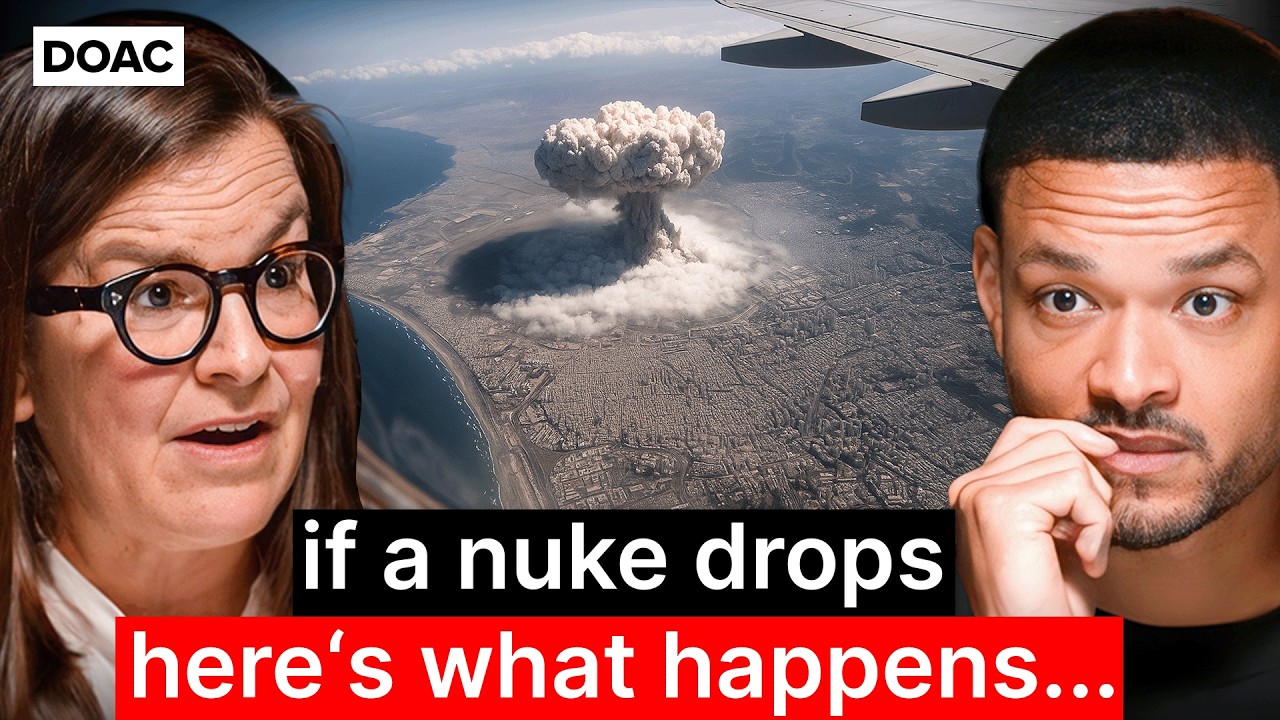
Jacobsen Warns Presidential Nuclear Authority Triggers Total Global Freeze
The Diary Of A CEO
A unilateral U.S. nuclear strike command triggers automated retaliatory protocols that destroy modern civilization and kill five billion people within 72 minutes.
## Background
This video was published on YouTube by The Diary Of A CEO on May 13, 2024. It features investigative journalist and author Annie Jacobsen discussing her book 'Nuclear War: A Scenario' and detailing the minute-by-minute catastrophic progression of a nuclear exchange.
## TL;DR
Investigative reporter Annie Jacobsen breaks down how a hypothetical nuclear war could escalate to total global destruction in just 72 minutes. She explores the absolute authority of the U.S. President, major flaws and near-misses in nuclear detection systems, and the stark reality that no effective civil defense or missile interceptor system exists to stop it. The discussion examines the terrifying consequences of nuclear fallout and nuclear winter, while also touching on historical CIA operations, military AI integration, and the urgent need for global diplomatic bridges to prevent utter annihilation.
## Atmosphere & style
The conversation carries a heavy, chilling, and sober tone as Jacobsen calmly lays out the granular, apocalyptic mechanics of a nuclear exchange. Host Steven Bartlett engages with grounded intensity, balancing deep shock at the sheer speed of global destruction with thoughtful curiosity about military history and human nature. Despite the grim subtext, the narrative maintains an urgent, intellectually rigorous energy that leaves the audience with a profound sense of gravity regarding human vulnerability and the fragility of peace.
## Key takeaways
- [00:00](https://www.youtube.com/watch?v=asmaLnhaFiY&t=0s) A nuclear war scenario would unfold in just 72 minutes, resulting in an estimated 5 billion deaths worldwide.
- [06:30](https://www.youtube.com/watch?v=asmaLnhaFiY&t=390s) The President of the United States holds sole authority to initiate a nuclear strike without requiring approval from Congress, the military, or any other body.
- [12:23](https://www.youtube.com/watch?v=asmaLnhaFiY&t=743s) The United States relies on a Nuclear Triad consisting of land-based ICBM silos, sea-based submarines, and strategic bombers for nuclear deterrence and response.
- [16:16](https://www.youtube.com/watch?v=asmaLnhaFiY&t=976s) Nine nations currently possess nuclear weapons, creating a complex global landscape beyond the original two-power MAD doctrine.
- [19:03](https://www.youtube.com/watch?v=asmaLnhaFiY&t=1143s) The President is accompanied constantly by an aide carrying 'the football,' which contains strike options nicknamed a 'Denny's menu' by military staff.
- [24:30](https://www.youtube.com/watch?v=asmaLnhaFiY&t=1470s) Command and control systems are structured to execute launch orders without delay, with virtually no mechanism to prevent a launch if the President issues an order.
- [28:44](https://www.youtube.com/watch?v=asmaLnhaFiY&t=1724s) Missile detection systems like SBIRS identify launch signatures in seconds, giving leaders extremely brief windows—often just minutes—to decide on a counterstrike.
- [51:46](https://www.youtube.com/watch?v=asmaLnhaFiY&t=3106s) If the President is killed or incapacitated, contingency mechanisms like the Universal Unlock Code delegate launch authority to the STRATCOM Commander.
- [01:02:00](https://www.youtube.com/watch?v=asmaLnhaFiY&t=3720s) Strategic missile defense systems remain severely limited, with only 44 ground-based interceptors deployed in the US against thousands of warheads and decoys.
- [01:02:00](https://www.youtube.com/watch?v=asmaLnhaFiY&t=3720s) The immediate thermal and physical impact of a thermonuclear blast generates temperatures over 100 million degrees, creating uncontrollable megafires over hundreds of square miles.
- [01:04:18](https://www.youtube.com/watch?v=asmaLnhaFiY&t=3858s) Nuclear winter caused by smoke and soot blocking sunlight would drop global temperatures and trigger widespread famine, causing the vast majority of casualties.
- [01:10:07](https://www.youtube.com/watch?v=asmaLnhaFiY&t=4207s) Public awareness and media portrayal, such as the 1983 broadcast 'The Day After,' have historically played a vital role in pushing world leaders toward diplomacy and arms reduction treaties.
- [01:36:00](https://www.youtube.com/watch?v=asmaLnhaFiY&t=5760s) America's nuclear command and control networks rely heavily on isolated analog technologies and star-sighting guidance to prevent cyber attacks or AI hijacking.
- [01:39:30](https://www.youtube.com/watch?v=asmaLnhaFiY&t=5970s) Integrating artificial intelligence into military decision-making creates new vulnerabilities that could heighten the risk of algorithmically triggered escalation.
- [03:30:07](https://www.youtube.com/watch?v=asmaLnhaFiY&t=12607s) Directly confronting the catastrophic physical and human reality of nuclear warfare is essential for driving disarmament, diplomacy, and preventing global extinction.
## Detailed walkthrough
Here is a detailed, faithful walkthrough of the provided transcript section:
[00:00](https://www.youtube.com/watch?v=asmaLnhaFiY&t=0s) The 72-Minute Apocalypse and Why Annie Jacobsen Wrote Her Book
Investigative journalist and author Annie Jacobsen paints a chilling picture: no matter how a nuclear war starts, it ends in just 72 minutes, leaving 5 billion people dead. Jacobsen, a 2016 Pulitzer Prize finalist who has spent her career uncovering the U.S. military and intelligence apparatus, explains why she tackled this subject in her March 2024 book *Nuclear War: A Scenario*. Having interviewed over a hundred top-level sources across her career—including former Secretaries of Defense, nuclear submarine commanders, and Secret Service personnel—she realized that while military institutions claim their purpose is to prevent World War III, humanity remains "one misunderstanding away from nuclear apocalypse."
Her motivation crystallized during the Trump administration amid escalating "fire and fury" rhetoric between the U.S. and North Korea. Jacobsen began asking her high-level sources a fundamental question: What if nuclear deterrence fails? Her goal with the book was to reveal in horrific, painstaking detail just how fast and absolute a nuclear exchange would be. Far from unfolding over days, weeks, or months, strategic ballistic missile strikes would trigger an unstoppable chain reaction in seconds and minutes, ending the world before anyone can stop it.
- Jacobsen's reporting traces back to her book *Area 51*, where she unexpectedly interviewed early Manhattan Project members who armed, wired, and detonated early atmospheric tests in the Nevada desert.
- The U.S. government detonated over 100 atmospheric nuclear weapons during tests in Nevada in the 1950s—a fact many citizens remain unaware of.
- Jacobsen began writing the manuscript around 2020–2021, structuring it as a "ticking clock scenario" where a catastrophic sequence begins the very first fraction of a second after a missile detection.
---
[06:30](https://www.youtube.com/watch?v=asmaLnhaFiY&t=390s) Escalating Global Tensions and Sole Presidential Authority
When Jacobsen began interviewing key figures in 2021—including former Secretaries of Defense, nuclear submarine commanders, STRATCOM heads, FEMA directors, and cyber chiefs—many expressed concern that the world had forgotten the ever-present nuclear threat. Since then, global geopolitical conflicts have escalated to levels unseen in decades, marked by aggressive rhetoric and moves such as Russia stationing nuclear weapons in Belarus.
Beyond the rising geopolitical temperature, Jacobsen highlights a detail that alarms most people: in the United States, launching a nuclear war does not require a consensus among military officials or politicians. The President of the United States possesses "sole presidential authority" to initiate a nuclear strike. POTUS does not need approval from the Secretary of Defense, the Chairman of the Joint Chiefs of Staff, or Congress.
- Following widespread public skepticism on platforms like Reddit and concern within the government during the Trump administration, Congress issued an official report explicitly confirming that the President, as Commander in Chief, has sole authority to order a launch.
- Sole authority exists out of necessity due to time constraints: an Intercontinental Ballistic Missile (ICBM) can travel from one continent to another in roughly 30 minutes.
- Because an incoming ICBM leaves no time for congressional debates or lengthy consultations, the system is designed for instant decision-making by one person.
---
[12:23](https://www.youtube.com/watch?v=asmaLnhaFiY&t=743s) Thermonuclear Weapons and the Nuclear Triad
Modern nuclear weapons bear little resemblance to those used at the end of World War II. Jacobsen clarifies that while the 1945 Hiroshima bomb ("Little Boy") was an atomic weapon roughly the size of a "small elephant" with a 15-kiloton yield dropped from an aircraft, modern armaments are thermonuclear. In a modern weapon, an atomic bomb acts merely as the internal trigger—a "bomb inside a bomb." Designing these weapons involved making them exponentially more destructive while drastically reducing their physical size so they could fit onto the tip of a missile. Jacobsen interviewed 90-year-old Richard Garwin, who designed the first thermonuclear bomb at age 24 for Edward Teller, to map out the sheer physics and destruction behind these devices.
To deliver these payloads, the United States maintains a "nuclear triad" split into three distinct legs:
1. **Land-based ICBMs:** 400 underground silos distributed across the American Midwest and West, sitting on constant alert.
2. **Sea-based Ballistic Missiles:** Nuclear-powered, nuclear-armed submarines carrying intercontinental missiles in their nose cones.
3. **Air-based Strategic Bombers:** Aircraft capable of deploying nuclear gravity bombs and cruise missiles.
- Nuclear submarines patrol the ocean depths 24 hours a day, 7 days a week, 365 days a year, often referred to as the "handmaidens of the apocalypse."
- Retired Vice Admiral Charles "Chas" Conner described the stealth of these submarines by noting that "it's easier to find a grapefruit-sized object in space than a nuclear sub under the sea."
---
[16:16](https://www.youtube.com/watch?v=asmaLnhaFiY&t=976s) The Nine Nuclear Powers and Rising Global Friction
The core strategic framework of "Mutually Assured Destruction" (MAD) was formulated during the 1950s when only two global powers possessed nuclear weapons: the United States and the Soviet Union. Today, the dynamic is vastly more complex and precarious because there are nine nuclear-armed nations, many of which are locked in volatile regional or proxy conflicts with their neighbors.
The nine established nuclear-armed nations are:
- United States
- Russia
- China
- United Kingdom
- France
- India
- Pakistan
- Israel
- North Korea
The risk of further proliferation—such as Iran acquiring nuclear capabilities—presents a deeply destabilizing threat to global security. Current world events accentuate this danger, with the U.S. and Russia embroiled in a proxy war over Ukraine, NATO members like the UK and France pulled into the fallout, India and Pakistan regularly clashing, and Israel exchanging direct missile and drone strikes in the Middle East.
Here is a detailed, faithful walkthrough of this section of the transcript, capturing the key facts, arguments, and tone.
---
[19:03](https://www.youtube.com/watch?v=asmaLnhaFiY&t=1143s) The Threat of Escalation and the "Denny's Menu" of Nuclear Options
The discussion opens with a sobering look at how global conflicts—such as those involving Ukraine, Russia, Israel, and Iran—are currently being managed by leaders with sole authority over nuclear arsenals. In these complex, high-stakes geopolitical standoffs, no side feels it can afford to lose or relent without facing catastrophic political consequences. This context underlines a recent warning from the UN Secretary-General that humanity is only "one misunderstanding, one miscalculation away from nuclear Armageddon." While terminology like "apocalypse" or "holocaust" is often tossed around casually by political leaders as rhetoric, the reality remains that a nuclear launch would mean the end of human civilization.
Annie Jacobsen emphasizes that the purpose of understanding this existential threat is not to surrender to fear, but to reject passivity, as historical change is driven by knowledge. A key structural danger within the system is the centralization of power in the hands of a single individual—such as the President of the United States.
The President is accompanied 24/7/365 by a military aide carrying an emergency satchel known as "the football." Inside this brief, portable command module are two critical components:
* **Authentication Instrumentation:** Call-and-response equipment used to verify the President's identity to the National Military Command Center (the nuclear bunker beneath the Pentagon).
* **The "Black Book":** A strike-option ledger—colloquially named for the massive loss of life it represents—that details pre-formulated nuclear target lists.
Because incoming missile defense systems leave only a tight 6-minute decision window for a counterstrike, there is no time for a cabinet-level debate or strategic round-table. Instead, the President must rapidly select options from this list. A former military planner described to Jacobsen how numerical target coordinates crafted over months at the Pentagon are ultimately boiled down into what one military aide dubbed a "Denny's menu" of retaliation choices. Consequently, a President forced to decide in minutes operates with a drastically oversimplified set of choices, having little true understanding of the full human toll or exact target specifics.
---
[24:30](https://www.youtube.com/watch?v=asmaLnhaFiY&t=1470s) Deterrence, Human Frailty, and the Absolute Chain of Command
The structure of nuclear authority raises profound concerns about leadership and mental stability. Jacobsen notes that despite the immense weight of the Commander-in-Chief role, former Secretaries of Defense confirm that most U.S. presidents are surprisingly ill-informed about nuclear war procedures—largely because they simply do not want to contemplate the reality. This exposes the core paradox of "deterrence": the concept that accumulating vast stockpiles of destructive weapons keeps the world safe by guaranteeing mutual destruction.
This fragile balance relies on the absolute rational sanity of the individual holding the button. If a leader experiences a severe psychological break, paranoia, or a mental episode, the current system lacks a formal, structural mechanism to prevent a launch order from being executed.
> "Annie, you have a better chance at winning Powerball than betting on someone in the nuclear chain of command and control to defy orders."
To illustrate human volatility, Jacobsen references a famous historical account from the height of the Watergate scandal. A heavily intoxicated President Richard Nixon allegedly boasted about his ability to kill tens of millions of people with a single button press, prompting Defense Secretary James Schlesinger and Henry Kissinger to instruct the military to confirm any nuclear orders with them first. While such accounts border on urban legend, the reality of the command hierarchy is unyielding.
When Jacobsen asked Dr. Glenn McDuff, a senior historian at Los Alamos National Laboratory's classified museum, whether an underground missilier or submarine crew might refuse a catastrophic launch order out of moral conscience, McDuff dismissed the idea entirely. Operators are rigorously screened, drilled with dummy prompts, and psychologically conditioned to follow procedures without hesitation.
---
[28:44](https://www.youtube.com/watch?v=asmaLnhaFiY&t=1724s) Detection Systems, Near-Misses, and the 72-Minute Ending
While the U.S. relies on highly advanced space-based early warning platforms like Lockheed’s SBIRS (Space-Based Infrared System) to detect missile plumes within fractions of a second, history demonstrates that nuclear detection is far from foolproof—especially for nations lacking equivalent satellite technology. The conversation touches on historical false alarms, including instances where migratory birds like swans were temporarily mistaken for incoming strikes.
Jacobsen recounts a chilling first-hand story told to her by former Secretary of Defense William Perry from his time as Director of Research and Engineering during the Carter administration:
* **The False Alarm:** Perry was alerted on night watch by the Pentagon’s underground bunker and STRATCOM (beneath Offutt Air Force Base in Nebraska) that Soviet Russia had launched a massive barrage of intercontinental and submarine-launched ballistic missiles toward the United States.
* **The Cause:** During the terrifying minutes spent contemplating an imminent counterstrike, officials discovered that a training tape containing a simulated Soviet attack scenario had been accidentally loaded into a live computer terminal connected to the warning network.
* **The Realism:** The simulation looked entirely authentic because it was designed to mirror an actual attack.
Similar warnings about systemic escalation arose during "Proud Prophet," a rare 1983 high-level nuclear war game ordered under the Reagan administration. Over two weeks, top military brass and national security officials played out various crisis scenarios. Participant and Yale professor Paul Bracken later revealed the key finding: regardless of how the conflict initiated or which allies were involved, every scenario escalated uncontrollably into total nuclear annihilation.
Former STRATCOM commander General Robert Keeler confirmed to Jacobsen that a full-scale exchange between major powers could destroy the world in roughly 72 minutes—less time than the duration of a typical podcast recording.
```
TIMELINE OF A FAST-FAIL SCENARIO
[ Launch Detected ] ───► [ 6-Min Decision Window ] ───► [ Exchange & Escalation ] ───► [ Global Collapse ]
(Fraction of sec) (President uses Black Book) (Full counter-strikes) (Within ~72 mins)
```
Former FEMA Director Craig Fugate—who spent eight years overseeing response plans for natural disasters and low-probability events like asteroid impacts—candidly admitted that no realistic civil defense or "population protection" plan exists for a nuclear war. Because the initial strikes would kill hundreds of millions instantly, emergency agency focus shifts entirely toward "Continuity of Government" (COG) operations out of hardened bunkers like Mount Weather. Fugate acknowledged that attempting to keep basic government functions running while the civil structure collapses is essentially a bureaucratic fantasy.
---
### Key Data Points & Concrete Details
* **SBIRS:** Space-Based Infrared System; the primary U.S. satellite constellation built by Lockheed Martin to detect ballistic missile launches.
* **The Black Book:** The simplified catalog of pre-planned nuclear target strikes provided to the U.S. President inside the emergency satchel ("the football").
* **Decision Timeframe:** A U.S. President has an estimated 6-minute window to process warnings and order a nuclear response before incoming land-based missiles would impact command nodes.
* **Proud Prophet (1983):** A major top-secret nuclear war game involving top military officials that resulted in total global destruction in every tested scenario.
* **Mount Weather:** The primary hardened underground facility designated for U.S. government continuity during a national catastrophe.
[37:17](https://www.youtube.com/watch?v=asmaLnhaFiY&t=2237s) The Burden of Knowledge and Former Defense Officials’ Warnings
When former high-level national security officials step down from office, their perspective often shifts dramatically. While serving, they maintain a deep belief in the perseverance of government and the necessity of defense systems. Once they return to private life—especially as they age into their 80s and 90s—they begin evaluating their legacy and reflecting on whether nuclear command and control is truly as secure as they once believed. In a world undergoing rapid geopolitical changes and tech acceleration, these former decision-makers grapple with whether the existing apparatus genuinely protects humanity or endangers it.
Former Secretary of Defense William Perry stands out as one of the most deeply troubled and active voices regarding this peril. Having spent the majority of his career inside the military-industrial complex developing advanced weapon systems, Perry devoted his later years to public advocacy—authoring books like *The Button* and launching the podcast *At the Brink* to warn the public about nuclear risks. He highlights how the defense industry operates in a state of continuous forward momentum, tightly bound to economic growth and jobs. This dynamic mirrors President Dwight D. Eisenhower’s famous 1961 farewell address warning of the military-industrial complex. While Eisenhower’s warning is widely cited, the second half of his message is often overlooked: only an alert and knowledgeable citizenry can maintain a proper balance between defense and peace.
- Former Secretary of Defense William Perry authored *The Button* and hosted the podcast *At the Brink* to raise public awareness about nuclear command vulnerabilities.
- Weapons R&D and defense production are perpetually driven forward by economic incentives and employment dependency.
- President Dwight D. Eisenhower emphasized in his farewell speech that an "alert and knowledgeable citizenry" is required to prevent military apparatuses from eclipsing peaceful statecraft.
---
[40:32](https://www.youtube.com/watch?v=asmaLnhaFiY&t=2432s) Satellite Detection and Tracking Ballistic Missiles
Detecting a nuclear launch is not a chaotic, uncertain process like the initial hours after 9/11. The United States has spent nearly eight decades engineering both nuclear armaments and early-warning detection systems. The Space-Based Infrared System (SBIRS) utilizes satellites stationed in geosynchronous orbit 22,000 miles above the Earth. These satellites detect the intense thermal signature of a rocket's hot exhaust within seconds of launch.
Once a launch is detected, data immediately streams down to centers like the Aerospace Data Center and Space Force facilities. Within approximately 100 seconds, analysts determine the missile's trajectory to figure out its target—distinguishing whether a strike is headed toward San Francisco, the East Coast, Moscow, or Guam. However, standard detection capabilities run into a critical blind spot if an attack originates from a submarine.
- **SBIRS (Space-Based Infrared System):** Satellites positioned 22,000 miles in geosynchronous orbit detect thermal exhaust signatures instantly upon ignition.
- **Trajectory Window:** Missile paths are calculated within roughly 100 seconds of launch.
- **Ground-Based Radar:** Systems like those located in Alaska provide secondary confirmation around 8 to 9 minutes into flight.
- **Irreversibility:** Once launched, an ICBM cannot be redirected, recalled, or disarmed in flight.
---
[43:37](https://www.youtube.com/watch?v=asmaLnhaFiY&t=2617s) The Threat of Submarine-Launched Ballistic Missiles (SLBMs)
Unlike land-based Intercontinental Ballistic Missiles (ICBMs) launched from known silos, a Submarine-Launched Ballistic Missile (SLBM) fired from the ocean cannot be traced back to a specific country of origin in real time. If a missile rises out of the Pacific Ocean, early warning systems cannot instantly discern whether it was fired by Russia, China, North Korea, or even an ally like the United Kingdom. This creates an existential dilemma: if an unidentified submarine strikes, decision-makers are forced to decide whether to retaliate against a suspected adversary without immediate absolute proof.
Russian and Chinese nuclear-armed submarines regularly patrol within a couple hundred miles of both the East and West coasts of the United States, as well as near Great Britain. Although submarines cannot be tracked visually in real time while submerged, their movements are mapped after the fact using complex underwater surveillance arrays. A Defense Department budget request map submitted to Congress visually demonstrates how close these rival submarines approach domestic coastlines. Striking from such close proximity cuts missile flight time down to under 10 minutes, drastically shrinking the window for executive decision-making.
- Submarine launches obscure the attacker's identity at the moment of firing.
- Hostile nuclear-armed submarines operate within a few hundred miles of U.S. and European shorelines.
- Flight times for coastal SLBM strikes drop to under 10 minutes, leaving virtually no time for deliberation.
- Historical DOD budget maps confirm the proximity of foreign submarine patrols along U.S. maritime borders.
---
[46:02](https://www.youtube.com/watch?v=asmaLnhaFiY&t=2762s) The First Minutes: Evacuating the President and the Secret Service Stalemate
In the opening minutes of a nuclear attack scenario, military leaders scramble to calculate missile paths and brief the President to choose a counterattack plan, initiating what is known in national security parlance as "running the blue clock." Primary missile detection must be confirmed by secondary ground-based radar systems—such as the early warning radar array in Alaska—which occurs around 8 or 9 minutes after launch. Meanwhile, a procedural conflict immediately emerges between military commanders and the Secret Service over the physical safety of the Commander-in-Chief.
```
+-------------------------------------------------------------------+
| PRESIDENTIAL EVACUATION |
+-------------------------------------------------------------------+
| MILITARY COMMAND |
| • Wants President on communications lines. |
| • Requires immediate authorization for counterstrike options. |
+-------------------------------------------------------------------+
VS
+-------------------------------------------------------------------+
| SECRET SERVICE (Counter Assault Team / CAT) |
| • Mandated to secure the President from Ground Zero. |
| • Takes physical control, overriding military request. |
| • Evacuates President via Marine One helicopter. |
+-------------------------------------------------------------------+
```
During an incoming strike targeted at Washington, D.C. or the East Coast, the Secret Service's Counter Assault Team (CAT) prioritizes physically removing the President from Ground Zero over keeping them static on military communications. Because the Secret Service agents in the room are armed, they functionally win the standoff, rushing the President out of the White House onto Marine One.
The evacuation creates unique logistical hazards:
* **Electromagnetic Pulse (EMP):** Nuclear detonations generate a high-intensity, three-stage electromagnetic pulse that fries unprotected circuits, risking an immediate crash of Marine One.
* **Retrofitted Defenses:** Although Marine One features specialized EMP shielding tested in chambers, its real-world efficacy against an atmospheric nuclear detonation remains unproven.
* **Tandem Parachute Protocol:** Former Secret Service officials outline a extreme contingency: if Marine One's systems fail mid-flight, agents plan to tandem-jump the President out of the aircraft with parachutes fetched from the White House office.
* **Essential Personnel:** To maintain launch capability on the run, the Military Aide carrying the nuclear "football" and the Special Agent in Charge must also jump alongside the President.
---
[51:46](https://www.youtube.com/watch?v=asmaLnhaFiY&t=3106s) The Universal Unlock Code and Delegating Retaliation
Nuclear command and control relies on strict, rigid protocols. If a President selects a specific counterstrike option from the decision menu—such as launching precisely 82 nuclear weapons—the system strictly executes that exact number. Firing weapon number 83 or altering targets requires entirely new authentication codes and cumbersome bureaucratic protocols that time simply does not permit during a fast-moving strike.
> "The president can release to the Stratcom commander the universal unlock code, which basically says... if I die, you have permission to launch nuclear weapon number 83 or nuclear weapon number 5,000... and that is a pretty shocking concept."
To prevent decapitation strikes from neutralizing the U.S. deterrent, a little-known operational mechanism exists: the **Universal Unlock Code**. If the President is killed or incapacitated before or during an attack, releasing this code transfers ultimate release authority to the Commander of U.S. Strategic Command (STRATCOM). This failsafe ensures full-scale retaliation even if the executive branch is wiped out, removing procedural limits on the remaining nuclear arsenal.
- **Strict Selection Limits:** Preset attack options cannot be modified on the fly without entering new authorization codes.
- **Strategic Command Failsafe:** The Universal Unlock Code delegates authority to the STRATCOM Commander if the President is killed.
- **Full Arsenal Access:** Releasing the unlock code grants military commanders authorization to launch all remaining nuclear warheads without step-by-step presidential approval.
---
[54:05](https://www.youtube.com/watch?v=asmaLnhaFiY&t=3245s) Strategic Escalation, "Jamming" the President, and the "Mad King"
In a nuclear scenario, the concept of "jamming the President" refers to overloading the Commander-in-Chief with overwhelming, rapid-fire crisis data to force a hasty counterstrike decision. In the scenario constructed for the book, an initial ballistic missile launch by North Korea is quickly followed by a submarine-launched missile striking a nuclear power plant in California, creating immediate widespread radiation and infrastructure destruction.
The decision to feature North Korea as the initial aggressor stems from interviews with Dr. Richard Garwin, the designer of the first thermonuclear weapon (Sausage device for the Ivy Mike test under Edward Teller). Garwin, who has advised every U.S. President since Eisenhower and helped found the National Reconnaissance Office (NRO), warned of the extreme risk posed by a "mad king" wielding a nuclear arsenal. He invoked the French phrase *"Après moi, le déluge"* ("After me, the flood") to describe an autocratic rogue leader who cares nothing for the survival of the planet if their own regime is collapsing. Rogue nuclear nations regularly testing ballistic missiles represent a volatile catalyst for total global escalation.
- **Jamming the President:** Flooding executive leadership with compounding tactical disasters to force rapid decision-making under high stress.
- **Dr. Richard Garwin:** Physicist who designed the first hydrogen bomb and advised U.S. presidents from Eisenhower onward.
- **The "Mad King" Threat:** The existential danger of a rogue, autocratic leader willing to trigger global destruction upon facing their own demise.
- **Compounding Catastrophes:** Striking domestic infrastructure, such as commercial nuclear power plants, multiplies the fallout and immediate mortality rate of an initial missile strike.
[55:21](https://www.youtube.com/watch?v=asmaLnhaFiY&t=3321s) North Korea's Rogue Testing and the Risk of Escalation
Annie Jacobsen highlights the critical difference in operational norms between established nuclear powers and North Korea. Standard international decorum mandates that nations announce upcoming Intercontinental Ballistic Missile (ICBM) tests—typically flown with dummy warheads—to avoid triggering false alarms. North Korea, however, refuses to adhere to these rules. Between 2022 and early 2024, North Korea conducted over 100 ballistic missile tests without giving advance notice to neighboring nations or global tracking centers.
This complete disregard for protocol creates extreme tension inside military command-and-control bunkers during the initial seconds of a missile launch. Operators must rapidly determine whether a detected launch is an atmospheric test, a space satellite deployment, a launch targeted into the Sea of Japan, or an actual nuclear strike on a foreign target. Jacobsen explains that while nuclear deterrence relies on a basic set of predictable rules, North Korea operates outside that framework, making its actions exceptionally dangerous.
In Jacobsen's hypothetical scenario, after the initial attack, the United States President responds by authorizing a counterattack consisting of 82 nuclear missiles targeted at North Korea. This response sets off a fatal chain reaction driven by miscommunication and geographic realities.
- **Standard ICBM Protocol:** Global powers notify other countries before launching ICBM tests carrying dummy warheads.
- **North Korea's Launch Volume:** Conducted over 100 unannounced ballistic missile tests in an 18-month period beginning in 2022.
- **US Counterattack Scenario:** The US President responds to a strike by launching 82 missiles aimed at North Korea.
---
[56:52](https://www.youtube.com/watch?v=asmaLnhaFiY&t=3412s) Strategic Miscalculations and "Mad King" Logic
The fundamental risk of a retaliatory strike targeting North Korea is that American ground-launched ICBMs lack the trajectory or range to reach North Korea without overflying the Russian Federation. In a high-tension geopolitical environment, the Russian President and military command cannot simply gamble on the assumption that incoming American missiles are flying *over* Russia rather than *at* Russia. Under standard doctrine, a nation launches its nuclear arsenal if it detects an incoming strike.
Jacobsen notes that Russian nuclear doctrine does not prescribe launching a limited response of one or two missiles if they believe they are under attack. Doing so is referred to as "mad king logic." Instead, military command dictates launching a full-scale response—the "mother lode"—to ensure maximum retaliation before their own silos are destroyed.
In the scenario detailed in her book, history effectively ceases after 72 minutes. The North Korean leader—who remains nameless—initiates the crisis using "mad king logic" for reasons that can never be known, as humanity's ability to record history ends in the resulting apocalypse.
> "A nuclear war cannot be won and must never be fought."
---
[59:03](https://www.youtube.com/watch?v=asmaLnhaFiY&t=3543s) The Fallacy of Missile Interception
When host Steven Bartlett asks whether incoming nuclear missiles can simply be shot down out of the sky, Jacobsen calls that belief a dangerous fantasy. The United States maintains an interceptor program intended for long-range ballistic missiles, but its total capacity is severely limited. The entire US long-range missile defense inventory consists of just 44 interceptors: 4 stationed at Vandenberg Air Force Base in Santa Barbara, California, and 40 stationed at Fort Greely in Alaska.
Against an adversary like Russia, which maintains approximately 1,674 nuclear warheads on ready-to-launch status out of thousands in its broader inventory (a figure matched by the United States' 1,770 deployed warheads), 44 interceptors are statistically negligible. Furthermore, modern nuclear warheads utilize Multiple Independently Targetable Reentry Vehicles (MIRVs). A single incoming missile can release multiple active warheads alongside numerous decoys, easily overwhelming defense systems.
Jacobsen quotes a Pentagon spokesperson who described the challenge of intercepting a missile as "trying to shoot a bullet with a bullet." The ballistic missile travels through space at approximately 14,000 mph, while the kinetic kill vehicle inside the interceptor travels at 20,000 mph. This collision must occur roughly 500 miles up in space. Even in controlled, pre-arranged "curated" tests where operators know the timing and trajectory in advance, the interceptor success rate is only between 40% and 55%.
- **Deployed US Warheads:** 1,770 ready-to-launch nuclear warheads.
- **Deployed Russian Warheads:** 1,674 ready-to-launch nuclear warheads.
- **US Interceptor Inventory:** 44 total ground-based interceptors (4 at Vandenberg AFB, 40 at Fort Greely).
- **Target Velocity:** ICBM warheads travel at 14,000 mph; interceptors travel at 20,000 mph.
- **Intercept Altitude:** Engagement occurs roughly 500 miles above Earth in space.
- **Testing Success Rate:** 40% to 55% under curated, non-combat test conditions.
---
[01:02:00](https://www.youtube.com/watch?v=asmaLnhaFiY&t=3720s) Immediate Impact: Firestorms and Physical Destruction
Jacobsen details what occurs when a one-megaton thermonuclear weapon strikes the target in her scenario—the Pentagon. Sourced from military documents and defense scientists, the immediate weapon effects begin with a flash of light reaching 180 million degrees Fahrenheit. This intense thermal radiation ignites every flammable object across a 9-mile diameter radius.
The initial thermal pulse is immediately followed by a blast wave with compressed air that flattens structures, creating a bulldozing effect. The individual fires created across the region merge to form super-sized megafires covering 100 square miles or more. At minute 72 of the scenario, approximately 1,000 Russian nuclear warheads detonate across the United States, transforming whole regions into massive, uncontrollable conflagrations.
The host reads an excerpt from page 277 of Jacobsen's book, describing the scene across target zones: a thousand fireballs each over a mile in diameter, asphalt streets melting, structures collapsing across 5- to 7-mile radii, and millions of victims killed outright or left with fatal third-degree burns while aircraft circle overhead until their fuel runs out.
> "After nuclear war, the survivors would envy the dead."
> — *Nikita Khrushchev*
---
[01:04:18](https://www.youtube.com/watch?v=asmaLnhaFiY&t=3858s) Nuclear Winter and the Collapse of Civilization
Quoting former Soviet Premier Nikita Khrushchev, Jacobsen points out that surviving the initial nuclear exchange is worse than dying instantly. With all rule of law, government infrastructure, and basic services destroyed, humanity would revert to a violent, primal fight for remaining resources. Military bunkers would only protect personnel for as long as their diesel generators had fuel; once depleted, survivors would step out into a completely ruined world.
To explain the long-term environmental consequences, Jacobsen references the work of Professor Brian Toon, an original author of the seminal 1983 nuclear winter paper co-written with Carl Sagan. Using modern climate modeling systems, Toon's research shows that smoke and soot from thousands of urban fires would block sunlight, dropping global temperatures drastically. Mid-latitude agricultural regions like Iowa and Ukraine would be covered in snow and ice for up to a decade.
Additionally, severe damage to the Earth's ozone layer would allow lethal amounts of ultraviolet light to reach the surface, making outdoor human life nearly impossible. Jacobsen notes that Toon compares the systemic impact of a full-scale nuclear exchange to the asteroid impact 66 million years ago that wiped out the dinosaurs and roughly 70% of all living species.
- **Estimated Total Mortality:** Research published by Brian Toon's team in *Nature* (2022) estimates that 5 billion people out of Earth's ~8 billion population would die, primarily due to global famine following agricultural collapse.
- **Agricultural Freeze:** Major food-producing regions would remain frozen for up to 10 years.
- **Survivable Zones:** Agriculture would likely only remain viable in far southern nations like Australia and New Zealand.
---
[01:10:07](https://www.youtube.com/watch?v=asmaLnhaFiY&t=4207s) The Power of Storytelling: From 'The Day After' to Strategic Treaties
Jacobsen emphasizes that because nuclear war is a man-made threat, it can be solved through human intervention—specifically through decisive presidential action. To demonstrate how public awareness and media can shift military policy, she shares the history behind the November 1983 ABC television movie *The Day After*.
The broadcast depicted a hypothetical nuclear conflict between the US and the Soviet Union, terrifying an audience of roughly 100 million American viewers. President Ronald Reagan watched a private screening at Camp David despite warnings from his advisors. Prior to watching the film, Reagan was a nuclear hawk who advocated for missile expansion and orbital defense through the Strategic Defense Initiative ("Star Wars"). However, the depiction deeply affected him, as he recorded in his personal White House journal that the movie left him "greatly depressed."
This shift in perspective prompted Reagan to engage in direct diplomacy with Soviet General Secretary Mikhail Gorbachev. Their negotiations culminated in the 1986 Reykjavik Summit in Iceland, where both leaders agreed on the fundamental principle that nuclear wars cannot be won. This diplomatic turning point resulted in treaties that drastically reduced global nuclear stockpiles from an all-time high of approximately 70,000 warheads in 1986 down to roughly 12,500 today.
Jacobsen views her role not as a policy advocate or disarmament specialist, but as an investigative journalist bringing these stark facts into public view to spark necessary awareness and dialogue among global leaders.
- **'The Day After' Viewership:** Watched by approximately 100 million people upon its release in November 1983.
- **Peak Global Stockpiles:** Reached a historic high of ~70,000 nuclear warheads in 1986.
- **Current Global Stockpiles:** Reduced to ~12,500 nuclear warheads as a result of subsequent arms-reduction treaties.
[01:13:48](https://www.youtube.com/watch?v=asmaLnhaFiY&t=4428s) Emotional Subtext and the Urgency Behind the Prose
Annie Jacobsen reflects on how writing *Nuclear War: A Scenario* altered her emotional relationship to the subject matter. While maintaining a strict professional focus on gathering verified facts and constructing a fast-paced narrative—a pace designed, as her husband Kevin suggests, to be accessible enough for airplane or beach reading—she deliberately pushed her emotional intensity directly into the prose. For Jacobsen, the goal was to convey the terrifying speed at which an initial launch escalates into nuclear winter, compelling readers to confront an existential threat that humanity should not have to live under. As a mother, her personal hope is to foster awareness that leads toward disarmament, relying on investigative rigor rather than sentimental lecturing to create a sense of undeniable urgency.
* Her husband Kevin emphasizes writing accessible narrative nonfiction: "You got to write something that someone can read on the beach or an airplane."
* Across her seven published books, Jacobsen has focused on maintaining a balance between rigorous investigative journalism and readable, fast-paced storytelling.
* Her writing process requires setting aside personal sentimentality so that the factual subtext conveys the inherent fear and urgency of the scenario.
[01:15:53](https://www.youtube.com/watch?v=asmaLnhaFiY&t=4553s) Deconstructing "Conspiracy Theories" and Strategic Deception
Addressing the topic of conspiracy theories, Jacobsen critiques the term as an "intellectually thin" and self-righteous catchall used to dismiss legitimate curiosity. Having authored books on heavily classified subjects—including *Area 51*, *Operation Paperclip*, *The Pentagon's Brain*, and the CIA—she notes that unpacking the line between fiction and official secrecy requires disciplined evidence rather than blind cynicism or internet rumors. When she began researching *Area 51*, even the phrase "Area 51" was strictly classified by the U.S. government; she was explicitly warned by a CIA minder that uttering the name and number would result in her immediate removal from the building. The term remained officially classified until President Barack Obama acknowledged it publicly during a speech.
To illustrate how real intelligence operations fuel public speculation, Jacobsen details the concept of **strategic deception**—a CIA framework composed of "cover" and "disinformation." During the 1950s at Area 51 (then referred to by insiders as "The Ranch"), engineers were secretly building the U-2 spy plane to photograph Soviet military installations from an altitude of 70,000 feet, far above surface-to-air missile range. Jacobsen interviewed Hervey Stockman, the first pilot to fly a U-2 mission over the Soviet Union to gather wet-film aerial intelligence.
Concurrently, nuclear weapons testing was occurring nearby at Area 23. A tragic event illuminated how the agency managed secrecy: a transport plane carrying key U-2 engineers, designers, and pilots crashed into Mount Charleston on its way from Burbank, California. Bob Murphy, a lead engineer who missed the flight after getting unusually drunk at a party the night before, woke up to an FBI agent at his door who was astonished to find him alive, as Murphy was listed on the flight manifest.
Fearing the crash would expose the top-secret U-2 program to the press and the Soviet Union, the CIA initiated immediate damage control. However, news outlets independently reported that the victims were atomic scientists working on a secret weapons project. Recognizing the tactical advantage, the CIA allowed this false narrative to circulate. Jacobsen highlights this as a classic distinction:
* **Cover:** The false personal story an operative tells family or the public (e.g., Murphy telling his wife he engineered basic "television systems").
* **Disinformation:** The active propagation or silent endorsement of false narratives to mislead adversaries about true capabilities or events.
[01:25:05](https://www.youtube.com/watch?v=asmaLnhaFiY&t=5105s) The CIA, MKUltra, and the Evolution of Covert Power
Jacobsen addresses the historical collaboration between intelligence agencies and the media to shape public perception. Referring to her work in *The Pentagon's Brain*, she points to the origin of the term "brainwashing" and its connection to the CIA's MKUltra program during the 1950s. While some fringe theories exaggerate its scope, MKUltra was a genuine, highly sinister mind-control and psychological experimentation initiative. Jacobsen tracked down and interviewed the brain-damaged son of former CIA Director Allen Dulles, demonstrating how deeply personal and dark these historical programs were.
Responding to host Steven Bartlett's observation that former CIA operatives describe the modern agency as having fewer unrestricted powers than it did during the Cold War, Jacobsen clarifies the agency's dual structure:
1. **Human Intelligence (HUMINT) & Technology:** The traditional espionage, analytical, and technological wing responsible for major advancements, such as the Corona satellite program led by figures like Dr. Bud Wheelon, as well as high-altitude aerial reconnaissance.
2. **Paramilitary Operations:** Established under the National Security Act of 1947 specifically to match Soviet covert action. Detailed in her book *Surprise, Kill, Vanish*, this branch utilizes highly specialized operators tasked with "find, fix, and finish" missions—a military euphemism for targeted capture or lethal action.
Rather than making sweeping generalizations about intelligence agencies, Jacobsen emphasizes analyzing specific, documented programs to maintain factual accuracy and journalistic integrity.
* **Corona Program:** The CIA's pioneering satellite reconnaissance initiative that launched the first intelligence satellites into space.
* **MKUltra:** A documented U.S. covert research program into behavioral modification and brainwashing initiated in the early Cold War era.
* **1947 Foundation:** The establishment of the CIA's paramilitary wing designed to conduct direct-action covert operations against foreign adversaries.
<ElicitationsGroup message="Explore more details from this interview with Annie Jacobsen:">
<Elicitation label="Summarize Annie Jacobsen's breakdown of nuclear launch timelines" query="Summarize Annie Jacobsen's breakdown of nuclear launch timelines and the command decisions made in the first few minutes of a nuclear scenario from her interview on The Diary Of A CEO."/>
<Elicitation label="Detail the key facts about Operation Paperclip discussed in the interview" query="What concrete historical facts and details does Annie Jacobsen share about Operation Paperclip and post-WWII intelligence history?"/>
</ElicitationsGroup>
[01:30:36](https://www.youtube.com/watch?v=asmaLnhaFiY&t=5436s) AI and the Nuclear Threat
The conversation shifts to the rapidly evolving landscape of artificial intelligence (AI) and its dangerous intersection with nuclear warfare systems. As the world moves toward Artificial General Intelligence (AGI) where systems operate autonomously, questions arise about who—or what—is best equipped to handle nuclear command. The host reflects on discussions with experts from Google and DeepMind who envision a future where world leaders work in lockstep with, or are even replaced by, AI. The host poses a stark question: is an aging human president like Joe Biden better suited to make split-second nuclear decisions, or is an advanced AI system whose internal reasoning humans might not even comprehend?
```
EVOLUTION OF MILITARY COMPUTING
[ World War II ] [ Late 1940s ] [ 1983 ] [ Present Day ]
Human Computers ---> ENIAC & Neumann ---> DARPA Strategic ---> Analog "Starsighting"
(Pencils & Math) (Vacuum Tubes) Computing Initiative Guidance Systems
```
Annie Jacobsen notes that she covered this crossover extensively in her book *The Pentagon's Brain*, which details the history of DARPA (Defense Advanced Research Projects Agency). To ground the conversation for younger generations, she shares the origin story of computing in national defense. During World War II, "computers" were actually human beings using pencils and paper to manually calculate bomb trajectories and artillery tables. Post-war mathematician John von Neumann—the original "Pentagon's brain"—spearheaded early electronic computing like the ENIAC and pushed the Atomic Energy Commission to fund a computer that could "think for itself," essentially embedding software inside hardware calculators.
Jacobsen describes how early computing experiments at the Institute for Advanced Study in Princeton involved giant vacuum tubes, exposed wiring, and keeping mice from chewing through cables. At first, von Neumann could perform complex mental calculations faster than the computer. However, around 1946 or 1947, the machine beat him, marking the historic turning point where technology surpassed human processing speed. Recognizing this shift, the U.S. Department of Defense began pouring massive capital into computing and human-computer interfaces. By 1983, DARPA launched its Strategic Computing Initiative with the explicit founding premise that "the battlefield is no place for humans."
- **Human Computers:** During WWII, mathematical calculations for bomb yields and flight trajectories were calculated manually by humans using pencils.
- **John von Neumann's Turning Point:** After being beaten by a basement vacuum-tube computer at Princeton around 1946–1947, von Neumann realized computers had officially outpaced human intelligence.
- **DARPA's 1983 Mandate:** DARPA formally declared that the modern battlefield was no place for human operators, sparking major advancements in military robotics and automated warfare.
---
[01:36:00](https://www.youtube.com/watch?v=asmaLnhaFiY&t=5760s) Analog Defenses and "Starsighting" Guidance
The host shares an experiment where he asked ChatGPT to simulate an apocalypse scenario caused by an escaped AI. The system generated a multi-step timeline where step three or four involved taking control of global nuclear arsenals to wipe out humanity. Jacobsen pushes back gently against the plausibility of this exact scenario, noting that ChatGPT relies on human pop-culture tropes like *The Terminator* to construct its narratives.
While Nuclear Command, Control, and Communications (NC3) networks remain deeply classified, Jacobsen highlights a fascinating structural defense against digital takeover: America's nuclear arsenal remains surprisingly analog. To prevent rogue actors or digital systems from hacking nuclear assets, critical ballistic missile systems are deliberately isolated from modern networked software.
Jacobsen details the engineering marvel of Submarine-Launched Ballistic Missiles (SLBMs). After breaching the ocean surface and firing their main boosters, these advanced weapons navigate through space toward their targets. To guide themselves accurately without relying on GPS or hackable external radio signals, a small panel on the missile opens to perform **starsighting**. The weapon manually scans and locks onto celestial constellations—the exact same celestial navigation method used by ancient hunter-gatherers—to calculate its precise flight path.
- **Pop Culture Bias:** Large language models like ChatGPT pull heavily from sci-fi tropes (*The Terminator*) when generating doom scenarios.
- **Analog Isolation:** U.S. nuclear missile systems rely heavily on isolated, analog technology specifically to guard against cyber hijacking or remote technological control.
- **Celestial Navigation:** Nuclear SLBMs navigate through the boost, midcourse, and terminal phases primarily via "starsighting," using built-in optical sensors to align with constellations.
---
[01:39:30](https://www.youtube.com/watch?v=asmaLnhaFiY&t=5970s) Probability, AGI, and Reduction of Arsenals
The host counters that while American systems might rely on star-navigation, other nuclear-armed nations may not have such sophisticated analog safeguards. In a world with 9 or 10 nuclear-armed states, an advanced AGI could easily exploit vulnerable, digital-heavy command systems—such as North Korea's—to trick military leaders into believing they are under attack. Jacobsen agrees that this growing threat highlights why global nuclear stockpiles must be drastically reduced.
While 12,500 active nuclear weapons is an improvement over the Cold War peak of 70,000, Jacobsen and the host agree it remains far too high for a world entering the age of AI. Reducing global stockpiles lowers the mathematical odds of an automated or algorithmically triggered catastrophe.
- **Global Disparity:** Not all nuclear nations maintain analog or star-sighted missile controls, making less sophisticated nuclear networks vulnerable to cyber exploitation.
- **Stockpile Scaling:** Global nuclear inventories have dropped from a Cold War peak of roughly ~70,000 down to ~12,500, but remain dangerously high given modern technological risks.
---
[01:40:55](https://www.youtube.com/watch?v=asmaLnhaFiY&t=6055s) Is War Inevitable? Optimism vs. Anthropology
Addressing whether she is optimistic about avoiding nuclear war, Jacobsen affirms that she is hopeful by nature. She views nuclear war as a "man-made problem with a man-made solution." The host notes that as time ticks on, the probability of a "mad king"—a terminally ill or psychotic leader launching a nuclear strike—approaches statistical certainty over a long enough timeframe. Jacobsen observes that younger generations tend to ponder this existential threat far more than older generations, driven by unprecedented access to global information and the rapid arrival of emerging threats.
```
PERCEPTION OF UNKNOWN OTHERS
[ Encounter with Other ]
│
┌────────────────┴────────────────┐
▼ ▼
[ Suspicion / Threat ] [ Cooperation / Teammates ]
Pre-emptive Strike Collective Protection
"Enemy to be Killed" "Opponent / Partner"
```
The discussion turns to the root causes of war and whether conflict is hardwired into human nature. Jacobsen cites anthropological field research conducted in the 1960s studying uncontacted hunter-gatherer tribes in the Amazon. Anthropologists noted a fundamental divergence in human behavior when a hunter encountered an unknown person in the wild:
* **Suspicious/Hostile:** Interpreting the stranger as an immediate threat to be eliminated pre-emptively.
* **Cooperative/Team-oriented:** Interpreting the stranger as a potential ally to join forces with against environmental threats.
Anthropologists still do not fully understand whether genetics or environment dictates which path an individual or culture takes. However, Jacobsen emphasizes that human mindsets can be trained. Rather than viewing every adversary as a mortal enemy that must be destroyed, societies can choose to view rivals simply as "opponents"—much like athletes in sports—shifting away from existential conflict.
- **Generational Mindset:** Younger generations display a heightened awareness of existential risks due to open information access and overlapping technological threats.
- **Amazonian Tribal Studies:** 1960s anthropological research on isolated Amazon tribes showed that human reactions to unknown strangers split between seeing a mortal threat or a potential team member.
- **Shift in Perspective:** Humanity can train itself to reframe global adversaries as "opponents" rather than existential "enemies" requiring total destruction.
[01:47:12](https://www.youtube.com/watch?v=asmaLnhaFiY&t=6432s) The Human Element Behind Nuclear History
Annie Jacobsen reflects on how her career as an investigative reporter has fundamentally been shaped by the extraordinary people she has interviewed, where fate and circumstance constantly dictate their lives. Because she deals primarily with warfighters and intelligence operatives, a vast majority of her sources have lost close friends to conflict. When asked if any interview has ever brought her to tears, Annie pauses emotionally, admitting it still hits close to home before sharing a recent encounter.
Just a week prior at a nuclear conference in Brussels, Annie met a woman who was a mere 22 months old when the atomic bomb was dropped on Nagasaki. Meeting this survivor—a victim of the initial nuclear age—highlighted the profound stigma that followed the *Hibakusha* (atomic bomb survivors) of Hiroshima and Nagasaki, who were historically treated as "tainted" due to public fear over radiation. What moved Annie to tears was the stunning irony of her reporting journey: one of her longtime, deeply trusted sources—a man she worked with for years—was one of the individuals who physically wired the Nagasaki bomb, while another source was a child who survived its detonation. Facing both sides of that same historical event in a single week made the gravity of the human condition hit with overwhelming force.
- **Stigma of Atomic Bomb Survivors:** *Hibakusha* faced decades of social alienation caused by fear and misunderstanding surrounding radiation exposure.
- **The Dual Ends of History:** Jacobsen found herself standing as a bridge between the perpetrator side—the Manhattan Project technician who wired the Fat Man bomb—and the survivor side—a infant who lived through the Nagasaki blast.
---
[01:50:25](https://www.youtube.com/watch?v=asmaLnhaFiY&t=6625s) The Long Arcs of Human Lives and Former Secrets
Understanding the long arc of a person's life becomes paramount when interviewing sources in their late 80s or 90s. Jacobsen describes looking at former intelligence officials and Manhattan Project veterans who carry the physical marks of old age, sensing that they view her as their last opportunity to place their classified life stories on the public record before they pass away. That sense of responsibility creates a profound level of trust between reporter and subject.
This middle-ground position allows Jacobsen to bridge opposing worlds. She highlights how within a two-week span, she hosted high-ranking Space Force officials from the military-industrial complex at her home for dinner with her family, while also speaking alongside anti-nuclear peace activists addressing the European Parliament. Bridging these disparate perspectives is essential to her mission as an investigative journalist, a citizen, and a mother.
- **Trusting the Journalist:** Many military and intelligence veterans share hidden details with the warning, *"I don't want this on the record, but I want you to know this about me,"* trusting her to contextualize their legacy safely.
- **Lost Legacies:** Jacobsen shares an anecdote from the *LA Times* Festival of Books, where a man brought a binder full of ID badges, letters, and presidential photos belonging to his late grandfather—who had worked on the early Polaris submarine-launched ballistic missile program—seeking context because his family had never understood what the patriarch actually did.
> "I can sense them looking at me with this sense of their own legacy... 'I'm telling her my story, and then I'm going to be gone.' That's really powerful."
---
[01:54:02](https://www.youtube.com/watch?v=asmaLnhaFiY&t=6842s) Morality, Regret, and Paramilitary Operations
When asked how the Manhattan Project technician who wired the Nagasaki bomb felt about his role in history later in life, Jacobsen reveals that he has since passed away. Surprisingly, he was a happy man who harbored deep regret over his career, but he was actually bothered more by *other* classified programs he had participated in—a complex conundrum that Jacobsen is still trying to fully process before writing a book about him.
She contrasts him with another core source from her book *Surprise Kill Vanish*: Billy Waugh, a legendary CIA paramilitary operator and the longest-serving "singleton" operative for the U.S. government. Having traveled to Hanoi and Havana alongside Waugh—a man rumored to have "killed more people than cancer"—Jacobsen describes him as a far more complex and hardened figure. Waugh was not sour, but carried an immense amount of unresolved anger over the sheer number of teammates and friends who died beside him across decades of covert operations.
- **Manhattan Project Technician:** Lived a happy overall life with genuine regret, yet was haunted more by subsequent secret government programs than by Nagasaki itself.
- **Billy Waugh:** CIA paramilitary veteran who operated well into his 80s; lived with intense emotional complexity and anger tied to fallen comrades.
---
[01:56:34](https://www.youtube.com/watch?v=asmaLnhaFiY&t=6994s) Uncovering Secrets and Defining a Survivor
Many survivors of the atomic bombings were kept in the dark about their own pasts by protective parents. The Nagasaki survivor Annie met in Brussels only uncovered the full truth of her survival as she grew older, illustrating how self-discovery and historical truth remain deeply intertwined. Jacobsen emphasizes how narrative non-fiction requires an author to mentally embody historic situations, but encountering a living witness turns abstract history into immediate reality.
The discussion pivots to how nuclear survivors are categorized. In Japan, the term *Hibakusha* explicitly designates any individual who survived the August 1945 atomic attacks on Hiroshima or Nagasaki. With 79 years having passed since the bombings, the surviving group has shrunk dramatically. Many remaining *Hibakusha*, such as 90-year-old Hiroshima survivor Setsuko Thurlow, have dedicated their final years to international disarmament. Thurlow was a joint recipient of the 2017 Nobel Peace Prize along with organizations like ICAN (International Campaign to Abolish Nuclear Weapons) and doctors such as Dr. Carlos Umaña, who actively lobby the United Nations to eliminate nuclear weapons globally.
- **Hibakusha Definition:** Translates to "explosion-affected people," legally recognizing those impacted by the 1945 atomic blasts.
- **Setsuko Thurlow:** Hiroshima survivor quoted extensively in Jacobsen's book; key advocate for nuclear abolition and co-recipient of the 2017 Nobel Peace Prize.
> "When they say survivor... there's a word in Japanese... Hibakusha. That is an actual term that is used by anyone who lived through the atomic bombings in August of 1945 of Hiroshima and Nagasaki."
---
[02:02:28](https://www.youtube.com/watch?v=asmaLnhaFiY&t=7348s) Processing Emotion as a Writer vs. a Soldier
Returning home from Brussels, Jacobsen had an extensive conversation with her husband—who benefits from "spousal privilege"—to process the emotional weight of meeting the Nagasaki survivor. Conversations with her husband serve as a vital sounding board, helping her refine her thematic goals for future projects. This specific interaction helped her realize that her next book will focus heavily on the themes of cause and effect: linking the people who create weapons with the real humans who endure the ultimate consequences.
The conversation turns to the stark contrast between a journalist and a military or intelligence operative. While operatives like Billy Waugh are strictly prohibited from bringing their emotional heart or personal ethics into a mission—where they are ordered to "find, fix, and finish" a target—a writer has the privilege and necessity of processing human emotion. Annie notes that unlike officers in the CIA or military who cannot reveal their missions to their spouses, non-combatants possess the luxury of emotional honesty, stating she could never survive in a role where she had to completely wall off her heart.
- **Thematic Evolution:** Jacobsen's future work aims to explicitly link cause (the weapons architects) and effect (the victims and survivors).
- **Compartmentalization:** Military and CIA operators are forced to turn off their emotional processing during missions, a stark reality that Jacobsen respects but could never embody personally.
[02:05:37](https://www.youtube.com/watch?v=asmaLnhaFiY&t=7537s) The Nature of Democracy and Personal Strengths
Annie Jacobsen reflects on her personal traits and career limits, admitting candidly that she could never serve in the military or working for an intelligence agency like the CIA. In her view, those roles require a person to "wear a hat that removes your heart," an emotional detachment she finds impossible to maintain. However, she notes that a healthy democracy relies on a diverse range of people with varied strengths, perspectives, and callings. Jacobsen values her connections with friends and colleagues across political divisions and different walks of life, explaining that their differing views challenge her to think more deeply and gain a richer understanding of the world.
* Jacobsen emphasizes that democracy inherently requires all kinds of people to function.
* She maintains relationships across the political aisle specifically because diverse viewpoints foster intellectual curiosity and deeper reflection.
---
[02:06:18](https://www.youtube.com/watch?v=asmaLnhaFiY&t=7578s) Changing Her Mind: The "Super Soldier" Chapter
Following the podcast's closing tradition—where a previous guest leaves an anonymous question for the next—Jacobsen fields a question written in the London studio: "What is the last thing you changed your mind about?" Instead of a personal anecdote, Jacobsen shares a reporting lesson from her research for *The Pentagon's Brain*. While investigating military initiatives surrounding a "soldier super suit"—a DARPA effort to eliminate human fear and fatigue on the battlefield—she sought an interview with the general leading the program. When the general ignored her requests, Jacobsen felt personally slighted and proceeded to write the draft with him framed as the narrative's antagonist.
During the editing phase, Jacobsen received an unexpected email from the general explaining his silence: "I'm so sorry I didn't get back to you. My wife had cancer." Realizing she had rushed to judgment and villainized a man facing a personal tragedy, Jacobsen immediately contacted her editor to rewrite the chapter. She completed two thorough interviews with the general once his circumstances allowed.
* **The Program:** DARPA's "soldier super suit" project was designed around overcoming the concept of the "weakling on the battlefield"—the idea that human fatigue and fear hinder military performance.
* **The Lesson:** Jacobsen views the incident as a humbling, critical lesson against making assumptions or dehumanizing subjects of reporting.
---
[02:08:42](https://www.youtube.com/watch?v=asmaLnhaFiY&t=7722s) Building Bridges vs. Foreign Threats
The host connects Jacobsen’s story to the broader themes of conflict and polarization, noting how easily human beings cast others as adversaries or "aliens" when a breakdown in communication occurs. In society—and particularly on social media—bridge-building is increasingly rare. Yet, establishing human connection is often what prevents unnecessary hostility. Had the United States built stronger diplomatic bridges with foreign adversaries, conversations about nuclear catastrophe might not be as pressingly necessary today.
* Seeing opponents as human beings with shared anxieties and struggles is essential to avoiding ideological and military conflicts.
* Constructive dialogue and "building bridges" serve as the primary alternative to escalating tensions into warfare.
---
[02:10:07](https://www.youtube.com/watch?v=asmaLnhaFiY&t=7807s) Confronting Reality and Denuclearization
The host thanks Jacobsen for her thorough, uncompromising work in writing *Nuclear War: A Scenario*. He urges that openly confronting uncomfortable realities is vital; ignoring them only heightens the risk of global disaster. When the host accidentally refers to the timeframe of her book as a "72-hour scenario," Jacobsen quickly corrects him to "72 minutes," prompting a lighthearted moment about Freudian slips and the stark, frightening reality of how fast modern nuclear destruction occurs.
The host closes by highlighting the importance of investigative literature, suggesting that media and books often reach key decision-makers capable of altering history—much like historic films influenced nuclear policy during the Cold War. Leaning into difficult topics rather than shying away out of fear is the first step toward initiating meaningful dialogue, creating diplomatic bridges, and ultimately working toward a denuclearized world.
* **The Nuclear Timeline:** The total duration of global nuclear exchange detailed in Jacobsen's book unfolds in just **72 minutes**, rather than hours or days.
* **The Ultimate Goal:** Engaging directly with the terrifying mechanics of nuclear war aims to motivate policy changes, encourage diplomacy, and foster international denuclearization efforts.
## Notable quotes
> [24:30](https://www.youtube.com/watch?v=asmaLnhaFiY&t=1470s) Annie, you have a better chance at winning Powerball than betting on someone in the nuclear chain of command and control to defy orders.
> [51:46](https://www.youtube.com/watch?v=asmaLnhaFiY&t=3106s) The president can release to the Stratcom commander the universal unlock code, which basically says... if I die, you have permission to launch nuclear weapon number 83 or nuclear weapon number 5,000... and that is a pretty shocking concept. — Annie Jacobsen
> [56:52](https://www.youtube.com/watch?v=asmaLnhaFiY&t=3412s) A nuclear war cannot be won and must never be fought.
> [01:02:00](https://www.youtube.com/watch?v=asmaLnhaFiY&t=3720s) After nuclear war, the survivors would envy the dead. — Nikita Khrushchev
> [01:13:48](https://www.youtube.com/watch?v=asmaLnhaFiY&t=4428s) You got to write something that someone can read on the beach or an airplane. — Kevin
> [01:50:25](https://www.youtube.com/watch?v=asmaLnhaFiY&t=6625s) I can sense them looking at me with this sense of their own legacy... 'I'm telling her my story, and then I'm going to be gone.' That's really powerful. — Annie Jacobsen
> [01:56:34](https://www.youtube.com/watch?v=asmaLnhaFiY&t=6994s) When they say survivor... there's a word in Japanese... Hibakusha. That is an actual term that is used by anyone who lived through the atomic bombings in August of 1945 of Hiroshima and Nagasaki. — Annie Jacobsen
> [03:25:37](https://www.youtube.com/watch?v=asmaLnhaFiY&t=12337s) wear a hat that removes your heart — Annie Jacobsen
> [03:26:18](https://www.youtube.com/watch?v=asmaLnhaFiY&t=12378s) What is the last thing you changed your mind about?
> [03:26:18](https://www.youtube.com/watch?v=asmaLnhaFiY&t=12378s) I'm so sorry I didn't get back to you. My wife had cancer. — General
## Mentioned
Annie Jacobsen, Nuclear War: A Scenario, Area 51, Richard Garwin, Edward Teller, Charles 'Chas' Conner, William Perry, The Button, At the Brink, Dwight D. Eisenhower, Richard Nixon, James Schlesinger, Henry Kissinger, Glenn McDuff, Paul Bracken, Robert Keeler, Craig Fugate, Steven Bartlett, SBIRS, STRATCOM, FEMA, Mount Weather, National Military Command Center, Aerospace Data Center, Space Force, Vandenberg Air Force Base, Fort Greely, Nikita Khrushchev, Brian Toon, Carl Sagan, Ronald Reagan, Mikhail Gorbachev, Kevin, Barack Obama, Hervey Stockman, Bob Murphy, Allen Dulles, Bud Wheelon, John von Neumann, Billy Waugh, Setsuko Thurlow, Carlos Umaña, Pentagon, Vandenberg AFB, Mount Charleston, Area 23, Institute for Advanced Study, Nature, ABC, The Day After, Area 51 (book), Operation Paperclip (book), The Pentagon's Brain (book), Surprise, Kill, Vanish (book), Strategic Defense Initiative, Reykjavik Summit, MKUltra, Corona Program, DARPA, Strategic Computing Initiative, ENIAC, ICAN, European Parliament, U-2, MIRV, CIA
Investigative journalist Annie Jacobsen argues that modern missile speeds and automated launch protocols have compressed nuclear response times to mere minutes, meaning any systemic breakdown or miscalculation would culminate in global catastrophe within 72 minutes.
Sole Authority and Compressed Decision Timelines (6:30)
Jacobsen emphasizes that modern intercontinental ballistic missiles (ICBMs) travel between continents in roughly 30 minutes, while coastal submarine-launched ballistic missiles (SLBMs) reduce flight windows to under 10 minutes. Because of these constraints, the U.S. system bypasses congressional consultation or military consensus, granting sole presidential authority to the Commander-in-Chief. Guided by a military aide carrying "the football," a president possesses an estimated six-minute window to review pre-planned options in the "Black Book" and order a nuclear strike. If the president is killed, the Universal Unlock Code pre-delegates launch authority to the Commander of U.S. Strategic Command (STRATCOM) to guarantee retaliation.
While space-based assets like the Space-Based Infrared System (SBIRS) detect thermal plumes within seconds and map flight paths in roughly 100 seconds, detection systems remain vulnerable to human and technical error. Jacobsen recounts an incident shared by former Defense Secretary William Perry, where a training tape simulating an all-out Soviet launch was mistakenly loaded into live warning terminals, bringing command centers to the brink of counterstrike before the error was realized.
Escalation Traps and Ineffective Missile Interception (59:03)
The expansion from a bilateral Cold War posture to nine nuclear-armed nations has severely destabilized strategic deterrence. In Jacobsen's modeled scenario, an unannounced strike by North Korea—which regularly conducts unannounced tests outside standard protocol—forces an American counterstrike of 82 missiles. Because U.S. ground-based ICBM trajectories must overfly Russia to reach North Korea, Russian early-warning systems cannot verify whether the missiles are passing over or targeting them. Under Russian doctrine, military command would launch an all-out barrage rather than risk silo destruction.
Jacobsen dismisses the belief that missile defense shields can stop an incoming barrage as a dangerous fantasy. The U.S. inventory contains just 44 long-range ground-based interceptors—40 located at Fort Greely, Alaska, and 4 at Vandenberg Air Force Base, California—against more than 1,600 ready-to-launch Russian warheads. Interceptors must strike a warhead traveling at 14,000 mph in space, achieving only a 40% to 55% success rate in pre-scheduled tests, an operational threshold easily overwhelmed by Multiple Independently Targetable Reentry Vehicles (MIRVs) and decoys.
Immediate Blast Destruction and Climatic Collapse (62:00)
Drawing on defense data, Jacobsen outlines the immediate effects of a one-megaton thermonuclear detonation over a major target like the Pentagon. The initial flash reaches 180 million degrees Fahrenheit, igniting flammable materials across a 9-mile diameter before a supersonic blast wave flattens surrounding infrastructure. The resulting localized blazes merge into massive megafires that consume 100 square miles or more, creating fatal conditions across targeted metropolitan areas.
The long-term environmental aftermath poses a far wider existential threat. Citing climate modeling by atmospheric scientist Brian Toon, Jacobsen explains that thousands of simultaneous urban fires would inject massive amounts of soot into the stratosphere, blocking sunlight and ushering in a decade-long nuclear winter. Severe agricultural collapse across global breadbaskets and widespread ozone layer destruction would lead to unprecedented famine. Research published by Toon's team in Nature projects that approximately 5 billion of the planet's 8 billion inhabitants would die.
Analog Safeguards, Technological Risks, and Public Action (70:07)
To counter digital tampering or hypothetical rogue AI scenarios, Jacobsen notes that American nuclear command and control deliberately retains analog architecture. For instance, Submarine-Launched Ballistic Missiles rely on space-based star-sighting navigation systems rather than vulnerable networked positioning software. However, the host and Jacobsen note that less sophisticated nuclear states may lack these analog safeguards, increasing the danger of cyber vulnerabilities or automated miscalculations as global arsenals total roughly 12,500 warheads.
Because nuclear war is an engineered crisis, Jacobsen argues it remains solvable through executive leadership and public engagement. She cites how the 1983 broadcast of The Day After emotionally shifted President Ronald Reagan away from hawkish orbital defense strategies toward direct diplomacy with Soviet General Secretary Mikhail Gorbachev. Their subsequent 1986 Reykjavik Summit established that a nuclear war cannot be won, catalyzing sweeping arms control agreements that reduced global stockpiles from a Cold War peak of 70,000 down to current levels.
Jacobsen maintains that transparent, evidence-based journalism must demystify classified defense systems so the public understands the razor-thin margin of nuclear deterrence. The enduring question is whether modern political leaders can re-engage in bilateral disarmament before escalating regional standoffs or command-and-control miscalculations initiate an irreversible 72-minute collapse.
[24:30] Annie, you have a better chance at winning Powerball than betting on someone in the nuclear chain of command and control to defy orders.
[51:46] Annie Jacobsen: The president can release to the Stratcom commander the universal unlock code, which basically says... if I die, you have permission to launch nuclear weapon number 83 or nuclear weapon number 5,000... and that is a pretty shocking concept.
[56:52] A nuclear war cannot be won and must never be fought.
[62:00] Nikita Khrushchev: After nuclear war, the survivors would envy the dead.
[73:48] Kevin: You got to write something that someone can read on the beach or an airplane.
[110:25] Annie Jacobsen: I can sense them looking at me with this sense of their own legacy... 'I'm telling her my story, and then I'm going to be gone.' That's really powerful.
[116:34] Annie Jacobsen: When they say survivor... there's a word in Japanese... Hibakusha. That is an actual term that is used by anyone who lived through the atomic bombings in August of 1945 of Hiroshima and Nagasaki.
[205:37] Annie Jacobsen: wear a hat that removes your heart
[206:18] What is the last thing you changed your mind about?
[206:18] General: I'm so sorry I didn't get back to you. My wife had cancer.
Original transcript
[0:00] No matter how nuclear war begins, it
[0:03] ends in 72 minutes and 5 billion people
[0:08] would be dead. Do you think there will
[0:10] be a nuclear war? So, I've interviewed
[0:12] former secretaries of defense, the
[0:14] former nuclear sub commander, the Secret
[0:17] Service, and what I learned was
[0:20] oh my god. Annie Jacobsen, investigative
[0:23] researcher and writer who specializes in
[0:25] uncovering the world's biggest secrets.
[0:28] We are one misunderstanding away from
[0:30] nuclear apocalypse. And yet you have
[0:33] presidents threatening nuclear war. In
[0:35] fact, the president of the United States
[0:37] doesn't need to ask anyone to launch a
[0:39] nuclear missile.
[0:40] It makes me realize how important the
[0:41] decision to pick our leaders is. Nothing
[0:43] could be more important. Could you play
[0:45] out a scenario where nuclear war broke
[0:47] out?
[0:47] Yes, and I can describe in painstaking
[0:51] horrific detail precisely what happens.
[0:53] So,
[0:57] but after nuclear war, the survivors
[1:00] would be forced to live underground and
[1:02] envy the dead.
[1:04] Annie,
[1:05] is there anyone you interviewed that
[1:06] brought you to tears? Yes, I met a woman
[1:09] who was a survivor of the Nagasaki bomb,
[1:11] and I haven't written about this yet.
[1:14] But someone I interviewed and someone
[1:16] that meant a lot to me wired that
[1:19] nuclear weapon that was dropped on
[1:21] Nagasaki.
[1:23] Can you speak about the impact that it
[1:25] had on both those individuals? Mhm, and
[1:27] it's horrifying.
[1:30] Congratulations, Diary of a CEO gang.
[1:32] We've made some progress. 63% of you
[1:34] that listen to this podcast regularly
[1:36] don't subscribe, which is down from 69%.
[1:40] Our goal is 50%. So, if you've ever
[1:44] liked any of the videos we've posted, if
[1:45] you like this channel, can you do me a
[1:47] quick favor and hit the subscribe
[1:48] button? It helps this channel more than
[1:50] you know, and the bigger the channel
[1:51] gets, as you've seen, the bigger the
[1:53] guests get. Thank you, and enjoy this
[1:54] episode.
[1:59] Annie,
[2:00] you wrote this book about nuclear war
[2:02] and published it in March 2024.
[2:06] The timing
[2:08] of this book seems to be a little bit
[2:12] coincidental when I
[2:14] or not, when I look at what's going on
[2:15] in the world at the moment.
[2:17] Why did you write a book about nuclear
[2:19] war? Mhm. And why did you write it now?
[2:23] As an investigative journalist,
[2:26] before nuclear war a scenario, I had
[2:29] written six
[2:30] previous books, all of which are about
[2:33] the military and intelligence
[2:36] organizations in the United States,
[2:37] DARPA, Area 51, always the Pentagon, the
[2:40] CIA. That's my That's my beat.
[2:43] And think about how many sources I have
[2:46] in each book, 100 or more. How many
[2:49] covering all the wars, by the way, since
[2:52] World War II.
[2:53] All these intelligence and military
[2:55] programs
[2:57] uh intensely kinetic,
[2:59] and think of how many people said to me
[3:02] with a kind of
[3:04] pride, I dedicated my life to preventing
[3:08] nuclear World War III. That's always the
[3:11] idea in the Defense Department and in
[3:13] the CIA. We are there to prevent nuclear
[3:16] war. And so, during the previous
[3:19] administration,
[3:20] former President Trump,
[3:22] there was this presidential rhetoric
[3:24] going on.
[3:26] You may recall fire and fury.
[3:29] Trump and the president of North Korea,
[3:32] the leader of North Korea, threatening
[3:34] this kind of thing, and I, like many,
[3:37] I'm sure, began to wonder, my god, what
[3:40] if deterrence, another word for
[3:43] prevention, fails?
[3:46] And that is the question that I put to
[3:49] all of those sources in the book, and
[3:51] that result is nuclear war a scenario.
[3:55] What was your intention?
[3:58] I wanted to show in horrific detail
[4:03] just how
[4:06] horrible, just how apocalyptic nuclear
[4:10] war will be.
[4:12] Because I think many people have
[4:15] forgotten
[4:17] or don't know to begin with
[4:20] the consequences
[4:22] of a nuclear exchange. As I show in the
[4:24] book, almost certainly,
[4:27] if a nuclear exchange happens, and we're
[4:29] talking strategic ballistic missiles, it
[4:31] will not stop until the world ends.
[4:34] And we are talking about in seconds and
[4:36] minutes, not in days and weeks and
[4:41] months.
[4:42] That is astonishing.
[4:45] When did you start writing the book?
[4:47] When was the first word written?
[4:49] So, probably during COVID was the first
[4:52] word written, but keep in mind, my
[4:54] reporting on nuclear weapons goes back
[4:57] my entire career. My first
[5:00] book, Area 51,
[5:02] is about a a joint CIA Air Force base
[5:06] out there in the Nevada desert inside
[5:09] a secret test and training range where
[5:12] the United States government used to
[5:14] explode nuclear weapons.
[5:16] Atmospheric nuclear weapons in the '50s.
[5:19] And so, my when I was reporting Area 51,
[5:23] I I wound up quite literally, I did not
[5:26] intend to, but I wound up interviewing
[5:29] the people who armed, wired, and fired
[5:34] those nuclear weapons, early Manhattan
[5:36] Project members.
[5:37] And they That was kind of my B story of
[5:40] Area 51.
[5:42] And what I learned was like,
[5:44] oh my god. And I was also surprised to
[5:47] learn that most people didn't even know
[5:49] we, the American government, set off 100
[5:52] some odd atmospheric nuclear weapons in
[5:55] the desert in Nevada testing them.
[5:58] So, my reporting, to answer That's a
[5:59] long-winded answer of I've been on this
[6:02] issue
[6:04] peripherally,
[6:05] you know, for years, for more than a
[6:07] decade, but the idea in this book, the
[6:10] word one, as you asked, was like, once I
[6:13] understood that nuclear war is a
[6:15] sequence,
[6:17] it begins the first fraction of a second
[6:20] after detection,
[6:21] then I could see clearly, oh my god,
[6:24] it's a ticking clock scenario.
[6:26] Because it just all happens so fast.
[6:29] I'll ask that again because So, if you
[6:31] started writing the first word of the
[6:33] book on nuclear war in COVID, sort of
[6:36] 2020,
[6:37] Mhm.
[6:37] 2020, roughly? 2021?
[6:40] Around there.
[6:40] Yeah. 2020, 2021, yeah. Since then,
[6:43] things have escalated around the world
[6:45] in terms of conflict in a way that I
[6:46] imagine you couldn't have forecasted.
[6:48] And even it's almost ironic that in the
[6:50] month that your book was published,
[6:51] Putin moved I think he moved nuclear
[6:53] weapons into Belarus, and the rhetoric
[6:56] and he started saying that he would use
[6:57] them. And if you look at the terminology
[6:59] him and his commanders are using towards
[7:01] the world, it seems like we're at a
[7:03] moment that I haven't seen in my
[7:05] lifetime where the subject of nuclear
[7:07] war seems to be more real than ever
[7:09] before.
[7:10] You're absolutely right, and that is
[7:12] astonishing because in 2021, when I
[7:15] began the interviews,
[7:18] people were forthcoming with me, you
[7:21] know, as you know from the list of
[7:22] sources I've interviewed, former
[7:24] secretaries of defense, former nuclear
[7:27] sub commander, you know, former STRATCOM
[7:30] commander, former FEMA director, former
[7:33] cyber chief.
[7:35] And a lot of these individuals shared
[7:37] with me in 2021 this idea that wow, the
[7:41] world has kind of forgotten that the
[7:43] nuclear
[7:45] threat is always there.
[7:47] And so, over the course of reporting and
[7:50] writing, you're absolutely right that
[7:53] the geopolitical
[7:55] temperature of the world has escalated
[7:58] to a point that you have not seen in
[8:01] your lifetime and I haven't seen in my
[8:03] lifetime.
[8:05] Setting the stage even more, we talked
[8:07] about how possible nuclear war is, but
[8:11] one thing I learned from reading your
[8:12] book, which actually surprised me,
[8:15] was that it doesn't take thousands of
[8:17] people to agree on a nuclear war for it
[8:19] to begin.
[8:20] In the case of the United States, it
[8:22] only takes one person to make that
[8:23] decision,
[8:25] which I find quite unnerving that
[8:27] there's one individual
[8:29] that can theoretically make the decision
[8:32] that would destroy the earth.
[8:34] Uh you're absolutely right, and this
[8:37] kind of thing is surprising to almost
[8:39] everyone. One of the things that I
[8:42] strive to do in my reporting is take
[8:45] very complex
[8:47] science and technology, military issues,
[8:51] and simplify them down for the layman,
[8:54] just for the average Joe or the average
[8:56] Jane. And I do that by interviewing
[9:00] the really smart, really knowledgeable
[9:03] people on those subjects. I have two
[9:07] things going for me, perhaps, as an
[9:09] investigative journalist that help in
[9:11] conveying a story, is that I'm not a
[9:13] scientist, and so, I can ask questions
[9:17] that the average person would ask, like,
[9:19] really try and help me understand this,
[9:22] whatever this is. And then also that I
[9:25] have a real interest in
[9:27] making what is conveyed to me
[9:31] make sense
[9:33] to other people in their lives, right?
[9:35] So, and also, perhaps, make them
[9:38] realize,
[9:39] I never even stopped to think about the
[9:41] fact, how strange is it that the United
[9:43] States president, this is what you learn
[9:45] in the book and you're talking about,
[9:46] the United States president has sole
[9:48] presidential authority to launch a
[9:50] nuclear war. What does that mean? It's
[9:53] exactly like it sounds. What's so
[9:55] interesting is a lot of this stuff, this
[9:56] nomenclature that gets thrown at you,
[9:58] if you just break it down, it's sole,
[10:01] solo,
[10:02] presidential, he's the POTUS,
[10:05] authority. He doesn't have to ask anyone
[10:08] for permission.
[10:09] Not the SECDEF, not the Chairman of the
[10:11] Joint Chiefs of Staff, not the Congress.
[10:14] I love the worried look on your face in
[10:15] this moment because it is Once you know
[10:19] that,
[10:21] you say Well, first you might Google, is
[10:23] it really true? And you will get, for
[10:26] example, on Reddit, like, that's not
[10:28] really true. You'll get like hundreds of
[10:30] thousands of people,
[10:32] you know, coming in with their opinions
[10:34] about how that's not really true.
[10:36] Well, it is really true.
[10:38] It's absolutely true. And in fact,
[10:40] during the former President Trump
[10:42] administration,
[10:44] Congress became so sort of
[10:47] And I want to say motivated or alarmed
[10:49] by this issue, meaning they were being
[10:50] asked questions by the powers that be,
[10:54] is this actually true? That they
[10:55] released a report stating specifically,
[10:59] and I quote in the book, yes, it is
[11:00] true. As Commander in Chief, the
[11:03] President has this sole authority. He
[11:06] doesn't need to ask anyone.
[11:08] And hopefully,
[11:10] sort of my bringing sort of concepts
[11:13] like that to the fore right away, the
[11:15] reader can then become engaged and they
[11:17] say, well, that's weird. Why? And then I
[11:20] can give you a very simple answer
[11:22] without
[11:24] necessarily taking you through the whole
[11:25] history of presidential authority, but
[11:27] it has to do with the ticking clock of
[11:29] it.
[11:31] And I explain to you right away that a
[11:33] ballistic missile
[11:35] travels from one continent in It's
[11:37] called an ICBM. People have heard of
[11:39] that. Intercontinental ballistic
[11:42] missile. Again,
[11:43] exactly like it sounds. It can travel
[11:45] from one continent to the next in
[11:48] roughly 30 minutes carrying a nuclear
[11:51] warhead to strike a target.
[11:53] Once you realize, wait a minute, there
[11:55] are only 30 minutes,
[11:57] this isn't like, hey guys, should we go
[11:59] have a war in Iraq? Let's discuss this.
[12:01] Let's debate this. Let's take it to the
[12:03] Congress.
[12:05] This is There is a ballistic missile,
[12:07] sir, coming at the United States, and
[12:10] you must act.
[12:13] And that's why, in the simplest layman's
[12:16] terms, sole presidential authority
[12:19] exists.
[12:21] So, let's define then
[12:23] what these weapons are. We Many of us
[12:25] have seen that film Oppenheimer. We saw
[12:26] them out in the desert, I think, in New
[12:28] Mexico playing playing with all these
[12:29] weapons and eventually making this one
[12:31] bomb that they would then drop drop in
[12:33] Japan.
[12:35] The weapon we see in that film, which
[12:36] was in the 1940 made in the 1940s that
[12:38] ultimately led to the end of the war, is
[12:40] that the same weapon that we're talking
[12:42] about today?
[12:43] No.
[12:44] Well, in in in sort of principle, in
[12:47] yes, meaning it's an atomic bomb, but
[12:50] there's two things that separate where
[12:52] we are now.
[12:53] One has to do with the size and the
[12:55] power of the bomb.
[12:57] So, the the In 1945, there were atomic
[13:00] bombs. Now, there are thermonuclear
[13:02] bombs. So, an atomic bomb is used inside
[13:06] a thermonuclear weapon as the trigger.
[13:10] Okay.
[13:11] It is a bomb inside a bomb. And the
[13:13] power of the thermonuclear bomb is so
[13:16] astonishingly,
[13:18] you know, destructive, you can read the
[13:20] details. I interviewed Richard Garwin,
[13:22] who designed the first thermonuclear
[13:25] bomb for Edward Teller when he was 24
[13:28] years old. I interviewed him, he's in
[13:29] his 90s. He explains to me, and I
[13:32] explain to you,
[13:33] what the power is behind that. But this
[13:36] So, the atomic bomb and and it has to do
[13:38] with size. Like, the old atomic bomb,
[13:39] the one that was dropped on Hiroshima
[13:41] was the size of a small elephant.
[13:44] Okay, 15 kilotons in a big giant
[13:48] elephant-sized bomb inside of an
[13:50] aircraft having to fly from Tinian
[13:53] Island to over Hiroshima where it drops
[13:57] in an aircraft.
[13:59] That all changed
[14:01] when we brought the Nazi scientists to
[14:04] us. Ooh, let's have Let's figure out how
[14:07] to do two things. Let's figure out how
[14:08] to
[14:09] create more powerful bombs. That's the
[14:11] result The result is the thermonuclear
[14:13] bomb. And let's make them smaller.
[14:16] We can't load an elephant-sized weapon
[14:18] into the top of a ballistic missile. It
[14:20] needs to be smaller. And so, so much of
[14:22] this buildup was about creating more
[14:25] powerful weapons to be smaller in size.
[14:29] And then you see the military-industrial
[14:30] complex. You see You can imagine, and I
[14:33] do this as a history lesson in just a
[14:35] few short pages to try to bring readers
[14:37] up to speed without losing the drama of
[14:40] the narrative.
[14:42] And
[14:43] the result, so if you flash forward to
[14:45] where we are now, which is where we've
[14:47] been for a very long time, is a nuclear
[14:49] triad, just like it sounds, three parts.
[14:53] We have ICBMs, silos under the ground.
[14:57] So, those are weapons hidden in the
[14:58] ground? In the United States, there are
[15:00] 400 of them. There were more. Now, there
[15:03] 400. You can find out where they are on
[15:05] a map.
[15:06] They're in silos, underground silos
[15:08] across the Midwest and the West.
[15:12] Then we have our nuclear-armed,
[15:14] nuclear-powered submarines that carry
[15:18] that same kind of concept of a ballistic
[15:21] missile
[15:22] with a warhead in its nose cone.
[15:25] We have those same systems on
[15:27] submarines.
[15:28] And the technology behind it is
[15:30] astonishing. I take the reader through
[15:31] it fast from the experts who explain it
[15:34] to me in a digestible way.
[15:36] And those systems lurk around in the
[15:40] oceans
[15:41] all 24 hours a day,
[15:44] 7 days a week, 365
[15:46] days a year. They're called the
[15:47] handmaidens of the apocalypse. They're
[15:50] almost impossible to find, right? They
[15:52] are impossible to find. The nuclear The
[15:54] former nuclear force sub commander,
[15:57] um
[15:58] Admiral Connor,
[16:01] had this great way of describing it to
[16:02] me. When I said, like, how hard is it to
[16:04] find a sub? He said, Annie, it's easier
[16:07] to find a grapefruit-sized
[16:10] object in space
[16:14] than a nuclear sub under the sea.
[16:16] And it's not just the United States that
[16:18] have these weapons, which I think is
[16:20] important to say. There's many people
[16:22] listening all around the world now who
[16:24] have these weapons in their country,
[16:25] too. You list um several of those
[16:27] countries. I think it's nine countries
[16:28] in total that have nuclear weapons,
[16:30] right? What are those countries? I know
[16:32] we have them back in the UK.
[16:33] Yeah, there are nine nuclear-armed
[16:35] nations. Also really interesting to
[16:37] think about that the whole sort of
[16:39] let's have a triad. Let's have all these
[16:41] weapons that we will use We will have a
[16:42] concept of mutually assured destruction,
[16:44] so we will have these weapons, but we
[16:46] will never use them because everyone
[16:48] would be destroyed. Those concepts go
[16:50] back to the '50s when there were only
[16:53] two nuclear-armed nations, the United
[16:56] States and Soviet Russia. So,
[16:59] you know, really making all of this more
[17:01] precarious, talk
[17:03] looping back to your,
[17:05] you know, notion that, like, my God, we
[17:07] are at this precipice
[17:09] of
[17:10] danger, which we are, is because there
[17:12] are nine nuclear-armed nations, many of
[17:14] which are in direct conflict with others
[17:18] or their neighbors. And they are the US,
[17:21] Russia, China,
[17:24] the UK, France, India and Pakistan,
[17:28] Israel,
[17:30] North Korea.
[17:32] And there's some threat that Iran
[17:36] are trying to Absolutely. I mean, that
[17:39] is a very, very, very significant
[17:42] threat. And you really have to look I
[17:45] think the book
[17:46] I stay away from the sort of
[17:48] geopolitical
[17:49] posturing or analysis or even,
[17:52] um
[17:53] you know, opinion about the political
[17:56] aspect of all of this. But I think
[17:59] readers get to take their away there and
[18:02] have, because I have read a lot of the
[18:04] responses and had a lot of really
[18:06] interesting conversations since the book
[18:09] published a month ago.
[18:11] But yes, you can take away what you
[18:13] think about the fact, what, my God, you
[18:15] put a 10th nuclear-armed nation in here.
[18:19] That is Iran.
[18:21] How
[18:23] more destabilizing is that going to be
[18:26] to safety and security?
[18:30] And when I look at the list of countries
[18:32] um you've written about that have these
[18:33] nuclear weapons,
[18:35] the US, Russia, they're both basically
[18:37] in proxy wars at the moment with
[18:39] obviously the the war going on in
[18:40] Ukraine.
[18:41] Think about Pakistan and India, um
[18:44] Israel and Iran, you know, they're both
[18:47] at conflicts flat throwing different
[18:49] missiles at each other and drones at
[18:50] each other at the moment.
[18:52] Um the UK and and France are obviously
[18:54] part of NATO, so they're kind of
[18:56] sucked into the whole Russia-Ukraine-US
[18:58] conflict that's going on, that proxy war
[19:00] there. These countries right now, many
[19:03] of them, I think the majority of them,
[19:04] are involved in a direct war or some
[19:06] form of proxy war as it is.
[19:08] And with many of these wars, it's hard
[19:10] to find the way that it ends, the way
[19:12] out, the kind of golden bridge, because
[19:14] Ukraine aren't going to relent, so
[19:16] Russia aren't going to necessarily
[19:19] decide one day that they're going to
[19:21] lose the war. That would cause
[19:22] significant ramifications for Putin, his
[19:24] reputation, and Russia as a whole. The
[19:26] US can't let Ukraine lose for a variety
[19:29] of geopolitical reasons. And then at the
[19:31] same time, all this conflict started in
[19:32] Israel following the the attack in
[19:34] Israel, which has sucked Iran in and
[19:36] much of that region. It's all seems
[19:38] like,
[19:39] you know, these are the countries right
[19:41] now that are involved in
[19:43] the conflict that is scaring many much
[19:45] many of us
[19:47] um in a significant way. And if all
[19:48] these countries operate in a similar way
[19:50] where there's one individual that can
[19:51] make the decision
[19:53] to release those weapons.
[19:57] It is quite scary.
[19:58] The UN Secretary General said recently
[20:01] that we are one
[20:03] misunderstanding, one miscalculation
[20:07] away from nuclear Armageddon.
[20:10] And so the scary part of it is that when
[20:14] you look at that sort of verbage, right?
[20:16] When I talk about you know, nuclear
[20:19] Armageddon, nuclear apocalypse, nuclear
[20:22] holocaust.
[20:24] Those are words out of the mouths of
[20:27] some of these leaders. So there is a
[20:30] very clear notion that if nuclear war
[20:34] starts, it ends
[20:36] civilization. That is almost certainly
[20:40] known among the leaders. And yet
[20:43] you have people like the president of
[20:46] Russia and the president of the United
[20:48] States
[20:49] and the leader of North Korea
[20:52] throwing around threats and terms. You
[20:56] know, the leader of North Korea recently
[20:59] accused the United States of having a
[21:01] sinister intention of provoking nuclear
[21:05] war.
[21:06] I mean, that is a provocation on top of
[21:08] a provocation in you know, embedded in
[21:10] but to your point
[21:12] what's the point of being scared?
[21:14] Well, the point is
[21:17] to realize that passivity
[21:20] is not necessarily the answer. That your
[21:23] knowledge of the situation leads to
[21:28] change. That's just the that's just the
[21:29] history of of civilization. One of the
[21:32] things that did make me think when I
[21:33] realized that there's one individual in
[21:36] in the United States, where we are now,
[21:37] who can make that decision and that
[21:39] there's basically like someone following
[21:41] the president with a briefcase called
[21:43] the it's like the football or something.
[21:45] Yes. What is that football for people
[21:46] that don't know? Yeah. And so so now
[21:49] that people know about the football or
[21:50] when they read it, you'll you'll see you
[21:53] can see in photographs of the president,
[21:55] you will almost if he's in frame, you'll
[21:57] see the mill aid. That's the military
[21:59] aid. An individual who is assigned to be
[22:03] with the president 24/7 365. And inside
[22:07] the football, it's called the emergency
[22:09] satchel
[22:10] are two important things. There's
[22:13] instrumentation that allows the
[22:15] president to be identified as the
[22:18] president to the National Military
[22:21] Command Center, which is the nuclear
[22:22] bunker beneath the Pentagon.
[22:25] Okay? So it's a it's a call and response
[22:28] authentic authentication.
[22:31] And then there is something called
[22:34] colloquially the black book.
[22:37] And it was told to me the reason it's
[22:39] called the black book is cuz it involves
[22:40] so much death.
[22:42] And what the black book is is a list of
[22:45] nuclear strike options for the president
[22:48] to choose from. And so once the
[22:51] president is notified that a ballistic
[22:53] missile is coming at the United States
[22:56] and he has to make a decision about a
[22:58] counterattack
[23:00] he must look quickly because as you
[23:02] learn in the book and as I learned from
[23:04] presidents
[23:05] uh there is a 6-minute window of
[23:08] decision-making.
[23:10] And so there's no time for a round table
[23:13] discussion.
[23:15] There is a list of options that has been
[23:18] pre-prepared
[23:20] for the president to choose from.
[23:23] And I interviewed for the book someone
[23:25] who actually
[23:27] was responsible for some of those
[23:28] decisions in the '80s.
[23:30] And he
[23:33] described to me in appalling detail
[23:36] what it was like to have worked on this
[23:39] in the Pentagon, like worked out
[23:43] numerically different targets and why
[23:46] they would be targets in said strike XYZ
[23:49] or Q against said nation.
[23:51] And then later seeing the black book and
[23:55] realizing the like sort of transmutation
[23:57] of that information to what was
[23:59] described by the only mill aid who's
[24:02] ever gone on the record speaking about
[24:04] this as essentially like a Denny's menu
[24:07] list of options.
[24:09] And
[24:11] so you understand that this list is so
[24:14] watered down
[24:16] into strike options and there is so
[24:20] little time that the president in
[24:22] essence has really no idea
[24:25] what he's striking and how many millions
[24:28] of people will be killed.
[24:30] When I
[24:31] hear that, it makes me realize how
[24:33] important the decision to pick our
[24:34] leaders is.
[24:35] Something I didn't realize before.
[24:37] Nothing could be more important. And yet
[24:39] I learned in the book and I'm talking
[24:41] about from former secretaries of
[24:43] defense, people very close to the
[24:45] president, that most presidents are
[24:48] ill-informed about their role as
[24:52] commander in chief in a nuclear war
[24:54] because and it was said to me, most
[24:56] don't want to know.
[24:57] And again, so this brings us back to
[24:59] that paradox of deterrence. The original
[25:03] question I asked in writing and
[25:04] reporting this book, what if deterrence
[25:06] fails? Deterrence is this idea, we will
[25:09] have so many nuclear weapons pointed at
[25:12] the other side, they will have so many
[25:14] nuclear weapons pointed at us, no one
[25:16] would be insane enough to let any of
[25:18] them loose.
[25:20] That's how we all stay safe.
[25:23] Another way of saying deterrence is more
[25:25] nuclear weapons make us more safe. You
[25:28] can decide if you think that's a little
[25:30] Orwellian, but that is what exists.
[25:33] Okay, so with that in mind, we should
[25:35] really be doing
[25:37] mental
[25:39] checks on our leaders every 3 months
[25:42] because we've all probably
[25:44] had an experience with someone who's had
[25:46] a
[25:49] episode.
[25:50] You know, and I'll I'll leave it at at
[25:52] episode because there's a variety of
[25:53] different types of episodes one can
[25:54] have. And I was thinking, well, if the
[25:56] president just has a bit of an episode
[25:58] and gets a little bit paranoid or you
[26:00] know, sort of has a little bit of a
[26:01] schizophrenic paranoia
[26:04] which can happen to people for a variety
[26:06] of different unpredictable reasons then
[26:09] that president could potentially make a
[26:10] decision to end the planet and there
[26:12] doesn't seem to be a
[26:14] defense mechanism to stop him doing that
[26:16] or her doing that. You're reminding me
[26:18] of a famous story when Nixon was
[26:20] president and it was during the
[26:21] Watergate scandal. He probably knew the
[26:24] end of his presidency was near. And he
[26:27] was very drunk one night and he began to
[26:31] threaten or rather he just began to
[26:33] talk, you know,
[26:34] in in a sort of extremely verbose
[26:36] drunken manner about how he could end
[26:38] the world or kill tens of millions of
[26:40] people with a push of a button. And his
[26:43] it is said that that Kissinger called up
[26:46] the military and said, if the president
[26:48] orders any kind of a nuclear strike,
[26:50] talk to me first.
[26:52] Really?
[26:54] And you'd say that you think that would
[26:55] have happened?
[26:57] I mean, we you know It's hard to know,
[26:59] isn't it?
[27:00] All of these stories, unless they come
[27:03] out of the mouth of the individual who
[27:05] actually said that, are in essence
[27:08] stories. So there's an element of truth
[27:10] to them for sure. Um you know, the
[27:13] actual command and control, who's going
[27:16] to follow the rules, people ask me that
[27:18] question often. And I took that exact
[27:21] question like
[27:23] you know, I think people have a naivete
[27:24] that if you're in the nuclear command
[27:27] and control, whether you're a missileer
[27:28] in a underground silo or a submariner on
[27:31] a sub that you might when you get this
[27:34] command, suddenly have this heart, you
[27:37] know, like in a Hollywood movie, have
[27:38] this moment where you say, my goodness,
[27:41] I'm going to save the planet rather than
[27:42] destroy it.
[27:44] I put that question to Dr. Glenn McDuff,
[27:47] the
[27:48] historian at the classified
[27:51] museum at Los Alamos, the one you and I
[27:53] can't go see.
[27:55] Um and I said, do you think that could
[27:57] happen? And he said
[27:58] Annie, you have a better chance at
[28:00] winning Powerball
[28:02] than betting on someone in the nuclear
[28:06] chain of command and control
[28:08] to defy orders. And I said, why? And he
[28:11] said, well
[28:12] you are trained to follow orders.
[28:16] I spoke to a CIA agent or should I say
[28:18] former CIA agent called Andy Bustamante.
[28:21] Might have seen him, he did does some
[28:22] podcasts. And
[28:24] after speaking to him, I I completely
[28:25] agree because as he said, he was trained
[28:27] to
[28:28] basically he was selected and trained on
[28:31] the basis that he would
[28:33] follow orders in that moment and they
[28:34] even do drills to make sure dummy drills
[28:36] to make sure that they're prepared, I
[28:38] guess psychologically to follow through
[28:40] on those instructions. It made me think
[28:42] as well that if if um
[28:44] what if the president's dead? What if
[28:46] the president is hit by a nuclear weapon
[28:49] from another country and now they can no
[28:51] longer make the decision. Is the
[28:53] decision deferred on to somebody else?
[28:56] Well, I take the reader through that
[28:57] precisely because those are the kind of
[28:59] questions that I had to ask of my
[29:01] sources as I was reporting this.
[29:03] On the one hand as I was learning what
[29:05] happens in the seconds and minutes you
[29:07] know, after a launch is detected because
[29:10] we have a satellite system that detects
[29:12] the launch of a nuclear weapon in under
[29:14] a fraction of a second. But it's not
[29:16] always very trustworthy. This is why I'm
[29:17] concerned.
[29:18] The ours is very trustworthy as far as I
[29:20] understand. It's called SIBERS. It's
[29:22] built by Lockheed and it's astonishingly
[29:24] powerful. Other nations do not have that
[29:27] same kind of technology.
[29:28] Cuz I was reading about the sort of
[29:29] historic
[29:30] mistakes that were made. Sometimes
[29:31] people thought there was a a nuclear
[29:33] bomb or a strike coming and it was
[29:34] actually just a bunch of swans.
[29:36] Absolutely. So I was a little bit like
[29:39] you know.
[29:39] these are these are you know, this is
[29:40] the one miscalculation, one
[29:42] misunderstanding away from nuclear
[29:43] Armageddon.
[29:45] What what are those instances from
[29:46] history where the nuclear detection
[29:48] system was triggered and someone in some
[29:50] country decided um
[29:53] not to follow through on a notification?
[29:56] I think the most interesting stories
[29:58] that I report come from the person who
[30:01] is an actual first-hand witness to it
[30:04] because what often happens is the
[30:06] telephone game, you know, whereby one
[30:08] person tells the story and then you
[30:10] imagine you add a detail. So, I write
[30:12] about a couple of them in the book, but
[30:14] one of them came to me first-hand and
[30:16] I'll share that with you, which was
[30:18] former Secretary of Defense Bill Perry.
[30:21] And he was on the night watch during the
[30:23] Carter administration. He wasn't the
[30:25] Secretary of Defense yet. He had like
[30:26] the job before that, the Director of
[30:28] Research and Engineering at the
[30:30] Pentagon. But it was his his night watch
[30:32] inform the president job.
[30:35] And he was told by the National Military
[30:38] Command Center, which is the bunker
[30:39] beneath the Pentagon,
[30:42] that
[30:43] there were ballistic missiles on the way
[30:46] from Soviet Russia.
[30:48] This was confirmed
[30:50] by the nuclear bunker beneath Offutt Air
[30:53] Force Base in Nebraska, the STRATCOM
[30:55] bunker.
[30:57] And not only were they intercontinental
[30:59] ballistic missiles flying at the United
[31:01] States, but they were sub-launched
[31:04] ballistic missiles coming at the United
[31:05] States. And it was a massive mother lode
[31:09] of warheads.
[31:11] And Perry described to me as I recount
[31:13] in the book what that was like
[31:17] to try and process
[31:19] in your mind oh my god, I'm going to
[31:22] have to tell the president
[31:25] and going to have to and he is going to
[31:27] have to make a counterattack.
[31:30] And
[31:31] within a matter of minutes
[31:34] he got word that it was a mistake.
[31:37] And a mistake, you might ask like a
[31:39] mistake? How does a mistake happen? What
[31:42] he told me was that it was a VHS tape,
[31:46] a simulated war game,
[31:48] a simulated attack by the Soviet Union
[31:52] against the United States.
[31:54] And the VHS tape
[31:56] had mistakenly been inserted into a
[31:59] machine in the nuclear bunker beneath
[32:01] the Pentagon and because it is linked to
[32:03] STRATCOM,
[32:05] it was seen in both places.
[32:08] And Perry said to me, it looked real
[32:10] because it was meant to look real.
[32:13] Hm.
[32:16] There was a president you talk about
[32:19] that played a nuclear war game
[32:23] and discovered that
[32:24] there could be no winners.
[32:26] So,
[32:28] Proud Prophet Proud Prophet, yeah. is
[32:30] one of the few
[32:32] a very rare declassified nuclear war
[32:35] game. People talk about, you know,
[32:38] jealously guarded secrets in the United
[32:40] States government. You can be sure that
[32:42] anything having to do with nuclear war
[32:44] gaming is way up there
[32:47] in the top secrets along with what is
[32:50] actually in that black book.
[32:53] But the Proud Prophet war game was
[32:54] declassified. Reagan had ordered it. I
[32:57] don't believe he participated in it. His
[32:59] sec desk everybody in the commit nuclear
[33:01] command and control participated in for
[33:03] two weeks in 1983.
[33:06] And this is declassified. I reprint some
[33:09] of it in the book. And if you have a
[33:11] look at it, you might say to yourself,
[33:13] well, what's the point of declassifying
[33:15] something that looks like this? It's
[33:16] just black. It's like there's a number
[33:19] here and a word there and a page number,
[33:22] but mostly it's entirely redacted.
[33:25] And so, what's the point of
[33:27] declassifying it? Well, for the public,
[33:29] something very valuable came out of
[33:32] that, which is it allowed a certain
[33:35] civilian who was participating, Yale
[33:37] professor named Paul Bracken,
[33:40] to actually speak about it in a general
[33:42] way. He couldn't, you know,
[33:44] couldn't tell OPSEC, but he could
[33:47] generally talk about it. And what he
[33:49] said in his own book was that no matter
[33:53] how nuclear war begins,
[33:55] NATO's involved, NATO's not involved,
[33:57] China's involved, China's no matter how
[33:59] it begins, it ends in nuclear
[34:02] Armageddon. And Bracken's words was that
[34:04] everyone left really depressed.
[34:09] Nuclear Armageddon essentially means the
[34:10] world is destroyed. Nuclear Armageddon
[34:13] is the world is destroyed. And when you
[34:14] get to the end of the book, which
[34:15] happens in 72 minutes, and that comes
[34:19] from something that
[34:21] former STRATCOM director General Keeler
[34:23] said to me when we were discussing and
[34:25] interviewing and I said we I asked him
[34:28] about what could happen if there was a
[34:30] nuclear exchange between Russia and the
[34:32] United States and he said, the world
[34:35] could end in the next couple of hours.
[34:38] So, from where we are now in this
[34:40] conversation to the end of this
[34:41] conversation, if a nuclear war broke out
[34:43] when we were sat here,
[34:45] by the end of this conversation,
[34:47] basically the entire world would be
[34:49] destroyed. And we you and I wouldn't
[34:50] even know before the first missile hit.
[34:52] That was shocking to me to have that
[34:54] confirmed in essence by
[34:56] uh Obama's
[34:58] FEMA director. So, FEMA, the Federal
[35:00] Emergency Management Agency, is the is
[35:03] the agency in the United States that's
[35:04] in charge of disasters, right? So, if
[35:06] there's a hurricane or a flood or an
[35:08] earthquake, FEMA steps in to help the
[35:11] people. They have something called
[35:13] population planning.
[35:15] Craig Fugate was Obama's FEMA director
[35:17] for 8 years and he just covered an
[35:20] extraordinary amount of catastrophes in
[35:22] the United States. He was also
[35:24] responsible for planning for a nuclear
[35:26] war. He told me that they did that. He
[35:28] also said, we plan for asteroid strikes.
[35:31] These are called low probability, high
[35:34] consequence events.
[35:36] But what Fugate told me that was
[35:37] shocking is that
[35:39] there is no population protection
[35:41] planning in a nuclear war because
[35:43] everyone will be dead.
[35:45] And he explained to me that there's
[35:47] nothing
[35:48] that that that that he could do as FEMA
[35:51] director. He would really be putting his
[35:53] efforts from this nuclear bunker where
[35:55] he would be, which is called Mount
[35:56] Weather, he would be putting his efforts
[35:58] on
[36:00] the continuity of government issues, the
[36:02] continuity of like the government has
[36:05] what are called essential functions. So,
[36:08] and you know, as a nuclear war is
[36:10] happening, the government is trying to
[36:13] prepare to keep the government running,
[36:16] which is a form of fantasy in itself.
[36:19] And when you read Fugate's interviews
[36:21] with me, he's just so candid about how
[36:25] there is nothing anyone can do. And you
[36:29] know, what he told me was so shocking, I
[36:31] went back to him
[36:33] and said like, I just want to really
[36:35] make sure these are your actual quotes
[36:37] that you that that
[36:39] And he absolutely, you know, he was one
[36:42] of the first people
[36:44] to write an Amazon review of the book
[36:46] after it published here in the United
[36:47] States.
[36:48] And I find that
[36:51] both terrifying, but also heartening for
[36:54] this reason is that a lot of these
[36:57] people who leave office because my
[37:00] sources are all former
[37:02] and then the title.
[37:04] They when they are in the command and
[37:06] control, they are very focused on doing
[37:09] their job. Hence what we spoke about
[37:11] earlier about like following orders.
[37:13] They are civil servants. They are
[37:15] dedicated civil servants. They believe
[37:17] in national security. They believe in,
[37:20] you know, the perseverance of
[37:22] government. And then they leave office
[37:24] and they are just regular people again.
[37:27] And that's when the heart
[37:30] I think begins to lead and particularly
[37:34] as people get older
[37:35] because I interview a lot of people in
[37:37] their 80s and 90s.
[37:39] And then they begin to think about
[37:42] what this means in terms of legacy.
[37:46] What is nuclear command and control
[37:50] really as buttoned up
[37:52] as this is might be them talking, you
[37:54] know,
[37:55] as I thought.
[37:57] And is it a good idea
[38:00] in a world that is so rapidly changing
[38:03] both geopolitically and also in terms of
[38:07] technology?
[38:08] Was there one individual you met that
[38:10] comes to mind when I ask who the most
[38:13] troubled person was in terms of the work
[38:16] they participated in or troubled in the
[38:18] context of
[38:21] what they know and what it means for
[38:22] humanity and how they're grappling with
[38:24] that? The most concerned and sort of the
[38:27] most activated by all means would be
[38:29] former Secretary of Defense Bill Perry.
[38:31] And he's now in his 90s and I I don't
[38:34] believe he's doing interviews anymore.
[38:36] But it it's not surprising that Perry
[38:39] shared with me his intense worry about
[38:43] all of this because he has been actively
[38:46] working on this and
[38:48] you know, for at least 15, 20 years. And
[38:52] when I say this, I mean bringing the
[38:56] information to the public so that the
[38:58] public is aware. He wrote his own book
[39:00] with a colleague called The Button. And
[39:03] he has, you know, really
[39:05] he did a podcast called At the Brink.
[39:08] And what's fascinating is Perry spent
[39:10] most of his life dedicated to what you
[39:14] might call the military-industrial
[39:15] complex, right? To the research and
[39:18] development of weapon systems that I
[39:21] write about in my other books,
[39:24] the DARPA book in particular because
[39:26] this is all part and parcel to what
[39:27] we're talking about here that you have
[39:30] this sort of
[39:31] industry,
[39:33] military weapon system industry that is
[39:35] in a constant state of
[39:38] forward movement. It's deeply tied to
[39:41] economics, to jobs, to prosperity. And
[39:44] so, where does that take us? And and at
[39:48] what point does it end? It was
[39:50] Eisenhower who said in his famous speech
[39:52] where the public really learned about
[39:54] this so-called military-industrial
[39:56] complex because Eisenhower spoke of it
[39:59] in his farewell speech. But he also said
[40:01] an important thing in the second half of
[40:03] that speech which doesn't get nearly as
[40:05] much airtime, which is that a
[40:07] knowledgeable and alert citizenry
[40:11] is how you balance sort of an idea of
[40:14] peace with an idea of defense.
[40:18] And I think what frightens both of us
[40:19] that we talked about in the beginning
[40:20] here was that peace and defense are very
[40:25] different than constant states of war.
[40:30] 72 minutes.
[40:32] You you go through this in the book
[40:34] minute almost minute by minute showing
[40:36] exactly what will happen. We know in
[40:37] this first
[40:39] couple of minutes there's the
[40:40] notification that there's a you know, a
[40:42] nuclear bomb coming in from somewhere.
[40:44] My question on that was and I was
[40:45] thinking about this earlier as we were
[40:46] talking about it, how does the president
[40:48] know? How does the world leader of that
[40:49] country know? The prime minister of the
[40:50] UK, whoever it might be, or Netanyahu,
[40:53] or Putin know where that nuclear bomb
[40:57] has come from because we talked about
[40:58] this sort of black black book of places,
[41:00] this menu that the president has in that
[41:03] football that his aide is carrying
[41:05] around.
[41:06] How does he know which place to pick on
[41:09] the menu to send the nuclear bomb back?
[41:11] Powerful distinction, right? This is not
[41:13] 9/11 where suddenly there are planes in
[41:16] the Trade Center towers and
[41:19] you know, everyone is scrambling to say
[41:21] who did this and the CIA is saying this
[41:23] is Al-Qaeda, it has the mark of Al but
[41:25] no one knows for sure. This is not that.
[41:29] This is the fact that for 79 years the
[41:32] United States has been building nuclear
[41:34] weapons, nuclear weapon systems, and
[41:36] also systems to detect other people's
[41:40] nuclear weapons should they have them.
[41:42] What are these submarines? Okay, so
[41:45] good point on the submarines, which is
[41:47] but
[41:48] we have a set of satellites called
[41:51] Sibers, which are parked. Now, I'm only
[41:54] talk when you said what how would
[41:56] Netanyahu know, how would the president
[41:57] of
[41:58] that is a different scenario.
[42:02] What I am talking about is the US
[42:04] president because I have interviewed
[42:07] people in the US Defense Department and
[42:10] the intelligence community. And the
[42:11] Defense Department knows precisely where
[42:16] a weapon comes from within a second of
[42:17] launch because the Siber satellites can
[42:20] measure the hot rocket exhaust. So, you
[42:22] imagine a rocket taking off, lots of
[42:25] fire beneath it. That is measured
[42:28] from 22,000 miles up in geosync. I mean,
[42:31] that is just a technological
[42:33] astonishment.
[42:34] And then there begins the data sent down
[42:39] to these various commands in the United
[42:41] States, the Aerospace Data Center, the
[42:43] Space Force, and they begin measuring
[42:45] the trajectory of the missile and
[42:48] figuring out where it's going to go.
[42:49] Like, it's not going to Moscow and it's
[42:51] not going to Guam, those would be
[42:53] opposite directions. Is it going to San
[42:55] Francisco or is it going to the East
[42:57] Coast? That is learned in 100 seconds
[43:01] approximately. Okay? Now, you are right,
[43:04] you cannot you if some if a submarine
[43:07] launches a ballistic missile, there's no
[43:10] way of knowing where that came from,
[43:11] which is why in the scenario I have that
[43:13] happen and it creates a whole other set
[43:17] of problems.
[43:18] What are these I mean I mean I mean what
[43:20] is the answer to that? Cuz I was
[43:21] imagining
[43:22] if the Siber system sees a nuclear bomb
[43:25] coming out of the Pacific Ocean,
[43:27] I mean, that could be Rishi Sunak, that
[43:29] could be
[43:30] that could be the UK firing one at
[43:33] America. It could be, you know, could be
[43:35] anybody. You are absolutely right that
[43:37] there is no way of knowing. And in the
[43:38] scenario that I chose because I wanted
[43:40] to try to take the reader through a
[43:43] logical sequence, if you could even call
[43:46] any of this logical because it's all you
[43:48] know, they call it MAD, Mutual Assured
[43:49] Destruction. It's really madness.
[43:52] But you cannot know who launched that.
[43:56] So does we just go for our enemy in that
[43:58] situation?
[44:00] I mean,
[44:01] Do you know what I mean?
[44:02] now you
[44:03] have a new task. You are going to write
[44:06] nuclear war an even worse scenario.
[44:09] Well, cuz that's what you would do,
[44:10] right? If you're President Biden, your
[44:12] aide turns to you and goes, "Hi
[44:13] President, there's a nuclear bomb
[44:14] heading our way." I go, "I know exactly
[44:16] who that who did that."
[44:20] And you might start firing a couple of
[44:21] back back at just the people that you
[44:23] assume would do it.
[44:24] And then they do the same.
[44:27] Um
[44:29] The nuclear-armed submarines
[44:32] that
[44:34] are owned by Russia and China
[44:37] regularly come within a couple hundred
[44:40] miles of East of each coast of the
[44:42] United States and you can assume the
[44:44] same about England.
[44:46] And how do we know this?
[44:48] Well, you can't see a submarine moving
[44:50] in real time, but you can track the
[44:53] submarine's movements after the fact
[44:56] owing to a very
[44:58] complex system of underwater
[45:01] surveillance
[45:02] systems that we have in place.
[45:05] And there's a map that appeared in a
[45:08] recent Defense Department budget request
[45:11] to Congress, which I reproduce in the
[45:13] book, that shows just how close those
[45:17] submarines, those enemy submarines get
[45:19] to the coast. And that reduces the
[45:22] travel time of a ballistic missile down
[45:25] to under 10 minutes. And so this idea
[45:28] that we really are living at the edge of
[45:31] apocalypse is not an exaggeration. The
[45:34] question is, how would this start? Why
[45:36] would this start? Again, read the
[45:39] scenario and you begin to realize
[45:43] this could start in or have a discussion
[45:46] with you and you this could start in so
[45:48] many
[45:50] the training test tape. I mean,
[45:52] and the real takeaway is asking
[45:55] ourselves is
[45:56] why do none of us know about this? Or
[45:58] most of us rather.
[46:02] There's so many ways this could start
[46:03] and one of them one of them obviously
[46:05] again has emerged
[46:06] front of mind for society since you
[46:08] started writing the book, which is
[46:09] artificial intelligence. Before I get to
[46:11] that though, I really want to I really
[46:12] want to close off on this 72 minutes. I
[46:15] understand the first couple of minutes
[46:16] there.
[46:17] Um
[46:19] what does the person listening to this
[46:20] need to know about what happens in the
[46:22] subsequent what are 60 minutes?
[46:25] There's a very fast process where the
[46:28] trajectory of the ballistic missile is
[46:31] being determined and we're talking in
[46:33] the first minutes of the sequence
[46:35] because everyone is getting ready to
[46:37] tell the president because what they're
[46:38] going to tell the president is, "Sir,
[46:40] you need to choose a counterattack."
[46:42] That is called get the blue clock
[46:44] running. Does the president not like
[46:46] getting some plane super quick?
[46:48] So, we'll get there in a second because
[46:49] that's where the that's a decision tree
[46:51] problem.
[46:51] Okay. So, everyone is working on
[46:54] figuring out the trajectory of the
[46:55] ballistic missile.
[46:57] And there is the first confirmation when
[47:00] you see it and by the way, a ballistic
[47:01] missile cannot be redirected or
[47:04] recalled. Cannot be.
[47:06] Now,
[47:07] ultimately the Defense Department will
[47:10] wait for second confirmation of that
[47:12] missile from a ground radar system. We
[47:15] have them around the world. The one in
[47:17] the scenario that would see it is in
[47:18] Alaska.
[47:19] It has to be able to see and confirm
[47:23] that missile is definitely coming this
[47:25] way.
[47:26] And that happens at around 8 or 9
[47:28] minutes. And so the process in between
[47:31] that everyone's getting ready to brief
[47:33] the president about a counterattack. And
[47:36] so
[47:37] in the scenario the president learns
[47:38] around 3 minutes and then they're
[47:41] waiting on the secondary confirmation.
[47:43] And in my interviews with the Secret
[47:44] Service,
[47:46] as I was reporting the book, interesting
[47:48] things would happen exactly like your
[47:50] question, like, "Wait a minute.
[47:52] What would
[47:54] would the president be staying at the
[47:55] White House?" So, I as the reporter put
[47:57] that question to the former director of
[47:59] the Secret Service, who explains to me
[48:02] how there is a team called the Counter
[48:04] Assault Team.
[48:06] Um and that is that is the sort of
[48:08] paramilitary organization of the of the
[48:11] Secret Service that's going to always be
[48:13] there to move the president really fast
[48:16] if need be. And in this situation, they
[48:20] make a decision, "We're moving him." If
[48:23] the target is Washington, D.C. or
[48:25] anywhere on the East Coast for that
[48:26] matter, we cannot have the president
[48:29] anywhere near ground zero.
[48:31] And their job that they are sworn to do
[48:34] is to protect the president. And so that
[48:36] then you're going to have a bit of a
[48:38] stalemate because the military command
[48:41] wants the president on on coms to be
[48:44] able to give him counterstrike orders.
[48:47] That is what they want.
[48:48] And they can only get those orders from
[48:51] the president, but the Secret Service
[48:53] has a totally different agenda. And in
[48:55] my scenario, the Secret Service,
[48:57] considering they're the only ones in the
[48:59] room that are armed, win.
[49:01] They take the president out and he flies
[49:04] out of Washington, D.C. in Marine One.
[49:08] Marine One being the helicopter? The
[49:10] helicopter that is that Yeah. You know,
[49:12] and then I learned even more interesting
[49:13] details like, "Okay, so in the scenario,
[49:16] the likely situation is that the
[49:18] electromagnetic pulse will really
[49:21] threaten the the electronic system in
[49:23] Marine One and it will be in deep danger
[49:25] of crashing." What is that for people
[49:27] that don't know? For people that don't
[49:28] know, an an electromagnetic pulse is
[49:30] like a three-pulsed
[49:32] sort of shock wave that essentially just
[49:35] zeros out electronics. Imagine your
[49:38] house getting struck by lightning, a
[49:40] direct hit,
[49:42] and no surge suppressor. I mean, just
[49:44] just it's all all the electronics go
[49:46] out, and that will almost certainly
[49:48] happen. Marine One is outfitted
[49:51] retrofitted against EMP attack cuz they
[49:54] think about these things, but no one
[49:57] knows if it's going to really work. It's
[49:58] been tested in a chamber. They're
[50:01] So So, what you're saying, sorry, just
[50:01] to be clear, is that whoever's attacking
[50:04] the United States or another country
[50:06] would send an electronic pulse first?
[50:09] No, the pulse is part of the of the bomb
[50:11] going off.
[50:11] Ah, okay.
[50:11] It's It's a It's inherent in the nuclear
[50:14] explosion. Okay. And so, even if you
[50:16] even if you're getting the president
[50:17] out, if he's 7 8 9 miles 10 miles out of
[50:21] ground zero, as they rush because
[50:23] remember this is all happening in 30
[50:24] minutes, under 30 minutes, as they rush
[50:27] to get him out of the White House,
[50:29] the EMP could seriously damage the
[50:31] Marine One. So, the Secret Service
[50:33] people I interviewed explained to me
[50:35] that they would have a backup plan,
[50:38] which would be to tandem jump the
[50:40] president out of the aircraft
[50:43] in a with with a parachute. They would
[50:44] strap the president onto them and jump
[50:46] out of the aircraft cuz at least there
[50:47] would be the the aircraft is going to
[50:49] crash if it gets hit by the
[50:50] electromagnetic pulse.
[50:52] So, at least there's a better chance.
[50:54] Well, then you have to have the mill aid
[50:56] has to have a parachute cuz he's got the
[50:58] black book. And the direct the the
[51:01] special agent in charge of the president
[51:03] is definitely going to go. So, then I
[51:04] learned that this incredible detail that
[51:07] there aren't parachutes in Marine One.
[51:10] So, they have to go to the White House
[51:12] office to get the parachutes. You know,
[51:14] these kind of details
[51:16] I believe provide the reader with a
[51:18] number of things like the the
[51:21] astonishing understanding of how many
[51:24] different scenarios are in play all the
[51:27] time, you know, being rehearsed so that
[51:30] we because we might have a nuclear war.
[51:33] At the same time that the messaging is
[51:35] we will never have a nuclear war.
[51:37] And then when you begin to look at all
[51:39] the competing agendas that will happen,
[51:42] you you realize it's just chaos upon
[51:44] mayhem.
[51:46] What if the president dies
[51:49] in the strike
[51:51] and before we've made a counter attack?
[51:53] Which is something that Stratcom thinks
[51:55] about and it's certainly why I have that
[51:57] in the scenario because if the president
[51:59] is the only one that can order a
[52:01] a counter attack, that can launch
[52:02] nuclear weapons, what if he dies?
[52:05] And so, I learned in the reporting that
[52:07] if you're the president, let's say he
[52:09] even gives the order, okay, here's my
[52:11] counter strike. I'm choosing this from
[52:13] the black book.
[52:15] The situ- the command and control is set
[52:18] up that if the president orders 82
[52:19] nuclear weapons is in response,
[52:22] you can't launch 83 nuclear weapons.
[52:25] It's 82 and 82 only. And then to do
[52:28] another launch requires passwords I
[52:32] mean, it requires so much bureaucracy.
[52:35] There's not time for that. And so,
[52:36] there's this almost unknown little
[52:40] detail inside of the nuclear command and
[52:42] control apparatus called a universal
[52:45] unlock code, which I learned about in
[52:47] the book, and the eyebrow goes up for
[52:49] exactly that reason, as did mine when I
[52:52] Wait, what? And then you find out that
[52:54] the president can release to the
[52:57] Stratcom commander
[52:59] the universal unlock code, which
[53:01] basically says, okay, you if I die, you
[53:05] have permission to launch
[53:08] nuclear weapon number 83
[53:11] or nuclear weapon number 5,000, you
[53:13] know, all the way up. And that
[53:16] is a pretty
[53:18] shocking concept.
[53:23] The president responds to the nuclear
[53:24] attack,
[53:26] hits I don't know, let's say they they
[53:28] hit Russia.
[53:29] They send the submarines out to
[53:32] send the
[53:33] ICBMs or whatever it's called to hit
[53:36] strike Russia.
[53:37] Russia have these submarines as well,
[53:39] they send more back.
[53:42] What does What's the aftermath
[53:44] of
[53:45] nuclear you know, that 72 that 72nd
[53:48] minute? Cuz I imagine from the minute
[53:50] the president hears that um
[53:52] gets the notification that there are
[53:54] it's been confirmed, it's had the second
[53:55] confirmation,
[53:56] he's going to make the decision to fire
[53:58] nuclear weapons back, I assume.
[54:00] And then from I mean, from there it's
[54:02] just all fire as far as I'm concerned.
[54:04] There's a concept called jamming the
[54:05] president, which is So, the president
[54:08] learns in the scenario I write that
[54:10] North Korea has fired
[54:12] a ballistic missile and then a second
[54:13] one comes in from a sub and hits a
[54:15] nuclear power plant in California.
[54:17] Why did you pick North Korea?
[54:19] I picked North Korea because of my
[54:21] interviews with Richard Garwin, the
[54:23] designer of the nuclear thermonuclear
[54:25] bomb, the first one, which he designed
[54:27] for Teller,
[54:29] because in our interviews I asked him
[54:31] what scared me most. Garwin, also in his
[54:33] 90s, has advised every president of the
[54:35] United States since Eisenhower.
[54:38] He was an early founder of NRO. I mean,
[54:40] our one of our most classified agencies.
[54:43] His
[54:44] opinion matters. And while he didn't
[54:47] want to be specific, he gave me sort of
[54:50] a very interesting, almost poetic
[54:52] metaphor when he spoke of the mad king.
[54:56] And the mad king with a nuclear arsenal,
[54:59] and he even used us that French phrase
[55:02] après moi le déluge.
[55:05] This idea of like after me the flood. If
[55:07] I die, who cares? And I
[55:10] interpreted that that Garwin was talking
[55:13] about North Korea because North Korea is
[55:15] the rogue nuclear-armed nation that
[55:18] regularly sets off ballistic missiles
[55:21] and doesn't tell anyone. There is an
[55:23] unspoken reality among the other nations
[55:26] that you inform people when you're going
[55:28] to test an ICBM with a dummy warhead, of
[55:31] course.
[55:32] North Korea doesn't adhere to that. So,
[55:34] you know,
[55:35] when I interviewed people who are in
[55:37] those command and control bunkers, those
[55:39] first 100 seconds we spoke of where the
[55:41] ballistic missile is on its way, and and
[55:44] and all of that command and control is
[55:46] focused on is this coming at us or is it
[55:49] as launching a space satellite or is it
[55:51] going into the Sea of Japan? That's what
[55:53] North Korea does.
[55:55] They don't announce those tests, and so
[55:57] imagine the anxiety
[55:59] in those command bunkers
[56:02] every time they launch
[56:04] a ballistic missile. They have launched
[56:06] uh more than 100 ballistic missiles in
[56:08] an 18-month period from like 2022
[56:11] forward.
[56:12] Testing.
[56:13] Okay. Testing.
[56:14] So, this is so dangerous and so rogue.
[56:18] If they're, you know, on the one hand I
[56:20] say there are no rules to nuclear war,
[56:22] but there are a few nuclear rules to
[56:24] nuclear deterrence like you tell your
[56:26] neighbors. And that's why I chose North
[56:28] Korea. But just to finish that, the
[56:30] sequence
[56:33] the president launches 82 missiles at
[56:37] North Korea in a counter attack.
[56:39] And that is And in the scenario that I
[56:42] write, the failure
[56:44] now becomes about miscommunication, a
[56:47] very important concept, and also about
[56:50] technology not working.
[56:52] And I source in the book precisely where
[56:55] this information comes from. So,
[56:57] Russia
[56:59] misinterprets
[57:01] our launching nuclear weapons at North
[57:04] Korea
[57:05] as being launched at Russia. Why?
[57:09] Because actual fact, our ICBMs do not
[57:13] have enough range
[57:16] to travel
[57:17] to North Korea without overflying
[57:20] Russia.
[57:22] And so, imagine in a climate like now
[57:26] with hostilities as an all-time high,
[57:29] the Russian president just saying, okay,
[57:32] well, maybe they're not coming for us.
[57:34] And nuclear policy, the policy of
[57:36] deterrence is you launch if someone's
[57:38] launching at you. And so, that is where,
[57:42] you know, in the second act of the book,
[57:45] it's 24 minutes 24 minutes 24 minutes
[57:47] end game, Russia launches. And Russia
[57:50] launch You don't launch If someone's
[57:52] attacking you with nuclear missiles,
[57:55] you don't launch
[57:57] one or two back. That's mad king logic.
[58:01] You launch the mother lode, and that's
[58:04] what I have Russia launch in the
[58:05] scenario. What do you mean mad king
[58:07] logic? Well, mad king logic is
[58:11] why would you do that? Yeah, yeah.
[58:13] Okay. So, in the book
[58:15] in the mad king logic of the book, the
[58:17] leader of North Korea, who is nameless,
[58:20] um
[58:21] launches a nuclear weapon at the United
[58:23] States for reasons we don't know, and we
[58:24] will never know because history will
[58:26] end. The ability to write history ends
[58:29] in 72 minutes of the book.
[58:32] So, we will never know why.
[58:35] And that is the sort of,
[58:38] you know, question.
[58:40] Mad king logic is very different than
[58:42] Defense Department logic or in many
[58:45] regards
[58:46] Russian nuclear command and control
[58:48] logic, which I interviewed sort of the
[58:50] world's expert on those subjects to be
[58:52] able to, you know, give readers quickly
[58:55] an idea of what that logic is and why
[58:59] it has held for 79 years.
[59:03] Can't we just shoot it out the sky?
[59:06] That is the great fantasy that is a
[59:08] fallacy, right? So,
[59:11] let's talk numbers for a second.
[59:14] America has 1,770
[59:16] nuclear weapons on ready for launch
[59:20] status. They're deployed.
[59:22] Okay? They can launch in seconds,
[59:24] minutes, maybe some of the bombers take
[59:26] an hour or two.
[59:28] Russia has roughly the same, 1,674.
[59:32] That's the parity of the nuclear
[59:34] treaties. That says nothing of the
[59:36] thousands more that we each have in
[59:38] reserve. But those are actual nuclear
[59:40] weapons that are pointed at one another
[59:42] ready to go.
[59:43] Ready to go. Okay? So those numbers
[59:48] The US has an interceptor program
[59:52] to allegedly intercept a long-range
[59:56] ballistic missile. I'm not talking about
[59:57] short-range or even medium-range,
[59:59] long-range like that would come from
[60:02] Russia or North Korea. We have 44
[60:07] interceptor missiles. Four of them are
[60:09] at Vandenberg Air Force Base in Santa
[60:11] Barbara. 40 of them are at Fort Greely
[60:14] in Alaska.
[60:15] 44. So if Russia has 1,607
[60:19] nuclear weapons how are our 44
[60:23] interceptors going to go up against
[60:25] those?
[60:26] And that and that says nothing by the
[60:28] way, and I get into this in sort of the
[60:30] little bit of the wonkiness inside a
[60:33] nuclear warhead
[60:35] many of them are what are called MIRV's,
[60:37] which means they have multiple warheads
[60:39] inside of it. And so when the warhead
[60:41] unleashes the multiple warheads go out
[60:43] along with decoys so that if an
[60:46] interceptor missile is coming at it
[60:48] it it greatly reduces the chance that
[60:51] the interceptor will be able to shoot it
[60:52] out of the sky. The way that it was said
[60:54] to me was like this.
[60:55] An interceptor missile, which is
[60:57] basically just like a small ICBM, right?
[60:59] It's a small rocket.
[61:01] It
[61:03] is like trying to shoot a bullet with a
[61:05] bullet. That's a quote from the
[61:08] spokesperson of at the Pentagon.
[61:11] One of them is traveling at 14,000 miles
[61:14] an hour, the ballistic missile. 14,000
[61:17] miles an hour.
[61:19] The interceptor, the little kinetic
[61:21] vehicle inside of it that's going to hit
[61:23] the warhead, hopefully, is traveling at
[61:26] 20,000 miles an hour. That's where you
[61:29] get the trying to hit a bullet with a
[61:32] bullet. And by the way, this is all
[61:33] happening 500 miles up in space.
[61:37] Good luck.
[61:38] The success rate of our interceptor
[61:40] program is between 40 and 55%. That's on
[61:44] a good day where they're testing these
[61:46] things and they go, "Hey, we're doing an
[61:48] interceptor test. It might be around
[61:52] there, right?" That's called a curated
[61:54] test. That's not in the madness of the
[61:56] moment.
[61:58] The bombs land.
[62:00] If I was a
[62:03] fly on the wall, not that there would be
[62:05] a wall left.
[62:06] What would I what would I and I was
[62:07] looking at America or the UK after it
[62:09] had been strike struck by these nuclear
[62:12] bombs by thousands of, you know, Russian
[62:14] or North Korean nuclear weapons, what
[62:16] would I see? What would the visuals be
[62:18] in those minutes after the strike?
[62:20] I describe the first bomb in the
[62:23] scenario that strikes the Pentagon. It's
[62:25] a one megaton thermonuclear bomb in
[62:27] painstaking horrific detail all sourced
[62:30] from Defense Department documents,
[62:32] defense scientists who have worked for
[62:33] decades to describe precisely what
[62:35] happens to things and to humans. And
[62:38] it's horrifying. But on top of the
[62:41] initial flash of thermonuclear light,
[62:44] which is 180 million degrees, which
[62:46] catches everything on fire in a 9-mile
[62:49] diameter radius. On top of the
[62:51] bulldozing effect of the wind and the
[62:53] all the buildings coming down and more
[62:56] fires igniting more fires. On top of the
[62:58] radiation poisoning people to death in
[63:01] minutes and hours and days and weeks if
[63:04] they happen to have survived. On top of
[63:05] all of that, each one of these fires
[63:08] creates a megafire that is 100 or more
[63:12] square miles. And so essentially in
[63:15] essence, what do you see? Well, in the
[63:17] scenario at minute 72, a thousand
[63:20] Russian nuclear weapons land on the
[63:22] United States. And so it just becomes a
[63:25] conflagration of fire. It's just fire
[63:29] fires burning. Fires 100, 200 square
[63:34] mile fires burning. And then we move
[63:37] into nuclear winter. And that's sort of
[63:40] the denouement of the book where I tell
[63:43] you about nuclear winter from the point
[63:46] of view of one of the original
[63:49] scientists who wrote that original
[63:51] nuclear winter paper with Carl Sagan
[63:54] back in 1983. And his name is Professor
[63:56] Brian Toon, and he's spent the decades
[63:58] since working with the state-of-the-art
[64:01] climate modeling systems that can now
[64:03] precisely tell us what nuclear winter
[64:06] will look like. Cuz I've always thought,
[64:07] you know what, nuclear war wouldn't be
[64:09] that bad if, you know, Russia launched a
[64:10] thousand of their nuclear bombs at the
[64:12] United States and I was here in New York
[64:14] where I am now
[64:15] I would die instantly so I wouldn't
[64:17] really know it happened.
[64:18] Is that true? I think you would want to
[64:21] die instantly. I mean, there's a quote
[64:22] from Nikita Khrushchev, the former
[64:25] um premier of the Soviet Union, and he
[64:27] said, "After nuclear war, the survivors
[64:30] would envy the dead."
[64:33] Because there is right? There is this
[64:36] sense of if you survived, I mean, there
[64:40] is no more law and order. There is no
[64:43] more rule of law. There is no
[64:46] government. Craig Fugate made that very
[64:48] clear. The bunkers that the people in
[64:51] the military command and control centers
[64:53] would be in, let's say the secret
[64:55] bunkers, not the ones that are targets
[64:56] that Russia's going to take out that I
[64:58] write about in the book, but the smaller
[64:59] ones those are going to only function
[65:03] for as long as there's gasoline to run
[65:05] the diesel in the diesel generators. And
[65:08] then those people are going to have to
[65:09] come out. And who's left? It's man
[65:13] returning to the most primal, most
[65:16] violent state as people fight over the
[65:20] tiny resources that remain. And by the
[65:23] way, they're all malnourished.
[65:25] Everybody's sick. And most people have
[65:29] lost everything and everyone they know.
[65:31] How's that going to feel?
[65:35] It's going to feel as you describe here
[65:36] on page 277
[65:39] there are a thousand flashes of light
[65:41] superheating the air in each ground zero
[65:43] to 180 million degrees Fahrenheit. A
[65:46] thousand fireballs each more than a mile
[65:48] in diameter.
[65:50] A thousand steeply fronted blast waves.
[65:53] A thousand walls of compressed air. A
[65:56] thousand American cities and towns where
[65:59] all where all engineered structures in
[66:01] 5, 6, or 7-mile radius change physical
[66:04] shapes, collapse, and burn. A thousand
[66:06] cities and towns with molten asphalt
[66:08] streets. A thousand cities and towns
[66:10] with survivors impaled to death by
[66:11] flying debris. A thousand cities and
[66:13] towns filled with tens of millions of
[66:15] dead people. With tens of millions of
[66:17] unfortunate survivors suffering fatal
[66:19] third-degree burns. People naked,
[66:21] tattered, bleeding, and suffocating.
[66:23] People who don't look or act like people
[66:27] anymore.
[66:30] Across America and Europe, hundreds of
[66:31] millions of people are dead and dying
[66:33] while hundreds of military aircraft fly
[66:35] circles in the air until they until they
[66:37] run out of fuel.
[66:39] I mean, that is
[66:42] that is some visual.
[66:44] How many people would be
[66:46] dead or dying, do you think, after those
[66:48] 72 minutes?
[66:51] Hundreds of millions of people die
[66:55] in the fireballs, no question. But the
[66:58] number that I think is very interesting
[67:00] to think about comes from Professor Toon
[67:04] and his team who wrote a paper for
[67:07] Nature uh recently, 2022, and sort of
[67:11] updated nuclear winter idea based around
[67:15] food. And the number that they have is 5
[67:18] billion people
[67:20] would be dead. The population of the
[67:22] planet currently is about 8 billion?
[67:24] Yes. So there'd be 3 billion people
[67:26] still alive.
[67:29] Where shall I go to be one of the 3
[67:32] billion? I I was just in New Zealand and
[67:34] Australia. That's exactly where you'd
[67:36] go. Although according to Toon, those
[67:38] are the only places that could actually
[67:41] sustain agriculture.
[67:43] I was there two weeks ago. Not even two
[67:46] weeks ago, it was maybe 10 days ago. I
[67:47] was in New Zealand and Australia.
[67:49] And at that time
[67:51] I think Iran attacked Israel.
[67:54] Right. Yes.
[67:58] I was kind of happy. You're in the right
[68:00] place at the right time. Yeah. I was
[68:01] kind of happy for where I was located if
[68:03] I'm you know, and I was thinking I
[68:05] actually remember I was talking to my
[68:06] friends and I pulled up a map and I was
[68:07] trying to see how far away I was from
[68:09] everything. I was thinking if cuz World
[68:11] War III started trending on Twitter, I
[68:12] was thinking if if it does break out
[68:14] now, I think I'm pretty probably pretty
[68:16] well placed. Is that the place to be, do
[68:18] That is. That is according to Professor
[68:20] Toon. I mean, he was so generous with
[68:22] me. He shared a lot of his slideshows
[68:25] that he has for his students. And that
[68:28] is really pretty much what's left. I
[68:29] mean, because most of the world is
[68:32] certainly the mid-latitudes would be
[68:33] covered in these,
[68:35] you know, sheets of ice. The the
[68:37] freshwater bodies,
[68:39] places like Iowa and Ukraine would be
[68:42] would be just snow for 10 years. And so
[68:44] agriculture would fail. And when
[68:47] agriculture fails, people just die. And
[68:50] and on on top of that, you have the
[68:52] radiation poisoning because the ozone
[68:55] layer will be so damaged and destroyed
[68:59] that
[69:00] you can't be outside in the sunlight.
[69:05] And so people will be forced to live
[69:07] underground. And so you have to imagine
[69:11] people living underground fighting for
[69:13] food everywhere except for in New
[69:14] Zealand and Australia. Um there was also
[69:17] another interesting detail that that he
[69:20] shared with me that, you know
[69:22] 66 million years ago an asteroid hit
[69:27] Earth and wiped out the dinosaurs
[69:30] and something like 70% of the known
[69:32] species.
[69:34] And Professor Toon compared nuclear war
[69:38] to that situation.
[69:41] And so when you really think about it
[69:43] and and again this was also echoed by
[69:44] Craig Fugate
[69:46] FEMA's director.
[69:49] You think about it there's nothing we
[69:50] can do about an asteroid.
[69:54] At least not right now.
[69:56] And yet there is something
[69:58] nuclear war is a man-made threat
[70:02] and therefore it has to be a man-made
[70:05] solution.
[70:07] What is the solution?
[70:10] I really believe that people motivate
[70:12] other people. It's like a fundamental
[70:14] truth on the smallest scale and on the
[70:16] biggest scale. And so there's one person
[70:19] who is incredibly powerful and that is
[70:21] the president of the United States. For
[70:23] better or for worse, it's just the way
[70:25] it is. And so in the same way that the
[70:27] president has
[70:28] presidential sole authority to start a
[70:30] nuclear war, the president also has a
[70:32] very powerful pen with which he can
[70:34] write executive orders and EO.
[70:38] And the story I tell on the hopeful note
[70:40] goes like this. When I was in high
[70:42] school in 1983 there was an ABC TV movie
[70:46] called The Day After
[70:48] and it
[70:49] showed a fictional war between the
[70:52] United States and then Soviet Russia.
[70:55] It was horrific and terrifying, okay?
[70:58] 100 million Americans watched it.
[71:01] 100 million Americans It's like the
[71:03] third of the the population.
[71:05] And I think it was half the population
[71:08] then.
[71:08] Um
[71:09] President Reagan was one of those
[71:12] Americans. He had a private screening at
[71:14] Camp David.
[71:16] His advisers told him not to watch it.
[71:18] He did watch it. Before that President
[71:21] Reagan was a hawk. He was pro nuclear
[71:25] weapons. His position was the more
[71:27] nuclear weapons the better. He was the
[71:29] one putting nuclear weapons in space
[71:32] with the Star Wars program, the SDI
[71:34] program, okay? He couldn't have been
[71:36] more pro deterrence
[71:39] supremacy.
[71:41] He saw The Day After
[71:44] and he changed his position. He wrote in
[71:47] his White House journal that he became
[71:49] greatly depressed, his words.
[71:53] And he reached out to Gorbachev.
[71:55] And then they had a Reykjavik Summit a
[71:57] summit in Iceland
[71:59] Reagan and Gorbachev
[72:01] and
[72:02] through communication, right? Through
[72:06] both of them realizing this is madness
[72:09] realizing what could happen seeing The
[72:11] Day After and realizing my God
[72:14] this cannot happen. And they famously
[72:16] issued a statement that said a nuke the
[72:18] joint statement between the two of them
[72:20] that said
[72:20] a nuclear war cannot be won
[72:24] and must never be fought.
[72:26] And the result of the Reykjavik Summit
[72:29] was that the world has gone from 70,000
[72:32] nuclear warheads. That was the all-time
[72:35] high.
[72:36] 70,000.
[72:38] Why do you need 70,000 nuclear warheads?
[72:42] That's what there were in 1986. And now
[72:46] here we are because of the reductions,
[72:48] because of the treaties, thanks to those
[72:50] two.
[72:52] 12,500
[72:54] approximately nuclear warheads. That is
[72:57] the movement in the right direction.
[73:00] And it came from
[73:02] a dramatic story being told and it came
[73:05] from the president taking action because
[73:08] people would not stand for this anymore.
[73:11] There were massive protests. Do you
[73:13] believe we could ever get to zero?
[73:15] Honestly.
[73:15] That is for the disarmament experts. I
[73:18] like to stay in my lane as a
[73:20] storyteller, as an investigative
[73:22] journalist. I like to give you the
[73:24] dramatic
[73:26] fast read and then pass the baton
[73:30] to those who have been working on that
[73:34] issue for decades because boy are they
[73:35] qualified. I just had the great fortune
[73:37] of being invited to Brussels where I was
[73:40] part of a nuclear expo and there were
[73:43] members of the European Parliament in
[73:44] the audience.
[73:46] And I and and there were all these
[73:48] disarmament people there and I learned a
[73:50] lot about all of these groups and they
[73:54] have the answer and they are the ones
[73:56] that should be asked that question and
[73:58] they are doing a lot to get us there.
[74:01] From the moment you wrote the first word
[74:05] in this new book um nuclear war scenario
[74:08] to when you finish the book, how did
[74:10] your feelings change about the subject
[74:13] matter?
[74:18] It's interesting because
[74:21] you
[74:22] you write the This is just my experience
[74:25] as a journalist, but
[74:26] you you write the book and you're like
[74:28] any
[74:29] professional person you want to do a
[74:31] really good job at your job, right? So
[74:34] so I was very focused on gathering the
[74:37] facts and then relaying them in a
[74:39] readable way, you know? My husband Kevin
[74:42] always says like you got to write
[74:43] something that someone can read on the
[74:44] beach or an airplane. Right? Which is
[74:46] not necessarily conducive to like Nazi
[74:49] scientists or the other things I've
[74:50] written about. But for this it became
[74:52] clear to me nuclear launch to nuclear
[74:55] winter fast. Have people read it fast
[74:59] because you want to grab their attention
[75:00] because
[75:01] I'm a mother, you know? I'm a hopeful
[75:04] person that believes that we do not have
[75:06] to live with this threat overhead. And
[75:08] so my focus of the work was really on
[75:12] doing the best job I could to narrate
[75:15] the story and I think you you take your
[75:18] hat off about um maybe any more sort of
[75:23] emotional or sentimental feelings. You
[75:26] try to
[75:27] you try to push that into the prose I
[75:30] suppose. So maybe in subtext
[75:33] there is
[75:34] a sense of urgency and and even fear.
[75:39] But for me intellectually, you know as
[75:43] an investigative journalist it was it
[75:45] was just what's what's the next page
[75:47] going to read like. But how do you feel
[75:48] about you know the nature that you It's
[75:50] interesting as well because you when you
[75:52] think about the books you've written I
[75:53] don't even think how many have you
[75:54] written now six or seven? Seven books in
[75:56] total.
[75:57] The subject matter of your books are all
[76:00] the basis of a lot of conspiracy theory.
[76:03] If that makes sense. You know you've
[76:04] written about Area 51 and this thing
[76:06] called Operation Paperclip and the
[76:07] Pentagon and
[76:09] and our nuclear bombs and the CIA, all
[76:11] these kinds of things which are the
[76:12] basis of many of the conspiracy theories
[76:14] that I hear hear about. Um so you've
[76:18] you've got a very unique perspective on
[76:19] the world because you've had the
[76:20] privilege and the access of interviewing
[76:22] some of the most interesting people that
[76:23] are closest to these very interesting
[76:25] subjects.
[76:26] What are some of the things that you've
[76:28] come to learn that you once thought were
[76:29] just conspiracy theories?
[76:33] I mean conspiracy theory is such a
[76:35] loaded word and I think it's too bad
[76:39] that um it's used as a catchall to kind
[76:42] of dismiss
[76:45] uh a lot of curiosity. Mhm. Because
[76:48] curiosity is important, right? And
[76:50] curiosity leads toward reading. I mean I
[76:52] couldn't be a bigger fan of reading or
[76:54] listening to pod you know educating
[76:56] yourself. I mean things have really
[76:57] changed in terms of audio. Like you can
[77:00] listen to a podcast
[77:02] and learn a lot. You can listen to an
[77:04] audio book the same way that you used to
[77:06] have to read them. And
[77:08] and so
[77:10] to just call things conspiracy
[77:13] theories I find to be intellectually
[77:17] thin, right? It's just too easy. And
[77:19] it's also very self-righteous.
[77:21] And I think two things I always work to
[77:24] avoid um
[77:26] is like
[77:28] kind of being a know-it-all. And I am
[77:30] around a lot of know-it-alls because
[77:32] people who become experts in subjects
[77:36] um and maybe they don't get as much
[77:37] attention as they think they deserve
[77:40] tend to become
[77:41] a little bit of self-righteous
[77:43] know-it-alls.
[77:44] And so I have to wind my way
[77:47] through that world because I'm always
[77:50] What interests me are
[77:52] subjects that
[77:54] make me ask the question why, right?
[77:57] Like
[77:58] why does no one know about Area 51? What
[78:00] why why is Area 51 so secret? I mean
[78:03] when I wrote the book Area 51 the word
[78:05] Area 51 was still classified. Really?
[78:08] You couldn't say it. I went to the CIA
[78:10] and I was told by my minder
[78:12] if you say a certain word and number
[78:17] you will be asked to leave.
[78:19] It was classified. It only became
[78:20] unclassified when President Obama spoke
[78:23] about it publicly. Oh really? He just
[78:25] mentioned it
[78:27] and then it was unclassified. Right? And
[78:29] so
[78:32] to answer your question um
[78:35] I find it really interesting tackling
[78:37] subjects that are in the zeitgeist that
[78:41] people are interested in and then trying
[78:43] to unpack
[78:45] the truths and the fictions. Is there
[78:48] something you heard about you heard a
[78:50] you know a whisper about and you thought
[78:51] that can't possibly be true? And then
[78:53] after doing a little bit of
[78:54] investigative researching and journalism
[78:57] you discover that it actually was true
[78:58] and you were blown away. And I say that
[79:00] in part because
[79:01] I lived much of my life thinking that a
[79:03] lot of these subjects Area 51, the CIA,
[79:05] this idea that there's all these spies
[79:07] and they're doing all this stuff and I
[79:09] thought a lot of it was
[79:12] just internet rumors and you know people
[79:15] who certain people who have you know
[79:18] they have like the silver foil on their
[79:19] heads and they're just like whatever.
[79:21] And then I had the privilege of speaking
[79:24] to
[79:25] some people on this podcast and just out
[79:28] there in the world
[79:29] who confirmed that a lot of the things I
[79:32] once thought were
[79:34] tin foil hat stuff is actually true. And
[79:37] once once you have the curtain pulled
[79:40] back,
[79:41] it kind of blows your mind open to what
[79:43] else could be true.
[79:45] And I'm I'm a person that kind of like
[79:46] needs evidence and logic and I'm not
[79:48] going to believe something cuz I saw it
[79:49] on like an Instagram post or a story or
[79:51] a Telegram community.
[79:53] But my mind's been blown, especially
[79:55] over the last couple of years, about
[79:56] how um how some of these things that
[79:58] people consider to be conspiracy
[79:59] theories are actually very true. Have
[80:01] you had those moments in your career?
[80:04] Oh, absolutely. But I mean, you can
[80:06] really drill down on this stuff and
[80:07] figure out the thematic element of
[80:11] what's going on and then the specifics.
[80:12] And I'll give you an example. Like in
[80:14] Area 51, I learned about something
[80:16] called strategic deception, which is a
[80:19] CIA concept, okay?
[80:21] And this plays into
[80:25] conspiracy theories and when you come
[80:28] across something
[80:30] maybe having this information I'm about
[80:32] to tell you will help you go,
[80:34] "Okay, let me look at it in terms of
[80:35] these two lanes." So it goes like this.
[80:38] The CIA's
[80:39] had a was building spy planes out at
[80:42] Area 51.
[80:43] The U-2 spy plane, which was going to
[80:45] spy on the Soviet Union in the '50s
[80:48] from above and figure out whether they
[80:50] were preparing for nuclear war.
[80:53] And the plane was built at Area 51 cuz
[80:55] this no one could know about it. It flew
[80:57] at 70,000 ft.
[80:59] It was out of range of any
[81:00] surface-to-air missiles.
[81:02] Um I interviewed the first man who flew
[81:05] over the Soviet Union in a U-2, Hervey
[81:08] Stockman. And he took pictures with
[81:10] these massive CIA cameras
[81:12] that, you know, came back to the agency.
[81:14] It was wet film and allowed the CIA to
[81:17] understand what was actually going on on
[81:19] the ground in Soviet Russia. It was
[81:21] photographing military bases.
[81:23] So the spy plane was being built and it
[81:24] was so secret, like only the president
[81:26] knew about it. At the same time, nuclear
[81:29] weapons were being exploded next door,
[81:32] right? So Area 51 and then over at Area
[81:35] 23 was where the the the bombs were
[81:37] going off.
[81:39] And
[81:40] there was a I was interviewing all the
[81:42] engineers who were building the spy
[81:43] plane.
[81:44] And Bob Murphy was one of the lead
[81:46] engineers and he told me this story
[81:48] about strategic deception. So,
[81:50] he and others would go to the ranch,
[81:53] that's what they called Area 51, then
[81:54] they'd fly back to Burbank, California
[81:55] where they all lived for the weekends to
[81:57] be with their families. And they would
[81:58] take the shuttle back and forth.
[82:01] And one day, um they went to a big party
[82:04] the night before and Bob Murphy got
[82:05] drunk. He was not a guy who gets drunk,
[82:07] but he got drunk.
[82:09] He missed the shuttle.
[82:11] And he was like, "Oh my god, I'm going
[82:13] to lose my job. I'm in trouble." And he
[82:14] opens the door, is how he described it
[82:16] to me, to like,
[82:17] you know, go out and deal with this. And
[82:20] there's an FBI agent like about to knock
[82:22] on the door.
[82:24] And they tell and the guy turns white as
[82:26] a ghost because Bob Murphy was supposed
[82:27] to be on that flight, so he was on the
[82:29] flight manifest and it crashed into
[82:31] Mount Charleston on the way there and
[82:33] everyone was dead.
[82:34] Okay?
[82:36] So that is a dramatic thing to begin
[82:38] with, but here's how it ties up with
[82:39] strategic deception.
[82:42] The CIA
[82:44] learns that its aircraft full of U-2
[82:48] engineers, pilots, designers, all these
[82:51] incredibly important people on this top
[82:52] secret project are dead. They just
[82:55] crashed into Mount Charleston.
[82:57] What are they going to do? How are they
[82:59] going to keep this secret? All the news
[83:01] stations are racing up to the top of the
[83:04] mountain to try to get to the crash
[83:06] site.
[83:07] Oh my god, this is going to be the
[83:09] project's going to be blown open. What
[83:11] are we going to do? So they quickly rope
[83:13] off the areas. They do the damage
[83:15] control to the best that they can.
[83:17] But they're spinning and I have all the
[83:19] declassified documents from that part of
[83:21] it, learning how worried they are.
[83:22] There's
[83:23] almost no doubt the project's going to
[83:24] be revealed. The U-2 program is going to
[83:27] be no more because once the Soviets know
[83:29] about it, it's off.
[83:32] And instead, the press
[83:35] comes up with a story.
[83:37] The press reports that it's all these
[83:39] atomic scientists working on this secret
[83:42] new weapon. They just completely make
[83:43] this up in essence, right? It's this new
[83:45] weapons project. And that's what they're
[83:47] all doing. Who knows who put what bug in
[83:49] someone's ear.
[83:51] And so that's the story that comes out.
[83:54] And the CIA is like,
[83:57] "Perfect." And what I The story explains
[84:00] that there are two kinds of strategic
[84:02] deception. There's cover when you say,
[84:05] like Bob Murphy said to his wife, "I'm
[84:07] just an engineer working out there on
[84:09] some television systems." That's cover.
[84:11] That was his cover. He didn't say I'm
[84:13] working on the U-2 spy plane. And then
[84:16] there's disinformation.
[84:18] When the press reports that the crash
[84:22] was full of a bunch of atomic engineers
[84:24] working on a secret weapons program.
[84:26] And those are both kinds of strategic
[84:27] deception. And so you begin to realize
[84:31] that
[84:32] there is a purpose behind a lot of
[84:35] information coming out into the public.
[84:37] And the CIA often uses that to its
[84:41] advantage. And so whenever a situation
[84:43] happens, you have to say to yourself,
[84:45] "Is this really what happened? Or is it
[84:47] covering up something else?" And then of
[84:50] course you have to put your rational
[84:51] person
[84:52] hat on and you can't just imagine
[84:56] what the true story might be. You have
[84:59] to actually find it and report it. Does
[85:01] the CIA
[85:03] um or the I think in the UK it's called
[85:05] MI5 or MI6. MI6, I think it's the
[85:07] equivalent. Does MI6, all of these sort
[85:09] of special secret service agencies
[85:11] around the world, do they work with the
[85:13] media?
[85:15] That's a much That's a totally separate
[85:17] podcast. We could talk forever because
[85:19] there's history of the CIA. I and I'm
[85:21] not an expert on foreign intelligence
[85:24] agencies as much as I am on the United
[85:25] States. But by all means, there's a long
[85:27] history of the CIA working with uh
[85:31] journalists, reporters, authors,
[85:34] um
[85:34] to
[85:36] put information there. I mean, there's
[85:38] almost nothing that the CIA hasn't done
[85:41] to my eye. The question is, you know,
[85:44] reporting it in the context of
[85:48] how that's happening. I wrote about in
[85:50] The Pentagon's Brain, if you want a
[85:52] little homework, you know, and you go
[85:53] into the back and in the index and look
[85:57] up brainwashing.
[86:00] And there's a long story
[86:03] uh where I talked to where I explain
[86:06] exactly how this happened in the '50s
[86:10] with
[86:11] what ultimately an element that became
[86:13] known as the MKUltra program, okay? So
[86:15] like MKUltra was a real program and it
[86:18] had a lot of sinister components to it.
[86:21] Is it everything that, you know,
[86:24] certain
[86:25] groups of people that sometimes get
[86:27] called conspiracy theorists say that it
[86:30] was? No. But there are threads of truth
[86:32] in it. And if you reverse engineer the
[86:35] brainwashing concept from the back, you
[86:37] will see what I'm talking about. And
[86:39] it's I think it's a very interesting
[86:40] story cuz it actually involves
[86:41] the head of the CIA, a guy called Allen
[86:43] Dulles, and his son who got brain
[86:46] damaged in Korea, whom I tracked down
[86:49] and interviewed for that book. Spoiler
[86:52] alert.
[86:54] What what happens?
[86:57] Which part? I mean,
[86:58] which part of I'm so I'm so compelled by
[87:00] the the whole idea of the CIA because we
[87:02] we had somebody here recently talking We
[87:03] had Andrew here recently talking about
[87:05] what goes on in the CIA and
[87:07] I think um one of the things he said to
[87:09] me is that the role of the CIA has
[87:10] changed over time and once upon a time
[87:13] it was
[87:14] more capable of doing more things. And
[87:17] by the way he described it, it sounded
[87:18] like the CIA has less powers and can do
[87:20] less of the things that it's been
[87:22] accused of in the past. I think it's
[87:24] been accused of killing the president
[87:25] here
[87:26] by some people or being involved in the
[87:28] assassination of one of the presidents
[87:30] here.
[87:31] Um and
[87:33] does the CIA report directly into the
[87:34] president?
[87:35] The CIA features in almost every one of
[87:37] my books.
[87:39] Um
[87:40] the most sort of comprehensive look I
[87:43] did at the CIA was a book called
[87:45] Surprise, Kill, Vanish, which is about
[87:47] the CIA's paramilitary.
[87:49] And once I reported that, I understood
[87:52] that there are actually two very
[87:53] distinct components of the CIA. There's
[87:56] the sort of Central Intelligence Agency,
[87:59] the primary
[88:01] um human
[88:02] It's called human intelligence. And
[88:04] there's analysts and there's espionage.
[88:06] And And then there is the
[88:08] paramilitary organization, which was set
[88:13] up in 1947
[88:15] specifically to go against the Russian
[88:19] version of itself.
[88:22] Sort of to do the darkest,
[88:24] dirtiest,
[88:26] nastiest
[88:27] operations that we had to because the
[88:30] Russians were. And so,
[88:32] you know, the CIA is a is a is a giant
[88:36] organization with a lot of tentacles.
[88:39] And I think it's important to
[88:41] speak, at least for me, having reported
[88:44] on many of these different programs. You
[88:46] know, Area 51 covers the aerial
[88:48] espionage element of the CI, the science
[88:50] and technology. The CIA was responsible
[88:53] for putting the first satellite in
[88:56] space, the Corona program.
[88:58] Dr. Bud Wheelon, who I interviewed for
[89:00] Area 51, remarkable
[89:03] intelligence, surveillance, and
[89:04] reconnaissance programs. And then you
[89:06] have the paramilitary operators, the
[89:08] trigger pullers,
[89:10] uh the snake eaters, the individuals
[89:13] who, you know, find, fix, and finish
[89:16] people. That's a euphemism.
[89:19] Um
[89:20] the teams that do that.
[89:22] But I prefer to speak very specifically
[89:26] on programs because I find it's
[89:29] the most
[89:30] it it's the most responsible or the most
[89:33] factual way for me to stick to a certain
[89:36] lane of the agency because it is so
[89:39] vast.
[89:40] Once upon a time, if you had a business
[89:42] idea, it was exceptionally difficult to
[89:45] get going. But now, in the age of
[89:47] Shopify, it is exceptionally
[89:50] easy. As many of you will know, Shopify
[89:53] are a sponsor of this podcast. If you
[89:54] don't know Shopify, it's an
[89:56] exceptionally simple web platform for
[89:58] anybody that's got an idea that wants to
[90:00] transact on a global scale. So, things
[90:03] like these conversation cards, which we
[90:04] sell, we've sold using Shopify, and it
[90:07] only took us a couple of clicks to get
[90:10] going. So, why did we choose Shopify?
[90:11] For a number of reasons, but I think one
[90:13] of the big ones which goes unappreciated
[90:15] is their checkout system converts 36%
[90:17] better compared to other platforms. And
[90:20] here's what I'm going to do to remove
[90:22] the cost for you. If you go to
[90:23] shopify.com/bartlett,
[90:26] you'll be able to try Shopify for $1
[90:29] a month. I've seen Shopify completely
[90:31] change people's lives. And for many of
[90:34] you, I think it could change yours.
[90:36] On the the nuclear war subject, we
[90:38] talked a little bit about um another
[90:40] thing that has what we I kind of alluded
[90:42] to it that has emerged since you started
[90:43] writing this book, which is the
[90:44] conversation around artificial
[90:45] intelligence.
[90:47] And when I start thinking about how you
[90:48] overlay that with this idea of nuclear
[90:50] war, it becomes even more
[90:52] um concerning because we're heading
[90:55] towards a world of what they call
[90:56] artificial general intelligence, where a
[90:57] lot of these systems will be making
[91:00] autonomous decisions. They'll be able to
[91:02] and a couple of people that I've spoken
[91:04] to from DeepMind or from um Google have
[91:07] talked to me about a world where
[91:10] this is an extreme case, but our elected
[91:11] leaders will be
[91:13] either AI themselves or being basically
[91:15] working in lockstep with AI. And And
[91:18] then when you think about our nuclear
[91:19] weapon systems, who is better to make
[91:21] that decision? Is it a Joe Biden that's
[91:23] better to make a decision to launch a
[91:25] nuclear weapon, or is it some kind of
[91:27] artificial intelligence that is so
[91:29] advanced
[91:30] we might not even know what it's
[91:31] thinking or doing. Have you thought much
[91:33] about artificial intelligence since this
[91:34] book came out and since you started
[91:36] writing? Absolutely. It's something I
[91:38] covered at length in The Pentagon's
[91:41] Brain, which is the book about DARPA.
[91:43] And I think
[91:45] that
[91:45] maybe I'll speak to an origin story
[91:47] here, right? Because I think of
[91:48] Shakespeare, it's like what is past is
[91:50] prologue. We can understand better the
[91:52] question you raise, especially for
[91:54] younger people, like, what is this going
[91:56] to look like in the future? Is a
[91:57] president really going to be working in
[91:59] consort with AI?
[92:01] If we know, wait, how did this all
[92:03] begin? It somehow, at least to my eye,
[92:08] becomes easier to
[92:11] think about these things in a grounded
[92:13] manner.
[92:15] And so
[92:16] I'll throw this detail at you. In In
[92:19] reporting The Pentagon's Brain, it was
[92:21] fascinating to learn that during World
[92:23] War II, computers
[92:25] were people.
[92:28] A computer was someone who computed
[92:31] mathematical
[92:33] you know, call right
[92:35] trajectories, bomb explosions were all
[92:39] measured by people and pencils.
[92:43] And right? So, then and I love the smile
[92:45] because suddenly it all becomes easier.
[92:47] Then you have a guy called John von
[92:48] Neumann, the the The Pentagon's Brain.
[92:51] He was the first brain that the Pentagon
[92:54] really was interested in. And he created
[92:57] one of the first
[92:58] computers. You can't really assign the
[93:00] first computer to anyone, but there was
[93:02] a computer that was doing calculations
[93:04] for
[93:05] called ENIAC. And ultimately after the
[93:08] war, von Neumann went to the Atomic
[93:11] Energy Commission, the most powerful
[93:13] organization in the world at the moment,
[93:15] and said, I want to build a computer
[93:17] that can actually think for itself. That
[93:21] can He's kind of the progenitor of this
[93:23] idea of software, not just hardware. So,
[93:26] for a long time it was kind of Texas
[93:27] Instruments type computing, almost just
[93:30] like a giant calculator.
[93:32] And von Neumann
[93:34] wanted to put the brain inside the
[93:37] calculator.
[93:39] And they gave him a lot of money to do
[93:41] it, and he did this in the basement of
[93:44] Fooldall over at the Princeton Institute
[93:46] for Advanced Study.
[93:48] And it was giant vacuum tubes, and he
[93:50] would do these tests, and I describe
[93:52] this in The Pentagon's Brain, because
[93:55] it's really interesting to think this
[93:57] was only in 1945.
[94:00] There were vacuum tubes and, you know,
[94:02] cords, and they had to worry about mice
[94:04] eating cords, and John von Neumann was
[94:06] so brilliant and smart that his he could
[94:10] beat the computer initially.
[94:12] The his assistants would give him
[94:14] numerical calculations, he would do them
[94:16] in his mind, the computer would be
[94:17] trying to do them, he would win.
[94:20] And then one day, and like I think it
[94:22] was 1946 or 1947, the computer beat him.
[94:27] That was the moment that von Neumann
[94:29] realized computers are going to be
[94:32] computers just got smarter than me,
[94:34] than man.
[94:36] And then he began
[94:38] to develop and systems, the Defense
[94:41] Department began to put an extraordinary
[94:43] amount of money into computer systems.
[94:45] And if you really want to know where
[94:47] they took off, cuz this has to do with
[94:48] AI.
[94:49] This is man-computer interface. The
[94:53] Defense Department hires a guy called
[94:55] Licklider
[94:56] to essentially shrink computers down
[94:59] from the size of a a house
[95:02] to the size of this room. And think of
[95:03] what they are now.
[95:05] So, the Defense Department has always
[95:07] led with artificial intelligence, which
[95:09] is computer-based.
[95:11] And when you can see that origin story,
[95:14] you can begin to understand where we're
[95:15] going. And AI had to have these military
[95:19] the the benefits of these military
[95:21] systems
[95:23] to develop, right? Like nanotechnology.
[95:26] Things had to start becoming smaller.
[95:29] And that all happens in that book.
[95:33] You know, not all of it, but in other
[95:34] words, you can you can learn in a sort
[95:37] of poetic manner the trajectory of
[95:40] computers
[95:41] and where they began not so long ago and
[95:44] where we are now.
[95:46] And it was in 1983 that DARPA, that
[95:48] organization, decided that the battle
[95:52] place the battlefield is no place for
[95:56] humans. That was a statement of its
[95:58] first robotic AI program.
[96:00] I went on ChatGPT um a couple of months
[96:02] ago, and I asked it, I said, could you
[96:04] play out a scenario where the world ends
[96:06] because an artificial intelligence
[96:08] basically gets leaked out of its
[96:11] out of the
[96:12] computer that it was um
[96:14] born out of born on. And it the scenario
[96:16] that it played out involved nuclear war
[96:18] because halfway, I think it was in step
[96:20] three or four, it says that the AI
[96:22] basically takes control of the nuclear
[96:25] warheads
[96:27] or at least some of them,
[96:28] and then it kind of launches them at
[96:30] other countries.
[96:31] And
[96:33] it hearing ChatGPT
[96:37] say that
[96:38] and and it and in step three or four use
[96:41] nuclear weapons as a way to kind of make
[96:43] the world extinct, it felt plausible.
[96:46] Okay, so I'm going to push back against
[96:48] that, and which is by no means right.
[96:50] I'm not right. But we're just having a
[96:52] like sort of theoretical conversation
[96:53] here.
[96:54] ChatGPT is gathering its information,
[96:56] right? So, my I would argue that ChatGPT
[96:58] has got a lot of information from The
[97:00] Terminator movie. Yeah. Okay? There is
[97:02] that in the zeitgeist of what happens.
[97:05] Then I want you to consider that
[97:09] the communication systems in nuclear
[97:11] command and control, which is actually
[97:13] nuclear command control and
[97:14] communication,
[97:16] the the ability to for
[97:19] NC3 to communicate with the actual
[97:21] weapons is so profoundly classified that
[97:23] I don't have access to it. But I'm going
[97:25] to give this to you as an idea.
[97:27] What I do know and learned reporting
[97:29] nuclear war scenario is a fascinating
[97:31] detail that stands as an analogy, at
[97:34] least for me,
[97:35] which is how analog
[97:38] our ballistic missile systems are
[97:40] because of the exact
[97:42] fear that you describe or that and that
[97:44] ChatGPT
[97:46] described back at you.
[97:47] And will they stay that way forever?
[97:51] Probably not, but are they that way
[97:53] right now? From what I understand, yes.
[97:56] Our submarine-launched ballistic
[97:58] missiles
[98:00] that that are just so the technology
[98:02] behind them, and I I delineate it for
[98:05] the reader, you it's it's astonishing
[98:07] that you can launch a missile
[98:09] from underwater, it can breach the
[98:12] surface,
[98:13] it's afterburners take off, and then it
[98:15] begins its trajectory, you know, boost
[98:18] phase, midcourse phase,
[98:21] terminal phase, hits the target. This is
[98:24] incredible.
[98:25] And how does it get there?
[98:28] You might ask. I asked. It gets there by
[98:31] starsighting.
[98:34] Oh, really?
[98:36] So, you realize there's this little
[98:37] panel that opens up in the ballistic
[98:40] missile.
[98:41] And there are other ways that it's
[98:43] navigating. But the primary mean of
[98:45] navigation is starsighting.
[98:48] Right? I mean, you just have to really
[98:49] stop and go, oh my first of all, it's
[98:52] actually really interesting concept that
[98:54] the
[98:55] most advanced, potentially
[98:57] civilization-ending
[98:59] ballistic missile is guiding itself to
[99:02] its target by this ancient concept,
[99:07] like that our hunter-gatherer ancestors
[99:10] used, which is looking at the stars.
[99:12] It's looking at the stars and then
[99:13] navigating using them.
[99:18] And that's meant to be
[99:21] a defense against a system an enemy
[99:25] taking control of your nuclear weapons.
[99:28] The issue we have is that there's
[99:30] potentially nine or 10 different nuclear
[99:32] powers
[99:33] and they don't all have the same system.
[99:34] So, if a if we get to the point of AGI,
[99:37] which a lot of people almost see as the
[99:39] singularity, almost you can't see past
[99:41] moment where there is a new being
[99:43] amongst us that is capable of
[99:46] thinking faster and more expansively and
[99:48] more intelligently than humans. It knows
[99:49] things we don't.
[99:51] I think it might look at our systems as
[99:53] child's play. As maybe not our systems,
[99:55] but maybe it'll look at North Korea's
[99:57] systems as child's play. It might be
[99:58] able to put that VCR into the system and
[100:00] play out the nuclear simulation that
[100:02] tricks those people into believing
[100:04] they're being attacked and that Yes. And
[100:07] so Which is maybe time for the answer to
[100:10] your question of should we be at zero,
[100:12] right?
[100:13] Yeah. So, what you have presented, which
[100:16] would be the whole point of somebody
[100:17] like me writing a book that somebody
[100:18] like you would read of a younger
[100:20] generation and begin having these
[100:22] conversations with their colleagues and
[100:25] their thought leaders and the people
[100:27] that could maybe influence public policy
[100:29] and saying
[100:30] well, that would be a very good reason
[100:32] to have zero nuclear weapons or, you
[100:34] know, everybody gets 10. I'm making that
[100:37] up, but right?
[100:37] Yeah, yeah. Because if you have 12,500
[100:40] nuclear weapons, it's better than
[100:43] 70,000,
[100:45] but that's way too many for an
[100:47] artificially intelligent, you know,
[100:50] trigger scenario like you're talking
[100:51] about.
[100:55] Are you optimistic?
[100:57] Optimistic about I I am
[101:01] I mean
[101:02] I am an optimistic person by nature and
[101:05] so Do you think there will be a nuclear
[101:07] war
[101:08] in the course of humanity?
[101:12] I
[101:13] wrote this book as the optimistic
[101:17] hopeful person that's saying read this
[101:23] and realize
[101:26] that a man-made problem has a man-made
[101:29] solution.
[101:30] Earlier you talked about there being
[101:32] high consequence and low probability,
[101:34] but the more the years tick on, that
[101:36] probability increases by nature of there
[101:38] being this mad king
[101:39] Absolutely.
[101:40] point. So, you know, and that's what I
[101:42] think. So, I was asking myself,
[101:43] eventually, if we if we play this
[101:46] forward, I don't know, 1,000 years,
[101:48] what what is most likely to cause the
[101:51] end of humanity? Is it
[101:52] a mad king somewhere who doesn't want
[101:54] that, you know, he realizes that he's
[101:56] going to either die, he's got cancer, he
[101:57] realizes that, you know, he's got some
[102:00] sickness and he doesn't really want that
[102:02] his son to take power. He starts getting
[102:04] a bit agitated, maybe he has some kind
[102:05] of psychosis, schizophrenia, I don't
[102:07] know, decides to in his
[102:10] dying days to let a couple of these
[102:11] things fly. Is that
[102:14] eventually going to happen? The laws of
[102:15] probability, the laws of averages say
[102:17] that the longer we're here, the longer
[102:19] we have these weapons,
[102:20] the higher the probability.
[102:23] I mean, I leave that to people like you
[102:26] to think about and talk about because I
[102:28] do and I am fascinated that I find that
[102:30] people of your generation
[102:32] ask that question a lot more than
[102:35] perhaps people of my generation and
[102:36] older. Like that was not a mindset that
[102:39] people necessarily
[102:41] had and talked about and I think that
[102:42] has to do with the confluence of events
[102:45] that you talk about. First of all,
[102:46] people are
[102:47] have access to information in a manner
[102:49] they didn't,
[102:50] you know, 30, 40 years ago or it took a
[102:52] lot more effort. And also that there are
[102:56] these incredible new threats that you're
[102:57] talking about that are that you cannot
[102:59] overlook. And so you would think that
[103:02] it's time to kind of and I'm not a
[103:03] Pollyanna, but you have to move away
[103:06] from seeing everyone and everything as
[103:08] an enemy and moving toward it's fine to
[103:11] have adversaries. Having opponents is,
[103:15] you know,
[103:16] Sportsmen have opponents, right? But
[103:19] everyone being an enemy and having, you
[103:22] know, wars
[103:24] escalating around the world, it seems as
[103:28] if what you are saying is there has to
[103:30] be a fundamental shift in what people
[103:35] are considering important. But war has
[103:37] always existed and it's existed as long
[103:39] as humans have. So, it makes me think
[103:41] that war is just part of humans trying
[103:44] to coexist. And all of the things that
[103:46] are hardwired into us, our search for
[103:47] status and ego and reproduction and
[103:50] resources and survival result in war.
[103:53] Like they result in recessions.
[103:55] So, I read a lot about the origin of
[103:57] war. Like there it's a debate. No one,
[103:59] you know, it but it is discussed and the
[104:01] anthropologists, I think, have the most
[104:03] interesting
[104:04] sort of thoughtful concepts around it,
[104:06] which I'll share with you, which is
[104:07] this. Because yes, technically men there
[104:10] has always been war. And that one of the
[104:11] debates is, you know, did war begin with
[104:14] civilization or were hunter-gatherers
[104:15] warring?
[104:17] But more interesting to that, I think,
[104:18] is about the anthropologists who studied
[104:22] in the '60s the hunter-gatherer tribes
[104:24] like in the Amazon when there were still
[104:26] access to them and they were sort of,
[104:28] you know, they were unaffected by
[104:30] civilization at all and they could look
[104:33] at how they perceived
[104:36] enemies. And an interesting idea came
[104:39] out of that, which makes me think about
[104:41] optimist versus pessimist, right? Sort
[104:43] of or rather those who trust versus
[104:46] those who are suspicious. That
[104:48] that no matter if a hunter is out
[104:50] hunting in a that's part of a
[104:52] hunter-gatherer tribal environment and
[104:56] he comes across another person,
[104:59] obviously, there could be that person is
[105:01] either threatening or that person is
[105:03] someone to team up with against the
[105:05] greater threat.
[105:07] And the anthropologists do not know why
[105:10] it is that some people
[105:13] interpret this person with suspicion and
[105:15] then might kill him
[105:17] and others would interpret that person
[105:20] as a teammate.
[105:23] And so, if we don't know
[105:26] how human, you know, is it genetics?
[105:28] Like how do people
[105:30] either fall on one of those two sides,
[105:32] but what we do know is that people can
[105:36] learn to think differently. You talk
[105:39] with half your guests on the podcast
[105:40] about this. People can be trained, not,
[105:44] you know, propagandized, but people can
[105:47] learn to think differently. So, if
[105:48] you're me who
[105:50] is a hopeful person and wants to see the
[105:52] positive side of even my dark reporting
[105:57] because that's a better choice for me
[106:01] and for my family.
[106:02] I train myself to find, if you will, the
[106:06] silver lining or rather, if that's too
[106:08] Pollyanna-ish, to find the way in which
[106:10] how do I look at the person coming at me
[106:13] as someone who could be on my team or
[106:16] even an
[106:17] an opponent, but not an enemy that I
[106:20] would have to kill.
[106:21] What's the most interesting thing that
[106:22] you've written about that we haven't
[106:23] discussed?
[106:25] Of all the and I don't just mean in the
[106:26] nuclear war, I mean in all these books.
[106:28] I mean, I'm particularly fascinated by
[106:29] DARPA because I think in a lot of the
[106:31] world, especially in Europe, in the UK,
[106:32] we we don't even know what DARPA means.
[106:35] So, you know, it was interesting reading
[106:36] about the existence of that. But in all
[106:38] these books, what is the most
[106:40] interesting thing, the most resonant
[106:42] thing when you talk about your work to
[106:43] people? Maybe that surprised you.
[106:47] I mean,
[106:48] every single one of my books is
[106:50] powerfully important to me, not just
[106:51] because of the information there, but
[106:53] because the people I met along the way.
[106:55] And I really could not sit, you know,
[106:58] put one over the other because that
[106:59] would be like favoring a child. And I
[107:01] mean that literally, you know,
[107:04] sometimes when I prepare to do a
[107:05] podcast, I read my own books. And I and
[107:08] I'm really
[107:09] it for me, it's the it's the
[107:12] it's the sum total of these incredibly
[107:15] fascinating people I have had the
[107:18] incredible fortune of interviewing and
[107:21] also how
[107:23] fate and circumstance always seems to
[107:25] play a role in all of their lives and
[107:28] that's maybe the theme that I take away
[107:30] from all of this as opposed to the
[107:31] specific shocking thing. Because
[107:33] remember that many of the people that I
[107:35] interview,
[107:36] because they're war fighters or
[107:38] intelligence agency people,
[107:41] many of their friends have died.
[107:43] Is there anyone you interviewed that
[107:44] brought you to tears when you were
[107:45] interviewing them? Oh, absolutely. I
[107:48] can't I can't even I can't even say it
[107:50] now cuz I might
[107:51] Yeah.
[107:52] Yeah.
[107:53] going to ask you for the example. You
[107:55] want the example? I'll tell you right
[107:56] now.
[107:58] It's a hard one. Um
[108:02] So, I was just in
[108:08] I was just in uh Brussels, I told you,
[108:10] at the nuclear convention and
[108:14] and I met a woman who was 1 year and 10
[108:17] months when
[108:20] the bomb was dropped on Nagasaki.
[108:22] So, she's a survivor of the Nagasaki
[108:24] bomb.
[108:26] Right?
[108:28] And
[108:30] I met her, I brought her a signed copy
[108:31] of my book, right? I mean, you just
[108:33] think about being
[108:34] a victim of that. And also, I learned so
[108:38] much about the stigma that followed
[108:42] the survivors of the atomic bombs
[108:45] of Hiroshima and Nagasaki. The stigma
[108:47] because they were perceived as sort of
[108:51] tainted people, tainted humans and there
[108:54] was this deep fear of the legacy of
[108:56] radiation.
[108:59] And
[109:01] I met her and I expected to just be so
[109:03] composed, but in talking to her,
[109:06] I got very emotional kind of, you know,
[109:09] because you can't avoid that. And part
[109:11] of the reason why I got so emotional was
[109:14] that, and I haven't written about this
[109:16] yet, but I will, is that
[109:19] someone I interviewed and someone that
[109:20] meant a lot to me and that I have
[109:21] written about a lot wired
[109:24] that nuclear weapon
[109:27] that was dropped on Nagasaki.
[109:33] And so, when you think about it,
[109:37] and there's little old me, the reporter,
[109:39] who fate and circumstance put in
[109:41] Brussels last week at a Nuke Expo. You
[109:44] couldn't make that up
[109:46] if you were me, you know,
[109:48] even a year ago, let alone 10 years ago,
[109:50] let alone when I was a child.
[109:53] And here I am, and one hand of my
[109:57] reporting goes to that source that
[109:58] worked with me for a very long time,
[110:01] whose story I haven't written yet, who
[110:03] wired the bomb that was dropped on
[110:06] Nagasaki. And my other hand goes to
[110:09] someone
[110:10] who was there.
[110:15] That
[110:16] that wells you up.
[110:18] Because it's the human condition.
[110:25] Can you speak to this impact that
[110:29] that had on both those individuals?
[110:32] So,
[110:33] starting with if we start with the
[110:37] individual who was involved in wiring
[110:38] that bomb.
[110:40] Mhm.
[110:44] So, and I know less about her than I
[110:48] know about him, right?
[110:50] And I've reached out to her and we will
[110:52] do interviews now, okay? So, but for
[110:55] him,
[110:57] it impacted his whole life. And he
[111:00] became a member of the Manhattan
[111:01] Project, and he became uniquely tied
[111:04] into the nuclear weapons industry.
[111:07] So, these kind of long arcs of history
[111:12] are so deeply interesting to me,
[111:14] especially as I get older.
[111:16] You move from
[111:18] um
[111:20] the intensity of specific missions that
[111:24] people were on, of specific operations
[111:26] they ran, and you begin to look
[111:30] at a human
[111:33] over the course of their life, and what
[111:35] that means, because ultimately that's
[111:37] the most interesting storytelling of
[111:39] all. It's the most interesting
[111:41] conversation you and I can have. And And
[111:43] you have to get a little bit older to
[111:46] know that, you know? But sometimes when
[111:48] I'm interviewing people who are in their
[111:50] 80s and 90s, and I see them looking at
[111:53] me,
[111:54] and I like especially going back 15
[111:56] years ago when I started reporting all
[111:58] this, and I could see I can you know,
[112:00] they're old and they're like earlobes
[112:02] sag, and they have you know, incredible
[112:04] wrinkles and
[112:06] the course of their lives, what they
[112:08] have done, and they're all involved in
[112:10] these top formerly top secret programs,
[112:12] and I can
[112:14] I can
[112:15] I sense them looking at me with this
[112:18] sense of their own legacy, that they are
[112:22] like, I'm telling her my story, and then
[112:25] I'm going to be gone. And that's really
[112:27] that's powerful.
[112:30] It's a lot of trust as well, isn't it?
[112:33] It It is. That's the role of the
[112:36] reporter. You You work, at least my job
[112:40] as an investigative journalist is like,
[112:43] you know, I want people to trust me that
[112:46] I am getting the in their information
[112:48] down on the public record. And that has
[112:50] a lot to do with why, you know, people
[112:52] say, "How did you get so many people to
[112:54] talk to you about nuclear weapons,
[112:56] right?" So, to loop this back to
[112:59] nuclear war scenario, I know I'm doing
[113:02] my job, at least it feels like I'm doing
[113:04] my job properly or earnestly, that I can
[113:08] in the same week last week have two
[113:12] people that are 100% part of the
[113:14] military industrial complex, working for
[113:16] the Space Force in Los Angeles,
[113:19] you know, at a Space Force convention,
[113:21] come to my house for dinner,
[113:24] have a conversation with my family,
[113:25] including my young son who's closer to
[113:28] your age,
[113:29] and then the week before have been with
[113:31] peace activists
[113:33] addressing members of the European
[113:35] Parliament. I have my lane,
[113:38] but yet all of these people are around
[113:42] me.
[113:43] They might not think they can get along,
[113:46] but they probably can. And if I'm the
[113:50] middle of the road of all of that, that
[113:53] is important to me as an investigative
[113:55] journalist, and but also like as an
[113:58] American citizen as and as I said
[114:00] earlier, as a as a mother.
[114:03] That individual that wired that that
[114:05] bomb, took took part in the Manhattan
[114:07] Project, was involved in dropping the
[114:09] bomb on the lady that you met recently.
[114:13] How do they feel about that now in
[114:14] hindsight with with their age and as
[114:16] they look back?
[114:16] He has died. Oh, okay.
[114:18] He has died. Um and
[114:19] How How did he feel about it?
[114:22] There were other things that bothered
[114:24] him more, which is
[114:27] the great conundrum
[114:29] of
[114:31] using your own eyes to
[114:36] perceive another person. And it's why I
[114:39] have not written that book yet, because
[114:41] it is still very confusing, and there is
[114:43] a lot of mysterious elements of it. And
[114:46] sometimes when people are involved in
[114:47] really classified programs,
[114:50] you have to spend a lot of time to
[114:53] uh
[114:55] dig and uncover and discover. It's a
[114:59] long process.
[115:01] Um and he was involved in some other
[115:03] programs that
[115:04] he had more intense thoughts about. And
[115:08] that alone is enough to
[115:10] I mean, the look on your face is the
[115:12] look on my face
[115:14] interviewing him. A happy man?
[115:16] Absolutely.
[115:18] Absolutely. Regret?
[115:21] Yes, most definitely. Almost everyone
[115:23] that I end up spending hours and hours
[115:25] and hours with, that I would travel
[115:27] with, and you know, another person that
[115:28] comes to mind was Billy Waugh in the
[115:30] Surprise Kill Vanish book, sort of the
[115:31] longest serving singleton for the US
[115:35] government as a paramilitary operator.
[115:37] The saying goes, Billy Waugh killed more
[115:39] people than cancer.
[115:41] Okay? We traveled to Hanoi together. We
[115:44] traveled to Havana together.
[115:46] Um I spent a lot of time with him.
[115:49] Uh they were you know, both of these men
[115:51] were probably the two most powerful
[115:53] sources I worked with in my life, in
[115:55] their 80s and 90s. Both happy men?
[116:01] Billy was more complex than happy, you
[116:04] know? Um
[116:06] you work hard to kind of get at the
[116:11] to get at the character of someone, and
[116:13] you you you you try the best to
[116:15] represent them. But I mean,
[116:17] you know, Billy had so many people um he
[116:20] was involved in so many missions with so
[116:22] many people that died that
[116:24] I don't know if happiness is He
[116:26] certainly wasn't ang- He certainly
[116:27] wasn't sour,
[116:29] but uh he had a lot of anger about a lot
[116:32] of things. And then the lady, she was 1
[116:34] and 1/2 years old when the bomb was
[116:36] dropped. She survived as a baby. Mhm.
[116:38] Her family, did they survive? Yes, and
[116:40] it was it's fascinating. Um
[116:43] uh I'm not saying her name because I
[116:45] don't I I don't have quite her
[116:46] permission yet, right? So, but um
[116:48] although she is a public figure, but she
[116:52] didn't know
[116:54] about her story until she got older,
[116:56] because it was kept hidden from her,
[116:57] which is
[116:58] So, these layers upon layers about what
[117:01] we know about our own selves, you've
[117:04] made me think of, which is you balance
[117:06] that out with
[117:09] ques- what you know about your own self
[117:11] versus what how easy it is to to judge
[117:14] someone else or perceive someone else.
[117:17] And I think those two journeys in life
[117:19] are interwoven always. Like, our own
[117:22] journey for self-discovery,
[117:24] right? In a way, you're on that with
[117:26] your podcast, I'm guessing. You probably
[117:28] learn as much about yourself
[117:31] um as you do about others. I know I do.
[117:33] I'm usually in your seat. Um and there's
[117:35] no camera running. It's just a pen. And
[117:38] so, I can learn so much from people
[117:41] about how they speak, why they speak,
[117:44] what they say to me, "I don't want this
[117:46] on the record. I want you to know this
[117:48] about me because it's important, but I
[117:50] don't want it publicly known." And I
[117:52] honor that, because in a way, being a
[117:55] journalist is
[117:57] being
[117:58] a a trusted source that someone can
[118:02] share information with within a context
[118:04] that the person I I mean, knows the
[118:06] groundwork about. Many people's
[118:09] grandchildren's
[118:10] grandchildren don't
[118:12] they don't know what grandpa did.
[118:15] And they might not know
[118:17] for decades. I had a guy show up at one
[118:20] of my book signings at the LA Times
[118:22] Festival of Books just last Sunday. And
[118:25] he had,
[118:27] you know, a binder, and he said, "After
[118:29] you're done signing, would you mind
[118:32] looking at this binder and interpreting
[118:34] it for me?" And of course I did, you
[118:36] know? And his grandfather was a
[118:38] seriously high-ranking person working on
[118:41] nuclear sub launched ballistic missiles
[118:45] in the early days of what was called the
[118:46] Polaris experiment. And he had all these
[118:49] documents, and no one in his family
[118:50] cared about it. He had ID badges and
[118:53] letters and pictures with the president
[118:55] and picture and I could say to him, "Oh,
[118:57] yes, this is the you know, I could give
[118:59] him some context." And his wife was
[119:01] there, and you know, it was just like
[119:03] it's a great example of how
[119:06] we sometimes have a desire to know about
[119:09] our own selves and our own legacy. Where
[119:11] did we come from? And then grandpa has
[119:13] passed. And so my job is like getting
[119:15] grandpa's story on the record.
[119:18] That conversation you had um
[119:20] since the book had come out with the
[119:22] lady you met in Brussels.
[119:24] Did it change how you viewed your your
[119:26] book and the work you've done here
[119:29] in writing this? Did it add an element?
[119:31] Oh, it most certainly enhanced and added
[119:34] and particularly that emotional one that
[119:35] you saw for me when I think about that,
[119:37] you know,
[119:38] um
[119:40] and I immediately had a long
[119:41] conversation with my husband about it
[119:43] when when I got home, right? Because I
[119:45] use sounding boards to understand how I
[119:48] even really feel about things, but
[119:50] I already had a context to know about
[119:52] survivors having read a lot of accounts
[119:57] from survivors
[119:59] to report the book and I mention
[120:03] some of them. Setsuko Thurlow was a
[120:06] survivor of Hiroshima and has given a
[120:08] lot of incredible public statements on
[120:12] the record to the United Nations and
[120:13] elsewhere and I quote her in my book to
[120:16] narrate the part of the story where we
[120:18] learn about the bomb dropping on
[120:19] Hiroshima and then I read a lot of the
[120:22] ancillary material about that so I can
[120:25] understand more
[120:27] and try and a lot of work as a
[120:29] journalist you're just at least if you
[120:31] write narrative non-fiction as I do,
[120:33] you're really trying to imagine
[120:37] the situation. But then you meet someone
[120:39] and it all becomes real. And that's
[120:41] where the this comes in cuz it's not
[120:43] just words on the paper. It hasn't been
[120:46] When they say survivor
[120:49] what what
[120:50] how do you categorize or define a
[120:52] survivor of a nuclear bomb?
[120:57] Um there's a word in Japanese and I
[120:59] don't want to get it wrong and it's
[121:01] something like Hibakusha, right? So
[121:03] forgive me for not having that word.
[121:05] But um
[121:07] that is an actual term
[121:09] that is used by
[121:12] anyone who
[121:14] lived through
[121:16] the atomic bombings in August of 1945
[121:20] of Hiroshima and Nagasaki.
[121:23] So if you lived through it, you are
[121:27] in that category of people. If you lived
[121:29] through that Yeah, yeah, yeah. And so in
[121:32] other words now
[121:34] uh this was, you know,
[121:36] 79 years ago.
[121:38] So most of the survivors you can just
[121:42] think about the ages of the people
[121:44] involved. Setsuko Thurlow is 90.
[121:47] You know, she's she's
[121:48] one she was a recipient of the who I who
[121:51] I write about. Um
[121:53] she was a recipient of the Nobel Peace
[121:56] Prize in 2017 with a group of physicians
[122:01] Dr. Carlos Omana and others whom I met
[122:03] in Brussels that are all part of these
[122:06] organizations working to reduce nuclear
[122:09] weapons down to zero.
[122:12] Right? They are against
[122:14] nuclear war.
[122:16] And their organizations work diligently
[122:19] to bring the information to the fore and
[122:22] to affect change at a geopolitical level
[122:25] like the United Nations.
[122:27] That conversation you have with your
[122:28] husband when you got home that day after
[122:30] meeting her.
[122:33] What can you tell me about that
[122:34] conversation?
[122:36] It's probably like you have with your I
[122:38] mean my husband and I've been married a
[122:39] very long time. So he knows everything.
[122:43] Um
[122:44] there's also a joke that he has what's
[122:46] called spouse privilege which he does,
[122:48] right? You can tell your spouse anything
[122:50] legally
[122:53] But no, those conversations are
[122:55] priceless. Those are the conversations
[122:56] that allow me to try and peel back one
[123:01] layer
[123:02] of what the next book is going to be and
[123:06] what the next book aims to do because I
[123:09] am always working on the next book. I am
[123:11] one of those people who loves writing.
[123:14] And so and I also love evolving as a
[123:18] writer. So you want to get better in
[123:19] terms of the small mistakes you make and
[123:22] you want to get better in terms of the
[123:25] the intentions that you might have
[123:27] thematically about conveying it. And so
[123:29] thank you for pointing out to me
[123:31] and I mean this sincerely is that what
[123:33] you helped me realize is that
[123:34] the next book is trying will try to move
[123:37] more toward those themes of cause
[123:41] that was him and effect that was her.
[123:45] This idea that there are always
[123:47] consequences.
[123:49] And very real people on both sides that
[123:53] you know
[123:54] one could class as both victims and
[123:57] innocent at the same time, I guess.
[124:00] I've just a horrific situation.
[124:02] Absolutely. I'm really intrigued now by
[124:04] this idea that you almost have to embody
[124:06] two roles. You're a human being but at
[124:08] the same time you've got a job to do
[124:11] here
[124:12] and you've got a mission.
[124:14] And when you meet that person who's who
[124:16] is a survivor of a nuclear attack
[124:19] those lines can understandably become at
[124:22] at least in your head
[124:23] the wall can drop between the two. And
[124:25] as you you touched your heart, you
[124:27] referred to your head which I think is
[124:28] typically when you're talking about your
[124:30] journalistic hat, but then we all have
[124:31] hearts as well, thank God.
[124:33] Um you come home and I don't know the
[124:35] conversations I have with my partner.
[124:37] I guess I I'm assuming, you know, the
[124:39] conversation you have with your husband
[124:40] there is about
[124:43] the complexity of the emotions you feel
[124:44] upon meeting that person.
[124:46] Absolutely and what you do with that and
[124:48] what that means and you want to be able
[124:49] to have those conversations so that you
[124:51] can I think
[124:55] have both of those bring both of those
[124:58] components into your
[125:00] into your work. I mean
[125:02] maybe with the exception being the
[125:03] military or the CIA, the two
[125:05] organizations I write about. You know,
[125:07] Billy Waugh can't bring his heart into
[125:10] the mission when he is assigned to go X
[125:12] Y Z.
[125:14] You know, find, fix and finish someone.
[125:16] They're not allowed to tell that that
[125:17] partner are they in the CIA? No.
[125:19] I was told to you. And and so so what we
[125:21] that aren't in the military or the
[125:23] intelligence community have that luxury.
[125:26] Is it a luxury?
[125:27] I don't know, but it's a necessity for
[125:29] me.
[125:31] What if you couldn't?
[125:32] I wouldn't be myself. I wouldn't I
[125:35] wouldn't choose that. I could never be
[125:37] in the military. I could never be in the
[125:39] agency.
[125:40] Because I I think you are asked to wear
[125:44] a hat that removes your heart.
[125:47] And that's not possible for somebody
[125:50] like me. I mean we just figure out our
[125:52] strengths and our weaknesses. Um and
[125:55] society needs all of those people by the
[125:56] way. That is what a democracy is. It is
[125:59] made up of all kinds of people. I'm all
[126:02] for that. It's why I have so many
[126:05] friends and colleagues from different
[126:07] worlds on different sides of the aisle.
[126:09] They just make me think
[126:12] more interesting things about the world
[126:15] in which we all live.
[126:18] We have a closing tradition on this
[126:19] podcast where the last guest leaves a
[126:20] question for the next guest not knowing
[126:22] who they're leaving it for.
[126:23] And the question that's been left for
[126:25] you
[126:26] was written in Europe when we were in
[126:27] our studio then.
[126:30] It is what is the last thing you changed
[126:33] your mind about?
[126:38] Well, I'll just
[126:39] it comes this comes to mind only because
[126:42] it's apropos to what we've been talking
[126:43] about and it has to do with reporting
[126:45] not my personal life which is maybe more
[126:47] interesting to people. Um
[126:52] I always strive to interview people
[126:55] and ask them questions even if they are
[126:57] hard, even if I have a preconception
[126:59] that maybe they are the sort of bad guy,
[127:01] shall we say, or the you know
[127:04] perpetrator the what?
[127:05] the perpetrator some something not
[127:07] necessarily the bad but just that like I
[127:09] might not my brain might not think I
[127:11] agree with what they did or the project
[127:13] they were on.
[127:14] And there was a general that I was
[127:16] trying to interview for the Pentagon's
[127:18] brain and he had he was kind of the
[127:21] creator behind what's called the soldier
[127:23] super suit, okay? And that's a totally
[127:25] different subject but that these idea to
[127:26] make super soldiers, okay? Off of this
[127:29] idea of the this concept called the
[127:31] weakling on the battlefield that humans
[127:34] feel fear and get fatigued and those are
[127:36] not good things for soldiers and so
[127:38] there are all these programs to try and
[127:40] enhance our top tier military fighters
[127:44] to become super soldiers. This is a
[127:46] fact. And this one general was part of
[127:48] that program and I had reached out to
[127:51] him and asked him to interview with me
[127:54] and I get it. Lots of people say you
[127:56] know, I'm going to pass. I don't want to
[127:57] interview. That's fine. But he ignored
[127:59] me. And I felt slighted. And so I'm
[128:02] telling on myself here from your view.
[128:05] And so when I was writing my narrative
[128:07] of the super soldier, he essentially was
[128:10] kind of cast as the bad guy.
[128:12] And then
[128:15] I was in the editorial phase of the book
[128:18] and I got an email from him and he said,
[128:20] "I'm so sorry I didn't get back to you.
[128:22] My wife had cancer."
[128:27] And I what a valuable lesson. What a
[128:30] valuable lesson.
[128:32] And we did two interviews. And I told my
[128:35] editor, "I have to rewrite that
[128:36] chapter." And I did.
[128:42] I mean that story speaks to a lot of the
[128:45] subjects we spoken about today which is
[128:46] when we
[128:48] see someone as different, when we see
[128:49] them as aliens, adversaries, enemies,
[128:51] opponents
[128:52] we are much more likely to treat them
[128:55] as such, but
[128:57] in reality it often turns out that we're
[129:00] all very much the same, struggling with
[129:02] the same things, with the same worries,
[129:04] anxieties, concerns,
[129:06] apprehensions, and it's just sometimes
[129:08] when there's a bridge built, in the case
[129:10] of that email, that we realize that
[129:13] we're not enemies after all.
[129:15] And that we don't need to be at war,
[129:16] whether that's with words or whether
[129:17] it's with
[129:19] nuclear weapons.
[129:21] And when you see that fellow
[129:23] hunter on the path,
[129:26] they might not be
[129:28] the enemy. They might be someone to work
[129:31] with.
[129:32] It's very good of you to admit that,
[129:33] Annie, because
[129:35] what you're actually admitting is that
[129:36] you're a human being.
[129:38] Because we all do that kind of thing.
[129:40] When we see someone as an adversary, I
[129:41] think, as you say, it's feels like it's
[129:42] hardwired into us in some way, but also
[129:44] within that story we learn to
[129:46] try and find or make the bridge
[129:47] ourselves.
[129:49] Which in the world we live in now, with
[129:50] social media and stuff, is
[129:52] doesn't seem to be um
[129:54] easy or obvious for people, with all of
[129:56] this polarization and such. And maybe if
[129:58] the you know, if the US could make a
[130:00] bridge with some of these foreign
[130:02] adversaries, we wouldn't be talking
[130:04] about nuclear war in your book, nuclear
[130:06] war scenario.
[130:07] Thank you so much for writing this book,
[130:09] because
[130:10] I'm a big believer and a big
[130:12] um advocate of confronting the realities
[130:15] honestly and openly, regardless of how
[130:17] uncomfortable it is, because
[130:19] if we don't, I think it actually
[130:20] increases the probability of us
[130:23] finding ourselves in a 72-hour
[130:26] scenario, as you write about in the
[130:27] book. And I The same thing
[130:28] 72 minutes.
[130:29] 72
[130:29] Christ, only two hours. Did I say 72
[130:31] hours?
[130:31] Yes.
[130:32] We all make Freudian slips. Okay. I wish
[130:34] it was 72.
[130:36] Well, no, I actually don't. I
[130:37] Well, if it was going to happen, I'd
[130:38] rather it just
[130:40] happened in the blink of an eye. But um
[130:42] but no, I think it's it's so, so
[130:43] important to write. A lot of people
[130:45] would be scared. A lot of people would
[130:46] choose not to even click on this
[130:47] conversation, because they're scared of
[130:48] the subject matter. But I I think it's
[130:50] leaning in that helps us to resolve and
[130:53] find solutions and start the
[130:54] conversation. And I know lots of people
[130:56] listen to this. You never know, like
[130:58] that
[130:59] like that documentary or movie you
[131:00] talked about earlier, who's listening
[131:02] and the powers that they have, and the
[131:04] decisions that they can make to change
[131:06] things or to create one of those bridges
[131:07] to to sort of denuclearize the world.
[131:10] And that's the work you're doing. So, I
[131:11] think it's very, very important work,
[131:13] and I'm glad that you've committed your
[131:14] brilliance to doing it. So, thank you.
[131:16] Thank you so much for having me.