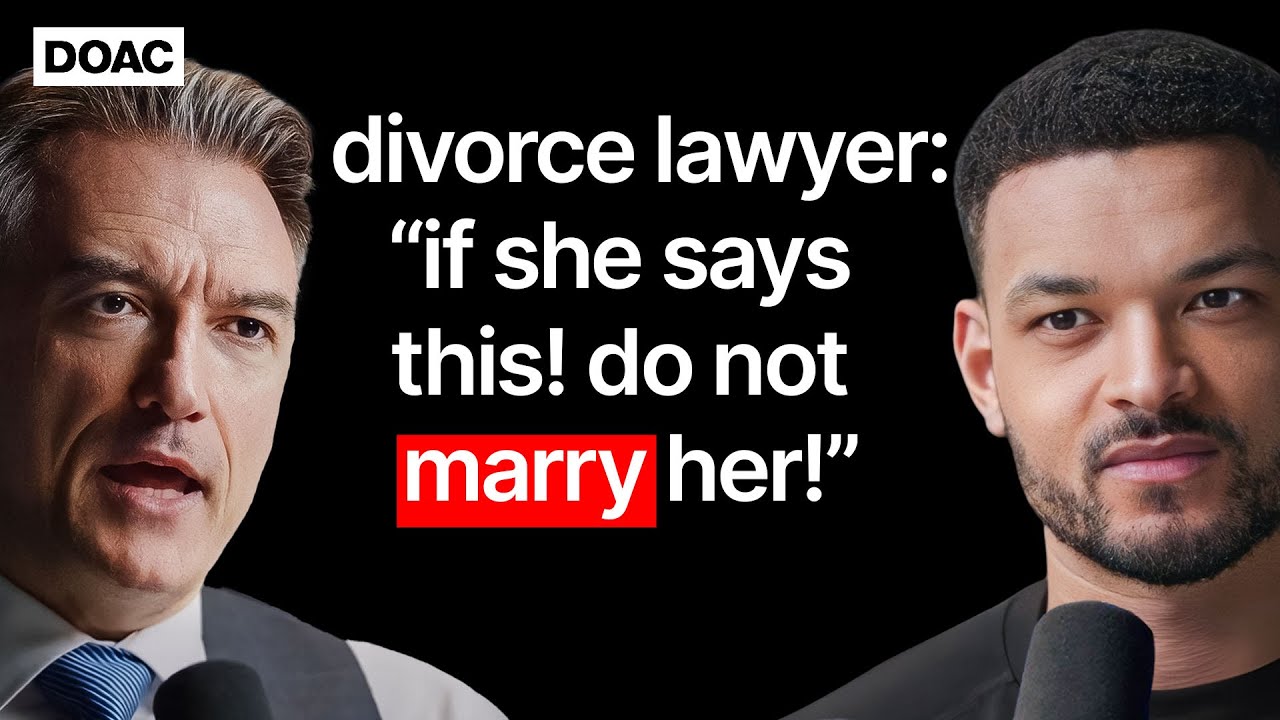
Lawyer Sexton Says Prenups, Sex Frequency Prevent Marital Failures
The Diary Of A CEO
Spouses avoid divorce by establishing customized legal contracts before marriage and using sexual intimacy as an indicator of broader relationship health.
## Background
Published on YouTube by The Diary Of A CEO on May 20, 2024, this video features divorce lawyer and bestselling author James Sexton discussing relationship dynamics, prenuptial agreements, and why marriages fail. The page description highlights Sexton's books 'How to Stay in Love' and 'If You're in My Office, It's Already Too Late', while providing chapter timestamps and link details for his work.
## TL;DR
Divorce lawyer James Sexton explores the main drivers behind marital breakdowns, pointing to intimacy issues, financial disputes, and unrealistic expectations as primary factors. He explains how prenuptial agreements function as pragmatic financial frameworks and discusses the psychological dynamics of infidelity and relationship power balances. Throughout the conversation, Sexton advocates for viewing relationships as meaningful chapters rather than permanent expectations, offering practical advice for maintaining open communication and long-term intimacy.
## Atmosphere & style
The conversation carries a pragmatic yet emotionally rich tone, blending legal candor with deep vulnerability and wit. Sexton balances sharp, unvarnished insights into human nature with moments of profound empathy, occasionally being moved to tears when reflecting on love and loss. The dialogue feels candid, engaging, and reflective, shifting effortlessly between high-stakes legal reality and existential contemplation.
## Key takeaways
- [02:02](https://www.youtube.com/watch?v=-MGyiqVjdKI&t=122s) Sexton estimates that when factoring in unhappy couples who remain together solely for legal, financial, or social reasons, the true marital failure rate reaches 70%–75%.
- [05:01](https://www.youtube.com/watch?v=-MGyiqVjdKI&t=301s) Many individuals remarry under the false belief that prior divorces were caused by picking the wrong partner rather than systemic issues inherent to the institution of marriage.
- [08:51](https://www.youtube.com/watch?v=-MGyiqVjdKI&t=531s) Relationships operate like an economy based on exchanged value; transparent dynamics regarding wealth or age gaps can be functional, but problems arise when partners self-delude about motivations.
- [12:33](https://www.youtube.com/watch?v=-MGyiqVjdKI&t=753s) Marriage functions as a legally binding contract that confers major legal obligations, yet most couples enter it without understanding how state default laws or customized prenuptial agreements operate.
- [16:20](https://www.youtube.com/watch?v=-MGyiqVjdKI&t=980s) Effective prenuptial agreements utilize clear financial division rules (Yours, Mine, Ours) and pre-agreed formulas to avoid costly litigated disputes during a split.
- [26:48](https://www.youtube.com/watch?v=-MGyiqVjdKI&t=1608s) Prenuptial agreements are enforceable unless shown to be unconscionable at the time of execution, leading courts to uphold unusually strict personal or financial performance clauses if freely agreed upon.
- [32:02](https://www.youtube.com/watch?v=-MGyiqVjdKI&t=1922s) Fidelity clauses in prenuptial or postnuptial contracts are strongly discouraged because 'cheating' is difficult to define legally and financial penalties rarely deter romantic or physical infidelity.
- [37:40](https://www.youtube.com/watch?v=-MGyiqVjdKI&t=2260s) Comparing real-life marriages against curated social media representations or idealised fictional archetypes creates unrealistic expectations that fuel marital dissatisfaction.
- [44:18](https://www.youtube.com/watch?v=-MGyiqVjdKI&t=2658s) Physical intimacy acts as the primary differentiator between a romantic partnership and a roommate dynamic, serving as a core indicator of overall marital health.
- [01:18:53](https://www.youtube.com/watch?v=-MGyiqVjdKI&t=4733s) Infidelity is rarely the sole root cause of divorce; it is typically a symptom of long-standing neglect, unaddressed friction, or a breakdown in intimacy.
- [01:14:05](https://www.youtube.com/watch?v=-MGyiqVjdKI&t=4445s) The psychological phenomenon behind affairs with domestic help (such as nannies) stems from a desire for supportive, low-conflict dynamics devoid of daily marital friction and domestic arguments.
- [01:17:51](https://www.youtube.com/watch?v=-MGyiqVjdKI&t=4671s) In high-conflict relationship breakups, exposure and escalating damage usually result from desperate cover-up attempts rather than the initial transgression itself.
- [01:37:01](https://www.youtube.com/watch?v=-MGyiqVjdKI&t=5821s) Viewing relationships as finite chapters rather than lifelong expectations allows individuals to recognize successful personal growth and avoid viewing ended marriages as total failures.
- [01:44:34](https://www.youtube.com/watch?v=-MGyiqVjdKI&t=6274s) Financial disputes in marriages rarely stem from absolute lack of funds, but rather from power imbalances, lack of transparency, or changes in provider identity.
- [01:56:40](https://www.youtube.com/watch?v=-MGyiqVjdKI&t=7000s) Because non-heterosexual couples historically operated outside traditional frameworks, many established custom structures around intimacy rather than strictly adopting standard marital expectations.
- [02:05:44](https://www.youtube.com/watch?v=-MGyiqVjdKI&t=7544s) Society should evaluate marriage as a specific legal tool rather than an automatic life expectation, determining whether the contract solves a specific problem for the couple.
## Detailed walkthrough
### [00:00](https://www.youtube.com/watch?v=-MGyiqVjdKI&t=0s) Introduction and the Reality of Divorce
In the opening minutes of the interview, divorce lawyer James Sexton—who has spent over two decades representing high-net-worth individuals, athletes, and celebrities—presents a stark overview of modern marriage. He notes that all marital issues essentially stem from core misunderstandings, with sex and finances frequently surfacing at the breaking point. According to statistical averages, someone entering a marriage faces roughly a 56% probability that the union will ultimately end in divorce.
Despite the high failure rate, human optimism around romance remains remarkably resilient: roughly 86% of divorced individuals remarry within five years. Sexton describes marriage as a "technology," highlighting how strange it is that society treats getting married as an automatic expectation rather than a high-risk venture. The discussion underscores that while people routinely enter into marriage with ideal intentions, very few understand the legal, financial, and personal mechanics of what happens when a relationship unravels.
- Roughly 56% of marriages end in divorce.
- About 86% of divorced individuals choose to remarry within 5 years.
- Misunderstandings surrounding intimacy and finances remain two of the largest drivers of marital breakdown.
---
[02:02](https://www.youtube.com/watch?v=-MGyiqVjdKI&t=122s) The Role of a Contested Divorce Lawyer
Sexton explains his specific function within the legal system as a litigator handling contested divorces and child custody battles in court. Entering his office is rarely a celebratory occasion; by the time a client sits across from him, something in their personal life has gone drastically wrong. Nobody plans or hopes to meet a divorce lawyer, making his practice an intersection of legal strategy and human crisis.
```
"By the time someone sets foot in my office, something's gone terribly wrong in their life because no one ever meant to meet me."
```
When evaluating overall marital failure, looking strictly at court dissolutions leaves out a significant portion of the population. Beyond the 56% of couples who legally end their marriages, a substantial number remain legally tied together out of financial necessity, social pressure, or for the sake of their children. Sexton estimates that if unhappy marriages preserved solely for external reasons are factored in, the overall failure rate of marriage approaches 70% to 75%.
---
[05:01](https://www.youtube.com/watch?v=-MGyiqVjdKI&t=301s) Why Do We Keep Getting Married?
Considering the high statistical probability of marital breakdown or persistent unhappiness, Sexton questions what fundamental problem the institution of marriage was originally designed to solve. Unlike simple tools or everyday items created for clear utility, marriage carries heavy societal expectations despite its high failure rate. When couples announce an engagement, society instinctively celebrates, whereas choosing not to marry after years together often draws skepticism or assumptions of commitment issues.
```
"I've often said like I'm not sure what marriage... what problem is marriage designed to solve?"
```
This cycle is particularly visible in second or third marriages. Even after undergoing long, emotionally draining, and financially painful divorces, individuals frequently enter new marriages believing "this time it's different." Sexton shares an example of a client who endured a brutal four-to-five-year divorce battle, only to turn around four months after meeting a woman 30 years his junior and decide to marry her. Despite gentle warnings to proceed with caution, the client remained entirely swept up in the romance of the new connection.
- **Statistical total failure rate:** Estimated around 70%–75% when including miserable unions sustained strictly for kids or finances.
- **The Remarriage Blind Spot:** People routinely convince themselves that past relationship failures were due to picking the wrong partner rather than systemic issues in how they approach marriage.
---
[08:51](https://www.youtube.com/watch?v=-MGyiqVjdKI&t=531s) The Dynamics Between Wealth, Beauty, and "Gold Diggers"
Addressing the stereotype of the "gold digger," Sexton reframes the dynamic between wealthy older individuals and younger, attractive partners as a form of relationship economy. Rather than viewing these arrangements with immediate cynicism, he argues that love operates in part through an exchange of value. If a successful partner provides financial security that enables a partner to pursue their talents or enjoy life, while the other partner brings energy, levity, and companionship, the dynamic can be mutually beneficial and transparent.
```
"I think love is an economy... There is a giving and taking of value. And that can be incredibly symbiotic."
```
The issue becomes problematic not when both parties understand the mutual trade-off, but when self-delusion takes over. Sexton notes that the most challenging situations occur when wealthy individuals refuse to acknowledge the role their financial status plays in attracting a partner. Believing a young, highly attractive partner is solely captivated by their personality—while ignoring massive discrepancies in age or lifestyle—creates an extreme vulnerability that often leads to messy legal battles later.
---
[12:33](https://www.youtube.com/watch?v=-MGyiqVjdKI&t=753s) What Is a Prenup? The Three Meanings of Marriage
Sexton breaks down what a prenuptial agreement actually accomplishes by clarifying the different meanings of the word "marriage." In society, marriage exists across three distinct categories:
1. **Religious/Spiritual:** A sacrament or covenant tied to faith and personal commitment.
2. **Social:** A public declaration that two people have combined their destinies.
3. **Legal:** A binding contract governed by state and federal laws regarding property, debt, and support obligations.
```
"Marriage is a legal status... It's the most legally significant thing they're going to do in their life other than die. And they have no idea what their rights and obligations are."
```
A prenuptial agreement is simply a customized contract where two individuals decide to write their own financial rules rather than letting state legislatures decide for them upon divorce. Sexton notes the irony that most people spend substantial time planning their wedding ceremony but remain completely unaware of the legal obligations conferred by a marriage license—rules that can be altered by politicians at any time without their input.
- A wedding ceremony and a marriage license are legally distinct; having a ceremony without filing paperwork confers no legal spousal rights.
- A prenuptial agreement allows couples to opt out of default state laws governing property division, alimony, and asset separation.
<ElicitationsGroup message="Where would you like to go next with this transcript?">
<Elicitation label="Continue to Part 2 of the transcript walkthrough" query="Please provide the detailed walkthrough for Part 2 of the transcript."/>
</ElicitationsGroup>
[16:20](https://www.youtube.com/watch?v=-MGyiqVjdKI&t=980s) How Tax Laws and Economic Disparity Impact Marriages
When a marriage breaks down after an economic disparity, the higher-earning spouse often makes payments to support the other. Historically, these payments—whether called spousal support, maintenance, or alimony—had no fixed statutory formula and were entirely up to a judge's discretion. Crucially, they used to be tax-deductible for the payer. However, that changed drastically in 2016 under the Trump administration when tax law reforms removed the tax deduction for alimony. This shift illustrates a fundamental issue with standard marriage: couples enter into a legal contract, but the governing rules can change mid-marriage due to external legislation beyond their control.
Prenuptial agreements offer a way to bypass this vulnerability. Designed at a time when a couple possesses an "abundance of affection" for one another, prenups allow partners to create their own custom rule set rather than relying on shifting state laws. While popular culture often views prenups simply as deciding "who gets what" during a split, predicting exact assets decades into the future is impossible. To solve this, effective prenups establish clear structural frameworks.
- **The "Yours, Mine, and Ours" Framework:**
- **Yours:** Any asset or liability held solely in your spouse's name belongs exclusively to them, free from your claims or obligations.
- **Mine:** Any asset or liability held solely in your name belongs exclusively to you.
- **Ours:** Any property or debt acquired in joint names is split 50/50, sharing equal entitlement to assets and equal responsibility for debts.
---
[18:08](https://www.youtube.com/watch?v=-MGyiqVjdKI&t=1088s) The Importance of Ongoing Financial Conversations and Defined Formulas
Creating three financial buckets at the start of a marriage is not a "set it and forget it" solution. Couples must maintain open communication as their financial circumstances evolve. For instance, if one spouse receives a large bonus at work, they should be able to discuss how much goes into their individual account versus their joint account without causing suspicion or tension. Transparent communication grounds the financial partnership in clarity.
A common point of friction in divorces involves wealth created during the marriage. A spouse will often argue, "He had nothing when we got married, and he built his business while with me, so I'm entitled to half of it." While this argument seems logical on the surface, pushing that logic further reveals its complexity. If a spouse is entitled to half a business for supporting their partner, one could argue that the spouse's parents—or even grandparents—contributed to making them who they are, raising questions about where liability stops. To prevent endless abstractions, partners need explicit formulas or agreed-upon percentages in advance so both parties understand the economic realities before signing up.
> "There are no other transactions where if you went in to purchase a car and you said, 'How much is this car?' and they said, 'Money.' They said, 'Well, how much?' 'You know, it's a good amount.'... I'd like to know what does this add up to? Give me a formula."
---
[20:50](https://www.youtube.com/watch?v=-MGyiqVjdKI&t=1250s) Frame the Prenup: Reframing Risk and Learning How to Fight
Many people feel nervous introducing the topic of a prenuptial agreement, fearing it signals an expectation that the relationship will fail. However, framing a prenup can be compared to purchasing life insurance: buying life insurance doesn't mean you plan on dying soon, but it ensures your loved ones are taken care of if the worst happens. Because every marriage eventually ends—either in death or in divorce—acknowledging and preparing for potential outcomes provides security and peace of mind.
```
┌──────────────────────────────────────────┐
│ MARRIAGE ENDPOINTS │
└────────────────────┬─────────────────────┘
│
┌────────────────┴────────────────┐
▼ ▼
┌─────────────────┐ ┌─────────────────┐
│ DEATH │ │ DIVORCE │
└────────┬────────┘ └────────┬────────┘
│ │
▼ ▼
Protected via Life Protected via Prenuptial
Insurance & Estate Agreement & Clear Asset
Planning Structuring
```
When one partner issues an ultimatum refusing to sign a prenup, the requesting partner often backs down out of fear. Giving in to intimidation sets a dangerous precedent for the relationship. Discussing financial boundaries before marriage is directly analogous to agreeing on how to handle arguments before conflict arises. The absolute worst time to figure out how to fight is in the middle of a heated argument; similarly, the worst time to negotiate asset division is during a bitter breakup.
- **Benefits of Proactive Relationship Agreements:**
- Establishes ground rules for conflict resolution when both partners are calm and rational.
- Removes financial fear, ensuring that neither partner stays in the marriage purely out of financial trap or dread of divorce proceedings.
- Reaffirms that partners remain together out of genuine affection and mutual value rather than financial dependency.
> "The best time to talk about how we're going to argue is when we're not arguing. You know the worst time to learn how to fight? In the middle of a fight."
---
[26:48](https://www.youtube.com/watch?v=-MGyiqVjdKI&t=1608s) Enforceability and Shocking Clauses: The 10-Pound Weight Clause
In the United States, prenuptial agreements are legally binding and strictly enforced by courts, provided they were not unconscionable at the time they were signed. A contract is legally "unconscionable" only if it is so wildly unfair that no fair-dealing person would offer it and no sane person would accept it. Even if an agreement yields a radically uneven result years later—such as one spouse walking away with $100 million and the other with virtually nothing—the contract remains valid as long as both adults entered into it voluntarily without fraud, duress, or impairment.
```
CAN A PRENUP BE OVERTURNED?
│
┌──────────────────────┴──────────────────────┐
▼ ▼
WAS IT UNCONSCIONABLE WAS IT UNCONSCIONABLE
WHEN SIGNED? IN PERFORMANCE?
│ │
┌─────────┴─────────┐ │
▼ ▼ ▼
[ YES ] [ NO ] STILL BINDING
│ │ (Courts uphold
▼ ▼ human agency &
OVERTURNED ENFORCEABLE contract rights)
```
One of the most extreme, legally upheld prenups involved a wealthy man marrying a very attractive woman. Concerned that she might gain weight over time while his wealth grew, he inserted a physical appearance clause into their prenuptial agreement. If they divorced, the wife was initially set to receive $70,000 per month in alimony; however, for every 10 pounds of weight she gained from the date of marriage, her alimony would be reduced by $10,000 per month.
When the couple eventually divorced, the wife challenged the clause in court. The judge called the provision "disgusting," but ultimately ruled that it was fully enforceable. Because both competent adults had freely signed the contract, they were bound by its terms. From a legal standpoint, the agreement reflected a explicit, albeit shallow, transaction: he valued her physical appearance, and she valued the significant monthly alimony.
- **Key Enforceability Factors for Prenuptial Agreements:**
- **Validity Standards:** Must be signed voluntarily without fraud, duress, undue influence, or impairment (drugs/alcohol).
- **Unconscionability Standard:** Evaluated strictly at the time of signing, not by how lopsided the outcome becomes years later.
- **Legal Strategy for Weight Clauses:** Lawyers handling baseline weight requirements must carefully manage weigh-ins, maximizing the initial baseline weight at signing (e.g., heavy clothes, high sodium) and minimizing weight prior to divorce proceedings (e.g., saunas, diuretics).
> "The court said, 'This is a disgusting provision. I don't know why you married this person, but it's enforceable. It's a contract... you agreed to these rules and they may be ridiculous rules, but you agreed to them.'"
[32:02](https://www.youtube.com/watch?v=-MGyiqVjdKI&t=1922s) Legality and Pitfalls of Prenuptial Fidelity Clauses
Continuing his analysis of extreme prenuptial terms, James Sexton frames these agreements through the clinical, analytical lens that makes lawyers notorious at parties: stripping away the human drama to treat relationship terms purely as an engineering challenge. The conversation shifts directly to fidelity clauses—provisions embedded in prenups or postnuptial agreements designed to impose severe financial penalties if a spouse commits infidelity.
While postnuptial agreements can serve a constructive purpose by establishing clear ground rules for couples navigating fragile marriages after an affair or rough patch without resorting to immediate divorce, Sexton argues strongly against including fidelity clauses in either pre- or post-marital contracts. From a legal and practical standpoint, he considers them a terrible idea. The primary hurdle lies in defining "cheating"—a term that encompasses vast nuance:
Sexton notes how gender dynamics often manifest when infidelity is uncovered: men typically ask, *"Did you sleep with them?"* while women tend to ask, *"Are you in love with her?"* Because a one-size-fits-all contractual clause cannot capture these critical distinctions, adding a financial penalty to an act that already carries devastating emotional consequences is ineffective. Financial disincentives rarely deter infidelity, just as criminal laws do not stop severe addiction; cheating inflicts immense pain on all parties involved, and a hypothetical loss of extra money will seldom cross someone's mind in the heat of the moment.
- **Postnuptial Agreement:** A legal contract entered into after marriage to settle financial and asset arrangements in the event of a future divorce.
- **Fidelity Clause:** A contractual term specifying financial penalties (such as reduced alimony or forfeited property rights) if a spouse engages in cheating.
- **The Gender Question Dynamic:**
- **Men's immediate concern:** Physical nature of the act (*"Did you sleep with them?"*).
- **Women's immediate concern:** Emotional connection (*"Are you in love with her?"*).
[37:30](https://www.youtube.com/watch?v=-MGyiqVjdKI&t=2250s) The Modern Rise of Prenups and Performative Social Media Relationships
Sexton highlights a massive generational transformation in how young people view marriage. Over his 25-year career, he has observed that adults in their mid-20s to mid-30s are securing prenuptial agreements at roughly five times the rate seen a decade or two ago. Modern couples treat marriage with a pragmatism that was largely absent in previous generations. However, this pragmatic reality contrasts sharply with the culture of performative happiness on social media, where couples showcase pristine, "hashtag blessed" lifestyles while their relationships rot from the inside out.
He recounts seeing high-profile clients present glowing, deeply affectionate public personas on social media right up until they issue sanitized PR announcements requesting privacy during their "amicable separation." This artificial culture creates a damaging cycle: ordinary couples measure their real-life "gag reels" against other people's curated "greatest hits," breeding unnecessary self-doubt and relationship dissatisfaction.
> "We're basing our level of satisfaction on watching your greatest hits while we live our gag reel."
- **Prenup Adoption Rate:** Approximately **5x higher** among current 20-to-30-somethings compared to 10–15 years ago.
- **Performative Relationships:** Couples routinely present ideal, photogenic lives publicly while quietly proceeding toward divorce behind closed doors.
[39:40](https://www.youtube.com/watch?v=-MGyiqVjdKI&t=2380s) Quiet Wealth vs. Public Display and the Cult of Fame
Recalling a classic piece of advice from his father—*"empty barrels make the most noise"*—Sexton explains that those who possess genuine relationship satisfaction or true wealth rarely feel the need to broadcast it. Drawing from his work representing billionaire clients in New York City, he contrasts quiet wealth with superficial luxury:
| Profile | Behavior & Lifestyle Characteristics |
|:--- |:--- |
| **Quiet Wealth ($8B Client)** | Drives a mid-range Jeep Grand Cherokee, buys $25 Supercuts haircuts, wears basic clothing, and blends into the crowd effortlessly. |
| **Performative Wealth / Celebrities** | Driven by public expectations to maintain flashy luxury cars and designer wardrobes, often masking immense debt behind a facade of success. |
Sexton notes how cultural priorities have shifted: where fame was once an uncomfortable byproduct of exceptional talent, it has now become an end in itself—a desperate appeal for validation from strangers (*"Please tell me I have value"*). True confidence, whether in personal finances or romantic relationships, requires no audience.
- **Client Example:** An $8 billion net-worth client who lives discreetly and drives a standard Jeep Grand Cherokee.
- **Celebrity Financial Traps:** High personal debts driven by the perceived obligation to publicly display high-end luxury labels and vehicles.
[44:18](https://www.youtube.com/watch?v=-MGyiqVjdKI&t=2658s) Unrealistic Benchmarks and Sex as Relationship "Glue"
The pressure of performative culture spills directly into intimacy and marital expectations. Sexton regularly sees clients enter his office evaluating their marriages against arbitrary external metrics—worrying whether they are having enough sex or looking attractive enough based on photoshopped, unrealistic online standards.
Sex serves as the core distinguishing factor between a romantic partnership and a cohabitating roommate arrangement. While modern society speaks more openly about diverse topics such as LGBTQ+ rights, kink, and non-traditional lifestyles, couples still struggle to talk candidly about baseline intimacy within their own homes without becoming defensive.
> "What's the difference between a spouse and a roommate otherwise?... Sex is the glue. Sex is what makes a romantic relationship a romantic relationship."
When a couple's frequency of sex declines over time, it shouldn't automatically trigger a fight or a spiral of blame. Instead, Sexton advocates for candid communication to determine whether a drop in frequency represents a natural phase of a long-term bond or an unaddressed symptom of mutual dissatisfaction. Without honest conversations, couples risk entering a destructive "death spiral"—where lack of intimacy leads to emotional distance, which breeds resentment, ultimately destroying a relationship that once began with genuine love.
[47:35](https://www.youtube.com/watch?v=-MGyiqVjdKI&t=2855s) Preventive Maintenance and Facing Uncomfortable Truths
Sexton underscores that marriage is a voluntary choice: no one is forced to stay married or treat their spouse with kindness, but since both partners freely signed up for the union, they once saw a shared direction. To prevent "losing the plot," couples must perform what he terms "preventative maintenance." This involves routinely checking in on emotional, physical, and mental connection before minor issues snowball into insurmountable barriers. While initiating these conversations can feel deeply uncomfortable, Sexton compares the friction to starting a new exercise routine. Just as muscle soreness eventually yields fitness and long-term vitality, enduring short-term awkwardness is the price required to secure deep intimacy, mutual safety, and lasting joy.
Reflecting on the stark realities of life, Sexton points out that existence is brutal, terrifying, and ultimately terminal. Having a dedicated partner to navigate life's existential weight—someone to hold hands with during terrifying moments and help uncover blind spots—is a rare, worthy pursuit. He notes that the fact that 86% of divorced individuals remarry within five years proves human beings fundamentally crave this partnership. However, sustaining a lifelong bond requires abandoning the desire for total comfort in the moment and making the conscious investment to keep one another genuinely satisfied.
[50:44](https://www.youtube.com/watch?v=-MGyiqVjdKI&t=3044s) Simple Gestures and Cultural Disdain for Spouses
Unpacking the practical mechanics of preventive maintenance, Sexton highlights how small, consistent acts of courtesy can safeguard a relationship. He shares a specific habit he frequently recommends to male friends: leaving a brief, romantic note in the morning (e.g., *"It was so great hanging out with you last night. I'm with the prettiest girl in the world. Can't wait to see you again"*). Although a partner might initially express skepticism or confusion at the sudden gesture, establishing this routine builds a foundation of appreciation that costs nothing and takes under ten seconds.
Sexton laments how modern culture breeds cynicism and normalized disdain toward long-term partners. He contrasts human marital behavior with how people treat aging pets, noting that even as his 13-year-old dog slows down and suffers from back pain, he falls more in love with him each day and would never trade him for a new puppy. Conversely, societal dialogue frequently encourages adults to vent about their partners, depicting wives as "loathsome harpies" or "ball and chains," and husbands as bumbling, clueless idiots. This pervasive disrespect erodes intimacy, convincing people that new relationships are inherently superior when they are simply at an earlier, unblemished stage of the exact same cycle.
- **The Morning Note Practice:** A 10-second handwritten note expressing appreciation disrupts daily friction and restores romance.
- **The Dog Analogy:** People rarely replace aging, loyal pets for younger ones, yet societal standards encourage treating romantic partners as disposable when novelty fades.
- **Cultural Tropes:** Tropes stereotyping husbands as "lovable idiots" or wives as "shrews" normalize underlying contempt, destroying mutual respect.
[55:25](https://www.youtube.com/watch?v=-MGyiqVjdKI&t=3325s) Debunking "Happy Wife, Happy Life" and Shallow Goals
Sexton strongly critiques popular relationship clichés, singling out the phrase "Happy wife, happy life" as destructive advice. He argues that the phrase is typically deployed by men who view their wives as perpetually dissatisfied, choosing passive conflict avoidance just to watch sports in peace rather than cultivating a vibrant, reciprocal partnership. Settling for a spouse's baseline tolerance is a dismal standard for a lifelong commitment.
```
Traditional Cliché Sexton's Critique
┌──────────────────────────────┬──────────────────────────────────────────┐
│ "Happy wife, happy life." │ Passive conflict avoidance; accepts │
│ │ baseline dissatisfaction for quiet. │
├──────────────────────────────┼──────────────────────────────────────────┤
│ "My kids are my greatest │ Traps generations in reproduction for its │
│ accomplishment." │ own sake ("ideology of a cancer cell"). │
└──────────────────────────────┴──────────────────────────────────────────┘
```
Expanding on societal misconceptions, Sexton addresses the common sentiment that raising children is a person's sole ultimate accomplishment. He warns that defining life's purpose purely through reproduction creates a cycle akin to the "ideology of a cancer cell"—growth and replication without regard for overall quality of experience or broader contribution to the world. Just as maintaining a healthy body weight is far easier than trying to lose 100 pounds after massive weight gain, routinely addressing small relational issues prevents the massive, destructive overhauls required when a marriage completely falls apart.
[58:05](https://www.youtube.com/watch?v=-MGyiqVjdKI&t=3485s) The "Hit Send Now" Communication Technique
Referencing a past interview between the host and psychologist Jordan Peterson—who passionately argued that men must spend 90 minutes a week listening to their wives or risk seeing them in divorce court—Sexton echoes the core principle: couples must invest early in candid, non-defensive communication. He introduces a key method from his book *How to Stay in Love* titled the **"Hit Send Now"** technique. This framework allows partners to voice small hurts or anxieties before they curdle into resentment.
The process functions like drafting a delicate, high-stakes email: rather than agonizing over perfect phrasing or bottling up the issue, a partner sends the message or raises the topic using the explicit subject banner "Hit Send Now." This phrase acts as a pre-agreed contract signifying that the message is sent out of love and a desire to protect the relationship, not as an ambush or attack. It grants the recipient space to process the information without feeling pressured to react defensively or offer an immediate counterargument.
- **Establish the Rules in Good Times:** Agree on the "Hit Send Now" framework when the relationship is in a stable, affectionate state so both partners recognize it as a tool for preservation.
- **Address Micro-Frictions Early:** Voice minor grievances—such as a subtle, uncomfortable joke made about a family member—immediately rather than letting them build over time.
- **Frame Around Vulnerability:** Express concerns directly (e.g., addressing a drop in sexual frequency by asking *"Is there something I'm doing that's causing you to be less interested?"*) to eliminate corrosive guessing games and false assumptions.
<Elicitation label="Explore the next section of the transcript" query="Please provide the next detailed walkthrough section for this video transcript."/>
[01:02:50](https://www.youtube.com/watch?v=-MGyiqVjdKI&t=3770s) Sex as the "Canary in the Coal Mine" of Marriage
Reverse engineering the demise of a marriage is notoriously complex. People are rarely fully honest or self-aware about what drove them apart, making self-reported satisfaction surveys notoriously unreliable and filled with personal delusion. From the perspective of a seasoned trial lawyer whose job is "a full-contact storyteller" paid to manipulate emotional states in court, sex is everywhere in the equation. It is the single definitional element that separates a romantic partnership from every other platonic relationship in human society.
While society could theoretically reproduce through purely functional, platonic breeding arrangements, human history across cultures consistently defaults to pair-bonding. When the sexual element in a marriage degrades, it serves as the ultimate "canary in the coal mine" signaling that broader systemic breakdown is underway. While reduced intimacy isn't always the direct root cause—sometimes couples stop having sex because they stopped being nice to each other, or vice versa—it is always a primary indicator of deeper marital distress.
* **Core Cause of Marital Failures:** All marital problems fundamentally stem from two things: *"I don't know what I want, and I don't know how to express it."*
* **The Single Best Piece of Advice:** Pay attention—to your own feelings and your partner's—and communicate them directly.
---
[01:07:53](https://www.youtube.com/watch?v=-MGyiqVjdKI&t=4073s) The Escalation to Trial and Gender Differences in Sex and Infidelity
As James Sexton's career has progressed, his role has shifted from general matrimonial law to high-conflict litigation. He describes himself not as a delicate scalpel, but as a "chainsaw" hired for the worst situations. His value stems from tactical strategy, waking up at 4:00 a.m. hyper-focused on case mechanics, and an intense work ethic that makes him an elite trial attorney even if it makes him "questionable as a human being." While early in his career he frequently redirected clients toward individual or couples counseling to save their marriages, high-conflict litigation rarely leaves room for reconciliation.
```
+-------------------------------------------------------------------+
| GENDER DYNAMICS IN INFIDELITY |
+-------------------------------------------------------------------+
| Men | Women |
+------------------------------------+------------------------------+
| • Quantity-oriented sex drive | • Quality-oriented sex drive |
| • Seek frequent physical release | • Seek emotional connection |
| • More frequently accused of cheating| • High rates of infidelity |
+------------------------------------+------------------------------+
```
When evaluating sexual frustration within marriages, Sexton notes distinct gender patterns. Men are far more likely to report dissatisfaction with the *quantity* of sex, often viewing it as a physical necessity to clear their heads—similar to why pornography usage skews higher among men. Women, on the other hand, are generally more focused on the *quality* and emotional connection of sex. It is common for male clients to justify cheating by pointing to years of bedroom dead zones, with some revealing they hadn't had sex with their spouses in six full years.
* **Infidelity Rates:** Both men and women cheat at exceptionally high frequencies, though men are far more frequently accused of destroying the marriage because of it.
* **The Nuance of Affair Stories:** Cheating is often treated as a simple cause of divorce (e.g., "he slept with his secretary"), but it is usually an effect of long-standing neglect, such as years without physical intimacy or emotional connection.
---
[01:13:05](https://www.youtube.com/watch?v=-MGyiqVjdKI&t=4385s) Bizarre Affair Logistics and the "Nanny Fascination"
In the realm of marital deceit, people rarely view themselves as the villain. Yet the sheer logistics of some affairs border on mind-boggling. Sexton has handled cases where clients maintained two entirely separate families simultaneously—complete with children—where the mistress believed he was divorced and the wife believed he was traveling for work, successfully splitting major holidays like Christmas and Thanksgiving between both homes for years.
```
+-------------------------------------------------------+
| THE "NANNY FASCINATION" |
+-------------------------------------------------------+
| • Shares the ideal supportive qualities of a wife |
| • Operates without domestic friction or independence |
| • Maintains a distinct identity outside the home |
+-------------------------------------------------------+
```
One of the most frequent affair archetypes among wealthy clients involves sleeping with the family nanny. Sexton attributes this "nanny fascination" to a specific psychological dynamic: the nanny embodies the supportive, child-rearing aspects of a wife, but operates as an employee without the friction, autonomy, or arguments over domestic duties. Furthermore, the nanny retains an intriguing life outside the household.
* **Common Affair Partners:** Outside of nannies, affairs frequently involve sisters-in-law, brothers-in-law, cousins, and occasionally fathers-in-law.
* **Advice for Wives:** Retain your individual identity, interests, and passions outside of motherhood and marriage. Do not let your identity be entirely eclipsed by domestic duties, as the person your spouse fell in love with was an individual with a distinct life.
<FollowUp label="Want to continue with part 6 of the transcript walkthrough?" query="Please provide part 6 of the detailed walkthrough for this video transcript."/>
[01:17:51](https://www.youtube.com/watch?v=-MGyiqVjdKI&t=4671s) Extreme Cover-ups and the Escalation of Transgressions
Reflecting on how ordinary people end up committing horrific acts, James notes that extreme decisions often start with a single poor choice. Watching serial killer documentaries reinforces a key truth in both crime and relationships: it is rarely the initial crime that gets someone caught, but rather the desperate, tracks-leaving cover-up. In marital dynamics, long-term hidden affairs or covertly stashed funds build up until a spouse would be completely incredulous if they found out.
```
"It's like the things you do to try to cover your tracks is the thing that leave the tracks."
```
When asked if murder comes up in his legal practice, James shares that in 25 years, he has only had one case involving an active attempted murder by a spouse. His client had suffered years of domestic violence, though nothing previously indicated her husband possessed a lethal propensity. As the divorce proceedings turned unfavorable for him, he lured her to a remote hotel parking lot under the pretense of handing over items for their children. There, he stabbed her multiple times and ran her over with his car four times, leaving her for dead. Miraculous medical care saved her life after six months of surgeries, and he received a life sentence in prison.
While physical murder attempts are rare, suicides and self-harm are far more frequent. James notes that spouses often feel overwhelmed by the total collapse of their lives, the prospect of an uncertain post-divorce future, or immense shame over their own misconduct during the process. While he has lost one client to suicide, he has experienced four instances where the opposing party ended their life. This reality creates a deep professional burden, as a divorce attorney acts as a high-powered weapon designed to dismantle the opposing side.
* **Attempted Murder Case:** Client was stabbed and run over 4 times; survived after 6 months of surgery, leaving the perpetrator with a life sentence.
* **Suicides in Practice:** James lost 1 client to suicide and had 4 opposing parties commit suicide during litigation.
* **Role of the Attorney:** Describes a divorce attorney as a "weapon" that protects in good hands, but inflicts immense harm when used maliciously.
---
[01:22:17](https://www.youtube.com/watch?v=-MGyiqVjdKI&t=4937s) Emotional Toll, Crying, and Winning Back a Dog
James acknowledges that his job has brought him to tears on multiple occasions, stemming both from the frustration of justice unserved and from moments of deep beauty. He finds himself far more moved by human resilience, strength, and pure love than by cruelty.
```
"To love anything is insane... Because to love anything is to expose yourself to the inevitability of losing it."
```
He illustrates this with a story about an older, gruff client who cared little about the financial assets in his divorce, insisting only on retrieving his dog from an ex-wife who was keeping it out of spite. When James successfully won the dog back and broke the news in the hallway, both he and his tough client broke down crying like children. This leads to a discussion with the host about his own aging dog, Pablo, and how realizing an animal is in its final season of life heightens one's appreciation and tenderness toward them.
- **Frustration vs. Beauty:** Tears come more often from witnessing human resilience than from despair over injustice.
- **The Dog Custody Case:** A rough client prioritized getting his dog back over all financial settlements, resulting in an emotional breakdown from both client and attorney upon victory.
- **Impermanence of Pets:** Aging pets like the host's dog, Pablo, serve as a stark reminder to cherish everyday moments.
---
[01:27:01](https://www.youtube.com/watch?v=-MGyiqVjdKI&t=5221s) Impermanence, Loss, and Loving Deeply
Drawing from his former work as a hospice volunteer, human experiences, and his career as a divorce lawyer, James emphasizes that "love is not permanently gifted; it is loaned." Everyone and everything is constantly slipping away—even children change daily into new beings. Rather than creating cynicism, this awareness fuels his romantic outlook, because being confronted daily with the fragility of love reveals its true power.
```
"Love is not permanently gifted. It is loaned. And the people you love, the dog you love, the people—they're loaned to you and you're loaned to them."
```
James references a mindfulness exercise from Vietnamese Buddhist monk Thich Nhat Hanh (author of *Peace in Every Step*). The exercise instructs a person, while hugging a loved one, to close their eyes and imagine that the person has died and this is the final embrace before their body is taken away—and then to open their eyes and realize they are still alive. James connects this to the painful but loving duty of putting down a suffering pet, recalling the lingering, fading memory of a pet's scent and his mother's voice on an old videotape recorded eight years after her passing.
* **Thich Nhat Hanh Exercise:** Hug someone, imagine they have passed away, and then return to the present reality that they are alive to deepen gratitude.
* **Moments of Loss:** Memories fade over time like "tears in rain," making present awareness essential.
* **View on Loving:** Loving is inherently painful due to loss, but the pain is worth the experience of having loved.
---
[01:31:33](https://www.youtube.com/watch?v=-MGyiqVjdKI&t=5493s) Saving Coba: The Infinite Capacity for Love
James recounts how he got his current dog, Coba, 13 years ago, shortly after his previous dog, Buster, died. In the immediate grief of losing Buster, James vowed never to get another pet or expose himself to such pain again. However, when a friend asked him to watch a mange-ridden, goofy shelter puppy for just one night while his kids were away, James reluctantly agreed.
```
"He looks at me, and I think to myself, 'Oh, you're going to kill me. Like, you're going to kill me when I lose you.'... But man, I'm so glad I did it."
```
The puppy walked into the apartment and immediately peed on the floor, making James instantly realize he was adopting him. Now, 13 years later, Coba has a graying face and is entering his final years. Reflecting on their bond, James explains that Coba saved him by proving that no matter what someone loses, human beings possess an infinite capacity to love again. Losing things continuously is no reason to close one's heart.
- **Loss of Buster:** Prompted a vow to never get another dog to avoid future heartbreak.
- **Adopting Coba:** Agreed to foster a puppy with mange for one night; ended up keeping him for 13 years.
- **Core Realization:** Loving through loss proves that human beings have an infinite capacity for love regardless of past grief.
[01:33:59](https://www.youtube.com/watch?v=-MGyiqVjdKI&t=5639s) The Vulnerability of Loving and Crying on Podcasts
James Sexton reflects deeply on the courage required to love, asserting that love is inherently terrifying because it opens up the inevitable possibility of heartbreak. He explains that true bravery only exists when you are scared, yet you choose to open your heart anyway because the interim joy is worth the potential pain. Talking about the emotional weight of loving, James admits that while he might claim he'll never love again if he loses his dog, Kaba, he knows he is lying to himself—he will always love again, just as people rebuild after romantic heartbreak. He emphasizes that humans break in relationships, but they also heal and recover within them.
After being told that he is the first guest to get the host to cry on the podcast, James reveals that he actually cries constantly himself. Despite his tough exterior—being covered in tattoos and practicing Brazilian Jiu-Jitsu for fun—he is deeply moved by beauty and the continuous, brave cycle of human connection. He views life as a game humans can't win, yet keep playing because of a fundamental desire to reconnect to something greater.
[01:37:01](https://www.youtube.com/watch?v=-MGyiqVjdKI&t=5821s) Viewing Relationships as Chapters, Not Forever Soulmates
Moving into a broader view of romance, James challenges the modern idealization of "soulmates." While he jokingly admits that the concept of a soulmate is fantastic for his legal business because it creates unrealistic expectations that drive people straight into divorce court, he argues it is terrible for human beings. Believing in a single "soulmate" makes people constantly wonder if they picked the wrong person whenever minor issues arise, leading them to look for the next "perfect" partner. He insists that humans have an infinite capacity for love, drawing an analogy to how parents don't limit their love to just one child or how dog owners can deeply love multiple pets sequentially across a lifetime.
Instead of measuring a relationship's success by whether it lasts until death, James urges people to view romantic relationships as distinct chapters in a long book. A relationship that ends in divorce or a breakup can still be an immense success if both individuals grew, learned how to love better, and came out as better people. What is compelling or attractive in your 20s (like wanting a two-seater Lamborghini) changes completely by your 50s when life demands different things, and hoping a couple will magically "grow together" through mere proximity is often naive.
* **The *Titanic* Paradox:** James humorously points out that Jack and Rose had a "perfect romance" only because Jack died before he could ruin it; ten years down the line, Rose would have been nagging him to stop painting French girls and get a real job.
* **The Meeting Memory Test:** Unhappy couples can instantly soften if you ask them how they first met, reminding them of who they were when everything was full of possibility.
[01:42:25](https://www.youtube.com/watch?v=-MGyiqVjdKI&t=6145s) The Danger of Comparing Relationships to Imagined Ideals
James shares a personal story about a conversation he had with one of his sons when the boy was a teenager. His son was being critical of him, stating that James was not a "perfect father." James countered by asking what his son was comparing him to—an imagined ideal or a real father he actually knew? He warned his son that if he was going to be measured against an imaginary perfect father, James would hold him to the standard of an imaginary perfect son, concluding with a tough-love reality check: "Compared to the ideal of our imagination, we all suck."
James advised his son to carry that lesson into his future romantic endeavors. Comparing a real-life partner to an idealized fantasy guarantees lifelong disappointment. Modern couples suffer from comparing their real-world struggles to romantic comedies (which he labels as "porn for women") or curated front-facing lies told by other couples, rather than looking at real, flawed human relationships.
* **Fastest Marriage to Divorce:** The quickest turnaround James has ever witnessed from marriage to regret was just **48 hours**, typically resulting in an annulment after an impulsive decision in Las Vegas.
* **Low Barrier to Entry:** James notes the irony that while getting a firearm requires a waiting period, anyone can get married almost instantly by paying a **$40** license fee at a justice of the peace or paying an Elvis impersonator **$50** in Vegas.
[01:44:34](https://www.youtube.com/watch?v=-MGyiqVjdKI&t=6274s) Money, Power Dynamics, and Job Losses in Marriage
Transitioning to the two primary causes of divorce—infidelity and money—James clarifies that money issues are rarely about going broke, but rather about transparency, control, and power dynamics. Quoting the famous line (misattributed to Oscar Wilde) that "everything in the world is about sex except sex, which is about power," James explains that money is a proxy for security, self-worth, and leverage. Because society treats financial discussions as indelicate, partners frequently hide things or fail to communicate openly about their finances.
James highlights a major trend in heterosexual marriages: when both partners work and the husband suddenly loses his job, it frequently acts as a major catalyst for divorce. Losing a job often sends men into a severe psychological tailspin, as traditional expectations place their identity on being the primary provider and protector. Simultaneously, many women find themselves deeply uncomfortable when forced into the role of sole breadwinner for a husband who lost his job. In contrast, James observes in his legal practice that when wives lose their jobs, it rarely has the same destructive impact on the stability of the marriage.
* **Legal Transparency in Divorce:** During divorce proceedings, mandatory discovery legally compels both parties to hand over all financial records.
* **Uncovering Secrets:** Teams of lawyers routinely go through bank statements and credit card receipts to uncover hidden assets, money spent on extramarital affairs, or subscriptions like OnlyFans.
[01:48:48](https://www.youtube.com/watch?v=-MGyiqVjdKI&t=6528s) Hiding Money and the Reality of Financial Debt
James Sexton points out that in the modern digital age, it is incredibly difficult to move money or hide assets without leaving a paper trail. Standard financial discovery in divorce proceedings allows attorneys to pull records directly from employers and credit card companies, tracking exact compensation and expenditures. Addressing a viral story about a famous footballer who supposedly transferred all his assets into his mother's name to avoid a divorce settlement, Sexton explains that such moves are legally protected against in most jurisdictions. Known as a "transfer in contemplation of divorce" or fraudulent conveyance, courts possess the power to void transactions intended to thwart a spouse's legitimate legal remedies—such as selling a Lamborghini to a sibling for five dollars right before being sued. However, if an individual systematically strips assets out of the marital estate over a 20-year period before any marital breakdown is anticipated, those assets may legitimately end up beyond the court's reach.
Sexton notes that while spouses are occasionally shocked to find a seemingly wealthy partner has no assets, a far more common realization is uncovering massive, hidden debt structures. Many high-earning individuals and celebrities live under an illusion of wealth generated by extreme leverage rather than actual equity. Spouses often misunderstand that a divorce divides net assets—meaning liabilities are factored in, resulting in a 50/50 split of both assets and accumulated debts.
- Subpoenas can retrieve financial data straight from employers and credit card providers, making concealed transfers easy to trace.
- A "transfer in contemplation of divorce" is legally classified as a fraudulent conveyance, allowing courts to void artificial asset sales.
- Long-term financial planning executed decades before any marital strife can successfully insulate assets from the marital estate.
- High-earning households frequently operate on heavy leverage involving credit card debt, leased luxury vehicles, personal loans for depreciating assets like jewelry, and high-percentage mortgages.
- In a divorce, marital estates are divided net of liabilities, forcing spouses to split shared debts alongside shared assets.
---
[01:51:49](https://www.youtube.com/watch?v=-MGyiqVjdKI&t=6709s) Lottery Wins, Hidden Fortunes, and Abrupt Splits
Exploring the opposite dynamic—where a spouse turns out to possess far more wealth than expected—Sexton shares a memorable case involving a client who won the lottery. The client and his wife lived a very modest life, stuck in minimum-wage jobs and staying in an unhappy marriage simply because neither could afford to live independently or pay double electricity bills. When the husband won a $50 million Powerball jackpot—which left him with roughly $25 million after a 50% tax hit—he was initially thrilled until Sexton informed him that his wife was legally entitled to exactly half of the net winnings.
The husband was stunned, arguing that he had purchased the lottery ticket with his own money. Sexton reminded him that under the law, a married couple is treated as a single legal entity; had the wife bought the winning ticket, he would have been entitled to half of her payout as well. The sudden influx of cash immediately changed the dynamic of the failing marriage. While the husband suddenly felt motivated to attempt reconciliation to save his money, the wife realized she could walk away with $12.5 million and never have to deal with him again. She promptly served him with divorce papers.
- A client working a minimum-wage job won a Powerball jackpot of approximately $50 million, resulting in $25 million after taxes.
- Under marital property law, lottery tickets bought during the marriage count as joint property, entitling the non-purchasing spouse to a 50% share of the winnings.
- The wife filed for divorce immediately after learning she could collect $12.5 million and leave the unhappy relationship.
---
[01:53:20](https://www.youtube.com/watch?v=-MGyiqVjdKI&t=6800s) LGBT Rights, Divorce Dynamics, and Making New Rules
When asked how divorce and relationship dynamics apply to LGBT couples, Sexton explains that while core issues like impermanence and idealizations of soulmates remain universal, historical marginalization created a distinct relationship dynamic. Because gay and lesbian couples were forced to the periphery of society for so long, they developed a sense of freedom from traditional societal expectations. Unbound by legacy social norms, many constructed their own relationship rules around intimacy, non-monogamy, and commitment.
Sexton reflects on the nature of tradition, describing it as "peer pressure exerted by dead people"—the expectation to repeat ancestral lifestyles despite living in an era with the sum of human wisdom available at one's fingertips. He notes that when marriage equality became the law of the land, it brought an ironic double-edged sword. A gay friend candidly admitted he was unenthusiastic about marriage equality because he could no longer use legal prohibitions as an excuse to avoid tough conversations about long-term commitment, cohabitation, or adopting children. Sexton observes that while marriage equality is a fundamental human right, entering into the traditional framework of marriage presents the exact same friction points for gay couples as it does for heterosexual ones.
- Sexton has served as a consulting attorney for Lambda Legal, advocating for basic civil rights and non-discrimination.
- He characterizes tradition as "peer pressure exerted by dead people," arguing that modern couples should customize their relationship structures rather than blindly copy past generations.
- The legalization of same-sex marriage eliminated convenient excuses for avoiding hard relationship milestones like marriage and parenthood.
- Having represented various gay and lesbian clients in divorce proceedings, Sexton observes that same-sex marriages face identical structural stresses, communication breakdowns, and divorce outcomes as heterosexual unions.
---
[01:59:19](https://www.youtube.com/watch?v=-MGyiqVjdKI&t=7159s) Ethical Non-Monogamy, Delegating Sex, and Infidelity
Addressing the viability of open relationships, polyamory, and ethical non-monogamy, Sexton offers a cautious perspective framed by his professional bias. As a divorce lawyer, he primarily encounters non-monogamous arrangements that failed, comparing his perspective to an oncologist who sees cancer everywhere because of their work environment. While he has never personally witnessed a successful non-monogamous relationship among his clients or personal acquaintances, he acknowledges that culture is still wrestling with honest conversations surrounding monogamy and infidelity, citing the work of relationship expert Esther Perel.
Sexton points out that many long-term marriages operate under implicit "don't ask, don't tell" understandings. Since a marriage encompasses numerous distinct roles—co-parents, roommates, financial partners, travel companions, and family representatives—some couples quietly permit a partner to seek sexual fulfillment elsewhere if their sexual drives are misaligned. He likens this to delegating an interest your partner doesn't share, such as letting a spouse watch football with friends. Furthermore, Sexton refutes the idea that stepping outside a marriage strictly indicates a lack of love. He routinely encounters individuals who engage in external affairs while remaining deeply committed to their spouse in every other facet of life—serving as attentive parents, strong economic providers, and emotionally supportive partners.
- Sexton compares evaluating open relationships as a divorce attorney to an oncologist judging population health based solely on cancer patients.
- A marriage functions as a composite of multiple distinct relationships: co-parenting, cohabitating, financial management, and family obligations.
- Certain couples maintain silent "don't ask, don't tell" policies to preserve the broader marital unit when sexual appetites differ significantly.
- External affairs do not inherently mean a person has fallen out of love; individuals frequently cheat while remaining diligent providers, involved parents, and emotionally supportive partners.
- Sexton uses the concept of a "cheat meal" on a strict diet to illustrate how people can value a core commitment while still seeking external variety.
<ElicitationsGroup message="Explore more insights from James Sexton on relationship dynamics and divorce:">
{/* Reason: Offers relevant, specific follow-ups based on the themes of infidelity, prenups, and marital longevity discussed in the transcript. */}
<Elicitation label="Analyze James Sexton's advice on prenuptial agreements" query="What does James Sexton say about prenuptial agreements, common misconceptions, and key clauses to include?"/>
<Elicitation label="Examine the main triggers of divorce according to Sexton" query="According to divorce lawyer James Sexton, what are the primary root causes of divorce beyond money and cheating?"/>
</ElicitationsGroup>
[02:03:37](https://www.youtube.com/watch?v=-MGyiqVjdKI&t=7417s) The Imperative of Monagamy and Human Nature
James Sexton continues reflecting on the deep-seated human desire for variety, passion, and sexual connection. He points out that while he isn't religious, it is remarkable to consider the Ten Commandments: out of ten foundational rules given to humanity, two of them explicitly address sexual fidelity ("Thou shalt not commit adultery" and "Thou shalt not covet thy neighbor's wife"). The fact that infidelity takes up two whole spots alongside prohibiting murder underscores just how long sexual infidelity has been a core human struggle.
Sexton notes that throughout history, brilliant thinkers—from Sigmund Freud in *Civilization and Its Discontents* onward—have wrestled with monogamy and the overwhelming power of sexual desire. Wars have been fought and empires have risen and fallen over sex. Sexton jokes that around 90% of what men do—working hard, earning money, buying nice cars—is ultimately driven by the desire to attract beautiful women. He highlights how entire modern internet subcultures like the "manosphere" or "red pill" communities revolve entirely around making oneself sexually appealing to partners.
[02:05:44](https://www.youtube.com/watch?v=-MGyiqVjdKI&t=7544s) Should We Get Married?
When asked directly whether people should get married, Sexton—speaking humorously as a divorce lawyer—jokes that for his own job security, he hopes they continue doing so. Speaking seriously, however, he argues that society should stop assuming everyone *ought* to marry. Instead, people need to ask: "What is the problem to which marriage is a solution, and do I have that problem?" He finds it strange that asking someone *why* they want to get married is seen as controversial, whereas asking why someone wants to start a podcast or travel to Florida is considered a completely normal question.
When people are asked why they want to marry, they often offer vague non-answers like "because I'm in love." Sexton clarifies that he is a fan of marriage only to the extent that it facilitates love, but he sees no intrinsic link between the two. He emphasizes that marriage is merely a legal status—a contract involving government intervention—whereas true romantic connection is an interpersonal reality that doesn't actually require a legal document.
- Marriage is frequently justified by religious traditions (e.g., a covenant with God) or as an ideal environment to raise children and force couples to work through conflicts.
- Sexton distinguishes the symbolic gesture of marriage from the feeling itself, warning against confusing "a finger pointing at the moon with the moon."
- He praises the ideal romantic commitment: finding "your person" who acts as an honest, loving partner—neither a harsh critic nor a blind cheerleader—and publicly vowing to support each other.
- Sexton observes a cultural irony: announcing a goal publicly (like quitting smoking) helps a community hold someone accountable, yet wearing a wedding ring often fails to deter suitors and can even make a man seem "safe" and more attractive in public spaces.
[02:13:14](https://www.youtube.com/watch?v=-MGyiqVjdKI&t=7994s) The First Experience of True Love
Following the show's closing tradition, the host asks a question left by the previous guest: "When was the first time you experienced true love?" The question visibly moves Sexton to tears as he describes his mind running through a "lovely slideshow" of memories—kissing an amazing woman for the first time, receiving hugs from his sons, and holding his dogs (Cava, Buster Pickles, Lady, and Maggie).
The primary memory Sexton zeroes in on is a childhood story about his father. His dad was a Vietnam veteran and a recovering alcoholic (now sober for 8 years) who was emotionally reserved and never said "I love you." One evening, Sexton and his best friend Tommy rapidly devoured six slices out of an eight-slice pizza, leaving only two slices for Sexton's hungry father. His father insisted the boys take the remaining slices. Weeks later, while at Tommy's house, Sexton watched his friend's father eat four slices of pizza without hesitation, making Sexton realize with sudden clarity: "My dad would never do that." That quiet act of sacrifice showed him his father's unspoken love—a realization that reshaped how Sexton views true love as prioritizing another's joy over one's own desires.
- Sexton's father has been sober for 8 years and is currently in his 80s.
- True love, as Sexton defines it, is not experienced as a sacrifice, but rather as finding profound joy in another person's well-being.
- The host shares that the conversation inspired him to cherish his loved ones and his dog, Pablo, realizing the impermanence of relationships.
- Sexton concludes that we appreciate health in the presence of illness, life in the presence of death, and romantic love when we remember it is not permanently owned, but merely loaned to us.
[02:19:16](https://www.youtube.com/watch?v=-MGyiqVjdKI&t=8356s) The Power of Vulnerability in Connection
The host introduces the brand-new, updated "Version 2" of the Conversation Cards, designed to build deeper human relationships through intentional dialogue. The deck is structured progressively around levels of vulnerability, starting from surface-level inquiries and gradually moving deeper.
By the time participants reach the third level, the prompts pose more challenging and personal questions. The host emphasizes that navigating these deeper, more vulnerable layers is where true connection actually happens between people.
* The updated Conversation Cards (Version 2) feature three distinct levels of vulnerability.
* Level one focuses on surface-level questions, while level three introduces deeper, more challenging questions to foster meaningful intimacy.
* The deck is made available at `theconversationcards.com`.
## Notable quotes
> [02:02](https://www.youtube.com/watch?v=-MGyiqVjdKI&t=122s) By the time someone sets foot in my office, something's gone terribly wrong in their life because no one ever meant to meet me. — James Sexton
> [05:01](https://www.youtube.com/watch?v=-MGyiqVjdKI&t=301s) I've often said like I'm not sure what marriage... what problem is marriage designed to solve? — James Sexton
> [08:51](https://www.youtube.com/watch?v=-MGyiqVjdKI&t=531s) I think love is an economy... There is a giving and taking of value. And that can be incredibly symbiotic. — James Sexton
> [12:33](https://www.youtube.com/watch?v=-MGyiqVjdKI&t=753s) Marriage is a legal status... It's the most legally significant thing they're going to do in their life other than die. And they have no idea what their rights and obligations are. — James Sexton
> [18:08](https://www.youtube.com/watch?v=-MGyiqVjdKI&t=1088s) There are no other transactions where if you went in to purchase a car and you said, 'How much is this car?' and they said, 'Money.' They said, 'Well, how much?' 'You know, it's a good amount.'... I'd like to know what does this add up to? Give me a formula. — James Sexton
> [20:50](https://www.youtube.com/watch?v=-MGyiqVjdKI&t=1250s) The best time to talk about how we're going to argue is when we're not arguing. You know the worst time to learn how to fight? In the middle of a fight. — James Sexton
> [26:48](https://www.youtube.com/watch?v=-MGyiqVjdKI&t=1608s) The court said, 'This is a disgusting provision. I don't know why you married this person, but it's enforceable. It's a contract... you agreed to these rules and they may be ridiculous rules, but you agreed to them.' — James Sexton
> [37:30](https://www.youtube.com/watch?v=-MGyiqVjdKI&t=2250s) We're basing our level of satisfaction on watching your greatest hits while we live our gag reel. — James Sexton
> [44:18](https://www.youtube.com/watch?v=-MGyiqVjdKI&t=2658s) What's the difference between a spouse and a roommate otherwise?... Sex is the glue. Sex is what makes a romantic relationship a romantic relationship. — James Sexton
> [01:17:51](https://www.youtube.com/watch?v=-MGyiqVjdKI&t=4671s) It's like the things you do to try to cover your tracks is the thing that leave the tracks. — James Sexton
> [01:22:17](https://www.youtube.com/watch?v=-MGyiqVjdKI&t=4937s) To love anything is insane... Because to love anything is to expose yourself to the inevitability of losing it. — James Sexton
> [01:27:01](https://www.youtube.com/watch?v=-MGyiqVjdKI&t=5221s) Love is not permanently gifted. It is loaned. And the people you love, the dog you love, the people—they're loaned to you and you're loaned to them. — James Sexton
> [01:31:33](https://www.youtube.com/watch?v=-MGyiqVjdKI&t=5493s) He looks at me, and I think to myself, 'Oh, you're going to kill me. Like, you're going to kill me when I lose you.'... But man, I'm so glad I did it. — James Sexton
## Mentioned
James Sexton, The Diary Of A CEO, How to Stay in Love, If You're in My Office, It's Already Too Late, Trump administration, Jordan Peterson, Jeep Grand Cherokee, Supercuts, Thich Nhat Hanh, Lambda Legal, Esther Perel, Sigmund Freud, OnlyFans, Powerball, Pablo, Buster, Coba, Titanic, Tommy, Conversation Cards
Divorce attorney James Sexton contends that modern marriage suffers from widespread structural failure because couples treat a binding legal and financial contract as a purely romantic sentiment. While roughly 56 percent of marriages end in divorce and Sexton estimates up to 75 percent fail functionally, couples routinely repeat the cycle due to pervasive illusions about soulmates and a chronic inability to address intimacy and financial boundaries.
Statistical Failure and the Remarriage Paradox (0:00)
Despite approximately 56 percent of marriages terminating in legal divorce, roughly 86 percent of divorced individuals choose to remarry within five years. Sexton observes that when accounting for couples who remain legally joined solely due to financial constraints, social pressure, or parenting obligations, the functional failure rate of marriage reaches an estimated 70 to 75 percent. Rather than addressing systemic flaws in how relationships are constructed, individuals frequently convince themselves that past failures stemmed merely from selecting the wrong person.
Sexton questions why society treats marriage as an automatic expectation rather than evaluating what functional problem the institution solves. While obtaining a marriage license requires minimal friction—often requiring little more than a nominal fee at a municipal office—unwinding the union involves complex litigation over child custody, assets, and liabilities that very few couples anticipate when entering into the legal status.
Legal Mechanics and Prenuptial Risk Management (12:33)
Sexton distinguishes marriage across three categories: spiritual sacraments, social declarations, and legal contracts governed by state statutes. Because public legislation can change retroactively—such as the 2016 federal tax reform under the Trump administration that eliminated the income tax deduction for alimony payments—default state marriage rules expose couples to external legal shifts. Prenuptial agreements allow couples to establish customized asset division formulas while in an affectionate state, a practice Sexton notes has grown roughly fivefold among 20-to-30-somethings over the past decade.
In the United States, prenups are strictly enforced unless proven unconscionable at the time of execution. Courts will uphold severe terms entered voluntarily; Sexton cites an enforceable clause that reduced a spouse's monthly alimony from $70,000 by $10,000 for every 10 pounds of weight gained during the marriage. Conversely, Sexton advises against fidelity clauses due to evidentiary ambiguity surrounding physical versus emotional infidelity. Financially, divorces split net worth rather than gross assets, leaving uninformed partners equally responsible for undisclosed debts or entitling spouses to 50 percent of sudden fortunes, such as lottery winnings acquired during the union.
Intimacy as the Core Marital Indicator (44:18)
Physical intimacy serves as the definitive element distinguishing a marriage from a platonic roommate arrangement. Sexton characterizes sexual frequency as the 'canary in the coal mine' of relationship health: while a decline in sex is not always the root cause of a breakdown, it universally signals systemic underlying distress. When intimacy declines, couples frequently enter a destructive cycle where emotional distance and unexpressed resentment eliminate the vulnerability required for physical connection.
In high-conflict litigation, Sexton observes distinct gender patterns in sexual dissatisfaction. Men more frequently voice frustration over the sheer quantity of physical release, whereas women generally focus on emotional connection and the relational quality of intimacy. Sexton notes that affairs frequently occur not from an absence of love, but from attempts to compartmentalize unfulfilled physical desires while maintaining other functional pillars of the marriage.
Preventative Maintenance and Conflict Techniques (58:05)
Sexton rejects passive cultural clichés such as 'Happy wife, happy life,' arguing that conflict avoidance accepts baseline dissatisfaction merely for quiet. Instead, he advocates for regular relationship maintenance to identify micro-frictions before they escalate into irreparable hostility. Unaddressed career shocks frequently destabilize households; in heterosexual couples where both partners work, Sexton notes that a husband losing his job triggers marital dissolution far more frequently than when a wife experiences unemployment, largely due to rigid expectations surrounding male provider identities.
To facilitate difficult conversations without defensive retaliation, Sexton outlines the 'Hit Send Now' technique. Partners establish an explicit mutual protocol during stable periods, agreeing that messages flagged with this banner stem from relationship preservation rather than attack. This approach allows partners to voice awkward grievances—such as discomfort over declining intimacy or financial anxieties—without demanding immediate counter-arguments, ensuring small resentments are diffused before litigation becomes the only recourse.
Debunking Soulmates and Embracing Relationship Impermanence (97:01)
Sexton argues that the cultural concept of a single 'soulmate' fuels divorce by causing partners to discard good relationships whenever normal friction arises. Measuring real-world relationships against idealized romantic fantasies ensures persistent disappointment. Drawing parallels to parental love and the care of aging pets, Sexton asserts that human beings have an infinite capacity to love sequentially across a lifetime. Consequently, a relationship that ends can still be considered successful if both individuals grew during that chapter.
Drawing from his former work as a hospice volunteer, Sexton emphasizes that love is loaned rather than permanently owned. Accepting that relationships and life are inherently impermanent heightens daily gratitude rather than breeding cynicism. While legal marriage should not be treated as a mandatory societal default, Sexton concludes that consciously choosing to navigate existential difficulties alongside a dedicated partner remains a worthy, if fragile, human pursuit.
Sexton questions whether legal marriage remains the appropriate tool for modern romantic bonds, noting that love exists independently of state licensing. However, because human beings persistently crave deep partnership—as shown by high remarriage rates—the central challenge remains whether couples can abandon passive fairy-tale expectations in favor of active legal literacy, rigorous financial transparency, and vulnerable communication.
## Background
本期内容由知名播客频道 The Diary Of A CEO 于 2024 年 5 月 20 日发布在 YouTube 平台。节目专访了美国顶尖离婚律师兼畅销书作者詹姆斯·塞克斯顿(James Sexton),深入剖析了现代婚姻破裂的核心诱因、婚前协议的法律本质以及性与金钱在亲密关系中的复杂动态。
## TL;DR
詹姆斯·塞克斯顿结合逾二十年的执业经验指出,实际婚姻失败率高达 70% 至 75%,但仍有 86% 的离婚者会在五年内选择再婚。他深入拆解了婚前协议并非冷酷而是负责任的财务风控工具,并揭示了性生活不仅是亲密关系的黏合剂,更是婚姻触礁前最灵敏的“煤矿金丝雀”。与此同时,他深刻批判了社交媒体上的“表演式恩爱”与一夫一妻制下的逃避心态,主张夫妻应通过“立即发送”等坦诚沟通机制进行日常的预防性维护。尽管看尽背叛、极端贪婪甚至诉讼中的生死悲剧,塞克斯顿依然极力推崇爱的崇高价值,告诫人们应把亲密关系视作人生章节并勇敢拥抱随时可能失去的无常之美。
## Atmosphere & style
整场对话在冷静锐利的法庭战术剖析与极致深沉的哲学感性之间自如切换,充满强烈的戏剧张力。塞克斯顿语言风格辛辣直白、幽默老练,既能像工程师拆解机械般冷静解构奇葩条款与人性自欺,又在谈及父亲让披萨的往事、临终关怀见闻及爱犬离世时数度眼眶湿润。主持人的深刻追问与倾听让对谈彻底超越了普通的法律咨询,呈现出一种直面人性幽暗后依然选择全情去爱的苍凉与温情。
## Bulletin
- [02:37](https://www.youtube.com/watch?v=-MGyiqVjdKI&t=157s) 婚姻的实质失败率高达 70% 至 75%(法定离婚率约 56%,另有约 20% 名存实亡),但令人震惊的是,高达 86% 经历过离婚的人会在五年内选择再婚。
- [26:48](https://www.youtube.com/watch?v=-MGyiqVjdKI&t=1608s) 婚前协议的普及率在年轻适婚群体中激增约 5 倍;美国法庭对婚前协议的效力审查严格基于签署当下的公平性,即便日后财产极端悬殊或包含奇葩增重扣款条款,也往往具有法律强制力。
- [45:20](https://www.youtube.com/watch?v=-MGyiqVjdKI&t=2720s) 性是区分浪漫关系与生活合伙人的本质特征,也是婚姻危机的“煤矿金丝雀”;出轨往往是婚姻长期千疮百孔的必然结果,而非孤立的起因。
- [01:44:34](https://www.youtube.com/watch?v=-MGyiqVjdKI&t=6274s) 在异性恋婚姻中,丈夫突然失业往往给婚姻带来毁灭性打击,而妻子失业几乎没有杀伤力,这暴露出金钱背后绑定的权力、供养者认同与传统性别期待极为脆弱。
## Key takeaways
- [02:37](https://www.youtube.com/watch?v=-MGyiqVjdKI&t=157s) 实质婚姻失败率高达四分之三,从风险评估角度已构成“疏忽行为”,但 86% 的离婚者仍因坚信“这次不一样”而在五年内再度步入婚姻。
- [08:51](https://www.youtube.com/watch?v=-MGyiqVjdKI&t=531s) 爱在本质上是一种价值互换的经济系统(Love is an economy),健康的互补共生绝非原罪,自欺欺人才是最致命的毒药。
- [12:33](https://www.youtube.com/watch?v=-MGyiqVjdKI&t=753s) 结婚是人生签署的最重大法律契约之一,婚前协议的本质是在彼此相爱时自行制定规则,而非将家庭财务命运交由官僚和政客裁量。
- [17:14](https://www.youtube.com/watch?v=-MGyiqVjdKI&t=1034s) 推荐采用“你的、我的、与我们的”三池财务法则,优秀的婚前协议旨在建立动态沟通的架构,而非死板切分未来财产。
- [20:50](https://www.youtube.com/watch?v=-MGyiqVjdKI&t=1250s) 谈论婚前协议就像购买人寿保险,在和平时期商讨如何体面分开,能消除对未来的生存恐慌,避免为了沉没成本而勉强维持婚姻。
- [32:33](https://www.youtube.com/watch?v=-MGyiqVjdKI&t=1953s) 婚前协议中的“忠诚条款”在法理上难以界定且毫无防范意义;男女在面对背叛时的心理痛点截然不同(男方更在意肉体出轨,女方更在意精神背叛)。
- [39:39](https://www.youtube.com/watch?v=-MGyiqVjdKI&t=2379s) 社交媒体上的“秀恩爱”往往是表演性幸福,低调的真实财富从不张扬,疯狂宣告幸福的人往往是在掩盖濒临崩溃的现实。
- [45:20](https://www.youtube.com/watch?v=-MGyiqVjdKI&t=2720s) 性是维系浪漫关系的根本黏合剂,夫妻间缺乏坦诚沟通会导致贬低、冷漠、拒绝亲密与出轨报复的“死亡螺旋”。
- [58:45](https://www.youtube.com/watch?v=-MGyiqVjdKI&t=3525s) 婚姻需要“预防性维护”,践行“立即发送”(Hit Send Now)法则,在彼此善意充裕时勇敢直面尴尬与刺耳真相,避免滋生猜忌。
- [01:05:51](https://www.youtube.com/watch?v=-MGyiqVjdKI&t=3951s) 所有婚姻问题归根结底源于两点:不知道自己真正想要什么,以及不知道该如何准确表达出来。
- [01:14:42](https://www.youtube.com/watch?v=-MGyiqVjdKI&t=4482s) 富豪男雇主对保姆的迷恋,本质上源于对“妻子婚前独立神秘特质”的投射;伴侣在育儿和家庭琐事中绝不能丢失原本的个人魅力与热情。
- [01:25:00](https://www.youtube.com/watch?v=-MGyiqVjdKI&t=5100s) 去爱任何事物在理性上都是疯狂的冒险,因为终有一天会面临失去;但正因爱是短暂而脆弱的,才更值得全心投入与珍惜当下。
- [01:41:01](https://www.youtube.com/watch?v=-MGyiqVjdKI&t=6061s) 破除对“灵魂伴侣”的迷信,应将亲密关系视为人生长卷中的不同章节,不以死亡终结的关系并不代表失败。
- [01:42:42](https://www.youtube.com/watch?v=-MGyiqVjdKI&t=6162s) 浪漫爱情电影是给现实生活设立的虚构陷阱,拿脑海中无瑕的幻想来苛求现实伴侣,注定会导致无休止的失望与关系破裂。
- [01:44:34](https://www.youtube.com/watch?v=-MGyiqVjdKI&t=6274s) 金钱的本质是权力与控制,强制财产披露往往能查出隐秘开销,而离婚清算的是扣除负债后的净资产,需共同分担债务风险。
- [01:51:49](https://www.youtube.com/watch?v=-MGyiqVjdKI&t=6709s) 贫困往往掩盖了已破裂的婚姻,巨额横财(如中彩票)常常成为加速离婚的催化剂,合法奖金依法需对半分割。
- [02:02:00](https://www.youtube.com/watch?v=-MGyiqVjdKI&t=7320s) 人类完全可以在深爱伴侣的同时出轨,基因对新鲜感与激情的渴望极其原始强大;许多长久婚姻私下采用“不问不说”的默契维系契约。
- [02:05:44](https://www.youtube.com/watch?v=-MGyiqVjdKI&t=7544s) 婚姻只是爱的象征符号(如同指月之指),亲密关系中深层的情感支持、彼此指正盲区与公开承诺,完全不需要将政府契约卷入其中。
## Detailed walkthrough
### [00:00](https://www.youtube.com/watch?v=-MGyiqVjdKI&t=0s) 精彩预告:婚姻的残酷现实与爱之悖论
在访谈的开篇快剪中,顶级离婚律师詹姆斯·塞克斯顿(James Sexton)抛出了一连串颠覆传统认知的犀利洞见与震撼内幕。从业逾二十载、专为亿万富翁、顶级运动员及名流处理离婚案件的他直言:“所有的婚姻问题,其实都源于两件事。”当被问及“性”在离婚中扮演何种角色时,他的回答更是耐人寻味。统计数据显示,婚姻走向破裂的概率高达 56%,然而令人震惊的是,竟然有 86% 离婚的人会在短短五年内选择再婚。绝大多数人走入婚姻时,对自己即将面临的法律契约与人性考验几乎一无所知——最直观的体现便是婚前协议(Prenup)。塞克斯顿透露,他见过最极端的婚前协议条款之一,竟然规定“妻子每增重 10 磅,每月领取的配偶赡养费就扣除 10,000 美元”,并且这一条款在法律上是具备执行力的。
从闪婚 48 小时后便迅速解体的闪离惨剧,到出轨率的性别真相,再到离婚诉讼中演变为雇凶伤人、开车碾压前妻四次并持刀刺伤的极端暴力案件,婚姻的暗面令人触目惊心。面对主持人史蒂文·巴特利特(Steven Bartlett)“我们到底还该不该结婚?爱是否本身就是个糟糕的主意?”的终极追问,塞克斯顿给出了极具哲学意味的回答:“从理性上讲,去爱任何东西都是疯狂的,因为终有一天它会消逝,它必将击碎你的心。但这绝不是我们不去爱的理由。”
---
### [02:02](https://www.youtube.com/watch?v=-MGyiqVjdKI&t=122s) “没人原本打算出现在我的办公室”
对谈正式开始,史蒂文坦言自己从未与从事该职业的人深聊过。塞克斯顿幽默且笃定地指出,从未接触过离婚诉讼律师反而是件大好事——这说明要么你尚未结婚,要么你的婚姻经营得足够稳固,无需沦落到踏进他办公室的地步。他强调,自己所处理的是法庭上针锋相对的争议性离婚与子女监护权争夺战;当一个人真正坐到他的咨询椅上时,往往意味着当事人的生活已经发生了极其严重的偏航,“没有谁的人生规划里,会写着‘我要去见离婚律师’”。
---
### [02:37](https://www.youtube.com/watch?v=-MGyiqVjdKI&t=157s) 婚姻的真实失败率与 75% 的“疏忽行为”
当被问及一个普通人未来走进离婚律师办公室的概率时,塞克斯顿给出了冷静的概率分析:在美国,初次婚姻破裂的法定概率约为 56%。然而,这个数字远远没有涵盖婚姻痛苦的全貌。现实中有大量夫妻虽然感情早已名存实亡,但考虑到资产会被腰斩对半分割、为了维持孩子的家庭完整,或是权衡后觉得“痛苦地凑合过”比离婚的代价更低,他们最终并没有真正签署离婚协议。
塞克斯顿指出,若把这类为了经济或子女勉强维持的“隐形失败婚姻”保守加上 20%,婚姻的实际失败率高达 70% 至 75%。从法律和风险评估的视角来看,一项失败率高达四分之三的活动,实质上已经构成了一种“疏忽行为”(negligent activity)——它极大概率会给当事人的人生造成重大损害。尽管塞克斯顿自嘲并不想当婚姻的“死神”,他自己在婚礼上也依然会感动落泪,但他更惊叹于人类对婚姻制度的非理性执念:**高达 86% 经历过离婚剧痛的人,会在五年内再度踏入婚姻殿堂。**
```mermaid
flowchart TD
accTitle: 婚姻状态与实际失败率分布图
accDescr: 流程图展示了婚姻的最终走向,法定离婚占56%,貌合神离占20%,实际失败率高达75%左右。
A["走进婚姻"] --> B["法定走向破裂 (约56%)"]
A --> C["隐形失败婚姻 (约20%)"]
A --> D["健康稳固维系 (约25%)"]
subgraph 失败范畴["实质婚姻失败率: 70% ~ 75%"]
B
C
C -.->|"原因: 资产腰斩顾虑 / 子女抚养 / 凑合忍耐"| B
end
B --> E["离婚后五年内再婚 (86%)"]
```
塞克斯顿随之引发了对“婚姻这项技术”本质的深思。他举例说明:水杯是为了解决用手捧水喝不便的问题,杯垫是为了防止水渍弄脏桌面引起伴侣责怪,日常工具的功能性一目了然;但当问及“婚姻到底是为了解决什么问题而被发明出来的”,人们往往陷入长久的沉默。在当下社会,相处几年的情侣宣布结婚会被视作理所当然;若宣布“我们决定相伴但不结婚”,周围人反而会投来异样眼光,质疑男方是否有“亲密恐惧”或心理问题。在塞克斯顿看来,以 75% 的失败率来看,结婚就像跳伞——如果跳伞有四分之三的致死率,绝不会有人把它视作理所当然的社会必选项,然而人类在婚姻上的表现却始终一意孤行且笨拙不堪。
---
### [06:57](https://www.youtube.com/watch?v=-MGyiqVjdKI&t=417s) “这次不一样”:浪漫盲区与 30 岁年龄差闪婚案
当史蒂文询问“那 86% 重新结婚的人,是否真正吸取教训、变得更擅长经营婚姻”时,塞克斯顿一针见血地模仿了客户们最常见的心态:“不,他们只是坚信——**‘这次不一样’**。”当事人总会告诉自己:上次以为是爱,其实不是;这次遇到的才是真正的灵魂伴侣。无论是源于深层神经机制、社会心理学,还是认知偏差,当人们坠入爱河时,理智的大脑往往彻底瘫痪。
塞克斯顿分享了一个极具代表性的真实案例:
- **当事人经历**:一位男客户刚打完长达四至五年的离婚官司,其过程之阴暗、丑陋,被塞克斯顿评为自己 25 年职业生涯之最(“这就像米其林大厨说‘这是我吃过最顶级的菜肴’一样罕见”)。
- **后续行为**:这场噩梦般的诉讼刚刚落幕,该男子便火速来到律所起草新的婚前协议,准备迎娶一位**比他年轻 30 岁、仅仅相识 4 个月**的女性。
- **当事人反馈**:当塞克斯顿委婉劝诫其婚姻凶险、理应谨慎时,对方却满眼泛着浪漫的“圣诞星光”,狂热地坚称:“我从没体会过这种感觉,我从未如此深爱过一个人,我们心有灵犀,彼此无话不谈。”
塞克斯顿无奈地感慨,作为律师,在职业道德范围内他很难粗暴地去敲醒对方,勒令其“把逻辑和理智带入等式,别光带着满脑子的浪漫幻想做决定”。
---
### [08:51](https://www.youtube.com/watch?v=-MGyiqVjdKI&t=531s) 所谓的“掘金者”与爱情经济学(Love is an Economy)
针对巨大的年龄悬殊与财富差异,史蒂文直截了当地发问:“在你的职业生涯中,是否经常看到拜金女/掘金者(Gold Diggers)的套路?比如超级富豪娶了比自己小三四十岁的伴侣?”
塞克斯顿给出了十分包容且具有商业洞察的解读。他坦言自己尽量不用“掘金者”这个带有强烈贬义的词汇,因为在亲密关系中,每个人带到谈判桌上的筹码和价值本就截然不同。他提出了一个核心论点——**“爱是一种经济系统”(Love is an economy)**:
- **爱的多维属性**:爱不仅是一个动词(需要付出行动),不仅是一种情绪(内心的激荡),它在本质上也是一种价值的互换与经济生态。
- **互补与共生**:一段健康成熟的关系往往具有高度的共生性(symbiotic)。如果一个人性格过于古板严肃,而伴侣带来了青春、轻松与欢笑;反过来,前者又为后者提供稳定感、指引或丰厚的物质保障,这种各取所需、彼此平衡的价值流动本身并没有原罪。
### [09:50](https://www.youtube.com/watch?v=-MGyiqVjdKI&t=590s) 坦诚的“情感经济学”与亿万富翁的致命自欺
在深入探讨拜金者与富豪的关系时,詹姆斯·塞克斯顿(James Sexton)提出了一个独特的“情感经济学”视角。他举例阐述:一个事业上雷厉风行、事事谋划周密的成功男性,往往渴望伴侣能带来平静、温柔与安宁,为疲惫的心灵提供一个温暖的港湾。如果这位成熟富有的男性遇到一位才华横溢却资源匮乏的年轻美貌女性——比如她极有艺术天赋,却不得不为生计在咖啡馆做着“端咖啡(slinging cappuccinos)”这样繁重又吃力不讨好的工作——男方出资赞助她专注于艺术追求,女方则以美貌、活力和温存作为男方对抗混乱职场的避风港,这种关系绝非不道德的剥削。
塞克斯顿直言,社会往往单方面斥责女性为“拜金女(gold digger)”,暗示她只图钱财,但反过来问:“那我贪图对方的容貌,难道就说明我是个肤浅可怕的人吗?美本身就是一种让人向往的价值。”只要双方心知肚明、坦率交换,这种基于互惠的经济与情感纽带就完全谈不上掠夺。
真正让这位离婚律师感到棘手和危险的,反而是彻底的自欺欺人。塞克斯顿描述了一种典型委托人:身高只有 5 英尺 7 英寸(约 1.70 米),体重超重 150 磅(约 68 公斤),无论是外貌还是个性都毫无吸引力,但他是一个亿万富翁(billionaire)。当身边年轻貌美的女性对他大表倾心时,他竟然由衷地坚信对方爱上的是自己那“迷人的个性”,而与那笔滔天财富毫无关系。塞克斯顿直言,这种极度狂妄的自我欺骗才是最糟糕的毒药;相反,如果双方能诚实承认“彼此各取所需”,即便在世俗眼光中是一方求财、一方花钱购买原本无法获得的陪伴,也远比建立在谎言上的幻觉健康得多。
---
### [12:33](https://www.youtube.com/watch?v=-MGyiqVjdKI&t=753s) 婚姻的三重定义:为什么不应让官僚机构替你制定规则
当主持人询问是否有富豪因为盲目相信爱情而抗拒签订婚前协议(Prenup)时,塞克斯顿剖析了婚姻的多维本质。在人类文化中,婚姻至少包含三重截然不同的属性:
1. **宗教与精神层面**:在天主教中它是神圣不可侵犯的圣事,在犹太教中是与上帝立下的契约,在伊斯兰教中亦享有独特的崇高地位。
2. **社会与人际层面**:两个人向外界宣告命运相连,彼此成为对方生命中不可取代的伴侣。
3. **法律定义层面**:这正是绝大多数人毫无概念、却又至关重要的冰冷契约。
塞克斯顿用风趣的例子指出,参加完婚礼切完蛋糕后,绝对不会有哪位宾客上前要求新郎新娘:“能出示一下你们的结婚登记表和法律证件吗?我想核对一下是否有证婚人签字。”同样,日常生活中戴不戴戒指根本改变不了法律事实——“如果摘掉戒指就能自动解除婚姻,那我早就失业了。”绝大多数人浑然不知,结婚是他们除死亡以外一生中所签署的**最具有重大法律效力的契约**,而他们却对其中附带的法定权利和义务一无所知。
更可怕的是,若没有签署婚前协议,婚姻的财务规则就完全交由政府、议会和政客来决定。塞克斯顿辛辣地吐槽:“任何去过机动车辆管理局(DMV)或政府办事窗口的人,都不会发自内心地感慨‘这些人太能干了,绝对应该让他们来替我打理家庭事务’。”法律规则随时可能因政权更迭而骤变。例如在美国,离婚后向经济劣势方支付的赡养费(spousal support / alimony)曾经享有税前扣除优惠,且金额多凭法官自由裁量;然而到了 2016 年特朗普执政期间税改推行,这一抵税政策被彻底取消。当事人明明早在多年前结婚,支配其婚姻命运的规则却由于不可控的外部政治因素被强行改写。因此,婚前协议的真正意义,是在双方尚处于浓情蜜意、最珍视彼此时,由他们自己而不是政客来为未来的关系制定专属的经济法则。
```mermaid
flowchart TD
accTitle: 婚姻的三重维度与法律规则的来源
accDescr: 对比传统法定婚姻与签署婚前协议后财务规则制定权的差异
subgraph Dimensions["婚姻的三重维度"]
D1["精神与宗教<br/>(圣事/契约)"]
D2["社会关系<br/>(誓言/戒指/仪式)"]
D3["法律地位<br/>(权利与义务绑定)"]
end
subgraph LegalControl["婚姻财务规则制定者"]
direction TB
subgraph Standard["未签署婚前协议"]
S1["立法机构与政客<br/>(DMV 式官僚机制)"] --> S2["法定义务不确定<br/>(税法与赡养费规则随时骤变)"]
end
subgraph PrenupPath["签署婚前协议"]
P1["夫妻双方共同协商<br/>(爱意充沛时制定专属规则)"] --> P2["权责清晰确立<br/>(免受外部立法突变波及)"]
end
end
D3 --> Standard
D3 --> PrenupPath
```
---
### [17:14](https://www.youtube.com/watch?v=-MGyiqVjdKI&t=1034s) 最简洁的婚前协议框架:“你的、我的、与我们的”
针对婚前协议“在分手时瓜分财产”的刻板印象,塞克斯顿指出,没有人能预知十几年甚至几十年后家庭会积累多少财富,因此优秀的婚前协议并不是死板地划分具体数额,而是**搭建一套清晰的财务结构**。他推崇的最简单且高效的模型被称为“你的、我的、与我们的(Yours, Mine, and Ours)”三池法则:
- **我的(Mine)**:只要登记在我个人名下的资产或债务,均归我个人独有;对方无权索取,也无需为此承担任何清偿义务。
- **你的(Yours)**:只要登记在你个人名下的资产或债务,全权归你个人处置;我既无权染指,也不背负相应债务责任。
- **我们的(Ours)**:凡是存放在联合账户或联名登记的资产与债务,双方在债务上承担同等清偿责任,在资产上各享有一半的权益。
塞克斯顿强调,这三个资产池绝非签完字就能“一劳永逸、抛在脑后(set it and forget it)”。它反倒倒逼伴侣在婚后必须保持频繁、透明的财务沟通。例如,当一方拿到一笔丰厚的年终奖金时,需要同伴侣商量:“我打算把其中的多少放进我个人的独立账户,多少转入家庭的联名账户。”而另一方也可以心平气和地发问:“你为什么放那么多进个人账户?是我们之间出了什么问题,还是有其他考量?”
这种动态沟通有助于提前厘清彼此对于“婚姻义务”的心理预期。塞克斯顿提到,在真实的离婚官司中,最常见的抱怨往往是:“我们结婚时他一无所有,他的商业帝国完全是在婚后建立的,我在背后倾尽全力支持他,凭什么我不能分走公司一半的市值?”在塞克斯顿看来,这类主张在逻辑上能够自洽,但在法理和契约层面上却极易引发巨大争议——而这恰恰印证了在结婚之初就通过协议划分清楚财务边界是何等关键。
### [19:22](https://www.youtube.com/watch?v=-MGyiqVjdKI&t=1162s) 婚前协议的底层逻辑与荒谬的因果推论
詹姆斯·塞克斯顿(James Sexton)顺着一种常见的分割财产逻辑展开了讽刺性的推演。很多人主张:“我打拼事业时妻子陪伴在身边,她帮助了我,所以她有权分走一半。”塞克斯顿反问:如果这个逻辑成立,那妻子的父母塑造了她,没有他们就没有她,没有她就没有丈夫的事业,那丈夫是不是也欠岳父岳母一份?再往上追溯,外祖母深刻影响了母亲的性格与为人,母亲又影响了妻子,妻子才反过来支持了丈夫——那么这条因果链究竟要追溯多远?丈夫到底欠了多少人钱?每个人总不能都分一半吧,难道要分“一半的一半的一半”?
塞克斯顿直言,如果社会真要按照这种模糊的贡献因果律来办案,那至少应该提前列明规则。在现实生活的任何其他交易中,没有人会接受这种荒谬的抽象概念。比如你去车行买车,问销售:“这辆车多少钱?”对方如果回答:“钱。”你追问具体多少,对方说:“反正挺大一笔钱。”这显然不可理喻。婚姻也是如此,哪怕给不出一个具体的美元数额,至少应该有个清晰的公式——比如“去年收益的百分之几”,给出一个可以锚定的标准,把话挑明,让当事人有据可依,从而在婚前决定是否要签下这份协议。
```mermaid
flowchart TD
accTitle: 荒谬的因果溯源与财产要求
accDescr: 展示顺着贡献论无限向上追溯因果关系的逻辑荒谬性
subgraph CausalityChain["贡献因果链无限追溯"]
GM["外祖母 (塑造了母亲)"] --> M["岳父母 (塑造了妻子)"]
M --> W["妻子 (支持了丈夫)"]
W --> H["丈夫的事业成功"]
end
subgraph LegalAbsurdity["法律逻辑困境"]
H -.->|"无限追溯债务?"| GM
H -.->|"分走一半?"| M
H -.->|"分走一半的一半?"| W
end
```
### [20:50](https://www.youtube.com/watch?v=-MGyiqVjdKI&t=1250s) 为什么“谈婚前协议”可以是一件浪漫的事
主持人提到,自己和现任伴侣在一起五年了,如果自己提出签婚前协议,对方性格通情达理,一定会毫不犹豫地赞同;但在许多其他情侣关系中,提出婚前协议往往让人感到无比焦虑,因为这听起来像是在进门之前就已经在找逃生通道。塞克斯顿对伴侣的态度表示赞许,随后指出这背后的核心误区:**所有的婚姻最终都会结束——要么以死亡告终,要么以离婚收场。**
塞克斯顿将婚前协议与购买人寿保险(Life Insurance)做了精妙的类比:如果你去买人寿保险,伴侣绝对不会跳出来质问:“怎么,你打算最近去死吗?”相反,人人都明白这是一种负责任的保障——万一发生不幸,身边的人已经有足够多的痛苦与悲伤要承受,一份保险至少能为他们免去一项财务负担。离婚同样是一项概率极高的现实风险。
塞克斯顿认为,婚前协议非但不冷酷,反而可以非常浪漫:
- **最好的沟通时机是在和平时刻**:塞克斯顿用吵架做比喻,询问伴侣:“我们未来总有一天会吵架。到那时,你习惯怎么处理?你需要冷静一分钟,需要睡一觉,还是必须当场解决、绝不带着愤怒过夜?”学习如何争吵的最坏时机是在吵架正激烈的时候;同理,商讨如何体面分开的最佳时机,是在彼此依然深爱、通情达理的当下。
- **让分手不再附加生存恐慌**:一份合理的婚前协议意味着双方明确知晓自己的权益,彼此确认万一分开时对方能拿到所需的生活保障。“如果我失去了你,我为失去你而感到心碎已经足够痛苦了;若此时我还得恐慌自己明天住哪里、账单怎么付,只会让原本就艰难的境地雪上加霜。”
- **杜绝为了沉没成本而勉强维持**:塞克斯顿由衷地表示,他绝不希望躺在自己枕边的伴侣,仅仅是因为“付不起离婚的代价”才勉强留下;他希望对方留下来,是因为觉得有彼此在身边生活更美好、对方为彼此的人生带来了真正的价值。
### [22:21](https://www.youtube.com/watch?v=-MGyiqVjdKI&t=1341s) 被最后通牒吓退:婚姻最糟糕的开局
在执业生涯中,塞克斯顿见过因婚前协议引发的各种极端情况。有些人确实因为一方提出婚前协议,导致原本订好的婚礼直接取消;但更普遍、也更糟糕的情况是:一方提出了婚前协议,另一方发出最后通牒威胁“不结婚”,导致提议者屈服退缩。
塞克斯顿描述了典型的委托人经历:委托人来到办公室,表示自己非常爱未婚妻/未婚夫,对婚姻很有信心,但出于理智希望拟定一份婚前协议。塞克斯顿起草了条款十分合理公平的协议,委托人拿给伴侣后,对方直接翻脸:“我绝不可能签这个。”此时,原本健康的应对方式应当是坚定立场:“如果你拒绝签署,那是你选择不步入这段婚姻。我依然爱你,也渴望娶/嫁给你,但这份协议是我迈入婚姻获得安全感的必要前提。”然而,绝大多数人被对方的决绝和恐慌吓住了,立刻软化改口说:“好吧,那算了,当我没提。”
塞克斯顿痛心地指出,这种在恐吓与威胁面前全盘妥协的开端,对未来的婚姻而言是极其可怕的凶兆。在跨入婚姻殿堂前夕就无法坦诚沟通沉重、困难的话题,反而是埋下了更深的地雷。当主持人问及塞克斯顿在处理此类问题时究竟是律师还是情感心理咨询师时,拥有心理学本科学位的塞克斯顿承认两者边界高度重合:面对婚姻法律事务,面对复杂、脆弱的人类情感与连接,律师根本不可能只给冷冰冰的法条,必须同时提供具有人性温度的建议。
### [26:48](https://www.youtube.com/watch?v=-MGyiqVjdKI&t=1608s) 婚前协议的法律效力与“显失公平”法则
主持人提出疑问,认为外界常传婚前协议在实际执行时形同虚设、根本站不住脚。塞克斯顿纠正道,这或许在英国存在一定抗辩空间,但在美国,婚前协议具有极高的法律约束力与执行效力,甚至“其有效程度有时到了令人震惊的地步”。
塞克斯顿详细阐述了合同法中关于“显失公平”(Unconscionable)的核心标准:
- **定义**:所谓显失公平,是指一份合同极其不公正,以至于任何讲求公平交易的人都不会提出这种条件,任何神志正常的人也绝不可能接受这种条件。
- **时效判定原则**:法庭在裁定一份婚前协议是否显失公平时,审查的是**签署协议时的状态**,而非**协议履行时的结果**。只要签署协议时不存在欺诈(Fraud)、强迫/胁迫(Duress)、不当影响(Undue Influence),且当事人没有受到毒品或酒精影响,那么出于对当事人自主决定权(Human Autonomy and Agency)的尊重,该合同就是百分之百具有约束力的。
- **履行中的残酷悬殊**:塞克斯顿举例,如果一对夫妻在结婚签署协议时双方都身无分文,条款约定各自名下财产归各自所有;几十年后离婚时,丈夫依靠创业赚取了一亿美元,而妻子几乎一无所有。即便执行结果呈现出极其惊人的贫富差距,法官依然会裁定该协议合法有效并强制执行,因为在签约那一刻,这份协议并没有显失公平。塞克斯顿随后意味深长地补充,他经手过甚至比这更为离奇、但依然被法院强制执行的婚前协议。
### [28:43](https://www.youtube.com/watch?v=-MGyiqVjdKI&t=1723s) 奇葩婚前条款:“每胖10磅少拿1万”与律师的工程思维
詹姆斯·塞克斯顿(James Sexton)分享了一份令人瞠目结舌的真实婚前协议:一位极其富有的男士迎娶了一位美貌出众的年轻女性。男方内心深处存在一种极度的不安全感与权衡——他担心自己未来会越来越富裕,而妻子却会逐渐年老色衰。为了应对这种担忧,他在婚前协议中设立了一项苛刻的激励条款:若双方未来离婚,妻子原本每月可获得高达约 70,000 美元的巨额赡养费;但只要她在婚后体重每增加 10 磅(约 4.5 公斤),每月领取的赡养费就直接扣除 10,000 美元。女方后来试图向法庭提起诉讼以撤销该条款,但法官在裁决时直言:“这是一项令人作呕的条款,我真不明白你当初为什么会嫁给这样的人。但它具有法律约束力,因为这是一份合法的商业契约,你们双方自愿签字达成一致,就必须遵守这些即便显得荒谬的规则。”
面对主持人“这是否算得上是爱”的追问,塞克斯顿坦言这确实是一种爱,尽管它极为肤浅,但同时又透着一种剥离了浪漫伪装的赤裸与诚实。男方在白纸黑字上清清楚楚地写明:“这就是你在这段关系中带来的核心价值——你的外表对我而言至关重要。”而女方也清楚自己的付出能换取每月 70,000 美元的巨额经济回报,双方本质上是在各取所需的一套经济模型中达成了共识。塞克斯顿幽默地表示,身为离婚律师,他从来不从宏观道德或人类情感层面去审判委托人,而是像工程师拆解机械结构一样看待合约漏洞:
```mermaid
flowchart TD
accTitle: 增重扣款协议的博弈逻辑
accDescr: 展示富豪前夫设定的罚款机制与离婚律师制定的对冲策略
subgraph Clause["婚前协议惩罚机制"]
A["基准月度赡养费:$70,000"]
B["体重惩罚条件:每增加 10 磅"]
C["扣减惩罚:每月削减 $10,000"]
A --> B --> C
end
subgraph LegalStrategy["律师逆向工程策略"]
D["建立结婚初始基准日体重"]
E["战术性增重:口袋塞硬币、吃汉堡抬高基线"]
F["离婚减重脱水:像摔跤手一样蒸桑拿、服利尿剂"]
D --> E
E -.对抗裁决.-> B
F -.极限保底.-> C
end
```
塞克斯顿笑谈,这正是“律师为什么在社交派对上不受欢迎”的原因。如果他当年代表女方签约,他绝不会沉浸于感伤,而是会立刻化身为“备战教练”:首先确立结婚基准日体重时,让女方口袋里装满硬币、狂吃芝士汉堡以拔高初始基线;一旦面临离婚清算,就让女方像专业格斗摔跤手称重前降重一样,进桑拿房疯狂排汗、服用利尿剂、连续两周只吃烤蔬菜,并脱光全身所有衣物过磅,从而在法律规则内将自身利益最大化。
---
### [32:33](https://www.youtube.com/watch?v=-MGyiqVjdKI&t=1953s) 忠诚条款的法律死局:男女出轨的心理鸿沟
谈及婚前协议以及婚姻出现裂痕后签署的“婚后协议”(Postnuptial Agreement,即用于挽救脆弱婚姻、提前厘清出轨经济惩罚的契约)中的“忠诚条款”(Fidelity Clauses),塞克斯顿从法律实务角度明确指出:这完全是一个极其糟糕的主意。最大的法律困境在于“出轨”(Cheating)在法理上几乎无法给出公平且无争议的定义。如果仅定义为特定实质性性接触,界限看似清晰,但在现实人性面前却极度生硬。例如,一方在异国度假或醉酒派对上发生了一次性且永不再见的偶然越界,隔天醒来追悔莫及;而另一方则是连续六个星期、每天发五次极度暧昧的短信,将灵魂深处最隐秘的想法分享给第三者,构成了精神出轨(Emotional Affair)。对于绝大多数伴侣而言,后者的背叛杀伤力往往远超一次糊涂的肢体接触。
塞克斯顿结合 25 年的执业经验,总结出男女在面对伴侣背叛时截然不同的第一心理反射机制:
- **男性得知女方出轨时**,脱口而出的第一个问题几乎总是:“你和他上床了吗?”(聚焦于肉体占有与纯粹的性背叛)。
- **女性得知男方出轨时**,最先质问的往往是:“你爱上她了吗?”(聚焦于情感剥离、是否不再爱自己以及生活重心的瓦解)。
这种两性心理维度的巨大差异,使得试图用“一刀切”的经济罚款条款来约束出轨变得荒谬可笑。塞克斯顿强调,出轨本身就是对出轨者自身最严厉的惩罚:它会将当事人的生活变成一场如履薄冰、对所有人撒谎的走钢丝灾难,几乎无人能全身而退而不给自身、配偶、第三者及其家庭带来毁灭性的痛苦。用金钱去防范背叛,就像认为将吸毒定为非法就能阻止海洛因成瘾者注射一样不切实际;没有任何一个站在背叛边缘的人,会因为脑子里闪过“这可能会让我损失两万美元”而骤然悬崖勒马。
---
### [37:30](https://www.youtube.com/watch?v=-MGyiqVjdKI&t=2250s) 协议激增5倍的代际转变与虚伪的“表演式幸福”
在谈到当前结婚群体的观念变化时,塞克斯顿指出社会正经历一场深刻的代际观念变革。在他执业长达 25 年的观察中,如今处于 20 多岁至 30 多岁核心适婚年龄段的年轻人,签署婚前协议的比例正在爆发式增长,其普及率大约是 10 年或 15 年前的 5 倍之多,更远超他 25 年前初入行时的状态。新一代年轻人对待亲密关系和婚姻契约展现出了前所未有的务实态度,他们更愿意在步入婚姻前将财务边界和潜在风险摆上台面坦诚探讨,而不再视其为禁忌。
然而与这种务实契约趋势形成鲜明反差的是,社交媒体时代引发了空前严重的“表演式幸福”(Performative Happiness)。塞克斯顿用了一个极其生动且辛辣的比喻来形容这种现代婚姻乱象:“牙齿洁白无瑕,牙龈却已彻底腐烂(White teeth and rotting gums)。”许多夫妻在社交网络上乐此不疲地精心包装完美伴侣人设,疯狂打上“#受眷顾(#blessed)”等幸福标签,而滤镜背后的真实生活却早已千疮百孔、名存实亡。人们在虚拟空间中极力表演恩爱,掩盖了现实中沟通匮乏与情感崩溃的真相。
### [38:28](https://www.youtube.com/watch?v=-MGyiqVjdKI&t=2308s) 社交媒体上的“虚假恩爱”与内耗陷阱
詹姆斯·塞克斯顿(James Sexton)指出,许多亲密关系表面光鲜,内部却早已“烂透了”。在他的离婚律师事务所里,经常接待那些在社交媒体上表现得仿若“神仙眷侣”的夫妻。网络上的他们爱得轰轰烈烈,让无数普通人产生焦虑与自责——人们总拿自己平淡但其实非常健全的现实关系,去对比别人精心编排的“完美生活”,进而觉得自己的婚姻平庸不堪。然而,现实是残酷的:那些在网上秀恩爱的人,私底下早已貌合神离。
塞克斯顿愤慨地揭露了一种常见的公众荒诞剧:某对网红或明星夫妻被传出感情破裂时,先是义愤填膺地跳出来痛斥流言,甚至大声指责大众多管闲事;结果短短一个月后,他们就若无其事地发表声明:“我们已决定和平分开,在这段困难时期请尊重我们的隐私。”这种反转让人啼笑皆非又倍感荒谬。大众不仅沦为了被欺骗的傻子,还被逼着在看别人高光集锦(greatest hits)的同时,痛苦地面对自己一地鸡毛的生活失误集锦(gag reel)。
- **现实对比**:普通大众将自己的真实生活与他人精心剪辑的网络形象相比,往往陷入不必要的沮丧和对自我的怀疑。
- **公关套路**:名人先怒斥离婚传闻为“恶意中伤”,数周后旋即发布“和平分手,请尊重隐私”的标准模板。
---
### [39:39](https://www.youtube.com/watch?v=-MGyiqVjdKI&t=2379s) 越缺什么越秀什么:金钱、名气与表演性幸福
当被问及“那些拼命向世界证明自己幸福的人,是不是通常都不怎么幸福”时,塞克斯顿给出了百分之百的肯定回答。他搬出了父亲常说的美国南方民间谚语:“空木桶敲得最响(Empty barrels make the most noise)。”真正享受幸福与财富的人,从不觉得自己需要向外界大肆宣传。作为纽约的顶尖离婚律师,塞克斯顿身处全美乃至全球金融中心的心脏地带,曾代理过资产高达80亿美元的超级富豪。然而这位身价可比数个国家GDP总和的客户,开的是极其平民化的吉普大切诺基(Jeep Grand Cherokee),穿毫无名牌标识的普通衣服,甚至在25美元一次的平价连锁理发店(Supercuts)剪头发,走在纽约街头根本没人认得出他是亿万富翁。
与之形成鲜明对比的是,很多极力营造奢华形象的网红和明星,其财务状况在离婚调查中被剥得一干二净时,暴露出来的往往是深不见底的债务。塞克斯顿总结道,低调从容的财富从来都是“低语”的,而越是炫耀什么,往往越缺少什么。在如今被扭曲的文化中,“出名”从过去因卓越才华带来的不可避免的副产品,变成了所有人盲目追逐的目的本身。在亲密关系里也是同理,在网上疯狂呼喊“看我们多幸福”的人,内心其实是在哀求:“快告诉我我们很幸福,否则我就必须回过头来面对眼前这桩令人窒息的婚姻真相。”
- **真实财富的样貌**:“大钱低语(Wealth whispers)”,身价80亿美元的客户打扮像中年普通路人,开中端车、理25美元平价头发。
- **虚荣的沉重代价**:表演性生活方式迫使名人和网红背负巨债来维持虚假排场。
- **成名的动机演变**:以往成名是才华的副作用;现今成名成为人们乞求陌生人给予自我价值认可的执念。
---
### [44:18](https://www.youtube.com/watch?v=-MGyiqVjdKI&t=2658s) 无从比较的标准:我们为什么总觉得自己不够好?
塞克斯顿谈到,人类天生有一种无法遏制的比较冲动,但问题在于现代人常常根据完全虚假的标准来评判自己。很多人在生活中总觉得自己混得不好、长得不够漂亮,但如果追问一句“这是跟谁比呢?”,答案往往荒谬至极——跟健身打类固醇、照片还要再被修图软件疯狂美化过的人比吗?他提到,甚至有女性拿着完全依靠修图生成的网图去找整形医生,要求整成那个根本不存在的假人模样。
这种盲目比较同样毒害了婚姻。当客户走进律师事务所抱怨“我们的婚姻不行了,比如你看珍妮和大卫他们感情多好”时,最核心的衡量尺度往往是隐秘的性生活。塞克斯顿发问:到底多少性生活才算“足够”?大家每天都在感到自己做得不够好,而这种自卑和不满几乎完全建立在虚无缥缈的幻觉之上。
---
### [45:20](https://www.youtube.com/watch?v=-MGyiqVjdKI&t=2720s) 性是婚姻的黏合剂,以及毁灭关系的“死亡螺旋”
在塞克斯顿看来,性在婚姻中占据着无比巨大的分量。如果剔除性,配偶与普通合租室友到底有什么区别?仅仅为了在同一栋房子里当合伙人,完全不需要结婚。性正是让浪漫关系成为浪漫关系的根本黏合剂。令人扼腕的是,现代社会能够公开探讨性别认同、性癖好等各种话题,但夫妻间却往往无法坐下来心平气和地设立一个属于他们自己的“性基准线”。
性频率从热恋期的每天数次降到每天一次,再降到每周一次,这究竟是激情退却的自然规律,还是彼此心存芥蒂的警报?如果伴侣无法开诚布公地讨论这一问题,反而开启防卫反击模式,就会不可挽回地卷入“相互报复的死亡螺旋”。塞克斯顿在新书《How to Stay in Love》中重点剖析了这种荒诞循环:丈夫因为妻子拒绝过性生活而出轨;妻子则辩称是因为丈夫态度冷漠刻薄才拒绝同房;而丈夫又反驳称是因为妻子张嘴就贬低他才变得刻薄。两个最初在全世界80亿人中唯独选定彼此相爱的人,就这样一步步斗得两败俱伤。
```mermaid
flowchart TD
accTitle: 婚姻内部冲突的死亡螺旋循环
accDescr: 展示夫妻之间因为缺乏建设性沟通,导致相互指责和报复恶性循环的过程。
subgraph Cycle ["报复性负反馈闭环"]
A["丈夫感到被贬低/轻视"] --> B["丈夫态度冷漠且刻薄"]
B --> C["妻子拒绝夫妻性生活"]
C --> D["丈夫寻求婚外出轨"]
D --> A
end
Start["初始状态:在80亿人中深爱彼此"] --> Cycle
Cycle --> EndResult["最终结局:关系破裂走向离婚"]
```
- **夫妻与室友的区别**:性是区分浪漫关系与生活合伙人的本质特征。
- **比较基准的误区**:性生活的充足与否不该与外界比较,而应该与夫妻自身各个阶段建立的内部基准线对比。
- **死亡螺旋的逻辑**:贬低 → 冷漠 → 拒绝亲密接触 → 出轨报复,任何一方不愿放下防御,终局都是婚姻的彻底毁灭。
### [47:32](https://www.youtube.com/watch?v=-MGyiqVjdKI&t=2852s) 预防性维护:为何我们要忍受“不适”去维系深度连接
婚姻在法律和现实层面都不是强制性的。詹姆斯·塞克斯顿(James Sexton)直截了当地指出,你其实没有义务非得和伴侣同床共枕、待人温和或是说好听的话,甚至“好消息是:你根本不需要维持婚姻”。然而,既然两个人当初自愿签字结婚,说明曾经彼此深爱、方向一致。可很多夫妻走着走着就“偏离了轨道”(lost the plot)。塞克斯顿提出,与其等到彻底失控,不如在早期就进行“预防性维护”(preventative maintenance)——定期自我审视并坦诚沟通:我们现在是否还像过去那样紧密相连?是否仍对彼此充满激情?在身体、心智和情感上,是否依然互相吸引并乐在其中?
这种直面问题的沟通之所以极难推行,是因为它不可避免地令人感到尴尬与不适。塞克斯顿用健身打比方:如果你第一次去健身房,练完回家全身酸痛就撂挑子发誓再也不练,那你永远也无法养成运动习惯。你必须熬过肌肉酸痛的阶段,并在长久坚持中意识到它带来的巨大生命价值。婚姻亦是如此,人们往往为了换取当下的短期舒适,牺牲了内心深处最渴望的真实亲密与喜悦。
数据有力地证明了人类并未对婚姻死心:86%的离婚人士会在五年之内重新步入婚姻。塞克斯顿动情地表示,那些能在漫长岁月中保持幸福婚姻的人,简直像“中了人生的头奖”。面对充满恐惧、残酷无常且终有一死的人生,能在最无助时有人握住你的手,彼此照亮盲区并承诺不再孤身前行,是人类最值得追求的事业。为了这份终极回报,偶尔忍受不适去谈论刺耳的真话,是绝对值得的投资。
```mermaid
flowchart TD
accTitle: 婚姻关系的维护路径对比
accDescr: 对比放弃维护与进行预防性维护对亲密关系造成的长远差异
subgraph Trap["逃避不适的恶性循环"]
A["感到沟通不适"] --> B["逃避面对真实问题"]
B --> C["情感连接逐渐流失"]
C --> D["彻底偏离轨道 / 走向离婚"]
end
subgraph Maintenance["预防性维护的良性循环"]
E["主动直面尴尬与不适"] --> F["定期检视连接与吸引力"]
F --> G["建立深度信任与共情"]
G --> H["抵御人生恐惧与孤独"]
end
```
### [50:44](https://www.youtube.com/watch?v=-MGyiqVjdKI&t=3044s) 琐碎中的温情:10秒纸条与13岁老狗的比喻
当被问及“预防性维护”在日常生活中究竟该如何落地时,塞克斯顿指出,它不需要宏大的排场,往往只取决于一些微小的善意举动。刚恋爱时,对方的一句轻声赞美就能让人后颈泛起战栗的喜悦,因为那代表着自己被看见、被欣赏。但在长久的相处中,人们就像“最后察觉到水存在的鱼”一样,对身边的伴侣熟视无睹。
塞克斯顿给身边男性朋友开出的一个极为实用的处方是:每天早晨出门上班前,花10秒钟给伴侣留一张便条。字句不需要华丽,简简单单写上:“昨晚和你在一起真开心,能和全世界最漂亮的女孩在一起我很幸运,迫不及待想快点见到你。”实践过这个建议的男人起初都会遇到伴侣狐疑的反应——“你怎么了?无事献殷勤想干什么?”但只要坚持下去,这就会变成一种无成本却极其珍贵的情感沉淀。
为了反思现代人对伴侣的冷漠与挑剔,塞克斯顿分享了自己与宠物的相处经历:
* **13岁老狗的比喻**:他的狗从幼犬长到13岁,行动迟缓、背部疼痛,不再有当年的活泼可爱,但他从未在路上看到一只漂亮的小狗就动念“我想换掉它”。相反,他每天都比前一天更爱这只老狗,世上所有可爱的小狗都无法取代它。
* **令人费解的人类对照**:人们对宠物尚能倾注无条件的忠诚与深情,但在两性关系中,伴侣却极容易被视为随时可以贬损或替换的对象。
### [53:41](https://www.youtube.com/watch?v=-MGyiqVjdKI&t=3221s) 文化中的伴侣贬低:被合理化的轻视与“五年幻灭”怪圈
塞克斯顿对现代流行文化中普遍存在的“伴侣贬低文化”表达了强烈不满。社会舆论似乎默许甚至鼓励人们在公开场合肆意宣泄对伴侣的轻蔑:男性聚在一起时常把妻子形容为“沉重的脚镣”(the old ball and chain)或是“最令人厌恶的泼妇”;而女性聚会时则习惯将丈夫归类为“一无所知的可爱蠢蛋”(lovable idiot),嘲笑男人是多么愚蠢无能。塞克斯顿反问:这种相互轻视与不尊重,除了不断滋生嫌恶之外,还能结出什么好果子?
这种文化荒谬在女性聚会中尤为凸显:一群已婚女性围坐在一起疯狂抱怨各自的丈夫有多糟糕,而当其中一个闺蜜满脸通红、兴奋地谈论自己刚认识的新约会对象多么完美时,所有人都在为她欢呼。塞克斯顿一针见血地戳破了这个幻想:“那个被夸上天的男人,只不过是五年前你丈夫的样子而已。”人们总是在自欺欺人,以为换一个人、办一场盛大的童话婚礼、穿上婚纱切完蛋糕,生活就会不同,然而五年后,新欢无一例外地又会沦落为聚会中被抱怨吐槽的“蠢蛋”。
- 伴侣公开贬低往往打着“幽默”或“避免他人尴尬”的幌子,但实质上是在亲手摧毁亲密感与尊重。
- 人们在初识阶段能展现无限的好奇与包容,却在熟悉之后迅速滑向冷嘲热讽与视而不见。
### [55:25](https://www.youtube.com/watch?v=-MGyiqVjdKI&t=3325s) 痛批“老婆开心日子舒心”与癌症细胞式的繁衍目标
谈到流行文化中的婚姻格言,塞克斯顿对流传甚广的“老婆开心,日子舒心”(Happy wife, happy life)表达了极致的厌恶,甚至愤怒地直言:“发明这句话的人真该被乱棍打死。”他认为这句荒唐的说辞根本经不起推敲。史蒂文·巴特利特(Steven Bartlett)补充分析指出,这句格言本质上是那些认定妻子永远不可能快乐的男人的自保哲学——只要妻子现在没冲我大吼大叫,能让我安安静静坐在沙发上看场足球赛,日子就算过得去了。
塞克斯顿毫不客气地反驳,这种退而求其次的状态绝非健康婚姻应有的追求:“难道我们对人生的期望,就是未来的孩子也坐在电视前看球,而伴侣在隔壁房间对他隐隐感到不满?”这种极度错位的人生追求,让他进一步联想到许多人挂在嘴边的口头禅——“我一生最大的成就就是我的孩子”。
塞克斯顿顺着这个逻辑发问:如果你最大的成就是繁衍了下一代,那你的孩子未来最大的成就是什么?继续生孩子吗?他犀利地指出,这种“为了增长而增长、为了繁衍而繁衍”的思维,本质上是“癌细胞的意识形态”(the ideology of a cancer cell)。他坚信人生的崇高目标不应仅仅是生物学上的复制,而必须包含对生活质量的追求,以及是否改善了他人与世界的体验。塞克斯顿总结道,虽然智慧与生命的终极意义很难给出一个标准定义,但那种浅薄与盲从的“愚蠢”,“我隔着一英里远都能一眼看穿”。
### [57:09](https://www.youtube.com/watch?v=-MGyiqVjdKI&t=3429s) 维持关系如同维持体重:乔丹·彼得森的“90分钟法则”
一段优秀的关系往往难以量化,但一段糟糕的关系却一目了然。詹姆斯·塞克斯顿(James Sexton)指出,许多人陷入了一种虚假的舒适区:只要伴侣不冲自己大喊大叫、仅仅表现出轻微的不满,自己就能乐得清闲,独自看上一小时的足球赛。然而,在彼此依然相爱、关系仅仅出现细微下滑与偏移时展开严肃对话,远比在积重难返后收拾残局容易得多。他用身体健康作比:维持健康体重是一件完全可以做到的常态化努力,但若是任由体重暴增100磅再尝试减重,不仅难度呈指数级增加,对身体的损伤巨大,最终成功的概率也微乎其微。
主持人史蒂芬·巴特利特(Steven Bartlett)回忆起著名心理学家乔丹·彼得森(Jordan Peterson)做客节目时的激烈言论。彼得森当时近乎咆哮着告诫听众:“你每周必须坐下来听她倾诉90分钟,听她讲出所有的不满;如果你不在家里每周听她倾诉90分钟,以后你就得在离婚法庭上听她讲。”塞克斯顿对此表示高度赞同。虽然彼得森的表达风格常带有戏剧性的夸张,但其核心本质完全一致:婚姻需要早期投资,你需要以不带防御姿态的心态,坦诚地倾听对方的声音。
```mermaid
flowchart TD
accTitle: 婚姻沟通的两种路径
accDescr: 展示主动日常维护与回避问题滑向离婚法庭的路径对比
subgraph Prevent["主动维护路径"]
A["关系出现轻微下滑"] --> B["每周定期坦诚沟通"]
B --> C["以爱为前提化解怨怼"]
C --> D["长期维持健康亲密关系"]
end
subgraph Passive["被动回避路径"]
E["回避冲突 / 贪恋短暂清净"] --> F["不满情绪暗中积压 100磅负担"]
F --> G["情感彻底断裂与背叛"]
G --> H["离婚法庭相见"]
end
```
---
### [58:45](https://www.youtube.com/watch?v=-MGyiqVjdKI&t=3525s) “立即发送”法则:在善意充裕时直面难以启齿的真相
塞克斯顿在自己的著作《如何保持爱》(*How to Stay in Love*)中专门撰写了一章名为《立即发送》(Hit Send Now)的方法论。这种沟通建立在一种预设契约之上——双方深知彼此相爱,因此所有表达均发自爱意,倾听也当以爱意接纳。开口的一方需要鼓起勇气去冒险:“正因为你值得,这段关系对我至关重要,所以我愿意冒着害怕的风险说出难听的真话;而当你对我开口时,我也明白你同样是因为极度在乎才选择挑明。”哪怕问题微不足道,例如“你前几天开我姐姐的玩笑,让我觉得你在嘲弄她,而我非常希望你能喜欢她”,也应及时沟通。
“立即发送”这一命名源于撰写重要邮件时的心理机制:人们反复字斟句酌,最终心一横按下发送键,“邮件已然发出,无法撤回”。塞克斯顿建议伴侣将这一机制制度化,甚至可以在邮件主题栏直接标明“立即发送”。这一标签代表着一个安全信号:这不是蓄意攻击,也不是要求对方立刻做出书面答复或激烈反驳,而是一次把心头芥蒂摆上台面的真诚尝试。实施这一技巧的关键在于两点:必须迅速,且必须诚实。更重要的是,引入这一规则的时机必须是两人感情融洽、彼此拥有大量善意盈余的时刻,唯有在关系良好的温床上,这类制度才能扎根。
---
### [01:01:09](https://www.youtube.com/watch?v=-MGyiqVjdKI&t=3669s) 卧室里的沉默滑坡:直面真相好过脑补999个借口
塞克斯顿以夫妻性生活频率的滑坡为例,具体展示了“立即发送”的实践方式。比如一方坦率说明:“过去我们一周有五次亲密接触,而现在可能一周只有一次。我依然觉得你魅力十足,我的欲望没有丝毫减退,我也理解最近大家工作忙碌。但我不想看着这种亲密感逐渐溜走,我希望你是填满我所有幻想与欲望的那个人,我不想去看色情片,也不想去寄托于别人。是我做错了什么让你对我失去兴趣吗?还是有我不知道的情绪在影响你?”
面对“万一对方给出的理由极其伤人、关乎个人痛处怎么办”的担忧,塞克斯顿反问:难道不知情会更好吗?如果选择回避,大脑就会自我推演一千种可能性,其中999种可能都是彻底的自我折磨与有毒猜想——比如坚信对方出轨了、嫌弃自己白发变多或是发型难看。唯有挑明真相,才能消灭脑内的无端猜忌。哪怕得出的结论是“某件事确实变了,我不再像以前那样热衷于此”,也能给彼此一个坐下来寻求折中方案的契机。
- **999种心理内耗**:缺乏坦诚沟通时,未明说的真相会被出轨猜疑、外貌焦虑等毁灭性幻想填满。
- **良性契约的建立**:在感情甜蜜期预先确立沟通机制,把“挑刺”重新定义为“为了长久而甘愿冒险”。
---
### [01:03:00](https://www.youtube.com/watch?v=-MGyiqVjdKI&t=3780s) 性是婚姻的煤矿金丝雀:全接触叙事者眼中的无性危机
当主持人问及性生活的匮乏在多大程度上直接导致离婚时,塞克斯顿从自身的职业特质切入剖析。试图对一段失败婚姻进行逆向工程极其困难,因为当事双方往往连自己的内心都尚未厘清,更遑论看清对方;而学术界针对婚姻满意度的问卷调查,也充斥着当事人的自欺欺人与心理投射。塞克斯顿将自己定义为一名“全接触式的叙事者”(Full-contact storyteller):离婚律师的本职工作就是通过讲故事的技巧去操控人们的情绪状态——让法官同情自己的当事人、厌恶对方,让对方感到恐惧,让委托人感到安全。
从这个洞察人性伪装的角度来看,性在离婚方程式中无处不在。塞克斯顿强调,性是婚姻中的“煤矿金丝雀”(Canary in the coal mine),是危险来临前最灵敏的预警信号。它不是一成不变的,在不同阶段的重要性也会起伏,但它是浪漫关系区别于纯粹柏拉图式友谊的根本属性。几乎每一个坐在塞克斯顿办公室里的当事人,在被问及泰坦尼克号式的婚姻何时开始触礁时,无一例外都会提到性生活的改变。人类社会本可以不选择婚姻,大可以为了繁衍后代而群居、按需交配并集体抚养孩子;人类之所以构建婚姻,正是因为性与浪漫的深度绑定,一旦性彻底缺席,维系浪漫关系的基石便荡然无存。
### [01:05:51](https://www.youtube.com/watch?v=-MGyiqVjdKI&t=3951s) 性与婚姻的核心机制:留心与表达
在人类与动物界中,配偶结合(pair bonding)与共同抚养后代的模式反复出现。虽然家族与部落介入的程度随物种、文化和时代而变,但两性结合并共同承担育儿责任是普遍存在的基石。而将两人真正紧密串联在一起的核心催化剂就是“性”与浪漫元素。一旦从关系中抽离了性,整个系统就会发生如同“原力失衡”一般的剧烈动荡。这种裂痕往往是互为因果的:有时是性生活减少导致彼此不再温柔,有时则是日常冷漠让性生活逐渐熄灭。
```mermaid
flowchart TD
accTitle: 婚姻问题的根源与恶性循环
accDescr: 展示婚姻中性与情感疏离的因果恶性循环,以及所有婚姻问题的两大核心根源。
subgraph CoreProblems["婚姻问题的两大根源"]
P1["不知道自己想要什么"]
P2["不知道如何准确表达"]
end
subgraph ViciousCycle["情感与亲密关系的恶性循环"]
A["日常缺乏关注与温柔"] --> B["性生活频率骤降"]
B --> C["系统失衡与怨恨累积"]
C --> A
end
CoreProblems --> ViciousCycle
```
塞克斯顿反复告诫读者的核心建议只有一句话:“多留心”(pay attention)——留心自己的感受,也留心伴侣的感受,并勇敢表达出来。他指出,所有的婚姻问题归根结底都源于两点:
- “我不知道自己想要什么”(I don't know what I want);
- “我不知道如何表达出来”(I don't know how to express it)。
只要能搞清楚这两件事并付诸沟通,就相当于解决了婚姻中 99% 的战役。
---
### [01:07:53](https://www.youtube.com/watch?v=-MGyiqVjdKI&t=4073s) 从“手术刀”到“电锯”:离婚诉讼律师的修罗场
当被问及有多少人走进离婚律师办公室后还能破镜重圆、重归于好时,塞克斯顿坦陈了自己职业生涯的转变。早年接手普通人的离婚案件时,如果看到挽回的希望,他会极力引导当事人寻求个人心理咨询或伴侣治疗;但如今,他的角色发生了彻底的变化:“处理事情你可以用手术刀,也可以用电锯。我现在就是一把电锯。”他如今是专门在极高冲突、恶劣局势下出场的出庭诉讼律师。
客户支付高昂费用,是因为他极具战术眼光和战略思维,永远比对手“多看十步”。他每天清晨 4:00 起床,头脑极度敏锐,醒来的第一秒就在推演客户与案件。塞克斯顿自我调侃道,自己对这项工作的痴迷程度近乎疯狂:“作为一个人,我的品行可能值得商榷;但作为一名律师,我极其优秀,因为在这件事上我比这辈子做过的任何事都要擅长。”即便如此,只要发现双方仍有一丝和解的可能,他依然会建议他们先去尝试咨询。
---
### [01:09:36](https://www.youtube.com/watch?v=-MGyiqVjdKI&t=4176s) 出轨与性需求差异:数量与质量的分歧
在出轨的性别比例上,塞克斯顿认为男性和女性出轨的频率都极高,难分伯仲;但现实中更多是男性被指责因出轨而“毁了整段关系”。而在对性生活频率的不满上,男性普遍更为强烈。在性的诉求上,男女存在明显的偏好分歧:
- **男性追求“数量”(Quantity)**:往往倾向于高频的性接触,哪怕质量不是最顶尖,只要能“完成任务”即可。塞克斯顿形象地解释,这类似于男性看色情片更普遍的心理机制——他们迫切需要“把身体里的毒素排出去”,否则一天都无法集中精力思考。
- **女性追求“质量”(Quality)**:女性并非认为性不重要,而是更看重互动中的体验与情感连结。
塞克斯顿经手过大量男性客户的倾诉,他们抱怨伴侣一周甚至一个月才同房一次,并理直气壮地认为出轨是必然结果。更有甚者,有客户走进办公室说:“我们已经整整 6 年没有性生活了。”塞克斯顿对此感到匪夷所思:一个人如果 6 年没清理过房顶的排水沟,或者拖了一年没换机油、没看牙医,这尚可理解为一时的疏忽;但整整 6 年在同一屋檐下彻底没有性生活,夫妻双方居然还能装作若无其事、觉得生活一切正常,这完全是对关系的巨大漠视。
---
### [01:11:30](https://www.youtube.com/watch?v=-MGyiqVjdKI&t=4290s) 出轨是原因还是结果?两面人生的极致背叛
长年处理离婚案件让塞克斯顿戏称自己拥有“出轨领域的博士学位”。许多人习惯把出轨当作离婚的根本原因,比如指责“他跟女秘书睡了才导致离婚”,但塞克斯顿指出这往往是对复杂事实的过度简化。如果夫妻之间已经三年没有任何肉体亲密,出轨固然不可原谅,但绝非凭空发生——婚姻内部早就千疮百孔,为出轨滋生了土壤。
追溯破裂的因果关系如同面对一个“深不见底的深渊”(bottomless pit):
- 他出轨女秘书,是因为妻子不愿同房;
- 妻子不愿同房,是因为丈夫态度恶劣;
- 丈夫态度恶劣,是因为妻子从未关注过他;
- 妻子不关注他,是因为觉得他早已面目全非。
在讲述自身遭遇时,几乎每个人都会把自己塑造成故事里的“英雄”,极少有人会主动承认自己是个“人渣”。
在形形色色的欺骗中,塞克斯顿见识过许多令人瞠目结舌的极端操作。最令他震惊的是那些在时间管理与后勤工程上做到极致的双重生活:有客户同时维持着两个完全独立的家庭,情妇以为他已经离婚,妻子以为他常年在外出差。该男子不仅与两边都育有子女,甚至能巧妙地错开时间,在感恩节和圣诞节分别陪伴两个家庭过节,多年来双方对此毫不知情。此外,与配偶的兄弟姐妹、堂表亲甚至岳父出轨的伦理闹剧也屡见不鲜。
---
### [01:14:18](https://www.youtube.com/watch?v=-MGyiqVjdKI&t=4458s) 保姆情结与家庭内部的禁忌出轨
在富裕家庭的离婚案中,富豪男雇主与年轻保姆发生婚外情几乎成了一种高发范式,塞克斯顿在自己的著作中专门为其设立了一个章节进行剖析。
这种所谓的“保姆痴迷”(nanny fascination)在心理机制上并不难理解。保姆往往在家庭中呈现出妻子曾经具备、甚至更理想化的特质:她们年轻有活力,对孩子极具耐心与爱心,不仅体贴入微,且身处同一屋檐下,这种朝夕相处的亲密感与家庭属性极易引发男主人的心理投射与情感越界。
### [01:14:42](https://www.youtube.com/watch?v=-MGyiqVjdKI&t=4482s) 为何保姆极具吸引力:妻子如何找回迷失的自我
詹姆斯·塞克斯顿(James Sexton)深入剖析了部分已婚男性为何容易对家中的保姆产生非分之想。从权力关系来看,保姆扮演着支持者的角色,但这种关系远比夫妻关系简单纯粹得多——保姆本质上是一名雇员,没有对等博弈的自主权与叛逆空间,正如詹姆斯所言:“这是一种简单得多的关系:你必须好好干,否则我就解雇你。她不会顶嘴,因为我是雇主。”但詹姆斯指出,更深层、甚至在当下略显敏感的原因在于:保姆在某种程度上是“妻子曾经模样”的投射。当保姆下班离开这个家庭时,她拥有属于自己的生活、去过不同的地方、经历着家庭之外的琐事,身上带着一种神秘感。而许多妻子在步入婚姻和生育后,整个人都被家庭琐事完全吞噬,失去了婚前那种独立的女性魅力。
基于此,詹姆斯在自己的著作《如何维持相爱》(*How to Stay in Love*)中向妻子们提出了一条关键建议:学着拥抱自己身上“属于保姆的那一面”。不要让配偶和孩子彻底掩盖了原本的自我,“你的丈夫最初爱上的,正是那个曾经的你;孩子之所以存在,是因为一男一女最初发现了彼此的性吸引力”。詹姆斯强调,在努力成为好母亲、好伴侣的同时,切记要善待自己,精心维护自己的兴趣与热情。无论在异性婚姻还是同性婚姻中,双方都必须谨记自身带入这段关系的独特价值,绝不能在家庭责任中丢失了最初相爱的基石。
- **雇佣关系的降维吸引力**:保姆作为下属,不存在平起平坐的争吵或情感消耗,服从性极高。
- **走出母职的阴影**:婚后女性容易将全部精力投射在孩子身上,丧失个人生活;而保姆在工作之外拥有独立的个人世界与神秘感。
- **婚姻长保鲜度的法则**:夫妻关系是家庭的根基,切勿让育儿责任完全扼杀恋爱初期的个人特质与吸引力。
---
### [01:16:36](https://www.youtube.com/watch?v=-MGyiqVjdKI&t=4596s) 感到被困与致命抉择:从出轨掩饰到极端谋杀
主持人史蒂芬·巴特利特(Steven Bartlett)提到自己是连环杀手与谋杀案纪录片的超级拥趸,而在真实犯罪纪录片中,几乎所有人都知道一条铁律:如果妻子失踪,80%的概率是丈夫干的。史蒂芬提及 Netflix 上关于克里斯·沃茨(Chris Watts)灭门案的纪录片《美国谋杀故事:隔壁那家人》(*American Murder: The Family Next Door*)——一个外表看起来极其正常的普通男人,在工作中结识了年轻女性出轨后,因感到被家庭彻底困住且不知如何处理,竟残忍地闷死了怀孕的妻子和两个年幼的女儿,将尸体抛入油桶。
詹姆斯对此表示,虽然灭门是极端个案,但他完全理解人们在婚姻中体会到的那种窒息般的“受困感”。人们坠入爱河往往极快,稀里糊涂地签下了看似美好却沉重的契约;而在执业过程中,他接触过太多陷入可怕泥潭的人:长达数年的婚外情、隐秘转移资产,或是做出一旦被配偶发现就会天塌地陷的背叛。詹姆斯指出,极端的崩塌往往始于一个看似微不足道的一念之差,随后便是一连串环环相扣的错误决定。正如犯罪学中的经典名言:“让人栽跟头的往往不是罪行本身,而是为了掩盖罪行所做的掩饰(It's not the crime, it's the cover-up)。”那些为了抹去痕迹而采取的拙劣手段,恰恰成了留下最清晰证据的致命把柄。
---
### [01:18:59](https://www.youtube.com/watch?v=-MGyiqVjdKI&t=4739s) 离婚战场的黑暗面:蓄意谋杀、绝望自杀与“作为武器的律师”
史蒂芬询问詹姆斯在25年的执业生涯中是否亲身遭遇过谋杀。詹姆斯透露,万幸的是,他只遇到过一起配偶蓄意谋杀客户的极端案件:该案中的丈夫长期存在家庭暴力倾向,但此前并未表现出杀人倾向。当时詹姆斯代表女方,在离婚诉讼中占据了绝对优势,节节败退的丈夫彻底心态失衡,把妻子视作毁灭他生活的仇敌,企图以肉体消灭来摆脱困境。他以给孩子送东西为幌子,将女方骗至偏僻的酒店停车场,亲自连捅妻子数刀,并驾驶车辆来回碾压了她整整四次后弃车逃逸。女方奇迹般生还,历经半年的大手术保住了性命,但落下了终身残疾;男方则被判处终身监禁。
相比谋杀,詹姆斯在执业中更为频繁面对的是自杀与自残的人间悲剧。他曾痛失过一位自杀的客户,而更常见的是诉讼对侧的配偶走向绝路——他先后经历过4次对方配偶自杀身亡的案例。当收到对方自杀身亡的邮件通知时,案子便画上了冰冷的句号。这些人往往感到人生彻底崩塌、无法想象离婚后的生活,或是被自己在婚姻中的劣迹击垮。这给詹姆斯带来了巨大的职业道德冲击:
> “作为一名专业人士,这极其艰难。因为我知道自己的工作让那个人的生活变得无比痛苦。但如果那个人在配偶来找我的一个月前雇佣了我,我就会站在他的立场全力抗辩。相反,我是被另一方雇来的,我的职责就是尽一切可能击溃对方。离婚律师就像一件武器(A divorce lawyer is a weapon)——在好人手里,它是保护的盾牌;而在恶人手里,它就会造成巨大的伤害。”
- **罕见的谋杀未遂**:丈夫因离婚诉讼全面溃败,在酒店停车场设伏,捅刺并用车碾压妻子四次,最终获刑终身监禁。
- **诉讼压力下的自杀事件**:詹姆斯职业生涯中经历过1名客户及4名诉讼相对方自杀身亡。
- **律师的职业伦理悖论**:辩护立场完全取决于哪一方先支付定金;律师的高效施压往往将对侧推向心理崩溃的边缘。
---
### [01:22:17](https://www.youtube.com/watch?v=-MGyiqVjdKI&t=4937s) 律师的眼泪:在挫败与纯粹人性之间(夺回爱犬的故事)
当被问及这份工作是否曾让他落泪时,詹姆斯给出了坦诚的肯定回答。他曾因司法未能伸张正义、感到自己本可以做得更多而急躁沮丧得痛哭;但他哭得更多的时刻,反而是因为目睹了人性的美好、坚韧与顽强。
詹姆斯分享了一个令他动容的案子:一位外表粗犷严肃的年长男客户,在走入他办公室的第一天就放下了所有筹码,明确表态:“听着,兄弟,我根本不在乎要付给她多少钱,我什么都可以给她,只要把我的狗给我弄回来。她根本不爱那只狗,她抢走狗只是因为她知道我有多爱它。我只要我的狗。”詹姆斯感慨道,动物对人类的爱是如此纯粹无瑕——宠物不在乎你赚多少钱、是否声名显赫、书卖得好不好,抑或是视频有多少点击量,它们只是纯粹地全心去爱。看着这个硬汉为了与爱犬团聚而不惜放弃巨额财产,这种剥离了金钱算计的纯粹情感,展现了人性中至深至美的柔情。
### [01:23:57](https://www.youtube.com/watch?v=-MGyiqVjdKI&t=5037s) 为当事人争回爱犬与生命的“有限期限”
在处理一起艰难的离婚案件时,詹姆斯·塞克斯顿(James Sexton)曾全力以赴为一名男当事人争取到了宠物的抚养权。在法庭外向当事人逐项汇报争取到的权益清单时,直到念出“还有你的狗”那一刻,当事人和詹姆斯双双像孩子一样哭了出来。那一刻极其动人,因为在这场充满利益撕扯的诉讼中,对这位男士来说真正重要的唯有这只狗。
这一幕引出了关于宠物生命短暂与无常的探讨。主持人史蒂文·巴特利特(Steven Bartlett)谈及自己的爱犬巴勃罗(Pablo):看着它从幼犬渐渐长出灰白毛发、步伐不再如从前矫健,他猛然意识到巴勃罗已经步入了生命的最后一个阶段。这种“倒计时”感会让人产生一种迫切的冲动——想要多陪它玩耍、更温柔地对待它、再给它一块零食,倍加珍惜眼前的点滴。
### [01:25:00](https://www.youtube.com/watch?v=-MGyiqVjdKI&t=5100s) 爱即冒险:我们随时都在失去一切
詹姆斯指出,如果坦诚面对现实,人类其实“无时无刻不在失去一切”。因此从某种意义上说,“去爱任何事物都是疯狂的举动”,因为去爱就意味着主动将自己暴露在必将承受失去之痛的宿命之下。这种感悟不仅来自他作为离婚律师看尽怨偶散场的经历,更源于他曾经担任临终关怀(hospice)志愿者多年的亲身体会。
时间是一场不可逆的剥夺过程:
- **每一天的告别**:即便是自己的孩子,昨天的模样在今天也已不复存在;每一天他们都是全新的个体,直到所有人最终都化作尘埃与幽魂。
- **倒计时的生命**:生命中能看到的落日有着固定的次数,能度过的夏天也是有限的——“可能只剩一个,也可能还有一百个,但大概率不到一百个”,只是人们事先不知道那个具体数字而已。
- **浪漫主义的核心**:许多人好奇为何看尽背叛的离婚律师反而骨子里是个深沉的浪漫主义者,詹姆斯的回答是:“当你每天都亲眼目睹爱是多么脆弱、多么短暂却又多么强大时,你怎么可能不热爱它?”人类终其一生都在追寻爱与被爱,但往往在拥有时习以为常,直到失去或行将逝去才追悔莫及。
```mermaid
flowchart TD
accTitle: 爱的悖论与无常流转
accDescr: 展示从投入爱到面临必然失去、再到在有限中觉醒并珍惜当下的心智演变路径。
subgraph Risk ["爱的冒险与代价"]
A["投入爱与依恋"] --> B["暴露于必然的失去"]
B --> C["承受不可避免的剧痛"]
end
subgraph Mindset ["对有限性的觉察"]
D["倒计时意识<br/>(有限的落日与夏天)"]
E["事物随时在流逝<br/>(孩子长大/旧日不再)"]
end
subgraph Practice ["当下救赎"]
F["深刻的正念与珍惜"]
G["重新发现无限的爱意"]
end
Risk --> Mindset
Mindset --> Practice
```
### [01:27:28](https://www.youtube.com/watch?v=-MGyiqVjdKI&t=5248s) 一行禅师的拥抱正念练习与对告别的凝视
为了在日常生活中保持对无常的敬畏,詹姆斯分享了已故越南禅宗高僧一行禅师(Thich Nhat Hanh,《正念的奇迹》《步步安乐行》作者)提出的一项极具冲击力的拥抱练习。这项练习通常包含三个心理步骤:
1. **全然临在**:拥抱某人时,感知对方实实在在地在你的臂弯中。
2. **直面死亡**:闭上双眼,想象对方已经离世,这是在他们的遗体被彻底带走前,你最后一次抱住他们。
3. **重回现实**:再次睁开眼意识到他们依然活着,此刻仍紧紧拥抱在怀中。
这种练习不仅适用于所爱之人,同样适用于对待宠物。作为宠物的主人,人们迟早要面对极其痛苦却又充满责任与爱意的决定——当痛苦压倒生命的快乐时,亲手为宠物选择安乐死。詹姆斯经历过三次这样的告别,最后一次俯身闻一闻它们身上的气味,意识到“一切结束了,这种气味留在记忆中也终将褪去”。
詹姆斯回忆起母亲在八年前离世后的一幕:他在一盘父亲当年拍摄的旧录像带中偶然听到了母亲的声音,那种熟悉的声音瞬间将他击中。在母亲活着的时候,他从未想过这声音有一天会永远消失,“就像雨中的泪水一样彻底消散”。因此,必须学会敏锐地活在当下,因为没人知道自己还能再闻几次宠物的气息、再听几次挚爱的声音。
### [01:31:06](https://www.youtube.com/watch?v=-MGyiqVjdKI&t=5466s) 爱不是赠礼而是借阅:从 Buster 到 Coba 的救赎
詹姆斯提出了一个核心爱情观:“爱不是永久赠予的礼物,而是借来的。”所爱的人、心爱的狗,都只是在特定时间内被借给彼此。虽然深知去爱会带来撕心裂肺的痛苦,但他坦言自己依然深爱这种痛苦,因为痛苦意味着自己真正去体验过。
这种生命循环在他收养宠物的经历中体现得淋漓尽致:
- **巴斯特(Buster)的离去**:上一只狗巴斯特死后,詹姆斯痛苦万分,曾立誓“再也不去爱了,再也不让自己承受这种全世界最糟糕的痛苦”。
- **意外的相遇**:后来朋友组织领养活动,因詹姆斯刚好周末不用带孩子,便托他代为照看一只浑身长满疥癣、肚里有虫的滑稽幼犬一晚。
- **沦陷的瞬间**:这只丑兮兮的幼犬踏入公寓地板的那一秒就撒了一泡尿,詹姆斯心里瞬间投降:“完了,我又养了一只狗,我又要把自己搭进去了。”
- **互相拯救与无限爱意**:这只被取名为科巴(Coba)的狗陪伴了他十三年。如今科巴已满面灰白,詹姆斯看着它自知时日无多:“等你离开时,你一定会要了我的半条命。”但正是科巴让他忆起了一个人们常常遗忘的真理:无论经历过多少失去,人心底去爱的能力永远是无限的。
### [01:33:55](https://www.youtube.com/watch?v=-MGyiqVjdKI&t=5635s) 勇敢去爱:明知会心碎却依然选择投入
詹姆斯·塞克斯顿(James Sexton)谈到了爱所需要的勇气。他指出,害怕并不是不去爱的理由;相反,“唯有令人感到恐惧,才能称之为勇敢(It's only brave because it's scary)”。如果你完全不害怕,那就谈不上勇敢。去爱之所以无比勇敢,是因为它极其吓人——你清楚地知道这段感情未来可能会让你心碎,但你依然选择敞开胸膛让它击碎自己,因为在那段相伴的岁月里所收获的喜悦,世间没有任何东西可以替代。
他用自己的爱犬卡巴(Kaba)作比喻:如果现在问他当卡巴离世后还会不会再养一只狗,他在当下一定会斩钉截铁地回答“绝不”;但他坦承这其实是自欺欺人,因为他知道自己终究还会再去爱。浪漫的亲密关系亦是如此。人们的心会被击碎、在关系中支离破碎,但同样也会在新的关系中修复与重生。
```mermaid
flowchart TD
accTitle: 爱的勇气与心理循环
accDescr: 展示人在亲密关系中经历心碎、自我保护到再次勇敢投入的心理演变过程
subgraph Risk ["风险与恐惧"]
A["预知潜在的心碎与失去"] --> B["产生本能的恐惧与退缩"]
end
subgraph Courage ["勇气的选择"]
B --> C["为了过程中的深刻喜悦选择投入"]
C --> D["心碎与瓦解"]
end
subgraph Healing ["疗愈与新生"]
D --> E["在新的联结与关系中愈合"]
E --> F["重获去爱的能力并开启下一章"]
end
```
谈及情感的流露,詹姆斯笑着对主持人史蒂芬·巴特利特(Steven Bartlett)表示,对方成功达成了很了不起的成就——他是第一个在播客节目里把詹姆斯说哭的主持人。但詹姆斯也坦言,私下里自己其实经常流泪。尽管他外表满是纹身、平日里把巴西柔术当作爱好,看起来强悍粗粝,但他常常会因美好的事物而感动落泪。在他看来,人生就像是一场注定无法获胜的博弈,所有人终归要走向终点,但人们却依然前赴后继、乐此不疲地投入其中。这种明知结局却依然不懈尝试的韧性,让他觉得极其美丽与崇高。虽然他并非信教之人,但他认为这或许揭示了某种神圣的本质:人类从某种源头诞生后与之一分为二,随后的整个人生,都在拼尽全力试图重新建立联结。
### [01:37:01](https://www.youtube.com/watch?v=-MGyiqVjdKI&t=5821s) 破除“灵魂伴侣”的神话:把关系视为人生的章节
主持人指出,詹姆斯在探讨爱情时眼神中流露出的触动令人印象深刻,这与访谈开篇时给人的印象形成鲜明对比——一开始大家或许会以为身为离婚律师的他视婚姻与爱情为毫无价值的深渊。詹姆斯纠正道,婚姻与爱情完全是两码事,爱对他而言是生命中的全部。正因为从事离婚律师这一职业,他比大多数人看得更透彻:人们甘愿一次又一次在感情中押上巨额筹码,正是因为心中的那个大奖值得人们冒险。然而,詹姆斯尖锐地批评了现代文化对“灵魂伴侣(Soulmate)”的盲目迷信。
- **离婚产业的“推手”**:詹姆斯戏称自己对“灵魂伴侣”这个概念心存感激,因为正是这种执念极大促进了离婚律师行业的繁荣。
- **完美陷阱与比较心**:一旦人们坚信世上存在唯一的“对的人”,只要在现实相处中出现一丝不满,就会陷入逻辑怪圈——“既然他是完美的,我怎么会不满意?那一定是我挑错了人,真正的灵魂伴侣还在别处”。
- **容量无限而非唯一排他**:詹姆斯强调,一个人一生中可以与很多不同的人建立深刻而满足的浪漫关系。就像爱现在的狗并不代表过去没爱过以前的狗;拥有第二个或第五个孩子的父母,也不会因为爱老大就无法爱其他孩子,人类的心灵拥有无限的去爱容量。
因此,詹姆斯主张应该将亲密关系视为“漫长人生长卷中的不同章节(chapters in a long book)”。一段关系只要不是以死亡告终(哪怕以分手或离婚收场),并不意味着它就是失败的。衡量一段关系的真正标准在于:离开时你是否成为了一个比最初更好的人?你的伴侣是否有所成长?你是否借此弄清了自己想要什么、不想要什么?你是否学会了该如何爱人以及自己渴望如何被爱?
詹姆斯进一步以选车作为通俗类比:询问一个二十来岁的年轻人想要什么车,对方通常会脱口而出“兰博基尼”。但如果你告诉他一辈子只能开这一辆车,并且到了需要装儿童安全座椅、甚至步入五十岁的年纪,兰博基尼显然无法满足人生的所有阶段。很多人寄希望于“两个人会自然而然地同步改变、彼此互补地共同成长”,但詹姆斯反问:这种信念究竟有什么事实依据?难道仅仅因为两个人住得近、朝夕相处,心智演变就会自动保持步调一致吗?这往往只是人们一厢情愿的天真幻想。
### [01:40:55](https://www.youtube.com/watch?v=-MGyiqVjdKI&t=6055s) 浪漫爱情电影的虚构骗局与退火效应
当许多朋友向詹姆斯倾诉关系陷入困境、纠结是“感情出了不可调和的破裂”还是“彼此没有付出足够努力”时,人们在潜意识里往往在做着一种极其有害的对比——拿自己现实中一地鸡毛的生活,去对比完全虚构的假象。
詹姆斯指出,大众脑海中的参照物往往是浪漫喜剧电影(Rom-com),而这类影片本质上就是“女性的精神色情片(porn for women)”,呈现的全是被高度理想化、风格化的虚幻切片。他以经典电影《泰坦尼克号》(Titanic)为例直言:
> “你知道杰克和露丝为什么能拥有那段完美的旷世绝恋吗?因为杰克在把事情搞砸之前就淹死了。你真以为十年后露丝还会深情款款地看着他说‘继续画你的法国姑娘吧’?绝不可能。她只会抓狂地喊‘得了吧,你到底在干什么?赶紧去找份正经工作!’现实生活中他们必定会暴露出无数问题。”
引用奥逊·威尔斯(Orson Welles)的名言,“一个故事究竟是喜剧还是悲剧,全看你在哪里收尾”。虚构作品之所以完美,是因为它在生活的一地鸡毛到来之前就戛然而止。
为了证明故事切入点对人心理感知的巨大影响,詹姆斯提出了一个极具操作性的反向观察:当你与一对正在彼此生闷气、关系冷淡的不幸夫妻共进晚餐时,只需问他们一句:“能跟我讲讲你们当初是怎么认识的吗?”话音刚落,两人的神情往往会肉眼可见地瞬间柔和下来。他们会不由自主地沉浸到回忆之中,开始讲述当年那个充满无限可能、满怀热忱选择彼此的自己和对方。随后,詹姆斯借由自己儿子在青春期时对他作为父亲的挑剔与评判,展开深入探讨人们在现实关系中该如何客观看待彼此的缺陷与期望。
### [01:42:42](https://www.youtube.com/watch?v=-MGyiqVjdKI&t=6162s) 理想化幻想的毒害与闪婚闪离
James Sexton 分享了自己与儿子的一次对话。当时儿子随口抱怨道:“爸爸,你知道的,你并不是一个完美的父亲。” Sexton 随即回应:“首先,我根本不知道什么叫‘完美的父亲’。你究竟是拿我和谁比较?是你脑海中凭空构想的完美父亲,还是你在现实生活中真正认识、见过的某位父亲?” 他对儿子直言,如果拿脑海中无懈可击的幻想来苛求现实中的父亲,那么自己同样也可以拿幻想中无瑕的儿子来要求他,结果只会是“你差劲透顶(You suck)”——因为在虚构的完美标准面前,现实中的每个人都显得一无是处。
Sexton 借此告诫儿子,必须立刻汲取这个教训:如果在未来的亲密关系中,将伴侣拿去与脑海中臆想出来的完美女人对比,这辈子注定会在感情中郁郁寡欢、永不满足;反之,若女方拿幻想中的白马王子来要求他,他也只会让她大失所望。人们迫切需要将真实的关系与现实中存在的关系进行参照,然而现代人却在社交圈中极力伪装、相互撒谎,拼命粉饰自己的感情有多幸福,彻底扭曲了真实的参照坐标。随后主持人询问 Sexton 见过从结婚到离婚最快的记录是多久,Sexton 答道:“48小时。” 尽管在法律上这类情况通常走的是婚姻无效(Annulment)程序,但这种在拉斯维加斯冲动闪婚、随即被巨大悔恨淹没的荒唐戏码屡见不鲜。他吐槽道,现代社会买一把枪甚至做绝大多数事情都需要漫长的冷静期与背景审查,唯独结婚毫无门槛——花40美元工本费找治安法官,或者在拉斯维加斯花50美元找个打扮成猫王(Elvis Presley)的司仪,当场就能结为夫妻。
### [01:44:34](https://www.youtube.com/watch?v=-MGyiqVjdKI&t=6274s) 金钱的本质:权力、失业危机与性别分工的脆弱性
谈到导致离婚的两大核心原因(不忠与金钱),主持人指出很多人误以为金钱问题仅仅是指“破产”,而 Sexton 在其著作中强调的却是“透明度”。Sexton 进一步剖析,金钱的本质实际上是“权力与控制”,它交织着机会、安全感与支配欲,现金本身不过是交易媒介。社会礼仪中人们羞于在日常社交中打听收入与消费,正是因为金钱被赋予了过多的自我价值评估与情感重负。因此,夫妻之间乃至个人对自己,在金钱问题上极易滋生隐瞒与欺瞒。
在长期关系中,金钱往往会催生出失衡的权力动态:要么一方拥有巨大的经济杠杆从而掌控主导权,要么双方原本维持平等的博弈状态,却因外部变故被彻底打破。Sexton 指出,在异性恋婚姻中,最为致命的离婚诱因之一便是“双职工家庭中丈夫突然失业”。当丈夫遭遇裁员(例如整个大区业务被裁撤),往往会陷入严重的抑郁危机,因为传统男性性别角色将自我价值紧密绑定在“供养者与保护者(Provider and Protector)”之上,失业被视为个人价值的毁灭性失败。与此同时,妻子被迫成为唯一的家庭经济支柱,许多女性会对此产生强烈的反感与抗拒——她们乐于接受丈夫作为供养者或平等的经济伙伴,却对在经济上“供养丈夫”感到极度不适。Sexton 坦言,在他的从业经验中,妻子失业几乎对婚姻毫无杀伤力,但丈夫失业却往往带来灾难性的毁灭后果,这暴露出金钱背后所维系的权力、尊严与传统性别期待是何等脆弱。
```mermaid
flowchart TD
accTitle: 经济变动对婚姻权力的冲击机制
accDescr: 展示异性恋婚姻中不同配偶失业对婚姻稳定性产生的差异化影响
subgraph StatusQuo ["家庭平衡状态"]
A["双职工家庭 / 经济平衡或男方为主导"]
end
subgraph CrisisTrigger ["外部经济冲击"]
B["男性遭遇失业 / 裁员"]
C["女性遭遇失业 / 裁员"]
end
subgraph ImpactMaleLoss ["男方失业后果"]
D["男性身份认同崩塌: 丧失供养者角色并陷入抑郁"]
E["女性心理失衡: 对独自承担家庭经济感到抗拒"]
F["婚姻破裂 / 极易走向离婚"]
end
subgraph ImpactFemaleLoss ["女方失业后果"]
G["符合传统男性保护/供养预期"]
H["婚姻结构基本保持稳定"]
end
A --> B
A --> C
B --> D
B --> E
D --> F
E --> F
C --> G
G --> H
```
### [01:48:04](https://www.youtube.com/watch?v=-MGyiqVjdKI&t=6484s) 强制财产披露、藏匿财产的法律界限与虚假繁荣的债务陷阱
主持人询问,在金钱问题上是否应该向伴侣毫无保留地坦白自己的资产状况。Sexton 从法律与现实角度解释,一旦步入离婚程序,法律设有“强制披露(Mandatory Discovery)”制度,任何一方都有权调取并核查对方所有的财务账目。Sexton 团队日常的大量工作就是穿透银行流水与信用卡账单,追查每笔资金的流向,甚至借此顺藤摸瓜查出当事人在情人或付费平台(如 OnlyFans)上的隐秘开销。凭借法律传票(Subpoena),律师可以直接向银行、信用卡公司及雇主调取原始记录,在现代高度数字化的金融体系下,资金转移极难做到不留痕迹。
针对网络上广为流传的“球星在婚前或婚内将全部资产转移至母亲名下”的段子,Sexton 澄清了其中的法律现实与操作界限:
- **针对离婚的恶意转移(Transfer in contemplation of divorce)**:如果一方在明知婚姻破裂或面临诉讼索赔的情况下,以象征性低价(如以5美元把兰博基尼卖给兄弟)或无偿赠予的形式转移资产,法律上属于欺诈性转让(Fraudulent conveyance),法院有权直接裁定撤销该交易。
- **长线资产隔离与金融布局**:若早在婚姻出现任何裂痕的几十年前,当事人出于纯粹的资产规划将其剥离出夫妻共同财产(Marital estate),在法律上往往是有效的。Sexton 代理的大量金融界高净值客户,常年以极度专业的金融思维运作资产,使巨额财富合法地游离于法院分割管辖之外。
- **高杠杆与虚假财富的幻象**:在名人及普通中产离婚案中,另一方常常误以为伴侣坐拥巨额财富,查账后才惊恐地发现家庭深陷债务泥潭。豪车通常是向银行长期租赁(Lease)的,豪宅有高达 70% 至 80% 的抵押贷款,名下充斥着庞大的信用卡债务与各类透支。
- **资产与债务的连带承担**:大众普遍误以为离婚只是分走对方 50% 的资产,却忽视了夫妻财产分割计算的是“扣除负债后的净资产(Assets net of liabilities)”,双方同样必须共同分担 50% 的夫妻共同债务。许多表面生活奢华的人,其高杠杆的生活方式在法律清算时其实资产所剩无几,留下的只有沉重的债务负担。
### [01:51:49](https://www.youtube.com/watch?v=-MGyiqVjdKI&t=6709s) 中彩票与财产分割:天降横财后的分道扬镳
在探讨了隐瞒债务以及贷款购买贬值资产(如高溢价珠宝)所制造的虚假财富表象后,对话转向了完全相反的极端情境:如果伴侣原本以为家里一贫如洗,结果突然降临一笔巨额财富,婚姻会发生什么?詹姆斯·塞克斯顿(James Sexton)分享了一个极具讽刺意味的真实案例。他曾接手过一位中彩票的客户。这对夫妻原本过着极其拮据的生活,丈夫拿着最低时薪,两人虽然婚姻并不幸福,但由于经济上根本负担不起分开生活的开销——“连交一份电费账单都捉襟见肘,要是分成两份电费账单,日子根本没法过”——只能凑合着维持婚姻。
然而,这位习惯购买强力球(Powerball)彩票的丈夫突然命中了约 5000 万美元的头奖。在扣除约 50% 的税款后,他依然净得约 2500 万美元。这名男子欣喜若狂,以为自己彻底迎来了新生,直到律师冷酷地打破了他的幻想:“你妻子分走整整一半。”丈夫大为震惊与不解,辩解称彩票是他自己掏钱买的,但詹姆斯直白地解释了婚姻法的核心原则:“在法律眼里,你们就是同一个人。如果今天中奖的是她,你能分走一半;现在中奖的是你,她同样拿走一半。”
两人的结局毫无悬念。得知拥有巨款后,丈夫出于保住资产的动机,态度大转弯,试图挽回婚姻继续过下去;但妻子却果断抓住了脱离苦海的黄金契机:“等一下,我既能拿走 1250 万美元,又再也不用面对你这个人了?拜拜了您嘞。”妻子随即向丈夫送达了离婚起诉书,这也正是这名心碎又愤怒的中奖男子最终坐进詹姆斯办公室的原因。
- **婚内财产共有原则**:在美国多数州的法律视角下,婚姻存续期间购买彩票获得的奖金属于夫妻共同财产,不论彩票由谁购买,另一方依法享有均等分割的权利。
- **贫困对脆弱婚姻的捆绑**:许多濒临破裂的婚姻之所以没有解体,并非出于感情,而是因为夫妻无力承担分开独立生活的财务成本;横财往往不是婚姻的救命稻草,而是拆除财务锁链的催化剂。
---
### [01:53:20](https://www.youtube.com/watch?v=-MGyiqVjdKI&t=6800s) LGBTQ+ 群体的婚姻:从规则自立到“浮士德的交易”
当被问及同性伴侣是否同样面临离婚率、性沟通障碍以及对“灵魂伴侣”幻想等问题时,詹姆斯指出,诸如感情的无常与欲望的消退在所有人身上都是共通的。但不同之处在于,男同性恋与女同性恋群体在历史上长期被推向主流文化的边缘,遭受排斥与边缘化。詹姆斯直言,尽管这种社会不公与歧视令人愤慨,但被置于边缘地位反而赋予了他们一种打破常规的自由——“既然主流文化视我们为异类、绝不可能接纳我们,那我们也没必要遵守他们的既定规则,完全可以按照自己的意愿去发明规则。”
```mermaid
flowchart TD
accTitle: LGBTQ+ 伴侣关系的演变路径
accDescr: 展示同性伴侣从文化边缘的规则自立到进入主流婚姻制度所面临的新挑战
subgraph Marginal["文化边缘时期(非传统契约)"]
A["排除在主流婚姻之外"] --> B["破除死人的同辈压力"]
B --> C["自主协商多元关系准则"]
end
subgraph Legal["婚姻平权时代(浮士德的交易)"]
D["法律承认与平权达成"] --> E["失去天然挡箭牌"]
E --> F["直面传统拷问:结婚、同居与抚养"]
end
C -.制度接入.-> D
```
谈及传统观念对亲密关系的束缚时,詹姆斯给出了犀利的定义:“所谓传统,本质上就是死人施加的同辈压力”(Tradition is peer pressure from dead people)。长辈的生活年代与信息获取方式与现代有着天壤之别,盲目照搬过去的婚姻模板极其荒谬。在曼哈顿切尔西(Chelsea)社区居住多年的詹姆斯见证了许多同性伴侣在平权运动前建立的独特关系契约。例如,在《威尔与格蕾丝》(Will & Grace)甚至不被允许在电视荧幕上亲吻伴侣的 90 年代,他的男同性恋朋友们就已经在自主设定细致入微的关系边界:允许与他人接吻或口交,但禁止发生实质性关系,且必须保持对彼此的坦白。
詹姆斯曾担任同性恋者权益法律辩护机构 Lambda Legal 的顾问律师,始终坚定支持婚姻平权,但他同时也幽默地调侃:“如果你讨厌同性恋,那就让他们去结婚吧。凭什么让他们独自享受单身的快乐?婚姻可是一项正在彻底崩坏的技术。”在同性婚姻合法化后,詹姆斯曾向一位交往两年的男同性恋好友道贺,对方却满面愁容地抱怨:“我为什么要在意这个?以前我可以用‘政府不让我们结婚’当挡箭牌,从来不用面对‘我们关系要往哪走’这种尴尬对话。现在这层借口没了,我必须开始回答要不要结婚、要不要同居、要不要领养孩子。”詹姆斯认为,对性少数群体而言,踏入传统婚姻制度同样是一场复杂的“浮士德交易”;由于同性婚姻全美合法化至今仅有约十年时间,“蜜月期”尚未完全褪去,这群伴侣究竟会把婚姻经营得更出色,还是和异性恋一样陷入同样的泥淖,仍需时间检验。
- **文化边缘与关系重塑**:脱离主流制度监督的群体往往具备更高的自主协商意识,能够针对忠诚与性边界定制协议。
- **外部借口的丧失**:制度性权利的获得消除了同性伴侣回避传统关系阶段性推进的天然托词,迫使双方直面严肃的人生承诺考验。
---
### [01:59:19](https://www.youtube.com/watch?v=-MGyiqVjdKI&t=7159s) 开放式关系与多元之爱:离婚律师的“肿瘤科医生”视角
针对开放式关系(Open Relationships)、多边恋(Polyamory)或知情同意的非一夫一妻制(Ethical Non-Monogamy)是否比传统婚姻更稳固、更具可行性的问题,詹姆斯坦言自己并没有资格给出客观答案,原因在于他所处职业位置带来的极端“幸存者偏差”(严格而言是淘汰者偏差)。
詹姆斯接触过大量尝试过多元之爱或开放式伴侣关系的人,但他们之所以进入詹姆斯的视野,正是因为他们已经坐进了离婚律师的办公室。他打了一个生动的比喻:如果他根据自己的工作经验断言“开放式关系注定以失败和离婚告终”,那就好比一名肿瘤科医生向世人宣称“兄弟,所有人其实都得了癌症,因为我今天接诊了十个癌症患者”。出租车司机一天可能碰不到几个癌症患者,但肿瘤医生整天与病患打交道;作为一名专打离婚官司的律师,詹姆斯看到的永远只是那些尝试失败、最终分崩离析的样本,而那些真正把开放式关系运转顺畅、幸福长久的夫妻,永远也不会有理由去雇佣一名离婚律师。
### [02:00:20](https://www.youtube.com/watch?v=-MGyiqVjdKI&t=7220s) 非一夫一妻制与婚姻中的“隐秘外包”
在谈到非一夫一妻制(Non-monogamy)是否真的行得通时,詹姆斯·塞克斯顿(James Sexton)直言,无论在自己的朋友圈还是个人情感经历中,他从未见过公开的非一夫一妻制能够善终。然而,他认为当今文化对一夫一妻制(Monogamy)也远未做到坦诚相待。他特别推崇知名情感治疗师埃丝特·佩瑞尔(Esther Perel)关于不忠与一夫一妻制的研究。现实中存在大量夫妻,他们之间实际上默许了非一夫一妻的行为,只是心照不宣地遵循着一套“不问不说”(Don't ask, don't tell)的默契政策——只要这种行为能够维系两人稳定且幸福的婚姻契约即可。
塞克斯顿分析道,婚姻从本质上讲并非单一的关系,而是把多重关系硬塞进同一个躯壳里:对方不仅是你的恋人,还是你的室友、共同抚养孩子的育儿合伙人、旅行伴侣,甚至是必须共同面对公婆与岳父母的家庭盟友。在这样复杂的结合中,双方对性的重视程度难免产生错位。他用了一个生动的比喻:就像一个人不爱看足球,完全可以对伴侣说“我不喜欢看球,你去跟朋友看吧”一样,某些夫妻在性需求上也采取了这种“职能外包”的逻辑。
面对主持人惊讶于“真有那么多伴侣能够平静接受对方出轨”的追问,塞克斯顿指出,经常有当事人走进他的办公室淡然表示:“他这些年确实在外面有过好几段私情,但我都睁一只眼闭一只眼,我们从来没拿这事大吵大闹过。”他反问主持人为何对此大惊小怪——人性本就渴望性伴侣的多样性,婚外寻欢在现实中无时无刻不在发生。
```mermaid
flowchart TD
accTitle: 婚姻内部的多重关系结构
accDescr: 展示婚姻中整合的多重身份角色以及当性需求不匹配时出现的代偿与外包机制
subgraph Roles["婚姻的多重整合角色"]
R1["日常生活室友"]
R2["育儿合伙人"]
R3["家庭与社交盟友"]
R4["旅行生活伴侣"]
end
subgraph Tension["性需求错位"]
T1["性欲与激情不匹配"]
end
subgraph Solution["不问不说政策"]
S1["功能外包与默许"]
S2["维持外在稳定契约"]
end
Roles --> Tension
Tension --> Solution
```
### [02:02:00](https://www.youtube.com/watch?v=-MGyiqVjdKI&t=7320s) 人能否在深爱伴侣的同时出轨?
当主持人提出核心拷问——“一个人可能在深爱伴侣的同时出轨吗?”时,塞克斯顿给出了肯定的回答。他解释称,“爱”既是一种情绪,也是一个动词。在代理过的大量案件中,他见过许多婚外有染的当事人,在婚姻的外在表现上几乎挑不出毛病:他们是勤勉的家庭经济支柱、负责任的父母、体贴伴侣的情绪,甚至与伴侣依然保持着正常的性生活,只是频率也许不算特别高。
为了拆解这种道德困境,塞克斯顿打了一个“放纵餐”(Cheat meal)的比方:一个人完全可以在日常严格坚持健康饮食的同时,偶尔享受一顿高热量的放纵餐;这顿放纵餐正因为它是一种小小的放纵与犒劳,才显得格外诱人,但这并不妨碍他们吃完后立即回归健康规律的生活。人类基因深处对新鲜感和激情的渴求是极其强大的。
塞克斯顿进一步引申到文化与宗教的根源:
- **摩西十诫的启示**:即使不是宗教信徒,也可以看到《十诫》这种古老戒律的微妙之处。在上帝给全人类定下的十条最高戒律中,“不可杀人”只占了一条,而关于性的戒律却独占了两条——“不可奸淫”以及“不可贪恋邻人的妻子”。这足以证明,性冲动与对婚外伴侣的渴望自古以来就是人类最难克服的原始驱动力。
- **文明与性欲望**:从弗洛伊德在《文明及其缺憾》(*Civilization and Its Discontents*)中的论述,到历史上帝国的崛起与衰亡、无数次战争的爆发,全人类最杰出的头脑无不在与一夫一妻制和性欲望做斗争。
- **男性的核心动力**:塞克斯顿戏谑而真实地总结道,现实中大部分男性90%的奋斗——拼命工作、疯狂赚钱、买豪车、钻研“红药丸”(Red Pill)和“男性圈”(Manosphere)的理论,其底层终极动机无非是为了提升自己在潜在性伴侣面前的吸引力。
### [02:05:44](https://www.youtube.com/watch?v=-MGyiqVjdKI&t=7544s) 我们到底该不该结婚?指月之指的隐喻
既然人性与婚姻存在如此巨大的天然张力,那人类到底应不应该结婚?塞克斯顿先是打趣称,从职业安全感的角度,他当然希望大家继续结婚,否则他作为离婚律师就要失业了。但严肃地讲,他不认为所有人都应该盲目步入婚姻。人们应当破除“理所当然要结婚”的前提假设,转而叩问一个底层逻辑:“婚姻这项‘技术’到底是为了解决什么问题而发明的?我身上究竟存不存在这个问题?结婚真的能解决我的问题吗?”
如果有人说“我想做播客”或者“我想去佛罗里达”,大家都会顺理成章地问一句“为什么”;但如果有人说“我想结婚”,别人一旦追问“为什么”,反倒显得大逆不道。针对人们常挂在嘴边的结婚理由——无论是宗教誓约、为了给孩子提供稳定的成长环境,还是为了用法律契约强迫自己在遇到危机时不轻易逃避——塞克斯顿指出,宗教层面的信念无需与人争辩,但他个人虽然极度崇尚“爱”,却对“婚姻”制度本身保持审慎。
塞克斯顿借用了一个经典的哲学隐喻:“这就像是把指向月亮的手指误当成了月亮本身。”婚姻充其量只是爱的一种象征符号,有了符号并不代表拥有了爱,而没有这个符号也完全可以拥有纯粹深刻的爱。但他依然深爱婚姻所承载的浪漫象征:
- **真正的并肩作战**:婚姻的美好在于两个人因为彼此带给对方的美妙感受,愿意站在亲友面前郑重宣告:“这就是我的那个人,我找到了。”
- **不做无脑的附和者**:理想的伴侣绝非永远只会吹捧的“点头虫”(Yes-man)。伴侣应当带着爱意指正你的盲区,防止你在盲目自信中做出蠢事;同时,当面对外界残酷苛刻的批判、内心的自我怀疑与挫败时,伴侣又能第一时间站在身旁为你呐喊打气:“站起来,你一定可以的。”
### [02:09:45](https://www.youtube.com/watch?v=-MGyiqVjdKI&t=7785s) 婚姻的真正价值:公开监督还是政府契约?
詹姆斯·塞克斯顿(James Sexton)继续剖析人们对婚姻本质的误解。在他看来,亲密关系中最理想的联结,是拥有一个能在你跌倒时拉你一把、在你盲目时指出盲区的人。对方之所以敢坦诚提醒“你做这件事的目的并不能带给你预期的感受,或许你不该做”,完全是出于爱,而你也能不带防御心去倾听。走向公众、佩戴婚戒,是对彼此和全世界宣告“我找到了属于我的那个人”——这种人际间的深层共鸣与支持固然令人向往,但史蒂芬·巴特利特(Steven Bartlett)一针见血地指出:这一切即便没有一纸法律合同也完全可以实现,何必非要把政府卷入其中?
詹姆斯对此深表赞同,并指出绝大多数人在宣布要结婚时,一旦被问及“为什么结婚”,往往会露出难以置信的表情,仿佛对方鼻子里长出了龙虾一样不可思议。他们通常给不出具有实质意义的答案,只会含糊地说“因为相爱”或“为了维持联结”,却从未深究一桩法律婚姻究竟如何能够维持这种联结。詹姆斯认为,公开誓约确有其价值,就像一个烟民当众宣布戒烟并请求亲友:“如果你们爱我,就请监督我;看到我抽烟或向你们要烟时千万别给我。”婚姻若能起到这种部族式的监督作用——坦承人类恪守单偶制极具挑战、外界充满诱惑,请求挚友在自己多看其他女孩一眼时出面喝止,或者让外界女性看到婚戒便主动保持距离——那才具备现实意义。然而现实文化却恰恰相反:戴上婚戒的男人往往更容易被搭讪,因为婚戒反倒成了他“安全、不具侵略性”的标签。詹姆斯强调,婚姻归根结底只是一种法律地位和政府介入,除此之外赋予它的所有浪漫光环,不用去民政部门登记也完全能够拥有。
```mermaid
flowchart TD
accTitle: 婚姻的人际本质与法律建构对比
accDescr: 流程图展示了亲密关系的核心价值与法律婚姻的区别
subgraph Interpersonal ["真正的情感内核(无需政府介入)"]
A["彼此扶持与指出盲点"] --> B["信任与不带防御的沟通"]
B --> C["公开宣誓与社群相互监督"]
end
subgraph Legal ["法律层面的婚姻建构"]
D["政府登记与契约介入"] --> E["财产与债务的法定绑定"]
E --> F["社会符号假象(如婚戒被视作无害标签)"]
end
Interpersonal -.->|"常被错误捆绑"| Legal
```
---
### [02:13:14](https://www.youtube.com/watch?v=-MGyiqVjdKI&t=7994s) 最终提问:你第一次体会到真爱是什么时候?
依照播客的传统环节,上一位嘉宾为詹姆斯留下了一个未署名的提问:“你第一次体验到真爱是什么时候?”听到这个问题,詹姆斯瞬间眼眶湿润,再度动容。他感叹这个问题宛如在脑海中放映了一组最美妙的幻灯片,各种充满爱的瞬间竞相涌现:第一次亲吻挚爱女子的心悸、两个儿子拥抱亲吻他的温暖,以及他养过的每一只爱犬——卡瓦(Cava)、巴斯特·皮克尔斯(Buster Pickles)、莱迪(Lady)和麦琪(Maggie)的身影。
然而,最先跳入詹姆斯脑海的,却是一段关于父亲的年少往事。他的父亲是一名越战老兵,曾患有严重的酗酒问题,在情感表达上极为内敛克制,甚至从未对他说过一句“我爱你”(父亲如今已八十多岁,并成功戒酒八年)。詹姆斯回忆,小时候有一次他和好友汤米(Tommy)在家里吃披萨。一张披萨切成八块,两个处于长身体阶段的男孩子狼吞虎咽,各自吃完了三块,原本留给父亲两块。但当两个孩子还意犹未尽时,饥肠辘辘的父亲却平静地对他们说:“如果你们还想吃,就拿去吃吧。”不久后詹姆斯去汤米家做客,同样的八块披萨,汤米的父亲一个人就吃掉了四块。那一刻詹姆斯恍然大悟:自己的父亲绝不可能做出这样的事。
詹姆斯意识到,虽然父亲从未用言语表达过爱,但看着儿子多吃一块披萨所获得的满足感,远远超过了披萨填饱他自己肚子的快乐。这种无需言语、不求回报甚至不觉自身在牺牲的给予,就是最纯粹、最真实的爱。直到詹姆斯自己成为父亲,看着儿子们可以毫无保留地吃掉整张披萨时,他才真正彻底读懂了这份爱。
- **父亲的背景与转变**:越战老兵,曾长期受酗酒困扰,现已戒酒 8 年,年过八旬。
- **爱的深刻定义**:真爱不是痛苦的自我牺牲,而是对方获得的快乐能够完完全全填满你的内心,带给你至高无上的幸福感。
---
### [02:17:21](https://www.youtube.com/watch?v=-MGyiqVjdKI&t=8241s) 爱的短暂性:借来的恩赐与生命的觉察
史蒂芬对詹姆斯的分享表达了由衷的感谢。他坦言自己原本以为这期播客只会探讨冷酷的离婚法条和破裂的关系,但整场对谈下来,却让他对“爱”产生了前所未有的深刻敬意。詹姆斯关于“爱具有无常与暂借性质”的论述,不仅促使史蒂芬想要立刻去拥抱自己的爱犬巴勃罗(Pablo),也让他更加珍惜身边那些不知还能相伴多久的亲友。
詹姆斯欣慰地总结道,人类往往唯有置身于疾病之中,才能最敏锐地体会健康的宝贵;唯有直面死亡与无常,才能最深刻地感知生命的美好。浪漫的爱情同样如此——它绝非一件永久赠予你的私有物,而是一份期限未知的“暂借品”。只要两个人还能相守一天,就是一天的恩赐。詹姆斯感慨,如果一位天天跟破裂婚姻打交道的离婚律师,最终能让倾听者走出办公室时对爱多一份敬畏与珍惜,那么他的使命便已圆满达成。
### [02:19:09](https://www.youtube.com/watch?v=-MGyiqVjdKI&t=8349s) 全新升级版对话卡牌与脆弱度分级
在节目的尾声,主持人史蒂芬·巴特利特(Steven Bartlett)介绍了团队全新升级的“对话卡牌”(The Conversation Cards)第二版(Version 2)。这次卡牌引入了一个巧妙的新设计机制:在每张卡牌的背面,都标注了不同的“脆弱度级别”(Levels of Vulnerability),以此引导人们循序渐进地打开心扉、深入交流。
按照这套分级体系,第一级(Level 1)主要包含较为浅层、轻松的日常破冰问题;而当对话推进到第三级(Level 3)时,问题会变得更具挑战性,也要求对话双方袒露更深层的脆弱。主持人指出,真正深刻的情感共鸣与人际连接,往往正是在这种敢于示弱与坦诚相待的时刻中诞生的。目前这套全新改版的对话卡牌已正式上线,可在官方网站(theconversationcards.com)购买。
- **卡牌机制设计**:背面根据“脆弱度”(Vulnerability)划分不同等级,帮助交流者把握对话节奏与深度。
- **层级划分**:
- **Level 1**:表层破冰问题,适合轻松开启谈话。
- **Level 3**:高难度且直触内心的深刻提问,旨在促成深度的情感联结。
- **获取渠道**:全新升级的第二版卡牌已在 theconversationcards.com 正式发售。
## Notable quotes
> [00:00](https://www.youtube.com/watch?v=-MGyiqVjdKI&t=0s) 从理性上讲,去爱任何东西都是疯狂的,因为终有一天它会消逝,它必将击碎你的心。但这绝不是我们不去爱的理由。 — James Sexton
> [02:02](https://www.youtube.com/watch?v=-MGyiqVjdKI&t=122s) 没有谁的人生规划里,会写着‘我要去见离婚律师’。 — James Sexton
> [08:51](https://www.youtube.com/watch?v=-MGyiqVjdKI&t=531s) 爱是一种经济系统(Love is an economy)。 — James Sexton
> [12:33](https://www.youtube.com/watch?v=-MGyiqVjdKI&t=753s) 如果摘掉戒指就能自动解除婚姻,那我早就失业了。 — James Sexton
> [39:39](https://www.youtube.com/watch?v=-MGyiqVjdKI&t=2379s) 空木桶敲得最响(Empty barrels make the most noise)。 — James Sexton
> [01:05:51](https://www.youtube.com/watch?v=-MGyiqVjdKI&t=3951s) 所有的婚姻问题归根结底都源于两点:‘我不知道自己想要什么’,以及‘我不知道如何表达出来’。 — James Sexton
> [01:16:36](https://www.youtube.com/watch?v=-MGyiqVjdKI&t=4596s) 让人栽跟头的往往不是罪行本身,而是为了掩盖罪行所做的掩饰(It's not the crime, it's the cover-up)。 — James Sexton
> [01:18:59](https://www.youtube.com/watch?v=-MGyiqVjdKI&t=4739s) 离婚律师就像一件武器——在好人手里,它是保护的盾牌;而在恶人手里,它就会造成巨大的伤害。 — James Sexton
> [01:33:55](https://www.youtube.com/watch?v=-MGyiqVjdKI&t=5635s) 唯有令人感到恐惧,才能称之为勇敢(It's only brave because it's scary)。 — James Sexton
> [01:40:55](https://www.youtube.com/watch?v=-MGyiqVjdKI&t=6055s) 你知道杰克和露丝为什么能拥有那段完美的旷世绝恋吗?因为杰克在把事情搞砸之前就淹死了。 — James Sexton
> [01:53:20](https://www.youtube.com/watch?v=-MGyiqVjdKI&t=6800s) 所谓传统,本质上就是死人施加的同辈压力(Tradition is peer pressure from dead people)。 — James Sexton
> [02:05:44](https://www.youtube.com/watch?v=-MGyiqVjdKI&t=7544s) 这就像是把指向月亮的手指误当成了月亮本身。 — James Sexton
## Mentioned
James Sexton, Steven Bartlett, The Diary Of A CEO, How to Stay in Love, If You're in My Office, It's Already Too Late, Jordan Peterson, Esther Perel, Thich Nhat Hanh, Orson Welles, Chris Watts, American Murder: The Family Next Door, Titanic, Will & Grace, Lambda Legal, Civilization and Its Discontents, Supercuts, Jeep Grand Cherokee, OnlyFans
## Video description
James Sexton is America's top divorce lawyer, and bestselling author of romantic advice books 'How to Stay in Love' and 'If You're in My Office, It's Already Too Late'.
00:00 Intro
02:02 I Am A Divorce Lawyer
02:37 How Many People Divorce
08:51 The Dynamics Between Gold Diggers And Millionaires
12:33 What's Prenups? And The Legalities Behind Marriage!
17:14 The Perfect Prenup
18:56 Disagreements Over Prenups
26:48 Are Prenups Legal?
28:34 The Most Shocking Prenup (Don't Get Fat)
29:59 Appearance As A Measure Of Love In A Relationship
32:33 Prenups With Fidelity & Cheating Clauses
37:30 Are Prenups On The Rise?
39:39 Are People Fake Happy?
44:18 Stop Comparing Your Relationships To Others
50:44 How To Prevent Divorce
55:25 "Happy Wife, Happy Life"
01:02:59 Is Sex The Biggest Cause Of Divorce?
01:07:53 Fixing The Marriage
01:09:36 Who Cheats More?
01:10:02 Who Wants More Sex?
01:13:05 Most Shocking Deceit
01:14:18 Why Husbands Like To Sleep With The Nannies
01:16:36 Killing To Get Out Of A Relationship
01:22:17 Have You Ever Cried?
01:24:29 Love And Loss
01:37:01 Seeing Relationships As Chapters
01:40:55 Have We Been Sold An Idyllic Lie?
01:44:34 Is Money The Biggest Cause Of Divorce?
01:48:59 Can You Hide Money?
01:50:16 You Are Liable For Debts
01:51:49 Winning The Lottery And Keeping Quiet
01:53:20 LGBT Rights & Divorces
01:59:19 Are Open Relationships The Answer?
02:02:00 Is Cheating Okay?
02:05:44 Should We Get Married?
02:13:14 Last Guest Question
You can purchase James’s book, ‘How to Stay in Love’, here: https://amzn.to/3V5hA8J
Follow James:
Instagram - https://bit.ly/4dFRX5v
Twitter - https://bit.ly/3wCXFV7
Shop the Conversation Cards: https://thediary.com/products/the-cards
Follow me:
https://beacons.ai/diaryofaceo
Sponsors:
Linkedin Ads: https://www.linkedin.com/doac24
[Source](https://www.youtube.com/watch?v=-MGyiqVjdKI)
Source quotes
[0:00] James Sexton: 从理性上讲,去爱任何东西都是疯狂的,因为终有一天它会消逝,它必将击碎你的心。但这绝不是我们不去爱的理由。
[2:02] James Sexton: 没有谁的人生规划里,会写着‘我要去见离婚律师’。
[8:51] James Sexton: 爱是一种经济系统(Love is an economy)。
[12:33] James Sexton: 如果摘掉戒指就能自动解除婚姻,那我早就失业了。
[39:39] James Sexton: 空木桶敲得最响(Empty barrels make the most noise)。
[65:51] James Sexton: 所有的婚姻问题归根结底都源于两点:‘我不知道自己想要什么’,以及‘我不知道如何表达出来’。
[76:36] James Sexton: 让人栽跟头的往往不是罪行本身,而是为了掩盖罪行所做的掩饰(It's not the crime, it's the cover-up)。
[78:59] James Sexton: 离婚律师就像一件武器——在好人手里,它是保护的盾牌;而在恶人手里,它就会造成巨大的伤害。
[93:55] James Sexton: 唯有令人感到恐惧,才能称之为勇敢(It's only brave because it's scary)。
[100:55] James Sexton: 你知道杰克和露丝为什么能拥有那段完美的旷世绝恋吗?因为杰克在把事情搞砸之前就淹死了。
[113:20] James Sexton: 所谓传统,本质上就是死人施加的同辈压力(Tradition is peer pressure from dead people)。
[125:44] James Sexton: 这就像是把指向月亮的手指误当成了月亮本身。
Source quotes
[2:02] James Sexton: By the time someone sets foot in my office, something's gone terribly wrong in their life because no one ever meant to meet me.
[5:01] James Sexton: I've often said like I'm not sure what marriage... what problem is marriage designed to solve?
[8:51] James Sexton: I think love is an economy... There is a giving and taking of value. And that can be incredibly symbiotic.
[12:33] James Sexton: Marriage is a legal status... It's the most legally significant thing they're going to do in their life other than die. And they have no idea what their rights and obligations are.
[18:08] James Sexton: There are no other transactions where if you went in to purchase a car and you said, 'How much is this car?' and they said, 'Money.' They said, 'Well, how much?' 'You know, it's a good amount.'... I'd like to know what does this add up to? Give me a formula.
[20:50] James Sexton: The best time to talk about how we're going to argue is when we're not arguing. You know the worst time to learn how to fight? In the middle of a fight.
[26:48] James Sexton: The court said, 'This is a disgusting provision. I don't know why you married this person, but it's enforceable. It's a contract... you agreed to these rules and they may be ridiculous rules, but you agreed to them.'
[37:30] James Sexton: We're basing our level of satisfaction on watching your greatest hits while we live our gag reel.
[44:18] James Sexton: What's the difference between a spouse and a roommate otherwise?... Sex is the glue. Sex is what makes a romantic relationship a romantic relationship.
[77:51] James Sexton: It's like the things you do to try to cover your tracks is the thing that leave the tracks.
[82:17] James Sexton: To love anything is insane... Because to love anything is to expose yourself to the inevitability of losing it.
[87:01] James Sexton: Love is not permanently gifted. It is loaned. And the people you love, the dog you love, the people—they're loaned to you and you're loaned to them.
[91:33] James Sexton: He looks at me, and I think to myself, 'Oh, you're going to kill me. Like, you're going to kill me when I lose you.'... But man, I'm so glad I did it.
Original transcript
[0:00] All marital problems stem from two
[0:03] things.
[0:04] And that's What about sex? How often is
[0:08] sex the issue in divorce? Oh my god.
[0:11] James Sexton, the world's number one
[0:13] divorce lawyer, specializing in
[0:15] billionaires, athletes, and celebrities
[0:17] for over two decades.
[0:18] Giving him a unique insight into how
[0:21] relationships fail and succeed. There's
[0:24] about a 56% chance that your marriage
[0:26] will end in divorce. Yet, 86% of people
[0:29] who remarry within 5 years.
[0:31] But most people have no idea what they
[0:33] are getting themselves into. And a great
[0:35] example of that would be Prenups. Who
[0:38] gets what when they break up?
[0:39] Correct. And the most shocking prenup
[0:41] I've ever seen said that for every 10 lb
[0:44] the wife gained, she would lose $10,000
[0:46] a month in alimony. 10 lb of weight. And
[0:49] that was enforceable. Do good money
[0:51] issues lead to divorce? Oh, it's
[0:52] controversial. What's the quickest
[0:54] someone's gone from marriage to divorce?
[0:56] To 48 hours. Who cheats more, men or
[0:57] women? You'll be shocked to hear it's
[1:00] Have you ever seen violence during a
[1:01] divorce? They ran her over four times
[1:03] and stabbed her. Jesus Christ. So here's
[1:06] the question then. Should we get
[1:07] married?
[1:08] And then do you think love is a terrible
[1:09] idea? I think it's insane to love
[1:11] anything. Because someday
[1:15] that'll be gone. And this thing's going
[1:16] to break my heart. No matter what I
[1:19] lose.
[1:25] But that's not a reason not to love. And
[1:28] I I think there's something really
[1:30] important there.
[1:33] Congratulations, Diary of a CEO gang.
[1:34] We've made some progress. 63% of you
[1:37] that listen to this podcast regularly
[1:39] don't subscribe, which is down from 69%.
[1:43] Our goal is 50%. So if you've ever liked
[1:47] any of the videos we've posted, if you
[1:48] like this channel, can you do me a quick
[1:50] favor and hit the subscribe button? It
[1:51] helps this channel more than you know,
[1:53] and the bigger the channel gets, as
[1:54] you've seen, the bigger the guests get.
[1:56] Thank you and enjoy this episode.
[2:02] James, I've never spoken to somebody
[2:04] that does what you do.
[2:06] What do you do?
[2:08] I'm a divorce lawyer. I'm a divorce
[2:09] lawyer who
[2:11] represents people in contested divorce
[2:14] and custody proceedings in court. So,
[2:16] it's the fact that you've never spoken
[2:18] to someone who does what I do is a good
[2:20] thing. It It It means that either you've
[2:22] not married or it means that you've
[2:23] successfully married to the point where
[2:25] you would never end up in my office. By
[2:26] the time someone sets foot in my office,
[2:29] something's gone terribly wrong in their
[2:31] life because no one ever meant to meet
[2:34] me. No one ever meant to be in my office
[2:36] ever.
[2:37] What is the probability
[2:39] that someday I do meet somebody like you
[2:41] and not in this context?
[2:43] Well, if you marry,
[2:45] there's about a 56% chance that your
[2:47] marriage will end in divorce.
[2:49] Now, that doesn't take into
[2:50] consideration how many people may
[2:52] consult with a divorce lawyer because
[2:54] they're having difficulty in their
[2:56] marriage, but they choose subsequent to
[2:58] meeting me not to divorce for some
[2:59] particular reason, whether that's they
[3:01] don't want to part with half of their
[3:02] funds or they've just decided it's
[3:04] easier to stay miserable and with a
[3:06] person, or they're staying together for
[3:08] the kids, but they wanted to know what
[3:09] their rights were. So, if you marry, the
[3:12] the chances of meeting someone like me
[3:14] are are more likely than not if we look
[3:16] at it that way cuz it's more than 50%.
[3:18] So, it's a It's a high number, you know.
[3:21] But if we define failure as all of the
[3:22] other things you've described that where
[3:23] we kind of stay together but we're
[3:24] miserable or we stay together for some
[3:26] other reason,
[3:27] how what percentage of marriages
[3:30] on that basis do you think actually
[3:32] fail?
[3:34] I mean, if we consider the part If we
[3:36] consider failure staying together
[3:38] miserable for the children or staying
[3:39] together for financial economic reasons,
[3:43] and then we add that to the 56% that end
[3:46] in divorce, then I mean, it would be
[3:48] very hard to track that, but I I think
[3:50] it's generous to think it's another 20%
[3:52] probably. But but I mean think about
[3:54] what that adds up to. That means that
[3:56] you've got you've got something that
[3:58] fails 70, 75%
[4:02] of the time. That's a that's a negligent
[4:04] activity. That's you know, that's that
[4:07] is more likely than not to cause
[4:09] significant harm in your life. So I I I
[4:12] don't say that to sound like the Grim
[4:14] Reaper when it comes to marriage. I I
[4:15] actually really think marriage is a
[4:17] lovely thing and I get misty-eyed at
[4:19] weddings like anybody. Um and not just
[4:21] for you know, future business purposes.
[4:24] Um I I
[4:25] I I think I think the statistic that's
[4:28] even more interesting to me than how
[4:31] many marriages end in divorce or how
[4:32] many people stay together miserable
[4:35] is that 86% of people who divorce
[4:39] remarry within 5 years.
[4:41] So think about that. Now you've you've
[4:44] done this thing.
[4:45] It's
[4:46] failed.
[4:47] You've gone through this difficult
[4:49] process of having to undo it.
[4:51] And now within 5 years, 86% of people
[4:55] remarry. I mean so that that tells you
[4:57] how important this is to us as humans.
[5:01] How drawn to this idea, this technology
[5:03] of marriage we are. And and that to me
[5:06] is fascinating because
[5:09] I I've often said like I'm not sure what
[5:11] marriage
[5:13] was designed What problem is marriage
[5:15] designed to solve?
[5:20] See, the fact that it takes this long to
[5:22] think. If I said to you, what what
[5:24] purpose does this technology, this mug,
[5:27] what does it serve? Well, that's easy,
[5:29] right? It's hard to drink out of your
[5:30] hands and someone would have to keep
[5:31] coming up and pouring things in our
[5:33] hands. Okay, well, that's pretty
[5:34] straightforward. What what problem does
[5:36] this solve? Well, that's easy, right? We
[5:38] we don't want to get you know, the ring
[5:39] stains around and get yelled at by our
[5:41] significant other for not using a
[5:42] coaster. So these are easy things. But
[5:44] marriage, something so ubiquitous that
[5:46] it's assumed, it's assumed if you're
[5:49] dating someone for a few years and you
[5:52] say
[5:53] guess what, we're getting married.
[5:55] Everyone goes, of course, phenomenal,
[5:57] congratulations, that's great, of course
[5:59] you're going to do that. You know,
[6:00] you're making an honest woman of her, of
[6:01] course.
[6:02] Whereas if you say, you know, we we've
[6:04] been together for 3 4 years, we decided
[6:06] we're not going to get married, people
[6:07] go,
[6:07] what's wrong with this guy? He's got
[6:09] intimacy issues, he's not getting
[6:10] married, you know, what's the problem
[6:11] that you don't want to get married?
[6:13] Whereas
[6:14] rationally, the response should be, you
[6:17] know, oh yeah, we're getting married.
[6:19] What, are you kidding me? Why are you
[6:20] doing that? It's like someone saying I'm
[6:21] going to go skydiving, it's like, wait,
[6:23] are you crazy? That's a dangerous thing
[6:26] to do, you know, and it's not even, I
[6:28] mean, listen, skydiving, it's not like
[6:29] it's 75% 76% of people die who go
[6:32] skydiving. So, the truth is, like it it
[6:35] it makes very little sense to me
[6:38] that marriage is assumed to be a thing
[6:42] you will do when in fact we as a species
[6:45] are so unbelievably bad at it.
[6:49] That's sort of 86% that then get
[6:51] remarried after divorce.
[6:54] Are they then have they learned from
[6:56] their mistakes? Are they better at
[6:57] marriage?
[6:57] it's different.
[6:59] This time it's different. It's this time
[7:02] I'm really in love. That other time when
[7:04] I thought I was in love, that wasn't it.
[7:06] This time it's different. It really it's
[7:08] a it's it's a blind spot, you know, and
[7:11] again, where does it come from? You'd
[7:13] have to ask people smarter than me. You
[7:15] know, it could be neuroscience, it could
[7:16] be the realm of a real
[7:19] deep social psychology, it could just be
[7:21] a cognitive bias, I have no idea. It
[7:23] could be a delusion brought on by
[7:24] inadequate lighting.
[7:26] You know, but but the whatever it is, we
[7:29] go, oh yeah, but this one's different.
[7:31] This one I I did a pre-nup last week for
[7:34] a guy
[7:35] who went through the one of the ugliest
[7:37] divorces I've ever seen and that's not
[7:39] hyperbole. Like I've been doing this for
[7:41] 25 years, just to say so for me to say
[7:43] the ugliest divorce I've ever seen is
[7:45] that's amazing. That's like that's a
[7:48] really big that's like a Michelin chef
[7:51] saying this was the best meal I've ever
[7:52] had. So this guy had a horrific divorce
[7:55] that lasted four or five years. He's
[7:57] remarrying a woman 30 years younger than
[8:00] him who he met
[8:01] 4 months ago.
[8:03] And when I said to him as artfully and
[8:06] tactfully as I could, you know,
[8:09] you you've only known this person for a
[8:10] short time and you know, have you
[8:12] thought about maybe just you know, being
[8:14] a little cautious in terms of what
[8:16] you've seen how difficult a divorce can
[8:17] be. You know, do you think maybe it
[8:19] might be he did I was oh no, this is not
[8:22] I've never felt anything like this. I've
[8:24] never been this in love. I've never been
[8:26] so connected with someone we just get
[8:28] each other.
[8:29] And you know, that that
[8:31] it would be very indelicate and rude for
[8:34] me to say like snap out of it man. You
[8:37] got to get your like really
[8:39] you know, bring your logical brain to
[8:41] this this equation. Do not bring the
[8:43] part of you that's just filled with
[8:45] romance and has Christmas in your eyes.
[8:47] Like really you got to look at this
[8:49] honestly.
[8:51] Do you see a lot of gold diggers?
[8:53] Do you see a lot of gold digger sort of
[8:55] um patterns? I you see someone that's
[8:58] incredibly wealthy. You see someone
[8:59] that's I don't know 40 years younger
[9:01] than them.
[9:02] Yeah. Yeah, I see a lot of that. I mean
[9:04] I
[9:04] you know, I'm I'm hesitant to say gold
[9:06] diggers because I think that has a a
[9:08] pejorative like built into it that that
[9:11] that somehow I think that that people
[9:13] bring different things to the table in
[9:16] relationships. I I I think love is an
[9:18] economy.
[9:20] And I don't I'm not saying that in a way
[9:22] that that devalues love. I think that
[9:25] love is a verb. I think that love is an
[9:27] emotion. And I think that love is an
[9:29] economy. You know, there there is a a
[9:31] giving and taking of value. And and that
[9:34] can be incredibly symbiotic. You know,
[9:37] they can be incredibly healthy and
[9:38] wonderful. That that you know, I am way
[9:42] too serious and the person who I'm with
[9:44] is going to bring lightness and levity
[9:45] to the relationship and I'm going to
[9:47] help them be a little more serious. And
[9:49] they're going to help me lighten up, you
[9:50] know? And I'm hard charging and hard
[9:52] working and everything's like 10 moves
[9:54] ahead and and my partner's going to like
[9:57] help me calm down and help me, you know,
[10:00] not be so hard charging and and be a
[10:02] little softer and be a little kinder and
[10:04] rest my head and give me a sort of warm
[10:06] place to do that. Like that's beautiful.
[10:09] We're each bringing something different.
[10:10] So, if I'm a powerful, hard working,
[10:14] financially successful, financially
[10:16] secure man and I meet a young, beautiful
[10:20] woman who has energy and excitement and
[10:23] who has tremendous gifts, but doesn't
[10:26] have the resources to be able to do much
[10:28] with that, you know? Like she's a
[10:29] talented artist, but you know, she's
[10:31] busy working, you know, a
[10:33] thankless, awful job, you know, like
[10:35] slinging cappuccinos, you know? And and
[10:37] she she's not able to in this prime of
[10:40] her life focus on this thing she's so
[10:42] talented at. And I can say to her, "Hey,
[10:45] listen, why don't you focus on that?"
[10:48] And I have resources, an abundance of
[10:50] them, and I'm happy to share them with
[10:51] you and and feel like I'm part of your
[10:53] success and you in turn are part of my
[10:56] success because you give me this
[10:57] wonderful respite from the chaos of my
[11:00] work and and like I don't think that
[11:02] that's a dishonest economy. I don't
[11:05] think that So, like to say a gold digger
[11:07] sort of implies like, "Oh, she's in it
[11:09] for the money." And it's like, "Okay,
[11:10] well, I'm in it for the beauty." You
[11:12] know, so does that mean I'm a horrible,
[11:13] shallow person or is beauty beautiful?
[11:15] Is beauty something you want to be
[11:17] around? And and if we're honest about
[11:20] the interaction,
[11:22] how is that predatory? How is that
[11:24] unfair to either of us? You know, if if
[11:27] we're honest about it. Like what's
[11:29] harder for me to deal with is when I
[11:31] have a client who is, you know, 150 lb
[11:34] overweight, 5 ft 7,
[11:37] um and and there is just nothing about
[11:40] him that aesthetically or even
[11:42] personality-wise
[11:44] a woman would go, "Oh, that's my guy."
[11:46] But he's a billionaire.
[11:48] You know, and and he's got a young,
[11:50] gorgeous woman who's allegedly madly in
[11:53] love with him, and he really believes
[11:56] that it's his personality.
[11:58] And it's nothing to do with the fact
[11:59] that he's a billionaire or that that is
[12:01] a very small consideration. That feels
[12:03] to me like the worst kind of of
[12:06] delusion, you know? Whereas, you could
[12:08] very honestly say, like, yeah, we each
[12:10] bring different things to the table, we
[12:11] each bring different things to each
[12:13] other's lives. And then yeah, so it is
[12:16] it is a {quote} {unquote} gold digger.
[12:18] But, you know, it's also a man who wants
[12:22] to to to buy the company of someone who
[12:26] might not otherwise be interested in him
[12:28] if he wasn't so successful. So, I think
[12:30] there's a there's a give-and-take in
[12:32] that relationship. I think that's very
[12:33] fair. Have you Have you seen examples of
[12:35] the the latter example where you know,
[12:37] you describe that billionaire where
[12:38] there's not many redeeming qualities
[12:41] where
[12:43] they're heading towards marriage,
[12:45] they don't yet have a pre-nup,
[12:49] you're maybe advising them that they
[12:50] should get a pre-nup, and they're not
[12:52] interested because they're so deluded by
[12:54] the belief that the person is interested
[12:56] in their wonderful personality or Yeah,
[12:59] so so the pre-nup conversation is a
[13:01] really interesting one because I I I do
[13:04] a lot of pre-nups. Just just to define
[13:06] what a pre-nup is. Sure, a prenuptial
[13:07] agreement is a contract between two
[13:09] people that defines the rule set
[13:12] essentially for their marriage. So, so
[13:14] marriage, when we talk about marriage,
[13:16] you know, people tend to just sort of
[13:17] use the word marriage, and they're
[13:19] actually talking about a number of
[13:21] different things. Like, in some contexts
[13:23] marriage is a spiritual commitment,
[13:25] right? It's a religious commitment. It's
[13:27] tied to In Catholicism, it's a
[13:29] sacrament. In in Judaism, it's a
[13:32] covenant with God, you know, in Islam,
[13:34] it has its own status. So, marriage
[13:38] exists as a religious concept. Socially,
[13:42] we have a definition of marriage, right?
[13:44] Like I am married to this person. We
[13:45] have married our destinies to each
[13:47] other. We have agreed that we are each
[13:49] other's person.
[13:51] And then, marriage has a specific legal
[13:54] definition.
[13:55] And my job as a divorce lawyer is to
[13:58] take that piece apart for someone or to
[14:01] create protections for people who are
[14:03] contemplating entering into that legal
[14:05] status. So, like, you you've been to
[14:07] weddings, right? I'm sure you've never
[14:09] at the end of the wedding said, um,
[14:12] "Great, guys. I had a wonderful time.
[14:13] The cake was delicious. Um, I need to
[14:15] see the paperwork."
[14:16] "Can I Can I see the license now?" I I
[14:18] just want to make sure everything was
[14:19] done properly and that there were
[14:20] witnesses. You've never said that.
[14:22] You've never said to your your parents,
[14:23] "Can I see your marriage license? I'd
[14:26] like to make sure everything's in order
[14:28] here." That's not how it works. Like, we
[14:29] don't do that. So, you could go have a
[14:33] wedding
[14:34] and tell people that you're married and
[14:36] never actually legally marry. You could
[14:38] just tell people that you're married.
[14:40] You don't check people's paperwork.
[14:41] Like, you could just wear a ring if you
[14:43] want to. And similarly, if you don't
[14:45] wear a ring, it doesn't mean you're not
[14:47] legally married. Like, you could be
[14:48] legally married and still take your ring
[14:50] off and you're still legally married. If
[14:51] it was just as easy as taking the ring
[14:53] off, I'd be out of a job. So,
[14:55] marriage is a legal status. That's one
[14:58] of the meanings of marriage. And a
[15:00] prenuptial agreement,
[15:02] the way I would describe it
[15:04] is two people
[15:05] deciding that they, having picked each
[15:09] other out of 8 billion people to choose
[15:11] from in the world,
[15:13] are in a better position to make the
[15:15] rules that will govern the economics of
[15:18] their relationship than the legislature
[15:20] would be, than politicians would be. And
[15:23] anyone who's ever been to the Department
[15:25] of Motor Vehicles, or who's ever been
[15:27] to, you know, any government agency,
[15:30] very rarely would you interact with a
[15:32] government agency and go,
[15:34] "We should definitely put these people
[15:36] in charge of our our family life. Like
[15:38] they're going to do a great job. They're
[15:39] they're really crushing it, you know?"
[15:41] Like that's not something people Yet,
[15:44] most people who are married have almost
[15:46] no idea what legal rights and
[15:48] obligations were conferred on them by
[15:50] getting married. They they just have no
[15:52] idea. It's the most legally significant
[15:53] thing they're going to do in their life
[15:55] other than die.
[15:56] And they have no idea what their rights
[15:58] and obligations are. And those rights
[16:00] and obligations can change.
[16:02] So, like
[16:03] politics and the legislature and the way
[16:05] that rules that govern the spousal
[16:09] support rights, child support rights,
[16:11] the division of property,
[16:13] those are subject to change by
[16:15] government change. So, for example, in
[16:18] the United States, um alimony, spousal
[16:20] support, maintenance, whatever we want
[16:22] to call it, which is a payment a person
[16:23] makes to their spouse when there's been
[16:26] an economic disparity in the marriage
[16:28] and now they're getting divorced,
[16:30] that used to be tax-deductible. It used
[16:33] to have no formula. It was at the
[16:34] discretion of a judge. Then in 2016,
[16:37] Trump came into office and he said,
[16:38] "Yeah, I'm not letting it be
[16:39] tax-deductible anymore." So, completely
[16:41] changed. Now, you're already married at
[16:43] this point. And now the rules about what
[16:46] governs your marriage have changed. So,
[16:49] there aren't a lot of contracts in the
[16:51] world that people could enter into that
[16:53] the terms could wildly change due to
[16:55] circumstances beyond your control and
[16:56] you're still in that same contract. So,
[16:59] prenuptial agreements
[17:01] are designed for two people who at that
[17:04] moment have an abundance of affection
[17:06] for each other. If they didn't, then
[17:08] there's no reason that they should be
[17:09] getting married, that they make up a
[17:11] rule set that's going to govern their
[17:13] relationship.
[17:14] And that typically, as we see it in
[17:16] movies and such and we hear about it in
[17:17] culture, is really deciding who gets
[17:19] what when they break up, right?
[17:20] Correct. Now, it's hard to say in
[17:24] advance who gets what when we break up
[17:26] sometime in the future.
[17:29] Because we don't know what we're going
[17:30] to have
[17:31] in 10 years, in 20 years. So, what do
[17:33] you do? You create structures.
[17:36] Like you create, you know, I refer to
[17:39] the simplest pre-nup as a yours, mine,
[17:40] and ours.
[17:42] Which is if it's in my name, whether
[17:44] it's an asset or a liability, it's mine.
[17:47] Free from any claim by you, free from
[17:48] any obligation to you.
[17:50] If it's in your name, it's yours. Free
[17:52] from any claim by me, any obligation to
[17:53] me.
[17:54] Ours, if it's in our joint names, then
[17:56] we're equally responsible for it if it's
[17:58] an obligation, or we're equally entitled
[18:00] to half the value of it if it's an
[18:03] asset. That to me, just creating those
[18:06] three buckets.
[18:08] Now, here's the problem. You create
[18:09] those three buckets, you both sign off
[18:11] on it, and you get married.
[18:13] You can't just set it and forget it now.
[18:16] You actually have to have conversations
[18:18] with this person that you're married to,
[18:20] which theoretically you should be able
[18:22] to do, right? Like if you've decided
[18:24] this is going to be my primary
[18:25] relationship, this is the person I'm
[18:27] going to tie my destiny to, you should
[18:29] be able
[18:31] to talk about, "Hey, I just got this big
[18:33] bonus at work.
[18:34] I'm going to put this much in my sole
[18:36] account, and I'm going to put this much
[18:37] in the joint account." And then you
[18:38] should be able to say if you're the
[18:39] other person, "Well, why why are you
[18:40] putting so much of it in your personal
[18:41] account? Like are things weird with us
[18:43] or something? Or is there You know, have
[18:45] some conversation." Again, about why are
[18:48] we marrying? It's a It's that economy
[18:50] concept, which is, "Look, what do I owe
[18:53] you if I marry you? I'd like to know
[18:55] that in advance because
[18:58] people say to me all the time, you know,
[19:00] "Well, I married this person, and when
[19:02] we got married,
[19:04] uh he had nothing. He had nothing, and
[19:06] he built his business while he was
[19:08] married to me.
[19:09] And I was very, you know, there for him
[19:11] while he was building it. So, therefore,
[19:14] I believe I'm entitled to half the value
[19:16] of that business. Now,
[19:18] that's a logical argument. I don't know
[19:20] that I agree with it, but it's logical.
[19:22] But, keep going with that logic, right?
[19:26] So, if that was true, and I built this
[19:29] business and my wife, who was married to
[19:31] me while I was building that business,
[19:33] she helped make that. Okay, well, her
[19:35] mother and father
[19:37] helped make who she is. So, I owe them
[19:41] something, right? Like I cuz if they
[19:43] hadn't done what they did, I wouldn't
[19:44] have her and if I didn't have her, I
[19:46] wouldn't have my business. So, how much
[19:48] do I owe them? And you know, now that I
[19:50] think about it, her grandmother
[19:52] definitely influenced who her mother
[19:54] was, which influenced who she was, which
[19:56] influenced what she did for me. So, just
[19:58] can you let me know in advance how far
[20:01] down the chain do I owe people and how
[20:04] much do I owe them? They can't all get
[20:05] half. So, do they get half of the half
[20:07] of the half? Or do I like and and and if
[20:10] this is the logic that we're going to
[20:12] follow,
[20:13] then I would like to know in advance
[20:16] what that is because there are no other
[20:19] transactions where if you went in to
[20:21] purchase a car and you said, "How much
[20:23] is this car?" and they said, "Money."
[20:26] They said, "Well, how much?" "You know,
[20:27] it's a good amount." Okay, I again, we
[20:29] just keep talking in abstractions. I'd
[20:31] like to know what does this add up to?
[20:33] How much is it? You know, and it even if
[20:36] you can't make it a dollar number,
[20:38] it's X percent of last year's earnings
[20:40] or like give me a formula, something to
[20:42] tie it to and at least have that
[20:44] conversation cuz then you can decide
[20:47] am I going to sign up for this thing or
[20:49] not? You must meet a lot of people who
[20:51] are in a relationship where one of the
[20:54] people doesn't want to have a prenup.
[20:56] Yes. I cuz I cuz I when I think about
[20:58] having a prenup, I'm with a
[21:00] woman at the moment. We've been together
[21:01] for 5 years.
[21:02] Um frankly, if I said to her, "I want to
[21:04] get a prenup." she would be all for it.
[21:07] She would That's the type of person she
[21:08] is. She'd be all for it. Doesn't care.
[21:09] She'd be all for it.
[21:10] Excellent. You've done well. But I can
[21:12] imagine in other relationships, I'd be
[21:14] nervous
[21:15] Yeah. to even say the words, because
[21:17] immediately you're thinking about how
[21:18] you're getting out before you get in.
[21:19] Yeah.
[21:20] Well, and you know, there's a lot to
[21:22] that. There's a lot to unpack there. So,
[21:24] the first thing I would say is
[21:27] all marriages end.
[21:29] They end in death or they end in
[21:30] divorce, but they all end, right? And
[21:33] so, if you said, "I'm going to get life
[21:34] insurance." It would be foolish for
[21:37] someone who's with you to say, "Wait,
[21:38] are you planning on dying soon?" Like it
[21:41] No, but in the event that I do, I'd like
[21:43] to make sure that things are taken care
[21:44] of in a certain way, and in the event
[21:46] that I do, there's going to be enough
[21:47] things to be upset and sad about for the
[21:49] people around me, so I'd like them to
[21:51] have one less thing. You know, and I I I
[21:53] also know that there's a possibility. I
[21:55] hope I won't, but there's a possibility
[21:57] that I'm going to die in an hour. So,
[21:59] I'd really hope it doesn't happen, but I
[22:01] can't say it's definitely not going to
[22:02] happen. So, divorce, you know, when we
[22:04] look at statistics like that, it's okay
[22:07] to say, "Hey, look, you know what? I
[22:08] hope this never happens, but if it did,
[22:11] what do we owe each other?
[22:13] You know, what would you need? Like it's
[22:15] not just a conversation about what do I
[22:16] want to keep? What am I entitled to
[22:18] keep? It's also what what would what
[22:20] would you need? Have you seen it break
[22:21] down a marriage because someone
[22:23] mentioned a pre-nup? Have you seen it
[22:24] Yeah, I've seen marriage I've seen
[22:26] marriages that were scheduled to happen
[22:29] not happen because the pre-nup
[22:30] discussion happened. But more often than
[22:32] not, I've seen the threat
[22:35] of not marrying someone because they
[22:37] want you to sign a pre-nup
[22:41] cause a person to fold in their request
[22:43] for a pre-nup, which to me is a really
[22:45] bad start for a marriage. So, I've had a
[22:47] lot of clients who come in, say, "Look,
[22:50] I I want to have a pre-nup. I have a lot
[22:51] of confidence in this marriage. I really
[22:53] love this person, but I would like to,
[22:55] you know, have a pre-nup in place." And
[22:58] I draft a pre-nup for them, and it has
[22:59] reasonable terms, and they give it to
[23:01] their fiance, and their fiance says,
[23:03] "Yeah, I'm not signing that. It's not
[23:04] happening."
[23:05] And instead of saying, "Okay, like then
[23:09] you're choosing for us to not marry, you
[23:11] know, that's okay, but like I love you
[23:14] and I'd love to marry you, but this is
[23:16] something that I need in order to feel
[23:18] comfortable with that."
[23:19] Um they they just go, "Okay, yeah, never
[23:21] mind."
[23:22] And they walk away from it. And and um
[23:25] because they're intimidated. And I think
[23:26] that's a that's an awful way to start a
[23:28] marriage. Like I think that's much worse
[23:31] than having a discussion about difficult
[23:33] things. Like
[23:35] I don't think you would think it's
[23:37] irresponsible.
[23:38] You've been with with a woman for 5
[23:40] years
[23:41] to say to her, let's say a year ago, or
[23:44] let's say 4 years ago,
[23:47] to say to her,
[23:49] "You know, we're going to get in a fight
[23:50] sometime.
[23:51] It's going to happen. Like we're going
[23:53] to disagree about something. It'll
[23:54] probably be my fault. I'll probably say
[23:55] something stupid. I do that sometimes.
[23:57] So, when we get in a fight someday,
[24:00] which again, I hope we don't. I'll do
[24:02] everything I can and not ever get in an
[24:03] argument with you.
[24:04] But at some point um something's going
[24:06] to happen. You're going to say something
[24:07] that's going to hurt my feelings. I'm
[24:08] going to take it the wrong way. I'll say
[24:09] something, you'll take it the wrong way.
[24:10] Or maybe I'm just an idiot. Sometimes
[24:12] I'll be in a bad mood and I'll say
[24:13] something, or I'll have too many drinks
[24:15] and I'll say something to you that'll
[24:16] upset you.
[24:17] When that happens,
[24:19] how do you how do you like to fight?
[24:21] Like what's best? Do you need a minute?
[24:24] Like do you need a minute to calm down?
[24:26] Do you need to like sleep on it? Or do
[24:29] you need to like we got to fix this
[24:30] right now. I can't go to bed angry. Like
[24:32] I won't be able to sleep. I won't be
[24:34] able to function. Like Like do we have
[24:35] to address it right then and there? Cuz
[24:37] you know the best time to talk about how
[24:41] we're going to argue when we're not
[24:42] arguing. You know the worst time to
[24:44] learn how to fight? In the middle of a
[24:46] fight. That's the worst time to learn
[24:48] how to fight. So, I like a pre-nup. I
[24:51] think a pre-nup can be a very romantic
[24:53] thing. Cuz it's basically saying, "Look,
[24:57] I love you, you love me, we want this
[24:59] thing to work, or else we wouldn't be
[25:01] signing up for it.
[25:02] But in the event it breaks down,
[25:04] you have a right to know what you're
[25:06] entitled to, I have a right to know what
[25:07] I'm entitled to. We both have an
[25:09] interest in making sure that we both
[25:11] have the things we need, so that neither
[25:13] of us feels like we're crawling out of
[25:15] this relationship instead of walking out
[25:17] of it. Like if I lose you,
[25:19] I'm going to have a lot more to be sad
[25:21] about than my stuff.
[25:23] Well, boy, let me tell you, not knowing
[25:25] where I'm going to live, or how I'm
[25:26] going to pay my bills, that's going to
[25:28] add a layer of pain and complexity to
[25:30] what is undoubtedly going to be a really
[25:32] hard situation. So, let's take that off
[25:34] of each other. Let's Let's know that
[25:37] because I don't ever want the person who
[25:40] lays their head on the pillow next to me
[25:42] to be there cuz they don't want to get
[25:44] divorced.
[25:45] I I would rather that it be that they
[25:47] like having me there next to them, that
[25:49] their life is better because I'm there,
[25:52] that they feel like I bring value to
[25:54] their life and they bring value to mine,
[25:56] not, "Well, I don't want to go through
[25:58] all that."
[25:59] In that case of that person you
[26:01] referenced there where they came to you
[26:03] for a pre-nup, their partner gave them
[26:04] an ultimatum and said, "Listen, no, I'm
[26:06] not signing that."
[26:07] How would you kind of draw the line
[26:08] between being a lawyer
[26:11] versus like a therapist or an adviser,
[26:14] sort of like a relationship adviser?
[26:16] Yeah, I mean, I have to tell you, it's a
[26:17] very seamless. I I don't um
[26:21] I don't think it's easy to distinguish
[26:22] between. We're attorneys at law. I might
[26:26] I have an undergraduate degree in
[26:27] psychology.
[26:28] And I think I use it as much as I use my
[26:30] law degree because this is so personal
[26:34] that it's very hard to not give human
[26:37] advice while I'm giving legal advice.
[26:40] And I'm dealing in the clay of of, you
[26:43] know, human emotion and human human
[26:45] connection and human frailty and human
[26:47] emotional complexity.
[26:48] I thought pre-nups were illegal.
[26:50] I thought they were like people went and
[26:52] got them, but they when it comes to
[26:54] enforcement enforcement, they don't hold
[26:56] up. You know, it could be true in the
[26:57] UK, but certainly not in the USA. It's
[26:59] They are They are enforceable. They are
[27:01] binding. Sometimes they're crazy how
[27:03] enforceable they are.
[27:05] Oh, really? Like it's Because the nature
[27:06] of a pre-nup is
[27:08] as long as it was not what's called
[27:10] unconscionable. Unconscionable is a
[27:12] contract that is so unfair that no
[27:17] fair-dealing person would offer it, and
[27:19] no sane person would accept it. So,
[27:22] that's what unconscionability is. So,
[27:26] you have to be A contract has to be
[27:28] unconscionable for it to be set aside,
[27:31] okay? Now,
[27:33] I have seen some pre-nups
[27:36] that were in their interpretation
[27:39] unconscionable, meaning
[27:42] you know, at the time they entered into
[27:44] it, he had nothing and she had nothing.
[27:47] And now they're getting divorced, and
[27:49] under the terms of this, he's going to
[27:51] walk out with a hundred million dollars,
[27:53] and she's going to walk out with almost
[27:55] nothing.
[27:56] But as long as it was not unconscionable
[27:59] at the time it was made,
[28:02] if it's unconscionable in its
[28:03] performance, it's still binding. So,
[28:07] I have seen the outcome of pre-nups
[28:10] sometimes be shockingly unfair,
[28:14] but you have a right to contract. As
[28:16] long as it wasn't fraud, as long as it
[28:18] wasn't duress or undue influence, or if
[28:20] someone was under the, you know,
[28:22] influence of drugs or alcohol when they
[28:23] signed off on it, it's a binding
[28:25] contract because we believe in in in
[28:27] human autonomy and agency and the right
[28:30] to make decisions about your life and
[28:32] your future. So,
[28:33] Is that exa- Is exa- Is that the most
[28:35] real one? Is that the the most shocking
[28:36] one you've seen? No, the most shocking
[28:38] pre-nup I've ever seen,
[28:41] which was enforceable,
[28:43] um had a provision that said that for
[28:46] every 10 lb the wife gained in the
[28:49] marriage, she would lose $10,000 a month
[28:52] in alimony. 10 lb of weight. Yes. Yes.
[28:56] So, so it it it was a very wealthy man
[28:58] who was wearing marrying a very
[29:00] attractive woman. But, he was very
[29:02] concerned that she was going to become
[29:04] less attractive and he was going to
[29:06] become more wealthy. So, his solution to
[29:09] this
[29:10] was in the prenuptial agreement, he
[29:13] wanted a clause that said she would get
[29:15] if they divorced, she was going to get
[29:16] like $70,000
[29:18] a month
[29:20] for alimony.
[29:22] But, for every 10 lb she gained from the
[29:26] date of marriage, she would forfeit
[29:28] 10,000 a month worth of alimony. And it
[29:31] was designed to sort of create an
[29:32] incentive that she would remain thin.
[29:37] And that was enforceable.
[29:38] Meaning, they tried to challenge and set
[29:41] aside that provision.
[29:43] And the court said,
[29:45] "This is a disgusting provision. I don't
[29:47] know why you married this person,
[29:50] but it's enforceable. It's a contract.
[29:52] The two of you signed it and you had a
[29:53] right to sign it and you agreed to these
[29:55] rules and they may be ridiculous rules,
[29:57] but you agreed to them and you have a
[29:58] right to do that." Do you think that was
[30:00] love?
[30:01] Again, I I think it's a kind of love. I
[30:04] think it's a form of love. I Is it a
[30:06] form of love I'd be interested in? No. I
[30:08] think it's very shallow in some ways.
[30:10] There's something very honest about it.
[30:12] I mean, you can't argue with the fact
[30:14] that there's something very
[30:16] upfront about it. He was making very
[30:19] clear and putting in writing, "Here's
[30:21] the value you bring to this
[30:22] relationship. You know, I consider your
[30:25] physical appearance
[30:27] vitally important to this relationship."
[30:30] And by the way, don't skip the other
[30:31] side of that equation. Yeah. She was
[30:34] going to get $70,000
[30:36] a month. That's very impressive number.
[30:39] So, you know, I I think she she also
[30:42] understood there was a value to be
[30:44] attached to him as well. You know, and
[30:46] and it's so it's
[30:49] Is it something I would be interested in
[30:52] on either side of that equation? No.
[30:54] But, do I have a right to say to someone
[30:57] that's not love? I I don't think I have
[30:59] a right to say that to someone. I think
[31:00] that if this is an economy the two of
[31:02] you have agreed on that, you know, as a
[31:04] lawyer see my my job as a lawyer is not
[31:07] to look like I don't look at it that
[31:09] way. I look at the engineering of it.
[31:12] So, like if I'm representing her
[31:15] in that transaction,
[31:17] all I could think is, okay, so we're
[31:19] going to want her baseline weight to be
[31:21] as high as possible.
[31:23] So, I'm going to want her to have
[31:24] pennies in her pockets after at the day
[31:26] we sign the pre-nup cuz you'd have to
[31:28] establish a baseline, right? Cuz if you
[31:29] say gaining 10 lb, you'd have to
[31:31] establish a baseline weight on the date
[31:33] of the marriage. So, she was weighed on
[31:34] the date of the marriage. Well, in or
[31:36] about the date of the marriage. The
[31:37] parties acknowledge that on on or about
[31:39] the date of marriage she weighed
[31:40] approximately X pounds. So, if I'm her,
[31:42] I want that to be as high as possible.
[31:44] So, I'm going to be putting pennies in
[31:46] my pockets and eating as many
[31:47] cheeseburgers as I can before the
[31:48] weigh-in. Now, we're getting divorced,
[31:51] I'm going to be like a wrestler. I'm
[31:53] going to be in the sauna.
[31:54] I'm going to be sweating as much as I
[31:57] can. I'm going to take diuretics. I'm
[31:58] going to eat nothing but like grilled
[32:00] vegetables for a week or two, you know?
[32:02] And I'm going to I'm going to take off
[32:03] every ounce of clothing I can cuz I want
[32:06] to minimize my weight. This is why this
[32:08] is why lawyers don't get invited to
[32:09] parties cuz that's how we analyze
[32:11] problems. Like I didn't hear that and
[32:13] go, what is the nature of their
[32:14] coupling? I looked at it and I went, oh,
[32:16] I could play with that. I could work
[32:18] I get it I get it whoever I'm
[32:19] representing in that transaction I could
[32:21] figure out a way to, you know, kind of
[32:22] make that work.
[32:24] You become a coach.
[32:26] Kind of is. I mean, it it turns into an
[32:28] engineering question as opposed to a
[32:30] human question.
[32:33] I heard about this thing when I was
[32:34] reading your book of these um
[32:36] I've watching some of your stuff online
[32:37] that I didn't know existed, which was
[32:38] fidelity contracts. Fidelity clauses,
[32:40] yeah.
[32:41] Fidelity clauses.
[32:42] Yeah, yeah. So, it's something people
[32:43] include in prenuptial agreements, and
[32:45] also sometimes in what's called a
[32:46] postnuptial agreement. So, a postnuptial
[32:48] agreement, you know, nuptial meaning
[32:50] marriage, pre meaning before marriage,
[32:51] post meaning after marriage. So, if you
[32:54] didn't get a prenup, but your marriage,
[32:57] for whatever reason,
[32:59] becomes fragile, maybe someone learns of
[33:01] an affair, or maybe you're starting to
[33:03] have difficulties with each other, but
[33:05] you don't want a divorce,
[33:07] but you'd like there to be some clarity
[33:09] as to if we divorce, what will the rules
[33:13] be? You can do something called a
[33:14] postnuptial agreement.
[33:15] Okay. And and that would, in the event
[33:18] you divorce, make the divorce a little
[33:19] less acrimonious because you've resolved
[33:21] certain issues. It's basically like the
[33:23] prenup you should have had.
[33:24] Okay. So, I have seen people in both
[33:28] prenups and in postnups put in what's
[33:29] called fidelity clauses, which
[33:31] essentially are a clause that say that
[33:34] if you cheat on your spouse,
[33:37] here's what the penalty will be. And it
[33:38] could be a financial penalty.
[33:41] It could have, you know, a
[33:42] support-related context. It could have
[33:44] be a percentage of certain ownership
[33:46] rights, you know, things that you have.
[33:48] Are they a good idea from what you've
[33:50] seen? Are they useful in
[33:51] I think they're a terrible idea. Yeah,
[33:53] from a legal standpoint, they're a
[33:54] terrible idea.
[33:55] For for a couple of reasons. One,
[33:57] defining cheating is very tricky. Uh you
[34:00] know, if if if if you're
[34:03] if we're going to define cheating as a
[34:04] specific form of sexual contact,
[34:08] I guess that's a pretty clear
[34:09] definition. But but even infidelity,
[34:12] it's not all created equal. I mean, I
[34:13] think we could all agree that
[34:16] if you if your partner
[34:20] when they were drunk on vacation or at a
[34:23] party,
[34:24] you know, had some kind of fleeting
[34:27] sexual contact with another person, and
[34:29] then woke up the the day and went, "Oh
[34:30] my god, what did I do? I regret this so
[34:33] much." But, they're never going to see
[34:34] this person again. It was just a stupid
[34:37] dalliance. It happens, you know. Again,
[34:38] not excusing that behavior, but
[34:41] that's different than if you were having
[34:42] an ongoing affair with another person.
[34:46] Or I think there are probably some
[34:47] people if they were being honest,
[34:50] if they said, "Would you rather that
[34:52] your spouse on a drunken night out
[34:54] kissed somebody
[34:56] or was texting
[34:58] another person five times a day for 6
[35:01] weeks and sharing the most intimate
[35:02] thoughts?"
[35:04] You know, and what we call an emotional
[35:05] affair. Well, I mean, I think we can
[35:07] agree that like something about an
[35:09] emotional affair like someone becoming
[35:11] your confident. They're They're I once
[35:14] heard someone say and I In my
[35:15] professional life, I found it to be true
[35:18] that when men find out that a woman who
[35:21] they're with has had an affair,
[35:24] their first question is, "Did you sleep
[35:25] with them?"
[35:26] When women find out a man had an affair,
[35:28] their first question is, "Are you in
[35:30] love with her?"
[35:32] And I think that tells you a lot about
[35:34] men and women's relationships because
[35:36] there's a sense of, "Okay, what what was
[35:38] this?
[35:39] Was this sex
[35:41] or was this like I'm I don't love you
[35:44] anymore. I don't want you in my life
[35:46] anymore?" Because those are two really
[35:47] different things. And And so, a fidelity
[35:50] clause is a one-size-fits-all
[35:52] concept that just says, "Okay, we're
[35:54] going to define cheating
[35:57] and then there's going to be a penalty
[35:58] for you doing it."
[36:00] Now, again,
[36:02] in what I've observed in life, cheating
[36:04] is its own penalty.
[36:05] Cheating turns your life at best
[36:07] cheating turns your life into like an
[36:10] unbelievably complicated like jumping
[36:13] from one foot to another, lying to
[36:15] everyone involved. Like rarely
[36:18] does anybody get out of infidelity
[36:21] without hurting themselves and a bunch
[36:23] of other people.
[36:24] Like whether it's not only their
[36:25] partner, but even the person who they
[36:27] cheated with, or or that person's
[36:29] partner. Like there's so there's so much
[36:31] pain to go around when when cheating
[36:33] happens.
[36:35] And so, to say, "And there's going to be
[36:37] an economic penalty." You know, it's a
[36:40] bit like,
[36:41] you know, using drugs is illegal in a
[36:44] lot of places, but I can't imagine that
[36:47] there's a heroin addict who goes, "You
[36:48] know, I'm going to shoot up. Oh, wait,
[36:50] it's illegal. I don't want to get in
[36:51] trouble." And And I'm going to Like
[36:53] that's not how it works. Like you're
[36:55] adding insult to injury, you know? This
[36:56] person They're already in a very
[36:59] difficult position. I don't think making
[37:01] it illegal is going to do much except
[37:03] create an underground economy. Same kind
[37:05] of thing. I I think that infidelity
[37:08] there should be sufficient incentives in
[37:11] a relationship to not cheat.
[37:14] And there there are already, by
[37:17] definition, so many consequences for
[37:19] cheating, that adding to that an
[37:21] economic penalty, I don't know that a
[37:23] person's going to be about cheating and
[37:25] then go,
[37:26] "This could cost me like 20 more grand.
[37:28] Uh no, I'm not going to do it." Are you
[37:30] seeing more and more people getting
[37:31] those prenups?
[37:32] Yeah, prenups are
[37:34] I have to tell you, there's a
[37:35] generational shift happening. I I see a
[37:37] lot of people in their I've been doing
[37:40] this job for 25 years.
[37:42] And I will tell you,
[37:44] the people currently in their 20s and
[37:46] early 30s, like the prime demographic
[37:49] for marriage, mid mid 20s to mid 30s,
[37:53] are getting prenups at a rate that I
[37:55] would say is probably 5x what it was 10
[37:59] years ago, 15 years ago, certainly 25
[38:02] years ago from when I started. I I think
[38:04] there's a more
[38:05] pragmatic view of relationships. I think
[38:08] that there's there's a lot more open
[38:12] discussion. I mean, although there is a
[38:14] tremendous increase in the amount of
[38:16] like performative,
[38:17] "Look how happy we are," you know,
[38:19] meanwhile, it's like, you know, white
[38:21] teeth and rotting gums. You know, like
[38:23] we're we're we're doing the performative
[38:25] social media, look at how great, hashtag
[38:26] blessed, and meanwhile our life is, you
[38:28] know, is our relationship is is rotting
[38:30] from the inside. Um and we see a lot of
[38:33] that. Like I I I'll tell you something,
[38:34] I see people in my office
[38:37] who publicly are having the greatest
[38:39] relationships ever. Like if you believe
[38:41] their social media,
[38:43] they are so madly in love, and it shocks
[38:45] me because I think about all the people
[38:48] that are dissatisfied in their perfectly
[38:50] acceptable relationship cuz it's not as
[38:52] amazing as that relationship. And
[38:55] meanwhile, that relationship is nowhere
[38:57] near that amazing as they'd have you
[38:59] believe it. And and we've got the
[39:01] audacity now as a culture that people
[39:03] without any apology,
[39:05] you know, do the we're perfectly happy,
[39:07] these hateful rumors that we're unhappy
[39:09] are terrible, and then we've decided to
[39:11] amicably part ways. We ask you to
[39:13] respect our privacy during this
[39:14] difficult time. And you're like, okay,
[39:15] but wait a minute. Like a month ago when
[39:18] there was rumors that the two of you
[39:19] were splitting up, you yelled at all of
[39:20] us for saying it's so mean that we're
[39:22] speculating, and now you're like, yes,
[39:23] we've split up. So we were right. So we
[39:25] you were making us feel awful about
[39:27] ourselves and how madly in love you were
[39:29] with each other, but now, you know, we
[39:32] were basing our lives, like we're we're
[39:33] basing our our our level of satisfaction
[39:36] on watching your greatest hits while we
[39:38] live our gag reel. Do you think there's
[39:40] something in the idea that those that
[39:42] endeavor to convince the world that
[39:44] they're happy in their relationships
[39:46] are often not as happy?
[39:48] 100%. I'll actually extrapolate that
[39:50] further. My my father's a southerner, so
[39:53] he has a lot of southern folksy things
[39:55] he says, and one of them was empty
[39:56] barrels make the most noise.
[39:58] And he used to say that to me when I was
[40:00] a kid all the time. Whenever somebody
[40:01] had something fancy that they owned, cuz
[40:03] I grew up without a lot of money, and
[40:04] then someone would drive a beautiful
[40:06] car, and I'd say, "Wow, that car is so
[40:07] cool." He'd say, "You know, empty
[40:08] barrels make the most noise." That that
[40:10] the people that that have true joy in
[40:13] their relationship really don't feel
[40:15] like they have to advertise it. People
[40:17] who have a like I I represent some of
[40:19] the wealthiest people in the world. Like
[40:22] New York is the epicenter of commerce
[40:25] and finance for the United States and to
[40:27] some degree for the world.
[40:29] You know, in the UAE you're more likely
[40:31] to find a gold plated Ferrari, but in
[40:34] New York like finance, Wall Street, like
[40:36] it is it is the home of it. So I
[40:38] represent I have a client who's worth $8
[40:40] billion. You would walk past him on the
[40:43] street, you would never know he has very
[40:45] much money at all. He drives a Jeep
[40:46] Grand Cherokee,
[40:48] which is like a very mid-range car. He
[40:50] wears like, you know, totally
[40:52] nondescript clothing. Like he just looks
[40:55] like a typical middle-aged dude and you
[40:57] would not look at him and go like he
[40:58] gets his hair cut at like Supercuts for
[41:00] 25 bucks. Like he's not posh in the
[41:03] things that he owns and does. And he's
[41:06] he could buy,
[41:07] you know, he his income annually is like
[41:10] the gross domestic product of a few
[41:11] company of a few countries.
[41:13] And, you know, he's not But then again I
[41:16] have clients who appear
[41:19] to be incredibly wealthy. And as a
[41:21] divorce lawyer I get to see
[41:23] the absolutely unfiltered version of
[41:25] people's finances and I can tell you
[41:27] they are deeply in debt many of them.
[41:30] You know, this is particularly true of
[41:31] celebrities.
[41:32] You know, celebrities have to live these
[41:34] big performative lives cuz if they're
[41:37] they don't, you know, drive a posh car
[41:39] and they don't wear the the latest
[41:41] designer labels, there's this sense of
[41:43] oh are they not doing well? And
[41:45] especially with sort of influencer
[41:46] culture, you know, there's just so much
[41:48] like, you know, everything everyone's
[41:50] wearing and doing has to be the best of
[41:52] the best and the most expensive.
[41:54] I I find very often these are the more
[41:57] people have to flaunt their wealth,
[42:00] the less wealth they probably have.
[42:02] Like, you know, money talks like wealth
[42:04] whispers and it's very comfortable just
[42:06] whispering. It doesn't feel like it has
[42:08] to prove to the world. In fact, it it
[42:09] would rather that everyone not know who
[42:12] it was. There was a time
[42:14] where fame was an unfortunate side
[42:18] effect of talent.
[42:20] So, you were really good at something.
[42:22] So, then everybody heard about who you
[42:23] were, and all of a sudden everybody knew
[42:25] who you were. And that was unfortunate
[42:27] cuz you couldn't go out to eat anymore.
[42:29] You couldn't just live your life
[42:30] anymore. Now, of course, there were
[42:32] times where it probably felt really
[42:33] nice. You know, it feels good. Listen, I
[42:34] I walk down the street in New York City
[42:36] sometimes. People today, guys said to
[42:37] me, "Hey, man, love your stuff." Thanks.
[42:40] That's great. Feels nice. Definitely
[42:41] nice. There's times where it doesn't.
[42:43] There's times where I'm on my phone. I'm
[42:45] I'm in the middle of talking to a
[42:46] client, and somebody's standing there
[42:47] next to me waiting to talk to me, and I
[42:48] know they're waiting to say something so
[42:50] lovely.
[42:51] But there's a part of me that's like,
[42:52] okay, man, I I got to like do what I'm
[42:53] doing right now. I'm I'm I'm doing the
[42:55] thing, you know.
[42:57] And now being famous is the goal for so
[43:00] many people. So, I I think there is
[43:03] definitely, when people say, "Look at
[43:06] how happy we are. Look at how happy we
[43:07] are. Look at
[43:09] You know, it's like, please, tell me how
[43:11] happy we are because if you don't tell
[43:13] me how happy we are, I'm going to have
[43:14] to look at this relationship, and I'm
[43:16] going to see how unhappy we are. You
[43:19] know, when someone wants to be famous,
[43:21] it's like, tell me I have value. Please
[43:23] tell me I have value. Oh, God, please
[43:24] tell me I have value.
[43:26] Because,
[43:27] you know, the the reason I was never
[43:29] really interested in being famous
[43:32] is that
[43:33] the praise of strangers never really
[43:35] felt that important to me. Like if the
[43:38] people in my life think I have something
[43:40] interesting to say, and care about me,
[43:42] and like me, that's really meaningful to
[43:44] me. And I'm touched for anyone who's
[43:47] ever appreciated my work or enjoyed it.
[43:50] But I never said like, oh, I really want
[43:52] to get out there, and you know, have
[43:53] people know who I am, and tell me I'm
[43:55] smart because cuz I I know I'm smart.
[43:58] Like it's okay. Like you don't My
[43:59] beliefs don't require you to believe
[44:01] them.
[44:01] And and so, I I think this performative
[44:05] culture when it comes to relationships
[44:07] is an unfortunate thing because again,
[44:11] we're comparing ourselves we can't help
[44:14] as a species but compare ourselves to
[44:17] the things we see around us.
[44:18] But you must see so much of that in your
[44:20] office where someone comes in and they
[44:21] say my marriage isn't working and they
[44:23] use the
[44:24] they use a comparative measure. They say
[44:26] well, you know, Jenny and Dave they're
[44:28] like this and we're not so But how much
[44:31] sex are they having? How much like how
[44:33] much sex is enough sex? Like honestly.
[44:36] Like we don't talk about these things.
[44:38] We don't we don't there's so much of our
[44:40] day-to-day life
[44:42] that we're constantly feeling like we're
[44:44] not doing well
[44:46] based on nothing.
[44:48] Like I don't think I'm doing that well.
[44:50] Compared to what? I'm not good-looking
[44:52] enough. Compared to what? A photoshopped
[44:55] image of a person on steroids? Yeah,
[44:57] you're right. You don't look like a
[44:59] photoshopped person on steroids. You're
[45:01] not supposed to. Like women are going
[45:04] into doctor's offices saying make me
[45:06] look like this and showing the doctor
[45:08] something that's been photoshopped. That
[45:11] person doesn't look like that. Like how
[45:14] would you know you're not having enough
[45:15] sex? How much sex are people having? Is
[45:18] that frequent one sex? Yeah, sex is
[45:20] huge. Sex is huge. It's well, I mean
[45:22] first of all, it better be
[45:24] because what's the difference between a
[45:25] spouse and a roommate otherwise? Like it
[45:27] was just like oh, we're going to be
[45:28] partners in a home together. Like you
[45:30] don't have to marry each other to do
[45:32] that. You can just live together and be
[45:34] I mean sex is the glue. Sex is the thing
[45:36] that brings you together. Sex is what
[45:39] makes a romantic relationship a romantic
[45:41] relationship. And again, it can be any
[45:44] number of varieties of sex. It can be
[45:46] preferences of sex. It can be anything.
[45:48] But we don't talk about we talk about
[45:51] all kinds of things in in polite society
[45:53] now if you can call it that. I mean we
[45:55] talk more than we ever did about, you
[45:57] know, transgender issues and LGBTQ+
[45:59] issues. And I think that's progress. I
[46:01] think it's great that people can talk
[46:03] about anything. We can talk about kink.
[46:05] We can talk about like I'm a big fan of
[46:07] people being able to speak openly about
[46:09] the things that make them happy and make
[46:10] them feel good and, you know, not having
[46:13] to feel ashamed about certain things.
[46:15] But, baseline?
[46:17] Like,
[46:18] how how Well, we're not having enough
[46:20] sex. Okay, compared to what? The sex we
[46:22] used to have as a couple? That makes
[46:24] sense. That makes sense to me. Like, if
[46:26] we set a baseline and say, we used to
[46:28] have sex every day.
[46:31] When we first started dating, we had sex
[46:32] four times a day. Okay, but then the you
[46:34] know, luster wears off.
[46:36] You know, now we we we used to have sex
[46:38] once a day. Now, once a week.
[46:41] Is that okay? Is that natural? Is that
[46:44] part of the progression of a
[46:45] relationship? Or is that a sign that one
[46:47] or both of us are feeling dissatisfied
[46:49] with each other? Can we talk about that
[46:51] and not have it be a fight?
[46:53] Can we talk about that and not hear it
[46:55] as a as a something that we have to
[46:56] react defensively to? And that's that's
[46:58] the stuff I tried to talk about in my
[47:00] book is that people come in and they go,
[47:03] well, you know, we're unhappy with each
[47:04] other. I was cheating on her. I was
[47:05] cheating on her because she wasn't
[47:06] sleeping with me. Well, I wasn't
[47:08] sleeping with him because he's never
[47:09] nice to me. Well, I'm not nice to her
[47:10] because every time I talk to her, all
[47:11] she does is put me down.
[47:13] Okay, and you sit here going, okay, so
[47:15] you guys have just been in this death
[47:16] spiral.
[47:18] You know, just going down and down and
[47:20] down. You started at I love you more
[47:23] than eight billion other people in the
[47:25] world. But, somehow you just started to
[47:28] do this death spiral. And now you're
[47:30] right, you won. You guys you won. You're
[47:32] both right. You don't have to sleep with
[47:35] him. You don't have to be nice to her.
[47:37] You don't have to say a kind word. You
[47:39] don't have to do any of that. You don't
[47:40] have to be married. Great news. You
[47:42] don't have to be married. But, you
[47:44] decided to be married. You signed up to
[47:47] be married. So, at some point this made
[47:49] sense to you. You liked each other that
[47:52] much. And you were both pointing in the
[47:54] same direction and at some point you
[47:56] lost the plot. So, my feeling is
[48:00] wouldn't it be better
[48:02] before you completely lose the plot
[48:05] to just do the preventative maintenance?
[48:07] To just
[48:08] maintenance?
[48:10] Talk about what Are we still as
[48:12] connected as we were? Are we still as
[48:14] excited as we were? Are we still
[48:17] you know, are we still attracted to each
[48:19] other? Are we still enjoying each other
[48:21] physically, mentally, like emotionally?
[48:24] want to do that though cuz it's
[48:25] uncomfortable, right? Okay. Lots of
[48:27] things are uncomfortable that are so
[48:28] good for you. You know, exercise is
[48:31] uncomfortable until you get in a rhythm
[48:32] of it and that feels really good, you
[48:34] know? So, how how would you know if the
[48:37] first time you went to the gym and you
[48:38] worked out and you went home and you
[48:39] were like, "Oh my god, I'm so sore. I'm
[48:41] never working out again." Then you will
[48:42] never get into an exercise routine. You
[48:46] have to get through that part where
[48:47] everything's really sore. And you're
[48:49] still sometimes going to be sore. You
[48:50] overdid it, you know? But you start to
[48:53] realize, "Yeah, but it's also bringing
[48:54] tremendous value to my life, you know?"
[48:57] And so, why not? Like why not trade what
[49:00] you want now, which is comfort in the
[49:02] moment, for what you want most, which is
[49:06] real connection, real intimacy, like
[49:08] real joy? And and and that can be And
[49:12] again, we want it.
[49:14] 86% of people who get divorced wouldn't
[49:15] get remarried within 5 years if we
[49:17] didn't want it. If we didn't believe it
[49:19] was possible. And if you've ever met
[49:21] someone
[49:22] who is happily married over a long
[49:25] period of time,
[49:27] you won the lottery.
[49:29] Like they're so Their lives are just so
[49:31] much better because they just go, "I
[49:33] have this partner." Cuz this is
[49:35] terrifying.
[49:37] Like life is terrifying and it's brutal.
[49:40] And it and it and it ends. It invariably
[49:42] ends. We're all going to die. Everyone
[49:45] we love's going to die. Like we're
[49:47] playing a game you can't win to the
[49:50] utmost. And to me,
[49:52] to have a partner in that, someone who
[49:54] you can hold their hand and go, you
[49:56] know, when you're scared, I'll be here
[49:58] for you, and when I'm scared, you'll be
[50:00] here for me, and you'll help me see my
[50:02] blind spots, and I'll help you see
[50:03] yours, and let's just do this thing,
[50:05] we'll never be alone. Like, what a
[50:08] gorgeous thought that is. What a
[50:10] beautiful thought that is. What a worthy
[50:12] pursuit that is. But, yeah, you got to
[50:15] be uncomfortable once in a while. You
[50:17] got to tell it each other something
[50:18] other than what the other person wants
[50:20] to hear once in a while. But, to me,
[50:23] like, if the payoff is real connection,
[50:27] keeping real intimacy, keeping your
[50:30] partner happy and satisfied with you, so
[50:33] that the thought of splitting up or
[50:34] running off with somebody else is just a
[50:36] fleeting thought that maybe occasionally
[50:38] jumps into their head, like, that seems
[50:40] such a worthwhile investment to me.
[50:44] Preventative maintenance.
[50:47] I wanted to drill down a little bit into
[50:48] what that actually looks like, cuz
[50:49] there'll be a lot of people right now,
[50:50] including myself, who heard you use this
[50:52] term preventative maintenance.
[50:54] And immediately I thought, "Jesus
[50:56] Christ, I probably should do that a
[50:57] little bit more." Sure. What do you mean
[50:59] by preventative maintenance? It can be
[51:00] lots of things. I think it can be I try
[51:02] to give a lot of examples, but I
[51:04] I think some of the simplest examples
[51:06] are very small gestures of courtesy. I
[51:10] mean,
[51:11] think about when you first started
[51:12] dating.
[51:14] All the little things that made the back
[51:16] of your neck tingle about this person.
[51:18] Like, they would say the littlest thing
[51:20] about you, and it made you so happy cuz
[51:23] they were noticing you.
[51:24] You know, and they they they saw
[51:26] beautiful things in you, and that made
[51:28] you see and feel those things in
[51:30] yourself.
[51:31] You know, that that's a beau- amazing
[51:33] thing we can do for each other, you
[51:35] know? And and so,
[51:37] I mean, at its core level, like, the the
[51:40] the the example I've given to a lot of
[51:42] my male friends,
[51:44] and and several of them have done it,
[51:45] and I've got a lot of really good
[51:46] feedback on it, is leave leave a note.
[51:49] Just leave a note in the morning when
[51:50] you leave for work or wherever it is
[51:52] you're going, just leave a note. You
[51:53] know, it was so great hanging out with
[51:55] you last night. I'm with the prettiest
[51:56] girl in the whole world.
[51:58] Can't wait to see you again. That's it.
[52:00] What does that take? 10 seconds?
[52:02] 10 seconds.
[52:03] And and every guy I meet
[52:06] who I say that to,
[52:07] they go, "Yeah, the first time I did it,
[52:09] she was like, what is going on? Why did
[52:11] you leave me that note? What are you
[52:12] What What What is What's going on?" But
[52:14] then after a little while, like if this
[52:16] is just something you do that you go,
[52:18] "Yeah, I just, you know, I want to make
[52:19] a practice of like how I want to tell
[52:21] you this stuff I forget to tell you
[52:23] sometimes."
[52:24] You know, like what does that take? Like
[52:26] what does it take for your partner to
[52:28] say to you, "You're so smart. Like I
[52:30] just love being around you. Like you're
[52:32] so handsome. I'm so lucky." Like what
[52:35] does that take? That's nothing. Doesn't
[52:36] cost anything. Takes nothing to do that.
[52:39] Why don't we do it? I don't know. I
[52:41] don't know. I I think we just whoever
[52:44] discovered water it wasn't a fish, like
[52:46] I think you're just in it and you just
[52:48] stop seeing it. And that person's just
[52:50] there. And again, I don't know And I
[52:52] also think culture is antagonistic to
[52:54] it. Cuz the example I give to people cuz
[52:56] people love their dogs, and I love my
[52:57] dogs.
[53:00] But like dogs are a great
[53:02] way to look at this rationality. Because
[53:05] I've got a 13-year-old dog.
[53:08] I got him when he was a puppy. Now he's
[53:09] 13. And like me, he's slowed down a lot.
[53:11] His back hurts. He's not quite the puppy
[53:14] he used to be.
[53:16] I have never once looked at that dog and
[53:19] gone,
[53:20] "I got to get a puppy.
[53:21] This old This old dog. He doesn't look
[53:24] as cute as he used to." And like, "Oh my
[53:25] god, have you seen how cute puppies
[53:27] are?" Like I would never. That's my dog,
[53:29] man. I fall more in love with that dog
[53:31] every single day. You know?
[53:33] And yeah, sure, puppies are cute and
[53:34] they're great, and I'll pet them, but
[53:35] that's my dog, man. I wouldn't trade all
[53:37] the puppies in the world for that dog.
[53:41] Your partner? Your romantic partner?
[53:43] Like what What it become acceptable
[53:47] as it as it is in in culture to just
[53:51] just piss all over your partner. Like
[53:54] every guy it's like the
[53:56] I'm married to the most loathsome harpy
[53:58] ever to castrate a man. Like this one,
[54:01] the old ball and chain. And women, it's
[54:03] like the guy is like, "Oh, this idiot.
[54:05] Like this just lovable idiot, you know,
[54:07] he doesn't know. He doesn't know
[54:08] anything. He's so stupid. Men are so
[54:10] stupid." Like when did that What do you
[54:13] think's going to come from that? Other
[54:15] than this disdain that we can then have
[54:17] for each other and this sort of
[54:19] disrespect as opposed to being like so
[54:22] into each other, which is what you were
[54:24] when you were strangers. You know, when
[54:26] you didn't know each other, you know,
[54:28] every all the same women sitting around
[54:31] in a group of women talking about how
[54:32] much their husbands suck.
[54:35] When their female friend goes, "Oh my
[54:37] god, I'm seeing this guy I just started
[54:38] seeing. What did he Oh my god, he sounds
[54:40] so great." All All this is All this is
[54:44] is your guy 5 years ago.
[54:47] But somehow now, you're you're really
[54:50] going to buy the delusion
[54:52] that if she it all works out with him
[54:54] and they get married and they do their
[54:55] little fairy tale thing and the cake and
[54:57] the dress and the whole thing that in 5
[54:59] years she's still going to be like,
[55:00] "He's so great." No, it's going to be
[55:03] "Oh, he's a uh" again. Just like the
[55:05] rest of you. So, we need to start
[55:08] as a culture
[55:10] you know, perhaps changing the way cuz I
[55:13] think there is something about that
[55:15] where we you know, we're trying to like
[55:17] not make people self-conscious. So, we
[55:18] just like take the piss out of our
[55:19] partner all the time in front of, you
[55:21] know, people or around other people. And
[55:23] I I don't find that charming. Do you
[55:25] think that when we get to the lovable
[55:26] idiot Oh my god, happy wife, happy life,
[55:28] all that stuff, which is part of culture
[55:30] Happy wife, who Whoever said that should
[55:32] just be beaten to death. Happy wife,
[55:34] happy life. Like if I hear one more
[55:36] person give that advice to somebody, I
[55:38] have to tell you, that is just the most
[55:39] ridiculous What does that even mean?
[55:42] Happy wife, happy life. If she's happy,
[55:44] then I'm happy.
[55:45] Because Is that true? I think it I
[55:48] I think it's used by men who believe
[55:53] that their wife is always unhappy.
[55:56] So, if she's not shouting at me, and I
[55:58] can just sit here and watch the
[55:59] football, Yeah. then all all is well.
[56:02] that something to aspire to?
[56:05] You know, man, I can't wait what? For
[56:08] someday for my kids to just sit there
[56:11] while the up person in the other room is
[56:13] just mildly dissatisfied with them, and
[56:16] they can just sit and watch, you know,
[56:18] the football. Get really? That's That's
[56:20] what we're aspiring to? That's what you
[56:21] hope for? Like, I got to tell I just
[56:23] don't I think our goals are really
[56:25] misaligned. You know, my greatest
[56:28] accomplishment in life is my children.
[56:30] Really? That's your greatest
[56:31] accomplishment in life is your children.
[56:33] What Let me ask you this. What will your
[56:35] children's greatest accomplishment in
[56:37] life be? Having children? Cuz guess
[56:39] what? This is the ideology of a cancer
[56:41] cell.
[56:43] Growth for the sake of growth for the
[56:44] sake of growth for the sake of growth.
[56:46] Reproduction for the sake of
[56:47] reproduction. I don't think that's the
[56:49] highest, noblest goal. I think there
[56:51] should be something in there about
[56:54] quality of life, about making the world
[56:57] where the experience of others better.
[56:59] Like, again, it's not for me to define,
[57:01] but but I certainly I don't
[57:04] Intelligence is hard to define, but I
[57:06] can spot stupid a mile away.
[57:09] And I have to tell you, a good
[57:10] relationship, you know, it's kind of
[57:12] hard to quantify, but man, I know what
[57:14] sucks. I know a bad relationship when I
[57:17] see one, and we all know them. So,
[57:20] what's more uncomfortable?
[57:22] That relationship where, you know, at
[57:25] least she's not yelling at me, and she's
[57:26] only mildly dissatisfied, and I can just
[57:28] be left alone for an hour and watch the
[57:30] football.
[57:31] Or having having conversation, again,
[57:34] while you still like each other,
[57:37] but there's a little slippage. There's a
[57:38] little something going in the other
[57:40] direction, and I don't want it to go too
[57:41] far. I mean, put it into the physical
[57:43] context. It is a whole lot easier to
[57:46] maintain a healthy weight
[57:48] than to gain 100 lb and then try to
[57:50] figure out how to lose it. That's much,
[57:52] much harder, and it's much worse for
[57:54] you. And the chances of you actually
[57:56] accomplishing them are way lower.
[57:58] Whereas, maintaining a healthy weight,
[58:01] that's not an unrealistic thing to be
[58:03] able to do. Is there I had sat here with
[58:05] a one psychologist, um, who I'm sure
[58:08] you'll know, a very famous individual.
[58:09] Um, called Jordan Peterson. And he said
[58:12] to me, he said
[58:14] he was shouting when he said it. He
[58:15] said, "Listen, he was you're going to
[58:17] have to sit down for 90 minutes a week,
[58:19] and you're going to have to listen to
[58:20] her. And she's going to tell you
[58:22] everything that's wrong." And he goes,
[58:23] "If you don't listen to her for 90
[58:24] minutes a week, you'll be listening to
[58:26] her in divorce court." And he was he was
[58:28] almost shouting when he says it. The
[58:29] analogy he's making
[58:31] What he's saying is what you're saying.
[58:33] Yeah. Is you're going to have
[58:34] Yeah.
[58:34] I You know,
[58:36] Jordan I I find Jordan Peterson very
[58:38] entertaining. I've been a fan of his
[58:39] work a long time. Um, and I I loved
[58:42] actually your conversation with him. Um,
[58:45] what I will say is I think that he's
[58:47] sort of hyperbolic in his presentation
[58:48] sometimes, which I I enjoy. But I think
[58:51] we totally agree on this. I think that
[58:53] that what he's saying more than anything
[58:55] is that you can invest now
[58:57] in candor
[58:59] and in listening to this person in a
[59:01] non-defensive manner. And And so,
[59:04] there's a chapter in my book called Hits
[59:06] and Now,
[59:08] where I talk about exactly that, where I
[59:10] say, "You need to be able to have these
[59:12] conversations, but have them in a way
[59:15] that that you're hearing it, and you're
[59:18] saying it. You're agreeing. It's a
[59:19] contract
[59:21] that we know we love each other. So,
[59:23] we're going to try to say it with love.
[59:24] We're going to try to hear it with love.
[59:26] Because I'm only saying it cuz I this is
[59:28] important to me, this relationship, and
[59:30] I want it to be good for you and for me.
[59:33] So, I'm going to go out on a limb here.
[59:35] I'm going to take this risk cuz you're
[59:36] worth it. You are worth it for me to
[59:38] take this risk. It's scary. I'm not
[59:41] excited about having to say it. But you
[59:43] know what? Like I care enough. And when
[59:44] you say things to me, I'm going to hear
[59:46] it. I'm going to hear it as you saying,
[59:48] I care so much about this relationship,
[59:50] I'm going to say this harder thing to
[59:51] say. And it might be little.
[59:53] It might be, you know, you said the
[59:54] other night you were talking about my
[59:55] sister and you made that little joke
[59:57] about her and it felt like you were like
[59:58] kind of making fun of my sister and I
[60:00] thought you liked my sister and it's
[60:02] really important to me that you like my
[60:03] sister cuz I really like my sister. So,
[60:05] maybe I misunderstood you and if I did,
[60:07] okay, great. Let me know that. Hit send
[60:09] now. Just hit send now. The reason I
[60:11] said hit send now is when you
[60:15] You ever like write an email where you
[60:17] said something important and you like
[60:19] write it, rewrite it, and you craft it
[60:21] and you're like about to hit send and
[60:23] you're like, oh boy.
[60:25] And then you hit it and you're like,
[60:26] well, it's there now.
[60:28] Can't unsend it now. Like it's done. I
[60:30] hit send now. That's where I got the
[60:32] term hit send now. Because But I But I
[60:34] said like make it a technique. Like say
[60:36] to your partner,
[60:38] I want to do this. I want you to do it
[60:41] and I want to do it. But I want to make
[60:43] it clear. Like make the subject heading
[60:45] of the email hitting send now. Okay, so
[60:48] they know. So, they know
[60:50] this is not an attack.
[60:52] This is something I want to get off my
[60:53] chest. You don't have to respond right
[60:56] away.
[60:57] You don't have to respond in writing if
[60:58] you don't want to. But I just want to
[61:00] put this out there cuz I want you to
[61:02] digest it. And the key to this is I read
[61:05] in your book is to do it quickly Yep.
[61:07] and do it honestly. Yep. Yep. And And
[61:09] And to again, to make a point of calling
[61:13] this out as a technique when you're in a
[61:15] good place. So, when you're already in a
[61:17] good place, there's an abundance of
[61:18] goodwill between us. We're in a a spot.
[61:21] That's a good time to say, "Hey, look,
[61:22] this is good, man, and this is
[61:23] important. So, let's keep it good." And
[61:26] the way we're going to do that is if I
[61:27] say to you,
[61:29] you know, we used to I'm making an
[61:30] example. We used to have sex five times
[61:32] a week, and now I feel like it's like,
[61:35] you know, once a week, maybe. And I I
[61:38] think you're so attractive. I love I
[61:39] love it. Like, I don't feel any less
[61:40] attracted to you. And I know, you know,
[61:42] we've been busy and things like that,
[61:43] but like, I don't want to see that slip.
[61:45] I want you to be the person that fills
[61:47] all my desires and all my fantasies. I
[61:49] don't want to look at porn. I don't want
[61:50] to think about other things. I want to
[61:52] really be focused on you. Is there
[61:53] something I'm doing
[61:55] that's causing you to be less interested
[61:57] in me? Is there something I could do
[61:59] that would spark things better? Is there
[62:01] something going on that I need to know
[62:03] in terms of how you feel about me? But
[62:05] what if it's personal? And what if it's
[62:07] offensive?
[62:08] What if it's Isn't it better to know?
[62:11] If it's personal and it's offensive,
[62:12] isn't it better to know?
[62:14] Like, cuz I tell you, I'll come up with
[62:15] a thousand different reasons it might
[62:16] be, and only one of them might be
[62:18] accurate. And the other 999 might be
[62:20] complete garbage in my mind. Like, I
[62:23] might be convinced that it's cuz you're
[62:24] cheating. I might be convinced that it's
[62:26] I'm not attracted to you all of a sudden
[62:28] cuz, you know, my hair got grayer or I
[62:29] got a bad haircut or something stupid.
[62:31] What if it's that? Then wouldn't you
[62:33] rather know? Wouldn't you rather know?
[62:35] Wouldn't you And find some other And
[62:37] listen, I'm not saying, by the way,
[62:39] everything isn't everything, right?
[62:42] Like, there are things in relationships
[62:43] that you might just say, "Yeah, I don't
[62:45] know, that's changed. Like, I used to be
[62:47] really into that, and now I'm not
[62:48] anymore, you know?" Or that used to mean
[62:50] a lot to me, and now it doesn't. And
[62:52] that gives your partner a chance to say,
[62:54] "Well, look, it's still really important
[62:56] to me. So, can we find some common
[62:58] ground?" How frequent is sex the issue
[63:02] in divorce? As in not I'm not talking
[63:05] about affairs. I'm saying sexlessness.
[63:07] Yeah, that's a great question. So,
[63:10] And also, is it increasing? Yeah, so
[63:12] here's what I'll say. There There's
[63:14] reverse engineering the demise of a
[63:16] marriage is a very difficult thing for
[63:18] anybody to do because the two people in
[63:20] the relationship aren't even really
[63:21] fully aware of what's going on in
[63:23] themselves, much less each other. And
[63:26] then an outside observer asking them.
[63:29] So, like you can do all the studies you
[63:31] want of people's self-reported
[63:33] satisfaction or lack of satisfaction in
[63:35] a relationship or what caused them to
[63:37] become dissatisfied. That is so loaded
[63:40] up with people's delusion and people's
[63:42] projection and all these other things
[63:44] that I only even quantified. So,
[63:45] everything I'm saying, I'm saying as a
[63:48] divorce lawyer who I think is empathetic
[63:51] and who I think for a living puts myself
[63:53] in other people's mind to try to
[63:56] understand what they're doing and why
[63:58] they did what they did and come up with
[64:00] the best and worst possible excuses for
[64:02] it and then to tell that story, right?
[64:04] Like I'm a full contact storyteller.
[64:06] That's my job. So, and my job, if you're
[64:09] really honest, is to manipulate people's
[64:11] emotional state.
[64:13] My job is to make a judge feel good
[64:14] about my client, bad about the other
[64:15] side, make the other side feel scared,
[64:17] make my client feel safe. That's my job.
[64:19] It's to manipulate everybody's emotional
[64:21] state through the power of storytelling.
[64:23] That's what being a divorce lawyer is.
[64:25] It sounds sexier when I say it that way.
[64:27] But, that is what it is. So, when we
[64:29] look at that as the job,
[64:32] where does sex fall into that equation?
[64:35] It's
[64:36] it's everywhere in that equation.
[64:38] Because again, it is the thing that
[64:40] separates this relationship from other
[64:42] kinds of relationships. Sex is the thing
[64:45] that is definitional to a romantic
[64:47] relationship. Now again, will it always
[64:50] be the same? Will it always stay at the
[64:52] same level of importance? No. But, is it
[64:55] a great canary in the coal mine?
[64:57] That you know, like something's off with
[64:59] the sex now, that that that that that
[65:01] tragedy's not far behind? Yeah. Like
[65:05] because almost every couple
[65:08] when I talk to my side of the equation
[65:11] about when did this thing start when did
[65:12] the ship start to sink?
[65:15] There was certainly some change in sex.
[65:17] Because again, sex is definitional in
[65:19] terms of what distinguishes a romantic
[65:22] relationship from a platonic
[65:25] relationship. Cuz listen, guys, we can
[65:27] do this however we want as a society. We
[65:30] don't have to get married. We do not
[65:31] have to get married. We just have to We
[65:34] just have to reproduce.
[65:36] But we could just decide, "Hey, we're
[65:37] just going to reproduce and we're going
[65:39] to live in like colonies of platonic,
[65:41] you know, relationships and we'll just
[65:43] have sex for the purposes of breeding at
[65:45] certain times and then we'll figure out
[65:46] who gets to raise what kids and that'll
[65:48] be that." We don't do that. And And it's
[65:51] not like Well, we don't do that cuz we
[65:53] made a set of rules. Societies don't do
[65:55] that. They've never really done that.
[65:58] Like this There's somehow this
[65:59] permutation in the human and animal
[66:01] kingdom keeps coming up where we have
[66:04] pair bonds and we reproduce with the
[66:05] person who's our partner and then we
[66:07] sort of work together and you know, how
[66:09] much does the tribe, how much does the
[66:10] rest of the world get involved in that,
[66:12] how extended is the family, how extended
[66:15] is the tribe? That varies, right? From
[66:17] species to species, from culture to
[66:18] culture, from time to time. But we this
[66:21] fundamental idea of like reproduction
[66:24] between, you know, the male and the
[66:25] female of the species and there being
[66:27] some then continued interaction and a
[66:29] sharing of responsibilities towards the
[66:31] rearing of the young
[66:33] it's pretty common, right? So, what's
[66:35] the thing
[66:37] that makes
[66:38] A and B? It's the sex. Like there's
[66:41] there's there's sex. There's some
[66:42] romantic or sexual component to that
[66:45] relationship that then leads to
[66:46] reproduction of some kind. So, I think
[66:49] when you take that out of the equation
[66:52] or when there's a change in that,
[66:53] there's a disruption in the force,
[66:55] right? There's a disruption in the
[66:56] system. And then
[66:59] you can trace it back.
[67:01] Like yeah, we And again, sometimes it's
[67:03] not direct cause and effect. Like oh, we
[67:05] started having less sex and then we
[67:06] stopped being nice to each other.
[67:08] Sometimes we stop being nice to each
[67:09] other so we stopped having as much sex.
[67:11] But it's an element. It's always an
[67:13] element there, you know? And then that's
[67:16] my key piece of advice to everyone in
[67:18] the book that I try to say over and over
[67:20] and over again. If you had to like
[67:21] summarize it is pay attention.
[67:24] Just pay attention.
[67:26] To to what you're feeling and to what
[67:28] your partner's feeling. And then say it.
[67:31] You know, I I I say that
[67:33] all marital problems stem from two
[67:36] things.
[67:37] I don't know what I want and I don't
[67:40] know how to express it.
[67:43] And I think if you can figure that out,
[67:44] if you can figure out what you want
[67:47] and figure out how to express it, that's
[67:49] like 99% of the battle.
[67:53] When someone gets to you,
[67:55] how often do they go from getting to a
[67:56] divorce lawyer, having that
[67:57] conversation, we want to separate, to
[68:00] repairing and rebuilding and getting
[68:02] back to happiness?
[68:03] Yeah, it's a great question. So I
[68:06] as my career has progressed,
[68:10] I am now a guy who you hire when you're
[68:12] in a really bad situation. So I'm a
[68:14] trial lawyer. So now
[68:17] you know, you can do things with a
[68:18] scalpel and you can do them with a
[68:19] chainsaw. I'm a chainsaw now. Like now
[68:22] I'm you hire me cuz your situation's
[68:25] bad. Because you're more expensive? Is
[68:28] that it? No, I'm more expensive because
[68:30] I'm really good in high conflict
[68:33] situations. I'm really tactical. Mhm.
[68:36] I'm really strategic. I think 10 moves
[68:38] ahead and I outpace everyone with my
[68:41] work ethic. I wake up at 4:00 a.m. and I
[68:43] wake up very sharp and I wake and I'm
[68:46] immediately thinking about clients and
[68:48] cases and I'm dedicated to this work in
[68:50] an absolutely insane way. In a way that
[68:53] is in no way good as a human being. It's
[68:56] really really I'm a great lawyer. I'm
[68:58] questionable as a human being. But I'm
[68:59] really really good as a lawyer because
[69:01] I'm better at this than I've ever been
[69:03] in anything in my life. Have you ever
[69:05] seen someone get to you and then go back
[69:07] to perfect that like Yeah, for many
[69:08] years in my career, early in my career,
[69:11] the first decade or more of my career,
[69:13] when I handled more sort of regular
[69:16] people's divorces, you know,
[69:18] um
[69:19] yeah, I would frequently I would
[69:21] frequently try to steer people if I
[69:23] thought that that was possible. I still
[69:24] to this day, if I think it's possible
[69:26] for people to work something out either
[69:28] in individual counseling or in
[69:31] individual counseling and then maybe
[69:32] couples counseling, I will steer them in
[69:34] that direction, of course. Who cheats
[69:37] more, men or women?
[69:38] I think both men and women cheat with a
[69:40] tremendous amount of frequency. I think
[69:43] that
[69:44] um
[69:45] I don't think that you could really say
[69:47] one does it more than the other. I think
[69:51] that
[69:52] more
[69:54] more men are accused of having ruined
[69:58] the relationship by cheating
[70:00] than women are. Who's more dissatisfied
[70:03] with the the amount of sex, men or
[70:05] women?
[70:05] Men, generally. Men want more sex?
[70:07] want more sex. Just
[70:09] Women want more quality sex. Men are
[70:12] quantity-based in my experience coming
[70:14] to sex. And that's like men would rather
[70:17] have frequent
[70:20] sex that may not be the highest possible
[70:22] quality, but it like kind of gets the
[70:24] job done. I mean, it's the same reason
[70:25] why pornography is more popular with men
[70:27] than women. I think that men are just
[70:29] like I got to get the poison out of my
[70:30] system here. I got to get on with my
[70:31] day, and I'm not going to be able to
[70:32] think straight until I just get that
[70:34] over with. And so, I I think that that
[70:36] um
[70:38] women it's it's a it's a different I
[70:41] don't think women, you know, have don't
[70:43] find sex important. I I hate to make
[70:45] generalizations about about gender. Um
[70:48] but I from my seat,
[70:51] the number of men that come in and say
[70:53] to me like, yeah, like she's just not
[70:54] sleeping with me. Well, what did she
[70:55] expect? Like of course I slept with
[70:57] somebody else. Like, she was like
[70:58] sleeping with me once a week. She was
[70:59] sleeping with me once a month. I've had
[71:01] clients who came in and were like,
[71:02] "Yeah, we hadn't had sex in 6 years."
[71:04] 6 years? Like, first of all, why would
[71:07] you put up with that? Second of all, if
[71:09] you're this person's spouse, how what
[71:11] the hell did you think was going on? You
[71:13] thought things were okay? Like, "Yeah,
[71:15] we hadn't had sex in 6 years. We just
[71:16] forgot to do that." Like, I get if you
[71:18] didn't clean your gutters in 6 years or,
[71:20] you know, maybe like I get it if you
[71:22] didn't change your oil in a year. Like,
[71:24] it's a bad idea, but like I get it how
[71:25] it could slip your mind. Like, "Oh my
[71:26] god, I haven't been to the dentist in a
[71:28] year." But, sex? You must have heard a
[71:30] lot of affair stories. Oh my god.
[71:33] Please, if you could have like a PhD in
[71:34] infidelity, I would have it. Yeah, I
[71:36] mean, it's cuz cheating is a huge
[71:38] component to divorces. So many divorces.
[71:41] But, the the question is always cause or
[71:43] effect. And the danger
[71:46] of putting so much emphasis on cheating
[71:48] is that it it's an oversimplification.
[71:51] So, someone comes in and goes, "We're
[71:52] getting divorced." Why? "Cuz he's
[71:53] sleeping with his secretary."
[71:56] I get it. Like, yes, that's true. That
[71:58] is one of the variables that has led to
[72:00] your divorce. But, you you hadn't slept
[72:03] with him in 3 years. So, I'm not saying
[72:06] that makes the cheating forgivable, but
[72:09] you're saying you had a really super
[72:11] awesome healthy marriage and then this
[72:12] nefarious secretary came into the
[72:14] picture and suddenly he was wooed away.
[72:16] No, there were conditions
[72:19] that made that very likely to happen,
[72:22] right? And so, let's start going back a
[72:25] little further in the cause. Like, the
[72:26] truth is at the bottom of a bottomless
[72:28] pit.
[72:29] So, we can try to reverse engineer this
[72:33] and say, "Well, he slept with his
[72:34] secretary cuz you weren't sleeping with
[72:35] Well, I wasn't sleeping with him cuz he
[72:36] wasn't nice to me." Well, I wasn't nice
[72:38] to him because he was never paying any
[72:39] attention to me. Well, I wasn't paying
[72:40] attention to her because what did I want
[72:42] to pay attention to? She's hasn't
[72:43] changed at all or she's changed so much
[72:45] and she's nothing like she used to be.
[72:46] There And And again, everyone, you'll be
[72:49] shocked to hear,
[72:51] when they tell the story of their life,
[72:53] they're usually the hero.
[72:55] They rarely come into my office and go,
[72:57] "Listen, I'm a piece of garbage."
[73:00] You know? But, I will tell you when it
[73:02] comes to cheating, sometimes they do.
[73:05] I was going to say, you must have had
[73:06] people come in and admit things to you
[73:07] about their current affairs that you
[73:09] just blow your mind. Is there a
[73:10] particular example where you go, "That
[73:12] was the most shocking example that I had
[73:15] heard of someone
[73:17] deceiving
[73:18] the marital commitment?" Yeah, I mean
[73:22] I've had people come in and tell me
[73:23] stories that I just think to myself,
[73:25] like, how how did you actually like just
[73:29] the engineering of it. Like, I've had
[73:30] people who came in and they had multiple
[73:32] They had two families happening at once
[73:34] and neither of them knew about the
[73:35] other.
[73:36] Like that that
[73:38] the mistress who he started a family
[73:41] with, like, thought he was divorced and
[73:44] the wife thought that he was traveling
[73:45] for business and like he would literally
[73:48] have Christmas with both. He would have
[73:50] Thanksgiving with both. Like, he would
[73:52] and he just found a way to sort of
[73:53] logistically do it and I've I've seen
[73:55] things like that many times. I mean,
[73:57] I've seen people I I It's almost become
[73:59] a cliché that people who sleep with
[74:02] their
[74:03] their sister-in-law or their
[74:04] brother-in-law or their cousin. Oh, and
[74:07] I haven't seen mother-in-law yet.
[74:09] Father-in-law? Um I have seen
[74:10] father-in-law. Yeah, I have seen
[74:11] father-in-law. Yeah, I saw that saw that
[74:13] one. I There's a chapter in my book
[74:15] about nannies. About people sleep with
[74:17] the nanny, that's pretty common.
[74:18] Why do you you talk in the book about
[74:20] how wealthy clients like to sleep with
[74:21] the nanny? Yeah. I don't know what
[74:24] that's about. I mean, I do I have a
[74:25] theory about it and I I I think that
[74:27] what I call the nanny fascination I
[74:30] think that it's not that hard to
[74:32] understand. Like, the nanny is a lot of
[74:36] the
[74:38] characteristics of the wife, right?
[74:40] She's good with the kids. She's there to
[74:42] be a supportive other to the husband. Um
[74:45] she's a helpmate, you know, but without
[74:48] any of the autonomy and agency, without
[74:51] any of the Like, she's an employee at
[74:53] the end of the day.
[74:55] So much simpler of a relationship in the
[74:57] sense that it's like, you got to do a
[74:58] good job or I'm going to fire you, you
[74:59] know? So Not talking back. Yeah, don't
[75:02] talk back cuz I'm your employer, you
[75:04] know, and you're not going to So, I
[75:06] think I get it, you know, I get it. I
[75:08] also think too that
[75:10] And this is the This is the This is
[75:12] dangerous ground, especially in the year
[75:14] of our Lord 2024, but
[75:17] I think she's also a version of the
[75:19] wife.
[75:20] Like
[75:21] she's a version of the wife when the
[75:23] wife was just a woman. Like, she has a
[75:25] life outside the home. Like, she
[75:28] when she's not nannying
[75:30] she's out doing stuff. And so, she's got
[75:33] things to talk about. Like, she's gone
[75:35] places, she does things, there's
[75:36] something mysterious about her, you
[75:38] know? And I I think that's
[75:40] one of The advice I give in the book is
[75:42] is that I think that um wives can
[75:45] can embrace the part of themselves
[75:47] that's the nanny. Like, take the time to
[75:50] like don't let your spouse and your
[75:52] children eclipse who you are. Like, who
[75:55] you are is who your husband fell in love
[75:56] with. Like, your your your kids exist
[75:59] because a man and a woman found each
[76:01] other attractive, you know? And and so,
[76:04] don't don't forget in your desire to be
[76:07] a good parent and your desire to be a
[76:09] good partner, don't forget to be really
[76:11] good to yourself and to to cultivate
[76:13] your interests and your passions and to
[76:15] try to enjoy them as best you can, you
[76:17] know, without shirking Obviously, none
[76:19] of us wants to shirk our
[76:20] responsibilities to our families and to
[76:21] our children, but you're important.
[76:24] Like, I think I think people are The
[76:26] husband and the wife, you know, are
[76:27] important. Or or in a same-sex marriage,
[76:29] husband-husband, wife-wife, so you're
[76:31] important to each other, you know?
[76:32] Remember who you are. Remember the value
[76:34] you brought to the relationship. People
[76:37] often go to divorce lawyers when their
[76:38] marriages break down. But listen, I'm a
[76:40] huge fan, maybe the biggest fan you'll
[76:41] ever meet, of
[76:43] serial killer documentaries. Sure. And
[76:46] just murder documentaries period.
[76:47] There's not one I haven't seen. I've
[76:48] seen them all. And in those
[76:49] documentaries, the first one of the
[76:50] first things you learn is that if the
[76:52] wife goes missing,
[76:54] Like 80% of the time it's
[76:55] it's the husband.
[76:57] Um and I was I was just thinking about
[76:59] how that kind of some people might see
[77:00] it as a choice. Good for you. Yeah. I
[77:04] shouldn't be laughing here, but or take
[77:05] care of myself. Listen, there's a reason
[77:08] because
[77:10] I I understand how trapped people feel.
[77:14] I think that
[77:16] you sign on for this thing that feels so
[77:20] good. Love we fall in love so fast. Have
[77:24] you seen that documentary on Netflix,
[77:25] American Dream? Was American
[77:28] What was that documentary on Netflix
[77:29] where the guy has a wife and two kids
[77:32] and then he meets a younger woman Mhm.
[77:35] out and about at work and he instead of
[77:37] getting a divorce, he decides to murder
[77:41] his wife and the two baby girls, smother
[77:44] them both, and dump them in a barrel at
[77:45] work. And he's seemingly And I obviously
[77:50] he's not, but seemingly He's still
[77:51] working. No, he's still seemingly a
[77:53] normal guy Yeah. who, as you say, just
[77:56] looked like he was trapped in a
[77:58] situation where he met someone new, had
[78:00] this family, didn't know how to handle
[78:01] it, and made this horrific decision.
[78:04] Yeah. Yeah. I mean, I think um I mean,
[78:07] that's an extreme example, but I
[78:10] I actually, when you spend enough time
[78:13] with people who are in
[78:15] horrifyingly awful situations, like
[78:18] they've they're having an affair for
[78:20] many years,
[78:22] they've
[78:23] hidden money, or they've done, you know,
[78:25] like they
[78:26] they've engaged in transgressions that
[78:28] if their spouse found out about it, they
[78:30] would just be like, are you kidding me,
[78:32] you know?
[78:33] And I think most of the time like it
[78:36] starts
[78:38] with just one sort of bad choice, you
[78:40] know, and then that bad choice leads to
[78:42] a series of choice like it you know,
[78:44] they always say I mean if you watch
[78:45] enough serial killer things, it's not
[78:47] the crime, it's the cover-up. Mhm. You
[78:49] know, you don't get caught for the
[78:49] crime, you get caught for the cover-up.
[78:51] It's like the things you do to try to
[78:53] cover your tracks is the thing that
[78:54] leave the tracks. And it's it's the
[78:57] same. I I I think Have you seen murder
[78:59] in your practice? Do you deal with that?
[79:01] Is that part of your work?
[79:02] I you know, thank God, I I've only had
[79:05] one client in 25 years of practice who
[79:10] there was an active effort made by their
[79:12] spouse to try to kill them. And they
[79:15] they ran her over four times and stabbed
[79:17] her. Um thought she was dead, left her
[79:20] for dead, and 6 months of surgeries and
[79:23] all kinds of things later, she survived.
[79:25] She's well. She has injuries for the
[79:27] rest of her life that will plague her,
[79:28] but she is alive, and he is in prison
[79:30] for the rest of his life.
[79:32] Uh that's thank God the only time I've
[79:34] ever seen that happen. I mean, I see a
[79:36] lot of domestic violence. I see a lot of
[79:38] intimate partner abuse. She was your
[79:40] client in that case?
[79:40] She was my client in that case, yeah.
[79:42] She was your client before that happened
[79:43] to her?
[79:44] Yeah, she was my client before that
[79:45] happened to her. He was a he was a
[79:47] a perpetrator of domestic violence for
[79:49] many years, but there was nothing in his
[79:51] history that would lead you to believe
[79:53] that he had that propensity towards
[79:55] violence. The divorce was going very
[79:57] badly for him. I was doing my job very
[80:00] well. Um and he you know, he I don't
[80:04] want to say he snapped cuz it gives it
[80:05] too much credit. Um I I I think he just
[80:09] got it in his head that she was his
[80:10] enemy and the cause of everything bad
[80:12] that had ever happened to him and that
[80:13] killing her would be better choice, and
[80:16] he got her to meet him in a
[80:18] a a a sort of remote location, a parking
[80:21] lot of a hotel under a false pretense
[80:23] that he wanted to give her something
[80:24] related to the kids or something. And uh
[80:27] he stabbed her several times, then ran
[80:28] her over several times. He did it
[80:30] himself?
[80:31] himself, yeah, he did it
[80:33] And it was it was shocking.
[80:37] I mean, you you don't want it What's
[80:39] happened more commonly is I've had
[80:41] clients who've committed suicide and
[80:44] self-harm. And I've had clients who
[80:46] their spouse
[80:48] you know, committed suicide. That's
[80:49] happened many times where people I think
[80:51] feel
[80:52] they've they're losing everything. Their
[80:54] whole life's falling apart. They can't
[80:55] imagine what their post-divorce life
[80:58] will be or they're so horrified by the
[81:01] behavior they engaged in during that
[81:03] they they think that it's just
[81:05] impossible to get out of this situation.
[81:08] So, you would be working with a client
[81:10] and then you get a notification, an
[81:11] email, a message saying that they've
[81:13] ended their life.
[81:13] Yeah.
[81:14] Yeah. It's more
[81:16] commonly happened to me. It's only
[81:18] happened to me where I a client I lost a
[81:20] client that way once. It's happened four
[81:24] times on the other side.
[81:26] Where I got an email saying this
[81:27] person's been found and
[81:29] um
[81:30] you know, it ends the case, obviously.
[81:32] So.
[81:35] It's a hard
[81:37] thing as a professional because I know
[81:41] that I've done a lot to make this
[81:43] person's life very difficult because
[81:46] that's my job. But if that person had
[81:49] hired me
[81:51] you know, a month before their spouse
[81:54] did, I would have been arguing for their
[81:56] benefit. I would have been arguing as
[81:58] their advocate. I would have been trying
[81:59] to help them as best I can. And instead
[82:02] I was hired by their spouse and my job's
[82:04] to kind of take them apart as best I
[82:06] can. Like I'm a weapon.
[82:07] You know, a divorce lawyer is a weapon
[82:09] and a weapon in the hands of a good
[82:10] person is protects things and a weapon
[82:13] in the hands of a villain is very
[82:14] harmful. So.
[82:17] Has your work ever made you cry?
[82:19] Yeah. Sure. Absolutely.
[82:21] I think I've cried for a lot of reasons
[82:23] about my work. I've cried from
[82:25] frustration when I couldn't
[82:27] when justice wasn't served and and I
[82:30] felt
[82:31] that I could have done more or different
[82:34] um out of frustration I've cried. I've
[82:37] cried I think I've cried more often out
[82:40] of beauty. I I
[82:43] I I'm much more welled up by
[82:46] what I by things that are beautiful to
[82:48] me than things that are upsetting to me.
[82:51] Like I
[82:52] I'm astounded by the strength of people
[82:54] sometimes. I'm astounded by the
[82:57] resilience of people. Um Can you think
[82:59] of an example?
[83:02] On either end of the spectrum? Yeah,
[83:03] yeah. Um
[83:07] You know, I had a client I got him his
[83:09] dog back.
[83:11] You know, there's something about
[83:12] animals that I think is just so
[83:14] like it's just so pure how much we love
[83:16] them. Like they don't really
[83:18] they don't care what we make, they don't
[83:19] care
[83:20] if we're impressive or not or if anybody
[83:22] bought our book, if anybody how many
[83:23] views we have or clicks we have. Like
[83:25] they don't They just love us, you know?
[83:28] Maybe it's cuz we feed them.
[83:29] Maybe it's cuz we scratch them the right
[83:31] way, but I want to believe that it's
[83:32] just that they're just so much heart and
[83:34] so much love, you know?
[83:36] And I had this guy who
[83:38] at the beginning of the case he just
[83:39] said, "Look, man, I don't care. Like I
[83:41] don't care what I have to pay her. I
[83:42] don't care what it get me my dog.
[83:44] Like just get me my dog. She doesn't
[83:45] really love the dog, but she took the
[83:47] dog cuz she knows how much I love the
[83:49] dog. So just get me my dog back. Like I
[83:52] just want my dog back." And he was this
[83:53] older gruff guy. He's like the last guy
[83:57] you would think, you know, would like
[83:58] that the dog would be that important to
[84:00] him.
[84:01] And we fought really hard. We And we got
[84:03] him his dog back. And I remember when I
[84:05] came out and I ran down the like, "Okay,
[84:07] I got you this. We got you this. We got
[84:09] you this." And you And the dog and he
[84:11] started crying. And I started crying
[84:13] like a child, you know? Because I There
[84:15] was just something so beautiful about
[84:17] like that Yeah, that's what mattered to
[84:18] him. Like that he got his dog back, you
[84:20] know? And And I I could imagine in my
[84:23] head like the the reunion between those
[84:25] two and that was very moving to me.
[84:29] The impermanence of a relationship with
[84:32] a dog is something that I've heard you
[84:33] talk about before.
[84:35] And how we can sort of the impermanence,
[84:37] the fact that we only have dogs for a
[84:38] short time. I've got a dog as well and
[84:40] I've had it since it was a puppy and and
[84:41] now it has gray hairs and it's older and
[84:43] it doesn't run like it used to and
[84:45] little Pablo I'm get I'm now realizing
[84:46] that he's in the last season of his
[84:48] life.
[84:49] Yeah.
[84:50] Um and it just makes you want to
[84:52] play with them more and cherish those
[84:54] moments more and be kinder and give them
[84:56] another treat and
[84:58] Yeah, and we're we're
[85:00] if we're honest
[85:02] we're we're always losing everyone all
[85:05] the time.
[85:07] Like and and that's why to love anything
[85:11] is insane.
[85:13] Right? Because to love anything is to
[85:16] expose yourself to the inevitability of
[85:18] losing it.
[85:19] And I've learned that I learned that as
[85:21] a hospice volunteer for many years
[85:23] and I've learned that as a human being
[85:25] and I've learned that as a divorce
[85:26] lawyer. That like we're all losing
[85:28] everything all the time. Even our child.
[85:31] Like you have a child
[85:32] that child tomorrow the child they were
[85:35] the day before is dead. It's gone.
[85:37] They're a new thing every day until
[85:40] you know, until all of us are ghosts.
[85:42] Until all of us are gone. And so to me
[85:48] keeping that awareness in your mind
[85:51] is everything. Like like you you honor
[85:55] that dog by saying, you know what? I I
[85:58] took for granted when this was a puppy
[86:00] peeing on everything and running around
[86:03] and
[86:03] eating all my shoes, you know, like I I
[86:07] didn't realize like there was a limited
[86:09] amount of time. Like there is a there is
[86:11] a finite number of times you will watch
[86:14] the sunset.
[86:15] You don't know that number but it
[86:17] exists. You just don't know it yet.
[86:21] There's only so many more summers that
[86:23] you will be here to see. You just don't
[86:26] know the number. It could be one.
[86:28] It could be a hundred. I I It's probably
[86:30] not a hundred. Right? So, I think to me,
[86:36] when people say like, "Well, how is a
[86:37] divorce lawyer so like, you know, into
[86:39] love and such a romantic at heart?"
[86:41] Like, how could you not be?
[86:43] How could you not be? When you're
[86:45] confronted every day with how fragile
[86:48] love is and how transient it is and how
[86:51] powerful it is. It's It means so much to
[86:55] us. So much of what we do all day is to
[86:58] find love and to be loved and to feel
[87:00] worthy of love. And And And then we have
[87:03] it
[87:04] and we just kind of forget we have it
[87:07] until it's going away. And then it's too
[87:10] late or it's gone and now it's
[87:12] completely too late. Like, if you
[87:13] realize it was Pablo, You're done.
[87:15] Yeah. If you realize how amazing Pablo
[87:19] is when Pablo's gone, shame on you.
[87:23] Like, you should When you pick him up
[87:25] and smell him, you know, like that's the
[87:26] To me, like that's everything. There
[87:28] There's a I don't know if you ever read
[87:29] Thich Nhat Hanh's work, the Buddhist
[87:31] monk. So, Thich Nhat Hanh was a a a um
[87:34] a Vietnamese Buddhist monk. He was
[87:36] nominated for the Nobel Peace Prize in
[87:38] like the '80s. He wrote some beautiful
[87:40] books. He passed away a few years ago,
[87:41] but he wrote um several books. One of
[87:43] them being Peace is a beautiful one.
[87:46] He's written a whole bunch of books.
[87:47] Peace in Every Step.
[87:48] But, he he as a Buddhist monk has this
[87:51] mindfulness exercise.
[87:53] And I've said it to people I've shared
[87:55] it with people a couple times. They
[87:56] always look at me like I'm insane when I
[87:58] say it. So, I'll share it with you
[87:59] because you you brought up death.
[88:01] If I bring it up too much in polite
[88:02] conversation, people just think I'm
[88:04] morbid and then they're like, "All this
[88:05] guy does is talk about death and
[88:06] divorce. We got to hang out with like
[88:08] nicer, more fun people."
[88:10] But, he has this mindfulness exercise
[88:11] and it's this. He says, when you hug
[88:13] someone,
[88:14] think about the fact that they're there
[88:16] and you're hugging them.
[88:18] Then, close your eyes
[88:21] and they think about that they've died.
[88:25] And this is the last time you're hugging
[88:27] them before you let go of their body and
[88:28] it's taken away.
[88:31] And then remember that they're alive and
[88:33] you're hugging them.
[88:35] Like,
[88:36] how could that not choke you up? Like,
[88:39] how could you not Like, when you hug
[88:41] your dog,
[88:43] you you will someday most likely have to
[88:46] put your dog down, right? You will have
[88:48] to make the very painful, but very
[88:50] responsible and loving decision that the
[88:53] best of this dog's life is over and that
[88:56] there's nothing but pain ahead. I've had
[88:57] to do it several times in my life. It's
[88:59] heartbreaking, but it's the final act of
[89:02] love and service to something that
[89:03] you've had dominion over and taken care
[89:05] of and have the duty of taking care of.
[89:08] And I I know every time you
[89:10] I've had to do that three times and just
[89:14] smelling it and going, "Oh, that's it.
[89:17] Like, that's it.
[89:19] It's gone now."
[89:26] And the memory of that scent,
[89:30] it'll fade.
[89:33] But like right now,
[89:36] that dog's alive. Pablo's alive. And you
[89:38] can smell him.
[89:40] And and and and you're not letting go of
[89:43] him now. He's there. He's there right
[89:45] now. Like, so how do you not
[89:48] right now
[89:50] just breathe that in every chance you
[89:52] have?
[89:53] Because you don't know how many more
[89:55] times you'll have. And and
[89:57] I don't when people say to me like,
[90:00] "Well, how can you think so much about
[90:02] death? Or how can you think so much
[90:03] about breakups?" Like, how can you not?
[90:06] Haven't you ever lost anything? Have you
[90:08] forgotten
[90:10] what it was like to have it?
[90:11] Like, did you not
[90:13] keep in your mind like how beautiful
[90:16] this was and how it's gone? Like, my
[90:18] mother died 8 years ago.
[90:20] And
[90:22] I I found a old video tape that I didn't
[90:25] even know like existed and it was
[90:27] my dad had like gotten a video camera
[90:29] and he'd like shot, you know, all these
[90:31] video and I could hear my mother's
[90:32] voice.
[90:34] And like hearing it, I went
[90:36] like it
[90:37] Oh my god, like that was her voice.
[90:39] Like, I haven't heard it in 8 years.
[90:41] And I heard it again and it was so
[90:43] familiar, you know, and I thought to
[90:45] myself, "Oh my god, like I'm so glad I
[90:47] got to hear that." But when she was
[90:49] alive,
[90:51] I never thought like, "Oh my god, she's
[90:53] here. Like, I get to hear her voice
[90:55] because someday
[90:57] that'll be gone. Like, it'll be gone.
[90:59] The memory of her voice will be gone. It
[91:01] will fade. Every like tears in rain, it
[91:03] will just fade."
[91:05] And so,
[91:06] to to me, like that if we could just
[91:09] have that presence of mind when it comes
[91:12] to love, like love is not permanently
[91:15] gifted. It is loaned.
[91:18] And the people you love, the dog you
[91:20] love, the people they're loaned to you
[91:23] and you're loaned to them. And if you
[91:25] could just remember every day to treat
[91:27] it like something that's impermanent and
[91:30] that you're losing all the time. Like,
[91:31] cuz I I'll tell you something, I think
[91:33] it's insane to love anything
[91:35] because of the pain that it's going to
[91:36] cause. But oh my god, man, I love that
[91:39] pain because it means I got to feel it.
[91:42] Like, I I I know when I got my dog Coba,
[91:47] I only got Coba
[91:49] because Buster died.
[91:51] If he hadn't died,
[91:53] then I never would have had room in my
[91:54] life to get another dog.
[91:56] So, in some horrible way, I guess I'm
[91:59] glad that he died like but that's not
[92:02] how it works. How it works is that he
[92:04] died, Buster, and I went, "I will never
[92:07] love again. I will never do this to
[92:09] myself again. I will never feel this
[92:11] pain again. It's the worst thing in the
[92:13] world. I will never expose myself to
[92:15] that."
[92:16] And then
[92:18] a friend called me up and said, "Hey,
[92:20] man, we're doing an adoption event with
[92:22] this dog, and I just need you to watch
[92:23] him for the night. He's a puppy. He's
[92:25] got mange. He's a little goofy thing,
[92:27] but like I just need you to watch him
[92:29] for the night." And I was like, "Yeah,
[92:30] you know what? I don't have the kids
[92:31] this weekend. Like, I'll watch a dog for
[92:33] a night."
[92:35] And then You fell in love.
[92:37] brings this stupid dog, this little
[92:39] stupid mange-ridden worms,
[92:43] and he walks in to my apartment, and he
[92:46] pees immediately on the floor, and I
[92:48] thought, "Oh, I just got a dog.
[92:52] I just got a dog again. I'm doing this
[92:54] again."
[92:55] And that was 13 years ago.
[92:58] And man, I'm so glad. Like, I'm so glad.
[93:01] And and he'll
[93:02] he'll sit there, you know, with his
[93:04] little gray face now,
[93:06] and he'll sit there next to me, and
[93:07] he'll look at me. He's as as crazy about
[93:09] me as I am about him, cuz he knows I
[93:11] saved him, and I know he saved me.
[93:14] And he looks at me, and I think to
[93:16] myself,
[93:18] "Oh, you're going to kill me.
[93:20] Like, you're going to kill me when I
[93:21] lose you."
[93:22] And it's going to happen sooner rather
[93:23] than later. I'm not going to have
[93:24] another 13 years. I'm lucky if I have
[93:26] another year.
[93:27] But man, like
[93:29] I don't know. I'll I'll do it I I'm so
[93:32] glad I did it. He saved you. Yeah. Yeah,
[93:35] cuz he
[93:36] he he reminded me of a thing I forget,
[93:39] that we all forget, that I have an
[93:41] infinite capacity for love.
[93:45] No matter what I lose.
[93:49] Cuz we're just
[93:51] losing all of it all the time.
[93:54] But
[93:55] that's not a reason not to love. That's
[93:57] not a reason not to like it's
[93:59] it's so brave to love.
[94:03] And it's only brave because it's scary.
[94:06] Like
[94:07] if you're not scared, it's not brave.
[94:08] It's only brave cuz it's terrifying.
[94:11] It's terrifying to know like this
[94:14] thing's going to break my heart.
[94:17] Then I'm going to let it. I'm going to
[94:18] let it break my heart because the joy
[94:20] that it's going to give me in the
[94:21] interim like I wouldn't trade that for
[94:23] anything in the world. And you know,
[94:25] right now if you say to me when Kaba
[94:26] passes away
[94:28] will I ever do it again?
[94:30] I'm like, nope, absolutely not.
[94:32] Absolutely not. But you know what? I'm
[94:34] lying. I'm lying. Like I'm lying. I'll
[94:37] I'll love again. I know it. I know it.
[94:39] And and I think it's the same thing with
[94:42] romantic love.
[94:43] Our hearts get broken.
[94:45] We we we you know, we fall apart. We
[94:48] break in relationship and we heal in
[94:50] relationship.
[94:52] And we recover from that breaking in
[94:53] relationship. And I I think there's
[94:55] something
[94:57] really really important there.
[95:04] You You've really accomplished
[95:05] something. You're the first person to
[95:06] get me to cry on a podcast. It's pretty
[95:08] it's really something to be proud of. I
[95:10] cry all the time though to answer your
[95:11] question. Yeah, I cry constantly. For a
[95:13] guy who's like tattooed up and down and
[95:15] does Brazilian Jiu Jitsu for fun, I cry
[95:17] constantly. Usually because something's
[95:19] beautiful.
[95:21] I think that that's
[95:23] what moves me the most is how beautiful
[95:25] it all is. Like I
[95:27] I think this is all
[95:29] it's a game we can't win, you know? And
[95:31] we just keep playing it. And that's so
[95:34] lovely. Like it's so brave. It's so
[95:37] it's so cool that like it's all ending
[95:39] all the time and we just keep doing it,
[95:41] you know? We just keep doing it cuz if
[95:44] there's something in our hearts that
[95:46] wants it, you know? Maybe that's I don't
[95:48] know. Like I'm not a religious person,
[95:49] but
[95:51] maybe that's some insight into the
[95:53] nature of God that that like we we come
[95:56] from something and we disconnect and
[95:58] then we spend all our life trying to
[95:59] reconnect to something.
[96:02] I want to talk to you about our sponsor
[96:03] LinkedIn. For all of the entrepreneurs
[96:04] and business owners that listen to this
[96:05] podcast, you'll probably want to hear
[96:07] this one. So, stay tuned for a second.
[96:08] Whenever you're scaling and building a
[96:10] business, your business needs are
[96:11] completely unique and I've been there. I
[96:14] know what struggles you're facing and
[96:15] what allows you to land your next dream
[96:17] client. And one tool that is an absolute
[96:20] must is LinkedIn Ads. You'll have direct
[96:23] access to a billion LinkedIn members.
[96:25] Yes, a billion members. Access to 70
[96:28] million decision makers and 10 million
[96:31] C-level executives on LinkedIn. The pool
[96:33] of individuals that LinkedIn allows you
[96:34] to access is insane and uncomparable.
[96:37] And you'll know, if you follow me on
[96:39] LinkedIn, how prolific I am on LinkedIn.
[96:41] LinkedIn to me is actually the highest
[96:44] returning paid social platform and I
[96:46] don't think people quite realize that.
[96:48] So, I'm giving you, the Diary of a CEO
[96:50] community, a $100 credit on your next
[96:53] LinkedIn ad campaign. Head to
[96:54] linkedin.com/doac24
[96:57] to get started now. The link is in the
[96:59] description below.
[97:01] It's interesting cuz you're I saw in
[97:02] your face when we halfway through the
[97:04] conversation that um you were talking
[97:06] about how beautiful love was. Yeah. And
[97:08] I could see the emotion in your face
[97:09] when you're talking about how beautiful
[97:10] love is. And it's it's contrasting
[97:11] because at the start of the
[97:12] conversation, I would have thought that
[97:13] you thought marriage and love was just
[97:15] this like terrible idea. Obviously,
[97:16] there's there's a distinction between
[97:17] the two. It's everything. No, it's
[97:19] everything. I I think
[97:21] I think doing what I do for a living, I
[97:23] see that better than most people. Like
[97:25] they because we just keep putting these
[97:27] giant bets on the table. And we wouldn't
[97:29] do it if we didn't think the prize was
[97:31] worth it, you know? But see, I also
[97:33] believe too
[97:37] that we need to start looking at
[97:39] romantic relationships like chapters in
[97:41] a long book.
[97:43] Like I don't Soulmates. We But but then
[97:46] Well, see, a soulmate I have to tell
[97:47] like I owe them a tremendous debt of
[97:49] gratitude because they they really
[97:51] helped facilitate divorces an industry.
[97:55] Because the idea
[97:56] that we have a soulmate
[98:00] and that that's the one
[98:02] always creates the possibility that A,
[98:05] this person's perfect for us. Well, how
[98:06] could I be dissatisfied with them if
[98:08] they're perfect for me? I must have
[98:09] picked the wrong one. And look, that one
[98:11] over there, that might be the perfect
[98:14] one.
[98:15] Why? Because I feel as great about them
[98:17] as I did about this one when I first met
[98:18] it, but I just don't remember that as
[98:19] much anymore. So, the soulmate thing,
[98:22] oh, it's great for business for me, but
[98:24] I think it's terrible for human beings.
[98:26] I think you probably could have a whole
[98:28] bunch of people
[98:30] that you could have had a very
[98:31] satisfying romantic relationship with.
[98:33] Again, not to keep comparing things to
[98:35] dogs, but like
[98:37] because you love the dog you have now,
[98:39] does it mean you didn't really love the
[98:41] dog you had before? Like, that's
[98:42] ridiculous. It's like people have
[98:44] children don't go like, well, I you
[98:47] know, I couldn't love anything more than
[98:48] this other child, so I'm not having any
[98:49] more children because, you know, I
[98:50] couldn't possibly love. It's like, no,
[98:52] you have an infinite capacity for love.
[98:54] So, if you have two children, you have
[98:55] five children, like you love all the
[98:56] children that you have, you know? So,
[98:58] It's chapters. You're saying it's I
[99:00] think you should look at relationships
[99:01] as chapters. Just because
[99:04] a relationship ends
[99:07] in something other than death, right? It
[99:09] ends in divorce, it ends in a breakup,
[99:11] whatever it might be.
[99:13] It doesn't mean it wasn't successful.
[99:15] Did Did you leave it a better person
[99:17] than than you came to it with? Did Did
[99:19] they? Did your partner? Did Did you
[99:21] learn from it? Did you learn what you
[99:24] want or don't want? Did you learn how
[99:26] you should behave or how you shouldn't
[99:28] behave? Did you learn something about
[99:31] how you want and need to be loved
[99:34] or how you
[99:36] fail in your attempts to convey love to
[99:39] someone else? Like, it Why not look at
[99:42] it as what was good for me in this
[99:45] chapter
[99:47] may not be the sustaining thing. Like,
[99:49] who you find attractive and what's
[99:51] compelling in your 20s and your 30s and
[99:54] your 40s and your 50s is going to be
[99:55] different. You talk to a lot of
[99:56] 20-something year olds and say, "What
[99:57] car do you want when you're in your
[99:58] 20s?" Lambo. "I want the Lambo." Great.
[100:01] You going to put a car seat in a Lambo?
[100:02] If you get one car and that's car you're
[100:05] going to drive for the rest of your
[100:06] life, okay? And you've never been 50
[100:10] yet. So, you don't know what you're
[100:12] going to want when you're 50. Now,
[100:14] there's this idealized thing where
[100:15] everybody goes like, "Well, but you
[100:17] know, you'll grow together and then what
[100:19] you'll want you'll grow together and
[100:20] you'll change to you." Okay,
[100:22] where what are you basing that on? Like,
[100:24] is that is that a thing? Is that
[100:26] demonstrably true? Or is that just like
[100:28] your hope? Like, we we hope we'll grow
[100:31] together and we'll grow in complimentary
[100:33] ways. Cuz why? Cuz of proximity?
[100:36] Cuz we're near each other, we're going
[100:38] to grow in complimentary ways? Like, is
[100:40] that naive? I think that might be naive.
[100:42] Like, I don't have any proof of that.
[100:45] But, so many of the
[100:46] couples you see,
[100:48] they must be confused as to whether this
[100:52] relationship is actually broken or we're
[100:54] just like not doing the work. I think
[100:56] that about a lot of my friends. Like,
[100:57] they'll they'll come to me and say, "My
[100:58] relationship is struggling." And the
[100:59] first thing you try and figure out is
[101:01] whether this is something that is
[101:02] fixable or it's they're the wrong And
[101:05] what do you do in that equation? You
[101:08] compare, right? Yeah.
[101:10] You compare. And what are you compared
[101:12] to? Something fake. Yeah, you
[101:15] compare to something fake. You compare
[101:18] it to the rom-com. Yeah. Which is
[101:20] basically porn for women.
[101:22] Yeah.
[101:23] Right? Like, it's it's an idealized,
[101:25] stylized version. You saw Titanic. You
[101:29] You know why they had that perfect
[101:31] romance? Cuz he died before he could
[101:33] screw it up. You think 10 years later
[101:35] she'd have been like, "Keep painting
[101:37] your French girls." Go, "No, she
[101:38] wouldn't have." She'd have been like,
[101:39] "Forget it. What are you doing? Get a
[101:41] job." You know, there would have been
[101:42] issues in that relationship. So, it only
[101:45] was perfect because it ended. It ended
[101:47] before they could screw it up. You know,
[101:48] they end the movie like the the old
[101:50] thing I think was Orson Welles who said,
[101:52] you know, whether something's a comedy
[101:53] or a tragedy depends on when you end the
[101:54] story.
[101:56] You know, so it's relationships. Like,
[101:58] you ever want to test that theory in the
[101:59] reverse? Go out with a couple that's
[102:01] unhappy with each other.
[102:03] And then say to them, "So, tell me about
[102:05] how you met."
[102:06] All of a sudden they like soften
[102:07] tremendously.
[102:09] And they start like talking about who
[102:11] the who they were and who their partner
[102:13] was back in that day when they when it
[102:15] was all a possibility and and they were
[102:17] choosing each other, you know? And so, I
[102:20] think there's tremendous value
[102:24] in
[102:25] you know, a great example.
[102:27] I always try to like take
[102:28] non-relationship examples of
[102:29] relationship items.
[102:33] So, one of my sons, when he was a
[102:34] teenager,
[102:36] was very critical of me as a father. He
[102:38] was very like sort of dismissive of me
[102:40] as a father. We were talking about
[102:42] something and he sort of said like,
[102:43] "Well, Dad, you know, you're not like
[102:45] the perfect father." And I said, "Well,
[102:46] first of all, like, I don't know what a
[102:47] perfect father is."
[102:49] I was like, "But, what are you comparing
[102:51] me to?
[102:53] Your idea
[102:55] of a perfect father?
[102:57] Or like a father you actually know and
[103:00] have seen?
[103:02] Because here's the thing, if you compare
[103:04] me to your perfect father in your
[103:06] imagination, I'm going to compare you to
[103:08] my perfect son in my imagination. And
[103:11] guess what? You suck.
[103:13] Cuz cuz we all suck compared to the
[103:16] ideal of our imagination. And by the
[103:19] way, I said to him, "Learn this lesson
[103:21] now. Because if you compare a woman
[103:24] you're in a relationship with with your
[103:26] imagined ideal of a woman,
[103:29] I promise you you will be dissatisfied
[103:32] for the rest of your life in your
[103:33] relationship.
[103:35] And if she compares you to her idealized
[103:37] imagination of what the perfect man
[103:39] would be, she's going to be
[103:41] disappointed. We need to start comparing
[103:43] relationships
[103:45] to real relationships. But how are we
[103:47] going to do that if we're so deeply
[103:50] committed to lying to each other about
[103:53] how great our relationship is? What's
[103:55] the quickest someone's gone from
[103:57] marriage to divorce that you've seen? In
[103:59] terms of how long the relationship
[104:00] lasted? Yeah. 48 hours. You're joking.
[104:02] No, 48 hours. But that's usually an
[104:04] annulment. That's I mean, Vegas, baby.
[104:07] Um
[104:08] yeah, that happens sometimes. That
[104:09] happens sometimes. Where people just
[104:10] have like immediate immediate regret,
[104:13] you know, or they married on a whim. I
[104:15] mean, you can there's no Like there's a
[104:17] waiting period to get a firearm, you
[104:19] know, there's a waiting period for
[104:21] almost anything. Marriage, go right now,
[104:23] get married, no problem. You just go You
[104:25] just go to justice of the peace, pay $40
[104:27] license fee, and you're married. That's
[104:29] it. Go to Vegas, you can get a guy named
[104:31] guy dressed like Elvis will marry you
[104:33] for 50 bucks.
[104:34] You said there's two main reasons why
[104:36] people get divorced. Infidelity, which
[104:38] we've talked about, and the other one we
[104:39] haven't talked about, which is money. I
[104:41] found this very interesting
[104:43] because um
[104:44] I wouldn't imagine that money issues,
[104:46] and it's not the money issues we think
[104:47] about. It's not someone going broke.
[104:50] Yeah, it's not that. In your book, you
[104:51] talk about it being transparency.
[104:54] Yeah. So so I mean, money is power,
[104:57] right? Money has a lot to do with power.
[105:00] And
[105:03] I I think there's a lot, you know,
[105:04] there's a it's a misattributed to Oscar
[105:06] Wilde, but it's not something he would
[105:07] have said. There's the saying that that
[105:09] everything in the world is about sex
[105:10] except sex, which is about power.
[105:12] Mhm.
[105:13] And I think money is about power. Money
[105:16] is about control.
[105:18] Money is about opportunity, security.
[105:20] It's about a whole bunch of things, but
[105:21] it's not really about money. Like
[105:22] money's just a a a currency, right? That
[105:25] we trade in.
[105:26] So, I think money has a whole bunch of
[105:29] complicated stuff tied up in it. It's
[105:32] why we can't in polite conversation like
[105:33] talk about what did you pay for that?
[105:36] How much do you make? You know, it's
[105:37] it's considered sort of indelicate to do
[105:39] that.
[105:40] Because we've loaded it up with all
[105:42] kinds of emotional things about worth
[105:44] and relative worth and so, you know, it
[105:47] it's not uncommon
[105:49] that people are dishonest with
[105:51] themselves and with each other about
[105:53] money.
[105:54] It's also not uncommon in a relationship
[105:57] that one of two dynamics emerges.
[106:00] Either
[106:02] one person has a tremendous amount of
[106:04] economic
[106:05] disparity like leverage
[106:08] or they have economic
[106:09] power
[106:10] that they can or or can't leverage
[106:14] because of marriage.
[106:16] Or both people have somewhat equal
[106:17] bargaining positions and then something
[106:20] changes. So, like I see a tremendous
[106:22] number of divorces
[106:24] when husband and wife are both working
[106:26] and husband loses job.
[106:29] Big big precipitant for divorce because
[106:32] men it sends them spiraling into a
[106:34] depression that they've lost this job,
[106:37] that much of how they define themselves
[106:40] in sort of the traditional masculine
[106:41] gender role is that of a provider and a
[106:43] protector and now I've failed at that
[106:45] through no fault of my own. They laid
[106:46] off the entire northeast region. It's
[106:48] not my fault, but I no longer have a job
[106:50] and then I have to go around and try to
[106:52] find one and redefine myself and at the
[106:54] same time
[106:56] my spouse has managed to keep their job.
[106:58] And I've seen a lot of women
[107:01] that when their spouse loses the job and
[107:04] they become the breadwinner
[107:06] they find that very unappealing. That
[107:08] they they
[107:09] that a man as the breadwinner was
[107:12] appealing, the man as economic equal is
[107:14] appealing, the man as I have to take
[107:17] care of him financially and provide for
[107:19] him, very uncomfortable. So, I see when
[107:22] a man loses his job, I I would love if
[107:25] they kept statistics on these kinds of
[107:27] things, but I can tell you in my
[107:28] practice,
[107:30] I've seen plenty of women lose their
[107:31] job, it has no impact on the marriage.
[107:33] Men lose their job in a heterosexual
[107:36] male-female marriage, it it it is it is
[107:39] disastrous consequences a great deal of
[107:41] the time.
[107:43] And I think that has a lot to do again,
[107:45] it's not about money, it's about what
[107:48] the money symbolizes, it's about
[107:50] providing, it's about power, control,
[107:53] respect for the ability to to to go out
[107:56] there and like forge something from the
[107:58] world. We said at the start of this
[107:59] conversation, on the subject of money,
[108:01] sometimes you give legal advice and
[108:02] sometimes you give human advice. As it
[108:04] relates to money, should I be telling my
[108:06] partner how much money I have? Because I
[108:08] imagine there's kind of two different
[108:09] legal There's a legal answer and a human
[108:10] answer. Yeah, I mean, they're entitled
[108:12] to find out. So, like part of Yeah, part
[108:15] of part of Well, in a divorce, you have
[108:17] what's called mandatory discovery, which
[108:19] is that I have a right to review all of
[108:21] your financials in that process. So, a
[108:23] tremendous amount of what I do all day
[108:25] and my team
[108:27] is they we go through people's books.
[108:29] Like we go through the credit card
[108:30] slips, we go through all the economics
[108:33] to find out like where the money is,
[108:35] where it went, you know, and and that's
[108:37] how we find out what everybody spent on
[108:38] their girlfriend or boyfriend and all
[108:40] the Only fans. credit card receipts
[108:42] really. When someone says, "I've got the
[108:43] receipts." Like, "No, I've got the
[108:45] receipts." Because I can I can subpoena
[108:47] them, meaning I can get them directly
[108:48] from the credit card company. I can get
[108:50] them directly from your employer. All
[108:52] your information about what you actually
[108:54] were given. And it's very hard to move
[108:56] money around without leaving a trace
[108:57] these days. Like Well, a lot of people
[108:59] then must be trying to hide money cuz I
[109:00] think I've I've heard of cases where
[109:02] There was one particular case of a
[109:03] footballer who apparently put everything
[109:05] in his mother's name. Did you see that
[109:07] meme?
[109:07] Yes, and the problem with that
[109:10] is it's a great story, makes for a great
[109:12] story.
[109:14] But
[109:15] there are in most jurisdictions
[109:17] protections against that because it's
[109:19] what's called a a transfer in
[109:20] contemplation of divorce. So, it's
[109:22] essentially a form it's like a
[109:24] fraudulent conveyance. It's it's
[109:26] designed to thwart someone's otherwise
[109:29] appropriate legal remedy. So, if I know
[109:33] I'm being sued
[109:35] and that this person has a valid claim.
[109:37] So, I sell my Lamborghini for $5 to my
[109:40] brother,
[109:41] the court can void that transaction.
[109:44] But, what if I before that, before there
[109:47] was any, you know, suspicion of divorce
[109:49] or any issues, I put everything in my my
[109:51] brother's or my mom's name?
[109:52] You can do that. You're allowed to do
[109:53] that. As long as it was not Yeah, I
[109:55] actually have seen that many times. I
[109:57] I've seen
[109:58] Well, I represent a lot of people in
[110:00] finance and people in finance have a way
[110:02] of seeing money very differently.
[110:05] And I've seen people who over a 20-year
[110:08] period like did things to take things
[110:10] out of the marital estate
[110:13] so that they were beyond the reach of
[110:15] the court. Must be quite surprising when
[110:17] you're the other partner and you assume
[110:18] that your partner's super rich. You go
[110:20] for the divorce and you find out that
[110:21] they they have nothing. It's more common
[110:24] that people don't realize the debt
[110:26] structure that they're living under
[110:28] because a lot of people live under a
[110:29] tremendous debt structure. This happens
[110:31] in celebrity divorces a lot because a
[110:33] lot of it is the appearance of wealth,
[110:34] but it's not actual wealth.
[110:36] Mhm. And so, you know, they're they're
[110:39] highly leveraged. And so,
[110:41] that mean for the average person? That
[110:43] doesn't know what leverage
[110:44] card debt primarily. Credit card debt is
[110:46] a big thing or the cars that you don't
[110:48] own the cars, you lease the cars. So,
[110:50] they're actually owned by the bank. Even
[110:51] your home, if your home, you know,
[110:53] 70-80% of the equity in your home is the
[110:56] bank's mortgage, then you don't really
[110:58] have much. You don't own your home, the
[111:00] bank owns your home. I think this is
[111:01] something people misunderstand is that
[111:04] you get 50% of your partner's assets and
[111:07] you get 50% of their debts.
[111:08] Of course. Well, you get your you get
[111:10] the assets net of liabilities. Yeah. And
[111:13] most people like their net worth is what
[111:16] do you own net of liabilities. So, there
[111:20] are a lot of people making a very, very
[111:22] good living, but they don't really have
[111:23] a lot of assets because what they've
[111:25] done is they've leveraged in a
[111:27] tremendous way. They have they have
[111:28] mortgages and and they have debts
[111:30] accumulating. They have leased
[111:31] automobiles. They have, you know,
[111:33] jewelry that they took a personal loan
[111:35] to guarantee where that they purchased
[111:38] jewelry knowing that it will immediately
[111:40] depreciate in value. You know, that the
[111:42] resale on it is much, much lower than
[111:44] the value that they just paid for it.
[111:46] So, it's a it's a it's an illusion in
[111:48] many ways. What about the opposite of
[111:50] that where
[111:51] someone was in a relationship and their
[111:53] partner thought they were like
[111:56] broke or didn't have much money and it
[111:58] turns out they're selling a fortune.
[112:00] Yeah, what's actually funnier is when
[112:02] somebody
[112:03] when someone really through no fault of
[112:05] even their own comes into some massive
[112:08] amount of money. Uh
[112:10] Like I've had people I actually had a
[112:11] client who won the lottery.
[112:13] And so, he went from like nothing. He
[112:17] had like a minimum wage kind of a job
[112:19] and they lived a very modest life.
[112:22] And they were unhappily married, but
[112:25] they were like, well, you know, can't
[112:26] really afford to live as a couple. We
[112:28] certainly can't afford to live apart.
[112:29] Like it's bad enough we can't pay with
[112:31] our electric bill to have two electric
[112:32] bills. We'd have a hell of a time. And
[112:34] he won the lottery. He used to play the
[112:35] Powerball and he won like, you know, it
[112:37] was some insane amount. It was like I
[112:39] don't know, 50 million dollars. So, then
[112:41] after taxes, it's like a 50% tax, it was
[112:44] like 25 million dollars. And he was
[112:46] beyond thrilled until he got told,
[112:48] "Yeah, she gets half."
[112:50] She gets exactly half. And he was like,
[112:52] "Wait, why? I bought the ticket." I'm
[112:54] like, "You are one person in the eyes of
[112:55] the law. If she won the lottery, you'd
[112:57] get half of it. You won the lottery, she
[112:59] gets half of it. That's how it works."
[113:01] Did they stay together?
[113:02] No, of course not. She was like I would
[113:03] they're miserable with each other. I
[113:05] mean, at that point he was suddenly very
[113:07] motivated that maybe we should stay
[113:08] together. But she was like, I get Wait a
[113:10] minute. I get I get, you know, half of
[113:12] 25 million and I don't have to deal with
[113:14] you anymore? See you. And that was it.
[113:17] That was it. That's why he was in my
[113:18] office. She had served him with divorce
[113:19] papers. What about
[113:22] LGBT couples?
[113:24] Yeah. Does everything we've said apply
[113:26] in equal measure? Do they Do they get
[113:28] divorced in the same Do they have the
[113:30] same issues with talking about sex? Do
[113:31] they
[113:32] Yeah. I You know,
[113:33] I don't I I don't think I think a lot of
[113:37] the same things are true. Meaning
[113:39] impermanence, soulmates, all of those
[113:42] kinds of issues.
[113:44] But I think because
[113:47] gay and lesbian couples were forced to
[113:50] the outskirts
[113:51] of the culture, they were the outsider
[113:54] for so long, so much of my life even as
[113:57] a 51-year-old man, so much of my life I
[114:00] saw my gay and lesbian friends
[114:03] ostracized, marginalized, and put on the
[114:05] periphery.
[114:07] That when you are put on the periphery,
[114:10] there is, as awful as that is, it is
[114:12] unfair as that is, an injustice that is,
[114:15] and how much it should rightly offend
[114:16] our sensibility to see people
[114:18] marginalized and ostracized,
[114:21] it creates a certain freedom
[114:23] where it's like, okay, then we we don't
[114:25] have to follow those rules. We can make
[114:27] our own rules.
[114:28] Invention. Yeah, we can just we can do
[114:30] it how we want to do it. Cuz you know
[114:32] what? They think we stink. They think
[114:34] we're the worst. They think we're just,
[114:36] you know, okay, so then we can we can do
[114:38] it how we want to do it. Cuz no matter
[114:40] what, they're not going to accept us. So
[114:42] we might as well do it the way that
[114:43] makes sense for us instead of, you know,
[114:44] tradition is peer pressure from dead
[114:47] people.
[114:48] So, if you're someone who's like, my
[114:50] parents have rejected me,
[114:52] Sorry, tradition is is peer pressure
[114:54] exerted by dead people.
[114:56] I mean, it's really what it is. I'm not
[114:57] saying traditions aren't valuable. But
[114:59] at their core, tradition is peer
[115:01] pressure from dead people. Like your
[115:03] grandma did it this way, so you should
[115:04] do it this way. Like okay, your grandma
[115:06] lived in a whole different time. Your
[115:08] grandma did not have the entire totality
[115:10] of human wisdom in her hand that she
[115:14] could press a few buttons on. So to say,
[115:18] "Oh yeah, like the same rules, the same
[115:20] institutions, the same ways of being,
[115:22] they should be exactly the same." That's
[115:24] insane. We didn't make rules for
[115:27] non-heterosexual relationships, so they
[115:28] they're getting to make their own rules
[115:31] and it turns out And they did. And they
[115:32] did. Like I have a lot of gay male
[115:34] friends. I live in Chelsea, which is a
[115:36] section of New York City that for many
[115:37] years was a primarily gay male section
[115:40] to live in. And so I happen to have a
[115:42] lot of gay male friends. And it's very
[115:45] funny to me because when I would talk to
[115:47] them even before marriage equality and
[115:49] before the sort of widespread acceptance
[115:52] of gay and lesbian families um and gay
[115:55] and lesbian lives and relationships as
[115:57] being valid. Like it wasn't that long
[115:59] ago that Will & Grace, like Will
[116:01] couldn't kiss his boyfriend on TV. This
[116:04] was like the '90s that that was going
[116:06] on. So this isn't that long ago.
[116:09] Yeah.
[116:09] I have suits older than that. Like this
[116:11] is a thing.
[116:13] So what you know, they they used to my
[116:15] gay male friends used to have these very
[116:18] kind of non-conventional permutations of
[116:20] relationships. They were like, "Yeah,
[116:21] you know, we we can kiss other people,
[116:23] but like we can't have sex with other
[116:25] people or we can do oral sex with other
[116:28] people, we can't do but we have to let
[116:29] them know that we're doing." Like it
[116:31] because they were like, "Hey, we're on
[116:32] the outskirts. We get to kind of make up
[116:33] our own rules." And there's something
[116:36] very and what's funny to me about that
[116:39] is when marriage equality was coming
[116:41] about and I I've been a consulting
[116:43] attorney for for something called Lambda
[116:45] Legal, which is a a
[116:47] gay and lesbian legal defense, which you
[116:50] know, 20 years ago it meant like the
[116:52] right to exist. Like the right to like
[116:55] not be fired from your job because
[116:58] you're gay. Like that seemed to me like
[117:00] basic human rights. You know, the idea
[117:04] now like we've gone quite far in terms
[117:06] of now there's some controversies that I
[117:08] kind of go, okay, wait, I'm not quite
[117:10] sure. Even as someone who's identified
[117:11] as a progressive liberal for quite some
[117:13] of my life, I don't know that I can go
[117:15] this bridge too far.
[117:17] But but the basic fundamental right,
[117:20] like the right to marry, I always felt,
[117:22] you know what?
[117:23] If you want to be able to participate in
[117:25] this unbelievably
[117:28] failing technology, you have every right
[117:30] in the world. Like if you hate gay
[117:32] people,
[117:33] let them marry. Why should they be
[117:35] having all the fun? Like let them marry.
[117:38] And I remember sort of thinking that
[117:39] jokingly. And when marriage equality
[117:41] finally happened in the United States, I
[117:44] went to a good friend of mine who will
[117:46] remain nameless and I said to him, he'd
[117:48] been in a long-term relationship, maybe
[117:49] like 2 years.
[117:51] And I said, so man, are you psyched? You
[117:52] like, you know, you get married? He
[117:53] goes, no, I'm not psyched. Why would I
[117:56] be excited about this?
[117:57] And I said, what do you mean? Like you
[117:59] can get married now. He goes, yeah. Like
[118:01] I never had to deal with that. I never
[118:03] had to have the conversation.
[118:06] It never had to be like, you know,
[118:08] where's this going? You know, are we
[118:10] going to have He's like, I I I if
[118:11] anything I could go like, oh, I would
[118:13] marry you but oh, the government, they
[118:15] won't let me. Oh, I wish I wish we could
[118:18] but the government, it's out of my
[118:20] hands. He's like, now
[118:22] now I have to have this conversation.
[118:24] Now I have to like, well, where is this
[118:25] going? And are we getting married and
[118:27] what do you think? And if we should we
[118:28] move in and should we have even kids?
[118:30] Should we have kids? Like it used to be
[118:31] we were barred from having kids or
[118:33] adopting kids. Now we can adopt kids,
[118:36] it's no problem. He's like, great, now I
[118:37] got to have that conversation. So again,
[118:40] I'm not suggesting
[118:42] that that we shouldn't have marriage
[118:44] equality, we shouldn't have the freedom
[118:46] to adopt and to have children. But I I
[118:48] think it's a Faustian bargain for
[118:50] everybody. And and so, my experience of
[118:54] of gay and lesbian couples currently,
[118:57] cuz I'm currently doing a number of
[118:59] divorces for lesbian couples and gay
[119:00] couples,
[119:02] I think that, you know,
[119:04] the honeymoon period isn't quite over
[119:06] yet.
[119:07] Like marriage equality's only been the
[119:09] law of the land for like, you know, 10
[119:11] years, something like that. So, give it
[119:13] some time. We'll see. Maybe they're
[119:14] better at it. Maybe they'll be worse at
[119:16] it. Maybe they'll be just as equally
[119:17] awful at it as we are. What about open
[119:20] relationships? Do they work
[119:23] more? You know, I'm I'm not qualified to
[119:26] answer that question for the following
[119:27] reason.
[119:29] I meet a lot of people who have tried
[119:32] various
[119:34] types of ethical non-monogamy,
[119:36] polyamory,
[119:38] but they all have in common that they're
[119:39] in my office. Yeah, of course. So, I see
[119:42] all the ones that didn't work. Yeah. So,
[119:45] me saying, well, I've met a lot of
[119:48] couples where they tried the polyamory
[119:50] thing or they tried ethical non-monogamy
[119:52] and it didn't work and it led to
[119:53] divorce, is like an oncologist saying
[119:56] like, "Dude, everybody's got cancer. I
[119:58] met like 10 people today who have
[120:00] cancer." Right, you're an oncologist.
[120:01] Like, of course you meet a lot of people
[120:02] that have cancer. Like, a guy who's a
[120:04] cab driver doesn't meet that many people
[120:06] who have cancer. Like, he might meet one
[120:07] or two, but he's not going to meet all
[120:09] of them. But, you work in cancer, so
[120:11] you're going to meet people. Like, I
[120:12] happen to meet people getting divorced.
[120:14] So, all of the I've met a lot of people
[120:18] that gave that a shot and it did not
[120:20] work. Now, again, was that the like in
[120:22] case of emergency break glass, like
[120:24] let's just try this? Have you ever seen
[120:26] it work?
[120:28] I've never in any of my
[120:30] friendships, in any of my personal
[120:32] relationships, I've never seen
[120:34] non-monogamy
[120:37] successful, but
[120:39] I don't think we're quite at a place as
[120:42] a culture
[120:44] where we're really being honest about
[120:47] monogamy. Like Esther Perel, some of her
[120:50] work
[120:51] I think is brilliant about monogamy,
[120:54] infidelity, because I I don't think it's
[120:57] quite
[120:59] I think there are a lot of couples where
[121:01] there is non-monogamy happening,
[121:05] but there's sort of a don't ask, don't
[121:07] tell policy.
[121:08] And there's a sense of, you know, if
[121:10] this is what you need to do
[121:13] to sort of stay happily committed. Cuz
[121:16] if we're honest, a a marriage
[121:19] is a whole bunch of different
[121:21] relationships in one relationship. It's
[121:23] your roommate, it's your co-parent, it's
[121:26] your travel companion, it's your family
[121:29] companion, meaning like they have to
[121:31] deal with your mother-in-law and your
[121:32] father-in-law, too. And like it's a
[121:35] whole bunch of relationships.
[121:37] And
[121:38] it may be that men and women,
[121:41] or a particular man and a particular
[121:43] woman
[121:44] in a relationship, have a different
[121:47] sense of how important sex is.
[121:49] And, you know, it's okay
[121:52] to delegate.
[121:53] It's okay to say, you know, "Listen, I
[121:56] don't really like football. So, go watch
[121:59] football with your friends." Do you see
[122:01] that a lot, where the the partner or the
[122:03] the other partner that you're not
[122:04] dealing with has accepted
[122:06] Yes.
[122:07] the other partner cheating? Or well, not
[122:09] cheating, but they've allowed them to
[122:10] just quietly go and
[122:11] had a lot of people who come in and say
[122:14] to me, "He had a bunch of affairs over
[122:16] the years, and I just let it go." Like
[122:18] or she had a bunch of affairs over the
[122:20] years, and it wasn't we didn't make an
[122:22] issue of it. Yeah, really? And see, just
[122:24] the fact that you, and it's
[122:26] understandable, I'm not criticizing you,
[122:27] but the fact that you go, "Really?"
[122:29] is
[122:31] Okay, why would that be that shocking?
[122:33] Like people cheat all the time, people
[122:35] step outside of their relationship all
[122:36] the time, people like diversity of
[122:38] sexual partners. Okay, so here's the
[122:40] question then. Have you ever seen an
[122:42] affair in the presence
[122:45] of someone being in love?
[122:47] I don't know that I'd be qualified to
[122:49] say whether someone was in love or not.
[122:51] Here's what I will say, because love is
[122:53] an emotion and love is a verb. Do you
[122:55] know what I'm saying? I've seen I've
[122:56] certainly seen people that were having
[122:59] affairs
[123:00] and in every aspect of their outward
[123:03] life appear to be deeply committed to
[123:05] their marriage.
[123:06] Okay, so they were Okay. They were an
[123:08] economic provider, they were a diligent
[123:10] parent, they were
[123:12] attentive to the emotional state of
[123:13] their partner, they still had an active
[123:15] sexual relationship with their partner,
[123:17] but it wasn't a
[123:19] let's say a terribly prolific one
[123:20] perhaps.
[123:22] Um So you can cheat and be in love?
[123:24] Sure. I mean, listen, just the term
[123:26] cheat, you know, like like Okay, well,
[123:28] then a cheat meal. Like you can be on a
[123:30] healthy diet and enjoy a cheat meal. You
[123:32] know, and and it There's something great
[123:34] about it cuz it's a cheat meal. It's
[123:36] like a little thing you do to treat
[123:37] yourself and then you go back to eating
[123:39] healthy and regular, right? Cuz Look at
[123:42] there's something about the human desire
[123:44] for variety. There's something about
[123:46] passion. I mean, you know, I always say
[123:48] this. I'm not a religious person, but
[123:50] like we're all familiar with the 10
[123:52] Commandments, you know? And and
[123:54] theoretically, if that story is true,
[123:56] which again, it's not provable or
[123:58] disprovable, but God
[124:01] handed down 10 rules. Like that's a
[124:03] talked to humanity and said, "Here's 10
[124:06] rules.
[124:07] Don't kill." Good one.
[124:10] Honor the Sabbath. Good one, okay?
[124:14] Don't cheat on your spouse.
[124:17] Don't covet your neighbor's wife. It got
[124:20] two. It got two rules. Like he didn't
[124:23] say thou shalt not kill. Like seriously,
[124:25] don't kill. That's No, but but don't
[124:28] sleep with other people got two out of
[124:31] 10 rules from God, theoretically. Like
[124:35] that's amazing. That should show you how
[124:38] long this has been a thing. How human of
[124:41] a problem or issue or compulsion this
[124:45] is. It's the most human thing. This
[124:47] desire like yeah, we want to you know,
[124:49] Freud civilization and its discontents.
[124:52] You know, all of these all of these
[124:54] brilliant minds from all over the world
[124:57] over the whole span of time have
[125:00] struggled with monogamy. Have struggled
[125:03] with sex. Have struggled with the desire
[125:05] for sex. Wars are fought over sex.
[125:08] People rise and empires rise and fall.
[125:11] People rise and fall. I I I used to say
[125:13] that like I think 90% of what most of
[125:16] the men I do they do to get laid.
[125:20] They do. They Why work hard? So I can
[125:22] make money. Why? So I can get a nice
[125:23] car. Why? So I can attract beautiful
[125:24] women.
[125:26] Like look at look at the red pill space,
[125:28] the manosphere, all that stuff.
[125:29] Everything is about making yourself
[125:31] appealing to women or making yourself
[125:33] appealing to potential sexual partners,
[125:35] whether it's just one or a whole
[125:36] diversity of them. Okay, that's a
[125:38] different thing. But it's about that.
[125:40] It's about that.
[125:44] So should we get married?
[125:47] Should we get married?
[125:49] I mean
[125:51] from a job security place I hope people
[125:52] continue to get married because if they
[125:54] don't I'll be out of a job.
[125:55] But in seriousness, I I don't think
[126:00] I think we will continue to get married.
[126:02] Should we?
[126:05] I don't think we should say all of us
[126:06] should. I think we should ask the
[126:08] question.
[126:09] I think we shouldn't assume we should
[126:12] get married. That's what I think. I
[126:13] think that we should ask the question,
[126:16] what is the problem to which marriage is
[126:17] a solution? And do I have that problem?
[126:21] And will it solve that problem? Because
[126:24] the fact that it's an odd question
[126:28] to say when someone says, I want to get
[126:32] married.
[126:33] that it would be odd for me to go,
[126:35] "Why?"
[126:37] Yeah. Why is that weird? Like, if you
[126:39] said, "I want to have a podcast."
[126:43] "Why?"
[126:44] It's perfectly reasonable question. "I
[126:46] want to go to Florida."
[126:48] "Why?"
[126:49] "I like the weather. I have a friend
[126:51] there." Whatever. "I want to get
[126:52] married." "Why?"
[126:54] What do people respond when when you
[126:56] typically ask that question? What's the
[126:57] most frequent response to
[127:00] the reason for the invention of the
[127:01] technology of marriage? Cuz I I posted
[127:03] many years ago that I I was suspicious
[127:05] about marriage, and I remember all the
[127:07] comments that I got, and different
[127:09] people arguing different things. Well,
[127:10] it's it holds them it holds the
[127:12] It's super controversial. People get a
[127:13] very attached to it. I remember One of
[127:15] them I remember was a case that it's the
[127:18] best environment to raise kids in when
[127:20] the parents are in that kind of bond. I
[127:21] heard another one which means that you
[127:23] stay and you solve the problems instead
[127:24] of running away, so marriage is really
[127:26] good for that regard. But you know the
[127:28] reasons why people say marriage makes
[127:30] sense. What are those key reasons why? I
[127:33] think that there's religious reasons.
[127:34] That's a big one I get all the time.
[127:36] Like, like in the comments there will be
[127:38] like a billion people that go, "Marriage
[127:40] is a covenant between God and as if like
[127:43] I hadn't heard of this." You know, as if
[127:45] I didn't go to Catholic school my entire
[127:47] life. Like, yes, I get it. I get it.
[127:50] That's the belief you have, and that's
[127:52] okay. Like, my beliefs don't require
[127:54] that you believe them. Yours may
[127:57] require that I believe them, and that's
[127:58] okay. Like, we're just going to agree to
[128:00] disagree if your fundamental thing is
[128:02] that God spoke to you and told you a
[128:05] thing, whether it was in written form or
[128:07] verbally. Like, I can't argue with that.
[128:10] You sound like you're a big fan of love
[128:12] and not a big fan of marriage.
[128:14] I'm a fan of marriage to the extent that
[128:16] it facilitates love, but I just don't
[128:18] see a nexus between those two things. I
[128:20] don't think these two two things have
[128:21] that much to do with each other. And I
[128:23] think to the extent that they have
[128:24] something to do with each other, they
[128:26] probably could have existed without the
[128:27] marriage. Like I think I think marriage
[128:29] is a symbol
[128:31] of something,
[128:33] and I don't think you need the symbol to
[128:35] have the something. It's confusing a
[128:37] finger pointing at the moon with the
[128:38] moon. Like it's it's confusing the the
[128:42] the symbol like marriage is supposed to
[128:44] be, I think, a symbol, and I love it for
[128:48] that. I love the idea of two people
[128:52] who are so excited about how they make
[128:55] each other feel
[128:56] and how the effect they have on each
[128:59] other and the effect that the other has
[129:00] on them,
[129:02] that they want to get up
[129:04] in front of a bunch of people who they
[129:06] know
[129:07] and say,
[129:08] "This is my person.
[129:10] I found them.
[129:11] And I'm I'm going to stick with them
[129:13] through good and through bad, and I'm
[129:15] going to see their blind spots, and I'm
[129:18] going to
[129:19] not be a yes-man. I'm going to tell them
[129:20] when they get it wrong, but with love.
[129:22] And I want them to do the same thing for
[129:24] me. I want them to to cheer for me, and
[129:26] I want them to be on my side, and I want
[129:28] them to disagree with me when I need to
[129:29] be disagreed with, so I don't make
[129:31] really dumb decisions just cuz I got a
[129:32] cheerleader all the time behind me. Like
[129:34] I got a cheerleader cuz I need one. The
[129:35] world sucks, and everybody's always
[129:36] criticizing me, and I criticize myself
[129:38] constantly, but having this person next
[129:40] to me who goes, "Man, you can do this.
[129:42] Come on, get up. You can do it, you
[129:44] know?" Or "I fell down. It's okay,
[129:45] people fall down. You're great. Get up.
[129:47] Come on, you can do it." Or who's going
[129:49] to say to me, "You know, yeah, that's I
[129:52] know you're doing this for this reason,
[129:53] and I get it, but I don't I don't think
[129:55] it's going to make you feel what you
[129:56] think it's going to make you feel, so
[129:57] maybe don't do it." And I'm going to go,
[129:59] "Okay, they wouldn't say that if it
[130:00] wasn't out of love, so I'm going to hear
[130:01] that, and I'm not going to be afraid of
[130:03] it." Like and I want to get up and we're
[130:04] going to say this to a bunch of people,
[130:06] and then we're going to wear rings cuz
[130:07] it'll be a reminder for us and for the
[130:09] world that I got a person. I got a
[130:12] person, and that's my person, you know?
[130:14] Dude, how do you not cheer for that?
[130:16] That's incredible. It's great. But you
[130:18] can have that without the Yeah, of
[130:20] course.
[130:20] Without the contract.
[130:21] want to get the government involved?
[130:23] Like, would you have to get the
[130:23] government involved? Really? Like, you
[130:25] That story I just told
[130:28] That's That's the story. That's the
[130:30] feeling. That's the interpersonal
[130:32] connect When you say to most people
[130:35] they say, "I'm getting married." You go,
[130:37] "Why?"
[130:38] They First of all, they look at you like
[130:40] you have lobsters coming out of your
[130:41] nose. Like, they've never The question
[130:43] never even occurred to them. Why? Well,
[130:45] cuz you get married. That's what you do.
[130:47] That's insane. But, if you say to them,
[130:49] "Why?"
[130:50] They'll usually say something that's a
[130:53] total non-answer. Well, I'm in love.
[130:56] Okay. What What does that mean you have
[130:57] to get married? Well, cuz I want to
[131:00] you know, I want to maintain that
[131:01] connection. Okay, but how How
[131:03] specifically is marriage going to
[131:06] maintain that connection?
[131:07] And again, if it's a public declaration,
[131:10] okay. I think there's value in a public
[131:12] decla- If I want to I don't smoke
[131:14] cigarettes, but if I wanted If I was
[131:15] smoking cigarettes, I want to quit
[131:17] smoking cigarettes, there's value in
[131:19] getting up and saying, "Hey guys, just
[131:21] so y'all know, I'm going to quit
[131:23] smoking. And if you love me, I want you
[131:25] to help hold me accountable. So, if you
[131:27] see me smoking or if I ask you for a
[131:29] cigarette, don't give me one cuz I
[131:30] really do want to quit smoking, you
[131:32] know? There's value in that. There's
[131:34] value in the tribe all going, "All
[131:35] right, man.
[131:36] You know, that's what you want. Let's do
[131:38] it. We're going to We're committed to
[131:39] it."
[131:39] It's the same thing with marriage. If
[131:41] mar- If the purpose of marriage is to
[131:42] say, "Hey guys, it's really hard to be
[131:44] monogamous. I don't know if anyone's
[131:45] noticed.
[131:46] So, and like the world is really
[131:48] antagonistic to marriage. But, like I
[131:49] really want all the great things that
[131:51] come from having a person who sees my
[131:53] blind spots and who's supporting me and
[131:55] I'm supporting them and the symbiosis,
[131:57] the beauty of that relationship and the
[131:59] connection of those two people. So, I
[132:01] want you to hold me accountable. I want
[132:03] you, my friend, that when I you see me
[132:06] looking at the other girl that you go to
[132:07] me, 'Hey, hey, hey, bro.
[132:09] Forget about what you got at home. Come
[132:10] on, man. You got a good You got a good
[132:11] one. What are you doing, you know? Like,
[132:13] I want you to hold me accountable. I
[132:15] want women out there to see that wedding
[132:17] ring and to go, "Yep, not him.
[132:19] Not him. Even if he talks to me, not
[132:21] him. He's married. Let's let's leave
[132:22] that one." Why? Cuz if if it was my one,
[132:26] I wouldn't want him talking to some
[132:27] other girl, so I'm not going to talk to
[132:29] him, you know? Instead, it's not what we
[132:31] do. That is not what we do as a culture.
[132:34] You ever want to get laid, put on a
[132:35] wedding ring and go out. Suddenly,
[132:37] you're safe. Suddenly, you're a guy they
[132:40] can talk to and he's not on the make cuz
[132:41] he's married. He's obviously wearing an
[132:43] outward symbol of his relationship.
[132:44] Again, like this is crazy. It's crazy
[132:49] because we're just not being honest
[132:51] about what this thing really is.
[132:54] Marriage is a legal status. It's a
[132:57] government intervention. It's a it
[133:00] Everything else is just stuff we're
[133:02] putting on top of it and calling it that
[133:05] thing, but you can have all that stuff
[133:07] without having legally the status of
[133:10] marriage.
[133:11] James, we have a closing tradition on
[133:12] this podcast where the last guest leaves
[133:14] a question for the next guest not
[133:15] knowing who they're going to be leaving
[133:16] it for, but I might have told them who
[133:17] they're leaving it for.
[133:20] And the question that's been left for
[133:21] you is a brilliant one because it's very
[133:23] on topic and once in a while this
[133:24] happens.
[133:27] When was the first time you experienced
[133:30] true love?
[133:34] Oh boy, you made me cry again.
[133:37] Um
[133:40] When was the first time I experienced
[133:42] true love?
[133:44] Gosh, that's a great question. And just
[133:46] the fact that
[133:48] just the experience of being asked that
[133:50] question
[133:51] is running my mind
[133:54] through the most lovely slideshow
[133:56] of so many times I felt loved
[133:59] and felt deep love. So,
[134:02] boy, what a lovely thing to ask every
[134:05] morning if I could. Like that's a lovely
[134:07] question because
[134:09] just the fact that there's just the fact
[134:11] that there's a competition going on in
[134:13] my brain right now is the greatest thing
[134:15] in the world cuz all the stuff that's
[134:17] running through my head and it's so
[134:19] diverse.
[134:20] There's me kissing
[134:22] an amazing woman for the first time
[134:25] and feeling that.
[134:27] There is my sons, each of my sons
[134:31] kissing me or hugging me.
[134:33] There is Cava and Buster Pickles and
[134:37] Lady and Maggie, every dog I ever had.
[134:40] And there's an image I can imagine of
[134:42] it.
[134:43] There's my
[134:45] The first thing that popped into my
[134:46] head, which is going to sound crazy,
[134:49] but maybe it's the stage in life that
[134:50] I'm in.
[134:52] When I was a little boy
[134:54] my my father my father was a
[134:57] not a particularly
[134:59] effusively loving guy. He was a Vietnam
[135:02] veteran. He was a bad alcoholic.
[135:05] Um he's been sober now for 8 years. I'm
[135:07] very proud of him.
[135:08] Um
[135:10] and
[135:11] he's in his 80s now.
[135:13] But growing up he was very unemotional
[135:15] to me.
[135:16] And I remember
[135:18] um
[135:19] I had this best friend Tommy and we had
[135:22] pizza one night at my my parents house
[135:25] and um you know, pizza's cut into like
[135:27] eight slices.
[135:29] And Tommy and I were like, you know,
[135:30] growing boys. We wanted to eat, you
[135:31] know, like crazy. We ate really fast,
[135:33] you know, we each ate our three slices
[135:35] and my dad would have two left, you
[135:37] know, for him.
[135:39] And uh we ate so fast that that our six
[135:42] slices were gone and there was just two
[135:43] left. And I I know my dad was like super
[135:45] hungry.
[135:47] But he was like, if you guys want, you
[135:48] can have you know, you can have them.
[135:51] And I remember, you know, we just ate
[135:52] them like you would obliviously like a
[135:54] kid.
[135:56] And a couple of weeks later, I was at my
[135:58] friend's house, same friend. And his
[136:00] they ordered pizza.
[136:02] And there was like, you know, same
[136:03] thing, eight slices. And and his dad ate
[136:05] like four slices.
[136:08] And I remember thinking
[136:11] my dad would never do that.
[136:14] And I remember I felt very loved.
[136:17] Cuz I remember thinking like this is a
[136:18] guy who had never said he loved me.
[136:20] Like ever. It just wasn't his
[136:22] vocabulary. It wasn't who he was.
[136:25] But I just remember thinking like oh, he
[136:27] loves me.
[136:28] Like
[136:29] it it satisfied him more to see me
[136:34] eating that extra piece of pizza
[136:36] than what eating that piece of pizza
[136:38] would have given to him. And I remember
[136:39] thinking like oh, he loves me.
[136:43] So I would say to me
[136:46] that was a very pure and true kind of
[136:49] love.
[136:50] And when I had my sons
[136:53] I remember thinking oh, I get I get
[136:56] that.
[136:57] Like they can have the whole pizza.
[137:00] So to me
[137:02] that's
[137:03] you know, that's true true love.
[137:06] Is when it's
[137:07] it's not even sacrificing to give that
[137:09] the joy of the other person just gives
[137:11] you so much joy and fills you so much
[137:13] that
[137:15] that it's just the greatest thing.
[137:21] James, thank you. Thank you for um all
[137:23] the work you do. You've given me
[137:26] so interesting. You know, I went into
[137:28] this conversation thinking I'd learn
[137:29] about divorce and relationships, but I
[137:31] leave this conversation
[137:33] with a
[137:34] profound appreciation for love. That's
[137:37] great. In a way that I don't think I've
[137:38] ever had before. And I also with that
[137:41] profound appreciation, I think causes
[137:43] you to want to take a certain set of
[137:44] actions. I hope so. The and you I think
[137:47] about the what you said about the
[137:47] impermanence of love. You've made me
[137:49] want to
[137:50] cuddle Pablo cuz I know that I don't
[137:52] have many years left with him. But also
[137:54] there's many people in my life that
[137:55] maybe I do have many years with. I don't
[137:57] know how many years I have with them.
[137:59] You don't. And I have to tell you I I
[138:00] think
[138:02] I'm really grateful to hear you say
[138:03] that.
[138:04] I hope you do that
[138:05] because I really think we are the most
[138:09] we are the most aware of the joy of our
[138:12] good health
[138:13] when we're in the presence of illness.
[138:16] We are most aware
[138:18] of the beauty of life
[138:20] when we're in the presence of death and
[138:22] the impermanence.
[138:24] And we can be the most aware of the
[138:27] power and presence and beauty of
[138:30] romantic love
[138:32] when we remember
[138:34] that that it is impermanent, it is not
[138:36] permanently gifted, it's loaned, and
[138:39] that we're blessed to have it for
[138:41] however long we have it. So, if if
[138:45] that's what anyone walks out of talking
[138:48] to a divorce lawyer thinking about,
[138:51] then
[138:52] then mission accomplished.
[138:55] Thanks for having me, Steve.
[139:00] We released it the first time and it
[139:01] sold out instantly. We released
[139:03] conversation cards again and they sold
[139:05] out instantly for a second time. We've
[139:07] updated the cards, put all the new
[139:09] questions in, and we've introduced a
[139:11] twist. On the back of the conversation
[139:14] cards now, we've got different levels of
[139:16] vulnerability. So, level one, these are
[139:19] more sort of surface level questions.
[139:21] And by the time you get down to level
[139:22] three, the questions become a little bit
[139:25] more challenging, a little bit more
[139:27] vulnerable, and that's really where
[139:29] connection happens. The brand new
[139:31] version two updated conversation cards
[139:34] are out right now at the
[139:36] conversationcards.com.
[139:55] Oh.
[139:56] Oh.
[139:59] Oh.
[140:02] Oh.