Former Agent Poumpouras Details Secret Service High-Stress Tactics
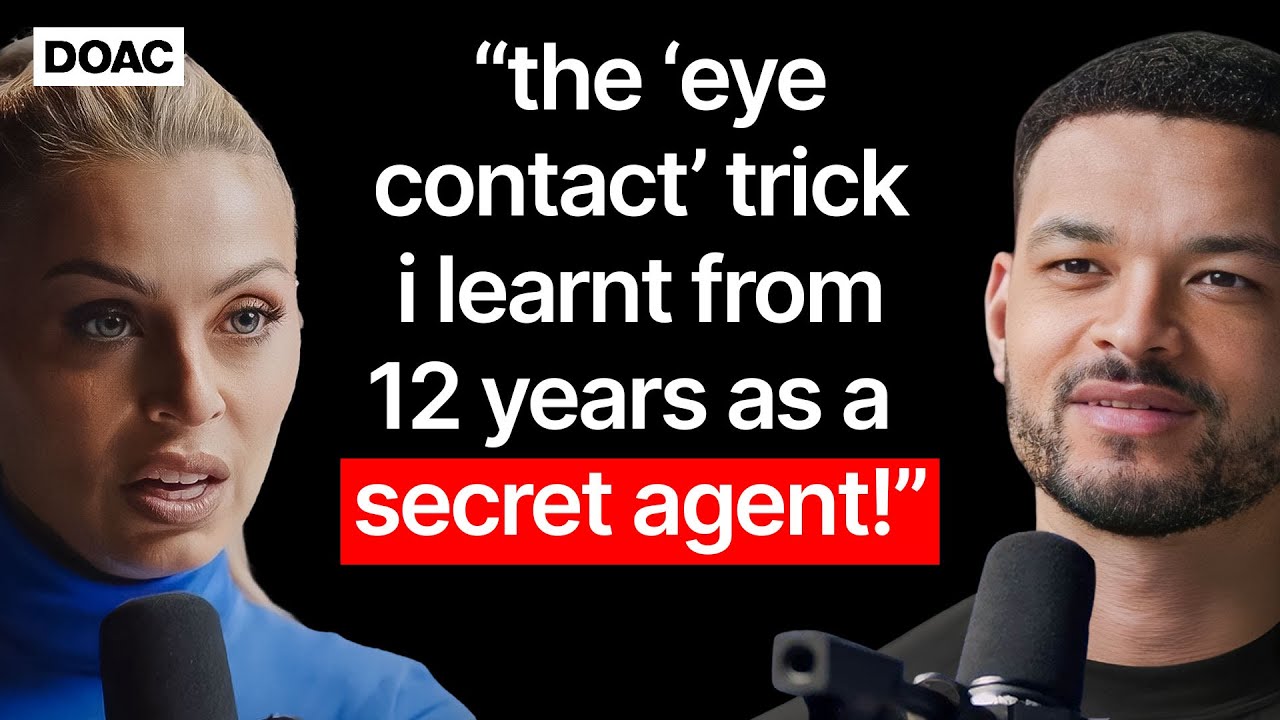
The Diary Of A CEO
Evy Poumpouras argues that personal responsibility and mental resilience are achieved by rejecting victimhood labels and focusing on fulfillment over temporary happiness.
AI-assisted summary of Secret Agent: How To Detect A Lie Instantly! - Evy Poumpouras — original source. Check the original for full context.
Source published:
Detailed notes
## Background This interview was published on YouTube by the channel The Diary Of A CEO on June 6, 2024. The page description introduces guest Evy Poumpouras as a former U.S. Secret Service Special Agent, multi-media journalist, co-host of Bravo TV's 'Spy Games', and author of 'Becoming Bulletproof'. It outlines a wide-ranging discussion covering her Secret Service career, lie detection, leadership, mental health, and personal resilience.
## TL;DR Former Secret Service agent Evy Poumpouras shares practical tactical and psychological insights on communication, lie detection, and personal authority. She recounts high-stress career experiences, including surviving 9/11 and facing a split-second life-or-death decision in a subterranean parking garage, to illustrate how high standards and physical discipline forge mental resilience. Additionally, Poumpouras and host Stephen Bartlett discuss rejecting victim identity, managing discrimination, and focusing finite energy on personal fulfillment rather than superficial happiness.
## Atmosphere & style The conversation is intensely grounded, sharp, and practical, driven by Poumpouras's direct, no-nonsense delivery and Bartlett's reflective probing. It balances gritty tactical realness—such as high-stakes undercover operations and split-second life-or-death choices—with deep psychological candor about trauma, anxiety, and personal discipline. The dynamic feels like an intimate yet commanding masterclass in self-command, shifting seamlessly from harrowing operational recollections to empowering philosophical advice.
## Key takeaways - [01:04:38](https://www.youtube.com/watch?v=iz_SJ5TpLJ0&t=3878s) Evy Poumpouras manages intense stress and anxiety through rigorous physical outlets, linking physical performance directly to mental resilience. - [01:07:19](https://www.youtube.com/watch?v=iz_SJ5TpLJ0&t=4039s) A terrifying moment in a subterranean parking garage involving a teenager demonstrated the extreme pressure and fraction-of-a-second decision-making required in law enforcement. - [01:13:48](https://www.youtube.com/watch?v=iz_SJ5TpLJ0&t=4428s) Fulfillment derived from completing hard missions, rather than the constant pursuit of happiness, serves as a better compass for a meaningful life. - [01:17:48](https://www.youtube.com/watch?v=iz_SJ5TpLJ0&t=4668s) Paralinguistics such as tone, pitch, and inflection dictate authority, with downward tone inflections conveying confidence and upward inflections projecting insecurity. - [01:21:19](https://www.youtube.com/watch?v=iz_SJ5TpLJ0&t=4879s) Authority and credibility are built by contributing high-value insights and remaining silent when one has nothing substantive to add. - [01:25:37](https://www.youtube.com/watch?v=iz_SJ5TpLJ0&t=5137s) Adopting a victim identity can lead to psychological dependency on the chemical rushes of stress and trauma, inhibiting personal growth. - [01:29:03](https://www.youtube.com/watch?v=iz_SJ5TpLJ0&t=5343s) Overcoming trauma requires active exposure and personal responsibility rather than freezing oneself behind static victim labels. - [01:39:34](https://www.youtube.com/watch?v=iz_SJ5TpLJ0&t=5974s) Undercover operations require calculated risk assessment, such as operating unarmed and without a wire to prevent discovery in high-stakes environments. - [01:45:06](https://www.youtube.com/watch?v=iz_SJ5TpLJ0&t=6306s) Being underestimated or facing prejudice can be tactical advantages if met with calm composure rather than emotional confrontation. - [01:48:40](https://www.youtube.com/watch?v=iz_SJ5TpLJ0&t=6520s) Internalizing negative labels or relying on lower standards weakens performance, whereas striving for higher standard thresholds builds true competence. - [01:56:00](https://www.youtube.com/watch?v=iz_SJ5TpLJ0&t=6960s) Protecting finite time and energy requires picking battles wisely rather than reacting to every instance of bias or antagonism.
## Detailed walkthrough ### [00:00](https://www.youtube.com/watch?v=iz_SJ5TpLJ0&t=0s) Introduction and the Philosophy of "Becoming More"
Evy Poumpouras—former U.S. Secret Service Special Agent, interrogator, and author of *Becoming Bulletproof*—opens with a foundational truth about human nature and lie detection: reading body language, verbal cues, and written statements is all about cutting through the noise to see who is truly honest. Host Steven Bartlett sets the stage for a deep dive into human behavior, influence, and life lessons, highlighting her rare background protecting presidents, executing undercover missions, and studying cognitive influence.
When asked why a listener should stay tuned, Evy explains that at our core, we are all striving to transcend our current limits. Her driving mindset is simple: "The day you think you know everything is the day you become obsolete." For her, life isn't about reaching a fixed peak; it is a continuous process of "becoming more."
[03:08](https://www.youtube.com/watch?v=iz_SJ5TpLJ0&t=188s) Growing Up in the Secret Service and the White House
Evy attributes her grounded perspective to growing up in New York City as the daughter of immigrants. Her career trajectory began early when she joined the NYPD and then transitioned to the U.S. Secret Service at just 22 or 23 years old. While her peers were partying, she was surrounded by elite performers and top thinkers. She notes that both the rigorous training and working in the White House "grew her up" and humbled her completely.
She refrains from using the term "role models," stating that she never wanted to replicate anyone else—she wanted to be herself while observing and learning from exceptional leaders. In the Secret Service, accountability was absolute: "Nobody wants to hear excuses, nobody cares how you feel... we have a job to do."
- Joined law enforcement at a young age (22–23 years old). - Emphasizes that personal growth requires "flexing that muscle" like a physical workout and accepting zero excuses.
[05:05](https://www.youtube.com/watch?v=iz_SJ5TpLJ0&t=305s) What the U.S. Secret Service Actually Does
Clarifying the true scope of the Secret Service—one of the oldest federal law enforcement agencies in the United States—Evy explains that public perception only captures a fraction of the reality. Beyond protecting the sitting President, agents protect former presidents, vice presidents, first ladies, and visiting foreign heads of state (such as the UK Prime Minister) to prevent international incidents on U.S. soil.
Protective detail requires rewiring fundamental human instincts. Where police officers are trained to seek cover when under fire, Secret Service agents are conditioned to jump in front of bullets, making their bodies as large as possible to shield the protectee: "The job is, I die for you. Period." Beyond protection, the agency conducts extensive, complex criminal investigations into financial crimes and global fraud.
[06:40](https://www.youtube.com/watch?v=iz_SJ5TpLJ0&t=400s) Undercover Operation: Luring the Russian Hacker
Evy illustrates the agency's investigative work with an undercover case involving a Russian national committing massive online financial fraud against wealthy Americans. Because Russia would not extradite him, a multi-agency operation (including the Secret Service, Homeland Security, and Customs and Border Protection) was devised to lure him to a neutral country: the Dominican Republic.
On short notice, Evy was assigned to fly to a Dominican resort to act as the girlfriend of an NYPD detective who was 20 to 30 years older than her. Her role was to grant him operational legitimacy while they spent days hanging out by the pool and sharing dinners with the target. Recognizing that the Russian's primary driver was pure greed, they sold him on a scheme to sneak into America and pull off massive financial crimes.
* **The Travel Routine:** Just minutes before their deadline, the Russian agreed. They boarded a CBP undercover private jet stocked with luxury food and alcohol, flying from the Dominican Republic to Miami for a refuel, then on to Long Island. * **The Takedown Strategy:** From the airport, they took a limousine loaded with Jack Daniel's to Brooklyn. The agreed-upon signal to execute the arrest was a photo: Evy posed her "boyfriend" and the Russian side-by-side wearing traditional Russian fur hats in front of the Brooklyn Bridge. Once the photo clicked and the suspect felt safe, swarming agents moved in and handcuffed everyone involved.
[10:38](https://www.youtube.com/watch?v=iz_SJ5TpLJ0&t=638s) Listening vs. Talking: The Secret to True Influence
Comparing her approach to frameworks like RICE (Reward, Ideology, Coercion, Ego), Evy reveals that her primary technique for getting people to act is simply staying quiet. The biggest mistake people make in sales, business, or negotiations is talking too much out of a false belief that speaking equals control. "If I'm doing all the talking and you're doing all the listening... you're learning everything about me... and I'm learning nothing about you," she points out.
By giving people space, they naturally reveal their motivational mindsets, core values, and underlying belief systems. True power in a conversation belongs to the person who listens, absorbs information, and observes behavior without making unnecessary noise.
- The person doing the listening holds the real tactical advantage. - People inevitably reveal their true motivations if you give them sufficient room to talk.
[12:57](https://www.youtube.com/watch?v=iz_SJ5TpLJ0&t=777s) Why Seeking to be "Liked" is a Trap: Competence and Warmth
While listening naturally makes people feel heard and inclined toward you, Evy cautions against making "getting people to like me" your primary objective. Trying to be liked distracts from the actual goal, leading to poor choices and tactical confusion. Instead, she advises focusing on **competence** and **warmth**:
* **Competence:** Deliver on your promises, possess real skill, and demonstrate extreme reliability. In the Secret Service, the standard was strict: "If you're on time, you're late." * **Warmth:** Display genuine respect, maintain an open and non-judgmental demeanor, and refrain from imposing your personal opinions.
When you stop trying to project your own identity and focus entirely on the other person's needs, you can view the world through their lens and communicate far more intelligently. Evy notes her own motivations contrast sharply with the Russian suspect's: throughout her career with the NYPD and Secret Service, she never once asked about the salary because she was motivated entirely by purpose and mission.
[15:52](https://www.youtube.com/watch?v=iz_SJ5TpLJ0&t=952s) Listening Without Judgment and Maintaining Professional Boundaries
Evy Poumpouras highlights that people reveal their true motivations and priorities through tiny details if we simply step back, stay silent, ask good questions, and remain genuinely curious. However, the single most critical element in getting people to open up is being completely non-judgmental. The moment someone senses judgment, they shut down, filter their words, and hold back. During her time in the polygraph room, Poumpouras routinely interviewed individuals who had committed horrific crimes, including offences against children. People often asked how she could sit across from such criminals without berating them. Her answer was simple: her goal was not to lecture them or put them in their place, but to extract vital information to uncover other potential victims, secure a conviction, and prevent future crimes.
In professional environments, Poumpouras emphasizes that your goal should never be to make people "like" you, but rather to make them feel heard, respected, and treated professionally. Attempting to get everyone to like you leads to an urge to be overly nice, which blurs boundaries and creates confusion. Citing research by social psychologists Susan Fiske and Chris Malone, she notes that while leaders should be warm, open, and approachable, being overly polite or excessively kind causes people to walk all over you. The objective is to strike a balance where you remain warm and non-judgmental while preserving your authority and strict boundaries.
[18:05](https://www.youtube.com/watch?v=iz_SJ5TpLJ0&t=1085s) Handling Disrespect, Conflict, and Setting Standards
When addressing situations where team members disrespect boundaries or fail to deliver quality work, Poumpouras flips the responsibility back onto the leader: "What have you done to let people think that they can do that to you?" Leaders often set implicit standards by how they acted in the past. Recalling a conversation with former CIA Chief of Station John Sipher (transcribed as John Franie), she shares a key leadership insight: it is much easier to start out with firm boundaries and an authoritative stance and later loosen up, than it is to start as everyone's friend and subsequently try to enforce boundaries.
When an individual crosses a line, leaders must address it immediately rather than letting small infractions build into quiet resentment. Conflict should not be feared or viewed as an emotional screaming match, but as a constructive debate. She illustrates this using the White House Cabinet Room adjacent to the Oval Office, where Cabinet Secretaries routinely challenge one another's ideas and compete constructively to arrive at the best policies.
``` Cabinet Room Dynamic: High-stakes, respectful debate among department heads │ ▼ Direct Conversation: Address mistakes immediately without emotional volatility │ ▼ Non-Judgmental Inquiry: "Talk me through what happened here..." │ ▼ Managerial Support: "Is there anything I can do to help you succeed next time?" ```
- When an employee made a major error, Poumpouras asked her to walk through what happened and listened without showing emotion (a "poker face"), asking: *"Is there anything I can do to help make your job better so you can be more successful at what you do?"* - Most people naturally realize their own mistakes when given the space to talk through them without being put on the defensive. - Leaders must distinguish between a genuine boundary violation and a bruised ego; pushback that serves to produce a better end-product should always be welcomed. - If a toxic individual refuses to align with organizational standards after feedback, they must be removed, as failing to act signals to the rest of the team that poor behavior is accepted.
[25:13](https://www.youtube.com/watch?v=iz_SJ5TpLJ0&t=1513s) Setting the Tone and Building Mental Fortitude
Poumpouras uses her experience as an adjunct professor teaching undergraduate criminal justice as an example of setting firm expectations upfront. On the very first day of class, she establishes a strict "no cell phones" policy. She explains to her students that she is not doing it out of an ego trip, but because she genuinely cares about delivering the education they are paying for. To balance this strict rule, she grants them complete autonomy: students are free to step out of the classroom at any time to check social media or take a call, but inside the room, the environment remains distraction-free.
When asked whether her mental fortitude and commanding presence were innate or developed, Poumpouras stresses that it came from making mistakes, practicing discipline, and carefully managing her environment. People absorb the energy and chaos of those around them. She shares that even when dealing with loved ones in chaotic or volatile situations, she occasionally has to shift them to the "outer part of the circle" to protect her own mental equilibrium.
- **The Math of Influence:** *"Look at who's around you. You are them, they are you."* If your environment is chaotic, you are allowing that chaos to exist. - **The Steve Jobs Parallel:** Host Steven Bartlett references Steve Jobs' philosophy on hiring "A-players"—top performers attract other top performers, while drama and inexperience attract more of the same through a process of cultural osmosis. - **Adapting Roles:** Individuals often possess different versions of themselves for different contexts. Bartlett notes how employees might confuse his warm, open podcast persona with his direct, outcome-oriented business persona. Poumpouras advises setting clear expectations with employees from day one—explaining that directness is driven by efficiency, while continuously sprinkling in genuine appreciation.
<FollowUp label="Want to explore Evy's insights on Secret Service lie detection techniques next?" query="Walk me through the next part of the transcript covering Evy Poumpouras's lie detection techniques and Secret Service insights."/>
[31:39](https://www.youtube.com/watch?v=iz_SJ5TpLJ0&t=1899s) The Different Versions of Ourselves We Create
Evy explains that we constantly adjust which version of ourselves we project based on our environment and goals. For instance, who she is in a classroom differs from who she is on a podcast or when reporting on the news. When stepping into a business meeting or managing subordinates, leaders must project an aura of authority so people sense their standards—not just from what is said, but through the feeling and energy created around them. This reflects the ancient Greek concept of *ethos*, or one's way of being. By deliberately presenting specific versions of ourselves, we guide how others perceive us to achieve desired outcomes.
[32:49](https://www.youtube.com/watch?v=iz_SJ5TpLJ0&t=1969s) What I Learnt About Leadership From Working With 4 US Presidents
Reflecting on her 12 years around figureheads such as Bill Clinton, George W. Bush, Barack Obama, and Donald Trump, Evy emphasizes that becoming President of the United States requires an extraordinary level of baseline capability. The paramount leadership trait she observed across all four presidents was an unflinching, thick-skinned resilience. She recalls standing beside presidents right before major speeches or high-stakes meetings while television pundits on the news were actively ridiculing and criticizing them. Instead of getting defensive or feeling disrespected—which would paralyze most people—the presidents would simply gather their thoughts, step onto the stage, and deliver.
Observing this level of poise under fire reshaped her own capacity to handle pressure. Regardless of political differences, every leader brought unique strengths. For example, she notes that people often respond to Donald Trump’s communication style because he is direct, unapologetic, and lands his points without filtering himself. Maintaining a completely apolitical stance—a core requirement of the U.S. Secret Service—Evy views these traits objectively as lessons in effective presence.
[35:47](https://www.youtube.com/watch?v=iz_SJ5TpLJ0&t=2147s) I Was In The Room When US Presidents Would Make Tough Decisions
When high-stakes choices arise, top leaders abandon emotion in favor of cold rationality. Evy notes that despite being in close proximity during intense geopolitical moments, she never once heard a U.S. president yell or lose control of their composure. Decisions were executed by carefully weighing pros, cons, and objective facts rather than reacting out of hurt feelings or fragile egos.
Stephen references research by Dr. Laurence and Emily Allison regarding interpersonal behavior styles (such as leading or competing), pointing out that direct debate does not need to become aggressive. Evy reinforces that when leaders remain grounded, they avoid emotional decision-making—which almost always leads to rash statements and regret. Success comes from remaining the ultimate "governor" of oneself.
[38:36](https://www.youtube.com/watch?v=iz_SJ5TpLJ0&t=2316s) My First Day Working For George Bush
During her early days in the Secret Service, Evy was assigned to "stand post" for President George W. Bush—a routine perimeter security detail where newer agents guard access points (such as holding a door for eight hours after a complete bomb sweep) to ensure no unauthorized individuals pass through. While standing watch, a senior agent double-checked if her phone was off, warning her that if President Bush ever heard an agent's phone go off, that agent would be sent home immediately.
While the rule initially seemed surprisingly strict for a world leader, Evy realized its deeper purpose: it established firm boundaries and cultivated an environment of complete presence, high focus, and respect.
[41:07](https://www.youtube.com/watch?v=iz_SJ5TpLJ0&t=2467s) Secret Service Training: Only 1% Make It Through
The selection and vetting process for the U.S. Secret Service is exceptionally grueling, costing tens to hundreds of thousands of dollars per applicant. After gaining foundational experience in the NYPD—where she trained alongside 1,500 recruits—Evy entered a Secret Service academy class of only 54 people. The agency selects roughly 1% of all applicants, making acceptance statistically harder than getting into Harvard.
The vetting process includes: * **Extensive Essay and Scenario Testing:** Applicants write detailed responses explaining how they would resolve complex, real-world crises. * **Invasive Background Investigations:** Federal agents interview neighbors, past employers, and acquaintances worldwide (including flying an agent to Rome to interview Evy’s former study-abroad professor). * **Rigorous Examinations:** Candidates must pass a polygraph test and the TAE (Treasury Enforcement Agent) exam—an intensely difficult standardized test. * **Probationary Period:** After receiving a conditional offer and completing training, agents remain on probation for three years before fully securing their position.
[44:16](https://www.youtube.com/watch?v=iz_SJ5TpLJ0&t=2656s) The 1% Of People That Became Part Of The Secret Service
Reflecting on why she succeeded when so many dropped out, Evy attributes part of her perseverance to a helpful youthfulness and naivety—she simply did not dwell on the intimidating odds or the fact that the agency was roughly 98% male. Crucially, the Secret Service prioritizes absolute integrity over perfection. Because agents handle sensitive criminal matters (such as counterfeit money rings tied to drug cartels), any deception on an application form or polygraph results in immediate disqualification.
Later in her career, Evy served as a polygraph examiner, acting as the final line of defense to screen out untrustworthy applicants. Beyond dishonesty, extensive prior drug use served as one of the fastest disqualifiers for competitive candidates ("Better Qualified Applicants," or DQ/BQA decisions).
[46:06](https://www.youtube.com/watch?v=iz_SJ5TpLJ0&t=2766s) How Can You Tell If Someone Is Lying To You?
Having spent roughly eight years traveling the world for the Secret Service conducting polygraph examinations and interrogations, Evy explains that detecting dishonesty blends objective physiological data with acute behavioral pattern recognition. Spotting a lie relies heavily on establishing a baseline—observing how a person normally speaks, moves their hands, holds eye contact, and sits when comfortable.
When a topic causes distress or prompts a lie, their behavior shifts noticeably away from that established baseline—such as suddenly breaking steady eye contact, changing posture, or looking down.
> "When you can make decisions based on facts and rationality, the emotions go out the window. You don't want to be an emotional decision-maker."
Here is a detailed, faithful walkthrough covering Part 4 of the interview.
---
[47:28](https://www.youtube.com/watch?v=iz_SJ5TpLJ0&t=2848s) Spotting Liars: ATM Skimmers and "Divine Intervention"
Continuing her discussion on non-verbal cues and lie detection, Evy Poumpouras explains that observing behavioral changes simply signals where to be curious. Effective investigators don't let subtle shifts slide; they ask follow-up after follow-up. When host Stephen Bartlett asks who the greatest liar she ever encountered was, Evy recalls a suspect involved in a low-level ATM skimming operation in Brooklyn. The criminal installed devices on automated teller machines to capture card data, while hidden cameras took photo evidence. Evy had clear frontal images of the man wearing a distinct New York Knicks hat, along with fingerprint matches from the ATM.
When brought into the interview room, the suspect appeared exceptionally polite, repeating "Yes ma'am" and acting overly cooperative—a major red flag that he was trying too hard. When presented with the clear photograph of himself—wearing the exact same Knicks hat to the interrogation—he looked directly at the photo and casually remarked, "Yeah, that looks like me... but no, it's not me." He remained completely unflappable, sticking to his story without wavering or confessing. Evy highlights another common tactic among guilty suspects: invoking "divine intervention" using phrases like "I swear to God" or bringing rosaries and Bibles into the room to overcompensate and project innocence.
- **ATM Skimming Case**: A low-level fraudster operating across Brooklyn targeted ATMs using card skimmers. - **Over-Cooperation**: Overly polite behavior ("Yes ma me, no ma'am") during interrogation serves as an immediate indicator of deception. - **The "Divine Intervention" Tell**: Invoking God, swearing on holy figures, or bringing Bibles/rosaries to an interview is a frequent tell among guilty individuals trying to build moral authority.
---
[51:20](https://www.youtube.com/watch?v=iz_SJ5TpLJ0&t=3080s) Eye Contact, Sovereignty, and the Fallacy of Quick Fixes
Evy discusses the psychological power of maintaining strong eye contact. Beyond projecting confidence, eye contact asserts personal relevance and authority without needing verbal declarations. Simultaneously, it signals to the listener that they matter and are being genuinely heard. Stephen then reflects on his own journey with self-esteem, recalling how between ages 14 and 23, he repeatedly faced rejection from women despite reading pickup artistry books like *The Game*. It wasn't until around age 24, when his internal self-perception changed and he truly believed he was high-value, that his romantic outcomes transformed naturally—without relying on tricks or micro-expressions.
Evy agrees, warning against the modern obsession with quick fixes, shortcut hacks, and "7-minute six-pack abs" promises. True confidence and personal change function like compound interest—building up through layers of tiny, consistent daily choices over time. Reaching true personal "sovereignty"—where an individual feels complete on their own without chasing external validation or people-pleasing—naturally acts as a magnet for others.
- **Dual Function of Eye Contact**: Asserts one's own authority/relevance while making the other person feel seen and respected. - **The Limits of "Pickup Artistry" Hacks**: Faking body language fails when underlying micro-expressions broadcast low self-worth. - **Compound Confidence**: True internal confidence ("sovereignty") is built incrementally over time, eliminating the need to chase approval or rely on superficial tricks.
---
[57:40](https://www.youtube.com/watch?v=iz_SJ5TpLJ0&t=3460s) Overcoming Rejection and Cultural Pressures
Recalling her own path to sovereignty, Evy describes how she stopped taking constant inventory of others' opinions after enduring heavy rejection, criticism, and gossip throughout her youth. When she joined the NYPD and subsequently became a Special Agent with the U.S. Secret Service, many in her community dismissed her career path. She recounts a date with a Greek man whose family owned a diner; he viewed success strictly in terms of financial wealth and asked if she planned to "ditch" her Secret Service job once married.
She encountered similar unease when dating an Italian man who felt visibly intimidated by her status as a federal agent. Evy notes that while unconfident men often struggle with strong, accomplished women, secure individuals celebrate their partner's success. She ultimately married a fellow agent whose strong sense of self and personal sovereignty allowed him to fully support her ambitions without insecurity.
- **Cultural Conceptions of Success**: Evy faced skepticism from her local community, where monetary wealth (such as business ownership) was valued over prestigious public service roles. - **Handling Intimidation**: Uninsecure partners are often threatened by a woman's authority or strength, whereas a sovereign individual supports their partner unconditionally.
---
[01:00:30](https://www.youtube.com/watch?v=iz_SJ5TpLJ0&t=3630s) Parenting, Resilience, and Regulating Influences
When Stephen asks how she would handle an 18-year-old daughter struggling with laziness, victimhood, and lack of motivation, Evy explains that resilient behavior is cultivated early through intentional environmental boundaries. Having had her daughter at age 46 (now 18 months old), Evy maintains strict controls over what her child consumes. She keeps no working televisions in her house and has never put a smartphone in front of her daughter, choosing to protect her developing mind from algorithmic social media feeds and instant gratification loops that contribute to modern anxiety and depression.
Having worked in media covering severe crime and heinous news stories, Evy practices strict media hygiene herself. She advises parents that if they wouldn't leave their young child unattended in the middle of Times Square to talk to strangers, they shouldn't hand them an unmonitored, internet-connected smartphone. While acknowledging that parenting accounts for roughly 50% of a child's environment while the child's own personality forms the rest, setting clear early boundaries lays the groundwork for discipline and strong values.
- **Parenting Milestones**: Evy gave birth to her daughter at age 46. - **Environmental Safeguards**: No working TVs in the household and a complete prohibition on smartphones/social devices for her young child. - **The "Times Square" Rule**: Handing an unmonitored smartphone to a child is equivalent to leaving them alone in the middle of Times Square to interact with whoever approaches them.
[01:03:30](https://www.youtube.com/watch?v=iz_SJ5TpLJ0&t=3810s) Instilling Resiliency in the Next Generation and Personal Mindset
When discussing how she raises her daughter to build true emotional grit, Evy Poumpouras explains her deliberate approach to grounding her child through humbling experiences. Every summer, she takes her daughter to a remote village in Greece—a place where the living conditions are rugged, complete with an outdoor bathroom right next to the chicken coop. When host Steven Bartlett asks if she allows her daughter to fly business class, Poumpouras gives an emphatic "no."
Poumpouras refuses to pay for business class for herself or her daughter, stating she only flies business when someone else is footing the bill. She views her hard-earned money strictly, preferring to save it and fly economy. She candidly joke-acknowledges how her kid might perceive her strict, no-frills parenting style, but emphasizes that shielding children from luxury builds a far healthier mindset and a strong work ethic.
* **Summer Rituals:** Spends June through September in a rustic Greek village to stay connected to her family roots. * **Travel Rule:** Exclusively flies economy out of her own pocket, saving business class upgrades solely for client-paid trips.
---
[01:04:37](https://www.youtube.com/watch?v=iz_SJ5TpLJ0&t=3877s) Physical Fitness as the Foundation for Mental Strength
Poumpouras details why daily workouts are non-negotiable for her overall well-being. She rejects the popular cultural divide between mind and body, asserting that the two are inextricably linked—a principle forged during her intensive Secret Service training. She trains with celebrity trainer Don Saladino to maintain physical accountability, which includes texting him photos of every single meal she consumes to avoid eating junk food.
To manage heavy emotional strain, anxiety, and the day's accumulated stress, Poumpouras relies on late-night outdoor runs. She recalls a vivid memory of running on a track during a freezing winter night while it was snowing. Overwhelmed by intense rage and raw emotion from a terrible day, she ran until tears were streaming down her face—looking "like a crazy person" to outside observers—until she discharged all the negativity and reclaimed her inner composure.
> "Your body is your temple... everything in the US Secret Service was about performance. This is your home—it houses your mind, it houses your soul—and we treat it like garbage and we give it garbage."
---
[01:07:19](https://www.youtube.com/watch?v=iz_SJ5TpLJ0&t=4039s) The Scariest Day in the Secret Service: Split-Second Decisions
Recalling the single most nerve-wracking experience of her law enforcement career, Poumpouras breaks down an intense tactical situation in downtown Manhattan. While en route to a pre-arrest briefing for an upcoming operation, she and her partner heard screams outside a jewelry store. Bystanders flagged down their undercover police car, shouting that a suspect was fleeing. They pursued the suspect—who was wearing a heavy hoodie and running—into a multi-level subterranean NYC parking garage.
Entering the dark underground garage blind without knowing if the suspect was armed, they searched car by car. Poumpouras spotted the suspect hiding beneath a vehicle and signaled her partner. However, her partner moved in prematurely, placing himself completely exposed in the open. Pointing her service weapon under the car, Poumpouras repeatedly ordered the suspect to show his hands, but he refused and kept fidgeting. In a harrowing, split-second dilemma, she had to choose between firing her weapon to protect her partner's life or holding her fire at the risk of her partner being shot.
Poumpouras ultimately made the high-stakes decision not to shoot. Her partner grabbed the suspect from behind, bringing the standoff to an end. Furious and running on high adrenaline, she pulled back the suspect's hoodie only to discover he was a terrified 16-year-old kid. Pockets searched, the entire chase turned out to be over a stolen gold cross. The realization that she had come within a fraction of a second of taking a young life over a piece of cheap jewelry deeply shook her, leaving a permanent mark on her psyche.
* **Location:** Underground parking structure in downtown Manhattan, New York City. * **Suspect:** A 16-year-old boy who stole a gold cross from a jewelry store. * **Tactical Dilemma:** Balancing the fear of partner fatality against using deadly force on an unconfirmed threat.
---
[01:12:28](https://www.youtube.com/watch?v=iz_SJ5TpLJ0&t=4348s) Redefining Mental Health, Anxiety, and Personal Purpose
Addressing her own mental health throughout her career, Poumpouras offers a counter-cultural perspective on anxiety and depression. Rather than viewing negative emotions as medical flaws that need to be medicated away, she considers anxiety to be a natural human response to high-stress environments. She recalls feeling anxiety every single day during training and whenever she put on her tactical vest and carried her automatic MP5 firearm while guarding the President of the United States.
Poumpouras challenges the modern narrative that happiness should be life's ultimate metric. For her, true fulfillment comes from enduring hardship and completing tough missions. She reflects on standing post outside the Oval Office at 3:00 a.m. in the bitter winter freeze; while far from happy in those miserable moments, she felt a profound sense of awe and purpose regarding where her journey had led her.
> "My barometer for life is not to be happy. The moments that I've done the most amazing things in my life I've not been happy, I've been fulfilled."
---
[01:14:37](https://www.youtube.com/watch?v=iz_SJ5TpLJ0&t=4477s) Protecting VIPs, Security Mechanics, and Strict NDAs
Discussing high-stakes protection assignments, Poumpouras highlights the key differences between guarding the President versus protecting presidential family members. While presidential details feature overwhelming, multi-layered security protocols—such as snipers, Counter Assault Teams (CAT), airspace restrictions, and radiation/nuclear detection—protecting high-profile family members presents unique vulnerabilities.
She shares the challenge of guarding President George W. Bush's daughter, Barbara Bush, who wanted to experience life as a normal young adult. Managing security at crowded mass events like the Coachella festival with severely limited personnel and resources was far more stressful than standardized presidential details.
When asked about sensitive information she cannot divulge, Poumpouras highlights vehicle tactical mechanics, Air Force One operational details, and agent positioning schematics, noting that malicious actors actively scrape public interviews for tactical intel. She explains that the agency historically operated on an honor system until a former agent published sensitive details, prompting the Secret Service to institute strict non-disclosure agreements (NDAs) for departing personnel.
* **High-Stress Assignment:** Protecting Barbara Bush at crowded public venues like the Coachella Music Festival. * **Restricted Intelligence Topics:** Armored car mechanics, tactical positioning schematics, counter-attack movements, and Air Force One protocols. * **NDA Policy Change:** Prompted after an agent broke the agency's unwritten honor system by publishing insider details.
---
[01:17:48](https://www.youtube.com/watch?v=iz_SJ5TpLJ0&t=4668s) Rejecting the "Imposter Syndrome" Label
When asked about experiencing imposter syndrome as a woman entering a male-dominated service—where roughly 98% of agents were men—Poumpouras forcefully rejects the term. She explains her dislike for the popular concept, noting her belief that the phrase was originally coined by researchers specifically targeting women.
Rather than succumbing to self-doubt amidst workplace discrimination and prejudice, Poumpouras grounded herself in the reality of her hard work. Knowing the extreme sacrifices she made and how relentlessly she fought to earn her position, she refused to allow self-limiting narratives to take up space in her mind.
[01:18:33](https://www.youtube.com/watch?v=iz_SJ5TpLJ0&t=4713s) Workplace Dynamics and Paralinguistics
Evy reflects on how her initial naivety and ignorance served as an unexpected superpower when entering male-dominated spaces. By not carrying an internal narrative that she did not belong, she avoided self-imposed limitations. While acknowledging that she faced genuine gender-based hostility—recalling a specific briefing where a boss pointedly refused to make eye contact with her while engaging every male in the room—she refused to let others' discomfort undermine her sense of belonging. When Stephen brings up how frequently people feel disrespected or ignored by colleagues and managers, Evy pivots directly to actionable self-assessment.
Rather than defaulting to victimhood when ignored, Evy challenges individuals to evaluate their physical delivery and vocal mechanics. She introduces the concept of **paralinguistics**—the tone, pitch, projection, and cadence of speech. Many people focus entirely on the script of what they want to say while completely ignoring how it is delivered, often trailing off, using uptones that make statements sound like tentative questions, or speaking so softly that others naturally glaze over.
- **Vocal projection:** Adjusting pitch and tone prevents statements from sounding like passive pleas for attention. - **Tone inflection:** Ending statements with a grounded, downward inflection conveys authority, whereas an upward pitch framing ("Hi, I'm Evy?") projects insecurity. - **Value-add communication:** Evy stresses that people should avoid speaking simply to have their "voice heard at the table." If a contribution adds no tangible value, remaining silent is the superior strategy.
[01:21:19](https://www.youtube.com/watch?v=iz_SJ5TpLJ0&t=4879s) The Concept of the "Contribution Score"
Stephen expands on Evy's point by sharing an observation from his decade of leading marketing boardrooms. He conceptualizes a mental "contribution score"—an invisible credit score every team member builds over time based on the quality of their past input. When someone with a high contribution score speaks, the entire room immediately stops, leans in, and listens, even if that person interrupts the room. Conversely, individuals who habitually talk just to hear themselves speak—offering half-baked ideas or unfocused suggestions—accumulate a low contribution score, causing colleagues to subconsciously roll their eyes or dismiss them before they even finish a sentence.
Evy strongly validates this framework, pointing out that staying silent when you have nothing to add actually preserves your credibility. She notes that the fear of being perceived as unhelpful drives people to chatter unnecessarily, which ultimately damages their standing.
- **High contribution score:** Earned by speaking only when holding a thoroughly considered, high-value insight (e.g., Stephen's UK colleague, Paul, whose rare comments instantly commanded total room silence). - **Low contribution score:** Resulting from unstructured, reflexive comments (e.g., spitballing ideas like "maybe we'll do some TikToks" without prior thought). - **Intellectual humility:** Evy shares that she is happiest when she is the "dumbest person in the room," actively stepping back to let domain experts lead (such as letting her scripted agent, Sylvie, take charge during complex television negotiations).
[01:25:37](https://www.youtube.com/watch?v=iz_SJ5TpLJ0&t=5137s) The Mindset of Personal Responsibility vs. Victimhood
The discussion turns toward personal responsibility and why so many people actively resist taking ownership of their lives. Stephen notes that taking responsibility requires holding up an uncomfortable mirror to oneself, making it far easier to blame external factors—governments, parents, ex-partners, or bad luck. He recalls a conversation with an author who noticed that whenever he distributed book drafts to test readers, roughly 10% of people instantly dropped off the moment the manuscript reached the section on personal responsibility.
Evy explains that for many, victimhood functions as an identity. It offers a psychological cushion that alleviates blame while justifying ongoing misery. She recounts conducting mentoring consultations during the pandemic, including a session with a therapist who sought validation for how childhood trauma held her back. When Evy suggested leaving the past behind—likening the trauma to dragging a massive U-Haul behind a brand-new Porsche—the woman became outraged, accusing Evy of invalidating her lived experience because her identity was entirely anchored in her past pain.
- **The trap of victim identity:** Using past hardship as a permanent shield prevents personal growth and performance. - **Analogy of the U-Haul:** Attempting to move forward in life while continuously dragging past trauma prevents high performance. - **Therapeutic overuse:** Evy argues that when therapy turns into an endless loop of reliving past trauma without actionable steps to move forward, it can inadvertently deepen the harm.
[01:29:03](https://www.youtube.com/watch?v=iz_SJ5TpLJ0&t=5343s) Surviving September 11th and Overcoming Trauma
Drawing from her personal experience as a Secret Service agent during the September 11th attacks at the World Trade Center, Evy contrasts how different people process extreme trauma. Having survived the collapse, lost close colleagues, and narrowly escaped death, she observed how some individuals allowed the catastrophe to permanently consume their identity. She recalls a medic named Jerry who continually called her in distress; despite attending intensive therapy, his life unraveled into divorce and career loss because he remained trapped in reliving the event daily. She contrasts this with an iron worker she interviewed years later as a journalist, who had covered his body in 9/11 tattoos and built a dedicated memorial room in his home.
While Evy respects that people process events in their own way, she personally chose a starkly different path. She kept her Secret Service Valor Award hidden under her bed rather than displaying it as a central focus of her life. Refusing to let a single horrific day define the rest of her existence, she forced herself onto a commercial airplane just three weeks after the attacks to confront and eliminate her emerging fear before it could control her.
- **Confronting fear early:** "Kill fear while it's still small" before it escalates into an uncontrollable condition. - **Agency and ownership:** Acknowledging that while you cannot control every external event, you maintain direct control over how you navigate the outcome. - **Boundary setting with victims:** Evy advises recognizing when someone wants to remain in their victimhood, noting that while you cannot fix them, you must decide whether to allow that negative energy into your personal or professional life.
<ElicitationsGroup message="Explore more strategies on communication and resilience from Evy Poumpouras:"> <Elicitation label="Learn Evy's tactics for handling high-stakes negotiations" query="What are Evy Poumpouras's key tactics and strategies for negotiating under high pressure?"/> <Elicitation label="Explore body language cues to detect deception" query="What specific body language cues does Evy Poumpouras look for to detect when someone is lying?"/> </ElicitationsGroup>
[01:33:35](https://www.youtube.com/watch?v=iz_SJ5TpLJ0&t=5615s) The Victimhood Trap and the Desire to be Disempowered
Stephen Bartlett reflects on a revealing conversation he had with a close friend who was constantly complaining about the problems in their life and job. When Stephen pointed out the obvious reality—that they chose the job, interviewed for it, had enough financial runway to leave, and could walk away at any moment—the friend became deeply offended. Rather than feeling liberated by having agency, the friend actively rejected the concept of choice. Stephen was struck by the realization that his friend did not want power or empowerment; they wanted to remain powerless and stay a victim of circumstance. "Jesus Christ, what a way to live," Stephen remarks, noting that while terrible, traumatic things happen to people through no fault of their own, choosing to remain powerless prevents any meaningful recovery.
Evy explains that as someone with a Master's degree in Forensic Psychology, she frequently encounters this mindset, which she terms being "identity-driven" or staying in "identity land." While everyone visits this mental space during difficult moments, some people make it their permanent disposition. To spot individuals who have no real desire to change, she advises listening to their language: * **Repetitive Self-Focus:** Constant, repeated use of first-person pronouns ("I, I, I," "I feel," "I want," "I went through"). This heavy self-focus is highly correlated with depression and anxiety. * **Addiction to the Highs of Drama:** Complaining and reliving trauma triggers physical fight-or-flight (F3) responses, causing spikes in cortisol and adrenaline. Evy compares this physiological spike to when she recently raced sports cars at Porsche—it makes you feel intense, focused, and alive. People can become genuinely addicted to the chemical rush of high conflict and drama.
---
[01:37:09](https://www.youtube.com/watch?v=iz_SJ5TpLJ0&t=5829s) Trauma as Status, Community, and Identity
Stephen and Evy discuss why clinging to trauma is so seductive: it provides an instant sense of community, belonging, and purpose. When someone anchors their core identity to a past trauma, letting go of that pain feels like surrendering their entire social circle, their support groups, and the way the world understands them. Stephen observes that in modern culture, trauma has almost become a "badge of honor" or a competitive status game where people compete over who has had it hardest to gain attention and social capital.
Evy links this group-belonging phenomenon to basic human psychology, comparing it to why individuals join street gangs or terrorist organizations. People rarely join these groups out of pure malice; they join because they crave connection and fear being isolated. However, she stresses that true personal growth requires maintaining individual sovereignty rather than adopting a static victim label.
* **The Trap of Static Labels:** Defining yourself as "I am a survivor of X" freezes your identity in the past. Evy notes that experiences are merely things that happened to you, not who you are. * **Continuous Evolution:** Evy titled her book *Becoming Bulletproof* because human growth is an ongoing, lifelong process: "I am always becoming... I'm evolving. We don't stop."
---
[01:39:34](https://www.youtube.com/watch?v=iz_SJ5TpLJ0&t=5974s) Undercover Operations: Infiltrating an International Trafficking Ring
Evy shares an untold story from her time in law enforcement when she was brought in to work a high-stakes undercover case alongside the NYPD. Because Evy did not fit the stereotype of a typical Secret Service agent, she was frequently recruited for dangerous undercover assignments. In this case, an organized crime ring—suspected to be Albanian—was selling authentic, original passports and birth certificates to terrorists and other dangerous bad actors attempting to enter the United States.
To penetrate the ring, Evy posed as an Eastern European woman who had been sex-trafficked into the U.S. Drawing on her background in acting, her upbringing in Queens around immigrant communities, and her parents' background, she developed a convincing accent. Under her cover story, her traffickers had confiscated all her official documents—a standard tactic used by human traffickers to lock victims into perpetual debt and strip them of legal rights—leaving her unable to rent an apartment or buy a phone without illegal papers.
* **The High Stakes:** In undercover work with organized crime, slipping out of character carries lethal consequences: "If you're not good, you get a bullet to the head when you meet this guy." * **Going in Unarmed:** Before meeting the target at his front business (a construction company), the team debated whether Evy should wear a hidden wire or carry a gun. Evy chose to go in completely empty-handed. Carrying a weapon or wire meant that a simple pat-down or metal detector check would result in her being killed instantly on site. * **Executing the Buy:** During the initial meeting, the suspect tried to force her into his car under the guise of speaking privately. Knowing her backup team needed visual contact, Evy stayed in character, feigning panic and refusing to enter the vehicle. She successfully exchanged $5,000 in cash for an authentic Polish passport and birth certificate. * **Expanding the Operation:** To build a solid federal case for the U.S. Attorney, Evy needed multiple transactions. She offered to bring the target more "trafficked friends," bringing in other undercover female agents and NYPD officers to conduct repeated buys until federal prosecutors had enough evidence to take down the entire criminal enterprise.
---
[01:45:06](https://www.youtube.com/watch?v=iz_SJ5TpLJ0&t=6306s) Overcoming Stereotypes and Being Underestimated
When Stephen asks Evy how she managed the inevitable professional friction of being underestimated—especially as a woman who didn't fit the typical agent mold—they explore how to reframe bias into an operational advantage. Stephen shares his own experience entering boardrooms at age 18 as a university dropout with an afro and a cheap tie, pitching older executives in suits who immediately doubted his credibility. Both agree that being underestimated is entirely a matter of perspective: if people don't take you seriously at first, they lower their guard, giving you room to maneuver and execute without interference.
Evy illustrates this dynamics with a story from her time assigned to President George W. Bush's family. She was leading a protective detail as the Assistant Detail Leader for the President's daughter, Laura Bush, during a multi-country tour through Botswana and Tanzania.
* **The Briefing Room Incident:** While setting up the hotel command center in Gaborone, Botswana, to brief incoming support agents from across the globe, the first male agent walked in, looked at Evy, and assumed she was an intern, offering to show her to the "staff office down the hall." * **The Tactical Response:** Rather than reacting with anger or getting defensive, Evy kept an emotionless face and calmly replied, "No, I'm actually Agent Poumpouras. I'm the one holding the briefing... Hi, good to meet you." * **Refusing to Waste Energy:** Evy emphasizes the importance of picking your battles: "I could sit there and be pissed about this, or I can just leave it. Who cares?... There's some things you need to care about and some things you don't."
She reinforces this point with a memory from her time at "Poly School"—the Department of Defense polygraph and interrogation training academy—reminding listeners that confidence comes from competence, not from seeking approval or engaging in unnecessary conflict over other people's assumptions.
Here is a detailed, faithful walkthrough covering Part 8 of the interview.
---
[01:48:40](https://www.youtube.com/watch?v=iz_SJ5TpLJ0&t=6520s) The Psychology of Discrimination and Belief Systems
Evy reflects on a story involving a fellow Secret Service agent to illustrate how internalized narratives can subtly alter how a person moves through the world. While attending a training or assignment, her colleague turned to her and asked if she had surveyed the room, pointing out that he was the only Black man present. Evy admits that up until that moment—weeks into the program—she had not even noticed. When she paused and mentally audited the room, she validated his observation, prompting him to reply that she was also the only female agent present. Recognizing that he felt isolated made her sad, as it exposed how heavily those identity metrics weighed on his mind compared to hers.
This mental frame created an artificial wall between her colleague and the rest of the team. Evy explains that whenever she invited him to join the rest of the agents for dinner, he would decline, insisting that he hadn't received a specific invitation. She tried explaining that nobody received formal invitations—the group simply gathered and went—and that no one cared about race or gender; they only cared about camaraderie and competence. Eventually, he admitted he wanted the male agents to personally ask him out, forcing Evy to quietly go to the team and ask them to extend an explicit invite so he would feel included. The interaction led both hosts to debate a subtle distinction: whether objective discrimination or the hyper-focused *belief* that one is being discriminated against causes more personal friction in daily life.
- **Mindset shift:** Holding on to the assumption that you are unwanted causes you to show up differently, creating real separation where none was intended. - **Internalized narratives:** Evy notes that her colleague was exceptionally bright and capable, yet locked himself into a state of feeling excluded.
---
[01:50:58](https://www.youtube.com/watch?v=iz_SJ5TpLJ0&t=6658s) Labeling Theory, Stereotype Threat, and Meritocracy
Stephen shares a personal story from his youth to contextualize the danger of reduced expectations. When he was around 18 or 19 years old and struggling financially, he came across a government grant specifically designated for young Black entrepreneurs. Instead of feeling relieved, he felt intensely irked. He resented the implication that he needed a special handout rather than being judged solely on his merits and capabilities. This dynamic connects directly to psychological concepts like **Labeling Theory**—where applying a label (such as "offender" or "underdog") causes a person to internalize that identity and act accordingly—and **Stereotype Threat**, where reminding someone of their race or gender right before an exam measurably depresses their performance.
Evy strongly agrees, explaining how this applies to her identity as a Secret Service agent. Whenever interviewers ask her what it was like to be a "female agent," she feels a slight sting, wondering why male agents are never asked what it was like to be a "male agent." She stresses that she earned her badge using the exact same drive as anyone else. However, she candidly reveals a controversial lesson from her time in training: discovering that performance standards were gender-tiered.
``` +-------------------------------------------------------------------+ | PHYSICAL FITNESS STANDARDS CONTEXT | +-------------------------------------------------------------------+ | Male Standards: Higher threshold for pull-ups, push-ups, run | | Female Standards: Lower physical requirement benchmarks | | Evy's Choice: Rejected lower tier; trained to male standards | +-------------------------------------------------------------------+ ```
When a male trainee snidely pointed out that she benefited from lower physical requirements to pass, Evy went back to her room feeling crushed. A part of her was angry, but another part recognized he was technically correct about the unequal testing criteria. Rejecting the lowered bar, Evy chose to train relentlessly morning and night to hit the male physical benchmarks instead. While some other female recruits were perfectly fine using the lower female standards, Evy refused to let anyone attribute her position to soft expectations or tokenism.
- **Criminal justice connection:** Evy notes that Labeling Theory is well-documented in criminology: labeling someone a "criminal" increases recidivism because they internalize that identity. - **Media narrative frustration:** Evy notes the insult of reading comments labeling her a "diversity hire" after putting herself through brutal physical conditioning.
---
[01:56:06](https://www.youtube.com/watch?v=iz_SJ5TpLJ0&t=6966s) Protecting Energy and Building Mental Armor
Navigating systemic issues without losing your personal agency requires a conscious decision about where to invest energy. Evy and Stephen emphasize that acknowledging prejudice exists does not mean you have to make fighting every instance of it your full-time job. Evy notes that her parents were immigrants; her father had dark features and a heavy accent, and she often watched airport security select him for extra screenings. However, spending your finite time on Earth fighting every narrow-minded person you run into is exhausting and counterproductive.
Stephen relates this to his own experiences being pulled into airport backrooms at Heathrow for hours of questioning. Fighting the situation in the moment only damages your own energy, builds inner resentment, and causes law enforcement to view you as escalating. Evy uses a hand gesture describing a "mental bubble" or "armor" that shields your inner space. Instead of taking the bait or getting embroiled in an emotional battle, you keep interactions strictly professional, answer what is required, and move on.
> "Your time here, man, it's just so finite. Fight who you need to fight if you have to fight... but I'm just too busy. I have things to do and I can't sit and waste my time on every buffoon that comes my way."
- **The law enforcement perspective:** Having served in law enforcement, Evy notes that when a suspect or traveler gets visibly combative during a check, officers immediately interpret it as escalation or suspicious behavior. - **Energy conservation:** Recognizing systemic issues is different from allowing them to drain your daily productivity and peace of mind.
---
[01:59:36](https://www.youtube.com/watch?v=iz_SJ5TpLJ0&t=7176s) Closing Tradition and Podcast Sign-off
As the interview wraps up, Stephen introduces the show's signature closing tradition: answering a blind question left by the previous guest in the *Diary of a CEO* journal.
> **Question from the previous guest:** "What about your body health have you struggled with the most, and what did you do to fix or improve it?"
Evy shares that her biggest physical struggle came after giving birth. Her body had gone through significant physical trauma, forcing her to completely rethink her approach to fitness. Having worked out aggressively her entire life, she made the conscious decision to pause all workouts throughout her pregnancy and post-partum recovery period to allow her body the space it needed to heal properly. Her takeaway advice is simple: listen to your body and give it what it asks for without forcing it.
Stephen expresses deep gratitude for Evy's vulnerability and articulate wisdom, describing her as a role model whose life proves people can overcome whatever hurdles lie in their path. The episode closes with Stephen delivering his sponsor note for Zoe, a personalized nutrition coaching service that helps him make smarter health and diet choices based on predictive science.
<ElicitationsGroup message="Explore related topics from Evy's insights:"> <Elicitation label="Review Secret Service lie detection techniques" query="Summarize the core lie detection and body language techniques shared by Evy Poumpouras in her interview."/> <Elicitation label="Explore strategies for establishing boundaries" query="What practical advice does Evy Poumpouras give on setting firm boundaries and gaining respect?"/> </ElicitationsGroup>
### [02:02:56](https://www.youtube.com/watch?v=iz_SJ5TpLJ0&t=7376s) Sponsorship Outro and Closing The transcript portion concludes with host Steven Bartlett delivering a brief sponsorship read for the nutrition and health brand Zoe. He encourages listeners to join the program using a personalized promotional code, concluding the episode on a light, engaging note and inviting his audience to share their personal feedback after trying out the service.
* Host provides a discount code (**CEO10**) for listeners to use at checkout when signing up for Zoe. * Encourages the audience to report back on their experience with the product.
## Notable quotes > [01:07:19](https://www.youtube.com/watch?v=iz_SJ5TpLJ0&t=4039s) Your body is your temple... everything in the US Secret Service was about performance. This is your home—it houses your mind, it houses your soul—and we treat it like garbage and we give it garbage. — Evy Poumpouras
> [01:13:48](https://www.youtube.com/watch?v=iz_SJ5TpLJ0&t=4428s) My barometer for life is not to be happy. The moments that I've done the most amazing things in my life I've not been happy, I've been fulfilled. — Evy Poumpouras
> [01:56:00](https://www.youtube.com/watch?v=iz_SJ5TpLJ0&t=6960s) Your time here, man, it's just so finite. Fight who you need to fight if you have to fight... but I'm just too busy. I have things to do and I can't sit and waste my time on every buffoon that comes my way. — Evy Poumpouras
## Mentioned Evy Poumpouras, U.S. Secret Service, Don Saladino, New York City, Stephen Bartlett, George W. Bush, Barbara Bush, Laura Bush, Air Force One, NYPD, Coachella Music Festival, Becoming Bulletproof, Zoe
[Source](https://www.youtube.com/watch?v=iz_SJ5TpLJ0)