Simon Sinek Rejects High-Pay Gigs to Target Corporate Isolation
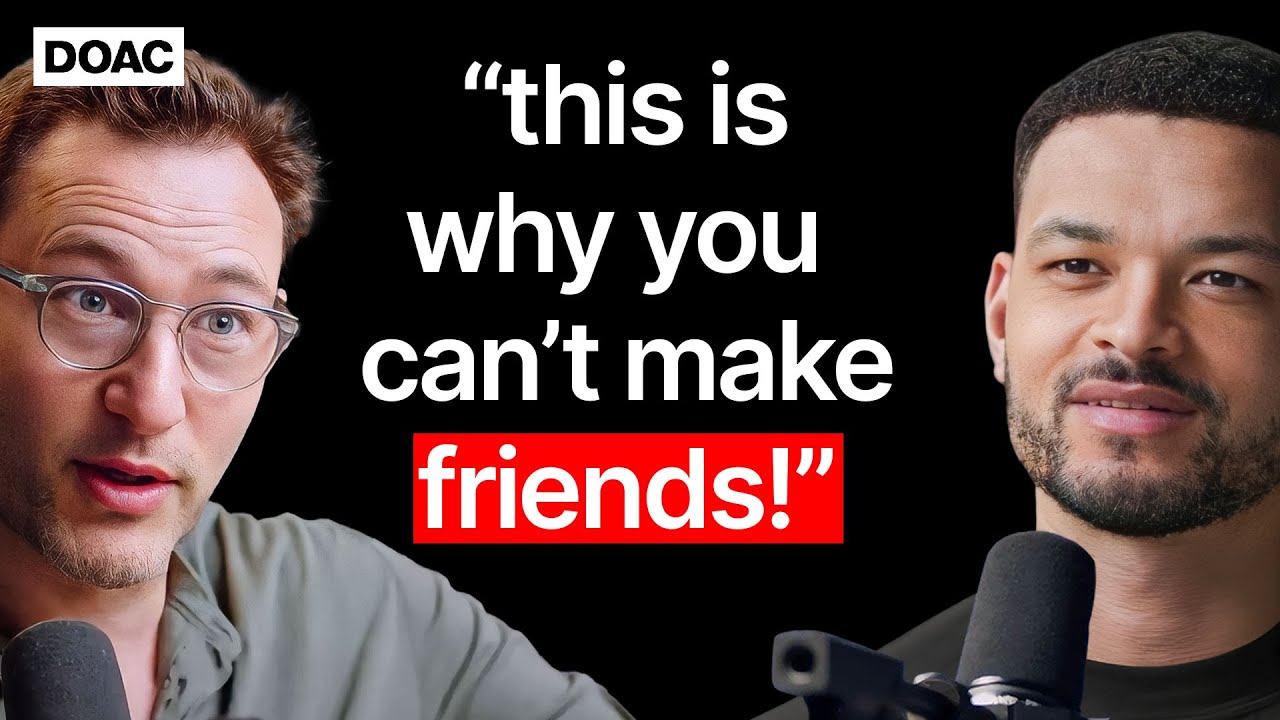
The Diary Of A CEO
Organizational failure and personal unhappiness stem from prioritizing short-term financial intensity over consistent, trust-building human service.
AI-assisted summary of Simon Sinek: "Strong Thigh Muscles = More friends", This Is Why You Can't Make Friends! — original source. Check the original for full context.
Source published:
Detailed notes
## Background This video was published on YouTube by The Diary Of A CEO on June 17, 2024. According to the page description, leadership expert and best-selling author Simon Sinek joins the show to discuss topics ranging from modern friendship dynamics, leadership development, and acts of service to public speaking techniques and personal growth.
## TL;DR In this extensive conversation, Simon Sinek and host Steven Bartlett examine the modern crisis of loneliness, the deep psychological need for service over self-interest, and the importance of prioritizing personal relationships with the same dedication given to business. Sinek offers actionable advice on developing essential human skills—such as active listening, resolving conflict, and effective public speaking—while cautioning against manipulative rhetoric and short-term intensity. Through personal anecdotes and candid reflections, both speakers emphasize that true fulfillment stems from validating others and living a life anchored in trust and service.
## Atmosphere & style The dialogue feels deeply introspective, warm, and intellectually stimulating, striking a balance between executive coaching and an intimate heart-to-heart. Bartlett’s vulnerable self-examinations prompt Sinek to offer grounded, empathetic wisdom through thoughtful metaphors rather than dogmatic advice. The emotional arc transitions smoothly from analyzing broad societal dysfunctions to unpacking deeply personal vulnerabilities, leaving the viewer with a sense of clarity, connection, and constructive optimism.
## Key takeaways - [49:12](https://www.youtube.com/watch?v=I3WUiD8HYn8&t=2952s) Gen Z and Millennials are often pushed toward financial and status goals over collective service, leading to unused potential, isolation, and victimhood among young people. - [52:13](https://www.youtube.com/watch?v=I3WUiD8HYn8&t=3133s) Manipulative figures like Andrew Tate gain traction by first validating young men's feelings of loneliness and victimhood before offering them a structured way out. - [54:19](https://www.youtube.com/watch?v=I3WUiD8HYn8&t=3259s) Introverts can build organic connections more easily in 'unsocial places' with shared focuses, such as museums or lines, than in traditional high-pressure social environments. - [01:37:12](https://www.youtube.com/watch?v=I3WUiD8HYn8&t=5832s) People frequently defer personal relationships and family commitments for professional goals, holding their private lives to a much lower standard than their work. - [01:47:08](https://www.youtube.com/watch?v=I3WUiD8HYn8&t=6428s) Relationships require daily consistency rather than periodic intensity; relying on sporadic grand gestures fails to build lasting trust. - [01:51:51](https://www.youtube.com/watch?v=I3WUiD8HYn8&t=6711s) Prioritizing work habits over personal life leads to burnout and compromises trust in both relationships and professional teams. - [01:53:36](https://www.youtube.com/watch?v=I3WUiD8HYn8&t=6816s) Framing advice with inclusive language ('we' instead of 'you') positioning oneself as a fellow learner makes leadership and advice far more accessible. - [01:53:36](https://www.youtube.com/watch?v=I3WUiD8HYn8&t=6816s) Effective leadership requires knowing one's operational and financial limitations and delegating those areas to trusted partners. - [01:55:36](https://www.youtube.com/watch?v=I3WUiD8HYn8&t=6936s) Business partnerships should never be formed with untrustworthy individuals, as contract terms cannot fix a bad relationship. - [01:53:36](https://www.youtube.com/watch?v=I3WUiD8HYn8&t=6816s) True happiness and fulfillment come from living a life focused on service to others rather than internal validation and self-interest. - [02:13:06](https://www.youtube.com/watch?v=I3WUiD8HYn8&t=7986s) Money should be viewed as fuel to reach meaningful goals rather than an end in itself; accumulation without purpose drains energy. - [01:59:24](https://www.youtube.com/watch?v=I3WUiD8HYn8&t=7164s) Public speakers and leaders must approach their audience with a mindset 'to give' rather than 'to get' or seek self-validation. - [02:02:06](https://www.youtube.com/watch?v=I3WUiD8HYn8&t=7326s) Audiences instinctively recognize 'givers' versus 'takers', and excessive self-promotion damages trust and connection. - [02:08:30](https://www.youtube.com/watch?v=I3WUiD8HYn8&t=7710s) Early life goals driven by childhood insecurities focus inward on self-validation, whereas authentic purpose focuses outward on serving others. - [02:12:55](https://www.youtube.com/watch?v=I3WUiD8HYn8&t=7975s) Corporations mistake true service for external philanthropy instead of fostering an internal environment where employees feel safe and heard. - [02:14:12](https://www.youtube.com/watch?v=I3WUiD8HYn8&t=8052s) Human skills like active listening, empathy, and conflict resolution are learnable traits that require regular practice like physical exercise. - [02:18:32](https://www.youtube.com/watch?v=I3WUiD8HYn8&t=8312s) Quiet dissatisfaction grows when leaders and partners lack the skills or psychological safety to navigate uncomfortable conversations. - [02:27:02](https://www.youtube.com/watch?v=I3WUiD8HYn8&t=8822s) Storytelling creates a curiosity gap that makes complex data or ideas emotionally engaging and memorable for an audience.
## Detailed walkthrough ### The Loneliness Epidemic and the Ultimate Biohack
Simon Sinek opens the discussion by diagnosing the current cultural moment, asserting that human beings have "architected our lives to be lonely." Despite being social animals, society has drifted away from organic community connection. Amid rising rates of suicide, anxiety, depression, and addiction, people constantly search for superficial biohacks. However, Sinek argues that the single most powerful protective factor—and the ultimate biohack—is **friendship**.
People with close friendships enjoy better health, live longer, handle stress more effectively, and have lower rates of addiction. Yet, while modern society has massive institutional and commercial frameworks dedicated to leadership development and couple counseling, zero infrastructure or industry exists to teach people how to be good friends.
* **Key Issues Highlighted:** Rising suicide, anxiety, depression, addiction, and mental health challenges. * **The Missing Industry:** No formal training or resources exist for mastering friendship compared to leadership or parenting.
---
Leaderless Times and Anti-Establishment Movements
Shifting to the macro-level landscape of the modern world, Stephen Bartlett asks Sinek for his perspective on the complex challenges defining the current era, including rapid digitalization and the advent of artificial intelligence. Sinek characterizes the present as **leaderless and visionless times**, which explains the massive global surge of populist movements and strongman political figures. People are not flocking to these figures because they are visionary statesmen, but because populations are desperately seeking meaning, purpose, and a sense of forward momentum.
Whether observing young people protesting on school campuses, anti-vaxxers and anti-maskers during the COVID-19 pandemic, or political divides like Brexit and partisan politics, Sinek views them all through the same lens: anti-establishment movements born from feeling forgotten and left behind by self-serving institutions.
* **Characteristics of the Era:** Complex, leaderless, and visionless times driven by a desperate search for meaning and purpose. * **The Anti-Establishment Wave:** Populist movements and protests (including campus movements and pandemic-era polarization) arise because citizens feel neglected by the establishment.
---
Toxic Influences and the Search for Role Models
Bartlett brings up a common anxiety shared by his podcast guests regarding their children—particularly young sons navigating online spaces dominated by toxic male influencers. Guests frequently present dossiers on "heroic masculinity," worrying that young men lack stable role models to teach them responsibility, empathy, kindness, and service. In the absence of positive leadership, people gravitate toward whatever provides immediate physiological gratification, such as conspicuous consumption, wealth, and status hits of serotonin and dopamine.
This void is what drove Sinek to team up with his friend **Will Guidara** (author of *Unreasonable Hospitality*) to write a new book entirely focused on friendship. Sinek highlights the scientific backing for social connection, revisiting the famous addiction experiments.
* **The Trap of Materialism:** In leaderless times, people chase conspicuous consumption and wealth for quick hits of serotonin and dopamine. * **The Book Project:** Sinek and Will Guidara are collaborating on a book exploring the neglected dynamics of friendship and human connection.
---
The Rat Park Experiment and the Power of Community
Sinek contrasts two landmark addiction studies on laboratory rats to illustrate the profound physical protection offered by social bonds. In the original 1970s experiment, a solitary rat placed in an isolated cage with access to plain water and drug-laced water consistently chose the drug water until it died, cementing a flawed human understanding of addiction as purely chemical. Years later, researchers realized the fatal flaw: the rat was a lonely social animal tortured by isolation.
When researchers built **"Rat Park"**—a rich, communal environment filled with toys, mazes, and other rats—the test subjects sampled both water sources, briefly used the drug-laced water, and then naturally stopped, choosing only the plain water. Sinek applies this to humans, noting that loneliness breeds addiction while healthy relationships protect us. He extends this to **Alcoholics Anonymous (AA)**, noting that while the program builds community through its 12 steps, the ultimate tipping point for overcoming the disease is the 12th step: becoming a sponsor and serving as an intimate friend to another struggling alcoholic.
* **Original Rat Study:** Solitary rats in barren cages got hooked on drug water until death, shaping old views on addiction. * **Rat Park Study:** Social rats in enriched environments experimented with drugs but naturally regulated and stopped, proving community mitigates addiction. * **The 12th Step of AA:** Moving beyond general community belonging to the intimate, one-on-one responsibility of sponsorship.
---
The Lack of Intintentionality in Friendships
Sinek underscores the absurdity of modern social habits, noting how people will casually ghost or reschedule plans with a lifelong friend for a work meeting simply because "they'll understand." People treat friendships with zero intentionality compared to professional obligations. He shares a breathtaking example of true friendship demonstrated by Will Guidara when a friend's father passed away.
Instead of sending a generic, overwhelming text, Guidara texted the grieving friend to acknowledge he would be inundated with messages, promising *not* to call that day—but establishing a rigid commitment to call **every single day at 9:45 AM**. Guidara called faithfully every morning; for the first week, the friend didn't pick up, but by the second week, he answered, and they spoke daily for months. Sinek notes how this level of devotion brings him to tears, contrasting it with modern coping mechanisms like recording solo TikTok videos for public validation rather than calling a friend.
* **The Scheduling Double Standard:** People routinely cancel on friends for work obligations, wrongly assuming friends will always absorb the blow without consequence. * **The 9:45 AM Story:** Will Guidara's masterclass in grief support—calling a bereaved friend every single day at the exact same time without pressure, ensuring they never felt alone.
---
Defining a True Friend: Fair-Weather vs. Foul-Weather
Challenging conventional definitions, Sinek explores what actually constitutes a good friend. People often default to saying a true friend is someone who supports you through hard times. However, Sinek warns against **"foul-weather friends"**—people who are exclusively present during crises because misery or codependency makes them feel superior, yet vanish entirely during times of joy (mirroring Schadenfreude).
Conversely, **"fair-weather friends"** are only present during good times. Sinek poses a striking personal realization: most people have a dozen individuals they could call when disaster strikes, but that number shrinks drastically—down to perhaps four—when something amazing happens and they want to share good news without fear of judgment, bragging, or breeding resentment. Ultimately, Sinek proposes that true friendship requires mutual celebration in greatness just as much as shelter in suffering.
* **Fair-Weather vs. Foul-Weather Friends:** Caution against friends who only show up in good times, and equal caution against those who only stick around during hard times out of covert codependency. * **The Success Test:** The number of people you can call with great news without feeling like you are bragging is often much smaller than the number of people you call in a crisis.
By the way, to unlock the full functionality of all Apps, enable [Gemini Apps Activity](https://myactivity.google.com/product/gemini).
Here is a detailed, faithful walkthrough of the provided transcript section:
[16:19](https://www.youtube.com/watch?v=I3WUiD8HYn8&t=979s) The Surprising Metric for Longevity: Why Thighs Matter
Simon Sinek lays out the three most critical body parts responsible for human longevity. While the first two are obvious—the heart for cardiovascular health and the lungs for oxygen and overall fitness—the third most important organ system turns out to be strong **thigh muscles**.
Historically, strong thigh muscles were essential not just for physical movement, but for basic mobility and sociability. Before cars, trains, and modern transportation existed, human beings had to walk everywhere to visit friends and family. A high degree of physical mobility meant individuals could maintain real-life social relationships, which statistically directly correlates with a longer lifespan. Heart and lungs provide physical survival, but thighs historically enabled sociability.
Today, modern technology, cars, social media, screen culture, and food delivery services like Deliveroo or Uber Eats have systematically optimized face-to-face interaction out of daily life. People are increasingly trapped behind screens within white walls, making genuine human connections and romance much harder to form.
* **Top 3 longevity drivers historically:** Healthy heart, healthy lungs, and healthy thighs. * **The thigh's primary historic role:** Facilitating walking to visit friends and maintain human connection before mass transit existed. * **Modern disruptors of friendship:** Remote work culture, mass transportation, social media, screen time, and delivery apps.
---
[18:29](https://www.youtube.com/watch?v=I3WUiD8HYn8&t=1109s) The Crisis of Connection and the Lost Skill of Friendship
Simon reflects on how deeply the skill of making friends has deteriorated, particularly among young men. He shares experiences from public speaking events where young men approach him afterwards, get right into his personal space, and ask a painfully vulnerable question: "How do I make friends?" He recalls a specific instance at a corporate speaking event in Canary Wharf, London. Out of an audience of 500 young professionals in suits sitting together, a young man in the front row took the microphone and asked Simon on stage how to make friends—completely unable to connect with the 499 peers sitting right beside him.
``` "The simple brain goes, 'Well, just turn to the person next to you and introduce yourself.' But clearly that was not the answer, because if it was so simple, he would just do that." ```
To explain how to overcome this, Simon shares a personal story about a close friend whose career and marriage were collapsing simultaneously. They instituted a weekly 90-minute Wednesday meeting where Simon offered advice and coaching. Although she felt great right after their talks, she consistently relapsed into a slump within two days. Simon realized his one-sided advice was only a temporary fix.
Drawing from the 12th step of Alcoholics Anonymous—which emphasizes that serving others who suffer from the same affliction is the true key to healing oneself—Simon shifted their dynamic. He asked her if they could split their 90-minute sessions so she could coach him through his own insecurities. Soon, the meetings organically shifted to focusing entirely on helping Simon. Within three to four weeks, his friend's life was completely back on track.
Simon explains that the true skill society has lost is **service**. Modern culture overemphasizes taking over giving, and self-interest over selflessness. To the young man asking how to make friends, Simon's core advice is to find someone else struggling to make a friend and help them:
``` "You can't make a friend until you learn how to serve, because friendship is fundamentally service... I think you have to learn to be a friend before you can make a friend." ```
- **Canary Wharf Incident:** A young man in a room of 500 suit-wearing corporate peers asked on stage how to make friends. - **The AA 12th Step Principle:** True recovery and growth come from serving someone else struggling with the exact same issue. - **The Core Paradox:** Society has overemphasized taking over giving; true friendship requires learning the skill of selfless service first.
---
[22:25](https://www.youtube.com/watch?v=I3WUiD8HYn8&t=1345s) The Importance of National Service and Lessons from Special Operators
Discussing the societal loss of service, Simon notes how the UK Prime Minister's proposal for compulsory national service met heavy public backlash. Simon believes the concept is brilliant if properly broadened beyond just military duty. He envisions a government-provided list of 20 to 30 options—such as teaching in inner-city schools, working weekends in hospices, or volunteering in hospitals—tied to education scholarships and incentives, similar to military service benefits in the United States.
National service teaches hard work and forces individuals to belong to something larger than themselves. Drawing from his work with elite military units like Navy SEAL Team 6, Simon busts the myth that high-performing teams operate on raw brawn and bravado. Instead, their extraordinary capability stems from deep mutual care and love.
Special operators do not possess a superhuman lack of fear when running into danger; rather, **they fear letting down their comrades more than they fear dying**. Simon references a real SEAL mission where one operator fell into the water and another dived in to rescue him, resulting in both losing their lives. This level of devotion is so intense that many special operators experience failed marriages because their bond with their team exceeds almost all civilian relationships.
Simon shares a personal emotional milestone when a combat-veteran friend in uniform called him "brother" for the first time—a term that must be earned. Later, that same friend ended a phone conversation by explicitly stating, "I love you," rather than a casual "love ya." Touched by this, Simon began deliberately saying "I love you" to the male friends in his life. Though some guarded, cold friends were initially uncomfortable, they eventually reciprocated, changing how they greeted, hugged, and kissed each other on the cheek.
``` "You cannot have service without developing some sort of love... friendship is fundamentally service." ```
Simon also highlights that society overuses the word "friend," diluting its meaning just as the single word "cancer" is used for both a minor melanoma and stage four liver cancer. He advocates for more precise labels to differentiate deep bonds from casual connections:
* **Acquaintance:** A casual social contact. * **Work Friend / Deal Friend:** Someone you get along with during shared business, but wouldn't actively pursue outside of work. * **True Friend:** Someone bound by deep mutual service and genuine love.
---
[31:03](https://www.youtube.com/watch?v=I3WUiD8HYn8&t=1863s) Believing in Belief and the Shift Away from Moral Obligation
When asked if he is religious, Simon clarifies: **"I believe in belief."** Whether someone finds guidance through traditional religious faith or a social cause, having a core belief system is essential for human purpose and community.
Historically, religion provided society with a clear moral code, structured community, and a built-in framework for selfless service. Simon contrasts modern philanthropy with wealthy Victorians or early American titans like Andrew Carnegie, John D. Rockefeller, and George Eastman. Looking back at historical tax codes in the UK and US, there were zero tax deductions or financial rebates for charitable donations. Yet, these figures built hospitals, universities, and charities out of a deep sense of **moral obligation** rooted in their faith.
Today, much of corporate or individual giving is tied to tax benefits, highlighting a shift away from intrinsic moral obligation toward transactional incentives as society moves away from traditional faith structures.
- **Historical Philanthropy:** Victorians, Carnegies, and Rockefellers built major institutions with zero tax incentives, driven purely by a religious/moral obligation to give back. - **Modern Philanthropy:** Often driven by tax benefits rather than an intrinsic moral code of service. - **The Void of Secularity:** As participation in traditional religious structures declines, society struggles to replicate the built-in purpose, community, and service ethics that religion historically guaranteed.
[33:28](https://www.youtube.com/watch?v=I3WUiD8HYn8&t=2008s) Modernizing Faith and the Search for Community
Simon Sinek points out that church attendance and membership are declining significantly because traditional religious institutions have lost their cultural relevance. Using the Catholic Church as an example, Sinek lightheartedly observes that trying to appeal to modern youth while wearing 400-year-old robes and speaking Latin simply does not work. Changing garments to jeans and speaking the local language does not mean abandoning the faith or being blasphemous; rather, it makes the message accessible and attractive. To illustrate how spiritual spaces can remain magnetic, Sinek recounts his experience attending one of Kanye West’s Sunday Services back when it was accessible to the general public through a quick online sign-up.
Describing the service, Sinek notes that regardless of one's personal beliefs, the experience was deeply moving and spiritual. The setup featured a choir and band in the center with parishioners seated in a full circle around them. Sitting there, your entire body was consumed by music and song for ten minutes at a time, echoing traditions like Sufism or the whirling dervishes, where musical repetition becomes the vehicle for meditation and transcendence. Furthermore, Sinek contrasts traditional religious setups with modern expressions like Hillsong Church—humorously noting the joke that Hillsong is "where all the pretty people go to pray." Featuring pastors dressed in Dr. Martens with hoop earrings and beards alongside full rock bands, Hillsong preaches the gospel while packing out entire arenas. Ultimately, young people are desperately searching for community, codes of conduct, leadership, and a sense of belonging, and because so few spaces provide this today, they tend to latch onto whatever appears first.
- **Kanye's Sunday Service:** Featured a central choir surrounded by attendees in a circle, using 10-minute continuous musical pieces to build spiritual connection. - **Hillsong Church:** Known for modernizing church culture to successfully fill arenas with young congregations.
---
[36:39](https://www.youtube.com/watch?v=I3WUiD8HYn8&t=2199s) In-Person Connection and Mental Health in the Remote Work Era
Steven Bartlett calls the longing for community one of the biggest business and cultural opportunities of our time, both for entrepreneurs building companies and leaders designing workplace cultures. Bartlett shares his long-standing belief in doing things in person—mentioning that he refused to host *The Diary Of A CEO* over Zoom even during the height of the COVID-19 pandemic, opting for two-meter social distancing or skipping releases entirely. He shares a recent experience interviewing a 25-year-old job candidate who explicitly checked if the team came into the office together, emphasizing that she was seeking a true community with activities like run clubs, reformer Pilates, and climbing walls before accepting a job offer.
While the narrative coming out of West Coast tech companies pushed "remote work forever," both speakers agree that basic human needs favor physical togetherness. However, Sinek highlights the psychological friction young professionals face when transitioning back to the workplace after spending their formative career years working from home. He explains that extended isolation has made many mentally unfit for social work environments. When forced back into an office, the initial shock feels so uncomfortable that employees mistake the workplace itself for the source of their stress. Sinek compares this to an out-of-shape person experiencing intense muscle pain upon returning to the gym, or an addict going through withdrawal—the pain is a sign of detoxing from isolation, requiring people to stick with it rather than running back home.
> "It's like when you're out of shape and you go to the gym it really hurts, you have to stick with it... my fear is that the being at home in a remote work environment is the thing that's making me mentally unfit, and it's not the coming back into work even though it hurts."
---
[39:36](https://www.youtube.com/watch?v=I3WUiD8HYn8&t=2376s) Redesigning the Office for Serendipity and Service
Bartlett questions whether part of the resistance to returning to work stems from outdated office design, suggesting that offices ought to be reimagined as community centers rather than mere work stations. Sinek agrees, noting that office layouts have continuously evolved over the decades—from executive corner windows surrounding interior cubicles, to moving younger workers to exterior windows, to open-plan designs. To demonstrate intentional office design, Sinek highlights how Steve Jobs helped design the Pixar Animation Studios headquarters by placing the restrooms in the center of the building rather than along the exterior. This forced every employee, regardless of their role, to walk past one another daily, creating deliberate moments of serendipity and interaction.
Sinek emphasizes the power of communal eating and living room-style office design. He describes his own office as a cozy space filled with couches and back rooms for private calls, complete with a functional kitchen and fridge so it literally feels like a home. Addressing Bartlett's counterargument that many workers dread long commutes to wear suits in cramped cubicles, Sinek argues that employees have a duty to actively improve their environment rather than just complain. Drawing an analogy to politics—where one earns the right to complain only after doing the bare minimum of voting—Sinek urges workers to stop acting selfishly and focus on making the office better for their peers. He also highlights everyday email habits as an area needing consideration: employee inboxes are constantly flooded because people thoughtlessly hit "reply all" to confirm lunch choices or log minor updates instead of picking up the phone or trimming CC lists to help colleagues reach inbox zero.
- **Steve Jobs' Pixar Design:** Centralized restrooms to guarantee all employees crossed paths daily, boosting spontaneous collaboration. - **Sinek's Office Concept:** Replaced standard desk setups with living-room-style couch configurations, private phone rooms, and a shared kitchen. - **Email Mindfulness:** Trimming unnecessary CC recipients and avoiding "reply all" messages (e.g., "chicken please") reduces collective inbox fatigue.
---
[44:26](https://www.youtube.com/watch?v=I3WUiD8HYn8&t=2666s) Small Acts of Service and the Crisis of Individualism
Sinek shares a personal story from the streets of New York City to illustrate how self-centered modern society has become. He witnessed a man parallel parking his car right in the middle of a space large enough for two vehicles. Sinek tapped on the driver's window and politely offered to guide him forward or backward so another driver could park, but the man defensively dismissed him, insisted the parking was fine, and walked away. Reflecting on the encounter, Sinek emphasizes that simple acts of daily consideration—like leaving space for a stranger to park—are basic acts of service that require almost zero sacrifice, yet people routinely refuse them.
This leads into a broader critique of rugged individualism. Sinek argues that the current loneliness epidemic is self-inflicted because society has hyper-indexed on individual achievement and celebrated single "hero" figures. Turning to Bartlett, Sinek points out that despite public perception framing Bartlett as a self-made business guru, his success depended heavily on teams, mentors, and parents who took risks and opened doors for him. Bartlett warmly agrees, recalling how his parents sacrificed immensely to build his confidence as a child. They connect this self-absorbed mindset to demographic shifts across the Western world, where birth rates are plummeting partly because individuals prioritize career goals and personal freedom over the service inherent in parenthood.
Concluding with a historical comparison, Sinek reflects on how societal mindsets have shifted since World War II. During the London Blitz, parents routinely sent their children to the countryside to be raised by strangers so they could stay behind and support the war effort—fully aware they might be killed in bombings and never see their children again. While such extreme collective sacrifice feels incomprehensible to the modern mind, it illustrates how deeply humans once understood their role within a broader community.
> "You live in the world. There are other people in the world... I'm asking you to consider that somebody else might want to park, and it's an act of service to move your car to make a little room for somebody who you don't know."
[49:12](https://www.youtube.com/watch?v=I3WUiD8HYn8&t=2952s) The Danger of Unused Potential and the Incel Epidemic
Reflecting on historical precedents, the discussion highlights how during World War II, the drive to serve was so overwhelmingly ingrained in societal norms that those who were not called to serve faced immense psychological distress. In the United States, more people died by suicide from the shame of not being called to action than those dealing with the call to service itself. Steven Bartlett contrasts this historical sense of collective service with the reality facing Gen Z and Millennials today, who are frequently guided toward career paths purely driven by financial gain or Instagram prestige.
Bartlett brings up a specific demographic: young men trapped behind screens, isolated, without romantic relationships, friends, or physical outlets, often categorized as "incels." Referring to discussions with Scott Galloway, Simon Sinek emphasizes that society does not address the core issue of how extreme isolation and pent-up frustration metastasize into dangerous extremism, antisocial behavior, and deep-seated anger. Drawing a parallel to religious extremism in the Middle East, Sinek points out how shame-based societies create intense pressure cookers when young adults are stuck at home, unable to get jobs, move out, or find romantic partners, ultimately fueling a cycle of victimhood and vengeful behavior.
- Historical statistical note: During WWII, shame over not being called to service led to higher suicide rates in the U.S. than the psychological burden on those who were called. - The psychological pipeline of young isolation: Lack of social outlets leads to pent-up frustration, which manifests as anger, victimization, addiction, and antisocial or vengeful behavior. - Cultural parallels: Shame-based societies that lock young adults out of independence and relationships create environments ripe for ideological extremism.
[52:13](https://www.youtube.com/watch?v=I3WUiD8HYn8&t=3133s) The Validation Trap: Why Figures Like Andrew Tate Find an Audience
The conversation turns to controversial online personalities, specifically Andrew Tate, and why their provocative messaging resonates so deeply with millions of young men. Bartlett points out that while a leadership figure like Sinek would never call his audience "losers," Tate explicitly insults his viewers—telling them their lives suck and that they are total failures—before offering them a structured roadmap. Sinek acknowledges that this approach is remarkably effective because it validates and affirms their existing feelings of being abandoned and victimized.
``` "You're validating their feelings of victimhood, you're affirming it, and then offering them a way out... What you're doing is you're validating someone's feelings, you make them feel not alone in their loneliness and victimhood, and then you offer them a way out of that feeling." ```
Sinek explains that playing in extremes creates a manipulative emotional delta. By aggressively pushing someone down first and then offering to lift them up, a presenter positions themselves as an indispensable savior. While validating someone's struggles is an essential part of genuine connection and leadership, using extreme rhetoric to rile people up creates unstable, volatile behavior rather than constructive long-term growth.
- The mechanics of extreme influence: Affirming victimhood + insulting the current state + offering an exclusive way out = high audience engagement. - The "Delta" strategy: Artificially lowering an individual's self-worth to maximize the perceived value of the solution being offered. - Healthy vs. toxic validation: True leadership acknowledges struggle to empower individuals, whereas manipulative rhetoric fuels outrage to build a dependent audience.
[54:19](https://www.youtube.com/watch?v=I3WUiD8HYn8&t=3259s) Introverts, Micro-Connections, and Finding Common Ground
Shifting to practical advice for people struggling to make friends or find romantic partners in an era dominated by apps and digital screens, Bartlett asks where physical connections are supposed to happen today. Sinek admits that he is personally socially inept in traditional environments like parties, bars, networking events, or clubs, where he often ends up standing alone in the middle of the room with a drink, unable to smoothly enter ongoing conversations.
However, Sinek makes a critical distinction between "social places" and "unsocial places." For introverts, unsocial environments with built-in shared focus—like standing next to someone at a museum looking at art or waiting in a buffet line—provide a low-friction space for organic connection.
``` "I actually think it's easier to make a connection when you're standing next to somebody than when you're standing across from somebody... Standing across from somebody I find adversarial and tense... but standing next to somebody, you can say a few words and then go completely quiet, and that's not awkward." ```
- Social geometry: Facing someone directly creates micro-tension and strict spatial rules (ideally an 18-inch social buffer), whereas standing side-by-side reduces pressure. - Natural connection points: Shared activities (walking, museum visits, waiting in lines) allow for natural pauses and silences without the discomfort present in face-to-face setups.
[58:32](https://www.youtube.com/watch?v=I3WUiD8HYn8&t=3512s) The Personal Crossroads: Work, Priorities, and Deferred Relationships
Sinek turns the table on Bartlett, asking him what he is currently struggling with in his own life. Bartlett admits that despite his professional successes, he feels caught at a massive crossroad regarding his priorities. He worries that he is allocating his youth to work and material goals at the expense of his personal life, recalling the classic fable of the fisherman and the businessman—where a businessman tries to convince a content fisherman to scale his business for decades just to end up doing what he was already doing: relaxing with his family.
At 31 years old, with a partner of the same age, Bartlett reflects on his desire for fatherhood while catching himself deferring his personal life. He realizes he has been telling himself that he will truly focus on his relationship and family "in three years" after selling a business. Sinek immediately calls out this rationale, pointing out that Bartlett would never allow a three-year deferral on a major corporate problem.
``` "If this was a business problem, you would never let yourself defer that problem for 3 years. So how are you giving yourself a lower standard for your personal relationship than your professional work?" ```
Bartlett reflects on how relationships often become the "residual beneficiary" of a person's life—getting whatever leftover time or energy remains after the calendar is cleared. Unlike failing to brush your teeth, where the consequences are immediate, the neglect of personal relationships builds silently over years until it culminates in sudden, irreversible failure.
- The Fisherman's Dilemma: Spending life building complex systems to achieve a lifestyle that was available from the beginning. - The Residual Beneficiary dynamic: Giving relationships only leftover energy because the immediate penalty for neglect isn't instantly visible. - The compounding impact of neglect: Like dental hygiene, neglecting a relationship doesn't show catastrophic damage on day one, but results in severe long-term breakdown over years.
<FollowUp label="Want to explore Simon Sinek's framework for having difficult conversations about relationship priorities?" query="What is Simon Sinek's framework for having difficult conversations with partners or teams about priorities and expectations?"/>
### [01:04:28](https://www.youtube.com/watch?v=I3WUiD8HYn8&t=3868s) Consistency vs. Intensity: Why Relationships Fail The discussion centers on the subtle trap of trading consistency for intensity in relationships and business. Steven notes how easy it is to deprioritize personal relationships for high-value business meetings because business outcomes are immediately quantifiable—a meeting might net a million dollars—while missing a date night has a delayed, residual impact. Simon reframes this choice using a sharp analogy: choosing intensity over consistency is like skipping daily teeth-brushing and only visiting the dentist, or expecting to stay in shape by going to the gym only "when you have time." Consistency is slow, hard to calculate, and requires faith, but it is precisely the accumulation of countless little things—like saying good morning to colleagues every day—that builds long-term trust and foundation.
Simon highlights the "tragedy of entrepreneurship," explaining that entrepreneurs excel at things that are easy to measure but often struggle with hard-to-measure commitments that rely purely on trust and faith. Steven illustrates this breakdown with a story about a friend he met at Shoreditch House whose 13-year marriage silently dissolved because both partners were completely absorbed in their respective businesses. Simon points out that the inverse is also true: when you consistently invest in a relationship or exercise over time, you suddenly look back and realize you are in fantastic shape without even knowing the exact moment it happened.
### [01:07:11](https://www.youtube.com/watch?v=I3WUiD8HYn8&t=4031s) Scheduling Love, "Passing Ships," and the Vacation Addiction Simon directly confronts Steven about over-indexing on work at the expense of his relationship with his partner, who runs her own breathwork studio upstairs. Steven defends himself by explaining how he and his partner had to start explicitly putting date nights into their calendar. While scheduling romantic time initially triggered a negative visceral reaction—making his partner feel like just another work appointment—explaining the "residual beneficiary" concept helped her see that scheduling ensures the relationship gets prioritized rather than receiving leftover scraps. Despite this, Steven confesses that he has struggled this year by taking on too much, making them feel like "passing ships in the night."
The conversation turns to Steven's complete inability to take a true holiday. Steven admits that even when he bought a house in South Africa and traveled there, he stayed fully plugged into work, waking up every morning wanting to check emails and play padel. Simon diagnoses this as a clear work addiction, pointing out that checking in on the team daily while on holiday actively undermines trust by communicating, "I don't trust you to do this without me."
- Simon challenges Steven to try leaving his phone behind for just one day on holiday, warning that while the initial withdrawal is excruciating, it leads to deep bonding by the third day. - Steven reveals he is taking his partner on a three-day retreat to Glastonbury this weekend with a "no phones" rule, though he admits he originally intended to sneakily check his phone while she was getting changed. - Simon gives Steven an actionable rule for the Glastonbury trip: swap phones with his partner so neither person can access their own notifications or check work, framing it as an act of service to both his relationship and his team.
### [01:13:06](https://www.youtube.com/watch?v=I3WUiD8HYn8&t=4386s) Choosing Joy Over Millions: Money as Fuel When Steven asks Simon what he is currently struggling with, Simon shares that he is in the middle of writing a book and undergoing a major life reconfiguration after stepping back from public speaking. Steven points out that by turning down high-paying speaking gigs, Simon has left "many, many millions" on the table. Simon rejects the premise that his life decisions should be dictated by income accumulation, stating clearly, "I'm okay making less and lying on the beach." He explains that he does not carry a desire to be the richest or most powerful person, as his bank balance will not be printed on his tombstone.
Simon articulates his core philosophy on wealth by using a car and fuel metaphor. He views his career as a car designed to take him to meaningful destinations, and money merely as the petrol that powers the vehicle. Buying petrol for the sake of hoarding it makes no sense if you do not have a destination you actually want to visit. He emphasizes that he has turned down lucrative opportunities and said "no" to people he disliked or mistrusted even back when he was living "hand to fist" with no money in his bank account.
- Working with people he dislikes for money forces him to chant "think of the money" and leaves him completely drained of energy. - Working on unpaid, fun volunteer projects with people he loves leaves him supercharged, inspired, and rich in ideas and friends. - Simon concludes that no amount of money can buy back lost energy or inspiration, so he deliberately structures his life around work that fills him up.
### [01:17:56](https://www.youtube.com/watch?v=I3WUiD8HYn8&t=4676s) The Student Mindset and First Principles Steven asks Simon how he generates original ideas and maintains his ability to think through first principles. Simon immediately pushes back on the phrase "first principles," calling it condescending and preferring to frame his approach as a "beginner's mindset" or a "student mindset." Simon explains that he never views himself as an expert in someone else's domain; instead, he embraces being the person in the room who is unashamed to ask the simple or embarrassing questions that others hide out of fear of looking dumb. By approaching every meeting and creative effort as a curious student who simply wants to learn, he frees himself to uncover fresh, fundamental insights.
Here is a detailed, faithful walkthrough of the transcript segment.
---
[01:19:24](https://www.youtube.com/watch?v=I3WUiD8HYn8&t=4764s) The Myth of Replicating Success and Public Speaking Motivation
Simon Sinek rejects the idea that someone can simply follow a step-by-step formula to replicate his or Steven Bartlett’s career. He compares asking him how to become a successful speaker to asking Michael Jordan how to become an elite basketball player: no matter how hard someone works or whose daily routines they copy, without natural talent, height, or starting as a child, there is zero chance of reaching that level. Simon notes that people frequently approach him asking how to enter the "business" of public speaking before they even know what topic they want to talk about. This completely misses the point; he never set out with the goal of being a public speaker—he simply had an idea he cared about deeply and then searched for a medium to bring it to life, whether through entrepreneurship or a corporate environment.
While core identity cannot be copied, specific technical skills and mindset shifts can be learned. Simon explains that the fundamental starting point for any presentation, pitch, or public address is identifying one's underlying motivation: *is the objective to give, or to get?* Most people approach public speaking with a taker's mentality—seeking funding, clients, applause, book sales, or social media followers. Simon learned to adopt a giver's mentality instead. Before stepping on stage or entering a meeting, he literally whispers to himself, *"You're here to give."* He shares his point of view without expecting anything in return.
- **Michael Jordan Analogy:** Illustrates that success requires an uncopyable combination of natural capacity, innate talent, early start, and work ethic. - **Root Motivation:** The single most critical differentiator in public speaking is shifting from "What can I get from this audience?" to "What can I give them?"
---
[01:21:46](https://www.youtube.com/watch?v=I3WUiD8HYn8&t=4906s) The Michael Keaton Audition Lesson and Spotting Takers vs. Givers
To illustrate the transformational power of a giver’s mindset, Simon cites an insight from actor Michael Keaton regarding auditions. Actors often approach auditions with extreme desperation and self-interest: "Give me the role so I can be an actor." Keaton reframed the process from an act of selfishness into an act of service. He decided that his job was simply to perform the role for the 2, 10, or 15 minutes he had in front of the casting directors, treating the audition room itself as his stage. By focusing on the joy of acting in the moment rather than securing a outcome, he became a happier, more productive actor. Simon applies this to business meetings: he enjoys meetings even when they lead to no deal because he shows up fully committed to giving value to the people across the table.
``` +-----------------------------------------------------------------+ | AUDITION MINDSET | +-----------------------------------------------------------------+ | TAKER APPROACH GIVER (SERVICE) APPROACH | | • "Give me the role." • "My job is to perform today." | | • Seeking validation/job. • Treating audition as performance.| | • Outcome-obsessed. • Joy from the act of serving. | +-----------------------------------------------------------------+ ```
Audience members and clients intuitively detect whether someone is giving or taking. Simon compares this to the palpable difference in tone when walking into a shop where employees work on commission versus one where they are paid a straight salary. On stage, takers reveal themselves immediately: they demand the audience put away phones, lead with their impressive credentials, display massive logos and QR codes on their slides, or tell audience members to "buy the book" when asked a direct question.
- **Michael Keaton's Framing:** Treating an audition as the performance itself removes desperation and converts the effort into an act of service. - **The Retail Commission Analogy:** Illustrates how human instinct immediately senses transactional intent versus genuine assistance. - **Taker Indicators on Stage:** Demanding attention upfront, leading with credentials/social handles, and redirecting questions to product pitches.
---
[01:25:18](https://www.youtube.com/watch?v=I3WUiD8HYn8&t=5118s) Podcast Guest Traps and the Evolutionary Instinct for Trust
Steven Bartlett strongly resonates with this distinction, sharing a recent experience on *The Diary of a CEO*. A guest continuously referenced their book every three sentences over a three-hour conversation. Despite the episode pulling millions of views and downloads, the comment section was filled with audience backlash over the aggressive self-promotion. Simon defends these guests somewhat, pointing out that authors—especially first-timers—are often fed terrible advice by publishers to "push the book." Simon advises authors to just have a genuine conversation and trust that if the audience likes them, they will naturally buy the book. Steven adds that he once edited out every single mention of a guest’s Netflix special—totaling dozens of drops—because the guest treated the show as a billboard rather than a conversation.
Humans are hardwired to pick up on these dynamics due to evolutionary survival. As tribal animals, our primitive brains needed to know if a tribe member kept watch for saber-toothed tigers out of mutual care or self-interest. If we sense someone is a taker, our guard goes up because we cannot trust them with our safety.
- **Audience Backlash:** Audiences revolt when a guest views a platform as a sales funnel rather than a venue for sharing ideas. - **The Netflix Special Story:** Steven edited out 100% of a guest's non-stop plug attempts to preserve the integrity of the episode. - **Evolutionary Basis of Trust:** Humans developed acute sensitivity to giver vs. taker motives because tribal survival depended on mutual protection.
---
[01:28:30](https://www.youtube.com/watch?v=I3WUiD8HYn8&t=5310s) Insecurity vs. True Purpose
Steven recalls watching a video of Simon coaching an individual through a "Find Your 'Why'" exercise. When asked about a formative early childhood memory, the individual spoke about a teacher who said they would never amount to anything, and how triumphant it felt to eventually prove that teacher wrong. Steven realized that this memory wasn't a reflection of core purpose—it was raw insecurity masquerading as purpose.
Reflecting on his own life, Steven shares that at age 18, the very first page of his diary listed four explicit goals to achieve before turning 25: 1. Obtain a six-pack abs physique 2. Get a girlfriend 3. Own a Range Rover Sport 4. Become a millionaire
Looking back, Steven sees that every single item on that list was merely a direct reversal of his childhood insecurities: he was the smallest, skinniest kid among four siblings, had never had a girlfriend, grew up in a household with no money, and was too young to drive. He had mistaken a checklist of insecurities for a life mission. Simon confirms that this is extremely common; people frequently confuse personal validation with genuine purpose.
- **The 4 Goals of 18-Year-Old Steven:** Six-pack, girlfriend, Range Rover Sport, and millionaire status by 25. - **Insecurity vs. Purpose:** Insecurity focuses inwardly on self-validation ("Look what I proved/achieved"), whereas true purpose focuses outwardly on service ("Who can I lift up or share this with?").
---
[01:30:28](https://www.youtube.com/watch?v=I3WUiD8HYn8&t=5428s) Redefining Success Through Service and Shared Experience
Simon highlights a quote about human behavior: everyone is constantly seeking validation and worrying about what others think of them, yet almost no one is actually thinking about you—they are thinking about themselves. Therefore, simply taking the initiative to validate *someone else* instantly puts you ahead. As Simon has reached middle age, his perspective on achievement has shifted: the accomplishments themselves matter far less than the people with whom they are shared.
``` +-----------------------------------------------------------------+ | ACCOMPLISHMENT VS. SHARED VALUE | +-----------------------------------------------------------------+ | ISOLATED GOAL SHARED PURPOSE | | • Getting a six-pack. • Going to the gym together. | | • Buying a Range Rover. • Going on adventures together. | | • Making a fortune. • Giving money away to others. | | • Receiving recognition. • Making others feel seen/heard.| +-----------------------------------------------------------------+ ```
Having money, physical fitness, or high-end vehicles is fun, but the true joy comes from using those assets in service of others—whether that means bringing a friend along in the Range Rover, giving money away, or using one's platform to make others feel seen.
- **The Shift in Middle Age:** Human connections and shared experiences outweigh individual accolades, wealth, or physical attributes. - **Generosity in Art:** Simon references a close friend who is an incredible artist; her greatest joy comes not from selling her work, but from gifting original pieces to her friends.
---
[01:32:55](https://www.youtube.com/watch?v=I3WUiD8HYn8&t=5575s) How Corporations Misunderstand Service
Shifting the conversation back to corporate culture, Steven asks how business leaders can integrate real service into their organizations. Simon asserts that most companies completely misunderstand what "service" means. They mistake service for corporate philanthropy—such as sponsoring a charity 5k run, offering a company-wide volunteer day for Habitat for Humanity, or donating funds to a cause. While those charitable acts are positive, they do not constitute organizational purpose or true service.
Real corporate service is internal and relational. In an era fraught with controversies around remote work versus office returns, alongside mounting mental health challenges, true service asks: *How do we design the workplace environment so that employees feel safe, seen, and heard every single day?* Service in a business context begins with how leaders and colleagues treat each other within the building.
- **Corporate Misconception:** Companies confuse external charitable donations or annual volunteer days with genuine organizational purpose. - **True Organizational Service:** Creating daily work structures and leadership practices that prioritize the psychological safety and dignity of the workforce.
---
<ElicitationsGroup message="Where would you like to take this text walkthrough next?"> <Elicitation label="Explore Simon Sinek's public speaking framework" query="Provide a detailed breakdown of Simon Sinek's public speaking framework and delivery advice."/> <Elicitation label="Analyze the difference between goals vs. purpose" query="Deep dive into the psychological difference between insecurity-driven goals and service-driven purpose."/> </ElicitationsGroup>
[01:34:12](https://www.youtube.com/watch?v=I3WUiD8HYn8&t=5652s) Learning Human Skills to Build Better Workplaces and World Peace
Simon Sinek highlights that basic human skills—such as active listening, holding space for someone who is struggling, delivering difficult feedback constructively, and handling confrontation respectfully across corporate hierarchies—are rarely taught, even to those in high-level leadership positions. He jokes that while cats do not have to work hard to be cats, being a good human being takes significant practice. Sinek notes that every single one of these human skills is 100% learnable, comparing the process to learning to ride a bicycle: you will wobble and scrape your knees a few times, but eventually, it becomes second nature.
When employers ask about the ROI of teaching human skills, Sinek dismisses the question by comparing it to Gary Vaynerchuk's classic line, "What's the ROI of your mother?" or asking what the ROI of going to the gym for a single day is. The real ROI manifests when a company is filled with people skilled at communication, resulting in higher engagement, innovation, productivity, customer service, and genuine joy at work. Furthermore, these skills extend beyond the workplace: an employee who learns to listen effectively at work takes that ability home, improving their relationships with their spouse, children, and community. Sinek emphasizes that this creates a ripple effect toward world peace, defining peace not as the total absence of conflict or complete agreement, but as the collective capacity to resolve conflicts peacefully.
* **Key Skills Lacking in Leadership:** Active listening, holding space, giving non-defensive feedback, navigating difficult discussions (such as talking about race), and direct workplace confrontation. * **The Gymnastic Effect:** Much like going to the gym once yields zero ROI, teaching human skills requires continuous practice to transform corporate metrics and employee well-being. * **Definition of World Peace:** The capacity of individuals, partners, and societies to peacefully resolve their inevitable conflicts, rather than an unrealistic state where everyone agrees or avoids friction.
---
[01:38:12](https://www.youtube.com/watch?v=I3WUiD8HYn8&t=5892s) Navigating Quiet Dissatisfaction and Awkward Conversations
Addressing the internal health of organizations and relationships, the host observes that the level of "quiet dissatisfaction" in any team, family, or business directly correlates with its capacity to hold uncomfortable conversations. When expectations go unmet and individuals lack the skills or psychological safety to address them, resentment festers until people leave, relationships break, or companies collapse. To overcome this, Sinek advises leaders to acknowledge their own shortcomings publicly rather than abruptly changing their behavior or attempting "radical transparency" without context.
Sinek shares a personal example of telling his own team that he was actively trying to work on specific communication skills, warning them that he might fumble or act awkwardly while practicing. He candidly admits that after taking a formal listening class years ago, he discovered a humbling truth: he was a brilliant listener with complete strangers he would never see again, but a terrible listener with his own friends and colleagues. When he called his close contacts to apologize, they humorously replied that they already knew. In his romantic relationship, Sinek and his girlfriend established a shared framework where they could coach each other mid-argument—such as calling out when one partner was correcting facts instead of validating feelings—allowing them to navigate conflicts collaboratively rather than defensively.
* **Quiet Dissatisfaction:** Unmet expectations that grow in secret due to a lack of communication skills or supportive culture, eventually causing organizational or relational failure. * **The Learning Journey Announcement:** When trying new communication styles, inform those around you that you are deliberately practicing a skill so they understand your changing behavior and fumbles. * **Selective Listening Paradox:** Sinek realized he listened exceptionally well in short-term professional contexts with strangers, but struggled with active listening in close, personal relationships.
---
[01:43:37](https://www.youtube.com/watch?v=I3WUiD8HYn8&t=6217s) Creative Argument Rules: Transforming Conflict into Connection
To illustrate how situational awareness can diffuse escalating arguments, Sinek shares a story from a severe disagreement with his girlfriend. The argument had devolved into a competitive cycle where each person listed what they did right versus what the other did wrong. Realizing they were stuck in a "lose-lose" spiral, Sinek interrupted the argument to propose new rules: each person had to state what *they* did wrong and what the *other person* did right, with Sinek volunteering to go first.
Within four minutes of changing the ground rules, the tension broke, and they were laughing, hugging, and recognizing each other's efforts. Sinek stresses that developing human skills gives individuals the presence of mind to spot toxic patterns in real time and shift the dynamic. The conversation then touches on an ironic insight from TED speaker Julian Treasure, who noted that while his talk on how to be a great speaker received tens of millions of views, his talk on how to be a great listener garnered only a fraction of that attention—proving how much society privileges speaking over listening.
* **The Reverse Argument Technique:** A conflict-resolution tool where both parties stop defending themselves and instead list their own mistakes and acknowledge their partner's positive actions. * **Julian Treasure's Insight:** Treasure's TED talk on speaking generated roughly 30–40 million views, whereas his talk on listening only gained around 3 million views, highlighting society's disproportionate desire to be heard rather than to listen.
---
[01:46:02](https://www.youtube.com/watch?v=I3WUiD8HYn8&t=6362s) The Power of Storytelling in Public Speaking
Transitioning to technical advice for effective public speaking and influence, Sinek underscores that narrative and storytelling are far more powerful than dry explanations or data dumps. People naturally resist being lectured to or explained at; they remember vivid stories and metaphors, which allow them to draw their own conclusions. Sinek points out that most speakers make the mistake of stating an explanation first and then bringing in a story to prove the facts, whereas the far more compelling approach is to open with a story, hook the audience's curiosity, and follow up with the salient points.
To illustrate this method, Sinek shares examples from his own presentations. When introducing the concept of finite and infinite games, he tells the story of the Vietnam War—pointing out that the United States won nearly every battle and lost 58,000 troops compared to North Vietnam's 3 million, yet still lost the war. This creates a compelling "curiosity gap" around what it truly means to win or lose. Similarly, he uses emotional military anecdotes, such as A-10 pilot Johnny Bravo risking his life for his comrades, to highlight the stark contrast between military culture (where medals are given to those who sacrifice for others) and corporate culture (where bonuses are awarded to those who sacrifice others for personal gain). Ultimately, Sinek emphasizes that facts and data fail to win emotional arguments or move audiences, whereas stories build a shared human experience.
* **Story-First Framework:** Hook the audience emotionally with a narrative or metaphor before delivering the underlying lesson or data, rather than starting with raw facts. * **Creating a Curiosity Gap:** Presenting surprising historical or situational paradoxes—such as winning every battle in a war but losing overall—engages the audience's critical thinking and feelings. * **Military vs. Business Contrast:** * *Military:* Medals are given to individuals willing to sacrifice themselves so that others may gain. * *Business:* Bonuses are often given to individuals willing to sacrifice others so that the company or individual may gain.
[01:48:58](https://www.youtube.com/watch?v=I3WUiD8HYn8&t=6538s) Public Speaking and Connecting with Audiences
Simon Sinek explains that bringing pure data into an emotional conversation never works: "data has to meet data and emotion has to meet emotion." Good leaders and presenters know how to modulate between the two. The easiest way to get people emotionally invested in a topic is through storytelling. Even when sharing a story about an Air Force pilot, audience members relate to the underlying human desire to work in a culture of safety and trust.
When host Steven Bartlett brings up physical delivery techniques—such as voice intonation and body language—Simon reveals how being an introvert actually makes him a better public speaker. Rather than "holding court" or scanning and panning across a crowd, he focuses on having individual, one-on-one conversations. On stage, he looks one person directly in the eye, delivers a complete sentence or thought, and then moves to another person. To ensure the whole room feels included, he uses a technique called "painting the edges," making deliberate eye contact with individuals across the upper left, lower left, upper right, lower right, middle back, and front.
He shares a stage experiment where he picked a single audience member out of a thousand people and looked them in the eye while speaking, asking them to raise their hand once they felt a genuine connection. Unexpectedly, about eight people sitting around that individual raised their hands simultaneously, demonstrating how deep eye contact creates a localized bubble of genuine connection that radiates outward.
* **Public Speaking Principle**: Avoid scanning or panning across a room; speak directly to one person per sentence or complete thought. * **"Painting the Edges"**: Intentionally make eye contact with specific individuals in every section of the room (corners, back, front) to make an entire auditorium feel included. * **Application to Meetings**: The same technique applies in small group meetings—giving full eye contact to one person per thought builds immediate intimacy and engagement.
---
[01:51:46](https://www.youtube.com/watch?v=I3WUiD8HYn8&t=6706s) Leading Side-by-Side: Language and Humility
Steven notes that Simon’s message gains immense power from vulnerability and his willingness to share personal struggles. Simon responds that he never views himself as special or superior to his audience. To maintain this connection, he deliberately uses the pronoun "we" instead of "you" when delivering key principles.
He emphasizes that he would never command an audience by saying, *"You need to do everything in your power to live a life of service because until you learn to live a life of service, you will never find happiness."* Instead, he frames it as a shared journey: *"We need to all learn how to do the things that give us a sense of service, because none of us will ever find happiness until we learn to live lives of service."* Positioned as a fellow student sharing what he learns along the way, Simon views all of his work as imperfect and incomplete steps forward rather than definitive declarations from an authority figure.
---
[01:53:36](https://www.youtube.com/watch?v=I3WUiD8HYn8&t=6816s) Admitting What You Don't Know and Choosing the Right People
Following the podcast's tradition, Steven asks a question left by the previous guest: *"What area of your life do you still think you need some good advice on?"* Simon candidly admits that he struggles with the operational and financial side of business, such as valuations and corporate deal-making. He shares that sitting in financial meetings full of corporate jargon often makes him feel "so dumb" because his brain simply doesn't process information that way.
Steven relates to this, noting that many successful entrepreneurs excel specifically because they acknowledge their blind spots. He recalls a story told by Sir Richard Branson during his podcast appearance: at age 55, after building the Virgin Group into one of Europe's largest business empires, Branson's directors asked him, *"Richard, you don't know what profit is, do you?"* When Branson admitted he didn't, they took him outside and drew a picture of an ocean with a net and fish using colored crayons, explaining, *"Richard, the fishies in the net you get to keep—that's your net profit."* Branson immediately grasped it, demonstrating how dyslexic thinking led him to rely on finding "who, not how" through delegation rather than trying to master everything himself.
``` ┌────────────────────────────────────────┐ │ THE OCEAN (Gross Revenue) │ │ │ │ ~~~~~~~~~~~ │ │ ~~~~~~~~~~~~~~~ │ │ ┌─────────────────┐ │ │ │ ┌──┐ ┌──┐ │ │ │ │ <º))><<º))>< │ │ │ │ └──┘ └──┘ │ │ │ │ THE NET │ │ │ └─────────────────┘ │ └────────────────────────────────────────┘ │ ▼ FISHIES IN THE NET = NET PROFIT ```
Simon reflects on a recurring mistake in his own life driven by insecurity around what he doesn't know. In the past, when he felt out of his depth on a topic, he over-trusted experts whose skill sets complemented his own, even when he personally disliked or mistrusted them. Invariably, those individuals took advantage of him.
The critical lesson he learned was not to reject advice that feels counterintuitive, but to strictly reject people who feel wrong. Citing Warren Buffett's maxim, "You can't make a good deal with a bad person," Simon highlights that genuine business success depends entirely on trust. In great business relationships, parties might technically breach contract terms by paying late or overworking hours, but nobody cares because mutual trust exists. Conversely, the moment a partner says, "Well, according to the contract...", the relationship is effectively over.
---
[01:58:58](https://www.youtube.com/watch?v=I3WUiD8HYn8&t=7138s) The Optimism Company and Final Gratitude
Steven praises Simon's work at The Optimism Company, describing it as a modern university filling a critical cultural deficit. He emphasizes how the platform teaches vital, practical human skills—such as listening, effective communication, conflict resolution, and leadership—that formal education often ignores.
Simon expresses his deep gratitude for the podcast, sharing how much he enjoys taking complex ideas and "wrestling with them" with Steven. He commends Steven for pushing him with genuine curiosity, noting that their discussions always teach him something new in return before concluding the episode.
## Notable quotes > [52:13](https://www.youtube.com/watch?v=I3WUiD8HYn8&t=3133s) You're validating their feelings of victimhood, you're affirming it, and then offering them a way out... What you're doing is you're validating someone's feelings, you make them feel not alone in their loneliness and victimhood, and then you offer them a way out of that feeling. — Simon Sinek
> [01:37:12](https://www.youtube.com/watch?v=I3WUiD8HYn8&t=5832s) If this was a business problem, you would never let yourself defer that problem for 3 years. So how are you giving yourself a lower standard for your personal relationship than your professional work? — Simon Sinek
> [02:19:24](https://www.youtube.com/watch?v=I3WUiD8HYn8&t=8364s) You're here to give. — Simon Sinek
> [02:34:12](https://www.youtube.com/watch?v=I3WUiD8HYn8&t=9252s) What's the ROI of your mother? — Gary Vaynerchuk
> [01:53:36](https://www.youtube.com/watch?v=I3WUiD8HYn8&t=6816s) You need to do everything in your power to live a life of service because until you learn to live a life of service, you will never find happiness. — Simon Sinek
> [01:53:36](https://www.youtube.com/watch?v=I3WUiD8HYn8&t=6816s) We need to all learn how to do the things that give us a sense of service, because none of us will ever find happiness until we learn to live lives of service. — Simon Sinek
> [01:53:36](https://www.youtube.com/watch?v=I3WUiD8HYn8&t=6816s) What area of your life do you still think you need some good advice on? — Steven Bartlett
> [01:53:36](https://www.youtube.com/watch?v=I3WUiD8HYn8&t=6816s) Richard, you don't know what profit is, do you?
> [01:53:36](https://www.youtube.com/watch?v=I3WUiD8HYn8&t=6816s) Richard, the fishies in the net you get to keep—that's your net profit.
> [01:55:36](https://www.youtube.com/watch?v=I3WUiD8HYn8&t=6936s) You can't make a good deal with a bad person — Warren Buffett
> [01:55:36](https://www.youtube.com/watch?v=I3WUiD8HYn8&t=6936s) Well, according to the contract...
## Mentioned World War II, Gen Z, Millennials, Scott Galloway, Simon Sinek, Andrew Tate, Steven Bartlett, Michael Jordan, Michael Keaton, Gary Vaynerchuk, Julian Treasure, The Diary of a CEO, Shoreditch House, Range Rover Sport, Habitat for Humanity, TED, Sir Richard Branson, Virgin Group, Warren Buffett, The Optimism Company
[Source](https://www.youtube.com/watch?v=I3WUiD8HYn8)