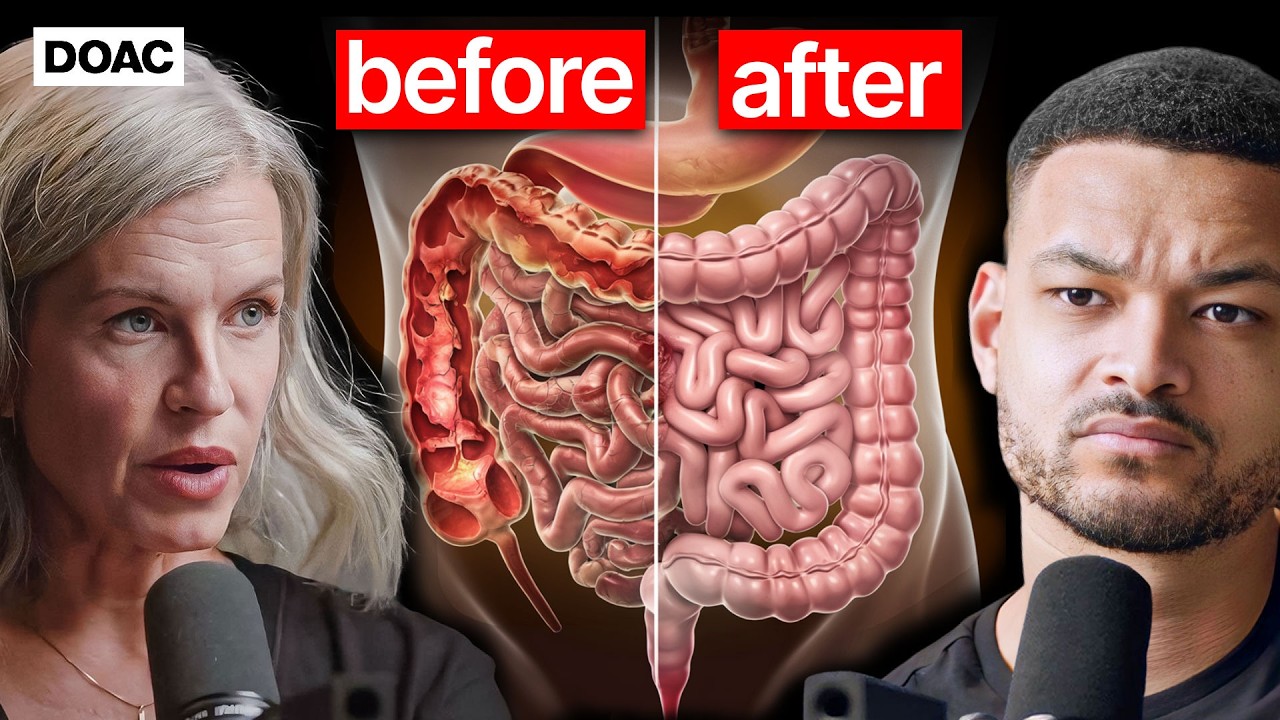
Dr. Tyna Moore Advocates Microdosing Semaglutide for Chronic Diseases
The Diary Of A CEO
Standard GLP-1 drug escalation protocols overdose patients for rapid weight loss, whereas microdosing addresses root-cause metabolic dysfunction and inflammation without severe side effects.
## Background
Published on July 4, 2024, by the YouTube channel 'The Diary Of A CEO' hosted by Steven Bartlett, this episode features Dr. Tyna Moore, a certified Naturopathic and Chiropractic physician. The video description highlights Dr. Moore's expertise in holistic regenerative medicine, her podcast 'The Dr Tyna Show', and her course 'Ozempic Uncovered', which explores the potential benefits and mechanisms of GLP-1 medications.
## TL;DR
Dr. Tyna Moore challenges the mainstream narrative surrounding GLP-1 receptor agonists like Ozempic, arguing that many negative side effects stem from over-prescribing standard, aggressive dosages rather than the molecule itself. She presents evidence and clinical observations showing that microdosing semaglutide can reduce neuroinflammation, improve gut health, lower cancer risks, and address conditions like PCOS and addiction without causing severe muscle loss or gastrointestinal distress. Emphasizing a root-cause naturopathic approach, Dr. Moore advocates combining low-dose GLP-1 therapy with foundational lifestyle habits such as strength training, adequate protein intake, morning sunlight, and sleep optimization.
## Atmosphere & style
The conversation carries an urgent, paradigm-shifting tone, blending rigorous medical advocacy with raw personal reflection. Dr. Moore speaks with passionate intensity and candor, drawing deeply from her own struggles with chronic autoimmune pain, severe teenage depression, and her family's health history to ground her clinical assertions. Host Steven Bartlett acts as an inquisitive, grounding presence, allowing the interview to arc from fiery critiques of standard pharmaceutical protocols to empowering, deeply practical health guidance.
## Key takeaways
- [00:00](https://www.youtube.com/watch?v=XDcESvzX58Y&t=0s) Dr. Tyna Moore argues that GLP-1 receptor agonists like Ozempic are often over-prescribed at excessive doses for rapid weight loss, whereas microdosing can unlock non-weight-loss anti-inflammatory and regenerative benefits.
- [05:13](https://www.youtube.com/watch?v=XDcESvzX58Y&t=313s) Metabolic dysfunction and insulin resistance develop over 15 to 20 years before an allopathic diagnosis of type 2 diabetes occurs, affecting a vast majority of US adults.
- [15:06](https://www.youtube.com/watch?v=XDcESvzX58Y&t=906s) Dr. Moore used microdosed semaglutide off-label to help resolve her mother's joint pain, gastrointestinal dysfunction, anxiety, and cognitive decline.
- [23:05](https://www.youtube.com/watch?v=XDcESvzX58Y&t=1385s) Standard 16-week dose escalation ladders can saturate receptors and cause severe gastrointestinal side effects like gastroparesis, which microdosing seeks to avoid.
- [29:44](https://www.youtube.com/watch?v=XDcESvzX58Y&t=1784s) GLP-1 is an endogenous peptide signaling hormone, meaning humans possess natural receptors and enzymatic machinery for it, but metabolically impaired individuals often suffer from native deficiencies.
- [43:13](https://www.youtube.com/watch?v=XDcESvzX58Y&t=2593s) Clinical trials (SELECT and FLOW) and emerging studies show GLP-1 therapies can reduce major cardiovascular events, lower colorectal cancer risk, and protect kidney function independently of weight loss.
- [50:06](https://www.youtube.com/watch?v=XDcESvzX58Y&t=3006s) Rapid weight loss can cause significant loss of lean muscle mass, making strength training and adequate protein intake essential alongside GLP-1 therapy.
- [59:01](https://www.youtube.com/watch?v=XDcESvzX58Y&t=3541s) Polycystic ovary syndrome (PCOS) is framed as a symptom of underlying metabolic dysfunction that can potentially be managed or reversed through GLP-1 treatments and lifestyle changes.
- [01:02:46](https://www.youtube.com/watch?v=XDcESvzX58Y&t=3766s) Processed foods engineered around the 'bliss point', combined with sedentary habits and environmental toxins, are primary root causes of the modern metabolic health crisis.
- [01:06:51](https://www.youtube.com/watch?v=XDcESvzX58Y&t=4011s) Essential lifestyle pillars for metabolic health include consuming at least 30 grams of protein per meal, morning sunlight exposure, daily walks, and strength training.
- [01:20:20](https://www.youtube.com/watch?v=XDcESvzX58Y&t=4820s) GLP-1 receptors in the brain lower neuroinflammation and modulate dopamine pathways, which can quiet compulsive cravings for food, alcohol, and addictive behaviors without suppressing baseline healthy drives.
- [01:29:13](https://www.youtube.com/watch?v=XDcESvzX58Y&t=5353s) High blood sugar over time degrades the vagus nerve, inducing baseline gastroparesis that high-dose GLP-1 monotherapies can exacerbate.
- [01:38:11](https://www.youtube.com/watch?v=XDcESvzX58Y&t=5891s) Dr. Moore advocates for microdosing protocols using insulin syringes to titrate below standard starting doses in 90-day cycles under proper medical supervision.
- [01:40:19](https://www.youtube.com/watch?v=XDcESvzX58Y&t=6019s) Skeletal muscle functions as an active metabolic organ vital for glucose disposal and mitochondrial regeneration as the body ages.
- [01:46:00](https://www.youtube.com/watch?v=XDcESvzX58Y&t=6360s) Framing health improvements as a process or quest helps sustain healthy dopamine signaling rather than relying solely on end-goal targets.
## Detailed walkthrough
### [00:00](https://www.youtube.com/watch?v=XDcESvzX58Y&t=0s) Rethinking Ozempic and the Mission of Root-Cause Medicine
Dr. Tyna Moore—a distinguished naturopathic physician and chiropractor—opens the discussion by challenging the prevailing mainstream media narrative surrounding GLP-1 receptor agonists like Ozempic. While public perception often dismisses Ozempic as an "evil" or dangerous weight-loss trend, Dr. Tyna emphasizes that much of the harm stems from over-prescribing excessive dosages solely for rapid weight reduction. When administered correctly at microdoses, the drug opens a powerful window of opportunity, triggering non-weight-loss-related benefits such as favorable shifts in the gut microbiome, reversal of PCOS (polycystic ovary syndrome) symptoms, and potential therapeutic impacts on neurodegenerative conditions like Parkinson’s and Alzheimer’s, auto-immune issues like type 1 diabetes, depression, anxiety, and cancer risk.
Beyond pharmaceutical interventions, Dr. Tyna highlights that humanity is facing an existential metabolic crisis driven by a "chemical storm" in the food supply, toxic beauty products, and widespread microbiome disruption caused by antibiotic overuse. As a naturopathic doctor, her primary goal is not merely to treat diagnosed diseases algorithmically—as traditional allopathic MDs are trained to do with standard pharmaceutical protocols—but to uncover the underlying root causes of dysfunction and restore the body's natural state of homeostasis and self-healing.
- **Naturopathic Medicine vs. Allopathic Medicine:** Allopathic medicine focuses on diagnosing a disease and matching it to a standard drug protocol, whereas naturopathic medicine aims to optimize the individual's baseline health so that symptoms fall away naturally.
- **The Legacy of Dr. Rick:** Dr. Tyna's approach was heavily shaped by her late mentor, Dr. Rick, a pioneering naturopathic physician who died of cancer in 2013 and whose practice she took over.
---
[05:13](https://www.youtube.com/watch?v=XDcESvzX58Y&t=313s) The Root Cause: Metabolic Dysfunction and the Healing State
Dr. Tyna explains that before performing advanced regenerative injection therapies—such as prolotherapy, platelet-rich plasma (PRP), or stem cell treatments—a doctor must first place the patient into an optimal "healing state." A patient in a true healing state can cut themselves or fall sick and bounce back readily without falling apart or succumbing to secondary infections. Unfortunately, modern society has normalized a semi-immunocompromised baseline driven almost entirely by widespread metabolic dysfunction.
Metabolic health is fundamentally the body's capacity to ingest, assimilate, and process proteins, fats, and carbohydrates efficiently into fuel and cellular structural components. Near 100% of US adults currently exhibit some degree of metabolic dysfunction, leading to insulin resistance and prediabetes. This silent trajectory unfolds over 15 to 20 years before an allopathic diagnosis of type 2 diabetes is ever made, missing a vital multi-decade window for preventative lifestyle intervention.
- **Definition of Metabolic Health:** The ability of the body to take in nutrients and properly assimilate them into functional fuel and tissues without causing systemic cellular damage.
- **The Diabetes Pipeline:** Insulin resistance acts as the long-term runway to full-blown type 2 diabetes; conventionally, it is ignored until clinical thresholds are crossed and medications are required.
- **Prescription Trends:** The average 50-year-old American is currently taking five different daily prescription medications.
---
[10:17](https://www.youtube.com/watch?v=XDcESvzX58Y&t=617s) Case Study: Saving Her Family from Inflammatory Disease
Reflecting on her years running a high-volume brick-and-mortar clinic, Dr. Tyna shares a deeply personal case study from 2019 involving her mother ("little mama"). Despite her mother repeatedly warning that she felt ill, Dr. Tyna—busy traveling for work—initially brushed it off. The reality hit when her mother visited her home, frail, gray-skinned, suffering from hair loss, and unable to control her bowels. Testing revealed severe Crohn's disease, an inflammatory bowel condition that had previously claimed the lives of her grandmother and several family members on her mother's side.
Knowing that sending her mother into the standard allopathic system for a colonoscopy flush would likely wipe out her remaining gut microflora and lead to fatal secondary infections, Dr. Tyna took matters into her own hands. Utilizing advanced regenerative substances off-label, she pulled her mother out of the acute crisis before transferring her care to a trusted naturopathic colleague. Her mother fully stabilized, later telling her, "You saved my life." Shortly thereafter, Dr. Tyna's daughter and father both experienced major health turnarounds under her care, completely shifting her perspective on the $500,000 in student loan debt she had accumulated to earn her medical knowledge.
- **Family History of Crohn's:** Crohn's disease had caused multiple deaths in Dr. Tyna's maternal family line; in older adults, severe colitis often leads to rapid deterioration and death if not managed aggressively.
- **The Financial Toll of Medical Training:** Dr. Tyna notes the predatory nature of educational loans, having paid over $100,000 toward her debt only to see the $500,000 total balance remain unchanged due to compounding interest.
<ElicitationsGroup message="Explore related topics from this podcast clip:">
<Elicitation label="Analyze the microdosing protocol for GLP-1 agonists" query="How does Dr. Tyna Moore propose microdosing Ozempic for non-weight loss benefits according to the podcast transcript?"/>
<Elicitation label="Detail the six pillars for a pain-free life" query="What are the six pillars for a pain-free life referenced by Dr. Tyna Moore in this episode?"/>
</ElicitationsGroup>
[015:06] Treating Her Mother with Microdosed Semaglutide
Dr. Tyna Moore opens this section reflecting on the guilt she carries for missing the onset of her mother's severe gastrointestinal illness due to her own high stress levels. When her mother's condition escalated, she was prescribed a heavy regimen of pharmaceuticals that were far too expensive to purchase in the United States, forcing them to source the medications from Canada under the supervision of a naturopathic physician. While her mother was managing to get by, Dr. Tyna decided roughly nine months prior to introduce a breakthrough intervention: "the tiniest droplet of semaglutide," the active compound in Ozempic.
The transformation in her mother's health was swift and dramatic. Her chronic joint pain completely vanished, her gut health normalized, and her cognitive decline—which had quietly progressed into low-grade dementia noticed by both Dr. Tyna and her daughter—reversed significantly. Furthermore, the microdose allowed her mother to dramatically reduce her expensive Canadian prescriptions while regaining her appetite, healthy curves, and vibrant skin color. Shortly before the interview, her mother confessed that prior to starting semaglutide, the relentless stress of caring for Dr. Tyna's ailing father felt like it would "do me in," but the microdose caused all her anxiety and panic to drop away. Dr. Tyna explains that this mental relief stems directly from quenching neuroinflammation: when the gastrointestinal tract is chronically inflamed, the brain suffers secondary neuroinflammation, which drives systemic anxiety and cognitive dysfunction.
* **Mother's Symptom Relief:** Total resolution of joint pain, complete normalization of bowel function, and marked cognitive improvement.
* **Psychological Impact:** Sudden reduction in chronic caregiver anxiety caused by neuroinflammation downstream of gut inflammation.
* **Dosing Philosophy:** Dr. Tyna emphasizes that she uses minute, microdosed amounts rather than standard high-dose pharmaceutical escalations, refusing to back down against critics because of her mother's profound recovery.
---
[017:20] Dr. Tyna's Personal Health Struggles and Light Deficiency
When asked by the host to share her own health journey, Dr. Tyna reveals that she has been her own primary case study. From early childhood, she suffered from constant stomach aches and severe, undiagnosed anxiety. By her teenage years, chronic pain had set in, and around age 15, after moving from sunny Southern California to Oregon, "the lights went out." She was hit by sudden, severe depression and suicidal ideation, which she now attributes in large part to extreme light deficiency—a factor she argues is vastly overlooked in modern medicine.
Her understanding of light's physiological necessity crystallized years later during her third year of naturopathic medical school. A visiting lecturer, Dr. Alex Vasquez, gave a presentation on sunlight deficiency and vitamin D that connected the dots for her. Dr. Tyna highlights historical medical practices where hospitals were specifically built with sun porches to roll convalescing patients outdoors. During the 1918 influenza pandemic, patients treated on sunny outdoor porches had markedly higher survival rates because natural sunlight kept bacterial counts down and stimulated immune resilience.
* **Early Onset:** Constant childhood abdominal pain and severe anxiety, followed by profound depression at age 15 upon moving to the Pacific Northwest.
* **Historical Context:** Early 20th-century hospitals leveraged sunlight exposure ("sun porches") to control hospital-acquired infections and boost patient recovery during outbreaks like the 1918 flu.
* **Key Mechanism:** Sunlight deficiency impairs systemic immunity, vitamin D synthesis, and circadian neurobiology, aggravating underlying autoimmune tendencies.
---
[019:30] Autoimmune Cycles and the Discovery of GLP-1 Agonists
Dr. Tyna lived with undiagnosed psoriatic arthritis for decades, enduring relentless joint pain, systemic misery, and recurring autoimmune flares. She notes that autoimmune conditions naturally follow a distinct cyclic pattern throughout a person's life, often surfacing around ages 10 to 11 (such as early glimmers of Crohn's disease), flaring during the teenage years as mental-emotional distress, spiking postpartum due to massive hormonal shifts, and striking with full force during menopause. By 2021, despite her extensive expertise, every holistic protocol she had perfected—including the exact regimen that saved her mother—failed to control her flaring disease.
Flat on her back on the couch for most of 2021 and in so much agony that her spine was actively fusing, Dr. Tyna admits she reached a point where she felt she could no longer live with the pain. When a severe outbreak of scalp psoriasis finally yielded an accurate diagnosis of psoriatic arthritis—a condition studies show to be even more painful than rheumatoid arthritis—she tried advanced therapies like low-dose naltrexone (LDN) and exosomes, but the relief was temporary. In early 2023, while researching ways to calm neuroinflammation to treat the brain-driven root of autoimmune disease, she typed "GLP-1 and neuroinflammation" into Google, uncovering research that completely flipped her understanding of metabolic peptides.
* **Autoimmune Life-Cycle Milestones:**
* Ages 10–11: Initial subtle presentations (e.g., pediatric IBD/Crohn's).
* Adolescence: Emotional and neurological manifestations.
* Postpartum: Flares driven by acute sex-hormone shifts.
* Menopause: Severe resurgence triggered by dropping estrogen/progesterone.
* **Comparative Severity:** Psoriatic arthritis involves enthesitis and spinal fusion, ranking higher on clinical pain scales than rheumatoid arthritis.
* **The Turning Point:** Searching for neuroinflammatory modulators led her to the extensive, non-metabolic literature on GLP-1 receptor agonists.
---
[021:16] Understanding Increments of GLP-1 Therapeutics
Explaining GLP-1 naturally, Dr. Tyna points out that glucagon-like peptide-1 is an endogenous signaling peptide produced both in the L-cells of the gut and within the brain. However, individuals with lifelong chronic gut inflammation typically suffer from severely impaired natural GLP-1 production. Pharmaceutical GLP-1 receptor agonists are simply synthetic iterations in a long generational line of incretin-based medications that began over 20 years ago.
She traces the evolutionary lineage of these medications, noting that early generations like liraglutide were limited by low patient compliance because of their short half-lives (requiring daily injections) and frequent side effects. Newer generations, such as semaglutide and tirzepatide, are far more potent and refined—not necessarily in a harsh pharmaceutical sense, but in how skillfully they target peptide signaling pathways to improve insulin sensitivity, regulate appetite, and optimize metabolic function with fewer adverse effects and longer half-lives.
* **Endogenous Origin:** Native GLP-1 is manufactured in both the brain and the gut, but chronic gastrointestinal disease severely degrades natural output.
* **Therapeutic Evolution:** Progressing from short-acting daily molecules (liraglutide) to long-acting weekly multi-receptor agonists (semaglutide, tirzepatide).
* **Clinical Target:** Enhancing physiological signaling rather than overriding it, improving metabolic and neurological homeostasis simultaneously.
---
[023:05] Desperation, Media Misinformation, and Uncovering the Truth
Describing the depth of her physical collapse in 2021, Dr. Tyna shares that her husband, whom she married in 2020, had never seen her chronic pain full force until he witnessed her bedridden state. Despite being an exceptionally active person who routinely lifts weights, dances, roller skates, and does Pilates, she was completely immobilized. By late 2021, she remembers thinking, "If this doesn't get better, I think I'm going to kill myself."
When her podcast producer urged her in early 2023 to record an episode on Ozempic, she initially resisted. She hated discussing weight loss publicly because the topic is fraught with emotional triggers and oversimplified by both mainstream media and functional medicine practitioners who reduce it to "eat less, move more, or go carnivore." However, as she lay on the couch Googling GLP-1's effects on neuroinflammation, immune activation, and pain, she was stunned by what the literature revealed, yelling out to her husband, "This is not what they're telling us!"
She realized that the summer 2023 media hysteria—fueled by sensational headlines about paralyzed stomachs, permanent gastroparesis, and accidental overdoses—did not align with the scientific data or the real-world experiences of practicing physicians and pharmacists she called.
* **Impact on Quality of Life:** Severe spinal fusion pain reduced a highly active lifestyle (Pilates, weightlifting, skating) to total physical incapacitation on the couch.
* **Flaws in the Weight-Loss Narrative:** Rejects the oversimplification that weight issues are purely behavioral, pointing to genetic, epigenetic, neurological, and inflammatory drivers.
* **Media vs. Science:** Mainstream fearmongering around permanent gastroparesis in mid-2023 contradicted two decades of clinical incretin data showing manageable, transient side-effect profiles when dosed correctly.
---
[028:00] Beyond Weight Loss: The Wide-Ranging Benefits of GLP-1s
As Dr. Tyna began producing podcast episodes detailing the broader physiological mechanics of GLP-1s, her inbox was flooded with hundreds of messages from listeners sharing transformative health turnarounds that had nothing to do with weight loss or diabetes. The medical literature mirrored these reports, showing efficacy in halting autoimmune spondyloarthropathies (especially in genetically predisposed HLA-B27 positive individuals), reversing neurodegenerative conditions like Parkinson's and Alzheimer's, assisting in Type 1 diabetes management, and curbing substance abuse disorders such as alcohol addiction.
Dr. Tyna applied these insights to her own practice, administering microdoses of semaglutide to patients with diverse chronic conditions. However, she sharply criticizes the standard medical model's dosing schedule. The conventional 16-week forced escalation protocol cranks up doses too high and too fast, causing severe gastrointestinal distress that gives the peptide an unearned bad reputation. She clarifies that these severe side effects are not the fault of the molecule itself, but rather an artifact of aggressive, one-size-fits-all pharmaceutical dosing strategies that treat a subtle signaling hormone like a sledgehammer.
* **Off-Label / Non-Metabolic Efficacy:**
* **Neurodegenerative:** Promising disease-modifying impacts in Alzheimer's and Parkinson's disease by reducing central neuroinflammation.
* **Addiction:** Marked reductions in cravings and intake for alcohol abuse disorder.
* **Autoimmune:** Symptom abatement in HLA-B27-associated spondyloarthropathies (psoriatic arthritis, ankylosing spondylitis).
* **Endocrine:** Reversal and stabilization support in Type 1 diabetes models.
* **The Overdosing Problem:** The standardized 16-week titration ladder frequently overdoses patients, causing unnecessary gastroparesis-like symptoms and severe nausea that can be avoided entirely through microdosing.
---
[029:44] What Is a Peptide? Explaining the Science Simply
To demystify Ozempic for a lay audience or "a 10-year-old," Dr. Tyna breaks down the fundamental biochemistry of proteins and peptides. When you consume dietary protein, your digestive system breaks it down into individual building blocks called amino acids. These amino acids link together via chemical bonds known as peptide bonds.
A short chain of linked amino acids forms a peptide, while longer, complex chains fold into proteins. These proteins and peptides form the structural foundation of the human body—making up muscles, organs, cellular membranes, signaling hormones, and cellular receptors. Because GLP-1 is fundamentally a natural peptide signaling hormone rather than a foreign, synthetic chemical xenobiotic, the human body already possesses the specific enzymatic machinery and cellular receptors designed to interact with it seamlessly.
* **Fundamental Definitions:**
* **Amino Acid:** The basic molecular monomer derived from protein breakdown.
* **Peptide Bond:** The chemical linkage holding adjacent amino acids together, easily cleaved or formed by specialized bodily enzymes.
* **Peptide:** Short amino acid chains that act as precision messenger molecules throughout the nervous, endocrine, and immune systems.
[30:37](https://www.youtube.com/watch?v=XDcESvzX58Y&t=1837s) The Science of Peptides and GLP-1 Mechanics
Dr. Tyna Moore breaks down the biochemistry of peptides, explaining that proteins break down into peptides, which are smaller chains of amino acids that the body then reconstructs into specific proteins. Therapeutic peptides work by inserting themselves where needed to carry out targeted biological functions. Within this framework, **semaglutide (Ozempic)** is a synthetic peptide that mimics human **GLP-1** (glucagon-like peptide-1). Naturally, GLP-1 is produced by the **L cells** lining the small intestine—from the proximal to distal regions—and secreted when glucose enters the digestive system, as well as in response to the mechanical movement of a bolus of food moving through the gut.
Drawing from her clinical experience evaluating thousands of patients' guts, Dr. Moore points out that most modern digestive tracts are heavily compromised, leaving L cells functioning far below their optimal potential. Furthermore, solid clinical literature demonstrates that individuals suffering from obesity, type 2 diabetes, fatty liver, and metabolic syndrome suffer from a inherent deficiency in natural GLP-1 secretion.
Rather than forcing the gut to produce more GLP-1, semaglutide acts as a bioidentical peptide substitute. It is essentially identical to natural GLP-1 except for a slight structural modification: manufacturers added lipids to prolong its half-life. While natural GLP-1 breaks down almost instantly, synthetic versions slow down degradation. Centrally in the brain, GLP-1 reduces appetite; peripherally, it can slow gastric motility to maintain satiety and signal pancreatic cells to secrete insulin at appropriate times, directly combating insulin resistance.
- **L Cell Function:** Secretes natural GLP-1 in response to carbohydrate breakdown (glucose) and the physical passage of food through the small intestine.
- **Metabolic Deficiency:** Chronic metabolic conditions (type 2 diabetes, fatty liver, obesity) directly correlate with impaired GLP-1 signaling and deficiency.
- **Semaglutide Structure:** Engineered with attached lipid chains to dramatically extend its biological half-life compared to endogenous GLP-1.
- **Pancreatic Mechanics:** Improves cellular sensitivity to insulin and stimulates timely insulin secretion.
---
[34:00](https://www.youtube.com/watch?v=XDcESvzX58Y&t=2040s) Personal Case Study: Microdosing for Autoimmunity and Clarity
Reflecting on her own health struggles in 2023, Dr. Moore explains why she chose a compounded version of semaglutide rather than standard brand-name pens. Standard Ozempic pens start at a fixed dose of **0.25 mg**, forcing patients into a rigid escalation schedule. Because she was already metabolically optimized—boasting strong muscle mass, high bone density, ideal lab markers, balanced bioidentical hormone replacement, and solid sleep—she considered 0.25 mg far too aggressive. She hypothesized that microdosing low, custom quantities of the peptide could correct subtle deficiencies without overloading the system, applying the same principles used in bioidentical hormone therapy where doses are titrated to the minimum effective amount and capped.
When Dr. Moore administered a low, compounded microdose to herself, the immediate effects were startling. Within days, severe brain fog—stemming from a combination of psoriatic arthritis, post-COVID brain inflammation, chronic stress, and menopause—cleared completely. Her baseline anxiety dropped into a state of deep calm, and within two weeks, joint and systemic pain reduced dramatically.
Her physical mobility returned to the point where she resumed high-energy activities like Pilates, dancing, and hula-hooping. Over the course of nearly a year, the chronic inflammatory and autoimmune destruction she had battled gradually faded, and her body naturally let go of excess weight, returning her to her 2019 baseline body composition.
- **Standard Starting Dose:** 0.25 mg (often too high for metabolically healthy or sensitive individuals).
- **Hormone Analogy:** Microdosing seeks to supplement deficient peptides up to a physiological sweet spot, rather than pushing to pharmacological extremes.
- **Timeline of Recovery:**
- *Days:* Complete resolution of brain fog and acute anxiety.
- *2 Weeks:* Marked pain reduction, restored joint mobility, and increased desire to move.
- *1 Year:* Long-term reversal of chronic autoimmune inflammation and weight stabilization.
---
[38:16](https://www.youtube.com/watch?v=XDcESvzX58Y&t=2296s) Systemic Clinical Results: From Acne to Addiction
Seeing these results personally, Dr. Moore began prescribing microdoses to family members and patients with remarkable clinical outcomes across various non-metabolic complaints. Her daughter had suffered from severe, debilitating cystic acne for ten years—a condition that left her suicidal and hiding behind her hair throughout her teenage years. Within three weeks of low-dose semaglutide, her skin cleared to "porcelain" quality as her underlying PCOS symptoms reversed. Her husband, a known alcoholic, lost all craving for alcohol and saw his blood pressure stabilize naturally.
As Dr. Moore shared these insights on her podcast, listeners wrote in with astonishing reports of off-label improvements. Women who had struggled with long-term infertility and failed rounds of IVF reported spontaneous pregnancies as their systemic metabolic health and hormonal function normalized.
These outcomes reinforced her core thesis: GLP-1 receptor agonists are not merely appetite suppressants or weight-loss drugs—they are fundamental **healing, anti-inflammatory, and regenerative peptides** that repair the underlying roots of metabolic dysfunction.
"Her skin... after three weeks on it, I was like, 'Your skin is porcelain, what happened?' All of her PCOS symptoms reversed."
- **Microdose Microbiome Shift:** Proper low-dose application favors healthy gut microbiome diversity without severe gastrointestinal side effects like vomiting or muscle wasting.
- **Acne & PCOS Reversal:** Rapid improvement in severe cystic acne and polycystic ovary syndrome markers within three weeks.
- **Addiction Suppression:** Spontaneous cessation of alcohol cravings in alcoholics.
- **Fertility Impact:** Spontaneous pregnancies reported in previously infertile women after failed IVF treatments.
---
[40:31](https://www.youtube.com/watch?v=XDcESvzX58Y&t=2431s) Receptor Cycling and Neuroplasticity
To maintain these therapeutic benefits long term, Dr. Moore advocates for **cycling** peptide usage rather than continuous, lifelong administration. When cell receptors are constantly flooded with a hormone or peptide, they saturate and downregulate, causing the cell to stop responding. She cycles off semaglutide regularly; initially, her psoriasis flares would begin returning within 7 to 10 days of stopping. Over time, as her body healed, she was able to stay off the medication for a full month symptom-free before resuming a tiny dose at the first sign of brain fog or minor joint pain.
Crucially, GLP-1 peptides stimulate **neuroregeneration** and **neuroplasticity** in the brain. Neuroplasticity represents the brain's ability to hardwire neural circuitry based on repeated thoughts, behaviors, and habits. By dampening compulsive dopaminergic drives, semaglutide restores self-control to the patient.
This creates a critical "window of opportunity" where patients can consciously implement positive lifestyle habits—such as proper nutrition, strength training, and stress management—which the brain then permanently hardwires while under the influence of increased neuroplasticity.
- **Receptor Saturation:** Continuous high dosing desensitizes cell receptors, making cycling essential for ongoing efficacy.
- **Remission Timeline:** Extended her off-cycle window from 7 days up to a full month without symptom relapse.
- **Neuromodulation:** Enhances neuroplasticity and calms overactive dopaminergic reward pathways, empowering patients to break bad habits and encode healthy routines.
---
[43:13](https://www.youtube.com/watch?v=XDcESvzX58Y&t=2593s) Clinical Evidence: Cardiovascular, Pancreatic, and Renal Protection
Dr. Moore highlights major clinical trials that validate her findings on GLP-1's regenerative capabilities across bodily systems. She points to the landmark **SELECT trial** (published late 2023), which tracked non-diabetic, overweight individuals in their 40s. The trial demonstrated a **20% reduction in major adverse cardiovascular events** (such as strokes and heart attacks). While critics argued this was simply a byproduct of weight loss, secondary analyses proved that these cardiovascular benefits occurred independently of whether participants lost weight.
Furthermore, emerging data suggests GLP-1 therapy can stimulate the **regeneration of pancreatic beta cells** in early-stage type 1 diabetics—an autoimmune condition historically considered irreversible without stem cell therapy.
Additionally, researchers were forced to prematurely halt the **FLOW trial**—a study evaluating semaglutide for chronic kidney disease—for ethical reasons. The treatment was so overwhelmingly effective at preventing kidney failure and reversing renal damage that keeping the control group on a placebo was deemed unethical.
"They just looked at the data again and realized that those benefits were independent of weight loss... we don't have anything out there that does that."
- **SELECT Trial (2023):** Demonstrated a 20% drop in heart attacks and strokes in non-diabetic patients; proven to be independent of weight loss.
- **Type 1 Diabetes:** Early intervention showed evidence of pancreatic beta-cell repair, reversing autoimmune damage.
- **FLOW Trial:** Chronic kidney disease trial halted early due to profound efficacy, allowing placebo participants to receive the kidney-saving treatment.
Here is a detailed, faithful walkthrough of the provided transcript segment.
---
[45:57](https://www.youtube.com/watch?v=XDcESvzX58Y&t=2757s) Muscle Preservation and GLP-1 Mechanics
Addressing the widespread claim that Ozempic leads to severe muscle loss, Dr. Tyna Moore clarifies that any drastic caloric restriction or bariatric surgery leads to roughly 20% to 35% loss of lean mass. Lean mass encompasses all soft tissue—including tendons, ligaments, and the brain—rather than solely skeletal muscle. A key oversight in standard mass measurements is "pathologic muscle," where metabolic dysfunction causes fat to infiltrate muscle fibers, creating a marbled appearance similar to *foie gras* or feedlot cattle. This marbled state induces localized insulin resistance and accelerates bone loss and tissue deterioration.
When metabolic health improves—whether through lifestyle shifts, strength training, or GLP-1 receptor agonists—this toxic internal fat layer dissolves first. Consequently, the reduction in muscle volume measured in GLP-1 patients often reflects the loss of harmful fat infiltration rather than actual muscle wasting. Beyond burning off intermuscular fat, GLP-1s actively promote angiogenesis to improve blood supply and deliver amino acids directly to muscle tissue, while simultaneously stimulating pathways that induce muscle protein synthesis.
* **Caloric Restriction vs. Muscle Loss:** Severe caloric restriction causes muscle wasting, not the GLP-1 molecule itself.
* **Tissue Regeneration:** Beyond muscle, GLP-1 agonists show regenerative potential in bone, joints, testes, and overall sperm production and motility.
* **Microvascular Perfusion:** GLP-1 agonists increase blood flow (angiogenesis) to aging muscle, enhancing protein synthesis and tissue quality.
---
[50:06](https://www.youtube.com/watch?v=XDcESvzX58Y&t=3006s) Microdosing vs. High-Dose Pitfalls
The traditional clinical approach to Ozempic involves escalating the dosage rapidly, which severely crushes the patient's appetite. As a result, patients often consume a lower volume of a poor-quality diet—continuing to eat junk food, simply in smaller amounts (a phenomenon noted in Johann Hari's book *Magic Pill*). To avoid self-starvation and preserve lean tissue, Dr. Moore advocates keeping patients at a lower dose that retains a natural appetite. When combined with lifestyle changes, microdosing opens a "window of opportunity" in the brain that restores control over choices and cravings without plunging the patient into nutritional deficits.
* **Non-Negotiables:** Patients on any dose of GLP-1s must actively protect muscle tissue through strength training and prioritizing protein intake.
* **Holistic Coaching:** High doses given without dietary counseling or exercise support lead patients into "terrible pits of despair" and severe side effects.
* **Slow and Low Method:** A comprehensive approach pairs low-dose GLP-1s with stress management, sleep optimization, daily walking, and meditation.
---
[52:22](https://www.youtube.com/watch?v=XDcESvzX58Y&t=3142s) Cancer Risk Reduction and Systemic Inflammation
Discussing a 2024 study by Lindsey Wang, which revealed that diabetic patients taking Ozempic had a 50% lower risk of developing colorectal cancer compared to those taking insulin, Dr. Moore explains that insulin is a inherently "pro-growth" signaling peptide. When administered to insulin-resistant patients who already have high circulating insulin levels, it creates an environment conducive to cellular proliferation. Emerging longitudinal data tracking over one million type 2 diabetics on semaglutide indicates significant reductions in obesity-related cancers, including ovarian, pancreatic, and colon cancers.
> "Even if they don't lose weight, then their cancer risk reduces... the healing and regenerative and anti-inflammatory impacts are there regardless of weight loss or not."
These protective effects extend to cardiovascular health. Re-analyses of the SELECT trial demonstrated that patients experienced marked cardiovascular improvements and systemic inflammation reduction independent of weight loss. Because GLP-1 receptors exist on immune cells throughout the entire body, the drug exerts a direct anti-inflammatory and immunomodulatory effect on the host environment.
---
[56:33](https://www.youtube.com/watch?v=XDcESvzX58Y&t=3393s) Neurological and Mental Health Impacts
Responding to concerns regarding reports of depression and suicidal ideation prompted by European Union investigations, Dr. Moore stresses that rapid weight loss intrinsically destabilizes mood by stripping away hormonal stores bound in body fat and triggering conditions like gallstones or pancreatitis. Additionally, stripping away food as a primary coping mechanism without replacing it leaves patients vulnerable to sudden psychological distress.
Conversely, when administered properly without over-dosing, GLP-1 agonists frequently produce anti-anxiety and antidepressant effects. By lowering brain inflammation and modulating dopaminergic pathways, these treatments can enhance executive function in neurodivergent individuals and encourage socially withdrawn patients to engage with the world.
* **The Inflamed Brain:** "An inflamed brain is a depressed brain... Depression is a brain inflammation issue."
* **Behavioral Shifts:** Patients on low-dose regimens report improved mental clarity, reduced obsessive thought patterns, and better mood regulation.
---
[59:01](https://www.youtube.com/watch?v=XDcESvzX58Y&t=3541s) Metabolic Dysfunction and the Fertility Crisis
Dr. Moore frames the impending global decline in fertility—where projections indicate 97% of countries will fail to meet repopulation rates by 2100, and male sperm counts approach zero by the mid-2040s—as a crisis rooted primarily in metabolic dysfunction. Polycystic Ovary Syndrome (PCOS), one of the primary drivers of female infertility, is fundamentally a manifestation of metabolic dysfunction characterized by elevated androgen levels, low progesterone, and altered estrogen conversion rather than mere ovarian cysts. By resolving the underlying metabolic dysfunction, GLP-1 treatments show promise in reversing conditions like PCOS and helping couples conceive naturally without immediately resorting to IVF.
[01:01:03](https://www.youtube.com/watch?v=XDcESvzX58Y&t=3663s) The Epigenetic Infertility Crisis and Metabolic Decline
The conversation shifts to the alarming prevalence of infertility among young, seemingly healthy individuals. Dr. Tyna Moore highlights that many 30-year-olds are resorting to IVF, driven by widespread sperm and egg issues—including declining sperm motility and volume. She explains that metabolic dysfunction is present in both men and women, leading to dire generational consequences. When a mother or father suffers from obesity and metabolic impairment, the fetus is bathed in insulin in utero, leaving the child epigenetically marked for a far higher risk of severe metabolic issues and obesity throughout their lifetime. Dr. Moore expresses deep concern over this compounding cycle across generations, half-joking that human beings are heading toward extinction if this trajectory isn't corrected.
* **2018 US Data (Published 2021):** Only **6.8%** of American adults were found to be cardiometabolically healthy, meaning roughly **93–94%** had cardiometabolic dysfunction prior to the pandemic lockdowns.
---
[01:02:46](https://www.youtube.com/watch?v=XDcESvzX58Y&t=3766s) Root Causes: A Toxic Food Supply and Lifestyle Breakdown
When asked what sits furthest upstream of this metabolic crisis, Dr. Moore points directly to the deliberate transformation of the food supply over recent generations. Starting with the Baby Boomers, society shifted toward extreme convenience. By the 1990s, processed foods were engineered around the "bliss point"—the exact balance of sugar, fat, and salt designed to hit brain neurotransmitters and trigger addiction. She points out that overall caloric intake is not higher than it was 30 years ago, nor is the issue simply that people are lazy. Instead, humans are consuming a mineral-deficient, protein-deficient, chemical-laden food supply while being exposed to environmental toxins, heavy beauty product chemical loads, mold, stress, and overly sterile, disrupted microbiomes from overuse of antibiotics.
The modern lifestyle further exacerbates this "toxic bucket" overflowing:
* **Sedentary Habits:** Moving from bed to couch to car to desk, unlike walkable cities like London.
* **Isolation & Loss of Community:** Amplified by the pandemic, church closures, and shuttered gyms, leading to an epidemic of loneliness.
* **Convenience Eating:** Relying heavily on food delivery services (e.g., Uber Eats) and processed meals rather than whole foods.
---
[01:06:51](https://www.youtube.com/watch?v=XDcESvzX58Y&t=4011s) Reversing PCOS through Non-Negotiable Lifestyle Habits
Dr. Moore outlines a clear, step-by-step therapeutic approach for a hypothetical 31-year-old woman suffering from polycystic ovary syndrome (PCOS), high testosterone levels, unwanted hair growth, and weight gain who wants to protect her fertility:
* **Prioritize Animal Protein:** Target **30 grams of protein** per meal across three meals daily to naturally displace junk food.
* **Eliminate Chemical Exposures:** Cut out intense beauty treatments (hair dye, Botox, artificial nails, heavy skin chemical products).
* **Daily Movement & Circadian Alignment:** Take three 10-minute walks outside daily. Get direct morning sunlight to set the circadian rhythm and view the sky during the afternoon "golden hour" to improve sleep quality.
* **Block Blue Light:** Wear amber blue-light blocking glasses at night and eliminate screen time before bed to avoid disrupting reproductive hormones.
* **Strength Training:** Build and protect muscle mass to dramatically improve metabolic and insulin sensitivity.
* **Targeted Supplementation:** Introduce over-the-counter progesterone under clinical guidance as a protective neurohormone, along with a whole-food diet.
> "Genetics loads the gun and environment pulls the trigger."
Dr. Moore emphasizes that while women may be genetically or epigenetically predisposed to conditions like PCOS, modifying lifestyle factors can effectively keep those genes "quiet." While she avoids claiming to permanently "cure" patients—since major stressors, viral infections, or childbirth can cause temporary setbacks—she insists that patients hold immense power to reverse symptoms and manage their conditions.
---
[01:10:36](https://www.youtube.com/watch?v=XDcESvzX58Y&t=4236s) The Case for Peptides in Naturopathic Medicine
Addressing the perceived contradiction between naturopathic principles and pharmaceutical prescriptions, Dr. Moore explains that GLP-1 medications are ultimately **peptides**—short chains of amino acids that act as regenerative, anti-inflammatory signaling molecules. While big pharma co-opted semaglutide because of its specific delivery mechanism, numerous healing peptides (such as BPC-157 for tissue repair) exist over the counter in oral sprays or capsules legally and safely. Her objection is not to the peptide itself, but to how Big Pharma brands and standard medical models push excessively high doses.
---
[01:12:01](https://www.youtube.com/watch?v=XDcESvzX58Y&t=4321s) Standard Ozempic Dosing vs. Microdosing
Demonstrating with lab equipment, Dr. Moore illustrates the stark contrast between traditional GLP-1 dosing protocols and her microdosing philosophy.
* **Standard Escalation Model:** Patients typically start at **0.25 mg** per week. Over a 16-week period, standard protocols dictate doubling the dose roughly every 4 weeks until reaching maximum levels around **2.5 mg** per week—a **10-fold (10x) increase**.
* **The Flaws of High Dosing:** Traditional models force patients onto these high maintenance doses indefinitely without breaks or concern for receptor desensitization, leading to a high rate of severe side effects.
* **The Microdosing Approach:** For metabolically optimized individuals, Dr. Moore advocates using only a fraction of the standard starting dose, combined with strength training and proper nutrition, to achieve therapeutic benefit without forcing total receptor saturation or drug dependence. Recent data confirms that incorporating exercise alongside GLP-1 therapy allows patients to come off the medication far more successfully while maintaining weight loss.
[01:15:30](https://www.youtube.com/watch?v=XDcESvzX58Y&t=4530s) The Mechanics and Dosing Strategy of Microdosing
Dr. Tyna Moore explains that her microdosing approach involves administering a tiny fraction of the standard 0.25 mg starting dose of semaglutide using an insulin syringe, often keeping patients at that minimal level without ramping it up. She stresses that semaglutide should never be used as a monotherapy; when used in isolation without other supporting peptides or lifestyle interventions, patients inevitably build tolerance and require higher doses. For instance, it took her nine months to gradually move one obese patient up to 1 mg, a level she resists exceeding because she prioritizes healing metabolic function through holistic lifestyle changes rather than relying solely on high drug amounts.
The frequency and duration of microdosing are tailored to individual needs, with patients dosing weekly, biweekly, or monthly depending on their progress. Dr. Moore's core philosophy is to keep the dosage just below the threshold of physical symptoms—avoiding nausea, vomiting, or gastrointestinal distress—while still driving physiological improvements like reduced blood pressure or cleared skin lesions. She advocates for cycling the medication—taking breaks for weeks, months, or operating in 90-day cycles similar to testosterone replacement therapy—to allow cell receptors to resensitize and prevent plateauing.
* **Fractional Dosing:** Microdosing utilizes an insulin syringe to measure custom, tiny fractions well below the standard 0.25 mg starter dose.
* **Gradual Titration:** A case study patient with obesity required 9 months of steady, gradual progress to reach a 1 mg dose.
* **Cycling Framework:** Treatment often mirrors hormone therapy, utilizing 90-day cycles or extended breaks (2 weeks to a month) to maintain cellular sensitivity.
* **Symptom-Free Target:** The dosage is strictly calculated to stay below the threshold of adverse side effects like nausea or vomiting.
---
[01:18:54](https://www.youtube.com/watch?v=XDcESvzX58Y&t=4734s) Case Studies and the Holistic Approach
Sharing a personal case study, Dr. Moore discusses treating her elderly mother, who was frail and suffering from pre-existing gut issues. Starting on a microscopic droplet dose, her mother accidentally increased her intake, experienced mild symptoms, and was subsequently brought back down to a single droplet weekly after nine months. Dr. Moore is currently testing how long her mother can space out doses without symptoms recurring, aiming to prevent tissue damage while giving the body room to heal natively.
Dr. Moore notes that many medical colleagues claim microdosing fails or leads to patient plateaus, but she contends this happens because they miss the holistic picture. When practitioners fail to incorporate resistance training, bioidentical hormone replacement therapy, or metabolic interventions alongside the peptide, patients hit a wall. Without addressing muscle mass, systemic inflammation, and baseline lifestyle habits, the drug alone cannot deliver long-term metabolic health.
* **Maternal Case Study:** Dr. Moore's mother maintained results on a single droplet per week, with careful monitoring to space out injections and avoid symptom resurgence.
* **Common Mistakes:** Practitioners often mistake slightly lower standard doses for true microdosing, leading to premature plateaus when lifestyle changes are omitted.
* **Holistic Foundations:** Successful long-term outcomes require combining microdoses with strength training, hormone optimization, and lifestyle adjustments.
---
[01:20:20](https://www.youtube.com/watch?v=XDcESvzX58Y&t=4820s) Brain GLP-1 and Quieting Systemic "Noise"
Dr. Moore addresses how microdosing alleviates chronic pain and systemic inflammation by acting directly on the brain. Contrary to the common belief that GLP-1 is only secreted in the gut and travels upward, GLP-1 is naturally produced within specific brain regions that contain dense clusters of GLP-1 receptors. Lowering neuroinflammation produces a top-down healing effect on the immune system and downstream organs. Even at microscopic doses, this cognitive reset reduces the urge to engage in harmful behaviors like heavy drinking or chronic shopping.
> "If we heal the brain, we heal the immune system, we heal everything downstream."
This shift alters the psychological reward structure. While excessive standard doses can completely crush dopamine signaling and lead to depression, microdosing calms pathologic reward-seeking behaviors without dampening healthy drives like libido. Dr. Moore cites research discussed in Johann Hari's book, where rats given semaglutide stopped overeating hyper-palatable, highly processed sugar-fat emulsions, yet continued to consume regular, nutrient-dense rat chow. Rather than destroying all pleasure, the peptide specifically dials down compulsive, unhealthy impulses.
* **Endogenous Brain GLP-1:** GLP-1 is synthesized directly in the central nervous system, where it regulates neuroinflammation and cognitive processing.
* **Selective Reward Reduction:** Research shows GLP-1 selective suppression targets pathologic cravings (alcohol, cocaine, overspending) without blunting natural drives like libido.
* **The Rat Chow Experiment:** Lab studies demonstrate that semaglutide selectively eliminates cravings for hyper-palatable "junk food" emulsions while preserving appetite for basic, nutritional food.
---
[01:24:03](https://www.youtube.com/watch?v=XDcESvzX58Y&t=5043s) Dopamine Pathways and the Rewiring of Cravings
Dr. Moore explains that GLP-1 influences the hypothalamic-pituitary axis and dopaminergic pathways—the core machinery of addiction. Modern hyper-connected society constantly overstimulates these pathways with instant gratification, contrasting sharply with past eras where achieving a goal required prolonged effort. Because dopamine signaling is healthiest during the effort and pursuit rather than the final reward, instant access to stimuli distorts the brain's incentive structure. By regulating this pathway, GLP-1 eliminates persistent "food noise" and obsessive compulsive thoughts, restoring rational control over choices.
The host shares a personal anecdote from that afternoon: after fasting until 2:00 p.m. for an annual health checkup, his rising physical hunger transformed by 3:00 p.m. into an intense psychological pull to raid the sugary snack drawer in his car. He reflects on whether GLP-1 simply turns down the volume on that compulsive dopamine pull. Dr. Moore confirms this framing, noting that GLP-1 restores order to a complex endocrine "orchestra" alongside leptin and ghrelin. When GLP-1 is deficient, leptin and insulin resistance build up, breaking the signaling loop; a tiny microdose can re-harmonize these hormones without the harsh side effects of high-dose monotherapy.
> "A lot of folks are using this at this big old bass drum and they're just crushing the whole brain circuitry to suppress hunger period... My argument is, what if we just harmonize the orchestra?"
* **Dopamine Dynamics:** Dopamine peaks during the chase or challenge rather than the reward; GLP-1 stabilizes this circuitry when it becomes overstimulated by modern triggers.
* **Eliminating Food Noise:** Patients report that curbing the psychological obsession with food allows them to regain executive control over their daily choices.
* **Hormonal Harmony:** GLP-1 works in tandem with leptin and ghrelin; microdosing provides enough signal to synchronize appetite hormones without overwhelming the system.
Here is a detailed, faithful walkthrough of the transcript section provided:
[01:29:13](https://www.youtube.com/watch?v=XDcESvzX58Y&t=5353s) Evaluating the Risks, Microdosing Safety, and the Vagus Nerve
Dr. Tyna Moore addresses concerns surrounding the long-term safety of microdosing GLP-1 receptor agonists like Ozempic, pointing out that public anxiety is often misplaced. While skeptics argue that these drugs have only been used en masse for a few years and lack long-term safety data, Dr. Tyna emphasizes that high doses—not microdosing—are where actual risks lie. Furthermore, recent scientific presentations and emerging data refute many of the early alarms regarding severe complications.
Specifically addressing major health scares, Dr. Tyna notes that clinical data does not show a strong signal for pancreatitis or bowel obstructions as feared. When gastroparesis (stomach paralysis) occurs, it primarily strikes type 2 diabetics who are already in a compromised state. High blood sugar essentially "sugars up" and destroys the vagus nerve over time, creating a baseline of low-grade gastroparesis. Thrusting these high-risk patients onto massive doses pushes them over the edge, whereas microdosing avoids this severe tipping point.
- **Gallbladder & Pancreatitis Mechanics**: Rapid weight loss and severe caloric restriction cause bile to sludge up in the gallbladder. A gallstone can then dislodge into the pancreas, triggering pancreatitis.
- **Pancreatitis Causes**: The primary cause of pancreatitis is a fatty pancreas, followed second by gallstones, and third by excessive, rapid weight loss.
- **Media vs. Reality**: Dr. Tyna contends that the terrifying side-effect rates sensationalized in the media are simply not reflected in clinical studies.
[01:32:51](https://www.youtube.com/watch?v=XDcESvzX58Y&t=5571s) "No Free Lunch": Risk-Reward Ratios and Healthcare Failures
Host Steven Bartlett brings up a fundamental principle of life: "there's no such thing as a free lunch," reasoning that any benefit must carry an equivalent cost. Dr. Tyna agrees and pivots to discussing how modern medicine fails to properly weigh risk-reward ratios, referencing the societal fallout of COVID-19 lockdowns—including a "146% increased risk of suicidal ideation"—and how her Uber driver in London lamented the permanent loss of pub and church culture due to isolation.
Applying this risk-reward perspective to medicine, Dr. Tyna compares the potential side effects of a tiny GLP-1 dose against the devastating, real-world consequences of living with chronic inflammation. For someone with psoriatic arthritis or metabolic dysfunction, walking around with unmanaged inflammation for 30 to 40 years leads to dementia, spinal fusion, loss of mobility, and muscle wasting. As women enter middle age (gaining an average of 10 lbs between ages 45–50, and another 10 lbs over the next five years), society normalizes their decline until they end up on statins and blood pressure medications before succumbing to heart attacks.
- **The Women's Health Initiative Cautionary Tale**: Dr. Tyna highlights how 20+ years ago, misinterpreted data from the Women's Health Initiative falsely claimed hormone replacement therapy (HRT) was dangerous. Doctors panicked and pulled an entire generation of women off estrogen and progesterone. Smart practitioners realized researchers used synthetic *progestin* rather than natural *progesterone*, and recent re-analysis has admitted the initial panic was based on bad data.
- **The True Cost of Depriving Hormones**: Stripping women of bioidentical hormones resulted in widespread dementia, cardiac disease, and bone fractures—damage Dr. Tyna calls "devastating".
- **Informed Consent**: True medical care involves giving patients clear data regarding high-dose risks versus microdosing benefits, and allowing them to choose their path under close monitoring and regular lab work.
[01:38:11](https://www.youtube.com/watch?v=XDcESvzX58Y&t=5891s) How to Microdose Safely and Working with Doctors
Warning listeners against buying counterfeit drugs online or "putting it in their tea," Dr. Tyna stresses that GLP-1s must be taken under strict medical supervision. In the US and parts of Canada, patients can access functional medicine and longevity doctors who work with compounding pharmacies. She candidly describes compounding pharmacies as "pretty punk rock" because they create individualized, lower-dose formulations tailored to a patient's tolerance, despite pressure from big pharma.
For individuals who only have access to standard commercial pre-filled pens, Dr. Tyna advises sticking to the lowest starting dose (such as 0.25 mg) and firmly asking their doctor not to escalate the dosage. Patients in her program succeed on this minimal dose when paired aggressively with lifestyle habits.
- **Physician Perspective**: "Anytime you increase the dose of anything you're going to get side effects." Dr. Tyna notes that any competent doctor should celebrate a patient who achieves results on a low dose without escalating.
- **Microdosing Weight Loss Prerequisites**: Microdosing alone will not work if someone has 30 to 40 lbs to lose and continues to "sit on their ass and eat junk food".
[01:40:19](https://www.youtube.com/watch?v=XDcESvzX58Y&t=6019s) Non-Negotiable Lifestyle Factors: Muscle, Protein, and Sunlight
To make microdosing effective, lifestyle interventions are non-negotiable. First and foremost is strength training, because "muscle is the currency of metabolic health". Skeletal muscle is an active metabolic organ responsible for consuming excess blood sugar and regenerating mitochondria; without it, optimal insulin sensitivity is impossible. Strength training doesn't require a gym: it can be as simple as lifting water jugs, doing squats while holding a cat, doing push-ups, or using outdoor park exercise equipment.
Nutrition and daily light exposure form the remaining lifestyle pillars. Patients must prioritize protein and whole, nutrient-dense foods straight from the farm rather than ultra-processed factory products with long ingredient lists. Furthermore, Dr. Tyna advocates for three 10-minute walks each day—ideally aligned with morning light, high noon light, and late afternoon sun—to dramatically optimize circadian rhythms and reset leptin sensitivity.
- **Six Pillars of Pain-Free Life**: These strategies mirror Dr. Tyna's book, *Pain Free and Strong*.
- **Type 2 Diabetes Exercise Study**: Dr. Tyna references a study involving 186 people with type 2 diabetes who were split into three distinct training programs: strength training, moderate cardio training, and a third combination protocol.
<FollowUp label="Want to hear the details of the diabetic exercise study and the remaining transcript?" query="What were the full results of the 186-person diabetes training study mentioned at the end of this transcript section, and what happens in the rest of the interview?"/>
Here is the detailed walkthrough covering this part of the transcript.
---
[01:43:01](https://www.youtube.com/watch?v=XDcESvzX58Y&t=6181s) Preserving Muscle, Building Strength, and the Sleep Pillar
The conversation opens with a discussion on physical training and aging, citing a Women's Health study where the strength-training-only group lost the most body fat, gained the most strength and lean body mass, and achieved the largest reduction in insulin resistance. Addressing the common myth that muscle loss is an inevitable part of aging, Dr. Tyna Moore emphasizes that this simply isn't true; studies prove that individuals even in their 70s can build and maintain muscle. Maintaining muscle is non-negotiable for longevity. Dr. Moore shares how she teaches her 24-year-old daughter practical strength habits at home—such as performing squats while holding her different-sized dogs or doing push-ups off the side of the couch—highlighting that effective training does not require an expensive gym setup when free online resources are available.
Transitioning to the broader health pillars, the discussion turns to sleep. Sleep is frequently elusive for individuals suffering from hormonal imbalances, insulin resistance, or metabolic dysfunction. Dr. Moore stresses the importance of not just prioritizing sleep, but actively protecting it through strict sleep hygiene. This includes removing distractions like televisions from the bedroom—reminding listeners that "the bedroom is for sex and sleep"—using earplugs or eye masks, and addressing disruptive environmental noise or snoring partners.
- **Snoring and Metabolism:** Dr. Moore points out that snoring often correlates with metabolic dysfunction and excess weight; getting a partner involved in lifestyle improvements can resolve snoring and benefit both individuals.
- **Dating Red Flags:** Dr. Moore jokes about her past dating rules, sharing that she used to ask potential partners on the first date, "How's your sleep?" If they reported poor sleep, she considered it an immediate dealbreaker.
- **Circadian Rhythms:** Good sleep requires establishing adult bedtime routines—going to bed and waking at consistent times, keeping phones away from the bed, and exhausting energy daily through physical movement.
- **Morning Sunlight:** Daily outdoor light exposure is essential to lock in circadian rhythms. Even on gray days in Oregon, Dr. Moore puts on a raincoat to get daytime light exposure.
---
[01:46:00](https://www.youtube.com/watch?v=XDcESvzX58Y&t=6360s) Mindset as a Pillar and the Power of Heat (Saunas)
When asked why mindset is included as one of her foundational pillars of health, Dr. Moore explains that success requires believing you can accomplish your goals, which directly engages the brain's dopamine pathways. She frames health improvement not as a negative challenge, but as a "quest." Recalling the COVID-19 pandemic, she notes how many people gave up on weight loss and metabolic optimization, claiming they had too much weight to lose to bother trying. She counters that reducing systemic inflammation and building metabolic health is always worthwhile, even if the scale does not immediately move.
The discussion turns to psychological hurdles and motivation. The host notes that shifting someone's deeply ingrained perspective and trauma can be as difficult as converting a religious person to a new faith. Dr. Moore agrees but highlights the importance of short-term wins over sole focus on the end result; fixating purely on the final outcome leads to a dopamine crash once achieved, often causing people to slide backward. Focusing on the journey—becoming a healthier person to build a better life for oneself, one's children, or to attract a healthy partner—is "Health 101."
Dr. Moore also outlines the health benefits of deliberate heat exposure, such as saunas or hot baths:
- **Heat Shock Proteins:** Raising core body temperature induces heat shock proteins, which benefit brain health and improve immune function.
- **Immune Support:** Regular heat exposure can yield around a 40% reduction in conditions like pneumonia.
- **Personal Reset:** When feeling overwhelmed, flared up, or out of sorts, Dr. Moore uses severe sweating as a tool to clear her mind and regain clarity: "I just got to go cook the [__] out of myself."
---
[01:49:12](https://www.youtube.com/watch?v=XDcESvzX58Y&t=6552s) Childhood Health Struggles, Childhood ADHD, and Reclaiming Personal Responsibility
Reflecting on her past, Dr. Moore discusses her painful childhood and teenage years, including being hospitalized at five years old and being pinned down by nurses, as well as experiencing severe mental health struggles and suicidal ideation as a teenager. She attributes much of her teenage breakdown to severe malnutrition and ultra-processed food addiction, having grown up on a diet dominated by Wonder Bread, bologna, and Velveeta cheese. She views her younger self as an early version of the health and mental crises currently affecting young people today.
When diagnosed with hyperkinetic disorder (the legacy term for ADHD) as a child, her doctor's prescription was remarkably holistic: get her a dog, keep her physically active at all times, and eliminate all "white foods" (bread, cookies, crackers, and processed foods). Dr. Moore views that old doctor's advice as perfect, noting that whenever a patient is severely struggling today, her first question is, "Do you have a dog?" She expresses deep concern over the current generation of young people—including her daughter's peers—who suffer from chronic illnesses while their mothers struggle with autoimmune diseases, with mainstream medicine offering only more pharmaceutical drugs rather than addressing root causes.
- **Empowerment Through Action:** Dr. Moore views taking personal health responsibility as her ultimate pushback against a broken medical system.
- **Incremental Habits:** Improvement doesn't happen all at once; people should start with one simple habit—like daily walks, lifting milk jugs, doing push-ups, or squatting with a pet.
- **Neurodivergence as a Superpower:** Living with conditions like ADHD or chronic pain can be transformed into a superpower when managed through proper nutrition, strength training, and self-care. Dr. Moore built her medical career on treating chronic pain precisely because she lived with it and understood it intimately.
---
[01:53:13](https://www.youtube.com/watch?v=XDcESvzX58Y&t=6793s) Seeking Knowledge and The Final Question
In the final segment, Dr. Moore urges listeners to remain lifelong knowledge seekers. She warns against blindly following social media influencers, podcast guests, or dogmatic stances—including extreme opposition to medications like Ozempic, which is showing promising potential for conditions like Alzheimer's and Parkinson's disease. She explains that she intentionally plants "seeds" in her content, providing enough information to encourage her audience to research sources independently and stay one step ahead in their health journey.
The host then asks the traditional closing question left by the previous guest on *The Diary Of A CEO*: *"When you reach the end of your life, what has brought you the most joy and is that the thing you're most proud of?"*
Dr. Moore responds with deep emotion, confirming that she is most proud of choosing a difficult, courageous path. She reflects on frequently taking early, unpopular stances to share truth and help people, comparing herself at times to "Joan of Arc." Despite facing intense public pushback and scrutiny that has occasionally aged her or made her sick, hearing from patients and followers that her work saved their lives makes every hardship worthwhile. She views her primary gift as translating complex medical concepts into simple, actionable steps that empower people to take control of their health. The host closes by commending her open-minded approach to topics like microdosing Ozempic and exploring innovative health possibilities before decades of formal trials catch up.
[01:56:11](https://www.youtube.com/watch?v=XDcESvzX58Y&t=6971s) Exploring New Hypotheses and Closing Remarks
Steven Bartlett reflects on the broad implications of their conversation, clarifying that while he remains thoroughly intrigued by the potential of GLP-1 medications and microdosing, he has no intention of going on Google and "microdosing myself in my bedroom." Instead, he views these discussions as crucial for constructing a broader mental framework around emerging science and its possibilities. He emphasizes that listeners should always conduct their own independent research, consult qualified medical professionals, and carefully examine the cited studies to form their own conclusions rather than relying on hearsay.
Bartlett stresses that true societal and scientific progress invariably originates from initial hypotheses and anecdotal observations before broader research catches up to either validate or disprove them. When presented with appropriate nuance, open debates like this can trigger a constructive "snowball" effect that prompts public curiosity and pushes scientific inquiry forward. Expressing deep appreciation for Dr. Tyna Moore's work, Bartlett praises her pure motives and points out the hundreds of grateful comments from people who have directly benefited from her insights, describing her contributions as a genuine "force for good in the world." He closes the conversation by thanking her for making the trip to record the episode despite suffering from a herniated disc, to which Dr. Moore warmly responds that being on the show was a "true honor."
- Bartlett emphasizes the importance of independent research: "All progress starts with these sort of initial hypotheses, these sort of anecdotal experiences, and then society eventually catches up."
- Dr. Tyna Moore made the travel journey for the interview despite currently dealing with a painful herniated disc.
## Notable quotes
> [10:17](https://www.youtube.com/watch?v=XDcESvzX58Y&t=617s) You saved my life. — Dr. Tyna Moore's mother
> [15:06](https://www.youtube.com/watch?v=XDcESvzX58Y&t=906s) the tiniest droplet of semaglutide — Dr. Tyna Moore
> [17:20](https://www.youtube.com/watch?v=XDcESvzX58Y&t=1040s) the lights went out. — Dr. Tyna Moore
> [23:05](https://www.youtube.com/watch?v=XDcESvzX58Y&t=1385s) If this doesn't get better, I think I'm going to kill myself. — Dr. Tyna Moore
> [23:05](https://www.youtube.com/watch?v=XDcESvzX58Y&t=1385s) This is not what they're telling us! — Dr. Tyna Moore
> [38:16](https://www.youtube.com/watch?v=XDcESvzX58Y&t=2296s) Her skin... after three weeks on it, I was like, 'Your skin is porcelain, what happened?' All of her PCOS symptoms reversed. — Dr. Tyna Moore
> [43:13](https://www.youtube.com/watch?v=XDcESvzX58Y&t=2593s) They just looked at the data again and realized that those benefits were independent of weight loss... we don't have anything out there that does that. — Dr. Tyna Moore
> [52:22](https://www.youtube.com/watch?v=XDcESvzX58Y&t=3142s) Even if they don't lose weight, then their cancer risk reduces... the healing and regenerative and anti-inflammatory impacts are there regardless of weight loss or not. — Dr. Tyna Moore
> [56:33](https://www.youtube.com/watch?v=XDcESvzX58Y&t=3393s) An inflamed brain is a depressed brain... Depression is a brain inflammation issue. — Dr. Tyna Moore
> [01:06:51](https://www.youtube.com/watch?v=XDcESvzX58Y&t=4011s) Genetics loads the gun and environment pulls the trigger. — Dr. Tyna Moore
> [01:20:20](https://www.youtube.com/watch?v=XDcESvzX58Y&t=4820s) If we heal the brain, we heal the immune system, we heal everything downstream. — Dr. Tyna Moore
> [01:24:03](https://www.youtube.com/watch?v=XDcESvzX58Y&t=5043s) A lot of folks are using this at this big old bass drum and they're just crushing the whole brain circuitry to suppress hunger period... My argument is, what if we just harmonize the orchestra? — Dr. Tyna Moore
## Mentioned
Dr. Tyna Moore, Dr. Rick, Dr. Alex Vasquez, Ozempic, Semaglutide, Tirzepatide, Liraglutide, GLP-1, The Diary Of A CEO, SELECT trial, FLOW trial, The Dr Tyna Show, Ozempic Uncovered, ZOE, Steven Bartlett, Johann Hari, Magic Pill, Lindsey Wang, BPC-157, Uber Eats, Women's Health Initiative, Wonder Bread, Velveeta, Alzheimer's disease, Parkinson's disease, Joan of Arc, Google
Dr. Tyna Moore argues that GLP-1 receptor agonists like Ozempic are potent anti-inflammatory, regenerative peptides whose therapeutic potential is obscured by aggressive weight-loss dosing. She contends that administering microdoses alongside strict lifestyle interventions resolves root-cause metabolic and neuroinflammatory dysfunction without triggering severe adverse effects.
GLP-1 as an Anti-Inflammatory Signaling Peptide (30:37)
Dr. Moore explains that native GLP-1 is an endogenous peptide produced in gut L-cells and the central nervous system, regulating metabolic signaling and dampening neuroinflammation. Pharmaceutical agonists like semaglutide structurally mimic this compound with extended half-lives. Rather than viewing the drug merely as an appetite suppressant, Dr. Moore points to clinical trials demonstrating benefits independent of weight loss: the 2023 SELECT trial showed a 20% reduction in major cardiovascular events among non-diabetic overweight patients, the FLOW trial on chronic kidney disease was halted early for ethical reasons due to pronounced renal protection, and a 2024 study by Lindsey Wang reported a 50% lower colorectal cancer risk in diabetics taking semaglutide compared to insulin.
Because GLP-1 receptors exist across immune cells and the nervous system, Dr. Moore claims low doses lower central neuroinflammation and rebalance dopaminergic pathways. In her practice and reported observations, this mechanism reversed PCOS symptoms, cleared cystic acne, alleviated psoriatic arthritis, stabilized early cognitive decline, and reduced compulsive behaviors such as alcohol abuse.
Standard Escalation Pitfalls and Microdosing Strategy (72:01)
Dr. Moore criticizes conventional 16-week titration protocols that escalate patients tenfold from 0.25 mg to 2.5 mg weekly. She asserts that forced escalation oversaturates receptors, causing severe nausea, vomiting, muscle loss from malnutrition, and emotional blunting. She argues that media-highlighted complications like gastroparesis and pancreatitis primarily occur when excessive doses are given to metabolically compromised patients with pre-existing vagus nerve impairment or rapid bile sludging.
Conversely, Dr. Moore advocates microdosing—using insulin syringes to inject fractional amounts well below the 0.25 mg starting dose. The objective is to trigger anti-inflammatory signaling while avoiding gastrointestinal distress and preserving normal appetite. She also advises cycling off the medication periodically (such as in 90-day cycles or month-long intervals) to prevent receptor desensitization. This controlled administration leverages GLP-1-induced neuroplasticity, creating a temporary window for patients to rewire compulsive habits.
Root Causes of the Modern Metabolic Crisis (61:03)
Dr. Moore attributes modern chronic illness to widespread metabolic dysfunction, citing 2018 data published in 2021 showing that only 6.8% of American adults were cardiometabolically healthy. Insulin resistance develops silently over decades before meeting clinical thresholds for type 2 diabetes, leaving early intervention windows neglected.
She identifies the upstream driver as an environmental "chemical storm," including ultra-processed foods engineered to trigger addiction at the "bliss point," antibiotic overuse disrupting gut microbiomes and natural GLP-1 production, and chronic sedentary habits. Dr. Moore warns that this dysfunction carries compounding epigenetic consequences: fetuses exposed to maternal insulin resistance face lifelong metabolic impairments, accelerating generational surges in polycystic ovary syndrome, hormonal disruption, and declining fertility.
Non-Negotiable Lifestyle Foundations for Long-Term Health (100:19)
Dr. Moore emphasizes that GLP-1 agonists cannot substitute for healthy habits. Microdosing fails if patients remain sedentary or consume nutrient-deficient diets. Because skeletal muscle is the primary organ for glucose clearance and metabolic health, resistance training is non-negotiable across all ages to protect lean mass and eliminate marbled intramuscular fat.
Her protocol requires pairing peptide use with foundational habits: eating 30 grams of protein per meal, taking three daily 10-minute walks aligned with natural daylight to regulate circadian rhythms and leptin signaling, practicing strict sleep hygiene, and using heat exposure like saunas to stimulate heat shock proteins. These interventions ensure patients do not become indefinitely dependent on high pharmaceutical doses.
Dr. Moore frames microdosed GLP-1 therapies not as lifetime dependencies, but as temporary clinical levers to lower neuroinflammation while patients restore baseline metabolic health. Both host Steven Bartlett and Dr. Moore caution that microdosing remains an off-label clinical strategy requiring professional medical guidance, individualized compounding, and rigorous lifestyle compliance rather than self-administered experimentation.
## Background
该视频由 YouTube 频道 The Diary Of A CEO 于 2024 年 7 月 4 日发布。视频简介指出,本期嘉宾戴娜·摩尔博士(Dr. Tyna Moore)是一名认证自然疗法医师与整脊医师,也是全息再生医学专家;她作为《The Dr Tyna Show》播客主持人及《Ozempic Uncovered》课程创始人,深入探讨了 Ozempic 对肠道微生态的改变以及大众在用药过程中普遍存在的“过量使用”问题。
## TL;DR
摩尔博士在访谈中颠覆了大众对降糖/减肥药 Ozempic(司美格鲁肽)的主流负面叙事,指出媒体渲染的严重副作用多源于传统医疗流水线式的“过量给药”,而非多肽分子本身。她强调 GLP-1 是一种兼具深层抗炎与组织再生特性的天然多肽,不仅能从根源调控多巴胺通路、平息“食物噪音”与成瘾冲动,还能在独立于减重的情况下保护心血管与中枢神经系统。摩尔博士倡导以极低的“微剂量”(Microdosing)结合周期性停药来恢复受体敏感性,并结合力量训练、优质蛋白、晨间日光与深度睡眠等六大生活基石,从而逆转从自身免疫性关节炎到多囊卵巢综合征(PCOS)等广泛的慢性代谢功能障碍。
## Atmosphere & style
整场对话在兼具严肃科学剖析与深切人文关怀的基调中展开,史蒂文·巴特利特循循善诱、提问兼具批判性与好奇心,而摩尔博士则以直率犀利、“朋克摇滚”般的锋芒对抗医学建制教条。访谈的情感弧线饱满且极具张力:从摩尔博士卧病在床濒临自杀绝境的至暗回忆,到救治母亲与女儿时的坚韧与释怀,再到尾声将自己比作“圣女贞德”般的孤独与骄傲。聆听过程既像是一场颠覆认知的临床医学侦探故事,又是一次直面现代生活毒素与代谢危机的振聋发聩的精神觉醒。
## Bulletin
- [00:00](https://www.youtube.com/watch?v=XDcESvzX58Y&t=0s) 主流将 Ozempic(司美格鲁肽)仅视为减肥药并广泛采用大剂量阶梯递增,导致恶心、胃轻瘫和抑郁等严重副作用,而其本质在于过量用药(overdosed)。
- [27:26](https://www.youtube.com/watch?v=XDcESvzX58Y&t=1646s) GLP-1 是一种兼具深层抗炎与组织修复特性的多肽,在极低“微剂量”(microdosing)下展现出改善帕金森病、阿尔茨海默病、PCOS 及戒断成瘾的系统性获益,且独立于减重效果。
- [43:13](https://www.youtube.com/watch?v=XDcESvzX58Y&t=2593s) SELECT 试验等临床证据表明,GLP-1 受体激动剂的心血管保护和组织修复独立于体重减轻发生;超百万糖尿病患者队列数据显示其与多种肥胖相关高危恶性肿瘤发病率大幅下降高度相关。
- [47:20](https://www.youtube.com/watch?v=XDcESvzX58Y&t=2840s) 使用 Ozempic 导致的肌肉流失假象多源于极度节食下的“瘦体重”损耗以及病理性肌内脂肪(鹅肝样大理石纹)的溶解;微量给药保留了食欲,配合抗阻训练和足量蛋白质才是代谢健康的核心。
## Key takeaways
- [07:00](https://www.youtube.com/watch?v=XDcESvzX58Y&t=420s) 传统对抗疗法多以确诊后开药为导向,往往浪费了胰岛素抵抗恶化为 2 型糖尿病前长达 15 到 20 年的早期预防干预黄金窗口。
- [01:04:06](https://www.youtube.com/watch?v=XDcESvzX58Y&t=3846s) 现代社会充斥着超加工食品(极乐点设计)与环境化学毒素,导致个体“毒素之桶”溢出,美国逾 93% 成年人存在不同程度的心血管代谢缺陷。
- [01:18:48](https://www.youtube.com/watch?v=XDcESvzX58Y&t=4728s) GLP-1 多肽在大脑内部自主合成且受体广泛分布,微剂量给药能穿透血脑屏障有效熄灭神经炎症、改善脑雾与焦虑。
- [01:23:40](https://www.youtube.com/watch?v=XDcESvzX58Y&t=5020s) 通过精准调谐多巴胺能通路,微剂量 GLP-1 能够平息大脑中的“食物噪音”与病理性成瘾冲动(如酗酒、强迫网购),而不抹杀正常生理奖赏动力。
- [59:01](https://www.youtube.com/watch?v=XDcESvzX58Y&t=3541s) 多囊卵巢综合征(PCOS)本质是高胰岛素血症驱动的性激素代谢紊乱,GLP-1 类多肽结合生活方式干预能够有效促进自主排卵并改善不孕。
- [52:22](https://www.youtube.com/watch?v=XDcESvzX58Y&t=3142s) 外源性胰岛素具有过度同化促生长的潜能,而 GLP-1 通过调节全身免疫微环境与胰岛素敏感度,展现出显著降低结直肠癌等恶性肿瘤风险的趋势。
- [01:30:18](https://www.youtube.com/watch?v=XDcESvzX58Y&t=5418s) 胃轻瘫与急性胰腺炎的深层根源往往是高血糖对迷走神经的长期破坏、胆结石淤积及极端断食暴瘦,而非微剂量 GLP-1 多肽本身造成的不可逆毒性。
- [01:15:44](https://www.youtube.com/watch?v=XDcESvzX58Y&t=4544s) 传统每四周翻倍递增的给药模式容易使细胞受体饱和钝化,微量用药主张采用无副作用阈值下的极小剂量,并配合周期性停药(cycling)重置受体敏感性。
- [01:40:05](https://www.youtube.com/watch?v=XDcESvzX58Y&t=6005s) 骨骼肌是人体代谢健康的硬通货,纯力量训练在减脂、增肌和逆转胰岛素抵抗上的成效全面优于单纯有氧运动,即便高龄老人依然具备肌肉合成潜能。
- [01:41:30](https://www.youtube.com/watch?v=XDcESvzX58Y&t=6090s) 微剂量 Ozempic 并非单药万能药,必须以医疗监护为前提,配合抗阻训练、优质蛋白优先、晨间阳光重置昼夜节律及蒸桑拿诱导热休克蛋白等基石干预。
- [01:53:07](https://www.youtube.com/watch?v=XDcESvzX58Y&t=6787s) 面对自媒体与网红言论,公众应当具备终身求知欲并亲自核实原始科学文献,在知情同意与客观评估风险回报比的基础上做出健康决策。
## Detailed walkthrough
### [00:00](https://www.youtube.com/watch?v=XDcESvzX58Y&t=0s) 开场预告与核心观点:被误解的 Ozempic 与现代健康危机
在节目的开篇高光片段中,自然疗法与整脊医学专家戴娜·摩尔博士(Dr. Tyna Moore)直接颠覆了大众对当前风靡全球的降糖/减肥药物 Ozempic(司美格鲁肽)的主流叙事。当前舆论普遍认为 Ozempic 是“邪恶的”、“最糟糕的药物”,充斥着各种负面争议;然而摩尔博士指出,问题的关键在于绝大多数人在减肥过程中被“严重过量用药”(overdosed),这才是导致严重副作用的核心原因。如果以极微小的剂量(microdosing)精准使用,Ozempic 不仅能打开逆转慢性生活方式疾病的窗口,还会展现出与减重完全无关、令人震惊的系统性益处。
这些潜在益处正在被前沿研究和临床经验所证实,包括逆转与改善 1 型糖尿病、帕金森病、阿尔茨海默病,显著改善抑郁和焦虑情绪,调节肠道微生态至更健康的菌群结构,乃至潜在降低癌症风险。摩尔博士分享了极具震撼力的切身案例:她的女儿通过微量治疗逆转了多囊卵巢综合征(PCOS,年轻女性不孕症的首要原因);而她自己多年来饱受严重慢性疼痛折磨,在 2021 年底甚至痛苦到心想“如果再不好转,我可能要自杀了”,然而仅仅开始尝试极低剂量的治疗后,体内漫长的炎症破坏过程便迅速消退。
摩尔博士同时向现代社会发出严厉警示:人类当前正生活在极其危险的环境中——饮食被高度化学加工的食品供应链包围,年轻女性因美容护肤习惯每天“浸泡在有毒化学物质中”,抗生素滥用摧毁了人体微生物组。她甚至直言,如果人类再不纠正这条航向,“人类正在走向灭绝”。除了药物辅助,她强调建立无痛健康生活的六大基石是不容妥协的基础。主持人史蒂文·巴特利特(Steven Bartlett)随后穿插了频道的订阅倡议:目前定期收听播客但未订阅的听众比例已从 69% 降至 63%,频道的阶段目标是降至 50% 以下,鼓励观众点击订阅以帮助频道邀请更多重磅嘉宾。
---
### [02:06](https://www.youtube.com/watch?v=XDcESvzX58Y&t=126s) 戴娜医生的使命:自然医学与寻根溯源的医学哲学
当主持人正式询问摩尔博士的专业背景与核心使命时,她介绍自己是一名拥有北美正规执照的自然疗法医师(Naturopathic Physician,ND)兼整脊医师(Chiropractor)。在北美,这类医生需要完成为期四年的正规医学研究生教育,并通过严格的执业资格统考。自然疗法的精髓在于“寻根溯源医学”(Root Cause Medicine),后来被功能医学(Functional Medicine)广泛借鉴并发展。这一流派的核心信念是:人体自身拥有强大的自我疗愈能力,医生的职责不是生硬地对抗症状,而是帮助个体恢复内部的稳态平衡(homeostasis)。
摩尔博士强调,比起给患者贴上某个病名标签,她更关注患者为什么会表现出特定的症状群。她的医学理念很大程度上承袭自她的导师——一位在自然医学界极具威望却因敢于揭露真相而长期被主流医学建制边缘化的先驱医生(注:里克·马里内利医生 Dr. Rick Marinelli)。导师在 2013 年因癌症去世后,摩尔博士接手了他的诊所并扛起这面大旗。导师生前不断向她灌输的核心思想是:代谢健康(Metabolic Health)是现代社会无数生活方式诱发性疾病的终极根源,只要代谢失衡,身体各系统就会发生连锁崩溃。
---
### [03:33](https://www.youtube.com/watch?v=XDcESvzX58Y&t=213s) 常规对抗疗法 vs 自然疗法:治疗疾病还是治疗人?
为了让不熟悉自然疗法的受众建立直观理解,摩尔博士深入剖析了传统对抗疗法医生(Allopathic MD)与自然疗法医师(ND)之间的根本思维差异。传统对抗疗法受标准化流程驱动,其诊疗模式本质上是高度算法化的:通过仪器和生化检测找出病理异常,对照“标准治疗方案”(Standard of Care),开出针对该病症的相应药物。这种流水线式的模式往往陷入“诊断即开药”的思维怪圈,将患者切割为孤立的疾病标签。
相比之下,自然疗法源于早期欧洲(特别是德国)的传统医学体系,在那时既没有昂贵繁复的生化指标化验,也没有门类繁杂的化学合成药物,医生的职责是全面观察面前这个独特的个体,找准其身体运转与失衡的内在机理,从而激发并优化其整体的生命健康状态。摩尔博士给出了高度凝练的概括:
> “我不治疗疾病,我治疗的是‘人’。这就是根本区别。”
当机体内部的系统功能被重新梳理、细胞环境得到优化时,外在的疾病症状自然就会瓦解脱落;而传统医学过于沉迷于确诊疾病与对症下药,往往忽视了“这个人为什么会生病”这一最深层的因果关系。
---
### [05:13](https://www.youtube.com/watch?v=XDcESvzX58Y&t=313s) 肌肉骨骼再生与“自愈状态”的前置条件
在摩尔博士接手导师的诊所后,其临床业务主要聚焦于复杂的慢性肌肉骨骼功能退化与顽固性关节疾病。诊所的核心技术涵盖增生疗法(Prolotherapy)及再生注射疗法,也就是当今被广泛讨论的富血小板血浆(PRP)和干细胞注射疗法的前身。然而,摩尔博士提出了一个常常被现代再生医学界忽略的原则:单纯将昂贵精细的生物制剂打入病变关节是远远不够的,哪怕这些细胞取自患者自身的血液或骨髓。
在实施任何注射治疗前,首要任务是让患者的身体进入“自愈状态”(Healing State)。如果患者体内的激素水平失衡、营养匮乏、生活方式极度混乱,身体根本没有资源配合细胞再生。摩尔博士在临床初诊时经常会询问患者一个看似简单却极具穿透力的问题:“如果你不小心把指尖削掉一块,或者被严重割伤,你的伤口愈合得快吗?”如果患者回答愈合很快,说明其处于良好的修复机能状态,是再生注射的理想候选人;反之,若伤口迟缓溃烂、久不收口,就绝对不能盲目注射,必须先通过营养、激素与生活方式干预将其身体拉回自愈轨道。
所谓“自愈状态”,表现为机体极具韧性与弹性:摔倒了不会散架骨折,感染了病原体能迅速自愈,受了外伤可以快速修复而不发生严重继发感染。令人担忧的是,现代社会的大多数人(尤其是中老年群体)日常处于一种隐性的“半免疫低下状态”(semi-immunocompromised state),身体对内外界损伤极其脆弱,而这背后的终极黑手正是代谢功能障碍。
---
### [07:00](https://www.youtube.com/watch?v=XDcESvzX58Y&t=420s) 蔓延的代谢功能障碍与被忽视的慢性病潜伏期
摩尔博士详细拆解了“代谢功能障碍”(Metabolic Dysfunction)的本质机制。所谓代谢健康,其核心能力是指人体摄入蛋白质、脂肪和碳水化合物等宏量营养素后,能够将它们高效消化吸收,顺畅转化为生命活动所需的能源以及身体构建组织所需的结构蛋白。当这种代谢转化机制发生紊乱时,就会在细胞层面引发灾难性的恶性循环。
```mermaid
flowchart TD
accTitle: 代谢功能障碍演变为2型糖尿病的病程发展
accDescr: 展示从饮食与代谢失衡开始,经过15至20年的胰岛素抵抗潜伏期,最终由传统医疗确诊糖尿病并开药的过程,对比了自然医学早期干预的时机。
subgraph Phase1["隐性潜伏阶段(15-20年黄金干预期)"]
A["饮食吸收与代谢失调"] --> B["代偿性高胰岛素血症 / 细胞损伤"]
B --> C["胰岛素抵抗 (Insulin Resistance) / 糖尿病前期"]
end
subgraph Phase2["终末确诊阶段(对抗医学介入)"]
C --> D["血糖失控:确诊 2 型糖尿病"]
D --> E["标准对抗治疗:对症开药 (Pills)"]
end
F["自然疗法 / 功能医学干预窗口"] -.->|聚焦整体优化与自愈力修复| Phase1
```
数据显示,美国成年人中几乎 100% 都存在不同程度的代谢健康缺陷。代谢功能的恶化是一条漫长而隐匿的单行道:从代谢失调发展为胰岛素抵抗(即糖尿病前期),最终演变为不可逆的 2 型糖尿病。现年 50 岁的摩尔博士指出,从她早年跟随导师行医至今,她亲眼目睹了现代医疗系统将这一病理进程彻底“正常化”(normalization)的荒谬过程。
- **传统医疗的滞后性**:患者在胰岛素抵抗状态下缓慢恶化 15 到 20 年,期间常规体检常常提示“指标尚可”,直到最终血糖超标跨过糖尿病门槛,医生才会公式化地宣布确诊并开具降糖药。
- **预防医学的黄金窗口**:这被白白浪费的 15 至 20 年,恰恰是自然医学和功能医学能够发挥最大价值的时期。通过早期干预细胞微环境、调节免疫耐受与营养吸收,完全可以阻止机体坠入糖尿病深渊。
在探讨现代医疗与个体健康的本质分歧时,主持人提到每个人看待医疗与生命都戴着不同的“滤镜”(lenses),并询问摩尔博士审视人体运作的底层信念究竟是什么。摩尔博士回应道,在传统自然疗法纯粹主义者的视角下,人体的自我修复法则与对抗医学有着深刻的底层冲突,一场关于生命观与治愈力的对话由此铺展开来。
### [09:18](https://www.youtube.com/watch?v=XDcESvzX58Y&t=558s) 自然疗法与现代药物的平衡:从“生命力”到生活方式优化
在自然疗法医学的理念中,核心原则之一是激发个体内在的“生命力”(Vitality)与人体的自愈本能。Dr. Tyna 解释道,有些人将这种生命力称为“气场”(Aura),但这一定义显得过于玄学;在临床观察中,它其实非常具象——一个人究竟是面色红润、散发着健康光彩,还是仿佛“行走在灰度世界中”(walking around in gray scale)。不幸的是,由于几十年来源头受损、充满加工物的现代食品供应系统,以及主流健康叙事的误导,越来越多的人正处于毫无生机的灰色亚健康状态。她的导师早在数十年前就对食品供应危机敲响过警警钟,如今随着互联网和播客的普及,大众才逐渐意识到这一真相。
尽管自然疗法强调天然愈合,但 Dr. Tyna 并不排斥现代制药。她持有美国俄勒冈州的处方药处方权,并且在必要时毫不犹豫地使用这一权利。她指出,现代医疗体系存在严重的过度用药倾向:她本人今年 50 岁,而在美国同龄人群中,平均每人需要长期服用多达五种处方药(英国的数据恐怕也不容乐观)。患者往往带着一揽子处方药和一团糟的生活方式前来就诊,她的核心职责是通过优化生活方式,将患者的药物依赖逐步降至最低甚至彻底停药;若患者确实需要部分药物维持,也应合理并存。此外,导师传授给她的另一个重要维度是“长寿医学”(Longevity medicine),包括在衰老过程中维持生理层面的最佳激素平衡。
- **处方药依赖现状**:美国 50 岁人群平均长期服用 5 种不同处方药,患者往往伴随生活方式的严重崩溃。
- **整合治疗哲学**:结合大自然自愈力与现代科学成果,运用长寿医学及生理剂量激素替代,以“个体化”方案替代一刀切的用药。
---
### [11:14](https://www.youtube.com/watch?v=XDcESvzX58Y&t=674s) 拯救母亲的克罗恩病危机:非常规再生疗法与巨额债务的价值
当被问及职业生涯中最自豪的病例时,Dr. Tyna 讲述了 2019 年拯救母亲的惊险经历。当时她的个人事业正如日中天,整日奔波于全美各地演讲、坐诊,忙得不可开交。她平日里性格坚毅、身形娇小的母亲(被她亲切地唤作“小妈妈”)多次向她诉苦感觉身体极度不适,但被忙碌的 Dr. Tyna 一再忽视。直到母亲前往家中探视,走出洗手间时绝望地表示自己“完全无法控制肠道排便”(can't hold my bowels)、病入膏肓,Dr. Tyna 才意识到问题的严重性。经过全面检测,母亲被确诊为克罗恩病(Crohn's disease)。事实上,母亲的家族有着惨痛的克罗恩病史,外祖母便死于该病,母亲早年也一直伴有隐性症状,但在发病前未被串联诊断。这种疾病在老年人(如 70 多岁)身上爆发时常被称为“老年性结肠炎”,患者往往因无法遏制的重度腹泻与消耗而衰竭致死。
Dr. Tyna 意识到绝不能直接将母亲送入常规对抗疗法(Allopathic)体系。因为在常规医院,医生首先会安排结肠镜检查,而肠镜前强制的大剂量洗肠(bowel prep flush)会彻底冲走本就脆弱不堪的肠道菌群,导致致命的继发性感染。凭借执业经验与无畏的勇气,Dr. Tyna 调动了常人难以触及的先进再生医学物质,以超适应症(off-label)的方式全力干预,迅速将母亲从急性肠道衰竭中挽救了回来。度过急性危险期后,为了避免医治亲人的盲区,她果断将母亲转交给另一位顶尖的自然疗法医师接手日常管理。
康复稳定后,母亲感动地对她说:“你救了我的命。”彼时的 Dr. Tyna 正深陷高达 50 万美元的医学院学生贷款重压之中,这笔贷款在利息复利下不断膨胀,尽管她已经偿还了 10 万美元,欠款总额却丝毫不减。母亲的那句“这一切学费都值了”,以及后来因类似医疗危机被她救下的女儿和父亲的感激,让她释怀了沉重的债务负担。这场家庭危机也成为她执业生涯的重要转折点,促使她逐步退出了高负荷、流水线式的线下实体大型诊所模式。
```mermaid
flowchart TD
accTitle: 母亲克罗恩病危机干预路径对比
accDescr: 对比常规医疗体系中的肠镜风险与 Dr. Tyna 采取的紧急再生干预方案及转归。
subgraph Conventional["常规对抗疗法风险路径"]
A["克罗恩病急性发作"] --> B["强制肠镜前洗肠排空"]
B --> C["残存肠道微生态被彻底破坏"]
C --> D["继发严重肠道感染/器官衰竭"]
end
subgraph TynaCare["Dr. Tyna 紧急再生医学干预"]
E["克罗恩病急性发作"] --> F["超适应症使用再生疗法"]
F --> G["阻断急性消耗与肠黏膜崩溃"]
G --> H["转交自然疗法专科长期管理"]
end
```
---
### [14:45](https://www.youtube.com/watch?v=XDcESvzX58Y&t=885s) 微剂量司美格鲁肽的奇迹:扭转肠道炎症、神经炎症与认知衰退
回想发病之初,母亲的形象让 Dr. Tyna 至今心存愧疚:原本体态丰润、带有嬉皮气质的母亲变得骨瘦如柴(rail thin),脸色发灰,头发大把脱落。脱离急性期后,母亲不得不依靠从加拿大代购的高昂处方药维持健康。然而真正的转机出现在最近 9 个月——Dr. Tyna 开始给母亲使用极小微剂量(the tiniest droplet)的司美格鲁肽(Semaglutide,即 Ozempic 的活性成分)。这一尝试带来了戏剧性的全方位改善:母亲困扰多年的全身关节疼痛彻底消失,肠道排便与消化完全恢复常态,原本从加拿大昂贵采购的药物剂量被削减到了极低水平。
更为惊人的是大脑与神经系统的改变。在经历长期慢性肠道疾病折磨期间,母亲甚至出现了轻度痴呆(low-grade dementia)的认知滑坡,家人曾一度担忧其认知退化。在使用微剂量司美格鲁肽后,母亲的思维与认知能力显著复苏。就在录制本期节目前,母亲对面临越洋行程压力的 Dr. Tyna 坦言:“在用药之前,照顾你重病的父亲让我压力大到接近崩溃极限;而用了司美格鲁肽之后,所有的焦虑和精神压力仿佛瞬间融化脱落了。”Dr. Tyna 解释,这是因为慢性胃肠道疾病会通过肠-脑轴引发广泛的继发性中枢神经炎症(neuroinflammation),“肠道发炎,大脑就会发炎”;微剂量的司美格鲁肽直接平息了神经炎症。如今母亲面色恢复红润,体重和体态重新丰满,不仅能正常进食多样化食物,身心状态也重回稳健。这也是 Dr. Tyna 坚定倡导微剂量 Ozempic、面对外界攻击绝不妥协的底气所在。
- **用药方案与剂量**:仅使用极其微小的滴剂级别剂量(Microdosing),而非减肥或降糖的标准超大临床剂量。
- **改善指标**:
- 关节炎症:全身慢性关节疼痛完全缓解。
- 消化功能:排便彻底规律化,肠黏膜耐受度恢复,从过去几乎无法进食到恢复正常饮食结构。
- 认知与神经精神:逆转轻度认知障碍,显著抑制因肠道病变引发的中枢神经炎症,大幅降低心理焦虑感与压力过载。
---
### [17:19](https://www.youtube.com/watch?v=XDcESvzX58Y&t=1039s) 自身案例的开端:童年腹痛、慢性疼痛与15岁的至暗时刻
对话随后转向 Dr. Tyna 本人的健康史。主持人指出,无论是微剂量药物的应用还是整合医学的探索,Dr. Tyna 自身经历就是最直观且深刻的案例。从童年期、青春期、大学时代到行医多年,乃至至今仍在应对的慢性疼痛,她一直在与自己的身体搏斗。
回顾这一漫长痛苦的起点,Dr. Tyna 坦言胃肠道问题伴随了她的整个成长历程。自幼年记事起,她就无休无止地遭受严重腹痛的折磨,并伴有严重的焦虑状态(彼时年纪尚小,无法在医学层面上识别这种焦虑)。步入青春期后,慢性躯体疼痛开始蔓延全身。而在大约 15 岁那年,她的人生遭遇了毁灭性的“断电”打击——毫无预兆地,“就像有人突然拉下了电闸一样”(the lights went out on me),重度抑郁与强烈的自杀念头在瞬间席卷而来,毫无缘由地将她拖入了长达数年的精神与肉体绝境。
### [18:14](https://www.youtube.com/watch?v=XDcESvzX58Y&t=1094s) 阳光匮乏与自身免疫疾病的潜伏与爆发
Dr. Tyna Moore 回忆起自己从阳光明媚的南加州搬迁到俄勒冈州的经历,深刻意识到光照不足对人体造成的毁灭性影响。她感叹自己花费了数十年才真正理解“光照匮乏”(Light Deficiency)的严重性,而当下社会极少有人深入讨论这一点。直到她在自然疗法医学院读三年级时,Dr. Alex Vasquez 来学校主持大查房(Grand Rounds)演讲,详细剖析了维生素 D 与阳光缺乏的生理后果,她才恍然大悟。
历史上早有利用光照抗击疾病的传统。过去的医院非常注重采光,特意搭建朝阳的“日光走廊”(Sun Porches),推着生病的孩子与康复期患者出来沐浴阳光。在 1918 年大流感期间,正是那些能照到阳光、身处优化采光病房的患者存活率更高;哪怕当时医学界尚未完全弄清细菌与病毒的作用机制,人们也已发现充足的阳光能够有效抑制病菌滋生、净化环境并阻断感染扩散。
步入 20 岁后,Tyna 饱受慢性疼痛、折磨与各类自身免疫问题的摧残,长达数十年都未能确诊其实自己患有银屑病关节炎(Psoriatic Arthritis)。她指出,自身免疫疾病的发展通常呈现“反复发作与缓解”的周期性规律:
- **童年萌芽期(10 至 11 岁左右)**:常初现端倪,尤其是克罗恩病(Crohn's disease)等病症,孩子会出现一些短暂的小症状,随后自行隐退。
- **青春期**:病情再次抬头,很多青少年不会直接表现出胃肠道问题,而是体现为心理和情绪障碍,但背后的病理驱动完全一致。
- **产后期**:经历分娩带来剧烈的体内激素剧变,疾病极易再度大规模爆发。
- **更年期**:随着性激素断崖式下跌与重新洗牌,自身免疫病往往卷土重来,其猛烈程度远超以往。
更年期的激素剧变叠加长期对抗主流偏见的巨大压力,彻底击垮了 Tyna。曾经治愈她母亲的那套自然疗法方案在她自己身上完全失效,没有任何常规手段能压制病痛。
---
### [20:39](https://www.youtube.com/watch?v=XDcESvzX58Y&t=1239s) 神经炎症与肠促胰岛素(GLP-1)的演进历程
在走投无路之下,Tyna 坚信身体各处的器质性病变根源在于大脑。当大脑“起火”、深陷神经炎症时,人体的免疫系统就会全面脱轨失控,进而沿下游诱发剧烈疼痛、自身免疫病与内分泌失调。为了寻找熄灭神经炎症的方法,她在搜索框中键入了“GLP-1”与“神经炎症”,海量的科学文献随即扑面而来。
针对主持人关于“GLP-1 是否就是 Ozempic”的提问,Tyna 详细厘清了生理肽与药物家族的区别:
```mermaid
flowchart TD
accTitle: GLP-1 及其药物家族演进示意图
accDescr: 展示从人体内源性 GLP-1 到历代外源性肠促胰岛素类似物的发展路线
subgraph Endogenous["人体内源性机制"]
A["内源性 GLP-1 肽<br/>(脑部与肠道自然分泌)"]
end
subgraph Generations["外源性肠促胰岛素药物演进"]
B["早期类似物 (20多年前问世)<br/>半衰期短,需高频次给药"]
C["利拉鲁肽 Liraglutide<br/>每日注射一次,耐受性较差"]
D["新一代促效剂:司美格鲁肽 Semaglutide / 替尔泊肽 Tirzepatide<br/>更长半衰期、每周一次、靶点更精准"]
end
A -.->|模拟生理机制| B
B --> C
C --> D
```
- **内源性 GLP-1**:GLP-1 是人体自然分泌的一种肽类激素,主要在大脑和肠道中产生。若个体长期存在肠道慢性炎症,肠道自主合成 GLP-1 的能力往往严重受损。
- **药物家族历程**:Ozempic(司美格鲁肽)属于“肠促胰岛素”(Incretins)肽类药物家族。该家族已经发展了二十余年,技术更迭旨在延长药物在体内的半衰期并大幅减少副作用。
- **代际差异**:上一代较为成熟的代表药物是利拉鲁肽(Liraglutide),但因其需要每日注射且不良反应较重,患者的依从性(Compliance)很低。而司美格鲁肽(Semaglutide)与替尔泊肽(Tirzepatide)等新一代药物更加精准强效,不仅减少了用药频次,还能巧妙结合多种调控食欲、代谢健康、胰岛素分泌与胰岛素敏感性的信号通路,在实现疗效最大化的同时将副作用降到最低。
---
### [22:43](https://www.youtube.com/watch?v=XDcESvzX58Y&t=1363s) 濒临崩溃的人格低谷与重见天日的“搜索发现”
当被问及展开这项研究时她真实的生活状态,Tyna 讲述了极其灰暗的一幕。2021 年的大部分时间里,她几乎整天被迫平躺在沙发上,被非人的剧痛彻底瘫痪。尽管她于 2019 年相识、2020 年结婚的丈夫早就被告知她有免疫问题和慢性疼痛,但直到 2021 年才亲眼目睹这种痛苦是如何摧毁一个人的生活。平时热爱普拉提、跳舞、呼啦圈、轮滑和力量训练的 Tyna 彻底丧失了行动能力,脊柱甚至开始出现强直融合的迹象。
到了 2021 年底,被绝望笼罩的 Tyna 心中甚至闪过了自杀的念头:“如果这种情况好不起来,我想我会结束自己的生命,我实在无法承受这种级别的痛苦了。”身边精通骨骼肌肉的整骨专家无法解决全身系统性问题,而擅长系统调理的自然疗法医师又不懂深层骨骼肌肉病理,没有人能拯救她。直到头皮大面积爆发皮疹,她才确认自己患上的是银屑病关节炎。在医学文献中,这种自身免疫病的骨骼肌肉疼痛等级甚至高于类风湿性关节炎。她尝试了低剂量纳曲酮(LDN)、外泌体(Exosomes)等所有前沿手段,但都收效甚微。
转折发生在 2023 年 5 月。Tyna 的播客制作人不断催促她做一期关于 Ozempic 的节目。Tyna 起初非常抗拒,因为她厌恶卷入充斥情绪化对立的减重话题;在她看来,功能医学圈里“少吃多动、吃点补充剂、搞纯肉饮食(Carnivore)就能解决一切”的说辞极其狭隘,完全忽视了肥胖背后复杂的遗传学、神经生物学与表观遗传学因素。
勉强妥协后,依然必须频繁卧床休息的 Tyna 躺在沙发上,出于本能地在手机上搜索了 GLP-1 与神经炎症、免疫激活之间的关系。搜索结果呈现出的科研证据让她瞬间震惊,她脱口爆粗,并把手机举到在厨房的丈夫面前大喊:“看看这个!”丈夫一头雾水,但 Tyna 明白主流媒体上的舆论风向与实际科学研究存在巨大的认知偏差。
主流媒体充斥着诸如“服用 Ozempic 导致药物过量”以及“胃瘫(Gastroparesis)终生不愈”等耸人听闻的点击诱饵。当她深入审查真实数据时,发现这些永久性损伤的断言根本站不住脚。自 2023 年 5 月跳入这个“兔子洞”以来,她彻底沉浸在文献中,并在播客中分享新知。随后,成百上千名听众主动与她联系,分享了服用后身体产生的奇迹般转变——而这些惊人的健康改善完全与“减重”或“治疗糖尿病”无关。这种全网口径高度一致的妖魔化宣传,反而坚定了她揭开 GLP-1 药物真实生理面貌的决心。
### [27:26](https://www.youtube.com/watch?v=XDcESvzX58Y&t=1646s) 媒体恐慌与科学文献的巨大反差:被忽视的多重疗效
2023年夏天,公众对 Ozempic(司美格鲁肽)的讨论演变成了全网狂热与恐慌。媒体铺天盖地报道该药物带来的各种恐怖副作用,但当 Dr. Tyna Moore 亲自致电身边的多位临床医生与药剂师调查时,却没有人在实际临床中看到这些可怕情况。她发现只要一涉及“减重”,大众与舆论就会陷入极端情绪化。然而,医学文献中展现的图景与媒体的耸听危言完全相反,甚至揭示出一系列令人惊叹的治疗潜力:包括改善乃至逆转 1 型糖尿病、逆转帕金森病与阿尔茨海默病等神经认知障碍、协助戒除酒精成瘾(针对酒精滥用障碍患者),以及对携带 HLA-B27 基因易感性的脊柱关节病(如银屑病关节炎、类风湿关节炎等)展现出显著疗效。
随着 Dr. Tyna 开始公开探讨这些发现,成百上千的患者和网友纷纷发来私信,分享他们惊人的康复经历。这促使她在自己的临床实践中,开始针对各种不同病因,以极低的“微剂量”(microdosing)谨慎尝试施用。她发现,在极小剂量下,患者出现了深远而良性的转变。这也让她意识到,现行的常规给药方案存在严重缺陷——许多人被给予的剂量过高、递增过快,本质上处于“用药过量”状态。
- **媒体与现实的脱节**:2023年夏季达到顶峰的负面舆论与临床一线医生的实际观察严重脱节。
- **文献中的潜在获益**:
- 1 型糖尿病的代谢改善与逆转趋势
- 神经退行性疾病(阿尔茨海默病、帕金森病)的认知保护
- 戒除酒精滥用(Alcohol Abuse Syndrome)与抑制奖赏冲动
- 自身免疫性与脊柱关节病变(如 HLA-B27 相关的银屑病关节炎和类风湿关节炎)
- **主流方案的问题**:标准化的 16 周剂量递增阶梯(16-week escalation)让许多人在短时间内承受了过量激素信号,剧烈的胃肠道副作用其实是剂量过大所致,而非多肽分子本身的缺陷。
---
### [29:44](https://www.youtube.com/watch?v=XDcESvzX58Y&t=1784s) 什么是 Ozempic:用十岁孩子能听懂的话解释“多肽”
当被问及如何向一个十岁孩子解释 Ozempic 时,Dr. Tyna 从最基础的食物消化与人体构成谈起:当我们摄入蛋白质时,身体会将其分解为氨基酸;这些氨基酸通过“肽键”(peptide bonds)相互连接成链状,这些链条就是“多肽”(peptides)。人体内的酶可以轻易形成或解离肽键,而多条多肽链进一步折叠组合,便构成了蛋白质。从肌肉、骨骼到细胞表面的受体,人体全身组织无一不是由蛋白质构成的。多肽就像是介于氨基酸与完整蛋白质之间的精确指令片段,各种治疗性多肽能够嵌入身体的特定受体位置,执行精确的生理功能。
许多人误以为 Ozempic 是一种促使肠道释放荷尔蒙的外力刺激剂,但实际上它本身就是一种模拟天然肠促胰岛素(incretin)的多肽。在健康人体中,肠道内壁的 L 细胞(从近端小肠一直分布到远端小肠)会在感知到葡萄糖或食糜团块(bolus of food)通过的物理机械刺激时,分泌天然的 GLP-1(胰高血糖素样肽-1)。然而,Dr. Tyna 在数十年的临床实践中检测过数千名患者的肠道,发现绝大多数现代人的消化道功能都处于紊乱状态,L 细胞无法正常分泌足够的 GLP-1;加之高胰岛素水平本身会抑制 GLP-1 信号,使得肥胖、2 型糖尿病和脂肪肝患者普遍处于内源性 GLP-1 严重缺乏的状态。
```mermaid
flowchart TD
accTitle: GLP-1 生理合成与司美格鲁肽模拟机制
accDescr: 展示蛋白质分解为多肽,以及肠道L细胞分泌天然GLP-1与人工微调半衰期的司美格鲁肽之间的机制对应。
subgraph ProteinBreakdown["蛋白质与多肽的形成"]
A["膳食摄入蛋白质"] --> B["分解为单个氨基酸"]
B --> C["通过肽键链接为多肽链 (Peptides)"]
C --> D["构建人体组织与受体蛋白"]
end
subgraph NativeGLP1["内源性 GLP-1 分泌机制"]
E["食糜与葡萄糖刺激"] --> F["小肠内壁 L 细胞"]
F --> G["释放天然 GLP-1<br/>(半衰期极短,迅速降解)"]
end
subgraph SemaglutidePath["司美格鲁肽作用途径"]
H["司美格鲁肽 (Ozempic)"] --> I["修饰脂肪酸侧链 (延长半衰期)"]
I --> J["生物等同性模拟天然 GLP-1"]
end
G --> K["中枢抑制食欲 / 调节胰岛素 / 延缓胃排空"]
J --> K
```
- **分子本质**:司美格鲁肽在氨基酸序列上与人体自源性 GLP-1 几乎是生物等同的(bioidentical),制药公司仅对其结构进行了微小修饰,增加了一段脂质侧链以减缓降解速度,大幅延长其半衰期。
- **GLP-1 的核心生理机制**:
- **中枢神经调节**:直接作用于大脑食欲中枢,降低对食物的渴求。
- **胃肠动力调节**:延缓胃排空(在高剂量下尤为明显),延长饱腹感。
- **胰腺精密调控**:根据血糖浓度刺激胰岛 β 细胞适时分泌胰岛素,同时增加外周靶细胞对胰岛素的敏感性。
---
### [34:00](https://www.youtube.com/watch?v=XDcESvzX58Y&t=2040s) 打破常规用药:Dr. Tyna 的微剂量自用实验与脑雾清除
2023年,当 Dr. Tyna 决定亲自尝试司美格鲁肽时,她选择避开传统的品牌预充注射笔。市面上的注射笔预设了固定的起始剂量(通常为最低 0.25 mg),患者无法自主下调。但在 Dr. Tyna 看来,对于一个代谢状态极其优异、骨密度高、肌肉量充足、遵循生物等同激素替代疗法且作息规律的人来说,0.25 mg 的起始剂量依然过大。她认为,很多人并非因为肥胖或糖尿病而缺乏 GLP-1,而是可能由于慢性炎症、遗传因素或衰老导致的微量缺乏。她的核心治疗理念是:“以达到理想生理效应所需的最低有效剂量来补充激素,随后维持在阈值之下”,正如精准微调甲状腺素 T3/T4 一样。
她特意选择了一家配方药房(compounding pharmacy)量身配制超低微剂量。令她惊叹的是,注射微剂量短短数天内,长期困扰她的严重脑雾便彻底消失了。在那之前,绝经期变化、长新冠(post-COVID)、自身免疫性银屑病关节炎以及长期繁重事业的压力,让她大脑运转迟缓、频频健忘。Dr. Tyna 自嘲自己原本是一个雷厉风行的高效“女霸总”(boss babe),那阵子却连交代给团队的事情都记不清,团队成员不得不打电话提醒她:“我们已经讨论过这个了,你到底怎么了?”微剂量的司美格鲁肽不仅没有带来任何胃肠道不适,反而瞬间清除了认知障碍,让她的大脑重新恢复了清晰与敏锐。
> “在几天之内,我的大脑就彻底清爽了。我甚至无法用语言来准确描述那种感受……我不能在管理所有企业的同时还任由脑雾拖累自己。”
### [37:01](https://www.youtube.com/watch?v=XDcESvzX58Y&t=2221s) 个人健康的惊人逆转与家人的连锁反应
Dr. Tyna Moore 描述了自己使用 GLP-1 受体激动剂后最先感受到的变化:思维变得极其清晰,长期困扰的脑雾(brain fog)烟消云散,原本未曾察觉的焦虑感瞬间骤降,取而代之的是一种令人惊叹的平静感。用药仅两周内,她全身的疼痛感大幅下降,关节和身体活动重新恢复了灵活性。此前由于慢性压力和长达数年的免疫破坏状态,她一过 50 岁新陈代谢便遭受重创,每天疲惫到只剩“锻炼、上班、回家瘫倒”的力气;而到了第二周,她不仅重燃运动渴望,重新报名普拉提课程,甚至在家里跳舞、转呼啦圈。伴随着机能恢复,她体内的炎性损伤逐步消退,在过去几年因慢性压力增加的体重也自然脱落,直接恢复到了 2019 年生病前的理想体态。
见证了自身的变化后,Tyna 开始谨慎地让身边亲友和患者尝试。尽管用药者身上或多或少带点赘肉,但没有一个人是以“减肥”为目的用药的,然而多余的体重却自然脱落:
- **母亲**:Tyna 在为母亲用药时极为慎重,严格把控剂量以避免消瘦恶病质、恶心呕吐或肠道不适。临床数据显示只要用法得当,该药物能将肠道微生物群重塑为更有利的菌群结构,并保护肌肉量不流失。
- **女儿**:长期遭受重度囊肿型痤疮(cystic acne)折磨逾十年,由于皮肤问题青春期毫无快乐可言,甚至一度产生自杀倾向、常年用头发遮脸。在用药仅三周后,女儿的皮肤彻底蜕变成如瓷器般光滑(porcelain skin),多囊卵巢综合征(PCOS)的相关症状全面逆转。
- **丈夫**:患有明确的酗酒问题(alcoholic),用药后对酒精彻底失去兴趣,不再想喝酒,血压也稳定恢复正常。
```mermaid
flowchart TD
accTitle: GLP-1 靶向干预在家庭成员中的全身性改善
accDescr: 展示了低剂量 GLP-1 在 Tyna 及其家人中表现出的不同临床获益机制。
subgraph Family["家庭成员临床响应"]
A["Tyna 自身"] --> A1["脑雾消除 & 疼痛缓解"]
A --> A2["恢复体态 & 免疫自愈"]
B["母亲"] --> B1["肠道菌群重塑"]
B --> B2["保留肌肉质量 & 消化道修复"]
C["女儿"] --> C1["严重囊肿型痤疮消退"]
C --> C2["PCOS 症状全面逆转"]
D["丈夫"] --> D1["成瘾行为抑制 (戒酒)"]
D --> D2["自主神经调节 (血压平稳)"]
end
```
### [39:28](https://www.youtube.com/watch?v=XDcESvzX58Y&t=2368s) 被掩盖的真相:GLP-1 是疗愈与再生的多肽
在播客与社交媒体上公开分享后,Tyna 收到了海量听众与患者的私信反馈。许多人最初只是为了减肥或控制 2 型糖尿病而用药,结果却意外治愈了其他顽疾;甚至有大量原本被判定为不孕不育、经历多次试管婴儿(IVF)失败的女性,在用药后成功自然受孕。Tyna 意识到,自己正在揭开一个长期被大众忽视的医疗真相:这些肽类物质绝不仅仅是用来抑制食欲的减肥药,它们本质上是具有深度抗炎、促组织再生与重塑免疫系统的治疗性多肽。它们并非像传统药物那样单纯掩盖胰岛素抵抗,而是从底层真正修复代谢功能障碍。
面对“如何证明它在治愈而非仅仅压制症状”的提问,Tyna 指出,随着越来越多扎实的临床数据发表,她的假设正不断被证实。以她自身为例,在最初停药时,牛皮癣(银屑病)往往会在 7 到 10 天内从头皮发际线复发并伴随发痒;但随着代谢与免疫系统的逐步修复,她现在即使停药整整一个月,也不会出现任何复发迹象。只有当感到轻微脑雾或疼痛反扑时,她才会重新启动一个周期。
Tyna 强调,GLP-1 应该像管理人体其他激素一样采取“周期性轮换”(cycling)的方式使用:
- **避免受体脱敏**:长期、大剂量的外源性刺激会使靶细胞受体饱和(saturated),导致受体下调或细胞停止应答;
- **间歇停药恢复**:定期暂停给药能给细胞受体重新表达并恢复敏感性的窗口;
- **减少终身用药依赖**:与临床上如糖果般开具的终身降脂药(他汀类)、降压药或二甲双胍不同,合理的 GLP-1 间歇疗法旨在恢复身体自主机能,有望让人摆脱对常规药物的终生束缚。
### [42:04](https://www.youtube.com/watch?v=XDcESvzX58Y&t=2524s) 神经可塑性与认知控制的“机会之窗”
GLP-1 多肽具有显著的神经再生(neuroregeneration)能力,能促进神经元修复并激发神经可塑性(neuroplasticity)。神经可塑性决定了人脑的回路硬化:无论是长期抑郁、消极思维,还是追求自我提升的积极行为,只要反复进行,大脑就会强化该通路的神经连接。
Tyna 指出,GLP-1 通过调节大脑内部的多巴胺通路(dopaminergic pathways),重新把行为的控制权交还给患者,让他们感觉重新“坐回了驾驶座”(back in the driver's seat)。这种机制为患者打开了一个极具价值的“机会之窗”——当大脑处于高可塑性且成瘾驱动减退的窗口期内,如果患者积极建立健康的饮食、运动与生活习惯,这些正向模式将被永久硬化(hardwire)到大脑通路中,从而从根本上重塑整个人生。
### [43:13](https://www.youtube.com/watch?v=XDcESvzX58Y&t=2593s) 突破性临床研究:超越减重的心血管、胰腺与肾脏保护
在面对主持人关于临床证据的追问时,Tyna 援引了多项大型系统综述与顶级临床试验,证明 GLP-1 受体激动剂的全身再生获益完全独立于体重下降:
- **全系统系统综述**:一项梳理现有所有 GLP-1 受体激动剂临床数据的综合研究显示,从头到脚各器官系统均存在显著疗效,尤其是大脑层面的神经再生和强效抗炎作用。
- **SELECT 大型临床试验**:这项于 2023 年底公布的研究针对 40 岁以上超重且未患 2 型糖尿病的患者进行追踪。结果证实,索马鲁肽(Semaglutide / Ozempic)将严重心血管事件(如中风、心肌梗死等)的发生率降低了 20%。后续深入分析更表明,心血管预后的显著改善完全独立于体重减轻——无论患者是否减轻了体重,心血管系统均展现出等同的实质性获益。
- **1 型糖尿病胰腺组织再生**:文献表明,如果在发病早期介入,GLP-1 激动剂能促使 1 型糖尿病患者受损的胰岛 β 细胞发生再生,甚至使部分患者无需终生依赖外源性胰岛素。Tyna 感叹,除干细胞技术外,目前医学界几乎没有任何药物能做到胰岛组织的实质再生。
- **FLOW 慢性肾脏病试验提前终止**:2023 年底,由于治疗组在逆转慢性肾病和肾功能衰竭方面的疗效过于显著,伦理委员会认为继续使用安慰剂对照剥夺对照组的治疗权利在伦理上不可接受,因此不得不提前叫停该试验,以便让对照组患者同样接受药物治疗。
### [45:55](https://www.youtube.com/watch?v=XDcESvzX58Y&t=2755s) 肌肉流失的真相与“瘦体重”迷思
在探讨 GLP-1 受体激动剂的多系统再生功能时,临床试验甚至因伦理原因提前终止——因为对照组患者的肾功能持续恶化,伦理委员会要求必须立即向他们提供药物。大量研究表明,这类药物对骨骼、关节、睾丸生精能力与精子活力具有再生修复作用,对肌肉同样展现出再生潜力。然而,针对主持人提出的大众核心担忧——“使用 Ozempic(司美格鲁肽)会导致严重肌肉流失”,Dr. Tyna Moore 直截了当地指出,这种说法既对也不对,需要极具深度的科学辨析。
任何引发严重热量限制的饮食干预或减重手术(如减重截骨/胃旁路手术),都会不可避免地导致 20% 至 35% 的“瘦体重”(Lean Mass)流失。当人体陷入自我饥饿状态时,这种损耗必然发生。但临床检测中的“瘦体重”并不等同于纯骨骼肌,它涵盖了肌腱、韧带、内脏甚至大脑等所有非脂肪软组织。研究往往将这些统统打包归类为瘦体重,使公众产生“流失的全部都是肌肉”的严重误解,从而让研究数据看起来极其吓人。
- **多器官再生效应**:GLP-1 类药物在动物和人体试验中均显示对骨骼、关节、肾脏及男性生殖系统(睾丸和精子活性)具有显著保护与修复作用。
- **瘦体重的统计偏差**:医学检测中的瘦体重包含大量非骨骼肌结缔组织与水分,不能将减重过程中的瘦体重下降单一等同于骨骼肌萎缩。
- **严重节食的代谢代价**:在极低热量摄入状态下,人体出现 20% 到 35% 的瘦体重损耗属于普遍生理规律,并非 GLP-1 药物特有的毒副作用。
---
### [47:20](https://www.youtube.com/watch?v=XDcESvzX58Y&t=2840s) “鹅肝化”的病理性肌肉与 GLP-1 的修复机制
在代谢功能障碍状态下,肌肉组织会发生类似“鹅肝”(Foie Gras)或育肥牛的病理变化。原本呈漂亮线性条纹的优质肌肉纤维,会被大量脂肪组织浸润渗透,形成“大理石纹状肌肉”(Marbled Muscle)。这种肌内脂肪浸润会直接导致肌肉自身陷入严重的胰岛素抵抗,形成恶性循环。这种退化最常从大腿肌肉开始,正如 80 岁铁人三项运动员与普通 80 岁老人的股骨截面扫描对比所示:普通老人的肌肉高度脂肪化、外层脂肪层变厚、骨量显著流失,而运动员依然保持紧密清晰的肌肉纹理。大理石纹肌肉的出现往往伴随着脂肪肝和脂肪胰,是滑向 2 型糖尿病的代谢崩溃起点。
当人体通过力量训练或 GLP-1 药物改善代谢健康时,首先发生的就是肌内浸润脂肪的自我溶解与燃烧。传统检测手段会将这些病理性肌内脂肪的消失机械地记录为“瘦体重减少”,造成肌肉缩小的假象。事实上,GLP-1 能诱导肌肉内的血管生成(Angiogenesis),大幅改善血液灌注,使肌肉能更高效地吸收膳食蛋白质中的氨基酸。在针对老龄化肌肉的研究中,GLP-1 药物不仅让肌肉变得更健康、病理性降低,还通过特定信号通路直接刺激肌肉蛋白质合成(Muscle Protein Synthesis)。“GLP-1 实际上诱导了肌肉蛋白质合成,导致肌肉流失的罪魁祸首是过度节食,而非药物本身。”
```mermaid
flowchart TD
accTitle: GLP-1与肌肉代谢机制对比
accDescr: 对比代谢障碍导致的大理石纹肌肉退化与GLP-1介入后的肌肉微环境修复流程
subgraph Degradation["代谢障碍恶性循环"]
A["高胰岛素抵抗/热量过剩"] --> B["肌内脂肪浸润\n(大理石纹肌肉/鹅肝化)"]
B --> C["肌肉局部胰岛素抵抗"]
C --> D["肌肉组织病理性退化\n与系统性代谢崩溃"]
end
subgraph Restoration["GLP-1修复通路"]
E["GLP-1受体激动"] --> F["加速溶解肌内浸润脂肪\n(检测误判为瘦体重流失)"]
E --> G["促进肌肉血管新生\n(Angiogenesis)"]
G --> H["增强血液灌注与氨基酸输送"]
H --> I["激活肌肉蛋白质合成途径\n(维持与修复健康肌肉)"]
end
```
---
### [49:59](https://www.youtube.com/watch?v=XDcESvzX58Y&t=2999s) 避免肌肉流失:微剂量与生活方式的“机会之窗”
要在使用 GLP-1 药物期间保住肌肉,核心原则是绝对不能过度加量以致彻底压制食欲。传统用药模式往往遵循固定的快速增量方案,将患者的胃口直接“击溃”(Crush the appetite)。这种粗暴方式导致患者从极度饥饿骤变为彻底厌食,进而陷入更加危险的营养模式——他们并未改善饮食结构,只是“更少地吃垃圾食品”。正如作家 Johann Hari 在《神奇处方》(*Magic Pill*)中所坦白,他在用药五六个月后依然只是在吃垃圾食品,仅仅是分量减少了而已。
Dr. Tyna Moore 强调,无论采用何种剂量,用药者必须拼尽全力保护肌肉,其中有两件事绝对不可妥协:一是必须进行阻力力量训练,二是必须优先保证蛋白质微量营养素的摄入。面对“低剂量是否会削弱疗效”的疑问,她指出,微剂量疗法(Microdosing)旨在通过调节大脑信号,为患者打开一个夺回主动权的“机会之窗”(Window of Opportunity),消除食物执念,同时保留足够的食欲与进食动力以维持营养。患者应当以此为契机,全方位配合睡眠优化、户外散步、冥想降压等生活方式干预。传统医学中“开完处方就把患者打发走、缺乏任何辅导与支持”的做法,正是导致患者跌入健康深渊的根源。
- **用药误区**:猛烈加量导致严重厌食,患者在营养不良的同时继续依靠劣质加工食品维持生计。
- **两大非谈判底线(Non-negotiables)**:系统性力量抗阻训练,以及严格优先摄入足量优质蛋白质。
- **微剂量的独特优势**:在不破坏正常食欲的前提下解除神经层面的暴食冲动,为患者构建健康生活习惯创造心理和生理空间。
---
### [52:22](https://www.youtube.com/watch?v=XDcESvzX58Y&t=3142s) 癌症预防新视角:胰岛素促生长 vs GLP-1的免疫重塑
关于 2024 年 Lindsey Wang 发表的研究指出“服用 Ozempic 的糖尿病患者结直肠癌发病率比使用胰岛素者低 50%”,Dr. Tyna Moore 展开了机制剖析。外源性胰岛素本质上是一种促生长肽类激素(Pro-growth hormone)。虽然运动后生理性的胰岛素峰值能带来有益的同化合成代谢,但对于久坐不动、严重胰岛素抵抗且胰腺功能耗竭的普通患者而言,长期注射大剂量胰岛素会使全身浸泡在过度促生长的生化环境中,极易诱发癌变风险。因此,将 GLP-1 与胰岛素直接对比并不完全算是严格的对照组,但其展现的趋势极为惊人。
最新针对超过 100 万名服用司美格鲁肽的 2 型糖尿病患者的大规模流行病学数据显示,与未服用者相比,用药人群与肥胖相关的恶性肿瘤发生率出现了断崖式下降。这些癌症恰恰是预后最差、最难挽回的类型,包括卵巢癌、胰腺癌和结直肠癌。虽然目前该数据表现为强相关性而非确凿的直接因果律,但其生物学逻辑十分严密:GLP-1 受体广泛分布于全身各个器官及免疫细胞表面,它不仅仅通过减重本身降低患癌风险,更直接重塑了人体全身的“免疫微环境”(Immunologic milieu),从而激发出强大的系统性抗癌与抗炎保护机制。
- **胰岛素的潜在促癌特性**:胰岛素属于强同化促生长激素,长期过量使用会刺激异常细胞增殖。
- **百万级队列数据突破**:超百万糖尿病患者样本证实,司美格鲁肽与多种高致死率的肥胖相关癌症风险大幅降低高度相关。
- **免疫受体广泛激活**:GLP-1 受体直接存在于免疫细胞上,系统性调节免疫微环境是其发挥潜在抗癌效应的关键机制之一。
### [54:57](https://www.youtube.com/watch?v=XDcESvzX58Y&t=3297s) 独立于减重的再生与抗炎益处:SELECT 试验的新发现
Tyna 医生指出,GLP-1 受体激动剂在体内的作用机制非常深刻,大量研究表明其诸多益处实际上是“独立于体重减轻”而存在的。过去很多人的质疑在于:心血管指标好转或癌症风险降低,仅仅是因为患者减重成功带来的附带结果。然而,最新的纵向数据和重磅心血管研究(如 SELECT 临床试验)的深入分析证实:即便患者在用药期间体重丝毫没有下降,其心血管事件风险依然大幅降低,体内的组织修复、细胞再生以及全身性炎症也得到了显著改善。
当这种内源性的抗炎与修复机制,再叠加上体重减轻、胰岛素敏感性改善以及代谢功能障碍的扭转时,患者面对各种慢性病与全因死亡的风险就会全方位下降。传统的临床试验往往只关注患有严重肥胖或 2 型糖尿病的患者,采用快速加量、不断拉高剂量的手段观察减重数字,而忽略了小剂量下的细胞保护作用。如今,基于数十万乃至上百万长期病历数据的流行病学分析不断出炉,虽然这些数据带有相关性而非绝对因果性,但已经明确揭示了 GLP-1 药物对心血管、抗癌及全身稳态的长期积极趋势。
- **SELECT 试验的核心洞见**:分析显示即使患者没有出现体重下降,GLP-1 疗法依然带来了显著的心血管保护与抗炎效果。
- **机制双重叠加**:基础机制表现为降低全身炎症与促进细胞修复;若结合减重与胰岛素敏感度提升,综合健康收益成倍放大。
- **大数据纵向验证**:涵盖超过百万级患者病历的回溯性研究正不断强化这一观点,推动医学界从单纯看体重秤转向审视全身代谢与炎症状态。
---
### [56:31](https://www.youtube.com/watch?v=XDcESvzX58Y&t=3391s) 神经炎症与心理健康:Ozempic 对抑郁、焦虑与多巴胺的作用
针对欧洲药品管理局(EMA)等机构对 Ozempic 是否会诱发抑郁或自杀意念(Suicidal Ideation)的调查,Tyna 医生给出了高度辩证且临床经验丰富的解读。她明确表示,确实有患者在用药后情绪跌入谷底,但这背后的根源往往不是药物本身直接致郁,而是“过快剧烈减重”以及“多巴胺补偿机制崩塌”所致。脂肪组织不仅是能量仓库,更是庞大的激素储备库;如同做腹部抽脂(Tummy Tuck)手术的患者术后数月常因激素骤降而陷入精神崩溃一样,过快削减体重会导致体内激素严重紊乱,并诱发胰腺炎和胆结石等身体危机。
此外,现代社会中大量人群长期将食物作为获取多巴胺的唯一代偿支柱和心理拐杖。当医生开出过高剂量的 Ozempic,彻底“碾碎”了患者的食欲时,他们瞬间被剥夺了应对压力的情绪出口,从而陷入严重的抑郁情绪。相反,在合理的低剂量或微剂量管理下,GLP-1 药物展现出了强大的神经精神保护作用。因为“发炎的大脑就是抑郁的大脑”,GLP-1 穿透血脑屏障抑制神经炎症,同时调谐多巴胺通路。在她的临床实践中,许多患者的抑郁、焦虑、脑雾得到戏剧性改善,神经多样性人群(Neurodivergent)日常功能明显提升,甚至一些长期社交退缩的“隐居者(Hermit)”也开始主动出门社交。
```mermaid
flowchart TD
accTitle: GLP-1 对心理健康影响的双向机制
accDescr: 对比传统大剂量暴瘦导致的情绪崩溃与微剂量抗炎带来的神经功能改善两条路径。
subgraph HighDose["不当大剂量与暴瘦路径"]
A["过高剂量 Ozempic"] --> B["食欲彻底被扼杀"]
B --> C["失去食物多巴胺代偿拐杖"]
A --> D["极速剧烈减重"]
D --> E["体内激素库骤空 / 胆结石与胰腺炎"]
C & E --> F["严重抑郁与自杀意念"]
end
subgraph OptimalDose["合理/微剂量抗炎修复路径"]
G["合理/微剂量 GLP-1"] --> H["抑制脑部神经炎症"]
G --> I["平稳调谐多巴胺通路"]
H & I --> J["情绪改善 / 缓解焦虑与脑雾"]
J --> K["神经多样性人群功能提升 / 恢复社交意愿"]
end
```
- **核心神经病理观点**:“发炎的大脑就是抑郁的大脑(An inflamed brain is a depressed brain)”,抑郁症在很大程度上是脑部炎症反应的体现。
- **激素储库骤降**:脂肪细胞储存着大量活性激素,极速消脂会导致内分泌断崖式下跌,引发精神紊乱。
- **心理代偿剥夺**:当食物这一核心快感来源被大剂量药物瞬间切断时,若无其他心理支持,极易触发心理危机。
---
### [59:01](https://www.youtube.com/watch?v=XDcESvzX58Y&t=3541s) 全球生育悬崖与多囊卵巢综合征(PCOS)的代谢根源
谈到生殖与性健康,Tyna 医生对整个人类的繁衍前景表达了极深切的焦虑。科学预测显示,到 2100 年,全球将有 97% 的国家和地区人口生育率低于世代更替水平;更有严峻预警指出,到 2040 年代中期,男性平均精子健康指标可能会逼近极其危险的低谷。当主持人提到自己 31 岁时,Tyna 直言,如今 30 岁上下、外表看似健康的年轻夫妇中,依靠体外受精(IVF,试管婴儿)才能怀孕的比例高得令人震惊,“几乎身边所有人都在做试管婴儿”。这绝不仅仅是单一方的过错,而是男女双方同时面临精子浓度、活力下降,以及卵巢功能异常的系统性危机。
这一切的深层核心驱动力就是“代谢功能障碍(Metabolic Dysfunction)”。以年轻女性头号不孕诱因——多囊卵巢综合征(PCOS)为例,Tyna 认为这个名称极具误导性,因为临床上许多患者卵巢根本没有囊肿,其本质就是代谢功能障碍在女性体内的病理表现。高胰岛素血症促使雌激素大量转化为睾酮,导致高雄激素血症、孕酮过低、多毛症与排卵停止。而 GLP-1 药物在临床上对 PCOS 展现出了显著的逆转作用。更可怕的是代际表观遗传传递:当患有肥胖或代谢障碍的父母受孕时,胎儿在子宫内长期浸泡在高胰岛素环境中,出生时便带有表观遗传学烙印,使其一生中面临极高的肥胖与代谢病风险。
- **人口危机数据**:预测到 2100 年,全球 97% 的国家将无法通过自然生育维持人口规模。
- **全美代谢健康崩溃**:2018 年采集并于 2021 年发表的美国权威数据显示,全美仅有 6.8% 的成年人处于心血管代谢健康状态(Cardiometabolically healthy),超过 93% 的人群存在代谢缺陷,且这一数据还是在疫情封锁之前测得的。
- **PCOS 的代谢本质**:多囊卵巢综合征本质上是胰岛素抵抗引发的性激素失衡,GLP-1 类药物通过纠正底层代谢紊乱,正成为扭转年轻女性不孕的关键工具。
- **子宫内的表观遗传标记**:代谢不良父母孕育的胎儿在宫内“浸泡在胰岛素中(Bathed in insulin)”,出生即预设了更高的终身患病风险。
---
### [01:02:46](https://www.youtube.com/watch?v=XDcESvzX58Y&t=3766s) 毒素泛滥与极乐点陷阱:代谢崩溃的最上游源头
当被问及是什么导致了现代人近乎全军覆没的代谢崩溃时,Tyna 医生指出最上游的罪魁祸首是:被工业严重篡改的人类食物供应系统,以及环境中泛滥的化学毒素。这一恶化趋势始于婴儿潮一代(Boomers),彼时微波炉、洗碗机和一次性纸尿裤等便利生活方式兴起,食品工业也随之全面转向高度加工与“极致便利”。
到了 1990 年代,食品供应链发生了令人惊骇的恶质化蜕变。食品工业科学家精密计算出所谓的“极乐点(Bliss Point)”——将糖、精炼脂肪与盐调制成绝妙的乳化比例,直接绑架人类大脑的神经递质受体,让人产生无法自拔的成瘾性进食冲动。与此同时,生活方式毒素无孔不入,不仅存在于加工食品中的化学添加剂,还大量潜藏在年轻女性每日接触的指甲油、美发产品和护肤化妆品中,各类外源性内分泌干扰物与工业毒素不断侵蚀人体的代谢与内分泌稳态,形成了多维交织的健康危机。
- **食品极乐点(Bliss Point)机制**:现代超加工食品通过糖、脂肪与盐的黄金比例精准轰击神经回路,人为制造多巴胺上瘾循环。
- **化学毒素的双重夹击**:一方面是工业化食品中的化学残留与人工添加剂,另一方面是美甲、染发、化学护肤品等个人护理用品中未被重视的环境激素渗入。
### [01:04:08](https://www.youtube.com/watch?v=XDcESvzX58Y&t=3848s) 现代社会的“毒素之桶”:肥胖绝非简单的热量与懒惰
许多人常误以为现代人的健康崩溃是因为贪吃和懒惰,但实际情况并非如此。现代人摄入的热量甚至可能等于或少于三十年前,问题绝不在于单纯的卡路里摄入,也不在于人们变成了好逸恶劳的树懒。根本原因在于我们整个人类社会正“浸泡在一锅有毒的浓汤中”。如今的食物供应系统是一场高度掺杂、矿物质与蛋白质严重匮乏的“化学风暴”(chemical shitstorm);再加上从婴儿出生起就大幅增加的疫苗接种负担——这种密集度与几代人之前截然不同,年轻一代面临着前所未有的外来生理冲击。
每个人体内都有一个独特的“毒素之桶”(toxic bucket)。无论是霉菌暴露、过度的生活压力、抗生素对肠道微生态的过度杀菌与破坏,还是充斥在日常中的各类化学物质,都会不断往这个桶里注水。一旦负荷过重,桶里的毒素就会彻底溢出,而代谢失调既是毒素满溢的恶果,也是进一步加剧这一恶性循环的推手。与其陷入“先有鸡还是先有蛋”的病因争论,不如采取那些不容妥协的基础生活干预:人类生来就是为了在大自然中行走、搬举重物(力量训练)、在群体社区中紧密互动并共享多样化的微生物组,而不是孤独地坐在家中依靠外卖度日、在缺乏阳光的室内过着从床到沙发再到汽车和工位的静止生活。
```mermaid
flowchart TD
accTitle: 毒素之桶与代谢失调机制
accDescr: 展示现代环境毒素累积如何导致毒素之桶满溢并引发代谢失调的恶性循环
subgraph Inputs ["外在毒素与压力输入"]
A["化学加工食品与微量营养匮乏"]
B["抗生素滥用与肠道菌群破坏"]
C["静坐少动、缺乏阳光与孤独隔离"]
D["环境化学物、霉菌与长期压力"]
end
subgraph Bucket ["体内蓄积过程"]
E["个体『毒素之桶』不断累积"]
F["负荷超载并彻底溢出"]
end
subgraph Outcome ["健康结果"]
G["代谢功能障碍 (Metabolic Dysfunction)"]
end
A --> E
B --> E
C --> E
D --> E
E --> F
F --> G
G -.->|"恶性循环持续加重"| E
```
- 现代生活方式呈现出极端的身体停滞:许多人一天中的轨迹被死死困在“床—沙发—汽车—办公桌—汽车—沙发—床”的闭环中。
- 孤独感已经演变成一种公共流行病,加上疫情期间健身房与社区集会的关闭,人们原有的社会联结与自然的微生物群落交换被严重阻断。
---
### [01:05:04](https://www.youtube.com/watch?v=XDcESvzX58Y&t=3904s) 逆转多囊卵巢综合征(PCOS)的实用干预指南
针对一名31岁、受多囊卵巢综合征(PCOS)困扰并面临雄激素过高、体毛增多、体重攀升及生育难题的年轻女性,根本的解决之道并不在于开具一堆药物,而是系统性地重塑身体机能。首要任务是保障充足的蛋白质摄入:建立每天三餐、每餐摄入30克动物蛋白的饮食结构,即便不是昂贵的草饲肉类也无妨;只要高品质蛋白质到位,饱腹感提升,原本依赖的高碳水加工食品自然会慢慢淡出餐盘,患者甚至不需要经历痛苦的节食限制。
其次是果断清理日常接触的化学毒素,立即叫停烫染头发、注射肉毒素(Botox)、做美甲等充斥内分泌干扰物的过度美容习惯。在运动与节律调节上,应严格执行“一日三次、每次十分钟”的户外散步,并在清晨醒来和黄昏日落(Golden Hour)时分接受自然阳光照射,以重塑紊乱的昼夜节律;夜晚则需严格阻断蓝光、佩戴防蓝光眼镜并远离屏幕,因为昼夜节律失调会直接摧毁女性的荷尔蒙平衡与生育力。此外,配合重塑代谢基础的力量训练,并在专业人员指导下适当补充具有神经保护特性的非处方天然孕酮(Progesterone)。
- 所谓“基因给枪上膛,环境扣动扳机”(Genetics loads the gun and environment pulls the trigger):携带不良表观遗传标记并不代表被判了死刑,绝不等于终身无法逆转。
- 传统西医常以“终身无法根治”来打击患者信心,但只要通过饮食、光照、运动和睡眠压制有害基因表达,人体完全能够恢复并维持高度健康的自愈稳态。
---
### [01:10:13](https://www.youtube.com/watch?v=XDcESvzX58Y&t=4213s) 自然疗法医生的反思:多肽本质与 Ozempic 的微剂量真相
面对自然疗法医师为何会推崇 Ozempic 这种常规认知中属于“西药巨头化学制剂”的疑问,核心在于厘清它的生物学本质:Ozempic 归根结底是一种多肽(Peptide)。多肽本质上是由氨基酸链构成的生物调节分子,具备极强的组织再生、抗炎和愈合特性。许多多肽(例如用于组织修复与抗炎的 BPC-157)原本在市面上作为合法营养补充剂存在,只是由于其疗效过于显著,部分分子甚至遭到监管机构的压制与撤架;而 GLP-1 类物质则被大型跨国制药企业利用专利注射装置进行垄断与包装,变成了高价处方药。
制药公司在推广 Ozempic 时的核心误区在于“剂量滥用”:采用超高剂量的给药方案,违背了多肽调节生理机能的天然节奏。多肽本身是一项极其优秀的生物科技,但必须在“正确使用”(done correctly)的前提下发挥效用。面对铺天盖地的过量给药乱象,对话现场直接引入了实验器材,准备通过直观的实物剂量演示,向大众彻底揭开“微剂量”(Microdosing)的具体定义、科学原理与安全给药范式。
- 多肽分子的普适特性通常包含组织再生、强效抗炎与自愈修复,不同多肽具备不同的专长靶点。
- 大型制药公司将 GLP-1 包装为商业专卖制剂,并推行超生理的大剂量递增策略,是导致当前全球严重副作用与用药争议的根源。
### [01:12:26](https://www.youtube.com/watch?v=XDcESvzX58Y&t=4346s) 传统剂量方案 vs. 微量给药(Microdosing)的视觉对比
在访谈现场,主持人请 Tyna 医生具体展示她给患者使用的 Ozempic(司美格鲁肽)剂量,与大众熟知的传统减重给药剂量之间究竟有何直观差异。Tyna 医生随即拿出道具现场演示。在传统医疗模式下(针对 Ozempic、Wegovy 等司美格鲁肽品牌药),患者通常使用预充式注射笔,这类注射笔每次注射的剂量是固定受控的,无法随意调节。传统的递增方案通常以每周 0.25 mg 作为起始剂量,随后每隔 4 周几乎翻倍一次。在短短 16 周的时间跨度内,剂量会一路飙升至 2.5 mg 左右——整整放大了 10 倍。
```mermaid
flowchart TD
accTitle: 司美格鲁肽传统给药与微量给药路径对比
accDescr: 对比传统每四周加倍至最高剂量且终生用药的模式,与微量给药使用胰岛素针头精准控制、配合周期停药和生活方式干预的模式。
subgraph Traditional["传统阶梯递增模式 (16 周)"]
T1["起始周:0.25 mg/周 (预充笔)"] --> T2["每 4 周逐步递增翻倍"]
T2 --> T3["16 周达峰值:约 2.4–2.5 mg/周"]
T3 --> T4["终生持续维持、不规律停药\n(高副作用风险、易受体钝化)"]
end
subgraph Microdosing["Tyna 的综合微量调节模式"]
M1["极低起始:0.25 mg 的数分之一 (胰岛素针)"] --> M2["维持在'无症状阈值'以下"]
M2 --> M3["拉长间隔或周期性停药 (Resensitization)"]
M3 --> M4["配合抗阻训练、饮食与激素综合治疗"]
end
```
Tyna 医生指出,虽然在重度糖尿病或重度肥胖患者身上,临床医生有其激进加量的逻辑,但如果患者同步配合恰当的生活方式干预、其他肽类药物以及激素平衡,这样激进的升量完全没有必要,反而会大幅增加恶心、呕吐等副作用的风险。更致命的是,传统观念通常假定患者必须终生维持在这一极高剂量上,既不暂停,也不考虑受体敏感性(Receptor Sensitivity)的衰减。尽管目前有优秀的减重医生正在指导患者逐步停药,且最新数据显示配合运动(无论何种形式)能显著提高停药后的体重维持率,但传统方案依然僵化。
相比之下,对于代谢状态已经相对较好的患者,Tyna 医生绝不会直接使用 0.25 mg 的标准起步量,而是采用更细微的胰岛素注射针,抽取相当于起始剂量“几分之一”的极微小剂量,并且可能在整个治疗过程中永远不向上递增。
---
### [01:15:44](https://www.youtube.com/watch?v=XDcESvzX58Y&t=4544s) 微量给药的实践逻辑:剂量微调、给药周期与受体敏感性
当主持人追问具体剂量是不是“0.0几毫克”时,Tyna 医生刻意保留了具体数值的神秘感。她直言,一旦在公众场合报出确切数字,社交平台(如 Instagram)留言区就会涌现大量擅自胡乱调药的极端行为。她强调,给药剂量因人而异,而且关键在于**绝不能单药治疗(Monotherapy)**:“我从来不会只把司美格鲁肽当成唯一的救命稻草拼命往上加量,然后寄希望于奇迹发生。”例如,她接诊过一位需要减重的肥胖男性患者,花了整整 9 个月的时间,才极其缓慢地将其用量递增至 1 mg,并且她不打算再继续提高,而是督促他通过改善生活方式来真正修复新陈代谢。
关于给药频率,微量给药并非一成不变的每周一针:
- **初始阶段**:从每周单次极微小液滴剂量开始。
- **好转与拉开间隔**:随着机体修复与代谢改善,给药间隔可拉长至每 2 周一次,甚至每月一次。
- **周期性给药(Cycling)**:类似于睾酮替代疗法(TRT)的轮换机制,患者可以连续使用几个月(例如 90 天),随后彻底停药一段时间。这样做的核心目的是让细胞表面的受体重新恢复敏感性(Resensitize),而非让受体常年浸泡在高浓度药物中产生耐受。
Tyna 医生明确了微量给药的核心黄金法则:**将剂量精准控制在“出现副作用的临界点之下”**。她绝不希望患者出现恶心、干呕等任何不适反应,用药应当润物细无声,同时带来实质性的生理改善——例如血压平稳下降、慢性皮肤病损逐渐消退等。很多患者以为自己在微量给药,其实只是略微低于 0.25 mg,那根本算不上真正的微量。
---
### [01:18:48](https://www.youtube.com/watch?v=XDcESvzX58Y&t=4728s) 真实案例与临床陷阱:母亲的调药历程与整体疗法的必要性
为了生动说明微量调节的过程,Tyna 医生分享了自己母亲的亲身经历。母亲年事已高、体质较为虚弱,而且一开始就伴随肠道问题。Tyna 最初给她开具了极其微小的剂量。然而,母亲在没有完全理解的情况下擅自加量,身体立刻出现了不适症状(即便是加量后,其实际用量依然远低于标准起始剂量)。在治疗大约 9 个月后,Tyna 重新将母亲的剂量降回至极小的一滴,保持每周一次,并开始摸索停药窗口期,测试在不出现症状反弹的前提下最长能间隔多久。Tyna 解释道,她的目标是在治疗疾病的同时让机体自我修复,不能等到症状完全恶化、组织损伤发生后才介入。
这也引出了她在同行培训课程中频繁见到的临床误区与误解:
- **伪微量给药与遭遇瓶颈**:很多医生同行误以为自己在做微量给药,结果患者要么出现恶心等副作用,要么减重迅速进入平台期(Plateau),抱怨药物失效。
- **缺乏整体支持**:Tyna 尖锐地指出,如果目标是减重,却不同步跟进力量抗阻训练(Strength Training)、不平衡生物同质性激素(Bioidentical Hormones),平台期必然会发生。药物只是一件强效工具,必须嵌入到整体代谢优化的拼图中。
- **脑内 GLP-1 与神经炎症**:当主持人询问为什么微小剂量就能对慢性疼痛、全身炎症和大脑产生奇效时,Tyna 解释了一个关键的神经生理机制——大部分人误以为 GLP-1 只是在肠道分泌后经由血液循环到达大脑,但事实上,**GLP-1 在大脑内部本身就会自主合成和分泌**,其对神经系统及多巴胺通路的微观调节远比单纯的胃肠道反应更加深刻。
### [01:20:53](https://www.youtube.com/watch?v=XDcESvzX58Y&t=4853s) 大脑中的 GLP-1:平息神经炎症与戒除多巴胺冲动
Dr. Tyna 解释道,大脑本身其实有不同区域能够产生 GLP-1,并且整个大脑各处都密布着接收 GLP-1 的受体。医学界目前才刚刚开始窥见其对中枢神经系统的深远影响。正如她此前强调的,治疗逻辑是由上至下的:一旦修复了大脑、平息了神经炎症,免疫系统以及下游的各项生理机能就会随之得到修复。因此,在临床干预中,配合针对大脑健康的生活方式与营养补充剂至关重要,包括严格限制酒精摄入——令人称奇的是,即便是极微小的微剂量(microdose),也能让绝大多数患者自发地戒断饮酒冲动。
这种对行为模式的重塑不仅限于酒精。患者常常会突然停下各种成瘾性的不良习惯,比如慢性强迫性购物以及其他近乎失控的“多巴胺追逐行为”。然而,Dr. Tyna 警告道,如果用药剂量过高,药物就会粗暴地冲击大脑的奖赏回路,甚至导致患者出现情感钝化与抑郁。因此,她的治疗哲学是通过微量用药发挥积极的、修复性的神经再生与抗炎作用,通常分为早期的“初始修复阶段”与随后的“巩固维持阶段”;一旦患者恢复健康即可尝试停药,仅在生活压力骤增或症状复发(flare)时再临时介入。
- 大脑不仅接收外周信号,其内部多个功能区本身也能合成内源性 GLP-1,并具有全脑广泛分布的受体。
- 微剂量 GLP-1 受体激动剂即可显著降低对酒精的渴望,促使不良行为习惯自发终止。
- 药物剂量过大可能会过度抑制生理性奖赏系统,诱发情绪低落甚至抑郁状态。
```mermaid
flowchart TD
accTitle: GLP-1在神经与成瘾系统中的作用调节
accDescr: 展示GLP-1如何通过调节神经炎症与多巴胺通路平抑病理性奖赏行为
subgraph BrainImpact ["大脑神经机制调节"]
A["GLP-1 结合脑内受体"] --> B["减轻中枢神经炎症"]
A --> C["调节下丘脑-垂体轴与多巴胺通路"]
end
subgraph BehavioralOutcomes ["行为与奖赏表现"]
C --> D["平抑病理性渴求<br/>(烟酒/暴食/强迫购物)"]
C --> E["保留正常生理奖赏<br/>(性欲/对营养食物的摄取)"]
B --> F["自上而下修复免疫与代谢功能"]
end
```
### [01:22:20](https://www.youtube.com/watch?v=XDcESvzX58Y&t=4940s) 终结成瘾行为:从小鼠实验到病理性奖赏的重置
针对主持人关于成瘾症研究的询问,Dr. Tyna 指出,学术界目前正在全面评估 GLP-1 类药物在戒断可卡因、吸烟和酒精等成瘾行为中的潜力。作家兼记者 Johann Hari 在其著作中也详尽剖析了相关科学机制。科学家最初担忧该药会无差别摧毁大脑所有的奖赏机制,但临床与实验数据显示事实并非如此:它并未削弱人们的性欲,也没有抹杀正常健康的行为动力,被精准抑制的几乎全是那些对长期健康极为有害的“病理性奖赏冲动”。
Dr. Tyna 列举了一项极为经典的大鼠对照实验:研究人员为大鼠同时提供富含糖、盐和脂肪的美味高热量乳液(即诱发代谢紊乱的典型加工垃圾食品)以及普通大鼠饲料(rat chow)。在使用索马鲁肽(semaglutide)之前,大鼠对高热量甜咸乳液极度狂热;而用药之后,它们彻底停止了对高成瘾性垃圾食品的追逐,转而自主摄取营养均衡的普通饲料。这种心理转化的力量在现实中同样惊人——Dr. Tyna 分享了一位患者的来信,对方直到用药后才惊觉自己过去的强迫性网购有多严重:“我以前总是不断塞满购物车并下单;用药后,我先是塞满购物车却不再付款,而现在,我连逛购物网站的念头都没有了。”
- 实验证明索马鲁肽能阻断大鼠对高糖高盐高脂加工乳液的病态渴求,但大鼠仍会正常摄取维持生存的基础健康饲料。
- GLP-1 类药物不会普遍性抹杀人类的健康生理动力(如性欲),其作用更偏向选择性清除病理性成瘾行为。
- 临床常见患者报告其长期难以自拔的强迫性行为(如疯狂网购、暴食)自发减退。
### [01:24:01](https://www.youtube.com/watch?v=XDcESvzX58Y&t=5041s) 追逐“多巴胺神龙”与现代社会的即时满足陷阱
Dr. Tyna 深入剖析了药物作用的大脑生物学机制:它直接作用于下丘脑-垂体轴,并深度重塑多巴胺能通路。多巴胺寻觅系统本质上就是人体的成瘾引擎,推动着人类不断去追逐那条“多巴胺神龙”——无论是性爱、赌博、香烟、食物还是购物。然而,现代科技与智能手机构建了一个充斥着即时奖赏的病态环境。Dr. Tyna 感慨道,在她童年时代,人们为了买到一张心仪的音乐会门票,必须在刺骨寒风中彻夜排队苦等;而如今的年轻人只需手指轻点,就能直接花钱买下视野最好的座位。这种唾手可得的超快反馈彻底打乱了人类的多巴胺环路。
从神经生物学角度来看,多巴胺最健康、信号传导最正常的时刻,恰恰是“在追求挑战的过程中”,而非“最终胜出取得结果的瞬间”。就像许多人在极度渴望某项成就并最终如愿以偿时,内心反而会涌起强烈的空虚感,因为多巴胺的本质是享受征服与追逐的旅程本身。GLP-1 正是在这一核心链条上发挥了微调作用。Dr. Tyna 透露,无数患者在用药后感动地对她说:“这一定就是正常人脑子里的感觉吧!我终于不用一睁眼就满脑子全是食物,也不用整天被‘该吃什么’的念头折磨了,我终于能把注意力放在别的事情上了。”由此可见,饥饿绝非单纯的空腹生理反应,它是一种由多巴胺和奖赏动机紧密交织的复杂心理现象。
- 多巴胺信号的核心驱动力在于“追求目标与克服挑战的过程”,而非达成目标后的终点占有。
- 智能手机与数字生活带来的即刻奖赏破坏了天然的多巴胺神经环路,放大了无休止的多巴胺追逐冲动。
- 患者最直观的心理体验是将注意力从对食物的极端执念中彻底解脱出来,回归普通人的清净状态。
### [01:26:05](https://www.youtube.com/watch?v=XDcESvzX58Y&t=5165s) 平息“食物噪音”与激素交响乐(瘦素、胃饥饿素与 GLP-1)
主持人 Steven Bartlett 对此感同身受并分享了当天的亲身经历:因为做年度体检需要空腹,他手臂上还留着留置针的针眼,直到下午两三点都没吃东西。他的工作用车储物抽屉里常年备着一些不太健康的零食,平时他能轻松克制;但因为长时间禁食引发了极度匮乏,下午三点时他的大脑开始疯狂尖叫,满脑子只想翻开抽屉猛吃甜食。Steven 敏锐地指出,GLP-1 是否在本质上降低了神经系统的“多巴胺音量”,从而让人不再被这种冲动绑架?
Dr. Tyna 极为赞同这一观察,临床上人们常将其称为“平息大脑中的食物噪音(food noise)”或“抑制享乐性冲动(hedonic urges)”。这种静音效应让许多人有生以来第一次重新坐回了“驾驶员的位子”,掌控自己的进食决策与生活节奏。更重要的是,食欲调节并非多巴胺独木难支,而是瘦素(leptin)、胃饥饿素(ghrelin)与胰岛素等多肽信号共同合奏的复杂生理交响乐。如果缺乏 GLP-1 的正确参与,甚至靶细胞膜上的受体移位都无法正常完成,整支交响乐队就会陷入混乱,导致严重的瘦素抵抗与胰岛素抵抗。
Dr. Tyna 用生动的比喻猛烈抨击了目前主流医疗界的大剂量单一疗法(monotherapy):
> “想象一支爵士乐队,如果你手里只有一面巨大无比的低音大鼓,那听起来该有多荒谬、多刺耳?爵士鼓手那种微妙、细腻的节奏变化才是爵士乐的精髓所在。然而现在的做法是,让所有人都在用那种超大剂量——这就像是在猛敲一面巨型大鼓,靠蛮力将整个大脑环路彻底轰碎以强行扼杀饥饿感,最终换来一身难以承受的毒副作用。而我的主张,是用最轻柔的剂量去重新协调整个乐队的和谐共鸣。”
- **食物噪音与享乐性冲动**:GLP-1 能够从根本上下调大脑中对高热量犒赏的过度索求,赋予患者主动掌控进食的心理空间。
- **激素交响乐机制**:瘦素(负责饱腹信号)、胃饥饿素(负责饥饿信号)与胰岛素必须在 GLP-1 的协同调控下才能维持代谢受体的敏感情境。
- **爵士乐队与大鼓隐喻**:常规高剂量 GLP-1 药物如同在精致的爵士乐中猛砸低音大鼓,虽然粗暴切断了食欲,却破坏了细腻的神经调控并引发一系列严重副作用。微剂量策略旨在以最少干预唤醒体内固有的调节和谐。
### [01:29:08](https://www.youtube.com/watch?v=XDcESvzX58Y&t=5348s) 荷尔蒙交响乐与 Zoe 赞助插播
人体内的激素调节就像一场精心编排的“管弦交响乐”(orchestra)。Tyna 医生指出,维持这种内分泌平衡有时需要补充一点雌激素或孕酮,或者通过改善生活方式来重置瘦素抵抗(leptin resistance)与胰岛素抵抗(insulin resistance);而在某些情况下,我们同样需要让微量的 GLP-1 药物参与进来协助调控。
随后主持人插入了一段关于健康科技产品 Zoe 的个人分享与赞助介绍。他提到每一次进食都是改善健康的机会,Zoe 将个人健康监测数据与一流的科学算法相结合,指导他在日常饮食中做出更优的选择。主持人强调这项服务背后有被称为科研金标准的临床试验(即“Method Study”)支持,自己在坚持使用一年多以来,获得了更充沛的精力、更好的睡眠与情绪状态,而且饥饿感显著降低。
---
### [01:30:18](https://www.youtube.com/watch?v=XDcESvzX58Y&t=5418s) 长期安全性疑虑与高剂量下的不良反应剖析
针对大众关于“GLP-1 微剂量疗法缺乏长期临床试验支持、大规模使用仅有数年可能存在未知风险”的质疑,Tyna 医生给出了明确的反驳。她认为人们真正应该警惕的是目前普遍采用的高剂量方案,而非微剂量。事实上,最新不断涌现的临床数据以及各大医学学术会议上公布的研究正在驳斥过去几个月中引发媒体恐慌的负面报告:诸如胰腺炎(pancreatitis)和肠梗阻(bowel obstruction)等所谓的“安全警报”,在真实数据中根本没有呈现媒体宣传的那种严重信号。
对于备受关注的胃轻瘫(gastroparesis),Tyna 医生指出了其真正的病理根源:2 型糖尿病患者本身就是胃轻瘫的最大高危人群。长期的高血糖实质上是在破坏、浸润迷走神经(vagus nerve),导致患者早已处于轻度胃轻瘫的边缘;此时如果直接给他们强行打上极高剂量的 Ozempic,就直接把病人推下了悬崖。胆道疾病(如胆结石)也是同理:重度肥胖患者的胆囊本就功能受损、胆汁黏稠,当通过大剂量药物实施极端的断食和极低热量节食时,消化道缺乏食物流动,胆汁进一步淤积成泥(sludge up),一旦泥沙或结石排入胰管就会诱发胰腺炎。胰腺炎的前三大诱因分别是脂肪胰(fatty pancreas,代谢紊乱者普遍存在)、胆结石,以及短期内过于急剧的极端减重。
```mermaid
flowchart TD
accTitle: 高剂量 GLP-1 诱发严重并发症的病理机制
accDescr: 图表展示了代谢障碍患者由于基础病变,在高剂量药物与极端断食催化下引发胃轻瘫与胰腺炎的过程。
subgraph Baseline ["潜在的高危基础病理"]
A["长期高血糖 / 胰岛素抵抗"] --> B["迷走神经受损(轻度胃轻瘫倾向)"]
C["肥胖与脂肪胰"] --> D["胆囊排空不畅 / 胆汁淤积(Sludge)"]
end
subgraph Trigger ["高剂量治疗的催化作用"]
E["突发大剂量 GLP-1 受体激动剂"]
F["极度热量限制 / 急剧暴瘦"]
end
B --> G{"被推向临床失代偿边缘"}
D --> G
E --> G
F --> G
G --> H["诱发临床胃轻瘫"]
G --> I["胆结石嵌顿引发急性胰腺炎"]
```
- 胃轻瘫的根本诱因是高血糖对迷走神经的慢性损伤,绝非微剂量 GLP-1 凭空引起。
- 急性胰腺炎的三大主要驱动因素:
1. 脂肪胰(代谢综合征患者体内普遍存在);
2. 胆结石阻塞胆胰管通道;
3. 减重速度过快、热量限制过于激进导致的胆汁淤积脱落。
- 媒体头条渲染的严重不良反应发生率,与临床研究中的实际发生率存在显著脱节。
---
### [01:32:51](https://www.youtube.com/watch?v=XDcESvzX58Y&t=5571s) 风险回报权衡与被忽视的慢性炎症代价
主持人提出了一个现实哲理:世上没有免费的午餐("there's no such thing as a free lunch"),任何高回报的事物——无论是创业、维系美满婚姻还是抚养子女——都伴随着对等的代价,因此微剂量 Ozempic 也必然存在其潜在成本。Tyna 医生对此表示认同,但她指出传统医疗最大的盲区就是缺乏对“风险与回报比”(risk-reward ratio)的客观评估。她以新冠疫情的封控措施为例:人们在防范病毒感染风险的同时,却忽视了全社会封控带来的次生灾害,包括自杀意念激增 146%、社区生活瓦解以及伦敦传统酒吧文化的消亡。
在药物治疗上,这种风险对比同样适用。以自身患有的银屑病关节炎(psoriatic arthritis)为例,Tyna 医生分析道:承担微剂量 GLP-1 极低的潜在药物风险,远比任由机体在失控的全身慢性炎症中生活 30 到 40 年要安全得多。放任炎症发展的结果是脊柱僵硬融合、肌肉萎缩、认知障碍(痴呆)和终身剧痛。大众往往低估了肥胖和中年体重增加的真实危害——45 到 50 岁之间增加的 10 磅看似只是“上了年纪发福”,本质上却是轻度胰岛素抵抗的悄然开端。社会默许并正常化了这种全家女性中老年发胖的现象,而随之而来的却是心脑血管疾病爆发、全员服用他汀类药物和降压药。
- 封控等极端公共卫生政策伴随了高达 146% 的自杀意念上升,展现了片面强调单一风险而无视次生代价的危害。
- 银屑病关节炎等慢性自免疫炎症长期不干预的毁灭性终局包括:脊椎强直融合、肌肉萎缩、不可逆的认知衰退及顽固性慢性疼痛。
- 中年发福(每五年增加 10 磅左右)是胰岛素敏感度下降的早期预警信号,放任不管将演变为心血管衰竭和终身依赖处方药。
---
### [01:36:05](https://www.youtube.com/watch?v=XDcESvzX58Y&t=5765s) 长寿医学与女性健康倡议(WHI)的历史教训
Tyna 医生提出了长寿医学(Longevity Medicine)的核心哲学:如果能在代谢退化的初期就及早干预,不仅能为病人争取数十年高品质的生命,还能彻底扭转疾病轨迹。为了阐明过度恐慌对循证医疗的破坏,她回顾了 20 多年前美国“妇女健康倡议”(Women's Health Initiative, WHI)研究引发的历史性灾难。当时该研究得出“雌激素和孕酮替代疗法极度危险”的草率结论,引发全球医学界恐慌,大批医生吓得立即给所有女性停药,直接摧毁了一整代女性的晚年健康。
只有少数深入研读底层原始数据的医生看穿了问题核心:该研究使用的是人工合成的孕激素(progestin)而非天然孕酮(progesterone),研究设计的缺陷直接导致了错误定论。那些坚持知情同意(informed consent)、继续为患者使用生物等同性荷尔蒙(bioidentical hormones)的医生最终被证明是正确的。近期学术界重新梳理 WHI 数据,公开承认了当年的结论是糟糕的数据分析产物。而这 20 年间,由于激素被强行剥夺,成千上万女性承受了本可避免的老年痴呆、心血管疾病和严重骨质疏松骨折。Tyna 医生强调,真正的医疗是弄清底层作用机制,向患者透明沟通风险回报,并在充分知情的基础上由医患共同决策。
### [01:37:33](https://www.youtube.com/watch?v=XDcESvzX58Y&t=5853s) 微剂量的潜在风险与复合药房的角色
当主持人谈到在知情同意的前提下,患者微剂量使用司美格鲁肽(Ozempic)可能会有哪些弊端时,蒂娜·摩尔医生(Dr. Tyna Moore)坦言,其潜在负面反应本质上与高剂量临床数据中看到的类似,只不过发生频率和严重程度被极大缩减了。但她特别强调,低剂量绝不意味着可以放任自流。医生绝不能给患者开完处方就说一句“祝你好运,再见”,而必须进行严密监测——定期安排血液化验、密切跟进随访,确保不会出现隐蔽的不良症状,在收益与风险之间做好权衡。
主持人随即提出担忧:普通听众在了解到微剂量的神奇效果后,可能会盲目上网搜寻并私自购买司美格鲁肽,甚至异想天开地把它滴在茶水里喝下去。对此,摩尔医生严肃指出,私自乱用是极其不可取的。在美国,患者可以求助于长寿医学医生(longevity doctors)或高水平的功能医学医生,他们通常与具备正规资质的复合药房(compounding pharmacies)合作。摩尔医生盛赞复合药房带有一种“朋克摇滚”般的革新精神,因为它们专注于个体化医疗,敢于对抗制药巨头的垄断,为每位患者量身调配耐受剂量。
针对因经济条件或地域限制而无法接触到复合药房的普通大众,摩尔医生也给出了实操建议:即便使用的是药厂生产的标准预充注射笔,也可以向医生申请长期维持在 0.25 毫克的起步剂量,而不必按标准指南急进加量。只要患者同时积极、严格地配合各项生活方式干预,仅凭极低剂量同样能收获令人惊叹的效果。摩尔医生感叹,在传统临床中,任何药物一旦加大剂量,副作用往往如影随形;如果患者主动提出“我想从最低有效剂量开始,而且不想往上加量”,任何有远见的医生都会欣然赞同。
- **医疗监护的核心要求**:严密监测症状变化、定期复查实验室指标,杜绝脱离医生指导的盲目自行用药。
- **复合药房的独特价值**:打破制药工业“千人一方”的高剂量标准,提供个性化、耐受度高的微量配方。
- **保守剂量的替代方案**:使用标准预充笔的患者可与医生沟通,固定在 0.25 mg 起步剂量,避免机械式递增。
```mermaid
flowchart TD
accTitle: GLP-1 微剂量安全管理与干预路径
accDescr: 展示患者在医疗监护下通过微剂量用药与生活方式干预实现代谢改善的完整路径。
subgraph MedicalSupervision["专业医疗监护"]
A["专业医生评估<br/>(功能医学/长寿医生)"] --> B["获取个性化低剂量<br/>(复合药房 / 预充笔 0.25 mg)"]
B --> C["严密随访监测<br/>(定期验血、症状追踪)"]
end
subgraph LifestyleIntervention["激进生活方式干预"]
D["抗阻力量训练"]
E["营养密度与优质蛋白"]
F["日光漫步与节律调节"]
end
C --> G["协同作用"]
LifestyleIntervention --> G
G --> H["代谢优化与持久健康<br/>(规避高剂量不良反应)"]
```
---
### [01:40:05](https://www.youtube.com/watch?v=XDcESvzX58Y&t=6005s) 肌肉是代谢健康的硬通货:力量训练的重要性
在谈到微剂量是否能带来减重效果时,摩尔医生明确指出:其前提是患者必须处于代谢优化的过程中,或者愿意为此付出努力。如果一位超重三四十磅的患者想要减重,在微剂量的辅助下必须抓住时机做好所有该做的事情,“绝不能整天瘫坐在沙发上大嚼垃圾食品”。
面对主持人关于“具体要做哪些事情”的追问,摩尔医生首先强调了力量训练的核心地位——每周至少进行数次抗阻训练,举起重物。这并不需要昂贵的健身房会员卡,装满水的水桶、在家抱着宠物猫做深蹲,甚至做几组自重俯卧撑,都是激活肌肉的绝佳起点。在摩尔医生眼中,“肌肉是代谢健康的硬通货”(Muscle is the currency of metabolic health)。骨骼肌绝不仅是牵引骨骼运动的机械组织,更是一个至关重要的内分泌与代谢器官;人体的血糖消耗主要发生在肌肉中,线粒体的更新与再生也多依赖肌肉活动,只有拥有足够的肌肉量,细胞才能维持敏锐的胰岛素敏感性。
摩尔医生分享了一项发表于《女性健康》(Women's Health)上的硬核研究:186 名 2 型糖尿病患者被随机分配至力量训练组、中等强度有氧组以及两者的混合组。最终,单纯的力量训练组表现最为亮眼——他们减掉的脂肪最多,增加的力量与瘦体重最为显著,胰岛素抵抗的改善幅度也位居首位。摩尔医生借此打破了“上了年纪就注定流失肌肉”的消极宿命论。研究已充分证明,即使是 70 多岁的老人,也依然具备维持乃至合成肌肉的能力。她经常指导自己 24 岁的女儿用不同体型的宠物狗负重深蹲,或者撑着沙发边缘做俯卧撑,借此告诫大众:抗阻训练是健康长寿道路上“不可妥协的必修课”。
- **肌肉的代谢地位**:血糖吸收的最大代谢池与线粒体再生的关键载体,决定全身胰岛素敏感性。
- **糖尿病临床对比实验**:在 186 名 2 型糖尿病患者研究中,纯力量训练组在减脂、增肌及扭转胰岛素抵抗上的成效全面优于单纯有氧组与混合组。
- **抗阻门槛低**:推崇自重俯卧撑、利用水桶或宠物进行负重,零器械也可以在家建立肌肉组织。
---
### [01:41:30](https://www.youtube.com/watch?v=XDcESvzX58Y&t=6090s) 营养密度与日常轻量运动
在夯实了力量训练的基石之后,摩尔医生阐述了饮食与日常轻运动的搭配策略。在营养层面,首要原则是“蛋白质优先”,并确保食物具备极高的营养密度。患者应当关注每口食物能带来多少生理价值,优先选择那些色彩斑斓、未经工厂深加工的纯天然全食物(Whole foods),避开含有上百种添加剂的工业预包装食品。摩尔医生指出,自己极力避免用“剥夺感”强烈的禁食手段来折磨患者,而是引导他们多摄入富含微量营养素的高饱腹感食物,当身体被这些优质养分填满后,对垃圾食品的渴望自然会消退。
除了规律的力量训练,日常生活中的轻量运动同样至关重要。摩尔医生提倡每天安排三次 10 分钟的短途散步,且每个时段都有其独特的生理节律意义:
1. **清晨散步**:沐浴清晨的自然光,唤醒身体节律;
2. **正午散步**:在阳光正盛时外出走动,对优化瘦素(leptin)分泌与校准昼夜节律大有裨益;
3. **傍晚散步**:在一天工作结束时外出放松,可以遛狗、陪伴朋友或是午休后绕街区走上一圈。
这些看似微小但持之以恒的日光漫步,能以极低的心智负担在全天持续激活代谢,与力量训练形成互补。
---
### [01:43:56](https://www.youtube.com/watch?v=XDcESvzX58Y&t=6236s) 睡眠守护:无痛生活的核心支柱
主持人提到,摩尔医生所阐述的这些理念与其著作《无痛且强健》(*Pain Free and Strong*)中倡导的“无痛生活六大支柱”高度契合。在梳理完运动、肌肉、肠道与营养后,两人将目光投向了另一个关键支柱——睡眠。
摩尔医生指出,对于存在激素紊乱或代谢异常、胰岛素抵抗的群体而言,高质量的睡眠往往成了一种奢侈品,而代谢障碍与失眠又会互为因果、恶性循环。因此,对待睡眠不能仅仅停留在“重视”,更要主动去“捍卫”(protect your sleep)。她提倡严格践行基础的睡眠卫生:
- **净化卧室功能**:“卧室只能用于两件事:睡眠与性生活”,坚决将电视机移出卧室,不在卧室内放置工作设备;
- **隔绝环境干扰**:面对光线与噪音,要果断借助遮光眼罩或耳塞;
- **戒断电子产品依赖**:睡觉时绝不能把手机放在枕边,甚至不该让手机进入卧室;
- **固定生物钟**:成年人应当像照顾孩子一样对待自己,设定规律且严格的就寝与起床时间。
在谈到伴侣打鼾对睡眠的破坏时,现场爆发出幽默的调侃。主持人笑问是否需要“把丈夫赶出卧室”,摩尔医生则笑着指出,伴侣严重打鼾往往本身就是代谢不良和超重的体征;如果能带着丈夫一起改善饮食、参与抗阻运动,伴侣的鼾症便会明显好转。她甚至打趣道,自己在当年约会挑选伴侣时,“睡眠质量如何”是初次约会的必问考核题,若对方睡眠一团糟,她会立刻将其排除。最后,对于依靠安眠药(如 Ambien)入眠的做法,摩尔医生虽然在临床上曾视情况短期运用,但明确表示自己并不推崇这类药物,解决睡眠问题的根本仍在于生物钟节律的重建与内生代谢环境的修复。
### [01:45:17](https://www.youtube.com/watch?v=XDcESvzX58Y&t=6317s) 改善睡眠与重塑生活的心态基石
针对睡眠障碍,Dr. Tyna 强调药物并非唯一途径,草药等天然方式也能发挥良好作用。然而,要真正重置睡眠节律,有两个非药物因素是绝对不可妥协的前提:
1. **白天的充分身体消耗**:Dr. Tyna 直言,如果不每天运动,就别抱怨睡不着——“如果你不把自己的精力消耗殆尽,就像消耗你家的小狗或孩子一样,你当然睡不着”。
2. **昼夜节律与晨间光照**:早晨接受日光照射至关重要。即使在俄勒冈州阴沉灰暗、分不清时刻的漫长阴雨天,她也会穿上雨衣走到户外接触自然光。
谈及为何将“心态”(Mindset)列为六大核心要素之一,Dr. Tyna 解释,心态直接关联多巴胺回路。必须从内心相信自己能够达成目标,将整个过程视为一场积极向上的“探险征程”(Quest),而不是不可逾越的绝壁。在疫情期间讨论减重与代谢优化时,她经常听到人们绝望地说:“我要减的体重太多了,根本没有意义。”但事实是,即便体重秤上的数字暂时没有变化,只要开始行动,体内的炎症水平就会下降,代谢机能就会改善。
面对主持人的追问——人们背负着深重创伤与复杂心理状态,改变视角谈何容易,甚至难于改变一个人的宗教信仰——Dr. Tyna 指出,问题在于人们过于“结果导向”(Outcome-oriented)。如果眼里只有终点线,一旦到达终点,多巴胺分泌就会骤降,反而更容易打回原形。真正的动力必须建立在过程与成长上:渴望感觉更好、为自己和孩子争取更好的生活、让自己成为一个更健全的人。正如寻找优质伴侣一样,首先要让自己变得健康健全,才能吸引同样健康的人,“过程本身就是目的,而非终点”(It's the journey not the destination)。
```mermaid
flowchart TD
accTitle: 习惯重塑与健康改善的双向循环
accDescr: 展示从微小习惯切入,经过身体代谢和心理多巴胺调节,最终形成健康生活方式的闭环。
subgraph Mindset["心理层:认知重构"]
M1["拒绝单一终点导向"] --> M2["设定短期胜任目标<br/>(维持多巴胺稳定)"]
M2 --> M3["视为探索挑战而非高墙"]
end
subgraph Action["生理行动层"]
A1["接触晨间日光<br/>校准昼夜节律"]
A2["日常体力消耗<br/>耗尽多余精力"]
A3["热刺激与运动<br/>促进热休克蛋白"]
end
subgraph Outcome["机体反馈"]
O1["改善深度睡眠"]
O2["减轻系统性慢性炎症"]
O3["神经递质平衡与心理韧性"]
end
M3 --> Action
A1 & A2 --> O1
A3 --> O2
O1 & O2 --> O3
O3 --> M1
```
---
### [01:47:51](https://www.youtube.com/watch?v=XDcESvzX58Y&t=6471s) 蒸桑拿、热休克蛋白与身体的自愈重置
主持人提到,虽然 Dr. Tyna 在书中并未单设章节,但她曾多次强调桑拿对其个人健康的巨大益处。Dr. Tyna 确认了这一点,并指出核心在于“让身体变热”(Getting your body heat up)。无论是通过桑拿房、热水澡还是高强度有氧运动,只要体温升高并诱导产生**热休克蛋白**(Heat Shock Proteins, HSPs),就能对大脑和免疫系统产生显著的保护与修复作用。
当人们在跑步后感到舒畅时,往往误以为仅仅是跑步带来的内啡肽效应;事实上,大汗淋漓的过程极大加速了淋巴液和血液循环,全面激活了热休克蛋白。研究表明,诱导热休克蛋白可使肺炎风险降低约 40%。Dr. Tyna 分享道,每当自己免疫系统发作、身体失调、思维陷入瓶颈时,她的解决办法就是“跑去把自己彻底‘蒸透’”(Go cook the shit out of myself),痛痛快快出一身大汗。大汗过后,思路往往自然清晰,前方的路径也随之明朗。
---
### [01:49:10](https://www.youtube.com/watch?v=XDcESvzX58Y&t=6550s) 童年苦痛、超加工食品危害与抵制系统性疾病
回顾童年与青春期,Dr. Tyna 经历过极大的身心痛苦:5岁时就曾在医院被护士强行按倒接受治疗;青春期时陷入严重的心理黑暗期,甚至试图服药过量自杀。
Dr. Tyna 反思,自己实际上是当今年轻一代健康危机的“早期样本”。她童年大量食用超加工食品,如 Wonder Bread 白面包、波隆那香肠(Baloney)以及 Velveeta 人造奶酪块。她认为自己青少年时期的身心崩溃,根本原因是**严重的营养不良与超加工食品成瘾**。
- **早期的“多动症”诊断**:当时她被诊断为“多动症综合征”(Hyperkinetic,即现代 ADHD 的前身)。当时一位老医生给出了极具智慧的处方:“给她养一条狗,确保她每天大量进行体力活动,并且远离所有白色加工食品(白面包、饼干、苏打饼等)。”Dr. Tyna 至今仍对这套建议推崇备至,在临床中面对病患时也常建议他们养狗。
- **年轻一代的系统性危机**:如今的情况更为极端,年轻一代正承受着极其普遍的身心折磨。Dr. Tyna 24岁的女儿及其同龄朋友饱受各种慢性疾病困扰,然而主流医学给出的往往只有更多的处方药物;年轻人的母亲们也普遍患有自身免疫性疾病。
- **以微小习惯对抗环境毒素**:Dr. Tyna 将传播健康真相视为自己反抗病态体系的方式。她主张不要试图一次性做完所有事情,而是从一件最简单的事情开始——比如每天出去散步、拿装满水的牛奶桶做深蹲与俯卧撑。
- **自我保健与神经多样性**:必须将力量训练和健康饮食视作“不可妥协的生活底线”(Non-negotiable)。只有通过身体的自我管理,神经多样性(Neurodivergence)才能从病态困扰转化为个人的“超级超能力”(Superpowers)。她自己正是因为终生与慢性疼痛共处,才能深刻理解患者痛苦,在医学中走出独具一格的康复治疗之路。
- **摒弃医学教条主义**:随着人步入四五十岁,身体机能的变化会让人不得不变得更加主动,去寻求生物同等性荷尔蒙替代疗法等综合方案。Dr. Tyna 告诫大众切勿陷入非黑即白的教条主义思维——正如许多人因偏见极力抵触 Ozempic,却忽视了它在对抗阿尔茨海默病(Alzheimer's)和帕金森病(Parkinson's)等神经退行性疾病方面的巨大潜力。
### [01:53:07](https://www.youtube.com/watch?v=XDcESvzX58Y&t=6787s) 成为终身求知者:超越网红言论与独立查证
当主持人史蒂文询问蒂娜医生(Dr. Tyna Moore)是否还有什么最重要、尚未提及的心得想要分享时,她毫不犹豫地将核心落脚在“求知欲”与“开放心态”上。蒂娜指出,无论一个人在某个医学或生活议题上曾确立过多么坚定的立场,都必须时刻保持空杯心态,积极了解不同的声音与替代方案。更关键的是,面对当下信息过载的环境,哪怕某人的言论听起来极具说服力、像是在讲述真理,公众也绝不能偏听偏信,而应当去亲自核实信源。
蒂娜特别告诫大家,切勿盲目追随社交媒体上的网红(influencers),也不要将 Instagram 帖子或播客中的某段言论奉为不可动摇的教条,必须深入查阅一手资料。谈及自己的传播理念时,蒂娜透露自己常常在受众心中“播撒思考的种子”。许多受众在听到某个新颖概念时,往往渴望立刻得到现成、嚼碎的全部答案,而蒂娜却总是对他们说:“不,我想要促使你们自己去查阅更多信息。”她致力于让每一位听众都成长为具备独立思考能力的“知识探寻者”(knowledge seekers),因为只有通过主动学习与深入探究,人们才能在健康认知上持续成长,始终走在时代前沿并抢占先机。
- **开放与求证**:面对任何看似确凿的观点,都必须亲自回溯科学文献与原始数据,不盲从任何网络大 V 或单一口径。
- **授人以渔的教育观**:蒂娜更倾向于通过抛出关键线索启发公众主动做研究,而非填鸭式灌输结论。
### [01:54:06](https://www.youtube.com/watch?v=XDcESvzX58Y&t=6846s) 日记盲盒提问与人生答卷:“圣女贞德”般的孤独与骄傲
在访谈进入尾声之际,史蒂文开启了该播客的经典传统环节:由上一位未曾谋面的嘉宾为下一位嘉宾在日记本中留下一个盲盒问题。本期留给蒂娜的问题直击灵魂:“当你走向生命终点时,究竟是什么带给你最大的快乐?而那是否也是你一生中最引以为傲的事?”
面对这个问题,蒂娜深有感触地给出了肯定的回答。她坦言自己为人生选择了一条极其艰险坎坷的道路——那就是始终竭尽全力保持勇敢,讲出自己所认知的真相。然而,真相往往逆耳,普及颠覆传统认知的医疗理念更难免遭遇四面楚歌;随着她的受众群体不断壮大,来自主流与网络层面的阻力与抨击也呈指数级上升。蒂娜动情地倾诉,自己在前行途中曾不止一次陷入自我怀疑:“我到底做了什么?我为什么还要继续坚持下去?有时候我觉得自己就像圣女贞德(Joan of Arc)一样,成了那个过早抛出不受欢迎观点的孤勇女孩。”
这种长年累月的舆论反噬与巨大压力甚至曾严重损耗她的身体,让她生病、衰老。但蒂娜强调,只要发现真正能救人于水火的疗法,她就绝不退缩。支撑她走过黑暗的是无可比拟的使命感与真实的正向反馈:她的女儿由衷为她感到自豪,更有数不清的患者与追随者向她发来信息倾诉“你拯救了我的生命”。蒂娜认为上天赋予自己的最大天赋,就是能够将极其艰涩复杂的医学机制转化为通俗平实的语言,让普通人能够真正落实到生活实践中。这份利他与奉献的成果,正是她生命终点最极致的快乐与最大的骄傲。
- **前驱者的代价**:过早提出颠覆性医学见解常伴随着剧烈的舆论阻力与身心损耗。
- **核心天赋与使命**:将深奥难懂的医学知识转化为大众易懂、可执行的健康方案,并以此拯救生命。
### [01:55:37](https://www.youtube.com/watch?v=XDcESvzX58Y&t=6937s) 假说的力量与科学的滚雪球:微剂量 Ozempic 的探索意义
史蒂文就本期关于“微剂量使用 Ozempic”的深度探讨分享了自己的独到见解。他坦言在接触到蒂娜医生的工作之前,自己从未听闻过这种将 GLP-1 药物用于微剂量抗炎和代谢优化的理念。史蒂文表示,尽管这些前沿假说尚未经过数十年大规模随机双盲临床试验的完整洗礼,但他热衷于接触这类富有想象力的新视角,并乐于展望其蕴含的无限医疗潜力。与此同时,史蒂文也极其审慎地向听众强调,展现开放态度绝不意味着大家可以自行在卧室里盲目搜索并尝试药物微剂量注射。
在史蒂文看来,一切人类科学的飞跃与社会认知的进步,无一不是始于最初的理论假说和临床个案观察,随后整个科学共同体与社会认知才会逐步跟进,或是通过严格实验证实其机制,或是推翻并修正其中的偏差。正因如此,开诚布公、充满细致考量的理性对话显得尤为珍贵——它就像推下山坡的“第一颗雪球”,能够激发整个社会展开更广泛的探究与临床试验,最终将人类健康推向更高维度的解决方案。
史蒂文特别赞许了蒂娜医生纯粹的利他动机,并指出正是这份毫无私心的真诚,让她在网络上赢得了成百上千位受益者的深切感激。对谈最后,史蒂文对蒂娜在身患腰椎间盘突出(herniated disc)且伴随剧烈疼痛的情况下,依然克服身体不适远道而来录制节目表达了由衷的敬佩与感谢;蒂娜也对本次深度对话致以真诚的谢意,这场关于代谢健康与医学未来的对话在温暖与互相尊重中圆满落幕。
- **科学演进的范式**:前沿突破往往始于个案假说与临床洞见,随后经由长期严谨研究逐渐演化为主流共识。
- **审慎的公众建议**:面对前沿医疗信息,公众应保持求知欲,并在专业医师指导与严谨文献调研的基础上形成个人判断,严禁私自盲目用药。
## Notable quotes
> [03:33](https://www.youtube.com/watch?v=XDcESvzX58Y&t=213s) 我不治疗疾病,我治疗的是‘人’。这就是根本区别。 — 戴娜·摩尔博士
> [22:43](https://www.youtube.com/watch?v=XDcESvzX58Y&t=1363s) 如果这种情况好不起来,我想我会结束自己的生命,我实在无法承受这种级别的痛苦了。 — 戴娜·摩尔博士
> [34:00](https://www.youtube.com/watch?v=XDcESvzX58Y&t=2040s) 在几天之内,我的大脑就彻底清爽了。我甚至无法用语言来准确描述那种感受……我不能在管理所有企业的同时还任由脑雾拖累自己。 — 戴娜·摩尔博士
> [47:20](https://www.youtube.com/watch?v=XDcESvzX58Y&t=2840s) GLP-1 实际上诱导了肌肉蛋白质合成,导致肌肉流失的罪魁祸首是过度节食,而非药物本身。 — 戴娜·摩尔博士
> [56:31](https://www.youtube.com/watch?v=XDcESvzX58Y&t=3391s) 发炎的大脑就是抑郁的大脑(An inflamed brain is a depressed brain) — 戴娜·摩尔博士
> [01:05:04](https://www.youtube.com/watch?v=XDcESvzX58Y&t=3904s) 基因给枪上膛,环境扣动扳机(Genetics loads the gun and environment pulls the trigger) — 戴娜·摩尔博士
> [01:15:44](https://www.youtube.com/watch?v=XDcESvzX58Y&t=4544s) 我从来不会只把司美格鲁肽当成唯一的救命稻草拼命往上加量,然后寄希望于奇迹发生。 — 戴娜·摩尔博士
> [01:24:01](https://www.youtube.com/watch?v=XDcESvzX58Y&t=5041s) 这一定就是正常人脑子里的感觉吧!我终于不用一睁眼就满脑子全是食物,也不用整天被‘该吃什么’的念头折磨了,我终于能把注意力放在别的事情上了。 — 戴娜·摩尔博士
> [01:26:05](https://www.youtube.com/watch?v=XDcESvzX58Y&t=5165s) 想象一支爵士乐队,如果你手里只有一面巨大无比的低音大鼓,那听起来该有多荒谬、多刺耳?爵士鼓手那种微妙、细腻的节奏变化才是爵士乐的精髓所在。然而现在的做法是,让所有人都在用那种超大剂量——这就像是在猛敲一面巨型大鼓,靠蛮力将整个大脑环路彻底轰碎以强行扼杀饥饿感,最终换来一身难以承受的毒副作用。而我的主张,是用最轻柔的剂量去重新协调整个乐队的和谐共鸣。 — 戴娜·摩尔博士
> [01:32:51](https://www.youtube.com/watch?v=XDcESvzX58Y&t=5571s) 世上没有免费的午餐(there's no such thing as a free lunch) — 史蒂文·巴特利特
> [01:40:05](https://www.youtube.com/watch?v=XDcESvzX58Y&t=6005s) 肌肉是代谢健康的硬通货(Muscle is the currency of metabolic health) — 戴娜·摩尔博士
> [01:43:56](https://www.youtube.com/watch?v=XDcESvzX58Y&t=6236s) 卧室只能用于两件事:睡眠与性生活 — 戴娜·摩尔博士
## Mentioned
Dr. Tyna Moore(戴娜·摩尔博士), Steven Bartlett(史蒂文·巴特利特), Ozempic, Wegovy, 司美格鲁肽 (Semaglutide), 替尔泊肽 (Tirzepatide), 利拉鲁肽 (Liraglutide), GLP-1 (胰高血糖素样肽-1), Dr. Rick Marinelli, Dr. Alex Vasquez, Johann Hari, 《神奇处方》(Magic Pill), Lindsey Wang, 《无痛且强健》(Pain Free and Strong), Zoe, 欧洲药品管理局 (EMA), SELECT 试验, FLOW 试验, 女性健康倡议 (WHI), BPC-157, 低剂量纳曲酮 (LDN), 二甲双胍 (Metformin)
## Video description
Dr Tyna Moore is a certified Naturopathic and Chiropractic physician and expert in holistic regenerative medicine. She is also the host of ‘The Dr Tyna Show’ Podcast and founder of the ‘Ozempic Uncovered’ course about the benefits of the drug.
00:00 Intro
02:06 What Is Tina's Mission?
03:33 What Is a Naturopathic Doctor?
05:13 What Is Metabolic Dysfunction?
10:17 Tina's Most Surprising Case Studies
12:45 What Treatment Did You Prescribe Your Mother?
15:47 Tina's Health History
19:28 Discovering Ozempic
27:57 What Is Ozempic?
32:14 Tina's Use of Ozempic
38:17 The Untold Story of Ozempic
41:26 Other Benefits of Ozempic
50:36 Ozempic the Cancer Cure?
54:45 Mental Health Connections to Ozempic
57:14 Sexual Health and Fertility Impact
01:00:58 Where Is Metabolic Dysfunction Coming From?
01:05:04 What Advice You'd Give Someone With PCOS
01:10:13 Microdosing Examples
01:15:07 Microdosing Ozempic
01:20:34 Is Ozempic a Cure for Addiction?
01:23:56 Ozempic and the Dopamine Pathways
01:27:34 Should We Be Concerned About Side Effects?
01:30:18 What Are the Downsides of the Treatment?
01:32:42 What Else You Need to Do for Weight Loss if Microdosing
01:35:30 Losing Muscle as We Age, Fact?
01:36:37 The Sleep Component
01:38:44 Mindset for Weight Loss
01:40:36 The Benefits of Saunas
01:42:34 What Would Tyna Say to the World?
01:46:57 How to Find Out More About Tyna's Work
01:54:06 Guest's Last Question
You can sign up to Tyna’s ‘Ozempic Uncovered’ course, here: https://g2ul0.app.link/SzO8olaUTKb
Follow Tyna:
Instagram - https://g2ul0.app.link/1jWIP6cUTKb
YouTube - https://g2ul0.app.link/TDLQu8fUTKb
Learn more about the studies mentioned, here:
Ozempic and cardiovascular disease - https://g2ul0.app.link/acj4iubuVKb
Ozempic and colorectal cancer - https://g2ul0.app.link/ZFpVdfduVKb
Follow me:
https://g2ul0.app.link/gnGqL4IsKKb
Sponsors:
ZOE: http://joinzoe.com with an exclusive code CEO2024 for 10% off
[Source](https://www.youtube.com/watch?v=XDcESvzX58Y)
Source quotes
[3:33] 戴娜·摩尔博士: 我不治疗疾病,我治疗的是‘人’。这就是根本区别。
[22:43] 戴娜·摩尔博士: 如果这种情况好不起来,我想我会结束自己的生命,我实在无法承受这种级别的痛苦了。
[34:00] 戴娜·摩尔博士: 在几天之内,我的大脑就彻底清爽了。我甚至无法用语言来准确描述那种感受……我不能在管理所有企业的同时还任由脑雾拖累自己。
[47:20] 戴娜·摩尔博士: GLP-1 实际上诱导了肌肉蛋白质合成,导致肌肉流失的罪魁祸首是过度节食,而非药物本身。
[56:31] 戴娜·摩尔博士: 发炎的大脑就是抑郁的大脑(An inflamed brain is a depressed brain)
[65:04] 戴娜·摩尔博士: 基因给枪上膛,环境扣动扳机(Genetics loads the gun and environment pulls the trigger)
[75:44] 戴娜·摩尔博士: 我从来不会只把司美格鲁肽当成唯一的救命稻草拼命往上加量,然后寄希望于奇迹发生。
[84:01] 戴娜·摩尔博士: 这一定就是正常人脑子里的感觉吧!我终于不用一睁眼就满脑子全是食物,也不用整天被‘该吃什么’的念头折磨了,我终于能把注意力放在别的事情上了。
[86:05] 戴娜·摩尔博士: 想象一支爵士乐队,如果你手里只有一面巨大无比的低音大鼓,那听起来该有多荒谬、多刺耳?爵士鼓手那种微妙、细腻的节奏变化才是爵士乐的精髓所在。然而现在的做法是,让所有人都在用那种超大剂量——这就像是在猛敲一面巨型大鼓,靠蛮力将整个大脑环路彻底轰碎以强行扼杀饥饿感,最终换来一身难以承受的毒副作用。而我的主张,是用最轻柔的剂量去重新协调整个乐队的和谐共鸣。
[92:51] 史蒂文·巴特利特: 世上没有免费的午餐(there's no such thing as a free lunch)
[100:05] 戴娜·摩尔博士: 肌肉是代谢健康的硬通货(Muscle is the currency of metabolic health)
[103:56] 戴娜·摩尔博士: 卧室只能用于两件事:睡眠与性生活
Source quotes
[10:17] Dr. Tyna Moore's mother: You saved my life.
[15:06] Dr. Tyna Moore: the tiniest droplet of semaglutide
[17:20] Dr. Tyna Moore: the lights went out.
[23:05] Dr. Tyna Moore: If this doesn't get better, I think I'm going to kill myself.
[23:05] Dr. Tyna Moore: This is not what they're telling us!
[38:16] Dr. Tyna Moore: Her skin... after three weeks on it, I was like, 'Your skin is porcelain, what happened?' All of her PCOS symptoms reversed.
[43:13] Dr. Tyna Moore: They just looked at the data again and realized that those benefits were independent of weight loss... we don't have anything out there that does that.
[52:22] Dr. Tyna Moore: Even if they don't lose weight, then their cancer risk reduces... the healing and regenerative and anti-inflammatory impacts are there regardless of weight loss or not.
[56:33] Dr. Tyna Moore: An inflamed brain is a depressed brain... Depression is a brain inflammation issue.
[66:51] Dr. Tyna Moore: Genetics loads the gun and environment pulls the trigger.
[80:20] Dr. Tyna Moore: If we heal the brain, we heal the immune system, we heal everything downstream.
[84:03] Dr. Tyna Moore: A lot of folks are using this at this big old bass drum and they're just crushing the whole brain circuitry to suppress hunger period... My argument is, what if we just harmonize the orchestra?
Original transcript
[0:00] This is not what they're telling us. We
[0:02] can start to heal some of these chronic
[0:03] lifestyle conditions that are so rampant
[0:05] with tiny doses of this. It's like
[0:07] opening a window of opportunity for
[0:09] somebody to completely change their
[0:10] life. Dr. Tina Moore is a distinguished
[0:13] naturopathic physician
[0:14] whose groundbreaking work is leading the
[0:16] way in combating some of the biggest
[0:17] diseases and medical conditions that our
[0:19] modern world currently faces. Everyone's
[0:22] saying that Ozempic is evil, this is the
[0:23] worst thing ever, but a lot of people
[0:25] are being overdosed for weight loss and
[0:26] this leads to a very high risk for side
[0:28] effects. But Ozempic done correctly has
[0:31] all these other benefits that have
[0:32] nothing to do with weight loss and they
[0:34] are just mind-blowing. Healing and
[0:36] reversing type 1 diabetes, Parkinson's
[0:38] and Alzheimer's. We've got studies
[0:39] showing really positive impacts on
[0:41] depression and anxiety and potentially
[0:43] reducing cancer risk. It shifts your gut
[0:45] microbiome to a more favorable
[0:47] microbiome and then my daughter's PCOS
[0:49] symptoms reversed which is probably one
[0:51] of the number one drivers of infertility
[0:52] in young women. I mean, holy sh
[0:54] and I've seen it with my patients and
[0:56] I've seen it with myself cuz I lived
[0:58] with chronic pain my whole life.
[1:00] And I remember by the end of 2021
[1:02] thinking, if this doesn't get better,
[1:05] I think I'm going to kill myself.
[1:07] But I started myself at a tiny little
[1:08] dose and the destruction fell away.
[1:12] Dr. Tina Moore, what would you scream to
[1:14] the world right now? We are eating a
[1:16] chemical storm of a food supply. Young
[1:18] women are bathing in toxic chemicals
[1:21] through their beauty habits. Microbiome
[1:22] disruption from all the antibiotics. I
[1:24] joke that humans are going extinct, but
[1:26] I think it's really happening if we
[1:27] don't right this ship. But there's
[1:29] things we can do that are non-negotiable
[1:31] that have nothing to do with drugs.
[1:32] Your six pillars for a pain-free life.
[1:34] Yes. First of all, I would
[1:37] Congratulations Diary of a CEO gang,
[1:38] we've made some progress. 63% of you
[1:41] that listen to this podcast regularly
[1:43] don't subscribe which is down from 69%.
[1:47] Our goal is 50%. So if you've ever liked
[1:51] any of the videos we've posted, if you
[1:52] like this channel, can you do me a quick
[1:54] favor and hit the subscribe button. It
[1:56] helps this channel more than you know
[1:57] and the bigger the channel gets, as
[1:58] you've seen, the bigger the guest get.
[2:00] Thank you and enjoy this episode.
[2:06] Dr. Tina Moore.
[2:09] Who are you by profession
[2:12] and
[2:14] what is the mission that you're on?
[2:17] So I'm a naturopathic physician and a
[2:19] chiropractor. I don't know if you have
[2:20] naturopathic physicians here in the UK.
[2:22] We are trained formally in a four-year
[2:25] medical program and we take national
[2:28] board exams, North American, I should
[2:30] say.
[2:31] And we are taught root cause medicine.
[2:33] So the functional medicine community
[2:35] basically appropriated our medicine many
[2:37] years ago. If you've heard of functional
[2:38] I'm you've had doctors on their
[2:40] functional medicine practitioners.
[2:42] And it's the idea that the body can heal
[2:44] itself. We are looking to restore
[2:46] homeostasis in the individual. So why
[2:49] are things awry? I'm less interested in
[2:50] someone's diagnosis as much as I am why
[2:52] are they presenting with that symptom
[2:53] picture? What's going on?
[2:55] And I was mentored up by one of the
[2:57] finest naturopathic physicians in our
[2:59] profession over the past many decades
[3:02] and he died of cancer in 2013 and I took
[3:05] over his practice.
[3:07] He was a force to be reckoned with. So I
[3:09] carry that flag with me and he was a
[3:11] truth teller and he was
[3:14] often ostracized by our profession for
[3:17] being ahead of the game and, you know,
[3:19] being ahead of the story usually and I
[3:22] learned so much from him about metabolic
[3:24] health and how metabolic health was
[3:26] really the root cause driver of so many
[3:28] diseases, lifestyle induced diseases
[3:30] that we're seeing in and on a worldwide
[3:32] level. Can you give me just a bit of a
[3:34] glimpse in it for someone that's never
[3:35] heard the term naturopathic physician
[3:37] before? Which which I guess means
[3:39] naturopathic doctor. Mhm. Right.
[3:42] What is the difference between like a
[3:43] normal doctor and a naturopathic doctor?
[3:47] So a traditional allopathic physician is
[3:49] what you're going to be familiar with
[3:51] with an MD. They're trained in a system
[3:54] where algorithmically they are taught to
[3:57] find disease processes and then they
[3:59] have a standard care that they follow
[4:01] which is to prescribe X, Y and Z Yeah.
[4:04] for the standard of care and that's not
[4:05] how they always were.
[4:07] Naturopathic medicine was born out of
[4:10] old-timey European MDs. So back in
[4:13] Germany and, you know, long time ago
[4:17] when we didn't have all the fancy lab
[4:18] tests and we didn't have all the fancy
[4:21] pharmaceuticals, we were treating people
[4:24] to bolster their health, really. You
[4:26] know, it's taking you as an individual,
[4:28] finding out what makes you tick and then
[4:30] how can we optimize your health overall?
[4:33] Symptoms and illness falls away when you
[4:36] treat the body, when you treat the
[4:38] individual in front of you. So I don't
[4:39] treat diseases, I treat people. That's
[4:41] the difference. Whereas in allopathic
[4:44] medicine, they are very obsessed with
[4:47] the
[4:49] diagnosis and then what pills do we
[4:52] apply to that diagnosis?
[4:54] Which is different than why is this
[4:56] person presenting this way and what can
[4:59] we do to help them along
[5:00] the journey of
[5:03] optimizing their health so the symptoms
[5:04] fall away.
[5:05] And you you said you took over a clinic
[5:07] there. Yeah. What kind of patients do
[5:09] you see in that practice? Did you see in
[5:11] that practice and what was the sort of
[5:12] variety of illness or disorder or
[5:15] disease that you came across?
[5:17] So his practice was predominantly
[5:19] musculoskeletal medicine. So it was
[5:22] chronic joint dysfunction and he did a
[5:24] specialized type of medicine called
[5:26] prolotherapy and regenerative injection
[5:28] therapies. The modern version of that is
[5:30] stem cells. You've probably heard of
[5:31] stem cell injections. I'm sure everyone
[5:32] has by this point. Platelet-rich plasma
[5:34] is another one. And that's what he
[5:36] specialized in, but it's not just about
[5:39] shooting fancy substances into people's
[5:41] joints. You have to get the person into
[5:42] a healing state first. So you need them
[5:45] optimized so that they want to heal. So
[5:46] that means hormones, that means
[5:48] nutrition, that means lifestyle. Those
[5:50] things are far more critical to get
[5:52] lined up than it is to start shooting
[5:55] fancy substances into their joints. Even
[5:56] if those substances come from their own
[5:58] body. Even if we're sucking out their
[5:59] own stem cells and we're sucking out
[6:00] their own blood and we're using those.
[6:02] It's far more important that you get the
[6:03] person in an optimized state so that
[6:05] they
[6:07] want to heal. So I would I you know, I'd
[6:09] ask patients, if you cut your fingertip
[6:11] off or just sliced yourself terribly, do
[6:14] you heal well? And if they said yes,
[6:15] they were a wonderful candidate for
[6:16] those types of injections. If they did
[6:18] not, then they weren't because they
[6:20] weren't in a good healing state at that
[6:21] point. So my job was to get them in a
[6:23] healing state and then to apply the
[6:25] treatments. What is a healing state?
[6:27] It's when you fall down and you don't
[6:30] fall apart. It's when you get sick with
[6:32] something and you get over it. It's when
[6:34] you cut yourself and you heal readily
[6:35] and you don't, you know, succumb to
[6:37] terrible infections. And I think we've
[6:39] ended up as a society
[6:41] where the norm has become to be somewhat
[6:45] immunocompromised. I think a lot of
[6:47] people are walking around, not not you
[6:49] younger folks, but at least in the US, a
[6:51] lot of people are walking around in this
[6:52] sort of semi-immunocompromised state.
[6:55] Much of it is due to metabolic
[6:56] dysfunction which is something he was
[6:58] always drilling into me. What is
[7:00] metabolic dysfunction? It is when your
[7:04] metabolic health at its core is the
[7:07] ability to take in the foods that you
[7:09] eat and assimilate them properly. So if
[7:11] you were to eat proteins and fats and
[7:13] carbohydrates,
[7:14] you would turn them into the fuel that
[7:16] they need to be. You would turn them
[7:17] into the proteins in your body that they
[7:19] need to be.
[7:20] When
[7:22] that goes awry which is
[7:25] almost 100% of US adults at this point
[7:27] from what the data is showing,
[7:29] things don't go so well and so what that
[7:32] leads to, this metabolic dysfunctional
[7:34] pattern leads to insulin resistance
[7:36] which is essentially prediabetes
[7:39] which is the long game into type 2
[7:41] diabetes. And we've completely
[7:43] normalized that process at least during
[7:46] my lifetime. I've watched that happen.
[7:47] I'm 50 years old so I've watched this
[7:50] happen especially since I got into
[7:51] medicine working for my mentor Dr. Rick
[7:54] watching folks go down this pathway of
[7:57] normalization into type 2 diabetes and
[8:00] it's not until they get there that the
[8:01] doctor says, "Oop, you have type 2
[8:03] diabetes, we got to do something about
[8:04] it. Here's your pills."
[8:06] And there's
[8:08] 15 to 20 years of legwork that can be
[8:09] done before that happens and that's
[8:12] where I think naturopathic medicine
[8:13] really shines and where preventative
[8:15] functional medicine, all of us are in
[8:16] the same camp. We're all doing the same
[8:18] thing. We're really trying to just help
[8:19] the patient in front of us, not so much
[8:21] the disease process. We're trying to
[8:22] make sure that the person's optimized so
[8:24] that they can
[8:26] become more resilient, so that their
[8:27] immune system works properly, so that
[8:29] the foods that they eat are assimilated
[8:30] properly and they don't end up in a
[8:33] cellular milieu of disaster. Is is there
[8:36] like a fundamental belief that you have
[8:38] about human beings, how we heal, how to
[8:40] be healthy
[8:42] um
[8:43] and the body, I guess, that you think is
[8:45] in contrast or conflict with the current
[8:48] system? Like a set of fundamental
[8:50] underlying beliefs cuz we all have like
[8:52] a set of sunglasses on, our lens of how
[8:54] we see the world.
[8:55] Yes. And what I've obviously learned
[8:56] from doing this podcast is everyone
[8:58] seems to be wearing slightly different
[9:00] lenses. Mhm. You know, as to their view
[9:03] on health, the the health care system,
[9:06] humans healing, society.
[9:08] What are those sort of fundamental
[9:09] underlying beliefs that you have? It's a
[9:11] great question.
[9:13] I think that in
[9:14] traditional naturopathic medicine, the
[9:16] purest would tell you that there's no
[9:18] room for pharmaceuticals and that you
[9:19] must only go with nature, the healing
[9:22] power of nature, stoke the individual's
[9:25] vitality. That's very important in
[9:26] naturopathic medicine. We're looking at
[9:28] the vitality of an individual. Some
[9:30] would call that an aura. I think that's
[9:31] a little too esoteric. It is
[9:34] when you look at someone, are they
[9:36] are they glowing vitality? Do they look
[9:38] healthy? You can see it. I know you can
[9:40] everyone can see it when you actually
[9:41] point it out to people. Do they look
[9:43] healthy or are they sort of walking
[9:44] around in gray scale? Right?
[9:46] And I think a lot of people these days
[9:47] are unfortunately walking around in gray
[9:49] scale cuz they've sort of
[9:51] you know, we've all been listening to
[9:52] the mainstream narrative and the food
[9:54] supply is busted. This has been going on
[9:56] for decades.
[9:57] My mentor was talking about this decades
[9:59] ago and nobody was listening and now
[10:00] people I think are starting to get hip
[10:01] to it because we've got the internet,
[10:03] we've got podcasts like yours and mine
[10:04] and where we're trying to get the, you
[10:06] know, the information out. And it's the
[10:08] inherent ability of the body to heal.
[10:11] However, I do think there's a place for
[10:13] pharmaceuticals and I have a license to
[10:15] prescribe in the state of Oregon and I'm
[10:18] not afraid to use it because in my mind
[10:20] and the way that my mentor taught me is
[10:22] somebody comes in and they're on this
[10:23] many pharmaceuticals. I mean, I'm 50,
[10:25] the average person my age is on five
[10:27] different pharmaceuticals at this point
[10:29] which is crazy to me and I don't know
[10:31] what the stats are in the UK, but I
[10:32] can't imagine they're tremendously
[10:33] better. So, they come in on all these
[10:35] drugs and their lifestyle is in somewhat
[10:37] of shambles. And so my job is to
[10:39] optimize lifestyle so that I can get
[10:41] these down to the lowest or to nil.
[10:43] Ideally, we could get them off, but if
[10:45] they need a little something then great.
[10:48] I was also taught by him to implement
[10:50] longevity medicine which is hormones and
[10:53] making sure that people are able to
[10:54] maintain physiological levels of optimal
[10:57] hormone function as we age which is
[10:58] really important to aging well. And so
[11:00] it's just kind of a mix of using the
[11:03] best of nature and that science has to
[11:05] offer and treating the person in front
[11:07] of you. Of all the case studies that you
[11:09] have in your mind, experience and in
[11:11] your past, is there one that you are
[11:14] most proud of? It was 2019.
[11:18] My career was really taking off and my
[11:20] mom kept telling me that she didn't feel
[11:22] good.
[11:23] And I was like, my mom is a rock. My
[11:26] mom's My mom's like comes up to here on
[11:27] me. I call her my little mama and she
[11:29] just chugs along and I was like, oh,
[11:31] she'll be fine. She's like, no, I really
[11:32] don't feel good and I kept blowing her
[11:34] off because I was too busy and I was on
[11:36] planes all the time and traveling all
[11:37] the time and I was never home. And my
[11:39] mom came to visit me at my house and
[11:42] she came out of the bathroom and she
[11:44] said
[11:45] she's like, I
[11:47] like I can't hold my bowels. Like I I
[11:49] can't. I'm so sick.
[11:52] And so I immediately started testing her
[11:54] and she had Crohn's disease and my
[11:56] grandmother had died of Crohn's disease
[11:57] and several people in her side of the
[11:59] family had died of Crohn's disease
[12:01] and I just hadn't put two and two
[12:02] together that my mom may have had, but
[12:04] she had all the symptoms. Like growing
[12:05] up, she had all the symptoms and I just
[12:07] never put it together.
[12:09] And it was hitting her. It It rears its
[12:11] ugly head when folks hit their elder
[12:13] years, like in their 70s. They call it
[12:16] you know, colitis of the elderly and
[12:17] people basically get it and die. They
[12:19] just [ __ ] themselves to death.
[12:22] And so my mom was in it and I was like,
[12:24] oh, no.
[12:25] And I pulled out everything I had and I
[12:27] have access to some incredible
[12:29] regenerative
[12:30] substances that, you know, most people
[12:33] don't and I can use them off-label in
[12:36] ways that
[12:37] you know, in most people don't even
[12:40] think to do and I threw everything I had
[12:43] at her
[12:44] because I knew if I had sent her into
[12:46] the allopathic system, they were going
[12:47] to do a colonoscopy on her and what that
[12:49] does is they flush you out
[12:51] before they do the colonoscopy and if I
[12:53] if her flora were to get flushed out of
[12:55] her gut at that point, I don't think she
[12:56] would have come out of the hospital
[12:57] because they end up getting secondary
[12:58] infections. And so I I pulled her out of
[13:01] it. I got her out of the really acute
[13:03] phase and then I immediately referred
[13:04] her to my colleague who is a brilliant
[13:06] physician, naturopathic physician and I
[13:08] was like, take over. I'm not I don't
[13:09] want to manage my mom.
[13:11] But I needed to get her I I I knew that
[13:14] it was the skill set that I had in
[13:16] particular that was going to pull her
[13:17] out of that and so we did it and
[13:20] she came to me one day after she was
[13:23] better and she was stabilized and she
[13:24] said, you saved my life. And at the time
[13:27] I was
[13:28] really bitching about my
[13:30] half a million dollars of student loan
[13:31] debt that was just compounding and
[13:33] compounding and compounding and
[13:36] I was really frustrated by the fact that
[13:37] I couldn't get on top of it and I had at
[13:39] that point spent like a hundred thousand
[13:40] dollars paying off my loans and they
[13:42] were still at the same level. I mean,
[13:43] it's just criminal that system. And she
[13:47] said, you saved my life. It was worth
[13:48] every penny, you know. And then my
[13:50] daughter turned around who had just gone
[13:51] through a very difficult time herself
[13:53] and she said, you saved my life too,
[13:55] Mom, this year and I was like
[13:58] well, if that was what it cost to gain
[14:01] the knowledge that I gained to save my
[14:02] daughter and my mother and then my dad
[14:04] was like, you saved my life you bailed
[14:06] me out many times and I was like, okay,
[14:08] that's So, it was kind of um
[14:10] it was just kind of ironic that was the
[14:12] end of my big
[14:13] clinical career, you know, when I had my
[14:15] big brick and mortar with the high
[14:16] volume patient base and all of that. I
[14:18] still see patients, but not at that
[14:20] level and so that was really
[14:23] I was like, thank God I had the
[14:24] knowledge and the tools and the know-how
[14:27] to and the fearlessness to apply some of
[14:29] the therapies that I applied the way I
[14:31] did to In terms of before and after
[14:34] what sort of picture of health would I
[14:35] observe if I saw her on that day when
[14:38] she walked out of the toilet versus you
[14:40] know, after the
[14:42] the variety of different therapies that
[14:43] you applied?
[14:45] Well, this is a good story because she
[14:46] was super gray and super thin. My mom
[14:49] has always been kind of, you know,
[14:50] hippie and curvy and I mean, she's we're
[14:52] built different. She's she's the more,
[14:54] you know,
[14:56] she's the curvy one and she was just
[14:58] rail thin and gray and all of her hair
[15:01] was falling out. I mean, she just I
[15:02] can't believe I missed it. I can't
[15:03] believe it went on that long that I
[15:04] didn't see it and I I still carry guilt
[15:06] to this day and I always apologize to
[15:08] her for being too busy to
[15:11] I can't believe I let my stress level
[15:12] get so high that I didn't see it, you
[15:14] know.
[15:16] And then she ended up on a slew of
[15:18] pharmaceuticals that were too expensive
[15:20] to get in the United States, so she had
[15:21] to get them from Canada. So, her
[15:22] naturopathic physician is managing her.
[15:24] So, she's getting medication, very
[15:25] expensive medication from Canada
[15:27] and she's doing okay.
[15:29] And then in the last nine months, I put
[15:31] her on the tiniest droplet of
[15:34] semaglutide which is Ozempic.
[15:37] And she is phenomenal. All of her joint
[15:40] pain's gone. Her gut's completely
[15:42] regulated and normalized. She is down on
[15:45] a minimal dose of this medication that
[15:47] she's getting from Canada. She's still
[15:48] taking it, but it's a tiny dose. Her
[15:50] cognition has improved significantly
[15:51] because through this process she was
[15:53] starting to get low-grade dementia
[15:54] whether she realizes it or not. My
[15:56] daughter and I were noticing it. We were
[15:57] like, is Grandma okay?
[15:59] And so
[16:00] when people come at me for talking about
[16:03] microdosing Ozempic, I will not back
[16:05] down because my mom is solid and it's
[16:09] the tiniest amount and she even said to
[16:10] me just the other day before I was
[16:11] coming on the show. I was telling her I
[16:13] was stressed. I was trying to get ready
[16:14] for the trip, you know, overseas and she
[16:17] said, you know, I was so stressed out
[16:19] before you put me on semaglutide because
[16:21] my dad's health is very poor and she
[16:22] said I was so stressed that I
[16:25] really felt like it was going to do me
[16:26] in. Like I was at capacity and you put
[16:28] me on the semaglutide and all of the
[16:30] anxiety and stress just dropped away.
[16:32] And I was like that's cuz it's
[16:35] calming to neuroinflammation which is
[16:38] secondary to chronic gastrointestinal
[16:41] diseases. When the gut is inflamed, the
[16:43] brain's inflamed. So, she was dealing
[16:45] with all this chronic brain
[16:47] inflammation, all this gut inflammation
[16:49] and she's on this tiny little dose of
[16:51] Ozempic and she's
[16:53] very solid and she's her color's back.
[16:56] She's filled in again. She's curvy
[16:58] again. She's eating normally. She
[17:00] doesn't I mean, she couldn't eat hardly
[17:01] anything ever for years and so now she's
[17:04] back to eating very normally. She's
[17:06] still got to watch what she eats, but
[17:07] you know, it's not a free-for-all, but
[17:09] she is she's back. The other I guess
[17:13] glaringly obvious case study for your
[17:15] work, but also I think many of the
[17:16] things we're going to talk about like
[17:18] microdosing Ozempic is you.
[17:20] Yeah. Because as I read through your
[17:22] story from your childhood years through
[17:23] your teenage years and even in
[17:24] university um and then even later into
[17:27] your career and I guess also now cuz you
[17:29] mentioned that you you still deal with
[17:30] chronic pain
[17:32] you are your own case study. I am.
[17:35] Can you give me a view of of the
[17:37] struggles you've been through in terms
[17:38] of your health um and really where that
[17:40] started. What was the sort of first
[17:43] first instance where you experienced the
[17:44] pain, the trauma, etc., etc.?
[17:47] So, I always had stomach aches.
[17:49] Always. Since I was a child, always and
[17:53] was hit with really pretty severe
[17:55] anxiety. I didn't know what it was at
[17:56] the time, but it was anxiety and I
[18:00] started getting chronic pain in my
[18:01] teenage years and I out of nowhere when
[18:04] I was about 15, the lights went out on
[18:06] me. I just became extremely suicidal and
[18:09] depressed out of nowhere. I mean, it was
[18:11] like somebody just switched a lever. I
[18:14] had moved to Oregon from Southern
[18:15] California. I do believe that the lack
[18:17] of light
[18:18] was massive. I think that people really
[18:22] I'm really starting to appreciate it's
[18:23] taken me all these decades, but light
[18:25] deficiency is a huge issue that we're
[18:27] not no one's talking about. A few people
[18:29] are, but You're talking about like
[18:30] vitamin D production as well right there
[18:32] cuz there's
[18:32] Oh, that was huge. So, that took years.
[18:34] You know, nobody was talking about that.
[18:36] It was not until decades later I was
[18:37] sitting in naturopathic medicine school.
[18:40] I was in college and
[18:41] um I think I was in year three of that
[18:43] program and this doctor, Dr. Alex
[18:45] Vasquez came to lecture at grand rounds
[18:48] and he started talking about vitamin D
[18:50] and sunlight deficiency and I had been
[18:52] kind of low-grade looking into sunlight
[18:54] deficiency because it turns out the
[18:56] hospitals of yore really would optimize
[19:00] sunlight and they would have sun
[19:01] porches. I don't know if you've seen the
[19:02] photos. They would roll all the kids out
[19:04] and all of the convalescing ill people
[19:06] out. I mean, that's how people survived
[19:08] the 1918 flu was the ones who got
[19:10] sunlight and the ones who were able to
[19:12] go to these hospitals and they would
[19:13] build the hospitals to optimize light
[19:15] exposure inside the ward cuz they knew
[19:17] it kept the bacteria counts down and I
[19:18] mean, even if they didn't know what
[19:19] bacteria was or what was happening, they
[19:21] knew that when sunlight penetrated,
[19:24] people were you know, healthier and
[19:26] things were cleaner and infections
[19:28] didn't seem to spread and so I hit my
[19:30] 20s and long story short, I was rocking
[19:33] psoriatic arthritis for decades before I
[19:35] ever figured it out and it really
[19:37] culminated for me
[19:39] I went through a lot of chronic pain. I
[19:40] went through a lot of misery. I went
[19:41] through a lot of autoimmune issues and
[19:43] then I got everything dialed in. I
[19:45] thought I had it handled. Interestingly,
[19:47] autoimmune disease will flare and will
[19:50] recede and flare and recede and it's
[19:52] kind of on cue. Like you'll see it
[19:54] around 10 to 11 years old, especially
[19:56] with things like Crohn's disease, you'll
[19:58] see these little glimmers pop up for
[20:00] kids and then it goes away.
[20:02] And then you'll see them present in
[20:03] their teenage years and often they'll
[20:04] present with you know, mental emotional
[20:06] issues and not so much the
[20:07] gastrointestinal issues, but it's the
[20:08] same process going on in the body. And
[20:10] then it'll go away and then it might
[20:12] flare again postpartum because of that
[20:14] big hormone surge that happens with
[20:16] childbirth and then it'll go away and
[20:18] then it'll come back with a vengeance in
[20:20] menopause as the hormones again shift
[20:22] majorly and that's what was happening
[20:24] for me and then all of the stress of
[20:26] pushing back against the narrative
[20:28] really caught up with me and I was I
[20:31] nothing that I knew to do was working.
[20:33] So the whole protocol I put my mother
[20:35] through was not working for me. Nothing
[20:37] was touching it and that is how I came
[20:39] to start studying GLP-1 agonists. I
[20:41] started I was researching anything that
[20:44] would calm neural inflammation because
[20:45] at the end of the day
[20:47] diseases down here are coming from here.
[20:50] And when the brain's on fire and the
[20:52] brain's inflamed the immune system gets
[20:55] sent completely sideways and the
[20:59] downstream processes culminate in
[21:01] autoimmune disease, pain, hormonal
[21:03] disruption, you name it. And so
[21:06] I
[21:07] that's how I ended up I literally put
[21:09] into Google GLP-1 and neural
[21:10] inflammation and
[21:12] all these studies showed up and that's
[21:14] what got me going. Two questions there.
[21:16] So GLP-1 is Ozempic? So it's yes, it's
[21:20] the peptide that the body makes
[21:21] naturally.
[21:23] We make it in the brain and we make it
[21:24] in the gut. But if somebody's had a life
[21:27] of chronic gut inflammation, I don't
[21:29] think they're making it so well in the
[21:30] gut. And
[21:32] Ozempic is just a
[21:34] it's several versions down in the
[21:36] generational line of these
[21:39] peptides called incretins. They're um
[21:42] they're a whole family that started way
[21:44] back 20 some years ago and they've just
[21:46] gotten a little bit nicer with less side
[21:50] effects and longer half-life as we go
[21:52] along the journey. So the last decent
[21:55] one was liraglutide, although compliance
[21:58] was low because it made people feel
[21:59] really terrible and they had to inject
[22:01] it too frequently. I think it was daily
[22:03] or I think that's how it is still. And
[22:04] then semaglutide is a newer generation,
[22:06] tirzepatide is a newer generation and so
[22:08] they're they're just getting a little
[22:10] more potent and I don't mean potent in a
[22:13] pharmaceutical way. I mean they're
[22:15] starting to realize how these work and
[22:17] they're they're getting craftier with
[22:19] not only keeping them in the body for
[22:20] the time that they need. So the
[22:21] half-life gets longer, but they're
[22:23] finding in the suite of signaling
[22:26] peptide hormones that are involved with
[22:28] appetite and with metabolic health and
[22:30] insulin secretion and insulin
[22:32] sensitivity, they're finding better and
[22:34] better ways to combine these to get
[22:37] optimal function with the least amount
[22:40] of side effects. Okay. And at that
[22:43] moment in your life where you started
[22:45] Googling GLP-1 and inflammation etc.
[22:50] If I was a fly on the wall
[22:53] in your life at that moment
[22:56] what would I've what would I've seen?
[22:58] What was the sort of picture
[23:00] of
[23:01] desperation or
[23:03] you know? So 2021 I spent most of that
[23:05] year on my back cuz I was in so much
[23:07] pain. It was crazy. And my husband when
[23:09] he met me, he met me in 2019 and we got
[23:11] married in 2020.
[23:14] And I told him I had chronic pain and I
[23:16] told him I had a funny immune system,
[23:17] but he had never seen it. Like he'd
[23:19] never seen it full force and he got to
[23:21] see it that year. He was like, wow, so
[23:23] this is what chronic pain looks like. I
[23:24] mean it's it was devastating and my
[23:25] spine was fusing and I'm active. Like I
[23:28] do Pilates and I dance a lot and I hula
[23:30] hoop and I roller skate and I lift
[23:32] weights and I'm you know, I'm moving and
[23:34] shaking. I was not moving and shaking in
[23:36] 2021. I was 2021 I was flat on my back
[23:38] on the couch and I remember by the end
[23:40] of 2021 thinking
[23:43] if this doesn't get better
[23:46] I think I'm going to kill myself. Like I
[23:49] couldn't do it anymore. Like I just
[23:51] couldn't live with that level of pain
[23:54] and my spine was fusing and I could feel
[23:56] it and I kept trying to tell everyone
[23:57] something is wrong.
[23:59] And my chiropractor friends were great,
[24:01] but they knew musculoskeletal medicine
[24:03] and my naturopathic friends were great,
[24:04] but they knew systemic medicine and I I
[24:06] needed me. I needed my brain on the
[24:08] case. Like someone who had both, right?
[24:10] And I just couldn't get on top of it and
[24:12] then finally I I don't know how or why I
[24:15] I went kind of into the story. Oh, I
[24:17] know what it was. I broke out with
[24:18] psoriasis. I broke out with psoriasis
[24:19] all over my scalp. And I was like, oh,
[24:22] this is what this is. This is psoriatic
[24:24] arthritis, which turns out to be one of
[24:25] the most painful musculoskeletal
[24:27] autoimmune conditions you can have. It
[24:30] it's worse than rheumatoid arthritis on
[24:31] the pain scale from what the studies
[24:33] show. So I was like, okay, now that I
[24:35] know what I'm dealing with, what can I
[24:37] do? So I started pulling out all the
[24:38] stops and all the things I knew to do,
[24:40] low-dose naltrexone, exosomes, you name
[24:43] it. I was doing everything.
[24:45] It really wasn't bringing it down or it
[24:47] would work for a minute and it would it
[24:49] would it would wear off. And so I was
[24:51] getting desperate and my pod I have a
[24:53] podcast and my podcast producer said,
[24:55] you got to do an episode on Ozempic. And
[24:57] I was like, I don't I don't like talking
[24:59] about weight loss. I really don't like
[25:01] talking about weight loss. It people get
[25:02] so emotionally triggered and it's a big
[25:05] topic and it's nuanced and
[25:08] it's not as simple as people want to
[25:10] make it be. And in my functional
[25:11] medicine world, people want to make it
[25:13] so simplistic, just exercise more and
[25:15] eat less and take these supplements and
[25:18] it'll go carnivore and it'll all go
[25:20] away. It's not that simple. There's
[25:22] genetic components, there's brain
[25:23] components, there's epigenetic
[25:25] components and
[25:26] it was like the Pandora's Box I didn't
[25:28] want to open.
[25:29] And so finally I was like, okay, fine.
[25:31] I'm going to start researching these and
[25:33] I was sitting I was laying on the couch
[25:34] on my back.
[25:36] And it's 2023 at this point, but I'm
[25:38] still having to take frequent breaks,
[25:40] right? On my back. So I'd go exercise
[25:42] and I'd have to lay down for 3 hours. So
[25:44] I'm Googling and I look up GLP-1 and
[25:47] neural inflammation cuz I always start
[25:48] there. I always start with pain,
[25:50] neuroinflammation
[25:52] and immune activation. I always want to
[25:53] know what any substance does in those
[25:55] cuz that's my world, right? Cuz that's
[25:57] what I did in clinical practice. And I
[26:00] Googled that and my husband's in the
[26:01] kitchen and I was like
[26:03] holy [ __ ] And I turned the phone around
[26:06] and I was like, look at this. And he's
[26:07] like, I don't know what that means,
[26:08] babe. And I was like this is not what
[26:10] they're telling us. Like this is not
[26:12] what cuz that was at the height of
[26:14] mainstream media and all the clickbait
[26:16] headlines and you know, mom is
[26:18] overdosing on Ozempic and people's
[26:21] stomachs are paralyzed forever and I was
[26:23] like so then I started of course looking
[26:26] at all that. Like is that for real? Like
[26:28] are they really getting gastroparesis
[26:30] forever? No. So I start going into all
[26:32] the data and I just that was it. It was
[26:34] like the rabbit hole and it that was May
[26:36] of 2023 and I've been knee-deep in it
[26:39] ever since just consumed by any and all
[26:43] informa and then of course everybody
[26:45] start I started doing podcast about it
[26:46] on my show and everyone's sending me all
[26:49] the information and hundreds of people
[26:50] are reaching out to me telling me these
[26:52] really profound stories and changes in
[26:54] their health that have nothing to do
[26:55] with weight loss or diabetes and so
[26:58] that was it. I was like, I got I got bit
[27:01] by some kind of um well, you know, I
[27:03] don't like propaganda.
[27:05] I don't like when I hear everybody
[27:07] saying the same thing. It makes me
[27:10] suspicious, you know, when everyone's
[27:12] running in one direction screaming this
[27:15] is evil. This is this is this is you
[27:17] know, the worst thing ever. I was like I
[27:20] don't know this has been around for 20
[27:21] some years, not semaglutide, but this
[27:23] version of medication, this family of
[27:26] medication and so I don't know. I was
[27:28] like, I'm not buying this. I'm going to
[27:30] find out what the truth is. And so I
[27:32] called every doctor I knew that might
[27:34] use it. I called every pharmacist I knew
[27:36] that might use it.
[27:38] Nobody was seeing any of these horrific
[27:39] side effects. Like the stories you were
[27:42] seeing on the media currently, what was
[27:44] that? Summer That was really it it came
[27:46] to like full height summer of 2023. I
[27:49] think that was when everybody was losing
[27:51] their minds about it. The minute they
[27:52] started talking about weight loss
[27:54] people started losing their minds about
[27:56] it, which I find very interesting. And
[27:58] what I was finding in the literature was
[28:00] not at all adding up to what
[28:02] I was hearing. And then there were all
[28:04] of these other benefits that
[28:07] were just mind-blowing. You know,
[28:08] benefits on healing and reversing type 1
[28:12] diabetes. Healing and reversing
[28:16] neurocognitive conditions like
[28:18] Parkinson's and Alzheimer's.
[28:20] Efficacy with alcohol cessation. People
[28:22] who were you know, alcohol abuse
[28:25] syndrome, using it for that.
[28:27] People who also had the this type of
[28:30] it's HLA-B27. It's a genetic propensity
[28:33] towards these
[28:34] um
[28:35] spondyloarthritises like psoriatic
[28:37] arthritis, rheumatoid arthritis, those
[28:39] kinds of things. Having showing efficacy
[28:41] for that. And as I started speaking out
[28:44] about it, I was getting messages back
[28:46] from people
[28:48] telling me their stories. Hundreds and
[28:50] hundreds of people telling me their
[28:51] stories and I and then seeing what was
[28:53] happening with my patients. So I started
[28:54] applying it to everyone I was treating
[28:56] for different reasons. At different
[28:58] doses. Very tiny doses though, very
[29:00] little bits. And just seeing really
[29:03] profound changes in people.
[29:05] And I
[29:06] it's not what we're hearing. And I don't
[29:09] think that the way also that it's being
[29:10] done in the standard model is
[29:14] ideal for everyone. I think a lot of
[29:16] people are being dosed too high, too
[29:17] fast and I think a lot of people are
[29:18] being overdosed cuz at the end of the
[29:20] day it's a hormone. It's a peptide
[29:22] signaling hormone and so people are
[29:24] being cranked up on doses very quickly.
[29:26] There's a 16-week escalation and they go
[29:28] from this amount to this amount very
[29:31] quickly and in the journey, many people
[29:33] are reporting horrific gastrointestinal
[29:35] side effects, which are real. But it's
[29:38] not the peptide's fault. It's the it's a
[29:40] peptide at the end of the day as well,
[29:42] which is I can explain what that is.
[29:44] Yeah, if you had to explain what Ozempic
[29:46] is or what go over your, you know, this
[29:48] this compound is just to a 10-year-old.
[29:50] Yeah, okay. How would you explain it?
[29:53] So, you eat amino acids, you eat protein
[29:56] and it breaks down into amino acids.
[29:57] Yeah. And amino acids link up with
[29:59] peptide bonds into chains called
[30:01] peptides. And then peptides What's a
[30:03] peptide bond? Uh, it's just a simplistic
[30:06] bond that binds two amino acids
[30:08] together. So, it can be broken pretty
[30:10] readily with different enzymes. And
[30:12] that's in my body, the peptide bond is
[30:14] in my body. Yeah, so your body has all
[30:16] these enzymes present and the amino
[30:18] acids link up very simplistically into
[30:21] different chains. And then those chains
[30:23] of amino acids are called peptides. And
[30:25] peptides link up to form proteins and
[30:28] your body is made of proteins, your
[30:29] whole body. All of your tissue is made
[30:32] out of proteins. And your cellular
[30:34] receptors are made out of proteins,
[30:35] everything's made out of proteins. So,
[30:37] if you go backwards, those smaller
[30:39] versions are the amino acids, I'm sorry,
[30:42] or peptides and the smaller versions of
[30:43] that yet are the amino acids.
[30:45] Mhm. So, we eat protein, we break it
[30:48] down into amino acids and we reconstruct
[30:50] it into more protein. Mhm.
[30:52] And so, peptides are these chains of
[30:55] amino acids that we've got all different
[30:57] types of therapeutic peptides and they
[30:59] insert themselves where they need to go
[31:01] to do what they need to do. Mhm.
[31:03] So, that's it at the end of the day. And
[31:05] what so, what's a Zempic in that? Is is
[31:07] Zempic is a peptide?
[31:08] It's a peptide. And it's made in our L
[31:11] cells of our gut, which line from the
[31:14] most proximal to the distal small
[31:15] intestine and it
[31:17] secrete these cells secrete GLP-1 in the
[31:20] presence of glucose, which is sugar when
[31:22] we eat sugary foods or
[31:25] food well, all carbohydrates break down
[31:26] into glucose. So, whenever we eat
[31:28] glucose and they respond actually when a
[31:31] bolus of food so, the mechanism of a
[31:34] blob of food going through our guts
[31:36] actually gets these cells to trigger.
[31:38] Mhm.
[31:39] However, I have tested thousands of
[31:41] people's guts in my clinical practice in
[31:43] my clinical lifetime and people's guts
[31:46] are a mess. Most people have compromised
[31:48] digestion. So, I don't think their L
[31:50] cells are working optimally in many
[31:52] cases.
[31:53] And we also have literature, good solid
[31:56] science to show that those who are
[31:57] suffering with obesity, type 2 diabetes
[32:00] and fatty liver and that whole metabolic
[32:01] syndrome,
[32:03] you know, groupage, those folks are
[32:06] GLP-1 deficient. So, when I take a
[32:08] Zempic, it's causing my
[32:11] gut, basically, my body to release
[32:13] GLP-1. No, it is the GLP-1. Oh, it is
[32:17] the GLP-1. Yep, so we're not causing the
[32:19] gut to do anything, we are mimicking the
[32:21] actual peptide. Ah, okay, so it's got
[32:23] the same sort of
[32:25] atomic structure. Is it GLP-1? So, my
[32:26] body thinks it's GLP-1. I guess it is
[32:28] GLP-1 as far as things are concerned.
[32:31] And then the GLP-1 is doing what to me?
[32:33] Well, so it's semaglutide, for instance,
[32:35] is bioidentical to the GLP-1 that our
[32:38] body secretes. So, it's the same except
[32:41] it's been tweaked with a little bit,
[32:43] they've added some lipids to it to make
[32:45] the half-life longer. So, it lasts
[32:47] longer. So, normally GLP-1 would be
[32:49] secreted from our cells, it's also
[32:50] secreted from our brain, which we got to
[32:52] get into cuz that's where I got really
[32:53] excited. It's secreted from our body and
[32:56] it's broken down very quickly. And so,
[32:59] these
[33:00] newer versions of these incretin
[33:03] hormones or incretin peptides are broken
[33:06] down at a slower pace. Okay, and then
[33:09] what does GLP-1 do?
[33:12] It does all kinds of cool things.
[33:14] So, it most notably what it's known for
[33:17] is to decrease appetite. Mhm. And that
[33:20] happens centrally in the brain. Yeah. It
[33:23] slows gastric motility, so it slows
[33:25] things down so you feel fuller for
[33:27] longer. That's at higher doses, that
[33:29] doesn't always need to happen. And
[33:32] that is what it is known for and it also
[33:34] has induction of it it plays with the
[33:38] cells of your pancreas and it gets them
[33:39] to secrete insulin at the right time.
[33:42] And so,
[33:44] most folks are walking around in some
[33:46] degree of insulin resistance as they age
[33:48] and that is the beginning glimmers of
[33:50] type 2 diabetes. And so, GLP-1's help
[33:54] that process, it helps sensitize the
[33:55] cells to the insulin and it helps
[33:57] secrete the insulin when needed.
[34:00] And when you were struggling
[34:03] in 2023, Yeah.
[34:05] you started taking a Zempic,
[34:08] semaglutide,
[34:09] one of these brands. Yeah.
[34:12] What impact did it have on you?
[34:15] So, I got a compounded version because I
[34:17] thought that the starting dose let's
[34:19] back up. The brand name, the
[34:21] prescription that most people are
[34:22] familiar with are these little
[34:24] pre-filled pens. Yeah. And the pens only
[34:26] come in certain doses. You can't control
[34:28] the dosage. You start at the lowest dose
[34:30] that they offer and then you have to
[34:32] escalate from there. Or if your doctor's
[34:34] cool, they won't make you escalate too
[34:35] much, but either way, you don't get to
[34:36] go lower than the dose that it starts
[34:38] and it starts at 0.25 mg.
[34:41] I thought that that was way too high,
[34:43] especially for someone like myself. I'm
[34:44] very metabolically optimized. I have
[34:46] good muscle mass, I have very good bone
[34:48] density, I have my labs look beautiful,
[34:51] I'm hormonally optimized, I'm on
[34:53] bioidentical hormone replacement, I'm
[34:54] very active, I exercise often, my sleep
[34:56] is good. And I thought my thinking was,
[35:01] I wonder if
[35:03] some of us are actually a little GLP-1
[35:05] deficient from whether a life of
[35:08] not because we have obesity, diabetes
[35:10] and fatty liver,
[35:12] there's different reasons why those
[35:13] folks would be deficient. Insulin at
[35:15] high levels itself will actually induce
[35:17] some GLP-1 deficiency, it'll it'll
[35:19] decrease in GLP-1 signaling. My thinking
[35:21] was, I wonder if folks are just
[35:24] genetically or maybe we got ourselves
[35:26] there through chronic illness, whatever
[35:28] it may be, I wonder if there's a little
[35:29] bit of a deficiency. What if I
[35:31] supplement this peptide like I would a
[35:33] hormone, which the way I do that is I
[35:36] give people the lowest dose necessary to
[35:38] achieve a physiologic impact that's
[35:40] favorable and then I cap it. So, if you
[35:43] need a little bit of thyroid, the
[35:45] standard model would have you take,
[35:47] well, you know, the algorithm says you
[35:49] have hypothyroidism, so we're going to
[35:50] give you this much and we're going to
[35:51] give you this exact drug. In my world,
[35:53] we compound what we need, maybe you need
[35:55] a little more T3 than T4, maybe you need
[35:57] a tiny dose, maybe we titrate you up
[36:00] until you start getting a little
[36:01] symptomatic and we're like, oh, let's
[36:02] back it down a little. So, my thinking
[36:04] was to use it that way. So, I asked
[36:06] everyone I knew, are you using this for
[36:08] anything other than appetite suppression
[36:09] or weight loss or diabetes? And they all
[36:11] said no, nobody really was. None of my
[36:13] colleagues were anyway.
[36:15] And they were all starting at a dose
[36:16] that I still thought was too high. So, I
[36:17] started myself at a tiny little dose
[36:20] and my first impact was brain clarity.
[36:24] Within days, my brain cleared. I can't
[36:26] even explain it. Um,
[36:28] brain fog was definitely starting to
[36:30] happen. I think it was the psoriatic
[36:32] arthritis and I think it was the I think
[36:34] it was post-COVID, you know, I think our
[36:36] brains all got hit pretty hard by that
[36:37] and I think it was chronic stress and I
[36:40] think it was menopause and I was sort of
[36:42] in this
[36:43] I'm a high-functioning kind of boss babe
[36:45] and I couldn't get my work done and my
[36:46] team was going crazy cuz I couldn't
[36:48] remember what I told them and you know,
[36:50] they're calling me and they're like, we
[36:50] already did this, we already had this
[36:52] conversation, what is wrong with you?
[36:54] So, I was like, damn it, this isn't
[36:56] going to work for me. I can't be rolling
[36:58] the way I'm rolling and trying to run
[36:59] all my businesses and have brain fog
[37:01] like this. So, that was the first thing
[37:03] I noticed was clarity of thought, brain
[37:05] fog went away, anxiety immediately
[37:07] dropped, which I didn't even realize I
[37:08] had. It's just a calmness took over me,
[37:11] which was so amazing. And within
[37:14] two weeks, my pain was down
[37:15] significantly, significantly. And what I
[37:18] noticed was everything was starting to
[37:19] move and pop again. So, I was getting
[37:21] mobility back. And by week two, I wanted
[37:24] to move again. So, this version of me
[37:27] that just wanted to like go do my
[37:28] workout, go to my work and then lay down
[37:30] on my back,
[37:31] I wasn't that doing that anymore and I
[37:33] immediately like signed back up for
[37:35] Pilates and I found myself dancing and
[37:37] hula hooping around the house again and
[37:39] I found myself just being much more
[37:40] active. And slowly but surely,
[37:43] the destruction sort of fell away cuz I
[37:46] had been in a pretty destructive immune
[37:48] process for a couple years there and it
[37:49] just has it's taken me I think it's been
[37:52] almost a year now
[37:53] and it's just slowly but surely dropped
[37:55] away. I also noticed a little bit of
[37:56] weight loss, which I had gained some
[37:58] weight over the past couple years. I
[38:00] think it was chronic stress was doing a
[38:02] number on my metabolism. And you know,
[38:05] you hit that 50-year-old mark and things
[38:06] get tough. So, I had some weight loss
[38:09] fall away. I got right back down to my
[38:11] fighting weight. I'm like literally the
[38:13] size I was in 2019 going into all of
[38:15] this.
[38:16] And so, I quickly started putting people
[38:18] on it and very similar
[38:21] responses.
[38:23] Um, all of them had a little bit of
[38:24] fluff, but nobody was on it for weight
[38:25] loss. Everyone had a little bit of
[38:27] weight,
[38:28] fell right off, got back down to a good
[38:30] weight. My mom, I was particularly
[38:31] concerned about cuz I didn't want her to
[38:32] waste away again. I didn't want her
[38:34] vomiting. I didn't want her having any
[38:35] gastrointestinal symptoms. I wanted all
[38:37] of those to resolve. It shifts your gut
[38:39] microbiome to a more favorable
[38:41] microbiome if you do it right. And so,
[38:43] and we have the data on that. So, I was
[38:45] very slow and cautious with her. I don't
[38:46] want her losing any muscle mass and
[38:48] everybody just had these profound
[38:50] impacts. My daughter's
[38:52] skin cystic acne. I mean,
[38:55] a decade of severe cystic acne to the
[38:57] point where she did not enjoy her
[38:59] teenage years and she was suicidal from
[39:02] it. I mean, just hiding behind her hair
[39:03] for for years.
[39:05] Her skin I remember seeing her after
[39:07] three weeks on it and I was like, your
[39:08] skin is porcelain, what happened? All of
[39:11] her PCOS symptoms reversed.
[39:14] Um, my husband didn't want to drink
[39:16] anymore. The guy is a known alcoholic.
[39:17] He was like, not interested in alcohol.
[39:20] His blood pressure regulated out. I
[39:21] mean, just all of these little things
[39:23] started happening and I started seeing
[39:24] similar
[39:26] effects in my patients.
[39:28] And then I
[39:29] at the same time I was posting about it
[39:31] and talking about it on my podcast and
[39:32] people were messaging me telling me
[39:34] these profound stories. They were like,
[39:36] I went on it for weight loss or I went
[39:37] on it for metabolic dysfunction or our 2
[39:40] diabetes, but here's all the other
[39:41] things that started happening. And then
[39:43] people started telling me they were
[39:44] getting pregnant on it. And you know,
[39:46] when they had been infertile and gone
[39:47] through rounds of IVF that were not
[39:49] working and just all of these amazing
[39:52] stories. And so of course I keep I have
[39:53] to research that and do more information
[39:55] on that. And it's just been
[39:58] I've just been unwinding. I I feel like
[40:00] I'm unwinding a story that isn't being
[40:02] told.
[40:03] So, what is that story?
[40:06] To summarize, what is that story that's
[40:07] not being told that you've come to
[40:09] believe?
[40:10] These peptides are healing. They are
[40:13] anti-inflammatory and they are
[40:14] regenerative. And they have a profound
[40:16] impact on our immune system in a
[40:18] positive way.
[40:20] And they don't just cover up and mask
[40:23] the insulin resistance and the metabolic
[40:25] dysfunction that leads to type 2
[40:26] diabetes. They actually heal it.
[40:29] How do you know that?
[40:31] Well, interestingly, as this year has
[40:33] gone on, more and more studies have come
[40:34] out and we're starting to see it. So
[40:37] many of the hypotheses I had about it
[40:39] are starting to show themselves in good
[40:41] clinical data, in good studies. And I've
[40:44] seen it with my patients and I've seen
[40:46] it with myself. So I am now able to go
[40:49] off of it. At first I could only go off
[40:52] of it for a short amount of time and my
[40:54] psoriasis would come back. That was the
[40:55] first symptoms. I would start getting
[40:57] skin issues and I usually get it around
[40:58] my scalp line.
[41:00] Little itchies. That
[41:02] would come back within 7 to 10 days. I
[41:04] am now able to go a month without it and
[41:08] absolutely no symptoms. And the second I
[41:10] start to get brain fog or a little bit
[41:11] of pain,
[41:12] I go back on. I cycle it like I would
[41:14] any other hormone. I don't know if
[41:15] you've had any guests on talking about
[41:17] hormones, but they're done best when you
[41:19] cycle them because receptors get
[41:22] saturated. And when you saturate a
[41:23] receptor with a hormone or after a while
[41:25] the cell will stop listening.
[41:27] And so you don't want to just keep
[41:28] flooding a cell or a body with a
[41:30] hormone. You want to take it away and
[41:32] let those receptors pop back up. And so
[41:34] I think done correctly and done in an
[41:36] elegant way that's just reasonable,
[41:39] clinically reasonable,
[41:40] I think that we can actually start to
[41:43] heal some of these chronic lifestyle
[41:45] diseases that are so rampant.
[41:48] And it makes me wonder if we would need
[41:50] less and less and less of the common
[41:52] pharmaceuticals that are being handed
[41:54] out like candy. The lifelong
[41:55] pharmaceuticals. People go on statin
[41:57] drugs or they go on blood pressure
[41:58] medications and no one says boo. They're
[42:00] on it for life. Oh, here's your
[42:01] metformin for your type 2 diabetes.
[42:03] You're on it for life.
[42:04] I think done correctly and also the
[42:07] neuroregenerative process that these
[42:09] induce in the brain. They actually
[42:11] regenerate neurons.
[42:13] Neuroplasticity is this concept where
[42:17] when the brain when you do something
[42:19] enough, your brain will hardwire into
[42:21] that. And so any habit, good or bad,
[42:23] that you consistently do or any thought
[42:26] process you consistently have, if you're
[42:28] chronically depressed or you're
[42:29] chronically negative or you're you know,
[42:30] I mean you know this. You're you you're
[42:31] self-optimizing yourself all the time
[42:34] and growing and trying to grow and be
[42:36] better, you're plasticizing your brain
[42:38] and hardwiring that circuitry. So it's
[42:40] getting easier for you and you continue
[42:42] to seek knowledge.
[42:44] These peptides offer people a window of
[42:46] opportunity of not only giving them the
[42:48] onus of control back cuz there are some
[42:49] mechanisms in the brain and the
[42:51] dopaminergic pathways that are giving
[42:52] people the
[42:53] they're back in the driver's seat.
[42:55] They're back in control of what they're
[42:56] doing, but it's also inducing this
[42:58] neuroplasticity. So if they are to
[43:00] implement really positive lifestyle
[43:02] habits during the period of time that
[43:04] they're on it,
[43:05] they
[43:06] will hardwire that into their brain. So
[43:08] it's like opening a window of
[43:09] opportunity for somebody to completely
[43:11] change their life.
[43:13] You mentioned some studies though that
[43:14] have really supported your thesis that a
[43:17] Zempic is more than just a weight loss
[43:19] drug and that it has these other sort of
[43:21] regenerative properties and these
[43:22] healing properties. What are some of the
[43:24] studies? You've got some something in
[43:25] front of you there that you brought with
[43:26] you. What are some of these studies that
[43:28] highlight this in your view?
[43:30] Well, so there's one study in particular
[43:32] that I don't have the title of it
[43:33] written down where they looked at all of
[43:36] the data on all of the GLP-1 agonists
[43:38] that are out there, the different
[43:39] versions that I mentioned. And they went
[43:42] back through all of the studies and they
[43:43] looked at it system by system by system.
[43:45] And I gave your team a link to that. And
[43:48] what they found is, I mean going from
[43:49] tip to toe, neuroregeneration and
[43:52] anti-inflammation in the brain.
[43:54] They showed
[43:56] improvements in cardiovascular tissue.
[43:58] We just had a study come out at the end
[43:59] of 2023 called the select trial. It was
[44:01] a big one. Yes, it was sponsored by Novo
[44:03] Nordisk who's the manufacturer of
[44:05] semaglutide of of I should say of a
[44:06] Zempic. And so people say, oh, don't
[44:08] believe those studies. It was a
[44:10] well-done study. It looked at
[44:12] individuals in their 40s who were
[44:14] overweight but did not have type 2
[44:16] diabetes and it showed a 20% reduction
[44:19] in severe cardiovascular events. So
[44:21] stroke and heart attack and
[44:24] and others. And so then people argued
[44:27] once that came out and said, oh, well,
[44:28] that poof, you know, Novo Nordisk did it
[44:30] and that would happen if people lost
[44:32] weight anyway, right? You'd you'd have
[44:33] improvements in cardiovascular disease.
[44:35] Well, they just looked at the data again
[44:38] and realized that those benefits were
[44:40] independent of weight loss. Whether
[44:41] people lost weight or not, they still
[44:43] had significant improvement in
[44:45] cardiovascular outcomes, which there's
[44:47] just nothing we don't have anything out
[44:49] there that does that. I found data
[44:51] showing regeneration of pancreatic
[44:53] tissue, beta cells in type 1 diabetics
[44:56] if given early enough. So if a person is
[44:59] the
[45:00] type 1 diabetes is an autoimmune
[45:02] condition where the pancreas becomes
[45:04] destroyed by the immune system. It's
[45:05] different than type 2.
[45:08] We don't have anything to help those
[45:09] people. It used to be called juvenile
[45:11] diabetes and then type 2 was adult
[45:13] onset, but now kids, many many children
[45:16] are dealing with type 2. So it's a big
[45:17] mishmash, but they're very two different
[45:19] processes. They shouldn't even have the
[45:20] same name.
[45:21] Anyway, done early um
[45:24] reversal of that pancreatic damage to
[45:26] the point where people didn't need to go
[45:28] on insulin and were able to have
[45:30] pancreatic healing. We don't have
[45:32] anything that does that except stem
[45:34] cells.
[45:35] They
[45:36] at the end of 2023 they had to stop the
[45:39] flow trial because this was a chronic
[45:41] kidney disease trial. Um
[45:44] They had to stop it because the control
[45:45] group they needed to be able to
[45:48] ethically give the control group the
[45:49] substance because it was so effective.
[45:51] It was so effective at reversing chronic
[45:53] kidney disease and kidney failure that
[45:55] they needed to be able to offer it to
[45:57] the control group ethically and not let
[45:59] them continue on their journey of kidney
[46:02] damage. So we've got this mishmash of
[46:04] studies and then they've done little
[46:05] studies here and there looking at muscle
[46:07] for instance. It's regenerative to
[46:09] muscle. It's regenerative to bone. It's
[46:11] regenerative to our joints. Some of this
[46:13] is in mice, some of it's in humans.
[46:15] It's regenerative to the
[46:18] testes and to sperm production and
[46:20] motility. When you say regenerative to
[46:23] say muscle, when people talk about a
[46:26] Zempic, one of the big concerns is that
[46:27] you lose a lot of muscle.
[46:28] Right.
[46:30] It's not true. I mean, it is true. I
[46:32] should let me let me Okay. Let me
[46:33] rephrase that.
[46:35] Any
[46:36] dietary intervention or bariatric
[46:38] surgery that induces a severe caloric
[46:42] restriction will lead to about 20 to 35%
[46:46] muscle mass or I should say lean mass
[46:48] loss. So this is a little bit of a
[46:50] nuanced conversation. If you basically
[46:53] put somebody into a self-starvation
[46:55] mode, they will lose 20 to 35% of their
[46:58] lean mass.
[47:00] Lean mass is all the soft tissue in your
[47:02] body. So that could be your tendons and
[47:04] your ligaments and your brain and they
[47:07] they clump it all into one and they're
[47:08] looking at that and saying it's all
[47:09] muscle. Muscle is a percentage of that.
[47:12] Muscle isn't all
[47:14] of your lean mass, right? And so that
[47:16] kind of makes the thing this the studies
[47:18] look bad there, I think. The other thing
[47:20] that they don't consider in that is
[47:22] pathologic muscle due to metabolic
[47:25] dysfunction will be
[47:27] marbled with fat. What does that mean,
[47:29] sorry?
[47:30] Well, it's like uh foie gras. When you
[47:33] induce metabolic dysfunction in an
[47:35] animal, which is what they do in
[47:36] feedlots for cows often and they do it
[47:38] to geese to get their liver fatty, you
[47:40] will end up with this fatty infiltrate
[47:42] in the muscle. So the muscle goes from
[47:43] being this lovely striated linear
[47:47] beautiful pattern to marbled with with
[47:50] fat.
[47:51] Mhm.
[47:51] And that fatty infiltrate becomes very
[47:53] pathologic to the muscle and it puts the
[47:55] muscle itself into an insulin resistant
[47:57] state. So once the marbling occurs in
[48:00] the muscle, it's sort of a chicken and
[48:02] egg downhill situation for the muscle.
[48:05] And I do believe very strongly, and I've
[48:07] been preaching this for decades, that
[48:09] once that process starts, and it most
[48:11] often starts in the thighs. You've
[48:12] probably seen the pictures of the
[48:14] cross-section of like this is an
[48:16] 80-year-old triathlete and his muscle
[48:18] looks really beautiful and linear.
[48:20] And then here's, you know, the average
[48:22] 80-year-old and it's really marbled and
[48:24] the bone loss is significant and the
[48:26] fatty layer on the outside is thicker.
[48:28] But what's most important in that photo
[48:30] is the marbling of the muscle. We don't
[48:33] want marbled muscle. That's the
[48:34] beginning of the end. You also end up
[48:35] with fatty liver and you end up with
[48:37] fatty pancreas when you're in this
[48:39] metabolic dysfunction state, this
[48:40] downhill journey that culminates in type
[48:43] 2 diabetes.
[48:45] And so one of the first things that
[48:47] happens when metabolic health improves,
[48:49] whether this is through dietary
[48:51] interventions, lifestyle, strength
[48:52] training, you name it, is that fatty
[48:54] infiltrate starts to dissolve.
[48:57] These GLP-1 agonists
[48:59] induce that process of the fat
[49:01] dissolving. And so I think that's part
[49:03] of the lean mass loss that they're
[49:05] measuring. They're just measuring it as
[49:07] lean mass loss, but we're also
[49:09] decreasing muscle size
[49:11] because we're having the fatty
[49:12] infiltrate start to burn itself up.
[49:14] GLP-1s have also been shown to perfuse
[49:18] the muscle with angiogenesis so we get a
[49:20] vascular supply so that more amino acids
[49:23] are available to the muscle. So when
[49:25] they looked at aging muscle in a human
[49:27] and they gave them GLP-1 agonists, their
[49:29] muscle became healthier and less
[49:31] pathological because it started to
[49:32] actually get better blood supply and be
[49:34] infused with the amino acids they were
[49:36] eating in the form of protein. So, it's
[49:38] And then there's pathways that are
[49:40] impacted as well that are inducing
[49:43] muscle protein synthesis. So, GLP-1s
[49:46] actually induce muscle protein
[49:47] synthesis. They don't cause muscle
[49:49] wasting. It's the caloric restriction
[49:51] that's causing the wasting.
[49:53] And they're measuring it somewhat
[49:55] aberrantly. Does that make sense? That's
[49:56] That's the story I'm trying to weave
[49:57] here. Yeah, so but how how do I how can
[50:00] I avoid the caloric restriction if I'm
[50:02] taking the GLP-1 agonist like
[50:03] semaglutide or Ozempic? You don't dose
[50:06] it too high. So, you don't crush the
[50:07] appetite. So, the whole goal is to keep
[50:09] people at a dose where they still have
[50:11] an appetite. You don't have to crush
[50:13] their appetite with it. The way it's
[50:14] being dosed traditionally is they're
[50:16] ramping it up really fast and they're
[50:17] just devastating people's appetite with
[50:19] it. And so, people go from hungry and
[50:22] starving to I don't want to eat anything
[50:24] and so, they don't and then they often
[50:26] will eat less healthy version I'm sorry,
[50:29] they'll eat less volume of a poor of a
[50:31] poor diet. So, they will continue to eat
[50:34] junk food only less of it. They will
[50:36] continue to eat the crappy foods they're
[50:38] used to eating only less of it. And I've
[50:40] heard Johann Hari on your show talk
[50:42] about this and he beautiful book that he
[50:44] wrote, his magic pill book. He talks
[50:46] about that. He found himself about 5 or
[50:48] 6 months in and he was still just eating
[50:49] the same crap. He was just eating less
[50:51] of it. And what needs to happen when
[50:54] anybody's on this at any dose is they
[50:56] need to be protecting their muscle with
[50:57] all their might. They need to be
[50:58] strength training and they need to be
[51:00] prioritizing their protein macros. Like
[51:02] those are the two non-negotiables. I
[51:04] don't think doctors are always talking
[51:05] about that and I don't think patients
[51:06] are compliant with that. If I start
[51:08] microdosing there, what you know, won't
[51:10] I see less of the reward? I see less of
[51:12] the cost, but I won't I won't I not also
[51:14] get less of the reward, the the positive
[51:16] upsides that you've described? Not if
[51:18] you're doing all the other lifestyle
[51:19] things. So, like I said, it opens this
[51:21] window of opportunity where people feel
[51:23] much more in control because there's
[51:24] impacts on the brain that allow people
[51:26] to be much more in control of their
[51:27] choices and of their thought processes
[51:29] and of their even of their obsessions.
[51:31] It's very interesting how it works. And
[51:33] so, people are able to make better
[51:34] choices and I think given
[51:37] that window of opportunity and
[51:39] introducing these lifestyle
[51:40] interventions, they're going to be much
[51:41] more open to it. So, we get them
[51:43] exercising. We get them eating better.
[51:44] We get them doing all the things you
[51:46] know, we get them optimizing their
[51:47] sleep. We get them going on walks and
[51:50] meditating and
[51:51] mitigating their stress. All of those
[51:53] things are going to improve their
[51:54] metabolic health. So, it's a two-pronged
[51:57] approach and we don't have to crank the
[51:59] dose. We can do this slow and low and
[52:01] some people may need more and some
[52:02] people may need less, but the point is
[52:04] is the way it's being done traditionally
[52:06] where it's like you get your scripts and
[52:07] you walk out of your office and you
[52:08] don't get any counseling, you don't get
[52:09] any support. This is where people are
[52:11] falling into, I believe, the terrible
[52:13] pits of despair. So, this is where the
[52:16] we're seeing the problems and it can be
[52:17] done differently where we're doing a
[52:19] holistic comprehensive approach with the
[52:20] patient.
[52:22] I was reading a 2024 study by Lindsey
[52:25] Wang that found diabetic patients taking
[52:27] Ozempic with 50% less likely to develop
[52:29] bowel cancer compared to those on
[52:31] insulin.
[52:33] What does this say and highlight about
[52:36] Ozempic's role in staving off cancer?
[52:38] Well, that's an interesting study
[52:39] because insulin is pro-grow.
[52:42] So, insulin is also a signaling peptide
[52:44] hormone very much like GLP-1 and it is
[52:48] pro-grow when you give it to someone.
[52:50] So, someone being on insulin, I believe,
[52:52] will inherently
[52:54] potentially make them more vulnerable to
[52:57] cancer. I don't want to say certainly
[52:58] because I don't want to scare everybody
[53:00] because there's a lot of people out
[53:01] there on insulin, but it is a pro-grow
[53:03] hormone. Now, it's pro-grow in that we
[53:04] get surges of it after we work out,
[53:06] which is awesome. We want that, right?
[53:08] We want that anabolic response, but in
[53:10] your average person who's not working
[53:12] out and who's not really using their
[53:14] insulin the way they need to, they're
[53:15] already swimming in it due to insulin
[53:16] resistance and now they're taking
[53:18] insulin cuz their pancreas is pooped
[53:19] out. That's a mess. That's a soup of of
[53:22] things we don't necessarily want
[53:24] happening growing in the body. And so,
[53:26] that study looked at insulin versus
[53:29] GLP-1s. It's not entirely fair cuz it's
[53:31] not a it's not a true control group, but
[53:34] they there are other
[53:36] data sets coming out that haven't been
[53:37] published yet showing really good
[53:41] really hopeful and positive impacts on
[53:44] potentially reducing cancer risk. And
[53:46] they're correlative, not causative, so
[53:48] we can't put our finger on it and say
[53:50] these these these reduce cancer, but
[53:52] they looked at a you know, over a
[53:54] million people that were type 2
[53:56] diabetics that were on semaglutide and
[53:59] they found a significant reduction in
[54:02] different types of cancer that are
[54:03] obesity related in comparison to the
[54:05] folks who were not taking GLP-1s. And
[54:07] those were the
[54:09] cancers you don't want, the ovarian, the
[54:11] pancreatic, the colon, the types of
[54:14] cancers that are you know, you don't
[54:16] come back from readily. And so,
[54:18] that's very exciting. It's not getting a
[54:20] lot of play and it's really really new
[54:21] information, so I'm excited just to
[54:23] watch it, but it makes sense to me
[54:25] because these sit on your immune cells
[54:27] as well. There's GLP-1 receptors
[54:28] throughout our entire body. That's why
[54:30] we're getting the impacts throughout the
[54:31] entire body and I think that the impact
[54:33] that it's having on the
[54:35] overall immunologic milieu of an
[54:38] individual
[54:40] is potentially very anti-cancer.
[54:42] I mean, that study that you cited there,
[54:44] I know nothing about um Ozempic and
[54:46] GLP-1s really, but in my even in my sort
[54:49] of, you know,
[54:51] chimp brain, I go, yeah, cuz if they
[54:53] lose weight, they're less likely to get
[54:54] cancer. Right. No, that's totally fair
[54:57] and I think it's both because the way
[54:58] that these are working mechanistically
[55:00] in the body and many of the studies that
[55:02] I've looked at are showing results
[55:04] independent of weight loss. Even if they
[55:06] don't lose weight, then their cancer
[55:08] risk reduces. Well, they're the healing
[55:11] and regenerative and anti-inflammatory
[55:12] impacts are there regardless of weight
[55:14] loss or not. And then you add in weight
[55:16] loss and you add in insulin sensitivity,
[55:18] you add in this this healing of the
[55:20] metabolic dysfunction and you're going
[55:22] to significantly reduce risk for
[55:24] everything as well. I mean, that's a
[55:26] really good point actually cuz
[55:27] if has that has anyone done a study
[55:29] where they give someone Ozempic and even
[55:32] if they don't lose weight, inflammation
[55:34] goes down? Well, that's what the SELECT
[55:36] study this trial showed. That that
[55:38] cardiovascular trial I just shared with
[55:40] you, they just re-looked at that
[55:42] information and realized that even
[55:43] independent of weight cuz that was the
[55:45] big argument everyone had is, well, of
[55:46] course the cardiovascular benefits will
[55:48] stay or will improve because they're
[55:50] losing weight, but they found that even
[55:52] in those who didn't lose weight, they
[55:53] still had really good cardiovascular
[55:54] outcomes. So, yes, it that's what that's
[55:57] what we're starting to see and so, I
[55:59] think they need to start looking at
[56:00] these things more readily, but they
[56:02] weren't, right? They were just looking
[56:03] at like, here's morbidly obese people
[56:05] and here's type 2 diabetics and we're
[56:06] going to crank up the doses and we're
[56:08] going to see what we see, but we're
[56:09] starting to get longitudinal data now.
[56:12] So, that
[56:13] cancer one for instance was looking at
[56:16] patient records going way back. And so,
[56:19] they had over a million
[56:21] you know, people in there that they're
[56:22] Again, it's correlative, it's not
[56:23] causative, but it's showing trends. It's
[56:26] starting to show positive trends and so,
[56:28] I think that's what we have to look at
[56:29] and we have to start to
[56:31] flesh that out. What about mental
[56:33] health, things like depression?
[56:35] Um and sort of anxiety and these kinds
[56:37] of things.
[56:38] You maybe have heard that these are
[56:41] inducing suicidal ideation and people
[56:44] are,
[56:45] you know, getting severely depressed on
[56:47] them and the EU opened a whole
[56:50] research into it and
[56:52] people are very concerned about this and
[56:54] yet we've got studies showing
[56:56] really positive impacts on depression
[56:58] and anxiety.
[57:00] And the thing I will say about that is
[57:01] I'm not saying that people on Ozempic
[57:03] are not having suicidal ideation, but
[57:05] that is a little more nuanced of a
[57:07] conversation because
[57:09] number one, when you lose a significant
[57:11] amount of weight very quickly,
[57:13] all kinds of things can go wrong.
[57:15] You can end up with pancreatitis. You
[57:17] can end up with gallstones. You can end
[57:18] up with
[57:19] severe depression. Your fat stores your
[57:22] hormones. And so, you lose your hormones
[57:24] very quickly. I've had patients who got
[57:25] tummy tucks and came in a few months
[57:27] later and were losing their minds cuz
[57:29] they literally just had all of their
[57:30] hormonal depots sucked out of their
[57:32] stomach. And so, there's concern there
[57:34] that this rapid weight loss, which
[57:36] again, I am not a fan of. I'm not a fan
[57:38] of doing it that way, but if you drop
[57:40] somebody's weight significantly, you may
[57:42] end up with a very depressed mood state.
[57:45] We've also got a bit
[57:47] further to go with that in that many
[57:49] people are using food as their dopamine
[57:51] source and as their crutch or as their
[57:53] coping mechanism. And I'm not judging. I
[57:55] just understand that to be true. You
[57:56] know, we all have our vice and if you
[57:58] take that away from someone because they
[58:00] suddenly don't want to eat
[58:01] cuz we crushed their appetite with too
[58:03] high a dose, then I think that we could
[58:05] end up with a very depressed person in
[58:06] front of us. However,
[58:09] done correctly and what I'm seeing
[58:10] clinically is people are having really
[58:12] profound benefits in their anxiety and
[58:15] their depression and their moods and
[58:16] their cognition. Um I'm seeing
[58:18] neurodivergent folks taking it who are
[58:21] becoming much more functional in the in
[58:24] their everyday day-to-day.
[58:26] I'm seeing people who are
[58:29] more of a hermit who don't want to go
[58:30] out in the world suddenly venturing out,
[58:32] being more social. So, there is an
[58:34] impact on the brain and I think it's the
[58:36] anti-inflammatory mechanism. I think
[58:38] it's the dopaminergic system, the
[58:39] dopamine pathways being impacted.
[58:42] And again, if we're not cranking the
[58:43] dose up, I think that we can use these
[58:46] effectively to bolster mood, to improve
[58:49] cognition, to improve brain clarity and
[58:51] all of that leads, you know, an inflamed
[58:53] brain is a depressed brain. At the end
[58:54] of the day, we have to get that point
[58:56] really clear.
[58:57] Depression is a brain inflammation
[58:59] issue.
[59:01] You've mentioned sort of sexual health a
[59:03] few times and fertility in passing
[59:04] talking about Ozempic.
[59:07] Women's sexual health, male fertility,
[59:09] what is the the impact in your view of
[59:13] an an Ozempic intervention on these
[59:15] kinds of things?
[59:18] Well, the fertility conversation is
[59:21] really daunting and it's kind of a long
[59:23] one, but
[59:25] we are looking we are a few generations
[59:27] into a major fertility crisis.
[59:30] And they say, what is it by 2100? 2100.
[59:34] By 2000 by 2100 97% of countries in the
[59:38] world will not be reproducing at a rate
[59:40] to repopulate themselves. We are looking
[59:42] at a population crisis. By 20 by the
[59:45] mid-2040s, they say sperm rates are
[59:47] going to be at zero.
[59:49] And
[59:50] again, that's multifactorial, but
[59:53] my firm belief at the root of this is
[59:55] metabolic dysfunction. I I I firmly
[59:58] believe that metabolic dysfunction is
[59:59] probably the biggest driver. If I could
[60:00] press a button and fix it, I would put
[60:03] my finger on the metabolic dysfunction
[60:05] button.
[60:07] And GLP-1s heal metabolic dysfunction.
[60:10] And so we're seeing reversal in PCOS,
[60:13] which is probably one of the number one
[60:14] drivers of
[60:15] infertility in young women, period,
[60:17] which is really at the end of the day
[60:18] just metabolic dysfunction. It's just
[60:20] presenting in women with high androgens.
[60:24] The The clinical picture PCOS isn't
[60:26] doesn't always involve um cysts on the
[60:28] ovaries. It's just this
[60:29] I don't even know why it's called that
[60:30] anymore. It's a clinical picture where
[60:33] they have metabolic dysfunction, they
[60:34] have high testosterone, they have low
[60:36] progesterone, their estrogen gets
[60:38] converted readily into testosterone.
[60:40] They end up with hair growth, they end
[60:42] up infertile. It's a disaster. Many,
[60:44] many young women. Many women in your age
[60:46] cohort have this condition. Many women
[60:49] in your Many couples in your age cohort
[60:52] are not able to get pregnant without IVF
[60:54] at this point. People are not getting
[60:56] pregnant. I don't know How old are you?
[60:57] 31. Yes. People in their 30s are not
[61:00] getting pregnant. And when I ask my
[61:02] friends in their 30s all over the world,
[61:03] I say, "What's Like how's How's the
[61:05] pregnancy going with Like how how's it
[61:07] going with your friends?" And they're
[61:08] like, "Everybody's on IVF."
[61:10] It's I don't know what you're hearing,
[61:11] but it like that's crazy to me that
[61:13] 30-year-olds are having to do IVF.
[61:15] Healthy-looking
[61:17] 30-year-olds are having to do IVF. So
[61:19] we've got sperm issues and we've got egg
[61:22] issues. It's both. It's not just the
[61:24] female's fault, it's not just the male's
[61:26] issue. Um we've got sperm health, we've
[61:28] got sperm volume, we've got sperm
[61:30] motility issues, we've got metabolic
[61:32] dysfunction in both groups. And what
[61:34] happens when
[61:36] we do have a successful pregnancy is
[61:38] that that offspring is being
[61:40] epigenetically flagged
[61:42] if the mother is obese and dealing with
[61:44] metabolic dysfunction, and even if the
[61:46] father is,
[61:48] that fetus ends up bathed in insulin in
[61:52] utero. And they come out epigenetically
[61:54] marked for much more severe risk of
[61:58] metabolic dysfunction and obesity in
[61:59] their own lives.
[62:01] And that cycle just goes into
[62:03] perpetuity. That's where we're at. We're
[62:04] several generations into this as a as a
[62:06] species. And so I'm worried. Like I'm
[62:09] legitimately I I joke that humans are
[62:11] going extinct. It's not funny. And it I
[62:13] think it's really happening and I I do
[62:15] believe it will happen in the next few
[62:16] generations if we don't right this ship.
[62:18] And at the root of it is this
[62:20] overarching metabolic dysfunction. 2018
[62:23] data
[62:24] out of the US
[62:25] that was published in 2021 showed that
[62:28] only 6.8%
[62:30] of US adults are metabolically healthy.
[62:33] 6.8. That So that's
[62:35] 93 94% of US adults are
[62:38] cardiometabolically busted.
[62:41] That's And that was pre-lockdowns.
[62:44] Why?
[62:46] That's a great question.
[62:49] You know, you talked about PCOS and this
[62:50] sort of infertility crisis, and then you
[62:52] talked about it being about metabolic
[62:54] dysfunction. Yeah.
[62:55] Where is the metabolic dysfunction
[62:57] coming from? What is the thing furthest
[62:59] upstream if we were to attack it at its
[63:01] source?
[63:01] Yeah. The food supply was significantly
[63:03] adulterated in the past few generations.
[63:06] So it's starting with my parents, the
[63:08] boomers. You know, they got their
[63:09] convenient food. Their everything was
[63:11] about convenience. That's when we got
[63:14] you know, disposable diapers and
[63:17] fancy microwaves and dishwashers and all
[63:20] that jazz. Well, food became very
[63:22] convenient as well. In the '90s, I
[63:24] watched this happen in my lifetime. In
[63:26] the '90s,
[63:28] the food supply was significantly
[63:29] adulterated and terrifyingly so. And
[63:33] they found the bliss point, right? The
[63:34] perfect emulsion of sugar, fat, and salt
[63:38] to hit those
[63:39] neurotransmitters in the brain to make
[63:41] you want to come back for more.
[63:44] Toxicity is a huge issue. I believe
[63:46] toxicity in general, not just
[63:48] environmental toxicity, but it's the
[63:50] chemicals in our food, um what we're
[63:52] doing to ourselves. So many young women
[63:54] today are bathing themselves in toxic
[63:57] chemicals through their beauty habits. I
[63:58] mean, the nails and the hair and the
[64:00] skin care and
[64:01] it's it's really, really severe. So it's
[64:04] this sort of multifactorial thing.
[64:06] Humans are actually eating the same
[64:08] amount or less calories than they were
[64:10] 30 years ago. It's not the caloric
[64:13] intake. It's not that people are sloths
[64:15] and they're lazy and they need to do
[64:17] better. It's that we are swimming in a
[64:19] toxic soup. We are eating a very
[64:21] adulterated, mineral-deficient,
[64:24] protein-deficient,
[64:25] chemical shitstorm of a food supply. And
[64:28] then you throw in the mass I mean, to be
[64:30] totally honest with you, the massive
[64:32] uptick in vaccines in
[64:35] infants when they come out, I mean,
[64:36] that's a whole different ballgame than
[64:38] it was even when my daughter was an
[64:39] infant. It's significantly different
[64:41] than when I was an infant.
[64:43] So we've just We've got a lot of things
[64:45] coming at these young people. And it
[64:47] culminates, you know, and it adds up.
[64:49] And I think people don't realize we have
[64:51] a toxic bucket. We all have an
[64:52] individual toxic bucket. And that bucket
[64:55] will become full for whatever reason.
[64:57] Maybe we've got mold exposure. Maybe
[64:59] we've got too much stress. It's It's
[65:00] multifactorial, but that bucket will
[65:02] fill up and overflow. And
[65:05] metabolic dysfunction is a result of
[65:07] that and also a driver of that.
[65:10] So it's it's very hard to put my finger
[65:12] on why or the chicken and egg, what's
[65:14] what's leading to what. I know that
[65:16] there's things we can do that are
[65:17] non-negotiable to help right the ship as
[65:20] best we can that have nothing to do with
[65:22] drugs and have nothing to do with
[65:24] peptides. And I've been talking about
[65:25] this for decades. We must be strength
[65:28] training and optimizing our muscle.
[65:30] We must be
[65:31] walking every day like human beings do.
[65:33] Humans were made to walk and lift heavy
[65:35] [ __ ] right? We are meant to be in
[65:37] community. We're not meant to be
[65:38] isolated. We're meant to be around
[65:40] others. We are meant to share our
[65:42] microbiomes. We are meant to have
[65:44] healthy microbiomes, not these super
[65:45] sterilized microbiomes. The abundance of
[65:49] microbiome disruption from all the
[65:51] antibiotics. I mean, that alone causes
[65:54] lifelong issues for people. And so
[65:56] it You stack all this up and people are
[66:00] sitting at home, they're alone.
[66:02] Loneliness is an epidemic. They're
[66:05] eating food that comes from Uber Eats or
[66:06] I don't know what you have here, but
[66:07] they're ordering in.
[66:09] They're eating processed foods for most
[66:11] meals. They're not getting out. Here in
[66:13] London, I'm so happy everybody's
[66:14] walking, but back in the US, everyone
[66:16] just drives everywhere. Maybe in New
[66:17] York they walk, but any anywhere else
[66:19] you go, you know, it's like get up, go
[66:21] from the bed to the couch to the car to
[66:23] the desk back to the car to the couch to
[66:27] the bed. People are not exercising,
[66:29] people are not paying attention to
[66:31] nutritionally dense food, they're not
[66:32] getting sunlight, they're not in
[66:34] community. I think COVID really
[66:35] squelched community just in so many
[66:37] different ways, you know, a lot of
[66:39] churches are
[66:41] sort of disbanding, communities are
[66:43] disbanding, they shut the gyms down. So
[66:45] there's just all of these factors that
[66:47] culminate into a human being that isn't
[66:49] a healthy human being. Just on that
[66:51] point of PCOS, if I was a young woman, I
[66:54] was 31 years old and I came to you
[66:57] with PCOS, polycystic ovary syndrome,
[67:00] and it was impacting my fertility, you
[67:02] could see I had the uh you know, high
[67:04] testosterone levels, I had slightly
[67:06] hairier arms, I was maybe putting on
[67:07] some weight. What would you aim at?
[67:10] What would you do? I would prioritize
[67:12] protein, first of all. Yeah. I would go
[67:14] for 30 g of protein three meals a day as
[67:17] best that you can. I don't even care if
[67:19] it's grass-fed fancy protein. I just
[67:20] want them eating animal protein if they
[67:22] will do it. I want them immediately
[67:24] cutting out as many of the chemicals
[67:27] that they're applying to their skin and
[67:28] their bodies. So they're not getting
[67:30] their hair done, they're not shooting
[67:31] the Botox, they're not putting the nails
[67:33] on, they're not I mean, it's just a
[67:34] chemical What's coming at young women is
[67:36] crazy when it comes to their beauty
[67:38] routines at this point. I would have
[67:40] them walking three times a day for 10
[67:42] minutes each. So three 10-minute walks
[67:44] outside, preferably. Getting up and
[67:47] seeing the sunlight. So we set the
[67:48] circadian rhythm. So it's really
[67:50] important that you get up and outside
[67:52] first thing in the morning to get
[67:53] natural sunlight in your eyes. And it's
[67:55] really important that you see it in the
[67:57] afternoon as the sun is waning. That
[67:58] sort of
[67:59] golden hour, you know, as the sun starts
[68:02] to wane in the sky and the sky gets
[68:04] golden. Go outside then. That really
[68:06] helps you with sleep. Sleep is critical.
[68:09] Cut the blue light. Put the you know,
[68:11] amber blue light blockers on at night.
[68:13] Stop staring at the phone and the TV
[68:15] until 10:00 at night. Get that [ __ ] out
[68:17] of there because that is jacking up
[68:19] people's rhythm, which is jacking up
[68:21] their fertility and their hormones.
[68:23] Um strength training is non-negotiable.
[68:26] We have to protect our muscle, we have
[68:28] to build it. I'm a skinny girl and I
[68:29] lift more than you would believe. And I
[68:31] don't look at I can't hold it. But I
[68:33] try.
[68:34] So really optimizing muscle, that alone
[68:37] would be a game-changer. Like if they
[68:39] didn't even cut out I wouldn't even pull
[68:42] foods away from them. I would just say
[68:43] focus on eating getting the protein in
[68:45] and the other foods will start to fall
[68:47] away. And when you start to do all the
[68:48] other things that are good for you, you
[68:50] start to make better choices. When you
[68:51] feel better, you do better. I have
[68:53] reversed so much PCOS in women like
[68:55] that. Next, I would add in some
[68:56] progesterone, which is available over
[68:58] the counter, but obviously do that under
[68:59] the care of someone who knows what
[69:00] they're doing so you don't take too much
[69:02] progesterone, but progesterone's a very
[69:03] important player in there. It's actually
[69:05] a neurohormone. It's It's very safe and
[69:07] effective. And I would get them eating
[69:11] as much of a whole food diet as I could.
[69:12] Could you Can you reverse PCOS? Yeah.
[69:16] Yeah, I mean, there
[69:17] So you know,
[69:19] genetics loads the gun and environment
[69:21] pulls the trigger.
[69:22] So they came out with some bad
[69:25] epigenetic flags, but that doesn't mean
[69:27] that that's their fate. None of us It is
[69:29] not my fate to die a miserable death
[69:32] from psoriatic arthritis. I will do
[69:33] everything I can to make sure I keep
[69:35] that at bay. And that's something that
[69:36] medical doctors don't tell you. You go
[69:38] in, they say, you have this
[69:42] there's nothing we can do. And I'm like,
[69:44] could I take a multivitamin? Could my Is
[69:46] changing my diet going to do anything?
[69:48] And back when I was growing up, there
[69:49] was like, there's nothing you can do.
[69:51] Good luck. At least now doctors are
[69:52] starting to get a little more savvy and
[69:54] realizing it's more nuanced. And I'm I'm
[69:56] starting to see the professions come
[69:58] together more and realize like diet
[69:59] actually matters. And I'm starting to
[70:00] see it in the headlines of the medical
[70:02] journals like diet actually matters,
[70:03] lifestyle matters, light matters, you
[70:06] know? But all of these things What what
[70:08] I tell patients is
[70:10] I'm not going to cure you. You are
[70:11] genetically and epigenetically primed,
[70:14] but we're going to try to keep that as
[70:15] quiet as possible. We're going to try to
[70:17] keep you optimized so that this over
[70:20] here doesn't rear its ugly head. But you
[70:22] know, throw in a bad viral infection or
[70:24] throw in a big stressor or throw in, you
[70:27] know, something major like a birth,
[70:29] childbirth, and you might get off kilter
[70:31] again. But that doesn't mean you don't
[70:33] have all the control in the world to
[70:35] help mitigate that.
[70:36] I have to say, you know, as someone that
[70:38] comes from I'm going to try and
[70:39] pronounce it again, naturopathic
[70:41] medicine,
[70:42] it is quite surprising to hear you talk
[70:45] about microdosing on Ozempic.
[70:47] I know.
[70:48] Because, you know, I think naturopathic
[70:50] medicine, you'd imagine they were very
[70:52] much against microdosing or dosing any
[70:54] sort of chemical pharmaceutical.
[70:56] Right. So, how do you square the circle
[70:58] there?
[70:59] Because it's a peptide and it's been
[71:01] appropriated by the pharmaceutical
[71:03] industry because of its delivery system.
[71:06] But there's many other peptides that are
[71:08] available over the counter for instance
[71:10] in supplement form like BPC-157, which
[71:12] is a regenerative peptide. It's also
[71:14] anti-inflammatory. All of these peptides
[71:16] generally are regenerative,
[71:17] anti-inflammatory, and healing. They all
[71:19] just kind of have their special skill
[71:21] set. So, we've got a variety of
[71:23] different peptides that were pulled by
[71:25] the FDA because they work, is my
[71:27] opinion. But we also have ones that are
[71:28] available over the counter that are in
[71:30] sprays, that are in pills. If you go get
[71:32] hurt, you can order them online. It's
[71:34] legal. I'm not talking any black market.
[71:36] This These are reputable companies in a
[71:38] supplement form and you can induce
[71:40] phenomenal healing in your body. These
[71:42] are available. People just don't know
[71:43] about them and they don't know how to
[71:44] use them. And they are a bit expensive.
[71:46] This is just another peptide. It just
[71:48] happens to be held over here and it's
[71:50] being used in a way by brand name
[71:53] pharmaceutical big pharma companies in a
[71:56] way that I just don't think is
[71:57] appropriate for peptide use.
[71:59] You've used that phrase "done correctly"
[72:01] a few times when you're talking about
[72:03] the microdosing of Ozempic. And you've
[72:05] also highlighted there, but also
[72:07] previously in this conversation, that
[72:08] people are
[72:10] using it wrong.
[72:12] So, I or using it in too high of a dose.
[72:14] So, I am I brought with me today some
[72:17] little science lab which I've got over
[72:18] there in the corner cuz I would like you
[72:19] to show me when we talk about
[72:21] microdosing A, what microdosing is as a
[72:24] term. What does that mean? But also,
[72:26] could you show me the comparative
[72:27] difference in how you would and you are
[72:30] giving your patients Ozempic, what dose
[72:32] you're giving them at comparatively to
[72:34] how it's typically being administered in
[72:36] what dosage
[72:37] for the sort of weight loss effects that
[72:39] we've talked about and that most people
[72:41] know it for? Sure. Yeah, absolutely.
[72:43] So, let me bring over the Ozempic.
[72:47] Okay. So,
[72:49] this is what they start people on.
[72:51] And then every month, every 4 weeks in
[72:54] the traditional model
[72:55] with the brand names like Ozempic and
[72:57] Wegovy and Mounjaro, they double This is
[73:01] This would be specifically for
[73:03] semaglutide.
[73:04] Okay. So, let me back up here just so
[73:05] I've got my um science with me. So,
[73:07] typically when they administer Ozempic
[73:08] and semaglutide, semaglutide, they do it
[73:11] in a
[73:12] pen which you kind of self-inject, which
[73:15] is at a controlled dose.
[73:16] Yes.
[73:16] So, you can't give yourself whatever
[73:19] quantity you like. It's kind of like a
[73:21] set dose. You go and it injects into
[73:24] you. Yep. Okay. Okay. So, they start
[73:26] them here. With with that much in it.
[73:28] So, for people that are can't see cuz
[73:30] they're listening on audio, it's 0.25
[73:32] mg.
[73:32] Okay. And then every month they double
[73:36] the dose about. Over 16 weeks, they
[73:40] double the dose until they get folks
[73:42] generally
[73:43] Now, smart docs will stop people where
[73:45] they need to stop, but the standard is
[73:48] to get them up to about
[73:50] here.
[73:52] per week. per month. Oh, I'm sorry, per
[73:54] week. Yes, per week. They do this per
[73:56] week. They get them up to here. This is
[73:59] what the studies have been done on and
[74:01] so this is how it's traditionally dosed.
[74:03] And if you're severely diabetic or
[74:05] obese, I could see the rationale. I'm
[74:09] arguing I still don't think that's
[74:10] necessary when you have the appropriate
[74:12] lifestyle interventions. Okay. If you're
[74:14] treating someone comprehensively using
[74:16] other peptides, using hormones, getting
[74:18] people to do the healthy lifestyle
[74:20] changes, I don't think this is necessary
[74:22] and I think this leads to a very high
[74:25] risk for side effects. So, we went from
[74:27] What was it? 0.25 to 2.5 basically.
[74:31] times more. Yeah.
[74:32] Over the space of X amount of weeks.
[74:34] 16 weeks.
[74:35] 16 weeks. Okay. So, they 10x the dosage
[74:37] over 16 weeks.
[74:38] Yep.
[74:38] Um which looks like which is a lot.
[74:42] So, you're taking that much injected
[74:44] into you, self-injected every
[74:46] every week. Okay. And you do that you're
[74:49] theoretically supposed to be on that
[74:50] dosage forever. Yes. And they don't ever
[74:52] stop. They don't take breaks. They're
[74:54] not concerned about receptor
[74:55] sensitivity. It's just
[74:57] they just go. It's just you're on this
[74:59] and you're on it for life. Now, some
[75:01] there are really good weight loss docs
[75:02] out there and they are helping their
[75:03] patients get off of them. And actually
[75:05] the more recent data is showing that
[75:07] when folks are exercising, just it
[75:09] doesn't even matter what kind of
[75:10] exercise. When folks are exercising in
[75:12] addition to, they can come off more
[75:14] successfully and maintain the weight
[75:15] loss. So, that's promising. However, my
[75:19] argument is in somebody who's
[75:20] metabolically optimized. Now, this isn't
[75:22] everyone. This isn't your severely obese
[75:24] patient. But in somebody who's
[75:25] metabolically optimized,
[75:27] I give them a fraction of this. And that
[75:30] differs by person, but I actually have
[75:32] to use an insulin syringe so that I can
[75:34] do a fraction of the starting dose.
[75:36] And I may never elevate it. I may never
[75:38] ramp it up. So, compared to the 2.5
[75:42] mg in there,
[75:44] you're giving out how much? I'm giving a
[75:46] fraction of 0.25. I'm giving a fraction
[75:48] of this. So, you might be giving 0.0
[75:52] It depends. It depends on the patient.
[75:54] And without getting into detail because
[75:57] whenever I do, people start playing with
[75:59] their dosage themselves. And I've heard
[76:01] seen crazy things in the comment section
[76:03] of my posts on Instagram. So, I don't
[76:05] want to tell people exactly how to dose.
[76:06] Um but it depends. It depends on what
[76:08] they're going. And this is a bigger
[76:10] conversation because I don't ever do
[76:12] semaglutide as a monotherapy. I never do
[76:14] it by itself. I never just crank people
[76:17] on semaglutide and hope for the best. If
[76:19] that is the only geo If the I'm sorry,
[76:21] if that's the only peptide they're
[76:22] using, they likely will have to keep
[76:24] going up. And so, I have one patient who
[76:26] is obese
[76:28] and has some weight to lose and I have
[76:30] taken
[76:31] 9 months to get him to here. Which is
[76:34] roughly
[76:34] one. 1 mg? That's 1 mg. So, he's on 1 mg
[76:39] and I really don't want to raise it.
[76:41] I really want him doing more of the
[76:43] lifestyle interventions to start to heal
[76:45] the metabolism as well. So, I It's a
[76:47] multi-pronged approach. I'm trying to
[76:48] heal the metabolism at the end of the
[76:49] day. This is one tool, but there are
[76:51] other tools. But this is a pretty potent
[76:53] tool.
[76:55] So, in the case of someone
[76:57] that is microdosing, how frequently are
[76:59] they taking that small dose in the small
[77:02] sort of petri dish in front of you? It
[77:03] depends. So, give me give me a case
[77:05] study of the typical person.
[77:07] Well, it depends on what I'm going for,
[77:10] what my short-term goals are, what my
[77:11] long-term goals are. So, for myself, I
[77:14] was having to do a fraction of this
[77:17] droplet here, not this, this,
[77:20] once a week. As people heal and improve,
[77:23] they're able to space that out. Some
[77:25] people can space it out 2 weeks. So,
[77:27] some people are dosing every 2 weeks.
[77:28] Some people are dosing once a month. It
[77:30] really depends. Some people are There's
[77:32] a lot of folks thinking they're
[77:33] microdosing, but they're actually just
[77:35] barely going below that 0.25. They're
[77:37] still almost right at it. So, they're
[77:38] still doing a large percentage of this.
[77:40] And that's not really microdosing,
[77:42] but they're getting results. And so, my
[77:43] goal is always just to dose people just
[77:46] below symptoms. I never want them
[77:48] symptomatic. I never want them saying
[77:49] I'm nauseous or I'm throwing up or
[77:51] having any of that. There's no need for
[77:52] any of that. I want them just below
[77:54] symptoms and I want them continually
[77:56] improving and getting the results I'm
[77:58] looking for. That might be lowering of
[78:00] blood pressure. It might be, you know,
[78:02] continuing clearing of their skin
[78:03] lesions. It depends on what we're going
[78:05] for.
[78:09] And then my goal is to cycle this. So, I
[78:12] will try to get them off for as long as
[78:13] I can and I will try to try to take
[78:15] breaks for as long as I can because I
[78:17] want the cells to resensitize. So, that
[78:18] might be, like I said, 2 weeks. It might
[78:20] be a month. Some folks might just do
[78:22] this a couple times a year. They may not
[78:24] be on it continuously. They might just
[78:26] do what we call a cycle. This is You
[78:28] might be familiar with this if you've
[78:30] interviewed anyone on testosterone
[78:31] therapy. Often it's a cycle. And so,
[78:33] they'll do a few months, maybe 90 days
[78:36] on, and then they'll take some time off.
[78:37] It totally depends on the patient and
[78:39] what I'm going for though. And it
[78:41] depends on again, what am I trying to
[78:42] accomplish short-term and what am I
[78:44] trying to accomplish long-term and how
[78:46] compliant are they being with the rest
[78:47] of the treatment plan? So, give me a
[78:48] case study then of someone who has
[78:51] microdosed with you successfully and
[78:53] they've gone from ill health in some
[78:54] form to healthy. So, my mom is a great
[78:57] example. She started on a tiny little
[79:01] bit cuz I said she's older and she's a
[79:03] bit frail and she was going into it with
[79:05] gut issues already. So, a very tiny
[79:07] little bit. She actually ramped herself
[79:09] up. I'm not sure why. She ramped herself
[79:11] up a bit. She got a bit symptomatic. So,
[79:14] she was still at well below this
[79:16] droplet amount. And I've recently It's
[79:19] been maybe 9 months. I've recently
[79:21] brought her back down to a droplet and
[79:25] I'm trying to keep her there and she's
[79:26] still doing it once a week and we're
[79:28] starting to play with how long can she
[79:29] go off of it before we start to see
[79:31] symptoms. I don't want the symptoms to
[79:33] come back full bore because then we know
[79:35] tissue destruction's happening. I'm
[79:37] trying to heal people in the process of
[79:38] treating people if that makes sense. I
[79:41] want both to happen but she also needs
[79:43] to be compliant with all the things and
[79:44] so something I'm hearing about a lot
[79:46] which is a great case example is many of
[79:48] my colleagues who I have a program where
[79:50] I teach people how to do this and many
[79:51] of my colleagues
[79:53] are thinking they're microdosing and
[79:54] they're not and then they start calling
[79:56] me and they're like they're either
[79:57] running into symptoms or they're hitting
[79:59] a wall and their patients are
[80:01] plateauing. They say it's not working
[80:02] anymore. I'm like, well, what are you
[80:03] going for?
[80:04] If they're going for weight loss, they
[80:06] are going to plateau if they're not cuz
[80:08] they haven't implemented the strength
[80:09] training yet or they haven't implemented
[80:10] maybe some of the other bioidentical
[80:12] hormone replacement or whatever it may
[80:14] be, you know, they're not doing the
[80:16] they're not taking care of all of it
[80:18] holistically and so they're running into
[80:20] some barriers. What is what is the role
[80:22] it's playing if if you're doing it at
[80:24] such low doses, what is the role that it
[80:26] would play for someone with for example
[80:28] chronic pain or some form of
[80:30] inflammation in their body? Well, why is
[80:32] such a small dose im- important in the
[80:35] bigger picture you described there of
[80:36] getting their health back in shape? Is
[80:38] it because of you said earlier about the
[80:40] brain fog and getting them to a state
[80:42] where they can make better decisions or
[80:44] I think it's actually also in the brain.
[80:45] So, GLP-1 is secreted in the brain.
[80:47] Something that most people think is that
[80:50] it's secreted in the gut and then it
[80:51] makes its way to the brain. There's
[80:53] actually different regions of the brain
[80:55] where GLP-1 is produced and there's
[80:57] receptors all over the brain to receive
[80:59] the GLP-1. So, I think something very
[81:01] important is happening in the brain that
[81:03] we really are only just starting to
[81:05] understand and
[81:08] I believe that the downstream impact of
[81:10] that of healing that, like I said at the
[81:13] beginning, if we heal the brain, we heal
[81:15] the immune system, we heal everything
[81:16] downstream. And so, I'm really trying to
[81:18] have a cognitive impact and so that's
[81:22] it becomes more critical then to do all
[81:24] the lifestyle interventions that reduce
[81:26] neuroinflammation. We want to make sure
[81:28] they're taking supplements that are
[81:29] supportive for brain health. We want to
[81:31] make sure that their lifestyle habits
[81:33] are supportive to brain health. They're
[81:34] not continuing to drink a bunch of
[81:36] alcohol although this makes most people
[81:37] not want to drink even at tiny doses.
[81:39] Most people just want to stop drinking.
[81:40] It's really phenomenal.
[81:42] They want to kind of stop doing all
[81:43] their bad habits. They want to stop
[81:45] chronically shopping. They want to stop
[81:47] all the dopamine chasing habits that
[81:49] they have which is is Now, if you go too
[81:51] high though, you start to impact reward
[81:54] systems and I can see where they start
[81:55] to get depressed. So, I'm trying to have
[81:58] a positive
[81:59] healing regenerative impact on the brain
[82:01] and the immune system to ultimately heal
[82:04] them up and hopefully I can take them
[82:06] off of them or maybe they might have to
[82:07] revisit it if there's a flare. If
[82:09] something comes up in their life that
[82:10] sort of set like I said, you kind of get
[82:12] set back over the edge, we might have to
[82:14] bring it on board for a minute but I'm
[82:15] ultimately doing an initial healing
[82:18] phase and then I'm doing a maintenance
[82:20] phase. You mentioned alcoholism
[82:22] and you mentioned your husband earlier
[82:24] as well.
[82:25] Oh, how what
[82:27] is there research to show the impact
[82:29] that it has on addictions? They're
[82:31] studying it but people want to stop
[82:33] smoking. People want to stop doing
[82:35] cocaine. People want to stop doing all
[82:37] kinds of things and
[82:39] it's very interesting and they
[82:41] Johann actually talks about this in his
[82:43] book and he he does a nice job of
[82:44] breaking down the science there on it.
[82:46] They looked at rats and
[82:49] they thought, okay, well, if this is
[82:50] just crushing the reward system, then it
[82:52] would crush all the reward systems but
[82:54] it's not crushing libido for people and
[82:57] it's not crushing some of the other
[82:58] reward seeking behaviors. It just seems
[83:01] to be crushing many of the ones that are
[83:03] pathologic or not so great for our
[83:05] health in long run and he actually talks
[83:08] about a study that I've read as well
[83:10] where they took rats and they gave them
[83:13] sort of that like yummy emulsion of that
[83:15] sweet sugar salty deliciousness and then
[83:18] they gave them rat chow and when they
[83:19] put them on semaglutide, they stopped
[83:21] seeking out the yummy devas- I mean,
[83:24] that's the that emulsion is what makes
[83:25] you become very metabolically you know,
[83:28] compromised.
[83:29] And they still ate the rat chow. They
[83:32] still went for they went for the healthy
[83:33] food. Well, I don't know how healthy rat
[83:35] chow is. That's debatable but they went
[83:37] for the more nutritionally dense food
[83:39] and they actually stopped seeking out
[83:41] the pleasure food. And I I'm seeing that
[83:43] across the board with all kinds of
[83:44] behaviors. I got a message from a lady.
[83:45] She said, I had no idea I had such a
[83:47] severe online shopping habit. Like I
[83:50] would just fill the cart up and purchase
[83:52] and then she started filling the cart up
[83:54] and not purchasing and now she's not
[83:55] even online shopping. She's not even
[83:57] like going in to make the to have the
[83:59] experience. It's really interesting.
[84:01] What's going on in the brain there in
[84:02] your opinion?
[84:03] It plays on the hypothalamic pituitary
[84:06] axis to some degree and it is impacting
[84:08] dopaminergic pathways and at the end of
[84:10] the day, the dopaminergic pathways are
[84:12] dopamine seeking system is
[84:16] in a simplistic way to describe it is
[84:18] our addiction system. So, we chase that
[84:21] dopamine dragon. That dopamine dragon
[84:22] might be
[84:24] sex. It might be gambling. It might be
[84:25] cigarettes. It might be whatever it is.
[84:27] Whatever that thing is that gives us
[84:28] that hit. And interestingly about
[84:30] dopamine
[84:31] and why it becomes such a process, I
[84:33] mean, I think a lot of it is the cell
[84:34] phones. It's this quick we've got a very
[84:37] quick reward system society. You know,
[84:39] back when I was a kid, we had to like
[84:41] wait outside in the freezing cold all
[84:42] night to buy concert tickets and now you
[84:44] guys are like, well, I'm just going to
[84:45] buy whatever I can afford to get the
[84:47] best seat. It's a very different world,
[84:48] you know?
[84:49] And everything's right at our fingertips
[84:51] and it's very it's very quick response
[84:53] and so our dopamine circuitry is really
[84:54] screwed up. Dopamine
[84:57] is healthiest in signaling best when
[84:59] we're seeking out the challenge. It's
[85:01] not when we get to the it's not when we
[85:04] win.
[85:05] Have you ever wanted something really
[85:07] badly and then you succeeded and you got
[85:08] there and you were like,
[85:10] I'm just not feel it just wasn't what I
[85:13] It's because it was the journey there.
[85:14] It was the conquest of getting the thing
[85:17] of achieving the goal. That's what gave
[85:19] you the dopamine. It's not as much
[85:20] getting the thing at the end of the day
[85:22] and this is playing somewhere in that
[85:24] system and people are just not having
[85:26] the reward seeking behaviors they were.
[85:29] I have had so many people reach out to
[85:30] me and say,
[85:32] when it came to food in particular, this
[85:34] must be what normal people's brains feel
[85:36] like. I don't wake up obsessed thinking
[85:38] about food. I don't go throughout my day
[85:40] obsessed thinking about food. I can
[85:42] actually think about other things. So,
[85:43] really what we're saying here then is
[85:44] that
[85:45] hunger is much more than
[85:49] a desire for food. Hunger is a much
[85:52] broader sort of psychological phenomenon
[85:53] that's about dopamine and reward and all
[85:56] these things. So, when we attack
[85:58] so, GLP-1's role isn't just in hunger,
[86:02] it's in this bigger psychological sort
[86:03] of incentive structure.
[86:05] I it was weird cuz I was as you're
[86:06] saying that this morning I didn't eat,
[86:08] right? Because I didn't have breakfast
[86:09] and I didn't have lunch cuz I was doing
[86:10] my annual health check. So, they say you
[86:12] got to fast beforehand.
[86:13] So, I didn't have anything and my first
[86:16] meal per se was about 2:00 p.m. You can
[86:17] see my little jab in my arm if you want.
[86:19] They got you. The little cannula thing
[86:21] that they put in my arm. Um and I got to
[86:23] about 3:00 p.m. and I hadn't eaten.
[86:26] And I have this drawer in my car that
[86:28] you car we typically pick up guests in
[86:30] and it's got some like less healthy
[86:32] snacks in. I try to stay out of it. But
[86:34] because I hadn't eaten for some reason,
[86:36] I was like, I need to go in the drawer
[86:37] and eat food. I need to go and eat the
[86:38] sugary stuff. So, as you were talking, I
[86:40] was thinking, is the administration of
[86:43] GLP-1 and Ozempic just bringing down
[86:46] that noise a little bit to the point
[86:47] that I no longer want the sugary snack
[86:50] drawer?
[86:52] Because I was thinking to myself this
[86:53] morning,
[86:54] if I
[86:55] if that was the start of the day when I
[86:57] was less hungry,
[86:58] I wouldn't have been thinking about that
[86:59] snack drawer.
[87:01] But because the day went on and I became
[87:02] more hungrier, I had a greater pull on
[87:05] dopamine. So, there's people living tip-
[87:07] you know, their everyday lives with this
[87:08] kind of greater demand for dopamine for
[87:11] whatever reason and it's coming from
[87:13] gambling or porn addiction or what or
[87:14] shopping addiction and what GLP-1 is
[87:17] doing is it's just bringing not just the
[87:19] the I need food that that that the
[87:21] hunger down, it's bringing the sort of
[87:23] dopamine pathway down in terms of
[87:25] volume.
[87:26] It's quieting the noise. That's a really
[87:27] good way to put it and that's how people
[87:29] describe it as they call it the you
[87:30] know, the the the food noise or the
[87:33] hedonic urges. It it quiets the noise
[87:35] down and that's why I was saying earlier
[87:37] that it gives people this wonderful
[87:38] window of opportunity to be back in the
[87:40] driver's seat. They sometimes for the
[87:42] first time in their life have full
[87:44] control over what they're choosing to
[87:46] eat, when they're choosing to eat, what
[87:48] they're putting in their mouth and some
[87:49] people didn't have that control before
[87:51] and it's not just dopamine. We've got
[87:53] leptin. We've got ghrelin. We've got
[87:55] these different appetite they're also
[87:57] peptide signaling hormones
[87:59] and they all play together and they
[88:01] don't play well if GLP-1's not in there.
[88:04] So, if leptin is happening and ghrelin
[88:06] is happening and we can go into the
[88:08] details of that if you want. If GLP-1's
[88:11] not there, the orchestra doesn't work
[88:13] and there's a lot of folks sitting
[88:15] around with leptin resistance, insulin
[88:16] resistance. They're not responding to
[88:18] ghrelin. This even the cell receptors
[88:21] getting to the edge of the membrane is
[88:22] sometimes GLP-1
[88:24] contingent and so, my argument is that
[88:28] sometimes the tiniest little amount
[88:30] might be what that person needs to kind
[88:32] of harmonize the orchestra.
[88:35] Maybe, you know, we can't have and this
[88:37] is the other reason I don't love it in
[88:38] monotherapy. Imagine a jazz band and you
[88:41] just had one big bass drum. That would
[88:43] be ridiculous. It would sound terrible,
[88:44] right? Like the nuance in the jazz
[88:46] drummer is what makes jazz so cool.
[88:48] A lot of folks are using this at this
[88:50] dose, right? This huge dose
[88:54] and that's the big old bass drum and
[88:56] they're just crushing the whole brain
[88:58] circuitry to suppress hunger period and
[89:02] they're ending up with all these
[89:03] downstream side effects which are not
[89:04] fun.
[89:06] My argument is if we just harmonize the
[89:08] orchestra. But sometimes we need a
[89:10] little estrogen or a little progesterone
[89:11] or we need a little bit of this or that.
[89:13] We need to do some lifestyle things to
[89:14] get the leptin resistance to reset and
[89:16] the insulin resistance to reset but we
[89:18] might need a little bit of GLP-1 on
[89:19] board.
[89:22] Every single time you eat, you have an
[89:24] opportunity to improve your health. And
[89:26] that's why I love Zoe, because Zoe helps
[89:28] me to make the smartest food choices for
[89:30] me and my body. And as you guys will
[89:33] know by now, Zoe is a sponsor of this
[89:34] podcast and I'm an investor in the
[89:35] company. And if you haven't tried Zoe, I
[89:38] highly recommend you do because Zoe
[89:39] combines my health data with Zoe's
[89:42] world-class science. And using those two
[89:45] things, Zoe guides me to better health
[89:47] every single time I make a food choice
[89:49] and eat. Which means that I have more
[89:50] energy, better sleep, better mood, and
[89:52] I'm less hungry. And the most important
[89:54] thing is Zoe actually works. It's backed
[89:56] by their recent clinical trial,
[89:58] something called the method study, which
[90:00] is the gold standard of scientific
[90:02] research. I started Zoe just over a year
[90:04] ago now and I've been able to track my
[90:06] progress week after week, so I can learn
[90:08] how to be even smarter the following
[90:10] week. And if you haven't joined Zoe yet,
[90:12] I'm giving you 10% off when you join Zoe
[90:14] now. Just use the code CEO10 at
[90:17] checkout. What if someone says that we
[90:20] haven't got clinical studies yet to
[90:22] prove that microdosing is safe over the
[90:25] long term and it could be doing
[90:27] long-term damage because these you know
[90:28] compounds have only been around for
[90:29] what, a couple of years now and in terms
[90:32] of people really using them en masse.
[90:34] Well, I think we would
[90:36] be far more concerned with high doses
[90:39] and that's what most people are on or on
[90:41] high doses and we're really not seeing
[90:43] the safety signal blowing off the way
[90:44] that people are concerned about. In
[90:46] fact, we're seeing the opposite of that.
[90:47] Some really good data's come out
[90:49] refuting many of the studies that were
[90:51] so concerning in the past few months
[90:53] even and some of it's just being
[90:56] presented at different conferences, so
[90:58] it's not being published yet, but I keep
[91:00] up with all of it and it's very
[91:01] exciting. We're not seeing a signal on
[91:04] pancreatitis. We're not seeing bowel
[91:06] obstruction. Um gastroparesis, I think
[91:08] it's fair to say that the highest risk
[91:11] group for gastroparesis is type 2
[91:13] diabetics. It's because they are
[91:15] sugaring up their vagus nerve. The high
[91:17] blood sugar is actually destroying the
[91:19] vagus nerve, which is causing low-grade
[91:21] gastroparesis. So, they're already
[91:23] sitting on the edge of it in many cases
[91:24] and then they're being franked into
[91:26] these crazy high doses and getting
[91:27] thrown over the edge. A real concern is
[91:30] biliary disease, so gallstones.
[91:33] When you go on a very severely
[91:35] calorically restricted diet, your bile
[91:38] sludges up in your gallbladder. So, a
[91:40] gallbladder is already very often
[91:42] compromised in an obese individual and
[91:44] it's already sludgy and it maybe already
[91:46] has some stones forming and then they go
[91:48] on a caloric restriction, that lack of
[91:51] food going through the digestive tract
[91:52] will cause the
[91:54] bile to sludge up. They'll throw a stone
[91:56] into the pancreas. The number one cause
[91:59] of pancreatitis is fatty pancreas, which
[92:02] people with metabolic dysfunction
[92:03] already have. The num- the second cause
[92:06] is a gallstone and the third cause
[92:08] really is
[92:10] excessive severe weight loss done too
[92:12] quickly. So, we're taking people and
[92:14] thrusting them up on these high doses.
[92:17] They're often already sitting on the
[92:18] edge of many of these conditions and
[92:20] then they're getting thrown over the
[92:21] edge. It's like, well yeah, no wonder.
[92:23] When I started looking at the terrible
[92:25] side effects, I was like, well of
[92:26] course. I mean, anybody who is severely
[92:28] diabetic or severely obese is already
[92:30] sitting on the edge of that and so
[92:32] my argument is why are we throwing
[92:34] people on these high doses and sending
[92:35] them over the edge? I don't think taking
[92:38] a tiny amount of something is nearly as
[92:40] concerning as the high doses, but the
[92:44] rates that you're hearing in the media
[92:46] are not the rates that are showing up in
[92:47] the studies, even of these terrible side
[92:49] effects I just mentioned. I have always
[92:51] believed that there's no such thing as a
[92:52] free lunch. That's fair. In life and you
[92:55] know, whenever someone tells me that
[92:56] something is
[92:58] good for me,
[93:00] um
[93:01] it always comes with a cost.
[93:04] You know, like it that just seems to be
[93:05] the way that life works. And I like that
[93:06] life has that balance to it where there
[93:09] is no you know, anything that's
[93:10] worthwhile, whether it's starting a
[93:11] business, having a great marriage or
[93:13] relationship, raising kids. Right.
[93:16] There's so much of an upside and there's
[93:17] so much of a cost, you know? And so, as
[93:21] it relates to microdosing as Empatic, my
[93:23] brain is going
[93:24] there's got to be a cost. If there is
[93:26] any reward, there is got to be a cost.
[93:28] That's fair.
[93:29] We have to think about the risk-reward
[93:30] ratio.
[93:31] And that's something that we don't talk
[93:32] about in medicine. I think COVID really
[93:34] showed that. You know, you have the
[93:37] risk of COVID,
[93:40] the real risk of COVID, whatever that
[93:42] looked like depending on the scale of
[93:44] susceptibility you had for poor
[93:46] outcomes. So, if you were 65 or older,
[93:48] you were in poor health, there was a
[93:50] real risk.
[93:51] And then you have the reward. Uh we have
[93:53] to look at what lockdowns did. We have
[93:55] to I mean, 146%
[93:57] increased risk of suicidal ideation.
[94:01] All kinds of I mean, I get the stats on
[94:02] that. I don't even want that like makes
[94:03] me sick when I start thinking about what
[94:04] happened. Um I was just driving over
[94:07] here and the Uber driver was telling me
[94:08] how nobody goes to church anymore and
[94:09] all the bars are the pubs are closing
[94:11] cuz the culture the pub culture is going
[94:13] away, not because of drinking, but
[94:14] because of just people join- like
[94:16] gathering in community, you know, like
[94:17] he said it was COVID was the end of so
[94:20] much of London
[94:21] that he saw and he's been driving for
[94:23] uh in some form or another for 15 years
[94:25] through London. And so, we have to look
[94:27] at risk-reward ratio and the risk of
[94:31] walking around in a chronically inflamed
[94:33] state for somebody who say has psoriatic
[94:34] arthritis. I have thought about about
[94:36] this and I'm like, you know what?
[94:38] The risk that I'm seeing in the data
[94:39] from high doses of this
[94:42] is probably not nearly the risk of a
[94:44] tiny dose of it and it certainly is
[94:46] better than the clinical outcomes of
[94:48] walking around with raging psoriatic
[94:50] arthritis for the next 30, 40 years,
[94:53] which is
[94:55] dementia, my spine fusing, lack of
[94:57] movement, muscle wasting, chronic pain,
[95:02] uh so on and so forth. The real risk of
[95:04] obesity
[95:05] is tremendous
[95:07] and something that a lot of people don't
[95:10] appreciate is when we start to gain
[95:12] weight in middle age, that's a low-grade
[95:14] insulin resistance happening. And so, a
[95:16] woman will gain, you know, somewhere
[95:18] between 45 and 50, she might gain 10 lb.
[95:20] Okay, we get a little thicker as we get
[95:22] a little older. Okay.
[95:23] Maybe the next 5 years she gains another
[95:25] 10 lb.
[95:26] And we just sort of accept it as a
[95:28] society. Like all our moms kind of get
[95:29] bigger, right? All moms just get bigger
[95:31] and they all end up looking like they
[95:33] you know, the whole the moms, the
[95:35] grandmas, everyone ends up in my family
[95:36] round by the end of it.
[95:38] Well, now my
[95:40] family's starting to drop dead of heart
[95:42] attacks. They're all on lifestyle
[95:44] medications. They're on statins and
[95:46] blood pressure medications and all of
[95:47] these things and my thinking is what if
[95:49] that process never even started? What if
[95:51] I was able to intervene with not just
[95:53] GLP-1s, but all the other tools I had
[95:55] available to me that I didn't have when
[95:57] they started. I wasn't out of school
[95:58] yet. I didn't know what I know now. What
[96:00] if I was able to intervene and give them
[96:02] decades more of a high-quality life? And
[96:05] that's what longevity medicine is.
[96:06] That's what hormones are. That's what
[96:08] bioidentical hormone replacement is and
[96:10] what these other peptides are that we've
[96:12] been using for a long time in clinical
[96:14] decades in clinical practice and
[96:16] I don't know if you you probably don't,
[96:18] but the Women's Health Initiative 20
[96:22] plus years ago came out with data
[96:24] showing
[96:25] estrogen and progesterone replacement
[96:27] therapy is dangerous and all women were
[96:30] immediately ceased. Doctors got scared.
[96:32] Everybody got taken off their hormones.
[96:34] We just destroyed an entire generation
[96:37] of women over the past 20 years. Doctors
[96:39] that were smart, like myself and my
[96:41] colleagues, we read the data and we
[96:43] realized that they were giving them
[96:45] progestin and not progesterone and there
[96:47] was nothing unsafe about what they were
[96:48] getting and so we kept everybody on
[96:50] their hormones. And I'm like, well,
[96:52] here's informed consent. I would tell
[96:53] the patients, this is the data, this is
[96:55] what we're going to do. They agreed or
[96:57] didn't agree. That's called informed
[96:58] consent. Here's your risk-reward ratio
[97:01] and they've just reanalyzed the data in
[97:03] the past few months and decided that
[97:05] they were wrong. It was bad data. They
[97:07] shouldn't have taken all these women off
[97:08] of hormones. The amount of dementia and
[97:11] cardiac disease and bone fractures and
[97:15] on and on and on that happened because
[97:17] those women were starved of hormones is
[97:19] devastating to me. So, it comes down to
[97:23] understanding the mechanism of action of
[97:25] how these things work,
[97:27] sharing that as best as you can with
[97:29] your patients and then having a
[97:30] conversation and letting the patient
[97:32] decide. So, but in the case of the
[97:33] microdosing, you're going to tell me the
[97:35] upsides in that informed consent
[97:37] scenario. What would you tell me the
[97:38] downsides might be? I would tell you the
[97:40] downsides that we see in the data with
[97:42] the high doses.
[97:44] Okay, but you would
[97:45] extrapolate from there that you would
[97:47] have those downsides men- but in smaller
[97:51] frequency.
[97:51] Much, much smaller potential. But also,
[97:54] you keep a sharp eye on your patient.
[97:55] You don't just
[97:56] send somebody out with a prescription
[97:58] and say, "See you. Good luck." You know,
[98:00] it's close monitoring. You're making
[98:02] sure to keep track of things. We're
[98:03] running labs. We're checking in. We're
[98:06] making sure symptom pictures aren't
[98:07] showing up and it's upside versus
[98:09] downside.
[98:11] People are going to listen to this and
[98:13] they're going to think, "Okay, so I
[98:15] should be microdosing as Empatic."
[98:17] And what might happen is people will go
[98:20] online and they'll try and buy Empatic
[98:22] and then they'll at home start I don't
[98:23] know, putting it in their tea or
[98:24] whatever. Oh, no.
[98:26] That's not a good idea.
[98:28] I would
[98:29] I don't know what the situation is in
[98:31] the UK, but I know in the United States
[98:32] we have longevity doctors. We have smart
[98:34] functional medicine doctors. We have
[98:35] doctors that have access to compounding
[98:37] pharmacies. And I'm hearing at least in
[98:40] certain parts of Canada, there are
[98:41] compounding pharmacies. I don't know
[98:44] what the situation is in the UK. I
[98:46] believe there are.
[98:48] Compounding pharmacies are being driven
[98:49] out by big pharma because they're pretty
[98:51] punk rock. They're doing individualized
[98:53] medicine for patients. They create
[98:54] medications for a patient at the dose
[98:56] that's tolerable for the patient. And I
[98:59] highly encourage folks to do their
[99:01] research and find a doctor who's willing
[99:03] to work with them and at the very least
[99:06] consider the starting dose that is in
[99:08] the pre-filled pens and talk to your
[99:10] doctor about not escalating so quickly
[99:13] and
[99:14] making sure that you implement the other
[99:16] lifestyle factors
[99:17] aggressively so that you don't have to
[99:19] increase the dosage. And I'm hearing
[99:21] from people in my program that are doing
[99:23] quite well that way. They don't have
[99:24] access to compounding pharmacist. They
[99:25] don't even have access to like a
[99:27] longevity doctor. I understand that's
[99:28] not available for everyone. And there's
[99:30] there's economic issues. I get all that.
[99:32] So they're finding great success in that
[99:35] 0.25 mg and they're being really
[99:37] diligent about all the other lifestyle
[99:39] interventions and they're doing awesome.
[99:41] And so I don't know any doctor that
[99:43] would want to crank up a dose of any
[99:45] medication. If a patient came to me and
[99:47] said, "Doc, I want to start on this you
[99:49] know, the standard is this dose. I want
[99:51] to start on this dose and I don't want
[99:52] to go up." I'd be like, "Hallelujah."
[99:53] Cuz anytime you increase the dose of
[99:55] anything you're going to get side
[99:56] effects. Are you seeing the weight loss
[99:58] benefits in people that are microdosing?
[100:00] If they're metabolically optimized and
[100:02] or they really start working on it.
[100:05] So if somebody walks in and they've got
[100:07] 30 40 lb to lose, I have seen them
[100:10] successfully microdosing so long as they
[100:12] take that opportunity to do all the
[100:14] things. They cannot sit on their ass and
[100:17] eat junk food. All the things. What are
[100:19] all the things? So strength training
[100:21] couple times a week lifting something
[100:22] heavy. That might just mean filling up
[100:24] water jugs and picking them up and
[100:25] walking across your room. It might mean
[100:26] picking up your cat and doing some
[100:28] squats every night. Just starting to use
[100:30] the muscle and Why strength training?
[100:32] Because muscle is the currency of
[100:36] metabolic health. Like we need muscle
[100:38] mass in order for our cells to be
[100:41] optimally insulin sensitive. It's just
[100:44] how it works. We gobble up our blood
[100:46] sugar and we regenerate our mitochondria
[100:49] predominantly in the muscle. So we need
[100:51] muscle. It's a very important organ
[100:52] system. It's not just a mover. You know,
[100:54] we don't just move our
[100:56] our bones around with it. You've got to
[100:58] have got Dr. Gabrielle Lyon on and
[100:59] she'll give you the whole muscle
[101:01] the conversation. But muscle is
[101:03] absolutely non-negotiable. And so
[101:05] strength training man, woman, I don't
[101:07] care what age they are. It's something
[101:09] we have to focus on. It might be
[101:10] push-ups. It might be I saw some cool
[101:13] stuff around the parks around here. You
[101:14] guys have you it's way better here than
[101:16] it in the US it's like not even
[101:19] emphasized. So my husband's like that's
[101:20] like a
[101:21] sit-up thing and that you know, it was
[101:22] like some blocks of wood with some metal
[101:24] on it. But it was set up as a little
[101:26] exercise area in one of the parks. So
[101:28] making sure that's dialed in,
[101:30] prioritizing protein.
[101:33] Making sure the food you choose to put
[101:35] in your mouth is nutritionally dense.
[101:37] What's the bang for your buck? Is it
[101:39] brightly colored? Is it
[101:43] coming from a lab or coming from a
[101:45] factory in a package with a hundred
[101:47] ingredients in it or is it a whole food,
[101:49] right? Is it is it food that came off
[101:51] the farm? Is it food that looks like how
[101:53] God made it? However you want to think
[101:54] of it. Simplistic. So I'm going to start
[101:56] lifting weights. I'm going to um
[102:00] Yeah, I'm going to start lifting weights
[102:01] and then I'm going to start eating lots
[102:02] of protein. Yes. And what else we need
[102:04] to do?
[102:05] Make sure that you eat a variety of
[102:07] colorful foods, right? So just just
[102:09] focus there. I hate taking foods away
[102:10] from people. Start there. You'll fill
[102:12] up. And then you don't need the rest,
[102:13] right? You're going to get up and go for
[102:15] three walks a day like I mentioned.
[102:17] Three 10-minute walks. And I think
[102:19] ideally morning cuz you're getting your
[102:20] morning sunlight. Go out at noon so
[102:23] you're high noon light. You're going to
[102:24] do wonderful things for your leptin and
[102:26] for your circadian rhythm if you hit the
[102:27] light at three times a day. And then
[102:29] you're going to go for that late
[102:29] afternoon walk. So that might just be
[102:31] going out with your dog. It might be
[102:32] going out with a friend. Whatever. Might
[102:34] be going out at lunch break. Whatever.
[102:35] Just
[102:36] go around the block. These are are these
[102:39] these sound very similar to your six
[102:41] pillars for a pain-free life which you
[102:42] write about in your book Pain Free and
[102:44] Strong. Yeah.
[102:45] So we covered a few of them here. We've
[102:47] covered the strength training one. And I
[102:48] had some really awesome stats that I
[102:50] found um in one study 186 people with
[102:53] type two diabetes were split into three
[102:55] training programs. One was one group was
[102:57] strength training. The next was moderate
[102:59] cardio training. And the third is a
[103:01] combination of both. And the strength
[103:02] training only group lost the most fat,
[103:04] gained the most strength and lean body
[103:07] mass and had the biggest decrease in is
[103:08] insulin resistance. And that was in
[103:10] Women's Health. And you know, I think
[103:12] one of the things that I we've always
[103:13] assumed and I've certainly assumed it is
[103:15] that as I get older I'm just going to
[103:16] lose muscle and that's just what it is.
[103:18] Yeah, it's not true.
[103:19] No, it's we even have studies showing
[103:22] that folks in their 70s can maintain and
[103:25] build muscle. Even if we maintain it,
[103:26] right? Even if we can just maintain it.
[103:28] So
[103:28] it's critical. This is non-negotiable. I
[103:30] have a 24-year-old daughter who is
[103:32] starting to understand this. So she's
[103:34] starting to get it, right? And
[103:36] she's like, "Okay, Mom, what do I do?"
[103:38] And I'm like, "Just pick up your dog."
[103:39] She's got two different dogs that are
[103:40] two different sizes. I'm like, "Just do
[103:42] squats with your dogs. Start doing
[103:43] push-ups off the side of your couch. You
[103:45] can do this at home, right? There's so
[103:47] many opportunities online now.
[103:48] Everything's out there and it's free.
[103:50] You just have to actually put in the
[103:51] time. We've covered movement there.
[103:53] We've covered strength. We've covered
[103:54] the the the food and gut. The four
[103:56] others you've got in this pillar. One of
[103:57] them is um sleep.
[103:59] Sleep. So sleep can be elusive for folks
[104:02] especially if they've got hormonal
[104:03] issues and or they've got insulin
[104:06] resistance and metabolic dysfunction
[104:07] which drives the hormonal issues. So
[104:09] it's really important that you
[104:12] you have to prioritize your sleep but
[104:14] you have to protect your sleep. And when
[104:15] I say protect it, I mean are you
[104:17] sleeping with a husband who's snoring
[104:19] all night long? Are you in a really
[104:21] noisy environment? Do you have to add
[104:22] earplugs in? Is it too bright in your
[104:24] room? Do you have to put eye mask on?
[104:26] Like what's basic sleep hygiene? Get the
[104:28] TV out of the room. The TV is not
[104:30] helping you. The bedroom is for sex and
[104:32] sleep. It is Get the husband out of the
[104:34] room? Maybe.
[104:36] Well, you know what? People snore when
[104:38] they're metabolically unsound and
[104:39] they're overweight, too. So if we can
[104:41] get the husband involved in the
[104:42] activities then hopefully everybody gets
[104:44] better and the snoring goes down. So
[104:45] yes. You'll get a new husband, I guess.
[104:47] Well, yeah. When I was dating it was a
[104:49] big deal actually. I was like how I
[104:50] would ask them on the first date, "How's
[104:52] your sleep?" And if they said it was not
[104:53] good, I'm like that's not agreeable to
[104:55] me.
[104:56] I'm not messing with this. So just
[104:58] really often going to bed at the same
[105:00] like be an adult. Be a grown-up. We put
[105:02] our kids to bed at a normal time every
[105:03] day. We have a rhythm with them, right?
[105:05] They go to bed. They get up the same
[105:06] time every day. We have to do that with
[105:07] adults. Stop sleeping with your phone by
[105:09] your head. Stop sleeping with it in the
[105:10] room. I really don't What about sleeping
[105:11] pills?
[105:12] I don't love sleeping pills.
[105:14] I have used them clinically. I don't
[105:16] love Ambien or any of those types of
[105:17] drugs. But there are other options to
[105:19] help people get to sleep. We can use
[105:20] herbs I think pretty well, too. But we
[105:22] have got to
[105:24] we've got to do what we've got to do to
[105:26] reset the sleep. But I'll tell you
[105:27] number one, if your sleep is off and
[105:29] you're not exercising every day,
[105:31] I don't even want to hear about it
[105:32] because if you're not exhausting your
[105:34] energy like you would your puppy or your
[105:36] child,
[105:37] of course you're not going to be able to
[105:38] sleep. And number two, if your circadian
[105:40] rhythm is screwed up. If you're not
[105:42] getting out that morning sunlight is so
[105:44] huge. If you're not getting out in the
[105:45] daylight, I know when it's gray in
[105:46] Oregon sometimes. It's gray all day long
[105:48] and I can't even tell what time of day
[105:49] it is. And I will still go out there in
[105:51] a raincoat and make sure I'm out in the
[105:53] daylight even though it's gray as heck.
[105:55] So that is absolutely critical. Both of
[105:57] those things will help improve your
[105:58] sleep. Why did you include mindset as
[106:01] one of your six? Because you have to
[106:03] believe that you're going to accomplish
[106:05] this. That goes into the dopamine
[106:06] pathway. It's a challenge, right? This
[106:08] is my challenge. This is and and I mean
[106:10] challenge in a good way. I think of it
[106:12] as a quest not as a negative challenge,
[106:14] right? I don't want people to ever feel
[106:16] like they're up against
[106:18] an insurmountable wall. I I heard that a
[106:20] lot with COVID when I was talking about
[106:22] weight loss and metabolic optimization.
[106:24] People would say, "I have too much
[106:25] weight to lose. There's no point."
[106:27] There's always a point. We can always
[106:28] start to decrease inflammation and
[106:30] improve metabolic health even if the
[106:31] scale isn't shifting. It doesn't matter.
[106:32] So we really have to go into this with a
[106:35] winner's mindset.
[106:37] We have to be goal-oriented. I'm sure
[106:39] you could actually chime in on that,
[106:40] too. Like what are the things that you
[106:42] do that drive you to get up and go do
[106:44] the things that you do that might be
[106:45] hard or challenging but you know they
[106:47] are what you need to do to move the
[106:48] needle. And that's mindset. It has to
[106:51] start there. If it doesn't start there,
[106:53] if you don't make a decision, a
[106:54] concerted decision to execute, you're
[106:56] never going to get there.
[106:58] That's super difficult, isn't it? It is.
[107:00] Cuz people are so riddled with their own
[107:01] traumas and their own complex
[107:03] psychological state that getting them to
[107:04] shift that perspective on the world is
[107:06] is like trying to convert a religious
[107:08] person to another faith. It is. But I
[107:10] think people are outcome oriented and I
[107:13] I see the potential but that's where I
[107:14] said, remember short-term long-term
[107:16] goals.
[107:17] If I'm only focused on the outcome, I'm
[107:19] never going to get there. And when I do
[107:20] that dopamine's going to drop off and
[107:22] I'm going to be like, "Well, shit." I'm
[107:23] going to fly you know, just fly back to
[107:25] where I was. It's the short-term. It's
[107:27] the
[107:28] I want to win. I want to feel better. I
[107:31] want a better life for myself. I want a
[107:32] better life for my children. I want to
[107:34] be I want to be a better person for the
[107:35] people around me. Maybe people are
[107:36] single and they're looking for someone.
[107:38] I always get asked that. How do you find
[107:39] a great guy? I'm like you have to be a
[107:40] great person. You have to make yourself
[107:42] a great healthy person to attract
[107:43] another great healthy person. So it's
[107:45] the journey. It's not the destination,
[107:47] right? That's just health 101. It's the
[107:49] journey not the destination.
[107:51] Interestingly in your in your book you
[107:53] don't have a chapter about this but
[107:56] you've said in other situations that
[107:59] saunas have been a pretty critical
[108:02] beneficial tool for you and your health
[108:03] over the past couple years. Yeah, sauna.
[108:05] Just getting hot. Like you can get hot
[108:07] in a bathtub. You can get hot through
[108:09] exercise. But just getting your body
[108:11] heat up will induce heat shock proteins
[108:14] which does so many great things for your
[108:15] brain and
[108:17] immediately makes people feel better.
[108:19] People wonder often. They go do some
[108:21] aerobic exercise and they think it might
[108:22] be the endorphins from the run. And I'm
[108:25] like if you turned into a sweaty mess
[108:26] during that, you got a whole bunch of
[108:28] other benefits, too, right? We're moving
[108:29] lymph. We're moving blood. It doesn't
[108:31] sound that sexy. But those heat shock
[108:33] proteins are it. They have a
[108:35] significantly positive impact on our
[108:37] immune system. Somewhere around 40%
[108:39] reduction in pneumonia when induced. So
[108:41] like do all the things, right? Just go
[108:44] get hot. And when I am out of sorts and
[108:46] my immune system's flaring and I'm sort
[108:48] of at the end of my wits and I don't
[108:49] know what to do, I just think I got to
[108:52] go cook the [ __ ] out of myself.
[108:54] I just got to go get hot and get sweaty
[108:57] and then generally the solution comes to
[108:59] me or I have a better path ahead of me,
[109:01] right? The a little bit of light will
[109:02] come out ahead. I'm like, "Okay, that's
[109:04] the direction I have to go." And so
[109:06] sauna is a wonderful way to do but I
[109:07] know that's not available to everyone.
[109:08] So, bathtubs,
[109:10] just getting hot. When you When I look
[109:12] back through your childhood and your
[109:13] teenage years and I see all this pain,
[109:16] you know, um There's a lot of I've had a
[109:19] lot of pain.
[109:20] 5 years old, you're in hospital.
[109:22] Um nurses are forcing you down.
[109:25] As you go through your teenage years,
[109:27] you were in a really dark place
[109:29] mentally. You As you said, you were
[109:30] suicidal and you tried to overdose on
[109:32] medicine.
[109:33] I think I was an early
[109:36] I was talking to my husband about this
[109:37] the other day. I think I was a really
[109:38] early version of what we're seeing with
[109:40] so many young people today. I think I
[109:42] was um you know, I was brought up on a
[109:44] lot of ultra-processed foods as
[109:45] ultra-processed as they would have been
[109:47] in those days. A lot of Wonder Bread and
[109:49] baloney and you know, Velveeta cheese. I
[109:51] don't know what you have here, but you
[109:52] know, like a processed cheese blob. And
[109:56] I think that
[109:58] my falling apart of my health and my
[110:00] mental well-being in my teenage years
[110:01] was a direct result of just severe
[110:03] malnutrition and
[110:06] ultra-processed food addiction. Did you
[110:08] have ADHD as well? Yeah, they called it
[110:10] hyperkinetic. And do you know what the
[110:12] solution was? They said, "Get her a dog
[110:15] and make sure she's always physically
[110:16] active and keep her away from white
[110:18] foods." So, breads, cookies, crackers,
[110:21] processed foods, right? That was as
[110:22] processed as it got. And I I always
[110:25] think of that old doctor and that advice
[110:26] cuz it was perfect. It It's perfect.
[110:29] Whenever I have a patient who's really
[110:30] ailing, I'm like, "Do you have a dog?"
[110:32] It's really important they have a dog.
[110:34] There's so many reasons, but it's it's
[110:36] just simple stuff. And I think what
[110:38] we're seeing now is a very extreme
[110:40] version of that. And so many young
[110:41] people are really really really
[110:43] suffering. And my daughter was one of
[110:45] them and she's 24 and her friends are
[110:47] all so sick and have such
[110:50] health troubles and it's
[110:52] there's no answers. There's only just
[110:54] more drugs. Their moms are sick. Their
[110:56] moms all have autoimmune disease. I
[110:57] mean, it's just devastating to me, you
[110:59] know? So, to me,
[111:01] you say, you know, you mentioned like
[111:02] it's hard when we're in this soup of
[111:04] toxins, but to me, it's I'm put That's
[111:06] my pushback. That is how I pushback
[111:09] against the system. I want to infect as
[111:11] many people as I can with the truth of
[111:15] their responsibility of taking care of
[111:16] themselves the best way that they can.
[111:17] And you don't have to do all of it all
[111:19] at once. Like I said, it's a journey.
[111:21] So, just pick one thing. Like start with
[111:23] the walks.
[111:24] Or start with the
[111:26] milk jugs and the push-ups or the
[111:28] squatting your cat. I don't care.
[111:30] Whatever it is, but start with one thing
[111:32] and then start to build. And just start
[111:34] making these things habits, right?
[111:38] And to me, they're just non-negotiable.
[111:40] It's It's just the way it is and that's
[111:42] the only way I I mean, I'm batshit crazy
[111:44] if I don't lift weights and I don't eat
[111:46] well. And I think a lot of people are.
[111:49] And I think we just medicate them or we
[111:50] dismiss them or we just sort of allow
[111:53] them to sort of
[111:55] descend further into the misery.
[111:57] We can live with neurodivergence. We can
[111:59] live with I mean, I do think I have a
[112:01] bit of neurodivergence as well or
[112:02] whatever they would have called it back
[112:03] then, but I I think that we can live
[112:05] with these things harmoniously and turn
[112:07] them into superpowers so long as we
[112:10] take good care of ourselves. I had a
[112:12] whole career built off of helping people
[112:14] with chronic pain because I understood
[112:16] it cuz I had lived with chronic pain my
[112:17] whole life, right? Like I intimately
[112:18] understood how to help them and I
[112:19] thought outside the box because I knew
[112:22] what it felt like and I just wanted to
[112:24] help them. And I I think that that's
[112:26] what it comes down to. And you're in
[112:28] your early 30s, but when you get to your
[112:29] late 40s and you start waking up and
[112:31] you're like, "Oh, so this is what, you
[112:33] know, what it feels like."
[112:35] Hopefully, you'll become more proactive.
[112:38] That's when you really start getting
[112:39] into it. And then you start seeking out
[112:41] other options. Maybe you Maybe you will
[112:42] need some bioidentical hormone
[112:43] replacement then, you know? Maybe you'll
[112:45] you'll have a different perspective at
[112:46] that point a bit as as you go and
[112:48] experience it because we all do, right?
[112:50] We can be vehemently one way and I'm not
[112:52] saying you are, but a lot of people are
[112:53] really dogmatic. And I'm like, "Okay,
[112:55] well,
[112:56] like the people who really hate on
[112:57] Ozempic, I'm like, "Well, it's showing
[112:59] great
[113:01] promise with Alzheimer's and
[113:02] Parkinson's. I hope you never need it
[113:04] if you're so vehemently against it that
[113:06] you won't even consider it, you know? I
[113:07] don't mean you, but just in general.
[113:09] Like be open-minded and
[113:11] seek knowledge."
[113:13] What is the most important thing
[113:15] that you have to share that maybe we
[113:16] haven't talked about?
[113:18] Is there anything that we've missed?
[113:20] I would honestly just say always seek
[113:22] knowledge. Always be learning. Always be
[113:24] seeking knowledge. Always be open-minded
[113:26] to different things. Even if you've
[113:27] taken a hard stance on something,
[113:29] consider alternatives. And when you hear
[113:31] people telling the truth or it sounds
[113:32] like they're telling the truth,
[113:34] double-check them.
[113:36] Look up sources. Don't just follow
[113:39] influencers. Don't just follow what
[113:41] someone says on Instagram or what
[113:43] someone says on a podcast. Go look it up
[113:44] and learn more. I
[113:47] often I'm I'm planting seeds for my
[113:49] audience often. And I will tell them
[113:50] something and they want all the
[113:52] information right then. And I'm like,
[113:53] "No, no, no. I'm trying to get you to
[113:55] actually go look up more information. I
[113:57] want everyone in my audience to be a
[113:59] knowledge seeker because that is how you
[114:01] learn and that is how you grow and
[114:03] that's how you stay on top of it. And
[114:04] that's how you stay one step ahead,
[114:05] right?" I have a closing tradition on
[114:08] this podcast as well, where the last
[114:10] guest leaves a question for the next
[114:11] guest not knowing who they're going to
[114:12] be leaving it for.
[114:14] And the question left in the diary of a
[114:15] CEO for you is,
[114:17] let's see,
[114:20] when you reach the end of your life,
[114:22] what has brought you the most joy and is
[114:24] that the thing you're most proud of?
[114:29] Yes. I have picked a hard path for
[114:31] myself. I I
[114:34] I always try to be brave
[114:36] and tell the truth as I know it. And
[114:38] it's not always popular. And as my
[114:40] audience grows, it gets harder because I
[114:41] get more and more pushback.
[114:43] But I refuse to step down when I find
[114:45] something that can help people. I have
[114:48] dedicated my life to trying to get that
[114:50] message out to as many people as I can
[114:52] if it would be helpful to them. And so,
[114:54] while it at times I've felt
[114:58] like, "What have I done? Why Why do I
[115:00] keep doing I feel like Joan of Arc at
[115:01] times, you know?
[115:02] I'm I'm the girl over here with the
[115:04] early unpopular opinion.
[115:06] But I feel proud of that. I know my
[115:07] daughter is proud of me and I know that
[115:09] I've helped a lot of people. A lot. I
[115:12] know a lot of people have and they've
[115:13] come back to me and said, "You saved my
[115:15] life." in one way or another. And I'm
[115:16] really proud of that. And that's I just
[115:18] want to be of service as best I can.
[115:21] And my gift, I think, is uh
[115:24] taking complicated information and
[115:25] explaining it simplistically so that
[115:27] people can implement. And while that's
[115:29] been hard and challenging and I've
[115:31] received a ton of pushback that has aged
[115:33] me and made me sick at times,
[115:35] I'm really proud of that.
[115:37] Dr. Tina Moore,
[115:39] I I find it so interesting, you know,
[115:40] cuz um
[115:42] it's an idea This idea of microdosing
[115:44] Ozempic is not one that I've come across
[115:45] before. I discovered your work online
[115:48] and I'm of the contingent where I like
[115:51] to hear new ideas that maybe haven't had
[115:55] all the clinical studies run on them
[115:57] before, but I like to
[116:00] I like to imagine
[116:02] the possibilities. And then obviously,
[116:04] there's scientists that are going to do
[116:05] the research and that that research is
[116:06] going to continue for many decades to
[116:08] come. But I'm I'm intrigued by it. I'm
[116:11] curious by it. It doesn't mean that I'm
[116:12] going to go on Google and start
[116:14] microdosing myself in my bedroom. I'm
[116:15] absolutely not going to do that.
[116:16] But I like I like how it assembles a
[116:18] picture in my mind about this new thing
[116:21] and the potential possibilities of this
[116:23] new thing. So, that's why I wanted to
[116:25] have a conversation today. And I think
[116:27] as you've
[116:28] clearly said, everybody listening should
[116:30] do their own research. They should go
[116:31] out there. They should
[116:35] speak to the doctor. They should look at
[116:37] the studies that we've cited today. They
[116:39] should do their own independent research
[116:40] to form their own view. But I think all
[116:43] progress starts with these sort of
[116:45] initial hypotheses, these sort of
[116:46] anecdotal experiences, and then society
[116:50] eventually catches up.
[116:51] Or society proves that that hypothesis
[116:54] was something else or wrong in some way.
[116:56] And that's why I have these I think
[116:57] handled in the right way and when
[116:59] presented with the nuance of all these
[117:00] subjects, they can be
[117:03] the start of a snowball
[117:04] that can cause society to start asking
[117:06] questions. And through that debate and
[117:08] through that investigation, we can
[117:10] hopefully arrive at a better place. And
[117:12] I especially like these conversations
[117:13] when I believe that someone's intent and
[117:15] their intentions are so pure and so
[117:17] well-intentioned. And that's certainly
[117:18] the case for you. So, thank you so much
[117:19] for the work you're doing and all the
[117:21] wonderful people you've helped. I've
[117:23] seen so many hundreds of comments from
[117:24] people that have
[117:26] um benefited from the work that you do.
[117:27] And I think that's a remarkable thing
[117:30] and uh a force for good in the world.
[117:31] So, it's been a pleasure to speak to you
[117:32] today. And thank you for
[117:33] making the journey despite the herniated
[117:35] disc. Thank you so much for having me.
[117:37] It's a true honor.