Ngannou Details UFC Exit, Boxing Payouts and Personal Tragedies
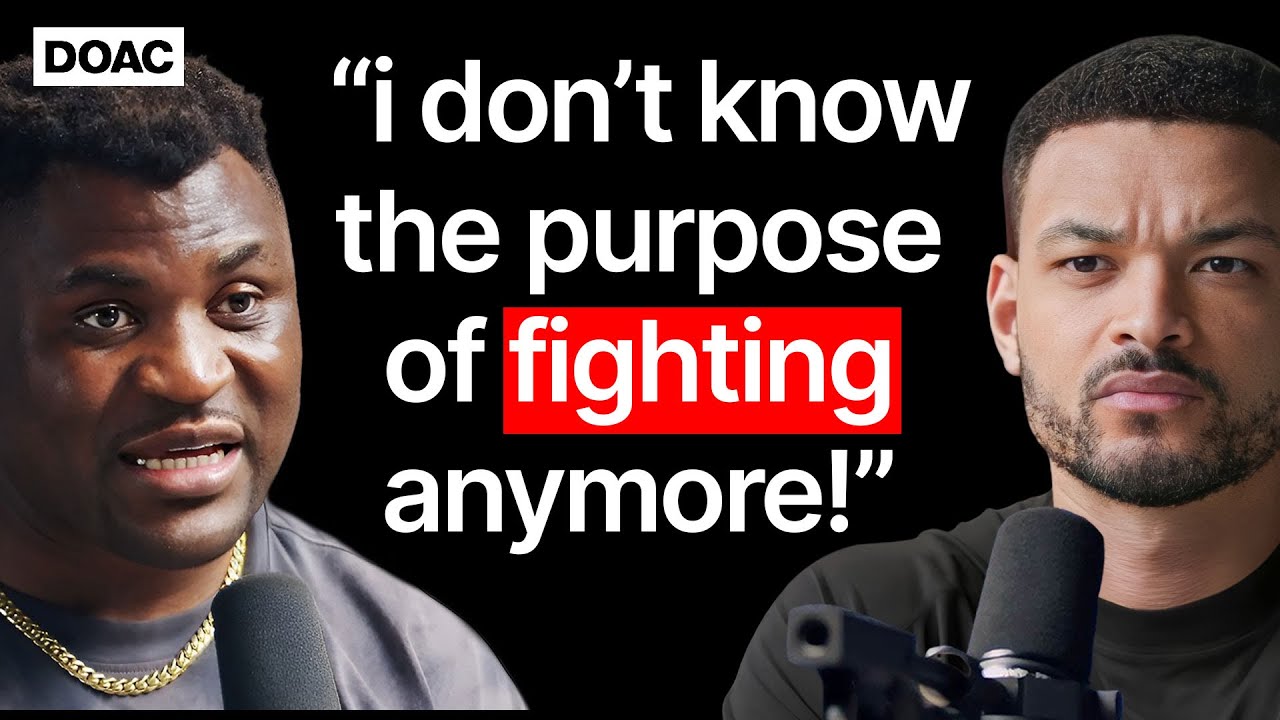
The Diary Of A CEO
Francis Ngannou states that leaving the UFC for boxing yielded greater financial compensation and personal freedom despite severe career obstacles and personal tragedy.
AI-assisted summary of Francis Ngannou Breaks Down Sharing Heartbreaking Story: “I Don’t Know How To Deal With This!” — original source. Check the original for full context.
Source published:
Detailed notes
## Background This interview was published by The Diary Of A CEO channel on YouTube on August 8, 2024. According to the page description, martial artist, professional boxer, and Lineal Combat Sports Heavyweight World Champion Francis Ngannou discusses his life story, covering his early childhood struggles, his journey to becoming a world champion, contract disputes, and coping with the loss of his baby son.
## TL;DR Francis Ngannou details his harrowing migration journey from Cameroon to Europe, including surviving the Sahara Desert, hiding in forests, and taking life-threatening sea crossings before reaching Paris. After transitioning to MMA and capturing the UFC Heavyweight title, he chose to walk away from lucrative contracts to stand up for his freedom and fighter rights. He reflects on his high-profile boxing matches against Tyson Fury and Anthony Joshua, while sharing his grief following the sudden death of his 15-month-old son, Kobe.
## Atmosphere & style The interview has a deeply intimate, raw, and vulnerable atmosphere as Ngannou opens up about his immense personal struggles. The mood shifts from solemn resilience when recounting his brutal journey through North Africa to resolute independence when discussing his stand against the UFC. Throughout the conversation, his candid vulnerability surrounding grief creates a poignant and reflective emotional arc.
## Key takeaways - [02:13](https://www.youtube.com/watch?v=4mmLOoloH3E&t=133s) Francis Ngannou survived severe hardship and extreme poverty in rural Cameroon, working from a young age on less than $1,000 a year while holding a dream of becoming a professional boxer. - [25:10](https://www.youtube.com/watch?v=4mmLOoloH3E&t=1510s) Ngannou undertook a harrowing multi-year journey through the Sahara Desert and North Africa to reach Europe, describing border crossings like the Algerian desert as near-equivalent to a death sentence. - [51:34](https://www.youtube.com/watch?v=4mmLOoloH3E&t=3094s) During his final sea crossing attempt on April 2, 2013, Ngannou served as boat captain and used strategic tactics like wrapping the vessel in foil to evade radar before making a distress call to the Red Cross. - [01:02:40](https://www.youtube.com/watch?v=4mmLOoloH3E&t=3760s) Upon reaching Spain, Ngannou spent 53 days in an immigration detention center after destroying his personal identity documents to prevent forced deportation back to Cameroon. - [01:05:09](https://www.youtube.com/watch?v=4mmLOoloH3E&t=3909s) Arriving in Paris in June 2013 homeless and with only 50 euros, Ngannou received crucial support from boxing coach Didier Carmont, who provided free training, gear, and temporary housing. - [01:09:55](https://www.youtube.com/watch?v=4mmLOoloH3E&t=4195s) Lacking legal identity papers in France, Ngannou transitioned to Mixed Martial Arts under Fernand Lopez at the MMA Factory, quickly developing a reputation so formidable that European heavyweights refused to fight him. - [01:14:00](https://www.youtube.com/watch?v=4mmLOoloH3E&t=4440s) After making his UFC debut in 2015, Ngannou overcame a early title loss to Stipe Miocic by learning proper athletic training, eventually winning the UFC Heavyweight Championship in their 2021 rematch. - [01:16:51](https://www.youtube.com/watch?v=4mmLOoloH3E&t=4611s) Despite holding the UFC Heavyweight belt, Ngannou faced severe financial strain and reliance on personal loans, while his efforts to secure US visas for his mother were repeatedly denied. - [01:21:50](https://www.youtube.com/watch?v=4mmLOoloH3E&t=4910s) In January 2023, Ngannou vacated his title and parted ways with the UFC, refusing to sacrifice his freedom or compromise on core fighter demands such as healthcare options and guaranteed fight frequency. - [01:30:08](https://www.youtube.com/watch?v=4mmLOoloH3E&t=5408s) Ngannou's transition into high-profile crossover boxing yielded significantly higher earnings from a single bout against Tyson Fury than his entire career under UFC contracts. - [01:36:30](https://www.youtube.com/watch?v=4mmLOoloH3E&t=5790s) Reflecting on his match against Anthony Joshua, Ngannou noted unfair locker room delays and scheduling disruptions that severely impacted his physical preparation compared to the fair conditions of the Fury fight. - [01:42:57](https://www.youtube.com/watch?v=4mmLOoloH3E&t=6177s) Following the tragic and unexpected death of his 15-month-old son Kobe, Ngannou resolves to continue competing in MMA and boxing to honor his son's memory rather than stepping away from combat sports.
## Detailed walkthrough ### [00:00](https://www.youtube.com/watch?v=4mmLOoloH3E&t=0s) The Core Fuel: Fighting for a Purpose The walkthrough opens with Francis Ngannou reflecting deeply on the true meaning of his resilience. He questions the purpose of being tough and enduring relentless battles if he ultimately cannot protect or fight for the people who truly matter to him. This internal drive anchored his path from a very young age. At just 13 years old, growing up in severe poverty in Cameroon without shoes, adequate food, or a gym anywhere near him, he made a definitive, iron-clad choice to become a professional fighter. To realize this grand dream, he knew he had to leave his home country behind.
His subsequent journey to Spain was fraught with extreme danger. Ngannou describes reading about the high mortality rates of those attempting the journey, recalling how travelers were forced to drink water contaminated with dead animals simply to survive. He recounts making six separate attempts to cross the ocean in a dinghy and repeatedly trying to scale a heavily fortified barbed-wire fence, which he describes as the absolute toughest physical and mental trial of his migration. When asked why he never gave up, Ngannou explains that a dream of that magnitude leaves no room for quitting. The relentless struggle finally paid off the day he arrived in Paris, marking the official beginning of his ultimate quest to become the heavyweight champion of the world.
### [00:06](https://www.youtube.com/watch?v=4mmLOoloH3E&t=6s) Defying the UFC and Facing Tactical Hurdles The conversation shifts to the high-stakes world of professional combat sports, touching upon Ngannou's highly publicized departure from the UFC. He addresses the rumors directly, stating that his exit stemmed from a major contractual disagreement with UFC President Dana White, who was unwilling to accommodate his terms. Moving forward to his subsequent high-profile boxing match against Anthony Joshua, Ngannou openly points out a vast amount of structural unfairness surrounding the event. He describes the environment as incredibly messy and asserts that promotional or organizational "tricks" were intentionally deployed against him to disrupt his performance.
The emotional gravity of the interview deepens significantly as Ngannou touches upon the profound cruelty of life, specifically the devastating loss of his baby son. He admits that his son's passing was the first time in his life he felt like an absolute failure, leaving him struggling to process an overwhelming sense of grief. Before diving fully into his upbringing, host Steven Bartlett pauses briefly to remind viewers of an ongoing *The Diary of a CEO* subscriber raffle. He encourages listeners to hit the subscribe button before the channel hits 7 million subscribers to win exclusive prizes, promising to announce the winners in the comments section below.
### [02:13](https://www.youtube.com/watch?v=4mmLOoloH3E&t=133s) Surviving on Less Than $1,000 a Year in Rural Batié Bartlett takes Ngannou back to a foundational memory, recalling a hotel room meeting in Paris where they shared their early life stories alongside football legend Thierry Henry and a few others. Bartlett notes that despite interviewing people for a living, he had never heard a story quite like Ngannou's. He prompts the fighter to paint a picture of what life looked like in West Cameroon back in 1986. Ngannou describes his home environment in the village of Batié as a constant, grueling struggle for survival. His father worked intermittently as a carpenter, while his mother had no steady employment, resorting to cooking food and selling small goods in local markets whenever the opportunity arose.
When Bartlett mentions reading that the average annual income in West Cameroon at the time was roughly $1,500, Ngannou laughs it off, stating that $1,500 would have been an absolute fortune. In reality, his family survived on significantly less than $1,000 a year. The village, which has since grown to a population of 20,000 to 30,000 people, was home to about 11,000 residents during his childhood. Looking at old photographs brought into the studio, Ngannou points out an image of himself and his mother in their old kitchen, explaining that after winning the UFC Heavyweight Championship title, he intentionally went back to place the championship belt in that exact spot to prove to himself that anything is possible. Bartlett describes the structure in the photo as a mud hut with dirt floors. Ngannou confirms this, explaining that mixing mud to form bricks was the cheapest way to build a home, and the "chairs" they sat on were simply rough blocks of wood.
### [06:17](https://www.youtube.com/watch?v=4mmLOoloH3E&t=377s) Fueling Ambition from an Unhappy Childhood Ngannou states unequivocally that his childhood was not happy, yet he credits those exact hardships with shaping the man he is today. He recalls feeling immense anger and resentment as a child because his family lacked basic necessities, such as toothbrushes, schoolbooks, or even kerosene to fill their household lamp. The photograph of the kitchen displays an open wood fire surrounded by rocks. Ngannou reveals that he used to bring his schoolbooks right up to the cooking flames at night, using the flickering firelight to read his lessons because the family could not afford regular fuel.
Going to school was a source of constant embarrassment for Ngannou. He and his siblings routinely walked barefoot or wore heavily patched, deteriorating shoes and torn pants. Teachers frequently kicked him out of the classroom because he lacked basic supplies like pens and notebooks, or because his family fell behind on standard school fees. During lunch breaks, while other children ate, Ngannou would isolate himself because he had no food. Reflecting on wealthy people who claim that money cannot buy happiness, Ngannou rejects the sentiment with a touch of humor, saying, "Give me the money and then keep the happiness," noting that having lived extensively without money, he knows exactly how miserable it truly is.
### [09:50](https://www.youtube.com/watch?v=4mmLOoloH3E&t=590s) The Sand Mines and a Turning Point at Age 13 Despite the immense adversity, Ngannou refuses to view his childhood self as being at the "bottom," believing he possessed a natural gift for handling pressure. At just 9 years old, he began working heavy manual labor in a local sand quarry—a sand mine built into the mountainside where he used a shovel to dig and load sand all day long. This brutal work ethic gave him a surprising sense of internal superiority over his wealthier peers. He realized that while other children had more material goods, they had not earned them, whereas he deeply understood the value of every single thing he worked for.
A definitive turning point occurred when he was 13 years old. Around 3:00 PM on a school day, he was publicly kicked out of the classroom yet again for unpaid annual tuition fees. Furious, humiliated, and fighting back tears, he promised himself that he would completely change his life and prove his worth to everyone who looked down on him. Recognizing that he had to achieve far more than the average person just to be noticed, he resolved that day to become a professional boxer. Although he loved martial arts like karate, he specifically chose combat sports because he needed a path that could provide real financial security for his family. The challenge was immense: there was not a single gym within a 50-mile radius, and he had never even seen a proper gym in person. He remained stuck in the village working until he was 22 years old, at which point he sold his meager belongings and moved to the city to finally take action.
### [14:39](https://www.youtube.com/watch?v=4mmLOoloH3E&t=879s) Growing Up in the Shadow of a Violent Father Ngannou opens up about his complex relationship with his father, calling him "the example for me of what not to do." He views his father's flaws as a strange blessing; seeing the destructive path his father took ensured that Ngannou did not replicate it, even though he still loved him dearly. His father was an exceptionally strong man who did not know how to channel his physical power constructively. Whenever arguments arose in their neighborhood, his father would resort to street fighting. Because he was so strong, he easily beat people up, making his opponents the victims and cementing his own reputation as a feared local "bad guy."
This negative legacy cast a dark shadow over Ngannou's youth. His parents divorced when he was only 6 years old, and he was sent to live with various aunts and extended family members. Throughout his childhood, people would constantly look at him and whisper, "He's must be like his father," whenever he showed any sign of assertiveness. This comparison infuriated Ngannou. He was naturally drawn to physical strength, power, and fighting, but he completely rejected the lawless reputation of a street thug. This drove him directly toward organized boxing and combat sports, where strict rules meant that winning a match brought celebration and honor rather than community shame and blame. He notes that his father's violence was not contained to the streets; it spilled into their home as well, resulting in physical abuse directed toward both his mother and the children, a reality that was unfortunately common in many families in Africa at that time.
### [17:51](https://www.youtube.com/watch?v=4mmLOoloH3E&t=1071s) The Trauma of a Powerless Loss His father passed away when Ngannou was 15 years old. Although his father had not been a consistent, active presence in his daily life by that point, the death inflicted a severe emotional wound. His father fell gravely ill at home and spent months completely bedridden, unable to use the restroom without assistance. Without the financial means to afford a hospital visit, Ngannou had to watch one of his father's legs physically rot away until he finally died. This horrific experience left a permanent scar on Ngannou, instilling a deep terror of being completely powerless in the face of medical emergencies.
The financial helplessness haunted him for years. He routinely wondered if his father could have been saved if they simply had the money to pay for proper medical treatment. Following the death, a teenage Ngannou suffered from persistent, vivid nightmares for months, frequently waking up to the imagined sounds of his father screaming in agonizing pain. A few years later, looking at his mother, Ngannou was gripped by a sudden panic over what he would do if she or his siblings fell seriously ill. This absolute terror acted as the final catalyst, convincing him that he had to take massive, immediate action to secure enough wealth to provide decent healthcare for his loved ones, ensuring that no one else in his family would ever have to suffer and die at home in the dark.
- **Family Living Expenses:** The Ngannou family survived on well under $1,000 USD per year in 1986. - **Quarry Work:** Francis began performing grueling manual labor digging sand in a mountain quarry at the age of 9. - **Gym Deficit:** There were zero training facilities or boxing gyms within a 50-mile radius of his childhood village. - **Parental Separation:** His parents divorced when he was 6 years old, leading to a transient childhood spent living with various relatives. - **Age of Departure:** Ngannou stayed in his rural village until the age of 22 before moving to the city to pursue boxing.
[21:42](https://www.youtube.com/watch?v=4mmLOoloH3E&t=1302s) Reflecting on His Father and Creating the "Perfect Table"
Francis Ngannou looks back on his father's death, admitting that he constantly wonders what life would have been like if his dad were still around today. He questions what his father would say or feel seeing his family's success. Growing up in extreme poverty, Ngannou's family never had a dining table to sit together and eat. In recent years, after earning enough to live comfortably, he has intentionally replicated that missing piece of his childhood by buying nice houses with large dining tables.
He describes gathering his family around the dining table for meals. Even though it brings him immense joy and gratitude to be surrounded by his loved ones, he often sits in silence, staring at the empty spaces and feeling the void of the one person who is missing. In those quiet moments, he realizes that his father's presence is the only thing that could have made it a "perfect table."
- Replicates family dining experiences in his current homes because they lacked a dining table growing up. - Expresses a recurring sense of grief and longing for his deceased father during family gatherings.
---
[22:52](https://www.youtube.com/watch?v=4mmLOoloH3E&t=1372s) Early Ambitions, Leaving Batié, and Moving to Douala
From a very young age, Ngannou dreamed of a vastly different life. He recalls being completely obsessed with America as a boy—so much so that he gave himself the nickname "American Boy" and demanded that other kids call him by that name. Growing up in the small village of Batié, Cameroon, his options were strictly limited. At age 17, he was forced to drop out of secondary school simply because he could no longer afford to pay for his education.
It was not until the age of 22 that Ngannou made the pivotal decision to leave Batié and move to Douala, Cameroon's largest city, in search of a boxing gym. Prior to that move, he had never stepped foot inside a gym. He spent four years in Douala trying to pursue the sport, but by the time he was 26, he reached a stark realization: he would never be able to make it as a professional boxer if he stayed in Cameroon. Knowing he needed a world-class stage where boxing was developed, he knew he had to leave the country. Because traveling directly to America was virtually impossible without money or a visa—and swimming across the Atlantic was out of the question—he determined that the only viable pathway was to reach Europe.
- **Nickname:** Called himself "American Boy" during childhood due to his obsession with the U.S. - **Village of origin:** Batié, Cameroon. - **Age 17:** Forced to leave secondary school due to a lack of financial means. - **Age 22:** Moved to Douala, Cameroon, and entered a boxing gym for the very first time. - **Age 26:** Left Cameroon after realizing the country lacked the infrastructure for a professional boxing career.
---
[25:10](https://www.youtube.com/watch?v=4mmLOoloH3E&t=1510s) Leaving Cameroon and the Overland Journey to the Sahara
In April 2012, at approximately 25 or 26 years old, Ngannou embarked on an arduous overland journey to reach Europe, intending to cross into Spain. His trek began by taking a bus from Douala to Yaoundé, followed by a train ride to northern Cameroon. From there, he and other migrants boarded small, unmarked vehicles specifically driven by local coyotes who knew how to bypass police checkpoints along the borders.
``` Douala (Bus) ➔ Yaoundé (Train) ➔ North Cameroon (Clandestine Car) ➔ Yola, Nigeria ➔ Kano, Nigeria ➔ Niger ➔ Algeria ➔ Morocco ```
He crossed from northern Cameroon into Yola, Nigeria, traveled up to Kano, and then pushed north through Niger toward Algeria and Morocco. The most treacherous leg of the journey involved crossing the vast Sahara Desert, where 25 people were crammed tightly into the back of an open pickup truck. Ngannou acknowledges that his group was remarkably lucky; their vehicle did not break down, and they made it across the desert in a single grueling 20- to 22-hour non-stop drive. All along the desert route, the landscape was littered with human skeletons—the remains of migrants whose vehicles had broken down or who had succumbed to the heat. Ngannou recalls learning to just look away whenever they passed a body.
To finance this dangerous journey, Ngannou relied on small savings he had scraped together over years of manual labor. Because extortion and robbery by smugglers and armed bandits were rampant along the migrant trails, he left the bulk of his money behind in Cameroon with his younger sister. As he traveled from one leg of the route to the next, he would place phone calls back home to have small increments of money wired to him until his funds were entirely exhausted.
- **Departure date:** April 2012. - **Route taken:** Douala $\rightarrow$ Yaoundé $\rightarrow$ Northern Cameroon $\rightarrow$ Yola (Nigeria) $\rightarrow$ Kano (Nigeria) $\rightarrow$ Niger $\rightarrow$ Algeria $\rightarrow$ Morocco. - **Desert crossing:** 25 people crammed into the back of a single pickup truck for a 20- to 22-hour drive across the Sahara. - **Financial strategy:** Entrusted his sister in Cameroon with his savings, having her wire small amounts periodically to avoid losing everything to smugglers.
---
[28:21](https://www.youtube.com/watch?v=4mmLOoloH3E&t=1701s) Surviving Dehydration in Algeria and the Mindset of Hardship
Upon surviving the desert drive and arriving at Tamanrasset in southern Algeria, Ngannou's group faced extreme dehydration, having run out of drinking water hours earlier. They located an almost depleted, stagnant water well. The water at the bottom was filthy, filled with decaying animal carcasses, rotting leaves, and debris. Faced with a immediate death from dehydration or the potential future illness from contaminated water, Ngannou drank it without hesitation. As he puts it: "die now or die a little later."
> "Whether I drink the water and if it has to kill me, it kills me later, or I just die now by dehydration... When that's the only two choices, it's easy to choose one: die now or die a little later."
Reflecting on how these extreme conditions shaped his resilience compared to people in the Western world, Ngannou observes that growing up in Africa teaches you from early childhood that "you are not counting on nobody." He notes that while Western societies face hardship, severe issues like childhood famine and sleeping without food are widespread in Africa. That harsh reality instills a self-reliant mindset: you do not wait for help, and you do not complain about opportunities. Coming from a place where survival is fought for daily, Ngannou views any opportunity in the West not as a handout, but merely as a bridge to reach the ambitious goals he set for himself.
- **Location of water well:** Tamanrasset, southern Algeria. - **Key mindset:** Realizing early in life that no one is coming to save you, forcing absolute self-reliance.
---
[32:27](https://www.youtube.com/watch?v=4mmLOoloH3E&t=1947s) Scavenging Food in the Forests of Morocco
After crossing Algeria, Ngannou reached Morocco, where he would spend nearly an entire year stranded while attempting to enter Europe. With no legal status, money, or shelter, he lived in the wild—most notably in the dense Forest of Mount Gurugu near the Spanish enclave of Melilla. Survival in the forest meant enduring constant exposure to the elements and hiding from undercover Moroccan police officers who actively hunted migrants.
To eat, Ngannou and his companions had to develop survival tactics. At night, when under cover of darkness, they would venture out of the forest and sneak into local market trash dumps. They scavenged through discarded waste to find rotting tomatoes, old potatoes, and chicken feet. Ngannou mentions with a laugh that chicken feet were considered "the best for us" because local shoppers didn't eat them, leaving intact meat in the garbage. They would carry these scraps back to their forest hideouts to cook makeshift meals.
Throughout this entire period of intense suffering, hunger, and homelessness, Ngannou stayed completely focused on his dream of becoming a world-champion boxer. He had no formal training equipment, so he spent his days in the woods doing push-ups and core workouts to stay in shape. He admits he had no actual proof that he possessed elite boxing talent, but he was driven by an unshakeable need to test himself: "The most important thing is to try and give it all, and if it doesn't work, then well, we reset."
- **Duration in Morocco:** Almost one full year living outdoors in forests and deserts. - **Primary camp location:** Mount Gurugu forest, overlooking the border fence of Melilla. - **Diet:** Scavenged discarded tomatoes, potatoes, and chicken feet from market trash heaps at night. - **Fitness routine:** Performed basic bodyweight exercises (push-ups and sit-ups) in the forest to stay fit for boxing.
---
[35:46](https://www.youtube.com/watch?v=4mmLOoloH3E&t=2146s) Braving Barbed Wire Fences and Border Patrols
To cross from Morocco into European territory, migrants faced two primary overland barriers: scaling the massive border fences surrounding the Spanish enclaves or attempting to cross the sea in small boats. Ngannou describes the perimeter surrounding Melilla as a brutal defense system consisting of three parallel fences standing 7 meters high, heavily fortified with sharp barbed wire and surrounded by deep trenches filled with entangled razor wire.
``` [Moroccan Side] ➔ 20-30m Guard Posts ➔ 5m Wire Trenches ➔ Three 7m Fences with Razor Wire ➔ [Spanish Side] ```
To attempt an "attack" on the fences, the migrants had to organize meticulous reconnaissance. They assigned designated "lookout guys" who watched the border for days from a distance. These lookouts tracked the 8-hour guard shifts, noted which guard boxes along the 20-to-30-meter intervals were left unmanned, observed when trucks arrived for shift changes, and recorded when the guards stepped away to pray. They searched for any weakness, such as sections where razor wire had fallen or was missing.
When a group finally charged the perimeter, the reality on the ground was often chaotic and lethal. Ditch barriers dug 5 meters wide and filled with razor wire were invisible from a distance. When the front line of migrants suddenly halted upon seeing the wire, the momentum of hundreds of people rushing behind them would violently push the front runners directly into the razor wire. Ngannou attempted to scale the razor wire fences multiple times, leaving him with permanent physical scars across his face, stomach, feet, and hands. On one attempt, as the razor wire tore into his face and hands, Ngannou made a conscious decision to back down, realizing he would rather be alive outside of Europe than die tangled on a fence.
- **Fence specifications:** Three parallel fences, 7 meters (approx. 23 feet) high, reinforced with razor wire and 5-meter-wide wire-filled trenches. - **Guard presence:** Guard boxes stationed every 20 to 30 meters on 8-hour rotating shifts. - **Scars:** Sustained deep cuts and lasting scars across his hands, fingers, stomach, and face from razor wire.
---
[41:55](https://www.youtube.com/watch?v=4mmLOoloH3E&t=2515s) Becoming the "Captain" of an Inflatable Rubber Dinghy
After realizing the border fences were virtually impassable, Ngannou turned his focus to the ocean, attempting to cross the Mediterranean Sea to Spain in an inflatable rubber boat. These were not proper maritime vessels, but cheap, flimsy inflatable dinghies meant for backyard swimming pools, purchased directly from retail stores like Walmart.
Despite not knowing how to swim, Ngannou stepped up to become the designated "captain" of the dinghy. His leadership skills, physical presence, and navigational ability made him the ideal candidate to organize the risky operation. As captain, he was responsible for coordinating up to 10 people at a time, managing the logistics of carrying the boat from hidden land positions to the water, paddling synchronized in the dark, and maintaining order on the sea. Over time, through repeated attempts, he considers himself to have become an "expert" boat captain—even though his inability to swim meant that capsizing would likely mean drowning.
In total, Ngannou made six separate attempts to cross the sea in an inflatable dinghy. During most of these attempts, his boat was intercepted by Moroccan border patrols. Whenever they were caught, the authorities did not simply send them back to their camps in Morocco; instead, they loaded the migrants onto vehicles and dumped them deep out in the desert, forcing them to walk all the way back to square one to start the entire process over again.
- **Equipment:** Small, pool-grade inflatable rubber dinghies carrying around 10 people. - **Role:** Served as the boat "captain" responsible for navigation and group coordination, despite not knowing how to swim. - **Sea attempts:** Attempted to cross the sea six times, repeatedly getting caught and dumped out in the desert by border guards.
<ElicitationsGroup message="To explore more of Francis Ngannou's story from this interview:"> <Elicitation label="Walkthrough Part 3: Detention, Paris, and UFC breakthrough" query="Provide a detailed walkthrough of Part 3 of the Francis Ngannou Diary of a CEO interview transcript covering his detention, arriving in Paris, sleeping rough, meeting his coach, and his UFC rise."/> </ElicitationsGroup>
[43:31](https://www.youtube.com/watch?v=4mmLOoloH3E&t=2611s) Living Under the Constant Threat of Deports and Endless Attempts
Francis describes the brutal reality of being caught by Moroccan authorities. The guards are funded by external bodies, like the European Union, to keep migrants from reaching Europe. When migrants are apprehended, guards write a report and immediately dump them back out at the Algerian border in the desert without food or water, leaving them to figure out their own survival. Reflecting on those moments, Francis expresses disbelief at how anyone managed to survive, calling the situation "pretty horrible" and noting that even today, people are still trapped in that same desperate cycle.
When asked why he didn't give up after failing to climb the barbed-wire fences and failing six times in an inflatable boat, Francis responds candidly: give up and go back to what? Returning to Cameroon or struggling in Morocco was not an option. His dream was so overpowering that it blinded him to the immense dangers in front of him. In hindsight, he admits that taking those risks was almost like a "death sentence" and that he simply got lucky coming out alive. However, at the time, he couldn't face himself in the mirror or bear the thought of going back to live in powerlessness, watching a future child fall sick without the means to help them.
* **Border Expulsions:** Apprehended migrants were dropped off at the Algerian border desert without food or water. * **Driven by Dream:** Francis notes his dream was to build a boxing career and establish financial stability so his future children would never experience his hardships.
---
[47:25](https://www.youtube.com/watch?v=4mmLOoloH3E&t=2845s) The Failed Sixth Attempt and the Cold Winter in the Forest
Recalling his sixth attempt, Francis explains that they were extremely close to reaching the other side after paddling in the ocean for three hours. However, a military ship—not even the Coast Guard, but a large passing army vessel—spotted them and turned them back. By that time, winter was fast approaching, turning the sea into an unstable, dangerous "monster" with massive rising waves and freezing temperatures. Realizing that taking a tiny inflatable boat into freezing waters meant certain death from hypothermia, he retreated back to the forest to wait out the winter.
Francis spent months living in the forest. As winter neared its end, a friend named Ito reached out from Tangier saying he had a ship ready. Francis tried to reach the bus station to join him, but heavy police presence forced him to hide out. The next day, after evading the police from 4:00 a.m. to 4:00 p.m., Francis checked his phone and saw 12 missed calls from Ito. He soon learned that Ito's group had successfully crossed to Europe. Frustrated that he had missed his chance, Francis knew he couldn't stay in hiding any longer.
> "The day that I'm touching the ocean again, I'm not coming back ever... my frustration was top to the level."
* **Near Miss:** The sixth attempt lasted over 3 hours of paddling before an army ship intercepted them. * **Winter Survival:** Spent months living in the forest near the border due to severe winter sea conditions and freezing cold. * **Missed Opportunity:** Missed 12 calls from his friend Ito, who successfully reached Europe while Francis was evading police from 4:00 a.m. to 4:00 p.m.
---
[51:34](https://www.youtube.com/watch?v=4mmLOoloH3E&t=3094s) Assembling the Final Attempt and Taking Command as Captain
Determined to make his next try count, Francis reconnected with a contact who already had a boat. He traveled from Nador to Rabat to meet up with the group. The group wanted to wait until Saturday to get paid from their construction jobs, but Francis's "blood was boiling" with urgency, and he refused to wait. Seeing his intensity, the group's leader agreed to go with him immediately to Tangier to inspect the site while the others waited for the signal.
Upon stepping off the bus in Tangier, Francis suddenly fell ill with a severe fever. To reach their shelter, they had to take off their shoes and walk through thick mud. Despite being sick, Francis kept his condition hidden because he was chosen as the group's "captain." His reputation preceded him—others in Tangier referred to him as "Van Damme" and believed that if he was captain, the crew was guaranteed to make it safely across.
* **Evasive Tactics:** Learned over time that migrants used silver foil wrap to disrupt radar and infrared detection from border patrol ships. * **Role of the Captain:** In migrant groups, the captain is shielded from heavy physical labor before launching so their energy is conserved for navigating the ocean.
---
[55:05](https://www.youtube.com/watch?v=4mmLOoloH3E&t=3305s) Launching into the Ocean on April 2nd, 2013
Francis monitored weather patterns daily on the internet, analyzing wind speed and directions until he identified a clear window on April 2nd, 2013. He instructed the group to bring the inflatable boat directly to the launch point so they wouldn't risk holding it in a shelter where police frequently conducted raids. Upon arrival, they spotted a police car nearby and had to make a grueling, night-long detour to reach a new launch point. During the detour, when someone lagged behind carrying the raft, Francis took charge of the raft himself to ensure it wouldn't be abandoned.
They arrived at a steep, rocky section of the coast instead of a smooth sandy beach. With waves crashing violently against sharp rocks, Francis searched through the darkness and miraculously found a flat, smooth spot among the rocks just big enough—the exact size of a table—to inflate the boat without puncturing it. They aimed to launch right around the 5:00 a.m. call to prayer when security would be minimal.
* **Launch Date:** April 2nd, 2013. * **Group Size:** A total of 9 people were on the small inflatable boat. * **Finding the Spot:** Located a smooth, rock-free patch of ground barely the size of a table to safely inflate the boat.
---
[59:09](https://www.youtube.com/watch?v=4mmLOoloH3E&t=3549s) Calling the Red Cross and Being Rescued at Sea
After paddling for about an hour and a half to two hours, the group got deep into the ocean, far from the Moroccan coast. Seeing a helicopter hovering above them, Francis realized they needed to act before the situation turned against them. Using a phone, they called the Red Cross base in Spain to report their position. When the operator asked who was on board, Francis claimed there were women and children on the boat—even though there were only men—knowing it would prioritize their rescue and prevent them from being left behind or handed back to Moroccan authorities.
Shortly after the call, rain began to pour and the sea turned chaotic. Francis describes how the open ocean shifted from appearing flat at the coast to forming massive, mountain-like waves that their tiny boat had to climb up and down. Within 15 to 20 minutes of the call, a sturdy Red Cross rescue ship located them in the rough waters and brought all 9 men safely aboard, taking them toward Spain.
> "In the middle of the ocean when they say 'where are you, what are you seeing?' you can't really give them a direction... ocean has mountains, like there's a way that you're climbing until you get to the peak, and then going down."
* **SOS Strategy:** Lied to the Red Cross operator that women and children were aboard to ensure an urgent rescue response. * **Rescue Time:** The Red Cross rescue vessel arrived within 15 to 20 minutes after the phone call.
---
[01:03:42](https://www.youtube.com/watch?v=4mmLOoloH3E&t=3822s) Detained in Spain: 53 Days in a Detention Center
Upon arriving in Spain, Francis and the group were placed in a immigration detention center, where he remained locked in a cell with other men for 53 days. While they were provided with food every day, Francis notes that the experience was essentially a prison sentence. Guards controlled every aspect of their routine—dictating when to eat, shower, sleep, and go outside.
Initially, Francis was thrilled simply to have survived and reached European soil. However, as weeks went by, the complete lack of autonomy weighed heavily on him, making him miss the chaotic freedom he had possessed in Morocco despite the hardships. To protect his identity from immediate deportation back to Cameroon, Francis had thrown away all personal papers, receipts, and identification into the ocean the moment he saw the Red Cross approaching.
* **Detention Duration:** Held for 53 days in a Spanish immigration detention center. * **Disposing Identification:** Threw all receipts, documents, and identification into the sea before rescue so authorities could not easily identify his country of origin for deportation.
[01:05:14](https://www.youtube.com/watch?v=4mmLOoloH3E&t=3914s) Sleeping in a Paris Parking Lot and Finding Didier Carmont
After being released from the Spanish detention center following almost two months, Francis was taken in by a local charity organization for refugees. Upon gaining his freedom in Spain with just 50 euros in his pocket, he initially contemplated traveling to the UK. However, realizing the UK was not part of the Schengen Zone and free circulation would not permit entry, he considered Germany because boxing was popular there. Ultimately, he fell in with a group of migrants heading to France. On June 9, 2013, at 26 years old, Francis arrived in Paris. On his very first night in the city, having no money or accommodations, he slept outdoors in a car park—a situation that became his reality for two full months.
Determined to pursue the dream he had carried for a decade, Francis set out the very next morning to find a boxing gym. He walked up to the front desk, but upon looking at the fee schedule, he realized he could not afford to train. He asked to speak directly to the boxing coach, but was told the main coach was away. Instead, he spoke to the substitute coach, Didier Carmont. Francis was completely straightforward: he explained that he had arrived in Paris the previous day, was sleeping on the street, and had no money, but begged for a chance to train because he was going to become a world champion. Didier asked for his phone number, promising to speak with the head coach when he returned on Wednesday. On Thursday morning, Didier called to tell Francis he could begin training that Saturday.
- **Didier Carmont's generosity:** Didier spoke to the head coach on Francis's behalf, secured his free training, bought him a new pair of shoes, and eventually handed him the keys to an apartment he used for short-term rentals, allowing Francis to stay there free for nearly two months. - **Didier's mindset:** When asked why he helped, Francis recalled that Didier was simply a genuine, kind person who expected nothing in return, often reminding Francis, "You don't have to tell your story to everybody; they don't need to know your situation."
[01:10:52](https://www.youtube.com/watch?v=4mmLOoloH3E&t=4252s) Transitioning to MMA and Becoming Too "Brutal" for European Heavyweights
Because Francis lacked legal identity papers in France, becoming a professional boxer was nearly impossible. Didier Carmont suggested that he take up mixed martial arts (MMA) as a way to earn quick money. At the time, Francis had never heard of MMA. When Didier explained that it combined boxing, wrestling, and grappling, Francis remembered seeing it on television once but initially rejected the idea, telling him, "Bro, nah... I want the Mike Tyson boxing." Nevertheless, in June 2013, Francis went to the MMA Factory in Paris and introduced himself to coach Fernand Lopez.
Within four months, Francis fought his first professional MMA bout. He quickly compiled a record of five fights in Europe, but soon found himself completely unable to book opponents. His reputation grew so rapidly that European heavyweights refused to step into the ring with him. Fernand Lopez famously posted on Facebook asking, "Will anybody in Europe fight Francis?" Existing elite fighters saw no upside: Francis was still officially inexperienced, meaning a win over him gained them little, while taking the risk of facing his terrifying power could destroy their careers.
- **Motivation for early MMA fights:** Jobless and with unlimited free time, Francis trained in both boxing and MMA; taking local MMA fights earned him a couple hundred euros per fight, which was vital income at the time. - **Why opponents avoided him:** Promoters and fighters claimed Francis was simply "too brutal," to which Francis jokingly reflected, "It's a fighting game... the goal is to be brutal!"
[01:14:00](https://www.youtube.com/watch?v=4mmLOoloH3E&t=4440s) Signing with the UFC and Arriving in America on the "Red Carpet"
Francis's manager, Thiago Okamura (working alongside Fernand Lopez), pitched him to the UFC. Before long, despite having only five professional fights under his belt, Francis received a contract offer from the world's premier MMA promotion. His debut fight was scheduled for December 2015 in Orlando, Florida, marking his very first trip to the United States.
Arriving in America was a surreal experience that contrasted sharply with his perilous journey into Europe. When he stepped off the plane in Orlando, a driver was holding a sign with his name, escorted him to a Cadillac, and drove him directly to a high-end hotel residence. Overwhelmed by the moment, Francis immediately called his mother in Cameroon, telling her, "I don't know what it is, but I think your son has made it!" Reflecting on the contrast, Francis notes that while he entered Europe through the "service door," he entered America on the "red carpet."
- **UFC debut payout:** Francis earned $10,000 to show plus a $10,000 win bonus for his debut fight in Orlando, though taxes and corner commissions left him with roughly half. - **Focus over finance:** To Francis, the money mattered far less than the fact that he had finally reached America, fulfilling a lifelong dream nine years after leaving Cameroon.
[01:16:51](https://www.youtube.com/watch?v=4mmLOoloH3E&t=4611s) Becoming Heavyweight Champion and Reflecting on Growth
Francis made a meteoric rise through the UFC ranks, but experienced a major setback in 2018 when he lost his first title fight against Stipe Miocic. He explains that he had never grown up as an athlete or done structured sports, so he lacked basic knowledge on how to train, recover, or prepare for a five-round championship bout. Rather than being discouraged, he viewed that loss as the most valuable learning experience of his career, applying those lessons to completely rebuild his approach. In March 2021, Francis knocked out Miocic in their rematch to win the UFC Heavyweight Championship, holding the lineal title until his departure in early 2023.
Host Steven Bartlett points out that Francis holds the record for the hardest punch ever measured in the UFC—clocking in at 129,161 units, the equivalent of 93 horsepower (more than a Smart car's 80 horsepower). When asked if reaching the absolute peak of combat sports gave him a feeling of ultimate satisfaction, Francis explained his philosophy: reaching the top of one mountain only reveals a higher mountain beyond it. Real fulfillment comes from looking back at where he started rather than staring at the peak. Whenever he returns home to Cameroon, he walks the paths he took 15 years prior, marveling at how far he has come.
- **Mother's visa struggles:** Francis tried twice in 2019 to secure a US visa for his mother so she could watch him fight live, but she was denied both times. The process was so stressful and embarrassing for her that he vowed not to subject her to it again until entry could be easily guaranteed.
[01:21:50](https://www.youtube.com/watch?v=4mmLOoloH3E&t=4910s) The Contract Battle with Dana White and Choosing Freedom
In January 2023, Francis made the historic decision to walk away from the UFC while still holding the Heavyweight Championship belt, relinquishing the title due to unresolved contract disputes over fighter treatment, pay, and freedom. UFC President Dana White publicly claimed that Francis was leaving because he wanted to take less risk, fight lesser opponents, and make more money. Francis dismisses these claims as corporate spin, noting that if they spent the whole night discussing Dana White's statements, they would never agree.
Francis points out the absurdity of White's logic: leaving a comfortable, established career in MMA to step into a professional boxing ring against world heavyweight champions—having never competed in a professional boxing match in his life—is the exact opposite of taking "easy fights." Francis explains that Dana White simply refused to compromise on restrictive contract terms, leaving him with no choice but to walk away from the organization to regain control of his career and fulfill his lifelong boxing dream.
> "He has just to say something to get out of that situation... He didn't want to compromise, he didn't want to change, and I feel like that situation wasn't good for me. And I told myself, if that's the end, then let it be."
<FollowUp label="Want to hear about Francis's transition into boxing and his fights with Tyson Fury and Anthony Joshua?" query="Walk me through the next section of the transcript covering Francis Ngannou's fights with Tyson Fury and Anthony Joshua, and how he coped with the loss of his baby son."/>
Here is a detailed, faithful walkthrough of Part 5 of the transcript.
---
[01:24:06](https://www.youtube.com/watch?v=4mmLOoloH3E&t=5046s) Contract Battles and Choosing Freedom Over UFC Millions
Francis Ngannou recalls reaching a defining crossroad in his career where he had to decide whether to accept the UFC's terms or walk away. He was fully aware that refusing their offers could mean the end of his time in the organization, but he was resolute that any agreement had to be on his terms. He reflects on his mindset at the time, explaining that even if holding his ground meant returning to Africa to farm, he was completely at peace with that outcome because he has always loved farming. Driven by this conviction, he turned down massive sums of money despite being practically broke, living off loans, and lacking financial comfort. When the host expresses surprise that the Heavyweight Champion of the World was broke, Francis clarifies that while he was not entirely without funds, he was certainly not comfortably wealthy and had never made a million dollars for a single fight.
``` "I turned down a lot of money that I didn't have at time. I was for the most part I was broke, I was living out of loan... Freedom is not given... Freedom is not free, you have to give something in order to get that." ```
He refused to sign a contract that offered more money only to trap him in the exact same power dynamic for years to come. He viewed the proposed terms as a completely one-sided arrangement where he was forced to surrender all his rights and exclusivity while the promotion held zero obligations toward him. Specifically, Francis demanded structural fairness, such as healthcare coverage for fighters at his tier and a "guarantee of engagement"—a contractual obligation requiring the promotion to offer him a set number of fights per year. Without such a clause, the promotion possessed the leverage to intentionally starve fighters financially by withholding fights until they were forced to return, impoverished and begging for work, to sign unfavorable deals. Furthermore, the contract included clauses allowing the promotion to unilaterally extend a fighter's contract by six months for any reason—such as when a fighter turned down a fight offer due to injury or illness—without independent oversight. Faced with this dynamic, Francis chose to leave the UFC altogether, despite having no guaranteed backup plan or larger fighting league awaiting him.
* **Financial Status:** Francis had never made £500,000 or $1,000,000 in a single fight prior to leaving, surviving instead on loans during his championship run. * **Contractual Demands:** He fought for healthcare options and a guaranteed number of fights per year to prevent promotion-inflicted financial starvation. * **Unfair Contract Terms:** The UFC maintained exclusive rights in perpetuity under certain conditions and possessed sole discretion to extend a contract by 6 months if a fighter declined an offered bout for any reason (including injury).
---
[01:30:08](https://www.youtube.com/watch?v=4mmLOoloH3E&t=5408s) The Tyson Fury Fight and Financial Freedom
Leaving the UFC proved to be a gamble that paid off extraordinarily. Francis explains that he harbors no ill will toward the UFC, acknowledging that they simply run their business in a way that benefits them, just as he needed to do what was right for himself. After leaving, he achieved what many considered impossible by securing a high-profile crossover boxing match against Tyson Fury, the World Heavyweight Champion. Although Fury won on the judges' scorecards, Francis won the respect of the public, with many viewers believing he won the fight outright. From that single bout with Fury, Francis earned several times more money than he had made across his entire UFC career combined.
Francis points out that whether through the Tyson Fury fight or his deal with the PFL (Professional Fighters League), he knew that every fight going forward would dwarf his entire previous career earnings. He views the money he left on the table with the UFC as the literal price he paid to buy his personal and professional freedom. When the host brings up reports that Francis earned around £15 million (nearly $20 million) for his subsequent fight against Anthony Joshua, Francis chuckles, remarking that he hasn't counted it all yet and downplaying the exact figure. He offers a philosophical perspective on what "life-changing money" actually means, explaining that $1,000 can completely change or even save the life of a poor family by paying for a child's education or medicine, whereas $10 million given to a wealthy person changes nothing.
* **Tyson Fury Purse:** Francis earned substantially more from his single boxing match against Tyson Fury than from all of his UFC fights combined. * **Anthony Joshua Purse:** Media reports speculated earnings around £15 million ($20 million) for the Anthony Joshua bout. * **Perspective on Wealth:** Francis emphasizes that "life-changing money" depends entirely on where a person starts; $1,000 in rural Africa can save a family, whereas millions mean little to someone who is already wealthy.
---
[01:33:22](https://www.youtube.com/watch?v=4mmLOoloH3E&t=5602s) Why Francis Keeps Fighting: Martial Arts as a Lifelong Journey
When asked why he continues to fight now that he has secured financial wealth and no longer needs the money, Francis explains that his motivation was never purely financial to begin with. When he started out in combat sports, there was no money in it, and he fought numerous times completely for free. For him, the drive comes from a deep love for the sport and an unrelenting desire to push his limits and test his full potential. He believes it is a tragedy in life to leave one's full potential undiscovered, and he intends to give everything he has until he no longer feels the internal fire or excitement when waking up for morning training.
``` "I think whatever we do in life is a shame if we end up not really find our full potential or not giving it up... I'm going to give everything that I have, then I go home." ```
Francis draws a fundamental distinction between mere fighting and the practice of martial arts. While combat sports careers are naturally constrained by a short biological window—forcing fighters into retirement around age 40 or 42 just when traditional careers in other industries are peaking—martial arts itself is a lifelong discipline. He points to traditional martial artists in Karate, Kung Fu, or Taekwondo who practice well into their 60s, 70s, and 80s out of pure passion. As long as he continues to learn, improve, and feel excited about mastering new techniques, he intends to spend the remaining couple of years of his athletic window competing at the highest level.
* **Current Goal:** Testing his absolute limits and realizing his maximum potential rather than pursuing financial gain. * **Retirement Window:** Acknowledges that combat sports force an early retirement around age 40 to 42. * **Philosophy:** Views MMA not just as a business or a fight, but as a continuous martial art that demands lifetime dedication.
---
[01:35:31](https://www.youtube.com/watch?v=4mmLOoloH3E&t=5731s) Sponsored Break: ZOE Health Partner
The host delivers a brief personal endorsement for ZOE, a personalized nutrition and health program sponsored by the podcast. He highlights how the service uses personalized health data and clinical science—specifically referencing their gold-standard "METHOD study"—to guide daily food choices. The host shares that using ZOE over the past year has improved his energy, sleep, mood, and appetite control, and offers listeners a 10% discount using the promo code `CEO10`.
---
[01:36:30](https://www.youtube.com/watch?v=4mmLOoloH3E&t=5790s) Boxing Career and the Unfair Tactics of the Anthony Joshua Fight
Reflecting on his entry into professional boxing, Francis emphasizes that becoming a world champion in boxing was never his original target, given that he only made his boxing debut in October 2023 at 37 years old. Instead, his goal was simply to explore what was possible and answer questions about his capabilities. With only 11 years total of MMA experience behind him, he believes he still has immense room to learn, experiment, and grow as an athlete during the remaining years of his career.
``` "On that fight there was a lot of unfairness... Unlike the Tyson fight that everything was straight and I think nobody was giving me a chance and then everything was fair... the second one he was so messy, a lot of tricks." ```
The conversation then turns to his two high-profile boxing matches against Tyson Fury and Anthony Joshua. While the fight with Fury was conducted fairly and transparently, Francis reveals that the lead-up to the Anthony Joshua fight was filled with mental games, delays, and organizational "tricks." Throughout fight week, Francis was routinely picked up early and forced to wait 1 to 1.5 hours at promotional events before Joshua would arrive. On the day of the fight, the organizers picked Francis up at 10:30 PM under the pretense that he would be fighting around midnight or 1:00 AM. Upon arrival at the arena, producers told him the broadcast was running late and his fight would be delayed until 1:45 AM. However, Francis watched Joshua casually enter the arena at 1:30 AM—knowing full well that high-level boxers require roughly two hours in the arena to prepare.
These deliberate schedule manipulations left Francis sitting in his locker room for over 4.5 hours prior to the walkout. By the time he was scheduled to perform, the prolonged wait and unnatural timing caused him to feel overwhelmingly exhausted, to the point where he was literally falling asleep while attempting to warm up. His head coach recognized the tactic immediately and became furious, yelling at event organizers about how such delays are designed to make an opponent flat and tired. While Francis takes full accountability for the loss against a world-class opponent like Joshua, he views the outcome through the lens of these unfair circumstances and remains confident that he possesses the skills to defeat him in a fair fight.
* **First Boxing Match:** October 2023 against Tyson Fury at age 37. * **Locker Room Delay:** Francis was kept waiting in the locker room for 4.5 hours on fight night, arriving hours before Joshua. * **Physical Condition:** Experienced severe fatigue and was falling asleep in the locker room during warm-ups due to the deliberate scheduling manipulations.
Here is a detailed, faithful walkthrough based on the transcript provided:
### [01:43:21](https://www.youtube.com/watch?v=4mmLOoloH3E&t=6201s) Reflections on the Fight with Anthony Joshua and Tragic Loss Francis reflects on how surprisingly "easy" things felt surrounding his bout with Anthony Joshua, noting that he didn't feel like himself at all. Looking back, he believes his mistake was overperforming in his fight against Tyson Fury, which set an expectation for him to be defeated in a certain manner. However, after coming out of the Joshua fight and returning to planning his future, life dealt a devastating blow: his 15-month-old son, Kobe, passed away.
Francis explains that the loss of his son was the most unimaginable event possible, instantly rendering everything else trivial. He reflects that people often complain about minor setbacks instead of feeling grateful, when in reality, everything was working out fine until that tragedy occurred. Asking himself how he is doing, he candidly admits he is merely surviving and will never be the same. He struggles to fathom how a child who was not even around two years ago could come into his life for just 15 months, take up so much space, and become such an integral part of him that he feels completely incomplete without him.
- Francis reflects that his entire life was driven by fighting to protect his family from powerlessness, yet for the one person he truly wanted to fight for—his son—he was given no chance to intervene. - Unlike situations involving illness where one can rush to a hospital, call doctors, or take action, there was no warning or opportunity to save Kobe.
### [01:47:09](https://www.youtube.com/watch?v=4mmLOoloH3E&t=6429s) Navigating Unbearable Grief and Questioning Inner Strength When asked if he has been able to grieve and process the tragedy, Francis admits he does not know how grief works or if there is any actual set process for it. He explains that you simply live with it day by day—some days doing better, other days doing worse. Addressing the modern focus on mental health, host Steven Bartlett shares how he imagines the crushing pain of losing a child through his love for his nieces and nephews, pointing out that men often struggle to express such profound emotions. Francis responds that emotional responses are not something one commands or controls; they simply happen, forcing a person to discover parts of themselves they never knew existed.
Francis admits that while he always saw himself as the "toughest guy" and was seen by others as "The Predator," being tough is exhausting because it requires enduring constant hardship. Lately, he has found himself questioning whether he can actually handle deep emotional pain. On certain days, he wakes up wondering what the point or purpose of anything is if it all ends like this—questioning the purpose of fighting when he could not save his own son.
- Francis notes that his family and mother are surprisingly handling the grief better than he is, while he feels exhausted from maintaining a tough exterior. - He observes how people often claim to know someone, even though individuals rarely truly know themselves or how they will react to unprecedented tragedy. - Emotionally heavy moments can trap a person in dark memories; Francis compares it to getting stuck in a bathroom where you must force yourself to "push the door and get out" by taking an action, such as walking around a room, to shift your mind. - On therapy, Francis feels talking or paying someone cannot bring his son back or erase the pain; instead, it is a permanent pain he must learn to live with, comparing it to an amputee learning to live with a physical handicap.
### [01:53:13](https://www.youtube.com/watch?v=4mmLOoloH3E&t=6793s) Returning to Cameroon, Finding New Purpose, and the Final Question Currently in Las Vegas, Francis plans to travel back to Cameroon the following week for a couple of weeks. He shares that he has resumed training to give his life a renewed sense of purpose and direction. He feels a strong need to push himself back into action, stating that he plans to take an MMA fight before the end of the year to get back in the loop before returning to boxing. He clarifies that while he is fighting in PFL Global, they recently launched PFL Africa in Lagos, Nigeria, alongside new partners like Viathan/Ilos.
Francis emphasizes that his late son was extremely active, curious, and full of life—he was already building a basketball court for him and looking for soccer gear for when he grew older. To honor Kobe, Francis believes quitting would be wrong; instead, he wants his son's memory to serve as his primary motivation to keep moving forward.
- Francis shares his day-by-day struggle with training: on days when his heart doesn't care to do anything, his brain must take over and force him into action to prevent being consumed by dark thoughts. - In line with the podcast's tradition, Steven reads a question left by the previous guest: *"When did you last realize that you had it all wrong?"* - Francis answers that it was when his son passed away—the moment he realized that everything he had been fighting for fell apart, leaving him feeling helpless and like a failure. - Host Steven expresses deep gratitude to Francis, sharing how hearing Francis's incredible journey from Cameroon through the Sahara, Paris, and the UFC to beating the odds changed his own perspective on life, family, and gratitude. - Francis concludes by encouraging people to act despite fear of failure, noting that true failure is not trying at all: *"Failure is not taking action... that's why you really fail."*
> "The best way to honor him would definitely not be to quit or to leave things like that because of him. I think if there is a way that he would like things to be done, it was to serve as a motivation or to be a reason for things to happen." — **Francis Ngannou**
[02:06:28](https://www.youtube.com/watch?v=4mmLOoloH3E&t=7588s) Final Expressions of Gratitude and Closing Remarks
The conversation concludes on a deeply warm and emotional note as host Steven Bartlett expresses his heartfelt gratitude to Francis Ngannou. Bartlett highlights what an extraordinary honor it has been to sit down with him, praising Ngannou as a wonderful human being both on and off camera. He emphasizes the immense inspiration that Ngannou’s journey provides to millions around the world, noting that despite having interviewed over 300 or 400 people on his podcast, he has never encountered a story as truly heroic as Ngannou's.
Ngannou receives the praise with his characteristic modesty and a touch of lighthearted humor, joking about Bartlett's extensive experience with hosting guests by saying, "you do that a lot, yeah, interviewing people." Bartlett laughs along, clarifying that he indeed spends a massive amount of time interviewing people, which makes Ngannou's story stand out all the more. The episode wraps up with Ngannou offering a simple, humble "thank you" as the ambient podcast music swells to signal the end of the interview.
- Steven Bartlett notes he has interviewed between 300 and 400 guests, yet considers Francis Ngannou's life story uniquely heroic among them all.
## Notable quotes > [47:25](https://www.youtube.com/watch?v=4mmLOoloH3E&t=2845s) The day that I'm touching the ocean again, I'm not coming back ever... my frustration was top to the level. — Francis Ngannou
> [59:09](https://www.youtube.com/watch?v=4mmLOoloH3E&t=3549s) In the middle of the ocean when they say 'where are you, what are you seeing?' you can't really give them a direction... ocean has mountains, like there's a way that you're climbing until you get to the peak, and then going down. — Francis Ngannou
> [01:21:50](https://www.youtube.com/watch?v=4mmLOoloH3E&t=4910s) He has just to say something to get out of that situation... He didn't want to compromise, he didn't want to change, and I feel like that situation wasn't good for me. And I told myself, if that's the end, then let it be. — Francis Ngannou
> [01:24:06](https://www.youtube.com/watch?v=4mmLOoloH3E&t=5046s) I turned down a lot of money that I didn't have at time. I was for the most part I was broke, I was living out of loan... Freedom is not given... Freedom is not free, you have to give something in order to get that. — Francis Ngannou
> [01:33:22](https://www.youtube.com/watch?v=4mmLOoloH3E&t=5602s) I think whatever we do in life is a shame if we end up not really find our full potential or not giving it up... I'm going to give everything that I have, then I go home. — Francis Ngannou
> [01:36:30](https://www.youtube.com/watch?v=4mmLOoloH3E&t=5790s) On that fight there was a lot of unfairness... Unlike the Tyson fight that everything was straight and I think nobody was giving me a chance and then everything was fair... the second one he was so messy, a lot of tricks. — Francis Ngannou
> [01:45:45](https://www.youtube.com/watch?v=4mmLOoloH3E&t=6345s) The best way to honor him would definitely not be to quit or to leave things like that because of him. I think if there is a way that he would like things to be done, it was to serve as a motivation or to be a reason for things to happen. — Francis Ngannou
## Mentioned Francis Ngannou, Ito, Morocco, Algeria, Europe, European Union, Cameroon, Nador, Rabat, Tangier, Didier Carmont, Fernand Lopez, Thiago Okamura, Stipe Miocic, Dana White, Tyson Fury, Anthony Joshua, Steven Bartlett, Kobe, Red Cross, UFC, MMA Factory, PFL, PFL Africa, ZOE
[Source](https://www.youtube.com/watch?v=4mmLOoloH3E)