Ex-Colombo Capo Franzese Details $10 Million Weekly Mob Revenue
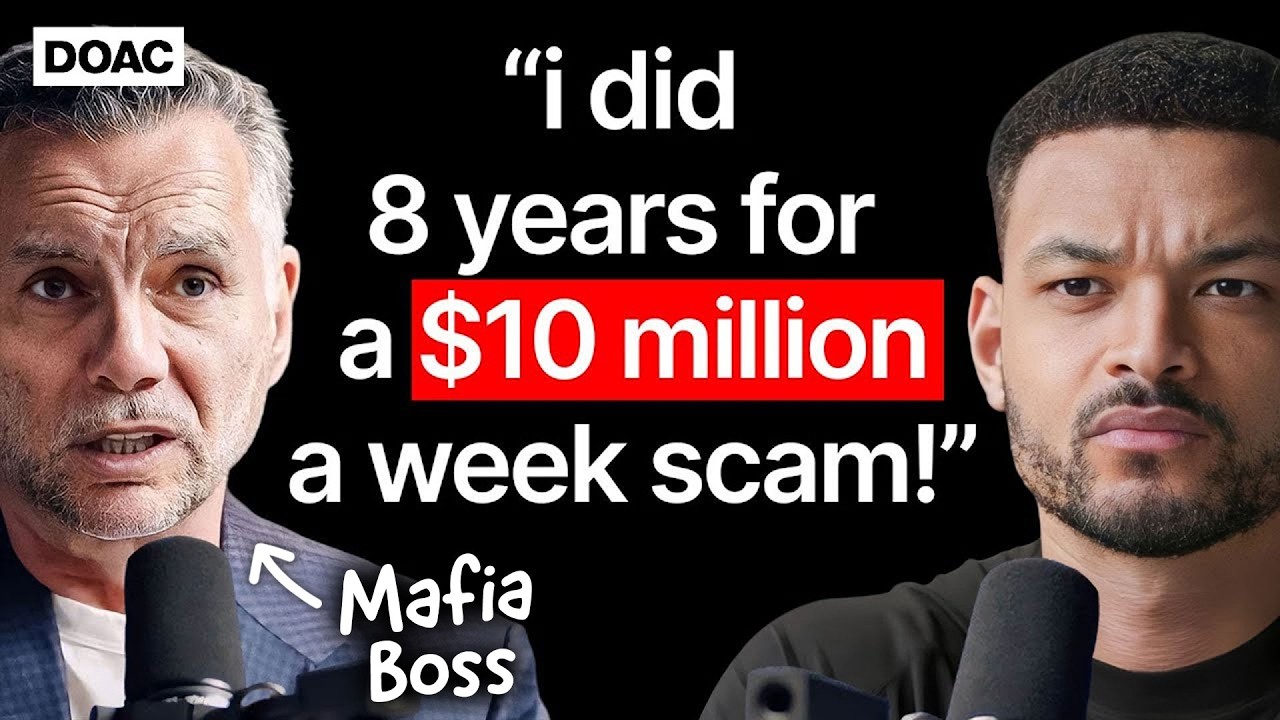
The Diary Of A CEO
Michael Franzese built a multimillion-dollar empire by leveraging gasoline tax schemes before serving federal prison time and leaving organized crime through faith.
AI-assisted summary of Mafia Boss: I Was Making $1.4 Million A Day! - Michael Franzese — original source. Check the original for full context.
Source published:
Detailed notes
## Background This video was published on YouTube by The Diary Of A CEO on August 19, 2024. According to the page description, it features an interview with Michael Franzese, an American former mafia caporegime in the Colombo crime family and best-selling author, discussing his life, business tactics, time in prison, and transition out of organized crime.
## TL;DR Former mob boss Michael Franzese details his rise and eventual departure from the Colombo crime family, sharing how he went from pre-med to generating millions through a massive gas tax scam. He outlines the strict hierarchy, code of omertà, and deadly consequences that defined the American Mafia while reflecting on his father Sonny Franzese's influence and ultimate betrayal. The conversation covers his years in solitary confinement, the financial mechanics of mob money, and how he turned his life around through faith, business acumen, and public speaking.
## Atmosphere & style The interview has a candid, reflective, and intense mood, combining the gravitas of a former high-ranking mobster with the polished delivery of a seasoned speaker. Franzese speaks with a pragmatic, matter-of-fact seriousness when detailing life-and-death mob rules, creating a tense yet fascinating dynamic with host Steven Bartlett. The emotional arc transitions from gritty tales of violence, extortion, and systemic betrayal to a quieter, introspective narrative centered on faith, family reconciliation, and redemption.
## Key takeaways - [00:00](https://www.youtube.com/watch?v=S1JXKT7mf9A&t=0s) Michael Franzese became one of the Mafia's highest earners by operating as a racketeer rather than a traditional gangster, generating $7 million to $10 million weekly at his peak. - [10:35](https://www.youtube.com/watch?v=S1JXKT7mf9A&t=635s) The American Mafia structured its organization hierarchically to enforce discipline, manage rackets, and resolve internal disputes through formal sit-downs. - [23:30](https://www.youtube.com/watch?v=S1JXKT7mf9A&t=1410s) Franzese abandoned a pre-med education track to join the mob after his father, Colombo family underboss Sonny Franzese, received a 50-year prison sentence. - [32:08](https://www.youtube.com/watch?v=S1JXKT7mf9A&t=1928s) Strict codes like omertà governed the Mafia, enforcing ultimate loyalty to the mob family above personal bonds and mandating extreme discipline. - [44:58](https://www.youtube.com/watch?v=S1JXKT7mf9A&t=2698s) Franzese masterminded a complex multimillion-dollar gas station tax fraud using series of shell companies to undercut competitors for seven years. - [36:15](https://www.youtube.com/watch?v=S1JXKT7mf9A&t=2175s) Mob inductees were subjected to an intense probationary period requiring unconditional obedience to authority before attaining status as made men. - [48:17](https://www.youtube.com/watch?v=S1JXKT7mf9A&t=2897s) To secure protection and standing in street disputes, Franzese paid acting boss Carmine Persico $2 million per week directly from his fuel profits. - [01:25:06](https://www.youtube.com/watch?v=S1JXKT7mf9A&t=5106s) A secret $33 million Austrian bank account became a central bargaining chip in negotiations with federal prosecutors to reduce his prison sentence. - [01:33:00](https://www.youtube.com/watch?v=S1JXKT7mf9A&t=5580s) Franzese endured 29 months in solitary confinement, relying on faith, audio sermons, and music to maintain mental stability. - [01:41:08](https://www.youtube.com/watch?v=S1JXKT7mf9A&t=6068s) Tensions arose between Franzese and Colombo leadership when his immense wealth and independent crew threatened existing hierarchy dynamics. - [01:44:03](https://www.youtube.com/watch?v=S1JXKT7mf9A&t=6243s) Franzese walked away from organized crime without entering the Witness Protection Program, navigating death contracts and years of estrangement from his father. - [02:02:07](https://www.youtube.com/watch?v=S1JXKT7mf9A&t=7327s) A key conversation with a pastor on his wedding planning day inspired Franzese's religious conversion and eventual transition away from the mob.
## Detailed walkthrough ### [00:00](https://www.youtube.com/watch?v=S1JXKT7mf9A&t=0s) Overview & "Who Is Michael Franzese?"
The interview opens with high-stakes declarations outlining the immense scale of Michael Franzese's former life in the mob: pulling in $9 million to $10 million a week, being arrested 18 times, operating 18 different companies to defraud the government out of gas taxes, and witnessing people die for the wrong reasons. Michael reflects on the two distinct paths within Cosa Nostra: "There's two levels in that life: you're either a racketeer or you're a gangster." He identifies firmly as a racketeer—someone who elevated the family by generating massive wealth, flying around in private jets and helicopters, and once seeing $40 million to $50 million in physical cash sitting in front of him.
When host Steven Bartlett asks him directly, "Who are you?", Michael recounts a profound conversation he had with psychologist Jordan Peterson. Michael explained to Peterson that whenever he had to execute an assignment in the mob that made him uncomfortable, he would "step out of himself," complete the task, and then step back in. Peterson challenged him by asking how he knew which persona was the real Michael—the one who stepped out or the one sitting in the room. Michael acknowledges that after nearly 30 years away from that life, he hopes the person he is today is his true self. He reflects on how he was originally a PreMed student on track to become a doctor, but pivoted completely to help his father, Sonny Franzese, who had been handed a 50-year prison sentence.
- **Weekly Mafia Revenues:** $9 million to $10 million generated at his peak. - **Physical Cash On Hand:** $40 million to $50 million seen at one time. - **Legal Troubles:** Arrested 18 times over his career in organized crime. - **Pre-Mob Aspirations:** Enrolled as a PreMed student before dropping out to help his father.
---
[04:27](https://www.youtube.com/watch?v=S1JXKT7mf9A&t=267s) Growing Up with a Mafia Underboss
Contrary to popular belief that joining the mob always stems from a broken or impoverished background, Michael describes a complex childhood shaped by intense law enforcement pressure. His mother was just 16 years old when he was born, and his home life was turbulent due to his father's high-profile status as a major target of law enforcement. From the time Michael was four or five years old, his father was constantly going to trial or in and out of prison. Agencies parked outside their home in heavy numbers, causing Michael to develop a deep-seated hatred for the police and government early in life.
Despite the heavy surveillance, Michael initially viewed his father's life positively. The men visiting their home were introduced as warm family figures—"Uncle Joe, Uncle this, Uncle that." His father was charismatic, wanted Michael to get an education to stay off the streets, and was a loving husband and parent who rarely used physical discipline at home. However, two distinct childhood memories exposed the violent reality of his father's profession:
1. **The Manhattan Meeting:** While riding into Manhattan where his father oversaw music business interests, his father stopped to meet a man. A heated argument broke out, and Michael watched his father grab the man by the throat and lift him against a wall, leaving the man petrified. 2. **The Carpenter Incident:** A large carpenter named Sal repeatedly failed to finish work on their home, causing Michael's mother to complain. Frustrated by the nagging, his father abruptly punched Sal inside the house, knocking him unconscious, and casually remarked, "Don't blame me, your mother's nagging me too much."
- **Law Enforcement Presence:** 6 or 7 different law enforcement agencies simultaneously parked outside the family home, creating a "parade of vehicles" whenever they left. - **First Memory of Mob War:** Around age 4 (circa 1955), his father had not shaved for days and came home briefly while his right-hand man stood guard on the porch—a consequence of an internal Colombo family war.
---
[10:35](https://www.youtube.com/watch?v=S1JXKT7mf9A&t=635s) The Hierarchy and Origins of Cosa Nostra
Steven Bartlett presents an organizational chart to clarify how a Mafia family functions, which Michael confirms is accurate. The hierarchy operates from top to bottom through strict tiers of authority, establishing clear operational boundaries between full members and outer associates.
``` +-------------------------------------------------------+ | BOSS | | (Official ruler of the entire family) | +-------------------------------------------------------+ | +----------------+----------------+ | | +-------------------+ +-------------------+ | UNDERBOSS | | CONSIGLIERE | | (Second-in-cmd) | | (Senior Advisor) | +-------------------+ +-------------------+ | +-------------------------------------------------------+ | CAPOREGIMES | | (Capos / Street bosses leading crews) | +-------------------------------------------------------+ | +-------------------------------------------------------+ | SOLDIERS | | (Made men who have taken the formal oath) | +-------------------------------------------------------+ | +-------------------------------------------------------+ | ASSOCIATES | | (Non-initiated affiliates working with crews) | +-------------------------------------------------------+ ```
Michael explains the historical trajectory of Cosa Nostra, tracing its roots to Sicily, where groups originally formed to defend local towns against marauders before evolving into criminal syndicates. Following mass immigration through Ellis Island around the turn of the 20th century, these groups established roots in major American cities, initially preying on fellow immigrants through loan sharking, extortion, and protection rackets.
Michael emphasizes that the U.S. government unwittingly made the Mafia a powerhouse by introducing Prohibition. Banning alcohol created an insatiable public demand that organized crime rushed to fulfill. In New York State alone, the Mafia controlled an estimated 36,000 illegal speakeasies, generating the equivalent of billions of modern dollars. By the 1940s, Charles "Lucky" Luciano—alongside his key non-Italian advisor Meyer Lansky—realized that constant inter-gang warfare would destroy them. To professionalize the underworld, Luciano established "The Commission," dividing national operations into nine original families to govern disputes and set overarching policy.
- **Speakeasy Monopoly:** Over 36,000 illegal drinking establishments controlled by the Mafia in New York State during Prohibition. - **Commission Structure:** Created in the 1940s by Lucky Luciano to act as a national governing body (similar to a "United Nations" for crime families), though individual bosses retained ultimate autonomy over their own crews.
Here is a detailed, faithful walkthrough of this section of the interview:
[16:56](https://www.youtube.com/watch?v=S1JXKT7mf9A&t=1016s) The Structure of New York's Five Families and Mafia Wars
Michael Franzese outlines the scope of the Five Families operating in New York during his era, explaining that there were approximately 750 total "made men"—individuals who had taken the formal oath—alongside hundreds of associates. The Gambino and Genovese families were the largest, each boasting around 250 made members. The remaining three—the Bonanno, Colombo, and Lucchese families—were smaller, with roughly 100 or so members each.
Before the creation of the Commission in the 1930s, the families frequently waged war against one another. Once the Commission was established, inter-family warfare effectively ceased, and any subsequent conflicts were internal civil wars fought strictly for power and leadership within a single family. Franzese notes that the Colombo family was among the most violent, experiencing three major internal wars during his lifetime. In the Mafia, power transitions do not happen through elections; when someone wants to take over leadership, a power struggle ensues. While other families might offer moral support or root for a specific faction, they did not intervene with manpower.
* **Total Made Men (New York Era):** Approximately 750 members across five families. * **Family Breakdown:** Gambino (~250), Genovese (~250), Bonanno (~100+), Colombo (~100+), Lucchese (~100+). * **The Commission's Impact:** Eliminated inter-family wars; all subsequent conflicts were internal power struggles.
---
[18:50](https://www.youtube.com/watch?v=S1JXKT7mf9A&t=1130s) What Happens at a Mafia Sit-Down?
Franzese explains the strict mechanics of a Mafia "sit-down"—the formal process used to resolve all business disputes and internal grievances. These structured meetings were typically presided over by a boss or higher-ups if the dispute was serious enough to escalate past captains (capos). The boss held absolute authority, and his word was final, with no right to appeal.
Rules of decorum during a sit-down were incredibly rigid. If two made men were arguing over a business matter and one was lying blatantly, the other could not directly call him a liar. Directly calling another made man a liar was considered a fatal protocol violation that resulted in automatically losing the argument due to disrespect. Instead, a member had to cleverly present the facts so the boss would realize the deception on his own. At the conclusion of the sit-down, regardless of the outcome, both parties were required to shake hands and abide by the ruling.
> "If you're a made guy and I'm a made guy and we're arguing over a business issue and you're lying through your teeth, I can't call you a liar. If I call you a liar, I lose the argument automatically because I disrespected you."
* **Business Book Impact:** After reading about sit-downs in Franzese’s business book *I'll Make You an Offer You Can't Refuse*, publisher HarperCollins humorously declared they were banning standard company meetings in favor of "sit-downs" for maximum efficiency. * **Frequency:** Franzese was extremely active in this lifestyle, attending sit-downs almost every other day to resolve business conflicts or settle trouble caused by his subordinates.
---
[20:51](https://www.youtube.com/watch?v=S1JXKT7mf9A&t=1251s) How the Mafia Decides Who Lives and Who Dies
Beyond routine business disputes, sit-downs were also called to decide a member's ultimate fate if they committed a severe policy violation. The individual whose life was on the line was not present in the room; instead, advocates spoke on their behalf while accusers spoke against them before the boss rendered a final judgment on whether the person should live or die. Franzese confirms he participated in sit-downs where life-or-death decisions were made and saw rulings go both ways.
---
[21:20](https://www.youtube.com/watch?v=S1JXKT7mf9A&t=1280s) Franzese’s Dad Sent to Prison and the Shift in Family Responsibility
When Franzese was 19 years old, his father, Underboss John "Sonny" Franzese, began serving a 50-year prison sentence. His father was 50 years old at the time, leading the family to believe he would die behind bars. Franzese speaks with deep emotion about his admiration for his father, recalling the core lesson Sonny instilled in him: to be a careful listener, to listen before speaking, and never to speak out of turn.
Sonny's imprisonment marked a major turning point. As the eldest son, Franzese was charged with the heavy responsibility of caring for his mother and three younger siblings. He was already accustomed to stepping up—often taking care of his siblings for days while his mother attended his father's relocated trials hundreds of miles away in Albany, New York—but his father's 50-year sentence made the burden far more absolute.
* **Sonny Franzese's Sentence:** 50 years in federal prison, starting when Michael was 19. * **Key Advice from Father:** "Son, be a good listener. Listen before you speak... don't speak out of turn."
---
[23:30](https://www.youtube.com/watch?v=S1JXKT7mf9A&t=1410s) Leaving Pre-Med to Save His Framed Father
At the time of his father's incarceration, Franzese was a pre-med student preparing to become a doctor. However, his father's conviction derailed his life plans. Sonny was convicted of masterminding a nationwide string of bank robberies—a charge Franzese insists to this day was a complete frame-up by the federal government.
Franzese recalls visiting his father in jail and asking him directly about the bank robberies. Sonny maintained his innocence, telling his son that he was framed and that they needed to work to overturn the conviction. Franzese trusted his father implicitly, noting that Sonny had spent his entire life preaching against drugs, telling his children allegorical stories about their dangers, and refusing to associate with drug users. Because all four primary government witnesses against Sonny were drug addicts, Franzese knew his father would never have partnered with them to orchestrate bank robberies.
Driven by anger at the justice system and a desire to save his father, Franzese was further influenced by Colombo family boss Joe Colombo, who took Franzese under his wing. Mob associates repeatedly told Franzese that staying in medical school was pointless if his father was going to die in prison.
* **Primary Witnesses:** Four drug addicts whose testimony formed the core of the government's case against Sonny. * **Role of Joe Colombo:** Took Franzese under his wing following Sonny's imprisonment.
---
[25:43](https://www.youtube.com/watch?v=S1JXKT7mf9A&t=1543s) The Decision to Join the Mafia: "Could You Kill Somebody?"
Franzese visited his father at Leavenworth Penitentiary to deliver the news that he was dropping out of pre-med to help him. Sonny initially argued against it, wanting a legitimate life for his children and knowing how brutal the mob was. Realizing his son was firm in his decision, Sonny accepted it but insisted that if Michael were to enter the street life, he must do it "the right way"—by becoming a made member of the Colombo crime family.
Standing in the visiting room, Sonny asked his son a solemn question: if he ever had to kill someone, could he do it? Franzese replied that under the right circumstances, he could. Satisfied with the answer, Sonny instructed him to go home, stay quiet, wait for contact, and follow instructions without question. True to the Mafia's strict code of *omertà*, Sonny refused to detail the inner workings of the life to his son until he was officially brought in. Looking back, Franzese admits he cannot say for certain whether his 19-year-old self truly believed he could kill or was simply giving the answer his father needed to hear.
> "He looked at me and he said, 'If you ever had to kill anybody, could you do it?' And I said, 'Dad, under the right circumstances, yeah, I could do it.' He said, 'That's the right answer.'"
---
[28:08](https://www.youtube.com/watch?v=S1JXKT7mf9A&t=1688s) Uncovering the Frame-Up and Working to Recant Witness Testimony
Franzese joined the Mafia in large part to generate funds for top legal representation and track down the witnesses who testified against his father. Leveraging his business intellect, Franzese worked alongside defense lawyers and successfully located three of the key government witnesses.
Franzese obtained recantations from these three witnesses and subjected them to polygraph tests, proving they had lied during the trial. One witness confessed to Franzese that when they originally agreed to cooperate with the government, they named a man named Tony Polisi as the mastermind behind the bank robberies. However, FBI agents dismissed that name, explicitly telling the witness that implicating Polisi would not grant them significant sentence reductions, but naming a high-profile figure like Sonny Franzese would. The witnesses were supplied with details about Sonny's schedule so they could fabricate a meeting at the Q Motor Inn on a night when Sonny lacked an airtight alibi.
* **Legal Breakthrough:** Successfully located and secured recantations from 3 out of 4 government witnesses. * **Original Named Mastermind:** Tony Polisi. * **Fabricated Meeting Location:** Q Motor Inn.
---
[30:34](https://www.youtube.com/watch?v=S1JXKT7mf9A&t=1834s) "My Dad Was Involved in 35 Murders"
When asked objectively whether his father was a "good guy" or if society was better off with him behind bars, Franzese acknowledges the dark reality of his father's life. While Sonny never confessed specific details to him, FBI intelligence estimated that Sonny Franzese was involved in 30 to 35 murders throughout his career (though he was only ever indicted for one murder, of which he was acquitted).
Despite this, Franzese argues against the justification of a government frame-up. From a legal standpoint, he asserts that law enforcement must never be allowed to break the law or fabricate evidence to convict someone, regardless of their background. Doing so compromises the legal rights of all citizens.
* **Alleged Murder Count:** FBI attributed 30–35 murders to Sonny Franzese. * **Legal Record:** Indicted for 1 murder, resulting in an acquittal.
---
[32:08](https://www.youtube.com/watch?v=S1JXKT7mf9A&t=1928s) The Code of Omertà and the Logic of Mob Violence
Franzese delves into the internal morality and strict rules that governed Mafia life during his era. He clarifies that *omertà* is a code of silence, not an explicit command to lie, steal, or kill indiscriminately. The Mafia maintained strict internal rules designed to preserve order:
1. **Family Respect:** Members were strictly forbidden from pursuing or disrespecting another member's wife, daughter, sister, or girlfriend on pain of death. 2. **Prohibition on Narcotics:** Dealing drugs was punishable by death during his era. 3. **Internal Discipline:** Disrespecting another made guy, lying to leadership, or striking a made member resulted in execution.
Franzese explains how members rationalized the violence: everyone who took the oath fully understood the rules and voluntarily accepted the lethal consequences of breaking them. Members were warned from day one that their best friend might be the person ordered to pull the trigger because loyalty to the organization superseded all personal relationships. Franzese notes that while mob violence was not exclusively confined to internal members, many within the organization justified their actions under the belief that they were primarily enforcing rules among people who had willingly chosen that life.
Here is a detailed, faithful walkthrough of Part 3 of the transcript.
[34:03](https://www.youtube.com/watch?v=S1JXKT7mf9A&t=2043s) Refusing to Discuss Personal Involvement in Murder
The host pushes on whether Michael Franzese has ever personally had to kill someone, observing that it seems to be the one topic he never opens up about. Franzese bluntly confirms that he refuses to discuss it. When asked why, he explains that while he strives to be as honest as possible due to his Christian faith, murder is simply not something he cares to get into. The host speculates on the reasons behind this reticence—whether it stems from legal exposure, not wanting to shock listeners, or remaining bound by mob codes.
Franzese clarifies that unlike other former made men seen on YouTube who openly detail murders they committed because they received government immunity in exchange for cooperation, he never cooperated to that level. He holds no immunity for any past crimes. He stresses that under U.S. law, merely standing next to someone when a murder takes place makes a person legally liable for that murder. Beyond the legal risks, Franzese emphasizes that murder is inherently "ugly" and not something to brag about. He points out that while soldiers kill in defense of their country and homicides occur every single day, he has no interest in boasting about violence or beating his chest.
- Franzese refuses to discuss personal involvement in murder out of a mix of legal caution and personal distaste. - Unlike other mob whistleblowers on YouTube, Franzese never received government immunity for capital crimes. - Under U.S. law, presence at the scene of a homicide can carry the same legal charges as pulling the trigger.
[36:15](https://www.youtube.com/watch?v=S1JXKT7mf9A&t=2175s) The 2.5-Year Probationary Period and Mob Indoctrination
Franzese details the rigorous process required to join the Colombo crime family after his father proposed him. After his father sent word "downtown," a captain escorted him to meet the newly installed boss—following the assassination and eventual death of former boss Joe Colombo. The boss issued a stark, non-negotiable directive: joining meant being on call 24/7/365 to serve the family above all else. The boss explicitly told him, "if your mother is sick and she's dying, you're at her bedside, we call you to service, you leave your mother, you come and serve us."
Upon agreeing, Franzese entered a strict 2.5-year pledge period where he had to execute any command to prove his worth. He describes a culture governed by absolute authority, strict discipline, and zero tolerance for tardiness. A meeting set for 8:00 AM meant showing up by 7:30 AM; if traffic was expected, recruits were expected to sleep in their car the night before. He recalls an incident where he drove a boss to a meeting and left his post briefly to use the restroom and grab a newspaper; he received a severe reprimand and was "put on the shelf" for two weeks to drive home the lesson.
- **Family Hierarchy Rule:** Membership requires a proposal from an existing member; Franzese was proposed by his father, John "Sonny" Franzese. - **Punctuality standard:** Arrival 30 minutes early was required; being late for any reason was unacceptable. - **Probationary length:** A 2.5-year recruit period of performing menial tasks, driving bosses, and demonstrating absolute obedience. - **The violent reality:** Franzese notes that any active participant in mob life is inevitably tied to its violence: "If anybody tells you differently, they're either not being honest or they weren't a made member."
[41:15](https://www.youtube.com/watch?v=S1JXKT7mf9A&t=2475s) Gangsters vs. Racketeers and the Art of Negotiation
Franzese contrasts the two distinct types of men within the mafia structure: "gangsters" and "racketeers." Out of approximately 115 made men in the Colombo family during his era, only about 20 were true racketeers generating significant revenue to support and elevate the family. Gangsters were muscle—guys without the business acumen to leverage the mob's power for major financial gain, sent out primarily when physical force was required. Racketeers, however, were businessmen who still had to act as gangsters when called upon.
Because his strengths lay on the racketeering side, Franzese frequently found himself managing business disputes at mob sit-downs. He learned high-stakes negotiation techniques from sharp, old-time mobsters who could easily trap an unprepared adversary. He emphasizes that entering a room while secretly being the smartest person there—keeping quiet, throwing out a small bone, and allowing the other party to talk—reveals the opponent's true personality and strategy. Conversely, keeping quiet when you aren't the smartest person keeps others guessing about your thoughts.
- **Colombo Family Stats:** Out of ~115 made members, only ~20 were major financial earners (racketeers). - **Definition of a Gangster:** Muscle deployed for physical tasks, incapable of generating complex business revenue. - **Definition of a Racketeer:** A high-level earner and business strategist who retains the capability for violence when ordered. - **Key Negotiation Strategy:** Remaining quiet to let others reveal their positions, maintaining a clear fallback position before entering any meeting, and speaking last.
[44:58](https://www.youtube.com/watch?v=S1JXKT7mf9A&t=2698s) Masterminding the Multimillion-Dollar Gas Station Scam
Franzese details the massive gasoline tax fraud he operated for seven years, describing it as "probably the biggest scam since the days of prohibition." The scheme exploited a flaw in how gas taxes were collected by wholesale licensees. To execute it, Franzese set up 18 Panamanian shell companies. Panama was chosen specifically because it allowed bearer shares, enabling ownership of the company to transfer simply by handing over physical stock certificates without registering names on public records. These shell entities required no physical real estate—only the paperwork needed to secure wholesale tax licenses and open bank accounts.
Franzese bought gasoline from major oil companies and Middle Eastern barges, then sold it to retail gas stations. Instead of remitting the collected state and federal taxes to the government, the shell companies retained the tax money. Because government tax enforcement operated on slow quarterly filing schedules, Franzese kept each shell company active for 10 to 12 months. Once authorities began inquiring, the office was closed, the license was abandoned, and operations seamlessly shifted to a new Panamanian entity.
<Carousel> <Image alt="Gasoline pump nozzle refueling a vehicle at a service station" caption="Retail gas station distribution network" src="image_agent_tag_1"/> </Carousel>
To capture market share across his network of over 300 owned, operated, or supplied gas stations, Franzese used the unpaid tax margin—which gave him roughly 40 cents per gallon to maneuver with—to undercut competitors. If competing stations on a corner lowered their prices, Franzese's stations would stay two cents cheaper. Neighboring station owners, unable to match his prices, eventually agreed to purchase their wholesale fuel directly from Franzese's operation.
- **Scale of Operation:** Controlled and supplied over 300 gas stations; ran the operation for 7 straight years. - **Corporate Structure:** Utilized 18 Panamanian shell companies with bearer stock to obscure true ownership. - **Profit Margin Flexibility:** Retaining the tax gave Franzese up to 40 cents per gallon in margin flexibility to price out competition.
[48:17](https://www.youtube.com/watch?v=S1JXKT7mf9A&t=2897s) Bringing $2 Million a Week to the Boss
Recognizing the immense scale of the fuel operation, Franzese approached the acting boss of the Colombo family, Carmine "Junior" Persico. When Franzese promised to show him more money than he had ever seen, Persico was initially skeptical and warned that the family did not deal in illegal drugs. Franzese reassured him that no drugs were involved—only tax money.
Franzese made a strategic deal with Persico: in exchange for generating staggering wealth for the family, Persico had to back Franzese in every street dispute or sit-down with rival families who sought a piece of the payout or refused to pay for fuel shipments. Persico agreed, telling him to "show me." Franzese built the operation up until he was delivering $2 million per week directly to the boss. This massive revenue stream purchased absolute loyalty, guaranteed that Franzese won every sit-down argument, and directly fueled his rapid promotion to the rank of caporegime (captain).
- **Weekly Revenue:** Franzese brought in $2 million per week to acting boss Carmine "Junior" Persico. - **Protection Agreement:** Persico guaranteed Franzese total backing in all inter-family sit-downs and financial disputes. - **Career Advancement:** The unprecedented profits from the gas tax scheme directly led to Franzese being promoted to mob captain.
<ElicitationsGroup message="Explore further details on Michael Franzese's story:"> <Elicitation label="Learn about the FBI investigation into Franzese" query="How did the FBI eventually build their case against Michael Franzese and track his bank accounts?"/> <Elicitation label="Explore Franzese's time in solitary confinement" query="What was Michael Franzese's experience in solitary confinement and how did he survive it?"/> </ElicitationsGroup>
[49:49](https://www.youtube.com/watch?v=S1JXKT7mf9A&t=2989s) The Scale of the Gas Station Scam
Michael Franzese outlines the massive financial scale of his gasoline bootlegging operations at its peak, describing a lifestyle funded by staggering weekly revenues. Supported by a large crew under his command, Franzese was "living a lifetime in a jet plane" and utilizing helicopters to oversee an enterprise that generated millions. His operation moved roughly half a billion gallons of gasoline every month, taking a cut of 30 to 40 cents per gallon depending on the variable pricing agreed upon at the time.
This volume translated into revenue ranging between $7 million and $10 million in a single week. Podcast host Steven Bartlett reacts with amazement at the figures, lightheartedly joking that he must be in the wrong line of work, though acknowledging that Franzese made the right decision to walk away from it entirely to avoid future temptation.
- **Weekly Revenue:** $7,000,000 to $10,000,000 per week at its peak. - **Volume:** ~500,000,000 gallons of gas distributed per month. - **Profit Margin:** $0.30 to $0.40 profit margin per gallon.
[50:30](https://www.youtube.com/watch?v=S1JXKT7mf9A&t=3030s) Becoming a "Made Man" and the Reopening of the Books
The transition from a two-year probationary associate ("internship") to a full mafia member is known within the American La Cosa Nostra as getting "straightened out." Franzese explains that in 1975, the American Mafia decided to officially reopen "the books"—a nationwide policy freeze that had prevented any new members from being formally inducted for roughly two decades.
During the 25-year closure, families were strictly limited to replacing members only when a made man passed away. When the restriction was lifted in the mid-1970s, it created immediate generational tension. Men in their 40s and 50s who had waited two decades for induction resented younger associates like Franzese who were inducted after serving relatively short probationary periods. Franzese notes that managing this street jealousy from older men was an intense obstacle early in his career.
- **The Freeze:** Mafia membership "books" were closed nationwide for nearly 25 years prior to 1975 for security reasons. - **Replacement Policy:** New inductees were historically allowed only to replace deceased members in a family's ranks. - **Induction Year:** Franzese was formally "straightened out" on Halloween night in 1975.
[52:02](https://www.youtube.com/watch?v=S1JXKT7mf9A&t=3122s) The Halloween Blood Oath Ceremony
Franzese details the exact mechanics of his induction ceremony into the Colombo crime family, which took place on Halloween night in 1975 alongside five other candidates. Candidates were given no prior instructions other than to wear a suit, leaving them to deduce what was about to transpire. The ceremony was strictly reserved for high-ranking leadership; soldiers were barred, while the boss, underboss, consigliere, and caporegimes gathered in a dimly lit room organized in a horseshoe seating layout.
Inductees walked down a central aisle individually to stand before the family boss. The boss sliced Franzese's finger with a knife, allowing blood to drip onto the floor to signify a blood oath. Franzese then cupped his hands to receive a paper image of a Catholic saint, which was set ablaze. As the flame burned out harmlessly in his hands, the boss delivered the traditional binding oath:
> "Tonight, Michael Franzese, you are born again into a new life, into La Cosa Nostra, 'this thing of ours.' Violate what you know about this life, betray your brothers, and you will die and burn in hell like the saint is burning in your hands. Do you accept?"
Franzese accepted. Rather than feeling fear, he felt an overwhelming sense of exhilaration, viewing the moment as the fulfillment of two and a half years of intense work and a way to cement a closer bond with his father, Sonny Franzese.
[53:43](https://www.youtube.com/watch?v=S1JXKT7mf9A&t=3223s) Pure Intentions vs. Street Ambition
Reflecting on his primary motivations for joining the Mob, Franzese insists he never originally aspired to be a wiseguy. Unlike many inner-city youth or gang members who were drawn to the lifestyle by promises of fast cars, money, women, and street power, Franzese grew up comfortable. His family was not wealthy, but they were secure enough to take vacations and never struggled to put food on the table.
His primary motivation was purely protective: he entered the life to help support and secure his father, who was facing decades in federal prison. However, once he committed to the two-year initiation phase, his competitive drive took over. Mentored by senior members, he became deeply immersed in the mechanics of the organization, developing a full understanding of the culture from the inside.
[55:18](https://www.youtube.com/watch?v=S1JXKT7mf9A&t=3318s) Serial Killers vs. Order Followers: The Case of Roy DeMeo
When asked to categorize the personalities within La Cosa Nostra, Franzese distinguishes between those who were simply following organizational orders and psychopaths who derived genuine pleasure from violence. He places himself strictly in the category of someone who followed orders as a business obligation, contrasting his mindset with infamous Gambino crime family hitman Roy DeMeo.
Franzese knew DeMeo personally and describes him as an outright serial killer whose violent tendencies existed independently of organized crime. DeMeo operated out of the Gemini Lounge (often referred to as the Gemini Club), where he and his crew executed targets, dismembered bodies, and systematically disposed of remains. Franzese emphasizes that the Mafia did not create DeMeo's psychopathy; rather, the Mafia merely provided a structure within which a natural serial killer could operate.
- **Roy DeMeo:** Notorious Gambino family crew leader linked to an estimated 70 to 200 homicides. - **The Gemini Method:** Executed victims inside the Gemini Lounge, dismembering bodies to conceal evidence.
[57:52](https://www.youtube.com/watch?v=S1JXKT7mf9A&t=3472s) Human Nature and the Capacity for Damage
Discussing the broader human capacity for violence, Franzese rejects the ideal that humans possess an innate, unshakeable moral compass. He argues that under the right conditions or triggers, virtually anyone is capable of committing extreme violence—whether out of a instinct to defend loved ones or through systematic conditioning.
He draws a direct parallel to military training: an ordinary, gentle person can be drafted, trained to kill by the state, and sent onto a battlefield to execute enemies under the banner of national defense. While society views state-sanctioned warfare as noble and mob violence as criminal, Franzese asserts that the underlying psychological mechanism—the raw human capacity to cause lethal harm—is identical in both contexts.
[59:51](https://www.youtube.com/watch?v=S1JXKT7mf9A&t=3591s) "Arty the Animal" and the Open Coffin
Franzese shares a pivotal, traumatizing memory from his youth that marked his first direct exposure to mob violence. Following his father's imprisonment, a tough Jewish associate known as "Arty the Animal"—a man who acted as a second father to Franzese and cared for his family—was murdered. Franzese was around 19 or 20 years old when he attended the wake.
At the funeral home, Arty's grieving sister pulled a young Franzese aside and insisted he look inside the closed casket, saying:
> "You need to come with me. You need to look at what these animals did to my brother."
When she opened the lid, Franzese saw Arty's severely disfigured, unrecognizable face. The sight deeply shook him, marking the first time he had ever witnessed such brutality inflicted on someone he loved. Although he learned to compartmentalize the experience in order to survive in the mob, the image never truly left him; his wife reveals that even decades later, he frequently fights and reacts violently in his sleep.
[01:03:08](https://www.youtube.com/watch?v=S1JXKT7mf9A&t=3788s) The Brutal Rules of Mafia Sit-Downs and Executions
Franzese reflects on the cold, unforgiving nature of mob justice, where personal relationships offer no immunity against organizational rules. In La Cosa Nostra, if a member makes a fatal mistake or violates mob protocol, it is often their closest friend who is tasked with walking them into a room from which they will never return.
Franzese recounts trying unsuccessfully to save a close friend—a man he considered a brother—who committed a major violation of family rules. A formal sit-down was held, and despite Franzese's intervention, the death sentence was upheld and carried out. He contrasts this with corporate life: in business, betrayals or failures result in losing a job or money, but in the Mafia, the ultimate price is paid in blood.
[01:05:20](https://www.youtube.com/watch?v=S1JXKT7mf9A&t=3920s) The Ghost of a Father: Patricide in the Mob
To demonstrate how absolute and extreme mob rules can be, Franzese shares a chilling story about two brothers who were made men—one in his family, the other in a different family. One afternoon, Franzese drove one of the brothers back to his home in Brooklyn. Upon opening his front door, the man hesitated, peered inside, closed the door, and returned to Franzese's car, stating he could not go inside because no one was home.
When Franzese asked why he couldn't enter his own house alone, the man revealed a dark secret: years earlier, their father had broken mob law by sleeping with another member's wife or daughter. The high command issued a murder contract directly to the man and his brother, forcing them to execute their own father.
> "Anytime I walk in the house if I'm alone, the ghost of my father is in there and haunts me."
The man had been unable to step inside his home alone for over 20 years. Franzese cites this tragedy as proof of why he views the mob lifestyle as fundamentally evil—it systematically destroys every family involved in it.
- **The Violation:** The father engaged in an unauthorized affair with another member's female relative. - **The Execution:** The contract was assigned directly to the target's two sons, who carried out the patricide.
[01:06:32](https://www.youtube.com/watch?v=S1JXKT7mf9A&t=3992s) The Devastation of the Franzese Family
Franzese reflects on how his father's devotion to La Cosa Nostra tore their own immediate family apart over several decades. While Franzese managed to protect his own wife and children from the mob's fallout, his mother, siblings, and father suffered devastating consequences as a direct result of the life.
His father, Sonny Franzese, spent nearly 50 years accumulated across multiple prison sentences away from home. This left Franzese's mother without a husband for 33 consecutive years, causing deep bitterness and hostility between them until her death in 2012. The structural breakdown of the household ripple-effected down to his siblings: his 27-year-old sister died of a drug overdose, and his brother struggled with severe drug addiction for 25 years.
- **Sonny Franzese:** Spent nearly 50 total years behind bars throughout his life. - **Mother's Separation:** Spent 33 years separated from her husband due to his incarcerations before passing away in 2012. - **Sister:** Died at age 27 from a drug overdose. - **Brother:** Battle with drug addiction spanned 25 years.
[01:07:04](https://www.youtube.com/watch?v=S1JXKT7mf9A&t=4024s) The Toll on the Family and Deciding to Leave the Mob
Michael reflects on the tragic toll mob life took on his own family. He recounts having to save his brother's life multiple times due to drug addiction, noting that if his brother hadn't been their father's son, he never would have survived. His younger sister died at just 40 years old after struggling with mental instability, leaving the entire family devastated. His father ultimately served 40 out of a 50-year sentence behind bars, coming out on parole only briefly. Seeing his family's life destroyed brought Michael to a stark realization: "Any lifestyle that does that to a family is a bad life, it's an evil life." He observed that nearly every mob family he knew met a similar tragic fate in one way or another.
The catalyst that spurred his decision to leave was falling in love with a 20-year-old girl—his wife, to whom he has been married for 39 years. Realizing the massive target on his back, he questioned whether it was fair to marry her when he was facing a 14-agency task force dedicated to putting him away forever. Having gone to trial five times, faced seven indictments, and been arrested 18 times, he knew he couldn't escape the law long-term and refused to subject her to a life where he would be imprisoned within two years.
[01:08:32](https://www.youtube.com/watch?v=S1JXKT7mf9A&t=4112s) A Father's Betrayal and the Sit-Down Over Billions
Beyond his love for his wife, Michael reveals that a devastating betrayal by his own father was what truly severed his psychological ties to the Mafia. Had that betrayal not occurred, the powerful hold his father had over him might have kept him in the life forever. The incident occurred when Michael was around 29 or 30 years old, running a massive crew alongside Russian organized crime figures, owning a helicopter and private jet, and earning millions.
A report published in a Long Island newspaper falsely claimed Michael was becoming powerful enough to break away from the Colombo family and start his own, while also alleging he had defrauded the government of $2 billion. Although the numbers were exaggerated, the rumor sparked intense paranoia among street members and high-ranking bosses who suspected Michael of withholding vast sums of money.
Michael was called into a tense room for a sit-down where the boss questioned his loyalty. His father, also a captain in the family, was present in the room prior to Michael's arrival. Michael managed to talk sense into the leadership, passionately pointing out that he was taking all the risk, shielding the rest of the family by keeping his crew separate, and bringing in vast amounts of wealth. Sensing the danger of outshining his masters, he checked his anger, calmed the room down, and ended the meeting over glasses of wine.
[01:11:35](https://www.youtube.com/watch?v=S1JXKT7mf9A&t=4295s) The Cold Reality of Mob Loyalty
The full weight of the betrayal hit Michael during the car ride home with a fellow captain he had known his entire life. When Michael vented about being walked into a trap without a heads-up, the driver bluntly asked: "If it was the other way around, would you have told me?" Michael admitted he wouldn't have. As Michael went to step out of the car, the captain grabbed his arm and delivered a chilling truth: "I am your friend... Your father was in there before you tonight. He didn't help you one bit. He hurt you in there tonight."
Walking toward his car in shock, Michael realized his father had taken the high road to protect his own parole status, leaving his son entirely exposed to the boss's suspicion. Instead of fiercely defending Michael by declaring that his son would never rob the family, his father threw him to the wolves. Recognizing that the life could turn a father against his son made Michael realize how hollow the Mafia's code truly was.
[01:13:24](https://www.youtube.com/watch?v=S1JXKT7mf9A&t=4404s) Empire, Business Lessons, and Mafia Taxes
At the height of his career, Michael ran a vast array of legitimate and illegitimate enterprises. On the legal side, he owned two highly successful auto dealerships—a Mazda dealership and a Chevrolet dealership—alongside a car leasing company, a video rental shop, multiple restaurants, and a film production company that produced roughly 30 horror and exploitation movies. On the street, he had millions deployed in loan sharking, lending money to his own guys who then lent it out at interest.
Michael explains the strict financial rules regarding mob "taxes." Illegitimate street revenue had to be shared up the chain, but legitimate businesses were exempt unless other mob members had directly contributed capital or resources.
- **Illegitimate Revenue:** Strictly taxed by the Mafia hierarchy. - **Legitimate Businesses:** Fully kept by the owner if financed independently (e.g., his car dealerships and film company).
To get his Mazda dealership off the ground when he was broke from legal trials, Michael used aggressive negotiation and leveraged his family name. He convinced an associate at General Electric Credit to grant him a "floor plan"—a line of credit used to purchase inventory from manufacturers—by promising a kickback of a few hundred dollars per car sold, capitalizing on the associate's fascination with the mob lifestyle.
[01:15:58](https://www.youtube.com/watch?v=S1JXKT7mf9A&t=4558s) The Downfall: Gas Scam, Informants, and Taking Responsibility
Everything came crashing down through the notorious gasoline tax scam. Michael had developed the massive scheme alongside his partner—a 6'4", 450-pound man named Larry. While Larry was the brains behind the initial concept, Michael was the strategy and expansion engine who brought in accountants, structured the operations, and insulated the team. After seven or eight conflict-free years together, Larry got caught in an unrelated case and faced lifetime imprisonment unless he turned on Michael.
Despite Larry testifying against him in a prior case (where Michael was acquitted after his legal team dismantled Larry on the stand), Michael refused to let the mob "take care of" Larry. Because Larry's children called him "Uncle Michael" and Michael knew Larry's wife, he chose to fight his former partner in court rather than order a hit—a decision that deeply angered the family leadership.
Reflecting on Larry's turncoat behavior, Michael refuses to play the blame game or harbor bitterness: > "I try not to put the blame on anybody else. Anything that goes wrong, I take responsibility for personally... When you start playing a blame game, all it does is it's a sign of weakness in my view."
Michael defines Larry's weakness simply: he was never built to handle prison time and would crack under pressure. Anticipating this vulnerability years earlier, Michael had deliberately refused his boss's demands to meet Larry. By publicly declaring Larry as a potential liability who shouldn't be introduced to high-level bosses, Michael protected the family structure and strategically blocked the bosses from taking Larry away from him.
[01:20:48](https://www.youtube.com/watch?v=S1JXKT7mf9A&t=4848s) How Hits Were Ordered and Negotiating a Plea Deal
When Larry turned informant, the family bosses offered to execute him immediately so the lucrative gas operation could continue uninterrupted. Michael notes that ordering a murder in the Mafia was remarkably simple and executed without question: the boss signed off on the target, assigned the job to an individual or crew, and expected it to be carried out. Failing to execute an ordered hit—unless genuinely aborted due to strict logistical dead-ends—put the designated hitman in grave danger of being killed themselves.
Ultimately, Michael engineered a strategic plea deal to exit the Mafia lifestyle on his own terms:
- **Charges:** Two counts under a federal racketeering conspiracy (RICO) case rooted in tax fraud. - **Sentence:** A 10-year prison sentence. - **Financial Penalties:** $14.7 million in restitution and $5 million in asset forfeitures (surrendering his private jet, helicopter, and other assets). - **Family Provisions:** Negotiated terms that allowed him to retain enough legitimate wealth so his wife would never have to work while he served his prison term.
Here is a detailed, faithful walkthrough of the transcript section.
---
[01:22:53](https://www.youtube.com/watch?v=S1JXKT7mf9A&t=4973s) Cash Mountains, Gas Smells, and a Refrigerated Solution
While the gas station operation involved heavy wire transfer activity—especially when dealing with volume sales to legitimate gas station owners—it also generated staggering amounts of physical cash. Responding to host Steven Bartlett’s admission that the most cash he has ever seen at once is roughly $10,000, Michael Franzese reveals that the most cash he ever saw in one place was **$40 million to $50 million** in the early 1980s. Stored in a massive room, the physical volume was immense because gas station proceeds primarily consisted of small bills.
The overwhelming influx of physical cash became a logistical nightmare for Franzese. He routinely brought home stacks of $1 and $5 bills, giving thousands of dollars to his wife to distribute to her brothers and sisters simply because he had no room left to store them. Washing the money presented its own unique hurdles; the cash literally smelled like gasoline. After his wife attempted to deposit a stack of cash and the banker asked why her money smelled like fuel, she refused to go back to the bank for him. Keeping her completely in the dark about his illegal enterprise, Franzese told her it was just a natural byproduct of wholesaling fuel. To solve the odor problem, he purchased a refrigerator and packed the shelves with baking soda alongside the stacks of cash, successfully stripping away the gasoline scent.
- Most cash seen at once: **$40M–$50M** during the early 1980s. - Franzese’s wife was completely unaware of his illegal activity; he framed the cash volume as legitimate fuel wholesaling. - Stored cash in a dedicated refrigerator filled with baking soda to eliminate the smell of gasoline.
---
[01:25:06](https://www.youtube.com/watch?v=S1JXKT7mf9A&t=5106s) The $33 Million Austrian Bank Account and Derailed Plans
Addressing Steven's observation that anyone in that lifestyle would live in fear of prison and hide millions underground, Franzese admits he was resourceful, but his strategic timeline was derailed by bad legal intelligence. In mid-1985, Franzese hired a defense lawyer who had just left the prosecutor's office in the Eastern District of New York (Brooklyn). Expecting an indictment following his partner's turn as a government informant, Franzese asked his lawyer when he would be arrested. The attorney assured him he had until **June 1986**. Operating on the assumption that he had seven to nine months to maneuver physical money and assets, Franzese was caught off guard when he was indicted in **December 1985** with no bail.
Franzese and his partner had previously set up a secret, numbered account at a bank in **Austria** to stash federal gas tax money (calculated at 9 cents per gallon). To remove temptation, they split the account number so that neither man knew the full sequence. By the time his partner flipped, the account held **$33 million**. Franzese reached out to his partner's son, Larry Jr., instructing him to tell his father to hold on to the money and fight the government in court. However, the partner testified against Franzese in a trial prosecuted by Rudy Giuliani. When the jury acquitted Franzese, the frustrated federal prosecutors in Brooklyn threatened to kick the informant out of the witness protection program. In panic, the informant surrendered his half of the account number. When the FBI flew to Austria demanding the $33 million, Austrian bankers refused to hand over a single cent without the complete account number, dismissing the FBI's claims that it was Mafia money. Ultimately, during plea negotiations where prosecutors initially sought a **25-year prison sentence and a $100 million fine**, Franzese’s lawyer advised him to surrender his half of the Austrian account number. Giving up the $33 million allowed his lawyer to negotiate his sentence down to **10 years in prison, a $15 million fine, and a $5 million forfeiture clause**.
- **9 cents per gallon** in federal tax money was funneled directly into the Austrian bank account. - The Austrian bank account contained **$33 million** in a split-number account. - Austrian bankers refused the FBI's demands to seize the funds without the full account number. - Surrendering the account number reduced Franzese's potential sentence from **25 years and $100M fine** down to **10 years, $15M fine, and $5M forfeiture**. - The cooperating informant was allowed to keep **$2.5 million** out of the $33 million by the government.
---
[01:29:24](https://www.youtube.com/watch?v=S1JXKT7mf9A&t=5364s) Stash Locations and the Persistent Whispers of Hidden Fortune
Confirming Steven's hunch, Franzese acknowledges that he did have physical safes buried underground containing cash. These hidden reserves remained untouched right up until his release. Over the years, federal authorities remained convinced that Franzese still had a massive fortune stashed across the globe. The government went so far as to hire an investigator who traveled worldwide tracing potential accounts before writing a book on his search, though he ultimately came up empty-handed.
Even decades later, retired federal agents and former mob associates frequently confront Franzese, insisting, "We know you got it 100%... we're just wondering when you're going to go get it." Franzese brushes off these claims as "silly stuff," noting that he no longer worries about federal surveillance, though he remains mindful that anyone can end up in law enforcement's crosshairs. When asked whether he will ever retrieve or use any leftover hidden funds, Franzese cryptically notes, "If it's there, who knows if I'll ever get to use it again, you know? But we'll have to see."
- Safes filled with cash were physically buried in the ground. - The government hired a dedicated investigator who traveled worldwide trying to locate Franzese's rumored hidden fortune. - Retired agents still regularly press Franzese about his hidden money.
---
[01:32:47](https://www.youtube.com/watch?v=S1JXKT7mf9A&t=5567s) Surviving Prison: Respect, Rules, and 29 Months in Solitary
After a brief promotional announcement for LinkedIn Ads, the conversation shifts to prison survival. Responding to Steven’s confession that going to prison—especially for something he didn't do—is one of his recurring nightmares, Franzese shares the crucial advice his father gave him prior to his incarceration. His father taught him that three simple words would carry him through prison: **"Please," "Thank you," and "Excuse me."** His father explained that inmates who never received respect on the street crave respect while incarcerated; trying to throw weight around—as mob boss John Gotti attempted to do—fails miserably because men serving life sentences have nothing left to lose. By remaining polite, excuse-me courteous, and respectful in line or in the yard, Franzese avoided conflicts entirely.
However, Franzese faced an extreme psychological test when authorities placed him in solitary confinement for **29 months and 7 days**. Sent to "the hole" on a parole violation as retaliation when he refused to take the stand and testify against a friend, Franzese served his time in two separate stints (including an 11-month stretch at one facility before being transferred). He describes solitary confinement as a form of torture that severely damages people emotionally, particularly young inmates. He witnessed grown men break down under the strain, banging their heads against the bars and inflicting horrific physical self-harm just to get transferred out of the hole and sent back to the general prison population or a medical ward.
- Father's key rules for prison survival: Use "Please," "Thank you," and "Excuse me." - Served **29 months and 7 days** in solitary confinement as government retaliation for refusing to testify against a friend. - Completed an **11-month continuous stretch** in solitary at a single facility.
---
[01:36:10](https://www.youtube.com/watch?v=S1JXKT7mf9A&t=5770s) The Psychological Toll, Physical Decay, and Finding Solace in Music
Reflecting on his time in isolation, Franzese admits that talking about solitary confinement feels uncomfortable and almost demeaning, as he never wants to sound like a boasting "tough guy." He credits "the grace of God" for keeping his sanity intact, though he endured excruciatingly long days and nights. The physical toll was severe: his body weight dropped from his normal weight in the 190s down to **166 pounds**. After suffering ptomaine food poisoning multiple times from the prison meals, Franzese refused to eat the regular rations, surviving for long stretches strictly on cereal, bananas, and instant cup soups.
While the physical conditions were basic—a sink, a toilet, and a thin mattress—the true enemy was the sensory isolation itself. Franzese managed to stay grounded through two things: music and faith. Armed with a Sony Walkman, he relied heavily on music to lift him out of his cell emotionally. He recalls a particularly devastating Christmas Eve phone call with his wife and family; hanging up the phone in total despair, he put on his headphones and allowed the music to transport him away from the prison walls. During this same period, he immersed himself in the Bible and began listening to recorded sermons by Pastor Greg Laurie of Harvest Christian Fellowship, embarking on a deep spiritual transformation.
- Weight plummeted from the **190s down to 166 pounds** while in solitary. - Suffered from ptomaine food poisoning multiple times, prompting him to survive solely on cereal, bananas, and cup soup. - Relied on a **Sony Walkman** to cope with emotional distress, notably on a difficult Christmas Eve after speaking with his family. - Began reading the Bible and listening to tapes by Pastor **Greg Laurie**.
[01:38:28](https://www.youtube.com/watch?v=S1JXKT7mf9A&t=5908s) Surviving Solitary Confinement and the Power of Family
Michael Franzese reflects on how critical communication was during his time in prison and solitary confinement. During his isolation, listening to an uplifting morning radio host proved vital for his mental well-being. More than anything, maintaining access to phone calls and visits was paramount. He draws a contrast with his father's era in prison, where a prisoner was allowed only one three-minute phone call and one eight-hour visit per month. That extreme isolation tore his father's family apart—his parents drifted away, and his sister barely knew her dad. Determined not to let that happen to his own marriage, Michael told the authorities that they could restrict anything else, so long as they left his phone calls and family visits intact.
His wife, Camille, stood by him throughout his entire eight-year sentence despite being young and carrying a heavy burden. She was supported by her mother and the congregation at Westwood Hills Christian Church, who rallied around her and their newborn babies. However, the pressure reached a breaking point during a grueling 13-month period when Michael was out on parole. With a contract out on his life and intense government pressure to testify, he violated his parole and was sent back in. Federal agents told Camille that she would never see her husband free again, prompting a complete breakdown that kept her from visiting him for six to seven weeks. Michael admits that had she given up on him during his time in solitary, he would have become deeply bitter and resentful, likely never recovering from the ordeal.
* **Prison Isolation Rules:** Historically, prisoners like Michael's father received only one 3-minute call and one 8-hour visit per month. * **Support System:** Camille's mother and Westwood Hills Christian Church provided the primary support structure for the family while Michael served his time. * **Parole Violation Period:** Michael was free for 13 difficult months before violating parole, during which he faced both an active mob contract and intense federal pressure.
---
[01:41:08](https://www.youtube.com/watch?v=S1JXKT7mf9A&t=6068s) Walking Into the Trap: Indoctrination and the Night of Betrayal
Michael opens up about the deep psychological indoctrination required to survive in the mob. When he walked into a high-stakes meeting where he genuinely believed he might be murdered, it was not an act of heroic courage—it was purely "robotic." He felt so consumed by the life and had witnessed so much violence that his internal reaction was simply, "Well, it's my turn." Despite weak knees and a pounding heart, he forced himself not to show fear. This terrifying moment occurred the night his own father betrayed him, when top family bosses summoned them into a room.
He explains that he and his father were questioned separately by the bosses. Michael suspects the leaders had two potential motives: either to intimidate him because his high-profile crew and staggering wealth threatened their authority, or to manufacture a pretext to kill him and seize his lucrative gas tax operation. Michael had intentionally kept his business separate, never letting the bosses meet his key partners and ensuring his crew operated independently. During his father's separate interrogation, Sonny Franzese failed to defend his son. Rather than standing up for Michael, Sonny simply claimed he "didn't know," an omission that damaged Michael's standing and signaled that he was on his own.
> "When I walked into that room that night, I thought I was going to die and yet I walked into the room... It wasn't heroic, it was robotic. I was so much a part of that life... I said, 'Well, it's my turn.'"
* **Safeguarding the Business:** Michael deliberately isolated his crew and business partners from the mob bosses to protect both his operations and his men. * **Sonny's Failure to Defend:** Sonny Franzese told the bosses "I don't know" when pressed about Michael's activities, effectively throwing his son under the bus. * **Confirmation of Betrayal:** A associate named Jimmy later confirmed to Michael that his father had done nothing to help him in that meeting.
---
[01:44:03](https://www.youtube.com/watch?v=S1JXKT7mf9A&t=6243s) Forgiveness, Motives, and Breaking the Mob Bond
Despite the devastating nature of his father's action, Michael fully forgave him. Looking back through a lens of faith, Michael believes that painful episode was necessary to break the unhealthy bond between them and teach him that he could face death without fear. When Michael finally decided to walk away from the mob, his boss took it as a bitter personal insult, as leaving the lifestyle was strictly forbidden. His father disowned him for several years, assuming Michael would enter the Witness Protection Program and testify against his former associates—something Michael insists he never intended to do.
Host Steve Bartlett presses Michael on how a father who genuinely loved his son could risk letting him walk into a potential execution. Michael reflects on the complex family dynamic, speculating that his father's legendary status in the mob meant everything to him. He also notes that his mother enjoyed the prestige of being the underboss's wife; as Michael grew more prominent and wealthy, shifting the spotlight away from her, subtle envy may have influenced how she spoke about Michael to his father. Ultimately, Michael doubts his father truly believed he was sending him to his death, guessing he may have been trying to "flush him out" or test him.
* **Consequences of Walking Away:** Michael faced an active contract on his life from an enraged boss and was disowned by his father for years. * **Refusal to Cooperate:** Despite leaving the mafia, Michael refused to join the Witness Protection Program or testify against his former colleagues.
---
[01:48:24](https://www.youtube.com/watch?v=S1JXKT7mf9A&t=6504s) Reconnecting at 5:30 AM and the Funeral Decision
After roughly a decade of silence, Sonny reached out to see Michael after realizing his son was not testifying against anyone. Suspicious of a potential setup, Michael refused to meet in public and insisted on seeing his father at Sonny's home. At 5:30 AM—to avoid parole violations on both sides—Michael knocked on the door. Sonny opened it with his arms crossed and immediately said, "If you would have listened to me, you would have been the boss of the Colombo family." Michael replied, "Dad, are you in the Twilight Zone or something? I serve a different Master right now." Once Sonny realized Michael's Christian faith was genuine, the ice broke, leading to a three-hour heart-to-heart where they cleared the air regarding past anger and betrayal.
Addressing online critics who judge him for not attending his father's public funeral, Michael explains his decision was rooted in respect. Knowing the event would be attended by active mob figures and rivals, he wanted to avoid creating a scene, attracting media attention, or risking a violent confrontation. Instead, he paid his respects to his father privately.
> "If you would have listened to me, you would have been the boss of the Colombo family."
* **The 5:30 AM Meeting:** Michael met his father at his home early in the morning to avoid parole officers and ensure his own safety. * **The Reconciling Conversation:** The two spent three hours discussing their past, clearing up years of anger and establishing a peaceful understanding for the rest of Sonny's life.
---
[01:51:41](https://www.youtube.com/watch?v=S1JXKT7mf9A&t=6701s) Untold Mafia Stories and Domestic Struggles
When asked about the kinds of stories he cannot tell on podcasts, Michael illustrates the sheer trauma embedded in mob life with an anecdote about a soldier named Tony. Tony had been around Michael's father and was later assigned to Michael's crew. After making a major mistake by getting involved in an unauthorized drug deal with a high-ranking mobster, a terrified Tony approached Michael at a funeral parlor. Though Michael promised to handle the issue and assured him he wouldn't be executed, Tony was consumed by fear. Shortly after Michael boarded a flight to Florida to oversee a movie production, he received a call informing him that Tony had walked into a phone booth and shot himself in the head rather than face a potential setup.
Shifting to his present-day family life, Michael humorously contrasts his public persona with his role at home. On the street and online, he is viewed as a former high-level mob boss, but inside his own house, he is "just dad." He admits he struggles with feeling taken advantage of by his children, often feeling that despite giving them everything, his efforts go unappreciated—a universal parental frustration that persists despite his extraordinary past.
* **The Fate of Tony:** A veteran soldier under Michael's command committed suicide in a phone booth out of fear of being lured into a room and killed over a bad drug deal. * **Home Dynamics:** Michael jokes that despite his past status, his family treats him like any ordinary father, leading to typical family squabbles over appreciation and boundaries.
[01:54:18](https://www.youtube.com/watch?v=S1JXKT7mf9A&t=6858s) Respect, Disrespect, and What Audiences Really Want to Know
Michael Franzese reflects on his personal sensitivity toward respect and disrespect. He emphasizes that he doesn't ask for much from people—just to be treated right and given basic respect. When he feels disrespected, even over small things like someone failing to return a phone call for two or three days, it bothers him deeply because it is hardwired into his nature from his past life. He notes that his wife often points out how strongly he reacts to things he perceives as disrespectful, something he constantly struggles with in everyday life.
Having worked as a public speaker for nearly 25 years, Franzese discusses what audiences worldwide ask him about. While initial interest is driven by a global fascination with the Mafia—fueled by pop culture, movies, and figures like Al Capone and John Gotti—the audience questions during live Q&As rarely center on mob hit stories. Instead, people ask personal, relational questions about how his wife handled his long prison sentence, how he reconnected with his children, how he adjusted to normal society, and how he navigated his inner struggles. He realizes that audience members are going through their own personal battles and look to his survival as a blueprint for overcoming adversity. Because of the overwhelming volume of messages he receives from people seeking advice, Franzese is launching a dedicated platform and community to provide mentorship and support beyond one-off speeches.
* **Speaker Career Duration:** Nearly 25 years. * **Global Mob Intrigue:** Driven largely by media depictions and classic films like *The Godfather* or stories of Al Capone and John Gotti. * **Q&A Focus:** Audiences consistently prioritize questions regarding family reconciliation, emotional recovery, and adapting after prison over criminal anecdotes. * **Community Platform Launch:** Franzese is launching a structured platform for his team and community to mentor people seeking guidance.
---
[01:58:20](https://www.youtube.com/watch?v=S1JXKT7mf9A&t=7100s) Leadership, Micromanagement, and Business Principles
Steve Bartlett shifts the conversation to business philosophy, highlighting how the frankness of a traditional mob "sit-down" contrasts with modern corporate environments, where hard truths are often buried in endless email chains and corporate politeness. Asking Franzese for timeless business principles, the discussion pivots to management styles and micromanagement. Franzese asserts that effective leaders must avoid micromanagement, framing his core business philosophy: "Do what you do best, delegate the rest, and motivate your team to get the absolute most out of them."
Steve calls over his lead producer, Jack, to ask whether he manages as a micromanager. Jack observes that Steve can be micromanaging in specific areas, but delegates completely in others where proven capability exists. Steve explains his philosophy of trust: trust must be backed by tangible evidence. Because his team has proven their mastery over technical areas like camera production and post-production, he steps back entirely. Franzese agrees, noting that micromanaging strips a leader of time that could be spent on their own primary talents, while also emphasizing that a person's business is almost always a direct reflection of their personal life.
> "Do what I do best, delegate the rest, and then hopefully you have the talent to motivate the people and get the most out of them."
---
[02:02:07](https://www.youtube.com/watch?v=S1JXKT7mf9A&t=7327s) The Lightbulb Moment: A Conversation with Dr. Myron Taylor
Answering the traditional podcast closing question left by the previous guest—asking for a single "aha" lightbulb moment that permanently changed his life—Franzese pinpoints two defining moments: one with his father when he was proposed into the Colombo family, and another with Dr. Myron Taylor, the pastor who performed his wedding ceremony.
Before marrying his wife, Franzese was still actively involved in the mob. Although his wife and mother-in-law were devout Christians, he had not bought into faith because he felt religious people did not truly understand who he was or what he had done. On the day of his wedding planning, Franzese asked his wife to leave the room so he could speak to Dr. Taylor privately. He confessed his rough past and asked if someone who had done so many terrible things could genuinely be forgiven. Dr. Taylor sat with him for roughly 30 minutes, showing profound empathy and filling him with hope that he could turn his life around. That single 30-minute conversation planted the seeds for his eventual conversion to Christianity and his permanent exit from organized crime.
* **Key Figure:** Dr. Myron Taylor, pastor. * **Duration:** A conversation lasting no more than 30 minutes. * **Impact:** Provided the spiritual foundation and hope that led Franzese to leave the mob and embrace faith.
---
[02:04:41](https://www.youtube.com/watch?v=S1JXKT7mf9A&t=7481s) Closing Message: Transformation, Seasons of Life, and Final Remarks
In his closing message, Michael Franzese delivers a message of hope, stressing that no individual is permanently defined or defeated by their past. He explains that knowing his story inspires others to change their lives is what motivates him to keep sharing it, rather than seeking fame or money. Steve reflects on the conversation, noting that human lives move in seasons and that people possess the agency to change their path, refine their values, and evolve, regardless of their history.
Steve praises Franzese's honesty and mentions his book, *Mafia Democracy*, noting the irony that former New York Mayor and federal prosecutor Rudy Giuliani—who was once Franzese's main enemy attempting to lock him up for 100 years—wrote the foreword. The episode concludes with mutual expressions of respect and appreciation between host and guest.
> "You're not defined by your past all the time, and you can make changes in your life."
## Notable quotes > [18:50](https://www.youtube.com/watch?v=S1JXKT7mf9A&t=1130s) If you're a made guy and I'm a made guy and we're arguing over a business issue and you're lying through your teeth, I can't call you a liar. If I call you a liar, I lose the argument automatically because I disrespected you. — Michael Franzese
> [25:43](https://www.youtube.com/watch?v=S1JXKT7mf9A&t=1543s) If you ever had to kill anybody, could you do it? And I said, 'Dad, under the right circumstances, yeah, I could do it.' He said, 'That's the right answer.' — Michael Franzese
> [01:29:24](https://www.youtube.com/watch?v=S1JXKT7mf9A&t=5364s) We know you got it 100%... we're just wondering when you're going to go get it. — Retired federal agents / former mob associates
> [01:29:24](https://www.youtube.com/watch?v=S1JXKT7mf9A&t=5364s) If it's there, who knows if I'll ever get to use it again, you know? But we'll have to see. — Michael Franzese
> [01:32:47](https://www.youtube.com/watch?v=S1JXKT7mf9A&t=5567s) Please — Sonny Franzese
> [01:32:47](https://www.youtube.com/watch?v=S1JXKT7mf9A&t=5567s) Thank you — Sonny Franzese
> [01:32:47](https://www.youtube.com/watch?v=S1JXKT7mf9A&t=5567s) Excuse me — Sonny Franzese
> [01:41:08](https://www.youtube.com/watch?v=S1JXKT7mf9A&t=6068s) Well, it's my turn. — Michael Franzese
> [01:41:08](https://www.youtube.com/watch?v=S1JXKT7mf9A&t=6068s) When I walked into that room that night, I thought I was going to die and yet I walked into the room... It wasn't heroic, it was robotic. I was so much a part of that life... I said, 'Well, it's my turn.' — Michael Franzese
> [01:48:24](https://www.youtube.com/watch?v=S1JXKT7mf9A&t=6504s) If you would have listened to me, you would have been the boss of the Colombo family. — Sonny Franzese
> [01:58:20](https://www.youtube.com/watch?v=S1JXKT7mf9A&t=7100s) Do what I do best, delegate the rest, and then hopefully you have the talent to motivate the people and get the most out of them. — Michael Franzese
> [02:04:41](https://www.youtube.com/watch?v=S1JXKT7mf9A&t=7481s) You're not defined by your past all the time, and you can make changes in your life. — Michael Franzese
## Mentioned Michael Franzese, The Diary Of A CEO, Steven Bartlett, Blood Covenant, I'll Make You an Offer You Can't Refuse, Jordan Peterson, Sonny Franzese, Cosa Nostra, Ellis Island, Charles Lucky Luciano, Meyer Lansky, The Commission, Gambino, Genovese, Bonanno, Colombo, Lucchese, HarperCollins, Joe Colombo, Leavenworth Penitentiary, Tony Polisi, Q Motor Inn, Carmine Junior Persico, Camille Franzese, Larry Jr., Rudy Giuliani, John Gotti, Greg Laurie, FBI, Westwood Hills Christian Church, LinkedIn Ads, Sony Walkman, Austria, Brooklyn, Witness Protection Program, Tony, Al Capone, Jack, Dr. Myron Taylor, Mafia Democracy, Colombo family
[Source](https://www.youtube.com/watch?v=S1JXKT7mf9A)