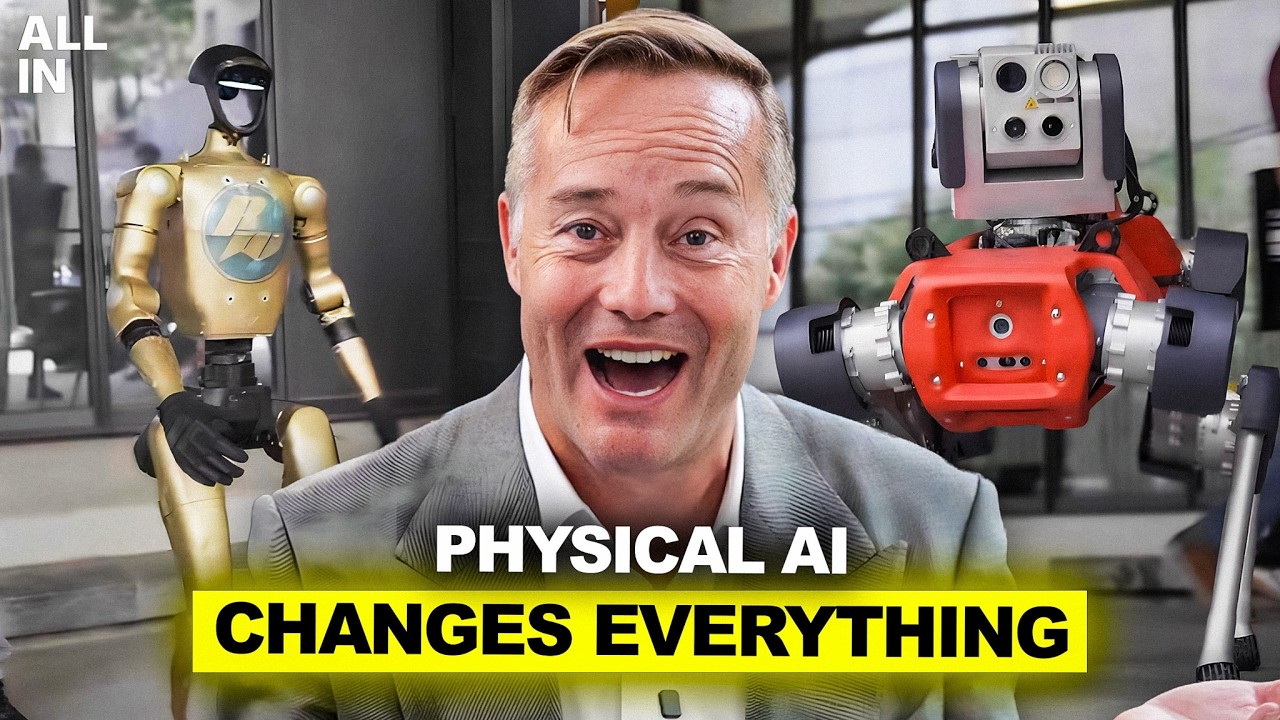
Agility, 1X Target $1 Robotic Labor as Chinese Supply Risk Mounts
All-In Podcast
Robotics leaders project humanoid hardware will slash factory labor costs to $1 per hour within years while warning against foreign hardware in critical infrastructure.
## Background
Published on YouTube by All-In Podcast on July 29, 2026, this episode features Jason Calacanis interviewing key leaders from top robotics companies at the Machina conference in Paris. The page description outlines discussions with executives from ANYbotics, 1X, Boston Dynamics, and Agility Robotics on quadruped design, consumer humanoids, enterprise deployment, national security, and the future of automated labor.
## TL;DR
Four prominent robotics executives present their distinct visions for how physical automation and AI are transforming industry and society. Dr. Péter Fankhauser (ANYbotics) highlights why quadruped dog-bots excel at industrial inspection and security, while Bernt Børnich (1X) outlines the open-platform launch of the Neo humanoid and predicts a hard takeoff toward full labor autonomy within three to ten years. Amanda McMaster (Boston Dynamics) emphasizes Spot's massive global commercial deployment, dual-brain AI architecture, and strict policies against foreign hardware backdoors or weaponization. Finally, Professor Jonathan Hurst (Agility Robotics) breaks down how solved perception and advanced world models enable Digit V5 to safely work alongside human workers without safety cages, driving labor costs down to roughly $1 per hour at scale.
## Atmosphere & style
The discussion carries an energetic, forward-looking tone that blends high-level technical depth with relaxed, conversational banter. Jason Calacanis leads as an inquisitive, occasionally playful host, balancing inquisitive questions about sci-fi tropes with sharp probes into unit economics, safety regulations, and geopolitical tensions. The guests radiate pragmatic optimism and engineering realism, moving effortlessly from high-stakes national security risks to practical discussions on battery swap cycles and warehouse economics. The resulting vibe is a fast-paced, insightful deep dive into the front lines of the modern AI and hardware revolution.
## Key takeaways
- [00:57](https://www.youtube.com/watch?v=TqNiSTeNtb0&t=57s) ANYbotics commercializes the four-legged quadruped form factor, which nature optimized for exceptional stability, stair climbing, and navigating extreme or hazardous industrial terrain.
- [03:12](https://www.youtube.com/watch?v=TqNiSTeNtb0&t=192s) Industrial inspection quadrupeds provide superhuman sensing (thermal, acoustic, gas detection) to prevent facility downtime that costs hundreds of thousands of dollars per hour.
- [05:27](https://www.youtube.com/watch?v=TqNiSTeNtb0&t=327s) Industrial safety and cyber-security concerns require zero hardware components from China and full onboard edge-GPU compute to avoid real-time data leakage.
- [13:18](https://www.youtube.com/watch?v=TqNiSTeNtb0&t=798s) Armed quadrupeds and humanoids are condemned by top Western robotics leaders as dangerous, risky, and unsafe due to the immaturity of current robotic control systems.
- [15:27](https://www.youtube.com/watch?v=TqNiSTeNtb0&t=927s) 1X plans to ship its household humanoid Neo in 2026 as an open platform with a skill store, offering both direct purchase and subscription models around $500 per month.
- [24:18](https://www.youtube.com/watch?v=TqNiSTeNtb0&t=1458s) 1X trains its world models by scaling uncurated internet video, leveraging a human-like body structure so base models can cross-learn directly from human video data.
- [30:22](https://www.youtube.com/watch?v=TqNiSTeNtb0&t=1822s) Robotics is approaching a 'hard takeoff' within 3 to 10 years, where autonomous systems will construct data centers, operate chip fabs, mine resources, and build other robots.
- [33:45](https://www.youtube.com/watch?v=TqNiSTeNtb0&t=2025s) Boston Dynamics' Spot is the world's most deployed mobile autonomous quadruped, delivering a full ROI in under two years for enterprise customers in 46 countries.
- [43:53](https://www.youtube.com/watch?v=TqNiSTeNtb0&t=2633s) Boston Dynamics enforces a strict anti-weaponization stance, prioritizing peaceful industrial applications while partnering with defense for EOD and hazardous extraction missions.
- [47:14](https://www.youtube.com/watch?v=TqNiSTeNtb0&t=2834s) Multimodal perception through modern vision-language models (VLMs) has largely solved visual context awareness, shifting the primary bottleneck in robotics to physical motor control.
- [50:20](https://www.youtube.com/watch?v=TqNiSTeNtb0&t=3020s) Because motor control datasets do not exist on the internet, robotics developers rely on physics simulation and world models to bridge the 'sim-to-real' gap.
- [55:17](https://www.youtube.com/watch?v=TqNiSTeNtb0&t=3317s) Agility Robotics' Digit V5 is designed to operate safely alongside human workers without protective physical cages or safety barriers.
- [58:45](https://www.youtube.com/watch?v=TqNiSTeNtb0&t=3525s) Mass production of humanoid robots will drive human-equivalent operational costs down toward $1 per hour, offering a ~90% cost reduction compared to human labor.
- [01:00:16](https://www.youtube.com/watch?v=TqNiSTeNtb0&t=3616s) Humanoids are best suited for human-designed, variable environments like legacy factories, whereas hyper-optimized 'lights-out' facilities are better served by dedicated fixed automation.
- [01:03:14](https://www.youtube.com/watch?v=TqNiSTeNtb0&t=3794s) Deploying robots for the '3 Ds' (dull, dirty, and dangerous jobs) will shift future human labor toward higher-safety and higher-quality roles.
- [01:05:42](https://www.youtube.com/watch?v=TqNiSTeNtb0&t=3942s) Humanoid design favors two arms for heavy lifting, as adding a third or fourth arm introduces mechanical complexity, weight, and power costs that outweigh any added utility.
## Detailed walkthrough
### [00:00](https://www.youtube.com/watch?v=TqNiSTeNtb0&t=0s) Introduction from Machina in Paris
Jason Calacanis welcomes viewers from Paris, France, where he is attending the Machina conference—an event dedicated to real-world AI and robotics applications. He sets the stage for a series of high-level conversations with key industry leaders in the robotics space, highlighting the rapid convergence of artificial intelligence and physical automation.
The episode kicks off with a brief sponsor overview for AppLovin Ads, emphasizing how its AI-driven mobile advertising platform helps e-commerce brands scale profitability across distraction-free mobile gaming environments reaching over a billion daily active users.
[00:57](https://www.youtube.com/watch?v=TqNiSTeNtb0&t=57s) ANYbotics and the Four-Legged Quadruped Form Factor
Jason sits down with Dr. Péter Fankhauser, co-founder and CEO of ANYbotics, who has worked in the robotics field for nearly two years decades, with ANYbotics operating for ten years—the first five as a research lab and the last five commercializing quadruped solutions. The discussion centers on ANYbotics' flagship platform, ANYmal, and why the four-legged "dog-bot" form factor has become an industry standard for ground mobility. Fankhauser explains that nature optimized four-legged animals for a reason: quadrupeds deliver exceptional stability, step-over capability, stair climbing, and a wide footprint essential for traversing hazardous, slippery, or outdoor industrial terrain affected by rain, snow, and mud.
Jason raises a playful question about why robotics companies do not build "centaurs"—combining four legs for stability with a bipedal upper body—to prevent the frequent falls seen in humanoid demonstrations like Tesla's Optimus, 1X's NEO, or Boston Dynamics' Atlas. Fankhauser notes that while humanoids excel in tight, eye-level human spaces such as coffee shops, quadrupeds offer superior balance and footprint dynamics for spacious, rugged industrial facilities where falling over poses severe operational risks.
* ANYbotics timeline: 20 years of research background, 10 years as a company (5 years research lab, 5 years commercial enterprise).
* Quadruped advantages: superior balance, wide footprint foothold, stair climbing, and reliable navigation in extreme weather (rain, snow, mud).
* Form factor debate: humanoids suit narrow spaces and eye-level work, whereas quadrupeds maximize physical stability in heavy industrial environments.
[03:12](https://www.youtube.com/watch?v=TqNiSTeNtb0&t=192s) Industrial Inspection Missions and ROI
ANYbotics focuses on automating industrial inspection across critical infrastructure, deploying hundreds of ANYmal units globally over the past five years. These enterprise-grade robots cost in the low hundreds of thousands of dollars to purchase, accompanied by tens of thousands of dollars in annual service contracts. Fankhauser emphasizes that ANYmal is not designed for consumers or simple manual labor replacement; rather, it provides "superhuman" sensing capabilities. Packed with thermal cameras, acoustic microphones, and specialized gas concentration sensors, ANYmal detects subtle methane leaks and overheating machinery long before human senses or traditional manual rounds notice anything wrong.
The clear economic payoff for plant operators comes from preventing unplanned downtime. Industrial assets like steel mills or chemical facilities can lose hundreds of thousands of dollars per hour if an unexpected failure occurs. Operating autonomously on two-hour battery cycles, ANYmal returns automatically to its docking station to recharge without requiring human intervention. Certain clients run up to 14 inspection missions per day to monitor specific critical moments, such as the exact minute an electric arc furnace fires up, far exceeding the coverage of manual human walkthroughs.
* Enterprise unit pricing: low hundreds of thousands of dollars per robot, plus tens of thousands in annual service agreements.
* Sensor payload: thermal imaging, acoustic microphones, micro gas leak detectors, and onboard AI compute.
* Operational ROI: avoids facility downtime costs that reach hundreds of thousands of dollars per hour.
* Duty cycle: 1 to 2 hours of continuous operation per mission with automatic docking; up to 14 missions per day for targeted facility events.
[05:27](https://www.youtube.com/watch?v=TqNiSTeNtb0&t=327s) Edge Compute, Extreme Environments, and Manipulation
Addressing the balance between edge and cloud compute, Fankhauser explains that real-time processing must remain directly on the robot's powerful onboard GPUs. Because wireless connectivity inside metal heavy-industrial facilities is frequently spotty, real-time balance, obstacle avoidance, and image quality checks must happen locally—uploading a blurry photo to the cloud is useless after the mission has passed. The cloud is reserved for higher-level contextual analysis, long-term predictive maintenance, and cross-facility downtime tracking.
ANYmal operates in extreme environments ranging from sub-zero conditions in Norway (-20°C) to intense desert heat (+40°C to +60°C), as well as unmanned offshore wind transformer platforms that convert AC to DC power before transmission to land. Crucially, ANYbotics engineered an ATEX-certified, spark-proof variant capable of operating safely inside explosive gas atmospheres, such as methane-rich environments in the Permian Basin or chemical refineries. Looking forward, Fankhauser envisions moving from passive data collection to physical intervention, progressing from opening valves and levers to multi-arm bimanual manipulation in dangerous environments.
* Local vs. Cloud compute: edge GPUs manage real-time motor control, obstacle navigation, and immediate sensor capture, while cloud platforms analyze contextual historical trends.
* Environmental range: certified for severe cold (-20°C in Norway), extreme desert temperatures (+40°C to +60°C), offshore energy converter stations, and ATEX explosive atmospheres.
* Future capability roadmap: transitioning from pure data collection to physical tasks like turning levers, opening cabinet doors, and eventual bimanual repair work.
[09:12](https://www.youtube.com/watch?v=TqNiSTeNtb0&t=552s) Supply Chain, Chinese Robotics Competition, and Military Use
When questioned about supply chains and geopolitical risks, Fankhauser reveals that 0% of ANYbotics' hardware is sourced from China, relying instead on European and US suppliers alongside proprietary in-house engineering. Discussing Chinese robotics competitors, he acknowledges their impressive hardware agility and low costs—capable of backflips and smooth walking—but argues they fail to deliver complete, enterprise-ready end-to-end solutions. Crucially, critical infrastructure operators prioritize cybersecurity and data trust, as ISO-certified data protection prevents sensitive facility mapping and operational telemetry from leaking to foreign entities like the Chinese Communist Party.
The conversation turns to defense applications and NATO readiness. While Fankhauser personally believes European tech companies have a responsibility to support regional defense capabilities, ANYbotics remains strictly dedicated to commercial industrial missions. He explains that military robotics requires fundamentally different low-latency teleoperation, specialized communications, and distinct software architectures compared to autonomous facility inspection. Furthermore, he addresses authoritarian demonstrations of quadrupeds fitted with firearms, calling armed ground robots "stupid and risky" due to current limitations in control reliability, framing public video demonstrations as early-stage propaganda rather than viable battlefield systems.
* Sourcing: 0% hardware components sourced from China; reliance on European and American component suppliers and custom internal architecture.
* Competitive edge: differentiates from low-cost Chinese hardware through end-to-end workflow integration, autonomous software maturity, and ISO cyber-security certification.
* Military stance: ANYbotics maintains a strict non-military focus, citing fundamental differences between industrial autonomous inspection software and millisecond-level military teleoperation.
* Weaponized quadrupeds: dismisses armed quadruped demonstrations as premature and unsafe, emphasizing that current robotic control systems are not mature enough to carry active weaponry safely.
[14:48](https://www.youtube.com/watch?v=TqNiSTeNtb0&t=888s) The Ethics of Armed Robotics and Introducing Bernt Børnich
Dr. Péter Fankhauser concludes his thoughts by echoing the stance taken alongside partners like Boston Dynamics and others who strictly condemn the weaponization of robots. From an engineering perspective, deploying armed robotics is viewed not only as dangerous and risky, but fundamentally stupid.
Following this, Bernt Børnich—founder and CEO of 1X—joins the discussion. 1X is the company behind Neo, a humanoid designed specifically for the household. While many pre-orders have been taken with a guaranteed delivery timeline, the immediate questions center on the final cost and whether 1X can truly hit its self-imposed deadline to start shipping into homes in 2026.
---
[15:27](https://www.youtube.com/watch?v=TqNiSTeNtb0&t=927s) Neo’s 2026 Launch Timeline, Pricing Models, and Open Platform
Bernt Børnich confirms that 1X will stick to its promises and ship Neo in 2026, though he manages expectations by emphasizing that the initial rollout will be intentionally slow and limited to a handful of early customers. Pricing depends on the payment path chosen during pre-orders, which offered either a full upfront payment for early adopters or a subscription model (around $500 per month). Because the underlying technology continues to evolve rapidly, 1X is actively shaping the long-term subscription structure alongside its early user base.
Crucially, Børnich reveals a major new strategic direction: Neo will be launched as an open platform. Similar to an App Store or "skill store," developers will be able to build and monetize specific capabilities on Neo—such as a custom "salad-making skill" that users can subscribe to. Børnich envisions this platform expanding far beyond household consumers, serving as an engine to generate labor abundance across all of society. Opening up the platform accelerates general autonomy and creates a broader ecosystem where both consumers and third-party developers benefit.
* **Pre-order Volume:** The first batch of 10,000 pre-orders sold out within the first few days.
* **Pricing Structure:** Options include a full upfront purchase or a subscription model around $500 per month.
* **Target Audience:** Early adopters in 2026 who understand the product will be "rough around the edges" and subject to occasional falls.
---
[18:40](https://www.youtube.com/watch?v=TqNiSTeNtb0&t=1120s) Teleoperation vs. Autonomy and the "Expert in Place"
While 1X originally avoided promising full autonomy out of caution, Børnich notes that current progress indicates Neo may ship with an experience that is surprisingly close to fully autonomous for many useful tasks. For unscripted or complex day-one needs, teleoperation (remote control) or guided assistance remains a fallback. The host draws a comparison to a New York chicken sandwich shop that hired a remote cashier in Manila over Zoom for $3 an hour, asking if Neo operates similarly by allowing remote operators in regions like the Philippines to step in and pour a glass of orange juice.
Børnich explains that the platform supports various operational tiers. 1X supplies the hardware, fleet management OS, and specialized data-collection gloves equipped with tactile sensors and vision matching Neo's build. Developers can collect data in their own facilities, fine-tune models through 1X's dense captioning pipeline, and deploy autonomous workflows—using teleoperation only when interventions are needed to gather better failure-analysis data. Furthermore, 1X plans to make Neo "headless" to specific AI software, allowing foundation labs to run alternative models (such as world models from OpenAI or Anthropic) directly on Neo's physical frame.
> "If you think about Neo as a platform... you can take the world's best expert and teleport them to anywhere in the world to help solve a situation—like a surgeon. It's super useful."
Beyond commercial use cases, teleoperation creates an "expert in place" capability. Børnich shares his own personal use case: using Neo as a physical avatar to wander his company's office or factory floor, inspect parts, and attend meetings while traveling abroad. Remote facilities—such as isolated power substations—can keep a Neo in a utility closet to flip switches during rare emergency outages, eliminating hours of drive time for technicians.
---
[24:18](https://www.youtube.com/watch?v=TqNiSTeNtb0&t=1458s) Training World Models: Leveraging Human Data and Video Scaling
Despite the benefits of teleoperation, Børnich notes a key hardware paradox: Neo’s custom hands are so sensitive and capable that human teleoperators actually lack the haptic fidelity to fully utilize them. Complex haptic suits slow down performance, making standard teleoperation inefficient for fine motor mastery. Instead, 1X collects physical data by having humans perform daily tasks while wearing transparent sensor rigs that match the robot's physical dimensions without restricting movement.
1X's core, decade-long thesis relies on making the robot structurally and physically identical to a human so it can cross-train directly on standard human video data. Through the 1X World Model Lab, the team is applying scaling laws to vast video libraries. The data collection hierarchy operates on four distinct levels:
1. **High-Quality Teleoperation Data:** Precision teleoperated tasks where failures are filtered out, leaving perfect, human-grade demonstration samples for model alignment.
2. **Sensorized Human Data:** Humans performing real-world tasks while wearing 1X tactile and vision sensors.
3. **Egocentric Human Video:** First-person perspective footage of human hands interacting with objects.
4. **General Internet Video Data:** Massive, uncurated video repositories (e.g., YouTube) capturing human movement and physical interactions.
Børnich argues that achieving true embodied AGI requires orders of magnitude more data than physical robots or sensor suits can collect over the next several years. By designing Neo's soft tissue, friction dynamics, nonlinear skin deformation, and proportions (jokingly referred to as the "gorilla coefficient" or wingspan) to match human biology, 1X can pre-train its baseline world models using existing internet video. Once these human-aligned base models achieve functional autonomy, deployed robots will naturally harvest true robotic action and force data at scale, unlocking recursive self-improvement loops.
[30:22](https://www.youtube.com/watch?v=TqNiSTeNtb0&t=1822s) Hard Takeoff: The Path to Autonomous Labor
The discussion dives into the exponential trajectory of AI and robotics, exploring how quickly the physical substrate will catch up to digital intelligence. Bernt Børnich of 1X explains that while he was previously more conservative in his predictions, the rate of progress over the past year has forced a massive upward revision. He emphasizes that digital intelligence cannot build its own physical computing infrastructure without embodied hardware to construct the data centers, mine the raw minerals, and operate the chip fabrication plants.
Børnich asserts that humanity is less than a decade away from a "hard takeoff"—defined as a completely self-sufficient ecosystem where robots build other robots and perform all fundamental physical labor. While his formal long-term window extends up to ten years, his personal bet for achieving full physical labor autonomy is just **three years**. He stresses that whether it takes three years or ten, it represents a mere blip in human history. Furthermore, physical robotics will accelerate scientific discovery by automating lab work, enabling AI models to directly run physical experiments, observe outcomes, and progress empirical science without human bottlenecks.
* **Timeline to Hard Takeoff:** Outer bound estimate is under 10 years; current personal bet is **3 years**.
* **Definition of Hard Takeoff:** A closed-loop system where robots autonomously build robots, manage chip fabs, build data centers, and handle all upstream mining and refining.
* **Scientific Automation:** High demand on 1X's platform comes from laboratories seeking to automate wet-lab experimentation so AI models can physically execute and validate scientific hypotheses.
* **Commercial Availability:** Neo can be pre-ordered directly online for **$500 per month**, mirroring the direct-to-consumer e-commerce ordering process of a Tesla.
---
[33:45](https://www.youtube.com/watch?v=TqNiSTeNtb0&t=2025s) Boston Dynamics & Real-World Deployments
Amanda McMaster, interim CEO of Boston Dynamics, addresses the history and current commercial focus of the pioneer in dynamic robotics. After transitioning through ownership by Google (Alphabet) and SoftBank (Masayoshi Son), Boston Dynamics is now owned by **Hyundai**. McMaster clarifies that Boston Dynamics has fully evolved away from being merely an AI research lab or producing viral videos of backflips and kung fu. The company's mandate is centered entirely on deploying robots into real-world commercial and industrial applications.
Their primary commercial workhorse, the quadruped robot **Spot**, is currently the most deployed mobile autonomous quadruped on Earth, operating at scale across industrial environments globally.
Customers deploy Spot across factories, power grids, and water treatment plants primarily for autonomous industrial inspection—utilizing visual cameras, acoustic leak detectors, vibration sensors, and thermal imaging to inspect critical infrastructure during the day and perform security perimeter patrols at night.
* **Global Footprint:** Over **500 customers** operating across **46 countries**.
* **Customer ROI Expectation:** Industrial clients require a full return on investment in **under 2 years**.
* **Pricing & Hardware Cost:** Base Spot units begin around **$100,000**, scaling up to **$300,000** for fully loaded configurations inclusive of specialized sensor payloads, integration, and service packages.
* **Reliability & Autonomy:** Reaches over **3,000 hours Mean Time Between Intervention (MTBI)**, meaning human physical intervention is required only a couple of times per year.
* **Operational Cycle:** Spot runs for roughly **90 minutes** per battery charge before autonomously returning to its docking station to charge.
* **Atlas Battery Architecture:** The electric humanoid **Atlas** features swappable batteries; the robot uses a dual-battery setup and can autonomously turn its torso to replace its own battery pack without human help.
---
[41:08](https://www.youtube.com/watch?v=TqNiSTeNtb0&t=2468s) Onboard Compute vs. Cloud Brains & Supply Chain Sovereignty
Addressing the architectural shift between onboard compute and cloud processing, McMaster outlines Boston Dynamics' "two brains" framework. The first brain handles physical dynamics, real-time balance, tactile manipulation, and high-frequency motor control; this stays entirely onboard the robot to maintain low-latency movement and safety. The second brain—the high-level reasoning layer responsible for semantic understanding of complex environments—can run in the cloud or through third-party AI partners like Google DeepMind. Surrounding both is a domain-specific software wrapper tuned to the enterprise customer's exact operational workflows.
McMaster takes a firm, explicit stance on manufacturing sovereignty and hardware security. She confirms that **100% of Boston Dynamics' robots are manufactured outside of China and Taiwan**, primarily built within the United States. When asked whether the US should allow Chinese-manufactured humanoid robots into domestic critical infrastructure, McMaster responds with an unqualified *"No."*
> "It's not safe. We've already heard about leaks that are happening with some of the quadrupeds that you're seeing in the United States, and it's being back-channeled back to China. We have seen what happens if we let China win in the semiconductor space... we can't do that with robotics."
* **Architectural Breakdown:**
* *Onboard Brain:* Balance, dynamic locomotion, real-time motor manipulation.
* *Cloud Brain:* Semantic reasoning, high-level task planning, LLM/VLM integration.
* *Enterprise Layer:* Customer-specific workflow logic and facility integration.
* **Manufacturing Sovereignty:** 100% produced in the US/allied nations; zero reliance on Chinese hardware assembly.
* **National Robotics Strategy:** Boston Dynamics actively consults with the US government to shape domestic supply chain protections, protect intellectual property, and prevent foreign hardware backdoors in critical infrastructure.
---
[43:53](https://www.youtube.com/watch?v=TqNiSTeNtb0&t=2633s) Defense Applications & The Anti-Weaponization Stance
The conversation moves to the military use of quadrupeds and humanoids, particularly given the rapid, drone-driven evolution of battlefield tactics seen in recent geopolitical conflicts. Boston Dynamics maintains a strict, publicly stated stance against weaponizing its platforms. However, McMaster emphasizes that this policy is also driven by core business strategy and practical focus: industrial automation represents a massive, immediate commercial opportunity, and weaponization serves as an unnecessary operational distraction.
While refusing to mount offensive weapons on Spot or Atlas, Boston Dynamics actively partners with government and defense sectors for non-weaponized, life-saving missions. Spot is currently used in combat environments and domestic police work for **Explosive Ordnance Disposal (EOD)**, bomb defusal, HAZMAT evaluation, and search-and-rescue/medical delivery to extract wounded soldiers without risking human lives.
* **Anti-Weaponization Policy:** Strict contractual and technical prohibitions against mounting offensive kinetic weapons on Spot or Atlas platforms.
* **Approved Defense Use-Cases:** Explosive Ordnance Disposal (EOD), bomb disarming, hazardous material testing, and remote supply delivery/medical transport.
* **Geopolitical Dilemma:** Addresses the strategic tension of Western companies withholding weaponized humanoids while foreign adversaries actively develop armed military quadrupeds and humanoid units.
<ElicitationsGroup message="Explore related robotics topics:">
<Elicitation label="Compare Spot and Atlas specifications" query="Provide a detailed comparison table between Boston Dynamics' Spot quadruped and Atlas humanoid, including specs, payloads, and ideal deployment environments."/>
<Elicitation label="Analyze defense policies on military AI" query="What are the current official US Department of Defense policies regarding autonomous weapons systems and armed robotics?"/>
</ElicitationsGroup>
Here is a detailed, faithful walkthrough of this section of the video transcript:
[45:31](https://www.youtube.com/watch?v=TqNiSTeNtb0&t=2731s) The Reality of Military Applications and Nationalization Concerns
The host presses Boston Dynamics' interim CEO, Amanda McMaster, on whether the company would build weaponized or protective robots for the United States if called upon. McMaster admits it is a tough question that the company hopes it never has to answer, but she asserts that if and when the time comes to make a difficult decision, Boston Dynamics will "make the right one." The host playfully interjects that when President Trump or the government calls, there will be no option to refuse—otherwise, the company risks being nationalized.
The discussion highlights the stark contrast between current commercial applications and military realities. While McMaster insists Boston Dynamics does not weaponize its platforms and remains laser-focused on profitable, peaceful applications, the host notes that adversaries are already mounting AK-47s on foreign robot dogs. The host then jokes (or confides in a mock secret) that agencies like the CIA, FBI, and Department of War already have plenty of their robots outfitted with weapons in the field. Wrapping up her segment, McMaster notes that while Boston Dynamics is based in Waltham, Massachusetts, just outside Boston, they are open to remote work and actively considering expanding their footprint to the West Coast to tap into Bay Area talent.
[47:14](https://www.youtube.com/watch?v=TqNiSTeNtb0&t=2834s) Agility Robotics and the 20-Year Evolution of Humanoid Robotics
The host introduces Professor Jonathan Hurst, co-founder and Chief Robot Officer (CRO) of Agility Robotics, who holds a PhD in robotics dating back to 2008 and has spent over two decades in the field. The host asks Hurst to contrast the slow-moving landscape of the last 20 years with the explosive surge in progress over the past 2 to 3 years. Hurst reflects that 20 years ago, robotics in industry was strictly limited to fixed automation systems, while humanoids and mobile autonomous robots were confined to academic research labs. Today, that research has finally broken through into practical, real-world deployment, sparking massive student demand and an exponential growth of robotics university programs.
Addressing why "this time is different" after a century of false starts and multiple "AI winters," Hurst emphasizes a fundamental distinction: making a machine that merely *looks* like a person is easy, but building a robot that can perform genuinely useful work in human-designed spaces is extremely difficult. The primary catalyst driving today's inflection point is perception. Thanks to large language models (LLMs) and vision systems, a modern robot can look at a table and immediately recognize objects—a phone, paper, tea, or water—and understand their volume or context without complex manual programming. Just three or four years ago, perception was an immense bottleneck requiring hyper-narrow, custom coding.
- **20+ Years in Robotics:** Hurst's experience spans from early academic research to modern commercial deployment.
- **Perception Solved:** Multimodal models provide instant context awareness, rendering environmental perception largely a solved problem compared to 3–4 years ago.
[50:20](https://www.youtube.com/watch?v=TqNiSTeNtb0&t=3020s) Solving the Control Problem: World Models, Teleoperation, and Sim-to-Real
While perception is nearly solved, controlling physical motion remains a distinct challenge. The host points out that previously, tasks as simple as pulling a shot of espresso required manual coding for every movement (citing his investment in Cafe X). Hurst explains that while LLMs provide general internet-derived intelligence, there is no pre-existing dataset on the internet for motor control—no database of raw torque commands mapping motor actions to sensor inputs.
To overcome this, companies use a combination of teleoperation (humans wearing sensor gloves or rigs to demonstrate tasks), motion capture, and simulation. However, human teleoperation has hard limits and cannot discover optimal robot mechanics. True progress relies on building **world models**—simulating entire warehouses, kitchens, and physical interactions computationally so robots can undergo millions of training iterations in days. Hurst cautions that no single "silver bullet" or instant singularity exists due to the persistent "sim-to-real gap," where real-world variables like condensation on glass or subtle wave dynamics defy simulation. Progress resembles a snowball gathering speed down a hill, driven by massive investments of engineering capital and hardware testing.
- **Data Gap:** Internet data trains language models, but physical robot control requires newly generated torque and sensor data.
- **The "Sim-to-Real" Gap:** Real-world dynamics (fluid sloshing, surface condensation, friction nuances) still require real-world practice.
- **The Wi-Fi Advantage:** Unlike human learning (e.g., learning to play the violin), once one robot masters a physical motion through iterative learning, that capability can be instantly uploaded via Wi-Fi to every identical robot on the network.
[55:17](https://www.youtube.com/watch?v=TqNiSTeNtb0&t=3317s) Deploying Digit V5: Safety Barriers and Commercial Economics
Agility Robotics is preparing to launch **Digit V5** later this year. Hurst outlines how current deployments of Digit (such as version 4.0) perform scoped, multi-purpose workflows like picking up totes and carrying bins. These tasks justify a humanoid form factor because lifting large objects onto tall shelves in narrow spaces requires two arms, full-body balance, and dynamic manipulation. The major breakthrough for Digit V5 is safety: it is designed to step outside of traditional caged work cells and operate alongside humans without physical safety barriers.
The host recalls visiting automated Tesla and Toyota factories where crossing a painted safety line immediately triggers an emergency shut-down costing millions of dollars. Hurst notes that meeting enterprise safety requirements (such as Amazon's strict operational standards) required a complete bottom-to-top redesign of every system in the robot over the last 2 to 3 years. From a cost standpoint, these machines can operate up to 20 out of 24 hours per day thanks to fast-charging batteries. Over a 5-year operational lifespan, a robot provides roughly 40,000 hours of active work.
- **Digit V5 Rollout:** Debuting later this year as the first balancing humanoid capable of working alongside humans without physical safety cages or barriers.
- **Duty Cycle:** Digit V5 achieves a 20-hour daily uptime out of 24 hours due to fast-charging battery technology.
- **Operational Math:** 20 hours/day × 365 days = ~7,300–8,000 hours/year, totaling ~40,000 hours of labor over a 5-year lifespan.
- **Business Models:** Agility Robotics offers both CapEx sales and Robot-as-a-Service (RaaS) models, catering to different corporate risk tolerances.
- **Economic Value:** Human factory labor in the West costs $20–$40 per hour. Once humanoids hit mass scale (around 100,000 units), hardware costs will mirror automotive prices, driving labor costs down toward $1 per hour and offering a ~90% cost reduction for enterprise customers.
[01:00:16](https://www.youtube.com/watch?v=TqNiSTeNtb0&t=3616s) Automation Caps, "Lights-Out" Warehouses, and Doorstep Delivery
The discussion kicks off with a probe into when the tipping point will occur where the majority of factory workers—say, 51%—are replaced by robotics. Professor Jonathan Hurst responds that in many logistics applications, the vast majority of workforce operations are already automated by AMRs (Autonomous Mobile Robots), conveyor systems, and industrial robot arms. Rather than replacing entire labor forces overnight, robotics serves as a fundamental layer of productivity driver essential for growing GDP in nations facing stagnant population growth or anti-immigration headwinds.
Looking forward, Hurst paints a picture of fully automated "lights-out" package sortation facilities serviced seamlessly by autonomous trucks. Crucially, he argues that bipedal humanoids will not be the primary choice for these hyper-optimized specialized facilities; dedicated fixed-purpose machinery remains far more efficient for single-purpose, 24/7 tasks. Humanoids shine when navigating environments built for people and doing human workflows—expanding into legacy facilities, grocery stores, hospitals, construction sites, and last-mile package delivery to front doors. Addressing the prospect of autonomous rideshare vehicles dropping off packages via bipedal robots, Hurst notes that Agility Robotics actually demonstrated this seven years prior in an early partnership with Ford, where their Digit robot exited a car and walked up porch steps, though last-mile delivery remains a secondary roadmap target compared to immediate high-volume industrial use cases.
- **Economic context**: Robotics adoption is highlighted as a vital pathway to GDP growth in regions with aging demographics or restricted immigration.
- **Form factor matching**: "Lights-out" specialized factories favor dedicated industrial machinery over humanoids, whereas humanoids target variable, human-centric environments.
- **Historical milestone**: Agility Robotics piloted autonomous doorstep delivery with Ford roughly seven years prior, proving feasibility on stairs and walkways.
---
[01:03:14](https://www.youtube.com/watch?v=TqNiSTeNtb0&t=3794s) The "3 Ds" of Robotics and the Shift in Future Labor
When asked to identify high-impact, non-obvious applications for robotics, Hurst returns to a core industry principle: relieving human workers from the "3 Ds" of labor—dull, dirty, and dangerous tasks. Simple pick-and-place material handling across supply chains consumes millions of human hours in conditions that cause repetitive stress and wear.
Hurst draws a historical parallel to the labor transitions of the 20th century. Just as society today looks back at 1900s coal mining jobs with disbelief that humans were subjected to such conditions, future generations will view manual warehouse labor as obvious "robot jobs." The transition will free human labor for roles with significantly higher quality of life and safety standards.
> "I really hope that our children look back... at some of the jobs that people are doing today that I really think of as robot jobs the same way we look back on like coal miners in the 1900s and say, 'I can't believe people did that work.'"
---
[01:04:14](https://www.youtube.com/watch?v=TqNiSTeNtb0&t=3854s) Career Opportunities: From Engineering Graduate Degrees to "Clanker" Maintenance
Addressing young people concerned about career trajectories in an era of rapid technological disruption, Hurst emphasizes that industry shifts create unique advantages for newcomers over established veterans stuck in old paradigms. Students building foundational engineering skill sets are positioned to capture massive value over the coming decade.
Beyond academic PhD or Master's tracks, the conversation highlights a growing "blue-collar" robotics economy. Field operations, assembly, deployment, and hands-on maintenance will require a skilled technician workforce—jokingly referred to in the banter as "clanker maintenance"—to keep physical fleets operational on factory floors.
- **Academic edge**: New graduates enter the field without legacy technical debt, allowing them to adapt faster to modern AI-driven robotics architectures.
- **Technical operational roles**: High demand is anticipated for robot operators, assembly specialists, field deployment engineers, and maintenance mechanics.
- **Terminology banter**: The hosts joke about whether the term "clanker" carries negative connotations or remains a Disney-trademarked sci-fi trope.
---
[01:05:42](https://www.youtube.com/watch?v=TqNiSTeNtb0&t=3942s) Design Principles: Why Two Arms Win Over Four
Prompted by a half-serious question about why humanoid robots aren't built with four or six arms—like *Star Wars* character General Grievous—to maximize throughput, Hurst breaks down the underlying first-principles engineering tradeoffs.
Design simplicity dictates the minimum viable complexity required for a task. A single arm limits a robot to picking up small, lightweight objects; adding a second arm enables two-handed manipulation of bulky or heavy loads. Adding a third or fourth arm introduces severe mechanical coordination challenges, structural weight, power draw, and collision-avoidance complexity without providing enough operational utility to justify the cost.
> "One arm is not quite enough to pick up big things... Two arms, now you can pick up big things. Adding a third arm, it's hard to see enough utility to make it worth fitting it in."
---
[01:06:34](https://www.youtube.com/watch?v=TqNiSTeNtb0&t=3994s) Sci-Fi Inspirations, Safety Safeguards, and Hiring at Agility Robotics
Closing out the interview, Hurst shares his personal favorite science-fiction robots: Wall-E and Eve for their dedicated utility, alongside Baymax from *Big Hero 6* for his clear, benevolent design. He points to a scene in *Big Hero 6* where removing Baymax's safety chip turns the robot dangerous, noting that software safeguards, hardware E-stops (emergency stops), and industrial supervisory circuits are very real requirements in physical robotics development to guarantee human safety.
To conclude, Hurst details the growth and open positions across Agility Robotics' key locations, encouraging young engineers to jump into the sector.
- **Favorite sci-fi robots**: *Wall-E*, *Eve*, and *Baymax* (*Big Hero 6*).
- **Safety architecture**: Multi-layered safety protocols including hardwired E-stops, supervisory safety circuits, and failure-mode safeguards are required for human-adjacent robots.
- **Agility Robotics hubs**:
- **Salem, Oregon**: Original founding location and engineering hub.
- **Fremont, California**: New facility focused on robot behavior development and continuous testing.
- **Pittsburgh, Pennsylvania**: Research and development center located adjacent to Carnegie Mellon University.
## Notable quotes
> [18:40](https://www.youtube.com/watch?v=TqNiSTeNtb0&t=1120s) If you think about Neo as a platform... you can take the world's best expert and teleport them to anywhere in the world to help solve a situation—like a surgeon. It's super useful. — Bernt Børnich
> [41:08](https://www.youtube.com/watch?v=TqNiSTeNtb0&t=2468s) It's not safe. We've already heard about leaks that are happening with some of the quadrupeds that you're seeing in the United States, and it's being back-channeled back to China. We have seen what happens if we let China win in the semiconductor space... we can't do that with robotics. — Amanda McMaster
> [01:03:14](https://www.youtube.com/watch?v=TqNiSTeNtb0&t=3794s) I really hope that our children look back... at some of the jobs that people are doing today that I really think of as robot jobs the same way we look back on like coal miners in the 1900s and say, 'I can't believe people did that work.' — Jonathan Hurst
> [01:05:42](https://www.youtube.com/watch?v=TqNiSTeNtb0&t=3942s) One arm is not quite enough to pick up big things... Two arms, now you can pick up big things. Adding a third arm, it's hard to see enough utility to make it worth fitting it in. — Jonathan Hurst
## Mentioned
ANYbotics, Dr. Péter Fankhauser, ANYmal, Tesla, Optimus, 1X, NEO, Boston Dynamics, Atlas, Spot, Bernt Børnich, OpenAI, Anthropic, Amanda McMaster, Google, Alphabet, SoftBank, Masayoshi Son, Hyundai, Google DeepMind, Agility Robotics, Professor Jonathan Hurst, Digit V5, Digit, Amazon, Ford, Jason Calacanis, Machina, AppLovin Ads, Plaud, Permian Basin, Chinese Communist Party
Robotics leaders from ANYbotics, Boston Dynamics, Agility Robotics, and 1X indicate that the field has shifted from exploratory research to real-world commercialization, propelled by multimodal perception and robust edge compute. While approaches diverge between specialized industrial quadrupeds and general-purpose humanoids, the industry faces common challenges around physical motor control data, supply chain security, and strict boundaries against weaponization.
Form Factor Matching: Rugged Quadrupeds Versus Humanoids (0:57)
Robotics developers align mechanical architecture with distinct operational environments. Dr. Péter Fankhauser of ANYbotics argues that four-legged platforms like ANYmal offer critical balance, wide footholds, and stair-climbing resilience required for harsh industrial facilities facing rain, snow, and extreme temperatures from -20°C to +60°C. For these hazardous settings, avoiding falls is paramount, making quadrupeds vastly more reliable than bipedal alternatives.
Conversely, Jonathan Hurst of Agility Robotics and Bernt Børnich of 1X contend that bipedal humanoids are essential for environments engineered around people. Hurst points out that while dedicated machinery dominates single-purpose, lights-out warehouses, humanoids with two arms are uniquely suited for legacy facilities, narrow aisles, and two-handed bin manipulation. Børnich similarly argues that matching human physical dimensions and friction dynamics allows 1X's Neo to operate effectively inside domestic households.
Dual-Brain Architecture and Physical Control Bottlenecks (41:08)
Robotic software architectures increasingly split into onboard real-time execution and off-board contextual reasoning. Amanda McMaster of Boston Dynamics details a two-brains paradigm where dynamic locomotion, tactile manipulation, and high-frequency motor control remain strictly onboard the robot to prevent latency failures. Higher-level semantic planning and foundation models operate in the cloud or via external AI partners. Fankhauser notes that ANYbotics similarly executes balance and obstacle avoidance on local GPUs due to unreliable wireless connectivity inside heavy industrial complexes.
While Hurst observes that large multimodal models have largely resolved environmental perception, physical motor control remains an acute bottleneck. Unlike language models, physical robots lack pre-existing web datasets of motor torque commands. To bridge this sim-to-real gap, 1X designs its robots to mirror human biology and wingspan so they can pre-train baseline world models directly on internet video, using teleoperation and sensor rigs to refine edge-case motor skills before deploying networked models over Wi-Fi.
Commercial Deployment, Pricing, and Labor Economics (3:12)
Commercial traction is currently strongest in high-value industrial inspection, where robots provide rapid return on investment. ANYbotics and Boston Dynamics price their industrial inspection platforms between $100,000 and $300,000, supported by annual service agreements. McMaster highlights that Spot achieves over 3,000 hours mean time between physical interventions, while Fankhauser notes that preventing a single unplanned outage in a chemical plant or steel mill offsets unit costs by saving hundreds of thousands of dollars per hour.
In logistics and consumer markets, business models are shifting toward subscription and labor substitution. Agility's Digit V5 introduces fast-charging batteries enabling 20 hours of daily operation, working alongside staff without safety cages; Hurst estimates that scaling humanoid production to automotive volumes could drive operational labor costs toward $1 per hour, compared to $20–$40 for human labor. For consumer applications, 1X is launching Neo in 2026 under a $500 monthly subscription model, with Børnich projecting a three-to-ten-year horizon toward a hard takeoff where robots autonomously sustain industrial manufacturing.
Supply Chain Sovereignty and Anti-Weaponization Policies (9:12)
Western robotics executives place increasing emphasis on hardware provenance and data security. Fankhauser confirms that ANYbotics sources 0% of its hardware from China, relying on European, American, and custom proprietary components to meet ISO data security certifications. McMaster states that 100% of Boston Dynamics' robots are produced outside China and Taiwan, cautioning that foreign-manufactured platforms pose unacceptable cyber backdoors and data-leak risks for Western critical infrastructure.
Both companies also enforce strict prohibitions against weaponizing their platforms. Fankhauser dismisses public demonstrations of quadrupeds fitted with firearms as unsafe, technically immature propaganda, emphasizing that autonomous inspection code fundamentally differs from military-grade teleoperation. McMaster notes that Boston Dynamics contractually bans mounting offensive kinetic weapons on Spot or Atlas, restricting defense partnerships exclusively to non-lethal missions such as explosive ordnance disposal, hazardous material inspection, and medical supply transport.
Although industry leaders anticipate massive productivity gains, timelines for generalized autonomy vary sharply—from immediate, bounded industrial inspection to Børnich's three-year forecast for self-replicating robotic labor. Unresolved questions remain regarding whether humanoids can safely operate in unconstrained domestic environments without frequent teleoperation, and how Western manufacturers will maintain anti-weaponization stances as geopolitical rivals integrate armed robotics on the battlefield.
## Background
本期节目由知名播客频道 All-In Podcast 于 2026 年 7 月 30 日在 YouTube 平台发布。节目依托在法国巴黎举办的 Machina 峰会,由主持人 Jason Calacanis 深度对话全球顶尖机器人公司的四位核心掌门人,探讨四足巡检机器狗、家庭双足人形机器人、全栈工业落地及具身智能的未来走向与地缘技术竞争。
## TL;DR
节目汇聚了 ANYbotics 首席执行官 Péter Fankhauser、1X 创始人 Bernt Børnich、波士顿动力临时首席执行官 Amanda McMaster 以及 Agility Robotics 联合创始人 Jonathan Hurst 四位先锋领袖。嘉宾们系统剖析了四足与双足形态的工程权衡,披露了 1X 家庭人形机器人 NEO 的交付规划与开放平台战略,展示了波士顿动力 Spot 在工业巡检领域的商业化落地与双脑架构,并从第一性原理探讨了多模态大模型如何终结人形机器人百年的虚假繁荣。四位领袖一致强调了摆脱单纯硬件炫技、恪守反武器化伦理底线以及保障供应链数据安全的重要性,展望了机器人将人类从枯燥危险的‘3D’工种中彻底解放并带来极端劳动力充裕的工业未来。
## Atmosphere & style
全片充盈着硬核工程实用主义与激进科技乐观主义相互碰撞的张力。主持人 Jason Calacanis 风格犀利灵动,不断抛出科幻构想、地缘安全与终结者武器化等尖锐难题,而四位行业专家则以极度务实的第一性原理严谨拆解。对话在真实世界的严酷工况算力账本与令人战栗的‘硬起飞’自我递归构想之间自如穿梭,听感兼具峰会现场的敏锐纪实感与洞见行业拐点的磅礴史诗感。
## Bulletin
- [15:01](https://www.youtube.com/watch?v=TqNiSTeNtb0&t=901s) 1X 宣布其双足家庭人形机器人 NEO 将于 2026 年正式启动小批量交付,并转型为开放平台,支持第三方基础模型(如 OpenAI、Claude)与技能商店生态接入。
- [09:02](https://www.youtube.com/watch?v=TqNiSTeNtb0&t=542s) ANYbotics 与波士顿动力均坚持供应链本土化与安全合规,强调其机器人实现 0% 中国供应链或 100% 盟国制造,并坚决签署公约抵制机器人的杀伤性武器化开发。
- [33:45](https://www.youtube.com/watch?v=TqNiSTeNtb0&t=2025s) 波士顿动力 Spot 全球装机量已覆盖 46 个国家的 500 多家客户,MTBI 突破 3,000 小时;Atlas 则通过双电池自旋转自主更换实现全天候 24 小时低成本作业。
- [55:17](https://www.youtube.com/watch?v=TqNiSTeNtb0&t=3317s) Agility Robotics 推出 Digit V5 人形机器人,彻底打破传统工厂的物理隔离安全围栏,预计规模化量产后分摊单位时薪成本将压缩至约 1 美元/小时。
- [29:28](https://www.youtube.com/watch?v=TqNiSTeNtb0&t=1768s) 具身智能领袖预测物理递归制造的“硬起飞”可能在 3 到 10 年内发生,机器人将能自主建设晶圆厂、数据中心并制造下一代机器人。
## Key takeaways
- [00:58](https://www.youtube.com/watch?v=TqNiSTeNtb0&t=58s) 四足形态(机器狗)凭借宽支撑面和极佳的抗倾覆性,成为目前在海上风电、防爆油气等极端工业环境中率先规模化落地的实用形态。
- [03:13](https://www.youtube.com/watch?v=TqNiSTeNtb0&t=193s) 重工业非计划停机损失高达每小时数十万美元,高精度边缘巡检机器人依靠预防性维护与超人级多模态感知能够迅速收回采购成本。
- [09:02](https://www.youtube.com/watch?v=TqNiSTeNtb0&t=542s) 工业客户购买的是包含高阶自主导航与网络安全 ISO 认证的全栈解决方案与数据信任,单纯的低价硬件炫技无法攻克核心壁垒。
- [11:21](https://www.youtube.com/watch?v=TqNiSTeNtb0&t=681s) 工业巡检与战场战术控制在底层架构上彻底割裂,全球顶尖机器人厂商联合抵制将自主地面机器人武器化为“终结者”。
- [19:44](https://www.youtube.com/watch?v=TqNiSTeNtb0&t=1184s) 1X 将 NEO 打造为软硬件开放平台,通过类似 App Store 的机制撬动全球开发者生态,以加速具身智能与充沛劳动力的实现。
- [22:23](https://www.youtube.com/watch?v=TqNiSTeNtb0&t=1343s) 远程遥操作兼具“数字孪生化身”与“专家即刻就位”的双重价值,既是冷启动期数据采集与兜底方案,也是偏远高危检修的长期刚需。
- [24:18](https://www.youtube.com/watch?v=TqNiSTeNtb0&t=1458s) 1X 建立由“互联网海量通用视频—主观视角视频—穿戴传感器数据—高精遥操作微调”构成的四层数据金字塔,通过类人同构吸收物理世界常识。
- [29:28](https://www.youtube.com/watch?v=TqNiSTeNtb0&t=1768s) 具身智能的“硬起飞”临界点预计在 3 至 10 年内到来,其本质是机器人形成自我供给闭环,自主制造硬件与建设基础设施。
- [36:36](https://www.youtube.com/watch?v=TqNiSTeNtb0&t=2196s) 波士顿动力确立了差异化商业模型:四足 Spot 采用符合工业习惯的 CapEx 买断制,而人形机器人 Atlas 将探索 RaaS 按需租赁服务。
- [41:05](https://www.youtube.com/watch?v=TqNiSTeNtb0&t=2465s) 波士顿动力推行“双脑架构”:机载端运行毫秒级高频动态运动的“物理控制脑”,云端则运行负责通用语义与常识推理的“推理脑”。
- [47:14](https://www.youtube.com/watch?v=TqNiSTeNtb0&t=2834s) 多模态大语言模型(VLM/LLM)的突破解决了高层视觉与空间语义感知,让人形机器人历经百年虚假繁荣后真正迎来实用化拐点。
- [50:20](https://www.youtube.com/watch?v=TqNiSTeNtb0&t=3020s) 底层运动控制面临严峻的数据荒漠,互联网缺乏精确电机力矩与接触力学数据,且 Sim-to-Real 仿真鸿沟依然难以被单一算法消除。
- [54:28](https://www.youtube.com/watch?v=TqNiSTeNtb0&t=3268s) 机器人具备人类不可比拟的“Wi-Fi优势”:单机训练沉淀的模型权重可通过网络毫秒级同步至全机队,打破单体传承的学习瓶颈。
- [55:17](https://www.youtube.com/watch?v=TqNiSTeNtb0&t=3317s) Digit V5 彻底重构了软硬件安全架构,成为首款无需物理隔离围栏即可在人员密集仓库中与人类并肩作业的人形机器人。
- [01:02:48](https://www.youtube.com/watch?v=TqNiSTeNtb0&t=3768s) 人形机器人通过承担沉闷(Dull)、脏乱(Dirty)与危险(Dangerous)的 3D 工作,将人类劳动力解放并推向更有尊严的技术与运维岗位。
- [01:05:42](https://www.youtube.com/watch?v=TqNiSTeNtb0&t=3942s) 机器人本体设计遵循第一性原理的系统简洁性,双臂足以覆盖大多数仓储货物搬运需求,盲目增加肢体手臂反而会带来非必要的协调复杂度。
## Detailed walkthrough
### [00:00](https://www.youtube.com/watch?v=TqNiSTeNtb0&t=0s) 巴黎峰会开场与物理世界 AI 的崛起
Jason Calacanis 在法国巴黎的 Machina 峰会现场拉开本期特辑的序幕。这场峰会聚焦于“真实物理世界中的人工智能”,探讨前沿算法如何走出实验室,与硬件实体紧密结合并重塑工业生产与现实生活。
赞助商 AppLovin 在开场广告中展示了其技术驱动的商业范式:从一个仅花费 8 美元的域名和零风险投资起步,成长为全球首屈一指的广告平台之一。其最新面向电商的 AppLovin Ads 依托手游生态触达全球逾 10 亿日活跃用户,以中位数 35 秒的全屏沉浸式视频广告捕获用户注意力,通过算法自主寻找买家并最大化利润。例如某炊具品牌在接入该系统后,营收从 400 万美元跃升至 1600 万美元并实现全面盈利,当年正朝着 8000 万美元的营收目标迈进。
- AppLovin 凭借 AI 广告引擎实现全自动获客与利润优化,广告主只需设定商业目标即可自主运行。
- 视频广告依托移动游戏生态,提供无干扰的全屏展现,拥有极高的用户留存与互动时长。
---
### [00:58](https://www.youtube.com/watch?v=TqNiSTeNtb0&t=58s) 为何押注四足:稳定性、恶劣环境与“半人马”猜想
Jason Calacanis 迎来了第一位重磅对话嘉宾——ANYbotics 联合创始人兼首席执行官 Péter Fankhauser 博士。Fankhauser 在机器人领域深耕近二十年,ANYbotics 成立也已满十年:前五年如同纯粹的学术科研实验室,后五年则致力于将四足机器人 ANYmal 商业化落地。当被问及为何四足形态(机器狗)能率先实现规模化部署时,Fankhauser 指出自然界中大部分动物采用四足并非偶然。四足拥有天然的运动能力与重心冗余,能够自如爬楼梯、跨越障碍,到达任何人类能够行走的区域;更重要的是在湿滑地面、降雨、积雪、杂草丛生等恶劣复杂的工况下,四足提供了极宽的支撑面和充足的立足点抓地力,这是双足系统难以匹敌的。
谈话随即引出了一个充满科幻色彩的探讨:既然特斯拉 Optimus、1X 的 NEO 和波士顿动力的 Atlas 等双足人形机器人在演示中频繁摔倒、在工业现场甚至有砸伤工人脚踝的风险,为何不直接造出希腊神话中“上半身是人、下半身是四足马”的“半人马”(Centaur)形态?Fankhauser 笑着回应,技术上完全可行,归根结底取决于具体场景:如果是在狭窄的咖啡馆里端咖啡,需要与人类保持平视交互,双足更合适;但在 ANYbotics 主攻的重工业和能源基础设施中,地面空间充裕,四足所带来的极高稳定性才是最切合实际的选择。
```mermaid
flowchart TD
accTitle: ANYbotics Form Factor Decision
accDescr: Comparison between Quadruped and Bipedal designs for industrial use
subgraph ENV["作业环境挑战"]
E1["湿滑地面 / 泥泞"]
E2["极端天气 / 雨雪"]
E3["陡峭楼梯 / 管道障碍"]
end
subgraph FORM["形态与能力匹配"]
Q["四足形态 ANYmal"]
B["双足人形机器人"]
end
subgraph RESULT["工业场景结果"]
R1["宽支撑面 + 极佳抗倾覆性"]
R2["高稳定性 + 全天候巡检落地"]
R3["平衡控制复杂 + 易倾倒砸伤"]
end
ENV --> Q
ENV -.-> B
Q --> R1 --> R2
B --> R3
```
- ANYbotics 创立 10 年,前 5 年专注研发积累,近 5 年实现商业化部署,全球装机量已达数百台。
- 机器狗 ANYmal 单台售价在数十万美元区间(Low hundreds of thousands),附带每年数万美元的高级维保服务合同。
---
### [03:13](https://www.youtube.com/watch?v=TqNiSTeNtb0&t=193s) 工业资产巡检:超人感官与停机成本的算力账本
四足机器狗并非面向普通消费者的家用玩伴,其核心价值在于守护高风险、高价值的关键基础设施。Fankhauser 强调,他们的目标绝非简单的“劳动力替代”,而是实现“超越人类极限”(Superhuman)的能力。人类巡检员的眼耳无法捕捉微小的隐患,而 ANYmal 搭载了由热成像相机、声学麦克风阵列、气体浓度探测器以及激光雷达组成的复合传感器包,并由强大的车载 GPU 进行边缘 AI 推理,能够及时察觉肉眼难辨的微量气体泄漏与设备微小过热。对于重工业客户而言,关键资产非计划停机的损失往往高达每小时数十万美元,“我们帮客户多挽回一分钟或一小时的正常运转,省下来的钱就足以抵消整台机器人的采购成本”。
正因商业回报极其丰厚,客户完全能够承受高昂的工业级传感器与机载计算芯片。这种机器人单次任务续航约为两小时,之后自主返回充电坞补充能量。一些部署在电弧炉等极端高危场景的客户,一天会让机器人出动多达 14 次甚至 40 次,只为精准监测电弧炉升温那一瞬间的设备状态。针对边缘计算与云端分工的权衡,Fankhauser 解释道,涉及避障、导航、即时防摔以及采集图像质量校验等对时延极敏感的任务,必须完全在本地实时运行,否则网络一旦中断或上传模糊照片就为时已晚;而跨时间维度的上下文趋势分析、设备历史寿命衰减建模,则交给云端集中处理。目前客户极少需要机器人连续无休运转 24 小时,机器人在数小时充电窗口之余每天巡检 8 至 20 次,相比此前人类每天仅有的一两次人工巡查,数据采集频次和精度已经实现了量级跃升。
- 经济效益驱动:重工业设施停机每小时损失可达数十万美元,巡检机器人依靠预防性维护快速收回投资。
- 自动化作业循环:机器人单次巡航约 2 小时,配备免人工干预的自主回充基座,高频工况下每日自主出勤达 14 至 40 次。
- 架构分工:边缘机载 GPU 负责毫秒级避障与数据质量初筛,云端负责长期资产劣化分析与趋势预测。
---
### [05:48](https://www.youtube.com/watch?v=TqNiSTeNtb0&t=348s) 深入海上钻井平台与防爆防空火极限挑战
谈及最具科幻感与技术挑战的应用场景,Fankhauser 指向了人迹罕至的严酷边陲——海上石油钻井平台与离岸海上风电场。这类设施地处公海,以往每次派遣维护人员乘坐直升机往返,仅单次飞行开销就高达数万美元,且现场环境极其恶劣危险。在海上风电场景中,数百台风力发电机产生的电力汇集到巨大的离岸换流站,将交流电转换为高压直流电送回陆地,ANYmal 就在这种无人或少人的巨型换流站和海上平台上常年巡逻。从挪威零下 20 摄氏度的冰封雪地,到中东沙漠超过 50、60 摄氏度的滚滚热浪,四足机器人都已稳定作业。
最顶尖的技术壁垒当属“防爆认证”(Explosion-proof certification)。在二叠纪盆地(Permian Basin)等大型油气开采区或重化工炼化车间,空气中往往弥漫着甲烷等高浓度可燃易爆气体,任何微小的机械摩擦或电路电火花都可能引发毁灭性的大爆炸。为此,ANYbotics 专门研发制造了一款经过严格认证、确保绝对不会产生任何火花的特种防爆四足机器人,让机器代替人类涉险。
当 Jason 兴奋地追问何时能给机器狗装上机械臂,在发现泄漏的第一时间顺便“把漏点修好”时,Fankhauser 指出了演示与现实之间的巨大鸿沟。他坦言,在受控的实验室 Demo 里让机械臂拧螺栓或像某些双足机器人那样叠衣服并不算难,但在真实的重工业爆炸性环境中,达到“99.9% 工业级可靠性”目前依然处于攻坚阶段。ANYbotics 的落地路径是务实演进的:
1. 第一阶段:实现阀门把手的开闭与控制柜门开合等基础单臂操作;
2. 终极目标:借助更强大 AI 的驱动,演进到具备双臂甚至三、四只机械臂的复合协同作业,在无人化现场完成复杂的工业级设备维修与零部件更换。
- 极端环境耐受度:可在挪威 -20°C 严寒至中东沙漠 +60°C 酷热环境下稳定作业。
- 核心工业资质:研发出通过严苛防爆安全认证的特种四足机器人,彻底消除电气打火隐患,直接深入高浓度甲烷环境巡视。
- 技术演进路线:先聚焦高精度传感巡检,再推进到简单杠杆阀门操作,最终借助具身智能迈向多臂协同现场工业维修。
### [09:02](https://www.youtube.com/watch?v=TqNiSTeNtb0&t=542s) 供应链与中国机器人竞争:硬件炫技并不等于工业完整方案
谈及机器人在复杂恶劣环境(如户外冰雹、极寒天气)中的感知与作业挑战时,ANYbotics 联合创始人兼 CEO 彼得·范克豪泽博士(Dr. Péter Fankhauser)指出,虽然感知系统在恶劣气候下极为艰难,但技术终将攻克这些难题。当被问及 ANYbotics 的机器人中有多少零部件来自中国供应链时,彼得给出了一个令人意外的明确数字:0%。这一决策并非出于欧洲或挪威的禁令,而是公司成立十年来的历史选择——芯片主要采购自美国,其他部件则优先依靠本地供应链自研与生产。彼得坦言,如今全球某些硬件已高度商品化,如何在控制成本的同时在欧美挑选具备核心专长的顶级元器件供应商,是一门需要精打细算的学问。
面对中国机器人企业可能存在的知识产权抄袭、并以便宜 80% 的价格发动低价冲击的严峻威胁,彼得的思考维度超越了单纯的硬件对比。他承认中国制造的机器狗工程水平极佳,“走起路来姿态优美,甚至能做后空翻”,但他强调:“他们并没有真正解决客户的实际问题。”工业客户购买的绝非单台硬件平台,而是一整套严密运转的工业解决方案:包括高阶自主导航、工业巡检算法、业务工作流深度集成以及最核心的“数据信任”。ANYbotics 拥有严苛的信息安全与网络安全 ISO 认证,彼得尖锐地指出,在核电站等关键基础设施中,任何企业都不可能接受在厂区内布置 15 个受外部未知势力控制的摄像头,数据安全与主权是低价硬件无法逾越的护城河。
```mermaid
flowchart TD
accTitle: ANYbotics 工业解决方案护城河
accDescr: 对比低价硬件机器狗与 ANYbotics 工业级全栈解决方案的层级差异
subgraph HardwareLevel ["底层硬件能力"]
H1["四足运动控制与后空翻"]
H2["传感器与机械执行器"]
end
subgraph SolutionMoat ["ANYbotics 核心壁垒"]
S1["高阶自主导航与极端环境作业"]
S2["工业巡检算法与自动化工作流集成"]
S3["严苛网络安全 ISO 认证与关键资产数据闭环"]
end
HardwareLevel --> SolutionMoat
SolutionMoat --> EndValue["核电/关键基础设施安全合规部署"]
```
- **供应链中国占比**:0%,核心芯片来自美国,结构件与装配立足欧美核心厂商。
- **差异化竞争壁垒**:从单纯的“能翻跟头的机器狗”转变为“全栈工业巡检智能体与端到端工作流”。
- **安全与合规**:拥有网络安全 ISO 资质,杜绝核设施与敏感工业基地的数据外泄隐患。
---
### [11:21](https://www.youtube.com/watch?v=TqNiSTeNtb0&t=681s) 军用化争议与武装机器狗:为何 ANYbotics 拒绝成为“终结者”
随着地缘政治局势紧张与俄乌战场无人装备的泛滥,关于欧洲自主防卫与机器人军用化的讨论愈演愈烈。主持人直言欧洲面临必须自行承担军工防务的现实压力,并询问 ANYbotics 是否会涉足军事领域。彼得表示,从个人立场来看,他完全认同欧洲有责任自主研发尖端防务科技,但就 ANYbotics 本身而言,公司自创立第一天起就确立了民用与工业巡检使命,当前在该赛道面临着极其强劲的市场需求,因此既没有做军用产品的计划,也没有这项意图。
针对“只需把机器狗刷上迷彩就能军用”的常见误解,彼得从工程底层进行了彻底驳斥。他解释说,民用工业巡检追求的是在已知或未知环境中稳定自主建图、按部就班执行精细检测;而战场作战要求的是毫秒级的超低延迟响应、高度可靠的人在回路(human-in-the-loop)远程操控,以及完全不同维度的抗干扰通信与任务应用层软件。两者的研发哲学和底层架构彻底脱节,若想涉足军工,必须招募完全不同的团队从零重构。
针对中国公开展出的加装步枪的机器狗以及所谓的“终结者”武装 AI 场景,彼得表达了强烈的厌恶与警惕:“作为一名工程师,你应该为研发向善的技术感到自豪。防御是一回事,但主动攻击、把枪支架在机器人身上,简直是极其危险且愚蠢的。”他指出,这类陆地机器人加枪的视频目前大多属于博眼球的早期概念演示,技术远未成熟到能让自主机器代人类做出生死抉择的阶段。彼得回顾道,四年前 ANYbotics 就与 Boston Dynamics 等全球顶尖机器人同行联合签署了公开谴责机器人武器化的公开信,坚决拒绝让四足机器人沦为杀戮机器。
- **工业与军用技术鸿沟**:巡检自主(长时间规划、安全平稳)与战术控制(毫秒级低时延、抗干扰军用图传、人在回路)存在底层架构割裂。
- **伦理底线**:四年之前已与波士顿动力(Boston Dynamics)联合发起抵制机器人武器化(anti-weaponization)公开声明。
- **战场现状评估**:虽然小型旋翼无人机在现代战场已被广泛当作成熟消耗品,但武装四足地面机器人目前依然处于高风险、不成熟的演示阶段。
---
### [15:01](https://www.youtube.com/watch?v=TqNiSTeNtb0&t=901s) 1X 的家庭人形机器人 NEO:2026 年交付承诺与开放平台愿景
访谈迎来了下一位重磅嘉宾——1X Technologies 创始人兼 CEO 伯恩特·伯尼奇(Bernt Børnich)。1X 凭借双足家庭人形机器人 NEO 获得了全球瞩目。面对大众对交付周期的普遍质疑,伯恩特斩钉截铁地确认:“承诺必须兑现,我们定会在 2026 年正式发货。”为了合理管理市场预期,他补充说明首批交付节奏会保持克制与严谨,初期只有少数种子用户能在家中迎来 NEO。
谈及 NEO 的售价与商业模式,伯恩特透露目前设计了双轨机制:一种是面向极客尝鲜者的全款买断方案,另一种则是订阅租赁服务(预估约为每月 500 美元),整体策略仍会根据首批用户的真实反馈动态打磨。同时,伯恩特首度对外透露了一项重大战略转向——将 NEO 打造为一个全面开放的软硬件开发平台。主持人将其生动比喻为人形机器人的“App Store”或“技能商店(Skill Store)”:如果用户想让机器人在厨房拌沙拉,独立开发者就可以编写一份“制作沙拉”的技能包供用户付费订阅下载。
伯恩特强调,1X 的终极野心远不止于一台高端家用电器,而是通过人形机器人为整个社会创造“充沛且廉价的劳动力资源(abundance of labor)”。将 NEO 作为平台开放,不仅能让全社会的开发者参与进来,将人形机器人的能力从家庭客厅拓展到各行各业的复杂场景,反过来更会反哺家庭用户——繁荣的开发者生态将呈指数级加速实体自主智能(embodied autonomy)的进化,让具备通用泛化能力的家庭管家机器人更快走进千家万户。
- **交付时间表**:恪守承诺,首批 NEO 将于 2026 年小批量交付至客户家庭。
- **商业模式预设**:首批预定在上线几天内迅速突破 10,000 台;支持全款或约 500 美元/月的订阅制模式。
- **开放平台战略**:打破单一工具属性,推出类似 iOS App Store 的机器人技能分发平台,撬动全球开发者生态加速通用自主智能落地。
### [18:02](https://www.youtube.com/watch?v=TqNiSTeNtb0&t=1082s) 2026年家庭机器人的现实预期与“全自主”进展
对于最早一批尝鲜的先锋用户(Early Adopters),Bernt Børnich 坦诚地给出了极为现实的预期:在2026年把一台人形机器人带回家,体验绝对称不上完美,依然会充满瑕疵,“它难免会摔倒”。最初发布时,1X 团队为了避免过度承诺,对全自主能力保持了克制。但随着近期研发轨迹的快速提升,团队感到非常振奋——按照目前的演进趋势,Neo 在交付时将能提供非常接近“全自主”(Full Autonomy)的使用体验,并且具备实质性的实用价值。
如果用户希望在开箱第一天就让所有任务顺畅运转,系统仍免不了需要一定程度的远程遥操作(Teleoperation)介入或人工引导。然而,能够清晰看到走向全自主交付的技术路径,让整个团队深感兴奋。主持人随即分享了一个生动的现实案例:纽约有一家炸鸡三明治店招不到收银员,便以每小时 3 美元的报酬在菲律宾马尼拉雇了一位远程员工,直接通过一块 Zoom 屏幕接待顾客,提供点餐与客服;主持人联想到,这种模式是否正是 Neo 早期的运作形态——比如当主人说“倒一杯橙汁”时,远在地球另一端的操作员随时切入控制并完成动作。
- **2026年交付状态**:初期体验难免粗糙且伴随跌倒风险,但全自主算法迭代超预期,有望在交付时提供高度自主且具备实用性的日常能力。
- **开箱兜底机制**:对于要求即开即用的高复杂度场景,初期系统结合了远程遥操作与系统引导辅助。
---
### [19:44](https://www.youtube.com/watch?v=TqNiSTeNtb0&t=1184s) Neo 作为开放平台:从果汁店到第三方大模型的接入
面对远程遥操作的设想,Bernt Børnich 详细阐述了 Neo 的底层平台定位。如果有人想围绕 Neo 开设一家全自动化鲜榨橙汁店,他们购买的不仅是 Neo 机器人硬件,还会获得包含车队管理(Fleet Management)在内的完整机器人操作系统,以及一套专门的数据采集设备——带有与 Neo 同规格触觉传感器和视觉系统的特制手套。店主可以在自己的店内穿戴设备采集抓取数据,1X 平台会负责对视频数据进行密集的文本描述标注(Dense Captioning),店主随后完成专属模型微调并部署上线,从而实现店铺全自动化运营。如果遇到复杂长尾问题,既可以引入偶尔的人工远程介入来纠偏并沉淀更优质的数据,也可以直接将其作为纯遥操作终端来使用。
更重要的是,Neo 被设计为一个完全开放的平台(Open Platform),其定位横跨两端:一端是希望自动化特定工作流的应用开发者,另一端则是希望部署尖端世界模型的顶尖基础模型实验室。这意味着未来用户完全可以在 Neo 硬件上运行 OpenAI、Claude 或其他独立机构研发的世界模型。Bernt 强调,虽然他深信凭借全栈垂直整合(从底层制造一直掌控到最终产品)1X 能做出最优秀的主控模型,但当前整个行业尚不存在能够解决机器人所有问题的单一通用模型。如果 1X 陷入为各个客户定制对接 ERP 系统的泥潭,就无法专注于攻克“具身 AGI”(Embodied AGI)这一核心目标。因此,唯有开放平台、繁荣生态,才能真正实现全人类劳动力的极大充裕。
```mermaid
flowchart TD
accTitle: Neo开放平台架构与数据流转
accDescr: 展示从Neo硬件平台到上层模型接入及数据微调的开放生态架构
subgraph NeoPlatform["Neo 开放硬件与系统底座"]
A["Neo 人形机器人硬件"]
B["车队管理与机器人 OS"]
C["专属数据手套采集设备<br/>(同款触觉与视觉传感器)"]
end
subgraph ModelEcosystem["开放模型与算法层"]
D["1X 自研垂直整合模型"]
E["第三方基础大模型<br/>(OpenAI / Claude / 独立世界模型)"]
end
subgraph ApplicationFlow["场景应用与闭环"]
F["应用场景 (如自动化店铺)"]
G["人机微调 / 遥操作兜底介入"]
H["高密标注回流训练"]
end
NeoPlatform --> ModelEcosystem
ModelEcosystem --> F
F --> G
G --> H
H --> ModelEcosystem
```
---
### [22:23](https://www.youtube.com/watch?v=TqNiSTeNtb0&t=1343s) 远程化身与“专家即刻就位”的应用场景
远程遥操作不仅是自治算法成熟前的过渡手段,更是具备长期独立价值的产品形态。主持人提出,在便利店场景下,可能一名操作员就能同时监控并调度 30 到 40 台 Neo,仅在顾客需要搬运重物上车时远程介入几分钟。Bernt 对此深表赞同,并分享了他个人的亲身体验:他长期往返于挪威与旧金山湾区之间,每当在外出差或参加行业大会时,他会通过 VR 设备“附身”在公司内部的 Neo 身上——“戴上帽子,我就是 Neo(Put the hat on Neo. I am Neo)”。他可以借此以机器人的躯体在工厂里巡视走动、拿起零部件翻看细节、与同事面对面交谈、参加内部例会。这种“数字孪生/化身”(Avatar)带来的远程临场感宛如魔法,哪怕未来全自主算法达到顶峰,这种需求也永远不会消亡。
另一个极具价值的领域是高危偏远设施的维护。在荒无人烟的深林变电站或输配电枢纽,方圆一小时车程内空无一人,平时可能只需每隔几个月拉下一次跳闸的开关。为这种极低频次且长尾的事件专门开发全自动算法并不划算,但若让一台 Neo 长期驻守在配电室的储物柜中,一旦突发故障,远方的专业技术专家几分钟内就能远程“附体”,迅速完成检修。这种“专家即刻就位”(Expert in Place)的概念,就像让全球最顶尖的外科手术专家无需长途飞行即可在全球任何一间手术室实施手术一样,彻底重构了关键劳动力的调配半径。
---
### [24:18](https://www.youtube.com/watch?v=TqNiSTeNtb0&t=1458s) 硬件保真度极限与 1X 的“数据金字塔”
在过去一年的实战演进中,1X 遇到了一个意想不到的技术转折点:随着 Neo 全新机械手的迭代,其硬件保真度(Fidelity)与运动灵巧度已经高到人类遥操作员难以完全发挥其潜能的程度。操作员无法直接感知机器人末端极其细腻的触觉与受力反馈,而如果为了追求完全同构去研发沉重复杂的全身力反馈外骨骼(Haptic Systems),又会极大拖慢操作速度并显得笨拙臃肿。因此,1X 逐渐转向一种更高效的路径:让人类佩戴轻量、无感、高透明度的传感器手套自然工作,以采集最符合人体工学的基线灵巧数据。
更核心的战略豪赌在于 1X 成立十年来坚守的假设——只要人形机器人的运动学结构与人体重合度足够高,就能直接吞吐并学习互联网上沉淀的海量人类真实视频数据。伴随 scaling law(缩放定律)在具身智能上的验证,1X 正式设立了 WX World Model Lab(WX 世界模型实验室)。Bernt 在现场拆解了支撑具身世界模型运转的“数据金字塔”架构:
```mermaid
flowchart TD
accTitle: 1X具身智能数据金字塔
accDescr: 展示从塔尖高质量遥操作微调数据到塔底互联网通用视频数据的四层结构
T1["塔尖:高精遥操作对齐数据<br/>(规模极小/极高质量,高难度高速示范,筛选达标样本用于对齐)"]
T2["第二层:穿戴同款传感器的真实人体动作数据<br/>(规模较大,高度贴近机器人本体但属于人类自由动作)"]
T3["第三层:人类第一人称主观视角视频 (Egocentric)<br/>(手部外形与操作视线与 Neo 极度重合)"]
T4["金字塔底座:互联网通用世界与人类视频数据<br/>(海量多模态数据,通过类人同构性直接跨模态吸收世界常识)"]
T1 --- T2
T2 --- T3
T3 --- T4
```
- **金字塔顶层(遥操作对齐数据)**:极高质量、小样本的微调数据集。操作员会尝试高速极限完成任务,虽然失败率高,但系统只提取那些与人类高水准动作完全一致的成功样本,其核心作用是像人类反馈强化学习(RLHF)一样对模型进行精准对齐。
- **第二层(传感器穿戴数据)**:人类操作员佩戴集成触觉与视觉传感器的轻量手套自如操作,规模更大,无限逼近机器人末端感知但避免了遥操作的延迟与机械阻碍。
- **第三层(第一人称视角视频)**:即 Egocentric 视频,虽然不带直接的机械交互力反馈,但视线角度与人手外形同 Neo 高度吻合,具有极高学习迁移效率。
- **底座(互联网通用视频)**:关于物理世界与人类行为的海量公开视频。只要机器人在形体物理结构上足够逼近人类,就能将全网视频中蕴含的人类物理交互常识,全盘转化为机器人的世界模型认知。
### [27:10](https://www.youtube.com/watch?v=TqNiSTeNtb0&t=1630s) 视频数据的庞大规模与人形机器人的“跨具身”解法
谈及通用人工智能与机器人训练的数据来源,1X 创始人兼 CEO 伯恩特·伯尼奇(Bernt Børnich)指出,互联网上的通用视频数据量大到不可思议,其规模远远超过人类目前通过第一人称视角(egocentric)录制或专用传感器所能采集的体量。历史上 AI 的每一次重大突破,核心都在于有人找到了解锁并利用全新海量数据源的方法,从而带动模型能力实现跨越式提升。如今行业面临着典型的“先有鸡还是先有蛋”(Catch-22)困境:若单靠带着传感器采集动作数据,需要耗费数年;因此 1X 的核心策略是直接利用互联网上现成的大量通用视频进行预训练。
为了直接消化人类行为视频,机器人必须在物理特征上极其逼真地贴近人体。伯尼奇解释道,哪怕是极微小的物理细节都必须精细雕琢,例如人体的肌肉、软组织和皮肤是非线性的,其受力形变程度、表面摩擦力、触碰桌面时的冲击能量等物理参数都对动作感知至关重要。主持人打趣借用 NBA 的“臂展”(Wingspan)概念进行类比——在篮球运动中,长臂球员由于拥有多出两三英寸的臂展能多拿 20% 的薪水;伯尼奇笑着附和称他们在团队内部常把这叫做“大猩猩系数”(Gorilla Coefficient)。他强调,1X 区别于其他机器人公司的核心护城河,正是押注于自研模型在全网海量视频数据上的预训练,其“跨具身”(cross embodiment)的映射对象不是其他型号的机器人,而直接是人类本身。虽然最终最优质的数据依然是包含动作、触觉与反馈力的真机数据,但唯一的启动路径是先做出一个足够好的基础模型,让机器人进入社会承担有价值的工作,再借由规模化部署收集源源不断的数据。
```mermaid
flowchart TD
accTitle: 1X 数据飞轮演进路径
accDescr: 展现从全网视频预训练到社会化部署、再到回流高精度具身数据的良性循环。
subgraph Phase1 ["冷启动阶段"]
A["互联网海量人类视频<br/>(YouTube 等通用视频源)"] --> B["自研基础模型预训练"]
C["高度拟人化物理设计<br/>(复刻肌肉形变/摩擦/接触能量)"] --> B
end
subgraph Phase2 ["商业部署与飞轮阶段"]
B --> D["低成本量产人形机器人 Neo"]
D --> E["进入家庭/实验室/社会应用场景"]
E --> F["回流高保真物理数据<br/>(精准动作/触觉/接触受力)"]
F --> B
end
```
### [29:28](https://www.youtube.com/watch?v=TqNiSTeNtb0&t=1768s) “硬起飞”临界点:机器人造机器人的自我递归
对话切入具身智能与大语言模型(LLM)的深层关联。主持人提到,当前 LLM 已经从单轮指令进化到多智能体(multi-agent)协作闭环——一个智能体寻找潜在客户,一个负责客户成功,另一个负责动态定价,整个知识工作体系已能自行运转。那么,在机器人领域,何时会出现具备自主目标感知的系统?例如在米其林餐厅里,机器人无需人类教导,只需背负“做出最极致美食”的使命,就能自主练习水波蛋的最佳烹饪手法。
伯尼奇直言这绝非科幻构想,而是团队频繁思考的严肃课题。鉴于当前 AI 发展正处于陡峭的指数曲线上,技术迭代速度远超一年前的悲观预期。伯尼奇大胆断言,人类距离具身智能的“硬起飞”(Hard Takeoff)绝不会超过十年;他个人的核心预估甚至更加激进,认为可能只需短短 **3 年**:
- **硬起飞(Hard Takeoff)的真正定义**:并不是所谓机器人“统治世界”(Hard Takeover),而是物理世界形成自我供给闭环——机器人自主制造下一代机器人、搭建数据中心、修建芯片晶圆厂、甚至负责底层的采矿与冶炼,真正带来无限充裕的劳动力。
- **物理载体不可替代**:纯数字智能无法凭空创造自身的物理基质(substrate),具身形态是闭环的关键前置条件。
- **科研自动化爆发**:1X 目前遭遇的最强烈需求之一来自实验室自动化。若 AI 无法自主搭建器材、推进实验、观察结果,科学进步就无法突破瓶颈。
面对这一时间表,主持人打趣伯尼奇是“疯狂的乐观主义者”,不过即便需要五到七年乃至十年,在整个人类历史尺度上依然只是弹指一瞬。最后,谈及消费者如何加入这一愿景,伯尼奇表示 Neo 的预定极为透明,就像在线订购一辆特斯拉一样,用户直接访问官网下单,支付每月 500 美元订阅费即可成为早期体验者。
### [33:45](https://www.youtube.com/watch?v=TqNiSTeNtb0&t=2025s) 波士顿动力 Amanda McMaster:告别纯科研,走向全球工业部署
访谈迎来波士顿动力(Boston Dynamics)临时 CEO 阿曼达·麦克马斯特(Amanda McMaster)。主持人调侃起波士顿动力几度易手的波折历史:从早期独立风险投资支持,到被谷歌创始人拉里·佩奇与谢尔盖·布林收购,再转手给孙正义的软银,最终归属于现代汽车(Hyundai)。多年来,波士顿动力的机器人以在视频中表演空翻、中国功夫以及遭测试人员飞踢仍能迅速自平衡而闻名遐迩。
麦克马斯特明确指出,波士顿动力早已走出单纯的 AI 实验室与 R&D 研发阶段,全面转向真实世界的规模化落地部署(real-world deployment)。面对如今巴黎 Machina 峰会上人形机器人百花齐放的激烈竞争,波士顿动力已经凭借其四足巡检机器狗 **Spot** 建立了无可争议的商业壁垒:
- **全球最大规模的四足机器人部署**:Spot 目前已经进入全球 46 个国家的 500 多家客户现场,是目前地球上部署与使用频率最高的自主移动机器人(AMR)。
- **非《黑镜》式的现实商业场景**:针对主持人提到美剧《黑镜》中机器狗追杀人类的反乌托邦刻板印象,麦克马斯特强调其产品专注于安全、高价值的工业场景。
- **核心用例与全天候作业**:Spot 的第一大应用场景是工业关键资产巡检。它搭载高精度传感器,执行声学检测、仪表读数识别以及震动异常排查,帮工业客户监控高价值昂贵设备;而在夜间,同台机器人则可以直接无缝切换为园区安防巡逻模式,实现昼夜双重利用。
### [36:36](https://www.youtube.com/watch?v=TqNiSTeNtb0&t=2196s) Spot 的商业模式与投资回报率:从跳舞玩具到工业工具
谈及四足机器人 Spot 的商业化推进,波士顿动力(Boston Dynamics)临时 CEO 阿曼达·麦克马斯特(Amanda McMaster)指出,业务真正的转折点在于为客户带来切实可验证的投资回报率(ROI)。Spot 早已走过了最初在视频里“跳舞搞怪”博取眼球的演示阶段,如今正在水处理厂、桥梁、管道等基础设施现场执行严肃的日常巡检任务。在这些场景中,传统的人工巡检极易疏漏或产生人为差错,而搭载视频、振动、雷达和声学等多种传感器的机器人,则能提供稳定可靠的数据监测。麦克马斯特强调,工业客户的核心诉求非常直接:必须在两年之内看到确切的 ROI。
在商业模式与定价策略上,波士顿动力针对不同形态的机器人采取了差异化路径。对于 Spot 而言,团队采用了工业制造客户最习惯的资本支出(CapEx)采购模式,因为这些重工业客户习惯将此类设备视为固定资产工具来采购建账;而对于双足人形机器人 Atlas,未来则更倾向于采用机器人即服务(RaaS, Robot as a Service)的订阅租赁模式,以满足客户根据生产周期灵活增减运力的需求。
- **Spot 硬件定价区间**:裸机基础版约为 100,000 美元;若包含全套传感器选件、软件集成与部署服务,全套落地价可高达 300,000 美元。麦克马斯特形象地将其比作“从特斯拉到法拉利的价格跨度,全看具体配置”。
- **商业模式分歧**:Spot 以 CapEx(买断式资本支出)为主;人形机器人 Atlas 将探索 RaaS(按需租赁或订阅服务)。
### [38:25](https://www.youtube.com/watch?v=TqNiSTeNtb0&t=2305s) 超长运行寿命与电池自主更换:劳动力替代之外的巨大降本价值
在工业级可靠性方面,Spot 的硬件寿命设计超过 5 年,其核心指标“平均人工干预间隔时间”(MTBI, Mean Time Between Intervention)已突破 3,000 小时。这意味着在自主巡检状态下,机器人一年之中仅需人类干预两到三次。在续航方面,Spot 单次充电可运行约 90 分钟,通常客户会部署两台设备实现轮替——一台低电量时自主坐回充电底座(docking station),另一台立即接替巡检。而在人形机器人 Atlas 上,续航解决方案更进一步:Atlas 无需人工热插拔电池,而是利用其双电池系统和高自由度躯干,自己转身完成电池的自主拆卸与更换,从而实现几乎全天候 24 小时(实际在 18 至 20 小时以上)的持续作业,折算下来的单小时运营成本仅需数美元。
尽管如此极致的单位时间成本远低于工会工人每小时 40 至 60 美元的全包薪酬,麦克马斯特却认为将叙事局限在“劳动力替代”上过于狭隘。固然在资本市场核算 TAM(潜在市场规模)时,全球劳动力人头数是最直观的参考坐标,但波士顿动力更聚焦于工业增量价值与安全托底——一方面接手人类不想做甚至常常偷懒漏检的巡检工作,承担所谓的“3D工种”(Dull 枯燥、Dirty 脏乱、Dangerous 危险),保护人类免受工伤;另一方面则直接为客户避免灾难性经济损失。例如,Spot 曾依靠声学传感器精准捕捉到某工业设施内一处隐蔽的气体泄漏,仅此一项就为企业挽回了每天高达 300 万美元的潜在损失。
- **免干预指标**:MTBI 超过 3,000 小时,年均仅需人类介入数次。
- **续航补能方案**:Spot 采用自主坐卧式充电座轮替;Atlas 具备躯干自旋转与双电池“自主抓取更换”能力,无需人工插拔。
- **价值衡量标准**:从单一的节约工时成本,转向排除灾难性故障(如单日挽回 300 万美元的漏气事故)与消除高危工种伤害。
### [41:05](https://www.youtube.com/watch?v=TqNiSTeNtb0&t=2465s) 机器人的“双脑架构”:机载物理控制与云端推理理解的分工
关于机器人算力究竟应部署在机载端(Onboard)还是云端(Cloud)的行业争议,麦克马斯特提出了波士顿动力清晰的“双脑架构”(Two Brains)分工理念:
```mermaid
flowchart TD
accTitle: Boston Dynamics Two Brains Architecture
accDescr: Diagram illustrating the separation between physical control onboard and semantic reasoning in the cloud, wrapped by workflow customization.
subgraph CloudLayer ["云端系统 (Cloud / Remote)"]
A["高层语义推理脑<br/>(Semantic Reasoning)"]
A1["环境常识与大模型决策<br/>(合作伙伴如 Google DeepMind)"]
A --- A1
end
subgraph EdgeLayer ["边缘适配层 (Hybrid Wrapper)"]
B["客户工作流定制包装器<br/>(Enterprise Workflow Wrapper)"]
B1["工厂规程 / 专有工具操作逻辑"]
B --- B1
end
subgraph RobotLayer ["本体机载系统 (Onboard System)"]
C["物理控制脑<br/>(Physical Movement Brain)"]
C1["高频动态运动 / 平衡控制 / 可靠物理交互"]
C --- C1
end
CloudLayer --> EdgeLayer
EdgeLayer --> RobotLayer
```
麦克马斯特解释称,“物理控制脑”必须全天候驻留在机器人本体之上,负责毫秒级的动态运动平衡、肢体协调以及对物理世界物体的直接抓取与操控,这正是波士顿动力数十年来筑起的技术护城河。而负责理解周围环境语义、进行高层次逻辑思考与常识推理的“推理脑”,则可以交由云端运行,未来会积极整合 Google DeepMind 等领先 AI 合作伙伴的前沿大模型能力。在这两者外层,还包裹着一套紧贴客户特定工作流的“适配包装层”(Wrapper),用于吸收具体工厂的工艺流程与工具调用规范。该包装层具备弹性,既可下沉部署至机载端以保障弱网环境下的运行,也可直接跑在云端。
### [42:36](https://www.youtube.com/watch?v=TqNiSTeNtb0&t=2556s) 100% 本土制造与供应链主权:严防中国机器人的安全风险
当被问及波士顿动力机器人的制造国别分布时,麦克马斯特明确指出,旗下机器人是 100% 在美国本土(及排除中国大陆和中国台湾之外的盟国体系)制造组装,在国家层面的“机器人主权”(robotics sovereignty)上不存在依赖漏洞。
针对中国低成本机器人的崛起,麦克马斯特态度坚决地表示,美国在任何情况下都不应允许中国制造的人形机器人进入本国基础设施与核心关键领域,并直言“这绝不安全”。她透露,目前美国本土已经发现某些中国四足机器狗存在将现场勘测数据通过秘密后门(backchannel)回传至中国境内的数据泄露情况。麦克马斯特警告称,美国绝不能重蹈此前在半导体制造供应链上过度流失主导权的覆辙,必须严密捍卫自主知识产权,将核心制造生态锁定在美国及盟友境内。波士顿动力目前正直接参与美国国家机器人战略(National Robotics Strategy)的制定与讨论,并呼吁更多美国本土科技企业结成同盟,确保未来全球机器人标准掌握在西方体系手中。
- **制造自主率**:波士顿动力现有机器人实现 100% 在美国本土及非敏感地区制造。
- **安全风险指控**:已有案例表明部分在美运行的他国四足机器人存在未经授权向境外回传敏感遥测数据的行为。
- **战略主张**:必须建立排他性的国家机器人安全防御,严防硬件后门与数据外泄。
### [43:53](https://www.youtube.com/watch?v=TqNiSTeNtb0&t=2633s) 军事应用红线与反武器化立场:专注于工业赛道而非“终结者”
随着俄乌冲突及中东局势中无人机战术的爆发式演进,各界对四足与人形机器人的战场应用关注度陡增。面对波士顿动力在此问题上的立场,麦克马斯特重申了公司公开秉持的“反武器化”(Anti-weaponization)准则,坚决反对将致命性攻击武器集成到旗下机器人平台之上。
从商业与管理现实出发,麦克马斯特坦言,这一决策不仅是伦理选择,更是为了业务的绝对聚焦:“从 CEO 和管理层的角度来看,涉足武器化对于我们眼下全力开拓的工业级蓝海而言,是一场巨大的战略分心。”波士顿动力当前全力以赴的是能够赢得商业确定性的工商业垂直场景。与此同时,公司依然与美国政府及军方保持着良好的合作关系,但双方的合作被严格限定在非武器化的支援与排险任务中——例如战场伤员后送、医疗应急物资转运,以及机器人最擅长的爆炸物处理(EOD, Explosive Ordnance Disposal)。尽管主持人追问在竞争对手加速制造武装机器人的背景下该如何应对,麦克马斯特依然强调,制造“终结者”(Terminator)式的杀戮机器对整个民用机器人产业生态健康是极具破坏性的,波士顿动力不会迈过底线制造武装机器人。
### [45:27](https://www.youtube.com/watch?v=TqNiSTeNtb0&t=2727s) 机器人武器化争议与波士顿动力的现实抉择
主持人与波士顿动力(Boston Dynamics)临时首席执行官阿曼达·麦克马斯特(Amanda McMaster)就机器人军事化与地缘政治竞争展开了尖锐且略带玩笑的交锋。面对“如果中国在战场上部署机器狗,波士顿动力是否会制造武装机器人来保卫美国”的提问,麦克马斯特坦言这是一个艰难的问题,希望这一天永远不要到来,但若真到了关键时刻,公司会做出正确抉择。主持人则半开玩笑地直言现实很残酷:当总统致电时,企业唯有回答“遵命,长官(Sir, yes, sir)”,否则可能会面临被收归国有的风险;况且外界早就目睹了将 AK-47 安装在机器狗背上的画面,那种场景堪称“令人毛骨悚然”。
面对军事应用的挑衅性追问,麦克马斯特强调波士顿动力制造着全球性能最卓越、能力最强大的机器人,但目前最明智的策略是避开政治旋涡,全神贯注于能带来扎实现金流的商业应用场景。访谈尾声,主持人打趣称中央情报局(CIA)、联邦调查局(FBI)乃至国防部门说不定早已私下给波士顿动力的机器人装上了武器;随后麦克马斯特透露,公司总部位于马萨诸塞州沃尔瑟姆(Waltham),紧邻波士顿,目前推行灵活的远程办公政策,并正积极考虑进军西海岸,在人才高度集聚的旧金山湾区设立据点。
- **核心商业考量**:波士顿动力目前选择坚决聚焦商业化落地场景,暂不主动涉足杀伤性武器开发。
- **地理扩张意向**:为吸纳湾区顶尖 AI 与软件人才,公司正规划在西海岸设立办公室。
---
### [47:14](https://www.youtube.com/watch?v=TqNiSTeNtb0&t=2834s) 专访 Jonathan Hurst:人形机器人为何在百年“假动作”后迎来真正拐点
节目随后迎来了 Agility Robotics 联合创始人兼首席机器人官(Chief Robot Officer)乔纳森·赫斯特(Jonathan Hurst)教授。作为 2008 年就获得机器人学博士学位、深耕该领域二十余年的资深专家,赫斯特回顾了过去二十年与最近三年(36个月)的巨大反差。二十年前,机器人技术在工业界基本等同于固定的自动化产线系统,人形双足与移动机器人仅局限于学术圈的研究课题;而如今,这项技术正以指数级速度突破实验室围墙,全美高校相关专业的学生报名人数和项目规模亦呈现井喷式爆发。
针对历史上人形机器人经历的数次“虚假繁荣(false starts)”与类似“AI 寒冬”的低谷,赫斯特指出了当下这一轮浪潮从根本上截然不同的原因所在。过去百年来,打造一个外形“看起来像人”的人形机器人其实非常容易,但要制造一个“能在人类物理空间中从事实际有用工作”的机器人却难如登天。当前质的飞跃得益于多模态大语言模型的崛起——视觉与空间感知在当下几乎被彻底解决。三四年前,机器人面对桌上的手机、纸张、茶杯毫无概念,需要针对狭窄任务进行生硬的手工编码;如今机器人不仅能瞬间识别物体类别,甚至能准确推断容器中的液体容量。这种通用语境感知能力的普及,让人类首次看到了通用具身智能走向实用化的曙光。
```mermaid
flowchart TD
accTitle: 传统机器人与现代具身智能对比
accDescr: 对比传统手动编码机器人与基于现代多模态大模型的具身智能机器人在感知与泛化能力上的差异。
subgraph 过去模式["传统模式 (过去20年)"]
A["外观类似人类"] --> B["极狭窄的手动编程"]
B --> C["仅适应固定工业自动化环境"]
end
subgraph 现代模式["现代具身智能 (近3年突破)"]
D["多模态大语言模型 (VLM/LLM)"] --> E["通用场景感知与语义理解"]
E --> F["在非结构化人类空间从事通用实用工作"]
end
```
- **感知拐点**:物体识别与空间理解此前是最大瓶颈,大模型让机器人对环境的通用认知近乎“免费”获得。
- **实用主义优先**:不再盲目追求机械外表与人类的绝对一致,核心考核指标转移到非结构化空间内的作业实用性。
---
### [50:20](https://www.youtube.com/watch?v=TqNiSTeNtb0&t=3020s) 认知破局之后:底层运动控制的数据荒漠与仿真鸿沟
尽管大模型解决了高层感知与语义推理,但在物理世界的实际动作执行层面,真正的严峻挑战才刚刚暴露。主持人以自己投资的无人咖啡机 Cafe X 为例,询问在互联网食谱和动作视频如此丰富的今天,机器人的底层动作控制是否也能直接“免费”获得。赫斯特纠正了这一乐观误解:互联网虽拥有全人类的文字与视频,但根本不存在机器人控制层面的数据——没有任何公开数据集记录了传感器在毫秒级输入下,应该向机械臂每个电机输出多大的精确扭矩(Torque)。控制数据的严重匮乏,构成了机器人通向通用的第一道高墙。
为了弥补这一控制数据荒漠,行业正探索多条路径:包括穿戴动作捕捉手套遥操作机器人(例如切菜、倒水等精细动作数据收集),但赫斯特指出人类遥操作有其物理上限,无法发掘硬件的最优动力学性能。另一种核心路径是利用“世界模型(World Models)”进行仿真到现实(Sim-to-Real)的跨越,在模拟仓储物理环境中以百万次迭代压缩训练时间。然而,现实世界充满了复杂的微观动态——玻璃杯上的冷凝水滑腻度、液体晃动的波浪动力学,以及真实机械关节的细微间隙与磨损,都是物理引擎难以完美还原的“仿真鸿沟”。
对于是否存在类似 AlphaGo 或自对弈的“递归学习奇点(Singularity)”,赫斯特给出了务实的回应:机器人技术不存在一招制敌的“万灵药(Silver Bullet)”。既不能单靠将机器人粗暴扔进现实厨房“打碎一地盘子”来暴力摸索,也不能仅寄希望于虚拟世界模型的一尘不染;未来的演进并非某一瞬间的奇点爆发,而更像是一颗“从山顶顺势滚下、不断加速并卷入所有工具的雪球”。
- **数据断层**:互联网涵盖海量视觉图文,但极度缺乏针对机器人关节电机力矩与接触力学的控制数据集。
- **仿真与现实差距(Sim-to-Real Gap)**:流体动力学、冷凝摩擦力以及机械结构的微小物理偏差,导致纯虚拟训练仍需大量真实世界实践校验。
- **技术哲学**:具身智能的发展依赖遥操作演示、生成式世界模型、强化学习及真实物理实操的多工具融合,而非单一算法奇迹。
### [54:28](https://www.youtube.com/watch?v=TqNiSTeNtb0&t=3268s) 人类学习 vs. 机器人的“Wi-Fi优势”
随着资金、资源以及大量工程研发力量的持续注入,人形机器人领域的研究正在以滚雪球般的速度飞速演进。然而,人类与机器人底层的学习范式存在巨大差距。人类经过数百万年的进化,极擅长学习,往往仅需极少数示例数据就能掌握一项技能,随后通过反复练习与迭代不断精进。相比之下,目前的机器人极不擅长学习,掌握一个动作需要海量的数据和数不胜数的示例。
机器人虽然起步门槛高,却拥有一个人类无法企及的终极杀手锏——“它们自带 Wi-Fi”(Wi-Fi connectivity)。人类学会拉小提琴后,无法将这一神经技能直接打包上传给另一个人;而对于机器人而言,只要有一台机器人通过海量计算学会了拉小提琴,同一型号的所有机器人就能立刻通过网络下载模型并掌握这项技能,新一代硬件也只需在此基础上做极其微小的适配即可。
```mermaid
flowchart LR
accTitle: 学习范式对比:人类 vs. 机器人网络
accDescr: 对比人类单体慢速传承与机器人单点学习后通过Wi-Fi实现全网毫秒级同步扩散的过程。
subgraph Human["人类学习模式"]
H1["单人投入海量练习"] --> H2["掌握特定技能"]
H2 -.->|"无法直接复制,后人必须重头再学"| H3["下一代个体从零练习"]
end
subgraph Robot["机器人网络化学习"]
R1["单台收集数据/强化训练"] --> R2["模型权重固化"]
R2 -->|"Wi-Fi 批量分发"| R3["全机队/新硬件即时部署"]
end
```
---
### [55:17](https://www.youtube.com/watch?v=TqNiSTeNtb0&t=3317s) Digit V5:突破物理围栏与人机协作安全屏障
谈及 Agility Robotics 的落地现状,其双足人形机器人产品 Digit 正处于实际部署阶段。目前部署在真实业务场景中的 Digit 4.0 规模在数十台左右,承担的主要是定义清晰的多功能搬运工作,例如在仓库中抓取料箱(bins/totes)并搬运。双足人形的构型在此类场景中具备明确合理性:搬运体积较大的箱子需要双臂协同与全身协同控制(whole-body control),在狭窄通道内将重物抬举至高处货架则需要动态平衡能力。
团队即将于年内推出 Digit V5,这将是人形机器人行业的一个关键分水岭。过去两年多时间里,Agility 与亚马逊(Amazon)等企业深度合作验证技术,起初机器人完成了所有研发目标,但无法直接投产,核心瓶颈在于工厂严苛的安全规范。在传统的特斯拉(Tesla)或丰田(Toyota)工厂中,自动化产线都划有警示黄线甚至装有物理围栏,外人一旦越线产线就会立即急停,造成高达数百万美元的停线损失。
为了满足安全要求,团队从底到顶彻底重构了整套系统的软硬件设计,确保即使在人员密集的仓库中也不会发生倾倒砸伤工人的情况。Digit V5 成为首款能够完全跨出固定工作单元(work cell)、在无需任何物理屏障隔绝的情况下与人类工人并肩作业的动态自平衡人形机器人。
- **多任务延展路线**:从目前的整箱搬运,逐步扩展到单品拣选(each picking)、拆垛与码垛(palletizing/depalletizing)。
- **人机安全分界**:Digit V5 彻底去掉了人机协作间的物理隔离围栏,标志着从受限研发测试走向无限制规模化部署(scaling moment)。
---
### [57:33](https://www.youtube.com/watch?v=TqNiSTeNtb0&t=3453s) 机器人经济学:从 BOM 成本到每小时 1 美元极限压缩
针对工业级机器人的物料清单(BOM)成本与商业价值,Jonathan Hurst 指出硬件成本正以极快速度下降,未来售价将与普通家用汽车相当。衡量人形机器人价值的核心不是制造硬件花了多少钱,而是其生命周期内能创造多少产出。
在商业模式上,Agility 同时提供资本性支出(CapEx,客户买断)与机器人即服务(RaaS,按需订阅),后者极大降低了客户的试错门槛与前期风险。由于当前人形机器人的替代锚定点是发达国家工厂每小时 20 至 40 美元的人工时薪,这种成本压差为机器人厂商创造了极其可观的利润空间与极强的价格刚性。
| 核心考量维度 | 传统工厂人类工人 | Digit V5 人形机器人 |
|:--- |:--- |:--- |
| **单日有效作业时长** | 8 小时/班次(多班倒需轮替与休息) | **20 至 22 小时**(超快充电技术支撑) |
| **5年生命周期总工时** | ~8,000 小时(单人单班次折算) | **~40,000 小时**(按 8,000小时/年连续运转) |
| **综合单位时薪成本** | **$20 - $40 / 小时**(发达国家工业基准) | **~$1 / 小时**(硬件规模化量产达到数十万台后分摊) |
| **成本压缩幅度** | 成本刚性,且伴随通胀递增 | **90% 以上** 的成本直接压缩空间 |
---
### [01:00:10](https://www.youtube.com/watch?v=TqNiSTeNtb0&t=3610s) 工厂“黑灯化”与终极落地:从分拣流水线到末端送货上门
在被问及自动化何时会全面占据工厂主导地位(机器人占比超过 51% 或人类分拣工减半)时,Jonathan Hurst 明确表示,其实在很多现代分拣中心,机械臂、AMR 移动机器人和输送带的组合早已取代了大部分纯体力工种。在人口增长乏力与移民收紧的大背景下,全要素生产率的提升是推动 GDP 增长的唯一途径。
面向未来,高度专用的自动化系统最终会让特定的分拣中心实现完全无人化的“黑灯工厂”(lights-out automation)——从无人驾驶卡车停靠入库,到全自动分拣,再到无人卡车离开发运,整个链条甚至不需要人形构型参与。然而,现实世界中充斥着为人类尺度设计的遗留工厂、零售超市、生鲜便利店、医院以及施工现场,这些非标场景才是人形机器人不可替代的舞台。
谈及最典型的人类专属场景——从无人出租车(Waymo、Uber)后备箱取出包裹并步行送至用户门前,Jonathan Hurst 透露这并非遥不可及的幻想。早在数年前,Agility 就曾与福特汽车(Ford)联合针对这一“最后一公里交付”场景进行了先驱性测试,双足机器人从自动驾驶车辆走出、穿越草坪并送达门阶的技术路径早已在早期原型中得到了实机验证。
### [01:02:48](https://www.youtube.com/watch?v=TqNiSTeNtb0&t=3768s) 机器人应用的落地节奏与解放“3D”劳动力
回顾人形机器人的发展历程,Jonathan Hurst 提到早在大约七年前,第一代 Digit 机器人就已经能够完成从车里走出来、爬上住宅门前台阶、将包裹稳稳放在走廊上的全套操作。尽管这一幕在技术上早就被验证,但他认为末端配送并不是现阶段最佳的切入市场,而更适合作为长远路线图中的一环。当前更紧迫、规模更庞大的真实需求,在于仓储物流内部的高频流转,公司必须聚焦于当下能够立即产生巨大经济价值的市场。
当主持人问及未来两到三十年内是否存在非显而易见、却能极大造福人类的杀手级应用时,Jonathan Hurst 直言,最核心的价值恰恰在于看似最平凡的“搬运物品”。把物体从一处拿起并放到另一处,就能将人类从经典的机器人“3D”工作中彻底解放出来——即沉闷乏味(Dull)、脏乱不堪(Dirty)以及危险重重(Dangerous)的劳动。他展望未来,后代回望当今时代很多繁重的人工作业时,会像我们今天回顾 20 世纪初的煤矿工人一样,感到不可思议,惊叹于“当年竟然需要人去干那种活”。正如过去一个世纪的技术飞跃大幅改善了生活质量,机器人的普及也将促使人类工种演进到远比以往更有尊严、更加安全的领域。
```mermaid
flowchart TD
accTitle: 机器人应用演进与劳动力替代路径
accDescr: 展示从末端配送演示到仓储落地,再到消除3D工作的演进逻辑。
subgraph Phase1["技术验证与路线选择"]
A["早期末端配送测试<br/>(下车/爬台阶/送快递)"] --> B{"商业落地优先级评估"}
B -->|"当下更优商业闭环"| C["工业与仓储搬运<br/>(高频物料流转)"]
B -->|"长远规划"| D["未来配送应用"]
end
subgraph Phase2["社会价值赋能"]
C --> E["消除经典 3D 工种"]
E --> F["Dull: 枯燥乏味"]
E --> G["Dirty: 脏污环境"]
E --> H["Dangerous: 高危作业"]
E --> I["推动人类向更高价值岗位转移"]
end
```
---
### [01:04:14](https://www.youtube.com/watch?v=TqNiSTeNtb0&t=3854s) 行业巨变下的就业机遇:从硬核研发到机器人“蓝领”运维
作为大学教授,Jonathan Hurst 目前在研究生项目中培养着上百名顶尖学者。针对年轻一代对未来职业规划的普遍焦虑,他强调当下正处于一个百年不遇的巨大转型期。在这样的技术变革拐点,应届生往往具备天然优势:那些拥有二三十年老资历的行业专家受困于旧范式,不得不重新学习新知识,而年轻学者则是从最新的技术前沿起步。即便十年后的具体工作形态难以精准预测,只要牢牢打好工程学核心素养的底座,便能以不变应万变。
主持人探讨了除了硕士与博士等高端研发路径之外,机器人时代是否也会催生类似于电工、暖通空调(HVAC)或木匠等蓝领技术工种。Jonathan Hurst 给予了十分坚决的肯定答复。他指出,机器人短时间内根本无法完全自我装配与生产,由此将衍生出大量的核心就业机会:
- **机器人操作员(Robot Operators)**:负责工厂与现场部署的实际调用与作业监控。
- **产线装配与制造工程师**:在生产端完成高精度的硬件组装与调测。
- **现场维护与检修技师**:主持人风趣地将其形容为“机器人扳手维修工(Clanker Maintenance)”,专门处理突发故障、机械损耗与软硬件维护。
---
### [01:05:42](https://www.youtube.com/watch?v=TqNiSTeNtb0&t=3942s) 身体形态的第一性原理与科幻投射:为什么不造多臂机器人?
在漫谈环节,主持人半开玩笑地搬出了《星球大战》中由杜库伯爵训练、能同时挥舞四至六把光剑的格里弗斯将军(General Grievous),询问既然不受人体生理限制,为什么不给机器人设计四到六条手臂?Jonathan Hurst 从第一性原理(First Principles)给予了极其实际的工程解答:设计的核心是打造能够完成任务的最简洁系统。单臂只能抓取微小物件,搬运大尺寸箱体时力不从心;增加到双臂,便已能稳定托举各种大件货物。如果再强行增加第三、第四甚至更多手臂,虽然协调难度和系统复杂度呈指数级增加,但在实际效用上却几乎无法带来对等的价值提升,因此除非有极端特定的应用场景驱动,否则两只手臂是性价比最高的平衡点。
谈及最爱的科幻机器人形象,Jonathan Hurst 提到了《机器人总动员》里的瓦力(WALL-E)与伊芙(EVE),他深深着迷于它们始终坚守职责、努力建造与创造的执着姿态。同时他也极为推崇《超能陆战队》中的大白(Baymax),尤其是影片中当大白被拔掉核心医疗数据卡后瞬间转入狂暴红色形态的桥段。Jonathan 严肃地指出这不仅是戏剧冲突,更是现实机器人工业安全的真实映射——机器人必须具备绝对可靠的安全架构,包括硬件级的急停开关(E-Stop)、主控监控电路以及深度的工业安全规程,确保它们在任何软件异常或失控情况下,都绝对不可能危害人类的人身安全。
---
### [01:07:27](https://www.youtube.com/watch?v=TqNiSTeNtb0&t=4047s) Agility Robotics 的扩张版图与未来展望
访谈最后,Jonathan Hurst 介绍了 Agility Robotics 正在全美积极招募优秀人才,并公布了公司旗下的三大核心枢纽布局:
- **俄勒冈州塞勒姆(Salem, Oregon)**:公司的发源地与核心基地,承载早期的研发与硬件制造基因。
- **加利福尼亚州弗里蒙特(Fremont, California)**:全新启用的先进研发中心,专注于机器人行为开发(Robot Behavior Development),这里每天都有大批机器人进行全天候连续作业测试。
- **宾夕法尼亚州匹兹堡(Pittsburgh, Pennsylvania)**:背靠卡内基梅隆大学(CMU)顶尖机器人科研生态的技术重镇。
主持人最后总结道,面对不可阻挡的浪潮,无论是考取机器人领域的高级学位,还是投身一线制造与部署实践,“滑向冰球即将到达的地方(Skate to where the puck is going)”才是拥抱未来的最佳选择。对话在对前沿技术的敬畏与对未来工业图景的期许中圆满收尾。
## Notable quotes
> [03:13](https://www.youtube.com/watch?v=TqNiSTeNtb0&t=193s) 我们帮客户多挽回一分钟或一小时的正常运转,省下来的钱就足以抵消整台机器人的采购成本 — Dr. Péter Fankhauser
> [09:02](https://www.youtube.com/watch?v=TqNiSTeNtb0&t=542s) 他们并没有真正解决客户的实际问题。 — Dr. Péter Fankhauser
> [11:21](https://www.youtube.com/watch?v=TqNiSTeNtb0&t=681s) 作为一名工程师,你应该为研发向善的技术感到自豪。防御是一回事,但主动攻击、把枪支架在机器人身上,简直是极其危险且愚蠢的。 — Dr. Péter Fankhauser
> [15:01](https://www.youtube.com/watch?v=TqNiSTeNtb0&t=901s) 承诺必须兑现,我们定会在 2026 年正式发货。 — Bernt Børnich
> [22:23](https://www.youtube.com/watch?v=TqNiSTeNtb0&t=1343s) 戴上帽子,我就是 Neo(Put the hat on Neo. I am Neo) — Bernt Børnich
> [36:36](https://www.youtube.com/watch?v=TqNiSTeNtb0&t=2196s) 从特斯拉到法拉利的价格跨度,全看具体配置 — Amanda McMaster
> [43:53](https://www.youtube.com/watch?v=TqNiSTeNtb0&t=2633s) 从 CEO 和管理层的角度来看,涉足武器化对于我们眼下全力开拓的工业级蓝海而言,是一场巨大的战略分心。 — Amanda McMaster
> [54:28](https://www.youtube.com/watch?v=TqNiSTeNtb0&t=3268s) 它们自带 Wi-Fi — Jonathan Hurst
> [01:07:27](https://www.youtube.com/watch?v=TqNiSTeNtb0&t=4047s) 滑向冰球即将到达的地方(Skate to where the puck is going) — Jason Calacanis
## Mentioned
Jason Calacanis, Dr. Péter Fankhauser, Bernt Børnich, Amanda McMaster, Jonathan Hurst, Larry Page, Sergey Brin, Masayoshi Son, ANYbotics, ANYmal, 1X Technologies, NEO, WX World Model Lab, Boston Dynamics, Spot, Atlas, Agility Robotics, Digit, Digit V5, AppLovin, Plaud, Tesla, Optimus, Hyundai, SoftBank, Google DeepMind, OpenAI, Claude, Amazon, Toyota, Ford, Waymo, Uber, Cafe X, Machina 峰会, Black Mirror, WALL-E, EVE, Baymax, General Grievous, Star Wars, Carnegie Mellon University
## Video description
(0:00) Intro: Humanoids, Robots, & AI+
(0:57) ANYbotics' Dr. Péter Fankhauser: Why ANYbotics Bet the Company on Four-Legged Robot Dogs, Not Humanoids
(13:18) Dr. Péter Fankhauser: China's Armed Robot Dogs Are "Stupid and Risky" — Inside the Terminator Debate
(15:01) NEO’s Bernt Børnich: Neo Ships in 2026 and Becomes an Open Robot Platform
(22:18) Bernt Børnich: Robots Building Robots in Just 3 Years — “Hard Takeoff”
(33:45) Boston Dynamics' Amanda McMaster: Spot Is Now the Most Deployed Robot on Earth — Atlas is the Most Capable
(42:36) Amanda McMaster: Chinese Robotics Security Risks
(47:14) Agility Robotics' Jonathan Hurst: Why "This Time Is Different" for Humanoids After 100 Years of False Starts
(58:45) Jonathan Hurst: When Do Robots Outnumber Humans on the Factory Floor?
Thanks to our partners for making this possible!
AppLovin Ads is AppLovin's AI advertising platform reaching over a billion daily active users across mobile games. Full-screen video ads with a 35-second median watch time. Advertisers are profitably spending hundreds of thousands of dollars a day. AppLovin Ads is now open to all advertisers. Sign up at https://applovin.com/ALLIN
If your work depends on conversations — meetings, deal flow, interviews, customer calls — Plaud helps you capture and organize everything with highly accurate AI-generated notes that are not just simple summaries, but also highlight pain points, key decisions, next steps, and customizable summary templates.
Check out Plaud at Plaud.ai/allin and use code ALLIN for up to 20% off! Which is also available on Amazon: https://amzn.to/43URLff (Code: ALLIN20X)
Four leaders of the world's top robotics companies: Dr. Péter Fankhauser, co-founder and CEO of ANYbotics; Bernt Børnich, founder and CEO of 1X; Amanda McMaster, interim CEO of Boston Dynamics; and Professor Jonathan Hurst, co-founder and Chief Robot Officer of Agility Robotics.
Follow the besties:
https://x.com/chamath
https://x.com/Jason
https://x.com/DavidSacks
https://x.com/friedberg
Follow on X:
https://x.com/theallinpod
Follow on Instagram:
https://www.instagram.com/theallinpod
Follow on TikTok:
https://www.tiktok.com/@allin
Follow on LinkedIn:
https://www.linkedin.com/company/allinpod
Intro Music Credit:
https://rb.gy/tppkzl
https://x.com/yung_spielburg
Intro Video Credit:
https://x.com/TheZachEffect
#allin #tech #news
[Source](https://www.youtube.com/watch?v=TqNiSTeNtb0)
Source quotes
[3:13] Dr. Péter Fankhauser: 我们帮客户多挽回一分钟或一小时的正常运转,省下来的钱就足以抵消整台机器人的采购成本
[9:02] Dr. Péter Fankhauser: 他们并没有真正解决客户的实际问题。
[11:21] Dr. Péter Fankhauser: 作为一名工程师,你应该为研发向善的技术感到自豪。防御是一回事,但主动攻击、把枪支架在机器人身上,简直是极其危险且愚蠢的。
[15:01] Bernt Børnich: 承诺必须兑现,我们定会在 2026 年正式发货。
[22:23] Bernt Børnich: 戴上帽子,我就是 Neo(Put the hat on Neo. I am Neo)
[36:36] Amanda McMaster: 从特斯拉到法拉利的价格跨度,全看具体配置
[43:53] Amanda McMaster: 从 CEO 和管理层的角度来看,涉足武器化对于我们眼下全力开拓的工业级蓝海而言,是一场巨大的战略分心。
[54:28] Jonathan Hurst: 它们自带 Wi-Fi
[67:27] Jason Calacanis: 滑向冰球即将到达的地方(Skate to where the puck is going)
Source quotes
[18:40] Bernt Børnich: If you think about Neo as a platform... you can take the world's best expert and teleport them to anywhere in the world to help solve a situation—like a surgeon. It's super useful.
[41:08] Amanda McMaster: It's not safe. We've already heard about leaks that are happening with some of the quadrupeds that you're seeing in the United States, and it's being back-channeled back to China. We have seen what happens if we let China win in the semiconductor space... we can't do that with robotics.
[63:14] Jonathan Hurst: I really hope that our children look back... at some of the jobs that people are doing today that I really think of as robot jobs the same way we look back on like coal miners in the 1900s and say, 'I can't believe people did that work.'
[65:42] Jonathan Hurst: One arm is not quite enough to pick up big things... Two arms, now you can pick up big things. Adding a third arm, it's hard to see enough utility to make it worth fitting it in.
Original transcript
[0:00] Hey everybody, it's your boy Jay Cal.
[0:02] I'm here in Paris, [music] France at a
[0:04] conference called Machina. It's
[0:06] basically AI in the real world. [music]
[0:13] [music]
[0:14] Pardon my robot.
[0:17] Thanks for tuning in and uh let's get
[0:19] started. I'm going all in.
[0:23] >> Apploven started with an $8 domain and
[0:26] no VC funding and became one of the
[0:28] largest ad platforms in the world. Now
[0:30] that same engine powers AppL ads for
[0:32] e-commerce. Your ads run inside mobile
[0:34] games reaching over a billion people
[0:37] with full screen distraction-free
[0:39] attention. The platform finds buyers and
[0:41] optimizes for profit. You set the
[0:43] target, it does the rest. One cookware
[0:45] brand went from$4 million to $16
[0:47] million, turned profitable, and is on
[0:49] pace for 80 million this year. Visit
[0:51] apploven.com/allin
[0:53] to launch your first campaign today.
[0:56] [music]
[0:58] >> All right, everybody. Our interviews
[1:00] with the number one companies in
[1:02] robotics today continue here in Paris.
[1:05] Really excited to have Dr. Peter
[1:07] Funkhouser on the program. You're the
[1:09] co-founder and CEO of Anyotics. Uh you
[1:12] make the ENM mo. Get it? A lot of you
[1:16] have puns. Uh but you've been working in
[1:18] this uh space for close to 20 years. The
[1:21] company's been around for 10. First five
[1:23] years kind of a research lab. Last 5
[1:26] years your what do you call these dog
[1:29] based robots?
[1:30] >> Well, it's an inspection solution,
[1:31] right? It's about data collection and
[1:33] understanding in critical
[1:34] infrastructure.
[1:35] >> But the form factor is
[1:36] >> a four-legged robot or a dog as you We
[1:39] like to call it a dog Obot, but
[1:43] >> why did that dog format become the
[1:46] standard? You're not the only person
[1:48] making it. There's many people making it
[1:50] now.
[1:51] Why did that one become the first one to
[1:54] hit, you know, relative scale and for a
[1:58] deployment?
[1:59] >> Yeah, in nature, you know, a lot of
[2:00] animals have four legs, so there's a
[2:02] reason to that. So, for sure, you have a
[2:04] great mobility. You can climb stairs.
[2:06] You can go anywhere a person can go. So
[2:08] dexterity and balance,
[2:09] >> mobility, right? Balance, but also
[2:12] stability. Four legs if you wide
[2:13] footprint, a lot of footooth holes hold
[2:15] on to because we work in nasty
[2:17] environments, slippery floors, there's,
[2:19] you know, rainforming, this snow falling
[2:21] down, grass growing. So four legs is a
[2:23] real good format.
[2:24] >> Well, now this is a silly question, but
[2:26] why don't we make cenotars
[2:29] for the human versions when people are
[2:31] making the Optimus, the Neo, the Atlas
[2:34] from Boston Dynamics, those standup
[2:36] robots.
[2:37] with two legs. The concern is they're
[2:39] always going to fall over. They
[2:40] constantly fall over in demos and if
[2:42] they fall over, they're going to break
[2:44] somebody's ankle. Why not put four legs
[2:46] on those?
[2:47] >> You could absolutely. And it really
[2:49] depends on the use case. If you need to
[2:50] work, bring, you know, I don't know, in
[2:52] a coffee shop, bring it to there's
[2:54] narrower spaces, right? You want to work
[2:55] in eye level. Maybe a humanoid is
[2:57] better. In the facility that we work for
[2:59] leg stability, there's enough space to
[3:01] go around. Yeah. It's the perfect
[3:02] format.
[3:03] >> I don't buy I think all the cafes should
[3:05] have are they were they cenotars in uh
[3:07] Greek mythology.
[3:08] >> It's a century.
[3:11] I think that should be the new standard.
[3:12] You found a really effective first use
[3:15] case which is inspecting
[3:18] really important infrastructure and now
[3:21] you have thousands of these hundreds of
[3:23] these for hundreds for deployed over the
[3:26] last five years.
[3:27] >> Yeah.
[3:28] >> These are expensive. They're low
[3:30] hundreds of thousands of dollars to buy
[3:32] them. Yeah.
[3:33] >> And to operate them, I'm assuming tens
[3:36] of thousands a year in service
[3:37] contracts.
[3:38] >> So, they're not for home use.
[3:42] >> These are industrial and they have a lot
[3:44] of sensors on them. So, if you were
[3:46] going to inspect, I don't know, a
[3:49] pipeline with natural gas in it.
[3:51] >> Right.
[3:52] >> These things can go out in any weather
[3:56] and they can sense things on that
[3:58] pipeline that a human can't. Correct.
[4:00] >> Yeah, that's right. For us, it's not
[4:02] about labor replacement, right? It's
[4:03] what can we do better? What can we do?
[4:05] Super human. Inspection is a great
[4:07] example. Our eyes and ears don't
[4:09] perceive all the signals. Micro gas
[4:11] leakages, temperature equipment
[4:12] overheating with the cameras on the
[4:14] robot, thermal cameras, acoustic, you
[4:16] know, microphones, gas concentrations
[4:18] and all of that. We pack it full of
[4:20] sensors and AI and you can go way beyond
[4:22] what a human can do. So, the monetary
[4:24] benefit is avoiding downtime. These
[4:26] assets, if they stop, they lose revenues
[4:28] in hundreds of thousands per hour. So
[4:30] every minute, every hour we can save
[4:31] them essentially pays for the robots. So
[4:33] that's why we can afford having really
[4:34] expensive sensors, really expensive GPUs
[4:36] on top of a robot.
[4:38] >> Yeah, these have seriously powerful
[4:40] compute on them,
[4:42] >> right?
[4:42] >> And they have to have a significant
[4:44] amount of battery power then. So these
[4:46] things can do a mission of what? An hour
[4:48] or two?
[4:48] >> Two hours an hour docking station to
[4:50] come back charge. But they do this over
[4:52] and over. Some of our customers run
[4:53] these missions 40 times a day. 14
[4:56] >> 14 five four because they're interested
[4:58] in a specific point when the electric
[5:01] arc furnace goes up. They want to know
[5:02] in that minute what's happening.
[5:03] >> Too dangerous to send in a person.
[5:05] Thermal cameras burned. They need a
[5:07] robot that right at that moment.
[5:08] >> Got it. And they have to charge not hot
[5:10] swapping the batteries.
[5:11] >> No, you want hands-free autonomy. Nobody
[5:14] should even be bothered that there's a
[5:15] robot. They don't care about the robot.
[5:17] Actually, they don't even want the
[5:18] robot. They want the data. They want the
[5:19] insights. The robot is a means to an end
[5:22] to collect the data precisely. At what
[5:24] point can you offload the very um power
[5:27] hungry compute
[5:28] >> and put it in the cloud?
[5:30] >> We also do that. There's always two
[5:31] parts. There's parts that need to run
[5:33] real time on the robot because you also
[5:34] cannot guarantee connectivity, obstacle
[5:37] avoidance, data quality, making sure you
[5:39] have the right thing. If you upload a
[5:41] blurry image to the cloud, it's too
[5:42] late.
[5:43] >> But in the cloud, of course, you do
[5:44] contextual analysis, historic downtime
[5:46] analysis, etc.
[5:47] >> Are people asking for these to be able
[5:49] to operate for 24 hours yet or 12 hours?
[5:53] No, for sure. So the maximum is in the I
[5:55] 8 hour range. So it has enough time for
[5:57] charging. If you need to go beyond that,
[5:58] that's rare. There's diminishing returns
[6:00] to more frequently do it. But you have
[6:01] to manage. They do it manually today,
[6:03] maybe once or twice a day. And they get
[6:05] eight, 15, 20 times now, right? So it's
[6:07] already the frequency goes massively up.
[6:09] >> Yeah.
[6:09] >> Without putting people into harm's way,
[6:11] plus the quality is so much higher.
[6:12] >> What's the most fascinating science
[6:15] fiction uh deployment you have currently
[6:18] with these? Yeah. I mean, what's really
[6:21] exciting any anything offshore, right?
[6:23] People fly out with helicopters. Every
[6:25] helicopter flight costs in the tens of
[6:27] thousands. So, but if you're offshore,
[6:28] it's very tricky, right? It needs to
[6:30] work. There's almost no people around.
[6:32] It needs to be fly.
[6:32] >> These are oil rigs.
[6:33] >> Oil and and wind energy offshore as
[6:36] well.
[6:36] >> Ah, yes.
[6:37] >> But wait a second. These things don't
[6:38] operate in the water. So, how do they
[6:40] work with windmills in the ocean?
[6:42] >> There's windmills around hundreds of
[6:44] them. They come together to a
[6:45] transformer station. Ah
[6:47] >> that transforms to AC to DC before it
[6:49] trans and that's a manned facility
[6:50] typically a big converter. This is where
[6:52] the robot operates.
[6:53] >> Got it. Can they operate like in severe
[6:56] conditions like the Antarctic and stuff
[6:58] like that and have you deployed them
[6:59] there yet?
[6:59] >> Well in Norway for sure. So that's - 20°
[7:02] in deserts plus 40 50 60°. Right. So
[7:05] that's exactly the point where you want
[7:06] to send in a robot. temperatures, dust,
[7:09] humidity, but most importantly, we have
[7:11] a robot now that goes into explosive
[7:14] atmospheres where there's, you know, in
[7:16] oil and gas and chemicals, methane in
[7:18] the air. You're not allowed to, you
[7:19] know, create a spark. So, we built a
[7:21] special robot that's guaranteed not to
[7:23] create a spark.
[7:24] >> This is where you don't want to have
[7:25] people, but for a machine, that's a
[7:26] perfect case, right? Dangerous
[7:28] environment. This is where we're sending
[7:29] robots in.
[7:30] >> That's fascinating. So if you're in the
[7:32] Peran basin and something's leaking,
[7:36] >> that is one of the most dangerous these
[7:38] oil rigs and gas leaks. This is where
[7:41] people seriously die.
[7:42] >> Yes. And you don't want you want to know
[7:43] when it's happening, but you don't want
[7:45] to create a problem. So that's a perfect
[7:46] case.
[7:46] >> I mean, I'm going to keep going sci-fi,
[7:48] but dropping these things into the
[7:49] bottom of the ocean seems like a
[7:51] no-brainer at some point.
[7:52] >> Well, there's submarines, right? We we
[7:54] don't do that right now, but I agree,
[7:55] right? Robots should work in
[7:56] environments where people shouldn't be
[7:58] dangerous, remotes, right? boring
[8:00] repetitive task. This is what we
[8:02] >> that's a different form factor right
[8:04] now. But there are people creating on
[8:06] the surface and then under the surface
[8:08] slightly under the surface, right,
[8:09] robots that are doing essentially not
[8:12] inspections but monitoring systems for
[8:15] obviously the military. Um well, if
[8:18] you're out there inspecting and there's
[8:20] a gas leak
[8:22] and it's dangerous to
[8:25] um send humans out there, when are you
[8:27] going to put some uh equipment on these
[8:31] to fix the goddamn leak while you're out
[8:33] there? And that must be the holy grail,
[8:35] is it not?
[8:36] >> Yeah. Once you can detect a problem,
[8:37] customer ask, can you solve it? Can you
[8:39] fix it? Can you turn? Not today. You
[8:41] know, in a demo, yes. But in reality
[8:43] getting to 99.9% reliability in
[8:46] explosive atmosphere that's still in
[8:47] development first step is closed levers
[8:50] open cabinets eventually you want to
[8:51] have by manual manipulation maybe three
[8:53] four arms to fix the machine right
[8:55] that's still you know AI will help us
[8:56] there still a lot of work ahead of us so
[8:58] a lot of the demos you see of humanoids
[9:00] folding laundry that's a very controlled
[9:02] environment once you're outdoor in a
[9:03] hail storm right um freezing
[9:06] temperatures it's different also for
[9:07] perception but eventually we foresee the
[9:09] future that this will be solved
[9:10] >> what percentage of Your robot is sourced
[9:14] from China.
[9:15] >> Zero. So that's
[9:16] >> 0%.
[9:17] >> Yeah.
[9:17] >> And is that because in the EU and Norway
[9:20] it's banned or that's a choice?
[9:22] >> That happened just historically that we
[9:25] source locally and you get chips from
[9:26] the US etc. And for some of our
[9:28] customers it's important and we built a
[9:30] lot ourselves right because we started
[9:32] 10 years ago. So a lot of the
[9:33] architecture nowadays you get cheaper
[9:35] components around the globe. So it's
[9:37] about being smart where you get
[9:38] components from, which one are active,
[9:40] which one are just metals. Um, so for
[9:42] sure it's a it's a hard world to
[9:44] navigate, but tapping into the
[9:45] commoditization of certain hardware that
[9:47] makes sense for us costwise.
[9:48] >> Who's specializing in that outside of
[9:50] China now? Is it Vietnam, India, Taiwan?
[9:54] Where can you source like the actuators
[9:56] and and a lot of this
[9:57] >> for sure? China is number one pushing.
[9:59] There's good companies in Europe, right?
[10:01] In the US as well. So these three
[10:03] regions for sure if it's just about
[10:05] labor assembly you can go elsewhere as
[10:07] well but you want to get the core
[10:08] expertise somebody who builds that
[10:10] component.
[10:10] >> Got it. And how do you look at China
[10:13] now? They've been stealing the IP. I'm
[10:16] assuming they've stolen yours already.
[10:19] Um and certainly other people's IP is
[10:21] being stolen at scale in China and
[10:24] they're building robots that are going
[10:26] to be 80% cheaper and they're going to
[10:29] try to deploy them to the same customer
[10:30] base. I am certain. How are you thinking
[10:32] about the threat of Chinese robotics?
[10:35] >> If you look at the robot from China
[10:37] today, that device is a piece of
[10:38] hardware that can walk beautifully.
[10:40] Great engineering. Love it. Do back
[10:41] flips. Yeah. But they're not solving the
[10:43] problem. Our customers don't compare a
[10:44] platform to the full solution that we
[10:46] have. Do you need autonomy, inspection,
[10:47] intelligence, the workflow integration,
[10:49] so much more, right? It's just a
[10:51] hardware difference.
[10:52] >> So the harness, the wrapper, the
[10:53] services around it, they're not
[10:55] providing that.
[10:56] >> And then the trust in the data, right?
[10:57] We call very sensitive data. We have ISO
[11:00] certification for cyber security, all
[11:01] these topics, right? So that's how we
[11:03] compete.
[11:03] >> So you might not want to send the
[11:05] nuclear power plants latest uh data to
[11:10] the Chinese Communist Party. You're
[11:11] saying
[11:11] >> you don't want to have 15 cameras in
[11:13] your critical infrastructure that
[11:15] somebody else controls.
[11:16] >> Yeah, I'm being a bit facicious, but uh
[11:18] >> it's happening today. Yeah,
[11:19] >> but it's there's data leakage. Talk to
[11:21] me about military applications.
[11:24] >> Yeah,
[11:25] >> NATO is uh having to arm itself. I
[11:27] apologize on behalf of the United States
[11:30] uh for our stance with NATO, but you
[11:32] guys have to pay up and pay your fair
[11:34] share. You've agreed to do that, but I
[11:36] think there's a perception in Europe,
[11:38] you can tell me if I'm wrong, and in
[11:39] NATO that you may have to go it maybe
[11:42] without the United States. You may need
[11:44] to build your own military uh products
[11:48] and services.
[11:49] Do you not need to be in the military
[11:52] space? And do you not to take the same
[11:54] applications and build military
[11:55] applications? But are you doing that
[11:57] yet?
[11:57] >> Yeah. So I think there's a
[11:59] responsibility in Europe to build
[12:00] technologies to be able to in
[12:02] >> you believe that personally.
[12:04] >> Yes. However, for any botics we built
[12:06] and we went down one track there's
[12:08] tremendous poll. So today we're not
[12:10] doing it not intend to do it right and
[12:12] it's also a different product at that
[12:13] stage probably right. It sounds very
[12:14] easy just take four legs and do military
[12:16] you need to go a couple of steps for
[12:18] what exactly you're doing different
[12:19] communications different autonomy. So
[12:21] we're not doing it but I mean I think
[12:23] there's a responsibility to do it for
[12:24] others. Is it never say never for you uh
[12:27] or is it you're dead set on like you
[12:30] have a mission you're not going to build
[12:31] military product
[12:32] >> for us today the mission is clear we
[12:34] started with non-military this is where
[12:35] we're headed
[12:36] >> got it but if the EU asks you and you
[12:40] >> ask I mean we get you know requests but
[12:43] it's also honest truth are we solving
[12:45] actually the problem just shipping a
[12:46] robot to the military doesn't solve the
[12:48] problem yet we really need to go deep so
[12:49] you would need a different team to do
[12:51] that our team
[12:52] >> really you need a different team
[12:53] >> well seems Like you could do the same
[12:55] team and build military applications.
[12:57] >> No, autonomy is very different, right?
[12:59] So for example, we do autonomy. You have
[13:01] time to set up a robot and it does
[13:03] inspections all of that. In military,
[13:04] it's about millisecond being in right
[13:06] remote control human in the loop.
[13:08] Different communications, different
[13:09] autonomy. Then everything on top
[13:11] application software very different.
[13:13] >> Yes, you could lose a four-legged robot
[13:14] to also go into a house.
[13:16] >> That's about it, right? The rest is
[13:18] different.
[13:18] >> How do you think about robots that are
[13:21] armed? Clearly, China has done
[13:23] demonstrations of these same type of,
[13:26] you know, four-legged robots with guns
[13:28] on them. And obviously with AI, these
[13:31] Terminator scenarios are here.
[13:34] >> Yeah,
[13:34] >> they're being built in China already.
[13:36] Yeah,
[13:36] >> we've seen drones on the battlefield in
[13:38] Ukraine. Norway is not far away from
[13:42] Russia. It's
[13:43] >> it's not that close, but it's not that
[13:45] far away either. How do you think about
[13:48] the fact that communist countries are
[13:50] building these robots that have weapons
[13:52] on them?
[13:53] >> Yeah,
[13:54] >> I personally don't like it. I hate it. I
[13:56] think it's concerned, right? I mean, as
[13:58] an engineer, you should have pride,
[14:00] right, to build technology for good.
[14:02] Defense is one part. The active attack,
[14:04] putting a gun on it, it's just risky.
[14:06] These technologies getting mature, but
[14:08] they're not that mature that you would
[14:09] put somebody else in in harm's way.
[14:12] >> Yeah, it is. the enemy we're going to be
[14:14] faced is going to do this and we need to
[14:18] monitor it. What is the buzz inside the
[14:19] industry about this? When you're out
[14:22] with other people in the industry,
[14:24] >> you know, what do you know that we don't
[14:26] know about what's happening in those
[14:29] authoritarian countries with robotics
[14:31] and the military?
[14:33] >> I think these are all very early tests.
[14:34] If I look at those videos, these are
[14:36] demonstrations. Got it.
[14:37] >> I've not seen these types of robot act
[14:39] drones. Yes, Ukraine. that came out of
[14:41] necessity that that was a mature
[14:43] category that was used in robotics.
[14:45] Actually to the people I speak to I mean
[14:47] four years ago we wrote a letter
[14:48] together with our friends at Boston
[14:49] Dynamics and others right who condemn
[14:51] the weaponization of robots for exactly
[14:53] that reason that
[14:55] >> as engineers we don't want to see it
[14:56] being used and we think it's just
[14:58] dangerous and risky and stupid.
[14:59] >> Yeah. All right. Listen, continued
[15:01] success. All right everybody, really
[15:03] excited to have Bert Borick here. He is
[15:06] the founder and CEO of 1X. If you know
[15:09] 1X, they make the Neo. The Neo is a
[15:12] household robot. You've sold a lot of
[15:15] pre-orders and you guaranteed people
[15:18] this would make it and would ship in
[15:20] 2026 into their homes. What does it
[15:24] cost? And are you going to hit your
[15:25] self-imposed deadline?
[15:27] >> You got to keep your promises. Okay.
[15:29] >> So, we will ship in 2026.
[15:31] >> Okay.
[15:31] >> Now, expectation managing here. It'll be
[15:34] slow in the beginning. We want to do it
[15:36] right. Yes. But there will be a handful
[15:39] of customers that get their Neo in 2026
[15:41] and I'm so excited and I can't wait.
[15:43] >> What is the cost of the Neo?
[15:46] >> So that's an interesting one because it
[15:48] depends a bit. Um I mean when we
[15:51] launched the pre-order we had two
[15:52] different payment models. You had a kind
[15:54] of like early adopter upfront full
[15:56] payment um and then we had a
[15:59] subscription fee and the product of
[16:02] course is going through a lot of
[16:03] development. So how this subscription
[16:06] model will look and these things are
[16:07] kind of like still evolving
[16:08] >> and we want to figure that out also a
[16:09] bit together with our customers in the
[16:11] beginning but another big one now is we
[16:13] haven't really announced this yet but uh
[16:15] I've dripped it in a bit
[16:17] >> which is we are going to allow a lot of
[16:20] people to build on Neo so we are also
[16:21] launching Neo as a platform
[16:23] >> yes I'm thinking app store of such or a
[16:27] skill store so if I have it in my home
[16:30] and I want to make a salad you as a
[16:33] hacker could make the salad salad skill
[16:35] and I can buy and subscribe to your
[16:37] salad skill. Yeah,
[16:38] >> that will be part of it. But to me, NEO
[16:41] and 1X is about so much more than just
[16:43] consumer, right? So consumer is an
[16:44] incredibly important market, but 1X has
[16:47] always been about how do we create an
[16:49] abundance of labor across society
[16:50] through these humanoids. And I sincerely
[16:54] believe that we have a platform now
[16:56] which is so uniquely capable and so well
[16:59] situated that allowing people to build
[17:01] on this will open up how to use Neo
[17:03] across all of our society not just in
[17:05] homes right
[17:06] >> but it will also benefit the consumer
[17:09] because this will mean there will be
[17:10] more things developed on Neo and part of
[17:12] that will be an app store targeted
[17:14] towards consumer which we're very
[17:16] excited about but also it will just be
[17:18] in general how do you create a bigger
[17:20] ecosystem that can just accelerate the
[17:24] autonomy and accelerate the path to
[17:26] actually having a fully autonomous agent
[17:28] at home that can do it.
[17:29] >> What was the pre-order? 20K or
[17:31] something. I'm trying to remember.
[17:32] >> So, we have we haven't given out
[17:33] official numbers, but it's pretty
[17:36] significant. We s we sold out the first
[17:38] 10K in uh the first few days.
[17:40] >> Oh, so people put a deposit down for
[17:42] that. They'll have the ability to fully
[17:45] uh so sort of like the Tesla $500
[17:47] deposit or 500 a month, a,000 a month,
[17:50] something in that range. Yeah, 500 a
[17:52] month.
[17:52] >> 500 a month. So, this is for, if I were
[17:56] to think of a parallel Google glasses or
[18:00] the Vision Pro. This is for high-end
[18:02] folks who are the Vanguard, who are the
[18:05] earliest of the early adopters. Yeah,
[18:08] >> 100%. I mean, we tried to be very
[18:10] transparent about this. Getting a home
[18:12] humanoid in 2026 is going to be rough
[18:14] around the edges,
[18:15] >> right? They're going to fall.
[18:16] >> They're going to fall, right? Uh but I
[18:19] am very happy to say that I think we
[18:21] will actually be able to ship something
[18:23] that's very close to full autonomy
[18:25] >> which we did not want to promise when we
[18:27] launched this because it was too early
[18:29] but and I I'm not going to fully promise
[18:31] it yet but the way it's trending now it
[18:32] looks like we will be able to ship an
[18:35] experience that is fully autonomous
[18:37] >> and that is still quite useful. Now, if
[18:40] you want everything to just work out of
[18:41] the box day one, then there will be some
[18:43] teleoperation involved or some guidance
[18:45] of the system. But a thing that really
[18:48] excites me these days is that we're
[18:49] seeing the path now to actually shipping
[18:51] something that if you want it, it can be
[18:53] a fully autonomous experience
[18:55] >> and it's getting pretty darn good. The
[18:57] tea operating is fascinating to me. I
[18:59] don't know if you saw this, but in New
[19:01] York there was a chicken sandwich shop.
[19:04] couldn't find um a cashier. So, they
[19:07] hired somebody in Manila in the
[19:09] Philippines for, you know, $3 an hour,
[19:12] which is a huge salary for a for a
[19:14] cashier in the Philippines. And they had
[19:16] her on a Zoom call. They just popped up
[19:19] Zoom, acted it themselves,
[19:21] >> and you could order and if you had a
[19:23] customer service issue, you just talked
[19:24] to her and she was like, "Hey, I'm right
[19:25] here."
[19:26] >> That is in some ways what you'll be able
[19:28] to do with your robot. You'll have
[19:30] somebody in the Philippines who you'll
[19:32] be able to tap into who'll be able to
[19:34] turn it on and when you say, "Hey, pour
[19:36] me a glass of orange juice." That person
[19:38] will be able to remotely do that task.
[19:40] Is is that what I'm envisioning here
[19:42] correctly or incorrectly?
[19:44] >> I think it will all happen. So so so
[19:46] back to how the platform works, right?
[19:48] So let me just back up and spend like
[19:49] two minutes on that. So if you think
[19:51] about Neo as a platform, so if you want
[19:54] to build your orange shop around this
[19:56] orange juice shop that okay, you buy a
[19:58] bunch of Neos, you get Neos, you get the
[20:01] robot operating system with like the
[20:02] fleet management and all that. You also
[20:05] get the data collection equipment which
[20:07] is gloves that have the same tactile
[20:09] sensors as Neos, the same vision system,
[20:12] and you can gather data in your shop,
[20:14] >> right? fine-tune our model with within
[20:16] our system where we kind of like we do
[20:18] all the cap dense captioning of the data
[20:20] for we you like we do all that you fine
[20:23] tune your model you deploy this and you
[20:25] get this working and now you have a
[20:26] fully automated shop and you're very
[20:28] happy that's one path
[20:30] maybe that doesn't quite work so you say
[20:33] ah I'm going to have someone intervene
[20:35] sometimes in tallyop and then your data
[20:37] gets better that's one way of doing it
[20:38] right there's many ways of gathering
[20:40] data
[20:41] >> or maybe you're just saying like you
[20:42] know what this is super complicated I
[20:44] just want it fully talked. That's also
[20:46] fine. Depends on how you want to apply
[20:47] this.
[20:48] >> Um, and the platform goes all the way
[20:51] from like these kind of like developers
[20:54] that just want to automate their
[20:55] workflow all the way to the more
[20:57] foundation labs that want to deploy
[21:00] their models. So there's also a world
[21:02] where you can run someone else's model
[21:04] on Neo. We're going to allow that, I
[21:06] think. Uh,
[21:07] >> so you're going to be an open platform.
[21:08] You'll be in a way headless to the
[21:11] knowledge inside of it. You'll be able
[21:13] to plug in if OpenAI has a world model
[21:16] or Claude or some of the other
[21:18] independent world models, they'll be
[21:20] able to be plugged in. Yeah,
[21:21] >> 100%. Now, I sincerely believe that our
[21:24] model will be the best one.
[21:26] >> Sure.
[21:26] >> And I believe in competition. So, if we
[21:28] that actually control everything from
[21:30] the manufacturing all the way up to the
[21:31] product can't make the best model, then
[21:34] we kind of failed.
[21:35] >> Yeah.
[21:36] >> Uh but will we allow other people's to
[21:38] build on this? 100%. And one of the big
[21:41] reasons for this is that currently if
[21:42] you look at where this where the field
[21:44] is, there is no one general model that
[21:47] solves everything for robotics. It's not
[21:49] there yet,
[21:49] >> right? And if we are stuck in our
[21:53] customers kind of like backyards helping
[21:55] them integrate towards ERP solutions and
[21:57] everything else the next couple years,
[21:59] we are not going to get there. What we
[22:02] want to do is to work on the general
[22:03] problem. How do we solve embodied AGI so
[22:05] we can actually create an abundance of
[22:06] labor? And
[22:09] >> this requires us to focus on the general
[22:11] problem and then allow other people to
[22:14] also help apply what is available today
[22:17] and to help build the ecosystem. Right?
[22:19] If we get this enormous robotics
[22:21] ecosystem, we all benefit.
[22:23] >> Yeah. And I could see some applications
[22:25] where one TA operator, let's say this
[22:29] was a convenience store robot that just
[22:31] help you carry stuff out to your car.
[22:34] That might only happen once every hour.
[22:37] You could have one tea operator or maybe
[22:39] you have 10 of them that are monitoring
[22:42] 30 40 Neos and they control them
[22:45] remotely and help people move the
[22:48] groceries to their car. Yeah,
[22:49] >> personally actually I'm I'm like I have
[22:51] a use case for Neo. Okay,
[22:53] >> in Talop, which is I'm part of the time
[22:56] in Norway, mostly in San Francisco area
[22:57] now, but part of the time in Norway and
[22:59] I'm also kind of like conventions like
[23:01] this, right? And when I'm out traveling,
[23:03] I want to be able to be present and run
[23:06] my company through Neo.
[23:07] >> Yes.
[23:08] >> Put the hat on Neo. I am Neo. And that's
[23:10] actually pretty magical. And you can I
[23:12] can go around. I can pick up the parts.
[23:14] I can look at the parts. I can talk to
[23:15] people. I can be in the meetings. Right.
[23:17] And so that's one application of
[23:20] teleoperation that I think actually will
[23:21] never go away. Like no matter how good
[23:23] your autonomy is, that will still be
[23:24] there.
[23:25] >> Yeah. Your avatar at your factory in
[23:28] Shenzhen.
[23:28] >> 100%.
[23:29] >> Yeah. And you know there are other
[23:30] applications like this where
[23:33] remote power stations where there's no
[23:36] one within like an hour of driving. You
[23:39] have a robot standing in the closet and
[23:40] something goes wrong and you go out and
[23:42] you like flip the old switches and you
[23:44] do the things
[23:45] >> like you're likely not going to automate
[23:47] that because it's kind of like a one-off
[23:50] thing that happens every few months.
[23:51] Right.
[23:51] >> Right. So,
[23:53] >> but it's worth having that robot in that
[23:56] space out in the middle of the forest
[23:58] near, you know, those power lines or
[24:01] power converters. They can go out
[24:03] within, you know, minutes and and work.
[24:06] >> Essentially like what used to be called
[24:07] like expert in place, like this concept
[24:09] of like you can take the world's best
[24:11] expert and tell teleport them to
[24:12] anywhere in the world to help solve a
[24:14] situation
[24:15] >> like a surgeon. Yeah.
[24:16] >> Yeah. It's it's super useful. I do think
[24:18] that what we've experienced over the
[24:20] last year is first of all that
[24:25] Neo has become so capable especially
[24:27] with the new hands that teleoperation
[24:30] does not fully use the hardware like
[24:32] you're not able to get the tele
[24:33] operation to be good enough to fully
[24:34] utilize the hardware.
[24:35] >> Uh so the fidelity of the hand is
[24:37] greater than a teller operator is able
[24:39] to leverage.
[24:40] >> Yes. Right. The teleoperator will not
[24:41] feel the same as the robot is feeling
[24:43] for example. Right. then you need to
[24:44] build full haptic systems and they're
[24:46] going to slow you down and be slow and
[24:47] clunky and like so we're increasingly
[24:49] seeing that gathering data with humans
[24:52] just wearing the sensors of the robot in
[24:54] as transparent a manner as possible. So
[24:56] like they should not disturb what you
[24:57] are doing right that's the most useful
[25:00] data to solve kind of baseline dexterity
[25:02] on the robot but even more importantly
[25:04] the big bet that we made which is this
[25:06] decade long bet in 1x is if you get the
[25:11] robot to be similar enough to a human
[25:14] then you can train on all of the
[25:15] available video data out there of
[25:16] humans.
[25:17] >> Yes.
[25:18] >> And we're starting to see some very good
[25:19] proof that this is actually working
[25:21] incredibly well. And that's the reason
[25:23] we started the WX World Model Lab
[25:25] because we now finally have the scaling
[25:26] loss on that. And we're seeing that this
[25:27] >> take us inside that take us inside the
[25:29] lab. You are you having people in
[25:31] factories wear glasses, wear your hands,
[25:34] and do their tasks over and over again?
[25:36] Are you working with the micro ones of
[25:39] the world to go do you know real world
[25:42] stuff and outsourcing like unique
[25:45] proprietary data that you can have that
[25:47] other companies don't? How does the
[25:49] world model get built at scale?
[25:51] >> So so so first of all yes we do that and
[25:53] if you but that's not the main point. So
[25:56] I think ultimately it's very simple
[25:58] right the model is going to be as good
[25:59] as the data.
[26:00] >> Yeah. And if you think about the data
[26:02] pyramid then on the top you have like
[26:06] tele operation data very high quality
[26:08] small fine tuned data set where actually
[26:12] what we do is you will have the operator
[26:14] try to do the task very well and very
[26:17] fast and they will often fail and then
[26:19] just try again and then we pick the good
[26:21] samples where they did the task as good
[26:23] as a human would right
[26:24] >> you don't need a lot of that data it's
[26:26] just to align your model then you have
[26:28] the data which is what you're talking
[26:30] about with like put the sensors on the
[26:31] human go and gather data.
[26:33] >> Yeah,
[26:33] >> you have more of that and it's very
[26:35] close to the robot but it's not the
[26:37] robot. The telea is the robot. This is
[26:39] not the robot but it's close.
[26:41] >> Then you have egocentric video from
[26:43] humans point of view. So that is further
[26:47] away from the robot but it's still quite
[26:49] close because the robot hands is the
[26:51] same as human hands and like it looks
[26:53] the same and so it's quite close.
[26:54] >> And then you have general video data.
[26:57] >> Yes.
[26:58] >> Of the world. or the world in general
[26:59] and of people, right? And because Neo is
[27:04] so similar to a human, we can actually
[27:07] utilize all of that data. Now, the
[27:08] bottom layer in the pyramid, which is
[27:10] this video data, general video data is
[27:13] absolutely
[27:14] ludicrously immense compared to anything
[27:17] else.
[27:17] >> It's YouTube, it's everything. So if you
[27:20] look at what is needed to actually
[27:21] achieve true intelligence,
[27:25] >> you need multiple orders of magnitude
[27:28] more data than anyone is even close to
[27:30] collecting over the next few years with
[27:32] egocentric data or with this sensor
[27:34] data.
[27:34] >> Got it?
[27:35] >> And all of the major breakthroughs that
[27:37] we've seen as far as I'm aware of in AI
[27:40] have been because someone figured out
[27:42] how to use a huge new data source that
[27:45] previously we were not able to use. you
[27:47] unlock some new set of data and now your
[27:49] model capability greatly improves.
[27:51] >> Well, you've got a lot of people out
[27:52] there trying to find data like that is
[27:54] like one of the
[27:55] >> gonna take years. So, it's it's like a
[27:57] catch 22. So, our big bet is you have to
[28:00] be able to utilize the general video
[28:01] data out there.
[28:02] >> Yeah.
[28:03] >> And the only way to do that is you have
[28:05] to care about every single tiny detail
[28:07] of the robot to be as close to human as
[28:10] possible. Like you know like the flesh
[28:12] and tissue and skin Yeah.
[28:14] >> is highly nonlinear. So like how much
[28:16] force for it to deform? What's the
[28:18] friction?
[28:19] >> Like what is the impact energy when
[28:21] touching the table?
[28:22] >> And people have different size hands. I
[28:23] mean literally in the NBA there's a
[28:26] wingspan as a concept and people with a
[28:29] wide wingspan, longer arms than the
[28:32] average person get paid 20% more for
[28:35] having that extra two or three inches of
[28:36] wingspan. It's pretty fascinating when
[28:38] you think about it.
[28:39] >> That that's a really good way of saying
[28:40] it. Wingspan. We've always we've always
[28:42] called it for the the the gorilla
[28:44] coefficient. Yes. Long arms.
[28:47] >> Yeah.
[28:47] >> Yeah. If you
[28:48] >> But but anyway, yeah. So, my point is,
[28:50] yes, we do all of these things, but
[28:52] ultimately what differentiates 1X from
[28:53] all of the other robotics companies is
[28:56] that we are all in on pre-training our
[28:58] own models on this video data on the
[29:00] internet.
[29:00] >> Yes.
[29:01] >> And that our cross embodiment is not
[29:04] another robot. Our cross embodiment is
[29:05] the human.
[29:06] >> And we want to be as close to that as
[29:08] possible because that solves the catch
[29:09] 22. In the end, all the data will be
[29:12] robotics data because a robotic data has
[29:14] it has the actions, it has the tactile,
[29:16] it has the forces, it's better. But the
[29:18] only way to get all of that data is to
[29:20] create a base model that is good enough
[29:22] that you can deploy all these robots
[29:24] across society and they will do useful
[29:26] things that people pay for and also
[29:28] gather the data. When do the robots
[29:30] become recursive in nature and they are
[29:34] teaching themselves, building themselves
[29:37] and like we're seeing with large
[29:39] language models now where people
[29:41] creating agents instead of giving it
[29:43] prompts and instructions we're now
[29:46] starting to say well here are the goals
[29:48] here's a loop you are one agent that you
[29:51] know identifies for a business potential
[29:54] customers okay you're the agent that
[29:56] does customer success and here's what
[29:59] that looks like you're the agent that uh
[30:01] you know does pricing of products and
[30:03] those agents start working in concert.
[30:05] We're starting to see that in knowledge
[30:07] work. When does that come to robotics
[30:10] where you don't have to actually worry
[30:12] about making the robots better? They're
[30:14] sentient enough to use a word. Perhaps
[30:18] not accurate, but they know what their
[30:20] mission is. You've given them the goal.
[30:22] Hey, you're working in a Michelin
[30:23] starred restaurant. your goal is to make
[30:26] the most delightful food with this level
[30:28] of fidelity and perfection. Um, and here
[30:31] are the outcomes. And it says, "Okay,
[30:33] I've just got to get better at, you
[30:36] know, uh, poaching these eggs to to
[30:38] really be great at this."
[30:39] >> It's kind of sci-fi.
[30:40] >> No, no, it's not sci-fi. It's actually
[30:42] something we think a lot about, but it's
[30:44] also incredibly hard to answer because,
[30:46] you know,
[30:48] >> the development now is going like this
[30:49] and you're here on the curve. So when
[30:51] you asked me a year ago, I was way more
[30:54] bearish on how long far along we would
[30:56] be today on the AI
[30:58] >> and like every time I kind of sample
[31:01] things have moved faster than I think.
[31:02] So it's easy to get like carried away,
[31:04] right? But I think if I try to answer it
[31:06] broadly, I am extremely sure that we're
[31:10] less than a decade away from hard
[31:11] takeoff. And when I say hard takeoff, I
[31:14] mean robots building the robots, the
[31:15] data centers, the chip fabs, doing the
[31:17] mining and refining.
[31:19] actually a true abundance of labor, a
[31:21] self-sufficient system that is just
[31:23] >> under 10 years.
[31:24] >> Under 10 years, my current bet would be
[31:26] 3 years.
[31:27] >> Got it.
[31:28] >> But like if it takes 10 like in the in
[31:30] the history of humanity, right? It's
[31:32] still like a blip. It doesn't really
[31:34] matter. That gets back to like what is
[31:35] 1x, right? Because
[31:36] >> and you call this the industry term hard
[31:38] launch or
[31:40] >> hard takeoff.
[31:40] >> Hard takeover.
[31:42] >> Takeoff. Not take over. We're going to
[31:44] do it right. So it's going to be hard
[31:45] take off. Hard takeover. Yes.
[31:47] >> But you know
[31:50] I've heard the term right this is a
[31:51] industry term
[31:52] >> RG and you can't really get this without
[31:54] the physical part right like the digital
[31:56] intelligence can never create its own
[31:58] substrate you need the physical part
[32:00] >> right
[32:01] >> and I think also this is going to have
[32:04] >> incredible impact on humanity with
[32:06] respect to for example progressing
[32:08] science right
[32:09] >> like a lot of the demand that we're
[32:10] seeing now on our platform is people who
[32:13] want to automate lab work
[32:15] >> because if your if your AI model can't
[32:17] actually build and carry out his
[32:19] experiments and observe the results. How
[32:20] are they going to progress science?
[32:22] Right.
[32:23] >> So all of these things will happen in
[32:24] the coming years as AI becomes physical
[32:27] and exact timeline is a bit hard but
[32:29] it's years not decades.
[32:31] >> Yeah. I mean, if you if you believe it's
[32:33] three, and I know you're an optimist,
[32:35] you have to be to do what you're doing,
[32:37] a crazy optimist for sure, and you think
[32:40] the outer, you know, uh, estimate is 10,
[32:44] you know, we'll we'll we'll be fine with
[32:45] five, six or seven, uh, burnt, you've
[32:48] got to catch a flight. This is amazing.
[32:50] Continued success. If people want to
[32:51] order a Neo and give you $500 a month to
[32:55] be part of this absolute lunacy that
[32:58] you're doing, what do they do? How do
[33:00] they get in?
[33:01] Well, you go to our website and you
[33:02] order a Neo.
[33:03] >> That's it. It's that simple. That It's
[33:06] 2026. It should be that simple.
[33:08] >> It It kind of should, right? If you can
[33:09] order a Tesla online, you can order a
[33:10] Neo online.
[33:11] >> Transparent pricing.
[33:13] >> I like it. Yeah.
[33:14] >> Uh Burn continued success.
[33:17] [music]
[33:21] >> In your world, the exact words matter.
[33:23] The number on the diligence call, the
[33:25] commitment in the board meeting. Plaude
[33:27] captures a conversation and turns it
[33:29] into searchable intelligence you can
[33:31] pull up in seconds. Ask Plaude a
[33:32] question and get the answer with no
[33:34] receipt. Stop scrolling recordings or
[33:36] trusting your memory. Capture the
[33:38] conversation. Keep the signal. That's
[33:40] Plaude. Learn more at plaude.ai.
[33:44] [music]
[33:45] >> All right, everybody. We're really
[33:46] lucky. We have Amanda McMaster here. Not
[33:50] McMasters. McMaster.
[33:52] >> Just McMaster. No.
[33:53] >> Just McMaster. No McMasters. Uh, you're
[33:55] the interim CEO of Boston Dynamics, the
[33:58] OG, the original robotics company. The
[34:01] robots we've seen for decades doing back
[34:03] flips, doing kung fu, getting kicked and
[34:07] beaten, and getting back up. We have
[34:09] been having a hard time remembering
[34:12] who owns this company now because it was
[34:14] an independent company, venturebacked,
[34:16] then Sergey and Larry bought it. It was
[34:18] part of Google, then it got sold. I
[34:21] think Masayoshi owned it at some point,
[34:23] but I believe Hyundai owns it now.
[34:25] >> That's correct.
[34:26] >> Did I get that whole history correct?
[34:27] >> You did. You nailed it.
[34:28] >> Okay. So, apparently I read way too much
[34:31] industry news, but now you're in charge
[34:34] of this.
[34:34] >> Yes.
[34:35] >> It's changed hands many times and you
[34:37] went from being essentially one of one
[34:40] really in humanoid robotics to one of
[34:43] many. We're here at this uh Machina
[34:46] Summit in Paris and you see many
[34:48] contemporaries now. So, what is Boston
[34:52] Dynamics working on now? Is it still a
[34:54] research project or are you going into
[34:57] the real world and applying these
[34:58] robots? Because I think you guys got
[35:01] there early, but you have to now deal
[35:04] with fierce competition. Yeah.
[35:05] >> Yeah, we are big on deploying robots.
[35:07] So, it's no longer an AI lab experiment.
[35:11] It's not a research and development
[35:12] company anymore. We're now focused on um
[35:15] real world deployment. So, we started
[35:16] with our spot robot, which many people
[35:19] know. That's our mobile quadroed um in
[35:21] industrial
[35:22] >> famously in uh Black Mirror chasing
[35:25] people down, not yours.
[35:27] >> Oh, you can own it, right? There's
[35:28] always going to be a dystopian version
[35:30] and a utopian version. You're obviously
[35:32] pursuing the utopian, but that is a
[35:34] really cool robot that has been for
[35:36] deployed.
[35:37] >> Yes, it has been deployed in real
[35:39] customer sites. It's pre providing
[35:41] really customer value. Um at this point
[35:43] we have over 500 customers over 46
[35:46] countries. Wow. Um it is the um it is
[35:49] the mobile um autonomous robot that's
[35:52] used more than any other on the planet
[35:54] right now.
[35:54] >> Wow. So it is the most deployed and most
[35:56] utilized.
[35:57] >> Yes. So real
[35:58] >> why and who's what is the number one use
[36:00] case for it? Like is it security? Is it
[36:03] inspections? What do people use that dog
[36:06] format for?
[36:07] >> Yes.
[36:07] >> Or pony. What do you like to call it?
[36:09] Pony dog.
[36:10] >> We like to think of as a dog. I mean, I
[36:12] think it moves like that. But, um, you
[36:13] know, we're using this, uh, the
[36:15] customers are finding a lot of value in
[36:17] industrial inspection. So, they're using
[36:19] it for both, you know, acoustic um,
[36:21] gauge reading, vibration detection. So,
[36:24] assets that, you know, if they have
[36:25] expensive assets in their facility and
[36:27] they want to monitor them, this allows
[36:28] for them to do that. Now, it can do that
[36:30] during the day and then it can do
[36:31] security perimeter work at night. Um, so
[36:34] the answer is yes, we do all of that.
[36:36] And, um, and the real inflection point
[36:38] was customer ROI, right? We want
[36:40] customers to find value in this to do
[36:43] really useful work. It's not just about
[36:45] yes, it's cute and it dances, but it's
[36:47] long past dancing at this point. It's
[36:49] now doing real work. And um and
[36:50] customers need to see your ROI in under
[36:53] two years.
[36:54] >> And those inspections, if they were even
[36:56] being done, were being done by humans.
[36:59] >> Yes,
[36:59] >> humans, as we all know, being them are
[37:01] fallible. We make mistakes. And these
[37:04] ones were just out there now as little
[37:07] puppies running around a water treatment
[37:09] facility, a bridge, whatever it happens
[37:11] to be, infrastructure pipelines.
[37:13] >> And it can record many different
[37:17] sensors, video, obviously, vibrations,
[37:20] all radar, I'm assuming, all different
[37:23] tie acoustics you mentioned.
[37:24] >> Y
[37:25] >> what do those robots cost? What's the
[37:27] range of the hardware cost? And then
[37:29] what's your business model with these?
[37:30] People buy them and rent the brain. They
[37:34] rent it by the hour. What do you think
[37:36] of as the CEO will be the business model
[37:39] and what is the business model with
[37:40] these hundreds or dozens of customers
[37:43] deploying hundreds of these?
[37:44] >> Yeah, so we um we we went with a capex
[37:47] model to start with spot. Um we'll be
[37:49] doing a probably a robot as a service
[37:51] model likely with Atlas. Um we
[37:53] understand with the humanoid form factor
[37:55] folks may want to spin up at different
[37:56] times and then and have the ability to
[37:58] to do decrease um with spot it's been
[38:01] pretty effective in capex. Um it's the
[38:03] way these industrial customers think
[38:05] about industrial tools. So they
[38:07] generally want to spend capex for this.
[38:09] Um it depends on their configuration.
[38:11] You know it ranges anywhere between you
[38:13] know $100,000 for the base robot all the
[38:16] way up to 300,000 oneear fully loaded
[38:19] with services integration deploy. It's
[38:21] the price of a Tesla to a Ferrari
[38:23] depending on how you equip it.
[38:25] >> But what people need to understand is
[38:27] the lifespan of these is greater than 5
[38:29] years I would think. Like these are
[38:31] you're known for industrial. So if it
[38:33] can run I'm assuming you can run 20
[38:34] hours a day, 22 hours a day with
[38:36] charging.
[38:37] >> Yep. So we're we're at um we think about
[38:39] in terms of meanime between intervention
[38:41] and we're um at over 3,000 hours. So
[38:44] only only a couple times a year does a
[38:45] human have to be involved and it has a
[38:47] charging station. So, battery runs for
[38:49] about 90 minutes. Um, usually we'd have
[38:51] two, comes back, sits down and charges,
[38:54] and the next one can take over.
[38:55] >> Does it automatically swap the batteries
[38:57] or
[38:57] >> It just sits down onto its charging
[38:59] part. Perfect.
[39:00] >> Yeah.
[39:00] >> Uh, Atlas has swappable batteries,
[39:02] though.
[39:03] >> Yes. But that the hot swap is a human
[39:05] has to do it.
[39:06] >> No. Uh, Atlas does it itself.
[39:07] >> Oh, it does it.
[39:08] >> So, Atlas will have two batteries. So,
[39:10] it turns it torso around and you replace
[39:11] one and put it with the other one. It
[39:13] always has a backup. So, battery life's
[39:14] not
[39:15] >> perfect. So, for the humanoid one, it
[39:16] can do it itself. Obviously, the dog
[39:18] gets charged. So, realistically, they
[39:21] could be in the field for close to 24
[39:23] hours, maybe 18,
[39:25] >> 20.
[39:26] >> And so, that puts the operations at a
[39:29] couple of dollars an hour. And has that
[39:31] changed how people look at the use case,
[39:34] the dramatic lowering of cost, cuz I'm
[39:37] assuming union workers inspecting, you
[39:40] know, pipelines, they're getting paid
[39:42] 40, 50, 60 bucks an hour fully baked
[39:44] with their benefits, their pension,
[39:45] whatever else. it it's quite expensive.
[39:47] >> We haven't necessarily looked at labor
[39:49] replacement for spot. Um while while
[39:51] that is a metric you might look at. We
[39:53] thought about you know how do we bring
[39:55] spots in there to augment human labor.
[39:56] One humans weren't doing the task even
[39:58] if they were tasked with it they weren't
[40:00] actually doing it. And two like we're
[40:02] just trying to figure out ways that
[40:03] humans can do more you know knowledge
[40:06] worker tasks as opposed to going and
[40:07] doing inspection. So yes one of the
[40:10] metrics a customer might look might look
[40:11] like for ROI is is labor replacement.
[40:13] We're leaning more into how much do we
[40:15] save you? So we found an air leak in
[40:18] your facility and that was a would have
[40:21] been $3 million a day at one time.
[40:22] >> Yeah. The outcomes matter.
[40:23] >> Yes. So what is the value that we're
[40:25] driving?
[40:26] >> But it's is it still delicate in the
[40:28] industry to talk about labor
[40:30] replacement. So you have to be very
[40:32] thoughtful about that in this moment of
[40:33] time.
[40:34] >> And let's be honest. I mean there's
[40:35] going to be an element of labor
[40:36] replacement for this as a metric because
[40:38] it's easy. You know how many bodies are
[40:40] in the world and how can you imagine a
[40:42] total addressable market relative to
[40:44] that. I just don't think it's the only
[40:46] conversation we should be having, right?
[40:47] Just an element of it.
[40:48] >> And hopefully we're getting rid of the
[40:50] the dangerous jobs and the ones people
[40:54] might find um oppressive.
[40:56] >> Yeah.
[40:56] >> Uh
[40:57] >> dull, dirty, dirty, dangerous.
[40:59] >> Dull, dirty, dangerous.
[41:00] >> Yeah. We don't want that hurting their
[41:02] body.
[41:03] >> Yeah. We We only get one human body.
[41:05] Yeah.
[41:05] >> Uh the Atlas, how do you think about
[41:08] onboard compute versus remote when you
[41:11] put the amount of brains? Uh my
[41:13] understanding is you have the brains on
[41:14] the robot.
[41:15] >> Yep.
[41:16] >> That means crazy battery drain. What do
[41:20] you think about the option of having,
[41:22] you know, the uh brains in the cloud and
[41:25] having these be more lightweight if
[41:28] they're in an area that has extremely
[41:30] high speed Wi-Fi, etc. And do you offer
[41:33] that yet or is it all, hey, you got to
[41:35] have a robot with a lot of brains on it
[41:38] cuz that's what the customers want. And
[41:40] that seems to be a paradigm shift that's
[41:42] occurring now.
[41:43] >> Yeah.
[41:44] >> So, how do you gro that or how should we
[41:46] think about it?
[41:46] >> We think about two brains, right? It's
[41:48] my simplified version of telling the
[41:50] stories. There's two brains. Okay.
[41:51] There's the the brain that controls the
[41:53] physicality of the robot, which is what
[41:54] Boston Dynamics is known for. Know the
[41:56] dynamic movement, reliability, the way
[41:58] it manipulates things in the world that
[42:00] lives on the robot. The reasoning layer
[42:03] that under that gives you the semantic
[42:04] understanding of its environment that
[42:06] can be in the cloud. That's things that
[42:08] we might partner with Google Deepine or
[42:09] we may partner with other AR partners or
[42:11] who will build some of this oursel and
[42:13] then the wrapper around all of that is
[42:15] the very specific information that a
[42:18] particular customer needs around their
[42:19] own workflows. You know the way that
[42:22] they think about the um the job
[42:24] processes that they have and the tools
[42:26] that exist in their facility and how
[42:27] this robot will interact with it. That's
[42:29] going to live somewhere in between. So
[42:31] it could be on on robot if you needed it
[42:33] to. It could be in the cloud. Um we'll
[42:35] figure out the wrapper for that. What
[42:36] percentage of the robot is built in the
[42:38] United States or outside of China and
[42:41] Taiwan today?
[42:42] >> 100% of the robots.
[42:43] >> 100%. So there's no issue with the
[42:46] sovereignty of robots in the United
[42:48] States. We're seeing a lot of cheap
[42:49] robots coming out of China.
[42:51] >> Yeah.
[42:52] >> Your personal opinion as the CEO of this
[42:54] company and as an American, under any
[42:57] circumstances, should we allow humanoid
[42:58] robotics from China in the United
[43:00] States?
[43:01] >> No.
[43:01] >> No. Why?
[43:02] >> It's not safe. Right. We've already
[43:04] we've already heard um about leaks that
[43:06] are happening with some of the
[43:07] quadripeds that you're seeing um in the
[43:09] United States and it's being back
[43:10] channelled back to China. Listen, we we
[43:13] have seen what happens if we let China
[43:15] win in the semiconductor space. You
[43:17] know, we can't do that with robotics.
[43:19] So, we need to have a concerted effort
[43:20] to protect our IP to um make sure that
[43:24] we are bringing manufacturing of of this
[43:26] ecosystem into the United States or into
[43:27] our allied countries. And that means
[43:29] that we need to take our national
[43:31] robotic strategy. We're lucky enough
[43:32] that we get to sit at the table in some
[43:34] of these discussions. Um I'm hoping that
[43:36] more companies in the US join us um in
[43:39] in taking taking up this mission.
[43:41] >> Yeah, we have to be pretty serious about
[43:42] this. It's an existential issue because
[43:44] these
[43:45] >> not only do we have to win this, we have
[43:48] to make sure that the rest of the world
[43:49] uses our platform rather than China's.
[43:53] How do you think about the military
[43:54] application of these? Obviously military
[43:56] is uh you know the the the field has
[44:00] been changed with drones in a way and at
[44:04] a velocity no pun intended that I don't
[44:07] think anybody anticipated because of
[44:09] what's happened in Ukraine and now we
[44:11] see in the Middle East with the war with
[44:13] Iran. How do you think about Atlas and
[44:17] Spot in the battlefield? Where are they
[44:19] at in terms of deployment uh in the
[44:22] military? Yeah. So, we've been we've
[44:24] been pretty public about the fact that
[44:25] we have an anti-weaponization stance. Um
[44:28] but listen, um I think that um for what
[44:31] we're trying to do right now um in
[44:33] industrial use cases, it's a distraction
[44:35] for our business, you know.
[44:37] >> So, focus.
[44:37] >> It's focused.
[44:38] >> It's not philosophical.
[44:39] >> It's I mean, it depends on who you ask
[44:41] in there. As the CFO CEO, you know, I'm
[44:43] going to look at this and say I'm all
[44:45] about focus right now. We need to be
[44:47] focused on the markets that we think
[44:48] we're going to win in. Um, and certainly
[44:51] we have great ties with the government
[44:52] and we're happy to do any
[44:54] non-weaponization work with them. Um,
[44:56] and we do do that today.
[44:58] >> Okay. So, you'll have them in or you do
[45:00] have them in the field. Maybe if it had
[45:02] to go collect a soldier or bring a med
[45:05] pack, you'd be okay with that. Disarming
[45:07] a bomb, you're okay with that.
[45:08] >> EOD, we EOD is one of, you know,
[45:10] explosive ordinance disposal is
[45:11] something that's a great use case for
[45:12] robots.
[45:13] >> And you're doing that currently.
[45:14] >> We do that currently. So, we're okay
[45:16] with that. Um, what we don't want is
[45:18] Terminator robots, right? It's
[45:19] >> not good for the market,
[45:20] >> but China's building them. So if China's
[45:22] building them and we don't,
[45:24] >> right?
[45:24] >> You're kind of obligated if you're
[45:27] Boston Dynamics to build them. So if
[45:29] China puts these into the field, will
[45:31] you build them to protect America?
[45:34] >> I think that's a tough that's a tough
[45:36] question and I think we're going to have
[45:37] to answer it when the time comes and
[45:38] hopefully it never comes.
[45:40] >> The time is going to come. I can assure
[45:42] you.
[45:43] >> And I can assure you what your answer
[45:44] will be when President Trump calls. You
[45:46] will say, "Sir, yes, sir." or else your
[45:49] company will be nationalized. I mean,
[45:51] this is the reality of it. I mean, I'm
[45:53] being a little facicious and playful
[45:55] with you. But
[45:56] >> they're going to deploy these and
[45:58] they're going to deploy them and they
[45:59] already have shown.
[46:01] >> You've seen them put AK-47s on these.
[46:03] >> Yes. Not on our robots. Not on yours, on
[46:05] theirs.
[46:06] >> Yes. And on And listen, it's terrifying.
[46:08] Terrifying.
[46:08] >> I think, listen, I know that we have the
[46:10] best robot and the most capable robot in
[46:12] the world. You know, if and when that
[46:14] time came that we had to make a tough
[46:15] decision, we would make the right one.
[46:17] Um, but today we don't have to make that
[46:19] decision. So, I'm going to keep everyone
[46:21] focused on the application space that
[46:22] makes a lot of sense for us to make
[46:24] money. And
[46:25] >> I'm going to tell you a secret.
[46:26] >> Don't tell anybody.
[46:28] >> The CIA, the FBI, and the Department of
[46:30] War have many of your robots with many
[46:33] weapons attached to them currently.
[46:35] >> Don't tell anybody. All right. Listen, I
[46:38] know you got to go. Continued success.
[46:40] This is such an important American
[46:42] company and uh I hope you take the job
[46:44] and become full-time. I know you're
[46:46] interim right now. Interim right now.
[46:47] >> Uh so I I wish you great luck with it.
[46:49] If people want to come work at Boston
[46:51] Dynamics,
[46:52] >> please tell
[46:52] >> where are you based?
[46:53] >> Um so we're in Waltham, so right outside
[46:55] of Boston. Um but we're open to some
[46:57] remote work and um we're considering
[47:00] coming to the West Coast. So
[47:01] >> I was about to say, you know, I mean, I
[47:03] know it's in the name Boston Dynamics,
[47:04] but I assume with all that talent
[47:07] accumulating in the Bay Area, you're
[47:09] going to need to pop up a a space there.
[47:11] Yeah.
[47:11] >> Yeah, we're consistent.
[47:12] >> All right. Listen, continued success.
[47:14] Thank you so much. All right, everybody.
[47:15] Our next guest is Professor Jonathan
[47:18] Hurst. He's the co-founder and chief
[47:20] robotic officer or chief robot officer
[47:23] at Agility Robotics. You have a PhD
[47:26] >> in robotics
[47:28] >> from 2008.
[47:29] >> Yeah.
[47:30] >> So, you've been at this for over 20
[47:32] years.
[47:32] >> Well over 20 years.
[47:35] >> Things seem to have heated up
[47:37] >> in the last 36 months. Maybe you could
[47:39] for the audience at before we get into
[47:41] your product line level set what you've
[47:44] seen in the past 20 years.
[47:46] >> Yeah.
[47:47] >> And how the last two years compares to
[47:50] the previous 20.
[47:51] >> Yeah. I mean 20 years ago when we were
[47:53] doing this, it really was an unknown in
[47:56] industry, right? Robotics was more about
[47:59] automation systems. Yeah.
[48:00] >> And in the research community, we're
[48:02] doing things like humanoid robots, like
[48:04] autonomous, you know, mobile robots. uh
[48:06] really trying to build the intelligence
[48:07] and then build the hardware that can cap
[48:09] be make it capable um and that's really
[48:12] started to break through now into the
[48:14] real world into having direct impact
[48:16] beyond being a research topic and then
[48:19] the universities have seen this demand
[48:21] and this growth and people love robots
[48:23] there's a lot of demand from students
[48:25] who want to do it so the number of
[48:27] programs has grown and it's just
[48:29] exponentially growing very very exciting
[48:31] very exciting
[48:32] >> we've had a lot of false starts with
[48:34] humanoid robot which you're specializing
[48:37] in
[48:37] >> and AI
[48:38] >> and AI.
[48:39] >> They call it the AI winters, you know,
[48:41] human multiple ones.
[48:42] >> This time is real
[48:44] >> quite obviously. explain to the audience
[48:47] why this time is different and why you
[48:51] believe this time we're going to see
[48:54] robotics and humanoid robotics
[48:56] specifically deployed at a scale that I
[48:59] think we can both agree will be maybe in
[49:02] the next 20 30 years onetoone with
[49:04] humans on the planet
[49:05] >> very impactful
[49:06] >> yeah why why is this time different
[49:08] >> yeah well I would say generally it is
[49:11] very easy to make a robot that looks
[49:13] like a person
[49:14] >> and that's why we've seen humanoid for
[49:15] 100 years in one. It's very hard to make
[49:17] a robot that can do useful things in
[49:19] human spaces.
[49:20] >> And we're starting to see that today and
[49:21] that's the difference. So even if it
[49:23] doesn't look exactly like a human, but
[49:25] maybe a little bit humanoid, but it's
[49:27] doing useful work,
[49:28] >> that's where the impact matters.
[49:30] >> And because of large language models,
[49:33] >> a lot of things have now become free.
[49:36] When these robots look at a table here,
[49:39] >> Yeah.
[49:39] >> and you say, "What's on the table?" It
[49:41] knows that's a phone. It knows this is
[49:44] paper, tea, water. It probably knows how
[49:46] many ounces are in each.
[49:47] >> Yeah.
[49:48] >> If it were sitting here 3 or 4 years
[49:49] ago,
[49:50] >> it wouldn't actually know
[49:52] >> what was in the world. You would have to
[49:54] program it in a very narrow way. Yeah.
[49:57] >> Yeah. Perception was incredibly
[49:58] difficult. And the fact that perception
[50:00] is all but solved at this point is a
[50:02] really, really huge inflection point. I
[50:04] mean, you know, I said, yes, robots
[50:05] doing useful things, but also people can
[50:07] now see the future of generality. AI is
[50:10] really enabling that much more broad um
[50:13] you know context awareness for these
[50:14] robots so people can see that this is
[50:16] going to be useful gen generally doing
[50:18] many useful things very soon.
[50:20] >> So there's perception the robot has to
[50:23] understand the world.
[50:24] >> Yep. But then there always seemed to be
[50:26] this blocker with getting the robot out
[50:29] of a very confined narrow task like you
[50:32] know in a factory
[50:34] >> and I my perception is it was the
[50:37] communication and the training level.
[50:39] Maybe we can unpack that a bit because
[50:41] my understanding was previously you
[50:44] basically had to hardcode the robot if
[50:46] you were going to make a cup of coffee.
[50:47] We have a company I invested in Cafe X
[50:50] and it is a robotic arm.
[50:52] >> Mhm. makes a cup of coffee perfectly
[50:55] every time, can draft a beer, all that
[50:57] stuff, but it had to be manually coded.
[51:00] Now, the instruction set because of
[51:03] perception, because of language models,
[51:05] having trained on every video on the
[51:07] internet, every coffee recipe that also
[51:11] seems to be for free. Am I wrong or
[51:13] >> not yet? It's actually quite different.
[51:14] So, language models, think of it like
[51:16] it's a it's now becoming kind of a
[51:18] commodity like the internet. It's
[51:19] available to everybody. It's this
[51:20] amazing rising tide. But these language
[51:22] models are trained off of the entire
[51:25] data on the internet and that data does
[51:27] not exist for robot control. You know
[51:29] what's the example for your robot of all
[51:32] the torqus all the torque commands to
[51:33] every motor given all the sensor input.
[51:36] There's no training set of data. So you
[51:38] have to generate and create that somehow
[51:40] >> and there's a lot of different
[51:41] approaches and ways people are are going
[51:42] about this. And some of these AI tools
[51:44] again think of AI not as a blackbox but
[51:47] as a big tent of many different very
[51:49] different useful computational tools
[51:51] right in order to control a robot you
[51:52] can do these things by learning from
[51:53] demonstration you can give it you can
[51:55] tellyoperate the robot start to train
[51:57] from that data um you can give it
[51:58] animation input or motion capture input
[52:00] or any number of different things but
[52:02] that's also got a real hard limit
[52:04] because a person controlling a robot is
[52:05] not really getting to what the robot can
[52:07] do if if it were optimal and how its
[52:09] behavior could work that of a robot
[52:11] needs to practice
[52:12] >> you And that's where you get into world
[52:14] models and sim to real transfer and all
[52:16] of these kinds of things.
[52:17] >> And world models are the next frontier.
[52:20] People are literally putting
[52:23] >> gloves on humans
[52:25] >> uh and
[52:26] >> having them control robots remotely
[52:29] >> to actually chop and make a salad to
[52:32] pour water
[52:33] >> and that's being done today by many
[52:35] different companies. the the world
[52:37] models will solve this problem
[52:40] >> or
[52:41] >> they are part of the part of the
[52:42] solution. As with all of these things,
[52:44] there is no silver bullet,
[52:45] >> right?
[52:45] >> So the world models, as I understand it,
[52:47] are, you know, can you model an entire
[52:50] warehouse and all of the physics of all
[52:53] of the objects inside of it so that then
[52:54] simulations of these robots can go
[52:56] practice in the world model without
[52:58] breaking things in the real world and
[52:59] you know compress so you can do, you
[53:01] know, a million iterations within days
[53:03] and computationally and things like
[53:05] that. But there's always a massive simto
[53:06] toreal gap. Things aren't simulated
[53:08] perfectly. And then you know as you pick
[53:10] up something in the real world and the
[53:12] there's wave dynamics and there's
[53:13] condensation on the glass and the
[53:15] dynamics of the robot are not perfectly
[53:16] modeled. All these things are still very
[53:18] very difficult. That takes real practice
[53:20] in real life with robots in order to
[53:22] >> Yeah. So,
[53:24] >> is there going to be a singularity or a
[53:26] crossing over moment where recursive
[53:28] learning, just putting the robot in the
[53:30] kitchen, Yeah. letting it make its own
[53:32] mistakes and then saying do the next
[53:35] test, do the next test, which is how we
[53:37] taught it how to win at chess or go. We
[53:39] didn't tell it like here's how to
[53:41] castle. We just brute force it and said
[53:44] try every computation and it was able to
[53:47] figure it out. Now with these recursive
[53:49] loops, what will get us there quicker?
[53:52] Somebody builds a world model, says go
[53:54] get recursive, puts the robots into a
[53:56] kitchen, and you know, breaks a lot of
[53:59] China. Or is it going to be these world
[54:02] model companies very refinedly working
[54:06] human alongside robot in a Michelin
[54:10] starred, you know, kitchen to to make
[54:12] that sule.
[54:13] >> I mean, that's it's not a very
[54:14] satisfying answer maybe, but it's all of
[54:16] the tools. all of them, right? There's
[54:18] not um a silver bullet at all here. I
[54:21] don't believe that there's this
[54:22] singularity. I do believe that things
[54:24] are going to get better and better.
[54:25] Think of it more like a snowball picking
[54:27] up steam going down a hill. Got it?
[54:28] >> But the reason that it's snowballing
[54:29] like this is because people are putting
[54:31] money and resources and engineering time
[54:32] and engineering effort in as they
[54:34] explore everything and start to figure
[54:36] all of this stuff out.
[54:37] >> All right. So,
[54:38] >> but humans, for example, we've evolved
[54:40] to learn. We are very good at learning
[54:42] and it takes very little data to show us
[54:44] how to do something. And then we
[54:46] practice and practice and iterate.
[54:48] Robots are not very good at learning
[54:49] yet. Robots take so much more data, so
[54:51] many more examples than a person. We're
[54:53] still figuring out how to teach robots
[54:55] how to learn. Um, but then one of the
[54:57] benefits that robots have in the long
[54:58] run is they've got Wi-Fi. You know, when
[55:00] you learn how to play the violin, you
[55:02] can't just load that to somebody else
[55:04] and then they learn how to play the vi
[55:05] know how to play the violin based on
[55:06] your learnings. Robots will be
[55:08] >> one robot learns to play violin. All
[55:10] robots know how to play violin
[55:12] >> or all robots of that type know how to
[55:13] play the violin. Right. Yes.
[55:14] >> And then minor variations for the next
[55:16] type and the next piece of hardware.
[55:17] >> So you are actually deploying your
[55:20] product is called Digit. Digit is I
[55:22] think 4.0. You're going to release 5.0.
[55:25] You've got let's say dozens uh in
[55:28] different applications out there in the
[55:29] real world.
[55:30] >> Give us an idea of what the forward
[55:33] deploy looks like today
[55:35] >> and where you think it will be in a year
[55:37] or two. So today it's doing these sort
[55:39] of multi-purpose workflows that are
[55:43] still reasonably well scoped like
[55:45] picking up bins and totes and carrying
[55:46] them around. And the reason we do that
[55:49] is because you need two arms to pick up
[55:50] big things. You need this whole body
[55:52] control to be dextrous in how you're
[55:54] manipulating and moving those. You need
[55:55] to be balancing to lift them to top of a
[55:57] tall shelf in narrow space. So it kind
[55:59] of justifies the form factor for this
[56:01] one use case. But the real useful aspect
[56:04] of a humanoid is its versatility. So
[56:06] when we do the each picking and you know
[56:08] fill a bin and carry it somewhere and
[56:10] palletizing and depalitizing and are
[56:12] expanding out into more and more use
[56:13] cases is when it really starts to
[56:15] escalate. And Digit V5 which is coming
[56:17] out later this year is the first time
[56:19] that a humanoid robot a robot which is
[56:21] balancing can step out of a work cell
[56:24] and does not need a physical barrier
[56:25] between the robot and the person to
[56:27] maintain safety in this warehouse. So
[56:28] when Digit V5 is out there that's kind
[56:30] of the scaling moment for us. Yeah, this
[56:32] is a key moment that maybe people don't
[56:35] appreciate, but if you've ever been to
[56:37] one of Elon's factories or Toyota's
[56:39] factories,
[56:41] >> there are lines.
[56:42] >> There's a line
[56:42] >> and if you cross that line, the
[56:44] >> everything shuts down.
[56:45] >> Everything shuts down. And I I've taken
[56:47] many of these tours with Elon and
[56:49] >> they're like, "Seriously, please don't
[56:51] cross that line cuz it's going to cost a
[56:53] million dollars if you do at the Tesla
[56:54] factory cuz it's it's cranking. We're
[56:57] starting to feel comfortable enough that
[56:59] these robots are not going to fall over
[57:01] and break somebody's ankle.
[57:03] >> Well, it's been a very very intentional
[57:05] process over the past 2 or 3 years,
[57:07] right?
[57:07] >> Where you know, this is our experience
[57:09] with Amazon when we deployed and the
[57:11] robots are doing the task and they're
[57:12] like great, you know, it it solves all
[57:14] the R&D uh, you know, goals we had and
[57:16] we're like, great, let's go deploy. And
[57:17] they're like, oh no, no, we can't deploy
[57:19] >> um because, you know, they they they're
[57:21] not they don't they don't meet our
[57:22] safety requirements. It's like, okay,
[57:24] how do we meet that? Well, it turns out
[57:25] that's super hard.
[57:27] >> And so, it's been a bottom to top design
[57:29] of this machine. Holistically, the whole
[57:31] every system of the robot is touched to
[57:32] figure out how to make it safe.
[57:33] >> When we look at an industrial shrank
[57:35] robot like yours,
[57:37] >> bill of materials,
[57:38] >> uh-huh.
[57:39] >> Tens of thousands of dollars each. Yeah.
[57:41] >> I mean, we're not discussing bills of
[57:42] materials. We know that the costs are
[57:44] coming down and down and down over time.
[57:46] We'll be selling robots, you know, in
[57:47] the vicinity of costs of cars and things
[57:49] like that.
[57:50] um the the real like what is the value
[57:54] that they produce is the question to ask
[57:56] when you have a robot that's working 24
[57:58] hours a day and has a 5year life you
[58:00] know what's the value and it's quite a
[58:02] lot
[58:03] >> yeah it would be uh if we were to think
[58:05] about it from first principles
[58:07] >> they can reasonably run 20 22 hours a
[58:11] day and then they have to charge and
[58:12] just
[58:12] >> that's right be so we take 20 hours a
[58:14] day
[58:15] >> 300 by the way 20 out of 24 hours for
[58:18] our digit V5 robot on because of the
[58:20] very fast charge it generation that's
[58:22] gone in this battery.
[58:22] >> Yeah. So we get we have 20 hours 365
[58:25] days a year, you know, now you're in
[58:27] that 78,000 hours a year. Let's put it
[58:29] at 8,000 5 years 40,000 hours of work.
[58:32] >> It adds up.
[58:34] >> Yeah. And people tend to think these
[58:35] things are going to cost 20, 30,
[58:37] $40,000.
[58:38] >> They will at some point.
[58:39] >> Yeah.
[58:39] >> It's going to need to go through the
[58:41] scaling and have 100,000 robots out
[58:43] there before that actually is real.
[58:45] >> So that's a dollar an hour. These people
[58:47] are being paid in factories currently
[58:49] $40 an hour.
[58:50] >> Yeah.
[58:50] >> Maybe in uh some other countries $10 an
[58:54] hour, but let's put it at 20 bucks an
[58:56] hour. You've got 90% compression in cost
[59:00] at some point when these things hit the
[59:01] market, which gives you plenty of room
[59:03] to charge an Amazon or Toyota, other
[59:05] partners on an hourly basis. Is that the
[59:09] current plan to charge per hour of
[59:12] utilization? You own the robot. They
[59:14] >> We do both. We do a capex for customers
[59:16] that prefer that. We also do robot as a
[59:18] service for customers that prefer that.
[59:20] It's really lower barrier to entry and
[59:21] lower risk for them.
[59:22] >> What's the price of a robot per hour?
[59:26] >> We're not talking about that right now.
[59:27] But I will say like as obviously as the
[59:29] robots get better and better and better
[59:31] at what they do, their value goes up and
[59:32] up and up.
[59:33] >> And that's at the same time that the
[59:34] costs to build the robot are going down.
[59:36] And the value for these robots is really
[59:38] set by the human labor and what does it
[59:41] cost to pay people to do these jobs. So
[59:42] it's a very inelastic price for a very
[59:44] long time.
[59:45] >> So between a a bill of materials, tens
[59:50] of thousands of dollars, currently
[59:52] people in factories getting paid 20, 30
[59:54] or $40 per hour in the Western
[59:57] Hemisphere in the modern world,
[59:59] >> which is a pretty big market.
[60:00] >> Yeah, pretty big market. Plenty of room
[60:03] for you to save them money and for you
[60:05] to make enough profit,
[60:06] >> build an actual business, you know,
[60:08] >> to build an actual business. Yeah. So
[60:10] let's take the conversation to what do
[60:13] you think the time frame is if I were to
[60:16] ask you in Amazon factories or if we
[60:19] want to take Amazon out because they're
[60:21] a partner don't want to get you in
[60:23] trouble but an Amazon or Target like
[60:25] company
[60:26] >> at what point will the majority of
[60:28] workers in a factory be robotic when
[60:31] will that flip happen to 51%
[60:34] knowing what you know Jonathan
[60:35] >> I mean already in a lot of these
[60:37] applications the majority of the workers
[60:39] are robots.
[60:40] >> Sure.
[60:40] >> Right. There's a lot of AMRs, there's a
[60:42] lot of conveyor belts, there's a lot of
[60:43] industrial robot arms and that's not
[60:45] changing. That's continuing to grow.
[60:46] Sure. And this is just a new form of
[60:48] automation like all of the others that's
[60:50] uh helping to increase and build that
[60:51] productivity.
[60:52] >> So like how do you know how do we in the
[60:54] United States anyway, how do we build
[60:55] our GDP? It's not a growing population.
[60:58] No,
[60:58] >> it's increased efficiency and
[61:00] capability. And the only way we could do
[61:01] that is more and more
[61:02] >> especially not with the anti-immigration
[61:04] vibes we have in the in the country
[61:06] right now or even in the western
[61:08] hemisphere. Um
[61:10] >> well let me phrase the question another
[61:11] way. At what point if there were a
[61:14] million people working in factories
[61:16] sorting packages does it go down to
[61:18] 500,000? Is that a three, four, five
[61:20] year?
[61:21] >> I think we've already done that,
[61:23] >> right? But looking for and but with
[61:25] these new
[61:25] >> it's going to just continue. You know,
[61:26] someday there's going to be an
[61:28] autonomous truck that drives up and have
[61:30] a completely lights out autonomous
[61:31] package sortation factory and then you
[61:33] know an autonomous truck leaving again.
[61:35] And at that point, it's probably
[61:37] specialty automation doing those things
[61:39] because it's just 24/7 doing it. And a
[61:41] humanoid doesn't make sense. It's not
[61:42] the most efficient thing for that
[61:44] specific task. A humanoid is useful for
[61:46] walking into human environments doing
[61:48] human workflows. So by the time this one
[61:50] factory is entirely automated, there's
[61:52] also a whole bunch of other factories
[61:53] that still are, you know, legacy and
[61:55] still, you know, need automation where
[61:57] humans were. But then we're also working
[61:59] now in retail and grocery stores and
[62:01] hospitals and construction sites and
[62:02] delivering packages to your front door,
[62:04] which is a forever human environment,
[62:06] right? Print yards, uh, and that kind of
[62:08] thing.
[62:08] >> That's going to be an interesting one.
[62:10] >> Yeah.
[62:10] >> Because it's fairly obvious to anybody
[62:13] who has even looked at the latest
[62:16] generation of humanoid robots that the
[62:19] factories are going lights out. Most
[62:21] people are incapable at this point of
[62:25] imagining
[62:26] a Whimo robo taxi, an Uber self-driving
[62:30] car,
[62:32] >> and a robot getting out.
[62:34] >> Yeah.
[62:35] >> And bringing the packages to your
[62:36] doorstep.
[62:37] >> That's going to happen.
[62:39] >> Absolutely. Going back.
[62:40] >> Are you working with
[62:42] >> folks on that? You don't have to say
[62:43] who, but
[62:43] >> you know what? That was one of our very
[62:45] first use cases that we explored with
[62:46] Ford. And there's a nice video online of
[62:48] our very first digit robot getting out
[62:50] of a vehicle, walking up to someone's
[62:52] front porch and dropping a package
[62:53] there, stairs and everything. So, we
[62:55] could do that like this was seven years
[62:57] ago, something like that.
[62:58] >> Uh, but I don't think it's the best
[63:01] first use case or the best first market.
[63:03] So, it's on our road map for sure.
[63:05] >> But such a big market for deploying with
[63:07] what we're doing right now. We're going
[63:08] to start there. How do you when when you
[63:11] look at applications,
[63:14] we know applications that seem obvious
[63:17] to us not being in the industry, but
[63:19] knowing what you know over two or three
[63:20] decades, what do you think is a a use
[63:24] case or two that are nonobvious, but
[63:26] that would be incredibly world positive?
[63:30] >> I don't know what to say what's not
[63:32] obvious. I mean, just picking up stuff
[63:34] and putting them somewhere else
[63:36] >> is such a huge use case that frees
[63:38] people from the classic 3Ds of robotics,
[63:41] the dull, dirty, dangerous kind of
[63:42] stuff.
[63:43] >> Dull, dirty, and dangerous.
[63:44] >> The 3Ds of robotics.
[63:46] >> And I really hope that we look, you
[63:48] know, like our children look back on now
[63:50] and look at some of the jobs that people
[63:52] are doing today that I really think of
[63:54] as robot jobs the same way we look back
[63:56] on like coal miners in the 1900s and
[63:58] say, "I can't believe people did that
[64:01] work." And you know the number of roles
[64:03] and things that people do today are so
[64:05] much better. The quality of life is so
[64:06] much better. The jobs that people have
[64:08] today that you couldn't have imagined in
[64:10] 1900 often are just so much better. I
[64:12] think that that's how the future is
[64:14] going to look for us.
[64:14] >> You're still a professor of robotics.
[64:16] >> Yes.
[64:17] >> You have hundreds of people in this
[64:19] graduate program or over 100.
[64:20] >> Yes, we do.
[64:21] >> Mhm. For young people who are listening
[64:24] to this, who are worried about their
[64:27] future and careers,
[64:28] >> this seems like an incredible career
[64:32] path.
[64:32] >> It's a massive opportunity. We live in a
[64:34] time of change. Anytime there's a time
[64:36] of change like this, students coming out
[64:38] have an advantage because all the people
[64:40] who have this 20, 30 year career and how
[64:42] know how the way things were done, they
[64:44] have to learn how the way, you know, the
[64:46] way things are coming up now, too. Yeah.
[64:48] >> So students have an advantage and it's
[64:50] hard to predict exactly all the things
[64:52] that people you know the way the careers
[64:54] are going to look in 10 years but if
[64:56] students just build some of the core
[64:58] skill sets around engineering it's going
[65:00] to be applicable and use form.
[65:01] >> So there's the PhD mast's version of
[65:04] robotics. Is there another version that
[65:08] is let's say a little more generation
[65:10] tool belt bluecollar the equivalent of
[65:13] being an electrician or working on HVAC
[65:16] or a carpenter or a contractor?
[65:18] >> Yes, absolutely.
[65:19] >> What is that and what will that be?
[65:20] >> Robot operators assembling and building
[65:23] robots. The robots can't assemble all
[65:25] themselves yet, you know. So, there's a
[65:26] lot of manufacturing and and again, you
[65:29] know, robot operations and deployments.
[65:30] There's a lot
[65:31] >> maintenance clanker clanker maintenance.
[65:34] >> Absolutely. Is clanker a derogatory
[65:36] term?
[65:36] >> I don't know. It's a Disney, you know,
[65:39] trademark term. So,
[65:40] >> Oh, is it really?
[65:41] >> Probably.
[65:42] >> Probably. Final question. I think we're
[65:44] of the same Gen X. You, you know,
[65:46] General Grievous from the Star Wars
[65:48] characters.
[65:49] >> You trained in the Jedi dark arts by
[65:52] Count Dooku,
[65:53] >> right?
[65:54] >> Able to yield three or four six
[65:56] lightsabers at a time.
[65:57] >> Is the half serious question. Why not
[66:00] have four or six arms facing all
[66:03] directions?
[66:04] >> It's a good question.
[66:05] >> So, I would say that, you know, as we
[66:07] think about the first principles of what
[66:09] how to make the simplest possible robot
[66:11] to do the task, right? One arm is not
[66:13] quite enough to pick up big things. You
[66:15] can only pick up small things. Two arms
[66:16] now you can pick up big things. Adding a
[66:18] third arm, it's hard to see the
[66:21] >> enough utility to make it worth fitting
[66:23] it in.
[66:24] >> And then, you know, go to four to five.
[66:25] There's a lot to coordinate and a lot of
[66:27] extra complexity. But what else does it
[66:29] make you do? I don't know. Maybe we'll
[66:31] see that, but it's going to have to be
[66:32] driven by a real need.
[66:34] >> All right. Favorite robot in science
[66:36] fiction history.
[66:37] >> Probably Wall-E
[66:39] >> and Eve. I love kind of that vision of
[66:41] these robots just continuing to try and
[66:43] build and create and do what they were
[66:44] designed to do.
[66:45] >> I love Baymax, too. Baymax is pretty
[66:48] fantastic.
[66:48] >> Wait, wait. Who's Who's Baymax?
[66:49] >> Baymax from uh what is it? San Francio
[66:52] from uh
[66:53] >> Oh, yes, of course. Um I do know who
[66:56] this robot that's very clearly there to
[66:57] help. And I I love how they kind of show
[66:59] that it it does what it's programmed to
[67:01] do. I mean, at one point they remove all
[67:02] its memory and it turns red and now it's
[67:04] dangerous. Well, that's very real. You
[67:07] know, your software, you have to have
[67:08] the safeguards in place. You got to have
[67:09] the estop on these things.
[67:10] >> So, you think about the prime
[67:12] directives.
[67:13] >> Yeah. Basically, yeah.
[67:14] >> How do you make sure that these things
[67:16] going through kind of the industrial
[67:18] safety process to make sure that boy
[67:20] there's a supervisory circuit, there's a
[67:22] a estop on every robot, all of these
[67:24] things that make make the robots, they
[67:26] could just really never harm a human.
[67:27] Jonathan, I know you're hiring. Agility
[67:29] Robotics is the company. Uh, and if
[67:32] people are looking for a gig,
[67:33] >> fun place to work.
[67:35] >> Agility is great. And we have location
[67:36] in Salem, Oregon, where where the we
[67:38] started, where I am. Uh, we have a uh
[67:41] new facility we're opening in Fremont,
[67:43] California, which is just a beautiful
[67:44] place. And that's where we're doing a
[67:46] lot of robot behavior development. So,
[67:48] there will be robots working all day
[67:50] long, and you can come in and be working
[67:52] on. And we have a Pittsburgh location as
[67:53] well.
[67:54] >> Oh, right. Right by Carnegie Melon.
[67:55] >> Amazing. Yeah. three great centers. Uh
[67:58] so if you're a young person or you're in
[68:00] the robotics field, pretty great place
[68:02] to work. And uh if you're worried a
[68:04] little bit about your future, go get a
[68:06] PhD or a masters in robotics. Skate to
[68:09] where the puck is going, folks.
[68:10] >> Right.
[68:11] >> Great to have met you and thank you for
[68:12] sharing all your knowledge.
[68:14] >> Thank you.
[68:29] >> [music]
[68:30] >> I'm going all in.