Taraban Link Male Invisibility to Dropping Marriage Rates and Economic Strain
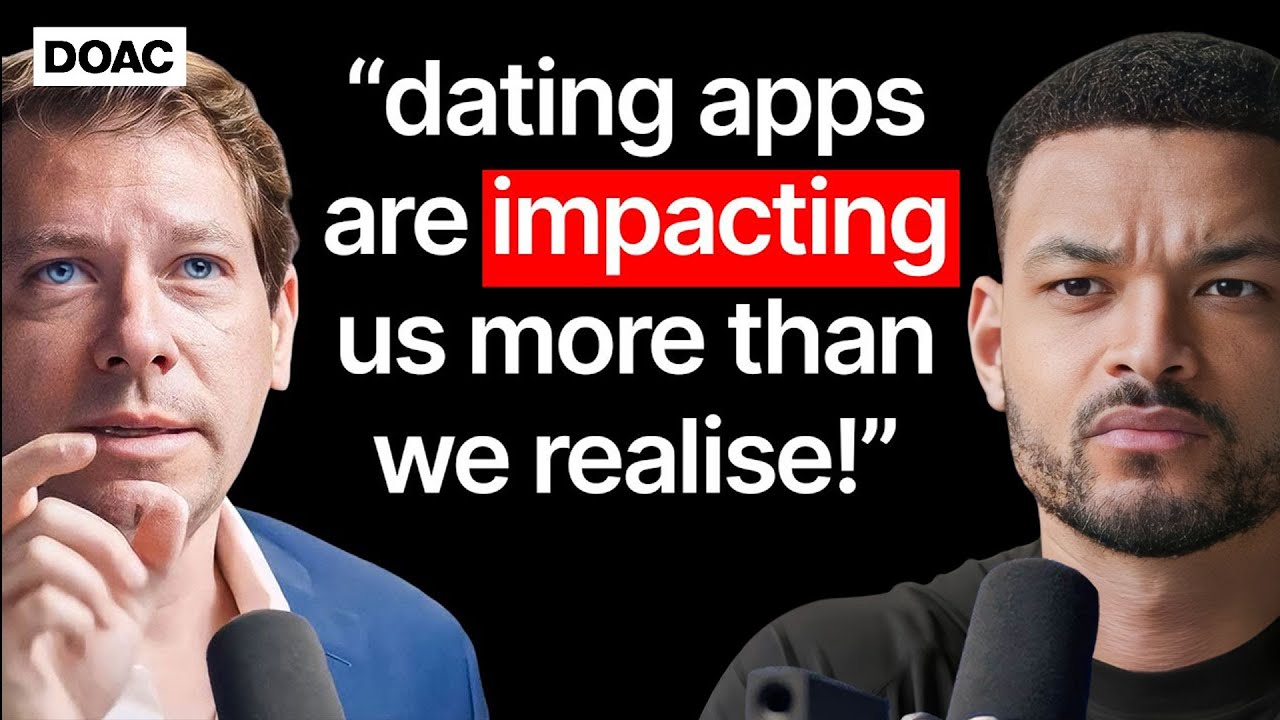
Dating Doctor: "Start Dating Like It's Your Job!" Dating Apps Are Impacting Us More Than We Realise! — The Diary Of A CEO

The Diary Of A CEO

Unrestricted mating choices and digital addiction drain male productivity, threatening demographic collapse unless men apply high-volume business strategies to romance.

AI-assisted summary of Dating Doctor: "Start Dating Like It's Your Job!" Dating Apps Are Impacting Us More Than We Realise! — original source. Check the original for full context.

Source published:

Detailed notes

## Background This episode of The Diary Of A CEO, hosted by Steven Bartlett and published on YouTube on August 26, 2024, features psychologist Dr. Orion Taraban. The show notes highlight Dr. Taraban's work as the host of 'PsychHacks' and author of 'The Value Of Others,' detailing his economic model of relationships and how modern dating apps impact modern life.

## TL;DR Dr. Orion Taraban examines the modern dating crisis through an economic lens, arguing that unrestricted choice and dating apps have hyper-concentrated female interest in the top 10% of men while leaving many young men feeling invisible. He draws direct parallels between business principles and romantic success, encouraging men to treat dating like a high-volume sales funnel while focusing on self-improvement and surface presentation. The conversation explores how digital substitutes like pornography and OnlyFans hijack male ambition, the mechanics of overcoming approach anxiety, and why long-term relationship success requires realistic value exchanges rather than romantic delusions. Ultimately, Dr. Taraban emphasizes strict selection criteria, the power of strategic absence, and the necessity for men to develop both conviction and resilience in the modern world.

## Atmosphere & style The discussion is candid, pragmatic, and heavily analytical, stripping away romantic idealization in favor of raw economic and psychological frameworks. Dr. Taraban speaks with a direct, unvarnished clarity that balances clinical insights with sharp humor, while Steven Bartlett serves as an engaged, inquisitive sounding board. The mood shifts seamlessly between sobering assessments of male loneliness and actionable, high-energy advice on negotiation, seduction, and personal growth.

## Key takeaways - [00:00](https://www.youtube.com/watch?v=PM9rgDBX9u0&t=0s) The contemporary dating crisis stems from a mismatch between individual dating friction and macro-level demographic threats, such as declining birth rates and marriage rates. - [06:56](https://www.youtube.com/watch?v=PM9rgDBX9u0&t=416s) Dating apps have created strategic inefficiency; while online initiation has surged, long-term relationship formation has dropped precipitously, concentrating female mating choices primarily on the top 10% of men. - [08:20](https://www.youtube.com/watch?v=PM9rgDBX9u0&t=500s) Men face a crisis of masculinity characterized by social invisibility and a lack of feeling needed, which can lead to severe psychological distress when they lack actionable opportunities to contribute. - [22:08](https://www.youtube.com/watch?v=PM9rgDBX9u0&t=1328s) Romantic attraction and dating can be understood through business and economic frameworks, where attraction functions like surface marketing and long-term success relies on smart selection rather than passive expectations. - [36:54](https://www.youtube.com/watch?v=PM9rgDBX9u0&t=2214s) Men and women communicate differently, with masculine styles focusing on informational facts and feminine styles prioritizing resonance and shared emotional states. - [44:35](https://www.youtube.com/watch?v=PM9rgDBX9u0&t=2675s) Attraction relies on idealized projection, whereas long-term partner retention only begins once a couple survives the 'Crisis of Disappointment' and accepts each other's real-world flaws. - [01:06:25](https://www.youtube.com/watch?v=PM9rgDBX9u0&t=3985s) Overcoming approach anxiety requires recognizing that initial rejection is normal, and men can use low-pressure, transparent, and authentic communication to disarm potential partners. - [01:35:16](https://www.youtube.com/watch?v=PM9rgDBX9u0&t=5716s) Pornography and digital substitutes act as biological hijacks that drain male libido and drive, suppressing the baseline tension that historically motivated men to build lives and pursue real-world relationships. - [01:39:52](https://www.youtube.com/watch?v=PM9rgDBX9u0&t=5992s) Behavioral change cannot rely purely on psychological insight; it requires functional analysis to identify what problem a habit solves, alongside structured abstinence. - [01:46:32](https://www.youtube.com/watch?v=PM9rgDBX9u0&t=6392s) People seeking a romantic relationship should adopt a quantitative mindset—'dating like it's your job'—by casting a wide net, improving core presentation, and conducting systematic testing. - [01:59:53](https://www.youtube.com/watch?v=PM9rgDBX9u0&t=7193s) Ninety percent of relationship satisfaction depends on upfront selection criteria rather than relying on constant post-commitment compromise or trying to change a partner. - [02:01:28](https://www.youtube.com/watch?v=PM9rgDBX9u0&t=7288s) Relationships operate as exchanges of scarce value; stripping away romantic 'fluff' to ensure baseline physical, emotional, and practical needs are met reduces unnecessary friction.

## Detailed walkthrough ### [00:00](https://www.youtube.com/watch?v=PM9rgDBX9u0&t=0s) Intro & The Macro Picture of the Relationship Crisis

Clinical psychologist Dr. Orion Taraban opens by outlining a profound structural shift: when women gain full autonomy over their sexual decisions, their mating choices heavily concentrate on the top 10% of men. This dynamic triggers severe downstream complications for both genders. On a global scale, society is experiencing a historical relationship crisis. Over the past decade, intimate connections of every kind have cratered. Marriage rates in the United States have dropped to historic lows, and half of the world's population lives in countries where fertility sits well below replacement levels. In America, native population decline is largely obscured by high immigration rates.

Surprising data reveals that even casual sexual encounters and hookups are experiencing a drastic slump compared to post-1970s levels, following the initial sexual revolution unlocked by the birth control pill. Because modern Western culture relies on sexual activity as the gateway to emotional commitment, marriage, and family building, this drop in casual intimacy chokes off the entire pipeline toward long-term partnership.

* **Macro Economic Threat:** Declining birth rates risk demographic collapse. Nations like Japan face top-heavy age structures where a shrinking base of workers must support a massive elderly populace. * **Paradox of Technology:** Despite unprecedented digital connectivity, finding a romantic partner has become harder and more confusing than at any point in human history.

---

[04:50](https://www.youtube.com/watch?v=PM9rgDBX9u0&t=290s) Macro Consequences vs. Individual Dating Friction

While macro-level observers worry about economic stagnation and population collapse—prompting rapid investments in AI and robotics to offset missing human labor—the average individual experiences this crisis as personal frustration. People are rarely agonizing over civilizational decay; they are wondering why finding a compatible partner feels so impossible.

``` Macro Factors (Fertility Collapse, Aging Population) └──> Cultural Pipeline Shift (Fewer Hookups) └──> Individual Friction (Dating App Fatigue & Isolation) ```

Dr. Taraban notes that human suffering is universal, yet men and women endure distinct dimensions of this social breakdown. For men, modern dating environments present severe structural barriers that exacerbate feelings of rejection and isolation.

---

[06:56](https://www.youtube.com/watch?v=PM9rgDBX9u0&t=416s) Modern Dating Apps and Strategic Inefficiency

The mechanics of meeting a partner have shifted dramatically online over the last decade. Historically, standard social circles facilitated introductions; today, digital platforms dominate the romantic ecosystem.

* **Rise of Online Dating:** Online relationship initiation has surged by **250%** over ten years. Over **50%** of American couples now meet online or through social media, compared to just 20% a decade ago. * **Correlative Decline:** The rapid rise of dating apps mirrors a catastrophic drop in long-term relationship formation, showing that these tools frequently backfire when misused.

Dr. Taraban argues that dating apps are merely tools, but most users lack an effective strategy. Using them casually often leads to depression, burnout, and hopelessness. Success on these platforms—particularly for men—requires a high-volume, highly strategic approach.

> "Lots of people just want a loving, secure, peaceful relationship. That's like wanting a job that's high paying, low stress, and you're passionate about. If you want one of those jobs, they're the needle in the haystack. You might have to send out 200 resumes and you have to get over that rejection."

---

[08:20](https://www.youtube.com/watch?v=PM9rgDBX9u0&t=500s) The Crisis of Masculinity and Performative Signals

Masculinity itself is undergoing a major identity crisis. A century ago, societal expectations for men were clearly defined and universally understood. Today, cultural ambiguity has left a void that internet personalities scramble to fill by defining manhood for disoriented young men.

Dr. Taraban categorizes much of this modern advice as "performative masculinity." While it may not touch the true core of manhood, it serves a functional purpose in the sexual marketplace by exaggerating **sexually dimorphic characteristics**—the physical and behavioral traits that biological evolution uses to differentiate males from females (analogous to the vivid tail feathers of a male peacock compared to a peahen).

* **Visual Contrast:** Emphasizing extreme male traits (such as building large biceps) or female traits (such as cosmetic enhancements) creates clear, immediate biological signaling. * **Opportunity Cost of Approach:** Because approaching a potential partner incurs a time and energy cost, individuals look for strong, unambiguous visual signals before taking the risk to interact.

---

[11:35](https://www.youtube.com/watch?v=PM9rgDBX9u0&t=695s) Online Personalities and the Invisibility of Young Men

Addressing prominent figures like Andrew Tate, Dr. Taraban observes that controversial creators gain massive followings because they offer concrete frameworks to young men struggling to navigate modern dating dynamics. While acknowledging Tate's legal issues and polarizing nature, Dr. Taraban highlights why such figures resonate: they address the core crisis facing young men—**invisibility**.

``` Young Male Baseline: No Capital + No Marketable Skills └──> Perceived as Disposable / Invisible └──> High Risk of Despair & Mental Health Crisis ```

Most young men walk through society treated as "wallpaper." The world can be indifferent toward men who currently offer no tangible utility or value.

> "To understand why some people are rich in relationship opportunities... it's not correct to say that it's the good people... or the virtuous people. It's the people that other people want things from."

* **The 18-Year-Old Dilemma:** A young man starting out often lacks wealth, status, and specialized skills. He is overlooked by women seeking long-term stability and seen as a potential liability by older, established men. * **Disposability & Mortality:** Young men face high mortality rates through risky behaviors, military service, and escalating rates of suicide and self-harm.

---

[15:46](https://www.youtube.com/watch?v=PM9rgDBX9u0&t=946s) The Need to Be Needed

Referring to sociological research analyzing suicide notes across genders, host Bartlett points out that male notes overwhelmingly express sentiments of feeling worthless, useless, and unneeded. Dr. Taraban emphasizes that while reassuring men of their inherent value is a compassionate sentiment, hollow words fail to dispel deep emotional distress. Men do not just need to be *told* they are valuable; they need real, practical opportunities to build skills, contribute tangibly, and become genuinely needed within their communities.

[16:37](https://www.youtube.com/watch?v=PM9rgDBX9u0&t=997s) Discovering Purpose Through Action Rather Than Ruminating

Dr. Orion Taraban opens by admitting a major trap he fell into as a young man: trying to figure out his life's purpose by "noodling it out alone in my room." He describes wasting years in fruitless rumination, attempting to map out his entire identity and mission before even leaving the house. Instead, he argues that true self-discovery comes through action and examining one's "revealed preferences" based on real-world behavior in retrospect. You only learn who you are when tested in the messy, morally ambiguous situations of reality.

When Bartlett asks if the answers come from taking action rather than thinking things through, Dr. Taraban confirms that thought and even traditional therapy often fail here. Despite being a therapist himself, Dr. Taraban critique our "overly therapized culture" that treats therapy as a universal cure-all. He stresses that while therapy is valuable for specific problems, it is entirely useless for others.

* **Revealed Preferences:** Self-knowledge stems from observing how you actually act under real-world conditions, not how you imagine yourself acting in isolation. * **Critique of Therapy:** Therapy is not a panacea for every existential problem or life transition.

---

[18:03](https://www.youtube.com/watch?v=PM9rgDBX9u0&t=1083s) The Main Challenge Women Face: Finding Men to Marry

Shifting the lens to women's modern struggles, Dr. Taraban shares that the overwhelming majority of female clients in his practice seek help with a single question: *"How do I get a man to marry me?"* He notes how strange this is from a historical perspective. 80 to 100 years ago, a young woman was systematically prepared for marriage from childhood by her mother, grandmother, and aunts with whom she lived closely. Reaching age 30 with marriage still being an open, unresolved question would have been virtually unheard of in past generations.

---

[18:54](https://www.youtube.com/watch?v=PM9rgDBX9u0&t=1134s) Dr. Orion Taraban’s Professional Background

Dr. Taraban outlines his background as a licensed psychologist in California. After earning his doctorate in clinical psychology, he completed a wide array of specialized training: * Worked at a **chemical dependency clinic** for two years. * Worked with **cancer patients and their caregivers** in a health psychology setting for two years. * Treated severe psychiatric dysfunction at a **Community Mental Health Center in San Francisco**. * Handled outpatient clinical cases involving **severe personality disorders**.

Upon starting his private practice, he chose to specialize in men's mental health, working almost exclusively with male clients for years before expanding his platform to a broader audience.

---

[20:02](https://www.youtube.com/watch?v=PM9rgDBX9u0&t=1202s) Money and Love: The Core Issues Men Bring to Therapy

Reflecting on his clinical work with men, Dr. Taraban observes that men almost always seek help for one of two issues: **money** or **women**. He points out that Sigmund Freud identified this long ago, stating that the true goal of psychoanalysis is to teach people "how to work and how to love." Freud also argued that therapy is not meant to cure the inherent suffering of the human condition, but to eliminate "neurotic unnecessary suffering" so people can better handle life's unavoidable pain.

Dr. Taraban highlights a striking dichotomy among his high-earning and socially active male clients: * **The High-Earners:** Men making millions who experienced repeated failed marriages or could not get dates—even while throwing parties for models on superyachts. * **The Socially Successful:** Young men in San Francisco who were "cleaning up" sexually and living out male fantasies, yet struggled immensely with their finances, career trajectory, and crippling anxiety disorders.

Interestingly, Dr. Taraban observes that the core principles required to succeed in business are remarkably similar to those required to succeed in romantic and sexual relationships.

> *"If you can learn how to work and how to love, you can be a fairly functional human being in society and have a satisfying life."*

---

[22:08](https://www.youtube.com/watch?v=PM9rgDBX9u0&t=1328s) Applying Business and Sales Principles to Dating

Dr. Taraban explains the direct parallel between sales and dating: men want sex and relationships, but women do not hand those out freely just because men desire them. Similarly, in business, customers do not stand around with open wallets waiting to hand over money. A man must learn how to offer value and persuade others to give him what he wants.

Bartlett agrees strongly, recalling a formative moment when he was 18 years old. A pickup artistry book was accidentally delivered to his house (intended for his older brother who had moved away). Bartlett read it cover-to-cover in one sitting and found that the principles of attraction, negotiation, and persuasion were directly applicable to building his multi-million dollar businesses.

Dr. Taraban acknowledges that while people often view pickup techniques as "sleazy" or manipulative, those tactics reflect standard marketing and advertising principles. Furthermore, these strategies are vital for long-term relationships, where success hinges on the **complementarity of skill sets**—much like a startup needing distinct roles rather than two competing CEOs. In Dr. Taraban's view, 90% of long-term relationship success comes down to accurate self-knowledge and smart selection.

---

[24:57](https://www.youtube.com/watch?v=PM9rgDBX9u0&t=1497s) Gender Disparities in Therapy and Mental Health

Addressing why women make up the vast majority of therapeutic and self-help consumers, Dr. Taraban notes that roughly **85% of mental health practitioners are women**. During his own doctoral training, he was often one of only three men in his cohort, and several clinical placement sites had no male staff members at all.

This imbalance contributes to men's hesitation to enter therapy: * **Communication Styles:** Women typically use talk therapy to process emotions through emotionally focused strategies. Men prefer resolving issues through practical action and direct solutions, often viewing weekly talk therapy as a waste of time and money. * **Need for Safe Spaces:** While men do benefit from having a confidential environment to speak candidly without harsh judgment, they rarely require or desire ongoing weekly therapy sessions for years on end.

---

[27:59](https://www.youtube.com/watch?v=PM9rgDBX9u0&t=1679s) Troubleshooting the Dating Funnel for Men

When a man seeks advice on dating, Dr. Taraban starts by evaluating where in the "dating funnel" the friction occurs: 1. **Top of the Funnel:** Inability to get matches on apps or approach women in person. 2. **Middle of the Funnel:** Getting dates or casual setups, but having everything fall apart after two or three months. 3. **Bottom of the Funnel:** Wanting casual experiences but only attracting women who demand long-term commitment (or vice versa).

For men stuck at the very top of the funnel, Dr. Taraban recommends a dual strategy: use dating apps for what they are worth, but build real-world social skills. Over-relying on apps leaves introverted or anxious men unprepared when they finally get an in-person date, leading them to act uncharismatically and fail to lead the interaction. Dating skills are like learning a foreign language—you must go into the world, make embarrassing mistakes, and learn from failure until your success rate improves.

---

[30:27](https://www.youtube.com/watch?v=PM9rgDBX9u0&t=1827s) Surface Marketing and the Art of Seduction

For men struggling with initial attraction, Dr. Taraban treats it strictly as a **surface marketing issue**. On an app, a user is judged on six pictures and three prompts; in a bar, a woman makes a snap judgment based on a two-second visual scan and overall "vibe." In neither case is she evaluating who the man is as a deep individual.

When men complain about fixed physical traits—such as being 5'6" or balding—Dr. Taraban agrees that missing ideal genetic markers makes dating harder, but insists everyone can maximize their presentation. Because physical attractiveness is not evenly distributed across the population, less conventionally attractive men must rely on **seduction and game**—the art of directing a person's attention to achieve a specific purpose—to overcome physical liabilities.

* **Top-of-Funnel Reality:** First impressions are purely about presentation and perceived value, not deep personal character. * **Pickup Insights:** The pickup community essentially acted as behavioral scientists, testing tactics in the field to figure out what reliably directs female attention and desire.

Here is a detailed walkthrough of this portion of the transcript:

[33:10](https://www.youtube.com/watch?v=PM9rgDBX9u0&t=1990s) Peacocking, Surface Marketing, and Dating Strategies

Dr. Orion Taraban explains that early in his dating life, he had to set aside his preconceived notions about what women *should* want and instead let outcomes dictate what actually works. This mindset shift helps explain why seemingly extravagant or ridiculous strategies—such as "peacocking"—actually yield results. Peacocking involves wearing a bold or flamboyant item (like a flashy hat, or in Flavor Flav’s iconic case, a giant clock necklace) to stand out and capture initial attention. While heavy-handed, it serves a clear purpose: breaking through the noise.

However, men do not need to wear absurd costumes to stand out. In many cities, simply investing \$1,000 to \$2,000 in two or three high-quality, well-tailored outfits and cycling through them makes a massive difference. While dating environments like Los Angeles or New York City are fiercely competitive, Dr. Orion jokes that it takes almost no effort to be the best-dressed man in San Francisco. Standing out visually gives a man an immediate boost in perceived attractiveness. He points out the stark contrast between genders: some women spend tens of thousands of dollars on cosmetic surgery just to raise their attractiveness by a single point, whereas many men could gain that same point simply by getting a decent haircut and putting on sharp clothes—yet many stubbornly refuse to do so.

- **Key Data & Examples:** - **Peacocking:** Using flamboyant style choices (e.g., Flavor Flav's wall-clock pendant) to capture attention. - **Outfit Investment:** Spending \$1,000–\$2,000 on 2–3 great outfits yields immediate visual returns. - **Regional Dynamics:** San Francisco is highlighted as an exceptionally easy market for a man to out-dress the competition.

---

[34:41](https://www.youtube.com/watch?v=PM9rgDBX9u0&t=2081s) The Hidden Requirement: What Women Leave Out

When men ask women directly how to become more attractive, they almost always receive answers like: "I want a kind man," "I want someone who makes me feel safe," or "I want someone loving." Good-hearted men listen to this advice and try to double down on being as nice and accommodating as possible, only to end up confused when it fails to produce romantic results.

Dr. Orion explains that women are not lying, but they are omitting the most crucial prerequisite—a concept he addressed in one of his most popular YouTube videos titled "The Part Women Always Leave Out." Women *do* want kindness, generosity, and safety, but **only from men to whom they are already sexually and romantically attracted**. Being nice does not *generate* attraction; rather, it is a quality desired in someone who has already crossed the baseline threshold of physical and dynamic appeal.

Presenting oneself as visually and socially attractive grants men substantial privileges across the entire mating cycle: * **Selection:** It drastically increases the total volume of dating opportunities. * **Negotiation:** It grants far more leverage when negotiating relationship terms and boundaries. * **Retention:** It makes maintaining long-term exclusivity against rival suitors significantly easier.

---

[36:54](https://www.youtube.com/watch?v=PM9rgDBX9u0&t=2214s) Mind Over Script: Masculine vs. Feminine Communication

To elevate attractiveness beyond basic hygiene, fitness, and wardrobe, a man must learn how to communicate. Dr. Orion emphasizes that "the most vulnerable organ in a woman to seduction is her brain—that is her biggest erogenous zone." Seduction is not about reciting pre-scripted lines; it is about mastering the fundamental differences between masculine and feminine communication styles:

``` Masculine Communication (Informational) └── Focuses on semantic content, literal facts, and data transmission. └── Success metric: The listener can summarize the facts back ("Transmission complete").

Feminine Communication (Resonant) └── Focuses on emotional frequency, mood, and shared feeling states. └── Success metric: The listener feels an analogous emotional state ("Tuning fork resonance"). ```

Disagreements in long-term relationships often stem from this fundamental disconnect. A woman may try to get her partner to feel what she felt during a painful or frustrating moment, while the man hyper-focuses on the literal, semantic facts—objecting that her statement isn't chronologically or factually accurate.

Words carry both semantic meanings and emotional containers. An actor can say the word *"please"* in ways that sound seductive, threatening, or pathetic. True charismatic communication occurs when a man pairs deliberate, precise spoken words with deliberate emotional weight. Seduction works by bringing two people into a private, shared world—a microcosm where outside rules fade away, creating an intimate space governed only by the connection they build together.

---

[41:15](https://www.youtube.com/watch?v=PM9rgDBX9u0&t=2475s) Fame, Status, and the "Contextual Alpha"

Addressing top-of-the-funnel attraction, Dr. Orion dispels the myth that a man needs massive wealth to attract women. Money acts merely as an "attraction proxy"—a heavy-handed tool that works if someone is dropping tens of thousands of dollars on VIP bottle service, but it is hardly the only path. Bartlett jokes about using that exact nightclub strategy when he was 21, which Dr. Orion notes is a common pre-25 strategy that converts mainly for shallow interactions.

In reality, an unemployed musician living in his parents' basement can easily get laid after performing at a local Tuesday open mic because he commands the stage. Perceived status and attention are what truly trigger attraction: 1. **Money** is hard to verify visually (in places like San Francisco, billionaires often dress like homeless people). 2. **Power** is often hidden behind the scenes to maintain immunity. 3. **Fame & Renown** are immediately visible and highly effective across all scales.

Reflecting on his early career as an actor in New York City, Dr. Orion recalls performing on tiny stages before tiny audiences. Yet, during those two hours, because his name was on the marquee and the spotlight was on him, he functioned as the **"contextual alpha."** Within that miniature environment, he occupied the top of the local status hierarchy, which naturally generated romantic interest.

---

[44:35](https://www.youtube.com/watch?v=PM9rgDBX9u0&t=2675s) Transitioning from Attraction to Retention: The Crisis of Disappointment

While high status or performance can spark short-term attraction, it does not guarantee a long-term relationship. Dr. Orion recounts looking at himself in the mirror during his broke acting days—living in a tiny, roach-infested studio apartment with no clear plan or ambition—and realizing he had nothing real to offer a long-term partner. Recognizing that "the cavalry isn't coming," he took radical personal responsibility to rebuild his life.

He stresses that **attracting a partner and keeping a partner are two entirely different skill sets**: * **Attraction** is built almost entirely on *projection and fantasy*. A person sees an appealing exterior and mentally fills in the missing details with their ideal preferences. * **First Date Mistake:** Most men ruin first dates by talking too much in a ham-fisted attempt to prove their value. In doing so, they inadvertently shatter the woman's idealized fantasy of who they might be.

Transitioning into a lasting relationship requires a slow, gradual uncovering of reality. Every nascent relationship must inevitably pass through what Dr. Orion terms the **"Crisis of Disappointment."**

> "On some level, the relationship doesn't even begin in Earnest until couples go through the crisis of disappointment."

Whether triggered by a single major breach of trust or the slow accumulation of minor daily flaws, the initial romantic illusion eventually shatters. The scales drop from both partners' eyes, and traits that initially seemed charming or cute suddenly become infuriating.

However, this crisis is where real love begins: it provides the first genuine opportunity to see and accept a partner for who they actually are rather than who they were projected to be. Without a healthy dose of initial, distorting attraction, no one would take the massive risk and expense of pursuing a relationship; but once established, the couple must transition from fantasy to grounded reality.

- **Market Dynamics Note:** - When asked if women on dates also talk themselves out of opportunities, Dr. Orion notes that unless a woman is a complete "train wreck," most men will look past it because they lack options and are "hungry for anything." - This imbalance is driven by modern sexual marketplace dynamics, where the **top 10% of men** command the vast majority of dating options and sexual access, leaving the broader male population starved for attention.

[49:54](https://www.youtube.com/watch?v=PM9rgDBX9u0&t=2994s) The Top 10% of Men and the Reality of Sexual Selection

Drawing parallels to the animal kingdom, Dr. Orion Taraban points out how alpha males among elephant seals and wild mustangs dominate, gathering harems of females around them. When a dominant male is eventually defeated in combat, the females display no sentimental loyalty; they simply move on to the victorious contender. Historical evidence suggests that roughly 85% of human cultures throughout history have been polygamous. Modern dynamics reflect this underlying biological drive: when women are fully empowered to make their own choices in an open sexual marketplace, they overwhelmingly concentrate their attention on the top 10% of men.

This concentration creates significant friction for both genders. For women, the probability that a top-tier man will forfeit his extraordinary sexual optionality to enter an exclusive, monogamous relationship is exceptionally low. Securing such a man is far more a matter of timing than being the "right" woman—he must be entirely finished playing the field and actively looking to settle down. When considering the alternative—an completely average man who would make a reliable husband—most women find the prospect thoroughly uninspiring, leaving them caught between unrealistic expectations and unappealing compromises.

- Historical data indicates that approximately 85% of human cultures have practiced polygamy. - Empowered female choice in modern dating marketplaces concentrates romantic interest onto the top 10% of men. - Securing commitment from high-option men depends heavily on the man's life timing rather than the individual woman's qualities.

[51:31](https://www.youtube.com/watch?v=PM9rgDBX9u0&t=3091s) Viewing Relationships Through an Economic Lens

Addressing the idea that relationships function as a value exchange, Dr. Orion clarifies that this framework is often misunderstood as superficial or synonymous with "gold digging." The term "value" carries an excessively financial connotation in the public imagination, but economics is fundamentally broader. Citing Ludwig von Mises from the Austrian School of economics, Dr. Orion defines the discipline as the study of human behavior regarding ends and scarce means. Because resources like time, energy, and attention are strictly finite, people naturally refrain from moving toward individuals from whom they expect no return.

In a relationship, value encompasses anything that can be earned or negotiated, including sex, physical security, excitement, emotional support, and shared child-rearing. What individuals seek varies dramatically between men and women, as well as across different life stages. Host Stephen Bartlett reflects on his past experience working in bottle service, acknowledging he was driven purely by short-term sexual attraction rather than evaluating a woman's maternal potential. Modern relationships frequently falter because partners expect a single individual to fulfill an inflated, hyper-complex array of needs across an entire lifetime—an expectation that is historically unprecedented and inherently difficult to sustain.

- Value exchange includes non-monetary assets such as sex, security, excitement, emotional support, and parenting. - Ludwig von Mises's economic framework highlights how individuals allocate scarce resources like time and attention toward desired outcomes. - Expecting a single partner to satisfy all personal and emotional needs creates structural strain on modern relationships.

[54:32](https://www.youtube.com/watch?v=PM9rgDBX9u0&t=3272s) The Erosion of Community and the Love Marriage Paradox

Historically, individuals lived in close-knit communities, intergenerational housing, and extended kinship networks where various social and emotional needs were distributed among many people. The rise of the isolated nuclear family forced couples to expect their partner to act as an entire village. This dynamic turns the modern "love marriage" into somewhat of a paradox: partners demand an emotionally stable, safe companion while simultaneously wanting a spontaneous, risky, and passionate sexual lover.

Maintaining long-term sexual attraction requires deliberate effort and creativity to reintroduce novelty into a familiar partnership. Simple contextual changes—such as foreign bedsheets while traveling or exploring new role-play—can rekindle a man's romantic interest. Stephen notes that in his own five-year relationship, strategic periods of physical absence prove highly effective. Taking time apart while filming projects like *Dragons' Den* or traveling for business allows partners to return to one another feeling refreshed, effectively creating the sensation of meeting a new person.

> "Men and women signed up for better or for worse, but not for lunch."

- Extended kin networks and small communities historically relieved pressure on married couples by distributing social support. - Modern love marriages struggle to balance the need for safety and predictability with the desire for risk and novelty. - Simple contextual shifts, such as travel or brief physical separation, help maintain romantic interest over long relationships.

[57:14](https://www.youtube.com/watch?v=PM9rgDBX9u0&t=3434s) Strategic Absence, Cellular Surveillance, and Monogamy

Reflecting on traditional marriage models, Dr. Orion notes that past relationships often endured precisely because spouses spent considerable time apart. He quotes divorce attorney James Sexton's observation during the pandemic lockdown spike in divorces: couples agreed to stay together for better or worse, "but not for lunch." Even in the idealized 1950s, many husbands worked as traveling salesmen away for up to 200 days a year. In fact, having a physical office to go to every day has likely preserved more marriages than therapy or self-help interventions ever could.

Modern cellular technology undermines this necessary space by enabling constant digital reachability and location tracking. When every detail of a partner's day is continuously known, mystery and uncertainty evaporate, extinguishing the curiosity that fuels romantic passion. When examining whether monogamy is human nature, Dr. Orion suggests people are closer to "monogamish." From a utilitarian societal perspective, strict social monogamy historically served lower-tier men by mathematically distributing available women, guaranteeing that a larger portion of the male population could secure a mate and maintain social stability.

- Constant digital connectivity and phone tracking eliminate the mystery and space required to sustain romantic curiosity. - Historically, job-related travel and distinct daily spheres helped preserve long-term marital harmony. - Enforced social monogamy historically distributed mating opportunities evenly across male socio-economic tiers.

[59:24](https://www.youtube.com/watch?v=PM9rgDBX9u0&t=3564s) The Economics of Attraction and Social Proof

Revisiting the transactional nature of relationships, Stephen brings up cases where older, wealthy men date significantly younger, attractive women. Dr. Orion explains that these arrangements represent a clear exchange of distinct assets. Men possess a lower threshold for sexual selection and will engage with a wide range of women, whereas women maintain far higher standards due to greater overall mating optionality. Consequently, when an exceptionally attractive woman chooses to be with a man, it serves as an immediate signal of high social proof. Observers automatically assume the man possesses extraordinary status or value to have earned her exclusivity.

Calculating a man's true value is inherently difficult at a glance. While a woman's physical youth and beauty are immediately visible, a man's wealth and status can easily remain hidden—such as Stephen walking down the street unnoticed in a plain black t-shirt. Unless a man actively advertises his resources, most women will not invest the effort to uncover them. This fundamental asymmetry forces men to market their value effectively, whereas women often face the opposite problem of dealing with persistent, unwanted visibility.

- High-value or attractive female partners function as a direct signal of social proof and status for men. - Female attraction cues are primarily visible and upfront, while male resource value is frequently concealed and hard to assess immediately. - Men generally operate with lower selectivity thresholds than women in the sexual marketplace.

[01:04:18](https://www.youtube.com/watch?v=PM9rgDBX9u0&t=3858s) Unwanted Attention and the Modern Approach Anxiety

The reality of being a highly visible female comes with severe downsides. Stephen describes watching an ITV documentary where a woman was filmed walking alone at night through a city center, constantly subjected to intrusive approaches—from a stranger wrapping an arm around her to an elderly man insisting on giving her piano lessons. While such behavior is unacceptable, it illustrates both the continuous harassment women endure and the sheer desperation felt by many men attempting to initiate contact.

This climate, combined with post-#MeToo cultural shifts, has left a massive subset of men intensely fearful of approaching women. Many express anxieties over being publicly shamed, secretly recorded, or canceled merely for initiating a conversation. To test these dynamics directly, Dr. Orion performed hundreds of cold approaches in San Francisco—often considered a central hub for progressive feminism. Despite widespread male apprehension, his actual field experiences yielded zero aggressive confrontations, showing that much of the modern fear surrounding approaching women in real life is inflated by online discourse.

- Documented experiences show that women in public spaces frequently face persistent, unsolicited romantic and physical advances. - Modern cultural shifts have caused widespread anxiety among men regarding cold approaches and public rejection. - Field testing hundreds of direct approaches in progressive urban environments like San Francisco resulted in zero hostile or dramatic rejections.

[01:06:25](https://www.youtube.com/watch?v=PM9rgDBX9u0&t=3985s) How Men Should Approach Women and Overcome Rejection

Dr. Orion Taraban and host Steven Bartlett open this segment by discussing the inevitable reality of rejection when approaching women in public. Bartlett shares a personal memory of walking up to a woman, asking how she was doing, only to have her silently look at him and turn her head away without a word. While it was embarrassing, Dr. Orion notes that with proper intention, a man can leave a woman better than he found her—even if she rejects him, which by pure probability, most women will. Dr. Orion emphasizes that men must get comfortable with striking out.

When men ask how to approach women without creeping them out or freezing up, Dr. Orion warns never to startle a woman. Many nervous men make the mistake of rushing up, invading personal space, and crowding a woman's face like a nervous predator, which triggers a flight-or-fight response. He analogizes approaching a woman in public to approaching a wild deer: make eye contact from a comfortable distance, walk over slowly, keep your hands visible, display warm body language, and maintain a respectful physical boundary without touching her.

- **Key Takeaway on Approaching:** Never startle or corner a woman; approach slowly with open, calm, and visible body language, avoiding any sudden movements or physical contact.

---

[01:07:35](https://www.youtube.com/watch?v=PM9rgDBX9u0&t=4055s) The Game of "Please No": The Core Dynamic of Human Interactions

Dr. Orion details a foundational exercise from his time as an acting student at NYU's Tisch School of the Arts called the "Game of Please No." During his first semester, the class did not study plays or rehearse traditional scripts for months; instead, they played this single game. Dr. Orion realized years later that this exercise forms the ultimate psychological framework underlying all human relationships, transactions, and negotiations.

The core premise of the game is that whenever you approach someone, you are doing so because you want something—whether it is sex, attention, a job, money, or a house. However, the default baseline response of the universe is always "No." Dr. Orion explains that the world operates this way out of necessity: it costs nothing to *want*, but it costs real resources to *give*. If the world operated on a default "Yes," humanity would have drained all global resources almost instantly. Therefore, forming a relationship requires trading unequal goods of comparable value to overcome that natural asymmetry.

- **The Rules of the Game:** The game features two players: a "Wanter" (who can *only* say the word "Please") and a "Giver" (who starts at "No" and can *only* say "No" or "Yes"). - **The Objective:** The Wanter must convert the Giver's "No" into a "Yes" strictly using different vocal tones, body language, facial expressions, and emotional subtext while repeating the word "Please."

---

[01:11:15](https://www.youtube.com/watch?v=PM9rgDBX9u0&t=4275s) Master Tactics to Turn a "No" into a "Yes"

Demonstrating the power of non-verbal cues live in the studio, Dr. Orion picks up his book, hands it toward Bartlett, and says a gentle, assuring "Please" with a warm nod. Bartlett immediately takes the book and says "Yes." Dr. Orion points out that polite, natural requests paired with low-pressure body language make compliance easy. Furthermore, by extending his arm out, Dr. Orion subtly created a minor social obligation: letting his arm hang in physical discomfort nudged Bartlett to resolve the tension by accepting the item.

Through observing hundreds of these interactions, Dr. Orion highlights that the primary negotiation strategies human beings deploy—whether in speed dating, corporate boardrooms, or open-air spice bazaars—include:

* **Seduction & Playfulness:** Inviting warmth, humor, and subtle emotional resonance. * **Intimidation & Dominance:** Using pressure or authority to force compliance. * **Victimization & Vulnerability:** Eliciting pity or a protective impulse. * **Straightforward Request & Persistence:** Patiently probing for non-verbal cues.

Dr. Orion advises that skilled communicators listen with a "third ear." Just as there are a hundred ways to say "Please," there are a hundred ways to say "No." Every "No" contains distinct emotional cues—similar to playing a childhood game of "Hot or Cold"—that reveal how that person might eventually be persuaded to say "Yes."

---

[01:14:25](https://www.youtube.com/watch?v=PM9rgDBX9u0&t=4465s) The Biggest Mistakes Men Make When Approaching Women

Bartlett asks what specific mistakes cause men to fail when approaching women. Dr. Orion explains that almost every mistake stems from an overcompensation for internal anxiety. Men generally fall into two destructive traps when approaching:

1. **Hesitating and Overthinking:** Guys freeze, get stuck inside their own heads trying to construct a "flawless" line, and completely lose their natural rhythm. By the time they step forward, their energy is stilted, awkward, and unnatural, which causes women to instinctively reject the unsettling "vibe." 2. **Aggressive Overcompensation:** Men attempt to drown out their fear by drinking too heavily, acting overly loud, or becoming inappropriately physical and "handsy" in a forced attempt to display alpha dominance, which almost universally repels women.

To fix their energy, Dr. Orion argues that men must adopt flexible sales principles: adapt to the specific individual rather than relying on a rigid script.

---

[01:16:26](https://www.youtube.com/watch?v=PM9rgDBX9u0&t=4586s) Authentic Vulnerability and the Ultimate Pickup Line

Dr. Orion reveals the single most effective "pickup line" he personally used when overcoming his own approach anxiety in San Francisco. Instead of using a cheesy, canned line, he would walk up to a woman and say:

> "Hi, how are you doing? What brings you out tonight?... I'm actually out here trying to get over my approach anxiety. How am I doing?"

This line consistently launched engaging, genuine conversations because it was transparent, disarming, and naturally vulnerable. Addressing the concept of vulnerability, Dr. Orion notes that many men resist it because "vulnerability" shares its root with *woundability*—exposing an Achilles' heel that could be weaponized against them later.

However, Dr. Orion redefines useful dating vulnerability as simply **disclosing your present-moment emotional experience**. Expressing what you are feeling in real-time allows a woman to clearly perceive your humanity and connect with your state, breaking through the dry, monotone "robot" persona that many nervous men hide behind.

---

[01:18:58](https://www.youtube.com/watch?v=PM9rgDBX9u0&t=4738s) The Psychology of High-Value Attraction and the Ben Franklin Effect

Bartlett brings up classic pickup artistry strategies regarding how to interact with exceptionally attractive women ("10s"). The strategy suggests ignoring the most attractive woman in a group, focusing entirely on her friends, and dismissing her initial bids for attention with a brief "one second" to signal high social status and spark her curiosity.

Dr. Orion agrees that extremely attractive individuals are not a separate species, but they are accustomed to being pandered to. Men who demonstrate a calm, "take-it-or-leave-it" composure stand out because they do not aggressively chase. This dynamic leverages a fundamental psychological principle: **behavior often creates emotion, rather than the other way around**. When a woman finds herself pursuing or working for a man's attention, her brain resolves the cognitive dissonance by assuming, *"I don't usually go out of my way for guys, so I must really like him."*

- **The Ben Franklin Effect in Dating:** One of the most effective ways to build interest is to ask a person for a small, reasonable favor (e.g., *"Hold this for one second"* or *"Let's step two paces to the side away from the noise"*). Complying with a minor request subtly raises unconscious attraction and creates an immediate micro-investment in the interaction.

[01:22:05](https://www.youtube.com/watch?v=PM9rgDBX9u0&t=4925s) Strategic Approaching and the "Drop the Handkerchief" Technique

Dr. Orion Taraban explains the psychological concept of the "yes chain" or the "foot-in-the-door technique," where getting someone to agree to small, reasonable requests builds compliance toward a larger ask. The conversation shifts as Bartlett brings up the perspective of women. He notes that modern dating apps have made things confusing and that society generally doesn't encourage women to approach men directly. Bartlett candidly admits that the few times women have tried to pick him up, their "game" was quite poor, though he notes most men aren't great at it either.

Dr. Orion suggests that women shouldn't approach men in the direct, aggressive manner men typically use. Instead, he points out that historically, women have always initiated, but they did so indirectly with "plausible deniability." He brings up the Victorian example of a woman deliberately dropping her handkerchief near an attractive man. When the man picks it up, it creates an organic, comfortable opening for conversation. If the man turns out to be unappealing, she can simply thank him and leave without any awkwardness because she never overtly declared sexual interest.

Bartlett jokes about his own past attempt at demonstrating a "come-hither stare," prompting a discussion on eye contact. Dr. Orion highlights how eye contact is intensely intimate and can easily be misconstrued between two men at a bar as a provocation or a fight waiting to happen. However, women can use sustained eye contact strategically as their modern "handkerchief" to invite men over while maintaining social safety.

- **Foot-in-the-door technique / Yes chain:** A method of gaining compliance for a large request by securing agreement on smaller requests first. - **Indirect initiation:** Women historically initiate by creating opportunities for men to approach, preserving plausible deniability. - **Eye contact dynamics:** Prolonged eye contact between male strangers is often perceived as aggressive, but when used intentionally by women, it signals a strong invitation.

---

[01:25:51](https://www.youtube.com/watch?v=PM9rgDBX9u0&t=5151s) Non-Transactable Goods: Friendship, Loyalty, and Love

Bartlett presses Dr. Orion on where love fits into his transaction-focused model of relationships. Dr. Orion agrees that when a relationship's functional transaction is balanced and mutual—where both people's needs are met effortlessly—it creates continued satisfaction. However, he categorizes true love, friendship, and loyalty differently: as "non-transactable goods" (NTGs).

``` Non-Transactable Goods (NTGs) ├── Loyalty ├── Friendship └── Love ```

According to Dr. Orion, NTGs cannot be bought, forced, or earned through a formula. They are spontaneous gifts given at the sole discretion of the giver with no strings attached. Trying to earn them converts them into transactional bids, destroying their actual nature. To illustrate, he points out how arbitrary friendship can be—people don't hand out "friend offers" to the most polite candidate; they simply like who they like, sometimes choosing disagreeable people over sweet ones. Furthermore, love and formal relationships are distinct constructs that do not always overlap; many people remain in stable marriages without love, while secretly loving an ex-partner.

> "In good relationships, the transaction is invisible... Love is something that is a totally different beast, and it is very beautiful and it is very noble and transformative."

- **Definition of NTGs:** Value markers like loyalty, friendship, and love that exist outside economic transactions. - **Independence of love and relationships:** Being in a relationship does not guarantee love, nor does loving someone guarantee being in a relationship with them. - **Spontaneous giving:** True affection operates outside calculated merit or meritocracy.

---

[01:29:57](https://www.youtube.com/watch?v=PM9rgDBX9u0&t=5397s) The Impact of Pornography, OnlyFans, and Digital Substitutes

The discussion turns to modern digital vices, specifically pornography and platforms like OnlyFans. Dr. Orion reveals a striking pattern from his clinical practice: while clients discuss sensitive topics over video calls, pornography addiction is the single issue where men overwhelmingly choose to turn their cameras off out of deep shame. He views this digital interaction as a quiet confessional where anonymity makes honesty possible.

From an economic perspective, pornography and OnlyFans disrupt traditional mating dynamics. If men seek sexual opportunity in exchange for resources, and women seek resources in exchange for access, digital platforms offer a shortcut. On OnlyFans, women can monetize sexual access safely and conveniently, marking a shift where "it might be easier for the average woman to get $1 from a million men than to get a million dollars from one." Meanwhile, men utilize pornography as a low-cost, low-effort substitute for real relationships, similar to how processed junk food satisfies innate cravings without providing real nourishment.

Dr. Orion references a study where a remote Amazonian tribe gained access to Starlink internet, and within a month, young men in the tribe became addicted to pornography. He argues that moralizing or shaming these behaviors fails because shame only drives people to hide their habits better. Instead, society needs a functional analysis to understand what underlying problems these habits attempt to solve.

- **Client privacy:** Pornography addiction is the top issue causing male clients to turn off their cameras during virtual therapy sessions. - **Shift in monetization:** Platforms allow creators to aggregate small payments from thousands of men rather than relying on a single provider. - **Biological hijack:** High-speed internet acts like processed food, tapping into ancient evolutionary drives with synthetic substitutes.

---

[01:35:16](https://www.youtube.com/watch?v=PM9rgDBX9u0&t=5716s) Sublimation, Libido, and Modern Male Drive

When asked whether widespread pornography use and OnlyFans transactions are actually a societal problem, Dr. Orion separates macro-level survival from individual impact. On a macro level, humanity and the "mating game" will adapt and survive. However, on an individual level, intense pornography consumption creates severe consequences—often leaving men isolated, stuck living with their parents, and unable to form romantic relationships despite wanting them.

Dr. Orion brings up the psychoanalytic concept of **sublimation**—redirecting raw, un-domesticated sexual energy into pro-social pursuits like building companies, writing books, or constructing infrastructure. Bartlett connects with this concept, reflecting that his drive as an entrepreneur may have been a form of sublimated sexual energy. Dr. Orion warns that when society provides men with endless, effortless, and hyper-realistic sexual gratification through pornography, it drains the baseline tension required to push them out into the real world to build, achieve, and pursue real partners.

> "The libido, the desire for sex, is never going to go away because it's connected to the life force itself... If you give men the opportunity to exist in a perpetually sexually satisfied state... then you take away the engine of accomplishment."

- **Sublimation:** The process of channeling raw libidinous drives into constructive, creative, or economic output. - **Individual consequences:** Overreliance on digital sexual substitutes harms social development, ambition, and real-world relationship formation. - **The drive engine:** Unmet sexual desire acts as a primary catalyst for male ambition and risk-taking.

[01:38:11](https://www.youtube.com/watch?v=PM9rgDBX9u0&t=5891s) The Societal Dangers of a Diminished Male Libido

Dr. Orion Taraban explains that suppressing or siphoning off male sexual desire has catastrophic downstream consequences for society at large. Male libido is not merely a mechanism for reproduction or romantic pursuit; it serves as a primary engine for pro-social action, ambition, and risk-taking. When men lose their sexual drive—whether through porn addiction or over-gratification—they also lose the drive to pursue difficult goals, such as applying for challenging jobs, starting businesses, or facing potential failure. Civilization itself is built on the productive sublimation of repressed sexual energy. Therefore, maintaining men in a state of active drive and desire is actually socially useful because it pushes them to accomplish extraordinary things to satisfy those urges.

Drawing a vivid analogy, Dr. Orion notes that an animal that is not hungry has zero motivation to endure the heavy costs and physical risks of hunting. Similarly, when a man is "doped up on weed" and anesthetized by endless pornography, he becomes completely passive. Men trapped in this cycle are acutely aware of their stagnation and feel deep ambivalence: much like an alcoholic who recognizes that drinking is ruining his life yet cannot put down the bottle, porn-addicted men want to stop but find themselves unable to break free. They need structured help rather than moralistic shame and judgment.

- **Libido as a Catalyst:** Male sexual energy acts as a primary fuel for career ambition, societal progress, and constructive risk-taking. - **The Hunter Analogy:** Just as a full predator won't hunt, an over-gratified or anesthetized man lacks the incentive to build a meaningful life. - **Addiction & Ambivalence:** Porn addiction mirrors chemical dependencies, creating a cycle where men hate the habit but struggle to quit.

---

[01:39:52](https://www.youtube.com/watch?v=PM9rgDBX9u0&t=5992s) How to Change Behavior: Functional Analysis Over Pure "Insight"

When Steven asks how to help a man who realizes his porn habit is sapping his vitality, Dr. Orion emphasizes that psychological "insight" alone is vastly insufficient for behavioral change. Drawing from his years working in addiction treatment, he shares that some of the most heavily "therapized" patients—people who possessed profound self-awareness about their childhood trauma and internal triggers—continually relapsed because they got lost in their own mental machinations. Conversely, patients with very little psychological sophistication often recovered simply by declaring that a substance made them feel bad and deciding to stop cold turkey. To change a behavior, one must physically stop doing the action: "the only way to stop drinking is not to put the booze in your mouth anymore."

To successfully stop an addictive habit, individuals must perform a "functional analysis" to identify what specific problem the behavior is solving. Sharing his personal journey, Dr. Orion discloses that he was previously addicted to cigarettes and had to attempt quitting eight or nine times before kicking the habit for good. He realized he reached for a cigarette primarily out of boredom (needing stimulation/a change of scenery) or as a self-awarded reward after completing a task. Once he identified those core functions, he substituted healthier alternatives that alleviated boredom or offered rewards without sabotaging his long-term health. For men addicted to pornography, the underlying driver is usually loneliness or boredom; the true antidote is building genuine human connections and finding engaging activities.

``` +------------------------------------------------------------------+ | FUNCTIONAL ANALYSIS OF HABITS | +------------------------------------------------------------------+ | TRIGGER / UNDERLYING NEED --> UNHEALTHY BEHAVIOR (Porn/Nico) | | • Loneliness --> Provides pseudo-connection | | • Boredom --> Provides instant dopamine | | • Reward / Relief --> Provides quick escape | +------------------------------------------------------------------+ | ANTIDOTE / HEALTHY SUBSTITUTE: Real social connections, jobs, | | hobby engagement, and taking recovery one 24-hour block at a time| +------------------------------------------------------------------+ ```

- **The Myth of Insight:** Knowing *why* you have an addiction does not stop the behavior; action and abstinence are required. - **Dr. Orion's Smoking Story:** Tried quitting 8–9 times; succeeded only after realizing smoking fulfilled needs for stimulation and self-reward. - **The 24-Hour Rule:** Recovery should be approached one day at a time ("just don't use today") rather than catastrophizing a lifetime of abstention.

---

[01:44:03](https://www.youtube.com/watch?v=PM9rgDBX9u0&t=6243s) Pornography, Algorithmic Feeds, and Modern Temptation

Addressing whether pornography is a net negative for society, Dr. Orion acknowledges that explicit imagery has existed throughout human history—pointing to ancient cave drawings depicting exaggerated female figures. However, the modern danger lies in its unprecedented scale, instant availability, and zero-cost distribution via the internet. It saturates daily life, making abstinence far harder than in prior generations.

Steven reinforces this by recounting how social media platforms have degraded into hyper-sexualized environments. He mentions prominent American journalist Kara Swisher publicly announcing her departure from Twitter (X) after decades because the platform had turned into a "porn hellscape." Steven explains that platform algorithms intentionally amplify viral, high-dwell-time content regardless of who a user follows, forcing explicit material onto users' feeds. He shares a recent viral UK story involving a female prison guard filmed engaging in a sexual act with an inmate inside a facility, noting that this graphic video popped up directly on his own personal feed. For recovering addicts, navigating the modern digital landscape is as difficult as an alcoholic trying to stay sober when alcohol is served everywhere in society.

- **Ubiquitous Scale:** Historical erotic art was localized, whereas modern pornography is frictionlessly streamed 24/7. - **Kara Swisher Example:** The veteran journalist abandoned Twitter/X due to the unchecked rise of explicit pornographic content. - **UK Prison Video Incident:** Illustrates how extreme viral adult content penetrates standard social media feeds via dwell-time algorithms. - **Social Isolation of Sobriety:** Choosing to abstain from alcohol or hyper-sexualized media often makes others uncomfortable because it implicitly challenges their own habits.

---

[01:46:32](https://www.youtube.com/watch?v=PM9rgDBX9u0&t=6392s) Dating Advice for 35-Year-Olds: "Date Like It's Your Job"

When asked for concise, direct advice for a 35-year-old man struggling to find a partner, Dr. Orion advocates for a rigorous, business-like approach. He warns against the romantic delusion of expecting a relationship to simultaneously deliver three rare qualities: deep love, complete security, and absolute peace. Wanting all three is equivalent to demanding a job that pays a top-tier salary, has zero stress, and aligns perfectly with your life passion—a combination that is exceptionally rare in the real world.

To succeed in modern dating, a man must "date like it's your job" and execute a high-volume strategy:

<Sequence> <Step title="Adopt a Quantitative Mindset"> Recognize that male dating is fundamentally a numbers game. Treat the process like a corporate recruitment drive rather than waiting for a magical encounter. </Step> <Step title="Cast a Wide Net"> Distribute your "resume" broadly across the market. Do not give up after two or three rejections when you may need to go on dozens of dates to find a fit. </Step> <Step title="Invest in Skill Upgrading"> Take coaching, refine your social presentation, and learn how to interview/communicate better to demonstrate compatibility with high-value partners. </Step> <Step title="Conduct Systematic Testing"> Treat dating like a scientist running A/B tests. Experiment with your presentation and approach to compress years of passive searching into 3–4 months. </Step> </Sequence>

Dr. Orion critiques a common trap that many women fall into: waiting passively for a Hollywood "meet cute" and assuming that "if it's meant to be, it will be." While women often adopt this passive posture, a 35-year-old man cannot afford to do so. A man must proactively create outcomes, endure rejection without emotional collapse, and minimize the total duration he spends actively in the sexual marketplace to avoid burnout and inertia.

---

[01:50:03](https://www.youtube.com/watch?v=PM9rgDBX9u0&t=6603s) AI Girlfriends, Globalized Competition, and Unconventional Strategies

Looking toward the future, Dr. Orion and Steven discuss how rapid technological shifts—such as artificial intelligence, virtual reality, and robotics—will disrupt human relationships. Similar to how pornography traps men today, AI companions and holographic partners (reminiscent of *Blade Runner*) will offer custom-tailored, friction-free interactions that tell men exactly what they want to hear. Because real human beings are inherently flawed, disappointing, and require compromise ("settling"), many people will retreat into hyper-realistic synthetic relationships.

Furthermore, social media and digital connectivity have eliminated local dating pools. Historically, a man could succeed by being a big fish in a small local pond. Today, there are no ponds—everyone is swimming in a single global ocean. A local man competing for the girl next door is now implicitly competing against men worldwide, while local women compare nearby suitors against global standards on Instagram. Despite these intimidating dynamics, Dr. Orion remains optimistic, noting that massive market shifts always create unique opportunities for those willing to adapt:

- **The 1929 Market Analogy:** More new millionaires were created during the 1929 stock market crash than at any other point in early American history because they bought when others were panic-selling. - **Contrarian Thinking:** In dating and life, individuals should avoid following the majority. Since most people's lives are not thriving, doing the opposite of the crowd is often the smartest strategy. - **Instagram as a Dating Tool:** Traditional dating apps are often outclassed by Instagram, which acts as the largest public platform for organic connection and social proof.

---

[01:53:27](https://www.youtube.com/watch?v=PM9rgDBX9u0&t=6807s) Sponsor: Shopify

Steven transitions into a brief sponsor highlight for Shopify, detailing his personal entrepreneurial experience using the platform to launch *The Diary Of A CEO Conversation Cards*. He describes the initial hurdles his team faced regarding inventory management, global customer reach, and establishing a seamless checkout experience. Utilizing Shopify provided an all-in-one e-commerce infrastructure, functioning like an expert technical team and allowing them to focus entirely on product design and community engagement.

<ElicitationsGroup message="Explore related concepts from Dr. Orion Taraban's framework:"> <Elicitation label="Functional analysis of addiction" query="Explain how to conduct a functional analysis to break bad habits and addictions based on Dr. Orion Taraban's principles."/> <Elicitation label="The economic model of dating" query="What is Dr. Orion Taraban's economic model of relationships and value exchange in modern dating?"/> </ElicitationsGroup>

[01:54:05](https://www.youtube.com/watch?v=PM9rgDBX9u0&t=6845s) Sponsor Break: Shopify & Fiverr

The episode opens with continuous sponsorship messages. Bartlett highlights a special $1-a-month trial offer for Shopify, directing listeners to `[shopify.com/bartlett](https://shopify.com/bartlett)` to take control and scale their businesses. He then transitions to discussing Fiverr, emphasizing how essential it is when building a project and needing talents outside of one's own skill set. Rather than wasting time attempting to master a new discipline or rushing to hire expensive full-time staff, platform users gain flexible, affordable access to reviewed, world-class talent. Bartlett shares how Fiverr was a total game-changer and "bit of a hack" for him in his early business days, reminding listeners to check out `[fiverr.com/diary](https://fiverr.com/diary)` with the reassurance of Fiverr's money-back guarantee.

---

[01:55:17](https://www.youtube.com/watch?v=PM9rgDBX9u0&t=6917s) How to Be a Man in 2024: Spine and Balls

Bartlett brings up a popular video on Dr. Orion Taraban’s YouTube channel titled *How to Be a Man*. Mothers raising young boys often ask Bartlett how to guide their sons amid modern narratives of performative masculinity and conflicting signals about feminine versus masculine traits. When asked what truly constitutes being a man in 2024, Dr. Orion cuts through the noise: "fundamentally, to be a man is to have a spine and a pair of balls."

Dr. Orion explains that a spine represents the willingness to stand up erect for something meaningful. However, standing up inherently causes a person to cast a shadow—a metaphor for the inevitable pushback, envy, and criticism from others. Because the world is filled with loads that need lifting and fires that need putting out, men must stand up and resolve their immediate personal problems before attempting to solve humanity's larger issues. Meanwhile, "having a pair" means possessing the grit and courage to handle the direct fallout of standing up. Those who lack the fortitude to withstand resistance will quickly learn it is safer to cower, blend in, and hurl anonymous criticisms from behind a computer screen.

* **The Shadow Principle:** Only pure light casts no shadow; standing up for any cause inevitably invites opposition and projected envy from those afraid to stand up themselves. * **Sequential Problem-Solving:** "Put your own mask on before you assist others on the airplane." Fix clear, immediate personal issues before expanding your scope to societal problems.

---

[01:59:53](https://www.youtube.com/watch?v=PM9rgDBX9u0&t=7193s) Selfishness, Compromise, and the Sexual Marketplace

The conversation shifts to relationship dynamics and the concept of selfishness. Dr. Orion argues that being explicit and somewhat selfish about one's needs is far healthier than constantly relying on compromise. To him, compromise often leaves both parties dissatisfied, creating a toxic cycle of perceived obligation and future sacrifice ("I gave up X for you, so you owe me Y later"). Instead, 90% of a successful relationship lies in upfront selection—finding someone who naturally works with, or even thrives under, your specific way of living.

To avoid searching forever, Dr. Orion stresses the importance of narrowing and clarifying selection criteria. Adding endless conditions using the word "and" geometrically shrinks the available pool of prospective partners, incurring huge hidden costs in time, energy, and opportunity in the sexual marketplace.

---

[02:01:40](https://www.youtube.com/watch?v=PM9rgDBX9u0&t=7300s) Dr. Orion's Four Selection Criteria

Reflecting on his past mistakes, Dr. Orion recalls how he used to enter the sexual marketplace with an impossibly long checklist, expecting a partner to match him on quantum mechanics, Shakespeare, wilderness backpacking, and spiritual retreats. A mentor delivered a blunt wake-up call: *"Why the fuck would you want to talk to a woman about quantum mechanics?"* This led Dr. Orion to realize that non-sexual intellectual and recreational needs can—and should—be met far more easily and cheaply through male friends, female platonic peers, and broader social circles. Distributing these needs reduces pressure on a romantic partner to be everything.

By stripping away extraneous demands, Dr. Orion reduced his sexual selection framework down to four simple core criteria:

1. **Plenty of Sex:** A foundational, non-negotiable component of a romantic heterosexual relationship. 2. **Sufficient Physical Attraction:** Being genuinely attracted to her so that he isn't secretly wishing to be with someone else's partner when walking into a room. 3. **Soft Femininity:** A unique, intimate warmth and softer energy that cannot be replicated by professional or platonic friendships. 4. **Low Disagreeableness (The Guardrail):** She cannot be so overly disagreeable that her behavior creates more problems than the first three criteria solve.

Bartlett strongly resonates with this streamlined approach. Reflecting on his own life, Bartlett notes that he initially thought he wanted an entrepreneurial, hyper-logical partner identical to himself. Instead, he found deep harmony with his current partner, who is deeply spiritual, keeps a crystal shrine at home, and offers an entirely different perspective on life without pressuring him to adopt her beliefs.

* **The Power of Acceptance:** "You can only love to the depth of your understanding." Attempting to alter or "improve" a partner is a subtle form of disrespect signifying they aren't good enough. * **Strategic Disappointment:** People must slowly and intentionally "disappoint" their partner away from their initial polished marketing image so they can be genuinely seen, understood, and loved for who they are.

---

[02:08:15](https://www.youtube.com/watch?v=PM9rgDBX9u0&t=7695s) The Economic Model: Giving People What They Want

Bartlett asks for the single most important lesson from Dr. Orion's book, *The Value of Others: Understanding the Economic Model of Relationships*. Dr. Orion asserts that people must come to terms with the reality that everyone wants and needs specific things from others. True relationship wealth comes from cultivating the qualities and resources that partners value and freely exchanging them.

Referencing the biblical parable of rendering unto Caesar what is Caesar's, Dr. Orion notes that satisfying relationships depend on acknowledging human transactions rather than denying them out of romantic idealism. To set up a direct explanation, Dr. Orion begins posing an analogy using professional relationships—asking Bartlett to pinpoint the single defining element that sets a professional relationship apart from all others. Bartlett agrees that it comes down to a clear exchange: a transactional clarity of "here is what I want, and here is what I will give you."

[02:09:43](https://www.youtube.com/watch?v=PM9rgDBX9u0&t=7783s) Transactional Nature of Workplace Culture and Dating

The conversation opens with lighthearted banter surrounding Jack, a crew member behind the scenes. Steven Bartlett jokingly asks why Jack is present, questioning if he is just getting a lot out of it for himself. Jack shouts "money!" from the back of the room, cutting through Steven's suggestion of "friendship." Dr. Orion Taraban seizes on this moment to explore how money dictates professional relationships and why society feels compelled to cloak transactions in softer narratives.

Dr. Orion points out that following COVID-19 workplace shutdowns, companies faced severe hiring shortages and struggled to understand why prospective employees turned them down despite perks like ping-pong tables, bean bag chairs, inclusive family-like environments, and compelling mission statements. He notes that job seekers were simply looking at the bottom line: an offer paying $30 an hour while requiring a master's degree is fundamentally non-viable. However, to protect human dignity, society avoids being overly explicit about transactional exchanges. If an employer constantly waves wads of cash at a worker to perform degrading tasks, the employee will eventually choose self-respect over financial gain. Thus, companies use culture and "fluff" as a buffer.

Conversely, high-paying fields like medicine, law, and venture capital often operate with harsh, grueling expectations—such as medical residents working 120-hour weeks for negligible hourly pay—yet retain people because the financial reward is clear. The problem arises when well-meaning but "soft-headed" leaders treat workplace culture as a substitute for adequate pay rather than a supplement to it.

- Jack openly shouts "money!" from off-camera, disrupting the idealistic notion of working purely for friendship. - Dr. Orion highlights the disparity of jobs requiring a master's degree while offering only $30 per hour. - Medical residency is cited as an extreme environment involving up to 120-hour workweeks with minimal sleep and low hourly pay.

---

[02:13:04](https://www.youtube.com/watch?v=PM9rgDBX9u0&t=7984s) Stripping Away Romantic "Fluff" and Meeting Core Needs

Applying this economic analogy directly to romantic relationships, Dr. Orion argues that relationships are fundamentally about getting core needs met. Just as a company cannot replace proper wages with bean bag chairs, romantic partners cannot replace fulfilling basic needs with relationship tropes or therapeutic jargon. Explicit transactions feel degrading—resembling prostitution—so couples cover the dynamic with romantic gestures and fluff. However, if partners give each other more of what they actually want and need, they can dispense with much of the social performance surrounding modern relationships.

Steven asks for concrete examples of what constitutes "fluff" in dating. Dr. Orion highlights common psychological or self-help frameworks, such as obsessing over Love Languages, Myers-Briggs personality types (like INTJ versus ENTP), constant communication workshops, compromise, or religious mandates. He asserts that even the most articulate communicator will remain in a high-conflict relationship if they fail to meet their partner's baseline needs. Conversely, when core desires are satisfied, constant verbal processing becomes unnecessary—to the point where two people who do not even speak the same language can maintain a deeply satisfying relationship primarily through non-verbal exchange and mutual satisfaction.

- Common examples of romantic "fluff" include Myers-Briggs personality typing (e.g., INTJ, ENTP) and hyper-focusing on Love Languages. - True relationship satisfaction relies on the discharge of mutual needs and wants rather than non-stop verbal communication. - Dating market struggles usually stem from two main factors: being overly picky or having a dubious value proposition where expectations exceed what one offers in return.

---

[02:16:44](https://www.youtube.com/watch?v=PM9rgDBX9u0&t=8204s) The Final Question: Overcoming Fear and the Secret of Forgiveness

Steven transitions to the signature closing tradition of *The Diary Of A CEO*, reading a question left by the previous guest: "Is there something you wanted to do in your life that you didn't do because you were afraid?" Dr. Orion candidly replies that while he has skipped trivial thrill-seeking activities like skydiving due to fear, his most significant struggle was overcoming the fear of estrangement and emotional vulnerability in personal and family relationships. He explains that family dynamics are often burdened by rigid expectations of how parents or siblings "should" act, leading to long-held grudges where both sides feel wronged and wait for the other to take action first.

Dr. Orion shares that he had to overcome the paralyzing fear of being the first person to offer forgiveness without any guarantee that the gesture would be reciprocated. He frames forgiveness not as a gift to the other person, but as a vital "emotional survival strategy" to cleanse his own heart of bitterness and resentment. Holding onto anger clouds a person's emotional capacity, creating a self-fulfilling prophecy where past pain leads to repeated future hurt. By choosing to face the anger inside and relinquish hatred, he freed himself from being trapped by past grievances.

- Dr. Orion describes forgiveness as an internal "emotional survival strategy" that does not strictly depend on the other party's response. - Harboring resentment acts as a pollutant that impairs a person's overall emotional perception. - Taking the step to forgive first requires overcoming the terrifying possibility of unreciprocated vulnerability.

---

[02:20:22](https://www.youtube.com/watch?v=PM9rgDBX9u0&t=8422s) Closing Praise and Final Reflections

Steven concludes the conversation by offering high praise to Dr. Orion Taraban. He commends Dr. Orion for taking advantage of the unique tools available in 2024 to clean up his own life and subsequently help millions of listeners and readers through his book, *The Value of Others*, and his viral YouTube channel, *PsychHacks*. Steven highlights Dr. Orion's ability to blend empirical science and data with practical clinical experience, delivering challenging and honest truths about human dynamics in a vulnerable, impactful manner.

Deeply moved by the praise, Dr. Orion modestly thanks Steven, expressing his hope that his work remains a net positive for the world while acknowledging that he is continually learning and trying his best. The two exchange warm thanks as the episode comes to a gentle close with outro music.

- Steven references Dr. Orion's book, *The Value of Others*, alongside his popular YouTube channel, *PsychHacks*. - Dr. Orion expresses gratitude for the conversation, stating his ongoing goal is to be a net positive while continuously learning.

## Notable quotes > [06:56](https://www.youtube.com/watch?v=PM9rgDBX9u0&t=416s) Lots of people just want a loving, secure, peaceful relationship. That's like wanting a job that's high paying, low stress, and you're passionate about. If you want one of those jobs, they're the needle in the haystack. You might have to send out 200 resumes and you have to get over that rejection. — Dr. Orion Taraban

> [11:35](https://www.youtube.com/watch?v=PM9rgDBX9u0&t=695s) To understand why some people are rich in relationship opportunities... it's not correct to say that it's the good people... or the virtuous people. It's the people that other people want things from. — Dr. Orion Taraban

> [20:02](https://www.youtube.com/watch?v=PM9rgDBX9u0&t=1202s) If you can learn how to work and how to love, you can be a fairly functional human being in society and have a satisfying life. — Dr. Orion Taraban

> [36:54](https://www.youtube.com/watch?v=PM9rgDBX9u0&t=2214s) the most vulnerable organ in a woman to seduction is her brain—that is her biggest erogenous zone. — Dr. Orion Taraban

> [44:35](https://www.youtube.com/watch?v=PM9rgDBX9u0&t=2675s) On some level, the relationship doesn't even begin in Earnest until couples go through the crisis of disappointment. — Dr. Orion Taraban

> [54:32](https://www.youtube.com/watch?v=PM9rgDBX9u0&t=3272s) Men and women signed up for better or for worse, but not for lunch. — James Sexton

> [01:16:26](https://www.youtube.com/watch?v=PM9rgDBX9u0&t=4586s) Hi, how are you doing? What brings you out tonight?... I'm actually out here trying to get over my approach anxiety. How am I doing? — Dr. Orion Taraban

> [01:25:51](https://www.youtube.com/watch?v=PM9rgDBX9u0&t=5151s) In good relationships, the transaction is invisible... Love is something that is a totally different beast, and it is very beautiful and it is very noble and transformative. — Dr. Orion Taraban

> [01:35:16](https://www.youtube.com/watch?v=PM9rgDBX9u0&t=5716s) The libido, the desire for sex, is never going to go away because it's connected to the life force itself... If you give men the opportunity to exist in a perpetually sexually satisfied state... then you take away the engine of accomplishment. — Dr. Orion Taraban

> [01:55:17](https://www.youtube.com/watch?v=PM9rgDBX9u0&t=6917s) fundamentally, to be a man is to have a spine and a pair of balls. — Dr. Orion Taraban

> [01:55:17](https://www.youtube.com/watch?v=PM9rgDBX9u0&t=6917s) Put your own mask on before you assist others on the airplane. — Dr. Orion Taraban

> [02:01:40](https://www.youtube.com/watch?v=PM9rgDBX9u0&t=7300s) Why the fuck would you want to talk to a woman about quantum mechanics? — Mentor

> [02:01:40](https://www.youtube.com/watch?v=PM9rgDBX9u0&t=7300s) You can only love to the depth of your understanding. — Dr. Orion Taraban

> [02:09:43](https://www.youtube.com/watch?v=PM9rgDBX9u0&t=7783s) money! — Jack

## Mentioned Dr. Orion Taraban, Steven Bartlett, The Diary Of A CEO, PsychHacks, The Value Of Others: Understanding the Economic Model of Relationships to Get (and Keep) More of What You Want in the Sexual, Andrew Tate, Sigmund Freud, Ludwig von Mises, James Sexton, Dragons' Den, Shopify, Fiverr, YouTube, LinkedIn, ITV, NYU's Tisch School of the Arts, Ben Franklin, Starlink, Kara Swisher, Twitter, X, Instagram, The Diary Of A CEO Conversation Cards, Jack

[Source](https://www.youtube.com/watch?v=PM9rgDBX9u0)

中文简报

塔拉班:男性“隐形”加剧结婚率下滑与经济承压 不受限制的择偶选择与数字化成瘾正消耗男性生产力,除非男性将大容量商业策略引入恋爱,否则将面临人口崩溃风险。 Orion Taraban 博士从经济学视角审视现代约会危机,认为无限制的选择与约会软件让女性的青睐高度集中在前 10% 的男性身上,导致许多年轻男性感到自身被隐形。他将商业法则与恋爱成功进行直接类比,鼓励男性在专注于自我提升和外在展示的同时,像运作大容量销售漏斗一样对待约会。对话探讨了色情制品和 OnlyFans 等数字替代品如何侵蚀男性抱负、克服搭讪焦虑的机制,以及为何长久关系的成功依赖于现实的价值交换而非浪漫幻想。最后,Taraban 博士强调了严格的筛选标准、战略性抽离的效用,以及男性在现代世界中建立信念与韧性的必要性。 线上约会发起率在过去十年间激增250%,但长期关系的形成率却急剧下跌;这表明约会软件若缺乏明确策略,往往反而会加剧个人的疲惫与孤立。 (6:56) 现代年轻男性普遍面临无价值感与被视作“隐形人”的危机;而在开放的择偶市场中,女性的注意力高度集中于前10%的男性,使得多数缺乏资本与技能的男性被边缘化。 (11:35) 男女沟通存在根本差异:男性习惯聚焦于事实与数据传递的信息型沟通,而女性则更注重情绪共振与同频感受,忽视这种差异常导致亲密关系中的矛盾。 (36:54) 初期的吸引力大多建立在理想化的投射与幻想上,但一段长期关系能否真正确立,取决于双方能否度过暴露彼此现实缺陷的“失望危机”。 (44:35) 现代婚姻往往对单一伴侣寄予了过高的情感与生活期望;相比全天候的数字化追踪,保持适度的策略性物理距离与生活新颖感反而更有利于维系长久吸引力。 (57:14)

Reading summary

Clinical psychologist Dr. Orion Taraban argues that modern dating struggles stem from an economic imbalance in the mating market, where female autonomy concentrates romantic selection on the top 10% of men. To navigate this friction, he contends that individuals must treat dating like a professional market exchange based on value signaling, high volume, and pragmatic partner selection. The Macro Crisis and Sexual Market Concentration (0:00) Global marriage rates have hit historic lows, half of the world lives below replacement fertility, and casual hookups have slumped relative to post-1970s levels. Because contemporary Western dating relies on casual sexual intimacy as the primary on-ramp to marriage, this drop chokes the family-formation pipeline. Dr. Taraban links this dynamic to mating choice asymmetry: when women exercise complete sexual autonomy, their attention heavily concentrates on the top 10% of men. This leaves the vast majority of young men feeling invisible and disposable, with little capital or status to attract prospective partners, while women face a low probability that top-tier men will forfeit sexual optionality for monogamy. Economic Value Exchange and Surface Presentation (51:31) Framing relationships through Ludwig von Mises's Austrian economic lens of scarce means and ends, Dr. Taraban explains that individuals inevitably look for reciprocal value—such as sex, security, or emotional support—before allocating finite time and energy. Attraction operates as a top-of-funnel marketing problem where surface signals matter first. While female physical assets are immediately visible, male resource value is easily overlooked unless explicitly communicated. Consequently, men must present strong sexually dimorphic signals, dress well, and master seduction. Taraban emphasizes that women desire kindness and safety only after a man clears the baseline threshold of romantic and sexual attraction. Communication Dynamics and Overcoming Approach Friction In real-world interactions, men often fail due to approach anxiety, either freezing into awkward overthinking or aggressively overcompensating. Taraban recommends approaching with calm, non-threatening body language and applying disarming emotional transparency rather than scripted lines. He highlights the divide between masculine informational communication, which focuses on literal facts, and feminine resonant communication, which mirrors emotional states. Tactical tools such as the Ben Franklin effect—requesting small favors to spark cognitive micro-investments—and female indirect signals like the historic 'dropped handkerchief' facilitate contact while minimizing public rejection risks. Digital Substitutes and the Draining of Male Ambition (89:57) The proliferation of pornography and platforms like OnlyFans disrupts courtship by providing low-effort, low-cost synthetic satisfaction. Dr. Taraban warns that these platforms drain libidinous tension that would otherwise be redirected through psychoanalytic sublimation into productive societal achievements, such as starting businesses or pursuing relationships. Looking forward, frictionless AI companions risk worsening this isolation because real human relationships inevitably require passing through a 'crisis of disappointment' and mutual compromise. For men trapped in compulsive digital habits, Taraban argues that cognitive insight alone rarely changes behavior; instead, individuals must conduct functional analysis to isolate and replace the specific emotional triggers driving the habit. Pragmatic Selection and Treating Dating Like a Career (106:32) For individuals struggling to find lasting partners, Dr. Taraban advises discarding romantic perfectionism and 'dating like it's your job' by adopting a high-volume, quantitative mindset, testing self-presentation, and broadening candidate outreach. He warns that stacking endless checklist criteria geometrically shrinks the potential dating pool. Instead, relationships succeed when individuals rely on upfront partner selection rather than perpetual compromise, while distributing non-romantic intellectual and recreational needs across wider social networks. For heterosexual men, he advocates narrowing selection down to four manageable priorities: regular sex, genuine physical attraction, feminine warmth, and low disagreeableness. Dr. Taraban's framework relies heavily on biological and market-driven models of human attraction, which assumes that long-term romantic stability depends on transparent, transactional alignment rather than idealized love marriages. Whether modern society will adapt to the rise of synthetic digital substitutes and globalized dating pools remains an open question.

精炼阅读摘要

临床心理学家Dr. Orion Taraban指出,现代社会正经历深刻的亲密关系危机,核心在于性选择权下放后女性注意力高度向顶层10%的男性集中,以及两性间价值交换逻辑的普遍失调。他主张个体应摒弃脱离现实的浪漫幻想,将择偶视作需要策略规划、定量测试与技能提升的“全职工作”,以应对技术异化与现代相处困境。 亲密关系崩溃与青年男性的隐形危机 (0:00) Dr. Taraban指出,全球正面临历史性的亲密关系倒退。美国结婚率跌至历史低点,全球半数人口生活在生育率低于世代更替水平的国家,甚至连随意性行为的发生率也大幅下滑,切断了通往长期承诺的通路。历史数据显示约85%的人类文化实行一夫多妻制,而在拥有充分自主权的现代开放性市场中,女性选择高度集中于顶层10%的男性。这种集中导致绝大多数年轻男性在缺乏财富、地位和技能的初期沦为社会中的“壁纸”与隐形人,面临极高的心理危机与自杀风险。Dr. Taraban与主持人Stephen Bartlett提及,男性自杀遗书中绝大多数表达的是感到自身毫无价值与不被需要;解决该危机的根本并非空洞的言语安抚,而是提供积累技能、做出切实贡献并真正被社区所需的现实机会。 约会市场的经济学本质与表面营销 (22:08) Dr. Taraban援引奥地利经济学派学者Ludwig von Mises的观点,将恋爱关系界定为稀缺手段追求特定目的的价值交换体系,涵盖性、安全感、情绪支持与养育合作等多重资源。在择偶的初始阶段,阻碍男性的往往不是深层人格,而是“表面营销”问题:在约会软件或酒吧中,对方仅依据数秒的视觉扫描作出判断。由于两性吸引力线索存在不对称——女性的青春外貌一目了然,而男性的财富与社会地位往往隐性——男性必须学会主动展示价值与运用追求技巧(game)。例如,通过得体合身的服饰建立生物信号以降低对方的接近成本,并理解“友善”并非吸引力的诱发因素,而是跨越吸引力门槛后的附加需求。此外,沟通应契合不同风格:男性偏向事实信息传输,女性更看重情绪共振,有意识地引导情绪才能打破表面防御。 现实搭讪机制与“求求你与拒绝”博弈 (67:35) 针对后#MeToo时代普遍蔓延的男性搭讪焦虑,Dr. Taraban指出网络舆论过度放大了被公开羞辱的恐惧,他在旧金山的数百次冷搭讪实测中从未遭遇敌意对抗。他提出源自表演训练的“求求你与拒绝(Please No)”博弈模型:主动接近者(索取者)因资源诉求而来,而由于给出资源需要付出真实代价,现实世界的默认基准永远是“拒绝”。为了将“拒绝”转化为“同意”,男性必须摒弃僵硬脚本与因过度补偿导致的侵略性举动,像接近谨慎的野生动物一样保持从容步态、适度距离与可见的手势。Dr. Taraban建议以真实的脆弱性打破僵局,即直接坦白当下的紧张情绪;同时可运用“本杰明·富兰克林效应”,通过请求对方帮一个微小的举手之劳来促成微小心理投资,进而转化其潜意识好感。 色情制品对雄性驱动力的消耗与行为重塑 (89:57) 随着OnlyFans与网络色情等数字替代品的普及,传统择偶的资源互换平衡被严重侵蚀。Dr. Taraban指出,色情内容如同一剂廉价低成本的情感垃圾食品,严重削弱了男性的性欲(libido)。从精神分析视角看,人类文明建立在原始性驱动力的“升华(sublimation)”之上——正是性冲动驱动着男性冒着失败风险去创业、建设基础设施或追求真实伴侣;当技术让男性陷入持续被满足的无张力状态时,社会的进取引擎随之熄灭。针对成瘾行为的戒除,Dr. Taraban强调纯粹的心理学“洞见”和过度沉溺于童年创伤的谈话疗法往往收效甚微,关键在于进行“功能分析(functional analysis)”,明确不良习惯背后所解决的真实功能(如无聊或奖励机制),并用健康行为替代,最终依靠停止动作本身来实现根本转变。 务实择偶策略:“像对待工作一样去约会” (106:32) 面对全球化竞争与未来AI伴侣对真实关系的冲击,Dr. Taraban为受困于择偶的35岁男性提出了高度商业化的战略建议。他指出,同时要求深沉的爱、完全的安全感与绝对的平静,犹如要求一份高薪、零压力且完全契合热情的职业一样脱离现实。男性应当“像对待全职工作一样去约会”,建立量化思维,广泛投递“简历”并开展高频次的A/B测试。在伴侣筛选上,Dr. Taraban反对通过无休止的“并且”条件几何级缩小候选池,建议将非性化的智识与爱好需求分流给朋友和社群,并将核心标准极简化为四项:充足的性生活、足够的身体吸引力、温柔的女性特质,以及低争辩性(low disagreeableness)作为风险护栏,通过前期精准筛选规避无休止妥协所积累的怨恨。 Dr. Taraban总结强调,满足的关系建立在承认并满足彼此真实需求的基础之上,而非沉溺于掩盖交易属性的道德高调。在个人心智层面,他认为摆脱亲密与家庭关系内耗的终极机制在于主动宽恕:宽恕并非送给冒犯者的礼物,而是一种自我情绪生存策略,旨在切断怨恨与恐惧的恶性循环,为接纳现实生活中的复杂性与不完美创造空间。

Detailed notes — zh

## Background 该视频由知名访谈频道 The Diary Of A CEO(主持人 Steven Bartlett)于 2024 年 8 月 26 日在 YouTube 平台发布。本期对话嘉宾为执业心理学家、《他人的价值》(The Value of Others)作者兼播客主 Orion Taraban 博士,视频简介指出两人围绕两性与性危机、约会软件的负面冲击、男性气概的重塑以及如何运用人际经济学模型寻找并维系长期关系展开了深入探讨。 ## TL;DR Orion Taraban 博士系统拆解了当代两性关系全面萎缩的根源,指出女性性自主权提升使得关注度高度集中于头部 10% 的男性,而色情内容泛滥和即时满足则抽干了普通男性的现实求偶动力。他主张像对待工作求职一样运用漏斗模型与 A/B 测试严谨对待约会,在初筛阶段注重表面营销与情绪共鸣,破除对金钱与完美伴侣的迷思。塔拉班强调亲密关系的底层逻辑是残酷却真实的价值交换,唯有极简筛选条件、接纳伴侣的真实不完美并满足彼此的核心底层需求,才能打破现代约会的内耗僵局。 ## Atmosphere & style 整场访谈呈现出一种冷静、理性且高度反直觉的冷峻现实感,犹如一场剥离了浪漫滤镜的硬核人际心理学解剖。主持人与嘉宾之间保持着极具深度的知性共振与默契交锋,幽默机智的即兴插曲巧妙平衡了严肃深刻的现实议题。从早期的犀利博弈策略剖析,逐步推进至卸下心防探讨自我脆弱、宽恕与生命救赎,整期节目带给观众一种既震撼清醒又充满心理疗愈感的深层思辨体验。 ## Bulletin - [02:26](https://www.youtube.com/watch?v=PM9rgDBX9u0&t=146s) 心理学家奥利安·塔拉班博士指出,全球半数人口所在国家的生育率已低于人口更替水平,美国结婚率跌入历史冰点,线上结识伴侣激增250%的同时实际亲密关系与约会频率却遭遇灾难性衰退。 - [49:54](https://www.youtube.com/watch?v=PM9rgDBX9u0&t=2994s) 当女性拥有自主性选择权时,注意力高度集中在顶层10%的男性群体,导致头部男性拥有极高的性选择权而难以进入排他性承诺,普通男性则陷入求偶困境与社会“隐形人”状态。 - [01:35:16](https://www.youtube.com/watch?v=PM9rgDBX9u0&t=5716s) 无处不在的互联网色情与虚拟刺激精准击中男性本能,形成了超常刺激代餐,极大削弱了男性将性冲动(力比多)升华并投身现实打拼、承担社交风险的原始驱动力。 - [01:46:47](https://www.youtube.com/watch?v=PM9rgDBX9u0&t=6407s) 针对现代约会困局,塔拉班博士提出“像对待求职一样去约会”,摒弃被动浪漫偶遇幻想,通过极简筛选条件、大规模A/B测试与提供对等价值主张来突破概率游戏。 ## Key takeaways - [02:26](https://www.youtube.com/watch?v=PM9rgDBX9u0&t=146s) 亲密关系危机已引发宏观层面的人口崩塌隐忧,在西方“性先于承诺”的范式下,低频次的性接触直接阻碍了后续婚姻与家庭的建立。 - [09:57](https://www.youtube.com/watch?v=PM9rgDBX9u0&t=597s) 清晰明确的两性异形生物学信号能大幅降低远距离识别与社交机会成本,现代过度模糊的个性化符号反而加剧了现实接触阻力。 - [11:35](https://www.youtube.com/watch?v=PM9rgDBX9u0&t=695s) 年轻男性常陷入缺乏资源与实战经验的“第二十二条军规”困境,在社会中极易被视作消耗品,唯有在现实中行动并创造可被利用的价值才能摆脱隐形状态。 - [30:27](https://www.youtube.com/watch?v=PM9rgDBX9u0&t=1827s) 两性交往在本质上高度契合商业逻辑,初期的相遇本质上是“表面营销(Surface Marketing)”,对方拒绝的只是其构想的外在呈现而非内在人格。 - [34:41](https://www.youtube.com/watch?v=PM9rgDBX9u0&t=2081s) 女性虽渴望善良与安全感,但前提是必须先对男生产生性吸引力;善良无法反向激发吸引力,吸引力才是开启后续谈判的前提。 - [37:07](https://www.youtube.com/watch?v=PM9rgDBX9u0&t=2227s) 男性与女性的沟通机制存在鸿沟:男性聚焦于语义与事实传递,女性则注重情绪共鸣;掌握情绪容器并营造微观私密宇宙是建立深层吸引的关键。 - [41:15](https://www.youtube.com/watch?v=PM9rgDBX9u0&t=2475s) 金钱只是吸引力的代理指标,真正立竿见影的武器是特定情境下的名望与主导地位(Contextual Alpha)。 - [43:48](https://www.youtube.com/watch?v=PM9rgDBX9u0&t=2628s) 获取伴侣所需的特质与维系伴侣截然不同;初期关系建立在投射与幻想之上,走向深度的过程必然伴随渐进的幻灭,唯有接纳真实才能确立真实关系。 - [51:31](https://www.youtube.com/watch?v=PM9rgDBX9u0&t=3091s) 亲密关系底层是一场稀缺资源(性、安全感、刺激、情绪支持等)的价值交换,但现代核心家庭却错误地苛求单一伴侣承担整个村落的全部功能。 - [57:14](https://www.youtube.com/watch?v=PM9rgDBX9u0&t=3434s) 即时通讯抹杀了未知的神秘感与张力,适度的物理距离与分离反而是维系长期性吸引力和好奇心的关键解药。 - [01:06:57](https://www.youtube.com/watch?v=PM9rgDBX9u0&t=4017s) 所有社交互动的底层是“求求你/不行(Please/No)”博弈:索取成本为零而付出代价昂贵,唯有提供对方渴望的价值才能打破宇宙默认的“不行”。 - [01:19:00](https://www.youtube.com/watch?v=PM9rgDBX9u0&t=4740s) 面对高吸引力对象不必迎合讨好,通过合理的微小顺从请求(Yes Chain)诱发认知失调,能促使对方在潜意识中合理化好感。 - [01:22:25](https://www.youtube.com/watch?v=PM9rgDBX9u0&t=4945s) 女性在主动出击时应采取带有“合理否认性(Plausible Deniability)”的间接主动(如眼神接触或维多利亚式掉手绢),引导男性发起接触并保留优雅退路。 - [01:25:51](https://www.youtube.com/watch?v=PM9rgDBX9u0&t=5151s) 忠诚、友谊与爱是不可交易商品(NTGs),只能作为不带附加条件的纯粹自发礼物存在;“现实关系”与“内在爱意”在逻辑上是两个完全独立的维度。 - [01:41:43](https://www.youtube.com/watch?v=PM9rgDBX9u0&t=6103s) 戒瘾不能仅靠理论层面的“顿悟”,必须通过物理阻断核心动作并进行功能性分析,找到替代性现实需求(如工作与社交),分段熬过每24小时。 - [01:55:17](https://www.youtube.com/watch?v=PM9rgDBX9u0&t=6917s) 成为真正的男人无需浮夸的表演式男性气概,其核心在于拥有挺立坚守原则的“脊梁骨(Spine)”并具备直面外部反弹与敌意的“胆量(Balls)”。 - [01:59:53](https://www.youtube.com/watch?v=PM9rgDBX9u0&t=7193s) 亲密关系的成败90%取决于前期的“筛选”而非后期的“妥协”;妥协容易催生隐性债务感,大幅缩减欲望清单并将次要需求“外包”给非性关系才是关键。 - [02:08:15](https://www.youtube.com/watch?v=PM9rgDBX9u0&t=7695s) 职场需要薪酬作为实质核心,情感关系则依赖深层核心需求的释放与满足;“爱的语言”或性格测试等修辞只是保护尊严的包装,无法掩盖底层供给的缺失。 - [02:18:55](https://www.youtube.com/watch?v=PM9rgDBX9u0&t=8335s) 先发制人的宽恕是一种清理自身积压愤怒的情感生存策略,其目的并非纵容伤害者,而是解除自身被怨恨扭曲的情感负荷。 ## Detailed walkthrough ### [00:00](https://www.youtube.com/watch?v=PM9rgDBX9u0&t=0s) 现代约会与两性危机的序幕 开篇剪辑中,心理学家、《他人的价值》(*The Value of Others*)一书作者奥里昂·塔拉班博士(Dr Orion Taraban)抛出了一个直击现代约会核心的观点:当女性拥有完全自主的性选择权时,她们的目光往往会聚焦在顶层 10% 的男性身上。这种资源集中不仅让男性倍感压力,也给女性自身带来了诸多困扰。在约会软件爆发式普及的当下,人类社会的各类亲密关系反而出现了灾难性的全面下滑——进入恋爱的人变少了,甚至连随便的短期约会(hooking up)都在减少。 面对传统恋爱策略的全面失效,塔拉班博士提出了自己的核心主张:“像对待工作一样去约会(Date like it's your job)”。很多人渴望一段充满爱意、安全且平静的关系,这就像想要一份薪水极高、压力极小且自己无比热爱的工作一样——它是草堆里的绣花针,可能需要投递 200 份简历并学会坦然承受接二连三的被拒。与此同时,提升外在吸引力与掌握诱引技巧(seduction)成了现代人的必修课。色情内容的泛滥也彻底改变了交配游戏的规则:当男性能够轻易处在一种“性满足”的虚拟状态中时,他们走向现实世界去追求女性的动力便被瓦解了。 ```mermaid flowchart TD accTitle: 现代约会困境与传统模式断裂 accDescr: 展示从科技与内容诱惑到亲密关系衰退的因果逻辑链条。 subgraph TechFactors["技术与环境诱因"] A["约会软件普及<br/>线上匹配占主流"] B["色情内容泛滥<br/>低成本获取性满足"] end subgraph MarketDynamics["约会市场现状"] C["择偶标准集中<br/>女性倾向顶层 10% 男性"] D["男性求偶动力削弱<br/>现实社交畏难"] end subgraph CrisisOutcomes["下游危机"] E["亲密关系与结婚率<br/>跌至历史新低"] F["单身率激增与<br/>长远人口结构失衡"] end TechFactors --> MarketDynamics MarketDynamics --> CrisisOutcomes ``` --- ### [01:30](https://www.youtube.com/watch?v=PM9rgDBX9u0&t=90s) 频道里程碑与破冰讨论 主持人史蒂芬·巴特利特(Steven Bartlett)插播了频道达成 700 万订阅的感谢致辞。他坦言从未想过节目能达到如此庞大的体量,并代表幕后近 50 人的制作团队向每周一和周四准时收看的观众表达由衷谢意。为了回馈社群,节目组将继续推行每月抽奖活动,提供与史蒂芬线下面对面交流、参加专属活动以及千元礼品卡等福利。 随后访谈正式切入主题。史蒂芬向塔拉班博士发问:在深入剖析两性互动的微观机制之前,从宏观角度来看,当今世界正在发生哪些深刻、不可忽视的根本性变化? --- ### [02:26](https://www.youtube.com/watch?v=PM9rgDBX9u0&t=146s) 宏观图景:亲密关系的全面萎缩 塔拉班博士指出,当今时代最显著、最紧迫的宏观现象就是“亲密关系危机(Relationship Crisis)”。过去十年间,不论是婚姻、恋爱还是其他形式的人际契约,其发生频率都呈现断崖式下跌。美国的结婚率已经跌至有官方统计数据以来的历史最低点。从全球范围来看,世界上有一半的人口生活在生育率低于世代更替水平(replacement rate)的国家;即便是美国,若非依靠移民人口的补充,其本土国民的自然生育率也早已无法维持人口再生产。 更令人意外的是,不仅严肃的长期契约在减少,就连随意发生的肉体关系(hooking up)也在同步走低。史蒂芬追问这一变化的时间参照系。塔拉班博士解释道,回溯到 20 世纪 70 年代,随着口服避孕药的广泛普及,社会曾迎来一段短暂的性解放与随意性行为激增期,当时两性的终身性伴侣数量都出现了显著上升。然而在今天,这类行为的发生率明显回落。 在西方现代文化中,亲密关系的建立逻辑通常是“性先于承诺(Sex precedes commitment)”。肉体接触往往是通往长期承诺、订婚、结婚乃至孕育子女的第一道关口。一旦最前端的接触频次大幅缩水,整条通向家庭与下一代的生命通道都会受到严重的下游连锁反应。 - 全球半数人口所在国家的生育率已低于人口更替水平。 - 美国的结婚率跌入有史以来的历史冰点,其人口维系高度依赖移民流入。 - “性先于承诺”的文化范式下,低频次的性接触直接阻碍了后续长期伴侣关系的形成。 --- ### [04:50](https://www.youtube.com/watch?v=PM9rgDBX9u0&t=290s) 人口结构失衡与个体约会焦虑 谈及亲密关系退潮对整个社会的实质危害,塔拉班博士将宏观危险总结为“人口崩塌(Population Collapse)”。以日本为例,其人口年龄结构已经越过临界点,在未来的 10 到 15 年内将面临极度头重脚轻的倒金字塔结构:可能出现单一在职劳动力需要供养两名以上退休老人的极端经济负担。由于新生儿数量严重不足,社会各界不得不将希望寄托于机器人和人工智能,试图实现“一人顶两人用”来维系社会运转。如果无法在战略和政策上以极高的智慧与远见妥善应对,加速萎缩的人口将直接撕裂社会的稳定性。 然而塔拉班博士话锋一战指出,普通个体在日常生活中并不会时刻担忧文明的存亡或人口的崩塌;人们真正深陷其中的,是微观层面的择偶焦虑与困惑:“我究竟能不能找到一个能让我获得满足感的人共度余生?” 具有讽刺意味的是,伴随着移动互联与算法推荐的飞速发展,人类理论上迎来了历史上建立恋爱关系门槛最低、渠道最广的时代,但现实中寻觅伴侣却变得比以往任何时候都更加艰难和令人沮丧。史蒂芬由此发问:在这场时代阵痛中,究竟是男性承受的痛苦更多,还是女性承受的痛苦更多?塔拉班博士坦言,生而为人本就充满磨难,两性只是承受着不同形式的痛苦而已。 --- ### [06:56](https://www.youtube.com/watch?v=PM9rgDBX9u0&t=416s) 约会软件的悖论与男性的求偶困境 将视角转回男性所面临的具体难题时,塔拉班博士给出了一组极具冲击力的数据:在过去短短十年内,通过网络渠道结识并确立关系的伴侣比例暴增了 250%。十年前,大约只有 20% 的美国情侣是通过线上结识;而今天,这一比例已经突破了 50%,绝大多数情侣都是通过社交软件或线上约会软件相遇。 几乎在这一线上化浪潮席卷社会的同时,实际达成的现实伴侣关系却在全面萎缩。这种强相关性高度暗示:约会软件的爆发式扩张,伴随着的是所有现实亲密关系的雪崩式衰退。 面对“约会软件究竟是净利还是净弊”的提问,塔拉班博士认为,约会软件本质上只是一种工具,多数人感到痛苦是因为他们根本没有掌握正确的使用策略。如果抱着随意、碰运气的心态去使用约会软件,等待用户的往往只有愤怒、抑郁和绝望。想要在算法驱动的环境中有所收获,必须具备清晰的系统策略,并且投入海量的行动(Massive Action),这对男性而言尤为严酷。 --- ### [08:20](https://www.youtube.com/watch?v=PM9rgDBX9u0&t=500s) 男性气概危机与表演式阳刚 随后,史蒂芬将话题引向更深层的社会心理层面。在英国等地区,40 至 45 岁以上男性的首要死因竟然是自杀。这种严峻的心理健康危机,与巨变中的约会机制以及被重塑的性别角色息息相关。 塔拉班博士明确指出:“男性气概(Masculinity)正处于前所未有的危机之中。”这种认知层面的真空,在商业和社交市场上制造出了一个巨大的风口,引得各类网络红人纷纷涌入,争相向年轻男性兜售“究竟怎样才算一个真正的男人”。在一二百年前的传统社会中,这种现象是不可思议的,因为彼时男性对于自身角色的责任与定义有着广泛的默契与共识。 塔拉班博士犀利地将如今网络上大行其道的这一套包装定性为“表演式男性气概(Performative Masculinity)”。这类外在的张扬展示虽然并没有触及男性气概的精神内核,但不可否认的是,它在性选择市场上确实具备极强的曝光效应。无论大众对传统的男性特质或女性特质抱持何种态度,刻意放大生物学上的“两性异形特征(Sexual Dimorphic Characteristics)”——即雄性与雌性在外形与行为上的显著分化(如同雄孔雀展示其华丽繁复的尾羽一般)——往往能在第一时间吸引异性的视线。 ### [09:57](https://www.youtube.com/watch?v=PM9rgDBX9u0&t=597s) 生物学信号与两性吸引力的分化 奥利安·塔拉班博士(Dr. Orion Taraban)与主持人以孔雀的求偶行为作为引子,深入探讨了两性吸引力背后的生物学机制。雄孔雀拥有极其艳丽夺目的羽毛,而雌孔雀则朴素无华;两性之间这种强烈的视觉反差,正是自然界中建立性吸引力的高效信号。从生物学角度来看,强调男女之间最显而易见的天然差异,能够让这种吸引力的反差更加一目了然——比如男性倾向于通过健身练出巨大的二头肌来强化雄性特征,女性则可能选择隆胸等方式凸显雌性特质。 在现代社会中,性别的模糊化和过度个性化反而带来了新的社交障碍。当人们远离这些直截了当的性别信号时,在社交场域中往往会让人无所适从:“你究竟代表什么?你想要什么?你在向外界展示什么?”当吸引力信号变得极度量身定制且细碎时,人们在远距离根本无法看清彼此。 由于现实中“搭讪”和了解一个人具有极高的时间与机会成本——“如果我现在走过去跟你交谈,就意味着在这一刻我放弃了接触其他任何人的可能”,大多数人根本没有无限的时间和精力去满足纯粹的好奇心。人们需要先在远处看到明确且符合自己期待的信号,确定有合理的回报预期后,才会付出成本走上前去。 ```mermaid flowchart TD accTitle: 现代约会市场中的信号传导与机会成本 accDescr: 展示清晰性别信号如何降低搜寻成本,以及模糊信号如何引发机会成本顾虑。 subgraph SignalType ["性吸引力信号类型"] A["明确直观的性别特征<br/>(如体格、传统性别符号)"] B["模糊、过度定制的个性符号<br/>(距离远时难以识别)"] end subgraph CostDecision ["社交决策机制"] C["远距离快速识别预期价值<br/>降低接触风险"] D["认知摩擦与时间机会成本增加<br/>(放弃探索未知)"] end A --> C B --> D ``` --- ### [11:35](https://www.youtube.com/watch?v=PM9rgDBX9u0&t=695s) 表演型男子气概与年轻男性的“隐形人”困境 针对男性群体在“何为男子气概”问题上的迷茫,网络上涌现出了各种提供解决方案的人物,例如被广泛讨论的安德鲁·泰特(Andrew Tate)。塔拉班博士指出,自己虽然很少关注网络博主以保持原创性,且泰特因在欧洲卷入严重法律指控而极具争议,但不可否认的是,这类人物的走红反映出当下大量迷茫年轻男性迫切希望在性资源交易市场(Sexual Marketplace)中找到导航坐标。 当今社会气候下,绝大多数年轻男性面临的核心残酷现实是“彻底的隐形”。塔拉班博士在自己的著作开篇就直言: > “在这个世界上,如果你对别人毫无用处,世界对待你的态度将极其冷漠。” 拥有丰富人际关系与恋爱机会的人,并不是因为他们“善良”或“品德高尚”,而是因为“别人能从他们身上得到想要的东西”。如果一个人拥有更多别人极度渴望的价值,机会自然会源源不断。 一个18岁的年轻男性往往陷入残酷的第二十二条军规(Catch-22): - **经济与职业**:从未拥有过财富,甚至没工作过,缺乏现实技能。 - **两性吸引**:如果长相平平,在女性眼中毫无吸引力,因为他尚未具备支撑一段长期关系所需的任何资源或生存能力。 - **同性群体**:缺乏实战经验,无法成为优秀的团队协作伙伴。经验丰富的成年男性甚至会认为新手在实战中只是“负债(liability)”,没有人愿意平白无故背负累赘。 - **矛盾死结**:既然没有人愿意给机会,他又从哪里去积累证明自己所需的经验? 年轻男性因此在社会中沦为极度“可消耗”的弃子,这也是年轻男性群体中高死亡率、被送往战场,以及居高不下的自杀率的重要社会根源。 --- ### [15:46](https://www.youtube.com/watch?v=PM9rgDBX9u0&t=946s) “被需要”的意义:行动胜于思考与泛滥的心理治疗 主持人分享了一项针对遗书词汇的研究:在男性的绝笔信中,出现频率最高的情绪表达是“感觉自己毫无价值”和“感觉自己不再被任何人需要”。社会常常呼吁向男性传达“你很重要、你被爱着”的声音,但塔拉班博士尖锐地指出,这种空洞的情感口号毫无用处: - 纯粹被口头告知“你被需要”,并不能驱散深夜内心的恶魔; - 男性真正迫切需要的,是能够证明自己具有实际价值的**现实机会**。 塔拉班博士坦言自己年轻时也踩过类似的陷阱——整天独自闷在房间里冥思苦想人生的意义与使命,试图在踏出家门之前把一切理论化,结果陷入了毫无收益的过度反刍。真正的自我发现并非来自空想,而是来自现实世界的行动与回溯: > “你只有通过在真实世界中的行动,并回溯审视自己的选择,才能通过‘显性偏好(revealed preferences)’真正发现自己到底是谁。” 一个人在未经考验之前,很容易对自己产生各种脱离现实的崇高幻想。当被问及答案是否只能来自“采取行动”而非“理论思考或心理治疗”时,塔拉班博士直言不讳地指出,虽然自己是一名职业心理医生,但现代社会已经陷入了“过度心理治疗化(overly therapized)”的误区。人们误以为心理治疗能包治百病,然而它在解决某些特定障碍时很有效,在解决现实价值缺失的根本问题上却往往无能为力。 --- ### [18:03](https://www.youtube.com/watch?v=PM9rgDBX9u0&t=1083s) 现代女性的择偶困境与塔拉班博士的专业背景 谈及女性在现代面临的独特宏观挑战,塔拉班博士指出,在他的咨询实践中,女性面临的最大痛点并非缺乏机会,而是**极难找到愿意与其建立长期承诺的高价值男性**。 在咨询案例中,几乎所有前来求助的女性咨询的核心问题都可以归结为:“我怎样才能让一个优秀的男人娶我?”这形成了一种奇特的历史错位:在七八十年前,女性从小就会在母亲、祖母和姑母等女性亲属的耳提面命与言传身教下学习如何维系家庭与择偶,而绝不会到了30岁时,如何成家依然是一个悬而未决的迷茫难题。 塔拉班博士随后梳理了自己提出这些关系模型背后的专业资历: - **学术与资质**:加利福尼亚州执业心理学博士。 - **一线临床历练**:在成瘾治疗中心工作过两年;在健康心理学机构为癌症患者及其家属提供过数年支持;在旧金山社区心理健康中心处理过严重机能失调个案;并在门诊深度接触过重度人格障碍患者。 - **执业专注方向**:在开设私人诊所后,他将研究重心转向男性心理健康,并有相当长的一段时间专门专注于为男性群体提供深度咨询,随后逐步将其扩展到涵盖现代两性关系博弈与价值交换的系统理论中。 ### [19:52](https://www.youtube.com/watch?v=PM9rgDBX9u0&t=1192s) 男性的核心困境:金钱(工作)与女人(爱) 当被问及在私人心理诊所中最常遇到男性带着什么问题前来求助时,Orion Taraban 博士直截了当地指出,男性的困境通常归结为两件事:“要么是金钱,要么是女人。”这与西格蒙德·弗洛伊德(Sigmund Freud)很久以前对精神分析目的的定义不谋而合——教会人们“如何工作,以及如何去爱”。只要掌握了工作与爱,人就能在社会中保持基本健全的功能并过上令人满意的生活。弗洛伊德同时认为,治疗的目的并非彻底消除痛苦(痛苦本就与人类体验不可分割),而是将人从不必要的神经症性痛苦中解脱出来,从而更有能力面对生命中不可避免的磨难。 现实中,男性往往在这两项中严重失衡。Taraban 博士经常接诊极具商业头脑、坐拥数百万财富甚至在超级游艇上与模特开派对的成功人士,但他们要么深陷一段又一段失败的婚姻,要么无论如何都无法获得性生活;与此同时,他也接诊过一些在旧金山如鱼得水、性魅力爆棚的年轻男性,他们拥有普通男人梦寐以求的异性缘,却在财务和职业上一团糟,终日被严重的焦虑障碍折磨。具有讽刺意味的是,金钱与女人这两个看似独立的领域,其底层逻辑其实是高度相通的:如果一套策略在商业上奏效,它通常在与女性的交往中同样管用。 ```mermaid flowchart TD accTitle: 弗洛伊德人生核心模型与男性失衡现象 accDescr: 展示工作与爱两个核心领域的失衡表现及统一转化逻辑 subgraph Core["弗洛伊德健康人生基石"] W["工作 / 金钱 (Work)"] L["爱 / 女性 (Love)"] end subgraph Imbalance["临床中常见的男性两极失衡"] Rich["富豪客户:拥有财富与游艇派对<br/>但屡次离婚、无法搞定亲密关系"] Player["情场高手:异性吸引力拉满<br/>但财务崩溃、极度焦虑与无序"] end subgraph Bridge["底层互通逻辑"] Biz["商业逻辑与人际说服原则"] end W -.-> Rich L -.-> Player Rich --> Biz Player --> Biz Biz ==>|"商业策略与约会市场机制互通"| Core ``` --- ### [22:08](https://www.youtube.com/watch?v=PM9rgDBX9u0&t=1328s) 商业思维与两性市场的底层互通 Taraban 博士将男性在两性关系中的处境与商业销售做了一个生动的类比:男性渴望从女性那里获得性和亲密关系,但女性绝不会仅仅因为男性“想要”就随意赠予;这就像一个销售员想要赚钱,拿着产品或服务走在街上,现实中不可能有人拿着钱包到处问“谁想拿走我的钱”。无论在商业中还是在性关系市场(Sexual Marketplace)中,核心挑战都在于:如何从掌握资源的人那里,通过提供相应价值来换取你想要的东西。 主持人 Bartlett 对此深有共鸣。他分享道,自己在 18 岁时偶然读到了哥哥寄错地址留在家中的一本把妹达人(PUA)书籍。令人意外的是,他将书中关于吸引力、建立高价值感(High Value Male)的策略,无缝迁移到了日后的商业谈判、销售与说服场景中。Taraban 博士进一步澄清,外界往往对把妹技巧存在偏见,认为那是没有吸引力的男人为了获得性而采用的操纵性手段——但这其实就跟广告营销如出一辙。更重要的是,这些原则不仅适用于短期吸引,也深刻影响长期关系: - 长期关系的发展路径往往需要先经历一段更为随意的约会、相处和同床共枕的试水期,经过这一考验后才会正式确立关系(DTR)。 - 长期成功的核心法则是**技能互补性(Complementarity of skill sets)**。如同初创企业不能同时拥有两位 CEO(否则必然引发内耗与权力争夺),伴侣之间也需要能互补彼此的短板。 - Taraban 博士提出,**90% 的成功关系取决于筛选(Selection)**。只要拥有准确的自我认知并提高辨别他人的能力,就能与许多不同类型的人建立起令人满意的关系。 --- ### [24:57](https://www.youtube.com/watch?v=PM9rgDBX9u0&t=1497s) 男女求助动机的差异与心理咨询的性别失衡 当话题转到女性来访者时,Taraban 博士指出,女性找他咨询的核心诉求绝大多数是“想要结婚”。由于他的频道中最受欢迎的内容大多围绕两性互动动力学(Intersexual Dynamics),自然吸引了大量带着情感诉求的女性。然而,在整体心理健康领域,男女的求医行为和诉求存在着显著的结构性差异: - **市场消费偏好**:女性是心理咨询服务和自助提升(Self-help)书籍的最大消费群体,构成了该市场的绝对主力。 - **从业者性别失衡**:大约 85% 的心理从业人员是女性。Taraban 博士回忆自己在受训期间,整个班级仅有三名男性,甚至在某些实习机构中完全看不到男性职员的身影。这导致许多男性在面对女性心理师时感到不自在,正如女性可能不愿向男性心理师倾诉某些私密问题一样。 - **处理问题的方式差异**:大众常常抱怨男性排斥心理咨询(甚至宁愿去翻新一列火车也不愿去聊感受)。这是因为“对母鹅管用的东西,对公鹅未必管用”。女性倾向于通过倾诉来梳理和消化情绪,更偏好以情绪为聚焦的策略;男性则是由行动和解决方案驱动的生物,他们往往认为花钱坐着空谈问题纯粹是在浪费时间和金钱。虽然男性同样需要一个不被评判的安全空间来倾诉痛苦,但绝不需要每周一次、持续数年地浸泡在单纯的倾诉中。 --- ### [27:59](https://www.youtube.com/watch?v=PM9rgDBX9u0&t=1679s) 约会转化漏斗:男性脱单的实战破局点 针对带着脱单或恋爱困境前来的男性,Taraban 博士表示首要任务是明确其过往尝试以及问题究竟卡在**转化漏斗(Funnel)**的哪一个层级。不同位置的瓶颈需要截然不同的应对策略: | 漏斗阶段 | 典型困境特征 | 诊断重点与对应目标 | |:--- |:--- |:--- | | **漏斗顶部(Top of the Funnel)** | 约会软件没有匹配、数月无法获得一次约会 | 解决曝光、个人外在呈现与破冰社交技能 | | **漏斗中部(Middle of the Funnel)** | 能够吸引女性约会,但关系总在 3 个月左右崩盘 | 检视长期吸引力、情绪稳定性与相处模式 | | **漏斗底部(Bottom of the Funnel)** | 陷入多方争抢想确立长期关系,但自身只想探索 | 明确个人核心诉求,管理期望与边界 | 对于卡在漏斗最顶端、连认识异性都成问题的男性,Taraban 博士开出的药方是“双轨制策略”。约会软件可以作为一种辅助工具,但绝不能将其视为解决情感困境的灵丹妙药。如果一个男性本身性格内向或伴有严重的社交焦虑,即便运气好在软件上拿到了匹配,一旦转入现实世界约会,他依然会因为紧张局促、缺乏个人魅力以及不知道如何主导互动而瞬间把局面搞砸。因此,走出虚拟网络、在现实生活中切实锤炼人际交往能力是不可逾越的基础功课。 ### [29:51](https://www.youtube.com/watch?v=PM9rgDBX9u0&t=1791s) 走向现实世界:约会犹如学习一门全新语言 在两性互动的早期阶段,没有任何理论能够替代切身的实际行动。奥里恩·塔拉班博士(Dr. Orion Taraban)强调,如果一个人的目标是将现实中的相遇引向一段浪漫或两性亲密体验,那么唯一的办法就是主动“走到外面去”。这就像学习一门外语一样,没有任何捷径可言;在真正掌握之前,你必须开口去说,注定会犯下大量的低级错误,经历尴尬、沮丧,甚至觉得这根本是一件不可能完成的任务,直到某一天你终于跨越了瓶颈。 书本、音频或任何建议,充其量只是迈入现实战场的序曲。一个人必须在真实世界中经历足够多的失败,从错误中汲取教训,才能将自己的“击中率”(hit rate)提升到合理水平。然而,很多男性困惑的核心在于:在现实中究竟该如何做,才能让女性愿意给自己一个机会,并让自己在概率学上变得更有吸引力。 ### [30:27](https://www.youtube.com/watch?v=PM9rgDBX9u0&t=1827s) 漏斗顶端:将初次接触视为“表面营销” 针对如何提高初次接触成功率的疑问,塔拉班博士指出,几乎每个人都有潜力比目前的自己更具吸引力。如果一个人在相识的最前端——也就是筛选漏斗的顶端——频频受阻,这本质上是一个“营销问题”(marketing issue)。在约会软件上,决定成败的不过是六张照片和三个问答;而在现实的社交场合中,女性往往只是上下打量你一眼、给个侧目,便根据你当下散发出的整体氛围(vibe)在瞬间做出直觉判断。 ```mermaid flowchart TD accTitle: 约会初始漏斗的表面营销机制 accDescr: 展示现实社交与约会软件中基于第一印象和表面营销的快速筛选流程 subgraph Channel["接触渠道"] A["约会软件<br/>6张照片 + 3条回复"] B["现实社交场合<br/>外观打量 + 瞬间氛围感知"] end subgraph Assessment["瞬间快照评估"] C["表层营销呈现<br/>Surface Marketing / Presentation"] D["产生直觉想象<br/>The Idea of You"] end subgraph Funnel["漏斗结果"] E["通过初筛:获得深入了解与谈判机会"] F["快速拒绝:针对外在呈现而非内在人格"] end A --> C B --> C C --> D D --> E D --> F ``` 这种瞬间的快照评估与一个人深层次的内在人格毫无关系。塔拉班博士安抚男性道,在这种阶段遭遇冷遇,对方并没有真正“拒绝”你,因为她根本还没有花时间去了解你的内在为人。无论对方是喜欢还是排斥,她们喜欢的仅仅是关于你的“构想”与你的“外在呈现”(presentation)。男性在被漂亮女性吸引时同样也是基于这种表面营销,因此重视并优化自己的外在呈现,是进入两性互动游戏的第一道必修课。 ### [31:46](https://www.youtube.com/watch?v=PM9rgDBX9u0&t=1906s) 诱惑即注意力导向:从搭讪社群中汲取行为科学策略 许多男性在面对外貌提升的话题时往往充满挫败感,抱怨自己“身高只有5英尺6英寸(约168厘米)且正在秃顶”,认为基因层面的劣势不可逆转。塔拉班博士直言,缺乏特定的基因优势确实会让竞争变得更加艰难,但绝大多数人的外表都处于正态分布曲线中间最平庸的“肥厚区域”(the fat part of the curve)。越是不具备天生优势的人,越需要学习“诱惑的艺术”与“两性博弈策略”(game)。 所谓诱惑,本质上就是“为了你的目标而引导他人注意力的过程”。早期的搭讪社群(PUA)在某种意义上扮演了行为科学家的角色——他们深入社交一线,放弃先入为主的道德预设,抱着“让客观结果来教会我该相信什么”的态度进行测试: - **孔雀开屏法则(Peacocking)**:尽管穿着浮夸、佩戴怪异帽子或像说唱歌手 Flavor Flav 那样在脖子上挂大闹钟看似荒唐显眼,但这种高调手段在机制上确实达成了强行吸引注意力的目的。 - **性价比极高的穿搭投资**:与其采取极端怪异的装扮,更具普遍价值的策略是花一两千美元购置两到三套极其利落得体的高品质衣着,并在约会时循环穿着。 - **地域竞争优势差异**:在洛杉矶或纽约脱颖而出十分困难,但在旧金山这种科技男聚集、整体衣品欠佳的城市,成为全场穿品最佳的男士简直易如反掌。 - **极不对称的提升成本**:女性为了在外貌评分上获得额外的一分,往往需要承受昂贵痛苦的整容手术;而很多男性只需理一个干净的发型、换上一身得体的衣服就能白白拿下一分,却往往由于顽固或懒惰而拒绝执行。 ### [34:41](https://www.youtube.com/watch?v=PM9rgDBX9u0&t=2081s) 女性总是隐瞒的关键前提:吸引力先于品质 当男性向女性请教“如何才能更有吸引力”时,得到的答案往往出奇一致:想要一个善良(kind)、体贴、慷慨、能带来安全感的男人。许多好心的男性信以为真,误以为只要自己表现得加倍善良体贴就能收获爱情,最终却深陷挫败。塔拉班博士指出,女性并非故意说谎,而是她们潜意识里隐去了最核心的前提条件——这是他在其知名视频《女性总是忽略的那部分》(The Part That Women Always Leave Out)中重点解析的规律: > “女性确实渴望她们列出的那些美好品质——但她们只希望从自己‘已经产生性吸引力’的男人身上得到这些。她们希望自己被其吸引的男人是善良、深情、慷慨并能带来安全感的;但这绝不意味着,单凭善良和安全感就能反向激发她们对你的吸引力。” 在两性匹配的赛局中,拥有更高的吸引力意味着全方位的现实特权:你能在筛选池中获得更多的选择权;在进入关系的确立与规则谈判时能拿到更有利的筹码;在长期关系中面对同性竞争者的觊觎时,也能更轻松地维系伴侣的忠诚度。 ### [37:07](https://www.youtube.com/watch?v=PM9rgDBX9u0&t=2227s) 大脑是最敏锐的感官:语义传达与情绪共鸣的鸿沟 在打理好基本卫生、体型和穿着之后,男性最需要掌握的高阶技能是学会如何与女性交流。塔拉班博士指出,女性身上最容易被诱惑、最敏锐脆弱的性感器官是她的“大脑”;如果你能掌握能让女性真正倾听并产生反应的谈话方式,就能建立任何你渴望的关系。这种沟通的核心不在于生硬背诵台词,而在于理解“男性化沟通”与“女性化沟通”在底层机制上的鸿沟: - **男性化沟通(以信息传递为核心)**:高度依赖词汇的语义内容(semantic words)。当信息被准确无误地理解,且对方能够复述核心事实时,男性便认为信息传递已经圆满完成("transmission complete")。 - **女性化沟通(以情绪共鸣为核心)**:本质是一种类似音叉共振的体验。只有当言语成功在接收者心中激发起与讲述者相同或类似的“情绪体验”时,女性才认为沟通真正达成。 很多长期关系中的无休止争吵,正是源于这种跨性别的认知错位:女性试图让男性体会她当下的委屈或愤怒,而男性却死板地抓着语义细节,质问“这在事实上根本不准确”或“你为什么现在翻旧账”。文字不仅承载着字典上的定义,更是一个个盛放情绪的容器。正如优秀演员演绎剧本一样,哪怕仅仅是说一个词——“请”(please)——你既可以用充满诱惑的语调说出,也可以用充满威胁或极其可怜卑微的方式说出,而情绪容器的选择,彻底决定了话语的实际杀伤力与感染力。 ### [39:55](https://www.youtube.com/watch?v=PM9rgDBX9u0&t=2395s) 沟通的魔力:用情绪共鸣营造“微观私密宇宙” Dr Orion Taraban 探讨了极具魅力的沟通方式背后的心理机制。真正出色的表达者不仅在词句挑选上极具讲究,更懂得注入充沛的情绪内容;正是这种饱满的情感赋予了语言迷人的感染力。然而,现实中许多男性在沟通时严重偏向纯粹的语义与逻辑信息,表现得就像毫无感情的“机器人”。与此相对,女性在约会互动中往往更渴望捕捉到一种情绪共鸣与“氛围感(Vibe)”。Orion 引用了夏奇拉(Shakira)的经典歌词“Hips Don't Lie”,说明真正的吸引力是一种由内而外蔓延的情绪场域。 在成功的诱惑与交流中,双方如同舞者或游戏玩家,共同进入并构建起一个专属的、私密的微观世界。在这个边界明确的独立宇宙里,外界既有的世俗规则不再适用,两人只需遵循共同创造的新规则起舞。Orion 强调,诱惑的终极目标正是如此——剥离纷扰的外部环境,让彼此感到“此时此刻唯有你我”,并在这种独特的共振中推进深度联结。 ```mermaid flowchart LR accTitle: 诱惑中的私密世界构建模型 accDescr: 展示男性从单一逻辑沟通向融合情绪共鸣转变,进而构建出属于两人的独立私密宇宙的过程。 subgraph Communicator["沟通要素"] A["语义与精确词汇\n(逻辑层面)"] B["情感充沛度\n(情绪共鸣)"] end C["魅力共鸣 / Vibe"] D["构建微观私密宇宙\n(外界规则失效,专属互动)"] A --> C B --> C C --> D ``` --- ### [41:15](https://www.youtube.com/watch?v=PM9rgDBX9u0&t=2475s) 破除金钱迷思:名望与“情境主导权”才是吸引力的关键 主持人梳理了男性在漏斗顶端建立吸引力的基本要素:搞好个人卫生、健身塑形、换上得体着装、学会得体谈吐。Orion 指出,许多男性在此阶段过度迷恋金钱,但事实是**金钱仅仅是一种“吸引力的代理指标(Attraction proxy)”**,男性绝非必须有钱才能获得性吸引力或关注。主持人打趣回忆起自己21岁时也在夜店开 VIP 卡座、点昂贵的洋酒神龙套一掷千金,Orion 坦言这虽然在25岁前对浅层关系转化有效,但在现实中,一个寄宿在父母地下室、没有工作的年轻音乐人,只要在周二晚上的街头开放麦舞台上闪耀,今晚同样能吸引女性共度良宵。 Orion 进一步剖析:若一个年轻人既贫穷又缺乏出众外貌,他就必须找到脱颖而出的方式。事实上: - **金钱不是第一要义**:现实中富豪并不总能被轻易识别,比如旧金山的亿万富翁们穿得往往像流浪汉; - **隐秘的权力同样难以奏效**:真正手握大权的人通常隐藏在聚光灯之外,低调行事以保障自身行使权力的安全; - **真正立竿见影的武器是“名望(Fame / Renown)”**:Orion 以自身早年在纽约担任戏剧演员的经历说明,哪怕只是在只有零星观众的小剧场演出,但只要名字印上海报、聚光灯打在身上、担任全场主角,他就在那两小时内成为了**“情境中的领头羊(Contextual Alpha)”**。在那个微小的层级世界里,你站上了地位顶端,吸引力便自然产生。 --- ### [43:48](https://www.youtube.com/watch?v=PM9rgDBX9u0&t=2628s) 吸引与留存的鸿沟:自省、责任与“失望危机” 舞台上的光环虽能带来即时的肉体吸引,却无法转化为长久的亲密关系。舞台落幕后,面对长岛爬满蟑螂的单间公寓、捉襟见肘的微薄收入以及对演艺生涯迷茫而缺乏规划的现状,女性绝不可能愿意托付终生。意识到“救援部队绝不会来,除了自己没人能拯救生活”,Orion 选择了彻底为自己的人生负起终极责任(Radical responsibility),开启自我重塑。 Orion 强调:**“获取伴侣所需的特质,与维系伴侣所需的特质截然不同。”** 许多人精于营销却缺乏内在实质,而另一些人则是绝佳的长期伴侣却不擅展现自我。这揭示了亲密关系发展中的核心心理机制: 1. **初期的吸引本质上建立在“投射与幻想(Projection & Fantasy)”之上**:在彼此缺乏了解的阶段,人脑会自动用美好的想象填补认知空白。许多男性在第一次约会中犯下的致命错误就是**过度倾倒自我(Talking too much)**,急于证明自身价值,却以笨拙粗暴的方式瞬间击碎了女性对他的所有幻想。 2. **走向深度的过渡其实是“缓慢而渐进的失望(Slow and gradual disappointment)”**:如果维系的是虚假人设,关系终将崩溃;走向真实的过程必然伴随着幻想的剥离。 3. **“失望危机(Crisis of Disappointment)”**:无论是由于一次重大背叛,还是微小不一致性的持续累积,最初维系关系的滤镜必然破碎。曾经被视为可爱迷人的小习惯,一周后可能变得难以忍受。 4. **真正的关系在幻想破灭后才刚刚启程**:只有击碎光环效应后,双方才有机会看清并接纳真实的彼此。适度的吸引扭曲是克服行为惯性、踏入风险重重的恋爱关系的必要推力;一旦缺乏这种冲动,理性的人往往宁愿退回安全区。 谈及初次约会中女性是否也会因为言语过多而“劝退”男性,Orion 坦言虽然理论上可能,但大部分男性在性驱动下容忍度极高,除非对方完全处于崩溃失常状态。只有极少数拥有丰富选择权的优质男性才会挑剔。这一现实折射出当代失衡的性市场格局:数据明确表明,**排名前 10% 的男性占据了绝大部分的性资源**,而这正是不受约束的自由性选择市场在动物界与人类社会中必然显现的最终常态。 ### [49:54](https://www.youtube.com/watch?v=PM9rgDBX9u0&t=2994s) 顶层 10% 男性与现代择偶困境 自然界中的求偶竞争往往呈现出极度不均的分布。奥赖恩·塔拉班博士(Dr Orion Taraban)举例指出,在象海豹或野马等物种中,少数处于统治地位的雄性会霸占围绕在身边的雌性群体形成“后宫”。当这些领头雄性在争斗中被新的竞争者击败时,雌性并不会表现出传统意义上的忠诚——它们不会因为深爱某一个体而在其落败后继续守候,而是直接依附于新的胜利者。据相关领域专家统计,地球历史上曾存在过的人类文化中,有 85% 都有过一夫多妻或多偶制(polygamy)的实践。 当现代女性获得充分赋权并在性选择市场上自主决策时,她们的目光几乎一致投向了顶层 10% 的男性。然而,这种高度集中的偏好为男女双方都带来了巨大的困境。对女性而言,顶层 10% 的男性拥有极高的“性选择权”(sexual optionality),指望其中任何一人主动放弃广阔的选择空间并进入排他性的一夫一妻制承诺,概率微乎其微。只有当这个男人对游戏人生感到彻底厌倦、真正渴望成家立业并安定下来时,承诺才可能发生。因此,这更多是一个时机问题,而非女性是否是“对的人”——女性往往只需要在合适的时间点表现得“足够好”,便能抓住男人的注意力;但对绝大多数追求这类男性的女性而言,她们注定无法如愿。而现实中退而求其次的备选项,往往是一个“毫无亮点也挑不出大毛病、各方面都平平无奇”的普通丈夫人选,这种缺乏激情的妥协对许多女性而言缺乏吸引力。 --- ### [51:31](https://www.youtube.com/watch?v=PM9rgDBX9u0&t=3091s) 关系的本质:价值交换与稀缺资源分配 针对“亲密关系是否本质上是两个人之间的价值交换”这一疑问,塔拉班博士给出了极其明确的肯定答复。很多人在听到“价值交换”或“关系经济学”时,会本能地将其与拜金主义(gold digging)或金钱交易划上等号,这是因为公众对“价值”一词的理解过于狭隘。塔拉班引用奥地利学派经济学家路德维希·冯·米塞斯(Ludwig von Mises)对经济学的定义:经济学是对人类在追求特定目的时,如何利用稀缺手段(scarce means)的行为研究。这里的稀缺资源远不止金钱,更包括时间、精力与注意力。 理解价值最直观的方式是观察行为:人们绝不会主动接近自己毫无所求的对象,因为大家都有更重要的事情要做。这就像逛街购物,如果你从店门外远远望去,就能确定里面没有任何你想要的东西,你根本不会迈进店门浪费时间。“价值”不仅涵盖能用金钱购买的商品,也包括任何可以通过付出而“赢得”的事物。在亲密关系的语境中,交换的核心价值形态多种多样: - **性(Sex)**:生理吸引力与亲密接触的核心驱动力。 - **安全感(Security)**:长期的稳定性、庇护所与心理依托。 - **刺激与兴奋(Excitement)**:未知、冒险与激情带来的感官体验。 - **情绪支持(Emotional Support)**:低谷时的接纳、倾听与同理心。 - **抚养后代(Child Rearing)**:共同承担育儿责任与家庭建设。 两性对这些价值的需求权重在不同人生阶段差异显著。例如,主持人斯蒂芬·巴特利特(Steven Bartlett)年轻时做夜店开台售酒服务(bottle service),那时的首要目标只是为了发生性关系,根本不会考虑对方是否具备良好的母亲潜质。这种阶段性诉求非常正常,因为任何单一对象都很难在整个人生周期中满足对方不断膨胀且高度重叠的全部欲望。 --- ### [54:32](https://www.youtube.com/watch?v=PM9rgDBX9u0&t=3272s) 消失的村落与“爱情婚姻”的内在悖论 现代亲密关系频繁破裂的核心根源之一,在于我们对伴侣的期望过高——我们强求单一对象在漫长的一生中扮演所有角色。在传统社会中,离婚在法律上极难实现且面临巨大的社会禁忌,更重要的是,当时的人类生活在紧密的熟人社区、几代同堂的家族或大家庭网络中。 ```mermaid flowchart TD accTitle: 传统社区支持与现代核心家庭压力对比 accDescr: 对比展示传统时代通过外部网络分担需求,与现代核心家庭要求单一个人包揽一切角色的结构差异。 subgraph Traditional["传统社会模式"] A["多代同堂 / 熟人村落"] --> B["外部网络分担社交、育儿与情感需求"] B --> C["伴侣关系压力分散"] end subgraph Modern["现代核心家庭模式"] D["孤立的核心家庭"] --> E["伴侣必须充当整个村落的角色"] E --> F["安全稳定 vs 激情冒险的内在悖论"] end ``` 随着核心家庭的普及和真实熟人社区的解体,人们陷入了现代性的孤立与孤独,转而要求伴侣承担起“整个村落”的功能。这导致了现代以爱情为基础的婚姻陷入了结构性悖论: - **伴侣维度的诉求**:追求情绪稳定、安全可靠、可预测且舒适的长久陪伴。 - **情人维度的诉求**:渴望充满激情、自发随机、带有危险与冒险气息的性张力。 这两者在同一时间点上几乎无法共存,一个人不可能既绝对安全又充满危险的新鲜感。情侣所能争取的最佳状态,仅仅是在这两种模式之间来回摆动,在维持安全底线的同时注入恰到好处的自发性与新鲜感。巴特利特深有共鸣地坦白,自己与伴侣相处五年,时常对如何维持接下来五十年的火花感到困惑。塔拉班指出,这就是像“维多利亚的秘密”这类内衣品牌始终有市场的原因——它们的主要客群并非二十岁出头的年轻人,而是试图在封闭关系中制造陌生感与新鲜感的成熟伴侣;情趣角色扮演乃至共同旅行中“陌生的酒店床单”,都是通过重置外部场景来打破熟悉感、重新点燃男性的性兴趣。 --- ### [57:14](https://www.youtube.com/watch?v=PM9rgDBX9u0&t=3434s) 距离产生美:新鲜感与现代通信对神秘感的扼杀 男性的性唤起往往比女性更依赖于“新鲜感”(novelty)。巴特利特提到,在自己的亲密关系中,行之有效的一招就是“暂时分开”。他因为在英国参与《龙穴之创业投资》(Dragons' Den)录制及出差,经常有长达四周见不到伴侣,重聚时伴侣仿佛变成了一个全新的人。 塔拉班对此深表赞同,并指出传统婚姻能够维持的一大秘密,正是因为男女双方在过去其实很少全天候黏在一起。他引用知名离婚律师詹姆斯·塞克斯顿(James Sexton)在接受专访时的一句金句:在疫情期间离婚率激增,正是因为封控迫使夫妻被迫全天候近距离相处;塞克斯顿精辟地概括道:“男人和女人们在结婚誓词中承诺的是不论好坏都在一起,但他们可没承诺连午饭都要天天一起吃(signed up for better or for worse, but not for lunch)。”过去,男人有男人的社交圈去干活,女人有女人的圈子去交流;即便在被保守派奉为传统婚姻典范的 1950 年代,许多男性作为巡回推销员一年有 200 天在出差外跑。塔拉班直言:“一间需要出门去上的办公室,挽救的婚姻可能比这颗星球上任何性玩具、心理治疗或干预手段都要多。” 然而,现代智能手机与即时通信技术彻底打破了这种必要的分离感: - **物理距离失效**:即便肉体身处异地,若双方全天候通过手机实时追踪定位,距离便失去了拉开心理空间的作用。 - **神秘感被抹杀**:一天内频繁发短信汇报行踪,消灭了所有未知、不确定性与想象空间。 - **对话失去张力**:重新见面时双方无话可聊,因为彼此在对方眼中已经是一个完全被探明(entirely known)的存在。 一个人唯有保留未被对方完全掌控的未知维度,才能激发好奇心与吸引力,而这种好奇与未知,正是催生激情和性亲密的关键火花。 --- ### [59:24](https://www.youtube.com/watch?v=PM9rgDBX9u0&t=3564s) 严格一夫一妻制是人类的天性吗? 面对现代人必须依靠人为制造距离、旅行换环境来维持吸引力的现实,巴特利特提出了根本性的质疑:在无法随时乘飞机出差的原始时代,人类大多数时候朝夕相处,这是否说明一夫一妻制本身就违背了人类的天性? 塔拉班直言,纯粹、严格的一夫一妻制很可能并非人类天生自带的行为模式。更客观的描述是,人类更倾向于“半一夫一妻制”(monogamish)状态。至于那种界限森严、毫无瑕疵的绝对一夫一妻制,在现实中往往需要当事双方进行极为明确且严格的定义与协商,因为在真实生活中存在大量模糊的灰色地带(例如,无伤大雅的口头调情是否算作出轨)。 ### [01:00:04](https://www.youtube.com/watch?v=PM9rgDBX9u0&t=3604s) 一夫一妻制与两性价值交换的本质 探讨从一夫一妻制(Monogamy)的社会约定展开。Orion Taraban 博士指出,对于某些人来说,社交调情只是人类交往的乐趣,并不会演变为实质问题,但对另一些人而言,这可能被视作完全不妥的行为。因此,这些边界必须明确沟通。一夫一妻制绝非所有人都天然理解并达成共识的概念,从生物学和人类本能来看,它并非人类天生就会遵循的生活方式。 从功利主义(Utilitarian)的角度来看,严格的社会一夫一妻制其实在极大程度上保障了男性的利益。通常情况下,适龄女性的数量略多于男性,一旦维持强制的一夫一妻制,在男女比例大致对称的前提下,这意味着即便是一个社区中条件最差、处于底层的男性,在功能上也几乎能得到“分配”到妻子的隐性保障。 - **一夫一妻制的功利属性**:通过人为限制多偶,消除了头部男性对女性资源的绝对垄断,让绝大多数男性都能获得婚配机会。 - **边界认知的差异**:对于“忠诚”和“出轨”的界定因人而异,缺乏明确且坦诚的沟通极易导致亲密关系破裂。 ```mermaid flowchart TD accTitle: 一夫一妻制的社会效用模型 accDescr: 严格一夫一妻制与自然竞争状态下的配对逻辑对比 subgraph NaturalState["自然竞争状态"] M1["头部高价值男性 (Top 10%)"] -->|吸引多位配偶| W1["多数女性群落"] M2["底层男性群体"] -->|失去配对机会| Empty["无择偶选择"] end subgraph MonogamyState["严格一夫一妻制 (社会契约)"] M3["头部男性"] ---|1 对 1 配对| W2["伴侣"] M4["普通 / 底层男性"] ---|功能性制度保障| W3["伴侣"] end ``` --- ### [01:01:00](https://www.youtube.com/watch?v=PM9rgDBX9u0&t=3660s) “淘金”背后的交易逻辑与男女价值的显隐性 话题延伸到了关系中的“价值交换”本质。主持人 Steven 提起他与著名离婚律师詹姆斯·塞克斯顿(James Sexton)的一次谈话:一个 70 岁、严重肥胖的富豪与一个 30 岁的年轻貌美女性结婚,外界通常会轻蔑地将其贴上“淘金者”(Gold digging)的标签,并质疑这到底算不算爱。塞克斯顿给出的回答发人深省:“这是一场交易。”女性从男性那里获得了财富、安全感或阶层跃升,而男性则换取了性资源、年轻伴侣挽手出入社交场合所带来的虚荣心,以及社交资本的爆发式提升。 Orion 进一步剖析了其中的不对称机制:绝大多数男性愿意与绝大多数女性发生关系,但绝大多数女性绝不会与绝大多数男性发生关系——女性的筛选门槛极高,拥有的选择权(Optionality)远多于男性。因此,在社会大众眼里,当一个女人和一个男人在一起时,大家普遍默认“这是她在自己所有选择范围内能得到的最好的男人”;而一个男人身边的女人,往往只是“唯一愿意要他的女人”。 正因如此,当一个极具吸引力的大美女伴随一名男性出现时,周围人会本能地推断这个男人必然具备某些非凡且重要的隐藏特质,男性的社会地位由此得到瞬间抬升。Orion 叹息道,男性的悲哀在于他们对女性的繁殖线索和外貌吸引力有着近乎偏执的狂热聚焦,而这种视觉吸引力是极其外显的(Explicit);相较之下,男性的真实价值和净资产是高度隐性的,即便拿着所有财务报表,连专业会计师都很难一眼算清,更不可能凭肉眼判断。Orion 对 Steven 开玩笑道,如果自己不知道 Steven 拥有顶级播客,只是看着他穿着一身普通的黑色短袖走在街上,Steven 在社交层面上几乎是“隐形”的。 - **性选择门槛的不对称**:男性的准入门槛极低,而女性的筛选极严苛;高价值女性成为男性最显赫的社交凭证。 - **显性价值 vs. 隐性价值**:女性的吸引力往往“所见即所得”,而男性的财富、智慧与生活品质需要对方投入时间主动发掘,若缺乏外部包装或名气背书,极易沦为背景板。 --- ### [01:04:18](https://www.youtube.com/watch?v=PM9rgDBX9u0&t=3858s) 街头骚扰、搭讪焦虑与后 #MeToo 时代的男性恐惧 然而,外在价值的极度显性也给女性带来了沉重的负担。很多女性常常抱怨自己无法像普通人一样安安静静地独处。Orion 坦言,自己偶尔在公共场合被搭讪时都会感到厌烦,因为违背个人意愿地被投射性欲、不得不尴尬地拒绝他人,本身就是一种消耗。Steven 随即分享了自己在休息室看到的一部 ITV 纪录片:摄制组在夜间跟随一名独自行走在大城市商业街的女性,镜头捕捉到的景象触目惊心——有陌生男子径直上前搂住她的肩膀拦停她追问姓名,有六七十岁的老人上前搭讪问她要不要学钢琴。她几乎寸步难行,时刻面临无休止的挑逗与搭讪,就像顶级巨星一样毫无私人空间。 Steven 感慨,这种行为极其不可接受,但它同时也赤裸裸地暴露了现代男性是多么饥渴与绝望。特别是在经历 #MeToo 运动、全社会对知情同意(Consent)有了深刻反思之后,许多原本循规蹈矩的普通男性反而陷入了极端恐惧。他们甚至不敢走上前去说一句“你好,我叫 Steven,我们能聊聊吗?” Orion 在日常心理咨询中遇到了大量这样的案例:很多男性极度害怕被扣上性骚扰的帽子、害怕被当场“取消”(Cancelled)、害怕被路人偷拍后挂到网上受人唾骂。特别是在女权主义与进步主义盛行的旧金山,这种焦虑尤为严重。但 Orion 用自己的亲身经历化解了这种过度恐慌:为了克服搭讪焦虑(Approach anxiety),他曾在旧金山街头进行过数百次陌生人搭讪,从来没有挨过耳光,没有被人泼过饮料,也从未爆发过激烈的冲突。最糟糕的一次,不过是对方看都没看他一眼就转开了头。Orion 强调:“只要你以正确的方式走近女性,即使她对与你建立恋爱关系毫无兴趣,你也能做到让她在离开时比遇到你之前心情更好。” - **女性的隐性代价**:不可抗拒的被注视感和源源不断低质搭讪带来的安全隐患与心理疲惫。 - **男性的接触恐惧**:过度担忧被指控或被网络羞辱,导致大量男性主动放弃了现实生活中的社交探索。 - **现实的脱敏真相**:绝大多数拒绝是温和且平淡的,习惯“被三振出局”是男性走向成熟的必修课。 --- ### [01:06:57](https://www.youtube.com/watch?v=PM9rgDBX9u0&t=4017s) 正确搭讪的艺术与“求求你/不行”博弈法则 谈到如何帮助那些害怕迈出第一步的男性,Orion 详细拆解了搭讪的身体语言和空间心理学。核心准则的第一条是:**绝对不要惊吓到女性**。很多焦虑的男性往往因为自身神经过敏,突然猛冲上去喊“不好意思!”,贴得很近迎面拦截对方,这只会触发对方的防御机制。Orion 打比方说,这就像是在野外接近一只敏锐的梅花鹿: - 提前建立清晰的眼神接触,并维持片刻; - 缓慢平稳地起步走向对方,双手置于完全可见的自然位置(如同面对警察示意“我两手空空,没有任何威胁”); - 展现温暖真诚的微笑,保持舒适的物理距离,绝对不要有肢体触碰。 随后,Orion 抛出了他在全书中最核心的理论模型之一——“求求你/不行”(Please/No)博弈。这个概念源于他在纽约大学提诗艺术学院(NYU Tisch School of the Arts)接受专业演员训练时的经历。在大一整个学期长达三四个月的时间里,教授不让他们读剧本、演大戏,而是日复一日只玩一个游戏,名字就叫“求求你/不行”。 多年后 Orion 领悟到,这其实是所有人际互动的底层内核。当你走向另一个人时,本质上是因为你有所企图——渴望对方的注意力、性、一份工作、一美元、一套房子或一顿美餐;如果无所求,你大可以呆在别处。而在现实世界中,宇宙的默认设定永远是“不行”(No):“能给我一美元吗?不行。”“能请你喝一杯吗?不行。”“能把这份工作给我吗?绝对不行。” Orion 指出,“宇宙默认闭合”是一套精妙的保护机制。如果世界像神灯精灵一样,人类只要心生欲望就能不费吹灰之力得到满足,那么整个地球的资源早就被搜刮殆尽了。拒绝是常态,其本质在于**付出的不对称性**——“产生欲求(Wanting)毫无成本,但施予付出(Giving)却要付出真金白银的代价”。要想打破这种天然的不对称,把对方嘴里的“不行”变成“可以”,你唯一能做的,就是拿对方同样渴望的真实价值去进行对等交换。 - **搭讪的动物学隐喻**:将肢体语言调控至无攻击性状态,尊重安全边界与个人领地。 - **“求求你/不行”博弈**:所有社会互动的基本元规则;请求是廉价的,付出是昂贵的。 - **价值不对称的终极解法**:唯有提供可满足对方诉求的溢价筹码,才能促成交易与关系的建立。 ### [01:09:37](https://www.youtube.com/watch?v=PM9rgDBX9u0&t=4177s) 关系的本质:价值交换与“请与不”的互动博弈 任何健康、亲社会的持久人际关系,其底层逻辑都是一种价值交换——即以彼此认可、同等价值的不对称资源进行互换。奥利安·塔拉班博士(Dr. Orion Taraban)强调,如果无法达成这种价值对等,人与人之间根本不可能建立起真正的联结。为了形象地拆解人际互动与谈判的说服过程,他提到了自己在表演课中学到的经典练习:“请与不”(Please / No)博弈。 这个练习的规则极其严苛而纯粹:两名参与者分别扮演“索取者”(wanter)与“给予者”(giver)。索取者在整个过程中只能说一个词——“请”(please);而给予者只能说“不”(no)和“好”(yes),且开局立场必须坚定地站在“不”上。游戏的目标,是索取者在不能使用任何其他词汇的情况下,单凭情绪与非语言信号,促使给予者将“不”转变为“好”。 语言在人际交流中不仅承载语义,更是一个盛放情绪的容器。在被剥夺了词汇选择权后,索取者必须调动所有的非语言通道:面部表情、语调起伏、肢体姿态与手势。塔拉班博士在演播室现场进行了演示——他拿起桌上一本厚重的书递向主持人,身体前倾,眼神温和并伴随笃定的点头,轻声说了一句“请”。主持人几乎本能地微笑着接过并说了“好”。这种成功的关键在于“礼貌的请求”,并通过伸长手臂这一动作制造出微妙的身体疲劳感与隐性社交压力,让对方产生一种“如果不接过去就会把对方晾在半空”的施援冲动。 ```mermaid flowchart LR accTitle: The Please No Game Mechanics accDescr: A visual representation of how the wanter shifts the giver from a starting stance of no to yes using non-verbal emotional conveyance. subgraph Wanter["索取者 (Wanter)"] W1["唯一词汇:'请' (Please)"] W2["情绪载体:语调/表情/肢体动作"] end subgraph Giver["给予者 (Giver)"] G1["初始阻抗:'不' (No)"] G2["倾听线索:寻找松动迹象"] G3["达成共识:'好' (Yes)"] end W1 --> W2 W2 --"非语言策略与情绪刺激"--> G1 G1 -.-> G2 G2 --> G3 ``` --- ### [01:11:31](https://www.youtube.com/watch?v=PM9rgDBX9u0&t=4291s) 谈判策略与情绪容器:如何用“第三只耳朵”倾听拒绝 通过观察数百场“请与不”的互动模拟,塔拉班博士发现人类在谈判与交涉中演化出了一套普适的行为策略。不论是在昏暗的鸡尾酒吧、跨国企业的董事会会议室,还是在充满香料贸易的古老集市,人们使用的基础策略惊人地一致:威吓(intimidation)、诱惑(seduction)、示弱受害者化(victimization)、玩闹戏谑(playfulness)、友善亲和(friendliness)、直截了当(straightforwardness),甚至是战术性放弃(quitting)。撇开这些手段的道德评判不谈,它们奏效的核心机理在于:通过声调、行为去刺激对方内在的特定情绪,从而驱动其朝自己预期的方向移动。 优秀的沟通者在面对阻碍时,懂得用“第三只耳朵”去捕捉细微之处。正如“请”可以有一千种语气,“不”同样蕴含着丰富的非语言线索。对方说“不”时的停顿、笑意、冷漠或迟疑,本身就是一把解开其防线的钥匙,类似于童年时玩的“冷与热”(Hot and Cold)寻宝游戏。 - **动态调整策略**:对方的回应就像温度计,提醒你是在靠近目标(变暖)还是南辕北辙(变冷)。当某种方式引起抗拒时,必须果断变换战术,直到找到引发情绪共鸣的频率。 - **销售与约会的相通性**:商业销售中的底层原理几乎完全适用于约会破冰;单向硬推只会激发逆反,唯有敏锐观察与弹性调频才能促成心理防线的瓦解。 --- ### [01:14:25](https://www.youtube.com/watch?v=PM9rgDBX9u0&t=4465s) 男性搭讪的致命误区:销售思维与试探性出价 在现实的男女互动场景中,男性在走向心仪女性时常犯两类严重错误,其本质都是对内心紧张情绪的过度补偿。第一种是极度内耗与犹豫不决:男性往往在脑海中不断纠结开场白,反复推翻措辞,眼睁睁看着搭讪时机流失。这种过度思虑会导致他们在最终上前时神态紧绷、动作僵硬,整个人脱离了当下的真实氛围。女性具有极强的直觉雷达,会本能地拒绝这种不自然、缺乏松弛与自信的“不对劲的气场”(weird vibe)。 要想打破僵局,必须借鉴高明汽车销售员的智慧。走进展厅的客户需求各异:有些人需要销售保持距离、给予充分自主空间;有些人则需要细致耐心的引导。真正优秀的销售不会劈头盖脸地问“需要帮忙吗”,这种陈词滥调通常只会得到冷淡的“随便看看,别烦我”;相反,他们会给出一个出人意料的试探性出价(tentative bid)。 例如,销售员可以漫不经心地说一句:“我个人其实更喜欢这台车的蓝色款。”这句话打破了对方对“硬性推销”的戒备心理,制造了好奇心与对话契机,客户可能会转头回应:“但我只穿黑色衣服,我想要黑色的。”一旦有了回应,原本封闭的互动便被搭起了一座沟通的桥梁。在约会场景中,男性同样需要学会抛出低压力的试探,敏锐观察女性的反应来动态调整接下来的步伐。 --- ### [01:16:44](https://www.youtube.com/watch?v=PM9rgDBX9u0&t=4604s) 重新定义脆弱感:从“暴露伤口”到“当下真实体验的流露” 塔拉班博士分享了自己早年在旧金山克服“搭讪焦虑”(approach anxiety)时屡试不爽的一句开场白。当时他走到女性面前,坦诚地打招呼道:“嗨,你好,我其实正在努力克服自己的搭讪焦虑,你觉得我表现得怎么样?”这句反常规的话立刻引发了对方的好奇:“什么是搭讪焦虑?”由此自然开启了深层对话。他得以解释男性在主动接触异性时面临的普遍心理压力,而自己作为一名心理专业人士,希望先从自身实践开始突破。 这个方法之所以极具杀伤力,在于它展现了高段位的“脆弱感”(vulnerability)。在传统认知中,“脆弱”往往等同于“易受伤害”(wound-ability),就像主动向陌生人暴露自己的阿喀琉斯之踵,男性往往对此极度警惕,担心软肋日后会成为对方攻击或操纵自己的武器。然而,塔拉班博士给出了一个全新且极具建设性的定义: > “脆弱感更实用的定义,是与对方分享你当下此刻的真实情绪体验,无论那体验是什么。” 当男性愿意卸下伪装,真实地表达当下的感受时,女性才能穿透外在的面具真正“看见”他,进而产生情绪上的同频共鸣。与此相对的是大部分男性的极端误区: - **机械式压抑**:为了掩盖紧张,把自己封闭成毫无情绪波动的机器人,言语单调、语调扁平(monotone),彻底切断了情感联结的可能; - **攻击性代偿**:为了强行压制恐惧而借酒壮胆,举止轻浮动手动脚,试图通过表演所谓的“主导性”(dominant)来掩饰心虚,这种鲁莽与粗俗往往只会招致女性强烈的反感与排斥。 ### [01:19:00](https://www.youtube.com/watch?v=PM9rgDBX9u0&t=4740s) 对待“满分美女”的心态与认知失调效应 斯蒂芬·巴特利特(Stephen Bartlett)回忆起自己 18 岁时阅读搭讪艺术与约会秘籍时的经历,书中提到面对“满分(10 分)美女”时的一种特殊策略:不要像其他男人那样迎合讨好,而是将注意力放在同桌的其他所有人身上;当对方试图插话时,轻描淡写地说一句“稍等一下”,然后继续与旁人交谈。这种带有微小冷落(slight neg)的态度反而会唤起对方的好奇与兴趣,让她们困惑:“为什么这个男人不迎合我?他究竟有什么底气表现得如此自信?” 奥里昂·塔拉班博士(Dr. Orion Taraban)对此指出,九分、十分的女性与五分、六分的女性并非不同物种。在现实关系中,那些真正对某个男人穷追不舍、渴望建立长期关系的女性,往往面对的是一个持有“得之我幸、失之我命”(take it or leave it)态度的男人。男人没有刻意迎合,反而显得沉着、冷静且自持。这种互动模式巧妙地利用了认知失调(cognitive dissonance)的心理机制:当女性发现自己破例主动去迁就或接近一个男人时,大脑为了合理化自身行为,就会产生“我平时从不主动迁就别人,如今却为他破例,那我一定是非常喜欢他”的心理结论。 很多时候,人们的情感并不是先行产生然后再付诸行动,反而是行为先发生,随后情感才被诱发出来。塔拉班博士强调,约会中最严重的误区之一,就是妄想通过“加倍喜欢对方”来换取“对方更喜欢自己”。相反,提升对方兴趣最有效的策略之一,其实是请求对方为自己做一些微小的事情(即富兰克林效应)。例如,请对方帮忙递一件东西,或者在嘈杂环境中对她说:“这里有点吵,我们往旁边移两步好吗?”一旦对方顺从了这个合理的小要求,潜意识中的好感就会上升;这也构成了经典的“登门槛效应”(foot-in-the-door),通过一系列合理的小顺从逐步建立“认同链条”(yes chain),从而瓦解对方的心理防线。 - **认知失调的恋爱逆转**:情感往往产生于行为之后;迫使对方付出行动或顺从请求,能让对方在潜意识中说服自己“我对这个人确实有兴趣”。 - **约会的致命误区**:认为只要自己对别人越好、表达越多的爱意,对方就会反过来更喜欢自己,这在男女博弈中几乎从不奏效。 - **微小顺从请求(Yes Chain)**: - “能帮我拿一下那个吗?” - “这里有点吵,我们往旁边站两步吧。” ```mermaid flowchart LR accTitle: 认知失调与好感生成机制 accDescr: 展示从提出微小请求到诱发潜意识好感的心理行为路径 subgraph Action["行为介入阶段"] A["提出微小合理请求\n(移步、递物)"] --> B["对方做出顺从行为\n(执行付出)"] end subgraph Psychology["心理合理化阶段"] B --> C["产生认知失调\n'我平时不随便帮人'"] C --> D["归因调整与自我说服\n'我破例做了一定是因为他特别'"] end subgraph Result["情感生成阶段"] D --> E["潜意识好感提升\n降低心理阻抗"] end ``` --- ### [01:22:25](https://www.youtube.com/watch?v=PM9rgDBX9u0&t=4945s) 女性的主动策略:间接主动与合理否认性 随着约会软件的普及,现代女性也面临着如何主动出击的难题。巴特利特指出,女性直接在超市或公共场合搭讪男性不仅不符合传统社交习惯,而且大部分女性在这方面表现得相当拙劣。塔拉班博士坦言,虽然多数男性也不擅长搭讪,但至少有一部分男性会像对待工作一样专门钻研几个月,而直接走上前搭讪男性的女性普遍缺乏技巧与博弈策略(game)。 塔拉班博士认为,女性绝不应该像男性那样简单粗暴地直接走上前搭话。在人类历史的大部分时间里,女性一直都是关系的实际发起者,但她们采取的是“带有合理否认性(plausible deniability)的间接主动”。最典型的经典案例就是维多利亚时代贵妇的“故意掉手绢”:当她在公园散步并用余光看到心仪的绅士时,会恰到好处地让手绢从口袋滑落,为男士创造上前搭话的契机(“小姐,您掉了手绢”)。如此一来,女性成功引导了心仪男性的搭讪;如果后续发现对方言语乏味、是个笨蛋,她还能以“谢谢,但我赶着去喝下午茶”为由优雅脱身,保留完全合理的否认借口。 现代女性完全可以将这种策略应用在眼神接触上(即“秋波传情 / come-hither stare”)。眼神接触具有极强的私密性与穿透力。塔拉班博士解释道,如果两个陌生男人在酒吧互相直勾勾对视超过 3 秒,空气会立刻充满火药味,甚至被视为一种挑衅与攻击行为,因为那种对视“感觉就像直接钻进了你体内一样深入”。而女性若能合理善用这种眼神交流,凝视心仪的男士几秒,便足以发出无声的邀请,将对方召唤到自己身边。女性必须愿意放下架子去“掉手绢”或建立眼神连接,这是撬动异性吸引所必需的最低限度举动。 - **间接主动原则**:女性的主动应当建立在“合理否认性”之上,表面上由男方发起,实际上由女方搭台。 - **维多利亚式“掉手绢”**:通过制造可被化解的破绽或意外,赋予男性名正言顺的开口理由,并在发现不合预期时随时体面抽身。 - **眼神接触的威力**:陌生同性间持续 3 秒以上的注视往往被视作暴力挑衅;异性间富有张力的眼神停留则是最高效、最具私密感的心灵召唤。 --- ### [01:25:51](https://www.youtube.com/watch?v=PM9rgDBX9u0&t=5151s) 爱与非交易性商品(NTGs)的本质 巴特利特顺势追问:如果人际关系在本质上是一场价值的交换与经济学博弈,那么“爱”究竟处于什么位置?爱难道只是双方价值交换处于对等平衡时的产物吗?塔拉班博士回答,当价值交换完全平等时,那是一段令人极其满意的优质关系。在真正健康的关系里,“交易是隐形的”——双方的需求与愿望在潜移默化中被不费吹灰之力地满足,这已经构成了人际满意度的天花板。 然而,爱(Love)完全是另一种性质的存在。它极其崇高、美丽且具有蜕变人心的力量,但世人对爱充满了严重的误解。塔拉班博士提出了“非交易性商品”(Non-Transactional Goods,简称 NTGs)的概念,即那些无论花费多少金钱、付出多少劳力都无法“购买”或“赚取”的事物。在亲密关系中,最重要的三种 NTG 分别是:**忠诚(Loyalty)、友谊(Friendship)和爱(Love)**。 这些非交易性商品永远只能是赠予者出于自发愉悦而献上的礼物,并且真正的礼物绝不带有任何附加条件。如果一个人付出关怀是为了期待回报,那根本不是爱,而只是一场打着爱与友谊旗号的交易试探(bid for transaction)。以友谊为例,你即使是全世界最随和、开朗、随叫随到的人,依然会有人不想和你做朋友;相反,人们经常选择与固执、笨拙甚至脾气暴躁的人成为挚友。这证明人与人之间的情感连结绝非像招聘面试那样按“友好指标”择优录取,它的发生是神秘且难以捉摸的自发赠予。 - **隐形交易定律**:在最舒适的关系中,价值交易不需要摆在台面上斤斤计较,彼此的需求如同呼吸般自然满足。 - **三大非交易性商品(NTGs)**: 1. **忠诚(Loyalty)**:不可强求,不可收买。 2. **友谊(Friendship)**:并非取决于为人有多随和,而是自发的精神契合。 3. **爱(Love)**:无法通过努力表现或财富置换来“赢取”的自发赠礼。 - **交易试探与真爱的分界**:凡是“为了获得回报而付出”的行为,本质都是交易筹码;只有不附带任何义务的完全自主交付,才是真正的纯粹礼物。 ### [01:28:23](https://www.youtube.com/watch?v=PM9rgDBX9u0&t=5303s) 爱的不可交易性与关系的双向割裂 爱、友谊和忠诚从来都不是可以通过努力赚取或用金钱购买的商品。这些情感必须出于赠予者自发的意愿、在没有任何附加条件的情况下被赋予。如果这些东西能够被“挣得”或“买到”,那么在功能上我们就已经给它们标上了价码,承认它们是可以被交易的,但事实绝非如此。 现实中,人们所处的情感关系与他们心中所爱的人往往是完全割裂的。Dr. Orion 指出,很多人维持着非常稳定、牢固的婚姻,但彼此之间其实并没有多少爱意;夫妻双方可能各自在心底深处暗恋着某个因为种种现实原因未能走到一起的前任。因此,单凭“爱”根本无法解释人类关系的全部真相,人们极少能够与那个最爱自己的人走到最后。既然人们既可以在没有爱的情况下维系一段关系,也可以深爱着一个并不在关系中的人,那么在逻辑上就必须得出一个结论:**“关系”与“爱”是两个完全独立的维度**。当一个人恰好爱上了正与其处在关系中的伴侣时,这更像是一种美好的巧合或“侥幸的意外”(happy accident)。你没有任何办法去强迫或操作对方来爱你,因为一旦存在某种具体手段可以实现这一点,爱就变成了可交易的筹码。 ```mermaid flowchart TD accTitle: 关系与爱的独立性模型 accDescr: 展示现实中人际关系与内在情感爱意的割裂,以及两者重合时的巧合状态。 subgraph RelSpace ["现实关系维度 (Relationships)"] R1["稳定维系的婚姻 / 伴侣关系"] R2["无实体关系的单身 / 分开状态"] end subgraph LoveSpace ["内心爱意维度 (Love)"] L1["深沉爱恋 (如藏于心底的前任)"] L2["缺乏爱意 / 情感平淡"] end R1 -.->|"无爱结合: 责任与契约"| L2 R2 -.->|"有爱无分: 无法触及的爱"| L1 R1 ===|"美好意外 (Happy Accident)"| L1 ``` --- ### [01:29:57](https://www.youtube.com/watch?v=PM9rgDBX9u0&t=5397s) 色情成瘾的羞耻感与隐蔽咨询 随着现代科技与互联网的普及,色情内容的泛滥正在对男性的现实亲密关系造成巨大冲击。Dr. Orion 在其心理咨询执业中经常遇到严重沉迷于色情作品的男性个案。通常情况下,如果这个问题足够严重,求助者在最初预约时就会直奔主题,而极少是在常规咨询过程中偶然被牵扯出来的。 这种成瘾伴随着极其强烈的羞耻感。Dr. Orion 提到,虽然他与来自全球各地的客户进行远程视频连线,并允许对方自主选择是否开启摄像头,但**“讨论色情成瘾”是男性客户关闭摄像头频率最高的话题**。他们无法承受在讲述这种隐私时被人注视,甚至不敢在屏幕中与咨询师进行眼神接触。然而,这种如同天主教“忏悔室”(confessional)一般的黑暗隐蔽环境,反而为他们提供了一个安全的心理屏障,使他们能够卸下防备,坦白那些平时深埋心底、难以启齿的成瘾困扰,从而为解决问题打开突破口。 --- ### [01:31:25](https://www.youtube.com/watch?v=PM9rgDBX9u0&t=5485s) 经济模型下的 OnlyFans 与色情“代餐” 如果从两性博弈的经济模型来看,传统上男性倾向于用资源换取性机会,而女性则倾向于用性机会换取资源。在这一逻辑下,任何能够以更安全、更廉价、更便捷的方式获取所求之物的新渠道,都会促使个体做出符合理性经济利益的选择: * **女性维度的转变(OnlyFans 现象)**:在人类历史上,女性或许始终向往拥有财富的男性,但过去她们必须依靠与特定伴侣建立现实关系来获取资源。而如今,对于一个普通女性而言,**“从 100 万个男人手里每人赚 1 美元,远远比从一个男人手里拿到 100 万美元要容易得多”**。OnlyFans 提供了一个以极低人身风险和极高便利性将性关注变现的平台。即使不去开设这类账号,很多女性也会被 Instagram 等社交媒体所困住,沉溺于不断获取关注、情感认同以及随之而来的多巴胺奖励中。 * **男性维度的困境(色情替代品)**:色情内容并不能等同于真实的性关系,但对大量男性而言,它的拟真度已经高到“足以让他们忽视两者的差异”,尤其是考虑到追求真实女性所需要承担的高昂财务、时间和情绪成本。 Dr. Orion 用现代加工食品与肥胖症流行进行了生动类比:现代人之所以肥胖,是因为工业加工食品中充满了糖分和盐分,精准击中了人类在数万年匮乏环境中进化出来的本能偏好,让人误以为自己摄入了所需养分;色情作品同样是针对男性视觉偏好深度定制的“超常刺激”。他举例提到,近期有报道称埃隆·马斯克的“星链”(Starlink)网络被接入亚马逊丛林的某个原始部落后,仅过了一个月,当地的许多男性就已经整天沉溺于观看色情影片。 面对这一现象,道德谴责和羞耻教育没有任何实际效果——“如果羞耻感有用,它早就起效了”。羞耻只会让人把行为隐藏得更深,使问题更加棘手。真正的解决路径应当是“功能性分析”(functional analysis):弄清楚这种成瘾行为究竟在为个体解决什么心理需求与现实难题,进而为其提供切实合理的替代性解决方案。 --- ### [01:35:16](https://www.youtube.com/watch?v=PM9rgDBX9u0&t=5716s) 力比多升华与男性驱动力的枯竭 从宏观角度来看,Dr. Orion 并不认为色情网站或 OnlyFans 会导致人类文明的终结,因为人类游戏会一直演变,两性最终都会逐渐适应并寻找平衡;但在**个体层面**,色情成瘾对很多男性的生活造成了毁灭性的破坏。许多前来咨询的年轻男性面临着典型症状:他们极度渴望拥有伴侣,却从未谈过恋爱,成年后依旧寄居在父母家中,丧失了在现实世界中立足的能力。 ```mermaid flowchart LR accTitle: 性冲动升华与色情代餐机制对比 accDescr: 对比传统社会中性冲动升华所带来的社会创造力与现代色情导致驱动力枯竭的过程。 L["未驯服的力比多 (Libido / 生命力)"] subgraph Traditional ["传统通道:升华 (Sublimation)"] direction TB T1["性挫折与未满足的欲望"] --> T2["将精力引导至亲社会行为"] T2 --> T3["开创公司 / 建设道路 / 撰写著作"] end subgraph Modern ["现代困境:即时满足"] direction TB M1["无限廉价的色情刺激与手淫"] --> M2["持续处于假性满足状态"] M3["现实雄心与行动力彻底丧失"] M1 --> M3 end L --> Traditional L --> Modern ``` 这一现象的核心在于心理分析学中的**“升华”**(sublimation)机制: - **性冲动(Libido)的本质**:力比多直接连接着创造新生命的原始动力,它是荒野中无法被彻底驯服的野兽。即便是人类历史上最严苛、最压抑的极权社会,也无法完全压制性欲。如果人类真的把性本能完全驯化,人类种群也将走向灭绝。 - **升华转化为文明动能**:由于社会不可能允许人们随时随地宣泄原始性冲动,人类学会了将这股巨大的生物能量转向其他被社会认可的亲社会活动(pro-social activities)。修建道路、创立企业、撰写巨著等雄心壮志,本质上都是未满足的性驱力升华的结果。Steven Bartlett 幽默地回应道:“这就是为什么我成了一名企业家,因为我把性冲动都升华了!” - **当代危机**:当互联网能够免费、无限量、触手可得地为男性提供即时的性宣泄,使男性能够长期处于一种“虚假的性满足状态”时,他们原本用于改造现实、追求成就、面对真实女性挑战的原始驱动力便被彻底抽空。 ### [01:38:08](https://www.youtube.com/watch?v=PM9rgDBX9u0&t=5888s) 性欲压抑与文明动力:色情与麻醉如何剥夺男人的进取心 Dr. Orion Taraban 深入阐述了性欲对社会运转的宏观价值。他指出,随手可得的色情内容抽干了男人投身亲社会行动(pro-social action)的底层动力源泉。这不仅意味着这些男性不再去现实世界中追求真正的女性,更意味着他们失去了承受风险、申请挑战性工作或投身于可能遭遇失败之事的精力和魄力。文明本身正是建立在对性欲的适度压抑之上,性欲减退的负面后果会反噬整个文明架构。 他毫不讳言地指出:“充满欲望却得不到满足的男人实际上非常有价值,因为他们会为了满足这一原始冲动去做各种不可思议的事情。”这种匮乏感驱动着人类开疆拓土。如果一个人毫无饥饿感,他就不会去承担外出狩猎的艰辛与危险;同理,如果一个男人整天沉溺于大麻和网络色情,整个人陷入一种被完全麻醉、彻底放松的状态,他甚至连动弹一下的意愿都没有,更不用说在生活中去创造任何有价值的成就。陷入这种陷阱的男性内心其实充满矛盾与痛苦,他们清楚毒瘾和酒精正在吞噬自己,却根本无法自拔。色情成瘾同样如此,他们内心想停下却停不下来,面对这种深沉黑暗的泥潭,他们迫切需要的是帮助,而非外界的羞辱与道德审判。 - 文明基石:人类文明建立在对本能冲动的转化与升华(压抑)之上,未满足的欲望是促成冒险与建设的关键能量。 - 麻醉陷阱:大麻与色情制品提供了廉价的即时满足,使男性处于低动机的麻痹状态,彻底丧失主动狩猎与改变现状的意愿。 --- ### [01:39:52](https://www.youtube.com/watch?v=PM9rgDBX9u0&t=5992s) 行为改变与成瘾机制:单纯的“顿悟”为何救不了成瘾者 针对主持人 Steven 提出的疑问——如果一个男人彻底听懂了这番话,意识到色情片抽干了生命力,让他不愿去健身房而只想看 OnlyFans,究竟该如何促成行为改变?Dr. Orion 基于自己早年从事成瘾治疗的临床经验给出了冷峻的剖析:在心理学层面,“顿悟(Insight)根本不足以让人产生实际改变”。 Dr. Orion 回忆道,他在成瘾康复机构接诊过许多接受过深度心理治疗的患者。这些人极度了解自己的原生家庭,深谙导致复发的内在心理机制,从心理治疗角度看具有极高的自我反思意识,然而他们依然在一遍遍复吸。反倒是另外一些没接受过复杂理论训练、自我觉察看似粗糙的来访者,仅仅凭借一句“我觉得酒精让我感觉不太好,所以我决定再也不喝了”,就彻底戒酒成功。那些过度聪明、满脑子心理学机理的人往往深陷思维内耗,不断重蹈覆辙。Dr. Orion 强调,所有理论剖析都只是行动的前奏,“戒酒的唯一方式就是不再把酒倒进嘴里,戒掉色情内容的唯一方式就是彻底停止观看它”。 ```mermaid flowchart TD accTitle: Addiction Insight vs Behavioral Change accDescr: 比较心理层面的顿悟与直接行为阻断在戒瘾结果上的差异 subgraph Trap["过度内省陷阱"] A["产生顿悟与理论分析"] --> B["深谙原生家庭与复发心理"] B --> C["陷入思维内耗与合理化"] C --> D["持续复吸 / 复发"] end subgraph Action["行为主义路径"] E["识别生理与行为诱因"] --> F["物理阻断核心动作"] F --> G["承受不适与机能重构"] G --> H["实现长期行为改变"] end ``` --- ### [01:41:43](https://www.youtube.com/watch?v=PM9rgDBX9u0&t=6103s) 功能性分析与戒除策略:找寻替代需求与“熬过接下来的24小时” 当成瘾行为被强行阻断时,个体会面临巨大的心理反扑,因此必须提前制定应对预案。Dr. Orion 引入了“功能性分析(Functional Analysis)”工具:去探究这项成瘾行为、成瘾物质究竟在当事人的生命中承担了什么角色?它在帮当事人解决什么现实问题? 他分享了自己年轻时戒烟的痛苦历程。尼古丁极难戒断,他前前后后戒了八九次才彻底成功。后来他发现,自己伸手摸烟盒的核心诱因主要有两个:一是“无聊”,需要一点刺激或借此走出户外透透气、换个环境;二是“奖励机制”,在完成一件正事后觉得“自己配得上一支烟”。人天然需要排解无聊,也天然需要奖励良好表现,问题的关键在于找到一种不破坏自身成长、不制造更大隐患的健康替代方式。男性沉迷色情片往往是出于“孤独”与“空虚”。对此,最直截了当的解药就是建立现实连接并找到具体事情去做——“去找一份工作,去结交现实中的朋友”。而在实操层面,不要去想一辈子再也不看,只需专注于当下:“无论今天有多难熬,我今天绝不碰;如果明天还想用,明天再说”,一步步熬过接下来的24小时。 - 功能性分析核心:成瘾往往是对现实功能缺失的病态代偿,必须识别其背后的心理诱因(如无聊、孤独、奖励匮乏)。 - 戒断实操心法:采用分段承诺策略(One day at a time),不预支终身戒断的心理重压,只专注于攻克眼前的24小时。 --- ### [01:44:03](https://www.youtube.com/watch?v=PM9rgDBX9u0&t=6243s) 色情泛滥的时代困境:社交平台算法与无处不在的诱惑 在探讨色情制品是否对现代社会构成净负面影响时,Dr. Orion 明确表示“大概率是的”。色情艺术自古有之,从史前洞穴壁画上夸张的女性乳房涂鸦,到历代文明遗留的各类文物均有体现。然而,现代色情制品真正致命之处在于它被无限放大的分发规模:只要拥有一根网线,它就是完全免费且全天候即时可得的。 ```mermaid flowchart LR accTitle: Modern Social Media Porn Exposure Mechanism accDescr: 现代社交媒体算法如何将高刺激度色情擦边内容推送给易感用户 subgraph Platform["平台机制驱动"] P1["收购改版追求极度粘性"] --> P2["算法倾斜高停留时间内容"] P2 --> P3["病毒式图文/视频强行分发"] end subgraph Exposure["用户现实体验"] P3 --> E1["跨过关注列表强制推送"] E1 --> E2["成瘾易感人群被动暴露"] E2 --> E3["诱发戒断者复发危机"] end ``` Steven 对此深有感触并补充了社交媒体的恶化现状。知名科技记者 Kara Swisher 公开宣布退出使用自2007年以来的 Twitter(现 X),痛斥该平台已沦为“色情炼狱(porn hellscape)”。Steven 指出,平台在易主后为了追求更高黏性,算法极力推崇高停留时间(dwell time)的病毒式刺激内容,不管用户关注了谁,信息流里都会被强行塞入露骨画面。Steven 甚至在自己的信息流中赫然刷到了英国近期轰动一时的女狱警与囚犯发生性关系的4分钟未打码视频。对于任何正在艰难摆脱色情成瘾的男性而言,这种环境就像把一个戒酒者直接扔进满地烈酒的酒吧。Dr. Orion 附和道,这正是戒酒者在现代社会面临的绝望处境:他们往往被迫在“社交生活”与“保持清醒”之间做二选一的痛苦抉择,甚至在某些社交场合中,不喝酒会被视为异类,因为不喝酒者的清醒无形中挑衅并反衬了旁人酗酒的不安。 --- ### [01:46:27](https://www.youtube.com/watch?v=PM9rgDBX9u0&t=6387s) 给35岁单身者的核心建议:“像对待工作一样去约会” 对话尾声,Steven 提出了一个极具挑战性的情境:如果必须抛弃一切政治正确,分别对一位35岁仍难以脱单的男性和女性给出各30秒的最关键建议,会说什么? Dr. Orion 回应称,必须先看具体病灶。如果假定这个35岁的男人各方面生活基本步入正轨——人品端正、有一份收入体面的工作,仅仅是因为社交笨拙而无法建立亲密关系,那么给他的首要建议就是:“像对待你的本职工作一样去对待约会(Date like it's your job)!” 许多人误以为自己想要的不过是一段“充满爱意、具备安全感且平静安宁”的伴侣关系,听起来要求不高,但实际上这是一个极其苛刻的奢望。Dr. Orion 打了个精妙的比方:这就像是在职场中寻找一份“薪水丰厚、工作压力极低,同时自己又充满激情”的工作。现实中极少有人能同时兼得这三项,想要在感情中促成如此罕见的高价值匹配,必须付出如同求职和经营事业一般的专注、规划与密集执行力。 ### [01:47:42](https://www.youtube.com/watch?v=PM9rgDBX9u0&t=6462s) 把找对象当成全职求职:以科学家的心态应对概率游戏 奥利安·塔拉班博士(Dr. Orion Taraban)将现代约会比作求职市场。在职业世界中,能同时满足薪资高、有意义且令人享受的工作如凤毛麟角;同样,高质量的亲密关系也是大海捞针。从生物学和演化角度来看,雄性必须广泛播撒花粉与种子,因为绝大多数接触最终都会走向演化或情感的死胡同。因此,如果一个人真的渴望建立亲密关系,就必须“把找工作当成自己的全职工作(Make getting a job your job)”。你不能试了一两次受挫就抱怨连连,而是要像投递200份简历一样,去上求职辅导课提高面试表现,深入调研心仪对象的背景文化与喜好,证明彼此的适配度(goodness of fit),并在规模上进行复制,绝不能抱有听天由命或自怨自艾的受害者心态。 塔拉班指出,消极等待往往是很多女性容易陷入的陷阱。部分女性沉溺于影视剧里的“浪漫偶遇(meet cute)”幻想,认为缘分是命中注定的,一旦男方付出不够或选择离开,便轻描淡写地归咎于“他不是对的人”,却很少反思自己是否在关系中提供了足够的价值、是否采取了实际行动来维系对方。相比之下,35岁左右的男性早就该看清现实:在这个年纪,世界上没有任何好事会凭空掉在你的膝头。如果想要获得什么,必须主动出击去争取。在追求女性这件事上也是如此,男人必须克服对被拒绝的恐惧和痛苦,以科学家的严谨态度对待约会,开展大规模的“A/B测试(A/B testing)”。虽然这种高强度的投入既费精力又成本高昂,但只要在三四个月内全力以赴,就能完成过去可能要拖延三四年的筛选过程。尽早结束在“性资本市场(sexual marketplace)”中的漂泊至关重要,因为停留的时间越长,积累的挫败感和拒绝就越多,人的惰性与绝望感也会随之生根发芽。 ```mermaid flowchart TD accTitle: 约会求职化策略流程图 accDescr: 展示将约会视为专业求职的系统化漏斗模型与心态转变 subgraph Funnel ["规模化筛选漏斗"] A["广撒网 / 投递200份简历式接触"] --> B["A/B测试与优化自我展示"] B --> C["深入了解对方需求与适配度"] C --> D["锁定高质量伴侣"] end subgraph Mindset ["核心心态与执行"] E["摒弃被动偶遇幻想"] F["摒弃受害者思维"] G["3-4个月高强度冲刺,避免长期内耗"] end Mindset -.-> Funnel ``` --- ### [01:50:03](https://www.youtube.com/watch?v=PM9rgDBX9u0&t=6603s) 虚拟伴侣与无限海洋:AI时代对真实关系的降维打击 史蒂文·巴特利特(Steven Bartlett)提出,当前的约会与亲密关系正处于剧烈的技术转型期。正如昔日避孕药彻底改变了男女关系,如今人工智能(AI)、虚拟现实(VR)和机器人的爆发式发展,正在给约会系统带来前所未有的剧烈震荡。塔拉班直言,这与男性沉迷色情内容的陷阱如出一辙:如果当下的男性在某种程度上已经难以分辨真实的性接触与色情片带来的神经刺激,那么在短短五年内,这项技术的拟真度将发展到何种地步?而在二十年后,人类甚至可能完全步入电影《银翼杀手》(Blade Runner)的场景——每个人都可以拥有一个全息投影女友,她随叫随到,永远对你百依百顺、说你想听的话,并且外貌可以随心所欲地实时更换。 从某种残酷的视角来看,这种技术替代品对许多人来说甚至不是坏事,因为“真实的人类往往是令人失望且无法满足所有期待的”。任何现实中的长期关系都不可避免地包含一定程度的妥协与让步(settling),而妥协既不性感也不令人兴奋。在当下这个被虚幻的无限选择权(optionality)所淹没的时代,人们越来越难以接受任何不完美的现实伴侣。塔拉班强调,约会市场的底层逻辑已经发生质变:过去男人只要成为“小池塘里的大鱼”就能过得很滋润;但如今池塘已经彻底消失,所有人都被扔进了同一片浩瀚无垠的汪洋大海中。一个小镇普通男性现在是在与全球的精英男性争夺“邻家女孩”的青睐,而社区里的女性也在与全世界的女性竞争最抢手的单身汉。社交媒体让全球连接变得轻而易举,从某种意义上说,当今世界上最具杀伤力的约会软件根本不是 Tinder,而是 Instagram。 - **逆向机遇与生存策略**:面对严峻的情感危机,塔拉班依然保持乐观。他引用历史数据指出,1929年美国股市大崩盘期间诞生的百万富翁数量,超过了美国历史上任何单一时期。只要保持灵活并敏锐察觉机会,在任何恶劣规则下都能脱颖而出,但这往往要求个体在别人恐慌抛售时果断买入。 - **警惕从众心理**:在现代社会中,盲目跟随大多数人的方向极其危险。大多数人的生活并不幸福或精彩,如果大家都在涌向同一个方向,往往反向证明另一条道路上蕴藏着真正值得探索的价值。 --- ### [01:55:17](https://www.youtube.com/watch?v=PM9rgDBX9u0&t=6917s) 2024年如何成为一个男人:脊梁骨与胆识的硬核标准 史蒂文谈及塔拉班在 YouTube 频道上极具传播力的热门视频《如何成为一个男人》(How to be a Man)。他提到,现实中很多独自抚育儿子的母亲经常向他请教,在这个充斥着各种网红表演式阳刚(performative masculinity)的时代,究竟该如何教育儿子成为2024年的“好男人”。一些社会舆论灌输的好男人标准往往偏向传统女性化特质,但这些特质在两性吸引力层面却收效甚微。 对此,塔拉班给出了直击本质的剖析。他认为无需被各种浮夸的表演式男性形象所绑架,回归雄性气质的核心,成为一个男人最根本的基石只有两样东西:“拥有一根脊梁骨,以及拥有一副睾丸(to have a spine and a pair of balls)”——即坚定的立场与面对风险的胆魄。这两者缺一不可,只要具备这两点,无论外表长相如何、言行风格怎样,都是一个名副其实的男人: 1. **拥有脊梁骨(A Spine)**:脊梁是让人能够挺拔直立的解剖学基础,象征着一个男人必须有自己坚决捍卫的原则和站立的立场。人生极其艰难,一个人只要挺身站立,身后就必然会投下阴影。这象征着只要你在世上坚持某种立场,就必定会招致外界的阻力、质疑与反对。这世上根本不存在任何绝对崇高、毫无争议且不会引来阴影的事物。一个真正的男人必须做好承受这种阻力的准备,拥有敢于立足并不被击垮的骨气。 ### [01:57:06](https://www.youtube.com/watch?v=PM9rgDBX9u0&t=7026s) 站立并投下阴影:先修己身,方能面对世界的阻力 只有纯粹的光才不会投下阴影,但人并非纯粹的光之存在。男人必须有能力挺起脊梁,从浑浑噩噩、毫无辨识度的茫茫大众中站立起来。世上有必须完成的任务,有需要扛起的重担,也有等待扑灭的大火。脊柱不仅支撑身体,更是神经传导的通道,它赋予人类在现实世界中行动与穿梭的能力。许多迷茫的男人常向 Orion 寻求人生建议,问自己到底该做什么,而他的回答始终如一:“环顾四周,看看你生活中那些显而易见的问题,先去把它解决掉。” 在自身生活一团糟时,绝不要妄图去拯救全人类的苦难。这就像乘坐飞机时的安全守则一样——在协助他人戴上氧气面罩之前,先戴好自己的。当个人生活井然有序、运转顺畅之后,才能逐步拓宽关注的问题范围。如今一个人若能把自己整理妥当,借助互联网和社交媒体,就能在自家客厅的私密空间里影响甚至造福数以百万计的人,这是人类历史上前所未有的机遇。 但挺立脊梁的同时,还必须具备一副能够承担后果的“胆量”(a pair)。当你挺身而出、投下阴影时,必然会引来阻力、反击、敌意与苛刻的批评。如果一遇到反对就退缩回缩,那最初就不该站出来,因为这种退缩只会让人学会妥协自保,认定泯然众人、压抑自我才是明智之举。任何站立起来的人都会投下阴影,而这片阴影中很大一部分就是他人的嫉妒投射——那些尚无勇气挺立自身的人,往往会把恶意宣泄在敢于站出来的人身上。攻击一个挺身而出的人,远比自己冒着被攻击的风险站出来要容易得多,尤其是在可以匿名的互联网时代,任何人都能躲在暗处随意放冷枪。 ```mermaid flowchart TD accTitle: 个人成长与挺身而出的行动逻辑 accDescr: 展示从修整个人生活到面对外部阻力的递进过程 subgraph Phase1 ["第一阶段:修整自身"] A["正视眼前问题<br/>(生活秩序混乱)"] --> B["解决切近障碍<br/>(先戴好自己的氧气面罩)"] B --> C["建立稳固基石<br/>(脊柱带来行动力)"] end subgraph Phase2 ["第二阶段:拓展影响"] C --> D["向外扩大解决问题的视野"] D --> E["利用现代工具造福更多人"] end subgraph Phase3 ["第三阶段:面对阴影"] E --> F["投下阴影与引来非议<br/>(承受外界嫉妒与攻击)"] F --> G["拥有足够担当与韧性<br/>(坚守立场而不缩回人群)"] end ``` ### [01:59:53](https://www.youtube.com/watch?v=PM9rgDBX9u0&t=7193s) “自私”的价值:关系成败九成在于筛选而非妥协 许多男人之所以陷入中年危机,正是因为他们不再坚持挺立,失去了与世界对抗的底气。针对这一点,Orion 提出了一个看似反直觉的观点:在亲密关系中,适度的“自私”不仅必要,而且是一件大好事。他直言,一段成功的关系有 90% 取决于初期的“筛选”(selection),而不是后期的“妥协”(compromise)。在 Orion 眼中,妥协往往意味着“两个人最终都没得到自己真正想要的东西”。与其委曲求全,不如坦然、明确地做个自私的人,然后去寻找一个完全不介意这种自私、甚至能在这种条件与节奏下茁壮成长的伴侣。 妥协往往是一剂慢性毒药,它在亲密关系中悄然埋下债务与负罪感的种子。当一个人为了迎合伴侣而放弃自己热爱的事物时,潜意识里就会形成“我为你牺牲了,所以未来某天你也必须为我牺牲你的快乐”的心理账本。当面对“如果不妥协是否就意味着永远找不到伴侣”的质疑时,Orion 指出真正的解决之道在于厘清并大幅削减自己的筛选条件。 进入两性市场时,欲望清单越短,成功的概率就越高。现实中,许多人——尤其是年轻且拥有极多选择权的女性——往往会因为极其微不足道的小事直接否定一个非常优秀的男人,比如嘲讽对方用的是“魔术贴钱包”(velcro wallet)。这种因琐事而一票否决的挑剔心理,正是缺乏清晰筛选框架的表现。 - **妥协的隐性成本**:妥协往往创造出情感借贷机制,导致伴侣之间在未来相互索取补偿,最终引发无休止的心理内耗。 - **筛选的极简法则**:进入两性博弈市场时,设定的核心条件越少,搜寻效率越高,获得幸福的概率也呈指数级上升。 ### [02:01:40](https://www.youtube.com/watch?v=PM9rgDBX9u0&t=7300s) 欲望清单的“外包”:Dr. Orion 的四大择偶金准则 回顾自身的心路历程,Orion 坦言自己年轻时也曾列出冗长繁复的严苛标准。他曾执着地想在两性关系中寻找一个“旗鼓相当的对手”(equal):对方不仅要能与他探讨量子力学、莎士比亚戏剧和经典文学,还要热衷于野外重装徒步、追求正念冥想与灵性开悟,同时外表还必须极具性吸引力。然而,在择偶条件里每加上一个“而且”(and),在概率学上找到合适人选的几率就会大幅暴跌,最终转化为在两性市场中耗费的时间、金钱与机会成本。 当 Orion 为遇不到理想伴侣而向导师倾诉时,导师一针见血地当头棒喝:“你到底为什么非得和一个女人去聊量子力学?找个懂量子力学的男人或者普通朋友聊不就行了?”这番话让 Orion 顿悟:很多原以为必须由伴侣满足的需求,完全可以通过两性关系之外的其他途径来解决,而且其获取成本往往更低、更容易。这种将智性交流与精神爱好“外包”给非性关系(无论男女朋友)的做法,不仅促使他维系起健康的社交圈子,更彻底卸下了压在未来伴侣肩上“必须成为一切”的沉重枷锁。 剥离掉所有可以在外部满足的需求后,留在两性关系核心清单上的,仅剩那些无法在其他关系中替代的实质要素。Orion 为自己确立的择偶标准最终精简为三条核心需求外加一条底线限制: 1. **充沛的性生活**:作为异性恋男性,这是性关系最本质、不可替代的基石。 2. **充分的性吸引力**:伴侣必须对自己具备足够的吸引力,底线是当自己走进大多数社交场合时,内心绝不会暗自觊觎身旁其他男人的女伴。Orion 坦承这虽然听起来“不够道德高尚”,但诚实面对本能远比自欺欺人更具建设性。 3. **柔软的女性特质(Soft Femininity)**:那种唯有在高度信任的亲密关系深处才会自然流露的温存与柔和,这是从职场女性同事或普通女性朋友身上绝不可能获得的特质。 4. **负面排除底线(边界条件)**:性格不可过于乖戾难相处(not overly disagreeable),不能因为日常摩擦制造出超出前三项核心收益所能弥补的问题。 这一极简框架彻底杜绝了不切实际的高期望,极大地降低了失望的风险,并将潜在的伴侣候选池无限拓宽,让跨越不同背景、阶层与经历的女性都有可能成为彼此滋养的人生伴侣。 ### [02:05:54](https://www.youtube.com/watch?v=PM9rgDBX9u0&t=7554s) 互补高于复制:Steven 的亲身共鸣与反差之美 听到 Orion 的精炼法则,主持人 Steven Bartlett 表达了强烈的同感。Steven 回忆起早年间自己也曾陷入思维误区,以为自己必须找一位同为创业者、对事业同样极其痴迷的女性。但他后来意识到,如果两个人都把全部精力扑在各自的事业上,生活中根本不会留下孕育亲密关系的空间。不仅如此,Steven 本身是一个高度依赖逻辑、凡事必须求证的理性主义者,过去他也曾误以为伴侣必须和自己拥有完全一致的三观与思维方式。 然而现实的走向却截然相反。Steven 最终选择的伴侣与他几乎处在光谱的两极:她极具灵性追求,生活步调闲适柔和,对内心情感非常敏感,家里甚至设有摆满水晶的灵修神龛。这种看似巨大的差异不仅没有演变为冲突,反而成了两人关系中最美妙的部分。 最关键的核心在于,**伴侣完全不在意 Steven 是否认同她的信仰与仪式**。Steven 可以带着好奇与欣赏在一旁静静看着她打理水晶神龛,而彼此之间没有任何强加观点的压力。正是这种不强求对方成为“镜像中的自己”的豁达,让截然不同的两种生命状态在同一屋檐下达成了极其舒适的平衡。 ### [02:06:45](https://www.youtube.com/watch?v=PM9rgDBX9u0&t=7605s) 接纳伴侣与褪去“表面营销”:你无法爱一个你不理解的人 真正的爱必须建立在对伴侣的彻底接纳之上。很多人在关系中总想着让对方“变得更好”,但这种执念本质上是一种微妙的轻蔑,因为它潜台词是在传达“你现在的样子还不够好”。每个人能够轻松包容的特质各不相同,如果伴侣的某些行为模式或缺陷让你感到彻底无法接受,且哪怕终其一生不改变也会侵蚀你全心投入这段关系的热情,那么明智的做法绝不是强行改造对方,而是果断换一个人相处。试图强行改变他人只会毁了彼此,因为亲密关系的核心乐趣恰恰在于彼此的差异,在于为对方构建一个能够安全展现自我的容器。 伴侣之间展现真实的节奏同样至关重要。一个人的爱不可能超越其理解的深度,“你只能爱到你所理解的深度”。正因如此,人在进入长期关系后,需要主动而渐进地让对方“幻灭”,逐步剥离最初吸引对方约会的表面营销与外貌表演。恋爱之初的展示面虽然必要,但如果永远停留在完美的面具之后,对方爱的就只是一副空壳。循序渐进地暴露自己的真实面貌与弱点,让对方真正“看见”真实的你,才能让真实的爱生根发芽。正如 Orion 所强调的那样:“你无法去爱一个你根本不了解的东西,那不叫爱,纯粹是迷信。” - 改造伴侣的本质:暗示“你现在的样子不够好”,是一种隐性的不尊重与贬低。 - 关系的不可妥协项:如果对方的某个缺点严重消耗你积极参与关系的意愿,应选择退出而非试图改造。 - 褪去表演面具:从初期的展示面包装逐步过渡到暴露真实自我,唯有被看见才能真正被爱。 --- ### [02:08:15](https://www.youtube.com/watch?v=PM9rgDBX9u0&t=7695s) 《他人的价值》核心洞察:职场关系与“尊严包装”的类比 当被问及著作《他人的价值》(*The Value of Others*)中最核心却尚未被讨论的观点时,Orion 指出,人性的本质就是渴望从他人身上获取价值。想要在人际或两性关系中富足,就必须先培养出他人渴望的东西,然后给予他们。他以《圣经》中耶稣关于罗马钱币的寓言来比喻:“凯撒的物当归给凯撒”——人们彼此之间有着切实的需要与渴望,满足他们的真实所求,关系自然顺畅,但世人往往羞于承认这种赤裸裸的交换。 为了阐明这一点,Orion 抛出了一个职场类比:究竟是什么让一段专业雇佣关系成为“专业关系”?演播室现场的幕后制作人员 Jack 突然在画外大声喊出:“钱!”全场随即爆发出一阵笑声。Steven 原本还在试图打圆场称两人的合作是出于“友谊与热爱”,但 Jack 的坦白直接揭示了底层逻辑。Orion 随即以疫情复工后的企业招聘荒为例:许多公司高管百思不得其解,认为自家公司使命崇高、拥有家庭般的包容文化,还提供了豆袋沙发和乒乓球桌,为什么招不到人?而求职者内心的声音极其直接:你要求硕士学历却只肯开 30 美元的时薪,买那些豆袋沙发毫无意义,直接把钱给够才是根本。 ```mermaid flowchart TD accTitle: 职场与情感关系中的实质交易与尊严包装对比 accDescr: 展示职场与情感关系中核心需求与表面文化包装之间的层级关系 subgraph Workplace["职场关系维度"] W_Core["底层实质:薪酬与报酬(解决绝大多数实际问题)"] W_Buff["尊严包装:企业使命、团队文化、豆袋沙发"] W_Core -->|驱动并维系| W_Buff end subgraph Romance["情感关系维度"] R_Core["底层实质:核心欲望与需求满足(性、陪伴、情绪价值)"] R_Buff["尊严包装:恋爱语言、性格测试(MBTI)、沟通话术"] R_Core -->|驱动并维系| R_Buff end ``` 这种现象背后的心理机制在于维护各方的“尊严”。在专业关系中,双方不能把金钱交易表现得过于赤裸露骨——如果老板每天直接甩出一叠钞票羞辱性地命令员工“今天跳个舞看看”,员工终究会在自尊心与金钱目标之间选择自尊。因此,社会发明了诸如“企业使命”、“多元包容”等大量文化辞令来包裹冰冷的原生交易。然而,很多头脑发昏的管理者本末倒置,妄图用“公司文化”来替代金钱回报。现实中,顶级投行、风投机构或要求每周工作 120 小时、连续 3 天不能合眼的医学住院规培,文化极其残酷,但只要给足了真金白银或未来收益,人们依然挤破头去承受。 - 雇佣关系的唯一核心:货币与薪酬的转移;失去这一底线,其余福利均属空中楼阁。 - 招聘困境的真相:企业试图用低成本的“文化情怀”和“乒乓球桌”替代具有竞争力的薪资。 - 尊严包裹机制:掩盖赤裸交易是为了保护当事人的自尊,但决不能将包装物误当成交易的核心。 --- ### [02:13:07](https://www.youtube.com/watch?v=PM9rgDBX9u0&t=7987s) 关系的本质是需求交换:为什么“情感话术”替代不了真实供给 将职场逻辑映射回亲密关系,规则完全相通:两性关系的底层逻辑同样是交易,但如果将这种交易完全显性化,就会让人觉得宛如“性交易”,从而严重践踏男女双方的个人尊严。为了捍卫体面,现代社会在关系外围编织了大量的神话与修辞。然而,亲密关系最核心的驱动力,永远在于彼此从对方身上获得核心需求与欲望的满足。如果你持续向伴侣提供对方真正想要和需要的东西,伴侣自然心满意足,你甚至完全可以把社会强加的那些繁文缛节与浮夸形式通通抛掉。 针对心理治疗界盛行的各种流行概念,Orion 展开了毫不留情的批判。当 Steven 追问何谓关系中的“废话与包装”时,Orion 直言,诸如“爱的五种语言”、MBTI 性格匹配(例如“我是 INTJ,你是 ENTP”)、无休止的“学习有效沟通”、寻求妥协甚至“找寻信仰与去教堂”等,很大程度上都是被心理治疗圈层神话出来的替代品。很多心地善良却思维软弱的人误以为学会了高超的沟通技巧就能拯救关系,但事实是:哪怕你是世界上最卓越的沟通大师,只要你给不了伴侣核心的需求与渴望,这段关系依然会充斥着高烈度的冲突与危机。 相反,一旦切中要害,充分满足了对方的底层需求,沟通甚至可以退居次席。Orion 甚至给出了一个激进的观点:在深层需求与欲望得以充分释放和满足的前提下,两个人即使语言不通,也完全能够维系一段极度美满顺遂的伴侣关系。因为维系长期两性关系的核心在于“欲望与需求的释放与闭环”,绝大部分关键信息的流动与情感确认,在非语言层面就已经由行动彻底完成了。 - 关系的底层支撑:实质需求的满足;缺乏实质供给时,任何语言技巧都是无源之水。 - 流行心理学的迷思:“爱的语言”、性格测试等概念往往是用来掩盖核心需求未被满足的代偿物。 - 沟通的限度:沟通无法凭空创造吸引与满足;在需求充分满足的前提下,甚至跨越语言隔阂的非语言互动也能维持高质量关系。 ### [02:15:51](https://www.youtube.com/watch?v=PM9rgDBX9u0&t=8151s) 婚恋市场的经济学法则:付出与索取的对称性 在探讨现代恋爱困境时,Orion Taraban 博士直截了当地指出了问题的本质。他认为,如果一个人在婚恋市场上屡屡受挫,原因基本上只有两种可能性:要么是过于挑剔,要求的条件太多太苛刻;要么就是自身的“价值主张”(value proposition)十分可疑——即他们渴望得到的回报,根本无法与他们愿意付出的东西相匹配。 这种赤裸裸的事实往往让人难以接受。主持人斯蒂芬·巴特利特(Steven Bartlett)尝试用更通俗直白的话加以总结:“如果你想得到更多,你就必须准备付出更多;但问题是,很多人想要一大堆东西,自己却根本拿不出多少货真价实的东西来提供。”听到这里,Taraban 博士幽默地打趣道:“这是你说的啊,是你总结出来的,后半句可不是我说的!”但他随即赞同这一观点,强调婚恋关系从根本上就像简单的数学法则一样公平:你索取越多,就必须准备付出同等价值的回报。 ```mermaid flowchart TD accTitle: 婚恋市场供需失衡的两种根源 accDescr: 展现人在择偶受挫时的两个核心原因及其根本解决机制 subgraph Problem["择偶受挫的两大根源"] A["过于挑剔 / 条件苛刻"] B["自身价值主张存疑 / 供需不匹配"] end subgraph Solution["经济学对等法则"] C["明确想要获得的回报"] --> D["准备好提供相称的价值"] end Problem --> Solution ``` ### [02:16:44](https://www.youtube.com/watch?v=PM9rgDBX9u0&t=8204s) 终极问题:因恐惧而停滞的宽恕与家庭芥蒂 按照节目惯例,上一位神秘嘉宾给 Taraban 博士留下了一个未拆封的问题:“在你的过往人生中,有没有什么事情是你一直想做,却因为内心恐惧而未曾去做的?”Taraban 博士笑着打趣说,虽然自己没去跳过伞,但提问者显然想探讨的是更深层的人生体验。他坦诚地表示,自己确实曾被恐惧束缚过,但他自信如今已经克服了那些关键的犹豫。 在所有需要战胜的恐惧中,他认为最艰难的是面对亲近关系中的疏离与破裂,尤其是家庭关系。现代快餐式的社交让很多人容易随意断绝联系,但家庭关系尤为复杂,每个人都对母亲、父亲、兄弟姐妹该如何行事抱有沉重的固有期待。当伤害发生时,家庭成员之间常常会长年累月地怀恨在心。人们之所以死守着仇恨,核心在于恐惧——恐惧成为那个“先低头、先原谅、先伸出橄榄枝的人”。在绝大多数纠纷中,双方都深信自己才是受委屈的一方,因此谁也不肯先动,陷入僵局。 - **先发制人的宽恕**:Taraban 博士拆解了宽恕(forgiveness)的奥秘——它本质上就是“先给出去”(fore-give / give it first)。这并不保证对方也一定会原谅你,但率先克服“付出宽恕却得不到回应”的恐惧,是他个人成长中最重要的转折点。 ### [02:18:55](https://www.youtube.com/watch?v=PM9rgDBX9u0&t=8335s) 宽恕作为情感生存策略:清理心中的愤怒与怨念 谈及主动宽恕给自身带来的实际益处,Taraban 博士深刻地指出,这帮助他清空了积压在心底深处的愤怒。人生在世,难免会受到伤害,不论是身体上的碰壁还是情感上的创伤都在所难免。如果不懂得宽恕,一个人的内心久而久之就会被怨恨、愤怒与敌意彻底填满。 他将宽恕定义为一种纯粹的“情感生存策略”(emotional survival strategy),做这件事的唯一目的是拯救自己的生命与心灵,它在技术层面上甚至与那个伤害你的人无关。这是一种主动放弃仇恨的决断,因为你不再愿意被这种负面情绪所折磨。当愤怒长期占据感官时,人的情感感知器官就会被阴云笼罩,丧失敏锐感知其他积极情感与能量的能力,从而陷入“越被伤害就越容易在生活中继续受挫”的恶性循环。直面内心被压抑已久的怒火并将其清理干净,才让他得以重塑自己的人生与人际关系。 ### [02:20:22](https://www.youtube.com/watch?v=PM9rgDBX9u0&t=8422s) 结语:通过真实、科学与脆弱的表达影响百万人 主持人斯蒂芬·巴特利特对 Taraban 博士表达了极高的赞誉与感谢。他指出,博士此前提到在2024年的互联网时代,一个人若能先整理好自己的生活、心灵与周围环境,就能借助网络的力量帮助千百万人,而博士本人正是这一理念的绝佳践行者。 巴特利特强调,博士的著作《他人的价值》(*The Value of Others*)为那些想要看清人际关系、爱情与现代社交深层互动机制的人提供了不可多得的必读指南;而他的 YouTube 频道 PsychHacks 更是大获成功。博士不仅将扎实的科学事实、数据与丰富的临床心理学经验融会贯通,更重要的是,他采用了一种极其震撼人心、坦诚甚至带有一丝脆弱感(vulnerable)的沟通方式,直面大多数人不敢公开谈论的话题。 面对如此高的赞扬,Taraban 博士谦逊地表示深感荣幸与受宠若惊。他坦言自己并不能保证事事正确,但始终在边学边做,竭尽全力争取对世界产生“净正向”(net positive)的影响。两人在真挚而热烈的感谢与道别声中,为整期深度对话画上了圆满的句号。 ## Notable quotes > [11:35](https://www.youtube.com/watch?v=PM9rgDBX9u0&t=695s) 在这个世界上,如果你对别人毫无用处,世界对待你的态度将极其冷漠。 — Orion Taraban > [15:46](https://www.youtube.com/watch?v=PM9rgDBX9u0&t=946s) 你只有通过在真实世界中的行动,并回溯审视自己的选择,才能通过‘显性偏好’真正发现自己到底是谁。 — Orion Taraban > [34:41](https://www.youtube.com/watch?v=PM9rgDBX9u0&t=2081s) 女性确实渴望她们列出的那些美好品质——但她们只希望从自己‘已经产生性吸引力’的男人身上得到这些。她们希望自己被其吸引的男人是善良、深情、慷慨并能带来安全感的;但这绝不意味着,单凭善良和安全感就能反向激发她们对你的吸引力。 — Orion Taraban > [43:48](https://www.youtube.com/watch?v=PM9rgDBX9u0&t=2628s) 获取伴侣所需的特质,与维系伴侣所需的特质截然不同。 — Orion Taraban > [57:14](https://www.youtube.com/watch?v=PM9rgDBX9u0&t=3434s) 男人和女人们在结婚誓词中承诺的是不论好坏都在一起,但他们可没承诺连午饭都要天天一起吃。 — James Sexton > [01:04:18](https://www.youtube.com/watch?v=PM9rgDBX9u0&t=3858s) 只要你以正确的方式走近女性,即使她对与你建立恋爱关系毫无兴趣,你也能做到让她在离开时比遇到你之前心情更好。 — Orion Taraban > [01:16:44](https://www.youtube.com/watch?v=PM9rgDBX9u0&t=4604s) 脆弱感更实用的定义,是与对方分享你当下此刻的真实情绪体验,无论那体验是什么。 — Orion Taraban > [01:31:25](https://www.youtube.com/watch?v=PM9rgDBX9u0&t=5485s) 从 100 万个男人手里每人赚 1 美元,远远比从一个男人手里拿到 100 万美元要容易得多。 — Orion Taraban > [01:38:08](https://www.youtube.com/watch?v=PM9rgDBX9u0&t=5888s) 充满欲望却得不到满足的男人实际上非常有价值,因为他们会为了满足这一原始冲动去做各种不可思议的事情。 — Orion Taraban > [01:55:17](https://www.youtube.com/watch?v=PM9rgDBX9u0&t=6917s) 拥有一根脊梁骨,以及拥有一副睾丸。 — Orion Taraban > [02:06:45](https://www.youtube.com/watch?v=PM9rgDBX9u0&t=7605s) 你无法去爱一个你根本不了解的东西,那不叫爱,纯粹是迷信。 — Orion Taraban ## Mentioned Orion Taraban, Steven Bartlett, PsychHacks, The Value of Others, Sigmund Freud, Andrew Tate, James Sexton, Ludwig von Mises, Flavor Flav, Shakira, Elon Musk, Starlink, Kara Swisher, Tinder, Instagram, OnlyFans, X, Twitter, Dragons' Den, Blade Runner, New York University, Victoria's Secret ## Video description Dr Orion Taraban is a psychologist, host of the podcast ‘PsychHacks’, and the author of the book, ‘The Value Of Others: Understanding the Economic Model of Relationships to Get (and Keep) More of What You Want in the Sexual’. 00:00 Intro 02:27 The Relationship & Sex Crisis 04:50 How The Relationship Crisis Is Affecting Us 06:56 Common Problems Men Are Facing In Modern Relationships 07:45 Are Dating Apps Really Helping? 08:20 The Crisis Of Masculinity: What Men Are Going Through 09:10 How Gender Dynamics Have Shifted Over Time 11:35 Andrew Tate And The Rise Of Performative Masculinity 15:46 Why Men Need To Feel Needed In Relationships 18:03 The Unique Challenges Women Face In Today's World 18:54 My Professional Journey: What Led Me Here 20:02 Understanding The Problems Both Men And Women Face 22:08 Applying Business Strategies To Improve Relationships 24:57 Why Women Seek Marriage: A Deeper Look 27:59 Helping Men Improve Their Lives And Relationships 30:27 How To Increase Your Attractiveness 31:46 The Importance Of Surface Marketing In Dating 34:41 How To Get Better At Meeting Women 36:54 Tips For Men To Boost Their Attractiveness 37:33 How Men Should Communicate Effectively 41:15 Why You Don’t Need Money To Attract Women 42:09 How I Completely Transformed My Life 44:35 Tips On Keeping A Partner Long-Term 47:08 Why A Relationship's First Crisis Is Crucial 49:33 Why The Top 10% Of Men Are Having The Most Sex 51:31 Is A Relationship An Exchange Of Value? 54:32 How Our Communities Have Evolved Over Time 57:14 Why Absence Can Be A Recipe For Better Sex 59:24 Is Monogamy Natural? Exploring The Debate 01:00:51 Is Gold Digging Just Another Transaction? 01:05:23 Why Men Are Terrified Of Women 01:07:56 What Really Happens To Beautiful People? 01:10:24 How To Turn A No Into A Yes 01:14:25 The Biggest Mistakes Men Make When Attracting Women 01:16:26 The Most Effective Pickup Line I’ve Used 01:19:00 How To Handle Interactions With Very Attractive Women 01:22:25 Should Women Make The First Move? Here’s How 01:25:51 What Is Love? Understanding This Complex Emotion 01:29:57 The Impact Of Porn On Modern Relationships 01:31:50 The OnlyFans Phenomenon: What It Means For Relationships 01:35:16 Libido, Sex, And The Role Of Pornography 01:39:52 How To Change A Man's Behavior For The Better 01:46:32 Advice For Those Struggling To Find Love 01:50:03 How AI Will Change Relationships Forever 01:55:17 How To Be A Man In 2024: Key Insights 01:59:53 Is Being Selfish The Key To Happiness? 02:01:40 Dr. Orion's Selection Criteria Explained 02:08:15 The Most Important Thing We Haven’t Discussed 02:16:52 The Final Question Every Guest Must Answer Follow Dr Orion: LinkedIn - https://g2ul0.app.link/RmfTvzSbiMb PsychHacks - https://g2ul0.app.link/YmonqmWbiMb You can buy Dr Orion’s book, ‘The Value of Others’, here: https://amzn.to/4dwc71p Become a Diary of a CEO YouTube Member here: https://www.youtube.com/channel/UCGq-a57w-aPwyi3pW7XLiHw/join You can purchase the The Diary Of A CEO Conversation Cards: Second Edition, here: https://g2ul0.app.link/f31dsUttKKb Follow me: https://g2ul0.app.link/gnGqL4IsKKb Sponsors: Shopify: http://shopify.com/bartlett Fiverr: https://www.fiverr.com/diary [Source](https://www.youtube.com/watch?v=PM9rgDBX9u0)

Source quotes

[11:35] Orion Taraban: 在这个世界上,如果你对别人毫无用处,世界对待你的态度将极其冷漠。 [15:46] Orion Taraban: 你只有通过在真实世界中的行动,并回溯审视自己的选择,才能通过‘显性偏好’真正发现自己到底是谁。 [34:41] Orion Taraban: 女性确实渴望她们列出的那些美好品质——但她们只希望从自己‘已经产生性吸引力’的男人身上得到这些。她们希望自己被其吸引的男人是善良、深情、慷慨并能带来安全感的;但这绝不意味着,单凭善良和安全感就能反向激发她们对你的吸引力。 [43:48] Orion Taraban: 获取伴侣所需的特质,与维系伴侣所需的特质截然不同。 [57:14] James Sexton: 男人和女人们在结婚誓词中承诺的是不论好坏都在一起,但他们可没承诺连午饭都要天天一起吃。 [64:18] Orion Taraban: 只要你以正确的方式走近女性,即使她对与你建立恋爱关系毫无兴趣,你也能做到让她在离开时比遇到你之前心情更好。 [76:44] Orion Taraban: 脆弱感更实用的定义,是与对方分享你当下此刻的真实情绪体验,无论那体验是什么。 [91:25] Orion Taraban: 从 100 万个男人手里每人赚 1 美元,远远比从一个男人手里拿到 100 万美元要容易得多。 [98:08] Orion Taraban: 充满欲望却得不到满足的男人实际上非常有价值,因为他们会为了满足这一原始冲动去做各种不可思议的事情。 [115:17] Orion Taraban: 拥有一根脊梁骨,以及拥有一副睾丸。 [126:45] Orion Taraban: 你无法去爱一个你根本不了解的东西,那不叫爱,纯粹是迷信。

Source quotes

[6:56] Dr. Orion Taraban: Lots of people just want a loving, secure, peaceful relationship. That's like wanting a job that's high paying, low stress, and you're passionate about. If you want one of those jobs, they're the needle in the haystack. You might have to send out 200 resumes and you have to get over that rejection. [11:35] Dr. Orion Taraban: To understand why some people are rich in relationship opportunities... it's not correct to say that it's the good people... or the virtuous people. It's the people that other people want things from. [20:02] Dr. Orion Taraban: If you can learn how to work and how to love, you can be a fairly functional human being in society and have a satisfying life. [36:54] Dr. Orion Taraban: the most vulnerable organ in a woman to seduction is her brain—that is her biggest erogenous zone. [44:35] Dr. Orion Taraban: On some level, the relationship doesn't even begin in Earnest until couples go through the crisis of disappointment. [54:32] James Sexton: Men and women signed up for better or for worse, but not for lunch. [76:26] Dr. Orion Taraban: Hi, how are you doing? What brings you out tonight?... I'm actually out here trying to get over my approach anxiety. How am I doing? [85:51] Dr. Orion Taraban: In good relationships, the transaction is invisible... Love is something that is a totally different beast, and it is very beautiful and it is very noble and transformative. [95:16] Dr. Orion Taraban: The libido, the desire for sex, is never going to go away because it's connected to the life force itself... If you give men the opportunity to exist in a perpetually sexually satisfied state... then you take away the engine of accomplishment. [115:17] Dr. Orion Taraban: fundamentally, to be a man is to have a spine and a pair of balls. [115:17] Dr. Orion Taraban: Put your own mask on before you assist others on the airplane. [121:40] Mentor: Why the fuck would you want to talk to a woman about quantum mechanics? [121:40] Dr. Orion Taraban: You can only love to the depth of your understanding. [129:43] Jack: money!

Original transcript

[0:00] when women are empowered to make their [0:02] own sexual decisions they target the top [0:04] 10% of men but why does any of that [0:06] matter well that creates a lot of [0:07] problems both for men and women so it [0:09] creates problems for women because Dr [0:11] Orion taban is a clinical psychologist [0:14] who specializes in modern dating and [0:16] relationships by delving into the [0:18] psychological aspects of Attraction [0:20] communication and emotional intimacy the [0:22] meteoric rise of dating apps has seen a [0:24] catastrophic decline in all forms of [0:26] relationships fewer people are entering [0:28] into relationships fewer people are even [0:30] hooking up anymore and it is a crisis [0:32] and a lot of the traditional strategies [0:33] are no longer relevant so why'd you stop [0:36] first of all date like it's your job [0:37] lots of people just want a loving secure [0:40] peaceful relationship that's like [0:41] wanting a job that's high paying low [0:43] stress and you're passionate about if [0:45] you want one of those jobs they're the [0:46] needle in the Hast stack you might have [0:48] to send out 200 resumes and you have to [0:50] get over that rejection another thing [0:52] you get more opportunities for selection [0:54] the more attractive you present yourself [0:55] then everyone can be more attractive [0:57] than you currently are and also the less [0:59] conventionally attractive you are the [1:00] more you have to learn seduction and if [1:02] you can do both you'll be able to have [1:04] all kinds of relationships so how do I [1:05] become more attractive and also learn [1:07] The Art of Seduction so first of all you [1:09] need [1:09] to what role has pornography played in [1:12] all this it has completely changed the [1:14] game of mating and dating if you give [1:16] men the opportunity to exist in a [1:18] sexually satisfied state which is what [1:20] pornography does then they aren't going [1:22] to be having sex with real women so the [1:24] man that comes to you with this problem [1:26] what you say to those men the advice I [1:28] would give is [1:30] this is a sentence I never thought I'd [1:32] say in my life um we've just hit 7 [1:34] million subscribers on YouTube and I [1:36] want to say a huge thank you to all of [1:37] you that show up here every Monday and [1:39] Thursday to watch our conversations um [1:42] from the bottom of my heart but also on [1:44] behalf of my team who you don't always [1:45] get to meet there's almost 50 people now [1:48] behind the D of a CEO that work to put [1:50] this together so from all of us thank [1:51] you so much um we did a raffle last [1:54] month and we gave away prizes for people [1:56] that subscribed to the show up until 7 [1:57] million subscribers and you guys love [1:59] that raffle so much that we're going to [2:01] continue it so every single month we're [2:03] giving away money can't buy prizes [2:05] including meetings with me invites to [2:07] our events and ,000 gift vouchers to [2:10] anyone that subscribes to the DI CE [2:12] there's now more than 7 million of you [2:13] so if you make the decision to subscribe [2:15] today you can be one of those lucky [2:16] people thank you from the bottom of my [2:18] heart let's get to the [2:20] [Music] [2:26] conversation Dr Orion terban [2:31] can you give me the macro picture as it [2:35] relates to the work that you do when I [2:36] say the macro picture I mean like what [2:38] is going on in the world now that is so [2:42] interesting and important for us to [2:44] understand before we start talking about [2:46] the relationship dynamics that we're [2:47] going going to talk about what is that [2:49] sort of macro picture at the moment and [2:52] how is that changed and [2:54] changing I think probably big picture [2:56] the most Salient thing in the world is [2:59] the relation ship crisis that we're [3:00] working through and it is a crisis in [3:03] the last 10 [3:04] years all kinds of relationships are [3:07] being transacted less frequently fewer [3:09] people are getting married at this [3:11] country I think in the most recent year [3:13] in which statistics are available it's [3:14] at historic lows it has never been this [3:16] low before in the history of America [3:18] fewer people are entering into [3:19] relationships half the world's [3:21] population lives in countries below [3:23] reproductive rates replacement rates [3:27] America would also be one of those [3:28] countries if it weren't for its [3:29] immigration [3:30] like actual citizenry isn't reproducing [3:33] enough to replace its own population but [3:35] that's obscured by immigration really [3:38] yeah fewer people are even hooking up [3:40] anymore like there's fewer even casual [3:42] sexual relationships being transacted [3:44] which is somewhat [3:45] surprising when you say fewer people are [3:48] hooking up and there's fewer um [3:50] transactional sexual relationships [3:52] versus when versus like the 1950s or [3:57] versus certainly 1970 okay so when the [4:00] pill became widely available there was [4:03] predictably an explosion in casual sex [4:06] relationships we know that for both men [4:07] and women the number of Lifetime sexual [4:10] partners went up [4:12] significantly and we see that that's [4:15] much lower these days and that's kind of [4:18] a problem because regardless of how you [4:21] feel about casual sex we live in a [4:24] culture in which sex precedes commitment [4:26] so the way to get to commitment and to [4:29] long-term relation relationships and [4:31] engagement in marriage if that's what [4:32] you're looking for is kind of through [4:34] sex [4:35] it's the first step of a process that [4:40] can potentially end in children and [4:42] family so there are important Downstream [4:45] consequences in a culture where sex [4:47] precedes commitment when there is less [4:48] casual sex being transacted all of those [4:50] things you've described in the macro [4:52] those macro factors why do any of them [4:54] matter why do any of them matter hm [4:57] what's the downstream consequence of all [4:59] those things that you know you described [5:00] less people hooking up but marriage and [5:03] all these other factors relationships [5:05] why why does any of that matter to [5:06] society I guess on a macro scale it [5:09] could be population collapse I mean we [5:12] know that some countries like Japan are [5:14] already on the other side of their curve [5:18] and are going to have a very topheavy [5:20] generation for the next 10 to 15 years [5:23] where one worker might be supporting [5:25] over two citizens which might be an [5:28] economic burden that few workers [5:30] can bear because there's a young there's [5:32] young people in the workforce and then [5:33] there's too many old people effectively [5:35] yeah and there's not enough babies to [5:37] kind of rise up and replace even those [5:39] that are passing away so that's why [5:41] there's all these advances in robotics [5:42] and AI because they're trying to kind of [5:44] make one person two people to keep [5:47] Society stable and The [5:49] Economic Consequences of population [5:51] collapse would be dire like they would [5:54] have to be navigated with a great deal [5:56] of nuance and vision because the more [6:00] accelerated the decline the more [6:02] unstable Society becomes so that [6:05] probably is on a macro level the most [6:08] dangerous thing about this kind of [6:09] situation but for the individual it just [6:12] makes mating and dating so much more [6:14] confusing than it ever has been like the [6:16] individual probably isn't worried about [6:17] the collapse of civilization and [6:19] population decline they're worried about [6:21] am I going to find somebody that I can [6:23] have a satisfying relationship with and [6:24] that seems to be more difficult than it [6:26] ever has been which is paradoxical [6:28] because it also seems on some level that [6:30] it should never have been easier in the [6:32] history of humanity to get into a sexual [6:35] or romantic relationship with all of our [6:37] new [6:38] technologies but it is it is isn't that [6:41] interesting who who is suffering more or [6:43] are they just suffering differently men [6:45] or women usually it's it's hard to be a [6:48] man and it's hard to be a woman it's [6:49] like hard to be a human being down here [6:51] suffering is kind of standard like it's [6:55] pain either way what other the types of [6:57] problems that that start with men men [6:58] are having [7:00] well it's harder for men to meet women [7:02] and to get into relationships like in [7:05] the last 10 years the number of [7:08] relationships that were initiated online [7:11] increased by [7:14] 250% which is huge 10 years ago about [7:17] 20% of Americans met online now it's [7:20] over [7:21] 50 the vast majority of couples are now [7:25] meeting through social media or online [7:26] dating sites and across that same time [7:29] period we've we've seen a radical [7:30] decrease in relationships that are being [7:34] transacted so it's correlative but it's [7:37] very suggestive that the meteoric rise [7:39] of dating apps has also seen a [7:42] catastrophic decline in all forms of [7:44] relationships do you think dating apps [7:46] are a net positive or a net [7:50] negative I think most people don't know [7:53] how to use dating apps correctly dating [7:55] apps are tools and you have to adapt [7:59] strategy given what that technology is [8:02] capable of doing if you try to use [8:05] dating apps casually you're probably [8:07] going to be [8:08] infuriated depressed and hopeless like [8:12] you need a strategy and that strategy [8:15] generally requires Massive Action so [8:18] especially for men interesting we'll get [8:21] into that because I want to dig deeper [8:22] there but just closing off on this point [8:24] about the other ways in which the [8:26] changes in society have started to [8:28] impact men yeah [8:29] um I think a lot about the mental health [8:31] statistics and about suicidality I think [8:34] at least in the UK I know that the [8:35] single biggest killer of men above the [8:36] age of I think 40 45 is themselves and [8:40] um I'm think trying to understand if [8:42] there's correlation there between a [8:44] changing world that has changed dating [8:46] Dynamics but also gender Dynamics and [8:48] the impact that that's had on men and [8:51] masculinity let's say well masculinity [8:54] is in a crisis which creates an [8:57] opportunity in the marketplace for lots [8:58] of people to come come in and say this [9:00] is what it means to be a man like that [9:02] would be somewhat unheard of 100 years [9:04] ago because we all just more or less [9:05] knew what it meant to be a man but now [9:08] we need personalities to come into the [9:12] milu and say this is what it means to be [9:14] a man now in my opinion A lot of that is [9:16] what I would call performative [9:17] masculinity and is not at the core of [9:20] what it means to be a man but can make [9:23] you more visible in the sexual [9:26] Marketplace like one of the regardless [9:28] of your udes toward traditional [9:30] masculinity or [9:31] femininity it makes that person more [9:34] visible to the opposite sex it's like by [9:38] emphasizing what you might call um [9:41] sexual dimorphic characteristics what's [9:45] that that is a biological phenomenon [9:49] that says that males and females look [9:53] very different but not in all ways like [9:55] for example the peacock the male is the [9:57] one with the bright plumage right right [9:59] and so whereas the the pen the female [10:02] doesn't have that and so a lot of the [10:04] attraction between peacock and PE hens [10:08] is based on that plumage because it's [10:09] one way in which the males and females [10:11] really differentiate themselves from [10:13] each other so it makes sense to stress [10:16] the most visible obvious differences [10:19] from a biological perspective between [10:21] men and women to make that contrast more [10:23] visible so I might get really big bicep [10:27] muscles because that's one of the big [10:28] sort of differences and she might get a [10:31] boob job sure I mean yeah absolutely [10:35] that's one of the on some level issues [10:37] with respect to some of the the gender [10:40] conversations these days which is that [10:43] when you move further away from these [10:45] really obvious sexual signals it's [10:48] harder to kind of even see you it's like [10:51] well what are you and what do you want [10:53] and what are you putting yourself out [10:54] there for like it becomes more [10:58] individualistic becomes more custom [11:00] tailored which is harder to see at a [11:01] distance and it's it's really important [11:05] on some level to be able to kind of see [11:07] things at a distance because there's an [11:09] opportunity cost to approaching if I'm [11:11] going up to you and talking to you and [11:13] learning more about you I'm not doing [11:14] that with anybody else at least for this [11:16] moment in time right and so I kind of [11:18] want to feel like there's a reasonable [11:20] hope that if I go here I might find [11:22] something that I want or what I like [11:25] versus this is just curious I don't know [11:26] what this is the vast majority of people [11:28] don't have the time and the energy to [11:31] really explore and entertain their [11:32] curiosity they go where they need to go [11:34] or they want to go so going back to that [11:37] that starting point then one of the [11:38] things that's emerged as a solution to [11:42] men I guess feeling lost about what it [11:43] is to be a man is this performative [11:45] masculinity in there we we we put people [11:47] like you know I've heard you talk about [11:49] Andrew Tate being I don't think I've [11:51] ever talked about Andrew really I [11:52] thought it was on one of your videos [11:53] that I saw on Tik Tok or something would [11:55] you fit him in the category of per of [11:56] performative masculinity I would fit him [11:58] in the CATE of a personality who's come [12:00] to the Forefront to help men who might [12:02] be lost and confused to find their way [12:04] in navigating the current sexual [12:06] Marketplace absolutely so he's he's [12:08] offering a solution to navigating the [12:10] current sexal Marketplace yeah and what [12:13] um what do you think of that solution I [12:15] don't follow I haven't followed Andrew [12:17] Tate very closely I've watched just a [12:20] few of his Clips I think he talked about [12:23] acting in a way in such that your [12:25] ancestors would be proud if they were [12:27] watching you and I was like that's a [12:28] pretty good piece of advice [12:29] mhm uh I actually follow very [12:32] few uh content creators online because [12:35] I'm trying to keep my content as um [12:38] original as possible I don't want to [12:40] necessarily just do reactions to other [12:42] folks he's clearly a problematic [12:44] character like I think that he was [12:46] indicted for sex trafficking in Europe [12:48] correct yeah so I don't know the full [12:52] story but clearly people had he was both [12:56] loved and hated that's for sure just I [12:58] really want to just close from the point [12:59] of that the world that men find [13:01] themselves in before we move to the [13:03] world that women find themselves in and [13:04] then try and tackle some of those [13:05] problems so um they're lost in terms of [13:08] understanding what masculinity is we [13:09] know that there's been they're finding [13:11] it harder to find [13:15] dates um they're finding it harder to [13:17] have sort of sexual relationships is [13:19] there anything else that I need to [13:20] understand about the the man in the [13:22] current social climate well I think the [13:26] the problem for the vast majority of men [13:28] as especially young men is their [13:30] invisibility most men are [13:33] wallpaper and the world does not treat [13:38] men very well when they want nothing [13:41] from them I talk about that in the very [13:44] first pages of the book that to [13:47] understand why some people are rich in [13:49] relationship opportunities whether [13:51] they're romantic professional friendship [13:53] Etc and other people are not it's not [13:56] correct to say that it's the good people [13:58] who have relationship opportunities or [14:00] The Virtuous people it's the people that [14:04] other people want things from that have [14:06] relationship opportunities if you have [14:08] more of what other people want more you [14:11] are going to have relationship [14:13] opportunities throughout your lifespan [14:14] and that's very difficult because [14:16] imagine being an 18-year-old man you [14:19] have no money and you've never had money [14:21] you may not have a job you may never [14:22] have had a job so you have no skills [14:25] you're kind of invisible to women [14:28] because you don't have yet anything that [14:31] women might find conducive for a [14:33] long-term relationship if you're cute [14:35] they might hook up with you but if [14:37] you're not even that I mean why waste [14:41] their opportunity why waste their time [14:43] when there are other more attractive [14:45] options [14:47] available and you're also kind of [14:49] useless to most men because you don't [14:51] yet have the skills and the experience [14:53] to be a good team player like I wouldn't [14:56] want you on my squad if you've never [14:59] been out in the field you're going to be [15:00] a liability you know what I'm saying I [15:02] don't have to carry your ass off the [15:04] field so you can't be here either and [15:07] that creates a obviously the Catch 22 [15:10] which is well where am I going to get [15:11] the experience if no one gives me a shot [15:12] it's actually very difficult to be a [15:14] young man you don't have [15:17] what either women or more experienced [15:21] men want or need and you're generally [15:23] very disposable and unfortunately we've [15:26] seen that I mean [15:29] young men have a very [15:32] high mortality rate in all kinds of ways [15:35] they were shipped off to Wars you talked [15:37] about the suicide epidemic among older [15:39] men well it's also very high among [15:41] adolescent boys as [15:44] well it's hard to be a young man I [15:46] remember one of my guests telling me [15:48] that they about a study where they [15:49] analyzed the suicide letters of men and [15:53] they looked at the words used versus the [15:55] words used in female suicide letters and [15:57] the T the most sort of fre sentiment [15:59] amongst those letters was about feeling [16:01] worthless feeling like you weren't [16:03] needed and the the guest on the podcast [16:06] concluded that really what we needed to [16:07] find a way is to send a message to men [16:09] that you're needed and it's a strange [16:12] thing to say but it but it correlates [16:13] perfectly to what you were saying the [16:15] message sounds good but it would be [16:17] better to actually have opportunities to [16:19] be needed yeah than to be told that you [16:21] are needed and that you are valued and [16:24] that you are cared for that's a nice [16:26] emotional sentiment that doesn't really [16:28] keep the demons away at night people [16:31] need to feel connected to other people [16:33] they need to feel like they have a place [16:35] in the world and it can take quite some [16:37] time to discover that what I've one of [16:39] the traps that I fell into when I was a [16:41] young man is I thought that I could [16:42] figure that out by just sort of like [16:43] noodling it out alone in my room like I [16:46] I was trying to figure out what I wanted [16:48] my life to be about what the purpose of [16:50] my life was going to be before I even [16:52] left the house and I wasted a lot of [16:54] time in fruitless rumination that way [16:57] it's much better to discover your [16:59] purpose in life by moving through the [17:02] world and examining your choices in [17:04] retrospect it's like you only really get [17:06] to discover Who You Are by examining and [17:10] understanding your revealed [17:12] preferences based on your behavior As [17:14] you move through the world it's very [17:16] easy to think of yourself in all kinds [17:17] of ways when you're untested when you're [17:20] untried when you're in the morally [17:22] ambiguous situations in which human [17:25] beings find themselves as they navigate [17:28] reality [17:29] are you saying that the evidence you're [17:30] looking for or the answers you're [17:32] looking for come from taking action [17:35] absolutely they don't come from thinking [17:39] it [17:39] out they often don't come from therapy [17:43] and that might sound weird coming from a [17:45] therapist but I do think that we live in [17:47] a very overly therapized culture with [17:50] the understanding that therapy is [17:51] somewhat of a Panacea in that it should [17:53] be able to cure all that ails you and I [17:56] don't think that that's true therapy is [17:58] very good for certain problems and it's [18:01] useless for others what about women what [18:04] are the challenges that a woman faces in [18:07] the modern world because of all these [18:08] sort of macro changes that have taken [18:09] place well the main problem that I see [18:14] women encountering at least in my [18:15] consultative practice is they have [18:18] trouble finding the men that they want [18:20] to have long-term relationships [18:23] with uh almost every consultation I've [18:26] done with a woman has been around how do [18:27] I get a man to marry [18:29] me and that's also kind of strange [18:32] because I would think 80 100 years ago [18:35] that was something that that girl was [18:38] being prepared for since she was a very [18:41] young person by her mother and her [18:43] grandmother and her aunts and her female [18:45] relatives with whom she probably lived [18:47] in close [18:48] consultation and she never would have [18:50] gotten to the age of 30 where this would [18:52] be an open question still and who are [18:55] you what's your sort of I if I looked at [18:57] your you know you talked about your [18:59] consultative practice what is the [19:01] experiences you've had and the education [19:03] you've had that have brought you to this [19:05] point where you've written this book [19:06] about relationships and those Dynamics [19:09] what is your sort of professional [19:10] personal experience well professionally [19:13] I'm a psychologist I'm licensed in the [19:15] state of California so I went to grad [19:16] school and got a doctorate in Psychology [19:18] I had all kinds of training experiences [19:21] while I was moving through that I worked [19:22] at a chemical dependency clinic for two [19:25] years I worked with cancer patients in [19:28] their caregivers in a health psychology [19:30] setting for a couple years I worked with [19:32] significant dysfunction in a Community [19:34] Mental Health Center in San Francisco [19:35] for a while I worked in outpatient with [19:39] severe personality [19:41] disorders so that was all part of my [19:43] training and then when I started my [19:44] private practice I began to focus on [19:46] men's mental health and for a long time [19:49] when I was a therapist I worked [19:50] exclusively with men that's changed a [19:52] little bit now that uh I have a kind of [19:55] a larger platform on which to reach [19:57] reach people [19:59] um but that's sort of been my [20:01] professional experience so in your [20:03] private practice when people come to you [20:06] what what are men most frequently coming [20:07] to you with in terms of the problem they [20:10] come with versus what women come to you [20:11] with a problem with well in general it's [20:15] either money or women for men oh really [20:18] yeah and this is nothing new like Sigman [20:22] Freud said a long time ago that the [20:24] purpose of [20:26] psychoanalysis was to teach people how [20:29] to work and how to love that's it if you [20:33] can learn how to work and love you can [20:36] be a fairly functional human being in [20:38] society and have a satisfying life and [20:41] he also said that the goal of therapy [20:45] was not to cure suffering per se which [20:47] might be Inseparable from The Human [20:50] Experience but to free human beings from [20:52] neurotic unnecessary suffering so that [20:55] they are better equipped to meet the [20:56] necessary suffering and pain of being [20:59] alive so he had I think a more [21:02] attenuated vision for what therapy could [21:04] do so it's either money work or women [21:07] love and what I found is that it's [21:10] either one or the other I often did [21:13] consultations with guys who were super [21:15] successful professionally they were [21:16] making millions but they were in failed [21:19] marriage after failed marriage or they [21:21] couldn't for the life of them get laid [21:24] even if they were having parties with [21:25] models on their super Yachts you know [21:27] what I'm saying MH by the same token [21:29] there are there are fewer of them [21:31] because they couldn't afford my out-of [21:33] pocket rate but it's like there were [21:34] some men who were just absolutely [21:36] cleaning up like I've done some [21:38] consultations I had some some patients [21:41] young men who were just [21:43] like plowing through San Francisco I [21:46] mean they had sexual success in a way [21:49] that most men would just fantasize about [21:52] but they had a really hard time getting [21:55] their money straight their career um [21:58] they were super stressed out they had [22:00] anxiety disorders things like that which [22:02] is actually fairly ironic because what I [22:04] found is if it works in one domain It [22:06] generally works in the other interesting [22:10] so if I get my work right then I'll get [22:12] my love right if it works in business it [22:15] often works with women what do you mean [22:17] sorry well think about it this way men [22:20] want sex and they want relationships [22:22] from women women don't go around giving [22:24] those things out to men just because [22:25] they want them okay so what's the anal [22:28] problem in the professional Arena which [22:30] is I want money let's say you're a [22:32] Salesman I want money I have this [22:33] product or I have this service I want [22:35] people to hire me I want people to buy [22:37] it well people aren't just going around [22:38] with their wallets out saying who's [22:40] going to take my money you know what I'm [22:41] saying so you have to find a way to get [22:44] what you want from the people that you [22:47] want it from and a lot of the strategies [22:50] that work in business to do that will [22:52] work in the sexual Marketplace as well [22:55] interesting that's um that's that's very [22:57] very true because I I think I told you [22:59] before we started recording When I Was I [23:01] don't know 18 there was this pickup [23:03] Artistry book sent to my house that I [23:04] think my brother my older brother had [23:05] ordered but he ordered it to the wrong [23:07] address because he had moved out to [23:08] University so he said just keep it lucky [23:10] accident for you yeah and I sat there [23:12] and I read it cover to cover without [23:13] moving and actually much of the [23:15] principles I learned about pickup [23:17] Artistry about attraction about being a [23:18] high value male are actually things that [23:20] I took into business when it comes to [23:22] negotiation sales persuasion and all [23:24] those things so I do see that [23:25] translation well another thing is that [23:27] often when I say [23:29] because people have all kinds of [23:30] associations with pickup they think it's [23:31] kind of sleazy and it's especially for [23:34] guys who couldn't get laid otherwise and [23:36] so they have to use manipulative tactics [23:38] to get what they want it's like okay [23:40] well yeah welcome to advertising right [23:42] yeah so that's one side of it they think [23:46] that those strategies just work to get [23:48] laate or to have casual sexual [23:50] relationships no they often also work in [23:52] longterm relationships not only because [23:54] generally the pathway to a long-term [23:56] relationship is through a more casual [23:58] arrangement [23:59] usually people date and hang out and [24:01] sleep together for some weeks some [24:02] months before they Define the [24:04] relationship right so they kind of for [24:06] better for worse have to go through that [24:08] Proving Ground before they get to here [24:10] right but like it's really important for [24:13] long-term relationships it's one of the [24:16] principles for long-term success is [24:19] complimentarity of skill sets it's like [24:22] if you're a startup founder you want [24:25] somebody who can do very well the things [24:27] that you cannot do [24:29] like having two CEOs is just a recipe [24:32] for competition struggle and strife [24:34] right yeah so you need people with [24:36] complimentary skill sets in order to go [24:38] the distance in my experience 90% of [24:41] successful relationships are based on [24:42] selection if you can understand [24:45] yourself accurate self- knowledge and [24:48] you get better at Discerning other [24:51] people you can have satisfying [24:54] relationships with lots of different [24:56] human beings we're going to get into [24:58] figuring out how you do that but but on [25:00] the point I asked you there I said what [25:02] do men come to you with in terms of [25:03] problem sets and you said money and [25:06] women ideally sort of work in work in [25:09] women work in love so what do women come [25:11] to you they want to get married so they [25:14] just come to you with the love problems [25:16] yeah I mean they do that now because I I [25:18] talk about lots of things on my channel [25:20] but by far the most successful videos [25:22] are the ones about intersexual Dynamics [25:24] and so that's kind of what I'm known for [25:26] and so there is a bit of a selection [25:27] bias there is the most popular videos [25:30] are me talking about men and women and [25:32] so increasingly men and women come to me [25:34] about their relationship issues right so [25:36] that makes sense but women use therapy [25:40] for all kinds of different reasons right [25:43] we know that women are by far bigger [25:46] consumers of therapeutic services in [25:49] particular like actually going to [25:51] therapy and also more generally like [25:53] they make up the line share of consumers [25:55] for just self-help material in general [25:57] like a big market for that kind [26:01] of self- betterment and self-improvement [26:04] in the female [26:05] Marketplace and we also know that about [26:08] 85% of mental health practitioners are [26:11] women like when I was in my training I [26:15] think I was one of three people in my [26:17] cohort that were [26:19] men uh I would interview at some [26:22] placements where there weren't any men [26:23] at all on the staff [26:26] whatsoever and just like I can [26:29] appreciate that women might not feel [26:32] entirely comfortable going to a man with [26:35] certain of their issues I know for sure [26:38] that there's plenty of men who wouldn't [26:40] feel comfortable going to a woman about [26:41] some of their [26:43] concerns so when they talk about why you [26:47] often hear it's usually women they're [26:49] dissatisfied with [26:51] men's lack of interest in going to [26:54] therapy men would literally want to [26:56] refurbish a train then go to therapy and [26:59] talk about their feelings well it's [27:00] partly it's because there aren't a lot [27:03] of male practitioners and I think what's [27:06] good for men isn't always what's good [27:08] for women and vice versa what's good for [27:10] the goose isn't always what's good for [27:11] the gander what I found is that women [27:14] generally talk to process their emotions [27:17] and they're [27:19] more keen on emotionally focused [27:22] strategies right whereas men they try to [27:26] resolve things through action and [27:27] through [27:29] solution and they often see that just [27:32] talking about their problems and paying [27:34] for the opportunity to do so to be a [27:36] complete waste of time and money and I [27:38] can understand why now it does have its [27:40] place like it's very important for some [27:43] men to be able to have a safe space to [27:45] really share their experience and talk [27:47] about this stuff because man they can be [27:49] judged harshly if they open up to the [27:51] wrong people so there's a time and a [27:53] place for that for men as well but it's [27:55] generally not every week for several [27:58] years so let's go into those two those [28:00] three different problems then so if a [28:02] man comes to you and they are expressing [28:03] an issue with love they're trying to get [28:05] laid they're trying to find someone um [28:07] where does where do you start what are [28:10] the sort of foundational things you need [28:11] them to understand for you to all get [28:13] focused in the right direction well [28:15] usually start with what they've tried in [28:17] the past and where in the funnel they [28:20] tend to be experiencing their [28:22] difficulties like there's a the advice [28:24] is very different if you're not getting [28:26] any matches on a dating app or you [28:28] haven't been able to get a date in [28:29] months versus I can get with women but [28:34] after 3 months everything kind of seems [28:36] to fall apart or I'm able everyone just [28:40] wants me for these long-term [28:41] relationships and I just want to be able [28:42] to play the field so it's really [28:45] depending on the goals of the man in [28:48] question and where he's experiencing the [28:50] difficulties so if he's at the top of [28:51] the funnel so when we talk about funnels [28:53] um if we have the top of the funnel is [28:55] you know you're meeting people maybe a [28:58] little bit further down the funnel is [28:59] you're you know having some kind of [29:01] relationship with them short term and [29:03] then at the very bottom of the funnel [29:04] might be like marriage and kids sure um [29:07] so at the very top so if they come in at [29:09] the top of the funnel and they've got [29:10] problems just like meeting [29:12] people where where did you start that's [29:15] a tough one I think it's a good idea in [29:19] today's day and age to have kind of a [29:22] dual strategy I think that you can use [29:24] the apps for what the apps are good for [29:26] but overly relying on them as a solution [29:28] for your dating wos is probably not [29:30] correct you're going to have to get out [29:32] there and get better at your people's [29:35] skills because even if you do match with [29:37] somebody if you're more of an introvert [29:39] if you have a lot of social anxiety even [29:42] if you manage to get someone off the app [29:44] into the real world you might be able to [29:46] blow it because you're going to be [29:47] nervous you're going to be uncharismatic [29:50] you're not going to know how to lead the [29:51] encounter in the direction of a sexual [29:53] experience if that's what you're looking [29:55] for so it's generally a good idea to get [29:57] out out there um there's really no [30:00] antidote there's no there's no better [30:03] solution than doing it it's just like [30:05] learning a language you have to speak it [30:08] you're going to make a lot of mistakes [30:10] you're going to be embarrassed it's [30:11] going to feel frustrating and impossible [30:13] until it doesn't so unfortunately [30:16] everything that you can say or read or [30:18] listen to is just Prelude to going out [30:21] there and doing it and failing enough [30:23] times and learning from your mistakes [30:25] until you have a reasonable hit rate but [30:27] how do I increase my probability that a [30:29] woman will give me that chance and then [30:31] stick with me like how do I increase my [30:34] chance of being [30:35] attractive all things I can do do I need [30:37] to go hit the gym sure like what I talk [30:40] about in the book is that everyone can [30:43] be more attractive than they currently [30:44] are and if you're having a problem in [30:47] that initial funnel it's generally a [30:49] marketing issue because think about it [30:53] on an app it's six pictures and three [30:55] responses in a meat market it's hey how [30:58] you doing it's like she's going to give [31:00] me a once over she already gave me the [31:01] side eye and she's going to kind of make [31:03] a snap judgment based on the vibe that [31:05] I'm giving out right neither one of [31:07] those has anything to do with really who [31:09] I am as a person that's one of the [31:12] things is that they can't really reject [31:14] you because they haven't spent any time [31:16] getting to know you For Better or For [31:19] Worse if they like you or not they like [31:21] the idea of you they like the [31:23] presentation of you and it's really [31:25] important not to disabuse people of that [31:30] presentation too quickly okay so to [31:33] think about your exterior marketing [31:35] absolutely okay because that's what men [31:38] do I mean they don't go up to women [31:40] randomly they think oh man she's pretty [31:42] cute right they're paying attention to [31:45] the surface marketing as well what can I [31:47] do with my Surface marketing to make me [31:48] more [31:50] attractive well you got to focus on what [31:51] you can control because generally when [31:53] we go down this road what I hear from [31:55] men online is well that's all well and [31:58] good Orion but I'm 56 you know I'm [32:02] balding women aren't going to like me [32:04] and it's like yeah if you don't have [32:07] some of the genetic markers it is more [32:09] difficult but everyone can get [32:11] better at what they do and on some level [32:14] the less conventionally attractive that [32:16] you are the more you have to learn [32:18] seduction the more you have to learn [32:19] game you have to think about the fact [32:21] that attractiveness is not normally [32:23] distributed across any population right [32:25] there's going to be a small subset of [32:26] men and women who are just absolutely [32:28] gorgeous some of that are wow that's [32:31] interesting and most people are kind of [32:32] in the middle right [32:35] and seduction is the process of being [32:39] able to direct [32:41] attention to your purposes and the more [32:44] that you can learn how to direct [32:45] attention for your purposes the more [32:47] that you can overcome some of the [32:49] liabilities associated with being let's [32:51] say in the fat part of the curve when it [32:52] comes to attractiveness okay so how do I [32:55] do that well you have to kind of learn [32:57] what works I think one of the things [32:59] that all men can learn from the pickup [33:02] Community is that they were basically [33:04] behavioral scientists some of them went [33:07] to the field and said okay if I knew [33:10] what I was doing I'd be laid by now you [33:13] know I'd have I'd be a washing [33:15] optionality so maybe I don't know what [33:17] women want maybe I don't know what works [33:19] let's let the outcome teach me what I [33:23] should believe as opposed to going to [33:25] women with a preconceived notion about [33:26] what should work or what they should [33:28] want and that's why on some level you [33:31] got what on the surface seems like some [33:33] ridiculous strategies like peacocking [33:35] you know it's like some men look at that [33:36] and I would never do that that's just so [33:38] ostentatious and extravagant but it can [33:41] attract attention that's a very let's [33:43] say uh heavy-handed way to do so for [33:45] someone that doesn't know what [33:45] peacocking is how you describe you know [33:48] dressing a little bit more flamboyantly [33:49] to attract attention or like a [33:51] flamboyant feature or like it could be a [33:53] crazy hat you have could be a crazy hat [33:54] flavor flave had the big clock around [33:57] his NE I I don't know if I just dated [33:59] myself with that reference but um [34:01] there's and sometimes it's just looking [34:04] sharp I mean by far one of the best [34:07] things that men can do is just spend one [34:09] or two thousand bucks to get like two or [34:12] three really good outfits you can just [34:14] cycle through them when you're dating [34:16] especially in some marketplaces La is [34:18] tough New York is tough but it is so [34:20] easy to be the Best Dressed Man in San [34:21] Francisco I swear to God it does not [34:24] take that much effort and if you're the [34:25] best dressed man in the room you get [34:27] like one free point can you imagine some [34:30] women have to spend tens of thousands of [34:31] dollars on cosmetic surgery to get one [34:34] extra point some men just need to put [34:35] some clothes on and get a better haircut [34:38] you know what I'm saying and they refuse [34:39] to do that for whatever reason what [34:41] other things should I be thinking about [34:42] in terms of Seduction if I want to be [34:44] because one of the central things I need [34:45] to understand as you said that the [34:46] pickup artist Community learned is is [34:49] what actually leads to the outcome [34:50] because if I was to ask a woman hey how [34:52] can I become more attractive to a woman [34:55] I I guess what she might say to me is [34:57] being nice be you know what I don't know [35:00] I've asked that question to so many [35:02] women in my life and I've never gotten a [35:05] good answer because that's almost always [35:08] the response is I want a kind man I want [35:11] a man who is I feel safe with I want a [35:15] man who is loving and usually the guy in [35:20] question is listening to that and be [35:21] like what the the problems like [35:22] I'm I'm kind as like I don't get it [35:24] like I need to be kinder and they they [35:26] start to into that even more and I don't [35:31] think that these women are necessarily [35:32] lying to these men but they're leaving [35:34] out the most important part one of my [35:36] most popular YouTube videos is the part [35:38] that women always leave out that speaks [35:40] exactly to this problem which is that [35:42] women do want those things that they [35:44] list off when men ask them that question [35:46] they just want them from the men that [35:48] they're attracted [35:49] to they want the men they're attracted [35:52] to to be kind and to be loving and to be [35:54] generous and to make them feel safe but [35:57] it's not like being kind and generous [35:59] and making women feel safe is going to [36:02] lead them to feeling attracted to you [36:05] and that's the part that women leave out [36:07] and men in their let's say naive but [36:12] good-hearted intention to give women [36:15] what they want and to be a better mate [36:18] for them they just totally lose out on [36:21] so it's better to be attractive like if [36:25] you want to be good at the game of [36:28] mating and dating you have an easier [36:30] time the more attractive that you [36:32] present yourself you have an you get [36:34] more opportunities for selection you get [36:38] more beneficial Arrangements in the [36:41] negotiation process and it's easier to [36:43] maintain your relationship in the long [36:44] run against your intersexual competition [36:46] as well so there's all kinds of [36:49] Privileges and benefits to being [36:51] attractive and everyone can be more [36:52] attractive than they currently are what [36:54] do men need to do to be more attractive [36:57] I think can learn to dress better I [36:59] think that they can take care of their [37:00] physical fitness for some men it's as [37:03] basic as hygiene you know what I'm [37:05] saying uh I think it's also really [37:07] important to learn how to talk the [37:12] most the most vulnerable organ in a [37:16] woman to sedu seduction is her mind is [37:19] her brain like you that is her biggest [37:22] ayous Zone and if you can learn to talk [37:25] to a woman in a way that women will [37:27] listen listen and respond to you'll be [37:29] able to do all kinds of things and have [37:31] all kinds of [37:32] relationships what do I need to say well [37:35] it's not a script right so one of the [37:38] it's a it's a lot about vibing like [37:40] female feminine communication let's put [37:42] it that way feminine communication is [37:43] very different from mask in [37:45] communication I'm not saying I'm I'm [37:47] staying away from men and women because [37:48] obviously men and women can do both but [37:51] mask and communication is about the [37:53] conveyance of information using semantic [37:56] words I know that the message has been [37:58] received if you can more or less [38:00] summarize that message back to me it's [38:02] like I understood the content of what [38:05] you said transmission complete [38:08] right feminine communication is very [38:11] different it's more like emotional [38:13] resonance and communication has been [38:16] received when I can succeed in provoking [38:18] in you a comparable or analogous [38:20] emotional experience the one that I went [38:23] through or I'm currently in you can [38:24] think of it like tuning Forks one of [38:26] them is vibrating bring another one up [38:28] to it it will start vibrating at the [38:30] same frequency as well and that's when [38:33] you know that the communication has been [38:35] received and that's really important for [38:37] men to understand because that leads to [38:39] a lot of disagreements and arguments [38:41] between men and women in their long-term [38:43] relationships where Sometimes women are [38:46] attempting to get men to feel the way [38:48] that they currently feel but men are [38:51] paying attention to what they're [38:52] actually saying and they're saying why [38:54] are you bringing this up now or that's [38:56] not factually accurate [38:58] I don't understand and it's because of [39:01] this failure of intersexual [39:02] understanding the woman is trying to [39:04] provoke in the man the emotional state [39:07] so that he can understand like in his [39:09] bones what it feels like to have been [39:11] her in that moment but the men are just [39:14] paying some men are just so literal [39:16] they're so functionally fixed on the [39:19] semantic content of language and the [39:22] truth is that words are both words [39:24] always have this defined semantic [39:27] meaning but they also are in different [39:30] containers of emotion like every word [39:33] can be said with any different emotional [39:37] content [39:38] possible you can say the word please [39:41] seductively you can say the word please [39:44] threateningly you can say the word [39:46] please pathetically I mean that's What [39:48] actors do right they invest this script [39:52] which are just words on a page with [39:55] emotional content and that's what makes [39:57] their performance [39:59] enchanting if you can do both if you can [40:02] be very particular with your words and [40:05] you can invest it with some degree of [40:06] emotional content you can be a very [40:08] charismatic [40:09] communicator and I guess some you're [40:12] saying that some men maybe lean one way [40:15] more than the other absolutely they lean [40:16] more towards the semantic information [40:19] just like logic just absolutely like a [40:22] robot yeah well sometimes there's [40:24] definitely some robotic men out there [40:26] and what women want is more of the [40:28] emotional resonance yes in how you're [40:30] talking yeah they want a Vibe you know [40:32] it's that Shakira stong it's starting to [40:34] feel right her hips don't lie so it's [40:36] like it's this mood that's being [40:38] generated where the two people the two [40:40] dancers the two players begin to occupy [40:44] a shared private world and within that [40:47] world the the rules don't always apply [40:51] we've created a different bounded [40:53] universe and that's actually the goal of [40:57] seduction is the just the two of us here [41:00] and we're creating this separate [41:01] universe that's different from [41:03] everything else that's going on it's [41:04] just you and me here and we can then [41:08] play according to the rules that we've [41:11] developed inside of this little [41:13] microcosmic universe so I'm G to get my [41:16] hygiene right I'm GNA hit the gym I'm G [41:18] to get a new outfit sounds like you're [41:20] doing pretty good I'm going to learn how [41:22] to talk is there anything else that in [41:26] that sort of initial top of the funnel [41:28] attraction phase I should be really [41:29] focusing on to make sure that I increase [41:31] my probability of just inviting someone [41:33] in to the house those things are the [41:34] most important a lot of guys get too [41:37] focused on money at this stage and the [41:39] fact of the matter is is that money is [41:41] what I call an attraction [41:43] proxy you don't need money to get laid [41:47] you don't need money to attract [41:48] attention it's one way like it will [41:50] absolutely attract attention if you go [41:52] to the VIP section in order bottle [41:54] service and you're throwing around tens [41:55] of thousands of dollars that was my [41:57] whole strategy when I was 21 wow you had [41:59] tens of thousands thrown around good for [42:01] you it was just a pre25 strategy that [42:05] converted well for shallow relationships [42:07] and stuff but other than that it can [42:09] work but at the same token I guarantee [42:11] that there is an unemployed man living [42:13] in his parents basement who's getting [42:14] laid tonight because he's a musician and [42:17] he's playing at the [42:19] local open mic on Tuesday you know what [42:22] I'm saying and he's up on stage so if if [42:26] you're young and broke [42:27] and you're not cute then you have to [42:30] find some way to be to Stand [42:33] Out by far the [42:36] most useful thing to attracting women is [42:39] not money per se because it's not always [42:42] easy to tell who has money especially in [42:44] places like San Francisco the [42:45] billionaires dress like homeless people [42:47] sometimes and um it's not necessarily [42:50] power because sometimes the most [42:53] powerful individuals are actually hidden [42:55] from the Limelight and that's what [42:56] allows them to to exercise their power [42:59] with some degree of [43:00] immunity the most powerful people you [43:03] know are probably not the most powerful [43:05] people the thing that works is Fame is [43:10] Renown and Renown can work at many [43:12] different levels you can be and I [43:15] learned this as an actor which is how I [43:17] got my start in New York City is like I [43:19] performed on some very small stages um [43:23] throughout my career to sometimes just a [43:26] few people in the audience [43:27] but the fact of the matter is for those [43:29] two hours if I was the lead and my name [43:32] was on the Marquee and the spotlight was [43:34] on me on some level what I call as I was [43:37] the contextual Alpha and within that [43:39] tiny almost insignificant world I was at [43:43] the top of that status hierarchy and [43:46] that's what gets you laid now those same [43:48] women had no interest in having a [43:50] long-term relationship with me and [43:52] that's what kind of motivated me to take [43:54] a hard look at the guy in the mirror and [43:56] think well why would a woman want [43:58] to marry me it's like I'm living in this [44:00] one room studio with roaches everywhere [44:03] it's like I'm broke I'm living month to [44:05] month my lifestyle sucks I don't really [44:08] have much ambition except for this let's [44:11] say very vague Vision about becoming a [44:14] successful actor whatever that meant I I [44:17] wasn't really I didn't really have a [44:18] plan and I didn't really have much to [44:19] offer in terms of a long-term [44:21] relationship and so I said okay well if [44:23] this is something that I want I [44:24] gotta I mean the cavalary isn't coming [44:27] I got to do it because no one else will [44:30] and I took kind of radical [44:31] responsibility for my life and you know [44:33] started down a different path we talked [44:35] about attraction um as you move down [44:38] through that funnel the next challenge [44:41] becomes actually keeping someone yeah [44:43] and I funny enough because in my early [44:45] 20s although I could seemingly attract [44:48] women at this point I couldn't get any [44:50] of them to want to be in a relationship [44:52] with me especially the ones I wanted [44:54] yeah what is useful to get a man or a [44:58] woman is not the same thing as what [45:00] works to keep a man or a woman those are [45:02] two different problems some people [45:05] actually make great long-term Partners [45:07] but they're terrible at attracting [45:09] they're terrible at the marketing other [45:10] people they get the marketing down but [45:13] they lack the substance or they can't [45:14] really go the distance from one way or [45:16] the other and so it's harder them to [45:17] keep their Partners around they're two [45:19] different problems the solution for one [45:22] does not apply to the other in [45:24] particular the vast majority of [45:25] Attraction is based on Pro [45:28] fantasy I don't know who you [45:30] are I just see the [45:34] outside and I'm going to approach you [45:36] because I like that outside and my [45:38] attraction is going to fill in the gaps [45:40] of my knowledge base with what I want to [45:42] see [45:43] there that's why I talk about I'm in an [45:46] episode about how most men blow the [45:48] first date they blow the first date by [45:49] talking too much they talk too much out [45:52] of the misguided desire to prove their [45:54] value to women [45:57] they usually do it in a very [45:58] heavy-handed hamfisted way and generally [46:01] all they do is succeed in disabusing [46:04] that woman of the fantasy that she had [46:07] of that man which is why she was sitting [46:08] there on that date tonight because the [46:10] likelihood that anything I say is going [46:13] to match up with what you want to see in [46:17] the privacy of your own mind is [46:19] functionally zero so I need to tread [46:22] very carefully because you're not on [46:25] this date because you like me because [46:27] you don't know who I am yet [46:30] you're here because of what you hope I [46:32] might be and so I need to be very [46:35] careful not to disabuse you of that hope [46:37] too [46:39] quickly right it's actually the the key [46:42] to to transitioning from one phase to [46:44] the other it's going to sound real bad [46:46] but it's a slow and gradual [46:50] disappointment right and you have to do [46:52] this because if you you don't do it then [46:55] what do you end up with end up in a [46:57] relationship where you're not truly [47:00] known and you're just performing all the [47:02] time and that's probably not sustainable [47:06] but it's certainly not very satisfying [47:08] and there'll be a sudden disappointment [47:10] probably there generally is I talk about [47:12] that in the book The Crisis of [47:13] disappointment is one of the first [47:16] crises that all nent relationships must [47:19] pass through and on some level the [47:20] relationship doesn't even begin in [47:22] Earnest until couples go through the [47:24] Cris of [47:25] disappointment where I e through one [47:27] significant betrayal or the accumulation [47:29] of small inconsistencies the fantasy on [47:31] which the relationship has been based up [47:33] until that point [47:35] shatters and the person is really no [47:37] different from who he or she was the day [47:39] before but he or she's going to feel [47:40] completely different because it's almost [47:42] like you're the scales have dropped from [47:44] your eyes and you're seeing this person [47:46] and maybe what sound what seemed cute [47:48] and lovable and adorable just a week ago [47:51] now is completely infuriating and uh [47:54] difficult to live with sometimes the [47:56] very things that most attracted to tend [47:58] to be the things that we dislike most [47:59] about our partners further down the road [48:01] It's a cruel irony so interesting when [48:03] you talk about this moment that some [48:05] relationships go through where they have [48:07] that sudden disappointment where the [48:08] kind of honeymoon effect the halo effect [48:11] of this person kind of shatters and you [48:13] say that's when the relationship [48:14] actually begins well yeah because it's [48:16] at that point where you have the [48:18] opportunity at long last to see the [48:21] other person for who he or she is and [48:23] you couldn't see that before you just [48:24] saw what you wanted to see you were [48:27] distorted in your perception by your [48:28] attraction and you need some of that [48:31] Distortion because why else would you [48:32] have taken the risk and the expense and [48:34] the opportunity to pursue this [48:36] relationship up until that point like [48:38] you need a little bit of Attraction too [48:40] much of Attraction is crazy I mean it's [48:42] completely distortive not enough [48:44] attraction and you're not going to [48:45] overcome the behavioral inertia you're [48:47] just going to be SE in your head you're [48:48] be like this isn't worth it I'd rather [48:50] just do something with a higher [48:53] likelihood of success where I can get [48:55] one of my needs met in a more [48:57] predictable and consistent way because [49:00] relationships are really a role of the [49:01] dice especially today more than yeah [49:03] more than ever so in that first day can [49:06] women also talk themselves out of it in [49:08] terms of the women talking too much and [49:09] the man going Jesus Christ they can but [49:11] most guys just they're trying to get [49:14] laid so it like the woman would have to [49:16] be a total train wreck or that guy would [49:19] have to have enough optionality that he [49:21] could be picky but most men are not [49:24] picky because most men are just really [49:27] hungry for anything that they're willing [49:29] to get I know that sounds bad but it's [49:32] kind of true well I mean it's supported [49:34] by data as well isn't it that you know [49:36] I've heard repeatedly that the top 10% [49:38] of men are having most of the sex they [49:40] are killing it it's like what a time to [49:41] be alive these days man and that seems [49:44] to be kind of the end state of a [49:46] disregulated sexual Marketplace and it's [49:49] not unusual it's not uncommon like we [49:51] see this in all kinds of animal species [49:54] elephant seals wild Mustangs it's like [49:57] you see some alpha males dominate the [50:01] females who congregate in Herms around [50:03] those men and if that man is defeated by [50:06] another Contender the women Aren't Loyal [50:09] it's not like those females love that [50:11] individual and they'll stick with it [50:13] even after it's defeated in combat they [50:15] just move on to the next one 85% of [50:18] cultures on this planet according to [50:19] people who know more about this than I [50:21] do have been polygamous and what we see [50:24] is that when [50:27] women are able and empowered to make [50:30] their own sexual decisions in sexual [50:32] Marketplace they target the top 10% of [50:35] men that creates a lot of problems [50:37] though creates a lot of problems both [50:39] for men and [50:40] women um it creates problems for women [50:43] because the likelihood that any one of [50:45] those 10% men are going to give up their [50:49] insane sexual optionality and enter into [50:51] a monogamous exclusive arrangement with [50:53] them is very negligible like that guy [50:56] has to be so done with playing the field [51:00] and so ready to start a family and [51:01] settle down so it's really about timing [51:04] as opposed to being the right woman you [51:07] kind of just have to be at be good [51:10] enough at the right moment to kind of [51:12] capture that man's attention and for the [51:15] vast majority of those women they're not [51:16] going to be it but what's the [51:18] alternative it's like how about this uh [51:21] you know this guy he's he's completely [51:22] average there's nothing bad about him [51:24] nothing that great about him either he'd [51:26] make a great husband like that doesn't [51:27] sound very attractive I can understand [51:30] that do you still think that [51:32] relationships are a exchange of value [51:34] between two people of course and what is [51:36] that exchange of value because when I [51:37] when when you when I read that it kind [51:39] of sounds like gold digging or something [51:41] well that's because often people take [51:44] value very literally and especially [51:48] economics that word just is associated [51:51] very strongly with money in the [51:53] collective imagination I think in one of [51:55] the footnotes I use a definition from [51:58] Von misus from the Austrian School of [52:00] economics and he basically defines [52:02] economics as the study of human [52:05] behavior in respect to means and with [52:09] respect to ends and scarce means that [52:11] could be applied in other [52:13] ways the easiest way to explain the [52:16] value is that people don't move towards [52:18] people they want nothing to do [52:20] with they have better things to do [52:22] especially when they have these scarce [52:24] resources like time like energy like [52:26] attention and that they want things from [52:27] other people if I at a distance can see [52:31] there's it's like going shopping I can [52:33] look at a distance there's nothing in [52:34] that store that I want I don't have to [52:35] go in and waste my time to figure out [52:38] whether that's absolutely true or not [52:40] because I have other things to do today [52:42] so it's like if there's nothing that I [52:44] want from that store I'm not going to [52:46] walk through its [52:47] doors right people don't move towards [52:50] those they don't want anything from so [52:53] what is value value can be all kinds of [52:56] things value is anything that can be [52:57] bought or [52:58] earned okay not everything can be bought [53:02] and earned and I have a whole chapter [53:04] about that but a lot of things can be [53:05] bought and earned okay so give me some [53:08] examples of the most important types of [53:10] values values that we exchange in a the [53:14] context of a [53:15] relationship sex yeah [53:18] security yeah excitement yeah emotional [53:23] support yeah child [53:25] rearing okay [53:28] and do women and men value those types [53:29] of value differently of course and what [53:32] do what do men value more and what do [53:34] women value more that's a tough one [53:36] because not only do men and women value [53:38] those differently but men and women [53:39] value them differently at different [53:40] stages of their life okay like I'm sure [53:44] when you were doing the bottle service [53:45] you were not really thinking whether [53:47] these women had good maternal capacities [53:50] right you were you were trying to get [53:52] laid exactly you were approaching those [53:53] women with a different set of needs or [53:55] desires there's nothing wrong with that [53:58] because it's actually very difficult for [54:00] one person to meet this hyper conflated [54:03] set of needs and wants that's one of the [54:05] reasons why relationships tend to fail [54:07] these days is we want too many things [54:08] from one [54:10] person and we expect one person to be [54:13] all things across our entire lives which [54:15] is very difficult if not impossible it's [54:17] like incredible that it even happens at [54:19] all that didn't used to be the case did [54:21] it well didn't used to be the case [54:22] mostly because it was so difficult if [54:26] not impossible to divorce and there were [54:29] a lot of social tabos against separation [54:32] but Al I would have been living in like [54:33] a community where I could have got you [54:35] know we're living much more isolated and [54:37] lonely now so I would have been a you [54:38] know the village would have given me [54:39] some of those things that I'm looking [54:41] for in terms of value I would have had a [54:42] big social structure around me [54:44] absolutely I talk about that in the book [54:45] is that we used to live in small [54:47] communities where we actually had lots [54:49] of different kinds of relationships with [54:51] lots of different people and also an [54:53] Extended kin networks in [54:54] intergenerational housing for instance [54:57] and so with the Advent of the nuclear [54:59] family and the dissolution of real [55:00] Community we expect our partner to be [55:03] all things to be an entire Village and [55:06] an extended family and that's just [55:08] really not possible I mean the love [55:11] marriage in particular may even be a [55:13] paradox in terms because you want kind [55:15] of let's say um an emotionally stable [55:19] safe [55:22] companion who is also your passionate [55:26] love [55:27] and sexual partner spontaneous risky so [55:31] difficult if not impossible like you [55:33] certainly can't do both of those things [55:34] at the same time the best you can hope [55:36] for is to kind of vacillate between the [55:38] two of them yeah to kind of create a [55:40] proportion just enough passion or [55:42] spontaneity and risk to keep the kind of [55:45] bedroom alive but still maintaining the [55:48] stability and long-term security of the [55:50] relationship it's very difficult to [55:52] manage I find this difficult I find this [55:54] difficult I find it difficult to be in [55:56] I'm in a five-year relationship now I'm [55:58] like how do you how do you go for [56:00] another 50 years because I I you know [56:03] with the with the same person and [56:05] maintain the spontaneity and the [56:07] excitement for 50 years you know and [56:10] being the kind of Novel sexually [56:12] attractive [56:13] whatever while also being stable safe [56:17] predictable comfortable present at the [56:19] same time like if they feel like [56:21] paradoxes it's very hard and you have to [56:23] be creative yeah it's part of the reason [56:25] why [56:27] there [56:29] are that places like Victoria's Secret [56:32] exist you know what I'm saying it's like [56:34] 21y old girls aren't shopping there [56:36] really so if you're not willing to [56:39] actually open up your relationship then [56:41] you have to kind of make your partner [56:44] feel new which could mean different [56:47] outfits it could mean play and entering [56:51] in experimenting with different roles [56:52] behind closed doors it can also just [56:54] mean travel yeah I mean one thing that [56:57] really seems to spark sex life in [56:59] couples is foreign bed sheets and I [57:02] think that you've just sort of changed [57:04] the context and that's enough of a spark [57:07] of novelty to bring some of the sexual [57:09] interest back for the [57:11] man I think novelty is more important [57:13] for men than for women one of the things [57:15] that really works in my relationship [57:16] that I've observed is just being away [57:18] absolutely so I come out here for you [57:20] know I'm out here for a couple of weeks [57:21] now I'm not going to see my and then I [57:23] was doing Dragons Den before this in the [57:24] UK so that was I was away for a while [57:26] there [57:27] in total I wouldn't have seen my partner [57:28] for about four weeks so when I come back [57:30] it's kind of like they're a new person [57:33] it is I mean one of the things about [57:35] what made relationships work back in the [57:38] day is men didn't really spend a lot of [57:41] time with women and vice versa James [57:43] ston the divorce lawyer he had this [57:46] great line on the softw underbelly [57:47] interview when he was responding to the [57:49] spike in divorces during Co when [57:52] everybody was shut down and forced into [57:54] close company with each other for [57:56] periods of time he said that men and [57:57] women signed up for Better or For Worse [57:59] but not for lunch it's really hard to [58:03] just be in each other space all the time [58:06] and the fact of the matter is when we [58:07] lived in extended kid networks and [58:09] communities men had a bunch of men to do [58:11] things with and women had a bunch of [58:12] women to talk to and even in the 50s [58:15] which is kind of romanticized as the the [58:18] Paragon of conservative traditional [58:21] marriage that was the time when the man [58:24] was a traveling salesman and he was on [58:25] the road for 200 days out of the Year [58:28] having an office has kept more marriages [58:31] alive than probably any [58:33] other toy or therapy or intervention on [58:37] the planet like you need to [58:39] leave you need to leave and it's even [58:43] harder to do that with the Advent of [58:44] cellular technology it's like being [58:47] physically absent doesn't matter if the [58:50] whole time you're there I know where you [58:52] are at all times because I've put a [58:54] tracking thing on your phone and I'm [58:57] constantly communicating with you [58:58] throughout the day like now there's no [59:01] uncertainty there's no mystery there's [59:03] no unknown so when we get back together [59:06] what do we have to talk [59:09] about I'm not interested in you because [59:11] I believe you're an entirely known [59:13] entity you need to have something that I [59:15] don't know yet to attract my interest [59:17] and curiosity which is the spark that [59:19] eventually potentially leads to passion [59:22] and sexual [59:23] intimacy but what does this say about [59:25] the very nature of monogamy because if [59:28] you need to this doesn't feel like a [59:30] natural thing if I go back you know we [59:32] once upon a time we couldn't just get on [59:33] a plane or go to the office we would [59:35] presumably be around each other most of [59:37] the time I'm trying to understand if you [59:39] think like monogamy is quote unquote [59:42] natural oh probably not like I think [59:46] that humans are probably [59:48] monogamish but like strict [59:52] monogamy which should be really rigidly [59:55] an explicit defined by the individuals [59:57] in question because there's clearly [59:59] behaviors that are in the gray Zone like [60:02] is harmless flirting cheating you know [60:04] what I'm saying that some people might [60:06] say no that's just part of the fun of [60:09] being a social human being and it it's [60:10] not going to lead anything and other [60:11] people might think no that's totally [60:13] inappropriate and incorrect so these [60:15] things need to be discussed monogamy [60:17] isn't just something that everybody [60:18] agrees on and understands what that [60:20] means but yeah I think that it's [60:23] generally not something that [60:26] we do [60:27] naturally one way to think about this is [60:31] um monogamy actually benefits men on a [60:35] utilitarian perspective because there's [60:37] generally more women than there are for [60:39] men if you maintain strict social [60:43] monogamy we have this many men and this [60:44] many women what that means is that even [60:46] the worst men in society in that [60:48] Community can be functionally guaranteed [60:50] of a wife I want to really close off on [60:52] this point about um exchanging values [60:55] but that's really what a relationship is [60:57] when I spoke to James seon the divorce [61:00] lawyer you referenced there we started [61:02] talking about gold diggers and he you [61:04] know would reference divorce cases where [61:06] there's a [61:07] 70-year-old significantly overweight man [61:10] who's you know with a 30-year-old woman [61:13] and I said to him is that not gold [61:14] digging and I said is that love and his [61:16] response to me I'll always remember it [61:18] was he [61:20] said well it's a transaction she's [61:23] getting something from him and in the [61:25] words that you've described it might be [61:26] safety it might be I don't know money or [61:29] whatever and he's also getting something [61:31] from her mhm which [61:34] is I guess a feeling I guess it's an [61:38] emotional feeling presumably he's [61:39] getting sex sex yeah he's getting the [61:41] opportunity to walk in the door with a [61:43] beautiful 30-year-old on his arm which [61:45] is certainly a bump to his ego but is [61:48] also good for the social game the fact [61:50] of the matter is is that most [61:52] women most men would have sex with most [61:55] women but most women would not have sex [61:57] with most men so we also know that men's [62:01] threshold for selection is much lower [62:04] than [62:05] women's generally women have more [62:07] optionality than men do and so when we [62:10] see a woman with a man we more or less [62:12] assume that that's the best man that she [62:14] could get given her range of options [62:18] often times with the men it's the only [62:21] woman that would have him not quite the [62:24] same thing so if a very attractive woman [62:28] is with a man then that's an automatic [62:33] status boost in any Social Circle that [62:35] he navigates in because everyone is [62:37] going to assume that there must be [62:39] something really important or [62:41] significant about that guy given the [62:43] fact that we assume that that attractive [62:44] or beautiful woman could pretty much [62:46] have any man that she wanted and yet [62:48] she's with him for Better or For Worse [62:50] it's more difficult to know a man's True [62:54] Value given the the reasons why men and [62:58] women transact in the sexual Marketplace [63:00] like women's value in terms of sexual [63:02] Marketplace is just so much more [63:04] explicit like it's it's men's downfall [63:07] that we're too monom maniacally focused [63:09] on the reproductive cues and the [63:11] physical attractiveness for Better or [63:13] For Worse and that's hard for women [63:15] because some women have it and some [63:17] women don't you know what I'm [63:19] saying but for a man when it comes time [63:22] like is he it's difficult to even [63:24] calculate a person's net worth if you [63:26] have all of their income documentation [63:29] like you have accountants to do that [63:30] right Stephen you certainly can't do it [63:32] on site no like if I didn't know about [63:34] your podcast you were just walking down [63:35] the street with your plain old black tea [63:37] I'd be like you you might be [63:39] functionally invisible you know what I'm [63:41] saying and that's that's actually kind [63:43] of good it's nice to be able to be [63:46] Incognito and invisible when you want to [63:48] be yeah to be so famous that you can't [63:50] go anywhere without being recognized [63:52] would be a liability more than an [63:54] opportunity mhm but it takes it would [63:56] take somebody to be curious about you to [63:59] learn about all the [64:01] interesting and valuable things about [64:03] you and your [64:05] lifestyle and unless you advertise that [64:08] in some way most women would [64:12] not go through the trouble of trying to [64:14] figure that [64:15] out and that's not the same for a woman [64:18] of course not it's really hard for women [64:21] to just be alone oh yeah gosh like and [64:24] that's I can and sometimes they complain [64:26] about that and I get that there's been [64:28] times when I've been approached and I [64:31] would rather just be left alone it's [64:33] annoying to have to reject people it's [64:36] uncomfortable to be sexualized against [64:39] your will when you don't want to be [64:41] right I was actually watching something [64:42] yesterday in my green room over there [64:44] just because it came up on my phone it [64:46] was an ITV documentary where they just [64:48] basically followed a woman at night [64:49] through a major city with a camera and [64:51] it is pretty horrific the one man comes [64:54] up to her puts his arm around her in [64:56] she's alone at night in the middle of [64:57] the street context puts his arm around [64:59] her and basically stops her hey please [65:01] what's your name please another a man [65:03] who's in his 60s or 70s comes up hey do [65:05] you want some piano lessons I play piano [65:07] would you like some piano and she can't [65:09] move down this High Street without [65:10] someone making a sound a gesture some [65:12] kind of proposition like Jesus Christ [65:13] that's what it's like to be like Justin [65:14] Bieber or something it'd be really [65:16] annoying yeah yeah it's interesting [65:18] because that behavior is just point [65:19] blank [65:20] unacceptable but what I saw in that [65:23] video as well was just how desperate men [65:26] must [65:26] be and especially in the the way that [65:29] the world has changed following the me [65:30] tooo movement and we understand you know [65:33] what consent really is and the the [65:35] experience that women have been through [65:36] I I go there's a subset of men now that [65:40] are going to be even more terrified to [65:42] walk up to someone and say hi my name is [65:46] Stephen um can we talk like I've done so [65:50] many consultations with guys who are [65:53] terrified of being Meed of being [65:55] cancelled of being like surreptitiously [65:58] recorded and humiliated on the [66:01] internet especially in San Francisco [66:03] which is sort of like the epicenter for [66:05] Progressive feminism and politics in [66:07] general I have done cold approaches to [66:10] get over my own approach anxiety [66:12] hundreds and hundreds of times in San [66:14] Francisco and I have never once been [66:17] slapped or had a drink thrown in my face [66:20] or had an angry uncomfortable [66:23] interaction like the worst I got was I [66:25] went up to a girl I like hey how you [66:27] doing and without even responding she [66:29] just sort of looked at me and then like [66:31] looked away and I was like o okay all [66:34] right not interested understood that was [66:36] the worst thing that happened to me I [66:38] think if you approach women in the right [66:40] way you can leave them better than you [66:43] found them even if they're not [66:45] interested in having a relationship with [66:47] you which most women won't be by [66:49] definition so get used to striking out [66:52] so what' you say to those men then that [66:53] are scared of rolling up to someone in [66:56] you know saying [66:57] hello it's all about how you approach [66:59] them and you approach them with first of [67:01] all don't ever try to surprise a woman [67:04] okay because ex well a lot of guys do [67:06] it's like they run up excuse me and they [67:08] get really close and they get in their [67:09] face they're they're nervous themselves [67:12] and you kind of it's like approaching an [67:14] animal a deer in the wild you know it's [67:16] like here I am I'm making eye contact [67:18] we've made eye contact for a while I'm [67:19] getting up slowly I'm moving towards you [67:21] here are my hands sort of like [67:23] interacting with the cops sometimes it's [67:24] like I got nothing at my my sleeve and [67:26] we're going to do this slow and I'm [67:28] going to smile I'm going to exude warmth [67:30] I'm not going to get in too close I'm [67:31] certainly not going to touch her this [67:33] bodyy language matter of course it [67:35] matters so I have a whole chapter about [67:37] the game of please no in the book say [67:40] that again okay the game of please no so [67:42] this is a game that I played at Tish so [67:46] I went to Tish School of the Arts at NYU [67:48] to train as an actor and in my first [67:51] semester of acting school we didn't do [67:54] any acting really we didn't study scenes [67:57] we [67:58] didn't do plays we played this one game [68:01] and we played this game for I think [68:03] three or four months straight and the [68:05] game is called the game of please no and [68:07] I've since discovered that this game is [68:10] the fundamental game of Human [68:11] Relationships it wasn't advertised to me [68:13] as such but I since understood that this [68:16] is the core game at the heart of all [68:19] human interaction which is I'm going to [68:22] you because I want something from you [68:24] whether it's a attension sex a dollar a [68:27] job a house a meal it's like I'm here [68:32] because I want something or else I'd be [68:33] somewhere else right and the default [68:37] answer is no can I have a dollar [68:41] no hey could I take you out for a drink [68:44] sometime oh no could I have this job no [68:47] no definitely not so and there's some [68:51] wisdom to that like I say in the book [68:52] The Universe lives closed if the default [68:55] answer to the universe was yes if we [68:57] just lived in this like Genie bottle [69:00] where if we just think it and we want it [69:02] our wishes are effortlessly satisfied [69:05] the world the universe would have been [69:06] stripped of all of its resources by now [69:09] like if human beings continued to exist [69:11] it would be a very desolate and awful [69:13] place for the survivors I would think so [69:16] the default answer to every request is [69:18] no why because it costs nothing to want [69:22] but it costs something to give and [69:24] there's that inherent asymmetry [69:26] so in general the way to overcome that [69:29] asymmetry is if I want something I'll in [69:32] exchange for what I want to get from you [69:35] I might give you something of [69:37] commensurate value that you want from me [69:39] that's the pro-social solution that has [69:42] brought people into relationships and [69:44] Society of all [69:46] kinds is the the basis of relationship [69:49] is the transaction of unequal Goods of [69:52] comparable [69:53] value and when that doesn't happen for [69:56] whatever reason no relationship [69:58] exists nor can exist in any case going [70:02] back to the game of please no the game [70:04] of please know as it was taught to me in [70:06] this acting class always has two players [70:08] there's always let's say a wter and a [70:10] giver M the wter can only say the word [70:13] please The Giver can only say the words [70:16] no and yes and The Giver has to start [70:19] from a no position and the game [70:21] continues for as long as it needs to [70:24] until the wter can change the no into a [70:27] yes using only the word please okay so [70:30] how would we do that [70:32] well what you learn like I was saying [70:35] earlier is that a word is both a [70:39] semantic yeah message but it's also a [70:42] container for emotion so you're really [70:44] leveraging the emotion of and the [70:46] non-verbal communication if you're [70:47] stripped of the ability to use your [70:48] words you have to use facial expression [70:51] you have to use tone of voice you have [70:52] to use gesture you have to use body [70:54] language and what you what you decide [70:57] what you discover is that you can [70:59] communicate all kinds of different [71:00] intentions without using words at all [71:03] okay so if I pick up this book and I go [71:05] I I gesture to pass it towards you for [71:06] people that can't see us right now and I [71:08] go [71:09] please sure yes thank you so you've just [71:12] said yes exactly one of the best ways to [71:14] get what you want is polite request okay [71:18] and there was nothing unusual about your [71:20] request it seemed like it was a [71:23] completely normal thing and here are we [71:25] have good rapport why wouldn't I take [71:26] the book from you you know um so what [71:31] I've discovered by watching hundreds and [71:33] hundreds of those playthroughs is that [71:36] different strategies tend to emerge in [71:39] that game that are predictably [71:41] associated with success and you see [71:43] these strategies in cocktail lounges in [71:46] corporate boardrooms in exotic bazaars [71:50] where you're actually trading spices and [71:52] whatnot it's like it's the fundamental [71:56] strategies of negotiation right these [71:58] are things like intimidation okay [72:03] seduction [72:06] victimization playfulness friendliness [72:10] straightforwardness [72:12] quitting there's all kinds of strategies [72:15] that have developed that leaving aside [72:18] the the moral or ethical implications of [72:20] those strategies work and they work by [72:25] stimulating a certain emotion inside of [72:27] you which is [72:30] manipulation and if I can use my tone my [72:33] words my actions to stimulate the right [72:36] emotion in you then you are going to [72:40] move in the [72:41] direction where I want you to go [72:43] basically so in the example of me [72:45] passing you the book um I used a I [72:49] picked up the book I presented it to you [72:52] and then in a very soft tone and with a [72:55] assuring nod I said [72:57] please which made it very clear to you [72:59] there was a couple of things really [73:00] going on there I guess the first is I've [73:02] gone to some effort to extend my arm and [73:04] now you're going to have to leave me [73:05] hanging yeah or you know the longer my [73:08] arms the more pain I'm getting in my arm [73:10] from it being in the air so there's a [73:11] little bit of a you know an obligation [73:13] on your side to put me out of my my pain [73:15] because this book is quite heavy lots of [73:16] pages of course and if we were playing [73:18] an actual game and I was The Giver I [73:20] might want to with you a little bit [73:22] and be like no then I I would have to [73:24] keep going in till I found a way to get [73:27] you to say yes yeah and you try lots of [73:30] different things and the most successful [73:33] players of this game learn to listen [73:36] with like a third ear because just like [73:39] please can be said in lots of different [73:40] ways no can be said in lots of different [73:43] ways and if you're listening clearly the [73:46] way a person says no always contains a [73:49] clue into how they might eventually say [73:51] yes it's sort of like playing hot and [73:53] cold which maybe you did as a kid MH [73:55] somebody would hide someone in the room [73:57] and you move over here and they go [73:58] colder and then you move over here and [74:00] oh you're getting warmer so there's cues [74:02] in how people respond to you that let [74:04] you know if you're kind of more or less [74:06] on track and moving in the right [74:07] direction or you're not and if you're [74:10] not you kind of have to change Tac until [74:12] you find that resonance that okay now I [74:17] understand you now we're getting [74:19] somewhere that's why I say like if it [74:22] works in sales it generally Works in [74:24] dating what are the biggest mistakes men [74:27] make when they're rolling up on a woman [74:28] so you said you know they might surprise [74:30] them in some way they might be shut down [74:33] their personal space by getting a bit [74:35] too close yeah I think most of them are [74:37] overc compensations [74:39] for their nervousness it's scary to [74:42] approach a girl and so there's generally [74:44] two things that happen one is the men [74:46] hesitate too long yeah and then they get [74:49] weird and [74:49] stilted like they start to think about [74:52] well what should I say I need a good [74:53] opener like okay that that line sucks [74:55] and oh geez oh she's talking to somebody [74:57] now it's not a good moment they get to [74:58] in their head which generally means they [75:00] don't approach but if they do they're [75:02] generally so like out of the moment and [75:04] in their minds that their Vibe is just [75:06] off and women reject the vibe because [75:09] they don't come off open and confident [75:12] how do I get the vibe you start to [75:14] listen you start to listen it's like [75:16] sales man the same approach isn't going [75:19] to work with everyone who walks in your [75:20] dealership some guys they're going to [75:22] need the real soft touch and you need to [75:24] keep a real big distance and not [75:26] interfere with their own process because [75:28] they're going to sell themselves on the [75:29] car other people need a lot of [75:31] handholding a lot of guidance and it's [75:33] not obvious which customers or are which [75:35] when they first walk in the door yeah [75:38] you have to make some tentative bids and [75:40] learn to listen to their response and be [75:42] flexibly adaptive until you find where [75:46] they're kind of starting to open up guy [75:49] walks into a cardal ship says hey can I [75:51] help you he's like I don't know I'm just [75:52] looking around that was not the right [75:54] thing he didn't even make iy contact [75:55] he's just like leave me alone um [75:58] but if you were to say something like I [75:59] personally like it in blue like that's [76:02] kind of a surprising thing and you might [76:04] turn around it's like that's not what I [76:05] expected you to say I expected you to [76:06] kind of give me the hard [76:08] cell and that created an opportunity for [76:11] curiosity which may have led to a moment [76:13] of connection which could potentially [76:15] lead in the direction of an interaction [76:17] which can lead to a sale like it's very [76:19] difficult to get a sale without the [76:21] interaction so you have to put out [76:23] tentative bids and learn to listen to [76:25] how people respond okay so the car the [76:27] person selling the car would say I [76:29] personally like it in blue potentially [76:31] okay just as a way to I don't know that [76:33] just came into my mind I don't I like it [76:35] it's quite but it does it evokes [76:36] curiosity because then you would because [76:38] then I might respond I only wear black [76:40] so I need something in black but then at [76:41] least you have a bridge one of the best [76:44] pickup lines that I used when I was [76:45] getting over my Approach anxiety in San [76:47] Francisco is i' go up and say hi hey how [76:50] you doing what brings you out here [76:51] tonight and I'd say I'm actually trying [76:53] to get over my Approach anxiety how am I [76:55] doing and that led to an like what do [76:58] you mean approach anxiety well I don't [76:59] know if you know this but it's can be [77:00] really difficult for guys to approach [77:01] women really I had no idea yeah it's a [77:03] problem I help guys with that all the [77:05] time I figured I should probably get [77:06] good at it myself what do you mean what [77:07] do you do I kind of help people it's [77:09] like it's like it's interesting and it's [77:12] also vulnerable in a good way because [77:14] it's revealing of my present moment [77:16] experience vulnerability is such a [77:19] tricky word because it has a lot of [77:23] negative associations with it [77:25] performative vulnerability well it's [77:26] also vulnerable means wound it's like [77:28] where I could be hurt it's wound ability [77:31] like why would I tell you where my [77:34] Achilles heel is I don't know if you're [77:36] going to be able to use that information [77:38] well you know how do I know you're not [77:40] going to weaponize that further down the [77:41] road right but [77:44] one more useful definition of [77:47] vulnerability is that I am sharing with [77:50] you my present moment emotional [77:52] experience whatever that is and that is [77:55] makes it easier for women to see you [77:58] when you start to share and disclose [78:00] some of your present moment emotional [78:02] experience it's like using the right [78:04] words for a man it unlocks their [78:06] understanding and they can kind of like [78:07] see you more clearly because you're [78:10] putting something out there that they [78:11] can potentially resonate with they might [78:14] not and that's okay you can just find [78:16] someone else to play with right but with [78:18] in the absence of that it's very [78:21] difficult for a guy to get anything to [78:22] happen and most guys they they tone down [78:25] that emotion they're very they can be [78:28] very robotic they can be very monotone [78:30] hey hey how you doing um so one way is [78:35] guys screw this up because they get two [78:36] in their head and that makes them [78:37] stilted and weird the other way is they [78:39] try to overcome their nervousness by [78:44] overcompensating MH they get really [78:46] drunk they get super bold and handsy [78:49] because they're trying to be kind of [78:51] dominant [78:53] and I suppose that can work but uh It [78:57] generally It generally rubs wom the [78:59] wrong way one of the things I've never [79:00] forgotten from when I was 18 years old [79:02] and I was reading those books about um [79:04] seduction and pickup Artistry is it [79:06] talks about how to deal with a 10 a 10 [79:09] out of 10 what they say Well it [79:10] basically says you kind of need to be a [79:12] bit of an not not an in [79:14] the sense of being rude or whatever but [79:17] you kind of need to so say if you were a [79:20] 10 and we're and we're at dinner I [79:22] didn't know who you were but there was a [79:23] a group of very attractive women here [79:26] and you were the one that I wanted and [79:27] you were the 10 I wouldn't talk to you [79:29] right you wouldn't talk to me but the [79:30] strategy it says is to basically pay [79:32] attention to everybody else and then [79:34] when the ten tries to talk to you go one [79:36] second and then just keep talking to [79:38] everybody else and it's that small [79:39] communication that I um high value that [79:43] um kind of would evoke their interest [79:46] and curiosity why does this man [79:50] not maybe P like Panda to me like all [79:54] other men have always done what is it [79:55] about him that he's got such confidence [79:57] that he will give me a slight neag you [80:00] know nines and tens are not a different [80:04] species than the fives and sixes and [80:08] what are the women who tend to really be [80:10] interested in most guys the ones who are [80:12] pursuing the ones who stick around who [80:14] want those long-term [80:16] relationships for better for worse [80:17] they're often the ones that the men kind [80:20] of kind of have this take it or leave it [80:22] attitude towards and they're not going [80:24] out of their way which can seem like [80:27] they're very confident they're very [80:29] composed they're self-possessed there [80:32] might be something special or attractive [80:33] about this guy because he's not pursuing [80:36] me I'm pursuing him which can reduce [80:40] cognitive dissonance in the direction of [80:42] increasing attraction because think [80:43] about it I don't usually go out of my [80:45] way for people and yet I'm going out of [80:47] my way for this man why am I doing that [80:49] it must be because I really like this [80:51] guy right sometimes our emotions only [80:54] arise out of our Behavior people [80:57] sometimes think we have an emotion and [80:58] we act sometimes we act and then we have [81:00] an emotion right so getting PE it's like [81:03] it's not possible to get others to like [81:07] you more by liking them more that's one [81:10] of the biggest errors in [81:12] dating and one of the best little [81:15] strategies to increase interest is to [81:18] ask other people to do things for you [81:20] because it takes advantage of this [81:22] little cognitive hack that I just [81:25] described you don't Stephen you don't go [81:27] out of your way doing favors for people [81:29] if I asked you a small but reasonable [81:31] favor and you executed it then [81:34] consciously or not you're going to think [81:35] wow I don't usually do favors I did a [81:38] favor for Orion he might be a pretty [81:40] decent dude like maybe there's something [81:42] to this guy because give me an example [81:44] so if I say could you could you grab [81:45] that for me one second and I I point [81:47] that's one of the easiest ways to do it [81:48] sometimes it's just I've seen it in [81:50] pickup where you can just say you're [81:52] talking to somebody and be like uh you [81:53] know it's a little loud can we just [81:55] let's just step like two steps to the [81:56] side just that two steps in complying [81:59] with that reasonable [82:00] request it elevates unconscious [82:03] attraction it also is an opportunity to [82:05] create what you might call a yes chain [82:08] which is related to um foot in the door [82:11] which is you're more likely to comply [82:13] with a larger request if I first get you [82:16] to consent to a number of smaller [82:17] reasonable requests first it's not the [82:20] only way but it's one way to potentially [82:22] undermine resistance [82:25] and what if I'm a woman because a lot of [82:26] women are struggling with the way that [82:28] the world has changed and this sort of [82:30] move towards dating apps and online um [82:32] dating and they don't have the the it's [82:35] not socially acceptable typically for a [82:38] woman or it's not socially typical for a [82:40] woman to roll up to a guy in a [82:42] supermarket or wherever else and start [82:44] to proposition him it's typically [82:46] thought that they're generally bad at it [82:47] I just have to say like I've had some [82:49] women approach me and they're not good [82:52] maybe most guys aren't at picking women [82:55] up either but some guys do get good at [82:57] it m they make it like their job to [83:00] learn how to seduce or pick up women at [83:02] least for a few months but most women [83:06] when they've approached me they have [83:08] very poor [83:09] game what should a woman be thinking [83:11] about when she approaches a man it's [83:14] probably best for women to [83:16] not roll up on men the way that men [83:19] often roll up on women I did a series [83:22] about this which is reminding women that [83:25] for the vast majority of our history [83:27] women have been the initiators they've [83:30] just initiated indirectly with plausible [83:33] deniability so the most stereotypical [83:36] example maybe you'll appreciate this [83:38] given your culture is the dropping of [83:41] the handkerchief of the Victorian lady [83:43] as she's walking in the park and she [83:45] sees in the corner of her eye an [83:47] attractive man that she might want to [83:48] initiate a conversation with and as [83:50] she's passing by his bench without [83:53] noticing the hand Chief falls out of her [83:56] pocket which creates an opportunity for [83:59] the man to notice it pick it up and say [84:01] Excuse Me Miss but I believe you dropped [84:03] this oh my how absolutely clumsy of me [84:07] my goodness and suddenly boom she's in a [84:10] conversation with a man that she chose [84:12] to have a conversation with and if for [84:14] whatever reason the guy turns out to be [84:16] a total adult she could just say oh [84:18] thank you for this but I'm late for tea [84:19] and she can just kind of Scamper off [84:21] because she has the plausible [84:22] deniability that she didn't do this on [84:23] purpose [84:24] so women do it with their eyes and stuff [84:27] that's what I say it's like the come [84:28] hither stare and I I did it really badly [84:31] in that episode but I was trying to [84:32] demonstrate what that might look like [84:35] eye contact is extremely intimate one of [84:39] the things I say in that episode that I [84:41] don't think many women know is that if [84:43] you and I didn't know each other and we [84:44] were out at a [84:45] bar and I just like looked right into [84:47] your eyes for 3 seconds I think he [84:51] wanted to fight exactly even there this [84:54] nervous laughter which can potentially [84:56] cover okay this is getting a little [84:58] tense and maybe I'm trying to deescalate [85:01] it by smiling and showing that I'm not a [85:03] threat but absolutely unsustained [85:06] sustained eye contact between two [85:07] strange men is an aggressive tactic for [85:11] more than a couple seconds it's going be [85:12] like can I help you is there a problem [85:14] here he just looked at you you know um [85:18] and why because it's too intimate I [85:21] don't know who you are dude why do you [85:23] think that you can get that close to me [85:24] you could be on the other side of the [85:26] bar but eye contact it feels like you're [85:28] inside me it's amazing so women can use [85:32] eye contact to [85:34] their benefit where they can basically [85:37] call the men that they want to interact [85:40] with to them but they have to be willing [85:42] to do that if they're not willing to [85:44] drop the handkerchief or look them in [85:46] the eye I mean that's sort of like the [85:48] minimum necessary [85:50] Behavior where does love fit into all of [85:52] this and what is love then because if if [85:54] we're talking about you know this being [85:55] a transaction relationships really being [85:57] about transaction of value where does [85:59] love fit MH and is love just when the [86:02] transaction of value is equal well I [86:04] think that's a very satisfying [86:05] relationship when the transaction is [86:07] equal like I talk about this on the [86:09] channel in good relationships the [86:11] transaction is invisible it's just like [86:14] your needs and wants are kind of [86:16] invisibly and effortlessly being met at [86:19] the same time my needs and wants are [86:20] invisibly and effortlessly being met and [86:23] so we have the B is for continued [86:25] satisfaction which might be as good as [86:27] it gets when it comes to relationships [86:28] in many respects love is something that [86:31] is totally different beast and it is [86:34] very beautiful and it is very [86:37] Noble and [86:39] transformative but there's also a lot of [86:41] misunderstandings about love so for [86:43] example I call things that cannot be [86:46] bought or earned non-trans Goods or ntgs [86:50] and of those ntgs the three I think most [86:53] important ones for relationship are [86:55] loyalty friendship and [86:58] love you cannot do anything to buy or [87:02] earn those [87:04] things those are always gifts that are [87:07] given at the spontaneous pleasure of the [87:10] giver and they always come with no [87:12] strings attached if they are true gifts [87:14] otherwise they're just giving in the [87:15] hopes of receiving which is a bid for [87:18] transaction and a lot of things that go [87:20] under the guise of loyalty friendship [87:21] and love are really bids for transaction [87:23] mhm [87:24] so you have to be careful about that but [87:27] if there's nothing that you can do to [87:29] buy or earn love let's start with [87:32] friendliness because that's maybe an [87:33] easier one it's like you can't make [87:36] anyone be your [87:37] friend like you could be the most [87:40] amicable cheerful [87:43] easygoing guy who's always down for [87:46] whatever and they're still going to be a [87:48] lot of people who don't want to be your [87:49] friend in fact many of those people will [87:51] choose to be friends with people who are [87:53] disagreeable or kind of dumb or [87:56] difficult or stubborn it's like people [87:58] why do people choose as their friends [88:00] the people that they're friends with [88:02] it's just like it wasn't like I I [88:04] interviewed a bunch of different [88:06] candidates and I decided that you were [88:07] the most friendly guy and so I decided [88:09] to make you my friend here's a friend [88:10] offer you know that would be that would [88:12] seem so strange to us right so the fact [88:15] of the matter is for whatever reason and [88:17] it's kind of missterious and [88:18] unfathomable I've decided to make you my [88:21] friend and that doesn't necessarily mean [88:23] that you're gonna be my like you're I'm [88:25] you're gonna make me your friend right [88:27] it doesn't necessarily go both ways [88:29] right but um you can't buy or earn [88:32] friendship you can't buy or earn loyalty [88:34] you can't buy or earn love they're given [88:36] at the spontaneous pleasure of The Giver [88:38] with no strings attached otherwise we [88:40] would functionally be ascribing a value [88:42] to them and we would say that these [88:43] things are transactable so you can't [88:46] have it both ways another way to think [88:48] about it [88:49] is people aren't always in relationships [88:53] with people [88:54] love and they certainly can love people [88:57] they're not in relationships with like I [88:59] know people who are in very intact [89:02] stable marriages where there's not a lot [89:04] of love and maybe in those marriages [89:07] they both secretly love some EX in the [89:10] past that they couldn't get for whatever [89:13] reason so like it's certainly not enough [89:16] to explain relationships on the basis of [89:18] love because people rarely end up with [89:20] the people who love them the most [89:24] so if you can be in relationships [89:26] Without Love For Better or For Worse and [89:28] you can love people that you're not in [89:29] relationships with then at the very [89:30] least we have to conclude that those two [89:32] constructs are independent of each [89:34] other like when you love someone you're [89:36] in a relationship with it's kind of a [89:37] happy accident it's a [89:39] coincidence maybe that's for the best [89:41] but like there's nothing you can do to [89:44] get the other person to love you it's [89:46] their decision to do it or not and if [89:48] there's something you could do then we [89:50] make love a transactable thing so it's [89:52] like pick your poison and I don't think [89:54] it is I don't think it's a transactable [89:56] thing what role has pornography played [89:58] in all this you know you must see speak [90:01] to a lot of men in your practice that [90:02] are suffering with pornography [90:04] addictions or that is it making us [90:06] harder to find relationships is it [90:08] changing our ability to keep and hold [90:10] relationships is it changing how we sh [90:12] up during sex it can like I've done some [90:16] consultations with guys who have used [90:18] pornography very intensely and [90:20] extensively do they tell you not always [90:24] generally when that's the issue that's [90:26] the issue they come to me for it's very [90:29] rare where it kind of comes out in the [90:32] course of things and then lots of things [90:34] suddenly make sense right usually they [90:38] come out upfront and say this is the [90:40] reason and it's a very uh there's a lot [90:43] of Shame associated with this with [90:45] addiction in general but with this [90:46] Addiction in particular like I do video [90:50] conference calls with folks from all [90:52] over the world but people don't have to [90:54] turn their camera on if they don't want [90:55] to and by far the most common topic that [90:59] men will turn their camera off for is [91:01] discusting pornography addiction like [91:04] they don't want to be looked at they [91:05] don't want to be seen which can make it [91:07] easier to actually be honest it's like [91:09] the confessional there's this dark place [91:11] I don't have to look you in the eye and [91:15] share this shameful thing which might [91:18] make it more conducive to share it get [91:20] it out and discuss it and do something [91:22] about it so I can understand that [91:25] but it has completely changed the game [91:27] of mating and dating especially if you [91:29] operate under the assumption that in [91:31] general men attempt to exchange [91:33] resources for sexual opportunity and [91:35] women attempt to exchange sexual [91:36] opportunity for [91:37] resources in the context of that if both [91:41] parties could get what they want more [91:43] easily more safely and more cheaply in [91:46] other ways then it would make rational [91:48] economic sense for them to do so like [91:50] only fans only fans is a fantastic ftic [91:54] way for women to transact their sexual [91:56] relation opportunity for resources in a [92:01] safe [92:03] convenient and easy way like we'll talk [92:06] about men this is really interesting [92:07] because [92:08] potentially women have always kind of [92:10] wanted to be with the the rich guy but [92:13] potentially for the first time in human [92:14] history it might be easier for the [92:16] average woman to get1 from a million men [92:21] than to get a million dollars from one [92:24] like the desire for a million dollars [92:26] hasn't gone anywhere but how you might [92:28] go about getting it changes given the [92:31] incentives and the opportunities in play [92:34] and you can moralize about women doing [92:37] this or you can moralize about men using [92:39] pornography it's not going to change [92:41] anything like if shame worked it would [92:43] have worked by now I would think so I [92:45] think that rather than trying to lean [92:48] into that social intervention maybe we [92:50] can understand why it is that women's [92:53] might get trapped in this way and Men [92:55] might get trapped in this way because it [92:57] does seem to be pretty gendered right [92:59] there's not a lot of only fans creators [93:02] who are men and if it's not only fans [93:04] which is pretty hardcore for a lot of [93:06] women it's like Instagram it's social [93:08] media that they they get trapped because [93:10] they get attention they get emotional [93:12] validation they get the dopamine hit [93:14] from being liked from being seen that [93:17] goes my plan B um so we use the word [93:20] trapped are you using that intentionally [93:22] yeah because these aren't the same it's [93:24] like I'm not you could certainly make [93:27] the argument that pornography is not the [93:29] same as an actual sexual relationship [93:32] I'm not arguing that it is but [93:34] apparently it's similar enough that a [93:37] lot of men can't tell the difference or [93:40] at least they can tell the difference [93:43] but it's negligible given the expenses [93:45] and the costs involved don't accept the [93:47] substitute kind of like eating like fake [93:50] meat like I talk about that why do we [93:52] have an obesity epidemic is because [93:53] currently there's all this processed [93:56] food stuff that seems to be somewhat [93:59] indistinguishable from Whole Foods that [94:01] actually nourish you especially because [94:03] the processed food stuffs are generally [94:05] full of salts and sugars and things that [94:06] you are programmed to want to put into [94:10] your body through Millennia of nutrient [94:12] poor evolutionary conditions like these [94:17] things resonate with male attention [94:19] pornography resonates with male [94:20] attention I think I read an article [94:22] recently where starlink was brought to [94:24] some remote tribe in the Amazon and a [94:27] month later the guys were addicted to [94:29] porn like they spent all day watching [94:34] pornography and so that's kind of one of [94:36] the things I talk about in the book is [94:37] that a lot of the things that we're [94:39] going through are not really moral [94:42] lapses and making it a moral issue and [94:44] about shame is one it's it's just not [94:48] going to [94:49] work like generally when people are [94:52] ashamed they just hide better [94:54] which doesn't make the problem go away [94:56] it kind of makes it more [94:58] intractable if you actually want to [94:59] change Behavior you have to understand [95:01] why people are doing it you have to kind [95:02] of do a functional analysis figure out [95:06] what problem this acts as a solution for [95:10] and then to offer reasonable alternative [95:14] solutions to that problem and what are [95:16] the reasonable alternative solutions to [95:18] that problem I guess the the most [95:20] important question which I've missed [95:21] here is is it a problem pornography yeah [95:24] is the like if if the world [95:27] became a only fans Marketplace as it [95:30] relates to relationships and sex where [95:32] men are getting their you know their [95:35] sexual whatever they want their sexual [95:36] attention from only fans and women are [95:39] selling that is that a problem if men [95:43] are you know jerking off all day at home [95:45] behind their computer screens and women [95:47] are in the other side of the computer [95:48] screen selling images of their feet to [95:51] men is that is that a problem [95:54] depends on how you look at it right so [95:58] I'm of the mind [96:00] that the game will go on the game will [96:03] go on long after you and I are gone I [96:06] don't think that this whatever we're [96:07] passing through spells the end of [96:09] civilization as we know it the end of [96:11] sexual relationships things will [96:13] continue to change and evolve and both [96:15] sides will adapt and the goal of the [96:17] game is to play for as long as possible [96:19] okay but better question then is it a [96:21] problem on the individual level I think [96:23] can be so the man that comes to you with [96:25] this is a problem mhm what are the [96:27] symptoms of that problem going to be in [96:28] his life he's never had a [96:31] relationship but he wants one yeah he [96:34] still lives in his parents' house this [96:36] is really important because you have to [96:39] understand that sex is not just about [96:41] sex there's something called sublimation [96:43] have you heard this term before I have [96:45] but I don't know it I think it comes [96:47] also from [96:48] psychoanalysis and it's the idea that [96:51] certain impulses inside of us are real [96:54] they're powerful and yet they're [96:57] socially [96:59] unacceptable the libido the desire for [97:02] sex is never going to go away because [97:05] it's connected to the life force itself [97:07] through sex new life gets created if the [97:10] libido were actually domesticated it [97:12] would be very bad for Humanity that's [97:15] why sex is always kind of like this wild [97:17] west this untamable Wilderness that [97:19] exists even the in the heart of the most [97:21] repressive societies on the planet like [97:23] it cannot be tamed and we shouldn't try [97:25] to tame it too much right so that said [97:30] we can't give free reign to our sexual [97:32] impulses all the time life would be [97:34] chaos right so what folks generally [97:38] learn to do is to Channel or sublimate [97:41] that sexual energy into other pro-social [97:44] activities or behaviors socially [97:46] acceptable behaviors exactly starting a [97:48] company or building roads or writing a [97:51] book see the thing that's why I'm an [97:53] entrepreneur because I was sublimating [97:55] my sexual ures potentially probably and [97:57] what what I'm getting at is that if you [98:00] if you give men the opportunity to exist [98:03] in a perpetually sexually satisfied [98:05] state which is what freely distributed [98:08] and accessible pornography does then you [98:11] take away that power source that serves [98:14] for pro-social action ah it's not just [98:18] that these men aren't going to be having [98:20] sex with real women they're not going to [98:24] have the energy and the drive to take [98:27] risks like applying for that job or [98:31] doing something where they might [98:32] fail like the consequences to a [98:36] diminished libido redound throughout [98:39] civilization civilization is built on [98:41] the repression of the [98:43] libido so you want horny men that can't [98:47] horny men are really useful because [98:50] horny men will do all kinds of [98:52] incredible things to satisfy that urge [98:56] it's actually pro-socially useful to [98:58] keep men in a horny [99:03] state but think about it it's like if if [99:06] I'm if I'm not hungry why would I assume [99:09] the risks and costs of [99:11] hunting and so if I'm doped up on weed [99:14] and I'm using porn and I'm just in this [99:16] like totally relaxed anesthetized State [99:20] then why would I even move let alone do [99:22] anything worth doing with my life [99:26] and men in that trap are aware of this [99:30] and they're ambivalent just like most [99:32] addictions they know the alcohol is [99:34] killing them but they also can't stop [99:36] drinking like there's something really [99:37] deep and dark about that addiction same [99:40] thing with [99:42] porn they're ambivalent they want to [99:44] stop but they often don't and they need [99:47] help they certainly don't need shame and [99:51] judgment I was thinking playing through [99:53] the the guy that calls you and then you [99:55] know he hears you say this I don't know [99:57] if if this is what you'd say or not but [99:59] if he arrives at that conclusion that [100:01] everything you said is correct that [100:03] watching pornography is basically taking [100:04] away his life force energy which is [100:06] making him unproductive and unmotivated [100:08] and he's not going to the gym because he [100:10] can just jerk off watching only fans [100:12] whatever how do how do you get him to [100:14] change his behavior It's Tricky there's [100:17] lots of things that you can do I learned [100:19] a lot of those things when I was working [100:21] in addiction for a couple of years [100:23] however all of those things are Prelude [100:25] to not doing the thing anymore [100:28] yeah one thing I learned from working [100:31] with addicts is that Insight is not [100:33] enough to change people I worked with [100:35] some folks who were very heavily [100:37] therapized they had been through all [100:39] kinds of treatment individual therapy [100:42] rehab they knew about their family of [100:45] origin they understand about their own [100:47] intas psychic processes that lead them [100:49] towards relapse they're actually very [100:52] self-aware from from a psychotherapeutic [100:54] perspective and they still use and I [100:58] also worked with folks who were not so [101:01] self-aware but we're like yeah I decided [101:04] that alcohol kind of made me not feel so [101:06] good so I decided I just shouldn't drink [101:08] anymore and they those people got better [101:11] and the Really self-aware insightful [101:13] guys often got lost in their own [101:15] machinations and they kept relapsing so [101:18] Insight is sometimes useful but it's [101:20] certainly insufficient to actually [101:21] changing Behavior to actually change [101:23] Behavior you have to do the thing like [101:25] the only way to stop drinking is not to [101:26] put the booze in your mouth anymore the [101:28] only way to stop using pornography is to [101:30] stop using pornography there's no other [101:32] way about that now when you stop a [101:35] behavior lots of things are going to [101:37] come up and so one thing that you can do [101:39] is plan ahead for those [101:41] contingencies I used the term before one [101:43] of the most useful things with [101:45] addictions of all kinds is to talk about [101:46] functional analysis what do [101:49] this process this Behavior this [101:52] substance what does it actually doing [101:53] what problem is it [101:54] solving like I was uh I was addicted to [101:57] cigarettes when I was younger and [101:59] nicotine is a really hard one to [102:02] quit and I probably quit eight or nine [102:05] times before I finally kicked it for for [102:07] good I hope right and one thing that [102:12] helped me was to understand well when [102:13] did I usually reach for the pack and [102:15] some of the biggest triggers for me was [102:17] when I was [102:18] bored and I just needed a little bit of [102:20] I don't know something to do some sort [102:22] of stimul maybe I it made me it gave me [102:26] the opportunity to go outside and take a [102:27] break from what I was doing change a [102:29] scenery okay or I needed some sort of [102:31] reward I did something good I deserve a [102:34] cigarette here right now people need [102:38] ways to alleviate their boredom and they [102:40] need ways to reward their good behavior [102:44] they just need to find ways to do that [102:46] that doesn't sabotage their growth and [102:48] create more problems in the long term [102:50] than they solve which is what cigarettes [102:52] I think do for people including myself [102:55] and once I understood that I was [102:56] basically reaching towards the pack when [102:58] I was bored or I needed a reward I found [103:01] other ways that authentically alleviated [103:03] boredom or were rewarding that didn't [103:07] create more problems than they solved [103:09] now that wasn't easy but that helped [103:12] because in the absence of those things I [103:14] would feel bored and I just have to sit [103:16] with it or I'd feel reward I'd feel [103:19] proud and I wouldn't be able to reward [103:20] myself in any kind of a way which [103:21] generally led to relapse [103:24] so you have to understand why men might [103:27] be using pornography and often it's [103:30] loneliness it's [103:32] boredom so are you saying the antidote [103:35] would be the antithesis I it would be [103:37] connection and something to do [103:39] absolutely [103:41] yeah go get a job go get some friends [103:44] and you got to stop um you got to stop [103:46] at first and sometimes it's just about [103:49] getting through the next 24 hours don't [103:50] think about you're never gonna watch [103:52] another movie again just make the [103:55] decision not to use today no matter how [103:57] bad it gets you're just not going to use [103:59] today and if you still want to use [104:01] tomorrow you can use tomorrow do you [104:03] think pornography is a net negative for [104:04] society probably yeah I mean pornography [104:07] has always existed there's like drawings [104:10] on Cave walls of women with with big [104:12] boobs right [104:14] so we've seen that in cultural artifacts [104:18] from all kinds of civilizations [104:20] throughout time and place what makes [104:21] pornography really dangerous today is [104:24] just the scale on which it's being able [104:26] it's distributed it's free and it's [104:29] readily available at any moment as long [104:32] as you have a internet connection it's [104:34] crazy I was I was saying to a friend the [104:36] other day I was like you just go on [104:37] Twitter and I saw Cara swier who is the [104:40] journalist podcaster in America I saw [104:42] her do a tweet the other day she's [104:43] saying I'm leaving Twitter I've been [104:45] here since 2007 I believe she said she [104:47] because I'm leaving it because it's [104:48] become like a porn hellscape porn really [104:50] on Twitter oh my God yeah you could [104:52] scroll down Twitter feed you will e [104:55] regardless of who you follow because [104:56] they I think what's happened since um [104:58] the buyout is they've tried to make it [105:00] more addictive which means you're [105:01] getting more viral content into your [105:03] feed and more content that's has a high [105:06] dwell time are the amount of time you [105:08] spend looking at it so that stuff's [105:09] coming into your feed more regardless of [105:11] whether you follow those accounts or not [105:12] and there'll be a lot more graphic [105:15] imagery um like that in your feeds these [105:17] days and I was explaining this to my [105:18] friend so I said what look at my Twitter [105:19] feed I scroll down I scroll down I [105:21] scroll down I scroll down and you you go [105:23] down tempos and it's a famous story that [105:26] actually just broke in the UK it's a [105:28] female prison guard having sex with a [105:30] inmate and it happened in one of our [105:31] prison UK prisons and and that's in the [105:34] middle of my feed it's a 4-minute video [105:35] of this sexual act you know this and you [105:38] go like if I was susceptible to and all [105:43] men are susceptible to I am a [105:45] susceptible to addiction but if I was if [105:48] I was someone that had just got away [105:50] from my porn addiction seeing that [105:54] you know well it's the same thing with [105:55] alcohol it's like it's everywhere at [105:56] least everywhere in America and a lot of [105:59] Alcoholics on some level correctly [106:01] despair it's like I have to choose [106:03] between my social life and my addiction [106:05] yeah so true and it can be very [106:07] difficult to start to live a sober [106:08] lifestyle it's almost socially [106:10] unacceptable not to drink isn't it in [106:11] some context I it just makes other [106:13] people uncomfortable because it calls [106:15] their own use of that substance into [106:17] question I think people who are really [106:20] intentional and cognizant of their use [106:23] it doesn't make them uncomfortable when [106:24] somebody doesn't drink what would you [106:27] say then so if if if you were to give [106:29] very Topline advice to both a man in [106:32] that that's 35 years old and struggling [106:33] to get into a relationship and a woman [106:35] that's 35 and struggling to get into a [106:36] relationship if you could only speak to [106:38] them for just 30 seconds to give them [106:39] advice what would you say to each [106:42] wow and you got to be honest here and [106:45] unpolitically correct because I know cuz [106:47] I think the thing you'd probably say if [106:48] the cameras weren't pointing at you is [106:49] probably the most important thing no I [106:51] just need more information it's like why [106:53] is that 35-year-old struggling is he [106:55] because he's just socially awkward and [106:58] he he he has his less the rest of his [107:01] life kind of on track like he's a decent [107:04] dude he's got a decent paying job and [107:06] him him I think the the advice I would [107:10] give to him is to sort of date like it's [107:13] your [107:14] job now lots of people think that they [107:18] just want a [107:21] loving secure [107:24] and peaceful relationship and they just [107:26] want those three things but that's [107:28] actually an enormous ask that's like [107:31] wanting a job that's high paying low [107:34] stress and you're passionate about it's [107:37] very difficult to get all three of just [107:39] those things right most people that you [107:41] know do not have all three of those [107:42] things at their work most relationships [107:44] are not those three things if you want [107:46] one of those jobs they're out there but [107:48] they're kind of the needle in the hay [107:51] stack it is a numbers game especially as [107:53] a man as a male in general you [107:56] disseminate lots of pollen lots of seed [108:00] because most of them are going to lead [108:01] nowhere they're going to be evolutionary [108:04] or relationship dead ends and so if you [108:07] really want a job and you're serious [108:08] about it you need to make getting a job [108:11] your job and you need to send out you [108:13] can't just say I tried once or twice and [108:14] it didn't work out man it's like you [108:16] might have to send out [108:18] 200 resumés you might have to take some [108:23] coaching classes to learn how to [108:25] interview better you might have to do [108:26] some research into the company and the [108:29] kinds of questions they ask and to learn [108:32] about their culture so you can [108:33] demonstrate goodness of fit like make [108:35] getting a job your job and then [108:38] reproduce at scale don't just think it's [108:40] going to take care of [108:43] itself or that you're a victim of [108:45] circumstance I don't think most guys [108:47] think it's going to take care of itself [108:48] I think most the Trap that trap is [108:51] something that women can fall in [108:53] it's like they want the meat cute and [108:54] it's going to happen when it's going to [108:56] happen and you know if it's meant to be [108:58] then it's meant to be and if he didn't [109:01] if he didn't try enough and he left then [109:03] I guess that wasn't the one anyway like [109:04] well what were you doing were you [109:06] providing value were you doing anything [109:08] to keep him in that relationship it's [109:10] that's that's something that a lot of [109:11] women fall prey to in my opinion most [109:13] guys especially by the time they're 35 [109:16] like all lands in your lap as a [109:17] 35-year old man you know haven't you [109:19] learned that by now like if you want [109:21] anything in life you kind of have to go [109:22] out and get it make it happen so [109:24] assuming that women are going to be any [109:25] different would be absurd and you have [109:27] to get over that rejection you have to [109:28] get over the pain treat it like a [109:30] scientist [109:31] do do the AB testing and put yourself [109:34] out there at a mass scale which is [109:37] uncomfortable and expensive proposition [109:39] but hopefully in three or four months [109:42] you can accomplish what you would [109:43] otherwise spread out over three or four [109:45] years and you can move on with the [109:47] business of whatever you want that [109:49] relationship to actually do you want to [109:51] diminish the actual time you spent you [109:54] spend in the sexual Marketplace because [109:56] the longer you spend as a guy the more [109:58] rejection you're going to feel and the [110:00] more inertia will set [110:02] in it feels like we're going through a [110:05] interesting transitional moment in the [110:07] world of dating and relationships sure [110:10] you talk about that a lot the sort of [110:12] the transition period we're going [110:13] through with things like obviously birth [110:15] control but more recently things like [110:17] artificial intelligence which are really [110:18] going to put a spanner in the proverbial [110:20] works of dating and relationships well [110:23] yeah it's the same trap as porn for men [110:25] like with the Advent of virtual reality [110:28] Robotics and artificial intelligence [110:32] like if it's hard for men to tell the [110:34] difference on some level between an [110:35] actual sexual encounter in pornography [110:37] now now can you imagine where it's going [110:40] to be in like five years gosh and it's [110:44] going to be a a significant trap imagine [110:47] 20 is I mean we'll be in a Blade Runner [110:49] situation where you have holographic [110:51] girlfriends who tell you exactly what [110:52] you want toar here and you can change [110:53] their appearance at will I mean I don't [110:56] know but like that's not too far-fetched [110:59] doesn't sound like the worst thing I [111:02] mean because people are [111:04] unsatisfying like people are [111:06] disappointing people are real [111:11] and that can be tough like all [111:13] relationships require some degree of [111:15] settling to some to some extent that's [111:19] not very sexy that's not very satisfying [111:24] and I think that when we're when we're a [111:28] wash and optionality or at least a [111:29] parent optionality it becomes harder and [111:31] harder to settle for something that is [111:33] less than perfect that's something I [111:36] talk about a lot also it's [111:38] like the meat market the dating scene [111:42] has changed so much like it used to be [111:45] that you as a guy could do fairly well [111:50] if you were the biggest fish in a [111:52] relatively small pond right there are no [111:56] ponds anymore dude we're all swimming in [111:59] one gigantic [112:01] ocean the fact of the matter is is that [112:04] guy is competing for the girl next door [112:08] with every other man on the [112:11] planet and every woman is competing for [112:13] the most eligible bachelor in their [112:15] little Community with against every [112:17] other woman on the [112:18] planet it's so easy for people to [112:21] connect with each other through social [112:22] media and that's why on some level the [112:24] best dating in the world is not a dating [112:26] app it's [112:27] Instagram are you hopeful sure the game [112:31] will go on people will find a way to [112:33] make it work there's always opportunity [112:36] maybe you know this but there were more [112:38] new millionaires created in 1929 in the [112:41] stock market crash than in any other [112:43] moment in American history like there is [112:45] a way to thrive and succeed in almost [112:49] any game and under almost any [112:51] circumstances but you have to be [112:53] flexible and you have to be able to spot [112:56] the opportunity which often means that [112:58] you have to buy when other people are [113:00] selling which is very difficult to [113:03] do in general just in terms of like [113:08] Modern Survival the individual should be [113:11] very cautious about moving in the [113:12] direction of the [113:13] majority like most people's lives are [113:16] not awesome so why move in the direction [113:18] that most people are moving if anything [113:20] that could be a reliable indicator that [113:22] they're might be something of interest [113:25] in a different direction as an [113:27] entrepreneur I'm always looking for ways [113:28] to connect and to create and that's why [113:30] I decided to launch the conversation [113:32] cards I turned to Shopify who also [113:35] sponsored this podcast and Shopify made [113:36] it so easy to set up an online store and [113:40] reach all of you no matter where you are [113:42] in the world I remember the challenges [113:44] we faced when we first launched the D [113:46] conversation cards managing inventory [113:48] ensuring a seamless checkout process and [113:50] reaching our audience Shopify step did [113:52] and made everything so straightforward [113:54] and efficient it was like having an [113:56] entire team of experts by our side [113:58] allowing us to focus on creating content [114:00] and connecting with you what I love [114:02] about Shopify is no matter how big you [114:03] intend to grow your business they give [114:05] you everything you need to take control [114:07] and take your business to the next level [114:09] and to say thank you for listening to [114:11] this podcast we're giving you a trial [114:12] which is just $1 a month and you can [114:14] sign up by going to shopify.com Bartlet [114:18] the link is in the description below [114:20] when you're trying to build something [114:21] the problem that we all face is we need [114:23] talent and skills that we don't have [114:26] ourselves and we can waste so much time [114:29] trying to learn a new skill when really [114:31] what we should be doing is using a [114:33] platform like fiverr.com where you have [114:36] Global access to reviewed tried and [114:39] tested worldclass Talent at your [114:42] fingertips that you can access in a [114:44] flexible and affordable way fiver for me [114:47] when I was starting out in business was [114:48] a real unlock it was a bit of a hack [114:50] because I used to think that the only [114:52] way for me to add skills to my project [114:54] was by hiring full-time staff and [114:57] bringing them into the office fiver.com [114:59] changes that and if you're in that [115:01] position now where there's a skill [115:02] you're missing for a project that [115:04] matters to you here's what you have to [115:06] do visit fiverr.com diary to learn more [115:09] and here's the great thing if it doesn't [115:11] go well Fiverr offer a pretty amazing [115:12] money back guarantee so what are you [115:15] waiting for you know I'm thinking a lot [115:18] about the um the video I saw on your [115:19] YouTube channel called how to be a man [115:24] yeah that's one of the more popular ones [115:25] H it's interesting because a lot of [115:26] women come up to me um that have young [115:28] that are raising young men and they [115:31] they'll ask me about this particular [115:32] subject they'll say because there's so [115:34] many different performative influencers [115:36] out there that are doing this sort of [115:37] performative masculinity what should I [115:40] say to my son makes a good man in in [115:45] 2024 because a lot of the things that [115:48] sort of some narratives are suggesting [115:50] make a good man are quite feminine [115:51] traits typically [115:53] but those aren't necessarily always Co [115:56] um conducive with being attractive so if [115:59] I was to throw this to you and say how [116:02] do I be a man what would your answer be [116:06] I think there's lots of ways that you [116:07] can be a man right and I don't think we [116:09] should be bogged down in those [116:11] performative aspects of masculinity okay [116:13] but the way I talk about it in the video [116:15] is the way to be a man fundamentally is [116:17] to have a spine and a pair of [116:20] balls and both Things Are important and [116:22] if you have those two things then in my [116:25] opinion you're a man no matter what you [116:27] look like or how you act and I think [116:31] that kind of cuts to the heart of what [116:33] has even historically been the core of [116:35] masculinity one of them is having a [116:37] spine which is the willingness to stand [116:39] up like a spine is what actually allows [116:41] you to stand erect and a man generally [116:45] needs to have something that he stands [116:46] for because life is very very difficult [116:50] in particular the moment you stand up [116:51] you cast a shadow which is a symbolic [116:53] way of saying as soon as you stand for [116:55] something you will attract resistance to [116:57] that something no matter what it is you [116:59] stand for there is no there's nothing [117:02] that is so unambiguously right and good [117:04] that it does not cast a shadow except [117:06] pure light let's put it that way only [117:08] light does not cast a shadow right and [117:11] we are not pure beings of light right so [117:14] we need to be able to stand up and to [117:17] rise above the field of [117:20] undifferentiated humanity [117:23] because there's things that need to be [117:24] done there's loads that need to be [117:27] lifted there are fires that need to be [117:29] put out and the spine is what is also [117:32] the conduit of the nerves that allow [117:33] Locomotion allows movement through [117:35] reality movement through the world and [117:38] that's generally what's necessary there [117:40] are so many problems like sometimes guys [117:43] come to me and like well what should I [117:44] do with my life just like look [117:45] around Man start with what is very [117:48] obviously a problem in your life fix [117:50] that and once you fix that [117:52] then you can begin to broaden your scope [117:55] with respect to the problems you tend to [117:57] identify don't try to solve humanties [118:00] problems right now when your life is not [118:03] in the state where it needs to be like [118:06] focus on yourself first put your own [118:08] mask on before you assist others on the [118:09] airplane and then once you get things in [118:12] order and things are generally working [118:13] you can begin to broaden your scope and [118:16] that's really important because [118:18] one person who does that can benefit [118:22] well now they can benefit millions of [118:24] people through the internet and social [118:26] media it's incredible it's an [118:28] opportunity that has never existed on [118:29] the face of this planet and they can do [118:31] it from the privacy of their own living [118:32] rooms it's [118:34] amazing so that's important but you also [118:38] need a pair which is to be able to have [118:41] the willingness [118:43] to deal with the consequences of [118:45] standing up and casting a shadow if you [118:48] stand up and the moment you meet with [118:50] any kind of resistance or push back or [118:52] antagonism or criticism which you [118:54] absolutely will [118:56] receive there was you shouldn't have [118:58] stood up to begin with like that's just [119:00] going to hurt it's going to teach you [119:02] the lesson that it's better not to stand [119:04] up it's better just to kind of blend in [119:06] it's better to push all that stuff down [119:07] because looks what happens when you try [119:10] well yeah well you need to have [119:12] some push back to be able to deal with [119:16] whatever comes your way as a consequence [119:17] of standing up anybody who stands up [119:20] will cast a shadow and part of that [119:22] Shadow is the projected Envy of others [119:25] who for whatever reason as yet lack the [119:28] courage to stand up themselves it's so [119:30] much easier to attack those for standing [119:34] up than it is to stand up and run the [119:38] risk of those attacks [119:40] yourself right and especially with the [119:42] Internet it's so much easier to do that [119:44] these days you can hide your face your [119:46] name and and just take pot shots at [119:48] anyone and anyone um everyone and [119:51] anyone ously is part of the reason men [119:54] end up having these sort of midlife [119:55] crises that we've talked about because [119:57] they stop standing up and they stop [120:01] having Ables because I've heard you talk [120:03] about [120:04] selfishness and that men aren't selfish [120:07] enough I think selfishness is a good [120:09] thing to be especially in relationships [120:12] at my stage of life I think that 90% of [120:15] successful relationships is selection [120:17] I'm not a big fan of compromise to my [120:19] mind compromise is two people not [120:20] getting what they want I think it's [120:23] better to be [120:24] pretty selfish and explicit about your [120:28] selfishness and to find someone who [120:30] doesn't mind it who can work with that [120:32] or even enjoys it and thrives in those [120:34] conditions but there's always going to [120:35] be compromise [120:37] now something you you'd rather I'd be [120:39] I'd be cautious around compromise [120:41] because generally it does create this [120:44] sense of obligation and debt like I'm [120:46] going to give up something that I want [120:48] to make you happy and so I'm going to [120:52] you to sacrifice your happiness at some [120:54] future date because of something I want [120:56] to do but if you're not unwilling to [120:58] compromise in terms of what you're [120:59] looking for um you're probably going to [121:02] be looking forever no well there's other [121:04] things that you can do you can clarify [121:07] your selection criteria okay and [121:10] generally the fewer criteria you have [121:12] the more successful you will be like [121:14] only go into the sexual Marketplace [121:17] wanting just a few things okay so no [121:20] like I'm not dating him he's got a [121:22] velcro wallet oh like the yeah I mean [121:27] it's like some women will disqualify [121:31] really decent male partners for a trifle [121:34] and they often do that when they're [121:37] young and a wash an optionality because [121:39] why not what's your selection [121:41] criteria okay so I used to have much [121:46] higher selection criteria same and one [121:49] of the mindsets that it's going to sound [121:52] weird but one of the mindsets that I've [121:53] worked against and has led to a lot more [121:56] satisfying relationships is that I have [121:59] tried not to go to the sexual [122:00] Marketplace looking for my equal or [122:03] someone who can meet me at my [122:05] level in the past I would go there and I [122:07] would like I want to talk about quantum [122:08] mechanics and Shakespeare and literature [122:10] and go Wilderness backpacking and I also [122:12] do these mindfulness Retreats and I'm [122:14] interested in Enlightenment and [122:15] spiritual discipline and I want a woman [122:16] who's interested in all of those things [122:19] and and I also want to be attracted to [122:21] her too so it's like [122:22] and is expensive every time you say and [122:25] probabilistically you're less likely to [122:27] get what you want which redounds to [122:29] actual expenses in terms of time money [122:31] opportunity in the sexual Marketplace so [122:32] you should be very cautious about what [122:34] you say and [122:35] to and I remember I was having some [122:37] trouble meeting women that met all of my [122:41] extrapolated criteria and I still had [122:43] I'm sure plenty of unconscious criteria [122:46] that I was exacting on them as well um [122:49] and I brought this to a mentor and he [122:51] listened patiently to me and he [122:53] basically when I was done said Orion why [122:55] the would you want to talk to a [122:56] woman about quantum mechanics like you [122:58] do not need a woman to do that like if [123:00] you really want to do that that's [123:02] something that's really important to you [123:03] I guess that's your right but you just [123:05] need someone who's interested in quantum [123:06] mechanics to do that with that could be [123:08] a man it doesn't have to be a woman and [123:11] I was like oh that's that's right and so [123:14] what I did is I I looked at all the [123:16] things that I was going to the sexual [123:18] Marketplace to find and I thought could [123:20] I get this need met [123:22] in other kind of relationship with other [123:25] person on the planet besides a woman in [123:26] a sexual relationship and the vast [123:29] majority of those things I could say yes [123:30] to and so I made a commitment to get [123:34] those needs met elsewhere because it's [123:38] as a man it's generally easier and [123:39] cheaper to get those needs met elsewhere [123:41] than in sexual relationships with women [123:44] and that was also great because it also [123:46] forced me to cultivate and maintain my [123:49] nonsexual relationships both with men [123:51] and women right which put less pressure [123:54] on my female partner to be everything [123:57] and anything to me so you know what was [124:00] left was all of the things that either [124:02] either wouldn't or couldn't get met in [124:06] any other kind of relationship which [124:07] first and foremost was sex MH it's just [124:10] how it is a straight guy it's what it [124:12] that's what I go for in a sexual [124:15] relationship the second criteria is that [124:16] she needed to be sufficiently attractive [124:18] to me in the sense that I knew [124:24] that if I were to walk into most rooms [124:28] and want secretly to be with that guy's [124:32] girl that it wasn't going to work with [124:35] the woman that I was with MH that's not [124:38] very virtuous to admit but it's probably [124:43] better for me to acknowledge that and [124:45] work with that than to pretend that that [124:46] doesn't exist because it's probably not [124:48] going to go away so she needed there [124:49] needed to be lots of sex she needed to [124:51] be sufficiently attractive to me and I [124:55] like that let's say soft femininity that [124:59] comes out of women in the context of a [125:01] close intimate relationship that you [125:03] can't get from a platonic or [125:04] professional female friend or colleague [125:08] so those are the three things that I I [125:09] went looking for um with the fourth [125:12] criteria that she couldn't [125:15] be so disagreeable that it was going to [125:18] create more problems than are solved by [125:21] the three criteria being met and this [125:24] was great because I knew what I was [125:26] going to a relationship for I wasn't [125:29] bringing a lot of need or expectation it [125:32] was harder for me to be disappointed by [125:33] women and it also allowed me to [125:35] entertain the possibility of satisfying [125:37] relationship with lots of different [125:39] kinds of women like outside of those [125:40] criteria she could be anyone from any [125:43] kind of Walk of Life and um that's great [125:47] because you kind of want to have your [125:50] applicant pool as as wide as possible in [125:52] the initial phases of a selection [125:54] process yeah I I can I can relate in [125:57] many ways I um I think my earlier years [126:00] I thought I wanted to date another [126:02] entrepreneur but I think that would have [126:03] absolutely been absolutely hell when I [126:05] say entrepreneur someone that was like [126:06] just obsessed with their career but then [126:08] where does that leave space for a [126:09] relationship and also I I thought I [126:12] wanted to date someone that believed the [126:13] things I believed I'm quite logical I [126:15] need evidence to believe the things I [126:16] believed turns out I found the opposite [126:19] and it's the best thing ever because [126:22] she basically is everything I'm not and [126:24] I find that really curious so she's very [126:26] spiritual she takes life at a certain [126:28] Pace she's very in tune with herself [126:31] she's got a shrine at home which she's [126:33] got like her crystals and stuff on it [126:35] and I don't believe any of those things [126:37] but the good part is that she doesn't [126:39] care if I believe it and that's what [126:41] makes it work because I can just listen [126:43] I can look over and there's no pressure [126:45] to do some Shakra meditation or whatever [126:48] and that's where it works that's great [126:50] and it sounds like you really learned a [126:52] lot of lessons yeah yeah you know and [126:53] one of the things that's really [126:55] important is if you want to love you [126:57] have to accept your partner yeah like [126:59] wanting them to be better whatever that [127:02] means is kind of a subtle form of [127:04] disrespect because it's basically [127:05] communicating that you're not good [127:07] enough as you are [127:08] yeah so like and people have their [127:12] preferences some things are so much [127:14] easier to accept than others and that [127:15] will differ from person to person so for [127:17] whatever reason you're dealing with [127:19] somebody who you honestly don't feel [127:21] like you can accept like if this never [127:23] changed it would degrade Your Capacity [127:26] to participate enthusiastically in this [127:27] relationship just find somebody else to [127:29] have a relationship with don't them [127:31] up by trying to change them no because [127:33] part of the fun of loving is that [127:35] they're different and that you do kind [127:38] of eventually want to create this safe [127:40] context for the people to be themselves [127:43] because you can only love to the depth [127:44] of your knowledge you can only love to [127:46] the depth of your understanding which is [127:48] why to bring it back around it's [127:49] important to slowly dis Point your [127:52] partner from the marketing and the [127:53] attractiveness that initially bring [127:56] people out on the date so so you're not [127:58] just performing all the time you do need [128:00] to do that slowly and to actually show [128:04] the other person who you are so you can [128:06] be seen which increases the likelihood [128:09] that you can be loved you cannot love [128:11] something that you do not understand [128:12] that's just [128:13] Superstition all right what is the the [128:16] most important thing from your book the [128:18] value of others understanding the [128:20] economic model of relation ships to get [128:22] and keep more of what you want in the [128:24] sexual Marketplace what is the most [128:26] important thing in this book that we [128:27] haven't talked about I think the most [128:30] important thing is that people is really [128:33] understanding that people want things [128:34] from other people and that if you want [128:36] to be rich in relationships then you [128:38] need to cultivate the things that people [128:40] want so that you can give them to those [128:43] things like the epilogue of that book is [128:45] a parable from the life of Jesus about [128:47] the coin of Caesar and I think about [128:50] this in terms of relationship it's like [128:51] it's like render onto Caesar what is [128:52] Caesar's like people need and want [128:55] things from each other give them what [128:56] they need and want and you will have a [128:59] satisfying relationship people don't [129:01] want to admit that it's so okay can I [129:04] talk about this for a second this is so [129:06] important I'll answer that indirectly [129:10] first using an analogy and then directly [129:12] indirectly let's talk about professional [129:14] relationships like what makes a [129:16] professional relationship a professional [129:18] relationship the transaction in the what [129:21] I want here's what I'll give you yeah a [129:25] professional relationship yeah like [129:27] what's the one thing that you get from a [129:29] professional relationship that you don't [129:31] get anywhere [129:34] else I'm not trying to trick you I think [129:36] you know this one well there's many [129:38] things I get from a professional [129:39] relationship so like me and Jack we're [129:41] in a professional relationship we're [129:42] friends is what I like to think but [129:43] we're in a professional relationship so [129:44] what do I get from Jack I mean he's just [129:46] here because he likes you no no no no no [129:48] why is he here um he's getting a lot out [129:50] of it for himself is that it Jack are [129:52] you just here because you're getting a [129:53] lot of stuff out of this he he loves it [129:56] Jack you love it here tell [129:56] [Laughter] [129:59] him ah Jack gets it what makes a [130:02] professional relationship professional [130:04] is the transfer of money J Jack shouted [130:06] money by the way for everybody Jack just [130:08] shouted money from the back I was saying [130:11] friendship he loves it he shouted money [130:13] no no does that make Jack a mercenary is [130:16] he just here because he's getting paid [130:19] let's hope not but here's here's the [130:21] thing maybe you're aware of this [130:24] especially once things started to come [130:26] back online after the shutdowns from [130:28] covid there was a a hiring problem like [130:31] a lot of people didn't want to work and [130:34] the companies were kind of scratching [130:35] their head and they were thinking well I [130:37] don't understand we offer a really [130:40] compelling Mission we are a really [130:43] inclusive family-like environment we [130:46] really believe in the development of our [130:49] employees we offer bean bag chairs and [130:51] pingpong tables I don't understand why [130:53] anyone want to work not work for us well [130:55] is anybody in the dating the [130:57] professional arena is like well what do [130:59] you pay like maybe don't buy bean bags [131:02] maybe pay your employees more like [131:04] everybody who's looking for a job would [131:06] just say the reason why you have trouble [131:09] hiring is you're paying $30 an hour and [131:10] you require a master's [131:12] degree the issue is that for everybody's [131:15] dignity we can't be too explicit about [131:19] the transaction of money even in our [131:21] professional [131:22] relationships he's here because of money [131:24] right but if you just like pulled out a [131:26] w of cash and was like Jack what are you [131:28] going to do for this today buddy you [131:30] know will you jump over here it's like [131:33] he he'll eventually have to choose [131:34] between his self-respect and his [131:36] financial goals right and eventually [131:39] like many people he'll choose his [131:41] self-respect because he's going to feel [131:43] undignified for what he has to do to get [131:45] that money and so to protect people's [131:47] dignity we cover the professional [131:50] interaction with a lot of [131:52] with a lot of mission and inclusivity [131:55] and all these other things that [131:58] generally don't solve as many problems [132:00] as paying people [132:01] more like paying people more doesn't [132:04] solve every problem from an employees [132:06] perspective but it solves a lot of [132:07] problems from an employees [132:09] perspective right and to be fair there [132:12] are plenty of high-paying jobs like in [132:14] medicine Venture Capital that have [132:16] terrible cultures like to be a medical [132:19] doctor you have to go through the [132:21] residency process 120 hours where you're [132:23] working for a dollar an hour you're not [132:25] sleeping for 3 days straight it's tough [132:29] top to your law firms Venture Capital [132:30] they're like if you can't take it buddy [132:32] that's okay don't swim with the sharks [132:34] we pay you enough I don't want to hear [132:35] any complaining and show me the results [132:38] so it's like when you pay people more [132:41] they're willing to put up with not [132:42] having those other things okay the issue [132:46] is when a lot of good meaning but [132:48] soft-headed people take the [132:51] seriously and they think oh yeah I hear [132:53] a lot culture is important we'll give [132:55] people culture and they think that [132:57] that's going to be a substitute for [132:59] giving people money in a professional [133:01] relationship and that's not true okay [133:04] you buy that 100% great so now we'll [133:07] answer the relationship problem [133:10] directly one of the rules about [133:13] relationships is you cannot be too [133:16] explicit with a transaction because then [133:18] it will feel like prostitution okay and [133:20] no one wants to feel that way man are a [133:22] woman and it's been it offends the [133:24] Dignity of the individuals involved and [133:27] so we cover it with a lot of [133:29] the core of relationships is [133:31] getting your needs met from another [133:34] person if you don't give people more of [133:37] what they want or need they will be [133:40] dissatisfied if you give people more of [133:42] what they want and need you will be able [133:44] to dispense with a lot of the [133:46] that Society tells you relationships are [133:48] actually about in the same way that [133:49] paying people more companies to dispense [133:52] with the around how companies [133:55] are supposed to [133:56] be that is most people that I know would [134:00] rather take a high-paying job and have [134:03] fewer of these other fluffy things [134:06] around it than vice [134:08] versa by the same token most people are [134:10] going to be satisfied if they get their [134:11] needs and desires want in a met in a [134:14] relationship if you want a satisfying [134:16] relationship meet the needs and wants of [134:18] your partner and then you w't need to do [134:19] all the then you don't need to [134:21] do the what is the in [134:22] the context of really give me some [134:23] examples like Valentine's Day or oh [134:26] there's so many different forms of the [134:27] especially from the context of [134:30] a psychotherapeutic perspective um the [134:33] issue is that you have to understand [134:35] what your love languages are or you have [134:38] to understand I'm an inj and you are an [134:41] entp and we want thing it's like we have [134:44] to accommodate other people's [134:46] personalities we have to learn to [134:48] communicate we have to learn to [134:49] compromise we have to just love more you [134:52] have to find God and go to church you're [134:54] playing out you're role playing the [134:55] people in your practice right sure right [134:58] and it's like you don't have to do any [135:01] of those things like especially if a lot [135:04] of soft-headed but good-hearted people [135:06] except that is true it's like [135:08] oh yeah communication is important well [135:10] I'll just learn how to communicate [135:12] better with my partner yeah you could be [135:14] the best Communicator in the world but [135:16] if you're not giving your partner what [135:17] she needs and wants it's going to be a [135:19] high conflict difficulty relationship [135:22] and if you give her what she needs and [135:23] wants you don't have to communicate with [135:25] her at all if you don't want to like [135:28] I've gotten to the point where I think [135:29] it's possible to have a completely [135:30] satisfactory relationship with someone [135:32] that you don't even speak their [135:34] language because a lot of what makes [135:38] relationships work is the discharg of [135:40] need and want and a lot of communication [135:43] can be accomplished non-verbally so I [135:45] guess the conclusion here if I was to [135:47] guess is that we need to understand what [135:49] we need but also we need to understand [135:51] what we actually offer yeah if you're [135:53] having trouble in the dating Market [135:56] there's really two possibilities one is [135:59] you're being too picky you want too many [136:02] things and or your value proposition is [136:05] dubious that what you hope to get isn't [136:10] commensurate with what you will give in [136:13] return people don't like hearing that [136:16] people don't like hearing that how would [136:17] you say that in a simpler way if you [136:20] want more you have to be prep prep to [136:21] give more and the problem is people want [136:24] a lot of things and they don't have a [136:26] lot to offer you said it you said it [136:30] you're the one that said it I didn't say [136:31] it you said the last part um but it is [136:34] true that the more that you want the [136:35] more you have to be prepared to give and [136:37] that's [136:38] fair yeah no it makes perfect sense I [136:40] mean it's like simple mathematics it is [136:43] um we have a closing tradition on this [136:44] podcast where the last guest leaves a [136:45] question for the next guest not knowing [136:46] who they're leaving it for the question [136:48] that has been left for you oh how [136:50] interesting [136:52] is there something you wanted to do in [136:54] your life that you didn't do because you [136:57] were [136:58] afraid sure yeah there have been things [137:02] that I haven't done because of [137:05] fear I think on the like I didn't go [137:08] skydiving for instance but I don't know [137:10] if that's really what she's this person [137:12] is talking about um and I am confident [137:17] in saying that I have since overcome my [137:21] fear and all those important [137:23] hesitations um one of the hardest things [137:27] to do is to overcome the fear [137:33] of an important [137:36] estrangement in a often because of the [137:40] TR of the kind of superficial [137:43] and Casual nature of relationships these [137:45] days it's often family and um family [137:48] relationships can be very difficult to [137:50] navigate because we come with a whole [137:52] host of expectations about how mothers [137:54] are supposed to act and fathers and [137:56] brothers etc etc and sometimes people [138:00] can hold on to [138:02] grudges a very long time in [138:05] families and there's those grudges can [138:08] also be maintained through the fear of [138:11] being the first person to forgive and [138:14] the first person to extend an olive [138:17] branch both sides generally feel like [138:19] they've been wronged [138:21] and so both sides are functionally [138:23] waiting for the other person to act [138:24] first and what I found is that's one of [138:26] the secrets of forgiveness it's like [138:28] four you give it first it doesn't [138:31] necessarily mean the other person will [138:32] forgive you as well but one of the most [138:36] important things that I've done is being [138:38] willing to overcome that fear of [138:40] offering the [138:41] forgiveness and not having that be [138:44] reciprocated and that was a fear that [138:48] kept me [138:49] paralyzed in some of my relationships in [138:51] the past that I think was really helpful [138:53] and important for me to overcome and how [138:55] has that benefited you that [139:01] forgiveness well it helped me to get rid [139:03] of anger in my heart man it's like [139:07] people have hurt me people I'm sure have [139:10] hurt you and it's very difficult to go [139:14] through life and to not be hurt there's [139:15] all kinds of things to bump into both [139:18] figuratively and literally [139:23] and I think that without [139:26] forgiveness a person's heart just fills [139:28] up with anger and resentment over time I [139:31] think of forgiveness as an emotional [139:32] survival strategy it's something that I [139:34] did to save my own life to save my own [139:37] heart doesn't technically involve [139:39] another person it's a relinquishing of [139:41] hatred and resentment and anger because [139:45] I don't want to feel that way anymore [139:47] and the more that you feel those things [139:51] the more that your feeling apparatus is [139:52] clouded and it's harder to sense any [139:54] other kind of emotional information or [139:56] energy and so it can kind of be a [139:58] self-fulfilling prophecy for a lot of [140:00] people who have been hurt they go around [140:02] getting hurt even [140:03] more so I think that was something that [140:07] I was afraid to do was to was to really [140:10] look at the anger inside and I kept it [140:14] inside for longer than I probably needed [140:16] to and to kind of clean up my heart and [140:18] to clean up my [140:19] relationships you you referenced earlier [140:22] Dr Orion terban you referenced earlier [140:26] that you know in this day and age you [140:27] can clean up your life you can clean up [140:30] your your heart your soul and your [140:32] environment and then you can help [140:34] millions of others which is a unique [140:36] opportunity that's been presented to us [140:38] in 2024 with the power of the internet [140:40] um and that's exactly what you're doing [140:42] in every sense of the word it sounds to [140:44] me like you have been on a journey [140:46] yourself and you've arrived at a place [140:49] where you're helping millions and [140:50] millions of people people through not [140:51] just the book that I have in front of me [140:53] here today which is essential reading [140:55] for anybody who wants a really different [140:57] quite [140:58] honest um challenging perspective on [141:02] what's actually going on with [141:03] relationships and love and all these [141:05] interpersonal dynamics that most people [141:07] are afraid to talk about out loud but [141:09] also through your YouTube channel which [141:11] has been an absolute Smash Hit and I was [141:12] on there earlier on watching many of [141:14] your videos and the way that you deliver [141:16] your message is both based on science [141:18] and facts and solid data but also based [141:22] on the experience that has come out of [141:23] your practice of many many men and that [141:25] blend of um insights I thinke presents a [141:28] really important unique perspective on [141:29] these issues so I thank you for all of [141:31] the wonderful work that you're doing [141:32] because it's certainly helping so many [141:34] people and it's a very essential voice [141:36] and you're a remarkable Communicator as [141:37] well so I think um sometimes it's not [141:40] necessarily what we're saying it's how [141:41] we're saying it and you say it in a [141:43] really impactful um honest dare I say [141:47] vulnerable way so thank you for the work [141:49] that you do Dr Orion it's terrible that [141:51] was High Praise man thank you that wow I [141:55] I do hope that I'm on net positive I [141:56] don't always get it right I am trying my [141:58] best and learning as I go uh this was a [142:02] wonderful conversation thank you so much [142:04] thank you Stephen [142:07] [Music] [142:20] oh [142:24] [Music]