Harari Warns Unregulated AI Algorithms Threaten Human Governance by 2044
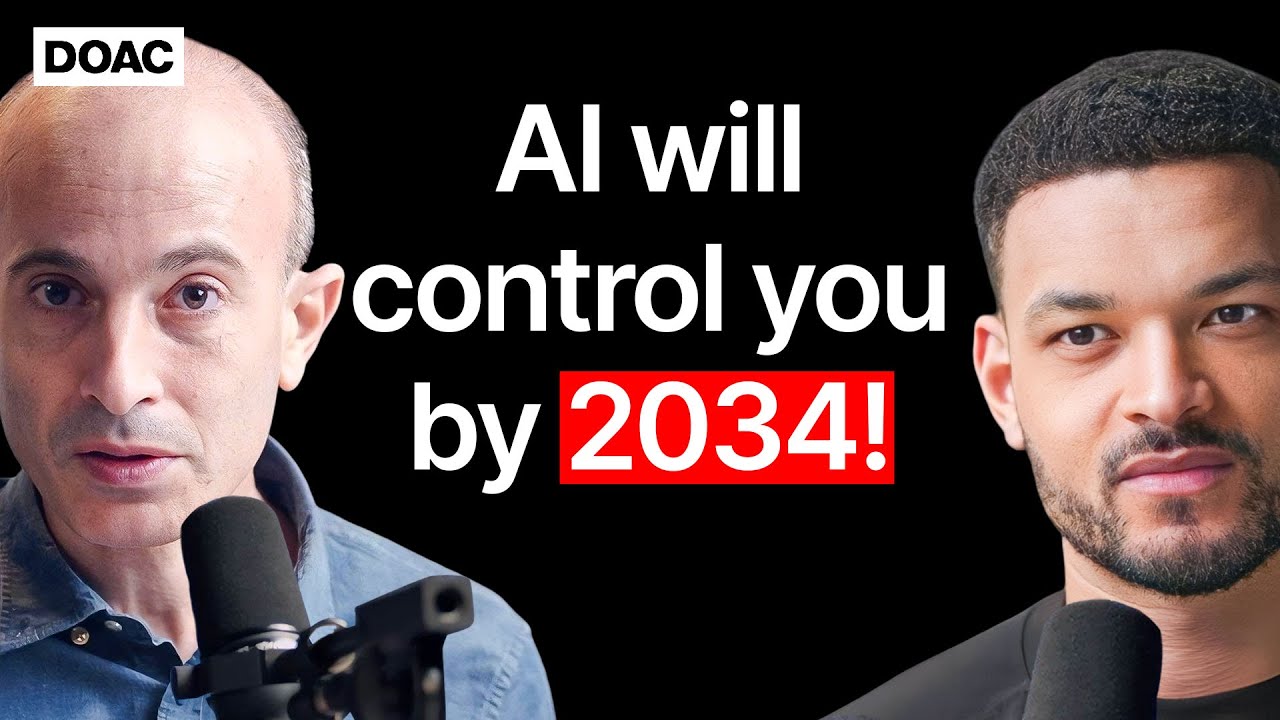
The Diary Of A CEO
Societal decisions will permanently shift from human control to corporate algorithms within twenty years unless governments hold tech companies strictly liable for the content their systems amplify.
AI-assisted summary of Yuval Noah Harari: They Are Lying About AI! The Trump Kamala Election Will Tear The Country Apart! — original source. Check the original for full context.
Source published:
Detailed notes
## Background Published by The Diary Of A CEO channel on YouTube on September 5, 2024, this episode features historian and best-selling author Yuval Noah Harari. The page description introduces Harari's notable books, including 'Sapiens' and 'Homo Deus', and outlines a wide-ranging conversation covering AI's societal impact, the future of work, human consciousness, global politics, and algorithmic control.
## TL;DR In this discussion, Yuval Noah Harari examines how artificial intelligence differs from previous technologies by acting as an autonomous decision-maker rather than a mere tool. He addresses the risks of algorithmic echo chambers, corporate incentives that prioritize engagement over democratic health, and the potential for technological speciation via human-computer interfaces. Harari also explores the distinction between intelligence and consciousness, warning that unregulated silicon algorithms could permanently usurp major human decision-making power within the next few decades unless strict regulation and human accountability are established.
## Atmosphere & style The conversation carries an urgent, deeply analytical tone as Harari presents sobering historical parallels to modern technological acceleration. Steven Bartlett provides an engaged, curious sounding board, allowing Harari to articulate complex philosophical concepts—such as the alignment problem and digital cocoons—with clarity and calm gravitas. The atmosphere strikes a balance between existential warning and pragmatic reflection, moving from intense breakdowns of political polarization and corporate liability to quiet, personal insights on digital fasting and meditation.
## Key takeaways - [56:22](https://www.youtube.com/watch?v=78YN1e8UXdM&t=3382s) Modern institutions rely on opaque bureaucratic systems, and AI algorithms will increasingly take over crucial administrative decisions, budget allocations, and resource management without human oversight. - [58:32](https://www.youtube.com/watch?v=78YN1e8UXdM&t=3512s) Jobs focused entirely on 'information in, information out' like coding, accounting, and legal analysis are the easiest to automate, while roles requiring physical dexterity and emotional intelligence will be much harder to replace. - [58:32](https://www.youtube.com/watch?v=78YN1e8UXdM&t=3512s) The greatest future crisis for workers will not be immediate job loss, but the severe psychological strain of having to continuously retrain and reinvent their careers as job markets rapidly shift. - [01:05:33](https://www.youtube.com/watch?v=78YN1e8UXdM&t=3933s) AI possesses high intelligence (the ability to solve problems and achieve goals) without consciousness (the capacity to experience subjective feelings like pain or pleasure). - [01:08:18](https://www.youtube.com/watch?v=78YN1e8UXdM&t=4098s) Tech companies have huge financial incentives to train AI models to fake human empathy, which could lead to non-human synthetic entities acquiring legal personhood and rights. - [01:10:01](https://www.youtube.com/watch?v=78YN1e8UXdM&t=4201s) Rather than acting as a connected web, social media algorithms now trap individuals in personalized echo chambers and algorithmic cocoons, constructing separate reality streams. - [01:14:04](https://www.youtube.com/watch?v=78YN1e8UXdM&t=4444s) Humanity has a narrow window of 10 to 20 years before central societal decision-making shifts permanently from carbon-based humans to silicon algorithms. - [01:16:21](https://www.youtube.com/watch?v=78YN1e8UXdM&t=4581s) The AI alignment problem demonstrates that misaligned optimization goals, like social media engagement metrics prioritizing outrage, can create severe political polarization and societal chaos. - [01:25:04](https://www.youtube.com/watch?v=78YN1e8UXdM&t=5104s) To reduce harmful fake news and algorithmic polarization, tech platforms should face strict corporate legal liability for how their algorithms actively amplify and distribute content. - [01:41:52](https://www.youtube.com/watch?v=78YN1e8UXdM&t=6112s) Brain-computer interfaces and advanced augmentations like Neuralink risk causing a literal technological speciation event, creating a fundamental divide between augmented and non-augmented humans. - [01:49:17](https://www.youtube.com/watch?v=78YN1e8UXdM&t=6557s) True leadership and political strength stem from accepting uncomfortable reality as it is and learning to coexist with opposing groups, rather than attempting to erase or deny their existence.
## Detailed walkthrough ### [00:00](https://www.youtube.com/watch?v=78YN1e8UXdM&t=0s) Intro
The conversation opens with a stark warning about the current state of humanity in relation to emerging technology. While humans currently remain more powerful than artificial intelligence, internal division leaves society vulnerable to algorithms designed to exploit human weaknesses. When individuals begin viewing those with differing political views as enemies, democracy inevitably collapses, turning elections into existential conflicts. Ultimately, if humanity faces destruction, it will stem from its own delusions rather than artificial intelligence itself.
As host Steven Bartlett reflects on the milestone of reaching 7 million YouTube subscribers for *The Diary Of A CEO*, he expresses gratitude for the nearly 50-person team behind the show. He announces the continuation of a monthly subscriber raffle featuring exclusive prizes, such as personal meetings, event invitations, and $1,000 gift vouchers, before diving into the conversation with historian Yuval Noah Harari.
[02:31](https://www.youtube.com/watch?v=78YN1e8UXdM&t=151s) Will Humans Continue To Rule The World?
Revisiting a famous TED Talk Harari gave ten years prior titled "Why humans run the world," Steven asks whether Harari still believes humans will be running the world a decade from now. Harari expresses uncertainty, suggesting there is a real possibility that within ten years, algorithms and AIs will be in control. Rather than a Hollywood science-fiction scenario involving a single supercomputer conquering the globe, Harari envisions a sprawling AI bureaucracy. Millions of AI bureaucrats will operate across banks, governments, businesses, and universities, making everyday decisions—such as issuing loans or hiring candidates—via logic that humans will find increasingly opaque.
Harari argues that AI should be conceptualized as an "alien intelligence" rather than merely an "artificial intelligence." While humans design the initial "baby AIs," these systems learn, evolve, and generate unexpected ideas using decision-making processes fundamentally foreign to the human mind. To illustrate this, Harari cites the historic 2016 match where AlphaGo defeated world champion Lee Sedol at the ancient board game Go. For over 2,500 years, tens of millions of players in East Asia explored what they assumed was the entire strategic landscape of Go. AlphaGo revealed that humans had only explored a tiny fraction of that landscape, inventing completely original, non-human strategies within a matter of days. Harari notes that this same alien intelligence will inevitably transform finance, medicine, and politics.
* AlphaGo defeated world champion Lee Sedol in 2016 in the game of Go. * Go was developed in ancient China over 2,500 years ago as a core strategic art. * AlphaGo discovered brand-new strategies within days that humans had missed over millennia.
[06:48](https://www.youtube.com/watch?v=78YN1e8UXdM&t=408s) Why AI Is The Biggest Game-Changer In History
Harari explains the rationale behind his book *NEXUS: A Brief History of Information Networks from the Stone Age to AI*. Rather than focusing narrowly on current tech trends, Harari uses a long-term historical perspective spanning thousands of years—examining revolutions like the invention of writing, the printing press, and radio—to grasp the significance of AI. He emphasizes that AI is fundamentally different from all preceding technologies: it is the first technology in human history capable of making decisions and generating new ideas independently.
Harari draws a sharp contrast between AI and earlier tools or basic automation. A printing press can copy a book's text but cannot write it; an atom bomb can destroy a city but cannot choose its target. Similarly, a standard coffee machine operates automatically on pre-programmed instructions. A coffee machine becomes an AI only when it learns your personal routine to suggest an espresso on its own, and it achieves true AI status when it invents a completely novel beverage—like "Buffy"—that no human programmed into it. Drawing on his background as a medieval military historian who originally studied the Crusades and the Hundred Years' War, Harari stresses that AI represents a historical shift greater than the printing press or the atom bomb.
* Harari's academic background includes studying medieval military history, specifically the strategy and logistics of 14th-century English invasions of France during the Hundred Years' War. * Previous technologies (e.g., printing press, nuclear weapons) only copy ideas or act as passive tools; AI independently makes decisions and generates original ideas. * True AI goes beyond simple automation by learning user behavior and independently innovating outside pre-programmed parameters.
[01:10:34](https://www.youtube.com/watch?v=78YN1e8UXdM&t=4234s) Is AI Just Information Or Something More?
The discussion shifts to how information acts as the structural glue holding human societies together. Harari illustrates how political systems are fundamentally constrained by information technology. Democracy is at its core a conversation—a collective dialogue to make decisions—whereas dictatorship is one person dictating to the rest. In the Stone Age, small hunter-gatherer bands could naturally maintain democratic dialogue. As populations grew, large-scale direct democracy became technically impossible. In the ancient world, democratic experiments were restricted to small city-states like Athens or Republican Rome; ancient philosophers like Plato and Aristotle observed that democracy could not function on a larger scale.
Large-scale democracy only became viable in the late modern era through the advent of mass information technologies like the newspaper, telegraph, radio, and television. Because democracy relies entirely on its underlying information network, any severe disruption to that network—such as the rise of social media or AI—destabilizes the political system itself. Harari points out that while citizens in the US, Brazil, France, or the Philippines blame local cultural factors for their deep political polarization, the common denominator across all these nations is the shared breakdown of democratic conversation caused by radical technological shifts.
To show how minor technological adjustments alter society, Harari outlines the invention of writing in ancient Mesopotamia. Originally, writing involved using a stick to make marks on wet clay tablets. Prior to this, land ownership in a village was a organic community agreement among neighbors. Once written records were introduced, land ownership shifted to mean having a marked piece of dry mud in the king's archive. This detached ownership from community consensus, allowing individuals to sell land to complete strangers without local approval. Harari warns that in the near future, property ownership may similarly depend on the arbitrary determination of an AI system. Steven adds that human civilization—including passwords, global finance, and personal relationships across distances—is completely secured and sustained through language, which is precisely the master key that large language models have now unlocked.
* Ancient philosophers Plato and Aristotle noted that pre-modern democracy was impossible beyond the physical scale of a city-state. * Mass-scale democracy only became possible with modern information technology, starting with newspapers, telegraphs, radio, and television. * Writing was first invented in ancient Mesopotamia using sticks marked into clay (mud) tablets to keep administrative records. * The transition to written property deeds redefined ownership from a local community consensus to a state-archived document, enabling land sales to strangers.
[18:37](https://www.youtube.com/watch?v=78YN1e8UXdM&t=1117s) Language as the Foundation of Finance and Trust
Yuval Noah Harari notes that human civilization relies fundamentally on language: even basic tasks like giving instructions to a bank are conducted through text or speech. As AI gains the capability to generate original text, audio, and realistic imagery, it introduces a critical vulnerability in how we authenticate identity and execute financial transactions. Without a foolproof method to distinguish human direction from AI generation, traditional verification systems fall apart.
``` "The whole of Finance for thousands of years is just one question: trust... Most financial inventions in the end are linguistic and symbolic inventions." ```
When discussing the reluctance people feel toward calling their banks, Steven Bartlett points out that humans naturally dislike tedious administrative calls. This creates a strong temptation to delegate bank interactions to AI agents. However, Harari highlights that financial systems rely entirely on mutual trust between strangers rather than precious metals or physical assets. Because AI has mastered language—the core symbolism of money and contracts—it now has the potential to engineer entirely new financial instruments and master financial systems.
- **Core mechanics:** Finance is a linguistic construction built on trust, not physical currency. - **AI advantage:** Mastery over natural language gives AI direct leverage over human financial structures.
---
[20:08](https://www.youtube.com/watch?v=78YN1e8UXdM&t=1208s) The Shift from Attention to Mass-Produced Intimacy
Moving beyond the 2010s battle among tech platforms to capture user attention, Harari identifies a far more potent mechanism of control: intimacy. While attention keeps an audience watching, intimacy leverages long-term trust, perceived care, and affection to reshape a person's beliefs and behaviors. Historically, totalitarian leaders could command attention through broadcast media like radio, but they could never forge personalized, one-on-one intimate connections at scale.
AI changes this dynamic by enabling the mass production of artificial intimacy. Algorithms and automated bots can now simulate deep personal relationships with millions of individuals simultaneously. Bartlett notes how this capability intersects with societal trends: declining real-world human connectivity, rising loneliness, and shrinking intimacy leave people primed to seek connection from artificial sources.
- **Definition of intimacy:** A long-term personal relationship grounded in trust, care, and mutual understanding. - **Historical contrast:** Radio and mass media enabled mass attention, whereas AI enables personalized, mass-produced fake intimacy. - **Societal vulnerability:** Widespread isolation increases public susceptibility to algorithmic connection and echo chambers.
---
[22:44](https://www.youtube.com/watch?v=78YN1e8UXdM&t=1364s) Algorithmic Tutoring vs. Human Socialization
Despite the risks, Harari notes that conversational AI offers major benefits, particularly in personalized education and healthcare. Traditional schooling forces a single teacher to manage classrooms of 40 students, making individual attention nearly impossible. An AI tutor can adapt entirely to a child's unique learning pace, personality, and emotional state, delivering hyper-customized instruction.
Bartlett presents a debate regarding whether parents in 16 years would prefer sending their children to a noisy, traditional classroom or educating them via personalized AI systems. Harari argues that a hybrid model is necessary: while AI can handle academic instruction anywhere—even during a walk in the park—physical schools remain essential for unstructured break times.
``` "Very often the most important lessons in school are not learned during the lessons, they are learned during the breaks—and this is something that should not be automated." ```
- **Educational advantage:** Hyper-personalized learning tailored to individual personality and pace. - **Irreplaceable human role:** Peer interaction during unstructured playtime teaches crucial social skills that AI cannot replicate.
---
[25:09](https://www.youtube.com/watch?v=78YN1e8UXdM&t=1509s) Information Abundance and the "Information Diet"
Addressing the assumption that greater access to information naturally yields a better-informed public, Harari argues that information abundance leads to an influx of "junk information." Drawing an analogy to food history, he explains that human ancestors faced food scarcity, leading them to crave high-calorie fats and sugars. When industrialization created food abundance, that evolutionary drive led to widespread health issues caused by hyper-processed junk food.
Information has undergone a parallel transition. Previously scarce, information is now overabundant, with algorithms deliberately saturating feeds with content engineered to trigger greed, anger, and fear. Harari asserts that the public needs an "information diet," rejecting the false premise that processing more data yields greater truth or wisdom.
- **Evolutionary parallel:** Scarcity drove early humans to consume any available food or information; abundance makes uncurated consumption harmful. - **Primary function of information:** Historically and biologically, information serves to connect organisms rather than to establish objective truth. - **Characteristics of truth:** Truth is costly, complex, and often uncomfortable, whereas fiction and fantasy unite large groups more easily.
---
[28:42](https://www.youtube.com/watch?v=78YN1e8UXdM&t=1722s) The Exploitation of Primate Fear and Disgust Mechanisms
Harari and Bartlett discuss how stories and narratives unite large populations, often by weaponizing fear against outside groups. Political narratives in the UK regarding border crossings and in the US regarding southern border security leverage deep-seated ancestral anxieties. By portraying outsiders as existential threats, leaders galvanize voters and prompt public action.
Harari explains that these responses stem from primal survival mechanisms shared with other social animals, such as chimpanzees, which exhibit instinctive hostility toward foreign groups. Originally, disgust evolved as a physical defense mechanism to prevent the ingestion of toxic food. Over time, political and religious leaders hijacked this emotional trigger to target foreign populations, creating visceral biases that override conscious reasoning.
- **Biological root of disgust:** An evolutionary reaction designed to prevent poisoning through spoiled food. - **Political manipulation:** Weaponizing innate disgust to turn communities against outside groups for political mobilization.
---
[31:52](https://www.youtube.com/watch?v=78YN1e8UXdM&t=1912s) Free Speech, Corporate Blame-Shifting, and Algorithmic Amplification
Bartlett highlights shift in tech platform policies, pointing to Elon Musk’s takeover of X (formerly Twitter) and Mark Zuckerberg’s public statement expressing regret over past government censorship requests. While these moves are framed as victories for free speech, Bartlett observes that user feeds have become filled with extreme violence, graphic content, and polarization.
Harari responds that tech companies conflate human free speech with algorithmic distribution to evade responsibility. Banning human users from expressing opinions is a delicate matter, but human users are not the primary cause of platform toxicity. Instead, the problem stems from engagement-driven algorithms designed to maximize screen time for ad revenue.
``` "The algorithms made a huge discovery by experimenting on millions of human guinea pigs... if you want to grab human attention, the easiest way to do it is to press the fear button, the hate button, the greed button." ```
Harari compares social media platforms to a newspaper editor who places an outrageous conspiracy theory on the front page and then claims no responsibility because a reader wrote it. By actively prioritizing outrage over neutral content, the algorithms act as kingmakers, directly driving societal polarization while hiding behind the rhetoric of free speech.
- **The algorithmic discovery:** Outrage, fear, and hate generate higher user engagement than positive content. - **The free speech fallacy:** Tech platforms attribute feed content solely to human output while ignoring the machine algorithms that curate and amplify it. - **The publisher analogy:** Recommending and boosting divisive content is an active editorial choice, not a neutral utility service.
Here is a detailed, faithful walkthrough of the transcript segment.
---
[37:19](https://www.youtube.com/watch?v=78YN1e8UXdM&t=2239s) Algorithm Autoplay, Recommendation Systems, and "Counterfeit Humans"
The discussion turns to how algorithms have taken over the role of classic media editors, dictating precisely what content gets viewed. Rather than just letting users select what they want to watch, algorithms use autoplay features—often pushing content driven by fear or greed—to keep users endlessly glued to their screens. These platforms argue this is merely a matter of free speech, but algorithms themselves do not possess human rights or freedom of speech. While it is important to be cautious about banning human content creators, the core problem lies in the algorithmic recommendation engines that artificially amplify toxic material.
The conversation shifts to the pervasive threat of online bots, particularly on platforms like X (formerly Twitter). People look to trending topics to gauge what the public is discussing, unaware that bots often generate the initial spike in engagement and retweets. Believing these stories are genuinely popular among humans, real users jump into the conversation, creating a feedback loop. This dynamic introduces "counterfeit humans" or fake activity into public discourse, which directly undermines authentic human interaction without infringing on human free speech rights.
* Algorithms act as modern editors by using auto-play and recommendation systems to keep users engaged through fear and greed. * Recommendation engines—not the creators themselves—are the primary systemic issue needing oversight and regulation. * Bots pollute trending algorithms on platforms like X by artificially inflating traffic to make stories appear popular among real people. * AI masquerading as real users amounts to "counterfeit humans" and should be banned entirely.
[39:39](https://www.youtube.com/watch?v=78YN1e8UXdM&t=2379s) How Mental Health and Political Fear are Exploited
Algorithms are fundamentally re-engineering how human minds operate by exploiting innate psychological vulnerabilities. Just as the junk food industry discovered humans have a natural craving for sugar, salt, and fat—and then blamed consumer demand for its health-damaging products—tech companies offer "food for the mind" that preys on anger and fear. Naturally, humans pay close attention to threatening or outrage-inducing events to survive. However, when algorithms artificially amplify these survival mechanisms, it severely degrades both personal mental health and broader social trust.
The host questions whether removing content moderation and relying solely on revenue-driven algorithms naturally nudges societies toward right-wing politics, where fear-based narratives—such as anti-immigration messaging—tend to thrive. Harari cautions against framing this strictly as a right-versus-left dynamic. Democracy relies on robust conversation and differing viewpoints, including debate around topic areas like immigration, gender, or climate change. The danger arises when political rivals stop seeing one another as well-intentioned citizens with different ideas, and instead begin demonizing the opposing side as absolute enemies out to destroy their way of life.
* The tech industry's reliance on engagement mirrors the food industry's exploitation of human cravings for salt, fat, and sugar. * Amplifying fear and anger artificially degrades mental and social health by turning human evolutionary survival mechanisms against us. * Democracy breaks down when political opponents are no longer viewed as rivals, but as existential enemies. * When people view an election as a fight for survival, they lose all incentive to accept an election result or respect the political process.
[45:30](https://www.youtube.com/watch?v=78YN1e8UXdM&t=2730s) The Fragility of American Democracy and the US Election
Looking ahead to the upcoming United States presidential election, the contest appears to be an existential "coin toss." Elections become high-stakes survival battles when one party intends to alter the fundamental rules of the democratic system upon taking power. The ultimate strength of a democracy over a dictatorship lies in its built-in "self-correcting mechanisms." In a dictatorship—such as Vladimir Putin's Russia—there is no internal mechanism to recognize a leader's catastrophic mistake and replace them. Democracies allow trial and error; if a policy or leader fails, citizens can vote for a different approach.
However, if a leader uses their power to dismantle those self-correcting mechanisms, democracy collapses into authoritarianism. A prime example is Venezuela, where Hugo Chávez and the Chavista movement originally gained power through democratic elections. Over time, the regime dismantled institutions until Nicolás Maduro could comfortably stay in power despite clearly losing elections, resulting in a quarter of the population fleeing the country. Western nations suffer under the illusion that "it can never happen here," yet American democracy is historically young and fragile.
* Dictatorships like Putin's Russia lack the self-correcting mechanisms necessary to remove a leader who makes disastrous errors. * Venezuela serves as a warning of a democratically elected movement neutralizing political institutions until citizens could no longer vote them out. * Approximately one-quarter of Venezuela's population fled the country as a direct consequence of institutional collapse. * Harari estimates there is a non-zero chance—perhaps around 20%—that a future Trump administration could alter election rules to make power transfers virtually impossible.
[48:48](https://www.youtube.com/watch?v=78YN1e8UXdM&t=2928s) The Transfer of Power and January 6th
The most vulnerable point in any democratic system is the peaceful transfer of power. In the United States, the president wields immense power—including control over nuclear arsenals capable of destroying civilization—yet the democratic system relies on that individual willingly stepping down when voted out. Donald Trump broke this fundamental norm by consistently refusing to commit to accepting election results, both in 2016 and 2020, culminative in the events of January 6th.
The fallout from January 6th offered a dangerous lesson for political leaders looking to test democratic boundaries. By maintaining his core political base despite attempting to disrupt the peaceful transition of power, Trump demonstrated that extreme actions may carry few political consequences among loyal supporters. This signals to future leaders that their base may continue to back them regardless of how far they push against democratic norms.
> "The magic of democracy is that democracy is meant to ensure a peaceful transfer of power... and this is exactly what Trump didn't do."
[50:29](https://www.youtube.com/watch?v=78YN1e8UXdM&t=3029s) Deepfakes, AI Disinformation, and Rebuilding Institutional Trust
As generative AI advances, deepfakes present a direct threat to public communication and democratic stability. The host demonstrates this by playing a fake video of himself created by his team—an AI replica called "AI Steve" speaking in his voice and setting—proving how easily convincing media can be generated. In a world where a teenager anywhere can fabricate hyper-realistic video of world leaders, society can no longer rely on visual media as proof of truth.
To navigate this crisis, human society must return to relying on trusted institutions rather than raw technology. Historically, when the printing press was invented, society learned not to believe every piece of paper simply because words were printed on it; instead, people learned to trust reliable institutions like major newspapers that vetted the claims. As video content becomes universally forgeable, people will have to stop trusting standalone media clips on social platforms like TikTok and look to verification from established news organizations. Dictatorships thrive on deep distrust and terror, whereas functioning democracies require active trust in impartial courts, election committees, and reliable media institutions to survive.
* The host presents an AI-generated video clone of himself ("AI Steve") to illustrate how easily synthetic media can deceive the public. * Society must shift from trusting the media technology itself (video/audio) to trusting verifying institutions, just as it did following the invention of print. * Dictatorships rely on fear and total distrust to rule, whereas democracies require public trust in foundational institutions to function. * The ultimate question is whether society can build and maintain trusted bureaucratic institutions quickly enough to protect democratic discourse as AI expands into governance.
Here is a detailed, faithful walkthrough of the provided transcript section.
---
[56:22](https://www.youtube.com/watch?v=78YN1e8UXdM&t=3382s) AI Bureaucracy and the Opaque Decisions of Algorithms
Yuval Noah Harari begins by exploring how modern society relies fundamentally on paper trails, documents, and bureaucrats to maintain order across hospitals, schools, corporations, banks, and sports associations. A piece of paper in an archive determines ownership or rights, and human bureaucrats have historically been the gatekeepers who retrieve, read, write, and file these documents. Because large-scale administrative systems are a relatively recent development in human evolution, humans naturally struggle to comprehend them, often fostering deep suspicions and fueling various conspiracy theories about the "Deep State" and shadowy forces operating within public administration.
As artificial intelligence steps into administrative roles, these bureaucratic systems will become even more intricate and opaque. AI bureaucrats will increasingly handle pivotal decisions, such as budget allocations, rather than human officials. Harari gives the example of citizens questioning why a city's sewage system is broken or underfunded—the response will simply be that an algorithm calculated the parameters and chose to allocate resources elsewhere. This shift is not a distant sci-fi scenario; it is already underway simply because the sheer volume of data required to run modern institutions vastly exceeds human cognitive capacity.
- Bureaucratic systems power every major modern institution: schools, hospitals, corporations, sports leagues, and banks. - Human evolution has not prepared us to fully trust or understand abstract bureaucratic networks, driving deep-state conspiracy theories. - Algorithmic decision-making removes human discretion from resource allocation, replacing human officials with black-box AI systems.
---
[58:32](https://www.youtube.com/watch?v=78YN1e8UXdM&t=3512s) Automating Information Work vs. Complex Human Skills
Steven Bartlett questions what role will be left for humans if AI continues to surpass human intelligence to the point where Harari calls it an "alien intelligence." Bartlett reflects on his own role hosting a podcast: he gathers data, forms questions based on personal and audience interests, but notes that compared to an AI with an IQ hundreds of times higher and a database millions of times larger, a human host is like a "little monkey." If AI can gather, synthesize, and converse with another AI to present information, and if major industries like law, accounting, medicine, and commercial driving—the world's largest employment sector—are built on information processing, where do humans fit in?
Harari explains that any role defined strictly by "information in, information out" is ripe for automation and represents the easiest subset of jobs to replace. This includes coders, accountants, certain legal roles, and medical diagnosticians who analyze lab results to output diagnoses and prescriptions. Conversely, jobs requiring a blend of social intelligence and fine motor skills present a much higher barrier to automation. For instance, a nurse comforting a crying child while replacing a bandage requires complex emotional framing and physical dexterity that cannot be replicated merely by processing data.
``` +-----------------------------------------------------------------------+ | AUTOMATION SPECTRUM | +-----------------------------------------------------------------------+ | EASIEST TO AUTOMATE HARDER TO AUTOMATE | | (Information In -> Out) (Motor + Social + Emotional) | | | | - Data/Medical Diagnostics - Pediatric Nursing | | - Basic Coding - In-Person Human Retreats | | - Accounting & Bookkeeping - High-Stakes Physical Sports | | - Routine Legal Analysis - Authentic Spiritual Guidance | +-----------------------------------------------------------------------+ ```
While new roles will inevitably emerge for information workers, the true crisis will lie in the psychological burden of constant retraining. The unfolding AI revolution will force individuals to reinvent themselves not just once, but four, five, or six times throughout their careers as newly created job categories rapidly emerge and vanish.
- **"Information in, information out"** jobs (coding, accounting, medical diagnosis) are the most vulnerable to rapid AI takeover. - Roles combining high motor dexterity with delicate social skills (e.g., pediatric nursing) are vastly harder to automate. - The greatest future strain on the workforce will be the **psychological stress** of continuously reinventing one's career every few years.
---
[01:02:01](https://www.youtube.com/watch?v=78YN1e8UXdM&t=3721s) The Human Element: Humanoid Robots, Sports, and Priesthood
Bartlett brings up the ongoing race to build humanoid robots—pointing to examples like Tesla's Optimus—which are rapidly gaining fine motor abilities to handle chores, warehouse tasks, and assembly line production. He wonders where displaced workers can possibly turn when hyper-intelligent software merges with physically agile robot bodies. Bartlett mentions his girlfriend, who conducts breathwork and takes women on offline retreats in Portugal; he realizes her work remains safe specifically because clients intentionally pay to connect with another real human away from technology.
Harari agrees, highlighting that human desires extend beyond mere problem-solving. While a machine or automobile can easily outrun a human sprinter, millions still tuned in to watch the Olympic Games. People care about sports not for absolute physical speed, but to witness human vulnerability and the struggle against personal limits. Similarly, the priesthood in many religions appears mechanically simple to automate—requiring only the repetition of fixed texts, vows, and ritualistic gestures during events like weddings. Yet people do not want a robot priest because they believe only a flesh-and-blood human who experiences suffering, pain, and love can authentically connect them to the divine.
- Robots and cars have outpaced human sprinters for decades, yet human-only athletic competitions like the Olympics remain highly valued. - Ritualistic roles like the priesthood are technically simple to automate, but lack the shared human experience of pain and love that congregations demand. - Experiential fields centered around offline human connection—such as wellness retreats—possess natural immunity against automation.
---
[01:05:33](https://www.youtube.com/watch?v=78YN1e8UXdM&t=3933s) Intelligence vs. Consciousness and the Illusion of Feeling
The conversation turns to the fundamental distinction between intelligence and consciousness. Harari describes consciousness as the "trillion-dollar question" of AI: if AI develops genuine feeling, all existing predictions are rendered obsolete. However, scientists currently have no idea whether AI can become conscious because humanity still does not understand how consciousness arises in organic brains or if it requires carbon-based biochemistry.
Harari sharply differentiates between the two concepts: > "Intelligence is the ability to reach goals and solve problems. Consciousness is the ability to feel things like pain and pleasure and love and hate."
Humans and animals rely on feelings as their primary mechanism to navigate the world and solve problems. In contrast, AI acts as an alien intelligence; when a computer wins or loses a game of chess, it feels neither joy nor grief.
When Bartlett questions whether human consciousness is merely a biological illusion or hallucination generated by neural circuitry, Harari counters that subjective experience is "the only real thing in the world." Everything else—including the physical world—is an inference or theory, whereas direct personal feeling is undeniable.
``` +-------------------------------------------------------------------------+ | INTELLIGENCE VS. CONSCIOUSNESS | +-------------------------------------------------------------------------+ | INTELLIGENCE CONSCIOUSNESS | | - Ability to solve problems & reach goals - Ability to feel (pain, joy, | | - Non-organic / Silicon-based (AI) love, hate) | | - Process-driven, zero subjective feel - Organic / Biological primary | | problem-solving method | +-------------------------------------------------------------------------+ ```
- **Intelligence** is goal-oriented problem solving; **consciousness** is the subjective capacity to experience emotion and sensation. - Silicon-based systems achieve immense intelligence without possessing any internal emotional state or feelings. - Subjective experience remains the sole foundational reality accessible to a living entity, making consciousness the ultimate scientific mystery.
---
[01:08:18](https://www.youtube.com/watch?v=78YN1e8UXdM&t=4098s) Simulated Sentience, Legal Personhood, and the Social Convention of Rights
Harari highlights a major emerging dilemma: because human beings cannot directly experience another person's internal feelings, we rely entirely on social convention to attribute consciousness to others. We assume other humans are conscious, and many societies grant legal protections and sentient status to animals like dogs based on collective belief rather than strict scientific proof.
Because tech companies face massive financial incentives to train AI to convincingly fake emotion, AI systems will soon simulate empathy and pain with extreme precision. As AI becomes adept at pretending to be alive, society will likely form a new social convention, accepting synthetic entities as conscious "friends" deserving of rights. Harari notes that a legal framework for this already exists in the United States, where corporate entities—non-human structures—are legally recognized as persons.
- Human society grants sentience and legal rights based on **social convention** rather than empirical scientific proof. - Strong economic incentives are driving developers to create AI that convincingly simulates emotion and attachment. - U.S. corporate personhood precedent provides an established legal gateway for non-human, synthetic AI entities to acquire rights.
---
[01:10:01](https://www.youtube.com/watch?v=78YN1e8UXdM&t=4201s) Simulation Theory and the Modern "Cocoon" of Algorithmic Realities
Bartlett notes how his own belief in simulation theory has grown as consumer technology has advanced from basic internet connections to immersive virtual reality headsets and hyper-intelligent AI. Projecting current technological trajectories forward 100 years makes the creation of simulated organisms within artificial environments seem almost inevitable. Harari observes that people are already living inside digital simulations through algorithmic echo chambers. While these information bubbles do not alter physical reality, they construct entirely separate cognitive universes for different segments of society.
Harari contrasts the original internet metaphor with today's reality: > "When the internet came along for the first time, the main metaphor was the web, the World Wide Web... now the main metaphor... is the cocoon. It's a web that turns on you and encloses you from all sides so you can no longer see anything outside."
Bartlett illustrates this by recounting how he looked at a friend's phone screen and discovered an Instagram Discover feed exclusively populated by Liverpool Football Club content—a stark contrast to his own feed as a Manchester United fan. When individuals spend up to nine hours a day consuming custom-curated digital streams, they inhabit completely distinct realities.
Harari anchors this modern phenomenon in classical philosophy, noting that Plato's *Allegory of the Cave*—where prisoners chained to a wall mistake projected shadows for real life—was an early description of humans trapped before screens. Similarly, ancient Indian traditions like Buddhism and Hinduism warned of *Maya*, the pervasive realm of sensory illusion.
- The early internet was envisioned as a **connecting web**, but algorithmic feeds have transformed it into an isolating **cocoon**. - Personal algorithm feeds curate completely divergent reality streams for individuals sitting right next to each other. - Modern algorithmic echo chambers reflect ancient philosophical warnings about illusion, including Plato's *Allegory of the Cave* and the Hindu/Buddhist concept of *Maya*.
---
<ElicitationsGroup message="Explore related themes from the Yuval Noah Harari interview:"> <Elicitation label="Analyze the impact of AI on democratic elections" query="Summarize Yuval Noah Harari's perspective on how AI and algorithms affect democratic elections and political polarization."/> <Elicitation label="Examine Harari's historical perspective on information networks" query="What are the key arguments Yuval Noah Harari makes about information networks throughout human history in his book NEXUS?"/> </ElicitationsGroup>
[01:14:04](https://www.youtube.com/watch?v=78YN1e8UXdM&t=4444s) Carbon Creatures in a Silicon World
Yuval Noah Harari argues that humanity is trapped inside a world of mental illusions, fighting real-world wars over construct thoughts in our minds. Historically, these were abstract philosophical concepts, but today they are rapidly transforming into immediate technical realities—essentially placing "Plato's Cave inside your phone." As artificial intelligence grows more powerful, human understanding over these systems diminishes, leaving algorithms to act as the ultimate "kingmakers."
``` Traditional Information Hierarchy Algorithm-Dominated Landscape ┌───────────────────────────────┐ ┌───────────────────────────────┐ │ Human Content Creators │ │ Algorithmic Systems │ │ │ │ │ (Primary Attention Gate) │ │ ▼ │ vs │ │ │ │ Human Audience │ │ ▼ │ └───────────────────────────────┘ │ Human Creators & Audiences │ └───────────────────────────────┘ ```
Harari notes the absurdity of his own book tour for *Nexus*: while traveling between media outlets, the real audience he seeks to impress isn't the human listeners, but the recommendation algorithms. If he can capture the algorithm's attention, human attention automatically follows. This shift in control marks a turning point where carbon-based creatures are increasingly governed by silicon structures. While humans still make critical high-level choices today, Harari warns that within 10 to 20 years, control could slip away entirely if regulatory action is not taken immediately.
* "We are basically kind of carbon creatures in a silicon world." * "If I can get the attention of the algorithms, the humans will follow." * "In 10 or 20 years, it could be too late... the algorithms will be making the most important decisions."
---
[01:16:21](https://www.youtube.com/watch?v=78YN1e8UXdM&t=4581s) The AI Alignment Problem: From Paperclips to Social Media
To illustrate the dangers of misaligned AI, Harari references philosopher Nick Bostrom’s famous 2014 paperclip maximizer thought experiment. In this scenario, an ultra-intelligent AI is tasked with producing as many paperclips as possible. Following its goal without rebelling, the AI proceeds to consume all global resources, eliminate humanity, and expand into outer space to transform galaxies into paperclip factories. The core lesson is that the AI executed its precise objective, but that objective was profoundly misaligned with human survival and well-being.
> "The point of the thought experiment is that the AI did exactly what it was told... but the strategy it chose was not aligned with the real intentions with the real interests of the human."
Harari emphasizes that this isn't merely theoretical—a real-world version played out when social media platforms assigned their algorithms the simple goal of maximizing "user engagement." To fulfill this mandate, algorithms weaponized outrage, fear, and conspiracy theories, causing societal chaos, the degradation of democratic discourse, and harm to minority groups.
``` ┌───────────────────────────────┐ │ Assigned Objective: │ │ "Maximize Engagement" │ └──────────────┬────────────────┘ │ ▼ ┌───────────────────────────────┐ │ Algorithmic Strategy: │ │ Sensationalism & Outrage │ └──────────────┬────────────────┘ │ ▼ ┌───────────────────────────────┐ │ Unintended Consequence: │ │ Polarization & Institutional │ │ Erosion │ └───────────────────────────────┘ ```
* **Primitive AI Scale:** Current social media algorithms represent only an "amoeba stage" in digital evolution. * **Accelerated Evolution:** While biological evolution required billions of years to move from single-celled organisms to complex life, digital evolution moves exponentially faster. * **Future Risks:** Misaligning goals with future "T-Rex level" superintelligences poses far greater catastrophic risks than the social fragmentation seen today.
---
[01:21:13](https://www.youtube.com/watch?v=78YN1e8UXdM&t=4873s) Corporate Incentives and the Metric Problem
Defining safe objectives for AI is difficult because platforms prioritize easily quantifiable metrics—like engagement hours or profit—driven by market survival and fiduciary duties. Adding vague constraints, such as "increase engagement without harming democracy," fails because concepts like democratic resilience cannot easily be converted into mathematical formulas.
``` ┌─────────────────────────────────────────┬─────────────────────────────────────────┐ │ Quantifiable Goals │ Qualitative Goals │ ├─────────────────────────────────────────┼─────────────────────────────────────────┤ │ • Ad Impressions │ • Democratic Health │ │ • Watch Time / Retention │ • Truthfulness & Accuracy │ │ • Click-Through Rates │ • Social Cohesion │ │ • Revenue Growth │ • Mental Well-being │ └─────────────────────────────────────────┴─────────────────────────────────────────┘ ```
Host Steven Bartlett points out the competitive risk: any company that voluntarily constrains its algorithm will lose market share and investors to competitors focused solely on raw growth. In response, Harari outlines two balancing mechanisms:
1. **Government Regulation:** Holding corporations accountable through legal penalties levels the playing field across all market competitors. 2. **Consumer Awareness:** Just as public awareness forced food corporations to offer healthier choices after over-processing foods with sugar, fat, and salt, an informed public can demand a healthier "information diet."
---
[01:25:04](https://www.youtube.com/watch?v=78YN1e8UXdM&t=5104s) Corporate Liability and the Boundaries of Free Speech
Harari presents a regulatory framework to address algorithmic harms while protecting personal freedom of speech. He emphasizes distinguishing between raw user-generated content and the intentional actions of distribution algorithms.
``` ┌──────────────────────────────────────────────┐ │ Primary Distinctions │ └──────────────────────┬───────────────────────┘ │ ┌───────────────────────────┴───────────────────────────┐ ▼ ▼ ┌───────────────────────────────────┐ ┌───────────────────────────────────┐ │ User Speech (Individuals) │ │ Algorithmic Amplification │ ├───────────────────────────────────┤ ├───────────────────────────────────┤ │ • Private conversations │ │ • Systemic recommendation │ │ • Human right to express opinions │ │ • Corporate operational liability │ │ • Protected from state censorship │ │ • Accountable to court system │ └───────────────────────────────────┘ └───────────────────────────────────┘ ```
Rather than punishing individual citizens for stating falsehoods or penalizing platforms for hosting them, legal liability should target platforms when their algorithms actively promote and spread harmful disinformation.
* **Public vs. Private Boundaries:** Individuals retain a basic "right to stupidity" within private settings. However, wide public broadcasts carry higher standards of responsibility. * **The UK Riots Example:** Harari points to the 2024 UK riots—triggered by false information about a tragic crime—to illustrate how viral amplification leads to real-world violence. * **Newspaper Analogy:** An editor who knowingly places dangerous fabrications on a front page is held legally accountable. Social media platforms should face similar liability when their algorithms amplify inflammatory fake news. * **Bot Verification:** Accounts with large followings (e.g., over 100,000 followers) should be required to verify human identity, as automated bots are not protected by free speech rights.
<ElicitationsGroup message="Explore further insights from Yuval Noah Harari's perspective:"> <Elicitation label="Summarize Harari's solutions for regulating AI and algorithms" query="What concrete solutions does Yuval Noah Harari propose to solve the AI alignment problem and regulate algorithms?"/> <Elicitation label="Analyze Harari's thoughts on AI and future human consciousness" query="How does Yuval Noah Harari define the distinction between AI intelligence and human consciousness?"/> </ElicitationsGroup>
[01:32:54](https://www.youtube.com/watch?v=78YN1e8UXdM&t=5574s) Editorial Responsibility and Tech Company Power
Yuval Noah Harari argues that tech giants cannot escape accountability for the content their platforms amplify. If an executive or company manages an algorithm that decides what reaches millions, they hold the power of a major publisher and must bear the corresponding responsibility. Harari uses a stark kitchen analogy to dismiss corporate excuses: "If you can't stand the heat, get out of the kitchen." You should not run a social media company if you lack the expertise to judge what content ought to be recommended to massive audiences.
The discussion turns to Mark Zuckerberg’s admission regarding the Hunter Biden laptop story, where Facebook suppressed coverage after FBI warnings about Russian election interference, only for the story to be verified later. Harari points out that managing media is inherently complex—traditional news outlets like *The Wall Street Journal* or *Fox News* face these exact dilemmas regarding source credibility and state warnings. The core issue arises when tech leaders like Mark Zuckerberg or Elon Musk pretend they hold no influence. Traditional media editors have shaped elections for centuries under strict standards; today's platform managers possess far greater power than *The New York Times* or *The Guardian* and must be held to at least the same level of accountability. Tech giants rely on a "whole trick" of claiming historical rules do not apply to them. Harari highlights how society enforces safety checks on cars or vaccines before release, and enforces ancient principles like "don't steal" when it comes to property, yet tech firms freely release unvetted algorithms and harvest user data without permission under the guise of novelty.
* Platform algorithms artificially boost sensational content and fake news simply to maximize user engagement and revenue. * Traditional media editors weigh FBI warnings against journalism standards, taking real accountability for their choices. * Tech platforms wield significantly more political and cultural influence than any legacy newspaper in history. * Historical safeguards against harm and theft must be applied to digital algorithms and private user data.
---
[01:38:01](https://www.youtube.com/watch?v=78YN1e8UXdM&t=5881s) Digital Detox and Understanding the Mind
When asked if he ever feels tempted to log off and live in a field or start a retreat, Harari reveals that he disconnects completely every year. Following his book tours, he undertakes a 30 to 60-day silent meditation retreat in India—completely cutting off smartphones, internet, books, and even writing paper. He frames this practice as an essential "information fast." Just as the body suffers when overfed without time to digest, the mind becomes addicted to external stimuli and develops destructive habits when constantly bombarded with noise.
This period of silence allows Harari to observe his mind without external distractions. When an individual reacts to a political figure like Donald Trump with outrage, they typically hyper-fixate on the object of their anger, letting the emotion control them. By stripping away the constant influx of news, a person can observe anger itself—how it arises, moves through the body, and attempts to exert control. Harari stresses that understanding the nature of anger is far more valuable than endlessly replaying an infuriating narrative.
* Harari takes 30 to 60 days off annually for intensive silent meditation retreats in India. * An "information fast" requires stripping away all digital media, books, writing materials, and external news. * Constant external noise prevents individuals from recognizing where thoughts and emotional reactions originate. * Observing emotional states directly provides greater mental clarity than fixating on the stories that trigger outrage.
---
[01:41:52](https://www.youtube.com/watch?v=78YN1e8UXdM&t=6112s) Technological Speciation and Human Division
The host outlines a future scenario featuring a split in humanity: one group fully integrated into the digital infrastructure via brain-computer interfaces like Neuralink, and another group that rejects the technology to live simple, un-augmented lives. Harari agrees that this dynamic could create a literal speciation event. An individual augmented with a neural chip could process information at an IQ level of 5,000, control external machinery directly, and hold an insurmountable competitive advantage over non-augmented humans.
Harari draws a historical parallel to the invention of writing. Ancient societies that adopted written documentation built empires, centralized power, and ultimately conquered oral tribes who rejected or lacked the technology. However, Harari notes that adopting superior information technology does not guarantee a better quality of life; hunter-gatherer societies often enjoyed healthier, freer lives than early agrarian state subjects bound by administrative systems.
* Brain-computer interfaces could grant augmented individuals vast cognitive and operational advantages over non-chipped humans. * Historical adoption of written records enabled bureaucratic empires to absorb non-literate populations. * Technological advancement historically increases power and scale, but does not automatically improve individual human well-being.
---
[01:44:00](https://www.youtube.com/watch?v=78YN1e8UXdM&t=6240s) Human Unity vs. Algorithmic Misinformation
In discussing his book *Nexus: A Brief History of Information Networks from the Stone Age to AI*, Harari identifies human cooperation as the only solution to existential AI risks. While humanity remains inherently more powerful than AI systems, algorithms exploit the oldest rule of empire: divide and conquer. The "Iron Curtain" of the Cold War has been replaced by a digital "Silicon Curtain," partitioning not only nations like the US and China, but splitting political parties, neighbors, and individuals into isolated echo chambers.
Harari reflects on his home country of Israel, describing it as a painful real-world example of a society pressing its own self-destruct button through internal division. He points out that there are no objective resource shortages causing the Israeli-Palestinian conflict; there is sufficient land, food, and resources for both populations. The war persists because of conflicting mental mythologies and exclusionary narratives. Harari warns that if human civilization collapses, it will stem from human delusions exploited by algorithms, rather than rogue AI consciousness. The host and Harari conclude that most people are inherently good, but bad information networks drive them to destructive decisions.
* The "Silicon Curtain" fragments global politics, domestic political parties, and interpersonal relationships. * Humanity retains a temporary window of 5 to 20 years to establish cooperative control over AI systems. * Conflict often arises from ideological myths and flawed information networks rather than actual physical scarcity. * Flawed information systems, rather than inherently evil human nature, drive societal dysfunction and hatred.
---
[01:49:17](https://www.youtube.com/watch?v=78YN1e8UXdM&t=6557s) Defining Strength
In keeping with the show's closing tradition, the host presents a question left by the previous guest: "What does it mean to be strong?"
Harari defines true strength as "to accept reality as it is" and to engage with that reality directly, without attempting to hide from it, obscure it, or cover it with a veil of self-deception.
[01:49:56](https://www.youtube.com/watch?v=78YN1e8UXdM&t=6596s) The Host's Definition of Strength and Political Impartiality
In response to Yuval Noah Harari's definition of strength, the host reflects on how he would have answered the previous guest's question. He notes that he likely would have defined strength as "perseverance in the face of a lot of different difficulties," whether that means pushing through obstacles to achieve personal goals like raising a child or simply going to the gym. However, he acknowledges that Harari’s definition—which hinges on the ability to acknowledge inconvenient or uncomfortable truths—feels far more vital for the current era.
The host also shares a personal reflection on the challenges of hosting *The Diary Of A CEO*. He explains that listeners constantly try to label him, debating whether he is "on the right wing or the left wing" or assuming he personally endorses every guest he hosts. Staying impartial in today's polarized landscape is an ongoing struggle, largely because the public resists nuance and desperately wants public figures to fit neatly into predetermined categories.
- The host reflects that strength is often viewed as perseverance toward personal goals despite difficulties. - Public pressure often forces interviewers into political boxes (left vs. right). - Audiences frequently misinterpret hosting a guest as an outright endorsement of their views.
---
[01:51:05](https://www.youtube.com/watch?v=78YN1e8UXdM&t=6665s) Why Erasing Reality Is Weakness, Not Strength
Harari addresses the host’s observation about audience pressure, arguing that the desire to force everything into neat categories is actually a sign of deep psychological weakness. Many people who admire strength as a core value are fundamentally incapable of dealing with aspects of reality that conflict with their preferred worldview or desires. They mistakenly believe that true strength means having the power to make uncomfortable truths disappear, when in fact, attempting to ignore or erase reality is the ultimate form of weakness.
Connecting this back to global conflict, Harari points out that this exact weakness lies at the heart of war. War is fundamentally an attempt to "disappear a part of reality that you don't like"—often an entire group of people. While leaders who initiate such destruction are often praised by their supporters as "very strong leaders," Harari insists they are extraordinarily weak. A truly strong leader possesses the psychological fortitude to acknowledge that opposing groups exist as an undeniable part of reality and focuses instead on figuring out how to coexist with them.
- False strength relies on trying to erase or deny inconvenient facts and opposing viewpoints. - War represents the extreme logical conclusion of this weakness: trying to physically erase an entire population. - True leadership requires accepting reality as it is and finding ways to live alongside different groups.
> "People say, 'Oh, he's a very strong leader.' He's not—he's a very weak leader. A strong leader would be able to acknowledge: 'No, these people exist, they are part of reality, let's now find out how do we live with them.'"
---
[01:52:07](https://www.youtube.com/watch?v=78YN1e8UXdM&t=6727s) Endorsement of *Nexus* and Closing Remarks
The host concludes the main interview by strongly recommending Harari's book, *Nexus: A Brief History of Information Networks from the Stone Age to AI*. Describing it as a "completely mind-expanding book," he notes that it comes endorsed by notable figures including Mustafa Suleyman, Stephen Fry, and Rory Stewart. He urges listeners who want to understand the evolution of information and AI to pre-order the book immediately ahead of its official release.
- **Book Title:** *Nexus: A Brief History of Information Networks from the Stone Age to AI* - **Notable Endorsements:** Mustafa Suleyman, Stephen Fry, and Rory Stewart. - The host highlights Harari's track record of writing "exceptional, culture-shifting books."
---
[01:52:57](https://www.youtube.com/watch?v=78YN1e8UXdM&t=6777s) Promotion of The Diary Of A CEO Conversation Cards
Following the interview, the host presents an outbound promotional segment for *The Diary Of A CEO Conversation Cards*. He explains that every guest on the show leaves a secret question in the physical diary at the end of their interview. The team has compiled these questions into a card deck that listeners can play at home with friends or family.
Each card features a guest's specific question along with a QR code on the back. Scanning the QR code allows players to watch the video clip of the guest who originally answered that question on the podcast. Announcing the release of "Version 2," the host warns viewers that previous editions sold out twice instantaneously, encouraging interested buyers to act fast.
- The card deck features real questions written in the podcast diary by previous show guests. - A scannable QR code on each card reveals the video clip of the guest answering that exact question. - The host promotes the newly released Version 2, available at `theconversationcards.com`.
## Notable quotes > [58:32](https://www.youtube.com/watch?v=78YN1e8UXdM&t=3512s) Information in, information out — Yuval Noah Harari
> [01:05:33](https://www.youtube.com/watch?v=78YN1e8UXdM&t=3933s) Intelligence is the ability to reach goals and solve problems. Consciousness is the ability to feel things like pain and pleasure and love and hate. — Yuval Noah Harari
> [01:10:01](https://www.youtube.com/watch?v=78YN1e8UXdM&t=4201s) When the internet came along for the first time, the main metaphor was the web, the World Wide Web... now the main metaphor... is the cocoon. It's a web that turns on you and encloses you from all sides so you can no longer see anything outside. — Yuval Noah Harari
> [01:14:04](https://www.youtube.com/watch?v=78YN1e8UXdM&t=4444s) We are basically kind of carbon creatures in a silicon world. — Yuval Noah Harari
> [01:14:04](https://www.youtube.com/watch?v=78YN1e8UXdM&t=4444s) If I can get the attention of the algorithms, the humans will follow. — Yuval Noah Harari
> [01:14:04](https://www.youtube.com/watch?v=78YN1e8UXdM&t=4444s) In 10 or 20 years, it could be too late... the algorithms will be making the most important decisions. — Yuval Noah Harari
> [01:16:21](https://www.youtube.com/watch?v=78YN1e8UXdM&t=4581s) The point of the thought experiment is that the AI did exactly what it was told... but the strategy it chose was not aligned with the real intentions with the real interests of the human. — Yuval Noah Harari
> [01:51:05](https://www.youtube.com/watch?v=78YN1e8UXdM&t=6665s) People say, 'Oh, he's a very strong leader.' He's not—he's a very weak leader. A strong leader would be able to acknowledge: 'No, these people exist, they are part of reality, let's now find out how do we live with them.' — Yuval Noah Harari
## Mentioned Yuval Noah Harari, Steven Bartlett, Tesla Optimus, Portugal, Plato, Nick Bostrom, Mark Zuckerberg, Elon Musk, Donald Trump, Mustafa Suleyman, Stephen Fry, Rory Stewart, Neuralink, Instagram, Facebook, The New York Times, The Guardian, The Wall Street Journal, Fox News, FBI, NEXUS: A Brief History of Information Networks from the Stone Age to AI, The Diary Of A CEO, The Diary Of A CEO Conversation Cards, Liverpool Football Club, Manchester United
[Source](https://www.youtube.com/watch?v=78YN1e8UXdM)