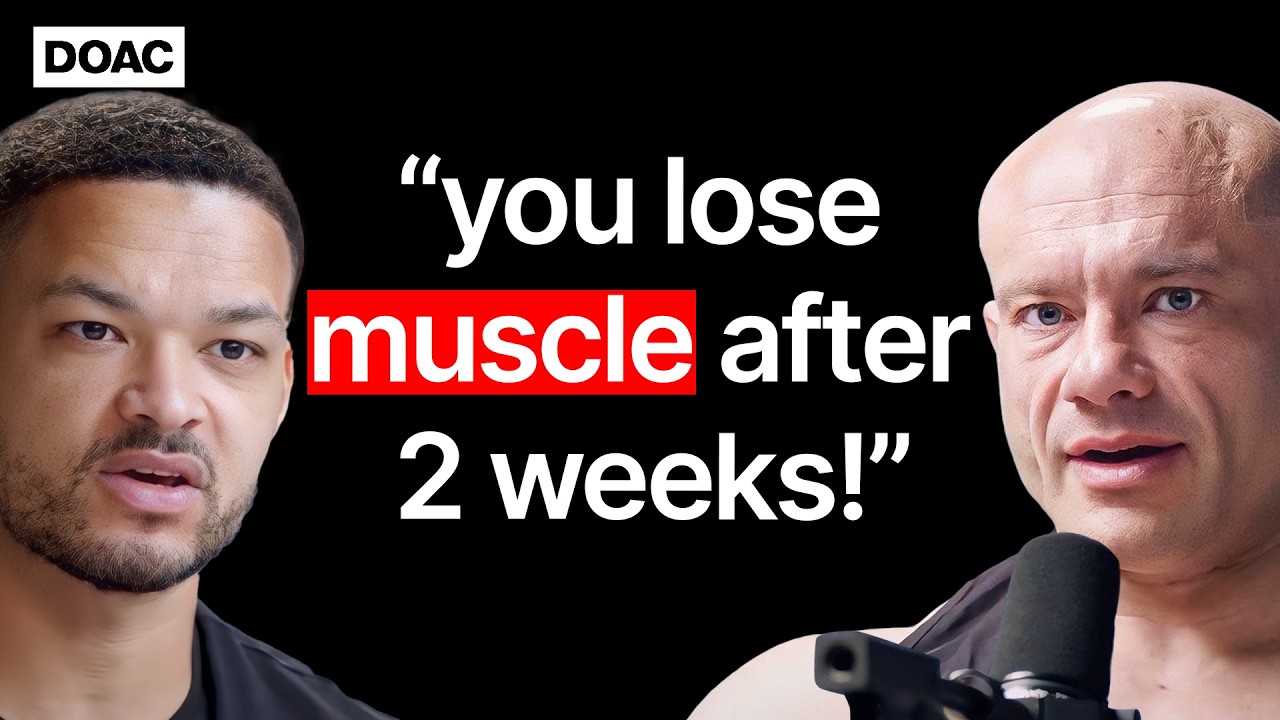
Dr. Michael Israetel Rejects Fasting and Cardio to Prioritize Diet and Resistance
The Diary Of A CEO
Le métabolisme impose des limites strictes à la dépense énergétique par l'exercice, faisant de la gestion du déficit calorique via l'alimentation le seul levier efficace pour la perte de gras durable.
## Background
Ce contenu a été publié le 12 septembre 2024 par la chaîne YouTube The Diary Of A CEO, présentée par Steven Bartlett. La description de la vidéo présente le Dr Michael Israetel, expert en sciences du sport, nutrition et cofondateur de Renaissance Periodization, venu déconstruire les principaux mythes sur la musculation, la perte de poids, l'alimentation et l'usage des stéroïdes.
## TL;DR
Au cours de cet entretien, le Dr Michael Israetel aborde la science de l'hypertrophie musculaire, la gestion des apports caloriques (CICO) et l'importance d'une alimentation adaptée par rapport à l'exercice physique pour la perte de gras. Il démystifie l'usage des compléments alimentaires et détaille les risques physiques et psychologiques de la consommation de stéroïdes. L'échange aborde également des aspects personnels et psychologiques, notamment la dysmorphie musculaire, l'impact des traumatismes et du harcèlement durant l'enfance, ainsi que le développement de la confiance en soi.
## Atmosphere & style
L'atmosphère de l'émission est à la fois hautement scientifique, franche et profondément introspective. Le ton passe naturellement d'explications physiologiques directes et pragmatiques à des confidences émouvantes et vulnérables sur les insécurités passées et la santé mentale. La dynamique entre Steven Bartlett et le Dr Michael Israetel crée un dialogue captivant, balançant entre expertise rigoureuse et authenticité personnelle.
## Key takeaways
- [45:24](https://www.youtube.com/watch?v=OTrTqs9FLq0&t=2724s) L'apport maximal recommandé en protéines pour la croissance musculaire est d'environ 1 g par livre de poids de corps par jour, idéalement réparti sur 3 à 5 repas.
- [47:40](https://www.youtube.com/watch?v=OTrTqs9FLq0&t=2860s) Le jeûne intermittent permet de développer de la masse musculaire, mais reste moins optimal qu'une alimentation fractionnée tout au long de la journée.
- [51:49](https://www.youtube.com/watch?v=OTrTqs9FLq0&t=3109s) Le principe des calories entrantes et calories sortantes (CICO) constitue le fondement incontournable de la gestion du poids et de la perte de gras.
- [58:52](https://www.youtube.com/watch?v=OTrTqs9FLq0&t=3532s) La dysmorphie musculaire est un trouble psychologique fréquent chez les pratiquants de musculation, les amenant à sous-estimer systématiquement leur niveau de développement physique.
- [01:03:30](https://www.youtube.com/watch?v=OTrTqs9FLq0&t=3810s) Pour maintenir un déficit calorique sur le long terme sans s'épuiser, il est recommandé de périodiser son alimentation en alternant phases de régime et phases de maintien.
- [01:06:56](https://www.youtube.com/watch?v=OTrTqs9FLq0&t=4016s) Il est nettement plus efficace et rapide de créer un déficit calorique par la nutrition que de chercher à brûler de grandes quantités de calories uniquement par l'exercice physique.
- [01:14:25](https://www.youtube.com/watch?v=OTrTqs9FLq0&t=4465s) Aucun complément alimentaire en vente libre ne permet de brûler du gras tout en développant de la masse musculaire de façon miraculeuse.
- [01:18:16](https://www.youtube.com/watch?v=OTrTqs9FLq0&t=4696s) L'utilisation de stéroïdes anabolisants accélère considérablement la prise de muscle mais comporte de graves risques pour la santé physique et mentale.
- [01:32:58](https://www.youtube.com/watch?v=OTrTqs9FLq0&t=5578s) Les expériences de l'enfance, comme le harcèlement ou le sentiment d'infériorité, motivent souvent une recherche extrême de masse musculaire et d'accomplissement physique.
- [01:46:18](https://www.youtube.com/watch?v=OTrTqs9FLq0&t=6378s) La restructuration des croyances limitantes à l'âge adulte nécessite d'accumuler activement des preuves tangibles pour transformer la perception de soi.
## Detailed walkthrough
### [00:00](https://www.youtube.com/watch?v=OTrTqs9FLq0&t=0s) Introduction and the RP Mission
Dr. Michael Israetel, sports science and nutrition expert and co-founder of Renaissance Periodization (RP), outlines his primary mission: helping as many people as possible get into the best shape of their lives with the absolute minimum investment of time, risk of injury, and life inconvenience. He aims to completely strip away useless or redundant practices and bluntly correct prevailing fitness myths. His approach centers on making people leaner, more muscular, healthier, and more flexible, provided they actually want those outcomes.
He points out that consistency outweighs raw hour count. Whether someone spends 2 hours or 18 hours per week, consistent execution drives progress. The most foundational principle in exercise science is specificity—identifying a clear target, such as bigger biceps, and focusing directly on it. Furthermore, every true working set must present a real physical challenge.
* **Core Mission Focus:** Maximum fitness gains with minimum time investment, lowest injury probability, and zero wasted effort.
* **Key Exercise Science Principles:** Consistency over total volume, targeted specificity for muscle groups, and sufficient proximity to failure on working sets.
---
[01:34](https://www.youtube.com/watch?v=OTrTqs9FLq0&t=94s) Subscriber Celebration and Channel Updates
Steven Bartlett takes a brief moment to celebrate reaching 7 million subscribers on *The Diary Of A CEO* YouTube channel. He expresses deep gratitude to the audience and highlights the growing team of nearly 50 people working behind the scenes. Following the success of a recent subscriber raffle, Bartlett announces that the channel will continue running monthly giveaways—offering exclusive prizes such as 1-on-1 meetings, event invitations, and £1,000 gift vouchers—to show appreciation to current and new subscribers.
---
[02:27](https://www.youtube.com/watch?v=OTrTqs9FLq0&t=147s) The Biggest Fitness Myths and Time Demands
Addressing the excuses that keep people from training, Dr. Mike identifies "lack of time" and "lack of regular gym access" as the primary barriers. Most people falsely assume that transforming their physique requires an overwhelming, life-altering commitment. Dr. Mike notes that strangers out in public often expect him to say he trains multiple hours every single day. In reality, even while training for competitive open-class bodybuilding, his personal gym time totals only around 8 hours per week.
For an average person seeking a dramatic improvement in health and appearance, Dr. Mike reveals that a sum total of just **1 hour per week**—divided into two or three 20-minute sessions—is sufficient to deliver a massive stimulus and radically transform their body, especially when paired with basic nutritional awareness.
> "For people just trying to be fit and healthy... we're talking about a sum total of 1 hour per week split into two or three 20-ish minute sessions... that is such a huge stimulus and can radically transform your body."
Dr. Mike references Thomas Sowell's hierarchy of knowledge to explain why so many people cling to incorrect fitness ideas:
* **Theory:** Highest level of scientific certainty (e.g., evolution, gravitation).
* **Model:** Well-understood framework with minor mysteries (e.g., standard model of physics).
* **Hypothesis:** Formally phrased, testable scientific idea.
* **Notion:** Unexamined ideas or colloquial statements that people accept as fact without ever questioning their underlying truth.
He humorously recounts how people on airplanes treat him like a "religious figure" or priest, confessing their poor diet choices or apologizing for skipping the gym the moment they sit next to him. In reality, mainstream fitness fears—such as avoiding artificial sweeteners, needing strictly organic or gluten-free foods, or believing that certain "bad" foods immediately make you fat—are merely unfounded notions rather than scientific realities.
---
[08:00](https://www.youtube.com/watch?v=OTrTqs9FLq0&t=480s) Why Does Getting in Shape Matter?
When asked why someone sitting on the couch should bother starting a fitness journey, Dr. Mike emphasizes that he approaches the topic from a place of unconditional respect; he does not judge people based on their body composition, nor does he view fitness as a measure of moral superiority. However, from a practical standpoint, regular exercise and lean body mass act as the closest thing science has to a universal cure-all.
Significant health benefits include:
* **Disease Prevention and Health Markers:** Substantially reducing body fat and increasing muscularity cleans up blood work markers rapidly.
* **Morbidity Reduction vs. Longevity:** Fitness not only extends lifespan but dramatically improves "healthspan"—the quality of life and physical independence in older age, preventing decades spent in assisted care facilities.
* **Cognitive Enhancement:** Modern literature unequivocally demonstrates that regular physical exercise improves cognitive function, making individuals literally smarter while preserving brain health for decades.
Dr. Mike shares a personal anecdote regarding his recent use of heavy anabolic steroids for competitive bodybuilding. Even while on high doses of harsh compounds, his routine blood work returned surprisingly clean simply because his baseline body fat was low, his muscularity was high, and his cardio activity was consistent.
---
[11:37](https://www.youtube.com/watch?v=OTrTqs9FLq0&t=697s) Dr. Michael Israetel's Academic and Professional Background
Dr. Mike outlines his extensive academic trajectory, which grounds his practical coaching in rigorous sports science:
* **Undergraduate (University of Michigan):** Kinesiology with a specialization in Movement Science, where he met his RP co-founder, Nick Shaw.
* **Master's Degree (Appalachian State University):** Exercise Science with an emphasis on Strength and Conditioning.
* **Practical Experience:** Spent 1 year working as a personal trainer in New York City alongside Nick Shaw, realizing during this time that he wanted deeper scientific answers.
* **PhD (East Tennessee State University):** Doctor of Philosophy in Sport Physiology under Dr. Mike Stone, widely considered one of the most published and accomplished sports scientists in American history. The program's primary focus was "how to take good athletes and make them better."
* **Academic Professorships:** Taught and conducted research at the university level for roughly 10 years before transitioning full-time to content creation and leading RP, though he continues to publish, review manuscripts, and fund sport science studies.
---
[13:31](https://www.youtube.com/watch?v=OTrTqs9FLq0&t=811s) Beginning the Journey: Needs Analysis and Goal Setting
When initiating a client's fitness transformation, Dr. Mike explains that the very first step is performing a formal **needs analysis**. Before addressing psychological readiness or tactical exercise programming, a coach must establish concrete, individual goals:
1. **Clarify Specific Outcomes:** Determine exact target weights and physical changes (e.g., gaining 5 lbs of lean mass versus attempting a dramatic 50 lb transformation).
2. **Identify Trade-offs:** Recognize that different goals require vastly different timelines, daily habits, and physical sacrifices.
3. **Gender Patterns:** Men frequently desire a mix of fat loss and noticeable muscle gain, whereas women often state a preference for fat loss alone—though building a baseline of lean muscle mass is vital for sustaining their desired aesthetic and metabolic health.
[15:12](https://www.youtube.com/watch?v=OTrTqs9FLq0&t=912s) Performing a Needs Analysis for Ideal Goals and Time Investment
Dr. Michael Israetel emphasizes that fitness cannot be treated as a one-size-fits-all approach because individual goals and lifestyles vary dramatically. While some women worry that lifting weights will make them look bulky when they just want a healthier appearance, many men aim to get both leaner and significantly "jacked." When individuals approach a trainer with open-ended or vague goals, it is akin to walking into a car dealership and simply saying, "I want a car." A coach needs to conduct a thorough needs analysis to determine the client's actual use cases, schedule, and personal budget.
The strategy required for someone aiming to become a professional bodybuilder with endless free time is vastly different from that for an individual who merely wants to improve their health, feel better, and only has two hours a week to spare. Dr. Israetel highlights that an effective intake process must examine the client's past fitness experience—even if they have never exercised before—to fill in the blanks and create a tailored, realistic plan.
* **Vehicle Analogy:** Entering a gym without clear goals is like telling a car dealer "I want a car" without specifying budget or intended use.
* **Realistic Time Commitment:** A client with only 2 to 4 hours per week can still achieve meaningful physique and health transformations with a targeted program.
* **Key Intake Questions:** A coach must establish time availability, aesthetic/health targets, and past fitness history before writing a routine.
---
[17:46](https://www.youtube.com/watch?v=OTrTqs9FLq0&t=1066s) Home Workouts with 20lb Dumbbells
When transitioning to step two of designing a program, the primary logistical question is determining where the training will take place. Training at home is a distinct environment compared to a gym, but impressive results can be achieved with remarkably minimal equipment. For most bright, spry adult males, a single pair of 20 lb dumbbells (roughly 9 kg)—or 10 lb dumbbells for smaller individuals—combined with a small amount of open floor space is enough to launch a revolutionary fitness program.
```
+-------------------------------------------------------------------+
| 6-MONTH HOME WORKOUT POTENTIAL |
| Equipment: Two 20 lb Dumbbells | Frequency: 2x/Week (20 min ea)|
+-------------------------------------------------------------------+
| • Muscle Gain: 5 to 10 lbs (approx. 2 to 5 kg) |
| • Fat Loss: 11 to 16.5 lbs (approx. 5 to 7.5 kg) |
| • Time Spent: 40 minutes total per week |
+-------------------------------------------------------------------+
```
During the host's podcast, Steven Bartlett's team brings out a pair of 20 lb dumbbells to inspect, prompting banter about whether the studio assistants fight crime in their spare time due to their strength. Dr. Israetel highlights that for a beginner in their 30s, 40s, or 50s, sticking to two 20-minute home workouts a week while controlling their diet can yield 5 to 10 lbs (2 to 5 kg) of muscle gain and 5 to 7.5 kg of fat loss within six months. He compares this to buying several kilos of meat at the grocery store to visualize the physical transformation occurring on one's body. However, for individuals who are already accustomed to training six days a week for two hours, lightweight dumbbells will not elevate their physique further and would prove highly inefficient.
---
[19:31](https://www.youtube.com/watch?v=OTrTqs9FLq0&t=1171s) Overcoming Gym Anxiety with a Structured Plan
Step three involves addressing the mental barriers to training, particularly gym anxiety. Many beginners feel embarrassed or intimidated entering a gym—especially a specialized bodybuilding facility—assuming everyone else knows far more than they do or is judging their form. Steven shares his own relatable experiences of avoiding unfamiliar machines in elite gyms out of fear of looking foolish while attempting to exercise specific muscles.
Dr. Israetel reassures that gym anxiety is extremely common and offers a clear strategy to eliminate it: entering the gym with a precise, structured plan. Whether recorded in a notebook or on a specialized app (such as the Hypertrophy App developed by his team at Renaissance Periodization), having a predefined roadmap removes all guess-work. When an app specifies exact warm-ups, starting weights, set counts, target reps, and includes video demonstrations by professional bodybuilders, the gym environment becomes simplified.
> "That's your little map of the Caribbean Sea with the X's and the pirate ships, and you know exactly where to go... everyone else like in the Avengers movies, just floats away. There's no one else. There's not even any other machines. It's you and the bicep curl machine..."
* **The Reality of Other Gym-Goers:** Most people in the gym do not actually have a structured program and are merely training based on "vibes" rather than evidence-based principles.
* **Eliminating Second-Guessing:** Having explicit targets (e.g., performing a set of 12 reps at 50 lbs) insulates lifting sessions from self-doubt and social judgment.
---
[22:23](https://www.youtube.com/watch?v=OTrTqs9FLq0&t=1343s) Foundational Science: Hypertrophy vs. Periodization
To understand how to train effectively without wasting time, Dr. Israetel distinguishes between two frequently confused terms: **hypertrophy** and **periodization**. Hypertrophy is simply the technical term for muscle growth or getting "jacked." While casual or random training can yield modest muscle growth, optimizing those gains requires periodization. Periodization is the scientific organization of training variables over time to achieve three key objectives:
1. **Maximized Results:** Achieving the highest possible rate of muscle growth or strength gain.
2. **Strategic Peaking:** Timing peak physical condition for specific events (e.g., getting lean abs for summer).
3. **Injury Risk Mitigation:** Managing fatigue and physical stress to keep joints and tissues healthy.
To trigger hypertrophy efficiently, lifters must adhere to core exercise science principles, starting with **specificity**—focusing workouts directly on the target muscles (e.g., performing actual bicep exercises rather than upright rows if bigger biceps are desired). Next is the principle of **overload**, which dictates that working sets must genuinely challenge the body. The final repetitions of a set should feel perceptibly harder, causing movement velocity to slow down, and should be approached with a slight sense of mental anticipation or "trepidation."
---
[27:19](https://www.youtube.com/watch?v=OTrTqs9FLq0&t=1639s) Rep Ranges, Sets, and Training Frequency
When structuring sets and repetitions for hypertrophy, Dr. Israetel dispels the myth of a single "magical" rep number. While lightheartedly joking that the exact secret rep number is "17" under an NDA, he explains that muscle growth can be stimulated across a wide rep spectrum—anything from **5 to 30 reps per set**—provided the set is taken close to failure where technique remains clean. Scientific studies demonstrate that when comparing groups training at 5 reps versus 30 reps, the resulting muscle growth over 8 to 16 weeks is statistically indistinguishable.
```
+-------------------------------------------------------------------+
| HYPERTROPHY TRAINING MATRIX |
+-------------------+-----------------------------------------------+
| Rep Range | 5 to 30 reps per set (taken close to failure) |
+-------------------+-----------------------------------------------+
| Beginner Dose | 2 sessions/week, 2-3 sets per muscle group |
+-------------------+-----------------------------------------------+
| Optimal Frequency | 2 to 4 sessions/week per muscle group |
+-------------------+-----------------------------------------------+
| Efficiency Curve | 1x/wk = Good | 2x/wk = ~1.5x Better |
| | 3x/wk = Minor boost | 4-5x/wk = Diminishing |
+-------------------+-----------------------------------------------+
```
For beginners, the "minimal effective dose" required to spur growth is surprisingly small: just two sessions per week, performing two to three sets per muscle group per workout. While advanced lifters eventually require higher volume and frequency, a novice can make months of steady progress on this minimal routine. Furthermore, spreading training across two to four weekly sessions per muscle group yields noticeably better gains than packing all sets into a single weekly workout, owing to the diminishing returns of high single-session volume.
* **Effort Over Load:** A heavy weight for 10 reps and a lighter weight for 30 reps trigger comparable hypertrophy, as long as the subjective strain near the end of the set is high.
* **Frequency Gains:** Training a muscle group twice a week produces roughly 1.5 times the results of training it once a week.
* **Full-Body Efficiency:** For busy individuals, a full-body routine performed 2 to 3 times per week serves as an ideal baseline.
---
[29:32](https://www.youtube.com/watch?v=OTrTqs9FLq0&t=1772s) The Biological Mechanism Triggering Muscle Growth
Dr. Israetel outlines what actually happens inside muscle tissue to trigger growth. The primary stimulus for hypertrophy is mechanical tension. Muscle cells contain specialized molecular structures that function as tension detectors. When muscles contract under load, these mechanical sensors detect the stress and signal the cellular machinery to initiate the muscle-building cascade. Mechanical tension acts as the master switch that sets the entire adaptive process into motion.
<FollowUp label="Want to continue with the next part of the transcript?" query="Please provide the walkthrough for the next part of this transcript, starting around timestamp 00:30:20."/>
[30:21](https://www.youtube.com/watch?v=OTrTqs9FLq0&t=1821s) Secondary Mechanisms of Muscle Growth and the Recovery Curve
While mechanical tension detected by cellular receptors accounts for roughly 80% or more of all muscle hypertrophy, Dr. Michael Israetel notes two secondary mechanisms that play a causal role in driving growth: metabolite sequestration and cell swelling. Metabolite sequestration is the scientific term for the intense "burn" felt toward the end of a set, where metabolic byproducts accumulate and signal molecular machinery to build muscle. The second factor is the "pump"—or localized cell swelling—which occurs when blood rushes into the muscle. Dr. Israetel jokes about flexing a pumped bicep at a girl only to watch her run away, but notes that this fluid accumulation itself acts as an additional growth signal.
Crucially, muscle growth does not actually occur inside the gym. Weight training is inherently catabolic, breaking down significantly more muscle tissue than it synthesizes during the workout. The actual anabolic construction begins hours later when you rest, sleep, and consume meals rich in protein, carbohydrates, and fats. Laboratory measurements using radioactive tracers show that muscle protein synthesis follows a smooth curve: it typically peaks 12 to 36 hours after a workout depending on session difficulty, then gradually tapers back to baseline over one to three days.
```
Workout (Catabolic) ➔ Post-Workout Meals & Rest ➔ Protein Synthesis Peaks (12–36 hrs) ➔ Returns to Baseline (1–3 days)
```
- **Primary Driver:** Mechanical tension via cellular strain receptors accounts for over 80% of muscle hypertrophy.
- **Secondary Drivers:** Metabolite sequestration ("the burn") and cellular swelling ("the pump").
- **Catabolic vs. Anabolic:** Training breaks muscle down; recovery, sleep, and multi-meal nutrition build it back up.
- **The "Anabolic Window" Myth:** Muscle building is not restricted to a 2-hour post-workout window, but elevated for days.
- **Sample Weekly Protocol:** Training on Monday keeps muscle protein synthesis elevated through Tuesday and Wednesday. Taking Sunday off allows systemic recovery before hitting the weights fresh on Monday.
---
[33:30](https://www.youtube.com/watch?v=OTrTqs9FLq0&t=2010s) Muscle Loss Timelines, Detraining, and Muscle Memory
Addressing how long it takes to lose hard-earned muscle, Dr. Israetel splits his answer into two distinct phases: the initial period of inactivity and the reality of regain. Measurable tissue atrophy—detectable via DEXA or MRI scanners—does not begin until roughly two full weeks of complete lifting cessation. Any perceived shrinkage prior to the two-week mark is simply a loss of intracellular water and minor inflammation, which quickly returns after a single session. While prolonged inactivity over several months will lead to noticeable muscle loss, mature muscles rarely shrink all the way back to their pre-training baseline.
The most reassuring news for anyone taking time off is the phenomenon of muscle memory. Due to retained myonuclei and neural adaptations, regaining lost muscle occurs an order of magnitude faster—roughly ten times faster—than it took to build originally. Dr. Israetel highlights retraining studies where subjects who took two-week breaks mid-program achieved identical long-term muscle gains compared to those who trained continuously without breaks.
> "Because of that muscle memory situation, however long it took you to gain the muscles initially, it's going to take you an order of magnitude—a factor of 10-ish or so—less time to get it back."
- **0 to 1.5 Weeks Off:** Zero actual muscle tissue lost; perceived flat appearance is due to reduced glycogen and intracellular fluid.
- **2 Weeks Off:** The earliest point at which modern imaging (DEXA/MRI) can detect true muscle tissue loss.
- **Months Off:** Gradual atrophy continues, but baseline size is rarely fully reached due to permanent structural adaptations.
- **Regain Timeline:** Rebuilding peak muscle size after a long break typically takes just 3 to 4 weeks of consistent re-training rather than many months.
---
[38:28](https://www.youtube.com/watch?v=OTrTqs9FLq0&t=2308s) Practical Warm-Up Protocols and Neuromuscular Potentiation
When structuring a warm-up, Dr. Israetel emphasizes that elaborate cardio sessions, static stretching, or complex stability drills on Bosu balls are unnecessary for muscle building. Instead, the most efficient protocol—recommended by Renaissance Periodization—is a simple load-pyramid system performed on the exact exercise you plan to do. By starting with a very light weight for higher reps and progressively increasing the weight while lowering the reps, you prepare your body without accumulating unnecessary fatigue.
Physiologically, warming up accomplishes two main tasks: altering muscle tissue fluid dynamics and potentiating the central nervous system. Increasing tissue temperature reduces internal viscosity and loosens protein structures, allowing joints to move safely through a full range of motion. Simultaneously, the nervous system undergoes post-activation potentiation—flushing cellular metabolites and firing up the primary motor cortex to recall precise movement patterns and muscle coordination before the heavy working sets begin.
```
Warm-Up Pyramid Example (Working Weight: 20 lb Dumbbells):
Set 1: 5 lbs x 12 reps (Rest 30–60s) ➔ Light movement & technique
Set 2: 12 lbs x 8 reps (Rest 60s) ➔ Nervous system activation
Set 3: 20 lbs x 2–4 reps (Rest 30s) ➔ Acclimatization to heavy load
Working Set 1: 20 lbs x 16 reps
```
- **Warm-Up Structure for Lead Exercise:** 12 reps (light weight) $\rightarrow$ 8 reps (moderate weight) $\rightarrow$ 2 to 4 reps (working weight target).
- **Subsequent Exercises for Same Muscle:** A single warm-up set of 4 to 8 reps at a middle weight is sufficient.
- **New Muscle Group in Same Workout:** Repeat the full 12-8-4 warm-up progression for the new primary pattern.
- **Physiological Mechanism:** Elevates tissue temperature, lowers internal fluid viscosity, and potentiates the primary motor cortex.
---
[43:32](https://www.youtube.com/watch?v=OTrTqs9FLq0&t=2612s) Common Gym Mistakes: Exercise Selection and Biomechanics
A major pitfall preventing people from making progress in the gym is poor execution technique that shifts mechanical tension away from the targeted muscle. Dr. Israetel explains that biomechanics dictate where the force of a weight is distributed. For instance, executing a bicep curl with an arc that pulls back at the shoulder causes the bicep to act primarily as a shoulder stabilizer rather than the primary elbow flexor, drastically reducing the growth stimulus.
Similarly, squat mechanics alter target muscle activation based on joint angles. A squat where the lifter sits far back without driving the knees forward heavily engages the glutes and lower back, but minimizes knee flexion and quad development. Conversely, staying more upright while allowing the knees to track forward well past the toes places deep mechanical stretch directly onto the quadriceps.
- **Stabilization vs. Prime Moving:** Poor movement paths shift tension to secondary stabilizing muscles rather than the target muscle group.
- **Hip-Hinge Squat:** Deep hip bend with minimal knee forward travel $\rightarrow$ targets glutes and spinal erectors.
- **Quad-Focused Squat:** Upright torso with high knee-forward travel past the toes $\rightarrow$ maximizes quadriceps stretch and tension.
<ElicitationsGroup message="Explore more from this interview:">
<Elicitation label="Summarize nutrition and dietary principles for hypertrophy" query="What are Dr. Michael Israetel's key recommendations on nutrition, calories, and protein for muscle growth from this interview?"/>
<Elicitation label="Summarize training volume and set guidelines" query="How many sets per week and how often does Dr. Michael Israetel recommend training for optimal muscle growth?"/>
</ElicitationsGroup>
[45:24](https://www.youtube.com/watch?v=OTrTqs9FLq0&t=2724s) Optimizing Exercise Technique and Protein Intake
The core elements of effective exercise technique involve targeting the intended muscle directly, maintaining consistent execution rep-to-rep, and taking the muscle through a full range of motion that emphasizes a "deep painful lengthened stretch." While finer nuances exist, these three principles form the bedrock of proper lifting. Beyond training mechanics, proper nutrition is essential for muscle hypertrophy and reducing body fat to reveal muscle definition. Protein serves as the primary macronutrient required for building muscle tissue.
To maximize muscle growth, high-protein foods should ideally be consumed across three to five meals per day at roughly equal intervals. While traditional breakfast, lunch, and dinner schedules work well, adding an evening snack provides an even more optimal distribution. The top end of daily protein requirements is approximately one gram per pound of body weight, though most individuals require considerably less. For instance, a 200-pound individual targeting 150 to 200 grams of protein daily would need about 40 to 50 grams per meal across four meals. Consuming high levels of protein does not automatically cause fat gain or kidney damage unless overall calorie intake exceeds maintenance due to unadjusted carbs and fats.
* **Optimal meal frequency:** 3 to 5 meals per day spaced evenly.
* **Daily protein target:** ~1g per pound of body weight as an upper limit (150–200g per day for a 200 lb individual).
* **Protein per meal:** ~40–50g per serving when eating four meals daily.
* **Safety of high protein:** High protein intake is not harmful to healthy kidneys, though excessive calories from any source will lead to fat gain.
---
[47:40](https://www.youtube.com/watch?v=OTrTqs9FLq0&t=2860s) Intermittent Fasting, Pre-Workouts, and Caffeine Limits
Intermittent fasting can still allow for muscle growth, but it is less effective than spacing protein intake across multiple meals. Competitive bodybuilders almost universally rely on frequent, high-protein meals rather than compressed eating windows. Dr. Israetel typically eats four to five times per day, including before and after workouts. When training early in the morning, he occasionally drinks a protein and carbohydrate mix during the session, followed by sequential post-workout meals throughout the day.
Dr. Israetel avoids pre-workout supplements and all stimulants because he naturally feels energized and experiences heightened anxiety, overstimulation, and impaired fluidity of thought when taking them. While green tea, black coffee, or standard pre-workouts work well for individuals who need an energy boost, reliance on heavy stimulants before minor workouts is often excessive. High-dose caffeine use is common, with some products containing extreme amounts—such as Ronnie Coleman's pre-workout at 550 mg per serving. While health issues generally arise around 1,000 mg of caffeine per day, lower baseline doses are recommended before titrating upward.
* **Intermittent fasting trade-off:** Possible for gaining muscle, but achieves sub-optimal results compared to 3–5 daily meals.
* **Caffeine threshold for health issues:** ~1,000 mg per day for most people.
* **Standard caffeine contents:** 50–100 mg per cup of coffee; 250–550 mg in commercial pre-workout powders.
---
[51:49](https://www.youtube.com/watch?v=OTrTqs9FLq0&t=3109s) The Thermodynamics of Calories In vs. Calories Out
The principle of "calories in, calories out" (CICO) remains the fundamental baseline for weight loss, fat loss, and muscle gain. Most individuals who fail with CICO fail because they miscalculate food portions or ignore the energy output side of the equation. A common error includes underestimating portion sizes, such as confusing a standard measuring tablespoon with a heaped kitchen spoon containing four times the actual amount. In metabolic ward studies—where exercise, energy expenditure, and food intake are strictly controlled—subjects consistently adhere to the laws of thermodynamics without exception.
While CICO dictates total weight gain or loss, macronutrient distribution (proteins, carbs, and fats), food quality, and nutrient timing dictate whether the weight gained or lost consists of muscle or body fat. CICO functions like a car engine: it is essential to move the vehicle, but steering wheels and pedals (macronutrients and habit formation) are necessary to control the direction.
> "Calories in, calories out is incontrovertible... in among 90-something percent—98% of people who do research in the field and are scientifically literate and educated—calories in, calories out is not controversial. It never has been."
---
[55:00](https://www.youtube.com/watch?v=OTrTqs9FLq0&t=3300s) Sustainability, Habit Formation, and Menu Calorie Labels
Long-term body composition management depends on sustainable eating habits rather than permanent calorie tracking. Temporary, extreme calorie counting often leads to weight regain once an individual resumes unmonitored eating. Long-term success relies on constructing meals centered around lean proteins, vegetables, fruits, whole grains, and healthy fats, while monitoring body weight to adjust intake as needed.
Regarding public policy debates around removing calorie counts from restaurant menus to reduce eating disorders, the impact of menu labeling on clinical conditions like anorexia nervosa is minimal. Severe eating disorders are predominantly driven by underlying genetic predispositions and complex socio-cultural factors rather than public nutritional information.
* **Key healthy habits:** Constructing meals from whole foods (lean proteins, whole grains, fruits, vegetables) and monitoring body weight periodically.
* **Limitation of strict diets:** Single-food or overly restrictive diets do not teach long-term weight maintenance skills.
Muscle dysmorphia is a psychological condition primarily affecting young men, where individuals perceive themselves as significantly less muscular than they actually are. It involves a strong detachment from objective reality, both in comparison to their personal goals and relative to their peers.
While general body dysmorphia can manifest differently across populations, muscle dysmorphia in fitness circles typically presents as an extreme underestimation of one's physical development. Even highly developed individuals may view their physiques as average or below average when experiencing low points in mood or confidence.
* **Demographic impact:** Primarily affects men aged 15 to 32.
* **Core symptom:** Pathological underestimation of one's muscle mass and physical condition despite objective evidence to the contrary.
[01:00:30](https://www.youtube.com/watch?v=OTrTqs9FLq0&t=3630s) Male Body Image, Genetics, and the Spectrum of Gym Neurosis
The relationship between mental health and body image is just as pronounced in men as it is in women, even if it manifests in slightly different ways. Dr. Mike Israetel points out that a vast proportion of psychological proclivities are genetic, while others are individually acquired over time rather than simply being a direct product of upbringing. Because traits tend to cluster together, people fall along a spectrum: those who aggregate negative psychological traits often feel consistently neurotic, unsafe, and unsure of themselves.
For these neurotic individuals, getting jacked does not fix their internal perception. They suffer from a form of imposter syndrome or muscle dysmorphia, perpetually worrying that their gains are fleeting—a mindset Dr. Mike humorously likens to a stereotypical Jewish joke: *"Oy, oy, I'm never going to be big,"* even when they are already massive. On the flip side, non-neurotic individuals can go to the gym for just one week and immediately begin asking if they should turn pro.
Beyond baseline genetics, your social environment and comparator population heavily skew how you view your own physique. Dr. Mike shares an anecdote about his close friends from college who are neuroscientists. When they compare their bodies to Dr. Mike and his professional bodybuilder circle, they feel out of shape and unmuscular. He constantly has to remind them to look around at ordinary people in the real world:
> "I always remind them like, 'Dude, not everyone looks like this.' They go to the store, they go to the school, they go to the bank and they're like, 'Oh, crap, you're right. I'm actually the most jacked person at the bank.'"
- **Environment Dynamics:** Hanging out at a university gym full of elite college athletes can trigger body anxiety, whereas spending time in a nursing home with elderly relatives makes a person feel like Superman simply because they can move heavy furniture.
- **Genetic Clustering:** Neurotic tendencies mean that physical progress rarely translates into psychological peace of mind without conscious cognitive adjustments.
---
[01:03:30](https://www.youtube.com/watch?v=OTrTqs9FLq0&t=3810s) The All-or-Nothing Trap and Misconceptions Around Weight Loss
When people decide to lose weight, two major psychological traps undermine their long-term success. The first is an "all-or-nothing" or quasi-religious dichotomy toward dieting. Many individuals believe they are either 100% "good" or completely "bad." They eat clean for weeks, but the moment they indulge in a single kebab or cheeseburger, they declare defeat: *"Fuck it. That's it, man. I'm done dieting. I'm not a good person anymore."*
In reality, a single cheat meal carries zero moral weight and can actually aid progress. The body stores those extra carbohydrates as muscle glycogen, lowers overall diet fatigue, and recovers better, setting up the individual to return to their diet the following day with even better results.
The second major misconception is the belief that the protocol used to *lose* weight must be maintained identically forever to *maintain* weight. Dr. Mike notes that even standard medical guidance often fails to differentiate between weight loss and maintenance phases. His wife, a board-certified family and sports medicine doctor working with international Olympic teams, routinely finds that official guidelines advocate extreme dietary restrictions without offering a realistic maintenance transition. Expecting someone to give up ice cream, crisps, or tiramisu for the rest of their natural life is completely untenable and inevitably leads to bingeing and weight regain.
```
Weight Loss Phase (3 Months) ➔ Maintenance Phase (2-3 Months) ➔ Repeat or Hold Baseline
```
- **Periodized Maintenance Rule:** For roughly every 3 months spent in a hard caloric deficit, plan for 2 to 3 months at maintenance to let physiological and psychological diet fatigue subside.
- **Reframing Indulgence:** Viewing occasional treats as tool-driven mental breaks rather than "sins" prevents the catastrophic falling-off-the-bandwagon cycle.
---
[01:06:56](https://www.youtube.com/watch?v=OTrTqs9FLq0&t=4016s) The 80/20 Diet Rule and the "Pontzer Paradox"
The old fitness adage that weight loss is "80% diet and 20% exercise" is a surprisingly accurate heuristic. Dr. Mike points to Herman Pontzer's work in physical anthropology regarding the **constrained energy expenditure hypothesis** (often called Pontzer's paradox). Humans cannot simply double their exercise output to compensate for a poor diet without experiencing severe metabolic compensation.
When you attempt to out-train a bad diet through extreme exercise, your body experiences rapid fatigue and subtly reduces its Non-Exercise Activity Thermogenesis (NEAT)—such as how often you fidget, walk around the kitchen, or stand up while on the phone. Eventually, exhaustion forces you to stop the extra activity altogether.
Diet is a far more efficient leverage point because removing calories requires significantly less time and effort than burning them off through exercise:
> "How fast, Steven, can you eat a donut if I time you? 5 seconds. 5 seconds, no problem. Boom. You're going to run 3 miles after you eat a donut? No. It's insane."
- **The Math of Running vs. Eating:** The average person burns roughly 100–150 calories per mile run. Eating two extra donuts at a work event adds ~600 calories, requiring a grueling 6-mile run just to neutralize the intake.
- **Deficit Target:** A fat loss goal of 1 lb per week requires a weekly deficit of 3,500 calories (or ~500 calories per day). Generating this entirely through exercise is unsustainable for most, whereas combining modest dietary cuts with moderate activity easily hits the mark.
- **Post-Exercise Hunger:** Exercise does not dependably increase appetite in everyone, but people frequently fall into a psychological trap of feeling they "deserve" high-calorie reward foods after a workout.
---
[01:12:04](https://www.youtube.com/watch?v=OTrTqs9FLq0&t=4324s) Cardio vs. Strength Training for Long-Term Weight Loss
There is a widespread misconception that building large amounts of muscle turns your body into an automatic furnace that burns through hundreds of extra calories at rest. In reality, the difference in basal metabolic rate between muscle tissue and fat tissue is surprisingly minimal and almost unnoticeable on a day-to-day basis.
To illustrate this, Steven and Dr. Mike compare their own body weights. Steven weighs roughly 92 kg (~202 lbs), while Dr. Mike weighs around 98–100 kg (~216–220 lbs). Despite Dr. Mike carrying significantly more muscle mass, his baseline caloric burn is only slightly higher—and that difference is primarily driven by his higher total body weight rather than the muscle tissue itself.
To take an extreme example, the individuals who burn the most total calories at rest are actually the heaviest people in the world. An 800-to-1,000-lb individual requires around 15,000 calories a day just to maintain their current weight. If that same individual were somehow made of 1,000 lbs of pure muscle instead of fat, their daily calorie burn would only increase slightly—perhaps to around 16,000 calories.
```
[Caloric Expenditure Impact]
Nutritious, Controlled Diet ➔ HIGH IMPACT (Primary Driver)
High Daily Movement (NEAT) ➔ MODERATE IMPACT (Essential Support)
Added Muscle Mass / Cardio ➔ LOW IMPACT (Health/Visuals, not Weight Loss)
```
- **Primary Role of Muscle:** Muscle mass is critical for structural health, functional capability, metabolic health, and physical aesthetics, but it is not a primary shortcut for fat loss.
- **Sustainable Fat Loss Blueprint:** The true foundation of long-term weight control is a well-controlled, highly nutritious diet paired with a moderately high level of daily physical movement—such as walking, dancing, swimming, and playing—rather than relying solely on intense cardio sessions or muscle building to melt fat.
<ElicitationsGroup message="Where would you like to explore next?">
<Elicitation label="Summarize Part 6" query="Please provide a detailed, faithful walkthrough of Part 6 of the transcript."/>
<Elicitation label="Diet & Maintenance Strategy" query="Can you break down Dr. Mike's specific guidelines for periodizing weight loss diets and maintenance phases?"/>
<Elicitation label="Pontzer's Paradox Deep-Dive" query="Explain Herman Pontzer's constrained energy expenditure hypothesis and how it affects weight loss."/>
</ElicitationsGroup>
[01:14:25](https://www.youtube.com/watch?v=OTrTqs9FLq0&t=4465s) The Myth of the Supplement Shortcut
Dr. Mike Israetel states that while muscle mass makes a person healthy, aesthetically appealing, and functional for real-world tasks like self-defense, it is not the massive calorie sink people wish it were. When asked if there are any over-the-counter supplements that can simultaneously burn fat and build muscle mass for the average person, his answer is a definitive "No." He explains that even popular supplements like creatine do not aid in weight loss. In fact, for most individuals, starting creatine leads to a temporary increase of about two kilograms of body weight because it draws water directly into the muscle tissue.
For general muscle building, Israetel notes that taking five grams of creatine monohydrate daily is highly effective and offers excellent cognitive and general health benefits. Addressing the common gym practice of "creatine loading"—consuming high doses like 20 grams per day for the first week—he dismisses it as a corporate scam designed to make consumers burn through the product faster. While loading maximizes intramuscular stores in four to five days instead of the seven to ten days it takes with a standard dose, the difference is completely moot for anyone taking it long-term. Similarly, protein powders like whey and casein are convenient food replacements rather than mandatory supplements. For everyday health-conscious individuals, supplements should not even make the top ten list of priorities, which instead should be dominated by adequate sleep, stress management, consistent weightlifting, and high physical activity.
- Creatine draws water into muscles, temporarily increasing body weight by roughly 2 kilograms.
- The standard recommended daily dose for creatine monohydrate is 5 grams.
- Creatine loading cuts saturation time down to 4–5 days instead of 7–10 days, making it practically pointless for long-term users.
- "Supplements are insanely overrated as a general rule" and are only worth emphasizing for those preparing for events like a natural bodybuilding show.
[01:18:16](https://www.youtube.com/watch?v=OTrTqs9FLq0&t=4696s) The Realities and Physical Costs of Steroids
When the conversation shifts to steroids, Israetel jokingly quips that "they're great," before quickly clarifying that they are only great for putting on muscle if someone is willing to compromise their long-term health and longevity. Sharing his own data, he explains the stark contrast in his physical appearance: naturally, at his current low body fat level, he would weigh around 180 to 190 pounds. On a moderate amount of steroids, he weighs 216 pounds, and just a week prior on a higher dosage, he weighed 227 pounds. This represents a massive 30- to 40-pound difference in pure muscle tissue directly attributable to performance-enhancing drugs.
Steroids can be administered orally via pills or through intramuscular injections, typically targeting the quadriceps, shoulders, or glutes. A user will begin noticing profound visual differences after a few months, whereas acute psychological shifts can register in as little as 30 minutes for sensitive individuals. Israetel explains that if a person performs the exact same workout while taking a substantial amount of steroids, they can literally double their muscle gain. Because steroids radically enhance recovery capacity, a user can also dramatically scale up their training volume and frequency, yielding up to two and a half times the muscle growth of a natural lifter.
- Naturally, Israetel would weigh roughly 180–190 lbs at his current lean body fat percentage.
- On a moderate steroid protocol, he weighs 216 lbs; on higher doses, he reached 227 lbs.
- Steroids can double the muscle growth yielded from an identical workout, or multiply it by 2.5 times if training volume is increased to match the enhanced recovery.
- Long-term health consequences include high blood pressure, an elevated risk of heart disease, kidney failure, loss of limbs or vision, and increased cancer severity.
- For males under the age of 22, certain steroids will prematurely close growth plates, permanently capping adult height.
[01:23:17](https://www.youtube.com/watch?v=OTrTqs9FLq0&t=4997s) Side Effects, Libido, and the "Honor Culture" Mindset
Addressing common rumors regarding sexual health, Israetel clarifies that roughly half of all steroid users experience testicular shrinkage and a decrease in ejaculate volume and fertility, though it does not guarantee complete infertility. He notes that steroids have never been shown to structurally alter the size of the penis itself. The impact on libido is highly volatile and depends heavily on individual biology and the specific compound used. For example, the compound Deca-Durabolin can turn a user incredibly hungry and hypersexual, yet simultaneously cause severe erectile dysfunction. Beyond cosmic side effects like severe acne and hair growing in unusual places like the nose and ears, steroids also diminish fluid intelligence during use, effectively making users "dumber as a general heuristic."
The most immediate and distressing downsides for Israetel are psychological: radical increases in anxiety and intense aggression. Although he prides himself on never losing his cool, screaming, or getting physical with anyone in real life, he admits that high doses trigger dark, intrusive thoughts. He describes reading an anonymous social media comment and experiencing uncontrollable fantasies of inflicting severe, life-altering physical and emotional harm on that person. He connects this behavior to the concept of "honor culture," explaining that because steroids act like highly amplified testosterone molecules in the brain, they magnify a male's propensity to perceive harmless interactions as severe personal affronts. While he is naturally a philosophical, warm person who enjoys chatting with strangers on the street, higher doses force him into states of toxic, exhausting rage.
- Roughly 50% of users experience testicular shrinkage and reduced fertility.
- Certain compounds like Deca-Durabolin drastically upregulate libido while simultaneously causing erectile dysfunction.
- Steroids significantly reduce fluid intelligence during the duration of the cycle, though most is recovered after stopping.
- The surge in testosterone-like molecules triggers an extreme psychological shift toward "honor culture" behavior, turning minor slights into intense, vindictive fantasies of rage.
[01:28:20](https://www.youtube.com/watch?v=OTrTqs9FLq0&t=5300s) Weighing the Ultimate Worth of Performance Enhancement
Given the severe cocktail of systemic health risks and ongoing psychological torment, host Steven Bartlett asks the ultimate question: "What's the point?" Israetel admits it is a poignant question, revealing that he has recently taken a multi-year step back from competitive bodybuilding. With so many positive things happening in his career and life, he realizes he needs his full fluid intelligence, mental clarity, and social civility to manage them successfully.
Reflecting on why he started taking them in the first place, Israetel recalls that he had trained drug-free for a very long time. As he began transitioning into a prominent fitness educator and public voice within the industry, he looked around at the landscape of the time and realized the shifting dynamics of authority and physical expectation dictated a different path.
<ElicitationsGroup message="To explore the remaining segments of this interview:">
{/* Reason: The user is processing a multi-part transcript walkthrough. Offering the next logical chronological segment or a deep dive into specific topics raised matches user intent. */}
<Elicitation label="Continue to Part 7 of the transcript walkthrough" query="Provide a detailed, faithful walkthrough of Part 7 of 8 of the Dr. Michael Israetel transcript, maintaining the same formatting and depth."/>
<Elicitation label="Deep dive into Michael's psychological struggles with steroids" query="Can you analyze what Dr. Mike Israetel says about the psychological side effects of steroids, honor culture, and why he decided to step back?"/>
</ElicitationsGroup>
[01:29:30](https://www.youtube.com/watch?v=OTrTqs9FLq0&t=5370s) Why Michael Wanted to Be Enormously Big
Dr. Michael Israetel and host Steven Bartlett reflect on how the fitness industry used to demand extreme, unnatural physiques to gain credibility. Michael notes that while drug-free bodybuilding and fitness are currently exploding, when he and his colleague Nick Shaw were coming up in the industry, you had to be extremely muscle-bound and shredded just to be taken seriously as a thinker in the space. Beyond professional necessity, Michael admits to a primal, childlike desire to be huge: "like a 4-year-old looks at like a garbage truck or a tank or an airplane." Being at the extreme end of the masculine brain spectrum, he simply loved the idea of absolute physical power—much like watching the Hulk rip an airplane wing off in a movie.
While acknowledging that retrospective self-analysis is often flawed and backward-justified, Michael shares how his father used to wrestle with him as a young boy, always letting him win and telling him he was strong and capable. However, that foundational sense of security was shattered when he experienced bullying from late elementary school into early high school. This temporary state of disenfranchisement created an intense vow never to be powerless again, instilling an almost irrational refusal to back down from physical or social confrontation.
- **Historical standard:** Industry credibility previously mandated being "super super jacked and super super lean."
- **Psychological drive:** Intrinsic fascination with extreme physical scale and power, akin to a child's wonder at heavy machinery.
- **Childhood foundation:** Frequent wrestling matches with his supportive father established an early identity centered on strength.
---
[01:32:58](https://www.youtube.com/watch?v=OTrTqs9FLq0&t=5578s) The Lasting Impact of Childhood Bullying
Steven asks Michael to unpack the exact internal experience of being bullied, pointing out how formative shame and pain can dictate adult choices. Michael vividly describes the subconscious, ancestral mechanism of the male dominance hierarchy taking over: his head involuntarily dipped down, his neck muscles felt deactivated, and he automatically sorted himself beneath an aggressor without his own consent. He profoundly hated the feeling of being forced into submission, feeling inferior and weak.
Michael recounts a specific incident from age 10 when a kid named Darren—who was naturally large for his age—beat him in a wrestling match. During the bout, Darren cut his mouth on his braces, started bleeding, and angrily stood over Michael, threatening him. That single event flipped a switch: for the next four or five years, Michael's natural confidence drained away, turning him deeply introverted and fearful. The resentment ran so deep that by sixth grade, he secretly fantasized about bringing a baseball bat to school to break Darren's legs so he could never walk right again.
Though he stresses he only faced bullying three or four times in his life, the emotional imprint remains so raw at age 40 that he admits if he ran into Darren today, his brown belt in jiu-jitsu and current size might lead him to commit an act of physical violence—even while acknowledging how absurd, unethical, and costly that would be over a decades-old childhood grudge.
- **Dominance hierarchy response:** Unconscious physical submission (head dipping, neck muscle deactivation) caused intense psychological distress.
- **Key incident:** Age 10 wrestling match with a larger kid named Darren, whose mouth bled from braces, leading to threats and standing over Michael.
- **Aftermath:** Five years of deep introversion and lost confidence; violent revenge fantasies involving a baseball bat by 6th grade.
- **Present-day reflection:** Despite holding a brown belt in Brazilian Jiu-Jitsu and being much larger at age 40, the residual anger remains palpably emotional.
---
[01:39:18](https://www.youtube.com/watch?v=OTrTqs9FLq0&t=5958s) Driven vs. Dragged: Unpacking Personal Motivation
The conversation shifts as Steven shares his own internal driver, questioning whether high achievers are truly "driven" by ambition or "dragged" by unresolved trauma and compulsion. Steven describes growing up as the only Black child in a predominantly white area, coming from a poor family and carrying immense shame. He admits he viewed material success as the ultimate medicine for that shame, leading him to work seven days a week and maintain an obsessive focus on achievement to prove his worth.
Michael connects this to his own core childhood wound: growing up with severe, unmedicated Attention Deficit Disorder (ADD) in an Ashkenazi Jewish Russian immigrant family where academic excellence was the sole measure of human worth. While his father was a PhD in mathematical modeling of atmospheric physical phenomena and his mother held a master's degree in social work in her second language, Michael struggled immensely. He was held back a grade and was in contention for being the worst student in every school he attended until age 14.
The shame of being unable to do basic math while carrying the expectation of academic brilliance left him with an overwhelming need to prove his intelligence. It was only after being properly medicated for ADD that his true intellectual capacity was unlocked. Over time, earning advanced degrees, publishing books, taking IQ tests, and receiving external validation helped him gradually overcome those internal demons.
- **Steven's reflection:** Driven by childhood poverty and racial isolation, using material success as an antidote to shame.
- **Michael's family background:** Son of a PhD atmospheric modeling mathematician father and a master's-educated translator mother.
- **Academic trauma:** Severe ADD led to being held back a grade and being near the bottom of his class until age 14.
- **Resolution:** ADD medication, authoring books, taking IQ tests, and sustained intellectual validation slowly dissolved his deep-seated need to prove his intelligence.
[01:44:33](https://www.youtube.com/watch?v=OTrTqs9FLq0&t=6273s) Proving the Opposite: Healing Through Superlative Achievement
Dr. Michael Israetel emphasizes that while therapy, family support, and reinforcing healthy mindsets are crucial for self-improvement, there is an unmatched psychological healing power in objectively proving your old fears wrong through tangible achievement. Reflecting on his own journey past childhood insecurities, he notes that accomplishing extraordinary milestones creates an undeniable stack of reality. He shares that he scored at the absolute ceiling of the Raven's Advanced Progressive Matrices test—indicating an IQ above 160—and stacked PhD program completions, book authorships, teaching awards, and multi-million-dollar app designs. Surrounding oneself with high achievers who recognize that intelligence makes a profound impact that no lingering self-doubt can easily dismantle.
Drawing an analogy to a bullied, skinny child who trains tirelessly to become a world-champion fighter like Muhammad Ali, Dr. Mike argues that after enough title fights, the former victim no longer flinches when confronted. While traditional self-care heals the soul gently, rising above and becoming "superlative to that thing you used to fear" offers a transformative, deep-seated healing. He describes the state of sustained accomplishment as a "warm, comfortable sea" that allows a person to finally rest securely in their own competence.
- **Raven's Advanced Progressive Matrices Test:** Dr. Mike maxed out the scale, placing his measured IQ above 160 (the upper limit for standardized testing formats).
- **Milestone Accomplishments:** Doctorate programs, teaching awards, book authorships, and successful fitness application software designs.
- **The Ali Effect:** Achieving peak dominance in an arena completely eliminates the initial fear response built during childhood weakness.
[01:46:18](https://www.youtube.com/watch?v=OTrTqs9FLq0&t=6378s) The Library Analogy and Building Belief Through Evidence
Steven Bartlett strongly resonates with Dr. Mike’s perspective, sharing his own conceptual mental model of how self-worth is constructed. Steven visualizes human self-belief as a personal library built during the first 18 years of life. In childhood, the shelves fill rapidly with cheap, unquestioned books—containing a mixture of facts, fiction, and instructional manuals about who we are based on what parents or peers tell us. To rewrite a core belief as an adult, one cannot merely wish the old books away; one must actively retrieve "first-party evidence with my own eyes" repeatedly to replace outdated volumes on the shelf.
Dr. Mike questions whether childhood experiences form heavy, rigid "hardback Lord of the Rings" volumes while adult triumphs feel like flimsy airline magazines. Steven explains that neuroplasticity operates differently with age: young children accept new books easily because there are few counteracting volumes already on their shelves. Adults, by contrast, possess extensive libraries (e.g., existing knowledge about aviation or anatomy makes believing "pigs can fly" impossible). Pointing to insights from neuroscientists, Steven notes that after age 25, neuroplasticity becomes more stubborn, requiring significantly higher focus, repetition, and deliberate reinforcement to reshape self-perception.
- **The Shelf Mechanism:** Childhood beliefs are accepted quickly due to a lack of existing counter-evidence; adult beliefs require deliberate, high-conviction actions to override prior entries.
- **Adult Neuroplasticity:** Becomes notably more resistant after age 25, demanding focused intention and sustained real-world evidence to rewrite long-standing mental narratives.
- **First-Party Evidence:** The necessity of personally experiencing and repeating success rather than relying on abstract self-affirmation.
[01:49:07](https://www.youtube.com/watch?v=OTrTqs9FLq0&t=6547s) Basking in Achievement and the Power of Gratitude
Dr. Mike reveals that both he and his wife are intensely driven, highly ambitious individuals who struggle to pause and celebrate their own success. To counteract this relentless pressure, they actively engage in deliberate "gratefulness discussions" on weekends. He admits that saying "I won, I did the thing" out loud initially creates internal friction, especially when haunted by memories of childhood bullies. However, he cautions against reaching 60 years old with a bookshelf full of published works while internally feeling as though one accomplished nothing.
"How dare you rob yourself of being able to swim in that beautiful warm sea of self-actualization," Dr. Mike asserts, urging high achievers to grant themselves permission to "bask in that glow" and enjoy their time under the sun. Steven agrees wholeheartedly, emphasizing that acknowledging personal progress is essential for long-term emotional well-being and prevents success from feeling hollow.
- **Routine Gratitude Practice:** Dr. Mike and his wife conduct weekend reflections to intentionally acknowledge major personal and professional victories.
- **The Risk of Blind Ambition:** Reaching old age with massive physical/intellectual achievements while emotionally feeling unaccomplished due to a refusal to celebrate progress.
- **Self-Actualization:** Allowing oneself to step out of the grind temporarily to feel the emotional warmth of earned success.
[01:50:38](https://www.youtube.com/watch?v=OTrTqs9FLq0&t=6638s) Subjective Progress, Internal Competition, and Motivation
Steven contrasts the search for internal progress with the common trap of external antagonism. While scrolling social media, Steven observes many people dedicating their lives to searching for an external enemy—whether a government, political party, or system—to blame for their circumstances. Steven prefers to maintain an intense internal competition with his past self, deriving fulfillment from tracking personal growth from his days as a university dropout to securing his first major business investor. He notes that recognizing subjective progress provides crucial motivation and psychological momentum.
To support this, Steven highlights two major data points on motivation and performance:
1. **Sir Dave Brailsford & British Cycling:** Famous for the concept of "marginal gains," Brailsford shared that the true secret to transforming British cycling into the greatest team of all time was instilling a clear sense of forward trajectory. That feeling of moving somewhere meaningful was what kept mechanics and athletes working passionately in the bike shop until 2:00 a.m.
2. **Harvard Business Review Work Diary Study:** Researchers asked employees to log daily work diaries and later identify their best days at work. Across the board, individuals pointed to days where they experienced a sense of subjective progress, even on minor tasks.
- **Sir Dave Brailsford's Insight:** Sense of directional progress outweighs pure strategy in building world-class organizational momentum.
- **Harvard Business Review Study:** Subjective progress on daily tasks was the single strongest predictor of employee satisfaction and motivation.
- **Internal vs. External Focus:** Competing against oneself fosters gratitude and sustainable growth, whereas hunting for external enemies breeds resentment.
[01:52:39](https://www.youtube.com/watch?v=OTrTqs9FLq0&t=6759s) The Closing Tradition: A Dream of Viking Screams and Power
In keeping with *The Diary Of A CEO* closing tradition, Steven presents a question left by the previous anonymous guest: "What is the most meaningful dream (brackets nightmare) you've ever had and why?" After initial hesitation and comic nervousness, Dr. Mike opens up about a pivotal period in his young adulthood when he first began experiencing romantic success with women—a dynamic completely absent during his younger years. As his confidence shifted, his subconscious dreams transformed dramatically from feelings of inadequacy to vivid expressions of personal power.
Dr. Mike recounts a striking lucid dream where he ran out of his childhood home into a pitch-black, empty void. Realizing he was in a dream state, he decided to perform "cool Dragon Ball Z stuff." Opening his hand, he attempted to summon a fireball but instead manifested a concentrated energy ball the size of a gravitational singularity, swirling with the roaring sound of "Viking screams" rather than victims' cries. Waking up exhilarated, he realized the dream reflected a newly discovered internal agency and personal power. The story concludes with playful banter as Steven teases him about post-virginity dreams, prompting Dr. Mike to joke back in defense.
- **Dream Setting:** Stepping from a childhood home into a dark void within a lucid dream environment.
- **Anime Influence:** Utilizing inspiration from *Dragon Ball Z* to manifest power in the dream space.
- **The Singularity Ball:** Creating an energy sphere composed of triumphant Viking battle cries, signaling a transition from feeling powerlessness to embodying strength.
[01:55:02](https://www.youtube.com/watch?v=OTrTqs9FLq0&t=6902s) Left on the Table: Body Dysmorphia and Closing Reflections
When Steven asks what crucial subject was left unaddressed during their extensive interview on fitness and hypertrophy, Dr. Mike immediately points to body dysmorphia and human body image relationships. He expresses a deep passion for discussing how individuals—whether skinny boys who grew up feeling small or girls who grew up overweight—can healthier navigate their self-perception. He notes that helping people transition from severe body insecurity to genuinely enjoying their physical transformation ("I'm the hot girl now, this is really happening") is a conversation he wishes he could have prioritized.
Dr. Mike directs listeners to his primary hub on YouTube, where all his work, books, and Renaissance Periodization fitness applications (including two training apps) are easily accessible. Steven expresses immense gratitude for Dr. Mike’s contributions to sports science and actionable fitness advice, bringing the main interview segment to a warm close.
- **Undiscussed Topic:** Deep dive into body dysmorphia, self-esteem, and reshaping body image mindsets for former skinny or overweight individuals.
- **Primary Platform:** Everything connects through his main YouTube channel (Renaissance Periodization).
- **Digital Products:** Multiple sports science and hypertrophy training applications linked directly via his YouTube content.
[01:56:51](https://www.youtube.com/watch?v=OTrTqs9FLq0&t=7011s) Podcast Outro: Health Insights and Conversation Cards
In the post-interview wrap-up, Steven presents key sponsor messages and updates for the show's audience. He highlights his personal investment in and use of Zoe, a personalized nutrition platform backed by the METHOD Study clinical trial—a gold-standard scientific trial demonstrating improvements in energy, mood, and sleep through tailored dietary choices. Steven shares an exclusive 10% discount code (`CEO10`) for prospective users.
Steven then showcases the updated Version 2 of *The Diary Of A CEO Conversation Cards*. The physical card deck compiles the exact questions left behind by past podcast guests in the show's diary, featuring QR codes on the back of each card that link directly to video clips of the guests answering those prompts.
- **Zoe Personal Nutrition:** Backed by the METHOD Study clinical trial; offers personalized food scoring to improve energy, sleep, and hunger management (10% off with code `CEO10`).
- **Conversation Cards (Version 2):** Physical card game containing past guest questions with interactive QR codes linking to guest video responses at `theconversationcards.com`.
## Notable quotes
> [51:49](https://www.youtube.com/watch?v=OTrTqs9FLq0&t=3109s) Calories in, calories out is incontrovertible... in among 90-something percent—98% of people who do research in the field and are scientifically literate and educated—calories in, calories out is not controversial. It never has been. — Dr. Michael Israetel
> [01:00:30](https://www.youtube.com/watch?v=OTrTqs9FLq0&t=3630s) I always remind them like, 'Dude, not everyone looks like this.' They go to the store, they go to the school, they go to the bank and they're like, 'Oh, crap, you're right. I'm actually the most jacked person at the bank.' — Dr. Michael Israetel
> [01:03:30](https://www.youtube.com/watch?v=OTrTqs9FLq0&t=3810s) Fuck it. That's it, man. I'm done dieting. I'm not a good person anymore. — Dr. Michael Israetel
> [01:06:56](https://www.youtube.com/watch?v=OTrTqs9FLq0&t=4016s) How fast, Steven, can you eat a donut if I time you? 5 seconds. 5 seconds, no problem. Boom. You're going to run 3 miles after you eat a donut? No. It's insane. — Dr. Michael Israetel
> [01:14:25](https://www.youtube.com/watch?v=OTrTqs9FLq0&t=4465s) Supplements are insanely overrated as a general rule — Dr. Michael Israetel
> [01:29:30](https://www.youtube.com/watch?v=OTrTqs9FLq0&t=5370s) like a 4-year-old looks at like a garbage truck or a tank or an airplane. — Dr. Michael Israetel
> [01:46:18](https://www.youtube.com/watch?v=OTrTqs9FLq0&t=6378s) first-party evidence with my own eyes — Steven Bartlett
> [01:49:07](https://www.youtube.com/watch?v=OTrTqs9FLq0&t=6547s) How dare you rob yourself of being able to swim in that beautiful warm sea of self-actualization — Dr. Michael Israetel
> [01:52:39](https://www.youtube.com/watch?v=OTrTqs9FLq0&t=6759s) What is the most meaningful dream (brackets nightmare) you've ever had and why? — Steven Bartlett
> [01:55:02](https://www.youtube.com/watch?v=OTrTqs9FLq0&t=6902s) I'm the hot girl now, this is really happening — Dr. Michael Israetel
## Mentioned
Dr. Michael Israetel, Steven Bartlett, Renaissance Periodization, Ronnie Coleman, Herman Pontzer, Nick Shaw, Deca-Durabolin, Raven's Advanced Progressive Matrices, Muhammad Ali, The Diary Of A CEO, Sir Dave Brailsford, British Cycling, Harvard Business Review, Dragon Ball Z, Zoe, METHOD Study, The Diary Of A CEO Conversation Cards
Dr. Michael Israetel 摒弃断食与有氧,优先提倡饮食与抗阻训练
新陈代谢对运动能量消耗施加了严格限制,使得通过饮食制造热量缺口成为实现持久减脂的唯一有效途径。
在本次访谈中,Dr. Michael Israetel 探讨了肌肉肥大的科学原理、热量进出(CICO)管理,以及减脂过程中针对性饮食相对于体育锻炼的重要性。他破除了关于膳食补充剂的迷思,并详述了使用类固醇对身体和心理的危害。交流中还涉及个人经历与心理议题,包括肌肉畸形症、童年创伤和霸凌的影响,以及建立自信的过程。
肌肉生长的推荐每日蛋白质摄入上限约为每磅体重 1 克,建议均匀分配在全天的 3 至 5 餐中摄入。 (45:24)
间歇性禁食虽然能够实现增肌,但相比全天多餐规律摄入蛋白质,其增肌效率属于次优方案。 (47:40)
“热量摄入与消耗”(CICO)是体重控制和减脂的根本科学基石,实际执行偏差往往源于低估了食物的分量与热量。 (51:49)
相比单纯依靠运动去消耗额外热量,通过饮食管理直接制造热量缺口要高效、轻松得多。 (66:56)
Reading summary
Sports physiologist Dr. Michael Israetel challenges conventional fitness dogmas, demonstrating that transformative muscle growth and health gains can be achieved with as little as one hour of targeted training per week. He maintains that progress depends on adherence to core biomechanical tension and energy balance rather than high-volume gym routines or supplement shortcuts.
Minimalist Hypertrophy and Core Biomechanics (2:27)
Israetel argues that the public drastically overestimates the gym time needed to transform body composition. For an untrained beginner, as little as one cumulative hour per week—divided into two or three 20-minute sessions—provides a sufficient stimulus to build noticeable muscle and drop body fat. Even a home setup using two 20 lb (approx. 9 kg) dumbbells can produce 5 to 10 lbs of muscle gain and 11 to 16.5 lbs of fat loss in six months for novices. Contrary to the belief that a specific rep count is mandatory, studies show that sets ranging from 5 to 30 repetitions stimulate equivalent hypertrophy, provided reps are performed close to technical failure.
Biologically, mechanical tension detected by cellular receptors accounts for roughly 80% or more of muscle hypertrophy, with secondary stimuli coming from metabolite accumulation and cell swelling. Israetel emphasizes that actual muscle building occurs outside the gym during recovery, with muscle protein synthesis peaking 12 to 36 hours post-workout. Furthermore, measurable muscle loss does not begin until roughly two weeks of complete inactivity, and due to retained myonuclei and neural adaptations, retraining occurs roughly ten times faster than initial acquisition.
Dietary Thermodynamics and Metabolic Compensation (51:49)
Nutritional intake dictates weight outcomes through calories in, calories out (CICO), which Israetel describes as scientifically incontrovertible. However, dietary composition determines whether mass changes come from fat or muscle. He dismisses the idea that building muscle turns the body into a massive resting calorie furnace; basal metabolic differences between muscle and fat tissue are minor and primarily tied to total body mass rather than muscle density.
Highlighting Herman Pontzer’s constrained energy expenditure model, Israetel notes that individuals cannot simply out-train an unchecked diet. When exercise volume ramps up, the body counterbalances the expenditure by reducing Non-Exercise Activity Thermogenesis (NEAT)—subtle daily movements like fidgeting or walking—and inducing fatigue. Because a single 3,500-calorie deficit (equal to roughly one pound of fat loss) requires running approximately 23 to 35 miles at 100–150 calories burned per mile, dietary restriction remains the superior operational lever. For hypertrophy, he recommends capping daily protein at approximately 1 gram per pound of body weight distributed across three to five meals, noting that over-the-counter fat-burning supplements are virtually useless.
The Physiological and Mental Costs of Steroids (78:16)
Discussing performance-enhancing drugs, Israetel reports that anabolic compounds can double a lifter's muscle response to a given workout and substantially accelerate recovery. In his own physique, compounds account for a 30- to 40-pound disparity in lean tissue, shifting him from a natural baseline of 180–190 lbs up to 216–227 lbs at low body fat. However, he cautions that these muscular advantages come at the direct expense of systemic health and longevity.
Beyond side effects like testicular shrinkage, diminished fertility, and reduced fluid intelligence, Israetel highlights the psychological damage: severe anxiety and dark, aggressive, intrusive thoughts. High androgen levels exacerbate an ancient 'honor culture' response to minor social slights. These cognitive and emotional burdens ultimately prompted Israetel to step back from competitive bodybuilding, prioritizing mental clarity and social well-being over maximal physical size.
Healing Childhood Shame Through Superlative Accomplishment (99:18)
Reflecting on why high achievers push their bodies and careers to extremes, Israetel and host Steven Bartlett examine whether ambition is driven by inspiration or dragged by unresolved trauma. Israetel traces his drive to childhood wounds: growing up with severe, unmedicated ADD in an elite academic family where he struggled academically until age 14, paired with formative instances of childhood bullying that left him feeling weak and submissive.
While recognizing the role of therapy, Israetel contends that there is unique restorative power in achieving undeniable, objective excellence—such as earning a doctorate, maxing cognitive tests, or building elite strength. Bartlett parallels this with his 'belief library' concept: adult self-worth requires replacing outdated childhood assumptions with first-party empirical proof. Both agree, however, that relentlessly pursuing goals without intentionally pausing to celebrate milestones risks leaving high performers feeling hollow regardless of their external accolades.
While physiological science offers straightforward, time-efficient formulas for physical transformation, the underlying motivations driving individuals toward extreme training often intersect with deep-seated psychological vulnerabilities. Israetel concludes that physical training should serve as a tool for healthspan and personal empowerment rather than an endless attempt to outrun internal insecurities.
精炼阅读摘要
运动生理学博士及Renaissance Periodization联合创始人Dr. Michael Israetel指出,大众对体型改造存在严重的耗时认知误区:显著提升健康与肌肉量并不需要长年累月的高强度消耗,每周仅需1小时的高质量针对性阻抗训练配合科学营养,即可触发机体绝大部分增肌重塑潜力。
增肌的极简科学与生物学机制 (2:27)
Dr. Mike指出,大众阻碍开始健身的核心借口是“缺乏时间”,但事实恰恰相反。即使针对职业健美竞技,他个人的每周训练时间也仅约8小时;对于只追求健康和体型明显改观的普通人,每周累计仅需1小时(拆分为2至3次、每次约20分钟的高效训练),即使仅依靠一对20磅(约9公斤)的哑铃在居家环境下进行,在半年内即可为初学者带来5到10磅的肌肉增长与5到7.5公斤的脂肪减退。成功的核心在于持续性与特异性(Specificity),而非无休止的冗余训练量。
从生物学机制来看,肌肉生长的核心诱因是机械张力(Mechanical Tension),它占据增肌刺激的80%以上,细胞膨胀(泵感)与代谢物积聚仅为次要机制。增肌并非在训练中发生,训练本身是异化分解过程,实际合成通常在训练后12至36小时达到峰值并在1至3天内恢复基线。科学研究证实,在每组动作接近力竭(技术动作保持规范)的前提下,5次到30次重复区间的增肌效果在统计学上没有显著差异。此外,肌肉失用萎缩通常在完全停止训练两周后才会真正发生,且得益于肌核保留等“肌肉记忆”效应,重获流失肌肉的速度比初次构建快约十倍。
能量平衡真相与减脂营养法则 (51:49)
在减脂与形体塑造中,摄入热量与消耗热量(CICO)的热力学定律具有不可动摇的决定性地位。Dr. Mike指出,98%的运动科学研究者承认能量平衡定律的绝对有效性,绝大多数执行失败源于低估分量或算错消耗。普遍存在的一个误区是“练出大量肌肉能变成热量燃烧炉”,事实上,肌肉组织与脂肪组织的静息代谢率差异极小,日常热量消耗的提升绝大部分来自总体重增加而非单纯的肌肉属性。试图通过剧烈运动来抵消糟糕饮食在生理上极为低效,这印证了赫尔曼·庞泽(Herman Pontzer)的“受限能量消耗假说”:高强度运动会引发机体代偿并下调非运动性日常活动产热(NEAT)。减去一磅脂肪所需消耗的3500大卡缺口,通过饮食控制制造远比高强度长跑更具可持续性。
在营养实践上,增肌每日蛋白质建议摄入上限约为每磅体重1克(如200磅成年人约需150至200克),建议在全天均匀分布于3至5餐中,这一分布方式比间歇性禁食更能有效维持全天蛋白质合成。市面上的非处方补剂被过度神化,Dr. Mike直言没有任何补剂能同时达成减脂与增肌;肌酸每日摄入5克即可提供认知与肌力增益,所谓的“冲击期/加载期”不过是诱导加速消耗产品的商业策略。
类固醇的增肌收益与严重身心代价 (78:16)
Dr. Mike以亲身体验坦陈了外源性合成代谢类固醇的真实效果与严重代价。类固醇能够成倍放大训练收益并急剧增强恢复能力,使同等训练下的增肌速度达到自然训练者的两倍至两倍半。例如他本人在极低体脂下,自然体重仅在180至190磅之间,而依赖药物时体重可飙升至216至227磅,净增30至40磅纯肌肉。然而,这种外表提升伴随着严重的健康折损:除睾丸萎缩、精液减少与生育能力受损外,药物还会导致严重的勃起功能障碍、痤疮、毛发异常生长以及流体智力的普遍下降。
更隐蔽且痛苦的代价来自心理层面。高剂量类固醇会剧烈催生焦虑与侵略性,激活极端且扭曲的“荣誉文化”心理,令人产生病态的报复幻想与暴力冲动。由于意识到需要保持清醒的智力、思维流畅度与社会文明度来处理生活与事业,Dr. Mike最终决定在数年内淡出竞技健美并减少用药。
肌肉体象障碍与创伤驱动的成就 (58:52)
体型执念背后常隐藏着深刻的心理成因。Dr. Mike指出,肌肉体象障碍(Muscle Dysmorphia)广泛存在于15至32岁的青年男性群体中,患者对其肌肉量存在病态的低估,无论体格多么庞大,依然深陷不安全感与冒充者综合征之中。他反思自身经历指出,早年在俄罗斯犹太移民家庭中面临未确诊注意力缺陷障碍(ADD)带来的学业劣势,叠加童年时期遭遇的大块头霸凌,使他产生了不可被支配、拒绝成为弱者的防御心理,这种创伤深刻驱动了他对庞大肌肉量与力量的无休止渴望。
针对深层恐惧与自卑心理,单纯的说教式自爱往往无力,而通过在现实中建立无可辩驳的过硬成果——例如考取顶尖智力测试高分、拿下博士学位、发表专著及获得商业成功——能够在认知中构建坚实的事实证据,从而改写成长过程中内化入潜意识的不安全感。然而,长期被创伤驱使的奋斗者必须警惕盲目追求目标的陷阱,学会在周末进行刻意的感恩反思,允许自己停留在自尊与自我实现的安宁中,而非终其一生被过去的幽灵所挟持。
本期节目的核心主旨在于倡导剥离无效繁琐的健身迷思,以极低的时间投入与循证策略实现身体机能与形态的长期改善。但对话亦揭示了健美文化中深植的局限与困境:当极致的体魄追求源自童年创伤与心理防御时,过度的肌肉增长不仅无法消除内在的自卑,反而可能借助药物进一步侵蚀心智健康。如何在外在体能重塑与内在自我和解之间达成平衡,仍是有待更多健身实践者正视的心理命题。
Detailed notes — zh
## Background
本期视频由知名商业与人物访谈频道《The Diary Of A CEO》于 2024 年 9 月 12 日在 YouTube 平台发布。节目邀请了运动科学专家、营养学博士以及 Renaissance Periodization(RP)联合创始人迈克尔·伊斯拉特尔博士(Dr. Michael Israetel),共同探讨打破传统健身谣言的高效增肌减脂科学指南与形体心理学。
## TL;DR
迈克尔·伊斯拉特尔博士在对话中彻底打破了大众对健身时长的误区,指出每周仅需极少的时间投入(如居家两只哑铃每周 40 分钟)配合合理的饮食赤字与渐进超负荷,就能实现惊人的增肌减脂效果。他系统阐释了肌肥大的生理机制、5 至 30 次力竭区间的同等增肌效应、肌肉记忆的迅速恢复力,以及热量平衡(CICO)作为减重基石的物理定律。此外,迈克尔还极度坦诚地剖析了类固醇药物对身体与心理带来的严重负面代价,并深入探讨了躯体变形障碍、童年被霸凌创伤如何演化为成年后对绝对力量与成功的执念,呼吁大众用客观现实与微小进步重塑自我认同。
## Atmosphere & style
整场访谈节奏张弛有度,既有硬核严谨的运动生理学拆解,又充满了幽默风趣的即兴吐槽与极具穿透力的个人自省。两位对谈者之间的互动亲切而坦诚,从初期轻松解构健身迷思,逐渐层层递进到对药物危害、容貌焦虑以及童年深层心理创伤的严肃剖白。整场对话既富有科学实操的干货感,又带有触动灵魂的心理治愈力,让观众在收获专业健身知识的同时,深切体会到直面脆弱与追求卓越的真实人性力量。
## Bulletin
- [18:22](https://www.youtube.com/watch?v=OTrTqs9FLq0&t=1102s) 对于无基础的新手,每周仅需在家利用两只哑铃进行两次各20分钟(累计40分钟)的高质量训练,配以基础饮食管理,6个月内即可可靠增长2至5公斤纯肌肉并减掉5至7.5公斤脂肪。
- [25:37](https://www.youtube.com/watch?v=OTrTqs9FLq0&t=1537s) 增肌并不存在唯一的黄金次数区间;在接近力竭的前提下,每组5次的大重量与每组30次的中轻重量在诱导肌纤维肥大方面效果相当。
- [33:31](https://www.youtube.com/watch?v=OTrTqs9FLq0&t=2011s) 彻底停训10至14天内肌肉不会产生实质性萎缩,即使停训数月,得益于保留的肌核与肌肉记忆,重新恢复巅峰状态所需时间仅为最初训练时长的十分之一左右。
- [01:06:56](https://www.youtube.com/watch?v=OTrTqs9FLq0&t=4016s) 减重遵循“80/20法则”,饮食赤字起决定性作用;庞策悖论表明人体能量消耗存在弹性上限,且增肌带来的基础代谢提升极为微弱,单靠增加运动量无法抵消糟糕的饮食。
- [01:20:18](https://www.youtube.com/watch?v=OTrTqs9FLq0&t=4818s) 类固醇虽能将增肌速度提升2到2.5倍并拉开十几公斤的肉体差距,但会伴随流体智力下滑、严重病态焦虑、异常体毛增生以及失控的报复攻击妄想等沉重身心代价。
## Key takeaways
- [03:28](https://www.youtube.com/watch?v=OTrTqs9FLq0&t=208s) 普通人保持健康精干体型每周仅需1小时纯训练时间,拆分成两到三次短时高效训练即可,无需动辄泡在健身房数小时。
- [08:47](https://www.youtube.com/watch?v=OTrTqs9FLq0&t=527s) 低体脂、高肌肉量配合规律中高强度运动是现代医学最接近“万灵药”的存在,不仅延长寿命,更核心在于压缩晚年失能期并保护数十年的大脑认知功能。
- [19:32](https://www.youtube.com/watch?v=OTrTqs9FLq0&t=1172s) 克服健身房焦虑的核心在于进门前备好一份清晰确定的“作战地图”(明确动作、组数与重量),借此屏蔽外界视线与心理杂音。
- [23:55](https://www.youtube.com/watch?v=OTrTqs9FLq0&t=1435s) 增肌的底层基石是专项性原则(精准刺激目标肌)与超负荷原则(正式组必须具有真正的挑战性,动作速度在末尾自然放缓)。
- [29:32](https://www.youtube.com/watch?v=OTrTqs9FLq0&t=1772s) 肌肉生长的根本刺激源于机械张力;力量训练在健身房内实质上是破坏与分解过程,真正的超量恢复与生长发生在离开健身房后12至36小时的营养与睡眠中。
- [38:28](https://www.youtube.com/watch?v=OTrTqs9FLq0&t=2308s) 热身无需冗长复杂,RP体系推荐“12-8-4”递进法则(轻重量12次、过渡重量8次、正式重量适应2至4次),兼顾肌肉组织顺应性与大脑运动皮层的神经激活。
- [45:24](https://www.youtube.com/watch?v=OTrTqs9FLq0&t=2724s) 高蛋白摄入安全且必要,普通人每日摄入150至200克已极为充裕,在总热量维持平衡的前提下单纯多吃蛋白质不会直接转化为脂肪,健康人群亦无需担心高蛋白伤肾。
- [51:49](https://www.youtube.com/watch?v=OTrTqs9FLq0&t=3109s) 热量守恒(CICO)是决定体重增减的不可动摇的物理定律,而宏量营养素配比、饮食质量与力量训练决定了增减的成分究竟是脂肪还是肌肉。
- [01:03:31](https://www.youtube.com/watch?v=OTrTqs9FLq0&t=3811s) 可持续的减重需要摆脱“完美主义”的道德审判心态,并采用“3个月减脂配合2至3个月维持期”的周期策略,以缓解生理与心理层面的饮食倦怠。
- [01:14:40](https://www.youtube.com/watch?v=OTrTqs9FLq0&t=4480s) 非处方补剂在体型改善中的重要性排不进前十名;一水肌酸无法辅助减脂且不需要所谓的冲刷期(每天5克即可在7-10天达到饱和),睡眠、压力管理与训练才是核心基石。
- [01:25:33](https://www.youtube.com/watch?v=OTrTqs9FLq0&t=5133s) 类固醇会通过超生理剂量的雄激素效应激活大脑底层的“荣誉文化”神经机制,将无害挑衅灾难化,诱发严重的病态愤怒与正义复仇妄想。
- [01:31:44](https://www.youtube.com/watch?v=OTrTqs9FLq0&t=5504s) 对极度庞大体格的执念往往根植于童年被霸凌激发的远古屈从屈辱感与反向防御心理,以此杜绝再次遭受失控与侵害的可能。
- [01:44:09](https://www.youtube.com/watch?v=OTrTqs9FLq0&t=6249s) 对抗内心深处源自童年创伤的自卑与自我怀疑,最强悍的疗愈途径是走进现实世界正面死磕最恐惧的领域,用无可辩驳的客观实力与事实证据重塑认知体系。
- [01:47:18](https://www.youtube.com/watch?v=OTrTqs9FLq0&t=6438s) 成年后神经可塑性降低,打破旧有负面信念需要反复的第一手硬证据;在追求目标的过程中,建立对主观微小进步的感知与感恩是维系长期幸福感的核心支柱。
## Detailed walkthrough
### [00:00](https://www.youtube.com/watch?v=OTrTqs9FLq0&t=0s) 开篇精华:颠覆认知的健身与增肌真相
在访谈的精彩片段集锦中,运动科学专家、Renaissance Periodization(RP)联合创始人迈克尔·伊斯拉特尔博士(Dr. Michael Israetel)开门见山地指出,大众完全被传统的健身时间观念误导了——即便足不出户、仅在家中锻炼,也能在极短的时间投入下获得极其惊人的身体转变。这并不复杂,每周所需要付出的累计锻炼时间少得超乎想象。
片段中快速掠过了一系列颠覆性的核心观点:
- **坚持优于时长**:不论每周是训练 2 小时还是 18 小时,只要保持一致性(Consistency),都能带来巨大的健康与体型收益。
- **特异性原则(Specificity)**:这是整个运动科学中压倒一切的核心法则。如果你想要更粗壮的肱二头肌,训练就必须精准聚焦于此;同时,每一个真正的正式组(Working Set)都必须具有足够的挑战性。
- **停训与肌肉流失**:停止抗阻训练大约 2 周后,肌肉会开始萎缩;但初学者往往陷入误区,以为停训后要再花 8 个月才能练回来。事实是,一旦你通过训练获得了最初的肌肉量,肌肉维度就永远不会彻底退化到原始起点,身体总会比从前更大。
- **补剂与药物真相**:针对基础补剂,乳清蛋白(Whey)与酪蛋白(Casein)是经过验证的有效选择;而谈及类固醇等违禁药物时,迈克尔毫不避讳自己近期的药物使用经历,直言其背后存在公众绝少谈论、甚至难以启齿的严重负面代价。
---
### [01:34](https://www.youtube.com/watch?v=OTrTqs9FLq0&t=94s) 频道突破 700 万订阅者的特别致谢
主持人史蒂芬·巴特利特(Steven Bartlett)插播了一段真挚的致谢词。他表示自己从未想过能说出这句话:《CEO 日记》(The Diary of a CEO)在 YouTube 上的订阅用户正式突破了 700 万大关。
史蒂芬由衷感谢每周一和周四准时收看节目的观众,并特别提及了幕后团队——如今制作这档播客的团队规模已接近 50 人,所有的成就都离不开他们的付出。为了回馈观众,此前举办的订阅抽奖活动由于反响热烈将转为长期月度活动,每月送出无法用金钱衡量的专属奖励,包括与史蒂芬本人的面对面会面、现场活动门票,以及面向订阅者的 1000 英镑礼品券。
---
### [02:27](https://www.youtube.com/watch?v=OTrTqs9FLq0&t=147s) 迈克尔的人生使命:以最低成本重塑尽可能多的人
进入正式对话后,史蒂芬问迈克尔在现阶段的人生中肩负着怎样的使命。迈克尔郑重表示,他的终极目标是帮助所有有健身意愿的人,以最低的时间投入、最低的受伤概率以及最小的生活不便,获取尽可能理想的身材与健康状态,同时将训练中的无效动作彻底剔除,并坚决纠正行业中流传的那些虚假谎言。
迈克尔风趣地补充道,他深知并非每个人都对健身感兴趣,自己现在的体格在很多人眼里甚至有点“怪异可怖”(Freaky),常常会吓到某些路人。但他完全理解并尊重每个人的生活方式;而只要有人愿意开启改变,他和团队就会竭尽所能提供最纯粹的科学指引。
---
### [03:28](https://www.youtube.com/watch?v=OTrTqs9FLq0&t=208s) 阻碍大众健身的借口:时间陷阱与“大块头”的训练真相
当史蒂芬询问大众不愿健身最常见的借口是什么时,迈克尔指出首当其冲的就是“我根本没有时间锻炼”。人们往往将没有时间与“无法规律去健身房”、“路上开车太折腾”、“日程排不开”绑定在一起,潜意识里默认想要练出好身材、减掉脂肪必须耗费天文数字般的时间。
迈克尔分享了日常生活中的生动遭遇:当路人打量他那庞大的肌肉块头并走过来搭讪时,最常问的问题往往是“你一天到底要练几小时?”或“你一周练几天?”。大家在提问时,内心期待的往往是一个震撼的数字,就像在大街上遇到极高的篮球运动员,你希望对方回答自己有 2 米 5 那么高;若对方只答 1 米 90,你反而会觉得“索然无味”。然而现实往往令人大跌眼镜:
- **职业健美顶峰状态**:迈克尔为追求极致的健美水平,每周在健身房的训练总时长其实仅有大约 **8 小时**。
- **普通大众健身需求**:若目标只是保持健康、精干且有型,**每周总计仅需 1 小时**的纯训练时间,拆分成两到三次大约 20 分钟的高效训练即可。
配合基础的饮食管理,这种看似极微小的刺激就能让普通人的体型产生颠覆性的蜕变。
---
### [05:16](https://www.youtube.com/watch?v=OTrTqs9FLq0&t=316s) 饮食领域的迷思:托马斯·索维尔的“观念”层级与航旅轶事
阻碍人们做出改变的第二大阻力来自极其顽固的营养与饮食教条。迈克尔借用著名经济学家与哲学家托马斯·索维尔(Thomas Sowell)的知识层级理论,精准拆解了人们对健康饮食的认知误区:
```mermaid
flowchart TD
accTitle: 托马斯·索维尔的认知层级体系
accDescr: 展现从坚实理论、科学模型、合理假说到道听途说观念的四层金字塔结构
subgraph Hierarchy["知识与理解的层级 (Thomas Sowell)"]
direction TB
A["理论 (Theory)<br/>例:万有引力定律、演化论——经过反复极度验证"]
B["模型 (Model)<br/>例:物理学标准模型——高度确立但留有少数谜团"]
C["假说 (Hypothesis)<br/>严谨表达且具备逻辑的待验证设想"]
D["观念 / 成见 (Notion)<br/>人云亦云的传言,从未有人深究其真伪"]
end
A --> B
B --> C
C --> D
```
迈克尔指出,当今大众脑海中的饮食观念大多仅仅停留在最底层的“成见(Notion)”上——大家都在传,所有人听了都点头,却从没有人追问“这到底是不是真的?”。
他幽默地描述了自己在飞机上的尴尬经历:当邻座乘客看到身材健硕的迈克尔时,往往会像面对神父或伊玛目告解一样突然心虚自责起来,主动向他道歉说:“你身材真棒……唉,我就是一直没去健身房。”迈克尔只能哭笑不得地安抚:“作为一个人,我依然爱你。”还有人看到迈克尔在座位上吃蛋白棒,再看看自己手里的飞机餐,便羞愧地问:“这飞机餐是不是特别垃圾、对身体特别有害?”迈克尔回答“其实一点事没有”时,对方脸上反而写满了困惑与难以置信。
大众往往背负着沉重的认知包袱,充斥着非黑即白的执念:
- 盲目迷信有机食品(Organic)、无麸质(Gluten-free)、非转基因(Non-GMO);
- 毫无依据地恐慌人造甜味剂(Artificial Sweeteners);
- 认为必须极度繁琐地准备严苛餐食(Meal Prep);
- 坚信存在长长一串“吃了就发胖”的致病食物黑名单,以及少数神秘难寻、能彻底脱胎换骨的“超级健康食品”。
迈克尔强调,在科学视角下,训练无需旷日持久,饮食也不需要任何神奇的特殊食材。只要方法科学,每周拼尽全力专注训练一小时,普通人就能轻松打破身材瓶颈。
---
### [08:00](https://www.youtube.com/watch?v=OTrTqs9FLq0&t=480s) 既然如此,我们为什么一定要追求一副好身材?
听完这些普遍存在的阻碍与误区,史蒂芬提出了一个直击核心的问题:对于那些无数次听私人教练或健美博主布道、却始终无法离开沙发迈出第一步的普通听众来说,**保持良好体型对人生的实际净收益究竟是什么?我们究竟为什么要在乎自己的身材?**
迈克尔对这个问题赞赏有加。他在阐述具体原因前先表明了自己的个人哲学立场:他在政治与生活态度上是极度崇尚自由与包容的(Pro-freedom and inclusion)。这意味着他发自内心地捍卫每个人的生活方式,即使有人选择完全不参与健身,那也是其完全平等的个人自由。以此为前提,他开始深入剖析促使人真正投身健身的底层驱动力。
### [08:47](https://www.youtube.com/watch?v=OTrTqs9FLq0&t=527s) 健身的真正价值:健康长寿与认知提升
Michael 博士首先澄清了一个常见的道德误区:不追求健身并不意味着在人格上有任何缺陷。他强调,无论一个人身材如何,作为人类都应享有同等的爱与尊重。外界常常指责肥胖者“懒惰”、“怎么受得了自己”,但他从不认同这类观点。健身绝不会在道德或人格层面上“抬高一个人的地位”。然而,若论及健身对人体带来的切实例益,即使开一场长达 10 小时的播客也讲不完。
在各项益处中,排在首位的就是纯粹的身体健康。通过显著减少体脂、大幅增加肌肉量,并长期保持中等到中高强度的规律运动,这是现代医学中最接近“万灵药(panacea)”的存在。尽管它并非包治百病,但其预防严重疾病的能力极其惊人。Michael 博士甚至分享了自己的亲身体验:他此前刚停用了一大堆高风险的类固醇(steroids),但在药物使用周期正中抽血体检时,由于他常年保持极低体脂、高肌肉量以及高度活跃的生活方式,他的血液化验结果居然依然“好得惊人(stellar)”。
除了延长绝对寿命,健身更深远的意义在于提升生存质量并降低发病率(reducing morbidity)。依靠医疗器械和护理机构维持生命虽然也是“活着”,但毫无生活质量可言;而增肌减脂能让一个人到了 80 岁时依然能在街上矫健地大步快走。此外,运动能带来显著的心理愉悦感、精力充沛感与清爽感。现代科学文献更无可辩驳地证实:规律的健身训练会让你“真真切切地变得更聪明(literally smarter)”,并且能在未来数十年内强效守护大脑的认知功能。
- **健康长寿的双重维度**:不仅延长生命年限(longevity),更能大幅压缩失能与患病期(morbidity),换取高质量的晚年自主行动力。
- **生理与认知红利**:低体脂配合高肌肉量能显著净化血液指标;长期规律运动被科学界证实对大脑认知机能具有数十年的保全与提升效果。
---
### [11:37](https://www.youtube.com/watch?v=OTrTqs9FLq0&t=697s) 学术历程:从密歇根大学到运动生理学博士
面对主持人对其学术背景的提问,Michael 博士自嘲用词听起来可能有些自命不凡,随后详细梳理了自己坚实的学术与执业轨迹。他在密歇根大学(University of Michigan)获得了人体运动学(Kinesiology)学士学位,主修运动科学(Movement Science),并在那里结识了日后共同创立 Renaissance Periodization(RP)的合伙人 Nick Shaw。本科毕业后,他前往阿巴拉契亚州立大学(Appalachian State University)攻读硕士学位,专业为力量与体能训练(Strength and Conditioning / Exercise Science)。
硕士毕业后,Michael 博士在纽约市与 Nick 共同担任了一年的私人健身教练。在此期间,他深刻意识到现有的知识储备无法满足自己的求知欲,于是决定重返学术界。他成功申请进入东田纳西州立大学(East Tennessee State University, ETSU),师从全美乃至全球顶尖的体育科学家 Mike Stone 攻读运动生理学博士。他用幽默的口吻将那段高强度的科研训练戏称为“在 ETSU 服刑三年”,而整个博士期间的核心课题就是“如何让优秀的运动员变得更强”。
获得博士学位(terminal degree)后,他在大学里担任了约十年的大学教授,兼顾教学与前沿学术研究。随着 RP 公司的壮大以及 YouTube 频道的现象级爆发,精力有限的他最终告别了全职教职,全身心投入内容创作与健身科学推广中。不过,他至今仍深度参与学术界工作,不仅通过公司资助科研项目,还持续参与学术论文的审稿与联名发表。
---
### [13:31](https://www.youtube.com/watch?v=OTrTqs9FLq0&t=811s) 第一步:从“需求分析”破局
当主持人 Steven 假设自己是一个工作繁忙、希望减脂增肌的新手推开诊所大门,并询问第一步是否始于“心理层面的动机与心态准备”时,Michael 博士笑称 Steven 简直可以抢走自己的饭碗,但他指出,在心理建设之前,严谨的运动科学中存在一个更为先行的步骤——**需求分析(Needs Analysis)**。
需求分析的核心在于厘清个体的具体诉求与现实约束,绝不能靠模糊的愿望来推进:
```mermaid
flowchart TD
accTitle: 健身方案需求分析流程
accDescr: 展示从评估目标、可用时间、训练历史到定制方案的四个核心阶段
subgraph Phase1["1. 目标拆解"]
A["明确具体诉求"] --> B["增肌幅度与体脂目标"]
end
subgraph Phase2["2. 资源评估"]
C["每周可支配时间"] --> D["例如: 2至4小时/周"]
end
subgraph Phase3["3. 训练背景"]
E["过往运动经历"] --> F["评估运动基础与经验"]
end
subgraph Phase4["4. 方案落地"]
B & D & F --> G["生成个性化执行计划"]
end
```
许多人走进咨询室时往往目标模糊,只说“想变得更精瘦”、“想练很多肌肉”。Michael 博士将这比作走进汽车经销店只说“我想买辆车”,销售必须弄清客户的预算和用途。一个体重 150 磅、只想减脂微调到 155 磅的人,与一个同样 150 磅却渴望练成 200 磅肌肉巨兽的人,两者的周期规划、技术路径和代价完全天差地别。同样,女性往往更在意纤细,但需要明白过度摒弃肌肉会导致病态外表;男性则往往渴望极度强壮。时间成本更是关键变量:每周能投入全部时间的准健美选手,与每周仅有 2 到 4 小时可用时间、只求“能低头看见自己的脚趾且别早死”的普通上班族,其执行方案有着本质的区别。结合对过往健身经历的盘点,方案的轮廓便能清晰浮现。
- **目标差异化举例**:从 150 磅到 155 磅精瘦 vs 150 磅到 200 磅肌肉猛男,所需时间线和取舍截然不同。
- **时间预算基准**:即便每周仅能抽出 2 至 3 小时(最多 4 小时),也完全足以构建出高效的入门方案。
---
### [17:01](https://www.youtube.com/watch?v=OTrTqs9FLq0&t=1021s) 极简居家健身:两只哑铃开启的蜕变
确定了目标与时间后,第二步通常落在训练场景的选择上:去健身房,还是在家训练?Michael 博士指出,在家训练虽然环境不同,但完全可以获得惊人的训练效果,而且所需器械极其实惠微小——仅仅需要**两只 20 磅(约 9 公斤)的哑铃**。
现场助理随即配合递上了两只 20 磅哑铃,引发了现场的一番风趣互动。Michael 博士强调,这绝非戏言:对于体型较小、力量较弱的女性,可以选择一对 10 磅(约 4.5 公斤)的哑铃;而对于身强力壮的成年男性,一对 20 磅的哑铃配合一小块空闲地面,就足以成为一套彻底改变体型、具有革命性效果的居家训练计划的起点。只要合理安排动作与强度,极简的负重同样能撬动极为显著的身心改变。
### [18:22](https://www.youtube.com/watch?v=OTrTqs9FLq0&t=1102s) 居家训练的惊人效果:每周40分钟的蜕变可能
针对此前毫无力量训练经验的普通人——无论是30岁、40岁还是50岁——迈克尔·伊斯拉特尔博士(Dr. Michael Israetel)给出了一个颠覆认知的实际预期:只要合理控制饮食,仅仅依靠一对哑铃在家进行每周两次、每次约20分钟(每周累计仅40分钟)的训练,在短短6个月内,完全可以可靠地增加5到10磅(约2至5公斤)的纯肌肉,并同时减掉5到7.5公斤的脂肪。为了让观众直观理解这笔生理资产的分量,迈克尔打趣道:“你去超市买过2到5公斤的肉吗?那是好大一堆肉,而它们实打实地长在了你的身上。”
然而,这一低门槛方案的前提是“此前从未系统受训的新手”。如果一个人已经习惯每周去六次健身房、每次泡上两小时,那么这套极简哑铃方案顶多维持现状,绝不可能带来新的体型突破;强行用轻哑铃去满足高水平训练者的刺激需求,不仅效率极低,而且过程会异常痛苦。这也正是训练前进行信息采集与背景评估的关键所在。
- **新手6个月预期目标**:增肌 2–5 公斤(5–10 磅),减脂 5–7.5 公斤。
- **训练时间成本**:每周仅需2次,每次约20分钟(每周共40分钟)。
- **适用边界**:针对缺乏力量训练经验的大众;高阶训练者若仅用小哑铃则会因刺激不足而效率低下。
### [19:32](https://www.youtube.com/watch?v=OTrTqs9FLq0&t=1172s) 克服健身房焦虑:用确定性的“作战地图”屏蔽外界目光
斯蒂芬·巴特利特(Steven Bartlett)提出了许多新手面临的核心心理障碍:健身房焦虑(Gym Anxiety)。许多人因为对器械一无所知、动作生疏,感到无比尴尬,甚至直接放弃迈入健身房。斯蒂芬坦言自己完全感同身受:“走进一家硬核健美健身房,环顾四周,我总觉得每个人都比我更清楚自己在干什么,他们是不是都在盯着我?如果一台器械没有说明标签,我可能直接绕着走,因为我怕自己看起来像个蠢货,大家都在心里嘲笑我。”迈克尔立刻纠正了那种“别人都比你懂”的错觉,并直言这种焦虑极其真实且普遍。
应对健身房焦虑的终极解药不是硬撑自信,而是一份清晰精准的行动方案。迈克尔解释说,无论是借助科学训练 App 还是手写表格,当一份根据个人身体条件定制的计划摆在面前时,迷茫便不复存在。这份方案会明确规定热身方式、重量选择以及未来两个月的进阶轨迹;遇到不熟悉的动作,点开视频就能看到专业选手的规范示范。
```mermaid
flowchart LR
accTitle: 克服健身房焦虑的行为路径
accDescr: 展示从迷茫无助到凭借确定性计划专注单机训练的转变过程
subgraph Mindset["心理困境与破局"]
A["健身房焦虑<br/>担心被评判/不懂器械"] --> B["获取科学训练计划<br/>清晰的目标与参数设定"]
end
subgraph Execution["专注执行流程"]
B --> C["锁定单一器械<br/>忽略周围人群与杂音"]
C --> D["严格执行设定组数与重量<br/>如:50磅完成12次"]
end
```
迈克尔形象地比喻道,一份好的计划就像是“画着宝藏标记和海盗船的加勒比海地图”,指引你直达目的地。当你走进健身房时,周围的人群和杂音仿佛在《复仇者联盟》灭霸打响指后一样“化作尘埃飘散”——现场只剩下你、你的计划和眼前的器械。App 提示二头弯举第一组用50磅做12次,你就插上插销专注做完12次,完全不必纠结外界看法。反观健身房里的大多数人,其实根本没有严肃计划,纯凭“感觉”乱练,根本无从对你品头论足。
### [22:23](https://www.youtube.com/watch?v=OTrTqs9FLq0&t=1343s) 肌肉肥大与周期化:解构科学增肌的核心逻辑
对话随后转向训练科学的本质概念。斯蒂芬询问“肌肥大(Hypertrophy)”与“周期化(Periodization)”的区别。迈克尔解释道,所谓 Hypertrophy,无非是运动科学界用来描述“肌肉增长、变得更强壮(getting jacked)”的一个高级学术词汇。如果仅凭感觉和随机性进行增肌训练,普通人或多或少也能获得一些成效,但若想榨取最佳增肌潜力,就必须引入周期化训练。
周期化训练是指运用循证科学方法对训练进行系统化编排,其核心目的主要有三点:
1. **最大化训练收益**:在既定时间内达成最优的肌肉与力量增长;
2. **精准调整状态峰值**:在特定节点(例如运动员比赛日或大众展示腹肌的夏天)让体能与形体达到顶峰;
3. **最小化运动损伤风险**:合理安排疲劳管理与恢复,防止关节和软组织过度劳损。
任何基于科学证据、兼顾目标与恢复而制定的进阶训练计划,本质上都属于周期化方案。
### [23:55](https://www.youtube.com/watch?v=OTrTqs9FLq0&t=1435s) 增肌的两大基石法则:专项性与渐进负荷
针对斯蒂芬提出的“普通人如何在健身房告别低效磨洋工、掌握最高效增肌底层原则”的疑问,迈克尔列出了运动训练学中最重要的两大定律:
第一定律是**专项性原则(Principle of Specificity)**。这是所有体育与训练科学的根基,核心就是自问:“我来这里究竟是为了什么?”如果目标是拥有更粗壮的二头肌,却把时间花在耸肩或直立划船等无关动作上,肌肉绝不会凭空生长。明确具体想要生长的目标肌群,并挑选精准刺激该肌群的动作,是高效训练的第一步。
第二定律是**超负荷原则(Principle of Overload)**。训练必须具备真实的挑战性。迈克尔指出了一条残酷的自查标准:“如果旁观者看你做一组动作,完全分不清你是在热身还是在做真正的正式组(Working Set),那你的训练绝对出了大问题。”在一个有效的正式组末尾,杠铃或哑铃的移动速度必然会自然放缓,即便你拼命维持相同速率,主观感受也必须显著变吃力。迈克尔生动地描述道,面对每一个真正的正式组,训练者内心深处都应该带着一丝轻微的畏难与戒备——“天哪,动真格的了,我必须全力以赴了”。
### [25:37](https://www.youtube.com/watch?v=OTrTqs9FLq0&t=1537s) 破解次数迷信:5次与30次力竭具有同等增肌效力
在探讨一组动作(Set)需要重复多少次(Reps)时,斯蒂芬好奇是否存在一个“完美的神奇数字”。迈克尔先是幽默地开玩笑称这是商业机密,只能私下签保密协议后透露,随后打趣道:“答案其实是17次。”随后,他严肃阐释了运动科学界的颠覆性数据:增肌并不存在唯一黄金次数区间,从每组5次的大重量到每组30次的小重量,只要在动作形式规范的前提下将组末推向接近力竭,肌肉肥大效果在统计学上几乎没有差异。
```mermaid
flowchart TD
accTitle: 增肌负荷与重复次数关系示意
accDescr: 说明高负荷低次数与低负荷高次数在接近力竭时产生同等增肌效应
subgraph RepSpectrum["有效增肌负荷区间 (5–30次)"]
Heavy["大重量负荷<br/>约 5–10 次力竭"]
Light["相对轻重量负荷<br/>约 20–30 次力竭"]
end
Heavy --> Exhaustion["主观努力程度:接近力竭<br/>(最后几次动作变慢且极其艰难)"]
Light --> Exhaustion
Exhaustion --> Hypertrophy["相同的肌纤维肥大刺激"]
```
在严格的受控科研实验中,一组受试者做每组约5次力竭的极重训练,另一组做每组约30次力竭的轻重训练,经过8周、12周甚至16周的跟踪,若隐去分组标签,科研人员根本无法从肌肉生长厚度上分辨出谁练的是大重量、谁练的是高次数。
- **大重量低次数(5–10次)**:负荷沉重,神经压迫感强,机械张力高;
- **小重量高次数(20–30次)**:负荷较轻,灼烧感与代谢压力强烈;
- **临界禁区**:负荷不可过轻(若做到45次依然感觉能无限做下去,则刺激无效),也不可过重(重到连规范完成2次都做不到)。
这一科学结论对普通居家训练者是巨大的解放:你无需在家里添置昂贵庞大的巨型器械或超重哑铃,只要在一对适中的重量下,把每组动作扎实推向身体的吃力极限,二头肌做10次20公斤与做30次10公斤,对于促成肌肉生长有着同样出色的功效。
### [27:19](https://www.youtube.com/watch?v=OTrTqs9FLq0&t=1639s) 增肌的训练频率与组数:最小有效剂量的威力
当被问及“要想让二头肌变大,到底需要去几次健身房、做多少组”时,迈克尔·伊斯拉特尔博士(Dr. Michael Israetel)指出,答案很大程度上取决于过往的训练背景。但对于初学者而言,门槛其实低得令人难以置信:每周仅需安排两次训练,每次针对二头肌做两到三组,就足以带来长达数月的持续性增长。随着训练年限增加,高阶训练者确实需要更多组数和更高频次来维持进步,但对新手来说,“最小有效剂量”(Minimal Effective Dose)极其微小——哪怕每次只专注练二十分钟、每周两次,就能获得惊人的体型改变。
训练频率的分布同样有着极其显著的边际效应递减规律:
```mermaid
flowchart TD
accTitle: 训练频率与增肌收益关系
accDescr: 展示从每周训练1次到4-5次时,肌肉生长收益的增长趋势与边际递减效应。
subgraph HighEfficiency ["高回报区"]
A["每周1次: 具备基础效果"] --> B["每周2次: 收益提升约1.5倍(最佳基线)"]
end
subgraph DiminishingReturns ["边际递减区"]
B --> C["每周3次: 进一步提升(肉眼可见)"]
C --> D["每周4次: 需资深经验方能察觉差异"]
D --> E["每周5次: 收益因人而异且高度取决于计划"]
end
```
- **每周 1 次**:有效,能够引发肌肉生长。
- **每周 2 次**:效果是每周 1 次的大约 1.5 倍,提升极为显著。
- **每周 3 次**:在 2 次的基础上仍有可观的进一步提升。
- **每周 4 次及以上**:与 3 次相比的差异非常微小,通常只有训练经验丰富的老手才能体会出来;至于 4 次与 5 次之间的区别,则完全取决于具体的计划编排与个体情境,并不能武断地说 5 次一定优于 4 次。
对于忙碌的普通人,伊斯拉特尔推荐的黄金方案是针对每个肌群保证每周 2 到 4 次刺激;最简便高效的初学者模式,莫过于每周进行两到四次包含全身各大主要肌群的全身性训练(Full-Body Workout)。
---
### [29:32](https://www.youtube.com/watch?v=OTrTqs9FLq0&t=1772s) 肌肉生长的底层机制:为什么健身房里只有破坏没有增长
肌肉生长的首要刺激源于肌肉细胞内部精密的分子机械装置——张力感受器。当肌肉产生机械张力时,这些探测器便会拉响警报:“检测到高张力,通知细胞开始启动增肌程序!”张力信号至少贡献了 80% 以上的增肌效果。此外,另外两个辅助机制也扮演了重要角色:一是代谢物蓄积(Metabolite Sequestration),即训练末尾那种灼烧感,大量动植物及人体研究表明代谢废物的积聚能协同触发增肌信号;二是细胞肿胀充血(即肌肉泵感,“练完二头肌鼓起来想跟女孩炫耀,结果她像往常一样吓跑了”),这种细胞扩张同样可能在促进生长中发挥机械传导作用。
许多人误以为举铁的那一刻肌肉就在生长,但事实恰恰相反:踏出健身房的瞬间,身体其实处于净分解状态(Catabolic),力量训练对肌肉组织的破坏远大于合成。真正的肌肉生长发生在你离开健身房之后——伴随着摄入蛋白质、碳水化合物与脂肪,在充分的休息中逐渐展开。通过放射性同位素追踪测定可以发现,肌肉蛋白质合成速率会在训练后数小时缓慢爬升,通常在训后 12 至 36 小时(半天到一天半左右)达到顶峰,然后平缓回落至基线水平。
- **阶段一(健身房内)**:施加机械张力刺激,下达“需要增肌”的信号。
- **阶段二(健身房外)**:在随后的数天内,身体利用睡眠与营养进行修复和实际生长。
- **辟谣“训后两小时合成黄金窗口”**:训后两小时并非所有生长的全部发生期,而恰恰是增肌曲线上升的起点,整个过程会持续数天。
- **恢复短板的恶果**:很多人训练极度刻苦,但蛋白质匮乏、睡眠稀烂、精神压力大到发疯,最终抱怨毫无成效,原因就是他们只完成了“破坏刺激”,却彻底切断了“组织构建”的后勤支持。
---
### [33:31](https://www.youtube.com/watch?v=OTrTqs9FLq0&t=2011s) 停训肌肉萎缩时间线与“肌肉记忆”的十倍复原力
如果彻底停训,辛苦练出来的肌肉多久会消失?伊斯拉特尔给出了两阶段的解答。在停训后的前两周内,现代高精度的医学仪器(如 MRI 或 DEXA 扫描)根本检测不到任何实际肌肉组织的流失。很多人在停训三到五天后感觉自己“缩水了一大圈”,陷入恐慌,那纯粹是因为肌肉失去了训练引起的轻微炎症水肿和糖原水分充盈,肌肉体积本身并没有减少。只要回到健身房做一次训练,充血膨胀感会立刻回归,让人瞬间打消疑虑。
只有在停训超过两周之后,真正的肌肉流失才会缓缓开启,而且这个退化进程极其缓慢,往往需要数周乃至数月才会出现肉眼可见的明显缩水。更令人欣慰的是,即使停训数月甚至数年,由于肌纤维内保留了曾经形成的肌核,骨骼肌拥有强大的“肌肉记忆”(Muscle Memory)。即便经过数月闲置导致手臂维度几乎打回原形,重新练回巅峰状态所需的时间,也比当初从零练起快一个数量级(大约只需要原本用时的十分之一)。
- **停训 10-14 天内**:肌肉纤维无实质性萎缩,缩水感仅源于水分与充血消退。
- **停训数周至数月**:肌肉蛋白开始缓慢分解流失,但通常不会完全跌回初学者阶段(除非年龄进入七八十岁等生理性衰老期)。
- **肌肉记忆的追赶速度**:若当初耗费 8 个月苦练才获得的肌肉量,在停训 3 个月流失后,重返训练通常仅需约 1 个月左右即可完全恢复如初。
### [36:20](https://www.youtube.com/watch?v=OTrTqs9FLq0&t=2180s) 肌肉记忆与重新训练的惊人速度
迈克尔·伊斯拉特尔博士(Dr. Michael Israetel)指出,如果肌肉曾经达到过某种规模,尤其是明显超越常人且维持过数月甚至数年,那么即便停止训练,肌肉回缩,重新恢复的速度也快得让人难以置信。对于亲身经历过的人来说,那种反弹增长的势头甚至会让人觉得“根本不敢相信这正发生在自己身上”。
针对主持人询问是否有科学研究证实这一点,迈克尔给出了极其肯定的回答。运动科学界常年进行“停训与重新训练”(Detraining and Retraining)的对照实验。迈克尔随口引用了一项经典研究:一组受试者连续数周保持规律训练;另一组受试者在训练数周后彻底停训两周,随后再恢复几周的训练。令人震惊的是,在实验结束时,两组受试者最终获得的净肌肉增长量完全相同。换言之,即便在中间完全“浪费”了两周时间去放假,人体的肌纤维也能以极快的速度赶上进度。
迈克尔宽慰所有感到内疚的健身者:假设你大半年来都在刻苦举铁,到了年底寒假或节假日,可能有三周完全没去健身房。当你照镜子发现自己变小、变“瘪”时,千万别陷入“天哪,我的一切努力都得从零开始”的恐慌之中。只要重返健身房,短短两周之内你就能恢复到巅峰状态;即使整整半年没进健身房,也往往只需要一到两个月就能重新找回最佳体态。对于那些因为中断训练而产生沮丧和拖延心理的人而言,这无疑是最好的强心剂。
```mermaid
flowchart TD
accTitle: 肌肉停训与再训练适应机制
accDescr: 展示长期训练后停训再恢复时的肌肉量变化及快速反弹机制
subgraph Phase1["基础阶段"]
A["长期稳定抗阻训练"] --> B["肌肉量达到个人高点"]
end
subgraph Phase2["停训期"]
B --> C["停训数周至数月<br/>(肌糖原与水分流失,轻微萎缩)"]
end
subgraph Phase3["重新训练期"]
C --> D["肌核持久保留与神经记忆"]
D --> E["极速反弹恢复巅峰状态<br/>(数周内追平未中断者)"]
end
```
---
### [38:28](https://www.youtube.com/watch?v=OTrTqs9FLq0&t=2308s) 极简且高效的“12-8-4”热身法则
当探讨在正式开始手臂弯举或大重量训练前该如何进行拉伸和热身时,迈克尔明确表示:科学界近期的研究表明,你其实根本不需要冗长复杂的热身程序。Renaissance Periodization(RP)体系推荐的热身法则极其简单直接,无需在跑步机上做无谓的有氧,也无需做静态拉伸,更不必在博苏球(Bosu ball)上套着弹力带进行古怪的激活训练。
以使用20磅哑铃做正式组训练为例,标准的递进热身结构如下:
* **第一组(超轻重量):** 拿5磅的超轻哑铃做12次。动作轨迹与技术必须与正式组完全一致,目的仅仅是让关节与肌肉顺畅活动起来。随后休息30秒到1分钟。
* **第二组(中等过渡重量):** 换成10磅或15磅的哑铃做8次。此时阻力稍有增加,身体逐渐进入节奏,神经系统变得更加活跃,肌肉组织也更具延展性。随后再休息1分钟。
* **第三组(正式重量适应):** 直接拿起正式组的20磅哑铃,仅做2至4次。这一组不是为了带来疲劳,而是为了让肌肉、神经系统乃至心理层面提前感知“动真格的重量”,让大脑适应大负荷的压迫感。随后休息30秒。
* **进入正式工作组:** 调整完毕后,立即展开目标次数(如16次)的第一组正式训练。
迈克尔补充说明,如果一个肌群有多个训练动作,除了第一个动作需要这套“12-8-4”的递进热身外,后续动作因为局部肌肉已经处于充血温热状态,只需用中等重量做一组4到8次找找动作发力感即可。只有在同一个训练日切换到全新的大肌群(例如刚练完胸部转去练背部)时,才需要针对背部第一个动作重新执行完整的“12-8-4”递进流程。在98%的情况下,这种方式正是你唯一且全部所需的热身。
---
### [40:53](https://www.youtube.com/watch?v=OTrTqs9FLq0&t=2453s) 热身的生理机制:从肌肉流变学到神经激活
深入到生理层面,热身绝非流于形式的动作,它在肌肉与神经两个维度上同时发挥着关键作用。在肌肉组织方面,肌肉的物理性质可以用流体力学中的“黏度”(Viscosity)和“迟滞现象”(Hysteresis)来描述。当肌肉处于冷态时,组织在物理结构上相对脆弱且紧绷。热身过程将大量血液泵向目标区域,使局部肌群温度真正升高,构成肌肉支架的弹性质蛋白结构随之变得柔软松弛。这种生理顺应性让关节和肌纤维能够安全承受全幅度(Full Range of Motion)拉伸,有效规避拉伤风险,同时细胞内的代谢物与化学物质也调整到了高强度做功的待命状态。
而在神经系统层面,热身的核心机制是“后激活增强效应”(Potentiation,神经激活)。迈克尔生动地比喻道:即便假设你在睡梦中被医生改造了肌腱,强韧到“除非被汽车撞击否则二头肌绝不会撕裂”,如果你直接走进健身房抓起极限重量硬拉或弯举,你依然无法发挥出正常水准,成绩甚至会比上周倒退四到五次。
这是因为神经系统根本没有做好调动准备。热身的过程是神经系统在细胞水平上冲刷代谢物、强化突触连接的过程,更是在大脑主运动皮层(Primary Motor Cortex)进行一次微型的“神经重构”:
- **动作记忆唤醒:** 这就好比走进球场前,即便你知道怎么投篮,也需要先投几个球让身体重新找回手感;
- **精细肌群协调:** 几个渐进组能瞬间提醒大脑调出特定的动作模式,清晰指引神经中枢:此时应该激活并收缩哪一部分肌肉,同时协同抑制并放松哪些对抗肌群。
---
### [43:32](https://www.youtube.com/watch?v=OTrTqs9FLq0&t=2612s) 动作轨迹与机械结构的常见误区
针对人们在健身房中最常犯的错误,迈克尔直言,除了盲目加重、过快堆砌训练量导致超负荷劳损外,最普遍却最致命的失误是“忽视动作技术本身与肌肉生长的匹配度”。
健身房中衡量优秀技术的通用标准,在于该动作的轨迹是否能够最大化激活并刺激目标肌群进行机械做功,而不是单纯依靠代偿把重物移上去:
* **二头肌弯举的轨迹差异:** 如果做弯举时哑铃沿着向前的饱满弧线向上卷起,二头肌便作为原动肌承受全程的收缩负荷;但如果肘部后撤、小臂顺势向后拉,肩部与肘关节会把二头肌向两端拉扯,此时二头肌实质上是在做被动的“稳定收缩”,失去了作为主要发力源的有效刺激。
* **深蹲动作的力学分流:** 同样的道理也适用于下肢训练。如果深蹲时过度向后撅臀、躯干前倾且下蹲深度不足,膝关节的角度变化微乎其微,大部分压力都会被臀大肌和下背部承担,股四头肌几乎无法获得充分刺激;相反,如果保持躯干相对挺拔,双脚抓地,允许膝盖大幅向前超过脚尖并下蹲到极深的位置,让膝关节经历最大程度的屈伸折叠,负荷便会丝毫不漏地全天候倾泻在股四头肌上。
### [45:24](https://www.youtube.com/watch?v=OTrTqs9FLq0&t=2724s) 增肌三大动作要领与蛋白质摄入原则
在动作技术的执行上,想要最大化增肌效果,必须满足三个核心要素:首先,动作轨迹要精准针对目标肌群;其次,每一次动作(rep to rep)的规范性必须高度一致;最后,要始终让目标肌肉经历全程动作幅度,特别是进入深度的、具有拉伸感的拉长位置(lengthened stretch position)。只要守住这三点,其余关于技术的争论大多只是细枝末节。
谈及增肌与减少手臂脂肪的营养策略,迈克尔·伊斯拉特尔博士(Dr Michael Israetel)指出,肌肉生长的首要前提是充足的蛋白质。理想状态下,高蛋白食物应该在大致相等的时间间隔内,分 3 到 5 次进食。最常见的安排是早、中、晚三餐;如果能在睡前加一顿晚间点心,效果会更好。关于摄入总量,普通人实际需要的蛋白质量远低于健美界常吹捧的“每磅体重 1 克”。以体重 200 磅(约 90 公斤)的人为例,每天摄入 150 克至 200 克蛋白质已极为充裕:
- 150 克蛋白质对于绝大多数人来说完全足够;
- 200 克(即每磅体重 1 克)更像是一种顶限和“买保险”的硬核心态;
- 若每日均匀进食 4 餐,每餐大约摄入 40 至 50 克蛋白质即可。
针对大众担心的“蛋白质吃多了会不会转化为脂肪,或者损害肾脏”这一疑虑,伊斯拉特尔博士做出了明确澄清。单纯多吃蛋白质并不会直接让你发胖。只有在碳水化合物和脂肪摄入量保持不变的前提下,盲目将蛋白质拉得极高导致总热量超标,脂肪才会囤积。如果维持在总热量平衡(热量维持水平)的状态下,哪怕摄入大量蛋白质并相应扣减碳水和脂肪,也不会长胖。同时,“高蛋白伤肾”是一个流传已久的健康谣言,除非原本就做过肾脏手术或患有严重的肾功能疾病,健康人完全不用担心,唯一的“副作用”或许只是“排气变多,让身边的人讨厌你而已”。
---
### [47:40](https://www.youtube.com/watch?v=OTrTqs9FLq0&t=2860s) 轻断食对增肌的影响与高频进餐
当被问及流行度极高的“间歇性断食(Intermittent Fasting)”能否增肌时,伊斯拉特尔博士给出了肯定答复:完全可以,只是“增肌的速度和壮观程度比不上高频进食”。这是一项个人目标之间的权衡取舍:如果你追求的是最具视觉震撼力的体格状态,每天规律摄入 3 到 5 顿高蛋白餐食几乎是唯一的最佳路径,绝大多数竞技健美运动员都会严格践行这种进餐频率。
伊斯拉特尔博士分享了自己的个人饮食习惯:
- 每天通常进食 4 到 5 次,训练前和训练后都会进食。
- 早晨早起空腹训练时,他会在训练期间饮用一份混合了蛋白质和碳水化合物的摇摇杯补剂(Intra-workout)。他坦言从文献来看这并非必需,可能甚至毫无额外作用,属于纯粹的“加分项”,但他自己乐于保持这个习惯。
- 练后会紧接着吃第一顿练后餐,随后在一天内依次吃完第二、第三、第四餐,睡前再进食一次,日复一日。
---
### [48:48](https://www.youtube.com/watch?v=OTrTqs9FLq0&t=2928s) 氮泵与咖啡因刺激剂的科学认知与滥用误区
谈到练前补剂(Pre-workout,俗称氮泵),伊斯拉特尔博士表示自己从不摄入任何形式的神经兴奋剂(刺激物)。原因在于他天生就精力充沛,若再补充刺激物,会迅速引发严重的焦虑、思维僵化等负面副作用,“如果给我吃大剂量刺激物,不用送我去健身房,直接送精神科病房躺 36 个小时才能缓过来”。他通常只要早起做几组热身动作,身体的能量就会完全被唤醒。
然而对于大多数人而言,训练前半小时来点绿茶、黑咖啡或适量氮泵是非常实用的提神手段。针对“频繁摄入超强氮泵会不会诱发心悸或危害健康”的担忧,伊斯拉特尔博士做出了剂量层面的客观拆解:
- 科学文献中能够明确界定大多数人会出现健康问题的咖啡因摄入上限,是每日 1000 毫克(mg)。
- 一杯普通咖啡的咖啡因含量大致在 50 到 100 毫克之间。
- 市面上的普通氮泵每份含 250 至 500 毫克咖啡因,某些极端产品(例如罗尼·库尔曼 Ronnie Coleman 的专属品牌氮泵)一勺的咖啡因含量高达 550 毫克。
- 长期习惯高剂量咖啡因的人会产生耐受,对其身体而言并不一定构成危险,但更合理的策略是:以最低有效剂量起步,确有需要时再逐步调高(titrate)。
伊斯拉特尔博士特别批判了把氮泵当成“宗教仪式”的无意义滥用现象。使用刺激剂必须有合理的理由——如果你本来就精神饱满,根本没必要碰它;如果你只是在晚上 9 点去健身房练 20 分钟前臂和二头肌,却咕咚灌下三大勺烈性氮泵,这种行为毫无生理学意义,纯属荒唐。
---
### [51:49](https://www.youtube.com/watch?v=OTrTqs9FLq0&t=3109s) 热量平衡(CICO)的不可动摇性与组织构成的决定因素
针对体重管理领域最核心的“热量摄入与热量消耗(Calories In, Calories Out,简称 CICO)”法则,伊斯拉特尔博士明确指出:在超过 98% 具备科学素养的研究人员眼里,CICO 从来不存在争议,它是不可动摇的物理学定律。大众之所以在实践中屡屡失败,根本原因并非法则失效,而是两大人为偏差:
1. **无法全面考量收支两端**:只片面看吃进去多少,忽略实际消耗的波动;或者反之。
2. **极度缺乏对食物份量和热量的估算能力**:很多人连标准的量勺长什么样都没见过,误把日常餐具里满满一大坨“妈妈式花生酱”(实则相当于 4 汤匙)当成 1 汤匙来记录,造成了巨大的热量统计黑洞。
在代谢舱(Metabolic Ward)这一极其严密的封闭科研环境中,受试者的进食完全由实验人员称重配给,活动消耗被严密监控,没有任何人能够打破热力学定律——热量差预测减掉多少体重,最终的体重下降就精准落在预测范围内。
```mermaid
flowchart TD
accTitle: 热量平衡与身体成分影响拆解
accDescr: 解释总热量决定净体重变化,而宏量营养素与训练决定增减组织是脂肪还是肌肉。
subgraph MacroLevel ["宏观层面:净体重变化"]
CICO["热量守恒 (CICO)<br/>• 摄入热量 vs 消耗热量"] --> NetWeight["净体重的增减方向与总幅度"]
end
subgraph MicroLevel ["微观层面:组织构成质量"]
Nutrients["宏量营养素与进食质量<br/>• 蛋白质充足度<br/>• 碳水与脂肪配比<br/>• 进餐时机 (Nutrient Timing)"] --> BodyComp["组织形态分化<br/>• 增加的是肌肉还是脂肪?<br/>• 减掉的是脂肪还是瘦体重?"]
end
```
伊斯拉特尔博士打了一个生动的比方:如果把身材塑造比作一辆汽车,CICO 就是引擎(比如 V8 发动机),没有引擎车根本动不了;但你不能说“只要有引擎就万事大吉”,因为你同样需要方向盘和脚踏板。
- **决定总重量增减**:CICO 是唯一的主宰。
- **决定增减的组织成分(是肌肉还是脂肪)**:取决于蛋白质摄入量、碳水与脂肪的配比、饮食质量以及营养时机。
因此,盲目否定热量平衡是不科学的;它虽然不能解释体型塑造的全部细节,但始终是决定体重变化的最核心底层逻辑。
### [54:32](https://www.youtube.com/watch?v=OTrTqs9FLq0&t=3272s) 为什么“热量平衡”总被认为会失效:统计偏差与可持续习惯
很多人常抱怨“热量摄入与消耗”(CICO)在现实中根本行不通。人体本身存在防御体重的生存机制:一旦减少热量摄入,饥饿感便会猛烈反扑;如果在运动后消耗了能量,身体也会本能地通过各种机制弥补亏空以维持生存体重。但在视频评论区中铺天盖地的“我试过热量平衡,根本没用”的留言,在麦克·伊斯拉特尔博士(Dr. Michael Israetel)看来,很大程度上是一种**统计学假象**。
麦克直言自己通常不看视频评论区,因为评论区根本无法代表普通大众,甚至无法代表忠实受众的整体水平。即使评论区中那些声称热量平衡无效的人所说属实,他们也仅仅构成了那遭遇困境的 1% 的边缘人群,而对其余 99% 的人来说,热量法则运转得相当顺畅。这 1% 的人之所以失败,通常是因为测量并不精准、没有合理规划蛋白质、碳水化合物与脂肪等三大营养素的宏量比例,或是忽略了进食时机和食物本身的质量。
但真正核心的阻碍在于**可持续性(Sustainability)**。没有人能够一辈子拿着食物秤计算每一克卡路里。典型的减重失败模式往往是:严格数了几个月卡路里,体重确实掉了,随后回到“凭感觉乱吃”(eating on vibes)的旧状态,体重立刻反弹回原点。比单纯计算热量更为高级且长久的策略,是培养稳固的健康饮食习惯:学会用优质瘦肉蛋白、新鲜蔬菜、水果、全谷物和健康脂肪来构建日常餐盘;经常监测体重变化,如果发现体重开始微涨,就稍作收敛、清洁饮食;如果体重控制良好,偶尔吃顿烤肉串(kebabs)或汉堡作为放纵餐也无伤大雅。依靠健康习惯维持低体重极其轻松,根本无需每天精打细算。反之,如果靠“只吃橙子切片加蛋白粉奶昔”这种极端方式去节食,即便热量算得再准,一旦周期结束重返真实世界,面对以往让自己发胖的饮食环境,依然会瞬间束手无策。
```mermaid
flowchart TD
accTitle: 饮食控制的两种路径对比
accDescr: 对比单纯极端计算卡路里与建立可持续健康饮食习惯的最终结果差异
subgraph Fragile["脆弱路径:极端热量计算"]
A["极端单一节食 / 严格算热量"] --> B["短期体重显著下降"]
B --> C["无法长期坚持 / 意志耗尽"]
C --> D["凭感觉乱吃 / 报复性反弹"]
end
subgraph Sustainable["稳健路径:生活习惯重塑"]
E["建立餐盘结构<br/>(瘦蛋白/果蔬/全谷物/优质脂肪)"] --> F["周期性体重监测"]
F --> G{"体重趋势评估"}
G -->|"体重微升"| H["微调饮食、收紧热量"]
G -->|"体重理想"| I["适度放纵、维持平衡"]
end
```
### [57:16](https://www.youtube.com/watch?v=OTrTqs9FLq0&t=3436s) 菜单标注热量会引发进食障碍吗?信息透明与心理诱因
针对社会上“精细计算卡路里会破坏人与食物的关系”,甚至呼吁“取消餐厅菜单上的热量标注以减少进食障碍(Eating Disorders)”的潮流,麦克表达了针锋相对的看法。他认为向大众呈现更多信息几乎不会平白制造出进食障碍,这种知情下的选择与其被称为“饮食失调(disorder)”,不如说是建立了“饮食秩序(order)”。
诸如神经性厌食症(Anorexia Nervosa)这类危害极大的重度进食障碍,在人口学上几乎绝大多数集中在育龄期女性群体中。这种疾病并非由菜单上的卡路里数字凭空催生,而是当事人自身携带的遗传易感性在起主导作用,再叠加特定的社会与文化环境的创伤——例如自身心理本就脆弱敏感,同时在成长过程中遭受过严重的体型羞辱与嘲弄,最终深陷认知扭曲,即使瘦骨嶙峋也完全无法相信自己很瘦。因此,认为在菜单上标注卡路里会导致全球进食障碍患病率大幅飙升的观点,在统计学边际效应之外纯属无稽之谈。
### [58:52](https://www.youtube.com/watch?v=OTrTqs9FLq0&t=3532s) 肌肉形态障碍:镜中畸变、神经质人格与扭曲的参照系
话题随即延伸到在年轻男性群体中泛滥的**肌肉形态障碍(Muscle Dysmorphia,俗称健美偏执症)**。数据显示,在 15 至 32 岁的男性中,有高达约 87% 的人曾体会过这种心理状态。
麦克将肌肉形态障碍定义为一种严重的认知脱节:无论一个人实际练得多大多强壮(jacked),在自我感知中,无论对比个人的心理预期,还是对比脑海中虚构的参照群体,他们都觉得自己严重缺乏肌肉、极度瘦小。麦克拿自己打趣:“如果你问我‘迈克,你觉得自己壮吗?’我说‘一点都不壮’,这已经是危险信号了;如果你接着问‘比起其他40岁的阿什肯纳兹犹太男性,你觉得自己有多壮?’而我回答‘我大概属于垫底的后 25% 吧’,那你完全可以直接把我送进精神病院了——因为这已经彻底脱离了肌肉量的客观事实。”
- **低估倾向而非高估**:在临床与健身文化中,肌肉形态障碍几乎清一色表现为“低估自身体型”,极少有人会妄想自己比实际更强壮。即使有些爱好者在深入交谈后承认自己体格不错,他们也会立刻退缩到“但离我想要的理想状态还差得远”的焦虑之中。
- **男性身材焦虑与神经质(Neuroticism)基因**:传统观念认为女性更在意体态,但现代男性对体态的焦虑程度完全不亚于女性,只是表现形式不同。人的心理倾向极大程度上受遗传影响,具有神经质倾向的人长期缺乏安全感、极易自我怀疑。这类人即便通过刻苦举铁练成巨兽,依然会像犹太老笑话里那样成天唉声叹气:“哎哟(Oy, oy),我永远都大不起来了,万一明天肌肉全缩水了怎么办?”相反,那些没有神经质倾向的人,哪怕才刚进健身房练了一周,就会膨胀地到处问别人:“兄弟,你觉得我该去打职业健美比赛吗?”
- **失真的“对比参照系”**:社交圈层对自我认同有极强的扭曲效应。麦克提到,自己身边有几位大学时代就结交的铁哥们,职业是神经科学家,平时根本不健身。但这群朋友长期和麦克以及职业健美运动员混在一起,脑海里的正常体型标准被严重带偏,常常沮丧地觉得自己身材糟糕透顶。直到麦克提醒他们去现实中的超市、学校或银行走一圈,他们才猛然醒悟:“天哪,你说得对!在现实的银行营业厅里,我其实才是全场身材最壮的那个人,现实世界终究不是遍地猛兽的黄金健身房(Gold's Gym)。”
### [01:03:04](https://www.youtube.com/watch?v=OTrTqs9FLq0&t=3784s) 健身环境对心理认知的影响
讨论首先延续了环境如何扭曲个体对自身体型的感知。迈克尔·伊斯拉特尔博士(Dr Michael Israetel)举例说明:如果一个身处大学环境的学生,每天去大学健身房,周围全都是身材极其强壮、肌肉线条分明的人,只要这个人天生带有一点神经质倾向,就会不可避免地陷入焦虑,觉得自己“远远不够强壮”。然而,环境的反差会带来截然相反的心理体验——如果这个人去养老院陪伴爷爷奶奶,立刻会感觉自己像个“超人”(Superman),因为在那里随手搬起一件家具都能引来惊叹。客观现实并未改变,但比较基准决定了人的自我认同。
### [01:03:31](https://www.youtube.com/watch?v=OTrTqs9FLq0&t=3811s) 减重的第一大误区:追求完美与“非黑即白”的宗教式心态
随后,主持人史蒂芬·巴特利特(Steven Bartlett)将话题引向减重领域,询问阻碍人们减肥的最大误区是什么。迈克尔指出,最严重的误区之一就是**“完美主义”**。人们倾向于将饮食管理推向极端的二元对立:严格执行饮食计划时,觉得自己是“好人”;一旦偏离了计划,就仿佛犯下了不可饶恕的罪孽。
许多减重者在连续数周吃着所谓干干净净的“减脂餐”后,仅仅因为吃了一个烤肉卷(Kebab)或一个芝士汉堡,心态便彻底崩溃,冒出“去他的,我彻底搞砸了,反正我也不是什么好人了”("Fuck it. That's it, man. I'm done dieting. I'm not a good person anymore.")的想法,进而全盘放弃。迈克尔直言,这种带有宗教道德审判意味的心态极其有害。实际上,偶尔吃一个芝士汉堡,身体的生理反馈反而是正向的:肌糖原得到了补充,身体的疲劳度得以缓解,饮食带来的心理倦怠感(Diet fatigue)也随之降低;只要第二天恢复饮食计划,甚至能带来更好的训练和减脂效果。将饮食视为道德检验,是让绝大多数人筋疲力尽并最终放弃的罪魁祸首。
### [01:04:36](https://www.youtube.com/watch?v=OTrTqs9FLq0&t=3876s) 减重与体重维持的区别:为什么你不需要“永远不吃提拉米苏”
减重的另一个致命误区是将**减重的手段**与**维持体重的手段**混为一谈。迈克尔提到他的妻子是一名家庭医学与运动医学的双料认证专科医生,长期与国际奥林匹克运动队合作。她在查阅医学文献中关于减重的正式建议时发现,指南详细列出了为了减脂“必须吃什么”,但当她询问专业同行“减到目标体重后该如何维持”时,得到的回答却轻描淡写且极其敷衍。
现实中,绝大多数人误以为一旦通过严苛的节食(戒掉冰淇淋、薯片、奇多等一切零食)达到了目标体重,就必须把这种超健康的严苛状态维持一辈子。当病人询问医生“我得这么吃多久”,医生回答“永远”时,这种建议在迈克尔看来完全荒谬——“难道我这辈子吃完晚饭后再也不能吃提拉米苏了吗?”
```mermaid
flowchart TD
accTitle: 科学减脂与维持的周期循环
accDescr: 展示为期3个月的严格减脂期与2到3个月的维持期交替进行的循环机制。
subgraph Phase1 ["减脂阶段(Diet Phase)"]
A["严格控制饮食赤字<br/>高纤维/高蛋白/控零食"] --> B["减重达成<br/>(例:100kg 降至 90kg)"]
end
subgraph Phase2 ["维持阶段(Maintenance Phase)"]
B --> C["维持现有体重 2-3 个月<br/>饮食以健康为主,容许适量零食"]
C --> D["生理与心理饮食疲劳完全恢复"]
end
D -->|"继续下探目标"| A
D -->|"达到终极目标"| E["长期平衡生活"]
```
迈克尔给出了可持续的阶段化减脂方案:
- **3:2 周期原则**:通常每进行约 3 个月的严格减脂,就应当安排至少 2 到 3 个月的“维持期”(Maintenance)。
- **维持期的执行方式**:如果体重从 100 公斤降到 90 公斤,在接下来的 2 到 3 个月内,目标不是继续掉秤,而是守住 90 公斤。饮食仍以健康食物为主,但可以合理加入一些高热量解馋零食。维持体重在生理和心理上都比持续减重轻松得多。
- **疲劳消除与长期可持续**:经过维持期的调整,减脂疲劳感完全消退后,如果还需要继续减重,再开启下一轮为期 3 个月的冲刺;若已达标,便可以带着这种平衡生活一辈子。
### [01:06:56](https://www.youtube.com/watch?v=OTrTqs9FLq0&t=4016s) 饮食 vs 运动:80/20 法则与能量受限假说
史蒂芬问起大众流传极广的一句话:“减肥 80% 靠饮食,20% 靠运动”,询问该比例是否科学。迈克尔明确表示,作为一个经验法则(Heuristic),他非常赞同 **80/20** 这一比例划分,饮食对减重的影响显著高于运动。
支持这一结论的核心原因包括:
1. **能量受限假说(Constrained Energy Hypothesis)**:亦称为“庞策悖论”(Ponzer's Paradox),源自人类学家赫尔曼·庞策(Herman Pontzer)的研究。人类的身体能够承受的体力活动总量存在生理弹性上限。如果一个人试图不改变饮食,单纯将运动量翻倍来“跑赢糟糕的饮食”,身体会极快地积累深度疲劳,并下调非运动性日常活动消耗(NEAT)——比如接电话时不再来回走动而是瘫在沙发上。因此,单靠硬拼体力活动来对抗热量摄入是不可持续且注定失败的。
2. **热量摄入与消耗的极端不对称性**:
- 跑步 1 英里(约 1.6 公里)仅能消耗大约 100 到 150 卡路里。
- 一个普通甜甜圈的热量大约为 300 卡路里。
- 迈克尔现场问史蒂芬吃掉一个甜甜圈需要多久,史蒂芬回答:“5 秒钟。”迈克尔反问:“吃完之后你会去跑 3 英里(近 5 公里)吗?”显然没人会这么做。如果在公司聚会上吃了两个甜甜圈,就需要跑 6 英里(近 10 公里)来抵消,这几乎是一场“1 打 3”的绝望战役。
3. **运动后的心理奖赏机制**:史蒂芬提出很多人去跑步机是为了减肥,跑完之后是否会更饿?迈克尔澄清道,从生理学上看,运动并不会稳定、必然地增加大多数人的饥饿感;但最大的风险往往来自**心理层面的代偿心态**——“我已经跑过步了,这是我应得的奖赏”,从而导致人们在运动后摄入披萨和啤酒,将消耗的微薄热量彻底抵消。控制饮食是削减热量最直接、最易掌控的杠杆。
### [01:11:19](https://www.youtube.com/watch?v=OTrTqs9FLq0&t=4279s) 饮食赤字与肌肉代谢的真相
对话紧接着前文关于能量消耗的讨论。每周仅仅制造 600 卡路里的缺口究竟意味着什么?Dr. Michael Israetel 指出,要减掉一磅(约 0.45 公斤)体脂,身体需要累计产生大约 3,500 卡路里的能量赤字——无论是少吃 3,500 卡路里,还是通过额外运动多消耗 3,500 卡路里。相比之下,每周 600 卡路里简直是“沧海一粟”(drop in the bucket)。按这种极慢的速度,坚持整整一年也就减掉两三磅或五磅左右,现实中没人会满足于这种进展。
想要获得显著成效,核心在于调整饮食结构并维持中高水平的日常训练。通过削减饮食中的垃圾食品,每天能轻松制造数百卡路里的赤字,从而达到每周减掉一磅脂肪的速度。此时 Steven 提出了一个大众常有的直觉疑问:为了长远减重,有氧运动与力量训练该如何抉择?如果练出更多肌肉,身体基础代谢增加,难道不会自然燃烧更多热量吗?Israetel 给出了令人意外的答复:增肌带来的额外热量消耗“微乎其微,几乎无法察觉”。
Israetel 以两人自身为例进行了现场比对:
- Steven 当时体重约 92 公斤(约 202 磅);
- Israetel 体重在 216 至 220 磅之间(约 98 公斤),且拥有明显多得多的肌肉量;
- 但 Israetel 坦言,自己每天多消耗的热量绝大部分归因于其“总体重绝对值更高”,而非肌肉本身的高代谢特性。
世界上维持体重所需热量最多的人,其实是体型极其庞大的肥胖人群。比如体重达 800 至 1,000 磅的严重肥胖症患者,仅仅维持现有体重,每天就需要摄入惊人的 15,000 卡路里。即使把这 1,000 磅全变成纯肌肉,每天的热量消耗顶多从 15,000 卡路里微增到 16,000 卡路里左右。肌肉并不是高耗能的无底洞,“它非常有利于健康和体态外表,但指望靠增肌来狂甩体重纯属误区”。
### [01:14:40](https://www.youtube.com/watch?v=OTrTqs9FLq0&t=4480s) 补剂的迷思:肌酸与日常优先级
当 Steven 询问对于普通人而言,是否存在既能减脂又能增肌的补剂时,Israetel 斩钉截铁地回答:“没有。”没有任何非处方(OTC)补剂能同时高效实现这两个目标。
以最为知名的肌酸(Creatine)为例,Israetel 拆解了大众的常见认知误区:
- **减重效用**:肌酸完全无法帮助减重;相反,因为它会将水分吸入肌细胞,绝大多数人开始服用后体重反而会短暂停留或增加约 2 公斤(让肌肉看起来更饱满)。
- **肌酸冲刷期(Loading Phase)的骗局**:传统宣传让用户在前几天每天服用 20 克进行“快速储水冲击”。Israetel 直言这基本上是商业套路,目的只是让消费者尽快吃完去买下一罐。冲击期能在 4-5 天内达到肌肉肌酸饱和,而每天固定服用 5 克一水肌酸(Creatine Monohydrate),也只需 7-10 天即可达到同等饱和水平。鉴于大多数人是连续服用数月甚至终身服用,冲刷期纯粹是浪费时间。
- **蛋白粉的定位**:乳清蛋白(Whey)或酪蛋白(Casein)是非常便捷的蛋白质补充来源,但其本质是“食物替代品”,而非神奇的促生长补剂,并非必须品。
Israetel 强调,如果一个人只是为了强身健体、改善身材,过早去纠结补剂完全是本末倒置。在健康与身材管理的重要性排序中,补剂甚至排不进前十名。真正决定成败的“基石”(big rocks)始终是:充足的睡眠、良好的压力管理、规律且持续的力量训练以及保持中高水平的日常体力活动(如带孩子、游泳、跳舞等)。
```mermaid
flowchart TD
accTitle: 健身与减重收益层级结构
accDescr: 展现生活方式基石与辅助补剂之间的主次关系
subgraph Core["核心基石(决定90%以上成果)"]
C1["充足睡眠与减压"]
C2["热量可控的优质饮食"]
C3["规律的力量训练"]
C4["高频日常活动 / 步数"]
end
subgraph Minor["辅助层级(边际收益递减)"]
M1["一水肌酸 (5g/天)"]
M2["便捷蛋白质来源 (乳清/酪蛋白)"]
M3["其他常规膳食补剂"]
end
Core --> Minor
```
### [01:17:23](https://www.youtube.com/watch?v=OTrTqs9FLq0&t=4643s) 赞助商插播:Whoop 与清醒十月(Sober October)
Steven 插入了一段合作伙伴 Whoop 智能手环的推广内容。他分享了自己戒酒的亲身经历:佩戴手环监测时,他发现自己平时静息的心率变异性(HRV)通常在 150 左右,然而只要喝一两杯红酒,HRV 就会断崖式跌至 40 左右,这通常只在他生病或承受极端精神压力时才会出现。客观的数据冲击促使他彻底改变了饮酒习惯,并借此号召听众参与手环应用内的“清醒十月”(Sober October)戒酒挑战。
### [01:18:16](https://www.youtube.com/watch?v=OTrTqs9FLq0&t=4696s) 类固醇的真实代价与肌肉差距
话题转入极具争议的药物辅助领域,Steven 询问起类固醇(Anabolic Steroids)。Israetel 开玩笑说了一句“它们棒极了”,随即笑着解释这纯粹是调侃——类固醇在构建肌肉方面极其高效,但代价是“在某种程度上放弃你长期的健康、寿命以及正常的身体机能指标”。
Israetel 毫无保留地公开了自身在不同用药状态下的真实肉体数据差异:
- **自然状态(无用药)**:在保持目前极低体脂率的情况下,他的极限体重在 180 磅左右(约 81.6 公斤)。
- **中等剂量用药(录制当天状态)**:相同体脂下,体重维持在 216 磅(约 98 公斤)。
- **大剂量用药(前一周巅峰状态)**:同样极低体脂下,体重一度达到 227 磅(约 103 公斤)。
这意味着,用药与不用药之间存在着整整 30 到 40 磅(约 13.6 至 18 公斤)纯肌肉组织的巨大鸿沟。
面对完全未接触过类固醇的普通人,Israetel 介绍了其实际用药形式:
- **摄入途径**:分为口服药片与肌肉内注射两种方式。
- **注射部位**:最普遍的是注射在大腿股四头肌(Quads)和肩膀三角肌(Shoulders);柔韧性好的人也会注射在臀大肌(Glutes)。
对话在此处留下悬念:Steven 紧接着追问,如果普通人今天开始注射类固醇,到底多快能亲眼看到体格上的剧烈改变?
### [01:20:18](https://www.youtube.com/watch?v=OTrTqs9FLq0&t=4818s) 类固醇起效的速度与对增肌训练的倍增效应
关于服用类固醇(steroids)后多快能看到效果,Michael Israetel 博士指出,肉眼可见的外观改变通常需要几个月的时间,届时人们才会惊叹“这完全是另一个维度的产物”;而在最初的一到两周内,外表几乎看不出异常,仅仅会感觉训练状态不错。然而在心理层面,对于那些内省能力强、敏锐度高且对心理副作用敏感的人而言,变化来得极其迅猛——Israetel 坦言自己就属于高度敏感的体质,在注射或服用类固醇后短短 30 分钟内就能感知到心理层面的异样。
针对“如果保持完全相同的训练,类固醇是否能带来不同结果,还是必须加大训练量”这一问题,Israetel 的回答是“两者兼具”:
- **维持原训练量**:如果在完全相同的训练计划下摄入足量类固醇,单靠药物对蛋白质合成与肌肉生长的刺激,肌肉增长速度可以直接翻倍。
- **放大训练负荷**:类固醇的核心优势之一在于能够让身体以更快、更好、更彻底的方式恢复。这意味着使用者可以大幅增加训练容量(更多组数、每周更高频次的训练)。一旦充分利用这种超常恢复力并放大训练计划,肌肉增长甚至可达到自然训练状态下的 2.5 倍。
---
### [01:21:18](https://www.youtube.com/watch?v=OTrTqs9FLq0&t=4878s) 被忽视的生理代价:容貌损伤、系统性疾病与青少年的骨骼闭合
这种爆炸性的增肌效果背后伴随着沉重的生理代价。Israetel 盘点了类固醇极少被公开深入讨论的隐性危害:
- **容貌与体表副作用**:体毛异常增生。这种现象在女性身上尤为明显,而男性同样无法幸免。Israetel 自嘲作为一名俄罗斯犹太裔,本来体毛就旺盛得像“眼球都能长毛”,但类固醇更是让他的耳朵外部、甚至鼻腔外部都长出了毛发,逼得他现在必须定期刮鼻梁上的毛;此外,还会引发严重的皮肤痤疮(粉刺)以及极高概率的雄脱脱发。
- **远期系统性疾病与器官衰竭**:类固醇显著推高患心脏病的风险。聪明的使用者会提前服用降压药来抵消飙升的血压;而那些掉以轻心、硬扛高血压的人,日后患上肾衰竭的概率会呈几何级数增加,甚至面临截肢、失明等一系列因高血压和微血管病变引发的灾难性后果。此外,癌症的发病率和恶化速度也会上升,几乎所有核心系统性疾病的患病几率都会被类固醇全面拔高。
- **青少年永久性长不高**:对于骨骼尚未闭合的年轻人(男性在 22 岁以下尤为危险),存在一整类类固醇会迫使骨骺板(growth plates)提前闭合。如果青少年时期盲目用药,将永远无法达到自然状态下应有的成年身高。Israetel 直言,青少年滥用类固醇完全是灾难性的愚蠢决定,因为这个年龄段的心智和认知还远未达到能成熟衡量这种不可逆代价的水平。
---
### [01:23:17](https://www.youtube.com/watch?v=OTrTqs9FLq0&t=4997s) 性健康误区:睾丸萎缩、生殖力下降与勃起功能障碍
谈及类固醇对男性私密健康的影响,Israetel 破除了外界的诸多迷思:
- **阴茎尺寸不变**:类固醇从来没有缩小阴茎尺寸的生物学机制,阴茎不会变小。
- **睾丸萎缩与生育力**:大约一半的用药者会经历明显的睾丸萎缩(testicular shrinkage)。Israetel 打趣称自己比较走运,并没有缩水。同时,约半数人会出现射精量明显减少和生育力大幅断崖式下跌。但他严厉警告,这并不等同于绝对不育,他认识很多在用药期间依然让伴侣受孕的孩子父亲,抱着“我在用药就可以不避孕”的心态完全是自欺欺人。
- **性欲与勃起功能障碍的脱节(Deca Dick)**:根据具体药物、个体体质以及配合使用的辅助药物不同,类固醇对性欲的影响大相径庭。有些情况下性欲平淡无奇,有时则会演变成永不满足的病态性饥渴。例如注射诺龙(Deca Durabolin)这类药物,部分人虽然性欲被极度激发、饥渴难耐,但生理上却伴随着极高的勃起功能障碍(ED)风险——“你大脑极度想要,但身体器官却彻底瘫痪罢工”,这会带来强烈的挫败感。
- **流体智力下滑**:已有充分证据表明,用药期间个体的流体智力(fluid intelligence,即解决新问题、逻辑推理的敏捷度)会显著下降,让人在字面意义上“变迟钝、变笨”。停药后虽然能恢复绝大部分认知功能,但长期来看是否会留下永久性的智力损伤仍未可知。
---
### [01:25:33](https://www.youtube.com/watch?v=OTrTqs9FLq0&t=5133s) 心理侵蚀:病态焦虑、失控攻击性与“荣誉文化”的幻觉
在类固醇引发的所有心理副作用中,Israetel 坦白对自己折磨最深的是流体智力的下降、难以自抑的病态焦虑,以及潜伏在脑海深处极具破坏性的攻击欲与报复幻想。
尽管 Israetel 一向以情绪极其克制、自制力极强为傲(他从未对任何人当面大吼大叫或动手斗殴),但药物作用下大脑中不断冒出的恐怖念头让他感到窒息:
> “我从不在现实中失控,但我脑海里的那些声音,却在唆使我去做那些无法言说的可怖之事。”
当被问及具体是什么时,Israetel 剖析了自己典型的心理发作过程:在社交媒体上读到一条来自匿名小号的无理恶评时,他会陷入长达数小时的极端妄想,满脑子都在具象化如何让对方遭受毁灭性的肉体与精神摧残,甚至从这种“让对方一辈子残疾、永远无法正常走路并铭记惹怒自己的后果”的暴力画面中体会到病态的“极度快感”。
```mermaid
flowchart TD
accTitle: 类固醇引发荣誉文化偏执思维的神经心理传导
accDescr: 解释高剂量类固醇如何放大睾酮效应,导致攻击性失控与强迫性复仇妄想。
subgraph Hormonal ["激素环境异化"]
A["摄入超生理剂量类固醇"] --> B["中枢神经睾酮样效应飙升 10 倍"]
end
subgraph Perception ["认知与感知扭曲"]
B --> C["过度敏感化:激活底层'荣誉文化'思维"]
C --> D["无害行为被放大为致命羞辱与挑衅"]
end
subgraph Behavioral ["心理与情绪症状"]
D --> E["无休止的病态愤怒与正义复仇妄想"]
D --> F["激增的焦虑感与流体智力下降"]
end
```
Israetel 用黑帮街头冲突中的“荣誉文化”(honor culture)来解释这种病理机制——在街头帮派里,仅仅因为踩脏了对方的耐克鞋,就有人拔枪杀人甚至坐牢 20 年,这种极度脆弱且狂暴的自尊心本质上正是睾酮过度驱动的结果。类固醇分子在大脑中产生了常规生理状态 10 倍以上的睾酮样刺激,将用药者死死锁在极具攻击性的“荣誉文化”神经反应模式中:
- 极其微不足道的小事会被下意识判定为对人格的致命挑衅;
- 如果别人确实语带讽刺,大脑会灾难化解读这一切;
- 哪怕清晨在浴室刷牙,脑海里也会强迫性地回放过去谁曾经对自己不公,激起滔天的仇恨与正义复仇执念。
Israetel 坦承自己本性是一个向往哲学、希望拥抱全世界的温和派;在类固醇剂量降下来的平稳期,他能自然地在街头跟陌生人谈笑风生。正因如此,当大剂量用药诱发这些残暴、阴暗的妄想强行侵占意识时,他只感到深重的厌恶与痛苦。
---
### [01:28:20](https://www.youtube.com/watch?v=OTrTqs9FLq0&t=5300s) 反思:为什么明知代价巨大还要使用类固醇?
面对如此触目惊心的生理风险与心理折磨,主持人提出终极疑问:“既然如此,使用的意义究竟何在?”
Israetel 坦承,自己目前已经决定在未来数年内彻底从健美竞技圈中退后一步,大幅淡出高强度竞技。这是因为他当前的生活处于极其丰沛美满的状态,他迫切需要保有敏锐清醒的头脑(流体智力)和更文明、柔和的社交姿态来经营好这一切,无法再承担高剂量药物带来的心智异化。
回顾最初打破自然健身界限的初衷,Israetel 解释道,他在走向用药前曾坚持了相当漫长的“完全无药物自然训练”(drug-free)阶段。然而,随着他在健身教育界崭露头角、开始树立专业意见领袖地位时,健身行业残酷的现实环境与话语权争夺,最终推动他踏上了使用合成代谢药物的道路。
### [01:29:28](https://www.youtube.com/watch?v=OTrTqs9FLq0&t=5368s) 为什么渴望变得无比庞大:从行业现实到雄性生物本能
在谈到为何使用类固醇时,Michael 博士回顾了当时健身行业的生态。如今“自然健身与健美”(drug-free bodybuilding)正在蓬勃发展,这是一件极其美好的事;但当年他和搭档 Nick 起步时,要在健身领域获得认可、成为有话语权的思考者,门槛就是必须练得“块头极大且体脂极低”(super super jacked and super super lean)。这在不借助药物的情况下根本不可能达成,因此走向用药成了当时被行业严肃对待的必经之路。
除了职业现实,Michael 坦言自己内心深处长期以来就痴迷于变得“庞大且精壮”(enormous and ripped)。当主持人 Steven Bartlett 追问其中的原因时,Michael 打了个生动的比方:就像一个四岁的小男孩两眼放光地看着垃圾车、重型坦克或喷气式飞机一样,那是一种纯粹直觉的惊叹与向往。在脑部神经与荷尔蒙层面,他自认处于极度偏向雄性特质的一端;当看到电影里的绿巨人浩克徒手撕下飞机机翼扔出去时,有人可能觉得夸张或厌烦,但他内心的唯一想法就是:“我的天,我只想成为那个化身,拥有那种纯粹的力量感,那种感觉棒极了。”
- **行业门槛演变**:早期健身行业唯有极致的体格才能换取专业声誉,迫使许多从业者接触药物;如今自然健身生态已大为改善。
- **纯粹的力量崇拜**:对极度强壮体格的追求,往往源于深层的生物本能与对机械、庞然大物的童年式向往。
---
### [01:30:47](https://www.youtube.com/watch?v=OTrTqs9FLq0&t=5447s) 归因的反思与父亲给予的安全感
Steven 提出疑问:普通人通常不会对庞大体型产生如此强烈的执念,这背后是否存在某种深层的人生诱因?对此,Michael 极为清醒地泼了冷水。他指出,人类对自身行为的事后追溯分析(retrospective analysis)往往充满荒谬与自我粉饰。大部分行为的成因交织着无法探明的复杂变量与先天基因,动辄编造出一套“一切都始于三年级某件短袖”的成长叙事往往只是自圆其说。不过,如果一定要提出几个试探性的假说,童年经历确实留下了不可磨灭的印记。
Michael 回忆起童年的一段温馨时光:小的时候,父亲经常跟他玩摔跤。父亲总会在最后让他赢,并不断鼓励他,夸赞他既强壮又充满能力。这段经历在幼年 Michael 的心中建立了一种“我很强大”的自我认知与自信底色。然而,这种被父亲呵护的掌控感,却在随后步入校园的岁月里遭遇了猝不及防的摧毁。
---
### [01:31:44](https://www.youtube.com/watch?v=OTrTqs9FLq0&t=5504s) 霸凌带来的失控感与屈辱的屈从本能
从小学末期一直到刚上高中的阶段,Michael 遭遇了几次霸凌。虽然次数屈指可数,但他形容自己是“最不该被霸凌的那类人”,因为那种短暂的被剥夺感与无力感,在他体内埋下了极度极端的防御机制。他坦白道,自己至今缺乏足够的理性去妥协退让:如果走在街上有人无端挑衅命令他“从路上滚开”,他脑海里的第一个念头绝不是息事宁人,而是“我宁死也不会让路,你要么尊重我,要么我们之中有一个人进监狱、进太平间或进医院”。他深知这种思维愚蠢且危险,但那种屈辱感触发的应激反应极难抑制。
```mermaid
flowchart TD
accTitle: 霸凌激发的屈从机制与反向防御心理
accDescr: 展示从童年对抗失败导致的潜意识屈服,到成年后走向绝对力量与拒不退让的极端心理路径。
subgraph 童年受挫
A["父亲摔跤鼓励<br/>形成自信基底"] --> B["校园遭遇霸凌对抗"]
B --> C["潜意识触发祖传屈从机制<br/>颈部肌肉松弛、低头认输"]
C --> D["深层心理创伤<br/>恐惧、自卑、丧失掌控感"]
end
subgraph 心理异化与终极反弹
D --> E["极端反抗防御心理<br/>'宁死绝不再屈服'"]
E --> F["追求极致庞大块头与格斗能力<br/>彻底杜绝再次受辱的可能"]
end
```
当 Steven 问及被霸凌那一刻的具体心理感受时,Michael 剖析了那种深层的生理本能反应:
* **丧失自主权与恐惧**:他感到极度害怕,痛恨自己当时没有勇气挺身反抗。
* **远古屈从机制启动**:在大脑未经过意识同意的情况下,身体自动进入了灵长类动物在社会阶层(dominance hierarchy)中的屈服状态——脖子上的肌肉仿佛瞬间断电,头不由自主地低垂下去。
* **强烈的羞耻与自卑**:潜意识在刹那间将自己自动归类到了对方之下,感受到前所未有的弱小、低能与懦弱,这种无法自控的屈服感带来了巨大的心理创伤。
---
### [01:34:42](https://www.youtube.com/watch?v=OTrTqs9FLq0&t=5682s) 改变一生的摔跤事件:五年阴影与复仇幻想
Steven 分享了自己作为校内少数族裔被围堵辱骂的切身经历,并询问 Michael 是否也有一个刻骨铭心的具体日子。Michael 坦承确实有一桩改变他整个人格轨迹的事件。十岁那年,他与同龄但发育成熟得像十四岁少年且体格精壮的黑人男孩 Darren 摔跤。Michael 平时能摔赢所有同龄孩子,但那次 Darren 击败了他。原本摔跤只是单纯的玩闹,然而在拉扯中 Darren 的牙套割破了嘴唇导致流血。
受伤的 Darren 瞬间暴怒,居高临下地踩在 Michael 面前破口大骂,威胁要狠狠收拾他。就在那一瞬间,那个远古的屈从开关被彻底触发了。这次遭遇彻底颠覆了 Michael 的性格:在此之前,他是一个极度自信开朗的孩子;而在此之后的四到五年甚至更长时间里,他的自信心被抽空,整个人变得内向孤僻,每次见到对方都觉得必须低头避让,内心充斥着深切的恐惧。
到了六年级左右,这种长期压抑的屈辱感催生出了强烈的复仇幻想。他甚至幻想过带一根棒球棍去学校,把对方的腿彻底打断,让他一辈子无法正常走路。谈及这种极端的愤怒,Michael 严肃地提到,尽管他坚决谴责诸如科伦拜校园事件等暴力行径,但他能够理解一个人在被长期霸凌、尊严被践踏到绝境时,会产生通过可怕手段夺回尊严的毁灭性冲动。
回忆至此,Michael 依然情绪难抑。如今的他不仅体格庞大远超常人,还拿到了巴西柔术棕带(brown belt)。他坦率地承认人性的阴暗面:如果那个人今天再次出现在他面前挑衅并叫他当年的侮辱性绰号,他甚至无法保证对方的人身安全,冲动之下可能会剥夺对方“现代医学五到十年内都无法修复的东西”。但他随即冷静下来强调,这在理性与道德上是完全错误的,自己拥有极好的人生与事业,为当年的争端搭上坐牢的代价毫无意义且荒唐至极。
### [01:39:03](https://www.youtube.com/watch?v=OTrTqs9FLq0&t=5943s) 驱动力还是被拖着走:史蒂文谈童年创伤与对成功的病态执念
对话从迈克尔·伊斯拉特尔(Michael Israetel)对童年遭受霸凌的回忆延续而来。迈克尔坦言,即便自己现在已经40岁,童年那段被霸凌的经历在内心深处依然分量极重,"那该死的事绝对留下了深刻烙印"。主持人史蒂文·巴特利特(Steven Bartlett)对此感同身受,并分享了自己关于人生动机的深度反思。史蒂文谈到,自己今年31岁,但在27岁之前,如果有人问他为什么如此拼命工作、追求成就,他大概会给出一个充满英雄主义色彩的虚假叙事——声称自己拥有强大的自我驱动力、清晰的目标与无与伦比的自主能动性。
然而随着对心理学理解的加深,史蒂文意识到人常常分不清自己究竟是在“被驱动”(driven)还是“被拖拽着前行”(dragged)。所谓“被拖着走”,本质上是一种源自过往创伤、童年经历或原生家庭烙印的不可抗拒的强迫心理(compulsion)。史蒂文直言,反观自己在许多生活领域中表现出的极端反常行为(例如每周工作7天、对成就与成功陷入病态般的痴迷),他越来越倾向于承认自己是被一股内在的阴影“拖着走”。
史蒂文剖析了这种执念的根源:童年时,他在一个全白人社区中成长,作为一个黑人小孩,家庭又极其贫困,物资匮乏与身份认同让他从小被强烈的羞耻感(shame)所笼罩。在当年的他眼中,唯有物质上的成功才是治愈这份羞耻感的唯一解药;为了追求成功与财富,他甚至撒过谎、作过弊、偷过东西。他的内心深处早已烙印下一种信念——唯有巨大的物质成功才能证明“我足够好”。虽然如今他理智上感到自己已经接纳了自我,但在潜意识层面,那种证明自己价值、向当年操场上的同龄人证明自己值得被尊重的渴望,依旧像一根绳子绑在车后座上拖着他狂奔。史蒂文坦言,承认这些并不光彩,但只有对自己极度坦诚,才有可能真正握住人生的方向盘,不再被潜意识的创伤绑架。
### [01:42:37](https://www.youtube.com/watch?v=OTrTqs9FLq0&t=6157s) 智力羞耻与ADD阴影:迈克尔的俄罗斯犹太家庭与逆风翻盘
听到史蒂文的坦白,迈克尔表示绝大多数人都有类似的创伤叙事,而如果真要挑出自己人生中最核心的痛点,童年的霸凌甚至只能算是一段次要插曲。对他影响最深、最残酷的伤痛,来自于童年时期严重的注意力缺陷障碍(ADD)与自己出身的俄罗斯阿什肯纳兹犹太家庭文化之间的剧烈冲突。迈克尔解释道,对于移民到美国的阿什肯纳兹犹太家庭而言,家庭价值观极其简单粗暴:你要么在学业上出类拔萃,要么就是一文不值的废物。这种观念不仅是他父母表层观念的灌输,更成了他自己坚信不疑的核心信条。
迈克尔比喻道,如果一个人完全不在意自己胖,嘲笑他胖根本伤不到他;但如果这个人打心底认为胖是极其糟糕的事,哪怕仅仅问一句“你有多重”,都能彻底击垮其心理防线。童年的迈克尔坚信自己注定应该在学业上表现出色,但直到14岁之前,他几乎在自己就读过的每一所学校里都是全校成绩最垫底的学生之一,甚至一度留级,连低自己三个年级的数学题都解不出来。与这种学业挫败形成残酷对比的是其家庭的精英智识背景:他的父亲拥有大气物理现象数学建模的博士学位(PhD),母亲则是一名俄英翻译家,移民美国短短几年后就用非母语的英语拿下了社会工作学硕士学位。
面对这种巨大的家庭成就落差,迈克尔当年痛苦至极。直到后来他开始接受针对注意力缺陷的药物治疗,整个世界才发生天翻地覆的改变,堪称一次“顿悟般的启示”。随着思维能力的释放,他逐渐发现自己其实极具智慧,但与此同时,一种强烈的“向世界证明自己并不愚蠢”的复仇式补偿心理也开始疯狂生根发芽。
### [01:44:09](https://www.youtube.com/watch?v=OTrTqs9FLq0&t=6249s) 用碾压性的客观现实疗愈灵魂:做成那件该死的事
迈克尔探讨了如何真正对抗内心深处的“心魔”与童年自卑感。他承认,深度的内在心态调整、与亲友倾诉以及专业的心理咨询与治疗(therapy)都是极佳且有益的方式,但对他而言,还有一种更为强悍且直接的治愈途径——用铁一般的事实去“证明相反的事实是绝对正确的”,通过追求卓越彻底粉碎过去的自我怀疑。
```mermaid
flowchart TD
accTitle: 创伤治愈的双重路径对比
accDescr: 对比传统心理调适与通过实际行动建立客观现实优势来疗愈创伤的两种路径
subgraph InternalPath["路径 A:心理与情绪调适"]
A1["内心反思与心态重塑"]
A2["亲友倾诉与社交支持"]
A3["专业心理咨询与治疗 (Therapy)"]
end
subgraph ActionPath["路径 B:现实战果碾压 (Michael's Approach)"]
B1["童年核心创伤:被贴上无能/愚蠢标签"] --> B2["正面迎接最恐惧的领域并死磕"]
B2 --> B3["获取无可辩驳的客观成就<br>(高智商测验满分、博士学位、著作、商业成功)"]
B3 --> B4["彻底重塑现实认知:浸泡在无可置疑的实力之海中"]
end
InternalPath -.-> C["治愈灵魂与和解"]
ActionPath --> C
```
迈克尔列举了自己多年来累积的客观事实证据:他在瑞文高级推理测验(Raven's Advanced Progressive Matrices)中拿下了满分,由于标准化测验不再往上细分,这意味着他的 IQ 在 160 以上;他攻读并拿下了运动生理学博士学位,撰写了多本专业著作,获得了高校教学奖项,创办了估值数百万美元的企业并设计了顶级健身 App,经常与业内最聪明的大脑共事,并让这些人发自内心地赞叹他的聪明才智。迈克尔直言,当客观成就在现实世界堆积得足够多时,即便最不理性的人也必须承认自己是顶尖聪明的,这种被确凿证据包裹的感觉,就像浸泡在温暖舒适的疗愈之海中一样,具有心理咨询难以企及的治愈力量。他以穆罕默德·阿里为例:把一个被霸凌的瘦弱小孩训练成世界拳王,打赢足够多的金腰带卫冕战后,任何人在阿里眼前挥拳挑衅,他连眼皮都不会眨一下。面对曾经最恐惧的事物并彻底凌驾其上,能从根本上重塑一个人的灵魂。
史蒂文对此深表赞同,并提出了著名的“证据图书馆”比喻:人在18岁之前,生活中的所有负面遭遇和被贴上的标签,就像是一本本被硬塞进书架上的书。这些书籍构成了人们对自我的认知叙事(有些是纪实,有些则是荒谬的虚构,有些甚至成了未来行为的指导手册)。想要推翻过去那些糟糕的自我设定,唯一的途径就是走进现实世界,通过挑战极其艰难的事物,拿回一本本全新的、充满力量的新书放上书架,直到新的证据彻底推翻并取代旧的认知。
- 迈克尔在瑞文高级推理测验(Raven's APM)中拿到满分,测定智商超过 160。
- 史蒂文指出童年创伤构建的自我怀疑往往演变为长期的潜意识强迫行为(compulsion),让人每周工作7天、疯狂追求世俗成就而停不下来。
- 迈克尔的父亲拥有大气物理现象数学建模的博士学位,母亲用英语二语拿到了社会工作学硕士学位。
### [01:47:18](https://www.youtube.com/watch?v=OTrTqs9FLq0&t=6438s) 神经可塑性与认知书架:用反复的证据打破固有信念
童年经历与成年体验对一个人信念体系的塑造方式截然不同。谈话中用了一个形象的“书架”隐喻来探讨这一点:成年人的大脑就像一个塞满了书籍的书架,当有人提出一个新观点(比如“猪能飞”)时,书架上已经堆满了关于航空动力学、动物解剖学的现成书籍,相互矛盾的已有知识会迅速排斥这个新观念;但在童年时期,书架完全是空的,母亲说猪能飞,孩子就会毫不犹豫、未经审查地直接把这本书摆上书架。随着年龄增长,人的信念体系越来越固化,成年人要想打破旧有认知、摆放一本新书,绝不可能靠凭空空想,而必须靠亲眼所见的第一手证据,并且需要一次又一次地反复验证。
从神经科学的角度来看,25 岁之后大脑的神经可塑性(neuroplasticity)会变得相对顽固。虽然可塑性会持续终生,但想要在成年后重塑大脑路径,就需要更强烈的专注、更多的重复以及更大量且强有力的事实证据支持。
```mermaid
flowchart TD
accTitle: 童年与成年信念形成机制对比
accDescr: 对比童年空书架与成年满载书架在神经可塑性和接受新观念上的差异。
subgraph 童年时期
C1["大脑书架空旷"] --> C2["缺乏反向先验知识"]
C2 --> C3["低阻力、极快接纳新信息"]
end
subgraph 成年时期
A1["书架布满已有观念与经验"] --> A2["25岁后神经可塑性降低"]
A2 --> A3["新证据受到大量旧信念阻击"]
A3 --> A4["需高专注、多频次客观证据重塑"]
end
```
- **认知惯性机制**:童年时信念的植入成本极低,而成年后建立新信念需要反复的“第一手硬证据”对抗既有信念。
- **25 岁分水岭**:前一天受访的神经科学家向主持人证实,25 岁后神经可塑性变弱,打破旧习惯或旧观念需要投入成倍的注意力和刻意强化。
---
### [01:49:07](https://www.youtube.com/watch?v=OTrTqs9FLq0&t=6547s) 感恩与主观进步:别在 60 岁时剥夺属于自己的光芒
Dr. Michael 提到自己和妻子都是那种“近乎疯狂、极度目标导向”的人,这导致他们很难停下脚步肯定自己。为了对抗这种内在倾向,夫妻俩在周末的晚上会特意进行“感恩对话”,大声对自己说出“我赢了、我做到了”。在最开始时,这种承认自我的做法会让人感到别扭甚至有抵触感,但他强调这非常重要——如果一个人到了 60 岁回顾一生,明明著作等身、成就斐然,内心却依旧觉得“我一事无成、毫无价值”,那无异于“剥夺了自己畅游在自我实现温暖海洋中的权利”。
主持人也深有同感,许多人习惯于在外部世界寻找假想敌(如政客、体制或特定个人)并把愤怒耗费在指责他人上,而真正健康的心态是“与过去的自己竞争”。无论是个人的体型改善,还是当年从大学辍学生到拿到第一笔投资的跨越,寻找“主观进步感”(subjective progress)才是驱动长久行动力的核心所在。
- **戴夫·布雷斯福德(Sir David Brailsford)的洞察**:带领英国自行车队横扫奥运金牌的前掌门人指出,除了《原子习惯》(Atomic Habits)中广为人知的“微小增益”(marginal gains)理论,真正让队员们甘愿在车间熬夜到凌晨两点的原动力,是全队真真切切感受到了前进与提升的方向感。
- **《哈佛商业评论》工作日记研究**:当参与者被要求回顾日记选出“最好的一天”时,所有人都指向了感受到微小但明确的主观进展的那一天;微小进步催生驱动力,而感恩则将这种体验锚定为幸福感。
---
### [01:52:42](https://www.youtube.com/watch?v=OTrTqs9FLq0&t=6762s) 往期嘉宾的隐秘提问:龙珠 Z 式的力量梦境
节目遵循惯例,由上一位匿名嘉宾留下一道亲笔问题:“你做过最有深意的梦(或噩梦)是什么?为什么?”
面对这个问题,Dr. Michael 经历了一番思想挣扎,最终分享了年轻时一段极为独特的心理转折。在成长时期,他在异性交往方面毫无斩获,内心留下了不少自卑与心结;直到青年时期,当他终于开始在与女性相处中获得认可与成功时,他夜间的梦境发生了剧烈的质变。
在其中一个经典的清醒梦(lucid dream)中,他跑出童年居住的老房子,外面的街道瞬间坍缩为一片深邃漆黑的虚无空间。意识到自己在做梦后,身为动漫迷的他立刻联想到《龙珠 Z》(Dragon Ball Z)。他伸开手掌凝聚力量,掌心浮现出一颗类似奇点大小的高能球,但这颗能量球不是由火焰组成,而是由无数咆哮声凝聚而成——“那不是受害者的惨叫,而是维京战士般狂暴的战吼”。梦醒后他感到前所未有的舒畅与快感。这种在获得异性认可后频繁出现的“力量之梦”,象征着他从过去的无力与创伤中破茧而出、夺回自我掌控权与个人力量的转折点。
- **梦境机制**:并非直接关乎情欲,而是通过《龙珠 Z》式气功弹与战士怒吼的意象,折射出内在压抑已久的自卑向力量感和掌控感的彻底释放。
- **现场幽默插曲**:主持人打趣称这是他听过“破处之后最离奇的梦”,Dr. Michael 则立刻爆笑反击:“我可没说我破处了!我还是个纯洁的好人!”
---
### [01:55:02](https://www.youtube.com/watch?v=OTrTqs9FLq0&t=6902s) 未尽之言:躯体变形障碍与身体认同的深层创伤
在访谈尾声,主持人询问 Dr. Michael 本期关于健身、增肌与塑形的主题中,是否遗漏了什么至关重要的议题。
Dr. Michael 坦言,整个健美与健身领域中最应该被深入剖析、却极少被真正触及的盲区是**躯体变形障碍(body dysmorphia)**以及人们与自身躯体的心理联结。很多男性在童年和青春期因为身材瘦弱而备受欺凌,很多女性则在成长过程中背负着肥胖带来的羞耻感,这些早期的创伤塑造了他们扭曲的自我认知与身体自尊。即便日后练就了庞大的肌肉或符合标准的体格,人们往往依旧不知道如何以健康的方式看待自己的肉体,而这种心理病灶的根除远比单纯举铁增肌复杂得多。
### [01:56:08](https://www.youtube.com/watch?v=OTrTqs9FLq0&t=6968s) 播客对谈结语与 Dr. Mike 的关注渠道
在访谈收尾阶段,主持人 Steven Bartlett 与 Dr. Michael Israetel(Dr. Mike)谈到了身体形象与心态转变的话题。Dr. Mike 幽默地形容,当一个人不仅获得了理想的身材、尽情沐浴在阳光下,心里还会油然而生一种自信:"我现在就是最靓的辣妹了,这一切真的实现了(I'm the hot girl now. This is really happening)"。他认为如何建立与自己身体的健康关系是一个极具深度的话题,甚至开玩笑说如果自己有一台时光机,他宁愿穿越回访谈开头打断对话,直接将整期播客的主题聚焦于此。Steven 提议可以将这个话题留待下次深入探讨,并对 Dr. Mike 的倾囊相授致以由衷感谢。
当被问及观众可以通过哪些渠道找到他的内容时,Dr. Mike 表示所有资源都能通过他的 YouTube 频道(Renaissance Periodization)获取。包括他团队旗下的两款健身与营养应用软件(RP Diet App 和 Hypertrophy App),所有下载链接与延伸内容均汇集在他的 YouTube 主页上。Steven 表达了能与 Dr. Mike 面对面对话的极大荣幸与喜悦,访谈在融洽的气氛中正式圆满结束。
- **核心渠道**:Dr. Mike 的所有核心内容、社交账号以及 Renaissance Periodization 旗下推出的两款健身 App,均可在其官方 YouTube 频道中找到统一链接。
---
### [01:56:51](https://www.youtube.com/watch?v=OTrTqs9FLq0&t=7011s) 赞助商分享与《CEO日记》对话卡牌
访谈结束后,Steven 分享了本期播客的赞助商 Zoe。他指出,每一次进食都是改善健康的契机,而 Zoe 将个人的健康生理数据与顶尖科学研究相结合,帮助他在每一次选择食物时做出最理性的决定。Steven 透露自己不仅是使用者和赞助合作者,还是该公司的投资者。在持续使用一年多的时间里,基于其临床试验(METHOD Study)的科学指导,他切实感受到了精力提升、睡眠变好、情绪更平稳且饥饿感明显减少的益处。
随后,Steven 展示了《CEO日记》(The Diary Of A CEO)推出的核心周边——对话卡牌(Conversation Cards)第二版。节目一直保留着一个传统:每位造访的嘉宾都会在日记本里为下一位嘉宾留下一个未知的深刻问题。团队将历任嘉宾留下的所有问题整理成了一套适合家庭与聚会使用的卡牌;卡牌背面印有二维码,扫码即可直接观看当年对应嘉宾回答该问题的视频片段。Steven 提醒道,该卡牌此前已经两度迅速售罄,建议有兴趣的听众尽早入手限量版本。
- **Zoe 个性化营养服务**:通过 METHOD Study 临床试验验证的科学模型,结合个人身体数据指导日常饮食决策;听众结账时输入代码可享 9 折(10% off)优惠。
- **Conversation Cards v2**:收录历期节目的嘉宾手写提问,背面附带扫码观看回答视频的功能,于官方网站 theconversationcards.com 限量发售。
## Notable quotes
> [23:55](https://www.youtube.com/watch?v=OTrTqs9FLq0&t=1435s) 如果旁观者看你做一组动作,完全分不清你是在热身还是在做真正的正式组,那你的训练绝对出了大问题。 — Michael Israetel
> [18:22](https://www.youtube.com/watch?v=OTrTqs9FLq0&t=1102s) 你去超市买过2到5公斤的肉吗?那是好大一堆肉,而它们实打实地长在了你的身上。 — Michael Israetel
> [48:48](https://www.youtube.com/watch?v=OTrTqs9FLq0&t=2928s) 如果给我吃大剂量刺激物,不用送我去健身房,直接送精神科病房躺 36 个小时才能缓过来。 — Michael Israetel
> [01:03:31](https://www.youtube.com/watch?v=OTrTqs9FLq0&t=3811s) Fuck it. That's it, man. I'm done dieting. I'm not a good person anymore. — Michael Israetel
> [01:25:33](https://www.youtube.com/watch?v=OTrTqs9FLq0&t=5133s) 我从不在现实中失控,但我脑海里的那些声音,却在唆使我去做那些无法言说的可怖之事。 — Michael Israetel
> [01:29:28](https://www.youtube.com/watch?v=OTrTqs9FLq0&t=5368s) 我的天,我只想成为那个化身,拥有那种纯粹的力量感,那种感觉棒极了。 — Michael Israetel
> [01:31:44](https://www.youtube.com/watch?v=OTrTqs9FLq0&t=5504s) 我宁死也不会让路,你要么尊重我,要么我们之中有一个人进监狱、进太平间或进医院。 — Michael Israetel
> [01:57:15](https://www.youtube.com/watch?v=OTrTqs9FLq0&t=7035s) I'm the hot girl now. This is really happening — Michael Israetel
## Mentioned
Dr. Michael Israetel, Steven Bartlett, Nick Shaw, Mike Stone, Thomas Sowell, Herman Pontzer, Sir David Brailsford, Ronnie Coleman, Renaissance Periodization (RP), RP Diet App, Hypertrophy App, The Diary Of A CEO, University of Michigan, Appalachian State University, East Tennessee State University (ETSU), Whoop, ZOE, Colgate, Raven's Advanced Progressive Matrices, Dragon Ball Z
## Video description
Dr Michael Israetel is a renowned sports science and nutrition expert, he is also the co-founder of Renaissance Periodization, a company that offers science-backed fitness advice. He is the author of books such as, ‘Scientific Principles of Hypertrophy Training’.
00:00 Intro
02:27 What Is Michael's Mission?
03:28 Biggest Myths And Rebuttals Why People Can't Get Into Shape
08:00 Why Does It Matter To Be In Good Shape?
11:37 What Is Your Background?
13:31 Where Do People Start With Their Body Journey?
17:46 Work Outs At Home With 20lb Dumbbells
19:31 Gym Anxiety
22:23 The Science To Muscle Growth
27:19 How Many Sets And How Often Will Grow Muscle?
29:32 What's Going On In Our Muscles To Make Them Grow?
33:31 How Long Will It Take For Me To Lose Muscle?
38:28 Warming Up For Workouts
43:32 Common Gym Mistakes People Make
45:44 Best Foods To Grow Muscle
47:40 Is Intermittent Fasting Good For Muscle Gain?
48:48 Pre Work Out & Caffeine Stimulants
51:49 Calories Are The Only Thing That Matters
57:16 The Dangers Of Calories Out & Calories In
58:52 Body/Muscle Dysmorphia & Mental Illnesses
01:03:30 The Myths About Weight Loss And What Hold People Back
01:06:19 The Biggest Myths Around Weight Loss
01:06:56 How Much Of Weight Loss Is Diet?
01:12:04 Cardio Vs Strength For Weight Loss
01:14:40 What Supplements To Take
01:18:19 What About Steroids?
01:20:07 How Quickly Do You Notice A Difference On Steroids?
01:20:44 Do You Need To Work More When You're On Steroids?
01:21:18 What Are The Downsides Of Steroids?
01:23:17 Shrinkage Of Manhood On Steroids
01:25:33 Psychological Implications Of Steroids Michael Has Suffered With
01:28:20 With All The Risks With Steroids, What's The Point?
01:30:33 Why Michael Wanted To Be So Big
01:32:58 How Michael Felt About Being Bullied
01:39:18 Why Steven Does What He Does
01:46:12 Building Belief Through Evidence
01:52:42 Guest's Last Question
Follow Dr Michael:
Instagram - https://g2ul0.app.link/hy2H4ERONMb
Twitter - https://g2ul0.app.link/xymbLhPONMb
You can learn more about ‘Renaissance Periodization’, here: https://g2ul0.app.link/4ULqGyNONMb
You can purchase Dr Michael’s book, ‘Scientific Principles of Hypertrophy Training’, here: https://amzn.to/4elAqiK
Get access to exclusive Diary of a CEO members content here: https://www.youtube.com/channel/UCGq-a57w-aPwyi3pW7XLiHw/join
Get your hands on the brand new Diary Of A CEO Conversation Cards here: https://appurl.io/iUUJeYn25v
Follow me:
https://g2ul0.app.link/gnGqL4IsKKb
Sponsors:
WHOOP - https://join.whoop.com/en-uk/CEO
ZOE - http://joinzoe.com with an exclusive code CEO2024 for 10% off
Colgate - https://www.colgate.com/en-gb/colgate-total
[Source](https://www.youtube.com/watch?v=OTrTqs9FLq0)
Source quotes
[23:55] Michael Israetel: 如果旁观者看你做一组动作,完全分不清你是在热身还是在做真正的正式组,那你的训练绝对出了大问题。
[18:22] Michael Israetel: 你去超市买过2到5公斤的肉吗?那是好大一堆肉,而它们实打实地长在了你的身上。
[48:48] Michael Israetel: 如果给我吃大剂量刺激物,不用送我去健身房,直接送精神科病房躺 36 个小时才能缓过来。
[63:31] Michael Israetel: Fuck it. That's it, man. I'm done dieting. I'm not a good person anymore.
[85:33] Michael Israetel: 我从不在现实中失控,但我脑海里的那些声音,却在唆使我去做那些无法言说的可怖之事。
[89:28] Michael Israetel: 我的天,我只想成为那个化身,拥有那种纯粹的力量感,那种感觉棒极了。
[91:44] Michael Israetel: 我宁死也不会让路,你要么尊重我,要么我们之中有一个人进监狱、进太平间或进医院。
[117:15] Michael Israetel: I'm the hot girl now. This is really happening
Source quotes
[51:49] Dr. Michael Israetel: Calories in, calories out is incontrovertible... in among 90-something percent—98% of people who do research in the field and are scientifically literate and educated—calories in, calories out is not controversial. It never has been.
[60:30] Dr. Michael Israetel: I always remind them like, 'Dude, not everyone looks like this.' They go to the store, they go to the school, they go to the bank and they're like, 'Oh, crap, you're right. I'm actually the most jacked person at the bank.'
[63:30] Dr. Michael Israetel: Fuck it. That's it, man. I'm done dieting. I'm not a good person anymore.
[66:56] Dr. Michael Israetel: How fast, Steven, can you eat a donut if I time you? 5 seconds. 5 seconds, no problem. Boom. You're going to run 3 miles after you eat a donut? No. It's insane.
[74:25] Dr. Michael Israetel: Supplements are insanely overrated as a general rule
[89:30] Dr. Michael Israetel: like a 4-year-old looks at like a garbage truck or a tank or an airplane.
[106:18] Steven Bartlett: first-party evidence with my own eyes
[109:07] Dr. Michael Israetel: How dare you rob yourself of being able to swim in that beautiful warm sea of self-actualization
[112:39] Steven Bartlett: What is the most meaningful dream (brackets nightmare) you've ever had and why?
[115:02] Dr. Michael Israetel: I'm the hot girl now, this is really happening
Original transcript
[0:00] Doing this at home will give you
[0:01] phenomenal overall results with not so
[0:04] much time investment. It's not so
[0:05] difficult. We're talking about a sum
[0:07] total of Really?
[0:09] Yeah, yeah. Doing that per week will
[0:11] radically transform your body. Dr. Mike
[0:13] Israetel is a leading sports scientist
[0:15] who provides no-nonsense, science-based
[0:17] strategies
[0:18] on muscle building, fat loss, and
[0:20] helping people maximize their fitness
[0:22] potential. My intention is to get
[0:24] everyone in as good of shape as possible
[0:27] with minimum time investment.
[0:29] So, where do we start?
[0:30] So, it's the consistency that matters.
[0:32] Doesn't matter if it's 2 hours a week or
[0:33] if it's 18 hours a week. If you're
[0:35] consistent, you can get amazing
[0:36] benefits. And then there's the
[0:37] specificity, which is the most important
[0:39] principle in all of exercise science.
[0:41] It's telling yourself, "Okay, I want
[0:42] bigger biceps." And then focus on that.
[0:45] And also every real working set should
[0:47] be challenging. Is there a perfect
[0:48] amount of repetitions to do? There is,
[0:50] it's a trade secret. But it's
[0:52] How long will it take me to lose the
[0:54] muscles that I've gained if I don't go
[0:55] back to the gym?
[0:56] After about 2 weeks of not lifting, you
[0:57] start to lose muscle. But most people
[0:59] think, "Oh my god." Another 8 months
[1:01] just to get back to where I started?
[1:02] But when you gain an initial amount of
[1:04] muscle, it never goes back to the same
[1:06] size as when you started. It's just
[1:07] always going to be bigger. And then got
[1:09] a couple of hours a week. I just want to
[1:10] get a bit leaner and I want to gain some
[1:12] muscle.
[1:12] Okay, the first thing we do is
[1:14] Dr. Michael, are there any supplements
[1:16] you suggest I take?
[1:17] Whey protein, casein protein. What about
[1:19] steroids? Jesus Christ, I'm really going
[1:21] to say this. You recently on like a
[1:23] boatload of steroids. There are a few
[1:25] downsides.
[1:26] What are the downsides that no one's
[1:27] talking about?
[1:28] They're unspeakable. You really want to
[1:30] know?
[1:34] This is a sentence I never thought I'd
[1:36] say in my life. Um we've just hit 7
[1:38] million subscribers on YouTube and I
[1:39] want to say a huge thank you to all of
[1:41] you that show up here every Monday and
[1:43] Thursday to watch our conversations. Um
[1:46] from the bottom of my heart, but also on
[1:47] behalf of my team who you don't always
[1:49] get to meet. There's almost 50 people
[1:51] now behind The Diary of a CEO that work
[1:53] to put this together. So, from all of
[1:55] us, thank you so much. Um we did a
[1:57] raffle last month and we gave away
[1:59] prizes for people that subscribed to the
[2:00] show up until 7 million subscribers. And
[2:02] you guys loved that raffle so much that
[2:04] we're going to continue it. So, every
[2:06] single month we're giving away
[2:08] money-can't-buy prizes including
[2:09] meetings with me, invites to our events,
[2:11] and a thousand-pound gift vouchers to
[2:13] anyone that subscribes to The Diary of a
[2:15] CEO. There's now more than 7 million of
[2:16] you. So, if you make the decision to
[2:18] subscribe today, you can be one of those
[2:20] lucky people. Thank you from the bottom
[2:21] of my heart. Let's get to the
[2:22] conversation.
[2:27] Dr. Michael
[2:29] What is the mission that you find
[2:31] yourself on in this phase of your life?
[2:35] For those who would like
[2:37] to get everyone who would like in as
[2:40] good of shape as possible
[2:43] with as minimum of a time investment,
[2:47] injury probability
[2:49] and
[2:50] inconvenience uh in general as possible
[2:53] and the highest likelihood of best
[2:54] results while trying to completely
[2:57] excise doing anything that is pointless
[3:00] and also
[3:02] I'm going to say this politely
[3:04] telling people things
[3:06] that aren't true.
[3:07] We're trying to get as many people fit,
[3:09] leaner, more muscular, more flexible,
[3:11] healthier, etc. as humanly possible to
[3:15] the extent that they are interested in
[3:17] that sort of thing. Cuz not everyone's
[3:18] into fitness, I understand that. I mean
[3:20] I think I look kind of, you know, freaky
[3:21] and it scares certain people. So, I have
[3:23] a lot of time for that. But if you want
[3:25] to get fit, uh
[3:26] we're trying our best.
[3:28] What are the the big myths that end up
[3:30] standing in the way of most people? When
[3:32] they when they hear this conversation
[3:33] now
[3:34] what are the most frequent rebuttals
[3:37] that you'll get when you say that
[3:39] someone can get in shape and be a be
[3:40] lean with limited time?
[3:43] Two super common ones are
[3:47] I don't have the time to work out. And
[3:50] into that time to work out is included I
[3:53] don't have regular gym access or I
[3:55] technically do, but I'd have to drive to
[3:57] the gym. I just don't have the time or
[3:59] the bandwidth or I don't have the
[4:00] scheduling positioning in in my life to
[4:02] do this sort of thing. And baked into
[4:05] that is the assumption that getting much
[4:07] healthier and much leaner and much more
[4:09] muscular takes like an inordinate amount
[4:11] of time. What are the most common
[4:13] questions I get out in the real world
[4:15] when people happen to look in my general
[4:16] direction cuz usually people just kind
[4:18] of go like, "What the hell's wrong with
[4:19] that guy's head?" But uh one of the most
[4:21] common questions I get is how many
[4:24] uh hours a day do you work out or how
[4:26] many days a week do you work out? And
[4:27] every single person is expecting an
[4:29] answer
[4:30] that is kind of like asking the tallest
[4:33] basketball player you've ever met how
[4:34] tall they are. You want an answer that's
[4:36] like 2 and 1/2 m. You want something
[4:38] meaty. And if they tell you like, "Well,
[4:40] I'm a meter 90." You're kind of like,
[4:41] "Ugh,
[4:42] it's not that cool." And every time I
[4:44] tell them how much I work out, which is
[4:45] really like
[4:46] at at my real like trying to be as good
[4:49] as bodybuilding as possible, it is
[4:51] really 8 hours a week. And this is to do
[4:54] this insane thing for people just trying
[4:57] to be fit and healthy, etc. We're
[4:59] talking about a sum total of 1 hour per
[5:02] week split into two or three 20-ish
[5:06] minute sessions. Something we'll be
[5:07] trying later on
[5:09] is such a huge stimulus and can
[5:12] radically transform your body,
[5:14] especially if you have attention to
[5:15] nutrition. And that's the second thing
[5:17] that's a big dogma, big myth is
[5:20] people have
[5:21] ideas about what comes in to nutrition
[5:25] and nutrition for being more lean, more
[5:28] muscular, and healthier. They have all
[5:30] these kind of a constellation of ideas.
[5:32] Um uh economist and philosopher Thomas
[5:35] Sowell calls them notions. So, if you
[5:36] have a hierarchy of understanding, you
[5:39] have theory at the top, which is like
[5:41] gravitation, evolution, things super
[5:42] super confirmed. Just beneath that you
[5:44] have model like the standard model in
[5:46] physics. It's not quite good enough,
[5:48] quite good enough support be a theory,
[5:49] but it's very well understood space with
[5:51] a few mysteries. Under that you have
[5:53] hypothesis,
[5:54] which is, you know, you have a real good
[5:56] idea formally phrased. And underneath
[5:58] that you have a notion. And a notion's
[6:00] just things people say and people are
[6:02] like, "Uh-huh." And no one even asks or
[6:04] answers about, "Is this really true?"
[6:06] And so, when you talk to people about
[6:07] nutrition or they talk to you about why
[6:09] they're not in such great shape. Another
[6:11] thing I get is when you're pretty jacked
[6:13] and lean and you sit next to someone on
[6:14] a plane, they treat you almost like a
[6:16] religious figure, like a priest or an
[6:18] imam. And they're like, "Apologize."
[6:20] They're like, "Oh, you look like you're
[6:21] in good shape. I just haven't been to
[6:22] the gym." And I'm like, "I love you as a
[6:24] human being." You know, all the time.
[6:26] All the time. They apologize for the
[6:27] state they're in? More or less, yeah. Or
[6:29] they'll see me eat a protein bar and
[6:30] they're getting like the food on the
[6:31] plane and they're like, "Fsh, this is
[6:32] bad for me, huh?" And I'm like, "No,
[6:33] it's actually quite fine." And they
[6:34] always look a little bit confused. So,
[6:37] all these ideas people have about
[6:38] nutrition organic artificial sweeteners
[6:42] are bad, gluten-free, GMOs, um you have
[6:46] to have very meticulously well-prepared
[6:48] meals. There is a ton of food that's
[6:51] huge laundry list of food that's
[6:52] unhealthy and bad for you, makes you
[6:54] fat. There are other foods that are a
[6:55] little bit more nuanced and difficult to
[6:57] find that are super health foods that
[6:58] will radically transform you. I can go
[7:00] on for hours about these myths. But
[7:01] people come in with these myths as
[7:03] notions, as things they believe that
[7:05] they're like, "This is how it is,
[7:06] right?" And when you tell them like,
[7:08] "This is actually that's not true." A
[7:09] lot of them are like,
[7:12] "No way." Cuz maybe that's the first
[7:13] time they've heard about it. So, you
[7:14] tell people
[7:16] working out doesn't have to last
[7:17] forever.
[7:18] If you do it intelligently, which is
[7:20] what we specialize at RP about teaching
[7:21] people how to do and demonstrating
[7:23] digital products,
[7:24] you can get into really really good
[7:26] shape with not so much time investment.
[7:28] It's not so difficult.
[7:29] Um
[7:29] It's difficult in the moment as far as
[7:31] you got to try hard, but you know, an
[7:33] hour of trying hard a week is not the
[7:34] end of the world. And then on the
[7:36] nutritional front, they come in and they
[7:37] think it takes all these crazy special
[7:39] things like people watch me eat regular
[7:42] food and they'll be like, "You eat
[7:44] that?" And I'm like, "Yes." Like, "But I
[7:46] thought that, you know, but do you need
[7:48] the super special food?" I think that's
[7:49] never been true.
[7:51] But um
[7:52] people come in with their stack of ideas
[7:56] and these there's just dozens and dozens
[7:59] of myths on both of hands. We'll go
[8:00] through all of those myths. But but my
[8:03] last question before we get into it is
[8:05] why does it matter to be in good shape?
[8:08] And this is I I yeah, I'm asking you
[8:10] here to really draw on some of the case
[8:12] studies that you've probably been
[8:13] exposed to where people have turned
[8:15] their lives around. What is the net
[8:17] benefit of someone who's listening right
[8:18] now, who's maybe heard about fitness
[8:20] stuff before and has heard from personal
[8:22] trainers and bodybuilders and whoever
[8:23] else. But for whatever reason they just
[8:25] haven't been able to get up off the sofa
[8:27] and get into action. It's difficult, you
[8:28] know. What is what Why should they? Why
[8:31] should they care?
[8:31] I love that question.
[8:33] The first thing I'll say is um
[8:36] is maybe not a surprise to many of the
[8:39] people that know me.
[8:40] Politically, I'm like super pro-freedom,
[8:42] freedom of all kinds, inclusion.
[8:45] And that means to me also that if
[8:47] someone doesn't want to pursue fitness,
[8:49] as a human being, you have the same love
[8:51] and respect, at least for me, that
[8:53] anyone who is fit would have. And so, as
[8:55] far as like, "It'll just make you a
[8:57] better person. You got to you got to get
[8:59] fit." People will see
[9:01] uh people that are obese and they're
[9:02] like, "Look lazy." And "Ugh, how do they
[9:04] live with themselves?" I don't ever
[9:06] think things like that. Not cuz I'm a
[9:07] good person. I'm not a good person at
[9:09] all. But
[9:10] what fitness won't give you is it won't
[9:13] elevate your status as a better person
[9:15] in some way.
[9:17] However,
[9:18] the other benefits
[9:20] of fitness, we could have a 10-hour
[9:23] podcast where I just go through one one
[9:25] at a time and we would never get through
[9:26] all of them. I'll give you a couple of
[9:27] samplings of kind of the big hitters.
[9:30] One is health, straight up. So, if you
[9:34] reduce your body fat substantially and
[9:36] you increase your muscularity
[9:37] substantially and you adopt a lifestyle
[9:39] of
[9:40] moderate to moderately high physical
[9:42] activity quite regularly,
[9:46] this is about as close in real life as
[9:47] we have so far to a panacea, a cure-all.
[9:50] It isn't cure-all, but the degree of
[9:52] preventative
[9:54] uh you won't get really sick very soon.
[9:57] The fact that has is just radical.
[10:01] I
[10:02] just coming off of them, but if it's
[10:04] okay to say it was recently on like a
[10:06] boatload of steroids, like the worst
[10:09] ones.
[10:10] Got blood work right in the middle of
[10:12] that. Because I was a very lean and very
[10:14] physically active and very muscular, my
[10:16] blood work stellar. Just being leaner
[10:18] and more muscular and more active, just
[10:21] cleans your blood work up like crazy.
[10:24] And makes your long-term it increases
[10:27] your longevity considerably, but it does
[10:29] something I think is pretty close to
[10:31] equally important. It increases
[10:34] the kind of time you're having in your
[10:35] life
[10:36] while you're alive.
[10:38] It makes it way better. It reduces the
[10:40] morbidity. And so cuz you can be around
[10:43] a long time living in assisted care
[10:44] facility and like on machines to keep
[10:46] you
[10:47] That's you're alive, sure, but it's
[10:49] something missing there. But if you have
[10:51] more muscle, less fat, and more physical
[10:53] activity, you ever see like an
[10:55] 80-year-old that's like cardio walking
[10:56] down the street and you're like, "My
[10:57] man!" It'll give you that. So that's a
[11:00] big deal. So health, it'll give you uh
[11:03] usually people experience a perception
[11:05] of wellness that's psychological. They
[11:07] just feel better. They feel cleaner.
[11:10] They feel more energy. The cognitive
[11:13] benefits of health and fitness are now
[11:15] being addressed seriously in the
[11:16] literature and they have been for a
[11:17] little while, but it's kind of swelling.
[11:20] Uh it's unequivocally true now to say
[11:22] that regularly engaging in fitness makes
[11:25] you literally smarter.
[11:27] Just straight up. And it conserves your
[11:30] brain's cognitive health for decades
[11:34] into the future as you do it
[11:36] consistently. It's just win all the way
[11:38] across. What is your
[11:40] background in terms of your academic
[11:43] qualifications and experiences that
[11:46] you've had that feed into everything
[11:48] that you know? This is sounds so
[11:49] pretentious. I can't believe I'm using
[11:51] this nomenclature, but I did my
[11:53] undergraduate work at the University of
[11:55] Michigan where I met uh my fellow
[11:58] co-founder of RP Nick Shaw.
[12:00] And um that was in kinesiology,
[12:04] specifically subset of something called
[12:06] movement science. I then went on to do a
[12:09] master's in technically strength and
[12:11] conditioning but exercise science at
[12:13] Appalachian State University. Then I
[12:15] went for 1 year to go work in New York
[12:17] City with Nick as a personal trainer.
[12:20] At the end of that process, I realized
[12:22] that for my own personal like vibe, I
[12:25] just didn't know enough. And I wanted to
[12:27] know more. And so I got accepted to a
[12:29] PhD program at East Tennessee State
[12:31] University under the great Mike Stone
[12:33] who is
[12:34] probably one of the most well-published
[12:35] sports scientists of all time. Maybe
[12:38] definitely in the conversation for the
[12:39] greatest American sports scientist of
[12:40] all time.
[12:41] And I went to that PhD program and that
[12:44] was in sport physiology. And the best
[12:46] way we had of summarizing what it is we
[12:48] were learning is the thing we're
[12:49] learning best here is how to take good
[12:51] athletes and make them better.
[12:53] And so I did 3 years of that. Sounds
[12:55] like some prison time. I did 3 years in
[12:56] ETSU.
[12:58] And uh
[12:59] that was the conclusion as a terminal
[13:01] degree. I got a PhD in sport physiology.
[13:04] And then I spent oh jeez, 10 years in
[13:06] various professorships uh teaching and
[13:09] doing some research and all this other
[13:11] stuff. I'm no longer a college professor
[13:14] mostly because like there's only so many
[13:16] things you can do at the same time well.
[13:18] And I was kind of like this is this
[13:19] YouTube thing is getting kind of insane.
[13:21] So I was kind of pivot to that. But um
[13:23] I'm still actively involved in research.
[13:25] Our company funds research. I still look
[13:27] at manuscripts. I still co-author. So
[13:28] I'm still involved in that capacity as
[13:30] well. So I want to start with a start.
[13:32] If someone's listening to this right now
[13:34] and they have walked into your This is
[13:36] your
[13:37] This is your practice. You're This is
[13:39] your hypertrophy practice, let's say,
[13:40] this table. And they sit there and they
[13:42] say,
[13:43] "I would like to gain more lean muscle
[13:46] mass and I'd like to lose some weight.
[13:49] Um I live a busy life.
[13:51] Where do we start? What's step one? And
[13:53] you know, like I'm actually going to
[13:55] hazard a guess at step one and to see if
[13:56] I'm correct, but for me step one is
[13:59] quite psychological.
[14:00] Because it's all well and good me having
[14:02] the tactics and strategies and the
[14:03] information, but if I don't have the
[14:05] motivation, then if it's going to matter
[14:07] anyway.
[14:09] So is step one
[14:10] psychological in some way? Absolutely.
[14:12] My god. You should just be taking my job
[14:14] at this point.
[14:15] No, but yeah, okay. I thought so. I
[14:16] thought that was So what what would you
[14:18] do for me to get me in the right
[14:20] psychological mindset?
[14:22] I would even take a step back before
[14:23] that.
[14:24] Okay.
[14:25] The first thing we do
[14:26] is called a needs analysis in formal
[14:29] sports science.
[14:30] A needs analysis is
[14:33] what do you want
[14:35] specifically? Do you want bigger arms?
[14:38] How much muscle are you trying to gain?
[14:40] It's a very different conversation if
[14:41] someone weighs 150 lb and they're like,
[14:44] "I want to be 155 but leaner."
[14:46] versus I weigh 150 lb and I want to be
[14:49] 200 ripped. Different timelines,
[14:51] different approaches, different
[14:52] tradeoffs. Okay, give me the typical
[14:55] answer to that question. Most people are
[14:57] just open-ended to be completely honest.
[14:59] They're like, "I just want to get much
[15:00] leaner." And some of them will say, "I
[15:02] also want to put on a lot of muscle."
[15:04] The muscle thing is a lot of times with
[15:06] females they just want the leaner part,
[15:08] but they understand in many cases that
[15:11] if they just jettison their muscle
[15:12] entirely, they end of looking more sick
[15:14] than healthy. Uh but a lot of the males
[15:17] leaner is important, but also getting
[15:19] super jacked is important. But how
[15:21] jacked and how lean, that's the
[15:22] conversation is if they come in with
[15:24] totally open-ended concerns. It's kind
[15:26] of like walking into a car dealership
[15:27] and be like, "I want a car." Like you
[15:28] kind of have to be a little We'll sell
[15:29] you whatever, but you're going to have
[15:31] to tell me a little bit more about what
[15:32] your use cases are, about what your
[15:34] budget is. So that's another big thing
[15:35] in a needs analysis is
[15:37] how much time can you give to this?
[15:41] Because if someone says, "I want to
[15:43] eventually be a professional bodybuilder
[15:46] and I've got nothing but time in my week
[15:48] to do the thing." They're getting a very
[15:50] different plan than someone that's like,
[15:52] "I just want to be able to see my man
[15:55] down there again and like just not die
[15:59] soon.
[16:00] And I have 2 hours a week to give you."
[16:03] Very different plan. So I've got let's
[16:06] say I've got a couple of hours a week.
[16:08] So you know, two, three Mhm. hours a
[16:10] week that I could probably spare, maybe
[16:12] four. And I just want to get a bit
[16:14] leaner and I want to gain some muscle.
[16:15] Yeah.
[16:17] I also ask, "What have you been doing so
[16:19] far? Tell me about your approach to
[16:22] fitness." And the answer could be, "I
[16:23] don't have one. I've never tried to do
[16:25] anything." Once we get a lot of that
[16:27] information, I don't want to say the
[16:29] plan writes itself, but it sort of
[16:31] almost. Now we really really really have
[16:35] all the details to fill in the blanks.
[16:37] And then from there, once you've done
[16:39] that sort of needs analysis and you've
[16:40] understood the investment that they're
[16:41] willing to make, you understand what
[16:42] their goals are, you understand their
[16:44] current approach to fitness, what
[16:46] becomes step two? So if again, I'm
[16:48] trying to embody the viewer here who's
[16:50] trying to change their life. Yeah, yeah.
[16:51] Get going for Step two often times just
[16:54] to keep it We can I We can definitely do
[16:56] nutrition if you'd like. So please keep
[16:58] me in for that, but I'll just use
[16:59] training as a quick example here.
[17:01] Uh a big one is
[17:05] do you go to a gym?
[17:07] Can you make it to a gym or are you
[17:08] going to be training at home?
[17:10] Because training at home is a bit of a
[17:12] different world. You can get amazing
[17:14] results at home, but we need to make
[17:15] sure you have the right equipment. And
[17:17] it's super minimal. Two 20-lb dumbbells.
[17:21] I like that you're looking over at the
[17:22] dumbbells like
[17:23] At least 20 kg dumbbells. The 20-lb
[17:25] dumbbells. Is that what I need at home?
[17:27] For many people, 20 like adult males
[17:30] bright and spry like yourself, 20-lb
[17:32] dumbbells at home will give you
[17:34] phenomenal overall results. Yeah.
[17:37] What is that? 9 kg or something? Oh,
[17:40] here we go.
[17:41] Your assistants are quite strong by the
[17:43] way. Thank you. Do you fight crime in
[17:45] your spare time?
[17:48] Okay, so these
[17:50] are 20-lb dumbbells.
[17:51] You're just showing off now. But these
[17:53] are what I need at home to to do your
[17:55] workout. Uh yeah, somewhere between 10
[17:57] and 20 lb. 10 for smaller lighter
[17:59] females, 20 for larger more strong
[18:02] males. Somewhere between that. Two of
[18:04] those dumbbells at home and a little bit
[18:07] of floor space can be the beginning of
[18:08] an absolutely revolutionary workout
[18:10] program. Really?
[18:12] Yeah, yeah. How So
[18:14] give me the starting position and the
[18:16] end position that I could get to just
[18:19] with these dumbbells at home?
[18:22] If you properly control your diet
[18:24] and you haven't really lifted weights
[18:25] before and you're let's say 30, 40, 50
[18:28] years old, in a 6-month time span,
[18:32] we can reliably get you to gain 5 to 10
[18:35] lb of muscle. Which if you go to the
[18:37] store, what is that like? Five, let's
[18:40] say the two to five kilos of muscle. You
[18:43] ever buy two to five kilos of meat at
[18:45] the store? That's a lot of meat. That's
[18:47] going on your body. And we can reliably
[18:50] get you to lose oh gee, five to seven
[18:55] and a half kilos of fat in a 6-month
[18:57] time frame just by being intelligent
[18:59] about your diet and doing
[19:01] two workouts per week at home with your
[19:04] dumbbells. And the workouts each take
[19:07] roughly 20 minutes.
[19:09] So that's 40 minutes a week.
[19:10] Mhm.
[19:11] Oh yeah. Now that's if you're on a
[19:13] custom then and unadjusted. If you have
[19:15] already That's why those intake
[19:16] questions are important. Cuz if you're
[19:18] like, "Look, I go to the gym six times a
[19:19] week. I spend 2 hours at the gym." Like
[19:21] the dumbbells can keep you in pretty
[19:23] good shape, but they're not going to
[19:24] elevate your shape very likely. At the
[19:26] very very least it'll be highly
[19:27] inefficient and incredibly discomforting
[19:29] for what you'd have to do with such
[19:31] dumbbells.
[19:32] So what is step three then? So if we've
[19:34] got the equipment part figured out, and
[19:36] I guess the complicated element of that
[19:37] is some people have anxiety as it
[19:40] relates to going to the gym. I've got a
[19:41] lot of friends that because they're so
[19:44] inexperienced with weightlifting or the
[19:45] machines, they feel embarrassed to go to
[19:48] the gym. So that Well, at least that's
[19:50] what they tell me. Now I don't know
[19:51] whether they're BS-ing themselves, but
[19:53] they tell me that they have gym anxiety.
[19:55] Yes. You know, you walk And I No,
[19:56] actually, I can relate. You walk into a
[19:58] gym, especially if I go to like a
[20:00] like a bodybuilding gym,
[20:01] and I do look around and go, "Okay,
[20:02] everyone here knows what they're doing
[20:03] more than I do." Ooh, that's already
[20:05] wrong, but we'll get to that in a bit.
[20:07] And are they looking at me? Are they Do
[20:08] they know that I I don't know how this
[20:10] machine works? And if I don't know how a
[20:11] machine works and there's nothing, you
[20:13] know, no label to tell me, sometimes I
[20:15] just avoid the machine if I'm in a in
[20:16] like a bodybuilding gym, cuz I go, "I
[20:18] [ __ ] know I don't know how to do my
[20:20] wrist muscles." Yep.
[20:22] I just look like a doofus and everyone's
[20:23] making fun of me in their head.
[20:25] I think sometimes. If I go to like a
[20:26] really elite gym, so. Yeah.
[20:28] So, first of all, I think people's gym
[20:30] anxiety is absolutely real thing. I can
[20:31] speak to that at at length.
[20:34] The next step would be to say, "Hey,
[20:36] listen,
[20:37] based on all the information we've
[20:39] collected on your limitations, desires,
[20:40] abilities,
[20:42] we've cultivated a plan for you. Be diet
[20:45] plan, and it's just just sticking to the
[20:46] muscle growth stuff.
[20:49] Here's your plan for your training.
[20:53] And we actually have an app for this
[20:55] sort of thing,
[20:56] where we would say, "Okay, here's how
[20:58] you type in all your stuff in the app.
[21:00] The app will create a plan for you, and
[21:02] it'll tell you, here's what to do for
[21:04] warming up, here's you know, you pick a
[21:06] weight, it tells you how to pick your
[21:07] weights, and then it programs the rest
[21:09] of your your 2 months of training for
[21:11] you. You fill in the how do we how do I
[21:13] feel, how am I recovering? It'll take
[21:14] care of everything else.
[21:16] And if you ever get confused, you click
[21:18] on the exercise and it opens up a video
[21:20] with an audio demonstration of how to do
[21:23] it and of someone a professional
[21:25] bodybuilder doing the thing. You go,
[21:27] "Oh, that's that's what bicep curls was.
[21:29] Okay, got it." So, now you have all the
[21:31] answers, and you don't have to have our
[21:33] app. We think it's nice. You don't have
[21:35] to have it. Just whatever kind of plan
[21:36] you have,
[21:38] that's your little map of the Caribbean
[21:40] Sea with the X's and the pirate ships,
[21:42] and you know exactly where to go. And
[21:44] it's you,
[21:45] your app or your map of how to train
[21:47] your program, and everyone else like in
[21:51] the Avengers movies, just
[21:53] just floats away. There's no one else.
[21:54] There's not even any other machines.
[21:56] It's you
[21:57] and the bicep curl machine, and
[21:59] hypertrophy app says, "First set is 12
[22:01] reps at 50 lb." I take the selector I
[22:03] stack I go to 50, and I'm nice and
[22:05] warmed up, and I do 12 reps. And that's
[22:08] as far as you have to think about it.
[22:09] Comparisons, whatever everyone else
[22:10] thinks, without a plan, oh boy, are you
[22:13] second-guessing yourself. With a plan,
[22:15] you don't have to second-guess anything.
[22:16] Most of those people don't have a plan.
[22:17] They're just in there on vibes. Like, "I
[22:18] don't feel like my delts are going to
[22:19] grow today if I do this." Like, "Thanks.
[22:21] Thanks for that intellectual opinion."
[22:23] You said there's two types of effective
[22:26] training. One of them's hyp- Can't say
[22:28] this, but one of them's hypertrophy?
[22:30] Very good. And the other one is
[22:32] periodization?
[22:34] Uh so, periodization is the
[22:37] scientifically based organization of any
[22:39] kind of training that you want. Okay.
[22:41] Hypertrophy training is a type of
[22:43] training. It's just muscle growth
[22:44] training. It's like a fancy [ __ ]
[22:46] science word for
[22:48] just getting more jacked, putting on
[22:50] muscle. That's is technical definition
[22:52] of hypertrophy. And when you train
[22:54] hypertrophy, you can do it kind of like
[22:56] by feel and more or less at random, and
[22:58] you'll get pretty good results in most
[22:59] cases. But to get your best results, you
[23:01] want that training to be periodized.
[23:04] Periodization is the scientific approach
[23:06] to how to organize your training to get
[23:08] sort of roughly three things. Some of
[23:10] these are a bit more for athletes and
[23:12] not regular people.
[23:13] Get the best results that you can.
[23:16] Peak at an appropriate time, abs for
[23:18] summer.
[23:19] And minimize injury risk.
[23:21] And taking all the science that we know,
[23:23] that plan that you've made because you
[23:26] did it in evidence-based fashion, that
[23:28] is now what is considered a periodized
[23:30] plan. So, that's how those two concepts
[23:32] relate to each other. What do I need to
[23:34] know about hypertrophy in order to be
[23:36] able to achieve it? Is there anything
[23:38] really foundational, cuz
[23:40] I think everyone wants a bit of muscle
[23:41] growth. And I spend I think I spend too
[23:43] long in the gym. I think I could be much
[23:44] more efficient um when I'm training.
[23:48] What would you recommend that I start
[23:49] thinking about as fun- foundational
[23:51] principles when it comes to hypertrophy
[23:53] muscle growth?
[23:55] One is specificity.
[23:57] It's the most important principle in all
[23:59] of sport training and exercise science.
[24:01] Is uh
[24:03] what am I here for? What do I want?
[24:05] Because you can do a bunch of exercises
[24:07] in the gym,
[24:08] and you're like, "That was great." And
[24:10] someone's like, "Are you getting the
[24:11] results you like?" You're like, "Well,
[24:12] what I want is a bigger bicep." Like,
[24:14] "How many bicep exercises did you do?"
[24:15] Like, "I think upright rows, maybe." So,
[24:17] I want a bigger bicep. We just focus on
[24:20] getting Steven Bartlett a bigger left
[24:22] bicep.
[24:23] So,
[24:24] specificity is telling yourself, "Okay,
[24:26] I want bigger biceps and whatever X Y Z
[24:28] other muscles."
[24:29] Then we move in to the principle of
[24:32] overload, which means you have to
[24:35] challenge yourself.
[24:37] If most of your sets,
[24:40] someone else watching them can't tell if
[24:42] you're warming up or doing what's called
[24:43] a working set, like a real set, you have
[24:45] a problem.
[24:47] So, towards the end of all of your sets,
[24:49] either the weights are slowing down,
[24:52] or even if it's the same speed, to you
[24:54] they feel perceptibly harder. You know,
[24:57] you do this this this, and in a couple
[24:59] reps you're like,
[25:01] that's what you want. Every real working
[25:03] set should be challenging. You should be
[25:06] work approaching every real set with
[25:07] just a teeny teeny dose of trepidation.
[25:10] Like, "Oh boy, here we go. I'm going to
[25:13] have to try."
[25:15] Once you have that, And a set is a a
[25:18] group of repetitions.
[25:19] Correct.
[25:19] So, if I do 10 repetitions, that's one
[25:21] set.
[25:22] Okay.
[25:23] And so, your sets have to be
[25:25] sufficiently heavy,
[25:27] uh anything between roughly five reps
[25:29] per set and 30 reps per set, where the
[25:32] last few reps are getting close to you
[25:34] not being able to use good technique and
[25:35] lift the weights.
[25:37] Check plus. So, there's not a set a
[25:39] perfect amount of repetitions to do.
[25:41] There is. It's a trade secret, and I'd
[25:43] have to say it off camera to you. Like
[25:44] Okay, NDA aside, we're off camera.
[25:46] All right, great. So, it's 17.
[25:49] Um there is so there's just tons of tons
[25:52] of contextual nuance kind of stuff. Some
[25:54] people some of their muscles will seem
[25:57] respond better to sets of five to 10.
[25:59] Other folks, even the same person could
[26:01] have muscles in their body that really
[26:02] respond better to sets of 20 to 30 and
[26:04] everything in between. But generally,
[26:05] you get in in the exercise science data,
[26:09] you'll have a group of people training
[26:10] for sets of roughly five reps and
[26:13] another group training for sets of
[26:14] roughly 30 reps, and their change in
[26:17] muscle growth over 8, 12, 16 weeks is
[26:19] statistically and differentiable, which
[26:21] means if I de-label the groups and you
[26:22] don't know which ones which, you can't
[26:23] actually tell me who trained with higher
[26:25] reps or lower reps. For muscle growth,
[26:26] it's roughly the same.
[26:28] And that's so crazy. Using the same
[26:30] weight, I'm guessing different
[26:31] weights.
[26:32] A weight that is challenging for five
[26:33] reps is much heavier than a weight that
[26:35] is challenging for 30.
[26:36] Uh okay, so I do wonder this all the
[26:37] time when I go to the gym. I wonder if I
[26:38] should be doing, I don't know, 30 reps
[26:41] of 10 kg on my bicep, or I should be
[26:43] doing 10 reps of 20 kg. They're both
[26:46] right answers. No wrong answers there.
[26:47] And they both have the same chance of
[26:50] growing my muscles as long as the strain
[26:53] that I experience subjectively is
[26:55] difficult at the end of those sets.
[26:57] Correct. Okay, interesting.
[26:58] Which is really good news, because
[26:59] that's like another thing you don't have
[27:00] to worry about. Which means at home I
[27:02] can get any range of weights versus
[27:04] having to get really really big ones to
[27:06] grow my muscles.
[27:06] As long as they're not so tiny that
[27:07] you're on rep number 45 and you're like,
[27:09] "I could just do this for forever." Or
[27:11] they're not so enormous that you're
[27:12] like, "I can't really even do two reps
[27:13] of this." Anything between roughly five
[27:15] and roughly 30 reps, challenging, is
[27:18] really really good.
[27:19] How many sets and how often do I have to
[27:21] visit the gym
[27:23] to get this bicep to grow? That answer
[27:26] depends on how much you've been doing
[27:27] before. Okay.
[27:28] But if you're new to the gym,
[27:31] two sessions a week
[27:32] with two to three sets per session for
[27:36] your biceps
[27:37] is something that's going to cause
[27:39] months and months and months of
[27:40] consistent progress. Really? Can you do
[27:42] more? Yes. Do you have to do as a
[27:45] beginner? No. Eventually, as a more
[27:47] advanced person, do you need to do more
[27:50] sets and perhaps more sessions to get
[27:51] consistently better results? Yes. But
[27:53] for beginners who haven't been in the
[27:54] gym very much or at all, the minimal
[27:57] effective dose is profoundly small,
[28:00] which is why I can say things like if
[28:01] you work out for 20 minutes twice a
[28:03] week, you're going to get great gains.
[28:04] What if I go to the gym and I do
[28:07] six sets on my biceps, and I just go to
[28:09] the gym once a week. Does the distance
[28:12] between the workouts in a muscle group
[28:14] have an impact? Yes.
[28:16] Once a week training gives you good
[28:18] results.
[28:19] But twice a week training for the same
[28:21] muscle
[28:22] gives you notably better results.
[28:25] Training three times a week versus
[28:27] twice. Training four times a week versus
[28:30] three times. Training five times a week
[28:32] versus four times is uh an uh an
[28:35] exponentially de-escalating amount of
[28:37] impressive differences. So, one time a
[28:40] week works. It'll get you results.
[28:43] Two times a week gets you like one and a
[28:44] half times the results, like way better
[28:47] better.
[28:48] Three times a week is like another
[28:50] little bit more results, still notable.
[28:53] Four times a week is like you got to be
[28:54] training for a while to notice the
[28:56] difference between three and four. Four
[28:58] and five is contextual and nuanced, and
[29:00] I can't actually tell you that
[29:01] categorically five days a week is better
[29:03] than four. There are some things I would
[29:04] have to know about your plan and
[29:05] everything else to make that conclusion.
[29:07] So, really I want to be aiming at twice
[29:08] a week per muscle group.
[29:09] Twice is our minimum. Two to four times
[29:11] a week is what I say as kind of the best
[29:13] overall recommendation per muscle group.
[29:15] And if you train all of your muscles
[29:16] together at the same time, a whole body
[29:18] workout, which most people in the realm
[29:20] of just I'm busy and I can't train a
[29:21] lot, it would be all the major muscles
[29:24] of your body
[29:25] in the same session,
[29:27] twice or three times or four times a
[29:29] week, and that is an awesome beginner
[29:31] fitness plan. What's going on in my
[29:33] muscles that's encouraging them and
[29:36] making them grow? And when are they
[29:37] growing? Is it when I go to bed at
[29:39] night? Is it when I Do they grow the
[29:40] minute that I curl the the dumbbell?
[29:43] What's actually going on? Cuz sometimes
[29:45] understanding what's actually going on
[29:46] inside helps me to think through and
[29:48] change my behavior.
[29:49] Yeah, so the primary stimulus for muscle
[29:53] growth is there are molecular machines
[29:57] in your muscles in your muscle cells and
[30:00] they are designed to detect the presence
[30:02] of
[30:03] tension.
[30:05] And when your muscles generate tension,
[30:07] the molecular detector machines go "Ooh,
[30:08] we got tension here." And they start
[30:11] saying to other parts of the cells like
[30:13] "Hey, let's get this muscle growth thing
[30:14] started." Started, not happening,
[30:16] started. So, the stimulus of muscle
[30:18] growth.
[30:19] There are a couple of other mechanisms
[30:20] which
[30:21] might {slash} probably have an effect.
[30:24] And that a couple of them are metabolite
[30:26] sequestration, which is a very fancy way
[30:28] of saying the burn. You know, at the end
[30:30] of a set you're like
[30:32] The metabolites, the
[30:34] byproducts of training, if they
[30:36] accumulate to high levels, it's been
[30:37] shown in tons of animal studies and a
[30:40] few human studies that like
[30:41] mechanistically they might also tell the
[30:43] molecular machinery that grows muscle
[30:45] for you again later
[30:46] to hey, get the muscle growth process.
[30:49] Another one is the pump. So, you know,
[30:50] you do a couple of sets of biceps,
[30:51] you're like "Oh my god, what's going on
[30:53] here, baby?" Flash it at some girl, she
[30:55] runs away as usual.
[30:56] And the actual cell swelling itself
[31:00] might play a causal mechanistic role in
[31:02] generating more muscle growth, but but
[31:04] we know it's probably at least at least
[31:06] 80% of the muscle growth anyone will see
[31:09] is because of those receptors for
[31:11] tension.
[31:12] Muscle growth
[31:14] as soon as you leave the gym is negative
[31:16] because the gym is catabolic, it's a
[31:19] breaks down your muscle.
[31:20] Actually training breaks down more
[31:22] muscle than it builds.
[31:24] However,
[31:25] as you go home and you start eating
[31:27] food, protein, carbs, fats, and you have
[31:30] several meals per day
[31:32] and you're resting
[31:33] when the food's coming in several hours
[31:35] after training begins, if you measure
[31:37] muscle growth consistently, which is
[31:39] really difficult to do, they don't do it
[31:40] super often, you have to keep people in
[31:42] a laboratory, you have to do radioactive
[31:43] tracers and measure all this weird
[31:45] stuff.
[31:46] Ev- every couple of hours they measure
[31:48] the amount of muscle growth that's going
[31:50] on in the biceps goes up and up and up
[31:52] and up and it usually peaks about
[31:54] half a day to a day and a half after you
[31:57] lift, depending on how hard you went. If
[31:58] it's a pretty easy workout, it peaks a
[32:00] little sooner and
[32:02] dives and drops off about a day or two
[32:04] later. If you train really crazy hard,
[32:07] it'll peak like a day day and a half
[32:08] later and then half a week later it'll
[32:10] drop off back to baseline levels.
[32:12] But it's this really smooth curve. And
[32:15] you're growing muscle at every single
[32:17] point on that curve. So, when you say
[32:19] "Is it while I'm sleeping? Is it while
[32:20] I'm eating? Is it while I'm resting?"
[32:21] The answer is all of those, except it's
[32:24] not at the gym. You don't grow muscle at
[32:26] the gym, you give yourself a signal to
[32:27] grow muscle at the gym. And then what
[32:29] you do outside of the gym matters. So,
[32:30] some people train really hard,
[32:32] they don't eat right, they don't eat
[32:33] enough protein, their sleep is total
[32:35] insert bad word here, and their stress
[32:38] levels are just totally psychotic. They
[32:40] train hard and then week after week
[32:42] after week they're like
[32:44] "I'm not seeing any results." But the
[32:45] results are actually created when you're
[32:47] resting, when you're sleeping, when
[32:49] you're eating nutritious food. They're
[32:50] stimulated in the workout, but that's
[32:53] just phase one. Phase two, the actual
[32:55] growth occurs outside of the gym and it
[32:56] occurs not at any specific time point,
[32:58] that magic window of 2 hours after the
[33:01] gym like that's when all the growth
[33:02] occurs. That's actually when it just
[33:03] starts to go up. It's for days
[33:06] afterwards. So, if you train twice a
[33:07] week, you train on Monday, you're
[33:09] growing a lot of muscle on Monday night,
[33:11] Tuesday and Wednesday. Back towards the
[33:13] end of Wednesday, you're just not really
[33:15] growing much more muscle.
[33:16] You go back to the gym Thursday, you hit
[33:17] it hard again, you have that curve up.
[33:20] By Sunday, you're totally relaxed.
[33:22] During Sunday, you're not growing any
[33:24] muscle, your body's really recovering a
[33:26] lot of that fatigue, and then by Monday
[33:28] you're fresh as a pickle and you're
[33:29] ready to go at it again.
[33:30] How long will it take me to lose the
[33:32] muscles that I've gained if I don't go
[33:34] back to the gym? So, again focusing on
[33:35] this bicep, I train it, I do two times a
[33:38] week, I get it nice and big.
[33:40] How long before it vanishes?
[33:43] Great question.
[33:45] Two-part answer.
[33:46] Part one
[33:48] is
[33:50] within about 2 weeks of not training it,
[33:54] the first
[33:55] reduction in muscle that is detectable
[33:57] by modern machinery occurs.
[34:00] So, if you don't lift for 2 weeks
[34:03] and we put you in an MRI scanner or a
[34:05] DEXA scanner, let's say week and a half
[34:07] you don't lift, I can't tell.
[34:09] You're not really losing any muscle yet.
[34:11] You're just going insane. And so, me
[34:13] personally, I'm like addicted to
[34:14] lifting, so if I don't lift for a week
[34:15] I'm like "Oh my god, oh my god, all my
[34:16] muscles gone."
[34:18] There is some kind of intuitive truth to
[34:20] that because when you don't stress your
[34:21] muscles, they when you do stress your
[34:24] muscles, they get a little bit inflamed
[34:26] and they bulge up a little bit. So, when
[34:28] you're not training for half a week to a
[34:30] week, your muscles look smaller like
[34:33] they've lost weight, but it's really
[34:34] just all water that they lost. You do
[34:36] one gym session thinking like "Oh my
[34:38] god, my biceps are gone." A week and a
[34:40] half later,
[34:41] you do one session at the end of that,
[34:42] you flex, you're like "Oh my god, I'm
[34:43] the biggest I've ever been. I was just
[34:45] delusional that whole time." Cuz that
[34:47] stuff comes back super quick.
[34:49] After about 2 weeks of not lifting,
[34:51] you start to lose muscle, but it happens
[34:53] really really slowly and takes weeks and
[34:55] weeks and weeks and weeks.
[34:57] After several months of not lifting,
[34:59] you're going to look considerably
[35:00] smaller in your biceps,
[35:02] but probably not as small as when you
[35:04] started lifting because your muscles
[35:06] have a certain memory, if we can call it
[35:08] that. Is that true that there's a memory
[35:10] thing?
[35:11] yeah. And so, a lot of times when you
[35:13] gain an initial amount of muscle,
[35:14] especially if you've been at it for
[35:16] years, it just never goes back to the
[35:18] same size as when you started. It's just
[35:19] always going to be bigger until you like
[35:22] reach your 80s or something like that.
[35:24] That being said,
[35:26] yes, you will notice reductions in size.
[35:28] So, 2 weeks is the direct answer there
[35:30] and it's going to take weeks and weeks
[35:31] and months and months to recede.
[35:33] However, here's part two and this is
[35:34] awesome news.
[35:36] Because of that muscle memory situation,
[35:39] however long it took you to gain the
[35:41] muscles initially,
[35:43] it's going to take you
[35:45] an order of magnitude, a factor of
[35:47] 10-ish or so less time to get it back.
[35:51] If you've been more jacked before, if
[35:53] you've had bigger muscles,
[35:55] they come back to their old size.
[35:58] If it took if you you you lifted for 8
[36:00] months, you got a bigger bicep, and you
[36:03] stopped lifting for 3 months and it
[36:04] looks about the same as when you
[36:05] started. If you're really careful like
[36:07] "Okay, it's a little bit bigger, but
[36:08] really it's just back to square one."
[36:10] Most people think "Oh my god, another 8
[36:12] months just to get back to where I
[36:14] started." Forget the truth is after
[36:17] roughly about a month, maybe as little
[36:20] as 3 weeks, you're going to have the
[36:21] same size biceps that you did in your
[36:23] peak.
[36:24] Because the degree to which your tissue
[36:26] grows, if it's been a certain size
[36:28] before, especially
[36:30] if it was notably bigger than normal and
[36:32] you held that around for a few months
[36:34] and a few years,
[36:35] it comes back
[36:37] in a way that is so fast, if you
[36:39] experience
[36:40] if you experience it yourself, it's it's
[36:42] like you don't believe that it's
[36:44] happening to you. Have they been able to
[36:46] like scientifically test this? Oh, yeah,
[36:48] all the time. Yeah, retraining studies,
[36:49] detraining, retraining. Oh, yeah,
[36:51] they've they've done studies where they
[36:52] purposefully like lift for a while and
[36:54] they stop lifting for a long time and
[36:55] they see how long it takes to get back
[36:57] and um
[36:59] there's one study I'm familiar with
[37:00] offhand that there's a group of people
[37:02] that trained consistently for multiple
[37:05] weeks. And there's another group of
[37:07] people that trained consistently for a
[37:09] few weeks and then took 2 weeks
[37:11] completely off in the middle and then
[37:12] just started retraining again for a few
[37:14] weeks later.
[37:15] Both groups had identically sized
[37:18] differences in muscle at the end of the
[37:19] study. And so, you're like "Okay, so so
[37:21] that group that trained consistently
[37:23] never took 2 weeks off.
[37:25] Could we say that they purposefully like
[37:27] dunked 2 weeks of their time away for
[37:29] nothing?" Uh-huh.
[37:31] Yeah, your body
[37:33] goes right back into regaining old lost
[37:35] muscle so rapidly that
[37:38] this is such great news because look,
[37:40] let's say you lifted consistently most
[37:42] of the year. Holiday season comes up,
[37:44] winter holidays.
[37:46] You're not going to the gym as much,
[37:48] maybe not at all. 3 weeks later of no
[37:50] gym, you look at yourself, you look a
[37:52] little smaller, kind of deflated and
[37:53] you're like
[37:54] "Oh my god, I'm going to have to restart
[37:56] all this from scratch." Nope. 2 weeks
[37:58] later, you're in the best shape of your
[38:01] life again. If you left the gym for 6
[38:03] months,
[38:04] 1 or 2 months later, you're in the best
[38:06] shape of your life again. That's how
[38:07] rapidly it comes back. So, it's really
[38:09] good news for anyone who hasn't been in
[38:10] the gym and is feeling guilty about it.
[38:12] Go back, get consistent again, you're
[38:13] just going to skyrocket.
[38:15] That is very exciting. Because yeah, we
[38:17] always have sometimes it's the trough,
[38:19] the the couple of weeks off that makes
[38:21] us demotivated cuz that's crossed my
[38:23] mind before. "Oh my god, that took me 3
[38:24] months to get there and
[38:26] it's going to take me another 3 months
[38:27] to get back." But
[38:28] what about So, if I'm training that
[38:30] bicep, how have I got to think about
[38:33] stretching and warming up
[38:34] before I start before I get going with
[38:36] my training?
[38:37] There are many ways to do it, but
[38:40] uh there's some research on this
[38:41] recently actually.
[38:43] You don't need much.
[38:46] One of the simplest ways to warm up
[38:48] that we recommend at RP and our app has
[38:49] it in the in the instructions,
[38:53] you want Let's say you have your final
[38:55] weight already picked out. Like last
[38:57] week you did 20-lb dumbbells for sets of
[38:59] 15, this week it's sets of 16 with a
[39:02] 20-lb dumbbells.
[39:03] What you want to do is
[39:06] you want to do very light weight, maybe
[39:08] the 5-lb dumbbells for a set of 12.
[39:12] Just to get everything moving and
[39:13] grooving, good technique, same technique
[39:14] you're going to use.
[39:16] 30 seconds of rest, a minute of rest.
[39:19] You pick up the
[39:22] 10- or 15-lb dumbbells and do a set of
[39:25] eight reps. That's a little bit more
[39:26] challenging, you're feeling your groove
[39:27] a little bit, but your body's already
[39:28] more warm, your nervous system is more
[39:30] active, your muscles are more pliable.
[39:33] You rest a a minute after that and then
[39:36] you'll pick up the weight you're
[39:37] actually using, the 20-pounders,
[39:39] and you'll do a set of two to four reps
[39:41] with them. Just to get the feel of that
[39:43] heavy weight that you're going to be
[39:44] doing to acclimatize not just your
[39:46] muscles and your nervous system but your
[39:47] psychology to like, "Okay, this is this
[39:49] is the business weight that I'm going to
[39:50] be using."
[39:51] So, 12 8 4.
[39:53] Rest another 30 seconds. First working
[39:56] set of whatever, 16 reps. You're up.
[39:59] When you have multiple exercises for the
[40:01] same muscle group,
[40:03] you just need to do one set of like four
[40:05] to eight reps
[40:06] in that middle weight range between zero
[40:09] and whatever you're going to do just to
[40:10] get the feel of the exercise cuz you're
[40:12] already generally warm in that area.
[40:14] One little warm-up set, rest uh you
[40:16] know, 30 seconds to a minute, and then
[40:17] hit your first set. If you're switching
[40:20] which muscles you're using, like you
[40:21] were training chest but then in the same
[40:22] session you start to training back, that
[40:24] first back exercise, 12 8 4. The weight
[40:27] goes up up up, the reps go down down
[40:29] down, just a little bit of time between,
[40:31] and then you hit your first work set and
[40:32] you're good to go. You don't have to do
[40:34] cardio before, you don't have to get on
[40:35] the treadmill. You can if you like it.
[40:37] You don't have to do some kind of cardio
[40:38] warm-up. You don't have to do any kind
[40:40] of stretching or anything like that. You
[40:42] don't have to do any kind of weird Bosu
[40:43] ball band around your neck crazy
[40:45] potentiation exercises. Just that little
[40:47] ramp up is basically in 98% of all cases
[40:51] exactly and only what you need to do.
[40:53] What is a warm-up? What is going on
[40:55] physiologically inside my muscle?
[40:57] Because we we will just warm up and I
[40:58] don't think anybody actually knows what
[41:00] what's going on. Yeah. So, your muscle
[41:03] tissues
[41:04] um they have
[41:07] uh they have physical qualities that can
[41:09] be measured almost in like a fluid
[41:11] dynamics terms like viscosity and
[41:13] hysteresis and all that stuff.
[41:15] And so, when you're very cold,
[41:19] a lot of times the uh there's kind of a
[41:23] frailty implied there.
[41:25] As you're warming up, you're sending
[41:28] blood to around the muscle. The muscle
[41:29] itself is literally becoming warmer.
[41:32] And a lot of those kind of tight
[41:34] structures that are uh they're proteins
[41:37] that are made of kind of stretchy
[41:38] material, they loosen up a little bit.
[41:40] And that allows you to go through that
[41:44] full range of motion in training and not
[41:46] actually get hurt.
[41:48] And that's from the muscle perspective.
[41:50] You also get some kind of chemical stuff
[41:52] that happens and certain structures fill
[41:53] up with chemicals, certain structures
[41:55] chemicals go down, and that gets you
[41:56] ready to perform super hard work.
[41:59] But that's part of the story. The other
[42:01] part is the nervous system because your
[42:03] nervous system is also getting warmed up
[42:05] and in technical terms it's called
[42:06] potentiation.
[42:08] When you
[42:09] just show up to the gym
[42:11] and you let's say we said, "Look, okay,
[42:13] we re-engineered your tendons when you
[42:15] were asleep." You're not going to get
[42:16] hurt. It's impossible for you to get
[42:17] hurt. Like a car would have to hit you
[42:19] for you to rip your bicep off.
[42:20] You can just go and just hit the curls
[42:22] right away. You wouldn't get hurt. But
[42:24] it would feel really strange and you
[42:26] wouldn't get four or five reps close to
[42:29] where you're supposed to be from last
[42:30] week. Cuz your nervous system is like,
[42:32] "What
[42:33] hell is going on? I'm supposed to be
[42:35] doing something so you knew what the
[42:36] nervous system a part of that is
[42:38] literally like the actual nervous system
[42:39] itself down to the cellular level is
[42:41] flushing all kinds of metabolites
[42:43] through, the connections are getting
[42:44] stronger. You're uh sort of doing a
[42:46] little bit of kind of mini re-wiring of
[42:48] primary motor cortex to say, "Okay, go.
[42:51] Oh, we're doing curls. This is how you
[42:52] execute this pattern." Another part is
[42:54] technical.
[42:56] Like, "Oh, this is the technique I'm
[42:57] going to do." All right. Because if you
[42:58] just get in the muscle and just do
[42:59] stuff, like imagine if I told you like,
[43:01] "Hey, here's a ball. Just like go go
[43:03] shoot some hoops. Just get hit that, you
[43:04] know, three-pointer shot." You're like,
[43:06] the the
[43:07] I need a couple shots to remind my body
[43:10] of what it's like to shoot the
[43:11] basketball. Yeah. Same idea for lifting.
[43:13] You need to remind your body of what a
[43:14] curl motion is. And if you remind it a
[43:16] couple sets in a row, by the time you
[43:18] hit that real working set, that fourth
[43:20] set, your body's like, "I know exactly
[43:22] what I'm going to do, which parts of the
[43:25] muscle I'm going to activate to
[43:26] contract, which other parts of other
[43:28] muscles I'm going to activate to relax
[43:30] and co-contract to make this whole thing
[43:31] happen."
[43:32] What are the the other sort of common
[43:34] mistakes people make when they they go
[43:36] to the gym or they start training or
[43:37] they start exercising? So, there I've
[43:39] I've kind of ticked not stretching and
[43:42] taking on a
[43:43] heavy load too quickly.
[43:45] Um but also ramping up volumes and loads
[43:48] too fast. So, that sort of overstrain
[43:50] before my body is ready for it. Are
[43:51] there any really other sort of common
[43:53] obvious mistakes people make that
[43:55] inhibit their progress?
[43:58] One of them is uh failure to pay
[44:00] attention to good technique. Okay.
[44:03] There are sort of some universal
[44:05] principles of what is good technique in
[44:06] the gym for muscle growth.
[44:09] One of them is are you moving in a way
[44:12] that properly activates, stimulates that
[44:15] muscle to actually get it to grow?
[44:17] Because if you do a curl that arcs up,
[44:21] it does a lot of bicep. If you do a curl
[44:24] that arcs back this way, because the
[44:26] bicep is being pulled one way and pulled
[44:28] the other way at the shoulder and the
[44:30] elbow, it ends up doing more of a
[44:33] stabilizing contraction than actually
[44:35] being the prime mover for the movement.
[44:37] So, when you see people curling at the
[44:39] gym and they're just kind of doing this,
[44:40] you're like,
[44:41] "Yes, that is training your biceps." But
[44:44] if you just moved a little bit
[44:45] differently, it would be so so much
[44:47] better. Here's another example,
[44:48] squatting, right? For your legs. If you
[44:51] squat really far back and not so far
[44:55] down,
[44:56] like your glutes get hit okay, your
[44:58] lower back and upper and mid back is
[45:00] going to get hit a lot. But because
[45:02] there's not a huge change in your knee
[45:04] angle,
[45:05] you're not getting a ton of quad
[45:07] stimulus. If you stay more upright and
[45:10] your heels and toes are on the ground
[45:12] and you allow your knees to go way
[45:14] forward beyond your toes as you stay
[45:17] upright and sink down really low so that
[45:19] your knee goes into one of these, oh my
[45:21] god, it's all quads all day long. So,
[45:24] you want technique that is targeting the
[45:26] muscle, it's very similar rep to rep to
[45:28] rep, and it puts the muscle consistently
[45:31] through a range of motion that is in
[45:33] that deep painful uh lengthened stretch
[45:36] position. If you just have all those
[45:38] three, everything else we can say about
[45:40] your technique is just nuances and finer
[45:42] points. Those are really the big ones.
[45:44] We talked about nutrition earlier as
[45:45] well. So, if I want to make my bicep
[45:48] grow and also drop off the weight around
[45:51] the bicep so you can see it see it even
[45:53] more, what should I be putting into my
[45:54] mouth?
[45:56] The number one requisite for muscle
[45:58] growth is protein.
[46:01] Foods with lots of protein in them
[46:04] ideally should be consumed three to five
[46:07] times per day at roughly equal distant
[46:10] intervals.
[46:11] Breakfast, lunch, dinner, totally fine.
[46:13] Even better, breakfast, lunch, dinner,
[46:15] evening snack.
[46:17] The average person needs
[46:21] a little bit less than, let's say, a
[46:24] gram per pound of body weight per day of
[46:26] protein. Actually considerably less.
[46:28] That's kind of the top limit and a cool
[46:30] aspirational thing to shoot for. So, if
[46:33] you weigh, let's say 200 lb,
[46:36] you should be consuming something like
[46:38] 150 to 200 g protein per day. And 150
[46:41] for almost everyone's totally enough.
[46:43] But if you're real serious and hardcore
[46:44] and you just want that insurance policy,
[46:46] 200 g of protein per day.
[46:48] So, then if you're eating four times a
[46:49] day, that's Oh, yeah.
[46:52] 30, 40, let's say 40 to 50 g of protein
[46:55] per meal. Can I eat too much protein?
[46:58] And then and then it becomes fat or
[47:00] something.
[47:01] Uh that's uh so, protein by itself, no.
[47:04] If your protein is so high that your
[47:06] carbs and fats are the same and you jack
[47:08] up your protein super high but your
[47:10] carbs and fats stay where they are, your
[47:12] calories become excessive. That will
[47:14] cause fat gain over time. But if you're
[47:16] doing a diet where you have ton of
[47:17] protein but you dropped your carbs and
[47:19] fats and your calories are at
[47:20] maintenance levels, you're not going to
[47:21] gain any fat. It's not bad for your
[47:23] kidneys. It's not bad for any other part
[47:25] of your body. Excessive protein as a
[47:28] health malady has been a myth the entire
[47:30] time. And that's one of those um notions
[47:33] that people carry with them that "Too
[47:34] much protein's bad, right?" Like, yes,
[47:36] if you've had kidney surgery,
[47:37] absolutely. Short of that, you're
[47:39] probably good to go.
[47:40] You'll fart a lot and people will hate
[47:42] you, but you know.
[47:43] You mentioned three to five meals a day.
[47:47] A lot of people are now in this camp of
[47:49] of fasting and intermittent fasting
[47:51] Yeah. and not eating often. Is it
[47:53] possible to fast but also to gain muscle
[47:55] mass in the way that you've described?
[47:57] Yeah, totally. It just won't happen at a
[47:59] as an impressive rate. So, you have to
[48:00] make a trade-off for yourself. If you
[48:02] want, you know, most jacked Steven that
[48:04] you can be, three to five meals a day
[48:06] consistently spread in almost to an
[48:08] individual
[48:10] competitive bodybuilders eat
[48:13] that frequently and eat high protein.
[48:15] How often do you eat? Uh I eat at five
[48:18] five times a day, four or five times a
[48:19] day usually. And do you eat before or
[48:21] after you train? Both. Okay. So, before
[48:24] you train and after you train.
[48:25] Yeah. Do you eat different things? A lot
[48:26] of times I'll train early in the morning
[48:28] and so I won't train at all I won't eat
[48:29] at all. I'll wake up and I'll have like
[48:31] a protein and carb mix shake with my
[48:33] training. Totally optional. Super extra
[48:36] credit. May not do anything at all if
[48:38] you look at the literature, but I find
[48:39] it a little bit compelling to do a
[48:40] little bit of that. And then afterwards
[48:42] I have my first post-workout meal,
[48:44] second meal, third meal, fourth meal,
[48:46] bedtime, wake up, do it again. What do
[48:48] you take to get you going? Do you do
[48:49] pre-workout? No. Why? No. Uh I don't do
[48:52] any stimulants of any kind. Why? Uh I'm
[48:55] just kind of cooked up all the time
[48:57] naturally. So, like if you give me
[48:59] stimulants, it's just going to go into
[49:01] the not so pleasant side of side
[49:02] effects. Like I'm just going to be like
[49:04] this and way too amped up, super high
[49:06] anxiety, and my thoughts get to be like
[49:08] I have less fluidity of thinking and
[49:10] stuff. So, I just There's just a lot of
[49:12] me, I guess. And so when I wake up in
[49:14] the morning, I don't need anything to
[49:15] get me going. I just go. And a couple
[49:17] warm-up sets later, I have all the
[49:19] energy I need. That's not everyone and
[49:21] so
[49:22] some green tea, some black coffee, or
[49:24] some pre-workout 30 minutes before the
[49:26] gym is great advice for a ton of people.
[49:28] I feel like pre-workout can't be healthy
[49:30] if you're doing it five, six, seven
[49:32] times a week because some of that stuff
[49:34] is so unbelievably strong. Like I've had
[49:36] it before. I've got literally like heart
[49:37] palpitations when I've had a pre-workout
[49:39] and you know, they talk about anxiety,
[49:41] that anxious feeling. It can't be It
[49:43] can't be help healthy for people to be
[49:45] doing that frequently.
[49:47] It seems to be quite fine. It seems to
[49:49] be quite fine. Now, at the extremes and
[49:52] in for some individuals, it's not ideal.
[49:54] But um
[49:56] the upper limit dose of caffeine in
[49:59] milligrams per day
[50:01] at which we can confidently say most
[50:03] people will experience the beginnings of
[50:06] health maladies
[50:08] is 1,000 mg.
[50:10] Mhm. And a cup of coffee has, depending
[50:12] on which cup, 50 to 100.
[50:15] Now, some pre-workouts have 250 g
[50:18] milligrams of caffeine, some have 500.
[50:22] Uh last I checked, Ronnie Coleman's
[50:24] pre-workout has 550 mg of caffeine per
[50:27] scoop or per serving.
[50:29] And so that's kind of a lot. Uh
[50:31] I If I took 550 mg of caffeine, you
[50:34] don't take me to the gym, just take me
[50:36] right to the hospital, put me in the
[50:37] psychiatric ward, 36 hours later I'll be
[50:39] okay.
[50:41] But for some people to get so accustomed
[50:42] to high doses of caffeine that it's
[50:44] supposed not unhealthy for them to
[50:45] consume and also uh they feel quite
[50:48] fine. So, I would say start with as
[50:49] little as you need to get you going and
[50:51] if you need to titrate and work up from
[50:53] there, that's a good thing. The other
[50:54] thing I would say is
[50:56] I would have a compelling case for
[50:58] pre-workout or stimulants.
[51:01] If I ask you like, "Hey, how much energy
[51:02] do you typically have at the gym?"
[51:03] They're like, "Oh, it's super great."
[51:05] And they're like, "Should I take
[51:06] pre-workout?" I'd be like, "No, there's
[51:08] no compelling case for that at all." If
[51:09] you're like, like I wake up in the
[51:10] morning, some days I just don't get a
[51:12] ton of sleep
[51:13] and I need something to get me going,
[51:15] not every day, but sometimes, I'll be
[51:16] like, "Hey, look, consider green tea,
[51:19] black coffee, some diet soda or all the
[51:22] way up to a pre-workout if you need it."
[51:25] But some people take it kind of as like
[51:27] um
[51:27] a like a religious thing, as a habit, uh
[51:31] as a ritual and it's like, "Dude, you're
[51:33] training your forearms and biceps for 20
[51:36] minutes total at 9:00 p.m. You do not
[51:38] need three scoops of pre-workout for
[51:40] that. I don't even know where it's going
[51:41] at that point." So, some people get a
[51:43] little crazy with the pre-workouts. The
[51:44] end of the world is at at best needless.
[51:49] What's your stance on the whole idea of
[51:51] calories in calories out? A lot of
[51:53] people just focus on that as the the
[51:55] sort of
[51:57] the script to lose body weight, lose
[51:59] body fat and gain muscle. Is Is that a
[52:03] useful frame to to use? And why do so
[52:06] many people fail at it
[52:07] if if it is a useful frame?
[52:09] Most people fail at it because they
[52:12] don't consider both the calories in and
[52:14] calories outside of the equation.
[52:17] And a lot of people fail because they're
[52:19] very bad at estimating food amounts and
[52:21] calories.
[52:22] They'll Someone will say like a
[52:23] tablespoon of peanut butter. Steven,
[52:25] have you ever actually seen a tablespoon
[52:28] measuring cup?
[52:29] It does not look like mom's tablespoon
[52:31] where she takes the peanut butter and
[52:33] goes like, "Ah!"
[52:34] That's like four tablespoons. And so
[52:36] they're like, "But I'm eating the
[52:37] calories, blah blah blah."
[52:39] Every time you take people into what's
[52:41] called a metabolic ward
[52:43] which is a study center where you're not
[52:45] allowed to have visitors that bring you
[52:46] food
[52:47] the workers only give you the food that
[52:49] you need and all of your exercise and
[52:51] your output is controlled and monitored
[52:52] and so is your intake
[52:54] no one has ever violated laws of
[52:55] thermodynamics. We give you a certain
[52:57] number of calories and we expect you to
[52:58] lose a certain number of weight. There's
[52:59] a variance about that, but it you're
[53:02] going to lose the weight that roughly we
[53:04] predict. If we account for all
[53:05] variables, you're going to lose almost
[53:06] exactly the weight that we predict. So,
[53:07] calories in calories out is
[53:09] incontrovertible. In among
[53:11] 90-something percent, 98% of people who
[53:15] do research in the field and are
[53:16] scientifically literate and educated
[53:18] calories in calories out is not
[53:19] controversial. It never has been. There
[53:21] are some people who say, "Well, the
[53:24] calorie counting didn't work for me."
[53:26] That's probably because you did it wrong
[53:28] or you weren't even concerned about how
[53:30] much protein you're taking in or how
[53:31] many carbs or how many fats. There are
[53:32] other details that matter.
[53:34] Like if you say
[53:36] "I need a V8 engine in a car. That's all
[53:38] that matters." Like, "Okay, well,
[53:39] there's no steering wheel and there's no
[53:41] pedals." Cool. Like, well, "I need those
[53:43] things too." So, calories in calories
[53:44] out is the very core cuz without an
[53:46] engine you're not going anywhere.
[53:48] But what types of foods you're eating
[53:50] matters a little bit.
[53:52] Are you getting enough protein, carbs,
[53:53] fats? That matters a bit too. So, people
[53:55] like to just bash calorie balance and
[53:57] calories in calories out as well. It's
[53:59] totally messed. It doesn't work. No, no,
[54:00] it works great. It's just not always
[54:03] enough to get you in the best shape you
[54:04] can. But if you do it right as far as
[54:07] net balance weight gain or weight loss,
[54:09] calories in calories out is actually the
[54:11] only thing that matters.
[54:13] Tissue-wise, is that gain mostly muscle
[54:16] or mostly fat? Is the loss mostly muscle
[54:18] or mostly fat? That has not so much to
[54:19] do with calories. It has much more to do
[54:21] with proteins, carbs, fats, the quality
[54:24] of food you're eating, nutrient timing
[54:25] and all the rest of it. So, calories in
[54:27] calories out is amazing, super
[54:28] explanatory, critical but it's just not
[54:30] the whole picture.
[54:32] And that's really yeah, I guess because
[54:33] so many people say they've heard about
[54:35] calories in calories out, but they fail
[54:37] at maintaining it. Now, that's really
[54:40] about motivation and the psychology of
[54:41] doing such a thing. Um some people have
[54:43] said to me that our bodies want to
[54:44] defend our weight. So, if we start
[54:46] eating less, we'll become a little bit
[54:48] more hungry. If we go for a run, after
[54:49] the run or after a physical exertion,
[54:52] our body will try and make up for it
[54:53] because it's programmed to try and
[54:54] defend its weight cuz it's weight
[54:56] correlates to our
[54:57] ability to survive.
[54:59] Um
[55:00] Why do people fail at it? You One of the
[55:02] reasons you said is because, you know,
[55:04] that they're not actually measuring the
[55:05] calories correctly. But the
[55:06] psychological reasons that it isn't
[55:09] hasn't worked for some people.
[55:11] Can you think of many? Because when I
[55:12] When people talk about calories in
[55:13] calories out, if you look at the comment
[55:15] sections on those videos, people say,
[55:16] "I've tried this and it didn't work."
[55:18] Okay. So, first of all, I typically
[55:20] don't look at comment sections of videos
[55:21] because comment section is not
[55:23] representative of the population. It's
[55:25] not representative of the people that
[55:27] watch your videos. It's not
[55:28] representative of the hardcore
[55:29] demographic that watches your videos.
[55:31] So, just as a statistical artifact,
[55:34] every single claim by people against
[55:37] calorie balance in that comment section
[55:39] could be true for them, but they
[55:41] represent 1% of the population. So, 99%
[55:44] of people it works just fine. For 1%
[55:46] they get into some kind of trouble.
[55:47] Usually that trouble is they didn't
[55:49] count calories properly. They didn't
[55:51] account for macronutrient profile,
[55:53] protein, carbs, fats. They didn't
[55:54] account for nutrient timing or the kinds
[55:55] of foods that they're they're doing and
[55:57] so on and so forth.
[55:58] And another one is like you said,
[56:00] sustainability.
[56:02] How long do I have to count calories for
[56:05] in my life for me to get the body that I
[56:07] want and keep it? It sure [ __ ] not going
[56:09] to be forever. So, what I'll do is I'll
[56:11] count calories for a few months, I'll
[56:12] lose a lot of weight. Then I'll go back
[56:13] to eating on vibes and the weight comes
[56:15] right back. Absolutely. So, better than
[56:18] just counting calories, what we want to
[56:19] do is instill people with good eating
[56:21] habits. If you learn how to construct
[56:24] meals made of lean proteins, veggies,
[56:26] fruits, whole grains, healthy fats
[56:28] you know roughly how to see how much
[56:30] food you need and how much food looks at
[56:32] least like it's what you eat per day. If
[56:33] you're checking your body weight
[56:34] relatively often and
[56:36] when your body weight starts to get a
[56:37] little higher, you can kind of clean up
[56:38] your diet a little bit. And when your
[56:40] body weight's nice and low, you get a
[56:41] couple cheat meals, couple kebabs, you
[56:43] know, burgers and stuff. That's all
[56:45] good. If you do that and you have those
[56:46] healthy habits, whatever weight you lost
[56:48] on calorie restriction, you can maintain
[56:50] with very, very little work, not
[56:53] counting a damn thing, just on good
[56:55] habits. But if you count up calories,
[56:58] you do some weird diet where you only
[56:59] eat like two foods, orange slices and
[57:01] protein shakes or something.
[57:03] Yeah, the calorie counting will get you
[57:04] wherever you need to go. But then
[57:06] afterwards, after the diet's over,
[57:07] you're like, "Well, some some Now what
[57:09] do I do?" Like, "Uh good luck. Go out in
[57:11] the world and eating the same diet that
[57:12] got you fat in the first place." That's
[57:14] the big kicker.
[57:15] People might say it takes too much time
[57:17] to count calories. It leads to a an
[57:20] unhealthy relationship with food.
[57:22] There's a big movement at the moment to
[57:23] try and get calories off menus because
[57:25] it's said to increase the amount of
[57:27] people that have eating disorders and
[57:28] things like that.
[57:31] Is that a
[57:33] conversation worth entertaining in this
[57:35] in this regard?
[57:36] Sure, sure. Very few people
[57:39] will develop eating disorders
[57:41] based on increases in information they
[57:43] are presented.
[57:45] I would actually call that eating order
[57:46] instead of eating disorder.
[57:49] Most people who get eating disorders are
[57:51] highly at risk genetically and with a
[57:53] few other social circumstances.
[57:57] Eating disorders are
[57:59] for example, the most
[58:02] deleterious eating disorders, anorexia
[58:04] nervosa
[58:06] seen not exclusively, but almost
[58:09] exclusively in females of reproductive
[58:11] age.
[58:13] They ain't calories on a menu doing
[58:14] that. That's something you bring into
[58:16] the table.
[58:17] Uh Usually because you have the genetic
[58:19] proclivity for it.
[58:21] And additionally because you've been
[58:23] in a social and cultural circumstance
[58:25] where
[58:27] not only were you the wrong person to
[58:28] get ridiculed for your weight
[58:30] but also a lot of people ridiculed you
[58:32] for your weight. And then you go all
[58:35] careening off on this path where no one
[58:36] can even tell you you're super skinny
[58:38] anymore because you don't believe it.
[58:40] So, the idea that uh you're going to see
[58:42] much higher prevalence globally in
[58:44] eating disorders from putting menu
[58:45] calorie labels on things is true by this
[58:48] much at the margins and it's just
[58:50] largely not the case.
[58:52] Adjacent to that is this idea of muscle
[58:54] dysmorphia which affects
[58:56] a lot of people, but specifically men,
[58:58] roughly 87%
[59:00] of men that are between 15 to 32 years
[59:02] old that experience muscle dysmorphia.
[59:06] Which is what?
[59:08] So, muscle dysmorphia generally is
[59:11] for whatever level of jacked that you
[59:13] are, you think you are considerably less
[59:16] jacked both in reference to yourself and
[59:19] your own desires and in reference to an
[59:21] ethereal make-believe comparator
[59:23] population in your head. So, if you were
[59:25] to ask me like, "Hey Mike, do you feel
[59:28] jacked?" And I'm like, "Nope." You're
[59:29] like, "Ooh, not good. Not a good sign.
[59:32] Clearly he's jacked." And then you can
[59:33] ask me, Mike, "Compared to other
[59:35] 40-year-old Ashkenazi Jewish men, how
[59:38] jacked are you?" And if I'm like, "Pff,
[59:39] I'm probably like
[59:41] bottom 50% for sure, probably bottom
[59:42] 25." You'd be like, "Okay, he's mentally
[59:44] ill. Take him away." That is high-level
[59:46] muscle dysmorphia, a dissociation from
[59:50] any objective reality about how much
[59:52] muscle you actually have.
[59:55] Do people overestimate or underestimate
[59:57] their appearance as it relates to their
[59:58] muscles?
[59:59] Uh dysmorphia is almost always cataloged
[60:02] as an underestimation. But but from your
[60:04] experience working with people, do
[60:06] people think they're more jacked than
[60:07] they actually are?
[60:08] It really depends on the individual.
[60:10] Most people that are in gym culture,
[60:13] that are very invested, if you catch
[60:15] them on their not-so-great days, they
[60:17] think they're substantially less jacked
[60:20] than they really are. And if you tease
[60:22] it apart via conversation, they'll end
[60:24] up being like, "Yeah, no no, I know I'm
[60:25] jacked, but I'm just saying like" and
[60:27] then it's aspirational like, "For my
[60:28] goals,
[60:30] I'm not as jacked as I would like to
[60:31] be."
[60:32] It's interesting cuz we typically think
[60:33] of
[60:34] women, think stereotypically in society,
[60:37] as caring more about their
[60:40] body image. Mhm. But I've I've read a
[60:42] lot of stats lately that suggest men
[60:43] care equally about their body image, but
[60:45] just in slightly different ways. And
[60:46] then about the correlation between their
[60:48] perception of their body image and their
[60:50] own mental health and the link between
[60:52] the two. Sure. Sure. Do you see a lot of
[60:54] that? Do you see this link between
[60:55] mental health and male body image?
[60:57] Yes. Huge proportion of psychological
[61:01] proclivities are genetic. The others are
[61:04] very individually acquired. They change
[61:06] through time. It's not as easy as saying
[61:08] upbringing or family environment. So,
[61:11] the one consistent thing about how you
[61:12] relate to the world and your own
[61:14] thoughts is genetics.
[61:16] And a lot of the traits tend to
[61:17] aggregate together. So, it is true to
[61:20] say, on a spectrum, very nuanced, that
[61:24] some people aggregate a lot of negative
[61:26] psychological traits, and some people
[61:28] aggregate a lot of positives. And there
[61:30] are absolutely people Everyone's a mixed
[61:31] bag, somewhere in between, but there's a
[61:33] little bit of this kind of
[61:34] I don't want to use a a term for a
[61:36] another mental illness, a bipolarity to
[61:38] the distribution, right? And so, a lot
[61:40] of people that are generally neurotic,
[61:43] they feel consistently
[61:45] unsafe and unsure of themselves, are
[61:47] going to be also the type of people that
[61:49] when they get more jacked through
[61:50] lifting, they're still not going to
[61:51] believe that they're as jacked and
[61:53] accomplished and awesome and alpha male
[61:55] as they really are, because they're
[61:56] always like, you know, to use the old
[61:58] Jewish joke stereotypically, "Oy, oy,
[62:01] I'm never going to be big." And it's
[62:02] like, "You're already big." Like, "Oh, I
[62:04] don't know. It could get It could get
[62:05] worse tomorrow." And a lot of people
[62:08] just bring that to the table. And so,
[62:10] when you get neurotic people jacked,
[62:12] they don't think they're that jacked.
[62:13] They're always like, "Oh my god, it's
[62:14] always going to end." But if you take
[62:16] not neurotic people and make them
[62:17] jacked, you one week of lifting into
[62:20] those people, they're like, "Dude, I'm
[62:22] like Do you think I should turn pro in
[62:23] bodybuilding?" Like, "Get out of here.
[62:24] You're just overconfident." So, it
[62:26] really depends on who's doing the thing.
[62:28] Now, cultural stuff, social, who's in
[62:30] your circle. I'll give you a good
[62:32] example.
[62:33] I have a lot of my closest friends have
[62:36] no relation to fitness whatsoever. A
[62:38] bunch of them are actually
[62:38] neuroscientists, just randomly people I
[62:40] knew in college that ended up being my
[62:42] friends for life. And so, when they
[62:44] assess their muscularity relative to
[62:46] myself and my bodybuilder friends,
[62:48] they're like, "I'm in terrible shape and
[62:50] I'm not remotely jacked." And they have
[62:52] such a weird comparator population that
[62:54] I always remind them like, "Dude, not
[62:56] everyone looks like this." They go to
[62:57] the store, they go to school, they go to
[62:58] the bank and they're like, "Oh, crap,
[62:59] you're right. I'm actually the most
[63:01] jacked person at the bank. It's just not
[63:02] like Gold's Gym where everyone's
[63:04] enormous." So, if you happen to be in an
[63:06] environment, let's say you're a
[63:07] university student and you go to the
[63:09] university gym and there's lots of
[63:10] jacked people there and you're there all
[63:12] the time trying to do your best, you
[63:13] may, if you're neurotic to begin with,
[63:15] more neurotic, start to develop a sense
[63:17] that you're just not nearly as jacked as
[63:20] you should be or could be or whatever.
[63:22] But if you like hang out at an old
[63:23] people home with your grandma and
[63:24] grandpa all the time, you're going to
[63:25] feel like Superman all the time, because
[63:27] holy [ __ ] you're like you can do real
[63:28] things and move furniture around.
[63:31] And And so then go back to the point
[63:32] about weight loss. If I'm trying to lose
[63:33] weight, what are the biggest biggest
[63:35] myths around weight loss that hold
[63:37] people back and inhibit them?
[63:40] One is you have to be perfect. If I'm on
[63:42] my diet, I'm good. If I'm off my diet,
[63:44] not only am I bad, but as soon as I'm
[63:47] off my diet, I have sinned and there is
[63:49] no solace for me. Um I A lot of people
[63:53] have that falling off the bandwagon
[63:55] thing where they'll eat clean food,
[63:57] whatever that means, diet food, for
[63:59] weeks and weeks and weeks. They have one
[64:01] kebab, they have one cheeseburger and
[64:02] they're like,
[64:03] "Fuck it.
[64:05] That's it, man. I'm done dieting. I'm
[64:07] not a good person anymore." It's like
[64:09] that whole dichotomizing and kind of a
[64:11] religious approach, that hurts a lot of
[64:13] people. Because in reality, if you just
[64:16] eat a cheeseburger, your body's like,
[64:17] "Oh, sweet. Like I got a little bit more
[64:19] carbohydrate stored in the muscle. I
[64:21] recovered a little bit more. My diet
[64:22] fatigue is actually lower cuz you fed me
[64:24] some food. Tomorrow, I'm back on the
[64:26] diet. I'm making even better gains than
[64:28] if I didn't have that cheeseburger." So,
[64:29] it was so exhausting. And so, a lot of
[64:31] people have that approach completely
[64:33] backwards and they're like, "I'm either
[64:34] good or I'm bad." And that's really
[64:36] tough. Another one is people think that
[64:39] the approach to lose weight is the same
[64:42] as the approach to maintain it. Um this
[64:44] is really really really nasty, because
[64:46] so my wife is a board-certified family
[64:50] med sports med doctor,
[64:52] and she does a lot of work,
[64:53] international Olympic teams, all that
[64:55] stuff.
[64:56] And she is looking at these formal
[64:58] recommendations from medical literature,
[65:01] and it's like, "Here's the kind of diet
[65:03] you need to get to lose weight." And
[65:05] then she was like, she followed up with
[65:07] some of the professionals and she's
[65:08] like, "And so, what about maintenance?"
[65:09] And they're like, "Uh yep."
[65:12] "What do you mean, yep? What are you
[65:13] talking about? That's not the
[65:15] conversation." So, people think, "Okay,
[65:17] I'm going to clean up my diet. No more
[65:19] ice cream, no more no more crisps, no
[65:20] more Cheetos. I'm going to eat super
[65:22] healthy. And then when I get to the
[65:24] weight that I want,
[65:26] I eat continuously super healthy. I
[65:29] never have ice cream again." What kind
[65:31] of bizarre world is it? And so, they'll
[65:33] flop back to the other one. Where
[65:34] they'll try for a few months after
[65:35] they've gotten to the weight they like
[65:37] to just eat completely super healthy,
[65:38] clean, everything like that. They lose a
[65:40] little bit more weight. They're
[65:41] exhausted. They're tired. Their food
[65:42] focus is driving them nuts.
[65:44] They'll eat some ice cream and they'll
[65:45] go, "I'm a sinner." And then ice cream,
[65:48] ice cream, cheeseburger, cheeseburgers,
[65:49] up they go, and then they regain all the
[65:51] weight. So, a huge myth is the fact that
[65:54] yeah, when you're losing weight, you got
[65:56] to pay a little bit more attention to
[65:57] what you eat. But once you've gotten to
[65:59] that weight, you both need some time,
[66:02] roughly every 3 months that you diet
[66:05] hard to lose weight, you should be
[66:06] taking about at least 2 months at
[66:08] maintenance, just maintaining it. So, if
[66:10] you weighed 100 kilos, now you're down
[66:11] to 90, after 3 months, for about 2 or 3
[66:14] months, just stay at 90. Eat mostly the
[66:17] healthy stuff that you were, but throw
[66:18] in a little junk in there. Maintenance,
[66:20] again, is much easier than losing.
[66:23] When physiologically
[66:24] and psychologically, your diet fatigue
[66:26] comes down after those 2 or 3 months,
[66:29] you're able, if you'd like, to start
[66:31] dieting really hard again to get to that
[66:33] next goal that you have, or you just
[66:35] live in balance for the rest. But if we
[66:36] tell you like, "Here's your diet to make
[66:38] you lean and healthy." And you're like,
[66:39] "Okay, how long do I have to do this?"
[66:40] And the doctor's like, "Forever."
[66:43] What? What am I supposed to I'm never
[66:44] I'm never allowed to have tiramisu after
[66:46] dinner ever again?" And they're like,
[66:47] "Well, try not to." That's terrible
[66:49] advice. And not only do medical people
[66:51] too often say that, most people have
[66:53] that in their heads. And it's it's a
[66:54] very very untenable situation. One of
[66:56] the big sort of
[66:57] narratives that I was exposed to for
[66:59] most of my life about weight loss is
[67:01] that 80% of it's diet.
[67:04] What do you think about those ratios?
[67:06] How much of weight loss is determined by
[67:07] diet versus exercise? Yeah.
[67:11] Diet has a bigger effect than exercise.
[67:15] As a heuristic, I'm very comfortable
[67:16] with 80/20.
[67:18] There are a couple reasons for that. One
[67:20] is
[67:22] there's the constrained energy
[67:24] hypothesis.
[67:25] Uh it's also called Ponzer's paradox,
[67:27] based on Herman Ponzer's work in
[67:29] physical anthropology. And so,
[67:32] uh basically, they realized that the
[67:34] amount of physical activity that humans
[67:36] can do
[67:38] has a range, but if you try to get
[67:40] people to like double their physical
[67:42] activity, you say like, "I'm not going
[67:43] to change my diet. I'm going to work out
[67:45] twice as much as the next guy."
[67:48] Your body becomes so fatigued so
[67:50] rapidly,
[67:51] and your metabolism adjusts itself. Your
[67:53] physical activity that's not planned
[67:55] exercise, like how much do you get up
[67:57] when someone calls you? Are you still on
[67:59] the couch talking to them? Or how much
[68:00] do you get up and walk around your
[68:02] kitchen a bunch?
[68:03] Your body makes all these adjustments.
[68:05] So, if you try to really outwork a bad
[68:07] diet,
[68:08] it doesn't work. And usually, you just
[68:10] come back to the same physical activity
[68:12] cuz you're too exhausted to continue,
[68:13] and then you failed.
[68:14] Whereas with diet,
[68:16] you can make some dietary changes,
[68:18] principle-based, like stop eating junk
[68:21] food every day and just eat two pieces
[68:23] of junk food on Friday and two pieces of
[68:26] junk food on Saturday. Just that alone
[68:28] is sustainable. Your body, as long as
[68:30] these are filling foods, a lot of
[68:32] veggies, fruits, whole grains, lean
[68:34] meats, you're not hungry. You're just
[68:36] like, "Damn it, I want a bag of chips."
[68:39] That's not a reason. That is mostly
[68:41] psychological, it's not physiological,
[68:43] and thus dieting is just able to take
[68:45] bigger chunks out of your calorie
[68:47] balance equation without completely
[68:49] destroying you. Now, that has limits as
[68:50] well.
[68:51] You can't diet forever, so you have to
[68:52] take it in chunks. Another thing is
[68:54] this, in order to
[68:57] burn a lot of calories,
[68:59] to lose a lot of weight, you got to do
[69:02] some serious work. The average person
[69:05] will burn something like 100 to 150
[69:08] calories per mile run.
[69:11] Oh my god, you start thinking about it
[69:13] like, "A donut has 300 calories."
[69:16] How fast, Stephen, can you eat a donut
[69:18] if I time you?
[69:20] 5 seconds. 5 seconds, no problem. Boom.
[69:23] You're going to run 3 miles after you
[69:24] eat a donut?
[69:25] No. It's insane. So,
[69:27] taking your diet, cleaning it up,
[69:29] reducing the junk, reducing the calories
[69:31] is not that hard. But, if you try to
[69:33] fight off the nasty extra junk food
[69:35] calories you're taking in with exercise,
[69:37] it's kind of like a three-to-one fight.
[69:40] You You eat two doughnuts at your work
[69:42] function after work, you got 6 mi to run
[69:45] that day. Nobody doing that. And that's
[69:47] why
[69:48] diet is such a huge factor. It's so easy
[69:51] to do, {quote} {unquote}, damage with
[69:52] it. And it's much easier to take control
[69:54] of it versus with exercise, the boundary
[69:56] layers are just smaller. And what you
[69:58] would have to do to fight the bad diet
[70:00] is just grotesquely large and outside of
[70:02] those boundary layers. I think it's a
[70:03] look cuz I think people typically assume
[70:05] that the way to lose weight is to go do
[70:06] a run. Yeah. That's typically, you know,
[70:09] you'll see people in the gym. And if you
[70:10] ask someone why they're on the running
[70:12] machine, they'll probably say, "I'm
[70:13] trying to lose some weight." Yeah.
[70:16] It helps a little bit.
[70:18] But, if you run
[70:20] and you burn 200 calories extra per day,
[70:22] 3 days per week,
[70:24] that is 600 extra calories you're
[70:25] burning through the week. That's good
[70:28] stuff. You can lose some decent weight
[70:30] like that. Aren't you just going to be
[70:31] more hungry though afterwards? Uh
[70:33] typically, exercise does not dependably
[70:35] increase your hunger in most people. So,
[70:38] uh uh depending on the context and the
[70:40] individual, it's not a dependable thing
[70:42] to say that doing more exercise
[70:43] necessarily makes you more hungry, which
[70:45] is kind of cool because usually you're
[70:46] not really any more hungry. And if you
[70:48] stick consistently exercise, but you
[70:50] control your diet, you're good to go. Is
[70:53] there a psychological component to that
[70:54] why because because I've done the run, I
[70:56] now feel like I deserve it.
[70:58] Oh, yeah. That's huge. And some people
[71:00] do have a hunger response. But, what you
[71:02] put in your body after that could be
[71:03] really healthy stuff that doesn't have a
[71:04] ton of calories, is really filling. Or
[71:06] it could be like, "We're done running.
[71:07] Pizza and beer." And then that's really
[71:09] bad news. But, real quick, so let's say
[71:11] you're burning 600 calories extra per
[71:13] week by running 2 mi at a time or
[71:15] whatever or whatever you run an extra 4
[71:17] mi per week, right?
[71:19] 600 calories per week. What is that?
[71:22] Well, to burn a pound of body fat, you
[71:25] need to get 3,500 calories per week out
[71:28] of your diet or do 3,500 extra calories
[71:31] of activity per week.
[71:32] 600's a drop in the bucket to that.
[71:35] You'll never notice. I mean, yeah, after
[71:37] a year, you'll lose like 2 or 3 lb or 5
[71:39] lb or whatever. Nobody thinks in terms
[71:41] like that.
[71:43] But, if they were to simply alter their
[71:45] diet and keep training to keep the
[71:48] calorie burn at a moderate to high
[71:50] level, but take food out of their diet,
[71:52] especially through junk food, the total
[71:55] calorie sink deficit they can make for
[71:57] themselves is now in the hundreds of
[71:59] calories per day. Now you're losing a
[72:01] pound of fat every week. Now you're
[72:03] having big results. Is there a
[72:05] preference between doing cardio or
[72:06] strength as it relates to long-term
[72:09] weight loss? Because I'm thinking if
[72:11] I've got more muscles, then surely my
[72:13] body's going to need more It's going to
[72:15] burn more calories. Just by a small
[72:17] margin.
[72:17] Oh, really? Almost unnoticeable. So,
[72:19] your your body versus my body, you're
[72:21] not
[72:22] burning more calories.
[72:23] I How much do you weigh? Um 90 I don't
[72:26] even know it in pounds. It's about 92
[72:28] kg. Okay, solid. So, I currently weigh
[72:32] Which is about 98 kg. 202 lb.
[72:36] 202. So, I weigh like 216 to 220 right
[72:39] now.
[72:40] So, we weigh not too far off each other.
[72:41] Not too far off. So, it even though I
[72:43] have considerably more muscle in your
[72:45] opinion. I In my opinion.
[72:47] In my very biased opinion.
[72:49] Um no dysmorphia here.
[72:51] Uh
[72:52] I would be burning
[72:54] a teeny bit more fat or more calories
[72:57] per day because of my higher muscle
[72:59] mass,
[73:00] but it's mostly my absolutely higher
[73:01] weight. So, for example, the people in
[73:03] the world that burn the most calories
[73:05] and need the most calories to sustain
[73:07] their body weight are the fattest people
[73:08] in the world. That like lady that weighs
[73:09] 800, 900, 1,000 lb, they just to keep
[73:12] her the same size, it's 15,000 calories
[73:15] a day. Wow.
[73:16] And if it was all muscle and no fat,
[73:18] somehow she was 1,000 lb of muscle,
[73:20] which would be sweet to look at, she
[73:21] would be burning like maybe
[73:24] 16,000 calories per day instead of 15.
[73:29] And probably even that's an
[73:30] exaggeration. Muscle mass doesn't help
[73:32] you burn tons of calories. That's not
[73:35] what it's there for.
[73:36] It is incredibly good for your health.
[73:39] It is incredibly good for how you look.
[73:42] Those things by itself make muscle mass
[73:44] an awesome thing to do. But, it is
[73:46] neither true to say that cardio reliably
[73:49] over the long term burns lots of weight
[73:52] off. And it is not true to say that
[73:53] gaining lots of muscle burns lots of
[73:55] weight off. What is really, really
[73:57] critical is do you have a
[73:59] well-controlled nutritious diet? And do
[74:01] you have an average moderate to high
[74:03] level of daily physical activity?
[74:06] Dancing and swimming and running and
[74:08] having fun and chasing your kids. If
[74:09] you're on the higher end of activity,
[74:11] not psychotically high to where you get
[74:12] super tired, just not being a total like
[74:15] slouch, and making sure you're aware of
[74:17] your body when you diet, that's what
[74:19] really pays these massive dividends in
[74:20] long-term weight control. It's not like,
[74:22] "Well, if I put on a ton of muscle."
[74:23] That's great for everything else and
[74:25] makes you super healthy and makes you
[74:27] look really awesome. It gives you the
[74:28] ability to like, I don't know, like do
[74:30] real world stuff, defend yourself,
[74:32] things like that. That's what muscle's
[74:34] there for. It's not the greatest like
[74:36] calorie sink in the world. I wish it
[74:38] was. I'd be cheeseburger right now. So,
[74:40] in terms of supplements,
[74:42] are there any supplements you suggest
[74:44] that I take if my goal is to lose
[74:47] weight, but also to gain muscle mass
[74:50] for the average person?
[74:52] No. There's no supplements? I mean,
[74:55] creatine? Creatine will not help with
[74:58] weight loss. And for most people, it'll
[74:59] temporarily gain you about
[75:02] 2 kilos of body weight because it
[75:04] attracts body water into the muscle.
[75:05] It's a cool look cuz I mean, I'm on
[75:06] creatine right now. Can you tell? Mhm.
[75:08] Yeah.
[75:09] Yeah, really? All
[75:11] So, creatine doesn't help you lose
[75:14] weight in any meaningful extent. So, I'm
[75:16] aware of no over-the-counter supplements
[75:17] that simultaneously help you burn fat
[75:19] and gain muscle. There are supplements
[75:21] that are not over-the-counter that do
[75:22] that quite well.
[75:23] What if What if I'm just trying to gain
[75:24] muscle then? What supplements What
[75:26] supplements would you recommend the
[75:27] average person to be taking? Really
[75:29] regardless of, I guess, goals.
[75:32] If their goal is to be a little bit more
[75:33] lean with their muscle mass, if their
[75:35] goal is to build muscle, is it different
[75:37] types of supplements you'd suggest or
[75:39] Creatine works to build muscle. It's got
[75:42] awesome cognitive benefits. It's just
[75:43] healthy for you and it's great. So, 5 g
[75:46] per day for most people of creatine
[75:47] monohydrate, super awesome.
[75:49] Have you got to load creatine?
[75:51] I I remember when I was
[75:51] I used to load creatine. That's
[75:53] basically like a corporate scam that's
[75:55] just trying to get you to consume more
[75:57] creatine so you buy more. Yeah. After If
[75:59] you load your creatine, which is like
[76:01] taking 20 g per day for a few days,
[76:04] you get to intramuscular creatine stores
[76:06] that are optimal
[76:07] like
[76:08] in four or five days.
[76:10] If you don't load creatine, you get
[76:12] there in like 7 to 10 days. And because
[76:15] you're taking creatine either for months
[76:16] or for life,
[76:17] it's just a moot point. So, creatine
[76:19] loading is a gigantic waste of time in
[76:20] almost every case. Okay.
[76:23] So, creatine works.
[76:25] Whey protein, casein protein can be an
[76:27] excellent way to conveniently get
[76:29] protein.
[76:30] So, they're more like foods rather than
[76:31] supplements? Those are totally cool, but
[76:33] not mandatory.
[76:34] If you talk to me like you are now for
[76:37] just several hours at a time. Let's say
[76:38] we're sitting on a plane together and
[76:40] you're like, "I'm just a guy who's
[76:40] trying to get like a little bit more of
[76:41] this, a little bit of that. What
[76:43] supplements do I need to take?"
[76:45] is the wrong
[76:48] time to ask that. The time to ask that
[76:50] is like, "I want to take a run at a
[76:52] natural bodybuilding show. What
[76:54] supplements do I need?" Okay, then they
[76:55] pay some dividends that are worth
[76:57] noting. But, supplements are just not in
[76:59] the conversation for important things
[77:01] that health-conscious people should have
[77:02] in even in their top 10 of important
[77:05] things they need to do. The top 10
[77:07] important things are like getting
[77:08] adequate sleep, managing your stress
[77:10] really well, consistently lifting
[77:12] weights, consistently doing a high level
[77:13] of physical activity, et cetera, et
[77:15] cetera, et cetera. Those are the big
[77:17] rocks, not supplements. Supplements are
[77:19] insanely overrated as a general rule.
[77:23] This next challenge is offered in
[77:24] partnership with Whoop. Does the idea of
[77:26] waking up with more energy, a clearer
[77:28] mind, and a feeling of control appeal to
[77:30] you? If it does, I want you to join me
[77:32] this Sober October. I stopped drinking a
[77:35] while ago now, and it was largely
[77:37] because of Whoop. Time and time again, I
[77:38] watched my heart rate variability drop
[77:40] to like 40 after having a drink, even
[77:43] one or two glasses of wine, when it
[77:44] would otherwise sit nearer to 150. The
[77:47] only other times it would drop this low
[77:49] was when I was sick or when I was
[77:51] stressed. Information enables us to make
[77:53] more informed choices, and seeing this
[77:55] led me to make a change in my life. So,
[77:57] if you're a member of Whoop, look out
[77:58] for Whoop's Sober October challenge in
[78:01] the app. And if you haven't joined yet,
[78:03] head over to join.whoop.com/ceo
[78:08] to start your free trial. That's
[78:10] join.whoop.com/ceo.
[78:13] And get ready for your life to change.
[78:16] What about steroids?
[78:17] They're great. What?
[78:20] Am I allowed to say that?
[78:21] What What What What are steroids? And
[78:24] you said you take steroids. Mhm. Um do
[78:26] you take steroids all the time? And
[78:28] Mhm. What is the impact? So, say if you
[78:30] weren't taking steroids, how different
[78:32] would you look?
[78:34] I know this because I I used to not take
[78:36] steroids.
[78:37] And when I wasn't taking steroids,
[78:40] I uh weighed about at at a body fat
[78:44] similar to this,
[78:46] uh I would have to weigh probably a 180
[78:50] lb
[78:51] 80 to 190 lb, more like 180 in in this
[78:56] kind of body fat level.
[78:58] I currently weigh uh 216 lb because I'm
[79:02] on a moderate amount of steroids. A few
[79:05] weeks ago,
[79:06] actually earlier last week, I was on
[79:08] higher amounts of steroids. And with
[79:10] this same level of body fat, I weighed
[79:12] 227 lb. So, we're talking about 30, 40
[79:17] lb of muscle tissue difference between
[79:19] steroids and non-steroids. Have you got
[79:21] a picture of before and after? Before
[79:23] when you didn't use steroids and you
[79:25] trained and then after. Yeah, it's got
[79:27] to be somewhere. We'll try and get it
[79:29] just just just for visual clarity. Sure
[79:31] sure sure.
[79:33] You said they're great. I was kidding.
[79:35] All right, you They're great for putting
[79:37] on muscle if you want to jettison your
[79:39] long-term
[79:40] health and longevity to some extent,
[79:42] yes. And your course medical stuff. As
[79:45] someone that's never done it, give me a
[79:47] window into
[79:48] what you do do you inject it somewhere?
[79:51] You can take steroids orally through
[79:52] pills or you can inject it into muscle.
[79:55] Okay. So, usually you would inject it
[79:57] into your quads. A lot of people do
[79:59] their shoulders and some people if
[80:01] they're flexible enough do their glutes.
[80:04] And how quickly do you notice a
[80:06] difference and how big is the the
[80:07] difference? Just to give me sort of like
[80:09] your
[80:10] As far as jackness is concerned?
[80:12] if I start taking steroids now,
[80:14] yeah, how how long would it be before I
[80:16] notice a difference and how extreme
[80:18] would the difference be in your opinion?
[80:19] Visually after a few months you would be
[80:21] like, oh wow, okay, this is some other
[80:23] [ __ ] After a week or two you'd be like,
[80:25] I don't I don't know.
[80:27] My workouts feel pretty good. Uh
[80:29] psychologically if you're especially
[80:31] introspective and perceptive and you're
[80:32] sensitive to the psychological side
[80:34] effects, which I'm greatly sensitive to,
[80:36] um I notice in 30 minutes of taking
[80:39] steroids. And would I
[80:42] if I did the same exact workout but took
[80:44] steroids, would I get different results
[80:47] or would I have to ramp up the workout
[80:49] that I'm doing to see those different
[80:51] results? Both. Okay. If you have the
[80:53] same workout and you take plenty of
[80:55] steroids, you can literally double your
[80:57] muscle gain from that workout.
[81:00] If you understand that steroids also
[81:02] allow you to recover faster and better
[81:04] and more completely, you can take your
[81:06] workout and magnify it, more sets, etc.,
[81:10] more sessions per week, and then you
[81:11] would grow like two and a half times as
[81:13] much muscle.
[81:15] Sounds exciting but there's always a
[81:16] downside for these things in life, isn't
[81:17] There are a few downsides, yes. What are
[81:19] the downsides that no one's talking
[81:20] about? That no one's talking about? So,
[81:23] there's cosmetic downsides. You get an
[81:25] increase in body hair growth.
[81:27] This is especially profounder for
[81:29] female, but if you're a male, that's a
[81:31] thing. I have hair that grows on my
[81:33] ears. I have hair that grows on the
[81:34] outside of my nose. I have to shave the
[81:36] front of my nose now. A lot of that's
[81:38] just me being a Russian Jew and that's
[81:39] hair just grows out of our eyeballs, but
[81:41] [ __ ] happens.
[81:42] You get pimples, you get stuff like
[81:43] that.
[81:45] Over the longer term,
[81:46] you get an substantially increased risk
[81:49] of heart disease.
[81:50] If you're smart, you take blood pressure
[81:52] drugs to counteract the blood pressure
[81:53] increase. If you're dumb, you take it on
[81:55] the chin and you have a high
[81:57] probability, much higher, of kidney
[81:59] failure later in your life and losing
[82:01] your limbs and your vision and all that
[82:02] good stuff that comes with that.
[82:04] There is an increased probability or
[82:06] severity of cancer.
[82:08] Steroids increase the probability of
[82:10] damn near every disease, kind of central
[82:13] systemic disease that you can have.
[82:15] But that usually happens much later. And
[82:17] so while you're on them, you deal with
[82:19] the cosmetic side effects, increased
[82:21] probability of balding,
[82:23] uh
[82:24] and the psychological side effects,
[82:25] which are highly unpleasant. I can get
[82:26] into in a bit. If you're a teenager,
[82:29] there's an entire class of steroids that
[82:31] close your growth plates early. So, if
[82:33] you're under the age of definitely 22 as
[82:35] a male and you take steroids, there's a
[82:37] very good chance you will never reach
[82:39] the adult height you were supposed to
[82:40] reach if you just let nature do the
[82:42] thing. So, when teenagers take steroids,
[82:44] it's just almost always categorically a
[82:46] super super terrible idea. Also, they're
[82:48] not intelligent enough uh yet.
[82:52] Some teenagers are very smart. They're
[82:53] not wise enough yet to be able to make
[82:56] that trade-off appropriately. Mhm. And
[82:58] so that's a huge sort of different
[83:01] topic, but um
[83:03] the psychological side effects are a lot
[83:05] of times the things that
[83:07] are the proximately most displeasing
[83:09] part of taking steroids. Some people
[83:11] like them. They're they're also a mixed
[83:13] bag. Tell me about the
[83:15] Before we get on to the psychological
[83:17] effects, what about libido? Because I've
[83:19] heard all kinds of things. I've heard it
[83:20] shrinks your balls, your your your
[83:22] willy. Something like half of all people
[83:24] will ex- experience testicular shrinkage
[83:26] while using steroids. Your boy got
[83:28] lucky. My shit's all the same size. A
[83:31] lot of people, roughly half, will
[83:33] experience a decrease in ejaculate
[83:35] volume and a profound decrease in
[83:37] fertility.
[83:38] That does not mean you're not infertile.
[83:40] I know many people I know many people's
[83:41] children that were fathered when the
[83:43] people were on steroids. So, if some
[83:44] people are like, ah I'm on gear, I could
[83:45] just bang away and nothing happens. Like
[83:47] that's not true.
[83:49] Uh steroids have never been shown to
[83:52] uh change the size of your willy. Uh
[83:56] there is no mechanism by which really
[83:57] they can do that. Um so, that's not a
[84:00] problem. But steroids, depending on the
[84:03] steroid you take, depending on your own
[84:05] individual biology, depending on the
[84:06] ancillary drugs that you take along with
[84:08] it,
[84:09] uh steroids can either have no real
[84:12] effect on your libido, have a profoundly
[84:14] upregulating effect on libido or like
[84:17] hunger like you would not believe.
[84:20] And for other people,
[84:21] you get um
[84:24] an increase in libido, but some
[84:26] steroids, for example, deca durabolin in
[84:29] some people, it's a type of steroid,
[84:32] radically escalates your libido. You
[84:34] turn into just this hungry and at the
[84:36] same time gives you in many cases
[84:39] dependable
[84:40] um
[84:41] inability to sustain an erection. So,
[84:44] erectile dysfunction risk goes up a lot.
[84:46] That's a real big problem cuz like you
[84:48] want it, but it's not around it's not
[84:50] around for the picking there. So,
[84:51] there's all that kind of stuff plays
[84:53] plays a huge role. And a lot of the
[84:55] other side effects are
[84:57] increases in anxiety, increases in
[84:59] aggression, um increases in
[85:01] disagreeableness and probability of
[85:03] confrontation.
[85:05] Steroids have been shown decently well,
[85:07] this isn't super confirmed, to at least
[85:09] proximately while you're taking them,
[85:11] substantially reduce your fluid
[85:12] intelligence. And uh they may in the
[85:16] long term reduce your overall
[85:17] intelligence, but it seems that if you
[85:18] stop taking them you get most if not all
[85:20] of that back. But maybe not all of it.
[85:23] So, they do make you dumber as a as a
[85:26] general heuristic, that's probably true.
[85:29] Of these psychological implications,
[85:32] which ones have you suffered with the
[85:33] most?
[85:35] Decrease in fluid intelligence, for
[85:36] sure.
[85:38] Radical increases in anxiety.
[85:40] Radical increases in aggression.
[85:43] Um I pride myself on never losing my
[85:46] cool.
[85:47] I've never screamed at anyone. I've
[85:49] never gotten physical with anyone.
[85:51] But the ideas in my head that tell me to
[85:53] do things, tell me to do unspeakable
[85:54] things. Like what? They're unspeakable.
[85:59] I'd have to speak them.
[86:01] You really want to know? Mhm.
[86:03] Um
[86:06] I'm also [ __ ] weird, so just remember
[86:08] that.
[86:08] No, I we all are a bit weird. Most
[86:09] people uh probably don't have this
[86:11] severity, but
[86:13] I'll read a comment
[86:15] on social media
[86:17] directed at me, I guess about me,
[86:19] um and it's from like, you know,
[86:21] nameless, faceless profile,
[86:24] and I begin to fantasize
[86:27] about what it would be like and how much
[86:31] sublime pleasure I would receive
[86:34] in
[86:36] uh hurting that person at a deep
[86:39] physical and emotional level.
[86:42] Uh badly. Hurting them in such a way
[86:44] that they're never going to walk right
[86:46] again and they're always going to
[86:47] remember me and how they dared to cross
[86:51] me. Do you know what honor culture is?
[86:53] No. Like the idea that like in the hood,
[86:56] you step on someone's like a gang
[86:57] member's Nikes and he just blasts you
[86:59] away and goes to jail for 20 years. Over
[87:01] what?
[87:02] Steroids, the honor culture comes from
[87:05] maleness. It comes from testosterone and
[87:07] other brain structures, of course, but
[87:09] the more testosterone and steroids are
[87:11] all testosterone-like molecules.
[87:13] If you have 10 times the
[87:14] testosterone-like action affecting your
[87:16] brain, your proclivity to falling into
[87:18] honor culture like behavioral patterns
[87:20] and thought patterns increases to an
[87:22] enormous extent. So, you tend to take
[87:25] things that are not meant in any poor
[87:26] way as affronts. If they're actually
[87:28] meant as affronts, you tend to
[87:30] catastrophize them in your head and like
[87:32] this is the thing. Like I'll be brushing
[87:34] my teeth in the morning, in the shower,
[87:36] and like thinking about people in my
[87:38] life that have wronged me. I've never
[87:40] been wronged in any real serious way.
[87:42] And I'll just be like, those mother
[87:45] and so
[87:46] uncontrollable fantasies of rage and
[87:49] aggression and righteous anger and
[87:51] revenge.
[87:52] I hate that. Like as a
[87:55] philosophical-minded
[87:57] person, I just want to hug everyone in
[87:59] the world. Right now I'm on not so high
[88:01] levels of steroids. I'm just man. I make
[88:03] jokes with every I'll start
[88:04] conversations with random people on the
[88:05] street, no problem. And so
[88:08] when these thoughts consistently enter
[88:09] my mind on higher doses, I'm just like,
[88:12] why? And I'm never like, I should be
[88:14] feeling like this. I'm like, this is
[88:15] really annoying and really terrible. So,
[88:18] if there are all of these
[88:21] physiological and psychological
[88:22] implications, which, you know, you said
[88:24] it basically increases your chances with
[88:26] all of the major diseases from cardi-
[88:27] cardiovascular diseases to cancers to
[88:30] um other diseases, but then also there's
[88:33] this ongoing psychological consequence
[88:36] of
[88:37] taking steroids,
[88:40] what's the point?
[88:42] That's a good question.
[88:44] Recently I've taken
[88:47] a probably several year backseat away
[88:50] from competitive bodybuilding
[88:52] precisely because I have a lot of really
[88:54] good things going on in my life
[88:56] and I'm going to need my brain and my um
[88:59] more fluid civility
[89:01] to deal with them best.
[89:03] Uh and for a couple of other reasons.
[89:05] So,
[89:06] right now is an interesting time to ask
[89:07] me why I do it cuz I'm kind of like
[89:09] winding that down big time. Mhm.
[89:11] But
[89:12] um
[89:13] the real reason
[89:15] is uh one of the reasons that I started
[89:18] steroids is I was drug-free for a long
[89:20] time
[89:21] and I was starting to become a kind of
[89:22] an educator in fitness and a promulgator
[89:24] of opinion.
[89:26] And a lot of the people who were in the
[89:28] industry at the time, this is not as
[89:30] true anymore. Now drug-free bodybuilding
[89:32] and fitness is exploding, which is a
[89:33] beautiful, wonderful thing. But back
[89:35] when
[89:36] uh Nick and I came up uh to be relevant
[89:38] in the fitness industry, you sort of had
[89:40] to be like super super jacked and super
[89:41] super lean. It's nothing we were going
[89:42] to accomplish drug-free. So we were like
[89:44] this this is where the road leads to
[89:46] being taken seriously as a
[89:48] thinker in the space. Let's do it.
[89:50] Another thing is um
[89:53] I really like being or at least for a
[89:56] long time liked being enormous and
[89:57] ripped. Why? And um just like a
[90:02] ch- like
[90:04] you ever see how a 4-year-old looks at
[90:05] like a garbage truck or a tank or an
[90:07] airplane like
[90:09] just that. Why? It's as simple as that.
[90:11] Biology and I'm at the extreme end of
[90:13] masculinity brain-wise to begin with.
[90:15] And so you you see a movie where like
[90:17] the Hulk rips off an airplane wing and
[90:19] throws it. Some people be like woah,
[90:21] some people are like I hate this movie
[90:23] and some people are like
[90:24] oh my god, I want to just be that
[90:27] that whole thing. Why? I want that. It
[90:30] just feels good.
[90:31] But do you know why? Because have you
[90:32] got any hypotheses as to why why you
[90:34] versus
[90:36] someone else? Cuz the average person
[90:37] doesn't
[90:38] have that feeling. Mhm. So have you have
[90:41] you been able to figure out in hindsight
[90:43] why you were so taken by being big?
[90:47] I have a few ideas. I'll I'll I'll come
[90:49] I'll come up with this idea with the
[90:50] following.
[90:51] Um retrospective analysis of why you do
[90:54] things is almost always grotesquely
[90:56] flawed. Most of why we do things is a
[90:58] combination of variables we don't
[90:59] understand and genetics. And so like the
[91:02] whole life story arc, well it all
[91:03] started with a t-shirt in the third
[91:05] grade, like that's [ __ ] That's a
[91:06] backward justification you made up. So
[91:09] the following statements are backward
[91:11] justifications I'm making up as just
[91:13] tentative very
[91:14] not sure hypotheses. Um
[91:17] uh here's a fun story. This will be fun.
[91:20] Um when I was uh small
[91:24] uh young, my dad would wrestle with me a
[91:26] lot.
[91:27] And um
[91:29] he would always
[91:31] uh let me win in the end. He's great.
[91:34] He's a great person. And he would always
[91:36] tell me that I was strong
[91:38] and capable.
[91:39] And then
[91:41] uh in like
[91:43] uh
[91:44] end of elementary school all the way
[91:46] through the beginning of high school
[91:48] I was bullied. Honestly, like literally
[91:51] a few times. I think I was just the
[91:54] wrong person to bully
[91:56] because that very temporary state of
[91:59] disenfranchisement and powerlessness
[92:02] um
[92:05] I'm never going to be bullied again. Uh
[92:07] to put to put it simply I wish I was
[92:10] logical enough that when like if if I
[92:12] was getting robbed by someone at knife
[92:14] point or not even knife point, just like
[92:16] just a guy try to be like, "Hey man, get
[92:18] out of my way." No.
[92:21] I said, "Get out of my way."
[92:23] I'm going to die here before I move out
[92:24] of your way. You're going to treat me
[92:25] with respect or one of us is either
[92:28] going to jail or the morgue or the
[92:30] hospital. Mhm.
[92:32] It's a terrible thing to think. It's
[92:34] stupid beyond belief. Just be like,
[92:37] "Sir, my apologies. Please keep going."
[92:40] But
[92:41] What were you bullied for?
[92:49] Nothing.
[92:50] Nothing. Just kid just wanted to bully
[92:52] people.
[92:54] But what I want to know is the con- what
[92:56] was going through your brain at the
[92:57] time? Like what you were thinking in
[92:58] that moment? Cuz I think we can all
[93:00] think back to well
[93:02] uh two unfortunately too many people can
[93:03] think back to a time when they were
[93:04] bullied in some way, whether it was a
[93:06] day or whether it was something that was
[93:08] a bit more prolonged. You know, when it
[93:10] became and they started to it started to
[93:12] embody that sort of pain and shame and
[93:13] that feeling of I'm different from these
[93:15] other kids. Some of my best friends have
[93:17] talked if you know, they've been to
[93:18] therapy and their therapists have
[93:20] I think figured out through some of that
[93:22] retrospective analysis, which obviously
[93:24] a lot of the time isn't accurate, that
[93:25] much of their adult behavior today
[93:27] correlates back to an early experience
[93:29] in such a way where they were made to
[93:30] feel a certain way in that social
[93:32] environment where we're so sort of
[93:34] formative. Yeah.
[93:35] How did it make you feel?
[93:37] I felt scared.
[93:40] And I felt like I um wasn't brave enough
[93:43] to stand up for myself. Mhm. Later I
[93:46] began standing up for myself and that
[93:47] felt very nice.
[93:49] But
[93:50] it I felt like I was out of control and
[93:53] a part of my brain that I didn't consent
[93:55] to made me frown
[93:58] and dip my head down for me. It was
[94:00] almost like musculature in my neck just
[94:02] deactivated.
[94:03] It it's a ancestral uh mechanism that
[94:07] everyone has.
[94:08] Uh kids all the way up through teenager
[94:10] and adulthood sort themselves male
[94:12] children into dominance hierarchies.
[94:14] It's just the dominance hierarchy
[94:15] sorting itself. And someone confronted
[94:17] me
[94:18] and I automatically sorted myself
[94:21] beneath them.
[94:22] I felt beneath someone. I felt weaker,
[94:25] more inferior, less apt, less capable,
[94:27] less confident, less strong. And I
[94:29] didn't even have consent to it. It's not
[94:30] something I chose. I wasn't going to
[94:32] this kid'll beat me up. I better not. It
[94:33] was totally
[94:35] uh a subconscious behavior. And looking
[94:38] back on it, I did not enjoy how that
[94:40] made me feel. Do you remember a specific
[94:42] day
[94:43] or a specific thing happened? Cuz I can
[94:45] think back to a
[94:46] couple of specific days when I was
[94:47] younger that I think shaped me in that
[94:49] regard where I was pretty much the only
[94:51] black person in the school. I remember
[94:54] an evening where this particular kid
[94:56] called Sam had like cornered me and
[94:59] called me the N-word and everyone was
[95:01] there and you know, I'll never forget
[95:03] those days. They're like etched into
[95:05] your mind as
[95:07] you know, unforgettable memories of
[95:10] pain, of shame, of that that feeling.
[95:12] Mhm.
[95:13] Do you do you have those? No, yeah. A
[95:14] particular day? Yeah, sure.
[95:16] share that with me?
[95:18] This is getting deep, huh?
[95:21] Um
[95:23] I have a few incidents.
[95:26] One probably stands out the most.
[95:28] So it was a kid named Darren and he was
[95:30] black.
[95:32] Um
[95:34] almost certainly fatherless.
[95:37] Um
[95:39] He had naturally physically developed
[95:41] for his age. He was 10, so was I.
[95:45] We were just wrestling. I wrestled with
[95:47] everyone.
[95:49] He beat me in wrestling. He was the only
[95:51] person I believe to beat me in wrestling
[95:53] my whole childhood.
[95:55] Cuz like he was like a 14-year-old kid
[95:57] in great shape and I was a 10-year-old
[95:59] kid.
[96:01] And
[96:03] he beat me in wrestling and that was
[96:04] cordial cuz like kids just wrestle.
[96:07] But he had braces, I think.
[96:09] And he cut himself
[96:11] while wrestling with me and he was
[96:12] bleeding out of his mouth.
[96:14] And then he got really upset about that.
[96:17] And he like kind of stood over me.
[96:19] And he was like like, you know, you
[96:21] little this and that, like
[96:22] you did this to me, like I'm going to f
[96:24] you up and all this other stuff.
[96:26] And that's when that mechanism switched.
[96:28] When he did that to me, my whole
[96:31] perspective on the world changed for
[96:32] years.
[96:34] I was like a confident, happy kid. And
[96:36] then after that for four or five years,
[96:39] maybe longer
[96:40] all of my confidence drained out. I
[96:42] became introverted. I am not naturally
[96:44] introverted.
[96:45] And um
[96:48] that his presence alone
[96:51] uh reminded me that
[96:54] I need to keep my head down
[96:55] and otherwise I get real scared.
[96:58] And I didn't want to be scared.
[97:00] And so that's how that worked. And it
[97:03] wasn't like he got something like your
[97:05] [ __ ] is racial, that's deep, bro. My
[97:07] shit's not deep at all. It's just two
[97:09] kids and one of them punked it out. I
[97:10] was just the wrong person for that to
[97:12] happen to. And I remember fantasizing
[97:16] when I was in like sixth grade, I think,
[97:17] like a year later
[97:19] like
[97:20] wouldn't it be great if I brought a
[97:22] baseball bat to school and just broke
[97:24] his legs and just kept hitting his legs
[97:27] to where he'd never walk right ever
[97:29] again cuz he wronged me that bad.
[97:32] I felt that deep and true. I'm going to
[97:34] keep the statement as contextual as I
[97:36] can with full understanding of respect
[97:39] for the gravity of what I'm saying.
[97:41] When the Columbine people did what they
[97:43] did, I thought it was egregious and
[97:45] terrible. I also understood how you
[97:47] could be pushed to do that. Now in their
[97:48] particular case, I don't even know how
[97:50] they were pushed or whatever, but enough
[97:52] bullying will make you consider doing
[97:55] terrible things to regain your honor.
[97:58] And so that was probably like the most
[98:01] pre- I I was bullied in other
[98:03] situations. Again, like I might have
[98:04] been bullied three or four times my
[98:06] whole life. But it just it just did not
[98:09] sit well with me at all. For a long time
[98:12] it changed how I expressed myself to the
[98:14] world. And even right now as I talk to
[98:17] you, I'm getting pretty emotional. I'd
[98:18] say that if I see that guy again in real
[98:21] life, if he's even around
[98:23] I have a brown belt in jiu-jitsu now.
[98:24] I'm almost certainly bigger and stronger
[98:26] than him.
[98:28] Is he safe around me?
[98:31] Probably.
[98:32] Can I guarantee his safety if he brings
[98:34] it up?
[98:36] No.
[98:37] If he watches this and hits me up and
[98:40] goes, "Hi, I got you, little bitch."
[98:42] If I see him in real life
[98:44] I might take something from him
[98:46] medical science can't give him back
[98:48] within the next five or 10 years.
[98:50] What a terrible idea. I'd go to jail.
[98:53] I have a lot of really good things going
[98:54] for me. It would be wrong in every
[98:57] single way. It wouldn't even be ethical
[98:59] because he never like beat the crap out
[99:00] of me or anything like that. It was not
[99:01] like he brutalized me. Oh my god, like
[99:03] I'm going to [ __ ] someone over some
[99:05] [ __ ] childhood beef. It's also
[99:07] he was 10.
[99:08] The gravity of how deeply it feels to me
[99:10] even right now at age 40 is like man,
[99:13] yeah, that [ __ ] definitely meant
[99:14] something. It's interesting cuz um
[99:16] I think for the first
[99:18] I'm 31 now, so I think for the first 27
[99:21] years of my life, if you'd asked me why
[99:23] I do what I do, I would have in
[99:25] hindsight probably told you a story that
[99:27] sounds a little bit heroic. I I have
[99:29] this drive and have this motivation and
[99:31] I had this goal and I went after it and
[99:32] it was all like self-agency and all that
[99:34] stuff, but the more and more I've
[99:35] learned about I think psychology
[99:37] generally and how humans as I often say
[99:40] are sometimes driven and they're dragged
[99:41] and it's hard to tell the difference.
[99:43] Mhm. Like whether something is drive or
[99:45] whether it's like you're being dragged.
[99:46] Mhm. Um Compulsion. Like compulsion that
[99:49] you just can't explain
[99:51] um because of maybe a trauma or an
[99:53] experience you you went through or maybe
[99:55] the the household you grew up in. I
[99:57] think I'm I'm leaning more now towards
[99:59] the
[100:00] dragged side of things in most areas of
[100:02] my life, especially where I exhibit
[100:05] atypical behavior. Like what? Like for
[100:08] the fact that I work like 7 days a week
[100:10] and I can just and I'm I've always been
[100:12] absolutely obsessed with like
[100:14] achievement and success. So why do you
[100:16] think that is? Because I think I I grew
[100:18] up in a context where the thing that
[100:20] invalidated me was that. Like we were
[100:22] the poor family that didn't have things
[100:26] and I was black in an all white area. Um
[100:28] and I was just full of shame growing up.
[100:31] And I think I saw the the medicine to
[100:33] the to the shame as being material
[100:35] success. It was the thing that I lied,
[100:37] cheated and stole to try and achieve.
[100:39] And you know, it's been my orientation
[100:41] for my whole life. I think deep within
[100:42] me is this this story that
[100:45] success and material success and all
[100:47] those things make me enough.
[100:49] Mhm. And I I didn't feel like inside,
[100:51] yeah. And I didn't feel like I was
[100:52] enough. And as much as I'm aware of that
[100:54] now, it doesn't mean that it's going to
[100:55] stop.
[100:57] Did it So it didn't Do you feel like
[100:59] you're enough? Well, it's interesting
[101:01] because if you ask me, do I feel like
[101:03] I'm enough? I'd say yes.
[101:05] I'm very comfortable with who I am. Like
[101:07] I think I have somewhat of an accurate
[101:09] reflection of
[101:10] of who I am to some degree, but I'm but
[101:13] then I also I contrast that with the
[101:14] fact that why am I still just like
[101:16] obsessively driving towards these ever
[101:18] bigger goals in a way that's really
[101:21] really atypical. Like not the average
[101:23] person.
[101:24] You know, and why does it matter so much
[101:26] to me,
[101:27] you know,
[101:29] that that's where I go, okay, there's
[101:30] something different in my wiring. It's
[101:31] still an an element, this sort of
[101:33] proving my worth to myself or you know,
[101:36] proving to the kids back on the
[101:37] playground that
[101:38] you know, they should respect me in some
[101:39] way or whatever. Yeah. And it's
[101:41] complicated. I say this not because it
[101:43] sound makes me sound great cuz it
[101:44] certainly doesn't. I just say it because
[101:46] of
[101:47] I really believe that more honest I can
[101:48] be with myself, the closer I can get to
[101:50] everything that I want. Oh, sure.
[101:52] Like the closer I can get to holding the
[101:53] steering wheel, not being dragged
[101:55] with with a rope at the back of the car.
[101:57] I'm trying to hold the steering wheel in
[101:59] my life and that starts with like an
[102:00] honest self self-awareness and one that
[102:02] honestly has only come from
[102:06] uh
[102:06] being more and more confident and caring
[102:08] less about what people think. Like I
[102:10] wouldn't have said this on camera.
[102:11] There's like millions of people probably
[102:12] listening right now. I wouldn't have
[102:13] said these things about myself. It
[102:14] sounds icky. Oh, I've never told this
[102:16] bullying story to anyone but a few
[102:18] people. Yeah. I was like when you
[102:19] brought it up, like tell me about when
[102:21] you were bullied, in my head I was like,
[102:22] holy [ __ ] all right, like this is where
[102:24] this goes. Well, I just think it's
[102:26] everyone I've met. It's not you're not
[102:27] you're the same as everyone I've met in
[102:29] that regard.
[102:30] Probably if I had to write that fake
[102:32] back story arc explaining my life, the
[102:34] bullying thing is like kind of a little
[102:36] bit minor.
[102:37] I have a really gnarly story about
[102:39] having really severe attention deficit
[102:41] disorder when I was younger while at the
[102:43] same time growing up in an Ashkenazi
[102:45] Jewish family. For Ashkenazi Jewish
[102:47] Russian immigrants to the US, you were
[102:50] either good at school or you were
[102:51] worthless. And it's not just that my
[102:53] parents thought that. They didn't really
[102:54] think that at a deep level. They did
[102:55] believe it at a surface level.
[102:57] I thought that.
[102:59] You can't make fun of someone for being
[103:00] fat if they're cool with being fat.
[103:01] They're like, yeah, I'm [ __ ] big,
[103:03] hell yeah. And you're like, ah, didn't
[103:04] work. But if they believe that being fat
[103:06] is terrible, you can be like, hey, how
[103:07] much do you weigh? And
[103:09] that's it. Everything changes. me,
[103:11] I believed I had a destiny
[103:15] to be at least competent at school. And
[103:17] up until I was 14, I was like in
[103:20] contention for being the worst student
[103:22] at any single school I attended at any
[103:24] single time. And the bitter sweet
[103:26] element was my dad is a PhD in
[103:29] mathematical modeling of atmospheric
[103:31] physical phenomena and my mom was a a
[103:33] translator of the Russian language or
[103:35] translated English to Russian and got a
[103:37] master's degree in social work in her
[103:39] second language in America a few years
[103:41] after we got in. That's the legacy I'm
[103:42] dealing with. And like I can't do math
[103:46] problems three grades younger than the
[103:48] kids. I I got held back in school a
[103:51] grade. And so I took that not so well.
[103:54] And so later because I was medicated for
[103:57] attention deficit, it was a revelatory
[103:59] experience.
[104:00] As I came up and sort of grew into the
[104:03] idea that I was actually fairly
[104:04] intelligent, um I had something to
[104:08] prove.
[104:09] And it's getting better now because I've
[104:11] taken enough IQ tests and you can only
[104:13] write so many books and be on so many
[104:15] podcasts until people like, you're
[104:16] pretty smart. And you got to you got to
[104:18] start believing it unless you're totally
[104:19] irrational. At some point that sinks in.
[104:21] So one thing I will say is
[104:24] there are ways of dealing with demons
[104:26] and uh insufficiencies that you've
[104:28] developed through your childhood. Some
[104:30] of them are just having a real deep
[104:32] personal journey in your own head
[104:33] consistently reinforcing good attitudes,
[104:36] not reinforcing the bad ones. Other ones
[104:39] are talking to friends, family. Other
[104:40] ones are therapy, which is excellent for
[104:42] this. But I got to tell you, Stephen,
[104:45] I'm not sure if this is true,
[104:47] but there's got to be something
[104:50] to proving the opposite is true.
[104:54] To doing it all.
[104:56] To getting I don't know, the top or
[104:57] whatever, but to like
[104:59] no one in their right mind would at this
[105:01] point be like, this guy is below average
[105:02] intelligence. That would be preposterous
[105:04] to say. I've taken the Raven's Advanced
[105:07] Progressive Matrices test
[105:09] and I pegged it scale high. So you get
[105:11] every single question right. And so my
[105:12] IQ is above 160. We don't know how high
[105:14] cuz they don't do standardized IQ tests
[105:16] above that.
[105:17] You do that enough times, you enough PhD
[105:20] programs, enough book, enough teaching
[105:21] awards, enough authorships, enough all
[105:23] the stuff, enough millions and app
[105:25] designs and all the stuff
[105:26] and dealing with otherwise really smart
[105:28] people and they walk away being like,
[105:29] [ __ ] that guy is real smart. Enough of
[105:31] that
[105:34] makes you swim in a warm, comfortable
[105:37] sea that heals you in a way that maybe
[105:40] therapy can,
[105:42] but god damn, there's something to just
[105:44] doing the [ __ ] thing. You take a
[105:45] skinny little kid who's bullied, you
[105:47] make him a Muhammad Ali champion of the
[105:49] world. Enough title fights later, you
[105:51] look at Muhammad Ali, what you going to
[105:52] do about this? He doesn't even flinch.
[105:55] So yeah, it's nice to say and I think
[105:58] it's true that therapy and self-care and
[106:00] all these things can heal the soul.
[106:03] There's something about overcoming and
[106:06] becoming superlative to that thing you
[106:08] used to fear
[106:09] that might heal your soul to a huge
[106:12] extent. I think maybe I've witnessed
[106:14] that. Again, maybe this is all just
[106:16] make-believe. It sounds real nice. No, I
[106:18] I completely agree and it's perfectly
[106:20] what I've experienced in my own life.
[106:21] And as you were speaking, I was thinking
[106:23] it's just so clear to me that
[106:25] when you're young, you get
[106:26] evidence.
[106:28] You get like a stack of evidence about
[106:30] who you are and what the world is. And
[106:32] what you then have done for the next 10,
[106:34] 20, 30 years is to
[106:36] counteract that evidence with new
[106:38] evidence. I think about it like a
[106:39] library. I think everything that I went
[106:41] through and you went through when you
[106:42] were younger just added like one book to
[106:44] the shelf. The interesting context of
[106:46] the library is those books are both in
[106:48] informative, they're both you know,
[106:51] non-fiction books, but they're also
[106:52] fiction books and they're also
[106:53] instruction manuals for what you'll do
[106:54] in the future. If you think about those
[106:56] first 18 years of your life, what you
[106:57] did is you filled this library full of
[106:59] ink books, stories, self stories. And
[107:02] this library that you've you've
[107:03] collected is just a bunch of stories
[107:05] that you believe about yourself. Now if
[107:07] you want to change some of these
[107:08] stories, unfortunately, you have to get
[107:09] new books. Yes. So what you did in your
[107:12] life is you pursued um hard things that
[107:14] would put new books on the shelf. And
[107:16] when a new book comes on the shelf that
[107:17] counteracts another one, you have to
[107:18] take the old one off. But you can't you
[107:20] can't just sit around willing the it's
[107:22] it's as you say as an I've experienced
[107:24] in my life, the only way I can put books
[107:26] up there is to go and get first party
[107:29] evidence with my own eyes that something
[107:30] else is true. And not just once. Over
[107:33] and over and over. Depending on how
[107:35] stubborn the existing book For sure. And
[107:36] if they're real stubborn, here is my
[107:37] question to you. Do you think that
[107:40] childhood experiences
[107:43] build the kind of books that are
[107:45] hardback Lord of the Rings type of
[107:47] shits, whereas adult experiences that
[107:49] completely countervail a childhood
[107:51] experiences are like little magazine
[107:53] you'd read on a plane? I got so in the
[107:55] analogy, when you're a child, you put
[107:58] books on the shelf very quickly.
[108:01] They're they're all very cheap books
[108:02] because there's nothing on the shelf, so
[108:03] you're just grabbing your mom says pigs
[108:06] can fly, on the shelf.
[108:08] As you get older, actually because
[108:09] there's so many books on the shelf
[108:10] already,
[108:12] and let's say if I just focus on this
[108:13] analogy of pigs flying, there's already
[108:14] a book about aviation on the shelf. Mhm.
[108:16] Which means it's harder to believe that
[108:18] pigs can fly. There's a book already
[108:19] about animals and their anatomy, so you
[108:21] can't add a new one because there's so
[108:22] many counteracting ones already. So this
[108:24] is why they often say that young kids
[108:26] adopt, you know, you can't teach an old
[108:28] dog new tricks because there's so much
[108:30] existing evidence there of something
[108:31] else being true. So kids throw them on
[108:33] the shelf without much interrogation
[108:35] because there's less counteracting books
[108:36] there already. Whereas adults, they take
[108:38] a little bit more time to add a new one
[108:40] because they've got six other books
[108:41] which might tell a different story.
[108:43] Yeah. And so this is, you know, if we
[108:45] think about neuroscience and
[108:46] neuroplasticity, it becomes a little bit
[108:47] harder sometimes for adults to I mean, I
[108:49] had a neuroscientist here yesterday
[108:50] saying this to me that it becomes after
[108:52] you get to possible to 25 years old,
[108:54] neuroplasticity becomes a little bit
[108:55] more stubborn. It's still possible up
[108:57] until you die, but it's a little bit
[108:58] more stubborn. So you just need more
[109:00] reinforcement. You need more
[109:02] reinforcement, more evidence, more
[109:03] repetitions. And he described it as more
[109:05] focus. Yeah.
[109:07] Focus on the thing. One thing that I I
[109:09] found maybe is helpful is my my wife is
[109:13] similar to me. She's like an insane
[109:15] super goal-driven psychotic person.
[109:17] And
[109:19] we have a real trouble
[109:21] taking a step back and telling ourselves
[109:24] like man, we're doing pretty well. So
[109:26] every now and again like evenings and
[109:28] weekends, especially weekends, we'll do
[109:30] some like sounds super lame but
[109:33] gratefulness discussions. Uh
[109:36] depending on who you talk to, I guess.
[109:38] To my old childhood bullies, that's me.
[109:39] But um you know, it's really weird to
[109:42] say some of these things out loud to
[109:44] yourself. And uh there's some
[109:47] resistance, especially early, um
[109:50] admitting to yourself like I
[109:53] I won. I won. I won. I won. I did the
[109:57] thing. Maybe it doesn't work quite that
[109:59] simply, but I think it it's good to try
[110:01] because it's a really weird thing to go
[110:04] and be 60 years old and look back on
[110:06] your life and someone's like, "So what
[110:07] have you accomplished?" Like, "Yeah, not
[110:08] much. I kind of ain't shit." And like,
[110:10] "I've seen you on book covers." You're
[110:12] like,
[110:12] "Right. Oh, that's right. Okay, so I
[110:14] accomplished a lot, but I don't feel
[110:17] like I have."
[110:18] How dare you rob yourself of being able
[110:22] to swim in that beautiful warm sea of
[110:26] self-actualization. I think it's worth
[110:28] it for people to focus when you do good,
[110:30] let yourself bask in that glow. Get your
[110:33] time under the sun.
[110:35] Amen. And it's all about subjective
[110:38] progress. It's all about like this I was
[110:41] going to do a post last night. I was
[110:42] thinking like so many people spend their
[110:44] lives I was just I was scrolling through
[110:45] Instagram and I was I wrote the post and
[110:48] I just didn't post it, but so I I
[110:49] noticed that so many people go through
[110:51] their lives like looking for an enemy,
[110:53] like looking for the person or the
[110:54] system or the government or the
[110:56] political party that's currently
[110:57] wronging them and they commit their
[110:58] whole life to just this this focus of
[111:00] who's wronging me and I need to point
[111:02] them out and call them out and scream at
[111:03] them. And I've never I've never fallen
[111:06] trap, but um I do have a competition
[111:08] with myself. Mhm. And I feel like that's
[111:10] very healthy because what I'm actually
[111:12] looking for in myself is some form of
[111:14] progress, whether it's how I show up or
[111:15] with my my fitness or with my muscles or
[111:17] whatever. This constant um
[111:19] search for progress in myself and then
[111:21] when I do discover progress
[111:23] I can celebrate it and I can have that
[111:25] gratitude we talked about. And so
[111:26] anyone's progress, whether it's when I
[111:28] went from being a university dropout to
[111:30] getting my first investor, that is like,
[111:33] "Oh my god." And it's only in hindsight
[111:35] and with some
[111:36] aging wisdom that I start to realize
[111:38] that those moments were so unbelievably
[111:40] important. They're so motivational
[111:42] identifying your progress. And I've done
[111:44] There's two kind of data points that
[111:45] have really um shone a light on this for
[111:47] me is one of them was Sir David
[111:49] Brailsford who took the British cycling
[111:50] team from being down and out and
[111:51] depressed to the greatest team of all
[111:53] time winning all the gold medals. And he
[111:55] said yes, the marginal gains thing that
[111:56] he's known for, that's in the front
[111:58] chapter of Atomic Habits with key.
[112:00] But actually he said to me, he went,
[112:02] "When you can get a group of people or a
[112:03] person to feel like they're going
[112:06] somewhere because they have a sense of
[112:08] progress." He goes, "That's what made us
[112:11] um
[112:11] stay in the bike shop till 2:00 a.m. in
[112:13] the morning." And I read another study
[112:15] from Harvard Business Review where they
[112:16] asked people in their in to keep work
[112:18] diaries and then at the end of the study
[112:19] they said, "Point to the day where you
[112:21] had your best day in work." And people
[112:23] always pointed in their work diaries to
[112:24] a day where there was a feeling of
[112:26] subjective progress, even small. Yes.
[112:28] And that makes you motivated. You feel
[112:30] like you are going somewhere, which
[112:32] means you're more likely to do it. So
[112:33] gratitude serves a happiness um role,
[112:36] but also just a motivational one. We
[112:39] have a closing tradition on this podcast
[112:40] where the last guest leaves a question
[112:41] for the next guest not knowing who
[112:42] they're going to leave it for.
[112:44] And the question that's been left for
[112:46] you
[112:47] Oh, crap.
[112:49] What is the most
[112:51] meaningful dream
[112:53] brackets nightmare
[112:55] you've ever had and why?
[113:00] I don't know if this is the most
[113:02] meaningful
[113:03] dream.
[113:06] Um
[113:08] but
[113:10] Jesus Christ, I'm really going to say
[113:12] this. Fine.
[113:14] Um
[113:17] as I was when I was a young adult
[113:20] I was starting to experience success
[113:22] with the opposite sex.
[113:24] And I just did not ever experience that
[113:26] when I was younger or already of age but
[113:28] younger. It's just probably like a bit
[113:30] of a hang-up, you know, for most people
[113:31] it's kind of like when you're not
[113:32] getting any feel kind of out of it.
[113:35] And when I started experiencing success
[113:39] with women
[113:41] my dreams at night changed. And one of
[113:43] them was uh
[113:46] I think the following dream has nothing
[113:48] to do with females and sex, but it's had
[113:51] to do with power and it had to do with
[113:53] um
[113:54] an ability that you can. I ran out of my
[113:55] childhood home into the street and um
[114:00] I uh
[114:02] it wasn't the street anymore. It was
[114:03] just a black empty void and it became a
[114:06] lucid dream. So I kind of knew a little
[114:08] bit that it was a dream. It was like,
[114:10] "Ooh, I'm going to do cool Dragon Ball Z
[114:11] stuff." Do you know what Dragon Ball Z
[114:13] is? The anime show?
[114:14] And I opened up my hand
[114:17] and I wanted to make a fireball and I
[114:19] made an energy ball that was like a
[114:21] singularity size, but it was made of
[114:24] people's screams.
[114:27] It was like
[114:29] and then I woke up
[114:30] and I was like, "That was so cool." Not
[114:34] victim screams, just Viking screams. And
[114:37] I was like, "That is the coolest shit."
[114:39] And I had multiple other dreams in my
[114:41] young adult life after successes with
[114:42] women, which were dreams of power. And I
[114:45] was like, "God damn, if I can have those
[114:47] dreams every night, it'll be super
[114:49] happy."
[114:51] That's the most interesting dream I've
[114:54] ever had about following someone losing
[114:55] their virginity. I didn't SAY I LOST MY
[114:57] GET OUT OF HERE. I still haven't lost my
[114:59] virginity. I've been a good person.
[115:02] Dr. Mike, thank you so much for your
[115:03] your wisdom and your
[115:05] your information and all the work that
[115:06] you've done in your life because it's
[115:08] formed a wonderfully important
[115:10] perspective on a subject that so many
[115:11] people struggle with. I'm going to ask
[115:13] you I'm going to leave you with my with
[115:14] my last question, which is
[115:17] what is the most important thing that we
[115:18] didn't talk about today as it relates to
[115:20] the subject matter of getting in shape,
[115:22] building muscle that we should have
[115:25] talked about? Is there anything we left
[115:26] off the table?
[115:29] There's a lot to this, so we left a lot
[115:31] out. Um I have a lot more to say about
[115:36] body dysmorphia and how people do relate
[115:40] to their bodies and how they maybe
[115:43] shouldn't or try to weave their thoughts
[115:45] away from various ideas and how maybe
[115:47] they should try to relate to their
[115:49] bodies better. And it's a conversation I
[115:52] love to have. I just don't ever get
[115:54] asked about it super often. So I think
[115:57] that in in body dysmorphia in general,
[116:00] in self-esteem as it relates to bodies
[116:03] of guys that grew up to be skinny, of
[116:05] girls that grew up to fat, I think a
[116:08] combination of getting the body that you
[116:11] want, soaking in the sun and really
[116:14] being like, "I'm the hot girl now. This
[116:16] is really happening." And how to relate
[116:19] to your body, there's a plethora of
[116:21] wonderful conversation around that that
[116:23] um
[116:24] if I had a time machine I'd go back and
[116:25] interrupt you and just be like, "Let's
[116:27] talk about that instead."
[116:29] Maybe we can save that for another time.
[116:31] Dr. Mike, thank you so much. Where do
[116:32] people find you? Your YouTube channel is
[116:33] incredible, so I'll link that below.
[116:35] Just YouTube. Everything links off of
[116:36] YouTube.
[116:37] And you've got your app as well, which
[116:38] people can go and check out. Links off
[116:40] of YouTube as well. Links off of
[116:41] YouTube. Two apps. Okay, so if I go to
[116:43] your YouTube channel I can find
[116:44] everything. Boom. Great. Mike Dr. Mike,
[116:46] thank you so much. Huge honor and
[116:47] pleasure. Thank you so much.
[116:51] Every single time you eat, you have an
[116:53] opportunity to improve your health. And
[116:55] that's why I love Zoe because Zoe helps
[116:57] me to make the smartest food choices for
[117:00] me and my body. And as you guys will
[117:02] know by now, Zoe is a sponsor of this
[117:03] podcast and I'm an investor in the
[117:05] company. And if you haven't tried I
[117:07] highly recommend you do because Zoe
[117:08] combines my health data with Zoe's
[117:11] world-class science and using those two
[117:14] things, Zoe guides me to better health
[117:16] every single time I make a food choice
[117:18] and eat. Which means that I have more
[117:20] energy, better sleep, better mood, and
[117:22] I'm less hungry. And the most important
[117:23] thing is Zoe actually works. It's backed
[117:25] by their recent clinical trial,
[117:27] something called the Methods Study,
[117:29] which is the gold standard of scientific
[117:31] research. I started Zoe just over a year
[117:34] ago now and I've been able to track my
[117:35] progress week after week so I can learn
[117:38] how to be even smarter the following
[117:39] week. And if you haven't joined Zoe yet,
[117:41] I'm giving you 10% off when you join Zoe
[117:43] now. Just use the code CEO10
[117:46] at checkout.
[117:48] Isn't this cool? Every single
[117:50] conversation I have here on the Diary of
[117:52] a CEO, at the very end of it you'll
[117:53] know, I asked the guest to leave a
[117:56] question in the Diary of a CEO. And what
[117:59] we've done is we've turned every single
[118:02] question written in the Diary of a CEO
[118:04] into these conversation cards that you
[118:07] can play at home. So you've got every
[118:09] guest we've ever had, their question,
[118:12] and on the back of it, if you scan that
[118:14] QR code you get to watch the person who
[118:18] answered that question. We're finally
[118:20] revealing all of the questions and the
[118:24] people that answered the question. The
[118:26] brand new version two updated
[118:28] conversation cards are out right now at
[118:31] the conversationcards.com.
[118:33] They've sold out twice instantaneously.
[118:35] So if you are interested in getting hold
[118:36] of some limited edition conversation
[118:38] cards, I really really recommend acting
[118:41] quickly.
[119:00] I'm a fool.
[119:05] I'm a