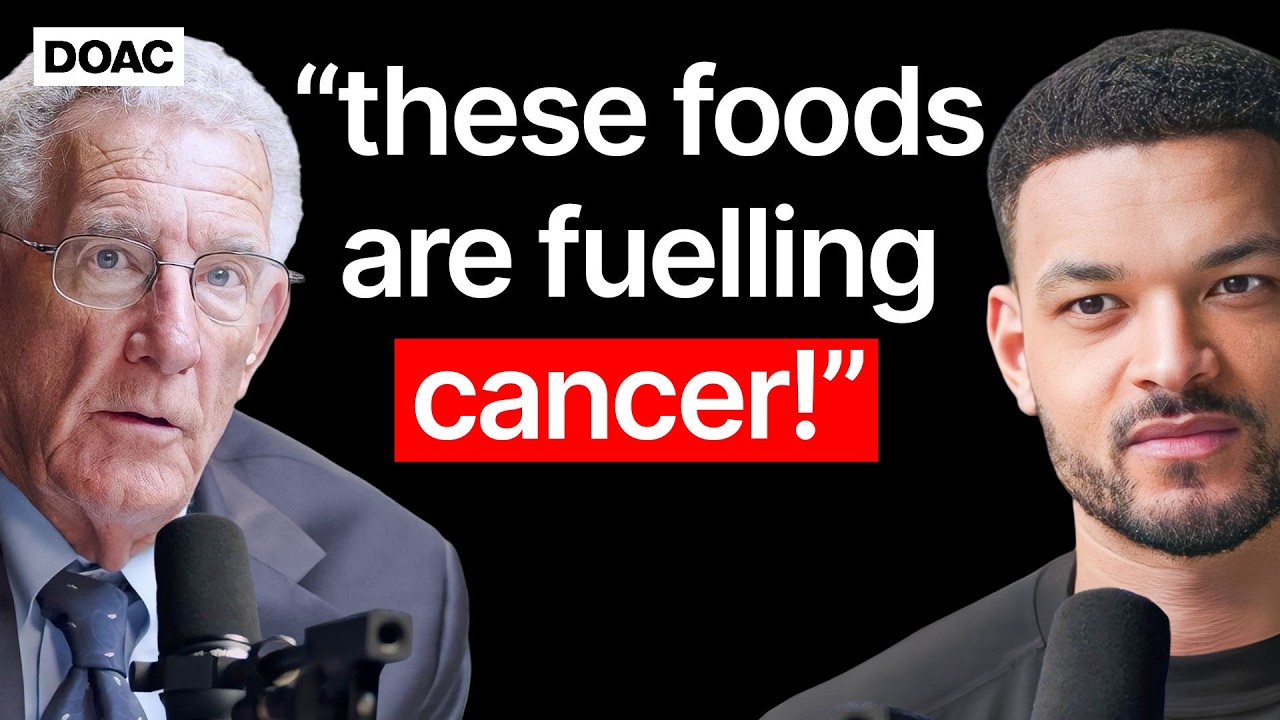
Dr. Seyfried Links Cancer Growth to Glucose and Glutamine Fermentation
The Diary Of A CEO
Cancer develops through chronic mitochondrial damage that forces cells to survive on glucose and glutamine fermentation rather than oxidative respiration.
## Background
This video was published on YouTube by The Diary Of A CEO on October 7, 2024. According to the page description, it features Dr. Thomas Seyfried, a Professor of biology, genetics, and biochemistry at Boston College, discussing the origins, management, and prevention of cancer as a metabolic disease.
## TL;DR
Dr. Thomas Seyfried argues that cancer is primarily a metabolic disease driven by damaged cellular respiration and fermentation of glucose and glutamine, rather than a purely genetic disorder. He advocates for Ketogenic Metabolic Therapy—using nutritional ketosis, fasting, targeted drugs, and hyperbaric oxygen—to selectively starve cancer cells while preserving healthy tissue. Through patient case studies and evolutionary biology context, the conversation highlights how modern lifestyle factors disrupt mitochondrial health and explores alternative, non-toxic approaches to cancer treatment.
## Atmosphere & style
The conversation carries an urgent, highly authoritative, yet accessible tone driven by Dr. Seyfried's energetic passion and Steven Bartlett's engaged curiosity. It strikes a balance between serious scientific critique of standard oncology and grounded pragmatic advice, punctuated by vivid real-world analogies and moments of candid humor. Watching the interview feels like a compelling deep-dive into cutting-edge medical paradigms, shifting from sober discussions of chronic disease statistics to an empowering message of personal health agency.
## Key takeaways
- [16:17](https://www.youtube.com/watch?v=VaVC3PAWqLk&t=977s) Cancer cells rely on ancient, highly inefficient fermentation pathways driven primarily by glucose and glutamine rather than standard oxidative phosphorylation.
- [17:21](https://www.youtube.com/watch?v=VaVC3PAWqLk&t=1041s) Managing cancer without toxic side effects requires restricting glucose and glutamine simultaneously while transitioning healthy tissues to rely on fatty acids and ketones.
- [19:28](https://www.youtube.com/watch?v=VaVC3PAWqLk&t=1168s) Ketones act as an ultra-efficient super fuel produced by the liver and kidneys when carbohydrates are unavailable, fueling healthy cells while starving tumor cells.
- [21:28](https://www.youtube.com/watch?v=VaVC3PAWqLk&t=1288s) Traditional diets and ancestral lifestyles historically led to extremely low rates of cancer, whereas modern ultra-processed human foods drive chronic metabolic damage.
- [24:36](https://www.youtube.com/watch?v=VaVC3PAWqLk&t=1476s) Aerobic exercise lowers circulating blood glucose and glutamine levels while increasing tissue oxygenation, helping suppress the primary fuels for cancer cell fermentation.
- [25:44](https://www.youtube.com/watch?v=VaVC3PAWqLk&t=1544s) Chronic mitochondrial damage is initiated by lifestyle factors such as ultra-processed foods, lack of movement, poor sleep, social isolation, and persistent inflammation.
- [28:57](https://www.youtube.com/watch?v=VaVC3PAWqLk&t=1737s) The Oncogenic Paradox shows that diverse external triggers—including carcinogens, radiation, and chronic inflammation—all converge on damaged mitochondrial respiration and forced anaerobic fermentation.
- [31:09](https://www.youtube.com/watch?v=VaVC3PAWqLk&t=1869s) Water-only fasting and high-intensity exercise help protect and repair mitochondria from environmental stressors.
- [49:17](https://www.youtube.com/watch?v=VaVC3PAWqLk&t=2957s) The Glucose Ketone Index (GKI) measures metabolic state by dividing blood glucose by blood ketones; achieving a GKI of 2.0 or lower starves tumor cells.
- [55:02](https://www.youtube.com/watch?v=VaVC3PAWqLk&t=3302s) A case study involving a canine mast cell tumor demonstrated that strict metabolic therapy alone—without surgery, chemo, or radiation—could cause complete tumor resolution.
- [57:14](https://www.youtube.com/watch?v=VaVC3PAWqLk&t=3434s) Pablo Kelly survived glioblastoma for 10 years using low-carbohydrate ketogenic therapy and debulking surgeries without receiving standard chemotherapy or radiation.
- [01:04:36](https://www.youtube.com/watch?v=VaVC3PAWqLk&t=3876s) Administering chemotherapy while a patient is in nutritional ketosis (GKI ≤ 2.0) allows for drastically reduced drug dosages while maintaining or improving therapeutic efficacy.
- [01:07:52](https://www.youtube.com/watch?v=VaVC3PAWqLk&t=4072s) Combining a ketogenic diet with Hyperbaric Oxygen Therapy (HBOT) disables cancer antioxidant defenses and floods tumor cells with destructive Reactive Oxygen Species (ROS).
- [01:12:28](https://www.youtube.com/watch?v=VaVC3PAWqLk&t=4348s) A 10-to-14-day zero-carbohydrate diet focusing on meat, fish, and poultry serves as an effective practical alternative to prolonged water fasting to achieve ketosis.
- [01:18:36](https://www.youtube.com/watch?v=VaVC3PAWqLk&t=4716s) Intermittent fasting and nutritional ketosis enhance brain function and cognitive focus due to evolutionary adaptations for hunting and survival during food scarcity.
- [01:20:52](https://www.youtube.com/watch?v=VaVC3PAWqLk&t=4852s) Dr. Seyfried advocates for public education regarding metabolic health rather than government fast food mandates or bans.
- [01:30:39](https://www.youtube.com/watch?v=VaVC3PAWqLk&t=5439s) Standard medical training excludes metabolic oncology, creating widespread institutional resistance to implementing non-toxic metabolic therapies.
- [01:32:08](https://www.youtube.com/watch?v=VaVC3PAWqLk&t=5528s) Dr. Seyfried's central mission is to permanently shift cancer care from a genetic mutation paradigm to a manageable metabolic disease model.
## Detailed walkthrough
### [00:00](https://www.youtube.com/watch?v=VaVC3PAWqLk&t=0s) A Paradigm Shift: Cancer as a Metabolic Disease
Dr. Thomas Seyfried sets a bold baseline from the outset: cancer is a highly preventable metabolic disorder, yet the current medical establishment stubbornly misdiagnoses its fundamental nature. Because the mainstream scientific community views cancer strictly through a genetic lens, standard approaches continue to fail, creating an unchecked global health disaster. Seyfried argues that once society recognizes what is truly driving this disease—and how completely our modern lifestyle induces it—the situation will be recognized as "the greatest tragedy in the history of medicine."
While mainstream institutions report that cancer death rates have dropped roughly 30% to 32% since the 1990s, Seyfried dismantles this statistic as a misleading administrative illusion. That drop is not due to superior medical treatments or cures, but rather successful public health prevention—namely, the massive reduction in cigarette smoking. Had people kept smoking at 1990s rates, the trajectory of cancer deaths would have been catastrophically higher. In reality, the absolute trajectory of cancer diagnoses and deaths continues to climb globally every single year.
- **U.S. Daily Toll:** Approximately 2 million new cancer cases are diagnosed annually in the United States, translating to roughly 612,000 deaths per year, 1,700 deaths every single day, or about 70 people dying every hour.
- **Global Outlook:** In China, cancer claims roughly 8,000 lives every single day. Projections indicate the global burden will be drastically worse by the year 2050.
- **Leading Causes of Death:** Cardiovascular disease remains the number one killer worldwide, with cancer ranking second. Lung cancer continues to be the deadliest cancer across both men and women, while colon and pancreatic cancers are rapidly surging due to modern dietary choices.
[07:08](https://www.youtube.com/watch?v=VaVC3PAWqLk&t=428s) The Mechanism of Fermentation and Cellular Suffocation
Despite the hundreds of different names and histological classifications given to various tumors under a light microscope—whether in the brain, lung, breast, skin, or colon—all cancer cells share an identical, underlying pathophysiological feature: they cannot survive without **fermentation**, which is the generation of cellular energy without oxygen. Normal, healthy cells utilize their mitochondria to burn carbon-hydrogen bonds from food using oxygen (a process known as oxidative phosphorylation), producing harmless carbon dioxide and water vapor as waste products. Cancer cells, however, rely on primitive, highly inefficient energy pathways.
Seyfried compares this to a sudden cardiac arrest: when a human stops breathing, cellular oxygen vanishes, and the body desperately turns on ancient fallback pathways to survive, quickly filling the bloodstream with lactic acid and succinic acid. In cancer, the cell's mitochondria are damaged or defective, forcing the cell to constantly fall back on these emergency anaerobic pathways even when oxygen is abundantly present—a phenomenon historically observed under the microscope where tumor cells consume massive amounts of fuel and throw off toxic acidic waste.
- **The Two Fermentation Fuels:** Cancer cells depend entirely on two specific fuels to survive: **glucose** (sugar) and **glutamine** (the most abundant amino acid in the bloodstream).
- **Fermentation Byproducts:** Glucose ferments into **lactic acid**, while glutamine ferments into **succinic acid**.
- **The Cyanide Experiment:** Normal human cells die within a minute when exposed to cyanide because cyanide completely shuts down aerobic oxygen respiration. In contrast, cancer cells can survive in cyanide because they do not rely on oxygen-based mitochondrial respiration to generate their energy (ATP).
- **An Evolutionary Fallback:** Modern cancer cells revert to the behavior of primeval organisms that inhabited the Earth 2.5 billion years ago, before photosynthetic bacteria introduced oxygen to the atmosphere. These primordial single-celled organisms knew only uninhibited, aggressive replication, multiplying uncontrollably until their fermentable fuel sources were exhausted.
[12:16](https://www.youtube.com/watch?v=VaVC3PAWqLk&t=736s) Revisiting Otto Warburg and the Blood Sugar Connection
Dr. Seyfried admits that, like most scientists, he initially assumed cancer was purely a genetic disorder. His perspective shifted dramatically after examining the pioneering work of German chemist Otto Warburg from the 1920s, alongside a landmark clinical trial conducted by Dr. Linda Nebling at Case Western Reserve University. Nebling placed two young pediatric brain cancer patients—considered "hopeless cases" with no expectation of survival—on a ketogenic diet designed to drastically lower their blood glucose. The intervention successfully stabilized and rescued the children, drawing directly on Warburg's early observations regarding glucose dependence in tumors.
Inspired by Nebling's success, Seyfried began running experiments on mice, ultimately publishing some of the earliest papers proving a direct, linear correlation between blood sugar levels and tumor growth rates. Higher systemic blood sugar directly feeds and accelerates tumor proliferation, whereas lower blood sugar starves and slows tumor growth—a principle that has now been replicated across virtually all human and rodent cancer models.
- **Warburg's Discovery:** In the 1920s, Warburg sliced live tissue samples from human, rat, and mouse tumors, discovering that cancer cells consumed vastly higher amounts of glucose than healthy tissues while taking in significantly less oxygen.
- **Mitochondria as Cellular Engines:** Mitochondria are double-membraned organelles functioning as a dynamic, spaghetti-like network within the cell. Seyfried describes them almost as a distinct, co-existing entity within our biology, responsible for taking the carbon-hydrogen bonds of consumed food and efficiently converting them into usable cellular energy via a hydrogen gradient. When these internal powerhouses become defective, the cell reverts to primeval, unbridled fermentation to survive.
Here is a detailed, faithful walkthrough of this section of the interview:
### [16:17](https://www.youtube.com/watch?v=VaVC3PAWqLk&t=977s) Transitioning from Normal Cells to Cancer Cells
Dr. Seyfried explains that normal mitochondria are remarkably efficient, using a proton gradient through an impeller-like mechanism that generates massive energy. However, cancer cells suffer corruption in this energy system. This corruption does not happen overnight; as Otto Warburg noted, breaking the system too acutely kills the cell.
To transition from healthy oxidative phosphorylation to a state where energy is generated through minimal-oxygen fermentation, a cell undergoes chronic damage to its powerhouses. Dr. Seyfried emphasizes that cancer cells grow out of control and are notoriously difficult to kill because they rely on ancient fermentation pathways powered by two primary fermentable fuels: **glucose** and **glutamine**.
- Normal mitochondria act like a highly efficient impeller-based generator.
- Acute, rapid damage to cellular energy systems kills the cell rather than causing cancer; the damage must be chronic.
- The two main fuels driving cancer's rapid fermentation and unregulated growth are **glucose** (sugar) and **glutamine** (an amino acid).
---
### [17:21](https://www.youtube.com/watch?v=VaVC3PAWqLk&t=1041s) The Non-Toxic Solution to Managing Cancer
Dr. Seyfried asks host Steven Bartlett to "brace himself" before outlining what he considers a complete solution to managing cancer without toxicity. The strategy requires simultaneously restricting the two fuels driving the tumor's dysregulated growth—glucose and glutamine—while transitioning the rest of the body to rely on fuels that cancer cells cannot utilize: fatty acids and ketone bodies.
In laboratory models and clinical approaches, this is accomplished by putting patients or mice into calorie restriction to drop blood sugar levels drastically, alongside targeted drugs to inhibit glutamine. Because human beings evolved over 1.5 million years in a state of nutritional ketosis—due to the scarcity of carbohydrates in ancestral environments—healthy cells in the brain, heart, and kidneys easily adapt to burning ketone bodies. Cancer cells, possessing damaged mitochondria, cannot burn ketones and are selectively marginalized and slowly die as blood vessels shrink and the body cleans up the debris.
- **Dual-fuel restriction:** Targeting both glucose (via calorie restriction/fasting) and glutamine (via targeted drugs) starves the tumor.
- **Metabolic shift:** Healthy tissue transitions smoothly to ketone bodies, leaving cancer cells stranded without energy.
- **Evolutionary context:** Humans evolved in nutritional ketosis over 1.5 million years due to limited environmental carbohydrates.
---
### [19:28](https://www.youtube.com/watch?v=VaVC3PAWqLk&t=1168s) What Are Ketones and Why Are They a "Super Fuel"?
Responding to a request for a simple definition, Dr. Seyfried clarifies that ketones are small, water-soluble breakdown products of fatty acids—specifically **beta-hydroxybutyrate** and **acetoacetate**—produced primarily by the liver (and to a lesser extent, the kidneys).
When a person stops eating, initial anxiety occurs because the brain is accustomed to glucose. Once the body realizes food isn't coming, it mobilizes fat reserves. Triglycerides (three fatty acids attached to a glycerol backbone) travel to the liver, where they are converted into ketone bodies. Dr. Seyfried notes that biochemists call ketones a "super fuel" because healthy mitochondria burn them far more efficiently than pyruvate from glucose or whole fatty acids, generating maximum energy per unit of oxygen consumed.
- **Primary Ketone Bodies:** Beta-hydroxybutyrate and acetoacetate.
- **Fat Mobilization:** Triglycerides in adipose tissue travel to the liver to be broken down into water-soluble ketones.
- **Super Fuel Efficiency:** Burning ketones yields greater energy ("bang for buck") with less oxygen demand compared to glucose.
---
### [21:28](https://www.youtube.com/watch?v=VaVC3PAWqLk&t=1288s) Lessons From Ancestors and Primate Cousins
When asked how prevalent cancer was in human history, Dr. Seyfried acknowledges that skeletal records offer limited proof, but historical medical observations of populations living traditional lifestyles reveal stark contrasts. He cites Dr. Albert Schweitzer, who observed that cancer was exceptionally rare among traditional African populations prior to the introduction of modern diets. Similar findings were noted by European doctors visiting Arctic populations and Aboriginal groups.
Looking at primates, Dr. Seyfried points out that there has never been a single documented case of breast cancer in a female chimpanzee, despite a 98% genetic similarity to humans. Animals in zoos are kept on species-appropriate diets; Dr. Seyfried recalls asking zoo staff at Boston's Franklin Park Zoo and the San Diego Zoo why they don't feed pizza to chimps, to which they responded that doing so would be "animal cruelty" because their systems aren't built for it. Modern human society, however, surrounds itself with hyper-processed foods like pork pies, jelly-filled donuts, and pizza—outpacing human biology and causing an epidemic of chronic metabolic diseases.
> "I even went to the zoo down down here in Boston, Franklin Park Zoo, and also at the San Diego Zoo. I said, 'How come you guys don't run down and get a big pizza for these animals?' 'Oh, no, it'd be animal cruelty. Their systems aren't geared for this.' Well, neither are we."
- **Albert Schweitzer's observations:** Noted an extreme rarity of cancer among traditional African populations before westernization.
- **Chimpanzees:** Zero documented cases of breast cancer in female chimps eating natural diets.
- **Biological mismatch:** Human food technology and processing have evolved drastically faster than human physiology.
---
### [24:36](https://www.youtube.com/watch?v=VaVC3PAWqLk&t=1476s) The Role of Exercise in Preventing Cancer
Dr. Seyfried explains that exercise helps stave off cancer by lowering circulating blood sugar and reducing glutamine levels, directly depriving cancer cells of their preferred fuels. Citing work by his late friend Dr. George Cahill, Dr. Seyfried notes that exercise actively decreases systemic glutamine availability.
Furthermore, aerobic exercise floods tissues with oxygen while burning ketones, maintaining mitochondria at peak structural and energetic efficiency. In contrast to modern sedentary populations struggling with obesity, Paleolithic humans were physically fit, possessed high energy levels, and rarely died of chronic metabolic illnesses; their primary causes of death were acute injuries and infections.
- Exercise lowers both glucose and glutamine levels in the bloodstream.
- Aerobic activity increases tissue oxygenation, optimizing mitochondrial health.
- Ancestral human mortality was driven by trauma and infection, not chronic metabolic disease.
---
### [25:44](https://www.youtube.com/watch?v=VaVC3PAWqLk&t=1544s) Lifestyle Triggers of Mitochondrial Damage
Dr. Seyfried clarifies that the metabolic shift from normal respiration to cellular fermentation is a gradual process driven by ongoing tissue strain. When multiple lifestyle stressors combine, they lower mitochondrial efficiency across the body, putting an individual at heightened risk for cancer.
The key lifestyle factors that disrupt mitochondrial function include:
- **Lack of exercise:** Reduced physical activity compared to ancestral norms.
- **Dietary factors:** Consumption of large amounts of ultra-processed carbohydrates.
- **Psychological stress:** Mental and emotional stress negatively altering systemic biology.
- **Sleep deprivation:** Poor sleep hygiene disrupting baseline repair mechanisms.
- **Social isolation:** A lack of community and joy, which elevates chronic stress levels.
Dr. Seyfried explains that chronic tissue irritation damages oxidative respiration over time. While neurons rarely develop cancer, the supporting glial cells in the brain frequently do. Whether a patient develops colon, breast, bladder, or brain cancer depends on which tissue experiences chronic, unmanaged mitochondrial damage.
---
### [28:57](https://www.youtube.com/watch?v=VaVC3PAWqLk&t=1737s) Carcinogens, Inflammation, and the Oncogenic Paradox
The discussion shifts to environmental triggers, beginning with classical carcinogens like asbestos, urethane, arsenic, and industrial chemicals. Bartlett asks about lesser-known culprits like microplastics and personal care items like talcum powder.
Dr. Seyfried uses talcum powder and ovarian cancer as a prime example of how foreign particles cause disease. When talcum particles enter the urogenital tract, they form a **foci** (an accumulation of foreign material) in ovarian tissue. The immune system responds to clean up the area, but the persistent foreign material causes chronic inflammation. Immune cells release cytokines and growth factors, which damages the mitochondria of neighboring cells, forcing them to upregulate anaerobic fermentation to survive.
- **Foci formation:** Microscopic particle accumulations (e.g., talcum, microplastics) trigger persistent local inflammation.
- **Immune response collateral damage:** Cytokines and growth factors released during chronic inflammatory responses impair nearby mitochondrial respiration.
- **The Oncogenic Paradox:** Diverse insults—chemical carcinogens, radiation, chronic inflammation, or physical irritants—all lead to the same outcome: damaged mitochondria and compensatory fermentation.
---
### [31:09](https://www.youtube.com/watch?v=VaVC3PAWqLk&t=1869s) How to Protect and Maintain Healthy Mitochondria
Bartlett expresses concern that because environmental carcinogens are everywhere, it feels almost impossible to avoid mitochondrial damage. Dr. Seyfried reassures him that mitochondria are remarkably tough organelles, but modern humans chronically abuse them without taking proper maintenance measures.
Even when exposed to background carcinogens and microplastics, individuals can protect themselves and delay or prevent cancer by actively supporting mitochondrial health. This is achieved through **vigorous exercise** and **water-only fasting**. Dr. Seyfried notes that in early laboratory research, keeping mice on calorie restriction made it exceptionally difficult to induce tumors because their bodies and mitochondria were kept so remarkably healthy.
- **Resilience:** Mitochondria are durable, but require deliberate habits to maintain function amidst environmental exposures.
- **Key Interventions:** Engaging in high-intensity exercise and periodic water-only fasting.
- **Calorie Restriction Effect:** Tumor induction is drastically reduced in calorie-restricted animal models due to optimized cellular health.
[32:29](https://www.youtube.com/watch?v=VaVC3PAWqLk&t=1949s) Calorie Restriction and the Genetic vs. Metabolic Debate
Dr. Thomas Seyfried emphasizes that cancer is a largely preventable disorder. He points to foundational animal research demonstrating that when mice prone to developing high rates of breast cancer are placed on a calorie-restricted diet, the incidence of tumor development drops dramatically. Despite this, modern dietary and lifestyle habits actively induce the conditions that allow cancer to thrive. While major academic and medical institutions remain steadfast in their belief that cancer is primarily a genetic disease caused by nuclear mutations, Seyfried asserts that the empirical data clearly tells a different story.
Seyfried contrasts the dominant Somatic Mutation Theory (SMT) with his own Mitochondrial Metabolic Theory. According to SMT, random genetic mutations in the nucleus cause dysregulated cell growth. Seyfried argues that the metabolic theory demonstrates cancer actually begins with a breakdown in cellular respiration, where mitochondria shift from oxidative phosphorylation to primitive fermentation. In this view, nuclear mutations are merely downstream side effects. When mitochondria become damaged and dysfunctional, they emit high levels of reactive oxygen species (ROS)—carcinogenic and mutagenic molecules that damage DNA and generate nuclear mutations. Seyfried highlights a fundamental challenge that dismantles SMT: researchers have discovered aggressive, rapidly growing cancer cells that possess no genetic mutations whatsoever.
- **Calorie Restriction in Mice:** Dramatically reduces the incidence of breast cancer in genetically susceptible laboratory mice.
- **Somatic Mutation Theory (SMT):** Claims nuclear mutations directly cause dysregulated cell growth.
- **Mitochondrial Metabolic Theory:** Posits that cancer arises when damaged mitochondria shift cellular metabolism from oxidative phosphorylation to fermentation.
- **Reactive Oxygen Species (ROS):** Mutagenic byproducts produced by defective mitochondria that cause the very nuclear mutations SMT blames as the primary cause.
- **Unmutated Cancers:** The existence of rapidly growing cancer cells with completely normal, unmutated DNA presents an unaddressed flaw in standard cancer theory, ringing what Seyfried calls "bell ring one."
[34:41](https://www.youtube.com/watch?v=VaVC3PAWqLk&t=2081s) Driver Mutations in Healthy Tissue and Nuclear Transfer Experiments
To defend Somatic Mutation Theory against contradictions, mainstream cancer researchers introduced a distinction between "passenger mutations," which have no functional impact, and "driver mutations," which are claimed to directly trigger dysregulated cell growth. However, Seyfried points out that recent scientific literature has thoroughly undermined this explanation. When researchers analyzed normal, completely healthy tissue from non-cancerous individuals, they discovered thousands of supposed "driver mutations" in organs such as the esophagus, despite the absence of any tumors or abnormal cell growth.
The most devastating evidence against the genetic origin of cancer comes from classic nuclear transfer experiments, which have been replicated consistently across decades. When scientists remove the nucleus from a cancerous cell and insert it into a healthy cell's cytoplasm (containing normal mitochondria), the resulting cell exhibits completely normal, regulated growth. Conversely, when the nucleus of a normal, healthy cell is placed into a cancer cell's cytoplasm containing damaged mitochondria, the new cell develops dysregulated cancerous growth. Seyfried argues that anyone looking at these results who still insists cancer is a genetic disease must be a "hopeless ideologue."
- **Driver vs. Passenger Mutations:** SMT proponents argue driver mutations cause cancer while passenger mutations are harmless, but thousands of driver mutations exist in perfectly healthy human organs without causing cancer.
- **Nuclear Transfer Experiment A:** Tumor nucleus + Normal cytoplasm (healthy mitochondria) = Normal, regulated cell growth.
- **Nuclear Transfer Experiment B:** Normal nucleus + Tumor cytoplasm (defective mitochondria) = Dysregulated, cancerous cell growth.
- **Textbook Consensus:** Every standard textbook in biology, biochemistry, and cell biology continues to teach the silent assumption that cancer is a genetic disease despite contradictory evidence.
[36:38](https://www.youtube.com/watch?v=VaVC3PAWqLk&t=2198s) Paradigm Shifts in Science and Resistance to Change
When asked why mainstream consensus has not shifted in light of this evidence, Seyfried explains that science historically resists major paradigm shifts. Drawing a historical parallel to the Copernican Revolution, he notes that for over 1,800 years, astronomers, the Catholic Church, Aristotle, and Claudius Ptolemy held that the Earth was the immovable center of the universe. Copernicus spent years wrestling with convoluted mathematical models to make the geocentric view work until he realized that placing the Sun at the center made everything fall into place naturally. Seyfried notes that theologians like Giordano Bruno were executed for supporting heliocentrism, highlighting the severe institutional pushback against revolutionary ideas.
Similar monumental resistance occurred when Louis Pasteur proposed germ theory over the prevailing belief in "bad air" (miasma), and when Charles Darwin and Alfred Russel Wallace introduced natural selection over special creation. Seyfried asserts that cancer research is experiencing the exact same paradigm struggle today. Recognizing that the mitochondrion—not the nucleus—is the root cause of cancer will allow researchers to target the disease's required fuels, enabling people to prevent cancer, keep it at bay, or lower global mortality rates precipitously.
- **Historical Antecedents:** The shift from a geocentric to a heliocentric universe took nearly two millennia and faced intense institutional suppression.
- **Giordano Bruno:** Executed for advocating that Copernicus was correct about the solar system.
- **Germ Theory vs. Miasma:** Louis Pasteur faced fierce resistance when replacing the "bad air" paradigm with germ theory.
- **Future Cancer Statistics:** Seyfried warns that unless medicine pivots to a mitochondrial framework, the projection that 1 in 2 people will develop cancer will become a stark reality.
[39:17](https://www.youtube.com/watch?v=VaVC3PAWqLk&t=2357s) Financial Incentives, Industry Resistance, and Rising Early-Onset Cancers
Seyfried rejects the term "conspiracy," choosing instead to look directly at economic facts and institutional incentives. The current cancer research and treatment ecosystem represents a massive, highly lucrative global industry. In the United States alone, the National Cancer Institute (NCI) distributes roughly $7 billion annually in research grants, the vast majority of which fund studies seeking genetic mutations. This infrastructure yields extraordinarily expensive targeted drugs based on SMT that fail to meaningfully lower national mortality rates. Seyfried highlights the lack of accountability, noting that while public fundraising campaigns constantly collect money for research, thousands die daily without significant progress in overall survival.
The transcript highlights a disturbing statistic published in *BMJ Oncology*: between 1990 and 2019, the global incidence of early-onset cancer (cancers diagnosed in adults under age 50) surged by approximately 80%. Host Stevie Bartlett questions how decades of record-breaking charitable donations and research funding can coexist with an 80% rise in youth cancer rates. Seyfried responds that the money is funnelled into flawed research dictated by a wrong underlying theory, creating a system that is "too traumatic" and "too disruptive" to change overnight, even though continuing down this path is fundamentally immoral.
- **NCI Budget:** $7 billion allocated annually for cancer research, heavily skewed toward genetic mutation studies.
- **Daily U.S. Mortality:** Hundreds of people die every hour from cancer, translating to thousands every single day despite record research spending.
- **Early-Onset Cancer Surge:** An 80% increase in global cancer incidence among adults under 50 from 1990 to 2019 (*BMJ Oncology*).
- **Institutional Inertia:** Scientific advisory committees are populated by researchers who built their careers publishing on genetic theories, making institutional pivots slow and painful.
[42:14](https://www.youtube.com/watch?v=VaVC3PAWqLk&t=2534s) Progression-Free Survival vs. Overall Survival and the Case of Avastin
To illustrate how the current paradigm misleads the public and patients, Seyfried breaks down the criteria the Food and Drug Administration (FDA) uses to approve cancer drugs: Progression-Free Survival (PFS) versus Overall Survival (OS). Progression-Free Survival merely means that a tumor appears smaller or stops growing on an MRI or CAT scan for a brief window of time. Regulatory bodies frequently approve astronomically expensive drugs based solely on PFS gains of a few weeks or months, even when the medication fails to extend the patient's Overall Survival or improve their quality of life.
Seyfried points to the anti-angiogenic drug Avastin (bevacizumab) as a prime example of what he terms an "immoral drug." Though revoked for breast cancer after causing severe side effects like colon perforations in female patients, Avastin remains widely prescribed for brain cancer. The drug works by constricting blood vessels, causing the primary tumor mass to shrink on imaging scans and giving patients and doctors false hope. However, Seyfried explains that starving the tumor of blood vessels forces the aggressive cancer cells to adapt by invading surrounding healthy tissue, effectively scattering tumor cells throughout the entire brain and virtually guaranteeing the patient will not survive long-term.
- **Progression-Free Survival (PFS):** A measure of time during and after treatment that a patient lives with the disease without it getting worse; used by the FDA to approve drugs even if total lifespan is barely extended.
- **Overall Survival (OS):** The gold-standard metric measuring how long patients actually stay alive, which is frequently unimproved by costly new therapies.
- **Avastin (bevacizumab):** Anti-angiogenic drug that shrinks primary brain tumors on MRI scans but induces invasive cell scattering throughout the brain microenvironment.
- **Breast Cancer Complication:** Avastin was restricted after triggering severe complications, including intestinal perforations.
[45:10](https://www.youtube.com/watch?v=VaVC3PAWqLk&t=2710s) Collateral Damage of Standard Treatments and the Role of Metabolic Therapy
Seyfried severely criticizes standard-of-care treatments for aggressive brain cancers like glioblastoma, describing them as "medieval approaches." Standard protocols—consisting of surgical debulking, systemic chemotherapy (such as temozolomide), radiation, and high-dose steroids—frequently backfire. Radiating brain tissue damages surrounding structures and releases massive amounts of glucose and glutamine into the microenvironment, while steroids elevate blood sugar levels. Because glucose and glutamine are the primary fuels for cancer fermentation, standard treatments unintentionally feed the surviving tumor cells. Consequently, 5-year survival rates for glioblastoma remain dismal, and 10-year survival is nearly zero across hospitals worldwide.
The systemic toxicity of standard chemotherapy takes a massive toll on cancer patients. Seyfried references "Red Devil"—the nickname for the chemotherapy drug doxorubicin, which turns the patient's urine red—noting that while it may destroy localized tumor cells, it brutalizes the patient's body, causing hair loss, organ damage, and long-term health decline. Many who survive the initial cancer later die from secondary cardiovascular disease, recurrence, or the harsh bodily effects of treatment. By contrast, Seyfried advocates for using ketogenic metabolic therapy to starve and shrink tumors naturally prior to surgery. Reducing tumor size and vascularity metabolically allows surgeons to excise the mass far more cleanly, after which metabolic protocols can be maintained to prevent recurrence without devastating the patient's body.
- **Glioblastoma Standard Protocol:** Combines surgical debulking, temozolomide, radiation, and steroids, producing near-identical, dismal survival curves worldwide.
- **Fuel Release from Radiation:** Irradiating brain tissue floods the cellular microenvironment with glucose and glutamine, fueling fermenting cancer cells.
- **"Red Devil" (Doxorubicin):** Highly toxic chemotherapy agent known for causing severe side effects and secondary health complications.
- **Metabolic Therapy as an Adjunct:** Shrinks tumor volume and reduces blood vessel density beforehand, allowing for safer surgical extraction and long-term recurrence prevention.
[47:44](https://www.youtube.com/watch?v=VaVC3PAWqLk&t=2864s) Prevention vs. Standard of Care and the Reality of Survival Rates
Dr. Thomas Seyfried illustrates the absurdity of modern cancer prevention by asking if anyone would willingly walk into a major clinic to undergo toxic doxorubicin or radiation treatments just in case they might develop a tumor. Yet, once a tumor is detected, that exact protocol becomes the standard of care. In contrast, metabolic therapy functions as both a preventative measure and an active treatment, with the only distinction being that active treatment incorporates targeted drugs against glutamine.
When reviewing historical five-year survival rates across various cancers—such as breast, prostate, lung, leukemia, and melanoma—there appears to be visual progress from the 1970s through the 2010s. However, Dr. Seyfried cautions that these marginal improvements are often overstated; for instance, a 5% bump in overall breast cancer survival over two decades translates to only about two and a half to three months of extended life.
- **Doxorubicin:** A toxic chemotherapy drug used in standard cancer care.
- **5-Year Survival Rates:** Dr. Seyfried notes that a nominal 5% statistical increase in overall survival over decades often equates to just 2.5 to 3 months of extended lifespan.
- **Metabolic Distinction:** Prevention relies solely on diet/lifestyle to protect mitochondria, while active metabolic treatment adds glutamine-blocking drugs.
---
[49:17](https://www.youtube.com/watch?v=VaVC3PAWqLk&t=2957s) Metabolic Health, Modern Diets, and the Glucose Ketone Index (GKI)
When addressing why seemingly healthy individuals in their 20s, 30s, and 40s are increasingly diagnosed with aggressive cancers like colon or breast cancer, Dr. Seyfried points to the systemic damage caused by modern lifestyles—sedentary habits, chronic stress, poor sleep, and hyper-processed foods. Patients often report feeling completely healthy right up until diagnosis, only to end up looking "like death warmed over" once conventional treatments begin. While Seyfried admits he is not trying to ban pizza or jelly donuts, he emphasizes that eating high-glycemic foods daily damages mitochondria.
To help manage metabolic health quantitatively, Dr. Seyfried and his students at Boston College developed the **Glucose Ketone Index (GKI)** calculator. The tool originated while working with an American patient in Nice, France, who had a brainstem tumor; after an argument over a handicap parking spot caused her blood sugar to spike, they realized tracking glucose and ketones separately created unnecessary panic. By dividing blood glucose (in $\text{mM}$) by blood ketones (in $\text{mM}$), they established a single, stable number. A GKI score of 2.0 or lower indicates a person has entered the "Paleolithic zone"—the metabolic state of our hunter-gatherer ancestors who consumed low-glycemic foods, meats, and leafy greens, and rarely developed cancer.
- **GKI Formula:** Blood Glucose ($\text{mM}$) divided by Blood Ketones ($\text{mM}$).
- **Target Threshold:** A GKI of **2.0 or below** starves tumor cells by keeping them from growing rapidly.
- **Paleolithic Zone:** Emulates ancestral physiology where glucose spikes are minimal and ketones are elevated.
- **Dietary Tip:** Grapefruits provide high Vitamin C without causing massive glucose spikes, unlike high-glycemic fruits like bananas.
---
[55:02](https://www.youtube.com/watch?v=VaVC3PAWqLk&t=3302s) Case Study: Metabolic Therapy in a Canine Tumor
Dr. Seyfried shares a story highlighting how accessible metabolic concepts can be. A woman with no formal biochemistry background managed her 7-year-old Pitbull's massive mast cell tumor on its lip using insights from Seyfried’s YouTube lectures. Facing expensive recommendations for chemotherapy, radiation, and surgery—which the vet warned would cause severe side effects like diarrhea—she opted to try metabolic therapy instead.
She calculated the dog's caloric needs, reduced its total calories to trigger a modest 5% body weight loss, and switched its diet to raw chopped chicken, pollock fish oil, and raw eggs. Dr. Seyfried collaborated with veterinarian Dr. Lauren Nations to review and validate the case documentation and photographs. The tumor completely vanished without conventional intervention. The dog lived a full life, eventually dying of an unrelated heart attack at 15.5 years old.
- **Subject:** 7-year-old Pitbull with a large mast cell lip tumor.
- **Diet Protocol:** Calorie restriction (5% weight loss), raw chicken, pollock fish oil, and raw eggs.
- **Veterinary Collaborator:** Dr. Lauren Nations.
- **Outcome:** Complete resolution of the tumor; dog died of old age/heart disease at **15.5 years old**.
---
[57:14](https://www.youtube.com/watch?v=VaVC3PAWqLk&t=3434s) The 10-Year Survival Story of Pablo Kelly
Dr. Seyfried details the case of Pablo Kelly, a patient from Devon, England, who was diagnosed in August 2014 with glioblastoma—an aggressive, typically fatal brain cancer. Told his tumor was inoperable and given 9 to 12 months to live if he underwent chemo and radiation, Pablo rejected standard care. He famously walked out of the clinic after staff shaved his beard to fit him for a radiation mask. Instead, he adopted a strict low-carbohydrate ketogenic diet, taking fish oil, avocados, and monitoring his GKI daily without taking any glutamine-blocking drugs.
Over the next decade, Pablo defied all medical expectations. After three years on metabolic therapy, his previously inoperable tumor shrank and shifted into a resectable state. Surgeons successfully debulked the tumor. Over a 10-year period, Pablo underwent three separate debulking surgeries whenever his GKI slipped and the tumor slowly attempted to return. Tragically, in August 2024—exactly 10 years after his initial diagnosis—Pablo passed away from a massive cerebral hemorrhage six hours post-surgery, dying from a surgical complication rather than the cancer itself.
- **Patient:** Pablo Kelly from Devon, England (Diagnosed August 2014, Died August 2024).
- **Diagnosis:** Glioblastoma (standard survival prognosis of under 2 years).
- **Intervention:** Zero chemotherapy or radiation; strict ketogenic diet and GKI self-monitoring.
- **Surgical Milestones:** Transitioned an inoperable brain tumor into a resectable one, surviving three distinct surgical debulking operations over 10 years.
[01:02:42](https://www.youtube.com/watch?v=VaVC3PAWqLk&t=3762s) The Story of Pablo and Non-Toxic Metabolic Strategies
Dr. Thomas Seyfried recounts the tragic yet eye-opening story of a young patient named Pablo, who was diagnosed with terminal brain cancer in his early twenties. By refusing conventional radiation and chemotherapy and instead adopting metabolic therapy—bringing his Glucose Ketone Index (GKI) down to 2.0 and keeping it there—Pablo managed to live well into his thirties. Seyfried recalls joking with Pablo that he might actually outlive Seyfried himself, as they laughed together over how well Pablo was doing ten years after his initial diagnosis. Tragically, Pablo later passed away suddenly due to a non-cancer medical complication (being declared brain dead after an unrelated incident), rather than the tumor taking his life. Seyfried stresses that if a conventional pharmaceutical drug yielded the kind of long-term success Pablo achieved, pharmaceutical companies would be running all over the world proclaiming it a miracle.
Seyfried clarifies what metabolic therapy actually entails. Beyond restricting calories and carbohydrate intake to starve tumor cells, it involves using completely non-toxic strategies to manage disease without brutalizing the human body. He notes that emerging research shows certain anti-parasitic medications can effectively target glutamine—the other key fuel for cancer alongside glucose. The core tragedy of modern oncology, according to Seyfried, is that the vast majority of practicing oncologists have never been exposed to these metabolic principles or mechanisms.
- **Pablo's Case:** Diagnosed with terminal brain cancer at age 22–23; lived over 10 years to age 33–34 without radiation or traditional chemo by maintaining a low GKI (~2.0).
- **Targeting Glutamine:** Non-toxic re-purposed drugs, including specific anti-parasitic medications, are currently being studied to block glutamine metabolism in cancer cells.
- **Systemic Ignorance:** Seyfried notes that standard oncologists are rarely taught the metabolic pathways of cancer during their medical training.
---
[01:04:36](https://www.youtube.com/watch?v=VaVC3PAWqLk&t=3876s) Integrating Metabolic Therapy with Standard Cancer Treatments
When asked what advice he would give to someone who has just received a severe cancer diagnosis and whose doctor is recommending standard chemotherapy, Seyfried clarifies that he is not telling patients to outright reject conventional treatments. Instead, he points to ground-breaking research from colleagues in Istanbul, Turkey. Their work demonstrates that when a patient is in a state of nutritional ketosis (maintaining a GKI of 2.0 or lower), chemotherapy can be administered at significantly reduced, low-dose concentrations while achieving even greater therapeutic power and effectiveness than full-dose chemotherapy.
Furthermore, Seyfried explains how shrinking a tumor metabolically opens up safer options across multiple treatment modalities. By using metabolic therapy up front to starve the tumor down to a small, weakened "nub," clinicians can make surgical procedures far cleaner or allow low-dose chemo, targeted radiation, or immunotherapy to mop up the remaining cells. Because all remaining resistant cells in a shrunken tumor share common survival pathways, immunotherapies can target those shared features far more efficiently without needing to blast the entire body with high-dose toxins.
> "When you are in nutritional ketosis with a glucose ketone index of 2.0 or below, my colleagues that we work with in Istanbul, Turkey were able to show that chemotherapies at much lower dosages can be even more therapeutically powerful..."
---
[01:06:04](https://www.youtube.com/watch?v=VaVC3PAWqLk&t=3964s) Pre-Surgical Debulking and Brain Tumors
Steven Bartlett brings up a personal friend in her 40s or 50s—an exceptionally fit, athletic woman with a healthy diet who was unexpectedly diagnosed with a large brain tumor. Bartlett expresses confusion over how someone in peak metabolic and physical shape could develop such a severe condition. Seyfried explains that brain tumors come in many distinct biological varieties (such as glioblastoma, oligodendroglioma, or PNET) and that physical fitness alone does not make one immune to cellular or mitochondrial damage.
For large brain tumors, Seyfried strongly advocates using metabolic therapy *before* surgery to shrink and circumscribe the mass. In oncology, removing as much tumor mass as possible is called "debulking," and extensive scientific literature confirms that greater debulking directly correlates with longer patient survival. When a tumor is "angry" and invasive, standard surgery or radiation often leaves microscopic fragments behind. Irradiating those remnants frequently damages surrounding normal tissue and triggers inflammatory responses that can actually fuel further fermentation in surviving cancer cells. However, if a patient is debulked and immediately placed back into a strict metabolic state, the constant pressure prevents those residual cells from regrowing.
---
[01:07:52](https://www.youtube.com/watch?v=VaVC3PAWqLk&t=4072s) Ketogenic Diet combined with Hyperbaric Oxygen Therapy (HBOT)
Bartlett highlights Seyfried's rodent studies showing that combining a ketogenic diet with Hyperbaric Oxygen Therapy (HBOT) increased average survival times by roughly 80% or more. Seyfried explains the elegant biochemistry behind why this combination works so synergistically. Cancer cells generate high levels of Reactive Oxygen Species (ROS)—unstable, destructive molecules that damage proteins, lipids, and nucleic acids. Although cancer cells operate on the edge of death due to this oxidative stress, they utilize glucose and glutamine to fuel powerful internal antioxidant defense systems that protect them from their own ROS.
```
[Low-Carb / Keto State] ──> Starves Glucose/Glutamine ──> Disables Cancer Antioxidants
│
[Hyperbaric Oxygen (HBOT)] ──> Floats ROS in Blood stream ───────────┴──> Selective Cancer Cell Death
```
When a patient enters nutritional ketosis (low GKI), those antioxidant protections are stripped away. If the patient then enters a hyperbaric oxygen chamber, pure oxygen dissolves directly into the blood plasma under pressure. This floods the tumor with an internal surge of ROS. Because the starved cancer cells can no longer neutralize the oxidative stress, they implode from within. Meanwhile, healthy surrounding cells thrive because they are burning ketones and cleanly utilizing the abundance of oxygen.
- **Mechanistic Synergy:** Ketosis starves the tumor's antioxidant defenses; HBOT delivers the oxidative blow (ROS) that selectively destroys the cancer cells without hair loss, bleeding gums, or collateral tissue damage.
- **Hyperbaric Mechanics:** HBOT forces oxygen to dissolve directly into blood plasma at levels far higher than simple ambient oxygen breathing can achieve.
---
[01:10:04](https://www.youtube.com/watch?v=VaVC3PAWqLk&t=4204s) Personal Responsibility in Metabolic Health and Therapy
Seyfried expresses awe at the elegance of human biochemistry and evolutionary biology, admitting that even he finds the physiological mechanisms mind-boggling. Bartlett observes that most people prefer simple, quick-and-easy rules rather than mastering complex science. Seyfried agrees but emphasizes a heavy philosophical truth: undertaking metabolic therapy places the burden of success squarely on the patient's own shoulders.
Rather than acting as a passive "mannequin" sitting in a clinic while a doctor administers radiation or systemic poisons, a patient undergoing metabolic therapy must take personal command of their lifestyle, track their own biological markers, and maintain their GKI. Seyfried insists that individuals must take ultimate responsibility for their own souls and health rather than blindly placing their lives into the hands of practitioners who may understand very little about cancer biochemistry.
---
[01:11:57](https://www.youtube.com/watch?v=VaVC3PAWqLk&t=4317s) Genetic Predispositions vs. Environmental Factors
Addressing genetic risk, Seyfried acknowledges that certain rare germline mutations can predispose individuals to cancer, but maintains that these can still be managed through metabolic control. When people point to family history—such as a mother and grandmother both having breast cancer—they often overlook the fact that family members share the same food, habits, toxins, and living conditions.
To definitively prove a disease is purely genetic, individuals and their siblings would have to be raised in completely separate countries, environments, and lifestyles; if they still developed the exact same cancer under those varied conditions, only then could it be deemed purely genetic—akin to monogenic disorders like Huntington’s disease or Tay-Sachs disease, which manifest regardless of environment.
---
[01:12:28](https://www.youtube.com/watch?v=VaVC3PAWqLk&t=4348s) Fasting, Nutritional Ketosis, and the Glucose Ketone Index (GKI)
Bartlett asks whether he, as a healthy 32-year-old, should adopt calorie restriction or fasting to keep his mitochondria healthy. Seyfried emphasizes that while he is a research scientist rather than a treating physician, visiting a restricted metabolic state is deeply aligned with human biology. Our Paleolithic ancestors lived in a state of perpetual food scarcity without access to donut shops, pizzas, or ultra-processed carbohydrates on every corner.
```
[ Finger Prick Blood Test ]
│
┌──────────────┴──────────────┐
▼ ▼
Glucose Level Ketone Level
└──────────────┬──────────────┘
▼
[ Glucose Ketone Index ]
( Target for Cancer: ≤ 2.0)
```
Seyfried acknowledges that water fasting is extremely difficult for most modern humans beyond the second or third day. As a practical alternative, his team developed a 10-to-14-day zero-carbohydrate protocol (eating only meat, fish, and poultry while eliminating all breads, pastas, and sugars) to transition the body smoothly into ketosis. To verify one is actually in therapeutic ketosis, Seyfried insists on measuring blood levels rather than relying on inaccurate breathalyzers or urine strips. Using a blood meter (such as a Keto-Mojo), a person measures their blood glucose and blood ketones from a finger prick to calculate their exact GKI score.
- **Zero-Carb Transition Protocol:** 10 to 14 days of zero carbohydrates (meat, fish, poultry only) as an accessible alternative to strict water fasting.
- **Accurate GKI Measurement:** Blood testing via finger-prick meters (e.g., Keto-Mojo) measures glucose and ketone levels simultaneously to calculate the GKI ratio; urine strips and breath meters are dismissed as inaccurate indirect measures.
---
[01:15:06](https://www.youtube.com/watch?v=VaVC3PAWqLk&t=4506s) Evolutionary Biology, Energy Storage, and Modern Temptations
Staying in ketosis is notoriously difficult in modern society because human beings are surrounded by constant dietary temptations. Seyfried explains that for hundreds of thousands of years, humans were an energy-starved species shaped by severe environmental pressures, famines, and long physical treks. Our bodies evolved to store energy with extreme efficiency; under normal conditions, humans never excrete glucose in urine, but instead convert surplus carbohydrates directly into stored body fat.
Seyfried points out that modern obesity is literally "evolution in action." Individuals who easily gain weight are the direct descendants of ancient ancestors who possessed the most energy-efficient survival traits. In an environment where energy was scarce, those genetic traits meant the difference between life and death. Today, however, that same ancient evolutionary programming collides with an overabundance of hyper-palatable, cheap calorie sources, creating widespread metabolic dysfunction.
Here is a detailed, faithful walkthrough of the transcript segment.
---
[01:16:27](https://www.youtube.com/watch?v=VaVC3PAWqLk&t=4587s) The Modern Food Environment, Discipline, and Fasting
The discussion begins with a stark contrast between human evolutionary history and the contemporary food landscape. In the past, humans evolved to store whatever scarce nutrients they could forage from their environment. Today, over 300 million Americans live in a hyper-abundant food ecosystem where high-calorie, low-nutrient food is available at every turn. People no longer even have to get out of their cars—or even get out of bed—to have hot Dunkin' Donuts delivered directly to their hands within minutes. This shift creates a situation of massive energy input with practically zero energy expenditure. When asked whether giving people information is futile against such overwhelming temptation, Dr. Thomas Seyfried clarifies that he is not present to lecture anyone on how to live. Instead, he views his role as explaining the underlying biological evolution: once you understand evolutionary biology, the modern health crisis stops being a mystery and makes logical sense. Unfortunately, basic evolutionary science has largely vanished from public scientific literacy.
When the host asks if what people truly lack is discipline, Dr. Seyfried agrees that discipline is vital, noting that virtually every major historical religion incorporated fasting into its spiritual practice. Whether in Islam, Judaism, Catholicism, or Hinduism, fasting was traditionally used to purify the body, feel in control, and grow closer to God—effects that were heightened when paired with prayer. While modern society no longer expects people to undergo a 40-day desert fast like Jesus, Dr. Seyfried notes that the human body is biologically built to handle extreme food deprivation. In fact, based on a person's size and weight, a metabolic scientist can estimate roughly how long they could survive without food. He attributes this knowledge to his late friend Dr. George Cahill, former director of the Joslin Diabetes Center, who studied individuals undergoing water-only fasts.
* **Historical Fasting Protocols:** Dr. Cahill documented subjects fasting for 250 to 300 days, and notable case studies like Angus Barbieri demonstrated that a human could survive 377 days without solid food.
* **Physiological Dynamics During Fasting:** When solid food is withheld, the body burns stored fat for energy, receives minerals released from the bones, and accesses fat-soluble nutrients (such as Vitamin D) stored inside adipose tissue.
[01:18:36](https://www.youtube.com/watch?v=VaVC3PAWqLk&t=4716s) Ketones, Brain Focus, and Evolutionary Biology
The conversation pivots from the physical mechanics of fasting to its profound cognitive and psychological effects. The host observes that religious fasting to reach spiritual clarity points to a fundamental cognitive change. Dr. Seyfried explains that this mental shift is driven directly by ketone burning. When the brain transitions from glucose to ketones, the energy efficiency per calorie increases because ketone bodies optimize oxidative phosphorylation within cellular mitochondria. This metabolic shift results in heightened mental focus and clarity. From an evolutionary perspective, an ancestral hunter out in the wild depended entirely on razor-sharp focus to track down game; a distracted hunter starved. Consequently, being in a state of ketosis dynamically sharpens every sensory organ in the body.
Dr. Seyfried laments that modern humans insulate themselves from these natural biological states, constantly walking around wearing headphones and consuming endless stimulation. He reminds the host that modern humans are the direct descendants of ancestral populations who lived hundreds of thousands of years ago. Biological human physiology remains virtually identical to that of ancient hunter-gatherers, but modern technological convenience has completely disrupted natural biological balance.
To illustrate this evolutionary mismatch with humor, Dr. Seyfried offers two vivid comparisons:
* **The Caveman and the Donut:** If you took a Paleolithic human from 500,000 years ago—who was accustomed to gnawing on a half-eaten rat—and threw a box of jelly-filled donuts into his cave, he would think he had died and gone to heaven. Learning he no longer needed to hunt an elk because sweet food could be handed through a window, he would naturally gorge himself.
* **The Florida Chimpanzees:** He references a video of a family in Florida keeping chimpanzees. When served human food like jelly sandwiches, the chimps go wild, banging excitedly on the table because their biological reward centers are overwhelmed by concentrated sugar.
[01:20:52](https://www.youtube.com/watch?v=VaVC3PAWqLk&t=4852s) Personal Habits, Personal Choice, and Societal Rules
Turning to personal family dynamics, the host asks Dr. Seyfried what advice he gives to his own children regarding cancer prevention and chronic disease. Dr. Seyfried reveals that his two sons are very successful and have told him that if they ever received a cancer diagnosis, they would immediately choose his ketogenic metabolic therapy. His general advice to them is to stay active, exercise, and navigate the modern food environment as sensibly as possible. He candidly admits that he does not live as an ascetic monk himself: he occasionally enjoys jelly donuts, pizza, beer, and whiskey simply because he likes them. However, he balances these indulgences through regular 18- to 20-hour intermittent fasts, water fasts, and frequent workouts at the Boston College university gym. He stresses that if he were ever diagnosed with cancer himself, he would "bite the bullet" and strictly implement his metabolic protocols—a route he considers far superior to being irradiated and poisoned by traditional standard-of-care treatments.
When questioned why he does not optimize his lifestyle to be "metabolically perfect" given his deep convictions, Dr. Seyfried responds that he lives in the real world, not an isolated monastery. He enjoys the social pleasure of sitting down for a good meal with a glass of wine, maintaining that occasional enjoyment is fine as long as one is not locked into an unhealthy lifestyle full-time.
When asked how he would regulate food laws if he were elected President of the United States in an election year, Dr. Seyfried rejects heavy-handed government mandates:
* **Government Overreach vs. Individual Choice:** He believes the government should not dictate personal dietary choices; instead, it should educate citizens on how ultra-processed foods harm health and contribute to the obesity epidemic.
* **Public Smoking vs. Obesity Regulating:** He contrasts food regulation with public smoking bans. Secondhand smoke directly damages the health of bystander non-smokers, whereas an individual's personal struggle with obesity does not physically infect or harm the person sitting next to them.
* **The Cocaine Analogy:** The host compares junk food to illegal narcotics like cocaine, but Dr. Seyfried notes that outlawing fast food would spark an immediate public revolution: "Try to go down here in Brooklyn and take away all these donuts from people... you're going to see they're going to go crazy." He playfully describes his own fondness for Dunkin' Donuts coffee, honey-dipped crullers, jelly donuts, and blueberry muffins that make you "tremble when you eat some of this stuff," re-emphasizing that moderation—enjoying a treat once every few weeks or months rather than daily—is key.
[01:25:18](https://www.youtube.com/watch?v=VaVC3PAWqLk&t=5118s) Hope, Scientific Truth, and Gratification Beyond Money
Dr. Seyfried expresses deep optimism for the future of cancer research, emphasizing that scientific truth cannot be permanently suppressed. His work builds directly upon the foundational biochemistry established by Nobel laureate Otto Warburg. While Warburg discovered the metabolic nature of cancer, Dr. Seyfried’s work extends those core biochemical principles into actionable, real-world clinical applications. When asked why he cares so passionately about this fight, Dr. Seyfried clarifies that he is driven by scientific truth and human impact rather than financial gain.
He finds supreme professional gratification in knowing that patients with aggressive, late-stage cancers—such as glioblastoma—can survive for years with a high quality of life when their disease is managed as a metabolic dysfunction rather than a genetic mistake. He notes that his lab's research is funded by private foundations and philanthropy, allowing him to test therapeutic strategies in preclinical models and translate them directly into clinical settings.
* **Case Study of Pablo Kelly:** Pablo Kelly was diagnosed with a severe brain tumor (glioblastoma) and was expected to die rapidly. By adopting ketogenic metabolic therapy, he survived for over ten years, married, and had children naturally without needing to freeze his sperm or undergo destructive treatments before eventually passing away from an unrelated cerebral hemorrhage.
* **Case Study of Gaetano:** Gaetano suffered from advanced prostate cancer alongside morbid obesity, severe hypertension, and type 2 diabetes. After undergoing multiple 18-day water-only fasts, his diabetes resolved, his blood pressure normalized, his excess weight vanished, and his cancer became undetectable.
* **The Human Cost of Standard Oncology:** Dr. Seyfried highlights the devastating financial and emotional toll of the current oncology paradigm. Families are routinely bankrupted by exorbitant drug costs and toxic treatments, leaving surviving spouses facing financial ruin and broken marriages alongside grief. He considers this systemic economic exploitation "immoral."
* **Clinical Protocol Under Review:** Dr. Seyfried discloses that he and his colleagues are currently authoring a comprehensive, standardized clinical treatment protocol for advanced cancers, which is undergoing formal peer review. His goal is to eliminate fear, establish metabolic therapy as an effective alternative standard of care, and shift the global medical paradigm.
[01:30:39](https://www.youtube.com/watch?v=VaVC3PAWqLk&t=5439s) Overcoming the Medical Establishment & Standard of Care
Addressing the plight of cancer patients seeking metabolic therapy, Dr. Thomas Seyfried expresses deep sympathy for those who face resistance from local hospitals. Patients are routinely told there is no evidence for these approaches, as conventional oncologists were never taught these concepts in medical school. Dr. Seyfried emphasizes that change will not originate from top medical institutions because the current status quo remains immensely profitable. However, adopting metabolic strategies does not mean abandoning standard care entirely; it simply means utilizing existing tools—such as immunotherapies, radiation, and even toxic drugs—far more effectively while the patient is in a optimized metabolic state.
The core challenge lies in a rigid healthcare system where doctors fear losing their medical licenses if they deviate from the established standard of care. Dr. Seyfried argues that medical protocols should remain flexible and adapt to new evidence. When critics dismiss success stories as mere flukes or display confirmation bias by ignoring scientific numbers without reading the literature, he notes that many eventually seek his guidance when they face a personal cancer diagnosis themselves. Despite institutional inertia, momentum is building, and a major paradigm shift in cancer treatment is becoming inevitable.
* Conventional medical training excludes metabolic therapy, leaving mainstream oncologists skeptical due to rigid standards of care.
* Metabolic therapy aims to optimize the patient's state so existing treatments (radiation, immunotherapy) can be applied with greater precision and reduced toxicity.
* Institutional resistance is heavily reinforced by financial incentives surrounding the current medical status quo.
---
[01:32:54](https://www.youtube.com/watch?v=VaVC3PAWqLk&t=5574s) Legacy and Hope for Cancer Treatment
When presented with the traditional *Diary Of A CEO* closing question—what he hopes his friends and family say at his funeral—Dr. Seyfried pauses emotionally before delivering a simple, powerful vision: "He changed the course of cancer treatment for the world." Host Steven Bartlett highlights the profundity of this mission, contrasting it with the prevailing view of cancer as an opaque, random disease that strikes like a game of roulette. By bringing the metabolic root causes to light, Dr. Seyfried's work provides clear direction and renewed hope for patients facing complex diagnoses.
* Dr. Seyfried's ultimate goal is to permanently shift the global medical approach to cancer.
* Understanding cancer as a metabolic disorder replaces the feeling of random powerlessness with actionable therapeutic strategies.
---
[01:34:08](https://www.youtube.com/watch?v=VaVC3PAWqLk&t=5648s) Supporting Metabolic Cancer Research
Dr. Seyfried discusses how his scientific research is funded, explaining that his laboratory relies almost entirely on philanthropic donations. Operating out of Boston College—a Jesuit university in Chestnut Hill, Massachusetts—his team aligns with the institution's core philosophy of service to others. He clarifies that he cannot accept personal financial gifts under any circumstances; all support must go directly through official academic or non-profit channels to fund the research.
* **Boston College Biology Department:** Tax-deductible contributions can be made directly via the donation button on Dr. Seyfried's official university biology faculty page.
* **Foundation for Cancer Metabolic Therapies:** A 501(c)(3) public charity led by Travis Christofferson that directly funds metabolic cancer research initiatives.
* **Funding Integrity:** Dr. Seyfried strictly refuses personal donations, requiring all financial contributions to flow through official university or foundation channels.
---
[01:35:33](https://www.youtube.com/watch?v=VaVC3PAWqLk&t=5733s) Closing Thoughts & Show Outro
In concluding the discussion, Steven Bartlett reflects on the practical takeaways from the conversation, mentioning his immediate plan to purchase a monitoring device to track his Glucose Ketone Index (GKI). Dr. Seyfried thanks Bartlett for using his platform to inform the public about viable, evidence-based alternatives, emphasizing that as public awareness grows and systemic changes take root, future cancer prognosis statistics will look far less bleak.
The episode concludes with an outro where Steven Bartlett introduces the updated Version 2 of *The Diary Of A CEO* Conversation Cards. The card deck incorporates guest questions written in the podcast's diary alongside scannable QR codes that link directly to video recordings showing how subsequent guests answered them.
* **Glucose Ketone Index (GKI):** Tracking tool recommended for monitoring metabolic health and therapeutic ketosis.
* **Conversation Cards:** Deck featuring guest questions from the podcast, available at `theconversationcards.com`.
## Notable quotes
> [21:28](https://www.youtube.com/watch?v=VaVC3PAWqLk&t=1288s) I even went to the zoo down down here in Boston, Franklin Park Zoo, and also at the San Diego Zoo. I said, 'How come you guys don't run down and get a big pizza for these animals?' 'Oh, no, it'd be animal cruelty. Their systems aren't geared for this.' Well, neither are we. — Dr. Thomas Seyfried
> [01:04:36](https://www.youtube.com/watch?v=VaVC3PAWqLk&t=3876s) When you are in nutritional ketosis with a glucose ketone index of 2.0 or below, my colleagues that we work with in Istanbul, Turkey were able to show that chemotherapies at much lower dosages can be even more therapeutically powerful... — Dr. Thomas Seyfried
> [01:20:52](https://www.youtube.com/watch?v=VaVC3PAWqLk&t=4852s) Try to go down here in Brooklyn and take away all these donuts from people... you're going to see they're going to go crazy. — Dr. Thomas Seyfried
> [01:32:08](https://www.youtube.com/watch?v=VaVC3PAWqLk&t=5528s) He changed the course of cancer treatment for the world. — Dr. Thomas Seyfried
## Mentioned
Dr. Thomas Seyfried, Steven Bartlett, Dr. Albert Schweitzer, Dr. George Cahill, Otto Warburg, Franklin Park Zoo, San Diego Zoo, Dr. Lauren Nations, Pablo Kelly, Angus Barbieri, Gaetano, Boston College, Joslin Diabetes Center, Keto-Mojo, Doxorubicin, Glucose Ketone Index (GKI), Hyperbaric Oxygen Therapy (HBOT), Foundation for Cancer Metabolic Therapies, Travis Christofferson, The Diary Of A CEO Conversation Cards
Dr. Thomas Seyfried contends that cancer is fundamentally a preventable metabolic disorder driven by defective mitochondrial respiration rather than a primary genetic disease. He asserts that standard genetic-focused oncology has failed to reduce disease incidence, arguing instead that tumors can be starved and controlled by targeting the specific fuels required for cellular fermentation.
Mitochondrial Dysfunction Over Somatic Mutation Theory (32:29)
Dr. Seyfried challenges the dominant Somatic Mutation Theory (SMT), which views cancer as a disorder initiated by nuclear DNA mutations. Drawing on Otto Warburg’s 1920s discoveries, Seyfried argues that cancer begins when chronic mitochondrial injury forces cells to abandon oxidative phosphorylation and rely on primitive anaerobic fermentation. In this framework, nuclear mutations and genomic instability are downstream consequences caused by reactive oxygen species (ROS) emitted by damaged mitochondria.
To refute SMT, Seyfried highlights findings of aggressive cancers that possess no genetic mutations, as well as healthy human tissues that harbor thousands of supposed "driver" mutations without forming tumors. Furthermore, he points to classic nuclear transfer experiments demonstrating that placing a cancerous nucleus into a cytoplasm with healthy mitochondria yields normal cell growth, whereas transplanting a healthy nucleus into a cytoplasm with damaged mitochondria generates cancerous growth.
Dual-Fuel Starvation and Ketogenic Metabolic Therapy (17:21)
Seyfried states that regardless of their histological classification, all tumor cells rely on two fermentable fuels: glucose and the amino acid glutamine. Metabolic therapy seeks to deprive tumors of both substrates by lowering blood glucose through fasting or carbohydrate restriction while inhibiting glutamine with targeted compounds. Healthy cells, adapted through evolutionary history to food scarcity, transition easily to burning ketone bodies (beta-hydroxybutyrate and acetoacetate), which Seyfried terms an efficient "super fuel." Because cancer cells harbor defective mitochondria, they cannot metabolize ketones and subsequently starve.
To quantify metabolic management, Seyfried's team developed the Glucose Ketone Index (GKI), calculated by dividing blood glucose by blood ketones in millimoles. A GKI of 2.0 or lower represents an optimal therapeutic zone. In rodent models, combining a ketogenic diet with Hyperbaric Oxygen Therapy (HBOT) increased survival by roughly 80% by overwhelming the starved tumor's depleted antioxidant defenses with reactive oxygen species. Case evidence cited includes a canine mast cell tumor that resolved on calorie restriction and raw food, and human glioblastoma patient Pablo Kelly, who survived 10 years following an inoperable diagnosis using ketogenic therapy without chemotherapy or radiation.
Institutional Inertia and Limitations of Standard Care (39:17)
Seyfried argues that mainstream oncology relies on misleading metrics and counterproductive treatments. While institutions cite a 30% to 32% decline in U.S. cancer death rates since the 1990s, Seyfried attributes this drop entirely to reductions in smoking, noting that absolute global cancer diagnoses and deaths continue to rise, alongside an 80% surge in early-onset cancers among adults under 50 between 1990 and 2019 (reported in BMJ Oncology). He criticizes regulatory reliance on Progression-Free Survival (PFS) for drug approvals, arguing that agents like Avastin temporarily shrink tumor vasculature on scans while prompting aggressive cancer cells to invade surrounding tissue, failing to improve Overall Survival (OS).
Additionally, Seyfried contends that standard glioblastoma protocols—surgery, radiation, temozolomide, and high-dose steroids—elevate blood glucose and release glutamine from damaged tissue, inadvertently feeding surviving tumor cells. He links the medical system's reluctance to adopt metabolic therapies to institutional momentum, lucrative funding structures like the National Cancer Institute's $7 billion annual research budget prioritizing genetics, and physician fears of liability for deviating from established standard-of-care guidelines.
Integrative Strategies and Lifestyle-Based Prevention (64:36)
Rather than advocating for an outright rejection of conventional oncology, Seyfried supports integrating metabolic protocols to optimize existing treatments. Citing clinical research from collaborators in Turkey, he explains that placing patients into nutritional ketosis (GKI ≤ 2.0) allows chemotherapy to be administered at significantly lower, less toxic doses while maintaining or improving therapeutic efficacy. Starving a tumor prior to surgery can also debulk and circumscribe the mass, enabling cleaner surgical resection.
For prevention, Seyfried points to chronic mitochondrial damage as the root driver of cancer, accelerated by modern sedentary habits, ultra-processed carbohydrates, sleep deprivation, chronic psychological stress, and ongoing inflammation from environmental particulates such as talcum powder or microplastics. To preserve mitochondrial resilience, he recommends routine vigorous exercise to clear circulating glucose and glutamine, alongside intermittent fasting, water fasting, or temporary zero-carbohydrate diets to reset metabolic health.
Seyfried frames cancer as a manageable metabolic condition requiring proactive patient involvement and lifestyle intervention, yet his clinical claims rely primarily on preclinical animal models, case reports, and non-mainstream clinical partnerships. Mainstream oncology maintains that large-scale randomized controlled trials remain necessary before non-toxic metabolic therapies can be validated as standard replacements or adjuncts to existing cancer treatments.
## Background
该视频由知名访谈播客《CEO日记》(The Diary Of A CEO)于 2024 年 10 月 7 日发布在 YouTube 平台。节目专访了波士顿学院生物学、遗传学与生物化学教授、《癌症作为一种代谢疾病》作者托马斯·塞弗里德(Dr. Thomas Seyfried),深入探讨了癌症作为一种代谢疾病的真实机制、生酮代谢疗法(KMT)、断食与生活方式干预,以及现代医疗体制在癌症认知上的根本误区。
## TL;DR
塞弗里德教授在对话中彻底颠覆了“癌症是基因遗传疾病”的主流体细胞突变理论,指出所有恶性肿瘤的底层共性都是线粒体呼吸功能损伤后、对葡萄糖和谷氨酰胺这两种底物进行无氧发酵的代谢紊乱。通过核移植实验等严谨证据,他证明决定癌变的是细胞质中的线粒体而非细胞核突变,而现代高精制糖饮食、缺乏运动及慢性压力正是破坏线粒体的罪魁祸首。为此,他系统阐释了以压低葡萄糖-酮体指数(GKI ≤ 2.0)、限制热量、生酮饮食、纯水断食及高压氧舱为核心的代谢疗法,不仅能切断肿瘤燃料,还能在保护正常细胞的同时大幅提升低剂量常规治疗的精准杀伤力。结合犬类恶性肿瘤彻底消退与脑胶质母细胞瘤患者巴勃罗存活十年的临床实证,他严厉批判了医药产业以“无进展生存期”掩盖疗效匮乏的现状,呼吁发动一场自下而上的科学范式革命以终结这一医学悲剧。
## Atmosphere & style
整场对话充满颠覆传统教条的学术锋芒与强烈的救世紧迫感,气氛严肃、激荡且引人深思。塞弗里德教授展现出一位孤独学术斗士的鲜明特质,既有拆解线粒体微观生化的硬核严谨,又带有毫无学术官腔、甚至带点江湖快意恩仇的直率辛辣;主持人史蒂文·巴特利特则作为敏锐的大众探询者,步步紧扣普通人最关切的健康痛点与现实困惑。整期节目从令人窒息的全球癌症死亡冰冷数据一路推演至细胞演化与生化破局,不仅是一场彻底撕开现代肿瘤学既得利益黑幕的智力震撼,更带给听众一种将生命健康权夺回自己手中的希望与力量感。
## Bulletin
- [00:00](https://www.youtube.com/watch?v=VaVC3PAWqLk&t=0s) 塞弗里德教授提出癌症本质上是线粒体呼吸功能衰竭所致的代谢紊乱,而非基因缺陷疾病;所有肿瘤底层皆绝对依赖无氧发酵来获取能量。
- [32:42](https://www.youtube.com/watch?v=VaVC3PAWqLk&t=1962s) 核质置换实验表明,将带有突变的肿瘤细胞核移植入含健康线粒体的正常胞质中,细胞会恢复正常受控生长,有力动摇了体细胞突变理论(SMT)。
- [17:21](https://www.youtube.com/watch?v=VaVC3PAWqLk&t=1041s) 癌细胞主要依赖葡萄糖和谷氨酰胺两种燃料,且无法利用酮体;通过生酮饮食与卡路里限制将血糖-酮体指数(GKI)降至 2.0 以下,可显著抑制肿瘤增殖。
- [01:07:52](https://www.youtube.com/watch?v=VaVC3PAWqLk&t=4072s) 生酮代谢状态可解除肿瘤抵御活性氧(ROS)的屏障,此时联合高压氧舱疗法(HBOT)可在不损伤正常组织的前提下对肿瘤实施选择性内生爆破。
- [57:19](https://www.youtube.com/watch?v=VaVC3PAWqLk&t=3439s) 胶质母细胞瘤患者巴勃罗·凯利在确诊无法手术后拒绝放化疗,依靠严格的生酮饮食将 GKI 维持在 2.0 左右生存整整 10 年,最终死于手术并发症而非肿瘤扩散。
## Key takeaways
- [00:00](https://www.youtube.com/watch?v=VaVC3PAWqLk&t=0s) 传统主流将癌症归咎于基因突变,塞弗里德教授认为这是世界医学史上的重大悲剧,海量证据证明癌症本质是线粒体受损引发的代谢疾病。
- [04:30](https://www.youtube.com/watch?v=VaVC3PAWqLk&t=270s) 主流官方宣称的癌症死亡率下降 30% 并非治疗技术飞跃,其主要红利源自 1990 年代以来的全民控烟运动等生活习惯改善。
- [07:02](https://www.youtube.com/watch?v=VaVC3PAWqLk&t=422s) 所有癌症不论起源器官与基因差异,均具有相同的生化特征:线粒体氧化磷酸化功能受损,被迫退回远古无氧发酵模式来获取 ATP。
- [09:53](https://www.youtube.com/watch?v=VaVC3PAWqLk&t=593s) 癌细胞能在阻断正常细胞呼吸的剧毒物氰化物环境中存活,并大量倾倒由葡萄糖和谷氨酰胺发酵产生的乳酸和琥珀酸。
- [17:21](https://www.youtube.com/watch?v=VaVC3PAWqLk&t=1041s) 正常细胞具备健康的线粒体网络,能极其高效地燃烧脂肪酸与酮体;而线粒体受损的肿瘤细胞则完全丧失了利用酮体供能的能力。
- [21:23](https://www.youtube.com/watch?v=VaVC3PAWqLk&t=1283s) 从阿尔伯特·史怀哲记录的非洲原始部落到野生雌性黑猩猩,遵循传统或自然生活方式的群体极少患癌,现代高加工饮食与生活方式是致病根源。
- [24:36](https://www.youtube.com/watch?v=VaVC3PAWqLk&t=1476s) 规律运动既能快速降低血糖,又能显著削减血液中谷氨酰胺的可利用度,从而切断癌细胞的两大核心发酵燃料。
- [32:42](https://www.youtube.com/watch?v=VaVC3PAWqLk&t=1962s) 核移植实验证实,细胞癌变表型由含有线粒体的细胞质决定而非细胞核,细胞核内的基因突变主要是线粒体衰竭释放 ROS 造成的下游副产物。
- [41:04](https://www.youtube.com/watch?v=VaVC3PAWqLk&t=2464s) 肿瘤新药研发往往依赖仅能延长 2-3 个月寿命的“无进展生存期(PFS)”,而非真正衡量患者生命长度的“总生存期(OS)”。
- [43:46](https://www.youtube.com/watch?v=VaVC3PAWqLk&t=2626s) 脑部抗血管生成药物阿瓦斯汀(贝伐珠单抗)制造了影像学上肿块变淡的假象,实际却诱使癌细胞脱离原发灶弥散浸润至全脑。
- [43:46](https://www.youtube.com/watch?v=VaVC3PAWqLk&t=2626s) 脑部放射治疗会导致周围组织水肿与细胞破裂,在肿瘤微环境中集中释放巨量葡萄糖和谷氨酰胺,反向加速残留癌细胞的增殖。
- [51:06](https://www.youtube.com/watch?v=VaVC3PAWqLk&t=3066s) 葡萄糖-酮体指数(GKI = 血糖 mmol/L ÷ 血酮 mmol/L)是评估机体抗癌代谢区间的量化工具,将 GKI 维持在 2.0 及以下被定义为抗癌的“旧石器时代区域”。
- [56:29](https://www.youtube.com/watch?v=VaVC3PAWqLk&t=3389s) 代谢疗法不应被轻率标榜为神药“治愈”,其本质是一种通过饮食调控、老药再利用来削弱并控制肿瘤的高效无毒管理策略。
- [01:06:04](https://www.youtube.com/watch?v=VaVC3PAWqLk&t=3964s) 术前进行生酮代谢干预可促使肿瘤水肿消退、边界收缩清晰,不仅提升外科减积切除的完整度,还能大幅降低后续辅助治疗的毒副反应。
- [01:07:52](https://www.youtube.com/watch?v=VaVC3PAWqLk&t=4072s) 生酮状态切断葡萄糖和谷氨酰胺后,肿瘤抗氧化系统瓦解;配合高压氧舱(HBOT)提供物理溶解氧,可引发肿瘤内部发生特异性 ROS 爆破死亡。
- [01:11:57](https://www.youtube.com/watch?v=VaVC3PAWqLk&t=4317s) 家族性癌症高发常被误解为纯粹的基因宿命,其实质更可能是家族成员长期共享了同质化的高糖饮食、生活习惯与慢性压力环境。
- [01:30:37](https://www.youtube.com/watch?v=VaVC3PAWqLk&t=5437s) 由于现行标准化治疗方案(Standard of Care)捆绑了庞大的商业利益和执照考核,推行代谢疗法无法寄望于自上而下的医疗机构,必须依赖公众认知的觉醒。
## Detailed walkthrough
### [00:00](https://www.youtube.com/watch?v=VaVC3PAWqLk&t=0s) 范式转移:癌症是代谢疾病,而非基因缺陷
托马斯·塞弗里德(Dr. Thomas Seyfried)教授在开场直言,癌症实际上是一种高度可预防的疾病。回顾现代医学的漫长探索,各大主流癌症研究机构无一例外地将癌症定性为基因疾病,但他强调这无关乎“个人相信什么”,而是“科学数据到底揭示了什么”。海量科学证据有力证实,癌症本质上是一种代谢紊乱(metabolic disorder)。塞弗里德教授指出,人类现代的生活方式正在全方位诱发这一代谢危机——生活在传统环境中的非洲部落几乎罕见癌症,然而一旦现代生活方式渗透进其社会,癌症发病便彻底失控;在自然界中,野生狼群极少死于癌症,但癌症却已成为现代家养犬类的头号死因。这种鲜明反差印证了后天生活方式对代谢环境的决定性破坏。
塞弗里德教授郑重警告,当主流医学界最终承认癌症的根本诱因、并正视几十年来在预防与治疗方向上的重大缺失时,这将被公认为“世界医学史上最惨痛的单一悲剧(the singular greatest tragedy in the history of medicine)”。与此相对,以调控细胞能量供给为核心的代谢疗法(Metabolic Therapy)不仅能作为早期预防手段,更能应用于临床治疗,让许多晚期终端患者超越预期存活时间,帮助人们从根源上驱散对癌症的恐惧。
```mermaid
flowchart TD
accTitle: 现代生活方式诱发代谢疾病与癌症机制
accDescr: 展示野生环境/传统模式与现代生活方式下线粒体代谢及癌症发病率的演变对比
subgraph NaturalState ["自然与传统状态"]
A["传统生活方式 / 野生环境"] --> B["健全的线粒体呼吸"]
B --> C["极低癌症发生率(野狼、传统部落)"]
end
subgraph ModernState ["现代异常状态"]
D["现代高糖饮食与失衡生活"] --> E["线粒体功能受损与代谢应激"]
E --> F["依赖无氧发酵底物(葡萄糖/谷氨酰胺)"]
F --> G["恶性细胞增殖(家犬、现代人类社会)"]
end
```
---
### [01:59](https://www.youtube.com/watch?v=VaVC3PAWqLk&t=119s) 冰冷的数据:席卷全球的癌症死亡危机
当主持人问及若向没有任何医学背景的普通大众介绍自己的职业时会如何回答,塞弗里德教授解释道,自己是波士顿学院(Boston College)的生物学教授,主要精力在于指导本科生与研究生、培养其科学素养,同时带领科研团队聚焦于癌症的起源、预防机制以及如何更安全有效地管理癌症。
谈及全球癌症危机的宏观现状,塞弗里德教授用一组震撼的统计数据描绘了严峻局势。仅在美国,每年就有近 200 万新确诊病例;根据美国癌症协会(American Cancer Society)的官方数据,2024 年全美预计将有约 61.2 万人死于癌症。换算下来,相当于每天有近 1,700 人死亡,平均每小时夺走约 70 人的生命。而在人口更为庞大的中国,每日因癌症丧生的人数高达约 8,000 人。预测表明,到 2050 年全球癌症形势将远比当下恶化得多。面对如此庞大的患病与死亡规模,塞弗里德痛心疾首地指出,主流疗法并未在实质上扭转死亡率,整个医学界在错误的方向上耗费了巨额资源与无数生命。
- **美国年新增确诊病例**:近 2,000,000 例
- **2024年美国预计癌症死亡总数**:约 612,000 人
- **美国每日癌症死亡人数**:约 1,700 人(约每小时 70 人)
- **中国每日癌症死亡人数**:约 8,000 人
---
### [04:30](https://www.youtube.com/watch?v=VaVC3PAWqLk&t=270s) 统计口径的幻影:医疗进步还是控烟红利?
在癌症亚型方面,肺癌始终稳居男性和女性恶性肿瘤致死病因的榜首,而近年来胰腺癌、乳腺癌以及结肠癌的发病率也在持续激增。针对官方宣称“过去几十年癌症死亡率已降低 30% 到 32%”的重大医疗成就论调,塞弗里德教授进行了犀利地解构与反驳。
塞弗里德教授揭露,这一光鲜数字背后并非源自治疗技术(如放化疗或新型靶向药物)取得了颠覆性突破,而完全归功于 20 世纪 90 年代掀起的全民控烟运动。癌症协会在统计建模时,是将“如果全社会持续高比例吸烟导致的预测死亡高峰”与“实际吸烟率下降后的现实死亡轨迹”进行差额对比,从而推导出一个虚构的“挽救了 32% 人口”的结论。换言之,整体癌症死亡人数的绝对曲线上升势头从未停止,只是比全民疯狂抽烟的最坏假设稍微平缓了一点。这项成就实质上属于**预防医学(生活习惯改变)**的战果,却被包装成了临床治疗技术的重大飞跃。
---
### [07:02](https://www.youtube.com/watch?v=VaVC3PAWqLk&t=422s) 统摄一切肿瘤的本质:无氧发酵产能机制
在人类全因死亡疾病谱中,心脏病位列第一,癌症位列第二。尽管现代病理学依赖光学显微镜与基因测序将癌症划分为成百上千种形态各异、携带不同基因突变的表型(涵盖脑癌、乳腺癌、结肠癌、皮肤癌、膀胱癌、肺癌等),但塞弗里德教授强调,它们在病理生理学底层全部共享同一个关键特征——**对“无氧发酵(fermentation)”能量获取途径的绝对依赖**。
人体健康细胞在氧气充足时,会通过线粒体燃烧食物营养,生成细胞能量分子三磷酸腺苷(ATP),并排出二氧化碳($\text{CO}_2$)和水蒸气这两种干净的代谢副产物。然而,当机体遭遇严重缺氧(例如突发心脏骤停五到七分钟以内),人体细胞为了求生,会紧急启动一套极其古老的后备应急代谢通路,在完全不消耗氧气的情况下直接合成 ATP。
癌细胞正是因为线粒体呼吸功能受损,永久倒退并锁死在这一古老的应急发酵模式中。它们贪婪地消耗人体血液中浓度极高的两大底物——糖类分解产物**葡萄糖(glucose)**与氨基酸中含量最丰富的**谷氨酰胺(glutamine)**,通过底物水平磷酸化在无氧条件下榨取能量,同时向血液和微环境中大量倾倒酸性代谢废物:
1. **乳酸(Lactic acid)**:主要由葡萄糖发酵产生;
2. **琥珀酸(Succinic acid)**:主要由谷氨酰胺发酵产生。
无论是脑胶质瘤、肺癌还是结肠癌,所有肿瘤疯狂增殖、失控生长的生命线,全系于这套远古的无氧发酵底物代谢网络之中。
### [09:53](https://www.youtube.com/watch?v=VaVC3PAWqLk&t=593s) 远古发酵与氰化物:癌细胞为何能逆境生存?
人如果停止呼吸,体内缺乏氧气,细胞为了勉强维系生命就会启动发酵,积累乳酸以及来自谷氨酰胺(Glutamine)代谢的产物。短暂的发酵意味着你暂时还未脑死亡,但这种缺氧状态若持续过久,死亡便不可逆转。另一种剥夺人体氧利用能力的方式是剧毒物氰化物(Cyanide)。一旦摄入氰化物,正常的人体组织利用氧气产生能量的通路会在顷刻间被全面切断,人甚至撑不过一分钟就会毙命。
然而,癌细胞却呈现出匪夷所思的生存机制——它不仅能在充满氰化物的环境下存活,氰化物甚至根本无法杀死肿瘤。早在近一个世纪前,奥托·瓦伯格(Otto Warburg)就证实了这一点,托马斯·塞弗里德(Thomas Seyfried)的实验室以及诸多同行也反复验证了该结论。更关键的现象在于,即便处于氧气极度充足的环境中,癌细胞依然疯狂排出乳酸(Lactic acid)和琥珀酸(Succinic acid)。这表明癌细胞内部产生能量的核心细胞器早已发生故障、效率低下,不得不退回到极其古老的发酵能量代谢模式。
塞弗里德强调,所谓的“远古发酵”并非比喻。地球已有45亿年历史,而在距今25亿年前,光合细菌尚未向大气中释放大量氧气,当时的远古单细胞生物全部是发酵型有机体。这些没有氧气可用的生命体在自然界中进行着肆无忌惮、不受控制的疯狂增殖,直到环境中的可发酵燃料被耗尽,它们才会死亡。人体内的癌细胞本质上就是在重蹈这一覆辙:当线粒体受损、无法再依靠氧气高效产能时,细胞便激活并上调这种古老的发酵通路。无论是肺癌、结肠癌还是脑癌,虽然在显微镜下形态迥异、在基因层面千差万别,但它们在能量代谢上无一例外,全部高度依赖这套原始的发酵机制。
- 地球早期环境:距今约25亿年前的大气层基本无氧,原始厌氧生物完全依靠发酵维持不受节制的快速增殖。
- 氰化物耐受性:氰化物可瞬间阻断正常细胞的有氧呼吸导致宿主死亡,但癌细胞因绕过了正常的氧驱动能量系统,依然能依靠底物水平磷酸化/发酵存活。
- 代谢一致性:不同器官的恶性肿瘤在组织学和基因突变谱上各不相同,但在依赖发酵的代谢表型上高度一致。
---
### [12:16](https://www.youtube.com/watch?v=VaVC3PAWqLk&t=736s) 从瓦伯格效应到临床奇迹:塞弗里德的研究转折点
当主持人史蒂文·巴特利特(Steven Bartlett)问及学术界以及塞弗里德本人是如何一步步认识到这种能量代谢转换才是癌症核心诱因时,塞弗里德坦言,自己早期也和主流学术界的大多数人一样,坚信癌症是一种基因疾病,对瓦伯格早年的理论未曾深究。
真正的转折点源于俄亥俄州凯斯西储大学(Case Western Reserve University)的一名护理学博士生琳达·内布林(Linda Nebeling)。内布林当时接诊了两名被现代医学判定为“毫无长期生存希望”的小儿脑癌绝症患者。基于奥托·瓦伯格关于葡萄糖与癌症关联的早期论断,内布林打破常规,让这两个孩子接受生酮饮食以大幅压低血糖。令人震惊的是,这一干预手段成功挽救了患儿,其中一名孩子虽然最终复发去世,但另一名长期存活并脱离了随访。
内布林的成果极大地震动了塞弗里德,他决定彻底重新审视瓦伯格的全部研究。与此同时,塞弗里德的实验室在小鼠实验中观察到了完全吻合的现象:通过特定药物压低血糖水平,小鼠体内的肿瘤便开始萎缩。塞弗里德团队随后发表了奠基性的学术论文,首次确立了“血糖水平的高低直接决定小鼠肿瘤生长速率”这一正比关系;如今,这一规律已在几乎所有人类实体瘤中得到临床证实——血糖越高,肿瘤生长越快;血糖越低,肿瘤生长越慢。
早在1920年代,奥托·瓦伯格切装并研究了大量来自人类、大鼠和小鼠的活体肿瘤切片,发现癌组织摄入的氧气明显低于其来源的健康组织,呈现一种“缺氧状态”的假象;但与此同时,癌细胞吞噬葡萄糖的量却是正常组织的数十倍。正常细胞只需极少量的葡萄糖,就能完全氧化分解为二氧化碳和水,并释放巨额能量;癌细胞却像贪得无厌的怪物,吞入海量葡萄糖后却无法充分代谢,而是以乳酸的形式将大量半成品废物倾倒到细胞外。瓦伯格由此提出:癌症的起源,正是细胞内通过氧气高效产生能量的线粒体发生了不可逆的功能损伤。
```mermaid
flowchart TD
accTitle: Normal Cell vs Cancer Cell Metabolism
accDescr: Comparison of metabolic pathways between normal cells and cancer cells under glucose intake
subgraph Normal["正常健康细胞(线粒体完好)"]
N1["摄入极微量葡萄糖"] --> N2["线粒体氧化磷酸化 (OxPhos)"]
N2 --> N3["彻底分解为水与二氧化碳,高效产出巨额能量"]
end
subgraph Cancer["癌细胞(线粒体受损)"]
C1["疯狂吞噬海量葡萄糖"] --> C2["不完全代谢与远古发酵"]
C2 --> C3["倾倒大量乳酸废物,产能极其低效"]
C2 --> C4["驱动不受节制的细胞增殖"]
end
```
---
### [15:18](https://www.youtube.com/watch?v=VaVC3PAWqLk&t=918s) 线粒体引擎失灵与癌细胞的致命燃料依赖
为了让非专业听众更好地理解,巴特利特将线粒体比作细胞的“能量引擎”。塞弗里德完全赞同这一比喻,并进一步解析了其微观机制:细胞核是遗传信息的中心,而线粒体则像错综复杂的网状意面网络遍布在细胞质中,甚至有如细胞内部共生的第二个独立生命体。
线粒体的日常工作是通过氧化磷酸化(Oxidative Phosphorylation)燃烧能源。我们摄入的食物本质上包含大量碳氢化学键(C-H bonds),线粒体将这些化学键拆解,在内膜两侧建立起强大的氢离子浓度梯度;随后,氢离子穿过如同微型机械叶轮般的蛋白质复合体(ATP合酶),以极高的转换效率疯狂制造能量。然而,癌细胞的这套精密引擎出现了系统性破坏。
塞弗里德指出,从正常细胞演变为癌细胞绝非一朝一夕之功。如果线粒体遭受急性、剧烈的彻底破坏,细胞会因能量瞬间断供而直接死亡;只有当线粒体遭受的是长期、渐进的慢性损伤,细胞为了苟延残喘,才会迫不得已开启古老原始的发酵程序:
- **第一阶段(慢性受损)**:致癌因素或有害生活方式持续损伤线粒体的呼吸链功能。
- **第二阶段(能量妥协)**:氧化磷酸化产能锐减,细胞面临能量危机,触发远古基因自保机制。
- **第三阶段(恶性转化)**:全面倒向底物水平磷酸化(发酵),开始失控分裂。
癌细胞之所以如此难以杀死、生长如此迅速,根本原因在于只要体内持续供给两样关键的发酵燃料,这套引擎损坏的机器就会不停疯狂运转。这两大命脉燃料正是:**葡萄糖(Glucose)**与**谷氨酰胺(Glutamine)**。
---
### [17:21](https://www.youtube.com/watch?v=VaVC3PAWqLk&t=1041s) 代谢疗法核心策略:精准切断葡萄糖与谷氨酰胺
在铺垫完机制后,塞弗里德神情严肃地对巴特利特说:“做好准备了吗?坐稳了(Brace yourself)。”他随即亮出了攻克癌症的革命性核心逻辑:在完全不产生传统放化疗毒性的前提下管理癌症,关键就在于**同时剥夺肿瘤生存所必需的两种发酵燃料(葡萄糖与谷氨酰胺),并将整个人体的供能体系切换到肿瘤细胞绝无能力利用的燃料上——脂肪酸与酮体(Ketone bodies)**。
在临床实践与小鼠模型中,塞弗里德采取的具体方案包括:
1. **严格热量限制与极低碳水**:将宿主血糖压缩至极低的安全生理极限,直接封死癌细胞的一半能源通道。
2. **靶向药物联合阻断**:使用特异性药物靶向拦截细胞对谷氨酰胺的摄取与代谢,彻底切断第二种燃料。
3. **机体全面生酮转型**:迫使全身正常组织进入营养性生酮状态(Nutritional Ketosis)。
塞弗里德从人类进化史的角度给出了强有力的理论支撑:在人类大约150万年的物种演化史中,绝大多数漫长岁月里环境中根本没有高碳水化合物供应,祖先长期处于营养性生酮状态。我们的健康器官——大脑、心脏、肾脏——均拥有健康的线粒体网络,天生就能极其高效地燃烧酮体生存;哪怕仅进行纯水断食(Water-only fasting),正常细胞也能安然无恙地利用酮体功能。
反观肿瘤细胞,由于其线粒体结构与功能早已损坏,根本无法通过氧化磷酸化燃烧脂肪酸或酮体。当全身健康细胞切换为酮体供能,而血液中的葡萄糖与谷氨酰胺被清空时,肿瘤细胞便在代谢层面上被彻底孤立并边缘化。缺乏能量的肿瘤细胞会逐步死亡,为其供养的异常血管网络随之萎缩退化,最终被人体自身的免疫和代谢系统无毒溶解吸收。
在对话尾声,面对许多未接触过相关医学概念的大众,巴特利特抛出了最基础的疑问:“对于从未听说过酮(Keto)的人,究竟什么是酮体?”塞弗里德给出了干脆利落的生化定义:酮体是脂肪酸在体内分解代谢时产生的水溶性产物,是人类古老而强大的天然清洁燃料。
### [19:35](https://www.youtube.com/watch?v=VaVC3PAWqLk&t=1175s) 酮体:身体的“超级燃料”与生酮机制
Dr. Thomas Seyfried 深入剖析了两种关键的酮体分子——β-羟基丁酸(beta-hydroxybutyrate)与乙酰乙酸(acetoacetate)。这些分子体积极小且具有水溶性,当人体处于禁食状态时,主要由肝脏大量分泌(肾脏也会产生极少一部分)。Seyfried 形象地解释道,当我们停止进食时,人往往会产生烦躁与焦虑的情绪,这是因为大脑在生理上极度依赖并“成瘾”于葡萄糖,其渴求反应机制类似于对可卡因或尼古丁的成瘾。一旦长时间未进食,大脑便会发出信号让人焦躁不安:“我还没吃东西,到底怎么回事?”
然而,一旦身体彻底意识到短期内不会再摄入食物,代谢系统便会开始调动体内储存的脂肪。脂肪以甘油三酯的形式释放进入血液循环,甘油三酯由甘油骨架和连接的三条脂肪酸链构成。当它们运抵肝脏后,肝脏会将其分解并转化为水溶性的酮体。尽管“酮体”(ketone bodies)在生物化学命名上略显怪异,但它们却是实实在在的高效能量载体,不仅能轻松跨越屏障供给大脑和心脏能量,更是生物学意义上的“超级燃料”(super fuel)。
线粒体在燃烧酮体时会表现出极其惊人的能量利用效率。相比燃烧葡萄糖分解产生的丙酮酸(pyruvate)甚至是普通游离脂肪酸,线粒体在氧化酮体时消耗更少的氧气,却能产出更高的能量转化比("more energy bang for buck")。正因如此,生物化学领域的顶尖先驱们将其赞誉为超级燃料。人类在漫长的进化历程中,祖先由于极少接触高精制碳水化合物并维持着高体力消耗,体内长期处于生酮状态(ketosis),而这也构成了人类细胞演化时最适应的代谢基底。
```mermaid
flowchart TD
accTitle: 脂肪动员与酮体生成转化图
accDescr: 展示禁食状态下甘油三酯转化为酮体并高效供能的生物代谢途径
subgraph Fasting["代谢触发阶段"]
A["断食 / 碳水化合物极低摄入"] --> B["动员脂肪组织"]
end
subgraph Liver["肝脏转化阶段"]
B --> C["甘油三酯进入血液\n(甘油骨架 + 3条脂肪酸)"]
C --> D["肝脏切割分解加工"]
D --> E["生成水溶性酮体\n(β-羟基丁酸 / 乙酰乙酸)"]
end
subgraph Utilization["靶器官能量代谢"]
E --> F["供给大脑与心脏"]
F --> G["线粒体高效燃烧供能\n(耗氧更少、产能更高)"]
end
```
### [21:23](https://www.youtube.com/watch?v=VaVC3PAWqLk&t=1283s) 现代人类与祖先的癌症断层:演化与传统生活方式的启示
主持人随即提问:既然远古人类大多处于生酮状态,那么当时癌症的发生率究竟如何?我们又能从祖先身上学到什么?Seyfried 坦言,单凭数万年前古人类的骨骼化石很难精确还原内脏癌症的患病率,但审视近现代那些依旧保留传统原始生活方式的人群,却能提供极具说服力的对照证据。
Seyfried 列举了伟大的诺贝尔和平奖得主、人道主义医生阿尔伯特·史怀哲(Albert Schweitzer)在非洲行医时的真实见闻。当史怀哲深入非洲内陆、接触严格按照古老传统方式生活的土著群体时,震惊地发现这些人几乎完全没有癌症。无论是在非洲丛林生活的部族,还是早期英国考察队在北极圈遭遇的因纽特人,亦或是澳洲原住民群体,在西方现代生活方式介入之前,他们虽受制于创伤和感染,但“癌症基本不存在”。然而,一旦现代加工饮食与生活方式渗入这些原始部落,癌症发病率随即呈现出失控式的爆发。
更深层的演化证据来自我们近亲灵长类动物的数据。Seyfried 指出,在野生雌性黑猩猩中,至今未曾记录过一例原发性乳腺癌案例,尽管黑猩猩与人类在基因组和蛋白质序列上的相似度高达 98%。无论黑猩猩还是猴类,在自然状态下都极少罹患癌症。Seyfried 幽默又犀利地反问道,自然界中的野生动物根本不会去吃猪肉派、唐恩都乐(Dunkin' Donuts)的果酱夹心甜甜圈或是外卖披萨。人类祖先是捕猎与采集者,吃的是所有“在地上走、在泥里爬、在天上飞、在水里游”的自然物种,而不是街头巷尾随处可见的熟食店和甜甜圈工坊。
Seyfried 分享了自己在波士顿富兰克林公园动物园(Franklin Park Zoo)和圣地亚哥动物园(San Diego Zoo)考察的经历。他曾故意询问饲养员:“你们怎么不下楼给大猩猩和黑猩猩买几个大号披萨加餐呢?”饲养员的回答直截了当:“绝对不行,那是虐待动物!它们的生理系统根本不是为了消化这些垃圾食品而设计的。”Seyfried 强调,现代人类其实也一样——肥胖流行病与慢性病全面泛滥的根本根源,就在于食品工业科技与社会生活方式的发展速度远远超越了人类生物基因进化的承受极限。
### [24:36](https://www.youtube.com/watch?v=VaVC3PAWqLk&t=1476s) 运动在抗击癌症中的生物机制
在被问及运动究竟如何从简明机制上抵御癌症时,Seyfried 归纳了运动对关键代谢底物的双重调节:
1. **清除肿瘤生存的两大核心燃料**:运动能迅速降低血糖水平,同时显著降低血液中的谷氨酰胺(glutamine)浓度。虽然运动无法完全耗尽体内的谷氨酰胺,但已故生物化学权威 George Cahill 早期的研究明确证实,体力活动能实质性削减谷氨酰胺的代谢可利用度,从而从源头掐断癌细胞赖以生存的能量供给。
2. **强化线粒体呼吸效能**:当个体进行有氧运动且未摄入过量碳水化合物时,呼吸带入的大量氧气与体内高效燃烧的酮体协同作用,能使全身线粒体维持在极致的能量转化效率与健康状态。
Seyfried 对比道,旧石器时代的远古人类个个身材健壮结实("jacked"),全无现代肥胖臃肿的迹象,他们精力充沛,绝不会死于现代人常见的慢性退行性疾病与肿瘤,夺走他们生命的通常是意外物理外伤和急性病原体感染。
### [25:44](https://www.youtube.com/watch?v=VaVC3PAWqLk&t=1544s) 癌症的渐进演变:线粒体功能受损的累积过程
针对主持人关于“癌症是否是在数年间因个人生活选择和环境因素而慢慢累积形成”的疑惑,Seyfried 确认癌症的发展确实是一个慢性、渐进的过程,但它会受到微环境中各类促发因素的叠加催化:
- **缺乏体力运动**:现代人类的活动量相较旧石器时代祖先出现了断崖式下跌。
- **高加工精制碳水泛滥**:饮食中充斥着超加工食品与过量糖分。
- **慢性精神与心理压力**:长期情绪紧张对内分泌与免疫系统产生直接负面冲击。
- **睡眠剥夺**:因现代压力导致的生活作息紊乱和睡眠缺失,极大地破坏了修复机制。
- **缺乏社会联结与生活愉悦感**:Seyfried 特别指出,健康的人际友谊和对生活的热爱能够有效舒缓心理压力;反之,长期抑郁和社交疏离则会加剧细胞内环境的恶化。
这一切负面因素叠加在同一个人身上时,会导致细胞发生慢性氧化磷酸化受损(damage to oxidative phosphorylation),致使细胞呼吸机制瘫痪,最终倒逼其向远古的原始能量获取途径——发酵代谢转变。
Seyfried 解释,这一渐进演变的周期非常漫长。以结肠隐窝(crypt of the colon)内的细胞群为例,必须长期暴露于慢性应激微环境,呼吸链遭受持续打压,才可能彻底转变成发酵供能的癌细胞。至于为何有人得结肠癌、有人得乳腺癌、有人得膀胱癌或脑瘤:
- **细胞类型脆弱性差异**:在大脑中,高度分化的神经元自身极少癌变,反而是为其提供代谢支持的胶质细胞容易受损成为脑肿瘤的起源;
- **慢性暴露路径差异**:长期吸烟者中,有些人致癌物蓄积在肺部发展为肺癌,有些人在尿液排毒浓缩过程中破坏了膀胱黏膜转而罹患膀胱癌。
但万变不离其宗,所有恶性肿瘤的起点,必然是某一器官内的特定细胞群经历了“长期的、非瞬间的氧化呼吸中断”,并伴随发酵代谢能量的大幅上调。
谈话尾声,主持人指出我们应当全面梳理所有导致线粒体功能障碍的元凶。Seyfried 表示认同,并首先点名了广泛存在于环境和日化产品中的各类致癌化学物质与石棉等外源性毒素(carcinogens)。
### [29:15](https://www.youtube.com/watch?v=VaVC3PAWqLk&t=1755s) 环境致癌物、滑石粉与线粒体损伤
谈及日常生活中人们常常忽视的致癌风险时,话题自然延伸到了微塑料(microplastics)和日常护理用品上。主持人提到常有人怀疑除臭剂与乳腺癌之间是否存在关联,Dr. Thomas Seyfried 则指出滑石粉(talcum powder)诱发卵巢癌的机制是一个极具启发性的案例。当滑石粉微粒进入泌尿生殖系统后,会在卵巢组织中聚集并形成微小的“病灶(foci)”。
人体免疫系统本是一台精密的“修复机器”,当它察觉到这些外来异物无法被正常清除时,便会在局部聚集并释放大量细胞因子与生长因子。这种持续的慢性炎症环境,直接破坏了病灶周围细胞的线粒体功能,迫使受损细胞启动无氧发酵代谢并最终演变为失控的肿瘤。除微塑料与纳米颗粒外,四氯化碳(carbon tetrachloride)、砷化物(arsenics)及氨基甲酸乙酯(urethane)等化学致癌物,其本质都是通过慢性损害线粒体,促使细胞上调发酵供能通路,从而触发所谓的“致癌悖论(oncogenic paradox)”。
- 滑石粉微粒进入生殖泌尿道并在卵巢组织沉积形成异物病灶。
- 免疫系统过度激活,释放细胞因子和生长因子导致局部慢性炎症。
- 慢性炎症与化学致癌物直接损伤邻近细胞的线粒体,迫使其转向非氧依赖的发酵供能。
### [31:09](https://www.youtube.com/watch?v=VaVC3PAWqLk&t=1869s) 保护线粒体与生活方式的抗癌防线
面对周围无处不在的致癌隐患,主持人不禁发问:“那我们到底该如何生活?是否必须彻底避开微塑料?”Dr. Seyfried 直言微塑料如今无处不在,科学界也才刚刚开始认识到其危害,完全避免几乎不现实。但他强调,线粒体本身是非常坚韧的细胞器,癌症之所以高发,是因为现代人的生活方式在不知不觉中对它进行了“长期虐待”。
要阻断线粒体损伤,主动权其实掌握在每个人自己手中。即使不可避免地接触到环境毒素或化学致癌物,只要维持强健的机体代谢与线粒体健康,就能大幅延缓甚至完全避免细胞发生癌变。Dr. Seyfried 指出,剧烈运动、戒除高加工碳水化合物以及纯水断食(water-only fasting),是维护线粒体机能的关键手段。早在多年前就有小鼠实验证实,即便是有极高乳腺癌遗传倾向的小鼠,只要施加严格的热量限制(calorie restriction),肿瘤发病率就会急剧骤降。因此,癌症在本质上是一种高度可防的疾病,当前的悲剧更多源自人类的生活方式在主动“催生”它。
- 保护线粒体核心手段:进行高强度运动、避免高精加工碳水化合物、实施间歇性纯水断食。
- 小鼠热量限制研究证实,控制能量摄入可断崖式降低高危遗传小鼠的自发乳腺癌发病率。
- 保持线粒体强健可极大抵消化学致癌物和微塑料带来的潜在组织损伤。
### [32:42](https://www.youtube.com/watch?v=VaVC3PAWqLk&t=1962s) 体细胞突变假说的破产:驱动突变与核移植实验
当话题转向癌症研究的核心教条时,Dr. Seyfried 坚决反驳了主流学界将癌症定性为“基因遗传疾病”的体细胞突变理论(Somatic Mutation Theory, SMT)。该理论认定是细胞核内的基因突变引发了失控增殖;而 Seyfried 坚持的线粒体代谢理论则指出,癌症根源在于细胞从氧化磷酸化转向发酵供能,细胞核内的基因突变仅仅是下游副产物。当线粒体受损时,会喷射出大量极具致突变性的活性氧类(Reactive Oxygen Species, ROS),从而损伤了核 DNA。
为了证明体细胞突变假说完全站不住脚,Dr. Seyfried 列举了三大颠覆性证据:第一,学界选择性忽视了部分疯狂生长的癌细胞体内“根本没有任何突变”;第二,主流观点为了自圆其说,将突变分为“无用”的过客突变和引发失控的“驱动突变(driver mutations)”,然而最新文献发现,在许多健康人体内的正常食道等器官中,存在着数以千计的驱动突变,却完全没有演变成肿瘤;第三,则是极具杀伤力的核移植实验(nuclear transfer experiments)。
```mermaid
flowchart TD
accTitle: 核质置换实验对体细胞突变假说的检验
accDescr: 对比健康细胞质与肿瘤细胞质在置换细胞核后的生长状态,证明细胞生长表型由细胞质中的线粒体决定而非细胞核
subgraph NormalCytoplasm["实验组 A:健康细胞质"]
direction TB
N1["肿瘤细胞核<br/>(含突变 DNA)"] --> N2["正常细胞质<br/>(含健康线粒体)"]
N2 --> N3["受控生长<br/>(不发生癌变)"]
end
subgraph TumorCytoplasm["实验组 B:肿瘤细胞质"]
direction TB
T1["正常健康细胞核<br/>(无突变 DNA)"] --> T2["肿瘤细胞质<br/>(含缺陷线粒体)"]
T2 --> T3["失控增殖<br/>(形成肿瘤)"]
end
```
实验表明,如果将带有大量突变的肿瘤细胞核取出来,移植进去核的正常细胞质(拥有健康线粒体)中,细胞会呈现完全正常的受控生长;相反,将毫无突变的正常细胞核植入含有缺陷线粒体的肿瘤细胞质中,细胞依然会疯狂失控增殖。这一反复得到验证的事实无可辩驳地证明:决定细胞癌变的根本不是细胞核内的基因,而是细胞质中的线粒体。“你必须是一个不可救药的教条主义者(a hopeless ideologue),才会继续坚信癌症是一种基因疾病。”
- 活性氧(ROS)是线粒体衰竭后的下游副产物,是它反向破坏了细胞核基因。
- 健康人体正常组织(如食道)内广泛存在所谓致癌“驱动突变”,却并不形成癌症。
- 核质置换实验证明:健康线粒体能压制肿瘤细胞核的癌变表型,而缺陷线粒体能诱发正常细胞核的癌变生长。
### [36:27](https://www.youtube.com/watch?v=VaVC3PAWqLk&t=2187s) 科学范式转移的阻力与哥白尼式革命
既然实验证据如此确凿,为何各大主流机构与大学教科书依然铁板一块地宣称“癌症是基因疾病”?Dr. Seyfried 解释道,这关乎科学史上的“范式转移(paradigm shift)”,任何颠覆既有认知的重大转折历来都会遭遇不可思议的巨大阻力。
他回顾了天文学上长达 1800 年的地心说统治时期——从托勒密、亚里士多德再到教会教条,所有人都坚信地球静止在宇宙中心。哥白尼在极其繁复的数学计算中陷入混乱,直到他大胆假设太阳才是中心、地球只是一颗普通行星时,所有观测数据才瞬间变得清晰自洽;而神学家乔尔达诺·布鲁诺(Giordano Bruno)甚至因支持日心说而被烧死在火刑柱上。同样,路易·巴斯德提出病原菌学说取代“瘴气致病说”,达尔文与华莱士提出自然选择演化论取代“神创论”,无一不经历了极其艰难的科学阵痛。如今的肿瘤学正处于同样的黎明前夜:癌症的真正核心是线粒体代谢紊乱而非细胞核基因突变。一旦主流医学界接受这一范式转向,癌症的死亡率将在短短数年内迎来断崖式下降。
- 地心说曾牢不可破地统治天文学长达 1800 年,范式修正需要冲破巨大的学术与思想惯性。
- 哥白尼革命、巴斯德细菌理论、达尔文自然选择学说皆经历了从被抵制到重塑科学体系的过程。
- 确立癌症的线粒体代谢属性,是彻底扭转当代癌症治疗困境并大幅降低死亡率的根本钥匙。
### [38:43](https://www.youtube.com/watch?v=VaVC3PAWqLk&t=2323s) 采纳代谢视角对癌症统计数据的巨大改变与既得利益阻力
如果医学界与公众全面采纳癌症的代谢视角,未来的癌症发病和死亡统计数据将会大幅暴跌。Thomas Seyfried 教授直言,他绝不敢夸口说人类能彻底消灭癌症,因为某些不可逆的损伤或老化可能永远无法完全消除,但人类完全可以学会如何与它共存,并将其牢牢压制在可控范围内。癌细胞的生存与增殖绝对无法脱离两种关键燃料——葡萄糖与谷氨酰胺;只要通过科学的饮食与生活方式切断这两种燃料的供给,并尽可能呵护线粒体的健康,癌症就难以成势。反之,如果不走这条路,公众就只能面对惨淡的现实:每两个人中就有一人难逃患癌的宿运。
面对主持人关于“是否存在大药企利益驱动与阴谋论”的提问,Seyfried 教授明确表示他反感“阴谋论”这种耸人听闻的词眼,他更倾向于直接直面冰冷的事实。庞大的医疗和医药产业在现行体制中攫取着惊人的利润:美国国家癌症研究所(NCI)每年拨款高达 70 亿美元用于癌症研究,而这笔巨资中的绝大部分都被用于资助寻找基因突变相关的项目。基于体细胞突变理论(Somatic Mutation Theory)研发的新药极其昂贵,却根本没有显著降低死亡率。就在他们谈话的这段时间里,又将有 140 人因癌症死去;每年死亡人数居高不下,甚至恶化到每天约 1700 人死亡。Seyfried 质问,公众常年通过马拉松、慈善长跑募集了海量研究资金,这些钱究竟花在了哪里?为何没有任何问责机制?现实情况是,各类癌症协会科学顾问委员会的掌舵者们,学术生涯全建立在“癌症是基因疾病”的论文之上。要让他们承认代谢理论,“对这个体量庞大的产业而言,颠覆性太强,也太令人痛苦”,但 Seyfried 坚信这种转变只是时间问题,因为现有的治疗轨迹在道德上已经难以为继。
- 美国国家癌症研究所(NCI)每年癌症研究预算约 70 亿美元,资金绝大多数流向基因突变方向。
- 在主流治疗下,美国每天约有 1700 人死于癌症,谈话期间即有约 140 人丧命。
- 癌症协会的科学顾问委员会普遍由基因学说学者把持,缺乏对研究成果实际效用的有效问责。
---
### [41:04](https://www.youtube.com/watch?v=VaVC3PAWqLk&t=2464s) 早发性癌症暴增与无进展生存期(PFS)的药物神话
主持人援引发表在《英国医学杂志·肿瘤学》(BMJ Oncology)上的一项震撼数据指出:从 1990 年到 2019 年间,全球 50 岁以下人群的早发性癌症(early-onset cancer)发病率激增了近 80%。这与大众的直觉产生了巨大落差——几十年来社会各界投入了天文数字般的慈善款项,年轻人群的患癌率却不降反升,这说明以往的研究方向并未转化为真正的预防和根治实效。
Seyfried 教授揭露了肿瘤临床与药物监管背后的核心指标游戏。现代抗癌药物的批准通常依赖两个指标:**无进展生存期**(Progression-Free Survival, PFS)与**总生存期**(Overall Survival, OS)。无进展生存期意味着药物似乎抑制了肿瘤体积的增大,在影像学检查上看起来肿块得到了控制;但很多时候,患者仅仅比不吃药多活了两三个月。令人震惊的是,由于追求总生存期延长的难度极高,监管部门(如 FDA)在药物审批中越来越倾向于只看无进展生存期,甚至弱化或不再死守总生存期要求。这种本末倒置导致大量昂贵新药上市:它们在缩短肿瘤表象上表现优异,但在真正延长患者寿命(总生存期)方面却一塌糊涂。
```mermaid
flowchart TD
accTitle: 肿瘤药物临床评价指标对比
accDescr: 比较无进展生存期(PFS)与总生存期(OS)在药物审批与患者真实寿命延长上的差异
subgraph PFS["无进展生存期(PFS)指标体系"]
P1["影像检查显示肿瘤未扩大 / 缩小"]
P2["FDA及药企认定治疗有效"]
P3["患者寿命通常仅延长 2-3 个月"]
P1 --> P2 --> P3
end
subgraph OS["总生存期(OS)真实获益"]
O1["显著延长患者生命长度"]
O2["维持长期健康生存质量"]
O1 --> O2
end
P3 -.->|"脱节:昂贵新药无法转化为"| O1
```
---
### [43:46](https://www.youtube.com/watch?v=VaVC3PAWqLk&t=2626s) 阿瓦斯汀(贝伐珠单抗)的致命假象与放疗的微环境燃料效应
Seyfried 教授以著名抗癌药阿瓦斯汀(Avastin,通用名贝伐珠单抗 bevacizumab)为例,痛斥其背后的临床悖论。阿瓦斯汀曾因在乳腺癌患者中导致结肠穿孔等严重并发症而被撤销部分适应症,如今却仍广泛应用于脑癌(如胶质母细胞瘤)。作为一种抗血管生成药物,它的设计初衷是阻断异常血管新生,因为主流理论认为血管生成是驱动不受控生长的元凶(Seyfried 强调驱动生长的根本是异常发酵代谢)。当脑瘤患者注射阿瓦斯汀后,核磁共振(MRI)或 CT 影像上的肿瘤肿块确实变淡甚至“消失”了,医生与患者往往为此欢欣鼓舞,认定药物大获成功。然而残酷的真相是:该药并未杀死癌细胞,反而逼迫肿瘤细胞脱离原发灶,沿着脑组织微细间隙浸润并弥散渗透至整个大脑。这种虚假的“无进展生存期”不仅没有延长患者生命,反倒几乎断送了生存可能,因为整颗大脑已被浸润扩散的恶性细胞彻底侵蚀。
放射治疗(放疗)在脑部恶性肿瘤中的滥用同样引发了灾难性的微环境恶化。当对脑瘤患者进行全脑或局部照射时,辐射损伤会导致局部微环境细胞大量破裂死亡,从而释放出海量的葡萄糖与谷氨酰胺——这恰恰是残留癌细胞最渴求的“高能发酵燃料”。Seyfried 指出,全球范围内胶质母细胞瘤患者的标准治疗流程惊人一致:手术切除减灭(debulking)、化疗药物替莫唑胺(Temozolomide)、导致血糖飙升的类固醇激素(如地塞米松),再加上轮番放疗。最终的结果同样在全球范围内“精准一致地走向死亡”:5 年生存率极低,10 年生存率几乎归零。
- 阿瓦斯汀(贝伐珠单抗)通过抑制血管显影制造肿瘤消失的假象,实际引发肿瘤在全脑弥漫浸润。
- 脑部放疗会破坏周围正常与水肿组织,在肿瘤微环境中集中释放巨量葡萄糖和谷氨酰胺。
- 胶质母细胞瘤现行“放疗+替莫唑胺+类固醇”标准治疗方案,在全球各大医院均未能改善极低的长期生存率。
---
### [46:03](https://www.youtube.com/watch?v=VaVC3PAWqLk&t=2763s) “红魔鬼”化疗的中世纪残酷性与代谢疗法的协同破局
不可否认,对于少数局限性、未发生任何扩散的孤立实体瘤,外科切除或精准放疗确实能够实现临床治愈。然而,一旦癌细胞发生扩散或浸润,传统高毒性化疗的弊端便暴露无遗。Seyfried 举出了被称为“红魔鬼”的化疗药多柔比星(Doxorubicin / 阿霉素):由于药物本身的强烈红色,患者注射后连尿液都会变成鲜红色。这类极端剧毒的化学毒剂在试图消灭少数癌细胞的同时,会使患者头发脱落、免疫崩溃、全身器官遭到残酷摧残。尽管全球存在数百万从癌症中存活下来的人,但大量幸存者后半生饱受中毒、辐射和手术毁容性创伤的后遗症折磨,往往因继发性心血管疾病、器官衰竭或癌症复发而痛苦死去。Seyfried 痛心地将这种现状斥为对待癌症患者的“中世纪野蛮疗法”。
相比之下,生酮代谢疗法(Ketogenic Metabolic Therapy)提供了一条温和而高效的道路。它不仅可以作为日常预防手段,在临床治疗中更具战略协同价值:
1. **术前降期与缩瘤**:在手术前先实施严格的代谢疗法,剥夺发酵燃料,使肿瘤体积显著自然萎缩,并减少肿瘤周围的异常血运浸润。
2. **提高手术彻底性**:由于病灶边界收缩变小、出血风险减少,外科医生能够更清晰、更完整地切除残余病灶。
3. **长期维持与防复发**:术后患者重新衔接严密的代谢管理,长期维持体内低血糖、低谷氨酰胺且线粒体健康的状态,从代谢土壤上杜绝肿瘤死灰复燃。
这种无毒、靶向癌细胞特异性能量缺陷的综合代谢方案,才能真正突破癌症治疗的百年僵局。
### [47:44](https://www.youtube.com/watch?v=VaVC3PAWqLk&t=2864s) 标准疗法的预防荒谬性与真实的生存率数据
史蒂文·巴特利特(Steven Bartlett)提出了一个发人深省的问题:如果我们真心想要预防癌症,是否能在身体长出肿瘤之前,提前接受现行的“标准治疗”(Standard of Care)来进行预防?托马斯·塞弗里德(Thomas Seyfried)教授对此感到十分荒谬并反问:“你的意思是,在毫无肿瘤的情况下,直接走进一家顶级肿瘤医院,往自己身体里注射剧毒的阿霉素(Doxorubicin)并接受全身放射治疗,仅仅为了防患于未然吗?”这显然是荒谬至极的,但令人讽刺的是,一旦患者被确诊癌症,这正是医疗机构对他们所做的事情。相比之下,代谢疗法的最大优势在于它兼具预防与治疗双重属性——在治疗阶段,只需额外引入靶向谷氨酰胺的药物进行围剿,而在日常预防阶段则完全不需要使用任何药物。
巴特利特随即查阅了手头的癌症数据,指出从 1970 年代到 2010 年代,乳腺癌、前列腺癌、肺癌、白血病和各类黑色素瘤的 5 年生存率在统计上确实有所上升,这似乎体现了现代医学研究的进展。然而塞弗里德教授直言不讳地揭示了背后的冷酷现实:生存期并没有出现颠覆性的飞跃,患者经历的却依然是极其痛苦、摧残身体的恐怖疗法。巴特利特引述数据称,例如在 1990 年代至 2010 年间,乳腺癌的总生存率改善幅度仅有约 5%。塞弗里德指出,在大量文献证据中,这所谓的“进步”折算下来往往只是让总体生存期仅仅延长了两周半到两三个月,付出巨大代价换来的不过是微乎其微的时间。
- **阿霉素(Doxorubicin)与放疗**:毒性极强的传统化疗与放射疗法无法作为预防手段,因其对正常组织的破坏极大,但代谢疗法却可同时用于预防与干预。
- **5 年生存率的实质改善**:尽管统计曲线上看有微弱进展,但乳腺癌在数十年的跨度内总生存率仅提升约 5%,实际临床延长寿命平均仅为 2.5 至 3 个月。
---
### [49:15](https://www.youtube.com/watch?v=VaVC3PAWqLk&t=2955s) 年轻人与癌症预防:现代生活方式对线粒体的摧毁
现年 32 岁的巴特利特非常关心自己该如何通过调整生活方式来规避癌症风险。他感到非常困惑:身边许多确诊乳腺癌或其他癌症的朋友,在患病前往往“看起来非常健康”。塞弗里德教授对此解释,患者在最开始被确诊时几乎都毫无自觉,“我刚查出癌症,可我之前毫无异样,感觉好极了”,然而一经传统医疗流程的折腾,他们立刻就会变得形如槁木。外表看似健康并不等于细胞与线粒体处于良好状态。塞弗里德表示,如今他收到越来越多来自二十多岁、三十岁出头以及四十岁年轻人的求助邮件,大肠癌、乳腺癌在年轻群体中的发病率正急速攀升。
究其根源,正是现代工业社会的饮食与生活环境在全方位蚕食人体的线粒体健康——极度缺乏运动、慢性长期压力、睡眠剥夺以及充斥着超加工食品的日常饮食。当被问及具体该如何应对时,塞弗里德强调首先是“认知与觉醒”。他明确表示自己并不打算在市场上消灭果冻甜甜圈、精制谷物麦片或零食,他本人也喜欢这些食物的味道,关键在于“绝不能天天吃它们,因为如果天天吃,它们真的会要了你的命”。保护线粒体的日常手段非常清晰:规律锻炼、偶尔跳过一餐、适度进行纯水断食。谈到体型管理时,巴特利特笑称自己经常去健身房、目前还没严重肥胖,塞弗里德则指出肥胖已不仅是美国的恶疾,而是蔓延全球的流行病,例如中国现在也有高达 2 亿的肥胖人口。
```mermaid
flowchart TD
accTitle: 现代生活方式对线粒体与细胞代谢的影响
accDescr: 现代不良生活方式损伤线粒体导致能量匮乏转向发酵并诱发癌症,而代谢干预可恢复线粒体健康。
subgraph modern["现代生活方式毒素"]
A["高精制糖与高升糖饮食"]
B["缺乏运动 / 久坐"]
C["长期慢性压力与睡眠匮乏"]
end
subgraph cellular["细胞层面病理变化"]
D["线粒体持续受损与呼吸功能衰竭"]
E["细胞被迫启动原始底物水平磷酸化(发酵)"]
F["年轻群体结直肠癌、乳腺癌发病率激增"]
end
subgraph intervention["代谢预防干预"]
G["适度断食 / 跳过餐食"]
H["规律运动 / 维持肌肉量"]
I["低升糖饮食 / 压低血糖酮体指数"]
end
A & B & C --> D
D --> E --> F
G & H & I -.->|"保护与重塑"| D
```
- **高危诱因链条**:缺乏运动、高度心理压力、劣质睡眠以及高糖超加工饮食,共同构成了破坏线粒体呼吸功能的环境温床。
- **肥胖危机全球化**:肥胖不再是西方国家的专利,全球范围内代谢紊乱人口激增,中国肥胖人群已达约 2 亿。
- **日常自我防线**:不需要复杂的药物,通过阶段性纯水断食、跳过餐食以及高强度规律锻炼,即可维持线粒体的高效运作。
---
### [51:06](https://www.youtube.com/watch?v=VaVC3PAWqLk&t=3066s) 葡萄糖-酮体指数(GKI)的诞生与“旧石器时代区域”
为了精准量化人体的代谢状态,塞弗里德教授与他在波士顿学院的学生们共同研发了“葡萄糖-酮体指数”(Glucose Ketone Index, 简称 GKI)计算器。这项发明的诞生源于一段戏剧性的人性小插曲:当时他们指导一位生活在法国尼斯、患有凶险脑干肿瘤的美国女患者。在监测过程中,患者的血糖仪和血酮仪是完全独立的。有一天,这位女士在楼下因残疾人停车位与邻居发生激烈争吵,情绪激动导致她的血糖当场暴涨。她惊恐万状地冲上楼测出血糖飙升,痛哭失声喊道:“天哪,我的肿瘤要疯长了!”塞弗里德赶紧询问她当时的血酮水平,得知血酮仍然维持在 2.5 mmol/L 的极高状态。
这一突发事件让塞弗里德意识到,单独看其中任何一项指标都会引起患者巨大的心理焦虑。于是他带领学生创立了一个单一的复合数值:将血液中的葡萄糖浓度(mmol/L)除以血酮浓度(mmol/L),得出 GKI 数值。该数值极其稳定,当把 GKI 压制在 2.0 及以下时,肿瘤细胞因无法摄取足够的发酵底物而极难快速增殖。虽然最初这是为脑癌患者设计的临床工具,但如今不仅扩展到了所有癌症患者,更成为了像多米尼克·达戈斯蒂诺(Dominic D'Agostino)这样的健康学者以及大量无癌年轻人的防病圣经。塞弗里德将 GKI ≤ 2.0 的生理状态称为“旧石器时代区域”(Paleolithic Zone)。
在人类长达数万年的旧石器时代,作为狩猎采集者的祖先以猎捕猛犸象和野牛为生,体内长期保持低血糖和高血酮的平衡,癌症在当时几乎不存在。要进入这一区域,必须实行严格的低碳水饮食:
1. **主要热量来源**:以大量绿叶蔬菜和优质肉类为主,保持极低的碳水摄入。
2. **谨慎选择水果**:普通水果(如香蕉)升糖指数极高,进食后血糖会瞬间飙升;但来自癫痫治疗领域的经验表明,西柚(葡萄柚)等特定水果能提供充沛的维生素 C,同时几乎不引起血糖波动。
3. **年轻人的自律风潮**:塞弗里德发现,越来越多的年轻人在健身房撸铁的同时严密监测自己的 GKI 指数,因为只要通过饮食把身体维持在旧石器时代代谢带,保持线粒体强大健康,癌症细胞就根本没有滋生发酵的温床。
---
### [55:02](https://www.youtube.com/watch?v=VaVC3PAWqLk&t=3302s) 比特犬案例:基于饮食限制的肥大细胞瘤逆转
为了证明代谢疗法的普遍生物学效力,塞弗里德分享了一个无需生物化学博士学位也能成功实践的真实案例。一位普通女性甚至连大学学位都没有,但在反复观看塞弗里德在 YouTube 上的科普视频、了解了他们对患癌小鼠所做的代谢实验后,决定将这套逻辑完全复制到自己 7 岁大的爱犬身上——这是一只嘴唇上长有巨大肥大细胞瘤(Mast Cell Tumor)的比特犬。
当时兽医给出的常规方案极其昂贵且充满折磨:要求实施大手术切除、多轮化疗和放疗,并警告后续会引发严重的腹泻、脱发和衰竭。狗主人果断拒绝了这种让宠物受罪的方案,选择尝试代谢疗法。她翻阅狗粮热量计算器,根据犬类由狼演化而来的食肉天性设计了纯天然食谱:主要食用剁碎的生鸡肉、生鸡蛋以及阿拉斯加鳕鱼油(Pollock fish oil),并将摄入的总热量进行严格限制,使狗的体重仅温和减轻了 5%。这种严苛切断葡萄糖发酵底物的纯天然代谢控制,在未动用手术和放化疗的情况下,带来了令人震撼的临床逆转,所有病历、摄食记录和肿瘤完全消退的照片均被完整保存了下来。
- **犬类恶性肿瘤**:7 岁比特犬嘴唇长出巨大的肥大细胞瘤,兽医建议的高额化放疗方案被主人断然拒绝。
- **极简代谢饮食配方**:剁碎的带骨生鸡肉、高品质生鸡蛋搭配绿鳕鱼油,严格切断外源加工碳水化合物。
- **温和热量控制**:将每日总热量压低,犬只体重仅减少 5%,却成功遏制了肿瘤细胞对糖酵解的依赖。
### [56:29](https://www.youtube.com/watch?v=VaVC3PAWqLk&t=3389s) 患犬案例的启示:代谢疗法是无毒的有效管理方案,而非神化“治愈”
塞弗里德教授回顾了与兽医朋友劳伦·内申斯(Dr. Lauren Nations)合作发表的犬类肥大细胞瘤研究。塞弗里德当时坦言:“我一个波士顿学院搞生物学的人凭什么教人怎么给狗治癌症?论文上必须有正规执业兽医参与审核与验证。”最终经过热量限制与生酮饮食干预,患犬的肿瘤彻底消失,后来在15岁半的高龄死于心脏衰竭与衰老。塞弗里德借此澄清了一个至关重要的观念:当人们询问“代谢疗法能否治愈癌症”时,他从不将代谢疗法标榜为所谓“彻底治愈手段”(Cure),而是定义为“一种高效且完全无毒的癌症管理策略”。在这只狗的特殊个案中,肿瘤确实消失殆尽直至终老,但更准确的界定是:代谢管理让机体在免除剧毒治疗的前提下,长期与疾病共存或自然清除病灶。
- **犬类案例终局**:肿瘤完全消失,患犬最终以15.5岁的高龄因老年心脏病自然死亡。
- **治疗理念界定**:代谢疗法本质是一种“高效、无毒的癌症管理策略”(effective non-toxic management),而非轻浮承诺的奇迹“神药”。
---
### [57:19](https://www.youtube.com/watch?v=VaVC3PAWqLk&t=3439s) 英国小伙巴勃罗·凯利的传奇抗癌史:拒绝放化疗,存活十年的胶质母细胞瘤案例
塞弗里德教授分享了最具震撼力的临床案例之一:来自英国德文郡(Devon)的年轻小伙巴勃罗·凯利(Pablo Kelly)。主持人史蒂文·巴特利特惊喜地插话表示自己正是来自德文郡,塞弗里德则惋惜地提到巴勃罗刚刚离世。2014年8月,年仅20岁出头的巴勃罗被确诊为胶质母细胞瘤(Glioblastoma)——一种最为凶险且致命的恶性脑瘤。医生切除部分组织后宣称肿瘤“无法通过手术彻底切除”(Inoperable),即便接受标准的放疗与化疗,预期寿命也只有9到12个月。巴勃罗的家庭一向崇尚自然疗法,于是他在2014年主动发邮件联络塞弗里德,毅然决然拒绝了化疗、放疗以及类固醇药物,并登上英国媒体头条,成为著名的“拒绝标准治疗的男子”。
英国国民医疗体系(NHS)的医护人员曾极力向巴勃罗施压,甚至强行剃掉他的胡子试图给他戴上放疗定位面罩,恫吓他“不放疗你马上就会死”。巴勃罗愤而从病床上跳起拒绝服从。他自行开启了极为严格的低碳生酮与古饮食(Paleo Diet),主要以牛油果、优质鱼油及健康脂肪为主,在没有使用任何化学谷氨酰胺抑制剂的情况下坚持了3年。三年后当巴勃罗再次发来邮件时,塞弗里德惊呼:“老天,巴勃罗,我还以为你早就不在人世了,你怎么还活着?”更令人惊异的是,由于代谢压力限制了肿瘤浸润,原本被宣判“无法手术”的脑瘤在复查影像中边界变得清晰可切除,神经外科医生顺利完成了减积手术(Debulking),术后巴勃罗恢复极佳。
```mermaid
flowchart TD
accTitle: Pablo Kelly Glioblastoma Management Timeline
accDescr: 英国胶质母细胞瘤患者巴勃罗·凯利长达十年的生酮代谢疗法与手术减积历程
subgraph Phase1["2014年:确诊与抉择"]
A["确诊胶质母细胞瘤\n被宣判仅剩9-12个月"] --> B["拒绝放化疗与类固醇\n开始生酮代谢疗法与严格限糖"]
end
subgraph Phase2["2017-2023年:动态监控与减积手术"]
B --> C["连续5年每日监测GKI\n将GKI指标压制在2.0极低水平"]
C --> D["肿瘤边界清晰\n10年内实施3次手术肿瘤减积"]
D --> E["一旦松懈饮食GKI上升\n肿瘤出现复苏迹象即刻收紧饮食"]
end
subgraph Phase3["2024年:十年长生存期与终局"]
E --> F["生存期突破10年远超2年预期\n(2014年8月-2024年8月)"]
F --> G["死于第4次脑部手术后急性脑出血\n而非死于癌症扩散"]
end
```
---
### [01:00:18](https://www.youtube.com/watch?v=VaVC3PAWqLk&t=3618s) 连续5年的GKI追踪、三次成功减积手术与手术并发症的悲剧结局
在这位年轻人的抗癌历程中,塞弗里德团队获得了前所未有的详尽生理数据。巴勃罗每天使用血糖血酮测试仪测定自己的“葡萄糖-酮体指数”(Glucose Ketone Index, GKI),有时一天测两到三次,积累了长达5年不间断的日常代谢曲线。初次手术切除肿瘤后,巴勃罗一度以为自己被治愈而放松了饮食戒律,随之而来的是GKI数值飙升,脑部核磁共振随即亮起红灯显示肿瘤卷土重来。这让他“重新敬畏科学”,即刻重新收紧饮食,将GKI严密控制在2.0左右的深层酮症区间。在随后几年中,肿瘤虽然仍在极其缓慢地生长,但远低于胶质母细胞瘤常规的凶猛爆发速度。
在确诊后的10年里,巴勃罗总共接受了3次肿瘤减积切除术。塞弗里德与放射科临床医生经常同他打趣:“想想看,那些当初断言你无法手术的人彻底错了。”然而悲剧却在2024年8月降临:巴勃罗为了彻底清除脑内最后一小块肿瘤残留而再次走上手术台。手术结束后数小时塞弗里德还与他通话,巴勃罗在镜头前竖起大拇指、谈笑风生。谁知术后仅6小时他就突发严重的脑出血(Cerebral Hemorrhage)并不幸离世。塞弗里德痛心疾首地强调:巴勃罗打破了胶质母细胞瘤极少活过2年的残酷魔咒,整整活了10年,他最终不是死于癌症恶化,而是死于严重的手术并发症。
- **GKI控制阈值**:通过严苛控制碳水化合物与卡路里摄入,巴勃罗将GKI常年维持在2.0以内的最佳代谢治疗区间。
- **超长生存奇迹**:胶质母细胞瘤患者通常生存期不足2年,巴勃罗在彻底拒绝放化疗的情况下依靠代谢管理健康生存了整整10年(2014年8月至2024年8月)。
- **真正的死因**:并非肿瘤失控转移,而是术后6小时内突发的致死性脑出血。
---
### [01:03:39](https://www.youtube.com/watch?v=VaVC3PAWqLk&t=3819s) 什么是代谢疗法?当医生说“想吃啥就吃啥”时,患者该何去何从
面对主持人追问“代谢疗法究竟具体包含什么”,塞弗里德明确定义道:代谢疗法是“热量限制(Calorie Restriction)与生酮饮食(Ketogenic Diet)的精准协同”。它的第一原则首先是“避免那些可能会直接害死你的东西”——对许多原本就身体衰竭的患者而言,高强度的放射线照射会造成不可逆的组织损伤。此外,最新的代谢疗法还结合了无毒老药再利用(Repurposed Drugs),例如使用低剂量的抗寄生虫药物来精准阻断肿瘤赖以生存的另一大燃料——谷氨酰胺(Glutamine)。塞弗里德感慨:“如果市面上有一种专利药物能实现巴勃罗身上代谢疗法所达到的效果,全世界的制药巨头早就为之疯狂了。”
然而现实的医疗生态却存在巨大的断层。巴特利特提出许多正在收听节目的癌症患者面临的真实困境:绝大多数主流肿瘤科医生仍在向患者灌输“血糖和肿瘤毫无关系,放化疗期间多吃糖补充体力、想吃什么就吃什么”的荒谬观念。巴特利特追问塞弗里德:“如果患者被确诊了严重癌症,医生勒令必须马上化疗,你是在建议他们不要做化疗吗?”塞弗里德明确澄清自己绝不是在直接叫停患者接受化疗,但他指出医学研究早已证实:当人体处于生酮代谢状态、GKI被压低至极限时,健康细胞会受到酮体的严密保护,而处于能量饥饿中的癌细胞对化疗药物的敏感度将成倍提升,同时患者的机体损伤将大幅降低。
- **代谢疗法核心策略**:热量限制、低碳生酮饮食将GKI降至2.0以下,配合阻断谷氨酰胺的再利用低毒药物(如某些抗寄生虫药物)。
- **主流医疗误区**:部分肿瘤医生依旧忽视营养生物化学,盲目告知患者“吃任何碳水都可以,糖分不影响肿瘤”。
- **协同治疗价值**:在深度营养性生酮状态下,即便患者接受化疗,生酮状态也能起到协同增敏并保护正常机体细胞的双重效果。
### [01:05:12](https://www.youtube.com/watch?v=VaVC3PAWqLk&t=3912s) 代谢疗法与传统手段的协同:先削弱缩小,再精准清除
托马斯·塞弗里德(Dr. Thomas Seyfried)指出,当患者将葡萄糖-酮体指数(GKI)维持在 2.0 或更低水平时,土耳其伊斯坦布尔的合作团队已经证实,此时使用剂量远低于常规的化疗药物,反而能释放出更强大的治疗杀伤力。这说明采用代谢疗法并不意味着必须全盘摒弃现代医学的所有干预手段。虽然塞弗里德坚决反对针对脑癌使用全脑放疗(放疗对脑部微环境的破坏极为剧烈,而对肺癌等其他癌种的考量可能有所不同),但他强调,如果能先通过代谢疗法断绝肿瘤的能源供应,把原本凶猛扩散的病灶饿得奄奄一息、急剧缩小,此时再辅以极其温和的小剂量放疗、微创手术甚至是低剂量化疗,都会变得极度有效。
这种“先断粮再围剿”的逻辑对免疫疗法同样意义重大。当一个庞大且异质性极强的肿瘤在代谢压力下萎缩成一小块残核组织时,能够存活下来的癌细胞必然具有某种共同的逃逸机制或分子特征。此时引入免疫治疗进行定点清除,药物面对的就不再是汪洋大海般杂乱突变的肿瘤大军,而是具有相同薄弱靶点的残存细胞,从而能一举将病灶彻底肃清。
- **协同增效**:在营养性生酮(GKI ≤ 2.0)状态下,大幅降低化疗药物剂量不仅毒副作用骤减,抗癌疗效反而显著提升。
- **降期策略**:先用代谢断粮缩小肿瘤实体,使耐药残核暴露共同特征,大幅提高靶向与免疫疗法的精准命中率。
---
### [01:06:04](https://www.youtube.com/watch?v=VaVC3PAWqLk&t=3964s) 为何极其健康自律的人也会得脑癌?术前代谢降期的力量
主持人史蒂文·巴特利特(Steven Bartlett)提出了一个深埋心底的困惑:他身边有一位四五十岁的女性好友,是大家公认代谢极其健康、体能出众、长年自律健身且饮食近乎无可挑剔的运动达人,却不幸被确诊患有严重的脑部大肿瘤,即将接受开颅手术。史蒂文困惑地发问:“一个身体机能和代谢健康看起来比我都好得多的人,怎么可能长出如此严重的脑肿瘤?”塞弗里德解释道,脑肿瘤的具体类型各不相同,包括胶质母细胞瘤(glioblastoma)、少突胶质细胞瘤(oligodendroglioma)以及原始神经外胚层肿瘤(PNET)等,即便是表面体能极其优秀的人也可能发病。
针对这类需要手术切除的患者,塞弗里德强烈建议在推入手术室之前**先期进行代谢疗法**。脑肿瘤在活跃期往往极其“愤怒暴躁”,具有模糊不清的浸润边缘;但若术前先用生酮代谢疗法将其“饿上一段时间”,肿瘤的水肿与浸润会明显退缩,病灶边缘会变得清晰局限(circumscribed)。许多神经外科医生向塞弗里德证实,这种预处理能让手术视野大为改观。医学界无数文献证实,肿瘤减灭术(debulking)切除得越干净,患者的生存期就越长。然而传统手术往往难免残留肉眼不可见的微小癌细胞,若此时盲目进行高剂量放疗,反而会严重损伤周围健康细胞的呼吸链,迫使更多细胞转向无氧发酵,导致癌症疯狂复发。相反,若术前代谢缩小、术中尽可能完整切除、术后立刻重新切回严格的生酮代谢状态持续施压,患者就能像长期带瘤生存的巴勃罗(Pablo)一样,重获高质量的长久生命。
---
### [01:07:52](https://www.youtube.com/watch?v=VaVC3PAWqLk&t=4072s) 生酮加高压氧疗法(HBOT):利用活性氧(ROS)精准爆破肿瘤
史蒂文提及塞弗里德在小鼠实验中的一项惊人发现:当生酮饮食与高压氧舱疗法(HBOT)联合使用时,患癌小鼠的平均生存时间延长了大约 80%,在后续实验中甚至更长。塞弗里德随即深入拆解了高压氧疗法背后的生化机制。常规放疗之所以能杀灭癌细胞,本质上是通过电离辐射引爆氧分子产生大量破坏性的活性氧自由基(ROS,Reactive Oxygen Species),像踩中地雷一样炸毁细胞的蛋白质、脂质和核酸。然而癌细胞极其狡猾,尽管自身内部代谢紊乱产生大量 ROS 且时刻处于濒死边缘,它们却建立了一套极其顽固的抗氧化防御系统;讽刺的是,肿瘤赖以生存的葡萄糖和谷氨酰胺,恰恰充当了抵御外来 ROS 杀伤的强力防护罩。
```mermaid
flowchart TD
accTitle: 生酮饮食联合高压氧疗法(HBOT)协同杀灭肿瘤机制
accDescr: 展示生酮饮食剥夺葡萄糖与谷氨酰胺后,高压氧提供物理溶解氧引发肿瘤内部超量ROS自爆,同时保护正常细胞的完整生理机制。
subgraph MetabolicRestriction["前置:营养性生酮(低 GKI)"]
A["严格生酮 / 禁食"] --> B["切断葡萄糖与谷氨酰胺供给"]
B --> C["破坏肿瘤抗氧化防御屏障"]
end
subgraph HBOTAction["干预:高压氧治疗(HBOT)"]
D["高气压环境纯氧"] --> E["氧分子直接物理溶解于血浆"]
end
subgraph DivergentOutcomes["体内组织分化效应"]
C & E --> F["肿瘤细胞:内部 ROS 严重过载超标"]
F --> G["细胞内部精准爆破死亡(无外周毒性)"]
E --> H["正常细胞:线粒体功能健全"]
H --> I["燃烧酮体与纯氧,线粒体获能更充沛"]
end
```
常规放疗产生的 ROS 是无差别的外源风暴,会摧毁健康组织,导致患者脱发、牙龈出血和免疫崩溃。而代谢疗法联合高压氧的机制则精妙得多:先让患者进入营养性生酮状态(压低 GKI),直接抽离守护肿瘤的葡萄糖与谷氨酰胺,解除其抗氧化武装;紧接着让患者进入高压氧舱,此时氧气不再仅依靠红细胞血红蛋白结合,而是直接物理溶解在血浆与组织液深处。当澎湃的高浓度氧涌入失去防御的癌细胞时,肿瘤内部会瞬间迸发致命的内源性 ROS 风暴,从细胞内部将肿瘤彻底炸毁。最不可思议的是,这整个过程完全是选择性的——周围线粒体健全的正常组织不仅不受丝毫损伤,反而因为正在充分燃烧清洁的酮体并吸纳纯氧,变得比治疗前更加生机勃勃。塞弗里德自己都不禁惊叹:“你能相信这个机制吗?连我自己讲出来都觉得不可思议!你必须精通生物化学、了解自身生理学,还要懂得演化生物学。”
- **杀伤原理**:放疗与高压氧均依赖 ROS 杀灭细胞,但高压氧在低 GKI 状态下能绕过外部组织,对肿瘤实施“特异性内生爆破”。
- **双重获益**:癌细胞因失去葡萄糖/谷氨酰胺保护而被内生 ROS 毒杀;正常组织却因摄取充足酮体与高溶解氧而线粒体机能大增。
---
### [01:10:06](https://www.youtube.com/watch?v=VaVC3PAWqLk&t=4206s) 告别“被动受刑”:代谢疗法的核心在于患者的自我掌控
塞弗里德指出,大多数人总是渴望快速、简单、不费力气的灵丹妙药,但代谢疗法绝非轻而易举的捷径。实行代谢疗法最根本的一点在于:**治疗成功的重担全部压在患者自己的肩膀上**。在传统医疗模式下,癌症患者往往像一个毫无生气的“假人模特(mannequin)”,被动地躺在治疗台上任由别人灌注毒药、施加射线;而在代谢疗法中,患者必须成为自己生命的绝对掌舵者。
患者需要自己学习如何监测并控制血糖与血酮水平、计算并维持严苛的 GKI 数值、调整饮食结构并抵御诱惑。塞弗里德动情地表示:“这是你自己的灵魂,你在地球上的存续全靠你自己负责。你怎么能将自己无比宝贵的灵魂,全盘托付给一个对这个疾病真实生化本质了解可能还不如你的人手中?”掌控代谢指标的过程,就是患者亲手把命运的控制权从流水线式的医疗体制中夺回来的过程。
---
### [01:11:57](https://www.youtube.com/watch?v=VaVC3PAWqLk&t=4317s) 癌症真的纯属遗传吗?家族聚集性背后的环境真相
针对大众常问的“癌症是否具有遗传易感性”这一问题(比如外婆患有乳腺癌,母亲也患有乳腺癌,后代是否注定逃不开癌症宿命),塞弗里德承认确实存在某些胚系突变(germline mutations),但这绝非不可抗拒的定局。他强调,公众往往忽视了一个最显而易见的事实:一家几代人不仅共享部分基因,更长年生活在**高度相同的生活环境、饮食结构与生活方式**之中。
要从科学上证明某种疾病是绝对不可逆的“基因决定论”,必须做极端严苛的对照实验:将所有兄弟姐妹在出生时分散到截然不同的自然环境、不同国家、采用完全不同的生活习惯抚养长大,若他们在相同年龄、跨越所有环境差异全部爆发同一种癌症,才能将其归为真正的遗传病。真正的遗传病如同亨廷顿舞蹈症(Huntington's disease)或泰-萨克斯病(Tay-Sachs disease),无论外部环境如何改变都会不可避免地表达出来。而绝大多数所谓的家族性癌症,本质上是环境与不良代谢表型在代际间的同质化延续,完全可以通过积极的后天代谢干预进行阻断和管理。
- **伪遗传混淆**:家族性癌症高发往往掩盖了共同环境、共同精制糖饮食与相似压力作息的致命影响。
- **真假遗传病界限**:真正的基因病(如亨廷顿病)在任何环境下必定发病;癌症绝非此类不可逆的宿命。
---
### [01:12:28](https://www.youtube.com/watch?v=VaVC3PAWqLk&t=4348s) 预防癌症的日常实践:间歇性“造访”生酮与断食状态
针对史蒂文提出的实际生活疑问——“作为一名目前 32 岁且身体健康、毫无癌症迹象的男性,我是否应该长期进行热量限制和生酮来维持线粒体与代谢健康?”塞弗里德给出了极其务实的回答。他表示,人不一定需要一年 365 天都维持在极度严苛的卡路里受限状态,但经常“造访(visit)”这种状态是极具生理价值的。
在漫长的人类演化史中,旧石器时代的祖先根本别无选择,他们的生活环境中绝对不可能在每个街角都立着一家甜甜圈店,也没有触手可及的披萨和高度加工的精制碳水化合物,周期性的能量短缺是人类基因早已适应的常态。当史蒂文追问自己究竟应该断食还是生酮时,塞弗里德谨慎地划清了科学家与执业医生的界限:“我不是临床医生,不会命令你必须做什么或不做什么。我是一名科学家,我的职责是研究导致这些疾病的深层原因以及如何管理它们。你需要仔细阅读我发表的科学证据,然后为如何安排自己的生命做出独立决定。”
谈及对断食(fasting)的看法,塞弗里德直言断食是促使机体迅速进入深度营养性生酮的极强力工具,但对绝大多数生活在现代社会的人来说,“那真的太难熬了(it ain't easy)”。绝大多数人很难做到今天还在暴饮暴食、明天就突然“断粮硬抗(cold turkey)”。正因如此,塞弗里德的团队专门开发了一套循序渐进的代谢过渡协议,帮助人们能够更平稳、科学地步入低 GKI 的健康状态。
### [01:13:39](https://www.youtube.com/watch?v=VaVC3PAWqLk&t=4419s) 零碳饮食与如何精准测量生酮状态(GKI)
断食最难熬的阶段往往不是第一天,而是到了第二、第三天,那种饥饿与代谢转换的剧烈冲击会让人真切体会到身体正在经历什么。Thomas Seyfried 教授坦言自己也尝试过,深知断食绝非易事。正是考虑到这一点,他的团队制定了一套为期 10 到 14 天的“零碳水化合物饮食”过渡方案。在这期间,受试者可以尽情吃肉、鱼和鸡肉等蛋白质与脂肪来源,但必须严格杜绝面包、意面等任何富含碳水化合物的食品。针对主持人提出“普通人如何确切知道自己是否真正进入了生酮状态(Ketosis)”的疑问,Seyfried 明确指出,唯一的黄金标准是测定血液中的葡萄糖酮体指数(Glucose Ketone Index, 简称 GKI)。
市面上虽然有呼气测酮仪或者尿酮试纸,但 Seyfried 强调那些只是间接且不准确的估算方式。要想获得确切数据,最可靠的手段就是指尖采血检测。目前人们可以在亚马逊等电商平台上轻松购买到家用血酮检测仪(例如 Keto-Mojo 等设备)。操作流程与糖尿病患者自测血糖完全一致:用采血针轻刺手指,先用一张血糖试纸吸取微量血样插入仪器测出葡萄糖值;接着稍微挤压手指取第二滴血,换上血酮试纸读取血酮数值;最后在仪器或配套应用上一键计算,便能立刻得出实时的 GKI 数值。许多癌症患者正是通过这套严谨的指尖监测流程,确保自己的代谢状态切实达到了具备抗癌效力的治疗性生酮区间。
```mermaid
flowchart LR
accTitle: GKI指尖采血检测流程
accDescr: 展示从指尖采血到计算葡萄糖酮体指数的标准步骤
A["指尖采血<br/>(采血针轻刺)"] --> B["第一滴血:血糖试纸<br/>(读取血糖浓度)"]
A --> C["第二滴血:血酮试纸<br/>(读取血酮水平)"]
B --> D["计算 GKI 指数<br/>(葡萄糖酮体比值)"]
C --> D
```
- **零碳过渡方案**:允许摄入肉类、鱼肉、禽类,10 至 14 天内完全阻断面包、面条等一切碳水化合物。
- **GKI 测量要点**:尿检与呼气测试误差较大,指尖采血(如使用 Keto-Mojo 仪器)测定血浆葡萄糖与酮体比值是临床验证的最佳标准。
---
### [01:15:06](https://www.youtube.com/watch?v=VaVC3PAWqLk&t=4506s) 肥胖是“正在发生的进化”:古老基因遭遇现代致肥环境
现代人之所以极难长期维持在生酮状态,根本原因在于社会环境中充斥着无处不在的廉价热量诱惑。Seyfried 教授从演化生物学视角剖析道,旧石器时代的远古人类在数十万年的岁月里根本别无选择,生酮状态就是他们赖以生存的常态。“他们不可能走到河流尽头说:‘我去买个夹心果酱甜甜圈吃吧。’当时压根没有这种东西。”在人类演化的大部分时间里,食物极度匮乏,人类演化出极其高效的能量储存机制——身体几乎不会浪费任何热量,甚至不会从尿液中白白排泄葡萄糖,而是将多余的葡萄糖高效转化为脂肪封存起来,以抵御频发的饥荒和长途迁徙。
当今社会普遍出现的肥胖现象,本质上正是“正在发生的进化(Evolution in action)”:现代胖人恰恰是那些在残酷远古生存竞争中具备超强能量储存效率的优胜者后代。然而,短短几十年间,外部环境发生了翻天覆地的剧变。在美国,超过三亿人口生活在一个极度致肥的现代食品系统之中:人们一走出家门就能看到 Dunkin' Donuts,甚至躺在床上动动手指,高糖油炸的甜甜圈 10 分钟内就能送达床头;去汽车餐厅购买快餐甚至连车都不用下,直接从车窗递进车内。这种“零能量消耗、极高热量摄入”的生活方式与人类的生物学本能发生了剧烈错位。Seyfried 指出,许多人缺乏基本的进化生物学常识,如果能从演化机制去审视现代疾病,眼前的许多健康谜团都会迎刃而解。
---
### [01:17:10](https://www.youtube.com/watch?v=VaVC3PAWqLk&t=4630s) 宗教断食传统、人体极限与长程断食的生理底牌
面对强大的食欲诱惑,自律显得尤为关键。Seyfried 指出,人类各大古老宗教——无论是伊斯兰教、犹太教、天主教还是印度教——都无一例外地将“断食”作为核心戒律或仪式。古人虽然不懂现代生化机制,但他们凭直觉意识到断食能够净化身体、锻炼自我掌控力,并借由与祈祷结合达到精神上的升华。比如《圣经》中记载耶稣在荒野中禁食 40 天,在现代人看来宛如神迹,但从纯生理学角度来看,健康人体完全有能力承受如此漫长的绝食,甚至时间可以更长。
Seyfried 回忆起自己已故的好友、曾任乔斯林糖尿病中心(Joslin Diabetes Center)主任的 George Cahill 博士。Cahill 曾深入研究过因战争集中营绝食或极端纯水断食案例,能够根据一个人的初始体重和体格,精确推算出其在仅饮水的情况下能存活多久。医学史上的著名案例 Angus Barbieri 曾创下在医疗监督下纯水断食 377 天的惊人纪录;Cahill 也曾指导过度肥胖的受试者进行长达 250 至 300 天的断食。在漫长的断食周期中,人体并不会迅速衰亡,而是启动深层自噬与消耗机制:肝脏释放储备,骨骼持续向血液供应必需矿物质,庞大的体脂仓库则被持续分解为游离脂肪酸,并释出其中储存的大量脂溶性维生素(如维生素 D),支撑机体运转数月之久。
- **宗教断食共性**:各主流宗教均设立禁食期,兼具代谢净化与精神纪律双重功能。
- **极端断食案例**:苏格兰男子 Angus Barbieri 在医学监护下纯水断食长达 377 天;Cahill 临床研究中多名重度肥胖患者安全断食 250 到 300 天。
- **断食体内存量调动**:骨骼释放矿物质,脂肪组织源源不断分解出能量底物与脂溶性维生素。
---
### [01:18:36](https://www.youtube.com/watch?v=VaVC3PAWqLk&t=4716s) 酮体供能带来的认知蜕变与远古捕猎的专注力
断食不仅能带来体重的急剧下降,更会诱发显著的认知改变与精神清醒感——这也是为何古代隐士在断食中常能体会到“接近神明”的超然状态。Seyfried 解释称,背后的神经生物学机制正是大脑燃料由葡萄糖全面切换为酮体。当大脑神经元利用酮体供能时,线粒体氧化磷酸化的效率显著提升,每一个卡路里输出的能量“性价比”远超葡萄糖。这种代谢切换会直接带来注意力的高度集中与感知力的全方位敏化。
从进化逻辑来看,这种敏锐专注是残酷生存竞争的必然要求。远古猎人在饥肠辘辘、追踪猎物时,如果感知迟钝、精神涣散,就只有饿死一条路;在深层生酮状态下,人体的每一处感官都会被全面“拉满激活”。反观当代社会,年轻人整天戴着降噪耳机麻木地穿梭于街头,完全脱离了人类祖先在自然界中演化出的感知机能。Seyfried 打了个风趣的比方:如果将一个 50 万年前的旧石器时代原始人直接传送到现代,塞给他一盒甜甜圈并告诉他再也不必冒死追猎麋鹿、食物从车窗就能递过来,他绝对会欣喜若狂以为置身天堂。正如佛罗里达州那些被人类饲养、一旦尝到甜果酱三明治就在餐桌上疯狂捶桌欢呼的黑猩猩一样,对浓缩糖分的贪恋是深植于灵长类基因底层的原始本能。
---
### [01:20:52](https://www.youtube.com/watch?v=VaVC3PAWqLk&t=4852s) 教授给子女的建议与面对人性的平衡生活法
当主持人问及作为父亲会给自己的孩子哪些防癌建议时,Seyfried 坦率表示,自己绝不会摆出一副说教的姿态强行规定孩子必须怎么做,因为他向来只摆事实、讲背后的科学原理。他的两个儿子事业都非常成功,并且对这套生物学逻辑心领神会。儿子们甚至对他说:“爸,如果我们未来哪天不幸得了癌症,我们一定会立刻采用你的生酮代谢疗法。”Seyfried 给他们的核心忠告是在充满诱惑的现代环境中“尽可能保持运动,尽己所能把控代谢”。
谈到自己的日常生活,Seyfried 展现出一种实事求是的松弛感。他并没有为了追求极端严苛的代谢完美而放弃所有人生乐趣:“别误会我,我平时也会吃果酱甜甜圈,也会喝啤酒、喝威士忌,也会吃披萨。为什么?因为我喜欢它们!”但关键在于绝不放纵无度。在日常生活中,他长期坚持 18 至 20 小时的间歇性断食(轻断食),主要饮水,同时充分利用波士顿学院的大学健身房和体育设施进行高强度规律锻炼,使身体保持在良好的时代谢弹性之中。他总结道,自己完全理解代谢疾病的发生逻辑,倘若未来自己真的被确诊癌症,他会毫不犹豫地“咬紧牙关”,百分之百践行自己开创的限制性代谢疗法。
### [01:22:14](https://www.youtube.com/watch?v=VaVC3PAWqLk&t=4934s) 为何不追求“代谢上的完美”:我不是苦行僧
面对主持人抛出的尖锐问题——既然对“代谢功能障碍是疾病核心”抱有如此坚定的信念,为何不将自己的日常生活优化到“代谢完美”的状态?Dr. Seyfried 报以极其坦诚且接地气的回应。他笑着表示,自己和所有人一样生活在现代社会,享有着科技进步带来的便利,“我又不是住在修道院里整天念经的苦行僧”。人类是社会性动物,生活需要乐趣与慰藉,坐下来与朋友共进一顿美餐、品上一杯红酒、畅快交谈,这本身就是人生极大的享受。关键不在于彻底禁绝享乐,而在于“不要让自己常年陷入那种有害的饮食与生活习惯中”,因为长期的代谢失衡才会真正招致毁灭性的疾病风险。
### [01:23:04](https://www.youtube.com/watch?v=VaVC3PAWqLk&t=4984s) 监管与自由意志:拿走甜甜圈会引发革命
恰逢美国大选(特朗普与卡玛拉·哈里斯对决),主持人询问如果 Dr. Seyfried 成为美国总统,面对庞大的食品工业与慢病危机,他会出台何种食品监管法规。Dr. Seyfried 明确反对过度干预的“大政府”管制思维。他指出食品工业是一个极其庞大且复杂的多元经济体,政府不应该强行命令公民该吃什么或不吃什么,真正的关键在于教育与知情权——公众需要明白可供选择的方案是什么,以及垃圾食品到底如何摧毁身体。
主持人提出质疑:英国已立法禁止室内吸烟,而毒品如可卡因更是全面违法,为何政府不能像禁毒一样禁止人们吃 Dunkin' Donuts?Dr. Seyfried 做出了清晰的伦理与现实区分:二手烟会直接伤害坐在旁边的人,但一个肥胖者的个人选择并不会直接传染给身旁的人,因此健康决策必须源于个国内在的觉醒与自我负责。更为诙谐的是,Dr. Seyfried 直言两者的社会阻力完全不可同日而语:“如果你禁止可卡因,没人会为此发起革命;但如果你跑到布鲁克林去没收大家的甜甜圈,那里立马就会爆发一场革命!”他打趣承认自己也是甜甜圈店的常客,尤其热爱他们的咖啡,甚至对法式扭结圈(crullers)、果酱夹心(jelly filled)、蜜糖甜甜圈(honey dipped)以及让人“吃一口都在颤抖”的蓝莓松饼赞不绝口。但他决不会天天吃,往往隔上数周甚至数月才在周末放纵一次,那种时刻才叫真正的享受。
```mermaid
flowchart TD
accTitle: 监管干预与个人选择的决策逻辑
accDescr: 对比二手烟、毒品与不健康食品在公共卫生干预上的本质区别
subgraph ExternalHarm["外部性伤害:必须公共干预"]
A["二手烟与违禁毒品"] --> B["直接侵害邻近他人健康 / 引发直接社会治安危机"]
B --> C["推行法律禁令与严格管制"]
end
subgraph InternalChoice["内部性选择:依赖教育与自主权"]
D["超加工食品与甜甜圈"] --> E["个人代谢后果,不直接外溢感染他人"]
E --> F["普及代谢真相与知情权"]
F --> G["公众自我权衡与适度节制"]
end
```
### [01:25:18](https://www.youtube.com/watch?v=VaVC3PAWqLk&t=5118s) 科学的乐观主义与行医初心:超越金钱的精神犒赏
谈到未来,Dr. Seyfried 展现出了坚定的乐观主义。他深信“科学的真相是无法被压制的”,哪怕遭遇利益集团的阻挠,真相最终也必将大白于天下。他强调自己的理论并非凭空臆造,而是站在生物化学泰斗奥托·瓦伯格(Otto Warburg)这位巨人的肩膀上,将其停留在纯理论层面的代谢假说拓展到了全新的维度,并转化为具体的临床实践工具。
当被问及为何对此抱有如此巨大的执念与激情时,Dr. Seyfried 动情地表示,自己从来不是为了几十亿美元的商业利益。他所追求的终极报偿,是看到科学真理得到临床实证,看到本被判定无药可救的病人活得更有质量、寿命更长:
- **从临床试验到真实生存**:团队正撰写一份极其详尽的晚期胶质母细胞瘤(Glioblastoma)临床治疗方案,该方案旨在将患者的生存期从传统疗法的短短几个月延长至数年,所有研究均依靠慈善基金和私人捐款支持。
- **改写生命轨迹的案例**:例如脑瘤患者巴勃罗·凯利(Pablo Kelly),按传统肿瘤学预测早已不在人世,但他不仅多活了整整十年,还结婚生子,甚至免于传统放化疗前不得不冷冻精子的摧残。
- **粉碎恐惧与重塑希望**:当患者掌握了代谢调控的武器,恐惧就会被掌控感取代,癌症将不再是不可逾越的绝症。
> “你不需要靠这个去赚十亿美元。你只需要知道,那些原本应该死去的生命,正因为你理解的科学并将其付诸临床应用而活得好好的——这就是最大的欣慰。”
### [01:28:14](https://www.youtube.com/watch?v=VaVC3PAWqLk&t=5294s) 既有医疗系统的残酷现实与不可逆的范式转移
Dr. Seyfried 严肃批判了当下的癌症治疗体制。目前的传统模式不仅伴随着巨大的身体毒性,更在经济与道德层面摧毁患者家庭:无数家庭为了支付昂贵的抗癌药倾家荡产、婚姻破裂,病患最终痛苦离世,却给未亡人留下一屁股巨额账单,“这是不道德的”。
正因如此,来自亚洲、非洲、南美的医疗机构纷纷致电,渴望建立代谢治疗中心。Dr. Seyfried 坚信这场医学范式转移不可阻挡:“我不会长生不死,但我们已经拨乱反正,清理了当年医学界盲目追逐基因所走入的误区,将癌症拉回了代谢问题与代谢解决方案的正轨。”他将持续在顶尖同行评审期刊上发表病例报告,让真实的数据与治愈证据为历史定调。
### [01:29:10](https://www.youtube.com/watch?v=VaVC3PAWqLk&t=5350s) 令人心碎与带来奇迹的真实案例
在探索代谢疗法的漫长征途中,Dr. Seyfried 经历了刻骨铭心的遗憾,也见证了震撼的生命奇迹:
- **痛失先驱特鲁迪与巴勃罗**:特鲁迪·杜邦(Trudy DuPont)是最初协助开发血糖酮体指数(GKI,Glucose Ketone Index)计算器的标志性人物;而与 Dr. Seyfried 相伴十年的巴勃罗·凯利(Pablo Kelly)更曾是胶质母细胞瘤代谢治疗的“标杆奇迹”,然而令人心碎的是,巴勃罗最终并非死于脑瘤恶化,而是突发脑出血猝逝,这成为团队难以抚平的伤痛。
- **家庭认知分歧的阻碍**:由于代谢疗法仍处于发展初期、尚未成为标准医疗指南,许多患者内心渴望尝试,却遭到配偶和子女的激烈反对,被家人指责为“愚蠢可笑”,在家庭拉扯中错失生机;而那些全家齐心协力执行生酮禁食方案的患者,往往迎来了前所未有的健康状态。
- **加埃塔诺(Gaetano)的惊人逆转**:晚期前列腺癌患者加埃塔诺在患病前集高血压、重度肥胖、糖尿病等一身顽疾。他不仅撰写了个人自传,更在践行了数次长达 18 天的纯水禁食(water-only fast)后,彻底逆转了高血压和糖尿病,体内的晚期前列腺肿瘤甚至完全无法被检出。虽然 Dr. Seyfried 严谨地表示“我不知道他是否被彻底治愈”,但这无疑证明了极端代谢干预所蕴藏的惊人修复力。
### [01:30:37](https://www.youtube.com/watch?v=VaVC3PAWqLk&t=5437s) 医疗体系的僵化与自下而上的变革
当癌症患者通过代谢疗法成功控制病情、重获更健康且更高质量的生活时,传统医疗机构却往往将一个个奇迹轻描淡写地斥为“偶然与侥幸”(fluke)。面对主持人的追问——如果有成千上万正在与癌症搏斗的听众前往当地医院寻求代谢治疗,却被医生以“毫无证据”或“医学院从未教过”为由冷水泼面时,患者该何去何从?托马斯·塞弗里德(Dr. Thomas Seyfried)无奈地表示,他对整个医疗体制至今未能正视这一科学事实感到悲哀,但他坚信这场医学革命绝不可能自上而下由顶级医学院发起,而必须由普通大众在基层推动。
塞弗里德直言不讳地指出,现有体制维持现状的动力极强,因为“现状具有极其丰厚的利润空间”(The status quo is very profitable)。现行的抗癌模式虽然为产业链带来了庞大的商业利益,却未能最大限度地拯救患者的生命。他澄清道,推行代谢疗法并不是要全盘推翻现代医学积累的全部手段;无论是免疫疗法、放射治疗还是传统的细胞毒性药物,关键在于让患者先调整至健康的代谢受限状态,在此基础上以更精准、毒性更低的方式协同运用这些工具。
然而,现实中许多心怀同情甚至认同该理论的临床医生却陷入了体制的牢笼。许多医生私下承认想尝试这种疗法,但随即表示:“如果我这么做,我就会被吊销行医执照。”现行的标准化治疗方案(Standard of Care)宛如刻在石板上不可撼动的教条,完全失去了随新证据迭代的灵活性。当塞弗里德质问反对者究竟哪一项科学数据或数字不可信时,对方甚至承认自己根本没读过相关论文,仅仅以“全世界 99% 的人都站在主流这边,你不可能正确”来敷衍。塞弗里德讽刺道,这种盲从正是最典型的确认偏误(Confirmation Bias)——可往往正是这些坚定的反对者,在自己身患癌症走投无路时,又会偷偷私下找上门询问:“你能帮帮我吗?”
```mermaid
flowchart TD
accTitle: 癌症代谢疗法推进的体制障碍与突破路径
accDescr: 展示现有标准化医疗面临的执照与利益阻碍,以及自下而上大众推动变革的路径。
subgraph StatusQuo["现有主流医疗体制的阻碍"]
A["高额利润驱动的产业现状"] --> B["僵化的标准治疗方案 (Standard of Care)"]
B --> C["医生面临吊销执照风险不敢创新"]
C --> D["对新代谢证据的确认偏误与盲目排斥"]
end
subgraph ParadigmShift["破局之路:大众推动变革"]
E["公众获取代谢与线粒体认知"] --> F["患者自下而上要求改变治疗策略"]
F --> G["联合精准协同手段(低毒放化疗+代谢受限)"]
G --> H["推动临床结果改善与体制重新适应"]
end
StatusQuo -.->|遭受质疑与反思| ParadigmShift
```
- 现状症结:标准治疗方案缺乏随前沿代谢证据调整的弹性,制度束缚导致临床医生即便认可代谢方案也因恐惧失去行医执照而不敢逾越。
- 协同理念:代谢疗法并非全盘否定现代医学成果,而是借助患者在禁食或生酮状态下的生理转变,大幅降低放化疗等毒性手段的用量与副作用。
- 变革动力:学术殿堂与医药巨头的既得利益结构固化,唯有依靠患者和大众认知的觉醒形成自下而上的倒逼力量,才能打破僵局。
---
### [01:32:54](https://www.youtube.com/watch?v=VaVC3PAWqLk&t=5574s) 终极悼词:改变世界癌症治疗的进程
节目录制接近尾声时,主持人提出了《CEO日记》(The Diary of a CEO)的压轴传统环节:由上一位未曾谋面的嘉宾为塞弗里德留下一道深度叩问灵魂的难题——“想象你走到了生命的尽头,最亲近的亲朋好友聚集在你的葬礼上,你希望或者期望他们对你的一生做出怎样的评价?”
听到这个问题,塞弗里德陷入了短暂的沉思,随后神情肃穆而笃定地给出了掷地有声的回答:“他改变了全世界癌症治疗的进程(He changed the course of cancer treatment for the world)。”对于毕生致力于推翻癌症遗传理论的学者而言,这短短一句话凝结了他数十年的孤独战斗与终极宿愿。
主持人对这一回答表达了由衷的敬意,感叹这项使命的深远意义无法用言语形容。长期以来,癌症在公众认知中就像一个漆黑未知的黑盒子,又如致命的俄罗斯轮盘赌一般,毫无预警地在人群中随机降临并彻底摧毁无数家庭。塞弗里德的研究撕开了这层神秘而恐慌的迷雾,照亮了潜藏在细胞内部的能量代谢根源,让饱受折磨的人类终于有机会在对抗这种绝症时找到清晰的方向。
---
### [01:34:06](https://www.youtube.com/watch?v=VaVC3PAWqLk&t=5646s) 纯粹的科研坚守与捐赠渠道
探讨到现实层面的科研支持时,主持人提及塞弗里德的实验室几乎完全依靠慈善捐赠运转。塞弗里德证实了这一点,并介绍了他所在的学术环境——位于马萨诸塞州栗树山(Chestnut Hill)的波士顿学院(Boston College)。作为一所天主教耶稣会大学,学校的核心价值观就是“为他人服务”(Service to others),这与他的研究宗旨完全契合。
为了让公众能够安全、合法地资助这项开创性研究,塞弗里德详细列出了合规的资助途径。资金主要通过波士顿学院生物系官方主页的专属捐款通道,或者经由特拉维斯·克里斯托弗森(Travis Christofferson)创办的“癌症代谢疗法基金会”(Foundation for Cancer Metabolic Therapies,美国 501(c)(3) 非营利慈善组织)进行定向流转。塞弗里德严正声明,出于学术道德和研究纯洁性,他个人绝不接受任何来自个人或机构的私下资金,所有资金都必须经过正规的大学与基金会监管渠道,以确保每一分善款都干干净净地用于推动癌症代谢机制的实验室研究。
访谈在诚挚的互致谢意中收尾。主持人深感启发,坦言自己已经迫不及待地想要在日常生活中付诸实践,首要任务就是立刻购置一台血糖与血酮监测仪,开始严密追踪自己的“葡萄糖-酮体指数”(Glucose-Ketone Index, GKI)。塞弗里德则对节目的传播表达了感谢,强调正是通过此类有影响力的公共对谈,才能打破信息壁垒,让更多处于绝望中的患者与大众意识到世界并非毫无希望,终有一天冰冷的传统预后会迎来彻底的转机。
- 资金渠道:通过波士顿学院生物系捐赠通道,或经由 Travis Christofferson 负责的 501(c)(3) 癌症代谢疗法基金会(Foundation for Cancer Metabolic Therapies)提供支持。
- 学术原则:研究团队坚守耶稣会“为他人服务”的精神,塞弗里德教授拒收一切个人私下资助,所有善款全额进入官方学术监管渠道。
- 实操启发:主持人明确表示将落实生活干预,购买专业仪器监测 GKI(葡萄糖-酮体指数),以此作为防癌与优化代谢健康的日常标尺。
---
### [01:36:15](https://www.youtube.com/watch?v=VaVC3PAWqLk&t=5775s) 结语与对谈卡牌发布
在节目的最后收尾阶段,主持人向观众介绍了《CEO日记》标志性提问传统的衍生产品。制作团队将历期节目中所有嘉宾在日记本上写下的神秘提问整理成了一套便携的“深度对话卡牌”(Conversation Cards)。
这套第二版更新的卡牌不仅收录了每位嘉宾留下的深刻问题,其背面还附有专属二维码,扫描即可直接观看对应嘉宾解开该问题的精彩影像片段。由于前两版一经推出便迅速售罄,主持人在片尾向热心听众推介了这一限量版产品,鼓励大家在家庭聚会或社交场合运用这些卡牌开启更有深度的灵魂对话。
## Notable quotes
> [00:00](https://www.youtube.com/watch?v=VaVC3PAWqLk&t=0s) 世界医学史上最惨痛的单一悲剧(the singular greatest tragedy in the history of medicine) — 托马斯·塞弗里德
> [17:21](https://www.youtube.com/watch?v=VaVC3PAWqLk&t=1041s) 做好准备了吗?坐稳了(Brace yourself) — 托马斯·塞弗里德
> [32:42](https://www.youtube.com/watch?v=VaVC3PAWqLk&t=1962s) 你必须是一个不可救药的教条主义者(a hopeless ideologue),才会继续坚信癌症是一种基因疾病。 — 托马斯·塞弗里德
> [38:43](https://www.youtube.com/watch?v=VaVC3PAWqLk&t=2323s) 对这个体量庞大的产业而言,颠覆性太强,也太令人痛苦 — 托马斯·塞弗里德
> [01:07:52](https://www.youtube.com/watch?v=VaVC3PAWqLk&t=4072s) 你能相信这个机制吗?连我自己讲出来都觉得不可思议!你必须精通生物化学、了解自身生理学,还要懂得演化生物学。 — 托马斯·塞弗里德
> [01:10:06](https://www.youtube.com/watch?v=VaVC3PAWqLk&t=4206s) 这是你自己的灵魂,你在地球上的存续全靠你自己负责。你怎么能将自己无比宝贵的灵魂,全盘托付给一个对这个疾病真实生化本质了解可能还不如你的人手中? — 托马斯·塞弗里德
> [01:23:04](https://www.youtube.com/watch?v=VaVC3PAWqLk&t=4984s) 如果你禁止可卡因,没人会为此发起革命;但如果你跑到布鲁克林去没收大家的甜甜圈,那里立马就会爆发一场革命! — 托马斯·塞弗里德
> [01:25:18](https://www.youtube.com/watch?v=VaVC3PAWqLk&t=5118s) 你不需要靠这个去赚十亿美元。你只需要知道,那些原本应该死去的生命,正因为你理解的科学并将其付诸临床应用而活得好好的——这就是最大的欣慰。 — 托马斯·塞弗里德
> [01:30:37](https://www.youtube.com/watch?v=VaVC3PAWqLk&t=5437s) 现状具有极其丰厚的利润空间(The status quo is very profitable) — 托马斯·塞弗里德
> [01:32:54](https://www.youtube.com/watch?v=VaVC3PAWqLk&t=5574s) 他改变了全世界癌症治疗的进程(He changed the course of cancer treatment for the world)。 — 托马斯·塞弗里德
## Mentioned
托马斯·塞弗里德(Dr. Thomas Seyfried), 史蒂文·巴特利特(Steven Bartlett), The Diary Of A CEO, 波士顿学院(Boston College), 美国癌症协会(American Cancer Society), 奥托·瓦伯格(Otto Warburg), 琳达·内布林(Linda Nebeling), 阿尔伯特·史怀哲(Albert Schweitzer), 乔治·卡希尔(George Cahill), 美国国家癌症研究所(NCI), 《英国医学杂志·肿瘤学》(BMJ Oncology), 阿瓦斯汀 / 贝伐珠单抗(Avastin / bevacizumab), 多柔比星 / 阿霉素(Doxorubicin), 替莫唑胺(Temozolomide), 多米尼克·达戈斯蒂诺(Dominic D'Agostino), 葡萄糖-酮体指数(GKI), 劳伦·内申斯(Dr. Lauren Nations), 巴勃罗·凯利(Pablo Kelly), 英国国民医疗体系(NHS), 安格斯·巴比里(Angus Barbieri), 乔斯林糖尿病中心(Joslin Diabetes Center), 特鲁迪·杜邦(Trudy DuPont), 加埃塔诺(Gaetano), 特拉维斯·克里斯托弗森(Travis Christofferson), 癌症代谢疗法基金会(Foundation for Cancer Metabolic Therapies), Keto-Mojo
## Video description
Dr Thomas Seyfried is a Professor of biology, genetics, and biochemistry at Boston College. He has over 150 peer-reviewed publications and is also the author of books such as, ‘Cancer as a Metabolic Disease: On the Origin, Management, and Prevention of Cancer’.
00:00 Intro
01:59 What Would Dr Seyfried Say He Does?
02:37 How Much Of A Problem Is Cancer Globally?
04:30 What Types Of Cancer Are People Dying From?
05:02 How Many People Will Develop Cancer?
06:56 Where Does Cancer Rank In The Probabilities Of Taking My Life?
08:12 What Is The Fermentation Process?
12:16 How Have You Arrived At This Conclusion?
16:52 Why Do Cancers Grow So Rapidly?
19:17 What Are Ketones?
21:23 What Can We Learn About Cancer From Our Ancestors?
24:36 What Role Does Exercise Play In Fighting These Diseases?
00:25:44 What Lifestyle Choices Are Causing The Cancer To Develop?
29:07 Is Cancer Genetic?
31:09 How Do We Keep Our Mitochondria Healthy?
32:42 Is Cancer Genetic?
36:27 Why Haven't Opinions Changed Based On Dr Seyfried's Evidence?
38:27 If We Adopt This Mindset, What Will Happen To Cancer Statistics?
39:17 Are The Current Cures Working?
00:41:50 The Current Technologies Used To Prevent Cancer
49:10 How Do We Prevent Cancer?
51:06 Should I Be On A Keto Diet?
54:57 Dr Seyfried's Dog Study
57:14 Human Cases Of People That Have Followed Your Research
01:03:39 What Is Metabolic Therapy?
01:04:36 What Should Someone That Has Cancer And Is Listening To This Do?
01:07:52 Keto Plus Hyperbaric Oxygen Study
01:11:57 Can You Have A Pre-Disposition To Cancer?
01:12:28 Should I Restrict What I Eat, To Stave Off Cancer?
01:13:16 What's Your View On Fasting?
01:13:58 How Do I Get Into The Keto State?
01:17:10 Do We Need More Discipline?
01:18:36 What Happens When You Fast?
01:20:52 What Advice Would Dr Seyfried Give To His Kids?
01:22:14 Why Isn't Dr Seyfried Trying To Be Metabolically Perfect?
01:23:04 What Food Laws Would Dr Seyfried Introduce?
01:25:18 Is Dr Seyfried Hopeful?
01:28:14 And What If You Are Successful?
01:29:10 Are There Any Studies That Have Broken Dr Seyfried's Heart?
01:30:50 What Would Dr Seyfried Say To Someone Listening?
01:32:55 Guest's Last Question You can purchase Dr Thomas’ book, ‘Keto for Cancer: Ketogenic Metabolic Therapy as a Targeted Nutritional Strategy’, here: https://g2ul0.app.link/1FotHad2pNb Follow Dr Thomas:
Instagram - https://g2ul0.app.link/cwAePGF1pNb
Twitter - https://g2ul0.app.link/0yuLM6I1pNb
If you found this information helpful, please consider donating to support Professor Seyfried’s cancer metabolic therapy research. This can be done in the below ways:
Professor Seyfried’s Biology Department - https://g2ul0.app.link/qqiEVKOufOb
Foundation for Cancer Metabolic Therapies - https://g2ul0.app.link/urNJEBUufOb
A message from Professor Seyfried: “Please consider a donation ONLY if the information helps you. Your donation will keep our work moving forward.”
🌟 Get access to exclusive Diary of a CEO content: https://www.youtube.com/channel/UCGq-a57w-aPwyi3pW7XLiHw/join
Get your hands on the brand new Diary Of A CEO Conversation Cards here: https://appurl.io/iUUJeYn25v
Follow me:
https://g2ul0.app.link/gnGqL4IsKKb
Sponsors:
Shopify - http://shopify.com/bartlett
[Source](https://www.youtube.com/watch?v=VaVC3PAWqLk)
Source quotes
[0:00] 托马斯·塞弗里德: 世界医学史上最惨痛的单一悲剧(the singular greatest tragedy in the history of medicine)
[17:21] 托马斯·塞弗里德: 做好准备了吗?坐稳了(Brace yourself)
[32:42] 托马斯·塞弗里德: 你必须是一个不可救药的教条主义者(a hopeless ideologue),才会继续坚信癌症是一种基因疾病。
[38:43] 托马斯·塞弗里德: 对这个体量庞大的产业而言,颠覆性太强,也太令人痛苦
[67:52] 托马斯·塞弗里德: 你能相信这个机制吗?连我自己讲出来都觉得不可思议!你必须精通生物化学、了解自身生理学,还要懂得演化生物学。
[70:06] 托马斯·塞弗里德: 这是你自己的灵魂,你在地球上的存续全靠你自己负责。你怎么能将自己无比宝贵的灵魂,全盘托付给一个对这个疾病真实生化本质了解可能还不如你的人手中?
[83:04] 托马斯·塞弗里德: 如果你禁止可卡因,没人会为此发起革命;但如果你跑到布鲁克林去没收大家的甜甜圈,那里立马就会爆发一场革命!
[85:18] 托马斯·塞弗里德: 你不需要靠这个去赚十亿美元。你只需要知道,那些原本应该死去的生命,正因为你理解的科学并将其付诸临床应用而活得好好的——这就是最大的欣慰。
[90:37] 托马斯·塞弗里德: 现状具有极其丰厚的利润空间(The status quo is very profitable)
[92:54] 托马斯·塞弗里德: 他改变了全世界癌症治疗的进程(He changed the course of cancer treatment for the world)。
Source quotes
[21:28] Dr. Thomas Seyfried: I even went to the zoo down down here in Boston, Franklin Park Zoo, and also at the San Diego Zoo. I said, 'How come you guys don't run down and get a big pizza for these animals?' 'Oh, no, it'd be animal cruelty. Their systems aren't geared for this.' Well, neither are we.
[64:36] Dr. Thomas Seyfried: When you are in nutritional ketosis with a glucose ketone index of 2.0 or below, my colleagues that we work with in Istanbul, Turkey were able to show that chemotherapies at much lower dosages can be even more therapeutically powerful...
[80:52] Dr. Thomas Seyfried: Try to go down here in Brooklyn and take away all these donuts from people... you're going to see they're going to go crazy.
[92:08] Dr. Thomas Seyfried: He changed the course of cancer treatment for the world.
Original transcript
[0:00] Cancer is very preventable. When the
[0:01] medical establishment acknowledge what I
[0:03] know about this disorder, what's causing
[0:05] it, and what we're not doing to prevent
[0:07] it or treat it, it will be recognized as
[0:09] the greatest tragedy in the history of
[0:11] medicine. Thomas Seyfried is a professor
[0:13] of biology, genetics, and biochemistry
[0:15] who has dedicated the past 30 years
[0:17] gathering scientific evidence on what
[0:19] could be the true origin and prevention
[0:21] of cancer. Cancer is getting worse and
[0:23] there's no major advance in reducing
[0:25] death rates. And I can speak to the
[0:26] reasons for that. All major cancer
[0:29] research centers think cancer is a
[0:31] genetic disease. You believe otherwise.
[0:33] It's not whether you believe, it's what
[0:34] the data tell us. And the evidence is
[0:36] massive to support that cancer is a
[0:38] metabolic disorder. And the problem is
[0:39] we're doing everything we possibly can
[0:41] in our lifestyle to induce it. The
[0:43] scientific evidence is there. Like for
[0:45] example, we know that cancer was
[0:47] extremely rare in African tribes that
[0:50] were living according to the traditional
[0:51] ways. But when modern lifestyle entered
[0:53] into their societies, cancer out of
[0:55] control. We have been doing a study on
[0:57] dogs. We know that wolves in the wild
[0:59] don't die from cancer. But cancer is the
[1:01] number one killer of domestic dogs. Why?
[1:03] It's because of our lifestyle issues.
[1:06] And a lot of us are doing things without
[1:08] the knowledge that it would put us at
[1:09] risk. But with metabolic therapy, you
[1:11] can use it as both a prevention and a
[1:12] treatment. And we're seeing more and
[1:14] more of terminal cancer patients
[1:16] outliving their predictability because
[1:18] of this. And let me tell you one thing
[1:19] and remember it. If you do metabolic
[1:21] therapy, you can actually reduce risk
[1:23] for cancer. You can take away the fear.
[1:25] And when you say metabolic therapy, tell
[1:27] me what those things are. Number one,
[1:31] Before this episode starts, I have a
[1:32] small favor to ask from you. 2 months
[1:35] ago, 74% of people that watched this
[1:36] channel didn't subscribe. We're now down
[1:38] to 69%.
[1:41] My goal is 50%. So, if you've ever liked
[1:44] any of the videos we've posted, if you
[1:45] like this channel, can you do me a quick
[1:47] favor and hit the subscribe button? It
[1:49] helps this channel more than you know,
[1:50] and the bigger the channel gets, as
[1:51] you've seen, the bigger the guests get.
[1:54] Thank you and enjoy this episode.
[1:59] Professor Seyfried,
[2:00] if someone walks up to you on the street
[2:02] and they're, you know, they know nothing
[2:03] about science, they know nothing about
[2:04] medicine, etc., and they asked you,
[2:06] "What do you do and why do you do it?"
[2:08] How would you respond?
[2:09] I'm a professor of biology at Boston
[2:11] College. So, in that role, I spend a lot
[2:15] of my time working with undergraduates
[2:17] and graduate students in training them
[2:20] to be scientific literate in in various
[2:23] aspects of biology.
[2:25] The research program that we have at the
[2:27] university is also focused on
[2:31] understanding how to manage cancer
[2:33] better, how it originates, and how to
[2:35] prevent it.
[2:37] How much of a problem is cancer
[2:38] globally? What are the sort of headline
[2:41] statistics on the macro view of cancer
[2:43] for someone that really doesn't know?
[2:45] Yeah, well, it's getting worse. I can't
[2:48] say there it's in the millions.
[2:50] I I I know precisely what's going on in
[2:53] this country because the American Cancer
[2:54] Society
[2:56] every year distributes the data on on
[3:00] cancer. Um, we have almost 2 million new
[3:03] cases diagnosed per year in the United
[3:06] States.
[3:07] And we have 1,700 people a day dying
[3:11] from cancer in in the United States,
[3:13] which comes to about 70 people per hour
[3:17] in the United States. Now, when I went
[3:19] to China,
[3:20] I looked at some numbers there and it
[3:22] was 8,000
[3:24] people a day are dying from cancer.
[3:26] Obviously, the population is so much
[3:28] larger.
[3:29] And I don't know what it is in the UK. I
[3:32] mean, we'd have to go through their
[3:33] cancer registries. But but what we do
[3:36] know is that it's supposed to be a lot
[3:38] worse by 2050 than it is today. So,
[3:41] there seems to be no reduction in death
[3:44] suffering
[3:45] for this disease. And I I can speak to
[3:48] the the reasons for that. But right now,
[3:51] I would say it's a global epidemic of
[3:53] cancer. It's not it's not getting
[3:55] better, it's getting worse. More people
[3:57] are dying from it. There's no major
[3:59] advance in in reducing death rates. So,
[4:02] it's a great tragedy. So, um, and when
[4:05] we when we understand what's causing it
[4:07] and what we're not doing to prevent it
[4:09] or treat it, it'll it'll be recognized
[4:12] as the singular greatest tragedy in the
[4:13] history of of medicine worldwide when it
[4:16] when when they come to know what I know
[4:18] about this disorder and then they
[4:20] realize what we've been doing
[4:22] in in in a in a misdirected way, it will
[4:25] be recognized as the greatest tragedy in
[4:27] the history of medicine.
[4:29] What types of cancer are people dying
[4:31] from? What is the most popular types of
[4:33] cancer for men and women? Well, it's
[4:35] always been lung cancer pretty much for
[4:36] men and women. Lung cancer is always
[4:39] been the number one. But but we have
[4:41] pancreatic, breast cancer, colon cancer.
[4:43] These are all on the rise. Colon cancer
[4:45] is on the rise. Pancreatic cancer is on
[4:47] the rise in this country. I I I I can't
[4:50] speak for other countries. They may
[4:53] there vary slightly due to diet
[4:55] lifestyle issues. But lung cancer has
[4:57] always been recognized as as the number
[5:00] one cancer. How many people in the
[5:02] United States then, based on the
[5:04] statistics, would develop cancer?
[5:06] Well, it seems to increase every year.
[5:09] So, it's kind of a moving target. It
[5:11] doesn't seem to go down. You know, what
[5:13] it is today, I don't know. But what I do
[5:16] know is the numbers of people that are
[5:17] dying each day because the
[5:20] American Cancer Society comes out with,
[5:23] I think it's 612,000
[5:25] people
[5:26] will die this year, 2024,
[5:28] from cancer in this year. So, divide by
[5:32] 365 and it comes out to just about 1,700
[5:35] people a day. Divide that number by 24
[5:38] and you get about 70 people an hour
[5:40] based on the numbers provided to us from
[5:43] the American Cancer Society.
[5:46] When they say we've made major advances
[5:48] in in cancer incidences, right? So, in
[5:51] the 1990s, they instituted the
[5:54] anti-smoking campaigns. All right. So,
[5:57] today, if you read, they say we have
[5:59] reduced cancer deaths by 30 30 1 or 32%.
[6:04] Wow, that sounds really impressive.
[6:06] So, what they do is they take the
[6:07] number. This is what the National The
[6:10] American Cancer Society has done and has
[6:12] published in their papers.
[6:14] Okay, if we didn't stop smoking in the
[6:16] '90s and everybody continued to smoke,
[6:19] the trajectory would be very very high.
[6:22] Because we stopped smoking or this
[6:24] it's we have 33%
[6:26] lower death than if we didn't stop
[6:29] smoking. But the trajectory is
[6:30] continuing to increase. Maybe not as
[6:32] steep as it would have been had we
[6:34] continued to smoke. So, it it was
[6:36] clearly a prevention. It had nothing to
[6:38] do with a a treatment. It had to do with
[6:40] prevention. That was giving the the the
[6:43] no oh, we've made major advances in in
[6:45] reducing cancer death rate. Yeah,
[6:47] because people stopped smoking. For the
[6:49] for many many people,
[6:51] more people would have died had they not
[6:52] smoked. So, we have
[6:54] um
[6:55] people that are not not real people.
[6:57] We're just looking at what would have
[6:58] happened if if we didn't stop smoking.
[7:01] What are the leading causes of death
[7:03] worldwide in terms of diseases? Is Is I
[7:06] I hear that heart disease is number one.
[7:09] I think that's heart disease is number
[7:11] one. Cancer is number two. Okay.
[7:14] And there are many different types of
[7:16] cancer, right? I heard there's hundreds
[7:17] of different forms of cancer.
[7:20] If you look under the electron
[7:21] microscope or a correction, even the
[7:23] light micro This is how most cancers are
[7:25] diagnosed by by light microscopy.
[7:27] You look under the microscope and you
[7:29] see a bunch of cells that are dysmorphic
[7:32] in the way they look and then they all
[7:34] have genetic defects and all this kind
[7:35] of stuff. But they all have one thing in
[7:37] common. They depend on a on a
[7:40] fermentation energy without oxygen. So,
[7:42] all cancers are a singular type of
[7:44] disease. It's just that they happen in
[7:46] different tissues. But when you look at
[7:47] the underlying problem, they're all very
[7:49] very similar. They can't live without a
[7:52] fermentation, which means energy without
[7:54] oxygen. So, that's the common
[7:56] pathophysiological problem in all
[7:57] cancers, whether it's a colon, brain,
[8:00] breast, bladder, skin, lung.
[8:04] We we've looked at all these cancers and
[8:05] they're all they're all essentially
[8:07] using the same mechanism to to grow out
[8:10] of control.
[8:11] So, what is that fermentation you
[8:13] mentioned?
[8:13] Fermentation is energy without oxygen.
[8:15] What does that mean?
[8:16] We breathe air and we exhale CO2 and
[8:20] water vapors. And those are the waste
[8:21] products of the food that we eat. We
[8:23] break Everything is broken down and
[8:25] combusted in our mitochondria of the
[8:27] cell. And the waste products are CO2 and
[8:30] water vapors. Those are the waste
[8:31] products. But if you and I were to stop
[8:34] breathing for any particular time
[8:37] period,
[8:39] our bodies would fill up with lactic
[8:41] acid and succinic acid. Like if we were
[8:43] to have a heart attack or so when
[8:45] somebody has a heart attack,
[8:47] they don't die instantly.
[8:49] If if they if they're there without for
[8:51] 5 or 7 minutes without oxygen, they they
[8:53] may die because the brain dies. But if
[8:56] you can get the heart to beat again and
[8:57] get oxygen back in the system, you can
[8:59] come alive again. But when we have that
[9:02] massive interruption of oxygen into our
[9:05] body,
[9:06] the cells fall back on an ancient they
[9:09] up they immediately turn on these
[9:12] ancient pathways to get energy without
[9:14] oxygen for a short period of time.
[9:17] And that's the sugar glucose, which is
[9:19] already in our bloodstream from the food
[9:21] we eat, and the amino acid glutamine,
[9:24] which is a
[9:25] amino acid in our bloodstreams. Highest
[9:28] level of amino acid is the glutamine.
[9:30] These two fuels are now burned for
[9:33] energy obtain energy without oxygen.
[9:36] There's no There's a These pathways
[9:38] upregulate and you can get ATP, which is
[9:40] energy, to keep you alive for a short
[9:42] period of time. But your bloodstream is
[9:44] filling up with the waste products
[9:46] called lactic acid and succinic acid.
[9:48] Lactic acid is coming from glucose, the
[9:51] sugar, and succinic acid is coming from
[9:53] the amino acid glutamine. And they build
[9:55] up and that tells you you're fermenting.
[9:58] You're getting energy without oxygen cuz
[9:59] you're not breathing. Very simple.
[10:01] You're not breathing, but I'm not dead
[10:03] yet. Now, of course, if you don't get it
[10:04] for very long, you die. It's just that.
[10:07] Now,
[10:08] the other way you can stop oxygenation
[10:11] in our bodies quickly is with the poison
[10:13] cyanide. So, if we God forbid we were to
[10:17] take cyanide, we'd be both dead within
[10:19] within a minute. We just just
[10:21] because our bodies are completely shut
[10:23] down of energy from oxygen.
[10:25] Now, here's the cancer cell.
[10:28] The cancer cell
[10:29] lives in in can live in in cyanide. The
[10:32] cyanide does not kill a tumor, okay?
[10:35] War- Otto Warburg showed this a long
[10:36] time ago, and we've also shown the same
[10:38] thing in our lab. Others have shown
[10:40] this. The interesting thing is when you
[10:41] look at cancer cells, even in the
[10:43] presence of oxygen, even in oxygen,
[10:46] they're throwing out lactic acid and
[10:48] succinic acid. What does that mean?
[10:51] That means the inner the organ organelle
[10:53] inside the cell that generates energy is
[10:56] not efficient. It's inefficient, and the
[10:58] cells are using ancient fermentation.
[11:01] And when I say ancient fermentation, you
[11:03] have to realize the Earth is 4 and 1/2
[11:05] billion years old.
[11:07] Um
[11:08] the organisms that existed on our planet
[11:11] 2 and 1/2 billion years ago were all
[11:13] fermenters. There was no oxygen in the
[11:15] atmosphere till the photosynthetic
[11:16] bacteria started making oxygen. They
[11:19] were living cells.
[11:20] They had no oxygen, and they were
[11:22] growing like crazy, unregulated growth.
[11:25] Just unregu- What What's going on here?
[11:27] And they would die as soon as the
[11:28] fermentable fuels were dissipated. As
[11:31] they gobbled up everything, they would
[11:32] just die. So, they lived as long as they
[11:34] could reproduce and have fermentation
[11:36] fuels. The cancer cell in our body is
[11:39] doing nothing than falling back on these
[11:41] ancient fermentation pathways that
[11:43] become accelerated up-regulated in the
[11:46] tumor cell because the efficiency of the
[11:49] energy coming from the mitochondria is
[11:51] now
[11:52] depleted. It's defective in many
[11:54] different ways. So, this is very clear.
[11:57] And this happens in lung cancer, colon
[11:59] cancer. We've looked at all the major
[12:00] cancers, and we found out these common
[12:02] defects are seen in all cancers.
[12:05] So, they're all very similar in their
[12:06] metabolism. They're very different in
[12:08] what they look like under the
[12:09] microscope. Lung doesn't look like
[12:11] colon, doesn't look like brain.
[12:13] They're very different genetically.
[12:14] They're all different from each other,
[12:15] but they're all common in a in a
[12:17] dependency on this ancient pathway of
[12:20] energy metabolism. Can you take me back?
[12:23] You mentioned a a guy called War-
[12:24] Warburg there. Yeah. Can you take me
[12:26] back on the journey that the scientific
[12:28] community, or at least you, have been on
[12:30] to arrive at the conclusion that the
[12:31] central sort of causal factor, at least
[12:34] an indication of a causal factor of
[12:35] cancer, lies in this shift in energy
[12:38] systems? Where did this understanding
[12:40] start in in research? Well, it started
[12:43] with Otto Warburg, for sure, in the
[12:45] 1920s.
[12:46] The other linkage, before I tell you
[12:48] what Otto Warburg did, because I was
[12:50] like everybody else. I thought cancer
[12:52] was a genetic disease, and and I heard
[12:54] about Warburg, didn't really know what
[12:56] what he was talking about or
[12:58] but invested any time thinking about
[13:00] what he said.
[13:01] But Linda Nebling was an a PhD nursing
[13:04] student at Case Western Reserve
[13:05] University in in Ohio,
[13:08] and she took these two little hopeless
[13:10] kids brain cancer. We call hopeless
[13:12] cases when they have no um
[13:15] predictability of long-term survival.
[13:18] And she gave them a ketogenic diet to
[13:20] lower blood sugar, and she was able to
[13:23] rescue these kids. One One One
[13:25] eventually died. The other one was lost
[13:26] to follow-up. And she said it her
[13:29] strategy was based on what Otto Warburg
[13:31] had said about glucose and cancer.
[13:34] So, then I said, "Warburg?" I said, "Who
[13:35] the hell What Let me go back and check
[13:37] out who this guy was and what he did."
[13:38] Because I was seeing similar things in
[13:40] the in the mouse with that drug. It was
[13:42] lowering glucose, and and we were
[13:44] shrinking these tumor cells. And we
[13:46] published a paper,
[13:48] the first one of the first ever papers
[13:50] linking that how high your blood sugar
[13:52] is determines how fast your tumor will
[13:54] grow in the mice. And now how this has
[13:56] been replicated in all human cancers.
[13:59] The higher your blood sugar, the faster
[14:00] the tumor grows. The lower the blood
[14:02] sugar, the slower the tumor grows.
[14:04] Undeniable for all different human mouse
[14:06] cancers. Wow. So, Warburg had said this
[14:09] a long time ago, back in the 1920s.
[14:12] He He was taking slices of all kinds of
[14:15] human and rat and mouse tumors and
[14:16] slicing them up, and he noticed
[14:18] something really strange about these um
[14:21] cancers. They take in less oxygen
[14:23] compared to the normal tissue from which
[14:25] they came. Wow, so they're kind of like
[14:27] oxygen deprived, and they were throwing
[14:30] out this lactic acid waste product that
[14:32] he was that he was saying. And they were
[14:34] taking in so much more glucose than the
[14:36] normal. So, the normal cells take in
[14:38] just a little bit of glucose, and they
[14:40] can make tremendous energy from a tiny
[14:42] amount. This guy was taking in huge
[14:44] amounts of glucose, but not fully
[14:46] metabolizing it to CO2 and water, but
[14:49] dumping it out as lactic acid, which is
[14:51] a a breakdown product of glucose that is
[14:54] not fully metabolized in the cell. Wow,
[14:57] he said, "This is unbelievable." And
[14:59] then he did all kinds of tissue I looked
[15:01] at his data. It was unbelievable. He was
[15:02] cutting humans, mice, rats, and seeing
[15:05] the same thing over and over again.
[15:07] And he was saying the origin of cancer
[15:11] has to do with something in the ability
[15:13] of the mitochondrion, the organelle, to
[15:16] generate efficient energy from oxygen.
[15:18] So, the So, the mitochondria is the part
[15:20] of the cell that creates energy. It's
[15:22] the part of the cell that creates energy
[15:25] through oxidative phosphorylation, which
[15:27] is burning energy using oxygen, okay?
[15:30] Okay, so it's like an engine. It's an
[15:32] engine, a very highly efficient engine.
[15:34] Now, this is an organelle You have to
[15:36] realize we have the cell, Yeah. and we
[15:38] have a nucleus that everybody knows
[15:40] about, this nucleus. And then we have
[15:42] all these little organelles in there. We
[15:43] have lysosomes, and we have the
[15:46] mitochondrion, which is like a spaghetti
[15:48] network inside the cell. They fuse It's
[15:51] actually a second living It's a second
[15:53] living organism inside our cells. And to
[15:56] simplify what they do, the mitochondria,
[15:57] they convert oxygen and glucose into
[16:00] energy. Yes, and they combust energy.
[16:03] They They take The foods that we eat
[16:05] have carbon-hydrogen bonds, okay? And we
[16:08] break those down inside our
[16:09] mitochondria. And we And we And we When
[16:11] we break those bonds down, we create a
[16:14] hydrogen gradient, and we dissipate that
[16:17] gradient through an impeller mechanism
[16:19] that generates energy like crazy. It's
[16:21] unbelievable. Very efficient, highly
[16:22] efficient. But the cancer cell has
[16:25] corruption in that system. But it
[16:27] doesn't happen overnight. As Warburg
[16:29] said, "If you break that system too
[16:31] acutely and too fast, the cell will die.
[16:33] It doesn't have the So, you have to have
[16:36] two things to get from oxidative
[16:38] phosphorylation to energy with with with
[16:41] minimal oxygen fermentation.
[16:43] Sorry, just to keep it simple. From a
[16:45] normal cell to a cancer cell.
[16:46] From a normal cell to a cancer cell
[16:48] doesn't happen overnight.
[16:49] Okay. It's a chronic damage to the
[16:51] ability of of that organelle
[16:54] inside the cell to generate efficient
[16:56] energy, okay? So, all we have to know
[17:00] with cancer is that they're How are they
[17:01] growing so rapidly? Why are they going
[17:03] out of control? How come it's so hard to
[17:04] kill them? Because as long as you have
[17:08] those fermentable fuels that drive this
[17:11] ancient fermentation pathway, um they
[17:14] will continue to grow. They're very hard
[17:15] to kill. And the fermenting fuels are
[17:17] glucose and
[17:18] And glutamine. Glutamine. Yeah. Okay.
[17:21] So, here let's let me tell you in a
[17:22] nutshell. I ready Brace yourself. Are
[17:25] you ready?
[17:25] I'm ready, I think so.
[17:26] Are you braced? Are you braced?
[17:27] Sufficiently braced.
[17:28] Sufficiently He's sufficiently braced.
[17:30] Okay.
[17:31] So,
[17:32] a solution to the cancer problem, to
[17:35] manage cancer without toxicity, is to
[17:38] simultaneously restrict the two fuels
[17:42] that are needed to drive this
[17:44] disregulated growth, while transitioning
[17:46] the whole body off to a fuel that the
[17:49] tumor cells can't use, which is fatty
[17:51] acids and ketone bodies.
[17:53] So, when we take the cancer patients or
[17:56] the mice,
[17:57] we put them into a calorie restriction,
[18:00] lowering the blood sugar
[18:02] that I said is one half of the two
[18:04] fuels. You can lower that down really,
[18:06] really low. And then we use specific
[18:08] drugs to target the glutamine. And
[18:11] together, we can selectively restrict
[18:14] the two fuels while we transition the
[18:16] whole body over to to ketones. We, as a
[18:19] species, evolved to be in nutritional
[18:22] ketosis for the the majority of our
[18:24] existence as a as a species, like 1 and
[18:26] 1/2 million years. For for centuries and
[18:29] centuries, thousands and thousands of
[18:31] years, our species, you and me, our
[18:33] ancestors, were always in a state of
[18:36] nutritional ketosis because there was
[18:38] very few carbohydrates in the
[18:40] environment for them to be consuming,
[18:42] right? So, the cancer cell, the body,
[18:44] you and I could If we stopped eating and
[18:46] we took a low-carbohydrate diet, just
[18:48] did water-only fasting, we would get
[18:50] into nutritional ketosis, where the
[18:53] normal cells, our brain, our kidneys,
[18:56] our heart can be burning these ketone
[18:57] bodies because they have a good
[18:59] mitochondria, and they can burn these
[19:01] fuels effectively. The tumor cells have
[19:03] a bad mitochondria. They can't burn
[19:05] those fuels. They're dependent on
[19:06] glucose and glutamine. We can replace
[19:08] glucose and glutamine with ketone bodies
[19:10] in the normal cells of our So, we
[19:12] selectively marginalized these tumor
[19:14] cells slowly over time. Uh we they
[19:17] slowly start to die. The blood vessels
[19:18] disappear, and the body comes in and
[19:21] dissolves them. So, for someone that has
[19:23] never heard the term keto before,
[19:26] ketosis or ketones.
[19:28] In a simple way, what are keto ketones?
[19:31] Ketones are water-soluble breakdown
[19:33] products of fatty acids, okay? They're
[19:35] beta-hydroxybutyrate, acetoacetate.
[19:37] These are small molecules that are
[19:39] water-soluble. The liver throws them out
[19:41] like crazy. Kidney a little bit, but
[19:43] mostly liver. So, as I told you earlier,
[19:46] when we don't eat, um
[19:50] you you could get anxious, mainly
[19:51] because our brains are addicted to
[19:53] glucose. It's like cocaine and nicotine
[19:55] and whatever.
[19:57] You start getting all antsy. I haven't
[19:59] eaten anything, you know. Uh what's
[20:00] going on? Um so, you then once the body
[20:03] realizes you ain't going to eat
[20:05] anything, we have to start mobilizing
[20:07] out of our fat resources. And the fats
[20:10] uh go into the bloodstream as
[20:11] triglycerides, which are
[20:14] three fatty acids attached to a glycerol
[20:16] backbone. They go to the liver.
[20:18] The liver chops them up and puts out
[20:20] these little water-soluble um ketone
[20:22] bodies. That that the name ketone body
[20:25] is kind of a weird thing from
[20:26] biochemistry, but but they're called
[20:28] ketone bodies. Um and they can supply
[20:31] the brain with energy, the heart with
[20:33] energy. And not only that, they're a
[20:35] super fuel. It's unbelievable. The
[20:38] mitochondria burns these ketones. Okay,
[20:40] but they're energy Remember I was
[20:42] talking about how energy efficient the
[20:43] mitochondria become? When they burn
[20:45] ketones, they become even more energy
[20:47] efficient. It's unbelievable how you you
[20:49] They don't need as much oxygen to
[20:51] generate more energy. That's why they my
[20:53] colleagues called and some of the greats
[20:56] in the bio in the biochemistry field
[20:58] called them super super fuel because you
[21:01] can get more energy bang for buck
[21:03] burning a ketone body than you can
[21:05] burning a pyruvate coming from glucose
[21:07] or even a fatty acid. Uh and the
[21:10] biochemistry for that is is interesting.
[21:12] But but the bottom line is when you
[21:14] transition away from these fuels to keep
[21:16] We don't forget we evolved. Our Our
[21:19] ancestors were always in a state of
[21:20] ketosis. You get into that state by
[21:23] consuming very few carbohydrates and
[21:25] having a lot of energy.
[21:26] And this is the way our ancestors were.
[21:28] So, what can we learn from our ancestors
[21:30] about cancer? How prevalent was cancer
[21:33] um
[21:33] if when we look back at our ancestors if
[21:35] they were often in a state of ketosis?
[21:37] Yeah, well, um it's hard to determine
[21:40] from skeletal records, uh but I think we
[21:43] can look at um
[21:45] modern popular modern man who live
[21:48] according to their traditional ways. Um
[21:52] you know, uh Albert Schweitzer, the
[21:54] great humanitarian physician, went to
[21:56] Africa and looked at Africans that were
[21:58] living according to the traditional
[21:59] ways. He said the one of the weirdest
[22:01] things they don't have cancer. It was
[22:02] like, "What? What?"
[22:04] Uh the cancer was extremely rare in
[22:07] Africans
[22:08] in in the woods living in in the in the
[22:11] areas uh British when they came, you
[22:13] know, in in in looking at the health
[22:15] conditions of folks that lived in the
[22:17] Arctic Circle, cancer was not there.
[22:19] They had other things, but they didn't
[22:20] have cancer. Um aboriginal folks. So, it
[22:24] seems as though uh our living We We
[22:27] can't go back uh 50,000 years ago
[22:29] because we don't have people to examine.
[22:32] But we have people to examine today, and
[22:33] that was one of the things Schweitzer
[22:35] and several other uh physicians from
[22:36] Europe would go to Africa, and they
[22:38] would look at these some of these tribes
[22:40] that were traditional, and they were
[22:42] saying, "Whoa, what's going on with
[22:43] these Africans? How come they don't have
[22:44] cancer?" But when modern diet lifestyle
[22:47] entered into their societies,
[22:49] cancer out of control. What about What
[22:51] about our other primate cousins? Yeah.
[22:55] Um
[22:56] there's never been a documented uh case
[22:58] of breast cancer in a female chimpanzee.
[23:01] Uh and they're 98% similar to us in gene
[23:03] and protein sequence. Uh you know,
[23:05] what's going on with that? Uh monkeys uh
[23:08] they don't generally form cancer.
[23:11] They're eating They're not eating what
[23:12] we eat, okay? Don't forget we did not
[23:15] evolve
[23:16] to eat pork pies
[23:18] and Dunkin' Donuts jelly filled donuts
[23:20] and pizzas and We did not. Our ancestors
[23:23] did not eat this, right? We were killing
[23:24] and eating animals. I As I said, we ate
[23:27] everything that walked, crawled, flew,
[23:29] or swam on this planet became part of
[23:31] our diet. Uh we did not have
[23:33] donuts on every corner, delicatessens on
[23:35] every corner. Our We evolved over this
[23:38] period of time just like our primate
[23:40] ancestors. Uh the animals chimps and
[23:44] gorillas and things that you see in the
[23:46] zoos are fed their natural diets as if
[23:49] they were living in in their habitat,
[23:51] their natural habitat, whether it was in
[23:53] South America, Africa, or wherever it
[23:55] was. Uh we're not throwing in jelly
[23:57] donuts every day and pizza pie into the
[23:59] chimpanzee pen. And as a matter of fact,
[24:02] I even went to the zoo down down here in
[24:04] in Boston, Franklin Park Zoo, and also
[24:07] at the San Diego Zoo. I said, "How come
[24:10] how come you guys don't give these guys
[24:12] run down and get a big pizza for these
[24:14] for these animals?" "Oh, no, it'd be
[24:15] animal cruelty. Their systems aren't
[24:17] geared for this." Well, neither are we.
[24:22] We
[24:23] We have an obesity epidemic. We have all
[24:25] these different chronic diseases. Why?
[24:27] We didn't evolve to eat all this crap
[24:29] that we're eating today. So, what I've
[24:31] told many people in these podcasts is
[24:33] that our food science and technology and
[24:36] our society's technology has evolved so
[24:38] much faster than our biology.
[24:41] Can you explain to me in simple terms
[24:43] the role that exercise is playing in
[24:44] staving off cancer?
[24:46] Well, exercise lowers blood sugar, you
[24:48] know, you and it also lowers glutamine.
[24:50] So, uh the two fuels that are driving uh
[24:53] Now, we can't completely remove
[24:55] glutamine by exercise, that's for sure.
[24:57] Um but we my late good friend George
[24:59] Cahill published some papers on showing
[25:01] how exercise could actually lower
[25:03] uh glutamine availability. So, it's a
[25:05] it's a little bit of a push. But you're
[25:07] also
[25:08] when you exercise, you're burning and
[25:10] you're not eating a lot of carbs, your
[25:12] mitochondria burning ketones and the
[25:14] oxygenation from all the exercise is
[25:16] keeping those mitochondria super healthy
[25:19] at their highest level of energy
[25:20] efficiency. So, exercise partic-
[25:23] muscle as well, aren't you?
[25:24] Yeah, you build Well, you can build
[25:25] muscle, but you're certainly getting
[25:26] aerobic exercise to
[25:28] Oxygen is coming in and you're burning
[25:30] ketones, which I already told you is a
[25:32] super fuel. So, your body is super
[25:35] healthy.
[25:36] Uh These bodies from the Paleolithic
[25:38] period, these men were jacked. There was
[25:40] no obesity in these people. They had
[25:42] tremendous energy. They're They're not
[25:44] dying from uh the things that are
[25:46] killing us. They're dying from injuries
[25:48] and infections. When you described this
[25:51] slow and gradual shift in the cell as it
[25:54] moves to this sort of ancient system, it
[25:57] sounded very gradual. So, in my head I
[25:58] thought, "Okay, so does that mean that
[25:59] the
[26:00] cancer is a gradual process that is kind
[26:05] of building up in me or isn't building
[26:07] up in me based on the lifestyle
[26:08] decisions I'm making and my
[26:09] environmental factors
[26:11] right now?"
[26:13] It Look, I'm trying to say does Is Does
[26:15] cancer start slowly
[26:17] years before you you you know, you find
[26:19] out you have cancer?
[26:20] it it is a gradual process, but it can
[26:22] be impacted by several provocative
[26:24] agents from the from the
[26:25] microenvironment. Um
[26:27] lack of exercise. Okay. So, we're not
[26:31] exercising nearly as much as our
[26:33] Paleolithic ancestors, bar none, right?
[26:35] We have massive amounts of processed
[26:37] carbs in our diets. We have a lot of
[26:39] emotional stress.
[26:42] Mental emotional stress that's impacting
[26:45] negatively uh on our biology.
[26:49] Um we we have lack of sleep. Sleep uh a
[26:53] lot of us because we we have stresses.
[26:55] You You have to have When you put all of
[26:57] these impactful things together in one
[26:59] person, you can put yourself at risk for
[27:03] cancer, all of which will damage and
[27:05] reduce the efficiency of mitochondria.
[27:08] And also uh the joy of living,
[27:11] uh having friends and friendships and
[27:13] and this kind of thing reduces stress in
[27:15] a lot of different ways, makes people
[27:17] enjoy getting up and and having a a nice
[27:19] day rather than being depressed or or
[27:21] these kinds of things. Um you put all
[27:24] all this together and you put yourself
[27:26] in a a diet and a lifestyle that puts
[27:29] you at risk for damage to oxidative
[27:30] phosphorylation and the transition from
[27:33] one form of energy to a fermentation
[27:35] energy.
[27:35] What I'm trying to understand is that a
[27:38] It's a gradual a gradual transition. You
[27:40] have to be able to do that. And how long
[27:42] does it take for a colon
[27:44] a group of cells in a in a in a crypt of
[27:46] your colon to transition from one stage
[27:49] to another? You have to be constantly
[27:51] under stress, those cells in that organ.
[27:53] Now, why somebody gets colon cancer,
[27:55] another person gets breast cancer,
[27:57] another person gets bladder cancer, some
[27:58] person gets a brain cancer, and all
[27:59] these different kinds of cancers. What-
[28:01] Whatever happened, the process was dis-
[28:04] was causing a gradual disruption of
[28:07] oxidative phosphorylation, oxidative
[28:10] respiration,
[28:11] and a and a gradual transition to a
[28:13] fermentation. Like in the brain,
[28:15] the neurons rarely if ever get cancer,
[28:18] but the glial cells that support
[28:19] neurons, they are usually the source of
[28:21] the origin of cancer in the brain for
[28:24] those kinds of cells. And you can look
[28:25] at different cells, and some are more or
[28:27] less prone. And why this guy get lung
[28:29] cancer from from smoking cigarettes,
[28:31] this guy got bladder cancer from smoking
[28:33] cigarettes. How did it all start? It all
[28:35] started from a population of cells in
[28:38] one of those organs having an a chronic,
[28:41] not instant, a chronic interruption of
[28:44] oxidative energy followed by an
[28:46] upregulation of this fermentation
[28:48] energy. So, really we need to be
[28:49] thinking about all the things that have
[28:51] caused dysfunction in the mitochondria.
[28:52] Absolutely. I want to get a list of the
[28:54] key things that are associated with
[28:56] causing this dysfunction.
[28:57] Okay, carcinogens. Okay, so carcinogens.
[28:59] Yeah, yeah, you know, there's many
[29:01] asbestos, there's all kinds of chemicals
[29:03] in the environment. You hear about this.
[29:04] Oh, there's a whole list of carcinogens.
[29:06] We
[29:07] And they put them on the on the labels
[29:09] on different chemicals. They say
[29:10] carcinogenic potential and whatever, you
[29:12] have.
[29:13] What are the types of things that are
[29:13] caustic carcinogenic that most people
[29:15] don't realize? Oh, well, now we're
[29:17] talking about microplastics. We're
[29:19] talking about um Is that in part what
[29:22] causes breast cancer? Cuz I always think
[29:25] about deodorant with breast cancer and
[29:26] and the stuff that we're kind of Oh,
[29:29] yeah.
[29:29] Yeah, well, the the one that was was
[29:31] most interesting was the talcum powder
[29:33] one. How does talcum powder would cause
[29:36] ovarian cancer? Okay, it's taken up into
[29:38] the urogenital tract, and it forms a
[29:40] foci in in a part of the ovarian tissue.
[29:43] What's a foci? Uh a a
[29:45] like a collection of material, of foci
[29:48] as a
[29:50] an area where say talcum materials would
[29:52] be accumulating.
[29:53] Mhm.
[29:54] And that leads to a inflammatory
[29:58] um
[29:59] area of the body. And our immune system
[30:01] comes in to see what's going on. Our
[30:04] immune system is a healing machine. And
[30:06] they see something that's not not
[30:08] normal. Normally they would clean it up.
[30:10] But they throw a
[30:12] cytokines and growth factors on there
[30:14] leading to disregulate damage to
[30:15] mitochondria and disregulate ascending
[30:17] you get this tumor that starts. So if I
[30:20] get a talcum powder
[30:22] uh granule or whatever and it goes into
[30:24] my body, my body then tries to attack it
[30:27] to sort it out and in doing so it
[30:29] creates inflammation which leads to
[30:31] Damage to mitochondria in a particular
[30:32] group of cells near that foci. Okay. And
[30:35] this this is applicable to a I guess a
[30:36] lot of different nano particles and
[30:38] Yeah and microplastics and this now
[30:40] they're looking at this. But then we
[30:42] have chemical carcinogens.
[30:43] Tetrahydrochloride, there's all kinds of
[30:44] other things that can actually damage.
[30:47] Arsenics and and these kinds of
[30:48] chemicals um
[30:50] urethane uh anything that could
[30:53] chronically damage a mitochondrion
[30:55] forcing over time forcing it to
[30:58] upregulate the fermentation energy
[31:00] without oxygen.
[31:01] Isn't this most things?
[31:03] I'm trying to figure out what I how to
[31:04] live my life.
[31:05] Yeah, well that's what that that's why
[31:06] it was called the oncogenic paradox. But
[31:08] but you can you can avoid that. That's
[31:10] why I'm saying, if you can keep your
[31:12] mitochondria healthy How?
[31:14] Exercise and reduce
[31:16] um
[31:17] consumption of highly processed
[31:18] carbohydrates.
[31:19] Do I need to be avoiding these
[31:20] microplastics as well? You you know, the
[31:22] problem with microplastics they're very
[31:24] ubiquitous. We're not really sure.
[31:26] Uh we're just now becoming aware of it.
[31:28] Nobody really knew that before. Um
[31:31] look it up. It's But it could it could
[31:33] cause um small foci in different
[31:36] populations of cells. But you know, it's
[31:37] very hard to really chronically damage
[31:39] mitochondria. Mitochondria are tough
[31:42] organelle. The problem is we are
[31:43] chronically abuse it without realizing
[31:46] what we need to do to keep it healthy.
[31:48] So even if you are exposed to chemical
[31:50] carcinogens, even if you are exposed to
[31:52] all these things, but you're keeping
[31:53] your body as healthy as you possibly can
[31:56] you could possibly delay or even prevent
[31:59] the damage to the mitochondria even
[32:01] though you have the even though you are
[32:03] being exposed to this. So it's a it's
[32:05] actually in your hands.
[32:07] Um
[32:08] you can actually reduce risk
[32:11] for cancer by knowing what keeps your
[32:13] mitochondria healthy. Vigorous exercise,
[32:16] uh fasting, water only fasting. Um you
[32:19] know, it's very hard some but sometimes
[32:21] we when we were putting mice on calorie
[32:23] restriction, it was hard to get them to
[32:24] have get tumors. Their body was so
[32:26] healthy. This was shown years ago by by
[32:29] a couple of scientists in mice using
[32:31] mice with that developed a lot of breast
[32:33] cancer. If you put them on a calorie
[32:35] restricted diet, the incidence was way
[32:37] way down. So you cancer is very
[32:38] preventable. It's a very preventable uh
[32:41] disorder. It's just that we're doing
[32:43] everything we possibly can to
[32:45] to induce it in our diet lifestyle. A
[32:48] lot of big institutions believe that
[32:49] cancer is a genetic problem.
[32:52] Mhm. Um
[32:55] You believe otherwise.
[32:57] The evidence is striking. I mean, the
[32:59] believe it's not whether you believe is
[33:01] what the data tell us. Okay. So
[33:03] according to the somatic mutation theory
[33:05] of cancer, mutations in the nucleus lead
[33:08] to disregulated cell growth.
[33:10] That's the somatic mutation theory. In
[33:12] the mitochondrial metabolic theory, it's
[33:14] a transition from oxidative
[33:15] phosphorylation to to a fermentation
[33:18] metabolism inside inside the cell.
[33:21] Um the mutations are largely irrelevant.
[33:24] What do you mean by that? When the
[33:26] mitochondria become defective, they
[33:28] throw out ROS,
[33:30] reactive oxygen species that are
[33:33] carcinogenic and mutagenic. Well, what
[33:35] does that mean? Causing mutations. So a
[33:38] lot of the mutations that we see in the
[33:40] nucleus of the tumor cell that is the
[33:42] subject of the somatic mutation theory
[33:44] are downstream effects of the
[33:46] dysfunction of the mitochondria. So the
[33:48] mitochondria is causing a downstream
[33:49] effect which are mutations which are
[33:52] according to the somatic mutation theory
[33:54] are the cause of the disregulated cell
[33:55] growth. Let me tell you why that's
[33:57] absolutely untrue.
[33:59] There's some cancer cells growing out of
[34:01] control have no mutations and normally
[34:03] not discussed. How can that be? That's a
[34:05] a challenge to the theory. If the theory
[34:07] says that all cancers have mutations and
[34:09] you have some cancers that have no
[34:10] mutations and they're growing out of
[34:11] control that should say whoa, bell ring
[34:14] one.
[34:15] Uh then they the the somatic mutation uh
[34:18] people, people who think this
[34:20] said oh okay, we have a we have a
[34:22] problem here. Not all mutations are the
[34:24] ones that cause the disregulated only
[34:26] some. And we have a name for those some.
[34:28] That's called driver muta- Okay, now
[34:30] that's a nice term. Because some of
[34:31] those mutations are called passengers.
[34:33] They don't really do anything. But the
[34:34] drivers are the ones that lead to the
[34:36] disregulated cell growth. So we should
[34:38] be focusing our attention on these
[34:39] driver mutations.
[34:41] New evidence from the recent scientific
[34:43] literature, can you believe this?
[34:45] They're taking tissue, normal tissues
[34:47] from patients, different organs and
[34:49] things like this from not patients, from
[34:50] normal people, no cancer, perfectly
[34:52] healthy like yourself here.
[34:54] We would take tissue from you and say,
[34:55] "Oh my Christ, look at the you got
[34:56] driver mutations in your esophagus and
[34:58] your different parts of your body you
[35:00] got driver. But you don't have a tumor.
[35:02] What's going on with that? How do you
[35:03] explain that these driver mutations are
[35:05] causing disregulated cell growth when we
[35:07] have thousands of driver mutations that
[35:09] are there that are not causing
[35:11] disregulated cell growth." Oh, okay,
[35:13] that's a another problem.
[35:16] The biggest devastating information
[35:17] against the somatic mutation theory is
[35:20] if you take the nucleus from a tumor
[35:21] cell cleanly take it out of the tumor
[35:23] cell and you have another normal cell
[35:25] here you take the nor- the nucleus out
[35:28] of the normal cell and you put the tumor
[35:29] cell into that cytoplasm you get
[35:32] regulated growth, no disregulated
[35:33] growth. But if I have the normal cell
[35:36] and have a tumor cell, take the tumor
[35:37] nucleus out of there and take the normal
[35:39] nucleus and put it into the tumor
[35:41] cytoplasm which contains mitochon-
[35:43] defective mitochon- disregulated cell
[35:45] growth. This has been seen over and over
[35:47] and over again. So just to summarize
[35:49] that. So if you take the tumor nucleus
[35:51] out of the cell and put it into a a
[35:53] normal healthy cell
[35:54] Yes. um everything's fine.
[35:56] Everything is fine. But if you take
[35:57] healthy cell nucleus and put it into a
[35:59] tumor cell
[36:00] Yeah. you still have the same
[36:01] Disregulated cell growth.
[36:02] tumor growth. So which means that it's
[36:04] not the nucleus.
[36:05] Absolutely. It's something else.
[36:06] It's something else. And that's the
[36:07] mitochondrion. And I told you then you
[36:09] have cancer cells with no mutations.
[36:11] And then you have driver mutations in
[36:13] normal cells that never become cancer.
[36:14] You put all those things together
[36:17] and you have to be uh a hopeless
[36:20] idealogue
[36:21] to think that cancer is a genetic
[36:23] disease.
[36:24] Um it's a silent assumption in the field
[36:27] that cancer is a genetic every textbook
[36:29] of biology, cell biology and bioche-
[36:30] cancer is a genetic disease. Why hasn't
[36:34] people's opinions changed despite the
[36:36] evidence that you present?
[36:38] It's a very difficult thing.
[36:40] It goes back to um
[36:42] when you have one theory replacing
[36:44] another theory, it's called paradigm
[36:46] paradigm shifts.
[36:48] And in all in history of science,
[36:50] paradigm shifts have been met with great
[36:52] great resistance.
[36:54] Uh the clear- the clearest one was the
[36:56] Copernican revolution
[36:58] when uh for 8 1,800
[37:01] years
[37:02] astronomers in ours
[37:05] uh
[37:05] earlier astron- astronomers thought the
[37:08] earth was immovable in the center of the
[37:09] solar system. For 1,000 This was
[37:11] Claudius Ptolemy,
[37:13] Aristotle and the Bible and all these
[37:16] Earth is immovable
[37:18] and the sun and the moon and the planets
[37:19] all revolve around the earth. 1,800
[37:22] years.
[37:23] Even Copernicus
[37:25] uh was working with these mathematical
[37:26] formulations. His cap was being
[37:28] constantly confused until
[37:31] he said, "What happens if we put the sun
[37:33] in the center of the solar system and
[37:35] consider the earth as simply another
[37:37] planet that would revolve?" All all of a
[37:39] sudden things started to make sense.
[37:42] And Giordano Bruno,
[37:44] uh a theologian, was put to death for
[37:46] suggesting that Copernicus was right. Um
[37:50] uh there was a tremendous resistance on
[37:52] the part of the Roman Catholic Church at
[37:53] that time.
[37:55] And this is the same thing that happened
[37:57] when when um Louis Pasteur said the
[37:59] germs that germs rather than bad air are
[38:02] the cause of disease.
[38:03] So uh and when Darwin-Wallace theory of
[38:06] evolution came it it's not special
[38:07] creation, it's it's natural selection
[38:10] that that can explain this. These were
[38:12] massive paradigm changes in the history
[38:15] of science. And what we're seeing today
[38:17] is the same thing.
[38:18] The mitochondria is the center of the
[38:20] problem with cancer, not the nucleus.
[38:22] The mitochondrion it's a mitochondrial
[38:24] metabolic disease. And once you realize
[38:27] that, we're going to drop these death
[38:28] rates massively in a very
[38:30] in a number of years for sure. So if we
[38:32] take two paths then if we realize that
[38:35] that the mitochondria is the center of
[38:36] the dysfunction and ultimately disease
[38:39] in the cell Yes. if we go that down that
[38:41] path
[38:42] what impact do you think that will have
[38:43] on the cancer cancer statistics over the
[38:45] coming years? It'll drop it massively.
[38:48] Okay. I'm not going to say we'll get rid
[38:50] of cancer completely. Uh but what here's
[38:52] the thing. We may never get rid of it,
[38:54] but we can learn to live with it and
[38:56] keep it at bay. If we know how to if we
[38:58] know that a cancer survive without these
[39:00] two fuels and you can do a diet and
[39:02] lifestyle that can restrict the
[39:03] availability of those two fuels and keep
[39:05] your mitochondria as healthy as you
[39:07] possibly can. What if we don't go down
[39:08] that path? What do you think? Then
[39:10] you're going to be right. One out of two
[39:11] people are going to be having cancer.
[39:13] The your statistics are going to be uh
[39:15] absolutely correct. Is there anybody
[39:17] that
[39:18] you believe cuz you know, when we talk
[39:19] about these subjects, often we think of
[39:21] like big farmer and the incentives and
[39:23] money and follow the money and you'll
[39:24] figure out why people don't want change.
[39:26] Are is any of that sort of
[39:27] conspiratorial thinking
[39:30] correct in your view? Are there
[39:31] know if that's conspiracy. I don't like
[39:33] conspiracy terms. That's absurd.
[39:36] I I like what are the facts
[39:38] of what we're looking at. But do you see
[39:39] a resistance from big farmer to
[39:42] entertain this point of view. Um what Or
[39:44] big food What what what what do you
[39:45] think?
[39:46] I mean would you think this is I mean
[39:48] you're making a lot of not you but but
[39:50] people in these in that those industries
[39:51] the hospital industry is making enormous
[39:53] amounts of money. They're rewarding we
[39:55] get 7 billion dollars a year for cancer
[39:58] research in the in the in in the
[40:00] National Cancer Institute awarding many
[40:03] many not all many grants to look at for
[40:05] gene mutations and all this kind of
[40:06] stuff.
[40:07] Um and we have drugs that are extremely
[40:09] expensive based on a somatic mutation
[40:11] theory of cancer
[40:13] that are basically not dropping the
[40:15] death rate. As I said we got while we're
[40:17] talking here you're going to have 140
[40:18] people dead
[40:19] uh from cancer.
[40:21] Uh 1700 people a year it's getting worse
[40:23] and worse. Um with as you said we're
[40:25] always running for raising money for
[40:27] cancer research. Uh where's all that
[40:29] money going? What are you doing with all
[40:30] that money? No accountability. And then
[40:32] when you look at the scientific advisory
[40:34] committee of all these societies that
[40:36] you're running for they all think
[40:37] publish papers on cancer as a genetic
[40:39] disease.
[40:40] It's too hard for the field to accept at
[40:43] this point.
[40:45] Um
[40:46] It's it's too traumatic
[40:48] at what I'm saying. It's too disruptive
[40:50] to a massive industry
[40:53] uh at this time. They will come to
[40:55] gradually adapt adjust to what I'm
[40:57] saying. It's just a matter of time
[40:58] because we cannot continue this
[41:00] trajectory.
[41:01] It it's immoral what we're doing to some
[41:03] of these people.
[41:04] I read a stat that said the global
[41:06] incidence of early onset cancer
[41:07] increased by roughly 80% between 1990
[41:11] Yeah. and 2019. That's in the BMJ
[41:14] oncology.
[41:16] Um early onset of cancer is basically
[41:17] patients under the age of 50. And and
[41:19] when I think about this you know growing
[41:21] up in the UK whenever there's a a fun
[41:23] run a charity race a marathon whatever
[41:25] it might be
[41:26] cancer research gets the money. Yeah.
[41:28] And to hear that you know there's been
[41:29] so much money invested in cancer
[41:31] research over the last couple of decades
[41:32] but there's been an increase of 80% in
[41:35] early onset cancer in the same period.
[41:38] For me I'm like
[41:39] oh
[41:40] this research doesn't appear to be do it
[41:42] being very effective.
[41:43] Well as I said you got to fight what
[41:45] people don't do is they never ask where
[41:47] is the research go what kind of research
[41:49] what what are you doing? What is the
[41:50] research? It's the theory that drives
[41:52] the the impetus to do research. Now a
[41:55] lot of great stuff has been done on
[41:58] you know keeping people alive that
[41:59] suffer from cancer is right? Because if
[42:01] you think about the probability of dying
[42:02] from a cancer
[42:04] I'm I'm assuming that has gone down.
[42:06] Yeah I to some extent it has. You know
[42:08] we call this two ways of looking it's
[42:10] called progression free survival and
[42:12] overall survival.
[42:14] Uh these are the terminologies that are
[42:16] used in the clinical world of cancer. Uh
[42:18] the and they they represent the approval
[42:20] of drugs through the Food and Drug
[42:21] Administration.
[42:23] If you have a drug
[42:24] that improves uh progression free
[42:26] survival. Uh
[42:28] progression free means it looks like the
[42:30] drug is working on the tumor.
[42:32] Um because you know the tumor you can
[42:34] see it it gets bigger and bigger and
[42:35] more lethal and more lethal. And and if
[42:38] I see it not growing nearly as much
[42:41] uh I say well look at the it's it's
[42:43] slowing the what we call traditional
[42:45] progression. Okay? It's called
[42:47] progression free survival. And then you
[42:48] have overall survival. So you have two
[42:51] ways to approve drugs mostly for cancer
[42:55] right? How does it work on progression
[42:57] free survival and how does it work on
[42:59] overall survival? Well they stopped
[43:01] looking at overall survival. Now
[43:03] somebody's going to bark and say well
[43:04] you know bottom line is mostly
[43:06] progression free. Which means that the
[43:08] patients it looks like the tumor is
[43:09] being effectively managed but they live
[43:11] only a couple of months longer than they
[43:13] would have if they didn't use this drug.
[43:16] So therefore it's approved. And and and
[43:19] um that as opposed to overall survival.
[43:22] You know you're you're only living a two
[43:23] Okay you've lived two and a half extra
[43:24] months uh the tumor looked like it was
[43:26] managed pretty well but your overall
[43:28] survival is is this much but you you you
[43:31] didn't see the tumor growing.
[43:33] Uh we're going to approve that drug. So
[43:35] a lot of the new drugs that we're giving
[43:37] do a really good job at progression free
[43:38] survival but they do a horrible job in
[43:40] keeping people alive much longer which
[43:42] ultimately is what you want to do. You
[43:44] want overall survival.
[43:46] Well let me give you an example. Avastin
[43:48] uh bevacizumab. This this is an immoral
[43:50] drug that should never be used on
[43:51] people.
[43:52] It was blocked because it caused colon
[43:54] perforations in women with breast
[43:56] cancer. They still use it on brain
[43:57] cancer.
[43:59] And when you so the in the tumor you got
[44:00] a tumor you can see it with PET imaging
[44:02] and you can not so much PET C
[44:05] MRI and CAT scan you can see it there.
[44:07] And I it's looking there. Okay.
[44:09] Uh you can see it. Now you give the
[44:11] patient Avastin and uh which is this um
[44:15] anti-angiogenic drug. It's supposed to
[44:17] stop the abnormal blood vessels right?
[44:20] They think that the angiogenesis blood
[44:22] vessels is is driving the disregulated
[44:25] growth. It's the fermentation that's
[44:26] driving the disregulated growth by the
[44:28] way. So all of a sudden you give the
[44:30] the tumor kind of disappears. It doesn't
[44:32] look like it whoa patient gets all
[44:34] excited. The physician looks and says
[44:37] look at that look at that looks like
[44:38] you're doing well.
[44:39] What it does the event what the drug
[44:41] does is it causes the tumors to
[44:44] and permeate your entire your entire
[44:45] brain. Just
[44:47] like spreading it through your whole
[44:48] brain. You don't live any longer
[44:51] uh but you had this progression free.
[44:53] Look at the tumor to the patient gets
[44:54] excited because it looks like the tumor
[44:56] is disappearing with this very expensive
[44:58] drug. But what it does is it almost
[45:00] guarantees that that patient will not
[45:02] survive because you spread the tumor
[45:04] cells through the whole brain.
[45:06] So um this is why I call it an immoral
[45:08] kind of a a thing.
[45:10] But chemotherapy and sort of these
[45:11] radiation therapies they have proven to
[45:13] keep people alive who otherwise would
[45:15] have died right?
[45:16] In some cases
[45:18] they it can and and that's another thing
[45:19] we have to look at. We have
[45:21] I I work heavily in brain tumors and
[45:23] glioblastomas and things like that. When
[45:25] you irradiate somebody's brain uh who
[45:27] has one of these tumors you free up
[45:29] massive amounts of glucose and glutamine
[45:31] in the microenvironment. And if you look
[45:32] at the survival and when we did the
[45:34] survival looked at survival curves for
[45:35] glioblastoma throughout the world oh
[45:37] it's so you can't even design
[45:39] experiments so consistent how fast
[45:40] people will die. It's like all the
[45:42] different hospitals have the same
[45:44] survival same survival. What are you
[45:46] doing? Well we do chemo we do surgical
[45:48] debulking
[45:49] uh temozolomide and we give steroids
[45:51] which raise blood sugar and we irradiate
[45:53] we irradiate we irradiate everybody's
[45:55] dead. So um not everybody but you know
[45:59] five year survival is is very very low.
[46:01] 10 year survival is almost zero.
[46:03] Um But if you got if you got a breast
[46:05] cancer or if you got
[46:07] No this is brain cancer I'm talking
[46:08] about. This is freeing up now. Yes if
[46:11] you have a circumscribed tumor
[46:13] and it's not anywhere else you can come
[46:15] in with a radiation or surgical
[46:17] procedure and cure essentially cure that
[46:18] patient. But if you have any level of
[46:21] spread or anything like this um that
[46:24] that person now and
[46:26] also if you're taking a toxic poison
[46:28] into your body like red devil
[46:30] doxorubicin they call it red devil. Your
[46:32] pee turns red everything turns red.
[46:34] What is that is that chemotherapy? Yes
[46:35] it's a chemotherapy to kill a small
[46:37] group of cells um or maybe a little bit
[46:40] of a spread. But your
[46:42] your hair falls out your body gets
[46:44] brutalized um by this. And then if you
[46:47] survive the cancer and many people do we
[46:48] have millions and millions of cancer
[46:50] survivors on this planet. But many many
[46:53] folks in that group suffer from the
[46:55] adverse effects of being poisoned or
[46:57] irradiated or surgically mutilated. I
[46:59] mean they have to change their whole and
[47:01] often times the cancer comes back or
[47:03] they die from cardiovascular disease or
[47:05] they die from secondary adverse effects
[47:08] of being brutalized um
[47:10] with medieval I call it medieval
[47:12] approaches to this. Are you kidding me?
[47:14] What they're doing to cancer patients?
[47:16] So when we do metabolic therapy
[47:19] we we shrink the tumor down for sure.
[47:21] Then the surgeon can come in and he sees
[47:24] it smaller fewer blood vessels because
[47:26] of the metabolic therapy and we can take
[47:27] out a greater amount
[47:29] of this and then we transition back to
[47:31] prevent this tumor from recurring.
[47:34] Metabolic therapy can you be used to not
[47:36] only prevent the cancer but can also be
[47:38] used to treat the cancer. Now let me
[47:40] tell you they go most hospitals
[47:42] suppose people say well you know I
[47:44] really want to do things to prevent
[47:46] cancer. Can I do standard of care before
[47:47] I have a tumor? What do you mean? You
[47:50] want to go into a a
[47:51] major cancer clinic and have toxic
[47:54] doxorubicin and radiation to your body
[47:56] just in the event that you might get a
[47:57] cancer? This is absurd. But yet when you
[47:59] have cancer that's what they do to you
[48:01] right? But with metabolic therapy you
[48:03] can use it as both a prevention and a
[48:05] treatment. It's just that with the
[48:06] treatment we bring in some more drugs to
[48:08] target the glutamine. We don't do that
[48:09] on the prevention side. Only I was just
[48:11] looking at some stats as you were
[48:13] speaking around this five year survival
[48:15] rates of a variety of different cancers
[48:17] um over time and
[48:19] it does appear that survival rates of
[48:22] these cancers from breast cancer
[48:23] prostate cancer to lung cancer to
[48:25] leukemias um various melanomas has
[48:28] improved since the 1970s.
[48:31] So the 1970s to the 1990s to 2010s
[48:34] there's been an improvement in the
[48:36] survival rate. Um which I guess is a
[48:38] credit to the research that's been done.
[48:40] Um what you're saying is that this the
[48:41] treatments we have still today are
[48:44] horrific. Yeah and the and the survivals
[48:46] are not that much greater. It's not like
[48:48] you're getting massively longer
[48:50] survivals. Yeah I mean and I have to I
[48:52] have to preface that these stats might
[48:53] not be right because this is AI we're
[48:55] dealing with here but the there's a 5%
[48:57] for example with breast cancer between
[48:59] the 1990s and 2010 there's just a 5%
[49:01] difference in overall survival.
[49:04] in overall survival. Okay so your
[49:05] survival is your overall survival is two
[49:07] and a half to three months greater.
[49:10] I don't actually have those stats in
[49:11] front of me.
[49:11] that's that's that's the the evidence
[49:13] the papers that we're looking at.
[49:15] So so how do we prevent
[49:18] prevent this then?
[49:19] I'm 32 years old now.
[49:21] So I want to make sure that I live my
[49:23] life in such a way that I limit my
[49:24] chance of cancer. One of the things I
[49:26] always reflect on is the fact that many
[49:28] of the people that I know that have got
[49:29] cancer breast cancer or other forms of
[49:31] cancer appear to be remarkably healthy.
[49:33] Yeah always at the beginning.
[49:35] Uh they they're always but many times a
[49:38] person comes in and she says, "I just
[49:39] was diagnosed with cancer. I didn't know
[49:41] I had it. I didn't feel bad." And then
[49:42] all of a sudden you get treated and they
[49:43] look like death warmed over. But I'm
[49:45] saying like how can how can healthy
[49:47] people be getting cancer if there's this
[49:48] sort of central
[49:49] Well, because you I as I said are the
[49:52] the the the and we're seeing this. I'm
[49:54] seeing it in my own I'm getting more and
[49:56] more emails from young people in their
[49:58] 30s, uh, late 20s, 30s, early 40s like
[50:01] with colon cancer, breast cancer and all
[50:03] these kinds of things.
[50:04] But look at our diet and lifestyle
[50:06] situation today. Those those things that
[50:08] I'm talking about, lack of exercise, a
[50:10] lot of stress, poor sleep, bad food, all
[50:12] of this kind of stuff impacting parts of
[50:15] our bodies. So what do we do about it
[50:17] then?
[50:18] Know about it.
[50:19] And then and then what do we do? So I
[50:20] know now.
[50:21] personal choice. I'm not here to take
[50:22] pieces and and jelly donuts off the
[50:24] market for sure or breakfast cereal. I
[50:26] love that stuff too. But the the
[50:28] question is I don't eat it every day and
[50:30] I know if I do IT'LL KILL ME.
[50:35] SO SO YEAH, I I SKIPPING MEALS, water
[50:39] only occasionally. There's a lot of
[50:41] things you can do to keep your
[50:42] mitochondria healthy. Okay, so tell me
[50:44] what those things are. I just exercise.
[50:46] You look like you're a pretty healthy
[50:47] guy.
[50:47] Yeah, I go to I go to the gym a lot.
[50:48] look morbidly obese to me. Not yet. Not
[50:51] yet. Well, that's important because you
[50:52] don't ever want it yet. We won't be in
[50:54] America too long so my chances are
[50:55] well and listen, it's not just the
[50:57] United States. We were kind of like the
[50:58] first ones to plow that field, but it's
[51:00] starting to spread everywhere. I think
[51:01] in China they have the most 200 million
[51:03] obese people in China now. So should I
[51:05] be on a keto diet then? Here's what we
[51:07] did, okay.
[51:09] Uh, we developed the glucose ketone
[51:11] index calculator at Boston College, all
[51:13] right, my students and I because we were
[51:15] trying to
[51:16] work with cancer patients blood sugar
[51:19] and ketones, um, independently of each
[51:21] other. We had a ketone meter and we had
[51:24] a blood glucose meter. So we were
[51:26] monitoring ketones by itself and glucose
[51:29] by itself and we worked with a very nice
[51:32] woman, um, from American who lived in
[51:34] Nice, France who since passed away from
[51:36] a brainstem tumor. It's very very
[51:38] difficult. We kept her alive very long,
[51:39] but
[51:40] eventually we didn't know what we need
[51:42] what we know now.
[51:43] But she got into an argument for a
[51:45] handicap parking spot with her neighbor
[51:47] upstairs and her blood sugar blood sugar
[51:50] went through the roof. She ran upstairs
[51:51] and she took her blood blood sugar and
[51:53] she says, "Oh my god, the tumor is going
[51:55] to grow." I said, "What's your ketones?"
[51:56] And she says, "Oh, it's still 2.5
[51:58] millimolar."
[51:59] Well, that's still pretty high. Usually
[52:00] it's very very low. It's very high. So
[52:03] my students and I we said, "You know,
[52:04] this is too traumatic to try to measure
[52:07] these two independently. Why don't we
[52:09] make a singular number, divide the
[52:11] glucose in millimolar in the blood by
[52:13] the ketone in millimolar in the blood?"
[52:15] Now you get this number that's much more
[52:17] stable
[52:18] and it allows the cancer patient to know
[52:20] that if I keep this zone at 2.0 and
[52:22] below, my tumor cells aren't going to be
[52:25] able to grow very fast. I did this for
[52:26] the brain cancer, right? Now it's being
[52:28] used for all cancers and now it's being
[52:30] used for guys like yourself who just
[52:33] want to stay healthy and because what it
[52:35] is essentially is a quantitative
[52:36] determination of you're in the
[52:37] Paleolithic zone or not.
[52:39] Oh, so if I'm at 2.0 like my friend
[52:42] Dominic D'Agostino, he's always down in
[52:44] these zones. He's living the He's a
[52:46] Paleolithic man living in modern
[52:47] society. What's a Paleolithic man?
[52:49] That's how our ancestors were during the
[52:51] Paleolithic period. Okay, so he's got
[52:53] the right balance of glucose and ketones
[52:55] in his blood. Like we did when we were
[52:56] hunting mammoths and and buffaloes and
[52:59] these kinds of things. When we were
[53:00] hunter-gatherers in the thousands of
[53:03] years of our existence as a species,
[53:05] tens of thousands of years. He is in
[53:07] that zone. Is he in keto? He's Yeah,
[53:10] well, that's the that's what the low GKI
[53:12] is. That means you're at a level of
[53:13] keto. Okay.
[53:15] Yes, he doesn't eat a lot of
[53:16] carbohydrates in his diet. He eats leafy
[53:18] vegetables and a lot of meat and and
[53:20] this kind of thing. Uh, sparingly on
[53:22] fruits. Uh, like grapefruits we learned
[53:24] from the epilepsy field, grapefruits
[53:26] provide a tremendous amount of vitamin C
[53:28] with don't and do not spike glucose.
[53:30] That's that's very interesting. So you
[53:32] can have, uh, certain fruits that can
[53:34] keep you in this metabolic zone of pay I
[53:37] call it the Paleolithic zone which is
[53:38] the way we evolved where there was no
[53:40] cancer in our in our existence. When
[53:42] people hear that they might start
[53:43] jumping on the paleo diet. I don't even
[53:45] know what the paleo
[53:45] diet. It's it's the diets that are low
[53:47] in carbohydrates, okay? Okay. Um,
[53:50] Mediterranean diets. Like people say to
[53:52] me, "You talk like a what should I eat?
[53:54] Should I eat this and that?" Normally
[53:55] you would eat foods that have very low
[53:57] low glycemic index which means the speed
[54:00] with which glucose is released like a
[54:01] banana, very high in glycemic index. You
[54:04] eat a banana and your blood sugar
[54:05] immediately spikes. Many fruits are like
[54:08] that. Um, but you want you want foods
[54:11] that keep a low steady, uh,
[54:13] GKI. Now I built that, uh,
[54:17] calculator for brain cancer patients
[54:19] initially. Then we realized it's
[54:20] powerful for all cancers. Uh, we put the
[54:23] cancer patient in the low glucose ketone
[54:25] index. We get them down in there. Then
[54:28] we come in with the glutamine targeting
[54:29] drugs to to kind of polish off these
[54:31] tumors or put them in even a more
[54:32] dormant state. But now I'm finding all
[54:35] these young kid young like yourself, all
[54:36] these 30 20-year-olds, what's the GKI? I
[54:39] mean, they're out there weightlifting
[54:40] and they're looking at their G They
[54:41] don't have cancer. They're just excited
[54:43] to see they they can get into this
[54:44] Paleolithic zone by themselves.
[54:47] And that yes, that will prevent cancer
[54:48] because you can't get cancer if your
[54:50] mitochondria healthy. If you if you're
[54:51] in a Paleolithic zone where our
[54:52] ancestors rarely if ever got cancer,
[54:55] then you're you're back in this Oh, you
[54:56] mean to tell me I can't eat this and I
[54:58] can't eat that. What does it do to your
[54:59] GKI? Oh, makes it go up. Well, don't eat
[55:01] that.
[55:02] So you did a study on dogs. A dog with a
[55:05] tumor.
[55:06] Yes. Can you tell me about that study?
[55:08] Uh, it was a woman came to me
[55:10] and this is what I say does you don't
[55:12] have to have a
[55:13] PhD in biochemistry
[55:16] to understand what some of the things
[55:17] this woman had no degree whatsoever. She
[55:20] just heard the
[55:21] uh, about what we did to these mice and
[55:23] she did the same thing to her dog. Uh,
[55:26] it was a pitbull and at 7 years old it
[55:29] had big mast cell tumor on its lip.
[55:32] So she listened to my YouTube video over
[55:34] and over. She said to me, "I just kept
[55:36] listening." And she says I I got I I I I
[55:39] got some raw chicken.
[55:41] She says dogs wolves evolved to eat
[55:42] chickens. So she got some, uh, chicken
[55:45] chopped up the chicken. She cut the
[55:48] calories of she found some dog food
[55:49] calculator to how much calories the dog
[55:52] was getting. She cut the calories the
[55:53] dog looks lost only 5% of its body
[55:55] weight. She got, uh,
[55:57] pollock fish oil, raw eggs and cut all
[56:01] the calories to everything was all
[56:02] natural for this dog. Um, and all of a
[56:05] sudden we have the pictures. You can see
[56:07] them in the pic if you saw the picture.
[56:09] Big big tumor on its lip. The the the
[56:12] veterinarian said this dog is going to
[56:13] to survive you have to give him chemo
[56:15] and radiation and surgery and all this
[56:16] kind of stuff and it's going to cost a
[56:18] lot of money. The dog's going to have
[56:19] diarrhea. It's going to be, you know,
[56:20] all She didn't want any part of that. So
[56:23] she said, "Well, let's just try this
[56:24] metabolic thing."
[56:25] And we and she's kept all the records
[56:28] and the pictures and what she did and
[56:29] how much she gave the dog and all this
[56:30] so I I was able to get all that
[56:32] information from her.
[56:34] Um, put my friend Lauren Lauren Nations
[56:37] who is a veterinarian uh, on the paper
[56:39] because I said, "What biology guy at
[56:41] Boston College is telling you how to
[56:43] manage cancer in a dog? We got to have
[56:44] some veterinarian on here to validate to
[56:46] make sure he's there." And he's looked
[56:48] at the pictures and we looked at all the
[56:49] thing. It disappeared. So what happened
[56:52] was the dog eventually died of heart
[56:54] disease at 15 and a half years of age.
[56:57] So essentially that's the only
[56:59] when people say
[57:00] well, metabolic therapy cure cancer. I I
[57:03] say metabolic therapy is never
[57:05] considered a cure for cancer. It's an
[57:07] effective non-toxic management for
[57:09] cancer. But in the case of that dog it
[57:11] appeared to work it appeared to cure the
[57:12] dog, but that's the only one I'll say,
[57:14] "Oh, he's going to say cure can not."
[57:15] That dog happened to get he died from
[57:17] old age from a heart heart attack. And
[57:19] we did it with a brain tumor guy Pablo
[57:21] Kelly who just passed away unfortunately
[57:22] from a from a surgical, um,
[57:24] his his, uh,
[57:26] he had a
[57:26] major cerebral, uh, hemorrhage after his
[57:29] surgery from Devon, England. You know
[57:31] Devon, England? That's where I'm from.
[57:32] Are you from Devon? Yeah. Oh, wow. Well,
[57:34] Pablo was there. He just passed away
[57:36] unfortunately. I was talking to him the
[57:37] day before he passed away. Pablo? Pablo
[57:40] Kelly.
[57:41] So he was from Devon, England. Had a
[57:43] glioblastoma which is the worst of the
[57:45] worst. Uh, they said and he was all over
[57:47] your your newspapers there in Devon. He
[57:49] was always sending me articles from
[57:51] England. Um,
[57:52] man rejects standard of care. So he he
[57:56] had this glioblastoma and they took the
[57:58] tissue out
[57:59] Which is brain cancer. Yeah, brain the
[58:00] worst of the brain cancers, you know.
[58:03] Uh, they took the tumor out and they
[58:04] said, uh, oh, you it's in inoperable,
[58:07] inoperable. And, uh, but if you do
[58:10] radiation and chemo, uh, we you might
[58:13] live nine, maybe 12 months at the most.
[58:15] Well, Pablo came from a family of like
[58:18] we don't dabble in in this kind of
[58:20] medicine. We're more holistic kind of
[58:22] people. So he emailed me. This was in
[58:24] 2014. Um,
[58:27] and said I want to try
[58:28] this metabolic thing. So he rejected,
[58:32] uh, chemo and radiation and they said it
[58:34] wasn't surgically uh, capable of being
[58:37] completely removed anyway.
[58:39] So he did this I I gave him the
[58:41] information that I give to everybody and
[58:44] this was way back before we knew a lot
[58:45] of what we now know.
[58:47] And, uh,
[58:48] I said this poor guy he he doesn't want
[58:50] And they said, "You're going to be
[58:50] dead." They they browbeat him. They
[58:52] tried to
[58:53] force him to put that radiation mask on.
[58:55] They hacked his beard off,
[58:57] uh, all this kind of stuff and he just
[58:58] jumped up. He said, "I can't do this
[58:59] stuff."
[59:00] So, um, he didn't take any steroids. He
[59:02] didn't take any any radiation. He didn't
[59:04] take any chemo. He just did the
[59:06] metabolic therapy and he's on English
[59:08] tele
[59:08] things with all of his paleo diet which
[59:11] is actually a low very low carbohydrate
[59:13] diet. He had the avocados there. He had
[59:14] the fish oil there. He had this
[59:16] different stuff.
[59:18] And two or three years go by. He emails
[59:20] me. I said, "Geez, Pablo, I thought you
[59:22] would have been dead.
[59:23] You're still alive? What's going on with
[59:25] that?"
[59:27] So so
[59:28] he calls me up and he says, "You know,
[59:30] um,
[59:31] I went in for a CAT scan the other day.
[59:32] The doctors are like still surprised
[59:34] that he's alive and they said this tumor
[59:36] is is still there and it's growing.
[59:39] And they think they can cut it out now.
[59:41] So, he was 3 years on on just metabolic
[59:44] approach. He didn't take any glutamine
[59:46] inhibitors, which was really remarkable.
[59:48] So, and so anyway, he asked me and I
[59:50] have I have physician friends that are
[59:53] radiologists that can look at it and
[59:54] they we measured it when it was first
[59:56] first diagnosed in 2014 and then we saw
[59:59] it did become a little bigger. So, and
[60:01] then now that surgeon said, "I think I
[60:03] can get it. Looks more more
[60:04] susceptible." Here it was inoperable,
[60:06] now it becomes resectable. So, he took
[60:08] it out and Pablo recovered really well.
[60:13] And the surgeon says, "I think I got it
[60:15] all." Wow, so so and and Pablo is
[60:18] measuring his glucose ketone index with
[60:20] our ketone monitor. So, I had every day
[60:23] sometimes two and three 5 years of data
[60:25] on Pablo Kelly. Can you believe this?
[60:27] So, so anyway, Pablo thinks he's cured
[60:30] because the the surgeon all of a sudden
[60:33] he goes back to his kind of weak weak
[60:35] ways and you can see that his GKI goes
[60:38] up and all of a sudden the tumor starts
[60:40] to show up again. Puts the fear of God
[60:42] back into him.
[60:43] Goes back on a more restrict condition.
[60:46] Another 3 years goes by and this time
[60:48] the tumor is growing slowly very slowly.
[60:50] Don't forget glioblastomas kill you very
[60:52] quickly.
[60:53] Um, with standard of care you can barely
[60:55] get out of at his age if you can get 2
[60:57] years you're doing you're doing really
[60:59] good. So, anyway, now he's three and
[61:01] he's got 6 years out and he says, "You
[61:03] know, um,
[61:05] it's still back, you know, I he said I
[61:07] got to go in." So, he first So, this is
[61:09] second debulking. First debulking he
[61:10] goes off gets back on. Another second
[61:12] debulking. So, another 3 years goes by
[61:14] he has a third debulking. Can you
[61:16] believe this? A third debulking?
[61:17] Debulking is the cutting the tumor out.
[61:19] It's the removal surgical removal of
[61:21] this tumor. But he's never had radiation
[61:23] or chemo or any other kinds of stand
[61:25] what we call standards of care.
[61:27] So, for and now, um, he he has I talked
[61:32] to him a couple of weeks ago
[61:34] and he was doing he was doing really
[61:36] really good. He had the the third
[61:38] removal and we were laughing
[61:40] with myself and Dr. Durrant and my
[61:42] associates.
[61:44] He says, "Yeah, can you imagine um,
[61:46] uh, I've had now three operations on a
[61:49] previously inoperable tumor."
[61:53] So, we were saying, "Wow, they got that
[61:55] one wrong, didn't they, Pablo?" And they
[61:57] kept wanting to irradiate him and do all
[61:58] this stuff. He said, "No, no, I'm going
[62:00] to keep doing this."
[62:01] So, we were speaking to him
[62:04] and and he's out 10 years.
[62:06] The tumor was was diagnosed in in in
[62:09] August 2014
[62:11] and he passed away August,
[62:13] uh, 2024
[62:15] from they tried to go in and get the
[62:17] last bit of tumor out of his brain. He
[62:19] came out of it week on him. We talked to
[62:21] him thumbs up smiling talking like crazy
[62:24] 6 hours later cerebral hemorrhage and he
[62:25] dies.
[62:26] So, he didn't die from the cancer. He
[62:28] died from the surgical problem with the
[62:31] surgery. So, he was a
[62:33] You talk about long-term survivors. Um,
[62:36] you rarely survive 2 years with a
[62:38] glioblastoma. The fact that he was out
[62:40] 10 years and if he hadn't had that last
[62:42] bit of surgery, the guy would have still
[62:43] been alive cuz he he was talking like
[62:45] you and I are talking. This is a guy who
[62:47] has a a terminal So, I said to Pablo, I
[62:50] said, "You could outlive me."
[62:51] I I says I said, "We're all terminal to
[62:53] some extent, right? We're never going
[62:55] All of us aren't going to live to I says
[62:56] you He was a young guy. He was only 20
[62:58] 22 or 23 when he was diagnosed. He was
[63:00] in his 30s now when he passed away. 10
[63:02] years, so he's 33 34 years old. And and
[63:06] I said, "You know, I could be dead
[63:07] before you." And we were laughing and we
[63:09] had a good time and the next thing I
[63:11] know I get an email from his wife. He
[63:12] said Pablo was is on on on on
[63:16] brain dead and something. I said, "What
[63:17] the hell happened?
[63:19] What happened to this poor guy?" And it
[63:21] wasn't the cancer. So, who know how know
[63:24] I don't know what how long he would have
[63:26] lived how many more things. But what I'm
[63:28] saying, "Oh, he's an anecdote." Well,
[63:29] listen, if I had a drug that did what
[63:31] what metabolic therapy did and I could
[63:33] get more people like Pablo. You kidding
[63:35] me? They'd be
[63:36] run running all over the world. And when
[63:38] you say metabolic therapy, you mean the
[63:40] combination of the calorie restrictive
[63:43] Yeah. ketogenic approach.
[63:44] Yes. Yeah, we're avoiding Well, first of
[63:46] all, you're avoiding you're avoiding
[63:47] things that are going to kill you. The
[63:48] radiation is going to kill you. For the
[63:50] for many people, not all people. Okay,
[63:52] everybody say, "Wait a minute." Well,
[63:53] listen, you can you can look at the Go
[63:54] have people look at the data themselves
[63:56] for crying out loud. And you can see how
[63:57] long you're going to live. He didn't do
[63:59] what they what they grab everybody in.
[64:01] What did he do specifically?
[64:03] take radiation or chemo and he brought
[64:05] his glucose ketone index down to the 2.0
[64:08] zone and kept it kept it low. And he
[64:10] took some supplements and a few things
[64:12] here and there, but he wasn't really
[64:14] targeting the glutamine like we thought
[64:16] it would like we we thought We we found
[64:17] now certain parasite medications will be
[64:20] effective in targeting glutamine. So,
[64:22] we're doing all non-toxic strategies to
[64:24] manage cancer. You don't have to be
[64:26] brutalized by the system if you know
[64:28] what to do and how to do it. The problem
[64:30] The problem is most of the poor
[64:31] oncologist never heard of what I'm
[64:32] talking. The stuff I'm telling you right
[64:34] now, they never heard of it. The risk is
[64:35] someone gets cancer that's listening to
[64:37] this or someone has cancer that's that's
[64:38] listening to this. I mean, statistically
[64:40] there's a lot of people listening to
[64:41] this that have cancer right now. And
[64:42] they're they're speaking to their doctor
[64:44] and their doctor is saying chemotherapy,
[64:46] radiation therapy, etc. etc.
[64:48] glucose has nothing to do with tumor.
[64:50] Eat whatever you want.
[64:52] Yeah, and so what do you say to those
[64:53] people who are who they've just got a
[64:55] diagnosis um,
[64:57] and their doctors are saying, "Right,
[64:58] listen, this is pretty bad severe. We're
[65:01] going to suggest that you take
[65:01] chemotherapy." You're not telling them
[65:03] not to take chemotherapy, are you? I'm
[65:05] not telling them that. And what we found
[65:07] what we found is that when you are in
[65:10] nutritional ketosis with a glucose
[65:12] ketone index of 2.0 or below
[65:15] my colleagues that we work with in
[65:16] Istanbul, Turkey were able to show that
[65:18] chemotherapies at much lower dosages can
[65:21] be even more therapeutically powerful
[65:23] when you're in nutritional ketosis. So,
[65:25] you don't have to get rid of a lot of
[65:26] these different procedures that we have
[65:28] today. I'm just saying radiation for
[65:30] brain cancer. I'm not saying radiation
[65:32] for lung or some of the other cancers.
[65:33] Okay. Because if you can if you can
[65:35] shrink those tumors down and make them
[65:37] very weak and vulnerable a surgical
[65:40] procedure or radiation procedure even
[65:41] low-dose chemo could come in and even
[65:44] immunotherapy. If you if you took a big
[65:46] tumor and shrunk it down to a small
[65:48] small nub and it's resistant to a lot of
[65:51] the things. They all have to share
[65:53] something in common for them to survive
[65:55] this this path. That might be an
[65:58] immunotherapy because come in because
[65:59] they're going to target whatever all of
[66:01] them have together and you could
[66:02] possibly get rid of it that way.
[66:04] I'm thinking of a friend of mine that
[66:05] has been diagnosed with brain cancer
[66:08] brain tumor.
[66:09] And this is one of the most you know,
[66:11] it's a it's a woman in her 40s or 50s
[66:14] trying to keep her anonymous as
[66:15] possible. Um, who is just the most fit
[66:20] athletic person I ever I know. Eats
[66:23] amazingly well. Is literally known for
[66:25] exercise.
[66:26] Um, and I'd go, "How? How is it possible
[66:29] that someone who I would probably say is
[66:30] fitter than I am if you looked at their
[66:32] sort of metabolic health has got a
[66:34] severe brain tumor?"
[66:36] Well, it it they can stay healthy for
[66:39] and I'm not saying
[66:41] everybody who has It depends on what
[66:42] kind of a tumor it is as well. Is it a
[66:44] glioblastoma oligodendroglioma?
[66:47] You know, peanut
[66:48] There's a lot of different kinds of
[66:49] tumors that Well, I know that it's it's
[66:51] not growing necessarily, but it's big
[66:53] and it's in the brain and they're going
[66:55] to remove it for a surgical operation.
[66:57] Well, if they can what we always suggest
[66:58] for the brain cancer if you do metabolic
[67:00] therapy up front and I've had surgeons
[67:03] tell me this
[67:05] you can shrink it down. Because what one
[67:07] of the
[67:08] one it's angry. It's an angry thing,
[67:10] right? And you can see some slight
[67:12] invasion. If you can shrink that down so
[67:14] that it's more circumscribed. Now the
[67:17] surgeon can look at it and go, "Oh my
[67:18] god." We we know uh, many many
[67:21] scientific publications. The more you
[67:22] can debulk that's called the removal of
[67:24] the tumor debulking the longer the
[67:27] patient will survive. The evidence is
[67:28] massive to support that. But you know,
[67:31] with a lot of these brain tumors you
[67:32] don't get it all and there's always some
[67:33] little piece that remains and when you
[67:35] irradiate you explode the ability to the
[67:37] cells to ferment energy and it's very
[67:39] hard to kill them. But but if you can
[67:42] get the majority of it out and then
[67:44] transition the patient back into a
[67:45] metabolic state keeping the pressure on
[67:48] those tumor cells, you can remain
[67:49] healthy like Pablo. I mean, these these
[67:51] guys can And when you found in mice is
[67:54] that when ketogenic diet was combined
[67:55] with hyperbaric oxygen therapy, the
[67:57] average survival time was increased by
[67:59] roughly 80%?
[68:00] Yeah, even more sometimes now. But what
[68:03] Okay, so why do we hyper do hyperbaric
[68:05] oxygen? Right? That's the question.
[68:08] What's going on with hyperbaric oxygen?
[68:10] Why is this like a good thing?
[68:12] It works best when the patient and the
[68:14] mouse is in nutritional ketosis. Okay.
[68:17] So, look, we have a tumor.
[68:20] We irradiate that tumor. How does the
[68:22] radiation kill the tumor cells? It hits
[68:24] oxygen, blows up and it causes a
[68:26] reactive ROS and it's like a
[68:30] stepping on a land mine. It blows the
[68:31] tumor up, right?
[68:33] So,
[68:34] um, cancer cells protect themselves even
[68:37] though they make a lot of ROS, they all
[68:39] they're this close to death anyway. But
[68:41] they have a very powerful antioxidant
[68:44] system. And interestingly enough that it
[68:47] besides causing the dysregulated growth
[68:50] the glucose and the glutamine also
[68:52] protect them to some extent from the ROS
[68:54] that they're making. Can you believe
[68:55] this?
[68:56] The ROS? ROS. ROS reactive oxygen
[69:00] species that are carcinogenic and
[69:02] mutagenic. So, they're they destroy our
[69:05] our proteins, lipids and nucleic acids.
[69:09] They're disruptive molecules. So,
[69:11] radiation will cause a ROS in the
[69:13] microenvironment. ROS that'll blow up
[69:15] and kill cells normal and and tumor
[69:17] cells.
[69:18] But but if you want to selectively kill
[69:20] tumor cells
[69:22] you with ROS not to cause your hair to
[69:25] fall out, your gums to bleed and all
[69:26] this crazy stuff.
[69:28] You take the patient, you put him in
[69:29] nutritional ketosis, and you say he's
[69:32] like got a low GKI, then you go into
[69:34] hyperbaric oxygen, which dissolves
[69:36] oxygen directly into your blood now.
[69:38] It's better than just breathing 100%
[69:39] oxygen cuz you can actually dissolve
[69:41] oxygen in the bloodstream.
[69:43] Then you're taking away the two fuels
[69:45] that protect the tumor, and you're
[69:47] giving it internal ROS, which kills the
[69:50] tumor internally, only to the tumor
[69:52] cell, not to your surrounding tissues.
[69:54] So, you're killing selectively killing
[69:56] tumor cells without collateral damage to
[69:58] your to the rest of your body. As a
[69:59] matter of fact, the rest of your cells
[70:01] are getting super healthy because
[70:02] they're burning ketones and pure oxygen.
[70:04] Unbelievable. How do we measure if our
[70:06] um Can you believe this? I can't even
[70:07] believe I'm saying this stuff myself.
[70:11] You really got to know the biochemistry,
[70:13] and you need to know the physiology of
[70:14] your own body, and you have to know
[70:15] understand evolutionary biology. Most
[70:18] people just aren't that intelligent,
[70:19] including me. It's not intelligence.
[70:21] Most people
[70:22] Most people Most people kind of want
[70:24] things
[70:26] sort of simple principles that they can
[70:27] live by and implement in their lives.
[70:29] quick and easy. Yeah, of course.
[70:30] Okay, they don't want to do what I'm
[70:32] talking about it cuz it might be Oh, the
[70:34] other thing Let me tell you one thing
[70:35] and remember it. If you do metabolic
[70:37] therapy, success rides heavily on your
[70:39] shoulders. You're not sitting there like
[70:41] some poor mannequin and some guy's
[70:43] poisoning and irradiating you. To to
[70:45] make metabolic therapy work, you are the
[70:48] one doing the GKI. You're the one in
[70:50] You're it's your soul. It's your You're
[70:52] a responsible for your existence on this
[70:54] planet. You're going to put your
[70:56] your precious soul in the hands of
[70:57] someone who has
[70:59] a less of a knowledge about the the
[71:00] problem than than you might.
[71:03] As an entrepreneur, I'm always looking
[71:04] for ways to connect and to create, and
[71:06] that's why I decided to launch the
[71:08] conversation cards. I turned to Shopify,
[71:11] who also sponsors this podcast, and
[71:12] Shopify made it so easy to set up an
[71:15] online store and reach all of you, no
[71:17] matter where you are in the world. I
[71:19] remember the challenges we faced when we
[71:21] first launched the Diary of a CEO
[71:22] conversation cards. Managing inventory,
[71:24] ensuring seamless checkout process, and
[71:26] reaching our audience. Shopify stepped
[71:28] in and made everything so
[71:29] straightforward and efficient. It was
[71:31] like having an entire team of experts by
[71:33] our side, allowing us to focus on
[71:35] creating content and connecting with
[71:37] you. What I love about Shopify is, no
[71:39] matter how big you intend to grow your
[71:40] business, they give you everything you
[71:42] need to take control and take your
[71:44] business to the next level. And to say
[71:46] thank you for listening to this podcast,
[71:48] we're giving you a trial which is just
[71:49] $1 a month, and you can sign up by going
[71:52] to shopify.com/barlett.
[71:54] The link is in the description below.
[71:56] Could you be predisposed genetically
[71:59] Yeah, that's one of those germline
[72:00] mutations, but you can manage that. Cuz
[72:02] people think, you know, my my
[72:03] grandmother had breast cancer, my mother
[72:05] had breast cancer, so Yeah. you know.
[72:07] They live in a common environment, too.
[72:09] It It's not like you're like you know to
[72:10] prove that, you you you and all the
[72:12] siblings would have to be raised in a
[72:13] different in environment, different
[72:15] countries, different lifestyles, and
[72:17] then see if you all got cancer at the
[72:18] same time under all these different
[72:20] conditions, that's definitely genetic.
[72:21] That's like Huntington's disease,
[72:23] Tay-Sachs disease, or these kinds of
[72:24] things where they'll manifest regardless
[72:26] of the environment. So, you're saying to
[72:27] me that I should, as a 32-year-old man
[72:29] that's cancer-free, um God willing,
[72:32] touch
[72:33] wood, um I should
[72:35] calorie restrict myself to keep my
[72:37] mitochondria healthy and my metabolism
[72:40] healthy now. I should be in a
[72:44] in a sort of calorie restricted state.
[72:45] say it's good to visit the state. Our
[72:48] Paleolithic ancestors had no choice.
[72:51] There wasn't a donut shop on every
[72:52] corner. There wasn't pizzas. There were
[72:54] There weren't the kinds of highly
[72:55] processed carbohydrate foods available
[72:58] to them. So, should I be fasting? Should
[72:59] I be doing keto? I You know, I don't
[73:01] want to tell you what you should or
[73:02] should not do. I'm not a physician here.
[73:04] I'm a scientist. I study what causes
[73:06] these things, and I study how to manage
[73:08] them. You have to read what I'm saying,
[73:10] and you have to come to your own
[73:12] decisions about how you want to conduct
[73:14] your life. I've given you information.
[73:16] What's your view on fasting?
[73:18] Fasting is a powerful
[73:20] way to get your body into nutritional
[73:22] ketosis, but it ain't easy. Try doing
[73:24] it. Try you try doing it. See how how
[73:26] easy it is. It ain't easy, right? Uh but
[73:29] that's why we developed this procedure
[73:31] where if you go um rather than going
[73:33] cold turkey,
[73:35] uh say, "Oh, today I'm going to have a
[73:36] big I'm going to eat as much as I can."
[73:37] And then tomorrow, "Okay, you can go
[73:39] tomorrow." I can It's the second, third
[73:41] days when you start to really know what
[73:42] the hell's going on, believe me. I've
[73:44] tried it. It's It ain't easy. That's why
[73:46] we developed uh a zero carb diet for 14
[73:49] days, 10 to 14 days. Just zero Eat meat,
[73:52] fish, chicken, whatever you want. But
[73:54] just don't eat any bread, pasta, this
[73:56] kind of thing. On keto, um how do we get
[73:59] into that sort of ketosis state that
[74:01] people often talk about? Measure your
[74:03] glucose ketone index. How do I do that?
[74:05] With the with the Keto Mojo meter. You
[74:07] can buy it from Amazon. Okay. Okay, you
[74:09] can buy Now, don't forget they get a
[74:11] free Libre meter now for the blood.
[74:12] They're working on ketone blood meters,
[74:14] but it's not there yet. Right now, the
[74:16] Keto Mojo or some other keto meters
[74:19] where you can take a prick your finger
[74:20] like a diabetic. You take a glucose
[74:22] strip and you put it on the blood, and
[74:24] you put it into the machine, it tells
[74:25] you what your glucose is. Squeeze your
[74:27] finger a little bit more, take the
[74:28] ketone strip, touch it to the blood, put
[74:30] it in the meter, it gives you the ketone
[74:32] value, push the button, GKI comes right
[74:34] up. Okay. Okay, very simple. Everybody
[74:37] can buy it from from Amazon, get the
[74:39] meter, buy the consumables, uh and then
[74:42] they can test it. This is what Pablo
[74:43] This is what all the the cancer
[74:45] patients, the ones who really want to
[74:46] get into metabolic ketosis. I think I've
[74:48] tried keto before, and I say think
[74:50] because I didn't measure my my keto
[74:52] levels, so I'm just assuming I did.
[74:53] Yeah. No, it's really People say, "Well,
[74:55] I haven't eaten you know, I'm in
[74:57] ketosis. How do you know?" Well, I blew
[74:58] into this thing and the bulb came on, I
[74:59] peed on a strip, it looked like it was
[75:01] ketosis.
[75:02] They are indirect measures. The most
[75:04] accurate is the blood measure. So, um
[75:06] It's hard to stay in that state
[75:08] for most people, right? This is one of
[75:10] the things I hear.
[75:10] temptations in our society are so
[75:12] strong. Yeah. I mean, Paleolithic man
[75:15] had no choice. Do you think he That was
[75:17] his state? That's all he knew for
[75:19] thousands and thousands, tens of
[75:20] thousands, hundreds of thousands of
[75:22] years.
[75:23] That's all he knew. He didn't say, "I'll
[75:25] let me go down to get a a big
[75:26] jelly-filled donut down at the at the
[75:28] end of the the river there." No, there's
[75:30] none of that. He had to live in that
[75:31] state. Now we have so many temptations,
[75:34] all the things that we are biologically
[75:36] clear for. When you see obesity, that's
[75:39] evolution in action. They are the
[75:41] descendants of our long ancestors that
[75:44] could hold on to energy so efficiently.
[75:47] We were an energy-starved species for
[75:49] the majority of our existence on the
[75:51] planet. So, anything we ate would be
[75:54] very little waste. We never pee out
[75:55] glucose. Glucose is converted to fat,
[75:57] and we store energy as fat. So, those
[76:00] guys are energy-efficient human beings.
[76:03] Now all of a sudden we find ourselves
[76:05] with everything
[76:07] That's evolution in action, man. We're
[76:09] just We're just
[76:10] You're allowing to see
[76:12] the how we can store energy so
[76:14] efficiently because our ancestors lived
[76:16] through such
[76:18] um environmental forcing.
[76:20] We had famines, we had long treks, we
[76:23] Our body could store energy so
[76:25] efficiently because it wasn't We had to
[76:27] store what little we could get from the
[76:28] environment.
[76:29] And now you've got, you know, 300
[76:30] million Americans in this food
[76:32] environment where Oh. when they walk out
[76:33] their front door, they see the Dunkin
[76:35] Donut. Oh. They can lie in bed and order
[76:37] a Dunkin Donut delivered in 10 minutes.
[76:39] You don't even have to unask the car,
[76:40] they hand it through the window. Yeah.
[76:42] So, people
[76:42] No energy, no energy expenditure, energy
[76:45] in. So, so you know, giving them this
[76:47] information might be fairly futile
[76:49] because the temptation
[76:51] that's I'm not here to tell people
[76:53] again, I'm not here to tell people what
[76:54] they should or should not do. I'm just
[76:55] here to explain like why do we have all
[76:57] this not mystery. It's all biological
[77:00] evolution. You understand biological
[77:01] evolution, almost everything that I'm
[77:03] talking about makes perfect sense.
[77:05] Um and unfortunately, that's not part of
[77:08] our scientific literacy anymore. So, we
[77:10] need what? Discipline?
[77:11] Discipline is important. Um discipline
[77:14] is important. Um you know, every major
[77:17] religion had had
[77:19] a point of fasting. Um to be whether
[77:22] you're
[77:24] Islamic,
[77:25] Judaism, or whatever, Catholicism,
[77:28] Hinduism, whatever. I don't Whatever.
[77:30] They always had some sort of fasting.
[77:32] Why Why do you do fasting? Because you
[77:34] want to purify your body. You want to
[77:35] become closer to God. You want to You
[77:37] want to You want to feel in control. Uh
[77:40] and that's always part And if you do it
[77:42] with prayer, it's even better. So,
[77:45] uh there was a reason for doing all
[77:46] that, and people realized the ancients
[77:49] uh knew this kind of thing. But uh we
[77:51] don't do that anymore. Um we don't go 40
[77:54] days without food like Jesus did in the
[77:57] deserts. Um but a human being, you could
[77:59] absolutely do that. I I know because I
[78:02] can look at your weight, I can look at
[78:03] your size, and I can pretty much tell
[78:05] you how long you can go with before you
[78:06] died. And how do I know that? Because
[78:09] George Cahill, a good friend, late
[78:10] George Cahill, ran the
[78:12] Joslin Diabetes Center, and he he he
[78:14] evaluated people that would just
[78:16] water-only fasting on until until death.
[78:20] And
[78:21] um some of those concentration
[78:23] maze prison camps and things. So, he was
[78:25] able to know
[78:27] how much you could how long you could
[78:29] go. Now, what about
[78:32] Angus Barbieri went 377 days uh without
[78:35] food. George Cahill would fast some of
[78:37] these obese people for for 250, 300
[78:40] days. What happens inside their body
[78:42] with with the
[78:43] fat. So, what happens is you burn fat
[78:45] Okay, liver stores a lot of of
[78:48] Bone store the minerals. You can get
[78:50] minerals from your bones. You can get a
[78:52] lot of fat storage
[78:54] Vitamins are stored in fat, a lot of
[78:56] vitamin D.
[78:57] outside of the weight loss, what's going
[78:59] on in You know, we said people religious
[79:01] people used to fast to get closer to
[79:03] God.
[79:03] Yeah. Which seems to me to point to some
[79:05] sort of cognitive change.
[79:06] Yes, and yeah, that's from burning
[79:07] ketones. Yeah. They burn When you burn
[79:09] keto I said in the brain, when your
[79:10] brain starts shifting to ketones, your
[79:12] energy
[79:13] the bank for the buck for each calorie
[79:15] that comes in from a ketone body
[79:17] increases the efficiency of oxidative
[79:19] phosphorylation. So, you're more focused
[79:22] Oh, massively. And you know, this is
[79:25] why our ancestors were the way that if
[79:26] you're if you
[79:28] are dependent on killing some animal
[79:31] for your survival,
[79:33] and you are out on the hunt, you are
[79:35] focused.
[79:37] Uh because if you're not focused, you're
[79:38] going to starve to death. So, every
[79:41] organ sense organ in our body is super
[79:44] it is super jacked when you're in these
[79:46] ketotic states. So, and these guys
[79:48] walking around with headphones listening
[79:50] to uh you know, all this I mean, this is
[79:52] like depriving ourselves of the natural
[79:54] ways
[79:55] uh of our ancestry. Don't forget, we're
[79:57] not just you and I are not just here
[79:59] over the last, you know, 100 300 400
[80:01] years.
[80:02] We are the descendants of members that
[80:04] are same as us, you know, hundreds of
[80:07] thousands of years ago. They would they
[80:08] just didn't have the technology that we
[80:10] have today.
[80:11] But if you could put a Paleolithic man
[80:14] from, say, 500,000 years ago, and you
[80:16] gave him a bunch of donuts and told him,
[80:18] he would die he would go to heaven. You
[80:19] mean to tell me I don't have to go out
[80:20] and kill the elk anymore? They're going
[80:21] to hand me the food right through the
[80:22] window. Of course, he's going to do
[80:24] that.
[80:26] You go in the cave and you throw a bunch
[80:27] of jelly-filled donuts into a bunch of
[80:29] cavemen who've been chewing on the
[80:31] half-eaten
[80:32] rat or something.
[80:33] You think they're going to not going to
[80:34] eat those jelly donuts?
[80:36] They have a
[80:37] some chimpanzees living with a family
[80:39] down in Florida there. I know it's some
[80:41] YouTube thing. The chimps they're eating
[80:43] the food with the family, and then they
[80:44] give jelly sandwiches to the chimps.
[80:46] They're banging on the table. You think
[80:48] they were going to go crazy? Chimpanzees
[80:49] love the jelly sandwiches. Do you have
[80:51] kids? Yes.
[80:53] What advice would you give to your
[80:55] children if they're listening to this
[80:56] now about um how to prevent their chance
[81:00] of getting sick from cancer or these
[81:01] other diseases?
[81:01] Well, they probably say, "Well, Dad, how
[81:03] come you don't do a lot of the things?"
[81:04] First of all, I'm not telling I told you
[81:05] I don't tell anybody what to do or or
[81:08] how they do it. I'm just telling you the
[81:09] science behind why why things work. Um
[81:13] yeah, my my my my my children, my two
[81:15] sons, and my um
[81:17] they're all very very successful.
[81:19] And uh they they said if we ever got
[81:22] cancer, we would be doing your we would
[81:24] be doing the metabolic therapy if we
[81:25] were to ever get cancer. And I said,
[81:27] "Just keep, you know, exercise and and
[81:30] do what you can do the best you can in
[81:31] our environment." I mean, don't get me
[81:33] wrong. I'm I'm eating a jelly donut. I'm
[81:35] drinking beer. I'm drinking whiskey.
[81:38] Why? Cuz I like it. But I'm not going to
[81:40] be doing it all the time. You know, it's
[81:42] just it's just I'm not going to be
[81:43] saying
[81:44] I'm going to eat pizza, sure. But I'm
[81:46] not going to be
[81:47] not doing it. I do water. I do
[81:49] intermittent fasting. I don't eat for 18
[81:51] 20 hours at a time. I do a lot of
[81:54] exercise over at the university, the
[81:56] gym, and the facilities that we have. Um
[81:59] but I but I understand it. And then if I
[82:00] were to get cancer, I would have to um
[82:03] bite the bullet and do what I'm would do
[82:05] what I know works as much as it wouldn't
[82:07] be pleasurable, but it would be
[82:08] certainly a better alternative than
[82:10] being radiated and poisoned. I'm telling
[82:11] you that.
[82:13] If that has got your conviction to the
[82:14] point that you're so convinced that the
[82:17] real issue is this sort of metabolic
[82:18] dysfunction, um
[82:21] why aren't you optimizing your life to
[82:23] be sort of metabolically perfect?
[82:25] Well, because I live in the same society
[82:26] you do. Yeah. Okay? And and fortunately,
[82:29] yes, our technology has improved uh
[82:32] significantly.
[82:34] Um you know, I'm not a monk. I'm not
[82:37] going to be in some monastery, you know,
[82:38] uh chanting something.
[82:40] Um
[82:41] I I I am a member of the society just as
[82:43] you are. And I enjoy the things that we
[82:45] have to offer us to make our lives a
[82:47] little bit more pleasurable. There's
[82:49] nothing like sitting down over a nice
[82:50] meal and having a discussion with some
[82:52] wine and enjoying it. Enjoy the moment,
[82:55] but don't but not to be locked into that
[82:57] kind of uh diet and lifestyle all the
[83:00] time
[83:01] uh puts you at risk.
[83:03] There's a election going on in the
[83:05] United States at the moment, Trump
[83:06] versus Kamala Harris. Um if you won the
[83:09] election,
[83:11] and you became president of the United
[83:12] States, and you had to introduce some
[83:13] regulations or some laws around
[83:16] food and all of these kinds of things,
[83:18] what would you do?
[83:19] Well, uh I I think, you know, you were
[83:21] talking about a food industry, you're
[83:23] talking about a multi-
[83:26] dimensional economy. I I would not
[83:29] again,
[83:30] you don't want government to tell you
[83:33] what you should do. You should make the
[83:35] choices, but you have to recognize are
[83:37] there are there choices, and what are
[83:39] these choices? Right now, we're not in
[83:41] in we're not seeing or understanding uh
[83:45] how things harm people.
[83:46] If if we have an obesity epidemic, and
[83:48] that would put you at risk for all these
[83:50] horrific chronic diseases,
[83:52] why do they not know that? And then we
[83:55] used to do some regulation in the UK
[83:56] regarding smoking, so you can't smoke
[83:58] inside anymore.
[83:59] that's but you see this your secondhand
[84:01] smoke can impact negatively the person
[84:03] sitting next to you. This
[84:06] uh obese person's
[84:07] personal choice to be obese is not going
[84:09] to make you obese or sick. So, this is a
[84:12] a different kind of a situation. Um it
[84:15] that has to come from internal to the
[84:16] person. And they have to be concerned
[84:18] with their own health. But drugs though,
[84:20] like cocaine is not legal. So, why can't
[84:22] they intervene to say you can't have
[84:24] Dunkin' Donuts? Um
[84:27] cuz they're both, you know, going to
[84:29] harm you in the
[84:29] I think you'd get a revolution if you
[84:31] can't eat a Dunkin' Donut. You are not
[84:33] going to get a revolution if you can't
[84:34] have cocaine.
[84:36] You try to
[84:38] go down here in Brooklyn and take away
[84:39] all these donuts from people. You know,
[84:41] you're going to see they're going to go
[84:42] you know, it's it's like it's personal
[84:45] choices. I
[84:46] I like Dunkin' Donut. I mean, I I like
[84:48] the coffee especially. But um but you
[84:51] can go to donut shop and get some of
[84:52] these crullers and jelly fills and honey
[84:55] dipped. Are you kidding me? These things
[84:56] are delicious. You ever get these
[84:57] blueberry muffins? You tremble when you
[84:59] eat some of this stuff. You know, it's
[85:00] and I'm not going to take that away from
[85:02] me. But if I want one, I'm not going to
[85:03] be oh, every day I got to eat a No, I
[85:06] just don't eat it. I On the weekend, I
[85:07] might get one. And even sometimes two or
[85:09] three weeks months go by before I'll get
[85:11] one.
[85:12] You know, but uh but when you get it,
[85:14] man, you enjoy it. You really love it.
[85:17] Are you hopeful? I am very hopeful.
[85:20] Because people when you science comes,
[85:22] you can't suppress the truth.
[85:24] It's going to come out. The evidence the
[85:26] scientific evidence is there. I'm
[85:28] documenting this scientific and it's
[85:30] based on the shoulders of Otto Warburg.
[85:32] Are you kidding me?
[85:33] I mean, this was a giant in the field of
[85:34] biochemistry. It's not like I made this
[85:36] stuff up. I'm just extending what he has
[85:38] done to a new dimension and putting it
[85:41] into a practical application, which he
[85:42] had never done.
[85:44] So, it's just an extension of of of the
[85:46] knowledge base over this time. Why do
[85:49] you care so much?
[85:50] Why do I care so much?
[85:52] You know, I'm not in it for the money.
[85:54] You know what I'm in it for?
[85:56] I want to see the the scientific
[85:59] principles
[86:00] substantiated.
[86:02] If you know that you can keep these
[86:04] people alive at a higher quality of life
[86:06] based on the knowledge of the science
[86:07] that's doing that, that's gratification,
[86:10] man.
[86:11] It's gratification to know that these if
[86:14] you because because you were right on
[86:16] understanding the mechanism of the
[86:18] problem.
[86:19] And if you say, you know, if we do it
[86:21] the way we're writing a big treatment
[86:23] protocol as we speak. It's under review.
[86:24] A really comprehensive treatment
[86:26] protocol. And we institute that in the
[86:27] clinic and for glioblastoma patients in
[86:30] these advanced cancers,
[86:31] they're not they're not living a few
[86:33] extra months. They're living several
[86:34] years longer. Why? Because you knew the
[86:37] science.
[86:39] What's wrong with that? That's that's
[86:41] gratification. You don't have to make a
[86:43] billion dollars on that. All you have to
[86:45] know is that all those folks are living
[86:46] longer because you understood the
[86:48] science that was put into practical
[86:49] application.
[86:51] What's right? That's
[86:52] Our our research is supported by
[86:54] philanthropy and private foundations.
[86:56] That money allows me to to to do these
[86:59] experiments, to test what I'm testing on
[87:01] preclinical models, and then we
[87:03] translate it back into the clinic
[87:05] directly. And we see like Pablo Kelly,
[87:07] he should have been done he should have
[87:08] been done years and years ago. He lived
[87:10] all those years extra. He's had a wife
[87:12] and he's got kids.
[87:14] He didn't have to have his sperm frozen.
[87:16] He didn't have to have any of that stuff
[87:17] done. What's wrong with that? Keep I'm
[87:19] seeing people that are should have been
[87:20] dead a long time ago, and they're still
[87:22] alive. And they're saying, "I'm doing
[87:24] fine." I get calls from people. Geez, I
[87:26] thought that guy would have been a
[87:27] goner. He's still alive. He's doing
[87:29] well.
[87:30] I said that that keeps me going because
[87:32] it tells me that we're on the right
[87:34] path. This is a solvable problem. This
[87:36] cancer this cancer can be dropped
[87:39] significantly. You can take away the
[87:41] fear.
[87:42] People now put the put it on the
[87:44] shoulders I know what to do, how to do
[87:45] it. I'm going to follow this. Will it
[87:47] work for everybody? No. But it will help
[87:49] a lot of people much more than what we
[87:50] have today.
[87:52] But it's paradigm change. Massive
[87:53] paradigm change. So, uh
[87:56] they will come to know. It's just a
[87:58] matter of time. I don't know how long
[87:59] it's going to take, but I ain't going
[88:00] anywhere. I'm continuing to do this. I'm
[88:03] going to get better and better results,
[88:04] and we're going to keep pushing. I
[88:05] published these case reports in the
[88:07] scientific literature. Let the
[88:08] scientific field uh make their decision
[88:11] on the results from these papers. And if
[88:13] you weren't to succeed, what happens?
[88:16] People improve. Uh
[88:17] but I'm not going to live forever.
[88:20] So, but I know that what I've done with
[88:22] with following Otto Warburg and cleaning
[88:25] up the misconceptions and
[88:26] misunderstanding of why he he was
[88:28] stalled when the field ran off chasing
[88:30] genes. We got to bring bring it back on
[88:32] track. It's a metabolic problem with
[88:34] metabolic solutions. So, that will help
[88:37] a lot of people. But it's also going to
[88:39] change a a lot of way people are
[88:41] thinking about this. But I I can tell
[88:43] you they want to open clinics.
[88:45] I get calls from from Asia, Africa, and
[88:47] South America. They want to open
[88:49] clinics.
[88:50] People are being brutalized by a system
[88:52] that's not working. Don't forget,
[88:54] besides the terrible financial
[88:56] personal physical toxicity, people are
[88:59] going bankrupt. Their marriages are
[89:01] falling apart because they can't pay for
[89:03] the expensive drugs on these cancer
[89:05] things. And they die, and the bills are
[89:07] passed on to their loved This is immoral
[89:08] stuff.
[89:09] Is there a particular case study that's
[89:11] broken your heart more than any others?
[89:14] Trudy DuPont, who originally let me
[89:18] We we built a glucose ketone index
[89:19] calculator on her.
[89:21] Uh Pablo is still We're still devastated
[89:24] by Pablo's loss because Pablo was a
[89:27] a guy that I've known for 10 years,
[89:29] worked him through, and then all of a
[89:30] sudden he gets a cerebral hemorrhage and
[89:32] dies. He was our poster child for how
[89:34] long you could live with a glioblastoma
[89:36] on metabolic therapy, but he didn't die
[89:38] from the cancer. Um you have this some
[89:41] others that we wish they could have
[89:43] lived a little bit longer
[89:45] uh with the appropriate help. What I
[89:46] find is that sometimes within the
[89:48] family, there's a lot of
[89:50] and the guy he says, "I really want to
[89:51] do what you're doing, but my wife and
[89:53] kids say I I'm foolish to do that." So,
[89:56] it's it's still a very We're in a very
[89:58] early stage of this.
[90:00] We haven't really worked it out into a
[90:03] an effective standard yet. It will come.
[90:06] So, people and the other members of the
[90:07] family get super help when they all work
[90:09] together and they do it.
[90:11] Everybody says I never felt so healthy
[90:12] in my life. Um Gaetano had advanced
[90:15] prostate cancer. He wrote a book and
[90:17] he's on the web and he had hypertension,
[90:19] high blood pressure, overweight, more
[90:21] obese, he had all everything. And then
[90:23] he does
[90:24] 18 several 18-day water only fasts, got
[90:27] himself everything All these things went
[90:29] away. His diabetes went away, his
[90:31] hypertension, high blood pressure, and
[90:33] the cancer can't be found. So, is he
[90:35] cured? I have no idea. But But he's
[90:37] managed? Yes, he's managed and he's
[90:39] healthier. So, what's wrong with that?
[90:41] Isn't that Isn't that
[90:43] ultimately what medicine wants to do?
[90:45] Keep people alive longer in a healthier
[90:47] quality of life?
[90:49] How many more do we need? They say, "Oh,
[90:51] that's a fluke. That's a fluke. That's a
[90:52] fluke. That's a fluke. That's a fluke."
[90:54] How many damn flukes do you want? If
[90:55] there's someone listening now, and I'm
[90:57] sure there's going to be many thousands
[90:58] and tens of thousands of people
[90:59] listening um that are currently
[91:03] battling cancer,
[91:04] have early stage diagnoses.
[91:06] I don't know. I feel bad about this
[91:08] because people say, "Oh, I want to do
[91:09] metabolic therapy. Where can I go?" And
[91:11] they go to their local hospital and get
[91:12] slapped down. There's no evidence.
[91:14] There's Everything that's just come out
[91:15] of my mouth has never been taught to me
[91:17] in medical school. So, what do you say
[91:19] to those people?
[91:20] I you know, I say I I say that
[91:24] I'm sorry that the medical establishment
[91:27] has not come to recognize what I'm
[91:29] saying. And then I tell them right You
[91:31] send I I you know, it's the change has
[91:34] to be coming from the people. It ain't
[91:35] going to come from the top medical
[91:36] schools.
[91:37] They they are doing what they're doing
[91:40] very The status quo is very profitable.
[91:42] The status quo is very effective for
[91:44] these people, but it's not helping the
[91:46] cancer patient uh as well as it can. And
[91:49] don't forget, we're not throwing out all
[91:50] this stuff. We're just asking people to
[91:52] know how to use the tools we have in a
[91:53] better way. We don't have to throw out
[91:55] immunotherapies, radiation. We don't
[91:57] have to throw out toxic poisons. We just
[92:00] have to know better how to use it when
[92:01] the patient is in this new state, and
[92:03] the data will prove it. But who's going
[92:06] to do that?
[92:07] Who's going to do that? The doctor says,
[92:09] "I'd love to do this if I But I'm going
[92:10] to lose my license if I do it." What
[92:12] What's going on with that? They wrote
[92:14] the standard of care as if it were
[92:16] ingrate. It can't be changed. No, that
[92:18] should be flexible. When new evidence
[92:20] comes I don't believe your evidence.
[92:21] What number do you not believe? What
[92:23] What piece of science do you not believe
[92:25] on this? Well, I haven't read it. They
[92:27] You can't be right when 99% of the world
[92:29] says it's this way and you're saying
[92:31] it's something different. That's
[92:32] confirmation bias. You're not looking at
[92:34] the numbers. And then when they get
[92:35] cancer, it comes to you, "Hey, what can
[92:36] you do for me?"
[92:38] You know, it's like it's like that. But
[92:40] yes, it has to change. It will change
[92:43] because we're on the momentum to move
[92:44] it. It's People are coming to know this.
[92:47] And once the change happens, it's going
[92:48] to be like a a major major change. And
[92:51] people People are going to have to just
[92:52] readjust.
[92:54] Thomas, we have a closing tradition on
[92:56] this podcast where the last guest leaves
[92:57] a question for the next guest not
[92:58] knowing who they're going to be leaving
[92:59] it for.
[93:01] And the question that's been left for
[93:02] you is
[93:04] imagine the end of your life.
[93:07] Your closest friends and family are at
[93:09] your funeral.
[93:10] What do you imagine or hope they say
[93:13] about you?
[93:17] He
[93:18] changed the course
[93:20] of cancer
[93:22] treatment for the world.
[93:27] It That's it.
[93:29] Dr. Thomas Seyfried.
[93:31] That is exactly what you're doing.
[93:33] And I think that's a really extremely
[93:36] you know, I can't even find a word that
[93:38] describes the profundity of such a
[93:40] mission because so many people are
[93:42] struggling with cancer as if it is this
[93:44] sort of opaque black box of
[93:47] a disease that strikes us at random and
[93:49] picks on people like roulette
[93:51] and debilitates their lives out of the
[93:52] blue. And having more information out
[93:55] there about the root causes of these
[93:57] issues turns the lights on and allows us
[93:59] to go in search of better solutions to
[94:01] what has always been a really really
[94:03] complex, hard to understand
[94:05] disease. Your work runs
[94:08] almost entirely, I believe, on
[94:10] philanthropic donations, right? That's
[94:11] right. So, that's people that um They
[94:13] make donations to both the my
[94:15] university, Boston College,
[94:17] which is a Jesuit university in Chestnut
[94:20] Hill, Massachusetts. And we we follow
[94:22] the Jesuit philosophy of service to
[94:24] others predominantly.
[94:26] Um and uh private foundations. So, if
[94:29] someone wants to make a donation, where
[94:30] do they go? Do they go to your website?
[94:31] I know there's a donation button there.
[94:32] Uh they they go primarily to our
[94:34] university. They can just um they have a
[94:37] On my On my university biology webpage,
[94:40] there's a donation button. And Travis
[94:42] Christofferson's Foundation for
[94:44] Metabolic Cancer Therapies, which is a
[94:46] 503 uh foundation. He he supports our
[94:49] research through philanthropic donations
[94:52] to his foundation. I would um urge
[94:54] anyone that wants to support your
[94:55] mission to go to your university
[94:57] website. There's a donation button
[94:58] there, which I saw it earlier on. Click
[95:00] that button and then they can make a
[95:01] donation if they That's right. And And
[95:03] the And And that and And Travis
[95:05] Christofferson's Foundation, okay, which
[95:08] is the Foundation for Cancer Metabolic
[95:10] Therapies. It's a 503 uh foundation.
[95:13] Travis Christofferson's. When people
[95:15] email me, I send them the the links to
[95:17] those to those founda- I cannot accept
[95:20] personally any money from anybody, okay?
[95:22] That's one thing. That's one thing I'm
[95:23] not here.
[95:24] So, people say, "Oh, I want to give you
[95:25] money to do it." No, no, no, I can't.
[95:27] You have to give it to the university.
[95:28] It comes through me through the
[95:29] appropriate channels to support my
[95:31] research through the university. Dr.
[95:33] Thomas Seyfried, thank you so much for
[95:34] your time today and I'm I'm I'm hugely
[95:36] inspired and um
[95:39] enlightened by everything we've
[95:40] discussed and I think there's a bunch of
[95:42] very straightforward practical things
[95:43] I'll be implementing in my life.
[95:45] Specifically buying one of those bloody
[95:46] machines so that I can keep on in my GK
[95:49] index.
[95:49] Yeah, GKI. GKI index.
[95:51] Yeah, glucose ketone index. Well,
[95:53] listen, thank you very much for having
[95:54] me here because your your programs and
[95:57] others um
[95:58] alert people to know that there are
[96:00] alternatives, effective alternatives.
[96:02] And once the system changes,
[96:05] uh the outcomes will not be so bleak
[96:08] as we currently have them today.
[96:15] Isn't this cool? Every single
[96:17] conversation I have here on the Diary of
[96:19] a CEO, at the very end of it, you'll
[96:20] know I ask the guest to leave a question
[96:24] in the Diary of a CEO. And what we've
[96:27] done is we turned every single question
[96:29] written in the Diary of a CEO into these
[96:31] conversation cards that you can play at
[96:34] home. So, you've got every guest we've
[96:37] ever had, their question, and on the
[96:39] back of it, if you scan that QR code,
[96:43] you get to watch the person who answered
[96:46] that question. We're finally revealing
[96:48] all of the questions and the people that
[96:51] answered the question. The brand new
[96:54] version two updated conversation cards
[96:57] are out right now at the
[96:58] conversationcards.com.
[97:00] They sold out twice instantaneously. So,
[97:02] if you are interested in getting hold of
[97:04] some limited edition conversation cards,
[97:06] I really really recommend acting
[97:08] quickly.