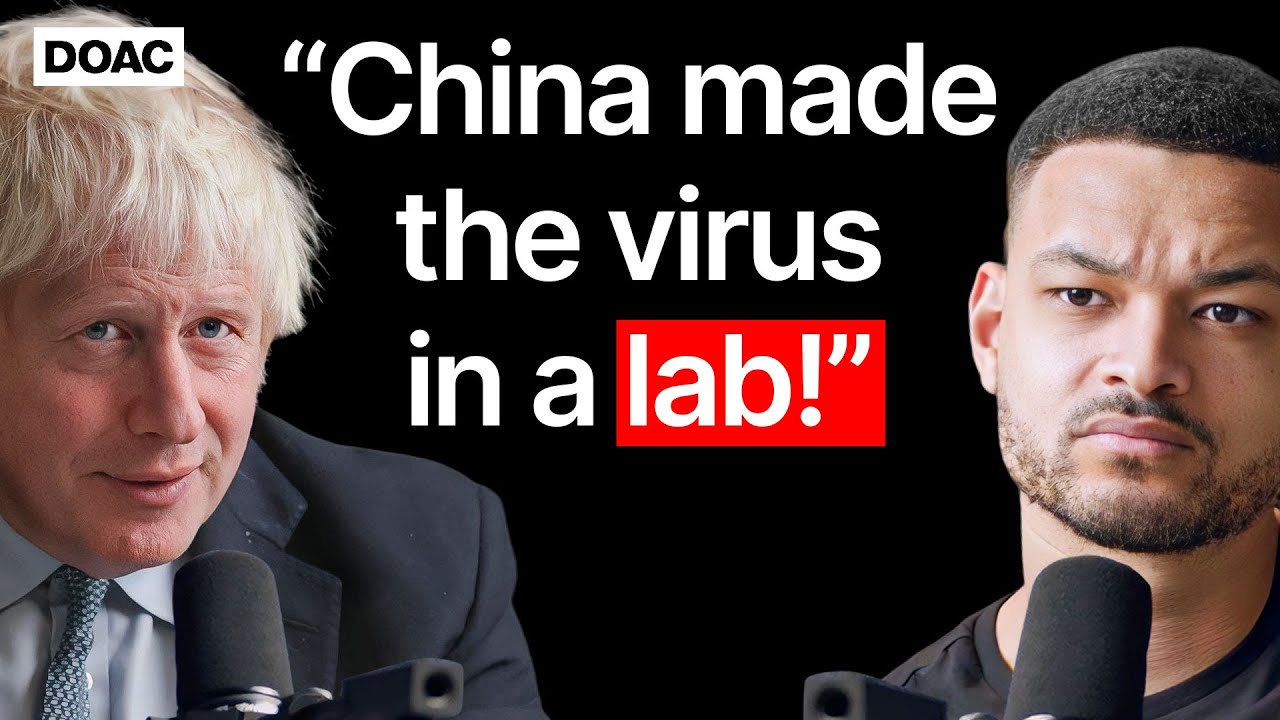
Boris Johnson Defends Covid Record, Says Virus Originated in Wuhan Lab
The Diary Of A CEO
Former Prime Minister Boris Johnson contends that Brexit enabled the UK's rapid vaccine rollout and insists the pandemic was caused by a laboratory leak in China.
AI-assisted summary of Boris Johnson: "They Were Looking at Engineering the Virus” & “The Government Tried To Bribe Me!" — original source. Check the original for full context.
Source published:
Detailed notes
## Background This video was published on YouTube by the channel The Diary Of A CEO on October 10, 2024. According to the page description, former UK Prime Minister Boris Johnson sits down for an 'unleashed' interview covering his early life, his political career, and his management of three major historic crises: Brexit, the COVID-19 pandemic, and the war in Ukraine.
## TL;DR In this extensive interview, former Prime Minister Boris Johnson reflects on his childhood, his mother's struggles with severe OCD, and how intense sibling rivalry drove his personal ambition. He defends his political record and cabinet decisions, maintaining that Brexit restored national democratic accountability and enabled the UK's rapid COVID-19 vaccine rollout. Johnson addresses major controversies surrounding his premiership, denying that his public persona is a calculated act, rejecting the lab-leak suppression narratives, and vehemently maintaining that 'Partygate' gatherings were not wild parties but mischaracterized work events during an unprecedented crisis.
## Atmosphere & style The conversation is tense, fast-paced, and highly charged, balancing sharp journalistic interrogation with Johnson's signature eccentric, theatrical charm. Host Steven Bartlett presses Johnson directly on allegations of political bribery, party scandals, and domestic childhood trauma, creating moments of visible emotion and guarded defensiveness. Despite the adversarial grilling, the dialogue maintains an engaging, intellectual rhythm—resembling a high-stakes duel between a probing interviewer and an adept politician defending his legacy.
## Key takeaways - [02:53](https://www.youtube.com/watch?v=6bL24eHvwoc&t=173s) Boris Johnson highlights how intense sibling rivalry and early health struggles shaped his childhood, leading him to throw himself into academic achievement as an emotional defense mechanism after his parents' divorce. - [18:32](https://www.youtube.com/watch?v=6bL24eHvwoc&t=1112s) Addressing his famous public persona, Johnson rejects the idea that his bumbling demeanor is a calculated marketing strategy, framing it instead as a natural reflection of his personality and a desire to keep people entertained. - [25:04](https://www.youtube.com/watch?v=6bL24eHvwoc&t=1504s) Johnson argues that while talent is evenly spread across the UK, opportunity is not, framing his 'Levelling Up' agenda and focus on education and infrastructure as the central mission of his political career. - [38:58](https://www.youtube.com/watch?v=6bL24eHvwoc&t=2338s) Reflecting on his entry into high politics, Johnson details how his two terms as Mayor of London focused on reducing youth violence, cutting the city's murder rate by 50%. - [45:46](https://www.youtube.com/watch?v=6bL24eHvwoc&t=2746s) Johnson explains his choice to lead the Leave campaign as a fundamental commitment to national democratic accountability, framing an unpublished pro-Remain draft article as merely an intellectual exercise to test both sides. - [01:00:09](https://www.youtube.com/watch?v=6bL24eHvwoc&t=3609s) Johnson reveals that David Cameron offered him a top cabinet post to support Remain and warned he would 'f*** [him] up forever' if he backed Leave, which ultimately spurred Johnson to stay true to his convictions. - [01:07:07](https://www.youtube.com/watch?v=6bL24eHvwoc&t=4027s) Defending Brexit against economic criticisms, Johnson insists that short-term disruptions are far outweighed by the long-term benefits of regulatory independence, citing the UK's rapid COVID-19 vaccine rollout as a direct result of exiting EU frameworks. - [01:18:41](https://www.youtube.com/watch?v=6bL24eHvwoc&t=4721s) Regarding the origins of COVID-19, Johnson states he no longer believes the natural spillover theory and is convinced the pandemic originated from a lab leak linked to gain-of-function research in Wuhan. - [01:25:00](https://www.youtube.com/watch?v=6bL24eHvwoc&t=5100s) Johnson defends the timing of the UK's initial COVID-19 lockdowns, explaining that decisions were strictly guided by SAGE scientific advisors who initially feared public compliance fatigue. - [01:29:20](https://www.youtube.com/watch?v=6bL24eHvwoc&t=5360s) Reflecting on later pandemic policies, Johnson criticizes the regional tiering system as 'bonkers' and impossible to enforce, while noting the severe human and mental toll of managing the national crisis. - [01:36:58](https://www.youtube.com/watch?v=6bL24eHvwoc&t=5818s) Addressing the 'Partygate' scandal, Johnson strongly rejects the characterization that wild parties took place at Downing Street, arguing his biggest strategic mistake was issuing broad, groveling apologies that validated exaggerated claims. - [01:48:15](https://www.youtube.com/watch?v=6bL24eHvwoc&t=6495s) In discussing his post-prime ministerial life, Johnson states he is content living in 'rustic obscurity' through painting and writing, maintaining that he would only re-enter politics if he could genuinely be useful.
## Detailed walkthrough Here is a detailed, faithful walkthrough of Part 1 of the interview:
### [00:00](https://www.youtube.com/watch?v=6bL24eHvwoc&t=0s) Intro The episode opens with a tense, fast-paced teaser showcasing the core debates and emotional turns of the interview. Host Steven Bartlett confronts Boris Johnson over "Partygate," asking if he was deliberately breaking the rules and whether gatherings with alcohol, music, and cake should ever have been allowed at 10 Downing Street. Johnson apologizes for the incidents but vehemently rejects the framing: "Sorry, but to say it was a party is a complete travesty."
The preview rapidly touches on several major turning points of Johnson's life and political career: * **David Cameron's Brexit ultimatum:** Cameron allegedly warned Johnson, "If you come out and support leave, I will [f***] you up forever," but offered a top-five cabinet role if he chose Remain. * **The origins of COVID-19:** Johnson expresses his belief that the pandemic "almost certainly was a lab accident" involving engineered viruses in Wuhan. * **Lockdowns:** Johnson calls the policy "Bonkers," raising the question of whether the benefits outweighed the severe harm done to children. * **Personal history and persona:** Bartlett asks Johnson about his childhood, his mother's eight-month stay in a psychiatric facility, allegations of domestic violence in his family home, and whether his bumbling public persona—which Bartlett admits once made him think Johnson was a parody from *Bo' Selecta!*—was a calculated political marketing strategy.
---
### [02:53](https://www.youtube.com/watch?v=6bL24eHvwoc&t=173s) Early Childhood and Sibling Rivalry Johnson reflects on his upbringing, describing a happy, vibrant childhood dominated by intense sibling competition following the birth of his sister Rachel 18 months after him. He explains that his entire early life felt like a constant struggle to maintain a "pretense of primacy" among his siblings. This endless sibling rivalry played a central role in shaping his drive, though the family simultaneously mocked their own competitiveness, teasing each other whenever someone wanted to win.
Despite his father, Stanley Johnson, being extremely busy and the family moving home 32 times in 14 years, Johnson insists his childhood was filled with affection. Both his father and his mother, Charlotte, were deeply invested in their children. * **Family moves:** 32 house moves over 14 years. * **Mother's profession:** Artist/painter. * **Father's profession:** Writer and public figure.
---
### [05:20](https://www.youtube.com/watch?v=6bL24eHvwoc&t=320s) Glue Ear and Early Hearing Loss Addressing his early health troubles, Johnson downplays the narrative that severe deafness isolated him as a child. While he acknowledges suffering from adenoids, tonsillitis, and "glue ear"—requiring operations at St Bartholomew's Hospital—he notes that no trace of deafness remains today. He jokes that his childhood hearing loss may have simply been a "cunning means to avoid my mother's questions," though he admits an eight-year-old probably wasn't quite that calculating.
---
### [06:15](https://www.youtube.com/watch?v=6bL24eHvwoc&t=375s) Charlotte's Mental Health and OCD The conversation turns to Johnson's mother, Charlotte Johnson Wahl, to whom he dedicated his memoir *Unleashed*. Charlotte struggled with severe Obsessive-Compulsive Disorder (OCD), which escalated until she was admitted to a psychiatric hospital for eight months when Johnson was around ten years old. Johnson vividly recalls her washing her hands obsessively, getting trapped in cycles where she could not turn off a faucet without feeling re-contaminated.
Her institutionalization forced the four Johnson children to coalesce into a tight-knit unit to navigate the difficult period. Charlotte carried lifelong guilt for her absence during those eight months, but Johnson remembers feeling strongly that her self-blame was unjust, asserting that she did an extraordinary job as a mother despite her illness. * **Age during hospitalization:** 10 years old. * **Duration of stay:** 8 months. * **Household care:** Managed by their father alongside a series of au pairs and nannies.
---
### [11:46](https://www.youtube.com/watch?v=6bL24eHvwoc&t=706s) Coping Mechanisms and "Self-Defense" Bartlett brings up an interview in which Charlotte stated that young Boris developed self-defense mechanisms to protect himself from the pain of her absence and his parents' subsequent divorce when he was 14. Johnson acknowledges there was an element of emotional self-defense, noting that children in broken homes often internalize the split as their own fault, feeling a drop in self-esteem and questioning if their parents truly love them.
To protect himself against that underlying emotional pain, Johnson threw himself into academic work to rebuild his self-esteem, using hard work as a distraction and a therapeutic coping mechanism. * **Parents' divorce age:** 14 years old. * **Primary coping mechanism:** Losing himself in academic work and achievement.
---
### [13:41](https://www.youtube.com/watch?v=6bL24eHvwoc&t=821s) Parents' Divorce and Allegations of Domestic Violence Johnson describes his parents' divorce as unusual because, despite high-pressure arguments, they maintained a lingering affection for each other that fortified the children. He explains that the children rationalized the split as a practical impossibility of living together rather than a breakdown of love.
Bartlett directly raises allegations published by a biographer that physical violence occurred in the household between Johnson's parents. Johnson carefully refrains from validating the claims: > "What I can tell you is I have no direct knowledge of what he said... I don't want to say anything that would cause pain or embarrassment to my father, so... what I can say is I had as a child no direct knowledge of it myself."
---
### [15:57](https://www.youtube.com/watch?v=6bL24eHvwoc&t=957s) Confronting His Father About the Split Johnson recalls the exact moment his father gathered the children near the gate by the engine shed on their property in Somerset to break the news of the divorce. Upon hearing it, a young Johnson reacted with anger, asking his father, "So why did you have us then?"
Discussing the memory brings visible emotion to Johnson's face. While he emphasizes that his parents were remarkably kind to each other in later years and that he doesn't want to "over-egg" the trauma, he acknowledges the raw pain kids experience during a family breakup, reiterating how work became his primary method for "stoking the furnace of my self-esteem."
---
### [18:32](https://www.youtube.com/watch?v=6bL24eHvwoc&t=1112s) The "Buffoon" Persona and Media Beginnings Bartlett shifts to Johnson's distinctive public persona, pointing out that when he first saw Johnson on television as a teenager, he genuinely thought Johnson was a comedic parody character from *Bo' Selecta!*. Bartlett asks whether the rumpled hair, bumbling charm, and humor were part of a calculated marketing strategy.
Johnson traces his public breakout back to his appearances on the BBC panel show *Have I Got News for You*. He quips that the BBC lives in a "permanent state of horror" and carries "corporate guilt" over having unleashed his political career through their platform.
[19:43](https://www.youtube.com/watch?v=6bL24eHvwoc&t=1183s) Public Persona, Family Dynamics, and "Sugaring the Pill"
Steven Bartlett questions whether Boris Johnson’s classic comedic persona is a calculated marketing strategy or a learned defense mechanism from childhood. Bartlett references a conversation with comedian Jimmy Carr, who suggested that when meeting comedic people, one should ask which parent they were trying to cheer up or win favor from. Johnson explains that his approach in politics—and in his book *Unleashed*—is about keeping people interested. He describes his writing process through the analogy of a packet of digestive biscuits: each chapter contains solid, high-fiber "wheat germ pabulum" that is topped with a layer of chocolate so the reader eats through all 60 chapters compulsively.
When pushed on whether he is a "loner" off-camera, Johnson insists he leads a quiet, happy life spent painting, reading, writing, and playing with his kids. He rejects the idea that his public character is a calculated deception, attributing his energy to a childhood home where he and his siblings felt a "horror of being dull." In the Johnson household, everyone was expected to entertain one another and their parents with charades, plays, and jokes. He disputes Jimmy Corbyn's assessment that he is a "calculated intelligence who lives in a persona which is the opposite," noting that his public antics—like accidentally tackling a child during a rugby game in Japan—are simply genuine moments rather than staged maneuvers.
* Jimmy Carr's theory on comedians: Don't ask if they are depressed; ask which parent they were trying to cheer up. * *Unleashed* structure: 60 chapters designed as "digestive biscuits" mixing serious political arguments with entertaining stories. * Personal life: Spends time painting, reading, writing, and raising his children.
---
[25:04](https://www.youtube.com/watch?v=6bL24eHvwoc&t=1504s) Class Imbalance, Eton College, and the Core Thesis of "Leveling Up"
clean, direct continuation of conversation on systemic inequality. Bartlett highlights the striking statistic that roughly 20 out of 57 UK Prime Ministers (around 35%) attended Eton College, arguing that this indicates a broken system where elite institutions hold an unfair advantage. Johnson—who attended Eton on a King's Scholarship funded by the legacy of Henry VI—agrees that opportunity is distributed unevenly, but frames this as the central argument of his political career and his book. He recalls realizing early on at Eton that while many boys from famous families lacked academic spark, talent and ambition exist in equal measure across every demographic and geographic corner of the UK.
Johnson contends that the UK possesses immense economic potential precisely because it is so geographic and socially imbalanced compared to countries like France, Germany, or the United States. He explains that his political focus, starting with his two terms as Mayor of London, was to reverse cycles of deprivation in inner-city boroughs like Hackney. By raising aspirations and changing the culture of achievement, he claims London schools and neighborhoods underwent a radical transformation that he sought to replicate nationwide through his "Leveling Up" agenda.
* Eton's historical footprint: Produced roughly 35% (20 out of 57) of all UK Prime Ministers. * Core philosophy: Talent, ambition, and genius are evenly distributed across the UK, but opportunity is not. * London Mayoralty: Focused on transforming disadvantaged inner boroughs like Hackney by breaking cycles of low expectations.
---
[28:53](https://www.youtube.com/watch?v=6bL24eHvwoc&t=1733s) Infrastructure, Education, and the Mechanics of Social Mobility
Addressing whether the Conservative government did enough to level up the country, Johnson acknowledges that progress has not been fast enough, though he defends his record. He highlights infrastructure as the ultimate equalizer of opportunity, pointing to the rapid rollout of gigabit broadband (increasing coverage from 7% to around 70% of households in three years) and advocating for continued investment in major projects like HS2 and Northern Powerhouse Rail. He argues that the role of government is to provide key infrastructure and public services to give the private sector the confidence to invest in neglected regions.
Bartlett shares a personal story about going undercover in an underfunded, low-performing school in Liverpool. He describes witnessing a teacher forced to run between two classrooms to teach them simultaneously because the school lacked funding, which was tied to student enrollment and league table rankings. Bartlett criticizes a system that forces students with different talents—such as his own entrepreneurial drive and ADHD—into rigid academic molds while leaving understaffed schools to buy basic supplies out of pocket. Johnson pushes back gently, emphasizing that under the Conservative government, the UK rose in international PISA rankings for literacy and numeracy, starting teacher salaries were raised to £30,000, and funding was funneled into academies and further education to create positive feedback loops in local communities.
* Broadband expansion: Increased gigabit broadband coverage from 7% to approximately 70% of UK households over three years. * Key infrastructure projects: Identifies HS2 and Northern Powerhouse Rail as essential components for geographic equalization. * Education metrics: Highlights UK improvements in global PISA literacy and numeracy rankings and the implementation of a £30,000 starting salary for new teachers.
[38:00](https://www.youtube.com/watch?v=6bL24eHvwoc&t=2280s) Improving UK Education and Ofsted Standards
Continuing on the theme of levelling up the UK, Boris Johnson emphasizes that improving education is far more critical than just building new infrastructure like train lines. He argues that the Conservatives focused heavily on updating school curricula, raising standards, and driving overall educational quality. While proper funding is vital, Johnson stresses that "you shouldn't underestimate what a great teacher can achieve."
The conversation pivots to current educational oversight, with Johnson expressing concern over potential shifts regarding Ofsted inspections. While he acknowledges the criticism surrounding single-word Ofsted gradings, he firmly believes that "parents need to know whether a school is going to deliver."
* The conversation highlights the Conservative focus on curriculum quality, academic attainment, and high educational standards. * Johnson shares his skepticism over replacing single-word Ofsted school ratings, citing parental transparency.
---
[38:58](https://www.youtube.com/watch?v=6bL24eHvwoc&t=2338s) Transitioning from Journalism to Politics and Running for London Mayor
The host summarizes Johnson's early career trajectory—from reading Classics at Oxford to a one-week stint as a management consultant ("I wasn't really cut out for management consulting"), moving into journalism, appearing on *Have I Got News for You*, becoming Editor of *The Spectator*, serving as an MP, and eventually running for Mayor of London. When asked if he expected to defeat Ken Livingstone in 2008, Johnson admits he "hadn't got the faintest idea." He notes that while he admired Livingston's bold early ideas on air quality and the environment, Livingstone had grown "a bit ragged" after eight years in office.
Reflecting on the campaign, Johnson notes that bookies did not view him as the favorite for a long time. However, his platform prioritized youth crime and knife violence, an issue he felt Livingstone neglected. Johnson describes the emotional burden of the campaign's central focus, stating he would "literally lie awake at night worrying about it" after speaking with grieving parents of teenage murder victims. Alongside his team—including Deputy Mayor Kit Malthouse, Stephen Greenhalgh, and Metropolitan Police Commissioners Paul Stephenson and Bernard Hogan-Howe—they implemented targeted strategies that ultimately reduced the London murder rate by 50%.
* **Career Milestones:** Oxford University $\rightarrow$ Management Consulting (1 week) $\rightarrow$ Journalist $\rightarrow$ Panelist on *Have I Got News for You* $\rightarrow$ Editor of *The Spectator* $\rightarrow$ Member of Parliament $\rightarrow$ Mayor of London. * **Key London Mayoral Campaign Figures:** Kit Malthouse (Deputy Mayor), Stephen Greenhalgh, Sir Paul Stephenson (Met Police Commissioner), and Sir Bernard Hogan-Howe. * **Key Metric:** Cut the London murder rate by 50% during his tenure as Mayor.
---
[41:53](https://www.youtube.com/watch?v=6bL24eHvwoc&t=2513s) Managing Three Generational Crises as Prime Minister
The host observes that Johnson's premiership was marked by three massive, historic crises: navigating Brexit, managing the COVID-19 pandemic, and responding to the Russian invasion of Ukraine. Asked if he wished he had been dealt a different hand, Johnson responds candidly: "That's the job of being prime minister." He points out that historical leaders have always faced distinct crises, from wars to sterling collapses.
When pressed on whether he believes he would still be Prime Minister today had he dealt with a calmer environment, Johnson dismisses the idea, stating there were other reasons for his eventual departure. Instead, he defends his record, asserting that achieving national independence through Brexit provided the regulatory flexibility required to execute the fastest COVID-19 vaccine rollout in Europe.
* **The Three Crises:** Brexit execution, the COVID-19 pandemic, and the War in Ukraine. * Johnson maintains that national sovereignty gained through Brexit directly enabled the UK to outpace European neighbors during the pandemic vaccine rollout.
---
[43:34](https://www.youtube.com/watch?v=6bL24eHvwoc&t=2614s) The Brexit Vote: Expectations vs. Public Reality
Reflecting on the 2016 EU Referendum campaign—which he co-led alongside Michael Gove—Johnson discusses whether he believed the Leave campaign would win. He describes a stark geographical divide: whenever he traveled outside London, he felt confident people were ready to vote Leave, but returning to "the Metropolis" presented a completely different atmosphere. He recalls attending his daughter's graduation at St Andrews University in Scotland during the campaign, where the mood made a Leave victory seem almost impossible.
Despite the unfavorable polling leading up to the referendum, Johnson believed Leave voters were far more motivated to turn out. Ultimately, 17.4 million people voted to exit the European Union, marking the single largest turnout for any voting proposition in British history.
* **Leave Campaign Co-Leaders:** Boris Johnson and Michael Gove. * **Referendum Result:** 17.4 million people voted to Leave, setting a UK record for the highest vote total for a single proposition.
---
[45:46](https://www.youtube.com/watch?v=6bL24eHvwoc&t=2746s) The Infamous "Secret Pro-Remain" Draft Article
The host presses Johnson on his internal conflict leading up to his public endorsement of the Leave campaign, citing a famous, unpublished column Johnson wrote for *The Daily Telegraph* outlining the case to Remain in the EU. The host quotes excerpts from the article, which detailed concerns over the potential breakup of the UK regarding Scotland, the "Putin factor" encouraging Russian aggression, geostrategic anxieties, and the benefits of the single market given its relatively low membership fee.
Johnson clarifies that the article was not a secret confession of his true feelings, but rather a deliberate intellectual exercise—a "pastiche of a counterargument" written to test both sides of the debate against each other before committing. He explains that while the Remain argument was rooted in not wishing to appear hostile or detached from European partners, the Leave case was fundamentally about democratic accountability. Johnson maintains that the core political question every leader must answer is: "Who put you in authority over me, and how can I remove you from office?"—a question he felt the EU structure could never satisfy.
* **Draft Article Excerpts Cited:** Addressed risks to the Union with Scotland, geopolitical stability regarding Vladimir Putin, and access to the EU single market. * **Johnson's Core Principle:** Retaining national democratic independence and direct accountability to the electorate over non-elected EU institutions.
---
[49:50](https://www.youtube.com/watch?v=6bL24eHvwoc&t=2990s) The Post-Referendum Plan and Regulatory Freedom
The host challenges Johnson with a football analogy, comparing leaving the EU without a detailed transition strategy to firing a football manager without knowing who will take over. Quoting Johnson's memoir *Unleashed*, the host points out Johnson's admission that the Leave campaign never drafted a post-referendum government plan or negotiation strategy, and that Johnson expressed frustration at being blamed for the subsequent political chaos.
Johnson defends this stance, emphasizing that the Leave campaign was not an elected government-in-waiting, but a campaign focused on a single constitutional referendum point: restoring democratic control to the public. He argues that European economic growth had lagged significantly behind the United States since 2008 due to over-regulation out of Brussels.
To counter the host's assertion that leaving without a plan was like jumping from a plane without a parachute, Johnson flips the metaphor: exiting the EU gave the UK the regulatory flexibility to forge its own parachute. By cutting away from the European Medicines Agency (EMA), the UK was able to approve and distribute COVID-19 vaccines rapidly.
* **Economic Growth Disparity:** Johnson notes the persistent underperformance and low innovation of the EU economy relative to the US since 2008. * **Vaccine Rollout Milestone:** Due to independent regulatory approval, the UK had vaccinated 45% of its adult population—and nearly 100% of citizens over 80—by March 2021, far outpacing EU member states.
[55:43](https://www.youtube.com/watch?v=6bL24eHvwoc&t=3343s) The Lack of a Post-Brexit Plan and Political Referendums
Boris Johnson rejects the premise that a government putting a referendum to the public must automatically resign or have every step mapped out if the vote goes against the official administration line. He points out that historical precedents exist across Europe—such as François Mitterrand staying in office following a lost treaty vote in France—where leaders held referendums on the EU, lost, and did not vanish from the scene. Johnson argues that if the Leave campaign had presented themselves as an immediate government-in-waiting, the public would have dismissed their arguments as a self-serving career ploy rather than a debate over principles.
Steven Bartlett pushes back from a citizen’s perspective, arguing that any leader championing a monumental shift should have looked several steps ahead to account for the real-world fallout. Using a vivid metaphor, Bartlett describes seeing David Cameron and Boris Johnson standing at a cliff's edge: Cameron takes the public there while warning them not to jump, while Johnson tells them to jump—only for the public to discover Johnson had no parachute and expected Cameron to pull one for them. Johnson maintains that he expected the government to issue an official white paper outlining negotiation options, but Cameron’s immediate resignation post-vote threw the country into a chaotic transition where a new leader had to figure out what to do on the fly.
* In European politics, leaders like François Mitterrand lost referendum votes without immediately resigning. * The unexpected exit of Prime Minister David Cameron instantly triggered political chaos and a leadership vacuum right after the Leave result was announced.
---
[01:00:09](https://www.youtube.com/watch?v=6bL24eHvwoc&t=3609s) The "I Will F*** You Up Forever" Threat and Cabinet Promises
Johnson reveals the intense personal exchanges behind the scenes with David Cameron leading up to his decision to back Leave. When Johnson expressed that he was struggling to support Remain due to his long-standing articles criticizing the democratic deficits of the EU, Cameron tried to entice him by offering a "top-five job in the cabinet" if he stayed loyal to the Remain campaign. Unsure of what specific cabinet post that meant, Johnson continued to express his inclination toward Leave, prompting Cameron to issue a blunt, expletive-laden warning: "I will f*** you up forever."
Following this explosive conversation, Johnson cycled home from City Hall to speak with his family. One of his children immediately remarked that he had no choice and had to support Leave. Reflecting on this moment, Johnson explains that he included the anecdote in his book, *Unleashed*, to demonstrate that while there were very persuasive arguments for choosing a quiet life and accepting high office, he felt compelled to stay true to his convictions.
* David Cameron offered Johnson a "top five job in the cabinet" (such as Defence Secretary or Health Secretary) to back Remain. * Upon hearing Johnson's hesitation, Cameron threatened to "f*** [him] up forever." * Johnson made his final decision after cycling home from City Hall and consulting his children.
---
[01:02:01](https://www.youtube.com/watch?v=6bL24eHvwoc&t=3721s) Government Patronage, Cabinet Appointments, and Public Attacks
Bartlett challenges Johnson on whether offering top cabinet jobs in exchange for political backing is essentially a form of political bribery or corruption. Johnson responds that while he considers it a "huge mistake" to promise specific positions—primarily because there are always far more hopeful candidates than actual appointments available—patronage has been a staple of politics since ancient times. Bartlett raises the broader issue of how individuals receive major ministerial roles without relevant experience (citing examples like Matt Hancock as Health Secretary, Margaret Thatcher, Tony Blair, and various shadow ministers) and questions whether the system operates like an "old boys' club" where elite networks like Eton dominate.
Johnson contends that business leaders and top administrators often fail to flourish in politics for reasons that are difficult to pinpoint. He notes that modern political life, amplified by intense online abuse on social media, requires an exceptionally thick skin. Politicians and journalists alike face relentless hostility and "shellacking" online, which discourages talented corporate figures from leaving comfortable lives to enter public office. Consequently, politics tends to attract highly determined, thick-skinned individuals capable of driving agendas forward despite intense public scrutiny.
* Bartlett highlights that 35% of top UK political figures historically came from single elite institutions like Eton. * Johnson acknowledges that social media has become exceptionally "virulent" and oppressive for both MPs and interviewing journalists. * Johnson asserts that despite political factionalism, the individuals who ultimately succeed are those capable of driving agendas through and delivering results.
---
[01:07:07](https://www.youtube.com/watch?v=6bL24eHvwoc&t=4027s) Debating the Real Economic Trade-Offs of Brexit
Bartlett presents a battery of economic data and public opinion polls challenging the success of Brexit: YouGov surveys showing 62% of British people view Brexit as more of a failure versus only 9% seeing it as a success; a Centre for European Reform report estimating GDP was 5.5% smaller by mid-2023 (an annual loss of roughly £40 billion); and London School of Economics data indicating Brexit added 6% to food prices. Bartlett asks whether Johnson regrets Brexit or if he can at least acknowledge the trade-offs involved.
Johnson firmly responds, "Not at all," insisting that the UK has outgrown major EU economies like Germany and Italy since 2016. He argues that short-term economic disruptions are heavily dwarfed by the impact of COVID-19, and maintains that Brexit freedoms allowed the UK to exit pandemic lockdowns earlier than other nations, leading to the fastest economic rebound in the G7. When Bartlett quotes the Office for Budget Responsibility's projection that the UK economy will end up 4% smaller than it would have been inside the EU, Johnson dismisses these doom-laden forecasts as "confirmation bias," pointing out that pre-referendum predictions of immediate mass unemployment and an emergency tax-raising budget failed to materialize.
* **YouGov Polls:** 62% of the British public view Brexit as more of a failure; 46% support a second EU referendum within 10 years versus 36% opposed. * **Economic Data Cited by Bartlett:** £140 billion lower GVA in 2023; £300 billion wiped off the economy's prospective value by 2035; a 5.5% GDP reduction by mid-2023 (£40 billion annual loss); 33% of small businesses struggling with EU trade paperwork; 6% added to food prices. * **Johnson's Counter-Arguments:** The UK achieved the fastest G7 economic rebound post-COVID by lifting restrictions in July 2021; unemployment hit a 50-year low with 620,000 more people in paid employment than before the pandemic.
---
[01:10:21](https://www.youtube.com/watch?v=6bL24eHvwoc&t=4221s) Bureaucratic Friction vs. National Sovereignty
Addressing the specific trade-offs, Johnson acknowledges that European nations are enforcing "unnecessarily bureaucratic" processes at the border, causing real friction and paperwork for small businesses. However, he maintains that technological solutions will eventually resolve these border issues without needing the UK to submit to an "ever denser and more detailed Empire of law." For Johnson, the fundamental advantage of national self-determination outweighs temporary administrative hassles.
Bartlett presses Johnson to admit that citizens face a near-term economic penalty, but Johnson maintains that the long-term benefit of political freedom and sovereign control will leave the country richer in the end. He cautions against accepting pessimistic economic prognostications, reiterating that critics who warned of a million people joining the dole queue post-Brexit were proven wrong when job creation actually hit historic highs.
* Johnson concedes that trade paperwork is currently an issue for some businesses, but insists technological fixes will resolve it. * He rejects remaining within a European "Empire of law" as a price worth paying for smoother trade. * Johnson concludes that sovereign control over national laws and policies will ultimately yield greater long-term prosperity.
[01:12:42](https://www.youtube.com/watch?v=6bL24eHvwoc&t=4362s) The Economic Future Post-Brexit and Alignment with the EU
When pressed on whether the UK faces near-term economic struggles as a direct result of Brexit, Boris Johnson redirects the focus to government strategy. He argues that economic difficulties will only persist if the UK makes the "huge, huge mistake" of remaining aligned with European Union regulations. He specifically singles out Sir Keir Starmer and the Labour Party, accusing them of wanting the UK to remain "rule takers" rather than taking full advantage of Brexit by pursuing regulatory freedom.
- **Economic Strategy:** Johnson insists that the UK must embrace regulatory divergence and freedom rather than staying in lockstep with Brussels rules.
---
[01:14:13](https://www.youtube.com/watch?v=6bL24eHvwoc&t=4453s) Early Days of the COVID-19 Pandemic and Matt Hancock's Role
Transitioning to late 2019 and early 2020, the conversation turns to the outbreak of COVID-19 as Johnson assumed the premiership. Johnson recalls the moment Health Secretary Matt Hancock first raised concerns about a "Chinese virus" while they were walking through the lobby of the House of Commons. When questioned on whether Hancock was the right person to manage a once-in-a-generation health crisis, Johnson defends him, arguing that Hancock possessed the necessary "mixture of energy and realism," while noting that nobody at the time fully understood the lethality, contagiousness, or transmission mechanisms of the novel pathogen.
- **First Warning:** Johnson learned of the emerging virus from Health Secretary Matt Hancock in late 2019 or early 2020. - **Defence of Health Secretary:** Johnson asserts Hancock "did a very good job" despite the immense unknowns surrounding the disease.
---
[01:15:58](https://www.youtube.com/watch?v=6bL24eHvwoc&t=4558s) Misjudging the Threat: Past Plagues and Zoonotic Panics
Reflecting on his internal mindset during the early stages of the outbreak, Johnson shares an excerpt from his memoir *Unleashed*. He admits that his core mistake was not ignorance of zoonotic diseases, but rather feeling like he already understood them completely after three decades as a journalist and politician. Having covered the Edwina Currie salmonella-in-eggs panic, Mad Cow Disease (BSE) where vast numbers of cattle were slaughtered, and later laying in unused stockpiles of Tamiflu during bird flu scares as Mayor of London, Johnson had concluded that novel animal-borne diseases usually "sort themselves out" and that politicians' attempts to contain them often cause more economic and social destruction than the diseases themselves.
> "I felt I knew my SARS and my Ebola so to speak... I concluded two things: first, that these novel zoonotic plagues tend to sort themselves out, and second, that the greater risk of destruction... was attempts to stop them by politicians."
- **Historical Precedents:** Johnson cited prior health scares—including Salmonella, BSE (Mad Cow Disease), SARS, Bird Flu, and Ebola—where dramatic warnings failed to result in catastrophic UK impact. - **Initial Assumption:** He feared political interventions (like mass culls or stock management) would prove "worse than the cause."
---
[01:18:41](https://www.youtube.com/watch?v=6bL24eHvwoc&t=4721s) The Wuhan Lab Leak Theory and International Calls
Addressing his diplomacy in February 2020, Johnson recounts calling Chinese President Xi Jinping. At the time, the UK was still sending protective medical supplies to China, and Johnson raised concerns about conditions in wet markets, believing the official narrative that the virus jumped naturally to humans in Wuhan. However, Johnson reveals that he no longer believes the natural spillover theory, stating he is now convinced COVID-19 was the result of a laboratory accident involving gain-of-function research. He also recalls speaking with US President Donald Trump, who took a hardline stance that China had a "case to answer," and notes that international bodies like the World Health Organization (WHO) seemed hesitant to criticize Beijing due to China's extensive funding of global academic and scientific research.
> "I think it almost certainly was a lab accident or it was as a result of something that went wrong in that lab... They were looking at engineering these viruses, gain-of-function... and sadly something went wrong."
- **Shift on Virus Origin:** Johnson believes the virus leaked from a laboratory in Wuhan doing gain-of-function research rather than originating from a wet market. - **Geopolitical Dynamics:** He describes WHO and global scientific hesitancy as driven by fear of "cheesing off" China due to Beijing's research sponsorships.
---
[01:21:57](https://www.youtube.com/watch?v=6bL24eHvwoc&t=4917s) The Turning Point in Italy and Scientific Hesitation
The "penny drop moment" for Johnson occurred around March 8, 2020, when scenes of overwhelmed Italian hospitals flooded news feeds and social media. Knowing that the Italian healthcare system (*Pronto Soccorso*) was high quality—recalling how rapidly they treated one of his own children after a pool incident in Italy—he realized that if Italy's system was collapsing with an elderly demographic similar to the UK's, Britain was facing a catastrophic situation. Despite growing public alarm, Johnson explains that the UK government was relying heavily on the Scientific Advisory Group for Emergencies (SAGE) and could not introduce "novel and draconian" lockdown measures ahead of formal scientific advice.
- **Italian Alarm:** Viewing Italy's hospital crisis in early March 2020 convinced Johnson of the imminent danger to the NHS. - **Scientific Advisory Role:** Johnson stresses that the UK government was committed to being "led by the science" provided by SAGE.
---
[01:25:00](https://www.youtube.com/watch?v=6bL24eHvwoc&t=5100s) Debate Over Lockdown Timing and Scientific Models
When confronted with criticism that the UK locked down significantly slower than European peers after its third recorded death, Johnson defends the timeline. He explains that SAGE scientists initially hesitated to recommend school closures and stay-at-home orders due to fears of public compliance fatigue and the risk of a severe secondary wave ("bounce back") once measures were lifted. Responding to Matt Hancock's claim that locking down earlier could have saved 30,000 lives, Johnson states he has no way of verifying that claim, arguing that locking down earlier would have meant overstepping expert advice to "imprison the whole UK population" before epidemiologists deemed it necessary.
- **Behavioral Concerns:** Early scientific advice warned that locking down too soon would cause the public to lose patience, leading to a resurgence of cases later. - **Response to Hancock's Claim:** Johnson rejects the premise that he unilaterally delayed action, emphasizing he acted as soon as SAGE explicitly advised it.
---
[01:27:46](https://www.youtube.com/watch?v=6bL24eHvwoc&t=5266s) The Efficacy of Lockdowns and the Tiering System
Looking back on the utility of lockdown measures, Johnson acknowledges that stay-at-home orders helped bend the infection curve, but questions how much of the decline was driven by mandates versus the natural parabola of the virus. While acknowledging the severe damage done to children's education and life chances, Johnson maintains that the government ultimately "did the right thing" under extreme uncertainty, expressing hope that the official COVID Inquiry led by Baroness Heather Hallett will validate the decisions made. However, he admits that later policy iterations, such as the localized "tiering system," felt "bonkers" in hindsight, expressing mild surprise at how strictly the public followed complex regional rules.
- **Evaluation of Lockdowns:** Johnson believes lockdowns successfully slowed transmission, though he debates the trade-offs regarding children's education and mental health. - **Tiering System:** He reflects critically on the subsequent regional tier system, characterizing elements of it as absurd in retrospect.
[01:29:51](https://www.youtube.com/watch?v=6bL24eHvwoc&t=5391s) The "Bonkers" Tiering System and the Human Toll
As the UK emerged from the first lockdown in the summer of 2020 and headed into the autumn, COVID-19 transmission rates varied wildly across the country. Boris Johnson addresses the implementation of regional "tiers," where areas like Leicester, the West Midlands, and the North West faced tight restrictions while places like Cornwall and the West Country had very low case numbers. Johnson admits that while localized restrictions made sense in principle—sparing low-infection areas from unnecessary shutdowns—in practice, the boundaries were "impossible" to enforce and created immense human frustration. Drawing line-by-line regional restrictions became invidious, making the system feel absurd to the public.
When host Steven Bartlett asks about the human toll of receiving daily death tolls and managing an escalating national crisis while sick with COVID-19 himself, Johnson reflects on the psychological strain. He explains that he functions best when driving positive, forward-looking projects. Being forced to constantly shut down the country using "very, very crude methods" was deeply difficult. His outlook only shifted toward the end of 2020 when the prospect of vaccines emerged, providing a clear path forward. However, he highlights that having to reverse course and push the country back into a national lockdown at the end of 2020 was one of his hardest days, as the hope placed in the tiering system dissolved.
``` "The real question I suppose is why on Earth the public so avidly craved these rules and why they were so willing to have their doings circumscribed in such a rabbinical detail... In their complexity, they were also like a kind of religion—detailed rituals you just obeyed Leviticus-like in the hope of salvation, because science was slow to help us." ```
* **Regional Disparities:** COVID-19 transmission rates varied sharply between regions like Cornwall (very low) and Greater Manchester or Leicester (high). * **The "Leviticus" Quote:** Bartlett reads a striking excerpt from Johnson's memoir, *Unleashed*, where Johnson compares the public's appetite for intricate pandemic rules to ancient religious rituals.
---
[01:32:59](https://www.youtube.com/watch?v=6bL24eHvwoc&t=5579s) Personal Loss Amidst National Crisis: The Death of Charlotte Johnson Wahl
On September 13, 2021, while navigating the political and societal aftermath of the pandemic, Johnson's mother, Charlotte Johnson Wahl, passed away. When Bartlett presses him on how he handled such a devastating personal loss while leading the nation, Johnson maintains a measured perspective. He stresses that losing a parent is the "common human lot" and notes that thousands of families across the UK were suffering and losing loved ones during the same period. He reflects on how the modern premiership funnels every major decision upward, leaving no room to step aside from executive duty.
Johnson recalls driving to London after an official visit when he received the news of his mother's death. She had suffered from long-term complications related to Parkinson's disease, including a severe health scare the previous year, meaning her passing was not entirely unexpected medically. When asked if he had the opportunity to properly process his grief, Johnson explains that while he mourned her deeply alongside his siblings, the sheer volume of governmental work required him to keep moving forward.
* **Date of Passing:** Charlotte Johnson Wahl died on September 13, 2021, following long-standing complications from Parkinson's disease. * **Reflections on Grief:** Johnson notes that while he missed his mother terribly, he had to remain focused on the daily duties of leading a country where millions were experiencing similar grief.
---
[01:36:58](https://www.youtube.com/watch?v=6bL24eHvwoc&t=5818s) The "Partygate" Backlash and the Question of Leadership
The conversation turns to the intense public outrage surrounding "Partygate"—the allegations of illegal gatherings at 10 Downing Street during strict lockdown periods. Bartlett points out that for the general public, who were prevented from attending family funerals or visiting dying relatives, even the suggestion of social gatherings or "raves" at Number 10 was deeply enraging. Johnson acknowledges the anger completely, expressing genuine remorse over how the situation was handled, but firmly denies that any "raves," dancing, or wild parties took place under his watch.
``` "To say it was a party is a complete travesty. It was about the most lugubrious event... It consisted of people who were part of my normal working life." ```
Johnson defends specific incidents raised by Bartlett, including a photographed gathering on May 15, 2020, featuring wine and cheese in the Downing Street garden. Johnson points out that Downing Street is his actual home, and meeting outdoors in the garden was encouraged to minimize infection risks. Addressing the June 19, 2020, event for his birthday—for which he received a fixed penalty notice—Johnson clarifies that he was not drinking wine or eating cake, but rather standing by his desk in the Cabinet Room between work meetings with colleagues he saw every day.
* **May 15, 2020:** Cheese and wine gathering in the Number 10 garden, which Johnson defends as a work-adjacent outdoor meeting at his place of residence. * **May 20, 2020:** A "bring your own booze" gathering in the garden that Johnson attended for approximately 25 minutes. * **June 19, 2020:** Johnson's birthday event in the Cabinet Room, which led to a police fine; Johnson insists there was no cake eaten or wine toasted. * **Police Investigation:** The Metropolitan Police investigated 17 alleged events, resulting in fines for specific breaches, though Johnson maintains many accusations were wildly exaggerated.
---
[01:41:04](https://www.youtube.com/watch?v=6bL24eHvwoc&t=6064s) The Optics of Power and the "Groveling" Apology Error
Bartlett argues that regardless of technicalities, Downing Street needed to set an extreme, flawless example of rule-following, suggesting that all alcohol and social gatherings should have been strictly banned. Johnson responds that staff were working around the clock under immense pressure in cramped, historic office quarters where perfect social distancing was impossible. While he admits he should have issued a clear directive to staff to "not only obey the rules, but be seen to obey the rules," he rejects the idea that a total ban on raising a glass to departing colleagues was realistic.
``` "The problem with leading with a blanket apology was that it then meant that absolutely any allegation... people assumed, 'Well, that must be what happened.'" ```
Reflecting on his political strategy, Johnson argues that his biggest mistake was issuing "pathetic and groveling apologies" at the outset. By offering a universal apology, he inadvertently validated the worst narrative in the public's mind, making it appear as though Number 10 staff were far more culpable than they actually were. He criticizes the initial investigation by civil servant Sue Gray, noting that sensationalized reports of "fistfights and vomiting" were later disproven. Johnson concludes by expressing deep regret that the hard work of staff during the pandemic was overshadowed by distorted allegations.
* **Sue Gray Report:** Johnson criticizes the impartiality and findings of the Sue Gray inquiry, arguing that initial claims of extreme misconduct were false and unfairly smeared hard-working staff. * **Strategic Regret:** On page 75 of *Unleashed*, Johnson notes he should have written an explicit letter to all Whitehall staff warning them to protect themselves against rule-breaking accusations by avoiding even the appearance of impropriety.
[01:46:53](https://www.youtube.com/watch?v=6bL24eHvwoc&t=6413s) Reflecting on Partygate and Apologizing
Reflecting on his handling of the "Partygate" controversy, Boris Johnson admits that in retrospect, his initial apologies gave the impression that he was validating and accepting all of the accusations made against his administration. He argues that he should have waited until the facts were fully established before issuing a targeted apology for what actually occurred.
Johnson feels strongly about defending the civil servants and officials who worked alongside him during the pandemic. He stresses that these individuals were working around the clock to organize the nation's COVID-19 response and did an "absolutely outstanding job." He expresses gratitude to the host for being patient and allowing him to talk for nearly two and a half hours on what was originally scheduled as a one-hour show.
* **Key Reflection:** Johnson believes he apologized too broadly and too early before the actual facts of Partygate were verified. * **Defense of Staff:** Emphasizes that government officials worked tirelessly under extreme pressure during the pandemic.
---
[01:47:41](https://www.youtube.com/watch?v=6bL24eHvwoc&t=6461s) Family and Personal Rumors
The discussion shifts to personal matters, with Bartlett bringing up the topic of Johnson's children and asking why his family size is such a widely debated public subject. Johnson brushes off the obsession, clarifying that it is a matter of public record that he has eight children.
Bartlett then raises a rumor regarding Charlotte Owen, asking directly if she is related to Johnson or if she is a former lover. Johnson refutes both claims, clarifying that she was simply a "very capable adviser" in his government and noting that people can read all about her role in his book.
* **Number of Children:** Confirms he has eight children and questions why the public is so intrigued by the number. * **Charlotte Owen:** Clarifies she is neither a relative nor a former lover, but a former capable political adviser.
---
[01:48:15](https://www.youtube.com/watch?v=6bL24eHvwoc&t=6495s) Life After No. 10 and US Politics
Addressing his future in politics, Johnson states that he is currently living a life of "blameless rustic obscurity." He cites a rule from his book *Unleashed*: one should only re-enter public life if they genuinely feel they can be useful. At present, he is enjoying painting, living in the countryside, and keeping his hands in various projects.
When pressed to choose between Donald Trump and Kamala Harris in the context of international relations and ending wars, Johnson maintains the standard position that British politicians are obliged to maintain good relations with whomever the American people elect. However, he pushes back against common "anti-trump prejudice," pointing out that during Trump's presidency, he took tough decisions and successfully projected American strength and purpose on the global stage.
* **Current Pursuits:** Painting, writing, and living in the countryside. * **Return to Politics:** Guided by whether he can genuinely be useful. * **View on Trump:** Suggests critics overlook Trump's strong foreign policy record and projection of strength.
---
[01:49:48](https://www.youtube.com/watch?v=6bL24eHvwoc&t=6588s) The Final Question: Relationships Lost to Success
Following the show's tradition, Bartlett asks a question left by the previous guest: "Which relationship or person did you lose in the pursuit of your success?" Johnson initially hesitates, stating that the longer one lives, the more one realizes that a seemingly terrible falling-out can eventually cheer up and result in renewed friendship. He resists the premise of the question, asserting that he does not view any political or personal rupture as final.
When Bartlett pushes back—noting that no guest has ever dodged the final question—Johnson offers the example of Michael Gove. He notes that despite their famous fall-out in 2016, he brought Gove back into the cabinet with "heroic optimism" when he became Prime Minister. Bartlett wraps up by thanking Johnson, praising his writing style in his 772-page memoir *Unleashed*, while Johnson jokes about whether he wins a prize for enduring such an extended interview.
* **Perspective on Conflict:** Views no political break or relationship rupture as permanently final. * **Example Cited:** Michael Gove, who was brought back into the cabinet after their high-profile split in 2016. * **Memoir Details:** *Unleashed* totals 772 pages including index and acknowledgments.
## Notable quotes > [00:00](https://www.youtube.com/watch?v=6bL24eHvwoc&t=0s) Sorry, but to say it was a party is a complete travesty. — Boris Johnson
> [00:00](https://www.youtube.com/watch?v=6bL24eHvwoc&t=0s) If you come out and support leave, I will [f***] you up forever — David Cameron
> [13:41](https://www.youtube.com/watch?v=6bL24eHvwoc&t=821s) What I can tell you is I have no direct knowledge of what he said... I don't want to say anything that would cause pain or embarrassment to my father, so... what I can say is I had as a child no direct knowledge of it myself. — Boris Johnson
> [15:57](https://www.youtube.com/watch?v=6bL24eHvwoc&t=957s) So why did you have us then? — Boris Johnson
> [38:58](https://www.youtube.com/watch?v=6bL24eHvwoc&t=2338s) I wasn't really cut out for management consulting — Boris Johnson
> [45:46](https://www.youtube.com/watch?v=6bL24eHvwoc&t=2746s) Who put you in authority over me, and how can I remove you from office? — Boris Johnson
> [01:00:09](https://www.youtube.com/watch?v=6bL24eHvwoc&t=3609s) I will f*** you up forever. — David Cameron
> [01:15:58](https://www.youtube.com/watch?v=6bL24eHvwoc&t=4558s) I felt I knew my SARS and my Ebola so to speak... I concluded two things: first, that these novel zoonotic plagues tend to sort themselves out, and second, that the greater risk of destruction... was attempts to stop them by politicians. — Boris Johnson
> [01:18:41](https://www.youtube.com/watch?v=6bL24eHvwoc&t=4721s) I think it almost certainly was a lab accident or it was as a result of something that went wrong in that lab... They were looking at engineering these viruses, gain-of-function... and sadly something went wrong. — Boris Johnson
> [01:29:51](https://www.youtube.com/watch?v=6bL24eHvwoc&t=5391s) The real question I suppose is why on Earth the public so avidly craved these rules and why they were so willing to have their doings circumscribed in such a rabbinical detail... In their complexity, they were also like a kind of religion—detailed rituals you just obeyed Leviticus-like in the hope of salvation, because science was slow to help us. — Boris Johnson
> [01:36:58](https://www.youtube.com/watch?v=6bL24eHvwoc&t=5818s) To say it was a party is a complete travesty. It was about the most lugubrious event... It consisted of people who were part of my normal working life. — Boris Johnson
> [01:41:04](https://www.youtube.com/watch?v=6bL24eHvwoc&t=6064s) The problem with leading with a blanket apology was that it then meant that absolutely any allegation... people assumed, 'Well, that must be what happened.' — Boris Johnson
## Mentioned Boris Johnson, Steven Bartlett, Unleashed, David Cameron, Rachel Johnson, Stanley Johnson, Charlotte Johnson Wahl, St Bartholomew's Hospital, Jimmy Carr, Jeremy Corbyn, Eton College, Henry VI, HS2, Northern Powerhouse Rail, Ofsted, The Spectator, Have I Got News for You, Ken Livingstone, Kit Malthouse, Stephen Greenhalgh, Paul Stephenson, Bernard Hogan-Howe, Michael Gove, The Daily Telegraph, Vladimir Putin, European Medicines Agency, François Mitterrand, Matt Hancock, Margaret Thatcher, Tony Blair, YouGov, Centre for European Reform, London School of Economics, Office for Budget Responsibility, Keir Starmer, Labour Party, Xi Jinping, Donald Trump, World Health Organization, SAGE, Baroness Heather Hallett, Metropolitan Police, Sue Gray, Charlotte Owen, Kamala Harris
[Source](https://www.youtube.com/watch?v=6bL24eHvwoc)