Trevor Noah Links Daily Show Exit to Untreated ADHD and Isolation
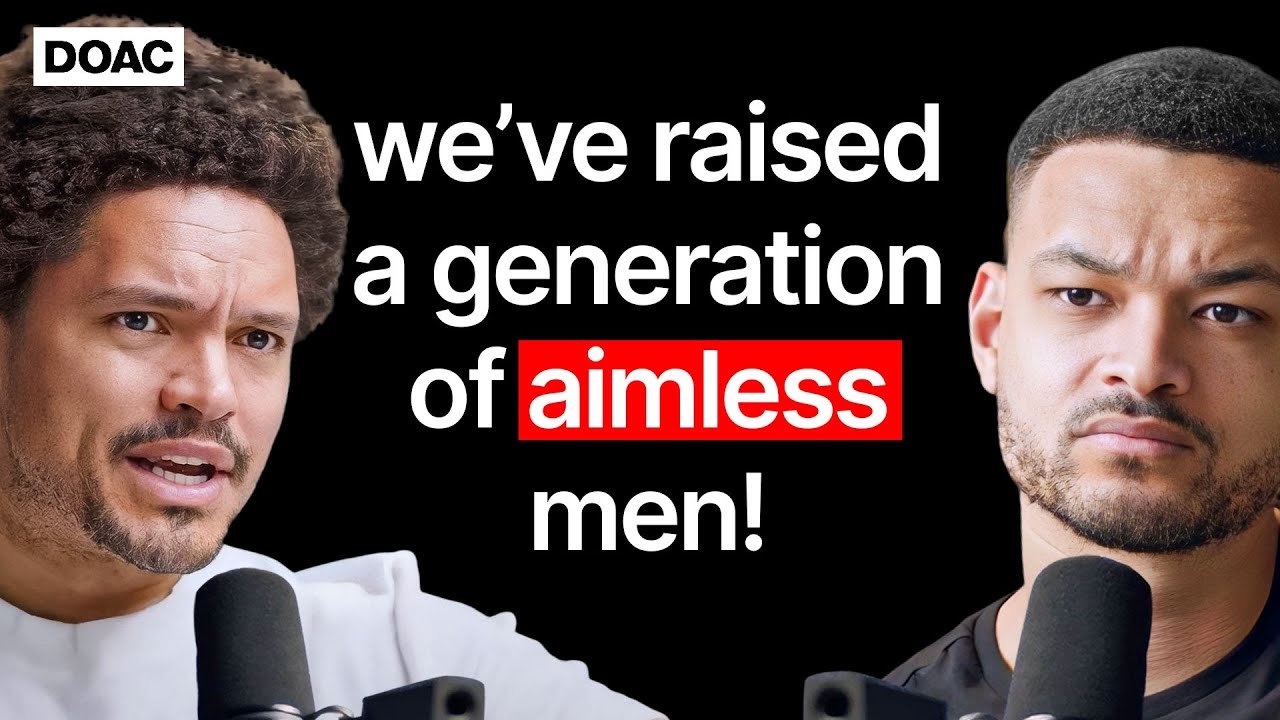
The Diary Of A CEO
The former Daily Show host attributes his recurring struggles with depression not to clinical mental illness, but to the neurodevelopmental effects of untreated ADHD coupled with modern male isolation.
AI-assisted summary of Trevor Noah: My Depression Was Linked To ADHD! Why I Left The Daily Show! — original source. Check the original for full context.
Source published:
Detailed notes
## Background This episode was published on YouTube by The Diary Of A CEO (hosted by Steven Bartlett) on October 17, 2024. According to the page description, the interview features comedian, author, and former host of 'The Daily Show' Trevor Noah discussing his childhood in South Africa, his mother's shooting, his struggle with depression and untreated ADHD, and his reasons for leaving late-night television.
## TL;DR In this wide-ranging conversation, Trevor Noah opens up about growing up under Apartheid as a mixed-race child, surviving domestic trauma, and processing his mother surviving a point-blank gunshot wound. He offers deep reflections on modern male loneliness, the importance of non-transactional friendships, and his decision to step away from 'The Daily Show' after seven years as host. Noah also reveals how discovering his adult ADHD explained his recurring bouts of depression, sharing practical grounding techniques, his views on therapy, and why he rejects the idea that trauma must happen for a reason.
## Atmosphere & style The conversation carries an intimate, contemplative, and intellectually curious mood, striking a balance between heavy personal reflection and grounded, analytical insight. Steven Bartlett acts as a receptive, empathetic host, allowing Noah room to unpack complex emotional terrain with characteristic eloquence, humor, and self-awareness. Watching the interaction feels like eavesdropping on a late-night, deep conversation between friends, moving seamlessly from painful childhood trauma to lighthearted observations about society and human connection.
## Key takeaways - [07:36](https://www.youtube.com/watch?v=FsztuzyXdhY&t=456s) Growing up as a mixed-race child in Apartheid South Africa meant Trevor Noah was legally classified differently from both of his parents, making his very birth an illegal act. - [16:10](https://www.youtube.com/watch?v=FsztuzyXdhY&t=970s) Witnessing severe domestic violence and seeing his mother shot in the head by his stepfather fundamentally shattered Trevor's sense of safety, driving lifelong hyper-vigilance. - [45:41](https://www.youtube.com/watch?v=FsztuzyXdhY&t=2741s) Trevor views the modern crisis of male isolation as a downstream effect of macro-economic failures, middle-class erosion, and a lack of non-commercial 'third places' where men can bond over shared activities. - [01:25:07](https://www.youtube.com/watch?v=FsztuzyXdhY&t=5107s) When stepping into Jon Stewart's role on The Daily Show, Trevor faced intense public backlash, declining ratings, and death threats, which he overcame through team solidarity and perspective from critics' past patterns. - [01:35:00](https://www.youtube.com/watch?v=FsztuzyXdhY&t=5700s) Trevor's adult depression was driven by untreated ADHD; difficulty regulating focus often led to hyperfocusing on existential dread and negative rumination loops. - [01:41:14](https://www.youtube.com/watch?v=FsztuzyXdhY&t=6074s) Choosing to leave The Daily Show after eight years came from recognizing during the pandemic that he had placed work above his personal life and wanted time to explore life outside the news cycle. - [01:57:21](https://www.youtube.com/watch?v=FsztuzyXdhY&t=7041s) Through therapy, Trevor learned to transition from intellectually analyzing his trauma to sitting directly with primary emotions rather than masking them with anger or work. - [02:09:43](https://www.youtube.com/watch?v=FsztuzyXdhY&t=7783s) To counter depressive spirals, Trevor uses physical check-ins—auditing sleep, food, movement, and breath—alongside sensory grounding techniques to break negative thought patterns. - [02:14:07](https://www.youtube.com/watch?v=FsztuzyXdhY&t=8047s) Reconnecting with his biological father provided crucial self-understanding and demonstrated the unique value of maintaining non-transactional friendships late into life. - [02:30:40](https://www.youtube.com/watch?v=FsztuzyXdhY&t=9040s) Trevor rejects the idea that trauma must be rationalized as 'happening for a reason' or that it shouldn't be erased; instead, he advocates for the 'Pencil Test', focusing on writing a new story moving forward.
## Detailed walkthrough ### [00:00](https://www.youtube.com/watch?v=FsztuzyXdhY&t=0s) Teaser: Untreated ADHD, *The Daily Show*, and the Male Connection Crisis
Trevor Noah opens the conversation by reflecting on a period when life felt utterly meaningless, admitting that he used to ask himself what he was doing with his life. It was only later that he realized the depression he was experiencing was actually the result of untreated ADHD. He now uses specific personal strategies and frameworks to navigate these struggles. The episode's introduction framing highlights his journey from being born in South Africa to a Black mother and a white father—an illegal union under Apartheid—to enduring a chaotic, unsafe household under an abusive stepfather who eventually shot his mother point-blank in the head.
Despite these overwhelming hardships, Trevor moved to America to pursue stand-up comedy and ultimately secured the role as host of *The Daily Show*. The transition was initially fraught with severe public backlash and violent threats. Through grueling 17-hour workdays, he helped build the show into a global phenomenon. However, that immense success came at a steep cost: work swallowed his existence, pushing personal connections aside. Trevor notes that this isolation is not unique to him, pointing to a broader crisis where a generation of men lacks the practice and habits of meaningful human connection.
---
[02:15](https://www.youtube.com/watch?v=FsztuzyXdhY&t=135s) The Ingredients That Make a Person
When asked what critical elements from his childhood formed the man he is today, Trevor pauses to consider the complexity of breaking down human identity. He compares a person to a recipe or a dish, noting how difficult it is to single out one decisive ingredient—whether it is the crunch, the salt, the acid, or the fat. He credits a vast blend of influences: his sense of humor, his South African roots, the schools he attended, and the places he lived.
``` ┌────────────────────────────────────────┐ │ PARENTAL INGREDIENTS │ │ • South African Xhosa Mother │ │ • Swiss Father │ └───────────────────┬────────────────────┘ │ ▼ ┌────────────────────────────────────────┐ │ EXTENDED FAMILY & CARE │ │ • Maternal Grandmother │ │ • Bipolar Grandfather (Unpredictable) │ └───────────────────┬────────────────────┘ │ ▼ ┌────────────────────────────────────────┐ │ THE SPONGE CAKE ANALOGY │ │ Base cake: Essential traits │ │ Icing/Shape: Every person encountered │ └────────────────────────────────────────┘ ```
Elaborating on this metaphor, Trevor describes human nature as a basic sponge cake. While the foundational cake itself is fairly simple, the true character, texture, and flavor come from how it is decorated afterwards. He emphasizes that every person we bump into adds a layer of "icing" that continuously reshapes us, which is why he remains deeply intentional about choosing his friendships today.
* **Parental Roots:** Born to a Xhosa mother from South Africa and a Swiss father living in South Africa. * **Grandparents' Influence:** Spent significant time with his maternal grandmother and his grandfather, a wildly funny man whose then-undiagnosed bipolar disorder made him intensely entertaining. * **Friendship Philosophy:** Views intentional friendship choices as a way of actively selecting who continues to shape his character over time.
---
[05:19](https://www.youtube.com/watch?v=FsztuzyXdhY&t=319s) Apartheid and the "Lucky Breaks"
Trevor frames his early childhood context around being born in South Africa in 1984, six years before the legal end of Apartheid. Growing up mixed-race created a uniquely isolated dynamic because South Africa’s racial classifications were intricate, leaving him in a position where few people shared his exact background.
> "I look at these ingredients which aren't necessarily the best in choosing your starting points, but then there was a series of lucky breaks."
He considers the timing of Apartheid's fall as one of the single biggest strokes of luck in his life. Had Apartheid continued for another ten years, he would have been 16 before receiving basic freedoms, unable to attend the previously white-only schools that drastically shifted his educational path and future trajectory.
---
[07:36](https://www.youtube.com/watch?v=FsztuzyXdhY&t=456s) Growing Up as a "Crime" Under Apartheid
Explaining the realities of Apartheid, Trevor contrasts it with other global systems of racial division. Rather than a simple binary system like the Jim Crow South in the United States, Apartheid was a meticulously calculated regime that combined oppression strategies from around the world—drawing from Australian policies toward Indigenous populations, Dutch colonial structures, and Nazi Germany's racial laws.
``` ┌─────────────────────────────────────────────────────────────────────────┐ │ THE INSIDIOUS APARTHEID SYSTEM │ ├─────────────────────────────────────────────────────────────────────────┤ │ • Engineered by studying global oppressive regimes (US, Australia, Nazi)│ │ • Designed to fracture a majority into smaller, manageable minorities │ │ • Classified race by precise skin shade rather than cultural heritage │ │ • Strictly segregated residences: White > Mixed (Coloured) > Black │ └─────────────────────────────────────────────────────────────────────────┘ ```
Because he was light-skinned, the law categorized him differently from his mother. In the absurd legal hierarchy of the time, Trevor was considered legally superior to his mother, while his white father was considered legally superior to him. Because of these distinct classifications, the three of them could not legally cohabitate or even live in the same neighborhood.
To keep him safe from police raids in Soweto—a designated Black township where a light-skinned child would immediately draw law enforcement suspicion—his grandmother kept him strictly indoors. She would lock the doors, though Trevor would frequently try to dig holes under the perimeter gate to sneak out and play in the street with other neighborhood kids. At the time, he assumed his grandmother was just being overly strict out of love, not realizing she was terrified that the authorities would seize him.
---
[11:29](https://www.youtube.com/watch?v=FsztuzyXdhY&t=689s) Hiding in Plain Sight with His Parents
In public, navigating daily life required constant deception. Trevor explains that when he walked down the street with his mother, she had to strategically disguise her relationship to him.
To avoid arrest or having her child taken away, his mother would dress and act as a domestic worker or nanny taking care of a client's child. Passersby and police assumed she was simply employed by a wealthy family, allowing them to move through public spaces undetected.
* **Public Interactions with His Father:** Absolutely prohibited; he could never be seen with his father in public under any circumstances. * **Public Interactions with His Mother:** Disguised as a domestic nanny-employer dynamic to pass through streets without raising suspicion.
---
[12:19](https://www.youtube.com/watch?v=FsztuzyXdhY&t=739s) Childhood Perception, Trauma, and Gabor Maté
The host brings up a conversation with physician Gabor Maté, who traced his own childhood trauma and the onset of his ADHD back to a brief, few-day separation from his mother during the Holocaust. When asked if the underlying stress of growing up under Apartheid subconsciously impacted him in similar ways, Trevor offers a nuanced perspective.
He notes that a child's perception of reality is almost entirely shaped by their primary caregivers. Because he was never separated from his mother and had no alternative lifestyle to compare his childhood against, his daily experience felt completely normal to him. Moreover, within his community, absent or missing fathers were commonplace—many kids had parents who were killed by police, imprisoned, or forced into political exile.
Because he was able to see his father privately and knew his father loved him, Trevor actually felt like one of the lucky ones among his peers. While acknowledging that all experiences leave an imprint, he cautions against labeling every single childhood difficulty as the sole explanation for adult trauma, emphasizing that no human lives a completely friction-free existence.
[16:10](https://www.youtube.com/watch?v=FsztuzyXdhY&t=970s) Domestic Violence and the Fragility of Safety
Trevor reflects on his mother's complex and violent relationship with his stepfather, Abel, and how growing up in a home marked by domestic abuse shaped his childhood. He explains that even as an adult—and after discussing it with therapists—domestic violence remains difficult to fully comprehend. For a child, parents are the most powerful figures in existence, akin to "the president" of their world. Seeing a mother subjected to violent harm completely shatters a child's fundamental understanding of safety and reality.
``` "When you're a child, your parents are the most powerful beings... and if you ever have the terrible fortune of seeing your mother being violently harmed, it rocks your fundamental understanding of what the world is." ```
Trevor and host Steven Bartlett compare how childhood environments condition adult relationship triggers:
* **Steven's Experience:** Watching his father sit passively while being berated created a phobia of romantic commitment, feeling like "impending prison time" that led him to reject partners after years of pursuit. * **Trevor's Experience:** Seeing his mother harmed because she allowed someone into her life made him avoid deep intimacy, operating on the instinct to keep people at arm's length so he could never hurt them or be made vulnerable. * **Systemic Failure:** Trevor notes that society often dismisses domestic violence as a "crime of passion." He recalls seeing a femicide awareness campaign in Amsterdam, emphasizing that police neglect of domestic abuse—telling women to "go home and sort it out"—signals to a child that the broader world will not keep them safe either.
---
[23:50](https://www.youtube.com/watch?v=FsztuzyXdhY&t=1430s) The Phone Call and the "Spidey Sense" of Trauma
Trevor recalls the moment he received a phone call from his younger brother (who was around 14 at the time, driving when he shouldn't have been) informing him that his stepfather had shot his mother point-blank in the head. Trevor was around 24 years old at the time. When he heard the news, he instantly knew who had done it. Growing up around alcoholism and domestic abuse instills a hyper-vigilant "spidey sense" that makes a person intensely predictive of danger.
``` "I'll be the kind of person who will tell you when we should leave a party before a fight breaks out... I can feel energy, not like woo-woo, but I start noticing people are not having as much fun as they were 20 minutes ago." ```
He describes how children in abusive homes develop acute sensitivity to subtle sensory cues to compensate for a parent who seems unable to detect impending danger: * Recognizing which specific car engine sound brought danger to the house. * Knowing whether his stepfather was drunk or sober purely by the sound of his footsteps. * Reading the way a door opened or closed to decide whether to be on high alert.
---
[26:33](https://www.youtube.com/watch?v=FsztuzyXdhY&t=1593s) Hyper-Empathy as a Gift and a Curse
Trevor discusses the emotional toll of hyper-vigilance, describing it as both a strength and a burden. While this hyper-awareness fuels his talent as a comedian and observer of human behavior, the trade-off is an overactive nervous system that constantly absorbs the emotional states of those around him. In abusive households, children adopt this acute awareness because they feel responsible for protecting a parent who seems oblivious to danger.
To counteract this automatic response in adulthood, Trevor actively practices non-intervention in low-stakes situations: * **The Old Instinct:** Step in immediately to diffuse tension by interrupting, cracking jokes, changing the subject, or creating physical distractions (joking that he felt like "Chris Pratt with those Raptors in *Jurassic Park*"). * **The New Habit:** Pause, take a deep breath, and allow his friends to resolve their own arguments without feeling a compulsion to save everyone. * **Childhood Survival Tactics:** As a kid aged 9 to 12, he would intentionally slam doors, turn up the TV volume, or shift his stepfather's mood to divert tension away from his mother.
---
[31:22](https://www.youtube.com/watch?v=FsztuzyXdhY&t=1882s) Anticipating Grief and the Reality of Loss
In the chaotic aftermath of the shooting, Trevor rushed to the hospital while trying to process the horrifying news. Time seemed to stand still as he waited for what felt like an inevitable announcement of her death, knowing from everyday reality and movies that a point-blank gunshot to the head is almost universally fatal.
During those agonizing hours in the hospital, Trevor went through the complete psychological process of grieving his mother as if she had already passed away: * He cried processed grief for her death rather than just her injuries. * His mind immediately projected 10 years into the future, mentally stepping into the role of head of the household. * He began planning how to raise his younger brothers, where they would live, and how to break the news to them.
[33:40](https://www.youtube.com/watch?v=FsztuzyXdhY&t=2020s) "One of My Greatest Gifts": Reframing Loss and the Miracle in the ER
Trevor reflects on how narrowly escaping his mother’s death fundamentally reshaped how he moves through the world. Before the tragedy, like most people, he operated under the implicit assumption that loved ones would always be there. Watching that certainty evaporate in an instant transformed a horrific curse into what he now considers one of his greatest gifts. From that day onward, he has never viewed his mother or his loved ones through a lens of permanence. Every embrace with his mother is held longer and tighter—to the point where she sometimes has to push him off—because he remains deeply aware that human existence is ephemeral. He carries this presence into all his relationships, adopting the mindset summarized by the Arabic phrase *Inshallah* ("God willing"): hoping for another meeting, but never taking the next moment for granted.
Turning to the mechanics of her survival, Trevor details what can only be described as a medical miracle. In movies, a bullet to the head is an instant death sentence, but his mother's trajectory defied science. As doctors prepared him for the absolute worst, X-rays revealed an astounding path: the bullet entered the back of her skull, passed beneath the base of her brain, missed her spinal cord entirely, and struck her cheekbone. That impact deflected the bullet, sending it out through her nose and severing a small piece of tissue on the way out. Because it missed all critical neural structures, surgeons didn't even need to perform brain surgery; they simply stopped the bleeding, closed the wounds, and waited. The attending doctor—a self-described man of science—admitted he hated using the word, but conceded her survival was a genuine miracle. Trevor’s deeply devout mother, who ironically taught him to question everything rather than follow blindly, simply responded, "Of course it's a miracle... my Lord protects me."
- **The Bullet's Trajectory:** Back of skull $\rightarrow$ missed brain base and spinal cord $\rightarrow$ struck cheekbone (deflection) $\rightarrow$ exited through nose. - **Surgical Intervention:** No craniotomy or brain surgery was required; treatment was limited to wound closure and hemorrhage control. - **Relational Shift:** Trevor treats visits and hugs with loved ones as if they could be the very last, actively rejecting the illusion of guaranteed time.
---
[36:40](https://www.youtube.com/watch?v=FsztuzyXdhY&t=2200s) A Systemic Failing: Why the Stepdad Avoided Prison
The conversation shifts to the infuriating aftermath: why Trevor's stepfather, Abel, never served meaningful prison time despite shooting a woman in the head. Trevor explains that this outcome reflects a widespread systemic failure, prevalent in South Africa and across the globe, regarding domestic violence. In many legal systems, crimes committed by a man against his wife or intimate partner are not treated with the same severity, ferocity, or legal validity as violence inflicted on a stranger. Instead of treating the attempt on her life as a heinous, premeditated crime, the judicial system categorized it leniently—citing factors like it being a "first offense" and questioning whether he posed a future threat. Trevor notes that society routinely minimizes domestic murder as a "tragic love affair" or a situation where "something just went wrong," depriving women of actual justice.
This failure of justice highlights the delicate "domino effect" of human lives. Millimeters dictated whether the bullet killed his mother, and those same millimeters dictated the entire trajectory of Trevor's future. Had his mother died, Trevor would have been forced to assume full parental and financial responsibility for his younger siblings, altering his life path entirely. He candidly acknowledges that he never would have moved to the United States, taken over *The Daily Show*, or explored the world in the way he did. A shift of a fraction of an inch spared his mother's life and allowed his own trajectory to unfold.
- **Judicial Downplaying:** Domestic abuse is frequently rationalized as an isolated emotional breakdown rather than treated as severe violent crime. - **Life Alteration:** A fatal outcome would have kept Trevor in South Africa to raise his family, halting his international comedy career before it began.
---
[38:57](https://www.youtube.com/watch?v=FsztuzyXdhY&t=2337s) Navigating the Spectrum of Rage and the Paradox of Abusers
Processing the attack triggered an overwhelming cocktail of raw emotions for Trevor: terror, helplessness, shame over feeling unable to protect her, and burning rage. His mind cycled through anger at himself, anger at his mother for staying in the relationship so long, anger at Abel, and anger at a legal system that failed to protect them. He reveals that even as a young child, he intuitively sensed the danger. His grandmother often recalled how a young Trevor warned the family that Abel was not a good man and shouldn't be trusted.
Addressing why victims and families stay trapped in abusive dynamics, Trevor dismantling the misconception that abusers are monsters 100% of the time. The sinister complexity of domestic abuse lies in its non-binary nature. The explosive violence is horrific, but it is often surrounded by periods of immense charisma, humor, and warmth. Trevor spent much of his childhood laughing with Abel and sharing wonderful memories with him, making it extraordinarily difficult as an adult to reconcile how someone who brought such joy and treated him with respect could also inflict the deepest trauma of his life.
- **Childhood Intuition:** Despite being a young boy when Abel entered their lives, Trevor explicitly warned his family that Abel was dangerous. - **The Abuser's Paradox:** Domestic violence is rarely continuous; the extreme danger is masked by long stretches of charm, humor, and genuine bond-building. - **Emotional Cycle:** Processing the trauma required cycling through fear, rage, guilt, grief, and despair during therapy sessions and talks with his mother.
---
[41:45](https://www.youtube.com/watch?v=FsztuzyXdhY&t=2505s) The Nature of Forgiveness and Escaping the Vicious Cycle
Through extensive therapy and deep conversations with his mother, Trevor worked to process his internal rage. His mother offered a transformative perspective on forgiveness, teaching him that "forgiving doesn't mean forgetting." Forgiveness is not about letting an abuser back into your life or condoning their actions; it is about releasing the emotional grip and burning rage that the person continues to hold over you. Understanding the factors that drove Abel to act does not excuse the act, but it prevents the survivor from burning up inside from unexpressed fury.
This realization became crucial when Trevor studied the generational mechanics of domestic abuse. Research and experts confirm a devastating pattern: young boys who witness their mothers being abused frequently grow up to become abusers themselves, despite abhorring the violence they witnessed as children. Trevor attributes this "vicious cycle" to unresolved, buried anger and helplessness from childhood that, left unprocessed in a safe space, eventually erupts in adulthood.
When asked directly if he has forgiven his stepfather, Trevor answers with honest nuance:
> "In moments, yes... but the levels of my forgiveness won't reach my mom's because she was in love with him... I think I feel sorry for him, I think I've learned to come to terms with it, but like pure forgiveness, I'd be lying to you if I'm like 'yeah, I've forgiven.'... Sometimes I go, 'No, actually, I don't.'"
- **Definition of Forgiveness:** Disentangling oneself from resentment rather than absolving the perpetrator or restoring a relationship. - **The Abusive Cycle:** Unexpressed childhood trauma and helplessness in boys frequently re-emerge as adult domestic aggression. - **Current Stance:** Trevor has achieved empathy and understanding regarding his stepdad's flaws, but stops short of absolute, unconditional forgiveness.
---
[43:45](https://www.youtube.com/watch?v=FsztuzyXdhY&t=2625s) How Unseen Trauma Leaves Fingerprints
When asked how the fingerprints of this horrific event still manifest in his daily life and career today, Trevor admits that he doesn't fully know—and cautions against neatly attributing current behavior to singular major traumas. The human mind is far more complex; a person might survive an extreme event like a car crash or a shooting and assume all their emotional struggles stem from it, only to discover in therapy that their core anxieties actually stem from subtle, accumulated rejections—like being picked last for a sports team, failing an exam, or being bullied as a child.
While he hesitates to blame his quirks or flaws directly on the shooting, Trevor acknowledges one undeniable, positive fingerprint: it made him profoundly present. When he is with the people he loves, he is fully there, acutely aware of how quickly life can change. Beyond that heightened appreciation, he avoids making neat, psychoanalytic claims about how his past dictates his present.
- **Trauma Misattribution:** Major acute traumas often loom large, but minor, subtle childhood rejections frequently drive everyday insecurities. - **Behavioral Impact:** The primary lasting effect Trevor recognizes in himself is an intense, active presence when spending time with loved ones.
---
[45:41](https://www.youtube.com/watch?v=FsztuzyXdhY&t=2741s) The Modern Crisis of Young Men: Purposelessness, War, and Isolation
The host references a statement Trevor made regarding his concern for young men today—specifically how isolated, angry, and aimless they have become, and how they have ironically built online communities around that shared anger. Trevor clarifies the distinction between his own upbringing and today's youth: while he felt like an "outsider" (a distinct spatial and social dynamic), he never felt isolated because he was constantly surrounded by family, cousins, and grandmothers. Modern isolation, by contrast, carries a desolate solitude where a young person feels entirely alone in the world.
Trevor attributes much of the modern male crisis to a historical shift in societal "purpose." Historically, society provided rigid, clear frameworks for men. Wars—despite their horrors—acted as massive, powerful engines of societal purpose. Whether a young man was drafted to fight, chose to enlist, or actively organized as an anti-war activist spreading peace, the overarching conflict handed him a clear, defining mission that propelled his identity forward.
In today's era of relative global peace (for those outside active war zones), that forced structure has vanished. Military service is optional, traditional generational trades are no longer passed down, and simple economic paths—where getting a job meant straightforward manual tasks like sweeping, fixing, or collecting—have been replaced by an extraordinarily narrow, hyper-competitive scope of rewarded achievements. With the loss of traditional identity anchors like philosophy, craftsmanship, and simple labor, millions of young men are left adrift without a clear blueprint for what they are supposed to do.
- **Outsider vs. Isolated:** Being an outsider means looking in on a group; isolation is the painful feeling of existing entirely alone without a surrounding community. - **War as a Purpose Engine:** Historical conflicts forcibly provided young men with direction, whether through fighting, surviving, or protesting. - **Economic Purposelessness:** Modern industrialization and digital shifts have narrowed the types of male work celebrated by society, eroding traditional paths to dignity.
---
<ElicitationsGroup message="Where would you like to go next in this interview walkthrough?"> <Elicitation label="Cover Part 4: Male Loneliness & Community" query="Please provide the next detailed walkthrough section covering part 4 of the Trevor Noah interview transcript."/> <Elicitation label="Summarize Trevor's Mother's Story" query="Can you summarize the complete arc of Trevor Noah's mother's shooting and recovery based on these notes?"/> </ElicitationsGroup>
[51:00](https://www.youtube.com/watch?v=FsztuzyXdhY&t=3060s) Economic Shifts and the "Provider" Dilemma for Men
Stephen Bartlett opens this portion of the discussion by highlighting structural shifts in the economy and education system. More women are graduating with college degrees and ascending into high-level professional roles. While this is a crucial achievement for equality, it simultaneously changes the traditional job landscape for men. Quoting a guest from his podcast, Stephen explains that society still maintains a persistent cultural expectation for men to act as the primary provider. However, the shifting economic dynamic makes fulfilling that traditional expectation significantly more difficult.
This mismatch creates a structural problem in modern dating. Stephen brings up the concept of the "short man problem" or "tall girl problem"—referring to data showing that many women prefer to date "up and to the right" in terms of status and income. However, because fewer men occupy those top-tier economic positions than in previous generations, the basic math no longer adds up.
- Survey data cited by Stephen suggests that **70% to 80%** of women still prefer a husband who acts as a provider. - Recent statistics on dating, age of virginity loss, and sexual activity indicate a growing divide: the top **10%** of men attract a disproportionate share of romantic interest, leaving up to **50%** feeling disenfranchised by modern social and economic shifts.
---
[52:30](https://www.youtube.com/watch?v=FsztuzyXdhY&t=3150s) The Fall of the Middle Class and "The Domino Effect"
Trevor Noah expands on Stephen's observation by framing these social strains within a broader macroeconomic context. He views current societal issues as a series of falling dominoes, starting with the erosion of the middle class. Trevor points out that the middle class was never a naturally occurring economic state, but rather a deliberate creation of mid-20th-century government policies. As governments stopped actively propping up the middle class, a massive wealth gap emerged.
This structural decline triggered a cascading series of consequences: mega-corporations tax-avoiding, wage stagnation, predatory credit cycles that trap individuals in perpetual debt, and political polarization accelerated by social media algorithms. Employers continually seek to extract more labor from fewer workers or replace traditional roles altogether. According to Trevor, the feeling of isolation and romantic frustration experienced by young men today is not an isolated phenomenon, but rather the downstream effect of these larger systemic failures.
---
[05:04:00](https://www.youtube.com/watch?v=FsztuzyXdhY&t=18240s) Purpose, Community, and "The Third Thing"
Trevor presents an anecdotal yet insightful perspective on how men and women adapt differently to economic and social shifts. Historically, because women were often excluded from the formal workplace, they were forced to build purpose within community spaces, home life, and social groups—such as book clubs, knitting circles, or fitness routines. When career opportunities opened up for women, they integrated into structured office environments while retaining these established social survival skills.
Men, on the other hand, rarely practiced the art of simply existing together without an external task. Trevor highlights a key difference in male relationships: men usually require a "third thing" to interact—a shared activity like sports, fishing, or video games—rather than connecting directly over their internal emotional lives.
> "Guys always need the third thing... It's like, 'Hey, what are you doing on Saturday? You want to go fishing?' It's like, why do we need the fishing? Why can't we just sit like this and be like, 'Hey, what's happening in your heart, Stephen?'"
Trevor contrasts this with cultural practices he observed in developing nations, such as Trinidad, where the concept of **"liming"** refers specifically to gathering with friends to sit, hang out, and share time without any transactional goal or organized activity.
---
[57:05](https://www.youtube.com/watch?v=FsztuzyXdhY&t=3425s) The Erasure of Third Places and Male Isolation
The decline of non-commercial social environments—traditionally known as "third places"—has further compounded male isolation. Trevor recalls how, during his youth, teenagers would hang out at shopping malls or local plazas without needing money. Today, almost every public space has been privatized or transactionalized, making hanging out contingent on spending power.
- Hanging out through video games requires an expensive console and subscriptions like *Fortnite*. - Social outings like going to the movies or using rideshare services like Uber have grown increasingly expensive.
As a result, an entire generation of young men who lack discretionary income are priced out of real-world socialization. They miss out on practicing essential skills for emotional connection and genuine human bonding.
---
[58:09](https://www.youtube.com/watch?v=FsztuzyXdhY&t=3489s) Emotional Vulnerability and Finding Community Online
Stephen reflects on his upbringing, noting that his father never modeled emotional connection or open conversation with other men, leaving him without a reference point for those skills. Trevor agrees, acknowledging that men who attempt to express vulnerability are frequently penalized or ridiculed by their peers. Showing emotional pain—such as distress over a breakup—often invites mockery or aggression, teaching young men that vulnerability is unsafe.
Despite the toxicity that can exist online, Trevor argues that digital platforms offer a unique solution through **anonymity**:
- **Online Gaming:** During the COVID-19 pandemic, Trevor made a close friend while playing *Call of Duty: Warzone*. What began as tactical gaming banter eventually evolved into deep personal conversations about family, career struggles, and life. - **Reddit Communities:** Trevor praises forums like Reddit, where men can anonymously share struggles with mental health, loneliness, or family trauma, and find empathetic, supportive communities of peers experiencing the exact same issues.
While online spaces are not a complete substitute for in-person community, they currently provide an essential safety valve for men who lack secure environments to express their emotions in daily life.
---
[01:03:30](https://www.youtube.com/watch?v=FsztuzyXdhY&t=3810s) Belonging, Isolation, and Growing Up Different
The conversation turns to the fundamental human need for belonging. Stephen shares his personal experience of growing up as part of the only Black, low-income family in his hometown—a dynamic that made him feel permanently out of place until he left at age 18. When Trevor asks Stephen where he feels he belongs most today, Stephen admits that he feels most at ease when he is completely alone or spending time with his brothers during Christmas, as they shared the experience of never quite fitting in anywhere.
Trevor reflects on his own journey as a mixed-race child born under South African Apartheid. He explains that he never found a single physical place or city where he felt a complete sense of belonging. Instead, he has learned to look for temporary moments and specific interactions where he feels warm, safe, and comfortable.
<ElicitationsGroup message="Explore related topics from this interview:"> <Elicitation label="Explore Trevor Noah's childhood in South Africa" query="Tell me about Trevor Noah's childhood under Apartheid as described in his interview and book."/> <Elicitation label="Examine the ADHD and depression connection" query="What did Trevor Noah say about his ADHD diagnosis and its connection to depression?"/> <Elicitation label="Analyze Trevor's decision to leave The Daily Show" query="Why did Trevor Noah leave The Daily Show according to his Diary of a CEO interview?"/> </ElicitationsGroup>
[01:05:27](https://www.youtube.com/watch?v=FsztuzyXdhY&t=3927s) The Practical Path to Connection and Belonging
Trevor shares a crucial lesson on how to combat loneliness and build genuine human connection. Often, people exacerbate their isolation by trying to connect purely based on themselves—approaching strangers directly with an awkward "I'm me, do I belong to you?" dynamic that pushes people away. Instead, Trevor advises shifting focus toward shared activities and passions—whether running, playing sports, reading, or fishing. Engaging in something you love naturally creates a common ground where belonging happens organically through shared experience rather than forced social interaction.
[01:06:30](https://www.youtube.com/watch?v=FsztuzyXdhY&t=3990s) How Relationships and Friendships Evolve Over Time
Steven brings up demographic graphs showing how the people we spend time with drastically shift as we age, noting how seeing the sharp decline in time spent with friends personally changed his life by forcing him to actively maintain those bonds. Reflecting on his transition from South Africa to the United States, Trevor notes that while he loved solitude as a child, he always cherished connecting with others. He defines a great friend as someone who sees a positive part of you that you wish to cultivate and continuously encourages it, contrasting this with how negative figures—like a childhood bully—can trap you in a painful past self.
* **Core Definition of Friendship:** Great friends hold you in a positive light and encourage the person you wish to become, whereas bad dynamics hold you captive to your past or worst moments. * **On "Bad Friends":** Trevor believes people aren't inherently "bad friends" globally; rather, it is a "bad friendship" for you if you cannot be your authentic self or if you are forced to perform for their idea of you.
[01:09:52](https://www.youtube.com/watch?v=FsztuzyXdhY&t=4192s) The Influence of Environment and Core Friendships
Recalling a story from when he was 19, Trevor describes spending his post-high school days hanging out in the hood, doing nothing and trying to hustle. However, when his cousin went to university, Trevor began spending his days sitting around the campus. Upon returning home, his mother was beaming. Though Trevor clarified he wasn't enrolled, his mother imparted a profound piece of wisdom: "You cannot be around people who are moving and not wish to move." She emphasized that the people around you inevitably shape how you see yourself and your aspirations.
- **The Power of Proximity:** Being surrounded by people striving for more naturally pushes you to elevate your own life. - **Trevor’s Core Group:** Today, Trevor maintains a tight-knit core group of friends whose journeys remain intertwined with his. They attend his comedy shows, hang out backstage at *The Daily Show*, and accompany him to events like the Grammys, continually challenging and encouraging one another.
[01:12:19](https://www.youtube.com/watch?v=FsztuzyXdhY&t=4339s) Redefining Success and Driven by Puzzles, Not "Toxic Fuel"
Addressing Steven's observation of his packed schedule—traveling across Portugal, Seattle, Las Vegas, and New York in four days—Trevor rejects the notion that he is driven by "toxic fuel" or first-generation immigrant shame. While years ago his schedule was purely work-driven, today his choices are filtered through friendship and community first. He visited Portugal to see friends, took a tech passion project with Microsoft in Seattle to challenge his mind, worked in Vegas, and chose to do the interview in New York specifically because his friends live there.
> "Friendships are like little piggy banks. You're putting money in and they're putting money in yours, and every now and again, you get to break them open and enjoy what's inside. That's literally my success now."
* **The Problem-Solving Drive:** Trevor views his career through the lens of intellectual curiosity. He moved to the U.S. not for money or fame, but because hosting *The Daily Show* as an outsider seemed like an impossible puzzle to solve.
[01:16:00](https://www.youtube.com/watch?v=FsztuzyXdhY&t=4560s) The Heavy Price of Fame and the Loss of Anonymity
Trevor describes fame as an unavoidable "curse" of his profession rather than a sought-after reward. He highlights the often-overlooked beauty and tranquility of anonymity—the freedom to meet a stranger and write your story fresh from that moment onward without pre-existing assumptions. Once you are famous, your ability to rewrite your narrative is stripped away, and public perceptions demand that you are constantly "owned by the world."
* **Loss of Everyday Freedom:** Simple moments like having an animated conversation over lunch with a partner become risky, as a single out-of-context photo can create false rumors of a fight. * **Friendship Strain:** Some non-famous friends hesitate to go out with him in public to avoid being photographed, disturbed, or scrutinized by onlookers. * **The Isolation of Celebrity:** Trevor points out that famous people rarely die in public or among friends; they frequently die alone in isolated spaces like hotel rooms or bathtubs, illustrating how intense public exposure often breeds profound, tragic solitude.
[01:20:26](https://www.youtube.com/watch?v=FsztuzyXdhY&t=4826s) The Theme Park Epiphany: Why Friction Adds Value to Life
Trevor reflects on his relationship with fame and success, emphasizing that he is extremely careful not to play the victim. He acknowledges that while every gift has its curse, many of the perks that came with his position were things he neither wanted nor needed. For instance, he genuinely enjoys standard human experiences, like waiting for a table at a restaurant. He illustrates this mindset through an anecdote about visiting a theme park with his friends after taking over as the host of *The Daily Show*.
The park's management recognized him and offered an exclusive tour, allowing Trevor and his group to skip every line and ride as much as they wanted. At first, Trevor thought, "This is it! *The Daily Show* has paid off finally! All the death threats are worth it!" However, the experience quickly spiraled into a manic spree. They completed an 8-to-10-hour park circuit in just 3 hours, riding everything multiple times. Instead of feeling thrilled, they ended up with headaches, dehydration, and a strange sense of depression on the ride home. Analyzing what went wrong, they realized their enjoyment of theme parks had never been strictly about the roller coasters—it was about being forced to stand in line for an hour with friends, talking, building anticipation, and sharing the experience.
$$\text{Friction} + \text{Shared Effort} = \text{Deeper Satisfaction}$$
Host Steven Bartlett connects this to a study involving an online community forum. When one group was granted instant access, they found the forum boring; when another group had to pass a rigorous process to gain entry, they rated the exact same forum as highly valuable. This phenomenon highlights how friction and anticipation create gratitude and meaning, whereas playing "life on easy mode" strips away genuine connection.
* Trevor notes that he enjoys performing in a small comedy club with 70 people more than performing in a massive arena with 12,000 people. * Good theme parks intentionally design line queues to build anticipation through ambient sound, such as hearing other riders scream.
---
[01:25:07](https://www.youtube.com/watch?v=FsztuzyXdhY&t=5107s) Taking Over *The Daily Show* and Facing Backlash
Stepping into Jon Stewart's shoes at *The Daily Show* proved to be an immensely difficult transition. Trevor describes the hosting gig not merely as a television job, but as an established "post"—Jon Stewart had become a generational voice and "the most trusted man in America." When Trevor took over, the immediate public reaction was brutally negative, marked by harsh online hate, media criticism, and even death threats.
Trevor approaches this period with curiosity rather than bitterness, observing how people react defensively to major change. While some of the hostility was tied to his background and race, much of it came from liberal viewers who felt grieving and displaced by Stewart's departure. Trevor realized that he had become a lightning rod—a visual proxy for a unwanted disruption in their daily comfort. Coming from South Africa gave him a unique perspective on handling animosity, jokingly remarking that he already knew "top-quality racism," which helped him navigate the toxic commentary in the U.S.
* Ratings dipped early in Trevor's tenure; stats cited show the program lost approximately 700,000 viewers per night, down 37% by its 100th episode before later transforming into a digital powerhouse with billions of impressions. * Trevor realized a core life philosophy during this crisis: "You genuinely cannot choose what's going to happen to you, but you almost definitely can choose who you're going to handle it with."
---
[01:29:39](https://www.youtube.com/watch?v=FsztuzyXdhY&t=5379s) The Worst Day in the Trenches and Jon Stewart's Advice
During the absolute lowest point of the early backlash, the pressure almost drove Trevor to step down. Following an outrage cycle sparked by a joke posted on the show's Twitter account, news articles questioned whether Trevor was fit to host. Feeling guilty that his presence was burdening the entire team, Trevor turned to head writer Dan Amira and confessed that he was considering quitting so everyone else could get back to a normal life.
Dan Amira, known for his exceptionally dry sense of humor, looked at him and deadpanned, "But if you leave, this thing might get shut down—and then I don't get lunch anymore." Surprised by the response, Trevor listened as Dan logically broken down the situation: the critics didn't like Trevor, and leaving wouldn't make them suddenly like him either. Since staying or leaving changed nothing about the critics' opinion, Dan urged Trevor to stay simply because the team loved working with him.
Jon Stewart provided a similar perspective during a private moment in his office before handing over the show. Stewart called Trevor in and showed him a glowing, effusive article explaining why Jon Stewart was indispensable to America and could never leave. Then, Stewart pulled up an article from three years earlier by the exact same journalist titled "Why Jon Stewart Needs to Leave *The Daily Show*." Stewart pointed out that when he took over from previous host Craig Kilborn, critics claimed Stewart would ruin the show, too.
* Trevor affectionately refers to Jon Stewart as his "Jewish Yoda" for guiding him through the unwritten rules of late-night television. * Dan Amira remains the head writer at *The Daily Show*, a testament to the core team's long-standing solidarity.
[01:35:00](https://www.youtube.com/watch?v=FsztuzyXdhY&t=5700s) Understanding ADHD Depression and the Myth of the "Self-Made" Individual
Trevor Noah revisits the early, grueling days of taking over *The Daily Show*, describing how he relied on his team to endure what felt like a slow, boring slog filled with both hilarious and painful moments. Addressing Stephen Bartlett's question about whether he suffered from depression during those lonely off-screen hours, Trevor reveals a crucial personal insight: he only recently realized that the depression he experienced throughout his adult life was actually "ADHD depression" rather than clinical depression. For years, he was confused by his mental health struggles because he did not feel perpetually depressed. He later learned that sporadic depressive episodes can be a direct byproduct of untreated, undiagnosed ADHD.
``` "I didn't realize at the time that the depression that I was suffering from was ADHD depression... I didn't know that ADHD can do that to you... as a byproduct of untreated ADHD." ```
Trevor emphasizes that the primary reason he survived those brutal early months in New York was that he was never truly alone. His close collaborator, David Kibuuka, moved with him from South Africa, where they had originally started doing comedy nights together. Every single night—whether in the blistering summer heat or freezing winter cold—they walked out of the studio together back to their shared apartment. Returning home around 8:00 or 9:00 p.m., they would open their notebooks and work until midnight analyzing what went well and what could be improved, only to wake up at 7:00 a.m. to repeat the process. They were later joined by Joseph Opio, a talented writer from Uganda who had hosted a Ugandan version of *The Daily Show*. Trevor firmly believes that if he had been going home alone, he would never have survived the pressure, nor would he even have taken the gig in the first place.
He passionately dismantles the modern culture of glorifying perseverance as a purely individualistic pursuit. He criticizes successful individuals who erase the hugs, encouragements, and practical support they received, telling self-aggrandizing stories of looking in the mirror to push themselves. To Trevor, concepts like the "self-made billionaire" are absurd illusions: no one builds products, drives the delivery trucks, manages stores, handles investments, and generates every idea entirely by themselves. He uses the analogy of Mount Everest mountaineers who claim sole credit for ascents while completely ignoring the Sherpas who carry the weight and literally keep them alive. Recognizing that no achievement happens in isolation does not diminish one's success; rather, it highlights the essential truth that human beings inherently need each other to thrive.
- **Key Collaborators:** David Kibuuka (longtime South African comedy partner) and Joseph Opio (writer and former host of Uganda's satirical news show). - **Daily Grind Routine:** Arrive at the office by 7:00 or 8:00 a.m., finish taping by 8:00 or 9:00 p.m., and debrief/write at home until midnight. - **Academic Study Insight:** Trevor notes that growing up, students who studied with partners consistently achieved better marks—a simple real-world proof of collaboration over isolation.
---
[01:41:14](https://www.youtube.com/watch?v=FsztuzyXdhY&t=6074s) Why Trevor Walked Away from *The Daily Show*
When asked why he chose to step down from *The Daily Show* at the absolute peak of its success—after winning major awards, generating billions of digital views, and transforming the franchise into an online powerhouse—Trevor explains simply that "it was time." Coming from South Africa, his perspective on television differs sharply from the American model. In South African and British television culture, shows naturally come to an end rather than running endlessly for 10 or 20 seasons. He draws a comparison to Jerry Seinfeld walking away from *Seinfeld* at its peak despite the network offering astronomical sums to continue, simply because the artistic cycle had naturally concluded.
``` "I took for granted that the pandemic was a moment where many people were forced to be at home... I realized I had made my life about work and I had made everything else secondary." ```
The COVID-19 pandemic served as a major catalyst for his decision. While millions of people were forced to pause, Trevor kept producing the show from home under intense conditions. Without a full crew, he, David Kibuuka, and executive producer David Meyer physically shot the show using iPhones inside their apartment building. Shielded by constant labor, Trevor initially avoided the existential panic of the pandemic, but he eventually realized a harsh truth: he had structured his entire existence around work. Relationships, travel, and personal milestones were treated as secondary events to be scheduled only if work allowed. Looking back after eight total years at *The Daily Show* (one as a contributor under Jon Stewart and seven as host), he realized he could easily do the job forever, but doing so would prevent him from exploring what else life had to offer.
Addressing the cognitive trap of loss aversion—where people stay in high-status roles out of fear—Trevor references psychologist Daniel Kahneman's research showing that the psychological pain of losing something is far greater than the pleasure of gaining an equivalent reward. Although Trevor was not miserable at the show, the isolation of the pandemic forced him to confront the cliché that "you don't know what you've got till it's gone." He realized that what people missed during lockdown was not consumer goods or movies, but human connection. He asked himself whether he cared more about the ratings of a television show or the quality of his friendships and family life. Because *The Daily Show* was an all-consuming, 24/7 commitment requiring constant media consumption across the political spectrum (from *The Guardian* and the BBC to *Breitbart* and *The Telegraph*), he realized he had to let go of the old role to grab onto something new.
- **Total Tenure at *The Daily Show*:** 8 years total (1 year as a contributor under Jon Stewart, 7 years as host). - **Pandemic Setup:** Produced the home-edition show using basic iPhones with a bare-bones team of just three people. - **Jon Stewart Parallel:** Trevor notes with humor that Jon Stewart eventually returned to host *The Daily Show* on a weekly basis, knowing firsthand how all-consuming a daily schedule is. - **Media Intake Demands:** To properly host the show, Trevor had to consume news constantly across all political spectrums, reading outlets ranging from *The Economist* to conservative sites like *Breitbart*.
[01:49:47](https://www.youtube.com/watch?v=FsztuzyXdhY&t=6587s) Escaping the News Cycle and Taking a Mental Break
Trevor describes the overwhelming intensity of monitoring global news constantly—consuming updates from the *Times of India*, *Al Jazeera*, analysis from economists, and endless breaking stories while barely reading a single fiction book for an entire year. The sheer volume of incoming information creates immense strain on the brain, particularly for someone who is hyper-aware and empathetic.
Reflecting on this period, Trevor offers a crucial piece of advice: give yourself a break from the news. He argues that the cultural belief that people must constantly stay updated on real-time news is a complete illusion. Checking the news just once a week leaves a person just as informed as someone following it daily. Daily news consumers get caught in a repetitive cycle of guessing and pontificating over developing stories, whereas waiting allows events the time needed to breathe and settle into actual, factual reports.
[01:51:17](https://www.youtube.com/watch?v=FsztuzyXdhY&t=6677s) Trevor's Therapy Journey and Physical Metaphors
Trevor first started going to therapy around 2014 or 2015. His decision to attend was driven by a desire to understand himself on a deeper level through a skilled professional, drawing a direct parallel to physical therapy. He notes that just as physical therapy reveals hidden physical restrictions—showing how a person's neck, back, or knees have settled into restricted movement over time—mental therapy exposes behavioral patterns and automatic emotional reactions that limit a person's true self.
When Trevor told people he was starting therapy, the immediate reaction from friends and acquaintances was to ask, "Why, what's wrong?" He recalls an interview with a conservative, upper-class British journalist who asked why he still went to therapy. When Trevor suggested that everyone could benefit from it, the journalist respectfully disagreed, stating that society's current "therapizing" is unnecessary and that people should simply "take it and move on"—a response Trevor calls "the most British thing I've ever heard in my life."
- **Physical Therapy Analogy:** Physical therapy shows how people adapt to restricted movement in their neck, back, or breathing without realizing it, which mimics how people adapt to restrictive mental patterns. - **Societal Stigma:** The formal label "therapy" carries a heavy stigma because people falsely associate it with extreme mental breakdowns or being fundamentally "broken."
[01:55:03](https://www.youtube.com/watch?v=FsztuzyXdhY&t=6903s) Reframing Therapy Across Cultures
Trevor emphasizes that the core practice of therapy—seeking guidance, sharing burdens, and processing emotions—is universal and widely accepted when unburdened by modern medical labels. People practice informal therapy every day when commiserating with friends or confiding in a partner at the end of a long day. Furthermore, long before modern psychology existed, various global cultures, particularly communities of color, maintained robust therapeutic traditions.
In many African cultures, individuals routinely take their personal, marital, or family disputes to community elders. These elders draw upon generations of shared knowledge and a deep, lifelong familiarity with the individual to offer wisdom. Similarly, people find therapeutic outlets in spiritual advisors, barbers, and bartenders. Rebranding therapy as simply "speaking with a wise elder" eliminates the fear of being seen as "broken" and reframes the process as simply understanding one's cracks.
> "I don't think it's about saying that we're broken. It's just about like understanding our cracks."
[01:57:21](https://www.youtube.com/watch?v=FsztuzyXdhY&t=7041s) Learning to Feel vs. Learning to Think
For Trevor, the greatest breakthrough in therapy was shifting from analyzing his life to actually *feeling* it. He explains that he has always excelled at intellectually deconstructing his reactions and breakdowns with analytical precision. He could easily articulate *why* a situation triggered a specific response, but he spent years limiting his engagement with the raw emotions underlying those thoughts.
Through therapy, Trevor learned to sit with and acknowledge primary emotions—such as feeling sad, mad, tired, resentful, hopeless, or melancholic—rather than immediately converting them into intellectual explanations. He points out that society conditions men to avoid emotional vulnerability at all costs. Instead of admitting to a friend, "Hey man, that hurt me," men frequently default to destructive outlets like anger, physical violence, excessive drinking, gambling, or pornography because direct vulnerability feels terrifying.
[01:59:56](https://www.youtube.com/watch?v=FsztuzyXdhY&t=7196s) Adult ADHD Diagnosis and Misconceptions
Trevor was officially diagnosed with ADHD approximately two to four years prior to the interview after a friend was diagnosed and described symptoms that deeply resonated with him. This realization prompted Trevor to recall an incident from his childhood in South Africa: his school had requested a psychiatric evaluation due to his hyperactive behavior. The psychiatrist diagnosed young Trevor with ADHD (then referred to as hyperactivity) and recommended specific dietary changes and treatment, but his mother simply responded, "We'll pray for him, let's keep it moving."
As an adult, Trevor underwent a thorough, multimodal clinical evaluation rather than relying on quick online quizzes. He warns against the modern trend—fueled by social media platforms like TikTok—of flattening psychological terms into casual buzzwords. Forgetting keys or having a short attention span does not automatically mean someone has ADHD. He stresses that ADHD manifests differently in every individual—varying between inattentive and hyperactive types, as well as presenting differently across genders and coping mechanisms.
- **Childhood Diagnosis:** Diagnosed as a child under the term "hyperactivity," though his mother chose to rely on prayer rather than medical treatment due to a lack of awareness at the time. - **Testing Process:** Completed a rigorous, multi-visit clinical assessment rather than relying on internet self-assessments. - **Social Media Trend:** Cautions against the oversimplification of ADHD on platforms like TikTok, noting that symptoms and presentation vary widely across individuals.
[02:02:59](https://www.youtube.com/watch?v=FsztuzyXdhY&t=7379s) The Link Between ADHD and Depression
Trevor breaks down the intricate connection between his ADHD and his bouts of depression. A fundamental struggle of his ADHD is the inability to regulate his focus properly—either becoming intensely hyperfocused on an irrelevant distraction or completely unable to direct attention where it needs to go. He illustrates this with an example: while having a conversation, his brain might get completely hijacked by the sound of a revving car engine outside, forcing him to reconstruct the conversation using only the last three words he heard.
This inability to control focus extends to internal thought patterns. Trevor explains that his brain would get trapped in recurring loops of negative thoughts or feelings of meaninglessness. He compares his perspective on life to a camera lens: when the zoom mechanism gets stuck either too far in or too far out, you lose clarity on the subject in front of you. When his mind became hyperfocused on cyclical, unproductive thoughts without the ability to zoom out or redirect focus, it directly triggered periods of deep depression.
[02:05:12](https://www.youtube.com/watch?v=FsztuzyXdhY&t=7512s) The Mechanics of ADHD Rumination and Cognitive Loops
Trevor details the precise cognitive mechanics of how ADHD triggers existential depression through recursive mental loops. When hit with hyperfocus, his mind picks up a single thought—such as the relentless routine of workdays, weekends, and aging—and loops it indefinitely until the entire concept of existence feels fundamentally pointlessness. Rather than seeing a single daily activity in isolation, the ADHD pattern recognition zooms out completely, turning the mundane passage of time into a terrifying trajectory ending in death at ninety.
Unlike hyperfocus applied to constructive domains like industrial design or artificial intelligence—where he spends months devouring every book, interview, and piece of content available—hyperfocusing on abstract existential dread or sadness traps the mind in a feedback loop of meaningless input. This dynamic is exacerbated by high fame, where the volume of uninterpretable, external feedback overload makes breaking free from negative thought cycles exceptionally difficult.
- Hyperfocus applied to subjects like industrial design or AI yields intense, rapid mastery over three-month periods before suddenly evaporating. - Pattern recognition skills make individuals great comedians, but those same pattern-spotting abilities can highlight bleak, existential absurdities in everyday life. - Trevor treats his ADHD without daily medication after finding that pharmaceuticals dulled the erratic, unfocused spark necessary for stand-up comedy.
---
[02:08:23](https://www.youtube.com/watch?v=FsztuzyXdhY&t=7703s) Zooming In and Grounding Techniques for Existential Dread
To break out of destructive mental spirals, Trevor applies mindfulness techniques based on shifting perspective and conscious observation. By recognizing that he is "the observer of thoughts" rather than the thoughts themselves, he counteracts macro-level nihilism by radically zooming in on the immediate micro-moment. A casual interaction, a warm hug from a friend, or the exact flavor profile on the taste buds during a meal becomes the absolute center of meaning.
When anxiety or depressive loops take hold, he relies on sensory grounding drills taught in cognitive therapies. Simply walking down a street and narrating basic physical realities out loud forces the brain out of abstract processing and back into presence. Though naming mundane objects feels trivial initially, the simple act disrupts the hyperfocus loop and shifts emotional states by the end of the walk.
- Simple sensory drill: Verbally naming physical objects while walking (e.g., "That is a red door, that is a green roof, that is a pigeon on the gutter"). - Grounding perspective shift: Micro-focusing on immediate sensory experiences restores a sense of profound meaning when macro-existential views feel empty.
---
[02:09:43](https://www.youtube.com/watch?v=FsztuzyXdhY&t=7783s) The Physical Check-In and the "Last Day" Paradigm
When asked if he ever felt hopeless during severe depressive spirals, Trevor outlines a pragmatic, physiological checklist he runs through before allowing himself to pontificate on life's meaning. Oftentimes, intense nihilism is driven by basic physical neglect like fatigue or hunger. Before accepting any existential crisis as real, he systematically audits four essential physical needs to determine whether the state is emotional or purely biological.
``` +--------------------------------------------------------------+ | TREVOR'S BASIC NEEDS CHECKLIST | +--------------------------------------------------------------+ | [ ] Slept? (Sufficient sleep and recovery) | | [ ] Eaten Well? (Nutritious food) | | [ ] Moved Body? (Physical exercise or movement) | | [ ] Breathed? (Dedicated time for conscious breathing) | +--------------------------------------------------------------+ ```
When feeling stuck or hopeless, Trevor runs a hypothetical thought experiment: "If life were ending tomorrow, what would I do today?" This mental frame unlocks an irreverent, bold freedom—inspiring him to tell the risky joke on stage, throw an uninhibited party, or act with utter candor. He notes that these rebellious impulses ("screw-you choices") usually highlight the precise boundaries, desires, or personal needs a person is ignoring in their actual life, serving as an operational map toward living authentically.
"I think of all the things that I would do with like giant middle fingers on my way out, and the smile that it brings to my face... every time it makes me realize that that's all I should be trying to do."
---
[02:14:07](https://www.youtube.com/watch?v=FsztuzyXdhY&t=8047s) Reuniting with His Biological Father and Lessons on Friendship
At around 24 or 25 years old, Trevor reconnected with his biological father after years of separation. The decision was driven by crucial advice from his mother, Patricia, who told him not to take for granted the answers a parent holds that a child might not even realize they need. Entering the reunion with uncertainty rather than fear, Trevor wrestled with whether his father truly "chose" him, despite knowing the underlying love existed. Reconnecting allowed him to spot subtle, inherited traits in himself that he never knew originated from another person.
The most profound lesson Trevor learned from his father came not from spoken instruction, but from observation. Watching his father maintain deep, active friendships into old age demonstrated the immense value of sustaining a community over a lifetime. While society heavily emphasizes familial and romantic obligations, Trevor views true friendship as unique because it operates entirely on uncoerced choice without transactional expectations.
- Age at reunion: Reconnected with his biological father around age 24 or 25. - Key advice from Patricia Noah: "Don't take for granted the answers a person can hold of you that you may not even know you needed for yourself." - Observation on relationships: Friendships are uniquely valuable because, unlike romantic or familial bonds, they rely purely on voluntary choice without transactional dependencies.
---
[02:18:27](https://www.youtube.com/watch?v=FsztuzyXdhY&t=8307s) Last Words to Patricia Noah and Simple Moments
Transitioning to the topic of his mother, Patricia Noah, host Steven Bartlett references her extraordinary resilience and asks Trevor what he would say if he had a final 60-second phone call with her. Trevor answers without hesitation that his message would simply be a barrage of love and gratitude: "I love you, thank you, thank you, thank you."
Trevor feels fortunate that he leaves nothing unsaid with his mother in daily life, avoiding the regret of unspoken emotions. Today, their relationship is anchored in mundane, agenda-free moments—such as driving around together just to buy new chickens for her small flock, sharing conversations, and enjoying simple presence without any overarching objective.
"I love you, thank you, thank you, thank you, thank you... genuinely that's pretty much it because I'm really lucky that I've said and I continue to try to say most of what I should to my mom."
Here is a detailed, faithful walkthrough based on the transcript provided:
[02:20:26](https://www.youtube.com/watch?v=FsztuzyXdhY&t=8426s) Honoring His Mother's Legacy and Dealing with Flawed Parents
Trevor reflects on his desire to simply exist in his mother's presence—like joining her in the garden while she works, listening, talking, and sharing. If he were on a call with her in her final moments, his message would be simple and pure: "thank you, thank you, I love you so much." He notes that experiencing her survival after being shot gave him a rare perspective on life early on. While his mother is remarkable and credits her endurance to the grace of God, Trevor emphasizes that part of what makes her so exceptional is that she is a flawed human being. She made mistakes and inflicted emotional wounds on him that he now has to navigate in adulthood.
He challenges the binary societal view that parents are either strictly "great" or "terrible." In reality, a parent can be wonderful at some things and terrible at others; if they loved you, they were simply doing their best within their limitations. His ultimate goal is to honor her wish for him and his brothers to "be better than the last" and continue improving upon the family legacy.
- **Key concept:** Rejecting the binary view of parenting—parents can be both loving and flawed, doing their best while still causing wounds that require healing.
---
[02:22:18](https://www.youtube.com/watch?v=FsztuzyXdhY&t=8538s) Thoughts on Fatherhood and Raising Children
When asked about his perspectives on becoming a father, Trevor reveals that he constantly goes back and forth on the idea. At times, looking at the state of the planet makes him hesitate, though he quickly counters that the world has likely been a tough place for every generation throughout human history. He also wrestles with whether he would want to pass down ADHD to a child and how challenging that might be for them, though he considers that it could also turn out great.
Above all, Trevor believes the two most essential things a parent can give a child are the feelings of **being chosen** and **being considered**. He critiques the widespread parental attitude that children owe their parents for bringing them into existence, arguing instead that parents owe their children thoughtful consideration because the children had no say in the matter. Drawing a parallel to his experience hosting *The Daily Show*, Trevor approaches fatherhood with realistic expectations: if he expects it to be easy and entirely rewarding, he will hate the difficult moments; but if he accepts from the start that it will be tough, he will enjoy the journey much more.
- **Two core elements of parenting:** Ensuring a child feels *chosen* and *considered*. - **Philosophical stance:** Children do not owe their parents for being brought into the world; parents bear the responsibility to consider their children's needs deeply.
---
[02:23:59](https://www.youtube.com/watch?v=FsztuzyXdhY&t=8639s) Relationships, Romance, and His New Book
Trevor acknowledges that romance didn't fit into his life during his high-intensity years hosting *The Daily Show*, when he was working constantly and fighting to make the show a success. That lack of space for personal relationships was the price he paid for his career focus. However, romance fits into his life much better now. As he has grown comfortable with the idea that he could remain single forever—relying on strong friendships and community for connection—he has actually become much better suited for a romantic relationship. He now views a partnership as something he can bring value to, rather than an entity expected to fulfill all his needs.
The conversation turns to Trevor's books, particularly his memoir *Born a Crime* and his newer illustrated book, *Into the Uncut Grass*. The host praises *Into the Uncut Grass* as a profoundly wise, beautiful, and silly story suited both for children and adults, drawing comparisons to classics like *The Little Prince* and *The Boy, the Mole, the Fox and the Horse*. Trevor explains that the book was designed to help readers rediscover their childlike curiosity, imagination, and connection to themselves before the hurts of life took hold.
- **Book Title:** *Into the Uncut Grass* (published October 8th). - **Inspirational parallels:** *The Little Prince* and *The Boy, the Mole, the Fox and the Horse*. - **Core themes:** Rediscovering childlike wonder, imagination, healing before trauma, and deep human connection.
---
[02:26:42](https://www.youtube.com/watch?v=FsztuzyXdhY&t=8802s) Overcoming Life's Lowest Point and the Japanese Art of Kintsugi
Responding to a tradition where the previous guest leaves a question for the next, Trevor addresses what he considers the lowest point of his life: the day his mother was shot. He resists the notion that he has completely "overcome" it, stating that he doesn't know if anyone ever truly overcomes deep trauma or what that even means in practice. Instead of viewing healing as a finished destination, he gives himself grace and accepts that he is a work in progress.
To illustrate his perspective, Trevor shares an art form he learned about during a trip to Japan called **Kintsugi**—the practice of repairing broken pottery using gold lacquer. Rather than hiding the fractures, artisans highlight them with golden joinery, creating a piece that is more beautiful precisely because it was broken. Trevor views himself as a piece of ceramic that has been cracked many times. Through therapy, love, and good people, he has filled those cracks with gold, wearing his scars with pride rather than trying to pretend he was never hurt.
- **Art form:** *Kintsugi* (Japanese art of mending broken ceramics with gold lacquer). - **Perspective on healing:** Healing isn't about resetting to a state of original perfection; it's about wearing your cracks and experiences with a new form of pride and beauty.
---
[02:30:40](https://www.youtube.com/watch?v=FsztuzyXdhY&t=9040s) The Eraser Test vs. The Pencil Test
The host brings up Mo Gawdat's "Eraser Test"—the theoretical question of whether someone would push a button to erase their greatest life traumas if given the chance. Contrary to many who claim they wouldn't press it because their pain made them who they are, Trevor answers decisively: "Yes, I would." He offers a passionate critique of society's tendency to valorize trauma by insisting that "everything happens for a reason."
Trevor argues that while some people manage to grow from hardship, countless others are simply broken by trauma, carry unnecessary wounds, or inflict harm on others as a result. He believes nobody should feel obligated to be grateful for horrific experiences like childhood abuse, accidents, or systemic oppression. He asserts that he would gladly push the button to erase his mother being shot, his struggles with ADHD, and the horrors of Apartheid in South Africa. Instead of an Eraser Test, Trevor proposes a **"Pencil Test"** or **"Pen Test"**—a mindset focused not on clinging to past trauma for identity, but on deciding what new story you choose to write moving forward.
- **Philosophical stance:** Trauma and tribulations do not define a person; surviving them is commendable, but the pain itself shouldn't be celebrated or rationalized as necessary. - **Events he would erase:** His mother being shot, his ADHD, and the history of Apartheid. - **The "Pencil/Pen Test":** Reframing life choices around the question: "What story do you choose to write on the other side of what happened to you?" - **Podcast plug:** *What Now? with Trevor Noah* (available on Spotify).
Here is a detailed, faithful walkthrough of the transcript section.
[02:35:33](https://www.youtube.com/watch?v=FsztuzyXdhY&t=9333s) Mutual Respect and Podcasting Philosophies
Steven Bartlett opens with a heartfelt tribute to Trevor Noah, noting that his team, family, brothers, and sister are all tremendous fans of his. He praises Trevor's rare blend of wit, humility, vulnerability, and undeniable authenticity. Steven encourages the audience to check out Trevor’s podcast, *What Now?*, placing it high on the list of recommendations. Trevor responds with warm gratitude, declaring that Steven has created "easily one of the best ever" podcasts with *The Diary Of A CEO*. Trevor offers a clever contrast between their two shows: whenever people want to watch a polished, "professional podcast," they should head to *The Diary Of A CEO*, but if they want to "explore my mind," they should tune into *What Now?*.
Steven admits he felt unusually nervous before the interview due to the immense respect he holds for Trevor. Trevor receives the compliment with warmth, then turns his attention back to Steven personally with a piece of gentle advice regarding solitude and connection.
- **Podcast referenced:** *What Now? with Trevor Noah* - Steven notes his siblings (sister and brothers) are huge fans of Trevor. - Trevor jokingly contrasts *The Diary Of A CEO* (professionalism) with *What Now?* (exploring his mind).
[02:36:38](https://www.youtube.com/watch?v=FsztuzyXdhY&t=9398s) The Importance of Belonging and Avoiding Negative Communities
Trevor offers Steven a poignant piece of life advice, urging him not to spend so much time alone. While isolation can feel like a comfortable default state, Trevor warns that staying there prevents a person from experiencing what lies on the other side. Finding true belonging involves inherent risk—much like embarking on a romantic relationship—but Trevor considers it "easily the most rewarding" pursuit.
He laments that in modern society, people are increasingly finding community through shared toxicity and negativity. People unite over "hate tweeting," expressing shared anger toward women, or bonding over mutual disdain for a music artist. Trevor cautions that building a community around collective hate is fundamentally unsustainable because it eventually "gobbles us up" and spits us out. Instead, he advises people to discover what they genuinely love doing and connect with others who share those positive passions.
- Trevor warns against joining communities formed around collective anger or online hate. - He emphasizes that while seeking belonging carries emotional risk, the reward is "magic."
[02:37:48](https://www.youtube.com/watch?v=FsztuzyXdhY&t=9468s) The Meta-Analysis: How Friendships Strengthen Romance
Elaborating on the power of community, Trevor cites academic research and meta-analyses to show how strong friendships directly improve romantic partnerships. When an individual relies solely on a romantic partner to carry every single hope, dream, fear, and frustration, the relationship eventually reaches a breaking point under that overwhelming weight.
Having a robust group of friends lightens the emotional burden placed on a partner. Rather than replacing romantic intimacy, a strong community enriches and sustains it. Trevor urges Steven—and the audience—to actively build and maintain these deep friendships. Steven promises to take the counsel to heart, and the two share a warm final exchange of gratitude as the interview concludes.
- **Key insight:** Meta-analyses show that maintaining a solid group of friends leads to healthier, stronger romantic relationships by distributing emotional burdens. - Steven vows to put Trevor's advice about friendship and community into practice.
## Notable quotes > [05:19](https://www.youtube.com/watch?v=FsztuzyXdhY&t=319s) I look at these ingredients which aren't necessarily the best in choosing your starting points, but then there was a series of lucky breaks. — Trevor Noah
> [16:10](https://www.youtube.com/watch?v=FsztuzyXdhY&t=970s) When you're a child, your parents are the most powerful beings... and if you ever have the terrible fortune of seeing your mother being violently harmed, it rocks your fundamental understanding of what the world is. — Trevor Noah
> [23:50](https://www.youtube.com/watch?v=FsztuzyXdhY&t=1430s) I'll be the kind of person who will tell you when we should leave a party before a fight breaks out... I can feel energy, not like woo-woo, but I start noticing people are not having as much fun as they were 20 minutes ago. — Trevor Noah
> [41:45](https://www.youtube.com/watch?v=FsztuzyXdhY&t=2505s) In moments, yes... but the levels of my forgiveness won't reach my mom's because she was in love with him... I think I feel sorry for him, I think I've learned to come to terms with it, but like pure forgiveness, I'd be lying to you if I'm like 'yeah, I've forgiven.'... Sometimes I go, 'No, actually, I don't.' — Trevor Noah
> [50:44](https://www.youtube.com/watch?v=FsztuzyXdhY&t=3044s) Guys always need the third thing... It's like, 'Hey, what are you doing on Saturday? You want to go fishing?' It's like, why do we need the fishing? Why can't we just sit like this and be like, 'Hey, what's happening in your heart, Stephen?' — Trevor Noah
> [01:12:19](https://www.youtube.com/watch?v=FsztuzyXdhY&t=4339s) Friendships are like little piggy banks. You're putting money in and they're putting money in yours, and every now and again, you get to break them open and enjoy what's inside. That's literally my success now. — Trevor Noah
> [01:25:07](https://www.youtube.com/watch?v=FsztuzyXdhY&t=5107s) You genuinely cannot choose what's going to happen to you, but you almost definitely can choose who you're going to handle it with. — Trevor Noah
> [01:35:00](https://www.youtube.com/watch?v=FsztuzyXdhY&t=5700s) I didn't realize at the time that the depression that I was suffering from was ADHD depression... I didn't know that ADHD can do that to you... as a byproduct of untreated ADHD. — Trevor Noah
> [01:41:14](https://www.youtube.com/watch?v=FsztuzyXdhY&t=6074s) I took for granted that the pandemic was a moment where many people were forced to be at home... I realized I had made my life about work and I had made everything else secondary. — Trevor Noah
> [01:55:03](https://www.youtube.com/watch?v=FsztuzyXdhY&t=6903s) I don't think it's about saying that we're broken. It's just about like understanding our cracks. — Trevor Noah
> [02:09:43](https://www.youtube.com/watch?v=FsztuzyXdhY&t=7783s) I think of all the things that I would do with like giant middle fingers on my way out, and the smile that it brings to my face... every time it makes me realize that that's all I should be trying to do. — Trevor Noah
> [02:14:07](https://www.youtube.com/watch?v=FsztuzyXdhY&t=8047s) Don't take for granted the answers a person can hold of you that you may not even know you needed for yourself. — Patricia Noah
> [02:18:27](https://www.youtube.com/watch?v=FsztuzyXdhY&t=8307s) I love you, thank you, thank you, thank you, thank you... genuinely that's pretty much it because I'm really lucky that I've said and I continue to try to say most of what I should to my mom. — Trevor Noah
> [02:20:26](https://www.youtube.com/watch?v=FsztuzyXdhY&t=8426s) be better than the last — Patricia Noah
> [02:30:40](https://www.youtube.com/watch?v=FsztuzyXdhY&t=9040s) Yes, I would. — Trevor Noah
## Mentioned Trevor Noah, Steven Bartlett, Abel, Gabor Maté, The Daily Show, Apartheid, Soweto, Jurassic Park, Chris Pratt, Fortnite, Uber, Jon Stewart, Dan Amira, David Kibuuka, Joseph Opio, David Meyer, Craig Kilborn, Jerry Seinfeld, Daniel Kahneman, Call of Duty: Warzone, Reddit, Microsoft, Seinfeld, Grammys, TikTok, The Guardian, BBC, Breitbart, The Telegraph, Times of India, Al Jazeera, The Economist, Patricia Noah, Mo Gawdat, What Now? with Trevor Noah, Born a Crime, Into the Uncut Grass, The Little Prince, The Boy, the Mole, the Fox and the Horse, The Diary Of A CEO, Spotify
[Source](https://www.youtube.com/watch?v=FsztuzyXdhY)