Scott Galloway Endorses Kamala Harris as US Election Split Mounts
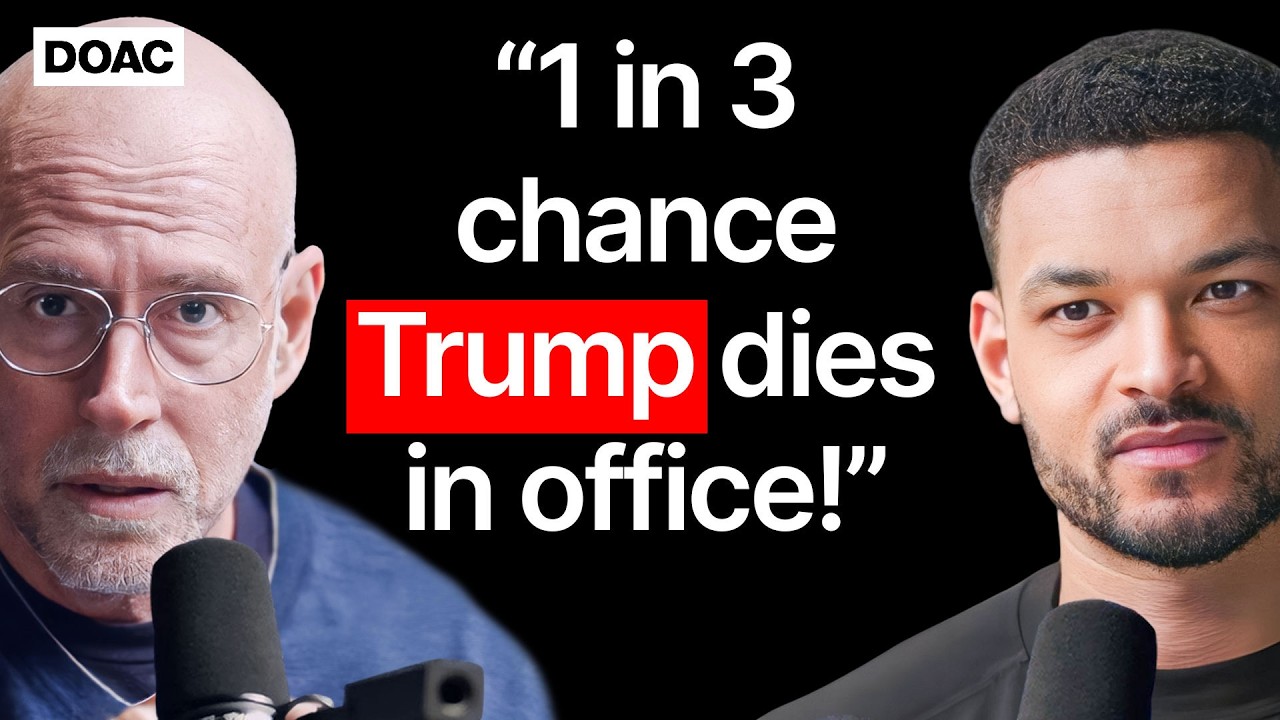
Scott Galloway: "There Is A 33% Chance That Trump Dies In Office!" — The Diary Of A CEO

The Diary Of A CEO

Galloway warns that Trump presents a 33% actuarial risk of dying in office while predicting higher debt and tariffs if Republicans win.

AI-assisted summary of Scott Galloway: "There Is A 33% Chance That Trump Dies In Office!" — original source. Check the original for full context.

Source published:

Detailed notes

## Background This video was published on YouTube by The Diary Of A CEO channel on November 4, 2024. According to the page description, Scott Galloway returns to join host Steven Bartlett on the eve of the 2024 U.S. presidential election to preview two possible futures for America, discussing topics ranging from tax policy and candidate health to young men's shifting politics and relationships.

## TL;DR Scott Galloway and Steven Bartlett analyze the critical drivers behind the 2024 U.S. presidential election, highlighting how podcasts, raw authenticity, and cultural appeals have shifted young men toward Donald Trump and the Republican Party. Galloway critiques both major political parties, advocating for class-based affirmative action over identity politics while examining the economic realities and political alienation impacting younger generations. He also warns of foreign social media manipulation, the systemic crisis of male loneliness and mental health, and the societal risks posed by digital substitutes like pornography and AI companions.

## Atmosphere & style The conversation carries an urgent, highly engaging, and candid energy as two sharp minds dissect complex political and cultural shifts right before a historic election. Galloway delivers his signature blend of data-driven pragmatism, raw vulgarity, and self-deprecating wit, keeping the tone grounded even when tackling heavy topics like suicide, foreign espionage, and political gridlock. The dynamic between Bartlett and Galloway feels like an authentic, high-level peer exchange that seamlessly transitions from serious geopolitical critique to lighthearted personal banter and a surprise birthday celebration.

## Key takeaways - [00:00](https://www.youtube.com/watch?v=inwyi6Zdeo8&t=0s) The 2024 U.S. presidential election centers heavily on competing visions of masculinity, with the right's outspoken approach resonating strongly among young men. - [02:04](https://www.youtube.com/watch?v=inwyi6Zdeo8&t=124s) Political parties have shifted from policy-focused groups into quasi-religious entities that attempt to sanctify beliefs rather than engage in policy debates. - [05:19](https://www.youtube.com/watch?v=inwyi6Zdeo8&t=319s) A distinct gap exists between economic metrics and public perception, driven by top-heavy stock ownership, severe inflation on basic goods, and young adults falling behind financially compared to past generations. - [11:12](https://www.youtube.com/watch?v=inwyi6Zdeo8&t=672s) Modern political figures have largely transitioned from pragmatic policymakers into social media performers who capitalize on algorithms and outrage. - [18:54](https://www.youtube.com/watch?v=inwyi6Zdeo8&t=1134s) Podcasts have overtaken traditional media like cable news as the primary platform for political discourse and election reach. - [22:11](https://www.youtube.com/watch?v=inwyi6Zdeo8&t=1331s) Young men are increasingly shifting toward the Republican Party as they face significant social, educational, and economic struggles. - [33:23](https://www.youtube.com/watch?v=inwyi6Zdeo8&t=2003s) Restricting reproductive rights creates negative economic and social consequences that heavily impact lower-income women and alter dating dynamics. - [42:41](https://www.youtube.com/watch?v=inwyi6Zdeo8&t=2561s) The Democratic Party needs to transition from race-based identity politics to class-based support systems that address broad socio-economic hardship. - [01:00:52](https://www.youtube.com/watch?v=inwyi6Zdeo8&t=3652s) Voters predominantly make political choices based on emotional reactions rather than logical evaluations of facts and economic metrics. - [01:05:10](https://www.youtube.com/watch?v=inwyi6Zdeo8&t=3910s) Public trust in major health institutions and government bodies has severely eroded due to systematic attacks and partisan rhetoric. - [01:09:16](https://www.youtube.com/watch?v=inwyi6Zdeo8&t=4156s) Foreign adversaries utilize social media algorithms and content amplification to stoke internal division within the United States. - [01:12:11](https://www.youtube.com/watch?v=inwyi6Zdeo8&t=4331s) Social media platforms drive user engagement and ad revenue by intentionally amplifying rage and outrage over other content. - [01:20:06](https://www.youtube.com/watch?v=inwyi6Zdeo8&t=4806s) Donald Trump faces a 33% actuarial probability of dying in office if elected, based on his age and Body Mass Index. - [01:20:46](https://www.youtube.com/watch?v=inwyi6Zdeo8&t=4846s) Corporate executives often support Donald Trump as a strategy to mitigate risk against potential political retaliation. - [01:32:34](https://www.youtube.com/watch?v=inwyi6Zdeo8&t=5554s) Men face a growing mental health crisis marked by high suicide rates, loss of purpose, and feelings of inadequacy. - [01:37:05](https://www.youtube.com/watch?v=inwyi6Zdeo8&t=5825s) Digital substitutes such as pornography, online trading, and AI companions are disrupting real-world social and romantic engagement for young men. - [01:45:26](https://www.youtube.com/watch?v=inwyi6Zdeo8&t=6326s) Hyper-realistic AI companions and digital isolation present a severe long-term threat to human connection and social wellbeing.

## Detailed walkthrough ### [00:00](https://www.youtube.com/watch?v=inwyi6Zdeo8&t=0s) Intro and the Battle for Masculinity

The 2024 U.S. presidential election centers heavily on competing visions of masculinity. On the far right, voters are presented with a provocative, aggressive, and outspoken model of manhood. Conversely, the far left’s implicit view often feels like an instruction to "be more like a woman." When forced to choose between these two paradigms, the right's vision resonates far more strongly with young men, creating a cultural drift that could decide the entire election.

This ideological divide unfolds against a backdrop of intense polarization and existential dread over what a second term for Donald Trump might bring. Despite the anxiety, both political parties continue to struggle with addressing the specific struggles of modern men, setting up a deeply volatile political dynamic.

---

[02:04](https://www.youtube.com/watch?v=inwyi6Zdeo8&t=124s) Political Tension and the Polarization of American Society

Returning to the U.S. reveals an environment that feels uniquely tense and deeply divided. Political parties have morphed from organizations focused on policy debate into quasi-religious institutions that attempt to sanctify beliefs, effectively plunging the country into a cultural "holy war." Even benign public events—such as a panel on teen mental health in Florida—can instantly devolve into partisan shouting matches and booing.

> "Political parties used to be these organizations that tried to grow their membership through policy arguments. Now they've become these quasi-religions that attempt to sanctify your beliefs."

While every election is routinely framed as the most important in American history, this cycle feels uniquely consequential. America is taking away a federally recognized right for the first time by rolling back bodily autonomy and abortion access. Simultaneously, the country faces a candidate who refuses to concede elections, challenging the peaceful transfer of power. Despite this, catastrophizing from both sides misses historical context; American institutions are resilient, and the nation will endure regardless of who wins.

* **Public Endorsement:** Scott Galloway publicly endorses Vice President Kamala Harris, while acknowledging she was not his first choice and noting the election often feels like a choice over who would be "less bad." * **Global Context on Bodily Autonomy:** While nations like Mexico and Poland have moved toward expanding reproductive rights, the U.S. stands out as a rare exception in reducing them.

---

[05:19](https://www.youtube.com/watch?v=inwyi6Zdeo8&t=319s) Economic Perception vs. Reality and the Disconnected Citizen

A striking dissonance exists between economic data and public perception—a phenomenon often referred to as a "vibesession." On objective metrics, the U.S. economy is vastly outperforming the rest of the world, yet a majority of citizens feel the country is on the wrong track. The disconnect stems from the fact that economic gains have been heavily concentrated at the top, leaving the bottom 99% feeling vulnerable and left behind.

``` U.S. Economic Strengths vs. Economic Discontent ┌──────────────────────────────────────────────┬──────────────────────────────────────────────┐ │ Objective Economic Metrics │ Felt Economic Reality │ ├──────────────────────────────────────────────┼──────────────────────────────────────────────┤ │ 12.5% GDP growth since 2019 (2x G7 average) │ Prosperity concentrated in the top 1% │ │ Stock market represents ~50% of global cap │ Bottom 99% household income lags globally │ │ Lowest unemployment rates since 1968 │ Basic goods up ~40% (e.g., cereal, housing) │ │ World's largest energy producer │ Young people earning/owning less than parents│ └──────────────────────────────────────────────┴──────────────────────────────────────────────┘ ```

When individuals get a raise, human psychology leads them to attribute it to their own grit and character; when the price of cereal goes up 40%, they blame the administration. Social media algorithms compound this by constantly broadcasting how well others are doing 210 times a day, feeding feelings of rage, shame, and isolation.

* **Mississippi vs. Global Competitors:** The average household income in Mississippi—statistically the poorest state in the U.S.—is higher than the national averages of the UK, Germany, or Japan. * **Wealth Inequality in Markets:** 1% of Americans own 90% of all stocks, meaning record highs in the Dow Jones and NASDAQ primarily reflect the financial success of the ultra-wealthy. * **The Breakdown of the Social Compact:** For the first time, 30-year-olds are financially worse off than their parents were at the same age. Over the last 40 years, the average 70-year-old has become 72% wealthier, while the average person under 40 has become 24% poorer. * **Family Formation and Isolation:** 40 years ago, 60% of 30-year-olds had at least one child; today, that figure has plummeted to 27%. Furthermore, 1 in 3 men under 25 and 1 in 5 men under 30 still live with their parents, and only 1 in 3 men under 30 has a girlfriend.

---

[11:12](https://www.youtube.com/watch?v=inwyi6Zdeo8&t=672s) The Shift from Pragmatic Politicians to Performative Influencers

In the modern digital landscape, political leaders have transitioned from pragmatic lawmakers into social media performers. Decades ago, voters only saw politicians standing at a podium delivering polished speeches. Today, short-form video algorithms and long-form podcasts mean politicians are visible constantly, prioritizing charisma and raw personality over sound policy.

> "We've definitely replaced politicians who were sort of pragmatists and practitioners who used to go to Congress and legislate... with performers."

Congress suffers from an 8% approval rating, yet incumbents enjoy a 92% re-election rate. The political incentive structure rewards outrage: saying something incendiary on camera yields viral reach on TikTok and X, which immediately drives small-dollar donations from partisan bases. Outrageous statements consume all the media attention, starving out substantive conversations regarding long-term national threats like national debt and structural deficits.

* **Gerrymandering and Primary Elections:** Highly gerrymandered congressional districts mean most races are decided in the primaries rather than the general election, pushing candidates toward extreme left or right positions to out-wing their competitors. * **Minority Rule in the Senate:** Due to state population distribution, 20% of the U.S. population effectively controls 80% of the Senate seats, leaving the moderate middle underrepresented.

---

[15:41](https://www.youtube.com/watch?v=inwyi6Zdeo8&t=941s) What Trump Has Done Well: Zigging When Others Zag

From a marketing and brand strategy perspective, Donald Trump’s primary strength has been his willingness to break traditional political conventions. When every other politician was operating from the same rehearsed, cautious playbook, Trump zagged—pivoting directly into raw, unfiltered, and often provocative commentary that stood out immediately.

[16:17](https://www.youtube.com/watch?v=inwyi6Zdeo8&t=977s) Business Strategies and Trump’s Political "Zagging"

Scott Galloway begins by contrasting traditional business models with disruptive ones to illustrate political strategy. Amazon built the biggest platform by owning consumer data and steadily increasing its take-rate. In response, Shopify "zagged" by telling merchants that *they* own their data and customer relationships, positioning itself purely as a service provider.

Galloway applies this logic to American politics. For 40 to 50 years, politicians were remarkably "PG-13," carefully sanitizing their language to avoid offending any group. Over time, voters began to feel that these polished politicians were slick liars. Donald Trump broke this template by saying offensive, raw, and politically incorrect things. Even when people disagreed with extreme proposals—like his call to ban Muslims from entering the country—they saw him as an authentic anti-establishment figure willing to "burn down his own party."

[17:41](https://www.youtube.com/watch?v=inwyi6Zdeo8&t=1061s) The Attention Economy and Business Credentials

Trump’s mastery of the modern media landscape stems from recognizing that, as Italian philosopher Umberto Eco noted, the modern economy is about being famous regardless of the reason. Trump stays at the center of the news cycle daily, projecting a image of an unafraid, anti-PC leader with sharp political instincts.

Furthermore, roughly 40% of American voters enter the voting booth focusing solely on who will put more money in their pocket. Many believe government is inherently ineffective and view Trump through the lens of a successful businessman who will lower their taxes, even if his policies defer long-term national debt concerns.

- **40% of voters**: Proportion of Americans estimated to vote strictly on economic self-interest and lower taxes.

[18:54](https://www.youtube.com/watch?v=inwyi6Zdeo8&t=1134s) The Podcast Election and Trump on Joe Rogan

Galloway and Steven Bartlett dissect Trump’s three-hour appearance on *The Joe Rogan Experience*, identifying it as a watershed moment for political communication. Every presidential era brings a new dominant media platform: - **John F. Kennedy**: Television - **Franklin D. Roosevelt**: Radio - **Barack Obama**: Google/Social Media - **Donald Trump (2016)**: Twitter - **2024 Election**: Podcasts

Since the previous presidential election cycle, traditional cable TV viewership declined by 22%, while podcast listenership rose by 30%. Galloway highlights the sheer reach of top-tier podcasts: a prime-time cable show on CNN or MSNBC typically draws around 500,000 viewers. By appearing on Joe Rogan, Trump reached an audience equivalent to appearing on CNN, MSNBC, and Fox News simultaneously during prime time every single night for an entire week.

Bartlett describes Trump’s Rogan appearance as a "masterstroke" from a marketing perspective. It humanized him, showed his humorous side, and softened his public image. Bartlett notes that a liberal, strongly feminist acquaintance watched the episode and found herself laughing out loud at his stories about *The Apprentice*.

Galloway mentions that while he only hears from the Kamala Harris campaign when they are asking for money ("Latin for please send us money"), his top unsolicited piece of advice for her team was simple: get on a plane to Austin and record an episode with Joe Rogan.

- **Cable TV vs. Podcast Trends**: Cable TV down 22%; podcasts up 30% since the prior election cycle. - **Rogan Episode Viewership**: 11 million+ podcast listeners and 40 million+ YouTube views. - **Prime-time Cable Benchmark**: ~500,000 viewers per show. - **Kamala Harris on *Call Her Daddy***: Cited by Galloway as another seminal 2024 podcast moment that dominated the cultural zeitgeist for a week.

[22:11](https://www.youtube.com/watch?v=inwyi6Zdeo8&t=1331s) The Political Divide and the Crisis Facing Young Men

Addressing why young men are gravitating toward Trump, Galloway points out that the 2024 race is historically unprecedented regardless of who wins: - No incumbent administration with an approval rating below 50% has won re-election in modern history (a hurdle for Harris). - No candidate who has never crossed a 50% approval threshold has ever been re-elected (a hurdle for Trump).

Culturally, young men are becoming more conservative while young women are growing more progressive, creating a ideological rift between the sexes. Unlike past generations—where political affiliation rarely impacted dating—politics has become a major romantic barrier.

Galloway argues that young men are not necessarily becoming far-right ideologues; in fact, their views on gender equality broadly mirror those of young women. Instead, they are actively abandoning the Democratic Party because they feel systematically excluded.

For example, the Democratic National Committee (DNC) website lists 16 specific constituent groups it explicitly advocates for—such as Asian Americans, seniors, veterans, and Black Americans—accounting for roughly 76% of the population. Just like diversity initiatives on college campuses, when an organization explicitly targets 76% of a population for advancement, it implicitly signals that the remaining 24%—composed almost entirely of young men—is excluded.

- **Opioid and Homeless Crises**: 3 out of 4 opioid deaths and 3 out of 4 homeless individuals in the US are male. - **Suicide and Incarceration Rates**: Men are 3 times more likely to die by suicide and 12 times more likely to be incarcerated than women. - **Economic Inversion**: Women under 30 in major cities now earn more than their male peers, and single women own more homes than single men.

Galloway refers to podcaster Chris Williamson's concept of the "high heels effect": women naturally seek partners who are socioeconomically and physically equal or superior ("taller"). As women achieve remarkable, well-deserved progress in education and income, the pool of men who meet those criteria shrinks. Deprived of economic and romantic prospects, young men often fall into self-destructive habits like excessive video gaming, porn, and substance abuse.

[31:41](https://www.youtube.com/watch?v=inwyi6Zdeo8&t=1901s) Shifting Youth Demographics and Visions of Masculinity

Between 2016 and 2023, Republican support among young men surged from 35% to 48%—a massive 13-point increase in seven years.

Galloway contends that while many expected 2024 to be a referendum strictly on reproductive rights, those voters are already locked in. Instead, the election may be decided by which party offers a more aspirational and constructive vision of masculinity: - **Far Right Vision**: Aggressive, coarse, and occasionally cruel, framed as raw strength and plain-spoken authenticity. - **Far Left Vision**: Essentially telling men to "be more like a woman."

Because neither approach fully satisfies young men, Trump's unfiltered, rebellious rhetoric resonates with a demographic that feels blamed for historical privileges they never personally experienced.

- **13-Point Shift**: Republican alignment among young men rose from 35% (2016) to 48% (2023), according to *The Wall Street Journal*.

[33:03](https://www.youtube.com/watch?v=inwyi6Zdeo8&t=1983s) Bodily Autonomy, Sex, and Economic Realities

Scott argues that the Democratic Party has failed to convince young men that bodily autonomy and reproductive rights directly impact them as well. He makes a provocative point to young men: when asked whether they want more or fewer opportunities for sex, most men choose more. However, in a post-Roe environment where women face severe medical risks during failed pregnancies—such as emergency room doctors hesitating to treat sepsis due to fear of criminal prosecution—women will naturally become much more risk-averse about casual sex.

From an economic perspective, Scott notes that having an unwanted child as a young man locks you into poverty, directly crippling your ability to succeed. He breaks down masculinity into three core pillars—provider, protector, and procreator—and argues that Republicans have done a better job selling themselves on the "provider" aspect. Despite major investment banks like Goldman Sachs projecting stronger economic growth under Kamala Harris's policies, Donald Trump's "drill, baby, drill" and billionaire branding resonate more. Furthermore, Trump's proposed 60% tariffs on Chinese goods and mass deportation plans are, in reality, a recipe for severe inflation that would hurt young men's ability to provide.

[35:34](https://www.youtube.com/watch?v=inwyi6Zdeo8&t=2134s) The "Protector" Instinct and Reproductive Rights

Scott emphasizes that a man's default operating system should be protection: "Real men break up fights at bars, they don't start them. Real men protect their country, they don't shitpost." Recalling his own life, Scott shares that the first time he felt compelled to get his professional life together was when his mother got sick, feeling an intense instinctual failure as a man because he couldn't financially protect and care for her. He believes men have an innate, risk-aggressive impulse to protect others, whether on a battlefield or when a group is being demonized.

Scott praises Michelle Obama’s messaging on this topic, warning that women's rights in America are entering "Handmaid's Tale" territory, with 21 states restricting abortion access. He highlights the harsh reality that abortion bans are ultimately a war on poor women. Wealthy families can always fly a daughter to another state or secure medication like mifepristone, whereas a 15- or 17-year-old pregnant Black teenager without financial resources is left completely stranded.

- **Economic Policy Risks**: Trump's proposed policies—specifically a 60% tariff on Chinese imports and aggressive deportation efforts—risk triggering high inflation. - **Abortion Restrictions**: 21 U.S. states currently restrict abortion access in some capacity. - **Provider-Protector-Procreator Framework**: Scott's conceptual framework for understanding the core motivations behind traditional views of masculinity.

[39:00](https://www.youtube.com/watch?v=inwyi6Zdeo8&t=2340s) Candidate Realities: Harris, Trump, and Double Standards

Transitioning to candidate performances, Scott critiques Harris's lack of spontaneity, referencing her appearance on *The View* where she failed to articulate how her policies would differ from Joe Biden's—a major unforced error. While she excelled in the debate through careful preparation, she often overthinks in unscripted moments. In contrast, Trump speaks off the cuff, blurting out absurd or unverified statements (like telling Vladimir Putin to "stop that"), yet comes across to his followers as authentic and funny.

Scott points out the extreme double standard and misogyny at play in modern politics, echoing commentator Van Jones: Trump is allowed to be "lawless," while Harris is expected to be "flawless." If Harris had faced a fraction of Trump's legal troubles or sexual assault allegations, her campaign would be instantly over. Steven adds that Harris built a "hill of perfection," making her vulnerable to any contradiction, whereas Trump built a "hill of sloppiness," rendering him virtually immune to attacks because his chaotic behavior is entirely consistent.

[42:41](https://www.youtube.com/watch?v=inwyi6Zdeo8&t=2561s) Moving Past Identity Politics toward Class-Based Support

Scott argues that the Democratic Party needs to move away from identity politics and Diversity, Equity, and Inclusion (DEI) frameworks that allocate resources based strictly on race, gender, or sexual orientation. Affirmative action made sense as a race-based policy in the 1960s, but today, economic status is the primary driver of inequality. He notes that while two-thirds of Harvard's freshman class is non-white, 70% of those students come from upper-income, two-parent households. Granting admissions privileges to a wealthy private equity heiress simply because of her race does not achieve meaningful diversity.

Instead, Scott advocates for class-based affirmative action centered around household income and adversity. He notes that white working-class kids in places like Kentucky or Appalachia raised by single parents feel alienated and angry when told they do not qualify for help. Reflecting on his own youth, Scott credits his success to Pell Grants, which supported him as the son of a single secretary earning under $40,000 a year. He points to the University of California system's 1997 shift to an "adversity score"—measuring a candidate's resilience and ability to overcome obstacles—as the ideal model for national policy.

Steven strongly agrees, sharing his own perspective as someone born to a Nigerian mother in Africa who grew up with financial struggles but is now wealthy. Steven argues that his future children should not receive race-based advantages over struggling lower-class individuals, as his wealth will already afford them immense privileges.

- **Harvard Student Demographics**: While two-thirds of the freshman class is non-white, roughly 70% of those non-white students come from upper-income homes with two parents. - **U.S. Wealth Disparity**: The average net worth of Black and Latino households in the U.S. ranges around $20,000–$25,000, compared to $150,000–$160,000 for white households. - **UC System Model**: In 1997, the University of California system banned race-based affirmative action, adopting an "adversity score" to evaluate socio-economic resilience. - **Top 1% Advantage**: Children born into the top 1% of household income in the U.S. are 77 times more likely to attend an elite university.

[48:05](https://www.youtube.com/watch?v=inwyi6Zdeo8&t=2885s) Implicit Bias and Silicon Valley Capital

Concluding the discussion on representation, Scott acknowledges the stark reality of racial and gender bias in business. Reflecting on his early career raising venture capital in the 1990s, he notes that 98% of capital went exclusively to white men, something he failed to notice at the time because of his own background.

He shares a personal story from raising capital for his company, L2. During a critical meeting with a venture capital firm involving all 27 partners, his female co-founder abruptly pulled him out into the hallway to point out a glaring issue—an incident illustrating how institutional biases often remain invisible until directly pointed out by those affected.

> "The smartest thing you can do in the US is decide to be born to rich parents." — Scott Galloway

[48:56](https://www.youtube.com/watch?v=inwyi6Zdeo8&t=2936s) The Evolution of Affirmative Action

Reflecting on a personal anecdote from 2014, Scott Galloway recalls a moment when a woman pointed out that all 27 partners at a particular venture capital firm were men. At the time, he had not even realized that prosperity and opportunity were being crowded into a tiny fraction of the population. Returning to the present day, he notes that things have changed dramatically; between a quarter and a third of the partners at that same firm are now female because "they got the memo." Galloway expresses hope that society has made enough progress regarding identity-based affirmative action to begin transitioning toward economically driven, class-based affirmative action. Steven Bartlett agrees, pointing out that a class-based system naturally captures and supports minorities due to statistical overlap, while also including the struggling majority, which both find highly encouraging.

[49:53](https://www.youtube.com/watch?v=inwyi6Zdeo8&t=2993s) The Madison Square Garden "October Surprise"

The conversation shifts to recent political events, specifically Tony Hinchcliffe's controversial stand-up set at Donald Trump's Madison Square Garden rally. Bartlett plays a clip of the set to set the context, where Hinchcliffe jokes about a "floating island of garbage in the middle of the ocean right now... I think it's called Puerto Rico," makes crude remarks about Latino immigration and family planning, and quips that "Republicans are the party with a good sense of humor."

Bartlett admits he is in two minds about the incident. On one hand, he recognizes Hinchcliffe as a comedian known for inappropriate humor on his show *Kill Tony*, and he does not believe the comedian genuinely hates Puerto Ricans. On the other hand, Bartlett notes that the Trump campaign should have anticipated how the opposition would weaponize any offensive wording into a devastating marketing campaign. Galloway agrees that comedians should be cut a very wide birth, citing figures like Dave Chappelle speaking on the trans community or Michelle Wolf at the White House Correspondents' Dinner. Comedians play a vital role by saying provocative, obnoxious things to "soften the beach" and make people think. However, Galloway argues the fundamental problem with Hinchcliffe's set was not just the offense, but the lack of artistry. "The most offensive thing about what he said was it wasn't funny," Galloway states. He shares that on his own podcast with Kara Swisher, he frequently uses off-color humor—joking about her identity as a lesbian with lines like "how's the German Shepherd in the Subaru"—but it works because the uncomfortable pause resolves into genuine laughter, giving the audience permission to laugh. Hinchcliffe's jokes simply did not land.

Beyond the artistic failure, Galloway breaks down the catastrophic strategic blunder on a risk-adjusted basis: * There are roughly 400,000 Puerto Ricans living in Pennsylvania. * Pennsylvania is a critical, razor-thin toss-up swing state that could decide the entire presidential election. * If the joke angers and motivates even 10,000 or 15,000 Puerto Ricans—who otherwise would have stayed on the couch—to get out and vote, it could cost Trump the state and the election. * The campaign team knew the joke was on the teleprompter and should have pulled it to avoid such massive downside risk.

Galloway contrasts this tactical stupidity with his broader frustration with the Democratic Party, which he chides for becoming "humorless" and overly sensitive, where everything is treated as offensive or triggering. He notes that in a healthy, post-racist society, close friends—like his own gay friends making fun of his sexual orientation while he mocks theirs—use edgy humor as a form of affection, not malice. Ultimately, while Galloway disdains the fake outrage from the left, he views the rally incident as a monumental unforced error that handed the Harris campaign the perfect opportunity to run highly damaging ads to millions of voters who did not watch the full event.

[57:14](https://www.youtube.com/watch?v=inwyi6Zdeo8&t=3434s) The Polymarket Wager and Polling Realities

When Bartlett asks who will win the election, Galloway reveals his immediate plans: "I'm going to bet $358,000 on Polymarket... I'm going to invest bet $358,000 on Harris." He explains the math behind his decision, noting that Polymarket odds sit at roughly 62% for Trump and 38% for Harris. Galloway attributes this tilt to the platform's user base, which skews younger and male—demographics heavily favoring Trump. However, because every A+ quality traditional poll shows the race as a dead heat well within the margin of error, the betting market odds offer an incredibly lucrative 2.8-to-1 payoff for a Harris victory. Statistically, it represents free risk-adjusted upside.

Bartlett counters, explaining why he would hesitate to bet on Harris. He recalls the 2016 election where polls overwhelmingly predicted a Hillary Clinton landslide, only for an invisible force to upset the outcome—whether driven by "shy Trump voters" hiding their opinions due to social ramifications, or an asymmetry in raw enthusiasm between voters wanting change versus voters accepting more of the same. Galloway concedes the point but maintains that even if Trump holds a slight edge, a 38% probability implies a great bet when the payout is so high.

* **The $358,000 Bet:** A calculated risk on Polymarket that would return a $1 million payout if Harris wins. * **The Enthusiasm Gap History:** Galloway recalls canvassing for Secretary Clinton in Florida in 2016, describing her as an outstanding thinker and highly competent foreign policy mind, but deeply unlikable. He remembers knocking on doors in mixed-race, lower-upper-middle-class neighborhoods where self-identified Clinton voters were polite but completely unmotivated—often not even knowing where their polling stations were. In contrast, Trump households passionately slammed doors in his face, displaying an intense energy that signaled trouble for the Democrats. * **The Modern Polling Delta:** Galloway believes the "hold my beer while I go behind a curtain and vote for Trump" embarrassment factor has largely vanished by 2024, meaning modern polls are likely far more accurate and less prone to undercounting Trump support than in previous cycles.

[01:00:52](https://www.youtube.com/watch?v=inwyi6Zdeo8&t=3652s) Ground Game and the Amygdala vs. Prefrontal Cortex

Galloway outlines three primary reasons he believes Harris could pull off a victory, despite statisticians leaning toward Trump at this moment: 1. **The Turnout of Young Women:** Driven heavily by the issue of bodily autonomy, young women are squarely in Harris's camp. Galloway observes that women are naturally more organized, meticulous planners and allocators of time. He jokes about raising 14- and 17-year-old boys, calling young men "dopes" whose prefrontal cortexes do not fully mature until age 25. On election day, young men are far more likely to let distractions get in the way of making it to the polls, giving Harris a structural advantage. 2. **The Fallout in Pennsylvania:** The tactical error regarding Puerto Rico could mobilize thousands of critical votes in a crucial swing state. 3. **The Ground Game Disparity:** Relying on insights from contacts within the campaigns, Galloway notes that Harris boasts an army of roughly 300,000 people on the street walking voters to the polls, compared to Trump's estimated 30,000 to 50,000. This 10-to-1 ground advantage could prove decisive.

Transitioning to the broader psychology of voters, Galloway highlights a profound disconnect. If America were a horror movie, he says, "the call is coming from inside of the house." Intellectually—using the prefrontal cortex—the data shows America is thriving economically, poised to grow its GDP next year by more than the rest of the world combined in gross dollar terms, and completely dominating the global AI revolution. Yet, voters operate out of the amygdala—the emotional center of the brain. When voters see a billionaire stepping off a private plane branded with his own name, the emotional response overrides data; the brain simply thinks, "he's going to help me get rich."

Bartlett agrees, noting that as a marketer, he has learned that emotional stories always defeat data, facts, and statistics. He recalls a conversation with a neuroscientist who detailed a 2016 primary debate regarding vaccines between Dr. Ben Carson and Donald Trump. While the medical doctor laid out flawless scientific figures proving vaccines do not cause autism, Trump countered with a vivid narrative: *"I got a friend who has a daughter who is this big... and they came to her with a needle this big and they gave her the injection and she's got autism."* The neuroscientist confessed to Bartlett that despite knowing Trump was not telling the truth, the raw, emotional anecdote still left her feeling instinctively hesitant to vaccinate her own daughter. Galloway laments that this election operates on the exact same plane; facts do not matter as much as how a candidate makes voters feel, signaling a dangerous decay in collective respect for shared data and foundational institutions.

[01:05:10](https://www.youtube.com/watch?v=inwyi6Zdeo8&t=3910s) The Erosion of Public Trust in Institutions and Political Fatigue

Scott Galloway discusses how public faith in established institutions has plummeted. When organizations like the American Academy of Pediatrics, the CDC, the American Heart Association, or the Journal of the American Medical Association (JAMA) issue statements confirming that there is no evidence linking vaccines to autism or myocarditis, a growing segment of the population simply dismisses them. Galloway places significant blame on the political right for systematically attacking these institutions, leaving people uncertain of where to turn. Consequently, citizens rely heavily on social media algorithms designed to feed them polarizing, incendiary content.

Despite these headwinds, Galloway believes Kamala Harris has a strong chance to pull off a victory due to sheer public exhaustion. He argues that Donald Trump represents non-stop chaos and fatigue, hoping that swing voters will ask themselves if they truly want to return to that level of daily tension. Reflecting on Joe Biden's tenure, Galloway notes that his favorite attribute of Biden was that he was "pretty boring."

- Galloway notes that during the Trump presidency, the constant cycle of protests, social tension, and COVID-19 chaos left the country feeling like it was constantly burning. - The erosion of institutional authority has driven citizens toward algorithmic media ecosystems that prioritize outrage over factual consensus.

---

[01:06:35](https://www.youtube.com/watch?v=inwyi6Zdeo8&t=3995s) Nostalgia, Nostalgia Bias, and Economic Realities

The conversation shifts to why many voters look back fondly on the Trump years despite the chaos. Steven references polling showing that a majority of Americans feel their lives were better four years ago than they are today. Galloway explains that human beings suffer from a pervasive "rose-tinted glasses" nostalgia bias. He recalls how Ronald Reagan pioneered the classic campaign question, "Are you better off now than you were four years ago?", pointing out that it works in almost every election cycle because people naturally romanticize the past and forget previous hardships.

Economic friction—specifically inflation—amplifies this psychological effect. Galloway highlights that for Americans under the age of 45, the recent inflationary spike represents their first real experience with rapidly rising prices. He points out that luxury hotel rooms in Los Angeles have doubled in price over four years, while basic household staples like cereal have jumped 30% to 40%. When people receive a pay raise, they attribute it to their own grit and hard work; when the cost of living surges, they blame the government.

- Galloway acknowledges his own confirmation bias in searching for reasons why Harris will win. - Younger voters under 45 are particularly sensitive to inflation because they have no adult memory of price volatility prior to the recent spike.

---

[01:07:56](https://www.youtube.com/watch?v=inwyi6Zdeo8&t=4076s) The Need for a Decisive Mandate and US vs. UK Election Systems

Galloway expresses a deep desire for a decisive election outcome, regardless of who wins. Looking back at American history, major shifts occurred when a party secured an unambiguous mandate—such as the New Deal in the 1930s or the Reagan Revolution in the 1980s. The current political stalemate, where neither party can achieve a definitive victory, leaves the nation gridlocked in a manner similar to the Middle East. Galloway argues that America urgently needs a candidate to win 55% or 60% of the vote to establish a clear national direction and avoid endless legal challenges.

Comparing the process to the United Kingdom, Galloway admires how British parliamentary elections are wrapped up in just six to eight weeks. In the UK, even when voters dislike a newly elected Prime Minister, there is a general consensus to "keep calm and move along." By contrast, the United States spends billions of dollars and deploys armies of lawyers on both sides to contest razor-thin election results, tearing the social fabric apart.

- The vast financial and legal infrastructure built around contesting American elections exacerbates national division. - Decisive victories historically allowed the US to move past existential debates, whereas thin margins fuel constant delegitimization.

---

[01:09:16](https://www.youtube.com/watch?v=inwyi6Zdeo8&t=4156s) Social Media Algorithms and Foreign Disinformation Tactics

Galloway warns that America's primary geopolitical adversaries—namely China and Russia—have recognized that they cannot defeat the United States through military force or economic warfare. Instead, they are weaponizing American social media platforms to turn citizens against one another. Galloway likens this strategy to historical tactics used against Native American tribes: encouraging internal conflict until a portion of the population is eliminated, making the final military effort trivial. He notes that on platforms like TikTok, pro-Palestinian content vastly outpaces pro-Israel content by a ratio of 52 to 1, arguing that foreign actors are intentionally amplifying wedge issues to foster internal hatred.

Steven agrees, offering an insider perspective from 15 years in social media. He points out that TikTok's algorithm exhibits extreme variance—a video might get 1,000 views or 7 million views regardless of follower count. This structure inherently favors extreme, polarizing takes over nuanced, unemotional discussions.

- Galloway states that the ratio of pro-Palestinian to pro-Israel content on TikTok is roughly 52 to 1, illustrating algorithmic distortion. - Chinese domestic regulations strictly govern algorithms and ban foreign media apps, whereas the US allows foreign-controlled platforms unfettered access to its youth. - Galloway calls TikTok a "neural jack implanted into the wet matter of our youth," noting that under-25s spend more time on it than on all traditional broadcast networks combined.

---

[01:12:11](https://www.youtube.com/watch?v=inwyi6Zdeo8&t=4331s) "Rage Sells": How Outrage Drives Big Tech's Business Model

Galloway explains how social media platforms shifted their core monetization strategies. While legacy advertising relied on sex to sell products, companies like Meta discovered an even more powerful emotional driver: rage. A measured, data-driven discussion with an epidemiologist about vaccine history gets minimal reach from algorithms. Conversely, an incendiary clip—such as Robert F. Kennedy Jr. telling a podcast host that the best thing to do upon seeing a newborn is to tell the mother not to vaccinate—generates explosive engagement.

This dynamic creates a feedback loop: critics post angry responses, boosting the comment count, which Signals the algorithm to distribute the video further. Higher engagement leads to more ad impressions and increased shareholder value, incentivizing platforms to amplify outrageous content over factual truth.

- "Meta figured out there's something better than sex: rage." - Outrage-inducing content drives comment volume, interaction metrics, and ad revenue, causing algorithms to give incendiary claims massive organic distribution.

---

[01:14:56](https://www.youtube.com/watch?v=inwyi6Zdeo8&t=4496s) The Unspoken Alliance Between Washington and Big Tech

Reflecting on his experience getting a greenlighted Netflix scripted series about Big Tech after seven years of development, Galloway outlines a scene illustrating why tech giants remain unregulated. He describes a dynamic where tech executives like Mark Zuckerberg face intense public scrutiny in open congressional hearings regarding teen mental health and suicide rates. However, behind closed doors in classified security briefings, these executives remind intelligence officials of their value in tracking threats.

Platforms like Instagram and Meta operate as unmatched surveillance assets for agencies like the CIA, Mossad, or GRU. By leveraging location data, network mapping, and user activity, these platforms assist in targeting drone strikes against foreign adversaries, such as militants in Yemen. Because of this intelligence value, Congress consistently fails to pass meaningful regulatory legislation despite public grandstanding.

- Galloway notes that Big Tech functions as "the ultimate espionage vehicle" for intelligence services globally. - Despite frequent public congressional hearings, no comprehensive federal legislation regulating social media platforms has successfully passed.

---

[01:16:33](https://www.youtube.com/watch?v=inwyi6Zdeo8&t=4593s) Age, Perception, and Biden's Ouster from the 2024 Race

The discussion turns to the issue of age in the 2024 election. Galloway acknowledges that Donald Trump would be in his eighties during a second term, making him older than Joe Biden was when he took office in 2020. However, Trump presents a significantly more robust image than Biden. Galloway candidly critiques Biden’s final public appearances, pointing out that his weak voice and slurred delivery made him appear past his expiration date.

Galloway rejects the public narrative that Biden voluntarily stepped down out of patriotism. He asserts that Biden was forcibly removed from the top of the ticket by party leadership, specifically former Speaker Nancy Pelosi, who realized that keeping Biden would devastate down-ballot Democratic candidates.

- Galloway states that Nancy Pelosi gave Biden an ultimatum, threatening that more party members would publicly call for his resignation every day if he did not step aside. - Pelosi and Biden reportedly have not spoken since that decisive conversation. - Galloway characterizes top politicians as inherent narcissists, comparing Biden's reluctance to step aside to Ruth Bader Ginsburg and Dianne Feinstein holding onto power past their physical limits.

---

[01:18:36](https://www.youtube.com/watch?v=inwyi6Zdeo8&t=4716s) The Flawed Selection Process of Kamala Harris

Concluding his critique of the Democratic Party's strategy, Galloway argues that Biden’s refusal to step down earlier deprived the party of a competitive primary. In military operations, leaders prioritize commanders who have undergone actual combat training. Galloway contends that political primaries serve as that necessary battle testing, forcing candidates to refine their messaging under intense media scrutiny and debate pressure.

By avoiding a contested primary, Democrats effectively crowned Kamala Harris rather than allowing her—or alternative candidates like Gavin Newsom or Gretchen Whitmer—to earn the nomination through competition. Galloway believes that if Harris ultimately loses the election, history will place the blame on Biden's narcissism and the party's failure to recognize biological realities over political correctness.

- Galloway cites political figures like Herman Cain, Rudy Giuliani, and Fred Thompson, who led early polls but folded once the primary debates began. - A open primary process would have left Harris far more battle-tested or elevated a different candidate who had proven their appeal on a national stage.

Here is a detailed, faithful walkthrough of Part 6 of the transcript.

---

[01:20:06](https://www.youtube.com/watch?v=inwyi6Zdeo8&t=4806s) The Actuarial Risk of Trump's Age

The conversation opens with Scott Galloway addressing the political fallout surrounding Joe Biden's age and eventual departure from the race, describing how Democratic leadership fell into a "consensual hallucination" that they could beat father time, only for biology to prove them wrong. Galloway then applies that same harsh reality to Donald Trump. Referencing a claim he made on his podcast *Pivot*, Galloway notes that if he were acting as a life insurance agent, he would charge Trump a massive premium without even accounting for profit margins.

Based strictly on his body mass index (BMI) and his age, Galloway asserts there is a one-in-three chance that Trump "leaves feet first from the White House" if he wins a second term.

* **Life Insurance Metaphor:** Galloway notes that if Trump wanted a $300,000 policy, an actuary would charge him $100,000 upfront due to his age and health metrics.

---

[01:20:46](https://www.youtube.com/watch?v=inwyi6Zdeo8&t=4846s) Elon Musk, Political Calculus, and the Power of the "Manosphere"

When asked about the partnership between Donald Trump and Elon Musk, Galloway emphasizes that Musk is an enormous net positive for the Republican party. He describes watching SpaceX land a rocket booster back into "giant metal Chopsticks" as awe-inspiring engineering that creates an immediate halo effect. Beyond his operational genius—building rockets, electric vehicles, and brain chips—Musk acts as the ultimate aspirational icon for young men globally, embodying the ultimate dream of every eight-year-old boy.

> "When you see that rocket booster barreling towards gravity... and then it ignites and somehow this shit straightens out and it veers and navigates into these giant metal Chopsticks, you're just like, 'Fuck yeah, man! I want a Tesla, I want to go on Twitter... whoever that guy is voting for, I'm voting for!'"

Galloway also highlights Biden's massive political blunder in excluding Musk from an early White House EV summit, where the administration invited legacy automakers like GM instead of Tesla. That insult pushed Musk—who historically voted for Obama—further into the conservative camp. Furthermore, Galloway outlines the brutal political "algebra" that drives corporate leaders and venture capitalists like Marc Andreessen or Jamie Dimon toward Trump: * **The Asymmetric Risk of Supporting Trump:** If a CEO supports Kamala Harris and Trump wins, Trump has explicitly threatened to weaponize the Department of Justice and regulatory agencies against them. However, if a CEO supports Trump and Harris wins, the Democrats are far less likely to retaliate. Supporting Trump thus represents a rational risk-mitigation strategy for top executives. * **Targeted Political Promises:** Galloway posits that Trump comfortably offers tailored policies to key donors (e.g., promising venture capitalists to put billions of federal reserves into Bitcoin to drive the price to $1 million) in exchange for campaign funds. * **Fear of Retaliation:** Galloway reveals that an iconic morning show host told him he is considering moving to London if Trump wins, not out of ideological spite, but out of genuine fear of personal persecution by a weaponized DOJ.

---

[01:25:09](https://www.youtube.com/watch?v=inwyi6Zdeo8&t=5109s) The Economic and Social Impact of a Second Trump Term

Addressing the apocalyptic framing used by both political parties, Galloway rejects the notion that a second Trump presidency means the "end of America." He stresses that the country's economic strength, human capital inflows, and democratic institutions are resilient enough to survive any single president. However, he acknowledges that specific groups will suffer acute short-term and long-term damage:

* **Women:** A Supreme Court reshaped further by Trump could lead to national or widespread state-level bans on abortion, severely curtailing bodily autonomy in over 40 states. * **Young People:** Driven by uncontrolled federal spending ($7 trillion in expenditures against $5 trillion in revenues), growing national deficits act as a direct future tax on younger generations. Galloway warns that when debt-to-GDP hits 200% or 300%, young workers in their prime will face astronomical inflation and potential mortgage rates of 22%. * **Corporations and Wealthy Expats:** Beneficiaries like Galloway himself stand to win short-term tax relief, including proposed exemptions for Americans living abroad. * **Global Standing:** While America might lose moral authority on the world stage, Galloway notes that international adversaries might tread more cautiously simply because Trump is so wildly unpredictable.

---

[01:28:10](https://www.youtube.com/watch?v=inwyi6Zdeo8&t=5290s) Geopolitics: Ukraine and the Concept of a "Good War"

When discussing ongoing international conflicts, Galloway addresses whether Trump could end the war in Ukraine faster than Harris. While acknowledging that Trump could make a quick deal with Vladimir Putin, Galloway argues that quickness does not equal a favorable outcome for Ukraine. A lasting deal requires maximum leverage—demonstrating to Russia that the West is committed to a long-term, high-cost conflict.

Turning to the Middle East, Galloway challenges the knee-jerk American assumption that peace at any cost is always the right answer, invoking Winston Churchill’s refusal to negotiate a "bad peace" with Germany in 1939.

* **Israel's Offensive:** Galloway argues that Israel is doing the "dirty work" of the West. In just six weeks, Israel eliminated more top-tier target terrorists than the U.S. managed over two decades. * **The Intelligence Operations:** He describes Israel's targeted strike on Hezbollah operatives via compromised pagers in Lebanon as the "most precise anti-terrorist action in history." * **A Regional Iron Dome:** Galloway believes that neutralizing Hamas and weakening Hezbollah creates a path toward normalizing relations between Israel and Saudi Arabia, ultimately constructing a durable security framework for the entire region. * **The Counter-Argument:** Host Steven Bartlett counters that the massive destruction and civilian suffering risks breeding a new generation of radicalized youth, questioning whether the war is simply creating more terrorists than it eliminates.

---

[01:32:34](https://www.youtube.com/watch?v=inwyi6Zdeo8&t=5554s) The Crisis of Young Men and the Search for a Modern Masculine Code

Galloway transitions to his upcoming book on the plight of men, drawing parallels between the process of writing books and the amnesia mothers experience after childbirth that allows them to do it again. He explains that his motivation stems from his own past as a struggling young man and the appalling statistics surrounding male mental health.

> "If you went into a morgue and five of the people who had died by suicide... four of them were one special interest group, you'd go, 'There's something wrong, we need to weigh in.' Four out of five people who kill themselves in the US are men."

Galloway frames the issue around two key words that appear most frequently in suicide notes: **useless** and **worthless**. To counter this crisis, society must establish a constructive "code of masculinity" anchored in purpose, protection, and provision, rather than letting the narrative be hijacked by toxic figures.

* **Divorce Impact:** A man is eight times more likely to commit suicide following a divorce. * **Fan Mail Indicators:** Out of roughly 80 emails Galloway receives daily from strangers, the most common asks if it's too late to buy Nvidia stock. The second most common comes from frantic single mothers asking how to save their sons who are "vaping and playing video games in the basement" while their daughters thrive in college and careers. * **Shifting the Narrative:** Galloway notes that figures like Andrew Tate initially triggered a national "gag reflex" against discussing men's issues, mistaking all male advocacy for misogyny. However, thought leaders like Richard Reeves and Jordan Peterson helped open up a legitimate, needed conversation around male well-being.

[01:35:52](https://www.youtube.com/watch?v=inwyi6Zdeo8&t=5752s) Bipartisan Concern for the Plight of Young Men

Scott Galloway highlights the work done by Richard Reeves at the American Institute for Boys and Men, noting how it has brought crucial awareness to the deep structural issues affecting young men. He points out that even many feminists and progressive advocates are beginning to recognize an essential truth: women cannot fully flourish in a society where men are floundering. There is a growing, bipartisan realization that something is fundamentally broken—a sense that "there's something wrong in Mudville"—and that addressing it requires real resources, creative policy, and genuine empathy rather than political hostility.

While Galloway acknowledges the inevitable online pushback—critics asking where this concern was for the last two thousand years when women and minorities were oppressed—he argues that society can multi-task. Acknowledging and addressing the severe obstacles women still face does not mean ignoring young men. Galloway expresses genuine optimism that the public discourse is finally shifting away from toxic, politically charged talking points toward a productive, empathetic conversation about helping young men succeed.

* **Key Advocacy:** Scott references Richard Reeves's work at the American Institute for Boys and Men as a catalyst for shifting public understanding. * **Core Philosophy:** Society can support young men with resources and empathy without slowing down or diminishing the progress made by women and marginalized groups.

---

[01:37:05](https://www.youtube.com/watch?v=inwyi6Zdeo8&t=5825s) The Pornography Debate and Modern Masculinity

Steven Bartlett steers the conversation toward pornography and its role in the life of young men isolated in their basements. Bartlett shares a recent personal insight, noting a listener's feedback and a seven-minute voice note from a female friend revealing that women also suffer from pornography addiction—a perspective that had been missed in a previous podcast debate. Turning back to young men, Bartlett asks Scott whether the young, isolated man playing video games in his basement should be watching pornography.

Scott offers a nuanced perspective, noting that while Project 2025 advocates for banning pornography entirely, he views porn or platforms like OnlyFans in moderation as economic innovations rather than pure evil. However, Scott emphasizes that the real danger lies in how the world's most talented, well-resourced technology companies are engineering products to convince young men they can replace real life with a digital facsimile. Instead of going through the hard, necessary humiliation of building real-world friendships, interviewing on LinkedIn, showing up to work on time, or approaching women in public, young men are lured into low-effort digital substitutes: Discord, Reddit, Robinhood, crypto courses from manosphere influencers, and hyper-abundant pornography.

Galloway candidly shares his own coaching advice to young men, admitting "I consume porn," but warning them to modulate it so they do not drain their real-world drive. He traces his own greatest life joy—raising his sons with his partner—back to a raw, primitive impulse: seeing a woman at the Raleigh Hotel pool in Miami and desperately wanting to have sex with her. That physical drive was the catalyst that led to dating, moving in together, buying a dog, building a family, and acquiring cash-flowing real estate in Florida. He even quips that the only reason he ever graduated from UCLA was the off chance he might meet a woman on campus. When tech and pornography eliminate that biological drive, young men lose their "mojo"—the fundamental motivation to hit the gym, dress well, learn humor, take risks, and endure romantic rejection.

* **OnlyFans & Pornography:** Galloway considers OnlyFans an interesting economic innovation where creators make substantial money, asserting that moderate porn consumption isn't inherently evil, unlike conservative calls to ban it outright. * **Digital Facsimiles:** Tech platforms offer frictionless replacements for hard human experiences: * **Friendship:** Replaced by specialized Discord and Reddit groups instead of navigating real-world group dynamics. * **Career Success:** Replaced by trading crypto on Robinhood or Coinbase and buying get-rich-quick manosphere courses. * **Dating & Romance:** Replaced by endless online pornography and algorithmically driven content. * **The "Mojo" Dynamic:** Galloway emphasizes that sexual drive is a primary motor for self-improvement; replacing it with artificial outlets destroys a young man's desire to build a life.

---

[01:42:19](https://www.youtube.com/watch?v=inwyi6Zdeo8&t=6139s) Advice for Young Men and Women in Dating

Scott distills his advice for young men into a straightforward directive: "Be the guy you'd want to have sex with." That means getting one's life together—not necessarily being rich, but having a clear plan, going to the gym, dressing well, smelling good, learning to make women laugh, and accepting rejection gracefully. If a man approaches a woman and she declines, both will survive, but taking that risk is essential to building a fulfilling life.

For young women, Scott offers advice centered around giving men a "second coffee." He critiques modern culture and social media for advising women to walk away at the first minor flaw. Citing marital data, Scott notes that in three-quarters of marriages lasting over 30 years, one partner—usually the man—was significantly more interested at the very beginning. Because men face lower biological consequences from sex than women, women are naturally choosier. Therefore, men need environments where they can demonstrate excellence over time—such as at work, school, or social gatherings—where women can discover their humor, kindness, and character.

However, with young people drinking less alcohol, staying home, and avoiding strangers, these crucial environments are disappearing. Galloway humorously pushes back against popular health influencers like Andrew Huberman and Peter Attia, declaring that young people actually need to "drink more alcohol," get out of the house, be in the company of strangers, and make a series of "bad decisions" that might actually pay off in real-world togetherness and romance.

* **Advice for Men:** Focus on basic self-improvement—fitness, hygiene, humor, having a direction—and learn to endure romantic rejection as a normal part of life. * **Advice for Women ("Second Coffee"):** Avoid written-off dating opportunities instantly; 75% of successful long-term marriages (30+ years) began with asymmetric interest where the man was initially more eager. * **Socializing & Alcohol:** Galloway argues against total sobriety trends for youth, stating that young people need more alcohol-fueled togetherness and random encounters to break out of digital isolation. * **Gender Disparity in Isolation:** When women face romantic absence, they tend to reinvest in work and friendships; when men face isolation, they retreat down destructive rabbit holes.

---

[01:45:26](https://www.youtube.com/watch?v=inwyi6Zdeo8&t=6326s) The Greatest Threat of AI: Deepening Loneliness

Transitioning into the final segment, Steven introduces a question left by the previous podcast guest, former Google CEO Eric Schmidt. Anticipating a standard high-level tech query, Scott jokes, "I already don't like this," assuming it will be an abstract question about environmental policy or the future. However, Bartlett reveals Schmidt's question: "What are you scared about with AI and our future?"

Scott acknowledges standard systemic threats like AI sentience, deepfake misinformation, political polarization, election weaponization, and widening income inequality. However, he insists that the single greatest threat posed by AI is acute human **loneliness**. He illustrates the stark reality facing an average young man on dating apps: a man of average physical attractiveness must swipe right roughly 200 times to secure a single coffee date, and four out of five of those dates will ghost him—requiring nearly 1,000 swipes for one real connection. Faced with this brutal rejection, young men will increasingly turn to hyper-realistic, highly attractive AI avatars that never argue, ghost, or reject them.

Steven agrees, observing how technology over the last decade has made human desires friction-free and "low-calorie." While social networks made staying in touch effortless but shallow, and pornography made sex seem accessible without the reality, AI offers "relationships" devoid of the messy arguments, compromises, and friction that define real human intimacy. Scott reflects that real human connection—moments with partners, parents, friends, and children—is "the whole shooting match," and everything digital is merely a cheap copy. Eliminating the natural friction of life, whether in gym workouts or romantic rejection, strips away the very experiences that build character, resilience, and meaningful human existence.

* **Dating App Reality:** An average-looking male user must swipe right ~200 times to get one coffee date, with an ~80% ghosting rate after the initial meeting. * **Epidemic of Male Isolation:** * 1 in 7 men (approx. 14%) do not have a single close friend. * 1 in 4 men (25%) cannot name a best friend. * **The AI Companion Threat:** Generative AI bots offer low-friction, fake relationships that destroy a person's willingness to endure real-world risk, deepening societal isolation and fueling conspiracy theories and political extremism. * **The Value of Friction:** Both speakers conclude that choosing pure comfort over real-world friction robs individuals of genuine joy, growth, and deep connection.

Closing Thoughts on Hard Work and Book Endorsement Banter

Scott concludes his core message by emphasizing that "anything wonderful in their life is super hard," noting that whether it is building a good relationship or making money, any truly rewarding endeavor requires immense effort. Steven pivots to express his deep appreciation, sharing that he is a massive fan of Scott's latest book, *The Algebra of Wealth*, to the point that he endorsed it on the cover. This sparks lighthearted banter when Scott jokes that it is "somewhat humiliating that a guy 30 years younger than me is on the cover of my book," blaming his publisher for the decision.

To top the joke, Scott recalls his favorite blurb from a previous book project: when Elon Musk called him an "insufferable numbskull," Scott proudly instructed his team to "Put it on the book." Steven praises Scott's communication skills and wisdom, reminding viewers to check out Scott's books and his *Pivot* podcast, while Scott reciprocates by congratulating Steven on his massive success.

* Steven's endorsement is featured directly on the front cover of Scott's book, *The Algebra of Wealth*. * Scott jokingly recalled that Elon Musk once called him an "insufferable numbskull," a quote he proudly considered using as a book blurb.

Surprise Birthday Celebration and Outro

As the formal interview wraps up, a sudden surprise unfolds in the studio as a birthday cake and celebration are brought out for Scott, catching him completely off guard. Scott reacts with shock, humor, and mock terror, exclaiming, "What the actual [expletive]... I almost slipped and broke a hip there, don't do that at my age, Jesus, happy birthday!" He notes that his 50th birthday is coming up this Sunday, expressing genuine gratitude while calling the gesture "entirely inappropriate and unexpected and frightening."

Following the surprise, Steven closes the episode by introducing the newly updated Version 2 of *The Diary of a CEO* Conversation Cards. He explains that every guest leaves a question behind, which has been compiled into a deck where users can scan a QR code on the back of each card to watch the respective guest answer it.

* Scott's 50th birthday falls on the Sunday following the interview. * Version 2 of *The Diary of a CEO* Conversation Cards features QR codes linking directly to the video responses of past guests.

By the way, to unlock the full functionality of all Apps, enable [Gemini Apps Activity](https://myactivity.google.com/product/gemini).

## Notable quotes > [02:04](https://www.youtube.com/watch?v=inwyi6Zdeo8&t=124s) Political parties used to be these organizations that tried to grow their membership through policy arguments. Now they've become these quasi-religions that attempt to sanctify your beliefs. — Scott Galloway

> [11:12](https://www.youtube.com/watch?v=inwyi6Zdeo8&t=672s) We've definitely replaced politicians who were sort of pragmatists and practitioners who used to go to Congress and legislate... with performers. — Scott Galloway

> [48:05](https://www.youtube.com/watch?v=inwyi6Zdeo8&t=2885s) The smartest thing you can do in the US is decide to be born to rich parents. — Scott Galloway

> [01:05:10](https://www.youtube.com/watch?v=inwyi6Zdeo8&t=3910s) pretty boring — Scott Galloway

> [01:09:16](https://www.youtube.com/watch?v=inwyi6Zdeo8&t=4156s) neural jack implanted into the wet matter of our youth — Scott Galloway

> [01:12:11](https://www.youtube.com/watch?v=inwyi6Zdeo8&t=4331s) Meta figured out there's something better than sex: rage. — Scott Galloway

> [01:20:06](https://www.youtube.com/watch?v=inwyi6Zdeo8&t=4806s) leaves feet first from the White House — Scott Galloway

> [01:20:46](https://www.youtube.com/watch?v=inwyi6Zdeo8&t=4846s) When you see that rocket booster barreling towards gravity... and then it ignites and somehow this shit straightens out and it veers and navigates into these giant metal Chopsticks, you're just like, 'Fuck yeah, man! I want a Tesla, I want to go on Twitter... whoever that guy is voting for, I'm voting for!' — Scott Galloway

> [01:25:09](https://www.youtube.com/watch?v=inwyi6Zdeo8&t=5109s) end of America — Scott Galloway

> [01:32:34](https://www.youtube.com/watch?v=inwyi6Zdeo8&t=5554s) useless — Scott Galloway

> [01:32:34](https://www.youtube.com/watch?v=inwyi6Zdeo8&t=5554s) worthless — Scott Galloway

> [01:35:52](https://www.youtube.com/watch?v=inwyi6Zdeo8&t=5752s) there's something wrong in Mudville — Scott Galloway

> [01:37:05](https://www.youtube.com/watch?v=inwyi6Zdeo8&t=5825s) I consume porn — Scott Galloway

> [01:42:19](https://www.youtube.com/watch?v=inwyi6Zdeo8&t=6139s) Be the guy you'd want to have sex with. — Scott Galloway

> insufferable numbskull — Elon Musk

## Mentioned Scott Galloway, Steven Bartlett, Donald Trump, Kamala Harris, Joe Biden, Joe Rogan, Tony Hinchcliffe, Kara Swisher, Dave Chappelle, Michelle Wolf, Chris Williamson, Michelle Obama, Van Jones, Ben Carson, Nancy Pelosi, Elon Musk, Gavin Newsom, Gretchen Whitmer, Ruth Bader Ginsburg, Dianne Feinstein, Robert F. Kennedy Jr., Mark Zuckerberg, Winston Churchill, Vladimir Putin, Richard Reeves, Jordan Peterson, Andrew Tate, Andrew Huberman, Peter Attia, Eric Schmidt, Marc Andreessen, Jamie Dimon, Herman Cain, Rudy Giuliani, Fred Thompson, The Diary Of A CEO, The Joe Rogan Experience, Call Her Daddy, The Apprentice, The View, Polymarket, Democratic National Committee, Harvard University, University of California, Goldman Sachs, Amazon, Shopify, TikTok, X, CNN, MSNBC, Fox News, Kill Tony, American Academy of Pediatrics, CDC, American Heart Association, JAMA, Meta, Instagram, Netflix, Tesla, SpaceX, Twitter, GM, Robinhood, Coinbase, Discord, Reddit, OnlyFans, American Institute for Boys and Men, CIA, Mossad, GRU, Department of Justice, Pivot, Project 2025, Bitcoin, The Algebra of Wealth, The Diary of a CEO Conversation Cards

[Source](https://www.youtube.com/watch?v=inwyi6Zdeo8)

中文简报

美大选分歧加剧,Scott Galloway 表态支持 Kamala Harris Galloway 警告称特朗普在任期内去世的精算风险达 33%,并预测若共和党胜选将带来更高的债务与关税。 Scott Galloway 与 Steven Bartlett 深入剖析了 2024 年美国总统大选背后的关键驱动因素,重点指出播客、真实直接的风格以及文化诉求如何促使年轻男性倒向 Donald Trump 和共和党。Galloway 对两大主要政党均提出批评,主张推行基于阶级而非身份政治的平权举措,同时审视了影响年轻一代的经济现实与政治疏离感。他还警告了外国对社交媒体的操纵、男性孤独与心理健康方面的系统性危机,以及色情内容和 AI 伴侣等数字化替代品带来的社会风险。 2024 年美国总统大选在很大程度上围绕着对男性特质的不同构想展开竞争,右翼直言不讳的表达方式在年轻男性中引起了强烈共鸣。 (0:00) 政党已从聚焦政策的群体演变为准宗教实体,试图将自身信仰神圣化,而非展开政策辩论。 (2:04) 经济指标与公众认知之间存在明显脱节,这主要由于股票高度集中在少数高净值人群手中、生活基本物资通胀严重,以及年轻人财务状况相比前几代人明显落后。 (5:19) 现代政治人物在很大程度上已从务实的政策制定者转变为社交媒体表演者,擅长利用算法和公众愤怒来获取关注。 (11:12) 播客已超越有线电视新闻等传统媒体,成为政治话语表达和大选影响选民的主要平台。 (18:54)

Reading summary

Scott Galloway argues that the 2024 U.S. presidential election reflects deep institutional exhaustion, a pronounced economic and cultural alienation among young men, and a media ecosystem optimized for outrage. While analyzing vulnerabilities on both tickets, Galloway maintains that long-term societal resilience depends on addressing economic mobility and the accelerating crisis of male isolation. Economic Dissonance and Algorithmic Outrage (5:19) A marked disconnect exists between macroeconomic data and public sentiment. Despite U.S. GDP growing 12.5% since 2019 and unemployment reaching historic lows, a majority of citizens report feeling left behind. Galloway attributes this 'vibesession' to wealth concentration among the top 1% and sharp price increases of 30% to 40% on essentials like groceries and housing, which younger voters experience as acute financial stress. Voters psychologically credit their own efforts for wage gains while blaming governing administrations for rising living costs. This friction is compounded by a political and media model prioritizing performative conflict over governance. While Congress holds an 8% approval rating, incumbent re-election rates remain around 92% due to gerrymandered districts and primary dynamics. Social media algorithms, particularly across Meta and TikTok, incentivize incendiary statements because outrage drives user engagement, comments, and advertising revenue, sidelining substantive debate on long-term structural deficits. The Crisis of Masculinity and Political Realignment (31:41) Galloway highlights a pronounced political divergence between the sexes, noting that Republican alignment among young men climbed 13 points between 2016 and 2023, from 35% to 48%. He argues that young men feel alienated by progressive messaging—such as party platforms explicitly targeting subset groups that exclude the remaining male demographic—while the right offers an unfiltered, rebellious alternative. This political shift occurs against severe social headwinds: men account for four out of five suicides, three-quarters of opioid deaths, and three-quarters of the homeless population in the U.S. To counter this trend, Galloway advocates shifting from identity-based Diversity, Equity, and Inclusion frameworks toward class-based affirmative action centered on household income and adversity. He notes that traditional views of masculinity rest on three pillars—provider, protector, and procreator—and contends that Democrats have failed to articulate how reproductive rights or economic policies protect young men's future financial security. Candidate Asymmetries, Actuarial Risks, and Electoral Dynamics (80:06) Assessing candidate appeal, Galloway points out that Donald Trump thrives by 'zagging' against sanitized political conventions, capitalizing on appearances on high-reach platforms like Joe Rogan where podcast listenership has grown by 30% while traditional cable television declined by 22%. Galloway observes an asymmetric standard where Trump is permitted to be erratic while Kamala Harris is penalized for unscripted missteps. However, applying life-insurance underwriting logic, Galloway claims there is a 33% actuarial chance that Trump, given his age and body mass index, could die in office during a second term. Despite prediction markets like Polymarket skewing toward Trump, Galloway disclosed placing a $358,000 wager on Harris at 2.8-to-1 implied odds, citing dead-heat polling within standard margins of error. Galloway believes Harris's prospects are bolstered by superior field infrastructure—fielding an estimated 300,000 ground operatives versus Trump's 30,000 to 50,000—as well as heightened turnout among women motivated by reproductive freedom. Institutional Distrust, Digital Substitutes, and AI Loneliness (105:26) Public confidence in established medical, civic, and electoral institutions has severely eroded, driven by political attacks and algorithmic polarization. Galloway warns that foreign adversaries actively amplify domestic wedge issues through digital platforms, citing a 52-to-1 ratio of pro-Palestinian to pro-Israel content on TikTok. Concurrently, federal regulation of major tech firms remains stymied because intelligence and defense agencies rely heavily on commercial platforms for global surveillance and targeting capabilities. Ultimately, Galloway identifies acute human loneliness as the most pressing hazard of emerging technology and artificial intelligence. Faced with harsh rejection dynamics on dating applications, young men increasingly turn to low-friction digital surrogates—including video games, pornography, and hyper-realistic AI avatars. Galloway cautions that retreating into simulated relationships strips men of the real-world friction, resilience, and socialization required to form stable partnerships and successful careers. While dismissing apocalyptic predictions that a single election cycle will destroy American institutions, Galloway contends that the country remains deeply vulnerable to escalating national debt and civic distrust. The unresolved test facing both political parties is whether they can implement class-based economic support and reconstruct a healthy civic identity for young men before frictionless digital substitutes permanently weaken social cohesion.

精炼阅读摘要

商业学者兼播客主持人 Scott Galloway 认为,2024 年美国大选的核心深层矛盾在于年轻男性的普遍边缘化、被愤怒算法撕裂的政治文化,以及经济强劲数据与大众体感之间的严重脱节。他主张社会必须从排他性的身份政治转向阶级援助,并直面数字化与人工智能对年轻一代真实连接能力的侵蚀。 选战策略、双重标准与领导人年龄风险 (18:54) Donald Trump 颠覆了传统政治的谨慎话语,凭借无过滤的言论与对注意力经济的掌控形成反建制吸引力。Galloway 指出,2024 年大选是典型的“播客大选”,在传统有线电视收视率下滑 22% 的同时,播客听众增长了 30%;Trump 登上《The Joe Rogan Experience》所触达的受众规模,相当于整周在全美主流电视网黄金时段连续曝光。与此同时,Kamala Harris 面临着苛刻的舆论双重标准——正如评论员所言,公众往往容忍 Trump“无法无天”,却苛求 Harris“无懈可击”。 关于大选走向,Galloway 透露自己在预测市场 Polymarket 上以 38% 的胜率赔率押注 35.8 万美元赌 Harris 获胜,依据是民主党在关键摇摆州巨大的地面动员优势(30 万人志愿者对比 Trump 的 3 万至 5 万人),以及年轻女性因生殖权利展现的高投票率。从精算师视角来看,Galloway 依据年龄与身体质量指数(BMI)断言,Trump 若胜选在任期内去世的概率高达 33%。此外,他批评 Joe Biden 因权力执念拒绝更早退选,导致民主党错失了通过竞争性初选锤炼候选人的宝贵机会。 “氛围衰退”与阶级平权诉求 (5:19) 宏观经济指标与民众主观感受之间出现了显著的“氛围衰退”(vibesession)。Galloway 引用数据指出,自 2019 年以来美国 GDP 增长了 12.5%(为 G7 平均水平的两倍),股市市值约占全球一半,失业率处于 1968 年以来的历史低位。然而,经济繁荣高度向最顶层 1% 集中,麦片等生活必需品物价上涨约 40%,底层 99% 的家庭依然倍感脆弱。归因心理学放大了这种不满:人们将加薪归功于自身奋斗,而将物价上涨全盘归咎于政府。 面对加剧的阶层分化,Galloway 呼吁民主党摒弃单纯按种族或性别分配资源的多元化(DEI)模式,转向基于家庭收入和抗逆力的阶级平权。他指出,哈佛大学新生中虽有三分之二为非白人,但其中 70% 来自高收入双亲家庭;向富裕家庭提供基于种族的优待并不能实现真正公平,反而疏远了阿巴拉契亚等地苦苦挣扎的白人劳工阶层。他主张推广类似加州大学系统的“逆境指数”以及联邦佩尔助学金(Pell Grants),优先扶助经济困难群体。 年轻男性困境与现代男子气概重塑 (22:11) 年轻男性的政治倒戈正在重塑选民版图。《华尔街日报》数据显示,年轻男性对共和党的支持率在 2016 年至 2023 年间从 35% 跃升至 48%,净增 13 个百分点。Galloway 强调,这并非因为年轻男性反对性别平等,而是民主党机构在言论上系统性忽视了他们——例如民主党全国委员会官网上明确倡导的 16 个特定群体覆盖了约 76% 的人口,隐性地将剩余 24%(主要是年轻男性)排斥在外。现实中,全美 75% 的阿片类药物致死者、75% 的无家可归者以及 80% 的自杀者均为男性。 在男子气概的塑造上,Galloway 批评极左翼“要求男人更像女人”的潜台词与极右翼粗暴好斗的模型均不可取。他提出了“供养者、保护者、生育者”的三维框架,强调真正的男子气概应当是“保护他人、平息冲突而非挑衅生事”。他指出,共和党虽更擅长迎合年轻男性在经济供养上的焦虑,但 Trump 提出的对华 60% 关税和大驱逐计划实际上会推升通胀。同时,生殖权利倒退也在恶化男性的现实境况:意外生育会导致年轻男性深陷贫困,且在女性医疗风险剧增的背景下,亲密关系的机会成本大幅上升。 愤怒经济学、算法操控与 AI 孤独危机 (72:11) 社交媒体平台的变现逻辑已从传统的性驱动转向“愤怒驱动”。Galloway 指出,Meta 等科技巨头发现愤怒比性更能制造用户互动:温和理性的科学讨论鲜有人问津,而煽动性极强的极端言论会迅速引发海量愤怒反驳,被算法判定为高参与度内容并大规模分发,从而转化为广告收入。同时,TikTok 等算法极具极化倾向(如关于以巴冲突的内容比例达到 52 比 1),成为地缘政治对手利用内部矛盾撕裂美国社会的工具。然而,由于大型科技公司在情报搜集与军事打击中具备无可替代的监控价值,国会始终难以对其推进实质性监管。 在回答前 Google CEO Eric Schmidt 提出的 AI 威胁问题时,Galloway 认为,相比失业或假信息,AI 带来的最大危险是加剧人类的“急性孤独”。普通男性在交友软件上平均需滑选近 1000 次才能获得一次真实的线下约会,面对极高的被拒绝率,越来越多年轻人转向色情、游戏、加密货币以及永远顺从的 AI 虚拟伴侣等“低阻力”替代品。这种逃避现实摩擦与必要妥协的做法,正在进一步侵蚀年轻一代建立真实人际关系的能力。 Galloway 总结指出,任何真正有价值的人生成就都伴随着巨大的艰辛与试错,无论是财富积累还是亲密关系,都无法通过无摩擦的虚拟替代品实现。尽管他对美国制度与经济基础的长期韧性保持乐观,但如何重建对核心机构的信任、走出微弱选票差距带来的长期司法纠缠,并为年轻男性提供健康的人生通道,仍是美国社会亟待解答的系统性难题。

Detailed notes — zh

## Background 本期内容由知名播客频道《The Diary Of A CEO》于2024年11月4日发布在YouTube平台上。视频记录了主持人史蒂芬·巴特利特(Steven Bartlett)与纽约大学商学院教授、知名商业评论家斯科特·加洛韦(Scott Galloway)在2024年美国总统大选前夕的深度长谈,重点探讨了特朗普胜选对税收与地缘政治的影响、特朗普与哈里斯的民调博弈、候选人健康状况以及大选背后的年轻男性生存危机与两性关系走向。 ## TL;DR 加洛韦在节目中深入剖析了2024年美国大选背后的深层社会撕裂与经济现实,指出宏观数据的繁荣并未惠及普通人,进而引发年轻男性在经济与情感困境中成规模倒向特朗普。他抨击了两党极端的男性气质叙事与过度泛滥的身份政治,呼吁平权政策应从肤色转向阶级,并从数学期望角度解释了自己投入35.8万美元下注哈里斯胜选的商业逻辑。此外,两人还深入探讨了社交媒体与算法对公共理性的蚕食、科技巨头提供的虚拟廉价替代品所制造的严重孤独感,并强调走出屏幕、直面真实生活中的摩擦才是人生意义的真正所在。 ## Atmosphere & style 整场对话在深刻犀利的政治商业剖析与辛辣幽默的自嘲插科打诨之间游刃有余地切换。加洛韦展现出极具感染力的语言锋芒与敏锐洞察,既有面对国家撕裂与青年危机的忧虑与冷峻,也有自曝生活琐事与商业豪赌时的坦荡与松弛。史蒂芬的提问层层递进、充满批判性碰撞,尾声处突然送上的生日蛋糕与全场欢笑更冲淡了严肃政治议题的压抑感,让听众在密集的智力轰炸之余体会到真挚的情感温度。 ## Bulletin - [57:14](https://www.youtube.com/watch?v=inwyi6Zdeo8&t=3434s) Scott Galloway 在 Polymarket 上押注 35.8 万美元赌哈里斯胜选,其核心商业逻辑在于去中心化预测市场参与者偏向年轻男性导致特朗普胜率虚高(62% 对 38%),而真实选情更接近五五开,从而创造了 2.8:1 的正期望回报。 - [01:20:21](https://www.youtube.com/watch?v=inwyi6Zdeo8&t=4821s) 基于特朗普的高龄与超重(BMI)体态等基础精算生理指标,Galloway 提出其若当选总统,在任期内去世的统计学概率高达三分之一(33%)。 - [29:36](https://www.youtube.com/watch?v=inwyi6Zdeo8&t=1776s) 年轻男性政治倒戈成关键变量:2016 至 2023 年间年轻男性对共和党的支持率从 35% 跃升至 48%,主因是民主党过度推行包含 16 个群体的身份政治与 DEI 叙事,却忽视了占无家可归和阿片类成瘾者 75%、自杀率高出女性 3 倍的年轻男性群体。 - [01:46:26](https://www.youtube.com/watch?v=inwyi6Zdeo8&t=6386s) 面对 AI 浪潮,Galloway 认为其对人类社会最深远的威胁不是灭绝或虚假信息,而是制造无需摩擦的完美仿真关系,从而加剧年轻男性的深度孤独与现实隐退危机。 ## Key takeaways - [00:00](https://www.youtube.com/watch?v=inwyi6Zdeo8&t=0s) 2024 年美国大选的核心胜负手在于谁能提供更具感召力的男性气质愿景,而非单纯由堕胎权决定。 - [05:19](https://www.youtube.com/watch?v=inwyi6Zdeo8&t=319s) 美国面临宏观经济数据强劲与公众体感衰退(Vibe-cession)的巨大脱节,顶层 1% 掌握 90% 美股财富加剧了普通选民的相对剥夺感。 - [09:08](https://www.youtube.com/watch?v=inwyi6Zdeo8&t=548s) 美国历史上首次出现一代人在 30 岁时的财富状况不如其父辈同龄水平,代际契约瓦解催生强烈的社会焦虑与愤怒。 - [11:12](https://www.youtube.com/watch?v=inwyi6Zdeo8&t=672s) 算法与短视频分发机制重塑政治生态,将务实的立法者挤出舞台,促使政客通过制造极端言论来获取小额散户竞选捐款。 - [18:54](https://www.youtube.com/watch?v=inwyi6Zdeo8&t=1134s) 2024 年成为首个“播客主导的大选”,长音频对话以未经过滤的粗粝真实感取代了传统电视演说,成为重塑候选人形象的关键媒介。 - [28:16](https://www.youtube.com/watch?v=inwyi6Zdeo8&t=1696s) 婚恋市场上的“高跟鞋效应”加剧:女性在教育和收入上不断超越,而向下或横向择偶的模式使缺乏经济优势的年轻男性陷入情感边缘化。 - [31:41](https://www.youtube.com/watch?v=inwyi6Zdeo8&t=1901s) 健康的男性气质应依托于“供应者、保护者、繁衍者”三大支柱,民主党未能有效动员男性的保护本能来捍卫女性身体自主权。 - [42:41](https://www.youtube.com/watch?v=inwyi6Zdeo8&t=2561s) 平权法案应告别以种族和肤色为导向的 DEI 模式,全面转向以家庭财富与阶级(“绿色”)为基础的救助体系。 - [49:54](https://www.youtube.com/watch?v=inwyi6Zdeo8&t=2994s) 特朗普集会脱口秀演员侮辱波多黎各的“十月惊奇”,因缺乏幽默感而失去艺术豁免权,成为可能撼动摇摆州数万张关键选票的公关危机。 - [01:00:52](https://www.youtube.com/watch?v=inwyi6Zdeo8&t=3652s) 女性选民在组织能力与时间规划上的前额叶成熟优势,使其在投票日当天的实际到场率更有可能转化为哈里斯的选票优势。 - [01:04:44](https://www.youtube.com/watch?v=inwyi6Zdeo8&t=3884s) 公众对主流权威机构信任全面崩溃,导致煽动愤怒情绪的个人故事在政治传播中彻底碾压冰冷的宏观数据与事实。 - [01:08:03](https://www.youtube.com/watch?v=inwyi6Zdeo8&t=4083s) 外部敌对势力将社交媒体算法武器化,利用极端二元分发机制蓄意激化美国社会矛盾,实现内部撕裂。 - [01:17:09](https://www.youtube.com/watch?v=inwyi6Zdeo8&t=4629s) 佩洛西以议员公开逼宫为筹码迫使拜登退选,而民主党跳过竞争性初选直接加冕哈里斯,使其丧失了经受实战淬炼的机会。 - [01:20:21](https://www.youtube.com/watch?v=inwyi6Zdeo8&t=4821s) 马斯克凭借硬核科技成就与星舰工业光环成为年轻男性的偶像,其强力助选为特朗普阵营注入了巨大的文化动能。 - [01:22:47](https://www.youtube.com/watch?v=inwyi6Zdeo8&t=4967s) 商业精英向特朗普靠拢遵循了威权博弈的数学计算:支持特朗普兼具高回报与避险属性,公开反对则面临遭司法工具报复的不对称毁灭风险。 - [01:40:35](https://www.youtube.com/watch?v=inwyi6Zdeo8&t=6035s) 科技巨头通过色情片、投机应用和虚拟社交制造出低成本替代品,正在系统性熄灭年轻男性的现实行动力与追求欲望。 - [01:50:08](https://www.youtube.com/watch?v=inwyi6Zdeo8&t=6608s) 生活与亲密关系中一切美好的事物都极其艰难且充满摩擦,彻底消除人际摩擦的虚拟仿真只会导致社会的冷漠与孤立。 ## Detailed walkthrough ### [00:00](https://www.youtube.com/watch?v=inwyi6Zdeo8&t=0s) 男性气概与2024大选的核心冲突 本届美国总统大选的胜负,在很大程度上取决于“谁能展现出更具感召力的男性气概愿景”。极右翼所兜售的男性形象充满挑衅、攻击性与直言不讳;而极左翼传递的男性愿景却变成了“去变得更像女人”。在这两者之间,右翼的叙事显然更能引发共鸣,甚至可能左右整场大选的走向。尽管斯科特·加洛韦(Scott Galloway)公开支持副总统卡玛拉·哈里斯(Kamala Harris),但他直言不讳地批评民主党已经变得“毫无幽默感,动辄觉得被冒犯”,让人心生厌倦。正是在这种背景下,唐纳德·特朗普(Donald Trump)以毫无掩饰、粗粝甚至具有攻击性的表达方式出现,反而给人一种真实感,击中了无数选民的内心。 年轻男性的系统性困境被民主党彻底忽视,成为本次选举最深刻的裂痕之一。加洛韦指出,如果浏览民主党官方网站的“服务对象”页面,上面列出了16个细分人口群体,却唯独没有提到在美国社会处境滑坡最严重的一个群体——年轻男性。在当下的美国,无家可归者中有四分之三是男性,男性的自杀概率是女性的3倍,入狱概率则是女性的12倍。民主党几乎在为所有人发声,偏偏对年轻男性视而不见;相反,共和党和特朗普让他们感到了“被看见与被重视”。然而残酷的现实在于,特朗普若上台,极有可能实施美国历史上针对年轻人最大规模的加税政策,而沉浸在情绪共鸣中的年轻男性对此似乎浑然不知。谈及对大选结果的判断,加洛韦透露自己当天下午将押注35.8万美元赌大选结果。 - 在无家可归群体中,男性占比高达四分之三(75%)。 - 男性的自杀率是女性的3倍,被监禁的可能性是女性的12倍。 - 民主党官网列举了16个服务人群,未包含处境急剧恶化的年轻男性。 - 加洛韦个人计划当天投入358,000美元参与大选博弈。 --- ### [02:04](https://www.youtube.com/watch?v=inwyi6Zdeo8&t=124s) 极度撕裂的美国与“圣战化”的政治派系 访谈以一段轻松的调侃切入。加洛韦开玩笑抱怨自己已经上了四次节目,却连一件纪念夹克都没拿到,而且以往剧组都会派一辆带有氛围灯、音响和小冰箱的豪华面包车去接他,这次却只派了一辆普通的叫车(“Joey Bag of Donuts Uber”),让他觉得自己像个“被忽视的备胎”。史蒂芬·巴特利特(Steven Bartlett)笑着保证返程时外面一定会有豪车等候。玩笑过后,话题迅速沉重起来——刚从美国归来的加洛韦深切感受到了前所未有的窒息与紧绷氛围。过去的政党是通过政策辩论来争取选民,如今却演化成了类似于宗教的组织,试图将彼此的信条神圣化,整个国家宛如陷入一场残酷的“政治圣战”。 这种尖锐对立已经渗透到了日常生活的每个角落。加洛韦分享了他在迈阿密南部棕榈滩附近参加的一场青少年心理健康慈善晚宴,当台上正在严肃讨论青少年的心理危机时,台下突然有人高喊“Trump 2024”,另一侧随即爆发激烈的嘘声。即使拥有无数优势与财富,美国却在内部发生自我撕裂。对于“这是否是历史上最重要的一次大选”的陈词滥调,加洛韦反感两党将失败渲染为“国家末日”的灾难化叙事;美国体制的韧性远比两位候选人都要强大,经历过比现在艰难得多的考验,四年后美国依然会存在。 尽管如此,加洛韦承认本届选举依然具有重大历史分水岭意义,其关键节点集中在两点: - **身体自主权的倒退**:在全球多数国家(如墨西哥甚至波兰)均在扩大女性生育自主权的大趋势下,美国最高法院的判决让美国现代历史上第一次出现了公民核心权利被实质性剥夺的局面。 - **民主权力的和平交接机制受损**:特朗普是从未正式承认选举失败的候选人,和平交接本是民主政治的基石;然而加洛韦也指出,如果选民自愿投票给一个专制倾向的领导人,那本身也是民主权利的体现。最终,这场大选更像是一场“两害相权取其轻”的无奈抉择。 ```mermaid flowchart TD accTitle: 美国政治极化与派系圣战化逻辑 accDescr: 展示传统政策辩论向宗教化政治对立的演变路径以及对社会的撕裂影响 subgraph Shift["政治性质的蜕变"] A["传统政党模式<br>(政策辩论 · 扩充选民)"] --> B["现代类宗教派系<br>(信仰神圣化 · 道德审判)"] end subgraph Impact["现实生活中的渗透"] B --> C["社会氛围高度紧绷<br>(宛如政治圣战)"] C --> D["公共议题政治化<br>(如心理健康晚宴沦为口号战场)"] end subgraph CoreIssues["2024大选两大制度性冲击"] C --> E["身体自主权倒退<br>(历史罕见权利剥夺)"] C --> F["权力和平交接机制受损<br>(拒不承认败选先例)"] end ``` --- ### [05:19](https://www.youtube.com/watch?v=inwyi6Zdeo8&t=319s) “体感衰退”与繁荣背后的分配失衡 史蒂芬向加洛韦抛出了宏观层面的大疑问:从埃隆·马斯克(Elon Musk)收购推特、安德鲁·泰特(Andrew Tate)在文化层面的爆火,到拜登时期的经济通胀和疫情时期的巨额纾困支票,究竟是哪些宏观拼图互相作用,导致年轻男性在数十年后首次成规模倒戈投向特朗普?加洛韦分析认为,核心的根源在于公众感知与客观经济数据之间的巨大脱节,也就是所谓的“体感衰退”(Vibe-cession)。绝大多数美国人坚信国家正走在错误的道路上,且普遍将焦虑归咎于经济;但如果从客观宏观指标来看,美国的经济表现实际上冠绝全球。 客观事实是,自2019年以来美国经济增长了12.5%,是其他任何G7国家的两倍;美国股市在全球总市值中的占比从2009年的三分之一跃升至当下的50%;仅英伟达(Nvidia)一家的市值就已经超越了整个德国股市的总和;过去五年中,中国股市蒸发了数万亿美元市值,美国则净增了数万亿美元;美国还是全球最大的能源生产国,失业率更是处于1968年以来的历史低位。即便是全美经济垫底、政客口中境况最差的密西西比州,其家庭平均收入也高于英国、德国或日本。加洛韦感慨道:“世界上有190个主权国家,其中189个都会毫不犹豫地换取美国的处境。” 然而问题恰恰印证了科幻作家威廉·吉布森(William Gibson)的那句名言:“未来已经到来,只是分布不均。”("The future is here, but it's not evenly distributed.")美国的繁荣高度集中在顶层1%的富人群体中: - 经济学研究表明,一旦剔除顶层1%的高收入人群,法国的家庭收入增长速度实际上已经超过了美国,底部99%的美国人生活并没有实质性好转。 - 全美90%的股票资产被前1%的人牢牢掌控,道琼斯工业指数和纳斯达克指数创下的76次历史新高,本质上只是富人财富狂欢的晴雨表。 - 绝大多数普通人不仅没有分享到这种繁荣,反而每天要在手机屏幕上被推送到210次别人光鲜亮丽的富足生活,巨大的心理落差激化了强烈的相对剥夺感。 --- ### [09:08](https://www.youtube.com/watch?v=inwyi6Zdeo8&t=548s) 社会契约的崩塌:年轻世代与年轻男性的困境 除了资产分配的高度失衡,加洛韦强调更根本的危机是美国“社会契约”的瓦解。在当代美国,人类历史上首次出现了一代人在30岁时的经济处境不如其父母同年龄段时期的现象。这一代际退步不仅击垮了30岁年轻人的信心,也深深刺痛了他们的父母,在整个家庭结构中催生出蔓延的愤怒与羞耻感。年轻群体正在全面放弃对传统人生路径的追求,其中年轻男性的生活更是陷入了全面的停滞与情感孤立。 加洛韦列举了一系列触目惊心的数据:在25岁以下的年轻男性中,有三分之一(约33%)依然与父母同住;即便到了30岁,仍有五分之一(20%)无法搬离原生家庭。在亲密关系层面,30岁以下的年轻男性中,仅有三分之一拥有女朋友。这背后的原因在于女性在择偶时倾向于选择年龄更大、在经济能力和心理情绪上更成熟稳定的男性。年轻世代正在从现实生活中全面撤退:在40年前,全美拥有30岁成员的家庭中,有60%已经生育了至少一个孩子;而如今,家庭与生育的纽带正在年轻一代手中迅速崩解。 - 经济体量:自2019年以来美国经济增长12.5%,增速是所有其他G7国家的两倍。 - 资本市场:美股占全球股票总市值比例从2009年的33%上升至50%;顶层1%人口持有90%的股票。 - 企业对比:英伟达单一企业市值已超过德国整个股票市场的市值总和。 - 跨国比较:全美最贫困的密西西比州,家庭平均收入依然高于英国、德国和日本。 - 青年寄居:25岁以下年轻男性有三分之一与父母同住;30岁男性中这一比例为五分之一。 - 情感现状:30岁以下男性中仅有约33%拥有伴侣。 - 生育退化:40年前60%的30岁年轻人育有至少一个孩子,如今这一家庭建立模式已严重缩水。 ### [09:52](https://www.youtube.com/watch?v=inwyi6Zdeo8&t=592s) 经济现实与心理感知的脱节:年轻人财富衰退与心理归因偏差 社会乐观情绪的最直接体现,莫过于人们遇到伴侣并渴望孕育下一代;然而如今这种乐观预期几乎被腰斩,愿意生育孩子的比例已跌至约 27%。在宏观经济现实与公众主观感受之间,存在着一道巨大的裂痕。虽然美国眼下的宏观数据在各类指标上均优于全球其他主要经济体,可谓“全世界最不坏的经济体”,但普通民众并未感受到这种繁荣。算法将人群割裂并挑起对立,而年轻人承受的代际剥夺感尤为强烈。当年轻一代与子女生活困顿时,这种焦虑会不可避免地蔓延至整个家庭与社会。 除财富分配失衡外,这种感知错位更源于普遍的心理归因偏差。当劳动者获得加薪、实际购买力随着薪资跑赢通胀而提升时,人们往往将其归功于“自身的品格与坚韧”("character and your grit");但当过去五年内一盒普通麦片的价格暴涨 40% 时,所有人都会毫不犹豫地将矛头指向当届政府。党派政治已彻底蜕变为一种狂热的宗教式阵营,把另一方视作不共戴天的死敌,这种情绪化的对立彻底压倒了理性的经济现实。 - **代际财富差距**:当前美国 70 岁人群的平均财富比 40 年前高出 72%,而 40 岁以下人群的平均财富则缩水了 24%。 - **生活成本冲击**:基础食品(如早餐麦片)价格在过去 5 年内累计上涨超过 40%,加剧了选民的剥夺感。 - **生育与社会信心**:作为社会信心晴雨表的生育意愿降至 27%,反映出年轻一代对未来严重缺乏安全感。 --- ### [11:12](https://www.youtube.com/watch?v=inwyi6Zdeo8&t=672s) 从务实立法者到流量表演者:算法如何重构政治生态 在社交媒体与推荐算法的放大下,当代政客获得了前所未有的超高曝光度。半个世纪前,选民只能在电视上看到政客身着考究西装站在讲台后发表字斟句酌的演讲;如今,选民每刷一次手机,就能看到特朗普一天发表十场演说、做客三小时播客、前往摇摆州集会甚至在麦当劳炸薯条。这种全天候的数字渗透彻底打破了过去的政治范式,使得政治传播从“注重原则与讲求修辞”转向了“人设与粗粒度真实感(Lo-Fi)”的比拼,传统政客在算法的浪潮中被边缘化。 这种转变并非偶然,而是由扭曲的政治激励机制所决定的。在当代美国政坛,能够筹集到最多竞选资金的人几乎稳赢不输,这导致务实立法、推动法案落地的实干家被彻底边缘化,取而代之的是深谙流量密码的“表演者”(performers)。相比费力向大型政治行动委员会(PAC)募资,在社交平台上制造具有煽动性、侮辱对立阵营的极端言论,反而是获取小额散户捐款的最快途径。只要抛出诸如“犹太太空激光”或“拜登是战犯”等荒唐言论,就能在 TikTok 等短视频平台上疯传,从而坐收大量捐款。 ```mermaid flowchart LR accTitle: 政治流量与筹资的反馈闭环 accDescr: 展示政客如何通过算法放大极端言论以获取小额捐助并维持连任的恶性循环 subgraph Content ["内容制造"] A["极端煽动言论<br/>刺痛对立阵营"] --> B["算法病毒式分发<br/>TikTok / X 平台裂变"] end subgraph Funding ["资金变现"] B --> C["基本盘狂热支持<br/>海量小额捐款涌入"] end subgraph Politics ["政治生态"] C --> D["选区安全连任<br/>92% 高连任率"] D --> E["忽视立法本职<br/>国会沦为秀场"] E --> A end ``` - **连任率与满意度倒挂**:美国国会议员的连任率高达 92%,而公众对国会的整体满意度与支持率却仅有 8%。 - **立法职能萎缩**:部分全美最具知名度的国会议员在任期内从未通过任何实质性法案,却在短视频吸睛和筹款上所向披靡。 --- ### [14:00](https://www.youtube.com/watch?v=inwyi6Zdeo8&t=840s) 被舆论吸走氧气的政策讨论:国债陷阱与代际税负 极端的挑衅言论如黑洞一般,吸走了公共领域讨论实质政策的所有“氧气”。例如,当特朗普发表“无论女性是否愿意,我都会保护她们”这类出格言论时,全美舆论(包括主流播客)都会陷入情绪化的宣泄与争论,导致真正关乎国计民生的严肃议题被彻底淹没。特朗普目前的经济方案所带来的财政赤字预计将是哈里斯方案的三倍,然而左翼阵营却完全无法向年轻选民讲清这一政策的灾难性后果,因为严肃的赤字分析在媒体上显得过于枯燥与技术化。 这种急剧膨胀的债务在本质上构成了“对年轻世代史上最大规模的隐性增税”。尽管美国凭借强大的信用评级在未来二三十年内或许仍能支撑,但“每一句谎言都是一笔债务,终有一天必须偿还”。一旦海外买家停止购买美债,利率将飙升并引发恶性通胀。与此同时,两党通过严苛的“杰利蝾螈”(选区划界)将各个选区固化为极红或极蓝阵营,初选竞争逼迫候选人比拼谁更极端,加之参议院代表性失衡(20% 的人口占据 80% 的参议员席位),使得温和的大多数中间选民丧失了有效代表权。 --- ### [15:41](https://www.youtube.com/watch?v=inwyi6Zdeo8&t=941s) 特朗普的营销绝技:“当所有人向左转时,你必须向右转” 如果将特朗普的竞选视作一堂商学院营销课,其核心商业策略便是经典的“众人向左,我偏向右”("when everyone's zigging, you zag")。这与科技商业史上的颠覆如出一辙:当亚马逊通过掌控用户数据、抽成平台卖家来垄断电商时,Shopify 却反其道而行之,将数据和品牌所有权完全归还商家,以此开辟新蓝海。过去四五十年间,传统政客们小心翼翼地维持着“PG-13 级”的体面话术,生怕得罪任何族群,结果却让大众普遍感到虚伪和被欺骗;而特朗普的登场则以未经过滤的粗粝感和对政治正确的蔑视,精准击中了民间长期积蓄的怨气与不满。 正如哲学家翁贝托·埃科(Umberto Eco)所言,新经济的核心在于“出名”,至于因何出名反倒退居其次。特朗普彻底摸透了注意力经济的法则,每天都霸占着新闻周期的头条。除了在公开场合展现出的强悍与煽动性,他在线下接触中极具亲和力与个人魅力,且拥有敏锐的政治直觉。更关键的是,全美约有 40% 的选民进入投票站时,唯一在乎的评判标准就是“谁能让我的钱包鼓起来”。无论其方案是否会推高赤字,特朗普成功塑造了一个懂经济、会减税的商人形象,让大量民众深信他比民主党更能提振经济。 --- ### [18:54](https://www.youtube.com/watch?v=inwyi6Zdeo8&t=1134s) 播客时代的竞选洗礼:媒介演进与乔·罗根访谈的标志性时刻 特朗普长达数小时做客《乔·罗根体验》(The Joe Rogan Experience)播客节目的举动,被视为政治传播史与播客行业的一个里程碑式分水岭。回顾美国政治竞选史,每一次重大政治格局的洗牌都伴随着一种新兴媒介的强势崛起: 1. **富兰克林·罗斯福(FDR)与广播**:炉边谈话开创了国家领导人与选民直接声音沟通的先河。 2. **约翰·肯尼迪(JFK)与电视**:电视辩论将视觉形象、台风与镜头感确立为政治胜负的关键。 3. **贝拉克·奥巴马与 Google / 早期互联网**:利用数字化组织与搜索引擎实现精准动员。 4. **唐纳德·特朗普与 Twitter**:打破新闻发言人机制,通过短文本实时主导舆论场。 5. **2024 年大选与长音频播客**:本届大选正式成为“播客选举”。 传统的短平快采访和死板的讲台演说已无法满足公众对候选人真实性格的窥探,不受时间限制、形式松弛的长音频对话正在彻底重塑选民对政治人物的深度感知与信任构建。 ### [19:43](https://www.youtube.com/watch?v=inwyi6Zdeo8&t=1183s) 播客时代的崛起与特朗普做客 Joe Rogan 节目 在传统媒体与新兴媒介力量的交锋中,收视格局发生了颠覆性的变化。有线电视收视率下滑了 22%,而播客收听率则激增了 30%。唐纳德·特朗普(Donald Trump)做客乔·罗根(Joe Rogan)的节目《The Joe Rogan Experience》,该期播客单在 YouTube 上的观看量就突破了 4000 万次。作为对比,黄金时段的有线电视新闻节目平均受众仅有约 50 万人,在 CNN 露面进行一场 6 至 20 分钟的专访,可能最多也只能覆盖 30 万到 40 万观众。特朗普在罗根节目里坐上几个小时,其触达的人群规模,相当于他连续一整周每天都在 MSNBC、CNN 和福克斯新闻(Fox News)的黄金时段各亮相一小时。这标志着 2024 年大选彻底成为了“播客主导的大选”(the election of podcasts)。不仅是特朗普,卡玛拉·哈里斯(Kamala Harris)登上热门播客《Call Her Daddy》同样具有开创性意义——在一整周内,公众和媒体都在热议那期播客,而不是她在传统严肃节目《面向国家》(Face the Nation)上的表现。 从市场营销的角度来看,特朗普团队选择登上罗根的节目是一招“绝妙之笔”(masterstroke)。这种长谈方式以一种此前罕见的方式软化了特朗普的公众形象,赋予了他真实的人格魅力。史蒂文·巴特利特(Steven Bartlett)分享了一个身边的小插曲:他认识一位坚定的自由主义女权主义者,立场上极其反特朗普,但在看完那期长达三小时的播客后,她却坦言自己被逗笑了至少十次,承认特朗普在聊起主持真人秀《学徒》(The Apprentice)等过往经历时“风趣且极具魅力”。这种人情味的展现正是特朗普竞选所急需的。斯科特·加洛韦(Scott Galloway)也提到,政治竞选团队常会打电话找人“咨询建议”——尽管这通常只是“请给我们捐款”的委婉说法,他们未必真心采纳外人意见——但他给任何能接触到哈里斯团队人士的唯一核心建议就是:立刻坐飞机去奥斯汀,去录制 Joe Rogan 的节目。 - 有线电视收视率同比下降 22%,播客受众增长 30%。 - 特朗普的 Joe Rogan 访谈在 YouTube 上突破 4000 万次观看。 - 黄金档有线新闻单期平均受众约 50 万人,CNN 短专访受众约 30 万至 40 万人。 --- ### [22:11](https://www.youtube.com/watch?v=inwyi6Zdeo8&t=1331s) 2024 大选的异类指标与年轻世代的政治分野 随着特朗普集结了包括小罗伯特·F·肯尼迪(Robert F. Kennedy Jr.)、埃隆·马斯克(Elon Musk)、维韦克·拉马斯瓦米(Vivek Ramaswamy)和图尔西·加巴德(Tulsi Gabbard)在内的多位个性鲜明的盟友,他在年轻男性选民中的号召力明显上升。巴特利特在自己的朋友群组做了一次微型民调,6 名年轻男性中有 4 人支持特朗普。尽管许多人私下认为两位候选人都没有绝对优势,选民只能在“终结战争的能力”、“经济繁荣与创业签证”以及“女性生育自主权”等权衡中纠结。 从历史宏观数据来看,2024 年大选是一场两方都在挑战历史规律的选举: 1. **执政党支持率魔咒**:自罗斯福或杜鲁门时代以来,从未有任何一个支持率低于 50% 的执政团队能成功连任。如果哈里斯当选,将打破低民意支持率现任政府成功保住白宫的极罕见纪录。 2. **特朗普的民意天花板**:特朗普在任期间的支持率从未突破过 50%,历史上也从未有过整个任期民调都不曾超过 50% 还能再次当选总统的前例。 与此相伴的是极为显著的性别分化:年轻男性日益偏向保守,而年轻女性则愈发进步。这种政治意识形态的分裂直接破坏了年轻男女的社交与恋爱基础。加洛韦感慨,在他年轻恋爱时,根本没有人会在约会时过问对方的党派立场,大家的标准只是“你是否有吸引力、一起玩是否开心”;如今,政治立场却筑起了高墙,成为年轻人相互疏离、推迟组建家庭的又一道社会鸿沟。 ```mermaid flowchart TD accTitle: 选民分裂与大选异常指标 accDescr: 展示执政党民调困境、历史连任天花板以及两性意识形态分裂造成的社会现象。 subgraph HistoricalAnomalies ["大选历史异常数据"] A["哈里斯面临的障碍<br/>执政支持率低于 50%<br/>历史极少连任成功"] B["特朗普面临的障碍<br/>总统任内支持率从未破 50%<br/>历史上从未重夺大选"] end subgraph IdeologicalSplit ["性别与政治分野"] C["年轻男性<br/>立场逐步转向保守"] D["年轻女性<br/>立场逐步转向进步"] end subgraph SocialImpact ["社会后果"] E["婚恋与择偶意愿降低"] F["两性在价值观上产生深度隔阂"] end HistoricalAnomalies --> IdeologicalSplit C & D --> E E --> F ``` --- ### [25:07](https://www.youtube.com/watch?v=inwyi6Zdeo8&t=1507s) 被民主党忽视的 24%:年轻男性的困境 年轻男性偏向特朗普,其本质并不是他们真的思想倒退或成为了极端保守派。事实上,年轻男性在性别平权等议题上的支持度与年轻女性相差无几。他们“倒向”共和党,根本原因是“逃离”了民主党。如果打开民主党全国委员会(DNC)的官方网站查看其“服务对象”页面,会看到其列出的各类需要政策优待和倡导的群体,包括亚裔及太平洋岛原住民、残障人士、老年人、非裔美国人、退伍军人等共 16 个不同的人口统计学类别。加洛韦做过计算,这些受优待群体加在一起大约占了全美总人口的 76%。在大学推行的 DEI(多元、平等与包容)机制同理——当一个机制声称要专门为 76% 的人争取特权和优势时,它实质上就是在制度化地歧视被排除在外的那 24%,而这 24% 绝大多数正是年轻男性。在民主党全国代表大会上,各色族裔和边缘群体的代表轮番登台,却对当前在美国社会地位下坠速度最快的群体——年轻男性——只字不提。 很多美国家庭真切感受到了年轻一代男性的艰难。美国本质上并不存在孤立的“阿片类药物危机”或“无家可归危机”,因为这两种困境中 75% 的受害者都是男性。男性的自杀概率是女性的 3 倍,入狱概率更是高达 12 倍。反观年轻女性,30 岁以下女性的平均收入已经超越男性,拥有房产的单身女性数量也超过了单身男性。这本是值得庆贺的伟大进步,但民主党过去二十年里的重大过失在于,过度沉溺于充当“自封的社会正义警察”,高高在上地训诫全国民众该持有何种社会价值观。例如密歇根大学耗资 1.5 亿美元推广 DEI 政策,结果种族歧视相关的投诉反而激增了 30 倍,学生对国家的认可度与幸福感却全面下滑。公众开始反感这种空洞的社会教条,渴望解决实际生计问题的经济政策。 - 美国 75%(四分之三)的阿片类药物成瘾者和无家可归者为男性。 - 男性的自杀率是女性的 3 倍,监禁率是女性的 12 倍。 - 30 岁以下女性的收入及单身置业比例均已超越同龄男性。 - 密歇根大学在投入 1.5 亿美元推行 DEI 政策后,种族投诉反而增长了 30 倍。 --- ### [28:16](https://www.youtube.com/watch?v=inwyi6Zdeo8&t=1696s) 高跟鞋效应与男性沉沦的社会连锁反应 过去 30 年里,全球女性的崛起是有目共睹的重大成就:进入议会参政的女性人数翻倍,接受高等教育的女性人数在全球范围内也全面反超男性。然而,这种失衡在婚恋市场上引发了所谓的“高跟鞋效应”(The High Heels Effect,源自播客主播克里斯·威廉森 Chris Williamson 提出的概念)。调查显示,至少 50%(加洛韦推测实际高达 80%)的女性明确表示不会与比自己矮的男性约会。在进化本能上,由于怀胎育儿的脆弱性,女性本能地倾向于寻找在体型或力量上能庇护自己的伴侣。将这一现象投射到经济与社会地位层面,女性正变得“越来越高”——她们拿更高的文凭、赚更多的钱、拥有更多权力和话语权;而由于受教育和就业机会的滑坡,年轻男性在相对意义上正变得“越来越矮”。 在择偶模式上,女性倾向于在社会经济地位上横向(找同层次)或向上兼容,而男性倾向于横向或向下寻找伴侣。随着优秀女性比例的增加,可供女性横向或向上选择的合格男性人才池急剧萎缩。当年轻男性失去了建立浪漫恋爱关系和家庭的前景时,心理机制往往会走向失序崩溃。女性在面对挫折时更倾向于将精力转移到工作社交中,而脱轨的年轻男性则更容易沉溺于电子烟、电子游戏和色情制品之中。纵观全球历史,任何暴力频发、社会动荡的地区,核心特征无一例外都包含着大量在经济上陷入绝望、在浪漫情感上彻底被边缘化的年轻男性群体。 ### [29:36](https://www.youtube.com/watch?v=inwyi6Zdeo8&t=1776s) 进步主义的反噬与被民主党疏离的年轻男性 斯科特·加洛韦深入分析了年轻男性的政治心理转向。社会政策走到了一个极其激进的极端,犹如“贪吃蛇咬住了自己的尾巴”。60年前,普林斯顿、哈佛和耶鲁加起来可能总共只有12名黑人学生,那确实是一个迫切需要纠正的严重问题;然而时至今日,哈佛新生中已有三分之二自认为非白人群体。在当下的文化语境下,许多普通年轻男性挣扎在收入停滞、网瘾、赌博成瘾和买不起房子的困境中,却依然在媒体舆论中被塑造成坐享特权的“公敌”,被迫为父辈甚至祖辈所享受的历史特权承担“集体负罪感”。这种叙事在年轻男性群体及其家庭中激起了强烈的委屈与愤怒。唐纳德·特朗普与共和党敏锐地抓住了这一点,公开抵制这些极端的进步主义社会议题,让年轻男性第一次感受到自己被看见、被接纳。 史蒂文·巴特利特补充指出,这并不是年轻男性天然更喜欢共和党,而更像是他们被民主党硬生生推了出去。《华尔街日报》的一项调查数据显示出极其剧烈的民意裂变:在2016年,仅有35%的年轻男性支持共和党;而到了2023年,这一比例攀升至48%,在短短7年间实现了13个百分点的暴增。在2024年的大选周期中,这一右倾趋势无疑更加明显。巴特利特认为,当多元、平等与包容(DEI)的叙事让年轻群体感到“只要生为男性就是有罪的、这里不属于你”时,他们必然会寻找一个能提供归属感的新避风港,而共和党的宣传策略恰好精准填补了这一心理空缺。 - **高校生源结构变迁**:对比60年前常春藤盟校仅有极个别黑人学生,如今哈佛新生中已有约三分之二为有色人种。 - **年轻人经济与心理危机**:年轻男性在成瘾、赌博、资产积累(购房率)方面面临巨大压力,但仍被主流文化贴上“既得利益者”标签。 - **民调数据剧变**:2016年至2023年间,共和党在年轻男性群体中的支持率从35%跃升至48%,净增13%。 --- ### [31:41](https://www.youtube.com/watch?v=inwyi6Zdeo8&t=1901s) 两种扭曲的男性气质与“供应者”的经济现实 针对即将到来的大选,加洛韦提出了独特的洞察:许多人以为这场大选完全是关于女性堕胎权与身体自主权的公投,但他认为这类选民早已站队分明,真正的胜负手在于“谁能提供一个更具感召力、更有效的男性气质愿景”。当前的政治极化对男性气质给出了截然相反且扭曲的定义:极右翼推崇的男性气质充斥着挑衅、攻击性和粗俗残忍(“be coarse and cruel”);而极左翼给出的模板则是“变得更像女人”。这两种极端都无法引起年轻男性的健康共鸣,但右翼至少提供了某种力量感的幻觉。 加洛韦提出,健康的男性气质应该建立在三大支柱之上:**供应者(Provider)**、**保护者(Protector)**与**繁衍者(Procreator)**。在“供应者”维度上,特朗普成功将自己塑造成一位无所不能的商业巨鳄,凭借“减税”和“尽情钻探(Drill, baby, drill)”等极简口号,让年轻男性误以为在他的治下更容易赚钱养家。然而加洛韦援引高盛等华尔街顶级投资银行的研报反驳道,若客观评估宏观数据,卡玛拉·哈里斯的经济政策更有利于经济持续增长;反观特朗普主张的全面加征高额关税(如对中国商品征收60%关税)以及驱逐移民计划,将是直接引爆下一轮恶性通货膨胀的毒药。 ```mermaid flowchart TD accTitle: 男性气质的三大支柱与政治投射 accDescr: 展示加洛韦提出的男性气质三大核心角色(供应者、保护者、繁衍者)以及两党在沟通中的落差与现实 subgraph Stool["加洛韦的健康男性气质模型"] A["供应者 (Provider)"] B["保护者 (Protector)"] C["繁衍者 (Procreator)"] end subgraph Reality["政治叙事与现实对比"] A --> A1["特朗普塑造商业大亨神话<br/>实则高关税恐引发通胀"] B --> B1["保护弱者与女性权利<br/>民主党未能唤醒男性的保护本能"] C --> C1["身体自主权与意外怀孕成本<br/>苛刻堕胎禁令挤压男性发展空间"] end ``` --- ### [35:34](https://www.youtube.com/watch?v=inwyi6Zdeo8&t=2134s) 唤醒保护本能:堕胎禁令对贫困女性与男性的双重绞杀 在“保护者”这一支柱上,加洛韦痛斥民主党完全错失了良机。男性的默认本能应当是提供保护——“真正的男人在酒吧里是劝架拉架的人,而不是挑起事端的人;真正的男人保卫国家,而不是在网上发帖喷人”。加洛韦动情地回忆起自己的成长经历:年轻时他最强烈的奋斗动力源于对母亲的依恋;当母亲生病住院时,那种因经济拮据而无法提供顶尖医疗照护的无力感,让他体会到刻骨铭心的失败感与耻辱感。男性在生物演化上更具风险进攻性,在战场上甚至会本能地冒死拖回中弹的战友。这种强烈的保护欲本应成为动员男性支持女性身体自主权的有力武器,正如米歇尔·奥巴马在演讲中尝试唤醒的那样,但民主党的整体宣传并未能有效建立这种连接。 加洛韦强调,全美已有21个州对堕胎施加严苛限制,让社会氛围逐渐滑向现实版的《使女的故事》。在这类极端禁令下,急诊医生因担心面临刑事指控,甚至不敢在停车场救治发生败血症的流产危重孕妇。更虚伪的是,这场所谓的“反堕胎战役”本质上不是对女性的战争,而是“对贫困女性的战争”。有钱家庭的女儿或侄女若意外怀孕,完全有能力飞往其他州或私下获取米非司酮等药物终止妊娠;而那些没有资源、缺乏指引的15到17岁贫困黑人少女,往往只能被迫生下孩子,陷入难以翻身的贫困泥潭。 巴特利特从年轻男性的视角回应道,许多年轻人之所以倒向特朗普,正是因为他们把“保护者”与“拥有金钱”直接划了等号——“只要我变得富有,我就能保护母亲和家庭,而特朗普看起来能让我发财”。加洛韦对此再次表示,衡量哈里斯执政走向的最可靠标尺就是过去四年拜登政府的经济表现;然而,哈里斯在哥伦比亚广播公司《观点》(The View)访谈节目中犯下了严重失误,当被主持人问及“她的政策与拜登会有何不同”时,她竟脱口而出自己“想不出有什么不同”,白白浪费了向选民展现独立经济愿景的关键机会。 - **堕胎禁令对男性的连锁反应**:若因意外怀孕被迫承担抚养义务,年轻男性的经济前景将被直接锁死在贫困线;而医疗法律风险也导致女性因担忧生命安全而大幅减少亲密交往意愿。 - **阶级分化的医疗剥夺**:富裕阶层可通过跨州飞行或私人渠道规避堕胎限制,全美21个州的法律限制最大受害者是缺乏经济能力的边缘底层女性。 - **哈里斯的公关失误**:在知名脱口秀《The View》上被问及执政差异时,哈里斯未能给出清晰有力的经济差异化论述,加深了选民对其经济治理能力的疑虑。 ### [39:12](https://www.youtube.com/watch?v=inwyi6Zdeo8&t=2352s) 双重标准与人设陷阱:哈里斯的“无瑕”与特朗普的“混乱” 斯科特·加洛韦(Scott Galloway)毫不避讳地指出卡玛拉·哈里斯(Kamala Harris)在即兴临场应变上的短板。尽管左翼人士不愿承认,但必须正视的是,哈里斯在预先精心演练的辩论台上表现堪称惊艳,通过分屏对比彻底压制了特朗普(Donald Trump),然而一旦脱稿自由发挥,她就显得过于谨小慎微,总是在脑海中竭力搜寻那个“标准答案”。反观特朗普,即便言论荒谬可笑,却能以一种松弛、口无遮拦且富有趣味的姿态滔滔不绝——比如随口吹嘘自己如何走进房间当面对俄罗斯总统普京说“打住吧”。但更深层的现实在于,美国社会对哈里斯的评判标准存在着刺眼的性别偏见与双重标准。正如政治评论员范·琼斯(Van Jones)所总结的那句名言:“他肆意妄为无视法纪,而她却必须做到白璧无瑕”("He's lawless, she has to be flawless")。如果哈里斯身负数十起性侵指控,或是发表过特朗普哪怕一半的疯狂言论,她的政治生涯早就彻底终结,而公众对特朗普的种种离谱言行却早已见怪不怪。 在选民关切的核心支柱上,加洛韦强调了身体自主权与经济支持的重要性。哈里斯针对年轻群体提出了首次购房者税收减免以及小企业贷款支持等政策,其税收方案对年轻一代显著更为友好,同时会加大对年长富裕阶层的征税。斯蒂芬·巴特利特(Steven Bartlett)对此深有感触,并提出了“人设山头”理论:哈里斯将自己塑造成精致、严谨与完美的象征,这恰恰成了外界攻击她的标尺;而特朗普所构建的,正是一座“随性、邋遢且口无遮拦”的山头。在如今的“取消文化”与觉醒主义风潮中,最坚固的防御反而是从一开始就承认自己的平庸、破绽与不完美。当特朗普每次开口都在刷新底线时,公众早已对其彻底脱敏,如同说唱歌手哪怕歌词出格也无人问津,但要是泰勒·斯威夫特(Taylor Swift)说错半句话就会引发轩然大波——特朗普依靠这种“持续淹没信息区”(Flood the zone)的策略,反而被很多选民视作真实不伪善。 - **双重评判曲线**:特朗普被指控性侵近30次且诉讼缠身,支持者依然狂热;哈里斯若出现半点道德瑕疵或政策失误即会被判定为不合格。 - **年轻人经济与权利**:哈里斯主张首次购房税收抵免、小微企业创业扶持,并在生育权与身体自主权上提供保障,加洛韦提醒年轻男性:尊重女性对自己身体的主权,才是建立健康亲密关系的基石。 --- ### [42:41](https://www.youtube.com/watch?v=inwyi6Zdeo8&t=2561s) 告别身份政治:平权法案应看“财富底色”而非肤色 加洛韦直言,民主党是时候彻底走出身份政治(Identity Politics)与 DEI(多元、平等与包容)的迷思了。在20世纪60年代民权运动时期,基于种族提供倾斜扶持的平权法案(Affirmative Action)无疑具有历史正义性,但如今这项机制早已背离初衷。向特定群体倾斜资源,本质上就意味着剥夺另一部分人的机会。现行校园中的 DEI 官僚体系过度聚焦于性取向与肤色等身份标签,但今天的美国社会已经演变成“出身贫困远比出生为少数族裔或同性恋更具阻碍”。 加洛韦列举了刺眼的数据:哈佛大学目前新生中有三分之二是非白人,但这些非白人学生中足足有 70% 来自双亲健在的高收入家庭。“录取一个台湾地区亿万富豪、私募巨头的千金,根本算不上真正的多元化。”他主张平权法案应当继续存在,但其衡量的唯一颜色应该是“绿色”——即以家庭收入和阶级为标准。尽管美国仍存在种族间的贫富差距(黑人与拉美裔家庭平均净资产约为 2万至 2.5 万美元,而白人家庭约为 15万至 16 万美元),但如果转为基于经济阶级扶持,原有平权对象中大约 70% 的真正底层依旧能够受惠。新机制真正剔除的是富裕阶层的少数族裔,而真正挽救的则是阿巴拉契亚山区贫民窟、肯塔基州父亲服刑的单亲家庭白人孩子。告诉一个挣扎在温饱线上的白人穷苦孩子“你因为肤色不配获得任何帮助”,只会将整个底层群体推向激进与愤怒。 ```mermaid flowchart TD accTitle: 平权法案机制转向示意图 accDescr: 对比传统基于身份政治的DEI模式与基于经济阶级的平权模式在受惠人群上的差异 subgraph 传统身份政治模式["传统模式:基于种族/性别/性取向 (DEI)"] A1["高收入少数族裔家庭<br/>(如富豪子女、特权精英)"] -->|优先录取/资助| B1["获得制度红利"] A2["底层工薪阶层白人家庭<br/>(如阿巴拉契亚贫困儿童)"] -->|缺乏身份标签| B2["遭到彻底边缘化"] end subgraph 阶级平权模式["改革建议:基于财富与阶级 (看绿色)"] C1["底层贫困家庭<br/>(涵盖多数非裔、拉美裔与白人贫困群体)"] -->|通过逆境指数与财务资助| D1["获得上升通道与公平扶持"] C2["超富裕阶层家庭<br/>(无论其肤色或性取向为何)"] -->|取消阶层红利叠加| D2["回归纯粹学术与能力竞争"] end ``` - **大学阶层壁垒**:来自全美收入前 1% 家庭的学生,被顶尖精英名校录取的概率是普通家庭的 77 倍;当今美国人最强大的“核心竞争力”其实是投胎到富人家庭。 - **加州大学先例**:加州大学系统(UC System)早在 1997 年就通过法案废除了基于种族的平权政策,转而引入“逆境评分”(Adversity Score),重点考察学生克服生活磨难与展现坚韧意志的实际经历。 - **加洛韦的切身体验**:加洛韦坦言自己就是阶级资助的受益者,当年由年收入从不超过 4 万美元的单亲移民母亲抚养长大,凭借基于低收入家庭的佩尔助学金(Pell Grants)而非助学贷款完成了学业。 --- ### [46:39](https://www.youtube.com/watch?v=inwyi6Zdeo8&t=2799s) 阶级差距大于种族标签与创投圈的隐性偏见 斯蒂芬·巴特利特对加洛韦的阶级扶持主张深表赞同,并结合自身成长轨迹做出了剖析。作为一名母亲为尼日利亚裔、出生在非洲且在经济拮据环境中长大的黑人青年,斯蒂芬历经艰辛取得成功,如今已迈入富裕阶层。他直言不讳地指出,自己未来的黑人子女绝不应该在入学或社会竞争中享有任何政策优待,因为他们拥有能够为他们铺平道路、提供顶尖资源的富有父亲;真正的社会帮扶必须百分之百流向那些处于经济最底层的孩子,而不是仅凭肤色将其赠予特权阶级的后代。斯蒂芬在自己的企业运作中也极力避开教条化的 DEI 运动,他强调创意产业确实渴望丰富的认知视野、多维度的生活经历和全球代表性,但这绝不应异化为机械化按性别或种族比例分配机会的名额政治。 加洛韦在此反思了自己早年创业时所享受的隐性红利。在 20 世纪 90 年代硅谷创业潮中,加洛韦为公司四处融资,当时他甚至没有意识到一个惊人的现实:整个硅谷风投圈几乎只给白人男性注资,高达 98% 的风险资本都流向了单一的白人男性创业者圈子。随着时代演进,行业环境有所改观,但他透露了后来创办数字智库公司 L2 时的惊险一幕:背后的顶级风险投资机构设定了一条铁律,要求项目团队必须同时接受全体合伙人的联合面试。当加洛韦带着他的两位女性联合创始人走进会议室时,映入眼帘的是清一色整整 27 位清一色的合伙人阵容。正当会议看似顺畅地进行到一半时,平日里性格极为沉稳冷静的女合伙人突然悄悄打断他,面色严峻地表示必须立刻与他去会议室外单独谈谈。 ### [48:54](https://www.youtube.com/watch?v=inwyi6Zdeo8&t=2934s) 从身份平权到基于阶级的经济扶持 谈话首先延续了关于平权法案与多元化的讨论。斯科特·加洛威(Scott Galloway)回忆起 2014 年的一段往事:当时一位女同事坚决反对接受某家风险投资机构的资金,加洛威起初大惑不解,随后对方指出,该机构的全部 27 位合伙人清一色都是男性,没有哪怕一位女性。加洛威感叹,当时自己甚至根本没有意识到,全社会庞大的财富与繁荣竟被完全垄断在仅占总人口 2% 到 3% 的特定群体手中。不过十年过去,那家风投机构如今已有四分之一到三分之一的合伙人为女性。 这种显著转变让加洛威坚信,基于身份认同的平权运动已经完成了关键的历史阶段,现在应该转向基于经济阶级(Class-based)的扶持政策。史蒂文·巴特利特(Steven Bartlett)对此表示赞同并补充道,如果转为按经济阶层进行帮扶,统计数据决定了那些曾经处于弱势的少数族裔依然会被大量纳入扶助范围,从而在不激化身份对立的前提下实现真正的公平。 ### [49:54](https://www.youtube.com/watch?v=inwyi6Zdeo8&t=2994s) 麦迪逊广场花园集会上的“十月惊奇”:冒犯与幽默的边界 随后,话题转向 2024 年大选临近尾声时引爆舆论的“十月惊奇”——脱口秀演员托尼·欣奇克利夫(Tony Hinchcliffe)在纽约麦迪逊广场花园(Madison Square Garden)特朗普大型竞选集会上的开场表演。现场录音中,欣奇克利夫抛出了多个极具争议的低俗段子,不仅将波多黎各讥讽为“漂浮在海洋中央的垃圾岛”,还公开拿边境拉美裔移民开涮,调侃他们“酷爱生孩子”、“从不体外射精,就跟他们直接硬闯进我们国家一样”。 史蒂文坦言自己内心十分矛盾:一方面,欣奇克利夫本身就是一名靠激进冒犯风格闻名的单口喜剧演员(其主持的播客《Kill Tony》向来以无禁忌著称),谁都知道这不是特朗普本人说的话,脱口秀演员的本职就是说不合时宜的话;但另一方面,在政治集会这样极其敏感的场合,任何出格的词汇都会立刻被对手转化为致命的公关武器。加洛威对此表达了深度认同,他强调自己支持给喜剧演员极大的包容空间——无论是戴夫·查普尔(Dave Chappelle)针对跨性别群体的调侃,还是米歇尔·沃尔夫(Michelle Wolf)在白宫记者晚宴上的尖刻讽刺,喜剧演员的价值就在于用挑衅和冒犯打破思维定势。 然而,加洛威直言欣奇克利夫越界失败的核心在于技艺不精:“艺术的本质在于能否侥幸蒙混过关(Art is getting away with it)。如果你要冒犯别人,前提是你必须足够好笑。”他举例自己在与凯拉·斯威舍(Kara Swisher)录制播客时,也经常拿对方的女同性恋身份开冒犯性玩笑(比如调侃“你家的德国牧羊犬和斯巴鲁汽车还好吗”),斯威舍大笑后便化解了尴尬,赋予全场发笑的许可。而欣奇克利夫在麦迪逊花园的笑话既不好笑又极度刺耳,完全失去了喜剧的艺术豁免权。 ```mermaid flowchart TD accTitle: 政治集会中冒犯性幽默的风险与后果分析 accDescr: 图表展示了脱口秀演员在严肃竞选集会上发表冒犯言论,如何因缺乏幽默感而演变为摇摆州的关键政治危机。 subgraph Trigger["集会言论事件"] A["脱口秀演员登台<br/>麦迪逊广场花园集会"] --> B["低俗冒犯言论<br/>称波多黎各为垃圾岛"] end subgraph Failure["喜剧与战术双重失败"] B --> C{"笑话是否足够好笑?"} C -- "否(段子垮掉)" --> D["丧失艺术豁免权<br/>纯粹沦为人格冒犯"] B --> E["竞选团队提词器审核失职<br/>忽视风险调整后的代价"] end subgraph Impact["摇摆州选情冲击"] D & E --> F["对手剪辑短视频裂变传播<br/>激怒宾州40万波多黎各社群"] F --> G["动员潜在未投票选民走向票站<br/>以5,000-10,000票改写宾州走向"] end ``` ### [53:35](https://www.youtube.com/watch?v=inwyi6Zdeo8&t=3215s) 宾州的四万张选票与民主党的“幽默感缺失”危机 加洛威进一步从纯粹的政治战术角度拆解了这场灾难:这场集会发生在大选前仅剩十天的关键节点,而摇摆州宾夕法尼亚拥有整整 40 万波多黎各裔选民。在这场势均力敌的拉锯战中,哪怕只有 1 万名原本打算呆在家里不投票的波多黎各人被这番侮辱激怒、进而走上街头投票,就足以直接翻转宾夕法尼亚州,进而决定整个白宫的归属。特朗普竞选团队在提词器上提前看到了讲稿,却未予拦截,加洛威认为从“风险调整后收益(Risk-adjusted basis)”的角度看,这是极其愚蠢的战略失误。 与此同时,加洛威也对民主党内部日益严重的“缺乏幽默感”进行了严厉批判。他坦言自己深恶痛绝本党身上的一大毛病——“变得毫无幽默感,一切都要上纲上线”。在他看来,除了老掉牙的“老爹笑话(Dad jokes)”,任何带有锋芒的言论都会被扣上冒犯、伤害情感或触发心理创伤的帽子,这种矫揉造作的极度敏感和脆弱正在引起选民的普遍反感。史蒂文也赞同指出,左翼媒体和政客展现出的“虚假愤怒(Fake outrage)”令人厌烦,但不可否认的是,将这段短视频分发给数以亿计未看全场直播的普通选民,已经对特朗普选情造成了实质性伤害。 在地面动员能力方面,加洛威透露了双方力量的悬殊对比: - **哈里斯团队地面动员力量**:据竞选内部数据,哈里斯方面在各关键摇摆州拥有约 300,000 名走街串巷、挨家挨户敲门并护送选民前往投票站的工作人员与志愿者。 - **特朗普团队动员力量**:特朗普阵营在当地的地面团队据估计仅有 30,000 到 50,000 人。 - **比例差异**:在关键摇摆州,哈里斯团队与特朗普团队在登门拜访拉票的兵力对比上接近 10 比 1。 ### [57:14](https://www.youtube.com/watch?v=inwyi6Zdeo8&t=3434s) Polymarket 上的 35.8 万美元豪赌:数学期望与选情心理 谈及谁最终能赢得大选,加洛威透露了一个惊人的个人举动:他当天下午安排自己的首席财务官(CFO)在去中心化预测市场平台 Polymarket 上下注整整 358,000 美元押注卡玛拉·哈里斯胜选。 加洛威解释了他做出这一财务决策的严密商业逻辑: - **市场赔率偏差**:Polymarket 上的即时胜率显示为特朗普 62% 对哈里斯 38%。加洛威分析指出,下注加密预测市场的人群画像极度偏向年轻男性群体,天然带有强烈的亲特朗普倾向,从而扭曲了实际胜率。 - **真实民调基准**:所有权威评级为 A+ 的高质量民调均显示,双方选情在误差范围内完全处于五五开的抛硬币状态(甚至微弱倾向于特朗普)。 - **风险调整回报**:如果实际选情胜率接近 50%,但市场给出的胜率仅为 38%,其赔付回报比接近 2.8 比 1。加洛威算了一笔账:如果哈里斯最终获胜,他投入的 35.8 万美元将能拿回 100 万美元,这在金融数学上是一个赔率严重失衡、期望值为正的极佳投资。 史蒂文则提出了强烈的反驳,解释自己为何不敢押注哈里斯。他回忆起 2016 年希拉里·克林顿(Hillary Clinton)的惨痛教训:当时几乎所有主流民调都预测希拉里将以压倒性优势获胜,但现实中存在着一股看不见的力量——“隐形特朗普选民”(Shy Trump voters),他们出于社会舆论压力在民调中隐瞒真实倾向;此外还有决定性的“热情力量(Enthusiasm force)”——选民是否愿意在投票日主动从沙发上站起来去投票。究竟是毫无新鲜感的建制派更具号召力,还是誓言摧毁旧秩序的特朗普更能激发选民的原始狂热?面对史蒂文的质疑,加洛威坚持认为,哈里斯的真实胜率即便不是绝对优势,也绝不可能低至平台所显示的极低概率,单凭这笔风险补偿,这注豪赌就极具商业价值。 ### [59:06](https://www.youtube.com/watch?v=inwyi6Zdeo8&t=3546s) 选民热情与川普支持者的公开化 谈及竞选活动中的选民热情,Scott Galloway 回忆起 2016 年在佛罗里达州为希拉里·克林顿(Hillary Clinton)拉票的亲身经历。他高度评价希拉里是“极其杰出的思想家和政治家”,在外交政策方面更是美国政府有史以来最能干的人才之一,尽管她个人亲和力不足。当时他前往一个黑人和白人混居的中上阶层社区挨家挨户敲门。敲开黑人家庭的门时,人们态度十分友善热络,邀请他进屋并表示一定会投给希拉里;但当问及是否知道投票站在哪里、是否完成选民登记时,他们却茫然不知,那种奥巴马当选时的澎湃热情早已荡然无存。而当他和搭档敲开川普支持者的门时,对方直接将门狠狠甩在他们脸上。那一刻 Scott 意识到,摔门代表着极致的激情,而民主党阵营表面上的礼貌掩盖了行动力的匮乏。 然而时至今日,选民心态发生了巨大转变。以往那种“帮我拿一下啤酒,我溜进帘子后面偷偷投给川普”(hold my beer while I go behind a curtain and vote for Trump)的尴尬与遮掩已荡然无存。如今川普支持者毫不掩饰自己的立场,民调数据与选民实际行为之间的偏差(Delta)比过去小得多。 - **2016 年拉票观察**:支持希拉里的选民态度温和但缺乏行动细节准备(不知投票站地点),而川普支持者则展现出高度情绪化的强烈对抗与绝对狂热。 - **“隐藏选民”效应消退**:公开自称“川普支持者”(Trumpers)的耻辱感大幅减退,民调统计的失真度预期显著降低。 --- ### [01:00:52](https://www.youtube.com/watch?v=inwyi6Zdeo8&t=3652s) 哈里斯胜选的三大推力与性别执行力差距 尽管统计模型在误差范围内可能略微倾向川普,但 Scott 依然预测卡玛拉·哈里斯(Kamala Harris)将赢得大选。他将胜选的希望归结为三大支柱,其中最核心的是年轻女性的投票率与行动力。女性正面临身体自主权与生育权的核心议题,坚定地站在哈里斯阵营。 Scott 指出,男女在执行层面上存在生理与心理差异:“女性更有组织性、更细致,更懂得规划和分配时间。”相比之下,年轻男性常常因为各种琐事分心,在 11 月 5 日投票日当天最终未能成行。他幽默地拿自己 14 岁和 17 岁的儿子开玩笑,戏称年轻男孩就是“笨蛋”,自己在家里扮演的不是父亲,而是他们的“前额叶皮层”(prefrontal cortex)在帮他们做决定。科学研究显示男性的前额叶皮层要到 25 岁左右才能发育至与女性相当的成熟水平。因此,年轻女性的投票率优势将直接转化为哈里斯的选票胜势。 ```mermaid flowchart TD accTitle: 性别执行力与选民动员机制对比 accDescr: 对比年轻女性与年轻男性在大选投票日当天的组织力与决策转化过程 subgraph FemaleVoters ["年轻女性选民"] F1["核心议题:身体自主权与生育权"] --> F2["前额叶皮层成熟较早<br/>更强的时间管理与计划性"] F2 --> F3["投票日实际到场率极高"] end subgraph MaleVoters ["年轻男性选民"] M1["支持倾向偏向川普或求变"] --> M2["前额叶成熟较晚(约25岁)<br/>执行力弱,易受突发琐事干扰"] M2 --> M3["投票日流失,未达投票站"] end F3 --> Outcome["转化为哈里斯的动员优势"] ``` - **哈里斯的关键胜选驱动**: 1. **身体自主权驱动**:女性群体对堕胎权受限的愤怒成为强力催化剂。 2. **竞选突发失误**:川普阵营在麦迪逊广场花园集会上有关波多黎各的侮辱性言论,在摇摆州宾夕法尼亚造成重大战术硬伤。 3. **“男性作为保护者”叙事**:民主党在最后数周成功强调男性应肩负起保护家庭与女性权益的责任。 --- ### [01:02:44](https://www.youtube.com/watch?v=inwyi6Zdeo8&t=3764s) 前额叶对决杏仁核:宏观理性与情绪故事的力量 针对 Scott 提出的“选民受够了混乱、渴望平静”的观点,Steven Bartlett 提出了尖锐的反驳。从理性的前额叶视角看,美国经济表现优异,来年 GDP 增量预计超过世界其他地区的总和;全球最具统治力的 AI 产业几乎全在美国,过去 24 个月创造的股东价值超过了汽车工业诞生以来的总和。然而,选民的大脑是由情绪中枢“杏仁核”(amygdala)主导的。选民看见一个穿着西装的亿万富翁走下印有自己名字的私人飞机,杏仁核只会产生直觉联想:“他能带我发财。” Steven 分享了一个神经科学家的经典案例:在 2016 年共和党初选辩论中,本·卡森(Ben Carson)医生用详尽的临床数据和专业事实论证疫苗不会导致自闭症;而川普随即反驳,没有引用任何数据,而是绘声绘色地比划:“我有一个朋友,他的女儿只有这么大,他们拿来这么长的一根针给她打进去,她立刻得了自闭症。”这位神经科学家坦言,哪怕明知川普在胡扯,自己在那一瞬间也会心生恐惧,甚至不想带女儿打疫苗。这证明了在政治营销中,“情绪化的个人故事在任何时候都完胜冰冷的数据与事实”。 --- ### [01:04:44](https://www.youtube.com/watch?v=inwyi6Zdeo8&t=3884s) 机构信任崩塌与“四年之问”的怀旧滤镜 Scott 与 Steven 深入探讨了为何理性数据在当今政坛彻底失效。根本原因在于公众对专业权威机构的信任全面瓦解。过去全美会围绕权威数据达成共识,无论是美国儿科学会(AAP)、美国疾病控制与预防中心(CDC)还是《美国医学会杂志》(JAMA)。反疫苗运动最初起源于极左翼的天然有机风潮,如今演变为右翼对建制机构的猛烈攻击,促使公众转而相信算法驱动、极度煽动对立的社交媒体。 谈到选民对川普执政时期的记忆,两人指出选民普遍戴着“玫瑰色滤镜”(rose-tinted glasses)。大众似乎选择性遗忘了 2020 年的动荡——肆虐的新冠疫情、席卷全美的黑人的命也是命(BLM)抗议与骚乱、城市宛如被撕裂般的社会恐慌。 选民在面对罗纳德·里根(Ronald Reagan)经典的竞选拷问——“你现在的生活比四年前更好吗?”时,往往产生感性偏差。尤其对于美国 45 岁以下的年轻群体而言,他们人生中从未经历过恶性通货膨胀。当贝弗利山酒店的房价在四年内翻倍,一盒日常麦片的价格飙升 30% 到 40% 时,人们的心理机制显露无遗:收入增加被归因于“个人奋斗与坚毅品质”,而生活成本上涨则完全被归咎于“现任政府无能”。 - **怀旧偏误(Nostalgia Bias)**:人类天生倾向于美化过去的经历,淡化当时的混乱与危机。 - **通胀归因心理学**:升职加薪归功于个人能力,物价飞涨归咎于政府施政。 - **选后诉求**:不论最终哈里斯还是川普胜选,Scott 强调最重要的是结果必须“具有决定性”(decisive),以避免政局陷入旷日持久的宪政撕裂。 ### [01:08:03](https://www.youtube.com/watch?v=inwyi6Zdeo8&t=4083s) 政治僵局与海外势力的算法撕裂 Scott Galloway 探讨了当前美国政治最深层的顽疾:缺乏决定性的胜利。回顾历史,20 世纪 30 年代有民主党的“新政”(New Deal),80 年代有共和党里根革命(Republican Revolution),整个社会能够凝聚共识,明确国家前行的方向。但如今的美国政治就如同中东局势一样,陷入了没有绝对赢家的僵局。Galloway 直言,哪怕某一方在身体自主权或和平权力移交等核心价值观上存在错误,美国当下最迫切需要的也是一个能拿下 55% 到 60% 选票的政党,从而彻底终止国家发展方向的无休止争论。选情越是势均力敌,两党堆积的数十亿美元竞选资金以及排兵布阵的庞大律师团就越会将大选推入诉讼泥潭。相比之下,他十分羡慕英国仅用 8 周就能完成大选,无论谁当选,公众即便不喜欢也不会仇恨,大家信奉“保持冷静,继续前进”(Keep calm and move along)。而在美国,优渥繁荣的生活反而让人变得骄纵脆弱。 更令人担忧的是外部势力的操纵。Galloway 承认自己或许有点偏执,但这并不代表他判断失误:俄罗斯和中国在军事上无法摧毁美国,在经济上也无法击败美国,因此他们选择将社交媒体平台武器化,用来挑拨美国民众彼此仇视。“击败美洲原住民最容易的方式就是让他们自相残杀,等他们内部杀掉 30% 的人口后,再去收拾残局。”他指出,TikTok 上支持哈马斯的内容与支持以色列的内容比例高达 52 比 1。这并非单纯的反犹倾向,而是背后的外国行为体(如俄罗斯格鲁乌 GRU 或中国相关部门)敏锐地抓住了机会,蓄意极化美国内部,制造对立。 ```mermaid flowchart TD accTitle: 外部势力利用算法极化社会的传导逻辑 accDescr: 展示常规军事与经济手段受阻后,外部行为体如何通过操纵社交平台算法,挑起受众愤怒以削弱美国国家实力的过程。 subgraph Defense ["传统遏制手段受限"] A["美国军事实力绝对占优"] B["美国经济规模不可撼动"] end subgraph Weaponization ["社交平台算法武器化"] C["极化算法分发机制<br/>(屏蔽理性,推崇极端)"] D["放大极化争议内容<br/>(中东冲突、贫富分化等)"] end subgraph Impact ["社会后果"] E["公众情绪被愤怒裹挟<br/>(怒气变现 / 参与度飙升)"] F["内部自相残杀与深度撕裂<br/>(国家战略注意力被分散)"] end Defense -->|无法正面击败| Weaponization C --> D D --> E E --> F ``` - **历史共识的断层**:20 世纪 30 年代的“新政”与 80 年代的“共和党革命”都曾让美国人团结在清晰的方向下,但如今胶着的选情只会带来数额惊人的诉讼资金与律师对抗。 - **英美选举对比**:英国大选仅历时 8 周,败选或当选都能平稳过渡;美国大选周期漫长且撕裂,两党间充斥着你死我活的敌对仇恨。 - **TikTok 算法极端偏向数据**:在巴以冲突相关内容中,TikTok 平台上的亲哈马斯视频对亲以色列视频的比例达到了惊人的 52:1。 --- ### [01:10:26](https://www.youtube.com/watch?v=inwyi6Zdeo8&t=4226s) 愤怒经济学与社交媒体的特洛伊木马 主持人 Steven 结合自己十余年社交媒体行业经验补充道,TikTok 算法的本质特征在于极端的方差:不管用户拥有多少粉丝,一条视频要么只有区区 1,000 次播放,要么直接爆到 700 万次。这种“全网推送”或“完全不推”的二元机制,天然抹杀了理性和中立的讨论空间——冷静而有细微差别的观点(Nuance)彻底被限流,唯有左右两端的极化极端言论能够获得海量分发。Steven 指出,如果自己想搞垮西方,就会设计一款具有这种极端分发机制的 App,甚至不在乎股权归属,只要它能植入西方社会;而在本土,则对媒体和算法实施全面严控。 Galloway 深表赞同,并指出中国绝不可能允许任何美国主流媒体在其境内运营,但美国却允许这款对青年人来说犹如“脑机接口植入”般的应用大行其道。如今 25 岁以下的年轻人花在 TikTok 上的时间,超过了他们观看所有传统广播电视的总和。这种机制甚至也深植于 Meta 等美国本土巨头之中。在营销界,过去最通用的黄金法则曾是“性销售”(Sex sells)——用豪车与俊男靓女刺激消费欲望;然而 Meta 等公司发现,还有一种情绪比性更能驱动流量与商业价值,那就是“愤怒”(Rage)。 - **中国境内美国媒体数**:Galloway 讽刺性地列举在中国获准运营的美国媒体名单:“我现在列举……好了,列举完毕”,现实中是零准入。 - **传统媒体主导权易主**:在 60 年代,哥伦比亚广播公司(CBS)、美国广播公司(ABC)与全国广播公司(NBC)统治着信息流,而如今 TikTok 的影响力远超当年的三大网,西方绝不可能允许克里姆林宫掌管三大电视网,但现在却对 TikTok 拱手相让。 - **理性内容 vs. 煽动性言论**:专家耗时一小时探讨脊髓灰质炎疫苗历史与利弊的数据驱动型对话,在算法面前毫无波澜;而小罗伯特·F·肯尼迪(RFK Jr.)在播客上直视镜头说“看到新妈妈抱着婴儿,你能做的最好建议就是别打疫苗”,这种极具争议且引发众怒的内容能瞬间引爆评论区,为平台带来暴涨的广告收益与股东价值。 --- ### [01:14:56](https://www.youtube.com/watch?v=inwyi6Zdeo8&t=4496s) 科技巨头与情报机构的互惠交易及大选年龄问题 Galloway 透露,他历时七年打造的一部关于大型科技公司的原创剧集已获得 Netflix 的开拍批准(Greenlight)。在创作过程中,他深刻洞察到科技巨头与华盛顿之间心照不宣的秘密交易:马克·扎克伯格(Mark Zuckerberg)在国会听证会上公开受辱、被议员指责危害青少年心理健康并导致自杀率上升;但镜头一关,在机密的闭门安全听证会上,扎克伯格便有底气对情报部门发难:“你们还想不想让我继续帮你们定点清除恐怖分子了?”作为终极间谍工具,Meta 拥有甚至能让摩萨德(Mossad)、中情局(CIA)和格鲁乌(GRU)垂涎三尺的海量数据——通过精确的 GPS 定位、关系链和行为画像,能够直接辅助也门等地的无人机定点清除行动。正因这层深度的国家安全合作,国会即便在镜头前表演激烈,也始终未曾通过任何实质性监管社交媒体的严厉法案。 最后,话题转向 2024 年总统大选中的年龄问题。Steven 提问特朗普已年近八旬,如果当选,执政期间将年满 80 多岁,年龄是否会成为决定性问题。Galloway 坦承,即使作为民主党人不愿意承认这一点,客观上特朗普展现出的精力和生命力确实比拜登要健旺得多。他嘲讽拜登此前突兀发表的“垃圾”(Trash)言论,形容拜登当时的画面就像一位即将住进临终关怀医院(Hospice)的老人,含糊不清地对着镜头说爱他的玄孙们一样,不仅上一句接不上下两句,整个状态尽显衰老与疲态。 - **社交媒体与反恐情报**:平台掌握着普通人及其家属的无缝定位信息,哪怕目标人物自身保持警惕,其 14 岁亲属在婚礼上使用 Instagram 也能暴露整个恐怖网络的位置。 - **外国竞争策略的必然性**:从战略博弈角度来看,外部对手如果不利用算法放大西方社会的内部矛盾以转移台海等核心地缘议题的注意力,反而是“愚蠢”的。 - **总统候选人的身体活力表现**:特朗普若当选,其就职年龄将超过拜登当选时的年龄,但在公众视线中,特朗普依旧保持着强烈的个人气场与精力输出,形成了与拜登日渐衰弱形象的鲜明反差。 ### [01:17:09](https://www.youtube.com/watch?v=inwyi6Zdeo8&t=4629s) 拜登退选真相:政治自恋与未经淬炼的民主党提名 在谈到拜登的身体状况与退选内幕时,斯科特·加洛韦(Scott Galloway)直言不讳地指出,拜登的声音极其微弱,给人一种早已“过保质期”的感觉。然而民主党长期陷入一种政治正确的思想陷阱,将所有针对拜登身体状况的合理质疑扣上“年龄歧视”(ageism)的帽子。加洛韦毫不客气地打破了所谓“拜登主动为了国家利益退选”的神话,明确指出他是被硬生生踢出局的。当时众议院前议长南希·佩洛西(Nancy Pelosi)看到他在民调顶端对整个民主党国会下层选情(down-ballot)造成的毁灭性拖累,亲自当面对拜登摊牌发出最后通牒:如果不在十天内退出,每天都会有更多党内重量级议员公开发声反对他。自那次谈话之后,两人至今再未说过一句话。 加洛韦深入分析了华盛顿政客普遍存在的严重“自恋”(narcissism)。无论是直到最后一刻都不肯退休、最终严重削弱自由派势力的最高法院大法官鲁斯·巴德·金斯伯格(Ruth Bader Ginsburg),还是晚年神志恍惚、如同生活在“行尸走肉的世界”(land of The Walking Dead)且连听证会都无法出席的前参议员戴安·范斯坦(Dianne Feinstein),这些政客都有一种盲目的全能感,甚至不相信自己真的会死。从政需要承受常人难以忍受的严苛审视与折磨,因此进入这一领域的往往是极度受自我驱动的自恋者。拜登的自恋拖延了提名进程,这很可能成为民主党丢掉大选的祸根。加洛韦认为,一个经由竞争性初选脱颖而出的候选人,远胜于一场“直接加冕”。正如军队挑选执行战斗任务的人员时,首要考量永远是“此人是否经历过真正的实战”一样,初选中的辩论与媒体严苛审视才是锤炼候选人的熔炉。 历史上一度在民调中遥遥领先但一进初选就被冲得粉碎的人比比皆是,例如赫尔曼·凯恩(Herman Cain)、鲁迪·朱利安尼(Rudy Giuliani)以及曾主演《洛城法网》(L.A. Law)的弗雷德·汤普森(Fred Thompson)。卡玛拉·哈里斯(Kamala Harris)或许依然会赢得初选,但唯有经历过激烈的党内公开辩论,她才能真正经受战火检验,或者民主党也能借此推出加文·纽森(Gavin Newsom)或格雷琴·惠特默(Gretchen Whitmer)等更具战斗力的候选人。加洛韦批评民主党陷入了集体的“自愿幻觉”,以为政治正确能战胜一切,却忘了“生物学规律可不懂什么是年龄歧视”,生物学的回应从来都是冷酷的“看好了,瞧瞧这人现在的样子”。 - **佩洛西的决绝手段**:佩洛西以每天动员党内议员公开逼宫为筹码,迫使拜登交出提名权,自谈话后二人私下再无任何交流。 - **初选熔炉的不可替代性**:辩论与高压初选是淘选合格主将的必经之路,避开初选让哈里斯未经实战检验便直接接棒。 - **自恋陷阱**:政客不肯功成身退的自恋心理,曾让金斯伯格和范斯坦的晚节蒙上阴影,如今也让拜登将整个政党拖入被动局面。 --- ### [01:20:21](https://www.youtube.com/watch?v=inwyi6Zdeo8&t=4821s) 特朗普在任期内死亡的概率与埃隆·马斯克的结盟 斯蒂芬向加洛韦求证他此前在《Pivot》播客上提出的惊人论断:特朗普若当选,在任期内死亡的概率高达三分之一。加洛韦从精算逻辑进行了解释:如果自己是一名寿险代理人,面对特朗普当前的年龄以及身体质量指数(BMI),即使不考虑任何承保利润,要承保一份30万美元的人寿保单,他也必须收取高达10万美元的保费。仅仅基于其超重体态与高龄这两项基础生理指标,特朗普在白宫任期内“脚朝前被抬出来”(leaves feet first)的统计学概率就实实在在地达到了三分之一。 ```mermaid flowchart TD accTitle: 商业与选票:马斯克助选特朗普的共振机制 accDescr: 展示马斯克的科技硬核实力与传播平台如何转化为特朗普的政治优势 subgraph MuskFactor ["马斯克的超级资本与科技光环"] A["SpaceX 星舰回收<br/>(筷子机械臂夹住助推器)"] --> B["年轻男性的终极偶像<br/>(火箭、特斯拉、脑机芯片)"] C["掌控 X 平台与雄厚财力<br/>(每日百万美元抽奖助选)"] --> B end subgraph PoliticalImpact ["政治共振与选民心理"] B --> D["硬核工业与科技英雄崇拜"] D --> E["赋能特朗普的'男性圈子'<br/>(反政治正确、崇尚经济增长)"] E --> F["青年男性选民大幅流向特朗普"] end ``` 谈到特朗普与埃隆·马斯克(Elon Musk)的紧密结盟,加洛韦明确表示这对于共和党来说是巨大的利好。当普通人看到 SpaceX 的巨型星舰助推火箭破空砸向地面、被重力猛烈牵引,随后引擎再次点火反推,庞然大物在空中不可思议地拉直修正姿态,最终稳稳落入发射塔那对巨大的金属“筷子”机械臂夹抱之中时,所有观众的第一反应都是热血沸腾:“老子要买特斯拉,老子要刷 X,那个男人投票给谁,我就投票给谁!”马斯克造火箭、搞脑机接口、生产电动汽车,几乎实现了每一个小男孩心中最极致的硬核梦想。 不仅如此,马斯克还将巨大的社交平台武器化,并肆无忌惮地利用自身财富每日抽奖100万美元来推动选民登记,甚至放言不在乎是否触犯法律。加洛韦赞叹马斯克有着“土星般巨大的魄力与胆量”,毫无疑问是个天才与冒险狂,完美契合了当下推崇反政治正确、渴望硬核经济增长的青年男性文化圈子。相比之下,加洛韦痛斥拜登犯下的最愚蠢政治错误之一,就是曾经举办白宫电动汽车峰会时,竟然邀请了传统车企却唯独将领头羊特斯拉和马斯克拒之门外。马斯克曾经崇拜奥巴马,甚至为了与奥巴马握手在人群中排队数小时,而民主党这种狭隘而傲慢的排挤直接将这位超级巨头彻底推向了特朗普的阵营。 --- ### [01:22:47](https://www.youtube.com/watch?v=inwyi6Zdeo8&t=4967s) 威权博弈的“代数计算”:为何商业精英选择向特朗普靠拢 加洛韦从商业利益与权力的算计出发,剖析了为什么当下许多科技投资人与商界巨贾愿意公开向特朗普倒戈。他将威权主义最危险的特质总结为:它在功利层面“极其高效”。如果一位在加密货币领域下重注的顶级风险投资家(比如马克·安德森 Marc Andreessen)与特朗普闭门交谈,特朗普完全可以说出这样的话:“你帮我筹集10亿美元竞选资金,我上任后就让美联储宣布买入100亿美元比特币,我能把一枚比特币推到100万美元,现在去把钱给我弄来。”而作为前总检察长出身且受过正统法学训练的哈里斯,绝不可能、也无法做出如此赤裸裸的利益交换。 更为关键的是商界精英眼中的“不对称下行风险”(asymmetric downside risk): 1. **支持特朗普的博弈收益**:如果公开支持特朗普,一旦特朗普落选,哈里斯绝不会动用司法部(DOJ)等国家暴力机器去报复清洗他们,企业家顶多丢掉一个驻法国大使的头衔,原本的商业资产依然毫发无损;但如果特朗普胜选,他们将获得巨大的政策红利与权力庇护。 2. **反对特朗普的毁灭风险**:特朗普在公开场合多次威胁要动用联邦政府与司法部的全部行政力量,去惩罚那些反对他的企业与个人。加洛韦透露,一位全美家喻户晓的知名晨间新闻主播因为长期批评特朗普,私下已经在认真考虑一旦特朗普胜选就举家移居伦敦。这位主播并不是出于口头宣泄情绪,而是真正出于肉身安全的极度恐惧,害怕自己遭到司法部的调查与定点打击。 加洛韦进一步分析了摩根大通(JPMorgan Chase)首席执行官杰米·戴蒙(Jamie Dimon)的微妙态度。摩根大通的市值甚至超过了欧洲排名前十的大银行总和,展现出美国经济的庞大规模。像戴蒙这样精明的商业领袖内心绝非真正认同特朗普,但他偶尔在公开场合对特朗普说几句好话,纯粹是为了两头下注:既保留了未来出任财政部长的可能性,又防止一旦特朗普胜选后将矛头对准摩根大通。在这套威权逻辑的数学计算下,支持特朗普的下行风险远小于公开支持哈里斯,这正是大批精英选择绥靖或倒戈的根源。 --- ### [01:25:09](https://www.youtube.com/watch?v=inwyi6Zdeo8&t=5109s) 如果特朗普获胜:拒绝灾难化思维,但警惕权利与赤字危机 面对“如果特朗普胜选美国是否就此完蛋”的普遍恐慌,加洛韦明确表示自己并不赞同两党阵营中普遍存在的“灾难化思维”(catastrophizing)。他认为将任何一位候选人的上台描述为“美国的末日”,不仅脱离了历史实际,更严重低估了美国体制的底蕴与韧性。美国拥有全世界无与伦比的经济体量、持续流入的高端人才、雄厚的资本市场与冒险精神。历史证明,美国的宪政制度与社会根基远比任何单一政客都要强大,这个国家曾经熬过比他们凶险得多的危机,绝不会因为谁赢得一场大选就轰然倒塌。 然而,制度的韧性并不意味着所有人都能免受创伤。加洛韦严肃指出,特朗普如果胜选,将有两大群体面临直接且深重的打击: - **女性的身体自主权遭受空前倒退**:若特朗普在第二任期内再度获得一到两个联邦最高法院大法官的任命机会,保守派将彻底掌控司法终审权。届时严苛的反堕胎禁令将迅速从目前的21个州蔓延至41个州,甚至可能演变为全美范围的联邦堕胎禁令,对于珍视生育自主权的女性而言,前景将极其黑暗。 - **年轻一代沦为巨额财政赤字的买单者**:美国目前每年的财政开支高达7万亿美元,而财政税收收入仅有5万亿美元,中间形成的2万亿巨额赤字本质上就是对年轻一代课征的隐形重税,需要在未来10到20年由年轻人偿还。加洛韦讽刺道,这种短期经济刺激就像是给像他这样的富裕阶层灌下的“香槟与可卡因”,当下固然令人亢奋,但账单却全部转嫁给了尚未掌握政治话语权的下一代。 ### [01:26:41](https://www.youtube.com/watch?v=inwyi6Zdeo8&t=5201s) 特朗普经济政策的赢家与输家:债务危机、高通胀与代际分化 斯考特·加洛韦(Scott Galloway)毫不避讳地指出,如果唐纳德·特朗普再次当选,像他这样的富人群体在短期内反而会过得相当滋润——名下的股票和房产价格会持续水涨船高。加洛韦甚至自嘲打趣道,等将来真正的经济苦果降临、海外买家不再为美国国债拍卖买单时,他自己大概早就坐在阿斯彭(Aspen)的豪宅里,年届七八十岁并等待着直肠癌的降临。然而,年轻一代所面临的未来却截然相反。当二三十岁的年轻人步入收入黄金期时,肆无忌惮的财政赤字可能引发恶性通货膨胀,甚至导致房贷利率飙升至 22%,债务与 GDP 的比率可能膨胀至 200% 到 300%,而历史证明这种局面几乎从无善终。 从群体划分来看,加洛韦认为年轻一代在长期经济层面是巨大的受害者,而女性在短期内的身体自主权(堕胎权)上更是重度受损。相反,企业在短期内会是赢家,因为特朗普主张大幅减税,甚至宣称要取消旅居海外美国公民的税负。加洛韦调侃道,虽然自己身为旅居海外的纳税人会觉得“减税太爽了”,但这改变不了整体经济前景堪忧的本质。在国际舞台上,特朗普执政可能严重削弱美国的道德权威,使美国失去指责他国的资格;但同时,也有许多政策专家认为,各国也可能因为特朗普行事不可预测、毫无章法而更不敢轻易挑衅美国。 - **潜在经济冲击**:年轻群体面临失控赤字、恶性通胀以及高达 22% 的房贷利率风险,债务与 GDP 比率可能逼近 200% 至 300%。 - **短期政策受益者**:享受减税红利的大型企业,以及包括加洛韦在内的海外高净值资产持有者。 - **国际形象与威慑**:美国在失去道德说教权的同时,凭借特朗普的“不可预测性”对部分国家形成独特的战略威慑。 --- ### [01:28:10](https://www.youtube.com/watch?v=inwyi6Zdeo8&t=5290s) 俄乌战争与中东局势:停火的杠杆、历史教训与所谓“坏的和平” 史蒂文·巴特利特(Steven Bartlett)提出,特朗普在叫停战争方面或许具有更高概率,因为特朗普与弗拉基米尔·普京(Vladimir Putin)在某种思维波长上更合拍;即便协议对乌克兰不利,特朗普的一个电话也更可能迅速让导弹停止发射。加洛韦认同通电话促和的大方向,但他强调决胜点在于“何时打这通电话”以及“手握多大杠杆”。在加洛韦看来,真正有利的谈判应当建立在西方展示出更深更持久的决心之上——比如刚批准数百亿美元的援助,欧洲盟友也全面跟进,迫使俄方在面对旷日持久的消耗战时不得不妥协。相反,如果特朗普上任第一天就急于通话且一心想切断援助抽身,普京只会觉得主动权全在自己手中。 ```mermaid flowchart TD accTitle: 乌克兰停火谈判杠杆对比 accDescr: 对比加洛韦主张的实力地位谈判与特朗普可能采取的急于求成谈判方式 subgraph Strength["加洛韦构想:以实力求和平"] A1["展示持久战决心与资金援助"] --> B1["欧洲盟友协同加码施压"] B1 --> C1["逼迫普京让步,最大化乌克兰领土与尊严"] end subgraph Rush["特朗普风格:急于求成通话"] A2["急于抽身与终结战争"] --> B2["威胁切断对外军事援助"] B2 --> C2["普京掌握优势杠杆,达成不平等协议"] end ``` 谈及中东问题时,加洛韦坦言自己某种程度上持有“鹰派”立场,并严肃指出历史上存在“坏的和平”——就像 1939 年战时内阁与许多议员劝阻温斯顿·丘吉尔(Winston Churchill)与轴心国妥协苟安一样。他认为以色列在过去几个星期内实际上替美国干了脏活,消灭的美国头号通缉犯名单上的恐怖分子比过去 20 年还要多;黎巴嫩针对真主党战斗人员的寻呼机等行动堪称史上最精确的反恐打击。虽然面临外界批评,但加洛韦坚信摧毁哈马斯、重创真主党后,中东将迎来更可持续的和平前景,甚至有望推动沙特阿拉伯与以色列的关系正常化,构筑起比实体“铁穹”更为强大的地缘防护网。史蒂文则对此持怀疑态度,指出战争遗留的代际仇恨与算法推动的极端情绪,可能会制造出比消灭的还要多的恐怖分子。 --- ### [01:32:34](https://www.youtube.com/watch?v=inwyi6Zdeo8&t=5554s) 现代男性的生存危机与男子气概重塑 话题转向加洛韦正在撰写的关于男性的新书。加洛韦幽默地借用生理学打比方:据说女性在分娩时体内分泌的激素会导致某种“暂时失忆”,否则痛苦的体验会让她们再也不敢生二胎;而自己写书的过程也类似,每次签完合同写到第二、三章时,就会痛苦地质问自己怎么又自找苦吃。然而,关注底层与年轻男性的挣扎是他内心强烈的使命感,因为他年轻时也曾是那个陷入迷茫的落魄青年。 加洛韦抛出了一组触目惊心的数据:如果去停尸房查看因自杀身亡的人群,会发现每五个人中就有四个是男性;而在遭遇离婚后,男性的自杀概率更会飙升八倍。无论是在社会学、生物学还是经济层面,当代许多男性正深陷被边缘化的境地,“无用”(useless)与“毫无价值”(worthless)成了遗书中出现频率最高的词汇。加洛韦强调,社会迫切需要重新构筑并明确现代男性气概的准则(Code),这种精神支柱以往来自于军队、宗教、职场或家庭,而如今需要被赋予新的现代内涵。 面对自己是否对年轻男性的未来感到乐观的提问,加洛韦坦言自己并非盲目乐观的人,天生性格悲观并常年与愤怒和抑郁抗争,但如今的社会正在打破过去的偏见与沉默。他分享了一个生动的细节:在他每天收到的约 80 封陌生人邮件中,问得最多的是“现在买英伟达(Nvidia)股票还来得及吗?”,而排名第二的则是单亲母亲为儿子发来的求助信——信中往往对比鲜明地写道“大女儿在芝加哥做公关,二女儿在宾夕法尼亚大学读书,而小儿子却整天窝在地下室吸电子烟、打电子游戏”。加洛韦指出,此前因安德鲁·泰特(Andrew Tate)等人引发的争议曾让男性议题被污名化为隐性厌女症,但随着理查德·里夫斯(Richard Reeves)和乔丹·彼得森(Jordan Peterson)等学者的介入,全社会终于开始展开理性且具有建设性的对话。 - **男性危机数据**:在美国,男性自杀人数占自杀总人数的 80%(五分之四);离异男性的自杀风险激增至常人的 8 倍。 - **来信痛点对比**:加洛韦日常收信中频率最高的是咨询英伟达投资时机,紧随其后的便是焦虑的母亲控诉女儿优秀独立、儿子却深陷虚无与电子游戏的社会现状。 ### [01:35:48](https://www.youtube.com/watch?v=inwyi6Zdeo8&t=5748s) 关注年轻男性的困境:从政治指责走向同理心与建设性对话 斯科特·加洛韦(Scott Galloway)高度评价了理查德·里夫斯(Richard Reeves)及其创办的“美国男孩与男性协会”(American Institute for Boys and Men, AIBM)所做出的贡献。在讨论男性议题尚属“政治不正确”的时期,理查德的工作就揭示了这一危机的严重性与深层根源。如今,就连许多女权主义者以及原本可能反对男性议权的人士也逐渐认识到一个现实:如果男性群体陷入困境、挣扎沉沦,女性与整个美国社会也绝不可能真正繁荣。人们终于意识到“情况确实出了大问题”,必须投入真正的注意力、资源以及创造性思维来提供支持。 加洛韦对当前的社会讨论氛围持相对乐观的态度。他认为公众正开始摆脱充满政治火药味的相互指责,转向更有建设性的对话。加洛韦坦言,自己在网络上也经常遭到质问:“过去两千年女性和少数族裔受压迫时你们在哪?怎么现在男性出问题就火烧眉毛了?”对此他的回应是,社会过去几十年来一直在努力推进女性平权,这一势头决不能减缓,女性所面临的障碍仍需全力关注;但这并不妨碍我们同时正视年轻男性的危机。帮助年轻男性需要的是同理心与实质性支持,而不是意识形态上的零和博弈。 - 理查德·里夫斯(Richard Reeves)的研究促使社会各界(包括女权主义者)认同:男性的挣扎会直接拖累女性与社会的整体福祉。 - 加洛韦强调,对男性的关怀并不削弱女性平权事业,二者并非对立关系,社会需要摆脱网络上的情绪化对立,转入务实的公共政策对话。 --- ### [01:37:05](https://www.youtube.com/watch?v=inwyi6Zdeo8&t=5825s) 色情文化泛滥、算法陷阱与“廉价替代品”的威胁 主持人史蒂芬·巴特利特(Steven Bartlett)随后将话题引向此前讨论过的“地下室青年”现象以及色情产业(Pornography)的爆炸式增长。如今年轻人性生活发生的时间越来越晚、频率越来越低,伴侣寻找愈发困难,而色情产业与 OnlyFans 等平台却迎来了空前的收入与利润。史蒂芬补充提到,色情成瘾不仅限于男性,许多女性同样深陷其中,他的女性好友甚至曾为此发来长达七分钟的语音倾诉。针对“躲在地下室的男孩是否应该看色情片”的提问,加洛韦表达了深入且多维度的看法。 加洛韦指出,现实是绝大部分陷入困境的年轻男性确实在大量消费色情内容,数据显示少数重度用户消耗了不成比例的色情资源。他不赞成《2025计划》(Project 2025)等极右翼提议的全面取缔色情片,认为适度的色情消费与饮酒或摄入 THC 类似,本质上算不上纯粹的罪恶,他甚至认为 OnlyFans 让许多年轻人赚到财富是一种有趣的经济创新。但他尖锐地指出,年轻男性面临的最大危机在于:人类历史上资源最雄厚、最聪明的科技巨头们,正在利用算法制造出一种“现实生活的廉价替代品”,诱使年轻人彻底脱离真实世界: ```mermaid flowchart TD accTitle: 算法替代品对年轻男性现实生活机制的瓦解 accDescr: 科技巨头通过算法和虚拟应用为社交、财富、亲密关系提供廉价替代品,导致年轻男性失去现实动力。 subgraph TechSim["科技巨头提供的虚拟替代品"] A["Reddit & Discord<br/>取代真实社交与朋友圈"] B["Robinhood & 加密货币割草课<br/>取代职场打拼与面试求职"] C["色情片 & OnlyFans<br/>取代现实约会、追求与性驱动力"] end subgraph RealLoss["现实世界能力的全面退化"] D["丧失人际容忍度与现实纽带"] E["回避职场纪律与挫折耐受"] F["性驱动力(Mojo)熄灭<br/>自我提升停滞、社会孤立"] end A --> D B --> E C --> F ``` - **社交替代**:年轻人不再需要经历现实中结交朋友的尴尬与摩擦,只需在 Reddit 或 Discord 上寻找小众同好群组,轻易退出了需要互相包容的真实人际网络。 - **财富替代**:年轻人回避在职场投简历、面试、按时早起上班的辛苦与挫败,转而在 Robinhood 或加密货币平台上投机,或者被所谓的“男性圈网红”(manosphere)贩卖的暴富课程所收割。 - **情感与性替代**:比起洗澡、健身、打扮、学习幽默感、承担被女性拒绝的羞辱,色情片提供了无需任何付出即可获得的即时多巴胺,彻底斩断了年轻男性走向现实的动力。 --- ### [01:40:35](https://www.youtube.com/watch?v=inwyi6Zdeo8&t=6035s) 原始动力、两性建议与“多喝酒走入人群” 加洛韦从个人经历出发,直言不讳地指出“性驱动力”(Mojo)对男性的成长起到了至关重要的牵引作用。他谈到自己生活中最珍贵的事物——养育两个儿子、与出色的伴侣共建家庭——最初的起点并不是宏大的人生蓝图,而仅仅是当年在罗利酒店(Raleigh Hotel)泳池边对一名女性产生了强烈的性吸引力。正是这种原始欲望,促使两人相识、相处、同居、养狗,最终步入充实的人生轨道。加洛韦甚至戏谑道,自己当年能从加利福尼亚大学洛杉矶分校(UCLA)毕业,很大程度上只是因为偶尔想去校园里邂逅女性,否则他根本懒得去学校。一旦年轻男性将色情片视为真实性的替代品,他们就会失去维持身材、学习幽默、忍受社交拒绝的“心气”(Mojo)。 针对当代青年,加洛韦给出了极具个人风格的具体建议: - **对年轻男性的建议**:成为你自己都会想与之发生关系的男人。整理好自己的生活,不一定要大富大贵,但要有规划;定期去健身房,穿戴整洁得体,身上保持好闻的气味;努力学会逗女人笑;勇于承担被拒绝的风险。“就算走上前搭话被拒绝了,你们俩也都会毫发无损。” - **对年轻女性的建议(“给第二次咖啡的机会”)**:社交媒体和流行音乐总是在鼓吹“只要他有一点不对就立刻甩掉他”,这种过度的苛求加剧了群体的孤独。加洛韦引用数据指出,在婚龄超过30年的夫妻中,有四分之三在相识初期男方的兴趣远高于女方。因为生物学原因,男性承担的生育成本较低,因而择偶门槛较低;而女性则挑剔得多。因此,男性需要一个能够“展现优秀品质”(如职场能力、善良、幽默、品味)的现实场景,女性应该给有潜力的男性多一次喝咖啡接触的机会。 - **呼吁“重回现实与陌生人社交”**:加洛韦语出惊人地表示,他并不赞成当下流行的极致清醒文化(如胡伯曼和阿提亚倡导的戒酒)。他认为年轻一代的问题不是喝得太多,而是太封闭;年轻人需要的是更多的走出家门、喝点酒、与陌生人相遇,甚至“犯一些可能会带来美好意外的愚蠢错误”。如果年轻男性继续自我隔离、沉溺于屏幕,人类将不可避免地退化为一个无性的、社交孤立且极度孤独的物种。 ### [01:44:35](https://www.youtube.com/watch?v=inwyi6Zdeo8&t=6275s) 走出虚拟替代品:克制成瘾与追求真实的亲密关系 当男性缺乏恋爱关系时,往往会滑入消极退缩的深渊;相比之下,女性在没有恋爱关系时,通常会把精力重新投入到工作和友谊圈中。Scott Galloway 强调,面对生活中的种种诱惑,最关键的原则是自我克制与适度调节:无论是过量饮酒、吸食过多大麻,还是过度沉溺于色情内容,都会蚕食人的生活动力。尤其对于色情内容,它会直接打压年轻人冒险走出家门、结识真实伴侣的渴望。Scott 幽默而犀利地总结道:“看别人的情色片充其量只是极其遥远的次选,赶紧走出门去‘自导自演’属于你自己的真实生活吧。”通过勇敢面对社交风险,年轻人才有可能坠入爱河,建立起人生中最有意义的纽带——与一个你想共同组建家庭的人建立深厚而真切的关系。对于男性而言,这种连接往往始于对性的渴望,而对此完全不必感到羞耻。 - **行为反应差异**:女性在单身时倾向于向外扩展社交网络并投入工作;男性若长期缺乏亲密关系,则更容易陷入孤立与自我封闭。 - **诱惑与钝化**:酒精、大麻和网络色情等过度摄入,会系统性剥夺年轻人走入现实世界承担社交挫折的勇气与动力。 --- ### [01:46:26](https://www.youtube.com/watch?v=inwyi6Zdeo8&t=6386s) 埃里克·施密特的提问:AI 带来的最大威胁是“孤独” 节目迎来了标志性的压轴环节——回答上一位嘉宾留下的神秘问题。这次的问题来自 Google 前首席执行官埃里克·施密特(Eric Schmidt)。听到是施密特留的问题,Scott 笑着吐槽肯定又是个宏大而深沉的思考题。施密特留下的问题是:“面对 AI 与我们的未来,你最害怕的是什么?” ```mermaid flowchart TD accTitle: AI技术威胁分层 accDescr: 对比传统AI恐慌与AI导致孤独的内在机制 subgraph 传统AI担忧 A["超级智能觉醒与毁灭人类"] B["虚假信息泛滥与政治极化"] C["大选武器化与贫富差距加剧"] end subgraph 核心深层危机:孤独流行病 D["线上约会极度严苛<br>(平均男性点赞千次才获一次约会)"] E["AI伴侣提供极度逼真、永不争吵的体验"] F["年轻人退缩至屏幕,丧失真实社交与冒险意愿"] end A -.-> D B -.-> D C -.-> D D --> E E --> F ``` Scott 坦言,大众普遍热议的 AI 风险包括机器觉醒并在瞬间将人类视为害虫予以消灭、虚假信息泛滥、政治两极分化、操纵选举以及财富差距悬殊等,这些确实都是真实存在的危险。但他认为,**AI 对人类社会最可怕的威胁其实是“孤独”(Loneliness)**。 在现实的在线约会市场中,一个相貌平平的普通年轻男性平均需要右滑刷屏 200 次才可能换来一次喝咖啡见面的机会,而其中五分之四的约会对象最终还会爽约放鸽子,这意味着他可能要右滑 1000 次才能达成一次真实的线下接触。与此同时,市场上正在涌现出外貌极其迷人、交互愈发逼真的 AI 伴侣聊天机器人。Scott 警告称,这种技术正在批量制造“虚假关系”,极大地削弱了年轻人去结交真实朋友和承担现实风险的动力。 - **孤独现状的数据印证**:当前社会中,每七名男性就有一人没有一个朋友;每四名男性就有一人甚至说不出谁是自己最好的朋友。 - **低成本仿制品危机**:当科技公司为用户提供低成本、逼真的伴侣仿真品时,越来越多的男性将彻底从现实中隐退。 --- ### [01:50:08](https://www.youtube.com/watch?v=inwyi6Zdeo8&t=6608s) 摩擦的价值:人生中所有美妙之事都无比艰难 针对 Scott 的担忧,Steven Bartlett 产生强烈共鸣。他指出,过去十余年间的技术浪潮都在将人类的欲望转移到屏幕上,并把它们变得“无摩擦”和“极低热量”:社交网络让保持联络变得轻而易举,却变得极其肤浅;色情内容让获取性刺激毫不费力,却毫无真实温度;如今的 AI 关系更进一步——在现实伴侣关系中,双方会争吵、打断彼此、为了表达观点耗费数小时去沟通磨合,但 AI 伴侣永远深情款款、百依百顺、从不反驳。这种完全消除摩擦的模式看似轻松,实则彻底剥离了生活的实质。 Scott 深表赞同。他动情地谈道,人这一生真正的核心意义,全部凝结在那些与朋友、父母、伴侣以及孩子共度的真实瞬间中,“除了这些,其余的一切不过是磁带里的录音复制品(Memorex)”。当人们彼此隔离、退缩在屏幕背后时,社会就会变得缺乏同理心,更容易滋生阴谋论和极端主义。 面对台下的年轻人,Scott 给出了他唯一的保证:人生中会有定量的欢乐与悲剧,其比例往往取决于出身环境和应对人生的态度;但除此之外唯一可以确信的铁律是——**“生活中任何真正美好的东西,都他妈极其艰难(super fucking hard)”**。无论是经营一段美满的亲密关系,还是创造财富与事业,只要是值得拥有的回报,过程就注定布满艰辛与摩擦,而这正是生命本该有的模样。 > “我唯一能向年轻人保证的,就是生活中任何美好绝伦的事物都他妈极其艰难。美满的伴侣关系、创造财富……真正有价值的事情必定无比艰难,而这正是它应有的样子。” —— Scott Galloway --- ### [01:51:11](https://www.youtube.com/watch?v=inwyi6Zdeo8&t=6671s) 结语交锋、马斯克的书评与意外的生日惊喜 对话尾声,Steven 对 Scott 的新书《The Algebra of Wealth》(财富的代数)表达了由衷的喜爱,并笑着展示自己印在书本正面的推荐语。Scott 故作惊讶与委屈地自嘲:“这太让人尴尬了,我甚至都不知道你在我书的封面上!这全是我出版商干的好事,让一个比我小 30 岁的小伙子占领我的封面,简直是对我的公开处刑。” 引得全场大笑之余,Scott 还分享了自己最喜欢的一条书评轶事:在他上一本书出版时,埃隆·马斯克(Elon Musk)曾在公开场合痛骂他是一个“无可救药的蠢蛋”(an insufferable numskull)。Scott 得知后不仅毫不在意,反而兴奋地对出版团队说:“快!把这句话给我印在书封上去!” 在 Steven 表达了对 Scott 卓越口才、深邃洞察力以及选情分析的诚挚谢意后,录制现场突然灯光音乐骤变,团队工作人员端着蛋糕为 Scott 唱起生日歌。面对这突如其来的庆生惊喜,Scott 一边颤抖着开玩笑说自己刚才差点摔倒骨折、这岁数可经不起这么折腾,一边连连道谢,感叹这个惊喜“既美妙、完全不合时宜,又让人心惊肉跳”。在欢声笑语中,Steven 随后向观众介绍了根据节目经典问答提炼而成的全新第二版 Conversation Cards(对话卡牌),为这场兼具深度辨析与幽默温度的访谈画上了句号。 ### [01:54:17](https://www.youtube.com/watch?v=inwyi6Zdeo8&t=6857s) 播客尾声与限量对话卡推荐 在节目的最后收尾阶段,主持人 Steven Bartlett 再次向听众提醒并强烈推荐获取《The Diary Of A CEO》第二版限量对话卡(The Diary Of A CEO Conversation Cards: Second Edition)。他强调如果大家希望入手这套限量卡片,务必尽快行动("I really really recommend acting quickly"),避免错失机会。随后,播客在片尾音乐声中正式结束。 ## Notable quotes > [05:19](https://www.youtube.com/watch?v=inwyi6Zdeo8&t=319s) 未来已经到来,只是分布不均。 — William Gibson > [15:41](https://www.youtube.com/watch?v=inwyi6Zdeo8&t=941s) 当所有人向左转时,你必须向右转 — Scott Galloway > [39:12](https://www.youtube.com/watch?v=inwyi6Zdeo8&t=2352s) 他肆意妄为无视法纪,而她却必须做到白璧无瑕 — Van Jones > [49:54](https://www.youtube.com/watch?v=inwyi6Zdeo8&t=2994s) 艺术的本质在于能否侥幸蒙混过关。如果你要冒犯别人,前提是你必须足够好笑。 — Scott Galloway > [01:08:03](https://www.youtube.com/watch?v=inwyi6Zdeo8&t=4083s) 保持冷静,继续前进 — Scott Galloway > [01:14:56](https://www.youtube.com/watch?v=inwyi6Zdeo8&t=4496s) 你们还想不想让我继续帮你们定点清除恐怖分子了? — Mark Zuckerberg > [01:17:09](https://www.youtube.com/watch?v=inwyi6Zdeo8&t=4629s) 生物学规律可不懂什么是年龄歧视 — Scott Galloway > [01:20:21](https://www.youtube.com/watch?v=inwyi6Zdeo8&t=4821s) 老子要买特斯拉,老子要刷 X,那个男人投票给谁,我就投票给谁! — Scott Galloway > [01:46:26](https://www.youtube.com/watch?v=inwyi6Zdeo8&t=6386s) 面对 AI 与我们的未来,你最害怕的是什么? — Eric Schmidt > [01:50:08](https://www.youtube.com/watch?v=inwyi6Zdeo8&t=6608s) 我唯一能向年轻人保证的,就是生活中任何美好绝伦的事物都他妈极其艰难。美满的伴侣关系、创造财富……真正有价值的事情必定无比艰难,而这正是它应有的样子。 — Scott Galloway ## Mentioned ABC, American Institute for Boys and Men (AIBM), Andrew Tate, Ben Carson, CBS, Call Her Daddy, Chris Williamson, CNN, Dave Chappelle, Dianne Feinstein, Discord, Donald Trump, Elon Musk, Eric Schmidt, Face the Nation, Fox News, Fred Thompson, Gavin Newsom, Gretchen Whitmer, Herman Cain, Hillary Clinton, Jamie Dimon, Joe Rogan, Jordan Peterson, JPMorgan Chase, Kamala Harris, Kara Swisher, Kill Tony, L2, MSNBC, Mark Andreessen, Mark Zuckerberg, Meta, Michelle Obama, Michelle Wolf, NBC, Netflix, Nvidia, OnlyFans, Pivot, Polymarket, Project 2025, Reddit, Richard Reeves, Robert F. Kennedy Jr., Robinhood, Ronald Reagan, Rudy Giuliani, Ruth Bader Ginsburg, Scott Galloway, Shopify, SpaceX, Steven Bartlett, Taylor Swift, Tesla, The Algebra of Wealth, The Apprentice, The Diary Of A CEO, The Joe Rogan Experience, The View, TikTok, Tony Hinchcliffe, Tulsi Gabbard, Umberto Eco, Van Jones, Vivek Ramaswamy, William Gibson, Winston Churchill, X ## Video description On November 5th, the fate of America's future hangs in the balance, Scott Galloway is back to provide a preview on the 2 possible America's. In this conversation, Scott and Steven discuss topics such as: How Trump’s victory could reshape US tax policy, Scott’s gamble on the election outcome, Trump Vs. Harris 2024 polls, the impact of Trump’s health on his presidency, are democrats or republicans better for America and how Trump’s victory will affect men’s sex and relationships. 00:00 Intro 02:04 What Are You Thinking About At This Moment 05:19 What's Happened For Us To Get To This Point? 11:12 Personality For Presidents Is More Important Than Ever 15:41 What Has Trump Done Well? 18:54 Trump On Joe Rogan 22:11 Why Are Men Choosing Trump 31:41 What Is That Trump Is Saying To Make Young Men Vote For Him? 39:33 Trump Speaking His Mind Is A Super Power 41:12 You're Judged By The Character You Build 42:41 We Should Move Away From Identity Politics 50:56 The October Surprise 01:04:02 Emotion & Facts 01:06:19 People Seem To Have Forgotten What It Was Like When Trump Was In Office Last Time 01:10:22 Russia And China Are Using Social Media Algorithms Against Us 01:16:31 Does Age Matter In This Election? 01:20:21 There's A 1 In 3 Chance Trump Dies During His Time In Office If He Wins 01:20:44 Trump And Elon Musk 01:25:05 What Happens To America If Trump Wins? 01:28:10 Does Trump Have A Higher Likelihood To End The Wars? 01:32:34 Why Scott Is Writing A Book About Men 01:37:03 Scott's Thoughts On The Pornography Debate 01:45:25 The Guest's Last Question Follow Scott: Instagram - https://g2ul0.app.link/NXSe3vpRaOb Twitter - https://g2ul0.app.link/iSn6TsrRaOb Website - https://g2ul0.app.link/lkDgXatRaOb You can purchase Scott’s book, ‘The Algebra of Wealth: A Simple Formula for Success’, here: https://g2ul0.app.link/WfB6XfxRaOb You can purchase the The Diary Of A CEO Conversation Cards: Second Edition, here: https://g2ul0.app.link/f31dsUttKKb 🌟 Get access to exclusive Diary of a CEO content: https://www.youtube.com/channel/UCGq-a57w-aPwyi3pW7XLiHw/join Follow me: https://g2ul0.app.link/gnGqL4IsKKb Sponsors: Linkedin Jobs: https://www.linkedin.com/doac [Source](https://www.youtube.com/watch?v=inwyi6Zdeo8)

Source quotes

[5:19] William Gibson: 未来已经到来,只是分布不均。 [15:41] Scott Galloway: 当所有人向左转时,你必须向右转 [39:12] Van Jones: 他肆意妄为无视法纪,而她却必须做到白璧无瑕 [49:54] Scott Galloway: 艺术的本质在于能否侥幸蒙混过关。如果你要冒犯别人,前提是你必须足够好笑。 [68:03] Scott Galloway: 保持冷静,继续前进 [74:56] Mark Zuckerberg: 你们还想不想让我继续帮你们定点清除恐怖分子了? [77:09] Scott Galloway: 生物学规律可不懂什么是年龄歧视 [80:21] Scott Galloway: 老子要买特斯拉,老子要刷 X,那个男人投票给谁,我就投票给谁! [106:26] Eric Schmidt: 面对 AI 与我们的未来,你最害怕的是什么? [110:08] Scott Galloway: 我唯一能向年轻人保证的,就是生活中任何美好绝伦的事物都他妈极其艰难。美满的伴侣关系、创造财富……真正有价值的事情必定无比艰难,而这正是它应有的样子。

Source quotes

[2:04] Scott Galloway: Political parties used to be these organizations that tried to grow their membership through policy arguments. Now they've become these quasi-religions that attempt to sanctify your beliefs. [11:12] Scott Galloway: We've definitely replaced politicians who were sort of pragmatists and practitioners who used to go to Congress and legislate... with performers. [48:05] Scott Galloway: The smartest thing you can do in the US is decide to be born to rich parents. [65:10] Scott Galloway: pretty boring [69:16] Scott Galloway: neural jack implanted into the wet matter of our youth [72:11] Scott Galloway: Meta figured out there's something better than sex: rage. [80:06] Scott Galloway: leaves feet first from the White House [80:46] Scott Galloway: When you see that rocket booster barreling towards gravity... and then it ignites and somehow this shit straightens out and it veers and navigates into these giant metal Chopsticks, you're just like, 'Fuck yeah, man! I want a Tesla, I want to go on Twitter... whoever that guy is voting for, I'm voting for!' [85:09] Scott Galloway: end of America [92:34] Scott Galloway: useless [92:34] Scott Galloway: worthless [95:52] Scott Galloway: there's something wrong in Mudville [97:05] Scott Galloway: I consume porn [102:19] Scott Galloway: Be the guy you'd want to have sex with. Elon Musk: insufferable numbskull

Original transcript

[0:00] the election is going to be decided [0:01] based on who presents a more [0:03] aspirational vision of masculinity and [0:04] what you have on the far right is this [0:06] vision of being provocative aggressive [0:07] speaking your mind the far left their [0:09] vision of masculinity is be more like a [0:11] woman and if any of them resonates it's [0:13] the right that could swing the entire [0:15] election what happens to America if [0:16] Trump wins are you scared of that [0:20] America Scott Galloway is back giving [0:22] his objective No Nonsense analysis on [0:25] what the upcoming US election means for [0:27] the future of America and the world [0:30] objectively what has Trump done well [0:31] he's unpredictable look I publicly [0:34] endorse vice president Harris one of the [0:36] things I hate about my party quite [0:38] frankly is we become humorless [0:40] everything's offensive and people are [0:42] just so sick of that and then he showed [0:45] up and started saying these really [0:46] offensive things that felt raw and felt [0:49] authentic and really appealed to people [0:51] and then if you go to the Democratic [0:52] party's website there's a section that [0:54] says who we serve and it lists 16 [0:57] demographic groups but not one mention [0:59] of group that has fallen furthest in the [1:01] United States and that's young men three [1:03] out of four homeless people are men [1:05] three times as likely to kill themselves [1:07] 12 times as likely be incarcerated and [1:09] yet they're fighting for everyone except [1:10] for them but they feel seen by the [1:12] Republican party and Trump even though [1:14] under Trump will probably have the [1:15] largest tax increase in history on young [1:17] people and that has a lot of unfortunate [1:19] ramifications and I don't think young [1:21] men realize this who do you think is [1:23] going to win I'll tell you what I'm [1:24] doing this afternoon I'm going to bet [1:26] $358,000 on [1:32] this has always blown my mind a little [1:33] bit 53% of you that listen to the show [1:36] regularly haven't yet subscribe to the [1:38] show so could I ask you for a favor [1:40] before we start if you like the show and [1:41] you like what we do here and you want to [1:42] support us the free simple way that you [1:44] can do just that is by hitting the [1:46] Subscribe button and my commitment to [1:48] you is if you do that then I'll do [1:49] everything in my power me and my team to [1:51] make sure that this show is better for [1:52] you every single week we'll listen to [1:54] your feedback we'll find the guest that [1:56] you want me to speak to and we'll [1:58] continue to do what we do thank you so [2:03] much Scott what are you thinking about [2:05] at the moment I'm thinking that I've [2:07] been on this thing four times and I [2:08] didn't get a jacket and that you used to [2:11] send this fat van with for me with these [2:14] lights and music and a little fridge and [2:16] today you sent me this Joey Bag of [2:17] Donuts Uber really I feel like your side [2:20] piece at year have kind of taken for [2:22] granted that's what I'm thinking about [2:23] the nice car will take you home after [2:25] he's outside appreciate it what am I [2:26] thinking about um well we're on the [2:29] precipice of a uh what feels like an [2:31] important election every election people [2:32] say that in the [2:34] US the thing I can't get over I just got [2:36] back from the US is how tense it is [2:39] political parties used to be these [2:41] organizations that tried to grow their [2:43] membership through policy arguments now [2:45] they've become these quasy religions [2:47] that attempt to sanctify your beliefs [2:50] and it feels like we're in a bit of a [2:51] holy war I couldn't get over how tense [2:54] and quite frankly how ugly it feels uh [2:57] in the US I was at a fundraiser [3:00] last Saturday night in Miami actually [3:02] just south of Palm Beach I was talking [3:04] about team mental health and someone [3:07] yelled out Trump [3:09] 2024 which inspired someone else on the [3:11] other side of the room to start booing [3:13] and we're talking about Teen Mental [3:14] Health things are so polarized uh in the [3:18] US so I'm I'm anxious um and it feels [3:22] like the US despite all of its blessings [3:26] is kind of coming apart from the inside [3:28] it feels very polarized and very ugly [3:30] right now in the US that's what I'm [3:31] thinking about every election cycle in [3:33] the US people say that this is the most [3:35] important election of our history this [3:36] is the most important election of our [3:37] time do you believe that do you believe [3:39] that this one's important I would argue [3:42] this one's more important I don't like [3:43] the catastrophizing from both sides each [3:46] side would have you believe that it's [3:47] the end of the the end of America if the [3:49] other side wins which doesn't which [3:51] lacks historical context because the US [3:54] has endured I would argue much worse [3:56] than him or her regardless of what you [3:58] believe and America's actually doing [4:00] quite well our institutions you know [4:02] America's going to be around in four [4:04] years regardless of who wins I believe [4:06] it does seem pretty consequential though [4:09] because this issue around bodily [4:11] autonomy is a pretty big deal whereas [4:14] bodily autonomy has all headed towards a [4:17] woman's right to determine her own [4:19] bodily autonomy you know in Mexico in [4:22] you know Poland I mean [4:25] there distinct of a few Nations almost [4:28] every nation has gone one way and that's [4:30] towards granting people more rights and [4:33] in the US it's the first time we've [4:35] taken a right away so that feels that [4:39] feels like a pretty big deal and also we [4:41] have an individual who has never [4:44] conceded the election so this notion of [4:47] the peaceful transfer of power being [4:49] pretty Central to democracy but at the [4:51] same time if people vote for an autocrat [4:54] that's their Democratic right and so if [4:57] America decides to go that way it's [4:59] going to feel [5:00] pretty odd I think and obviously I'm I [5:03] should put up front I'm I publicly [5:05] endorse vice president Harris you know [5:07] perfect not on the menu she would not [5:08] have been my choice for the Democratic [5:10] nominee but it does feel strange that we [5:14] are so [5:15] polarized and it's sort of a uh it feels [5:18] like an election between who America [5:20] thinks would be less bad what are all [5:23] the like macro pieces here that have [5:25] come together to create this sort of [5:26] storm that we find ourselves in because [5:27] I think of some of them I think about [5:29] the role that Elon buying Twitter played [5:31] in this I think about um you know Andrew [5:34] Tate's rise in culture I think about um [5:39] the economic backdrop of what's going on [5:42] um and all these pieces you know then [5:44] Biden and then the the inflation issues [5:46] because of like covid and the stimulus [5:47] Che all of these pieces what are those [5:49] pieces that you think are most pertinent [5:50] that have landed us in a situation where [5:53] as we sit here you know with the [5:55] election happening tomorrow in America [6:00] it's looking likely that Trump is going [6:02] to win if you look at some of the the [6:04] odds but also young men in particular [6:07] have for the first time in the last you [6:10] know couple of decades really seem to [6:11] have abandoned the Democratic party and [6:13] have gone for Trump what are those macro [6:16] pieces well there's a lot there so first [6:19] off there's some dissonance between the [6:21] perception people have called it a Vibe [6:23] session and that is if you look at the [6:25] economic data it's strikingly different [6:28] than the perception [6:30] uh the majority of Americans think that [6:31] America's headed in the wrong direction [6:33] and usually that has something to do [6:34] with the economy since [6:38] um I think it's 2019 the American [6:41] economy has grown 12 and a [6:44] half% uh that's double of any G7 [6:48] nation in 2009 our stock market was a [6:53] third of the total market capitalization [6:55] of all stocks globally now it's half [6:58] Nvidia is worth more than the entire [7:01] German stock market China has shed [7:04] several trillion dollars in market cap [7:06] over the Last 5 Years America has added [7:08] several trillion dollars we're the [7:10] largest energy producer in the world I [7:13] mean the just the the economic there's [7:15] 190 Sovereign nations in the world 189 [7:18] would trade places with us if you take [7:20] our poorest state politicians always [7:22] talk about Mississippi because it's our [7:24] poorest state with the worst outcomes [7:26] the average household income in [7:27] Mississippi is greater than than it is [7:29] in the UK Germany or Japan so our poor [7:33] state is doing better than many of what [7:35] we would consider our competitors no [7:37] one's lining up for vaccines from Russia [7:40] or China or flying to Dubai or to soul [7:44] for AI software America on any objective [7:48] metric lowest unemployment historically [7:50] since [7:51] 1968 it's just killing it the problem is [7:54] that Prosperity similar to what William [7:57] Gibson said about the future is here but [7:59] it's not evenly [8:01] distributed and you also have a lot of [8:04] disruption a lot of people who aren't [8:06] who feel like their way of life has been [8:09] undermined um you have a lot of people [8:11] who aren't doing as well as they used to [8:12] a lot of that Prosperity is crowded in [8:15] the top 1% an economist did a study and [8:17] said if you took out the top 1% of [8:19] American earners France has grown [8:22] household income faster than the US the [8:25] bottom 99 aren't doing as well but the [8:27] top one are doing so well [8:30] that quite frankly creates this illusion [8:31] of Greater Prosperity than there is so [8:33] for example we look at the Dow Jones and [8:35] the NASDAQ 1% of America owns 90% of the [8:38] stocks so the Dow Jones is really just [8:41] an indication or a metric on how the [8:43] wealthy are doing and spoiler alert the [8:45] wealthy have hit 76 new all-time highs [8:47] in the last year which is what has [8:49] happened in the market so you have this [8:51] fissure between perception and reality [8:53] but also a lot of people aren't doing as [8:56] well and 210 times a day on their phone [8:59] it's shoved in their face how well [9:00] everyone else is doing I think there's [9:04] also the fundamental breakdown in the [9:08] social compact in [9:09] America is that for the first time and [9:12] we've talked about this before a [9:14] 30-year-old isn't doing as well as his [9:15] or her parents were at 30 and that not [9:17] only impacts the 30-year-old it impacts [9:20] his or her parents it creates rage and [9:22] shame uh one out of three young men is [9:25] living with their parents under the age [9:27] of 25 one and five are still living with [9:29] their parents at the age of 30 uh [9:32] there's an absence of connection at a [9:35] young age only one in three men has a [9:37] girlfriend under the age of 30 because [9:39] women are dating older because they want [9:40] more economically and emotionally viable [9:42] men people are opting out of America [9:43] especially young [9:45] people uh 40 years ago 60% of households [9:48] with a 30-year-old in it or 60% of [9:50] 30-year-olds had at least one child now [9:52] it's 27% so the ultimate expression of [9:55] optimism in a society is you meet [9:57] someone and you decide to have kids and [9:59] so that optimism has been cut in half so [10:01] you have this consumer dissonance or [10:04] fissure between the economic reality and [10:06] what's going on because a lot of people [10:08] aren't doing well and the social media [10:10] algorithms love to pit people against [10:12] each other you have young people [10:14] especially not doing well the average [10:16] 7-year-old is 72% wealthier than they [10:18] were 40 years ago the average person [10:19] under the age of 40 is 24% less wealthy [10:22] and when young people or your kids [10:24] aren't doing well it impacts absolutely [10:27] everybody and then I would say just [10:31] psychologically when you are making more [10:33] money at your job and now wage growth is [10:36] growing faster than inflation so [10:38] purchasing power is going up Prosperity [10:39] is going up in the [10:41] US when you get a raise you think it's [10:43] because of your character and your grit [10:46] but when the price of cial is up 40% in [10:48] The Last 5 Years you blame the [10:51] administration so you have social media [10:54] algorithms pinning us against each other [10:56] you have the political parties have [10:58] taken on sort of this religious like [11:00] feel where the other party is literally [11:02] the enemy young people not doing as well [11:05] all sort of overwhelm the notion that [11:07] America is the least bad in the world [11:09] right now economically on any metric [11:12] like I said every nation would kill out [11:14] of our problems I was just thinking as [11:16] you were speaking about this idea as of [11:18] perception versus reality and then you [11:20] mentioned algorithms and social media [11:21] and as you said that I thought to myself [11:23] you know what's interesting now that [11:25] algorithms and social media have made [11:26] our politicians more visible than ever [11:29] if you go back 50 years you only saw [11:30] them stood at the podium right making [11:32] the speech now you see them multiple [11:35] times a day if I scroll on Twitter X [11:37] whatever YouTube I see Trump doing 10 [11:40] speeches a day I get to know him more [11:42] and I was wondering in this digital age [11:44] is personality now more important than [11:46] ever when I'm not just seeing you at the [11:48] podium I'm seeing you for three hours on [11:49] Rogan then two hours later I'm seeing [11:51] you in another state then I'm seeing you [11:53] on a clip I'm seeing you at McDonald's [11:55] and so the old politicians of the past [11:57] were very like straight mhm and you'd [11:59] see them on the podium how polished was [12:01] that speech now it's actually it seems [12:02] the algorithms are going for Loi [12:05] politicians and personality seems to be [12:08] more important than [12:09] principal yeah we've definitely replaced [12:12] politicians who were sort of pragmatists [12:13] and practitioners who used to go to [12:16] Congress and legislate and pass laws [12:18] we've replaced a lot of them with [12:19] performers yeah in the UK as well we've [12:21] just had a series of them you always got [12:23] to look at incentives and the person who [12:26] raises the most money is almost always [12:28] reelected and incumbent 92% re-election [12:31] rate despite the fact that Congress has [12:33] an 8% approval so the incentives are to [12:36] raise a lot of money and the easiest way [12:37] to raise kind of a lot of money of small [12:39] dollar donations it's actually easier [12:42] than trying to get money from a pack or [12:44] big money and the way you do that is you [12:47] say something fairly incendiary that [12:49] tickles the censors of your tribe by [12:51] making the other side look stupid you [12:53] say something it's Jewish space lasers [12:56] or Biden is a war criminal that up on [12:59] Tik Tok and the hard left or the hard [13:01] right see that and start sending in [13:03] money and so you have some of the most [13:06] famous [13:07] legislators in U US Congress have never [13:10] passed a bill but are outstanding at [13:13] getting on Tik Tok and raising a lot of [13:14] money so it's gone from politicians to [13:17] performers I was just thinking about [13:19] have I ever seen a boring politician on [13:21] go viral on Tik Tok and I've never I've [13:24] just never seen it I've never seen a [13:25] boring but even in the case you said [13:27] where if you say something in Century [13:29] it's both sides send you viral yeah [13:32] which is interesting well look at [13:34] Trump if he [13:36] says you know if he says um something [13:40] crazy that I'm going to protect women [13:42] whether they want it or not that goes [13:45] viral and then everyone including on my [13:47] podcast we're talking about it instead [13:49] of having a discussion about inflation [13:51] or if Trump gets into office his current [13:54] economic plan shows triple the deficits [13:57] of the Harris economic plan [13:59] that is essentially what we what we've [14:01] been able unable to do the left's been [14:03] unable to do is help young people [14:04] connect the dots that the deficit under [14:08] Trump will probably be ultimately the [14:10] largest tax increase in history on young [14:12] people because I'm not going to be [14:14] around we we're fine for the next 20 or [14:16] 30 years probably because of our [14:18] creditworthiness and our ability to [14:19] borrow money but at some point shit's [14:21] going to get real and the Chinese or [14:23] foreigners are going to stop showing up [14:24] to buy our treasuries interest rates are [14:26] going to Skyrocket you'd have massive [14:28] inflation [14:30] and at some point you know that debt is [14:32] going to come due right um you know I [14:35] love that every lie is a debt and at [14:37] some point it comes due but we haven't [14:40] been able to connect the dots for young [14:41] people that these deficits will in fact [14:44] be attacks on young people because it's [14:46] a wonky boring conversation and we'd [14:49] rather talk about this outrageous thing [14:52] he said so these outrageous things [14:53] people say take oxygen out of the room [14:55] around any real discussion around policy [14:57] and in the US I don't know if it's same [14:59] way in the UK but politicians love their [15:01] jobs so they jerrym gerrymander every [15:04] District every congressional district is [15:05] very hard red or hard blue so we send [15:09] kind of the crazies from the far left [15:10] and the far right it's no longer the [15:12] general election it's the primary so [15:13] it's a war it's an election between [15:15] Republicans or an election between [15:16] Democrats so they all try to out outc [15:20] conservative or out Progressive each [15:22] other and we've sent a group of people [15:24] to to Congress who fundamentally have a [15:27] entirely different worldview you than [15:30] one another and also it's minority rule [15:32] in the US 20% of our population is 80% [15:35] of the senator senators and the majority [15:37] of Americans are somewhere in the middle [15:39] and that it does not describe their [15:41] representation so we have sort of [15:42] minority Rule now what has Trump done [15:45] well so if you were objectively [15:46] analyzing his ability to capture votes [15:51] and to get people to believe and come [15:53] with him what would you if you if this [15:54] was a marketing class and you had [15:56] marketing students in front of you and [15:58] they were trying to learn from him as to [15:59] how to Market their products in their [16:01] lives what would you say to them well [16:04] the the ultimate business strategy is [16:05] when everyone's barking up the same tree [16:07] when everyone's zigging you zag so I'll [16:11] just the notion that Amazon was the [16:13] biggest e-commerce company the model was [16:17] you own the consumer data you build the [16:20] biggest platform and then you slowly but [16:21] surely start increasing your take and [16:24] then Shopify comes in and says your [16:26] packaging your data I mean the opposite [16:29] of Amazon we're not about the customer [16:31] we're about you're the customer you're [16:32] the client you want to sell on our [16:33] platform you own everything we're just [16:35] here to service you they kind of zag um [16:39] that's the ultimate business strategy [16:41] when everyone's going way to go the [16:42] other for the last 40 or 50 years [16:45] politicians have been very [16:47] PG-13 trying to appeal to every group [16:50] worried about offending everybody and [16:52] people over time just felt like this [16:54] guy's really slick and makes me feel [16:56] good but he or she's lying to me and [16:59] then he showed up and started saying [17:00] these really offensive things that felt [17:02] raw and felt authentic and really [17:05] appealed to people like this guy's [17:07] unafraid he's telling it like it is and [17:10] he kind of tapped into this sort of [17:11] grievance and anger that had been [17:13] bubbling up and started saying these [17:16] really off-color things I'm going to ban [17:18] Muslims from entering the country and a [17:21] lot of people even if they don't believe [17:23] that said well you know he's not a [17:25] politic he wants to burn it down and he [17:28] doesn't like he he wants to burn down [17:29] his own party so he really tapped into [17:33] this authentic Zeitgeist of zagging [17:37] while everyone was zigging he he's [17:38] absolutely the most non-traditional [17:41] politician uh I think in person he is [17:43] charming um he's done a great job with [17:46] social media capturing attention you [17:48] know we're in an attention economy right [17:51] and he every day is in the news cycle [17:53] realizing that it's like Umberto Eko the [17:56] Italian philosopher said the new economy [17:59] is about being famous it doesn't even [18:00] matter what you're famous for and he's [18:03] captured that so he's comes across as [18:05] authentic unafraid Politically Incorrect [18:08] in a sea of political correctness that [18:10] kind of infected both sides he has great [18:13] political [18:15] instincts um so he's he's kind of zagged [18:18] why everyone was zigging and and people [18:20] found it refreshing and even if people [18:23] don't like him they a lot of people [18:26] under the impression that because he's a [18:27] business person I I think 40% of America [18:30] goes into the voting booth and just [18:32] votes on who they think will put more [18:34] money in their pocket full stop like [18:36] government's ineffective I just want [18:38] them out of my pocket and I think [18:42] correctly or incorrectly more Americans [18:44] believe that they'll have more money in [18:46] their pocket because he's a businessman [18:48] and will lower taxes even if we kick the [18:51] can down the road in terms of deficit [18:53] he's convinced Americans that he's [18:54] better on the economy than the [18:56] Democrats you watched him on Rogan the [18:59] other day I saw some of it that whole [19:01] strategy of getting out and doing the [19:03] podcast circuit I think is this is the [19:05] first election cycle where I've seen [19:06] podcasting becomes so important and that [19:10] Joe Rogan Trump moment I think is a real [19:12] defining moment in podcasting but also [19:16] like um political strategy what did you [19:20] think of that move you you're absolutely [19:23] right Stephen this so every election [19:25] brings a new medium to the Forefront the [19:27] Kennedy and TV [19:29] FDR and radio um Obama and Google uh [19:34] Trump and Twitter this will be the [19:37] election the podcast election because [19:39] the last time there was a presidential [19:40] race since the last presidential R race [19:43] cable TV is down 22% and podcasts are up [19:47] 30% so by going on Joe Rogan 11 million [19:51] people 40 million people have seen that [19:53] on YouTube the average cable show gets [19:56] about a half a million a prime time [19:58] cable show gets about half a million [20:00] people so going on Rogan for Trump is [20:03] the equivalent or reaches the same [20:05] number of people as if he went on MSNBC [20:07] CNN and fox every night during prime [20:11] time for an hour every day for an entire [20:14] week he will reach more people going on [20:16] Rogan you might get 300,000 or 400,000 [20:19] going on CNN maybe for 6 minute or 10- [20:23] minute or 20- minute interview so this [20:25] is definitely this the election of [20:27] podcasts they have become dominant I [20:30] would argue the seminal podcast was [20:33] actually uh vice president Harris going [20:35] on callor Daddy because not only would [20:37] did they not go on this medium they [20:39] wouldn't have gone on that type of [20:40] podcast but for a week the entire Z us [20:45] was talking about that podcast it wasn't [20:47] talking about her interview on Face the [20:48] Nation or it was talking about her on [20:51] this podcast so this is the election of [20:54] of the [20:55] podcaster for me as an objective [20:58] marketeer watching that Rogan interview [21:01] I thought that Trump's team did a master [21:04] stroke I thought it was yeah I thought [21:06] they I thought it was absolutely the the [21:08] perfect thing to do because absolutely [21:11] humanized Trump in a way softened him in [21:13] a way that I hadn't seen before and [21:15] funnily enough I won't name their name [21:16] but I know a lady who's um a very strong [21:19] feminist and is very anti-trump and it's [21:21] very liberal and she said she watched it [21:23] and the next day I said what did you [21:24] think of it and she said to me I burst [21:26] out laughing like 10 times he's so funny [21:28] he's a Charming guy what she said to me [21:30] and he talks about you know when he was [21:32] on The Apprentice and it softened him [21:34] made him seem more human which is what [21:35] he [21:36] needs um so it's a big mistake [21:40] occasionally I hear from the campaign [21:42] and they ask for advice and whenever a [21:44] campaign calls you and ask for advice [21:46] which campaign well I've the only people [21:48] who' ever contacted me on been the heris [21:49] side I got contacted by the Trump [21:51] campaign in the last cycle but not this [21:52] one I think they've figured out who I'm [21:55] supporting and whenever by the way I [21:57] want to be clear when they call you and [21:58] ask for advice that's Latin for please [22:00] send us money they I think they pretend [22:02] to care what you think uh so I don't [22:05] want to pretend that I'm having any sort [22:06] of influence but my one piece of advice [22:08] to anyone I can talk to who's remotely [22:10] linked to the Harris campaign is that [22:11] she get on a plane go to Austin and do [22:14] Rogan why is it in your view that men [22:16] are because you know Trump's assembled [22:18] this kind of this group of interesting [22:21] individuals to to be part of his [22:22] campaign from RFK to Elon to VC to Tulsi [22:26] gabbit now and and himself and this is [22:29] drawn in it seems like young men it [22:31] seems like a lot of the I actually did a [22:32] poll in my group chat the other day [22:34] three or four days ago so six men in [22:36] there and I pulled them I said who do [22:37] you want to win the election and four of [22:40] them said Trump my position actually [22:42] which I've not really ever Shar publicly [22:43] is that [22:46] I I see no great option oh Perfect's not [22:50] on the menu yeah I see no great option [22:52] so I'm like [22:55] and the the things that again I think a [22:57] lot about are the the war the wars that [22:59] are going around the world so ask myself [23:00] who will stop the wars and I think a [23:01] little bit about the economy and then [23:02] also from a selfish perspective think [23:04] about my ability to build businesses to [23:07] get visas in the US and those kinds of [23:08] things Y and I also think about women's [23:10] Reproductive Rights because I think [23:11] that's an issue that's quite close to my [23:13] heart but why are men choosing [23:16] Trump so this is an unusual election in [23:20] the sense that neither of these [23:21] candidates based on their metrics has [23:23] ever been elected before we've never had [23:24] since I think since maybe a Roosevelt [23:29] was it Roosevelt or Truman actually have [23:31] we had a president an incumbent party be [23:33] reelected when they're have less than a [23:35] 50% approval so we've if Harris gets [23:39] elected it's a almost a firsttime [23:41] occurrence that an incumbent [23:42] Administration this unpopular gets [23:44] reelected Trump never cracked 50% [23:47] approval no no presidential candidate [23:50] who has never been above 50% has ever [23:52] been reelected so whoever wins it's un [23:55] it's an unprecedented election of [23:57] someone who typically does not get [23:59] reelected in terms of [24:02] men what you've seen is young men are [24:04] going more conservative young women are [24:06] going slightly more Progressive and that [24:09] has a lot of unfortunate ramifications [24:10] because again it's another reason why [24:12] young people are not getting together [24:13] and mating it's yet another reason not [24:16] to date somebody when I was your age I [24:18] was thinking about this when I was [24:19] dating for the life of me if I went [24:22] through every person I've dated in my [24:23] 20s and 30s I don't remember what their [24:25] political affiliation was I didn't care [24:27] we didn't talk about about that it was [24:29] like you know are you fun I'm fun are [24:33] you attracting me I'm not you know like [24:34] let's go out let's drink let's do what [24:36] let's see where this goes didn't talk [24:38] about politics so it's a shame because [24:41] now politics is now kind of a gender [24:43] divide so it's having social [24:46] ramifications I would argue that young [24:48] men are not going to the Republican [24:51] Party they're actually less conservative [24:54] or people have this image of young men [24:57] that their Knuckles are dragging along [24:58] on the ground they actually are [25:00] almost as in favor of gender rights as [25:04] young women what I would argue is that [25:07] they're leaving the Democratic party [25:09] because if you go to the DNC the [25:12] Democratic party's website there's a [25:14] section that says who we serve click on [25:17] it and it says these are the [25:19] constituents in America that we serve [25:22] that we advocate for and at list 16 [25:24] demographic groups ranging from um [25:27] Asians and Pacific Islanders the [25:29] disabled seniors black Americans um [25:33] veterans it goes through all of these [25:36] groups and I tried to add it up and I [25:39] think it adds up to 76% of the US [25:42] population but similar to kind of the [25:44] Dei apparatus on campus now or on [25:47] University campus is when you're [25:48] purposely advocating and trying to [25:50] Advantage 76% of the population you're [25:53] not advantaging 76% of the population or [25:56] advocating for them you're [25:57] discriminating against the [25:58] 24% and that 24% are squarely one group [26:02] it's young men and if you look at the [26:05] Democratic National Convention it was a [26:07] parade of demographic groups but not one [26:10] mentioned the group that has fallen [26:12] furthest fastest in the United States [26:15] and that's young men families and young [26:18] men feel this right we don't have an [26:21] opioid or a homeless crisis in the [26:22] United States we have a male opioid and [26:24] a male homeless crisis three out of four [26:27] opioid three out of four homeless people [26:29] are men right three times as likely to [26:32] kill themselves 12 times as likely to be [26:34] incarcerated women under the age of 30 [26:36] are now making more money than men more [26:38] single women own homes than single men [26:40] and by the way we should never do [26:41] anything to get in the way of that [26:42] that's a remarkable victory for us but a [26:45] lot of young men and their families feel [26:47] that they are these young men are really [26:50] struggling and they are not seen by the [26:52] Democratic party because the Democratic [26:54] party I would argue that our big failure [26:56] over the last 20 years is we've become [26:58] sort of these self-appointed cops of [27:01] social justice and have tried to tried [27:05] to lecture the nation on what is the [27:07] right social policy or behaviors and [27:10] that America has pretty squarely [27:12] rejected this um um the example I use is [27:15] the University of Michigan amazing [27:17] university has invested $150 million in [27:20] Dei social policy and the number of [27:22] complaints about racism is up 30 fold [27:26] the sentiment the feeling about America [27:28] has all gone down and so the Democrats [27:31] have decided where about social policy [27:33] as opposed to the economic policies that [27:35] are actually going to impact you and a [27:37] large part of America has sort of [27:39] rejected it young men do not feel seen [27:41] by the Democratic party and it's not [27:43] only just young men but it's their [27:45] families so I would argue it's not so [27:47] much they're moving to the Republican [27:48] party as they're moving away from the [27:49] Democratic party but there's just a to [27:52] use this overused term young men do not [27:53] feel seen by the Democratic party it's [27:55] like you're fighting for everyone except [27:58] for me and let's be honest my group is [28:00] not doing well the group that has [28:03] ascended the fastest globally is women [28:06] um twice as many women in the last 30 [28:08] years elected to some form of parliament [28:10] more women globally now are seeking [28:11] tertiary education than men by the way [28:13] again a huge victory for all of us [28:16] fantastic but there's this analogy that [28:20] uh uh Chris Williams the podcast kind of [28:23] reminds me a little bit of you uses and [28:24] he calls it the high heels effect and [28:26] that is 50% of women say they won't date [28:28] someone who's shorter than them I bet [28:31] it's more like 80% it's just an [28:32] embarrassing thing to say and it's very [28:34] instinctual because women at some point [28:36] are more vulnerable because of pregnancy [28:38] and raising kids and they want someone [28:40] who instinctively they feel could [28:42] physically protect them so they tend to [28:44] be not attracted to a man shorter than [28:46] them metaphorically women are getting [28:49] taller and taller each year making more [28:51] money more College attendance they're [28:53] just killing it more and more people [28:55] elected to positions of power and [28:57] influence [28:58] men are getting shorter and shorter so [29:00] in some you know we've talked about this [29:03] women made socioeconomically [29:05] horizontally enough men horizontally and [29:06] down the pool of horizontal and up among [29:08] men is smaller and when men don't have [29:11] the prospect of a romantic relationship [29:14] they come off the rails women oftentimes [29:17] will reinvest that energy in friendships [29:19] and work men reinvest that energy and [29:22] vaping and video games and porn I mean [29:25] men without the prospect of a romantic [29:27] relationship [29:28] I mean look at the most violent unstable [29:30] places in the world they all have a [29:32] preponderance of things and that is a [29:33] bunch of men with very little economic [29:35] or romantic [29:36] opportunities and so you have a cohort [29:39] of not only young men but families that [29:41] are upset and angry about this cohort [29:44] may be unfairly expectant around what [29:47] they should expect from the American [29:49] economy but they're not doing well and [29:52] they feel seen by the repu the [29:54] Republican party and Trump who are [29:56] pushing back on many of these social [29:58] policies that the snake is eating its [30:01] own its own tail that it's gone so far [30:05] to the progressive that at the end of [30:07] the day it's no longer promoting the [30:10] rights of non-whites for [30:13] example 60 years ago 12 black people at [30:15] Princeton Harvard and Yale that's a [30:18] problem uh two-thirds of Harvard's [30:20] freshman class now identifies as [30:22] nonwhite and somehow as a non-white male [30:25] that's not making as much money that's [30:27] more inclined to be an addict or [30:29] gambling that owns fewer homes somehow [30:33] I'm still the enemy I'm still like I've [30:36] been told by media that I'm kind of [30:38] should have Collective guilt because of [30:39] the privilege my dad and my granddad [30:41] received so there's a I think [30:43] justifiable anger and a feeling that the [30:46] Democratic party has really moved away [30:49] from young men it's interesting because [30:51] you you make the case that you're not [30:53] necessarily convinced it's entirely [30:55] young men are choosing the Republican [30:57] Party versus them being pushed out of [30:59] the democratic partyy that's kind of [31:00] summarizes your thoughts and the Wall [31:01] Street Journal um did a piece showing [31:03] that the Republican Party have gained [31:06] more young men over the last couple of [31:08] years in 2016 they had 35% of young men [31:11] by 2023 they had 48% of young men and [31:15] that's a 13o increase in just seven [31:17] years and I mean that's the stat from [31:19] 2023 so I can't imagine what those [31:20] numbers look like in 20124 based on this [31:23] election cycle [31:26] um it made me think think a lot it made [31:28] me think a lot about the the Dei [31:31] narrative and how the Democratic party [31:34] could Champion women without pushing [31:36] away young men because we all want [31:38] somewhere to belong so if you if you [31:40] tell me that I don't belong there and if [31:42] I'm guilty of something then I'm going [31:44] to go find somewhere and what is it that [31:46] the Republican Party have done because [31:49] if that 133% increase towards the [31:51] Republican party for young men is true [31:53] there's something the Republican party [31:55] is saying yeah which is making me think [31:57] I belong over there sure what is that [31:59] well to a certain extent I mean the [32:02] strange thing about this one of the [32:04] strange things about this election is [32:05] that a lot of people thought it was [32:06] going to be a referendum on women's [32:09] rights bodily autonomy I would argue [32:11] those voters are already decided if [32:13] you're fiercely uh around uh focus on B [32:16] autonomy you're going for Harris if it's [32:18] not a big issue for you um you're [32:20] probably Trump or if you're pro-life [32:23] you're definitely Trump I actually think [32:25] the election is going to be decided [32:26] based on who presents a more [32:28] aspirational effective vision of [32:31] masculinity and what you have on the far [32:33] right is this vision of masculinity that [32:35] I would argue is kind of they would they [32:37] would say it's being provocative [32:40] aggressive speaking your mind strength [32:43] right [32:44] toughness but the far right is basically [32:46] saying be a little bit coarse and cruel [32:48] is how I would describe it the far left [32:51] their vision of masculinity is be more [32:53] like a [32:54] woman and neither of those seem to be [32:56] resonating with men [32:58] if any of them resonates it's it's the [33:00] right uh around young men around this [33:03] vision of masculinity what I would argue [33:05] is [33:06] that what we should or the way to [33:10] position that you said that you were [33:12] passionate about bodily autonomy is the [33:15] Democrats have not done a good job of [33:17] convincing young men that bodily [33:18] autonomy will affect them specifically a [33:21] lack thereof if you want to be kind of [33:23] cemented in poverty have an unwanted [33:25] child as a man that's not going to help [33:27] you economically the case I've been [33:30] making to young men when I did an [33:31] endorsement of Vice President Harris is [33:33] that I think if you [33:34] pulled uh a bunch of men under the age [33:37] of 30 and said would you rather have [33:38] more opportunities for sex or less [33:40] opportunities I think the majority would [33:42] say I'd rather have more opportunities [33:43] for [33:44] sex what is going to happen to random [33:47] opportunities for sex when if a woman [33:50] gets pregnant she might end up in an [33:52] emergency room parking lot because the [33:54] doctors won't treat her if say she's [33:56] having a failed pregnancy and she's in [33:58] sepsis there are now instances where an [34:01] e emergency room doctors are worried [34:03] about treating her for fear that they're [34:04] going to be criminally prosecuted what's [34:06] going to happen if a young woman gets [34:08] pregnant and has to carry the baby to [34:09] term do you think she's more inclined to [34:11] have random sex so I think what we [34:14] needed to do and we failed to do on the [34:16] Progressive side is to say the bodily [34:17] autonomy affects men almost as much as [34:20] it does young women and that the [34:22] economic policies of Harris will also [34:25] give you I mean if I think about [34:26] masculinity is being a a provider a [34:28] protector and [34:30] procreator provider who's going to give [34:32] young men the chance to be the better [34:34] provider people think it's going to be [34:36] Trump that he's a better business person [34:38] he did have a strong economy under his [34:40] administration not as strong as the [34:41] Biden Administration but the general [34:42] view is he would offer a better economy [34:45] which atmosphere am I more likely to be [34:47] a good provider in and they've done a [34:49] better job of articulating that even [34:50] though I would argue the evidence is [34:53] that if whether it's Goldman Sachs or [34:55] any Investment Bank that's done the math [34:56] they've said that the economic growth [34:58] under the Harris policies would probably [35:00] be stronger especially when you take [35:02] into account that if if Trump enacts the [35:06] tariffs he's talking about 60% on all [35:08] Chinese goods and does anything [35:10] resembling the war on immigration legal [35:13] and illegal that he's articulated that's [35:15] a recipe for inflation so I don't think [35:18] I think the Republican party has done a [35:19] better job of convincing men you're [35:20] going to have an easier time being our [35:21] provider under our administration [35:23] because look at him he's a billionaire [35:25] we're about cutting taxes we're about [35:26] economic growth drill baby drill when I [35:29] would argue the data does not reflect [35:31] that protector this is where I think we [35:34] really blew it and that is and Michelle [35:36] Obama gave a very powerful speech I [35:39] think your first instinct your operating [35:41] system as a man should be your default [35:43] operating system should be moved to [35:45] protection like real men break up fights [35:48] at bars they don't start them real men [35:50] protect their country they don't [ __ ] [35:51] post it real men have a real a real [35:55] Instinct a refle Le Instinct I felt this [35:59] way very strongly when I was younger it [36:01] was very motivating for me to protect [36:03] the women in their life right you know I [36:06] don't know if you are you close with [36:07] your mother not [36:09] really I'm sorry to hear that um I was [36:13] very close with my mother and the first [36:14] time I ever thought I need to get my [36:16] [ __ ] together professionally was when [36:18] she got sick and I had this immense [36:20] feeling of like failure as a man because [36:22] I couldn't take care of my mom at the [36:24] level I wanted to I think that's a [36:26] really good default setting for a man to [36:28] move to [36:29] protection you don't need to understand [36:32] the LGBT community you don't need to [36:34] understand trans rights you don't need [36:35] to understand the nuances of legal or [36:37] illegal immigration but when you see a [36:39] group being demonized your default [36:41] setting should be to protection I think [36:44] it comes naturally to men men are more [36:46] inclined on the battlefield to run out [36:48] and save a comrade and get shot than [36:50] women women are more thoughtful they're [36:52] more like is that a good idea wouldn't [36:55] we be better retreating planning and [36:57] then the [ __ ] out they're more they're [36:59] more thoughtful they look at the fruit [37:01] and say is there pesticides in this [37:02] whereas a guy sees movement in the [37:04] bushes grabs a spear and tries to go [37:06] kill the thing and bring it back they're [37:08] more prone to they're more risk [37:10] aggressive and I think this default [37:12] setting of protection is really powerful [37:14] for men and we haven't connected and I [37:17] thought Michelle Obama did an [37:18] outstanding job trying to make the case [37:20] that men need to have a default setting [37:21] around protecting women and women's [37:23] rights are under real serious threat in [37:25] the United States it is becoming a [37:27] little bit handmaid's taale 21 States [37:30] now restrict to some extent abortion and [37:33] the most mendacious thing about that is [37:35] it's not a war on women it's a war on [37:37] poor women because if you have money and [37:40] someone your niece or your daughter gets [37:43] pregnant you'll figure it out you'll get [37:46] your you'll get a medical abortion [37:47] you'll have access to mesop festone I I [37:50] don't know if I'm saying that correctly [37:52] or uh can get her on a plane to a city [37:55] where she can terminate the pregnancy [37:57] it's the 15 or 17year old black girl who [38:02] gets pregnant doesn't have access to [38:04] resources single mother doesn't have [38:06] money is embarrassed and no one knows it [38:09] until she's five months pregnant that [38:11] person is really screwed so I I would [38:14] argue that the second leg of the [38:17] masculinity stool here around [38:20] protection is uh not been made that [38:23] strongly or as forcely as it should be [38:24] around the Democratic policies I was [38:26] trying to think through the lens of [38:27] someone a young man in the U in the USA [38:31] who is looking at both candidates and [38:33] thinking which one is going to allow me [38:35] to be the protector the better and again [38:37] this is where the economy comes back in [38:38] because I think to myself well if I'm [38:40] rich I can take care of my mother if I'm [38:43] rich I can take care of my family so if [38:45] I want to be the big strong protector [38:47] then I need to vote Trump because I'm [38:48] gonna get rich I think that's their [38:50] message and I would argue the data [38:52] actually says uh something different [38:55] that if you look at the economic [38:57] policies the the the clearest signal we [39:00] have of what policies would be under [39:02] Harris would be to look at Biden's [39:04] policies the last four years as a matter [39:06] of fact she made a huge mistake on a big [39:07] show called The View they asked her how [39:09] she would differ how her policies would [39:11] be different for Biden and she says I [39:12] can't think of anything and it's like [39:14] well we didn't want to elect him again [39:15] why would we want to elect you it was a [39:17] huge gap and by the way she's not good [39:19] on her feet I mean we don't like to say [39:21] that on the left she's gotten better she [39:24] was outstanding in the debate cuz you [39:26] could tell she practiced and the split [39:27] screen she destroyed him during the [39:29] debate but on her feet she's not nearly [39:32] as good as him he comes off he says [39:34] stupid things but he's likable and funny [39:36] and she thinks too much she's just you [39:38] see her trying to M for the perfect [39:40] answer whereas he just goes blah blah [39:41] blah blah blah I walked into the room [39:42] and I told Putin stop that I said way I [39:46] mean you're like you said way to the [39:48] president of Russia and also if you want [39:50] to see real sexism and misogyny in [39:54] America there's just no getting around [39:56] it she is [39:57] graded on an entirely different curve [40:01] than him if she had ever been accused of [40:04] sexual assault if she'd said half the [40:06] crazy [ __ ] he said it just would be like [40:09] everyone's hair on fire she'd be totally [40:11] disqualified you know van Jones who I [40:13] admire a law said he's Lawless she has [40:16] to be flawless I mean people are parsing [40:19] her words and then you know he says he [40:24] says the most the strangest weirdest [40:27] thing things that make no sense and seem [40:29] sort of just you know just ridiculous so [40:31] she's graded on an entirely different [40:34] curve than him but provider right [40:36] they've done a better job protector I [40:38] think men are young men are starting to [40:41] see that this is getting really serious [40:43] around bodily autonomy we're heading the [40:44] wrong direction and then procreation and [40:47] all these things are tied together she's [40:49] Pro you know she's offering a first-time [40:52] home buyer's tax credit small business [40:54] loans she her tax policy would probably [40:57] better for young people worse for older [40:59] rich people right so I would argue that [41:02] and also at the end of the damn bodily [41:05] autonomy uh I go back to what I said [41:07] earlier guys if you're looking at have [41:09] sex you got to give women control [41:12] dominion over their domain over their [41:13] own person there's there's a few things [41:16] that I thought as you as you were [41:17] talking through that then one of them is [41:19] um in life generally you've got to be [41:21] careful what hill you build yourself and [41:25] what I mean by that is if Kamal Harris [41:27] has built this hill of perfection and [41:28] polish then that's what she's graded on [41:31] and it's the same for all of us I [41:32] remember having a conversation with my [41:33] friend who was taking to the internet to [41:36] talk about environmental issues and [41:37] stuff like that when I knew he didn't [41:38] really give a [ __ ] about those things [41:39] and I said to him I said be very careful [41:41] because if that's the brand you build [41:43] for yourself that's the also the brand [41:45] you'll be attacked based on because no [41:47] one wants a contradiction so be careful [41:49] you might not want to be perfect I think [41:50] the the best the sort of most protective [41:52] position you can take in a world of [41:54] cancer culture and wokeism is to admit [41:56] how [ __ ] you are at everything [41:57] and admit how imperfect you are and how [41:59] much you don't recycle because then at [42:01] least nobody can call you out and what [42:03] Donald Trump has built is this hill of [42:05] like kind of sloppiness off the cuff so [42:07] we're so desensitized to it and we don't [42:09] actually hold him to the standard of the [42:10] law anymore yeah and so he it's he's [42:13] almost impossible to attack because it's [42:15] so [42:16] consistent so consistent if you're going [42:17] to be accused of assault by a woman the [42:19] kid to be accused by [42:21] 28 uh you know you don't you don't say [42:24] one offensive thing you say offensive [42:25] things every time you open your mouth [42:27] rap this of the prime example no one [42:28] comes at them for what they say no but [42:30] if some if Taylor Swift said something [42:32] off i'' be like whoa you know so it's [42:35] flood the Zone but he seems [42:38] authentic and I also think that this is [42:40] a lesson for the Democratic party I [42:42] think to get out of identity politics I [42:44] don't think we should have that page [42:46] identifying policies based on your race [42:49] your sexual orientation your gender I I [42:52] I think the sun has passed midday on [42:53] that on Dei the whole de thing I would [42:56] argue that affirmative action is a [42:58] wonderful thing and it made sense for it [42:59] to be race-based back in 1960 what is [43:03] that sorry well Dei or affirmative [43:06] action so essentially in America we've [43:08] decided to Advantage certain people from [43:10] a very young age we give them money we [43:11] give them preference getting into [43:12] college we're told we hire them based on [43:15] their gender their sexual orientation [43:17] the color of their skin so we give we [43:20] Advantage some people which there's just [43:23] no getting around it disadvantages [43:24] others so the question is most people [43:26] agree Democrats and Republicans that [43:28] some people have had so many headwinds [43:29] in their face they deserve a hand up the [43:32] question is how do you identify and [43:34] what's the metric for qualifying for a [43:35] hand up and traditionally it's based on [43:37] De the Dei apparatus built on campus has [43:40] been based on identity politics you know [43:43] are you gay are you non-white right [43:46] where and what I would argue is that we [43:49] need to move past that get out of [43:50] identity politics still have affirmative [43:53] action but it should be based on color [43:55] and that color should be green and that [43:56] is is in America and this is wonderful [44:00] today you'd rather be born non-white or [44:02] gay than [44:04] poor and there's all sorts of evidence [44:07] and so Harvard now two-thirds of their [44:09] freshman class is non-white but 70% of [44:12] those non-whites came from upper inome [44:14] homes with dual parents so letting in [44:17] the Taiwanese billionaire private Equity [44:20] daughter is not diversity so where I [44:23] think we need to head in the nation is [44:24] to move away in the Democratic Party [44:27] from Identity politics and say you know [44:28] what we're here to to continue to [44:31] reinvest in the greatest innovation in [44:32] history and that's the middle class and [44:34] we're here to give people from uh lower [44:37] income homes a hand up and by the way [44:40] 70% of the people who now benefit from [44:43] affirmative action would still get it [44:45] because we do still have a bit of an [44:46] economic aparti in the US black and [44:48] Latino households average net worth [44:50] around 20 25 Grand Average White [44:51] household 150 160 Grand so what you [44:55] would do is the people who would lose in [44:57] a new construct would be non-whites from [45:00] wealthy households and the people who [45:02] would gain are white kids from appala [45:05] who come from alcome homes but you tell [45:07] some white kid being raised by a single [45:10] parent in Kentucky whose dad has been [45:13] incarcerated that oh no you don't [45:16] deserve any sort of help that family is [45:19] pretty pissed off so I and I have a bias [45:22] here I'm a [45:24] beneficiary of affirmative action I got [45:27] something called pel grants I was raised [45:29] by a single immigrant mother who lived [45:31] in d a secretary household income was [45:32] never over $40,000 so I got grants not [45:36] loans based on my household [45:38] income and that obviously I'm a big fan [45:42] of that and so I think the Democratic [45:44] party would be well served to move away [45:46] from Identity politics and just talk [45:49] about things like the middle class talk [45:51] about helping people who are you know if [45:55] you if you are from a top one % income [45:57] earning household you're 77 times more [46:00] likely to get into an elite school the [46:02] best thing that can happen to you in the [46:04] US the smartest thing you can do is [46:05] decide to be born to Rich parents it's [46:08] in a different life and so I believe [46:11] what the University of California system [46:12] did in 1997 27 years ago is the right [46:15] way to go and that is they banned [46:17] race-based affirmative action and they [46:19] have what's called an adversity score [46:21] now and they say has this kid shown [46:23] resilience and an ability to overcome [46:25] obstacles in his or her life [46:28] and I think that's the right way to run [46:30] quite frankly government policies [46:32] because when we get into identity [46:34] politics I think it just creates more [46:36] it's now creating more problems than [46:37] it's [46:39] solving I completely agree and I'm [46:41] obviously you know think people would [46:43] consider me to be a black man because my [46:44] mother's um Nigerian and I was born in [46:47] Africa but and you know we had a [46:51] tumultuous start uh in in to [46:55] my to my life I guess in in a way [46:58] because we we didn't have money in the [46:59] household we struggled economically but [47:01] now I'm good yeah so my future black [47:05] kids aren't requiring any kind of [47:09] advantages because they're going to be [47:11] born into a different class 100% so you [47:13] don't need to give my future black kids [47:15] advant like any leg up in the world when [47:17] they've started with a dad who can who [47:19] is can open doors for them and can get [47:22] them into whatever school he wants to [47:24] get them into so my belief has been and [47:26] it's a real belief that's grown grown in [47:27] me over the last couple of years is that [47:29] we should be doing this based on class [47:30] as you say yeah and benefiting those at [47:32] the very bottom of the socioeconomic [47:34] ladder um with those advantages and not [47:36] people like my future kids that's right [47:38] who absolutely will not need it in any [47:39] regard and I do think there the Dei [47:42] conversation is a bit problematic and [47:43] I've tried to keep it away from my my [47:45] companies but at the same time we do [47:47] want a diversity of opinion we do want a [47:49] diversity of lived experience because [47:51] we're in the creative Industries and we [47:52] want to see we want to represent the [47:54] world but we don't want to be [47:56] disproportionately handing out [47:57] opportunities based on factors like race [48:00] alone or gender alone it's encouraging [48:03] to hear you say that but also I also [48:05] have to acknowledge I've been the [48:06] beneficiary of massive bias I didn't [48:10] even when I was raising money for my [48:12] compies in the 90s I didn't even [48:15] acknowledge it why are the only people [48:17] getting funded in Silicon [48:20] Valley white dudes all white dudes 98% [48:24] of the capital was going to not men [48:27] white men it's like okay I didn't even [48:29] notice and it's gotten a lot better but [48:32] when I was raising money from my last [48:33] company [48:34] L2 The Venture Capital firm that backed [48:37] us they have a standard and that is you [48:39] have to meet with all the partners in a [48:43] one big meeting 27 Partners my two [48:45] co-founders both women I'm in there I [48:48] didn't even notice meeting goes well in [48:50] the middle of the meeting my co-founder [48:51] who's not a dramatic person goes I need [48:53] to speak to you we walk out and she's [48:54] like we can't take money from these guys [48:56] I'm like why what's happened she's like [48:58] you haven't noticed all 27 people are [49:02] men there's not a single woman in the [49:04] partnership at this ventri Capital firm [49:06] not one out of [49:07] 27 and I it it didn't even dawn on me [49:11] that all of this prosperity and [49:13] opportunity had been crowded into [49:15] basically 23% of the population now [49:17] having said that that was [49:20] 2014 10 years later I think a quarter to [49:23] a third of their partners are now female [49:25] because they got the memo [49:27] and things have changed dramatically and [49:29] I would like to think that we've made [49:30] enough progress around affirmative [49:32] action around identity that we can move [49:34] to what you're talking about and that's [49:36] economically driven affirmative action [49:38] and the great thing about this as well [49:39] is as you said a second ago the people [49:41] who are in those minorities because of [49:43] the statistics will be included within a [49:46] class-based system the majority the [49:49] majority yeah yeah um which is really [49:52] really [49:53] encouraging you talked about this [49:54] October surprise being t Hing Cliff's um [49:58] speech at the Madison Square Garden [50:02] rally the other day you know there's a [50:04] lot going on like I don't know if you [50:05] guys know this but there's literally a [50:07] floating island of garbage in the middle [50:09] of the ocean right now yeah I think it's [50:12] called Puerto [50:14] Rico okay all right okay we're getting [50:18] there it's absolutely wild to see and in [50:21] Texas stuff is really really crazy we're [50:24] right there by a wide open border where [50:26] my proud Latinos at [50:30] tonight you guys see what I mean it's [50:32] wide open there's so many of them it's [50:35] absolutely [50:38] incredible Believe It or Not people I [50:40] welcome migrants to the United States of [50:43] America with open arms and by Open Arms [50:46] I mean like [50:50] [Applause] [50:53] this it's wild and these Latinos they [50:56] love making babies too just know that [50:59] they do they do there's no pulling [51:03] out they don't do that they come inside [51:06] just like they did to our [51:10] [Laughter] [51:11] country Republicans are the party with a [51:14] good sense of humor I I feel like I'm in [51:16] two minds about it because I think mind [51:19] one is I go he's a comedian and [51:21] everybody knows he was telling a joke [51:23] everybody knows that a wasn't Trump that [51:25] said it and everyone knows that he's a [51:27] comedian there to say inappropriate [51:28] things if you've listened to his kill [51:30] Tony show that's what he does yeah he's [51:32] not I there's no part of me that thinks [51:35] God he hates Puerto Ricans whatever and [51:36] then the other part of my mind goes they [51:39] should have known that in that context [51:40] any word would be used as an opportunity [51:42] to create a marketing campaign do you [51:44] think what do you think of that incident [51:47] uh so there's common ground with us I [51:48] think comedians should be cut a really a [51:50] really wide birth I think when Dave [51:52] Chappelle says offensive things about [51:55] the trans community [51:57] he should be given a wide [51:59] birth when Michelle wolf at the White [52:01] House correspondence din her says really [52:03] off-color things I think she should be [52:04] given a wide birth comedians play a [52:07] really important role and that is they [52:08] say provocative sometimes obnoxious [52:11] offensive things to soften the beach to [52:12] get you to [52:14] think and they're comedians so I agree [52:17] with you they should be given a wide [52:19] birth in my view whether you think it [52:21] was racist or not I don't think that's [52:24] the important conversation it's 10 days [52:27] before the [52:29] election art is getting away with it if [52:32] you say something offensive it better be [52:34] funny I say part of the success of my [52:38] podcast with Caris Wier is I say [52:40] very offensive things you know she's a [52:44] lesbian and I'm like you know how's the [52:45] German Shepherd in the [52:47] Subaru and there's a pause an [52:49] uncomfortable pause and then she laughs [52:51] and it gives everyone permission to [52:53] laugh and the majority of the times I [52:55] say something offensive it's a little [52:56] bit oh like I don't want to laugh but [52:58] that was funny I get away with it that's [53:01] art he did not that was not art it [53:04] wasn't funny I mean the worst the most [53:05] offensive thing about what he said was [53:07] it wasn't funny if it had been [ __ ] [53:09] hilarious people would be like oh my God [53:11] they'd like and they would have forgiven [53:12] him his jokes did not land and when you [53:15] said things like we welcome immigrants [53:17] with open hands and what we say to [53:19] Mexican immigrants is no not here and uh [53:23] and by the way they have kids they come [53:24] inside just the way they came inside and [53:26] it's just like it just wasn't that funny [53:28] it was offensive if you're going to be [53:30] offensive you better be funny and he [53:31] wasn't and just tactically speaking when [53:35] you say that there's this floating [53:37] island of garbage in the sea and it's [53:38] Puerto Rico and there are 400,000 Puerto [53:42] Ricans in [53:44] Pennsylvania and if 10,000 more who [53:46] might have sat on the couch that day [53:49] actually get up and kind of you know [53:51] souls to polls feet on the street get to [53:53] the pole those people could swing [53:57] Pennsylvania which is a toss-up right [53:59] now and Pennsylvania could swing the [54:00] entire election so just tactically [54:03] speaking whoever's in charge of his [54:05] campaign when they saw the teleprompter [54:08] by the way they knew what was going on [54:09] this was on a teleprompter on a risk [54:11] adjusted basis they should have said no [54:14] we're going to put the jokes about [54:15] Puerto Ricans aside for now because if [54:18] for whatever reason on a risk adjusted [54:20] basis we offend them we could lose the [54:23] entire election so I don't even think of [54:25] it as an argument around whether [54:26] comedians should be given a wide birth [54:28] or not I agree with you I don't I don't [54:30] think a conversation around whether it [54:33] reflects racism on the part of of the [54:36] Trump Administration or the fact that [54:38] they quite frankly have a really [54:40] appealing sense of humor one of the [54:42] things I hate about my party quite [54:44] frankly is we become [ __ ] [54:46] humorless everything's [54:48] offensive everything is I mean unless [54:51] it's a dad joke everything is offensive [54:55] or triggers people people people are [54:57] just so sick of that [ __ ] a post racist [55:01] Society I majority of my close friends [55:04] are gay and they constantly make fun of [55:07] my sexual orientation and I make fun of [55:09] theirs and it's a form of affection it's [55:11] not [55:11] mean-spirited and the Democratic party [55:14] feels just so sensitive and so weak on [55:18] this [ __ ] so whether you think that's [55:21] the right way to go to be a touch [55:23] offensive sometimes very offensive in [55:25] the hospices of Comm I'm down with that [55:28] tactically it was stupid and I believe [55:31] it might be the October surprise I'll be [55:33] very curious I have friends who are [55:35] campusing and I I want to be clear a lot [55:37] of this is confirmation bias I'm seeing [55:40] ghosts where I want to see them right [55:43] because I'm really hoping it's vice [55:45] president Harris but I have talked to [55:46] people in the Harris campaign we have [55:49] 300,000 people feed on the street [55:51] walking people to the polls Trump [55:53] supposedly has 50,000 somewhere between [55:55] 30 and 50,000 so for every one person [55:57] knocking on doors for a trump voter and [55:59] saying did you have you gone to the [56:00] polls do you need to walk there do you [56:02] need a ride there there's 10 people in [56:05] these states these swing States working [56:07] for Harris I think they might get [56:09] another five or 10,000 Puerto Ricans who [56:11] weren't going to vote to the polls and [56:14] that could swing the entire election I [56:15] just think tactically on a risk adjusted [56:17] basis it was a really stupid move yeah [56:20] 100% on strategic tactical giving the [56:23] other side an opportunity to run ads [56:25] with the Trump little placard thing [56:27] there was someone insulting Puerto [56:29] Ricans most people wouldn't have seen [56:30] the rally so all they're going to see is [56:31] this clip hundreds of millions of people [56:33] are going to see that clip and they're [56:34] going to think Trump Vance insulting [56:37] Puerto Ricans that's who I am that's my [56:38] blood I can no longer with good faith [56:41] tick that box I can no longer do it so [56:43] they'll either not not tick it or [56:45] they'll go to the polls and they [56:46] otherwise wouldn't have done so [56:47] tactically and strategically terrible [56:49] decision but it's funny because I also [56:50] look at it as I said as an incident in [56:52] an isolation and I go it actually put me [56:55] off a little bit that [56:57] the left because of the fake outrage I [57:00] know you're not that pissed off yeah [57:01] yeah like [57:03] dare look at I'm get I know you're not [57:05] that pissed off at that like if you are [57:07] I feel really sorry for the life yeah [57:09] you know what me we're going to be fine [57:10] but strategically and objectively bad [57:12] decision I completely agree yeah um who [57:14] do you think is going to win well I tell [57:16] you I'll tell you what I'm doing this [57:17] afternoon I'm GNA bet [57:20] $358,000 on poly Market I'm I'm doing [57:24] this I have my CFO figure this out I'm [57:27] going to invest bet [57:29] $358,000 on Harris because on polym [57:32] Market it's [57:34] 6238 because my observation is that the [57:37] people who go to these betting sites [57:39] tend to be younger tend to be more male [57:41] and they're much more Trump the [57:43] statistics and the polls every A+ [57:46] quality poll shows it is a toss up [57:49] within the margin of error with a slight [57:52] advantage to Trump so if I said to you [57:55] Steve and [57:56] I'm going to flip a coin you have to [57:59] pick heads or tails if you bet a dollar [58:01] though you're going to get $2.90 back [58:05] you would take that bet because say it's [58:07] a 50% or close to 50% likelihood but the [58:10] payoff is 2.8 to one on a risk adjusted [58:13] basis you're getting free risk adjusted [58:15] return here's why I wouldn't bet on [58:17] Harris is because I've seen that Hillary [58:19] Clinton election where all the polls had [58:22] Hillary winning in a landslide and then [58:24] something happens there's this visible [58:26] force that means that people for [58:28] whatever reason either they don't [58:30] express their true um opinions about [58:32] Trump because there's you know social [58:34] ramifications they're embarrassed or the [58:36] the enthusiasm Force which is who have [58:40] you got more energy to get off the sofa [58:42] that day and go and vote for is it [58:43] Hillary Clinton who's kind of more of [58:45] the same whatever or is it Trump who's [58:47] going to burn it down I think that's a [58:49] fair point the so but back to the the [58:51] 380 if I win I get a million bucks back [58:54] so even if the edges to him on a risk [58:56] adjusted basis it's a great bet because [58:59] you're [59:00] getting the the odds of her winning are [59:02] not one and three they might be they [59:05] might be two and five but they're not [59:06] one and three and so I just look at it [59:09] statistically that I'm getting free [59:10] potential free risk adjusted upside [59:12] anyways what you said about the [59:15] enthusiasm I went canvas for uh [59:18] secretary Clinton I think secretary [59:20] Clinton was like I I I think she's [59:23] incredibly unlikable and an out standing [59:27] thinker and politician I think on [59:29] foreign policy she's she's one of the [59:32] most competent people to have ever been [59:34] in government when I canvased for her in [59:36] Florida I went into sort of a i' call it [59:39] a lower upper middle class neighborhood [59:43] mixed quite a few black people quite a [59:45] few whites I go into black households I [59:48] knock on the door I'm canvasing for for [59:50] secretary Clinton oh come on in super [59:53] nice you voting yeah you voting for [59:56] secretary CL yes I am do you know where [59:58] your polling station is oh no we have M [60:00] are you registered you just started to [60:03] like it's the enthusiasm clear wasn't [60:05] there and a couple times when I would [60:07] knock on and again I'm playing identity [60:09] politics maybe a white more often a [60:11] white household that was a trump [60:12] supporter they slam the door in my face [60:15] and I said to the they always send you [60:16] out with two people I'm like that's [60:19] passion the other folks are being nice [60:21] to us they don't even know where their [60:22] polling stations are they're not turning [60:24] out like they were they weren't there's [60:26] not the enthusiasm there was for Obama [60:28] and I remember thinking we might be in [60:30] trouble here the the embarrassment or [60:34] hold my beer while I go behind a curtain [60:36] and vote for Trump effect I think that's [60:38] mostly gone away I don't think people [60:40] are nearly as embarrassed to say they're [60:42] trumpers now I don't so I think I think [60:45] the polls are probably there's less of a [60:47] Delta between the polls and what's [60:49] actually going on than I think than [60:50] there used to be uh but you know the [60:52] honest answer is I don't know the three [60:54] reasons or the reason Reas I think that [60:56] Harris is might pull it off or is going [60:58] to pull it off is one the issue [61:02] impacting women is bodily autonomy I do [61:05] think women are young women are squarely [61:08] in Harris's camp and quite frankly women [61:12] are more organized so you have a young [61:14] man and a young woman both planning to [61:15] vote there's a much greater likelihood [61:17] the woman actually votes this is sexist [61:19] but women are more organized they're [61:20] more meticulous they're better planners [61:22] they're better allocators of their time [61:24] you're going to have more men young men [61:26] on November the 5th for whatever reason [61:28] something's going to get in the way and [61:29] they're not going to make it to the [61:30] polls that's going to happen a lot more [61:32] to Young I mean you'll see this when [61:34] you're you have young men I have a 17 to [61:36] 14-year-old young men are just dopes I'm [61:38] not even a dad I'm their prefrontal [61:41] cortex I'm helping them make decisions [61:44] and young men's prefrontal cortex [61:45] literally doesn't catch up to a woman's [61:47] until they're about 25 and then it [61:49] catches up so I'm banking on a much more [61:53] a much bigger turnout among young women [61:56] than young men and that's Advantage [61:57] Harris I do think the last minute thing [62:01] around Puerto Rico was really stupid in [62:03] Pennsylvania and also I'd like to think [62:05] some of this message around men being [62:08] protectors and the message that I think [62:10] the Democratic party has done a pretty [62:11] good job over the last couple weeks is [62:14] guys it's time for us to step [62:16] up um but again this is all confirmation [62:20] bias I'm looking for reasons why Harris [62:22] is going to win the majority of the [62:24] polls I see within the margin of error [62:27] but if you were a statistician and you [62:29] had to pick one you'd probably pick [62:31] Trump right now so do you think Trump's [62:33] going to win I don't I think Harris is [62:35] gonna win really you think haris yeah I [62:37] you know what I don't again I think when [62:39] people get behind the the curtain it's [62:41] like I think people are just [62:44] exhausted America is [62:47] so it's like if America were a horror [62:49] movie The call is coming from inside of [62:50] the house it we're doing really well on [62:54] the majority of dimensions that people [62:57] we're going to grow our economy next [62:58] year in terms of gross domestic product [63:00] by more than the rest of the world [63:02] combined and gross dollar level this is [63:04] all prefrontal cortex well can you name [63:07] a great AI company outside of the US [63:10] most dominant technology in history [63:12] created more shareholder value in the [63:14] last 24 months in the entire Auto [63:16] industry has done since the beginning of [63:17] the Auto industry what AI company exists [63:20] outside of the US this is all prenal CeX [63:23] though like and what's the amydala the [63:24] amigdala the emotional Cent of the brain [63:26] is seeing this guy in a suit get off a [63:29] plane with his name on it and it so it [63:31] doesn't really matter what you say when [63:33] you come on the podium I just saw a [63:35] billionaire got off a plane with his [63:36] name on it I go he's gonna help me get [63:38] rich that's what the brain the brain is [63:41] like and it's so interesting because as [63:42] a marketeer you know I've come to learn [63:44] over time that stories especially [63:45] emotional ones always Trump data facts [63:48] and stats in every regard I had I sat [63:50] here with a neuroscientist one day who [63:52] was talking about Trump and I think it [63:54] was Dr Ben Carlson and they were having [63:56] a debate during the I think the early [63:58] primaries maybe in 16 and they were [64:00] talking about the vaccine and the doctor [64:02] made his case for why the the vaccine [64:04] doesn't give you autism went through the [64:05] stats the facts and the figures and then [64:07] the neuroscientist said to me she goes [64:08] and then Trump made his case and he [64:10] started his case like this the needle I [64:12] got a friend who was has a daughter who [64:15] is this big and points to the floor and [64:18] they came to her with a needle this big [64:21] and they gave her the injection and [64:23] she's got autism yeah and the [64:25] neuroscientist said to me she goes I [64:27] know he's not telling the truth but even [64:29] me I felt less likely to give my [64:31] daughter that vaccine because of that [64:34] one emotional personal anecdote versus [64:37] the stats and this is what this election [64:39] looks like to me the stats don't matter [64:40] the facts don't matter how do I feel [64:43] what is the frame telling me when I look [64:44] at you also it it reflects uh a a lack [64:49] of respect for our [64:51] institutions both Republicans and [64:53] Democrats the antia movement actually [64:55] started on the far left it was sort of a [64:56] granola don't put weird things in your [64:58] bodies but I think as much as you're [65:01] talking about wanting to tickle people's [65:03] emotional sensors or they move they want [65:04] to feel good as opposed to think about [65:06] the data we used to come together around [65:08] data and we used to respect institutions [65:10] when the American Pediatric Association [65:12] said there's no evidence showing a [65:15] correlation between vaccines and you [65:17] know myocardia or whatever it is there's [65:20] no there's no we can't find a [65:22] correlation between vaccines and autism [65:25] the CD the American Pediatric [65:27] Association the American Health [65:29] Association the Journal of America jam [65:31] now people are like oh you can't trust [65:33] those folks because there's a lack of [65:35] respect and I do think the right's been [65:38] more responsible for for the left they [65:40] they go after institutions and so people [65:43] don't know who to trust and they trust [65:45] their social media algorithm now which [65:47] is feeds them really incendiary kind of [65:50] polarizing content but back to why I [65:51] think Harris ultimately is going to pull [65:53] it out I think people are exhausted [65:55] Stephen and [65:56] I think that Trump represents more chaos [65:59] and exhaustion right now do people I [66:02] don't know this but I'm hoping quite a [66:03] few swing voters are going to go do I [66:05] really want to go back to that do I [66:08] really I mean it was pretty people I [66:10] don't think people I wonder if people [66:12] are going to remember I like wish they [66:14] had those apple reels just how chaotic [66:16] and tense it was I mean think about [66:18] Biden that I the thing I love most about [66:20] Biden was he was pretty boring [66:22] boring you know I think people have [66:24] forgotten what it was like that covid [66:26] the the black lives matters protests [66:28] everything being smashed to Pieces the [66:30] US burning um and then the like whole [66:32] covid chaos and when I looked at the [66:35] stats ahead of our conversation today [66:36] about that asked people are is your life [66:38] better or worse than it was four years [66:40] ago most people think their life was [66:42] better then and they because they you [66:44] have this Ro Rose tinted sort of glasses [66:46] about the past it's why that question I [66:49] can't remember was it Reagan or one of [66:50] the politicians who was the pioneer of [66:52] that election shifting question which is [66:55] do you feel better off now than four [66:56] years ago it works every election cycle [66:59] because people almost always think they [67:01] were worse off four years um they were [67:03] better off four years ago than they are [67:04] today they all like always think you [67:06] could say that in any election cycle and [67:08] it's persuasive and you go you know [67:09] actually yeah even if you have more [67:11] money you're doing your health is better [67:13] your your education's better you'll [67:14] still look back at the past and go those [67:16] were the good old days I think it's just [67:18] a bias of humans you roast into glasses [67:20] you forget the bad well and also for in [67:23] America if you're under the age of 45 [67:26] you've never experienced inflation and [67:29] when you look back and think wow a hotel [67:32] room at the Bly Hill Hotel you're going [67:33] to La is up is doubled in the last four [67:37] years and it has the seral I buy is up [67:40] 30 or [67:41] 40% again you get a raise you think it's [67:44] your grit and character the price of [67:46] cereal goes up you blame you blame the [67:48] government but I don't I mean I'm hoping [67:51] Harris wins and I'm finding reasons why [67:53] I think she will it's total confirmation [67:55] bias [67:56] what I also really hope happens is that [67:59] whoever wins I hope it's [68:00] decisive because political parties you [68:03] know in the 30s we had kind of the new [68:04] deal from Democrats 80s we had the [68:07] Republican Revolution people kind of [68:09] came together and [68:11] admitted this is where America wants to [68:13] go things the worst thing about you can [68:16] argue the worst thing the thing that's [68:18] ailing America is what's ailing the [68:20] Middle East there's never a definitive [68:22] winner there's never someone there's [68:24] never a party that they kind of I don't [68:26] want to say the best thing that could [68:27] happen because I I think one part's got [68:29] it wrong on things like bodily autonomy [68:31] and peaceful transfer power but we need [68:35] a party to kind of come in and win 55 or [68:37] 60% of the vote so there's no arguing [68:39] over the direction America wants to go [68:41] right now because if it's really close [68:43] there's just going to be so much I mean [68:46] the amount of money that's being lined [68:48] up and the number of lawyers lined up to [68:50] contest the election on either side [68:52] right now is just crazy and one of the [68:54] things I love about about the UK you [68:56] guys start and finish an election in 8 [68:59] weeks and it also kind of seems like [69:02] whatever this guy's name is people don't [69:04] like him but they don't hate them it's [69:05] sort of like okay it's over keep calm [69:07] and move along in the US it's it's [69:11] gotten so it's like we're so spoiled by [69:14] our blessings and our [69:16] prosperity uh the one algorithms have [69:19] taken us away from each other also and I [69:22] realize I'm paranoid but it doesn't mean [69:23] I'm wrong I I think the CCP in Russia [69:27] cannot beat us kinetically they cannot [69:28] beat us economically so they're [69:29] weaponizing social media platforms to [69:31] divide us from one another and I think [69:34] they're doing a really good job and [69:35] Americans are easier to fool than [69:37] convinced we've been fooled and I think [69:40] there are Bad actors foreign actors who [69:42] weaponized these platforms to quite [69:43] frankly start getting us to hate each [69:45] other the easiest way to defeat Native [69:48] Americans was to get them Waring with [69:50] each other and have them kill 30% of [69:52] each other and then come in for a [69:53] cleanup operation and I think that's [69:56] happening in the US right now if you go [69:57] on Tik Tok there's 52 pramas videos for [70:00] every one pro-israel video and I'm not [70:03] suggesting the CCP or the gru are [70:05] anti-semitic I'm suggesting they see an [70:07] opportunity to polarize people [70:09] internally in the US and get us hating [70:10] each other no one can defeat us right [70:12] now we are we are undefeatable from a a [70:16] military or an economic standpoint right [70:18] now the way to defeat us and deposition [70:20] us strategically internationally is to [70:22] get us hating each other and I think [70:24] they're doing a good job that's the most [70:26] convincing argument I've actually ever [70:27] heard for why China played a role in Tik [70:29] Tok and why also they don't care about [70:30] owning it is because they set up an [70:32] algorithm which is so unbelievably [70:34] brutal um we always from I come from a [70:37] social media background where we worked [70:38] in social media for 10 15 years now and [70:40] the one defining thing about this the [70:42] Tik Tok algorithm is if you post [70:44] something regardless of how many [70:46] followers you have it'll either get a [70:49] thousand views or 7 million it's the [70:52] only algorithm with such extreme [70:53] variance and what that tells you is that [70:55] the algorithm is basically saying okay [70:56] take that and show it to everybody and [70:58] actually that's not good to show it to [71:00] nobody and because it's doing that you [71:02] can imagine the amount of sort of [71:03] division where polarizing content on [71:06] this side is going to everyone Nuance [71:08] goes to No One Nuance like unemotional [71:10] Nu Nuance takes goes to no one and then [71:12] polarizing content on the left or the [71:14] right also goes to everyone so if I was [71:17] actually thinking about if I was [71:18] brainstorming in China and I wanted to [71:19] tear the West apart what I would do is I [71:22] would introduce an app that has an [71:24] extreme algorithm either way and I [71:27] wouldn't care about owning it I wouldn't [71:29] care about they can run it I'll give [71:30] them all the all the shares just get it [71:33] into their society while over there in [71:35] China we control our algorithm well we [71:37] don't and we don't allow foreign actors [71:39] anywhere near I'm going to list now [71:40] every American Media company in China [71:43] okay I'm done they just there's no way [71:45] they're going to let us over there and [71:46] yet we have a neural Jack implanted into [71:49] the wet matter of our youth it's more [71:51] dominant than CBS ABC and NBC were in [71:54] the 60s so would we allow would we have [71:56] allowed the Kremlin to own CBS NBC and [71:59] ABC that's what we're doing right now [72:01] with Tik Tok kids spend more time on Tik [72:03] Tok now under the age of 25 than they [72:05] spend on all broadcast [72:07] media uh combined this is also true of [72:11] meta and the primary fuel for that [72:14] algorithm what the algorithm tries to [72:16] sus out the thing that used to be the [72:19] ultimate gangster moving marketing used [72:20] to be sex sex sales show hot people [72:23] playing volleyball and people well if I [72:25] drink more beer I too will be hot right [72:27] if I have this car I'm more likely to [72:30] have a random sexual experience I would [72:32] really like to have more random sexual [72:34] experiences so I'll buy the new Chrysler [72:36] cardoba with original Corinthian Lether [72:38] right it used to be sex cells basically [72:41] meta figured out there's something [72:43] better than sex [72:44] rage so if you have a long hourlong [72:47] conversation with a epidemiologist it [72:51] says yeah we rolled out the polio [72:53] vaccine too quickly in the 50s and 60s [72:55] and a bunch of people died but generally [72:57] speaking vaccines uh are [73:00] probably have Pro probably prevented [73:03] more unnecessary Death than anything in [73:06] I mean a long thoughtful conversation [73:08] that's data driven the algorithms hate [73:10] that [ __ ] but if you're RFK Jr and [73:13] you're on a podcast he leans in he says [73:15] Stephen the best thing you can do when [73:17] you see someone with a baby is to say to [73:20] them don't get her vaccinated like he [73:23] he's this handsome charming guy and he [73:24] looks looks at you and says that's the [73:26] best thing you can tell a new mother oh [73:29] my God the algorithms love that because [73:31] the people who have been worried about [73:33] vaccines and and and believe that [73:37] conspiracy love it and people like me [73:40] get [ __ ] outraged in [ __ ] post him [73:44] more comments algorithm oh my God more [73:46] comments more interaction more Nissan [73:48] ads more shareholder value so let's take [73:51] the most incendiary [ __ ] and give it way [73:54] more reach than it would get [73:56] organically so it's happening naturally [73:59] even Among Us companies but then if I [74:01] wrap it in cute dance videos and I can [74:04] put my thumb on content that's really [74:06] incendiary whether it's a conflict in [74:08] the Middle East or income inequality or [74:09] the lack of opportun I mean just a lot [74:12] of my content around how young people [74:13] are not doing well has gone viral on Tik [74:15] Tok and I'm kind of playing into the [74:17] algorithm oh this gu saying young people [74:19] should be angry we like that thumb on [74:23] the scale I just think it's so so [74:26] ridiculous that we don't think we're [74:28] being played what would we do in the [74:30] west if we had an opportunity to dial up [74:34] anti-islamic Republic content in a [74:37] social media platform in Iran you don't [74:39] think we'd game that [ __ ] we have a [74:41] division of the army called scops that's [74:43] all they do is try and spread our media [74:47] content that's very pro-american and [74:48] anti our adversaries across different [74:50] mediums across the world the problem is [74:53] we're not used to them doing it to us [74:56] and it's so genius meta involved I'm uh [75:00] I finally got after seven years I [75:02] finally got an original scripted series [75:03] on big Tech greenlighted it's going to [75:05] be on Netflix and I'm really enjoying [75:08] putting together certain scenes and [75:09] scenarios and a scenario I believe has [75:11] happened over and over is that [75:13] Zuckerberg goes in front of Congress and [75:15] gets pillared no concern for young [75:18] people Skyrocket and teen suicide they [75:20] got their Tik Tock moment then he goes [75:22] into a confidential Security hearing and [75:24] he says guys do you want me to continue [75:25] to help you kill terrorists meta is the [75:28] ultimate Espionage vehicle the mosad the [75:30] CIA the gru would kill to control meta I [75:33] can tell someone's relationships their [75:35] vulnerabilities where they are I can GPS [75:37] locate it I bet says do you want me to [75:39] continue to help you kill terrorists and [75:41] they say yeah and then he's like then [75:43] back the [ __ ] off and what do you know [75:45] there's never been a law passed [75:47] regulating social media I think that is [75:49] what is happening after these Congress [75:51] people get their Tick Tock moment we're [75:53] riding a scene right now where I believe [75:56] that a lot of the drone strikes against [75:58] terrorists in Yemen and other places [76:01] have been aided by social media [76:03] platforms tracking people down your [76:05] 14-year-old has their phone out and [76:06] they're on Instagram and their dad or [76:08] their Uncle at the wedding of bad people [76:11] doesn't know this kid's on their phone [76:13] they've all been told I mean everyone is [76:15] on these platforms so I think we're [76:18] doing it and the CCP would be stupid not [76:21] to be dialing up content that makes us [76:23] angry at each other such we're not [76:25] focused on whether China invades Taiwan [76:27] or not they have a they'd be stupid not [76:30] to be doing [76:33] this do you think age matters in this [76:36] election Trump's age what's he's gonna [76:38] be 80 something years old but he'll be [76:41] he he's he'll be if he's elected he'll [76:43] be older than when Biden was elected the [76:46] differences he presents is more Rob and [76:48] we don't like to admit this as Democrats [76:49] he presents is more robust than Biden I [76:52] mean remember when Biden made the trash [76:54] comment like he popped up out of nowhere [76:56] I'm like oh Biden's still around it felt [76:58] to me like a video of someone about to [77:02] go into hospice saying how much they [77:04] love their great great grandchildren he [77:06] he started over the the previous two [77:08] sentences that managed to get the words [77:09] out and I oh gosh man his voice is weak [77:12] he just he feels like he's passed his [77:15] expiration day and on the Democratic [77:17] party we're so politically correct we [77:19] thought we were being aist and if if [77:22] Harris loses I don't think I don't think [77:24] it's going to reflect well on Biden [77:25] Biden did not want to drop out we have [77:27] this myth that he dropped out no he was [77:29] booted out Nancy py wed Pelosi walked up [77:32] speaker Pelosi and said if you don't [77:33] drop out she saw the down ballot was [77:36] going to be terrible with him at the top [77:37] of the ticket every day for the next 10 [77:39] days I'm going to have more and more [77:41] people come out against you in your [77:42] party he did not want to they haven't [77:44] spoken since that conversation the [77:46] notion yeah they haven't spoken how' you [77:48] know uh there's uh she'll admit it she [77:51] said publicly they haven't had a [77:52] conversation since that conversation I [77:55] mean the notion that all of a sudden he [77:56] woke up whatever it was nine weeks [77:59] before the election and decided it'd be [78:01] best for America if I dropped out no [78:04] these people are narcissists the same [78:05] way Ruth Bader Ginsburg her narcissism [78:08] ended up hugely D No One Believes [78:11] they're actually going to die right I [78:13] mean did you you didn't see Senator [78:15] Feinstein it was ghoulish it was the [78:16] land of The Walking Dead and she [78:18] couldn't show up for a hearing by virtue [78:20] of you running for office to to put up [78:23] with all of that [ __ ] you have to [78:25] have get tremendous gratification from [78:28] ego-driven Industries you have to be I I [78:30] think it's almost impossible not to be a [78:32] narcissist Biden's [78:34] narcissism May cost us the election [78:36] because the reality is this would have [78:38] been a much better candidate had there [78:40] been a competition not a coronation we [78:43] are great at producing qualified [78:46] candidates who have to go through if you [78:48] talk to anyone who's going on a mission [78:49] in the military and they get to pick [78:51] their crew the first question is very [78:53] simple have they ever seen combat have [78:55] they ever been on a mission that [78:56] involved combat that's the first [78:58] consideration there's just nothing that [79:00] gets you ready for combat like combat [79:03] and the primary process is combat the [79:06] debates the media scrutiny you get good [79:09] you get Battle tested or you get swept [79:11] off the deck immediately here are some [79:13] of the people who are leading in the [79:15] polls you know who Herman Kane is oh [79:19] he's the is he the the black yeah the [79:21] black he was leading he was the he was [79:22] leading the Republican Rudy Giuliani was [79:25] leading do you remember who Fred [79:26] Thompson was no star of La law he was [79:29] number one in the polls soon as the [79:31] campaigns and the primary started they [79:32] got swept off the decks now Vice [79:35] President Harris may have well been the [79:37] candidate that won but I think she would [79:39] have been more paddle tested if she been [79:40] forced to do a series of debates or we [79:42] would have ended up with a Nome or a [79:44] Whitner I think we did oursel a [79:46] disservice or specifically Biden and the [79:48] Democratic party who thought that aism [79:50] got the memo about being biology got the [79:53] memo about aism and politically correct [79:56] it is insane that we allowed that to [79:58] happen to go on as long as it did he [80:00] should have been forced out of the race [80:02] well before he was I think in there'll [80:04] be a lot of second guessing if she [80:06] doesn't [80:06] win uh I think a lot of it is going to [80:09] land on his shoulders and the people [80:11] around him in the Democratic party who [80:13] went into this consensual [80:15] hallucination that that we were being [80:17] AIS well you know who else is AES [80:19] biology and biology's attitude was hold [80:21] my beer look at this guy you said on the [80:24] pivot that there's a one in three chance [80:26] that Trump dies in office just based on [80:28] his AG in BMI if I was an insurance [80:30] agent and he wanted $300,000 in [80:34] Insurance life insurance and I didn't [80:36] need profits or anything I would charge [80:38] him $100,000 because just based on his [80:40] body mass index and his age there's a [80:42] one in three chance he leaves feet first [80:44] from the White [80:46] House two last things Trump and Elon [80:48] Musk what do you make of that [80:49] partnership do you think that's been a [80:50] net positive for the Republicans and oh [80:53] yeah yeah yeah when you you see that [80:55] rocket booster rocket barreling [80:58] towards gravity gravity like sucking it [81:00] back down and then it ignites and [81:03] somehow this [ __ ] straightens out and [81:05] it's and it veers and [81:07] navigates into these giant metal [81:10] Chopsticks you're just like [ __ ] a [81:13] man I want a Tesla I want to go on [81:15] Twitter I wanna what whoever that guy is [81:18] voting for I'm voting for I mean that [81:20] stuff is impressive he's also got a very [81:24] big platform form to weaponize he's [81:26] basically said I don't care if it's [81:28] illegal I'm going to run these contests [81:31] million bucks a day to registrant I [81:33] think he's probably the most [81:35] aspirational figure among young men [81:37] globally I mean he's building cars [81:41] rockets and has brain chips it's like [81:45] he's every eight-year-old boy's dream [81:48] tunel yeah I mean he impossible not to [81:51] admire on a lot of levels it's very good [81:53] for Trump feeds into this manosphere [81:56] Politically Incorrect economic growth [81:58] the guy is there's no doubt about it a [82:01] genius and a RIS Taker and has balls the [82:04] size of Saturn to do the [ __ ] he's done [82:07] so huge huge Advantage Biden one of [82:11] Biden's biggest mistakes [82:13] politically was he had an EV Summit and [82:17] he didn't invite musk so let's have the [82:20] woman who invented the Pontiac Leaf [82:22] there but we're not going to have Tesla [82:24] there [82:25] that was so that was so [82:27] stupid and I I've hold grudges for much [82:31] less than that and Elon used to be kind [82:34] of a he voted for Obama I wouldn't [82:36] describe him as a hardcore conservative [82:38] but he said he queued for hours and [82:40] hours to shake Obama's hand yeah so we [82:45] Biden uh blew it and also the really [82:47] dangerous thing about an autocracy is [82:49] that it's really effective and that is [82:51] the following if you do the algebra if [82:54] I'm a [82:55] VC that's bet big on [82:58] crypto and I say you know Trump says to [83:01] me raise me a billion dollars and I'll [83:03] have the FED announce that they're [83:06] putting 10 billion into crypto into [83:08] Bitcoin all he I wouldn't be surprised [83:11] if this conversation has happened hey [83:13] Mark Andre I know you have huge [83:14] investments in Bitcoin and crypto and [83:16] the blockchain I'm going to take Bitcoin [83:18] to a million dollars a coin and this is [83:20] how I'm going to do it and I need you to [83:22] raise me a billion dollarars I I bet [83:25] something along that conversation has [83:27] happened a former Attorney General and [83:30] someone who's raised you know went to [83:32] law school I don't think she's had that [83:34] conversation with anyone or at least [83:35] it's it's a lot less a lot more opaque [83:39] in addition the algebra is the following [83:42] if I support Trump and he loses there's [83:45] really almost zero chance I might not [83:47] get an ambassadorship to France but [83:48] there's zero chance vice president [83:50] Harris is going to weaponize the doj and [83:52] come after me he has threatened people [83:55] and [83:56] companies with the full the full power [83:59] and heft of government agencies if [84:02] they're not supportive of him so I [84:04] support [84:05] him and he loses I'm still fine and I'm [84:09] money good if he wins I support her and [84:12] he [84:13] wins I don't know I talked to a very [84:16] famous host of a morning show that's [84:18] this iconic journalist who's been very [84:21] anti-trump he's thinking about moving to [84:23] London if he wins not not one of these [84:25] oh I'm out of here I hate America he's [84:28] physically worried that he might be that [84:32] he that he will need to go offline for a [84:33] while because he doesn't want to get in [84:35] the crosshairs of the doj or [84:38] organization weaponized Jamie Diamond [84:41] smart guy great leader I just don't [84:43] believe Jaimie diamond in any way [84:45] supports Trump but occasionally throws [84:48] out a nice thing about him because he [84:50] wants to be treasury secretary and he [84:51] doesn't want Trump coming after JP Mor [84:54] by the way JP Morgan is worth more than [84:56] the 10 biggest banks in Europe just to [84:58] give you a sense of how well the [84:59] American economy is doing so the upside [85:02] the math is the following I have less [85:05] downside if I support Trump than if I [85:07] support Harris what happens to America [85:09] if Trump wins do you [85:11] think well are you scared of that [85:14] America no not as much as people are I [85:16] think that catastrophizing on both sides [85:18] is ridiculous uh not ridiculous I I just [85:22] don't think it's warranted it doesn't [85:23] recognize history America is so strong [85:26] economically I think America is such an [85:29] incredible experiment people still want [85:31] to go there the human capital inflows [85:33] are still unbelievable the [85:35] risk-taking the institutions I think [85:37] America is stronger than any individual [85:39] candidate and I think we have survived [85:42] worse than him or her both sides claim [85:44] it's the end of America if he or she [85:46] gets in the catastrophizing from both [85:48] sides I don't think recognizes history [85:50] nor [85:51] appreciates America has endured much [85:53] worse than him or her so I don't think [85:55] America goes away or anything like that [85:57] there are certain [85:59] groups that will be hurt uh I do believe [86:02] women who want to have bodily autonomy [86:06] if he gets another one or two [86:07] appointments on the Supreme Court we [86:09] could see pretty pretty [86:12] onerous uh abortion laws across not 21 [86:15] but maybe 41 maybe even a federal ban I [86:17] mean it could get pretty ugly for women [86:20] who who believe that bodily autonomy is [86:23] is important I think it's ugly for young [86:25] people to rack up these deficits [86:27] essentially a deficit is a tax on young [86:29] people paid in 10 or 20 years deficits [86:32] don't matter deficits are really good [86:33] for me because I get the champagne and [86:35] cocaine of short-term stimulus we're [86:37] spending $7 trillion doll a year on five [86:40] trillion and receipts that's great for [86:41] me my stocks go up the price of my homes [86:44] go up by the time [ __ ] gets real and [86:47] Chinese don't show up for a treasury [86:48] auction I'm probably I don't know [86:51] sitting in Aspen waiting for the ass [86:52] cancer I mean I'm literally going to be [86:54] 70 or 80 by the time that happens people [86:57] your age by the time you come into your [86:59] Prime income earning years if you're in [87:00] America you might see mortgage rates of [87:03] 22% you might see runaway inflation [87:05] these deficits are totally out of [87:07] control so I think young people [87:10] long-term economically I think women in [87:11] terms of bodily autonomy [87:13] shortterm are big big losers [87:16] corporations probably win in the short [87:17] term with Trump because he he's talking [87:20] about he's talking about doing away with [87:22] all taxes I pay American Tax tax right [87:24] now he's talking about doing away with [87:26] taxes for guys like me that live abroad [87:28] that I won have to pay taxes I'm like [87:31] all right brother let's rock on let's [87:34] roll but young people in America who are [87:37] going to have to deal with a debt to GDP [87:40] that might be two or 300% which usually [87:41] doesn't end well so I think certain [87:44] groups won't do well but the notion that [87:47] we're going to the America's going to go [87:49] away or all of a sudden I think we'd [87:52] probably have less Authority on a global [87:53] stage I it's very hard for us to wave [87:55] our finger at [87:56] anyone I think we'll lack moral [87:58] Authority with someone like Trump in [88:00] office but at the same time a lot of [88:02] policy experts say [88:04] people Nations might be more afraid to [88:08] take actions against America because [88:10] he's unpredictable he's not measured in [88:12] any way so do you think he's more likely [88:14] to end the [88:15] wars because I have to be honest this is [88:17] one where I I go I think Trump calling [88:21] up a Putin right well is more likely to [88:24] and the war than camela Harris or the [88:26] Democrats calling at Putin because [88:27] they're they're on a similar wavelength [88:30] of um I don't even know what the word is [88:34] but I feel like that's there's a higher [88:35] probability I'm not saying it'll be a [88:37] good deal for the Ukraine right but I [88:39] think the missiles will stop [88:40] firing so from Putin's end if if Trump [88:43] is is in power I understand that math [88:46] the way I do the math is similar but [88:47] it's when the when that call happens and [88:50] what position of Leverage we're in to [88:53] force Putin to to strike a deal that [88:55] restores maintains as much dignity as [88:57] possible and land for Ukraine and I [88:59] think that call is best placed when it's [89:03] fairly clear the West is willing to go [89:06] much deeper and much longer I think the [89:08] Russians respond to one thing leverage [89:10] and power and I do think the Europeans [89:12] are actually ready to step up if America [89:14] steps back I think we get quote unquote [89:17] a better deal if that call is yeah I've [89:20] just allocated another 60 70 billion [89:23] we're ready to do this Europe's stepping [89:25] up this is going to continue to be a [89:27] meat grinder for you um or we can do a [89:30] deal I think that's the call you want [89:32] whereas I think Putin gets on the phone [89:34] with Trump day one and thinks I have a [89:36] lot of Leverage here this guy wants this [89:38] guy wants out he's he's going to pull [89:40] funding uh so I think the call happens [89:43] either way I don't think it happens as [89:45] quickly in a democratic Administration [89:47] but I think we have more leverage also I [89:51] I'm a bit of a I don't want to call [89:52] myself a Warhawk but but if you talk [89:54] about the Middle [89:55] East I think there's a bad there's such [89:58] a thing as a bad piece we need to end [90:00] the war people are dying unnecessarily [90:02] let's cut a deal down [90:04] now that was the advice that many [90:08] members of parliament and Church's War [90:10] cabinet gave to him in [90:12] 1939 there is a bad piece and I think I [90:16] think that uh I I mean I've said this [90:19] I've got a lot of [ __ ] for it I think [90:21] Israel is doing our Dirty Work in the US [90:24] Israel in 6 weeks eliminated more [90:26] terrorists on the US most wanted list [90:28] than we had in the last 20 years I think [90:30] there's a greater likelihood of peace [90:32] now with the defenestration and [90:35] elimination of uh Hamas a weakening of [90:39] hesah and the taking out of a lot of [90:42] these terrorist leaders I think Middle [90:44] East peace is more [90:47] sustainable because uh Israel's gone on [90:50] the offensive in this war and I think in [90:52] America we have such a kneejerk reaction [90:55] to peace is always the answer because [90:57] we've never really been attacked you [90:59] could say 911 but we've recognized so [91:01] many blessings and no so much [91:03] Prosperity I think that our go-to is [91:05] always peace there is a bad peace and I [91:08] would argue that I'd like to see we all [91:10] want peace in the Middle East but the [91:12] question is how do we get to a sustain [91:14] peace and sometimes that I think there [91:16] is a good War so I'm more of a I'm more [91:19] on the side I think than many people on [91:21] Israel's offensive actions I think the [91:23] what they did in um Lebanon taking out [91:27] the the Hezbollah combatants was the [91:29] most prec precise anti-terrorist action [91:32] in history I think it was just [91:34] incredible and then I I see real hope [91:37] here I think after the war is over the [91:39] Kingdom of Saudi Arabia I think will [91:41] normalize relations but I would argue [91:43] all the death and destruction of the whr [91:45] on both sides I don't want to say it's [91:47] never worth it for the people who incur [91:48] that type of Destruction I actually am [91:50] hopeful I think there's going to be a [91:52] more sustainable peace in the Middle [91:54] East because I think there's going to be [91:55] a winner here and I think the winner is [91:57] Israel and I think a lot of nations in [91:59] the Gulf want to normalize relationships [92:01] with Israel and I think if the Kingdom [92:03] of Saudi America I'm getting really off [92:05] topic here and Israel normalize [92:07] relations that's going to create an Iron [92:08] Dome that is more effective than their [92:11] existing Iron Dome so I'm actually quite [92:13] hopeful that this war will result in a [92:15] more sustainable peace and I'm not sure [92:17] that pieces was the answer as most [92:19] Americans feel it is I think everyone's [92:21] hoping for peace I I think that there's [92:23] there's so much um there's so much [92:24] generational hate and resentment that's [92:26] going to remain agreed in the aftermath [92:28] that um and with the way the algorithms [92:30] are I think well are we creating more [92:33] terrorists than we're killing yeah so I [92:35] think stability is probably less likely [92:36] in my view um lastly men you're writing [92:39] a book about men yeah that's exciting [92:43] yeah well why I mean you've written [92:46] books there's a hormone that supposedly [92:48] is released when women go through child [92:50] birth that creates literally Amnesia [92:52] otherwise they would never have another [92:54] one cuz it's such an unpleasant [92:55] experience for them I feel like the same [92:57] thing happens to me every time I write a [92:59] book and that is I forget how awful it [93:02] is and I sign another contract and now [93:04] I'm like I'm chapter two or three and [93:06] I'm like Jesus Christ I can't believe [93:08] I've signed up for this [ __ ] again but [93:10] I've been thinking a lot about [93:12] struggling young men it's something I [93:14] identify with I was one of them I don't [93:16] think they're getting nearly the [93:18] recognition I think of any other special [93:19] interest group if you went into a morg [93:22] and five of the people who had died by [93:23] suicide four of them were one special [93:25] interest group you'd go there's [93:26] something wrong we need to weigh in with [93:28] programs four out of five people who [93:29] kill themselves in the US are men and a [93:34] man after divorce it's not only young [93:35] men a man after divorce becomes eight [93:37] times more likely to kill himself and we [93:40] have a society that is increasingly for [93:42] a lot of reasons sociological biological [93:44] and economic reasons a lot of men feel [93:46] useless and worthless and those are the [93:48] two words you hear most in suicide notes [93:50] so the key is how do young men get a [93:52] code you can get a code from military [93:54] religion your friends your family work [93:56] and I think that we need to recreate and [93:59] articulate a code around masculinity [94:01] what do it mean in a modern age to be a [94:03] man it's something i' I wanted to do for [94:05] a long time and it's also something that [94:08] I think I'm [94:09] hoping um can have more value than [94:12] writing about you know I don't know [94:14] [ __ ] Facebook over and over again I [94:16] mean I think people have heard that [94:19] anyways are you hopeful for men and the [94:21] poite of men young men and struggling [94:23] with man the pat answer is well Stephen [94:26] I'm an optimist I'm not I'm a glass half [94:28] empty kind of guy I struggle with anger [94:29] and depression I have a tendency to see [94:32] things what's wrong with things um [94:34] that's the bad news the good news is I [94:36] hate my life less and less every day but [94:39] yeah I I do think that I do think the [94:43] opportunities the agency young people [94:45] have they're more socially conscious the [94:49] fact that the economy especially in [94:51] America tends to be up and to the right [94:53] I do think I think people are [94:55] recognizing I track all the inbound [94:57] emails I get I get about 80 emails from [94:59] strangers a day the number one email [95:01] that's Towing you down lately is the [95:03] following is it too late to invest in [95:04] Nvidia that's the number one question I [95:06] get on an email the number two most [95:09] frequent email is an email from a mother [95:11] a single mother worried about her sons [95:13] my daughter's in PR in Chicago my other [95:17] daughters at pen my son is in the [95:18] basement vaping and playing video [95:20] games and so I think that [95:24] we're finally having a productive [95:25] dialogue you mentioned Andrew Tate I [95:27] think that took the dialogue to a bad [95:29] place because then for a couple years [95:32] whenever you started advocating for men [95:33] there was a gag reflex that oh here's [95:35] another guy in the manosphere that's [95:36] basically thinly failed misogyny we are [95:39] finally having a productive conversation [95:41] I know you've had Richard Reeves on this [95:42] podcast he in my [95:45] opinion and to a certain extent Jordan [95:47] Peterson who deserves a lot of credit [95:48] for bringing up these issues before it [95:50] was politically correct but Richard's [95:52] work at the American insute for boys and [95:54] men has really highlighted how severe [95:56] and deep the problem is and even a lot [95:58] of feminists and people who you would [95:59] expect to push back on a discussion or [96:01] advocacy for men recognize that we can't [96:04] have an America we can't have women who [96:07] flourish if men are floundering and I [96:11] think people are finally coming around [96:12] to the fact that there's something wrong [96:14] in Mudville here and it requires [96:16] attention and resources and creative [96:18] thinking around how we can help this [96:20] group so I'm actually more optimistic [96:22] now [96:24] about our willingness to have a [96:25] productive conversation around the [96:27] plights of young men instead of a a [96:30] politically charged conversation I think [96:32] the [ __ ] I hear online yeah you know [96:35] well now your hair is on fire where were [96:37] you for the last 2,000 years as women [96:38] and people non-whites have been I'm like [96:41] well myons I think we were there for you [96:43] I think we I think we've done stuff I [96:44] think we've tried and now it's now it's [96:46] time to [96:48] recognize a women still face huge [96:51] obstacles we should be focused on them [96:52] we should do nothing to slow the [96:54] progress but we have to acknowledge [96:56] what's going on with young men and that [96:57] it requires empathy it requires [97:00] resources it requires a productive [97:02] conversation and I'm optimistic we're [97:04] finally starting to have that [97:05] conversation my last question to you [97:07] before I go to the book is and something [97:08] that I was thinking about as you spoke [97:09] about the young kid in his basement his [97:12] mother emailing him to you her his her [97:14] daughters are doing fine but the son is [97:16] in the basement playing video games it's [97:18] a word you mentioned earlier but a word [97:19] that we had a debate about on this this [97:21] podcast a few weeks ago which which is [97:23] the conversation around pornography yeah [97:25] it's become so prevalent only fans [97:28] figures are tremendous the revenue the [97:30] profit of that company um with the [97:32] decline of sex amongst young men having [97:35] sex later and later and less and less [97:37] with it becoming harder and harder to [97:39] find a partner pornography is now a [97:41] booming industry a bigger industry than [97:43] ever before one thing I learned which I [97:45] didn't realize recently is that women [97:47] get addicted to pornography and men and [97:49] I didn't say that in the debate so I [97:51] just wanted to say that because the top [97:52] comment on the debate video was by the [97:54] way we as women we I'm I have a [97:56] pornography addiction too and actually a [97:57] really good friend of mine sent me a [97:59] seven minute voice note saying I've just [98:00] listened to the debate I was really [98:01] annoyed because there was two women sat [98:03] there and no one mentioned the addiction [98:05] that people like me have to pornography [98:07] and my friend said to me and she's [98:08] spoken about it now publicly that she [98:10] had a pornography addiction but going [98:11] back to the point um pornography [98:15] MH should that kid in the basement be [98:18] watching [98:20] pornography well there should and there [98:23] there there is okay so he is watching [98:26] pornography and a lot of it and most of [98:29] the research shows that a small number [98:31] of people consume a disproportionate [98:33] amount of [98:34] porn and it isn't necessarily it's like [98:37] drinking [98:38] or consuming THC porn in moderation I [98:42] think I I don't think is necessarily an [98:44] evil I'm not like project 2025 is [98:46] talking about banning pornography and I [98:49] actually think only fans is sort of an [98:51] interesting economic Innovation I like [98:53] the fact fact that a lot of young people [98:54] are making a lot of money [98:56] doing I mean I'm a little bit torn on it [98:59] the the point you're getting to is a [99:01] larger point and that is one of the [99:04] biggest threats to young men is that the [99:06] most talented deepest resource companies [99:08] in history are trying to convince people [99:12] specifically young men they can have a [99:14] reasonable fact simile of life on a [99:16] screen with an algorithm you don't need [99:19] friends go to Reddit and Discord and [99:21] find people who are specifically [99:23] interested in the weird thing you're [99:24] interested in right you don't have to [99:26] try and make plans with a kid at high [99:28] school after you don't have to try and [99:29] make friends you I don't I remember it [99:31] was hard to make friends but once you [99:33] made them the barriers of exit were [99:34] strong we had a posy of Five Guys two or [99:37] three of us didn't like each other but [99:38] we were friends we were in the group [99:39] together you don't need that now you got [99:42] Reddit in Discord you don't need to go [99:44] through the humiliation of going on [99:47] Linkin and trying to interview and [99:48] showing up for work on time and not [99:50] getting high at night because you got to [99:51] get up at 8: in the morning you have [99:53] just trade stocks or crypto on Robin [99:56] Hood or coinbase right and that's where [99:58] I really hate the manosphere is all this [99:59] [ __ ] just take my crypto course to [100:01] learn how to make money and get a [100:03] supercar like me I mean that is just [100:05] pure theft in my view you don't need to [100:07] go through the [100:09] humiliation the endurance of showering [100:12] getting in shape having a plan learning [100:15] humor going to bars going through the [100:19] rejection of online dating of trying to [100:22] approach train women and make them feel [100:24] safe while expressing romantic interest [100:27] romantic comedies are 2 hours not 15 [100:30] minutes for a reason this [ __ ] is hard [100:32] why do that when you have porn so when I [100:35] coach young men one of the first things [100:36] I say is look I'm not going to lecture [100:39] you I I consume porn right but try and [100:44] modulate it because the reason I have [100:47] the most rewarding thing in my life [100:49] which is my boys and raising them with a [100:51] competent partner is not because I had [100:53] this Vision that I'd be a great dad [100:55] someday or I knew what that reward was [100:57] you don't know what it is you don't know [100:58] what it is until it happens it's because [101:00] I saw a woman at the Raleigh Hotel pool [101:02] and I really wanted to have sex with her [101:05] I wasn't looking at her and think you [101:06] know what this woman's going to be great [101:07] at raising children This Woman's going [101:09] to be great at buying homes distressed [101:12] real estate in Florida that creates cash [101:14] flow for us and our family this person I [101:16] just get the sense she's a really high [101:17] character person and my partner is all [101:19] of those things I just desperately [101:21] wanted to have sex with her and then we [101:23] started having sex and then we decided [101:25] we liked hanging out together and then [101:26] before I knew it we were spending all of [101:28] our time together and then before I knew [101:29] it we decided to move in together and [101:31] then we got a dog and started playing [101:33] house and here I am engaging in what is [101:36] the most rewarding thing I have ever [101:38] engaged in the Mojo to have sex is super [101:42] important the only reason I graduated [101:44] from UCLA is because occasionally I go [101:45] on campus thinking I meet might meet a [101:47] strange woman to have sex with otherwise [101:49] I don't think I would have graduated I [101:50] never would have gone on campus and I [101:52] know how ridiculous that sounds but sex [101:54] is a huge motivator and what I would say [101:56] to men is you got to have that drive to [102:00] have sex with women is a wonderful thing [102:03] that's one of the reasons we're on this [102:04] planet and the more you engage in porn [102:07] and start believing that that is a [102:09] reasonable fact simile of real sex [102:12] you're not you're going to lose your [102:13] mojo you're going to lose your desire to [102:16] work out your desire to be attractive be [102:18] you know if I could give advice to young [102:20] men and young women to young men is [102:21] pretty simple be the guy you'd want to [102:24] have sex with get your [ __ ] together you [102:26] don't have to be rich but have a plan [102:28] hit the gym every once in a while dress [102:30] well smell nice for God's sakes figure [102:34] out a way to make a woman laugh take [102:36] risks take chances endure rejection [102:39] that's okay if you approach a woman and [102:41] she's not interested in you you're both [102:43] going to be you're both going to be fine [102:44] you have to have that Mojo and the [102:47] advice I give to young woman is the [102:48] second coffee can't tell a woman to have [102:51] higher to lower standards [102:53] but every song and every piece of social [102:56] media is basically telling women oh he [102:59] did this walk right out of that door you [103:01] don't need that [103:02] man it's like okay and and now what [103:06] right I think there's so much loneliness [103:09] and so what I coach young women around [103:11] around dating is like oh I met him he [103:13] was okay like if you if you survey [103:16] married couples who've been married [103:18] longer than 30 years 3/4 of them say one [103:21] was much more interested than the other [103:23] in the beginning and it was it was it [103:24] was the man men are much less choosy [103:27] than women cuz the downside of sex is [103:29] much smaller for us cuz we don't get [103:31] pregnant so they're much choosier so [103:33] what a man needs is an environment to [103:35] demonstrate Excellence I found out he [103:38] was [103:39] kind uh he was great at work he was [103:41] great with clients I started getting [103:42] attracted to him he was funny I like the [103:45] way he smelled but where does a man have [103:47] an opportunity to demonstrate Excellence [103:49] they're not going to school they're not [103:51] going into work young people aren't [103:53] drinking as much by the way you've [103:54] probably had humor hubman and ATA I [103:56] think young people need to drink more I [103:58] don't see drunkenness I see togetherness [104:01] drink more alcohol yeah drink more I [104:02] think they need to get out and drink [104:03] more yeah my my advice to young people [104:07] is to go out and drink more and make a [104:08] series of bad decisions and might payoff [104:11] I think that we need we need more [104:13] togetherness more people more more sex [104:17] uh and more um more Random [104:21] Encounters and absolutely people need to [104:24] be in the company of strangers more and [104:26] more and I think young men are [104:27] sequestering we're turning into a [104:29] different species of [104:31] asexual socially isolated lonely people [104:35] who become shitty citizens and when [104:38] women don't have a romantic relationship [104:39] they reinvest in work and their friends [104:42] when men don't have a relationship they [104:43] tend to just go [104:45] down um a rabbit hole back to your [104:49] original question modulate everything [104:51] you do you drink too much alcohol it's [104:53] going to get in the way of your life [104:54] you're smoking too much pot it's going [104:55] to get in the way of your life you're [104:57] consuming too much porn it's going to [104:59] reduce your desire to take the risk and [105:01] go out and meet somebody or put in [105:04] another [105:06] way you porn is a distant second to your [105:09] porn get out there and start making your [105:12] own porn and you might find that you [105:15] fall in love establish the most [105:17] meaningful thing in life and that is a [105:18] deep meaningful relationship with [105:20] someone you want to build a family with [105:22] and a lot of times for men that starts [105:24] with sex and there's nothing wrong with [105:26] that if you're an entrepreneur you're [105:28] probably going to want to listen to this [105:29] it's a message from one of our sponsors [105:31] on this podcast which is LinkedIn if [105:33] you've listened to me on this podcast [105:35] for a while now you'll know that I've [105:36] been on a bit of an evolution as a [105:38] business owner and entrepreneur and one [105:39] of those Evolutions that has become [105:41] clearer and clearer as I've matured is [105:43] that the single most important thing in [105:45] building a business in building a [105:47] company is hiring the definition of the [105:50] word company is actually group of people [105:53] and that is the first responsibility and [105:55] job that any entrepreneur has and should [105:57] focus on but surprisingly most don't [106:00] about 80% of my team have been hired [106:02] from LinkedIn and I think there's very [106:04] few platforms if any in the world that [106:06] could give you that diversity of [106:08] candidate with that much information and [106:10] data on their profiles it usually costs [106:12] money but for the entrepreneurs that are [106:13] listening to me I've got you a free job [106:15] ad post for your company on LinkedIn [106:17] just go to linkedin.com [106:19] doac to post your free job ad today [106:22] that's link linkedin.com doac terms and [106:25] conditions [106:26] apply Scott the closing tradition we [106:28] have on this podcast is maybe somewhat [106:29] linked to what you just said and it's um [106:32] funnily enough it's been left by the CEO [106:34] of Google the former CEO Eric Schmidt I [106:37] know Eric he's been on my pod guy it's [106:40] gonna see I already don't like this it's [106:41] going to be some very thoughtful [106:43] question about the future or the [106:44] environment or something well it kind of [106:45] links to what we were just talking about [106:47] which is the question is what are you [106:50] scared about with AI and our [106:55] future the fears around [106:57] AI that it's sentient and decides in a [107:00] millisecond that we're all a nuisance [107:02] and to kill us uh misinformation is a [107:05] big threat polarization weaponization of [107:08] our elections income inequality those [107:10] are all real threats I think the biggest [107:12] threat of AI is loneliness and that [107:17] is I don't know if you've seen any of [107:19] these AI Bots oh yeah but if I'm a Young [107:22] Man I feel rejected online in online [107:25] dating where the average the man of [107:27] average attractiveness in online dating [107:29] has to swipe right 200 times to get a [107:31] coffee and four of those five coffees [107:32] will ghost me so I have to connect swipe [107:35] right a thousand times to get one coffee [107:38] and then I have these AI Bots that are [107:41] very [107:42] attractive and increasingly [107:45] lifelike uh I worry that uh AI is going [107:50] to create a series of fake relationship [107:52] ships that reduce our desire to make [107:56] real [107:56] friends take real risks I think ai's [108:00] biggest threat is [108:01] loneliness and I one in seven men don't [108:04] have a single friend one in four men [108:06] can't name a best friend and I think AI [108:08] is going to create too many reasonable [108:10] fact similes of relationships I think [108:13] the biggest threat of AI is loneliness [108:15] it's so interesting how technology over [108:17] the last like 10 years but even in this [108:18] moment has made all of our human desires [108:21] not only go to a screen but it's made [108:23] them friction free and like you said [108:25] earlier like low calorie so I was just [108:27] thinking about like social networking [108:29] made staying in touch with my friends [108:31] easy but shallow and dating apps made [108:35] like uh or or pornography has made [108:38] sex seem easy but it's not sex it's not [108:41] the real thing and in the context of AI [108:43] for me these relationships it's [108:44] difficult to have a relationship with my [108:46] partner it's diff because we argue and [108:48] we clash and then she doesn't she [108:49] interrupts me and I interrupt her and we [108:51] F and IU was three hours trying to you [108:53] know get my point be feel seen and heard [108:56] with AI I can have a relationship she [108:58] loves you it's never going to argue with [109:00] me so easy but not the real thing and [109:03] this is the world I think we we're [109:05] slowly heading towards which is causes [109:07] me some concern I guess is that it's [109:09] going to be easy but it's not going to [109:10] be the real [109:11] thing look you know this with your [109:14] partner there's just [109:15] moments you have with your your mates [109:19] moments you have with your [109:20] parents moments you have [109:24] with a romantic partner and then [109:25] ultimately moments you'll have with your [109:27] children that's the whole shooting match [109:31] anything anything else is just Memorex [109:34] it's just not it's not the same and also [109:38] when we sequester from one [109:40] another uh we become more prone to [109:42] conspiracy theory we're less empathetic [109:44] to one [109:45] another uh yeah I think I think the the [109:49] the biggest threat is political the [109:51] second biggest threat is political [109:52] extremism from both sides but I think [109:55] the the thing that ails us is is [109:58] loneliness because tech companies are [110:00] trying to convince us you don't need to [110:02] go through that rejection or that hard [110:04] work I'll give you a reasonable fact s [110:06] we have a relationship on a [110:08] screen there's value in all the friction [110:11] in life isn't there it seems raising [110:13] kids or having relationships going out [110:14] and getting rejected putting the perfume [110:16] on and I sometimes think that you know [110:19] we're choosing comfort and anything that [110:22] gets rid of the friction without [110:24] realizing that all the friction I've [110:26] described there's huge value in like [110:27] going to the gym there's huge value in [110:29] that [110:30] um but technology and we're in a [110:32] technology Revolution is is going to [110:35] offer us a nice lowcost substitute for [110:38] that friction in the form of you know [110:40] all these things the only thing I can [110:42] promise young people is a certain amount [110:44] of joy and tragedy in their life and a [110:45] lot of that that ratio is about the [110:48] circumstances they're born in and how [110:49] they approach life but the only other [110:52] thing I can promise promise them is [110:53] anything wonderful in their [110:55] life is super [ __ ] hard that's it a [110:59] good relationship making money the only [111:02] thing I can guarantee you and anything [111:04] that's really rewarding is it's going to [111:06] be really [111:08] hard and so it should be as it should be [111:11] yeah Scott thank you so much I the [111:13] biggest fan of this book your latest [111:16] book the algebra of wealth so much so [111:17] that I I've endorsed it on the front [111:18] there um but it's I mean every time you [111:20] come on you blur this thing that's how [111:23] big time you are that's humiliating oh [111:25] my God you're right on the front did you [111:26] not know I was in the front of your book [111:28] dude my publisher decides all this [ __ ] [111:30] that's somewhat humiliating that a guy [111:32] 30 years younger than me is on the cover [111:34] of my [111:35] book my best blurb though is on my last [111:38] book I had Elon Musk he said uh an [111:41] insufferable num skull he said that [111:43] about me so I said Put it on the book [111:46] put it on the book thanks for that man [111:48] no worries thank you so much for all [111:49] that you do Scott and um we shall see [111:52] about your prediction and what happens [111:53] over the over the coming week with the [111:55] American election but either way I'd [111:56] love to chat again to you soon because [111:57] you're so vastly wise and unbelievably [112:00] remarkable um communicator and [112:02] Storyteller in a way that just grips [112:03] people so thank you for teaching me [112:05] everything you've taught me everybody [112:06] needs to go get this book everybody [112:07] needs to go listen to your podcast where [112:09] I've been closely following all of your [112:11] analysis on the election I saw you you [112:13] coming out and endorsing CA which is why [112:14] I reached out um originally but I'll [112:16] link your podcast below and also the [112:18] pivot podcast for everyone to go and [112:19] have a listen if they want to hear more [112:21] from you Scott thank you thank you [112:23] Stephen congrats on all your success [112:24] appreciate it thank you [112:32] [Music] [112:36] [Applause] [112:38] [Laughter] [112:41] [Music] [112:44] [Laughter] [112:48] [Music] [112:49] [Applause] [112:49] [Music] [112:51] [Applause] [112:53] what what the actual [ __ ] I mean thank [112:57] you this is great I almost slipped and [112:59] broke a hip there don't do that in my [113:01] age Jesus happy birthday I'm [113:07] shaking oh my God this is so lovely and [113:11] entirely inappropriate and unexpected [113:13] and [113:14] frightening thank you so much you know [113:17] I'm 50 yeah oh my God Y how is your [113:21] birthday this Sunday so [113:23] yeah thank you this is great wow [113:29] birth isn't this cool every single [113:32] conversation I have here on the DI of Co [113:34] at the very end of it you'll know I ask [113:36] the guest to leave a question in the [113:39] Diary of a CEO and what we've done is [113:42] we've turned every single question [113:43] written in the Diary of a CEO into these [113:46] conversation cards that you can play at [113:49] home so you've got every guest we've [113:51] ever had their question and on the back [113:54] of it if you scan that QR code you get [113:57] to watch the person who answered that [114:00] question we're finally revealing all of [114:03] the questions and the people that [114:06] answered the question the brand new [114:08] version two updated conversation cards [114:11] are out right now at Theon conversation [114:14] cards.com they've sold out twice [114:16] instantaneously so if you are interested [114:17] in getting hold of some limited edition [114:19] conversation cards I really really [114:21] recommend acting quickly [114:24] [Music] [114:43] [Music]