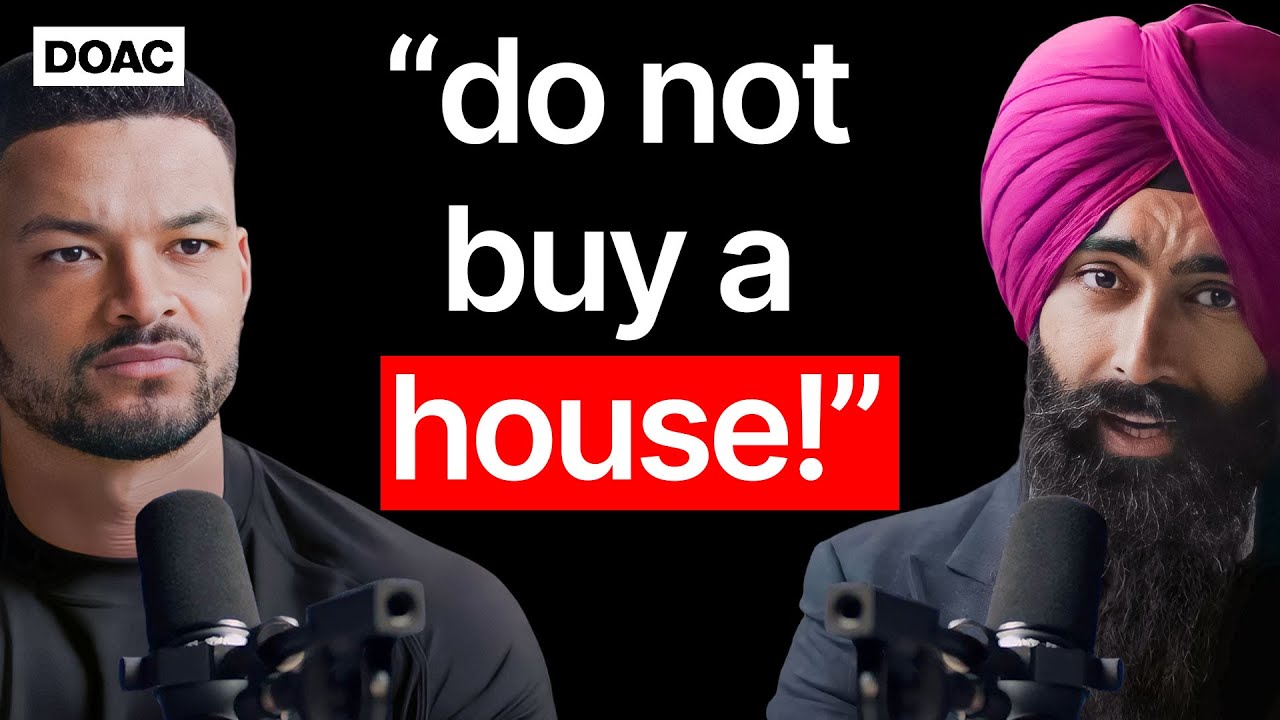
Jaspreet Singh Advocates Ownership Over Wage Income to Build Wealth
The Diary Of A CEO
Financial educator Jaspreet Singh argues that workers must invest in cash-flowing assets like real estate and stocks rather than rely on traditional pensions, homeownership, or wage growth to survive systemic inflation and a broken retirement system.
## Background
Published on November 21, 2024, on YouTube by The Diary Of A CEO, this episode features guest Jaspreet Singh—an entrepreneur, former attorney, and founder of Minority Mindset and Briefs Media. The video description highlights Jaspreet exposing financial secrets that hedge funds and banks conceal, offering practical advice to help everyday people achieve financial freedom through real estate, stocks, crypto, and startups.
## TL;DR
In this episode, Jaspreet Singh challenges conventional financial wisdom, explaining why relying on traditional pensions, social security, or homeownership as a primary wealth-building strategy is flawed under the current economic system. He outlines practical frameworks for escaping the paycheck-to-paycheck trap, including his 75-15-10 income allocation rule and the strategic use of assets over liabilities. Through personal anecdotes—from buying his first foreclosed condo to overcoming cultural expectations—Jaspreet emphasizes the necessity of shifting from a consumer mindset to an investor mindset. Ultimately, he presents financial education, discipline, and an internal locus of control as the non-negotiable tools required to secure long-term retirement and generational wealth.
## Atmosphere & style
The conversation carries an urgent, grounded, and intensely pragmatic tone, balancing serious systemic warnings with high-energy motivational insights. Host Steven Bartlett guides the discussion with probing, candid questions, allowing Jaspreet's passionate and unvarnished perspective on money to take center stage. While the talk exposes harsh economic realities and common financial traps, the underlying narrative arc is deeply empowering, leaving listeners with a sense of clarity, discipline, and renewed self-reliance.
## Key takeaways
- [00:00](https://www.youtube.com/watch?v=RSyX_665sEw&t=0s) Living paycheck to paycheck affects roughly 78% of Americans, making basic financial literacy and active money management essential for personal freedom.
- [03:10](https://www.youtube.com/watch?v=RSyX_665sEw&t=190s) True wealth is built by owning corporate structures, cash-flowing real estate, and assets rather than climbing traditional corporate ladders or working solely for a salary.
- [17:37](https://www.youtube.com/watch?v=RSyX_665sEw&t=1057s) A primary residence acts as a liability because it continuously drains cash through upkeep, taxes, and interest, whereas rental real estate generates positive cash flow.
- [22:18](https://www.youtube.com/watch?v=RSyX_665sEw&t=1338s) Standard 30-year fixed mortgages are heavily front-loaded with interest, meaning early monthly payments contribute almost entirely to bank profits rather than home equity.
- [50:05](https://www.youtube.com/watch?v=RSyX_665sEw&t=3005s) Jaspreet allocates his money across five distinct buckets: his own business, physical real estate (~50%), stocks (~30%), speculative assets (~18%), and physical gold (~2%).
- [55:34](https://www.youtube.com/watch?v=RSyX_665sEw&t=3334s) Financial mindsets are frequently constrained by 'invisible borders' and negative group stereotypes, which artificially restrict people's belief in their earning capacity.
- [01:16:23](https://www.youtube.com/watch?v=RSyX_665sEw&t=4583s) Money is a neutral tool that amplifies existing character, and personal well-being depends on four distinct pillars: physical, mental, spiritual, and financial fitness.
- [01:20:26](https://www.youtube.com/watch?v=RSyX_665sEw&t=4826s) Frugality has a hard floor tied to fixed costs, whereas earning potential has no theoretical ceiling, making wealth creation a personal responsibility.
- [01:27:38](https://www.youtube.com/watch?v=RSyX_665sEw&t=5258s) When evaluating rental properties, Jaspreet targets a minimum benchmark of a 7% cash-on-cash return, favoring innovation-proof residential real estate over commercial space.
- [01:34:51](https://www.youtube.com/watch?v=RSyX_665sEw&t=5691s) Hiring low-cost talent can lead to expensive errors, whereas investing in top-tier professional help saves money over the long term.
- [01:43:18](https://www.youtube.com/watch?v=RSyX_665sEw&t=6198s) Developing an internal locus of control—taking 100% personal responsibility for outcomes—is critical to escaping systemic financial traps.
- [01:47:18](https://www.youtube.com/watch?v=RSyX_665sEw&t=6438s) The U.S. tax code inherently favors investors and business owners through tax-free loan mechanics like 'Buy, Borrow, Die', while taxing traditional W-2 salary income at higher rates.
- [01:54:18](https://www.youtube.com/watch?v=RSyX_665sEw&t=6858s) A retirement crisis is looming because Social Security faces shortfalls and traditional pensions are virtually unavailable for workers under age 45.
- [02:03:45](https://www.youtube.com/watch?v=RSyX_665sEw&t=7425s) Wealth is achieved when passive cash flow from investments exceeds monthly living expenses, which cannot be accomplished through income and savings alone.
- [02:19:50](https://www.youtube.com/watch?v=RSyX_665sEw&t=8390s) Building a self-directed MBA curriculum by reading 25 books across money management, personal development, business, leadership, and scaling provides high-return practical education.
## Detailed walkthrough
### [00:00](https://www.youtube.com/watch?v=RSyX_665sEw&t=0s) Breaking Money Myths and the True Path to Wealth
Financial myths often trap people in cycles of perpetual debt and missed opportunities. Many believe that building true wealth is impossible without inheriting millions or owning a primary home, but those assumptions do not align with financial reality. The traditional narrative urges people to study hard, land a good job, and climb the corporate ladder, yet following this conventional track leads 78% of Americans to live paycheck to paycheck. Driven by a fear of appearing broke, people overspend on luxury cars, lavish vacations, and expensive dinners, sacrificing their ability to save and invest. Consequently, they fall far short of the estimated $1.8 million required to retire comfortably.
```
THE FINANCIAL DANGER ZONE
__________________________________________________________
| - Less than $2,000 saved for emergencies |
| - Carrying high-interest credit card debt |
|__________________________________________________________|
│
▼
Requires immediate, drastic lifestyle & budget changes!
```
People in the "financial danger zone" need immediate budget reform to begin building an asset foundation. Applying structured money strategies—such as the **75-15-10 plan** (allocating 75% of income to living expenses, 15% to investments, and 10% to savings)—helps convert income into lasting wealth. True financial success requires prioritizing assets over consumer goods.
- **78% of Americans** live paycheck to paycheck.
- **$1.8 million** is the estimated savings needed for a comfortable retirement.
- **Financial Danger Zone:** Less than **$2,000** in emergency savings combined with active credit card debt.
- **Three core wealth-building vehicles:** Starting a business, investing in real estate, and investing in stocks.
---
[02:03](https://www.youtube.com/watch?v=RSyX_665sEw&t=123s) Who Needs Financial Education and Why
Financial principles apply to anyone who uses money. Because basic survival—eating, housing, and supporting family—demands money, refusing to understand financial mechanics puts individuals at a severe disadvantage. Ignoring money does not make a person moral; it makes them vulnerable to higher tax burdens, unpaid bills, and an inability to afford medical care or meaningful life experiences for loved ones. In our current economic framework, financial knowledge dictates personal freedom.
> "People don't like when I say this, but I don't say what I say to make friends. I say what I say to help people be better with money."
---
[03:10](https://www.youtube.com/watch?v=RSyX_665sEw&t=190s) The Fundamental Difference Between the Wealthy and Everyone Else
Putting aside unearned advantages like wealthy parents or large inheritances, a single structural divide separates those who achieve financial independence from those who struggle: **wealthy people understand how money works and how to leverage the economic system.** Society conditions people to trust formal education and corporate employment to secure their future. However, standard schooling—from high school through postgraduate and law programs—rarely teaches the mechanics of passive income, tax management, or asset building.
```
TRADITIONAL PATH WEALTH-BUILDING PATH
┌─────────────────────────┐ ┌─────────────────────────┐
│ Study hard in school │ │ Learn money mechanics │
└────────────┬────────────┘ └────────────┬────────────┘
│ │
▼ ▼
┌─────────────────────────┐ ┌─────────────────────────┐
│ Get a traditional job │ │ Acquire & grow assets │
└────────────┬────────────┘ └────────────┬────────────┘
│ │
▼ ▼
┌─────────────────────────┐ ┌─────────────────────────┐
│ Climb corporate ladder │ │ OWN corporate ladder │
└─────────────────────────┘ └─────────────────────────┘
```
Growing up as the son of Indian immigrants from Punjab, Jaspreet Singh faced strict familial expectations centered on a rigid definition of success. His choices were effectively framed as becoming a doctor or being a failure. His parents broadcasted his future medical career to relatives from the time he was a toddler. Although Jaspreet respected his parents' incredible work ethic—observing his father work long weeks without breaks—he eventually realized that practicing medicine was not his passion. He pivoted to law school to preserve family pride, ultimately becoming a licensed attorney without ever practicing a day of law. Through this process, he realized that wealthy people do not focus on climbing corporate ladders; they focus on owning them.
- **The strict immigrant choice:** Become a doctor or be considered a failure.
- **The underlying reality:** Wealth is built by acquiring cash-flowing assets, not by relying solely on earned income from a job.
- **Starting capital:** You do not need millions of dollars to start; compound growth can begin with as little as $10 or $100.
---
[08:00](https://www.youtube.com/watch?v=RSyX_665sEw&t=480s) Seeing Behind the Curtain: The First Business Endeavors
Jaspreet's entry into business began unexpectedly during middle school when he learned to play the *dhol*, a traditional Punjabi drum, at Indian weddings. His parents discouraged non-academic pursuits, forcing him to play in secret. Despite the secrecy, he began earning modest income—starting at $50 per event in middle school and rising to $100–$200 in high school.
This drumming experience led to a partnership with a local DJ to host a teen party for high school students. Although the event went well, calculating the net profits revealed the realities of business overhead. After paying the security detail, venue fees, and marketing expenses, only $4 in total profit remained from the cover charges. Jaspreet and his partner walked away with just $2 each. While his partner felt crushed by the low yield, Jaspreet was hooked on the process of creating an enterprise from scratch.
- **Dhol drumming earnings:** $50 per wedding in middle school, scaling to $100–$200 in high school.
- **Teen party net profit:** $4 total ($2 split each between Jaspreet and the DJ).
---
[10:31](https://www.youtube.com/watch?v=RSyX_665sEw&t=631s) Scaling College Events and Learning Financial Fundamentals
Arriving at college at age 17, Jaspreet was surprised by the prevalent culture of heavy drinking, partying, and loose spending. As a non-drinker who did not party, he looked for a productive way to fill his Friday nights. He decided to scale his high school event management model into the university environment, cold-calling local venues to secure space.
Initial attempts hit barriers when venue owners demanded cash deposits of $10,000 to $20,000, which he did not have. Persistence paid off when he negotiated a zero-down agreement with a local nightclub: the club waived upfront costs in exchange for 50% of the door cover charge. Jaspreet struck a similar performance-based deal with his DJ, splitting net profits instead of paying an upfront fee. The venture expanded rapidly from single parties to managing weekly college nights, official concerts, and venue after-parties.
```
EARNINGS FROM PARTIES ILLUSION OF WEALTH
┌───────────────────────┐ ┌───────────────────────┐
│ Event Revenue Profits │ ───► │ Designer Watches │
└───────────────────────┘ │ Custom Car Rims │
│ Subwoofers & Audio │
└───────────────────────┘
│
▼
Makes OTHER people rich while
leaving you with zero assets!
```
This business success revealed two key insights: high income does not require a formal degree or license, and earning money is meaningless without financial literacy. Initially, Jaspreet fell into consumer traps, using his event earnings to buy designer watches, custom car rims, and audio subwoofers to appear successful. Reading business literature helped him understand the fundamental difference between **assets** (which put money into your pocket) and **liabilities** (which take money out of your pocket).
- **Initial venue deposit requests:** $10,000 to $20,000 upfront.
- **Negotiated deal structure:** 0% down, 50/50 split on door revenue with the venue, and profit-sharing with the DJ.
- **Asset vs. Liability definition:** An asset generates positive cash flow; a liability incurs continuous costs.
---
[13:36](https://www.youtube.com/watch?v=RSyX_665sEw&t=816s) Making the First Real Estate Investment at Age 19
Driven by his reading, Jaspreet discovered that real estate was a primary wealth vehicle for high-net-worth individuals. In 2011, while studying 10 to 12 hours a day for the Medical College Admission Test (MCAT), he used his study breaks to analyze distressed housing markets online.
```
2008 Housing Crash Timeline & First Deal:
2008 2011 2012
│ │ │
▼ ▼ ▼
Great Financial Crash Jaspreet Buys Condo Real Estate Bottom
(Prices start falling) Aug 23 for $8,400 (Market hits floor)
(Sold for $150k+ prior)
```
The U.S. housing market was still suffering from the aftermath of the 2008 financial crisis, with property valuations dropping toward their eventual 2012 bottom. Foreclosures were widespread, and banks struggled to clear non-performing real estate assets from their balance sheets.
On August 22, 2011, Jaspreet sat for the MCAT. The very next day, August 23, he closed on his first real estate property: a foreclosed condominium listed at an extreme discount.
- **Historical market peak:** The condo previously sold for over **$150,000** prior to the 2008 crash.
- **Purchase price:** Purchased out of foreclosure for **$8,400** total cash.
- **Timing:** Bought on August 23, 2011, directly following his MCAT exam.
[15:47](https://www.youtube.com/watch?v=RSyX_665sEw&t=947s) Jaspreet’s First Real Estate Deal and the Asset Mindset Shift
Jaspreet Singh walks through the details of his very first real estate transaction—a foreclosed condo that fundamentally transformed how he viewed money. Having no prior experience in real estate investing, he initially put in a low-ball bid of $4,000. The bank countered at $7,000, and as he tried to negotiate even lower, the bank informed him that another offer had come in. Caught in a sudden bidding war, Jaspreet submitted his final and highest offer of $8,000, which the bank accepted. After closing, he put a few thousand dollars into light renovations and rented the unit out for $600 a month.
This moment served as a massive awakening. Jaspreet realized that the condo was putting money directly into his pocket every month without requiring active labor because he owned an **asset**. He began questioning why school and society train everyone to trade time for dollars rather than build assets that generate passive income. Wealthy individuals focus on acquiring income-producing assets rather than chasing higher salaries. This realization sparked both passion and anger—anger at the realization that he had been diligently checking societal boxes (studying hard, aiming for medical school) that were never designed to build true financial freedom.
- **Purchase Price:** $8,000 for a bank-foreclosed condo.
- **Renovation Cost:** A few thousand dollars.
- **Monthly Rent Collected:** $600 per month.
- **Key Insight:** Wealthy people work for assets that pay them continuously, not just for a larger salary.
---
[17:37](https://www.youtube.com/watch?v=RSyX_665sEw&t=1057s) The Truth About Homeownership: Is Your House an Asset or a Liability?
Addressing the common belief that buying a primary residence is the cornerstone of building generational wealth, Jaspreet challenges this premise directly: your personal home is a money pit and should be treated as a **liability**, not an asset. While he clarifies that he is not against owning a home, he emphasizes that like a suit, a watch, or shoes, a personal residence costs money to maintain and live in.
To illustrate why relying on a primary home as a wealth-building tool can fail, Jaspreet presents a best-case scenario. Suppose you buy a home for $300,000, pay off the mortgage completely, and over your lifetime, the property appreciates to $1,000,000. When passed down to your children, the home does not generate cash flow. Unless the heirs have sufficient income to pay for property taxes, insurance, maintenance, upgrades, or mortgage service if they borrow against it, they cannot afford to keep it. Borrowing against equity via a bank loan is not free cash—it must be repaid with interest. If they sell the home for $1,000,000 without financial education, standard consumer behavior dictates that the windfall will quickly be spent on luxury goods, travel, or lifestyle inflation, leaving them with nothing after a couple of decades.
In contrast, true assets—such as commercial or residential rental properties—generate positive **cash flow**. When investment property values rise, rental prices generally rise as well. The tenant's rent covers maintenance, property taxes, insurance, and upgrades while leaving surplus cash flow in the owner's pocket to fund their lifestyle or re-invest.
- **Primary Residence vs. Investment Property:** A primary home drains money through taxes, upkeep, and insurance; cash-flowing real estate pays for its own expenses and yields profit.
- **Hypothetical Example:** A $300,000 paid-off home appreciating to $1,000,000 still requires ongoing cash for taxes and upkeep, which heirs may lack.
- **Consumer Behavior Anecdote:** Asking the average person what they'd do with a million dollars usually yields answers like trips to the Bahamas, new cars, Gucci, Louis Vuitton, and "extra guac at Chipotle."
---
[22:18](https://www.youtube.com/watch?v=RSyX_665sEw&t=1338s) How Banks Front-Load Mortgages
Jaspreet exposes how the banking system structures 30-year home mortgages to maximize institutional profits before homeowners build any real equity. When a home buyer makes a monthly mortgage payment, the funds are not split evenly between principal equity and bank interest. Instead, banks **front-load** the interest payments.
For roughly the first 15 years (approximately 14 years and 8 months) of a standard 30-year mortgage, the vast majority of every payment goes toward interest. For instance, on a $3,000 monthly mortgage payment in the early years of the loan, as little as $100 might go toward reducing the actual principal balance, while $2,900 goes straight to the bank as interest profit. Only after around year 15 does the payment balance out to a 50/50 split between interest and principal reduction. Furthermore, if a homeowner refinances their loan before hitting that 15-year mark, the amortization clock resets, starting the front-loaded interest cycle all over again.
- **Standard Loan Term:** 30-year fixed mortgage.
- **Amortization Timeline:** Takes nearly 15 years before half of the monthly payment applies to principal equity.
- **Numerical Example:** On a $3,000/month payment early in the loan, ~$2,900 goes to interest and ~$100 goes to principal.
- **Refinancing Pitfall:** Refinancing resets the loan schedule, forcing the borrower to restart paying maximum front-loaded interest.
---
[24:09](https://www.youtube.com/watch?v=RSyX_665sEw&t=1449s) Understanding Opportunity Cost in Real Estate
The discussion shifts to the concept of **opportunity cost**—the hidden financial loss incurred when capital is tied up in one commitment instead of being deployed elsewhere. If an investor has $20,000 available for a down payment on a $100,000 home, locking that money into a primary residence means forfeiting the chance to use those same funds to purchase cash-flowing rental real estate, invest in the stock market, or launch a business.
Jaspreet counters the popular myth that real estate prices only move upward. Citing historical precedent, he points out that housing markets can suffer severe downturns. Following the 2008 financial crash, property values nationwide dropped dramatically, with real estate values in certain markets—such as his home state of Michigan—plunging by as much as 93%. Every asset class carries inherent risk, and individuals must evaluate whether they are financially ready to absorb housing risks or whether they should prioritize building scalable wealth first.
- **Opportunity Cost Definition:** The lost potential returns from alternative investments when capital is committed to a specific purchase.
- **Historical Downturn Example:** Real estate values in Michigan dropped by up to 93% following the 2008 housing crash.
- **Core Choice:** Deciding whether to lock capital into a personal residence or deploy it into wealth-generating opportunities first.
---
[26:16](https://www.youtube.com/watch?v=RSyX_665sEw&t=1576s) Debunking the "Renting Is Throwing Money Away" Myth
Addressing the widespread belief that renting a residence is simply "throwing money away" or making a landlord rich, Jaspreet reframes rent as a functional transaction for housing services. Paying rent for an apartment or staying in a hotel pays for a facility and service, just as buying food at a restaurant pays the restaurant owner's overhead and mortgage.
Jaspreet shares that he personally rents both his home and his corporate office space, paying substantial rent to his office landlord without regret. Renting provides flexibility and frees up capital that would otherwise be locked in real estate equity or eaten up by maintenance, taxes, and interest payments. He urges listeners to break free from traditional financial dogmas that claim renting prevents wealth creation or that a college degree is strictly required for success.
- **Analogy:** Renting a home is no different than paying for a hotel room or dining at a restaurant—you are paying for consumption and service.
- **Personal Stance:** Jaspreet actively rents his personal residence and office spaces, using saved capital to invest in scalable opportunities.
- **System Rules:** Distinguishing traditional societal rules from the actual rules of financial literacy.
---
[28:01](https://www.youtube.com/watch?v=RSyX_665sEw&t=1681s) The Three Rules of Home Affordability and the 75/15/10 Plan
To determine whether someone can genuinely afford to purchase a home, Jaspreet outlines three non-negotiable requirements: affording the **moving costs**, the **down payment**, and the **monthly payments**. Moving costs include hiring movers, buying furniture, and making initial home upgrades. For the down payment, he advocates putting down a full 20% to secure immediate equity and avoid unnecessary fees, acknowledging that many people dislike this rule because saving $100,000 for a $500,000 home is difficult.
For managing monthly payments alongside lifestyle expenses, Jaspreet recommends the **75/15/10 Plan** as a clear rule of thumb for every net dollar earned:
1. **75% Maximum for Spending:** Covers all living expenses, including mortgage/rent, food, lifestyle, and vacations.
2. **15% Minimum for Investing:** Dedicated strictly to buying income-generating assets.
3. **10% Minimum for Saving:** Allocated to an emergency cash fund.
Applying this system to an annual income of $100,000 means a household can spend a maximum of $75,000 across all living costs. If mortgage obligations push total living expenses past $75,000, the home is unaffordable under this framework.
- **The 3 Affordability Pillars:** Down payment, monthly obligations, and moving/setup costs.
- **Recommended Down Payment:** 20% minimum (e.g., $100,000 on a $500,000 property).
- **The 75/15/10 Budgeting Framework:**
- Max **75%** spent on living expenses and lifestyle.
- Min **15%** directed to investments.
- Min **10%** directed to cash savings.
---
[30:48](https://www.youtube.com/watch?v=RSyX_665sEw&t=1848s) Paycheck to Paycheck Reality and Credit-Based Culture
Jaspreet points out that the vast majority of people have no concrete tracking of their monthly expenditures over a six-month window. In the United States, an estimated 78% of workers live paycheck to paycheck, spending everything they earn or exceeding their income through consumer debt.
He contrasts cultural spending habits with a stark joke: while traditional Indian culture is known for making a dollar to spend 20 cents, modern American consumer culture encourages making a dollar to spend two dollars through credit cards, lines of credit, and debt products. This phenomenon is driven by living inside a **credit-based economy**, where lifestyle choices are frequently financed on leverage rather than supported by actual income and cash savings.
- **Paycheck to Paycheck Statistic:** 78% of Americans live paycheck to paycheck.
- **Cultural Comparison:** Saving culture ("make a dollar, spend 20 cents") vs. leveraged consumer culture ("make a dollar, spend two dollars").
- **Economic Driver:** A credit-based economy that normalizes debt-financed living.
Here is a detailed, faithful walkthrough covering Part 3 of the transcript:
[31:59](https://www.youtube.com/watch?v=RSyX_665sEw&t=1919s) The Credit-Based Economy and Fake Wealth
Jaspreet Singh explains the mechanics of a credit-driven economy: as an individual earns more money—say, $50,000—they become increasingly creditworthy in the eyes of financial institutions. Banks eagerness to extend credit cards, lines of credit, and personal loans allows individuals to spend $60,000, $70,000, or $80,000. In a consumer economy, this artificial expansion of spending drives economic growth because one person’s expenditure becomes another person’s income. However, without proper financial education, ordinary consumers spend relentlessly to keep the economic engine turning, unaware of the financial trap they are building for themselves.
Steven Bartlett illustrates this point with a recent personal story. Two days prior, while chatting on WhatsApp with a close-knit group of five successful friends—all of whom run businesses—they began estimating each other's net worth and liquid cash positions. Steven predicted that a particularly frugal friend, who lives in a humble studio apartment and drives a modest car, might actually be the wealthiest. The friend replied with his exact cash position: he held more cash than all the other high-flying friends in the chat combined, having quietly accumulated over a million dollars in cash from a small 4-to-5-person business over four or five years. Steven laughs about how he used to buy dinners for this "millionaire" friend without realizing he was by far the richest in the group, noting how easily high earners spending five times more per month end up with five times less cash due to maintaining lavish lifestyles.
Jaspreet observes that looking "fake rich" is extraordinarily easy today because consumer credit options like Buy Now, Pay Later (BNPL) allow anyone to finance luxury items like Gucci bags on credit. He notes that Bernard Arnault, founder and CEO of LVMH (owner of Louis Vuitton), became one of the richest men in the world precisely because millions of everyday consumers pay him to look rich. Jaspreet shares that he receives messages from high earners, such as Indian couple doctors earning hundreds of thousands of dollars, who admit to having zero savings or investments because they feel obligated to maintain the "doctor lifestyle"—driving Range Rovers and Mercedes-Benzes, owning large homes, and taking lavish vacations.
- **The 75-15-10 Rule:** Jaspreet advocates a strict automated budgeting rule regardless of whether someone earns $10,000 or $10 million a year:
- **75%** spent on lifestyle and living expenses.
- **15%** directed automatically into investments.
- **10%** allocated into savings.
---
[37:52](https://www.youtube.com/watch?v=RSyX_665sEw&t=2272s) Breaking the Paycheck-to-Paycheck Cycle
Addressing Steven’s question about how workers trapped in the cycle of spending entire paychecks within days can escape, Jaspreet candidly lays out the harsh realities of the system. Paycheck-to-paycheck consumers are the prime targets of the economy: banks profit off their credit card interest and payday loans, corporations profit off their impulse luxury purchases, and the government collects the highest proportional tax burden from W-2 employees.
To break free, individuals must view their finances like a sinking boat taking on water: before trying to grow wealth, they must "stop the bleeding" by drastically curtailing unnecessary expenditures. Jaspreet defines the **financial danger zone** as having less than $2,000 in emergency savings while holding high-interest credit card debt. In this phase, drastic sacrifices are mandatory.
```
+-----------------------------------------------------------------------+
| FINANCIAL DANGER ZONE |
| |
| • Less than $2,000 in emergency cash reserves |
| • Carrying active high-interest credit card debt |
+-----------------------------------------------------------------------+
|
v
+-----------------------------------------------------------------------+
| REQUIRED ACTIONS |
| |
| 1. Cut all non-essential spending (no restaurants, no vacations). |
| 2. Cancel subscriptions (e.g., Netflix) to recover ~2 hours/day. |
| 3. Sell unused personal assets (extra TV, unaffordable car). |
| 4. Reallocate recovered time into skill building or side income. |
+-----------------------------------------------------------------------+
```
Jaspreet highlights that cutting services like Netflix is less about saving $15 a month and more about reclaiming the 2+ hours per day the average American spends watching television, which can instead be redirected toward working, learning, or side-hustling to earn extra income.
- **Immediate Danger Zone Protocol:** Eliminate all non-essential spending (no restaurants, no vacations, no paid entertainment).
- **Asset Liquidation:** Sell unneeded possessions, downsize houses or cars that exceed current earnings.
- **Time Reinvestment:** Convert reclaimed leisure hours directly into income-generating or educational activities.
---
[41:03](https://www.youtube.com/watch?v=RSyX_665sEw&t=2463s) Sacrifices, Social Expectations, and Life "Seasons"
Steven reflects on his own experience at age 18 living in a tiny, bare-bones apartment in Moss Side/Rusholme (Manchester) paying £150/month rent that he could barely afford. He shares the intense social and cultural pressure young men face to spend money on dates, going to restaurants, or going out to meet potential partners, asking how someone is supposed to balance social and romantic pursuits while living in extreme frugality.
Jaspreet responds with a simple framework: "You have to pick your hard." Life will either be hard now through deliberate short-term sacrifice, or hard for the rest of one's life due to permanent financial anxiety. Trying to balance wealth building, fitness, dating, and entertainment simultaneously spreads focus thin, whereas hyper-focus on financial turnaround yields direct results. Steven agrees, sharing that his life turned around when he dedicated himself entirely to building his business, discovering the paradox that turning inward and building self-reliance naturally made him more attractive and successful later on.
The two discuss viewing life in **five-year seasons**. Looking back, Steven categorizes his ages 20–25 as his "sacrifice everything" season, 25–30 as his "building and learning" season, and his current period as a stabilized season where he explicitly communicates priorities and sacrifices to his partner.
Jaspreet stresses that the core obstacle to making these sacrifices is the pervasive pressure of social media, where peers show off financed lifestyle upgrades. He shares a personal anecdote from his own journey:
> "The first time I made a million dollars in a year, I was in my 20s. I was driving a car worth $500. It didn't have a bumper on it. It was not pretty. My wife sat in the car with me and my employees drove better cars than I did."
Jaspreet explains that his channel name, **Minority Mindset**, stems directly from this philosophy: doing what the majority of people refuse to do. Many people ruin their finances by taking on debt out of fear of looking broke; ironically, attempting to look rich is the exact behavior keeping them broke. Steven adds that when life feels miserable or lonely—such as working late night call-center shifts and walking home to save bus fare—people frequently seek immediate dopamine hits through short-term spending or gambling, compounding their financial distress.
<ElicitationsGroup message="Explore related wealth-building topics from the interview:">
<Elicitation label="Explore Jaspreet's views on real estate investing" query="What are Jaspreet Singh's core rules and strategies for investing in real estate according to the podcast transcript?"/>
<Elicitation label="Break down the retirement crisis strategies" query="How does Jaspreet Singh propose solving the retirement crisis for people under 45 based on the transcript?"/>
</ElicitationsGroup>
Here is a detailed, faithful walkthrough of the provided transcript section:
[47:28](https://www.youtube.com/watch?v=RSyX_665sEw&t=2848s) Life Struggles, Emotional Decisions, and Get-Rich-Quick Scams
Steven Bartlett reflects on his own early struggles in a tiny bedsit room, where he owned a television so massive it covered nearly half the wall. He admits making reckless spending decisions simply to chase a quick dopamine rush that was missing elsewhere in his life. Jaspreet agrees, noting that when people are trapped in tough financial circumstances, they act almost entirely out of emotion. However, "it's very difficult to speak logic to emotion." Jaspreet warns that unless someone in this situation intentionally breaks the cycle, they will remain stuck living that exact same stressful lifestyle for the rest of their days.
Building wealth begins entirely with mastering one's own mindset and self-discipline. Jaspreet explains that he can teach anyone the mechanics of investing—recommending specific ETFs, index funds, mutual funds, or top stock brokerages, and advising them to invest 15% of their income for the next 20 to 30 years—but none of those mechanics matter if the psychological foundation is broken. When people prioritize "looking rich" or feeling entitled to luxuries because they "work hard," they become prime targets for get-rich-quick scams. Scammers promise that a $1,000 investment will yield $10,000 in three months, or sell course programs pitching a "laptop lifestyle" of making $10,000 a week on 5 hours of work. Driven by emotional desperation, vulnerable people fall for these schemes, stay trapped in debt to enrich banks, and keep buying trendy consumer items to show off to friends and dates.
- **The Dopamine Cycle:** Emotional strain leads people to use consumer purchases for quick emotional high points rather than building long-term financial security.
- **The Limits of Financial Advice:** Information on index funds or saving 15% of income fails if an individual is psychologically driven to seek immediate gratification.
- **Scam Vulnerability:** The urge to escape financial pain quickly leaves people susceptible to predatory laptop-lifestyle courses and unrealistic investment schemes.
---
[50:05](https://www.youtube.com/watch?v=RSyX_665sEw&t=3005s) Jaspreet’s 5-Part Investment Portfolio and View on Crypto
When Steven asks for his perspective on cryptocurrency, Jaspreet outlines his overall wealth allocation strategy. He divides his money across five distinct categories: his own business (Briefs Media, known for the *Market Briefs* financial newsletter), physical cash-flowing real estate, stocks (both individual companies and broad market funds), speculative assets (startups and cryptocurrency), and physical gold.
Jaspreet considers cryptocurrency purely speculative. He reveals that he began buying Bitcoin around 2016–2017 when it was priced at approximately $3,000 per coin and made a substantial return. While he recently sold a chunk of his Bitcoin during record highs to purchase more physical rental properties, he cautions against viewing crypto as a core wealth-building tool. Dumping life savings into volatile assets in hopes of a "10x return" is gambling rather than investing. Furthermore, he treats physical gold—which makes up only 2% of his portfolio—not as an investment, but as an "insurance against doomsday" and currency degradation. Unlike real estate that collects rent or companies that grow profits, physical gold simply sits in a vault without generating cash flow.
- **Bitcoin Entry Point:** Jaspreet initially purchased Bitcoin around 2016–2017 at roughly $3,000 per coin.
- **Rebalancing Strategy:** He liquidated a portion of his cryptocurrency holdings near record highs to fund physical real estate acquisitions.
- **Gold Gold Ratio & Purpose:** Gold represents 2% of his portfolio, held strictly as "hard money" cash protection against currency debasement rather than a growth asset.
- **Cash Management:** Cash is explicitly bucketed into distinct accounts: personal emergency fund, business emergency fund, real estate acquisition fund, stock investment fund, and speculative investment fund.
---
[55:34](https://www.youtube.com/watch?v=RSyX_665sEw&t=3334s) The Money Mindset, Detroit Schools, and Stereotype Threats
Turning to the concept of the "Money Mindset," Jaspreet emphasizes that the absolute first step is a firm conviction: saying "I *will* become wealthy," rather than merely "I might" or "I can." To illustrate how self-limiting beliefs hold people back, he shares his experience guest-teaching in Detroit public schools. Walking into classrooms required passing through multiple metal detectors and police pat-downs. When he asked students how many had two parents at home, almost no hands went up; when he asked who worked a job, nearly every hand was raised. Many high schoolers were already in local gangs, viewing them not as evil, but as their only source of food, protection, and family support.
During an exercise, Jaspreet asked the students to name their dream cars. They answered with Ford Mustangs or Dodge Challengers. When he asked why they didn't dream of a Bugatti, Lamborghini, or Rolls-Royce, they responded: "Somebody like me can never have something like that. So I can't even dream about having these nice things." Jaspreet was stunned to realize that systemic environment can suppress people to the point where they cannot even allow themselves to *dream* of higher success.
Steven connects Jaspreet's story to psychological research on "stereotype threats." Studies demonstrate that if a negative stereotype exists—such as women or Black individuals being perceived as worse at math—simply reminding them of their demographic identity right before a test causes their test performance to drop significantly. However, when that reminder is absent, their performance matches everyone else's. Steven shares an anecdote from a Channel 4 documentary where he went undercover at a struggling Liverpool school; when a student mentioned wanting to be a millionaire, his mother burst out laughing on camera, declaring "there's no chance." Jaspreet points out that this mental block affects every level of society. When he told his own traditional Indian family that he was skipping medical school for business, they accused him of throwing away his parents' sacrifices, insisting that "somebody like you" with no family business background could never succeed.
- **Detroit Classroom Observation:** Students in under-resourced Detroit schools could not mentally permit themselves to dream beyond a Ford Mustang due to their environment.
- **Stereotype Threat Dynamics:** In psychological experiments, subtle reminders of negative group stereotypes measurably lower test performance, proving how internalized expectations shape real-world outcomes.
- **Parental & Cultural Friction:** Jaspreet faced intense resistance from his family when abandoning medicine for entrepreneurship because no one in his lineage had ever been a business owner or investor.
<ElicitationsGroup message="Explore further insights from this discussion:">
<Elicitation label="Break down Jaspreet's 5-bucket cash strategy" query="Explain Jaspreet Singh's 5-bucket cash management strategy in detail, including how to allocate funds for emergency vs investment pools."/>
<Elicitation label="Detail the 9 Dots exercise mentioned at the end" query="What is the 9 Dots exercise mentioned by Jaspreet Singh and how does it relate to overcoming financial barriers?"/>
</ElicitationsGroup>
[01:02:51](https://www.youtube.com/watch?v=RSyX_665sEw&t=3771s) Breaking Invisible Barriers with the Nine Dots Exercise
Jaspreet introduces the classic "nine dots" puzzle as a metaphor for the psychological limitations people impose on themselves. The challenge requires connecting a 3x3 grid of nine dots using only four continuous straight lines without lifting the pen from the paper. Most people find it seemingly impossible at first because they subconsciously draw an invisible border around the outer dots, refusing to extend their lines past the grid. Jaspreet demonstrates the solution on camera for Steven: by extending the line beyond the grid's implicit perimeter, you can easily connect all nine dots.
Jaspreet uses this exact exercise during onboarding for every new team member at his company on their very first day. The purpose is to instill a culture of innovation, demonstrating that breaking out of self-imposed cognitive boxes is mandatory if one wants to accomplish big goals or build significant wealth. Many people are conditioned by their upbringing—whether growing up in poverty or feeling locked into a specific career like engineering—to believe they can never become investors, entrepreneurs, or achieve financial success. To reach maximum potential, Jaspreet stresses that individuals must actively expand their mental horizons through continuous personal development, such as reading foundational books and putting those ideas into action.
- **The Nine Dots Rule**: Connect all 9 dots using exactly 4 continuous straight lines without lifting the pen or using curved lines.
- **The Core Lesson**: Subconscious "invisible boxes" limit people's beliefs about what they can achieve in business, investing, and life.
- **Actionable Advice**: Read books on personal development and challenge everyday mental constraints to maximize wealth potential.
[01:06:32](https://www.youtube.com/watch?v=RSyX_665sEw&t=3992s) The Ink Circle Illusion and Unlearning Limitations
Steven shares a viral video that deeply impacted his own worldview, showing an ant placed inside a circle drawn with a Sharpie marker. Believing the ink line is a physical wall, the ant paces back and forth along the perimeter, completely trapped by an illusion. He follows this up with a video of a spider facing a similar drawn boundary; the spider frantically moves around until it accidentally steps over the pen mark, realizing the line has no physical substance. Once the spider crosses that line, it can never be trapped by a pen drawing again.
Jaspreet and Steven discuss how this simple behavioral phenomenon applies directly to human potential. Once an individual tastes entrepreneurial success—whether by making their first dollar online or starting a side business—the illusion that the only valid life path is traditional schooling and corporate employment is broken forever. However, Steven acknowledges that overcoming one barrier doesn't eliminate all mental limits; it simply moves you into a new, larger circle. Even highly successful individuals carry subconscious ceilings about how much money or impact they can generate. Jaspreet reflects on his own experience starting the Minority Mindset YouTube channel: despite having already achieved success in real estate and business, he initially told his brother he would delete the channel if it ever hit one million subscribers because he believed it was impossible for a "random guy" talking about money to reach that many people.
- "Once you break it, you can't be stopped after that. You realize that it's an illusion that was trapping you the whole time."
- "All of us, no matter how successful we think we are, are in some kind of circle."
- **YouTube Benchmark**: Jaspreet originally believed hitting 100,000 subscribers would be a miracle and 1,000,000 was completely impossible, showing that even experienced entrepreneurs harbor self-imposed limits.
[01:11:03](https://www.youtube.com/watch?v=RSyX_665sEw&t=4263s) Overcoming Self-Doubt by Embracing Unconventional Choices
When Steven asks for practical strategies to break out of psychological traps, Jaspreet admits that his approach relies on a stubborn desire to stand out and do the opposite of what society expects. When Jaspreet made his first million dollars in a single year, instead of buying private jets or luxury goods, he intentionally continued driving his modest, beaten-up car. People around him openly questioned whether he was actually successful or secretly broke, but enduring that skepticism built his internal confidence and proved to himself that he didn't need external validation to feel secure.
Jaspreet recalls another pivotal moment from his graduation from law school. Having pursued the law degree strictly to fulfill a promise to his traditional Indian parents, he decided to attend the formal ceremony on his own terms. Instead of wearing a conventional suit and tie like his peers, he wore traditional Punjabi attire—a *kurta pajama* and *Punjabi jutti* (traditional shoes). That deliberate decision gave him a surge of personal power and reinforced his commitment to living life on his own terms rather than conforming to social pressure.
- **Frugality as a Shield**: Jaspreet drove his old car after making his first million dollars to build immunity against the opinions of others.
- **Graduation Statement**: Jaspreet wore a traditional Punjabi *kurta pajama* and *jutti* to his law school graduation to stay true to himself while fulfilling his family obligations.
- **Mindset Strategy**: Using public skepticism as fuel to strengthen internal confidence and conviction.
[01:13:25](https://www.youtube.com/watch?v=RSyX_665sEw&t=4405s) Harnessing "Toxic Fuel" and Finding True Purpose
Jaspreet challenges the notion that passive visualization or "woo-woo" meditation alone creates wealth, arguing instead that people need tangible drive and discipline grounded in a clear "why." Early in his career, Jaspreet's motivation stemmed from anger and a fierce desire to prove doubters wrong. When he decided against pursuing medical school to start an e-commerce company selling socks, relatives and acquaintances criticized him relentlessly, accusing him of throwing away his parents' sacrifices to "sell socks on the internet."
Jaspreet channelled that criticism into "toxic fuel," pushing himself relentlessly until the business succeeded and gained national television exposure. Over time, however, his underlying motivation evolved from spiteful anger into a meaningful mission. He realized that millions of hard-working people are trapped in financial struggle simply because they lack basic financial education and don't understand that the economic system is explicitly designed to reward investors over workers. Through Briefs Media, his primary focus shifted toward providing accessible financial instruction so everyday individuals can build wealth.
- "In the beginning for me... I was angry. I was angry because when I made that decision to not become a doctor, the thing that I was told was I'm throwing away the sacrifice that my parents made."
- "Our economic system is designed to benefit investors. And if you don't understand that, you will never be able to win in this system."
- **Company Evolution**: Shifted from e-commerce (selling socks) to building Briefs Media, a financial news and education platform.
[01:16:23](https://www.youtube.com/watch?v=RSyX_665sEw&t=4583s) Money as a Tool and the Four Pillars of Fitness
Addressing the second pillar of his money mindset, Jaspreet defines money strictly as a neutral tool that amplifies a person's existing character rather than making them inherently good or bad. To illustrate its role in a balanced life, Jaspreet outlines what he calls the "Four Fitnesses" required for true fulfillment, visualising them as a hierarchy:
1. **Physical Fitness**: Foundation of health; having tens of millions of dollars means nothing if you are terminally ill or bedridden.
2. **Mental Fitness**: Emotional well-being and happiness; material wealth cannot fill a void caused by toxicity, depression, or constant anxiety.
3. **Spiritual Fitness**: Having a sense of purpose and a compelling reason to get out of bed every day to achieve and build.
4. **Financial Fitness**: Placed at the top, financial stability grants you the power, resources, and freedom to solve material problems and fully enjoy the lower three fitnesses.
- **Money's Nature**: Money is an amplifier of identity and a tool for problem-solving, not a source of intrinsic morality or happiness.
- **The Four Fitnesses**: Physical, Mental, Spiritual (Purpose), and Financial fitness must all be nurtured to achieve a complete, fulfilled life.
[01:17:56](https://www.youtube.com/watch?v=RSyX_665sEw&t=4676s) The Interconnected Pillars of Fitness and the Principle of Abundance
Financial stability provides freedom from bill anxiety and the luxury of purchasing nice things without price checking, but Jaspreet Singh emphasizes that financial fitness directly underpins every other dimension of human well-being. Without financial security, physical fitness suffers because healthy food and high-quality gym memberships become unaffordable. Mental health rapidly deteriorates, as financial distress serves as a leading driver of depression, anxiety, divorce, and suicide. Spiritual fitness is similarly compromised; when survival and paying basic bills dominate daily existence, maintaining a sense of purpose becomes almost impossible.
The third core tenet of the money mindset is embracing financial abundance and unlearning fixed-pie fallacies. People often hyper-fixate on the dollar they give away rather than the value they receive in return. This scarcity mindset originates in childhood, where parental attention is a zero-sum resource divided among siblings. Money, however, is infinite and abundant; two people can build massive wealth simultaneously without taking from one another.
* Financial distress is a primary catalyst for severe mental health crises, marital dissolution, and lost personal purpose.
* Scarcity thinking is a psychological leftover from competing for limited parental attention during childhood.
* The United States federal debt alone exceeds $35 trillion, illustrating the vast volume of currency circulating through the global economic system.
[01:20:26](https://www.youtube.com/watch?v=RSyX_665sEw&t=4826s) Overcoming Earnings Ceilings and the Duty of Wealth Creation
Living off 75% of income and investing the rest is an excellent baseline strategy, but frugality has strict mathematical limits. A person earning $50,000 annually can only squeeze so many pennies out of that fixed sum, no matter how severely they cut their standard of living. Instead of obsessing over cutting expenses down to $23,000, financial growth requires shifting the target toward earning $500,000.
To break through this artificial earnings ceiling, individuals must adopt a proactive learning process: researching salary negotiation, seeking career advancement, changing industries, or launching a side hustle. Furthermore, wealth creation must be viewed not merely as an option, but as a absolute personal duty.
> "I believe that it's up to you to take care of your family, to be the one that takes care of yourself, that we can also help take care of your community. That is my belief that it is your duty to do so. And if you rely on the government or somebody else to do it, well, you are asking for problems."
* Squeezing pennies from a fixed income hits an immediate floor, whereas income potential has no theoretical limit.
* Relying on government safety nets or traditional pensions is inherently risky, as pensions can fail and entitlement payouts may not cover basic living costs.
* Expanding income requires breaking invisible mental barriers and actively upskilling via free online educational tools.
[01:23:45](https://www.youtube.com/watch?v=RSyX_665sEw&t=5025s) Strategic Investing Across Political Regimes
Macroeconomic history shows that stock markets have both surged and plummeted under both Democratic and Republican administrations across the last 15 U.S. presidents. For long-term investors utilizing index funds, mutual funds, or the S&P 500, political election cycles represent noise that should be completely ignored.
However, sophisticated investors can analyze policy direction to position capital around government spending shifts. Government expenditures account for approximately 30% of U.S. Gross Domestic Product (GDP), making the federal state the largest single economic spender. Capital allocation choices made in specific presidential administrations directly impact sector profitability.
* **Oil & Gas:** Administrative deregulation allows energy companies to lower operational hurdles, increase production, and boost net revenues.
* **Financial Services & Crypto:** Easing financial regulations unlocks new revenue channels for Wall Street institutions; pro-crypto policy shifts have historically triggered rapid market rallies.
* **Defense & Military:** Heightened military spending routes billions in federal contracts directly to private defense manufacturers for equipment, technology, and munitions.
[01:27:38](https://www.youtube.com/watch?v=RSyX_665sEw&t=5258s) Evaluating Real Estate and Cash-on-Cash Returns
Jaspreet evaluates prospective real estate investments through a minimum benchmark of a **7% cash-on-cash return**. This calculation represents the net annual cash flow put into the investor's pocket relative to the physical dollars invested, calculated *after* accounting for all property expenses.
$$\text{Cash-on-Cash Return} = \frac{\text{Annual Net Cash Flow}}{\text{Total Invested Equity}}$$
For example, purchasing a $100,000 residential property in cash requires a minimum net cash flow of $7,000 annually. Jaspreet targets single-family homes and multi-family apartments over retail space or office buildings. Residential space is largely "innovation-proof," whereas commercial sectors remain highly vulnerable to remote work trends and online retail migration.
* Jaspreet insists on utilizing professional property management to keep his investments passive, freeing his time to focus on acquisition rather than landlord duties.
* Physical housing fulfills a fundamental human need, making it significantly more resilient to technological disruption than office or retail real estate.
[01:30:01](https://www.youtube.com/watch?v=RSyX_665sEw&t=5401s) Self-Investment and the Nightmare First Real Estate Deal
The single highest-return investment Jaspreet ever made was in himself—far outperforming real estate, equities, or cryptocurrency. This return came through two distinct channels: formal self-education (books, podcasts, coaching) and the painful lessons learned from hands-on business failures.
Jaspreet recalls his very first condo purchase, which generated $600 a month in rent on paper but turned into an operational disaster. Lacking experience, he hired a fake property manager who failed to issue a tenant lease or management contract, and who gave Jaspreet's personal phone number to the tenant. While sitting in his university organic chemistry class, Jaspreet was bombarded with emergency calls from the tenant over trivial issues like fused lightbulbs.
* The situation worsened when the tenant sued Jaspreet, claiming the bathtub was "too slippery when the water was running."
* The lawsuit stemmed from a quarter-sized chip in the bathtub paint; fortunately, Jaspreet had recently hired a legitimate property manager who had meticulously documented contractor repair attempts.
* Painful mistakes are an inevitable hurdle in real estate, but thorough documentation and professional management provide critical risk protection.
[01:33:23](https://www.youtube.com/watch?v=RSyX_665sEw&t=5603s) Fraudulent Lawsuits and the Price of Being Cheap
Jaspreet Singh shares a wild story from his early real estate investing days when he was around 21 or 22 years old. A tenant had requested a minor repair—fixing a tiny chip in a bathtub—and a contractor was dispatched to fix it. However, when the contractor arrived, the tenant turned him away, explaining that her husband had slipped and broken his hip at a friend's barbecue and they didn't want the repair done that day. The contractor meticulously documented the interaction, and over the following weeks, the tenant refused the repair three more times before dropping the topic entirely.
Months later, Jaspreet was hit with a massive personal injury lawsuit accusing him of being an "evil, greedy" landlord who negligently refused to fix the bathtub chip, causing the tenant to slip, fall, and break his hip. Thanks to the contractor's written paper trail and subpoenaed hospital records, Jaspreet proved that the husband's injury actually happened at the barbecue. Nevertheless, to avoid a drawn-out court battle, his insurance company settled the suit for $14,000 just to make the case go away.
- **Lawsuit Settlement:** The insurance company ultimately paid out **$14,000** to settle the fraudulent slip-and-fall lawsuit.
- **Paperwork Protection:** Keeping meticulous contractor notes and cross-referencing medical records saved Jaspreet from a far worse financial outcome.
- **Lesson on Rush:** Jaspreet admits he was in a hurry to build his empire, which led him to hire the cheapest and fastest property managers, contractors, and tenants while ignoring obvious red flags.
---
[01:34:51](https://www.youtube.com/watch?v=RSyX_665sEw&t=5691s) Steve Jobs, Recruitment, and the High Cost of Cheap Talent
Steven Bartlett interrupts with a core business principle he writes down while listening to Jaspreet: **recruitment is the single most important decision in any venture**. Across his own portfolio of 40 to 50 companies, Steven observes that young founders consistently rush the hiring process. They pick candidates based on superficial "vibes," ignore their own hiring blind spots, or opt for cheap candidates—choosing a $50,000 salary over a $100,000 professional simply to save upfront cash. Steven calls being cheap "one of the most expensive things you can do."
Jaspreet deeply resonates with this, recounting his upbringing in an immigrant Indian family where saving every cent was praised and spending was viewed as losing wealth. However, this scarcity mindset proved disastrous in business. He shares how he once hired a cheap accountant who offered rock-bottom monthly rates. The accountant provided zero tax planning, filed late, and eventually called Jaspreet early one January morning demanding an emergency wire transfer of over $118,000 to cover tax miscalculations, penalties, and interest due by the end of the day.
When Jaspreet demanded to know whose fault it was, the accountant casually replied, "It's nobody's fault." Jaspreet realized the ultimate fault was his own for choosing a cheap professional. Switching to a high-end CPA firm cost significantly more upfront, but ended up saving him exponentially more through strategic, legal tax planning.
```
"I've built my career by doing the really, really hard work of finding truly exceptional people, and it propagates. A-players hire A-players, B-players hire B-players..."
— Steve Jobs (quoted by Steven Bartlett)
```
- **Emergency Tax Bill:** Jaspreet’s cheap accountant forced him to wire **$18,000** to the state of Michigan and **$100,000** to the IRS in a single day, on top of extra penalties and interest.
- **The Propagation Effect:** Steven notes that his own multi-hundred-million-dollar net worth came down to hiring 6 or 7 exceptional core employees, who then hired other high performers.
- **Definition of Business:** A company is literally a "group of people," meaning the entire game of business is assembling the best possible team rather than pinching pennies.
---
[01:43:18](https://www.youtube.com/watch?v=RSyX_665sEw&t=6198s) Developing an Internal Locus of Control
Steven commends Jaspreet for taking personal ownership of the $118,000 tax blunder instead of blaming the incompetent accountant. He explains that psychological research points to an **internal locus of control**—the fundamental belief that you are responsible for your own outcomes—as the single biggest indicator of long-term wealth, happiness, and success. While 99% of people blame bad partners, bad employees, or bad luck for their failures, those who build true success treat every mistake as a self-inflicted lesson.
Jaspreet ties this psychological concept directly to wealth creation and economic reality. He explains that the entire financial system is structured to profit off personal financial illiteracy:
1. **Banks** profit when you stay in consumer debt paying high interest for life.
2. **Corporations** profit when you blindly buy luxury goods and consumer products without building assets.
3. **Governments** profit when you remain a standard W-2 employee, paying the highest possible income tax rates without using business or investment tax codes.
While external systems are stacked against the average person, Jaspreet stresses that blaming external forces leads to a dead end. Whether someone was dealt a terrible hand, raised in poverty, or forced into harsh conditions, the only way to escape financial struggle is to take radical, non-negotiable personal responsibility for one's actions moving forward.
- **Systemic Traps:** Banks, corporations, and governments continuously optimize systems to extract wealth from financially uneducated individuals.
- **Locus of Control:** Blaming external factors guarantees you remain stuck, whereas taking 100% blame gives you the leverage to change your financial situation.
- **The Ultimate Shift:** Realizing that "it's my fault" hurts the ego, but it is the prerequisite for switching from a financial victim to a financial winner.
[01:47:31](https://www.youtube.com/watch?v=RSyX_665sEw&t=6451s) Government Balance Sheets, Student Debt, and Tax Laws for Investors vs. Employees
Jaspreet Singh highlights a glaring conflict of interest in how the system operates: institutions like Gucci want you to buy their products, while the government certainly isn't going to warn citizens to inspect its balance sheet. Addressing the widely discussed student loan crisis in the United States, Singh pulls back the curtain on a surprising truth about the government's financial statements. While politicians label student loans as a massive societal problem that prevents millennials from buying homes or investing, student loans actually represent the single largest asset on the U.S. government's balance sheet. The government generates immense revenue from citizens trapped in this debt, creating a perverse incentive despite public hand-wringing.
```
+-----------------------------------------------------------------------+
| TAX INEQUALITY IN PRACTICE (2024) |
+-----------------------------------------------------------------------+
| James Quincey (CEO, Coca-Cola) |
| • Income Source: Cash Compensation ($8 Million) |
| • Top Federal Tax Rate: 37% |
| |
| Warren Buffett (Investor) |
| • Income Source: Dividends ($700+ Million) |
| • Top Federal Tax Rate: 20% |
+-----------------------------------------------------------------------+
```
As a licensed attorney who spends extensive time studying tax law, Singh points out that the U.S. tax code explicitly privileges investors over traditional employees. Standard paycheck earners face the highest tax brackets, whereas investors enjoy significantly lower rates. To demonstrate this dynamic, Singh contrasts Coca-Cola CEO James Quincey with legendary investor Warren Buffett in 2024. While Quincey earns roughly $8 million in cash compensation taxed at a top federal rate of 37%, Buffett earns over $700 million in dividend income from Coca-Cola, which is taxed at a top rate of only 20%. Despite earning nearly a hundred times more cash, the investor pays almost half the percentage in tax compared to the executive working for a salary.
- **Government balance sheet asset:** Student loans are the largest single asset held by the U.S. federal government.
- **Top ordinary income tax rate:** 37% federal tax rate applied to high-earning W-2 employees like corporate CEOs.
- **Top dividend tax rate:** 20% tax rate on qualified dividends earned by long-term investors.
---
[01:49:45](https://www.youtube.com/watch?v=RSyX_665sEw&t=6585s) The "Buy, Borrow, Die" Playbook: How Elon Musk Leverages Assets to Pay Zero Taxes
The conversation shifts to ultra-wealthy individuals like Elon Musk, who famously avoid standard salaries altogether in favor of asset-backed financing. As Singh explains, the tax code does not tax gross income or paper wealth—it taxes *taxable income*. When Musk built Tesla, he negotiated compensation structured entirely in stock options rather than a cash salary. For instance, receiving options to buy Tesla shares at an exercise price of around $6 per share meant that as the stock price rose to $100 or beyond, Musk became extraordinarily wealthy on paper while possessing zero taxable income, as he had not actually sold the underlying shares.
To fund his lifestyle or make massive purchases like buying Twitter, Musk takes those multi-billion-dollar stock options to a bank as collateral. The bank issues him lines of credit—tens or hundreds of millions of dollars at modest interest rates (such as 3% to 5%). Because loan proceeds count as debt rather than income, they are 100% tax-free under U.S. law. As long as Tesla's stock value appreciates faster than the interest rate on the loan, Musk can simply take out larger loans down the road to pay off the old ones. However, Singh warns that this strategy carries immense risk; if the asset's value drops sharply (e.g., Tesla stock falling from $100 to $10), the bank issues a margin call, forcing the immediate liquidation of collateral and risking a total systemic collapse.
- **Elon Musk Tesla option strike price:** ~ $6 per share.
- **Mechanism:** Banks issue loans secured by stock collateral; loan proceeds are non-taxable debt.
- **Downside risk:** A steep decline in asset value triggers a margin call, forcing banks to liquidate assets into a falling market.
---
[01:54:18](https://www.youtube.com/watch?v=RSyX_665sEw&t=6858s) The Looming Retirement Crisis and the Reality of Social Security
Singh turns his attention to the systemic retirement crisis looming over both the U.S. and the UK, driven by an aging baby boomer population that lacks adequate retirement savings. Society faces a critical dilemma: who will care for these retirees, and who will fund that care when neither the retirees, their children, nor the government have the necessary funds? While the average U.S. worker at age 60 holds roughly $500,000 in retirement savings, retiring at 67 leaves them with only $50,000 per year across an average 10-year lifespan to age 77. Yet major publications like *USA Today* estimate that the average American actually needs between $1.8 million to $2 million to retire comfortably, largely due to the relentless compound erosion of purchasing power caused by inflation.
> "If you keep doing what the majority of people do, you're going to end up like the majority of people. And right now, that's broke, in debt, living paycheck to paycheck, fat, and unhappy."
Relying on Social Security as a primary retirement plan is a "losing proposition." Although headlines warn that Social Security funds could run dry by 2034, Singh clarifies that the government will not let the system completely fail; instead, it will print money or raise taxes. However, payments will never support a comfortable lifestyle. Between 2024 and 2025, Social Security recipients received a 2.5% cost-of-living adjustment (COLA). Singh notes two fundamental flaws with this: first, 2.5% fails to keep pace with real-world cost increases; second, it is a trailing adjustment, giving retirees a raise in 2025 based on inflation already experienced in 2024.
- **Average retirement savings at age 60:** ~$500,000 in the U.S.
- **Estimated capital required for comfortable retirement:** $1.8 million to $2.0 million.
- **Projected U.S. Social Security trust fund shortfall year:** 2034.
- **2024-2025 Social Security COLA raise:** 2.5%.
---
[01:59:45](https://www.youtube.com/watch?v=RSyX_665sEw&t=7185s) The Broken Three-Legged Stool and Rethinking Traditional Retirement
Historically, retirement rested on a "three-legged stool": Social Security, employer pensions, and personal savings. Today, that stool is entirely broken. Pensions have become a relic of the past—Singh points out that virtually no one under the age of 45 will receive a traditional pension, and even those over 45 risk seeing their pension funds go bankrupt. Meanwhile, financial advisors generally refuse to work with clients who have less than $100,000 to $500,000 in investable assets, leaving everyday people without professional guidance precisely when they need financial education the most.
```
TRADITIONAL "THREE-LEGGED STOOL" OF RETIREMENT
[ Social Security ] [ Employer Pension ] [ Personal Savings ]
(Drying up / Delayed) (Fading / Nonexistent) (Often Underfunded)
\ | /
\ | /
+-------------------+-------------------+
| CRUMBLED RETIREMENT SYSTEM |
+---------------------------------------+
```
Singh urges listeners to break away from mainstream consumer habits—making $1,000 only to spend $1,000 or $1,200—and fundamentally redefine what "retirement" actually means. Beyond the financial mechanics, traditional retirement presents severe psychological risks. The old model of working 40 years at a hated job, celebrating with a gold watch at age 67, and spending the remaining years watching television often leads to a loss of purpose, rapid cognitive decline, and unexpected physical illness. Singh emphasizes that whether financially secure or not, people need a driving purpose to stay healthy and engaged, redefining wealth and retirement as freedom rather than total inactivity.
- **Minimum assets required by most financial advisors:** $100,000 to $500,000.
- **Pension reality for younger workers:** Anyone under age 45 is virtually guaranteed not to have a traditional pension plan.
[02:03:45](https://www.youtube.com/watch?v=RSyX_665sEw&t=7425s) Defining Wealth and Calculating Your Retirement Number
True financial independence is defined not by a specific age, but by cash flow. Wealth is reached when monthly passive income from investments exceeds monthly living expenses. For instance, if an individual’s monthly expenses total $4,000 and their investments generate $4,001 per month, they are officially wealthy. Jaspreet critique’s traditional retirement advice for locking people into the assumption that they must wait until age 67 to stop working, when acquiring cash-flowing assets can grant that freedom decades earlier.
Achieving this financial milestone requires building up capital to acquire assets, as passive income cannot be generated without initial funding. To illustrate the mechanics, Jaspreet outlines a scenario where an individual needs $70,000 per year to cover their lifestyle. Assuming a 7% annual yield from cash-flowing investments, that person requires a $1,000,000 portfolio. While accumulating a million dollars might sound daunting, Jaspreet emphasizes that retirement planning is a long-term journey built over decades rather than days.
* **Defining Wealth:** Passive cash flow from investments > total monthly living expenses.
* **The $70k Example:** A 7% annual yield on a $1,000,000 portfolio generates $70,000 per year in passive income.
* **Cash-Flow Asset Mix:** Jaspreet personally focuses on rental real estate and dividend-paying stocks for income, alongside growth assets for capital appreciation.
---
[02:06:04](https://www.youtube.com/watch?v=RSyX_665sEw&t=7564s) Inflation, the Wealth Gap, and Asset Ownership
Addressing the concern that inflation will erode the purchasing power of $70,000 over several decades, Jaspreet explains that dividend-paying stocks and real estate function as inflation-adjusted assets. As inflation rises, rental prices increase and corporate earnings expand, which drives up both stock values and dividend payouts. This mechanism explains the widening wealth gap between investors and non-investors, as economic systems are structured to reward asset owners while inflation devalues earned wages.
To prove that earning or saving money alone cannot build lasting wealth, Jaspreet compares income growth against stock market performance across two distinct timeframes:
* **2019 to 2024:** U.S. median household income grew by roughly 18%, whereas the S&P 500 grew by almost 100%—meaning investor wealth compounded at roughly five times the rate of wages over five years.
* **1971 to 2021:** Over a 50-year period, median household income grew by around 600% (even as household participation shifted from single-income to dual-income homes), while the S&P 500 expanded by approximately 4,000%.
> "This is why you can't earn your way to wealth. You can't save your way to wealth. You have to invest your way to wealth."
---
[02:09:51](https://www.youtube.com/watch?v=RSyX_665sEw&t=7791s) Entrepreneurship vs. Business Ownership
While Jaspreet believes every American should be a business owner, he clarifies that most people should not *operate* a business. Buying shares in index funds or companies like Amazon allows anyone to own a piece of a business without managing daily operations. Entrepreneurship requires a specific mindset and stomach for risk that is not suited for everyone. Jaspreet shares an anecdote about convincing an engineer friend to quit his job and join his office, only to realize his friend lacked the fundamental traits of an entrepreneur.
Jaspreet highlights the stark difference in work ethic, risk tolerance, and initiative between employees and founders. His engineer friend wanted to stop working at 5:00 PM, demanded a step-by-step blueprint of what to sell, and over-analyzed $100 investments before taking action. True entrepreneurs possess an irrepressible "itch" to build, accept total uncertainty, work seven days a week, and tolerate severe public criticism and operational crises regardless of what personal event or holiday is taking place.
* **Business Ownership via Stocks:** Purchasing shares allows passive ownership without the burden of day-to-day operations.
* **Key Traits of Entrepreneurs:** High tolerance for uncertainty, relentless work ethic, ability to act without a blueprint, and willingness to endure criticism and constant fire-fighting.
The host presents a sponsor integration for LinkedIn Ads, highlighting its effectiveness for B2B marketers seeking to reach decision-makers. LinkedIn provides targeting tools across an audience of over one billion professionals, including 10 million C-suite executives, and offers a $100 ad credit via `[linkedin.com/doac24](https://linkedin.com/doac24)`.
The host then introduces "The 1% Diary," a physical journal designed around the core principle of compounding small daily improvements. He refutes the common advice "don't sweat the small stuff," arguing instead that easy daily actions—like saving a single dollar or brushing one's teeth—are just as easy *not* to do. The limited-run diary features motivational content and interactive tracking tools aimed at building consistency over time.
---
[02:16:12](https://www.youtube.com/watch?v=RSyX_665sEw&t=8172s) The Power of Boring, Patient Investing
The host reflects on the importance of patience, sharing an example of a friend in his group chat who accumulated more wealth than anyone else simply by being quiet, patient, and consistent. While others chase volatile meme coins boasting 150x monthly gains or attempt rapid stock trading, a steady, unglamorous investment approach wins over the long run, much like the fable of the tortoise and the hare. Jaspreet agrees, noting that building true wealth requires being "impatiently patient."
Despite the S&P 500 historical average return of approximately 10% per year over the last century, many everyday investors still lose money in the stock market. This failure occurs because investors abandon systematic, low-cost strategies like buying index funds (such as SPY) in favor of emotional trading, chasing social media hype on platforms like Reddit, and searching for the next high-flying stock.
* **Historical Market Return:** The U.S. stock market has averaged approximately 10% annual gains over the last 100 years.
* **The $100/Month Path:** Consistently investing $100 per month into an S&P 500 index fund from age 21 to age 65 or 66 at a 10% average annual return yields over a million dollars at retirement.
* **Why Investors Fail:** Chasing excitement and hot tips leads to emotional buying and selling rather than steady, long-term wealth compounding.
### [02:19:50](https://www.youtube.com/watch?v=RSyX_665sEw&t=8390s) Acquiring Financial Knowledge and Skills
Jaspreet and the host emphasize that knowledge and skills form the absolute foundation of long-term wealth generation over a 50-year horizon. When asked where people can access trustworthy, high-quality financial education without falling for online scams or paying $3,000 a month for YouTube courses that merely read off ChatGPT, Jaspreet advises starting with real-world experience and free educational resources. The primary way to learn is to go out, take action, and make mistakes, while supplementing that hands-on experience with podcasts and YouTube videos before moving on to books.
```
┌───────────────────────────────┐
│ Go Out & Take Action │
│ (Make Real Mistakes) │
└───────────────┬───────────────┘
│
▼
┌───────────────────────────────┐
│ Free Content & Media │
│ (YouTube & Podcasts) │
└───────────────┬───────────────┘
│
▼
┌───────────────────────────────┐
│ Foundational Books (25x) │
│ (MBA-Level Self-Education) │
└───────────────┬───────────────┘
│
▼
┌───────────────────────────────┐
│ Paid Coaching / Consulting │
│ (Only After Gaining Ground) │
└───────────────────────────────┘
```
When discussing essential books, Jaspreet notes that the first book he ever read cover-to-cover was *Rich Dad Poor Dad* by Robert Kiyosaki, followed by *The Total Money Makeover* by Dave Ramsey, and *The Creature from Jekyll Island* by G. Edward Griffin (which explains the history and inner workings of the Federal Reserve Bank). Together, these three texts provide a well-rounded foundation in money, debt management, and the financial ecosystem. He suggests a structured 12-month self-education framework: read 25 specific books across five core business disciplines to gain an MBA-level education at a fraction of the traditional cost.
- **Recommended 25-Book DIY Curriculum (Over 12 Months):**
- **5 books** on money management and investing.
- **5 books** on personal and self-development.
- **5 books** on how to start a business.
- **5 books** on leadership.
- **5 books** on scaling, marketing, and growing a business.
> "If you go out and over the next 12 months, you read five books on money management and investing... five books on personal development... five books on how to start a business... five books on leadership, and then read five books on how to scale, market, and build, grow your business, you're going to have an MBA-level education for a fraction of the cost."
---
### [02:22:15](https://www.youtube.com/watch?v=RSyX_665sEw&t=8535s) Wealth Preservation, Tax Planning, and Estate Tools
When asked about the most critical topic left unaddressed in their discussion on wealth creation, Jaspreet points to wealth preservation and legal protection. While most people focus exclusively on earning and investing, high-net-worth individuals spend significant time, effort, and capital on underlying structural mechanisms that protect and amplify their assets.
These legal and financial mechanisms allow individuals to minimize tax burdens legally, insulate themselves from liability, and control how their assets are managed across generations.
- **Key Components of Wealth Preservation:**
- **Accounting & Taxes:** Structuring income and asset holdings to minimize tax liability legally.
- **Legal Structures & Shields:** Utilizing corporate entities, holding companies, and specialized attorneys to protect assets from lawsuits.
- **Insurance:** Protecting physical and financial assets against catastrophic liabilities.
- **Estate Planning & Trusts:** Setting up clear directions for how wealth is controlled after death, ensuring true generational wealth beyond simply leaving cash.
> "Generational wealth isn't just the money. It's what your money does after you die, and you can control that when you're alive."
---
### [02:23:56](https://www.youtube.com/watch?v=RSyX_665sEw&t=8636s) Guest Last Question: Purpose, Happiness, and Core Drivers
Answering the traditional closing question left by the previous guest—"What wakes you up every morning?"—Jaspreet explains that he does not use an alarm clock because he is naturally energized by his mission and purpose. Addresssing his overall happiness, he describes himself as a light-hearted person who can find joy in almost any situation, famously joking that if you put him in a cardboard box, he would turn it into an airplane and fly it around. He shares an anecdote about filming a video on a hotel balcony in which he mimicked WWE wrestler "Stone Cold" Steve Austin by smashing two cans of water together and pouring them over himself to send to his cousins.
Jaspreet clarifies that while he enjoys certain travel conveniences and luxury accommodations to make his wife happy, he is not motivated by status symbols like flashy clothing or expensive supercars. Instead, his main motivation lies in empowering others and creating lasting change.
| # | Core Driver | Focus Area |
|:--- |:--- |:--- |
| **1** | **Family** | Taking care of his immediate family and loved ones |
| **2** | **Personal Purpose** | Maintaining personal excitement and passion for life |
| **3** | **Mission** | Continuing to educate and help everyday people build wealth |
| **4** | **Community** | Bringing light, positivity, and clarity to his broader community |
| **5** | **Giving Back** | Consistently offering assistance and financial guidance to others |
> "You could put me in a box and I'd have a great time. I would turn the box into an airplane and I'd be flying it around... I'm a pretty light-hearted guy. I know I talk about serious stuff, but... I can have fun in a lot of situations. I'm not driven by materialistic things."
---
### [02:25:51](https://www.youtube.com/watch?v=RSyX_665sEw&t=8751s) Closing Thoughts and Outro
The host expresses deep gratitude to Jaspreet for sharing his insights, emphasizing that single financial concepts can fundamentally shift the trajectory of families for generations. He notes that traditional education systems operate like cookie cutters—training people to fit into a corporate credit ecosystem rather than teaching them true financial independence. This missing education fuels widespread retirement crises, debt traps, and mental health struggles, making accessible financial knowledge essential.
The episode concludes with the host highlighting PerfectTed (referred to in jest/misheard audio as "Huel Ted") as a podcast sponsor, detailing how its clean energy formula helped him eliminate the sugar crashes, jitters, and artificial ingredients common in standard energy drinks, thereby improving his daily cognitive and physical performance.
## Notable quotes
> [02:03](https://www.youtube.com/watch?v=RSyX_665sEw&t=123s) People don't like when I say this, but I don't say what I say to make friends. I say what I say to help people be better with money. — Jaspreet Singh
> [41:03](https://www.youtube.com/watch?v=RSyX_665sEw&t=2463s) The first time I made a million dollars in a year, I was in my 20s. I was driving a car worth $500. It didn't have a bumper on it. It was not pretty. My wife sat in the car with me and my employees drove better cars than I did. — Jaspreet Singh
> [01:06:32](https://www.youtube.com/watch?v=RSyX_665sEw&t=3992s) Once you break it, you can't be stopped after that. You realize that it's an illusion that was trapping you the whole time. — Jaspreet Singh
> [01:06:32](https://www.youtube.com/watch?v=RSyX_665sEw&t=3992s) All of us, no matter how successful we think we are, are in some kind of circle. — Jaspreet Singh
> [01:13:25](https://www.youtube.com/watch?v=RSyX_665sEw&t=4405s) In the beginning for me... I was angry. I was angry because when I made that decision to not become a doctor, the thing that I was told was I'm throwing away the sacrifice that my parents made. — Jaspreet Singh
> [01:13:25](https://www.youtube.com/watch?v=RSyX_665sEw&t=4405s) Our economic system is designed to benefit investors. And if you don't understand that, you will never be able to win in this system. — Jaspreet Singh
> [01:20:26](https://www.youtube.com/watch?v=RSyX_665sEw&t=4826s) I believe that it's up to you to take care of your family, to be the one that takes care of yourself, that we can also help take care of your community. That is my belief that it is your duty to do so. And if you rely on the government or somebody else to do it, well, you are asking for problems. — Jaspreet Singh
> [01:34:51](https://www.youtube.com/watch?v=RSyX_665sEw&t=5691s) I've built my career by doing the really, really hard work of finding truly exceptional people, and it propagates. A-players hire A-players, B-players hire B-players... — Steve Jobs
> [01:54:18](https://www.youtube.com/watch?v=RSyX_665sEw&t=6858s) If you keep doing what the majority of people do, you're going to end up like the majority of people. And right now, that's broke, in debt, living paycheck to paycheck, fat, and unhappy. — Jaspreet Singh
> [02:06:04](https://www.youtube.com/watch?v=RSyX_665sEw&t=7564s) This is why you can't earn your way to wealth. You can't save your way to wealth. You have to invest your way to wealth. — Jaspreet Singh
> [02:19:50](https://www.youtube.com/watch?v=RSyX_665sEw&t=8390s) If you go out and over the next 12 months, you read five books on money management and investing... five books on personal development... five books on how to start a business... five books on leadership, and then read five books on how to scale, market, and build, grow your business, you're going to have an MBA-level education for a fraction of the cost. — Jaspreet Singh
> [02:22:15](https://www.youtube.com/watch?v=RSyX_665sEw&t=8535s) Generational wealth isn't just the money. It's what your money does after you die, and you can control that when you're alive. — Jaspreet Singh
> [02:23:56](https://www.youtube.com/watch?v=RSyX_665sEw&t=8636s) You could put me in a box and I'd have a great time. I would turn the box into an airplane and I'd be flying it around... I'm a pretty light-hearted guy. I know I talk about serious stuff, but... I can have fun in a lot of situations. I'm not driven by materialistic things. — Jaspreet Singh
## Mentioned
Jaspreet Singh, Steven Bartlett, The Diary Of A CEO, Briefs Media, Minority Mindset, Market Briefs, LinkedIn Ads, PerfectTed, Louis Vuitton, LVMH, Bernard Arnault, Elon Musk, Donald Trump, Steve Jobs, MCAT, Chipotle, Gucci, Netflix, WhatsApp, Range Rover, Mercedes-Benz, Bitcoin, IRS, James Quincey, Coca-Cola, Warren Buffett, Tesla, Twitter, USA Today, Social Security, Amazon, The 1% Diary, S&P 500, Robert Kiyosaki, Rich Dad Poor Dad, Dave Ramsey, The Total Money Makeover, G. Edward Griffin, The Creature from Jekyll Island, Federal Reserve Bank, Steve Austin, WWE
Financial educator Jaspreet Singh argues that conventional milestones like corporate employment, pensions, and homeownership fail to generate real wealth, which instead requires active cash-flow investing, debt avoidance, and understanding institutional economic rules.
The Trap of Primary Homeownership and Debt (17:37)
Singh challenges the traditional belief that a primary residence is an asset, classifying it instead as a liability that consumes money through maintenance, property taxes, and loan interest without producing cash flow. He stresses that banks front-load interest on standard 30-year mortgages, meaning that for roughly the first 15 years, the vast majority of each payment services bank interest rather than building principal equity. Committing capital to home equity also incurs an opportunity cost by preventing individuals from deploying funds into businesses or productive market assets. With 78% of Americans estimated to live paycheck to paycheck, Singh recommends a baseline 75/15/10 budget: allocating a maximum of 75% of income to living expenses, at least 15% to investments, and 10% to an emergency cash fund.
Systemic Retirement Breakdown and Asset Ownership (119:45)
Singh warns that the historical "three-legged stool" of retirement—pensions, Social Security, and personal savings—has deteriorated. He projects that workers under 45 will not receive traditional pensions, while Social Security payments fail to keep pace with living expenses and the compounding erosion of inflation. Instead of aiming for traditional retirement at age 67, Singh defines financial independence as generating enough passive cash flow from investments to exceed monthly expenses. Because inflation expands corporate revenues and rents while devaluing flat salaries, asset ownership is essential to prevent falling behind; between 2019 and 2024, U.S. median household income grew by approximately 18%, whereas the S&P 500 appreciated by roughly 100%.
Asset Allocation and Tax Mechanics (87:38)
Singh directs his own capital across five asset classes: private business equity, cash-flowing physical real estate, equities and index funds, physical gold (allocated at 2% as a currency hedge), and speculative assets like cryptocurrency. In real estate, he requires a minimum 7% cash-on-cash return after all operating expenses, targeting residential units over commercial real estate due to residential resilience against remote work and technological changes. Singh highlights that legal tax frameworks consistently favor investors over earned-wage workers; high-earning corporate executives face top federal income tax rates of 37%, while qualified dividend income faces a top rate of 20%. Furthermore, ultra-wealthy individuals leverage the "buy, borrow, die" playbook, borrowing against appreciating collateral assets to generate tax-free spending cash without triggering capital gains taxes.
Escaping Financial Traps and Preserving Wealth (37:52)
For individuals in the "financial danger zone"—defined as holding high-interest credit card debt and possessing less than $2,000 in emergency reserves—Singh prescribes immediate lifestyle austerity to halt cash outflows before attempting to invest. While cutting expenses creates initial stability, frugality possesses a mathematical ceiling, requiring individuals to actively expand their income potential through new skills, salary negotiations, or business ventures. Finally, Singh emphasizes that retaining wealth requires moving beyond basic saving to legal and structural preservation: hiring high-caliber legal and tax talent rather than cheap professionals, securing liability insurance, and utilizing corporate entities and estate trusts to shield assets across generations.
Singh's thesis emphasizes financial literacy and independent capital allocation over institutional promises, but his framework presumes that individuals can navigate complex real estate management, tax restructuring, and aggressive income generation amid rising baseline living costs.
## Background
本期内容由知名播客频道 The Diary Of A CEO(由 Steven Bartlett 主持)于 2024 年 11 月 21 日发布在 YouTube 平台上。视频简介指出,Briefs Media 首席执行官、前执业律师兼 Minority Mindset 创办人贾斯普里特·辛格(Jaspreet Singh)揭秘了对冲基金与跨国银行不希望大众知晓的财富法则,旨在破除金钱迷思、帮助普通人实现财务自由,内容涵盖房产、股票、加密货币与初创企业投资等多项核心策略。
## TL;DR
贾斯普里特·辛格直击普通大众的财商盲区,痛斥“自住房是资产”与盲目超前消费让绝大多数人沦为月光族并面临严峻的退休危机。他提出以“75-15-10”法则为核心的个人现金流分配体系,主张通过积累能够产生稳定现金流的生息资产(如投资性房产和股票)来取代用时间换取死工资的打工思维。访谈深入拆解了富豪阶层利用资产抵押贷款规避税收的底层机制,并强调实现财务自由的先决条件是打破认知牢笼、重塑内部控制点,用极致的耐心与自我投资拥抱长期复利。
## Atmosphere & style
整场对话兼具手术刀般直白锐利的当头棒喝与温暖真诚的共鸣交织。贾斯普里特言辞犀利、毫不避讳刺痛大众虚荣心,配合他自身从卖袜子、买法拍房被坑到年入百万依然开破车的真实经历,展现出一种极具感染力的反叛与清醒;史蒂文则作为绝佳的倾听者与同盟,频频抛出自身早期贫困窘境并运用心理学框架共振,使得原本硬核冰冷的财商探讨充满了解剖认知枷锁的心理震撼与醍醐灌顶的顿悟感。
## Bulletin
- [00:00](https://www.youtube.com/watch?v=RSyX_665sEw&t=0s) 约78%的美国人目前沦为“月光族”,而舒适退休预计需要约180万美元资产储备;个人若存款不足2,000美元且背负高息信用卡债,即已陷入高危“财务危险区”,需立刻切断非必要开支。
- [21:10](https://www.youtube.com/watch?v=RSyX_665sEw&t=1270s) 自住房在财务属性上属于持续掏空现金的负债;受30年期固定房贷的“前置利息”机制影响,业主前15年的绝大部分月供均直接流向银行利息,本金净值积累极少。
- [01:47:50](https://www.youtube.com/watch?v=RSyX_665sEw&t=6470s) 现代税法机制系统性偏爱资本投资者而非薪资打工人:工薪所得最高联邦边际税率高达37%,而股息与长期资本利得税率最高仅20%;超级富豪更通过“资产抵押借贷”将账面估值转化为零所得税的流动资金。
- [02:06:01](https://www.youtube.com/watch?v=RSyX_665sEw&t=7561s) 传统养老“三脚凳”正在瓦解,企业固定养老金在45岁以下群体中几乎绝迹;过去50年间美国家庭收入中位数增长约600%,而同期标普500指数狂飙4,000%,普通人必须跨越为资产所有者才能抵御系统性通胀。
## Key takeaways
- [03:10](https://www.youtube.com/watch?v=RSyX_665sEw&t=190s) 资产与负债的本质差异在于现金流向:资产是往口袋放钱的工具,负债则是掏走资金的事物;真正的富人专注于拥有公司阶梯(所有权),而非拼命攀爬企业晋升阶梯。
- [21:10](https://www.youtube.com/watch?v=RSyX_665sEw&t=1270s) 自住房不能产生被动现金流,盲目购房伴随沉重的机会成本与持有税费,且房贷前15年月供绝大部分为银行利息支出,绝不能将其简单视作为后代积累的代际资产。
- [28:33](https://www.youtube.com/watch?v=RSyX_665sEw&t=1713s) 衡量购房门槛应备足至少20%纯现金首付,并在现金流上严格执行“75-15-10”法则:日常消费上限75%、投资下限15%、储蓄下限10%,严禁透支负债。
- [39:37](https://www.youtube.com/watch?v=RSyX_665sEw&t=2377s) 深陷财务危险区时必须采取激进止血自救:取消流媒体等娱乐开支以夺回专注时间提升增量技能,变卖冗余闲置资产并降级车房开支,全力偿还高息恶性债务。
- [50:05](https://www.youtube.com/watch?v=RSyX_665sEw&t=3005s) 投资基石应建立在经受历史检验的生产性资产上:辛格组合配置为50%实体房产、30%股票、18%投机性资产(创业公司股权与加密货币)及2%实体黄金,并设立彼此独立的专项现金池。
- [01:02:54](https://www.youtube.com/watch?v=RSyX_665sEw&t=3774s) 贫困往往始于认知禁锢与刻板印象威胁:突破阶层天花板的前提是打破内心自我设限的隐形牢笼,建立“我终将变得富有”的坚定信念,将金钱视作放大器与中性工具。
- [01:16:23](https://www.youtube.com/watch?v=RSyX_665sEw&t=4583s) 充实人生依赖身体、心理、精神与财务的“四维健康”架构:财务健康作为顶层支撑,能够消除绝大多数底层生存焦虑,并反哺其余三个维度的持续发展。
- [01:27:38](https://www.youtube.com/watch?v=RSyX_665sEw&t=5258s) 稳健的房地产投资以被动现金流为核心:底线指标为至少7%的纯现金回报率(Cash-on-Cash Return),且应全权委托专业物业经理运维以隔绝琐碎事务与潜在法律碰瓷诉讼。
- [01:34:51](https://www.youtube.com/watch?v=RSyX_665sEw&t=5691s) 贪图廉价是商业中最昂贵的决策失误:招聘与人才选拔决定企业上限,“一流人才吸引一流人才”,图快图省雇佣平庸外包往往会带来巨额法律合规纠纷与隐性损失。
- [01:42:04](https://www.youtube.com/watch?v=RSyX_665sEw&t=6124s) 秉持“内部控制点”(Internal Locus of Control)思维:面对经济系统对财务无知者的剥削,抱怨受害者身份无济于事,唯有为自身决策承担极致个人责任才能扭转命运。
- [01:50:47](https://www.youtube.com/watch?v=RSyX_665sEw&t=6647s) 超级富豪的避税闭环建立在“债务免税”逻辑之上:以未变现的巨额股票期权等资产为抵押向银行借取低息贷款供日常消费与扩张,不卖出即无应税收入,并通过资产长期增值滚动还贷借新还旧。
- [02:03:30](https://www.youtube.com/watch?v=RSyX_665sEw&t=7410s) 重新定义退休与财富自由:退休不是熬到法定年龄彻底无所事事,而是当投资组合产生的被动现金流能够持续覆盖每月生活开销时,即可提前拥有时间自由与人生选择权。
- [02:16:01](https://www.youtube.com/watch?v=RSyX_665sEw&t=8161s) 耐心的“无聊投资”是普通人积累财富的最优解:美股大盘世纪年化平均达10%,从21岁起雷打不动每月定投100美元到标普500指数基金,通过复利力量至退休时足以积累成数百万美元。
- [02:22:15](https://www.youtube.com/watch?v=RSyX_665sEw&t=8535s) 财富保全与防御架构是代际传承的决定性壁垒:相较于单纯赚取数字,顶级富豪更注重运用信托、LLC实体、保险对冲与合规税务筹划,在生前提前锁定身后资产的安全运作规则。
## Detailed walkthrough
### [00:00](https://www.youtube.com/watch?v=RSyX_665sEw&t=0s) 破除金钱神话与严峻的财务现实
许多人从小被灌输了根深蒂固的财务误区,比如“只要租房就永远无法积累财富”,或者“必须先有几百万美元才能开始投资”。贾斯普里特·辛格(Jaspreet Singh)直言这些完全是谬论。事实上,有一项关键投资带来的回报,远超房地产、股票甚至任何加密货币。作为 Briefs Media 的首席执行官、曾经的执业律师以及 YouTube 频道“Minority Mindset”的创办人,辛格以直言不讳、切中要害的财务教学著称。他开宗明义地表示:“我说这些话不是为了交朋友,而是为了帮助人们在财务上变得更好。”当今社会极度匮乏财商教育,绝大多数人被灌输的信条只是“努力读书、找份好工作,顺着这条路走就会成功”,然而现实却是残酷的:多达 78% 的美国人沦为“月光族”,背负着承受不起的房贷。
造成终身贫困的核心根源,讽刺地在于人们“害怕看起来很穷”。为了维持体面的表象,人们开着豪车、去高档餐厅消费、四处度假,却没有任何剩余资金用于储蓄和投资。而现实的生存数字极为严苛——要想体面退休,一个人大约需要 180 万美元的资产储备。辛格指出,如果一个人连 2,000 美元的应急存款都拿不出来,同时还背负着高息信用卡债务,就说明已经深陷“财务危险区”,必须立刻做出大刀阔斧的改变,例如执行“75-15-10 财务分配法则”(75% 用于生活支出,15% 用于投资,10% 用于储蓄),并将资金配置到已被时间验证的五大稳健资产领域。
- **财务危险区指标**:缺乏 2,000 美元应急备用金,且背负高息信用卡消费债。
- **退休门槛**:舒适退休预估需要约 180 万美元的资产积累。
- **群体生活现状**:约 78% 的美国人处于从薪水到薪水勉强糊口(Paycheck to paycheck)的状态。
---
### [02:03](https://www.youtube.com/watch?v=RSyX_665sEw&t=123s) 为什么每个人都必须严肃面对金钱
金钱并非少数专业投资者的专属话题,任何只要在生活中使用金钱的人,都必须正视财务规则。每天睁开眼,吃饭需要钱,供养家人需要钱,金钱贯穿了生存的每一个环节。然而,大众文化却常常将金钱污名化,让人产生“谈钱很俗”、“金钱是万恶之源”或“我不应该操心钱”的抵触心理。辛格强调,逃避金钱的代价是极其惨痛的——如果你不去主动理解它,最终承受最高税负的就会是你,为账单发愁、无力承担带孩子去迪士尼乐园、无法给伴侣购买像样礼物、甚至在父母重病时掏不出医疗费的人,也全都会是你。
在我们身处的现代经济体系中,“金钱拥有绝对的话语权(Money talks)”。规则是客观存在的,它不会因为个人的道德清高或主观逃避而改变。倘若一个人始终拒绝搞懂这套游戏规则,就注定只能在经济底层任人宰割,永远无法在系统中胜出。
```mermaid
flowchart TD
accTitle: 财商认知带来的不同人生路径
accDescr: 对比缺乏财商与掌握财商在现实生活中造成的不同结果
subgraph Ignorance["缺乏财商意识"]
A1["视金钱为恶/回避谈钱"] --> A2["盲目消费维持体面外表"]
A2 --> A3["月光、承担最高税负、缺乏应急资金"]
A3 --> A4["无力应对家庭医疗、育儿与退休危机"]
end
subgraph Mastery["掌握底层金钱逻辑"]
B1["正视金钱工具属性"] --> B2["推迟即时享受,积累资产"]
B2 --> B3["专注于企业所有权、房产与股票"]
B3 --> B4["获得被动现金流,赢得系统主导权"]
end
```
---
### [03:10](https://www.youtube.com/watch?v=RSyX_665sEw&t=190s) 富人与普通人的本质区别:拥有梯子而非攀爬梯子
在排除富贵出身、巨额遗产等客观优势后,白手起家者与穷困者之间最根本的差异只有一个:富人深刻理解金钱的运作机制,而普通人对此一无所知。辛格分享了自身的成长路径——他按部就班地完成了高中、大学、一年的研究生课程,最后甚至攻读了法学院,但整个漫长的高等教育体系,从未教过他哪怕一堂关于“如何构建财富”、“如何投资”或“如何获得被动收入”的课程。现实中站在财富金字塔顶端的人,从来不是靠着打工、等老板加薪或在企业里熬年资爬升上位的。
辛格生长于一个来自印度旁遮普邦的传统移民家庭。父母为了让他出人头地,从小只给了他两个非黑即白的人生选项:“第一,当一名医生;第二,成为一个彻头彻尾的失败者。”从他一岁刚刚学会开口说话起,父母便逢人便宣扬他未来会成为一名医生。这完全符合传统移民与应试教育的逻辑:在学校分发的职业指南手册上,收入排行首位的永远是医生。辛格目睹父亲为了养家糊口拼命劳作,连双休日连休都被视作奢侈的长假,他也曾渴望通过当医生回报父母。然而,随着年龄增长,辛格意识到自己对行医毫无兴趣。当他把放弃学医的决定告诉家里时,母亲几乎急火攻心,父亲也震惊不已。为了保住家族脸面,父亲退了一步:“你至少得成为一名律师。”
辛格最终半工半读完成了法学院学业并拿到了执业律师执照,但他一天都没有真正从事过法律工作。他清醒地意识到律师工作既无法承载自己的热情,投入产出比也极不划算。在这一过程中,他彻底看清了传统成功叙事的谎言。过去一个世纪以来,真正沉淀了最多财富的路径只有三条:
1. **创办企业**(Starting a business)
2. **投资房地产**(Investing in real estate)
3. **投资股票**(Investing in stocks)
“富人专注于拥有整座公司阶梯(Own the corporate ladder),而其他人却在拼尽全力去攀爬这座阶梯(Climb the corporate ladder)。”辛格驳斥了“必须有巨额本金才能投资”的借口,强调如今哪怕只有 10 美元、100 美元也可以入场,关键在于建立起把资金转化为生产性资产的思维底层。
---
### [08:00](https://www.youtube.com/watch?v=RSyX_665sEw&t=480s) 窥见幕后“金钱游戏”的顿悟时刻
斯蒂芬·巴特利特(Steven Bartlett)对此深有共鸣。他谈到自己在人生初期曾在客服呼叫中心苦苦打工、干得焦头烂额,直到某一天接触到底层完全接触不到的亿万富翁,亲眼目睹他们在幕后操盘的“金钱游戏(Money games)”,才惊觉顶级阶层玩的游戏规则与大众被教导的方式截然不同。顺着这个话题,斯蒂芬询问辛格:他的“顿悟时刻(Penny drop moment)”究竟发生在哪一个时间节点?究竟是什么经历促使他彻底放弃了光鲜的律师职业?
辛格回忆道,他的商业觉醒早在读中小学时就埋下了种子。当时他在印度传统的婚礼上打工,负责演奏一种名为“多尔鼓”(Dhol)的传统旁遮普双头鼓。尽管传统家庭并不看好这种抛头露面的行当,但这段婚礼演出的经历,却成为他最早接触商业交易与现金流动的实战起点。
### [09:00](https://www.youtube.com/watch?v=RSyX_665sEw&t=540s) 从秘密打鼓到四美元利润的青少年派对
在严格的印度传统家庭环境中,任何与数学或科学无关的兴趣爱好都被视为不务正业,因此 Jaspreet 只能偷偷练习印度传统鼓(dhol)。然而,他开始在婚礼上演奏并赚到了零花钱:初中时一场婚礼赚 50 美元,到了高中涨到 100 到 200 美元。当时与他搭档的一位 DJ 见他在学校人缘广,便提议合伙办一场面向高中生的“青少年派对”。
他们满怀热情地筹办了这场派对,活动现场非常成功。但派对结束后清算账目时,现实却给他们泼了一盆冷水。他们必须先支付安保费、场地租金和宣传营销成本。结清所有开销后,DJ 手里只剩下区区四张一美元的纸币——整场活动的纯利润只有 4 美元。两人按约定的 50/50 分成,一人拿走 2 美元。虽然 DJ 感到无比沮丧和恼火,但 Jaspreet 却毫不气馁,甚至觉得乐在其中。在当时的他看来,做生意不过是业余爱好,因为摆在他面前的既定人生目标依然是:好好念书,成为一名医生。
- 初中婚礼打鼓报酬:约 50 美元/场;高中提升至 100–200 美元/场。
- 首次青少年派对利润结算:扣除安保、场地和营销成本后,总利润仅 4 美元(两人各分得 2 美元)。
---
### [10:24](https://www.youtube.com/watch?v=RSyX_665sEw&t=624s) 大学校园创业:从零本钱派对到活动策划公司
17 岁刚步入大学时,Jaspreet 被眼前的景象彻底震惊了:身边的大学生们整日沉迷饮酒派对,挥霍着自己根本没有的钱。对于既不喝酒也不爱泡吧的 Jaspreet 来说,周五晚上总得找点有意义的事情做。于是,他决定把高中的派对模式复制到大学里。
由于刚满 17 岁且身无分文,他挨家挨户敲开校园周边的酒吧、餐厅和场地大门。起初,店家纷纷开出 1 万甚至 2 万美元的高额押金,让他望而却步。但他没有放弃,终于找到一家愿意合作的夜店:对方不需要任何前期押金,条件是提取门票收入(cover charge)的 50%。Jaspreet 随即用同样的“零预付、利润分成”模式与 DJ 达成协议。
这种轻资产模式迅速发展壮大,从最初的单场活动扩展为一家成熟的活动策划公司。他最终拿下了校园内最大夜店的独家合作,每周固定举办校园派对,承办各类官方演出及庆功派对,收入也随之水涨船高。
```mermaid
flowchart TD
accTitle: 大学派对轻资产商业模式
accDescr: 展示 Jaspreet 如何在零预付押金的情况下与夜店和 DJ 合作分成,最终扩展为活动策划公司。
subgraph 资源整合
A["17岁无启动资金"] --> B["与夜店谈判:0押金 / 50%门票分成"]
A --> C["与DJ谈判:0出场费 / 纯利润分成"]
end
subgraph 业务扩展
B & C --> D["单场派对试水成功"]
D --> E["承包校园最大夜店每周主题之夜"]
E --> F["承办官方演出及赛后派对(活动策划公司)"]
end
```
---
### [12:19](https://www.youtube.com/watch?v=RSyX_665sEw&t=739s) 认知觉醒:资产与负债的真实定义
派对生意的成功让 Jaspreet 迎来了人生的第一次重大认知冲击:原来赚大钱根本不需要特定执照或大学文凭,这直接颠覆了他过去认为“只有拿高分才能赚钱”的观念。与此同时,他也意识到自己对金钱的本质一无所知。幸运的是,他开始研读大量关于商业与财富的经典书籍。
书中教给他的第一个核心概念,就是彻底颠覆他消费行为的“资产与负债”:
- **资产(Asset)**:把钱放进你口袋里的东西。
- **负债(Liability)**:把钱从你口袋里掏走的东西。
Jaspreet 坦言,在此之前,为了在派对推广行业里“看起来像个有钱人”,他赚了钱就去买名表,给车子改装昂贵的轮毂、高级音响和低音炮,疯狂买入大量负债。他自嘲道,自己自以为很阔气,实际上不过是在“让别人变得富有”。随后,书本里反复提及的一句话刺痛了他:“每一个富人都会投资房地产。”对于全家没有一个人碰过投资的 Jaspreet 而言,尽管他连房地产投资的基本概念都不懂,但他坚信一点:如果富人都这么做,自己也必须跟进。
---
### [14:05](https://www.youtube.com/watch?v=RSyX_665sEw&t=845s) 8,000 美元的法拍房:建立被动现金流的愤怒与觉醒
2011 年,19 岁的 Jaspreet 正处于备战医学院入学考试(MCAT)的阶段。每天在图书馆苦读 10 到 12 个小时的生活极其枯燥,而此时美国正经历 2008 年次贷危机引发的漫长房地产崩盘,全美房价在跌向 2012 年历史底部的过程中惨遭腰斩。他在复习间隙浏览财经网站,发现满屏都是地产暴跌、银行断供的新闻。手头正巧有一笔派对业务攒下的积蓄,他决定付诸行动。
2011 年 8 月 22 日,Jaspreet 参加了医学院入学考试;仅仅一天后的 8 月 23 日,他就买下了人生中第一套投资性房产。这是一套因断供被银行收回的法拍公寓(condo):在次贷危机爆发前几年,该房产的成交价曾超过 15 万美元;而此时银行挂牌甩卖的标价仅为 8,400 美元。
在对房产交易一无所知的情况下,他直接开出 4,000 美元的“腰斩价”试探。经过数轮拉锯,银行还价 7,000 美元,随后又声称收到了另一份竞争报价。在最终竞价阶段,Jaspreet 亮出了自己的底线:以 8,000 美元一口价成交。拿下房产后,他投入了几千美元进行翻新整修,随即以每月 600 美元的价格出租。
这一刻彻底震醒了 Jaspreet:这套公寓无需他每日打卡上班,每月就能自动把现金塞进他的口袋。他忽然感到一阵巨大的愤怒——为什么学校和整个社会从未教授过这些知识?人们从小被灌输的观念是“用时间换金钱”,努力工作只为了争取更高的薪水;然而富人工作的目的根本不是工资,而是积累能够持续产生收益的“资产”。他怒斥道,自己过去拼命刷题、争当医生的那些“优秀标准”,根本就是别人设下的囚笼,而社会大众完全被剥夺了接受底层财商教育的机会。
- 房产历史峰值售价:150,000+ 美元。
- 银行法拍挂牌价:8,400 美元。
- 最终竞价成交价:8,000 美元现金。
- 出租表现:简单翻新后,租金达到 600 美元/月。
---
### [17:37](https://www.youtube.com/watch?v=RSyX_665sEw&t=1057s) 买房陷阱:为什么自住房其实是“吞钱的负债”
主持人接着追问:“所以你的意思是,想要积累财富,人们就应该去买房子吗?”Jaspreet 当即予以否认:“不,想要积累财富,你必须买入‘资产’。”
他敏锐地指出,大众口中的“买房”往往指的是“买自住房(Home)”——大家拿了工资,付下首付,背负三十年房贷,以为自己在构建所谓的“代际财富”(generational wealth)。Jaspreet 直言,这是现代财富神话中最大的谎言之一,因为**自住房本质上是一个深不见底的吞钱黑洞(money pit),它在财务属性上是不折不扣的负债**。
Jaspreet 进一步澄清,他绝不是反对人们购买自住房,就像人们买西装、名表或高档鞋子一样,生活消费无可厚非,前提是你必须真正负担得起,并且看清它的本质:
- **自住房不是资产**:它不会每个月往你的口袋里送钱,反而源源不断地要求你支付房贷利息、房产税、维修维护费和保险。
- **认清负债属性**:如果仅仅为了自住,即使以 30 万美元买下一套房并穷尽一生还清贷款,它依然伴随着巨大的机会成本和持有开销,绝不能盲目将其等同于让你获得财务自由的生息资产。
### [19:07](https://www.youtube.com/watch?v=RSyX_665sEw&t=1147s) 房产继承的幻觉与缺乏财商的“百万富翁”
许多人常有一种执念,认为买房就是为下一代留下一笔巨额遗产。假设你当年花 30 万美元买下的房子,后来升值到 100 万美元,你可能会自豪地对 Jaspreet 炫耀:“你看,我的房子翻了三倍多,它就是实打实的资产,未来我要把它留给我的孩子。”然而,如果孩子们自身的收入根本支撑不起维持一套价值百万美元豪宅的开销,这套房子反而会变成负担。房子并不是一台可以随意吐钞的 ATM 取款机。如果去银行做房屋净值抵押贷款,银行确实乐意借给你 80 万美元,但这绝非免费午餐,不仅本金要还,还要承担沉重的利息。房产税、房屋保险、装修改造、日常维护以及每月的新按揭,如果收入跟不上,孩子们最终只能被迫卖房变现。
即便房子卖了,扣除税费后他们手握 100 万美元巨款,若毫无财务教育认知,等待他们的往往是迅速挥霍一空的结局。如果你走到大街上问普通人:“如果今天直接给你开一张 100 万美元的支票,你会做什么?”绝大多数人的反应不外乎:“我要去巴哈马度假、买套大房子、买辆豪车、买一身名牌衣服,逛遍古驰(Gucci)和路易威登(Louis Vuitton),再去 Chipotle 卷饼店加份平时舍不得加的双份鳄梨酱。”即便是自诩稍微懂点财务的人,打算“每年只花 5 万美元过日子”,20 年后这笔钱也会彻底见底;更不必说在通货膨胀侵蚀下,10 年后每年 5 万美元的购买力可能缩水一半。付出毕生心血还清房贷留给后代,初衷虽好,但若没有财商相伴,这种所谓的“代际财富”根本无法真正延续。
---
### [21:10](https://www.youtube.com/watch?v=RSyX_665sEw&t=1270s) 自住房不是资产:现金流与房贷“前置利息”的真相
拥有全款付清的自住房固然能让人高枕无忧,但这并不等同于建立真正的财富。在投资性房地产中,随着房产升值,租金通常也会同步上涨。租客支付的租金负责覆盖维修、升级、房产税和保险,其余的净收益则变成现金流源源不断流入口袋。你可以用这笔被动现金流去度假、支付餐费和日常生活开销。但自住房则完全相反——只要住在里面,你每天都在往外掏钱。
大众普遍被灌输了一种观念,认为每月的房贷支出是在为未来的资产投资。然而 Jaspreet 直言:“银行不仅不笨,反而精明得很。”银行在设计贷款时采用了一种叫做**前置利息(Front-loading)**的还款机制。以美国最普遍的 30 年期固定按揭为例,假设每月还款 3,000 美元,许多人以为是 1,500 美元还利息、1,500 美元还本金积累房屋净值(Equity)。然而在房贷的前 15 年(更精确地说是前 14 年零 8 个月左右),绝大部分还款直接进了银行的腰包:
- **还款初期**:在每月 3,000 美元的月供中,可能只有区区 100 美元用于偿还本金积累净值,剩下的 2,900 美元全在支付银行利息。
- **还款中后期**:只有熬过近 15 年后,月供中本金和利息的占比才逐渐接近各占一半。
- **转贷陷阱**:如果房主在这 15 年内进行重新贷款(Refinance),整个还款周期的利息前置又会被重置清零。
很多人买下超出自身承受能力的昂贵自住房,每个月背负沉重月供,误以为自己在积累财富,实际上却把积蓄和投资其他真正资产的本金消耗殆尽。
```mermaid
flowchart TD
accTitle: 自住房还款与投资房现金流对比
accDescr: 对比自住房房贷前置利息流向与投资房由租金覆盖开销并产生正向现金流的区别。
subgraph PrimaryHome["自住房模式(负现金流与利息陷阱)"]
A["个人收入支付月供 ($3,000)"] --> B{"前15年前置利息机制"}
B -->|"约 $2,900"| C["银行利润(纯利息)"]
B -->|"仅约 $100"| D["房屋净值(本金积累)"]
A --> E["额外支出:房产税、保险、维修维护"]
end
subgraph InvestmentProp["投资性房产模式(正现金流资产)"]
F["租客缴纳月租金"] --> G["资金池"]
G --> H["覆盖房屋维护与翻新"]
G --> I["支付房产税与保险"]
G --> J["结余正向现金流(个人净利润)"]
end
```
---
### [24:09](https://www.youtube.com/watch?v=RSyX_665sEw&t=1449s) 机会成本:首付款买自住房还是投资资产?
针对主持人提出的“机会成本(Opportunity Cost)”这一概念,Jaspreet 用一个极简的数学例子进行了拆解。假设一套房产价值 10 万美元,银行要求 20% 的首付款(即 2 万美元):
1. **选择 A**:将这 2 万美元直接用于购买自住房。这笔钱被死死锁定在砖头里,你同时失去了用这 2 万美元去购买投资性出租房、买入股票市场、或是创立一家企业的机会。
2. **选择 B**:保留资金投向高增长或产生现金流的真正资产,先扩大资本规模。
任何资产都没有稳赚不赔的保证。虽然银行家和房地产中介总在大肆宣扬“房价永远上涨”,但 2008 年次贷危机的惨痛教训历历在目——全美房产价格腰斩,在 Jaspreet 所在的密歇根州,部分房产价值的跌幅甚至高达 93%。股票可能下跌,创业可能失败,房价也同样会暴跌。核心问题在于:**你到底想先承担哪一种风险?** 你当前的生活状态究竟是真的具备买房资格,还是应该优先积累本金、壮大财富?很多买房者因为看到房价不断飙升而感到恐慌,陷入“疲于追赶越来越贵的房地产市场”的焦虑之中。
---
### [26:16](https://www.youtube.com/watch?v=RSyX_665sEw&t=1576s) 破解“租房等于给房东打工”的迷思
许多人急于购房,源于一种极具误导性的心理偏见:认为租房就是在“白白扔钱”、在“帮房东还房贷让自己变得更穷”。他们常算一笔账:“如果我每个月付 2,000 美元房贷,几十年后房子归我;而每个月花 2,000 美元租房,最后什么都剩不下。”
Jaspreet 驳斥了这种狭隘的认知。他分享道,自己此刻正在洛杉矶出差并入住酒店,这笔昂贵的酒店房费同样是在帮酒店业主还贷款、替业主的子女交大学学费;平时出门去餐厅吃饭,餐费也是在替餐厅老板还按揭、支付账单并让老板致富;哪怕去商店买一个马克杯,也是在让杯子生产商赚钱。
> “在当下,我住的房子是租来的,我每天都在让我住处的房东发财;我的公司办公室也是租来的,由于办公室租金极为昂贵,我正在让我办公室的房东大赚特赚。难道你会因此为我感到可怜吗?我希望你不会。”
传统观念不断灌输“租房就无法致富”、“没有名校文凭就无法致富”等陈旧信条,但现实的财富运转逻辑并非如此。关键从来不是买房本身的好坏,而是绝对不要去买一套自己根本买不起的房子。
---
### [28:01](https://www.youtube.com/watch?v=RSyX_665sEw&t=1681s) 衡量自身是否真正买得起房子的三个要素
在进入购房决策前,必须清楚判断自己是否真正具备承受力。Jaspreet 总结了衡量能否负担一套房产的三个核心支柱:
- **首付款(Down Payment)**:除了凑足首付款本身,不能将手头流动资金彻底掏空。
- **月供与持有成本(Monthly Payments)**:涵盖本金、利息、房产税、房屋保险以及长期的维护与修缮储备。
- **搬迁与入住成本(Moving Costs)**:这是最容易被购房者忽略的一大开销。它不仅包括房屋过户结算费(Closing Costs),还涵盖聘请专业搬家公司的昂贵账单、更换或升级新家具的高额花费,以及搬入后对房屋进行翻新与整修的开支。如果不将这部分现金提前规划在内,极易在刚拿钥匙时就陷入财务捉襟见肘的窘境。
### [28:33](https://www.youtube.com/watch?v=RSyX_665sEw&t=1713s) 严苛的买房门槛与“75-15-10”财务分配法则
Jaspreet Singh 提出了一个常引起大众反感但至关重要的买房前提:购房者必须至少准备好 20% 的首付款。他直言自己公开分享经验不是为了交朋友,而是为了真正帮人理财。只有拿出 20% 的首付款,买房者在房产中才拥有切实的资产净值(equity)与风险共担(skin in the game),否则根本算不上买得起。面对主持人的追问,Jaspreet 解释道,如今房价极其昂贵,如果想买一套 50 万美元的房子,光是首付就必须拿出整整 10 万美元的纯现金,这对很多人而言非常艰难,因此大众往往本能地排斥这一标准。
除了首付款,日常的月供与生活开支才是长期的真正考验。虽然各家商业银行都有类似“月供不超过收入 28%”的常规准则,但 Jaspreet 更推崇一套从个人现金流出发的清晰系统——“75-15-10”法则。该法则规定,从今往后赚到的每一块钱,其最高与最低流向都必须严格受控:
```mermaid
flowchart TD
accTitle: 75-15-10 收入分配法则
accDescr: 展示每一元收入如何划分为最高75%日常支出、最低15%投资以及最低10%储蓄
Income["收入(每赚 1 美元)"] --> Spend["日常开销支出<br/>上限 75%(最多 0.75 美元)"]
Income --> Invest["投资增值<br/>下限 15%(至少 0.15 美元)"]
Income --> Save["储蓄备用金<br/>下限 10%(至少 0.10 美元)"]
Spend --> Afford{"能否完全覆盖?<br/>房贷月供 + 饮食开销 + 度假与生活方式"}
Afford -->|"可以覆盖"| CanBuy["买得起该房产"]
Afford -->|"超出上限"| CannotBuy["买不起,严禁过度负债"]
```
以年收入 10 万美元为例,无论如何规划,全年的总支出上限就是 7.5 万美元。买房者必须在这个额度内平衡房贷、日常餐饮、度假以及各类生活方式支出。如果有人偏爱豪车和奢华度假,那么其住房预算就必须压缩;如果有人渴望住进大房子,就得舍弃豪车与旅行。无论怎样调配,绝对不能逾越 75% 的红线,剩下的 15% 必须用于投资,10% 必须存入储蓄。
### [30:48](https://www.youtube.com/watch?v=RSyX_665sEw&t=1848s) 信贷型经济陷阱:赚一美元,花掉两美元
当被问及大众是否清楚自己的开销时,Jaspreet 断言绝大多数人对自己每个月的实际花销毫无概念。统计数据显示,高达 78% 的美国人过着“月光族”(paycheck to paycheck)的生活,甚至入不敷出。他打了一个风趣的文化对比比喻:在传统的印度文化中,人们赚一块钱往往只花两毛钱(20 美分);而在现代美国文化中,人们习惯赚一块钱却通过信用卡、信贷额度和各类债务透支花掉两块钱。
这种现象的根源在于整个社会运转在“信贷型经济”(credit-based economy)之上。如果一个人的年薪是 5 万美元,他实际上生活的标准绝非 5 万美元。当一个人拥有一份体面的工作并获得稳定薪水时,银行会认为其具有极高信用度,并主动提供更高额度的信用卡与贷款额度,怂恿其消费 6 万、7 万乃至 8 万美元。整个宏观经济依赖不断攀升的消费来维持扩张——你花的钱越多,别人就越富有。在缺乏财商教育的环境下,普通人被信贷机器裹挟着盲目消费,浑然不觉自己早已陷入债务陷阱。
### [32:40](https://www.youtube.com/watch?v=RSyX_665sEw&t=1960s) 隐形富豪 vs 伪装暴富:谁才是朋友圈中最有钱的人?
主持人分享了一件发生在两天前的亲身经历。在录制了一期财经播客后,主持人的五位挚友在 WhatsApp 群聊里热烈讨论起各自的资产状况,甚至打赌猜测“群里谁最有钱”。在外界看来,群里有人创立了大公司,有人住着极其豪华的公寓,有人在加密货币领域大获成功,过着典型的精英生活。然而,主持人预测群里现金最多的是一位生活极度节俭(frugal)的朋友。结果公布时令人震惊:这位朋友拥有的现金储备,竟然超过了群里其他所有高调成功朋友的现金总和。
这位朋友只经营着一家四五名员工的小公司,收入大概是群里最低的,住在简陋的一居室开间(studio apartment)里,不开豪车,不买名牌,甚至完全不在意外界的眼光。令人啼笑皆非的是,主持人回想起过去几天还一直在餐厅主动为这位朋友买单,完全没想到自己一直在为一个低调的“百万富翁”买单:
- **极简积累**:这位朋友甚至从不做复杂投资,仅仅靠着不乱花钱,在四到五年内就攒下了超过 100 万美元的现金净值。
- **鲜明反差**:其他月收入高出他五倍的朋友,手头的流动现金储备反而比他少整整五倍。
- **“伪富”悖论**:社会上极易通过先买后付(BNPL)或刷信用卡购买 Gucci 包来装点门面。
- **富豪榜的讽刺**:2023 年荣登世界首富的伯纳德·阿诺特(Bernard Arnault,LVMH 集团创始人)之所以暴富,正是因为千千万万普通人借钱购买奢侈品来让自己“看起来富有”,最终成就了阿诺特的真正财富。
### [35:22](https://www.youtube.com/watch?v=RSyX_665sEw&t=2122s) 打破生活方式通胀,摆脱月光族的消耗循环
Jaspreet 指出,即便是很多高收入群体也深陷这种“打肿脸充胖子”的泥潭。许多来自传统印度家庭的高薪医生常向他倾诉,夫妻双方都是医生,年收入数十万美元,账面上却既无储蓄也无投资。为了维持符合医生身份的“体面形象”,他们必须开路虎(Range Rover)和奔驰,住豪宅,参加高端度假,最终每个月发了薪水却分文不剩。收入增加往往直接伴随着借贷能力上升和支出欲望膨胀,即典型的“生活方式通胀”。
无论年收入是 1 万美元还是 1000 万美元,破局的关键永远是先截留储蓄与投资,再用剩下的钱消费。然而,“储蓄”往往是大众最不愿面对的话题。在当今互联网上,如果视频标题带有“储蓄”二字,几乎没人愿意点击,因为储蓄显得枯燥而反人性,远不如消费让人兴奋。主持人也深有感触地坦言,自己年轻时在呼叫中心工作,同样深陷恶性循环:工资刚到账的头几天就迫不及待挥霍一空,随后整月陷入拮据。如果不学会克制欲望、掌控支出并建立起严格的储蓄纪律,任何人都绝不可能积累起真正的财富。
### [38:04](https://www.youtube.com/watch?v=RSyX_665sEw&t=2284s) 经济系统的底层陷阱:月光族如何让所有人变富,除了自己
面对许多人深陷“拿薪水还账、在接下来的三周苦等下一张支票”的囚徒般恶性循环,Jaspreet Singh 并没有直接给出常规的理财建议,而是首先剖析了现代经济体系对普通工薪阶层的剥削逻辑。他直言不讳地指出,生活在月光边缘的人实际上是整个经济系统最理想的“黄金客户”:商业银行对他们青睐有加,因为可以向他们兜售高息发薪日贷款(Payday loans)、信用卡和循环信用额度,用终身债务将其套牢,从而源源不断地为银行输送财富;各大消费品企业也极其偏爱这类人群,只要广告屏幕上呈现一件精美的手袋或一段光鲜的度假旅程,他们便毫不犹豫地掏钱买单;甚至政府部门也依赖他们,因为普通的工薪雇员往往承担着最高税率的收入所得税。在这个运转机制中,月光族是用自己的精力和金钱让银行、大公司和政府全部富裕起来,代价却是牺牲了自己一生的财务自由。
```mermaid
flowchart TD
accTitle: 现代经济系统对工薪阶层的财富抽取模型
accDescr: 展示工薪阶层的收入如何流向银行利息、企业消费和政府税收,导致自身财富不断漏水而陷入贫困循环。
subgraph DangerLoop["传统月光消费陷阱"]
A["工薪雇员获得薪水"] --> B["银行:循环利息与高息贷款"]
A --> C["企业:超前消费(手袋/度假)"]
A --> D["政府:最高档位的个人所得税"]
B & C & D --> E["个人资金归零(如漏水船只)"]
E -->|"等待下次薪水"| A
end
subgraph WayOut["突破破局点"]
E -.->|"封堵漏洞:切断消费与出售冗余资产"| F["自留资金:建立应急储蓄"]
F --> G["投资自身认知与生产性资产"]
end
```
Jaspreet 强调,要想打破这一困局,核心认知转变在于:“你必须先让自己变富,然后再去让别人变富。”当你把挣来的每一分钱都花在消费品上时,你只是把财富送进了别人的口袋。他打了一个非常形象的比方:此时的你就像坐在一艘破损的船上,舱底正不断往里涌水,整艘船正急速下沉。此时的首要任务绝不是去欣赏风景,而是必须立刻封堵漏洞,阻止金钱继续向外流失,彻底遏制这种财务上的持续“失血”。
### [39:37](https://www.youtube.com/watch?v=RSyX_665sEw&t=2377s) 财务危险区自救法:砍掉无谓支出与换取专注时间
针对处境最艰难的人群,Jaspreet 划定了一条具体的警戒线,称之为“财务危险区”(Financial Danger Zone):即如果你的银行账户里拿不出 2,000 美元的应急储备金,同时身上还背负着高息信用卡债务,那么你就已经处于极度的财务危险之中。处于这一阶段的人必须立即采取大刀阔斧的自救手段:彻底停止外出就餐、停止一切度假旅行、取消任何不能为你带来收入的消费,并且立刻退订 Netflix 等流媒体订阅服务。
Jaspreet 解释说,要求退订流媒体并非单纯为了每个月省下那 15 美元的订阅费,其真正目的是为了追回宝贵的个人时间。数据显示,普通美国人每天看电视的时间超过 2 个小时;一个连 2,000 美元应急资金都没有、还欠着信用卡债务的人,根本挥霍不起这每天 2 小时的闲暇时间。这 2 个小时必须被夺回来,用于学习新技能、努力加班或开展副业创造增量收入。在清理支出的同时,还应果断清仓变现身边的闲置资产:
- **变卖闲置物品**:家里不常看的电视机,卖掉;各种堆积的闲置物品,全部转手变现。
- **降级交通与居住成本**:如果开着一辆自己负担不起的高额车贷汽车,立即卖掉;如果住在一套租金或房贷超出承受能力的房子里,立即搬家降级到更小的空间居住。
- **全力提升现金流**:将节约出的时间和变现资金全部用于还清高息坏账,并构筑基础安全垫。
### [40:54](https://www.youtube.com/watch?v=RSyX_665sEw&t=2454s) 年轻男性的约会压力与“选择属于你的难”
听完这番严苛的削减开支建议,Steven Bartlett 回忆起自己 18 岁时的真实窘境。当时他住在曼彻斯特 Moss Side 和 Rusholme 区域一间狭小的公寓里,与三四名移民挤在一起,每个月甚至连 150 英镑的微薄房租都无力支付。他在呼叫中心断断续续地打零工,手头一有点钱就迅速花光。Steven 坦承,年轻男子在社会期待中承受着巨大的约会压力,统计数据也显示社会普遍默认男性应在约会中买单;当时的他既想脱单恋爱,又蜗居在连带女孩回家都觉得丢人的“鞋盒房”里,没钱请客吃饭,也没钱买电影票,整个人陷入了要脱贫还是要生活的撕裂之中。Jaspreet 幽默地插话道:“这就是为什么全天下的印度父母都逼着儿子去当医生,因为只有当了医生才能娶到老婆,底层逻辑完全一致。”
面对这种两难,Jaspreet 提出了“选择你的痛苦”(Pick your hard)的核心法则:人生要么现在辛苦,要么往后余生一直痛苦下去,二者必居其一。试图面面俱到——既要挣大钱、又要谈恋爱、还要保持完美健身——往往会彻底分散精力,只有极少数天才能够同时掌控所有维度。如果现阶段的首要目标是扭转财务命运,就必须在注意力上做出取舍,因为成果永远只出现在注意力高度集中的地方。Steven 对此深有感触地回应,自己当年最终选择了创业这条牺牲之路,彻底放弃了社交与约会;当事业取得成功之后,情感生活反而在多年后自然而然地迎刃而解。生活存在一个有趣的悖论:当你过度向外迎合和追逐时,往往无人理睬;而当你向内沉淀、专注于自我成长时,你反而会成为吸引他人的磁石。
### [43:41](https://www.youtube.com/watch?v=RSyX_665sEw&t=2621s) 忍受孤独的“五年季节论”与拒绝装富的底层底气
Jaspreet 澄清说,提倡财富积累绝不是教唆大家变成一个贪婪、冷血、眼里只有金钱的守财奴,健康的人生需要平衡;这也不是要求人们一辈子不享受生活,而是在特定阶段做出战略性牺牲,从而换取余生永远免受金钱困扰的从容。Steven 顺势提出了“人生季节论”的思考框架:年轻时人们很难向前预见生活的周期,但回头看时却界限分明——比如 20 到 25 岁是“牺牲一切打造立足资本”的季节,25 到 30 岁是“扩张、积累与学习”的季节。Steven 如今习惯以“五年为一个季节”规划人生,并与伴侣开诚布公地沟通当前季节的重心与必须放弃的事物。
然而在当下的社交媒体时代,做出这种自我牺牲变得前所未有的痛苦。Instagram 等平台上充斥着虚荣炫耀:那些拿着平庸薪水的朋友可能开着豪车、出入高档餐厅、频繁前往坎昆(Cancun)海滩度假;身边的伴侣也难免会产生心理落差,埋怨为什么别人能享受精致生活而自己却不能。Jaspreet 分享了自己的真实经历:
- **百万年薪与五百美元破车**:他在 20 多岁第一次年收入达到 100 万美元时,开的依然是一辆价值仅 500 美元、甚至连保险杠都没有的破烂旧车,外观极其寒酸;
- **打破从众心态(Minority Mindset)**:当时他手下的员工开的车都比他的好,但他和当时的妻子坐在那辆破车里毫无羞耻感,因为他内心拥有足够的底气,明白自己在为了更长远的目标而奋斗。
Steven 坦言,自己年轻时缺乏这种内在自信,极度害怕被人发现自己身无分文,因此甚至不敢接触异性。Jaspreet 指出,正是这种“害怕被人看出自己穷”的脆弱自尊,迫使成千上万人不惜借债去度假、买奢侈品装阔,而“试图让自己看起来很富有”,正是让绝大多数人终身陷于贫困的最致命原因。Steven 补充道,在穷困潦倒时,人的生活往往极度压抑单调,从呼叫中心加班到深夜 11 点走夜路回家,为了抵御孤独与痛苦,人们会本能地渴望通过即时消费或赌博来获取短暂的多巴胺刺激,从而在恶性循环中越陷越深。
### [47:26](https://www.youtube.com/watch?v=RSyX_665sEw&t=2846s) 情绪化消费与“快速暴富”的心理陷阱
主持人 Steven Bartlett 回忆起自己一穷二白时的荒唐经历:当时他住在一间极度狭窄逼仄的出租单间(bedsit)里,却买了一台占据了半面墙大小的巨型电视机。他坦言,当生活陷入困境、几乎没有任何事能带来快乐时,那种不计后果的挥霍完全是在通过发薪日的快感来强行追逐多巴胺刺激。当铺和高利贷网点往往集中在经济最困难的街区,正是因为身处财务泥潭的人最渴望通过一次重击获得救赎感。
Jaspreet 对此深表认同,指出人在困顿中往往是在完全凭感性做决策,而“跟情绪讲逻辑是极其困难的”("it's very difficult to speak logic to emotion")。如果不从根本上克制这种冲动,这种生活模式将伴随终生且只会愈发艰难。走向富有的第一道门槛不是选股或投资技巧,而是心智模式与自律:
> “只要你还没战胜这种心态,我就算告诉你关于投资的所有知识——告诉你买哪些 ETF、指数基金,去哪家券商开户,或者只要把收入的 15% 坚持投资 10 年、20 年、30 年就能变富——你依然成不了富人。”
当一个人被“我要显摆我很富有”、“我工作这么辛苦值得犒赏自己”的情绪支配时,就会沦为形形色色“快速暴富计划”(get-rich-quick schemes)的完美目标。诈骗者只需抛出“投 1,000 美元 3 个月后变成 10,000 美元”或“每周工作 5 小时过上笔记本电脑游牧生活、月入过万”的诱饵,受害者就会失去理智全盘买单。结果是,他们让银行赚足了利息陷在债务里,为企业不断更新换代的新品买单打肿脸充胖子,在财富死循环中无法自拔。
---
### [50:05](https://www.youtube.com/watch?v=RSyX_665sEw&t=3005s) Jaspreet 的五大资产配置与加密货币立场
提到“快速暴富”,话题自然切入到加密货币(Cryptocurrency)。Jaspreet 明确将加密货币划归为**投机性资产**(Speculative asset),绝非传统意义上的稳健基石。他透露自己在 2016 至 2017 年左右、比特币价格尚在 3,000 美元一枚时便已入场,在加密货币领域赚了非常多钱,甚至在比特币创历史新高时套现了一大笔利润,将资金挪去购入能够产生稳定现金流的房产。
Jaspreet 反对的是把加密货币当做唯一的救命稻草:许多月光族听信投资概念后,误以为把所有积蓄全押进比特币或小币种就能翻十倍、实现财务自由。他直言这根本是在拿财富赌博,真正的投资必须建立在经过历史验证的成熟资产之上,而将投机资产严格限制在小部分比例。
```mermaid
flowchart TD
accTitle: Jaspreet 资产配置与现金分布图
accDescr: 展示 Jaspreet 投资组合在五类资产上的比例构成及各独立现金池
subgraph Portfolio["投资组合配置 (Portfolio Allocation)"]
direction TB
RE["🏢 实体房地产 (~50%)<br>租金现金流"]
ST["📈 股票市场 (~30%)<br>50% 个股 / 50% 宽基 ETF 及指数基金"]
SP["🚀 投机性资产 (~18%)<br>创业公司股权 & 加密货币"]
GD["🪙 实体黄金 (~2%)<br>抗通胀硬通货 / 末日保险"]
BM["💼 自营企业<br>Briefs Media / Market Briefs"]
end
subgraph CashBuckets["专款专用现金池 (Cash Buckets)"]
direction TB
C1["个人应急金 (Personal Emergency)"]
C2["企业应急金 (Business Emergency)"]
C3["待投房产资金 (Real Estate Dry Powder)"]
C4["待投股市资金 (Stocks Dry Powder)"]
C5["待投投机资金 (Speculative Dry Powder)"]
end
Portfolio -. 配合独立现金管理.-> CashBuckets
```
- **实体房地产(约 50%)**:投资核心主体,通过购入出租物业持续获取被动租金现金流。
- **股票投资(约 30%)**:个股投资与宽基 ETF/指数基金各占一半(50/50),让资本搭乘优秀企业的成长红利。
- **投机性资产(约 18%)**:包括风险投资/初创公司(Startups)股权以及加密货币。过去加密货币占比较大,如今已获利了结转投实体房产,创业投资比重上升。
- **实体黄金(约 2%)**:Jaspreet 并不把黄金视作投资,而是看作“储存硬通货”(saving hard money)的避险手段与末日保险。如果将 10,000 美元现金与 10,000 美元黄金埋在后院 10 年,黄金的购买力必将胜过贬值的纸币;但黄金放在金库里不产生现金流、不创造新价值,因此仅配置极小仓位。
- **自有企业 Briefs Media**:旗下核心产品为财经分析时事通讯 *Market Briefs*。
- **现金池(Cash Buckets)**:绝不混用,严格划分为“个人应急准备金”、“企业应急准备金”、“等待买入房产的资金”、“等待买入股票的资金”以及“投机储备资金”。
---
### [55:39](https://www.youtube.com/watch?v=RSyX_665sEw&t=3339s) 财富思维的基石:底特律公立学校的触动
当被问及“究竟什么是财富思维(Money Mindset)”时,Jaspreet 指出最根本的第一条:**你必须坚信自己会成为富有之人**("I will become wealthy")。若连内心都否定这种可能性,后续的一切策略都无从谈起。
为了阐明这一信念的缺席有多普遍,Jaspreet 分享了自己曾经在底特律公立学校做客座讲师的经历。尽管他的公司总部设立在底特律市中心,但该市部分街区的恶劣与动荡依旧触目惊心。走进学校,外人首先必须接受多次金属探测器安检、警力盘查甚至搜身搜查。
走进教室后,Jaspreet 面对台下的学生们提出了两个问题:
1. “在座有多少人是生活在父母双全的家庭里?”——全班几乎没有人举手。
2. “在座有多少人平时在打工挣钱?”——几乎所有孩子都举起了手。
这群成长在恶劣环境下的孩子过早背负起生存的重压,现实的残酷严重剥夺了他们对更高远未来的想象力与信念。 Jaspreet 借此指出,打破贫困恶性循环的第一步,必须从彻底重塑信念与心智认知开始。
### [56:47](https://www.youtube.com/watch?v=RSyX_665sEw&t=3407s) 贫困环境与不敢做梦的心理枷锁
在深入探讨财富规律之前,贾斯普里特·辛格(Jaspreet Singh)分享了自己走进高中课堂为青少年做指导的经历。这些学生许多已经加入了街头帮派,甚至曾被警方逮捕,卷入外界眼中的犯罪深渊。然而在这些孩子的认知里,混帮派只是为了生存的一种“常态”——家里没有父亲,甚至不知道父亲是谁,母亲整日拼命打工,下一顿饭在哪毫无着落;而帮派里的“兄弟”给他们提供食物、发零花钱,填补了亲情的缺失。在这样逼仄严苛的环境中成长,孩子们根本无法产生对未来的远大抱负。
为了打破这种思维局限,贾斯普里特在课堂上设计了一个关于人生愿景的互动。他询问台下的年轻人:“你们的梦想座驾是什么?”学生们给出的答案大多是福特野马(Ford Mustang)或道奇挑战者(Dodge Challenger)。当贾斯普里特追问:“为什么不是布加迪(Bugatti)、兰博基尼(Lamborghini)或劳斯莱斯(Rolls-Royce)呢?”台下的回答令他深受震撼:“像我这样的人,永远不可能拥有那样的车,我甚至连做这种梦的资格都没有。”
这种认知彻底刺痛了贾斯普里特:精神上的自我禁锢已经严重到不仅认为自己做不到,甚至连在梦境里都不敢去幻想。他指出,追求物质本身并不是最终目的,但如果一个人内心深处觉得自己连一辆福特野马之上的东西都不配拥有,又怎么可能在现实中付出行动去追求更好的生活?实现财富积累的第一法则,是彻底重构内心对话,坚定地告诉自己:“我终将变得富有(I will become wealthy)”——不是“我可能会”或“我可以”,而是斩钉截铁的意志;第二法则则是将金钱视为工具,克服因自卑而不敢谈钱的羞耻感。
```mermaid
flowchart TD
accTitle: 匮乏思维向财富信念的转变路径
accDescr: 展现从被动接受环境设限到打破认知牢笼、重构财富信念的过程
subgraph Trap["匮乏困境与隐形枷锁"]
A["生存压力与环境限制<br>(缺乏家庭支持/街头生存)"] --> B["心理投射与预期压低<br>(只敢梦想野马/挑战者)"]
B --> C["自我否决<br>('像我这样的人绝不可能拥有')"]
end
subgraph Breakthrough["认知破局与思维重塑"]
D["接触成功范式<br>(窥见更高的可能性)"] --> E["重塑绝对信念<br>('我终将变得富有')"]
E --> F["金钱工具化认知<br>(克服财富焦虑与自卑)"]
end
C -.->|"打破精神禁锢"| D
```
---
### [59:34](https://www.youtube.com/watch?v=RSyX_665sEw&t=3574s) 刻板印象威胁与环境对野心的扼杀
史蒂文·巴特利特(Steven Bartlett)打断并呼应了贾斯普里特的观点,指出这在心理学上被称为“刻板印象威胁”(Stereotype Threat)。史蒂文在上一部著作中深入研究过自信心与心理认同的科学实验:当社会上存在某种偏见(例如黑人或女性不擅长数学)时,如果仅仅在数学考试前让受试者勾选自己的种族或性别标签,黑人和女性受试者的考分就会出现断崖式下跌;而一旦隐去这些标签提示,他们的实际表现与其他人完全没有任何差异。这种无意识的身份枷锁,同样笼罩在人们对财富的认知上——每个人都默认“像我这类阶层/身份的人,一辈子就该赚这么多钱”,从而下意识地做出一系列符合这种贫困预期的行为。
为了阐明这一点,史蒂文讲述了自己为英国第四频道(Channel 4)拍摄卧底纪录片的真实故事。当时他在利物浦一所深陷困境、教学表现极差的学校暗访做代课老师。当他私下和一个家境贫寒的学生聊天,问他认不认识百万富翁时,孩子坦言周围没有一个有钱人,自己也从未见过。然而紧接着,那孩子有些怯生生地说:“但我觉得我以后想成为一名百万富翁。”话音未落,坐在旁边沙发上的亲生母亲突然爆发出一阵刺耳的狂笑。史蒂文在镜头前不解地问这位母亲为什么笑得如此厉害,母亲甚至没有丝毫迟疑地断言:“因为绝不可能,他连一丁点机会都没有。”这种来自家庭、亲友圈以及出身环境的无情冷嘲,从根源上扑灭了孩子萌芽的野心。
贾斯普里特对此深有共鸣。他回忆起自己当年决定放弃从医道路时,身边所有亲戚和长辈都指责他不肖,认为他亲手践踏了移民父母一生的牺牲与付出。外界的声音不断打击他:“我们家族世世代代没有一个人做过生意,没有一个人当过投资人,你既没读过商学院,也根本不懂商业,你怎么可能成功?”贾斯普里特直言,这种无形的心理阻碍存在于每一个社会层级,若不主动打破这种思想牢笼,任何人都会被困在原地寸步难行。
---
### [01:02:46](https://www.youtube.com/watch?v=RSyX_665sEw&t=3766s) 九点谜题与打破思维的隐形牢笼
为了帮助新员工从思维深处打破心理围墙,贾斯普里特的公司建立了一项硬性传统:任何员工入职的第一天,无论应聘什么岗位,都必须在屏幕前完成经典的“九点谜题”(Nine Dots Puzzle)。该测试在白板或屏幕上排列出三乘三的九个圆点,规则极其简单却反直觉:受试者必须一笔连成,在笔尖不离开纸面、不画弧线的前提下,仅仅使用四条连续的直线将所有九个点全部穿透连接。
绝大多数人在初次尝试时都会陷入死局并抱怨“这根本不可能做到”。贾斯普里特解释,测试之所以令人抓狂,是因为人们的大脑在潜意识里用这九个点勾勒出了一个矩形的“隐形盒子”,把自己的落笔范围死死限制在这个框框之内;而解开谜题的唯一方式,是必须把直线延伸到九个点构成的矩阵边界之外,借助外部的空间才能一气呵成完成连线。这正是成语“跳出框框思考”(Think outside the box)的现实写照。
贾斯普里特强调,现代人的人生轨迹普遍被这种隐形盒子锁死:
- **贫困出身的人**,下意识认为自己无论怎么努力都不可能跻身精英阶层;
- **特定专业的从业者**,例如做到了三十多岁的工程师,想要跨界创业时,脑海中立刻浮现出“像我这个年纪和背景的人怎么可能转行重来”的思维高墙。
要击碎这种无形的自我设限,必须将认知边界向外拓展。贾斯普里特给出的具体执行建议是:去精读五本关于个人成长与思维重塑的经典著作,并全力将书中的底层逻辑代入生活付诸实践。因为一旦思维的视野没有真正被拓宽,一个人就永远无法获得与之相匹配的财富回报。对话末尾,被激发好奇心的史蒂文立即在手机上搜索出了九点谜题的图样,拿起笔在片场跃跃欲试,贾斯普里特则微笑着提醒他:“必须是四条直线,笔绝不能抬起来,这可没有看起来那么容易。”
### [01:05:37](https://www.youtube.com/watch?v=RSyX_665sEw&t=3937s) 破解九点连线:打破思维中的隐形牢笼
面对九点连线谜题,贾斯普里特·辛格(Jaspreet Singh)向斯蒂芬·巴特利特(Steven Bartlett)演示了真正的解法。绝大多数人在尝试时,线条总是在九个点构成的正方形内部打转,画到第三笔就会因为无路可走而彻底卡壳。贾斯普里特指出,解题的关键在于“打破隐形的边界”——下笔时绝不能被九个点构成的外轮廓所局限,必须主动将线条延展到方框之外的空白区域,再以意想不到的角度折返穿透剩余的点。我们往往给自己套上了一层无形的认知枷锁,在潜意识里认定规则存在;唯有打破这堵隐形的高墙,主动突破自我设限,才能完成财富积累所需的心态跃迁。
```mermaid
flowchart LR
accTitle: 打破认知边界的转变过程
accDescr: 展示从自我设限到打破隐形边界的心态演进
subgraph Trap["自我设限阶段"]
A["预设固定框架<br/>(传统的九点方框)"] --> B["思维卡壳停滞<br/>(找不到前进出路)"]
end
subgraph Breakthrough["觉醒与突破"]
B --> C["打破隐形边界<br/>(线条向外大幅延展)"]
C --> D["认知不可逆跃迁<br/>(看破幻象,无法重回旧轨)"]
end
```
斯蒂芬对此深有共鸣,并分享了一段曾彻底改变他人生的生物实验视频。视频中有人用一只记号笔(Sharpie)在蚂蚁周围画了一个圈,蚂蚁便误以为自己被困在真实的墙壁里,焦躁地围着墨迹打转却始终不敢跨越,尽管那道屏障完全是它大脑中的幻象。在另一段类似的蜘蛛视频中,蜘蛛同样被墨线封锁,直到它在挣扎中偶然一脚踩过了墨线——就在迈过界线的那一刹那,封印瞬间解除,墨线再也无法困住它分毫。斯蒂芬感慨道,现实中每个人周围都被画着看不见的圈,而当他在年少时第一次依靠创业把想法变成装进口袋的真金白银时,传统教育灌输的“唯有上学、考学位、找工作才能成功”的弥天大谎便彻底破灭了。这种认知突破是完全不可逆的,“你一旦看到了另一面的真相,就永远无法假装看不见,也绝不可能再退回去走老路。”
### [01:08:39](https://www.youtube.com/watch?v=RSyX_665sEw&t=4119s) 认知的层级局限与 YouTube 频道的破局历程
斯蒂芬直言,即使实现了财务跃迁,也并不意味着一个人就彻底摆脱了所有的心理枷锁,往往只是“换进了一个更大的圈子”。比如一个人可能深信自己能赚到上亿美元(九位数),却不敢想象自己能成为身家百亿的富豪。无论当前多么成功,每个人在人生的不同阶段都会撞上新的认知天花板。
贾斯普里特坦承,自己当年创办“少数派思维”(Minority Mindset)YouTube 频道时,也曾落入这种认知局限。彼时他已经在商业和房地产投资领域获得了实质性的成功,自认为是一个“敢想敢干、总想证明别人错了”的人,做视频起初纯粹是出于分享经验的爱好。他甚至曾半开玩笑地对弟弟立下誓言:“如果频道粉丝突破 10 万,我不知道会怎样;但要是真能达到 100 万粉丝,我就直接把频道关掉。”因为在他当时的设想里,这根本是不可能的奇迹——“这世上哪有 100 万个怪人,会愿意看一个素人在 YouTube 上聊鳄梨酱(guacamole)和理财?”
- **初衷驱动**:他之所以乐此不疲地录制视频,是因为他在讲述那些“自己当年要是能早点听到就好了”的血泪经验与财务常识。
- **阶梯式突破**:粉丝量从 10 万一路飙升至 50 万,每一次突破都超出他的想象极限。
- **百万里程碑**:当订阅数最终真正突破 100 万大关时,他暗自祈祷弟弟千万别记起当年的关停誓言。
- **盲区反思**:即便他早已打破了“只能当医生”的传统家庭禁锢并在商海立足,面对全然未知的自媒体领域,他依然习惯性地画地为牢,仅仅因为他从未见过与自己背景相似的人做成过这件事。
### [01:11:03](https://www.youtube.com/watch?v=RSyX_665sEw&t=4263s) 逆流而行:用特立独行锻造强大的内在自信
谈及如何打破心理枷锁的实践方法,贾斯普里特承认自己的方式带着某种“固执”与偏锋:他极度喜欢通过做出格、反常规的举动来建立内在心理防线。当他人生中第一次年入百万美元时,曾经幻想过自己会坐私人飞机、过上纸醉金迷的奢华生活。但他很快警惕起来,他不愿随波逐流地按照大众预设的剧本生活。为了避免落入消费主义的窠臼,他刻意保持极其节俭的生活,继续开着破旧的代步车四处奔波。
这种做法引来了周围人的广泛猜疑与议论:“贾斯普里特到底算不算成功?他是不是个骗子?”甚至有人怀疑他是不是破产了、连好车都买不起。面对铺天盖地的质疑,贾斯普里特反而获得了一种奇特的快感。他正是通过承受外界的怀疑与审视,来不断磨砺自己坚不可摧的内心自信,让自己彻底摆脱对外界认可的依赖。
另一个展现他反叛特质的典型例子发生在法学院毕业典礼上。在入读前他就明确告诉父亲,去读法学学位纯粹是为了成全长辈的心愿。到了毕业典礼当天,所有毕业生都身穿讲究的正装领带,贾斯普里特却对父亲宣布:“我已经兑现承诺把毕业证拿给你了,但我必须按照自己的方式来完成这一天。”他拒绝穿西装,而是特意穿上了极具旁遮普传统特色的服饰“库尔塔睡裤”(kurta pajama)并脚踩传统刺绣鞋(Punjabi jutti)。虽然引得全场侧目,甚至有人在背后嘀咕他穿得不伦不类,但这带给了他巨大的力量——“别人的质疑反而是我最好的燃料,你必须找到能真正激发你斗志的东西。”
### [01:13:25](https://www.youtube.com/watch?v=RSyX_665sEw&t=4405s) 拒绝空洞冥想:找到深层动机与最初的愤怒
针对“致富是我的责任”这一座右铭,斯蒂芬追问这究竟是一句口头禅,还是需要通过某种特定方式不断自我提醒。贾斯普里特明确表示,自己绝不相信那些神神叨叨(woo-woo)的心灵鸡汤,整天闭目打坐空念“我会变富有”根本无济于事。他所强调的自我提醒,是唤醒你在最初起步时赖以坚持的原始动力与自律精神——也就是你的“底层原因”(Why),你究竟是在为了谁而拼命?
```mermaid
flowchart TD
accTitle: 核心动力驱动机制
accDescr: 展现从外界负面评价转化为实际奋斗行动的能量链路
A["外界负面定性<br/>('你辜负了父母的巨大牺牲')"] --> B["内在核心情绪<br/>(愤怒、不甘、渴望正名)"]
B --> C["可视化目标驱动<br/>(办公桌软木板上的锚定物)"]
C --> D["持续商业实操<br/>(在电商与投资中建立壁垒)"]
```
在贾斯普里特的公司办公室里,每个员工的桌旁都配有一块软木图钉板(tack board),上面贴着照片或信物,时刻警示自己为何要拼搏奋斗。贾斯普里特坦承,自己早期的创业燃料完全来自于极度的愤怒与不甘。
当他下定决心放弃传统的从医之路转而从商时,周遭长辈对他最沉重的道德绑架就是:“你放弃学医,就是把父母当年移民所做的一切牺牲全当垃圾扔了。”这种否定让他彻底爆发。当时他正一头扎在电子商务领域探索创业,他发誓一定要用无可辩驳的商业成果证明自己的选择没有错,把这股被至亲误解的滔天怒火,完全转化成了日夜兼程打拼的执行力。
### [01:14:39](https://www.youtube.com/watch?v=RSyX_665sEw&t=4479s) 从卖袜子到金融媒体:愤怒作为最初的“有毒燃料”
Jaspreet Singh 回忆起自己最初创办一家袜子电商公司时的经历。在传统的印度家庭观念中,学医是至高无上的理想职业,当亲戚朋友得知他放弃从医之路去卖袜子时,各种冷嘲热讽扑面而来:“Jaspreet,你本来是要当医生的,现在居然在网上卖袜子?你放弃了梦想,辜负了家族的所有牺牲,你甚至对长辈的付出毫无感恩之心。” 面对这些刺耳的声音,Jaspreet 心中燃起了强烈的愤怒,他将这种愤怒转化为源源不断的“有毒燃料”(toxic fuel)。虽然当时连他自己都不知道具体该怎么做,但他在心底暗下决心:“我一定要证明你们全都是错的。”
凭借这股狠劲,他的业务逐步步入正轨,他也开始受邀登上电视节目。随后,他迎来了职业生涯的重要转型——从卖袜子的电商创业者,蜕变为打造金融媒体 Briefs Media 的企业家。此时,驱动他的不再是当年的愤怒与报复心,而是一种强烈的使命感与责任感。他意识到当今社会普遍缺乏基础的财商教育:成千上万的人工作极其拼命,却眼睁睁看着富豪财富暴增、投资市场节节攀升,自己却无论如何也存不下钱。很多人对此感到愤怒与不公,但现实是整个现代经济体系的设计初衷就是为了奖励投资者。如果你不理解这套游戏规则,就永远只能在底层挣扎,无法在现实世界中胜出。
### [01:16:23](https://www.youtube.com/watch?v=RSyX_665sEw&t=4583s) 金钱是放大器与“四维健康”模型
在深入财富思维的第二点时,Jaspreet 指出“金钱只是一种工具”(money is a tool)。大众往往对金钱抱有偏见,认为它要么是万恶之源,要么能带来绝对幸福;但实际上,金钱本身不带道德属性,既不会让你变成好人,也不会让你沦为恶人,它只会放大你本来的面目。为了过上充实而快乐的人生,必须在四个维度上保持健康(four fitnesses):
```mermaid
flowchart TD
accTitle: 四维健康金字塔模型
accDescr: 展示身体、心理、精神与财务四个维度的层级关系及互动影响
subgraph FitnessLevels ["幸福人生的四维健康架构"]
D["财务健康 (Financial Fitness)<br/>顶层:消除账单焦虑、拥有选择权与放大资源"]
C["精神健康 (Spiritual Fitness)<br/>核心:拥有清晨起床奋斗的目标与使命感"]
B["心理健康 (Mental Fitness)<br/>基底:远离内耗与焦虑,内心获得平静幸福"]
A["身体健康 (Physical Fitness)<br/>基石:健康的体魄,否则财富失去意义"]
end
A --> B
B --> C
C --> D
D -.->|财富反哺健康饮食与医疗| A
D -.->|缓解贫穷带来的抑郁绝望| B
D -.->|摆脱生存压力以追寻更高追求| C
```
Jaspreet 强调,一旦失去了前三者的支撑,拥有再多财富也是徒劳:身患绝症或严重肥胖时,1000 万美元也换不回健康;身陷抑郁、焦虑或有毒的人际关系中,堆积如山的金钱也填补不了心灵的黑洞;若缺乏精神上的目标感,即使账户上有 1000 万美元,早晨醒来也会迷茫无措。然而,位于金字塔顶端的“财务健康”至关重要,因为金钱匮乏会直接摧毁下方的所有基石:
- **摧毁身体健康**:没钱就无法负担健康的有机食物、优质的健身房会员或必要的身体护理。
- **摧毁心理健康**:财务危机是引发离婚和自杀的首要诱因之一,长期的债务压力会让人陷入严重的焦虑与绝望。
- **摧毁精神追求**:当一个人每天都在为下个月的账单和基本生存发愁时,根本无暇去寻找人生更高的意义与使命。
### [01:18:51](https://www.youtube.com/watch?v=RSyX_665sEw&t=4731s) 稀缺心态 vs 丰盛思维:打破存钱的数学上限
财富思维的第三个核心是“金钱是丰盛的”(money is abundant)。许多人在金钱观上往往抱有一种狭隘的“零和博弈”偏见,认为只要别人赚了钱,就等于从自己口袋里掠夺了资源。这种稀缺心态往往源于童年经历——父母的精力和注意力是有限的,多给了一个孩子,另一个孩子得到的就必然减少,从而形成了非黑即白的竞争认知。但现实经济并不是零和博弈:全球有数以万亿计的流动资金(仅美国政府的债务就高达 35 万亿美元以上),一个人变富并不妨碍另一个人变富。
为了证明理解“丰盛思维”的重要性,Jaspreet 举了一个生动的对比案例:
- **存钱的局限性**:假设年薪为 5 万美元,一个通过节流变得理财精明的人,可能会省吃俭用,只靠 75% 的薪水生活,将剩下的 15% 到 20%(约 1 万至 2 万美元)拿去投资。尝到甜头后,他可能进一步将生活开支压缩到 2.5 万甚至 2.3 万美元。然而,无论怎么勒紧裤腰带,5 万美元的蛋糕能压榨出来的空间终究是有物理上限的。
- **开源的无限性**:如果转变思维,设定将年收入从 5 万美元提高到 50 万美元的目标,普通人的第一反应通常是:“老板绝不可能给我开 50 万年薪!”但这种限制恰恰是认知障碍造成的。想要赚更多钱,就必须主动走出舒适区去学习:在 Google 和 YouTube 上搜索策略,学习如何要求加薪、如何跳槽换行业,或者利用空余时间打造副业与侧翼商业(side hustle)。从 5 万赚到 50 万,需要打破内心的无形枷锁,真正理解外部世界充满无限的赚钱机会。
### [01:22:38](https://www.youtube.com/watch?v=RSyX_665sEw&t=4958s) 创造财富不仅是愿望,更是一种“责任”
与“我将变得富有”的心态相比,Jaspreet 提出了一个更为深刻的观念:“变得富有是每个人的责任”(it is my duty to become wealthy)。他坚信,照顾好自己的家庭、让自己立足并进而回馈社区,是每个人不可推卸的责任。如果将自己的未来和养老寄托在政府或外部机构身上,无异于自寻死路。
- **社会保障与养老金的幻象**:社会保障金(Social Security)表面上不会彻底破产,因为政府随时可以通过印钞来支付,但超发货币换来的微薄支票绝不可能支撑高品质的晚年生活。
- **传统养老金体系的消亡**:传统的雇主确定给付型养老金(Pensions)正在迅速退缩成为历史遗迹,许多养老金项目已经宣告破产,让一辈子依赖体制的普通人血本无归。
- **自立自强是唯一出路**:唯有通过严肃的财商教育实现经济独立与自给自足,才能抵御未来的系统性危机。对话最后,主持人引出了当前宏观政治的变化:唐纳德·特朗普(Donald Trump)刚赢得美国总统大选,这是否会颠覆 Jaspreet 既有的财富积累逻辑与资产配置策略?
### [01:24:03](https://www.youtube.com/watch?v=RSyX_665sEw&t=5043s) 选举周期与投资策略:政府支出转移带来的机遇
当被问及特朗普当选或不同政党执政是否应促使投资者改变策略时,Jaspreet Singh 指出,纵观美国过去的 15 位总统,无论是民主党还是共和党执政,股市都经历过大幅上涨,也经历过严重下跌。对于仅仅着眼于标普 500、大盘指数基金或常规 ETF 的长期被动投资者而言,白宫由谁掌权根本无关紧要,“长线投资,何须在乎”。然而,对于那些希望在市场中获取超额收益的进阶投资者来说,理解总统的政策如何重塑政府开支的方向至关重要。
Jaspreet 从宏观经济学角度展开分析:衡量一个国家经济体量最核心的指标是国内生产总值(GDP),它反映了经济中所有的支出总和。在美国,最大的单一支出主体正是联邦政府——政府支出占据了全美 GDP 的约 30%。这意味着,无论哪个党派上台,政府资金的流向和监管偏好都会直接决定某些行业、企业和相关股票的兴衰。
在 2024 年大选前,Jaspreet 的媒体团队在《Market Briefs Pro》发布了一份专项分析报告,明确梳理了特朗普政策预期的三大资金转移与受益板块:
- **石油与天然气(Oil and Gas)**:特朗普主张全面放宽油气行业的环保和行政监管,赋予能源钻探企业更大的生产自由度,从而大幅提升其营收和净利润空间。
- **金融服务与加密货币(Financial Services & Crypto)**:放松对华尔街金融机构的监管限制,使其能够开展更多业务;同时对加密货币行业展现出前所未有的友好态度,大选结果揭晓后,加密资产价格随即应声暴涨。
- **国防与军工(Military & Defense)**:强化军事实力的政策意味着政府将采购更多的弹药、火炮、战机等重型军械,而这些国防订单最终都流向了私营军工承包商。
```mermaid
flowchart TD
accTitle: 政府支出转移与投资逻辑架构
accDescr: 展示总统政策如何通过政府支出和监管改变驱动特定行业和企业股价
subgraph 政策层 ["执政层政策与开支导向"]
A["总统政策与开支偏好"] --> B["联邦政府支出 (占美国GDP约30%)"]
end
subgraph 行业受惠层 ["受益行业与监管松绑"]
B --> C["能源: 放宽油气钻探监管"]
B --> D["金融与加密: 业务松绑与政策利好"]
B --> E["军工: 增加战备、弹药与飞机采购"]
end
subgraph 收益变现层 ["市场表现与投资回报"]
C --> F["私营企业营收与净利润增长"]
D --> F
E --> F
F --> G["特定股票与资产价格走强"]
end
```
Jaspreet 强调,这种由政府支出重新分配带来的市场红利,正是进阶主动型投资者的获利良机;但普通长期投资者依然应专注于长远,彻底忘掉选举周期的短期噪音。
---
### [01:27:38](https://www.youtube.com/watch?v=RSyX_665sEw&t=5258s) 房产投资核心准则:7% 现金回报率与被动化管理
针对新手涉足房地产领域的选品与实操标准,Jaspreet 坦言,每个人应根据自身情况做出选择,而他自己最核心的底线指标是:**至少 7% 的纯现金回报率(Cash-on-Cash Return)**。为了让观众直观理解,他给出了一个剔除杠杆的极简数学模型:
- 如果全款拿出 100,000 美元购买一套房产并出租,扣除物业费、房产税、维修储备、管理费等所有杂费与开支后,每年必须净落袋至少 7,000 美元的纯现金流。
- 这一指标确保每一块钱本金都能稳定产生 7 美分的税后净现金回报。
在资产类别上,Jaspreet 明确表示自己偏爱**独栋住宅(Single-Family Houses)**或**多户型公寓(Multi-Family Apartments)**。原因在于住宅具备极强的“防创新颠覆性(Innovation-Proof)”:远程办公模式重创了传统写字楼与办公楼市场,电商崛起则深刻冲击了实体零售商铺;但无论科技如何演进,人们始终需要居住空间。
此外,Jaspreet 坚决主张将房产投资打造为真正的被动收入渠道。他自己绝不亲自充当房东(Landlord)去直接应对租客。他的运营模式是:负责寻找优质物业并完成装修翻新后,便将钥匙全权移交给专业的物业管理公司(Property Manager)。因为他的核心时间价值在于资本运作、商业并购与继续投资,绝不能消耗在繁琐的日常运维与租务纠纷中。
---
### [01:30:01](https://www.youtube.com/watch?v=RSyX_665sEw&t=5401s) 人生最佳投资与惨痛教训:“浴缸太滑”诉讼奇谈
当主持人提问什么是他做过最成功的投资时,Jaspreet 毫无犹豫地回答:“**是对我自己的投资(The investment in myself)。**” 他直言,这项投资带来的长期复合回报远远压倒了任何房地产、单只股票,甚至是加密货币。这种自我投资涵盖两个维度:
1. **体制外的终身自我教育**:大量研读专业书籍、收听播客、报班进修与聘请私人导师。
2. **在惨痛失败中淬炼认知**:虽然历次重大失误耗费了巨额财富、心力与沉重压力,但它们构成了无可替代的商业经验。
谈及早期的失败,Jaspreet 回顾了自己 19 岁在密歇根大学读大一时购买的第一套法拍公寓。表面上看,那套物业成功以每月 600 美元租出,但背后的过程堪称灾难合集:雇佣了劣质承包商,误信了一个皮包物业管家,连正规租赁合同和托管协议都没签。管家不仅擅离职守,还将 Jaspreet 的私人手机号泄露给租客。当时正在上大学有机化学课的 Jaspreet,经常突然接到租客打来的夺命连环电话,仅因为一个灯泡坏了就大喊大叫房产要“彻底瘫痪了”。
面对主持人的追问——“新手怎样才能避开这些雷区”,Jaspreet 直言不讳地指出,哪怕把市面上所有的房产书籍都翻烂,实践中依然免不了踩坑,因为每一笔房地产交易都是非标且独一无二的。“你会搞砸的。但一旦你跨过了这些阻碍,后面的路就会轻松得多。”
紧接着,情节迎来了更具戏剧性的转折。在 Jaspreet 换了一家正规的物业管理公司后,原租客终于搬离。然而不久后,21 岁出头的他突然在家中收到了一份专人送达的传票:“Jaspreet Singh,你被起诉了。” 原租客声称这套房子的“浴缸在放水时太滑”,并以此为由发起了人身伤害索赔诉讼。
面对主持人荒谬又好奇的发问(“那浴缸到底滑不滑?”),Jaspreet 解释了这场碰瓷诉讼的来龙去脉:当时浴缸表面有一块仅仅如“25 美分硬币(Quarter)”大小的油漆剥落。租客向新物业管理公司报修后,幸好专业物管具备严格的文书留痕习惯,第一时间将报修记录归档并派出了维修工前往勘测,这为后续应对诉讼留下了关键的书面证据链。
### [01:33:21](https://www.youtube.com/watch?v=RSyX_665sEw&t=5601s) 浴缸瓷釉与1.4万美元的和解金:年轻房东的惨痛教训
承包商上门去修补浴缸上脱落的一小块瓷釉,租客却开门推脱道:“你能换个时间再来吗?我丈夫在朋友家的烧烤聚会上滑倒摔伤了,所以我们今天不想让你修浴缸。”承包商将情况记录在案,此后又尝试上门修补了整整三次,每一次都被租客拒之门外。团队当时心想,既然如此,那就等租客准备好了再主动通知,承包商随时待命。然而租客再也没有提起这件事。
出人意料的是,随后寄来的是一纸诉状。起诉书指控房东严重失职,斥责贾斯普里特(Jaspreet Singh)是一个“邪恶、贪婪”的房东,声称他故意拒绝修补浴缸瓷釉,导致放水时浴缸极度湿滑,致使租客在浴缸内滑倒并造成髋骨骨折。整个案件不得不进入漫长的诉讼程序,尽管贾斯普里特购买了商业保险,但保险公司仍需支付高昂的律师费,年轻的他必须全程配合取证与应诉。团队手握详实的记录,证明承包商曾多次上门遭拒,且租客当时亲口承认是在朋友的烧烤聚会上摔伤的;调取医院急诊记录后,更是白纸黑字证实其受伤发生在聚会现场。即便真相如此清晰,对方的目的依然很明确:企图从这名所谓的“富豪房东”身上榨出一笔钱来。
当时贾斯普里特才二十一二岁,面对这种无妄之灾完全手足无措。最终,保险公司为了避免旷日持久且开销更大的庭审,直接赔付了14,000美元达成和解,让这桩恶性诉讼就此了结。
- 承包商先后4次尝试修补浴缸瓷釉,均被租客拒绝进门。
- 租客声称因浴缸瓷釉破损湿滑导致髋骨骨折,索要巨额赔偿。
- 医院就诊记录白纸黑字证实租客是在朋友家的烧烤聚会上滑倒受伤。
- 保险公司权衡诉讼成本后,最终支付了14,000美元和解金息事宁人。
### [01:34:51](https://www.youtube.com/watch?v=RSyX_665sEw&t=5691s) 招聘是唯一最重要的事:为什么“图快图便宜”是致命陷阱
听完这段荒唐的被起诉经历,许多人都会下意识地产生退缩心理,想要避开这种糟心事。主持人史蒂文(Steven Bartlett)指出,他在聆听时总结出一条本可以避免贾斯普里特经历这一切的核心法则——在筛选合作者与人员时,必须“极其、极其、极其耐心地精挑细选”。史蒂文透露,自己的投资组合里管理着四五十家公司,如果让他给所有初创企业创始人提一条唯一最重要的建议,那就是“招聘与选拔人才是决定一切的关键”。但他也很清楚,哪怕自己在桌子上愤怒拍板、声嘶力竭地分享切肤之痛,大部分人依旧听不进去。人们总是草率推进,依赖直觉和偏见,盲目选择说话听起来最聪明的人,却从不承认自己“根本不知道优秀的人才究竟长什么样”。解决这一问题的基石,在于先确立一个心理前提:“我极度不擅长招聘”。唯有承认自己的劣势,才会建立严密的制度与筛查流程,去寻求专业第三方的意见。
贾斯普里特深有感触地承认,自己当年经历的种种痛苦,本质上都源于“赶时间”。为了图快,他雇佣了报价最便宜、动作最快的承包商,找了收费最廉价、接单最迅速的物业经理,引进了背景审核最敷衍、搬入最快的租客。这种急于求成的心态,就像在恋爱择偶中赶着确立关系而对所有“危险信号”(Red Flags)视而不见一样。史蒂文补充道,许多年轻创业者最常掉入的陷阱就是贪图薪水便宜:“史蒂文,我知道你说要花时间招顶尖人才,但你看这两个人,一个年薪要10万美元,另一个只要5万美元,我当然选能帮我省钱的那一个。”这种短视的做法往往正是灾难的开端。
```mermaid
flowchart TD
accTitle: 招聘与人才筛选的正反循环对比
accDescr: 对比图快图便宜的匮乏思维与精挑细选的丰盛思维所带来的不同商业后果
subgraph Failure["短视陷阱:贪便宜与图快"]
A["急于求成 / 追求低薪低成本"] --> B["忽视危险信号与尽职调查"]
B --> C["劣质租客 / 平庸员工 / 敷衍外包"]
C --> D["引发诉讼纠纷、管理内耗与隐性巨额亏损"]
end
subgraph Success["长期主义:敬畏人才价值"]
E["承认自身招聘能力的局限"] --> F["搭建严苛的筛选系统与第三方审核"]
F --> G["重金引入顶级人才与专业团队"]
G --> H["带来数倍于成本的战略增长与避税收益"]
end
```
### [01:37:06](https://www.youtube.com/watch?v=RSyX_665sEw&t=5826s) “贪便宜”是最昂贵的代价与清晨的巨额补税电话
贾斯普里特直言:“人生中最昂贵的事情之一,就是贪便宜。”这种心态与他的成长背景密不可分。在他的印度传统家庭观念里,财富是通过极度克制积累出来的——“赚一块钱,只花两毛钱”。父母灌输的思想是:好好读书当医生,拿到丰厚的六位数年薪,每年靠三万美元维持生活,把剩下的钱全部存起来。在这种稀缺思维(Scarcity Mindset)的主导下,“不花钱”就是致富的唯一真理;一旦把钱付给别人,就像是把自己的财富拱手相让且一无所获。然而,真正的商业财富法则建立在“金钱是丰盛的”流动逻辑之上,极端的守财思维反而是极其沉重的财务枷锁。
为了省钱,贾斯普里特曾雇佣过一名极其廉价的会计师。那名会计师每月收费极低,平时几乎没有任何沟通,更谈不上税务规划或策略建议,每年年底只是草草发来一封含糊的邮件索要单据,随后杳无音信,最后甩出一叠文件让贾斯普里特签字。贾斯普里特以为只要按时报了税、少交了会计费,企业就是赚到了。直到某年一月的清晨,贾斯普里特正在办公室,桌上的电话突然响了。一月清晨来自会计师的电话往往预示着灾难。
会计师在电话那头轻描淡写地寒暄后说道:“贾斯普里特,我在税表上犯了一点小失误。你能帮个忙,在今天下班前给密歇根州税务局电汇1.8万美元吗?”贾斯普里特还没回过神,对方紧接着补了一句:“哦,另外在今天下班前,请再给联邦国税局(IRS)电汇10万美元。对了,这笔钱还会产生相应的罚金和利息。”贾斯普里特惊愕地质问:“你是让我今天内汇出十几万美元?这到底是谁的责任?”会计师却轻飘飘地回了一句:“这不能怪任何人,谁的错都不是。”
- 印度传统家庭的守财观念:赚1美元只花20美分,极度崇尚克扣支出的稀缺思维。
- 廉价会计师服务模式:无税务规划,平时失联,年底草草交表。
- 突发补税账单:因会计师计算错误,要求在当天电汇18,000美元至密歇根州税务局。
- 联邦税款与附加罚息:要求当天电汇100,000美元至IRS,并承担逾期滞纳金与利息。
### [01:40:15](https://www.youtube.com/watch?v=RSyX_665sEw&t=6015s) 极端所有权与史蒂夫·乔布斯的“A级人才”倍增效应
当听到会计师推卸说“谁的错都不是”时,贾斯普里特深吸一口气冷静下来,意识到真正的责任在谁——“这是我自己的错,我本想怪罪他,但责任全在于我自己,因为是我自己贪图便宜。”这记惨痛的耳光让他彻底戒掉了廉价思维。他随后更换了顶级的专业会计团队,收费虽然是过去的许多倍,但专业团队通过合法的前瞻性税务战略规划,为他省下的税款远远超越了付出的会计成本。
史蒂文对此深表赞同,表示自己在过去三四年间同样对“招聘”产生了近乎狂热的执念:一个卓越人才的实际薪酬成本,与他们能为企业带来的长期净价值相比,根本无足轻重。史蒂文曾向自己的哥哥杰森(Jason,伦敦政治经济学院毕业的精算师,如同“人肉计算器”)请教,希望他逆流追踪分析自己如今数亿美元净资产的真正根源。杰森的分析结论并非押中了某次牛市或绝妙投资,而是直指核心本质:“你最初招到了六七个极度优秀的人才;这六七个人做出了几个关键决策,又招募了一批同样出色的人,随后这批人继续吸纳更多顶尖人才做出正确抉择——卓越的价值就这样不断裂变传播开来。”
这完全印证了史蒂夫·乔布斯(Steve Jobs)在生前访谈中的核心洞察。人们总以为乔布斯缔造庞大的商业帝国是因为他本人绝顶聪明,但乔布斯坦言,他真正的职业成就来自于完成了“发掘并网罗真正卓越非凡的人才”这项极度艰难的工作。商业的本质就像“公司”(Company,本义即一群聚集的人)这个词的定义一样,其终极博弈规则就是聚拢最顶尖的人群。因为“A级人才会吸引并雇佣A级人才,而B级人才只会雇佣C级人才”,人才的质量直接决定了企业复利增长的上限。
- 责任归因:面对巨额罚款,贾斯普里特拒绝扮演受害者,将根源归结为自己“贪便宜”的决策缺陷。
- 专业回报:高收费的专业团队通过合法的税务筹划策略,节省的资金远超服务费本身。
- 财富溯源:史蒂文兄长(LSE精算背景)通过数据倒推,证实其数亿美元身家源自最早期招募的6至7名关键顶尖人才。
- 乔布斯法则:"A players hire A players, B players hire B players, C players hire C players"(一流人才吸引一流人才,平庸者只会招揽更平庸者)。
### [01:42:04](https://www.youtube.com/watch?v=RSyX_665sEw&t=6124s) 犯错的代价与内部控制点(Internal Locus of Control)
当谈及团队招聘与合作时,贾斯普里特·辛格(Jaspreet Singh)指出,如果一味图便宜、吝啬花钱,你的企业愿景就绝不可能实现。贪便宜或许能换来短期的省钱快感,但随之而来的将是长期的痛苦——比如每年一月份接到会计打来的电话,对方在电话那头承认:“我搞砸了。”这正是所谓的“一分钱一分货”。走向成功必然伴随着犯错,错误是无法绕过去的。成功者与失败者之间最本质的区别,并不在于成功者天生不踩坑,而在于他们“敢于去犯错、敢于伸手触碰火焰”。大多数人之所以平庸,是因为害怕风险,永远不敢去试探,但如果不亲自烫一次手,就永远无法真正理解火焰有多炽热。
主持人史蒂芬·巴特利特(Steven Bartlett)对此进行了更深层的剖析。他坦言自己此前问贾斯普里特“会计搞砸了到底是谁的错”,实际上是一场精心设计的测试。会计的业务水平显然十分糟糕、严重失职,但贾斯普里特当时的第一反应却是“这是我自己的错”。这一回答立刻显现出贾斯普里特具备强大的“内部控制点”(Internal Locus of Control)——即坚信事情的走向与决策的掌控权在自己手中。史蒂芬观察到,99%的人在遭遇失败的恋爱关系、糟糕的雇员或坏朋友时,都会把责任全盘推给对方(外部归因:“那是个坏人/烂人”)。科学研究早已证实,拥有内部控制点、主动承担责任的人,不仅更容易从错误中汲取教训,在未来也更有可能收获成功、财富与幸福。
```mermaid
flowchart TD
accTitle: 应对失败与困境的思维模式对比
accDescr: 对比外部归因与内部控制点两种不同的心智模式及其最终导向的结局。
subgraph External["外部归因(External Locus)"]
E1["遭遇挫折/犯错(如被坑、陷入贫困)"] --> E2["责怪他人、体制与外部环境"]
E2 --> E3["自身无能为力,放弃主动改变"]
E3 --> E4["陷入被动抱怨,重蹈覆辙"]
end
subgraph Internal["内部控制点(Internal Locus)"]
I1["遭遇挫折/犯错(如被坑、陷入贫困)"] --> I2["揽镜自照:承担极致责任('这是我的错')"]
I2 --> I3["复盘教训,掌握行动主导权"]
I3 --> I4["调整策略、自我成长,实现长期财富与成功"]
end
```
### [01:44:02](https://www.youtube.com/watch?v=RSyX_665sEw&t=6242s) 财富体系的双重真相:收割无知与个人责任
面对“为什么世界上有这么多人贫穷且在金钱中苦苦挣扎”的问题,贾斯普里特认为必须从两个维度来剖析:一是“体制的错”,二是“你自己的责任”。首先,现代经济体系的设计逻辑,本就是建立在“利用大众在财务上的愚昧来牟利”之上的:
- **银行借由无知获利**:当大众缺乏财务常识时,就会深陷高息负债,银行借此终生榨取利息。
- **大企业借由无知获利**:消费者缺乏财商,就会不假思索地疯狂消费。企业雇佣最聪明的 MBA 精英,专门研究如何掏空消费者的钱包。
- **政府借由无知获利**:普通人只知道老老实实做一份 W-2 拿死工资的普通工作,没有任何资产配置或税务规划,因而承担着整个社会最高比例的所得税率。
当看透这套体系后,你可以选择继续怨天尤人(抱怨企业、政府和银行),但这无济于事;明智的做法是理解规则并“反向利用”它们——学会善用银行杠杆、利用商业工具,以及利用政府出台的税收激励政策。
紧接着是硬币的另一面:个人必须承担绝对的责任。如果一个人赚一分花一分、每次手头刚宽裕就去享受无力承担的奢华度假、在让自己变富之前先让身边的商家暴富,这纯粹是个人选择。史蒂芬感慨道,承认“是我的无能导致了我今天的贫穷”就像把镜子对准自己,极度刺痛自尊心——就像他18岁时挤在没有地毯的小单间里、不得不靠偷食物度日一样。即便你拿到的本就是一手烂牌(糟糕的童年、恶劣的家庭与环境),沉溺于受害者心态也改变不了任何现实;唯一能扭转命运的,是从当下开始承担起对人生的“极致责任”(drastic responsibility),因为银行绝不会良心发现劝你不要借贷买车,奢侈品牌也绝不会好心建议你“少买名牌包多买双袜子”。
### [01:47:50](https://www.youtube.com/watch?v=RSyX_665sEw&t=6470s) 制度的讽刺:税法偏爱投资者而非打工人
为了揭示体制的荒谬与残酷,贾斯普里特引用了美国联邦资产负债表作为佐证:政客们天天在媒体上大谈“学生贷款是一场危机”,抱怨年轻人被学贷压垮而买不起房、无法投资;然而翻开美国政府真实的资产负债表,**全美联邦政府账面上规模最大的头号资产,恰恰就是学生贷款**。政府一边声称学贷是社会问题,一边却借由成千上万被债务锁死的普通人获得了极为庞大的资产利息。
身为一名执业律师并深入研读税法的贾斯普里特进一步指出,整部现代税法从底层设计上就是在奖励“投资者”,而惩罚“普通打工人”:
- **可口可乐 CEO 詹姆斯·昆西(James Quincey)**:2024 年预计获得约 800 万美元的现金薪酬(另有股权激励)。作为普通受薪劳动所得,其现金收入在美国联邦层面上对应的最高边际税率高达 37%。
- **投资大亨沃伦·巴菲特(Warren Buffett)**:2024 年仅从可口可乐获得的股票分红就超过 7 亿美元。作为合格股息及资本利得,其适用的最高联邦税率仅为 20%。
巴菲特赚取的财富是跨国公司 CEO 的近百倍,但其税率百分比却远低于后者,核心原因就在于他的收入源自“投资”,而税法对待资本收入远比对待劳动报酬宽容得多。
### [01:49:39](https://www.youtube.com/watch?v=RSyX_665sEw&t=6579s) 顶级富豪的免税游戏:埃隆·马斯克与资产抵押借贷
史蒂芬随即补充道,顶级富豪的财技甚至远不止于此,例如埃隆·马斯克(Elon Musk)等人根本就不拿传统工资,而是利用普通人闻所未闻的“资产抵押借贷”(Buy, Borrow, Die / lending against assets)策略来合法规避税收。
贾斯普里特解释,马斯克是一个极具冒险精神的操盘手。税法的本质并不是根据你的“实际收入”(Income)征税,而是根据你的“应税收入”(Taxable Income)征税;所有顶尖会计师的核心目标,都是千方百计将应税收入合法降到最低。当年马斯克在打造特斯拉时,与董事会及投资者谈判达成的薪酬方案是:放弃任何现金工资,全部以股票期权(Stock Options,即以特定价格买入股票的权利)的形式进行激励,从而拉开了完全脱离传统薪资纳税逻辑的资本运作序幕。
### [01:50:47](https://www.youtube.com/watch?v=RSyX_665sEw&t=6647s) 亿万富翁的避税玩法:以埃隆·马斯克为例的资产抵押贷款
Jaspreet 详细拆解了超级富豪(如埃隆·马斯克)如何利用资产抵押借款进行合法避税。以特斯拉股票期权为例:假设马斯克的行权价大约为每股 6 美元,如果特斯拉股价涨到每股 7 美元,他行权后每股可以净赚 1 美元。公司奖励了他数以千万计的股票期权;当特斯拉股价飙升至 100 美元时,他在账面上拥有数以百亿美元计的财富,但他银行账户里可能根本没有多少现金。因为他没有拿传统的工资薪金,也没有真正卖出股票,所以他压根没有任何需要纳税的实际收入(Taxable Income)。如果他按每股 6 美元行权并以 100 美元卖掉,每股净得 94 美元,这 94 美元就属于应税收入,必须缴纳高额税费。
```mermaid
flowchart LR
accTitle: 富豪资产抵押贷款避税机制
accDescr: 展示持有巨额期权资产如何通过银行低息贷款获取无税现金流并以资产增值置换旧债
subgraph ASSETS["资产增值端"]
A["巨额股票期权/资产<br/>账面财富巨大"] --> B["行权价极低<br/>不卖出即无应税收入"]
end
subgraph DEBT["债务与流动性"]
B --> C["以资产为抵押物<br/>向银行申请低息贷款"]
C --> D["获得千万级流动现金<br/>属于负债,免交所得税"]
D --> E["消费与收购资产<br/>买房、买车或收购 Twitter"]
end
subgraph REPAY["滚动偿还"]
E -. 股价持续上涨.-> F["资产估值提升<br/>抵押追加新贷还旧贷"]
end
```
为了避免交税,超级富豪选择直接去找银行:“我手里有价值几十亿美元的股票期权作为抵押,你们愿意以 3%、4% 或 5% 的低利率借给我 1000 万甚至 1 亿美元吗?”没有任何一家银行会拒绝,因为特斯拉股票和公司资产作为抵押品极度稳健且有价值。当银行把 1000 万美元打入他的账户时,这笔钱属于“债务(Debt)”而非“收入(Income)”。正如普通人办理 50 万美元的房屋抵押贷款或现金套现再融资(Cash-out Refinance)不用缴税一样,贷款本金在全球税法中均无需缴纳所得税。通过这种方式,富豪可以自由支配几千万美元去买豪车、豪宅、度假、甚至“买下 Twitter”,全程完全合法合规且无须缴纳所得税。
- **低成本滚续还款的逻辑**:如果贷款利息为 5%,只要特斯拉股票年化上涨 7%,资产收益就能轻松跑赢借贷利息;富豪只需利用增值后的资产再次从银行抵押增贷,以新贷还旧贷,即可无限期维持现金流。
- **潜在风险与清算危机**:这种模式在资产持续上涨时堪称完美,一旦资产发生断崖式下跌(例如特斯拉股价从 100 美元暴跌至 10 美元),房倒屋塌的“纸牌屋”便会崩盘。银行会迅速发起追缴保证金通知(Margin Call),要求借款人立即补足现金或强制平仓抛售底层资产。
- **银行的被动局面**:强平与追保往往会引发现场恐慌,迫使资产被低价甩卖。银行在 Margin Call 中非但赚不到钱,反而常常沦落到“每一块钱贷款只能狼狈收回几分钱残值”的破产边缘。
---
### [01:54:36](https://www.youtube.com/watch?v=RSyX_665sEw&t=6876s) 迫在眉睫的退休危机:老龄化、通胀与空洞的储蓄
主持人谈到自己对老去的担忧,指出当人们年迈无法工作时,必须拥有足够的财富保障生活,随后提问:目前英美两国频繁讨论的“退休危机”到底因何而来?Jaspreet 指出这是一个多维度的系统性问题。首要矛盾在于庞大的婴儿潮一代(Baby Boomers)正陆续步入退休或已经退休,但他们积攒的养老资金严重不足。这直接引发了“谁来照料他们”以及“照料资金从何而来”的世纪难题——不仅政府财政捉襟见肘,即将退休的老人和他们的子女也普遍无力承担这笔沉重开销,导致许多老年人被迫延迟退休、继续打工。
根据 Minority Mindset 和《今日美国》(USA Today)的数据对比,现实情况令人触目惊心:
| 退休核心指标 | 现实平均水平 | 舒适退休所需标准 |
|:--- |:--- |:--- |
| **资金规模** | 美国 60 岁人群平均退休储蓄约为 **$500,000** | 舒适退休通常需要 **$1,000,000 - $2,000,000**(《今日美国》测算基准线约为 **$1,800,000**) |
| **年可用生活费** | 67 岁退休、按平均死亡年龄 77 岁推算,每年仅 **$50,000** | 30 年前的 5 万美元购买力远超当下;在通胀侵蚀下远远不够 |
| **通胀递增需求** | 实际购买力逐年缩水 | 今年需要 5 万,明年由于通胀需 5.2万-5.4万美元,费用逐年水涨船高 |
面对生活成本连年攀升与购买力的大幅缩水,年轻人和中年人必须警惕未来的系统性缺口,反思“今天该采取何种行动,以防止将来步入老年时陷入无钱可用的绝境”。
---
### [01:57:07](https://www.youtube.com/watch?v=RSyX_665sEw&t=7027s) 传统退休三脚凳的瓦解:社会保障与养老金为何靠不住
Jaspreet 剖析了传统意义上支撑个人养老的“三脚凳”(Three-legged Stool)体系,指出前两根支柱目前均处于名存实亡或严重受损的境地。第一根支柱是政府发放的社会保障金(Social Security)。当前社保基金面临巨大的枯竭危机,各大财经头条均预测若无改革,社会保障基金将在 2034 年耗尽。从商业与财务逻辑看,社保基金入不敷出的根源在于最初的精算模型存在失误,且人类平均预期寿命显著延长,导致政府支出期大幅拉长。
```mermaid
flowchart TD
accTitle: 养老三脚凳支柱现状
accDescr: 分析社会保障金、企业养老金和个人投资储蓄三大支柱的现状与破局点
subgraph STOOL["传统养老三脚凳模型"]
A["第一支柱:社会保障金 (Social Security)<br/>• 2034年面临枯竭危机<br/>• 2.5% 通胀上调滞后且不足<br/>• 仅可勉强温饱,无法体面养老"]
B["第二支柱:公司固定养老金 (Pensions)<br/>• 45岁以下群体几乎彻底绝迹<br/>• 即使持有也面临基金破产风险"]
C["第三支柱:个人储蓄与主动投资<br/>• 唯一完全由自身掌控的支柱<br/>• 需对抗过度消费恶习与财商缺失"]
end
```
对于外界盛传“社保将彻底破产、未来大家一分钱拿不到”的极端言论,Jaspreet 明确澄清这并不准确,因为政府绝不会放任其彻底倒闭——届时唯一的手段便是提高税收或开动印钞机。但这绝不意味着民众可以高枕无忧:
- **社保从来不是为了体面生活设计的**:寄希望于依靠政府支票维持优质生活纯属幻想。
- **生活成本调整(COLA)杯水车薪**:以 2024 至 2025 年度为例,社保因通胀调增 2.5%,但 2.5% 的增幅根本赶不上民间真实的物价涨幅。
- **调增机制的致命滞后性**:2025 年获得的增幅是基于 2024 年过去的通胀数据测算的;当物价已经大幅飙升一年后,补助才姗姗来迟,而新的一年又会叠加新的通货膨胀。
第二根支柱是传统公司养老金(Pensions)。这种福利早已成为历史尘埃,Jaspreet 坦言:“如果你年龄在 45 岁以下,大概率这辈子与固定养老金无缘了。”即便是少数拥有养老金承诺的 45 岁以上人群,也必须时刻祈祷养老基金不要破产,现实中各类养老金暴雷、导致退休人员颗粒无收的悲剧屡见不鲜。
前两项支柱的动摇直接将所有人逼向第三根支柱——**个人的储蓄与主动投资**。然而,绝大多数人由于长期缺乏财商教育,根本没有为此做好准备。整个社会充斥着“挣钱只为花钱”的享乐主义文化,许多人甚至形成了“赚 1000 美元就必须花光 1000 美元,甚至透支消费 1200 美元”的恶性循环,这为未来的个人财务埋下了巨大隐患。
### [02:00:38](https://www.youtube.com/watch?v=RSyX_665sEw&t=7238s) 财富顾问的门槛与财务教育的必要性
Jaspreet Singh 直言,如果抱着传统的思维模式,普通人根本不可能实现真正的退休。而雪上加霜的是第二个现实困境:如果你觉得自己不懂投资想找专业人士帮忙,如今根本没有优秀的财务顾问(financial advisor)愿意服务资产在 50 万美元以下的人。即便门槛降一点,可能是 25 万美元,或者运气极好遇到愿意接 10 万美元资产的顾问。但如果资产低于这个水平,他们根本懒得接待,因为财务顾问也是要挣钱吃饭的,只有客户具备一定资金规模,他们才有赚头。既没有巨额本金,又缺乏专业人士协助,普通人如果还不接受财务教育,就彻底陷入了绝境。
要想积累财富并安稳退休,就必须做与大多数人截然不同的事情。如果日复一日跟大众随大流,最终的下场必然和绝大多数人一样——身无分文、负债累累、靠着死工资过日子、身材走形且郁郁寡欢。这并非空穴来风的刻板印象,从统计学数据来看,这正是当下大部分美国人的生存惨状。
### [02:01:53](https://www.youtube.com/watch?v=RSyX_665sEw&t=7313s) 重新定义退休:为何“不做事”会让人衰老
认清问题之后,Jaspreet 提出了首要解决方案:重新定义何为“退休”。他坦言自己对传统意义上的退休抱有极大的怀疑态度。民间常言“退休早的人死得早”,背后有着深刻的心理学与生理学逻辑。如果你从 21 岁到 65 岁甚至 67 岁,天天干着一份自己厌恶的工作,唯一的指望就是熬到 67 岁退休;好不容易熬到了大办退休派对的那一天,派对结束后回到家里瘫在沙发上看电视,整个人的生活目标感和价值感瞬间坍塌。
Jaspreet 分享了自己家族周围朋友的亲身经历:有些人原本身体健朗、精力充沛,哪怕不是特别热爱工作,但每天至少有起床出门的动力与盼头;然而一旦退休、无所事事,整个人就如同陷入疯狂,甚至原本从未出现过的生理疾病和心理健康问题全部集中爆发,本该享受的黄金岁月反而成了煎熬。因此他告诫所有人以及为人子女者,必须认真规划退休后的生活内容——如果目标仅仅是“什么都不干”,也许前几周甚至前半年会觉得舒服,但随后必然是无尽的空虚与无聊。
```mermaid
flowchart TD
accTitle: 退休的两种结局
accDescr: 对比传统被动退休与基于现金流的财富退休之间的路径与结局差异。
subgraph TRAD["传统退休模式"]
A["67岁前从事厌恶的工作"] --> B["退休后无所事事瘫坐沙发"]
B --> C["失去生活目标与精神支柱"]
C --> D["健康恶化与心理问题频发"]
end
subgraph CASH["现金流财富模式"]
E["尽早积累并投资核心资产"] --> F["投资现金流 > 每月生活开支"]
F --> G["获得时间自由与选择权"]
G --> H["保持精力并持续投入热爱的事业"]
end
```
### [02:03:30](https://www.youtube.com/watch?v=RSyX_665sEw&t=7410s) 现金流与资产:财富就是提前退休
在财务层面上,Jaspreet 提出了一个与绝大多数财务顾问大相径庭的定义:退休的本质就是财富(wealth),而财富的定义极其简单——**当投资带来的现金流超过你的日常开销时,你就已经富有了**。比如,每月的生活开销是 4,000 美元,如果股票分红和房产租金等被动现金流每月能产生 4,001 美元,那你就已经达成了财务自由,根本无需等到 67 岁。
很多人误以为只要追求“被动收入”或投资房地产就能凭空致富,但 Jaspreet 指出这是一个巨大的认知误区:投资现金流的前提是必须先有本金。如果按照简单的数学逻辑换算:
- 假设每年维持生活需要 70,000 美元;
- 按照投资组合产生 7% 的年化现金流回报计算;
- 你需要先积累并投入 1,000,000 美元的本金。
普通人听到 100 万美元往往觉得遥不可及,但 Jaspreet 强调这并不是要你在今天立刻拿出来。人们规划传统退休往往放眼于 45 年的漫长时间,那么在构建真正财富的过程中,也必须用长远眼光去耕耘,通过持续储蓄和投入本金,逐步买入能够稳定产出现金流的核心资产。
### [02:06:01](https://www.youtube.com/watch?v=RSyX_665sEw&t=7561s) 跑赢通胀与财富分化:为何必须成为投资者
针对通货膨胀对购买力的侵蚀,Jaspreet 解释说,几十年前的 70,000 美元与数十年后的购买力当然不可同日而语,但这恰恰是必须投资优质股息股与稳健房地产的核心原因——它们本身就是抗通胀资产。伴随通胀发生,房屋租金自然水涨船高,优秀企业的盈利、股价以及分红派息同样会相应上涨。
美国的贫富差距之所以越来越悬殊,根源就在于底层经济规则的设计向资产持有者倾斜,投资资产的增值速度远远把劳动收入甩在身后:
- **2019 年至 2024 年(近 5 年间)**:美国家庭收入中位数仅增长了约 18%,而同期标普 500 指数(S&P 500)上涨了近 100%。投资者的财富扩张速度几乎是劳动收入增速的 5 倍之多。
- **1971 年至 2021 年(长达 50 年的维度)**:家庭收入中位数增长了约 600%,但这还是建立在家庭劳动力从单职工(通常仅男性工作)演变为双职工的基础上;而在此期间,标普 500 指数狂飙了约 4,000%。
这一残酷的数据对比证明,仅靠拼命打工赚工资或把钱存进银行绝不可能发家致富,唯一的出路是通过投资。Jaspreet 自己的资产配置也是以此为核心:房地产用于获取稳定租金净现金流,股市投资则大量配置分红型资产,辅以部分追求资本增值的成长型资产。
### [02:09:51](https://www.youtube.com/watch?v=RSyX_665sEw&t=7791s) 拥有企业 vs 经营企业:创业思维的边界
谈及每个人是否应该下海创业,Jaspreet 提出了非常清晰的边界区分:他认为每个美国人都应该成为企业的所有者(business owner),但绝大多数人不应该去亲自经营企业(operate a business)。当你买入一股亚马逊(Amazon)的股票时,你就是这家公司的股东与所有者,但你完全不需要在里面打卡上班或处理日常营运。
Jaspreet 坦言自己过去在创业尝到甜头、跨越了财富的无形门槛后,曾盲目觉得“所有人都应该去创业”。但随着认知成熟,他意识到亲自经营一家企业绝非适合所有人,创业需要特定的人格特质与抗风险能力,而成为企业股东则是人人都可以、且必须参与的财富路径。
### [02:10:48](https://www.youtube.com/watch?v=RSyX_665sEw&t=7848s) 创业并不适合所有人:心态、风险与行动力
贾斯普里特(Jaspreet Singh)坦言自己过去曾向身边的朋友极力宣扬创业理念,甚至说服了一位做工程师的朋友辞去全职工作来跟他一起干。这位朋友经常来到贾斯普里特的办公室讨论业务方向,但贾斯普里特很快就意识到:对方根本不是做企业家的料。首当其冲的问题是职业道德与工作强度的差异——这位朋友一到下午五点下班回家就完全不想碰工作了。这对贾斯普里特来说是无法理解的:“五点以后不想工作是什么意思?创业根本没有所谓的下班终点线,只要起步,就必须全神贯注。”
其次是对待风险的思维方式完全不同。那位朋友还没迈出第一步,脑子里就充满了各种过度分析:“如果我投进去100美元,多久能赚回来?这笔钱能回本吗?”这种“分析瘫痪”(analysis paralysis)在事情还没启动前就把精力消耗殆尽。更致命的是缺乏自主创新能力,他总在向贾斯普里特索要所谓的“成功蓝图”:“请明确告诉我该做什么、卖什么、具体怎么卖。”贾斯普里特无奈地指出,没有人能替你决定你擅长什么、能解决什么现实痛点或创造什么创新价值。因此,贾斯普里特强调,他虽然极力推崇创业,但这只适合那些内心深处有着“创业骚动”(entrepreneurial itch)的天选之人——一种骨子里无法给别人打工、无论付出多大代价也必须亲手创造属于自己事业的强烈使命感。
```mermaid
flowchart TD
accTitle: 雇员心态与创业者心态的本质差异
accDescr: 对比普通雇员思维与真正创业者思维在工作时间、风险态度和行动方式上的不同。
subgraph Employee["雇员思维陷阱"]
E1["严格区分工作时间<br/>(5点准时下班)"]
E2["过度风险分析<br/>(100美元何时能回本?)"]
E3["索取现成蓝图<br/>(要求手把手教怎么做)"]
end
subgraph Entrepreneur["真正创业者特质"]
B1["无终点线的高强度投入<br/>(随时待命并全身心执行)"]
B2["拥抱高度不确定性<br/>(押上声誉与资金勇于开局)"]
B3["内在创新与痛点驱动<br/>(自主寻找问题并创造解决方案)"]
end
Employee -.->|"本质脱节"| Entrepreneur
```
---
### [02:12:29](https://www.youtube.com/watch?v=RSyX_665sEw&t=7949s) 创业者的严苛现实:不确定性、7天工作制与承受批评
史蒂芬(Steven Bartlett)顺着话题剖析了创业必须具备的承受力:不仅要忍受没有蓝图的不确定性、本月能不能赚到钱的收入悬念,还要冒着押上全部身家乃至个人声誉的风险。史蒂芬指出,许多人认为宣扬“每周工作7天”是非常有害的“病态奋斗文化”(toxic hustle culture),但任何真正创过业的人都知道,商业世界里根本不存在朝九晚五。无论你身在朋友的犹太成人礼(Bar Mitzvah)、婚礼,还是正与伴侣享用周年纪念晚餐,只要一封突发的紧急邮件砸过来,你就必须立刻处理,绝不可能拖到周一或者推托说“这不是我的问题”。
贾斯普里特随即在清单上补充了一条创业者必备的核心素养:“敢于承受批评与非议的意愿”(the willingness to be criticized)。他指出,无论创办什么企业,在发展的每一个阶段都注定会惹恼一部分人。许多人之所以幻想着创业,是因为他们渴望“做自己的老板”,但具有讽刺意味的是,现实往往是你需要服务并对客户、租客或投资人全权负责,从某种角度来说,他们反而成了对你要求最严苛的老板。
---
### [02:13:48](https://www.youtube.com/watch?v=RSyX_665sEw&t=8028s) 商业赞助与微小习惯的复利力量
节目随后插播了赞助商广告与史蒂芬的项目分享。史蒂芬首先推介了 LinkedIn 广告平台,针对 B2B 营销中面对多层决策链的痛点,强调 LinkedIn 拥有超过10亿职场会员,其中包括1000万高管层(C-suite executives),能按职位、行业精准投放,并提供100美元初始推广金。紧接着,史蒂芬展示了团队历时两年打造的《1%日记》(The 1% Diary)。
史蒂芬借此反驳了“不要为小事斤斤计较”(don't sweat the small stuff)这句常人格言。他认为人生的决定性力量恰恰在于那些微小的细节:“容易做的小事,也同样容易被忽略放弃——省下一块钱很容易,不省也很容易;刷牙很容易,不刷也很容易;每天做出1%的微小改进很容易,不去做同样很容易。”生活的持久质变并非来自翻天覆地的剧变或投机取巧,而是来源于每天1%坚持不懈的微小行动所累积的复利效应。
---
### [02:16:01](https://www.youtube.com/watch?v=RSyX_665sEw&t=8161s) 投资中“无聊与耐心”的复利魔法
史蒂芬将讨论拉回到财富积累最关键的一个词——“耐心”(patience)。他谈起自己好友群里的一个案例:群里赚到最多真金白银的人,反而是那个最不显山露水、投资策略最“无聊”且极其耐心的朋友。史蒂芬坦言,随着年龄增长,他越来越理解《龟兔赛跑》的寓意。尽管身旁总有人宣称买迷因币(meme coin)一个月暴涨了150倍,或者频繁选股做短线波段斩获50%收益,但他深刻明白,那些看似生长极为缓慢的种子,凭借平淡与耐心的策略,最终才能在人生的终局中稳操胜券。
贾斯普里特对这种“急切的耐心”(impatiently patient)深表赞同,并用过去一个世纪的市场数据揭示了散户亏损的根源:
* **市场平均回报率**:在过去100年中,美股大盘的年化平均回报率约为10%。
* **散户亏损的根源**:如果随便拉一群投资过股票的人问谁赚到了钱,举起的手寥寥无几。问题并不出在股市本身,而在于人们“玩错了游戏”。
* **追求刺激扼杀财富**:年化10%对很多人来说太慢、不够刺激。于是人们试图打败市场,去 Reddit 或 Google 上寻找下一家特斯拉或下一家亚马逊,在情绪驱动下盲目追逐热门个股或做高频交易。这种追求多巴胺的刺激感直接摧毁了财富。
* **无聊投资的惊人数学**:只要机械化、雷打不动地投资整个市场(例如追踪标普500指数的 ETF,如 SPY),不论牛市、熊市还是震荡市持续定投——**一个人如果从21岁开始,每个月仅仅投资100美元,维持历史平均10%的年化复合回报率,到了65或66岁退休时,账户将积累成数百万美元的巨额财富**。
史蒂芬最后深有感触地总结道,投资市场与自我提升如出一辙,这正印证了贾斯普里特在此前访谈中所说的:人生中最明智、回报率最高的投资,永远是投资于自己。
### [02:19:44](https://www.youtube.com/watch?v=RSyX_665sEw&t=8384s) 财富积累的终极上游:获取知识与技能的最佳路径
主持人提出,在长达数十年的财富积累马拉松中,人们往往沉迷于炒股或短期操作,但真正决定最终走向的最核心“第一性原理”其实是更上游的认知与技能——无论是对耐心的理解、对房地产投资的掌握,还是对整体财富哲学的洞察。然而,现实中充斥着收取每月数千美元高昂学费、实则只是照本宣科念 ChatGPT 内容的“网络割韭菜导师”。面对这种鱼龙混杂的环境,普通人究竟该去哪里获取值得信赖的真知灼见?
贾斯普里特·辛格(Jaspreet Singh)直言不讳地指出,获取知识最好的途径其实是“亲自下场去实践,搞砸几次,犯足够的错误”。但在付出昂贵学费之前,每个人都应该先从身边的免费资源汲取养分:优质的 YouTube 视频与播客。至于书籍,他分享了为自己打下金钱观底层基石的三部必读书目:第一本完整通读的书是罗伯特·清崎的《富爸爸穷爸爸》(*Rich Dad Poor Dad*),它颠覆了对资产与负债的定义;第二本是戴夫·拉姆齐的《完全金钱重塑》(*Total Money Makeover*),教授了严谨务实的债务管理;第三本则是揭秘美联储运作机制的《美联储的秘密》(*The Creature from Jekyll Island*)。这三本书从完全不同的视角,重塑了他对现代货币体系的宏观与微观认知。
贾斯普里特进一步提出了一套低成本自学商业的“平民 MBA 方案”:在接下来的 12 个月内,按照特定领域阅读 25 本专业书籍,便能以极低廉的成本获得不亚于顶尖商学院的底层知识体系。在建立这层基础之后再去实践犯错,随着业务规模扩大,再去选择性地购买高阶课程或雇佣专业顾问。
- **三本打底的金融核心书籍**:《富爸爸穷爸爸》(资产认知)、《完全金钱重塑》(现金流与清债)、《美联储的秘密》(货币本质与中央银行机制)。
- **12 个月自制 MBA 读书框架(共 25 本)**:
- 5 本关于资金管理与投资;
- 5 本关于个人成长与心智升级;
- 5 本关于如何从零创办企业;
- 5 本关于组织领导力;
- 5 本关于业务扩张、规模化与营销增长。
```mermaid
flowchart TD
accTitle: 自学进阶与财富知识获取路径
accDescr: 展示从免费资源到低成本阅读,再到实践与付费咨询的阶梯式学习路径。
subgraph Phase1["第一阶段:零成本筑基"]
A["免费影音资源<br/>(YouTube / 专业播客)"] --> B["精读 3 本金钱底层著作"]
end
subgraph Phase2["第二阶段:平民 MBA 体系"]
B --> C["12 个月通读 5 大领域 25 本书<br/>(财务 / 个人成长 / 创业 / 领导力 / 营销)"]
end
subgraph Phase3["第三阶段:实战检验与进阶"]
C --> D["亲自下场实践并容忍犯错"]
D --> E["业务扩张后针对性采购咨询与高阶课程"]
end
```
---
### [02:22:15](https://www.youtube.com/watch?v=RSyX_665sEw&t=8535s) 真正被忽视的环节:财富保全与代际传承
当被问及本场对话中尚未涉及的最重要财富话题时,贾斯普里特毫不犹豫地指向了“财富保全与防护体系”(Wealth Preservation and Protection)。他指出,大众往往只关注如何赚钱和积累资产,但所有真正的富豪阶层都在投入惊人的时间、精力和金钱来建立防护网,而绝大多数普通人甚至完全不知道这些工具的存在。
他详细解释了财富保护的核心支柱:首先是专业的会计与税务筹划,合规减少摩擦成本;其次是法律与信托架构,如何通过特定的实体形式(LLC、信托等)构建资产防火墙,既能防御外界诉讼侵蚀,又能放大资本杠杆;再次是合理的保险配置;最后是遗嘱与信托规划(Estate Planning)。贾斯普里特强调:“所谓代际财富,绝不仅仅是把一笔钱留下来,而是当你在世时,就安排好你去世之后这笔钱该如何运转。”掌控规则与架构,远比单纯积攒数字更为关键。
- **富人专注的核心防护板块**:
- **会计与税务优化**:利用法典规则最大限度保留利润;
- **法律护盾与实体架构**:通过公司架构隔绝个人与资产风险;
- **风险对冲与保险机制**:防止突发意外瞬间击穿财务防线;
- **信托与遗产规划**:生前锁定身后规则,实现家族财富的安全跨代传导。
---
### [02:23:28](https://www.youtube.com/watch?v=RSyX_665sEw&t=8608s) 传统提问:是什么驱使你每天清晨醒来?
按照节目惯例,主持人念出了上一位未公开身份的嘉宾留下的问题:“每天早晨究竟是什么唤醒了你?”贾斯普里特的回答干脆而充满感染力:“我从不用闹钟。唤醒我的是使命感与目标感,我真心热爱我现在做的事情。”
聊到个人心态与精神健康时,贾斯普里特展现出极其幽默而乐天的一面。他开玩笑说,自己天生就是一个无论被放在什么环境都能自得其乐的人:“哪怕你把我关在一个纸箱里,我也会把纸箱当成一架飞机开得不亦乐乎。”他甚至分享了一个刚刚在录音前发生的小插曲:他在酒店房间看到两罐赠送的罐装水,便让妻子帮他录视频,自己跑到阳台上模仿 WWE 摔角巨星“冷石”史蒂夫·奥斯汀(Stone Cold Steve Austin)开易拉罐的方式,把两罐水猛地砸开劈头盖脸浇在自己身上,然后得意地发给表亲们逗乐。
面对物质财富,他保持着清醒的克制。他坦言自己对豪车名表毫无执念,虽然愿意为了妻子享受更好的旅行、入住高端舒适的酒店并为便利买单,但物质消费从不是他的驱动力。他将内心的五大驱动力总结为:
1. **照顾好家人**;
2. **内心的激情与个人目标感**;
3. **践行普及金融知识、赋能普通人的使命**;
4. **为身边的社区带来光明与正向影响**;
5. **持续回馈社会并伸出援手**。
---
### [02:25:51](https://www.youtube.com/watch?v=RSyX_665sEw&t=8751s) 播撒认知的种子与尾声
主持人史蒂文·巴特利特(Steven Bartlett)向贾斯普里特表达了诚挚的感谢。他感慨道,当代公共教育系统如同流水线上的模具,只是在批量制造适配既有体制的齿轮,却从未教给人们长期来看最至关重要的生存技能。正是由于这种财商教育的缺位,才导致现代社会深陷信用负债陷阱、退休危机,以及随之而来的心理焦虑与抑郁。
史蒂文动情地总结道,做这类播客对话的意义,就在于向茫茫人海播撒思想的“种子”。很多在现实中听到这些内容的人,其人生走向乃至未来几代人的命运轨迹,或许就因为某一个瞬间听进的一句话而彻底改变。贾斯普里特在自媒体上所做的事,正是持续不断地播种,留待听众自己在生活中去浇水灌溉。节目在两位嘉宾对认知赋能价值的共鸣中落下帷幕,随后切入赞助商 PerfectTed 抹茶能量饮品的常规口播推荐。
## Notable quotes
> [00:00](https://www.youtube.com/watch?v=RSyX_665sEw&t=0s) 我说这些话不是为了交朋友,而是为了帮助人们在财务上变得更好。 — Jaspreet Singh
> [03:10](https://www.youtube.com/watch?v=RSyX_665sEw&t=190s) 富人专注于拥有整座公司阶梯(Own the corporate ladder),而其他人却在拼尽全力去攀爬这座阶梯(Climb the corporate ladder)。 — Jaspreet Singh
> [26:16](https://www.youtube.com/watch?v=RSyX_665sEw&t=1576s) 在当下,我住的房子是租来的,我每天都在让我住处的房东发财;我的公司办公室也是租来的,由于办公室租金极为昂贵,我正在让我办公室的房东大赚特赚。难道你会因此为我感到可怜吗?我希望你不会。 — Jaspreet Singh
> [40:54](https://www.youtube.com/watch?v=RSyX_665sEw&t=2454s) 选择你的痛苦(Pick your hard):人生要么现在辛苦,要么往后余生一直痛苦下去,二者必居其一。 — Jaspreet Singh
> [47:26](https://www.youtube.com/watch?v=RSyX_665sEw&t=2846s) 跟情绪讲逻辑是极其困难的(it's very difficult to speak logic to emotion)。 — Jaspreet Singh
> [47:26](https://www.youtube.com/watch?v=RSyX_665sEw&t=2846s) 只要你还没战胜这种心态,我就算告诉你关于投资的所有知识——告诉你买哪些 ETF、指数基金,去哪家券商开户,或者只要把收入的 15% 坚持投资 10 年、20 年、30 年就能变富——你依然成不了富人。 — Jaspreet Singh
> [56:47](https://www.youtube.com/watch?v=RSyX_665sEw&t=3407s) 像我这样的人,永远不可能拥有那样的车,我甚至连做这种梦的资格都没有。 — 学生
> [01:05:37](https://www.youtube.com/watch?v=RSyX_665sEw&t=3937s) 你一旦看到了另一面的真相,就永远无法假装看不见,也绝不可能再退回去走老路。 — Steven Bartlett
> [01:43:46](https://www.youtube.com/watch?v=RSyX_665sEw&t=6226s) 人生中最昂贵的事情之一,就是贪便宜。 — Jaspreet Singh
> [01:48:15](https://www.youtube.com/watch?v=RSyX_665sEw&t=6495s) A players hire A players, B players hire B players, C players hire C players(一流人才吸引一流人才,平庸者只会招揽更平庸者)。 — Steve Jobs
> [01:57:07](https://www.youtube.com/watch?v=RSyX_665sEw&t=7027s) 如果你年龄在 45 岁以下,大概率这辈子与固定养老金无缘了。 — Jaspreet Singh
> [02:22:15](https://www.youtube.com/watch?v=RSyX_665sEw&t=8535s) 所谓代际财富,绝不仅仅是把一笔钱留下来,而是当你在世时,就安排好你去世之后这笔钱该如何运转。 — Jaspreet Singh
## Mentioned
Jaspreet Singh, Steven Bartlett, Briefs Media, Market Briefs, Market Briefs Pro, Minority Mindset, Bernard Arnault, LVMH, Elon Musk, Warren Buffett, James Quincey, The Coca-Cola Company, Tesla, Twitter, Donald Trump, Steve Jobs, Stone Cold Steve Austin, The 1% Diary, LinkedIn, PerfectTed, Netflix, Gucci, Louis Vuitton, Chipotle, Range Rover, Mercedes-Benz, Ford Mustang, Dodge Challenger, Bugatti, Lamborghini, Rolls-Royce, Amazon, SPY ETF, S&P 500, 富爸爸穷爸爸 (Rich Dad Poor Dad), 罗伯特·清崎 (Robert Kiyosaki), 完全金钱重塑 (Total Money Makeover), 戴夫·拉姆齐 (Dave Ramsey), 美联储的秘密 (The Creature from Jekyll Island), 今日美国 (USA Today), Channel 4
## Video description
Revealing what hedge funds and multinational banks don't want you to know about building wealth! Jaspreet Singh is spilling secrets and helping everyday people find financial freedom. Jaspreet Singh is an entrepreneur, former attorney, and financial educator. He is CEO of Briefs Media and host of the 'Minority Mindset' finance and entrepreneurship YouTube channel. He knows all about investing in real estate, stocks, crypto, startups, gold and more!
00:00 Intro
02:03 Who Should Care About Jaspreet's Message and Why?
03:10 The Difference Between Those Who Build Wealth and Those Who Don’t
08:00 When Did the Penny Drop for Jaspreet?
12:52 Lessons From Starting Early in Business
17:37 Should I Buy a House?
24:09 What Is Opportunity Cost?
26:16 Is Renting Really Throwing Money Away?
28:01 How to Know If You Can Afford a House
30:48 Do People Really Know What They’re Spending?
32:40 Showing Wealth vs. Hiding Wealth
37:52 How to Stop Living Paycheck to Paycheck
44:08 Why Is It So Hard to Sacrifice?
47:01 How Life Struggles Lead to Reckless Financial Decisions
50:05 Jaspreet’s Perspective on Cryptocurrency
54:34 The Money Mindset Explained
59:34 How Negative Stereotypes Stop Us From Achieving Success
01:02:54 The 9 Dots Trivia
01:08:39 Overcoming Barriers in Life and Finances
01:11:03 How to Escape Financial Barriers
01:13:25 Why We Need to Remind Ourselves of Our Mantra
01:16:23 What Does It Mean to Say Money Is a Tool?
01:20:26 Why It’s Important to Know There’s Plenty of Money Out There
01:22:38 Why It’s Your Duty to Build Wealth
01:23:45 Should We Change Investment Strategies With Trump in Power?
01:27:38 How to Invest in Real Estate
01:30:01 Jaspreet’s Best Investment
01:34:51 Choosing the Right People: A Lesson From Steve Jobs
01:43:18 Developing an Internal Locus of Control
01:50:07 Elon Musk, Asset Loans, and Tax Efficiency
01:54:36 Understanding the Retirement Crisis
01:56:12 How Much Do You Need to Retire?
02:02:13 What’s the Solution to the Retirement Crisis?
02:10:20 Principles for Success in Business
02:13:48 Ads break
02:16:30 Why Patience Is Key in the Money Game
02:20:56 The Best Places to Gain Knowledge and Skills
02:22:47 What’s the Most Important Thing We Didn’t Discuss Today?
02:23:56 The Guest Last Question
Follow Jaspreet:
Instagram - https://www.instagram.com/minoritymindset
Twitter - https://x.com/minoritym1ndset
YouTube - https://youtube.com/@MinorityMindset
Market Briefs: https://www.briefs.co/market
🚀 The 1% Diary is live - and it won’t be around for long, so act fast! https://bit.ly/1-Diary-YT-ad-reads
Watch the episodes on Youtube - https://g2ul0.app.link/DOACEpisodes
Follow me:
https://g2ul0.app.link/gnGqL4IsKKb
Sponsors:
Linkedin Ads - https://www.linkedin.com/doac24
PerfectTed - https://www.perfectted.com with code DIARY40 for 40% off
[Source](https://www.youtube.com/watch?v=RSyX_665sEw)
Source quotes
[0:00] Jaspreet Singh: 我说这些话不是为了交朋友,而是为了帮助人们在财务上变得更好。
[3:10] Jaspreet Singh: 富人专注于拥有整座公司阶梯(Own the corporate ladder),而其他人却在拼尽全力去攀爬这座阶梯(Climb the corporate ladder)。
[26:16] Jaspreet Singh: 在当下,我住的房子是租来的,我每天都在让我住处的房东发财;我的公司办公室也是租来的,由于办公室租金极为昂贵,我正在让我办公室的房东大赚特赚。难道你会因此为我感到可怜吗?我希望你不会。
[40:54] Jaspreet Singh: 选择你的痛苦(Pick your hard):人生要么现在辛苦,要么往后余生一直痛苦下去,二者必居其一。
[47:26] Jaspreet Singh: 跟情绪讲逻辑是极其困难的(it's very difficult to speak logic to emotion)。
[47:26] Jaspreet Singh: 只要你还没战胜这种心态,我就算告诉你关于投资的所有知识——告诉你买哪些 ETF、指数基金,去哪家券商开户,或者只要把收入的 15% 坚持投资 10 年、20 年、30 年就能变富——你依然成不了富人。
[56:47] 学生: 像我这样的人,永远不可能拥有那样的车,我甚至连做这种梦的资格都没有。
[65:37] Steven Bartlett: 你一旦看到了另一面的真相,就永远无法假装看不见,也绝不可能再退回去走老路。
[103:46] Jaspreet Singh: 人生中最昂贵的事情之一,就是贪便宜。
[108:15] Steve Jobs: A players hire A players, B players hire B players, C players hire C players(一流人才吸引一流人才,平庸者只会招揽更平庸者)。
[117:07] Jaspreet Singh: 如果你年龄在 45 岁以下,大概率这辈子与固定养老金无缘了。
[142:15] Jaspreet Singh: 所谓代际财富,绝不仅仅是把一笔钱留下来,而是当你在世时,就安排好你去世之后这笔钱该如何运转。
Source quotes
[2:03] Jaspreet Singh: People don't like when I say this, but I don't say what I say to make friends. I say what I say to help people be better with money.
[41:03] Jaspreet Singh: The first time I made a million dollars in a year, I was in my 20s. I was driving a car worth $500. It didn't have a bumper on it. It was not pretty. My wife sat in the car with me and my employees drove better cars than I did.
[66:32] Jaspreet Singh: Once you break it, you can't be stopped after that. You realize that it's an illusion that was trapping you the whole time.
[66:32] Jaspreet Singh: All of us, no matter how successful we think we are, are in some kind of circle.
[73:25] Jaspreet Singh: In the beginning for me... I was angry. I was angry because when I made that decision to not become a doctor, the thing that I was told was I'm throwing away the sacrifice that my parents made.
[73:25] Jaspreet Singh: Our economic system is designed to benefit investors. And if you don't understand that, you will never be able to win in this system.
[80:26] Jaspreet Singh: I believe that it's up to you to take care of your family, to be the one that takes care of yourself, that we can also help take care of your community. That is my belief that it is your duty to do so. And if you rely on the government or somebody else to do it, well, you are asking for problems.
[94:51] Steve Jobs: I've built my career by doing the really, really hard work of finding truly exceptional people, and it propagates. A-players hire A-players, B-players hire B-players...
[114:18] Jaspreet Singh: If you keep doing what the majority of people do, you're going to end up like the majority of people. And right now, that's broke, in debt, living paycheck to paycheck, fat, and unhappy.
[126:04] Jaspreet Singh: This is why you can't earn your way to wealth. You can't save your way to wealth. You have to invest your way to wealth.
[139:50] Jaspreet Singh: If you go out and over the next 12 months, you read five books on money management and investing... five books on personal development... five books on how to start a business... five books on leadership, and then read five books on how to scale, market, and build, grow your business, you're going to have an MBA-level education for a fraction of the cost.
[142:15] Jaspreet Singh: Generational wealth isn't just the money. It's what your money does after you die, and you can control that when you're alive.
[143:56] Jaspreet Singh: You could put me in a box and I'd have a great time. I would turn the box into an airplane and I'd be flying it around... I'm a pretty light-hearted guy. I know I talk about serious stuff, but... I can have fun in a lot of situations. I'm not driven by materialistic things.
Original transcript
[0:00] We have to get over these money myths
[0:02] that you can't build wealth if you rent
[0:04] where you live. You can't build wealth
[0:06] if you don't have access to millions of
[0:07] dollars. That's not true. And there's
[0:09] one key thing that's given much better
[0:11] returns than any real estate, than any
[0:13] stock, and even any cryptocurrencies.
[0:15] So, let's talk about the real way to
[0:17] build true wealth. Jaspreet Singh is the
[0:19] no-nonsense financial guru, realtor, and
[0:22] entrepreneur,
[0:23] whose methods have helped millions of
[0:24] people solve their crippling money
[0:26] problems
[0:26] and unlocked financial freedom. People
[0:28] don't like when I say this, but I'll say
[0:30] what I say to make friends. I say what I
[0:31] say to help people be better with money.
[0:33] There's a lot of people that are lacking
[0:34] financial education. And we're taught
[0:37] study hard, get a good job, and if you
[0:38] continue working down that path, you're
[0:40] going to become successful. Yet, most
[0:42] people buy a house they can't afford,
[0:43] and statistically are living paycheck to
[0:46] paycheck. In fact, that's 78% of
[0:48] Americans. Because, ironically, the key
[0:51] thing that keeps so many people poor for
[0:53] the rest of their life is they're scared
[0:54] to look broke. So, what do they do? They
[0:56] drive around in nicer cars, going on
[0:58] better vacations, and to the nicer
[1:00] restaurants, but they no longer have
[1:01] money to save, they no longer have money
[1:03] to invest. And the problem is you need
[1:05] about $1.8 million to retire
[1:07] comfortably. Wow. So, if you are in the
[1:09] financial danger zone, which is you
[1:10] don't have $2,000 saved up for an
[1:12] emergency, and you have credit card
[1:14] debt, you have to make drastic changes
[1:15] today. So, what do I do? Well, the first
[1:17] thing you got to understand is the
[1:18] 75-15-10
[1:20] plan, which is
[1:22] But now, let's dig this a little bit
[1:23] deeper. And let's talk about making
[1:25] money. I put my money in five places
[1:27] that has been proven to win. Number one,
[1:31] This is always blown my mind a little
[1:32] bit. 53% of you that listen to this show
[1:35] regularly haven't yet subscribed to this
[1:37] show. So, could I ask you for a favor
[1:39] before we start? If you like the show
[1:40] and you like what we do here and you
[1:41] want to support us, the free simple way
[1:43] that you can do just that is by hitting
[1:45] the subscribe button. And my commitment
[1:47] to you is if you do that, then I'll do
[1:48] everything in my power, me and my team,
[1:50] to make sure that this show is better
[1:51] for you every single week. We'll listen
[1:53] to your feedback, we'll find the guest
[1:55] that you want me to speak to, and we'll
[1:57] continue to do what we do. Thank you so
[1:59] much.
[2:03] Jaspreet,
[2:04] who should care about your message,
[2:07] and why should they care?
[2:09] Anybody who uses money,
[2:11] which is everybody.
[2:13] The interesting thing about money
[2:15] is we use money every single day.
[2:18] It costs money to eat, and it costs
[2:20] money to feed other people.
[2:21] Yet, most of us are never taught about
[2:23] money.
[2:24] So, most people say money doesn't
[2:26] matter. I shouldn't think about money. I
[2:28] shouldn't have to worry about money.
[2:30] Money's bad. Money's evil.
[2:32] When in reality, it costs money to eat,
[2:34] and it costs money to feed other people.
[2:36] And when you don't understand that,
[2:38] now, you're the one
[2:40] that's going to be
[2:42] paying the highest taxes.
[2:44] You're the one that's going to be
[2:45] struggling to pay your bills. You're the
[2:47] one that's not going to be able to go to
[2:49] Disney World. You're the one that can't
[2:51] pay for that amazing gift for your wife
[2:53] or your husband. And you're the one that
[2:55] can't pay for the health care for your
[2:56] parents. And you wonder why.
[2:59] And in this economic system that we all
[3:02] live in,
[3:03] money talks.
[3:05] And unless you understand that,
[3:07] you're never going to be able to win in
[3:09] the system. What is the difference
[3:11] between people who figure out how to
[3:12] make themselves wealthy and those that
[3:15] don't? If we put all objective
[3:17] advantages aside, rich parents,
[3:19] inherited lots of money, all these kinds
[3:21] of things, what is like the fundamental
[3:23] difference that you've seen from the
[3:25] many, many hundreds of thousands of
[3:26] people that you've worked with and
[3:28] taught and have consumed your content?
[3:30] What is the fundamental?
[3:32] There's one difference. One key
[3:34] difference. People that become wealthy
[3:38] understand how money works.
[3:40] And everybody else does not.
[3:43] And I'll tell you where I came to this
[3:44] conclusion.
[3:45] I checked all the boxes. I studied hard
[3:48] in school.
[3:50] I went through high school.
[3:52] I went to college.
[3:53] I spent 1 year in graduate school.
[3:55] And then I went through law school.
[3:58] But I never once learned a thing about
[3:59] money.
[4:00] I never once learned a thing about
[4:02] building wealth.
[4:03] I never once learned a thing about
[4:04] investing.
[4:06] I never once learned a thing about
[4:07] passive income.
[4:09] But if you just look at the wealthiest
[4:11] people in the world,
[4:13] they don't get there
[4:14] by working a job and getting a raise.
[4:17] They don't get there by working to climb
[4:19] the corporate ladder.
[4:20] They get there because they understand
[4:22] how money works.
[4:24] And they understand how to win in that
[4:27] economic system.
[4:28] And the crazy thing about that is we're
[4:30] all taught to trust the system.
[4:33] My parents are immigrants from a state
[4:35] in India called Punjab.
[4:38] And like many other traditional Indian
[4:40] immigrants, they wanted me to become
[4:42] successful.
[4:43] Now, in my house, that definition of
[4:45] success was very simple. They gave me
[4:47] two options. I I I can guess.
[4:50] Well, option number one was Jaspreet,
[4:52] you can be a doctor. Yeah. Option two
[4:54] was Jaspreet, you can be a failure.
[4:56] Okay. And they said I get to pick which
[4:58] one. And this is me when I'm like 1 year
[5:00] old. That since the day I could start
[5:02] talking, my parents told everybody, not
[5:05] just people around us, they'd call my
[5:06] family in India, my family all around
[5:08] the country, that Jaspreet is going to
[5:10] grow up and become a doctor, because
[5:11] he's going to become successful.
[5:14] Now, I had nothing against that, because
[5:16] I wanted to become successful, too. I
[5:18] saw how hard my parents worked.
[5:20] My dad, if he got a Saturday and a
[5:22] Sunday off, it was considered a long
[5:23] weekend. I mean, my parents bust their
[5:26] butt, and I wanted to become successful
[5:27] so I could give back to them. And they
[5:29] told me that if I wanted to become
[5:30] successful, the way I do that is by
[5:32] becoming a doctor.
[5:33] Which makes sense, because when you're
[5:35] in school, you get those like pamphlets,
[5:37] those career pamphlets.
[5:39] And they show you the different career
[5:40] options you have. And anytime you look
[5:42] at that, the top of the list is always
[5:45] doctor.
[5:46] And so, they said, Jaspreet, if you want
[5:48] to become successful, you have to become
[5:49] a doctor. And because we came to this
[5:51] country, you have to become successful,
[5:53] so you have to become a doctor. Now, I
[5:55] didn't think anything wrong with it,
[5:56] because I liked the idea of becoming
[5:58] successful. So, I went down that path.
[6:01] Now, along the way, I realized I didn't
[6:03] want to be a doctor.
[6:05] I told my parents that I'm not going to
[6:06] be a doctor.
[6:08] My mom almost had a heart attack.
[6:10] My dad couldn't believe it.
[6:12] And so, my dad essentially told me that,
[6:15] Jaspreet, if you want to keep any pride
[6:16] in the family, you have to at least
[6:18] become an attorney.
[6:20] So, I said, okay. I went to law school
[6:22] part-time, worked on my business
[6:24] full-time.
[6:25] Now, today I am a licensed attorney,
[6:27] but I've never worked a day as an
[6:28] attorney.
[6:30] And the reason why I've never worked as
[6:31] an attorney is because it's just not
[6:33] worth my time, and it's not where my
[6:35] passion is.
[6:36] And along that way, that's when I
[6:38] learned
[6:39] that we're taught
[6:40] this is how you win.
[6:42] Go to school. Study hard. Get good
[6:45] grades. Get a good job.
[6:47] And if you continue working down that
[6:48] path, you're going to become successful.
[6:50] But if you look at the successful
[6:52] people,
[6:53] that's not the path that they followed.
[6:56] And if we take a look at the three
[6:57] things that have built more wealth than
[6:59] anything else over the last century,
[7:02] it's starting a business,
[7:05] investing in real estate,
[7:07] and investing in stocks.
[7:09] Yet, along my entire educational path, I
[7:13] was never taught that.
[7:14] We're focused on how do you get a good
[7:16] job, but all wealthy people are focused
[7:18] on is how do I grow my assets.
[7:21] And that's the key difference here.
[7:23] Is wealthy people are working to own the
[7:25] corporate ladder.
[7:27] Everybody else is working to climb the
[7:28] corporate ladder.
[7:29] And then the next thing, I'm going to go
[7:31] back to what you said.
[7:32] Assuming that you don't have rich
[7:33] parents, because most people assume that
[7:35] you have to be rich in order to do this.
[7:37] You need millions of dollars. You need
[7:38] access to all this money.
[7:41] But that's not true.
[7:42] You can start now with $100, $10. But
[7:46] you have to get started.
[7:49] The problem is most of us are never
[7:50] taught how to do this.
[7:52] But unless you start doing this, you're
[7:54] never going to build wealth.
[7:56] And that's the way that you win in this
[7:57] economic system.
[7:59] So, I want to go through all of those
[8:00] three things you've just said. I want to
[8:01] talk about starting businesses. I want
[8:03] to talk about investing in stocks, and
[8:04] also want to talk about real estate. But
[8:06] I'm curious in your own personal story
[8:08] there. When did the penny drop? Because
[8:11] it's so interesting. In my life, there's
[8:12] key moments where I got to see behind
[8:14] the curtain. And when I say see behind
[8:16] the curtain, I I I'll refer to my
[8:18] friends when we're we're speaking uh
[8:20] privately, I'll say I'll refer to it as
[8:22] money games. Like the day where I saw
[8:24] these billionaires playing money games
[8:26] that I was I didn't know existed. And I
[8:28] was there working my butt off, working
[8:30] in call centers or building whatever.
[8:32] And then I got to meet a billionaire. I
[8:33] got to spend time with them, got to see
[8:35] behind the curtain. I was like, oh, they
[8:36] just play these money games, which
[8:38] nobody else has been told about.
[8:40] Right. Um when was the penny drop moment
[8:42] for you? You qualified as a lawyer. Why
[8:45] didn't you end up pursuing that? Some
[8:46] some something happened. Yeah, so when I
[8:48] was in grade school, I began working at
[8:51] Indian weddings.
[8:52] I played a drum called the dhol. It's a
[8:55] Punjabi drum. That's where my family is
[8:57] from in India.
[8:58] And I used to play this drum at
[8:59] weddings. And my parents didn't like
[9:00] that I did this, because anything that
[9:02] was not math or science was like, you
[9:04] don't do this. So, I had to play this
[9:05] drum uh in secret.
[9:08] But I would play it at weddings, and I
[9:09] started to make a little bit of money.
[9:11] And by little bit of money, I mean $50
[9:13] per wedding when I was in middle school,
[9:15] then maybe $100, $200 in high school.
[9:19] And one of the DJs that I was working
[9:20] with said, Jaspreet, you know a lot of
[9:22] kids in high school.
[9:24] Uh how about we host a teen party for
[9:27] some of these kids in your school? I was
[9:29] like, okay, why not?
[9:31] So, we hosted this teen party, and it
[9:34] was a big success. And at the end of the
[9:35] night, uh the DJ then starts paying out
[9:38] all the costs, because we were going to
[9:39] go on 50/50 on this business venture.
[9:42] And then we pay out the money for the
[9:43] security, for the venue, for the
[9:46] marketing. And then he says, all right,
[9:48] let's count our profits. And he has four
[9:50] bills in his hand. One, two, three,
[9:53] four. There's four singles left. $2 for
[9:56] him, $2 for me.
[9:58] And I saw that we put in so much work
[10:00] into this business venture, into this
[10:02] idea, into this this first party. And we
[10:05] made $4 of profit, which we split 50/50.
[10:09] And at that moment, he was really upset,
[10:11] but I was really not upset at all
[10:13] because I was like, this was fun.
[10:15] You know, it was it was it was a lot of
[10:17] fun putting this together. But in my
[10:19] mind, it was just one of those hobbies
[10:21] that I was doing because I needed to
[10:22] become a doctor.
[10:24] Well, I did a few of those teen parties
[10:26] when I was in high school. And now, it
[10:29] was time for me to go to college.
[10:31] I was 17 years old.
[10:33] And I get there.
[10:34] And I see everybody partying,
[10:37] drinking, blowing money they don't have.
[10:40] And I was shocked.
[10:43] I had no idea that people went to
[10:45] college to party.
[10:46] And I had no idea people got the money
[10:48] to spend money on all this alcohol.
[10:51] I don't drink. I'm not into partying.
[10:54] But now I needed something to do on
[10:55] Friday nights.
[10:56] And so now I'm thinking, well, what do I
[10:58] do?
[11:00] How about I take this teen party
[11:01] business concept that I had in high
[11:03] school and now do it in college?
[11:05] So, I was 17.
[11:07] And I started knocking on the doors of
[11:08] all the
[11:09] bars, venues, restaurants, trying to see
[11:12] if anybody would let me host a party
[11:14] there.
[11:15] And in the beginning, some said, "Sure,
[11:17] you can host a party here.
[11:19] We just need a $10,000 deposit."
[11:22] I don't have $10,000. I was 17 years
[11:25] old. So, I kept going. Some said I
[11:27] needed $20,000 deposit. But eventually,
[11:29] I found this one club that said, "Yeah,
[11:31] you can host a party here. You don't got
[11:33] to pay us anything. Just pay us half of
[11:35] the cover charge that you generate. Pay
[11:37] us 50% of whatever revenue generate."
[11:39] Now I'm in business.
[11:41] I made the same arrangement with my DJ.
[11:43] I said, "Look, how about you DJ for me
[11:44] for free, and I'll split whatever
[11:46] profits I make with you?"
[11:48] And that was the beginning of my first
[11:50] real business. It was this party
[11:52] promotion company, which then became an
[11:55] event planning company.
[11:57] And it grew pretty big in college. I
[12:01] mean, I started off by hosting these
[12:03] one-off parties. Then I was contracted
[12:05] by one of the largest clubs on campus to
[12:07] host their weekly college night. So, I
[12:10] was hosting their parties every week. We
[12:11] were hosting official shows and
[12:13] after-parties. And it grew pretty large.
[12:17] And
[12:19] now, as this business starts to make
[12:20] money,
[12:22] the first thing that I realized is
[12:24] I don't need a license or degree to make
[12:27] money. I thought that was something that
[12:29] I needed because I thought I needed
[12:30] these good grades to qualify for this
[12:32] thing to make money. So, that was the
[12:33] first kind of shock and realization.
[12:36] The second realization that I had was I
[12:39] knew nothing about money. I was making a
[12:41] little bit of money, and I was very
[12:42] fortunate that I started reading books
[12:45] about money and business.
[12:48] And I started reading these books.
[12:51] And the first thing I learned
[12:53] was the difference between an asset and
[12:55] a liability, which with things I had
[12:57] never heard of before.
[12:59] An asset is something that puts money in
[13:01] your pocket. A liability is something
[13:03] that takes money out of your pocket.
[13:06] Wealthy people want to own assets.
[13:08] I was buying a whole lot of liabilities
[13:11] because I was working in this party
[13:12] promotion business, and I wanted to look
[13:13] the part. So, I would make a little bit
[13:15] of money, buy a nice watch. Make a
[13:17] little bit more money, put some new rims
[13:19] on my car, put a new sound system in my
[13:21] car, put a new uh
[13:23] subwoofer in my car. I mean, I was
[13:25] blowing money on all these dumb things
[13:26] to look like I was rich.
[13:29] When in reality, I was just making a lot
[13:30] of other people rich.
[13:32] And then, I learned about this thing
[13:34] called investing.
[13:36] Which
[13:37] really started to upset me because I
[13:40] thought I was doing everything right.
[13:42] And I'm reading these books that are
[13:43] talking about how every wealthy person
[13:46] invests in real estate.
[13:49] I have no idea what that means. Nobody
[13:52] in my family is a real estate investor.
[13:54] I had never heard of this concept of
[13:55] real estate investing before.
[13:58] I don't know what it is, but if wealthy
[14:00] people are real estate investors, and I
[14:01] want to become wealthy, maybe I should
[14:03] invest in real estate.
[14:05] So, when I was 19, I'm now studying to
[14:08] get into medical school because I still
[14:09] think that I'm going to become a doctor.
[14:12] And I was bored out of my mind because I
[14:15] would spend all day, 10 to 12 hours a
[14:17] day in the library studying.
[14:19] And this was around 2011.
[14:24] And the reason why I say the year is
[14:26] because if you remember, 2008 was the
[14:29] great financial crisis. That was when we
[14:32] had the real estate collapse in America.
[14:34] So, real estate prices were decimated,
[14:37] and they didn't hit rock bottom until
[14:38] 2012. That's why I'm saying this.
[14:41] So, in 2011, I'm studying to take the
[14:44] Medical College Admission Test, the
[14:45] MCAT.
[14:47] And I'm reading these books talking
[14:48] about how wealthy people invest in real
[14:49] estate. And now I'm making a little bit
[14:51] of money from this party business. I
[14:53] have a little bit of cash in the bank.
[14:55] So, during my breaks when I'm studying
[14:56] for the test,
[14:58] I start looking on the internet websites
[15:02] of finance. And they all talk about how
[15:04] real estate prices have hit rock bottom,
[15:06] how real estate is being decimated in
[15:08] America.
[15:10] And so, I was like, well, maybe I start
[15:12] looking to buy real estate.
[15:15] And so, on August 22nd,
[15:17] I took the Medical College Admission
[15:18] Test.
[15:19] And then on August 23rd, I purchased my
[15:22] first real estate investment property.
[15:25] It was a small condo that I purchased
[15:27] out of foreclosure.
[15:28] A few years prior,
[15:30] it had sold for a little bit over
[15:33] $150,000.
[15:35] And then like many properties, it went
[15:37] into foreclosure.
[15:38] The banks couldn't sell it.
[15:40] And it was listed on sale for $8,400.
[15:44] That was the total price of the condo.
[15:47] So, I came in with an offer of $4,000
[15:50] because I don't know what how this real
[15:53] estate investing stuff works.
[15:55] And we went back and forth with the
[15:56] bank.
[15:57] The bank said, "We'll sell it to you for
[15:59] $7,000." I tried to negotiate them even
[16:02] lower. And then the bank said that they
[16:04] had another offer on the table. So, now
[16:06] it was a bidding war.
[16:08] And I had to pay offer my highest invest
[16:10] price.
[16:12] So, I said, "I'm willing to offer $8,000
[16:14] to buy the condo. No more."
[16:16] And they accepted my bid.
[16:18] So, I purchased this condo for $8,000.
[16:21] I put in a few thousand dollars with the
[16:22] work.
[16:23] And then I rented it out for $600 a
[16:26] month.
[16:27] And now, I start to question things.
[16:30] Why did nobody tell me about this?
[16:33] This condo is putting money into my
[16:36] pocket without me having to do something
[16:38] because I own this asset. We're all
[16:40] taught
[16:41] to trade our time for dollars. We're all
[16:44] taught to work to get paid because
[16:46] that's what we're taught to do.
[16:48] But wealthy people are not working for a
[16:50] bigger salary. They're working for more
[16:53] assets because that can continue to pay
[16:55] you even when you're not working.
[16:57] And that's that shift when I saw that,
[17:01] that really sparked a fire under me and
[17:04] really made me angry. And I don't know
[17:06] why I got so angry, but I got angry
[17:08] because I felt like I was checking all
[17:10] the boxes. I was doing good in school. I
[17:12] bust my butt in school. I was going to
[17:14] do all the right things, become a
[17:15] doctor, and do everything that I was
[17:18] told.
[17:19] But what I didn't realize is
[17:21] those boxes weren't my boxes. Who
[17:24] created these boxes? And why is there
[17:26] this whole world of financial education
[17:28] that we're never taught?
[17:30] Because if this is how wealthy people
[17:32] build and grow their wealth,
[17:33] why is
[17:35] everybody else not taught this?
[17:37] So, I want to make a distinction here.
[17:39] Are you saying that in order to build
[17:40] wealth, people should
[17:42] buy a house?
[17:44] No.
[17:45] If you want to build wealth, you have to
[17:46] buy assets. When people say buy a house,
[17:50] what does that mean to most people's
[17:51] eyes? It means buy my home. Yeah.
[17:54] I want to buy this nice place for me to
[17:55] live. Which is what most people do when
[17:57] they get a bit of money. What they take
[17:58] their salary from work, and then they go
[18:00] and buy a house to live in, and then
[18:03] they pay into the mortgage,
[18:05] which means that they are now building
[18:07] an asset, right?
[18:08] They're building what many people call
[18:09] generational wealth. Which is one of the
[18:11] biggest lies when it comes to money. The
[18:14] reason why
[18:16] is because
[18:17] your house
[18:19] is actually a money pit.
[18:23] And that's why I want you to think of
[18:24] your house as a liability.
[18:26] But I want you to hear me clearly. I'm
[18:27] not saying you shouldn't buy a house.
[18:29] I'm not saying it's bad to buy a house.
[18:31] You have to treat your house like a
[18:33] liability. This suit that I'm wearing is
[18:35] a liability. This watch is a liability.
[18:38] My shoes are liabilities. Should I not
[18:40] buy them? No. I got to make sure I can
[18:43] afford them.
[18:44] So, when people think about buying a
[18:45] house, what do they think of? They think
[18:47] I'm going to build generational wealth.
[18:49] I'm going to build wealth. I'm going to
[18:50] pay it off, and I'm going to be able to
[18:52] have more freedom in my life because I
[18:54] can own this house. Let's go with the
[18:57] best case scenario. You buy a home for,
[19:00] let's call it, $300,000.
[19:03] You pay it off.
[19:05] And throughout your lifetime, this
[19:07] $300,000 home grows in value to a
[19:10] million dollars. And now you're going to
[19:11] say, "Jaspreet, I showed you this is an
[19:13] asset. My house tripled in value, more
[19:16] than tripled in value. And now I'm going
[19:17] to pass it down to my kids."
[19:19] So, now, yeah, your kids got a million
[19:21] dollar house. But unless they have the
[19:22] income to support paying for a million
[19:24] dollar house,
[19:25] they might have to find some more cash.
[19:28] Now, what do they do? Because you can't
[19:30] just pull cash out of this house, right?
[19:32] I mean, it's not an ATM.
[19:33] Unless you go to the bank.
[19:36] The bank will give you the cash
[19:37] because the bank says, "Oh, you have a
[19:38] million dollar house. How about we loan
[19:40] you $800,000?"
[19:43] But that's not an ATM because you have
[19:44] to pay that money back plus interest.
[19:47] And now, unless your kids have the
[19:49] income to pay for the property tax, to
[19:51] pay for the insurance, to pay for the
[19:52] upgrades, to pay for the maintenance,
[19:54] and the mortgage,
[19:55] they can't afford that house.
[19:57] So, maybe now they have to sell.
[20:00] Okay, now you sell it. You got a million
[20:02] dollars. Great. We're not even going to
[20:03] talk about taxes right now. But, you got
[20:05] a million dollars.
[20:07] You're rich.
[20:09] But, if they don't have any financial
[20:10] education,
[20:11] and you have a million dollars, what's
[20:13] going to happen?
[20:15] Well,
[20:16] let's think about this. If you had a
[20:17] million dollars, what would you do with
[20:18] it? If I went down the street and I
[20:20] asked the average person, "If I wrote
[20:21] you a check for a million dollars today,
[20:23] what would you do?"
[20:24] What are people going to say? "I'm going
[20:26] to go to the Bahamas. I'm going to buy
[20:28] myself a nice house. I'm going to buy
[20:29] myself a nice car. Buy myself some nice
[20:30] clothes. Go to the Gucci store. Go to
[20:32] the Louis Vuitton store, and buy myself
[20:33] the extra guac at Chipotle."
[20:35] That's what the average person will do.
[20:38] Now, maybe you're a little bit more
[20:39] financially smart. You say, "I'm just
[20:40] going to live off of $50,000 a year."
[20:43] But, after 20 years, you have nothing
[20:45] left.
[20:46] Not to mention the fact
[20:49] that 10 years from now,
[20:51] that $50,000 a year lifestyle is going
[20:53] to buy you half of what it can today.
[20:56] So, now let's go back to that situation.
[20:58] You thought you built generational
[21:00] wealth. You did a good thing by paying
[21:02] off the mortgage because you don't have
[21:03] to pay the mortgage payment.
[21:06] But, is that really the type of
[21:07] generational wealth that you want?
[21:10] And now, to fully
[21:11] hammer this home,
[21:13] I'm not saying it's bad to own a house.
[21:15] It's actually very great. It's an
[21:16] amazing thing to own a house free and
[21:18] clear because now you can
[21:20] rest assured, you don't have to worry
[21:22] about the mortgage payments. If you have
[21:24] the financial education, that's great.
[21:26] But, let's talk about now the real way
[21:28] to do this and build true wealth. When I
[21:30] buy my real estate investment
[21:32] properties, and my property values go
[21:34] up,
[21:35] the rental values also go up.
[21:37] The rent is what pays for the
[21:39] maintenance. The rent is what pays for
[21:41] the upgrades. The rent is what's paying
[21:43] for the property taxes and the
[21:44] insurance. The rent is putting money in
[21:46] my pocket.
[21:48] And this is cash flow that I can use. I
[21:51] can use this cash flow to buy a
[21:53] vacation. I can use this cash flow to
[21:55] buy food. I can use this cash flow to
[21:57] pay for my lifestyle.
[21:59] But, your house
[22:01] doesn't do that. You have to pay to live
[22:03] in your house.
[22:04] But, people think, you know, they're
[22:05] getting their mortgage payments. They're
[22:07] spending whatever they are, you know,
[22:09] spending on their mortgage payments.
[22:10] They They think they're
[22:12] Well, we're kind of told that that
[22:13] mortgage payment is an investment
[22:15] into an asset.
[22:18] Your mortgage payment
[22:20] is
[22:21] a payment to your bank.
[22:23] Banks are not stupid. In fact, they're
[22:25] very smart. Banks do something called
[22:28] front-loading your mortgage.
[22:30] What that means is if you go out and get
[22:31] a 30-year mortgage, which is what many
[22:34] people do in America,
[22:36] and you pay $3,000 a month on your
[22:38] mortgage,
[22:40] you're not paying $1,500 to your
[22:42] interest, your bank, and $1,500 to your
[22:45] principal, your equity.
[22:47] The way it works is banks front-load
[22:49] your mortgage, which means for the first
[22:51] almost 15 years,
[22:54] it's about 14 years and 8 months or so,
[22:57] but for almost 15 years of your
[22:59] mortgage, the first 15 years, the
[23:01] majority of your mortgage payment is
[23:04] going directly into your banker's pocket
[23:06] in the form of interest.
[23:08] Which means if you're paying $3,000 a
[23:10] month on your mortgage,
[23:12] for the first part of your mortgage,
[23:14] maybe $100 is going out of the $3,000
[23:18] into your equity. The other $2,900 is
[23:21] going right into your banker's pocket
[23:23] with interest.
[23:24] And now, yeah, after 15 years, now half
[23:28] of your mortgage payment
[23:30] is going to your equity, and half is
[23:32] going to interest.
[23:34] But, if you refinance before that
[23:37] 15-year mark, that starts over.
[23:40] And so, this is where banks understand
[23:42] the game.
[23:43] Again, I'm not against buying a house,
[23:45] but you got to understand the game of
[23:47] money, and most people don't understand
[23:49] that. And so, the mistake that people
[23:50] make is they buy a house they can't
[23:52] afford,
[23:53] and now they're paying all this money
[23:55] into their mortgage thinking that I'm
[23:56] building wealth. They no longer have
[23:58] money to save. They no longer have money
[23:59] to invest into other real assets.
[24:03] And their money is just going to pay
[24:05] down their mortgage thinking that this
[24:06] is going to build my wealth,
[24:07] but you've been sold a lie.
[24:09] This term, opportunity cost.
[24:12] Most people don't know what this term,
[24:13] opportunity cost, means, but it appears
[24:15] to be very pertinent to what you're
[24:16] saying, especially when you just said,
[24:18] "This is money that you can't then
[24:19] invest in assets." Can you explain what
[24:22] opportunity cost is and how it's
[24:24] impacted if you if you buy a house?
[24:26] Sure.
[24:27] If you have Let's Let's make the numbers
[24:29] very simple. You want to buy a $100,000
[24:31] home,
[24:32] and let's say the banks require a 20%
[24:35] down payment, $20,000.
[24:38] You could do a few things. Number one,
[24:41] you can take that $20,000 and go out and
[24:43] buy this house.
[24:45] And now, that's how that money has been
[24:46] used. But, if you use that money to buy
[24:48] the house, you lose the opportunity to
[24:50] take that $20,000 and say use it to buy
[24:53] a rental property.
[24:55] You lose the opportunity to use that
[24:57] $20,000 to invest in the stock market.
[25:00] You lose the opportunity to take that
[25:01] $20,000 and maybe build a business.
[25:04] Now, the question is, what is going to
[25:06] give you the best and most growth? Now,
[25:10] hopefully this house that you buy will
[25:11] go up in value. It's not guaranteed. We
[25:13] know that houses don't always go up in
[25:15] value, no matter what your banker says,
[25:17] no matter what your real estate agent
[25:18] says, because we saw what happened after
[25:20] the 2008 crash, where real estate prices
[25:24] were slashed in half.
[25:26] It was
[25:27] as much as 93%
[25:30] real estate values dropping in the state
[25:32] of Michigan, where I am.
[25:34] So, we know real estate prices don't
[25:35] always go up. Stock prices don't always
[25:37] go up. Businesses don't always work.
[25:40] Everything has a risk.
[25:42] But, now the question is, which risk do
[25:44] you want to take? And which risk do you
[25:46] want to take first?
[25:48] Are you in a situation now where you're
[25:50] ready to go out and buy a house? Or do
[25:52] you want to build your wealth first a
[25:54] little bit more? And that's the question
[25:56] that I want people to start thinking, is
[25:58] am I ready to buy a house? And then
[26:00] people say, "Well, if I go out and
[26:01] invest my money, the problem is housing
[26:03] prices keep going up.
[26:05] I'm chasing this housing market that
[26:07] keeps getting more and more and more
[26:09] expensive."
[26:11] And you're 100% right. It's a risk.
[26:14] But, there's also a risk that housing
[26:15] prices could fall. I think one of the
[26:17] biases that makes people want to buy a
[26:19] house is that they're currently renting,
[26:21] and they see that as just giving money
[26:23] away.
[26:24] So, they think, "Listen, I could spend
[26:25] this money on a mortgage, and I'll own
[26:27] this thing one day, or I could spend
[26:29] this same $2,000, whatever it is, on
[26:32] rent, and I'm never going to own this
[26:33] thing."
[26:35] Well, I'm here in Los Angeles right now.
[26:38] I had to stay in a hotel.
[26:40] That hotel payment is paying somebody's
[26:41] mortgage. It's paying somebody's
[26:44] college tuition. It's paying for
[26:46] somebody's stuff. When I go to a
[26:47] restaurant and I eat out,
[26:49] I'm paying for somebody's mortgage. I'm
[26:51] paying for somebody's college tuition.
[26:53] I'm paying for somebody's bills. Because
[26:55] when you go out and you rent, that's
[26:56] what everybody says, "I am making my
[26:58] landlord rich." Well, when you eat at a
[27:00] restaurant, you're making that
[27:01] restaurant owner rich. When you go to a
[27:02] hotel, you're making the the hotel owner
[27:04] rich. When I go and buy a mug, I'm
[27:06] making the mug owner rich.
[27:09] And the reality is,
[27:12] yeah, it's good for you to own a house.
[27:15] But, are you ready to own a house? Can
[27:17] you afford to own a house?
[27:19] And what do you want to own first? I
[27:21] rent where I live right now. I am making
[27:23] my landlord rich today. I also rent for
[27:25] my offices. I am making my office
[27:28] landlord very rich because my office
[27:30] rent is very expensive.
[27:33] Do you feel bad for me?
[27:34] I hope not.
[27:36] And this is where we have to get over
[27:38] these these money myths that many people
[27:41] keep selling you that you can't build
[27:43] wealth if you rent where you live. You
[27:45] can't build wealth if you don't get a
[27:47] good degree.
[27:48] That's not the way that the system
[27:50] works.
[27:51] See, there's the traditional rules, and
[27:53] then there's the real financial
[27:54] education money rules.
[27:56] And again, I'm not saying it's bad to
[27:57] own a house, but it's bad to own a house
[28:00] you can't afford. How do you know if you
[28:02] can afford one?
[28:03] Well, there's three parts to affording a
[28:04] house.
[28:06] You have to afford the down payment.
[28:07] You have to afford the monthly payment.
[28:09] And you have to afford the moving costs.
[28:12] I'm going to go start from the simplest
[28:13] one, which is the moving costs, because
[28:15] many people don't factor this in.
[28:17] When you buy a house, you got to move
[28:19] in. And I'm not talking about the the
[28:21] closing costs.
[28:23] You might have to hire movers, which are
[28:24] expensive. You might have to upgrade
[28:27] your furniture, which is expensive. You
[28:29] might have to upgrade the house, which
[28:30] is expensive. Factor that in.
[28:33] Then, I want to talk about your down
[28:34] payment.
[28:36] People don't like when I say this, but I
[28:38] don't say what I say to make friends. I
[28:40] say what I say to help people be better
[28:41] with money.
[28:42] If you want to afford the house, you
[28:44] have to have at least a 20% down
[28:46] payment.
[28:47] That way you actually have some equity,
[28:49] some skin in the game, that way you can
[28:50] actually afford the house.
[28:53] The third part is you have to afford the
[28:55] monthly payments.
[28:57] Now, every bank is going to have a
[28:59] different rule for you. Banks have like
[29:00] the 28% rule and these other rules.
[29:03] I have Sorry, just on that last point.
[29:04] Why do people not like it when you say
[29:06] that? Because it's very hard to pay a
[29:08] 20% down payment. Housing is expensive.
[29:11] Mhm. You want to buy a $500,000 house?
[29:13] You have to have $100,000 as a minimum
[29:16] for your down payment.
[29:16] Okay. And that's extra cash. Great.
[29:19] Now, if we talk about the monthly costs,
[29:23] the simple way that I like to follow it
[29:25] is you have to have a system for
[29:27] yourself. You have to know how much
[29:29] money you are allowed to spend, how much
[29:31] money you need to be investing, and how
[29:33] much money you have to be saving every
[29:35] single month.
[29:37] Then,
[29:38] just factor it in.
[29:39] So, the way I like to look at it, a
[29:41] simple rule of thumb,
[29:43] is something like a 75 15 10 plan,
[29:46] which says for every dollar that you
[29:48] earn from here on out,
[29:50] 75 cents is the maximum that you can
[29:53] spend.
[29:54] 15 cents is the minimum that you invest.
[29:58] 10 cents is the minimum that you save.
[30:01] Now, let's do the math.
[30:03] If you know that you make, let's call it
[30:05] $100,000 a year.
[30:06] That means the max you can spend out of
[30:08] the $100,000 is $75,000.
[30:12] So, if out of that $75,000,
[30:15] you can afford your mortgage costs, you
[30:18] can afford your food, you can afford
[30:20] your vacations and lifestyle,
[30:22] then sure, you can afford it. But, if
[30:24] you can't afford that, then you can't
[30:26] afford that mortgage. And the reason why
[30:28] I like to go by this rule is because
[30:30] some people are going to say,
[30:32] "I can live in a small house. I just
[30:33] want an expensive car and some nice
[30:35] vacations."
[30:36] Other people are going to say, "I want a
[30:38] beautiful home. I don't care about the
[30:40] car and vacations." So, now you can
[30:42] factor it all in there.
[30:43] How much can you afford out of that 75%
[30:46] of what you make?
[30:48] Do you think people even know how much
[30:49] money they
[30:50] spend? No.
[30:53] I was thinking, I wonder how many people
[30:54] listening right now know, over the last
[30:57] 6 months, the exact figure that they
[30:59] spend every single month.
[31:02] Most people, statistically,
[31:05] are living paycheck to paycheck.
[31:07] So, they're basically spending
[31:08] everything. Or more. Okay. 78% of
[31:11] Americans are living paycheck to
[31:14] paycheck.
[31:15] Which means, I make some money
[31:17] and I spend all of it or more. There's a
[31:19] There's a joke that I like to make,
[31:21] which is
[31:23] in the traditional Indian culture,
[31:25] people make a dollar to spend 20 cents.
[31:29] In the traditional American culture,
[31:31] people make a dollar to spend two
[31:33] dollars through the help of lines of
[31:35] credit, credit cards, and other forms of
[31:37] debt.
[31:39] And the reason why I'm going to take it
[31:40] a step back. I don't think you wanted me
[31:41] to go this way. I'm going to go
[31:42] anywhere. Anyway,
[31:45] we live in what's called a credit-based
[31:47] economy.
[31:49] Which means, if you make $50,000 a year,
[31:52] you don't live off of $50,000 a year. At
[31:55] least most Americans don't.
[31:58] We live in what's called a credit-based
[31:59] economy, which means you have the
[32:01] ability to spend the $50,000 you earned,
[32:03] plus debt.
[32:05] Because as you make more money, as you
[32:06] have a good job, you become more
[32:08] creditworthy.
[32:09] And so, as you show the bank, "Hey, I
[32:11] made $50,000." they'll give you credit
[32:13] cards, they'll give you lines of credit,
[32:16] they'll give you whatever types of debt
[32:17] that they can, that way now you can go
[32:19] out and spend 60,000, 70,000, 80,000
[32:22] dollars.
[32:24] Because that's what grows the economy.
[32:26] The more money you spend, the richer
[32:28] somebody else gets.
[32:30] And so, now when you live in this
[32:31] credit-based economy with no financial
[32:33] education, people spend, spend, spend,
[32:36] the economy grows, grows, grows, and
[32:38] most people have no idea what hit them.
[32:40] Do you know what's really interesting
[32:41] is, 2 days ago, I was having a
[32:44] conversation with one of my friends. It
[32:46] was actually I did a podcast about
[32:48] finance um
[32:49] recently, and in there I mentioned some
[32:51] of my friends, and then they messaged me
[32:53] on WhatsApp and we're having a chat in
[32:54] our group chat. And I, for the first
[32:57] time ever, one of them asked me to
[32:59] guess. We're very close friends. We talk
[33:00] about money, we talk about how much
[33:01] money we have, etc. They said, "Guess
[33:03] who has the most money in the group?"
[33:05] So, I went through and I did, I think
[33:07] this is this person's net worth of my
[33:08] five best friends, and I think this is
[33:10] how much cash they have.
[33:12] Now, one of my friends
[33:14] who
[33:16] is
[33:17] very What's the word? I guess frugal.
[33:20] Lives a very, very simple life. As I was
[33:22] going through, I got, "You know what?
[33:24] This friend is this like a high-flying
[33:26] guy, lives in this
[33:27] amazing apartment. This person has all
[33:29] these wonderful things. This person's
[33:31] been successful in business. This
[33:32] person's successful in crypto. But, you
[33:34] know what? I bet my mate, and I won't
[33:36] say his name, I bet he's richer than
[33:38] everyone else in that chat."
[33:40] Um all of my other friends in the chat.
[33:42] And so, I did my little prediction and I
[33:44] said, "I bet you've got X figure."
[33:46] And he replied and got and said, "This
[33:48] is my current cash position." He was
[33:50] richer than everyone in the chat in
[33:53] terms of cash combined. This guy
[33:56] lives so He lives in like a studio
[33:58] apartment. He never balls. He does
[34:00] doesn't have like a fancy car, doesn't
[34:01] have fancy clothes. And he's richer than
[34:03] the entire lot of my friendship group.
[34:06] And I thought, "God, there's something
[34:07] really important here in terms of
[34:11] And it's it's so crazy if you if you
[34:13] know the context of what I'm saying,
[34:14] because I've got a friend in that chat
[34:15] who's built like a big business. I've
[34:17] got a friend Like everyone in that chat
[34:18] runs businesses, is successful. But,
[34:20] they're living in different ways, and
[34:22] the one friend who runs the smallest
[34:24] business, who like probably has
[34:27] the least income, is the richest.
[34:32] And over the last couple of days, it's
[34:34] so funny. I was thinking about all the
[34:35] dinners I've bought this [ __ ] guy,
[34:36] and I'm like, "I didn't know you WERE A
[34:37] MILLIONAIRE."
[34:38] I'M LIKE, "GO ON, YOU [ __ ] I WOULD
[34:40] HAVE BEEN PAYING for everything." But,
[34:42] this is really I mean, if we ignore your
[34:44] friends, it's very easy to look fake
[34:46] rich. Yeah. Because everybody will give
[34:49] you a line of credit. If I want a Gucci
[34:51] purse, I can't afford the Gucci, guess
[34:52] what? I can buy now, pay later. I can
[34:54] open up a credit card and buy the Gucci
[34:56] and look like I'm rich.
[34:57] Mhm. When in reality, I'm just making
[34:59] Gucci rich. In fact,
[35:01] one of the richest people in the world,
[35:02] in 2023, he was the richest person in
[35:04] the world, is Bernard Arnault. He was
[35:07] the founder and CEO of LVMH or He's the
[35:10] founder and CEO
[35:12] of the company that owns Louis Vuitton.
[35:15] And why? Because millions of people pay
[35:17] him to look rich, when in reality, he's
[35:20] the one that's getting rich.
[35:22] And we assume that when you make some
[35:24] more money, you got to start looking the
[35:26] part. And this is that mindset shift
[35:29] that we have to make. And, you know,
[35:32] a lot of people resonate who come from
[35:35] the Indian
[35:37] traditional families.
[35:39] They message me saying, "Jaspreet, I
[35:41] became a doctor or my wife and I are
[35:43] doctors. We make hundreds of thousands
[35:45] of dollars a year. We make a great
[35:47] income,
[35:48] but we have no savings and no
[35:50] investments, and I don't know what to
[35:51] do." And the reason why is we have a
[35:54] Range Rover and a Benz. We have a nice
[35:56] house. We go on the doctor vacations. We
[35:58] have to look the part.
[36:00] But, we don't have any money left over
[36:02] at the end of our
[36:03] paychecks.
[36:05] And it's a very easy thing to get caught
[36:07] up in, because when you make more money,
[36:10] you become more creditworthy. Banks will
[36:11] give you bigger loans. When you make
[36:13] more money, you want to spend more
[36:14] money. And it's very easy.
[36:17] And you have to understand, how do you
[36:18] control that spending? And that's why if
[36:21] you follow something like 75-15-10,
[36:23] one of the simplest things you can do to
[36:25] start is just always, no matter what,
[36:27] whether you're making $10,000 a year or
[36:29] $10 million dollars a year,
[36:31] you always put money aside to invest,
[36:33] you always put money aside to save, and
[36:34] you spend whatever's left.
[36:36] My friend doesn't invest. The friend I'm
[36:38] talking about doesn't actually invest.
[36:39] He just doesn't spend.
[36:41] He like just doesn't spend money, and
[36:43] he's just stacked up to like a million
[36:45] dollars in cash,
[36:47] whilst earning less than everyone else
[36:49] of my five friends in that chat.
[36:52] And it's it didn't take a long time.
[36:54] Like it took him
[36:55] 4 years or something, four or five years
[36:58] of just running this small business with
[37:00] a couple of people. When I say a small
[37:01] business, I mean a really like a small
[37:03] business, like a business of maybe four
[37:05] or five employees.
[37:06] And he's built up a million million
[37:08] dollars in cash for himself,
[37:10] because he just doesn't spend money.
[37:12] And he lives He doesn't have like a an
[37:14] ego, doesn't care if people what people
[37:15] think of him.
[37:16] Yet, my other friends who are earning
[37:18] maybe five times more a month have five
[37:21] times less cash than him.
[37:24] It's like
[37:25] It was so inspiring. It was honestly so
[37:27] inspiring, because it it says something
[37:29] about the importance of saving. But, who
[37:31] the hell wants to save? If I titled this
[37:33] podcast today the something about
[37:35] saving, no one's going to click.
[37:37] It's not fun. Saving isn't exciting. Who
[37:40] wants to go out and save $2,000? Who
[37:42] wants to spend less money? We want to
[37:45] buy more nice things.
[37:47] But, unless you can control the
[37:48] spending, unless you know how to save,
[37:51] you will never build wealth. Do you know
[37:53] if people that are in that paycheck to
[37:54] paycheck cycle, which I was in for many,
[37:57] many years of my life, where I'd get
[37:59] paid for my call center, I'd go and
[38:01] spend the money, and I'd pretty much
[38:02] spend all the money within the first
[38:03] couple of days of getting the paycheck,
[38:04] and I was just waiting the next 3 weeks
[38:06] for the next paycheck.
[38:08] What advice would you give them about
[38:09] getting out of that cycle? Cuz it Cuz
[38:11] you almost feel imprisoned by that cycle
[38:13] if you're in it.
[38:14] Absolutely.
[38:15] Well, before I give the advice, I want
[38:16] to explain to that person what's
[38:19] happening. Because you are the prime
[38:21] customer
[38:23] for
[38:24] our economic system.
[38:26] Banks love you, because they can sell
[38:28] you payday loans, they can sell you
[38:30] credit cards, they can sell you lines of
[38:31] credit, and they can keep you in debt
[38:33] for the rest of your life. Which means,
[38:35] you keep making the bank rich.
[38:37] Corporations love you,
[38:39] because you're not going to think twice
[38:41] when we show you this nice bag, when we
[38:43] show you this nice vacation. You're
[38:44] going to want the stuff, and so we love
[38:46] selling you this stuff. The government
[38:48] loves you,
[38:49] because you are going to pay the highest
[38:51] taxes.
[38:53] Employees pay the highest taxes.
[38:56] And so, when you're in that situation,
[38:58] you are making everybody else rich at
[39:01] your expense.
[39:04] And so, if you want to break out of
[39:05] this, the first thing you should
[39:06] understand,
[39:07] you need to make yourself rich before
[39:10] you make everybody else rich. Because
[39:12] when you're spending all your money, you
[39:14] are putting your money in to their
[39:15] pockets, and you have to stop that. You
[39:17] got to keep that money for yourself.
[39:18] You're in a boat. Think of it this way,
[39:20] you're in a boat,
[39:21] and this boat has water just flowing in,
[39:24] and you are sinking. And you got to
[39:26] start by sealing the holes. You got to
[39:28] stop the water leaving this You got to
[39:31] stop the water coming in. You got to
[39:32] stop the bleeding.
[39:35] And that means you got to stop the
[39:36] spending.
[39:37] So,
[39:38] if you are in what I call the financial
[39:40] the zone, which is you don't have $2,000
[39:43] saved up for an emergency and you have
[39:45] credit card debt.
[39:46] If you are in that situation, you are in
[39:49] the financial danger zone and you have
[39:50] to make drastic changes. That means
[39:53] right now
[39:54] no more eating at restaurants, no more
[39:56] vacations,
[39:58] no more doing anything that doesn't put
[39:59] money in your pocket and no more
[40:01] Netflix. No.
[40:03] And the reason why I say this isn't
[40:05] because you're going to save $15 a
[40:06] month.
[40:07] It's so you can save 2 hours of your
[40:09] time a day. The average American is
[40:11] watching more than 2 hours of television
[40:14] a day.
[40:15] And if you don't have $2,000 saved up,
[40:18] if you have credit card debt, you cannot
[40:20] afford those 2 hours a day being wasted
[40:24] on TV.
[40:25] And that means right now you have to go
[40:27] out and start using the time to learn,
[40:30] start using the time to work and start
[40:31] using the time to make some extra
[40:33] dollars.
[40:34] So, what do you do? Start selling stuff?
[40:37] Stop spending money. Selling stuff you
[40:39] own. Selling stuff you own.
[40:41] Stuff you have. A TV that you're not
[40:43] using, sell it. You have a car that you
[40:45] can't afford, sell it. If you're living
[40:47] in a house that you can't afford, sell
[40:49] it. Downgrade. Move smaller.
[40:52] And then work to earn more money.
[40:54] I've got to say the couple of things
[40:55] that I came to mind as you were saying
[40:57] that and funnily enough I put myself in
[41:00] the shoes of 18-year-old Steven Bartlett
[41:02] when I was in that small apartment with
[41:05] three or four immigrants in Moss Side
[41:07] Rusholme and I was
[41:10] you know, my rent was nothing. My rent
[41:11] was a 1,000 150 pounds a month, which I
[41:15] could not afford and I could not pay and
[41:17] I was
[41:18] intermittently working between call
[41:20] center jobs and whatever money I got I
[41:22] spent and part of the reason I spent it
[41:25] just pre is because like many people
[41:27] watching, especially men who sometimes
[41:30] feel the need because of the way society
[41:32] is,
[41:33] I was trying to get laid at the same
[41:35] time.
[41:36] And it's hard Yeah. when you're a young
[41:38] man and I say young men in particular
[41:40] because the stats do support the fact
[41:42] that there is an expectation that men
[41:43] pay.
[41:44] Um when you're a young man it's
[41:46] particularly difficult to do all of
[41:47] these things, to cut back and also get
[41:49] laid. And what am I going to do? Defer
[41:50] getting laid for 10 years? When I say
[41:52] laid I'm really saying meeting someone
[41:54] and falling in love and having a having
[41:56] a life. So, what do I if I if I'm living
[41:58] in a shoebox, which I was, I can't bring
[42:00] anyone back there. I can't take anyone
[42:01] for dinner. I can't take anyone to the
[42:03] movies. So, what do I do? And this is
[42:05] why every Indian parent tell their kids
[42:07] to become a doctor so their son can get
[42:09] married.
[42:10] It's the same concept.
[42:12] But here's the thing, you have to pick
[42:13] your hard.
[42:14] Either life's going to be hard now or
[42:16] it's going to be hard for the rest of
[42:17] your life.
[42:19] And you have to pick what's more
[42:19] important to you right now.
[42:21] And
[42:22] you know, if we talk about balance, if
[42:24] you want to have a balance of everything
[42:26] where you want to find a girl
[42:28] and you want to make money and you want
[42:30] to stay healthy,
[42:32] you are dividing your attention
[42:33] everywhere. Not saying it's impossible,
[42:35] but very few people can actually do
[42:37] everything all at once.
[42:39] And if your number one goal is to become
[42:41] wealthy, if your number one goal is to
[42:43] turn your finances around, you have to
[42:45] get serious about it because
[42:48] where you put your attention is where
[42:50] you get the results.
[42:51] And so if you want to be in a better
[42:53] financial situation,
[42:54] you are going to have to make
[42:55] sacrifices.
[42:56] And it's difficult. I can't come here
[42:58] and tell you it's going to be easy Yeah.
[43:00] because that's going to be me lying to
[43:01] you.
[43:02] I've got to be honest, I did to make a
[43:03] sacrifice and for me the sacrifice was I
[43:05] started a business and frankly that
[43:08] meant that I didn't have time to be
[43:10] going out, getting laid or meeting
[43:11] people or socializing, but it's
[43:15] my story arc ends with it going well
[43:19] and then
[43:20] the romantic situation taking care of
[43:22] itself many years later once it had gone
[43:24] well because I was so focused on myself.
[43:27] And it's funny, there is a bit of a
[43:28] paradox to life that the more you
[43:29] actually focus inward, the more you
[43:31] become a magnet. Yeah. Um and the more I
[43:34] focused outward, the more I pursued and
[43:35] chased and sort of neglected myself, the
[43:38] the more harder it was to get people
[43:39] interested in me.
[43:41] Yeah and you know,
[43:43] I also want to say that when I talk
[43:45] about building wealth, I'm not talking
[43:46] about becoming a money hungry, just
[43:48] money greedy, this is evil person that
[43:50] just cares about money. That's not what
[43:51] I'm talking about because I want you to
[43:52] live a holistic life because money is
[43:54] just one part of your life.
[43:56] But the second part to that
[43:58] is I'm not telling you to never enjoy
[44:00] life. I'm telling you to make a
[44:02] sacrifice for a period of your life that
[44:04] way you can enjoy the rest of your life
[44:06] and never have to worry about money
[44:07] again.
[44:08] It's hard for us to naturally see life
[44:09] for seasons, especially when we're
[44:11] looking forward. When we're looking back
[44:13] it's very easy to say oh that was that
[44:14] season. Like I can sit here now and say
[44:16] oh that 20 to 25 was that sacrifice
[44:19] everything in my life to make myself
[44:21] something season and then 25 to 30 was
[44:23] like building and learning and then I I
[44:26] now, you know, can can think of
[44:28] it's easier actually now to think
[44:30] forward in seasons now that I've been
[44:32] through some seasons, but for someone
[44:33] that's hasn't been through seasons in
[44:36] life,
[44:37] it's hard to think about life in those
[44:38] terms. I now think of my life in these
[44:40] five-year seasons
[44:42] and that helps me to say to you know,
[44:44] even have conversations with my partner
[44:45] where I go this is the season I'm in
[44:48] um and it will last probably roughly
[44:49] this this long and I'm going to
[44:51] sacrifice these things and prioritize
[44:54] these things in this season.
[44:56] But um it's hard for people to
[44:58] understand this idea.
[45:00] It's difficult and that sacrifice is
[45:02] difficult
[45:03] especially during a time
[45:05] where everybody's showing off everything
[45:07] on Instagram.
[45:09] You look at your friends who have a
[45:11] crappy job, but they drive around in
[45:13] nicer cars, going on better vacations,
[45:15] going to the nicer restaurants and
[45:17] you're thinking what did I do wrong?
[45:19] And then especially if you're a guy, you
[45:21] have a girlfriend, you have a wife,
[45:23] she's going to say how come they keep
[45:25] get to go can they keep getting to go to
[45:27] Cancun, they keep going to these nice
[45:28] restaurants, how come you can't take me
[45:30] to these nice places?
[45:31] And now you feel like you're doing
[45:32] something wrong because where is this
[45:34] discrepancy? The reason why I call my
[45:37] show the minority mindset is because I'm
[45:39] a big advocate of not doing what the
[45:41] majority people do.
[45:43] The first time I made a million dollars
[45:45] in a year I was in my 20s.
[45:47] I was driving a car worth $500.
[45:50] It didn't have a bumper on it.
[45:52] It was not pretty.
[45:55] My wife sat in the car with me
[45:58] and my employees drove better cars than
[45:59] I did.
[46:01] So,
[46:03] you know,
[46:05] you got to be confident
[46:07] and you got to work for something
[46:09] bigger.
[46:10] And you want a partner that's going to
[46:11] understand it.
[46:13] That's my belief.
[46:16] Which is not the easy thing.
[46:19] It's interesting because confidence is
[46:20] such a internal thing and I just feel
[46:23] like I just probably just didn't have it
[46:24] then
[46:25] cuz I I think I was scared for someone
[46:29] to know
[46:30] that I was broke.
[46:31] I was so scared to know for someone to
[46:33] know that I was broke that I just didn't
[46:35] entertain romantic relationships.
[46:37] And that is the reason why so many
[46:40] people will go into debt to buy
[46:43] vacations, to buy things, to buy stuff
[46:45] to look rich.
[46:47] And
[46:48] ironically, that's the key thing that
[46:50] keeps so many people poor for the rest
[46:52] of their life is because they're scared
[46:53] to look broke.
[46:55] And now when you try to look rich,
[46:57] that's the thing that's actually keeping
[46:59] you broke.
[47:00] There's another element to this which is
[47:02] my life was pretty miserable. So, when
[47:04] you have a
[47:06] relatively miserable life, when you
[47:08] don't have many nice things cuz you're
[47:10] working in a call center as I was until
[47:11] 11:00 at night time doing overtime every
[47:13] overtime hour I could get. Then because
[47:15] you're also lonely you're going home
[47:16] alone, walking home cuz you can't afford
[47:18] the bus.
[47:21] Anything that gives you a little
[47:22] dopamine hit.
[47:24] Gambling. This is why all the gambling
[47:26] shops are in the areas that struggle
[47:28] with the worst financially because those
[47:30] I mean a lot of people say because those
[47:31] people are
[47:33] looking for that, you know, that big
[47:34] payday, that dopamine hit from a payday.
[47:37] Um my TV
[47:38] in my
[47:40] tiny tiny little bedsit room
[47:42] was like half the size of the wall.
[47:45] I was making reckless spending decisions
[47:47] because I think it gave me some kind of
[47:49] hit that I I was missing in my life. It
[47:51] gave me like a dopamine rush that was
[47:53] and there wasn't many things giving me a
[47:54] dopamine hit at that point in my life.
[47:56] And see here's the thing,
[47:58] during that time you are making
[47:59] emotional decisions as many people are
[48:02] and it's very difficult to speak logic
[48:05] to emotion.
[48:06] But this is where now you have to be
[48:09] able to understand the difference
[48:10] because if you're listening to this and
[48:11] you're in that situation,
[48:14] you have to understand if you want to
[48:16] continue being able to live that
[48:17] lifestyle,
[48:18] you're going to have to make some
[48:19] changes today. Otherwise you're going to
[48:20] be stuck in this lifestyle
[48:22] for the rest of your life. And it's only
[48:25] going to get more difficult.
[48:27] And that's the thing is if you want to
[48:29] become wealthy, the first part is just
[48:30] your own mindset. It's your own
[48:32] discipline.
[48:33] And until you can conquer that, I can
[48:36] tell you everything about investing. I
[48:38] can tell you different ETFs and index
[48:39] funds to invest in. I can tell you
[48:41] different investment institutions out
[48:43] there. I can tell you which stock
[48:45] brokerages to use. I can tell you just
[48:46] invest 15% of your income into this for
[48:48] the next 10, 20, 30 years and you're
[48:50] going to become wealthy.
[48:52] But until you can get over that mindset,
[48:53] you're never going to become wealthy
[48:55] because then what happens in that
[48:56] situation
[48:57] is when you're in that state of
[49:00] I just want to look rich. I just want to
[49:02] have that dopamine hit. I just want to
[49:03] have some nice things because I deserve
[49:04] it. I work hard.
[49:06] You know what happens next?
[49:08] You are the one that gets caught up in
[49:09] all the get rich quick schemes.
[49:11] Because someone's going to say look,
[49:14] put $1,000 into this,
[49:16] you'll have $10,000 in the next 3 months
[49:19] or I'm going to show you you can live
[49:20] the laptop lifestyle.
[49:22] You can work 5 hours a week, make
[49:24] $10,000 a month, $10,000 a week. You're
[49:27] never going to have to worry about money
[49:28] again. Just buy this program.
[49:31] And now you're a prime candidate
[49:33] because now you are driven by this
[49:35] emotion of I want that. I can't imagine
[49:38] if I had an extra $10,000 a month and I
[49:40] don't even have to work for it.
[49:42] Because you can't see past it. You're
[49:44] all you're doing is being sold by
[49:46] emotion.
[49:47] And so you you're the one that's going
[49:48] to get caught up in the get-rich-quick
[49:49] schemes. You're the one that's going to
[49:51] make the bank rich because you're going
[49:52] to get stay stuck in debt. Corporations
[49:54] are going to love you because they can
[49:55] keep selling you the nicest and newest
[49:57] stuff because you want to look rich,
[49:58] want to show it off to your friends,
[50:00] want to show it off to the girls.
[50:02] And you get stuck in that cycle. So, I
[50:05] want to talk about what the money
[50:06] mindset is. But just on that
[50:08] thing you just said there, you said
[50:09] get-rich-quick schemes.
[50:12] Crypto.
[50:13] What's your point of view on
[50:14] cryptocurrencies and investing in
[50:16] crypto?
[50:18] So, I'll tell you where I invest my
[50:19] money so you can understand. I put my
[50:21] money in five places. I put my money
[50:23] into my own business.
[50:24] I invest my money into real estate. I
[50:26] invest my money into stocks.
[50:28] I invest my money into speculative
[50:29] assets, which includes cryptocurrency.
[50:32] And then I own some physical gold.
[50:34] So, starting with my own business. I run
[50:36] a company called Briefs Media. We're
[50:38] probably most known for our Market
[50:40] Briefs newsletter where we break down
[50:41] what's happening in the financial
[50:42] markets. So, that's Briefs Media.
[50:46] Number two is I invest in physical real
[50:47] estate.
[50:49] So, I'm going out to buy rental
[50:50] properties that I can use to generate
[50:52] cash flow.
[50:53] Number three, I invest in stocks. This
[50:55] is in the form of investing in
[50:56] individual companies
[50:58] and investing in funds. Funds are ETFs,
[51:01] index funds, mutual funds where you can
[51:03] get investment into a broad basket of
[51:06] companies.
[51:07] Number four
[51:09] is my speculative investments. Notice
[51:10] how I said number four, this is one of
[51:12] the smallest pieces now,
[51:14] which are things that I believe can go
[51:16] up very quickly,
[51:17] but can also fall just as fast. So,
[51:19] these speculative assets, which make up
[51:21] a small piece of my portfolio, include
[51:23] things like startups that I invest in.
[51:26] It also includes things like
[51:27] cryptocurrency.
[51:29] And then I own a little bit of physical
[51:30] gold.
[51:31] Physical gold makes up about 2% of my
[51:33] portfolio.
[51:35] But going back to cryptocurrency because
[51:36] that's what you asked. I think it is a
[51:38] speculative investment. I have made a
[51:40] ton of money in cryptocurrency.
[51:42] Uh
[51:43] and I started buying cryptocurrency
[51:45] before it was as popular as it is today.
[51:48] I began buying it in uh 2016 or so
[51:53] when Bitcoin was around 3,000, maybe
[51:54] 2016, 2017 when Bitcoin was around
[51:56] $3,000 a coin.
[51:59] And I have sold some.
[52:00] And for me,
[52:02] I understand it can go up very fast, but
[52:05] it can fall just as fast.
[52:07] And the issue that I have is when people
[52:10] now want to get into this idea of
[52:12] investing
[52:13] because now they're in this tough
[52:15] situation, I'm living paycheck to
[52:16] paycheck, and I hear about this
[52:17] financial education and investing.
[52:19] If I just dump my money into Bitcoin or
[52:21] crypto, maybe it'll 10x and I'll have
[52:23] financial freedom.
[52:26] And that's where I have issue.
[52:28] Because
[52:29] you're taking your money and you're
[52:31] going for your long-term investments
[52:33] into a speculative asset that hasn't
[52:35] been proven.
[52:36] Maybe it will work and you'll become a
[52:39] multi-millionaire.
[52:40] Maybe you'll lose everything.
[52:42] But I don't want to gamble with my
[52:44] wealth. I want to build my wealth with
[52:46] something established and then use a
[52:48] speculative asset as something that is
[52:50] speculative and treated as such. In
[52:53] terms of your net worth, then how is it
[52:55] broken down in terms of percentage
[52:56] between these five things?
[52:58] So, if you look at real estate, real
[52:59] estate is probably close to almost 50%
[53:03] of my investments. Okay.
[53:05] Stocks make up
[53:07] probably right around 30%.
[53:11] Speculative is about 18% of my
[53:13] portfolio. Sorry, just the 30%, how much
[53:16] of that is into individual company
[53:17] stocks versus ETFs?
[53:19] It's about half and half.
[53:20] Okay, so 50% each. Okay, cool.
[53:22] And then speculative? About 18%. And how
[53:24] much of that is like crypto versus
[53:26] startups? It was a lot more crypto. Now
[53:29] it's a lot more startups. I sold a a
[53:31] chunk of Bitcoin when it was breaking
[53:33] record highs
[53:34] and I'm going to be using that money to
[53:35] buy some more rental properties. Okay.
[53:38] And gold? About 2% of my portfolio.
[53:40] Okay.
[53:42] And the reason why I buy gold,
[53:44] I don't
[53:45] I myself don't consider gold an
[53:46] investment. I look at gold as a way of
[53:49] saving hard money. Because my theory
[53:52] is if I take $10,000 of cash and I take
[53:56] $10,000 with the physical gold and I
[53:58] bury both of these things in my backyard
[54:00] today,
[54:01] in 10 years, what's going to have more
[54:03] buying power?
[54:04] My theory is that the gold is going to
[54:06] have more buying power.
[54:08] And so that's why I own some physical
[54:09] gold. For me, it's a way of saving hard
[54:12] cash.
[54:13] I look at it as a insurance against
[54:16] doomsday, against something really bad
[54:17] happening, against something bad
[54:19] happening to our currency, something bad
[54:21] happening to the economy. That's why I
[54:23] own a little bit of physical gold.
[54:25] But the problem with gold is when I own
[54:27] my physical gold, it just sits there in
[54:30] a vault.
[54:31] It doesn't produce cash flow. It doesn't
[54:33] create new value. It just sits there.
[54:35] When I invest in real estate, it
[54:37] produces cash flow.
[54:39] When I invest in stocks, the companies
[54:41] are working to produce a better product,
[54:44] to grow their profits. The gold doesn't
[54:46] do anything. What about cash? Do you
[54:47] keep a lot of cash on hand? Uh cash is
[54:50] definitely a position. I I don't know
[54:51] about percentage, but I always keep
[54:53] cash.
[54:55] And I want to break this down a few
[54:57] ways.
[54:58] Because I have one
[55:01] let's call it bucket of cash, which is
[55:03] my emergency savings. This is cash that
[55:06] is there to protect me against an
[55:08] emergency in my personal life.
[55:10] I also have a separate bucket of cash,
[55:12] which is my business emergency savings.
[55:15] Then I have a bucket of cash
[55:17] which is there to be invested money.
[55:20] This is money that's waiting to be
[55:21] invested in real estate.
[55:23] And then I have in stocks. And then I
[55:25] also have another little piece of cash
[55:27] that's waiting to be invested more into
[55:28] speculative assets. So, I have cash
[55:30] waiting to be invested in speculative
[55:31] assets, cash waiting to be invested in
[55:33] real estate, cash waiting to be invested
[55:35] in stocks, and then I have my emergency
[55:37] cash. So, I like to separate it all out.
[55:39] A second ago you said that unless you
[55:41] have a money mindset, you're never going
[55:43] to be wealthy. What is the money
[55:45] mindset?
[55:47] The mindset is number one, you have to
[55:49] believe that you're going to become
[55:50] wealthy. What I like to say is you have
[55:51] to say I will become wealthy. Why?
[55:54] Because if you don't believe you're
[55:55] going to become wealthy, it is going to
[55:56] be impossible for you. Why? I used to
[55:59] guest teach in Detroit public schools.
[56:01] So, Detroit is a
[56:04] it was a very rough and it still is,
[56:06] rough area. Certain parts of it. Our
[56:07] office is in downtown Detroit, but there
[56:09] are parts of Detroit which are still
[56:11] very rough.
[56:12] And I used to guest teach in some of the
[56:13] public schools there.
[56:15] And these are kids, good kids,
[56:18] who were not exposed to some of the best
[56:21] things. And what I mean by that is when
[56:23] I would go into these classrooms,
[56:25] you'd first have to go through multiple
[56:26] metal detectors. There'd be police
[56:28] there. You might have to be patted down.
[56:30] And when I get into the classroom,
[56:32] I'd ask the kids,
[56:34] "How many of you have two parents in a
[56:35] home?"
[56:36] Almost nobody would raise their hand.
[56:39] I would then ask, "How many of you work
[56:40] a job?" Almost everybody would raise
[56:43] their hand.
[56:44] And as I got to know the students
[56:45] better, I also started to realize that
[56:47] these kids, high school kids, some of
[56:49] them are already in gangs.
[56:51] Some of them already have been arrested
[56:53] by the police. Some of already been
[56:55] involved in these what we consider bad
[56:57] things, and they are bad things.
[56:59] But
[57:00] to the kids,
[57:02] that's just normal.
[57:04] Because when I talk to them about these
[57:05] gangs, what they'll tell me is
[57:08] "I don't have parents at home.
[57:10] I don't have a dad. I don't know my dad.
[57:12] My mom is working. How am I going to
[57:14] eat? My brothers, this gang, provide me
[57:17] some comfort because there's people that
[57:19] are around me. They give me food. They
[57:21] help give me money.
[57:23] It's not a bad thing in their eyes."
[57:26] And so when you grow up in that mindset,
[57:28] it's very hard for you to think bigger.
[57:29] And so when I would come into these
[57:30] classrooms, I would talk about life,
[57:32] motivation, money, all things. And And
[57:34] so one of the things that I'd like to
[57:36] do, an exercise that I would do,
[57:38] is try to get you to think about
[57:40] successful things. What are things that
[57:42] kids want? A nice car.
[57:45] So, I would ask these kids, "What is
[57:47] your dream car?"
[57:49] And the responses that I would get were
[57:50] things like a Ford Mustang or a Dodge
[57:53] Challenger. And you know, these these
[57:55] nice cars, but I would follow up with
[57:58] "Why not a Bugatti?
[57:59] Why not a Lamborghini? Why not a
[58:02] Rolls-Royce?"
[58:03] And they would say,
[58:05] "Somebody like me can never have
[58:07] something like that.
[58:08] So, I can't even dream about having
[58:10] these nice things."
[58:11] And that was really shocking to me. I
[58:13] mean,
[58:15] that you are kind of suppressed to the
[58:18] point where not only do you not think
[58:20] that you can achieve it, but you can't
[58:21] even dream that you can achieve it. You
[58:23] can't even achieve it in your own
[58:24] dreams.
[58:26] And so when you don't believe that you
[58:28] are worthy of anything more than a Ford
[58:29] Mustang,
[58:31] how in the world are you going to work
[58:32] for something nicer? And I'm not saying
[58:34] you have to work just for materialistic
[58:36] things,
[58:38] but this is that mindset shift that if
[58:41] you don't believe that you can do it,
[58:43] you are never going to be able to do it.
[58:46] And so this is where the first thing is,
[58:48] you have to say I will become wealthy.
[58:50] And sometimes you have to be able to
[58:52] find a taste of success and see what
[58:53] that looks like.
[58:55] And there are many ways to go about
[58:57] doing it. I mean, you can just go on to
[58:59] Instagram and see what success looks
[59:00] like to some people.
[59:02] But you start to define what is that
[59:04] success and tell yourself, "I will
[59:06] become wealthy." Not that I might, not
[59:09] that I can, but I will become wealthy.
[59:12] The second thing
[59:14] is money is a tool.
[59:16] And the reason why I say that
[59:18] is because we've been kind of hinting at
[59:20] this throughout this entire discussion.
[59:23] But the reason why many people are
[59:25] so scared to talk about money,
[59:28] the reason why money is such a taboo
[59:29] topic,
[59:30] is because we are insecure about our own
[59:33] money.
[59:34] I just want to pause there before we
[59:35] carry on on the money is a tool point.
[59:36] Um,
[59:38] it's so interesting what you're saying
[59:39] about those kids.
[59:40] So interesting because I was thinking as
[59:43] you were speaking about stereotype
[59:44] threats. And in my previous book I I
[59:48] spent some time talking about
[59:50] self-belief and confidence and this idea
[59:52] of stereotype threats. And some of the
[59:54] studies I came across showed that if
[59:56] there's a stereotype that people like
[59:58] you, let's say black people like me,
[60:00] are bad at a certain thing, let's say
[60:02] maths,
[60:04] before they do a math test, if they
[60:05] reminded a black person that they were
[60:08] black, just got them to tick a box
[60:09] saying that they were black, their
[60:10] performance on that test would drop. And
[60:12] they did the same with women. So if
[60:13] there's a stereotype surrounding your
[60:15] ability in something,
[60:17] if they remind you of that
[60:19] part of you before you do a test, your
[60:21] performance drops. And really
[60:23] importantly,
[60:24] in the studies, when they don't remind
[60:26] the black person or the woman about that
[60:28] particular feature of themselves,
[60:31] their performance is the same as
[60:32] everybody else. And it's it's
[60:33] interesting that you say that when you
[60:35] you're talking about money
[60:37] that we have a stereotype threat there.
[60:39] We we exist in a world where we think
[60:41] people like us make a certain amount of
[60:42] money. And if the stereotype threat
[60:45] studies are true, that means that I'm
[60:47] going to show up in the world in such a
[60:48] way Yes. that's going to bring that
[60:50] amount of money about. But it's not easy
[60:53] to
[60:55] genuinely believe
[60:57] outside of your stereotype.
[60:58] 100%
[61:00] outside of the context in which you were
[61:01] raised. Now I went undercover in a
[61:02] school in a rough area in Liverpool that
[61:05] was doing very poorly. And I was
[61:06] undercover as a school teacher. So I was
[61:08] getting to know the kids. And I met this
[61:09] one kid. And I remember him saying to me
[61:12] um about his plans for the future. And I
[61:13] sat there and I said,
[61:15] "Do you know any millionaires?" He was
[61:16] like, "No, there's no no millionaires
[61:17] around here." I was like, "Have you ever
[61:18] met one?" He goes, "I've never ever met
[61:19] one." And in that moment I'm his mom, it
[61:23] which it's on video, it was a channel
[61:24] four documentary I did. Um, he then
[61:27] goes, "But I think I want to be a
[61:28] millionaire." And his mom burst out
[61:30] laughing.
[61:31] She was on the sofa next to him. And she
[61:32] burst out laughing. And I remember
[61:34] asking her on I remember asking her on
[61:36] camera saying, "Why are you laughing?"
[61:38] And she goes, "No, there's no cha
[61:39] there's no chance." So it's like
[61:40] indoctrinated into your context, your
[61:43] family, your roots, your friendship
[61:45] networks that you can't make it. So it's
[61:48] hard.
[61:49] It is 100% difficult. And it it doesn't
[61:52] stop
[61:54] in any level.
[61:56] If, for example,
[61:58] when I told my parents that I didn't
[61:59] want to be a doctor,
[62:01] I was told by everybody I'm throwing my
[62:04] parents' sacrifice away.
[62:06] And that somebody like me can never make
[62:07] it in business because I don't know
[62:09] anything about business. No one in my
[62:10] family is a business person. No one in
[62:11] my family is an investor. No one in my
[62:13] family does this. You've never learned
[62:14] this stuff before. You didn't get into
[62:15] business school. You
[62:16] How are you going to do this?
[62:18] And I'm not saying this to compare. I'm
[62:20] saying this to explain that there are so
[62:23] many levels to this mindset block.
[62:28] That if you cannot
[62:31] break out of this invisible barrier,
[62:34] you will never become successful. When
[62:35] when
[62:37] any employee joins my team, the first
[62:39] day we make every employee, every single
[62:43] one, regardless of the role, do this
[62:44] exercise.
[62:46] It's called the nine dots exercise. And
[62:48] you have these nine dots on the screen.
[62:50] And if you go to Google, you can see the
[62:51] nine dots exercise or nine dots trivia,
[62:53] where it's nine dots.
[62:54] We'll put it on the screen.
[62:55] Yes.
[62:56] And I'm not going to spoil it, but I
[62:59] will, actually. That's the only way I
[63:00] can get it across. But the way that this
[63:02] exercise works
[63:04] is you have to, in four lines, touch
[63:07] every dot on the screen
[63:09] without picking up your pen. You have to
[63:11] touch every dot, all of these nine dots,
[63:13] without picking up your pen.
[63:15] And so when you do that, you might say,
[63:16] "Well,
[63:18] there's it's impossible. How do you do
[63:20] that?"
[63:21] And so this is where now Oh, okay, not
[63:23] going over a previous line.
[63:25] Right, not Well, you can go over a
[63:26] previous line, but you cannot pick up
[63:28] your pen. So if there's nine dots, one
[63:30] one two three four five six seven eight
[63:32] nine. Yeah. You have to connect all four
[63:36] dots. Sorry, all nine dots with four
[63:38] lines. You can't curve the pen and you
[63:40] can't pick up your pen.
[63:41] And people will say, "This is
[63:43] impossible." And the reason why you say
[63:45] it's impossible is because you have just
[63:46] created an invisible barrier. Because
[63:49] now if you go outside of the box, if you
[63:51] extend the pen a little bit further,
[63:53] then you can start to connect all of
[63:55] these dots. And now you realize, "Oh,
[63:57] it is possible if I don't create these
[64:00] invisible walls around myself. If I
[64:02] don't put myself in this invisible box."
[64:04] And that's what we do. We're all
[64:05] conditioned to do this to some extent.
[64:08] If you grew up in poverty,
[64:09] it might be that you can never become
[64:12] any level of successful.
[64:14] If you grew up thinking that you want to
[64:15] big be this thing, it might be that you
[64:18] can never start a business. You can
[64:19] never become an investor. If you have
[64:22] become an engineer and now in your 30s
[64:24] you want to go out and do something
[64:25] different, it might be that somebody
[64:26] like you can never do something
[64:28] different. But these are all invisible
[64:30] boxes. You see it right there. And that
[64:32] is that's why we make every team member,
[64:35] every employee do that on the first day
[64:37] because what we say is, "Look, we've got
[64:38] to come here and innovate. And if you
[64:40] want to be able to innovate and do
[64:41] something big, you have to get out of
[64:42] your own mind. And you have to be able
[64:44] to break out of these invisible
[64:45] barriers." And so now when you go back
[64:47] to question, it's very difficult. It is
[64:48] difficult.
[64:50] And so how do you do it? And so this
[64:53] goes into now your personal development.
[64:54] What I would recommend
[64:57] is go read five books on And
[65:00] really now try to implement these things
[65:02] into your life because until you can
[65:04] start to think a little bit different
[65:06] and you can start to see the world a
[65:07] little bit bigger,
[65:09] you're never going to be able to achieve
[65:11] the maximum level of wealth that you
[65:13] deserve.
[65:14] I've just uh gone on Google and found
[65:16] this nine dots thing which I've got
[65:17] here. This is the nine dots.
[65:19] You got it. So you're telling me I've
[65:20] got to connect all of the dots without
[65:22] lifting up my pen.
[65:23] Exactly. Okay, let me try. Yeah, but
[65:25] only four lines and you can't curve. I
[65:27] can I can only do four lines.
[65:29] Only four lines.
[65:31] Four straight lines.
[65:35] It's not as easy as it looks. Come on,
[65:37] Steven. Show me how to do it.
[65:40] So what most people do is they start
[65:42] going like this, this, and then now we
[65:45] freeze up because I don't know where I
[65:47] can go next.
[65:48] But the way that you do it is we're
[65:50] going to break the invisible barrier. So
[65:52] what I'm going to do now is I'm going to
[65:53] start the same way I did before, but
[65:55] instead of creating the same cut that I
[65:58] did last time, I'm going to break the
[65:59] invisible barrier, go a little bit
[66:00] further down.
[66:02] And now I'm going to come up like this.
[66:05] Then I'm going to go this way.
[66:08] And then I'm going to finish it up
[66:10] like that. You break the invisible
[66:12] barrier.
[66:14] You go beyond what you think you can do.
[66:18] Because you blew past your own
[66:19] expectations. We have this invisible box
[66:21] around ourselves. And this is what you
[66:23] want to be able to break out of. This is
[66:25] that mindset shift that you have to be
[66:26] able to make. And that's the first part
[66:28] of becoming wealthy.
[66:32] When you talked about invisible
[66:33] barriers, it reminded me of a video that
[66:36] actually changed my life. And it was a
[66:38] video of an ant.
[66:40] Some people have heard me talk about
[66:41] this video before. This is the video.
[66:44] Shows an ant. And they get a Sharpie pen
[66:47] and draw a circle around it.
[66:49] And the ant now believes that it's
[66:50] trapped in the circle. No matter
[66:53] what it does, it goes around and it
[66:54] checks all the sides of the circle. It
[66:56] thinks that it's it's trapped. We can
[66:58] see that that circle is a figment of its
[67:00] imagination.
[67:01] Right. And when I see this, I think, "Oh
[67:02] my god, we've all got this sort of
[67:03] imaginary circle drawn around us." And
[67:05] then I watched this video of a spider.
[67:07] So they can do the same thing with a
[67:08] spider. But the key moment in this video
[67:10] that really inspired me is the spider's
[67:12] currently trapped by this pen, right?
[67:14] But in this video, there's a moment
[67:16] where the spider accidentally steps over
[67:18] the pen. And when it steps over the pen,
[67:21] it can never ever be trapped by the pen
[67:23] again. You'll see it in a second.
[67:24] It's running towards it.
[67:26] So this is like a an imaginary imaginary
[67:28] barrier in its mind.
[67:30] Um, and then if I just bring it forward
[67:31] a little bit,
[67:34] this is the moment here where it gets
[67:40] Wow. It's like a real wall. It thinks
[67:42] it's a real wall. And then it gets too
[67:44] tight here. It runs over it and it can
[67:45] never be trapped again.
[67:48] I love that because once you break it,
[67:50] you can't be stopped after that. You
[67:52] realize that it's an illusion that was
[67:53] trapping you the whole time. And this
[67:54] kind of feeds into what we've been
[67:56] saying about these stereotypes. For me,
[67:58] when I
[68:00] at a very young age, when I was able to
[68:01] make my first money or start start a
[68:03] business or turn an idea into a thing
[68:05] that put money in my pocket, that
[68:06] illusion was broken forever. The
[68:08] illusion that the only way to become
[68:09] successful, you said the same thing, was
[68:11] to go to school, get a degree, get a
[68:13] job. Um, and you can't un you can't
[68:16] unsee it.
[68:16] You can't unlearn it.
[68:17] Yeah. You can't ever go and follow the
[68:21] same traditional path and do that again
[68:23] because you saw the other side.
[68:26] And until you get a taste of it,
[68:29] you're
[68:30] going to be stuck. And that's where,
[68:32] again, all success starts with your
[68:34] mindset. And that's why I say,
[68:37] I will become wealthy. That first point
[68:39] though of awareness, just knowing the
[68:41] fact that you're trapped by something.
[68:42] And it's it's not to say that I've
[68:44] broken out of all of my
[68:47] psychological barriers now. I'm just in
[68:48] a new one.
[68:50] I'm just in a new set of barriers. I
[68:51] think that I can be I can have nine
[68:53] figures. I don't I probably don't think
[68:55] I could be a a billionaire or whatever
[68:58] at this moment. And all of us, no matter
[69:00] how successful we think we are, are in
[69:02] some kind of circle.
[69:03] Always. In every stage of your life,
[69:05] you're in some sort of barrier.
[69:07] And
[69:08] you know,
[69:10] everything that you do now has to be
[69:13] constantly working to shock yourself.
[69:15] When I started my YouTube channel, it's
[69:17] kind of funny.
[69:18] Uh, I I didn't start my YouTube channel
[69:21] thinking that it was going to be big.
[69:22] And the funny thing was I always thought
[69:24] that I thought big. I think big. I'm
[69:26] going to start a business. I'm going to
[69:27] prove everybody wrong. I didn't start my
[69:29] YouTube channel to make money. This was
[69:31] kind of a hobby for me.
[69:33] But I remember
[69:34] and I laugh at this now.
[69:36] I told my brother when I started my
[69:38] YouTube channel, if I hit 100,000
[69:42] subscribers,
[69:44] I don't know what I'm going to do.
[69:45] But if I had a million subscribers, I'm
[69:47] going to shut my channel down because
[69:49] there's no way. It's impossible that my
[69:51] channel's going to hit 1 million
[69:52] subscribers. Like there's not 1 million
[69:54] weirdos in the world that are going to
[69:55] want to watch this random guy on YouTube
[69:57] talk about guacamole and money, right?
[70:00] And the funny thing is
[70:02] I started making these videos.
[70:04] I started enjoying making these videos
[70:06] because I started talking about the
[70:07] things that I wish somebody would have
[70:09] told me before.
[70:12] And people started to watch.
[70:14] And people started to actually enjoy it
[70:16] and share it with their friends.
[70:18] And then we had 100,000 subscribers and
[70:21] I couldn't believe it.
[70:23] We hit 500,000 subscribers and I
[70:25] couldn't believe it.
[70:27] And then one day we hit a million
[70:30] subscribers.
[70:31] And I was like, oh crap. I hope my
[70:32] brother doesn't remember this promise
[70:34] because I don't want to shut this down.
[70:35] But then we continued growing.
[70:37] And
[70:39] here I was, this guy who had been
[70:42] successful. I'm already investing in
[70:43] real estate. I've had some business
[70:45] success.
[70:46] I
[70:47] broke out of this idea of becoming a
[70:48] doctor and started a business.
[70:51] And I'm still putting these limitations
[70:52] on myself that I can't start a YouTube
[70:54] channel. Mhm.
[70:56] Why did I do that? Because I had never
[70:58] done that before. I had never seen this
[71:01] happen for somebody like me before. So
[71:03] is there anything practical that someone
[71:05] who's currently trapped in some kind of
[71:08] psychological barriers can do
[71:10] practically
[71:12] to help them be more expansive with how
[71:13] they think about their life?
[71:15] What I do, and I don't know if I
[71:17] recommend this to anybody else, is
[71:20] I'm a little stubborn. I'm going to kind
[71:21] of preface it with that. Is
[71:24] I do things to stick out and be
[71:28] different. So what I mean by this, I'm
[71:30] going to go back to what I said before.
[71:32] The first time I made a million dollars
[71:33] in a year,
[71:34] I thought originally that I would be
[71:36] flying in private jets and balling out
[71:39] and doing all this stuff.
[71:40] But I knew that I wanted something
[71:42] different. I would I wanted to build
[71:43] this wealth, but I didn't want to now
[71:45] start living like everybody else. I
[71:47] wanted to do something different. So I
[71:49] continued living small. That's why I
[71:51] continued driving around in this car
[71:53] because
[71:55] everybody questioned what the heck I was
[71:56] doing.
[71:57] People were wondering, is Jaspreet
[71:59] actually successful or is this guy a
[72:01] hoax?
[72:02] Is Jaspreet
[72:05] broke? Can he not afford a nicer car?
[72:07] And so I kind of put myself in this
[72:08] position of like
[72:10] hearing this stuff and
[72:12] wanted to really keep You talked about
[72:14] confidence. I wanted to really build my
[72:16] confidence to be that person that did
[72:18] something different.
[72:21] And
[72:22] I I don't know. I get joy out I'm a
[72:23] weirdo. I get joy out of that. When I
[72:25] graduated law school,
[72:28] I told my dad before I graduated law
[72:30] school, even before that, I'm only doing
[72:32] this for you.
[72:34] And so when when it was my graduation
[72:36] day,
[72:37] everybody, you know, you wear a nice
[72:38] suit and tie and you kind of get all
[72:40] dressed up to go. I told my dad, look, I
[72:43] told you I'm going to get you the
[72:44] diploma, but I'm going to do it on my
[72:45] terms.
[72:46] So I decided not to wear a suit. I
[72:49] decided to wear a very traditional
[72:51] Punjabi outfit called a kurta pajama,
[72:54] which is a a long shirt and pants and I
[72:57] wore traditional It's called a Punjabi
[72:59] jutti, meaning Indian shoes.
[73:01] And
[73:03] for me, I just wanted to do that because
[73:06] it gave me this confidence. And yeah, I
[73:08] mean, people will say, what the heck are
[73:10] you wearing? But for me, I needed that
[73:14] burst of confidence that I'm doing this
[73:15] for me and I
[73:18] I get fueled by people
[73:21] questioning me.
[73:22] And you have to find what fuels you. On
[73:24] my first point of it's my duty to become
[73:27] wealthy,
[73:28] is that just something you say out loud?
[73:30] Is there a way you can remind yourself
[73:32] of this?
[73:33] So I I'm not a big fan of, you know,
[73:35] meditating on this idea of you become
[73:37] wealthy. I'm not a big fan of this
[73:38] woo-woo idea of I'm going to become
[73:40] wealthy. I'm going to become wealthy.
[73:41] That's not how it works.
[73:43] But what I do believe is you have to
[73:44] keep reminding yourself and giving
[73:46] yourself the motivation and discipline
[73:47] in the beginning as to why you started,
[73:49] some fuel as to why you started. So one
[73:53] of the things I like to talk about is
[73:54] what is your why? Who are you doing this
[73:56] for?
[73:57] And so in our office, everybody has next
[74:00] to their desk this this tack board where
[74:01] you can put pictures or whatever it
[74:03] might be to remind you of why you're
[74:06] working hard.
[74:08] And in the beginning for me, it was I
[74:10] was pissed off. I wanted to prove people
[74:12] wrong and I was angry and I don't try to
[74:16] cuss on camera that often, but here we
[74:18] go. Uh I was angry and the reason why I
[74:20] was angry is because
[74:23] when
[74:24] I
[74:26] made that decision to not become a
[74:27] doctor,
[74:29] the thing that I was told
[74:31] was I'm throwing away the sacrifice that
[74:34] my parents made.
[74:35] And I started a business at the time. I
[74:37] was working in the e-commerce world and
[74:39] I started a sock company.
[74:42] And so then the comments that we get was
[74:44] so Jaspreet, you were going to become a
[74:46] doctor. Now you're selling socks?
[74:49] And it was this very just reoccurring
[74:52] just like uh you gave up your dreams.
[74:55] You gave up all the sacrifices that your
[74:57] family did. You don't even appreciate
[75:00] the things, the sacrifices and now
[75:02] you're just going to sell socks on the
[75:04] internet.
[75:05] And
[75:07] that was my fuel.
[75:10] Because
[75:12] I knew
[75:13] I don't know how, but I knew I was going
[75:15] to prove you wrong. Toxic fuel. It was
[75:18] 100%.
[75:21] It was just anger, just pure just anger.
[75:24] I'm going to prove you wrong.
[75:26] And uh slowly the business started to
[75:28] grow. I started to be seen on TV and all
[75:30] these things started to happen and and
[75:31] so I was fortunate that my business also
[75:33] flipped that now I'm not selling socks.
[75:35] I'm, you know, building this financial
[75:37] media company, Briefs Media.
[75:39] And now for me, it's
[75:41] there is a purpose for what I do.
[75:46] There's a lot of people that are lacking
[75:47] financial education. There's a lot of
[75:49] people that are working really hard
[75:52] that have no idea why they can't build
[75:54] any wealth. They keep hearing about how
[75:58] people are becoming so wealthy.
[76:00] Investment levels are skyrocketing.
[76:02] Billionaires are becoming even richer.
[76:05] And they don't understand and people
[76:06] just get angry.
[76:07] When in reality,
[76:09] you can participate in that same game
[76:12] and win in this game because our
[76:14] economic system is designed to benefit
[76:16] investors.
[76:18] And if you don't understand that,
[76:20] you will never be able to win in this
[76:21] system.
[76:23] Point number two in your money mindset
[76:26] is that money is a tool. What do you
[76:29] mean by money is a tool?
[76:30] And how is that different from how
[76:31] everyone else thinks about money?
[76:34] You have to understand how money plays a
[76:36] part in your life.
[76:39] When I say money is a tool, what I mean
[76:41] by that is money doesn't make you a good
[76:43] person. Money doesn't make you a bad
[76:45] person. It amplifies who you are.
[76:48] And what I like to say
[76:50] is that there are four fitnesses in your
[76:53] life if you want to live a happy and
[76:54] fulfilled life. You have to be
[76:55] physically fit,
[76:56] mentally fit,
[76:58] spiritually fit,
[77:00] and financially fit.
[77:01] If you're physically fit, you're on your
[77:03] deathbed, you're morbidly obese, having
[77:05] $10 million is not going to make you
[77:06] happy. All you want to do is be healthy
[77:08] again.
[77:09] Mentally fit is about being happy.
[77:12] If you're surrounded by toxic people, if
[77:14] you're unhappy, if you're depressed, if
[77:15] you're anxious, if you're just
[77:17] miserable, you're never going to be able
[77:19] to really enjoy life. Having more money
[77:21] is not going to fulfill that hole.
[77:23] Spiritually fit does not mean religious.
[77:25] It means having a purpose. What is the
[77:27] reason for getting out of bed every day?
[77:29] What is the reason for wanting to go out
[77:31] and achieve and do something?
[77:33] Because if you have $10 million, what's
[77:34] the reason for wanting to get
[77:37] and
[77:38] conquer?
[77:40] At the very top is financial fitness.
[77:43] And once you have the bottom three,
[77:45] having financial fitness gives you the
[77:48] most power and ability to live the best
[77:51] life possible because this is all about
[77:53] now being able to solve your financial
[77:55] problems,
[77:56] being able to not worry about paying
[77:58] your bills, being able to have the nicer
[78:00] stuff when you want and not have to
[78:02] worry about the price.
[78:03] And the thing about this that I want to
[78:05] really hammer home
[78:06] is if you don't have this financial
[78:09] fitness, now your physical fitness can
[78:11] get hurt because you can't afford the
[78:13] nice gym membership. You can't afford
[78:15] the healthy food. You can't afford to
[78:17] take care of your body.
[78:20] If you don't have the financial fitness,
[78:22] your mental fitness can get hurt.
[78:24] Financial problems are one of the
[78:25] leading of suicide and divorce.
[78:29] Financial problems can really stress you
[78:32] out. And they can cause a whole lot of
[78:34] anxiety and depression.
[78:36] Financial problems can also ruin your
[78:38] spiritual fitness because if you can't
[78:40] pay your bills, you can easily lose your
[78:42] sense of purpose.
[78:44] So yes,
[78:45] being financially fit is its own part,
[78:48] but it all comes together in your life.
[78:51] Number three to this money mindset,
[78:54] money is abundant.
[78:57] And what I mean by that is
[79:00] you have to be willing to think bigger.
[79:03] Because oftentimes what happens
[79:06] is
[79:07] we start to think about
[79:09] the dollars that I'm giving as opposed
[79:12] to the dollars that I'm getting.
[79:14] If I pay you a dollar,
[79:16] you are getting rich off of me.
[79:18] But I'm not looking at what I'm getting.
[79:20] If I'm getting $2 from you,
[79:23] well, is it bad that I pay you $1?
[79:26] No, and this is where now we know just
[79:27] we need to start to understand there's a
[79:29] lot of money in the world.
[79:30] Just because somebody gets rich, that
[79:33] doesn't mean somebody else can't get
[79:34] rich. And the reason why we get this
[79:36] confused is because we assume that money
[79:38] is scarce.
[79:40] And this comes from our childhood.
[79:43] Because when you grow up,
[79:45] you're fighting for your parents'
[79:46] attention.
[79:47] And there's a limited attention span
[79:49] that your parents have.
[79:50] If you have siblings, now it's divided.
[79:53] And so you can't have all the attention.
[79:55] So, if they're giving your your parents
[79:57] are giving their attention to somebody
[79:58] else, that means you're not getting
[79:59] attention. This is it's a yes or no.
[80:02] It's a black and white.
[80:04] But with money, that's not the case. You
[80:07] can be rich and I can be rich.
[80:10] But we have to understand that there's a
[80:12] lot of money in the world. I mean, the
[80:14] United States government has 35 some
[80:16] trillion dollars of debt. It's a lot of
[80:18] money.
[80:19] And so, if you just take a small piece
[80:21] of that, a small piece of the dollars
[80:23] out there, you can build wealth and
[80:25] somebody else can build wealth. And why
[80:26] is that that particular point in this my
[80:28] money mindset so critical? Why is it
[80:30] important to know that there's so much
[80:31] money out there? How does that change
[80:33] you? So, if you make $50,000 a year
[80:35] right now,
[80:38] what you might start doing if you become
[80:40] financially smart is you might say, "All
[80:42] right, I'm going to start living off of
[80:45] 75% of what I make and I'm going to
[80:48] invest the other 15%."
[80:52] That means I'm going to live off of
[80:54] 30,000 and save and invest, we'll call
[80:57] it $20,000.
[81:01] You might now say, "Ah, I like this idea
[81:04] of investing. I'm seeing the potential.
[81:06] What do I do?
[81:08] I make $50,000 a year.
[81:10] How about I keep cutting back? Now, I'm
[81:12] going to live off of 25,000,
[81:16] 23,000.
[81:17] There's a limited number of dollars that
[81:20] you can squeeze out of this pie.
[81:22] But there's no limit to how much you can
[81:23] earn. So, what if I say, "Let's flip it
[81:25] up a little bit.
[81:26] How about instead of trying to squeeze
[81:28] more pennies out of this $50,000 that
[81:30] you have,
[81:32] let's try to earn $500,000 a year now."
[81:35] And the first thing that's going to
[81:36] happen is you're going to say, "Whoa,
[81:37] whoa, whoa, $500,000 a year?
[81:40] My boss is not going to give me a
[81:42] $500,000 a year salary. What are you
[81:44] talking about, Jaspreet?"
[81:46] Well, okay, let's break this down.
[81:48] If you want to make more money, how do
[81:50] you do it?
[81:52] Uh I don't know. Well, let's start
[81:53] learning. Where are you going to go to
[81:54] learn?
[81:55] I'm going to Google, YouTube. Okay,
[81:57] let's go to Google and YouTube. How can
[81:59] I make more money?
[82:00] Maybe you start by learning how to ask
[82:02] for a raise.
[82:03] Maybe learn to get a career change.
[82:06] Maybe you learn to change jobs.
[82:08] Or maybe now you start to think a little
[82:09] bit different and you say,
[82:11] maybe you start to
[82:13] build a side business or a side hustle.
[82:16] That way you can start earning more
[82:17] money.
[82:18] But until you realize that it's possible
[82:21] to instead of trying to go from 50,000
[82:23] to 55,000 to 58,000 to 65,000, let's try
[82:26] to go a little bit bigger. How about
[82:28] 50,000 to 500,000?
[82:30] And that's going to require, number one,
[82:32] you break out of that mindset shift that
[82:33] that that invisible barrier, but also
[82:35] understanding there's a lot of money out
[82:37] there.
[82:38] And the last point here is I will become
[82:40] wealthy, which is
[82:42] different to the first point, which is
[82:43] it's my duty to become wealthy.
[82:45] So, we discussed the first one, which is
[82:46] I will become wealthy. The last one is
[82:49] it is my duty to become wealthy. Oh,
[82:51] okay. Why is it your duty to become
[82:53] wealthy? Because I believe that it's up
[82:56] to you to take care of your family,
[82:58] to be the one that takes care that takes
[83:00] care of yourself,
[83:01] that we can also help take care of your
[83:02] community.
[83:04] That is my belief that it is your duty
[83:05] to do so. And if you rely on the
[83:07] government or somebody else to do it,
[83:10] well, you are asking for problems.
[83:13] And you know, we've seen this in many
[83:15] instances
[83:16] where
[83:17] you might have heard in the United
[83:19] States social security is drying up.
[83:21] It's never going to dry up because the
[83:23] government can just print more money and
[83:25] pay it out, but it's never going to be
[83:26] enough to live a great life.
[83:28] People that relied on pensions, well,
[83:30] pensions are becoming a thing of the
[83:31] past. Some pensions have gone bankrupt
[83:34] and people have lost that.
[83:36] So, it is more important than ever for
[83:38] you to become financially sufficient and
[83:40] financially stable
[83:42] through your own financial education.
[83:44] Trump has just been elected the new
[83:47] president of the United States of
[83:48] America. And when you saw that news, did
[83:51] it change your thesis as it relates to
[83:53] wealth creation? Is there anything
[83:55] you're now going to be doing
[83:55] differently? Is there any new
[83:56] opportunities that you now see? Are you
[83:58] shifting your capital allocation towards
[84:01] more risky assets or less risky assets
[84:03] or real estate? If we take a look at the
[84:06] last 15 presidents in the United States,
[84:09] some have been Democrat, some have been
[84:11] Republican.
[84:12] The stock market has gone up under
[84:14] Democratic presidents. It's also fallen
[84:16] under Democratic presidents. The stock
[84:18] market has gone up under Republican
[84:20] presidents. It's also fallen under
[84:23] Republican presidents.
[84:25] So,
[84:26] what does that mean?
[84:28] Well,
[84:29] if you're just investing for the long
[84:30] term, who cares?
[84:33] But for some investors that we'll call
[84:35] it a little bit more sophisticated,
[84:38] you might want to understand
[84:40] what the president is going to do in
[84:43] terms of shifting government spending.
[84:46] Now, I'm going to make this a little bit
[84:47] technical, but let me kind of break this
[84:48] down. Our economy is measured through a
[84:50] number called GDP.
[84:53] And GDP is a measure of all spending
[84:55] that happens in our economy. In the
[84:57] United States, the largest spender
[85:00] is the government.
[85:02] 30% of our GDP,
[85:05] our economy, is government spending.
[85:08] Which means that there are certain
[85:10] entities, certain businesses that will
[85:12] benefit depending on where the
[85:13] government spends money.
[85:16] And that can then impact those stocks.
[85:18] It can impact those industries and it
[85:19] can impact those businesses. So, now,
[85:21] let's break this down. If you're a
[85:23] long-term investor, you're investing in
[85:24] the S&P 500, you're investing in just
[85:26] general ETFs and index funds and mutual
[85:28] funds, it does not matter.
[85:31] But if you are, let's say, a little bit
[85:33] more sophisticated, you want to
[85:34] understand now government shifts that
[85:36] are happening.
[85:37] Now, we can dig a little bit deeper. So,
[85:40] prior to the election, we published a
[85:41] whole report in Market Briefs Pro on
[85:43] this.
[85:44] What we talked about is
[85:46] if Trump is elected president,
[85:48] here are the things that he has said
[85:50] that he's going to do.
[85:52] Number one, he wants to deregulate oil
[85:54] and gas. Number two, he wants to
[85:56] deregulate the financial service
[85:58] industry. And number three, he wants to
[86:00] invest in the military.
[86:01] So, if we break this down, oil and gas,
[86:05] these are companies
[86:06] that are investing and drilling oil.
[86:09] And so, these companies have less
[86:11] regulations and more ability to produce
[86:14] product and sell more product,
[86:16] they could see bigger revenues and
[86:18] bigger profits.
[86:19] Number two, with financial service
[86:20] industries,
[86:22] things like
[86:23] the companies on Wall Street,
[86:25] if you deregulate them and give them the
[86:26] ability to do more things, they can make
[86:28] bigger revenues and bigger profits. And
[86:31] crypto as well. And crypto. Crypto's
[86:33] since the news that he's been
[86:35] and he's going to be inaugurated, the
[86:37] prices have just skyrocketed. Exactly.
[86:41] And number three
[86:42] is investing in the military. Now, what
[86:45] does it mean to invest in the military?
[86:47] Well, if we're investing in the
[86:48] military,
[86:50] that means that we're going to be
[86:51] practicing shooting more guns, shooting
[86:54] more bullets, having artillery, having
[86:57] planes and other machinery.
[86:59] And these are then done by private
[87:01] companies.
[87:03] And so, if the government can spend and
[87:06] choose where to spend money,
[87:08] and the government then decides that
[87:09] they want to spend more money or allow
[87:11] companies to be more free to do whatever
[87:13] they want in these industries,
[87:16] those industries then have the ability
[87:17] to potentially grow their revenues, grow
[87:19] their profits, grow their stock prices.
[87:22] These can then create what we call a
[87:24] government shift because the government
[87:26] spending shifts and that can create an
[87:28] investment opportunity for investors
[87:29] that want to be a little bit more
[87:30] sophisticated. But I'm going to say this
[87:32] again, as a long-term investor,
[87:35] forget the election cycles. You're
[87:36] investing for the long term.
[87:39] For those less sophisticated investors,
[87:40] as you were when you were 19 years old,
[87:43] you chose to invest in real estate as a
[87:46] cash generating asset.
[87:48] Now, if I want to invest in real estate,
[87:50] it's my first investment as you did,
[87:53] what are the things that I should be
[87:54] looking out for if I'm someone that
[87:55] knows nothing about real estate? What
[87:57] kind of property should I be looking
[87:58] for? How big? Does it matter how how
[88:00] much those properties cost? Am I looking
[88:04] for family rentals, studio apartments?
[88:06] What kind of things matter?
[88:08] What you invest in is going to depend on
[88:09] what's best for you. But the way I like
[88:12] to look at it for me cuz
[88:14] I can't tell you what to do.
[88:16] Is for me, when I invest in real estate,
[88:18] is I look for a 7% cash on cash return,
[88:22] minimum. What does that mean? So, if I
[88:24] invest a
[88:25] a dollar today, I want 7 cents of cash
[88:28] flow after expenses
[88:30] every year
[88:32] for my dollar that I invest. So, if I
[88:33] buy, let's just call it a $100,000
[88:35] house. And I'm going to keep it very
[88:37] simple. We're going to have no debt. I
[88:38] take $100,000 out of my bank account and
[88:41] I buy this $100,000 house that I then
[88:44] rent out.
[88:45] That rent, after all the expenses,
[88:49] should then put at least $7,000 into my
[88:52] pocket every year.
[88:55] That's what a 7% cash on cash return
[88:57] means.
[88:58] Now, for me, I prefer
[89:01] single family houses or multi-family
[89:04] apartments.
[89:05] Because that's kind of where I got
[89:06] started and I've found more success
[89:08] there and it's a little bit more
[89:10] innovation proof because we know that
[89:12] offices can go up and down. If companies
[89:15] are working from home, offices be
[89:17] affected. The retail sector can be
[89:20] impacted if companies are moving online
[89:22] and we see that there's a lot of shifts
[89:24] happening in the retail spaces.
[89:26] But
[89:27] uh at the end of the day, you got to
[89:28] find what's right for you and how
[89:30] involved you want to be. When I invest
[89:32] in real estate, I want it to be passive
[89:35] for me. That after I find a property,
[89:37] after we do the renovations, I want to
[89:39] give the keys over to a property
[89:40] manager.
[89:41] I don't want to have to worry about it.
[89:42] Okay, so you don't you don't become the
[89:44] landlord yourself and deal with the
[89:46] tenants directly. I do not. And the
[89:48] reason why is I have other things I need
[89:50] to do.
[89:51] And I don't want to spend my time
[89:53] managing the property. I want to spend
[89:55] my time acquiring. I want to spend my
[89:57] time investing, but I don't want to
[89:59] spend my time managing. What's the best
[90:01] investment you ever made?
[90:03] The best investment I ever made is the
[90:05] investment in myself.
[90:07] That has given me a much better return
[90:09] than any real estate, than any stock,
[90:12] and even than any cryptocurrency.
[90:14] And when I say the best investment in
[90:15] myself is
[90:18] two things.
[90:19] Number one is the investment that I have
[90:22] made in my own education outside of
[90:24] school. So, books, podcasts, classes,
[90:28] coaching.
[90:30] Number two,
[90:32] the failures.
[90:34] I have made a lot of mistakes. They have
[90:37] cost me a lot of stress,
[90:40] a lot of headache, a lot of money,
[90:44] but they have taught me a ton.
[90:47] So, we'll talk about real estate for a
[90:48] second.
[90:50] If we go back to the first condo,
[90:53] the sunshine and rainbows is I rented
[90:54] this property out for $600 a month.
[90:57] But the downfall or the risky part and
[90:59] the bad part is that I made every
[91:01] mistake possible.
[91:03] Number one, I hired a bad contractor.
[91:05] Number two, I hired a property manager,
[91:08] which I didn't realize was a fake
[91:09] property manager.
[91:11] We didn't even sign a lease with the
[91:12] tenant. I didn't even sign a contract
[91:14] with the property manager. They weren't
[91:16] working with the tenants. And they gave
[91:18] the tenant my phone number. So, here I
[91:20] am sitting in my organic chemistry class
[91:22] getting calls from my tenant saying the
[91:25] property's going to implode because the
[91:26] light bulb fused.
[91:28] Then we hired brought in a bad tenant.
[91:30] Can I ask you a question there then?
[91:32] How could you have avoided all of this?
[91:35] Well, I could have either number one had
[91:38] a real estate investor that I could have
[91:40] talked to, which I didn't have access
[91:41] to.
[91:43] I read a lot of real estate books.
[91:45] So, if you say what could I have done
[91:47] differently,
[91:48] Totally agree with that. Because there's
[91:49] people listening right now that are
[91:50] going, "Jesus, I I want to get into this
[91:52] real estate game, but I don't want to go
[91:53] through all those mistakes."
[91:54] as much as you want. You're going to
[91:55] make mistakes. It is a part of the
[91:57] process.
[91:58] You can learn as everything you want,
[92:00] but every real estate deal is unique.
[92:01] You are going to screw up.
[92:03] And I have made a lot of screw-ups. But
[92:05] once you get through the screw-ups, it
[92:06] becomes a lot easier. I call it the
[92:08] hurdle.
[92:09] But then things get even more exciting
[92:11] because now we bring on a new property
[92:12] manager.
[92:14] And
[92:16] the tenants move out.
[92:17] And then we think everything is good.
[92:19] And now
[92:21] I get a letter
[92:23] delivered to me, hand-delivered. Well,
[92:25] this is a nice gift. It says, "Jaspreet
[92:27] Singh, you are being sued."
[92:30] And I said, "What?"
[92:32] Those tenants then
[92:35] sued me
[92:37] because they claimed that the bathtub
[92:40] was too slippery when the water was on.
[92:44] True story.
[92:45] And now here I have this lawsuit. I'm
[92:48] 21, 22. I have no idea what's going on.
[92:52] Jaspreet, was the bathtub too slippery?
[92:54] Well, I'll tell you exactly what
[92:55] happened.
[92:57] There was a chip about the size of a
[92:59] quarter
[93:00] in the bathtub. The paint had chipped.
[93:02] They filed a complaint with my new
[93:03] property manager. Thank God I switched
[93:05] property managers because what a good
[93:07] property manager does is they're going
[93:09] to document everything that happens.
[93:11] So, my property manager documents that
[93:13] okay, tenant complains of a chip in
[93:15] their bathtub.
[93:16] We send out the contractor. So, the
[93:18] property manager sends out the
[93:19] contractor to go there
[93:21] to fix the chip in the bathtub. And you
[93:23] know what the tenant says?
[93:25] "Can you come back a different time? My
[93:26] husband slipped and fell at a friend's
[93:28] barbecue. And so, we don't want you to
[93:30] fix that chip today." The contractor
[93:32] says, "Okay, we note this down." He
[93:35] tries to then fix the chip three more
[93:38] times, but the tenant denies it every
[93:40] single time.
[93:42] And so, we thought, "Okay, just let us
[93:43] know when you want the chip fixed. The
[93:44] contractor is waiting." They never
[93:46] brought it up again.
[93:48] Then we get this lawsuit saying that we
[93:50] were negligent, that I'm this evil,
[93:52] greedy human being because I refused to
[93:55] fix this chip in the bathtub, which made
[93:57] the bathtub slippery when the water is
[93:59] on, which caused this person to slip and
[94:01] fall and break their hip.
[94:04] And so,
[94:05] now we go through the lawsuit process.
[94:08] Thankfully, I had insurance,
[94:10] but the insurance company still has to
[94:11] pay for the attorney. I still have to be
[94:13] involved through all the proceedings.
[94:16] And now they're claiming that because I
[94:18] didn't fix this chip and made the
[94:20] bathtub slippery and that's what caused
[94:21] this tenant to get hurt.
[94:23] But we had the documentation saying that
[94:25] they slipped and fell at a friend's
[94:26] barbecue. And then we go through the
[94:28] hospital records. And we found out that
[94:31] this person slipped and fell at a
[94:32] barbecue.
[94:34] But they wanted to get some money out of
[94:36] this rich landlord.
[94:39] I'm a 22-year-old kid. I'm 21-year-old
[94:41] kid. I have no idea what's going on.
[94:44] And so, the insurance company had to
[94:46] settle.
[94:47] They paid $14,000
[94:49] to make the case go away.
[94:51] It's interesting cuz even when people
[94:52] hear all of that, they think, "Gosh, I
[94:54] really don't want to go through that."
[94:55] So, Jaspreet, please tell me something
[94:56] to avoid some of those things. And and
[94:59] you know, as you were talking, I was I
[95:00] was writing down some principles. Yeah.
[95:03] And what the first principle that I
[95:04] wrote down, which could have avoided you
[95:05] a lot of that heartache, is to really,
[95:08] really, really, really take time
[95:11] when picking people.
[95:14] 100%
[95:16] And we know one does it. No one does it.
[95:18] And I have an investment portfolio where
[95:20] I have 40, 50 companies now. And if
[95:22] there was one piece of advice that I'd
[95:24] give to all of those portfolio
[95:25] companies, which I know they are not
[95:27] going to listen to, no matter how
[95:29] passionately I say it, no matter if I
[95:30] bang on the desk, no matter if I scream
[95:32] or show them my scars, the one piece of
[95:34] advice I'd say to them is that
[95:36] recruitment is the single most important
[95:37] thing.
[95:38] And and
[95:40] you can say that to people, but they
[95:41] still rush the process. They still will
[95:43] just go with their vibes and biases.
[95:45] They'll still just go with the person
[95:47] who sounds the smartest. They won't
[95:49] acknowledge the fact that they don't
[95:51] know what good looks like. You don't
[95:53] know what good looks like. If you start
[95:55] with this base premise, which most
[95:57] people don't start with, which is I am
[95:59] really, really bad at recruitment. If
[96:02] you start with that, then you'll put
[96:03] systems in place
[96:05] to alleviate the downsides of you being
[96:07] really bad at at recruitment. And if
[96:08] you'd started with that when you were, I
[96:10] don't know, 20 years old or whatever it
[96:11] might have been,
[96:13] you would have gone to seek out someone
[96:14] else's opinion on which contractor to
[96:16] hire, which tenants to bring in. And
[96:18] that could have alleviated a lot of this
[96:20] pain, it seems like.
[96:21] I was in a rush. In a rush, yes.
[96:25] I wanted to get it done. And so, I'd
[96:27] find the cheapest and fastest
[96:29] contractor, the cheapest and fastest
[96:31] property manager, the cheapest and
[96:32] fastest or not the cheapest, but you
[96:34] know, the fastest tenant that I could
[96:35] bring in
[96:36] because I wanted to do it quickly. I
[96:38] wanted to get there fast. It reminds me
[96:40] of people picking romantic partners. I
[96:42] was in a rush, so I ignored the red
[96:44] flags.
[96:45] And it's funny cuz you said the
[96:47] cheapest. This is actually what plays
[96:48] out in business all of the time as I
[96:50] speak to these young founders that are
[96:51] starting businesses, and they go,
[96:53] "Steve, yeah, I know you say like take
[96:54] time and hire great people, but look at
[96:56] the salary. This person costs $100,000
[96:59] and this one's $50,000, so I'm going to
[97:02] go for the one that saves me money."
[97:06] And that is the trap.
[97:07] One of the most expensive things that
[97:09] you can do is be cheap. And I learned
[97:11] that the hard way because I was born to
[97:14] be cheap.
[97:15] You know, I talked about how Indian
[97:17] people make a dollar to spend 20 cents.
[97:19] That was my family growing up.
[97:22] And that was the way that I was raised.
[97:23] That if you become a doctor, you'll make
[97:26] a nice six-figure salary. You can live
[97:28] off of $30,000 a year and save a whole
[97:31] lot of money.
[97:32] And I never questioned it. But this is a
[97:34] very kind of just don't spend money.
[97:37] That's how you build wealth. Because if
[97:38] I give you money, that means I'm taking
[97:41] my wealth and giving it to you and I'm
[97:42] getting nothing in return.
[97:44] And that's because goes back to the end
[97:45] of mindset. Money is abundant.
[97:48] And that scarcity thinking
[97:51] is one of the most expensive things that
[97:53] you can do. So true. And I'll give you
[97:55] an a story of this. I told you I have a
[97:57] If you want to talk about mistakes, we
[97:58] can go for hours and days about my
[98:00] mistakes because I screwed up a lot.
[98:02] Uh-huh.
[98:04] I had an accountant.
[98:06] And I
[98:08] figured that if I'm paying less money in
[98:11] accounting fees,
[98:13] I am saving money, so my business can
[98:16] keep her money, I can build more wealth,
[98:17] right?
[98:18] But one of the most expensive things
[98:20] that you can do is be cheap. So, I had
[98:22] this accountant that was cheap.
[98:25] And all he did was file my taxes. Kind
[98:27] of. I mean, he was late and whatever,
[98:29] but he was cheap. The monthly payment
[98:32] was cheap. So, I didn't really care too
[98:33] much because I got the taxes done.
[98:37] And then
[98:38] I always wondered why we don't like talk
[98:40] about tax planning. What should I do?
[98:43] It's just like at the end of the year, I
[98:44] get this like vague email, "Send me all
[98:45] of your stuff." And then I don't hear
[98:47] from him for a long time. And then he
[98:49] says, "Sign this paperwork." And I
[98:51] didn't really think much of it.
[98:53] But then one year,
[98:55] it was January.
[98:57] I'm in my office.
[98:59] And I get a call early in the morning
[99:01] from my accountant. And if you get a
[99:02] call from your accountant early morning
[99:04] in January, it's never a good sign.
[99:06] I didn't know that. He calls me, says,
[99:08] "Jaspreet, how are you doing?" I said,
[99:09] "I'm good. How are you?" Thinking I'm
[99:11] going to get some good news. He said,
[99:12] "Hey, uh I made a little mistake on the
[99:15] taxes. Could you do me a favor
[99:18] and uh wire $18,000 to the state of
[99:21] Michigan by the end of the day?"
[99:23] I said, "Excuse me?" He said, "Oh, uh
[99:25] also, could you also by the end of the
[99:27] day please wire $100,000 to the federal
[99:30] IRS by the end of the day?"
[99:33] "Excuse me?" Oh, and the last part,
[99:35] "You're going to have to pay penalties
[99:38] and interest on this, too."
[99:40] And it took me a minute to really absorb
[99:42] all this information.
[99:44] So, you want me to send a hundred some
[99:46] thousand dollars by the end of the day?
[99:48] Whose fault is this?" And I remembered
[99:50] this response.
[99:52] He said, "It's nobody's fault."
[99:55] And, you know,
[99:57] I didn't really process what he said,
[99:59] but I had to think through this. I said,
[100:01] "Whose fault was it?"
[100:03] It's my fault. That's whose fault it
[100:05] was. I wanted to blame him.
[100:08] But it was my fault. Because
[100:11] I was being cheap.
[100:13] And I learned.
[100:15] I hired a new accountant who cost me
[100:17] many, many, many multiples more than
[100:20] what I was paying before. But, you know
[100:22] the crazy thing?
[100:23] Is it's actually saving me more money
[100:25] now because we do these tax
[100:28] strategizing,
[100:30] which then allows me to pay less money
[100:31] in taxes legally,
[100:34] even though I pay more money to my
[100:35] accountant.
[100:36] This is one of the most pivotal things
[100:37] that I learned in the last sort of three
[100:38] to four years of my career. And I've
[100:39] been in business for maybe, well, my
[100:41] first business maybe 15 years ago, but
[100:43] in the last three years in particular, I
[100:45] just got overly obsessed about hiring
[100:47] and recruitment.
[100:48] And really
[100:51] how much the the exceptional person
[100:54] costs
[100:55] is inconsequential to the long-term net
[100:57] impact they'll have on my business.
[100:59] Remember I spoke to Jay Jason, who's my
[101:00] older brother who works in my company
[101:01] now. He's like super smart LSE actuarial
[101:04] scientist. He's like a calculator.
[101:06] Um and I I'd said to him, "Can you tell
[101:09] me where my net worth has originated
[101:11] from?" He said, "Your net worth is X
[101:12] hundreds of millions or whatever." I
[101:13] said, "Can you like go upstream and tell
[101:15] me where it came from?" And he he didn't
[101:18] come back and say, "Oh, you made this
[101:19] great bet or this investment." He said,
[101:21] "Effectively, what happened is you hired
[101:25] six or seven good people.
[101:27] And those six or seven good people
[101:29] ended up hiring a couple more good
[101:31] people and making a couple of good
[101:32] decisions, and those people made a
[101:34] couple more hires and made a couple more
[101:36] good decisions, and it propagated." And
[101:38] it reminded me of something Steve Jobs
[101:40] said. Steve Jobs said, "People think
[101:41] I've built this,
[101:42] you know, multi-billion dollar business
[101:44] because I'm so smart." And he says in
[101:45] that interview, "I've built my career by
[101:47] doing the really, really hard work of
[101:49] finding truly exceptional people, and it
[101:52] propagates. I.E. A players hire A
[101:54] players, B players hire B B players, C
[101:56] players hire C players. So, the game of
[101:58] business, I mean, the definition of the
[101:59] word company is group of people, but the
[102:00] game of business is to assemble the best
[102:04] group of people. And if you're cheap,
[102:07] that mission is not possible. Yeah. And
[102:09] and you'll you'll get a short-term win,
[102:11] but the long-term pain, which is that
[102:13] January phone call from your accountant
[102:14] when they say, "I [ __ ] up."
[102:16] You get what you paid for, Jaspreet. And
[102:18] and you know, it goes back to you know,
[102:20] we talked about touching the fire,
[102:22] right? But becoming successful means
[102:24] you're going to make mistakes. You have
[102:26] to make mistakes. You cannot bypass the
[102:27] mistakes. You ask me, "How does somebody
[102:29] do this without the mistakes?" You're
[102:30] going to make your own.
[102:32] But the difference between somebody who
[102:33] becomes successful and somebody who does
[102:35] not become successful is they are
[102:37] willing to make those mistakes. See,
[102:39] most people say, "I don't want to try to
[102:40] touch the fire. I don't want to risk
[102:42] it."
[102:43] But until you touch it, until you screw
[102:45] up, you're not going to know it's hot.
[102:47] And you got to be willing to screw up.
[102:49] I want to add something to that as well,
[102:50] which I had noticed in you. You just
[102:52] said that
[102:53] unless you're willing to make mistakes,
[102:55] you're not going to become successful.
[102:57] But there was a question I asked you. I
[102:58] said, "Whose mistake was it?" when I was
[103:00] talking about your accountant. And I was
[103:02] testing you.
[103:03] Because I was I was trying to see where
[103:05] you put responsibility today. And I
[103:07] think that point of taking
[103:08] responsibility is actually the biggest
[103:10] indicator that that mistake turns into a
[103:13] lesson. So, your your accountant [ __ ]
[103:15] up, clearly incompetent. But when I
[103:16] asked you, "Whose fault was it?" you
[103:18] said it was my fault. And that
[103:20] immediately tells me that you now have
[103:21] an internal locus of control. I.E. The
[103:23] control
[103:24] of that decision and your belief of
[103:26] where the control lies is within you.
[103:27] So, in the future, you can do something
[103:29] about it. But when I speak to people
[103:32] about bad relationships, about bad
[103:34] hires, or about any sort of bad personal
[103:37] decision they've made, maybe a bad
[103:38] friend,
[103:40] 99% of the time, they will blame the
[103:43] person. That was a bad person.
[103:46] And what you did is what I think is the
[103:47] most important thing, and actually the
[103:48] science corroborates that if you have
[103:50] this internal locus of control, internal
[103:51] responsibility for what happened, you're
[103:53] much more likely to be successful, much
[103:55] more likely to learn from it, much more
[103:56] likely to be happy, much more likely to
[103:58] be rich. Which is you and it was my
[104:00] fault.
[104:02] Can I tie that together now with wealth?
[104:05] When people ask me, "Why is it that so
[104:07] many people are poor and struggling with
[104:09] money?"
[104:10] I said, "There's two things at fault.
[104:12] And there's two ways you can look at it.
[104:14] There's the it's your fault and the my
[104:16] fault. And I always like to talk about
[104:18] both of these because you have to
[104:19] understand this. Because it ties in very
[104:22] well. I appreciate all the kind words
[104:23] because
[104:24] I really do appreciate that. But when I
[104:26] say it's your fault, look, our economic
[104:29] system is designed to profit off of
[104:32] people being financially stupid.
[104:35] Period.
[104:37] Banks profit when you're financially
[104:38] stupid because that means you stay in
[104:39] debt, and they keep making interest for
[104:42] the rest of your life.
[104:44] Corporations profit when you're
[104:46] financially illiterate because that
[104:48] means you're going to keep buying their
[104:49] stuff and not think twice. And they're
[104:51] going to hire the best and smartest MBAs
[104:53] to get you to open up their wallets.
[104:55] To open up your wallets.
[104:57] Number three, the government is going to
[104:59] profit when you're financially
[105:00] illiterate because that means you don't
[105:02] do anything outside of your W-2 job, and
[105:04] you're going to pay the highest tax
[105:05] rates.
[105:06] You profit when you're financially
[105:08] educated. So, now, what can you do? You
[105:09] can say,
[105:10] "They're the reason I'm broke.
[105:12] This company is the reason why I'm
[105:13] broke. My company is the reason why I'm
[105:15] broke. The government's the reason why
[105:16] I'm broke. The banks are the reason why
[105:18] I'm broke."
[105:19] Well, that's not what I'm saying. That's
[105:21] just part one.
[105:23] The second part to part one before I get
[105:24] to part two is once you understand this,
[105:27] you can learn how to win. You can learn
[105:28] how to use the bank. You can learn how
[105:30] to use corporations because you want to
[105:32] have nice stuff. You can learn how to
[105:33] use the resources that the government
[105:35] has.
[105:37] But now, let's flip the script. The
[105:39] second part to this is you need to
[105:40] understand
[105:41] it's your own responsibility.
[105:44] Because if you spend every dollar that
[105:46] you earn, you're never going to become
[105:47] wealthy. If every time you make money,
[105:49] you go on a nice vacation, you're never
[105:51] going to build wealth if you can't
[105:52] afford it. If you just make money and
[105:54] you make everybody else around you rich
[105:57] before you make yourself rich,
[105:59] that's your choice. People don't want to
[106:02] take personal responsibility there, you
[106:03] know, it's a topic I always talk about
[106:05] um
[106:06] because that's like holding a mirror up
[106:08] to yourself. It doesn't feel good, does
[106:09] it? To say that it was my mistake. I'm
[106:12] the reason why I don't have money. I'm
[106:14] the reason why I'm living in this, you
[106:16] know, this little bedsit with these four
[106:19] strange guys when I was 18 years old and
[106:22] I didn't have carpets on the floor and I
[106:24] was shoplifting food to feed myself. I'm
[106:26] you know, it that hurts to say that it
[106:28] was me. It's my deficiencies. The
[106:30] self-esteem doesn't want to
[106:32] to take such an attack. And you know
[106:34] what?
[106:35] Here's the thing. It might not be all
[106:37] your fault.
[106:39] There might be a lot of reasons why
[106:40] you're in that crappy situation. There
[106:42] might be a lot of reasons why you're
[106:43] struggling with money today. You might
[106:45] have grown up in a very crappy
[106:46] situation. You might have had horrible
[106:48] parents. You might have had a horrible
[106:50] upbringing. You might have had horrible
[106:51] surroundings. You might have been dealt
[106:53] a horrible set of cards.
[106:55] Okay, now what?
[106:57] Now what?
[106:58] You were.
[106:59] Now the question is are you going to
[107:01] take that responsibility today going
[107:03] forward or not?
[107:04] And you have to take that drastic
[107:06] responsibility. You have to take that
[107:08] drastic mindset shift, and that's what
[107:10] you have to do. And it's difficult.
[107:12] Who wants to blame themselves?
[107:16] But if you want to change where you are,
[107:19] they're not going to do it. Your banker
[107:21] is not going to say,
[107:23] "Hey, Stephen,
[107:25] you know, you can't afford this car.
[107:27] Don't take this debt. Don't take this
[107:28] house." Because if they can sign you up,
[107:31] they're going to want to get paid.
[107:32] They're in the business of making money.
[107:34] Not for you, but for them. Gucci's not
[107:36] going to say,
[107:38] "Maybe you should buy some socks instead
[107:40] of this purse." Because they're going to
[107:42] want you to buy their stuff.
[107:44] The government's not going to say, "Hey,
[107:47] why don't you take a look at our balance
[107:48] sheet?"
[107:50] I'm going to get I'm going to take this
[107:51] little tangent.
[107:54] The government says student loans are a
[107:56] problem. We've all heard that.
[107:58] Millennials can't buy houses. They can't
[108:00] buy their home. They can't invest
[108:02] because they have student loans.
[108:03] The government says student loans are a
[108:05] problem.
[108:06] Really?
[108:07] Let's take a look at the United States
[108:09] balance sheet. Your balance sheet is
[108:11] your asset and liability statement.
[108:14] The number one largest asset on the
[108:17] United States government balance sheet
[108:20] are student loans.
[108:22] So, here we keep saying, "Oh, student
[108:23] loans are bad." We keep hearing this
[108:25] from the government.
[108:26] But on the other hand, the government is
[108:29] so rich because of the student loans.
[108:32] Because so many people are stuck in
[108:34] these student loans.
[108:35] And
[108:37] guess what? You pay the highest tax
[108:39] rates when you are just an employee.
[108:41] I'm an attorney. I'm not your attorney,
[108:43] but I am a licensed attorney, and I
[108:44] spend a lot of time studying the tax
[108:46] law.
[108:48] And what I can tell you
[108:49] is that the tax law
[108:51] rewards you when you are an investor.
[108:56] In 2024,
[108:59] the CEO of Coca-Cola, James Quincey, is
[109:02] going to make about $8 million in cash
[109:04] compensation. He'll also get equity, but
[109:06] about $8 million in cash compensation.
[109:08] His top tax rate on that $8 million is
[109:11] going to be 37% on the federal taxes in
[109:13] the US.
[109:15] Warren Buffett is going to make over
[109:17] $700 million
[109:18] from Coca-Cola dividends
[109:21] in 2024. His top tax rate is going to be
[109:24] 20%.
[109:27] He's making way more than the CEO,
[109:29] but he's going to pay less in taxes on a
[109:32] percentage level
[109:34] because he made that money as an
[109:35] investor.
[109:37] We're never taught that.
[109:39] This goes one step further though,
[109:40] doesn't it? Because if you look at
[109:41] someone like
[109:43] an Elon Musk,
[109:45] they never even take a salary, these
[109:47] people.
[109:48] And people don't know about this thing
[109:50] called lending against your assets. I
[109:52] didn't know about it.
[109:53] And I think it's a big secret that
[109:55] people need to know about.
[109:57] Elon Musk is interesting because he's a
[110:00] risk-taker.
[110:02] And he chose
[110:04] to get paid not in salary.
[110:08] And if we look at the tax benefit from
[110:09] this, it's because
[110:11] you are taxed
[110:13] not on your income. That's not what the
[110:15] tax code says.
[110:16] You are taxed based on your taxable
[110:18] income.
[110:20] So now whatever you accounted, every
[110:21] smart accountant, not every every smart
[110:23] accountant is going to focus on reducing
[110:25] your taxable income.
[110:27] And so what Elon Musk did is when he was
[110:29] building Tesla Tesla, he negotiated with
[110:32] the investors and the board
[110:35] that I want to get paid not with a
[110:38] salary, I want to get paid with a stock
[110:40] options. A stock option gives you the
[110:42] right to buy that stock. And he was
[110:45] awarded these Tesla stock options at
[110:47] about $6 a share.
[110:50] Which means if the Tesla stock goes up
[110:52] to $7 a share, he could sell the stock
[110:55] option for $6 and profit $1 for each
[110:58] stock option. Now, he was given millions
[111:00] and millions and millions of these stock
[111:02] options.
[111:04] And so now when the Tesla stock a $100 a
[111:07] share,
[111:08] now he is rich on paper. He doesn't have
[111:12] any money in his bank. He hasn't a
[111:14] salary, so he has no taxable income
[111:17] because he hasn't actually received any
[111:18] money. He has the option to sell this
[111:21] stock for $6 and in return get $100. So
[111:26] net 94.
[111:28] But if he sold that stock, he would have
[111:30] $94 of income.
[111:32] Now you have a tax cuz you have taxable
[111:34] income. So instead what he does is he
[111:36] goes to the bank and he says, "Hey bank,
[111:39] I have these millions and millions of
[111:41] stock options
[111:43] that are worth billions of dollars.
[111:46] Would you like to loan me
[111:47] a million dollars, 10 million dollars, a
[111:49] hundred million dollars at three, four,
[111:52] or five percent interest?"
[111:54] No bank is going to say no
[111:57] because the collateral is so valuable.
[111:59] What's the collateral? The collateral is
[112:01] the company and his assets, those stock
[112:03] options.
[112:03] Which is Tesla in this Which is Tesla in
[112:05] this instance.
[112:07] So then he gets let's call it $10
[112:09] million loan from the bank.
[112:11] Now he has $10 million in his bank
[112:13] account, but it's not an income, it's
[112:16] debt.
[112:17] Debt is not taxed. If you go out and get
[112:20] a mortgage for a half a million dollars,
[112:22] you're not taxed. If you do a cash out
[112:24] refinance, you're not taxed because
[112:27] that's debt. So now he gets this $10
[112:29] million of loans that he can spend to
[112:31] buy a house, to buy a car, to buy food,
[112:33] to buy vacation, to buy whatever you
[112:34] want.
[112:35] To buy Twitter. To buy Twitter
[112:37] and pay no money in taxes and it's 100%
[112:39] legal. Now you're going to say, "Well,
[112:41] Jaspreet,
[112:42] how does he pay it back?"
[112:45] Well, let's just assume that you're
[112:47] going to get a 5% interest on this.
[112:49] If the value of Tesla goes up by say 7%,
[112:54] he made a profit.
[112:56] So now he can go back to the bank and
[112:57] say, "How about you give me an
[112:59] additional $10 million?"
[113:01] And he can pay back the old loan because
[113:03] the value keeps going up. And as long as
[113:05] the value keeps going up, no problem.
[113:08] But you can start to see where this gets
[113:09] risky.
[113:10] Because if Tesla goes bankrupt, now
[113:13] we're talking about a house of cards
[113:14] that can collapse. And now you have all
[113:16] this debt that you've already spent and
[113:19] no more collateral. But in his case, he
[113:21] could
[113:22] if Tesla
[113:24] starts to fall in value, then the bank
[113:27] will call
[113:29] payment. So if it say it might be, I
[113:31] don't know, Tesla falls from let's say a
[113:33] hundred to $10 a share, they're going to
[113:36] call payment. He's going to get What's
[113:38] What's that called? He's going to get a
[113:39] Margin call. A margin call.
[113:41] Which means that they're going to say,
[113:42] "Give me the money back quick." Yes. And
[113:44] all they're going to sell off the asset
[113:47] and
[113:47] to get their money back quick. And it's
[113:49] a losing transaction. The bank will lose
[113:51] because if they banks do not profit from
[113:53] margin calls.
[113:55] Because once you start making margin
[113:56] calls, that's when panic hits.
[113:59] Yeah. And now you have to scramble to
[114:00] sell.
[114:02] And now the bank is just trying to
[114:04] get pennies back out of every dollar
[114:05] that they lent out.
[114:07] I'm going to get old someday.
[114:10] And um I think a lot about
[114:13] making sure I'm wealthy enough so that I
[114:15] can take care of myself when I probably
[114:16] can't work.
[114:18] A lot of people talk about this
[114:19] retirement crisis
[114:21] that the UK and the US are in.
[114:24] What is the retirement crisis and why
[114:27] did Why does it matter to any of us? And
[114:28] what do we do about it?
[114:30] This is a multifaceted issue.
[114:33] The first issue is we have this huge
[114:36] population of old people, baby boomers,
[114:40] that are
[114:41] retired or entering retirement
[114:44] that have
[114:45] not enough money. This is not just the
[114:48] US, this is also the UK like you said.
[114:50] Which creates a few issues.
[114:53] Number one, who's going to take care of
[114:55] them?
[114:56] Number two, who's going to fund that
[114:58] taking care of them?
[115:00] The government doesn't have that money.
[115:03] And the people that are going into
[115:05] retirement don't have that money. And
[115:07] their kids many times don't have that
[115:09] money.
[115:10] That's the first issue.
[115:13] And now as we start to dig into that,
[115:16] we have people that are working longer.
[115:19] And
[115:21] it creates now this
[115:24] problem in the future
[115:26] that we can see today. If you're in your
[115:29] 50s, 40s, 30s, 20s, teens, you can see
[115:32] that there is this problem that's
[115:33] happening.
[115:35] How do we prevent that today?
[115:38] Because I don't know what the solution
[115:40] is for this retirement crisis. I don't
[115:41] have a solution for that.
[115:43] The average retirement savings for
[115:44] Americans age 60 is roughly $500,000.
[115:48] And the average age of death in the US
[115:50] is 77 years old. So if you retire at 67
[115:53] years old,
[115:54] which is the average age of retirement
[115:56] in the United States, then for the next
[115:59] 10 years, you're going to have to live
[116:00] off about $50,000.
[116:03] Um and the stats say that Well, I
[116:06] actually got this from your YouTube
[116:08] channel, The Minority Mindset YouTube
[116:09] channel,
[116:10] said that the average American needs
[116:12] between one to two million dollars to
[116:14] retire comfortably.
[116:16] According to USA Today, you need about
[116:18] $1.8 million
[116:20] to retire comfortably. Wow.
[116:23] And the reason why is
[116:25] every year
[116:27] we have inflation.
[116:29] So if you live off of $50,000
[116:33] this year,
[116:34] you're going to need maybe 52, 53,
[116:37] 54,000 dollars next year, more the year
[116:40] after that, more the year after that.
[116:43] And $50,000 doesn't buy you what it did
[116:46] 30 years ago.
[116:48] And so now when we take a look at all
[116:50] these issues happening, the question is
[116:52] what do you do today to prevent these
[116:55] issues in the future?
[116:58] And starting with in the United States,
[117:01] we have what's called social security,
[117:03] which is a government check that you get
[117:05] when you retire.
[117:07] The first problem with social security
[117:09] because social security is drying up.
[117:11] This is a fact that if you read the
[117:13] headlines, they'll say social security
[117:15] is going to be dry by 2034
[117:17] if nothing changes.
[117:19] The problem is people are paying money
[117:22] in, but the government is paying out
[117:24] more than what's going in. So from any
[117:26] business perspective, if you have more
[117:28] cash outflows and cash inflows, you have
[117:30] a problem.
[117:31] And the reason for that is well, number
[117:33] one, the math was wrong. And number two,
[117:35] people are living longer.
[117:37] So when the government keeps paying your
[117:39] social security check longer and longer
[117:42] and longer because people are living
[117:43] longer, life expectancy is getting
[117:44] higher,
[117:46] that means they have to keep paying.
[117:47] That's not good for the government.
[117:50] Now on the plane ride here to LA, I sat
[117:53] next to somebody who was telling me, I
[117:55] didn't verify this, but he told me that
[117:57] the government knew that this was going
[117:59] to be a problem from the get-go
[118:01] because he told me that the first
[118:02] recipient of the social security program
[118:05] lived to a hundred. I don't know if
[118:07] that's true or not, but you can Google
[118:09] that to see.
[118:11] But that's the problem right now. Social
[118:12] security is is running out of money. And
[118:14] this is where everyone says social
[118:15] security is going to run dry, you're
[118:17] never going to get a social security
[118:18] check. That's not true either.
[118:20] The reason why I say that is because
[118:23] the government
[118:24] won't let it fail. They'll either raise
[118:26] your taxes or they'll just print that
[118:28] money.
[118:30] But the problem with it is you will
[118:32] never be able to live comfortably off of
[118:35] social security. That was never the
[118:37] intention, but many people are looking
[118:39] at it as I'm going to be able to live
[118:41] comfortably from this government check.
[118:43] But here's the problem. Let's take a
[118:45] look at what's happening today.
[118:47] Between 2024 to 2025,
[118:51] social security recipients are going to
[118:53] receive a 2.5%
[118:56] raise
[118:58] for inflation.
[118:59] What they're saying is we have this
[119:01] inflation in 2024.
[119:03] And because of this inflation in 2024,
[119:05] you're going to get a 2 and 1/2% raise.
[119:08] There's two problems with that. Number
[119:09] one, that raise is not enough.
[119:11] Things are getting a lot more expensive.
[119:13] Even though the rate of inflation is
[119:15] falling, I mean,
[119:16] 2 and 1/2% raise is not going to keep up
[119:18] with the real cost of living growth that
[119:20] most people feel.
[119:22] The second problem is it's a delayed
[119:24] raise.
[119:26] The government gives you a raise in 2025
[119:29] based off of the inflation you had in
[119:30] 2024.
[119:32] So, we already had this price growth
[119:35] and then you get the raise next year.
[119:36] And guess what? We're going to have more
[119:37] inflation in 2025.
[119:40] So, relying on social security is a
[119:42] losing proposition.
[119:45] Which brings the next
[119:46] part of this three-legged stool. So, you
[119:48] have social security, then you have
[119:49] pensions.
[119:50] Pensions have become a thing of the
[119:51] past. I mean, if you're under the age of
[119:53] 45, chances are you're not getting a
[119:55] pension.
[119:57] And even if you're over the age of 45
[119:58] and you're promised a pension, you
[120:00] better cross your fingers to hope that
[120:01] that pension fund does not go bankrupt.
[120:03] Because there have been many pension
[120:05] funds that have gone bankrupt and people
[120:07] are then left with nothing.
[120:09] Which leads number three.
[120:11] Your own savings and investments.
[120:15] And this is where we have so much
[120:19] a lack of understanding because
[120:23] people are not doing enough.
[120:25] This goes back to the whole financial
[120:27] education.
[120:28] We make money to spend money.
[120:31] That's what the American culture is. I
[120:33] make a thousand dollars, I'm going to
[120:34] spend a thousand dollars, maybe twelve
[120:36] hundred dollars.
[120:38] But you're never going to be able to
[120:39] retire with that sort of mindset.
[120:42] And here's the second problem with that.
[120:44] I'm just going to lay the problems, then
[120:45] we'll come up with the solution.
[120:47] You might say, "Well, I need a financial
[120:48] advisor."
[120:49] No good financial advisor nowadays wants
[120:53] to work with anybody
[120:54] under
[120:56] $500,000 in assets.
[120:58] Maybe $250,000 in assets. Maybe if you
[121:02] get lucky, $100,000 in assets.
[121:05] But if you have under that,
[121:07] they don't want to work with you because
[121:09] they want people that have some money to
[121:11] actually make money off of, right? They
[121:13] financial advisors got to eat, too. So,
[121:15] if you don't have the investments, you
[121:17] don't have the education,
[121:19] now you're stuck.
[121:21] And this is where now your financial
[121:22] education comes in.
[121:24] Because if you want to build wealth,
[121:25] you want to have {quote} retirement,
[121:28] you got to do something different. You
[121:29] can't keep doing what the majority
[121:30] people do
[121:32] because if you keep doing what the
[121:33] majority people do, you're going to end
[121:34] up like the majority people. And right
[121:36] now, that's broke,
[121:37] in debt, living paycheck to paycheck,
[121:40] fat, and unhappy.
[121:42] And I'm not saying this as a general
[121:43] term. I mean, statistically,
[121:45] that's what the majority of people are,
[121:47] especially in America.
[121:49] So, now let's come up with the solution
[121:50] cuz we have laid out the problem.
[121:53] The first solution is define what is
[121:55] retirement.
[121:57] Because
[121:58] I'm going to get a little philosophical
[121:59] here, but I have my issues with
[122:02] traditional retirement.
[122:04] There's a saying that says those who
[122:05] retire early die early.
[122:08] The reason why is because if you work
[122:11] from the age of 21 to 65, maybe 67, at a
[122:16] job you hate, but you work every single
[122:18] day and all you're looking forward to is
[122:20] retire at 67,
[122:22] you retire at 67, you have this great
[122:24] big retirement party,
[122:25] now you come home
[122:27] and you sit on the sofa and you start
[122:28] watching TV,
[122:30] you start to lose your sense of purpose.
[122:33] And I've seen this
[122:34] very closely with people in my not my
[122:36] family, but close to my family,
[122:39] where I've seen people who were healthy,
[122:42] energetic, maybe they didn't love their
[122:44] work, but they had a reason to get up
[122:45] every day, go to work,
[122:47] retire,
[122:49] and
[122:50] literally go insane. I mean, you have
[122:52] nothing to do
[122:53] and now you start to see health issues
[122:55] that you didn't have before. You start
[122:57] to have mental health issues that you
[122:58] didn't have before. And all these things
[123:00] just start to happen when you were going
[123:01] to enter your golden years,
[123:03] even if you have the money to do things.
[123:06] So, when we talk about what is
[123:08] retirement, I want to caution everybody
[123:11] or if you have parents
[123:13] to start thinking about
[123:15] what do you want to do during
[123:16] retirement? Because if your goal is to
[123:17] do nothing,
[123:20] you might enjoy it for the first few
[123:21] weeks, maybe six months, but eventually
[123:24] you're going to get bored. So, you got
[123:25] to have something to do.
[123:27] Then there's the financial side of
[123:28] retirement.
[123:30] What is retirement? And I have a
[123:32] different definition than most people.
[123:34] Most financial advisors don't like me
[123:37] for the things that I say, but my
[123:39] definition of retirement is the same as
[123:41] my definition of wealth.
[123:43] Wealth is
[123:45] for me
[123:46] when my cash flow
[123:48] from my investments exceeds my expenses.
[123:52] It's very simple.
[123:54] If my expenses are $4,000 a month
[123:57] and my cash flow from my stocks and my
[123:59] real estate and everything else is
[124:01] paying me $4,001 a month,
[124:04] I am wealthy.
[124:07] So, now the question is, how do you
[124:10] actually achieve this type of wealth
[124:14] retirement?
[124:15] The reason why I don't like the word
[124:16] retirement as well, besides the
[124:18] connotation of I'm going to do nothing,
[124:20] is they assume that I got to be 67 years
[124:23] old to hit this retirement. When you can
[124:25] achieve this wealth way sooner.
[124:29] And now you have more options.
[124:31] So, retirement is wealth. Wealth is when
[124:33] your cash flow from your assets exceeds
[124:35] your expenses. How do you actually do
[124:37] this now?
[124:39] Well,
[124:40] you got to buy the assets.
[124:43] And in order to do that, you have to
[124:45] have the money.
[124:47] And many people assume that the way you
[124:50] get rich is by investing for passive
[124:53] income. You get rich by investing in
[124:55] real estate. You get rich by buying this
[124:57] cash flow. That's a lie.
[125:00] You have to have the money first.
[125:04] You have to have the money to invest in
[125:05] real estate. You have to have the money
[125:07] to buy the cash flow.
[125:09] So, if we just make the numbers very
[125:11] round and simple,
[125:12] if I need $70,000
[125:15] a year to live
[125:17] my life
[125:19] and I can get a 7% cash flow on my
[125:22] investments,
[125:24] I need to invest a million dollars
[125:26] to have that $70,000 a year to fund my
[125:30] lifestyle.
[125:32] Now, you're going to say,
[125:34] "Where in the world are you going to get
[125:35] a million dollars?"
[125:37] You don't need it today.
[125:38] It can happen over time. Right? When
[125:40] people talk about retirement planning,
[125:42] they're thinking about 45 years.
[125:44] So, when we talk about wealth, why can't
[125:46] we talk about the long term? It's not
[125:47] going to happen in 2 days, but it can
[125:49] happen if you put in that work.
[125:52] So, now, you have to put aside this
[125:54] amount of cash to buy certain
[125:56] investments that can pay you this type
[125:58] of cash flow.
[126:01] The second thing is,
[126:04] "Well, what about inflation, Jaspreet?
[126:06] You talk about this all the time.
[126:08] The buying power of my dollar is going
[126:10] down. $70,000 when I'm
[126:13] 65 years old in a few decades is not
[126:16] going to have the same buying power as
[126:17] today." You're right.
[126:20] But here's the thing. When you invest
[126:21] your money
[126:23] into dividend-paying stocks, which are
[126:25] stocks that pay you, or into strong real
[126:27] estate,
[126:28] these are inflation-adjusted
[126:31] s.
[126:31] Which means
[126:33] generally,
[126:36] as inflation happens,
[126:38] rental prices go up.
[126:40] As inflation happens, stock values and
[126:42] dividends also go up.
[126:45] And this is where now,
[126:46] if we start to understand this, you'll
[126:49] understand the power of this.
[126:52] Because it's actually a little bit more
[126:54] extreme.
[126:56] We've probably heard about, you know,
[126:58] the wealth gap in America and how the
[127:00] richer getting richer and the poorer
[127:02] getting poorer.
[127:04] Well, the reason why that happens
[127:07] is because investment values
[127:09] grow faster than incomes.
[127:12] And inflation benefits investors.
[127:16] So, you see how we start to tie this all
[127:17] together because wealth is about owning
[127:19] investments.
[127:20] The way you become wealthy is by owning
[127:21] investments. Our economic system is
[127:23] designed to benefit investors.
[127:26] If we take a look at 2019 to 2024,
[127:30] over those 5 years,
[127:33] household incomes, the median household
[127:35] income, grew by around 18%.
[127:40] During those 5 years, the S&P 500, the
[127:43] stock market,
[127:44] has grown
[127:46] by almost 100%.
[127:49] Which means that the wealth for
[127:51] investors has grown almost five times or
[127:55] about five times faster
[127:57] than incomes.
[127:59] This is why you can't earn your way to
[128:01] wealth. You can't save your way to
[128:03] wealth. You have to invest your way to
[128:04] wealth. And remember, wealth is
[128:06] retirement.
[128:07] And you might say, "Well, Jaspreet,
[128:08] that's just because of the pandemic and
[128:10] everything that after happened after the
[128:11] pandemic."
[128:12] Well, let's go back in time. Let's look
[128:14] at it a little bit broader.
[128:15] Let's look at the five decades between
[128:18] 1971
[128:20] and 2021.
[128:23] Over those five decades,
[128:25] household income
[128:27] increased by around 600%.
[128:30] Now, mind you,
[128:32] that between 1971 and 2021,
[128:35] we also saw the number of workers in a
[128:37] household increase. Between in 1971,
[128:41] the average household had one person
[128:43] that went to work. The man went to work
[128:44] and the woman didn't. That's how life
[128:46] was in 19 early 1970s.
[128:48] In 2021, many households have two
[128:50] household incomes. So, 1971 to 2021, the
[128:53] median household income grew by around
[128:55] 600%.
[128:56] The S&P 500, the largest 500 companies
[128:59] in the stock market, grew by around
[129:01] 4,000%.
[129:03] So, again,
[129:04] inflation happens. Inflation benefits
[129:07] the investor. How do you become wealthy?
[129:09] It's by investing your money.
[129:11] So, if you want to retire, if you want
[129:14] to build wealth, you have to be an
[129:16] investor.
[129:18] And you have to calculate what is that
[129:19] wealth number for you.
[129:21] For me, the way that I do it is I do it
[129:23] through cash flow. Most of my
[129:24] investments My real estate investments
[129:26] pay me cash flow. When I buy a property,
[129:27] I buy it for the cash flow.
[129:29] Most of my stock market investments are
[129:31] dividend paying assets, meaning they pay
[129:33] me
[129:35] cash flow dividends just for owning the
[129:36] stock.
[129:38] Some of my investments grow in value.
[129:41] They're more appreciative. They're for
[129:42] appreciation.
[129:45] But when I think about retirement for
[129:46] me, it's cash flow exceeding my
[129:49] expenses.
[129:51] What about starting a company? Should
[129:54] people become entrepreneurs?
[129:57] Well, I think everybody in America needs
[129:58] to be a business owner.
[130:00] But the majority people should not
[130:02] operate a business.
[130:04] When you invest in a stock, you become a
[130:06] business owner.
[130:07] You don't operate the business. If I go
[130:09] out and buy a share of Amazon, I'm not
[130:11] working in the company. I'm not
[130:13] operating the company, but I own some of
[130:14] it.
[130:16] Some people should start a business. I'm
[130:18] a huge advocate for entrepreneurship
[130:21] for the right person. Who's the right
[130:23] person?
[130:26] I used to think
[130:29] everybody needs to become an
[130:31] entrepreneur.
[130:33] Because when I started to see success
[130:36] as an entrepreneur, I crossed that
[130:38] invisible barrier.
[130:40] I said, "Oh my god, people need to see
[130:43] this. You have to become an
[130:45] entrepreneur. You can do things on your
[130:47] own."
[130:48] And I was preaching this to my friends.
[130:52] I got one friend of mine
[130:54] who was an engineer
[130:56] to quit his job
[130:57] and to then join me. He would come to my
[131:00] office and I would talk to him about
[131:02] things and I said, you know, "Different
[131:03] ways you can do this."
[131:05] And I realized pretty quickly
[131:10] he is not meant to be an entrepreneur.
[131:13] The work ethic was different.
[131:15] When he would go home, he didn't want to
[131:17] work. And that did not click to me. What
[131:20] do you mean you don't want to work after
[131:22] 5:00? Like that There's no stop point.
[131:25] When you're starting a business, you got
[131:26] to start.
[131:28] The second thing was
[131:30] the way you think about risk.
[131:32] It's Oh, well, if I invest $100, how
[131:34] fast am I going to make the money back?
[131:35] Am I going to make this money back? It
[131:36] became all these like little analysises
[131:40] before you've even done anything.
[131:42] You got to start.
[131:44] And then it's the innovation of what are
[131:45] you going to do? It's asking for a
[131:46] blueprint.
[131:48] Tell me exactly what to do. Tell me
[131:49] exactly what to sell. Tell me exactly
[131:51] how to sell it.
[131:53] I don't know what you are good at. I
[131:55] don't know what problem you can solve. I
[131:57] don't know what innovation you can
[131:58] create.
[132:00] And this is where
[132:02] I go back to
[132:04] I am a big advocate for entrepreneurship
[132:06] for the right person. Who is that right
[132:07] person? Somebody who has this
[132:10] entrepreneurial itch. That you have this
[132:14] this
[132:15] I need to create something. This I can't
[132:18] work for somebody else feeling.
[132:20] This
[132:21] I want to build something. It's a very
[132:23] much like I don't care what it takes. I
[132:25] don't care what I have to do. This is
[132:27] what is my calling.
[132:29] And as you say there,
[132:30] you're going to have to tolerate
[132:32] uncertainty.
[132:34] And when I say uncertainty, I mean
[132:35] comfort as well. The lack of a
[132:37] blueprint, the lack of certainty about
[132:39] how much you're going to make this month
[132:40] or how quickly you're going to make
[132:41] money or if you're going to make money,
[132:43] risk, which is you might have to put a
[132:45] lot of things on the line including your
[132:46] reputation.
[132:47] And you said hard work as well. So, are
[132:50] you willing to work 7 days a week? And
[132:52] you're right, you know, when people say
[132:53] that they think it's super toxic, but
[132:55] like I
[132:56] In my own experiences of starting
[132:57] businesses, but then on every friend
[132:59] that I have that started a business,
[133:01] they'll all tell you that there's
[133:02] absolutely no such thing as 9:00 to
[133:04] 5:00. You work We work whatever you have
[133:05] to work. And if you're at a bar mitzvah
[133:07] or a wedding or a anniversary meal with
[133:09] your partner, at any moment, you might
[133:12] get a horrible email and you have to act
[133:15] upon it. You can't say I'm going to save
[133:16] that till Monday or not my problem. Oh,
[133:19] yeah. And I'm going to add one more to
[133:21] that list.
[133:23] The willingness to be criticized.
[133:25] Oh, yeah. Any business you start,
[133:29] you are going to upset a lot of people
[133:32] at every stage of the business. I mean,
[133:34] this is really important because
[133:36] much of the reason why people want to be
[133:38] entrepreneurs is cuz they want to be
[133:40] their own boss. But what's so
[133:41] interesting about the story you told
[133:42] about that tenant is you became her
[133:44] boss.
[133:48] Whenever I speak to entrepreneurs,
[133:49] there's one problem that always comes
[133:51] up, but today's sponsor, LinkedIn, has a
[133:53] solution and I think you'll want to hear
[133:55] it. Connecting your business with the
[133:56] right audience can be tough. You can
[133:58] spend a lot of time and money trying to
[134:00] get it right and still, regardless, fall
[134:02] short of that, especially when it comes
[134:04] to B2B marketing, where you're not doing
[134:06] business with one person, you're dealing
[134:08] with teams making decisions together.
[134:10] Through LinkedIn ads, you can connect
[134:12] with an extensive professional network
[134:14] of over a billion members including 10
[134:17] million C-suite executives. You can also
[134:19] target specifically by job title,
[134:21] industry, company, and more. It's no
[134:24] surprise to me that LinkedIn is reported
[134:25] to be the highest returning paid social
[134:27] platform in the world. To help you get
[134:29] started, LinkedIn is offering a $100
[134:31] credit to launch your first campaign on
[134:33] the platform. Just go to
[134:34] linkedin.com/doac24
[134:38] to claim your credit now. That's
[134:39] linkedin.com/doac24. Terms and
[134:41] conditions apply.
[134:42] This diary won't change your life, but
[134:45] the habit it teaches you definitely
[134:48] will. The most unhelpful advice that I
[134:50] ever received was don't sweat the small
[134:52] stuff. You have to sweat the small
[134:54] stuff. I sweat the small stuff. I always
[134:57] have and I always proudly will because
[134:59] small things that are easy to do are
[135:02] also easy not to do. It is easy to save
[135:05] a dollar, so it's also easy not to. It
[135:07] is easy to brush your teeth, so it's
[135:08] also easy not to. It is easy to make a
[135:11] 1% improvement, so it's also easy not
[135:13] to.
[135:14] Understanding
[135:15] the power of compounding 1%, you can
[135:18] absolutely
[135:21] change your outcomes in your life. It
[135:23] isn't about drastic transformations or
[135:25] quick wins. It's about the small,
[135:28] consistent actions that have a lasting
[135:30] change on your outcomes. So, 2 years
[135:32] ago, we started the process of creating
[135:34] this beautiful diary and it's truly
[135:36] beautiful. Inside, there's lots of
[135:37] pictures, lots of inspiration and
[135:39] motivation as well, some interactive
[135:41] elements. And the purpose of this diary
[135:43] is to help you identify, stay focused
[135:46] on, develop consistency with the 1% that
[135:49] will ultimately change your life. We're
[135:51] only going to do a limited run of these
[135:52] diaries, so if you want one for yourself
[135:54] or for a friend or for a colleague or
[135:56] for your team, then head to the
[135:57] diary.com right now. I'll link it below.
[136:01] What One of the things I really wanted
[136:02] is to to talk to you about as well is
[136:05] just a word that I think is so pertinent
[136:07] to everything we've talked about today,
[136:10] which
[136:11] which I think is important, which is the
[136:12] word patience.
[136:14] Because there's some areas of my It goes
[136:16] to what I said about my friend. My
[136:18] friend who's been in our group chat,
[136:20] who's made more cash than all of my
[136:21] other friends in that group chat. And
[136:23] he's done it by being boring and
[136:25] patient.
[136:26] Like he's he's just flown under the
[136:28] radar. And when I think about my life
[136:30] and many of the investments I'm making
[136:32] now,
[136:33] I'm like, "Oh god, what is it?" I'm
[136:35] looking over there and my friend's
[136:36] buying some like crypto meme coin and
[136:37] he's told me it's gone up 150x this
[136:39] month. I'm looking over there and people
[136:41] are investing in, I don't know, the the
[136:43] the picking stocks and stock trading,
[136:45] whatever, and they're telling me it's
[136:46] gone up 50%.
[136:48] But in my wisdom, as I've gotten older,
[136:50] I've realized,
[136:52] like the tortoise and the hare,
[136:54] that boring and patient is such a
[136:56] wonderful investment strategy. It's such
[136:58] like a paradoxical way to think. I have
[137:01] so many seeds that I've planted that are
[137:03] taking forever to grow.
[137:05] But I just now know, because I've got
[137:07] enough case studies in my brain, that
[137:08] that boring and patient approach to
[137:10] wealth
[137:11] will put me in a better position at the
[137:13] end of the game.
[137:14] Yes.
[137:16] And
[137:17] you have to be sometimes impatiently
[137:19] patient.
[137:21] So,
[137:23] if we talk about building wealth through
[137:25] investing your money,
[137:26] the numbers have shown that over the
[137:28] last century,
[137:30] the stock market has gone up by an
[137:32] average of 10% a year historically.
[137:35] But many people lose money when
[137:36] investing in stocks. I mean, if you go
[137:38] around talking to people, "Have you
[137:39] invested in stocks?" Yes, yes, yes. How
[137:41] many have made money? The hands start
[137:42] dropping.
[137:44] Well, if the stock market has gone up by
[137:46] around 10% a year on average every year
[137:48] for the last 100 years,
[137:50] why are so many people losing money?
[137:53] Because we start playing the wrong game.
[137:55] And so now,
[137:57] what happens?
[137:58] If you invest your money into the stock
[138:00] market, and by the stock market, I mean,
[138:01] let's just say you buy the S&P 500,
[138:04] which is a basket of the 500 largest
[138:06] companies in the stock market. For
[138:08] example, not financial advice, if you
[138:09] invest in SPY, that is an ETF that gives
[138:12] you exposure to the 500 largest
[138:14] companies.
[138:15] We know that historically, that's gone
[138:16] up by 10% a year.
[138:18] But that's not enough for a lot of
[138:20] people. So now, I'm going to play this
[138:22] game of I'm going to try to beat the
[138:24] market.
[138:25] And some people will.
[138:27] Most won't.
[138:28] So now, some people are going to try to
[138:29] get into the game of investing in
[138:30] individual companies or
[138:32] maybe trading companies. Because even
[138:33] investing in individual companies, if
[138:36] you invest for the long enough period of
[138:37] time, you're probably going to win.
[138:40] But many people now want a quicker
[138:43] solution.
[138:44] So now, we start trading. We start
[138:46] finding hot companies, the next Tesla,
[138:48] the next Amazon. We see what Reddit
[138:50] says. We see what Google says. and we
[138:51] start buying these things because we're
[138:53] excited.
[138:55] But that excitement
[138:57] is what's killing your wealth because
[139:00] you're investing on emotion instead of
[139:02] investing on financials.
[139:05] And so this is where you talk about
[139:06] what's boring.
[139:08] Just keep
[139:09] doing the market.
[139:11] Keep investing in the market when the
[139:13] market's up, when the market's down,
[139:14] when the market's sideways, just keep
[139:15] investing because that has been proven
[139:16] to win. We know that if you invest $100
[139:20] a month from the age of 21
[139:23] until your retirement, 65, 66,
[139:26] and you can get the same 10% return,
[139:29] you're going to retire a millionaire.
[139:31] Assuming you only invest $100 a month
[139:34] from the age of 21 to 65 or 66.
[139:38] It's so interesting cuz when I asked you
[139:39] earlier what the best investment you
[139:41] ever made was, you said the investment
[139:43] you made in yourself.
[139:44] And maybe we've not spent enough time
[139:48] really talking about
[139:50] how critical knowledge and skills are to
[139:53] wealth generation. Maybe that is the
[139:54] first principle of wealth creation.
[139:55] Maybe that is the furthest thing
[139:57] upstream is knowledge and skills. Um
[140:01] and you can, you know, dabble in stocks
[140:04] and whatever else, but really
[140:06] over a 50-year time horizon, your
[140:09] knowledge and skills,
[140:11] and, you know, your knowledge might be
[140:12] of patience. Your knowledge might be of
[140:14] real estate investing. Your knowledge
[140:15] might be of whatever. Your knowledge
[140:17] might be of a philosophy towards
[140:18] investing. Really it's your knowledge
[140:20] and skills that are going to determine
[140:21] where you end up. So as it relates to
[140:24] getting those knowledge
[140:26] and skills,
[140:27] where's the best place to people to go
[140:30] other than obviously the Diary of a CEO,
[140:31] you know. But
[140:32] outside of this podcast, where is the
[140:33] best place for people to go to get
[140:35] knowledge and skills that they can trust
[140:36] without getting scammed, without having
[140:38] to pay for some course from some
[140:39] YouTuber who's
[140:40] cha- charging $3,000 a month for like a,
[140:43] you know, to tell them something that
[140:45] reading off ChatGPT. What is like the
[140:47] best place? Well, the best best place is
[140:51] to go out and do it. Screw up. Make
[140:53] mistakes.
[140:54] But along with that, start with what's
[140:56] free. YouTube, podcasts. Best book
[140:59] you've ever read?
[141:00] The first book, I'll start with that
[141:01] because the best is it changes. Yeah.
[141:04] The first book I've ever read cover to
[141:05] cover was Rich Dad Poor Dad.
[141:07] The second book was Total Money
[141:09] Makeover. Rich Dad Poor Dad is by Robert
[141:11] Kiyosaki. Total Money Makeover is by
[141:13] Dave Ramsey.
[141:14] The third book is a book called uh The
[141:16] Creature from Jekyll Island, which talks
[141:18] about the Federal Reserve Bank. Those
[141:20] three books are going to give you a
[141:21] foundation of
[141:23] money
[141:24] and different perspectives of it.
[141:28] So start by learning for free. Even
[141:30] before books, start by watching YouTube
[141:32] videos, start by listening to podcasts.
[141:34] Then you take the next step and you
[141:35] start reading books. And what I talk
[141:37] about is if you go out and over the next
[141:39] 12 months, you read five books on money
[141:41] management and investing. I just gave
[141:42] three.
[141:43] Read five books on personal development
[141:45] and self-development. Read five books on
[141:48] how to start a business. Read five books
[141:50] on leadership. And then read five books
[141:53] on how to scale, market, and build, grow
[141:55] your business, you're going to have an
[141:57] MBA-level education for a fraction of
[142:00] the cost.
[142:01] Start with that.
[142:03] And then
[142:04] go out and make mistakes.
[142:06] And as you grow, that's when you can
[142:08] start buying classes and other things
[142:09] cuz you'll find people that you might
[142:11] want to get consulting from.
[142:13] But start with that. What is the most
[142:15] important thing we didn't talk about
[142:16] today?
[142:18] As it relates to wealth creation.
[142:21] The most important thing that I think we
[142:22] did not talk about
[142:24] is we we talked about the economic
[142:27] system. We talked about the principles,
[142:29] but I think we didn't get into the
[142:31] actual steps now of how do you preserve
[142:33] and protect your wealth?
[142:35] And how do you now continue to use
[142:37] wealth protection tools? Because there's
[142:40] a lot of that that every single wealthy
[142:43] person is investing a huge amount of
[142:45] time, effort, and money into
[142:48] that most people have no idea even
[142:49] exist. We started to touch on taxes, but
[142:52] there's so much more.
[142:54] So on those wealth preservation tools,
[142:57] what exactly are you referring to?
[142:58] Starting with first your accounting and
[143:00] taxes.
[143:01] Then we get into the legal, your estate
[143:03] planning, what types of attorneys, what
[143:05] types of legal protection and shields
[143:07] and tools can you use to structure your
[143:09] business, your investments to protect
[143:11] you, but also amplify your wealth.
[143:14] And then things like insurance.
[143:17] But then also your estate planning
[143:19] because you talk about generational
[143:20] wealth,
[143:21] well, generational wealth isn't just the
[143:22] money. It's what your money does after
[143:24] you die, and you can control that when
[143:26] you're alive.
[143:28] We have a closing traditional on this
[143:29] podcast where the last guest leaves a
[143:30] question for the next guest not knowing
[143:31] who they're leaving it for.
[143:33] And the question that's been left for
[143:34] you is
[143:38] what wakes you up every morning?
[143:41] Well, I'm excited. I don't use an alarm.
[143:44] Uh I'm I'm I'm getting up by the
[143:45] purpose. I'm excited by the mission. I
[143:47] mean, I I love what I do.
[143:50] The purpose, the mission, that's what
[143:52] gets me up every morning. What about
[143:54] yourself and your own
[143:56] happiness and mental health and
[143:59] you know, you know.
[144:01] I I am happy. I I've been so fortunate.
[144:05] I've always been one of those people.
[144:08] You could put me in a box and I'd have a
[144:10] great time. I would turn the box into an
[144:11] airplane and I'd be flying it around.
[144:13] Before I came here, my wife recorded a
[144:15] video. I found these So we were in a
[144:16] hotel uh and they gave these cans of
[144:18] water. Okay?
[144:20] These two cans of water, I took them. I
[144:22] said, "Record this video." I went on the
[144:23] balcony and I did a Stone Cold Steve
[144:26] Austin mock video where I opened up the
[144:28] cans of water and just dumped it on
[144:29] myself. Just I don't know why and I sent
[144:32] it to my cousins.
[144:34] I've been very blessed to uh
[144:37] I I can have a good time with anything.
[144:39] I'm a pretty
[144:40] light-hearted guy. I know I talk about
[144:42] serious stuff, but I I I've been very
[144:44] fortunate on that.
[144:46] And uh
[144:47] I can have fun in a lot of situations.
[144:50] I'm not driven by materialistic things.
[144:53] Um
[144:53] there are some certain things that I
[144:54] like. I will spend money on luxuries. Uh
[144:57] my wife got me into that into like like
[145:00] nicer hotels and nicer travel and those
[145:02] conveniences I like.
[145:04] Uh and I want to keep my wife happy, so
[145:06] whatever, you know, she likes, but I
[145:09] I'm not driven by fancy cars, fancy
[145:11] clothes.
[145:13] Uh
[145:13] that to me is not as important. I I I
[145:15] like to see
[145:17] change and I want to help empower people
[145:20] and that gives me excited. If If you had
[145:22] to bring it down to five things that are
[145:24] driving you then, what are those five
[145:25] things?
[145:28] Number one, taking care of my family.
[145:29] Yeah.
[145:30] Number two
[145:32] is my own purpose and mission and
[145:33] feeling excited. Like my personal
[145:35] excitement.
[145:35] Yeah. Number three is the mission. Yeah.
[145:37] Is to continue help people.
[145:41] Number four is to bring light to the
[145:42] community.
[145:46] Number five is to continue giving back
[145:47] and to help.
[145:51] Just pre- Thank you. Thank you so much
[145:53] for being so generous with your time and
[145:54] I've learned so much
[145:56] um
[145:57] about so many things and I've had so
[145:58] many sort of
[146:00] ideas reinforced.
[146:03] And sometimes that's it, you know, I do
[146:04] these conversations because
[146:06] I've been out there in the world and
[146:08] I've met people who have listened to
[146:09] these conversations about wealth and
[146:10] finance and money, and sometimes in life
[146:13] all it is is just a little seed of
[146:16] information that can absolutely change
[146:19] the trajectory of not just you, but the
[146:21] generations that come after you, and
[146:23] that's exactly what you're doing. It's
[146:24] exactly what you've done on your YouTube
[146:25] channel for so many people that probably
[146:27] will never get to say thank you to you.
[146:28] But it's to give these little seeds of
[146:30] inspiration and information, and you
[146:32] never really know which seed is going to
[146:33] change someone's life.
[146:35] But what you do is you just continue to
[146:37] plant them, and hopefully those people
[146:39] will water them for themselves. So thank
[146:40] you so much for what you do. Thank you
[146:41] for being so generous with your time
[146:42] today, and please do keep doing it
[146:44] because our education system is a bit of
[146:46] a cookie cutter and optimizes for
[146:47] creating people that are
[146:49] part of a
[146:51] system which doesn't seem to be designed
[146:53] with their best long-term interests in
[146:55] mind, and that's why we have these
[146:56] problems. That's why we live in this
[146:58] credit society. That's why we have these
[146:59] retirement issues, and that's probably
[147:01] why we have so much mental health issues
[147:03] and depression. But it's people like you
[147:06] out there that are
[147:09] giving us the information that gives us
[147:10] a chance, a chance to live a different
[147:12] life. So thank you for that, Jaspreet. I
[147:13] really appreciate you. Thank you for
[147:15] having me on. It was really a pleasure.
[147:19] Chuck me that Huel Ted.
[147:21] One of the things that I think about all
[147:23] the time because my life is quite hectic
[147:25] and busy is how to manage my energy
[147:27] load, and as a podcaster, you kind of
[147:29] have to manage your energy in such a way
[147:30] that you can have these articulate
[147:32] conversations with experts on subjects
[147:34] you don't understand, and this is why
[147:35] Huel Ted has become so important in my
[147:37] life because previously when it came to
[147:39] energy products, I had to make a
[147:41] trade-off that I wasn't happy with.
[147:42] Typically, if I wanted the energy, I had
[147:44] to deal with high sugar. I had to deal
[147:46] with jitters and crashes that come along
[147:48] with a lot of the mainstream energy
[147:50] products. And I also just had to
[147:51] tolerate the fact that if I want energy,
[147:53] I have to put up with a lot of
[147:54] artificial ingredients which my body
[147:56] didn't like, and that's why I invested
[147:58] in Huel Ted and why they're one of the
[148:00] sponsors of this podcast. It has changed
[148:01] not just my life, but my entire team's
[148:03] life, and for me it's drastically
[148:04] improved my cognitive performance, but
[148:06] also my physical performance. So if you
[148:08] haven't tried Huel Ted yet, you must
[148:10] have been living under a rock. Now is
[148:12] the time. You can find Huel Ted at Tesco
[148:14] and Waitrose or online where you can
[148:16] enjoy 40% off with code diary40 at
[148:18] checkout. Head to perfectted.com.